James Carver

James CARVER (1527 – c. 1568) was Alex’s 13th Great Grandfather;  one of 32,768 in this generation of the Miner line.

James Carver was born in 1527 in Doncaster, West Riding Yorkshire, England. He married Catherine [__?__].  James died after 1568  in Doncaster, England

Children of  James and Catherine:

Name Born Married Departed
1. Isaac CARVER 1562
Doncaster, Yorkshire, England
Catherine [__?__] 1598
Leyden, Holland
2. John Carver (Wikipedia) 9 Sep 1565
Doncaster, Yorkshire, England
Catherine White
c. 1600
5 Apr 1621
Plymouth, Mass
3. William Carver bapt.
27 Mar 1567
Doncaster, Yorkshire, England

There is no documentary proof that James Carver and Catherine [__?__] were the parents of Isaac and John Carver, the first governor of the Plymouth Colony, but there is strong circumstantial evidence.

James Carver was a yeoman of Doncaster, Yorkshire. The parish where John Carver was baptized was only seven miles from Austerfield which is next to Bentley where the early English homes of the Brewster and Bradford families were located. It is possible that the father’s name was Robert, not James.

Charles Edward Banks in English Ancestry and Homes of the Pilgrim Fathers identified John Carver as the son of Robert Carver and gives his baptism at Duncaster, County York , on 9 Sep 1565. The NEHGR, Vol. 67, p. 382 (October 1913) has two baptismal records which bear out this statement: “1564 Sept. 9 John, s. of Robert Caruer” and “1567 March 27 Wilim s. of Robte Caruer.” These entries were copied from the parish register of Duncaster, County York and were found in a manuscript volume in the Library of the New England Historic Genealogical Society.

There were then three Carvers born about the same period in Doncaster Parish:
(The Carver Family of New England, Clifford Nickels Carver, 1935)

 – Isaac Carver of Boston, Lincolnshire, the father of Robert from whom most American Carvers descend. Died at Leyden, Holland.

– John Carve(u)r  Bpt. 9 Sept 1564/65, Doncaster, Yorkshire; D [died] 5 Apr 1621, Plymouth Colony; M [married] MRS. CATHERINE (WHITE) LEGGATT ca 1600 – (one child, born in Holland, was buried there)

–   Wilim Car(v)uer Bpt. 27 March 1567, Doncaster Parish Register.

In the Genealogical and Family History of the State of Maine, compiled by Little, the statement is made that Isaac Carver, father of Robert and brother of John died at Leyden which leads one to believe he too had followed his brother there.”

Children

1. Isaac CARVER (See his page)

2. John Carver

John Carver was a Pilgrim leader. He was the first governor of Plymouth Colony and his is the first signature on the Mayflower Compact.

John’s wife Catherine White was born xx.  Her parents were Alexander White of Sturton-leSteeple, on the River Trent, of North Nottinghamshire and [__?__]. She was a widow of George Leggatt.  Catherine died shortly after her husband in 1621, Bradford says “of a broken heart.”

He and hs wife Catherine were members of the Leiden Separatist community and first definitively appear in the records of LeIden in 1615. Apart from the name of Catherine, his wife’s identity is not certain. They had no surviving children, although they may have buried two infants in Leiden, one in 1609 and one in 1617.

Carver was a wealthy London merchant.  The first definitive record of the Carver’s involvement in the Leiden Separatist community appears in 1616, where he served as deacon of the church.  He was very much welcome in the group because of his willingness to bear the financial expenses. He donated much of his personal estate to the Pilgrim congregation and to the Mayflower voyage.

In 1617, he became the agent for the Pilgrims in securing a charter and financial support for the establishment of a colony in America.   Carver chartered the Mayflower and was chosen as governor of the ship. With 101 other colonists, he set sail from Plymouth, England, in September 1620.

He traveled with his wife, Catherine, and with one servant Desire Minter, and Jasper More, a child of seven years of age.   Bradford says “Desire Minter returned to her friend and proved not very well and died in England.”  No known husband or children.  Jasper’s three brothers and sisters were given into the care of other senior members of the company. Until relatively recently the children were thought to be orphans or foundlings, but, in the 1990’s, it was conclusively shown that they were sent to America because they were illegitimate, and the source of great controversy in England.  It is not known whether Carver knew anything about Jasper’s’s background. Jasper died on the Mayflower, at Cape Cod Harbor, 16 Dec 1620.

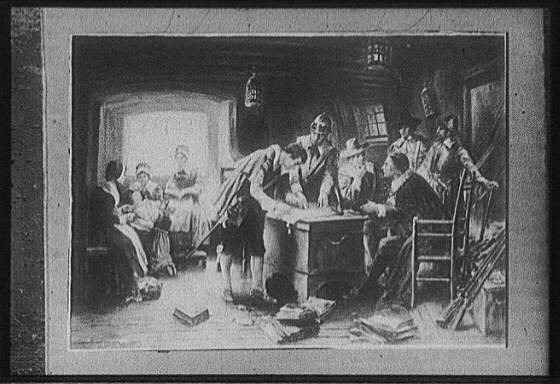
File:Mayflowercompact.jpg

John Carver was the first to sign the Mayflower Compact

Carver signed the Mayflower Compact on November 11, 1620, and on the same day was elected governor of the colony. He was regarded as “a gentleman of singular piety.”  In March 1621, Carver established a peace treaty with Chief Massasoit of theWampanoag tribe. This was one of America’s most successful Indian treaties, lasting for over half a century.

Carver died suddenly one month later after falling ill while working in the fields, probably of a stroke.   William Bradford was named his successor.

Time Line

Leyden

22 May 1615 – Roger Chandler, sayworker, bachelor from Colchester in England, accompanied by Roger Wilson his acquaintance with Isabel Chilton, spinster, from Canterbury in England, accompanied by Sarah Minther and  [Cathelyna Kerver] Catherine Carver, her acquaintance.

12 May 1616 – Henry Wilson, pumpmaker, bachelor, (from) Yarmouth in England, accompanied by William Jepson and John Carver [Jan Kerver}, his acquaintances with Elisabeth Nicholas, spinster, also from Yarmouth in England, accompanied by Sarah Minther and Dorothy Bradford, her acquaintances.

3 Mar  1617 – John Michaelson (Jennings), merchant, from Essex in England, widower of Elisabeth Pettinger, accompanied by John Carver [Jan Kerver] his acquaintance, dwells at the clothier’s near Douver in Marendorp, with Rose Lile, spinster, from Yarmouth in England, accompanied by Rose Jepson, her acquaintance.

19 May  1617 – Robert Cushman, woolcomber, from Canterbury in England, widower of Sarah Cushman, dwelling in an alley in the Nonnensteech, accompanied by John Keble, his acquaintance, with Mary Singleton, from Sandwich in England, widow of Thomas Singleton, accompanied by Catherine Carver [Cathelyne Kerver], her acquaintance.

14 July  1618 – Roger Symonson, mason, bachelor, from Sarum in England, dwelling at Amsterdam, accompanied by Daniel Fairfield, his future brother-in-law and John Carver, his acquaintance, with Sarah Minther, from Norwich in England, widow of William Minther, dwelling at leyden, accompanied by Thomas Willet, her father and Alice Willet, her mother.”

12 Nov 1617 – From a letter written by Sir Edwin Sandys to Mr. John Robinson and Mr. William Brewster

“The agents of your congregation, Robert CUSHMAN and John CARVER, have been in communication with divers select gentlemen of His Majesty’s Council for Virginia; and by the writing of seven Articles subscribed with your names, have given them that good degree of satisfaction, which hath carried them on with a resolution to set forward your desire in the best sort that may be, for your own and the public good. Divers particulars whereof we leave to their faithful report; having carried themselves here with good discretion, as is both to their own and their credit from when they came. And whereas being to treat for a multitude of people, they have requested further time to confer with them that are to be interested in this action, about the several particularities which in the prosecution thereof will fall out considerable, it hath very willingly assented to. And so they do not return unto you.”

15 Dec 1617 – Robinson and Brewster responded:

“We have with the best speed and consideration withal that we could, set down our requests in writing, subscribed as you willed, with the hands of the greatest part of our congregation, and have sent the same unto the Council by our agent and a deacon of our church, John Carver, unto whom we have also requested a gentleman of our company to adjoin himself. To the care and discretion of which two we do refer the prosecuting of the business.”

“…one Thomas Weston, a merchant of London, came to Leyden about the same time (who was well acquainted with some of them and a furtherer of them in their former proceedings), having much conference with Mr. Robinson and others of the chief of men, persuaded them to go on (as it seems) and not to meddle with the Dutch or too much to depend on the Virginia Company. For if that failed, if they came to resolution, he and such merchants as were his friends, together with their own means, would set them forth; and they should make ready and neither fear want of shipping nor money; for what they wanted should be provided. And, not so much for himself as for the satisfying of such friends as he should procure to adventure in this business, they were to draw such articles of agreement and make sure propositions as might the better induce his friends to venture. Upon which, after the former conclusion, articles were drawn and agreed unto and were shown unto him and approved by him. And afterwards by their messenger (Mr. John Carver) sent into England who, together with Robert Cushman, were to receive the moneys and make provision both for shipping and other things for the voyage; with this charge, not to exceed their commission but to proceed according to the former articles.”
(William Bradford, Of Plymouth Plantation 1620-1647)

“Wherupon two were Chosen [Robert Cushman and John Carver] and sent into England att the Charge of the Rest [to] sollissit this matter whoe found the Verginnia Companie very desirous to have them goe thither, and willing to Graunt them a Pattent with as ample privilidges as they had or could Graint to any, and to Give them the best furtherance they C[ould]…

12 Nov 1617 London – “A Coppy of a letter from Sir Edwin Sands directed to mr John Robinson and mr William BREWSTER.

“After my harty sallutations, the agents of youer Congregation Robert Cushman and John Carver have bin in Comunication with divers Celect Gentlemen of his Ma’ties Councell for Verginnia, and by the writing of seven articles with youer Names have Given them that Good degree of Satisffaction; which hath Carryed them on with a Resolution to sett forward youer desire in the best sort that may be for youer own and the public Good divers p’rticulars wherof wee leave to theire faithful Report; having Carryed themselves heer with that Good descretion as is both to theire owne and their Creditt from whence they Came; and whereas being to treat for a Multitude of people they have Requested further time to Confer with them, that are to be Interrested in this action about the severall p’rticulars which is in the prosecution therof will fall out Considerable; It hath bin very willingly assented unto, and soe they doe Now Returne unto you…

“Theire Answare was as followeth…

“… we have with the best speed and Consideration withall; that wee Could sett down our Requests in writing subscribed (as you willed) with the Greatest p’rte of our Congregtion and have sent the same unto the Counsell by our agent A deacon of our Church John Carver unto whom wee have alsoe Requested a Gentleman of our Companie to adjoyne himself, to the Care and descretion of which two wee doe Refer the prosecuting of the busines”

“But now another difficulty arose, for Mr. Weston and some other that were for this course, either for their better advantage or rather for the drawing on of others, as they pretended, would have some of those conditions altered that were first agreed on at Leyden. To which the two agents sent from Leyden or at least one of them who is most charged with it) did consent, seeing else that all was like to be dashed and the opportunity lost, and that they which had put off their estates and paid in their moneys were in hazard to be undone. They presumed to conclude with the merchants on those terms, in some things contrary to their order and commission and without giving them notice of the same; yea, it was concealed lest it should make any further delay. Which was the cause afterward of much trouble and contention…”

“… there fell out a difference among those three that received the moneys, and made the provisions in England, for besides these two formerly mentioned sent from Leyden for this end, viz, Mr. Carver and Robert Cushman, there was one chosen in England to be joined with them to make the provisions for the voyage…”

10 Jun 1620 Difficulties continued. Robert Cushman referred to them in this letter sent to John Carver:

“Loving Friend, I have received from you some letters, full of affection and complaints, and what it is you would have of me I know not; for your crying out ‘Negligence, negligence, negligence,” I marvel why so negligent a man was used in this business. Yet know you that all I have power to do here shall not be one hour behind, I warrant you. You have reference to Mr. Weston to help us with money … to speak the truth, there is fallen already amongst us a flat schism, and we are readier to go to dispute than to set forward a voyage…

“Think the best of all and bear patience what is wanting, and the Lord guide us all.”
William Bradford commented “I have been the larger in these things, and so shall crave leave in some like passages following (though in other things I shall labor to be more contract) that their children may see with what difficulties their fathers wrestled in going through these things in their first beginnings; and how God brought them along, notwithstanding all their weaknesses and infirmities.”

Disputes continued even after the Pilgrims had left Leiden :

“Thus hoisting sail [about 22 July 1620], with a prosperous wind they came I short time to Southampton, where they found the bigger ship come from London, lying ready with all the rest of their company. After a joyful welcome and mutual congratulations, with other friendly entertainments, they feel to parley about their business, how to dispatch with the best expedition; as also with their agents about the alteration of the conditions. Mr. Carver pleaded he was employed here at Hampton, and knew not well what the other had done at London; Mr. Cushman answered he had done nothing but what he was urged to, partly by the grounds of equity and more especially by necessity, otherwise all had been dashed and many undone. And in the beginning he acquainted his fellow agents herewith, who consented unto him and left it to him to execute, and to receive the money at London and send it down to them at Hampton, where they made the provisions.” (William Bradford, Of Plymouth Plantation 1620-1647,)

27 Jul 1620 – Rev. John Robinson, pastor of the Leiden congregation who was not to accompany the small group making the voyage to America in the Mayflower, wrote a farewell letter to John Carver, reproduced here in its entirety:

My dear brother, I received enclosed in your last letter the note of information, which I shall carefully keep and make use of as there shall be occasion. I have a true feeling of your perplexity of mind and toil of body, but I hope that you who have always been able to plentifully to administer comfort unto others in their trials, are so well furnished for yourself, as that far greater difficulties than you have yet undergone (though I conceive them to have been great enough) cannot oppress you; though they press you, as the Apostle speaks. the spirit of a man (sustained by the Spirit of God) will sustain his infirmity; I doubt not so will yours. And the better much when you shall enjoy the presence and help of so many godly and wise brethren, for the bearing of part of your burthen, who also will not admit into their hearts the least thought of suspicion of any the least negligence, at least presumption, to have been in you, whatsoever they think in others.

“Now what shall I say or write unto you and your good wife my loving sister? Even only this: I desire, and always shall, unto you from the Lord, as unto my own soul. And assure yourself that my heart is with you, and I will not forslow my bodily coming at the first opportunity. I have written a large letter to the whole, and am sorry I shall not rather speak than write to them; and the more, considering the want of a preacher, which I shall also make some spur to my hastening after you. I do ever commend my best affection unto you, which if I thought you made any doubt of, I would express in more and the same more ample and full words.

“And the Lord in whom you trust and whom you serve ever in this business and journey, guide you with His hand, protect you with His wing, and show you and us His salvation in the end, and bring us in the meanwhile together in the place desired, if such be His good will, for His Christ’s sake. Amen.”
(William Bradford, Of Plymouth Plantation 1620-1647)

6 Jan 1621 – Master Martin was very sick, and, to our judgment, no hope of life. So Master Carver was sent for to come aboard to speak with him about his accounts; who came the next morning.” (Mourt’s Relation)

12 Jan 1621 – This day two of our people put us in great sorrow and care. There was four sent to gather and cut thatch in the morning; and two of them John Goodman and Peter Browne, having cut thatch all the forenoon, went to a further place, and willed the other two to bind up that which was cut, and to follow them. So they did, being about a mile and a half from our plantation. But when the two came after, they could not find them, nor hear any thing of them at all, though they hallooed and shouted as loud as they could. So they returned to the company, and told them of it. Whereupon Master Carver and three or four more went to seek them; but could hear nothing of them. So they returning, sent more; but that night theuy could hear nothing at all of them.”
(Mourt’s Relation)

14 Jan 1621 – “But the next day, in the morning about six of the clock, the wind being very great, they on shipboard spied their great new rendezvous on fire … At their landing they heard good tidings of the return of the two men [John Goodman and Peter Browne], and that the house was fired occasionally [accidentally] by a spark that flew into the thatch, which instantly burnit it all up; but the roof stood, and little hurt. The most loss was Master Carver’s and William Bradford’s, who then lay sick in bed, and if they had not risen with good speed, had been blown up with powder; but, through God’s mercy, they had no harm. The house was as full of beds as they could lie one by another, and their muskets charged; but, blessed be God, there was no harm done.” (Mourt’s Relation)

7 Mar 1621 – The wind was full east, cold but fair. That day Master Carver with five others went to the great ponds, which seem to be excellent fishing places.” (Mourt’s Relation)

23 Mar 1621 – “This day we proceeded on with our common business, from which we had been so often hindered by the savages’ coming and concluded both of military orders and of some laws and orders as we thought behooveful for our present estate and condition; and did likewise choose our governor for this year, which was Master John Carver, a man well approved amongst us.” (Mourt’s Relation)

2 April 1621 – The will of William Mullins to “my two overseers Mr. John Carver and Mr. Williamson, 20s apiece to see this my will performed desiring them that he would have an eye over my wife and children to be as fathers and friends to them, also to have a special eye to my man Robert which hath not so approved himself as I would he should have done.”

April 1621 – “They now began to dispatch the ship away which brought them over, which lay till about this time, or the beginning of April. The reason on their part why she stayed for so long, was the necessity and danger that lay upon them; for it was well towards the end of December before she could land anything here, or they able to receive anything ashore. Afterwards, the 14th of January, the house which they had made for a general rendezvous by casualty fell afire, and some were fain to retire aboard for shelter; then the sickness began to fall sore amongst them, and the weather so bad as they could not make much sooner any dispatch. Again, the Governor and chief of them, seeing so many die and fall down sick daily, thought it no wisdom to send away the ship, their condition considered and the danger they stood in from the Indians, til they could procure some shelter; and therefore thought it better to draw some more charge upon themselves and friends than hazard all.” (William Bradford, Of Plymouth Plantation 1620-1647)

Apr 1621 – “Whilst they were busy about their seed, their Governor (Mr. John Carver) came out of the field very sick, it being a hot day. He complained greatly of his head and lay down, and within a few hours his senses failed, so as he never spake more till he died, which was within a few days after. Whose death was much lamented and caused great heaviness amongst them, as there was cause. He was buried in the best manner they could, with some volleys of shot by all that bore arms. And his wife, being a weak woman, died within five or six weeks after him.”
(William Bradford, Of Plymouth Plantation 1620-1647)

“Before I pas on I may not omitt to take Notice of the sad losse the Church and this Infant Comonwealth sustained by the death of mr John Carver whoe was one of the deacons of the Church in leyden but Now had bine and was theire first Gov’r: this worthy Gentleman was one of singular Piety and Rare for humillitie which appeered (as otherwise) soe by his Great Condesendencye when as this miserable people were in Great sicknes hee shuned not to doe very meane services for them yee the meanest of them; hee bore a share likewise of theire labour in his owne person; according as theire Great Nessesitie Required; whoe being one alsoe of a Considerable estate spent the Maine prte of it, in this enterprise and from first to last approved himself, not onely as theire agent in the first Transacting of thinges but alsoe all alonge to the Period of his life; to be a pious faithfull and very benificiall Instrument; hee deceased in the Month of Aprill in the yeer 1621, and Now is Reaping the fruite of his labour with the lord.” (“History of the Plymouth Church, 1620-1680, by William Bradford and Nathaniel Morton)

Nov 1621 – A letter arrived for John Carver on the Fortune.    “In this ship Mr. Weston sent a large letter to Mr. Carver, the late Governor, now deceased; full of complaints and expostulations about former passages at Hampton, and the keeping the ship [Mayflower] so long in the country, and returning her without lading, etc…
[William Bradford replied to Mr. Weston]

“Your large letter, written to Mr. Carver and dated the 6th of July 1621, I have received the 10th of November, wherein after the apology made for yourself you lay many heavy imputations upon him and us all. Touching him, he is departed this life and now is at rest in the Lord from all those troubles and encumbrances with which we are yet to strive. He needs not my apology; for his care and pains was so great for the common good, both ours and yours, as that therewith (it is thought) he oppressed himself and shortened his days; of whose loss we cannot sufficiently complain.

“At great charges in this adventure I confess you have been, and many losses may sustain; but the loss of his and many other honest and industrious men’s lives cannot be valued at any price. Of the one there may be hope of recovery; but the other no recompense can make good.”
(William Bradford, Of Plymouth Plantation 1620-1647)

“And seeing it hath pleased Him to give me to see thirty years completed since these beginnings, and that the great works of His providence are to be observed, I have thought it not unworthy my pains to take a view of the decreasings and increasings of these persons and such changes as hath passed over them and theirs in this thirty years …
“Mr. Carver and his wife died the first year, he in the spring, she in the summer.”
(William Bradford, Of Plymouth Plantation 1620-1647)

John Carver was remembered by the Colony and, when the names of the founders were invoked in legal documents, his name appears at the head of the roster. For example, in 1658

“A Declaration demonstrating the warrantable grounds and proceedings of the first Associates of the Govrment of New Plymouth in theire laying the first foundation of the Govrment in this Jurisdiction ffor the making of Lawes and disposing of lands and of all such thinges as shall or may Conduce to the welbeing of this Corporation of New Plymouth:

Wheras John Carver William Bradford Edward Winslow William Brewster Isaake Allerton and divers others of the Subjects of our late Sov: Lord Kinge James by the grace of God King of england Scotland ffrance and Ireland Defender of the faith &c did in the eighteenth yeare of his Reigne of england ffrance and Ireland, and of Scotland the fifty fourth which was in the yeare of our Lord God one thousand six hundred and twenty did undertake a voyage into that pte of America called Verginia or new England theunto adjoyning there to erect a plantation and collonie of English Intending the glory of God the Inlargment of his Ma’ties dominnions and the speciall good of the English Nation…”

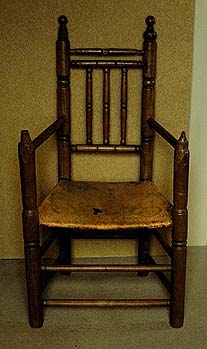
Carver Chair

It is highly unlikely that this chair actually belonged to John Carver, the first Governor of Plymouth Colony. Although the chair was long thought to have been brought on the Mayflower by Carver, a recent wood analysis determined that the chair was actually made in America. American white ash does not grow in England.

Governor Carver died in Spring of 1621 and it is not probable that people in the fledgling colony had time to build such a chair during that first devastating winter when half the Pilgrims died.

The name of Plymouth’s first governor, however, has been firmly attached to this type of Early American chair; chairs with turned spindles in the back only are known generically today as “Carver chairs.” They differ from Brewster Chairs, which have spindles under the seat and arms as well.

The chair is related to other chairs made by craftsman Ephraim Tinkham (1649-1713), who worked in Plymouth and Middleboro.

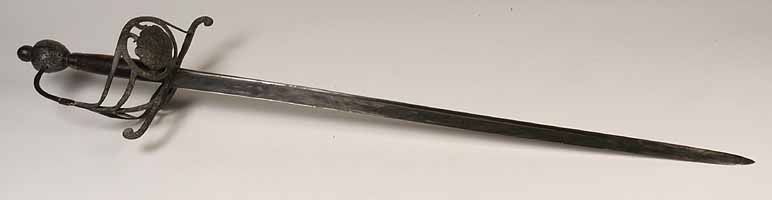
Carver Sword — Material : Steel, iron, silver and wood Ownership attributed to John Carver.

The “Carver sword,” on loan to the Pilgrim Society from the Massachusetts Historical Society, was donated to the Massachusetts Historical Society by Ichabod Shaw of Plymouth in 1795. The decoration and workmanship are typical of English swords of the early 17th century.

The town of Carver, Massachusetts, just west of Plymouth, was named for him.

Carver, Plymouth, Mass.

Sources:

http://trees.ancestry.com/owt/person.aspx?pid=2214959

http://www.pilgrimhall.org/CarverJohn.htm

http://www.pilgrimhall.org/CarverJohnrecords.htm

http://www.brainerd.net/~bevgand/ps02_074.htm

“History of the Plymouth Church, 1620-1680, by William Bradford and Nathaniel Morton,” Plymouth Church Records [Publications of the Colonial Society of Massachusetts, Volumes XXII and XXIII. Boston : The Society, 1920 and 1923]. Volume 1, p. 31-33.

Posted in Artistic Representation, First Comer, Line - Miner, Place Names, Wikipedia Famous | 6 Comments

Isaac Carver

Isaac CARVER (1562 – 1598) was  probably not Alex’s 13th Great Grandfather;  one of 16,384 in this generation of the Miner line.    See note  from Bev Anderson on  Robert CARVER‘s page.

Isaac Carver was born in 1562 – Doncaster, Yorkshire, England. His parents were James CARVER and Catherine [__?__]. He married Catherine [__?__]. Isaac died in 1598 in Leyden, Holland.

Children of  Isaac and Catherine

Name Born Married Departed
1. Robert CARVER 1594
Boston, Lincolnshire, England
Christian [TURNER]?
4 Aug 1617
Lydiard District, Wiltshire,England
Apr 1680
Boston Mass, burried in Marshfield, Mass

There is no documentary proof that James and Catherine (_____) Carver were the parents of Isaac (Robert’s father) and John Carver, the first governor of the Plymouth Colony, but there is strong circumstantial evidence.

James Carver was a yeoman of Doncaster, Yorkshire. The parish where John Carver was baptized was only seven miles from Austerfield which is next to Bentley where the early English homes of the Brewster and Bradford families were located. It is possible that the father’s name was Robert, not James.

Charles Edward Banks in English Ancestry and Homes of the Pilgrim Fathers identified John Carver as the son of Robert Carver and gives his baptism at Duncaster, County York , on 9 Sep 1565. The NEHGR, Vol. 67, p. 382 (October 1913) has two baptismal records which bear out this statement: “1564 Sept. 9 John, s. of Robert Caruer” and “1567 March 27 Wilim s. of Robte Caruer.” These entries were copied from the parish register of Duncaster, County York and were found in a manuscript volume in the Library of the New England Historic Genealogical Society.

In the Genealogical and Family History of the State of Maine, compiled by Little, the statement is made that Isaac Carver, father of Robert and brother of John died at Leyden which leads one to believe he too had followed his brother there.”

“It is said the name Carver is derived from the occupation of wood carver, and some work in cathedrals of East Anglia was done by skilled carvers of this family. The names Adam le Karver and Richard le Kerver are found on the Hundred Rolls, and some bearing the name Carver at a later date were settled in various parts of England.

John Carver, first governor of Plymouth Colony, was “sonne of James Carver, Lincolnshire, yeoman” and it has been the commonly accepted tradition that Robert Carver, the emigrant, was his brother, which tradition was supposed to have been established as fact by the historian of Marshfield, Mass., who received information from a Carver descendant whose grandfather had lived 21 years with his grandfather Robert, the emigrant. But it is now known that Robert was a son of Isaac, a brother of Governor Carver and consequently the Governor’s nephew.”

The Carver Family of New England, Clifford Nickels Carver, p.23:

“In Leyden the Carvers [John & Catherine] lived first on Widdleberg, and, after 1617, on Middelgracet. And here it appears that the nephew Robert Carver, joined John Carver, for in one of the Leyden records, Robert Carver is referred to as the grandson of Katharine Carver (the wife of James Carver and mother of Isaac and John).

In the Genealogical and Family History of the State of Maine, compiled by Little, the statement is made that Isaac Carver, father of Robert and brother of John died at Leyden which leads one to believe he too had followed his brother there.”

Sources:

http://trees.ancestry.com/owt/person.aspx?pid=2214959

Posted in Line - Miner | 2 Comments

Division of North Field – Salem, Mass

When the North field was laid out is unknown, but it must have been before the town records were begun. Apparently most of the original lots consisted of ten acres each. By tracing the land titles the accompanying plan is made possible. The following is a list of the lots with the names of the owners at the dates stated.

Division of North Field with Ancestor's Plots

WT = William Towne, father of three accused witches Rebecca Nurse, Mary Estey and Sarah Cloyes.
C = Cromwells
G = Goodells
S = Scudders
T = Tompkins
F = Fosters
P = Peases

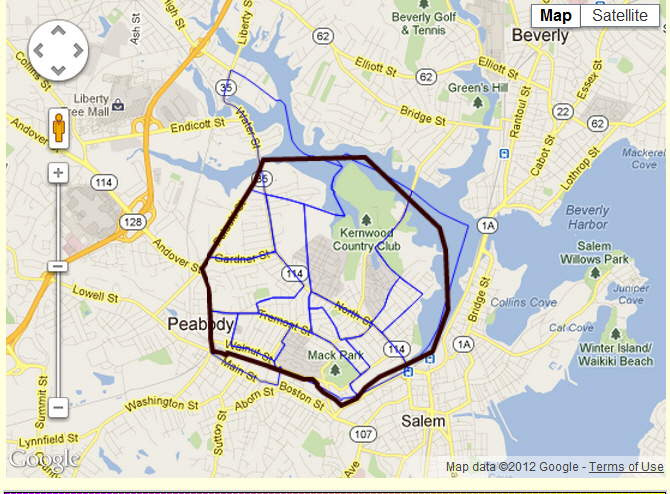
Northfields, Salem, Mass Today

North Salem is the city’s oldest neighborhood. Long before the white settlers arrived, the area was inhabited by Native Americans. Rev. John Higginson recalled that a settlement of Naumkeags existed at the intersection of what are now North and Osborne streets when he came to Salem in 1629.

North, Dearborn, Liberty Hill, and Orne are some of the neighborhood’s oldest streets. William Dennis, writing in the Salem Observer in 1912, noted that North Street was once “The Country Road” and Dearborn was known as “Liberal” or “Generous” Street because of its width.

The bottom of Liberty Hill Avenue was the site of Cold Spring. This spring was a popular source of fresh water for local inhabitants until recent years. It was also a favorite stopping place for Nathaniel Hawthorne, a one-time Dearborn Street resident, on his rambles around Salem.

Manning Street owes its name to Hawthorne’s uncle. Robert Manning, one of America’s leading authorities on fruit, who established his famous pomological gardens on Dearborn Street in 1823. Manning’s “Book of Fruits” was the last word on the growing of pears, cherries, and other fruits in New England.

Agriculture was the primary activity in North Salem in the 17th and 18th centuries. Maps of Salem in 1700 show the area between the North River and Dearborn Street was subdivided into narrow farms and was known as Northfields. Access to the Salem peninsula was by ferry until the original North Bridge was built in 1744.

According to William Dennis, the area north and west of the bridge near what is now Mason Street and Mack Park was once called “Paradise.” North Salem in general was known as Pigeontown (or Pigeonville). Wild pigeons were trapped in the Liberty Hill-Kernwood area and sold at market.

The present Kernwood Country Club property was once the estate of Francis Peabody. This noted chemist helped usher in Salem’s industrial age in the second quarter of the 19th century. Peabody opened a lead works and a jute-bagging plant in Salem and promoted other industries.

North Salem has been the home of other important individuals and businesses. As was mentioned in last week’s column, General Electric CEO Jack Welch was raised at 15 Lovett St. and Wayne Millner, who was inducted into the Pro Football Hall of Fame in 1968, spent most of his young adult years at 196-8 North St.

1. The horse pasture,
was owned by:
Capt. George Corwin (5/14ths),
Philip CROMWELL (5/14ths),
William Browne, sr. (2/14ths, and
Dr. George Emery (2/14ths)
in 1669.
2. Thomas Watson,
1669.
3. Robert Butten
before 1674.
4. John Shipley
about 1650.
5. Robert GOODELL,
1658.
6. Francis Skerry,
1682.
7. Francis Lawes and John Luff, being two ten acre lots,
in 1659.
8. John Massey,
1700.
9. Francis Lawes and John Luff,
1659.
10. John Trask,
1695.
11. Thomas Robbins,
1690,
12. Daniel Ray,
1655.
13. Alice Fermaies,
1655.
14. Thomas Watson,
1655.
15. Thomas Tuck and Joseph Harris,
1659.
16. Mark Fermaies
, about 1670.
17. Thomas Wilkes and wife Mary,
1656.
18. Thomas Watson,
1656.
19. Thomas Oliver,
about 1670.
20. John Symonds, [Father-in-law of Jacob Towne]
before 1670. (See today’s Symonds Street)
21. Robert Buffum,
1661.
22. The easterly part
belonged to widow Spooner and the westerly part to George Corwin
very early.
23. Robert Buffum (See today’s Buffum Street)
before 1690.
24. John Kitchen,
1659.
25. Edward Gaskill,
1659.
26. Thomas Spooner,
1659.
27. John Trask,
1672.
28. – Marshall,
about 1650.
29. Thomas Gardner,
1658.
30. Henry Phelps,
1658.
31. William Bacon,
1653
32. Thomas Gardner,
1644.
33. Richard Bishop,
1654.
34. Samuel Gaskill,
1670.
35. Thomas Gardner,
1674.
36. Samuel Gaskin,
1682.
37. Robert Stone,
1682.
38. John Alderman,
about 1650.
39. Samuel Gaskill,
1659.
40. Thomas Goldthwaite,
1659.
41. Job Swinerton,
1681.
42. William Place,
about 1650.
43. James Symonds,
1698.
44. Samuel Ebourn,
about 1680.
45. Col. Bartholomew Gedney,
1697.
46. Col. Bartholomew Gedney,
1697.
47. Samuel Ebourne,
1698.
48. John Blevin,
1698.
49. John Gedney and John Symonds [Father-in-law of Jacob Towne],
1665.
50. John Gedney,
1667.
51. Hugh Peter,
1640.
52. John Higginson,
1679.
53. John Norman, Sr.,
1636.
54. Mr. Herbert, before
1650.
55. Robert GOODALE,
1663.  (Click here for today’s Goodale Street)
56. Thomas Reed,
1663.
57. Henry Bartholomew, (Thomas SCUDDER‘s son-in-law)
1663.
58. Thomas Reed,
1667.
59. John FOSTER,
1700.
60. David Foster, (Son of John FOSTER)
1700.
61. John Tompkins, (Son of Ralph TOMPKINS)
1675.
62. Edward Beacham,
1682.
63. Benjamin Gerrish,
1682.
64. Thomas Spooner,
before 1680.
65. John Hill,
1675.
66. Hugh Pasco, (Son-in-law of John PEASE,)
1682.
67. Caleb Buffum,
1682.
68. John PEASE,
about 1680.
69. Job Swinnerton,
1664.
70. Joseph Pope,
1664.
71. Henry Birdsall,
1650.
72. John Bourne,
1653.
73. Hugh Jones,
1688.
74. Anthony Buxton, (David Foster’s father-in-law)
1680.
75., John Pudney, sr.,
1692.
76. William Robinson,
1661.
77. Thomas Wheeler,
about 1661.
78. George Corwin,
1658.
79. Edward Beachem,
1662.
80. John Alderman,
1656.
81. Thomas James,
1662.
82. John FOSTER,
1675.
83. John Small,
1700.
84. Henry Williams,
1654.
85. Robert Butten, before
1650.
86. William TOWNE,
1652.
87. Richard Waters,
1658.
88. John Tompkins,
(Son of Ralph TOMPKINS)
1658.
89. John Tompkins, (Son of Ralph TOMPKINS)
1664.
90. Robert Cotta,
about 1650.
91. John FOSTER,
1664.
92. Thomas SCUDDER,
about 1660.
93. Thomas Robbins,| 1681. 94. George Semith,
1679.
95. Henry Cook,
1680.
96. Samuel Goldthwait,
1687.
97. John Burton,
1683.
98. John Marsh,
1673.
99. Nathaniel Felton,
1667.
100. Lawrence Leach,
1660.
101.- Veren,
1660.
102. William Cantlebury,
about 1660.

1636 – In the division of land “Rob[er]t Goodell” received twenty acres (in the non-freeman’s part of the list)[STR 1:23].

25 Dec 1637 – In the division of marsh and meadow “Rob[er]t Goodell” received one acre, for a household of seven[STR 1:102].

21 Jan 1638/39 – “Robert Goodale” was granted “20 acres more to be added to the 20 already granted in all 40 acres to be laid out by the town”[STR 1:78].

11 Feb 1638/39 – “Robert Goodall desireth an enlargement of land”[STR 1:83].

31 Aug 1649 – There was “granted to Frances Skerie a little [spot] of ground between the sea and his field which was formerly Goodel’s”[STR 1:159].

13 Feb 1651/52 – “Robert Goodell having 40 acres of land granted long since by the town and he having bought land of several others that had the land granted to them viz: Joseph Grafton 30 acres, John Sanders 40 acres, Henerie Herick 40 acres, William Bound 40 acres, Robert Pease & his brother 30 acres, Robert Cotta 30 acres, William Walcott 30 acres, Edmund Marshall 20 acres, Thomas Antrum 20 acres, Michall Shaflin 20 acres, Mr. Venor 40 acres, John Barber thirty acres, Philemon Dickenson 20 acres, Mr. Goose 50 acres, in the whole 480, it is ordered that the said Robert Goodell shall enjoy the said 480 [acres] of land being part of the eleven hundred acres, he discharging the town of the abovesaid grant and he is allowed to said 480 acres of upland 24 acres of meadow provided that the meadow laid out within his upland be a part of it”[STR 1:171].

31 Mar 1652 – “Rob[er]t Goodhall of , planter,” sold to “David Carwithen three acres of salt marsh on Royall Side[ELR 1:12].

4 Apr 1653 – “Rob[er]t Goodell of , planter,” sold to “Francis Skerry … four acres of land in Salem Neck”[ELR 1:17].

7 Jul 1656 – “Robert Goodall of …, husbandman,” sold to “David Carwithen of the same place 3 acres of salt marsh on Riall Side”[ELR 1:34].

26 Oct 1653 – “John Barbour, late of , carpenter,” sold to “Rob[er]t Goodhall of the same, husbandman, thirty acres of land in Salem[ELR 1:21].

28 Feb 1653/54 – “Thomas Antrop of ” sold to “Rob[er]t Goodhall forty acres of land lying near the sad Rob[er]t’s land within the bounds of [ELR 1:22].

31 Oct 1653 – “John Blackleich of , merchant,” sold to “Rob[er]t Goodhall of fifty acres of land lying between Mr. Higgesson’s and Mr. Alderman’s lands”[ELR 1:20].

15 Mar 1659/60 – “Robert Goodell of , … husbandman,” sold to “Giles Coree of Salem … fifty acres of land, which was a fifty acre lot formerly given by the town of to E[d]ward Giles, & sold by him to Mr. Blackleech, of whom the said Rob[er]t Goodell lately bought the said land”[ELR 2:68, 26:172].

20 Dec 1662 – “Robert Goodell sometime of , planter,” sold to “Mr. George Corwin of the same town, merchant, a piece of salt marsh containing by estimation two acres” in ” aforesaid, at the upper end of a place called the Great Cove…, having a spring of water in it, with a small parcel of meadow”[ELR 2:61]

6 Jan 1662[/3?], “Robert Goodell of Salem …, farmer,” sold to “Tho[mas] Flint of the same place, farmer, … a certain parcel of land containing fifty acres”[ELR 2:76].

14 Aug 1678 – “Robert Goodale of …, husbandman,” sold to “Thomas Flint, carpenter, of the same town, three acres & fifty-eight pole of meadow & upland … lying near the now dwelling house of the said ” [ELR 11:16]

7 Jun 1697 – “Nathaniel Felton Senior aged about eighty-two years & John Massey Senior aged about sixty-six years both of both testifieth & saith that the field commonly called the East Field in lying between the great pasture belonging to Col. Gedney & the field belonging to John Cornwall now in the possession of John Higginson Junior was formerly two houselots of about two acres each lot & that there was erected and standing on each of said lots a dwelling house which were inhabited by Robert Goodale & Peter Wolfe before the year of our Lord one-thousand six-hundred sixty & one”[ELR 11:253].

7 Jun 1667 – “Rob[er]t Goodell of …, husbandman,” sold to “Mr. Nicholas Manning of the same town twenty acres of upland with some meadow contained in it … in a place called the North Field”[ELR 4:176].

29 Jun 1672 – “Robert Goodall of … and Margaret his wife” sold to “John Buxton of the aforesaid four & forty acres of swamp & upland … it is to be understood, the forty-four acres of land before mentioned is part of the six hundred acres granted by the town of in small parcels to several men, many years ago, & purchased by the said Goodal”[ELR 3:177].

29 Dec 1674 – “Robert Goodell of … & Margaret my wife” sold to “John Buxton of aforesaid one & twenty acres of land … near the great river commonly called Ipswich River”[ELR 4:132].

21 Jul 1658 – “Robert Goodell of ” exchanged land with “John Smith my son-in-law,” Smith receiving “ten acres of upland … with an old house upon the same … near the great cove in a neck of land commonly called the north neck,” and Goodale receiving “fifty acres of land … adjoining to a farm of the said Robert”[ELR 1:39-40].

20 Sep 1665 – “Robert Goodell of ” deeded to “my daughter Sara Bacheler the wife of John Bacheler of … thirty-two acres of upland & two parcels of meadow about eight acres, situate & being in the limits of aforesaid, being part of the eleven hundred acres granted by the town of to several proprietors on the south side of the river commonly called Ipswich River”[ELR 6:28].

16 Nov 1666, “John Bacheler of ” sold this same land to “Lott Killum of the same place”; “Robert Goodell” acknowledged “the abovesaid upland & meadow to be a free gift unto John Bacheler with his wife Sarah my daughter at her marriage”[ELR 6:54].

26 Oct 1665 – “Robert Goodell of ” deeded to “my son Zachariah Goodell of aforesaid sixty acres of land … being part of the eleven hundred acres of land granted by the town of for small lots, lying near my house”; “it is to be understood that 50 acres were given by the said Robert Goodell, as a legacy for his portion, & the other ten acres were sold to him for a valuable sum”[ELR 6:71].

1 Feb 1667/68 – “Robert Goodell of ” deeded to “my son Zachariah Goodell of the said ten acres of fresh meadow … near the river commonly called the great river”[ELR 6:71].

10 Feb 1667/68 – “Robert Goodell of ” deeded to “my son Isaack Goodell of the place aforesaid one hundred acres of upland … near the river commonly called the Great River … & seven acres of fresh meadow lying almost in a triangle”[ELR 4:207].

3 Nov 1668 – “Robert Goodelle of , farmer,” sold to “his daughter Hanah Killum of 35 acres of land in , 10 acres of which adjoined the home field of said Robert …; the other parcel of 25 acres adjoins 40 acres of Lot, husband of Hanah Killum”; “said Killum promised not to sell this land without his wife’s consent”[EQC 7:294].

14 Aug 1678 -“Robert Goodell of …, husbandman,” for a consideration provided by “my daughter Elizabeth & her former husband John Smith deceased,” deeded to “the said Elizabeth, now the wife of Henry Bennett … a certain parcel of land called ten acres, yet containing fifteen acres … & is part of that land of mine not far from my now dwelling …, also two acres of meadow lying at the great river so-called”; “Margarett Goodell” joined in this deed and made her mark[ELR 6:66].

In his will, dated 12 October 1682 and proved 27 June 1683, “Robert Goodell being now aged & weak in body, as also my wife and my daughter Elizabeth Bennett hath taken care of me,” bequeathed to “my daughter Elizabeth Bennett, & my grandchild John Smith my house & the orchard & all the meadows that I now possess with the pasture, which is about eight acres of upland”[EPR 302:46].

7 Nov 1682 – “John Pease Senior, aged about 53 years, saith that in his knowledge, the land that my father-in-law Goodell sold to his son-in-law John Smith was laid out by my father Goodell’s order & appointment several years before the land that my father gave to his son Isaac Goodell”[ELR 6:80].

The inventory of the estate of “the late deceased Robert Goodell,” taken 10 Mar 1682/3, totalled £79  16 s., of which £71 was real estate: “the house, upland, orchard & meadow,” £71 [EPR 302:46].

23 Feb 1684/85 – “Margarett Goodale of ” sold to “the aforesaid town of my whole orchard with six acres of planting ground upon which the orchard stands, & four acres of meadow ground near unto the said orchard & two acres of ground for a pasture near unto the said orchard & also one cow, all which was given me by my husband Rob[er]t Goodale deceased, for my comfortable subsistence after his decease, as by a deed of gift bearing date the thirteenth of August one-thousand six-hundred & sixty-nine”[ELR 7:19].

Sources:

http://freepages.genealogy.rootsweb.ancestry.com/~nyterry/towns/salem/nofield_lots-sal.html

http://freepages.genealogy.rootsweb.ancestry.com/~nyterry/towns/salem/maps/nofield_salem_map.jpg

http://www.city-data.com/neighborhood/Northfields-Salem-MA.html

http://familytreemaker.genealogy.com/users/c/h/a/Carol-A-Chadwick/WEBSITE-0001/UHP-0589.html

Posted in Research | 9 Comments

Favorite Posts 2011

Fun Stuff

1. Passages More stats 1,579
2. Origins More stats 1,008
3. Witch Trials (New) More stats 792
6. Famous Cousins More stats 695
7. Lyon’s Whelp More stats 563
8. New England Pioneers More stats 519
9. 17th Century Houses (New) More stats 469
10. Edward I (New) More stats 465
11. Charlemagne More stats 454
12. Veterans More stats 439
13. Sir Richard Forester of Flanders (New) More stats 375
14. Marcus Antonius (New) More stats 317
15. Cars More stats 276
16. Thomas Miner Diary More stats 259
17. Tavern Keepers (New) More stats 231
18. A (False) Herauldical Essay Upon the Surname of Miner More stats 206
19. Witch Trials – Victims (New) More stats 199
20. Anarcher Great Forester of Flanders (New) More stats 179
21. Great Swamp Fight (New) More stats 155
22. Wikipedia Famous More stats 151
23. Crimes and Misdemeanors More stats 136
24. Untimely Deaths More stats 123
25. 1920’s and 1930’s Fashions More stats 115
26. Great Swamp Fight – Regiments (New) More stats 111
27. Genealogical Societies (New) More stats 108
28. Sea Captains More stats 102
29. Witch Trials – Accusers (New) More stats 91
30. Witch Trials – Jury (New) More stats 80
31. Witch Trials – Supporters (New) More stats 76
32. Puritans v. Quakers – Boston Martyrs (New) More stats 60
33. Witch Trials – Witnesses (New) More stats 51
34. Nine Men’s Misery – 1676 (New) More stats 51
35. John Mason’s Controversial Statue (New) More stats 46
36. Puritan v. Quakers – Quaker Perspective (New) More stats 40
37. 17th Century Premarital Sex (New) More stats 31
38. Witch Trials – Constabulary (New) More stats 31
39. Great Swamp Fight – Joshua Tefft (New) More stats 29
40. The Hull Company (New) More stats 28
41. Western Pioneers More stats 26
42. Puritans v. Quakers – Trials & Tribulations (New) More stats 26
43. Puritans v. Quakers (New) More stats 26
44. Battle of Havana – 1762 (New) More stats 24
45. Puritans v. Quakers – Puritan Perspective (New) More stats 24
46. Great Swamp Fight – Aftermath (New) More stats 21
47. Puritans v. Quakers – Aftermath (New) More stats 21
48. Pequot War (New) More stats 20

.

People

1. John Proctor More stats 1,322
2. Thomas West 3rd Baron de la Warr More stats 1,073
3. John Clark (New) More stats 1,001
4. George Martin More stats 944
5. John Howland More stats 939
6. Richard Scott More stats 930
7. Howard Irwin Shaw More stats 860
8. Nathanael Greene More stats 828
9. Mathijs Jansen Van Keulen More stats 780
10. George Miller More stats 770
11. Ralph Allen More stats 753
12. Maj. John Mason More stats 721
13. George Allen the Elder More stats 708
14. Rev. James Fitch More stats 707
15. Roger Parke Sr. More stats 688
16. Isaac Allerton More stats 672
17. Sir Oliver Cromwell (New) More stats 670
18. Hendrick Thomasse Van Dyke More stats 661
19. Capt. Matthew Beckwith More stats 650
20. Simon Hoyt More stats 637
21. John Parker Sr (New) More stats 623
22. Rev. John Lathrop More stats 618
23. John Browne Sr. (Swansea) More stats 609
24. (Johann) Friedrich Merkle More stats 607
25. William Hilton Sr. More stats 597
26. Francis Cooke More stats 578
27. George Morton (Pilgrim Father) More stats 574
28. William Hilton Jr. More stats 569
29.William Chase Sr. More stats 555
30. Rev Stephen Bachiler More stats 515
31. Walter Palmer More stats 502
32. William Sargent More stats 476
33. Bartholomew Heath More stats 471
34. Gov. Thomas Prence More stats 465
35. Thomas Miner More stats 463
36. Abraham Estey More stats 448
37. Capt John Cutting More stats 445
38. Elder William Brewster More stats 439
39. Lt. William Clarke More stats 435
40. Giles Cromwell More stats 434
41. Thomas Wells Sr. More stats 432
42. John Tuttle More stats 429
43. John Safford Jr. More stats 419
44. Thomas Clark More stats 418
45. George Sexton More stats 414
46. Richard North More stats 396
47. Orlando Bagley Jr. More stats 393
48. John Houghton More stats 381
49. Edmund Littlefield More stats 372
50. Peter Tallman More stats 372

.

Research

1. About More stats 762
2. Vassalboro More stats 756
3. 2010 in Review (New) More stats 95
4. Favorite Posts 2010 (New) More stats 94
5. Unusual Names More stats 92
6. Missing Parents More stats 87
7. Dutch Names 26

All Time hits through January 24, 2012

Posted in Research | 2 Comments

George Downing

George DOWNING (1556 – 1611) was Alex’s 13th Great Grandfather;  one of 16,384 in this generation of the Miner line.

Immigrant Ancestor

Immigrant Ancestor

George Downing was born about 1556 in Beccles, Suffolk, England.  His parents were George DOWNING and Cicely [__?__].  Alternatively, his parents were Geoffrey Downing, b. 17 Mar 1524 at Great Dunham, England, and Elizabeth Wingfield.  He married Dorcas BELLAMY about 1577 in England.  George Downing left a will on 17 Jan 1610/11 at Suffolk, England and died before 24 Mar 1610/11 at St. Lawrence, Ipswich, Suffolk, England.  George’s estate was probated on 3 Oct 1611 at Suffolk, England.

Dorcas Bellamy was born 1560 in St Nicholas Ipswich, Suffolk, England. She died 21 Dec 1610 in St Lawrence Ipswich, Suffolk, England.  Sometimes she is called Dorcas Blois.

Children of George and Dorcas:

Name Born Married Departed
1. Susanna Downing bapt.
20 Nov 1578
St. Nicholas, Ipswich, Suffolk, England
Francis Kirby
1616
Little Munden, Hertfordshire, England
1635
St Helens, Bishopsgate, England
2. Joshua Downing ca. 1580
Ipswich, Suffolk, England
Grace Edisbury
1610
Ipswich, England
betw.
1 Jan 1629 will &  26 Mar 1629 probate
Chatham, Kent, England
3. Elnathan Downing ca. 1583
Ipswich,  England
9 Feb  1609/10
St. Lawrence, Ipswich, England
4. Emanuel Downing 12 Aug 1585
St. Lawrence, Ipswich, England
Anne Ware
7 Jan 1614/15
Edinburgh, Scotland
.
Lucy Winthrop
10 April 1622
Groton, Suffolk, England
26 Jul 1658
Salem, Mass.
5. Nathaniel Downing bapt.
8 Oct 1587
St. Mary at the Tower Church
Ipswich, England
Margaret Selyne
6 May 1613
St Lawrence Ipswich, England
betw 7 May 1616 will &
14 May 1616 probate England
6. Rev. Joseph DOWNING ca. 1589
St. Nicholas,
Ipswich, Suffolk, England.
Jane ROSE (obtained a marriage license on 6 Nov 1616 at Suffolk, England) Aug 1656
Salem, Mass.
7. Nahomie Downing ca. 1590
Ipswich, England
Richard Hill
1604
England
8. Abigail Downing ca. 1592
Ipswich, England
John Goade
20 Feb 1614/15
St. Lawrence, Ipswich, Suffolk, England
1665 in Salem, Essex, Mass
9. Benjamin Downing 1 Jan 1593/94
Ipswich, England
10. Anne Downing 12 May 1595
Ipswich, England

George entered Queen’s College, Cambridge,  B.A. 1573-74; M.A. 1577.

He was Master of the Grammer School, Ipswich for twenty-one years from 1589 to 1610.

Ipswich School is a co-educational public school for girls and boys aged 3 to 18. Situated in Suffolk, England in the town of Ipswich, it was founded in its current form as The King’s School, Ipswich by Thomas Wolsey  in 1528.

The oldest record of Ipswich School goes back to 1299 but the school was founded in its current form in 1528 by Thomas Wolsey, later Cardinal Archbishop of York andLord Chancellor of England, who was a pupil of the school. A merchant and Portman (Alderman) of Ipswich called Richard Felaw (a school house is named in his honour) bequeathed his house in what is now Foundation Street to the School, endowing it with lands so that children of needy parents could attend without paying fees. One of the first pupils to benefit from Felaw’s endowment was Thomas Wolsey who never forgot that it was largely thanks to Felaw that he became what he became.

In part to thank the school, Wolsey wanted to transform it into an institution that would compete with likes of Eton College, recently founded by King Henry VI, and would become one of England’s greatest educational institutions. Wolsey created his new college, funded by the suppression of religious houses such as Rumburgh Priory, by absorbing into the former school some of the institutions in the town such as St. Mary’s College, and named it (The King’s School, Ipswich).

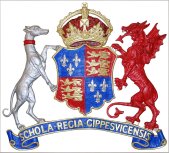
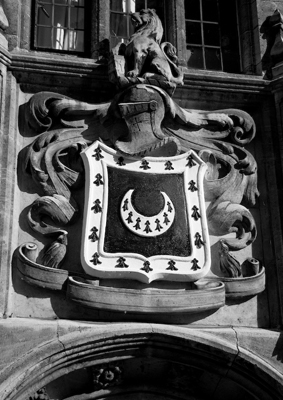
After Wolsey’s downfall in 1530 Thomas Cromwell ensured the survival of the School by securing for it a new endowment from King Henry VIII and the status of a royal foundation. This was confirmed by Queen Elizabeth I in the royal charter that she granted to the School in 1566. For part of the School’s history it was known as Queen Elizabeth’s Grammar School, Ipswich. The School’s coat of arms and motto, Semper Eadem (Always the Same), are those of Elizabeth I.  Queen Elizabeth II is the School’s Visitor.

Ipswich School Coat of Arms is the same as Elizabeth I

A Visitor, in English law and history, is an overseer of an autonomous ecclesiastical or eleemosynary institution (there’s a new word for ya’ –  a charitable institution set up for the perpetual distribution of the founder’s alms and bounty), who can intervene in the internal affairs of that institution.

During the reign of James I [which overlapped George’s last years as master] part of the Blackfriars Monastery was appropriated for use as a classroom, and the Blackfriars remained the School’s home until 1842 when the building was deemed to be unsafe. The current school buildings are Victorian.

The school now has six day houses – Holden, Rigaud, Sherrington, School, Broke and Felaw – into which all pupils are filtered from year 9/Upper 6th Form onwards, and a single large boarding house – Westwood. Those with relatives who attended the school are generally expected to be placed in the same house. Like Hogwarts, there is a good deal of competition between the houses and every year, the houses compete for the Ganzoni Cup (house cup), which is won by gaining points from winning inter-house events.

House House Colours
Sherrington Maroon/Yellow
Felaw Brown/Blue
School Navy/Yellow
Broke Purple/Yellow
Holden Scarlet/Yellow
Rigaud Green/Yellow
Westwood Grey/Black

Felaw has won more times than any other house, with Rigaud in second place; it is believed that School has not won since the days of the reign of Queen Victoria. However, School is the oldest house and dates from the days when the boys lived and were taught in one house (called School House).

No Quidditch pitch, though the first recorded cricket match on the school ground was in 1859.

Gryffindorcolours.svg

Gryffindor values courage, bravery, loyalty, nerve and chivalry. Its mascot is the lion, and its colours are scarlet and gold.

Hufflepuffcolours.svg

Hufflepuff values hard work, tolerance, loyalty, and fair play. The house mascot is the badger, and canary yellow and midnight black are its colours.

Ravenclawcolours.svg

Ravenclaw values intelligence, creativity, learning, and wit. The house mascot is an eagle and the house colours are blue and bronze (blue and grey in the films).

Slytherincolours.svg

Slytherin house values ambition, cunning, leadership, and resourcefulness. The house mascot of Slytherin is the serpent, and the house colours are green and silver.

George’s 17 Jan 1610/11 will  left virtually all his estate, including a house of his own, and the lease of the house he lived in (called “The White Friars, ” owned by William Hill of London, merchant), to his three daughters, Susan, Nahomie and Abigail, all unmarried, and made them executrices. He gave his books “at home and at Cambridge” to Joseph Downinge [our ancestor Rev. Joseph DOWNING]. His sons had been well educated and apparently well provided for.

Research on George’s Origins

From Jill Thorne – “From the original Norfolk Visitations 1589. Jeffrey Downing of Poles Belcham, Essex married to Elizabeth daughter of Thomas Wingfield of Downham Magna [Norfolk] had one son named Arthur Downing of Lexham, Co. Norfolk. As yet there is no proof that they had a son named George. I have no birth date for Arthur but he was married in Clare, Co. Suffolk 22nd Nov. 1570 to Susan daughter and heir of John Calybutt of Castle Acre, Norfolk [marriage ref-Clare Parish Reg. FL.501/4/1]

Here I have used the spellings used in the different documents seen – There was a George Downing who married a Dorcas Bloyce at St Nicholas Church, Ipswich, Suffolk.[ref.Parish transcript Page7+Fiche 1 of 38]. She was baptised at St Nicholas’s [two dates] 2nd/3rd Sept. 1592 the daughter of William Bloyse/Bloise. The family lived in Ipswich before they moved about 4 miles to the village of Grundisburgh. George Downing was buried up by the altar of St.Peter’s Church Spexhall, Suffolk the date on his stone is 1655, Dorcus is named on his stone as his his father-in-law. Dorcus is buried in St Georges Church, St Cross, South Elmham, Co. Suffolk the date Sept. 3rd 1638. [ref burial record – Ipswich Record Office].

The George Downing linked to ? Bellamy is possible the headmaster of a school in Ipswich, Suffolk [now known as Ipswich School], but there is no proof of her names. From the burial record of St. Lawrence Church, Ipswich, Suffolk the wording is –
‘….. Downynge wyff of George Buried the 21 of December.’
then under are the words.- ‘George Downing was Buried the’
[no date was given] This George Downing the headmaster, [will – 16th Jan. 1611. Proved 3rd Oct. 1611 – ‘Suffolk Manorial Families…’ Muskett Vol.1] was the son of George Downing of Beccles, Suffolk [will – 20th Dec. 1561. Probate 26th June 1564. Muskett Vol.1] and he was the father of Emanuel Downing who 1st married Anne Ware and 2nd Lucy Winthrop.

In the 1611 will of the Ipswich headmaster George Downing he named one of his 3 daughters as Abigale. She was also named in the will of her brother Nathaniel Downing dated 1616. Probate 14th May 1616 [Muskett Vol.1] and by then she was married to John Goade a skinner with a son also named John. ”

Children

1. Susanna Downing

Susanna’s husband Francis Kirby was born 1578 in Little Munden, Hertfordshire, England.  His parents were John Kirby and Joan Cranfield.  After Susanna died, he married in 1645 in Little Munden, Hertfordshire, England to Elizabeth Turfett.  Francis died 12 Oct 1661 in St Olaves Southwark, Surrey, England.

Francis Kirby, Joseph’s brother-in-law, in a letter from London to John Winthrop Jr., dated 26 Feb 1633/34, mentioned shipping “the twigs of quodlin tree” that “my brother Joseph Downinge” had provided.

In the 1630’s, New England’s export potential was limited to furs.  A London based sub-partnership led by Emanuel Downing and Winthrop’s son John Winthrop the Younger. and the city merchant Frances Kirby [Emanuel’s brother-in-law] carried out a series of fur trading expeditions under the auspices of the company of undertakers.

2. Joshua Downing

Joshua’s wife Grace Edisbury was born 1582 in Chatham, Kent, England.

4. Emanuel Downing

Emanuel’s first wife Anne Ware was born 1592 in Dublin, Ireland.  Her parents were Sir James Ware and Mary Brydon (Briden) of Dublin, Ireland.  Anne died before 10 April 1622.

Emanuel’s second wife Lucy Winthrop was born 9 Jan 1599/00 at Groton, Suffolk, England or 9 Jan 1600/01 in St Peters, London, England. Her parents were Adam Winthrop and Ann Browne.  Her father’s family had been successful in the textile business, and her father was a lawyer and prosperous landowner with several properties in Suffolk. Her mother’s family was also well-to-do, with properties in Suffolk and Essex. When she was young his father became a director at Trinity College, Cambridge.  When her uncle John (Adam’s brother) emigrated to Ireland, the Winthrop family took up residence at Groton Manor. Lucy died on 19 April 1679 in London, England at age 79.

Lucy’s brother was John Winthrop, the leader of the first large wave of migrants from England in 1630 and the 2nd, 6th, 9th, and 12th Governor of the Massachusetts Bay Colony.

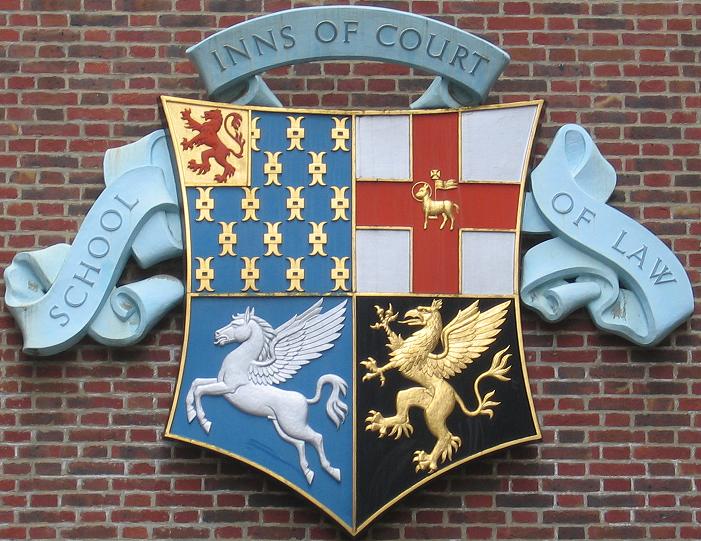
Emanuel was a law school graduate of the University of Cambridge in England, a lawyer of the Inner Temple of London, England.  Emanuel was practicing law in Dublin, Ireland in August of 1623 when his famous son (George Downing) was born.

Emanuel Downing participated in the creation of the Massachusetts Bay Company.  John Winthrop, Thomas Dudley, Isaac Johnson, Emmanuel Downing, William CoddingtonJohn Underhill and other men made agreements under New World Tapestry for the King of England for the Massachusetts Bay Company.

Charles granted the new charter on 4 Mar 1628/29  superseding the land grant and establishing a legal basis for the new English colony at Massachusetts. It was not apparent that Charles knew the Company was meant to support the Puritan emigration, and he was likely left to assume it was purely for business purposes, as was the custom. The charter omitted a significant clause – the location for the annual stockholders’ meeting.

In July 1629, Downing and Winthrop conferred with the Earl of Lincoln and several other prominent Puritans about Isaac Johnson’s [the Earl’s brother-in-law] idea of moving the charter’s location

After Charles dissolved Parliament in 1629, the company’s directors met to consider the possibility of moving the company’s seat of governance to the colony. This was followed the Cambridge Agreement later that year, in which a group of investors agreed to emigrate and work to buy out others who would not. The Massachusetts Bay Colony became the first English chartered colony whose board of governors did not reside in England. This independence helped the settlers to maintain their Puritan religious practices with very little oversight by the king, Archbishop Laud, and the Anglican Church. The charter remained in force for 55 years, when, as a result of colonial insubordination with trade, tariff and navigation laws, Charles II revoked it in 1684.

In the 1630s Ferdinando Gorges, the founder of Maine,  attempted to revive the moribund claims of the Plymouth Company. In concert with colonists banished from the Massachusetts Bay Colony, he formally questioned the issuance of its royal charter in 1632, and forwarded complaints and charges made by the disaffected colonists to the Privy Council of Charles I.   Emanuel Downing’s back room efforts in London helped defeat the challenge, but the animosity he began between the crown and the Massachusetts government eventually led to the repeal of its charter in 1684.

In the 1630’s, New England’s export potential was limited to furs.  A London based sub-partnership led by Emanuel Downing and Winthrop’s son John Winthrop the Younger. and the city merchant Frances Kirby [Emanuel’s brother-in-law] carried out a series of fur trading expeditions under the auspices of the company of undertakers.

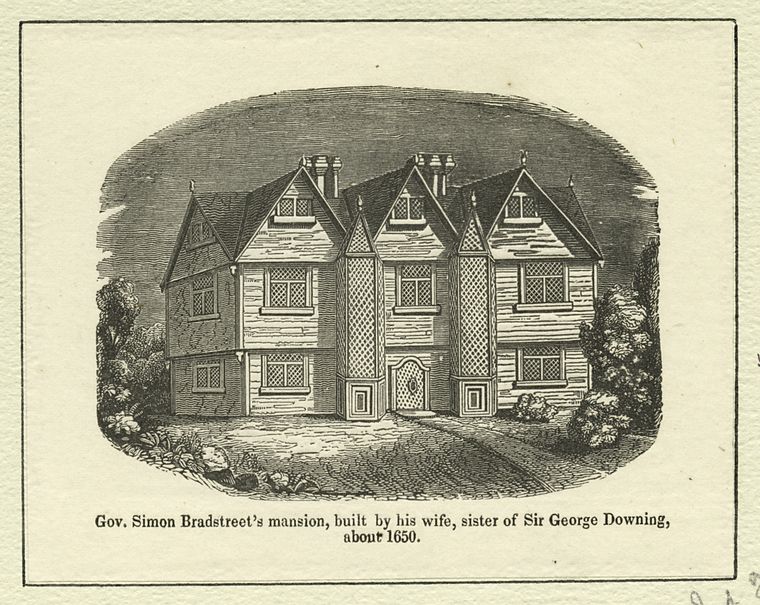
The mansion house of Emanuel Downing, on Essex Street in Salem, Mass, was large, two stories in height and many gabled, having a ” great” room, “great” entry, “great” stairs and “great” chamber. There was also a leanto. There were two chimney stacks. It had two columns of leaded sash and diamond-shaped panes on either side of the front door. There were great lanterns for lighting the ample grounds in front, by the use of candles, on festive and other occasions, being entered from each floor through doors. Undoubtedly it was the finest house then built in the Colony.

Emanuel Downing, Inner Temple Lawyer of London refused to relocate his family to America because of the lack of education for his children.  John Winthrop and his sister Lucy Winthrop Downing wrote many letters to each other and they find a way to convince Emmanuel Downing to relocate his family to Salem, Massachusetts.  Lucy recommended John propose to build a college in Newtowne.   Harvard was founded in 1636 by vote of the Great and General Court of the Massachusetts Bay Colony. Initially called “New College” or “the college at New Towne”, the institution was renamed Harvard College on March 13, 1639.

Emanuel’s son Sir. George Downing (Wikipedia) was second of nine students in the first graduating class of 1642. He was hired by Harvard as the college’s first tutor, but more on him later.

In the summer of 1638, Emanuel and his family left England on the Thomas and Francis for Salem, MA.

Within one month of arriving Emanuel had purchased 300 acres of land in what is now Peabody, MA and erected a house upon it called “Groton” after the name of the English home of his wife.

When Mr. Downing was in England in the summer of 1645, on Sunday, April 6th, while Mrs. Downing and her family were at meeting in the town, the chimney of the house caught fire, and the house and with it a large store of gunpowder (for the use of the colony) was wholly consumed, the house and bedding, apparel and the household furniture and furnishings being worth, Governor Winthrop wrote, two hundred pounds. Upon his return from England, Mr. Downing apparently bought the house and land on Essex Street, where he afterwards lived. He and his family let the farm to various tenants as long as it was owned by the Downings.

Peabody, Essex, Mass.

Emanuel Downing was a hard man. In 1645, he wrote to his brother-in-law of John Winthrop longing for a “juste warre” with the Pequots, so the colonists might capture enough Indian men, women, and children to exchange in Barbados for black slaves, because the colony would never thrive “untill we gett … a stock of slaves sufficient to doe all our business.”

Emanuel made frequent trips back to England, taking nine voyages across the Atlantic.  His letters show his absences were devoted to procuring men and money for the iron works  and prosecuting unsettled claims. With a family of ten children, he was probably tempted to embark into too many ventures, several of which proved unlucky.  He suffered an additional misfortune when his house and its contents burned up  in 1645 when he was in England and his family was at church.

At the end of ten years from his emigration, he found himself much less well off than when he started and at one point had to auction off his saddle-horse for £10 in order to buy a piece of machinery  and he had to foot it from Salem to Boston (20 miles) and back in order to see a friend.

Emanuel was given permission in 1648 for the distilling of “strong water”, and used one of the houses on the old Ipswich Road in Peabody as a tavern. He was also evidently fond of hunting. In 1638 the town of Salem, Massachusetts granted him 500 acres of land for “the placing of decoys”. These were brought from England at great expense. From 1646 to 1656, Emanuel Downing lived in a house in Salem that he bought from a Mr. H. Peter.

Hugh Peters was the second husband of our ancestor Elizabeth Cooke Reade Peters.   Peters returned to England,  was active in public affairs throughout the Commonwealth, and eventually became Cromwell’s personal chaplain.  Although he had played no direct role in the trial and execution of King Charles I, Peter’s reputation and strong association with the Cromwellian régime resulted in his arrest at the Restoration on charges of treason. Almost universally reviled, he was hanged, drawn and quartered at Charing Cross on 16 October 1660.   You can see his story on Col. Edmund Reade’s page as well as my Artistic Works page

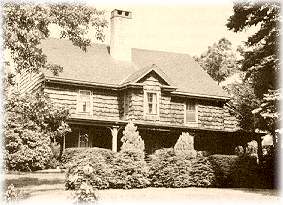
Back to the house in question, Gov. Simon Bradstreet later lived in this house from 1676-1697. The house was on Essex Street, which is still the main street in Salem, MA. This lot is now the site of the Peabody-Essex Musuem. Historians in Salem believe the house burnt or was torn down in the the late 1700’s or early 1800’s.

Emanuel returned to England in 1656 and leased his farm, near Salem, to John Proctor (famous witch trial victim and son of our ancestor John PROCTORwho ran a tavern out of the same house in Peabody MA . (348 Lowell St.) as had Mr. Downing.

John Proctor House 348 Lowell St. Peabody, Mass.

John Proctor, an early opponent of the witch hunt, lived in this house in 1692. One of the afflicted girls, Mary Warren, was a maidservant in his household. Proctor had cured her fits with a good whipping and maintained that the others could be cured with similar treatment.  The stream which runs behind the house is known to this day as Proctor Brook. The Proctor house is privately owned.

The grant for this farm was originally given to Robert Cole in 1635 by the selectmen of Salem. He sold it to Emanuel Downing in 1638. In 1700 Charles Downing, the son of Sir George, sold the farm to Thorndike Proctor. He was the son of the murdered John Proctor. It remained in the Proctor family until 1851.

Then for years it was known as the Roome farm. The Downing/Proctor house still stands at 348 Lowell St. in Peabody. The Saccone family occupied the Downing/Procter house/tavern for twenty years and found early 1700 clay earthenware in the attic.

Vincent and Marion Raponi, who bought the house from the Saccone’s, have owned the property for some twenty-odd years now and report having found two British coins dating back to 1740 and 1755. When they started remodeling the house they found three fireplaces and the original wall and ceiling beams which were held in place by wooden pegs.

After Emanuel Downing returned to England in 1656 (his last of nine voyages across the Atlantic), his son George secured an appointment for his as Clerk of Council of State for Scotland. He resided in Edinburgh, Scotland until his death at age 75 on 26 September 1660.

Emanuel was returned for burial in London at St. Martin’s in the Field, which is a very large church in Travalgar Square, Westminster, England. On the burial register he was listed as Emanuel Downing, Armiger, which means gentleman of high position. His wife Lucy Winthrop Downing returned to live in her son’s (Sir George) mansion in East Hatley, England and died in London, England on 10 April 1679.

Children of Emanuel and Anne Ware

i. Abigail Downing b. 1616 in St Michael Cor London, London, England; d. 6 Dec 1705 Wethersfield, Connecticut,

ii. James Downing b. 1616 in London, England.  Came with Governor Winthrop in the Arbella, in 1630; d. 13 Feb 1937
Ipswich, Essex, Mass

iii. Emmanuel Downing b. 1618 in St Lawrence Ipswich, Suffolk, England d. 28 Mar 1623

iv. George Downing b. 1620 in London, England;

v. Mary Downing b. 1619 in London, England.  Came to New England in May, 1633, with Governor Coddington in the Mary and Jane; d. 16 Jun 1647 Boston, Suffolk, Mass; m. Anthony Stoddard of Boston Nov 1639 in Boston, Suffolk, Mass

vi. Susan Downing b. 1622 in St Michael Corn London, London, England. Came to New England in May, 1633, with Governor Coddington in the Mary and Jane; d. 25 Sep 1666 Essex, Mass; m. Thomas Perrin 28 Feb 1666 in Ipswich, Mass

Children of Emanuel and Lucy Winthrop

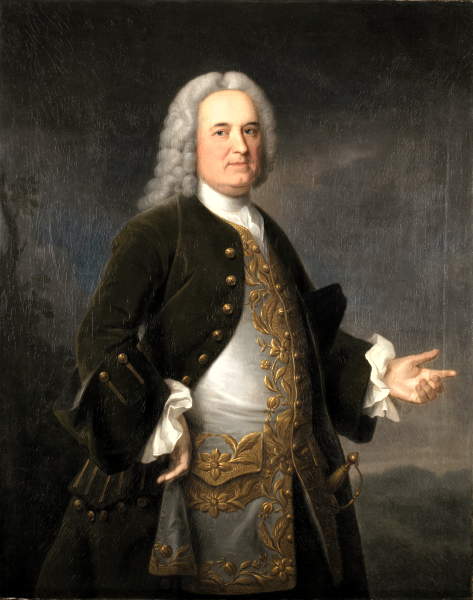
Sir George Downing Portrait

vii. Sir. George Downing 1st Baronet b. 1623 in Dublin, Ireland; d. July 1684.  (Wikipedia)  He was an Anglo-Irish soldier, statesman, and diplomat. Downing Street in London is named after him. As Treasury Secretary he is credited with instituting major reforms in public finance. His influence was substantial on the passage and substance of the mercantilist Navigation Acts. The Acts strengthened English commercial and Naval power, contributing to the security of the English state and its ability to project its power abroad. More than any other man he was responsible for arranging the acquisition of New York from the Dutch, and is remembered there in the name of Downing Street, in Manhattan and Brooklyn, New York.

10 Downing Street – The official home and office of Britain’s Prime Minister. It is 1 of 4 surviving homes built in 1680 for Sir George Downing who went to America as a boy and returned to fight for the Parliamentarians in the English Civil War.

Downing College, Cambridge derives its name from his grandson, Sir George Downing, 3rd Baronet. The title became extinct when Sir Jacob Downing, 4th Baronet, died in 1764.

Downing attended Harvard College and was one of nine students in the first graduating class of 1642. He was hired by Harvard as the college’s first tutor. In 1645 he sailed for the West Indies with slaves in-tow, as a preacher and instructor of the seamen, and arrived in England some time afterwards, becoming chaplain to Colonel John Okey‘s regiment (who had originally sponsored Downing’s education in America).

By 1648, Downing was chaplain to Sir Arthur Hesilrige‘s regiment and accompanied Heselrige when he was commissioned governor of Newcastle-upon-Tyne during the Second Civil War.

Subsequently he seems to have abandoned preaching for a military career, and in 1650 he was scout-master-general of Cromwell’s forces in Scotland.    His duties involved the supervision of scouts for reconnaissance work and spies for intelligence gathering. Although it was a civilian appointment, Downing was wounded fighting at the battle of Dunbar in September 1650. He also participated in Cromwell’s great victory at Worcester in 1651 and wrote an important account of the battle.

With the ending of the civil wars, Downing became involved in the administration of the settlement of Scotland. He worked closely with the Council of State in London, and many of his commentaries on Scottish affairs were published in the official newsbook Mercurius Politicus. Downing’s wealth and status increased significantly in 1654 when he married Lady Frances Howard (d.1683), sister of Charles Howard, the future Earl of Carlisle. He was elected to all three Protectorate parliaments as MP for Edinburgh in 1654 and for Carlisle in 1656 and 1659.

He received in 1657 a salary of £365 and £500 as a Teller of the Exchequer.

Downing emerged as a firm supporter of the Protectorate government and was a leading member of the faction that offered the crown to Oliver Cromwell in 1657.

Downing’s diplomatic career began in 1655 when he was sent to France to deliver Cromwell’s protest over the massacre of Protestants in Vaudois in Piedmont

Later in 1657 he was appointed resident at The Hague, to effect a union of the Protestant European powers, to mediate between Portugal and the Dutch Republic and between Sweden and Denmark, to defend the interests of the English traders against the Dutch, and to inform the government concerning the movements of the exiled royalists.  He showed himself in these negotiations an able diplomat. He was maintained in his post during the interregnum subsequent to the fall of Richard Cromwell.

In April 1660, with the Restoration imminent, Downing sought a pardon from Charles II, through an intermediary, claiming that his service to the Commonwealth and Protectorate had been a result of erroneous opinions assimilated in puritan New England, which he now repudiated. He declared his abandonment of “principles sucked in” in New England of which he now “saw the error”.

His explanation accepted, he was knighted in May 1660, re-assigned to his diplomatic post in the Netherlands, was confirmed in his tellership of the exchequer, and was further rewarded with a valuable piece of land adjoining St. James’s Park for building purposes, now known as Downing Street.

In 1662, Downing notoriously  engineered the arrest in Holland of the regicides John BarksteadMiles Corbet and John Okey, his former commander and sponsor apparently after reassuring Okey that he held no warrant for their arrest. Downing’s personal intervention violated normal diplomatic procedure and was widely condemned as a betrayal, particularly as he had once been chaplain to Okey’s regiment.  Samuel Pepys, who characterised his conduct as odious though useful to the king, calls him a “perfidious rogue” and remarks that “all the world took notice of him for a most ungrateful villain for his pains.” However, the King was pleased and on 1 July 1663 he was created a baronet.

His character low as it stood with English historians, was more infamous yet in the eyes of his New England countrymen, and it passed into a proverb, to say of one who proved false to his trust, that ” he was all arrant George Downing.”

Downing’s aggressive promotion of English mercantile interests and hostility to the Dutch as the commercial rivals of England was regarded as a cause of the Second Anglo-Dutch War, (1665-7).

He had strongly supported the Navigation Act of 1660, and he now deliberately drew on the fatal and disastrous Second Anglo-Dutch War, in the first year of which, 1665, he was expelled by the Dutch because of his intrigues and spying activities.

On November 9, 1666, renowned diarist Samuel Pepys wrote that he had seen politician Sir George Downing using sign language to talk with a deaf employee of his spy network. Although Downing was hearing, he grew up in an area of Kent known as the Weald. This region had a very large deaf population, and because of this all of the hearing residents learned sign language. The high number of deaf people there was caused by a genetic mutation early in the seventeenth century, which resulted in a recessive gene for deafness being passed down for generations.

During its continuance he took part at home in the management of the treasury.  Based upon his observation of Dutch practices, he introduced the appropriation of supplies (meaning that Parliament gained the right to specify that taxes should be used only for a particular purpose, rather than spent as the government saw fit), opposed strongly by Clarendon as an encroachment on the prerogative, and in May 1667 was made secretary to the commissioners, his appointment being much welcomed by Pepys.

He had been returned for Morpeth in the Convention Parliament of April 1660, a constituency that he represented in every ensuing parliament till his death, and he spoke with ability on financial and commercial questions. He was appointed a commissioner of the customs in 1671. The same year he was again sent to Holland to replace Sir William Temple, to break up the policy of the Triple Alliance and incite another war between the Dutch Republic and England in furtherance of the French policy. His unpopularity there was extreme, and after three months’ residence Downing fled to England, in fear of the fury of the mob. For this unauthorized step he was sent to the Tower on 7 February 1672, but released some few weeks afterwards. He defended the Declaration of Indulgence the same year, and made himself useful in supporting the court policy.

He died in July 1684 having acquired a substantial fortune and was considered to be the largest landowner in Cambridgeshire (critics claimed he amassed the fortune partly through his exceptional meanness about money).

Downing was undoubtedly a man of great political, diplomatic, and financial ability, but his character has often been maligned by his enemies because of his willingness to make the most of changing political circumstances. Today his reputation is undergoing a revival among scholars of the period as his contributions as a financial reformer and diplomat are again recognized. On the other hand his least attractive personal quality- miserliness- is well documented.

viii. Lucy Downing b. 1625 in London, England; d. 5 Feb 1698 Ipswich, Essex, Mass.; m. William Norton 1649 in Ipswich Hamlet, Essex, Mass

ix. Joshua Downing b. 1627 in London, England; d. 1658 Salem, Essex, Mass;m. Frances [__?__] 1657

x. Robert Downing b. 24 Mar 1629 in London, England; d. 1651

xi. Henry Downing b. 3 Oct 1630 in London, England; d. 25 Sep 1694 Salem, Essex, Mass.

xii. Adam Downing b. 1631 in London, England; d. 1631

xiii. Ann Downing b. 12 Apr 1633 in Salem, Mass.; d. 19 Apr 1713
Salem, Essex, Mass. m1.  Capt. Joseph Gardner 2 May 1667 in Salem, Essex, Mass. m2. Simon Bradstreet 1676 when Ann was 43 and Simon 72 years old.

File:Gov Simon Bradstreet's Mansion.jpeg

Emanuel gave this house to his daughter Anne and her husband Capt. Joseph Gardiner. After Joseph was killed at the Great Swamp Fight, Anne remarried to Gov. Simon Bradstreet

Historians in Salem believe the house burnt or was torn down in the the late 1700’s or early 1800’s.  The lot is now the site of the Peabody -Essex Musuem which  may be considered one of the oldest continuously operating museums in the United States. It combines the collections of the former Peabody Museum of Salem and the Essex Institute.  The museum holds one of the major collections of Asian art in the US. Its total holdings include about 1.3 million pieces, as well as twenty-four historic buildings.

Capt. Joseph Gardner was born 1629 in Salem, Essex, Mass. His parents were Thomas Gardner and Margaret Fryer.  Joseph was killed at the Great Swamp Fight 19 Dec 1675 in Salem, Essex, Massachusetts. (For details of Joseph’s service see Great Swamp Fight 5. Massachusetts Regiment)

Simon Bradstreet (baptized 18 Mar 1603/4  – 27 Mar 1697) was a colonial magistrate, businessman, diplomat, and the last governor of the Massachusetts Bay Colony. Arriving in Massachusetts on the Winthrop Fleet in 1630, Bradstreet was almost constantly involved in the politics of the colony but became its governor only in 1679. He served on diplomatic missions and as agent to the crown in London, and also served as a commissioner to the New England Confederation. He was politically comparatively moderate, arguing minority positions in favor of freedom of speech and for accommodation of the demands of King Charles II following his restoration to the throne.

File:Simon Bradstreet 1854.jpeg

Simon Bradstreet Engraving based on a painting in the Massachusetts State House

Bradstreet was first married to Anne, the daughter of Massachusetts co-founder Thomas Dudley and New England’s first published poet. He was a businessman, investing in land and shipping interests. Due to his advanced age (he died at 93) Cotton Mather referred to him as the “Nestor of New England”. His descendants include the famous jurists Oliver Wendell Holmes, Jr. and David Souter.

In early 1679 Governor John Leverett died, and Simon Bradstreet as deputy succeeded him. Leverett had opposed accommodation of the king’s demands, and the change to an accommodationist leadership was too late. Bradstreet would turn out to be the last governor under its original charter. His deputy, Thomas Danforth was from the commonwealth faction. During his tenure, crown agent Edward Randolph was in the colony, attempting to enforce the Navigation Acts, under which certain types of trade involving the colony were illegal. Randolph’s enforcement attempts were vigorously resisted by both the merchant classes and sympathetic magistrates despite Bradstreet’s attempts to accommodate Randolph. Juries frequently refused to condemn ships accused of violating the acts; in one instance Bradstreet tried three times to get a jury to change its verdict.  Randolph’s attempts to enforce the navigation laws eventually convinced the colony’s general court that it needed to create its own mechanisms for their enforcement. A bill to establish a naval office was vigorously debated in 1681, with the house of deputies, dominated by the commonwealth party, opposing the idea, and the moderate magistrates supporting it. The bill that finally passed was a victory for the commonwealth party, making enforcement difficult and subject to reprisal lawsuits. Bradstreet refused to actually implement the law, and Randolph published open challenges to it. Bradstreet was in some degree vindicated when he won re-election in 1682, and he then used his judicial authority to further undermine the law’s effects.

Randolph’s threats to report the colonial legislature’s intransigence prompted it to dispatch agents to England to argue the colony’s case; however, their powers were limited. Shortly after their arrival in late 1682, the Lords of Trade issued an ultimatum to the colony: either grant its agents wider powers, including the ability to negotiate modifications to the charter, or risk having the charter voided. The general court responded by issuing the agents instructions to take a hard line.  Following legal processes begun in 1683, the charter was formally annulled on October 23, 1684.

King Charles II in 1684 established the Dominion of New England. Bradstreet’s brother-in-law Joseph Dudley, who had served as one of the colonial agents, was commissioned by James as President of the Council for New England in 1685 by King James II, and took control of the colony in May 1686. Bradstreet was offered a position on Dudley’s council, but refused.  Dudley was replaced in December 1686 by Sir Edmund Andros, who came to be greatly detested in Massachusetts for vacating existing land titles, and seizing Congregational church properties for Church of England religious services.  Andros’ high-handed rule was also unpopular in the other colonies of the dominion.

The idea of revolt against Andros arose as early as January 1689, before news of the December 1688 Glorious Revolution reached Boston. After William and Mary took the throne, Increase Mather and Sir William Phips, Massachusetts agents in London, petitioned them and the Lords of Trade for restoration of the Massachusetts charter. Mather furthermore convinced the Lords of Trade to delay notifying Andros of the revolution. He had already dispatched to Bradstreet a letter containing news that a report (prepared before the revolution) stating that the charter had been illegally annulled, and that the magistrates should “prepare the minds of the people for a change.”  News of the revolution apparently reached some individuals as early as late March, and Bradstreet is one of several possible organizers of the mob that formed in Boston in April 18, 1689. He, along with other pre-Dominion magistrates and some members of Andros’ council, addressed an open letter to Andros on that day calling for his surrender in order to quiet the mob. Andros, who had fled to the safety of Castle Island, surrendered, and was eventually returned to England after several months in confinement. 

In the wake of Andros’ arrest, a council of safety was formed, with Bradstreet as its president. The council drafted a letter to William and Mary, justifying the colony’s acts in language similar to that used by William in his proclamations when he invaded England. The council fairly quickly decided to revert to the government as it had been under the old charter. In this form Bradstreet resumed the governorship, and was annually re-elected governor until 1692.  He had to defend the colony against those who were opposed to the reintroduction of the old rule, who he characterized in reports to London as malcontents and strangers stirring up trouble. The colony’s northern frontier was also engulfed in King William’s War, where there was frequent Indian raiding. Bradstreet approved the expeditions of Sir William Phips in 1690 against Acadia and Quebec.

In 1691 year William and Mary issued a charter establishing the Province of Massachusetts Bay, and appointed Phips its first governor. Bradstreet was offered a position on Phips’ council when the new governor arrived in 1692, but declined. Bradstreet died at his home in Salem on 27 March 1697 at the age of 93.

xiv. Martha Downing b. 1636 in Salem, Mass.; m [__?__] Peters 1659

xv. Richard Downing b. 1637 in Marblehead, Essex, Mass; m. Mary Bennet Nov 1665 in Marblehead, Essex, Mass

xvi. John Downing b. 3 Jan 1640 in Salem, Mass.  baptized in Salem 1 Mar 1640/41 ; merchant; lived at Nevis; and probably died in Boston April 29, 1694.; m. Mehitable Brabrooke 2 Nov 1669 in Ipswich, Essex, Mass

xvii. Dorcas Downing bapt. 7 Feb 1641 in Salem, Mass.; d. 6 Jun 1647

xviii. Theophilus Downing b. 9 Aug 1644 in Mass;

5. Nathaniel Downing

Nathaniel’s wife Margaret Selyne was born 1589 in Suffolk, England. Her parents were Daniel Selyne and Mary [__?__].

Nathaniel gave his brother Joseph £20 in his 1616 will. Joseph got married later that year.

6. Rev. Joseph DOWNING (See his page)

7. Nahomie Downing

Nahomie’s husband Richard Hill was born 1580 in St Nicholas Ipswich, Suffolk, England.

8. Abigail Downing

Abigail’s husband John Goade was born 1587 in St Nicholas Ipswich, Suffolk, England.

Sources:

http://www.pamsgenealogy.net/SS/p45.htm#i1116

http://trees.ancestry.com/owt/person.aspx?pid=24391479&st=1

http://www.ipswich.suffolk.sch.uk/old-ipswichians/about-us/Pages/History.aspx

http://rogue1668.wordpress.com/

http://www.british-civil-wars.co.uk/biog/downing.htm

Proceedings of the Massachusetts Historical Society 1894 – Defense of Emmanuel Downing.

http://freepages.genealogy.rootsweb.ancestry.com/~nyterry/downing/edown_farm_sal.html

http://parsonsfamily.blogware.com/indiI1163.html

Genealogical gleanings in England, Volume 1 By Henry Fitz-Gilbert Waters, New England Historic Genealogical Societ

Posted in Artistic Representation, Line - Miner, Place Names, Tavern Keeper, Wikipedia Famous | Tagged , , , , , | 18 Comments

John Benjamin Sr.

John BENJAMIN Sr. (1576 – 1607) was Alex’s 12th Grandfather; one of 8,192 in this generation of the Shaw line.

Benjamin Coat of Arms

John Benjamin was born on 1576 in Heathfield, Sussex, England.  His parents were xx.  He married Joan HOOKE 18 Jan 1584 in Uckfield, Sussex, England. John died in Feb 1607 in Chaunton, Sussex, England

Joan Hookes was born xx.  Joan died in 1619 in England.

Children of John and Abigail:

Name Born Married Departed
1. John BENJAMIN 12 Mar 1585 Chalvington, Heathfield, Sussex, England. Abigail EDDYE
1619
Cranbrook, Kent, England.
14 Jun 1645
Watertown, Middlesex, Massachusetts.
2. Susan Benjamin 1586
Heathfield, Sussex, England
[__?__] Ebates
3. Thomas Benjamin 1587
Heathfield, Sussex, England
Eleanor Preble
1612, Denton, Kent, England
4. Joane Benjamin 1589
Heathfield, Sussex, England
 May 1618
5. Gyles Benjamin 6 May 1591
Heathfield, Sussex, England
6. Richard Benjamin 16 Jul 1602
Hearthfield, Sussex, England
Anna [Simeon?]
1643
Watertown, Middlesex, Mass.
18 Sep 1689
Southold, Long Island, New York

The Pedigree of the Ancient House of Benjamin runs back to the time of William the Conqueror, under him, and among the many Barons of that period was Walter de Lacey (1074). This family, through its descendents has come to be known as the Benjamin’s, which includes the great family of that name now in America. After Walter de Lacey came Roger in 1095, Ilbert in 1137, and John in 1222. Henry III was then king. It was in this reign that the confederacy of Barons was dissolved and the landed gentry became the leading caste in politics and society. In the reign of Edward III, the de Lacey appears as landed gentry under the name or Beryton of Stoke-Lacey, and a few years later as the Berington of the same place. Tradition says that it was about 1484 that the name Berington became changed to Benjamin and it is now practically certain that John Berington II, the next John after de Lacey of 1222. of the ancient de Lacey stock is the ancestor of the American Benjamin family.

Frank Everett Benjamin, researching the John and Richard lineage in England, found Wills from Lewes, East Sussex, England. These were transcribed from the Old English or Latin and show John Benjamin’s father married Joane Hookes on January 18, 1584. Their children were listed as follows: John (1585), Susan (1586), Thomas (1587), Joane (1589), Gyles (1591), and Richard (1602).

There were 3 John Benjamins in the late 16th Century in the Heathfield-Chalvington area. This one was the son of Gyles, and he was baptized 4 Oct. 1554 in Chalvington. The proof is in the descent of land: at the next manor court after Gyles’s death, John came in and claimed succession, as the eldest son, to Gyles’s freehold called Parrages. Gyles also had 2 copyholds in the manor and, by custom, those went to the youngest son–John’s brother Thomas. Thomas, however, died 1594 leaving only a young son Nicholas, and when Nicholas died in 1598 John ended up with all his father’s land.

Gyles’s father was John, and this is established also through land records.  The manor record of 1550 show the sale of Parrages to “John Benjamin and his son Gyles.”
This John was born by 1496, probably not in Chalvington because the manor records have no Benjamins before he appears in 1517. He was fairly wealthy, judging from the amount of tax he paid in 1525. There was an earlier Benjamin who bought land in Ringmer and Glynde, only about 2 miles away, in 1409.

Parish Register, Uckfield, Sussex, England. Marriage of husband and wife is recorded as John Bengmin and Jone Hacke, 18 Jan 1584.

Will of John Beniamin of Chaunton A12/253, Lewes Record Office , Sussex, England, February, 1607. Parish Register, Chalvington, Sussex, England, Christenings and Burials.

In the name of God Amen: the 4th day of September, in the year of the reign of our sovereign Lord James, by the grace of God of England, Scotland, France, and Ireland the fifth, and of Scotland the one and fortieth:

I, JOHN BENJAMIN of Chaunton [Chalvington], in the County of Sessex, yeoman, being sick in body, but of good and perfect remembrance, thanks be unto Almighty God, do make and ordain this my last will and testament, in manner and form following:

Item: I bequeasth my soul into the hands of Almighty God, and my body to be buried in the churchyard of Chaunton.

Item: My mind and will is that ROBERT HOOKE and RICHARD HOOKE, my wife’s brothers, shall have, hold, and enjoy to them and their assigns, all and singular, my lands lying in Chaunton with the appurtenances thereunto belonging and during the space of eight years immediately ensuing the time of my decease yeilding and paying therefore unto every one of my children except my son JOHN, the sum of six pounds at their several ages of one and twenty years. And if any of my said children happen to decease before they shall accomplish the age of one and twenty years, then my will is that the portion of him, her, or them so deceasing shall be equally divided amongst my other children surviving at their several ages of one and twenty years. And futhur my mind is that whatsoever profit shall arise of my land in the eight years aforesaid, over and above the several sums bequeathed to my children as aforesaid, the said profit shall rebound unto my wife, and be paid unto her by her said brothers towards the bringing up of my children.

Item: I further give and bequeath unto my daughter SUSAN 40 shillings, to my son THOMAS 40 shillings, to my daughter JOANE 40 shillings, to my son GYLES 40 shillings, and to my son RICHARD 40 shillings.

Item: I give and bequeath unto my son JOHN two great chests, one cupboard, and one table standing in the hall and one mault safe[?].

Item: I give and bequeath to everyone of my children one pair of sheets a piece.

Item: I give to the poor people of Chauton two shillings.

Item: All the rest of my goods and chattels I give and bequeath to JOANE my wife whom I make and ordaine sole executrix of this my last will and testament.

In witness whereof I have hereunto put my hand and seal the day and year above said.

JOHN BENJAMIN
( HIS MARK)

WITNESS HEREUNTO:
WILLIAM WENHAM, THOMAS LACYE, THOMAS LACYE SENIOR,
JOHN THATCHER, JOHN WOODDE.

Proved: 12 February 1607/08 by JOANNE BENJAMIN, relict of the deceased, and executrix who swears to well and faithfully administer same.

Letters of Administration: JOHN BENJAMIN of Chalvington:
Dated: 13 February 1607.

Probate granted to JOAN, his relict…
Sum of Inventory: 42 Pounds 4 shillings.

EAST SUSSEX RECORD OFFICE:, Lewes, East Sussex, England., Ref: XA26/14 W/A17-14:
Will of JOANE BENJAMIN of Chalvington:
Dated: 20 May 1619,  Probated: 20 May 1619.

In the name of God, Amen, the 20th Day of May in the year of the Reign of our Sovereign Lord James by the Grace of God of England, Scotland, France and Ireland, King Defender of the Faith; that is to say, of England, France and Ireland the 17th, and of Scotland the 52nd, AD 1619: I, JOANE BENJAMIN of Chauton [Chalvington] in the County of Sussex, Widow, do make and ordain this my last Will and Testament in manner and form following:

First, I bequeath my soul into the hands of Almighty God, ,y Heavenly Father, and my body to be buried in Christian burial.

Item: I give to JOHN BENJAMIN, my son, and to SUSAN EBATES, my daughter, 12 Pence apiece of good and lawful money of England.

Item: I give to THOMAS BENJAMIN, my son, 20 Shillings of like lawful money, one great iron pot, one pair of course sheets, one great paltter and two pewter dishes.

Item: I give and bequeath to GILES BENJAMIN, and RICHARD BENJAMIN, my sons, 30 Shillings apiece of like lawful money.

Item: I give to GILES one chest and one pair of sheets.

Item: I give to the said RICHARD one chest and one pair of sheets.

Item: All the rest of my goods I give and bequeath to JOANE BENJAMIN, my daughter, whom I make sole Executrix of this my last will.

In Witness wherof I have here unto put my hand and seal the day and year above said.

JOANE BENJAMIN  [Her Mark]
Witnesses here unto: JOHN WOODE, SARA THETCHER [Her Mark].

Note: The dates for the making and the probating of the will are the same. Possibly an error here made by the scribe coping the wills into the will book?. – DJW
According to Parish Records, JOANE BENJAMIN was buried on 23 May 1619. – FEB

Children

John arrived with his family in Boston Harbor, Sunday evening, 16 Sep 1632, on board the Lyon.    His brother, Richard Benjamin, came with him on the same voyage and settled in Southold, Long Island.  They sailed from London June 22, 1632, arriving in Boston September 14/16, 1632. The master, William Pierce, brought 123 passengers.  “He brought one hundred and twenty three passengers, whereof fifty children, all in health. They had been twelve weeks aboard and eight weeks from Land’s End.”  The Lyon made four  trips: 1630, 1631, 1632, 1632. The Lyon hit a reef April 10, 1633 (Peirce was ‘driving’) and it sunk, replaced by the Rebecca, built in the colonies.

Lyon Passenger List:

Benjamin, John of Heathfield, Sussex and wife Abigail (From Haethfield, Sussex, bound for Cambridge and Watertown. Ref: Banks Mss. 36 pg 171. Listed with a Richard Benjamin.

1. John BENJAMIN (See his page)

2. Susan  Benjamin

Susan’s husband [__?__] Ebates

3. Thomas Benjamin

Thomas’ wife Eleanor Preble

6. Richard Benjamin

Richard’s wife Anna Simeon was born 1606 in Heathfield, Sussex, England. Anna died 1687 in Watertown, Middlesex, Mass.

Richard Benjamin came to America on the Ship “Lion” on 16 September 1632 and entered at the Port of Boston. On this same ship were his brother John and his wife Abigail (Eddy) Benjamin and four small children. Richard was entered on the passenger list as a seperate individual and was listed as having come from Heathfield, Sussex, England. Richard took the Oath of Allegiance to King Charles on 2 June 1632 before leaving England.

Richard was named a Proprietor of Watertown, Massachusetts in 1642. Apparently he married there about 1637, as a daughter, Mary, was born in Watertown in 1638.

About 1645 he and his family moved to Southold, Long Island, New York, where he resided until his death.

1662 – Richard signed the appointment of Capt. Youngs for the Hartford Colony under the Charter. At that time, Southold was a part of the Hartford, Conn. Colony and was included in it’s charter.

May 1664 – Richard applied to the General Court of Conn., along with Jeffery Jones and others, to be made a Freeman under Connecticut and he was accepted that same month.

8 Apr 1673  – “Richard Benjamin & Simeon Benjamin the sons of Richard Benjamin yeoman of the Town of Southold” sold to Thomas Tusten of Southold half an acre of meadow.

8 Apr 1673 –  “Richard Benjamin yeoman of Southold” sold to Thomas Tusten and Priscilla his wife four acres in the Old Field, Cauchauge, seven acres on the north side of town, one acre in the Town Field, and four acres “more near the town, on the north side John Tuthill’s lot”; Anna Benjamin made her mark and joined in the sale, and one of the witnesses was Richard Benjamin Jr. In October 1684 Thomas Tusten (joined by Priscilla Tusten) sold to David Gardiner Sr. “all my housing, lands and meadows in Southold, including “land which was given unto the said Thomas and Prisilla his wife by their father Richard Benjamin” .

9 Jun 1674 – Deacon Barnabas Wines and Richard Benjamin are freed from military training…”watching and warding”. Both these persons may have been freed on account of their office, as well as age, for in the same year that the second pastor was settled, the people in the Town Meeting appointed a gravedigger and church sexton. They elected Richard Benjamin, who’s home was immediately west ot the church and cemetery. He was authorized to receive 18 pence for the grave of each adult and 12 pence for each child. He was called “general factortum” of the first settlement of Southhold, Long Island.

Sources:

http://www.renderplus.com/hartgen/htm/benjamin.htm

http://boards.ancestry.com/surnames.benjamin/793.3.2/mb.ashx

http://www.geni.com/people/John-Benjamin/6000000000834493107

http://todmar.net/ancestry/benjamin_main.htm

http://genforum.genealogy.com/cgi-bin/print.cgi?benjamin::1093.html

Posted in 14th Generation, Line - Shaw | Tagged , | 11 Comments

Rev. Thomas Stoughton

Rev. Thomas STOUGHTON (1557 -1622 ) was Alex’s 10th Great Grandfather; one of  2,048 in this generation of the Miller line.

Thomas Stoughton Coat of Arms

Rev. Thomas Stoughton was born between 1551 and 1557 in Sandwich, Kent, England. His parents were Francis STOUGHTON and Agnes TRIGNALL. He married Katherine MONTPESSON in 1585 in Naughton, Suffolk, England.  After Katherine died, he married Elizabeth [__?__].  Thomas died in 1622 in Sandwich, Kent, England

Katherine Montpesson was born 1564 in England. Katherine died 18 Apr 1603 two months after Israel’s birth in Coggeshall,, Suffolk, England.  Alternatively, Katherine’s maiden name was Evelyn and her parents were George EVELYN (1530 – 1603) and Joan STINT (1550 – 1613).

According to information in Genealogies and Biographies of Ancient Windsor, his second wife, Elizabeth who he married after the death of his first wife, Katherine, in 1603, remarried in 1610 to William Knight of Lincoln. If this is correct, Rev.Thomas Stoughton must have died before 1610. Thomas’ son Israel assumed the place of an elder half brother to his stepmother’s five Knight children, Elizabeth, William, John, Mary , and Ursula. William Knight died in 1630, leaving a will dated 21 Mar 1629/30 in which he appointed as the executor, Israel Stoughton, his son-in-law. By that time, Israel Stoughton had married William Knight’s daughter, Elizabeth.

Children of Thomas and Katherine:

Name Born Married Departed
1. Mary Stoughton 1586
England
 John Manfield
Jul 1605 in Coggeshall, Essex, England
Naughton, Suffolk, England
2. Thomas Stoughton 9 Jul 1588
England
Elizabeth Montpesan
1612
England
.
Margaret Barrett
1635 Windsor, Hartford, Connecticut
25 Mar 1661
Windsor, Hartford, Connecticut,
3. Anne Stoughton bapt.
10 Nov 1591
Naughton, Suffolk, England
17 Dec 1591
Naughton, Suffolk, England
4. Judith Stoughton 1591 Naughton, Suffolk, England John Denman
1620
Naughton, Suffolk, England
.
William Smead
1623
Naughton, Suffolk, England
Mar 1639
Dorchester, Suffolk, Mass.
5. Rev. John Stoughton (Wikipedia) 23 Jan 1593
Noughton Parish, Suffolk, England
Mary Machell 1625
London, England
.
Jane Brown 1635
Aldermanbury London, England
 4 May 1639
Alderman, London, England
6. Anne Stoughton c. 1596
Burstead Magna, Essex, England
1618
England
Hingham, Plymouth, Mass.
7. Elizabeth STOUGHTON 1600
Coggeshall, Essex, England
John SCUDDER
1613
Maldon, Essex, England
.
Robert Chamberlain 30 Apr 1627
England
bef. 30 Mar 1647 when inventory of her estate was filed
Ipswich, Mass
8. Israel Stoughton
(Wikipedia)
18 Feb 1603
Coggeshell, Essex, England
Elizabeth Knight
27 Mar 1627
Rotherhithe, Surrey, England
17 Jul 1644
Lincoln, Lincolnshire, England

For a time, it was uncertain whether the ancestry of the Rev. Thomas Stoughton traces back through Francis Stoughton. In TAG 294, p. 193, Ralph M.Stoughton, Esq. suggested that the father of the Rev. Thomas Stoughton who married Katherine was probably a John Stoughton and not Francis Stoughton. However, new evidence found by Genevieve Tylee Kiepura, published in TAG 33 105112, proves that Francis Stoughton is the correct father.

In the will of the Uncle of the Rev. Thomas Stoughton, Thomas Stoughton of New Canterbury, Kent, 1591, there is mention of nephew Thomas Stoughton of Suffolk and the two daughters of Thomas Stoughton the minister. (See TAG 33 10 5)

Thomas’ father Francis Stoughton was born 1531 in St Peters, Kent, England.  His parents were Edward STOUGHTON and Mary EXHURST.  Francis died 30 Sep 1557 in Sandwich, Kent, England.

Francis was a gentleman of St. Peter’s Church, Sandwich, Kent, England.  He left a will on 28 July 1551 at Sandwich, Kent, England; He provided for his wife, his only son, Thomas, and his sister Alice. He bequeathed to his son, Thomas, £3 6s 8d yearly to keep him in school. He left his brother, Thomas Stoughton of St. Martin’s Canterbury, his lands, tenements, etc., until his son reached 21. He asked to be buried in the Chancel of St. Johns in the Church of St. Peter, Sandwich. He died between 28 July 1551 and 30 September 1557 at Sandwich, Kent, England. His estate was probated on 30 September 1557 at Sandwich, Kent, England.

Thomas’ mother Agnes Tringall was born in 1535 in Naughton, Suffolk, England. Agnes died 1557 in Naughton, Suffolk, England

Thomas’ grandfather Edward Stoughton was born in 1495 at England.  He was the son of Thomas STOUGHTON and Margaret [__?__]. He lived as a country gentleman at his Moat Farm in Ash, Kent. He married Mary EXHURST, daughter of Richard EXHURST and Alicia  [__?__], before 1531 at Kent, England. Edward Stoughton married Ellen Sherborn before 1550 at Kent, England.

Edward Stoughton left a will on 27 March 1573 at Kent, England; He asked that he be buried in the chancel of St. Mary’s Church in Ash, Kent, “against my pew there”.  He died between 27 March 1573 and 16 February 1574 at Ash, Kent, England. His will was proved on 16 February 1574 at Kent, England.

Back to Rev. Thomas Stoughton

Thomas graduated from Queen’s College, Cambridge, England in 1577, with a Bachelor of Arts degree. He was made a Fellow of Queen’s College in 1579, and got his MA there in 1580.

Thomas  was ordained deacon and priest on February 13 1582 in Lincoln, Lincolnshire, England. In March 1583, Thomas is recorded as living in Barford, Suffolk, England.   Between July 1586 and July 1594, they lived in Naughton, Suffolk, England, where Thomas served as Rector.

Between 1594 and 1600 they resided in Burstead Magna, Essex, Egnland, and between December 12, 1600 and 1606 they lived in Coggeshall, Essex, England, where Thomas served as the Parish Priest.  In 1602 he is mentioned in the will of one of his parishioners, Roger Markant, a clothier of Coggeshall.  Mr. Markant wrote that he wanted “Mr. Thomas Stoughton, vicar and preacher of Coggeshall, to be supervisor to aid my exor, with his advice, and for his pains 40 shillings.”

Thomas Stoughton was Vicar at St. Peter-ad-Vincula church, Coggeshall, Essex from 1600 to 1606 when he was removed, perhaps due to his dissenting views

St Peter ad Vincula Church (St. Peter in chains) in CoggeshallEssex, is one of a group of over-sized “Wool” churches built following the success of the early wool-trade in the East Anglia area. It is Grade I listed

The building now standing was completed in the first quarter of the 15th Century, and sits on a site where both Saxon and Norman churches stood previously. It is one of the largest churches in Essex (internal dimensions of 134 ft 6 in by 62 ft 9 in, the tower reaches a height of 72 ft) and was considered as a possible choice for Cathedral, with Chelmsford Cathedral eventually being chosen.  The present church was built in the perpendicular style with ‘wool money’ during the first quarter of the 15th century, its unusual size is testament to the affluence of the town at the time. Restoration work

4 Apr 1606 Thomas was removed from his new vicarage.  It is speculated that this was for non-conformity.

On  September 3, 1616, Thomas was living in St. Bartholomew’s, Sandwich, Kent, England, where he wrote a treatise from his chamber in the Hospital of St. Bartholomew’s.

Sandwich St Bartholomew’s Hospital was an extra parochial place. St. Barts Hospital, as it is known locally, is one of the oldest established hostels for travellers and pilgrims, dating back possibly, to 1190. The chapel for the “accommodation of pilgrims and travellers where they might be furnished with lodgings, provisions and other necessaries for their journey” on the site which it still occupies in Dover Road on the outskirts of the town, but it fairly soon became a Hospital providing a permanent home to sixteen brothers or sisters.To begin with, the brethren lived in common, though they had separate rooms; now of course they have individual houses. The Hospital chapel, built in 1217 as part of the original foundation, is still used for its original purpose by today’s hospitalians.

Thomas spent his last years at St Bartholomew's Hospital Sandwich, Kent

On August 20, 1622 Thomas wrote another treatise from his “poor lodging” in the Hospital of St. Bartholomew’s.  He may have been the Chaplin there, but he was also being cared for, having spent his inheritance for the good of others.

Children

The Stoughtons, a Kentish minor gentry family whose descendants include over 100 major figures in American or Britsh history .

1. Mary Stoughton

Mary’s husband John Manfield was born in 1582 in England.

2. Thomas Stoughton

Thomas; first wife Elizabeth Montpesan was born 1591 in Wiltshire, England. Elizabeth died 29 Dec 1627 in England.

Thomas’ second wife Margaret Barrett was born 29 Sep 1595 in Norwich, Norfolk, England. Her parents were Christopher Barrett and Elizabeth Clarke. She first married 11 May 1623 in St Andrews, Norwich, England to Simon Huntington. Simon was born 7 Aug 1583 in London, London, England and 11 May 1633 on the voyage to America. Margaret died 25 Mar 1661 in Connecticut.

It is thought that Thomas Stoughton came to America on the ship, the Mary and John, arriving 30 May 1630 accompanied by his three youngest children, Sarah, Katherine , and Thomas. If his first wife accompanied him , she must have died fairly soon, for he married again in 1635.

He became a freeman in Dorchester on 18 May 1631 and he served in the General Court until 1634. The same year he was one of ten persons chosen to “order the affairs of the plantation.”

His first service began on 23 Sept. 1630, when he was chosen Constable of Dorchester. Soon after, he was fined 5 pounds and sentenced to be jailed until his fine was paid, for marrying Clement Briggs & Joane Allen [daughter of our ancestor George ALLEN The Elder]. He did not pay the fine, nor was he jailed, and in 1638 the fine was rescinded. Never the less, he was regarded as a man of “Prominence, property & social distinction,” and was referred to as “ancient, which signified Ensign or standard bearer in a military company.

When the religious dissention began in Dorchester, Thomas, along with Henry Wolcott, Mr. Newberry, Roger Ludlow and [our ancestor] Maj. John MASON, were appointed to establish a new settlement on the Connecticut River, near the Plymouth Trading Post. These men defrayed most of the expenses of the migration, and the new plantation. This settlement became known as Windsor, Conn. Some of the people moved in 1635 and the others followed in 1636. In that year Thomas was chosen to establish the boundaries of Windsor. He was elected to the court in 1638 and served until 1648, during which tie he was elected 11 times.

Thomas and his new wife were among those who established the settlement of Windsor in Connecticut, and must have removed there as early as 1636, since a Court held at New town Hartford on 21 Feb 1637 mentions him by name.

On 26 Jul 1651, the son of the Rev. Thomas Stoughton wrote to Winthrop a lengthy theological treatise, signing himself as Thomas Stoughton, son and heir of Thomas Stoughton, deceased. Anderson says the reference here is to his father, Rev. Thomas Stoughton, a leading light of Elizabethan Puritanism who was silenced early in the reign of King James I, and who spent the rest of his life producing theological pamphlets. (The Great Migration Begins, by Robert Charles Anderson, p 1777.)

4. Judith Stoughton

Judith’s first husband John Denman was born in 1591 in Retford, Nottinghamshire, England. His parents were Nicholas Denman and Lady Anne Hercy. John died 1624 in Retford, Surrey, England.

Judith’s second husband William Smead was born 1601 in England. William died 1636 in Essex, England.

Judith was one of the signers of the Dorchester Church Covenant in 1636, and at the time of her death in 1639 was a widow. The General Court confirmed Israel Stoughton as executor of the will of his sister, Judith Smead, and the disposal of her effects is on record, though no copy of her will has been preserved. Though not proved, it is possible that Judith was a widow before leaving England and that she journeyed to America in 1633 with Israel Stoughton and his wife, Elizabeth.

Judith’s young son was apprenticed rather than taken into the home of his Uncle Israel

5. Rev. John Stoughton (Wikipedia)

Reverend John Stoughton, was a graduate of Emmanuel College Cambridge, a London vicar, and a stepfather of noted philospher Ralph Cudworth and of the immigrant James Cudworth of Scituate, Mass .

John’s first wife Mary Machell was born 1574 in Aller, Somerset, England. Her parents were John Machell and Jane Woodroofe.  She was  formerly nurse to Henry Frederick, Prince of Wales).  Mary first married 18 June 1611 at Southwark  to Ralph Cudworth.  Ralph was Stoughton’s predecessor at Aller and when he died Aug 1624 in Aller Langport, Stoughton married his widow.  This made Stoughton step-father to Ralph Cudworth, whom he educated, as well as the New England colonist James Cudworth.  Mary died Dec 1634 in England.

File:Henry Prince of Wales after Isaac Oliver.jpg

Henry Frederick, Prince of Wales

Henry Frederick Stuart, Prince of Wales (19 February 1594 – 6 November 1612) was the elder son of King James I & VI and Anne of Denmark. His name derives from his grandfathers: Henry Stuart, Lord Darnley and Frederick II of Denmark. Prince Henry was widely seen as a bright and promising heir to his father’s thrones. However, at the age of 18, he predeceased his father when he died of typhoid fever. The heirship to the English and Scottish thrones passed to his younger brother Charles.

File:Ralph Cudworth.jpg

Ralph Cudworth

Ralph Cudworth (1617 – 26 June 1688) was an English philosopher, the leader of the Cambridge Platonists. He was educated at Emmanuel College, Cambridge, gaining his MA and becoming a Fellow of Emmanuel in 1639. In 1645, he became master of Clare Hall and professor of Hebrew. In 1654, he transferred to Christ’s College, Cambridge, and was master there until his death.    Cudworth’s chief philosophical work was The True Intellectual System of the Universe  (1678) and the Treatise concerning Eternal and Immutable Morality, which appeared posthumously in 1731. He was a leading opponent of Thomas Hobbes.

In 1642 he published A Discourse concerning the true Notion of the Lord’s Supper and a tract entitled The Union of Christ and the Church. In 1645 he was appointed master of Clare Hall and the same year was elected Regius professor of Hebrew. He was now recognized as a leader among the  Cambridge Platonists. The whole party was more or less in sympathy with the Commonwealth, and Cudworth was consulted by John Thurloe, Cromwell’s secretary to the council of state, in regard to university and government appointments.

In 1650 he was presented to the college living of North Cadbury, Somerset. From the diary of his friend John Worthington we learn that Cudworth was nearly compelled, through poverty, to leave the university, but in 1654 he was elected master of Christ’s College, whereupon he married. In 1662 he was presented to the rectory of Ashwell, Herts.   Cudworth was installed prebendary of Gloucester in 1678. He died on the 26th of June 1688, and was buried in the chapel of Christ’s. His only surviving child, Damaris, a devout and talented woman, became the second wife of Sir Francis Masham. The Lady Masham was distinguished as the friend of John Locke and exchanged letters with Gottfried Leibniz.

Cudworth’s sermons, such as that preached before the House of Commons, on 31 March 1647, advocate principles of religious toleration and charity. In 1678 he published The True Intellectual System of the Universe: the first part, wherein all the reason and philosophy of atheism is confuted and its impossibility demonstrated (imprimatur dated 1671). No more was published, perhaps because of the theological clamour raised against this first part. Much of Cudworth’s work still remains in manuscript; A Treatise concerning eternal and immutable Morality was published in 1731; and A Treatise of Freewill, edited by John Allen, in 1838; both are connected with the design of his magnum opus, the Intellectual System.

The Cambridge Platonists were reacting to two pressures. On the one hand, the dogmatism of the Puritan divines, with their anti-rationalist demands, were, they felt, immoral and incorrect. They also felt that the Puritan/Calvinist insistence upon individual revelation left God uninvolved with the majority of mankind. At the same time, they were reacting against the reductive materialist writings of Thomas Hobbes. They felt that the latter, while properly rationalist, were denying the idealistic part of the universe. To the Cambridge Platonists, religion and reason were in harmony, and reality was known not by physical sensation alone, but by intuition of the “intelligible forms” that exist behind the material world of everyday perception. Universal, ideal forms (à la Plato) inform matter, and the physical senses are unreliable guides to their reality.

As divines and in matters of polity, the Cambridge Platonists argued for moderation. They believed that reason is the proper judge of all disagreements, and so they advocated dialogue between the Puritans and the High Churchmen. They had a mystical understanding of reason, believing that reason is not merely the sense-making facility of the mind, but, instead, “the candle of the Lord” – an echo of the divine within the human soul and an imprint of God within man. Thus, they believed that reason could lead beyond the sensory, because it is semi-divine. Reason was, for them, of God, and thus capable of nearing God. Therefore, they believed that reason could allow for judging the private revelations of Puritan theology and the proper investigation of the rituals and liturgy of the Established Church. For this reason, they were called latitudinarians

After Hobbes and Locke, the Cambridge Platonists deserve to be considered an important third strand in English seventeenth-century philosophy. Their critique of Descartes, Hobbes, Spinoza has ensured that they are never ignored in philosophical history but they have yet to receive full recognition in their own right. Evidence from publication and citation suggests that their philosophical influence was more far-reaching than is normally recognised in modern histories of philosophy.

The impact of Cudworth on Locke has yet to be fully investigated. Richard Price, and Thomas Reid were both indebted to Cudworth, whose theory of Plastic Nature was taken up in vitalist debates in the French enlightenment. Leibniz certainly read Cudworth and More. The intellectual legacy, the Cambridge Platonists extends not just to philosophical debate in seventeenth-century England but into European and Scottish Enlightenment thought and beyond.

John Staughton’s second wife Jane Brown was born 1615 in Frampton, Dorset, England. Her parents were John Browne of Frampton, Dorset and [__?__]. She was the widow of Rev. Walter Newborough (Newburgh), record of Symonsbury, Dorset. Jane died 4 May 1639 in England.

John Stoughton served as a minister in Aller, Somerset, England. He also served as a minister at Aldermanbury in London, as that is where he married his second wife.

He was a student at Emmanuel College, Cambridge from 1607, graduating B.A. in 1611, M.A. 1614, B.D. 1621, and D.D. 1626. A Fellow from 1616, he became rector of Aller in Somerset in 1624, and then succeeding Thomas Taylor he preached at St Mary, Aldermanbury in London from 1632.

During the 1630s Stoughton came under suspicion from the authorities, and his mail was watched; his numerous correspondents included John ForbesJohn WinthropStephen MarshallSamuel Ward and William Sandcroft (his old tutor).  In 1635 he was before William Juxon, the Bishop of London for supposed nonconformity, with John Goodwin and Sidrach Simpson. In 1636 he was caught up in the investigation of John White of Dorchester, that involved also Henry Whitefield. With the support of Sir Robert Harley and other patrons Stoughton managed to avoid serious problems.

At the end of his life Stoughton came into contact with Samuel Hartlib. His millennial pamphlet Felicitas ultimi saeculi was taken to Hungary in 1638 by John Tolnai, a contact of Comenius. It was intended for György Rákóczi. Two years later, after Stoughton’s death, Hartlib published the pamphlet with Stoughton’s covering letter.  Hugh Trevor-Roper comments on the language of inauguration of international Protestantism in this work, centred on Comenius, Francis Bacon and John Dury.

There is a conflict in Ancestral File regarding John’s birth date, one having 1593, and the other 1597. It is very unlikely that John was born in 1593 because that is when his brother, Thomas, was born. A birth for John in 1597 would appear unlikely too, judging from other information known about him. It is unfortunate that John’s christening record was not found in the Naughton Parish record for then we would know for sure. The best clue to his birth can be inferred from the reference in TAG 29 4, 194 , where it says that John Stoughton was admitted sizer at Emmanuel College on 23 Apr 1607. A sizer is a student who received an allowance toward college expenses and who originally acted as a servant to other students in return for this allowance. Being a sizer at age 18 is probably reasonable, so that would give an estimate of birth for John in the year 1589.

In Dec 1634, James Cudworth,  step-son of the Rev. John Stoughton, who had immigrated to America along with Thomas and Israel Stoughton, wrote his stepfather a long letter in which he mentions Thomas and Israel Stoughton as follows as concerining my unkells, blessed be God, they are both in good health, & my unkell Thomas is to bee maried shortly to a widow that has good meanes & has 5 children. See TAG 29, p.197.

6. Anne Stoughton

Anne’s husband Henry Chamberlain was born about 1595 in Wymondham, Norfolk, England. His parents were Richard Chamberlain and Christian Stoughton. Henry died in Hingham, Plymouth, Mass.

The widow Christian Chamberlain died in Hingham, Plymouth, Mass., 19 Apr 1659, at the reputed age of 81 years . TAG 29 4 198

Anne Stoughton who married Henry Chamberlain, was probably named after an older sister, also named Anne, who died in 1591. She came to America in the Diligent, with her husband. There is no record of the ir death dates, but it is believed they both died in Hingham, Plymouth, Massachusetts.

It is thought that Anne s father, Rev. Thomas Stoughton, resided in Burstead Magna after he was suceeded as Rector at Naughton in July 1594, so I have entered of Burstead Magna, Essex, England, as Anne s place of birth

7. Elizabeth STOUGHTON (See John SCUDDER‘s page)

8. Israel Stoughton

Israel’s wife Elizabeth Knight 1606 in Rotherlite, England. Elizabeth died 6 Aug 1681 in Dorchester, Suffolk, Massachusetts. She was an aunt of collegiate benefactor Elihu Yale.

Israel’s mother, Katherine Montpesson, died two months after Israel’s birth in Coggeshall, Essex, England, where he was baptized 18 Feb 1602/03. Consequently, Israel was raised by his stepmother, Elizabeth, who, after the death of Israel’s father, became the wife of William Knight of Lincoln, England. Israel assumed the place of an elder half brother to his stepmother’s five Knight children, Elizabeth, William, John, Mary , and Ursula. (TAG 29 198 201)

Ursula Knight (1624–1698) married David Yale (1613–1690).  Their son Elihu Yale (April 5, 1649 – July 8, 1721) was a Welsh merchant and philanthropist, governor of the East India Company, and a benefactor of the Collegiate School of Connecticut, which in 1718 was named Yale College in his honor.

File:Elihu Yale by Enoch Seeman the younger 1717.jpeg

Elihu Yale by Enoch Seeman the younger 1717 He donated £800 to found Yale University, part of his fortune amassed largely through secret contracts with Madras merchants.

William Knight died in 1630, leaving a will dated 21 Mar 1629/30 in which he appointed as the executor, Israel Stoughton, his son-in-law. By that time, Israel Stoughton had married William Knight’s daughter, Elizabeth. After William Knight’s death, these members of the family of Elizabeth Knight, wife of Israel, also came to New England, including her mother, the widow Elizabeth Knight, her brother, Rev. William Knight, and two other sisters, Mary, wife of Thomas Clark and Ursula, wife of David Yale, accounting for all of the children mentioned in the will except John.

Israel and Elizabeth emigrated to New England in 1632. He settled at Dorchester, of which he was admitted a freeman on 5 November 1633. He was chosen representative for Dorchester in the assemblies of 1634 and 1635.  Like his brother, Thomas, he became one of the first settlers of Dorchester, Massachusetts. He had large real estate holdings in Dorchester and served in public office. He had the title of Captain, and was an aide to [our ancestor] Maj. John MASON.

 On 5 Nov 1633, “Sergeant Stoughton is chosen ensign to Captain Mason”.

When the colony was disturbed by the antinomian disputes, Israel Stoughton wrote a book which attacked the constitution of the colony and offended the general court. The author somewhat strangely petitioned that the book might be ‘forthwith burnt, as being weak and offensive.’ In spite of Stoughton’s subsequent submission, he was declared incapable of holding office for three years. This sentence, however, was remitted in 1636, and Stoughton was chosen assistant in 1637.

He was entrusted with the command of the Massachusetts force against the Pequot Indians, where he took brutal measures. Stoughton was annually chosen as assistant till 1643, and in 1639 he, together with John Endecott acted as a commissioner on behalf of Massachusetts to settle a boundary dispute with Plymouth Colony.

Israel returned to England towards the end of 1643 and brought back with him a fourteen year old kinsman named Rose Stoughton, daughter of Anthony Stoughton and a sister of Sir Nicholas Stoughton, Baronet of Stoughton, Surrey, England.

He returned to England again towards the end of 1644 and was given a commission in the Calvary. He quickly rose through the ranks being appointed lieutenant-colonel in the parliamentary army under Rainsboro until his death in Lincoln, England in 1645..

Israel’s son William Stoughton,(1631 – July 7, 1701) was a colonial magistrate and admininstrator in the Province of Massachusetts Bay. He was in charge of what have come to be known as the Salem Witch Trials, first as the Chief Justice of the Special Court of Oyer and Terminer in 1692, and then as the Chief Justice of the Superior Court of Judicature in 1693. In these trials he controversially accepted spectral evidence (based on supposed demonic visions). Unlike other magistrates, he never admitted to the possibility that his acceptance of such evidence was in error. See my Witch Trials – Jury for details.

File:WilliamStoughton-painting.png

William Stoughton c. 1700. He was in charge of what have come to be known as the Salem Witch Trials,

After graduating Harvard College in 1650, William  continued religious studies in England, where he graduated from New College in 1653. He also preached while he was in England.   Returning to Massachusetts in 1662, he chose to enter politics instead of the ministry. An adept politician, he served in virtually every government through the period of turmoil in Massachusetts that encompassed the revocation of its first charter in 1684 and the introduction of its second charter in 1692, including the unpopular rule of Sir Edmund Andros in the late 1680s. He served as lieutenant governor of the province from 1692 until his death in 1701, acting as governor (in the absence of an appointed governor) for about six years. He was one of the province’s major landowners, partnering with Joseph Dudley and other prominent figures in land purchases, and it was for him that the town of Stoughton, Massachusetts was named.   He was a liberal benefactor to Harvard University, founding a hall, called by his name, at a cost of £1,000, and bequeathing twenty-seven acres of land.

Israel’s daughter Rebecca Stoughton, married William Tailer and was the mother of William Tailer, Jr., also a colonial governor of Massachusetts, and of Elizabeth Tailer, wife of fur trader John Nelson, an immigrant of royal descent and a nephew of Acadian governor Sir Thomas Temple, 1st Bt.

File:John-nelson.jpg

John Nelson

On April 19, 1689, Nelson, a resident of Long Island in Boston Harbor, was one of a number of prominent Bostonians leading a revolt against Governor Sir Edmund Andros. Andros, the hated governor of the Dominion of New England, had angered may colonists by vacating land titles, enforcing the Navigation Acts, and promoting the Church of England.

In 1692, John Nelson was captured by the French while on a trading or privateering voyage to Acadia, and was imprisoned in Quebec. It was common for local privateers to receive commissions in Boston but were considered pirates by the other nations of the world, especially the French and Spanish, who were the superpowers at the time.

While in prison, Nelson learned about secret French plans for attacks against the Massachusetts colonies. Nelson discreetly informed the Massachusetts authorities of this information from his prison cell. For this act, Nelson was punished by being transported across the Atlantic Ocean to the Bastille prison in France. In 1702, after ten years of imprisonment, his relative, Sir Purbeck Temple, obtained his release. Nelson immediately returned home to Nelson’s Island (Long Island) as a local hero.

Sources:

Thomas Stoughton Bio 1

See TAG 29 193 Stoughton Family of Dorchester, Mass. and Windsor, Conn., Genealogies and Biographies of Ancient Windsor and Descendents of Thomas Stoughton of Dorchester, Massachusetts, by George W. Fuller for a comprehensive account of the Rev. Thomas Stoughton’s life history.

http://www.open-sandwich.co.uk/town_history/ancient_hospitals.htm

http://trees.ancestry.com/owt/person.aspx?pid=19606316

http://www.pamsgenealogy.net/SS/p17.htm#i424

http://www.e-familytree.net/F240/F240789.htm

http://genforum.genealogy.com/chamberlain/messages/1316.html

http://www.oxforddnb.com/index/66/101066152/

http://plato.stanford.edu/entries/cambridge-platonists/#RalCud

Posted in 12th Generation, College Graduate, Dissenter, Historical Church, Line - Miller, Place Names | Tagged , , , , , , , , | 14 Comments

College Graduates

I put this together during the NFC Championship game.  Here’s what I learned.

– Ted Ginn’s injury during the Saint’s game was more disastrous than anyone could have imagined.

– Kyle Williams has joined the 49er pantheon, but not in a good way.  On the other hand, how they handle adversity shows the true character of a team.

– The 49ers really need an elite receiver for next season and Michael Crabtree ain’t it.

Back to colleges

– Until the mid-19th century, both Cambridge and Oxford were  a group of colleges with a small central university administration, rather than universities in the common sense.  Cambridge has 31 colleges and Oxford has 38 colleges and six permanent private halls.

– Almost all our early college graduates became ministers.  The only exceptions were a couple of aristocrats.

– There were so many colleges to chose at Cambridge and Oxford  that only a few of ancestors attended the same college.

– Many of the historic buildings at Cambridge and Oxford were built in the 16th and 17th centuries while our ancestor were in attendance. We can walk the same halls today that they did centuries ago.

– Queens’ College is part of Cambridge and Queen’s College is  part of Oxford.  Both Cambridge and Oxford have a St. John’s College

– Many more of our immigrant ancestors attended Cambridge than Oxford.   East Anglia was the centre of what became the Puritan movement and at Cambridge, it was particularly strong at Emmanuel, St Catharine’s Hall, Sidney Sussex and Christ’s College.  They produced many “non-conformist” graduates who greatly influenced, by social position or pulpit, the approximately 20,000 Puritans who left for New England and especially the Massachusetts Bay Colony during the Great Migration decade of the 1630s.

–  Normal Schools certified school teachers in the 1800’s and early 1900’s.  They evolved into the State Universities of today.

Here’s our college graduates sorted by graduation.

1263 – John de BALLLIOL ( – 1268) [Our ancestor in the xx generation See Henri I’s page  for details]   was a leading figure of Scottish and Anglo-Norman life of his time. Balliol College, in Oxford, is named after him.

Portrait of John Balliol by William Robins

In 1233, Lord John married Dervorguilla of Galloway and Scotland, who was the daughter of Alan, Lord of Galloway and Margaret of Huntingdon. By the mid-thirteenth century, he and his wife had become very wealthy, principally as a result of inheritances from Dervorguilla’s family. This wealth allowed Balliol to play a prominent public role, and, on Henry III‘s instruction, he served as joint protector of the young king of Scots,Alexander III. He was one of Henry III’s leading counsellors between 1258 and 1265. and was appointed Sheriff of Nottinghamshire and Derbyshire from 1261 to 1262. He was captured at the Battle of Lewes in 1264 but escaped and rejoined King Henry.

Following a dispute with the Bishop of Durham, he agreed to provide funds for scholars studying at Oxford. Support for a house of students began in around 1263; further endowments after his death, supervised by Dervorguilla, resulted in the establishment of Balliol College.

Balliol Front Quad

Traditionally, the undergraduates are amongst the most politically active in the university, and the college’s alumni include three former prime ministersH. H. Asquith (a Balliol undergraduate and British Prime Minister) once wryly described Balliol men as possessing “the tranquil consciousness of an effortless superiority.” Adam Smith, a graduate student of the college, is perhaps its best known alumnus.

c. 1550 Oxford – Thomas BROMLEY began his legal career at the Inner Temple where his father, a distinguished lawyer, had been reader. While still at Oxford, and before his marriage, he was twice returned to Parliament, sitting in Mary I‘s last for a local family borough, and in Elizabeth‘s first for Wigan, a duchy of Lancaster borough not infrequently represented by lawyers.

He was an English lord chancellor. His daughter Elizabeth inherited his entire estate and married our Sir Oliver CROMWELL   In 1566 he was appointed recorder of London, and in 1569 he became solicitor-general. .  His first considerable case was in 1571, when he was of counsel for the crown on the trial of the Duke of Norfolk for high treason, on which occasion he had the conduct of that part of the case which rested on Ridolfi’s message  On the death of Sir Nicholas Bacon in 1579 he was appointed lord chancellor. He presided over the commission which tried Mary, Queen of Scots, in 1586, but the strain of the trial and the responsibility of ordering the execution of a monarch proved too much for his strength, and he died soon after. He was buried in Westminster Abbey.

1561 – University of Pavia – Pascasius Justus TURCQ wandered through Europe and studied literature at the unversities of Rome, Bologna, Padua, and Pavia. In his time he was known a gifted and civilized man, a perfect humanist. He was often seen as a guest at the royal courts of Europe. In Pavia, in the year 1561 he wrote his best known book: Pascasii Justi de Alea, sive de curanda ludendi in pecuniam cupiditate (The game of dice by Pascasius Justus from Eeklo, Doctor of Philosophy and Medicine, being two books discussing a way to cure people from the passion of playing for money). The book was printed in Basel Switzerland, reprinted in 1616 in Frankfurt Germany  and again in Amsterdam in 1642.

Pascasius Justus Turcq wrote the first book ever about gambling adiction in 1651 at the University of Pavia

1569 B.A. St. John’s College,  Cambridge University – Rev. Leonard METCALF was early educated at Sedburgh School, matriculated in the College of St. John’s, Cambridge University, in 1563/64 and received his Bachelor of Arts degree in 1568/69.   Leonard became Rector of the Parish of Tatterford in Norfolk in 1574 and Vicar of West Barsham in Norfolk in 1603 where he remained until his death.

1571-  Christ’s College Cambridge – Francis MARBURY matriculated, but is not known to have graduated.  About 1571, Francis Marbury began to teach and preach at the church in Northampton near the estate of his future wife Bridget Dryden.

Christ’s College grew from God’s House founded in 1437 on land now occupied by King’s College Chapel. It received its first royal licence in 1446. It moved to its present site in 1448 when it received its second royal licence. It was renamed Christ’s College and received its present charter in 1505 when it was endowed and expanded by Lady Margaret Beaufort, mother of King Henry VII.

First Court in Christ’s College

The original 15th/16th century college buildings now form part of First Court, including the chapel, Master’s Lodge and Great Gate tower. The gate itself is disproportionate: the bottom has been cut off to accommodate a rise in street level, which can also be seen in the steps leading down to the foot of L staircase in the gate tower.

1573/74 B.A. 1577 M.A. Queens’ College, Cambridge George DOWNING  He was Master of the Grammer School, Ipswich for twenty-one years from 1589 to 1610. Ipswich School is a co-educational public school for girls and boys aged 3 to 18. Situated in Suffolk, England in the town of Ipswich, it was founded in its current form as The King’s School, Ipswich by Thomas Wolsey in 1528.

1574/75 B.A.; 1578 M.A. –  Christ’s College, Cambridge – Rev. Henry DILLINGHAM  Ordained Deacon and Priest 1581; Rector of Cotesbach 1581; died there December 1625.

1577 B.A.   Magdalen College, Oxford  Sir Erasmus Dryden 1st Baronet (1553-1632) (Wikipedia)  Son of John DRYDEN In 1571 aged 18 Erasmus entered Magdalen College and was demy from 1571 to 1575 and fellow from 1575 to 1580, being awarded BA on 11 June, 1577. In 1577, he was student of the Middle Temple.

Two of John’s descendants were   literary stars of the 17th and 18th Centuries.  He was great grandfather of John Dryden (1631 – 1700) and the 2nd great grandfather of Jonathan Swift (1667 – 1745).

1577  B.A. Queens’ College, Cambridge – Rev. Thomas  STOUGHTON graduated from Queen’s College, Cambridge, England in 1577, with a Bachelor of Arts degree. He was made a Fellow of Queen’s College in 1579, and got his MA there in 1580.  On 4 Apr 1606 Thomas was removed from his vicarage at St Peter ad Vincula Church (St. Peter in chains) in CoggeshallEssex.  It is speculated that this was for non-conformity.

Queens’ College  is among the older and larger colleges of the University of Cambridge. The college was founded in 1448 by Margaret of Anjou (the Queen of Henry VI), and refounded in 1465 by Elizabeth Woodville (the Queen of Edward IV). This dual foundation is reflected in its orthographyQueens’, not Queen’s.  The college spans both sides of the river Cam, colloquially referred to as the “light side” and the “dark side”, with the Mathematical Bridge connecting the two.

President’s Gallery (app.1540) of Cloister Court shown above, rambling half-timbered building — Queens’ College Cambridge

1579 –  Comm from Queens’ College, Cambridge – Admitted at Lincoln’s Inn, May 12, 1582.-  Sir Oliver CROMWELL (1563 – 1658) was uncle and godfather to the famous Oliver Cromwell, known for his involvement in making England into a republican Commonwealth and for his later role as Lord Protector of England and Scotland. However, Sir Oliver lost all his wealth supporting the Royalist side.

During the 12th and 13th century, the law was taught in the City of London primarily by the clergy. During the 13th century two events happened which destroyed this form of legal education: first, a decree by Henry III of England on 2 December 1234 that no institutes of legal education could exist in the City of London, and secondly a papal bull that prohibited the clergy from teaching the common law, rather than canon law.  As a result the system of legal education fell apart. The common lawyers migrated to the hamlet of Holborn, the nearest place to the law courts at Westminster Hall that was outside the City.

As with the other Inns of Court, the precise date of founding of Lincoln’s Inn is unknown. The Inn can claim the oldest records – its “black books” documenting the minutes of the governing Council go back to 1422.

Lincoln’s Inn

Admissions were recorded in the black books and divided into two categories; Clerks (Clerici) admitted to Clerks’ Commons and Fellows Socii admitted to Fellows’ Commons. All entrants swore the same oath regardless of category, and some Fellows were permitted to dine in Clerks’ Commons as it cost less, making it difficult for academics to sometimes distinguish between the two — indeed Walker, the editor of the Black Books, maintains that the two categories were one and the same. During the 15th century the Fellows began to be called Masters, and the gap between Masters and Clerks gradually grew, with an order in 1505 that no Master was to be found in Clerks’ Commons unless studying a point of law there.  By 1466 the Fellows were divided into Benchers, those at the Bar (ad barram, also known as utter barristers or simply barristers) and those not at the Bar (extra barram). By 1502 the extra barram Fellows were being referred to as “inner barristers”, in contrast to the “utter” or “outer” barristers.

1580 M.A. Queen’s College, Cambridge –   Rev. Thomas STOUGHTON  and was vicar of Coggeshall, Essex, from 1600 to 1606.

1583  B.A., 1586 M.A. Trinity Hall, University of Cambridge – Rev. William EDDY (1559 – 1616)  matriculated as “sizar” at Trinity Hall. (A sizar is one who performs certain duties in part payment of his expenses at a school or college.) In 1586 he received the degree of Master of Arts – “magister in artibus” as he records it on the Register at Cranbrook.  William Eddye was Vicar of St. Dunstan Church at Cranbrook, Kent, England from 1591 to  1616.

Trinity Hall is a constituent college of the University of Cambridge, England. It is the fifth-oldest college of the university, having been founded in 1350 by William BatemanBishop of Norwich.

Trinity Hall Coat of Arms

Historically, Trinity Hall was known for being strong in Law; today, it has strengths not only in Law but across a range of academic subjects across the sciences, arts and humanities. Situated on the River Cam, nested between Clare College and Trinity College, the college is known for its friendly and unpretentious atmosphere.  It is a relatively small institution when compared to its larger but younger neighbour, Trinity College, founded in 1546. At first all colleges in Cambridge were known as Halls or Houses (e.g., Pembroke College was called Pembroke Hall) and then later changed their names from Hall to College. However, when Henry VIII founded Trinity College, Cambridge next door, it became clear that Trinity Hall would continue being known as a Hall. This is also why it is incorrect to call it Trinity Hall College, although Trinity Hall college (lower case) is, strictly speaking, accurate.

Feb 1586 – St. John’s College, Oxford  – Rev. Stephen BACHILLER began his studies at Oxford, St John’s College in 1581 and graduated with a B.A. in Feb 1586. Bachiller (Wikipedia) was an English clergyman who was an early proponent of the separation of church and state in America.

On 1 May 1555, Sir Thomas White, lately Lord Mayor of London, obtained a Royal Patent of Foundation to create an eleemosynary institution for the education of students within the University of Oxford. White, a Roman Catholic, originally intended St John’s to provide a source of educated Roman Catholic clerics to support the Counter-Reformation under Queen Mary, and indeed Edmund Campion, the Roman Catholic martyr, studied here.

St John’s College Oxford Tower and Flag

White acquired buildings on the east side of St Giles’, north of Balliol andTrinity Colleges, which had belonged to the former College of St Bernard, a monastery and house of study of the Cistercian order that had been closed during the Dissolution of the Monasteries. Initially the new St John’s College was rather small and not well endowed financially. During the reign of Elizabeth I the fellows lectured in rhetoric, Greek, and dialectic, but not directly in theology. However, St John’s initially had a strong focus on the creation of a proficient and educated priesthood.  White was Master of the Merchant Taylors’ Company, and established a number of educational foundations, including the Merchant Taylors’ School. Although the College was closely linked to such institutions for many centuries, it became a more open society in the later 19th century.

1590 – Reverend John HOWSE matriculated at St John’s College,Cambridge.    He is listed in the Alumni Cantabrigienes as such with the further note that he was rector at Eastwell, Kent in 1610.  He  served as rector of the parish at St Mary’s Church, Eastwell, Kent from 1603, until his death in 1630.

St John's College, Cambridge by Loggan c. 1685

St John’s College, Cambridge  c. 1685 by David Loggan 

1597 – A.B., 1602 A.M.  Oxford Unversity – Sarah HOBART’s first husband the Reverend John Lyford (ca. 1580-1634) was a controversial figure during the early years of the Plymouth Colony. After receiving degrees from Oxford, he became pastor at Leverlegkish, near Laughgaid, Armagh, Ireland. He was the first ordained minister to come to the Plymouth Colony. He arrived in 1624 aboard the Charity and pretended to be sympathetic to the Separatist movement there, while in reality he was allied with the Church of England

1599  A.B. 1603 A.M.  Magdalene College, Cambridge – Rev. Robert PECK.   He was set apart to the ministry, inducted over the church at Hingham, Norfolk County, England, January 8, 1605, where he remained until 1638. when he fled from the persecutions of the church to America after the crackdown by Archbishop Laud.

The College of St Mary Magdelene, Cambridge

c. 1600 – Sizar – St John’s College, University of Cambridge – Rev. Timothy DALTON   had been a sizar  (One of a body of students in the universities of Cambridge, who, having passed a certain examination, are exempted from paying college fees and charges. A sizar corresponded to a servitor at Oxford. The sizar paid nothing for food and tuition, and very little for lodging. They formerly waited on the table at meals; but this is done away with. They were probably so called from being thus employed in distributing the size, or provisions.) at St. John’s College, Cambridge and the Rector of Wolverstone Timothy immigrated to New Hampshire before 1636 and founded a Church called the Church of Jesus Christ in Hampton, New Hampshire.

The rear of Second Court, St John’s College, Cambridge, Third Court and New Court (at back). The Backs are behind.

1605  M.A. Queen’s College Oxford –  Thomas WEST 3rd Baron de la Warr (1577 – 1618)  (Wikipedia)  was the Englishman after whom the bay, the river, and, consequently, an American Indian people and U.S. state, all later called “Delaware“, were named.

The Queen’s College, founded 1341, by Robert de Eglesfield, chaplain to Queen Philippa of Hainault (the wife of King Edward III of England); hence its name. Whilst the name of Queens’ College, Cambridge is plural, the Oxford college is singular, and is written with the definite article.

Queen’s College Oxford

1605 B.A. 1609 M.A. Queens’ College Cambridge Rev. John LATHROP matriculated in 1601, graduated with a BA in 1605, and with an MA in 1609. He was an English Anglican clergyman and dissident, who became a Congregationalist minister and emigrant to New England.  He was the founder of Barnstable, Massachusetts.

1606 B.A. Christ’s College, Cambridge – Rev. Henry Scudder, son of Henry SCUDDER.  Henry began a life as a Puritan minister. He first served as vicar at Drayton, Oxfordshire. Then in 1633 he became the rector of St. Andrew parish at Collingbourne-Ducis, a village on the River Bourne, near Marlborough, Wiltshire, where he served the remainder of his life. During this time, he wrote a number of devotional works, one of which, “The Christian’s Daily Walke in Holy Securitie and Peace,” was used by churchgoers for close to 200 years.

1607 – Emmanuel College, Cambridge, – Thomas STOUGHTON’s son John Stoughton was admitted sizer at Emmanuel College on 23 Apr 1607. A sizer is a student who received an allowance toward college expenses and who originally acted as a servant to other students in return for this allowance.  John Stoughton served as a minister in Aller, Somerset, England and at Aldermanbury in London.

Emmanuel College  was founded in 1584 by Sir Walter Mildmay on the site of a Dominican friary. Mildmay, a Puritan, originally intended Emmanuel to be a college of training for Protestant preachers to rival the successful Catholic theological schools that had trained Dominican friars for years.  Of the first 100 university graduates in New England, one-third were graduates of Emmanuel College. Harvard University, the first college in The United States, was named after John Harvard (B.A., 1632), who was an Emmanuel graduate. Emmanuel still has some theological students, but has broadened itself to include students of a wide variety of subjects. Emmanuel College opened its doors to female students in 1979.

c. 1610  Gray’s Inn – It is believed that John BENJAMIN and Governor John Winthrop were friends due to attending Cambridge University and Gray’s Inn, and that is why John came to America. That may be true, though I haven’t seen definitive proof John Benjamin’s attendance.  After John’s Cambridg, Mass. mansion burned down in 1636, he donated the land to help form Harvard University.

Location of John Benjamin’s Cambridge Mansion in Red. After John’s mansion burned down in 1636, he donated the land to help form Harvard University,

1610/11 B.A. Trinity College, Cambridge; 1614 M.A.  Queens’ College, Cambridge  – Rev. Joseph DOWNING – Joseph was attending Cambridge University when his parents both passed away. The town of Ipswich paid £5 to help with his schooling. He received his Bachelor of Arts at Trimity College, Cambridge, 1610-11, and his Master of Arts at Queens’ College in 1614. The Cambridge alumni records state that he was Rector of St. Stephen’s, Ipswich, in 1626 and Rector of Layer Marney, Essex, 1628-46. In 1616 Joseph’s brother Nathaniel died, and in his will he gave Joseph £20.

Like its sister college, Christ Church,Oxford,  Trinity College is traditionally considered the most aristocratic college of its university, and has generally been the college of choice of the Royal Family.

The statue of Trinity College’s founder Henry VIII presiding over the Great Gate

The college was founded by Henry VIII in 1546, from the merger of two existing colleges: Michaelhouse (founded by Hervey de Stanton in 1324), and King’s Hall (established by Edward II in 1317 and refounded by Edward III in 1337). At the time, Henry had been seizing church lands from abbeys and monasteries. The universities ofOxford and Cambridge, being both religious institutions and quite rich, expected to be next in line. The king duly passed an Act of Parliamentthat allowed him to suppress (and confiscate the property of) any college he wished. The universities used their contacts to plead with his sixth wife, Catherine Parr. The queen persuaded her husband not to close them down, but to create a new college. The king did not want to use royal funds, so he instead combined two colleges (King’s Hall and Michaelhouse) and seven hostels (Physwick (formerly part of Gonville and Caius College, Cambridge), Gregory’s, Ovyng’s, Catherine’s, Garratt, Margaret’s, and Tyler’s) to form Trinity.

Contrary to popular belief, the monastic lands supplied by Henry VIII were alone insufficient to ensure Trinity’s eventual rise. In terms of architecture and royal association, it was not until the Mastership of Thomas Nevile (1593–1615) that Trinity assumed both its spaciousness and courtly association with the governing class that distinguished it until the Civil War.


c. 1620 –  Inns of Court –
 With the intention of preparing Rev. Henry Whitfield for the bar, his family furnished him with a liberal education. He attended the university of Oxford first and then attended the Inns of Court. (A prestigious finishing school for gentlemen). In 1639, Henry resigned as Rector of St Margaret’s Church in Ockley and led a  group of 25 families to America.

File:London-Inns-of-Court.JPG

Combined arms of the four Inns of Court. Clockwise from top left: Lincoln’s Inn, Middle Temple, Gray’s Inn, Inner Temple.

The Inns of Court in London are the professional associations for barristers in England and Wales. All such barristers must belong to one such association.  They have supervisory and disciplinary functions over their members. The Inns also provide libraries, dining facilities and professional accommodation. Each also has a church or chapel attached to it and is a self-contained precinct where barristers traditionally train and practise, although growth in the legal profession, together with a desire to practise from more modern accommodation caused many barristers’ chambers to move outside the precincts of the Inns of Court in the late 20th century.

Several centuries ago the Inns of Court were any of a sizable number of buildings or precincts where barristers traditionally lodged, trained and carried on their profession. Over the centuries the number of active Inns of Court was reduced to the present four:

1625 B.A., 1629 M.A. – Magdalen College, Cambridge  –  Edmund HOBART‘s son Rev. Peter Hobart was the first minister of the Hingham congregation who built Old Ship Church in Hingham, Massachusetts.  Assisting Hobart in the foundation of the congregation was [our ancestor] Rev. Robert PECK, Hobart’s senior and formerly rector of St Andrew’s Church in Hingham, Norfolk. [See Robert’s page for the story of their dissent in England.]

Magdalene College, Cambridge from Bridge Street. The building on the left is part of the First Court. Bright’s Building is on the right. The white chimneys and roof of the en:Pepys Library can just be seen between the two.

Magdalene College  was founded in 1428 as a Benedictine hostel, in time coming to be known as Buckingham College, before being refounded in 1542 as the College of St Mary Magdalene. Magdalene College has some of the grandest benefactors including Britain’s premier noble the Duke of Norfolk, the Duke of Buckingham and Lord Chief Justice Sir Christopher Wray.   However the refoundation was largely the work of Sir Thomas Audley, Lord Chancellor under Henry VIII. Audley also gave the College its motto — garde ta foy (“keep your faith”). Audley’s successors in the Mastership and as benefactors of the College were, however, prone to dire ends; several benefactors were arraigned at various stages on charges of high treason and executed.  The College’s most famous alumnus is Samuel Pepys.

1630’s Merchant Taylor’s School, City of London, attended by Ephraim KEMPTON Jr. (1621 – 1655) where his brother John enrolled in  1630-1634.  The brothers appear as ‘john Kempton ma’ and ‘Ephriam kempton minor,” the time honored way in which English private schools distinguish between two brothers attending the same school, major indicating the elder of the two; not seen thereafter.

Ephraim attended the Merchant Taylor’s School in the City of London.

The school is celebrating its 450th anniversary in 2011.  It was founded in 1561 by members of the Merchant Taylors’ Company. It was originally located in a manor house called the Manor of the Rose, in the parish of St. Lawrence Pountney in the City of London, where it remained until 1875.

In 1606 Robert Dow, a member of the Company, instigated the process of “probation” or inspection, whereby the Court would visit the school three times each year and observe the school at work. Dow was concerned that the school was not meeting the challenge of being one of the great schools of the time and needed regular inspection to maintain and raise its standards. The Court appointed a committee to investigate and concluded:

Being situate neere the middest of this honourable and renowned citty is famous throughout all England …First, for number of schollers, it is the greateste schoole included under one roofe. Secondly, the schollers are taught jointly by one master and three ushers. Thirdly it is a schoole for liberty most free, being open especially for poore men’s children, as well of all nations, as for the merchauntailors themselves.

The probation was imposed without consultation with the schoolmasters. During the probation, the headmaster was required to open his copy of Cicero at random and read out a passage to the Sixth form. The boys had to copy the passage from dictation and then translate it, first into English, then into Greek and then into Latin verse. After this, they had to write a passage of Latin and some verses on some topic chosen for the day. This was for the morning; in the afternoon the process was repeated in Greek, based on the Greek Testament, Aesop’s Fables, “or some other very easie Greeke author”. The standard in Greek was not as high as in Latin, but Hebrew was also taught.

This form of inspection was the model for teaching every day, as neither mathematics nor science were included in the curriculum. The pattern of teaching seen in the Probations at MTS was described in a popular work published in 1660, A New Discovery of the Art of Teaching Schoole by Charles Hoole. Hoole described the nature of education at the time:

  • 6.00 a.m. was considered the time for children to start their studies but 7.00 a.m. was more common;
  • Pupils of upper forms were appointed to give lessons to younger ones;
  • Pupils were required to examine each other in pairs; and
  • Children frequently went to ‘Writing-schooles’ at the end of the school day, the purpose of which was to ‘learn a good hand’. Good handwriting was supposed to be a condition of entry to a school like MTS but Hayne for one tended to ignore it and was eventually dismissed for, among other things, low standards of hand writing. In Germany at this time there were Writing Schools too and many citizens attended only these in order to learn sufficient skills for commerce and trade; English businessmen founded schools which encouraged an academic curriculum based on the classics.

The Head Master William Hayne (1599–1624) presided over the new methods of examination, but his success did not save him from dismissal for purported financial misdemeanours. He was said to have sold text books to pupils for profit, and received gifts of money at the end of term and on Shrove Tuesday, when the ‘Victory Penny’ might be presented by pupils.

William Staple (Head Master 1634-1644) fell victim to contemporary politics. In October 1643 Parliament ordered “That the Committee for plundered Ministers shall have power to enquire after malignant School-masters.” In March 1644 Staple was ordered to appear before this committee, but as a royalist, he had no intention of so doing. He was dismissed and the Company had to seek a new headmaster.

1657 M.A. – New Inn Hall (St. Peter’s College), Oxford  – Thomas STRONG’s son James Stronge matriculated April 8, 1636, age 17, M.A. in July 7, 1657 – Rev. John Pitt, Vicar of Chardstock (1627-1645), Warden of Wadham College, Oxford befriended James Stronge  ”a poor tailor of Chardstock who wrought for a groat a day, his pottage and bread and cheese”. Rev. Pitt sent him to New Inn College, Oxford.   John Pitt also became the leader of the dissident heads of houses who denied the authority of the Parliamentary Commissioners during the Civil War, so John and James were on opposite sides during the English Civil War.    In 1645, James returned to Chardstock and turned his mentor out of the vicarage and carried off his books and goods to his own living.

Will of Rev. James Stronge, dated 26 Feb 1694, proved 20 Jun, 1694

…. 50 shillings to be bestowed on a salt which I give to New Inne Hall in Oxford…. 5 pounds to be bestowed in 20 bibles of 5 shillings each to the poor people….poor children or other of Curry Rivell and Ruishton

St Peter’s College is one of the constituent colleges of Oxford located in New Inn Hall Street. It occupies the site of two of the University’s oldest Inns, or medieval hostels – Bishop Trellick‘s, later New Inn Hall, and Rose Hall – both of which were founded in the 13th century and were part of the University in their own right. During the First English Civil War, the University’s college plate was requisitioned by the King’s Oxford Parliament and taken to New Inn Hall to be melted down into “Oxford Crowns”.

1665 – Harvard CollegeRev. Samuel Mann son-in-law of Robert WARE .  Mann was the first minister of Wrentham, Mass.

1701Major James FITCH supplied money, land and materials to help found a church college in New Haven, Connecticut that was to become Yale College. Fitch Gateway in the Harkness Quadrangle memorializes James Fitch.

Fitch Gateway Yale

1765 – Benjamin COLEMAN’s son Dudley Coleman graduated from Harvard.

5 Aug 1838  – Miami University – Rev. David McCaw, son of Jame McCAW.  David’s educational advantages in early life were limited to the old field schools of his day, but being anxious to secure a collegiate education, he entered Miami University, and graduated from that institution August 5, 1838.

David McCaw might have lived in Elliott Hall which was built in 1825 and is still in use as a dormitory at Miami University.

The foundations for Miami University were first laid by an Act of Congress signed by President George Washington, stating that an academy should be located Northwest of the Ohio River in the Miami Valley.  At its opening on 1 Nov 1824, there were twenty students and two faculty members in addition to the College President. The curriculum included Greek, Latin, Algebra, Geography, and Roman history.  An “English Scientific Department” was begun in 1825 which studied modern languages, applied mathematics, and political economy as training for more practical professions.   In 1839  Old Miami reached its enrollment peak, with 250 students from 13 states; only Harvard, Yale, and Dartmouth were larger.  By 1873, enrollment had fallen to 87 students and the board of trustees closed the school and leased the campus for a grammar school.   The period prior to its closing is referred to as “Old Miami”. The university re-opened in 1885, having paid all of its debts and repaired many of its buildings.

David McCaw joined the Church at Hopewell, Ohio, under the pastorate of the Rev. Joseph Claybaugh. In the fall of 1841 he was received as a student of theology by the First Presbytery, A. R. P. Church, in Mecklenburg Co., N. C, and studied theology in Erskine Theological Seminary at Due West, S. C He was licensed and ordained in 1842 by the First Presbytery. During 1841 and 1842 he was tutor in Erskine College, and in the fall of 1842 was elected a professor in the College, in which capacity he was retained until the fall of 1848, when he resigned. He is the author of the Motto of Erskine College,

“Scientia cum moribus conjuncta.” [Knowledge United with Morals]

Erskine College

Erskine College still exists as a small four year, Christian liberal arts college located in Due West, South Carolina.  It is highly ranked for academic quality.  Erskin was established by the Associate Reformed Synod of the South as an academy for men, Erskine College became the first four year, church-related college in South Carolina in 1839. It was named for Ebenezer Erskine, one of the founders of the Associate Reformed Presbyterian Church and a pastor. Erskine had led a group of separatists from the Church of Scotland to found a separate Associate Presbytery. While the college has always employed a Professor of Divinity, its theological branch became a distinct but affiliated school, the Erskine Theological Seminary.

Sep 1852 – Leigh Richmond Webber, son of Oliver WEBBER, entered Colby College in the Sophomore class. In scholarship, one of the best of a superior class.
1855-56. Taught in New Portland, Me.
1856-57. Taught in Troy, Orleans Co., Vermont.
1858, April. Removed to Lawrence, Kansas, and engaged for three years in teaching and farming.
3 June 1861 – Enlisted as a Private in Company D, 1st Infantry Regiment Kansas.
10 Aug 1861 – Wounded in action Wilson’s Creek, Mo.
16 Jun 1864 – Mustered Out Company D, 1st Infantry Regiment Kansas
Jul 1864 – Returned to Maine, broken down In health by hardships of military life.
11 Oct 1865 – Committed to Hospital for the Insane, at Augusta.
5 Jan 1866 – Died of consumption, at Insane Hospital, Augusta. He did not marry.

c. 1858Ellen Celeste WEBBER was educated in a New England “Female Seminary” and wrote beautifully and expressed herself elegantly. Since her family disapproved of her marrying Guilford Dudley COLEMAN, my grandmother believed they eloped when they emigrated to Minnesota.

1858 – Emma Webber, twin of Ellen Celeste WEBBER and daughter of Oliver WEBBER was a student at Maine State Seminary Students  ( now Bates College, a liberal arts college located in Lewiston, Maine.  Emma appears in  this 1858 list of students is from the Bates College (Maine State Seminary) Catalogue from 1858.

Hathorn Hall, completed in 1857, is Bates’ first building and the campus’ most notable landmark

Founded in 1855, Bates was New England’s first coeducational college. The founders of Bates were active abolitionists, and several of the college’s earliest students were former slaves.  The college was originally called the Maine State Seminary and replaced the Parsonsfield Seminary, which burned under mysterious circumstances in 1854.

1880 – Oshkosh State Normal School  (now University of Wisconsin, Oshkosh) – State Teaching Certificate –  Frank Nelson MILLER 

University of Wisconsin–Oshkosh logo.png

In 1871 the school opened as Oshkosh State Normal School, Wisconsin’s third teacher-training school. Oshkosh Normal was the first state normal school in the United States to have a kindergarten.

F. N. Miller Educational Work

Wisconsin

Student, Oshkosh State Normal 1878-80
Received Educational Diploma, 5 yr State Certificate
Teacher country school 9 mos. 1880-81
Teacher country school 9 mos. 1881-82
Teacher Oconto City school, 10 mo. 1882-83 (there was an Indian scare while George was teaching there)
Principal Chippewa County High School 1883-85
Graduated from Oshkosh Business College 1885
Student, Oshkosh State Normal 1885-87
Received Diploma – State High School Life Certificate
Principal South Kaukanna Schools 1887-88
Superindent of Schools Winnebago County 1889-90
Principal Milwaukee County High School 1891

California

Principal Fresno County 1891-95
Chairman of all Committees of arrangement for entertainment of State Teachers’ Association at Fresno Holidays of 1892.  Toastmaster at the banquet.  Personally prepared all toasts, quotations and banquet and souvenir cards
Member of Committee on Resolutions at Stockton Holidays, 1893 S.T.A.
Vice President S.T.A. 1896
Principal, Commercial High School San Diego 1895-1902
Principal, Willows High School 1902 – 1903

Frank was Principal at the San Diego Commercial High School in 1897 when his son Henry was born.  According to family legend, he held a contest at school to pick Henry’s middle name.  Guess what name the kids chose?   —  Commercial!  The commercial department was in the Montezuma building on F street.  It was merged with the old Russ High School (future San Diego High School) in 1902.

1885 – California State Normal School; – Agnes Genevieve HENRY graduated in the 28th class

Wedding Announcement Fresno Republican 5 Jan 1896

The Two Popular Teachers Married in This City

… Mr. and Mrs. Miller left on last evening’s train for San Diego where they will make their home.  Miss. Agnes Henry has been a teacher in the schools of this county for the past ten years, six in the schools of this city.  During this time she has gained a wide circle of friends besides establishing a reputation as a successful teacher.

California State Normal School

1893 – Montana State College – When Howard Irwin SHAW’s father died, the family moved to Bozeman, Montana where Howard was a member of the first class at Montana State College.  After his education as a mining engineer, we went to work at the mines in Gilt Edge where he met Nellie who was visiting her sister Eleanor.  They drove in a blizzard to Lewistown to be married.  The story of Gilt Edge is told on my Western Pioneers page.

Montana State College

c. 1920 J.D.  UP Law School –  Eusebio M LOPEZ

1915  – California State Normal School, San Jose today’s San Jose State – Teaching Credential-  Horace Horton BLAIR

After 1887 the official name of the San Jose campus was the “State Normal School at San Jose”. The school’s athletic teams initially played under the “Normal” identity  with a big “N” on their sports uniforms. But they gradually shifted to the State Normal School identity, as evidenced by images of the SNS football and basketball squads in the teens. Despite the SNS identity the school continued to be referred to as the “California State Normal School, San Jose” in official publications at least through 1919.

File:-California- SNS football 1910.jpg

California- SNS football 1910 Note the “N” Jersey

Horton obtained his Masters Degree from UC Berkeley in 1929 on the subject of Population Trends in San Diego.  Horton said there was a time when his prediction looked very good.  He finished a career of 41 years of teaching as Vice Principal of Roosevelt excluding four years, two in the sevice and two at UC Berkeley.

In 1862, by act of the California legislature, Minns’ Evening Normal School became the California State Normal School and graduated 54 women from a three-year program.  The school eventually moved to San Jose in 1871 and was given Washington Square Park at Fourth and San Carlos Streets, where the campus remains to this day.

1920 – University of Oregon – Did not graduate – Fay Everett MINER   (1900 – 1982)- He was tall, for his time, good looking and a fine athlete.  His son Everett still has a key chain size gold basketball that was awarded to him as a member of a championship basketball team. He attended Oregon University on a scholarship to play basketball. He loved motorcycles and cars. He was very quick whited and smart, like his father, and unlike his brother

1920 – U of Oregon – Everett

 1921 – UC Berkeley – Did not graduate Eleanor Coleman SHAW

Eleanor made this organdy dress herself and wore it when she graduated from Junior College.

1922 – B.A. UC Berkeley – Genevieve MILLER 

Berkeley Graduation 1922 – Genevieve Far Right

1951 –  B.S. UCLAEverett MINER

Theta Chi Brothers on the way to the football game, Everett front right — A frosh bennie it was, even though Everett was a Soph at the time. His Dad was wearing his Univ of Oregon beanie many many years later and shaved with it on.

1952 B.A. UCLA/UC Berkeley; 1972 M.A. San Diego State University – Nancy BLAIR

1981 B.A. Pomona College – Mark MINER

Pomona College Clark III – If you look carefully you will see the fountain just on the other side of the open doors. The Smith Clock Tower is in the Plaza beyond the open doors.. My senior year room is just to the right of this frame

2004 B.A. UC Berkeley – – Guadalupe VILLA VELASQUEZ 

2011 B.S. 2012 M.Eng. Cornell Univesity – Alex MINER

Posted in College Graduate, Dissenter, Fun Stuff, Storied | 4 Comments

Rev. William Eddy

Rev. William EDDY (1559 – 1616) was Alex’s 12th Grandfather; one of 8,192 in this generation of the Shaw line.
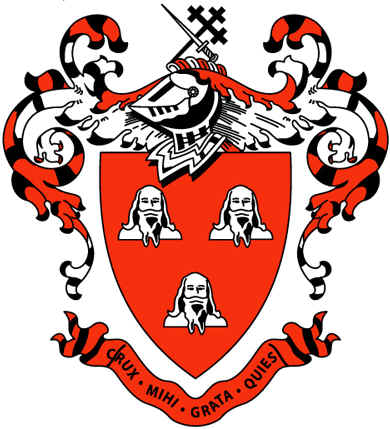
William Eddy Coat of Arms

Rev. William Eddy was born about 1559 in Bristol, Gloucestershire, England.  His parents were Thomas EDDYE and [__?__].  He married Mary FOSTER 20 Nov 1587 in Cranbrook, Kent, England  After Mary died, he married secondly on 22 Feb 1614, Sarah Taylor, a widow.  William died 23 Nov 1616 in Cranbrooke, Kent, England.
Stone Street, Cranbrook

Mary Foster was born in 19 Sep 1568 in Cranbrook, Kent, England.  Her parents were John FOSTER and Ellen MUNN. Mary died 18 Jul 1611 in Cranbrook, Kent, England.

Children of William and Mary:

Name Born Married Departed
1. Mary Eddy 15 Sep 1591
Cranbrook, Kent, England
Simeon Merdon 1612 in Cranbrook, Kent, England 1671
Cranbrook, Kent, England
2. Phineas Eddy 23 Sep 1593
Cranbrook, Engalnd
Katherine Courthopp 1616 in Cranbrook, Kent, England 17 Jun 1641
Cranbrook, Kent, England
3. John Eddy  27 Mar 1597
Cranbrook, England
Amy Doggett
1619 in England
12 Oct 1684
Rehoboth, Bristol, Mass
4. Ellen Eddy 5 Aug 1599
Cranbrook, England
Oct 1610
Cranbrook, Kent, England
5. Abigail EDDY 1 Oct 1601
Cranbrook, England
John BENJAMIN
1619 in Cranbrook, Kent, England.
20 May 1687 Charlestown, Mass.
6. Anna Eddy 15 May 1603
Cranbrook, England
Barnabas Wines
1632 Watertown, Middletown, Mass.
1778
Southold, Suffolk, New York
7. Elizabeth Eddy 7 Dec 1606
Cranbrook, England
8. Samuel Eddy 15 May 1608
Cranbrook, England
Elizabeth Savory
1630
Swansea, Bristol, Mass
12 Nov 1687
Swansea, Bristol, Mass
9. Zachariah Eddy Mar 1610
Cranbrook, England
 1690
Cranbrook Kent, Kent, England
10. Nathaniel Eddy 18 Jul 1611
Cranbrook, England
 27 Jul 1611 Cranbrook, Kent, England

Cranbrook is an old town which sprang into prominence in the 15th century when it became the center of the weaving industry. This place, anciently called Crane-broke, derives its name from its situation upon a brook called the Crane. Several old buildings date back to this prosperous period and the winding streets, well away from any main road, are lined with weather-boarded shops and houses. The parish church, St. Dunstan’s, was built in the 15th century and is known locally as “the Cathedral of the Weald”.
Cranbrook High Street

William Eddye lived during the reign of Elizabeth I, Queen of England. Upon the first page of the Parish Register at the Church of St. Dunstan in Cranbrook, county of Kent, it is written by the hand of William himself, since his signature is at the foot of the page, that he was “borne in the cittie of Bristoll,” probably about 1550.

William matriculated as “sizar” at Trinity Hall, at the University of Cambridge, and there received the degree of B.A. in 1583. (A sizar is one who performs certain duties in part payment of his expenses at a school or college.) In 1586 he received the degree of Master of Arts – “magister in artibus” as he records it on the Register at Cranbrook.

In this same year, 1586, Richard Fletcher, who since 1559 had been Vicar of Cranbrook, died, and Robert Roades, the President of St. John’s College, Cambridge, was chosen by Archbishop Whitgift to succeed him.

It is likely that the archbishop had become acquainted with William Eddye and was attracted to him, perhaps because of his scholarship or personality, and invited him to accompany him as his assistant to the Parish of Cranbrook in 1586. To a young man this must have been a wonderful opportunity, this chance to work with and be the companion of one of the scholars of the day. William accepted the invitation and settled in Cranbrook.

There he met Mary Fosten and on Nov 20, 1587 he married her. Upon the Marriage Register in his own handwriting there is the following entry: “20 Nupt. Willimus Eddye in artib’ magister et Marya Fosten Virgo. Inductus autem fuit in realem actualem huius Ecclesiae parochialis Vicariae de Cranbrooke possessionem Duodecimo die Januarii, A. 1591.” Mary died in Cranbrook, July 18, 1611. William married secondly on February 22, 1614, Sarah Taylor, a widow.

Mary Fosten was the daughter of John and Ellen (Munn) Fosten, who were married Jan. 19, 1562. John Fosten died and his widow married Andrew Ruck on Jan 11, 1574. There was at least one child by this second marriage as William Eddye in his will mentions “my loving brother Stephen Ruck. ”  It is possible that Mary inherited from her father some property, which would become hers upon her marriage, so that William felt that he could marry when only a curate.  This marriage portion may be the “Annuitie of five pounds a yeare granted unto me and Mary my late wife now deceased and to the heires of our body “, whereof he makes mention in his will.

William then went to Thurston, a small parish in Suffolk County, near Bury St. Edmunds and not very far from Cambridge. There he occupied the position of curate, perhaps from 1583 to 1586, as is shown by his signature on the transcript of the Register which was sent to the Bishop’s office at Norwich. This signature was compared with those at Cranbrook and found to be the same, so there is no question concerning the identity of William the Curate at Thurston, and William the Vicar at Cranbrook.

For some reason William Eddye was in Staplehurst, a town about six miles from Cranbook in the spring of 1589, and there his son Nathaniel was born and baptized. Robert Roades died in February, 1589/90 and Archbishop Whitgift then appointed Richard Mulcaster, the Head-Master of the Merchant-Taylors school to the office of Vicar. But he remained only a year, during which time William continued as curate. Then on January 12, 1591, Archbishop Whitgift appointed William Eddye to succeed as Vicar of St. Dunstan Church at Cranbrook.
St. Dunstan’s Cranbrook, Kent, England

He occupied this position for 25 years until his death in 1616. Perhaps this appointment gives us the clearest picture of the ability of William Eddye which we have, in that he was deemed worthy to succeed the three brilliant and scholarly men who had occupied the vicarage for the previous thirty years. One can imagine the pride which William felt upon being chosen, when only about thirty years of age, to become the Vicar of the Church at Cranbrook, and the joy in his heart when he wrote below the record of his marriage those Latin words which when translated are “But he was inducted into the real and actual possession of the Vicerage of the Church of the parish of Cranbooke on the twelfth of January in the year 1591.”

Another proof of his installation as Vicar is a record found in the First Fruits’ Composition Books at the Public Records Office, which contains the following records: “Kent: Cranbrook Vic: Archbishop of Canterbury: December 17, 1591, William Eddye, Clerk, compounded for first fruits of the vicarage aforesaid – extending to £19.19.6 the tenth whereof 29s. 11 1/4 d., June 1 and December 1, 1592 and June 1 and December 1, 1593 £17.19.6 3/4. Bondsmen of the said William, Richard Jurden of Cranebook in Co. Kent yeoman and Robert Hovenden of the same clothier.” Every new incumbent of a feudal or ecclesiastical benefice or of an office of profit was obliged to pay to his superior the “first fruits” or in other words, the income for the first year of the benefice or office. This record shows that the income of William Eddye for the first year of his incumbency, which began on January 12, 1591 was £19.19s.6d. and that on December 17, 1591 he paid one-tenth of the stipend and arranged with Richard Jurden, yeoman, and Robert Hovenden, clothier, to act as security for his payment of the rest. It also shows that he paid the remaining amount £17.19sh 6 3/4d. in four payments, two in 1592 and two in 1593.

Previous to 1598 the Church Registers of England had been written for the most part on paper. In the latter part of that year a law was issued to the clergy that the records must be kept on parchment. William Eddye set about this task and scholar that he was, he wished it well done, so he did it himself. Eighty pages bear his signature. The book bears evidence of careful work as a scribe and it shows some skill in drawing and designing, but a critic states that the illuminations are poor when compared with the work of medieval artists, but far superior to those of the average vicars, then or now.

From the style in which he was written out the Registers it is evident that he was probably a scholar. There are other circumstances which confirm this opinion. His own motto is “Aeterna expeto” which may be paraphrased by the words “My heart is set on eternity.” The thought would rise only in a pious mind, and the expression of it in Latin, as William Eddye expressed it, would occur only to a man who could appreciate a neat Latin phrase. There are other indications of scholarly feeling in the quotations which he makes on the title pages of the separate sections of the book which contain the registers of the Baptisms, Marriages, and Burials. He quotes not only from the Scriptures, but also from the works of Cyprian and Augustine.

When he is making an entry with regard to his own family, he always uses the Latin language. It would seem as if he wished to make the record and yet was too shy to express himself in plain English. There seems no doubt that he was a good Latin scholar, who had some knowledge of the Latin Fathers. Of his knowledge of Greek it is not possible to speak with the same certainty. He speaks of himself as the “Pastor or Minister” of this Parish. If he had been a very careful student of the Prayer Book, he would have avoided the term Pastor as applied to himself. His use of these terms instead of the colorless word “Vicar” indicates that he was distinctly in favor of the Reformation. Apparently he did not go to extremes from the fact that there is no record of any disputes on religious matters in the parish while he was Vicar. Another circumstance points in the same direction. The Rev. Dudley Fenner, the Presbyterian Curate of Mr. Fletcher had named his two daughters “More Fruit” and “Faint Not”. Other Christian names of this period in our register are “Repent,” “Joy,” “Mercy,” etc. In naming his eleven children, Mr. Eddye did not follow this fashion, which was characteristic of the extreme wing of the Puritans. The names of his children are all found in the Bible except Eleanore, and yet they are names common to most families of that period.

There are other entries which tell us something of the character of William Eddye, because they are peculiar to himself: such remarks are not found in the entries made by his predecessors or successors. In the early years especially are found such additions made to entries of burials as “an honest man,” “a good woman,” “a godly and good woman,” “a good Christian,” “a most godly Chrystian.” There is evidence also that he made remarks after burials, which he afterwards thought well to erase: he may have acted prudently in doing so but posterity would gladly know what he had said about Mr. Roades the predecessor under whom probably he served. Mention has been made of his constantly falling into Latin where he wishes to record something about his own family. Generally too he uses the writing, which was in use in his time and is more like German than modern English writing. But when he is making an entry with regard to his own family it is written in the script then used for Latin. The entries with regard to the Eddy family are in a large bold hand, which catch the eye at once. It may be inferred from the remarks and the erasures that he was somewhat impulsive and from the prominence given to entries about his kinsfolk that he was greatly interested in his own family. There is, however, one entry, which stands quite by itself, and reveals to us more of the character of William Eddye than all the rest. It is moreover the only piece of continuous composition which has come down to us. For these reasons and because it contains a narrative interesting in itself, it shall appear at length in modern spelling:

In this year following 1597 began a great plague in Cranbrook which continued from April the year aforesaid unto the 13th of July, 1598.

1. First it is to be observed that before this infection did begin that God about a year or two before took away by death many honest and good men and women.

2. Secondly, that the judgment of God for sin was much before threatened and especially for that vice of drunkenness, which did abound here.

3. Thirdly, that this infection was in all quarters at that time of this parish except Hartley quarter.

4. Fourthly, that the same began in the house of one Brightlinge out of which much thievery was committed and that it ended in the house of one Henry Grynnoche who was a pot companion and his wife noted much for incontinency which both died excommunicated.

5. Fifthly, that this infection was got almost into all the inns and victualling houses of the town places then of great misorder, so that God did seem to punish that himself, which others did neglect and not regard.

6. Together with this infection there was a great dearth at the same time, which was cause also of much heaviness and sorrow.

7. This was most grievous unto me of all that this judgment of God did not draw the people unto repentance the more but that many by it seemed to be more hardened in their sin.

In the Church Registers are the records of the baptism of his children, which have proved invaluable to his descendants of later generations. It is also noted that the records in the latter part of 1610 and for nearly all of 1611 are written by another hand, and it appears that for some reason, William was away from his vicarage, or else was suffering from a long illness. This was the year in which Mary, his first wife, and also a new-born child, Nathaniel died.

From the Register, is appears that at times there were other inmates in the household of Williams besides his family and servants, for on February 10, 1599, Mistress Bridget died, about whom he wrote “she appeared a maiden and most godly Christian gentlewoman. She lodged with me at the Vicarage and there died.” There is also the entry of the death of a gentleman “who was schooling for the Latin tongue.” It’s possible that William increased the income derived from his position as a Vicar by tutoring.

William Eddy did not live long after his second marriage. Of this second marriage, there came one child, Priscilla, whose baptism is registered in the usual formal hand, and with due use of Latin to show her relationship to her father. Early in 1616, if the handwriting on the register is any indication, William was so ill that he was no longer able to perform his duties as Vicar. The next entry with regard to the family is the burial of William Eddye himself, which took place on 23 November 23, 1616.

Memorial Plaque to William Eddye – St. Dunstan Church, Cranbrook

The exact spot where William Eddye lies buried is not known. It may be beneath the chancel of the church at Cranbrook where the incumbent vicar often was buried, or outside in the churchyard where at some time a wooden cross may have marked the grave.

There was no monument remaining that bore his name till a remote descendant left by will a sum which was to be spent on the splendid memorial which now beautifies Cranbrook Church. It reads: “Dedicated by Robert Henry Eddy of Boston, in the Commonwealth of Massachusetts, U.S.A., to the memory of his Ancestor the Reverend William Eddye, A.M., Vicar of this Church from 1589 [note: the date he really became Vicar was 1591] to 1616, whose sons John and Samuel, and whose daughter Abigail, were among the Pilgrim settlers of New England, and there implanted for the benefit of a numerous posterity the religious principles here taught them.”

The will of the Rev. William Eddye, Vicar of Cranbrook, Co. Kent, dated August 20, 1616 and proved December 4, 1616 in the Court of the Archdeacon of Canterbury:

In the name of God Amen the twentieth day of August 1616 and in the yeares of the Reigne of our sovereigne Lord James by the grace of God of England, Scotland, Fraunce and Ireland, King defender of the faith etc. viz of England, Fraunce and Ireland fourteenth and of Scotland the fyfteth; I William Eddye Minister and Pastor of the parrish Church of Cranebrooke in the County of Kent being at this present afflicted wth great bodely infirmities and weakenes whereby I doe assuredlie conceive that the tyme of my dissolution out of this mortal life draweth neere and is at hande have therefore determined to make and ordeine this my present last will and testament in manner and fourme followinge viz:

Inprimis, I comend my soule into the hands of almighty God my heavenlie father in Jesus Christ by the merritts of whose death and passion only my sinnes (wch I confesse to be many and great) being wholly remitted and forgotten I am fully persuaded in heart this mortal life ended to enjoy everlastinge life.

Item, I give and bequeath unto forty poore householders of this parishe that are apparentlie knowen to resort diligentlie to ye church upon the lordes day and doe live peaceablie and godlie the sume of forty shillinges of lawful money of England to be paid unto them wthin halfe a yere next after my decease.

Item, I give and bequeath unto John Eddie, my sonne the some of sixescore poundes of lawful money of England to be payd unto him by my executor in manner and fourme followinge viz threescore poundes thereof when he shall accomplish his full age of one and twentie yeares and other threescore poundes residew of his said portion wthin one whole yeare next after his said age.

Item, I give and bequeath unto Samuell Eddie and Zacharias Eddie, my sonnes to either of them one hundred pounds a peece of lawfull money of England to be paid unto them and either of them when they and either of them shall severally accomplish their severall ages of two and twentie yeares. And if it shall fortune that either of my said sonnes, Samuell and Zacharias to departe this life to Gods merie before the tyme that his or their said Legacie or Legacies shalbe due & my said son John then being livinge, then I will that he shall have Twentie poundes of his or their legacie or legacies so deceasinge to be paid unto him at his age of twentie and two years if either of his said bretheren depart this life before he shalbe of the said age. And if after the said age then to be paid him wthin one whole yeare next after the death of his brother so disceasinge. And the residew to be equally devided betweene the urvivor and my executor.

Item, I give and bequeath unto Abigail Eddie, Anne Eddie and Elizabeth Eddie, my daughters to either of them the some of one hundred poundes of lawfull money of England to be paid unto them and either of them at their severall ages of XXtie [20] years or at their severall dayes of marriage wch shall first happen. And if any of my said daughters shall heppen to departe this life to Gods mercie before the tyme aforesaid that her or their legacie or legacies shallbe due then I will that my Executor shall pay unto Priscilla, my duaghter twentie markes thereof at her age of twentie yeares or day of marriage wch shall first happen (if she shall live untill her said age or day of marriage). Also allso unto my sayd sonne, John Eddie twentie poundes thereof if he be then livinge and neither of his younger bretheren deceased to be paid unto him as the twentie poundes abovesaid lymitted out of his younger brothers portion Provided allwayes if he have Twentie poundes by the death of either of his younger bretheren he shall not have anythinge out of any of his sisters legacies aforesaid. And if either of his Sisters die first, then to have nothing out of either of his said Brothers portions. And the residew of the said legacie or legacies of my said daughters soe departinge this life I will shall remaine to my executor.

Item, whereas Sara my now wife in love and kindness to me and my other children hath promised to make up a portion for Priscilla, my daughter my great new silver salt, two silver beare cupps, two new silver wine cuppes and one greene ragge coverlett all wch I will shall be delivered unto the said Sara, my wife ymediatlie after my decease for the use of my said daughter, Priscilla to be given to the said Priscilla at such convenient tymes as she in her discretion shall thynke fitt.

Item, I further give and bequeath unto the said Priscilla, my daughter my best needle worke Cushions belonginge thereto to be delivered to the said Priscilla by my Executour at her age of twenty yeares or day of marriage wch shall first happen.

Item, I give and bequeath more unto the aforesaid John Eddie, my sonne one other suite of my needle worke Cushions viz one large and two short that were wont to lye in the chamber window over the Parlor and my greane Cupboard Cloth for the Parlor that is wrought with needle worke together allso wth my Cipres table wth boxes in it wherein I doe use to lay the evidences of his house and one faire pewter Candlesticke set forth wth a man.

Item, I give and bequeath more unto Samuell Eddie, my sonne one little sylver salt called a trencher salt to be delivered unto him at his age of one and twentie yeares.

Item, I give and bequeath more unto Zacharias, my Sonne one payer of my greatest brasse Candlestickes to be delivered unto him at his age of one and twentie yeares. Item, I give and bequeath unto my daughter Marie, the wife of Simeon Evernden one needle worke Cushion that is wont to stand upont he Cupboard in the Parlor to be delivered unto her ymediately after my decease.

Item, I give and bequeath more unto Abigall Eddie, Anne Eddie, and Elizabeth Eddie, my daughters three needle worke Cushions viz to each of them one wch were wont to stand in the large wyndow in my parlor to be delivered unto them ymediatelie after my decease and to be reserved in their trunkes for them wch longe since I gave them.

Item, I give and bequeath unto Simeon Evernden aforesaid, my sonne in law and to my said daughter, Marie his wife twentie poundes of lawfull money in England to be paid unto them or either of them by my executor wthin fower yeares next after my decease and to their three children viz, Simeon, Katherine and Robert each of them ten shillings to be put into or bestowed upon silver spoones for each of them one to be delivered unto them within two yeares next after my decease.

Item, I give and bequeath unto Richard Taylor, Robert Taylor, Thomas Taylor, Elizabeth and Sara Taylor, the sonnes and daughters of Sara my now wife ten shillings a peece to be bestowed uppon Silver Spoones for everie of them one and to be given or delivered unto them wthin three yeares next after my decease.

Item, I give and bequeath unto my two maid servauntes viz, Marie Greene and Anne Goodman to either of them five shillinges to be paid unto them and either of them wthin one month next after my decease. The residew of all and singular my moveable goods and chattells, Bookes, Corne, Cattell and household stuffe whatsoever before herein not willed given nor bequeathed my Debts Legacies and funerall expences discharged and paid I give and bequeath unto Phinees Eddie, my Sonne whom I make and ordeine full whole and sole Executor of this my present last will and Testament.

This is the last Will and testament of me the aforesaid William Eddie made and declared the day and yeare aforewritten as touchinge the disposition of all and singular my lands Tentes and hereditaments whatsoever viz I give and bequeath unto the aforesaid Phinees Eddie, my sonne (for and towardes the better performance of my will and for the full and more absolute payment of my debts and legacies) all my messaages or Tentes, Edifices, buildings, Orchardes, gardens, rentes, annuities, landes and hereditaments whatsoever, wth all and singuler their appurtnces situate lying and being in the parish of Cranebrook aforesaid or elsewhere in ye Realme of England to have and to hold the same unto the said Phinees my sonne his heires and assignes for ever Provided alwayes and my verie will and meaning is that if the aforesaid Phineas, my sonne his heires and assignes shall make default in payment of any of the foresaid legacies before given to my sonnes and daughters, That then ymediatelye from and after any such default of payment so made contrarie to this my will it shall and may be lawfull to and for such of my sonnes and daughters as shalbe so unpaid to enter in and upon all and singuler my foresaid lands and Tentes whatsoever wth their appurtenances before given unto my sonne, Phinees, And the same to have hold and occupye and enjoy viz my Sonne, John for the full terme and space of fower whole yeares in recompence of his foresaid legacies of sixe score poundes, And my other sones and daughters everie one of them that shalbe so unpaid to enter in and upon all my said landes and Tentes wth their appurtences and the same to have hold occupie and enjoy everie one of them for the full terme and space of three whole yeares in full recompence of his her or their foresaid legacie or legacies of one hundred poundes, And this everie one of them to doe successivelie one after another as often as any of them shalbe unpaid.

Item, my will and my minde is that whereas I have an Annuitie of five poundes a yeare granted unto me and Mary, my late wife now deceased and to the heires of our bodies lawfully begotten wch said Annuitie after my decease by law will descend unto all my sonnes equally yet I by this my will have given the same unto the foresaid Phinees, my sonne now my will and true meaning is that my foresaid sonnes John Eddie, Samuell Eddie, and Zacharias Eddie and everie of them in respect of their foresaid legacies to them by me given shall at all tyme and tymes after they and everie one of them shall severally accomplish their severall ages of one and twenty yeares upon reasonable request to them and everie of them to be made by the said Phinees, my sonne his heires or assignes and at the costs and charges of the said Phinees his heires or assignes make convey and assure unto the said Phinees his heirs and assignes such assurances and conveyances for the discharging of their severall rightes, tytles and demandes of in and to the foresaid Annuities as the said Phinees Eddie his heires or assignes or his or their Councell learned shall devise, And if any of my said sonnes, John, Samuell and Zacharias shall refuse so to doe upon request made as aforesaid that then he or they wch shall so refuse shall loose the benefit of all his or their foresaid legacies before to them by me given.

Item, I will and my mind is that the aforesaid Phinees Eddie, my sonne his heires or assignes shall well and vertuouslie bringe upp the foresaid Samuell Eddie, Zacharias Eddie, Abigall Eddie, Anne Eddie and Elizabeth Eddie, my sonnes and daughters in good and vertuous education and maintaine and keepe them wth meete and suffitient meat drinke and apparell viz my sonnes untill they accomplish their severall ages of eighteene yeares except before that tyme he can place them forth in good services fytting for their degree and my daughters untill they shall severally accomplish their severall ages of eighteene yeares.

In witness whereof, I the foresayd William Eddie to everie sheet of paper of this my will conteininge sixe sheetes have set my hand and to this last sheete have also sett my seale. Dated the day and yeare first above written. William Eddie and published in the presence of John Elmestone and George Martin scriptor.

Probate was made of the will of Wm. Eddie clerk late Vicar of Cranebrooke Archdeaconry Court deceased 4th day of the month of December A.D. 1616 by the oath of Phinees Eddie the Executor. Afterwards namely the 8th day of the month of October 1617 by the Oaths of John Elmestone, George Martin, John Weller and Dence Weller the Probate was confirmed. Parties to the Sentence: Phinees the Son, sara Eddie the widow, John, Samuell & Zacharias the Sons, Marie Eddie als Evernden wife of Simon Evernden, Abigal, Anne, Elizabeth & Priscilla Eddie the daughters.

The Parsonage across from St. Dunstan Church – Cranbrook

William was Vicar of St Dunstan's Church Cranbrook, Kent
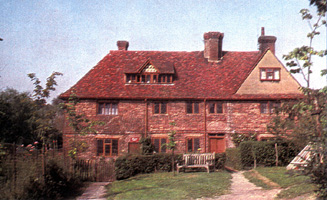
William Eddy’s Parsonage across from St. Dunstan Church – Cranbrook

From the inventory of William’s estate it is possible to get some idea of his home. There was a hall with a large fireplace and some armor on the walls and behind it the kitchen, evidently a large room where the family ate. Here also was a large fireplace surrounded by the utensils used in cooking, many of them similar to those used in the very early New England kitchens. The kitchen had two cupboards, one of wood and the other, either with a glass front, or else made for holding glassware. The shelves were filled with pewter dishes and there were several pieces of brass. On this same floor opening out of the hall and kitchen were several other rooms. First of all there was a parlor which was well-furnished. There were curtains and “mappes” and pictures on the walls, a carpet on the floor, tables, chairs and cushions for further comfort and decoration. Then there were six chambers, the Chapel chamber, which was his own and which he probably used for his study and work, a parlor chamber, a hall chamber, a kitchen chamber, a maid’s chamber, and another over the shop, which seemed to have been used partly as a storeroom, as was also the shop below. Beyond the kitchen were the regular outbuildings, one where the meal was sifted and then stored and where the loaves were kneaded, another building where the ale and other drinks were brewed and a third where the products of the dairy were cared for and stored. The three buildings generally adjoined the kitchen, while the other outbuildings were entirely separate. There were several of these besides the barn and the woodhouse.

An Inventory of the goods and Chattells of Mr William Eddy Minister and Preacher of the word of God in Cranebrooke taken the sixth day of December 1616 and apprized by those whose names are here underwrytten:

Imprimis his purse and Gyrdle and money in his purse in the hall = xs

Item a litle square Table a standerd a Corslet two Pykes a houlberd and a warbyll = xxiiijs

Item two great brandyrons in the Kitchin = xs

Item a table a frame wth an olde forme a ioynd Cubberd wth a deske and a Cubberd Cloth and a Cushion uppon yt = xls

Item a glasse Cubberd, a Cage two small Chyres wth certaine shelves a pewter Cesterne wth a frame to yt = vjs viijd  iijs iiijd

Item three spitts wth Chowies two yron Dripping pans two pothangers one brand yron a plate to sett before meate an yron peele a grydyron a toasting yron a skymmer a fyre a payre of tongs and a payre of bellowes = vxs

Item 2 brasse ketles, a brasse pan 5 brasse stepnets a Chaffer, a warming pan 3 brasse potts a Cullendr two Chafindishes 4 latten Candlestickes two hanging Candlestickes a brasse morter 2 brasse potlidds 2 brasse ladles a basting ladle and a skimer = iij ijsviijd

Item 2 lytle yron Pottes = iiijs

the Pewter
Item one Bason & Ewer 2 other basons vii; platters a dozen of large pewter dishes a dozen of smaller dishes 2 plates 1q saucers 3 porrengers 2 salts one double candlesticke 4 other candle- stickes a pynte botle 6 potts litle & great, 2 Chamber potts = lvjs vjd

Item 2 Curtayne Rodds & a plate to warme meat = ijs vjd

Item 2 dogwheeles & a Chayne 12li-o4-o8 = xs

in the boulting howse
Item an oulde kneadyng troughe, a boulting hutche, a great peele, a boulter, a meale bag a Renning Tubbe, a Racke & other small things = vs

in the brewhouse
Item a furnace a brewing Tunne, two great keelers a soping keeler a malt quearne & other olde Tubbes & 4 pales = xliijs iiijd

Item an olde Coope & a meale sacke = ijs

in the buttry
Item one Cage, a mustard quearne a Tobut, 3 halfe kilderkins a Tunnell 3 dozen of Trenchers a stalder and a lanterne = xvs

in the Parlour
Item one long table wth a frame and two fourmes 2 Square tables and Cushion Chayre wth a wrought backe, one turned Chayr, 6 mockadow Cushions 6 high ioynd stooles 2 dornix Curtains a Curtaine Rod vij mappes & pictures wth one Curtaine = iijli xs

Item a Carpett 3 needleworke Cushions and one needleworke Cubberd Cloth = lvijs iiijd

in the Shoppe and an other Roome thereto adioyning
Item an olde Table, ij Cradles one still two trendles, one Settell 2 sadles wth their furniture, one Pillioniijli

Item a parcell of bordes & Joystes =  xxijs

Item a barrow a Corne sive and two whipletrees  = vjs viijd

Item in butter & cheese =  xxxs

Item a chiesepresse and Chieseboles a Churne a garden Rake a spade a two hand sawe & an axe  = xjs

in the Seller
Item a bryne tubbe & a dozen of trugs & bowies  = xs

in the Chamber over the Shop
Item in bordes to the value of  vli

Item one halfe headed bedstedle an olde Table wth tressells & a fourme 2Ili_16_10 = iiijs vjd

in the hall Chamber
Item one high ioynd bedstedle wth two setles a Truckle bedstedle two standerds a small Table wth a frame & a forme, a spruce boxe uppon a frame one ioynd chest, a Truckke a litle turnd Chayre and two Cushion stooles = vjli xvjs

Item a small needle worke carpet a stander Cloth bordered wth needle worke, a long needle work Cushion and 2 smaller needle worke Cushions = iiijli

Item a fetherbed & bolster a Tapistry Covering & a payre of Curtaines & the vallance = vijli

in the Parlor Chamber
Item a ioynd bedstedle wth two setles a truckle bedstedle, a ioynd presse, one chest a stander and a deske = iiijli vjs viijd

Item a fetherbed & bolster, 3 needle worke Cushions, a purrell Cushion, a Slander Cloth a payre of small brandyrons wth Copper heades and a fyre slyce =vli

in the Chappell Chamber
Item a ioynd bedstedle wth vallance and Curtayns a greene Rugge a ioynd Chest a turnd Chayre and a bedmat = iijli vjs viijd

Item his wearing apparell lynnen & woollen = xli

Item his bookes in the Studye and the shelves and a Chayre =xxiiijli

in the Kitchin Chamber
item a great ioynd Chest, a borded Chest a small sauare Table with a frame and a Setle =xvs

in the Maydes Chamber
Item a bedstedle wth a halfe head and a Truckle bedstedle, a Childes bedstedle a Stander two Chayres & a litle Table = xiiijs iiijd

The Lynnen as followeth
Item a payre of fyne sheetes 6 payre of Course sheetes 4 halfe sheetes a dozen of fyne Table napkins a dozen of newe napkins a fyne large Towell and a Table cloth, a small Diaper Table cloth a drinking Cloth, a payre of fyne pillow Coates 6 olde napkins a payre of course pillow coates & 6 Course Towells = vijli xvijs

Item 2 payre of shetes & one odde shete more £74_08_08 xiiijs

The bedding
Item fower flockbeds and fower bolsters 3 fether bolsters 3 Coverings 9 blankets and 3 pillowes in the Gallet and a lowe Roome = vijli ijs vjd

Item 4 scarves of malt = iijli iiijs

Item an olde sydesadle & a basket cradle =iijs iiijd

Item an Osle hayre = iiijs iiijd

in an outhowse
Item a Capon Coope = vjs viijd

Item 3 loades of postes & rayle = xxiiijs

in the Barne & other outhowses
Item 20 loads of hay or thereabouts = xvili

Item in barley to the value of =xvjli

Item a Fanne a Corne sive 6 Rakes 3 forkes & 2 ladders = xs

in the Closes
Item 14 loads of wood & fagots = vli xijs

Item a parcell of Joystes & bordes = iiijli

Item certaine small pieces of Tymber = xxs

Item a gutte to carry water into the brewhowse = xxs

Item 4 hogges = iijlivjsviijd

in the workehowse
Item the Copper & fate = xxli

Item the Kitte & jacke & scranes and other ymplements = xvs

in the fields
Item 6 kyne & a Calfe = xxijli

Item 2 mares = viijli

Item 13 sheepe = iiijlixs

Item an olde Hardle & a Taynter = vli

Item the wheate uppon the ground = viijli

Item in lumber and other small thinges unnamed £128-17-06 xs

Item one beare Cup 0f silver and two wyne Cuppes and a salt seller = xijli

Item in redy money = iiijli

Item in Debts by bonds & bills = clxxxjli

Sume totall is £434-07s-08d

William Hartredge
John Stoogull
Symeon Evernden
George Martin

After William’s death, his widow Sarah continued to live in Cranbrook. It would appear that Sarah had children of her own from a previous marriage and that they did not get along with William’s children. Zachary Eddy, in his oration in 1880, states that Phineas had a fight with one of them in the churchyard. When Sarah died, she left no property to any of the Eddy children and since her own daughter, Priscilla Eddy, is not mentioned in her will, she must have died in childhood. Sarah herself died between August 1, 1637 (date of her will) and February 5, 1639/40 (date it was probated).

Children

1. Mary Eddy

Mary’s husband Simeon Merdon was born 1590 in Cranbrook, Kent, England

2. Phineas Eddy

Phineas’s wife Katherine Courthopp was born 1594 in Cranbrook, Kent, England. Her parents were Peter Courthop and Ann Sheaffe. Katherine died 1639 in Cranbrook, Kent, England.

Phineas was a taylor,

3. John Eddy

John’s wife Amy Doggett was born 16 Jul 1597 in Groton, Suffolk, England. Her parents were John Doggett and Bathsheba Fay.  Amy died 20 Aug 1683 in Rehoboth, Bristol, Mass.

John was admitted to the Watertown Church prior To March 1632/3

5. Abigail EDDY (See John BENJAMIN‘s page)

6. Anna Eddy

Anna’s husband Barnabas Wines was born 1600 in Cranbrook, Kent, England. Her parents were Charles Wines and Prudence Beacon.  Barnabas died 1679 in Suffolk, Long Island, New York.

Barnabas Wines was admitted a Freeman of Watertown, MA, on May 6, 1635.  He appears in the records of Southould, NY from 1654 -1679.   His will speaks of a son, grandson & great-grandson all named Barnabas Wines.

8. Samuel Eddy

Samuel’s wife Elizabeth Savory was born 1607 in Plymouth, Plymouth, Mass. Her parents were Thomas Savery and Mary Woodrorke.  Elizabeth died 24 May 1689 in Swansea, Bristol, Mass.

In accordance with his father’s will, his brother Phineas Eddy was to care for Samul’s education and apprentice him to some trade, and he learned the trade of a tailor. Upon reaching the age of twenty-two years he was to receive by inheritance £100. So in May of 1630 he must have received this sum and probably used a goodly portion of it to pay his passage to America.

Samuel came to New England with his brother John on the Handmaid under John Grant, leaving the port of London on August 10, 1630 and arriving at Plymouth Harbor on October 29, 1630 after a very stormy twelve weeks at sea. Both Samuel and John, rated as “gentlemen,” intended to join their distant connections, the Winthrops and the Doggetts, who had come to New England earlier in this same year and who had settled at Boston. However, even though Miles Standish personally escorted them to Boston, Samuel and John were not permitted to remain because they had neglected to obtain testimonial letters from the Plymouth Colony, dismissing them from that colony to the Massachusetts Bay Colony. The brothers returned to Plymouth with Miles Standish. John and his family returned to the Massachusetts Bay Colony in the winter of 1631/32 having procured the necessary letters from Plymouth. Samuel decided to remain in Plymouth.

Soon after arriving at Plymouth, Samuel must have taken an apprentice boy to teach him the tailor’s trade, unless perhaps he had brought him from England, for the records state that on January 10, 1632/3:

Thos Brian, the serv’t of Samuell Eedy wsa brought before the Gov. and Mr. Will Bradford, Mr. John Done, Stephen Hopkins and Wiliam Gilson, Asst. because the said Thomas had runne away and absented himself five daies from his master’s service & being lost in the wood & found by an Indian, was forced to returne & for this his offense was privately whipped before the Govr & Council aforementioned.

What remained of Samuel’s inheritance after paying for his passage must have been nearly all spent when he purchased the property on Spring Hill from Experience Mitchell, who came in the Anne in 1623 This place was then on South Street and is now No. 34 and 36 Market Street. The deed was dated May 9, 1631.

Experience Michell, sould unto Samuell Eeddy his dwelling house, garden plott fence, wth all things nailefast in ye same; for ye summe of twelfe pounds starling, as apears more at large by a writing under their hands to which ffrancis Eaton was witness. Only this was excepted by ye above said Experience Michell, so much of ye said garden plote as lyeth between ye ende of ye house ye streete; throw which notwithstanding he was to allow ye said Samuel a convienient way of Pasage, and to fence ye said goud (thus excepted) at his owne charge to maintaine ye same.

Samuel thus acquired a house, perhaps a home for his bride. He lived there from 1631 to 1645. With the purchase of this property, he also acquired whatever rights went with it as a landholder in Plymouth. Thus it is that six years later on November 7, 1637, Samuel received three acres of land at New Field, which was set off to him by the town. “The persons mentioned had divers porcons allowed them 3 acres in breadth and 2 in length next to the land of John Dunham the elder…to Samuell Eedey, 3 acres…all wch psons have or are to build in the towne of Plymouth and these lands to belong to their dwelling houses there and not to be sold from their houses.”

On January 1, 1632/33, Samuel Eddy was admitted to the “freedom of the colony” and received the oath. A list of the names of the “Freemen of the Incorporation of Plymouth in New England” dated 1633 contains the name, Samuell Eddey. On January 2, 1633 the “persons were rated for the public use”, that is, the tax was assessed. Samuel Eddy’s tax was 9 shillings, the lowest tax assessed to any man. On March 24, 1633, the lists were again made up. Samuel’s tax remained the same. A list taken March 7, 1636 contains the name of Samuel.

Sometime before 1637 (birth of first child), Samuel married. His wife’s name was Elizabeth, though her maiden name is uncertain. Elizabeth has been called sister of Thomas Savory of Plymouth, based on relationships stated in deeds. Unfortunately for this argument, one of these deeds does not state the connection; the deed from Thomas Savory to Samuel Eddy of February 20, 1662 does not refer to Eddy as “brother-in-law”. The later deed, by the widow of Thomas, does refer to “our brother-in-law Samuel Eddy”, so the identification certainly remains possible. Note also that Eddy and Savory were granted lands jointly in 1664, although these lots were all granted to pairs of individuals, not necessarily related. If Thomas Savory was a brother-in-law of Samuel Eddy, either he married Samuel’s sister or Samuel married his sister. Thomas Savory’s wife was named Ann. Samuel Eddy had a sister Anna, but there seems to be no doubt that Anna Eddy was the wife of Barnabas Wines. If Samuel’s sister Anna was the wife of Barnabas Wines, then she was obviously not the wife of Thomas Savory, and therefore Samuel Eddy’s wife according to this theory was Elizabeth Savory, sister of Thomas.

However, there is also a mystery about Samuel Eddy appearing on a list of June 3, 1662 of “first born children” who received land purchased by Major Winslow and Captain Southworth. The list is a bit misnamed, for the original act from Plymouth Colony Records provdes that “such children as are heer borne & next unto them such as are heer brought up under their parents…be provided for…before any that either come from England or elsewhere.” A good reason can be found for virtually all the names on the 1662 list. The “first born” seems to be any needy child (or a parent for the child) of those who were in Plymouth by 1627. One person on the list does not fit the pattern, William Pontus, but it might be supposed that he was included because he and his wife were of the Leiden Separatists and needed land. Some men are on the list because they married “first born” children, such as William Hoskins (married Sarah Cushman), William Nelson (Martha Ford), George Partridge (Sarah Tracy), and Andrew Ring (Deborah Hopkins). Edward Gray was the only person receiving a double share, and he was the husband of Mary Winslow, daughter of two Old Comers (Mary Chilton and John Winslow). But why was Samuel Eddy’s name on the list?

Samuel did not qualify for including by any right of his own. Therefore, it is reasonable to suppose that he qualified by right of his wife, and that she must have been the daughter of some Old Comer family. Which Old Comer families had daughters named Elizabeth who cannot otherwise be accounted for? Only one. William Bradford’s account says thatt “Thomas Rogers dyed in the first sickness, but his sone Joseph is still living, and is maried, and hath six children. The rest of Thomas Rogers children came over, and are married, and have many children.” Yet not all of Thomas Rogers’s other children at Plymouth have been identified. Besides Joseph, who came over with Rogers, his son John came over about 1630, but that is all that is known about his children in New England. Leiden records show that Rogers also had in Holland Lysbeth (Elizabeth) and Grietgen (Margaret). It might seem reasonable then to think that Samuel Eddy’s wife was Elizabeth Rogers.

Elizabeth, whether Savory or Rogers, was twice summoned to appear before the Court of Plymouth. It is recorded that on “October 7 1651, Wee further present Elizabeth Eeddy, Sen’r of the towne of Plymouth for laboring, that is to say, for wringing and hanging out clothes on the Lord’s day, in time of publicke Exercise.” She was fined ten shillings, but this fine was remitted. Again on May 1. 1660, it is recorded that “Elizabeth Eedey was summoned to this court, and appeared, to make answare for her traueling on the Lord’s day from Plymouth to Boston; and affeirmed that shee was nessesitated to goe on that day, in regard that Mistris Saffin was very weake and sent for her, with an earnest desire to see her, in her weakness with some other pleaes of like nature. The Court considering some cercomstances in her answare, although they saw not sufficient excuse for her act therein, saw cause to admonish her and soe shee was discharged of the Court.”

Samuel was granted three acres “next to the lands of Joh. Dunham the elder,” November 7, 1636. On July 6, 1638 Samuel Eddy sold to Richard Clough for forty bushels of Indian corn “all that his house and garden in Plymouth wherein the said Samuel now dwelleth”. On the same day Nicholas Snow sold to Samuel Eddy for the same amount “all that his house & garden adjoining with the fence in & about the same in Plymouth wherein the said Nicholas now dwelleth”.

In 1640 with several of his neighbors, Samuel bought a large tract of land of the Indians and founded the town of Middleborough. His portion included several hundred acres in the northern section of town and a part of the town of Halifax, and there as his descendants multiplied grew up the little village of Eddyville.

“Six acres of upland lying on the northwest side of Fresh Lake, about the fishing place, and thirty acres of upland at the Narragansett Hill, and four acres of meadow, or else half the meadow ground there to it,” were granted to Samuel on September 16, 1641. Fresh Lake is better known by the name of Billington Sea. Narragansett Hill was the high land to the west of the town, where a battle between two Indian tribes, the Narragansetts and the Pochanockets, had occurred. On March 7, 1642/3, John Allen sold to Samuel Eddy “all that his house, barns & buildings with the lands thereunto belonging lying at Willingsly and Woeberry Plain”. On March 3, 1645/6 Samuel Eddy sold to John Tompson “all that his house situate at the Spring Hill in Plymouth with the garden place adjoining and three acres of uplandÉlying in the Newfield”. On March 20, 1647/48 “Samuell Eedy” sold to Experience Mitchell of Duxbury “one acre of marsh meadow”.

As early as March, 1651 Samuell Eddy had “interest and proprieties in the town’s land at Punckateesett over against Rhode Island,” and on March 22, 1663/4 he and Thomas Savory were jointly recorded as the holders of Lot #3 on “Puncateesett Necke”. On July 14, 1667 Samuel Eddy was granted six acres of meadow “lying at the South Meadow Brook”. On August 5, 1672 “the swamp at Wellingsley lying up the brook” was granted to “the neighbors there,” being five men including “Samuell Eedey”.

On November 29, 1652 Samuel Eddy was a witness to a deed for the purchase of lands from the Indians, “Wosamequen and Wamsutta my sonne,” by Bradford, Standish, Winslow and others. This land is now the town of New Bedford.

On June 7, 1659, “Samuell Eedey”, was one of five men “desiring some proportions of land to accommodate them for their posterities. The Court giveth liberty unto them to look out a tract of land for that purpose, and if found convenient it shall be confirmed unto them for the ends aforesaid.” On June 3, 1662, Samuel’s name was in the list of those permitted to “look out some accommodations of land, as being the first borne children of this government.”

On February 20, 1662 Thomas Savory of Plymouth, planter, deeded to Samuel Eddy of Plymouth, tailor, “all that his whole right part and portion of the land belonging to the town of Plymouth aforesaid commonly called and known by the name of Punckateesett, and places adjacent lying over against Road Island,” in exchange for “a parcel of upland and meadow belonging to the said Samuell Eedey lying at the four mile brook in the township if Plymouth aforesaid, as also a parcel of upland being six acres lying and being at or near Fresh Lake in the township of Plymouth.”

On March 24, 1662 “Samuell Eedey seni[o]r” of Plymouth, tailor, granted “unto his two sons viz: Zacariah Eedey and Obadiah Eedey all that his share lot and portion of land which he hath in the land granted and confirmed by the court in June last past before the date hereof, unto sundry persons, lying near unto Namassakett,” to be equally divided between them, reserving “unto his own use six acres of the upland of the said lot of land,” this six acres to belong to our sons Zachariah and Obadiah at his death, and that they permit him to winter three cows on their share of the land; ” it was mutually agreed before the ratification of the premises by and between the said Samuell Eedey and Zachariah Eedey that in case Caleb Eedey shall desire a quarter part of the abovesaid land he shall have it”; acknowledged February 26, 1672.

On March 7, 1671/2 Samuel Eddy of Plymouth, tailor, sold to Steven Bryant Senior of Plymouth, husbandman, “all that my one share of land be it more or less divided and undivided that I have in a certain share or tract of land called the Major’s Purchase lying at or near Namassekeesett Pond”; acknowledged by Samuel Eddy and Elizabeth his wife on the same day. On February 16, 1673/4 the town of Plymouth noted that “land which Samuell Ryder bought of Samuell Eedey lying at Mannomett Ponds” was still common land, according to the records searched.

So far as is known Samuel Eddy held no public office. This was due probably to his youth and inexperience with conditions in a colony which had been established for ten years when he joined it, and as time went on the care of his family occupied his entire attention. Though Samuel was of gentry status and though he received land grants, he did not seem to prosper in Plymouth, as can be seen from his putting his children out as servants. In the first years of his sojourn in the new colony, there was probably very little opportunity for Samuel to ply his tailoring trade, which in England at that time was so profitable. Instead it was necessary for this young man to wrest a living for himself and his family from the soil, a calling for which he doubtless had no preparation. For these reasons and perhaps for others Samuel and Elizabeth found life in the new country very hard, so that by 1638 they were rated among the “poore of the town.” In the spring of 1624 Edward Winslow returned from a trip to England and brought with him the first cattle introduced into the Colony, and a letter from James Shurley, one of the merchant-adventurers, presenting a heifer, with its increase, as a gift for the benefit of the poor of the town. Each year the “poores stock” as it was called, was assigned to those who needed it.

At a meeting of the Townesmen of New Plymouth held at the Governor’s the XVIth day of July 1638, all the Inhabitants from Jones River to the Eele River being Éthereunto To consider of the disposal of the stock given (by Mr. Shurley of London) to the poore of Plymouth who had playnely declared by severall letters in his owne hand writing that his intent therein was – wholly to the poore of the Town of New Plymouth.

In the division of the “poores-stock” in July 1638, it is stated that Samuell Eddy as one of the “poore of the town of New Plymouth received four shares in the black heiffer, which was Henry Howland,” that is the one which Henry Howland had had the previous year and was now holding. From some of the records it would seem that they had to pay a small sum which might be termed a year’s rental, but in many cases there is no reference to any such payment. Perhaps those that were too poor had their share in the heifer free of charge. At various times in the next few years, Samuel Eddy’s name appeared in the lists of those who received a share in the “poores-stock.”

In July 1644 it was voted “For the ordering of the poores stock, Edmond Tilson and Samuell Eedey are to have the cow at Edmund Tilsons betwixt them, but Edmong to have two parts and Samuel one part & Edmond to winter her and Samuel to pay his part thereof.”

Again in July 1646. “The cow calf that came from Tilson was sould to John Dunham and Sam Eedey at 18 sh. John Dunham hath paid his part…and Edey still is debtor.”

In 1648 when the “poores stock” was called, one cow was “in the hands of John Dunham and Samuell Eedey. The increase thereof a yearling heifer and a bull calfe.” The value of these was £3, 4 shillings.

From this time Samuel’s affairs began to improve; for the next year, “John Dunham had the cow that he and Samuel Eedy had before” and after this Samuel has no more of the “poores stock” assigned to him.

In addition to the heifer in which Samuel Eddy had shares he had the use of a furnished pasturage for four goats and a lamb, and he had a dog which was not loved by all of his neighbors as it was by his own family. [See An Elegy on the death of Samuel Eddy’s Dogfollowing.]

On December 7, 1641, Thomas Sheriff (Shurtleff?) and William Brown complained against James Laxford in an action of trespass.” They attached four goats which were in the hands of Samuell Eedey and Joshua Pratt amounting to 33 shillings.

On August 4, 1646 “it was decided in the case betwixt Sam’l Edey and John Dunham, Jr. about ye said John Dunham’s giveing poysen to the said Samuel Eddys Dogg, the Court having taken the same into consideration upon hearing what could be said upon both sides the Court doth order yt ye said John Dunham shall find sureties for his good behavior unto the next Court.” Later in the same year it is recorded on October 27, 1646 “In a case of difference twixte John Dunham, Jun’r and Sam Edie, the court orders, & the said John Dunham agreed thereunto, that Mr. Wm. Paddie and John Cooke, Jun. shall heare & determine all former civill differences twixte them to this present day.” [See An Elegy on the death of Samuel Eddy’s Dog following.]

During these years of struggle, Robert Hicks, a neighbor and friend died. In his will, probated May 24, 1647, he left to Samuel Eddy a “payer of my wearing stockings,” not such a small gift as it would seem, when the scarcity of wool in a new settlement and the labor of carding it and the final knitting of the wool into stockings is taken into consideration.

These years from 1638 to 1649 are the years in which his five children were born and in which he apprenticed the oldest son John to Francis Goulder of Plymouth, and sons, Zachariah and Caleb, to John Brown of Rehoboth.

Memorand: that Samuell Eddy hath put his sonn, John Eddy, to dwell with Francis Goulder, and Katherne, his wyfe, vntill he shall accomplish the age of xxjtie yeares (being seaven yeares of age the xxvth of December, last past) and said Francis, and Katherne, his wyfe, fynding vnto the said John, their servant, meat, drink, and apparell during the said term, and either in the end thereof, or else at the term of the death of said Francis, or of the said Katherne, his wyfe, whether shall last happen, to pay him five pounds in country pay, or, if it pelase God so to disable the said Francis, or Katherne, his wyfe, that they shall not be then able to pay so much then to pay him s much as I shall haue left: And if it happen that both the said Francis, and Katherne, his Wyfe shall dye before the ende of the said terme, that then the said John shalbe at liberty to be disposed of as his parents shall think fitt; but if either of them doe live out the said terme, the said John to dwell with the longer liuer of them vntill he shall accomplish the age of xxjtie yeares as aforesaid. Dated April 3, 1645.

Whereas Samuell Edeth, & Elizabeth, his wife, of ye towne of Plymouth aforesaid, having many children & by reason of many wants lying upon them so as they are not able to bring them up as they desire and out of ye good respect they beare to Mr. John Browne, of Rehoboth, one of ye assistants of this government, did both of them jointly desire that he, ye said Mr. Browne, would take Zachery, their son, being of the age of seven yeres & bring him up in his imployment of husbandry, or any business he shall see meete for ye good of their child till he come to ye age of one & twenty yeres, whereupon Mr. Browne did in ye presence of Mr. Bradford Governor, take unto his service the said Zachary & promiseth to provide for & allow him during ye said terme all necessaries convenient & fitting such a servant according to ye state and condicon of ye country & doth further of his own will provide that if in case he, ye said Mr. John Browne & his wife, shall depart this life that said Zachary shall attaine to ye end of his time of service that then his eldest son, that shall haue the government of him during the residue of ye said time not attained unto, shall not make sale of ye said residue of time not attained unto nor any part thereof to any person or persons whatsoever whereby he shall or may be wronged: and if it shall so come to passe that those to whomsoever he shalbe committed unto, after the death of ye said Mr. John Browne & his wife, shall not deal well with him, as such servant ought to be dealt with, thereupon the complaint of any of ye friends of ye said Zachary shalbe and take him wholly away & place him with whom they shall see meete, provided that no sale or merchandise be made of ye remaine of his time by any. Dated March 2, 1946/7.

On March 4, 1652, Caleb Eddy, aged 9 years, was “to be taken by Mr. John Browne of Rehoboth…who was to bring him up in his Imployment of husbandry (or any other business).”

There were several other items in the records, of minor import, but which serve to give a glimpse into the daily life of the family in Plymouth.

In October 1646 Samuel was absent from the town meeting, but was present in December of the same year. On September 1, 1640 the order went forth that “every inhabitant of every Towne within the Government fitt and able to beare armes must be trayned.” In 1643 Samuel was enrolled as a person capable of bearing arms and was made a member of a troop enrolled for the defense of the Colony against the Indians. In June 1668 it is recorded that Samuel voted in a town meeting in Plymouth.

In 1646 it is recorded that “ffrancis Eaton, carpenter, owed Sam Eedy £2.” Perhaps Samuel had been making some clothes for the Eaton family.

On June 26, 1678 the town of Plymouth allowed five shillings to “Goodman Edey viz: Samuell Edey for work done by him in time of the war in making clothes for soldiers.”

On May 29, 1670 an exact list of all the names of the “Freemen of the Jurisdiction of New Plymouth,” contains the name of Samuel Eedey. This list was made because the towns of Middleberry and Swansea had been incorporated and all those freemen, who had taken up residence in either were listed as freemen of those towns and no longer as belonging to Plymouth. Samuel remained in Plymouth. His son Zachariah was listed as a resident of Swansea but neither Caleb nor Obadiah appear on the lists, as they had not at this time qualified as freemen.

On August 5, 1672 “The Swamp at Wellingsley (a section to the south of the town) lying up the brooke is Graunted wholly unto the Neighbors living there, viz. John Jourdain, Gyles Rickard, Jun., Nathaniel Morton, Sen’r, Abraham Jackson and Samuell Eedey.”

On June 27, 1677 Samuel’s name appears as a proprietor of land in the Township of Middleborough, but this term proprietor does not mean that Samuel was a resident of Middleborough, but only that he was an owner of property in that town.

On June 25, 1678, it was voted that “The collectors to Gather the minnesters maintainence for this year are William Clarke and Abraham Jackson who are to doe it on the same conditions as it was performed the last yeer: …. five shillings was allowed to Goodman Edey, viz. Samuell Edey for work don by him in time of warr in makeing Clothes for Souldiers.” At this time Samuel was seventy years old. Though he could not fight as a soldier, he cold aid by using his hands in helping to make the clothes for the fighters, thereby finding a use for the trade he had learned in boyhood.

9. Zachariah Eddy

Sources:

http://trees.ancestry.com/owt/person.aspx?pid=12120769&st=1

http://www.eddyfamilyassociation.com/williameddy.htm
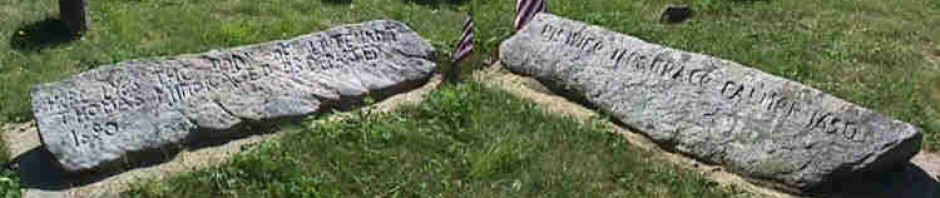
Posted in 14th Generation, College Graduate, Historical Church, Historical Monument, Line - Shaw | Tagged | 9 Comments

Arthur Clark

Arthur CLARK (1620 – 1665) was Alex’s 11th Grandfather; one of 4,096 in this generation of the Shaw line.

We have more unrelated Clark families in our tree than any other surname.  In addition to Arthur CLARK, our Clark family founders are: John CLARK (Plymouth) (1575 – 1623),  John CLARK (Hingham) (1560 – 1615),  and Lt. William CLARKE (Northampton) (1610 – 1690).
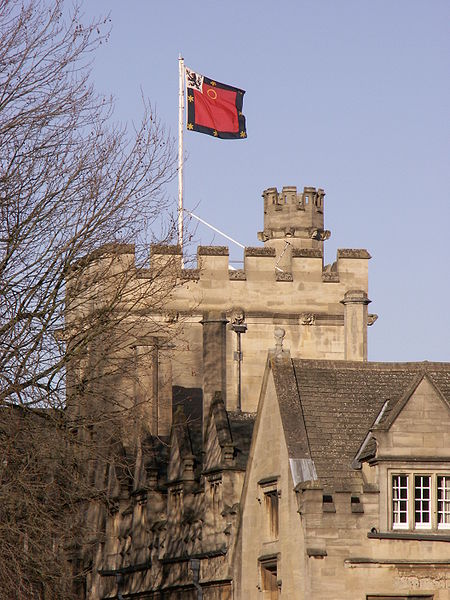
Arthur Clark Coat of Arms

Arthur Clark was born about 1620 in England. He married Sarah THAYER 1643 in Yarmouth Settlement, Plymouth Colony. Arthur died 31 OCT 1665 in Boston Settlement, Massachusetts Bay Colony

Sarah Thayer was born about 1620 in Thornbury Glouchestershire, England. Her parents were Edwared THAYER (1577 – 1627) and Catherine EDDYE (1574 – 1627). Sarah died 31 Oct 1665 in Boston, Middlesex, Mass.

Children of Arthur and Sarah:

Name Born Married Departed
1. Sarah CLARK 1 Aug 1639  Yarmouth, Barnstable, Massachusetts. Joseph BENJAMIN
7 Dec 1668 Yarmouth, Mass.
aft. 1716 as she was still living in New London, New London, Connecticut when her son John died
or
21 Jun 1738
Dorchester,Mass
2. Samuel Clark 1 Nov 1646
Salem, Mass
 Rachel Nichols 1675
Concord, Middlesex, Mass.
30 Jan 1670
Concord, Mass

Arthur was one of the earliest settlers in Hampton, New Hampshire and was admitted freeman in April 13, 1640.  He moved from Hampton to Salem where he was admitted to the church 17 Oct 1641. Then he moved to Boston and was received in the church from the church at Hampton 2 Dec 1643.

30 Jun 1640 – He was granted a house lot in Hampton on what is now the Perry estate.

His trade is given as carpenter.

“List of Freemen: by the Reverend Lucas R. Paige from the “NEHGS Register” 3:187; The New England Historic Genealogical Society; Boston, Massachusetts; April, 1849 (Per SCGS)

1642c: Arthur Clark of Hampton and Salem, Massachusetts, removed to Boston with his wife, Sarah and two children, Sara and Samuel.
“Abstracts of the Earliest Wills on Record and on the Files of the County of Suffolk, Massachusetts” by W. L. Trask from the “NEHGS Register” 30:203; The New England Historic Genealogical Society; Boston, Massachusetts; April, 1876 (Per SCGS)

1645, Arthur Clarke was granted lots 8 and 9 “to the marsh”.
“The Memorial History of Boston; including Suffolk County, Massachusetts. 1630-1880” by Justin Winsor; 2:37; Osgood, publisher; 1881 (974.402 B65WI ACPL)

1665, October 31: Arthur Clark died.
“Abstracts of the Earliest Wills on Record and on the Files of the County of Suffolk, Massachusetts” by W. L. Trask from the “NEHGS Register” 61:233; The New England Historic Genealogical Society; Boston, Massachusetts; July, 1862 (Per SCGS)

* Inventory of the Estate taken by Thomas Matson. The galley pots prised b Mr. Jonathan Endicott and Mr. David Stone. Amount of the inventory, £71-19-06.

“Abstracts of the Earliest Wills on Record and on the Files of the County of Suffolk, Massachusetts” by W. L. Trask from the “NEHGS Register” 61:233; The New England Historic Genealogical Society; Boston, Massachusetts; July, 1862 (Per SCGS)

Sarah Thayer’s Family

Sarah’s father Edward THAYER was born 26 Oct 1577 in Thornbury, Gloucestershire, England.   He married in 1597 in Thornbury, Gloucestershire, England to Catherine EDDYE. Edward died 5 Nov 1627 in Thornbury, Gloucestershire, England.

Sarah’s mother Catherine Eddye was born 1574 in Thornbury, Gloucestershire, England. Her father was James EDDYS (1558 – 1576). Catherine died 5 Nov 1627 in Thornbury, Glouchestershire, England.

Sarah’s grandfather John THAYER was born 1531 in Thornbury, Gloucestershire, England. His parents were John THAYER (1503 – 1561) and Constance HOLDBROOK. Mary Dixon Roberts in 1557 in Thornbury, Gloucestershire, England.John died 12 Oct 1584 in Thornbury, Gloucestershire, England.

Sarah’s grandmother Mary Dixon Roberts was born 1535 in Thornbury, Devon, England, Her parents were [__?__] ROBERTS (1505 – 1590) and Elizabeth FREMINGHAM (1502 – 1587). Mary died 20 Apr 1611 in Thornbury, Devon, England.

Sarah Thayer’s sister Cicely Sissilla Thayer was born 1 May 1600 in Thornbury, Gloucestershire, England. She married 11 Jun 1618 in Thornbury, Gloucester, England to James Davis. Cicely died 28 May 1673 in Haverhill, Essex, Mass.

James Davis was born in 1590 in Marlbourough, Wiltshire, England James died 29 Jan 1677 in Haverhill, Essex, Mass.

Children

1. Sarah CLARK (See Joseph BENJAMIN‘s page)

2. Samuel Clark

Samuel’s wife Rachel Nichols was born Jul 1654 in Charlestown, Middlesex, Mass. Her parents were William Nichols and Rachel [__?__]. Rachel died 19 Oct 1722 in Concord, Middlesex, Mass.

Sources:

Arthur Clark Bio

http://wc.rootsweb.ancestry.com/cgi-bin/igm.cgi?op=GET&db=wrandall&id=I4083

http://trees.ancestry.com/owt/person.aspx?pid=28050870&st=1

Posted in 13th Generation, Immigrant - England, Line - Shaw | 6 Comments