Edmund Hawes

Edmund HAWES (1612 -1693)  was Alex’s 10th Great Grandfather; one of 2,048 in this generation of the Shaw line.

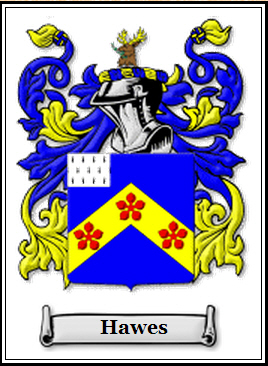
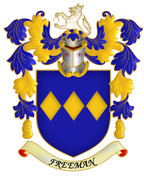
Hawes Coat of Arms

The Hawes family were exceptional among our ancestors having a coat of arms at the time of their immigration. Unfortunately, I can’t find a proper image. It’s supposed to have leopards, not griffins

This Version is a little closer

This Version is a little closer

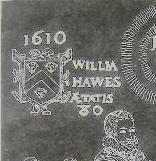
Here's the real thing from a detail of a brass of Edmund's grandparents

Here’s the real thing from a detail of a brass of Edmund’s grandparents William Hawes Ursual Colles in St. Alphege Church, Solihull.
“Sable, a chevron argent, btw. three leopard faces or”
Please let me know if you have a better picture!

I found it!  Hayes of Little Leigh  -- Arms: Sable, a chevron Argent between three leopards' faces Or (Harl 1424)(In Harl 1505 the leopards' faces are Argent)

I found it! Hayes of Little Leigh — Arms: Sable, a chevron Argent between three leopards’ faces Or (Harl 1424)
(In Harl 1505 the leopards’ faces are Argent)

Edmund Hawes  was baptized on 15 Oct 1612 in Solihull, Warwick, England, located 9 miles southeast of Birmingham city center. He was the third and youngest surviving son of Edmond HAWES Sr. and Jane PORTER. He married Lucy PENECOT in England.

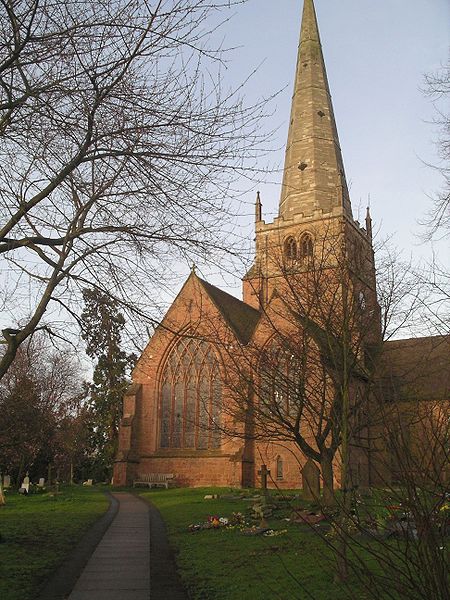
St. Alphege Church, Solihull

Edmund was baptized in St. Alphege Church, Solihull

St. Alphege Church is medieval. The previous spire was 59m and collapsed in 1757: the current spire is 57.34m The Church, dedicated to St. Alphege, is a large cruciform structure. The tracery mouldings and corbels in the interior are extremely elegant; there are also some fine specimens of screen work: it consists of nave, chancel, side aisles, and an embattled tower, surmounted by an octagonal spire, and contains a peal of thirteen good bells.

Edmund immigrated to America in 1635 on the James of Southampton

(on or about 5 April 1635, “Edmund Hawes, cutler, late of London,” was included in the passenger list of the James, about to sail from Southampton for New England [Drake’s Founders 56])

Edmund was buried on 10 Jun 1693 in Yarmouth, Barnstable, Mass.

There are several different ideas about Edmund’s wife:
Lucy Penocot (Penobscot) was born in 1610 in England and died 16 Jul 1689 Yarmouth, Mass. (16 ancestry.com users)

Eleanor Lombard was born in 1617 in England.  Her parents were Bernard Lombard and Elinor [__?__].  Eleanor died 19 Jul 1689 in Yarmouth, Barnstable, Mass. (11 users)

Mercy Hopkins was born in 1616 in Bayhorn, Essex, England and died 19 Jun 1689 in Yarmouth, Barnstable, Mass (3 users)

Child of Edmund and Lucy:

Name Born Married Departed
1. Capt. John HAWES bet 1635 and 1640
Duxbury, Mass
Desire GORHAM
7 Oct 1661 Barnstable, Cape Cod Plymouth Colony,
11 Nov 1701
Yarmouth, Barnstable, MA after having his leg amputated.

Hawes English Origins

The Hawes family in Solihull goes back 700 years to a  1313 deed in which Robert Hawes agrees with his brother Richard to dig, enclose and maintain two hedges and ditches for the manner of Solihull and in which mention is made of land which Richard had bought of Dame Ela de Odingsells, widow of Sir. William de Odingsells, Lord of the Manor

Sir William de Odingsells was knighted in 1283. Like his father he was an active soldier, He was Sheriff of Shropshire and achieved the high position of Chief Justiciar of Ireland.

He married Ela, daughter of the Earl of Salisbury and great grand-daughter of Henry II.
The extensions which he made to his moated home, set within the medieval park, witnessed to his rank and status. So too did his great scheme to rebuild St Alphege church. First to be built c. 1277 were the fine chancel and the chantry chapels but progress was interrupted by Sir William’s death in 1295. The manor was sold and the rebuilding continued slowly, not reaching its completion until 1535.

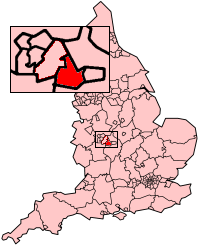
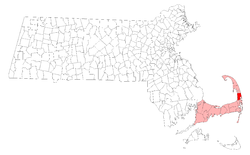
Solihull Map

Metropolitan Borough of Solihull

Solihull  is a town in the West Midlands of England with a population of 94,753.  It is a part of the West Midlands conurbation and is located 9 miles  southeast of Birmingham city centre. It is the largest town in, and administrative centre of, the larger Metropolitan Borough of Solihull, which itself has a population of 200,400.

Richard Hammond – Top Gear presenter and radio personality was born in Solihull.

Historically part of Warwickshire, Solihull is one of the most prosperous towns in the English Midlands.  Residents of Solihull and those born in the town are referred to as Silhillians The motto of Solihull is Urbs in Rure (Town in Country)

Solihull’s name is commonly thought to have derived from the position of its parish church, St Alphege, on a ‘soily’ hill. The church was built on a hill of stiff red marl, which turned to sticky mud in wet weather.

Solihull probably came into being about a thousand years ago, as a clearing in the forest to which people would come to trade.  The town is noted for its historic architecture, which includes surviving examples of timber framed Tudor style houses and shops. The historic Solihull School dates from 1560 (although not on its present site). The red sandstone parish church of St. Alphege dates from a similar period and is a large and handsome example of English Gothic church architecture, with a traditional spire 168 feet high, making it visible from a great distance.   It was founded in about 1220 by Hugh de Oddingsell. A chantry chapel was also founded there by Sir William de Oddingsell in 1277 and the upper chapel in St Alphege was built for a chantry.

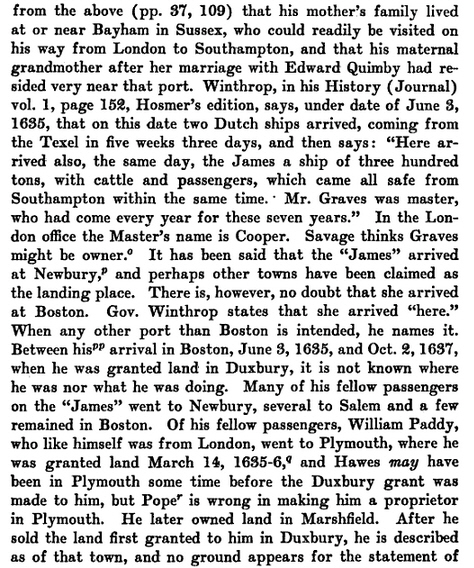
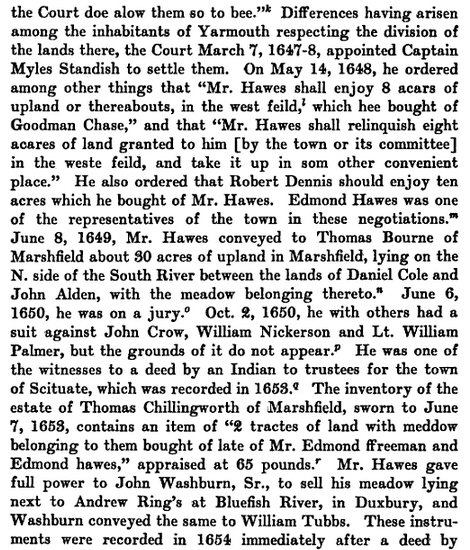
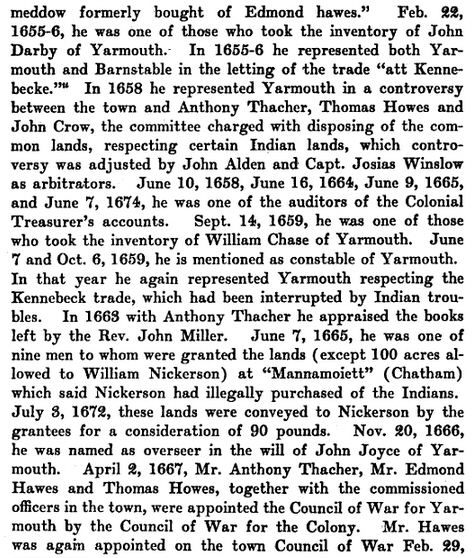
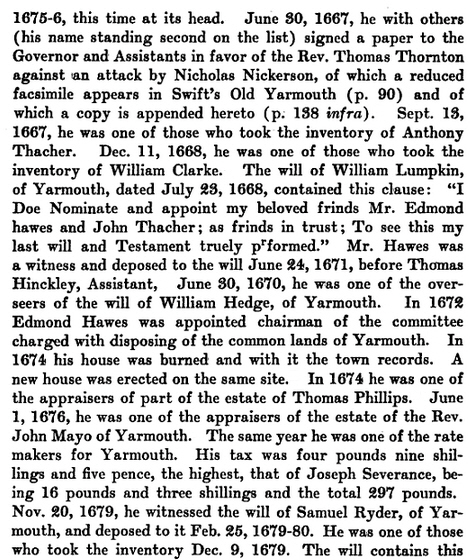
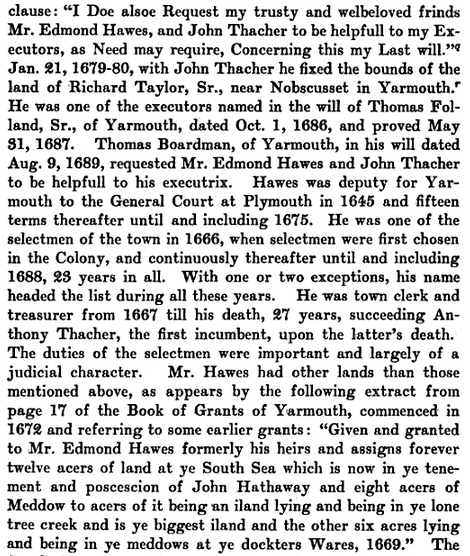
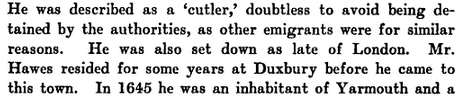
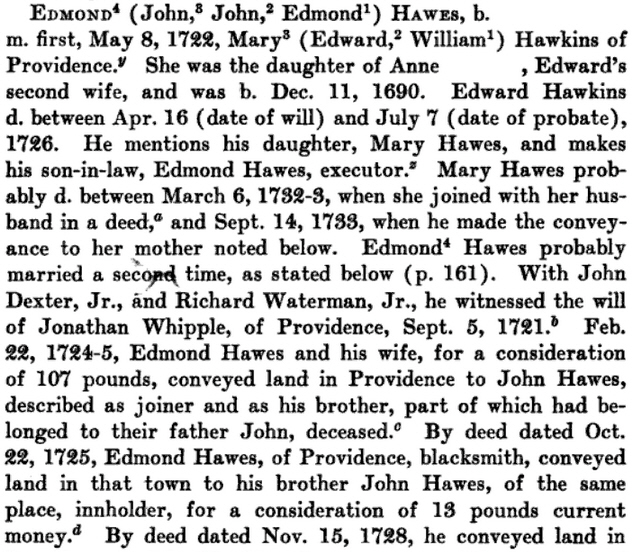
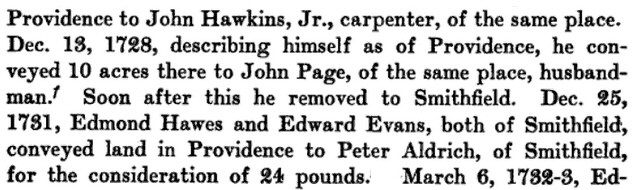
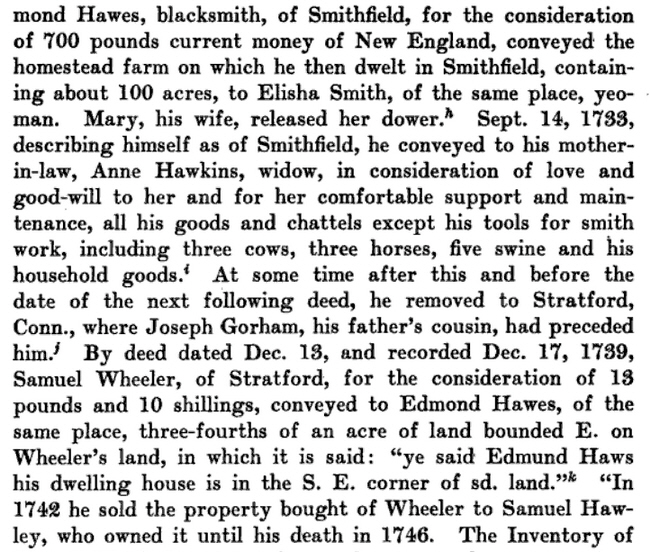
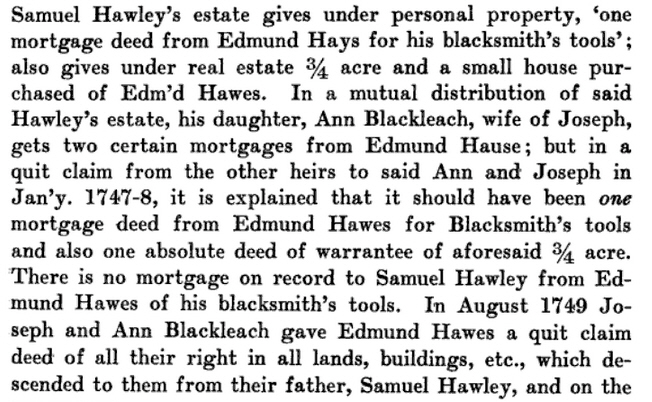
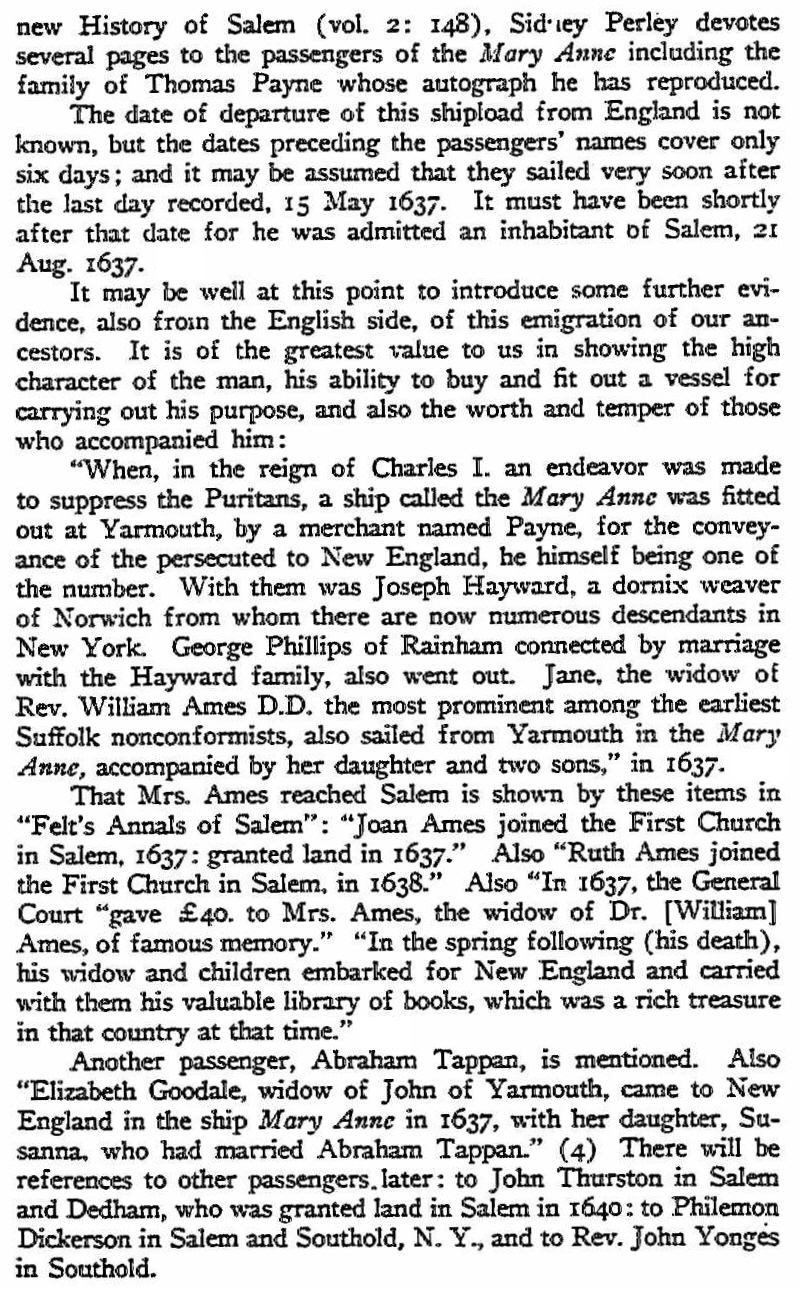
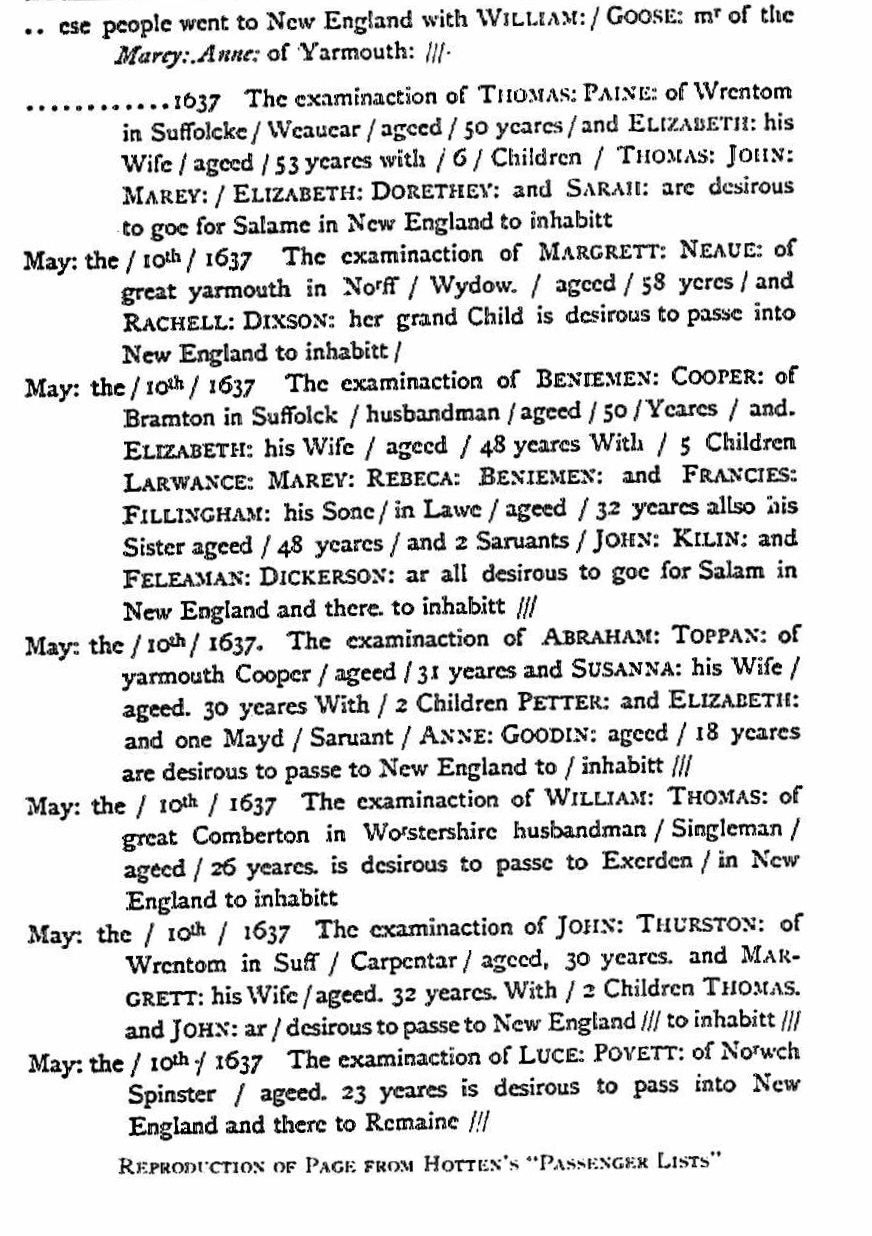
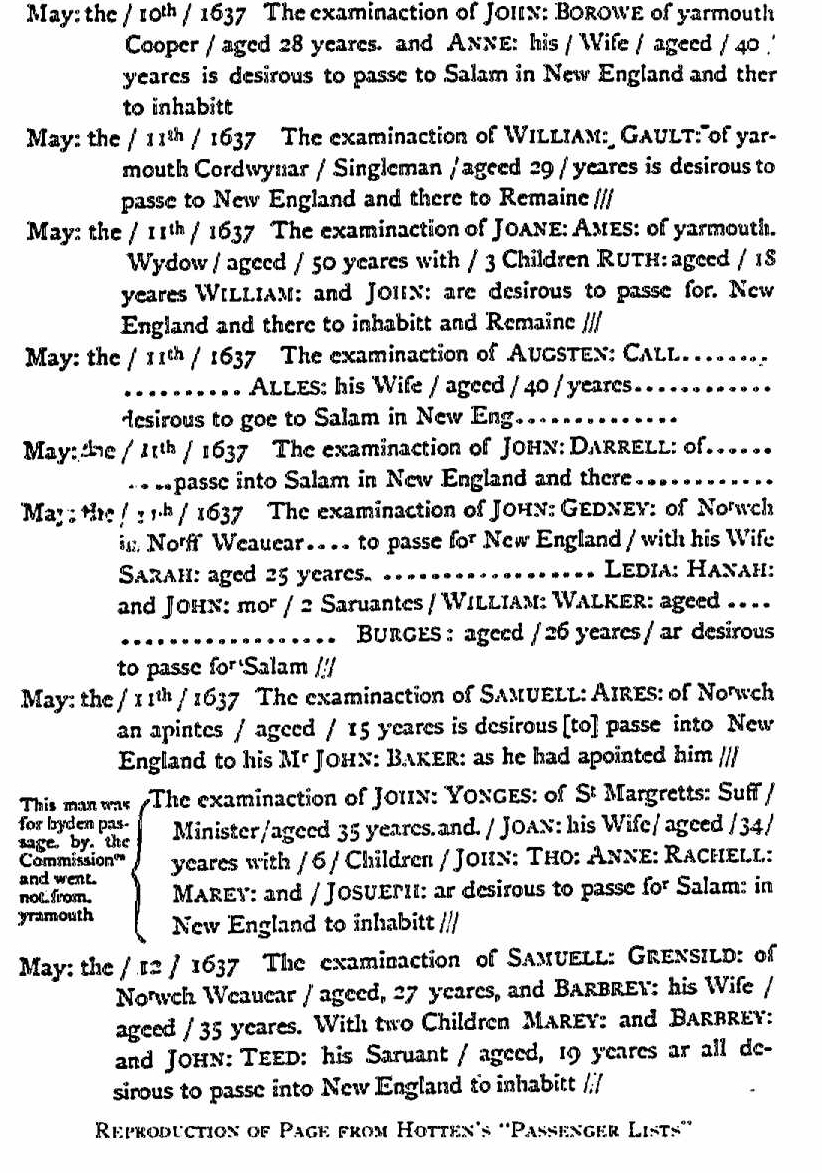
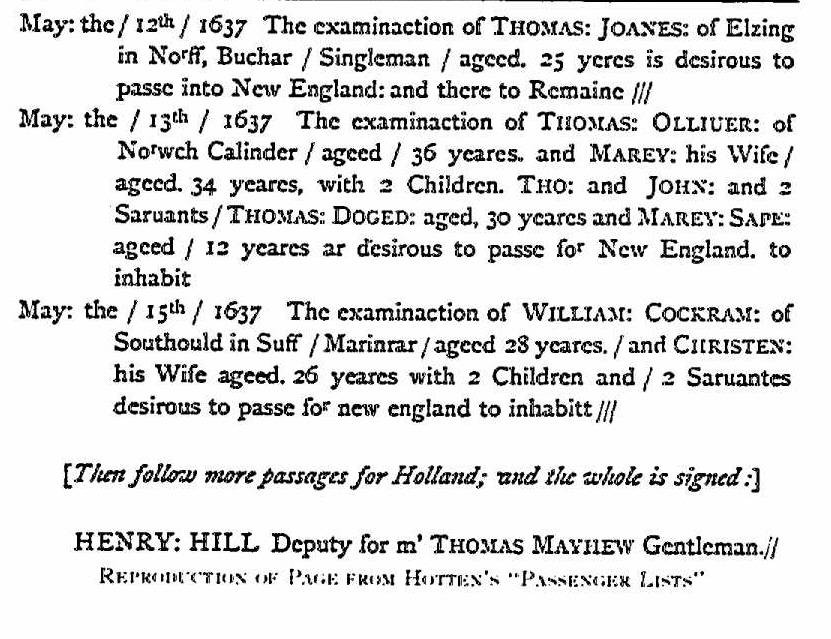
Edmund Hawes Bio --

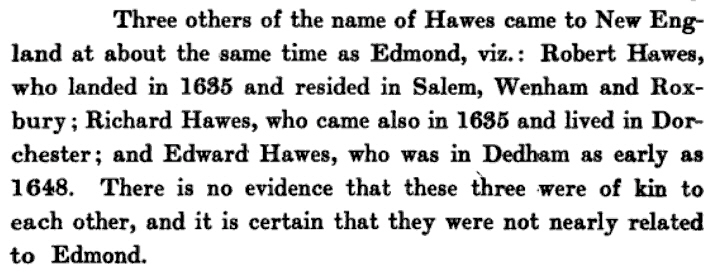
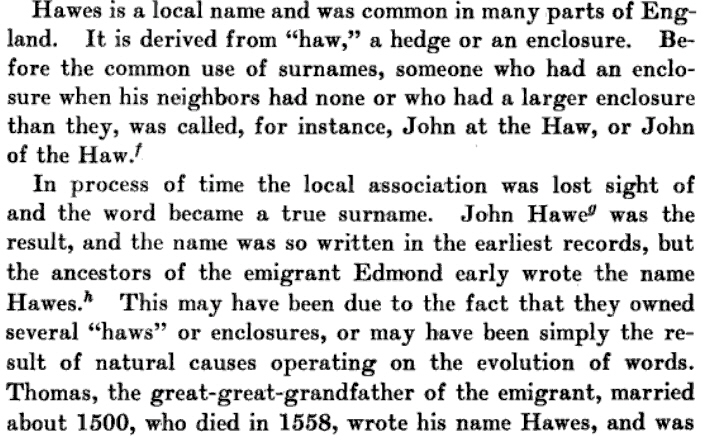
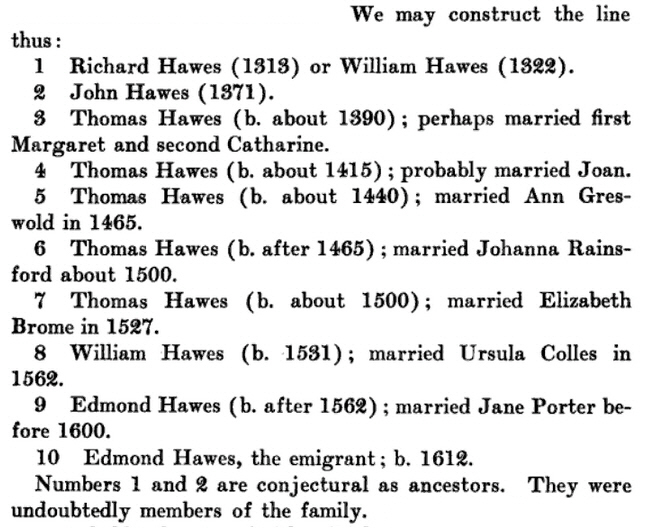
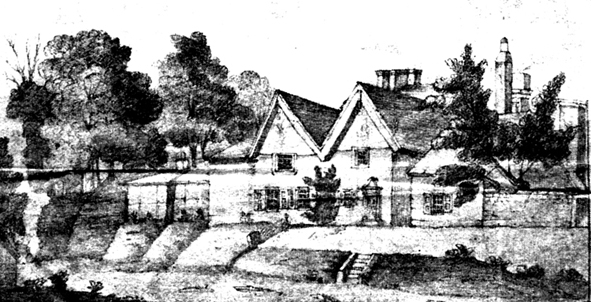
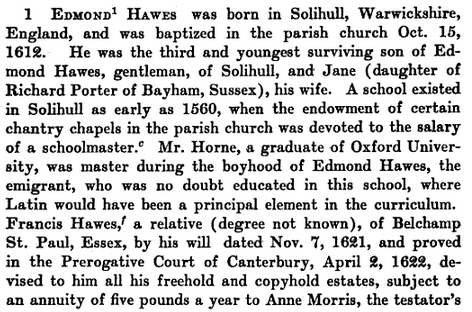
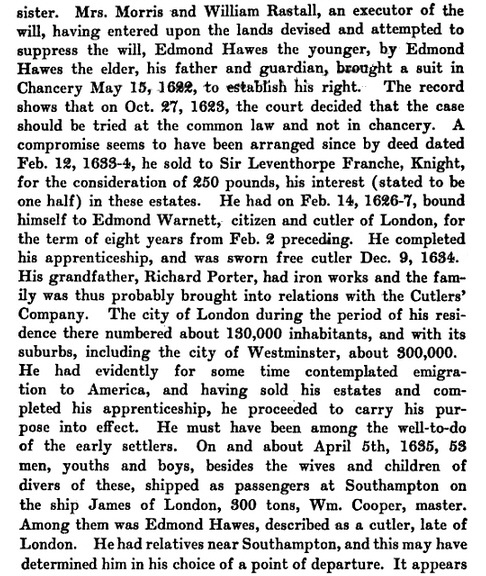
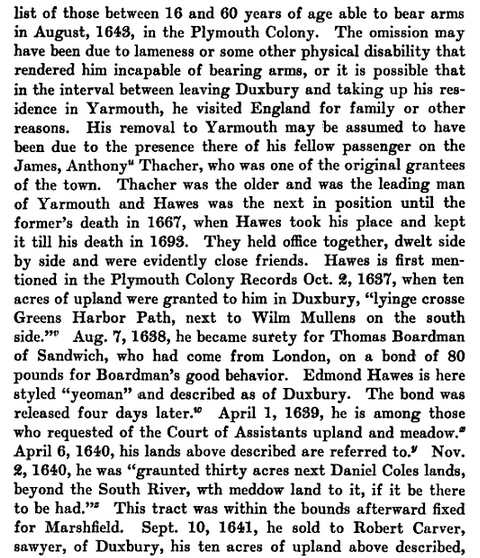
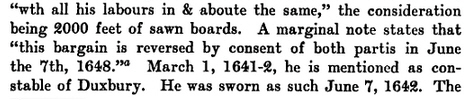
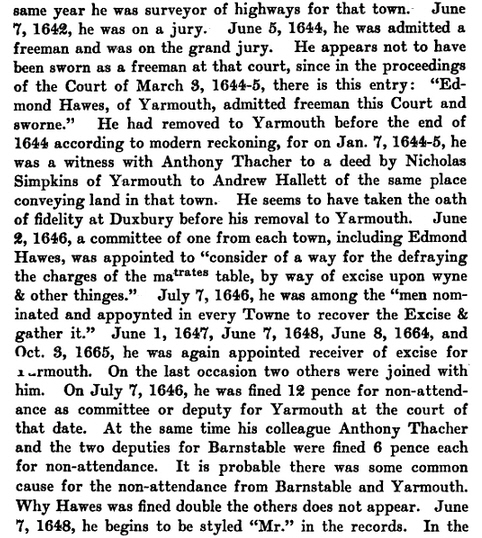
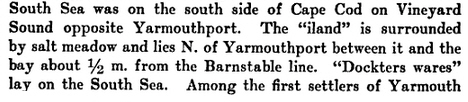
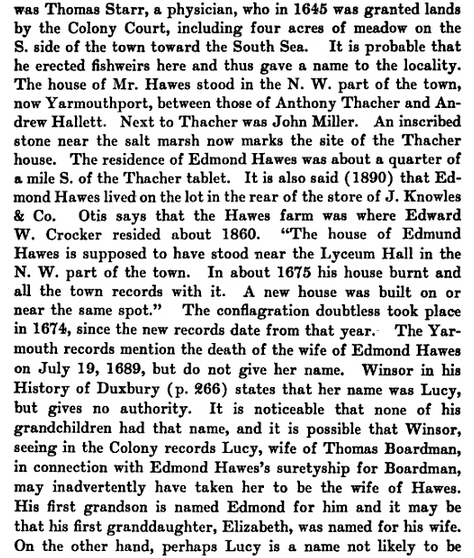
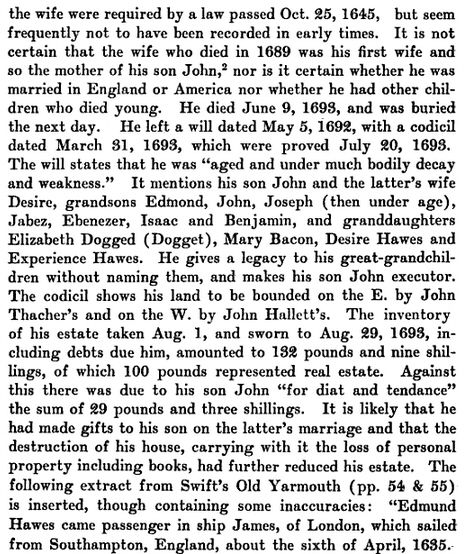
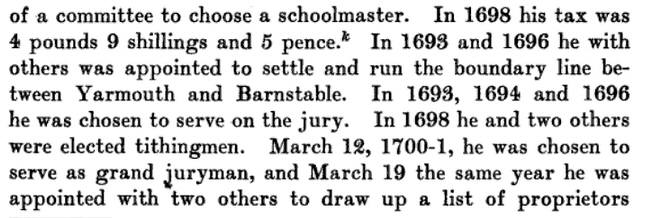
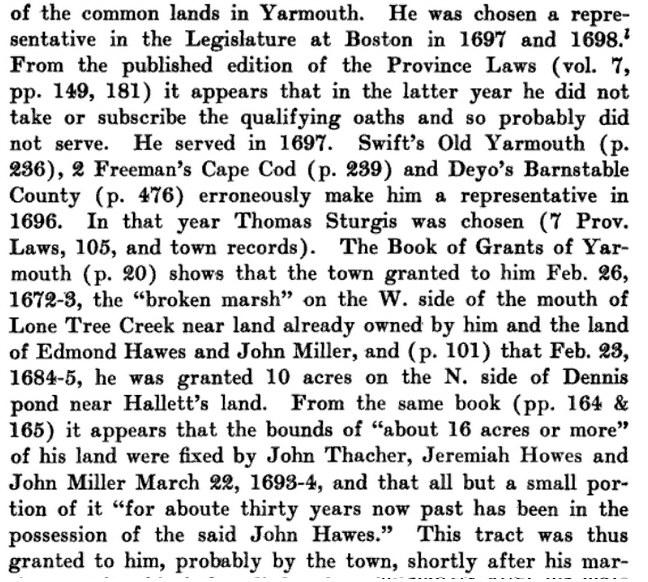
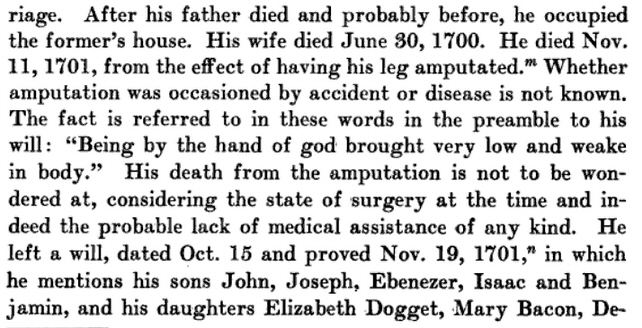
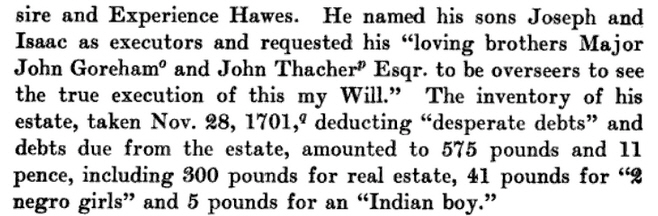
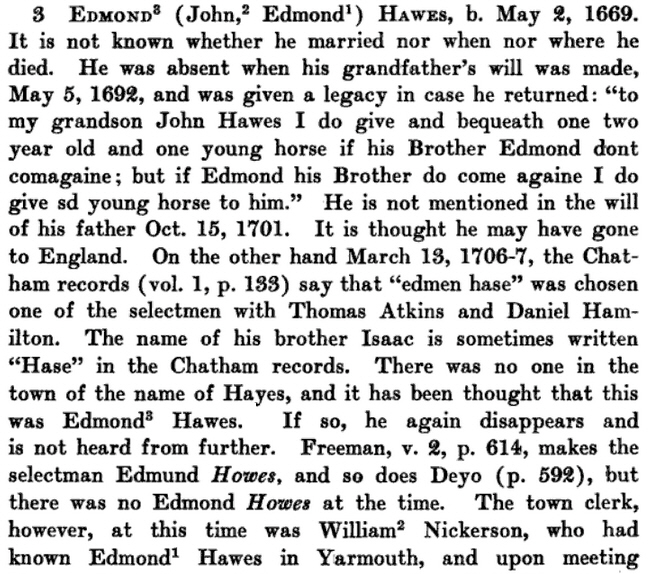
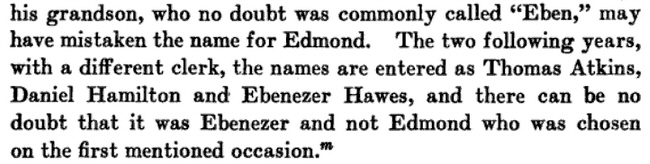
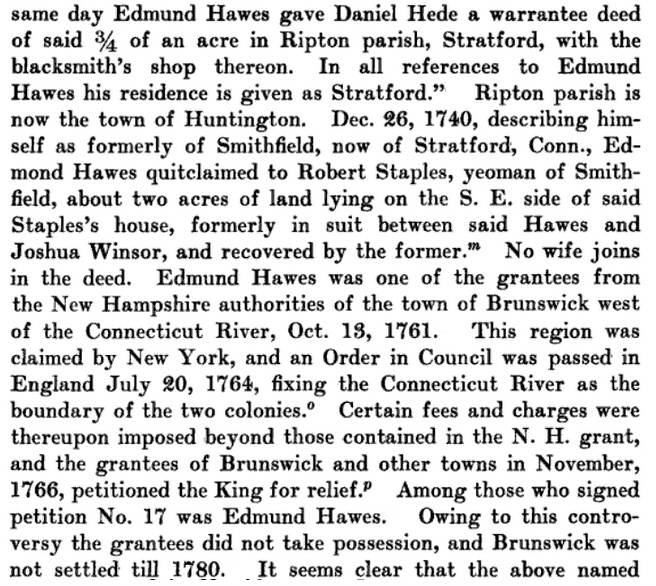
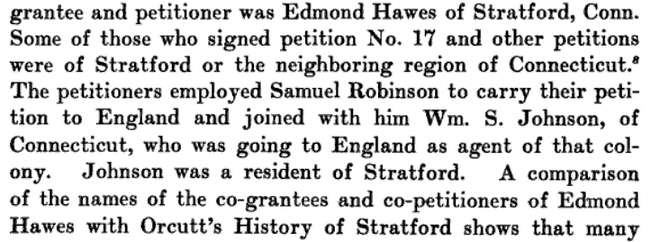
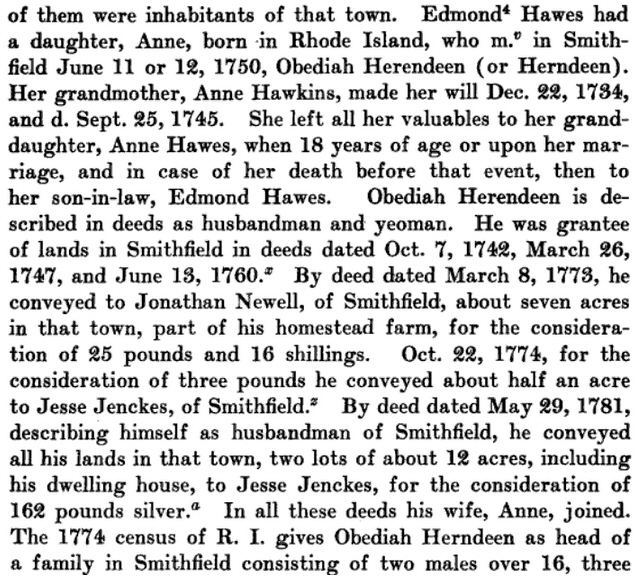
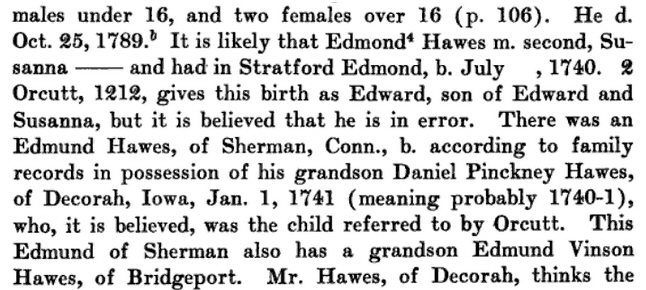
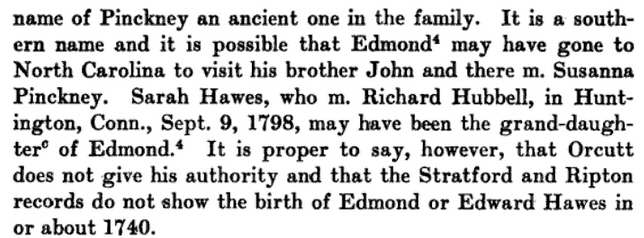
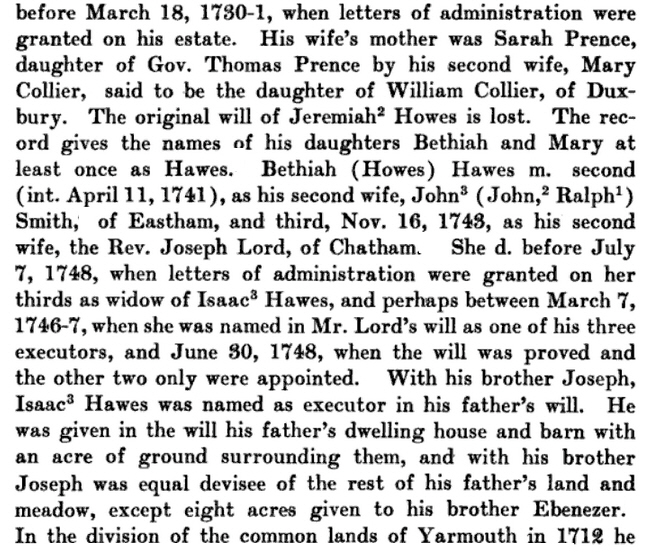
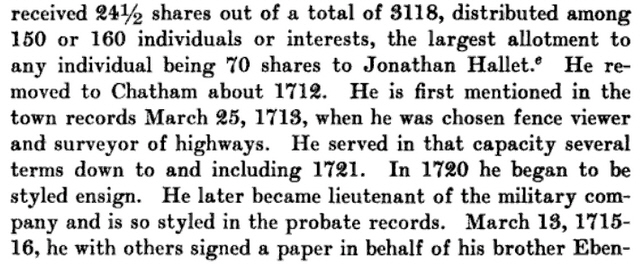
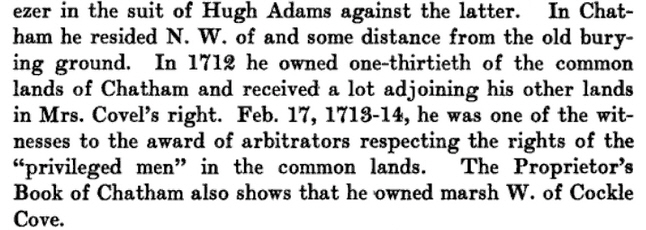
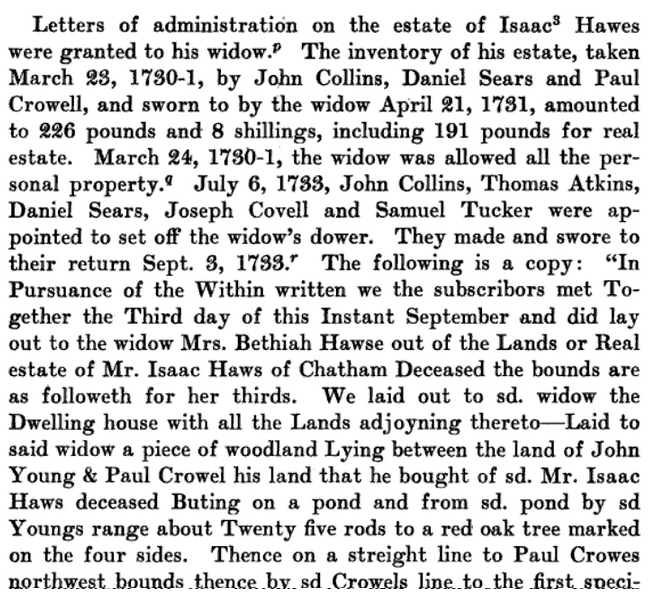
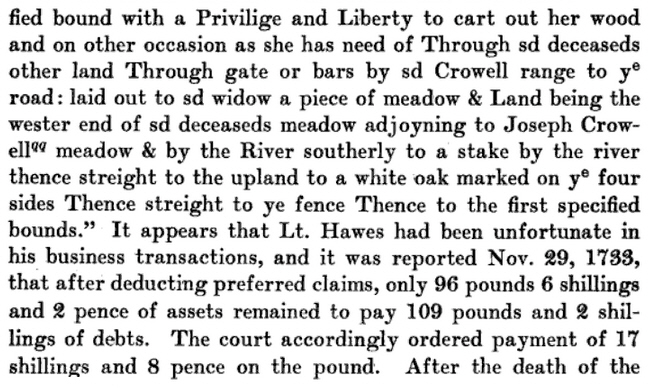
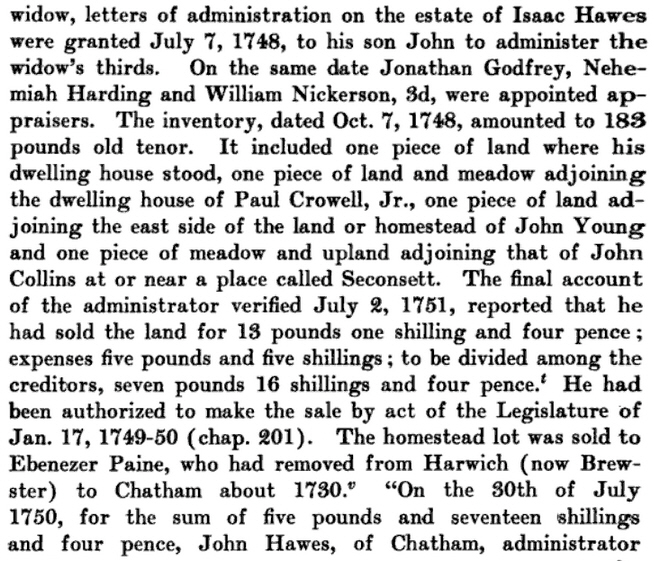
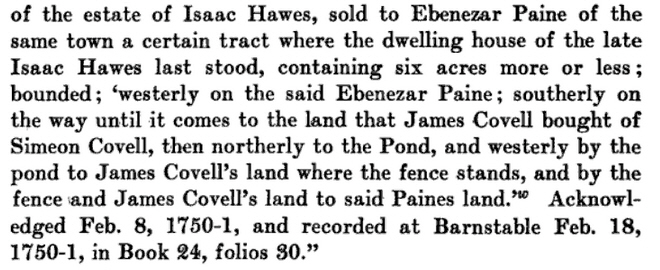
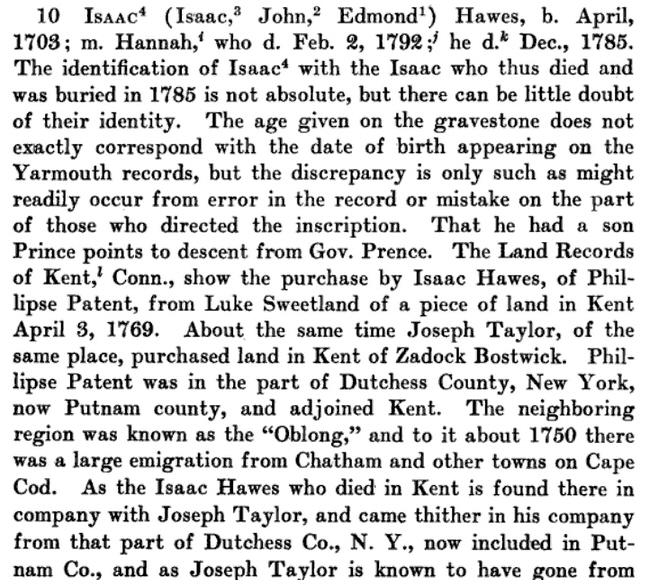
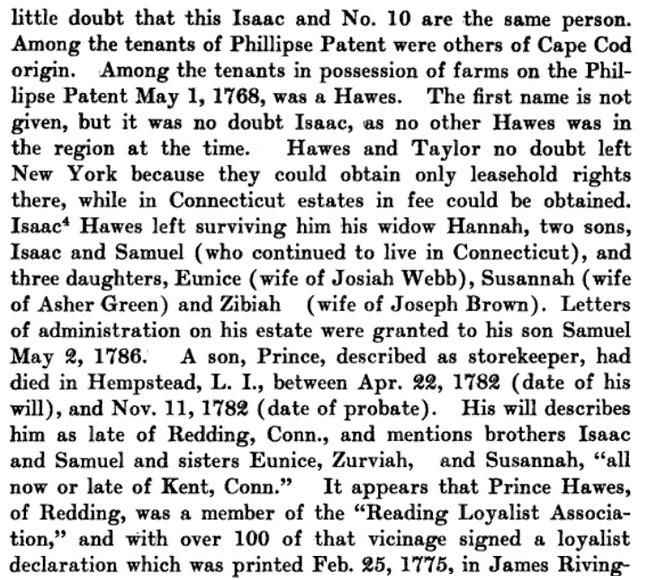
Edmund Hawes Bio — Edmond Hawes of Yarmouth, Massachusetts by By James William Hawes (1914)

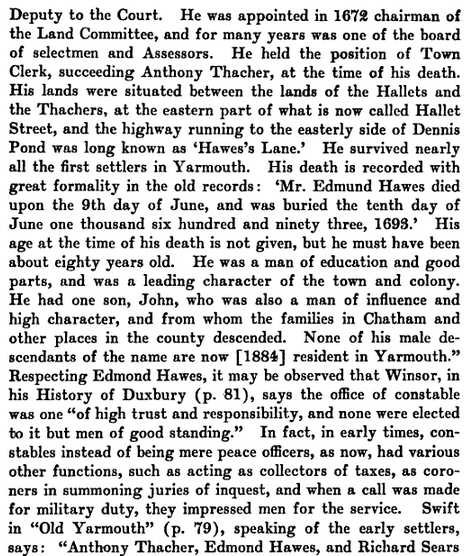
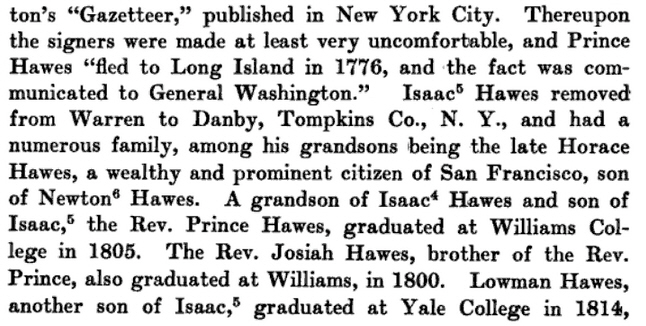
Edmund Hawes Bio 2
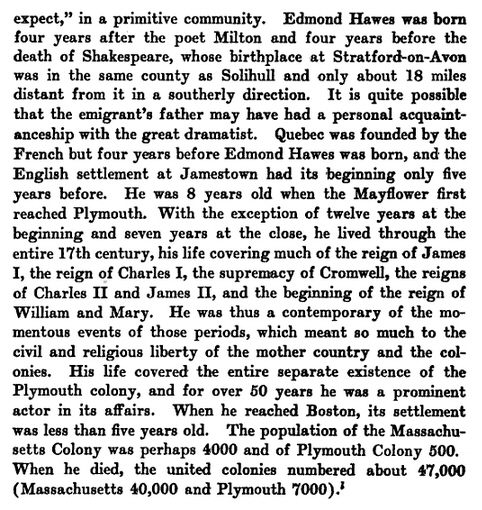
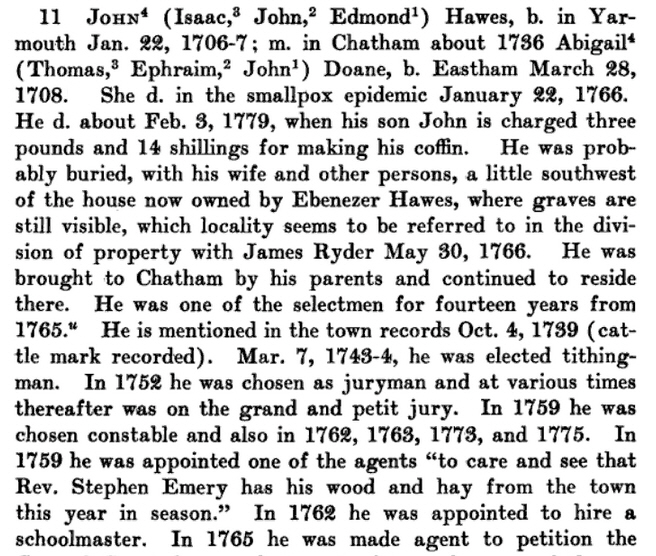
Edmund Hawes Bio 3a

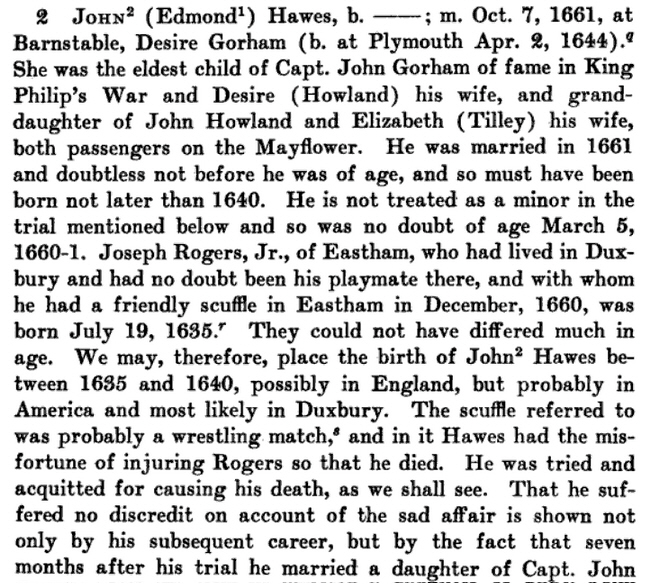
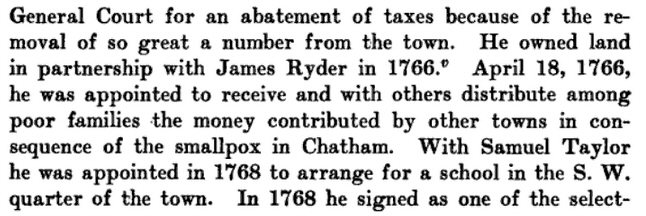
Edmund Hawes Bio 13a

See Edmund’s father’s page  Edmund HAWES Sr and Edmund’s grandfather’s page  William HAWES for details on these nine generations

Solihull School

Edmund attended the Solihull School. Founded in 1560, it is still a coeducational independent school situated near the centre of Solihull, West Midlands, England.

In 1560 the revenues of the chantry chapels of St Mary and St Katherine were diverted for the endowment of a school for boys. The revenue of the chapel of St Alphege was added to the fund six years later enhancing the capacity of the school. The education remained based in teachings of The Church and the desire to turn out ‘respectable, thoughtful, successful young gentlemen’.

The Charity Estate had been built up from gifts dating back to Richard II’s reign and the School could have been in existence prior to that date, but with no evidence of that being the case its foundation is generally accepted to have been 1560.

Originally, the Foundation provided for the maintenance of the Master of the Free Grammar School in Solihull.   In 1615, the School moved to a house in Park Road, later re-named Malvern House. It remained there until 1882.  In 1882, the School moved to its present 50-acre site.

The Grammar School (now Malvern House) drawn in about 1830 by John Burton, a boarder in the early 19th century

The Grammar School (now Malvern House) drawn in about 1830 by John Burton, a boarder in the early 19th century

It is believed that the site of the School was where Malvern House is currently situated – the corner of New Road and Park Road, just 100 yards from St. Alphege Church and overlooking Malvern Park.  It was to remain there until 1882.  As has been stated elsewhere the records whilst the School was under management of the Feoffees are very sparse.

1615 The School House was either built or rebuilt.   The Parish Bailiff’s accounts show –“XVIIli. XVIIs. IXd. (£22.90) towarde the repaire of the church, and the scholemaster’s wages; and more paid towarde the building of the scolehous XXVli. XIs. Id.” (£25.55).

In the 17th century it became a boarding school and the number of pupils grew. The school became more notable and well thought of due to the involvement of several prominent families. Much of this development came under the Headmastership of Rev. Richard Mashiter who, in 1735, was famously elected ahead of Dr Johnson, the celebrated author, essayist, and lexicographer. Johnson was passed over because the school’s directors thought he was “a very haughty, ill-natured gent., and that he has such a way of distorting his face (which though he can’t help) the gent[s] think it may affect some lads in the pursuit of learning”.

Worshipful Company of Cutlers 

24 Feb 1626/27 – Edmond bound himself to Edmund Warnett, citizen and cutler of London for the term of eight years starting from Feb 2.  He completed his apprenticeship and was sworn free cutler Dec 9 1634.  His grandfather Richard Proter had iron works and the family was thus brought into relations with the Cutlers’ Company.

The Worshipful Company of Cutlers is one of the ancient Livery Companies of the City of London. It ranks 18th in the order of precedence of the companies.

The trade of knife-making and repairing was formed in the 13th century as a guild; the Cutlers’ Company received its Royal Charter in 1416. The Company, like many other City Livery Companies, no longer has a strong connection with its trade, which for the most part relocated north to Sheffield, where a similar association, the Company of Cutlers in Hallamshire was established. The City Livery Company remains primarily as a charitable institution. The Company funds and administers a variety of educational initiatives such as scholarships and awards.

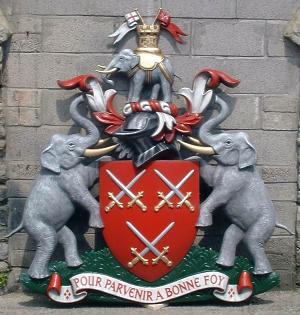
The Cutlers’ Company Arms have been in use since 1476. Its current Elephant and Castle crest was granted in 1622: this features two elephants and three crossed-swords, a helmet and a smaller elephant and castle.  The elephant probably relates to the ivory used in hafting swords, knives and other weapons – an expensive material employed for the best of implements. The elephant and castle crest gave rise to a pub of the same name on the site of an old cutlers’ inn at Newington, south London which in turn gave its name to the well-known area Elephant and Castle.

Worshipful Company of Cutlers

Worshipful Company of Cutlers

In England the cutlery industry became concentrated by the late 16th century in and around Birmingham and Sheffield. However, the Birmingham industry increasingly concentrated on swords, made by “long cutlers”, and on other edged tools, whereas the Sheffield industry concentrated on knives.

At Sheffield the trade of cutler became divided, with allied trades such as razormakerawlbladesmithshearsmith and forkmaker emerging and becoming distinct trades by the 18th century.

Before the mid 19th century when cheap mild steel became available due to new methods of steelmaking, knives (and other edged tools) were made by welding a strip of steel on to the piece of iron that was to be formed into a knife, or sandwiching a strip of steel between two pieces of iron. This was done because steel was then a much more expensive commodity than iron.

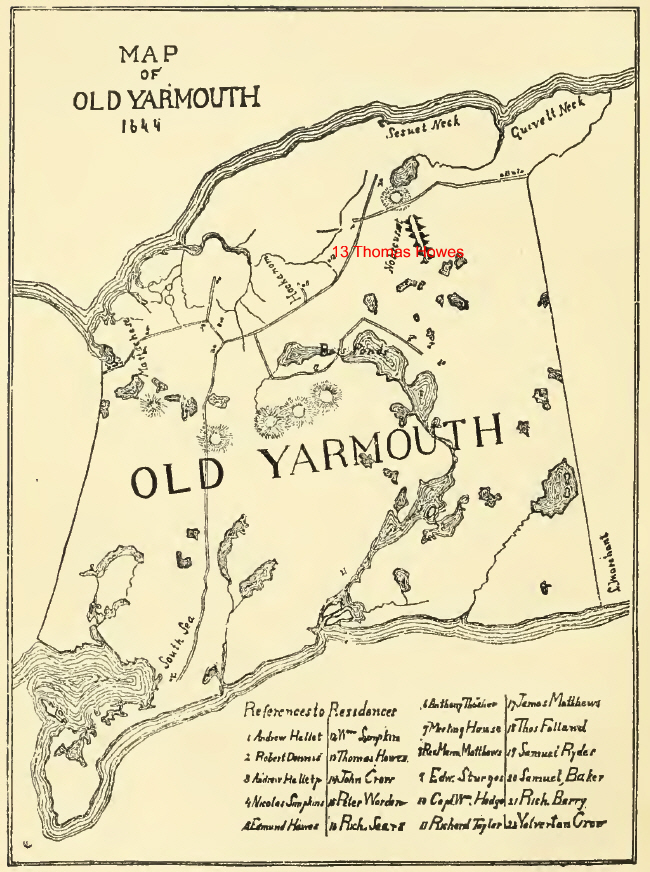
Map of Old Yarmouth 1644 – Our Ancestors 13 Thomas Howes, Edmund Hawes, 10 Edward Sturges and 9 William Hedges were pioneers in Yarmouh, Mass on Cape Cod. Unfortunately, I can’t quite make out the numbers on this map. Do you have better eyes?

Edmund Hawes  resided for some years at Duxbury before he came to Yarmouth. In 1645 he was an inhabitant of Yarmouth and a Deputy to the Court. He was appointed in 1672 chairman of the Land Committee, and for many years was one of the board of Selectmen and Assessors. He held the position of Town Clerk, succeeding to Anthony Thacher, at the time of his death. His lands were situated between the lands of the Hallets and the Thachers, at the eastern part of what is now called Hallet street, and the highway running to the easterly side of Dennis Pond was long known as “Hawes’s Lane.” [Today, all I can find in Yarmouth is Hawes Run Road near the mill pond.]  He survived nearly all the first settlers in Yarmouth. His death is recorded with great formality in the old records :

‘* Mr. Edmund Hawes died upon the 9th day of June, and was buried the tenth day of June one thousand six hundred and ninety and three, 1693.”

His age at the time of his death is not given, but he must have been about eighty years old. He was a man of education and good parts, and was a leading character of the town and colony. He had one son, John, who was also a man of influence and high character, and from whom the families in Chatham and other places in the County descended.

FIRST RESIDENCE: Duxbury.
REMOVES: Yarmouth 1643.

OCCUPATION: Cutler (in England) (on 14 February 1626[/27?], “Edmond Hawes, son
of Edmond Hawes of Solihull in the County of Warwick, gentleman,” was bound as
an apprentice in the Company of Cutlers [Edmond Hawes Gen 136, citing Company
of Cutlers, “Book of Apprentices’ Bindings, 1575-1626, p. 106”]; on 9 December
1634, “Edmund Hawes, the apprentice of Edmund Warnet sworn free cutler”
[Edmond Hawes Gen 137, citing Company of Cutlers, “Minute Book of the Court of
Assistants, 1602-1667, folio 285a”].

FREEMAN: In Duxbury section of 1639 Plymouth Colony oath of fidelity list
(name crossed out) [PCR 8:182]. Admitted freeman 3 March 1644/45 and then added
to the Yarmouth section of the 1639 Plymouth Colony list of freemen [PCR 2:80,
8:176]. In Yarmouth section of 1658, 29 May 1670 and 4 June 1689 Plymouth
Colony lists of freemen [PCR 5:276, 8:200, 206].

OFFICES:
Deputy for Yarmouth to Plymouth Colony General Court, 28 Oct 1645, 3 Mar 1645/46, 7 Jul 1646, 1 Jun 1647, 7 Jun 1648, 8 Jun 1649, 5 Jun 1651, 7 Jun 1653, 7 Mar 1653/54, 6 Jun 1654, 1 Aug 1654, 8 Jun 1655, 3 Jun 1656, 3 Jun 1657, 1 Jun 1658, 3 Oct 1659, 6 Jun 1660 (absent), 2 Oct 1660, 4 Jun 1661, 7 Jun 1665, 3 Jun 1674, 1 Jun 1675

Plymouth Colony auditor of accounts, 10 Jun 1658, 16 Jun 1664, 9 Jun 1665, 7 Jun 1674

Committee on excise, 2 Jun 1646, 7 Jul 1646, 1 Jun 1647, 7 Jun 1648, 8 Jun 1664, 3 Oct 1665

Commissioner for the Kennebec trade, 5 Mar 1655/56, 6 Oct 1659
Committee on purchase of Indian lands, 14 May 1658
Council of War, 2 Apr 1667, 29 Feb 1675/76
Petit jury, 7 Jun 1642, 6 Jun 1650
Grand jury, 5 Jun 1644
Duxbury constable, 1 Mar 1641/42, 7 Jun 1642
Yarmouth selectman, 6 Mar 1665/56, 5 Jun 1666, 5 Jun 1667, 3 Jun  1668, 7 Jun 1670,
5 Jun 1671, 5 Jun 1672, 3 June 1673, 3 Jun 1674, 1 Jun 1675, 7 Jun 1676, 5 Jun 1677, 3 Jun 1679, 1 Jun 1680, 7 Jun 1681, 6 June 1682, 6 Jun 1683, 2 Jun 1685
Constable, 7 Jun 1659

EDUCATION: Signed his will. His inventory included “a Bible and other books” valued at 10s.

ESTATE: On 2 October 1637, “ten acres of upland are granted to Edmond Hawes, lying cross Greens Harbor Path”. On 10 September 1641, “Edmond Hawes of Duxborrow” sold to “Robert CARVER [our ancestor] of the same, sawyer, … all those his ten acres of upland lying cross Green’s Harbor path” (annotated “This bargain is reversed by consent of both parties in June the 7th 1648”)

On 1 April 1639, “Edmond Howes, for upland & meadow,” was in a list of “such as requested lands this Court”

2 Nov 1640 –  “Edmond Hawes is granted thirty acres next Daniell Cole’s lands, beyond the South River, with meadow land to it, if it be there to be had” [PCR 1:165].

8 Jun 1649 –  “Mr. Edmound Hawes of Yarmouth” sold to “Mr. Thomas Burne [probably our ancestor Thomas BOURNE] of Marshfield a certain parcel of upland being in Marshfeild aforesaid lying on the north side of the South River estimated at about thirty acres”

14 May 1648 – As part of the resolution of land disputes at Yarmouth, “Mr. Hawes shall enjoy 8 acres of upland or thereabouts, in the West Field, which he bought of Goodman Chase,” and “Robert Dennis shall enjoy 12 acres of land which he bought of Peeter Worden, and 10 acres of Mr. Hawes, and 7 acres of Mr. Hallott, and 4 acres there given him by the town”

7 June 1665 – Granted a portion of “a certain tract of land at Mannamoiett” which had been purchased from the Indians

Cape Code Library of Local History and Genealogy, Vol I

Chatham, Barnstable, Mass

Chatham, Barnstable, Mass

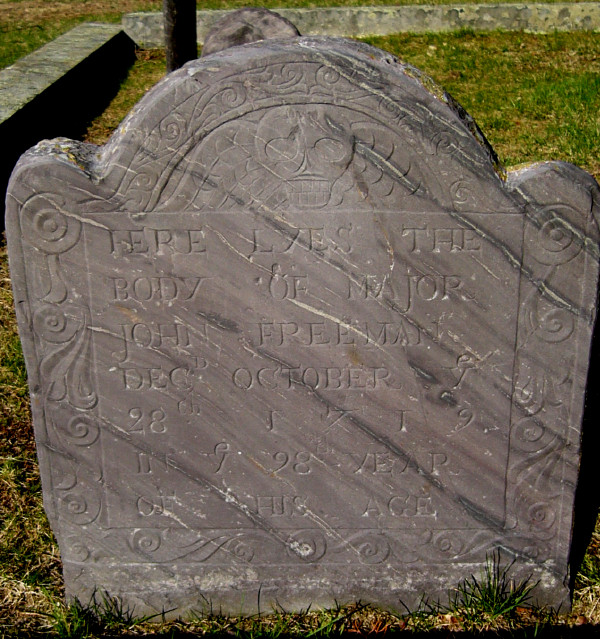
In 1665, to settle the difficulty at Monomoy, now Chatham between William Nickerson and the Colonial government respecting the illegal purchase of land of the Indian sachem there, Nickerson was allowed one hundred acres of the purchased land, and Major John FREEMAN, with Thomas Hinckley, William Sargeant, Anthony Thacher, Nathaniel Bacon, Edmund HAWES,  Thomas HOWES, Sr,  Thomas FOLLAND, Sr and Lt. Joseph Rogers was allowed a grantee of the remaining portion with the privilege with the above named to purchase adjacent land.

In 1672,  Major Freeman disposed of his right to William Nickerson; and in 1674 Major Freeman and  Capt. Jonathan SPARROW were appointed to lay out Nickerson’s land with instructions, but for some cause the work was not accomplished by the committee until 1692.

Native American tribes who lived in the Chatham before European colonization include the Nauset, specifically the Manomoy or Monomoy people. “Manamoyik” was a Nauset village located near present-day Chatham. Explorer Samuel de Champlain landed here in 1606, contacting (and skirmishing with) the Nauset. English settlers first settled in Chatham in 1665, and the town was incorporated in 1712, naming it after Chatham, Kent, England. Located at the “elbow” of Cape Cod, the community became a shipping, fishing, and whaling center. Chatham’s early prosperity would leave it with a considerable number of 18th century buildings, whose charm helped it develop into a popular summer resort.

1674 –  Mannamoit, after having been for years “within the liberties of Yarmouth,” together with Satucket, was included in the town of Eastham. The court appointed a committee “to do what they can tov/ards settling differences between Mashantampaine and the towns of Yarmouth and Barnstable.” By the burning of the house of the town clerk, Edmund Hawes, the public records up to this date were destroyed.

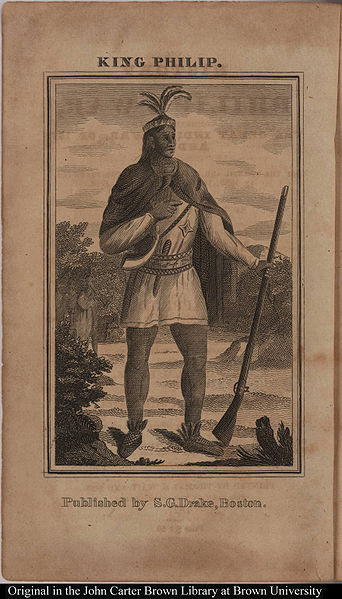
In King Philip’s War, Councils of War, for each town of the colony, were chosen by the court, Edmund HAWES, John Miller and Jeremiah HOWES constituting the members from Yarmouth.

A “Rate” made the year 1676, “towards the charges of the late war,” signed by Edmund HAWES, Samuel Rider and James Matthews, shows the names of the tax-payers of the town, and their comparative taxable property

In his will, dated 5 May 1692 and proved 20 July 1693,

“Edmond Hawes of Yarmouth” bequeathed to “my grandson Joseph HAWES six acres of my land … and also one-half of my island of sedge or creek thatch land which lies in the Lone Tree Creek …, also one acre of my meadow where his father shall see cause to lay it forth to him”; to “my natural son John HAWES all my uplands & meadows and broken marshes or creek thatch land wheresoever within the township of Yarmouth or elsewhere”; to “my loving daughter Desire Hawes the wife of my said son John Hawes,” moveables; to “my granddaughter Desire Hawes,” moveables; to “my granddaughter Elizabeth Dogged one cow”; to “my granddaughter Mary Bacon one cow”; to “my grandson Jabez Hawes one cow”; to “my grandson John Hawes … one two-year old and one young horse if his brother Edmond don’t come again, but if Edmond his brother do come again I do give said young horse to him”; to “my grandson Ebenezer Hawes … one yearling”; to “my two grandchildren Isaac and Benjamin … to each of them one calf”; to “my grandchild Experience … one sheep”; “the rest of my sheep my will is that my executor do divide them to my great-grandchildren in such proportions as he shall think fit”; to “John Hathaway of Yarmouth thirty shillings which he oweth to me by a bill I have of his hand”; “my well beloved son John Hawes to be sole executor”

A codicil of 31 March 1693 made an adjustment to the bequest to “my grandson Joseph Hawes” The inventory of the estate of “Mr. Edmond Haws of Yarmouth … deceased,” taken 1 August 1693, totalled £130 7s., of which £100 was real estate: “house, lands and meadows,” £100

COMMENTS: Pope states that this immigrant was of “Plymouth, proprietor 2 Oct.
1637” [Pope 221]. The date is that of a grant of land “lying cross Greens Harbor Path” [PCR 1:66]. This piece of land lay on the north side of Duxbury, toward the area that would later become Marshfield. There is no evidence that Edmond Hawes resided in Plymouth, and, although he owned land in Marshfield, there is no evidence that he ever resided there either.

The last record for Edmond Hawes in Duxbury was dated 7 June 1642 [PCR 2:40],
and the first record in Yarmouth was dated 3 March 1644/5 [PCR 2:80].
Interestingly, he does not appear in either town in the 1643 Plymouth Colony list of men able to bear arms. He may have been absent from Plymouth Colony during this period, or he may have been excused because of some disability. A third possibility is that his date of removal from one town to the other occurred very close to the time that the 1643 list was compiled, which may have led to his omission by both towns. With this in mind, we place his migration from Duxbury to Yarmouth in 1643.

On 7 August 1638, “Edmond Hawes, of Duxborrow, yeoman,” posted bond as security for Thomas Boardman of Sandwich [PCR 1:94]. (Some sources have given the name of the wife of Edmond Hawes as Lucy, but this is based on a misreading of the above record, which shows that as the name of the wife of Thomas Boardman.)

On 7 June 1648, “Mr. Edmond Haws presenting a parcel of weights to the Court, to be the standard for the weights of Yarmouth, the Court do allow them so to be” [PCR 2:126].

Edmund Hawes of Yarmouth, Massachusetts

Edmund Hawes Bio 65
Edmund Hawes Bio 66
Edmund Hawes Bio 67
Edmund Hawes Bio 68
Edmund Hawes Bio 69
Edmund Hawes Bio 70
Edmund Hawes Bio 71
Edmund Hawes Bio 72
Edmund Hawes Bio 73
Edmund Hawes Bio 74
Edmund Hawes Bio 75
Edmund Hawes Bio 76
Edmund Hawes Bio 77
Edmund Hawes Bio 78
Edmund Hawes Bio 79
Edmund Hawes Bio 80
Edmund Hawes Bio 81
Edmund Hawes Bio 82
Edmund Hawes Bio 83
Edmund Hawes Bio 84
Edmund Hawes Bio 85
Edmund Hawes Bio 86x

Sources:

http://trees.ancestry.com/owt/person.aspx?pid=12758806&st=1

Notes for Edmund Hawes

http://www.wheelerfolk.org/keithgen/d256.htm#P629

History of old Yarmouth. Comprising the present towns of Yarmouth and Dennis. From the settlement to the division in 1794 with the history of both towns to these times (1884) Author: Swift, Charles Francis

Edmond Hawes of Yarmouth, Massachusetts: an emigrant to America in 1635, his ancestors, including the allied families of Brome, Colles, Greswold, Porter, Rody, Shirley and Whitfield; and some of his descendants  By James William Hawes  1914   —
A genealogy of this  immigrant and his descendants, with extensive information on the English origin, including the apprenticeship in London, and with full transcripts of many important documents

Posted in 12th Generation, Immigrant - England, Immigrant Coat of Arms, Line - Shaw, Pioneer, Place Names, Public Office | Tagged , , | 14 Comments

Capt John Hawes

Capt. John HAWES (c. 1635 – 1701) was Alex’s 9th Great Grandfather two ways; one of 1,024 in this generation of the Shaw line through his son Joseph and one of 1, 024 in this generation of the Shaw line through his son Ebenezer.

John was born in Duxbury, Mass.   Because he was not treated as a minor (under 21 years of age) on 5 Mar 1660 when he was put on trial in Plymouth, MA court for the murder of his friend Joseph Rogers, he was probably born between 1635 when his father emigrated and 1640.   His parents were Edmund HAWES and  Lucy PENOCOT.  He married Desire GORHAM at  Barnstable, Cape Cod Plymouth Colony, on 7 Oct 1661.  He was appointed ensign of Yarmouth’s military Company and by 1700 was Captain,  He died at Yarmouth, Barnstable, MA, on 11 Nov 1701 after having his leg amputated or cut off.  The reason for the amputation is not known.

Desire Gorham was born at Plymouth  on 2 April 1644. She was the daughter of Capt. John GORHAM and Desire HOWLAND.  Her brother James GORHAM is also our ancester. She died at Yarmouth, Barnstable, MA, on 30 June 1700.  When the intestate estate of her father, Capt. John Gorham, was settled in March 1676/77, Desire was one of the married daughters who had already received 40 pounds but, if there should be an overplus, she and her married sisters were to share it equally with the other children. Desire also shared in the estate of her mother, Desire (Howland) Gorham in March 1683/84. Her husband was one of Desire Gorham’s sons-in-law who agreed that the children of Desire’s deceased sister, Elizabeth, should have their mother’s share. Desire Hawes died 30 Jun 1700.

Children of John and Desire all born in Yarmouth, Barnstable, MA.

Name Born Married Departed
1. Elizabeth Hawes 5 Oct 1662
Yarmouth
Thomas Daggett 22 Jan 1683 Bristol, RI 15 Feb 1733
Edgartown, Mass
2. Mary Hawes 10 Jun 1664
Yarmouth
John Bacon
17 Jun 1686 in Barnstable
5 Mar 1726
Barnstable, Mass
3. Edmund  Hawes 2 May 1669
Yarmouth
Eliony Lumber 1701
Yarmouth
4. John Hawes 14 May 1671
Yarmouth
Mary Edmund
14 May 1709 Providence, RI
.
Mary Mason
26 Nov 1723 in Rehoboth, Bristol, Mass
27 Dec 1723
Providence, Rhode Island
5. Joseph HAWES 16 Jul 1673
Yarmouth
Mary HOWES
at sea, before 1696
.
Berthia Hall
19 Mar 1730 Harwich, Mass
.
Sarah Howes
7 Jun 1746 Harwich
At sea,
16 Nov 1752
6. Jabez Hawes 20 May 1675
Yarmouth
15 Oct 1701
Yarmouth
7. Capt.
Ebenezer HAWES
28 Mar 1679
Yarmouth
Sarah NORTON Edgartown, Dukes, MA,
23 Feb 1700
7 Oct 1727 Yarmouth
8. Isaac Hawes 9 Mar 1680
Yarmouth
Bethia Howes (daughter of Jeremiah HOWES)
8 Jan 1701 Yarmouth
18 Mar 1731
Chatham, Mass
9. Desire Hawes 28 Feb 1681
Yarmouth
Josiah Hatch
24 Feb 1702 Yarmouth
.
John Cowing
19 Jun 1719 Rochester, Mass
8 Feb 1724
Provincetown, Mass
10. Benjamin Hawes 20 Mar 1682/83 Yarmouth Dorcas Smith
24 Jul 1705 Edgartown, Martha’s Vineyard, Mass
28 Nov 1722 Edgartown, Martha’s Vineyard, Mass
11. Experience Hawes 24 Sep 1686
Yarmouth
Lt. Ebenezer Sprout
1 Mar 1704 Yarmouth
.
Francis Miller
22 Nov 1731 in Middleboro, Mass
19 Nov 1758
Middleborough, Mass

Some references spell his last name “Haws.”

John Hawes was a cutler.  One who makes, repairs, or sells knives or other cutting instruments.

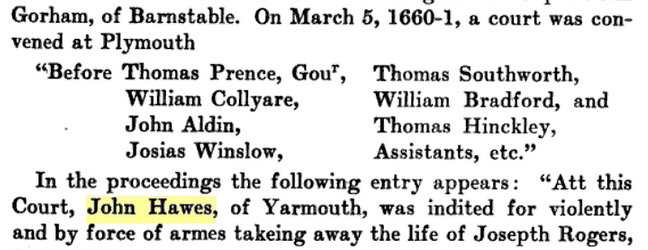
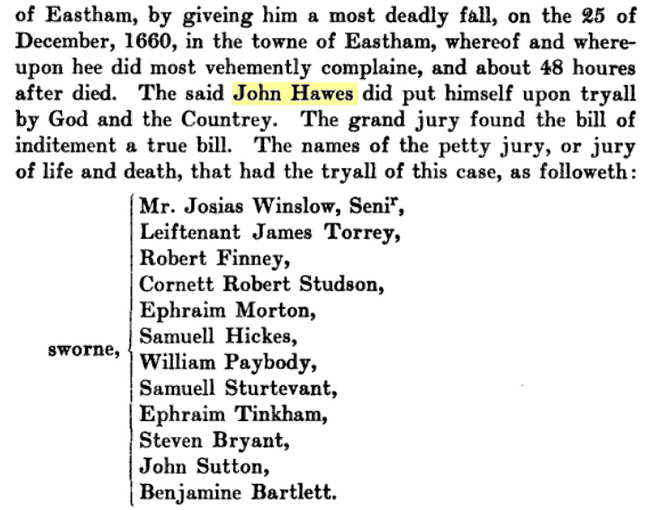
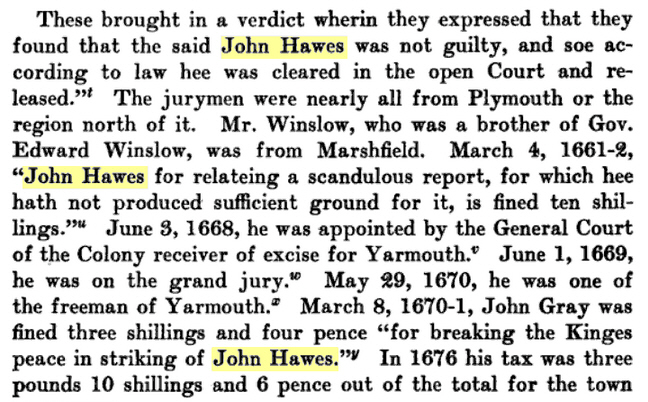
As a young man John Hawes was involved in an incident that caused the death of his friend Joseph Rogers of Eastham.  Both had grown up in Roxbury and they had probably known each other for years.  It seems that the two were engaged in a fight, possibly a wresting match, at Eastham, Massachusetts on 25 Dec 1660, in which Joseph Rogers died. A court was convened at Plymouth in the presence of Governor Thomas PRENCE, John Alden, William Bradford and others assistants. John Hawes was duly indicted by this group.  According to testimony the incident occurred when John Hawes had given Joseph Rogers (1638 – 1660) “a most deadly fall.”  Rogers died 48 hours later.  A jury of 12 men was chosen, nearly all from Plymouth or nearby.  John was is not treated as a minor in his trial.   He was acquitted at the trial of 5 Mar 1660/61.  These brought in a verdict wherin they expressed that they found that the said John Hawes was not guilty, and soe according to law hee was cleared in the open Court and released.’

According to Court records,

“John Hawes was found not guilty of “takeing away the life of Joseph Rogers of Eastham by giveing him a most deadly fall, on the 25 of December 1660 . . . whereof he . . . about 48 hours after died”..

Hawes says, ‘That he suffered no discredit on account of the sad affair is shown not only by his subsequent career, but by the fact that seven months after his trial he married a daughter of Capt. John Gorham, of Barnstable.’  on 7 Oct 1661.

On 4 Mar 1661/62 John Hawes was fined 10 shillings for “relating a scandalous report, for which he hath not produced sufficient ground for it.”

In 1668 he was appointed by the General Court of the Colony as receiver of excise for Yarmouth.  In 1669 he was on the grand jury and on 29 May 1670 he was made a freeman of the colony.

He was involved in another fight soon after this because John Gray was fined 3 shillings and 4 pence on 8 Mar 1670/71 for “breaking the King’s peace in striking John Hawes.

On 26 Feb 1672/73 the town of Yarmouth granted him the “broken Marsh” on the west side of the mouth of Lone Tree Creek near land already owned by him and the land of Edmond HAWES and John Miller.  On 23 Feb 1684/85, he was granted 10 acres on the north side of Dennis Pond near Hallett’s land.

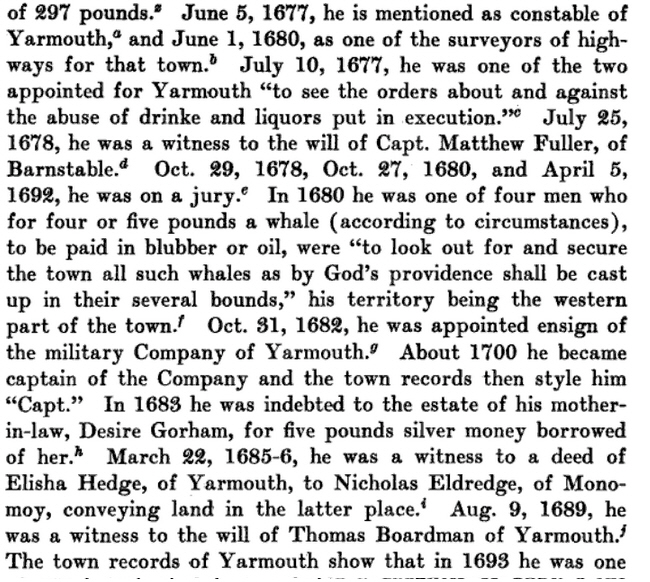
In 1676 his tax was 3 pounds, 10 shillings and 6 pence out of the total for the town total of 297 pounds.  In 1677 he was constable of Yarmouth and in 1680 he was one of the surveyors of highways for that town.  On 10 Jul 1677 he was one of the two appointed for Yarmouth “to see the orders about and against the abuse of drink and liquors put in execution.”

It would seem that the beaching of whales was taking place in colonial times.  In 1680 John Hawes was one of four men who were “to look out for and secure for the town all such whales as by God’s providence shall be cast up in their several bounds.”  His territory was the western part of the town.  He was paid 4-5 pounds for each whale payable in blubber or whale oil.

On 31 Oct 1682, he was appointed ensign of the military Company of Yarmouth and about 1700 he was promoted to Captain of the Company. There was not evidence that he ever needed to lead these troops in wartime.

When his father died in 1693, John Hawes, an only child, inherited all of his land and possessions.  At this time and perhaps earlier he occupied his father’s house.  In 1693 he was on a committee to choose a schoolmaster and in 1693 and 1696 he was appointed to settle and survey the boundary line between Yarmouth and Barnstable.   His tax in 1698 was 4 pounds, 9 shillings and 5 pence.  In 1694 the boundaries of about 16 acres or more, most of which he had owned for about 30 years, were fixed by John Thacher, Jeremiah HOWES  and John Miller.  This tract was granted to him by the town shortly after his marriage.

After the merger of Plymouth and Massachusetts Bay Colonies, John Hawes was chosen a representative in the Legislature at Boston in 1697 and 1698, but he may not have served the second term.

John performed many of the civic duties that his father had done: juryman, constable, receiver of excise, surveyor of highways, and so on. “In 1680 he was one of four men who for four or five pounds a whale (according to circumstances), to be paid in blubber or oil, were ‘to look out for and secure the town all such whales as by God’s providence shall be cast up in their several bounds,’ his territory being the western part of the town.”

He was appointed ensign of Yarmouth’s military Company and by 1700 was Captain. The town records show that he was a member of a committee to choose a schoolmaster in 1693. He was a representative in the Legislature at Boston in 1698.

On 31 Oct 1682, John was appointed an Ensign of the Yarmouth military company. About 1700 he became captain of the company and was called that thereafter. John was the Barnstable town treasurer from 1695 to 1698. He was chosen a representative in the Legislature at Boston in 1697 and 1698. He died in Barnstable 11 Nov 1701, from the effect of having his leg amputated. The record does not indicate whether or not it was because of an accident or disease.

Notes from John Howland of the Mayflower, Vol. 1:

John Hawes was a cutler. He served as a representative to the General Court for two years, starting in 1696 [Charles F. Swift, History of Old Yarmouth (1884), 247]. According to Col. John Gorham’s Wast Book,” Capt. John Hawes of Yarmouth, “having his Leg Cut of Dyed with it.” [Mayflower Descendant, 2:207]

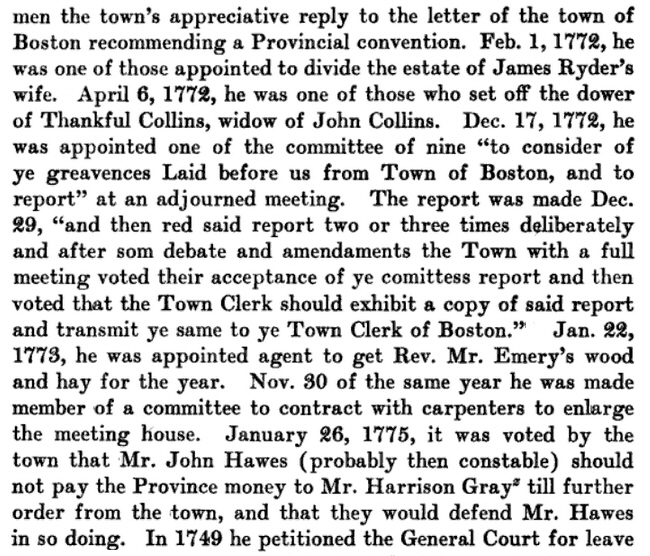
John Hawes Bio From

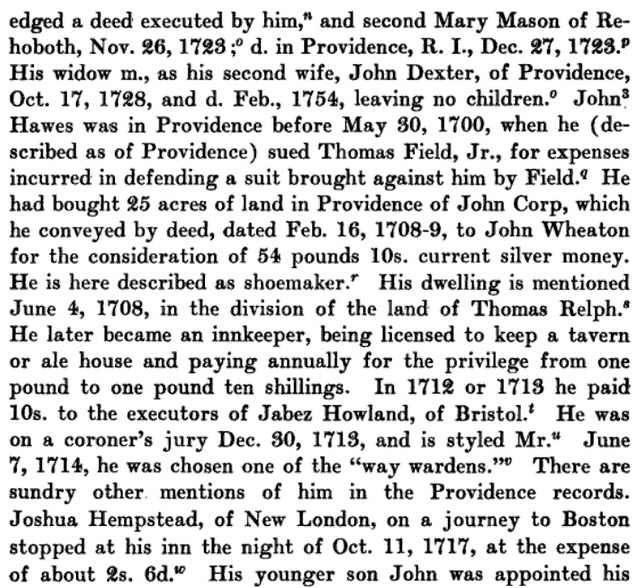
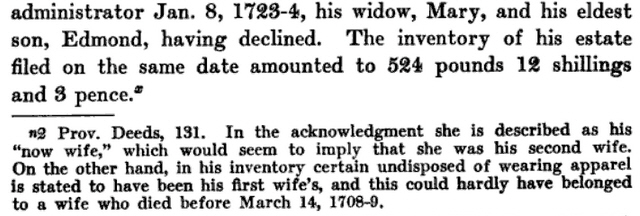
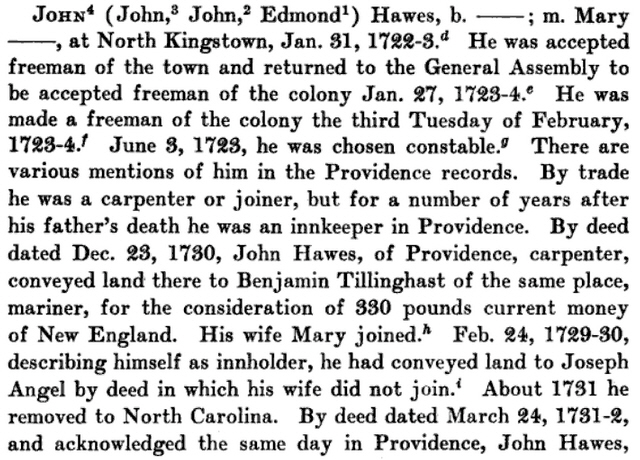
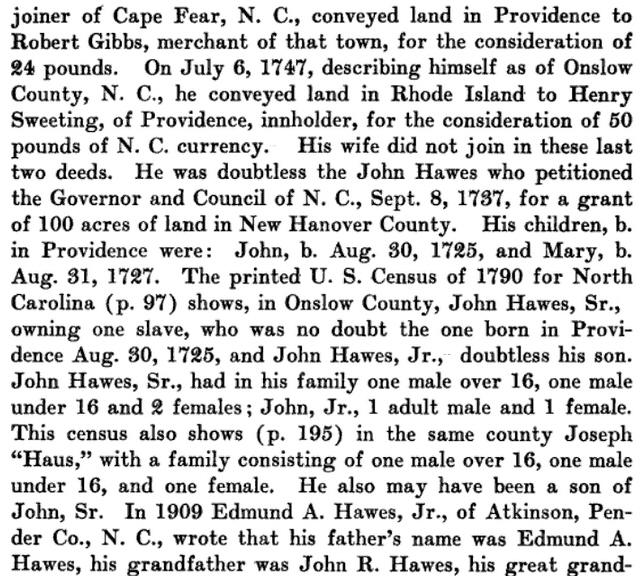
John Hawes Bio — From Edmond Hawes of Yarmouth, Massachusetts: 1914

John Hawes Bio 2
John Hawes Bio 3
John Hawes Bio 4
John Hawes Bio 5
John Hawes Bio 6
John Hawes Bio 7
John Hawes Bio 8
John Hawes Bio 9

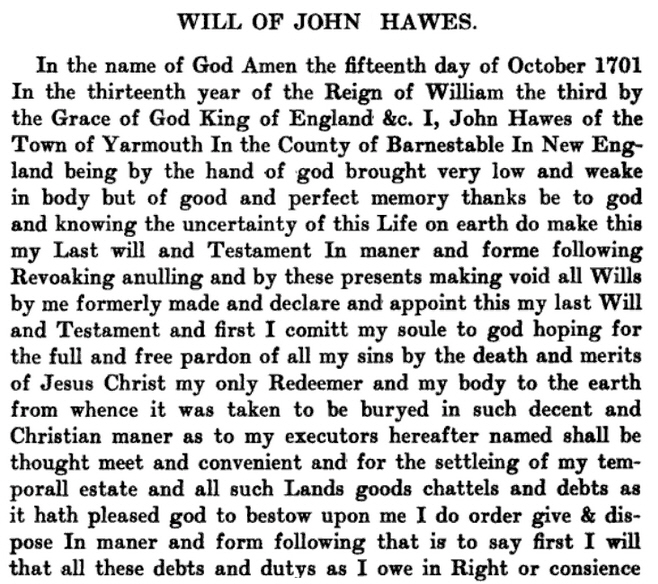
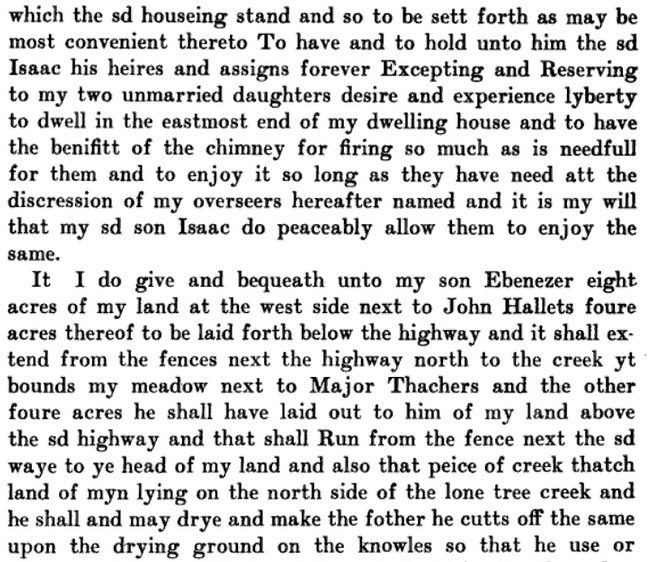
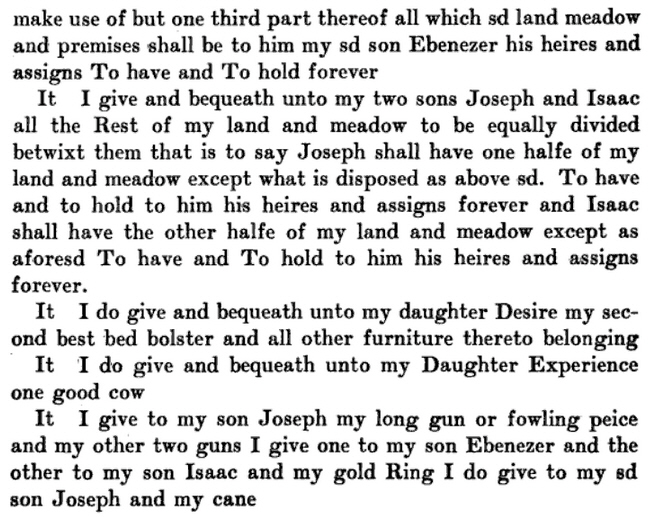
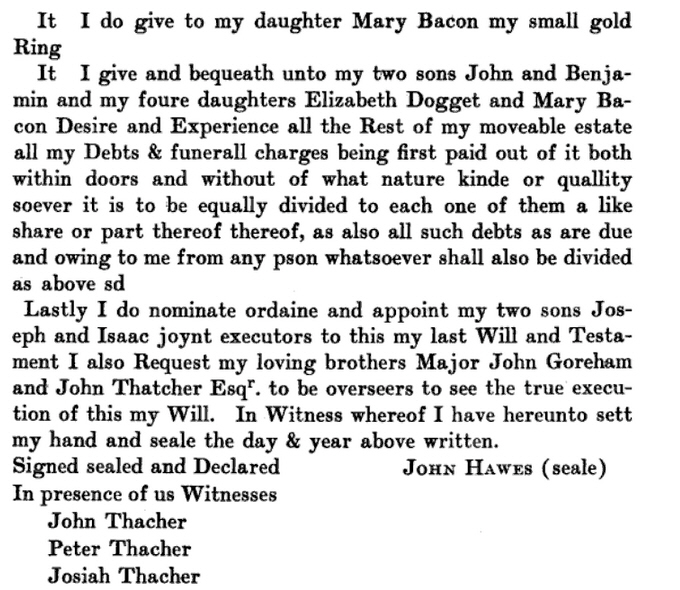
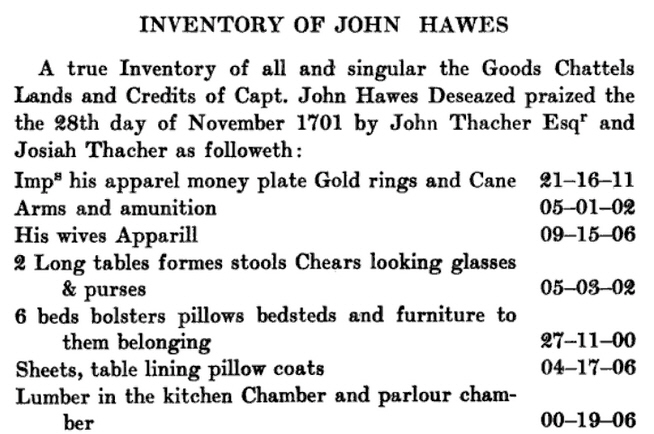
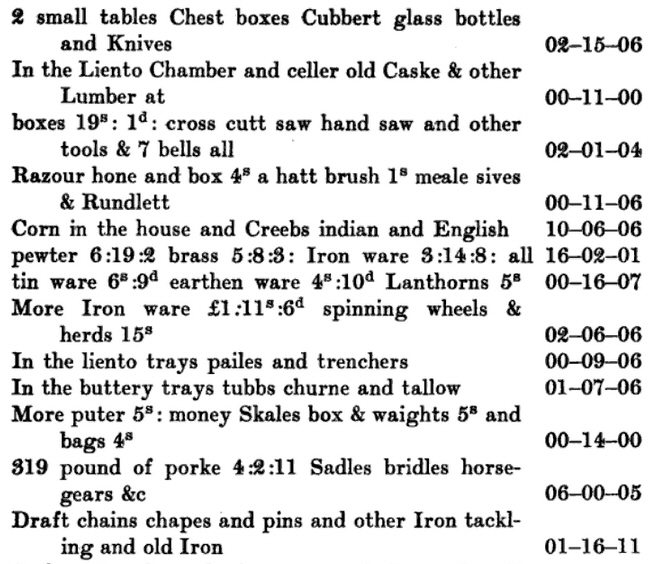
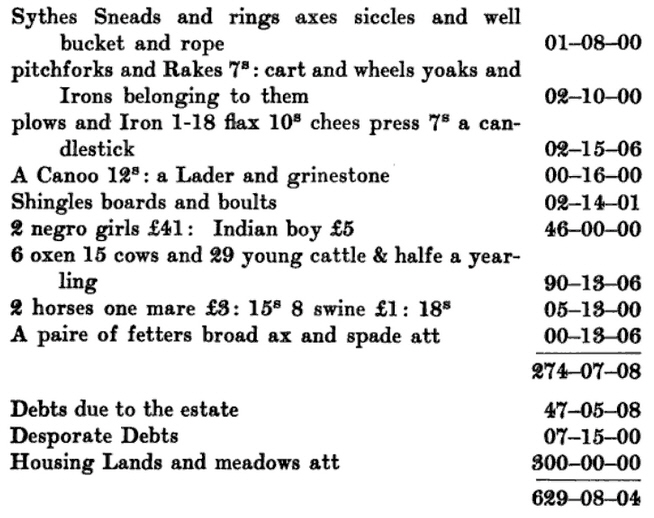
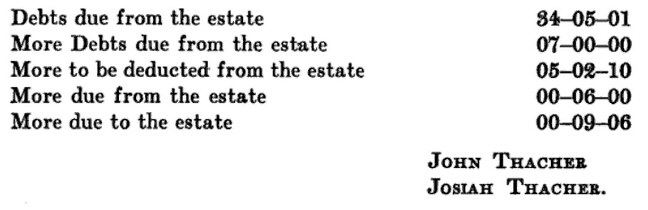
The will of John Hawes dated 15 Oct and proved 19 Nov 1701 reflected his large family.  He mentions his sons John, Joseph, Ebenezer, Isaac and Benjamin and his daughters Elizabeth Dogget, Mary Bacon, Desire and Experience Hawes.  His sons Joseph and Issaac were executors.  His ‘brothers” Major John Goreham and John Thacher Esqr. were overseers.  The inventory of his estate, after deducting debts, was 574 pounds and 11 pence, including 300 pounds for real estate, 41 pounds for “2 negro girls,” and 5 pounds for an “Indian boy.”  Sons Joseph and Isaac were appointed executors.

Witnesses were John, Peter and Josiah Thacher. The inventory, taken 25 Nov 25, 1701 amounted to L629-8-4.  A typical estate of the time of an independent farmer was about 150 pounds, so John was a comparatively rich man.  Major John GORHAM and John Thacher, Esq., were named overseers of the will.

His son Isaac received his dwelling house and barn along with one acre of land and he was directed to allow his unmarried daughters Desire and Experience freedom to dwell in the eastern most end of the house and have use of the chimney.  His son Ebenezer received 8 acres of land, 4 acres adjacent to John Hallet and Major Thacher.  The other four were to be in the land above the highway.  He also received part of his creek thatch land.  All the rest of his land and meadow was to be equally divided between his sons Joseph and Isaac.  He distributed his guns to sons Ebenezer and Isaac.  His gold ring and cane went to Joseph.  Mary Bacon received a small gold ring. The rest of his movable estate went to sons John and Benjamin and his four daughters.

John Hawes Bio 14John Hawes Bio 15
John Hawes Bio 16
John Hawes Bio 17
John Hawes Bio 18
John Hawes Bio 19
John Hawes Bio 20
John Hawes Bio 21
John Hawes Bio 22

Children

1. Elizabeth Hawes

Elizabeth’s husband Thomas Daggett was born 1658 in Edgartown, Dukes, Mass. His parents were Thomas Daggett and Hannah Mayhew. Thomas died 25 Aug 1726 in Edgartown, Dukes, Mass.

Children of Elizabeth and Thomas:

i.

2. Mary Hawes

Mary’s husband John Bacon was born Jun 1661 in Barnstable, Barnstable, Mass. His parents were Nathaniel Bacon and Hannah Mayo. After Sarah died 5 Mar 1726, he married 28 Sep 1726 in Plymouth, Plymouth, Mass to Sarah Doty (b. 9 Jun 1666   Plymouth  – d. 16 Aug 1749 Plymouth) John died 20 Aug 1731 in Barnstable, Mass.

John Bacon was a lawyer.  He became a judge on the Court of Common Pleas and held other offices.

3. Edmund Hawes

Edmund’s wife Eliony Lumber was born in 1670. There is no further information about her, though Lumber is a valid surname found in Somerset

John Hawes Bio 23
John Hawes Bio 24

4. John Hawes

John’s first wife Mary Edmund was born 1687 in Providence, Providence, Rhode Island. Mary died 26 Nov 1723.

John’s second wife Mary Mason was born 12 Dec 1682 in Rehoboth, Bristol, Mass. Her parents were Noah Mason and Sarah Fitch. After John died, she married 17 Aug 1728 in Rehoboth, Bristol, Mass. to John Dexter (b. 1673 in Providence, Providence, Rhode Island – d. 22 Apr 1734 in Providence) Mary died 1754 in Providence, Rhode Island.

John Hawes Bio 25
John Hawes Bio 26
John Hawes Bio 27

Children of John and Mary Edmund

i. Edmund Hawes b. 1702 in Yarmouth, Plymouth, Mass; m1. 8 May 1722 in Providence, Rhode Island to Mary Hawkins (b. 11 Dec 1690 in Providence, Providence, Rhode Island – d.  btw. 6 Mar 1733 and 14 Sep 1733)  Mary’s parents were Edward Hawkins and Anne [__?__].  Edmund and Mary had three children born between 1723 and 1727.

m2. 1738 to Susanna Pinckney of North Carolina.   Edmund and Susanna had one child Edmund (b. 1740)

John Hawes Bio 28
John Hawes Bio 29
John Hawes Bio 30
John Hawes Bio 31
John Hawes Bio 32
John Hawes Bio 33
John Hawes Bio 34
John Hawes Bio 35
John Hawes Bio 36

ii. John Hawes b. ~1704 in Rhode Island; m. 31 Jan 1723 in North Kingston, Washington, Rhode Island to Mary [__?__] John and Mary had three children born between 1725 and 1730

John Hawes Bio 37
John Hawes Bio 38
John Hawes Bio 39

5. Joseph HAWES (See his page)

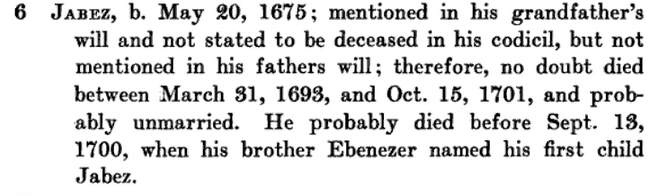
6. Jabez Hawes

John Hawes Bio 10

7. Capt. Ebenezer HAWES (See his page)

8. Isaac Hawes

Isaac’s wife Bethia Howes was born in 1680 in Yarmouth, Mass. Her parents were our ancestors Jeremiah HOWES and Sarah PRENCE. . After Isaac died, she married after 11 Apr 1741 to John Smith and then 16 Nov 1743 in Harwich, Mass to Rev Joseph Lord of Chatham Bethia died 7 Jul 1748 in Chatham, Barnstable, Mass.

John Hawes Bio 40
John Hawes Bio 41
John Hawes Bio 42
John Hawes Bio 43
John Hawes Bio 44
John Hawes Bio 45
John Hawes Bio 46
John Hawes Bio 47

Children of Isaac and Bethia:

i.  Bethia Hawes b. Jul 1701 Yarmouth, Barnstable, Mass; m. 1721 in Chatham, Barnstable, Mass to Maziah Harding (b. 1692 in Chatham – d 31 Mar 1760 in Chatham) Maziah’s parents were Joseph Harding (1667 – 1745) and Dinah Hedges (1663 – 1739). Bethia and Maziah had twelve children born between 1723 and 1742.

m2. 26 Dec 1763 in Chatham to Thomas Nickerson (b. 24 Dec 1696 in Chatham – d. d: 1766 in Barnstable) His parents were Thomas Nickerson Sr.. (1670 – 1736) and Mary Bangs (1671 -1745) Thomas first married 16 May 1716 in Chatham to Lydia Covell (1701 – 1750) and had five children born between 1718 and 1729.

ii. Isaac Hawes b. 1703 Yarmouth, Barnstable, Mass; d. Dec 1785 Warren, Mass; m. 1738 in Chatham to Hannah Tucker (b. Sep 1714 in Chatham, Barnstable, Mass. – d. 2 Feb 1792 in Warren, CT) Hannah’s parents were Samuel Tucker (1683 1765) and Hannah Mayo (1686 – 1765) Isaac and Hannah had six children born between 1740 and 1760.

John Hawes Bio 52
John Hawes Bio 53
John Hawes Bio 54
John Hawes Bio 55
John Hawes Bio 56

iii Thankful Hawes b Mar 1705 Yarmouth, Barnstable, Mass; m. 6 Mar 1724 to Moses Young (b. 15 Nov 1702 in Eastham, Barnstable, Mass. – d. 24 Sep 1725 in Plymouth, Mass) Moses’ parents were Henry Young (1672 – 1706) and Sarah Snow (1673 – 1746)

iv. John Hawes b. 22 Jan 1707 Yarmouth, Barnstable, Mass; d. 3 Feb 1779 Chatham, Barnstable, Mass; m. 1735 in Chatham to Abigail Doane (b. 28 Mar 1708 in Eastham, Barnstable, Mass. – d. 22 Jan 1766 in Chatham) Abigail’s parents were Thomas Doane (1674 – 1756) and Patience Mulford (1674 – 1744 )John and Abigail had one child Bethia (b. 1742)

John Hawes Bio 57
John Hawes Bio 58
John Hawes Bio 59
John Hawes Bio 60

v. Desire Hawes b. 14 Jan 1709 Yarmouth, Barnstable, Mass; d. 1766 Chatham, Barnstable, Mass; m. 1747 to David Collins (b. 20 Apr 1715 in Eastham, Barnstable, Mass. – d.10 Jul 1766); David’s parents were John Collins (1674 – 1765) and Hannah Doane (1669 – 1765). Desire and David had three children born between 1747 and 1749.

vi. Jeremiah Hawes b 5 Apr 1711 Yarmouth, Barnstable, Mass; d. 8 Jan 1747

vii. Patience Hawes b. 1712 Yarmouth, Barnstable, Mass; d. Jun 1793; m. [__?__] Hunt and had a son. Her husband died and she married again and moved away.

viii. Hannah Hawes b. 1714 Chatham, Barnstable, Mass.; d. 5 May 1763; m1. 21 Feb 1750 to John Slater; m2. 15 Nov 1760 James Ryder; If Hannah married James Ryder she died before May 5, 1763 when he made his will not mentioning a surviving wife.

m3. 8 Mar 1766 in Harwich, Barnstable, Mass. to Nathaniel Merrick (b. 23 Feb 1715 in Harwich – d. 13 Aug 1743) His parents were Benjamin Merrick (1665 – 1749) and Rebecca Doane (1672 – 1722) Nathaniel first married 12 Nov 1741 in Harwich to Thankful Lincoln (1716 – 1754) and had seven children born between 1742 and 1753. Next he married 2 Oct 1755 in Harwich to Elizabeth Snow (1724 – bef. 1766) and had at least one more child Samuel (b. 1761)

ix. Sarah Hawes b. 31 May 1719 Chatham, Barnstable, Mass.; d. 7 Apr 1788 Haddam, Middlesex, CT; m. 29 Sep 1743 in Chatham to Cornelius Higgins (b. 21 Jul 1722 in Eastham, Barnstable, Mass. – d.14 Oct 1803 in Haddam) Cornelius’ parents were Ebenezer Higgins (1701 – 1778) and Abigail Cole (1705 – 1771). Sarah and Cornelius had nine children born between 1744 and 1763. After Sarah died, Cornelius married 1788 in East Haddam to Mary Smith (1720 – )

9. Desire Hawes

Desire’s first husband Josiah Hatch was born 30 May 1680 in Scituate, Plymouth, Mass. His parents were Samuel Hatch and Mary Doty. Josiah died 12 Jan 1715 in Rochester, Plymouth, Mass

Desire’s second husband John Cowing was born 10 Jul 1662 in Scituate, Plymouth, Mass. His parents were John Cowing and Rebecca Mann. He first married 1688 in Scituate, Mass to Deborah Litchfield. John died Dec 1729 in Provincetown, Barnstable, Mass.

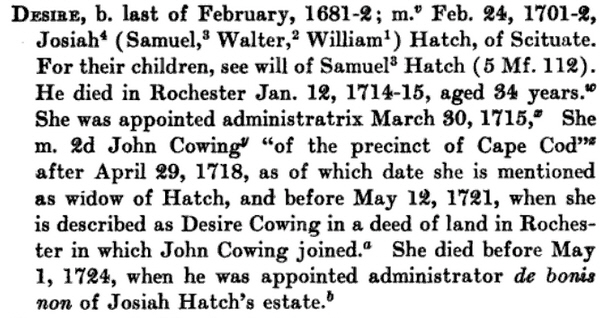
John Hawes Bio 11

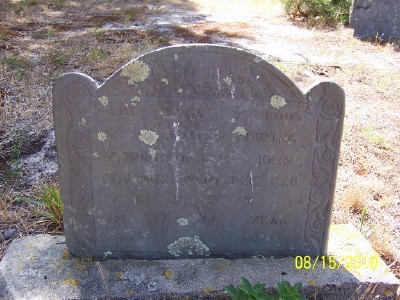
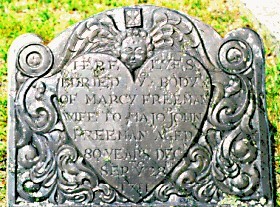
Desire Hawes – Headstone –

10. Benjamin Hawes

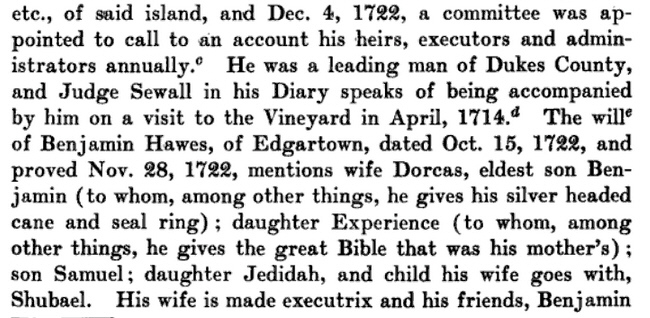
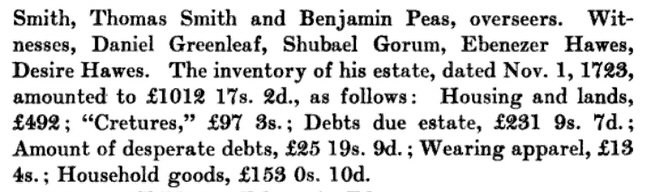
Benjamin’s wife Dorcas Smith was born 1687 in Edgartown, Dukes, Mass. Her parents were Benjamin Smith and Jedidah Mayhew. After Benjamin died in 1722, she married 22 Dec 1724 in Nantucket, Nantucket, Mass to John Worth (b. 19 May 1666 in Nantucket, Mass. d. 11 Feb 1732 in Edgartown, Dukes, Mass.) Dorcas died 4 Aug 1730 in Edgartown, Dukes, Mass.

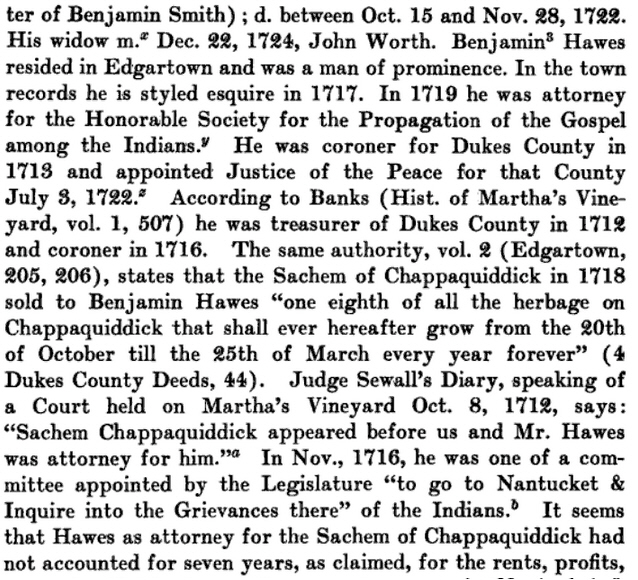
John Hawes Bio 48
John Hawes Bio 49
John Hawes Bio 50John Hawes Bio 51

Children of Benjamin and Dorcas

i. Experience Hawes b. 14 Nov 1706 Edgartown, Dukes, Mass

ii. Jedidah Hawes b. 30 Jul 1709 Edgartown, Dukes, Mass

iii.Benjamin Hawes b. 25 Apr 1712 in Edgartown, Dukes, Mass

iv. Samuel Hawes b. 25 Feb 1717/18 Edgartown, Dukes, Mass

v. Shubael Hawes b Aug 1720/21 Edgartown, Dukes, Mass; d. 12 Mar 1722

vi.  Shubael Hawes b 22 Dec 1722 Edgartown, Dukes, Mass after the death of his father

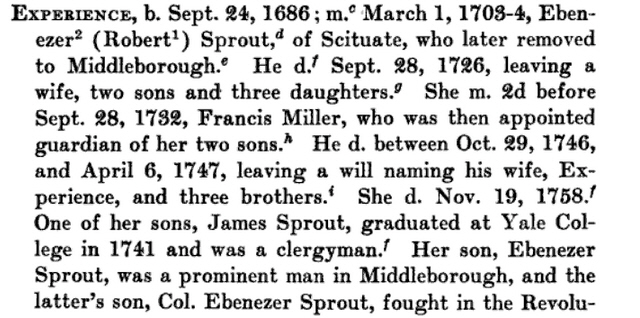
11. Experience Hawes

Experience’s first husband Lt. Ebenezer Sprout was born May 1676 in Scituate, Plymouth, Mass. His parents were Robert Sprout and Elizabeth Sampson. Ebenezer died 28 Sep 1726 in Middleboro, Plymouth, Mass

Experience’s second husband Francis Miller was born 11 Jan 1703 in Middleboro, Mass. His parents were John Miller and Lydia Coombs. Francis died 1747 in Middleboro, Mass.

John Hawes Bio 12
John Hawes Bio 13

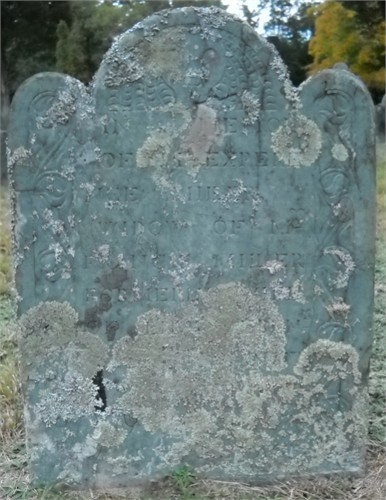
Experience Hawes – Headstone Cemetery on The Green – INSCRIPTION: “In Memory of Mrs. Experence Miller Widow of Mr. Francis Miller Formerly Wife of Lieut. Ebenezer Sproat Died Nov 9th In her 74th Year”

Sources:

Wing Family of America – John Hawes

Wing Family of America – Desire Gorman

http://www.wheelerfolk.org/keithgen/d254.htm#P629

Notes for Edmund Hawes

http://trees.ancestry.com/owt/person.aspx?pid=319784&st=1

Edmond Hawes of Yarmouth, Massachusetts: an emigrant to America in 1635, his ancestors, including the allied families of Brome, Colles, Greswold, Porter, Rody, Shirley and Whitfield; and some of his descendants  1914

Posted in 11th Generation, Be Fruitful and Multiply, Double Ancestors, Line - Shaw, Public Office, Storied, Veteran | Tagged , , | 15 Comments

Deacon Joseph Hawes

Deacon Joseph HAWES (1673 – 1752) was Alex’s 8th Great Grandfather; one of 512 in this generation of the Shaw line.

Deacon Joseph Hawes was born on 16 July 1673 at Yarmouth, Plymouth Colony . His parents were  Capt John HAWES and Desire GORHAM. He married Mary HOWES , before 1696. He married his second wife, Berthia Hall on 21 Mar 1729/30 in Harwick Mass.  He married a third time to Sarah Howes on 7 Jun 1746 in Harwich Mass.  Joseph died at sea, on 16 Nov 1752.

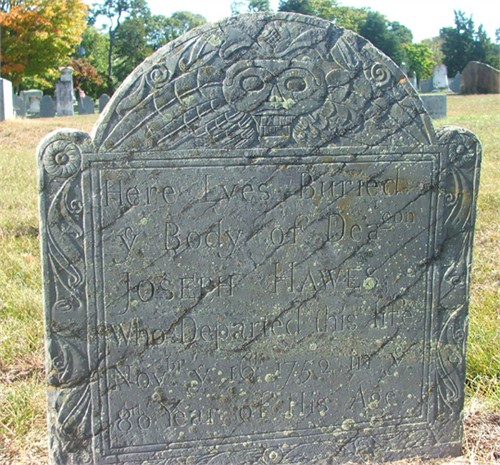
Joseph Hawes – Ancient Cemetery,  Yarmouth Port, Barnstable –
Inscription:
“Here Lyes Buries ye Body of Deacon Joseph Hawes who Departed this Life Novbr ye 16th 1752 in ye 80 Year of this Age” 
Find A Grave Memorial# 48775842

Mary Howes was born about 1672. in Yarmouth, Barnstable, Mass.  Sometimes called Mercy.  Her parents were Jeremiah HOWES and Sarah PRENCE. Mary died 10 Jan 1728/29, possibly at sea, and was buried in Yarmouth, Mass.

That his first wife was Mary Howes, daughter of Jeremiah Howes and grand-daughter of Governor Thomas Prence, appears from a deed (recorded in Plymouth County Registry of Deeds, vol. 2 9, p. 121), dated Sept. 27, 1734, in which he, described as gentleman, with his wife Bethiah and his children, conveys to Cornelius Bennett all the right of his late wife Mary in and to lands and meadow in Bridgewater and Middleborough that had belonged to Gov. Prence.

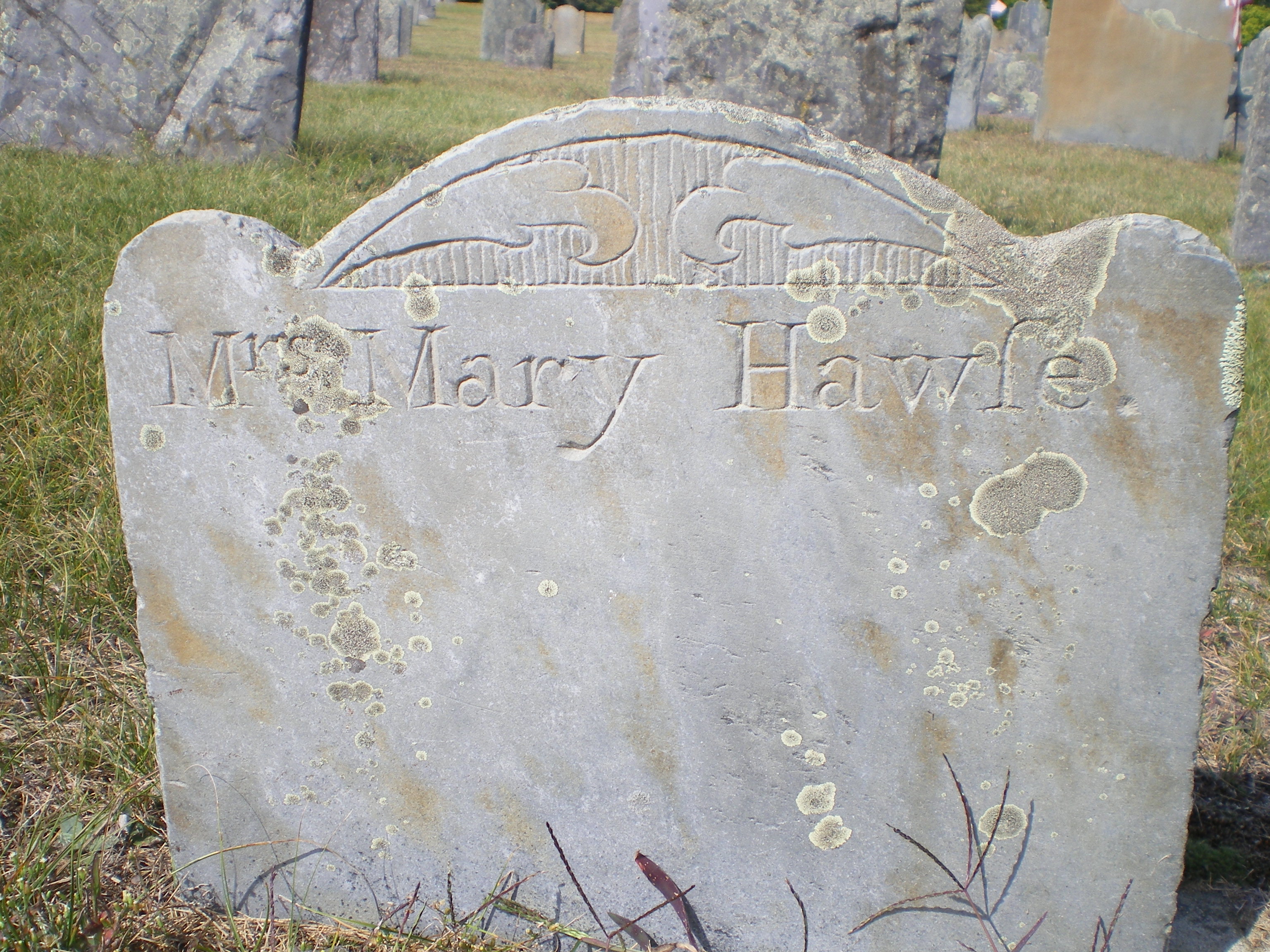
Mary Howes Hawes – Headstone – Ancient Cemetery Yarmouth Port, Barnstable
Find A Grave Memorial# 48775941

Mary Hawes Footstone

Mary Hawes Footstone

Berthia Hall was born 1672 in Massachusetts.  Her parents were Gershom Hall (1648 – 1732)and Bethia Bangs. She first married 5 Jan 1690 in Harwich, Barnstable, Mass to Kenelm Winslow (b, 9 Aug 1668 in Marshfield, Mass – d. 20 Mar 1729 in Barnstable, Mass).  Berthia and Kenelm had eight children born between 1691 and 1715.  She married on 21 Mar 1729/30 in Harwick Mass. to Joseph HAWES . “Joseph Hews of Yarmoutha and Bethiah Winslow of Harwich.”  Berthia died 8 Sep 1745 in Barnstable, Mass.

Sarah Howes was born 29 Oct 1673 in Yarmouth, Mass.  Her parents were Capt. Thomas Howes.  Her grandparents were our ancestors Thomas HOWES Sr  and Sarah BANGS.  She first married 19 May 1692 in Eastham, Mass to Stephen Hopkins (b. 15 Jul 1670 in Mass – d. 9 Apr 1733 in Brewster, Mass)  Sarah and Stephen had ten children born between 1694 and 1714.   She married 7 Jun 1746 in Harwich Mass. to JOSEPH HOWES.  Sarah died 25 May 1752 in Harwich, Mass.

Children of Joseph and Mary:

Name Born Married Departed
1. Sarah Hawes 1 Apr 1696 Yarmouth, Mass Thomas Hallett (Son of Jonathan HALLETT)
9 Apr 1719
Yarmouth
31 Jan 1720
Yarmouth
2. Elizabeth Hawes 5 Nov 1697 Yarmouth Jonathan Sears
29 Jun 1721
Yarmouth
8 Jan 1748/49
Harwich, Mass.
3. Edmund Hawes 13 Jun 1699
Yarmouth
Mary Paine
11 Oct 1729 Barnstable
11 May 1762
Barnstable, Mass
4. Thomas HAWES I 16 May 1701
Yarmouth
Thankful GORHAM
2 Jul 1730
Barnstable, Mass
10 Jan 1729
Yarmouth
5. Joseph Hawes 12 Jan 1702/03
Yarmouth, Mass
Desire Hallett
20 Jul 1732 Yarmouth
16 Feb 1759
Yarmouth
6. Mary Hawes 23 Mar 1703/04
Yarmouth
David Parker
24 Sep 1732
Yarmouth
12 Feb 1737/38
Barnstable
7. Temperance Hawes 31 Dec 1705
Barnstable, Mass
Ebenezer Gorham
(son of James GORHAM Sr. & Thankful’s uncle)
22 Sep  1727
Barnstable
21 Feb 1767 Barnstable
8. David Hawes 10 Oct 1707 Yarmouth Elizabeth Cobb
10 Mar 1736/37 Barnstable
17 Jun 1752
Yarmouth
9. Prince Hawes 29 Dec 1709 Yarmouth Ann Hedge
(daughter of our ancestor John HEDGE)
17 Jul 1735
Yarmouth
8 Dec 1771 Yarmouth
10. Thankful Hawes 16 Apr 1712 Yarmouth Thomas Annable
19 Oct 1732 Yarmouth
7 Nov 1739
Barnstable
11. Desire Hawes 1714
Yarmouth
7 Mar 1715 Yarmouth

1713-1714 Representative in the Legislature
1729-1736 Yarmouth town clerk and treasurer.

5 May 1692 -Joseph  was mentioned in the will of his grandfather Edmund HAWES.

I do give and bequeath to my Grandson Joseph Hawes six acres of of my Land (to be laid forth to him at marriage or full age which shall first happen) so as it may Liy next to Capt. Thachers or John Hallets Land and Abut up on ye highway and also ye one halfe of my Island of Sedg or crick thatch Land which Lyies in ye Lone tree crick the which sd Island being divided in too equal devitions my son John Hawes to have his choice first: And also I do give to ye sd Joseph priviledg to driy thatch upon that meadow at Lone tree; And also I do give to ye sd Joseph one acre of my meadow where his father shall see cause to lay it forth to him; all which sd six acres of Land and half of sd Island priviledg of drying thatch and one acre of meadow I do give to him ye sd Joseph Hawes his heirs and assignes for ever.(Edmund Hawes, page 131, 140)

15 Oct 1701 –   Capt John HAWES left a will,  proved Nov. 19, 1701, in which he mentions his sons John, Joseph, Ebenezer, Isaac and Benjamin, and his daughters Elizabeth Dogget, Mary Bacon, Desire and Experience Hawes. He named his sons Joseph and Isaac as executors.(Edmund Hawes, page 148-149)

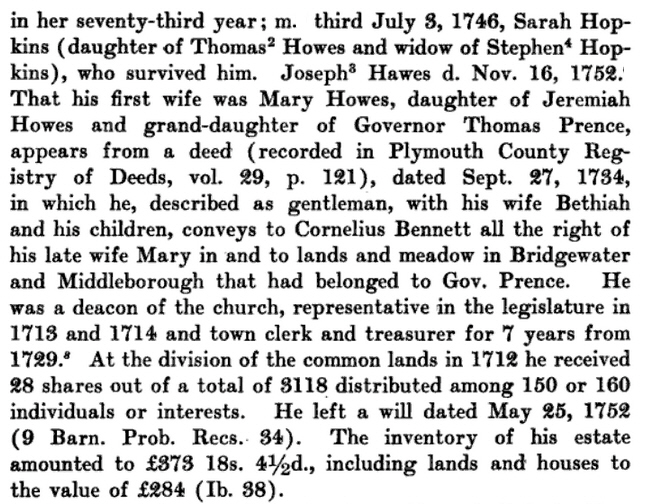
1712 – At the division of the common lands he received 28 shares out of a total of 3118 distributed among 150 or 160 individuals or interests.

25 May 1752 – He left a will (9 Barn. Prob. Recs. 34). The inventory of his estate amounted to £373 18s. 4 1/2d., including lands and houses to the value of £284 (Ib. 38).

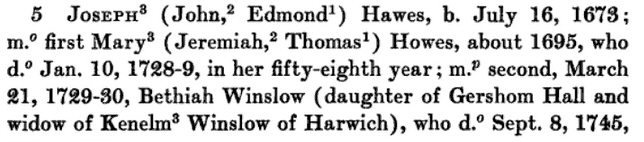
Joseph Hawes Bio - From

Joseph Hawes Bio – From Edmond Hawes of Yarmouth, Massachusetts 1914

Joseph Hawes Bio 2

Children

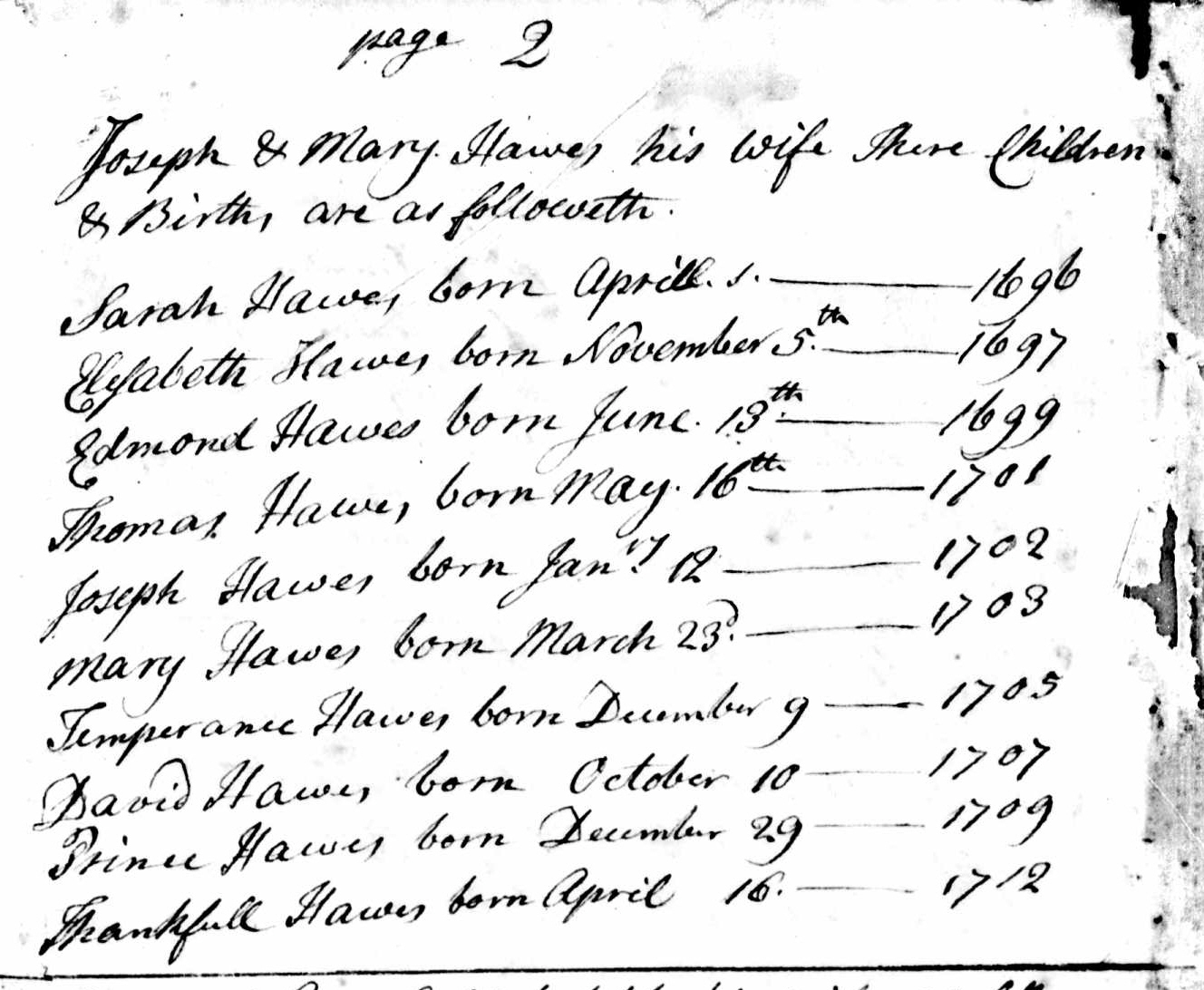
Yarmouth Town Birth Record for Joseph Hawes Family

Yarmouth Town Birth Record for Joseph Hawes Family

1. Sarah Hawes

Sarah’s husband Thomas Hallett was born 1691 in Yarmouth, Barnstable, Mass. His parents were our ancestors Jonathan HALLETT and Abigail DEXTER.  He was married four times and died 10 Apr 1772 in Yarmouth, Barnstable, Mass. at the age of 81

  1. Sarah died 31 Jan 1720 after less than a year of marriage in the birth of their first child.
  2. After Sarah died, he married 8 Feb 1722 in Harwich, Barnstable, Mass. to Hannah Gray (b. 1693 in Harwich, Mass – d. 6 Feb 1750 in Yarmouth, Mass.)
  3. After Hannah died, he married a third time 19 Aug 1750 in Yarmouth, Barnstable, Mass to Desire Gorham (26 Aug 1710 in Yarmouth, Mass – d. Dec 1767 in Yarmouth) Desire’s parents were John Gorham and Anne Brown and her grandparents were James GORHAM Sr. and Hannah HUCKINS.
  4. After Desire died, he married a fourth and final time 5 Jan 1769 in Yarmouth, Mass to Mary Gorham (b. 19 Jul 1719 in Barnstable, Mass – d. 2 Jun 1795 in Yarmouth). Mary’s parents were James GORHAM Jr. and Mary JOYCE. 

Genealogical notes of Barnstable families (1888) –Thomas Hallett, styled gentleman, son of Jonathan, born in Yarmouth in 1691, owned and resided in the large, ancient mansion-house now standing on the corner of Hallett St., and Wharf Lane. It was originally built on the same plan with that of his father’s which has been described, but was better finished at first, and has since been kept in good repair. The Halletts’, as a race, are able-bodied men, and average in stature above the common height. Thomas was an exception. He was a short, thick-set man. During the latter part of his life he was of feeble health. ‘ For many years he was afflicted with a sore leg — a disease which usually set at defiance the curative skill of the physicians of his time.

Thomas Hallett, lived in better style than many of his neighbors, and died April 10, 1772, aged 81, leaving a good estate.

He married April 9 , 1719, for his first wife, Sarah, daughter of Dea. Joseph Hawes. She was born April 1, 1696, and died soon after her marriage, leaving no .issue. He married Feb. 8, 1721-2, Hannah, widow of Andrew Gray of Harwich, and North Yarmouth, Maine. She died Feb. 6, 1749-50, and he married for his third wife, Aug. 19, 1750, Desire Gorham. She died Dec. 1767, aged 57. For his fourth wife he married Mary, widow of Thomas Hedge, and a daughter of James Gorham.

In his will dated 21st Feb. 1770, proved May 4, 1772, he gives to his wife Mary Hallett in lieu of thirds, the improvement of all his real estate during her natural life, one-third of his in-door moveables, and his best cow. To his nephew Thomas Hallett, son of his brother Jonathan, a piece of land on the south side of the road on which Thomas’ house stood, containing two acres. To his nephews Jonathan and Jeremiah, sons of his brother Jonathan, £6 or $20 each. To his nephew Ebenezer Hallett, Jr., £6-. To his nephews Jonathan and Abner, sons of his brother David, £4 each. To his nephews Moses, Joshua, and Isaac, sons of hia brother Timothy, deceased, £6. All the rest of his real and personal estate he gave to his adopted son Joshua Gray, son of his second wife Hannah Gray.

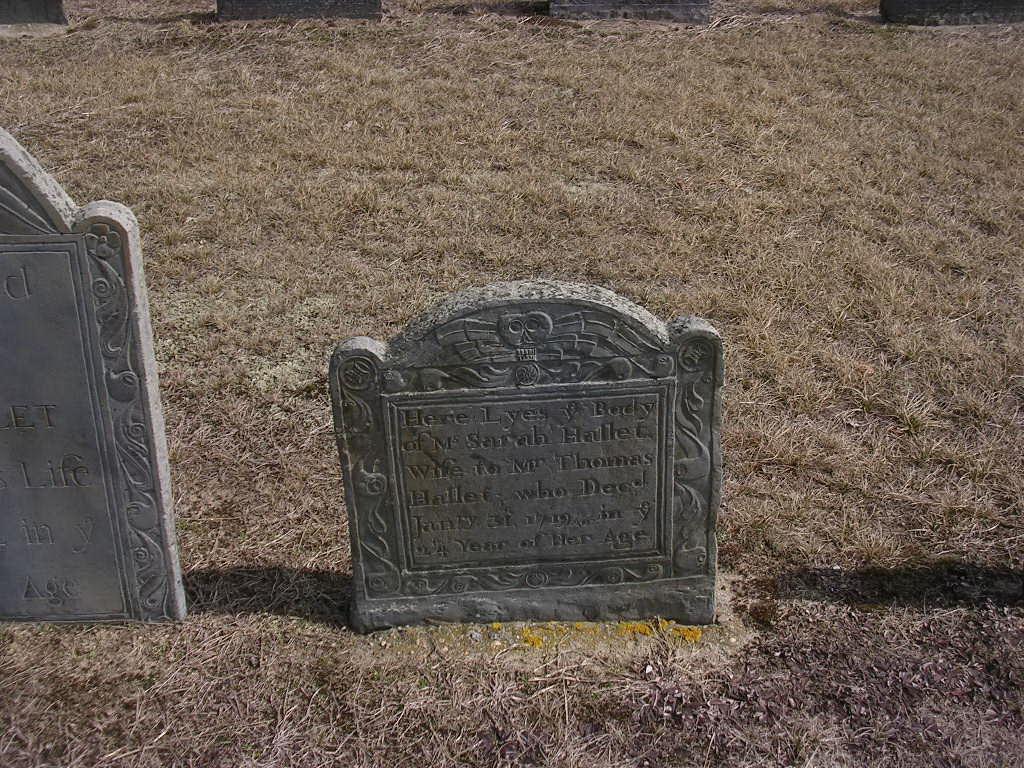
INSCRIPTION: “Here Lyes ye Body of Mrs. Sarah Hallet Wife of Mr. thomas hallet who Died jan ye 31 1719/[20

Child of Thomas and Sarah

i. Baby Hallett b. 25 Jan 1719  Yarmouth, Barnstable, Mass’ d. 25 Jan 1719 Yarmouth.

2. Elizabeth Hawes

Elizabeth’s husband Jonathan Sears was born 3 Sep 1693 in Harwich, Barnstable, Mass. His parents were Samuel Sears (1664 – 1742) and  Mercy Mayo (1664 – 1749). Jonathan died 3 Sep 1738 in Harwich, Barnstable, Mass

John Sears was appointed administrator of the estate of Jonathan Sears, deceased ; and Daniel Hall, Judah Sears and Ebenezer Paddock, rendered an Inventory Oct. 26, 1738 ; Real Estate, £ 575. Personal Estate, £ 374 18 0.

He “left widow and four children.” His widow Elizabeth was appointed Guardian to Jonathan, Joseph and Sarah, Mar. 12, 1742.

Mar 10 1748 – When Elizabeth died 8 Jan 1748,Joseph Sears of Harwich administered her estate and was appointed guardian of Prince and Sarah.

Jan 28 1757 – The estate of Jonathan Sears was divided by. Daniel Hall, Elisha Bassett, Theo. Crosby and Joseph Howes Jr., who set off to the eldest son Jonathan, deceased; to Joseph, and to Prince ; the widow and other children being then all deceased.

Joseph Howes in his will 1752, names ” Jonathan, Joseph and Prince Sears, sons of my daughter Elizabeth Sears.”

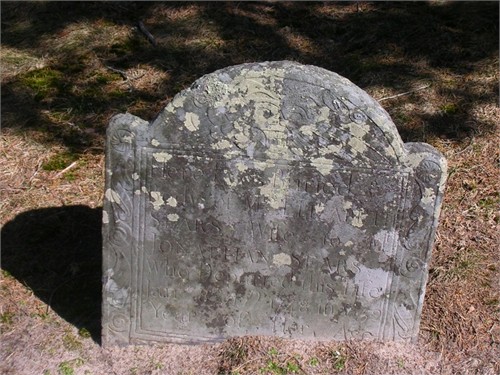
Sears Cemetery – INSCRIPTION: “Here Lyes Buried Ye Bodyof Mrs. Elizabeth Sears Wife of Mr. Jonathan Sears Who Departed this Life Janry 8th AD 1748 in Ye 52d Year of Her Age”

Children of Elizabeth and Jonathan:

i. David Sears b. 2 Sep 1722 Harwich, Barnstable, Mass.; d. infancy.

ii. David Sears b. 26 Mar 1724 Harwich, Barnstable, Mass.; d. young.

iii. Jonathan Sears b. 9 Sep 1725 Harwich, Barnstable, Mass.; d. 16 Dec 1752 W Brewster, Barnstable, Mass.; Burial: Sears Cemetery East Dennis; m. 29 Jun 1749 in Harwich to his first cousin Priscilla Sears (b. 31 Dec 1730 in Harwich – d. 12 Apr 1819 in Brewster) Priscilla’s parents were Seth Sears (1703 – ) and Priscilla Ryder (1707 – ). Jonathan and Priscilla had two children Jonathan (b. 1752) and Elizabeth (b. 1752).

Priscilla was admitted in the 2nd Church of Yarmouth on May 19, 1751. After Jonathan died, she married 11 Apr 1754 Yarmouth to Deacon John Sears (1712 – 1791) John Sears had ten children by his first wife Deborah Crowell (1720 – 1753) born between 1739 and 1752 and seven more children by Priscilla born between 1755 and 1772 for a total of seventeen. John was chosen deacon, Feb. 29, 1768, which office he held until his death ; was a prominent man in church, and precinct affairs, for many years chosen moderator, assessor, and on prudential committee.

Jonathan Sears of Harwich, mariner, made his will Mar. 28, 1752, ” being then very sick;” wife Priscilla and brother Joseph, Executor ; mentions his children, but not by name.

Feb 6 1753 – Jonathan’s filed Feb. 6, 1753, amounting to £ 128 12 0.

Nov 23 1757 – John Sears was appointed guardian of Jonathan and Elizabeth

7 Jan 1815 – Widow Priscilla Sears made her will naming daughters Elizabeth Hall (by her first marriage), Bethia Sears, Lucy Hall, and Kezia Sears, and grand-children, sons and daus. of Jonathan Sears, deceased, Jonathan, Asarelah, Abigail and Clarinda; and Lydia Sears, daughter of Rev. Freeman Sears, deceased; and daughters oi Seth Sears, Hephsibeth Gibson, Priscilla and Belinda Soars, Herdphebah (sic) Sears, and sons, Luther and Mark.

iv. Joseph Sears b. May 1728 Harwich, Barnstable, Mass.; d. 14 Mar 1758 West Brewster, Barnstable, Mass.

Unmarried, though marriage intentions of Joseph Sears and Tabithy Kendrick, were published Jan 19, 1754, but she m. Theo. Hopkins. The will of Joseph Sears of Yarmouth late of Rochester, dated Feb. 5, 1758/59, makes his brother Prince, sole heir and executor— mentions Jonathan and Elizabeth, children of deceased brother Jonathan.

Inscription:
Here lies the Body of
Mr JOSEPH SEARS
son of Mr JONATHAN &
Mrs ELIZABETH SEARS
who Died March ye
14th 1758 in ye 30th
Year of his Age

v. Mary Sears bapt. 12 Jul 1730 Harwich, Barnstable, Mass.; d. Young

vi. Sarah Sears b. 28 Jul 1731 Harwich, Barnstable, Mass.; d. 16 Dec 1749 Harwich

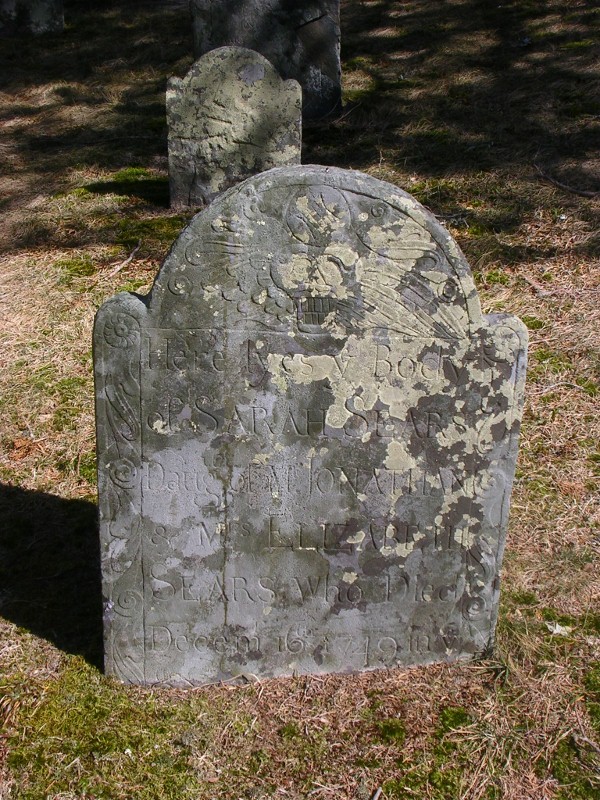
Sarah Sears Gravestone

Sarah Sears Gravestone — Sears Cemetery East Dennis
Find A Grave Memorial# 41558263

vii. Prince Sears b. 1732 Harwich, Barnstable, Mass.; d. 31 Oct 1732 Harwich

viii. Nathan Sears, b. 25 Sep 1733 Harwich, Barnstable, Mass; bap. Sep. 30; d. young.

ix. Prince Sears b. 13 Apr 1735 in Harwich, Barnstable, Mass; d. 25 Feb 1829 in Brewster, Barnstable, Mass; m. 17 Jun 1758 Barnstable to Betsy Hall (16 May 1738 in Yarmouth, Barnstable, Mass – d. 1 Jul 1818 in Brewster) Betsy’s parents were Joseph Hall (1697 – 1772) and Rebekah Sears (1701 – 1791).  Prince and Betsy had two children Sarah (b. 1758) and Joseph (b. 1764).

12 Jun 1760 – Elizabeth, wife of Prince Sears, was admitted to full communion in the Harwich Church

21 Mar 1786 – Prince Sears was appointed Pound-keeper.

Prince’s will, dated Brewster, 1829, names wife Betsy, son Joseph, and grand-children, Ezra Sears and Rebecca Gray. Joseph was appointed Executor.

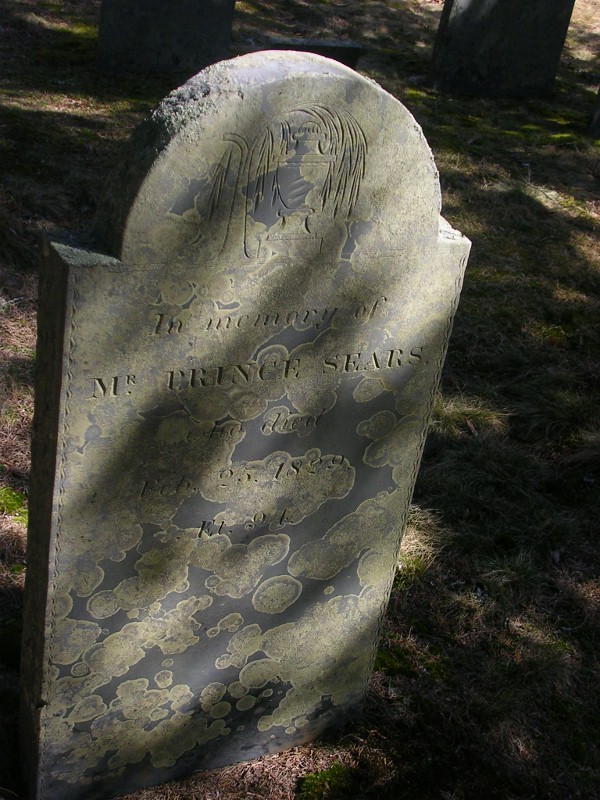
Prince Sears Gravestone -- Sears  emetery  East Dennis Barnstable, Plot: #33 Find A Grave Memorial# 39184932

Prince Sears Gravestone — Sears Cemetery East Dennis Barnstable, Plot: #33
Find A Grave Memorial# 39184932

Inscription:
In memory of
Mr PRINCE SEARS
who died
Feb 25 1829
Æt 94

3. Edmund Hawes

Edmund’s wife Mary Paine was born 13 Aug 1700 in Barnstable, Barnstable, Mass. her parents were James Paine (1665 – 1728) and Bethiah Thacher (1671 – 1734). She first married 11 Oct 1723 in Barnstable, Barnstable, Mass to Nathaniel Freeman (b. 7 May 1698 in Barnstable, Mass – d. 2 Dec 1727 in Barnstable) and had three children, the youngest Nathaniel was born four months after his father’s death. Mary died 17 Jun 1775 in Barnstable, Barnstable, Mass

Children of Edmund and Mary:

i. Sarah Hawes b. 26 Mar 1733 Barnstable, Barnstable, Mass.; d. 12 Jun 1754 Barnstable, Barnstable, Mass

ii. Mary Hawes b. 11 Aug 1735 Barnstable, Barnstable, Mass.; d. 25 Feb 1754 Barnstable

iii. Edmund Hawes b. 26 Jul 1738 Barnstable, Barnstable, Mass.; d. 5 Jun 1777 Sandwich, Barnstable, Mass; m. 19 Jun 1766 in Eastham, Barnstable, Mass to Hannah Snow (b. 28 Jul 1740 in Eastham, Barnstable, Mass.) Hannah’s parents were Jabez Snow (1696 – 1760) and Elizabeth Paine (1702 – )

After Edmund died, Hannah married Truro, Dedham, Mass to John Avery (b. 27 Oct 1743 in Dedham, Mass. – d. 24 Apr 1819. Hannah and John had four children.

4. Thomas HAWES I (See his page)

5. Joseph Hawes

Joseph’s wife Desire Hallett was born 21 Apr 1714 in Yarmouth, Plymouth, Mass. Her parents were Andrew Hallett (1684 – 1751) and Mehitable Annable (1695 – 1767). Desire died 24 Feb 1798 in Yarmouth, Plymouth, Mass.

Desire had one sibling, Stephen. Her nephew Joseph was lost at sea with Howes Taylor. Her nephew Levi was also lost at sea. Her nephew Stephen married Desire Hall and had Susan and Mercy. He drank to excess, spent the large estate devised to him by his father, and died a town-pauper.

Children of Joseph and Desire:

i. Desire Hawes b. 22 Sep 1735 in Yarmouth, Barnstable, Mass.; d. 2 Mar 1736 Yarmouth

ii. Hannah Hawes b. 2 May 1737 in Yarmouth, Barnstable, Mass.

6. Mary Hawes

Mary’s husband David Parker was born 17 Feb 1700 in Barnstable, Barnstable, Mass. His parents were Daniel Parker (1670 – 1728) and Mary Lombard (1669 – 1744).  After Mary died in 1737, David married Mercy Crosby  1703 –   1785) David died 24 Jun 1788 in Barnstable, Barnstable, Mass.  David and Mercy had four more children born between 1740 and 1747.

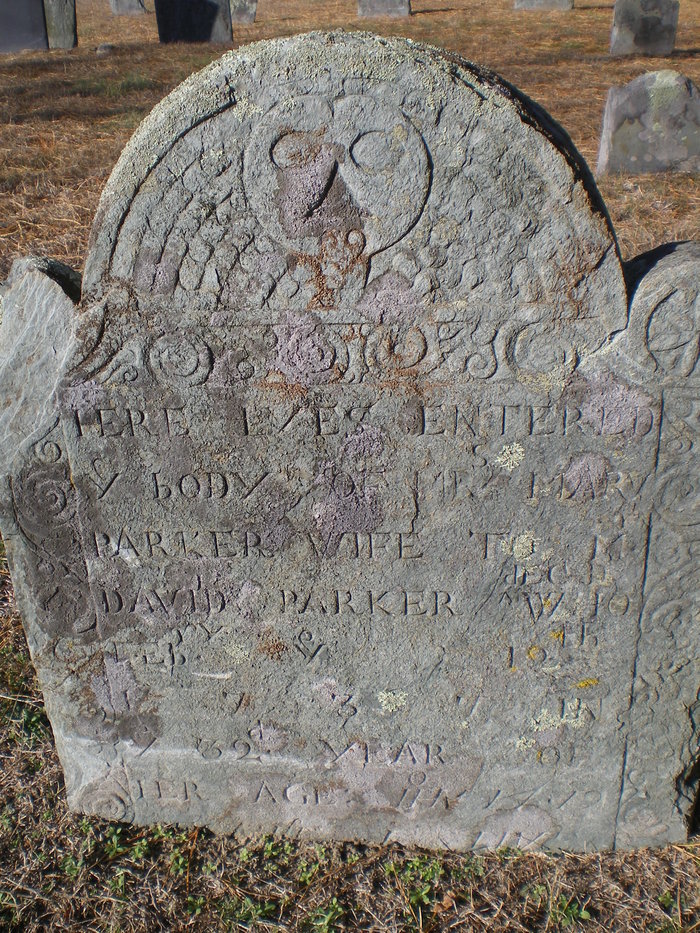
Mary Hawes Parker Gravestone

Mary Hawes Parker Gravestone Find A Grave Memorial# 5763129

.

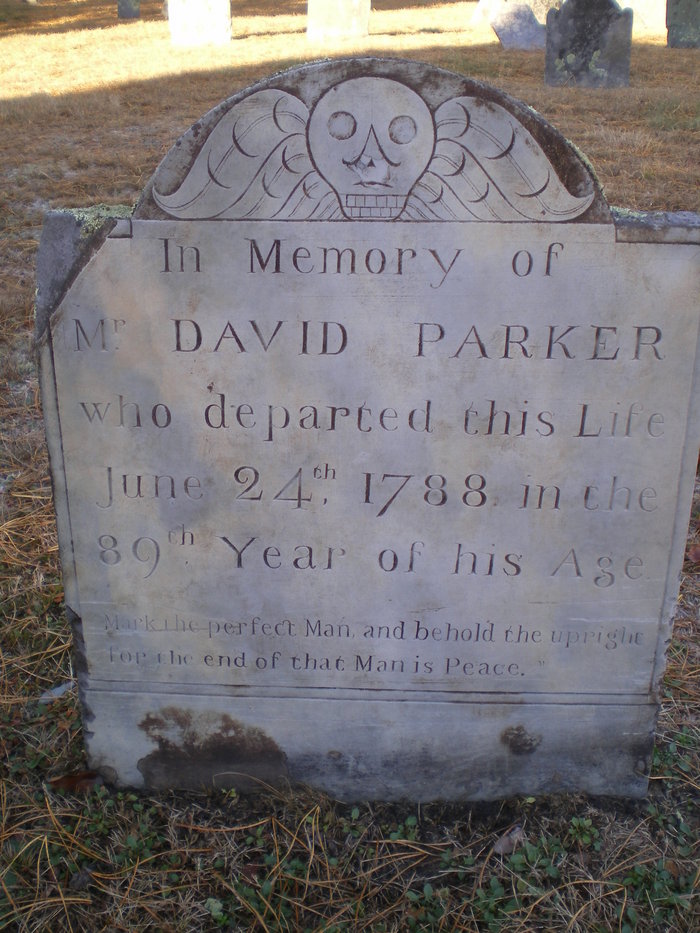
David Parker Gravestone

David Parker Gravestone — West Barnstable Cemetery
Find A Grave Memorial# 5763091

Children of Mary and David:

i. Mary Parker b. 18 Feb 1734 Barnstable, Barnstable, Mass. ; m. 5 Jun 1755 in Barnstable to James Childs (b. 22 Apr 1725 Barnstable, Barnstable, Mass – d. 03 Apr 1772  Barnstable) James’ parents were James Childs Sr. (1694 – 1779) and Elizabeth Crocker (1702 – ). Mary and James had five children born between 1756 and 1767.

ii. Dr. Daniel Parker b. 25 Mar 1735 Barnstable, Barnstable, Mass.; d.  Feb 1809 Barnstable ; burial: West Barnstable Cemetery;  m. 22 Jan 1768 Barnstable to Mercy Jenkins (b. 25 May 1737 in Barnstable – d. 24 Sep 1812 in Barnstable) Mercy’s parents were Joseph Jenkins (1703 – 1793) and Mercy Howland (1710 – 1760) Daniel and Mercy had seven children born between 1769 and 1782.

“Dr. Daniel Parker’s house was near the present Barnstable town house.

stone:
Sacred to the memory of
Dr Daniel Parker
who died February 18th 1809
in his 75 year

Remember me as you pass by
For as you are now so once was I
As I am now so you must be
Therefore prepare to follow me

iii. Patience Parker b. 3 Mar 1736 Barnstable, Barnstable, Mass.; d. 27 Oct 1737 Barnstable

Children of James and Mercy Crosby:

iv. David Parker b. 31 Aug 1740

v. Ebenezer Parker b. 6 Mar 1741/42

vi. Elisha Parker b. 30 Jan 1743/44

vii. James Parker b 28 Sep 1747–

7. Temperance Hawes

Temperance’s husband Ebenezer Gorham was born 14 Feb 1695/96 Scituate, Mass.   He was Thankful’s youngest uncle and his parents were our ancestors James GORHAM Sr. and Hannah HUCKINS.  Ebenezer died 16 Nov 1776, Barnstable, Mass.

Children of Temperance and Ebenezer:

i. Ebenezer Gorham b. 7 Aug 1729 Barnstable, Barnstable, Mass.; d. 1772 Lost at Sea; m1. 21 Dec 1752 Barnstable to Mary Thacher (b. 7 Mar 1732 Yarmouth, Barnstable, Mass – d. 1764 in Barnstable) Mary’s parents were Lot Thacher ( – 1732) and Rebecca Keen (1709 – 1775)

m2. 6 Dec 1764 in Plymouth to Hope Carver (b. 19 Feb 1739 in Plymouth – d. 7 Jun 1765 in Barnstable) Hope’s parents were Isaac Carver and Mary [__?__]

m3. 16 Jul 1767 in Yarmouth to Hannah Hall Doane (b. 1731 in Chatham, Barnstable, Mass. – d. 3 Oct 1810 in Barnstable) Hannah’s parents were Reuben Doane (1705 – 1737) and Sarah Haugh (1713 – 1756). Ebenezer and Hannah had one child Hannah (b. 1768)

ii. Prince Gorham b 14 Mar 1731 Barnstable, Barnstable, Mass.; d. 4 Dec 1804 Norwell, Mass; m. 22 Apr 1756 in Barnstable to Abigail Gorham (b 1 Jun 1732 in Barnstable – d. 3 Aug 1765 in Barnstable) Abigail’s parents were John Gorham (1688 – 1769) and Prudence Crocker (1692 – 1779). Prince and Abigail had one child, Sarah, (b. 1762)

m2. 15 Nov 1767 in Scituate, Plymouth, Mass to Desire Clapp (b. 13 May 1741 in Scituate, Plymouth, Mass. – d. 20 Aug 1813 in Barnstable) Desire’s parents were Nathaniel Clapp (1709 – 1783) and Desire Bourne (1718 – 1786). Prince and Desire had four children born between 1769 and 1779

iii. Hannah Gorham b. 16 Apr 1733 Barnstable, Barnstable, Mass.; d. 5 Apr 1765 Barnstable; m. 16 May 1754 in Barnstable to her second cousin Thomas Gorham (b. 13 Aug 1723 in Barnstable – d. 3 Sep 1795 in Barnstable) Thomas’ parents were Job Gorham (1692 -1753) and Desire Dimmock (1696 – 1732) His grandparents were John Gorham and Mary Otis and his great grandparents were Capt. John GORHAM and Desire HOWLAND. Hannah and Thomas had eight children born between 1754 and 1765. After Hannah died, Thomas married later that year to Mrs. Rebecca Jones of Yarmouth.

During the latter part of his life, he was blind. He was a man of sound judgment and of industrious habits. After he became blind, he performed many kinds of labor which others in his situation would not have attempted. Timothy Swinerton as a boy lived with him. Mr. Gorham, instead of having the boy to lead him, put the boy on his horse and taking the crupper in his hand, walked behind the horse. When walking alone, he kept his cane in constant motion before him.

iv. Mary Gorham b 16 Jun 1735 Barnstable, Barnstable, Mass.; d. 26 Dec 1775 Gorham, Cumberland, Maine

v Sarah Gorham b. 22 May 1737 Barnstable, Barnstable, Mass.

vi Thankful Gorham b 22 Apr 1739 Barnstable, Barnstable, Mass.; d. 1802  Barnstable; m. 3 May 1759 in Barnstable to Josiah Davis (b. 19 Feb 1722 in Barnstable – d. 8 Feb 1824 in Gorham, Maine) Josiah’s parents were John Davis (1681 – 1739) and Mehitable Dimmock (1686 – 1775). Thankful and Josiah had nine children born between 1758 and 1780.

After Thankful died, Josiah married 25 Nov 1802 in Gorham, Maine to Martha Hill. He may have married a third time to Thankful Matthews

vii. Temperance Gorham b 20 May 1744 Barnstable, Barnstable, Mass.; d. 26 Nov 1824 Gorham, Cumberland, Maine; m. 7 Feb 1765 in Barnstable to Jonathan Sturgis (b 9 Aug 1743 in Barnstable – d. 11 May 1834 in Gorham, Cumberland, Maine) Jonathan’s parents were Nathaniel Sturgis (1714 – 1770) and Abigail Cobb (1711 – 1772) Temperance and Jonathan had twelve children born betweenn 1766 and 1790.

viii. Silvanus Gorham b.. 17 Jul 1746 Barnstable, Barnstable, Mass.; d. 29 May 1805 Barnstable; m. 19 Mar 1768 in Barnstable to Anna Gorham (b. 17 Jul 1748 in Barnstable – d. 27 Oct 1811 in Barnstable) Silvanius and Anna had thirteen children born between 1769 and 1793

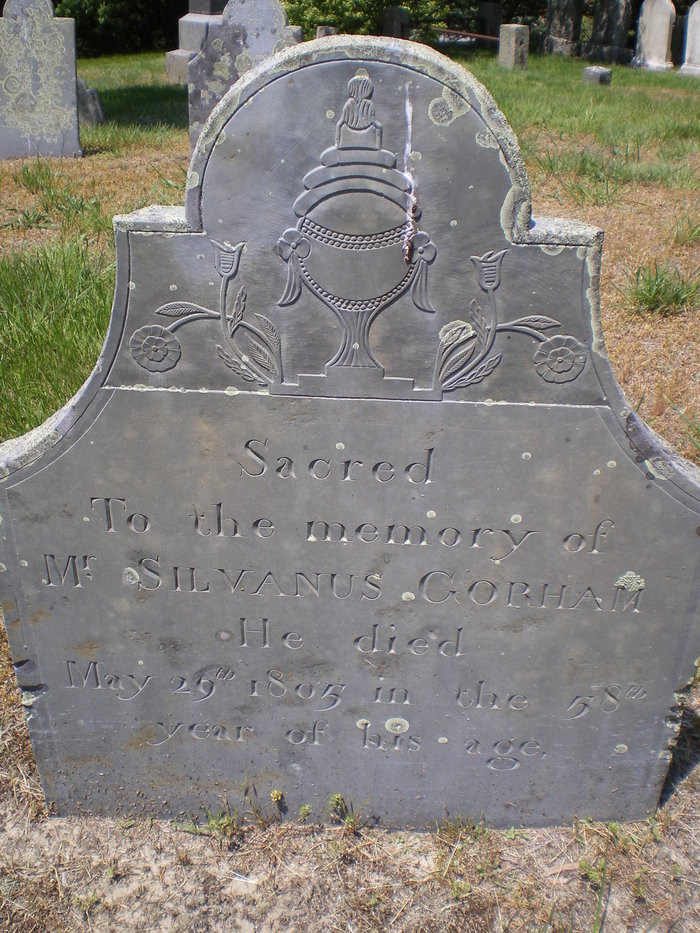
Silvanus Gorham Gravestone  [-- Cobb's Hill Cemetery  Barnstable Find A Grave Memorial# 22084305

Silvanus Gorham Gravestone [– Cobb’s Hill Cemetery Barnstable
Find A Grave Memorial# 22084305

8. David Hawes

David’s wife Elizabeth Cobb was born 18 Apr 1718 in Barnstable, Barnstable, Mass. Her parents were James Cobb (1673 – 1757) and Elizabeth Hallett (1679 – 1759). Elizabeth died 14 Sep 1768 in Yarmouth, Barnstable, Mass.

Children of David and Elizabeth:

i. David Hawes b. 20 Sep 1740 Yarmouth, Barnstable, Mass.; d 14 Dec 1803 Yarmouth; m. 26 Mar 1766 in Yarmouth to Anna Bray ( b. 25 Feb 1746 in Yarmouth – d. 9 Oct 1826 in Yarmouth) Anna’s parents were Thomas Bray and Mercy Crowell (1704 – 1786). David and Anna had seven children born between 1767 and 1789.

ii. Elizabeth Hawes b. 28 Mar 1742 Yarmouth, Barnstable, Mass.; d. 1805 Waterville, Maine; m. 30 Dec 1762 in Yarmouth to Lemuel C Crowell (b. 16 Mar 1733 in Yarmouth – d. 1787) Lemuel’s parents were Thomas Crowell (1694 – 1762) and Experience Crowell (1694 – ) Elizabeth and Lemuel had eight children born between 1764 and 1786.

Crowell, Lemuel. Private, Capt. Lot Crowell’s co., Col. Nathaniel Freeman’s regt.; service, 6 days, on an alarm at Dartmouth and Falmouth in Sept., 1778.

9. Prince Hawes

Prince’s wife Ann Hedge was born 9 Dec 1716 Yarmouth, Mass.  Her parents were John HEDGE and Thankful LOTHROPAnn died 4 Mar 1782 Yarmouth, Mass.

Prince graduated at Harvard College in 1728. He was one of the selectmen of Yarmouth for 11 years from 1756 and town clerk and treasurer for five years from 1765. He also served as school master for the town.

A glimpse of Prince in his old age is provided by his grandson Deacon Joseph Hawes about 1838 when speaking about the educational facilities of Yarmouth a little before the Revolutionary War “At that time I lived with my aged grandfather, who had a liberal education, but in low circumstances. I could learn more in his corner with my pine candle, in one evening than I could in school in one week.”

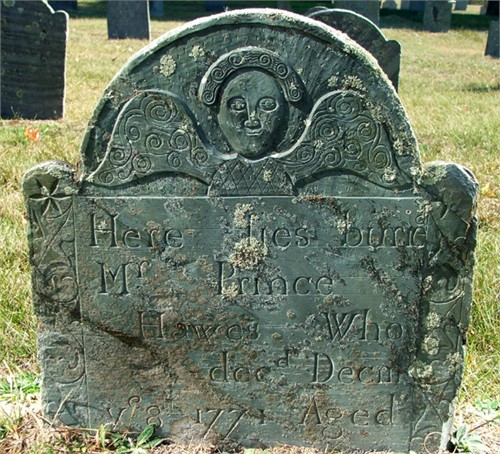
INSCRIPTION: “Here lies Buried Mr. Prince Hawes Who decd Decm Ye 8th 1771 Aged___”

Children of Prince and Thankful:

i. Prince Hawes b. 15 Apr 1736 Yarmouth, Barnstable, Mass.; d. 14 Dec 1767 Lost at Sea  Sulawesi Tengah, Indonesia.; m. 2 Apr 1757 in Yarmouth to Elizabeth Hallett (b. 25 Apr 1734 in Yarmouth – d. 19 Mar 1764 in Yarmouth) Elizabeth’s parents were Joseph Hallett (b. 1690 – ) and Abigail Thacher (1699 – 1768). Prince and Elizabeth had three children born between 1758 and 1763.

m2. 17 Oct 1765 in Yarmouth to Sarah Thacher (b. 17 Aug 1737 in Yarmouth – d. 7 Aug 1773 in Falmouth, Barnstable, Mass.) Sarah’s parents were Judah Thacher (1693 – 1775) and Sarah Crosby (1702 – ). Prince and Sarah had one more child, Anna (b. 1766) After Prince died, Sarah married 27 Nov 1771 in Yarmouth to Thomas Palmer (1738 – 1775)

ii. Anna Hawes b. 29 Jun 1739 Yarmouth, Barnstable, Mass.; d. 28 Apr 1765 Yarmouth

iii. Simeon Hawes b. 22 Mar 1745 Yarmouth, Barnstable, Mass.; d. 4 May 1791; m. 1768 to Bethiah Matthews (b. 22 Mar 1749 in Yarmouth – d. Jul 1796 in Yarmouth) Simeon and Bethiah had nine children born between 1769 and 1789.

iv Baby Hawes b. 18 Jul 1746 Yarmouth, Barnstable, Mass.; d. 31 Aug 1746 Yarmouth

10. Thankful Hawes

Thankful’s husband Thomas Annable was born 21 Jun 1708 in Barnstable, Barnstable, Mass. His parents were Samuel Annable (1669 – 1744) and Patience Daggett (1670 – 1760). Thankful and Thomas did not have children.

After Thankful died Thomas married 7 Aug 1740 in Barnstable to Anne Gorham (1717 – 1748) Thomas and Anne had four children born between 1741 and 1747. After Anne died, he married 26 Mar 1748 in Barnstable to Abigail Dimmock (1714 – 1788) and had three more children born between 1747 and 1753. Thomas died 6 Dec 1798 in Barnstable, Barnstable, Mass Burial: Lothrop Hill Cemetery

Inscription: (From a 19th Century transcription)

“In memory of Mr. Thomas Annable, he died December ye 6th. 1798 in his 91st year.”

Sources:

Wing Family of America – Joseph Hawes

Wing Family of America – Mary Howes

World Connect Search – Joseph Hawes 1673

Edmond Hawes and his American descendants: Edmond Hawes (1608-1683) of Yarmouth, Massachusetts, and some of his American descendants through thirteen generations Gateway Press, 2000

Edmond Hawes of Yarmouth, Massachusetts: an emigrant to America in 1635, his ancestors, including the allied families of Brome, Colles, Greswold, Porter, Rody, Shirley and Whitfield; and some of his descendants (Google eBook) 1914

http://trees.ancestry.com/owt/person.aspx?pid=12680940

The descendants of Richard Sares (Sears) of Yarmouth, Mass., 1638-1888. With an appendix, containing some notices of other families by the name of Sears (1890) By Samuel Pearce May (1828- )

http://wc.rootsweb.ancestry.com/cgi-bin/igm.cgi?op=GET&db=oldmankew&id=I15578

Sears Family Association

Posted in 10th Generation, Be Fruitful and Multiply, Historical Monument, Line - Shaw, Public Office | Tagged | 11 Comments

Thomas Hawes I

Thomas HAWES (1701 –  1747) was Alex’s 7th Great Grandfather; one of 256 in this generation in the Shaw line.

Thomas Hawes I was born at Yarmouth, Barnstable, Massachusetts, on 16 May 1701. He was the son of Joseph HAWES and Mary HOWES.  He married  Thankful  GORHAM at Yarmouth, Barnstable, Massachusetts, in 1730. Thomas died 28 Jan 1747 – Yarmouth, Mass.

Thankful Gorham was born at Barnstable, Barnstable, MA, on 25 May 1711. She was the daughter of James GORHAM II and Mary JOYCE.  After Thomas died, she married Steven Skifee 27 Jul 1749 in Yarmouth, Barnstable, Mass.  After Stephen died, she married a third time to Deacon Gershom Davis 25 Mar 1758 in Barnstable, Massachusetts. Thankful died at sea, before 8 Dec 1801 and is buried at  Ancient Cemetery, Yarmouth, Barnstable, Massachutetts  .

Steven Skifee was born 4 Feb 1684/85 in Sandwich, Barnstable, Mass.  His parents were Steven Skiffee and Lydia Snow.   He first married 15 May 1698 in Barnstable, Barnstable, Mass to Sarah Lothrop. Steven died 4 Oct 1758 in Sandwich, Mass.

Steven’s wife Sarah Lothrop was born between 1677 and 1681 in Barnstable, Mass.  Her parents were Barnabas LOTHROP and Susanna CLARK.  Many sources say Sarah married 1 Sep 1702 in Barnstable, Mass to Elisha Hedge, her brother-in-law John HEDGE‘s  brother and son of Elisha HEDGE and Mary STURGIS .   Sarah died 14 May 1749 in Sandwich, Mass.

Many sources show Sarah, daughter of Barnabas Lathrop marrying either Elisha or Stephen, but these two sets of marriage facts are incompatible. Sarah couldn’t have been married to Stephen and Elisha at the same time.  Sarah’s death and Stephen’s remarriage in 1749 fits.   The 1702 marriage of Elisha Hedge and Mary Sturgis was recorded in Barnstable records and their siblings Thankful LOTHROP and John HEDGE married in 25 Jan 1699/1700.  I haven’t found children from either of these two marriages.

ONE guess is Sarah married Stephen after 1709 when Elisha died, not 1698 as is usually reported.  ANOTHER guess is Stephen married a first cousin also named Sarah Lathrop.  Stephen’s Sarah was born in 1681, not 1678 as is most usually ascribed to Barnabas’ Sarah.  Sarah’s gravestone reads: Buried in Old Burying Ground, Sandwich, Barnstable, MA. Her gravestone reads: “Here lies the body of Mrs. SARAH SKEFF wife to Stephen Skeff, Esq. who departed this life May ye 14th 1749 in the 69th year of her age.”.

Sarah Skeff Headstone –Wife to Stephen Skeff Esq In the 69th year of her age — Old Town Cemetery Sandwich, Barnstable County Mass

Deacon Gershom Davis was born 5 Sep 1702 Barnstable, Barnstable, Mass.  His parents were Joseph Davis and  Hannah Cobb. He first married 23 Sep 1731 in Barnstable, Mass to Mary Hinckley (b. 12 Feb 1703 in Harwich, Barnstable, Mass. – d. 1750 in Harwich) Gershom died 29 Apr 1790 Barnstable, Barnstable, Mass.

Children of Thomas and Thankful:

Name Born Married Departed
1. James Hawes 2 Jul 1732 Yarmouth, Barnstable, Mass Rebecca Russell
20 Jun 1754 Yarmouth
27 Nov 1789 Yarmouth
2. Thomas HAWES II 22 Feb 1734 Yarmouth, Barnstable, Massachusetts, Desire HAWES
25 Jan 1759 Yarmouth, Barnstable, Mass
1799
Barnstable, Mass
3. Mary Hawes 1 Mar 1736 Yarmouth Thomas Allen
4 May 1758 Sandwich, Mass
4. Hannah Hawes 25 Mar 1738 Yarmouth Ebenezer Hawes (Son of Ebenezer HAWES)
15 Jun 1760 in Yarmouth,
19 Aug 1764 Yarmouth

x

Children

1. James Hawes

James’ wife Rebeccah Russell was born 29 Aug 1734 in Andover, Mass. Her parents were Peter Russell and Deborah Crosby. Rebecca died 18 Apr 1815 in Yarmouth, Barnstable, Mass.

Children of James and Rebeccah:

i.Thankful Hawes b. 23 May 1756; m. 1783 to Josiah Matthews (b. 16 Jan 1759 in Yarmouth, Barnstable, Mass. – d. 1790 in West Indies) Josiah’s parents were William Matthews and Abigail Atkins. Thankful and James had three children born between 1786 and 1790.

ii. Martha “Patty” Hawes b. 12 Feb 1759 in Yarmouth, Barnstable, Mass; d. 13 Jul 1847 Yarmouth

iii. Luther Hawes b. 15 Aug 1761 in Yarmouth, Barnstable, Mass.

iv. Hannah Hawes b. 29 Apr 1767 Yarmouth, Barnstable, Mass; d. 13 Aug 1850 (Age 86) Yarmouth; m. 3 May 1792 (Age 28) Yarmouth to John Custis (Curtis) (b. 1 Jan 1768 Accomack, Virginia – d. 9 Nov 1810 (Age 42) Yarmouth ) John’s father was Joseph Custis. Hannah and John had six children born between 1795 and 1804.

Hannah’s cousin Hannah Hawes (daughter of Ebenezer Hawes and Hannah Hawes, granddaughter of Ebenezer HAWES and Sarah HEDGE.) married 19 Sep 1805 in Yarmouth to John’s brother Thomas Custis (b. 25 Dec 1779 in Virginia)

v. Mehitable Hawes b. 7 Sep 1767 in Yarmouth, Barnstable, Mass; d. 3 Dec 1825 Yarmouth

vi. Molly Hawes b. 28 Jan 1771; m. 5 Nov 1793 to Gorham Hall (b. 27 Jul 1772 in Yarmouth) Gorham’s parents were John Hall and Thankful Gorham. After Molly died, Gorham married 1807 to Hannah Matthews.

vii. Rebecca Hawes b. 28 Aug 1774 in Yarmouth; m. 22 Jun 1794 to Joshua Howland (b. 21 Jul 1772 in Yarmouth – d. 8 Dec 1813 in Yarmouth) Joshua’s parents were Benjamin Howland and Lydia Baker. Rebecca and Joshua had ten children born between 1795 and 1814.

2. Thomas HAWES II (See his page)

3. Mary Hawes

Mary’s husband Thomas Allen was born unknown. Thomas and Mary’s 1758 marriage was recorded in Barnstable Vital records, but I can find no more information on him.

4. Hannah Hawes

Hannah’s husband Ebenezer Hawes was born 16 Aug 1735 Yarmouth, Mass.  He was Hannah’s second cousin. His parents were Ebenezer HAWES and Sarah HEDGE.  He and Hannah shared great grandparents Capt. Ebenezer HAWES and Sarah NORTON.  Hannah died after only four years of marriage and Ebenezer married again 29 Jan 1770 Age: 34 in Yarmouth to Temperance Taylor (b. 28 Jul 1744 in Yarmouth). Ebenezer and Temporance had seven children born between 1771 and 1784. Ebenezer died 26 Jul 1808 in Yarmouth.

Sources:

Wing Family of America – Thomas Hawes I

Wing Family of America – Thankful Gorman

http://trees.ancestry.com/owt/person.aspx?pid=12697893

http://freepages.genealogy.rootsweb.ancestry.com/~smason/combined/fam00417.htm

Posted in -9th Generation, Line - Shaw | Tagged | 10 Comments

Thomas Hawes II

Thomas HAWES (1734 – 1799) was Alex’s 6th Great Grandfather; one of 128 in this generation of the Shaw line.

Thomas Hawes was born at Yarmouth, Barnstable, Massachusetts, on 22 Feb 1734. His parents were Thomas HAWES and Thankful GORHAM . He married  Desire  HAWES at Yarmouth, Barnstable, Massachusetts, on 25 Jan 1759. Thomas died in 1799 in Barnstable, Mass.

Desire Hawes was born at sea, on 12 April 1740. She was the daughter of  Ebenezer HAWES II and Sarah HEDGE and was Thomas’ second cousin. It’s possible Desire was living in Vassalboro with her youngest son Solomon in the 1830 census when she would have been about 90 years old. A woman of about the right age was in Solomon’s household. (See below)

Children of Thomas and Desire:

Name Born Married Departed
1. Barnabas Hawes 1759 Married
2. Thomas Hawes 13 Nov 1761 Yarmouth, Barnstable, Mass Bathsheba Moore
3 Jan 1784
Hallowell, Maine
9 Feb 1834
Vassalboro, Maine
3. Isaac HAWES 14 May 1765
Yarmouth, Barnstable, MA, on
Tamzin WING
9 Mar 1794
Yarmouth, Barnstable, MA
16 May 1840
Vassalboro, Maine, on His body was interred at Vassalboro, at Riverside Grove Cemetery.
4. Sarah Hawes 31 Dec 1767 Yarmouth, Plymouth, Mass Joshua Shaw
17 Sep 1789
Cummington, Hampshire, Mass.
13 May 1850
Sullivan, Tioga, Pennsylvania,
5. Eli Hawes 13 Oct 1770 Yarmouth Freelove Springer
5 Feb 1798
Augusta, Maine
.
Martha Hutchinson
3 Aug 1828  Augusta, Maine
1856 – Vassalboro, Maine
6. Solomon Hawes 2 Oct 1773 Yarmouth Frances Mary Homons
4 May 1806
Vassalboro, Maine
.
Rebecca Simonton
21 Feb 1831 Vassalboro
7. Susannah Hawes 23 Sep 1776 Yarmouth

x

Children

1. Barnabas Hawes

Child of Barnabas and [__?__]

i. Barnabas Hawes b. 1778; m. 25 Dec 1811 – Vassalboro, Kennebec, ME to Lucy Sturgis. Her parents were our ancestors Edward STURGIS and Mary BASSETT.

2. Thomas Hawes

Thomas’ wife Bathsheba Moore was born 15 Apr 1761 – Oxford, Worcester, Mass. Her parents were Nathan Moore and Sarah Town.
.
Children of Thomas and Bathsheba:

i. Ebenezer T Hawes b. 1785; m. Betsey Abbott

In the 1860 census, Ebenezer was a widower living in Vassalboro, Kennebec, Maine with Albert G Hawes (b. 1827), Sarah Hawes (b.1826) and Eliza A Hawes (b. 1824)

ii. Thomas Hawes b. 7 Nov 1787 Maine; d. 27 Dec 1874 – China, Kennebec, Maine; buried North Carmel Cemetery, Penobscot County, Maine, m. Nancy Ann Brown (b. 1790/ 1806 – d. 16 Dec 1852 in China, Kennebec, Maine)

In the 1860 census, Thomas was a widower living with his son Sumner and daughter-in-law Sarah J Freeman in China, Kennebec, Maine

Sumner Hawes, born in Windsor in 1829, is a son of Thomas Hawes, jun., who removed to Windsor from Vassalboro, where his father, Thomas Hawes, of Cape Cod, had settled. Mrs. Sumner Hawes is Sarah J., Reuben Freeman’s daughter, and has [1892] twin sons: Willis C. and Wilson F. Hawes.

iii. Sarah Hawes b. 1789 in Vassalboro, Kennebec, Maine; m. 13 Dec 1840 – Augusta, Maine to Joseph Dennison

In the 1870 census, Sarah was living with Wilbur F Chase in Unity, Waldo, Maine

iv. James Hawes b. 1 May 1791 in Vassalboro, Maine; d. 1852 in Troy, Maine; m. 20 Feb 1817 China, Kennebec, Maine to Bethia Trask (b. 19 May 1796 – d. 29 May 1867 – Troy, Maine)

v. Desire Hawes b. 27 Mar 1793; m. William Haskell; In the 1870 census, Desire was living with her son William Haskell in China, Kennebec, Maine.

vi. Ruth Hawes b. 1796; m. Joseph Dennison

vii. Hannah Hawes b. 1799 in Vassalboro, Kennebec, Maine; d. 5 Sep 1854 in Vassalboro, Kennebec, Maine

3. Isaac HAWES  (See his page)
.
4. Sarah Hawes

Sarah’s husband Joshua Shaw was born 24 Apr 1764, Abington, Plymouth, Mass. His parents were Joshua Shaw and Mary Pratt. Joshua died 24 May 1842, Richmond, Tioga, Pennsylvania.

Sarah and Joshua moved to Tioga County, Pennsylvania in 1811.

Alternatively, Sarah may have died 19 Nov 1846 in Vassalboro, Maine.

Children of Sarah and Joshua:

i. Rhoda Shaw b. 28 Nov 1790 in Plainfield or Sharon, Norfolk, Mass; d. 1890; m1. David Burley (b. 1782) His parents were Ebenezer Burley and Eunice [__?__]; m2. [__?__] Barnes It’s possible that their daughter Rhoda (b. ~1806) was the one to marry Mr. Barnes.

ii. Sarah “Sally” Shaw b. 25 Jul 1795 in Plainfield, Hampshire, Mass.; d. 1890; m. bef. 1830 to Rev. Nehemiah Hobart Ripley (b. 5 May 1771 in Massachusetts – d. 16 Sep 1847 in Richmond, Tioga, Pennsylvania. His parents were Noah Ripley (1749 – 1834) and Lydia Kent (1752 – 1840). He first married Lucy Ball.

REV. NEHEMIAH HOBART RIPLEY was born in Massachusetts, May 5, 1771, and removed to the vicinity of Albany, New York, whence he came to Tioga county, Pennsylvania, in 1815, and settled in Richmond township, on Corey creek, about a mile and a half east of Mansfield. Here, in 1836, he built a saw-mill, where the Elijah Pincheon Clark mill afterwards stood. Mr. Ripley was credited with being the first minister of the gospel to settle in Richmond township. Before coming to this county he married Lucy Ball, who bore him a family of eleven children. His second wife was Sally Shaw, a daughter of Joshua Shaw. Mr. Ripley was ordained a Baptist minister, and preached for that denomination nearly fifteen years, then became a Universalist, and continued to preach the doctrines of that faith until his death, September 16, 1847.

(Source: History of Tioga County, Pa., Meginess, John F., Chapter 64, pp. 1050-1107.)

iii. Vardis Shaw b. 22 Dec 1798 in Plainsfield, Mass. d. 24 Mar 1863 in Lambs Creek, Pennsylvania; m. 1852 to Eleanor Clark (b. 14 Sep 1802 in Wilbraham, Hampshire, Mass. – d. 2 Apr 1859 in Lambs Creek, Pennsylvania) Her parents were Seth Clark (1753 – 1833) and Eleanor Burr (1761 – 1838). Vardis and Eleanor had seven children born between 1821 and 1836.

In the 1850 census, Vardis was farming in Richmond, Tioga, Pennsylvania.

Another Advardus “Vardis” Shaw was the grandson of our ancestor John BRADLEY. This Vardis’ parents were John Shaw and Mary Bradley. He was born 25 Jul 1792; m. 1814 in Clinton, Kennebec, Maine to Mercy Chase (b. 28 Jul 1796) Advardus is a name unique to the Shaw family.

iv. Polly Shaw b. 29 Nov 1800 in Plainfield, Hampshire, Mass; d. 01 Jan 1880 in Richmond Township, Tioga, Pennsylvania; m. 23 Nov 1820 Tioga, PA to Elisha Cleveland (b. 7 Mar 1785 in Wilbraham, Hampden, Mass. – d. 23 Feb 1858 in Sullivan, Tioga, PA) His parents were Elisha Cleveland (1759 – 1821) and Ada(h) Clark (1759 – 1841). Polly and Elisha had ten children born between 1822 and 1844.

Elisha enlisted in the War of 1812 on 9 Jun 1814 and was discharged 31 Mar 1815. His widow drew a pension;

In the 1850 census, Elisha and Polly were farming in Sullivan, Tioga, Pennsylvania.

v. Rodney Cesar Shaw b. 25 Oct 1804 in Plainfield, Mass.; d. 1866 in Mansfield, Tioga, Pennsylvania; m. 23 Oct 1827 to Mary Ann Seelye (b. 3 Jul 1809 in New York – d. 7 Mar 1896 in Tioga, Pennsylvania,) Her parents were Isaiah Seelye and [__?__]. Rodney and Mary Ann had eleven children born between 1828 and 1851.

In the 1860 census, RC and Mary were farming near Cherry Flatts, Richmond, Tioga, Pennsylvania

vi. Deborah Shaw b. 1806 in Plainfield, Mass.; d. 1900

vii. Daniel Merrill Shaw b. 1808 in Mass.; d. 30 Apr 1884 in Sullivan, Tioga, Pennsylvania; m. 22 Jan 1835 to Jane Freeman Seaman (b. 8 Dec 1811 in Bradford, Pennsylvania – d. 11 Jan 1907) Jane’s parents were Gardner Seaman and Mercy Howe.

In the 1880 census, D M and Jane were farming in Sullivan, Tioga, Pennsylvania.

5. Eli Hawes

Eli’s first wife Freelove Springer was born 17 Nov 1777 in Augusta, Maine. Freelove died 9 Oct 1826 in Vassalboro, Maine

A Freelove Springer was born 16 Aug 1760 in Dartmouth, Bristol, Mass. Her parents were Edward Springer and Freelove Almy. She married 19 Aug 1786 in Hall, Maine to James Lombard and had 8 children between 1787 and 1805. Freelove died 31 Aug 1829 in Belgrade, Kennebec, Maine.

James Lombard was born 11 Jun 1761 in Barnstable, Mass. James died 18 May 1850 in Belgrade, Kennebec, Maine. Perhaps James date of death is incorrect.

Eli’s second wife Martha Hutchinson was born in 1794 in Maine. She was twenty years younger than Eli.

In the 1860 census, Martha was widowed and living in Vasalboro, Maine.

Children of Eli and Freelove:

i. Elijah Hawes b. 10 Sep 1800 Buckfield, Cumberland, Maine; m. 4 Sep 1822 Hallowell, Kennebec to Sarah Bicknell (b.23 Apr 1796 in Buckfield, Cumberland, Maine) Her parents were Simeon Bicknell and Rebecca Irish

In the 1860 census, Eliiah was a mariner in Hallowell, Kennebec, Maine.

ii. William Augustus Hawes b. 26 Mar 1804 in Vassalboro, Maine; d. 13 Apr 1864; m. Sarah White (b. 1808 Maine – d. 26 May  1891 in Vassalboro, Kennebec, Maine )  Sarah’s parents were Aron White (1781 – 1863) and Sarah Smart (1774 – 1846).

In the 1850 census, William was a trader in Augusta, Kennebec, Maine, living with Sarah with no children at home.

iii. Charles Springer Hawes b. 27 Mar 1808; m. Louisa A. Gerrish (b. 1820 Maine)

In the 1880 census, Charles and Louisa were farming in Waterford, Camden, New Jersey.

iv. Fanny M. Hawes b. 5 Jan 1812 in Vassalboro, Maine; d. 10 Sep 1841

v. Louisa Ann Hawes b. 8 Jul 1814; m. Thomas Bellus. Wyman (b. 14 Feb 1813 – Kennebec, Maine; d. 24 Sep 1889 – Kents Hill, Kennebec, Maine) His parents were Ezekiel W Wyman (1777 – 1859) and Mary Brann (1780 – 1867).

In the 1860 census, Thomas and Louisa were farming in Vassalboro, Kennebec, Maine.

vi. George Washington Hawes b. 3 Jul 1817; m. 13 Dec 1845 – Lowell, Mass. to Jane W. Fernald

6. Solomon Hawes

Solomon’s first wife Frances Mary Homons was born

Solomon’s second wife Rebecca Simonton was a plaintiff for breach of promise in Kennebec County Supreme Judicial Court in Oct 1826, five years before her marriage to Solomon.

I found an unsourced record showing Rebecca Simonton marrying 1 Mar 1838 Vassalboro, Kennebec Co., Maine to John Woodman (b. 22 JAN 1813 in Cornville, Somerset Co., Maine) John’s parents were Joshua Woodman (1777 – 1855) and Sarah Fogg (1782 – 1860). John and Rebecca had five children between 1838 and 1853.

In the 1830 census, Solomon was living in Vassalboro, Maine with five people in his household

Himself Male 50 thru 59
1 Boy 10 to 14
1 Girl 10 to 14
1 Woman 40 to 49
1 Woman 80 to 89 (Perhaps his mother Desire)

Sources:

Wing Family of America – Thomas Hawes

Wing Family of America – Desire Hawes

http://trees.ancestry.com/owt/person.aspx?pid=12697894

http://wc.rootsweb.ancestry.com/cgi-bin/igm.cgi?op=DESC&db=sriddle&id=I000382

Posted in -8th Generation, Line - Shaw | Tagged | 6 Comments

Elder William Brewster

Elder William BREWSTER (1567 – 1644)  was Alex’s 11th Great Grandfather; one of 4,096 in this generation.

Elder William Brewster on US Capital Dome

When the Mayflower colonists landed at Plymouth, Brewster became the senior elder of the colony, serving as its religious leader and as an adviser to Governor William Bradford.  As the only university educated member of the colony, Brewster took the part of the colony’s religious leader until a pastor, Ralph Smith, arrived in 1629.

Brewster, Mass. was first settled in 1656 as a northeastern parish of the town of Harwich, Massachusetts. The town separated from Harwich as the northern, more wealthy parish of Harwich in 1693, and was officially incorporated as its own town in 1803 when the less wealthy citizens of Harwich were upset that the town’s institutions were all on Brewster’s main street (Route 6A), including the town hall and churches. Brewster was named in honor of Elder William Brewster, the first religious leader of the Pilgrims at Plymouth Colony

William Brewster was one of the signers of the Mayflower Compact

William Brewster was probably born 1566/7  in Doncaster, Yorkshire, England, although no birth records have been found, and raised in Scrooby in north Nottinghamshire. He was the son of William BREWSTER and Mary SMYTHE (Simkinson).  He had a number of half-siblings. His paternal grandparents were William Brewster and Maud Mann. His maternal grandfather was Thomas Smythe. He married Mary WENTWORTH  in 1591 at England.  He was a Pilgrim colonist leader and preacher who reached what became the Plymouth Colony in the Mayflower in 1620. He was accompanied by his wife, Mary Brewster, and his sons, Love Brewster [Isn’t that a great name?] and Wrestling Brewster [Wrestling with Faith?].  Son Jonathan joined the family in November 1621, arriving at Plymouth on the ship Fortune, and daughters Patience [I’m glad our ancestor was Patience instead of Fear ]and Fear arrived in July 1623 aboard the Anne. William Brewster died on 10 Apr 1644 and was likely buried in Plymouth, possibly upon Burial Hill.

An imaginary likeness of William Brewster. There is no known portrait of him from life.

Mary Wentworth was born about 1569 in Scooby, Nottinghamshire. Her parents were Thomas WENTWORTH and Grace GASCOIGNE.  Mary died 17 Apr 1627 at Plymouth, Mass.

Children of William and Mary:

Name Born Married Departed
1. Jonathan Brewster (Wiki) Scrooby
12 Aug  1593
Lucretia Oldham
10 Apr 1624
Plymouth
7 Aug 1659
Norwich, New London, CT
buried in Brewster’s Plain, Norwich, CT
2. Patience BREWSTER c. 1600
Scrooby
Gov Thomas PRENCE
5 Aug 1624
In 1634 during the outbreak of “pestilent feaver.”
3. Fear Brewster c. 1605  Scrooby Isaac ALLERTON
Plymouth
c.  1625
as his second wife
In 1634 during the outbreak of “pestilent feaver.”
4. Love Brewster c. 1607 Scrooby Sarah Collier (Daughter of William COLLIER)
15 May 1634
1650 in Duxbury. His name was recorded by a grandson as “Truelove.”
5. William Brewster Buried
20 Jun 1609 at St. Pancras, Leiden
6. Wrestling Brewster c. 1611
Leiden Holland
Unmarried Between 1627 and 1651

Early Life

Scrooby, England is where the Pilgrims were originally from.  It is  a small village, on the River Ryton and near Bawtry, in the northern part of the English county of Nottinghamshire. At the time of the 2001 census it had a population of 329.  Until 1766, it was on the Great North Road so became a stopping-off point for numerous important figures including Queen Elizabeth I and Cardinal Wolsey on their journeys. The latter stayed at the Manor House briefly, after his fall from favour.

Scrooby Manor was in the possession of the Archbishops of York. Brewster’s father, William Sr.,  had been the estate bailiff for the archbishop for thirty-one years from around 1580. With this post went that of postmaster, which was a more important one than it might have been if the village had not been situated on the Great North Road, as Scrooby was then.

The only remaining wing of the original Scrooby Manor House. William Brewster resided here and this is the place where the Pilgrims first met in secret following their separation from the Church of England.

William Jr. studied briefly at Peterhouse, Cambridge before entering the service of William Davison in 1584.   In 1585, Davison went to the Netherlands to negotiate an alliance with the States-General. In 1586, Davison was appointed assistant to Queen Elizabeth’s Secretary of State Francis Walsingham, but in 1587 Davison played a key functional role in the execution of Mary, Queen of Scots, and was made the scapegoat for this event in British history.

Dissent

Cambridge was a centre of thought concerning religious reformism, but Brewster’s time in the Netherlands, in connection with Davison’s work, gave him opportunity to hear and see more of reformed religion. While, earlier in the sixteenth century, reformers had hoped to amend the Anglican church, by the end of it, many were looking toward a split.

On Davison’s disgrace, William returned to Scrooby. There, from 1590 to 1607, he held the position of postmaster. As such he was responsible for the provision of stage horses for the mails, having previously, for a short time, assisted his father in that office. By the 1590s, William’s brother, James, was a rather rebellious Anglican priest, vicar of the parish of Sutton cum Lound, in Nottinghamshire. From 1594, it fell to James to appoint curates to Scrooby church so that Brewster, James and leading members of the Scrooby congregation were brought before the ecclesiastical court for their dissent. They were set on a path of separation from the Anglican Church. From about 1602, Scrooby Manor, William’s home, became a meeting place for the dissenting Puritans. In 1606, they formed the Separatist Church of Scrooby.

Emigration

Restrictions and pressures applied by the authorities convinced the congregation of a need to emigrate to the more sympathetic atmosphere of Holland, but leaving England without permission was illegal at the time, so that departure was a complex matter. On its first attempt, in 1607, the group was arrested at Scotia Creek, but in 1608 Brewster and others were successful in leaving from The Humber (a large tidal estuary on the east coast of Northern England). In 1609, he was selected as ruling elder of the congregation.

Initially, the Pilgrims settled in Amsterdam, and worshiped with the Ancient Church of Francis Johnson and Henry Ainsworth. Offput by the bickering between the two, though (which ultimately resulted in a division of the Church), the Pilgrims left Amsterdam and moved to Leiden, after only a year.

In Leiden, the group managed to make a living. Brewster taught English and later, in 1616-1619, printed and published religious books for sale in England though they were proscribed there, as the partner of one Thomas Brewer. In 1619, the printing type was seized by the authorities under pressure from the English ambassador Sir Dudley Carleton and Brewster’s partner was arrested. Brewster escaped and, with the help of Robert Cushman, obtained a land patent from the London Virginia Company on behalf of himself and his colleagues.

In 1620 William joined the first group of Pilgrims aboard the Mayflower on the voyage to North America. When the colonists landed at Plymouth, Brewster became the senior elder of the colony, serving as its religious leader and as an adviser to Governor William Bradford.

Plimoth Plantation  Recreation of 1627 Village

Plimoth Plantation Recreation of 1627 Village

Our ancestors or their close relatives had almost half the lots in early Plymouth – (George Soule was the grandfather of John TOMSON’s son-in-law, not close enough to get a #)

As the only university educated member of the colony, Brewster took the part of the colony’s religious leader until a pastor, Ralph Smith, arrived in 1629. Thereafter, he continued to preach irregularly until his death in April 1644.

Brewster was granted land amongst the islands of Boston Harbor, and four of the outer islands (Great Brewster, Little Brewster, Middle Brewster and Outer Brewster) now bear his name. Brewster, Massachusetts is also named for him as is the Brewster Chair. In 1632 Brewster received lands in nearby Duxbury, and removed from Plymouth to create a farm in Duxbury.

William Brewster Chair made of: Fraxinus Americana (American white ash).

Pilgrim Hall has had this chair since the early 1830s when it was donated by the Brewster family of Duxbury.

At the time of his death, Elder Brewster had one chair worth 4 shillings, and another worth 1 shilling.  While the inventory does not describe the most expensive chair, the value of 4 shillings is comparable to the value of the two “great wooden chairs” mentioned in William Bradford’s inventory, worth an average of 4 shillings.

Along with the very similar Bradford chair, this chair is one of the earliest chairs made in America. We know the Brewster chair was made here rather than in England because the species of ash is native to America.

Brewster Chest — Pilgrim Hall Museum

It is believed that Elder Brewster brought this chest from Holland to England on the Speedwell and to America on the Mayflower in 1620.

At the time the Pilgrims lived in Holland, pine from Norway was plentiful, as a result of extensive trade between the two countries. A chest was the single most important piece of furniture a colonist could bring. It could be used not only for storage, but also as a table surface, seat, or even bed.

The dark reddish-brown paint is probably original. Iron straps reinforce the chest and it has inside hinges, typical of the era. The six-board form dates from the 16th century.

Brewster, Barnstable, Mass

Brewster, Mass was first settled in 1656 as a northeastern parish of the town of Harwich, Massachusetts. The town separated from Harwich as the northern, more wealthy parish of Harwich in 1693, and was officially incorporated as its own town in 1803 when the less wealthy citizens of Harwich were upset that the town’s institutions were all on Brewster’s main street (Route 6A), including the town hall and churches. Brewster was named in honor of Elder William Brewster, the first religious leader of the Pilgrims at Plymouth Colony. The town’s history grew around Stony Brook, where the first water-powered grist and woolen mill in the country was founded in the late 17th century. There were also many rich sea captains in the town, who built many of the mansions and stately homes which now constitute the town’s inns and bed-and-breakfasts

William Brewster Inventory

Children

1. Jonathan Brewster

Jonathan’s wife Lucretia Oldham was born 14 Jan 1600 in Derby, Derbyshire, England.  Her parents were William Oldham and Philippa Sowter. Her brother was Captain John Oldham, whose slaying led to the Pequot Indian war.  Lucretia died 4 Mar 1679 in Preston, New London, CT.

Lucretia Brewster re-enactor and her father-in-law, William, prepare mussels and other food for a 17th-century-style meal. (Photos by Pat Greenhouse/Globe Staff)

Lucretia Brewster re-enactor and her father-in-law, William, prepare mussels and other food for a 17th-century-style meal.

Brewster did not join his family on the Mayflower in 1620, however. He stayed behind in Leiden instead with his wife, who died soon after, and their infant son, who also died. Brewster would have been 27 at the time. Brewster came to America on the ship Fortune in 1621.

John Oldham was born in Derbyshire, England in 1592, and was baptized at the Church of All Saints in Derby on July 15, 1592. A follower of the Puritans from an early age, he emigrated to Plymouth Colony with his wife, children, and sister Lucretia in July 1623 aboard the Anne.

Oldham is proof that relations among the Pilgrims were not always harmonious. Over half of those who sailed on the Mayflower had come for economic opportunity, rather than religious motivations.  In 1624, Rev. John Lyford came over to America, and was welcomed at first, but soon disgruntled members of the group who wanted to worship as they had in England, gravitated to him. Lyford gave them encouragement and met with them in secret. Oldham was a supporter of Lyford, and the two of them were looked upon by Pilgrim leader William Bradford as trying to destroy the colony.

Oldham and Lyford wrote letters back to England, disparaging the Pilgrim authorities. Bradford intercepted some of these letters and read them, which greatly angered Oldham. Oldham then refused to stand guard, and argued with the Pilgrims’ military advisor, Miles Standish. Standish had a reputation among the Pilgrims as being argumentative and having a hot temper. A short man (he had to cut six inches off his rapier so it wouldn’t drag on the ground when he walked), he was described by Puritan historian William Hubbard as “A little chimney is soon fired.”

Drawing his knife on Standish, Oldham angrily denounced him as a “Rascall! Beggarly rascal!” Lyford and Oldham were put on trial for “plotting against them and disturbing their peace, both in respects of their civil and church state.” As a result, they were banished from Plymouth – an extreme punishment in this wild frontier.

Oldham recovered nicely though. He grew rich in coastal trade and trading with the Indians. He became a representative to the General Court of Massachusetts from 1632 to 1634. He was the overseer of shot and powder for Massachusetts Bay Colony. Oldham’s company granted ten acres in assignment of lands in 1623 presumably for each person in Oldham’s family and for the following:Conant, Roger, Penn, and Christian,

In the aftermath of the expulsion of Lyford and Oldham, others who were disaffected left as well. The colony lost about a quarter of its residents, with some going to live at Oldham’s settlement at Nantasket, and some going to Virginia or back to England.

As a trader, Captain Oldham sailed to Virginia and England, but by 1630 he was back in the Massachusetts Bay Colony.

He took up residence on an island in the Charles River and was a member of the church at Watertown. Oldham represented Watertown in the colony’s first General Court or assembly in 1634. He continued in the Indian trade, sailing the coast from Maine toNew Amsterdam.

In 1633 or 1634, Oldham led a group of ten men (which included Captain Robert Seeley), along the Old Connecticut Path to establish Wethersfield, Connecticut, the first English settlement on the Connecticut River.

In July 1636 he was on a voyage to trade with Indians on Block Island. On July 20 he was boarded by hostile Indians, presumed to be Pequots. He and five of his crew were killed, and two young boys with him were captured. The ship’s cargo was looted. A fishing vessel rescued the boys and tried to tow his sloop to port. When adverse winds affected them, they scuttled the ship but brought the two boys home.

The Bay Colony was outraged at this latest incident, and sent John Endicott to Block Island with a force to retaliate, leading to the PEQUOT WAR.

2. Patience BREWSTER (See Gov Thomas PRENCE‘s page)

3. Fear Brewster (See Isaac ALLERTON‘s page)

4. Love Brewster (wiki)

Love’s wife Sarah Collier was baptized 30 APR 1616 in St Olave, Southwark, Surrey, England.  Her parents were William COLLIER and Jane CLARKE.  After Love died, she married Richard Parke 1 Sep 1656 Duxbury, Plymouth, MassSarah died 26 Apr 1691
Plymouth, Mass.

Love’s servant Thomas Granger,  (1625? – September 8, 1642) was the first person hanged in the Massachusetts Bay Colony (the first hanged in any of the colonies of New England being John Billington) [Our family relationship  to Billington isn’t especially close, he was Richard MARTIN’s  daughter-in-law’s grandfather, but the first Englishman to be convicted of murder in what would become the United States is a noteworthy black sheep.]

Granger the first known juvenile to be sentenced to death and executed in the territory of today’s United States.   Graunger, at the age of 16 or 17, was convicted of “buggery with a mare, a cowe, two goats, divers sheepe, two calves, and a turkey”, according to court records of 7 September 1642

Graunger confessed to his crimes in court privately to local magistrates, and upon indictment, publicly to ministers and the jury, being sentenced to “death by hanging until he was dead”. He was hanged on September 8, 1642. Before Graunger’s execution, following the laws set down in Leviticus 20:15 (“And if a man shall lie with a beast, he shall surely be put to death: and ye shall slay the beast”), the animals involved were slaughtered before his face and thrown into a large pit dug for their disposal, no use being made of any part of them  .An account of Graunger’s acts is recorded in Gov. William Bradford‘s diary Of Plymouth Plantation 1620-1647.

Click here for Love Brewster’s Last Will and Testament

Sources:

William Brewster in 17th century documents

http://trees.ancestry.com/owt/person.aspx?pid=125364683&st=1

Wikipedia – William Brewster (pilgrim)

A genealogical profile of William Brewster

http://www.sail1620.org/

http://www.brewsterfamily.org/Brewster_Society/Welcome.html

http://www.pilgrimhallmuseum.org/william_brewster.htm

Posted in 13th Generation, Artistic Representation, First Comer, Historical Church, Historical Site, Immigrant - England, Line - Shaw, Pioneer, Place Names, Public Office, Storied, Violent Death, Wikipedia Famous | Tagged , , | 24 Comments

Gov. Thomas Prence

Gov. Thomas  PRENCE (1599 – 1673) was a co-founder of Eastham, Massachusetts, a political leader in both the Plymouth and Massachusetts Bay colonies, and governor of Plymouth (1634, 1638, and 1657 – 1673).  He was Alex’s 10th Great Grandfather in two ways, through Mercy and John Freeman and through Sarah and Jeremiah Howes making him  two of 2,048 in this generation of the Shaw line.  In addition, his daughter Elizabeth married the son of our ancestor Arthur Howland.

Gov. Thomas Prence was born in 1599 at Lechlade, Gloucestershire, England a son of  Thomas PRENCE Sr. an English carriage maker, and  Elizabeth TODLERBY.   Thomas emigrated to America in 1621 on the ship Fortune, arriving in Plymouth on 9 Nov 1621, just a few days after the first Thanksgiving.    Prence married four times.  He married Patience BREWSTER on 5 Aug 1624 at Plymouth, (the ninth marriage recorded in the colony).  Their daughter Mercy is our ancestor.   He married a second time to Mary COLLIER on 1 Apr 1635 at Plymouth, Plymouth County. Their daughter Sarah is also our ancestor.  He married a third time to Appia Quicke before 8 Dec 1662 at Plymouth, Mass.  Finally, he married his fourth wife Mary Burr HOWES between Feb 26 1665/66 and Aug 1 1668.  Thomas  died on 29 Mar 1673 at Plymouth, Plymouth County, Massachusetts.

Our ancestors or their close relatives had almost half the lots in early Plymouth – (George Soule was the grandfather of John TOMSON’s son-in-law, not close enough to get a #)

Our ancestors or their close relatives had almost half the lots in early Plymouth – (George Soule was the grandfather of John TOMSON’s son-in-law, not close enough to get a #)

Patience Brewster,  a passenger on the Anne which arrived in Plymouth in 1623. She was born circa 1600 probably in Scrooby a small village, where her father was born, in the northern part of the English county of Nottinghamshire.   Her prents were Elder William BREWSTER , the Pilgrim leader and spiritual elder of the Plymouth Colony and a passenger on the Mayflower and Mary LOVE.  Patience died before 12 Dec 1634 in Plymouth, Massachusetts, of a “pestilent fever.”

Mary Collier was baptized in 1612 at St Olave, Southwark, an area of south-east London in the London Borough of Southwark.  Her parents were William COLLIER and Jane CLARKE. Mary died 5 Nov 1688 in Eastham, Barnstable, Mass. in the house of her son-in-law Jeremiah HOWES.

Appia Quicke  was born in 1602 – Kent, England.  Her parents were William Quick (Quicke) and  Elizabeth Hodges. She first married Samuel Freeman on 14 July 1624 at Saint Anne Blackfair, London, England. Appia and Samuel divorced, though the exact date is not known, see discussion below.  She married Gov. Thomas Prence , before 8 Dec 1662 at Plymouth, Mass. Appia died before 1 Aug 1668 at Plymouth, Mass.  I don’t think Thomas Prence’s son-in-law John FREEMAN is closely related to Samuel Freman.

Mary Burr was the widow of our ancestor Thomas HOWES. Her parents and origins are unknown, and though her maiden name of “Burr” is known, her ancestry is largely unproven.Her son Jeremiah married Thomas’ daughter Sarah (see below)  Mary died 9 Dec 1695 Yarmouth, Barnstable County, Mass. and is buried at Howes Burial Ground, Dennis, Barnstable, Massachusetts.

There are marriages all around in this family with many family ancestors instead of the traditional one. To summarize:

  • Thomas’ first wife Patience Brewster is mother of our ancestor Mercy Prence Freeman
  • Thomas’ second wife Mary Collier is mother of our ancestor Sarah Prence Howes
  • Thomas’s fourth wife Martha Burr Howes is our ancestor through her first marriage to Thomas Howes
  • Thomas’ eldest daughter Rebecca married Edmond Freeman Jr, the son of our ancestor Edmond Freeman
  • Thomas’s daughter Hannah was the second wife of our ancestor Jonathan Sparrow
  • Thomas’s daughter Elizabeth married Arthur Howland, son of our ancestor Arthur Howland

Thomas Prence descendants whose genealogy is documented are eligible for membership in the Hereditary Order of Descendants of Colonial Governors.  [Tee Hee!]

Children of Thomas and Patience

  Name Born Married Departed
1. Rebecca Prence c. 1625 Plymouth before the Cattle division
22 May 1627
Edmond Freeman Jr.
(son of Edmond FREEMAN)
22 Apr 1646 at Plymouth
before
18 Jul 1651 Sandwich, Mass.
2. Thomas Prence c. 1627 Plymouth, before the Cattle division May 22 1627   before
13 Mar 1672 at Probably, England; date of father’s will.
3. Hannah Prence c. 1629 Plymouth Nathaniel Mayo
14 Feb 1648/49 at Eastham

Jonathan SPARROW

Jun 1667 at Eastham [Jonathan’s first wife Rebecca BANGS is our ancestor]
before
23 Nov 1698 Eastham
4. Mercy PRENCE c. 1631 John FREEMAN
(brother of Edmund)
13 Feb 1649/50 at Eastham
28 Sep 1711 Eastham

.
Children of Gov. Thomas Prence and Mary Collier:

  Name Born Married Departed
5. Jane Prence 1 Nov 1637
Duxbury
Mark Snow (Son of our ancestor Nicholas SNOW)
9 Jan 1659/60
Eastham
Jun 1712
6. Mary Prence 1639
Duxbury
John Tracy 28 Sep 1711
7. Sarah PRENCE ca. 1643
Duxbury, Mass.
Jeremiah HOWES
1656
Eastham, Mass
31 Mar 1707
Yarmouth, MA
8. Elizabeth Prence ca. 1645
Duxbury
Arthur Howland
(Son of our ancestor Arthur HOWLAND)
9 Dec 1667
 
9. Judith Prence ca. 1647
Duxbury
Isaac Barker
28 Dec 1665
 

Thomas Prence (1599 – March 29, 1673) was a co-founder of Eastham, Massachusetts, a political leader in both the Plymouth and Massachusetts Bay colonies, and governor of Plymouth (1634, 1638, and 1657 – 1673).4

Thomas Prence House – 1880’s   Built 1646 Eastham, Barnstable, Mass. Demolished.

Thomas Prence – House Diagram

Thomas Prence was not part of those religious dissenters who sought religious freedom in America, but he apparently sympathized with them. Perhaps not knowingly, he took two steps that led to his leadership role. He married Patience Brewster, daughter of the community’s religious leader, Elder William Brewster, and in 1627 he became one of eight colony members who assumed the pilgrims’ debt to the London merchants who had backed establishment of the colony.

A chair belonging to Thomas Prence which now resides in the Pilgrim Hall Museum.  Note that the back spindles on the Prence chair are flat for comfort.

He was allowed to join with Bradford, Isaac ALLERTON  and Standish as a member of the Trade Monopoly.

Eastham, Barnstable, Mass

Later, in 1644, he and several other prominent families left Plymouth for better land and founded the community of Eastham, Massachusetts.  Eastham was the site where in 1621 a hunting expedition comprised from the crew of the sailing vessel Mayflower, which had stopped in Provincetown harbor on Cape Cod Bay after a rough crossing of the Atlantic Ocean, which led to the first encounter of the Pilgrims and the local Nauset Indians at First Encounter Beach. The area would not be settled by Europeans, however, until 1644.  Today, Eastham is mostly known as the “Gate” to the Cape Cod National Seashore,

He became governor of Plymouth, for the first time, in 1634; he was elected again in 1638 and served from 1657 to 1673. After the death of Governor Bradford in 1653, he became the leader of the Plymouth Colony serving in that capacity until his death.

1659 – Thomas Prence and Edward BANGS each promised to furnish a man and horse at his own expense for two years. ” As their contribution to the militia

He was distinguished for his religious zeal, and opposed those that he believed to be heretics, particularly the Quakers. He became infamous for the banishment of those who would not conform to his specific church law, including Samuel Gorton, the first governor of Rhode Island. He restructured the local government to secure his position and led the persecution of numerous people for offenses such as smiling in church, harboring non-church members, and tending garden during the Sabbath.

He also procured revenue for the colony’s grammar schools so future generations would be better educated.

George Willison in Saints and Strangers noted that in 1646, Thomas Prence was opposed to religious tolerance and, in 1657, was a leader in Quaker and Baptist persecutions. In Duxbury, the policy of Gov. Prence “met stiff opposition led by Henry and Arthur HOWLAND [our ancestors] and others. Henry Howland was up on the malicious charge of ‘improperlie entertaining’ a neighbor’s wife, and his young son, Zoeth, was put in the stocks for saying that he ‘would not goe to meeting to hear lyes, and that the Divill could preach as good a sermon as the ministers,’ with which many townspeople seemed to agree, choosing to pay a fine rather than attend public worship.”

Imagine Gov. Prence’s feelings when he discovered that “one of his chief enemy’s sons, young Arthur Howland [also our ancestor], was surreptitiously courting his daughter Elizabeth. As the law forbade ‘making motion of marriage’ to a girl without her parents’ consent, the irascible old governor promptly hauled the ‘impudent’ youth into court and fined him five pounds for ‘inveigeling’ his daughter. The young lovers were not discouraged and remained constant, for seven years later Arthur was again in court, was fined and put under bond of 50 pounds ‘to refrain and desist.’ The couple continued to behave ‘disorderlie and unrighteously,’ finally breaking the iron will of the old governor.” They were married and, “in good time the names of their children, Thomas Howland and Prence (Prince) Howland, were inscribed on the baptismal roll of the church.”

Prence gave Metacomet the nickname King Philip and thus indirrectly named King Philip’s War

Governor Prence gave to Wamsutta and Metacomet, the sons of Massasoit, the names Alexander and Philip as a compliment to their warlike character.  While governor, Prence developed an important relationship with the powerful Wampanoag sachem Metacomet. On the death of the governor in 1673, Metacomet, known to the English as King Philip, was left to work with the new governor, Josiah Winslow, who he hated. The Wampanoag-English relationship soon broke down and the bloody King Philip’s War followed in 1675.

1657 –  Arthur Howland Jr., an ardent Quaker, was brought before the court.   Elizabeth Prence, daughter of Gov. Thomas Prence  and Arthur Howland Jr., fell in love. The relationship blossomed and matrimony seemed inevitable. However, it was illegal and punishable by court sanction for couples to marry without parental consent. Thomas Prence urged Elizabeth to break off the relationship, but to no avail. He then used powers available to him as Governor. Arthur Howland, Jr., was brought before the General Court and fined five pounds for

inveigling of Mistris Elizabeth Prence and making motion of marriage to her, and prosecuting the same contrary to her parents likeing, and without theire mind and will…[and] in speciall that hee desist from the use of any meanes to obtaine or retaine her affections as aforesaid.”

2 Jul 1667 – Arthur Howland, Jr., was brought before the General Court again where he “did sollemly and seriously engage before the Court, that he will wholly desist and never apply himself for the future as formerly he hath done, to Mistris Elizabeth Prence in reference unto marriage.” Guess what happened! They were married on December 9, 1667 and in time had a daughter and four sons. Thus a reluctant Thomas Prence acquired a Quaker son-in-law, Quaker grandchildren and innumerable Quaker in-laws of Henry Howland.

5 Jun 1673 – Thomas’ estate was probated. He was buried on 8-Apr-1673 at Plymouth, Plymouth County, Massachusetts  He left a will on 13-Mar-1672/73. The Inventory of Gov. Thomas Prence was taken Totalled £422 10s. 7d. On 23-Apr-1673

Appia Quicke Freeman Prence

Apphia Quick and Samuel Freeman immigrated, arriving 1630. Their son Henry traveled with them

From The New England Historical and Genealogical Register 1943, vol. 97, p. 393 by Ella F. Elliot, Somerville, Mass.

The fact that Samuel and Apphia (Quicke) Freeman were divorced has, apparently, escaped the attention of historians of this interesting Watertown couple. The proof, conclusive though indirect, was seen by this contributor many years ago while preparing an article on the marriages of Governor Thomas Prence of Plymouth and Eastham, Mass., who became Apphia’s second husband. (Mayflower Descendant, 6: 230-235.) The long cherished hope of finding the direct evidence has not been realized; possibly the records no longer exist.

Among the files of the Supreme Court of Suffolk County, Mass., is the case of Jane (also called Joane) Halsall vs. George Halsall for divorce. (File No. 257.) The papers in this case bear dates in 1655 and 1656; and the case of “Mrs. Freeman sometimes of Watertown” is cited as a precedent.

Up to 1656 only two Freeman couples are known to have lived in Watertown: Samuel and Apphia (Quicke) Freeman and their son Henry and Hannah (Stearns) Freeman, his first wife. The latter couple is readily eliminated. They were married in Watertown 25 Dec. 1650, the town clerk erroneously calling him “Samuel” on the records at a time when his father Samuel had been dead four years and his brother Samuel was but twelve years old. That Hannah was not divorced is clear from the following entry in the Town Records (1:5): “Hannah wife of Henry Freeman was buried June 17, 1656.”

Lacking the trial records, the time of the divorce of Samuel and Apphia cannot be stated; but it can be approximated, rather roughly. Samuel Freeman made a business trip to England, a full account of which appears in the valuable contribution of Mr. Willis Freeman in American Genealogist (vol. 11, pp. 174-9.) That he returned to Watertown by July 1637 may be deduced from the birth record there of “Samuel Freeman son of Samuel and Apphia,” 11 May, 1638. The date of his death is unknown; but it was between 22 July 1640, when as “Samuel Freeman now of Watertown in New England,” he gave a Letter of Attorney to Andrew Walker of London, Eng. (Thomas Lechford’s Note-Book: 155), and 12 Dec. 1646, when “Henry Freeman son of Samuel Freeman late of Watertown deceased,” gave Power of Attorney to John Newgate of Boston to receive a legacy left him by his grandmother Priscilla Freeman of Blackfriars in London. (Boston Records, 32:68.)

From mentions of his name in the Watertown Land Grants, it seems likely that he was alive in 1644, or later.

William Freeman of Portland, Maine, whose grandfather Enoch Freeman, after graduating from Harvard in 1729, removed to Portland, then Falmouth, Maine, in 1741, becoming one of the foremost citizens of the town and county, published a Freeman Genealogy, which, although undated, bears evidence of being written later than 1831. In this he made this statement regarding his early ancestors: “After the death of Samuel Freeman, his widow married Thomas Prince Governor of Plymouth, who carried her and her youngest son, Samuel, then a boy, with him to Eastham. As Mr. Prince began settlement of Eastham in the year 1644, it is probable that about that time he was married to Mrs. Freeman.”

William Willis, in his History of Portland (pp. 1805-6), seems to have accepted this supposition as a fact, stating that Samuel Freeman’s “widow in 1644 married Governor Thomas Prince and settled at Eastham.”

If this surmise of her descendant, which seems very reasonable, could be proved to be a verity, we should then know that the Prence-Freeman marriage took place between 1 July 1644 and the end of that year; for on 1 July 1644, as “Apphia Freeman,” she signed as a witness to the will of Rev. George Phillips of Watertown. (N.E. Hist. & Gen. Reg., 3:78.)

Note: A resume of the Halsall divorce case may be seen in Whitmore’s Colonial Laws, 1890 edition, pp. 99-100.

The late Dr. C.E. Banks, in his “The Winthrop Fleet,” 1930, in his list of passengers, made this brief statement: “Freeman, Apphia, wife of Samuel. Daughter of William Quicke of London. She divorced him and married (2) Gov. Thomas Prence.”

Children of Appia and Samuel

i. Henry Freeman b. 1625 in London, England; d. 12 Nov 1672 Watertown, Middlesex, Mass. m. 25 Dec 1650 in Watertown, Middlesex, Mass to Hannah Stearns ( b. 5 Oct 1628 in Stoke-Nayland, Suffolk, England – d. 17 Jun 1656 in Watertown, Mass.)

ii. Apphia Freeman b. abt 1632 in Watertown, Mass. d. 1692

iii. Samuel Freeman b. 11 May 1638 in Watertown, Mass; d. 25 Nov 1712; m. 12 May 1658 in Plymouth, Plymouth, Mass to Mercy Southworth (b. 11 May 1638 in Druxbury, Mass – d. 25 Nov 1712)

iv. Abigail Freeman b. Abt 1640 in Watertown, Mass.; m1. 1659 to John Niles (1638 – 1683); m2. 11 Jun 1701 to John Banning

Children

1. Rebecca Prence

Rebecca’s husband Edmond Freeman Jr. was born 26 Nov 1620 in Billingshurst, Sussex, England.  His parents were Edmond FREEMAN and Bennet  HODSOLL.  Edmond died before 5 Jan 1703/04.

3. Hannah Prence (See Jonathan SPARROW‘s page)

4. Mercy PRENCE (See John FREEMAN‘s page)

5. Jane Prence

Jane’s husband Mark Snow was born 9 May 1628 in Plymouth. His parents were our ancestors Nicholas SNOW and Constance HOPKINS.  Nicholas arrived on the Ann & Little James in 1623. Constance was a 14 year old Mayflower passenger traveling with her father and stepmother.  Mark first married 18 Jan 1654 Eastham to Anna Cooke and had one daughter Anne Snow (b. 1656), three weeks before Anna’s death.  Mark died 9 Jan 1695.

Constance’s  father   Stephen HOPKINS (wiki), was recruited by the Merchant Adventurers to provide governance for the colony as well as assist with the colony’s ventures. He was a member of a group of passengers known to the Pilgrims as “The Strangers” since they were not part of the Pilgrims’ religious congregation. Hopkins was one of forty-one signatories of the Mayflower Compact and was an assistant to the governor of the colony through 1636.  He was a veteran of a failed colonial venture that may have been the inspiration for Shakespeare’s The Tempest.

Anna Cooke was born in 1636 in Plymouth, Plymouth Colony.  Anna died 25 Jul 1656 in Eastham, Barnstable, Mass.  Her parents were  Josiah Cooke (b: ~ 1610 in Leyden, Zuid-Holland) and  Elizabeth Ring  (bapt. 23 Feb 1603 in Ufford, Suffolk, England)  Her maternal grandparents were our ancestors William RING and Mary DURRANT.

Children of Jane and Mark:

ii. Mary Snow b: 30 Nov 1661 in Eastham, Plymouth Colony

iii. Nicholas Snow b: 6 Dec 1663 in Eastham, Plymouth Colony

iv. Elizabeth Snow b: 9 May 1666 in Eastham, Plymouth Colony

v. Thomas Snow b: 6 Aug 1668 in Eastham, Plymouth Colony

vi. Sarah Snow b: 10 May 1671 in Eastham, Plymouth Colony

vii. Prence Snow b: 22 May 1674 in Eastham, Plymouth Colony

viii. Elizabeth Snow b: 20 Jun 1676 in Eastham, Plymouth Colony

ix. Hannah Snow b: 16 Sep 1679 in Eastham, Plymouth Colony

6. Mary Prence

Mary’s husband John Tracy was born 1633, Duxbury, Plymouth, Mass. His parents were Stephen Tracy (ch. 1596->1655) and Tryphosa Lee (~1597-<1655) Stephen immigrated in Aug 1623, Plymouth aboard the Ann. Tryphosa immigrated in 1625, Plymouth aboard the Jacob. John died 3 May 1718, Windham, Windham, CT in his 85th year.

7. Sarah PRENCE (See Jeremiah HOWES‘ page)

8. Elizabeth Prence

Elizabeth’s husband Arthur Howland was born ca. 1633 England.  His parents were Arthur HOWLAND and [__?__].  Arthur died 2 APR 1697 in Marshfield, Mass.

9. Judith Prence

Judith’s husband Isaac Barker was born in 1642.  His parents were Robert Barker and Luce [__?__].  Robert’s wife Luce was not dau of John and Anne Williams. Robert’s brother John did marry Anne Williams dau of John Williams.  Isaac died in 1710.

“Isaac was surveyor of Duxbury in 1674, constable in 1687 and a well to do farmer

His father Robert came to America 1632 to Plymouth, MA removed to Marshfield, Plymouth, MA 1643 and then to Duxbury 1653. Robert was first an apprentice of John Thorpe and then of William Palmer. Robert held serval offices in each town he lived in. Robert was a bricklayer in 1640 and bought 40 acres of upland that year, was part owner of the ferry his brother John ran in 1641. Robert bought 100 acres in Marshfield, Plymouth, MA and was a member of the Marshfield military company under Lt. Nathaniel Thomas in 1643. He was a surveyor at Marshfield in 1645 and 1648 and at Duxbury in 1654, 1672, 1677 and 1679. Was Constable at Marshfield, Grand juryman and admitted freeman 6 June 1654. In July 1646 he was licensed to keep an inn in Marshfield to retail wine which he stopped in 1666.

Sources:

http://www.conovergenealogy.com/ancestor-p/p172.htm#i42077

Wikipedia – Thomas Prence

http://trees.ancestry.com/owt/person.aspx?pid=6404880

http://trees.ancestry.com/owt/person.aspx?pid=130914014

http://trees.ancestry.com/owt/person.aspx?pid=25279470

http://freepages.genealogy.rootsweb.ancestry.com/~amorrow/fg03/fg03_349.html

http://freepages.genealogy.rootsweb.ancestry.com/~whosefamilyisit/barker.htm

http://wc.rootsweb.ancestry.com/cgi-bin/igm.cgi?op=GET&db=oldmankew&id=I1781

Posted in 12th Generation, Double Ancestors, First Comer, Immigrant - England, Line - Shaw, Pioneer, Public Office, Storied, Wikipedia Famous | Tagged , , , , , , , | 44 Comments

Edmund Freeman

Edmund FREEMAN (1596 – 1682)  (Wikipedia) was was one of the nine founders of Sandwich, Massachusetts and an Assistant Governor of Plymouth Colony under Governor William Bradford.  He was Alex’s 10th Great Grandfather; one of 2,048 in this generation of the Shaw line.

Immigrant Ancestor - Freeman Coat of Arms

Immigrant Ancestor – Freeman Coat of Arms

Edmund Freeman was born on 25 Jul 1596 at Pulborough, Sussex, England.  His parents were Edmund  FREEMAN Sr. and Alice COLES.  He married  Bennet  HODSOLL on 16 Jun 1617 at Cowford, Sussex, England. After Bennet died, he married Elizabeth [Raymer?] 10 Aug 1632 in England.   Freeman along with his second wife Elizabeth and his family set sail from Plymouth, England on 4 June 1635 aboard The Abigail.  Edmond’s brother John and family also made the trip.  During the crossing an epidemic of smallpox broke out on shipboard. They arrived in Boston on 8 Oct 1635 and then settled in Saugus.  Edmund died on 2 Nov 1682 at Sandwich, at age 86. He is buried in a well-known, marked private burial plot in Sandwich along with his second wife Elizabeth.

Edmond Freeman – Gravemarker – The grave is located on the original Freeman Farm site in Sandwich, Mass

Bennet Hodsoll was born between 1597 and 1598 at Pulborough, Sussex, England.  Her parents were Robert HODSOL and Faith GRATWICK.  Bennet died on 12 Apr 1630 at Pulborough, Sussex, England.

If Edmond’s second wife is indeed Elizabeth Raymer, they married 10 August 1632 at Shipley, Sussex, England,  Other possible Elizabeths include Gravely?, Bennett? or Beauchamp or Perry?   Homer Worthington Brainard says she was a widow, Elizabeth Perry.  Both Rosemary Canfield and Henry J. Perry suggest that she may have been the Elizabeth Raymer who married at Shipley, Sussex, 10 Aug 1632 ,Edmund Freeman.  Elizabeth died 14 Feb 1676 in Sandwich, Mass.

Edmound Freeman’s stone lies next to his wife’s, the only two graves in Saddle and Pillion Cemetery.

Genealogical notes of Barnstable families  1888 — In his intercourse with his neighbors and associates, he was affable and obliging, and to his kindred and intimate friends, he was ever kind and affectionate. He rested from his labors at Sandwich in 1682, at the i”ipe old age of 92 years. His wife died Feb. 14, 1676, aged 76. She was buried on a rising ground on his own farm. He was then 86, and had lived 59 years in the married state. Some little time after her decease he summoned together his sons and his grandsons, they placed a large flat rock resembling a pillion, over the grave of the wife. He then placed another, resembling in shape a saddle, beside it ; and addressing his sons, he said : “when I die, place my body under that stone, your mother and I have travelled many long years together in this world, and I desire that our bodies rest here till the resurrection, and I charge you to keep this spot sacred, and that you enjoin it upon your children and your children’s children, that they never desecrate this spot.” .

A substantial wall was built around these simple but suggestive monuments, and his descendants to this day with pious hands protect them from desecration. Many of them regard this spot as their Mecca, which it is their duty to visit at least once in their lives.

Children of Edmund and Bennet:

Name Born Married Departed
1. Alice Freeman 4 Apr 1619
Pulborough, Sussex, England
William Paddy
24 Nov 1639
Sandwich, Mass
24 Apr 1651
Plymouth, Mass.
2. Edmond Freeman 26 Nov 1620
Billingshurst, Sussex, England
Rebecca Prence
(Mercy’s sister daughter of Gov. Thomas PRENCE)
22 Apr 1646
.
Margaret Perry
(Daughter of Edmund PERRY)
18-Jul-1651 Sandwich
before
5 Jan 1703/04
3. Bennett Freeman 20 Jan 1621/22
Billingshurst,
Sussex, England
3 Jan 1633/34
Plymouth MA
4. Elizabeth Freeman 11 Apr 1624
Billingshurst,
Sussex, England.
Lt. John Ellis
4 Jun 1645
Sandwich,
24 Jun 1692
Rochester, Plymouth County, Massachusetts, at age 68.
5. Maj John FREEMAN 28 Jan 1626/27
Billingshurst, Sussex, England
Mercy PRENCE
13 Feb 1649/50
Eastham, Mass.
28 Oct 1719
Eastham, Mass
6. Nathaniel Freeman 2 Sep 1629
Pulborough, Sussex, England
12 Sep 1629

Children of Edmond and Elizabeth Beauchamp:

Name Born Married Departed
7. Mary Freeman 2 Jun 1632 London, England Edward Perry (Son of Edmund PERRY)
c. 1633
5 Nov 1688 Sandwich, Barnstable, Mass.
8. Cicelia Freeman 1633
London
Young, London

There were a lot of Freemans on board the Abigail .
Freeman John 35, #45
Freeman Marie 50, #58
FREEMAN John: 9, #59
Freeman Sycillie 4, #60
Freeman Thomas 24, #91
FREEMAN Edmund 45, #107
Freeman Edward 34, husbandman #135
Freeman Elizabeth 35, wife of Edward #136
Freeman Elizabeth 12, #149
Freeman Alice 17, #150
Freeman Edmund 15, #152
Freeman John 8, #153

“This year many new inhabitants appear in Lynn, and among them worthy of note Mr. Edmond Freeman, who presented to the Colony twenty corsletts, or pieces of plate armor.”  It is interesting to note that he was given the title of “Mr.” which, at that time, was reserved for men of importance, who in most instances had been gentlemen in England and hence had borne the title before coming to New England.  Another clue to his status in England is the fact that he brought with him the “twenty corsletts or pieces of plate armor” which represented a considerable amount of money.

23 Jan 1637 – Edmund (or Edmond) Freeman was admitted freeman at Plymouth

1637 – Edmund was one of the nine founders of Sandwich, Massachusetts along with George ALLEN.

1638 – In spite of the evident good standing of Edmond in the community, he occasionally offended in small matters and he was promptly taken to task, as when in 1638 he and others were fined ten shillings apiece for “being defective in armes”; that same year he was one of several who were presented “for keeping swine unringed”;

1641 – He was before the Court for lending a gun to an Indian and in 1646 he was fined eighteen pence for absence from General Court.

1640 – 1643 – Assistant Governor to William Bradford.

He became an Assistant in Plymouth Colony, but was not reelected in 1646, and Edward Winslow wrote to Gov. John Winthrop in Boston that “I suppose the country left [Freeman] out in regard of his professed Anabaptistry & Separacon from the Churches” (MHS Collections, 4th Series, 6:178). The Dawes-Gates account shows also that he was of an unorthodox nature for his time and place, and was later sympathetic to the Quakers. He had business interests of his own in New England, and he had a power of attorney in behalf of his brother-in-law, John Beauchamp, who had continued as one of the four London Undertakers after the other Adventurers sold out their interests.

Sandwich was first settled in 1637 by a group from Saugus with the permission of the Plymouth Colony. It was named for the seaport of Sandwich, Kent, England. It is the oldest town on Cape Cod. As of the census  of 2000, there were 20,136 people in the town.

Edmund Freeman is the first named  of the Ten Men of Saugus who founded Sandwich, Mass

Historians assert, that religious considerations also led the ten Saugus (Lynn) pioneers to seek this first plantation of the Cape. Whatever their motives, after deliberation they concluded that the Plymouth colony could be no more stringent than the Massachusetts, nor present more obstacles to their aspirations; so they sought and obtained permission from the colony of Plymouth to locate a plantation at Shaume, now Sandwich. The record says: ”April 3, 1637, it is also agreed by the Court that these ten men of Saugus, viz., Edmund FREEMAN, Henry Feake, Thomas DEXTER, Edward DILLINGHAM, William Wood, John Carman, Richard Chadwell, William Almy, Thomas Tupper, and George Knott, shall have liberty to view a place to sit down, and have sufficient lands for three-score families, upon the conditions propounded to them by the governor and Mr. Winslow.”

That year these men except Thomas Dexter, who came subsequently, settled with their families in and near that part of the town now occupied by the village of Sandwich.

Sandwich was the site of an early Quaker settlement. However, the settlement was not well-received, as their beliefs clashed with those of the Puritans who founded the town. Many Quakers left the town, either for further settlements along the Cape, or elsewhere. Early industry revolved around agriculture, with fishing and trading also providing for the town. Later, the town grew a small industrial component along the Scusset River and Old Harbor Creek and its tributaries.

Children

1. Alice Freeman

Alice’s husband Deacon William Paddy  was born 1615 in England. After Alice died, William married Mary Greenough on 3 Dec 1651 in Boston, Mass. William died 24 Aug 1658 in Plymouth, Plymouth, Mass.

“William Paddy, skinner, merchant from London, came in the James April 5, 1636, deputy, 1639.  Removed to Boston.  He was one of the lessees of the trade at Kennebeck up to 1650.  Mr. John Beauchamp, one of the partners in Plymouth Company, calls him cousin in letter in Plym. Deeds, II; refers also to bro. Freeman, Paddy’s father, and to bro. Coddington.  He m. 24 Nov 1639, Alice, dau of Edmund Freeman; she d. 24 Apr 1651”

Children of Alice and Paddy

i. Thomas Paddy b. Plymouth.

ii. Samuel Paddy b. Plymouth.

2. Edmond Freeman

Edmond’s first wife Rebecca Prence was born about 1625 Plymouth before the Cattle division 22 May 1627.  Her parents were Gov. Thomas PRENCE and Patience BREWSTER.  Edmund Jr died before 5 Jan 1703/04.

Edmond’s second wife Margaret Perry was born in 1625.  Her parents were Edmund PERRY and Sarah CROWELL.

Edmund Freeman of Sandwich died intestate bef. 5 Jan 1703/04, when Ezra Perry was appointed administrator of his estate. The inventory was taken Mar 1703/04 and was valued at 42 pounds, 14 shillings with all but two items supposedly in the custody of Edmund, the Son. It was also designated that the son owed the estate an additional 8 pounds. The son Edmund disputed the accounting, but it must have been upheld by the
Barnstable Court, for he appealed the case to the Superior Court on 12 Mar 1704/05 maintaining the “insufficiency and uncertainty of the allegation therein” and declaring the testimony of his uncle John Freeman, Esq. a “pack of lyes.” The case was decided against Edmund Freeman. Final distribution of the estate, 9 June 1705, named Edmund Freeman, Isaac Pope and Alis his wife, Richard Allen of Sandwich, John Fish and Margaret his wife, John Launders and Rachel his wife, Patience Burg, widow, and Ezra Perry and Rebecca his wife.

Child of Edmund and Rebecca

i. Rebecca Freeman m. Ezra Perry

Children of Edmund and Margaret:

ii. Margaret Freeman b. 02 Oct 1652.

iii. Edmund Freeman, b. 05 Oct 1655; d. 1720.

iv. Alice Freeman, b. 29 Mar 1658; m. Abt. 1687; to  Isaac Pope,  b. Abt. 1664.

v. Rachel Freeman, b. 04 Sep 1659; m. John Landers.

vi. Sarah Freeman, b. 06 Feb 1662; m. Richard Landers.

vii. Deborah Freeman, b. 09 Aug 1665; m. Thomas Landers.

4. Elizabeth Freeman

Elizabeth’s husband Lt. John Ellis was baptized 14 Sep 1623 at St. Budolph, Bishop’s Gate, London, England. His parents were in Leyden, Holland in 1619 according to records. As soon as he arrived at the age of 21 he took the oath of a freeman, June 2, 1641 in Boston…” John died before 23 May 1677.

5 Jun 1651 – John was chosen to be a member of “the Grand Enquest.”

9 Jun 1653 – The General Court of Plymouth Colony, sitting at Plymouth commissioned John Ellis to be the Lieutenant, (then Commander) of the Military Company at Sandwich.

7 Nov 1652 he and five others were selected to buy all the fish offered by the Indians; to provide casks, and to prepare the fish for use by the Town.

24 Feb 1652 he and others were selected by the General Court to survey and build a road-on the most convenient line-from Sandwich to Plymouth, which task they completed satisfactorily and so reported to the General Court, June 20, 1654.

13 Dec 1653 – He and two others were given a monopoly on whales captured within the water line of Sandwich, under condition that they pay 16 pounds apiece for each whale.

1659 – Je and others were appointed to take charge of extraction of oil from whales and fish for the public use. 6 Jun 1660 – As the Lieutenant commanding the Military Company he was allowed, two pounds of powder for his command on “Training Day,” which was the first Wednesday in July, 1660.

6 Jul 1671 the Town of Sandwich gave Lieut. Ellis 20 acres of land from his then-owned land down to the beach. .July 13 he as Lieutenant, with four others, was selected as “Tax rater.” Aug. 26, 1671 “John Ellis, Senior” and one other surveyed a parcel of fund, on the order of the town.

28 Feb 1675 he, Lieutenant, and  Benjamin Hammond, Constable, called a Town Meeting to make arrangements for protection of lives and property and to make new land available for cultivation because of the dangers incident to King Philip’s War.

10 May 1676 he as Lieutenant and Thomas Tobie, Sen. and Stephen Skiff as agents of the Town, were obligated to form “Sandwich Town Scouts,” to hire as many men as they chose for that purpose, and the Town promised to pay all such engagements.

23 May 1677 – The inventory of his estate was taken by  Richard Bourne, John Smith and Thomas Tobey.  May 23, 1677 and exhibited to the Court held at Plymouth June 5, 1677, on the oath of his widow, Elizabeth Ellis.

5. Maj John FREEMAN (See his page)

7. Mary Freeman

Mary’s husband Edward Perry was born 1630 Devonshire, England,  His parents were Edmund PERRY and Sarah CROWELL  Edward died 16 Feb 1694/95 Sandwich, Barnstable, Mass.

When Edward was only nine-years-old, his family immigrated to New England (1639).

By the time Edward was 23 years old, he had moved to the little town of Sandwich,
where many of the Quakers settled.

Due to his Quaker beliefs, when Edward married Mary Freeman, he refused the services of the authorized magistrate, choosing a Quaker ceremony instead.  On March 7, 1653/54, the Court fined him five pounds for not being legally married and ordered him to have the marriage ratified. He refused and at the next session of the Court, on June 6, 1654, the Court ordered “Edward Perrry, for refusing to have his marriage ratified before Mr.Prence according to order of Court, is fined five pounds for this present Court and so five pounds for each General Court that shall be during the time of his said neglect for the future.”

Note that Edward employed a Quaker wedding ceremony in 1654, 3 years before the first Quaker congregation was established in Plymouth Colony, and 4 years before he formally joined that organization. The Quaker religious movement had been going since the late 1640’s, so there is nothing strange about him being a practicing Quaker before a Quaker “meeting” (congregation) existed in his area. The fact that his father-in-law, a very tolerant Puritan, was Lt Governor helped to deflect some of the Puritan anger, but the fines were still massive.

On August 1, 1654, Edward was again fined. The final outcome of the conflict isn’t know but Edward’s difficulties didn’t cease.  At the beginning of June 1658, he and thirteen other men from Sandwich appeared before the Court to give reason for refusing to take the oath of fidelity. Because of their religion, they replied that it was unlawful for them to take the oath. The Court fined them 10 pounds apiece.

During that same year (1658), the Quakers in Sandwich began having monthly meetings and the Court issued the third decree against them. It forbid, under severe penalties, holding or attending meeting. Following the decree, the fines and complaints against Quakers became so numerous that in June (1658), a marshal was chosen to help the constable.  That October, Edward and ten other men appearaed before the Court “to answer for their refusing to take the oath of fidelity and remaining obstinate.”
The Court fined each of them ten pounds. In addition, “Edward Perry for using threatening speeches to abuse the marshal is fined to the use of the colony twenty shillings.”

The following March, 1659/60, the Court summoned him and six other men to answer about whether they would take the oath of fidelity. Edward and another man didn’t appear. The men who did appear said that they had not been duly summoned. There isn’t a record of them being fined.

On June 13, 1660, the Court summoned Edward and eleven other men and asked them if they would take the oath. After all of the men refused to do, the Court fined them five pounds each. That is the last record of them being summoned or fined for refusing to take the oath of fidelity. The cause for some of the relief from fines and punishments appears to be due to interference from King Charles.

However, Edmund’s legal troubles didn’t end. In 1665, he was fined for writing a “railing letter to the Court of Plymouth.” In 1658 -60, his fines amounted to 89 pounds, 18 shillings and several head of cattle – at the time five pounds was considered a fortune. Edward’s fines were the heaviest imposed in the colony.

Edward published religious writings between 1767 and 1690, with titles such as “A Warning to New England,” “To the Court of Plymouth, this is the Word of the Lord,”  “A Testimony Concerning the Light,” “Concerning True Repentance,” etc. The “Warning to
New England” was a series of visions and prophecies against the sins of the day.  The Court fined him 50 pounds for such words as “The Voice that called unto me: Blood
toucheth Blood, and Blood for Blood. The Word spoken: O, what lamentation shall be taken up for New England to Countervail or equalize Abominations in drunkenness, swearing, lying, stealing, whoredoms, adultery and fornication, with many other Abominations, but above all Blood, Blood, even the Blood of My Children, and servants which my cruelty and cruel hands have been shed in the midst of her.

The name of Edward Perry first appears in the records of Sandwich, Plymouth Colony, for
November 1652 when he was a member of a committee to acquire and store fish for the town’s use. In 1653 he was appointed a grand juryman. He was surveyor of highways in 1657, 1658, and 1674.

As early as 1654 he was fined for conduct unacceptable to the established church.
It could be argued that the Perry family group came to Sandwich with a widowed step-mother in order to live under the protection of one of the pioneer Sandwich families to whom the widow’s husband and/or these minor children may have been closely related. Edward Perry married about 1653. From this fact it has been assumed he was born about 1630.

The Plymouth Colony records contain an entry for 7 Mar 1654 under the heading of “fines”: “Edward Perry, for unorderly proceeding, contrary to order of the Court, about his marriage, is fined five pound.” On the same date: “Thomas Tupper, for his negligence in not causing Edward Perry, of Sandwidg, to bee by him orderly married, being by the Court appointed to merry persons there, was required henceforth to desist, and is not intrusted with that business any more.” On 6 Jun 1654 the Court again imposed a fine: “Edward Perry, for refusing to have his marriage rattifyed before Mr. Prence according to the order of Court, is fined five pounds for this present Court, and soe five pounds for every Generall Court that shall bee during the time of his said neglect for the future.” Edward Perry was one of many colonists whose religious beliefs differed from the majority view.

About 1657, he joined the newly formed Society of Friends. Regularly throughout the years his name appeared in the court records. In 1658, 1659, and 1660 he and other Quakers were fined for refusing the oath of fidelity. In 1659 he was fined for “using threatning speeches” to the marshall. In 1663 he was called to account for a “rayling letter which hee wrote to the Court”. Nevertheless, he was respected enough to be appointed to share in community duties. In 1671 he and Ezra Perry were to view the damage done to the Indians by the “Horses and Hoggs of the English” and he and James Skiffe were appointed to “have inspection of the ordinaries”. Reportedly, Edward was the clerk of the Sandwich meeting of Friends from 1672 to 1694. One historian states that Edward was the author of several tracts setting forth the Quaker philosophy. This claim has not yet been substantiated. Edward Perry named his wife Mary as executrix of his will written at Sandwich 29 Dec 1694. The will was proved 12 Apr 1695. Edward requested that he be buried at “Spring Hill burying place, among my friends there”. This spot is a short distance from the present Quaker meeting house and cemetery in Sandwich, Mass. Nine children were named in his will, all referred to by their first names only.

Sandwich December 29, 1694
I Edward Perry of Sandwich being sick of body but of sound mind and disposing memory praised by God for it do make this make this my last will and testament in mannder and form following:
First, I commit my soul into ye hand of ye Lord my Savior and my body to be decently buried at Spring Hill burying place among my friends there when God shall please to take me hence and for ye disposal of my outward estate which God hath graciously given me my mind and will is that it shall be disposed in such manner as in this my last will is declared.
Imprimis my mind and will is and I do hereby give unto my well beloved wife Mary ye use and profit of all my housing and land for her comfort during ye term of her natural life and after her decease to be disposed as followeth (that is to say) my will is that my eldest Samuel shall have my dwelling house and all my out housing and ye land thereunto belonging bounded southerly upon ye highway or country road and westerly on ye way that leads to a place known by ye name of ye Great Spring from
said road bounded easterly by John Wing and northerly by Scoton River including all ye meadow as upland within said boundaries and on lot of land of about nine acres be it more or less which is within fence lying on ye south side of ye said highway or country road and bounded with ye fence that is about it this land and meadow with all ye housing thereon I give as foresaid to my son Samuel to have and to hold to him and
his heirs and assigns forever.

It. I give and bequeath unto my son Edward to have and to hold to him and his heirs and assignings forever all ye remaining part of ye tenement on which I dwell both upland and marsh lying on ye westerly side of ye lands above given to Samuel. And as is bounded southerly by ye highway or country road and northern by Scorten River and westerly by ye land in ye occupation of Joseph Hallett and easterly by ye aforesaid way which leads form ye country road to ye great spring aforesaid which way is to be divination between ye lands of my sons aforesaid and is to lie common for ye use of both ye creek that runs from said Great Spring into Scoton River is to be ye division of their marsh and my mind is that Edward shall have as belonging to said nement all my land on ye south side of ye highway except ye lot given to Samuel.

It. I give and bequeath to my youngest son Benjamin both upland and meadow lying on Scoton Neck to have and to hold to him and his heirs and assignees forever, it is to be understood that all my lands given to my three sons shall be for ye use of my said wife Mary during ye term of her natural life aforesaid.

It. My will is that my daughter Deborah shall have twenty pounds in money paid to her by my son Edward as a legacy out of ye land given to him within one year after my wife’s decease and my daughters Peace and Rest shall have each of them ten pounds in money.

It. My mind and will is that my son Benjamin shall pay in legacies out ye lands given to him thirty pounds in within one year after he comes to twenty one years of age and to enjoy ye land given to him, ten to my daughter Dorchas and ten to my daughter Sara and five to my daughter Peace and five to my daughter Rest.

It. My will is that my daughter Mary shall have five pounds besides what she hath already had to be paid to her by her mother my executrix here after named in such time and manner as she shall see meet and six pounds to by granddaughter Hannah Easton.

It. I give and bequeath to my said wife all my moveable estate whatsoever for her comfort and support in her age, and what she shall not have need to be expend, to be disposed of as she shall se cause, she having paid ye bequest given to my daughter last (named) Mary. I do nominate and appoint my said well beloved daughter Mary to be my sole Executrix to this my last will and testament.
Signed sealed and declared to be my last will and testament ye day and year above written.
I ye within mentioned Edward Perry do desire and appoint Skeffe and John Otis to be ye overseers of this my last will as it is above written that so it may be truly performed.
Edward Perry (seal).
In the presence of Ebenezer Wing, John Hoxcy, John Otis. Proved April 9, 1695.

Sources:

http://www.genealogyofnewengland.com/b_f.htm

Wikipedia – Edmond Freeman

Genealogical notes of Barnstable families  Being a reprint of the Amos Otis Papers originally published in the Barnstable Patriot in 1861; Revised by Charles  F. Swift Largely made from notes made by the author (1888)

Posted in 12th Generation, Dissenter, Historical Monument, Immigrant - England, Line - Shaw, Pioneer, Public Office, Wikipedia Famous | Tagged , , | 29 Comments

Maj. John Freeman

Maj. John FREEMAN (1627 – 1719) was Alex’s 9th Great Grandfather; one of 1,024 in this generation of the Shaw line.

Maj. John Freeman was baptized on 28 Jan 1626/27 at Billingshurst, Sussex, England.  His parents were Edmund FREEMAN and Bennet HODSOLL.  John along with his father, stepmother Elizabeth and brothers and sisters set sail from Plymouth, England on 4 June 1635 aboard The Abigail, Captain Hackwell,.  John was  listed as eight years old on the Customs House rolls.  During the crossing an epidemic of smallpox broke out on shipboard. They arrived in Boston on 8 Oct 1635 and then settled in Saugus.  He married Mercy PRENCE,  on 13 Feb 1649/50 at Eastham, Barnstable, Massachusetts; or Feb 14 1649/50.     John died on 28 Oct 1719 at Eastham, Barnstable, Massachusetts, at the age of 92.

Maj John Freeman Gravestone – Cove Burying Ground Eastham MA

Mercy Prence was born about 1631 in Plymouth.   Her parents were  Gov. Thomas PRENCE and  Patience BREWSTER. Mercy died 28 Sep 1711 in Eastham, Mass.

Mercy Prence Freeman – Headstone – Here lies buried the body of Marcy Freeman wife to Major John Freeman aged 80 years Dec Sep 28 1711 – Cove Buring Ground, Plot # 38

Children of John and Mercy:

Name Born Married Departed
1. John Freeman 2 Dec 1651 Eastham Sarah Merrick
18 Dec 1673 Eastham
.
Mercy Hedge
(Daughter of William HEDGE)
Aft.
21 Apr 1696
Harwich, Mass.
21 Jul 1721 Harwich
2. Dec. Thomas FREEMAN 16 Sep 1653 Eastham, Mass. Rebbeca SPARROW
(Daughter of Jonathan SPARROW)
31 Dec 1673 Harwich, Mass
9 Feb 1715/16 Harwich MA
3. Hannah Freeman ca. 1656 Eastham John Mayo
14 Apr 1681 Hingham, Mass.
15 Feb 1743/44 Harwich Mass
4. Lt. Edmund Freeman Jun 1657 Eastham Ruth Merrick
Jan 1677/78
.
Sarah Mayo
c 1680 at Eastham
10 Dec 1717
Eastham
5. Mercy Freeman 23 Jun 1659 Eastham Samuel Knowles
15 Dec 1679
Eastham
19 Jun 1737 Eastham
6. Patience Freeman ca.  1660 Eastham Samuel Paine
31 Jan 1681/82 Eastham
15 Feb 1745/46 Eastham
7 William Freeman Oct 1662 Eastham Lydia Sparrow
(daughter of Jonathan SPARROW)
1685 Eastham, Mas
31 May 1687 Eastham
8. Prince Freeman 3 Feb 1664/65 Eastham ~1665/1666 – Eastham, Barnstable, Mass
or bef. 1676
or
1747 Eastham
9. Nathaniel Freeman 20 Mar 1668/69 Eastham Mary Howland
1690
9 Jan 1760 Eastham
10. Bennett Freeman 7 Mar 1670/71 Eastham John Paine
14 May 1689 Eastham,
30 May 1716 Eastham

Major John Freeman was one of the early settlers of Eastham.  Today, Eastham is mostly known as the “Gate” to the Cape Cod National Seashore, which was founded in 1961 by President John F. Kennedy to protect Cape Cod’s coast from erosion and overpopulation.

First as a Lieutenant, then as Captain, and later as Major, John took an active part in the Indian Wars including King Philip’s War.  For many years he was a Deacon of the Eastham Congregational Church.

Eastham, Barnstable, Mass

“The militia companies at Barnstable, Eastham, Sandwich, and Yarmouth, were organized into a regiment called “The Third Regiment” of which John Freeman, of Eastham, was commissioned Major Commandant. The company at Falmouth was added in 1689, and company of Rochester, 1690. A company at Harwich was added in 1694 and one at Chatham in 1712. The colonial regiment continued until June 2, 1685, when the colony was divided into 3 counties, and the militia of each county was made to constitute a regiment of itself, from that time. See Great Swamp Fight – Regiments.

1650 – He removed from Sandwich to that part of Nausett called Namskeeket, now within the limits of Orleans”

5 Jun 1651 –  Eastham freeman

1653 to  1666 – Deputy to Colony Court

1653 – Surveyor of highways at Eastham

Aug 1653 – A member of the military company of Sandwich

6 Mar 1654/55 – Made ensign bearer of the Eastham Company

Oct 1658 – As ensign bearer became, by order of the Council of War, a member of the Council or Staff of Maj. Josias Winslow.  Winslow served as governor of Plymouth Colony from 1673 to 1680.

6 Oct 1659 – Having apparently become a lieutenant before,  he was then made an officer of that grade in the Cavalry Company raised at large in the Colony. (Troop of Horse) under Captain William Bradford.

1662, 1664, 1673 –  John was called upon to assist in auditing the books of the Treasurer of the Colony. In 1663, he and two others were appointed for a year to hold certain wampum belonging to the colony and to pay from it fifteen shillings bounty to each Indian who would bring in a wolf’s head.

Cape Code Library of Local History and Genealogy, Vol I

Chatham, Barnstable, Mass

Chatham, Barnstable, Mass

In 1665, to settle the difficulty at Monomoy, now Chatham between William Nickerson and the Colonial government respecting the illegal purchase of land of the Indian sachem there, Nickerson was allowed one hundred acres of the purchased land, and Major John FREEMAN, with Thomas Hinckley, William Sargeant, Anthony Thacher, Nathaniel Bacon, Edmund HAWES,  Thomas HOWES, Sr,  Thomas FOLLAND, Sr and Lt. Joseph Rogers was allowed a grantee of the remaining portion with the privilege with the above named to purchase adjacent land.

In 1672,  Major Freeman disposed of his right to William Nickerson; and in 1674 Major Freeman and  Capt. Jonathan SPARROW were appointed to lay out Nickerson’s land with instructions, but for some cause the work was not accomplished by the committee until 1692.

Native American tribes who lived in the Chatham before European colonization include the Nauset, specifically the Manomoy or Monomoy people. “Manamoyik” was a Nauset village located near present-day Chatham. Explorer Samuel de Champlain landed here in 1606, contacting (and skirmishing with) the Nauset. English settlers first settled in Chatham in 1665, and the town was incorporated in 1712, naming it after Chatham, Kent, England. Located at the “elbow” of Cape Cod, the community became a shipping, fishing, and whaling center. Chatham’s early prosperity would leave it with a considerable number of 18th century buildings, whose charm helped it develop into a popular summer resort.

1667 – Of nine Indians who had stolen a cask of liquor, three were sentenced to be whipped and the other six were ordered to pay £10 to John as agent for the colony, in ‘Indian corne, or porke, or feathers.’

1663 to 1672 – Served as a selectman

1666 to 1686 and 1689 to 1691. An assistant to the Governor. The break in his term of service from 1686 to 1689 was caused by the usurpation of Gov. Andros and the cessation of all colonial offices for that period. [Thomas CLARK’s son Nathaniel was Andros’ primary deputy, see CLARK’s page for details.]  His duties in the latter capacity were quite incessant and much more varied than those of a Judge of our present-day courts.

1667 -76 Served as a member Council of War

Apr 1667 – As a result of a menace to the colonies by the French and the ‘Duch,’ there was appointed a council in each town to assist the regular officers and Lt. John was so named for Eastham.

1670 – William Clarke and Edward Gray of Plymouth; Richard Bourne and William Swift of Sandwich; Thomas Hinkley and Thomas HUCKINS of Barnstable; Samuel Sturgis, of Yarmouth and John FREEMAN of Eastham, formed a company to engage and regulate the making and disposing of all the tar made in the colony, at the price of 8 shillings for every small barrel, and 12 shillings for every great barrel, during the full term of 2 years.”**

Jun 1670 –  He and Jonathan SPARROW were a Committee for Eastham to ‘looke after the Minnesters Rate.’

1670 – The Court had ordered that no tar which was made within the colony should be sold outside of it, and that its price for a two-year term should be eight shillings in money for a small barrel containing not less than sixteen gallons, beer measure, or twelve shillings for a ‘great barrell’ and that John should handle all that was made in Eastham. ‘

8 Jul 1671 – At a meeting of the Council of War held at Plymouth, relative to the menace to the colony of King Philip and his followers it was decided to impress a body of one hundred men and ‘forty of our trustiest Indians’ for a campaign against them during the following month and Lt. John was to be second in command under Maj. Josias Winslow. This action was followed on August 23rd by a decision to send letters to the neighboring colonies asking their advice and cooperation and the letter to Massachusetts Bay was sent by the hand of Lt. John.

15 Sep 1673 the Court, with him present as an Assistant, ‘haveing considered the information given concerning the Duch theire actings att New York and places adjacent’ ordered that the ‘troop of horse allowed by the Court shal be sixty, whoe shall have horse pistols, and each of them a carbine, with other acculterments fitt for service’; that volunteers should be encouraged to bring the membership to that number and that in case of attack at any given town, the portion of the personnel of this troop which was resident in a near-by town might, by direction of their local council, hasten to their relief and might even ‘presse horses for their better expedition if they shall see cause.

Jul 1674 – A certain Indian called Hoken was a ‘notoriouse theife’ and was finally put in prison, but broke out and stole a horse on which to escape. The Court, stating the belief , that he ‘will not be reclaimed, but lyeth sherking and lurking about, whereby many persons are greatly in feare and danger of him’ ordered that ‘Leiftenant Freeman or any other magistrate that can light off the said Hoken, that they cause him to be apprehended and sold or sent to Barbadoes, for to satisfy his debts and to free the collonie from so ill a member.’

1675 – Served as captain in the fight against Indians at Taunton.

]In June 1675 Taunton suffered an attack by Indians, in which the houses of James Walker and John Tisdell were burned and the latter was killed. At the same time two soldiers from Eastham, who were on duty there, were killed including Edward BANGS son-in-law John Knowles.  Capt. Freeman whose daughter Mercy  John Knowles brother Samuel  Knowles afterwards married, was in command of the Barnstable County company, and in his report to Governor Winslow, under date of Taunton, 3 Jun 1675, said:

“This morning three of our men are slain close by one of our courts of guard, (two of them, Samuel Atkins and John Knowles, of Eastham); houses are burned in our sight; our men are picked off at every bush.”

Three Indians were tried, 6 Mar. 1676/77, for the murder of John Knowles, John Tisdell, Sr., and Samuel Atkins. The jury found grounds of suspicion against two and acquitted one, but all three were sold into slavery as ‘prisoners of war.’ The sum of £10 was presented by the Colony to ‘Apthya widow of John Knowles lately slain in the service.’ In 1676 Lieut. Jonathan SPARROW and Jonathan Bangs were delegated by the Court to asssist the yound widow in settleing her husband’s affairs. “ The inventory of his estate, taken 8 Mar 1676, included ‘one dwellinghouse and three or four acres of land, and a small parcel of broked sedge and meadow.’

4 Oct 1675 –  As a Captain, was one of a committee to take an account of the charges ‘arising by this psent warr’, meaning King Philip’s War. He also served actively in that campaign and as a result his estate received a grant of land in Narragansett Township No. 7, at what is now Gorham, Maine. This section was not assigned to the heirs of the participants until 1733, or fifty-eight years after the battle occurred, but it finally assured lot No. 34 to the estate of John.  (Gorham Maine is named after our ancestor John Gorham)

1675-6 – While John Freeman and Jonathan SPARROW were members of the council of Eastham their duties included the assignment of men to both watch and ward, to keep garrison and to do scout duty; included also arrangement for the supply, conservation and apportionment of the town’s stock of ammunition and for laying a tax to cover the purchase of the same. ‘Watch’ implied service from sunset to sunrise and ‘ward’ from sunrise to sunset. If anyone who was called for such service failed to appear, he was to be fined five shillings for each failure and a distress warrant therefor levied on his estate; or if he had no property he was ‘to be sett necke and heeles (a punishment described as tying the neck and heels together so as to force the body into a round ball) not exceeding halfe an houre.’ Fines were also specified for those who were tardy in arrival as watchmen or who came without ‘fixed armes and suitable ammunition.’

Jun 1676 –  The Treasurer’s account showed that ‘Capt. Freeman’ owed the Colony £1 for a gun. ‘The suffering and loss occasioned to the colonies by King Philip’s War stirred the sympathies of many people across the water and contributions were made which were apportioned between the colonies, Plymouth receiving a share of over £120.

March 1677 – The Court ordered the ‘destribution of this collonies pte of the contribution made by divers Christians in Ireland for the releiffe of such as are impoverished, destressed, and in nessesitie,’ and named ‘Captain Freeman’ to handle Eastham’s share. Innumerable instances are found where John was called upon to make surveys, to divide land, set bounds, etc.

1677 – A major in the expedition against Indians at Saconet.

June, 1678 –  Taunton still owed the colony certain sums ‘for billetting Captaine Freeman and his men and theire horses’ ‘in the late warr with the Indians,’ ‘likewise to pay for beef which was disposed off when Capt. Freeman was att youer towne, either by Capt. Freeman or any of youer celect men for the releiffe of some of youer poor, whoe were in extreamyty.’

Nov 1679 – Thomas Clark asked £50 damage from him, claiming that John had pulled up a boundary stake by Clark’s land and the jury gave the plaintiff ten shillings and costs to the amount of £3.

Feb 1682-3 – For unseen reason, the Deputy Governor, John Freeman, Jonathan SPARROW, John Doane, and John Miller departed this Court before it was finished, all being members thereof,’ therefore, ‘this Court orders that if att June Court they render not a suffient excusse they shalbe fined according to law.’

2 Jun 1685 – The military companies of Barnstable, Sandwich, Yarmouth, and Eastham were made the 3rd Regiment and John Freeman was commissioned Major Commandant thereof, with other companies added later.

1685 –  Appointed Deputy at Eastham for eight years.

1691 – the town of Eastham mortgaged to him two islands, as security for the payment of L76 which he had advanced as the town’s proportion of the expense of obtaining the new charter from England.

4 Nov 1690 – In order to prevent all possible lawsuits and controversies between those who went whaling, the General Court appointed a ‘viewer’ in each coast town, whose word and record should report all whales killed, or wounded and left at sea, describing the wounds so given with time and place where they occurred. The further requirement was made that when any whale was brought or cast on shore that it should be ‘viewed’ and record made of its injury and the time and place of its landing before any mutilation took place, so that its rightful ownership might be established. If anyone ignored the last ruling, he lost all right to the fish and was fined £10 beside. The viewer received a fee of six shillings for each whale viewed and recorded and had permission to appoint a Deputy if he chose. One who found a drift whale a mile from shore ‘not appearing to be killed by any man’ might claim such by paying ‘an hogshead of oyle to ye county for every such whale.’ Major John held this office of viewer for Eastham in 1690. ‘

7 Dec 1692,- Appointed to the Bench of the Court of Common Pleas after the Union of the Colonies.

An interesting original deed contains, among others, the signatures of Thomas PRENCE, Jonathan SPARROW, and John Freeman. It covered an exchange between Hannah (Prence) Mayo and John Freeman of two pieces of land given them by Thomas Prence who was respectively father and father-in-law of the principals.

The inventory of the estate of Thomas PRENCE taken in Apr 1673 shows a debt of £17 owing to John Freeman and in a codicil dated on 28 Mar 1673, to his will of a year earlier, the former gave to the latter ‘Speeds Cronicle and Wilson’s Dictionary and the abridgement; and Simpsons History of the Church and Newmans Concordance.’ Through a long term of years John was a Deacon of the Eastham Church. He was a large landholder and possessed considerable means.

His will was dated 1 Jun 1716, and a codicil was added on 16 Jun 1718. The document was probated on 10 Nov 1719 and the controversy which had arisen between the heirs was settled by an agreement signed by them on 27 Jan 1719/20. The will gave to Edmond a number of tracts of land and a share of the personal estate. It gave £10 in money to each of the testator’s two grandchildren, Lydia (Freeman) Godfrey and William Freeman, children of his deceased son William, and gave their freedom to his negroes ‘Tobye’ and Bess, with the added gifts of four acres of land, a horse and a cow. The inventory shows a bountiful estate including such items as one hundred sixty-one pounds weight ‘In silver money and Plate.’ The agreement of the heirs includes the name of Israel Doane who had married and who signed in behalf of his wife Ruth Freeman, daughter of Edmond.’

His grave-stone, at Eastham, bears the inscription: ‘Here lies the body of Major John Freeman. Died October ye 28th 1717 in ye 98th year of his age.’ His wife, Mercy, died Sept. 28, 1711, age eighty. There were few men in the colony of his day that bore a better reputation than Major Freeman. He was upright and impartial in all his acts while a public servant, and correct in his religious walks through life.

Children

1. John Freeman

John’s first wife Sarah Merrick was born 1 Aug 1654 in Eastham, Barnstable, Mass. Her parents were William Merrick (1602 – 1688) and  Rebecca Tracy (1625 – 1686). Sarah died 21 Apr 1696 in Harwich, Barnstable, Mass of consumption after a long sickness.

John’s second wife Mercy Hedge was born about 1658 in Yarmouth, Mass.  Her father was our ancestor Capt. William HEDGE.   On 4 July 1673 the court at Plymouth Colony; authorized Lt. Thomas Howes of Yarmouth, son of our ancestor Thomas HOWES as Guardian of “Marcye Hedge” [Mercy Hedges].  Mercy first married Elkanah Watson of Plymouth. Elkanah died in a shipwreck off the shore of Boston on Feb 8, 1690. According to Savage, he was drowned in company with the second Edward Doty and his son John, by shipwreck. on the Gurnet’s Nose, in a passage from his Boston home, 8 Feb. 1690.  Mercy died 27 Sep 1721 in Harwich, Barnstable, Mass..

Mercy Hedge Watson Freeman Headstone Old Burying Ground Brewster, Barnstable, Mass

John was settled in the north part of Harwich before 1680. He settled upon his father’s land near the meadow eastward of Stoney Brook. He received from his father in 1695 a deed of the land, and buildings standing thereon, together with a large tract adjoining. He was one of the founders of the church in that part of the town October 16, 1700. He was a man of standing and means. He held the office of selectman in 1716 and 1717. He was engaged in agricultural pursuits, and died Jul 27 1721 aged 69 years.

John Freeman Jr Headstone Old Burying Ground Brewster, Barnstable, Mass.

Children of John and Sarah:

i. John Freeman b: 3 Sep 1674 in Eastham, Plymouth Colony; d. xxx

ii. Sarah Freeman b: Sep 1676 in Eastham, Barnstable, Mass.; d. 23 Aug 1739 in Harwich, Barnstable, Mass.; m. 1695 to Edward Snow (b. 26 Mar 1672 Eastham, Barnstable, Mass – Will proven 20 Sep 1758 Harwich, Mass.) Edward parents were our ancestors Jabez SNOW and Elizabeth SMITH.

iii. John Freeman b: Jul 1678 in Eastham, Plymouth Colony; d. 1767 in Rochester, Plymouth, Mass.; m. Mercy Hodge Watson ( b ~ 1680 in Plymouth , Plymouth , Mass. – d. 27 Sep 1721 in Harwich)

John’s daughter Mercy (bapt. 24 Apr 1706 in Harwich) was reprimanded by the Harwich Church

Mercy, Daughter of Mr. John FREEMAN …. made her publick confession …. with expressions of sorrow … asking forgiveness &c. 15 May 1726. Wherupon the chh voted to forgive her, and accept her again into their favor, on condition of future gospell-becoming conversation.

iv. Rebecca Freeman b: 28 Jan 1680 in Eastham, Plymouth Colony

v. Nathaniel Freeman b: 17 Mar 1683 in Eastham, Plymouth Colony

vi. Benjamin Freeman b: Jul 1685 in Eastham, Plymouth Colony

vii. Mercy Freeman b: 3 Aug 1687 in Eastham, Plymouth Colony; d. 7 Jul 1720) – Harwich, Barnstable, Mass.; m.  Chillingworth Foster

viii. Patience Freeman b: 1689 in Eastham, Plymouth Colony

ix. Susanna Freeman b: 1691 in Eastham, Massachusetts

x. Mary Freeman b: Abt 1693 in Harwich, Massachusetts

2. Dec. Thomas FREEMAN (See his page)

3. Hannah Freeman

Hannah’s husband John Mayo was born 15 Dec 1652 in Eastham, Barnstable, Mass or a little later in Oyster Bay, Nassua, New York..  His parents were   Capt Samuel Mayo (1620 – 1664) and   Tamsen Lumpkin  (1625 – 1709)  John was the first representative to the General Court from Harwich.  John died 1 Feb 1725 in Harwich. Barnstable, Mass.

John Mayo Gravemarker Old Burying Ground Brewster, Barnstable, Mass

John’s grandfather John Mayo (died 1676) was the first minister of Old North Church in Boston also known as Second Church or Paul Revere’s Church. Increase and Cotton Mather took over this church upon his retirement.  This is the Old North Church that was in North Square (across the street from what became Paul Revere’s house) until the church was dismantled and used by the British for firewood during the occupation of Boston during the Revolutionary War.

John Mayo of Northamptonshire, a commoner’s son, was one of 504 students who matriculated at Magdalen Hall, Oxford University in 1615. He came to New England in 1638. In order to travel, the harassed clergy had to disguise themselves and use assumed names. His wife was named Tamsen but we don’t know where or when they were married. John Mayo was in Barnstable by 1639, where he was ordained a minister on April 15, 1640. Governor William Bradford, Thomas Prence, and Captain Myles Standish were in attendance when Mr. John Mayo of Barnstable was admitted as a Freeman by the court of Plymouth on March 3rd in the 13th year of his Majesty’s Reign, 1640. In 1646 he moved to the newly settled town of Nausett (Eastham), where he served as the minister until 1654. While in Boston, he served as an overseer of Harvard College and the Boston Latin School.

In April 1653, John’s father Samuel Mayo together with Peter Wright and William Leveridge bought of Assiapum alias Moheness, an Indian sachem, the land now the village of Oyster Bay on Lond Island. The grantees by endorsement on the deeds gave to seven other persons equal rights with themselves in the land purchased. William Leveridge had been the first pastor of the church in Sandwich, MA and employed Samuel Mayo, who owned the vessel named Desire, to transport his goods to Oyster Bay. This vessel was captured by one Thomas Baxter in Hempstead Harbor under pretense of authority from Rhode Island for intercourse with the Dutch,, but Mayo recovered a judgement 0f £150 against Baxter because of the capture. Mayo was at Oyster Bay for some time. He did not settle, but John was born there.

Hannah Freeman Mayo Headstone

4. Lt. Edmund Freeman

Edmund’s first wife Sarah Merrick was born in15 May 1652 in Eastham, Barnstable, Mass.  Her parents were William Merrick and Rebecca Tracy.  Sarah died in 1679 or 1680

Edmund’s second wife Sarah Mayo was born 19 Dec 1660 in Boston, Suffolk, Mass.  Her parents were Samuel Mayo and Tamesin Lumpkin.  See her brother John above for the story of her father and grandfather.  Sarah died 5 Mar 1745 in Eastham, Barnstable, Mass

” [ Edmund] was a man of distinction, and many years selectman of E[astham].” He is referred to as Lieutenant on his tombstone inscription.

Edmund Freeman Headstone Cove Burying Ground Eastham, BarnstableHERE LYES YE BODYOF LIEUT EDMONDFREEMAN DECD FEBRY11TH 1718 IN YE6_RD YEAR OF HIS AGE.

5. Mercy Freeman

Mercy’s husband Samuel Knowles was born 17 Sep 1651 in Plymouth, Mass. His parents were Richard Knowles and Ruth Bowers.  Samuel died 19 Jun 1737 in Eastham, Barnstable, Mass.

Samuel’s brother John married Apphia Bangs, daughter of our ancestor Edward BANGS.  John was killed in King Philip’s War and Samuel inherited his property.  Ironically, John was under the command of Samuel’s future father-in-law Capt. John Freeman.

John Knowles was one of nineteen men Eastham furnished for the King Philip war, and was one of the slain, as appears in the action of the colony government in providing for his widow. Freeman (vol. I, p. 280) says, “and provision was especially made for Apphiaj widow of John Knowles, of Eastham, lately slain in the service.” From a note at the foot of p. 366, vol. II, the conclusion is drawn that he was killed near Taunton, June 3d, 1675 (i. e. 3d day, 4th month, O. S.).

“ In June 1675 Taunton suffered an attack by Indians, in which the houses of James Walker and John Tisdell were burned and the latter was killed. At the same time two soldiers from Eastham, who were on duty there, were killed. Capt. John FREEMAN whose daughter Mercy Samuel Knowles afterwards married, was in command of the Barnstable County company, and in his report to Governor Winslow, under date of Taunton, 3 Jun 1675, said:

“This morning three of our men are slain close by one of our courts of guard, (two of them, Samuel Atkins and John Knowles, of Eastham); houses are burned in our sight; our men are picked off at every bush.”

Three Indians were tried, 6 Mar. 1676/77, for the murder of John Knowles, John Tisdell, Sr., and Samuel Atkins. The jury found grounds of suspicion against two and acquitted one, but all three were sold into slavery as ‘prisoners of war.’ The sum of £10 was presented by the Colony to ‘Apthya widow of John Knowles lately slain in the service.’ In 1676 Lieut. Jonathan SPARROW and Jonathan Bangs were delegated by the Court to asssist the yound widow in settleing her husband’s affairs. “ The inventory of his estate, taken 8 Mar 1676, included ‘one dwelling house and three or four acres of land, and a small parcel of broked sedge and meadow.’

His house must have stood on the southern slop of the high land north of the road recently built form the State Road to the Town Landing. At a town meeting held 15 Mar. 1724/25 it was “‘ Voted, to allow Samuel Knowles to fence in the land on the northwest side of his field or land which was formerly his brother John Knowles so far as the fence & ditch which did formerly enclose the said land did formerly stand and no further.’ “ Samuel afterwards had his land, and two town records refer to the road dividing Samuel Knowles’s ‘original land,’ on the east of the road, from the land that was of John Knowles, deceased, on the west of the road.”

Samuel Knowles Headstone Orleans Cemetery East Orleans, Barnstable MassHERE LYES THE BODYOF MR SAMUEL KNOWLESFORMERLY REPRESENTATIVEFOR THE TOWN OF EASTHAMWHO DIED JUNE Y 191737 IN THE 85YEAR OF HIS AGE

6. Patience Freeman

Patience’s husband

Samuel Paine was born in 1652 in Eastham, Barnstable, Mass. His parents were Thomas Paine (1611 – 1706) and  Mary Snow (1630 – 1704).  Samuel died 12 Oct 1712 in Eastham Mass.

 7. William Freeman

William’s wife Lydia Sparrow was born 19 Nov 1660 Eastham, MA.  Her parents were our ancestors Capt. Jonathan SPARROW and  Rebecca BANGS. After William died she married Jonathan Higgins after  31 May 1687 Eastham, Mass.  Lydia died 16 Mar 1707/08
Eastham, MA.

William died after only a couple years of marriage before May 31, 1687 when Lydia took out letters of administration of his estate.

KC Higgins questioned Lydia’s identification as Sparrow, by Stanley Smith, as unproven.
Presumably Hannah and Samuel were children by a prior marriage of Jonathan.

“Deacon” Jonathan Higgins left no will and there is nothing on the Probate Records at Barnstable at present to show who his children were, neither are they recorded on the town records. Hence the list of his children has to be conjectural. (from KC Higgins, 1919)

9. Nathaniel Freeman

Nathaniel’s wife Mary Howland was born 23 Dec 1665 in Duxbury, Plymouth, Mass. Her parents were  Zoeth Howland and Abigail[__?__] Howland of Newport,RI. . Mary died 29 Jan 1743 in Eastham, Barnstable, Mass.

22 Dec 1657 – Mary’s father Zoeth, her grandfather Henry Howland and her great uncle [our ancestor] Arthur HOWLAND, were called before the Plymouth court to answer for entertaining a Quaker, and suffering and inviting sundry to hear said Quaker.  They were fined for using thier homes for Quaker meetings.’   The families of Arthur Howland and his brother  Henry, were two Plymouth families most identified as practicing Quakers. The families ceased attending Plymouth religious services and allowed their homes for the conduct of Quaker meetings.

No marriage record has been found for Nathaniel Freeman. The given name of the mother of his children was Mary, as was the name of his wife of his old age, allowing for the possibility for her to be one and the same individual. [MD 8:91; NEHGR 20:61], [Barnstable Co. PR 8:91], [MFIP Wm Brewseter p.96] “A circumstantial case for the identity of Nathaniel’s wife as Mary Howland, has been proposed for the naming of the grandchildren of Nathaniel and Mary Freeman. Their daughter, Abigail Freeman married Samuel Smith and had a son named Zoeth Smith. Zoeth was an unusual name and was found in relatively few families. A search of the family of Zoeth Howland revealed a daughter Mary, born 1665/66. The age at death of widow Mary Freeman makes it possible for her to be one and the same as Mary Howland.”

Nathaniel served Eastham as a Justice of the Peace in 1707, and town clerk and selectman.  He inherited all his father’s land and housing marsh & meadow in the town of Eastham at a place called Menaskeakett, obtaining it in the estate settlement of 27 Jan 1720.

Nathaniel Freeman Headstone Orleans Cemetery East Orleans,  Barnstable MassHere lies the Body ofNATHANIEL FREEMAN ESQ’Rwho Died in the month ofJanuary 4th 1760in the 91st Yearof his Age

10. Bennett Freeman

Bennett’s husband Deacon John Paine was born 14 Mar 1661 in Eastham, Barnstable, Mass. His parents were Thomas Paine (1611 – 1706) and  Mary Snow (1630 – 1704).  

After Bennett died, he married  3 Mar 1718/19 in Eastham to Alice Mayo. John and Alice had four children born between 1721 and 1728.  John died 26 Oct 1731 in Eastham, Mass.

Alice Mayo was born 1685. Her parents were Nathaniel Mayo,(b. 1652) and [__?__] Alice died 12 Oct 1748 Al

Bennett Freeman Paine Headstone Cove Burying Ground Eastham, Barnstable, Mass

xxx

John Paine Headstone Orleans Cemetery East Orleans, Barnstable MassInscription:70y 7m 12d

Children of Bennett and John:

i. John Paine b. 18 Sep 1690 in Eastham, Barnstable, Mass.;

ii. Mary Paine b. 28 Jan 1693 in Eastham, Barnstable, Mass.; d. 5 Mar 1770
Eastham; m. 9 Oct 1712 in Eastham, Barnstable, Mass. to Samuel Freeman (b. 1 Sep 1688 in Eastham – d. 30 May 1751 in Eastham)

iii. William Paine b. 6 Jun 1695 in Eastham, Barnstable, Mass.;

iv. Sarah Paine b. 14 Apr 1699 in Eastham, Plymouth, Mass.;

v. Elizabeth Paine b. 2 Jun 1702 in Eastham, Barnstable, Mass; d. 6 Jul 1772 in Eastham; Burial: Cove Burying Ground, Eastham. m. 27 Oct 1720 in Eastham to Deacon Jabez Snow (b. 22 Jul 1696 in Eastham, Barnstable, Mass.; d. 6 Sep 1760 Eastham)  Jabez’ parents were Jabez Snow and Elizabeth Treat.  His grandparents were our ancestors Jabez SNOW and Elizabeth SMITH.  Elizabeth and Jabez had six children between 1722 and 1740.

v. Theophilus Paine b. 7 Feb 1704 in Eastham, Barnstable, Mass.;

vi. Josiah Paine b. 8 Mar 1706 in Eastham, Barnstable, Mass.;

vii. Nathaniel Paine b. 18 Nov 1707 in Eastham, Barnstable, Mass.;

viii. Rebecca Paine b. 30 Oct 1709 in Eastham, Barnstable, Mass.;

ix. Mercy Paine b. 3 Apr 1712 in Eastham, Barnstable, Mass.;

x. Benjamin Paine b. 18 May 1714 in Eastham, Barnstable, Mass.

Sources:

http://www.genealogyofnewengland.com/b_f.htm

http://capecodhistory.us/genealogy/us/i30.htm#i1926

http://familytreemaker.genealogy.com/users/s/w/e/Jeffrey-E-Swenson/GENE5-0001.html

http://massandmoregenealogy.blogspot.com/2011/08/major-john-freeman-ca-1627-1719-and.html

Posted in 11th Generation, 90+, Historical Monument, Immigrant - England, Line - Shaw, Public Office, Veteran | Tagged , | 22 Comments

Passages

27 Jul 1609 – Wreck of the Sea Venture

Stephen HOPKINS was the only Mayflower passenger who had previously been to the New World. His adventures included surviving a the Sea Venture’s 1609 shipwreck [ including being pardoned for mutiny!]  in Bermuda and working from 1610–14 in Jamestown as well as knowing the legendary Pocahontas, who married John Rolfe, a fellow Bermuda castaway. Some Shakespearean scholars believe he was the model for the rogue Stephano in the Tempest.
The coat of arms of Bermuda features a representation of the wreck of the Sea Venture

The coat of arms of Bermuda features a representation of the wreck of the Sea Venture

On Jun  2 1609, the Sea Venture, under the command of Sir George Somers, admiral of the fleet, with Christopher Newport as captain and Sir Thomas Gates, Governor of the colony, departed from Plymouth, England followed by the rest of the Virginia Company’s fleet, the Falcon,DiamondSwallowUnityBlessingLion, and two smaller ships.

Hodges writes,

“For seven weeks the ships stayed within sight of each other, often within earshot, and captains called to one another by way of trumpets. On the Sea Venture all was peaceful. Morning and evening, Chaplain Buck and Clerk Hopkins gathered the passengers and crew on deck for prayers and the singing of a psalm.”

The ships were only eight days from the coast of Virginia, when they were suddenly caught in a hurricane, and the Sea Venture became separated from the rest of the fleet.  The Sea Venture fought the storm for three days. Comparably sized ships had survived such weather, but the Sea Venture had a critical flaw in her newness: her timbers had not set. The caulking was forced from between them, and the ship began to leak rapidly. All hands were applied to bailing, but water continued to rise in the hold. The ship’s guns were reportedly jettisoned (though two were salvaged from the wreck in 1612) to raise her buoyancy, but this only delayed the inevitable.

William Strachey chronicled the Sea Venture’s final days:

“On St. James Day, being Monday, the clouds gathering thick upon us and the wind singing and whistling most unusually, a dreadful storm and hideous began to blow from out the northeast, which, swelling and roaring as it were by fits, at length did beat all night from Heaven; which like a hell of darkness, turned black upon us . . . For four-and-twenty hours the storm in a restless tumult had blown so exceedingly as we could not apprehend in our imaginations any possibility of greater violence; yet did we still find it not only more terrible but more constant, fury added to fury, and one storm urging a second more outrageous than the former . . . It could not be said to rain. The waters like whole rivers did flood in the air. Winds and seas were as mad as fury and rage could make them. Howbeit this was not all. It pleased God to bring greater affliction yet upon us; for in the beginning of the storm we had received likewise a mighty leak.”
Sea Venture in the Storm by William Harrington

Sea Venture in the Storm by William Harrington

The ship had begun to take on water and every man who could be spared went below to plug the leaks and work the pumps. The men worked in waist-deep water for four days and nights, but by Friday morning they were exhausted and gave up.

Another chronicler, Silvester Jourdain, wrote that some of the men,

“having some good and comfortable waters [gin and brandy] in the ship, fetched them and drunk one to the other, taking their last leave one of the other until their more joyful and happy meeting in a more blessed world.”

Then there was a crash and the Sea Venture began to split seam by seam as the water rushed in. Jourdain continues:

“And there neither did our ship sink but, more fortunately in so great a misfortune, fell in between two rocks, where she was fast lodged and locked for further budging; whereby we gained not only sufficient time, with the present help of our boat and skiff, safely to set and convey our men ashore . . . “

The Sea Venture had been thrown upon a reef about a mile from Bermuda, then known as the “Isle of the Devils.” Those who could swim lowered themselves into the waves and grasped wooden boxes, debris, or anything that would keep their heads above water. Stephen made it to shore clutching a barrel of wine. The entire crew, including the ship’s dog, survived.

As it turned out, the Sea Venture did not break apart and the men were able to retrieve the tools, food, clothing, muskets, and everything that meant their survival. Most of the ship’s structure also remained, so using the wreckage and native cedar trees, the 150 castaways immediately set about building two new boats so that they could complete their voyage to Jamestown.
Wreck of the Sea Venture by Christopher Grimes

Wreck of the Sea Venture by Christopher Grimes

The ship’s longboat was fitted with a mast and sent to Virginia for help, but it and its crew were never seen again.

The men were pleasantly surprised to find that the island’s climate was agreeable, food plentiful, and shelters easily constructed from cedar wood and palm leaves. The Isle of the Devils, turned out to be paradise, and a few began to wonder why they should leave.

Strachey recounts that some of the sailors, who had been to Jamestown with the Second Supply, stated that

“in Virginia nothing but wretchedness and labor must be expected, there being neither fish, flesh, or fowl which here at ease and pleasure might be enjoyed.”

The first attempt at mutiny was made by Nicholas Bennit who “made much profession of Scripture” and was described by Strachey as a “mutinous and dissembling Imposter.” Bennit and five other men escaped into the woods, but were captured and banished to one of the distant islands. The banished men soon found that life on the solitary island was not altogether desirable and humbly petitioned for a pardon, which they received. But the clemency of the Governor only encouraged the spirit of mutiny.

William Strachey notes that while Stephen HOPKINS was very religious, he was contentious and defiant of authority and had enough learning to wrest leadership from others. On January 24, while on a break with Samuel Sharpe and Humfrey Reede, Stephen argued:

“. . . it was no breach of honesty, conscience, nor Religion to decline from the obedience of the Governor or refuse to goe any further led by his authority (except it so pleased themselves) since the authority ceased when the wracke was committed, and, with it, they were all then freed from the government of any man . . .[there] were two apparent reasons to stay them even in this place; first, abundance of God’s providence of all manner of good foode; next, some hope in reasonable time, when they might grow weary of the place, to build a small Barke, with the skill and help of the aforesaid Nicholas Bennit, whom they insinuated to them to be of the conspiracy, that so might get cleere from hence at their own pleasures . . . when in Virginia, the first would be assuredly wanting, and they might well feare to be detained in that Countrie by the authority of the Commander thereof, and their whole life to serve the turnes of the Adventurers with their travailes and labors. “

The mutiny was brought to a quick end when Sharpe and Reede reported Stephen to Sir Thomas Gates who immediately put him under guard. That evening, at the tolling of a bell, the entire company assembled and witnessed Stephen’s trial:

“. . . the Prisoner was brought forth in manacles, and both accused, and suffered to make at large, to every particular, his answere; which was onely full of sorrow and teares, pleading simplicity, and deniall. But he being onely found, at this time, both the, Captaine and the follower of this Mutinie, and generally held worthy to satisfie the punishment of his offence, with the sacrifice of his life, our Governour passed the sentence of a Maritiall Court upon him, such as belongs to Mutinie and Rebellion. But so penitent hee was, and made so much moane, alleadging the ruine of his Wife and Children in this his trespasse, as it wrought in the hearts of all the better sorts of the Company, who therefore with humble entreaties, and earnest supplications, went unto our Governor, whom they besought (as likewise did Captaine Newport, and my selfe) and never left him untill we had got his pardon.”

Stephen begged and moaned about the ruin of his wife and children, and was pardoned out of sympathy.  After pleading his way out of a hanging, Stephen continued his duties as Minister’s Clerk and worked quietly with the others to finish the construction of the ships from Bermuda cedar and materials salvaged from the Sea Venture, especially her rigging.

Some members of the expedition died in Bermuda before the Deliverance and the Patienceset sail on 10 May 1610. Among those left buried in Bermuda were the wife and child of John Rolfe, who would found Virginia’s tobacco industry, and find a new wife in Chief Powhatan‘s daughter Matoaka (Pocahontas). Two men, Carter and Waters, were left behind; they had been convicted of unknown offences, and fled into the woods of Bermuda to escape punishment and execution. 

On May 10, 1610, the men boarded the newly built Deliverance and Patience and set out for Virginia. They arrived in Jamestown on May 24, almost a full year after they had left England.

The Tempest 
The story of the Sea Venture shipwreck (and Hopkins’ mutiny) is said to be the inspiration for The Tempest by William Shakespeare. Stephen Hopkins is said to be the model for the character Stephano.
The shipwreck in Act I, Scene 1, in a 1797 engraving based on a painting by George Romney

The shipwreck in Act I, Scene 1, in a 1797 engraving based on a painting by George Romney

22 Jul 1620  – Speedwell
William RING had been aboard the  sister ship to the Mayflower, intending to voyage across the Atlantic in 1620. William was, however, among the passengers who could not fit aboard the Mayflower when the Speedwell was deemed unseaworthy. When the “Speedwell” sailed from Delfthaven on July 22, 1620, William was aboard. At Dartmouth, on August 17th, after leaks forced the ship into port, agent Robert Cushman wrote that “Poor William Ring and myself do strive who shall be meat first for the fishes, but we look for a glorious resurection.” When the “Mayflower” set out alone on September 6th, neither William nor Mary were aboard. William returned to Leiden and died there sometime between 1620 and 1629.  Mary emigrated as a widow 9 years later on the Second Mayflower (see below)
The ships shown in this seascape are the approximate size of the Pilgrims' ill-fated ship, the Speedwell. -- Ships in Harbor (Dutch seascape) By Abraham VerWer (1585-1650).

The ships shown in this seascape are the approximate size of the Pilgrims’ ill-fated ship, the Speedwell. — Ships in Harbor (Dutch seascape) By Abraham VerWer (1585-1650).

Thomas BLOSSOM (1580 -1633)  began the journey in the Speedwellsister ship of the famous Mayflower, but when the Speedwell had to turn back, Thomas returned to Leiden.  After Pastor Robinson died, in 1625, Thomas Blossom wrote sorrowfully to Governor  William Bradford of this event and of the distress of the church, and strenuous efforts were put forth by the Pilgrim congregation to bring over to America the remainder of the parent Society in Leyden.   Thomas and his family later arrived in Plymouth Colony on the second  Mayflower in 1629.   He was named Deacon of the Church at Plymouth and and was called “a holy man and experienced Saint”.   He died of smallpox in 1633.

Robert CUSHMAN (1578 – 1625)  was a Pilgrim leader and made arrangements for the Leiden congregation to immigrate to North America. He did not complete the initial trip to the New World with the other Pilgrims on board the Mayflower, as the ship he was travelling on, the Speedwell, developed leaks and had to return to England. He instead took the Fortune to the New World the next year.

In 1620, Francis COOKE, his son John, and nephew Philippe de Lannoy boarded Speedwell at Delftshaven. Francis left Hester and their younger children behind to follow when the colony was established. The Leiden Separatists bought the ship in Holland. They then sailed it to Southampton, England to meet the Mayflower, which had been chartered by the merchant investors. In Southampton they joined with other Separatists and the additional colonists hired by the investors.

George Giddings arrived with servants Thomas CARTER 25, Michael Willmson 30, and Elizabeth Morrison 12, cert. from St. Albans, Herts, Eng., came in the Planter April 2, 1635.  Settled at Ipswich; propr.; frm. Sept. 7, 1638

The two ships began the voyage on 5 Aug 1620, but the Speedwell leaked badly and had to return to Dartmouth to be refitted at great expense and time. On the second attempt, the two ships sailed about 100 leagues beyond Land’s End in Cornwall, but the Speedwell was again found to be leaky. Both vessels returned to Plymouth where the Speedwell was sold. It would later be revealed that there was in fact nothing wrong with the ship. The crew had sabotaged it in order to escape the year long commitment of their contract.

1620 – Mayflower –  List of Mayflower Passengers

John CLARK He was the pilot of the Mayflower and while the Pilgrims were exploring Cape Cod and Plymouth Harbor in their shallop, he brought them safely ashore at an Island, which is to this day known as Clark’s Island.  There the Pilgrims celebrated their first Sabbath.  Click for Google Map’s Satellite View of Clark’s Island  .

When the colonists landed at Plymouth, Elder William BREWSTER became the senior elder of the colony, serving as its religious leader and as an adviser to Governor William Bradford. As the only university educated member of the colony, Brewster took the part of the colony’s religious leader until a pastor, Ralph Smith, arrived in 1629.

Stephen HOPKINS  (Wiki),was the only Mayflower passenger who had previously been to the New World.  His adventures  included surviving a the  Sea Venture’s  1609 shipwreck in Bermuda  and working from 1610–14 in Jamestown as well as knowing the legendary Pocahontas, who married John Rolfe, a fellow Bermuda castaway.  Some Shakespearean scholars believe he was the model for the rogue Stephano in the Tempest.

Constance HOPKINS   (Wiki) is the central character in Patricia Clapp’s young adult novel Constance: A Story of Early Plymouth.  It must be a popular book as I found three different cover portraits.

The second daughter of Stephen HOPKINS by his first wife, Mary.   Constance, at the age of fourteen, along with her father and his second wife Elizabeth (Fisher), accompanied by brother Giles, half-sister Damaris as well as two servants   Edward Doty and Edward Lester were passengers on the Mayflower .  Constance married Nicholas SNOW, shortly before the 1627 division of cattle.

Eleven people from the Speedwell (including Francis COOKE and his son John ) boarded the Mayflower, leaving 20 people (including Robert Cushman and Philippe de Lannoy) to return to London while a combined company of 103 continued the voyage. For a third time, the Mayflower headed for the New World. She left Plymouth on September 6, 1620 and entered Cape Cod Harbor on 11 Nov 1620.

At the age of 21, John HOWLAND was employed by John Carver, a Puritan minister who joined with William Bradford in bringing his congregation from Leiden, Netherlands to the New World.  Howland, while formally a servant, was in fact Carver’s assistant in managing the migration.

The arduous voyage very nearly ended his life as he was thrown overboard in turbulent seas, but managed to grab a topsail halyard that was trailing in the water and was hauled back aboard safely.  The following account describing this incidence was written by William Bradford, political leader of the Pilgrim Colony:

“In sundry of these storms the winds were so fierce and the seas so high, as they could not bear a knot of sail, but were forced to hull for divers days together. And in one of them, as they thus lay at hull in a mighty storm, a lusty young man called John Howland, coming upon some occasion above the gratings was, with a seele of the ship, thrown into the sea; but it pleased God that he caught hold of the topsail halyards which hung overboard and ran out at length. Yet he held his hold (though he was sundry fathoms under water) till he was hauled up by the same rope to the brim of the water, and then with boat hook and other means got into the ship again and his life saved. And though he was something ill with it, yet he lived many years after and became a profitable member both in church and commonwealth.”
John Howland was pitched overboard. Painting by Mike Haywood

John TILLEY and his wife Joan embarked on the Mayflower along with their teenage daughter Elizabeth Tilley Howland and John’s brother Edward and his wife Ann. Edward and Ann brought along Ann’s relatives Henry Sampson and Humility Cooper. They left behind their older children, who were married by this time. They arrived at what would become Plymouth in November. John and brother Edward were amongst the men who signed the Mayflower Compact.

Unfortunately, the first winter after their arrival was extremely difficult and a number of the settlers died. Amongst these were John, wife Joan, brother Edward, and sister-in-law Ann. William Bradford reported, “…Edward Tillie, and his wife both dyed soon after their arrivall; and the girle Humility their cousen, was sent for unto Ento England, and dyed ther But the youth Henery Sampson, is still liveing, and is married, & hath .7. children. John Tilley and his wife both dyed, a litle after they came ashore…” This left daughter Elizabeth the only surviving member of the Tilley family in America. The orphan was taken in by John Carver but he and his wife both died that spring. Elizabeth later married John HOWLAND, Carver’s former servant, and became our ancestor.

The Mayflower was originally bound for the mouth of the Hudson River, in land granted in a patent from the Crown to the London Virginia Company. Storms during the crossing, including the one that blew Howland overboard, caused the Mayflower to land farther north, in what is now Massachusetts. This inspired some of the “strangers” to proclaim that since the settlement would not be made in the agreed-upon Virginia territory, they “would use their own liberty; for none had power to command them….” To prevent this, many of the other colonists decided to establish a government and memorialized the event with the drafting of the Mayflower Compact, of which Howland was the 13th of the 41 signers.

1621 – Fortune Master Thomas Barton

Vessels – Fortune – 1. Captain’s Charthouse 2. Quarterdeck 3. Great Cabin 4. Steerage 5. Capstan 6. Main Deck 7. Fo’c’sle 8. The Tiller Flat 9. Beakhead 10. The Tween Decks 11. Anchor Windlass 12. Main Hold

The “Fortune,” a small ship carrying only 35 passengers, left England in July 1621 and didn’t arrive at Plymouth until November 10th of that year. On arrival they found that half the “Mayflower” passengers had not made it through their first winter in Plymouth and had died. The “Fortune” sailed back to England carrying a “cargo of good clapboard as full as she could stow, and two hogsheads of beaver and other skins” which showed the great potential for settling in America, and the hopes of selling this cargo and ensuring future settlement at Plymouth. Unfortunately, before reaching port in England, the ship was stopped by the French who seized the cargo and that intended profit for the small colony back in Plymouth was lost

The Fortune was a much smaller ship than the Mayflower; only some 55 tons compared to 350 tons. The company in England, the Dorchester Company that is, sent the Fortune as a relief ship for the pilgrims. The Mayflower had been expected to return to England filled with valuables from the New World. The company was to have sent another large vessel with supplies the Pilgrims were sure to be in need of. The Fortune however, was too small to carry anything more than what was needed for the journey. As a result, the Pilgrims had to wait to receive any relief.

The Mayflower was kept tied up there all through the first winter to provide shelter. Even then, half the pilgrims died during that first winter of exposure and starvation. Once the cold had gone, the Mayflower set sail for England with her holds empty. This did not make the company happy at all and produced the small relief effort on the Fortune.

The Mayflower journey to Plymouth had been a commercial venture. It was actually the only way the pilgrims could secure passage. They had to agree to work for the company once there, for several years. This they did. They regularly sent portions of their crops back to England.

The Fortune carried only twenty-one passengers. These were not pilgrims themselves. In fact, the company had hired them specifically because they were adventurers. They had agreed to locate treasure and this they would share with the company. The company sent with them, instructions for the pilgrims to follow (which they did). The pilgrims were to house these men, and care for them.

On the return voyage to England, the Fortune left Plymouth empty and traveled south to Jamestown, Va. where it took on cargo (such as it was) for England. On the crossing, the Fortune had been blown off course and found itself in French waters where the French navy captured the unarmed ship and held it and crew captive for several weeks. Once the French realized the English would never pay for their freedom, they took what cargo was aboard and allowed the ship and crew to continue the voyage to England.

This passenger list is based on the 1623 Division of Land, the passenger list compiled by Charles Edward Banks in Planters of the Commonwealth, and by the information found in Eugene Aubrey Stratton’s Plymouth Colony: Its History and its People, 1620-1691.

– Gov. Thomas PRENCE arrived  in Plymouth on 9 Nov 1621, just a few days after the first Thanksgiving. William BASSETT,   William  HILTON Sr. and his brother Edward, Robert CUSHMAN and his son Thomas CUSHMAN (age 14), George ALLEN’s son-in-law Clement Briggs and  Elder William BREWSTER’s son Jonathan were also aboard, .

Jul 1623 – Anne
The Anne and the Little James left London, England with her Master, William Peirce, and arrived in Plymouth June or July of 1623, carrying   forty-two adult passengers, besides children many family members left behind from the Mayflower and The Fortune.
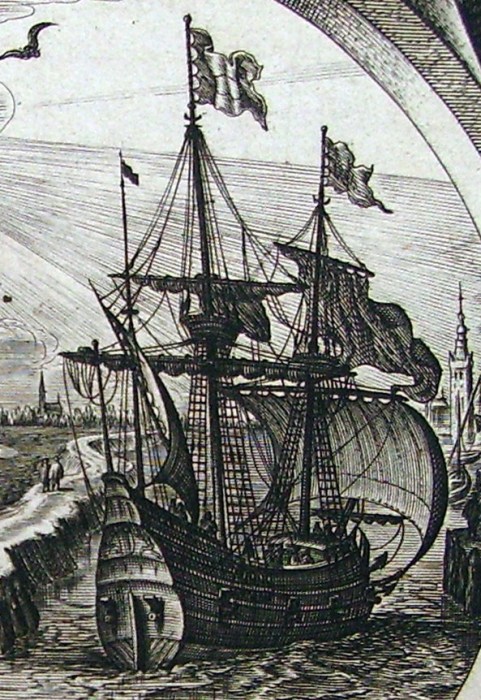
Ann and Little James

Thomas CLARKE brought with him considerable property, especially cattle, and had land allotted to him near Eel River, now Chiltonville.  He has been suggested as son of John Clark, pilot of the Mayflower, who gave his name to Clark’s island, of which he took possession, December 8, 1620.  The Great Migration Begins, states “the hypothesis is very attractive, and was accepted by [Donald Lines] Jacobus, but remains under proven.”
Edward BANGS arrived in Plymouth on with three unnamed family members.
Patience BREWSTER (PRENCE)
  and William HILTON Jr. and his mother were also passengers on the Anne.

After the Mayflower sailed, Thomas was financial agent at London for the Pilgrims and  continued to orchestrate business affairs in Europe and London for their cause, arranging for the 1622 publication of, and perhaps helping write, Mourt’s Relation. In 1623 George MORTON himself emigrated on the shipAnn to Plymouth Colony with his wife Juliana Carpenter and her sister, Alice Southworth, who was to become the second wife of Governor William Bradford.

Nicholas SNOW arrived in Plymouth on the “Anne” in 1623. He married about  1 Jun 1627 in Plymouth, Plymouth Colony to Constance HOPKINS. He was among the first settlers of Eastham, in 1644.

Lt.  Ephraim MORTON was born in 1623 on the Ann on  the passage to Plymouth Colony.

Hester le Mahieu Cooke and their daughters Jane and Elizabeth and son Jacob arrived on the Anne in 1623.

The Little James and the Anne were third and fourth arrivals following the Mayflower and the Fortune.   The Little John  and the Anne arrived at Plymouth a week apart during the summer of 1623 to find a tiny settlement decimated by illness. Its survivors had struggled to endure many hardships, clinging to the beliefs which had led them to America in search of freedom and self-determination. Tensions eased. Friends, family members and other new settlers were welcomed. Much needed provisions were unloaded Governor William Bradford tells of the ship’s arrival in Plymouth :

“About fourteen days after came in this ship, called the Anne, whereof  Mr. William Peirce was master; and about a week or ten days after came in the pinnace which, in foul weather, they lost at sea, a fine, new vessel of about 44 tun, which the Company had built to stay in the country. They brought about 60 persons for the General, some of them being very useful persons and became good members to the body; and some were the wives and children of such as were here already.”

30 Jun 1629  – Lyons’s Whelp The Talbot and the Lion’s Whelp sailed from Gravesend on Saturday, April 25, 1629, at seven o’clock in the morning,  On Tuesday, June 30, Governor Endecott went on board the Talbot, bade the passengers welcome to Salem.

Thomas MINER was onboard, a young man of 21.  His name does not appear  Alternatively, he arrived on the John Winthrop’s flag ship Arabella.

Simon HOYT came to America aboard the Lions Whelp. He landed at Salem in 1628 or 1629, and shortly afterward went to Charlestown, Mass. to live, as one of the first settlers.

Now in this year 1629, a great company of people (The Higginson Fleet) of good rank, zeal, means and quality have made a great stock, and with six good ships in the months of April and May, they set sail from Thames for the Bay of the Massachusetts, otherwise called Charles River.  The fleet consisted of, the George Bonaventure of twenty pieces of ordnance; the Talbot nineteen; the Lion’s Whelp eight; the Mayflower fourteen; the Four sisters fourteen and the Pilgrim four, with 350 men women and children, also 115 head of cattle, as horses, mares, cows and oxen, 41 goats, some conies (rabbits), with all provision for household and apparel, 6 pieces of great ordnance for a fort, with muskets, pikes, corselets, drums, colors, and with all provisions necessary for a plantation for the good of man.”  (The True Travels, Adventures and Observations of Captain John Smith – London 1630)

I found a Journal of the Voyage, kept by Rev. Francis Higginson, London, 1630.  It’s a dramatic tale of sea sickness, whales, gales, icebergs and small pox among the passengers.  However, only one sickly girl and one man already sick of consumption died on the voyag.  “By noon of Friday, they were within three leagues of Cape Ann; and as they sailed along the coast saw “every hill and dale and every island full of gay woods and high trees.  An increased longing for the new world came upon them as they saw the woods and flowers. Saturday night, June 27, they anchored at the old fishing station at Cape Ann. Some of the men went upon the little island in the harbor, and brought back ripe strawberries and gooseberries and sweet single roses. This was the first taste of the fruit of the new land.”

June 1629 – Four Sisters
The Four Sisters, left Gravesend, England April 5, 1629 along with the Higginson Fleet, five other ships, George Bonaventure, Lyon, Lyon’s Whelp, the Mayflower and the Talbot, arriving  in Salem June 1629.

Our ancestors on board include Walter PALMER,  and his children Jonah PALMER and Grace PALMER MINER.  None of Walter Palmer’s children are listed in any known passenger list, nor is the name of his wife.  It is assumed that his wife died before he left England and that his first five children accompanied him.

15 May 1629 – Second Mayflower
Mary Durrant Ring was a member of the Leiden Separatist community.   She arrived in Plymouth as a widow with her daughter Elizabeth RING CLARKE  on the second Mayflower, which sailed from Gravesend in March, and landed at Salem MA.  bringing 35 passengers, several of whom were from the Pilgrim colony which had been living for a number of years in the Netherlands including Thomas BLOSSOM and his family.   This was not the same ship that made the original voyage with the first settlers. This voyage began in May and reached Plymouth in August. This ship also made the crossing from England to America in 1630, 1633, 1634, and 1639. It attempted the trip again in 1641, departing London in October of that year under master John Cole, with 140 passengers bound for Virginia. It never arrived. On Oct 18, 1642 a deposition was made in England regarding the loss.

1630 – Mary and John I
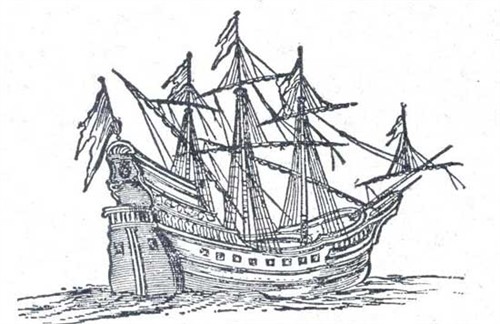
Thomas Lumbert – Mary and John     Left Plymouth, England March 20, 1630 with her unknown Master, arriving in Nantasket Point, now Dorchester, Mass., at the entrance of Boston Harbor on March 20, 1630, two weeks before the Winthrop Fleet arrived.These families and passengers were recruited by the Reverend John White of Dorchester, Dorset. Nearly all of the Mary and John 1630 passengers came from the West Country counties of Somerset, Dorset , Devon, and West Country towns of Dorchester, Bridport, Crewkerne and Exeter.The passengers of the Mary and John 1630 founded one of the first towns in New England, Dorchester, Massachusetts in 1630 and also founded the town of Windsor, Connecticut five years later in 1635Other information says the master was Thomas Chubb, and they landed in Dorchester. “140 passengers, but the list has never been found.”Thomas Lumbert emigrated in 1630 with the Winthrop Fleet on the Mary and John, first settling in Dorcester, Mass.1630 – Winthrop Fleet – A group of eleven sailing ships under the leadership of John Winthrop that carried approximately 700 Puritans plus livestock and provisions from England to New England over the summer of 1630.          Arabella

Winthrop Fleet – Great Migration Mar 1630

John MASTERS, Jane Cox Masters and their children’s names are from the passenger list of the Arbella and from his will.

William CHASE Sr, his wife Mary and son William CHASE Jr. emigrated in 1630 in the Great Migration with Gov Winthrop.

A wealthy group of leaders obtained a Royal Charter in March 1629 for a colony at Massachusetts Bay.  A fleet of five ships departed within the month for New England that included approximately 300 colonists, led by Francis HIGGINSON However, the colony leaders and the bulk of the colonists remained in England for the time being, to plan more thoroughly for the success of the new colony. Later that year, the group who remained in England elected John Winthrop to be Governor of the Fleet and the Colony. Over the ensuing winter, the leaders recruited a large group of Puritan families, representing all manner of skilled labor, to ensure a robust colony.

The total count of passengers is believed to be about seven hundred, and presumed to have included the following people. Financing was by the Mass. Bay Company. The ships were the Arbella flagship with Capt Peter Milburne, the Ambrose, the Charles, theMayflower, the Jewel, the Hopewell, The Success, the Trial, the Whale, the Talbot and the William and Francis.

The group departed Yarmouth, Isle of Wight on April 8.  Seven hundred men, women, and children were distributed among the ships of the fleet.  Because Edward FITZ RANDOLPH  came from a titled family, perhaps he had passage on the flagship, the “Arbella” with Winthrop himself.  The voyage itself was rather uneventful, the direction and speed of the wind being the main topic in Winthrop’s Journal, as it affected how much progress was made each day. There were a few days of severe weather, and every day was cold. The children were cold and bored, and there is a description of a game played with a rope that helped with both problems. Many were sick during the voyage, but nearly all survived it. The group landed at Salem, Massachusetts on June 12 after nine weeks at sea. The passengers took up residence in Salem, Boston, and the nearby area.

During his voyage aboard the Arbella, Winthrop wrote his famous sermon, “A Model of Christian Charity,” containing the often quoted phrase, “City upon a Hill.” This phrase is used to this day to symbolize certain essential characteristics of the American spirit.

The Winthrop Fleet was a well planned and financed expedition that formed the nucleus of the Massachusetts Bay Colony. However they were not the first settlers of the area. There was an existing settlement at Salem, started in about 1626, populated by a few hundred Puritans, most of whom had arrived in 1629, and who were governed by John Endicott. Winthrop superseded Endicott as Governor of the Colony upon his arrival in 1630.

Winthrop Passenger List

William BEAMSLEY and his wife Anne

Anthony COLBY  to Boston and Salisbury
his wife Mrs. Susanna Haddon

John Dillingham (Rev. Henry DILLINGHAM‘s son) of Bitteswell, Leicestershire to Boston
Mrs. Sarah Dillingham
Sarah Dillingham

Edward FITZRANDOLPH of Sutton in Ashfield, Notts to Scituate

Samuel GRAVES Sr.
Samuel GRAVES Jr.

Possibly Thomas MINER on the Arabella, though the Lyon’s Whelp in 1629  is a better bet

Robert POND of Groton, Suffolk to Boston
Mrs. Mary Pond
John Pond (Robert’s brother) of Groton, Suffolk to Boston

May 1631 – Lyon –  left Bristol, England 5 Feb  1630/31 with her Master, William Peirce, arriving in Salem May 1630/31

The Lyon was famous in the history of the early emigration to Massachusetts, and her Master, William Peirce, was equally noted for his skillful seamanship and his sympathy with the policy of the Puritan leaders. In 1630, 1631, and 1632 she made four voyages hither in quick succession under his command with the regularity and safety of a ferry, and on one of them saved the new settlement from starvation and death by her timely arrival with provisions and anti-scorbutics. The official connection of the Lyon with the Winthrop Fleet is of the same character as related of the Mary and John, as both were doubtless approved by the Governor and Assistants. In his letter of March 28, 1630, to his wife, written from the Arbella, off the Isle of Wight, after noting the sailing of the Mary and John, Winthrop wrote: ‘and the ship which goes from Bristowe (Bristol) carrieth about eighty persons’, This was the Lyon and she probably sailed from that port to accommodate passengers living In the West Counties — Lancashire, Cheshire, Warwick, Gloucestershire, and Somerset.

The date of her departure is not known (probably in March) but her arrival at Salem is reported ‘in the latter part of May’ some time before the Arbella reached that port. The identity of this ship is not established as there were several of her name in existence at that period. In view of her valuable services to the Colony it is to be hoped that the necessary search may be made to fix her home port, previous history, tonnage, and ownership.

Of Captain William Peirce, her Master, more particulars are known. He had sailed to Plymouth in 1623 as Master of the Anne of London, bringing the last lot of passengers to the Pilgrim settlement. He was then a resident of Ratcliffe, parish of Stepney, London, and at that date was about thirty-one years old. He made a voyage to Salem in 1629 as Master of the Mayflower (not the Pilgrim ship) and thereafter he was in constant traffic in passengers and merchandise across the Atlantic. He took up his residence in Boston in 1632 and was admitted freeman 14 May 1634. His wife, Bridget, joined the church 2 Feb 1632/33; perhaps a second wife, as a William Peirce, mariner of Whitechapel, was licensed in 1615 to marry Margaret Gibbs. Whitechapel and Stepney are adjoining parishes. He became a Town and Colony official and was engaged In coastwise shipping thereafter. He compiled an Almanac for New England which was the second issue in 1639 from the Daye press at Cambridge. In 1641 he was killed by the Spaniards while on a voyage to the island of New Providence, Bahamas Group, whither he was taking passengers for settlement.

John PERKINS arrived in Boston 5 Feb 1631 on the first trip of the Lyon after a “very tempestuous voyage.” Roger Williams was one of their fellow passengers.

Rev. Roger Williams, bound for Salem
Mrs. Mary Williams

Mrs. Margaret Winthrop (wife of Governor), bound for Boston
Adam Winthrop
Anne Winthrop
John Winthrop, Jr., of Groton, Suffolk, bound for Boston

John Perkins, of Hilmorton, Warwick, bound for Boston
Mrs. Judith Perkins
John Perkins
Elizabeth Perkins
Mary Perkins
Thomas Perkins
Jacob Perkins

1632 – William & Francis
Shortly after the death of her husband, Deborah Bachiler emigrated from England to New England with her father, Stephen BACHILER,  his wife, Helena Mason Bachiler and her four sons.

16 Sep 1632 – Lyon (4)

There were Four Lyon trips: 1630, 1631, 1632, 1632. The Lyon hit a reef April 10, 1633 (Peirce was ‘driving’) and it sunk, replaced by the Rebecca, built in the colonies.

Sailed from London June 22, 1632, arriving in Boston September 14/16, 1632. The master, William Pierce, brought 123 passengers.

“He brought one hundred and twenty three passengers, whereof fifty children, all in health. They had been twelve weeks aboard and eight weeks from Land’s End.”

John BENJAMIN arrived with his family in Boston Harbor, Sunday evening, 16 Sep 1632, on board the Lion, after a voyage of twelve weeks, being eight weeks from Lands End.  William Peirce, Master, sailed from London June 22.   ‘He brought one hundred and twenty three passengers, whereof fifty children, all in health.   His brother, Richard Benjamin, came with him on the Lion and settled in Southold, Long Island.

BROWNE, John and wife Dorothy, children Mary, John [Jr.], James and William
(From Hawkedon, Suffolk, bound for Watertown. Ref: Bond 124. 36 pg 15

Benjamin, John of Heathfield, Sussex and wife Abigail (From Haethfield, Sussex, bound for Cambridge and Watertown. Ref: Banks Mss. 36 pg 171. Listed with a Richard Benjamin.

15 Jun 1633 – Elizabeth Bonaventure 

John Graves, Master, left Yarmouth, Norfolk, the first week in May and arrived at Boston on June 15, 1633 with ninety five passengers. The ship sailed into the small harbor called Bare Cove, so called because only the bare flats could be seen at low tide. They stopped in Charlestown for a time, and then received permission to scout out a place for their new town Hingham.  Included on board were 14 men and women  from from Hingham, Norfolk, England who together founded Hingham, Mass.

Edmund HOBART  of Hingham, Norfolk to Charlestown  with Mrs. Margaret Hobart,  Nazareth, Edmond,  Thomas, Joshua, Rebecca,Elizabeth, and Sarah

Henry Gibbs of Hingham, Norfolk to Charlestown

Ralph SMYTH of Hingham, Norfolk to Charlestown

Nicholas Jacob of Hingham, Norfolk to Watertown  with Mrs. Mary, Jacob, John, Jacob,  Mary and Jacob

Thomas Chubbock  of Hardingham, Norfolk to Charlestown  with Mrs. Alice Chubbock, Sarah and Rebecca

Mrs. Elishua Crowe  to  Charlestown

Simon Huntington   of Norwich, Norfolk to  Roxbury  with Mrs. Margaret Huntington, Christopher, Anne, Simon,  and Thomas.

The Elizabeth Bonaventure was a very famous name for a ship, because it was the name of a warship that Sir Frances Drake used as his flagship on at least a couple of his expeditions including the 1587 attack on Cadiz which destroyed much of the armada that was massing to attack England. That attack was delayed and occurred the next year.  A year later it was part of the fleet to face the Spanish Armada.  It was also involved in the rescue of the lost Colony of Roanoke that was under attack. The fate of the vessel is not known.

This may not be the same vessel that brought the Hobarts and Ralph Smyth over, but there is no other record of this vessel under the command of Captain John Graves. There where ninety-five passengers on board for that voyage. It was a fast trip for a ship of that time, and reflected the advancements in ship building that was common in English warships, and being copied by other countries. By 1633 it would have been over seventy years old, but on the other hand there aren’t records about the retirement or loss of the warship by that name, and famous ships can often live longer because of the pride in that vessel’s history.

24 Mar 1634 – Mary & John II
Left Southampton, England on 24 March 1634 with her Master, Robert Sayres, and arrived at Boston, MA on 24 May 1634.

Stephen JORDAN sailed with his family sailed for America on the ship “Mary and John“.  Stephen took the oath of supremacy and allegiance on 24 Mar 1633/34, a necessary act in order to sail.

Robert CROSS sailed from Ipswich, England to Ipswich, Massachusetts on the “John & Mary” in 1634.He met Anna Jordan on board and married her 20 Aug 1635 in Ipswich Mass.

William CLARKE left England on the ship ‘Mary and Jane’, which sailed from London on March 24, 1633, arriving in New England in June of that year.

William COLLIER –  William was a London merchant, a member of Worshipful Company of Grocers  and the Company of Merchant Adventurers  and helped finance the Leiden Separatists in founding Plymouth Colony.  After the partnership between the Pilgrims and the Adventurers was terminated, he came to Plymouth himself, sailing with four daughters (Sarah, Rebecca, Mary and Elizabeth) .

Francis Kirby, in his letter to his friend John Winthrop, Jr., writes, “I hope you have received the goods I shipped in the Mary & John per Mr. Collier, wherin I sent all the things you wrote for but sope ashes & old musket barreles, which were not to be had;”

James Shirley, too, stated, 24 June 1633, that his last letter was “sente in ye Mary & John by Mr William Collier,” etc.

30 April 1634 – Francis
Capt. John CUTTING (1593 – 1659) was a “Master” mariner; the first record shows him in command of the ship “Francis” of Ipswich, England which set sail the last of April 1634 with some eighty passengers aboard.

Passengers include  Robert PEASE Jr. Robert was accompanied by his brother John, his eldest son Robert PEASE – The Former, a Miss Clark, aged fifteen, who was the daughter of a fellow passenger, and a Miss Greene, aged fifteen, perhaps a servant. Robert Pease’s second son John PEASE may have been aboard as well.

The Francis left Ipswich, Suffolk, England mid (30th) April1634 with her master, John Cutting, arriving in Massachusetts Bay.

30 April 1634. Passengers of the Francis of Ipswich, Mr. John CUTTING, captain, bound for New England (landed at Plymouth or Boston, MA): from the Public Record Office, Kew, Richmond, Surrey TW9 4DU, England)

04 Feb 1634 Henry Dade writes from Ipswitch to the Archbishop of Canterbury that the Francis and the Elizabeth with 60 men in each intend to sail for New England on about March 10 and he supposes they are debtors or persons disaffected with the established church. Note: These ships and nine others bound for New England were stayed but on 28 Feb allowed to proceed on condition that the passengers took the oath opf allegiance. Colham pg 111.

12 Nov 1634: John CUTTING and William Andrews pray to be released from bonds of presentation of certificates, enclosing that passangers of the 30 May 1634 Francis and 30 May 1634 Elizabeth did not take the oaths.

21 Jan 1635: John CUTTINGE, Master of the Francis and William Andrewes, Master of the Elizabeth, both of Ipswitch, have brought a list of all the passengers that went in their ships to New England in April 1634 with certificates of their having taken the Oaths of Supremacy and Allegiance.

30 Apr 1634: Passengers from Ipswitch by the Francis of Ipswitch, Mr. John CUTTING, bound for New England: Coldham pg 114 list

1634 – Elizabeth Dorcas
Edward BOSWORTH,  emigrated to Hingham Mass in 1634 who with his wife Mary had with them their sons…a daughter Mary, and her husband William BUCKLAND .  They sailed on the ship Elizabeth Dorcas, which was detained at Gravesend, Eng., from 22 Feb 1634, until early spring, while it was ascertained that all passengers had secured the necessary paper work for immigration. The ship had many deaths, both among the passengers and animals. One of those who survived the trip was Edward, but he died in Boston Harbor on arrival.” Though dying, he asked to be carried up to the deck so he might see the land to which he was bringing his wife, two younger sons, and daughter and her husband. After seeing land, he died, was carried ashore, and was buried in Boston.

Edward had borrowed money from Henry Sewall to pay the passage over to New England for his family. His wife was left penniless and was helped by the town. The money was a loan and the amount was about 100 pounds. The debts were assumed by the three sons and the son-in-law, William Buckland, who had married Mary Bosworth. Jonathan, 22, Benjamin, 20, and Nathaniel, not quite 18 years old, each paid about 20 pounds of the debt.

30 Apr 1634 – Elizabeth–  left Ipswich, Suffolk, England mid April of 1634 with her master, William Andrewes (Andres), arriving in Massachusetts Bay.

04 Feb 1634 Henry Dade writes from Ipswitch to the Archbishop of Canterbury that the Francis and the Elizabeth with 60 men in each intend to sail for New England on about March 10 and he supposes they are debtors or persons disaffected with the established church. Note: These ships and nine others bound for New England were stayed but on 28 Feb allowed to proceed on condition that the passengers took the oath opf allegiance. Colham pg 111.

12 Nov 1634: John CUTTING and William Andrews pray to be released from bonds of presentation of certificates, enclosing that passangers of the 30 May 1634 Francis and 30 May 1634 Elizabeth did not take the oaths.

21 Jan 1635:  John CUTTINGE, Master of the Francis and William Andrewes, Master of the Elizabeth, both of Ipswitch, have brought a list of all the passengers that went in their ships to New England in April 1634 with certificates of their having taken the Oaths of Supremacy and Allegiance.

Passenger List

Richard WOODWARD his wife  Rose Stewart  and their sons George WOODWARD and John emigrated  on the Elizabeth in 1634.

Woodward Richard 45, miller #3
From Suffolk, bound for Watertown. 36 pg 166
Woodward Rose 50, wife of Richard #4
Woodward George 13, #57
Woodward John 13, #58
~~~~~~~~~~~~~~~~~

Sailing from Ipswich,  Richard KIMBALL emigrated to New England with his wife, seven of their children including John KIMBALL, Ursula’s mother and brother Thomas Scott and his family, and Henry Kemball (probably Richard’s brother) and his family.  The crossing took almost three months and they landed in Boston.   “A Note of all the names and ages of all those which did not take the Oath of Allegiance or Supremacy being vnder age shipped in or Port. In the Elizabeth of Ipswich Mr Willia(m) Andrew(e)s  Master bound for new England the last of Aprill 1634.” (listed in “Planters” as with Richard Kimball)
Kemball Henry 44, from Rattlesden, Suffolk #13
From Rattlesden, Suffolk, bound for Watertown. 36 pg 159
Kemball Susan 35, wife of Henry #14
Kemball Elizabeth 9, child of Henry #74
Kemball Susan 7, child of Henry #75
Kemball Richard 39, from Rattlesden, Suffolk #15
Born 1595, from Rattlesden, Suffolk, bound for Watertown, Ipswitch. Ref: NEGR 57/331. 36 pg 159
Kemball Ursula unk age, wife of Richard #16
Kemball Henry 15, child of Richard #77
Kemball Richard 11, child of Richard #78
Kemball Mary 9, child of Richard #79
Kemball Martha 5, child of Richard #80
Kemball John 3, child of Richard #81
Kemball Thomas 1, child of Richard #82
Kemball Elizabeth 13, Thurston Raynor’s step daughter #69
Martha WHATLOCK SCOTT , widow of Henry SCOTT emigrated to New England with her daughter Ursula, son-in-law Richard Kimball and their seven children, son Thomas and his family, and Henry Kemball (probably Richard’s brother) and his family. .

Thomas SCOTT            40  from Rattlesden Suffolk, bound for Ipswich
SKOTT, Elizabeth          40  Wife of Thomas
SKOTT, Elizabeth            9      with Thomas Scott
Skott, Abigail               7      with Thomas Scott
Skott, Thomas             6      with Thomas Scott…
These took the Oath of Allegiance and Supremacy.  Ipswich Customhouse, 12 Nov12 1634.
…Skott, Thomas     40   from Rattlesden, Suffolk,  bound for Cambridge
(wife) Elizabeth       40
Kemball, Henery      44  from Rattlesden, Suffolk,   bound for Watertown
(wife) Susan            35
Kemball, Richard 39  from Rattlesden, Suffolk,  bound for Watertown
(wife) Ursula [blank]…
…Scott, Martha       60      (listed in “Planters” as with Thomas Scott)…

John Kimball’s future wife, Mary Bradstreet and future in-laws, Humphrey and Bridget BRADSTREET were on this same voyage.
Bradstreet Humphrey 40, from Capel Saint Mary, Suffolk #29
Bradstreet Bridget 30, wife of Humphrey #30
Bradstreet Anna 9, #89
Bradstreet John 3, #90
Bradstreet Martha 2, #91
Bradstreet Mary 1, #92

18 Sep 1634 – Griffin Left England Aug 1, 1634 with her master, ?, arriving in September 18, 1634,  at Boston with about one hundred passengers and cattle for the plantations.

Passenger List
Lothrope John Reverand
Lothrop Mrs, wife
Lothrop Thomas, son
Lothrop Samuel, son
Lothrop Joseph, son
Lothrop John, son
Lothrop Benjamin, son
Lothrop Jane, daughter
Lothrop Barbara, daughter

Rev.  John LATHROP brought The Lothrop Bible with him  on his trip to America in During the voyage, while at evening devotions, he spilled hot candle wax on the open book which burned through several pages, causing holes about the size of a shilling. Before landing, he carefully repaired most of the damaged paper and filled in the missing text from memory. A few of the holes in the pages remain.
Lothrop Bible

Richard SCOTT was born 9 Sep 1605 probably in Clemsford, Suffolk, England. He married Katherine MARBURY on 7 Jun 1632 in England.  They emigrated in 1634 on the “Griffin” and was admitted to the church at Boston, 28 Aug 1634

1635 – Increase
The Increase left London, England April 1635 with her master, Robert Lea, arriving in Massachusetts Bay.

It is said by some Warner genealogists  William WARNER and three children sailed on the ship,”Increase” I just see William’s son John listed , perhaps as a servant of Matthew Marvyn.

April 15, 1635 – Certificate source not given.

#49 Marvynn Matthew 35, husbandman ((Marvin, Matthew and Reginald, from Bentley Magna, Essex, bound for Hartford.)
50 Marvyn Elizabeth 31, wife of Matthew
51 Marvyn Elizabeth 31, sister or duplicate
52 Marvyn Matthew 8, child of Matthew
53 Marvyn Marie 6, child of Matthew
54 Marvyn Sara 3, child of Matthew
55 Marvyn Hanna 1/2 , child of Matthew
56 Warner Jo, 20, listed below Marvyns  (John from Boxted, Essex, bound for Ipswich).
57 More Issac 13, listed below Marvyns ((From Boxted, Essex, bound for Windsor)

William PAYNE‘s son William (1598 – 1660) and daughter Dorothy Ayres (1598 – ) were on the same ship

#69 Payne William 22, husbandman  (should be age 42, Anna’s  age is right)
70 Payne Anna 40, wife of William
71 Payne William 10, child of William
72 Payne Anna 5, child of William
73 Payne Jo. 3, child of William
74 Payne Daniel 8 wks, child of William
75 Bitton James 27
76 Potter William 25
77 Wood Elizabeth 38
78 Beardes Elizabeth 24
79 Payne Susan 11

#32 Ayres Symon 48, chirurgion [(archaic) a surgeon]
#94 (From Laverham, Suffolk, bound for Watertown. Ref: NEGR 69/250 36 pg 157) Ayres Dorothy 38, wife of Symon
#95 Ayres Marie 15, child of Symon
#96 Ayres Thomas 13, child of Symon
#97 Ayres Symon 11, child of Symon
#98 Ayres Rebecca 9, child of Symon
#99 Ayres Christian 7, child of Symon
#108 Ayres Anna 5, child of Symon
#109 Ayres Benjamin 3, child of Symon
#110 Ayres Sara 3 mos, child of Symon

2 Apr 1635 – Planter
Nicholas Trerice, Master. She sailed from London 2 Apr 1635 and arrived at Boston on Sunday, 7 Jun 1635.

“22 Mareij 1634. Theis under written names are to be imbarqued in ye Planter Nico.Trarice Mr bound for New England p Certificate from Stepney pish, and Attestacon from St Tho: Jay, Mr Simon Muskett 2 Justices of the Peace. the Men have taken the oaths of Supremacie & Allegeance”

The Planter, under Master Nicholas Trerice/Travice, the Planter sailed from London April 2 or 11, 1635, arriving at Boston June 7, 1635. Hotten has Nico Trarice for the master.

Francis BAKER immigrated from England  landing in Boston April 2 1635. He was described as a tailor (Hotten Ship List par. 45) and brought with him a certificate from the minister at Great St. Albans, Herfordshire, England, his last place of residence.  From Winthrop Society: Passanger on Planter: Francis Baker, Tailor, Age: 24, Date of Record: 1 Apr 1635, Note: Swore oath at St Albans, Herts, Roll #: 45

Thomas JEWELL is listed as “Jewell (Jernell), Thomas 27, miller”

5 Apr 1635 – James– William Cooper Master

The James left London, England April 6, 1635 with her master, William Cooper, arriving in Boston on 3 June 1635.    Fifty-three men (plus women and children) embarked at Southampton in the James of London.

Edmund HAWES, cutler, late of London,” was included in the passenger list of the James, about to sail from Southampton

Thomas COLEMAN of Marlborough, Wiltshire, bound for Newbury and Nantucket   His wife,  Susan Raulines also made the trip.

Anthony MORSE,shoemaker of Marlborough, Wiltshire, his wife Mary Cox their daughter Ann MORSE THURLOW were also on this voyage.  Anthony’s brother William, was also aboard also listed as a shoemaker.
The manifest of the ship “James” shows only “Thomas BROWN – Weaver”. It is assumed that his wife Mary Healy and their first born child, Francis BROWN, age 2, was with him on this journey.  The manifest of the ship “James” actually reflected two entries for “Thomas Brown-Weaver”. The second entry noted him as being a servant of one Thomas Antram “returning to New England.”  As the name “Thomas Antram” does not appear in other records, there is some doubt as to the viability of our Thomas Brown being “a servant of Thomas Antram”.

Edward WOODMAN and his half-brother, Archelaus Woodman, arrived in Newbury aboard the “James”  or he came on the “Abigail” a few weeks later.   The passenger list for the Abigail shows a Richard Woodman.  The passenger list for the James shows a Hercules Woodman.

14 Apr 1635 – Susan and Ellen

John PROCTOR 40 sailed on the Susan and Ellen which left London on 14 April 1635 with her master, Edward Payne, arriving in Massachusetts Bay  on 9 May 1635.with his wife Martha Harper 28,  and two children, Marie, aged 1, and 3-year-old John, Jr.  John was listed first on the roll as Husbandman #1.

May 1635 – Elizabeth and Ann
The “Elizabeth and Ann” left London, England, arriving in Massachusetts Bay. Registration was open between May 6 -14 1635. Her master was Robert Cooper. (sometimes Cowper)

The following roll is from her departure point, not necessarily who landed.  Passengers embarked in the Elizabeth and Ann, Mr. Roger Cooper, bound [from London] to New England. Coldham pages 135-136

#54 Courser William 26, shoemaker… William COUSER, of Boston, supposed to have been the first of the name in this country, was born Aug., 1609 in England.  He married Joanna [__?__] before 1638 in Boston, Mass.

#87 Holloway Jo. 21  – Joseph HOLLOWAY (Holly)

8 May 1635 – Hopewell
Edmund MARSHALL emigrated on the Hopewell.  John Driver, master, sailed from Weymouth in Dorsetshire, England, May 8, 1635. The ship’s passenger list names 18 men, but does not list their wives, children or servants.

Robert TITUS , his wife Hannah and their two children, John TITUS and Edmond  sailed from London on April 3rd, 1635 on board the Hopewell.

Elder John STRONG sailed in on the Hopewell, Master John Driver from Weymouth, Dorsetshire, England on 8 May 1635.with his wife and their two children:  John Jr age 2 and an infant plus John’s sister Eleanor age 22.


4 Jun 1635 – Abigail under Captain Robert Hackwell left London in mid-July.

John HOUGHTON traveled with the  family of Ralph Shepherd
Houghton, Jo. 4 #25 (John from Eaton Bray, Bedfordshire to Deham, Mass, Ref: Pope. 36
Sheppard Ralph 29, #119
Sheppard Thanks 23, wife of Ralph #120
Sheppard Sara 2, child of Ralph #121

xxth June,, 1635

In the Abbigall de Lond. Hackwell bnd. fro New England p’r Cert. Fro of his Conformitie from Justices of Peace and minister Eaton Bray In Com. Bedford.

Joh: Houghton 4

Edmond FREEMAN along with his wife Elizabeth and children including Maj. John FREEMAN were among the passengers. John was  listed as eight years old on the Customs House rolls. Edmond’s brother John also made the trip with his family.  There were a lot of Freemans on board the Abigail .  Identified relatives are highlighted.  During the crossing an epidemic of smallpox broke out on shipboard. They arrived in Boston on 8 October 1635 .
Freeman John 35, #45
Freeman Marie 50, #58
Freeman Jo: 9, #59
Freeman Sycillie 4, #60
Freeman Thomas 24, #91
Freeman Edmund 45, #107
Freeman Edward 34, husbandman #135
Freeman Elizabeth 35, wife of Edward #136
Freeman Elizabeth 12, #149
Freeman Alice 17, #150
Freeman Edmund 15, #152
Freeman John 8, #153

17 Junij, 1635 Theis under written names are to be transported to New England, imbarqued in the Abigall, Robert Hackwell Mr. P’r Cert. From the minister and Justices of Peace of their Conformitie, being no Subsedy men. The have taken the oaths of Alleg: and Supremacy being all Husbandmen:

Jno. ffreeman 35
Marie ffreeman 50
Jo: ffreeman 9
Sycillie ffreeman 4

Elizabeth EPPS, daughter of Daniel EPPS and Martha READE later the wife of  James CHUTE Sr  sailed on the Abigail in the care of the Winthrop family.

Wynthropp John 27, #169 (the Younger)
Wynthropp Elizabeth 19, #170
Wynthropp Deane 11, #171
Goade Thomas 15, #172
EPPS Elizabeth 13, #173

Martha Reade was born on 13 July 1602 at Wickford, Essex, England. She was the daughter of Col. Edmund READE and Elizabeth COOKE. She married Daniel EPPS before 1622 in Wickford, Essex, England. After Daniel’s death, she married George Samuel Symonds in 1637. It was probably as wife of Symonds that the combined Epps-Symonds family emigrated to the Massachusetts Bay Colony. Also in this extended family are Martha Read’s two sisters. Her sister Elizabeth maried  John Winthrop, Jr., the son of Governor Winthrop, and one of the founders of Ipswich. Martha died in 1662 at Ipswich, Mass.

Family history says her other sister Mrs. Margaret Lake, with her daughters Hannah and Martha, accompanied her sister Elizabeth (Read) Winthrop, the new wife of Gov. John Winthrop, Jr., who returned to America in this ship with commissions from Lord’s Say, Brook and others. She left a son in England who never came to America.   I don’t see any of the Lakes on the manifest, however Harry and Henry Vane , soon to be Governor of Massachusetts was also traveling with the Winthrops and were not on the manifest either.

In 1631 [John Winthrop] followed his father to Massachusetts Bay and was one of the “assistants” of the Massachusetts Bay Colony in 1635, 1640 and 1641, and from 1644 to 1649. He was the chief founder of Agawam (now Ipswich, Massachusetts) in 1633, went to England in 1634, and in the following year returned as governor of the lands granted to the Lords Say and Sele and Brooke,[1] sending out the party which built the fort at Saybrook at the mouth of the Connecticut River..

1635 – Assurance
In “The Original Lists of Person of Quality; 1600-1700″ there is a Nicholas JACKSON, age 22 on the Assurance emigrating from London to America, July 24, 1635

8 Oct 1635 – Defense left London, England late July 1635 with her master, Edward Bostocke, arriving in Massachusetts Bay October 8th.

John GOULD from Towchester, Northamptonshire, England, arriving at Boston October 8. John is listed as “25, of Towcester, county Northants”, bound for Charlestown. With him is Mrs. Grace Gould, also 25.

William REEDE , his wife Mabel, 30; George, 6; Ralph, 5; and Justus (later Abigail Justice Reed WYMAN), 18 months

Late Nov 1635 – Truelove left London, England Sept 1635 with her master, John Gibbs, arriving in Massachusetts Bay.  Passenger count was listed as 66, but there are 67 names listed. This information was transcribed in the 19th century by James Savage from records found in London, at the Augmentation Office, Rolls Court, Westminster.

“xix Sept 1635 Theis under-written names are to be transported to New england imbarqued in the Truelove Jo: Gibbs Mr, the Men have taken the oaths of Alleg: & Suprem.”

Tomkins, Ralph 50 #29 (Ralph TOMPKINS)
TOMPKINS, Katherine 58, wife #30
Tomkins, Elizabeth 18 #31
Tomkins, Marie 14 #32 (later to marry  John FOSTER Sr.)
Tomkins, Sammuel 22 #33

1636 – Arms of Rensselaerswyck
Albert Andriese BRADT was born 26 Aug 1607 in Fredrikstad, Smaalenenes (now Otsfold, Norway). In America he was known as “de Noorman” which meant “of Norway”.  He was listed as a 24 year old sailor when he married Annatje Barentse Van Rotmers  on 11 Apr 1632 at the Oude Kerke, Amsterdam, Netherlands.

1636 – Expedition
Richard PRATT emigrated on the “Expedition“, arriving in Malden, Mass about 1636.

15 May 1637 – Mary Anne

Instead of taking passage on another ship, Thomas Payne (1586 – 1639) bought the vessel Mary Anne.  He invited other Puritans to join him for the passage and engaged Mr. William Goose to be the Master.   Thomas was the grandson of our ancestor William PAYNE Sr.    Thomas’ cousin William PAYNE (1565 – 1648) didn’t immigrated, but he had six children who did.  It was relatively rare for the English gentry to participate in the Great Migration.  So far I’ve only identified 22 immigrants who  had family crests at the time, out of more than 400 immigrants in all. (See my tag  Immigrant Coat of Arms)  Since it’s rare, I’ve had a fun time tracing the Payne family estates and their Tudor era friends.  Ironically, many of the Payne family associates were Roman Catholic Recusants.   While seemingly opposite, both groups defied religious authority.    See William PAYNE Sr.’s page for details.
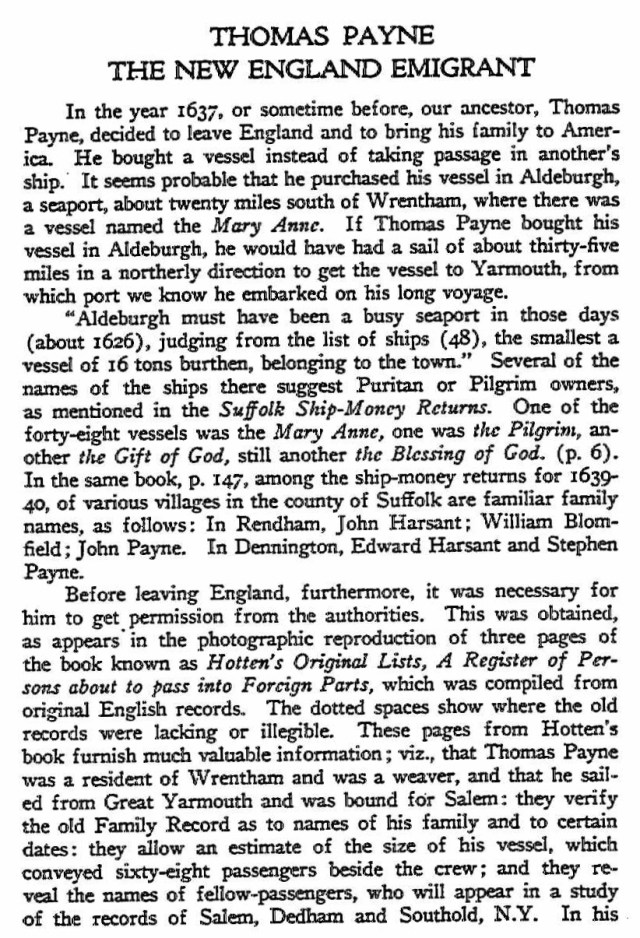
Descendants of Thomas Payne

Source: Descendants of Thomas Payne
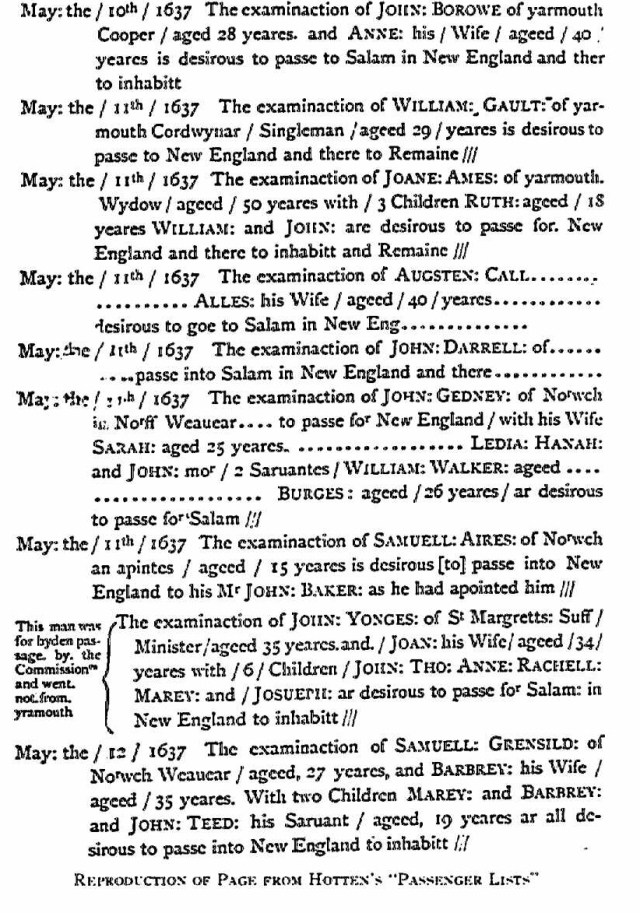
Thomas Payne 11
Thomas Payne 12

Thomas Payne 13
Thomas Payne 14
Elizabeth GOODALE came to  Newbury, Mass on the Mary Anne in 1637. With her came her children Ann, Susanna & her husband Abraham Toppan two children and a maid, Joanna and Elizabeth.

Austin KILHAM and his family sailed from England on the ship Mary Anne for New England  on 15 May  1637 out of Ipswich, England.  She did not land in Salem, MA, but in Boston on 20 Jun 1637. William Goose was the master. Many people assume the ship went to Salem because Austin’s examination record show him as “being desirous to goe to Salem in New England”.  Kilham doesn’t appear in the above list, but his name does appear in “Topographical Dictionary of 2885 English Emigrants to New England 1620 – 1650” by Charles Edwards Banks, Edited and Indexed by Elijah Ellsworth Brownell, 1957

May 1637 – Friendship
John CHIPMAN was 17 when he came to New England in May, 1637, in the service of his cousin Mr. Richard Derby, who settled in Plymouth. Some records say in the month of July and aboard the ship ‘Friendship‘. However, no ships roster or other authoritative document has yet come to light confirming this report.

29 Sep 1637 – John & Dorothy of Ispwich and The Rose of Yarmouth, 1637

A small parchment volume (also in the Rolls Office) labelled on the cover”T G 27.299 A. D, 1637—13 Car. I” is occupied with a record of persons”desirous to pass beyond seas.” Its upper right hand corner has been destroyed, by which much of the record is gone. What is not destroyed of the title of the volume is “A Register of the … of such persons a … and upwards and have … to passe into formigne partes … March 1637 to the 29th day of Septe… by verts of a commission granted to Mr Thomas Mayhew gentleman.” ” These people went to New England with William Andrews of Ipswich, Mr of the John and Dorothay of Ipswich, and with William Andrewes his Sons Mr of the Rose of Yarmouth.

8 Apr 1637 – The Register of persons about to pass in forraigne part on the ships John & Dorothy, and The Rose
Michael METCALF Sr, The examination of  Michill Metcalf, of Norwich, dornixweaver, aged 45 years, and Sarrah, his wife, aged 39 years, with 8 children, Michill [Michael METCALF Jr.], Thomas, Marey, Sarrah, Elizabeth, Martha, Joane, and Rebecca, and his servant Thomas Cumberbach, aged 16 years. Are desirous to pass to Boston in New England, to inhabitt.

Metcalfe Michill Norwich, Dornix weaver 45 boston in New England
Metcalfe Sarrah wife 39 boston in New England
Metcalfe Michill child boston in New England
Metcalfe Thomas child boston in New England
Metcalfe Marey child boston in New England
Metcalfe Sarah child boston in New England Arpill 8th 1637
Metcalfe Elizabeth child boston in New England
Metcalfe Martha child boston in New England
Metcalfe Joane child boston in New England
Metcalfe Rebecca child boston in New England
Cumberbach Thomas servant 16 boston in New England

1637 – Sparrow Hawk crashed upon reaching New England.  Matthew BECKWITH swam ashore.   After a query from a reader, I found the Sparrow Hawk actually crashed in 1626 when Matthew would have been only 16 years old.  Here’s a book on the subject.

1637 – Hercules
Thomas CALL
  and his nephew Philip CALL I arrived in America 1637 on “Hercules” to Charlestown, MA. To Malden in 1649. Being of Faversham, County Kent, Eng. embarked 1636 with wife and 3 children.

Joseph BATCHELLER immigrated to America in 1636  on the ship “Hercules“. with his wife, son Mark, three servants and brothers Henry, John and Daniel. He was listed as a tailor on the roll of persons who made the passage from Sandwich for the American plantations.

11 Apr 1638 – The Confidence
Robert RING
 (1614 – 1691)  sailed  on The Confidence from Southampton April 11, 1638 or April 24, with Master John Gibson, and 84 passengers.  He was a servant of John Sanders bound for Salisbury, Mass.  He returned to England about 1643 and married Elizabeth JARVIS there before 1649.

Spring 1638 –  Den Dolphyn
Barent Jacobsen KOOL sailed on the ship Den Dolphyn to New Amsterdam in early 1638 with his father-in-law, Leendert Arentsen DeGrauw. It is presumed that his wife and her brothers and sisters were also on board. On April 19, 1638, the crew of the Den Dolphyn made a formal complaint to the provincial secretary about how the ship leaked during the voyage and that the captain had not provided enough food for the passengers. Barent and DeGrauw testified that several children belonging to Jan Schepmoes and his wife didn’t receive enough food.

Leendert Arentsen De GRAUW immigrated on 7 Sep 1637 from Amsterdam to New Amsterdam with wife Leuntje Janje LYDECKER and children on the Dolphin.

1638 – Abigail
Richard ORMSBY came from the Parish of Ellsworth, Cambridgeshire, England, to York, Maine, in 1638 on the ship  “Abigail”.

1638 – John of London 
Richard THURLOW , his wife Jane and their children Francis THURLOW , Thomas and Mary, sailed in 1638 from Hull, Yorkshire to Boston on the ship, “John of London.” He was one of a group consisting of about 60 families led by the Rev. Ezekiel ROGERS, most of whom had been residents of the Yorkshire village of Rowley and it’s surrounding area.”  Undoubtedly, Rev. Rogers kept records and a log during the voyage, but these, along with most of his belongings, were lost in the fire that destroyed his dwelling in Rowley, Mass. a few years after he and many of the group settled there.

Other ancestors sailing with Rogers’ Company include Francis PARRATT, bringing his sisters Ann and Faith,  Hugh CHAPLIN,  John BOYNTON,  Jane GRANTRobert CROSBYLeonard HARRIMAN  & Nicholas JACKSON,

10 Aug 1638 –Diligent of Ipswich, John Martin, Master. She sailed from Ipswich, Suffolk, in June 1638 and arrived August 10, 1638 at Boston, with about one hundred passengers, principally from Hingham, Norfolk, destined for Hingham, Massachusett

Robert PECK and family, including Anne PECK MASON, sailed for America in the ‘Diligent‘ of Ipswich (master John Martin – left in June and arrived Boston 10 Aug 1638 with about 100 passengers) and joined settlement of Hingham – many important residents went with him (Buck, Chamberlain, Cooper, Cushing, Foulsham, Gates, James , Joseph Peck , Ripley and Tufts).  Joseph PECK, Robert’s brother, is also our ancestor and sailed with second wife and four children (Joseph, Nicholas, Simon, and Rebecca) plus two men servants and three maid servants. Robert took his wife Anne (nee Lawrence) their children including -Joseph and Robert and/or Thomas and Ann) and two servants.

John SUTTON brought his family in 1638 while Hannah was still a baby and John, Jr., was already a man of 21 years. They were part of a group of 133 passengers who traveled to Ipswich, the capital of Suffolk County in SE England, and booked passage on the ship Diligent, captained by John Martin of Ipswich

Stephen GATES I, his wife Anne Veare and their children including Stephen GATES II sailed on the Diligent in 1638.

Partial Passenger List
Gates Stephen
Gates Mrs. Anne
Gates Elizabeth
Peck Rev. Robert
Peck Mrs.
Peck Anne
Peck Joseph
Peck Joseph
Peck Mrs. ……
Sutton John
Sutton Mrs. Elizabeth
Sutton Hannah
Sutton John, Jr.
Sutton Nathaniel
Sutton Elizabeth
And about 20 servants

1638 – Bevis Left Southampton May 1638 for New England with her master Robert Batten.

The following Lists of New England Emigrants are from Her Majesty’s State Paper Office Southampton.— The list of the names of Passeng. Intended to shipe themsleues, In the Beuist of Hampton of CL. Tonnes, Robert Batten Mr for Newengland, And thsu by vertue of the Lord Treasurers warrant of the second of May w’th was after the restrayat and they some Dayes gone to sea Before the Kinges Mat’es Proelamacon Came boto South’uon. No. of Persons.

The preamble to the ship’s passenger list, dated 2 May 1638, indicates that “they had been some Dayes gone to sea” They landed probably at Boston in June or July 1638.

Bevis Passenger List
Alcocke Francis 26, servant
Banshott Tho 14, Carpenter servant
Carpenter William of Horwell /Wherwell 62, carpenter (From Wherwell, Hampshire, bound for Weymouth and Rehoboth, MA. Ref: Pope. 36 pg 64)
Carpenter William Jr. of Horwell 33, carpenter
Carpenter Abigael 32
Carpenter children, 4 10 or under
Dum Richard of New England 40 (Dummer, Richard, listed as aboard the Whale. 36 pg 60)
Dum Alice 35
Dum Tho 19 (Dummer, Thomas, from North Stoneham, Hampshire, bound for Newbury. Ref: Pope. 36 pg 62)
Dum Joane 19
Dum Jane 10
Dum Steephen, husbandman (Dummer, Stephen from Bishop’s Stoke, Hampshire, bound for Mewbury. Ref: Pope. 36 pg 60)
Dum Dorothie 6
Dum Richard 4
Dum Tho 2
Hutchinson John 30, carpenter, servant
Knight John, carpenter and Littlefield servant
Knight Robert 37, Carpenter Servant to R. Austin
Littlefield Annis 38
Littlefield children, 6
Moll Adam 19, Taylor, servant
Parker Nathaunel 20, servant of London Backer
Pond Rebecca,18, Batt Servant
Poore Samuel 18, servant
Poore Da’yell 14, servant
Poore Alce 20, servant
Reemes Tho, Byley servant (Reeves, Thomas, from Salisbury, Wiltshire, boudn for Roxbury. Ref: Hotten. 36 pg 180)
Wackefeild Anna 20, Servant Wackefeild Will. 22, servant

John HUTCHINGS and his future wife Frances Alcock were servants to the Richard Drummer family.

William CARPENTER Sr, his wife, four children including  William CARPENTER Jr embarked at Southampton, Hampshire, on the Bevis.

Annis LITTLEFIELD came from Titchfield to Boston in 1638 aboard the ship “Bevis” commanded by Capt. Townes. She came with two servants, Hugh Durdal and John Knight and six children including John LITTLEFIELD .

1639
Edward SHEPARD came with his family from England in 1639, he being the captain of his own ship, and settled in Cambridge, Suffolk, Mass.

1639 – Jonathan
Percival LOWELL his wife and sons, John LOWELL and Richard, and daughters, Joan and Anne, sailed in the “Jonathan” to Newbury, Mass. in 1639.  Joan’s husband, John Oliver, his partner William Gerrish, his clerk Anthony Somerby, Anthony’s brother Henry, and Richard Pole who was apprenticed to son John, all came over with the family

1639 – St. John
In 1639 Rev. Henry WHITFIELD  resigned as Rector of St Margaret’s Church in Ockley and led a  group of 25 families to America. They sailed on the vessel St. John, which left London in June, 1639, and arrived about September 10, 1639 in Guilford CT.

25 Oct 1640 – Den Waterhondt
Gysje Geesje Barentsdotter was born in 1591 in Altenbruch, Province of Schleiswig, Holstein, Germany. She was known as Barents and Barentsdr. (Barentsdotter) meaning “d/o a man named Barent”.  At the time Gissel was living on the Schaepensteegje or Sheep Alley in Amsterdam, Netherlands. Geesie’s husband Barent ROTTMER is never listed, so it is assumed he died before 1632.  After Barent died, she married Pieter Jacobse Van Rynsburgh.  They emigrated on the Den Waterhondt which  sailed from the Texel 15 June 1640 and had arrived in New Amsterdam by 25 Oct 1640.

Ryckje (Ryckie) Ulrica Van DYCK was born about 1636 in Utrecht, Holland. Her parents were Hendrick Thomasse Van DYCK and Divertje Cornelise BOTJAGERS. She sailed with her parents from Amsterdam, 25 May 1640, in the ship ‘WATERHONDT‘, her father bearing a commission of ‘Ensign Commandant’ in the service of The Dutch West India Company, and accompanied by a company of foot-soldiers to reinforce the garrison of Fort Amsterdam.

11 Aug 1642 – Den Houttuyn
The Den Houttuyn left Texel Holland 6 Jun 1642 and arrived New Amsterdam 11 Aug 1642.   Hendrick ALBERTS, his wife Geertruyd Andrissen Van Doesburgh and Geertruyd’s younger brother Hendrick made the trip.

1647 – Princess Amelia
Macheil MESSECAR was born about 1620 in Frankenthal, Rhineland-Palatinate
He and his family arrived in New Amsterdam in 1647 after an approximate nine week crossing .  A Michiel Mesger from Frankendael was a passenger on the Princess Amelia in 1647 bound for New Amsterdam.  (Frankendael Park is in Amsterdam.  Could Frankendael just be the embarkation?)

Nov 1653 – King Solomon
(Coninck Salomon) Sailed from Amsterdam Aug 1653 Captain Cornelis Conradsen van Campen Arrived New Amsterdam Nov 1653
Jan Juriaensen BECKER was sent over by the West India Company to serve as its clerk. He was doubtless a very young man. We know that he was from Amsterdam and that he had a fair education. He arrived at New Amsterdam in 1653 on the ship “King Solomon”

April, 1655 – Swarte Arent
Johannes De DECKERS arrived in New Amsterdam on the ship “Swarte Arent”. He served as the Supercargo on this voyage, and he bore a letter dated 23 Nov., 1654 from the Director of the Amsterdam Charter of the Dutch West Indies Company, addressing his fine qualities, and great abilities. This letter was addressed to Pieter Stuyvesant, the Governor of the New Amsterdam colony.

1656 – Speedwell
Matthew EDWARDS was born about 1631 in England.  He came to New England in the Speedwell 1656, from London, but he had come near 20 years before with his widowed mother who married Robert Hawes, and in her will of 12 Jun 1645, mentions him and his brother Robert.

6 Aug 1661 – De St. Jan Baptist Captain. Jan Bergen
Two brothers, both ancestors, sailed together with their respective families.  Arent Teunisse PIER married Geesje Jans  2 Oct 1660 in Amsterdam.  The couple with Geesje’s two children sailed 9 May 1661 and arrived New Amsterdam 6 Aug 1661 on The Dutch ship De St. Jan Baptist
Arent Teunissen [Pier] from Amsterdam, wife and 2 children 7 & 4

Jan Teunissen  PIER from Amsterdam, wife and 2 children 4 & 1 1/2

Jul 1664 – de Endracht (The Concord or Unity)
Sailed from Amsterdam April 17, 1664 Captain Jan Bergen.  Arrived at New Amsterdam July, 1664.  Hendrick Gerritse Van WIE came to New Netherlands on ship “de Endracht (Unity)

13 Jun 1710 – Lyon
Queen Anne of Great Britain was sympathetic toward the German Palatines, and allowed them to stay in England. However, as their numbers grew, the Board of Trade and Plantations prepared a plan to send them to America, where the Crown promised them free land after they worked off their passage by producing naval stores. Johann Conrad WEISER Sr. and family including Anna Magdalena Weiser DeLONG remained in England for a few months. They left England December of 1709 on the Lyon, one of ten ships carrying 2,800 people to America, including Weiser and his family. The Lyon arrived in New York on June 13, 1710.

The 2,400 who survived the voyage to New York—more than half the number of people in Manhattan at the time—were at first confined in the harbor, by typhus, to what is now called Governor’s Island.  After the disease ran its course, the surviving refugees were taken up the Hudson River to Livingstone’s manor a 160,000 acre  tract of land granted to Robert Livingston the Elder through the influence of Governor Thomas Dongan, and confirmed by royal charter of George I of Great Britain in 1715,

14 Jun 1710 – Globe
In 1709 the first group of Palatines  landed 60 miles up the Hudson River and built a town they called “Neuberg”, now called Newburgh, New York.  Queen Anne supplied them with agricultural implements and foodstuffs for one year. In exchange, the Palatines were to supply lumber for the Royal Navy.

A year later, in 1710, when pastor Von Kocherthal returned to England for additional aid, he found 3000 refugees there. They were living in tents on the Black Heath of London. The queen acceded to his wishes that they too be sent to America to join the others. This time a whole flotilla of vessels was needed. They sailed from London in January, 1710. Among the ships was the “Globe”, making it’s second crossing with Palatine refugees.
For months this fleet of sailing ships with human cargo was tossed about on the stormy winter’s sea. At least one ship was wrecked and 470 immigrants died during the voyage. Another 250 succumbed after landing in New York on the 14th of June, 1710. After a period of quarantine on Nutten (now Governor’s Island, they proceeded upriver and settled on both sides of the Hudson, above Neuberg (New Town).

Johann Friedrich MARKLE and his  family emigrated in 1710 as refugees from the German Palatine. Their trek to the New World had led them by way of Holland and England  It is in the records of the Dutch Church at West Camp that we first find mention of the name “MERKEL”. It was here, on 26 Dec 1711, that a baby born on the ship “Globe” was baptized. It was Johan Adam Merkel, son of Fredrik Merkel and Barbara Alman.

30 June 1710
Martin BUCK’s name appears on the Second Ship List of 1710 of Palatine Refugees, arrival from London by 30 June 1710. This list is made up of the second half (62 names) of the 30 June 1710 subsistence list along with any who appear to have been part of their household. Interestingly, a Margretha Schmid appear immediately following Martin on this list.  Martin Buck’s name also appears on a list of  Palatine Heads of Families From Governor Hunter’s Ration Lists June, 1710 to September, 1714.

1763 – The Falls or 1764 – Prince of Wales
William McCAW was born about 1740 in  County Antrim, Northern Ireland.  According to family tradition, the McCaws were from Ballymoney, Antrim where a Presbyterian Conventer Church was located.   William and his family (including his son James McCAW) emigrated between 1762 when Elizabeth was born in County Antrim, Ireland and 1765 when Martha was born in Chester County, SC. Two ships sailed from Belfast to Charleston in that time period.  The Falls in 1763 and the Prince of Wales in 1764.

22 Dec 1772 – The Freemason
Samuel  Senton PATTERSON Sr, his wife  Mary and their first six children (including Samuel PATTERSON Jr.)  were part of a large group of Presbyterians who followed an emigration led by the Reverend William Martin in 1772.   The Pattersons sailed on The Freemason departing from Newry on 27 Oct 1772  and arrived in Charleston on 22 Dec 1772.  Samuel received a land grant of 350 acres in Abbeville District, South Carolina, 100 acres for himself and 50 acres for each child under 16.  His eldest daughter Mary received 100 acres.

There were five ships in the emigration led by Reverend William Martin, all of which sailed in 1772.  The first two sailed from Larne, the next two from Belfast, and the last one from Newry.   The emigrants settled throughout western South Carolina, many in the Abbeville area.  Reverend Martin himself settled in the general area of Abbeville, South Carolina (Rocky Creek in Chester County).  After the British burned his church in 1780, he took refuge in Mecklenburg County, North Carolina.

The James and Mary sailed first on August 25 from Larne. There was smallpox on board (five children died) when they arrived in Charleston harbor on October 16.  They were required to remain on board in quarantine, lying off Sullivan’s Island for over seven weeks, until the first part of December. “Ulster Emigration to Colonial America: 1718-1775″, page 253 by Dickson. “English America: American Plantations & Colonies”, by Thomas Langford, contains ship lists of voyages to English America from 1500 to 1825. See also “The Vessels, Voyages, Settlements, and People of English America 1500 – 1825″.

The next ship to sail was the Lord Dunluce that left Larne on October 4 and arrived in Charleston on December 20. This is the only ship that listed “Rev. Wm. Martin (Kellswater)” as an agent. The original sailing date was to have been Aug 15. The sailing was delayed until Aug 20, and then rescheduled for Sep 22. On Aug 28, the ship announced that passengers must give earnest money by Sep 5 since a greater number had offered to go than could betaken. On Sep 15, the ship advertised that, since some families had drawn back, two hundred more passengers could be accommodated. Reverend Martin was on this ship when it finally sailed on Oct 4. One man and several children died of small pox on the trip.

The Pennsylvania Farmer, whose destination had originally been advertised as Philadelphia, sailed from Belfast on Oct 16 and arrived in Charleston on December 19. (Dickson, page 248).   Aboard the Pennsylvania Farmer was Andrew Paterson (250 acres).

The Hopewell sailed from Belfast on October 19 and arrived in Charleston on December 23. (Dickson, page 248).   There were five Patersons aboard the Hopewell: Agnes (350 acres), Janet (100 acres), John (250 acres), John (100 acres), William (350 acres).

The Freemason sailed from Newry on October 27 and arrived in Charleston on December 22 (Dickson, page 252). Aboard the FreeMason were: Samuel Patterson (350 acres) and Mary Patterson (100 –  unable to pay). According to Council Journal 37, Province of South Carolina, under date of 6 Jan 1773, the brigantine Free Mason, out of Ireland (port not specified), discharged at Charles Town, South Carolina, the following among its Irish Protestant immigrant passengers who were authorized the amount of land, in South Carolina, indicated opposite their names:

In the Province of South Carolina in 1773, land was granted under the Crown, as follows: Single man or woman (16 yrs. of age or older) – 100 acres Married man or widow – 100 acres for self and 50 acres for each child under 16 years Married woman – none Samuel Paterson named above would have had five children under 16 years of age on his arrival.  Mary Patterson, referred to above, was 16 years of age or older and was single (or a widow with no eligible children).  Prior to this time, the “Bounty Act” had expired and no bounty could be paid to the individuals. There was, therefore, no list of the passengers for the purpose of determining “family rights”. Family members and other individual passengers who were not eligible (e.g., under 15) to petition for free land (still available under the eighth clause of the General Duty Act of June 14, 1751) are not listed. See “The Five Ships and the People who came with the Rev. Martin”. The names of the emigrants have been reconstructed from letters written home to Ulster and published in the paper and from extractions of the South Carolina Quarter Session Minutes, by Janie Revill and Jean Stephenson.

20 Aug 1773 – Elliott – under the command of John Waring.
Thomas Gibson CARSON immigrated in 1773 to Charleston, SC from Newry, Ulster, Ireland, sailing in the ship “Elliott” on June 30 and arriving on Aug 20, 1773.  It was a hard trip, and storms added sailing time. It is said it took four months to cross from Ireland to America. There were about 40 people in the group, including Carsons, McGoughs  (McGaw’s?) and McDowells, who were all friends and neighbors..

Oct 1783 – Duke of Richmond – 865 ton warship captained by Richard Davis.
Nathaniel PARKS and his family, including his son Jonathan PARKS, were evacuated from New York with The N.J. Volunteers  (known as Skinners Greens) to Canada arriving in Parrtown New Brunswick  in Oct 1783 aboard the Duke of Richmond (Parrtown was renamed Saint  Johns in 1785.  ”Saint” is written out to distinguish it from St. John’s Newfoundland.).  Nathaniel and his son Joseph enlisted in the loyalist 3rd Battalion, New Jersey Volunteers  on 6 June 1778.  Nathaniel was 40 when he enlisted and his son was 18 years old.Both Nathaniel and Joseph are on the battalion land grant list for King’s County, New Brunswick on 14 July 1784.

Parks, Nathaniel  w: Elizabeth Parlee. Child: John, Jonathan, David, Mary, Nathan, Sarah, Rachel. Fr: New Jersey ? Stl: St. Martins, NB, CA Reg: Sargent in 2nd, NJ Volun.

20 Jul 1927 –  President Wilson
On 20 Jul 1927, Effie Miner West (1899 – 1994) sailed from Alexandria, Egypt, aboard the S.S. President Wilson bound for New York where he arrived on 11 Aug 1927 with her husband Philip and son John following 4 years of missionary work in Abyssinia. Here is her passport application

Teacher & unmarried living w/ father Harvey Latta MINER at 3045 29th Street San Diego at time of application for passport with intention to travel aboard the S.S. Patria on 13 Jul 1922 to Abyssinia via Italy & Egypt to do missionary work.

President Truman – 1990’s
President Truman

Mark MINER worked for American President Lines for many years.  In the 1980’s I helped organize the retirement party for the last passenger agent.   Up to 12 passengers were allowed on a freighter before a doctor was required onboard.  Alex Haley wrote Roots on an APL ship.

While the age of ocean passenger travel was long gone, I did get to ride the President Truman overnight from San Pedro to Oakland.  The single screw, powered by a single Sulzer diesel, 57,000 HP @ 95 RPM. was an impressive show of mechanical power.
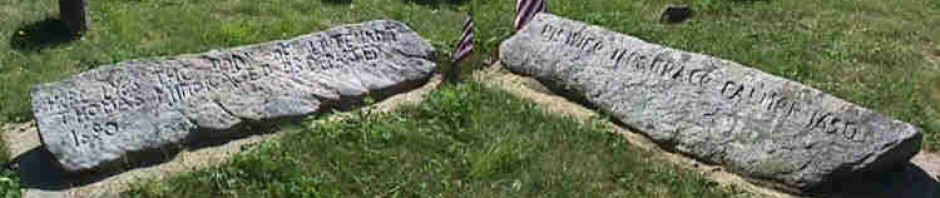
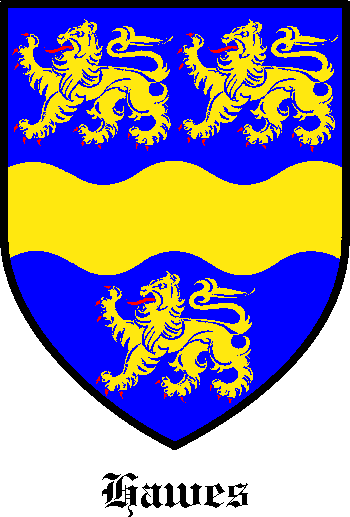
Posted in Fun Stuff | 20 Comments