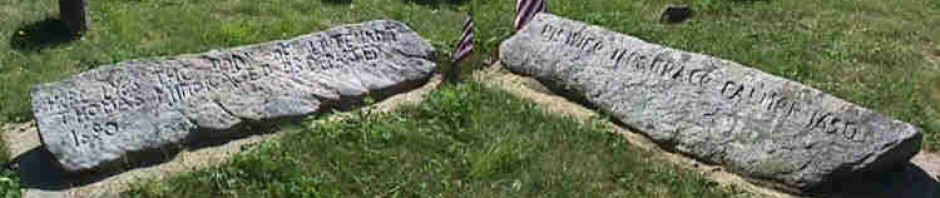
John Kendall

John Kendall (1580 – 1660)  was Alex’s 12th Great Grandfather, one of 8,192 in this generation of the Shaw line.
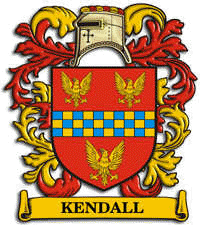
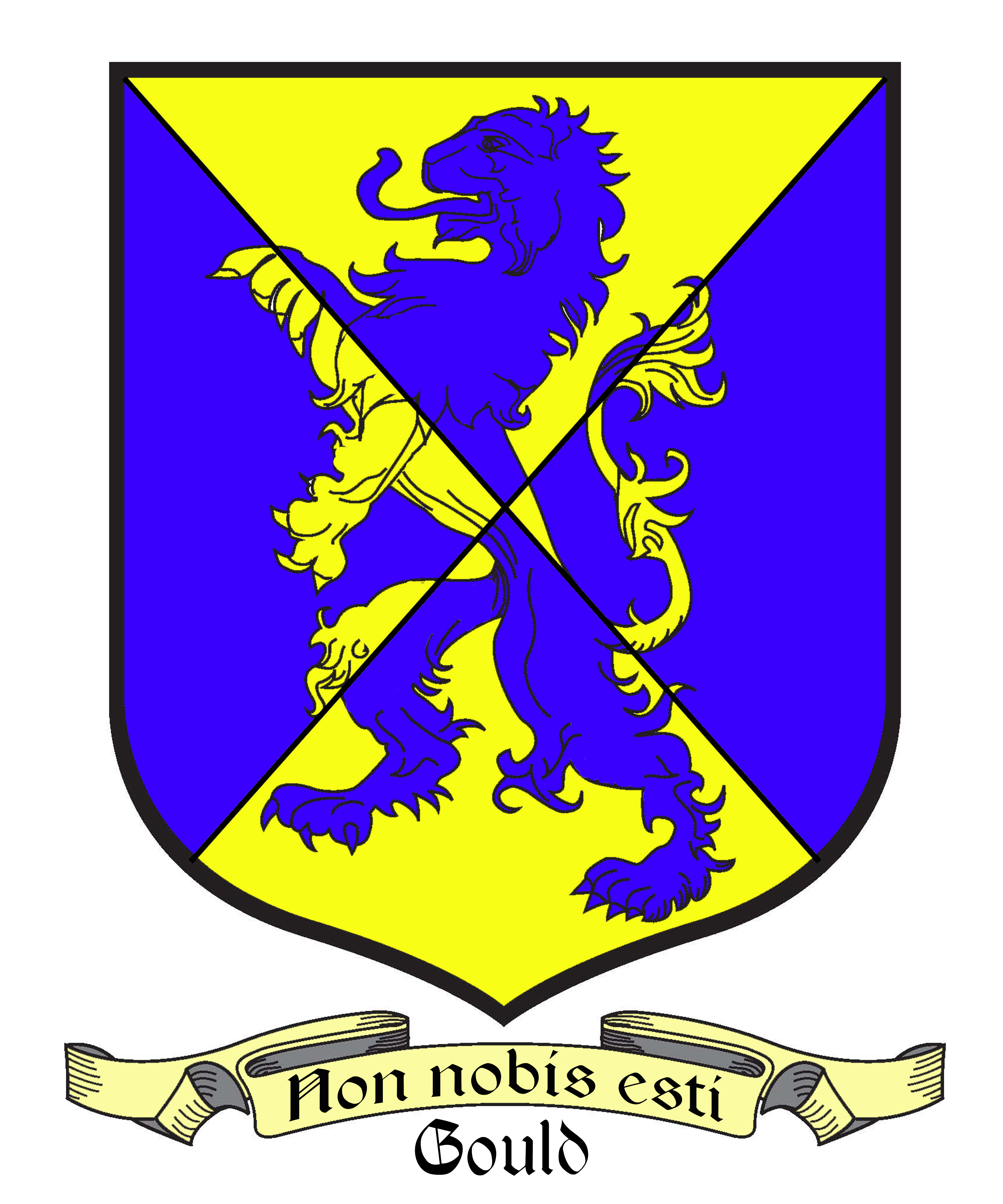
John Kendall Coat of Arms

John Kendall was born in 1580 in Norfolk, Norfolk, England. His parents were John KENDALL and Mary MILES. He married Elizabeth SACHERELL. John died 21 Mar 1660 in Cambridge, Middlesex, England

Elizabeth Sacherell was born 1584 in Cambridge, Middlesex, England.  Her parents were Henry SACHERELL and [__?__].  Elizabeth died 1640 in Cambridge, England

Children of John and Elizabeth:

Name Born Married Departed
1. Mabel KENDALL 1606 in Cambridge, Middlesex, England William READE
1625 in Brocket Hall
.
Henry Summers
21 Nov 1660
Woburn, Mass
5 Jun 1690
Woburn, Mass.
2. John Kendall 1608
Cambridge, Middlesex, England
Elizabeth Holly
1644
Cambridge, Middlesex, Mass
1660
Cambridge, Cambridge, England
3. Francis Kendall 1612
Norfolk, Norfolk, England
Mary Tidd
24 Dec 1644 Woburn, Middlesex, Mass
9 May 1708 – Woburn, Middlesex, Mass
4. Thomas Kendall 1617
Norfolk, Norfolk, England
Rebecca Paine
22 Jul 1681 Reading, Middlesex, Mass
12 Jun 1681
Wakefield, Mass.
5. Elizabeth Kendall 1623
Cambridge Ma, Middlesex, England
Morris Somes
26 Jun 1647 Cambridge, Middlesex, Mass
4 Jan 1696
Salisbury, Essex, Mass

The surname Kendall of England is of local derivation from the town of Kendall, Westmoreland county. The town’s name was doubtless derived from that of the river Ken, on which it is located. The family in England is very large and widely distributed, many of the branches bearing arms and having distinguished members. The name is found common in Bedfordshire, at Basingbourne, Essex; in Lancashire; at Smithsby, Derbyshire; in Cornwall; in Devonshire; and Hertfordshire. In 1575, a branch of the family settled in Thorpthules, Durham, a younger son of the Kendall family of Ripon, Yorkshire, where the family lived at an early date. Among the early Kendalls who were prominent was John Kendall, a sheriff of Nottingham, killed in the battle of Bosworth in 1485, fighting in the army of Richard III.

John Kendall, progenitor of the American family, lived in the county of Cambridge, England, in 1646, died there in 1660. Two of his sons came to America; Francis, mentioned below. 2. Deacon Thomas, who was a proprietor of Reading, Massachusetts, in 1644; was admitted freeman May 10, 1648; had ten daughters and no sons, thus leaving no descendants bearing his nam

Children

2. John Kendall

John’s Elizabeth Holly was born 1623 in Cambridge, England.

3. Francis Kendall

Francis’ wife Mary Tidd was born 23 Nov 1620 in England. Her parents were John Tidd and Margaret Greenleaf. Mary died 1705 in Woburn, Mass.

In December, 1658, Francis deposed that his age was about thirty-eight years.  On April 2, 1662, he deposed that his age was about forty-eight years.  Possibly the date of his birth was between the two dates indicated by these statements, say 1618.

He came from England before 1640.  With thirty-one others he signed the town orders of Woburn, December 18, 1640.  He had been living in Charlestown, of which Woburn was then a part, and where he was a taxpayer in 1645.

He used the alias, “Miles Kendall”. It has been said that he came with his brother, Thomas, and used the alias so his parents would not know he intended to emigrate. [In 1615 there was a Miles Kendall who was Governor of Bermuda. He and Francis were related and this may be why the name Miles suggested itself to Francis].

In 1640, Francis was living at Charlestown MA. He signed the town orders for the new town of Woburn and was one of its first inhabitants. He was described as “a gentleman of great respectability and influence”. However, in this strict Puritan environment, he was prosecuted along with 12 other Woburn citizens for differing from the Faith. He was charged with withdrawing from the worship of the Woburn Church and attending the services of the Anabaptists.

In the record of Francis’ Dec 24, 1644 marriage to Mary Tidd he is called Francis Kendall, alias Miles.  There are several explanations of this record.  It was common with emigrants to America to take assumed names to avoid vexatious laws, and there is a tradition that Kendall left England against the wishes of his family, using the name of Miles until he was settled in this country.  His brother, Thomas seems not to have used any other name.

Francis Kendall was admitted a freeman, May 10, 1648.  Sewall says of him: “He was a gentleman of great respectability and influence in the place of his residence.”  He served the town at different times for eighteen years as selectman, and on important committees such as those for distributing grants to the pioneers, and on building the meeting house.  He was tything man in 1676.

He was a miller by trade and owned a corn mill, which he left to his sons, Samuel and John.  This corn mill, at Woburn, has been in the possession of the family down to the present time.  The mill now, or lately on the Kendall place, is one built by Samuel Kendall soon after 1700 and is some distance from the location of the first mill.

Francis was a selectman of Woburn for 18 years at different time. He was fined sixpence for “being nere an hour to [too] late” at a selectmen’s meeting in 1674. In 1676 was chosen on committee to see that neighbors kept good order in their houses. In 1676, he was paid 10 shillings for shooting a wolf.

He died in September 1708 at Woburn at about age 88. His will dated May 9, 1706.  His sons, Thomas and John were the executors. In his will he left ½ of his corn mill to his son, John and 1/4 shares each to his other two sons, John and Samuel. Francis Kendall remembers likewise in his Will the eight children of of his brother Thomas, one of the first settlers of Reading, (and a deacon of the church there) who were living, when he, his said brother died.   An interesting account in a book by Ruth Lincoln Kaye, says that a characteristic of the Francis Kendall family is that a child is occasionally born with extra fingers or toes and that this trait has survived to the present generations

The Will of Francis Kendall Woburn, Massachusetts, May 9, 1706:

” In the name and fear of God, amen, I Frances Kendell in the town of Woburn, in the county of Middlesex in her Majesty’s Province of the Massachusetts Bay in New England, miller, being by the grace of God, of sound understanding and perfect memory, yet, stricken in years and expect daily my change, do therefore, make ordain and declare, this writing to be my last Will and Testament, the which let no man presume to alter or change.
First and principle, I give my soul to God the Father, Son, and Holy Spirit, three glorious persons, but one in infinite and eternal essence, hoping for salvation, by the merits of Jesus Christ alone.
Also I give my body to the earth, to be buried decently at the discretion of my executors and overseers, hereafter named, in hopes of a glorious resurrection, and as for portion of temporal goods and estate God in his bounty hath bestowed upon me, I give and bequeath in form and manner following:

1. To my eldest John Kendal I give my now dwelling house,my barn and barnyard; the orchard adjoining the barn; and the field, with the lowland, meadow land and orcharding, adjoin-ing my dwelling. Namely, all my land and meadow included in said field, to the bound of the land and meadow adjoining thereunto, which I have loaned my sons Thomas and Samuel Kendall and my daughter Mary Read, with all which bounds I have formerly stated, and further I give unto my son John Kendall one-half of my corn mill, together with the right of the streams, dams and utensils thereunto belonging; one-half of my woodland adjoining the woodland of Samuel Walker near Rock Meadow; one-quarter part of my herbage; half my right in the partnership in the mineral, called the Copper Mine, in Woburn; half my right of woodland at Ragg Rock; and half my wood lot at Rock Pond Meadow. All and singular the before-mentioned parts and parcels to be and remain unto my son John Kendall, his heirs and assigns forever, only excepting the liberty of a cart way through part thereof for the benefit of some of my children, as shall later be expressed.

2. To my son Thomas Kendall I give the land his house stands on, namely the land of mine lying on the west side of my mill pond and mill stream; all my land and meadow land from a stake near the place where the two brooks meet, and from thence by a line of marked trees to the land of James Peirce, bounded westerly by the land of Samuel Blodgett.Further it is my will that my son Thomas Kendall shall have free liberty for himself and his heirs to cart their hay from a piece of meadow which he formerly purchased of William Hamblet through the usual cart way in the land. I have in this my will given to my son John Kendal further I do hereby give to my second son Thomas Kendal one quarter part of my corn mill and proportional interest in the dams,streams and utensils thereunto belonging. I also give to my son Thomas Kendall one half of my wood lot near Rock Meadow adjoining the land of Samuel Walker, and also half my wood lot Rock Pond Meadow; half my interest in the mineral called the Copper Mine in Woburn; and also one quarter part of my right of herbage.

3. To my son Samuel Kendall, I give the dwelling house which he now lives in, and the barn, land, and meadow belong-ing to it, which is bounded by the land of Thomas Carter on the east, and to the north by the road leading to the mill, and partly by woodland formerly belonging to Jonathan Tompson and Joseph Wright, Sr., and on the west by the fence that part this from what I have given to my son John Kendall. I further give my son Samuell Kendall one acre of meadow in Horn Pond Meadow adjoining the meadow of my son Thomas Kendall,with free use and improvement of the usual cart way to the same through the land I have given in this will to my son John Kendall, which my second son Sam Kendell, his heirs and assigns shall improve from time to time for carting of his and their hay, forever. I further give my son Samuell Kendall one quarter part of my corn mill, and a proportional interest in the streams, dams,and utensils thereunto belonging, and further I do hereby give my son Samuel Kendall half of my wood lot at Ragg Rock, and one quarter part of my herbage.

4. To my son Jacob Kendall I give the thirty acres of land his house stands on with the woodland of mine it adjoins; all my woodland on the west side of the Great Meadow; a piece of woodland adjoining the meadow of John Knight; five cow commons; and my right of swamp at Clear Meadow Brook,excepting what I shall in this will give to my grandson Frances Green. I further give my son Jacob Kendall four acres of land adjoining the east end of his homestead.

5. To my daughter Mary Read I give that tract of land that her house stands on, which I let her use upon her marriage,which I estimate to be nine acres and is bounded on the north and northeast by the road leading to the mill; eastwardly by the woodland of Jonathan Tompson; and on the south by the land that I have in this will given to my son John Kendall.I further give to my daughter Mary Read two acres of land at Ragg Rock bounded northeasterly by the land of Jonathan Tompson; on the south by the land of Deacon Joseph Wright; and otherwise bounded by the woodland of my son-in-law Israell Read.I further give to my daughter Mary Read my right and title in the tract of land near John Bruce called Israell Read’s Newfield, bounded on the south by Concord Road, and on the north by the land of John Bruce.I also give my daughter Mary Read twenty acres of my great lot at Settle Meadow, and also a small piece of meadow in Horn Pond Meadow, adjoining the meadow I formerly sold to my son-in-law Israell Read, which runs from the corner of that meadow fence to the head of a spring which arises in the meadow, and along that spring to the place where the spring runs into the brook, and is bounded elsewhere by the meadow of my son-in-law Israell Read.I further give my daughter Mary Read all that tract of land her husband has fenced in by itself on the south side of the highway leading to Timothy Walker’s. Further it is my will that my daughter Mary Read and her heirs all have free liberty, at all times forever hereafter, to cart their hay from the meadow at Horne Pond through the land I have given my son John Kendall.

6. To my daughter Elizabeth Peirce, besides what I gave her when she married, and at other times, I further give her five shillings as a token of my love. In the case she shall have a child born of her own body, I hereby give to it [the child] ten pounds, to paid by my execu-tors, when it reaches the age of twenty-one years.

7. To my daughter Hannah Green, I give that piece of land and woodland of mine, bounded on the north by the land of William Bruce, and on the east-north-east by the highway near Samuel Snow, estimated to be eight acres; a woodlot at Ragg
Rock, near John Russill’s, adjoining the highway; a piece of land at Long Meadow Brook, on the west side of the meadow belonging to Captain Edward Johnson, which is about six acres; and a seven acre lot at Settle Meadow, which I received from my son-in-law William Green by way of exchange.These several parcels of land and woodland I hereby give my daughter Hannah Green, her heirs and assigns forever, and further give to my daughter Hannah Green ten pounds, to be paid to her by my son Samuel Kendall, two years after my decease.

8. To the children of my daughter Rebecca Eaton, deceased, I give a tract of land at Settle Meadow, purchased from Daniell Baken, and was his great lot, which contains an estimated forty-nine acres, unless my executors see cause to pay the chil-dren of my daughter Rebecca Eaton twenty pounds instead.

9. To my daughter Abigail Read, I give forty-seven acres of my great lot at Settle Meadow, which is my whole great lot except twenty acres I have given in this will to my daughter Mary Read.

10. I give to my three daughters, namely Mary Read, Hannah Green, and Eunice, the wife of John Kendall, all my household items, to be equally divided amongst them, in return for the great care, pains, and nursing they provided their mother, my late wife, during her last sickness.My daughter Mary Read shall have the liberty to redeem my feather bed, and enjoy the same, paying to her sisters more than her proportion of its value.

11. To my grandson Frances Kendall, the eldest son of my son John Kendall, I give that piece of meadow adjoining my cornmill and bounded on the south-east by the path leading to the mill, and bounded on the east partly by the orchard adjoining the barn which I gave my son John Kendall. I also give my grandson Frances Kendall a tract of land,which is fenced by itself, adjoining the previously mentioned meadow, bounded on the north-west by Timothy Walker’s land; on the south partly by the barn and barn yard, and the highway leading to the mill; and further bounded by the land I previously gave my daughter Mary Read.

12. To my grandson Ralph Kendall, the son of my son Thomas Kendall, I give my plow lot in Hodges Hole, and half the plow lot formerly belonging to Micheale Lippingwell.

13. To my granddaughter Mary Peirce, I give that lot I pur-chased from Daniel Baken near Dirty Swamp.

14. To my grandson Frances Green I give that land I pur-chased from John Mousell, Israell Walker, and Ephraim Buck in Wood Hill, and the right of five acres of Swamp Bottom.

15. To my grandson Samuell Kendall, the son of my son Sam Kendall, I give two small cedar lots in Lather Pole Swamp, the one of which was mine, the other which I purchased from Daniel Baken.

16. To my grandson Jacob Kendall, the son of my son Jacob Kendall, I give one piece of upland adjoining the swamp I have given to my son Jacob Kendall at Clear Meadow Brook.

17. To my granddaughter, Elizabeth Lampson, the daughter of my daughter Rebecca Eaton, I give my two cedar lots in the old Cedar Swamp, one of which was my own, the other which I purchased from Daniel Baken.

18. To my grandson William Read, I give one-half of my rightin a piece of land or woodland remaining undivided amongst the proprietors of the Seventh Division on Rock Meadow Plain.

19. To the eight children of my brother Thomas Kendall, who were living when my brother died, I give twenty shillings apiece to be paid by my executors. In case any of the eight children die, the eldest child of the deceased shall enjoy the mother’s gift. I do this in rememberance of the kindness I had for my loving brother.

20. It is my will to give my corn mill to my three sons, John Kendall, Thomas Kendall, and Samuel Kendall. Shall any of them refuse to repair, rebuild, or constantly maintain in good repair their respective part of the mills, dams, or utensils when reasonably required, then his or their part shall become that of those who undertake the rebuilding or repair. It is also my will that if any of my children, to whom in this will I have given a parcel or parcels of land in partnership,fail to agree to its division, then the division shall be made by the overseers of this will, whose decision shall stand. In the eighteenth article of this will I have given to my grand-son, William Read one half of my right in a piece of land or a woodland remaining undivided amongst the proprietors of the Seventh Division on Rock Meadow Plain. Upon further consideration, I give whole right title and interest in this piece of undivided land to my grandson, William Read.

Finally, I ordain my two loving sons, John Kendall and Thomas Kendall, executors of this , my last Will and Testament.

It is also my desire that my trusty and well-beloved friends, Major Jeremiah Swayn of Reading and James Fowle of Woburn, be the overseers of this will. In consideration of their care and trouble, I hereby appoint my executors to pay them thirty shillings apiece.

And thus having finished, by God’s help, this will as it is expressed and inserted on this and the other side of this sheet of paper, I exhort and command all my children and grandchildren to live in the fear of God, and in love and peace, and pray God, who is the God of love and peace, be with you all, amen.

I hereby revoke and disallow all other former wills and testaments before this time, ratifying and confirming this writing to be my last Will and Testament.

I, Frances Kendall, have set my hand and affixed my seal, this ninth day of May the fifth year of the reign of our Lady Anne, sovereign queen of England, Scotland, France, and Ireland, Anno domini Seventeen Hundred and Six.

Signed, sealed and published to be the last Will and Testament of Frances Kendall, Sr.

In the presence of us
John Brooks
Daniel Baldwin
Edward Winn
Proved at Cambridge, 31 May 1708
[ Middlesex Probate 13053]

The mark and seal of Frances Kendall Senior”

4. Thomas Kendall

Thomas’ wife Rebecca Paine was born 17 Jul 1618 in England. Rebecca died 17 Jul 1703 in Reading Massacussetts, Middlesex, England.

Deacon Thomas Kendall, of Reading, and his wife Rebecca had ten daughters. Their sons died early. The daughters inorder to preseve the name Kendall decided that they would each name their first son Kendall. And so came to be Kendall Pierson, Kendall Boutwell, Kendall Eaton, Kendall Briant, and so forth. This in turn inspired Lillie Eaton, Esq., of South Reading to pen the following:

“She has ten daughters; and each one,
When married, christened her first son
Kendall; and thus we may infer
Why ’tis these names so oft occur.”

In determinning whether Dea. Thomas was in Lynn or Reading it is imperative to understand the emergence of Reading as a town in its own right. What eventually became Reading, Massachusetts was originally a part of the township of Lynn, Massachusetts.

  • 1639: Under a grant of land from the General Court to the town of Lynn, a settlement called Linn Village was made as a part of the town of Lynn.
  • 1644: “Redding” was set off from Lynn.
  • 1647: “Reading” appeared as a town in its own right.

In truth, Deacon Thomas Kendall always resided in the same place. The name of the place where he resided changed from Lynn to Linn Village to Reading and for a period of time the names seem to have been used almost interchangeably. This caused confusion as the dates on records from the different reports had him appear to have been moving from one township to another in time periods when such moves did not seem to be either feasible or to make sense. Understanding that the towns’ names changed NOT the Deacon’s residence makes the records easier to understand.

Deacon Thomas Kendall Gravestone — Old Burying Ground, Wakefield, Middlesex, Mass

UPON Ye DEATH OF THOMAS KENDEL HERE IN Ye EARTH IS LAYD ON OF Ye 7 OF THIS CHURCH FOUNDATION SO TO REMAIEN TELY.T POWRFUL VOICE SAY RIS IN HERE A GLORIS HABITATION A PATARN OF PIATI & LOVE & FOR PEACE BUT NOW ALAS HOW SHORT HIS RACE HERE WE MOURN & MOURN WE MOUST TO SE ZION STONS LIK GOLD NOW LAYD IN DUST

This stone originally was in the towns very first burying grounds and were then re-located to the current location. There is a nice write up on this gravestone in “Graven Images – New England Stonecarving and Its Symbols, 1650-1815” by Ludwig. (Page 84)

5. Elizabeth Kendall

Elizabeth’s husband Morris Somes was born 1614 in Cambridge, England. His parents were Thomas Somes and Agnes [__?__]. He first married in 1641 to Marjorie Johnson (b. 1610 in Bedfordshire, England
– d. 22 Jan 1647 in Gloucester, Essex, Mass.) Morris died 13 Jan 1689 in Gloucester, Essex, Mass.

Morris and Elizabeth;s daughter Abigial Somes was arrested and indicted and sent to Boston Jail in 1692.  She surrvied and in 1693 was freed when the new Governor Phips, put an end to the hangings and arrests.

(Examination of Abigail Somes, May 13, 1692, at Salem)

Upon the glance of her Eye she struck Mary Warren into a [unclear: ] fit at her first appearance, and s’d Warren continually Crying out [unclear: ] it was this very Woman tho She knew her not before, only [unclear: ] that She herself in apparition and told her that her name was [unclear: ] and also that this was the very woman that had afflicted her all this Day, and that. she met her as she was comeing in att the gate, and bit her exceedingly att her first Examining there was found in her Apron a great Crotching Needle about the midle of it near her Belly, which was plucked out by one of the Standers by. by ord’r of the Magistrates, which the s’d Soams affirmed. She knew not how it came there; Mary Warren affirmed that she never saw the s’d woman before only in apparition, and then she told her that her Name was Abigail Soames and that she was sister to John Soams of Preston Cooper and that she lived att Gaskins, and that she had lain Bedrid a year. Being asked whether she was Sister to John Soams she answered peremptorily she would not tell for all was false that Warren said furthermore Warren affirmed that she told her that she was she s’d Soams was the Instrumental means of the Death of Southwick: Upon which s’d Soams casting her Eye on Warren [pincht] her into a dreadful fitt, and bitt her so dreadfully that the Like was never seen on any of the aflicted, which the s’d Warren Charged the s’d Soams with doeing off, saying that the s’d Soams told her this day she would be the death of her further Warren Affirms that she the s’d Soams ran two pinns into her side this day, which being plucked out the blood ran out after them. Goody Gaskin being present att this examination affirmed she had kept her Bed for most part these thirteen months. Warren further affirms she told her that when She did goe abroad att any time it was in the Night which Goody Gaskin being present Confirmed the same that that was the usual time off her goeing abroad — further more Warren affirmed that this Abigail Soams would have had her to have made a bargain with her, telling her if she would not tel of her being a sickly woman, she would not afflict her any more, and that then She should goe along with her, for this s’d Soams told her she was her God, Upon w’ch Warren answered she would not keep the Devils Councel. Soams told her she was not a Devil but she was her God. Q. Mary Warren is this true: A. It is nothing but the truth. Soams being asked who hurt Warren in the time of her fitt she answered it was the Enemy hurt her. I have been said she myself Distracted many atime, and my [senses] have gone from me, and I thought I have seen many a Body hurt mee, and might have accused many as well as she doth. I Really thought I had seen many persons att my Mothers Campe at Glowster, and they greatly aflicted me as I thought. Soams being Commanded while Warren was in a dreadful fit, to take Warren by the hand, the said Warren immediately recovered;

This Experiment was tryed three times over and the Issue the same. Warren after a Recovery being commanded to touch the s’d Soams altho she Assayed severall times to do it with great Earnestness she was not able, But fell down into a dreadful fit. Upon which the s’d Soams being Commanded take Warren by the hand, she immediately recovered her again. Warren affirming she felt something soft in her hand (her Eyes then being first shut) which revived her very heart. Warren being asked what the Reason was she could not Come to touch Soams affirmed she saw the apparition of Somes come from her Body, and would meet her, and thrust her with Vialunce back again, not suffring her to Come near her — Sometimes Soams, would say it was Distraction in talking she would often Laugh, upon which Laughing the aflicted person would presently fal into a fitt. Soams being asked whether she thought this was Witchcraft or whether there were any Witches in the world, answered she did not know anything but said itt was the Enemy or some other Wicked person or the Enemy himself that forces persons to afflict her att this time, presently this Warren fell into a trance comeing out of which she affirmed that Soams told her in the Prime of her trance that she would thrust an Awl into her very heart and would kil her this night. Soams could never cast her Eye upon Warren, but immediately she struck her down, and one time she affirmed s’d Soams struck her such a Blow as almost killed, which made the s’d Warren break out into abundance of tears. Soams being Charged with it, instead of bewailing itt Broke forth into Laughter. Warren being also afflicted by the [wringing] of her mouth after a strange and prodigious manner, Soams being Commanded to look upon her in that fit, premptorily answered she would not. Soams being by him ordered to turn her face about to look on the afflicted, which being accordingly done she shut her Eyes Close, and would not look on her being then ordered to touch her She did and immediately Warren Recovered, which no sooner done but Soams opened her Eyes and looked on the afflicted; and struck her into another most dreadful and horible fit, and in this manner she practised her Witchcrafts several times before the Court. Mary Warren Looking on her affirmed this to be the very woman that had so often afflicted her dureing the Examination and Charged her with it to her face. sometimes dureing the Examination Soams would put her oun foot behind her other leg, and immediately Warrens Legs would be Crossed and that it was impossible for the strongest man there to [uncrosst] them, without Breaking her Leggs, as was seen by many present After this Examination Warren says the apparition of Proctor, Nurse and Burroughs, that appeared before her, and Burroughs bitt her which bite was seen by many. Also Burroughs att the same time appeared to Margaret Jacobs who was then present, and told her as Jacobs affirmed, that her Grandfather would be hanged Upon which the s’d Jacobs wept. it was also observed by the Rev’d Mr Noyse, that after the needle was taken away from Soams, that Warren was neither bit. not pinched by the s’d Soams, but [pincht] so dreadfully on her throght that she cryed out she was almost killed.

Sources:

http://trees.ancestry.com/owt/person.aspx?pid=30231771&st=1

http://www.yeoldewoburn.net/Kendall.htm

(Examination of Abigail Somes, May 13, 1692, at Salem)

Upon the glance of her Eye she struck Mary Warren into a [unclear: ] fit at her first appearance, and s’d Warren continually Crying out [unclear: ] it was this very Woman tho She knew her not before, only [unclear: ] that She herself in apparition and told her that her name was [unclear: ]


734

and also that this was the very woman that had afflicted her all this Day, and that. she met her as she was comeing in att the gate, and bit her exceedingly att her first Examining there was found in her Apron a great Crotching Needle about the midle of it near her Belly, which was plucked out by one of the Standers by. by ord’r of the Magistrates, which the s’d Soams affirmed. She knew not how it came there; Mary Warren affirmed that she never saw the s’d woman before only in apparition, and then she told her that her Name was Abigail Soames and that she was sister to John Soams of Preston Cooper and that she lived att Gaskins, and that she had lain Bedrid a year. Being asked whether she was Sister to John Soams she answered peremptorily she would not tell for all was false that Warren said furthermore Warren affirmed that she told her that she was she s’d Soams was the Instrumental means of the Death of Southwick: Upon which s’d Soams casting her Eye on Warren [pincht] her into a dreadful fitt, and bitt her so dreadfully that the Like was never seen on any of the aflicted, which the s’d Warren Charged the s’d Soams with doeing off, saying that the s’d Soams told her this day she would be the death of her further Warren Affirms that she the s’d Soams ran two pinns into her side this day, which being plucked out the blood ran out after them. Goody Gaskin being present att this examination affirmed she had kept her Bed for most part these thirteen months. Warren further affirms she told her that when She did goe abroad att any time it was in the Night which Goody Gaskin being present Confirmed the same that that was the usual time off her goeing abroad — further more Warren affirmed that this Abigail Soams would have had her to have made a bargain with her, telling her if she would not tel of her being a sickly woman, she would not afflict her any more, and that then She should goe along with her, for this s’d Soams told her she was her God, Upon w’ch Warren answered she would not keep the Devils Councel. Soams told her she was not a Devil but she was her God. Q. Mary Warren is this true: A. It is nothing but the truth. Soams being asked who hurt Warren in the time of her fitt she answered it was the Enemy hurt her. I have been said she myself Distracted many atime, and my [senses] have gone from me, and I thought I have seen many a Body hurt mee, and might have accused many as well as she doth. I Really thought I had seen many persons att my Mothers Campe at Glowster, and they greatly aflicted me as I thought. Soams being Commanded while Warren was in a dreadful fit, to take Warren by the hand, the said Warren immediately recovered;


735

This Experiment was tryed three times over and the Issue the same. Warren after a Recovery being commanded to touch the s’d Soams altho she Assayed severall times to do it with great Earnestness she was not able, But fell down into a dreadful fit. Upon which the s’d Soams being Commanded take Warren by the hand, she immediately recovered her again. Warren affirming she felt something soft in her hand (her Eyes then being first shut) which revived her very heart. Warren being asked what the Reason was she could not Come to touch Soams affirmed she saw the apparition of Somes come from her Body, and would meet her, and thrust her with Vialunce back again, not suffring her to Come near her — Sometimes Soams, would say it was Distraction in talking she would often Laugh, upon which Laughing the aflicted person would presently fal into a fitt. Soams being asked whether she thought this was Witchcraft or whether there were any Witches in the world, answered she did not know anything but said itt was the Enemy or some other Wicked person or the Enemy himself that forces persons to afflict her att this time, presently this Warren fell into a trance comeing out of which she affirmed that Soams told her in the Prime of her trance that she would thrust an Awl into her very heart and would kil her this night. Soams could never cast her Eye upon Warren, but immediately she struck her down, and one time she affirmed s’d Soams struck her such a Blow as almost killed, which made the s’d Warren break out into abundance of tears. Soams being Charged with it, instead of bewailing itt Broke forth into Laughter. Warren being also afflicted by the [wringing] of her mouth after a strange and prodigious manner, Soams being Commanded to look upon her in that fit, premptorily answered she would not. Soams being by him ordered to turn her face about to look on the afflicted, which being accordingly done she shut her Eyes Close, and would not look on her being then ordered to touch her She did and immediately Warren Recovered, which no sooner done but Soams opened her Eyes and looked on the afflicted; and struck her into another most dreadful and horible fit, and in this manner she practised her Witchcrafts several times before the Court. Mary Warren Looking on her affirmed this to be the very woman that had so often afflicted her dureing the Examination and Charged her with it to her face. sometimes dureing the Examination Soams would put her oun foot behind her other leg, and immediately Warrens Legs would be Crossed and that it was impossible for the strongest man there to [uncrosst] them, without Breaking her Leggs,


736

as was seen by many present After this Examination Warren says the apparition of Proctor, Nurse and Burroughs, that appeared before her, and Burroughs bitt her which bite was seen by many. Also Burroughs att the same time appeared to Margaret Jacobs who was then present, and told her as Jacobs affirmed, that her Grandfather would be hanged Upon which the s’d Jacobs wept. it was also observed by the Rev’d Mr Noyse, that after the needle was taken away from Soams, that Warren was neither bit. not pinched by the s’d Soams, but [pincht] so dreadfully on her throght that she cryed out she was almost killed.
Posted in 14th Generation, Line - Shaw | 6 Comments

Anthony Morse Sr.

Anthony MORSE Sr. (bef. 1578 – 1621) was Alex’s 11th Great Grandfather, one of 4,096 in this generation of the Shaw line through his granddaughter Anne.   He was also Alex’s 12th Great Grandfather, in the Shaw line through his granddaughter Hannah.

Immigrant Ancestor

Anthony Morse was born before 1578 in Marlboro, Wiltshire, England. His parents were William MORSE and [__?__]. He married Christian [__?__] in 1605 in Marlboro, Wiltshire, England. Anthony died 21 Nov 1621 in Marlborough, Wiltshire, England.

Anthony’s children were baptized in St Peter’s Church, Marlborough, Wiltshire

Christian [__?__] was born in 1580 in Marlboro, Wiltshire, England. She may have been Anthony’s second wife.  After Anthony died, she married 21 Nov 1621 to Thomas Quarrington. Christian died in 1630 in Marlbourough, Wiltshire, England.

Children of Anthony and Christian:

Name Born Married Departed
1. Elinor Morse 1605 in St Peters Marlboro, Wiltshire, England Thomas Simbrey
31 May 1624
St Peters
1660
2. Anthony MORSE 6 May 1607, Marlborough, Wiltshire, England. Ann COX
2 May 1629 Marlborough, Wiltshire, England
12 Oct 1686 at Newbury, Essex, Mass.
3. Nicholas Morse 1610
St Peters Marlboro, Wiltshire, England
17 Oct 1630
Marlboro, Wiltshire, England
4. William Morse 12 May 1614
Marlboro, Wiltshire, England
Elizabeth Prideaux
1627 England
29 Nov 1683
Newbury, Essex, Mass.
5. Philip Morse 17 May 1618 6 Mar 1618/19
Buried St Peters
6. Philip Morse 21 Mar 1621
Marlboro, Wiltshire, England
14 Dec 1630
Marlboro, Wiltshire, England

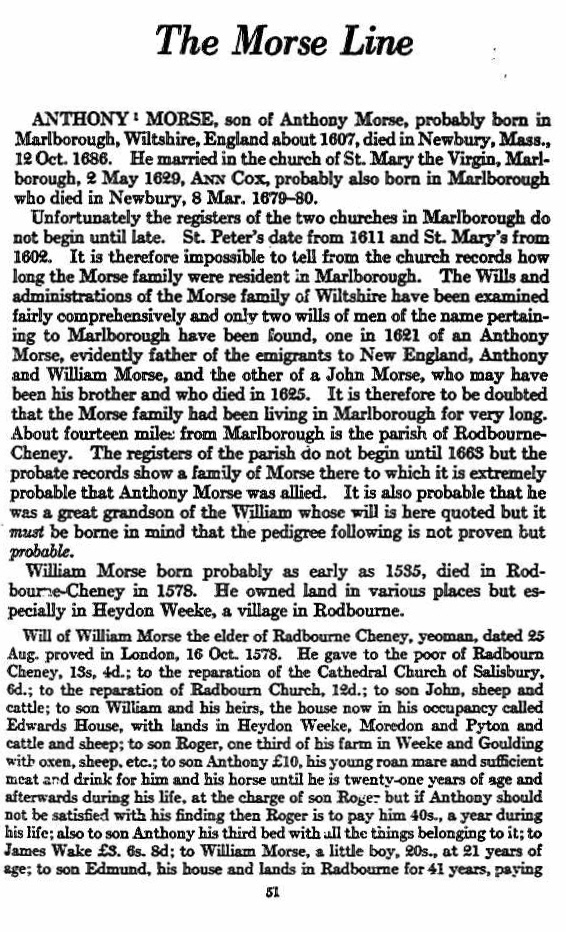
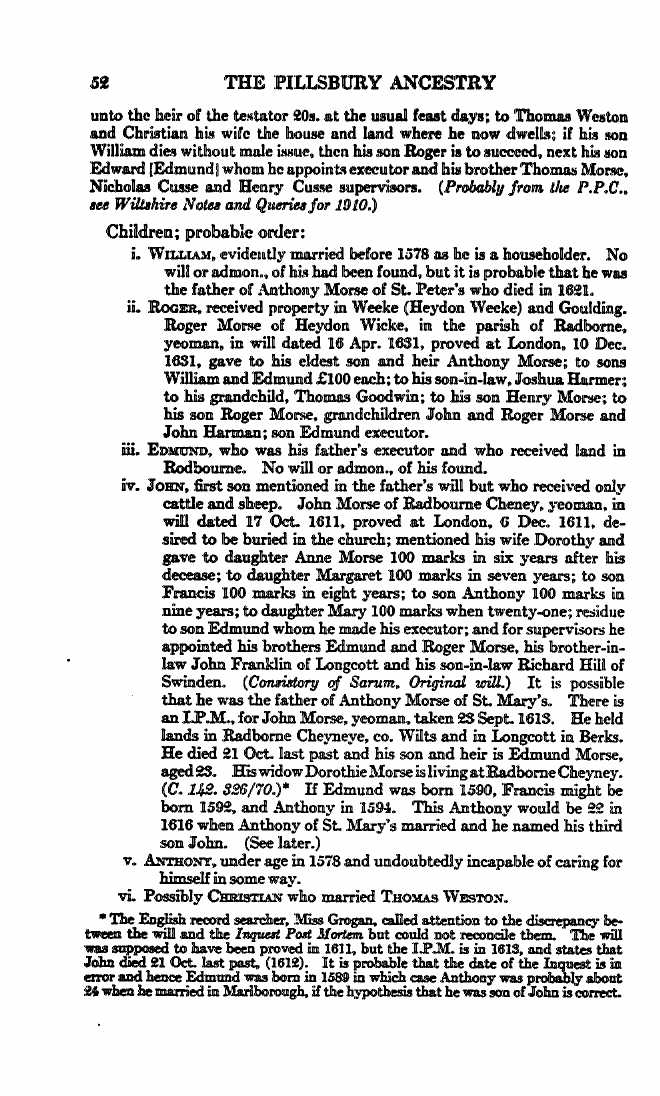
Will of Anthony’s father William Morse the elder of Radbourn Cheney, yeoman, will dated August 25, 1578, proved at London October 16, 1578.

To the poor of Radbourn Cheney 13 shillings 4 pence; to the reparation of the Cathedral church of Salisbury 6 pence; to the reparation of Radbourn church 12 pence; to son John, sheep and cattle; to son William and his heirs the house now in his occupancy called Edwards House, with lands in Heydon-Weeke, Moredon and Pyton and cattle and sheep; to son Roger one third of his farm in Weeke and Goulding, oxen, sheep etc. to son Anthony, 10 pounds; his young roan mare and sufficient meat and drink for him and his horse until he is twenty one years of age and afterwards during his life, at the charge of his son Roger and if Anthony should not be satisfied with his finding then son Roger to pay him 40 shillings a year during his life; to son Anthony his third bed with all the things belonging to it; to James Wake 3 pounds 6 shillings, 8 pence; to William Morse, a little boy, 20 shillings when he becomes twenty one years of age; to son Edmund, his house and lands in Redbourne for 41 years, paying unto the heir of the testator 40 shillings at the usual feast days; to Thomas Weston and Christian his wife the house and lands where he now dwells; if his son William dies without male heirs, then his son Roger is to succeed, next his son Edward, whom he appoints executor and his brother Thomas Morse, Nicholas and Henry Cusse supervisors.,

Anthony Morse Sr. of Marlborough, yeoman; will dated February 27, 1620/21 proved at London June 2, 1621. Gives for the reparation of St. Peter’s church in Marlborough 10 shillings; to his present wife, Christian; son Anthony; to his four children now living each 30 pounds when 18 years of age; mentions his child yet unborn; to Mr Hearne 10 shillings to preach at his funeral; appoints his wife executrix.

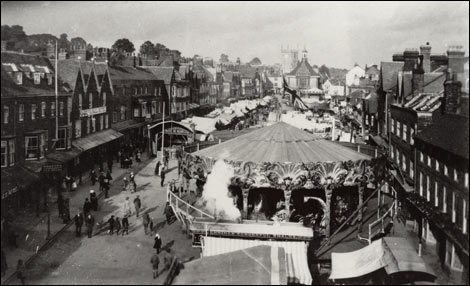
The High Street- Marlborough- c.1900

Children

4. William Morse

William’s first wife Elizabeth Prideaux was born 1609 in Soldon, Devon, England. Her parents were Humphry Prideaux and Honor Fortescue. Elizabeth died Dec 1663

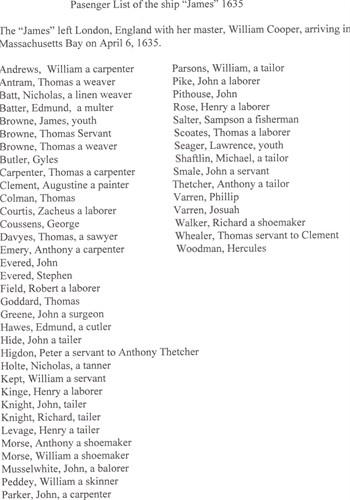
James Passenger List

Newbury Witch Trial

William Morse was a key figure in the only recorded case of supposed witchcraft in Newbury that was ever subjected to a full legal investigation. The principal sufferer was William’s wife Elizabeth who resided with him in a house at the head of Market St. [later actually in Newburyport] across from St. Paul’s Church for which William had received in the lot in 1645.

William was then 65 years of age, a very worthy, but credulous and unsuspecting man who consequently was very easy prey to the taunting antics of a very roguish grandson who lived with them. Not suspecting any deception, the good man readily attributed all his troubles and strange afflictions to the supernatural instead of carefully analyzing the actions of those around him. With a belief in witchcraft almost universal at the time, it afforded a ready solution to anything strange and mysterious.

The only person to have suspected the boy as the author of the mischief was a seaman Caleb Powell who visited the house frequently enough to suspect that the Morse’s troubles had human, rather than supernatural, origins. Caleb informed Goodman Morse that he believed he could readily find and the source of the trouble and solve it. To add credibility to his claims, he hinted that in his many travels he had gained an extensive knowledge of astrology and astronomy. That claim, however innocently intended, led to Caleb being accused of dealing in the black arts himself–he was tried and narrowly escaped with his own life.

3 Dec 1679 – ‘Caleb Powell being complained of for suspicion of working with the devill to the molesting of YVilliam Morse and his family, was by warrant directed to the constable, brought in by him, the accusations and testimonies were read and the complaint respited till the Monday following.

8 Dec 1679 – Caleb Powell appeared according to order and farther testimony produced against him by William Morse, which being read and considered, it was determined that the said William Morse should present the case against Caleb Powell at the county court to be held at Ipswich the last Tuesday in March following and in order hereunto William Morse acknowledgeth himself indebted to the treasurer of the county of Essex the full summe of twenty pounds.

[The condition of this obligation is that the sayd William Morse shall prosecute his complaint against Caleb Powell at that time. Caleb Powell was delivered as a prisoner to the constable till he find security of twenty pounds for the answering of the sayd complaint, or else he was to be cast into prison.]

Anthony Morse gave the following testimony about the strange goings-on at his brother’s house on Dec 8, 1679:

“I Anthony Mors ocationlly being att my brother Morse’s hous, my brother showed me a pece of a brick which had several tims come down the chimne. I sitting in the cornar towck the pece of brik in my hand. Within a littel spas of tiem the pece of brik was gon from me I know not by what meanes. Quickly aftar, the pece of brik came down the chimne. Also in the chimny corar I saw a hamar on the ground. Their being no person near the hamar it was soddenly gone; by what means I know not, but within a littel spas after, the hamar came down the chimny and within a littell spas of tiem aftar that, came a pece of woud, about a fute loung, and within a littell after that came down a fiar brand, the fiar being out.”

William Morse was also asked to give testimony on the same day and reported instances of being in bed and hearing stones and sticks being thrown against the roof or house with great violence, finding a large hog in the house after midnight, and many strange objects being dropped down the chimney. Items in the barn were mysteriously overturned or out-of-place, shoes unexpectedly seemed to fly through the air as if thrown, and doors unexpectedly would open or close.

The handwritten testimony concludes with the telling statement:

“A mate of of a ship coming often to me [ie: Caleb Powell] said he much grefed for me and said the boye [William’s grandson] was the cause of all my truble and my wife was much Ronged, and was no wich, and if I would let him have the boye but one day, he would warrant me no more truble. I being persuaded to it, he Com the nex day at the brek of day, and the boy was with him untel night and I had not any truble since.” When Caleb was finally acquitted, the judges looked for some other person guilty “of being instigated by the devil” for accomplishing such pranks, and for some reason selected Elizabeth Morse , William’s wife, as the culprit. [Elizabeth often served as a town midwife, and perhaps had incurred some male or professional’ jealousies?]

5 Dec 1679 – The testimony of William Mors and his wife, which they both saw one last Thursday night my wife and I being in bed we heard a great noies against the ruf with stekes and stones throwing against the hous with great vialanse whereupon I myselfe arose and my wife and saw not anny body, but was forsed to retunie into the house againe, the stones being thrown so vilantly aganst us we gooing to bed againe and the same noies in the hus we Lock the dore againe fast and about midnight we heard a grete nayes of A hoge in the house and I arcs and found a grete hoge in the huse and the dore being shut. I opened the dore the hoge running vilently out. The next morning a Stek of Lenkes hanging in the Chemney fast I saw Com Down vilintly and not anny body ner to them and Jumped up upon A Chaire before the fire ; I hanged them up again and they Com down again into the fire. The next day I had an Aule in the window, which was taken away I know not how and Com Dune the chimney. I take the same ale and put into a Cubard and fasened the Dore.

The same ale Com Down 3 or 4 times. We had a basket in the Chamber Com Doun the Chemney. I tooke it up myselfe and laide it before me, it was Sudinly taken away I know not how and Com dune the Chimney againe. I then took a brick and put into it and said it shold cary that away, if it ded goo up againe. It was taken away I know not how and Com dune the Chemney and the brick a Letel after it. One Saturday next Corn stekes on Light fire dune Chimney and stones, and then my ‘awls taken away from me 4 times as I used them and Com Douen the Chemney 4 times. My nailes in a cover of A ferkin Com douen the Chemney againe. The dore being Locked I heard a hoge in the house I let alone until day and found it to bee one of my owne, willing to goo out. The next day being Sabath Stekes and stones were thrown viliantly [down] the Chemney. One Munday next Mr. Richeson and annother saw many things. I sent my boy to se if nothing was amis in my barne. I not being abel to tey my Catel up to ni^htes but stel being untied with many other strange thinges, the frame being thrown Downe upon the boy : We all run out to help him in.

‘ When we Com in we saw a Coten whele turned with the Leges upward and many thinges set up on it as a Stale and a Spade Lick the form of a ship. Potes hanging over the fire Dashing one against the other I being forsed to unhang them. We saw A andiron dance up and dune many times and into a Pot and out againe up atop of a tabal, the pot turning over and Speling all in it. saw a tube turn over with the hop fling of it. I sending my boy to fech my toles, which I doe mak Ropes with, so soone as the dore being opened thay Com viliantly Doune of themselves. Againe a tub of bred Com dune from a Shelufe and turned over. My wife went to make the bed the Clothes Ded fly of many times of themselves, and a Chest open and Shut and Dores fli together. My wife going into the Seler thinges tumbling dune and the dore fling together vialintly. I being at prayer my hed being Cufred with A Cloth A Chaire did often times bow to me and then Strike me on the side. My wife Corn out of the other rome A wege of Iron being thrown at her, and A spade, but [did] not rech her, and A stone, which hurt her much, I seting by the fire with my wife and to more neighbours with us A stone Struk against the Lampe and struk it out many times, and a shoo, which we saw in Chamber before Com doune the Chemney the Dore being shut and struk me A blow one the hed, which ded much hurte. A mate of A ship Coming often to me and said he much grefed for me and said the boye was the case of all my truble and my wife was much Ronged, and was no wich, and if I would let him have the boye but one day he would warrant me no more truble. I being persuaded to it he Com the nex day at the brek of day, and the boy was with him untel night and I had not any truble since}

The preceding testimony is in the handwriting of William Morse.

At the March term at Ipswich court the following additional testimony was produced in the case of Caleb Powell, taken February twenty-seventh, 1680.

27 Feb 1680 – Ipswich Court Testimony
Sarah Hale aged thirty-three and Joseph Mirick testify that Joseph Moores hath often said in their hearing that if there were any wizards, he was sure Caleb Powell was one.’ [This Joseph Moores was the boatswain of the ship, of which Caleb Powell was mate, and Joseph Dole, captain.]

Mary Tucker aged about twenty – She remembereth that Caleb Powell came into their house and sayd to this purpose that he coming to William Morse his house and the old man being at prayer he thought not fit to go in. but looked in at the window and he sayd he had broken the inchantment. for he saw the boy play tricks while he was at prayer and mentioned some and among the rest that he saw him to fling the sliooe at the old man’s head}

The court, after reading all the testimony that could be produced against Caleb Powell, came to the following conclusion.

Upon hearing the complaint brought to this court against Caleb Powell for suspicion of working by the devill to the molesting of the family of William Morse of Newbury, though this court cannot find any evident ground of proceeding farther against the sayd Powell, yett we determine that “he hath given such ground of suspicion of his so dealing that we cannot so acquit him but that he justly deserves to beare his owne shame and the costs of prosecution of the complaint.’ It is referred to Mr. Woodbridge to hear and determine the charges.’

The court at this time must have been men of profound wisdom and accurate discrimination, as they appear to have determined, first, that he was just guilty enough to pay the expense of imprisonment, secondly, that he ought ‘ to bear his owne shame,’ and, thirdly, that they had no reason to believe that he was guilty at all. This somewhat resembles the case, which is not found in the books, where A. sues B. for breaking a borrowed kettle. The defence was, ‘ first we never had the kettle, secondly, it was broken when we borrowed it, and thirdly, it was whole when we returned it.’

The people, however, were not so lenient as the judges. If Caleb Powell was innocent, some other person must be guilty of ‘ being instigated by the divil,’ for, in their opinion, no agency merely human could produce effects so strange and unaccountable. They accordingly selected Elizabeth Morse, the wife of William Morse, as the guilty person.

At a Court of Assistants held at Boston on May 20, 1680, Elizabeth Morse was indicted as “having familiarity with the Divil contrary to the peace of our sovereign lord the King” and the laws of God. In spite of her protesting her complete innocense, she was found guilty and sentenced by the governor on May 27th as follows:

“Elizabeth MORSE, you are to goe from hence to the place from when you came and thence to the place of execution and there to be hanged by the neck, till you be dead, and the Lord have mercy on your soul.”

Then, for an unexplained reason, Elizabeth was granted a reprieve on June 1, 1680 by Governor Bradstreet. The deputies of the local court did not agree with the decision, however, and complained in Nov 1680 to have the case reopened. Testimony was again heard in the general court through May 1681.

William sent several petitions pleading his wife’s innocence and attempting to answer the hysterical allegations of 17 Newbury residents who submitted testimony in writing offering their reasons why they had concluded that Goody Morse must be a witch and should be hung according to old Mosaic law. Reading the list of “reasons” today quickly strikes the 20th century mind as a dredging up of every petty annoyance, every grudge or neighborhood misunderstanding the townspeople could think of from sick cows to being snubbed in public.

It was owing to the firmness of Gov. Bradstreet in his initial decision that the life of Elizabeth Morse was saved and the town of Newbury prevented from offering the first victim in Essex County to the witchcraft hysteria. Later town records and other contemporary sources fail to record what happened to the “vile and roguish” grandson whose attempts to torment his elderly grandparents nearly resulted in his grandmother’s untimely death.

The execution was never carried out and, after a year in jail in Boston, Elizabeth was sent home to live with her husband – with a catch: She was forbidden to travel more than 16 rods (264 feet) from her property unless she was accompanied by a pastor or a deacon..

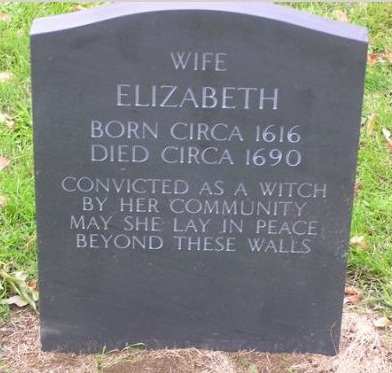
Elizabeth Morse Memorial — No one knows where her grave is, but she almost certainly isn’t with her husband because witches couldn’t be buried in church ground. .

Here’s more detail on William’s petitions:

The case of Elizabeth Morse, who had been reprieved by the governor, was again brought before the general court, to whom William Morse, her husband, sent two petitions, the one on May fourteenth, in the elegant handwriting of William Chandler of Newbury, the other on May eighteenth, in the handwriting of major Robert Pike of Salisbury, who was the next year chosen one of the assistants.

His first petition is as follows.

To the honored generall court now sitting in Boston.

The humble petition of William Mors in behalfe of his wife, Elizabeth Mors your distressed Prisoner, humbly begging this that you would be pleased to give your petitioner leave to present to your consideration what may clere up the truth in those evidences wch hath bin presented and what is otherwise as first.

1. To Joseph Bayley his testimony. Wee are ignorant of any such thing. Had it bin then spoken of, we might have cleared ourselves. He might have observed some other as my wife, it being a frequent thing for Catle to be at a stand.

2. To Jonathan Haines. As to his Catle, or himselfe, not making good work at such a time, when Catlft are haggled out, to place it on such account) yt his neglect in not bringing us a bow of mault was the cause, which had it bin spoken of wee might have given full satisfaction.

3. To Caleb Moody. As to what befell him in and about his not seeing my wife, yt his cow making no hast to hir calfe, wch wee are ignorant of, it being so long since, and being in church communion with us, should have spoken of it like a Christian and yn proceeded so as wee might have given an answer in less time yn tenn yeares. Wee are ignorant yt he had a shepe so dyed. And his wife knowne to be a pretious godly woman, yt. hath oftne spoken to hir husband not to be so uncharitable and have and doe carry it like a Christian with a due respect in hir carridge towards my wife all along.

4. To John Mighill. About ye loss of his catle was yt he came one day to worke, and would have had him come another day to finish it because ye raine came in so upon us, and his not coming, judges my wife was angry and yrfore had such loss, wch wee never knew of. This being twelve yeares agoe did amaze us now to here of it.

5. To Zachariah Davis. To sensure my wife now for not bringing quills aboute sixteen yeares agoe yt his loss of calfes was for that, when his father being in communion with us did profess it to us yt he judged it a hand of God and was farr from blaming us but rather troubled his sonn should so judge.

6. To Joshua Richardson loosing a shepe and his taking it forth off our yard, my wife should say you might have asked leave, and whether overdriving it or what, now to bring it in I hope will be considered.

7. To John March Test. He heard John Wells his wife say she saw imp of God into said Morss howse. She being prosecuted would not owne it and was adjudged to pay damages, and now this is brought in.

8. To James Browne Test, yt one day George Wheeler going forth, my wife should say for a trifle she knew he should not come in againe, which my wife knowes not of it, nor doth some of ye owners ever remember such a thing as to judge or charge it on hir, but now is broughi forth sixteen yeares after when his wife said to goody Hale yt said Browne was mistaken. Hir husband did come home well that voyage; and that James Browne should say to Robert Bedell yt yt Powell, whom wee sued did put in these words and not himselfe in the test and yt said Browne did oune to his unkle Mr. Nicholas Noyes yt he could not sware to such a test ; and did refuse to doe it before Mr. John Woodbridge, and Mr. Woodbridge did admire he had sworne to it. And for his seeing my wife amongst troopers. What condition he might be in wee leave it to consideration. Wee are ignorant of such a thing till now brought in so many yeares agoe as he saith.

9. To good wife Ordway. Hir child being long ill, my wife coming in and looking on it, pitting of it, did feare it would dy, and when it dyed Israeli Webster our next neighbour heard not a word of it, nor spoken of by others, nor any of ye family, but hir conceite, and now brought in.

10. As for William Chandler’s test, aboute his wife’s long sickness and my wife’s visiting hir, she through hir weakness acted uncivilly and yet now to bring in against my wife, when for so many yeares being in full communion with us never dealt with us aboute any such thing, but had as loving converse with him as Christians ought, and knew no otherwise till now.

11. To widow Goodwin hir having hir child sick, gave forth yt it was bewitched by my wife, as she thought ; wee hearing of it dealt with hir aboute it, and she brake forth in teares, craving forgiveness, and said it was others put hir upon it to say as she did, but now urged by Powell to say as she now saith.

12. To John Chase so saying yt he saw my wife in the night coming in at a little hole, and ye like, when he himselfe hath said he did not know but he was in a dreame, and yt unto several persons he hath so said, though now as he test., when my wife disowns any such thing.

13. To John Glading yt saw halfe of my wife about two a clocke in ye day time, if so might then have spoken, and not reserved for so long a time, which she utterly denies it, nor know of any such thing, where she should be at yt time as to clere hir selfe.

14. To William Fanning should say my boy said the devill was at his howse. Upon Fanning’s saying to the boy ye devill was at their howse, and he would have me chide ye boy, which I tould said Fanning ye boy might be instructed to know ye devill was every where though not as at our howse, and should not in time of affliction upbraid him to our griefe.

15. To Jonathan Woodman [son of Edward WOODMAN], seeing a catt, and so forth, he struck at it, and it vanisht away and I sending for doctor Dole to see a bruise my wife had by the fall of a peece reching downe some bacan in our chimly, which was many days before this time, as doctor Dole affirms it was no green wound, though neglected to send for said Dole till then.

16. To Benjamin Lowle [Benjamin LOWELL], about my boy’s ketching a pidgin ; my boy desired of me to see to ketch a pidgin, by throwing a stone, or ye like, and he brought a pidgin, which I affirm was wounded, though alive.

17. To good wife Miricke about a letter. My wife telling her somewhat of ye letter, which she judges could not be and my wife hearing of it there was a discourse and so forth aboute this love letter, might speake something about it by guess, and not by any such way as she judged, and many have spoken, guessing at things, which might be.

As to our troubles in ye howse it hath bin dreddfull, and afflictive and to say it ceased upon hir departure, when it ceased before for a time and after she was gone there was trouble againe.

As to rumors of some great wickedness committed in ye house, which should cause ye divill so to trouble us, our conscience is clere of ye knowledge of any such thing more than our common frailtyes and I reverence the holy sourainty of God in laying such affliction on us. and that God’s servants may be so afflicted in this manner as hath bin knowne. And that Mr. Wilson of Ipswich, where she hath bin twenty-eight weekes, did declare to me yt my wife’s conversation was christian-like as far as he observed. Thus praying for you in this and all other your conceraes, am your distressed servant.

WILLIAM MORSE.
Newbury May fourteenth 1681.’

From the preceding petition of William Morse, and his attempted answers to the accusations and charges brought against his wife Elizabeth, and sent to the general court, it appears that seventeen persons had given in their testimony in writing, stating their reasons why they verily believed goody Morse was really a witch, and ought to be hung,’ Of these testimonies only one is to be found on the files of the general court. If this one is a fair specimen of the whole, the loss of the remainder is not greatly to be regretted, except as a specimen of the logic of that day, and of the manner in which some of our ancestors stated their premises, and drew thence their most profound conclusions. Zechariah Davis thus testifies verbatim and literatim.

When I lived at Salisbury, William Morses’ wife asked of me whether I could let her have a small passell of winges and I told her I woode, so she would have me bring them over for her the next time I came over, but I came over and did not think of the winges, but met goody Morse, she asked me whether I had brought over her winges and I tel her no I did not thinke of it, so I came 3 ore 4 times and had them in my minde a litel before I came over but stil forget them at my coming away so meting with her every time that I came over without them aftar I had promised her the winges, soe she tel me she wonder at it that my memory should be soe bad, but when I came home I went to the barne and there was 3 cafes in a pen. One of them fel a danceing and roreing and was in such a condition as I never saw on cafe in before, but being almost night the cattle came home and we put him to his dam and he sucke and was well 3 or 4 dayes, and on of them was my brothers then come over to Nubery, but we did not thinke to send the winges, but when he came home and went to the barne this cafe fel a danceing and roreing so wee put him to the cowe, but he would not sucke but rane a roreinge away soe wee gate him againe with much adoe and put him into the barne and we heard him roer severall times in the night and in the morning I went to the barne and there he was seting upon his taile like a doge, and I never see no cafe set aftar that manner before and so he remained in these fits while he died.’

Taken on oath June seventh, 1679.

From the date of the preceding testimony, it is evident it was used in the county court prior to the transfer of the case to the state tribunals. On the eighteenth of May, William Morse presented the following petition.

To the honored governor, deputy governor, magistrates and deputies now assembled in court May the eighteenth 1681.

‘The most humble petition and request of William Morse in behalf of his wif (now a condemned prisoner) to this honored court is that they would be pleased so far to hearken to the cry of your poor prisoner, who am a condemned person, upon the charge of witchcraft and for a wich, to which charge your poor prisoner have pleaded not guilty, and by the mercy of God and the goodness of the honored governor, I am reprieved and brought to this honored court, at the foot of which tribunal I now stand humbly prayinp your justis in hearing of my case and to determine therein as the Lord shall direct. I do not understand law, nor do I know how to lay my case before you as I ought, for want of which I humbly beg of your honors that my request may not be rejected, but may find acceptance with you it being no more but your sentence upon my triall whether I shall live or dy, to which I shall humbly submit unto the Lord and you.

William Morse in behalf of his wife
ELIZABETH MORSE.’

For reasons, which do not appear on the records, the deputies had changed their minds, and, instead of being dissatisfied with her respite, were willing to grant another hearing of the case. This the magistrates opposed. In the court record it is thus stated :

The deputyes judge meet to grant the petitioner a hearing the next sixth day and that warrants goe forth to all persons concerned, from this court then to appear in order to her further triall our honored magistrates hereto consenting.

WM. TORREY, Cleric.
May twenty-fourth; 1681.

Not consented to by the magistrates.
EDWARD RAWSON, Secretary.’

The following additional testimony, taken from the county files, is here presented, as necessary to a full understanding of the whole case. It is in the handwriting of John Woodbridge, esquire, and was undoubtedly copied by him from the original, written by William Morse ” himself, and should have been inserted in 1679. The curious reader will be much amused in comparing this, and the preceding testimony of William Morse, with the report of the same case, made by Increase Mather in his ‘ Remarkables,’ and especially that made by Cotton Mather, in volume second, pages 391 and 392′ of the Magnalia. In that “wonderful” book, the latter gentleman perverts and amplifies the testimony to a “prodigious and nefandous” extent.

The testimony of William Morse, which saith together with his wife aged both about sixty-five yeeres, that Thursday night being the twenty-seventh day of November, we heard a great noyes without round the house of knocking the boards of the house and, as we conceived, throwing of stones at the house, whereupon myselfe and wife lookt eut and saw no body and the boy all this time with us, but we had stones and sticks thrown at us that we were forced to retire into the house againe, afterwards we went to bed and the boy with us and then the like noyes was upon the roof of the house.

The same night about midnight the doore being lockt when we went to bed, we heard a great hog in the house grunt and make a noyes, as we thought willing to gett out, an cT that we might not be disturbed in our sleep I rose to let him out, and I found a hog in the house and the doore unlockt. The doore was firmly lockt when we went to bed.

The next morning a stick of links hanging in the chimney, they were thrown out of their place, and we hanged them up againe and they were thrown downe againe and come into the fire.

The night following I had a great awle lying in the window, the which awle we saw fall downe out of the chimney into the ashes by the fire.

After this I bid the boy put the same awle into the cupboard, which we saw done and the doore shut to. this same awle came presently downe the chimney againe in our sight, and I took it up myselfe. Againe the same night we saw a little Indian baskett, that was in the loft before, came downe the chimney againe and I took the same baskett. put a piece of brick in it, and the baskett with the brick was gone, and came downe againe the third time with the brick in it and went up againe the fourth time and came downe againe without the brick, and the brick came downe a little after.

The next day being Saturday, stones, sticks and pieces of bricks came downe so that we could not quietly eat our breakfast, and sticks of fire also came downe at the same time.

That same day in the afternoon my thread four times taken away and came downe the chimney againe ; my awle and a gimlett wanting, came downe the chimney. Againe my leather taken away came downe the chimney. Againe my nailes being in the cover of a ferkin taken away, came downe the chimney.

The next day being Sunday many stones and sticks and pieces of bricks came down the chimneye. On Monday Mr. Richardson [the minister] and my brother being there, the frame of my cow house they saw very firme, I sent my boy to skare the fowles from my hogs’ meat. He went to the cow house and it fell downe, my boy crying with the hurt of the fall. In the afternoone the potts hanging over the fire, did dash so vehemently one against the other, we sett downe one that they might not dash to pieces. I saw the andiron leap in to the pott and dance, and leap out, and againe leap in and dance, and leap out againe, and leap on a table and there abide, and my wife saw the andiron on the table. Also I saw the pott turn itselfe over and throw down all the water. Againe we saw a tray with wool leap up and downe and throw the wool out and saw no body meddle with it. Againe a tub his hoop fly off, of itselfe and the tub turne over and no body neere it Againe the woolen wheele upside downe and stood upon its end and a spade sett on it. Stephen Greenleaf [son of Edmund GREENLEAF],  saw it and myselfe and wife. Againe my rope tooles fell downe in the ground before my boy could take them being sent for them and the same thing of nailes tumbled downe from the loft into the ground and no body neere. Againe my wife and the boy making the bed, the chest did open and shutt, the bed clothes would not be made to ly on the bed, but fly off againe.

Thomas Rogers and George HARDY Jr. being at William Morse his house affirme that the earth in the chimney corner moved and scattered on them, that Thomas Rogers was hit with somewhat, Hardy, with an iron ladle, as is supposed. Somewhat hitt William Morse a great blow, but it was so swift that they could not tell what it was but looking downe after they heard the noyes they saw a shoe. The boy was in the corner at first, afterward in the house.

Mr. Richardson on Saturday testifyeth that a board flew against his chaire and he heard a noyes in another roome, which he supposed in all reason to be diabolicall.

John Dole saw a large fire stick of candle wood to fall downe, a stone, a fire brand, and these things he saw not whence they came, till they fell downe by him.

Elizabeth Titcomb aifirmeth that Powell sayd that he could find out the witch by his learning, if he had another scholar with him.

John Emerson aifirmeth  that Powell sayd he was brought up under Norwood and it was judged by the people there that Norwood studied the black art.’

In another paper entitled * a farther testimony of William Morse and his wife,’ he states that ; we saw a keeler of bread turn over a chair did often bow to me and rise up againe the chamber door did violently fly together and the bed did move to and fro and not any body neer them.’

He also states that the cellar door did violently fly down and a drum rolled over it his ‘ barn door was unpinned four times, and going to shut the doore, the boy being with me, the pin (as I did judge) coming downe out of the aire did fall down neer to me.’

Againe Caleb Powell came in as before and seeing our spirits very low by the sense of our great afflictions, began to bemoane our condition and sayd that he was troubled for our affliction, and sayd that he eyed the boy, and drawed neere to us with great compassion, poore old man, poore old woman, this boy is the occasion of your griefe, for he does these things and hath caused his good old grandmother to be counted a witch. Then sayd I, how can all these things be done by him ? Then sayd he although he may not have done all. yet most of them, for this boy is a young rogue, a vile rogue. I have watched him and see him do things as to come up and downe.

Caleb Powell also said he had understanding in Astrology and Astronomy and knew the working of spirits, some in one country and some in another, and looking on the boy said you young rogue to begin so soone. Goodman Morse, if you be willing to let mee have the boy, I will undertake you’ shall be freed from any trouble of this kind while he is with me. I was very unwilling at the first, and my wife, but by often urging me to, and when he told me whither and in what employment and company he should goe, I did consent to it and we have been freed from any trouble of this kind ever since that promise made on Monday night last till this time being Friday afternoone.’

After enumerating a great variety of marvellous exploits, such as ‘ hearing a great noyes in the other roome,’ ‘ his chaire would not stand still but ready to throw me backward,’ * my cap almost taken off my head three times,’ i a great blow in my poll,’ ‘ the catt thrown at my wife and thrown at us five times, the lamp standing by us on a chest, was beaten downe,’ and so forth, he thus conludes :

Againe a great noyes a great while very dreadful. Againe in the morning a great stone being six pounds weight did remove from place to place. We saw it. Two spoones throwed off the table and presently the table throwed downe, and being minded to write, my ink home was hid from me, which I found covered with a rag and my pen quite gone. I made a new pen and while I was writing, one eare of corne hitt me in the face and fire sticks and stones and throwed at me, and my pen brought to me. While I was writing with my new pen, my ink-home taken away. Againe my specticles thrown from the table, and throwne almost into the fire by me, my wife and the boy. Againe my booke of all my accounts throwne into the fire and had been burnt presently, if I had not taken it up. Againe boards taken of a tub and sett upright by themselves, and my paper, do what I could, I could hardly keep it, while T was writing this relation. Presently before I could dry my writing, a monmouth hat rubbed along it. but I held it so fast that it did blot but some of it. My wife and I being much afraid that I should not preserve it for the publick use, we did think best to lay it in the bible and it lay safe that night. Againe the next [night] I would lay it there againe, but in the morning it was not to be found, the bag hanged downe empty, but after was found in a box alone. Againe while I was writing this morning I was forced to forbeare
writing any more, I was so disturbed with so many things constantly thrown at me.

This relation taken December eighth, 1679.’

On the court records I find nothing more concerning Elizabeth Morse.  The following extracts are from an essay on witchcraft, by the reverend John Hale, of Beverly, and published in the year 1697

She [Elizabeth Morse] being reprieved was carried to her own home and her husband (who was esteemed a sincere and understanding Christian by those that knew him) desired some neighbour ministers, of whom I was one, to discourse his wife, which we did, and her discourse was very Christian, and still pleaded her innocence as to that, which was laid to her charge. We did not esteem it prudence for us to pass any definitive sentence upon one under her circumstances, yet we inclined to the more charitable side. In her last sickness she was in much trouble and darkness of spirit, which occasioned a judicious friend to examine her strictly, whether she had been guilty of witchcraft, but she said no, but the ground of her trouble was some impatient and passionate speeches and actions of her while in prison upon the account of her suffering ‘wrongfully, whereby she had provoked the Lord by putting contempt upon his word. And in fine she sought her pardon and comfort from God in Christ and dyed so far as I understand, praying to. and resting upon, God in Christ for salvation.’

It was owing, we believe, to the firmness of governor Bradstreet, that the life of Elizabeth Morse was saved, and the town of Newbury thus prevented from offering the first victim, in Essex county, to that lamentable spirit of delusion, which twelve years after left so dark a stain on its annals.
Sources:

http://nortvoods.net/morse.html

http://trees.ancestry.com/owt/person.aspx?pid=8640621&st=1

http://newbury.essexcountyma.net/morse.htm

http://www.morsesociety.org/

A sketch of the history of Newbury, Newburyport, and West Newbury, from 1635 to 1845 (1845) By Coffin, Joshua, 1792-1864; Bartlett, Joseph, 1686-1754

Anthony Morse 1 Source:

Anthony Morse 2

Anthony Morse 3

Anthony Morse 4

Posted in 13th Generation, 14th Generation, Line - Shaw | 3 Comments

John Cheney Sr.

 John CHENEY Sr. (1568 – 1623) was Alex’s 11th Great Grandfather, one of 4,096  in this generation of the Shaw line.

The Cheneys were exceptional among our ancestors having a coat of arms at the time of their immigration

John Cheney was born 1568, Bennington, Lincolnshire, England. His parents were William CHENEY and William’s cousin Frances CHENEY. He married Elizabeth [__?__]. John died 16 May 1623, Bennington, Lincolnshire, England.

Elizabeth [__?__] was born 1568, Bennington, Lincolnshire, England. Elizabeth was buried 12 Jun 1614 in England.

Children of John and Martha:

Name Born Married Departed
1. Frances Cheney 20 Dec 1596
2. William Cheney 5 Feb 1597
Lambourn, Berkshire, England.
Margaret Cole
c. 1626 England
30 Jun 1667
Roxbury, Suffolk, Mass
3. Jane Cheney 28 Feb 1600
4. John CHENEY 30 Jun 1605 in Roxburgh, Scotland. Martha PARRATT
 3 Mar 1630/31 in Lawford, Wiltshire, England
 drowned at 28 Jul 1666 inat Roxbury, Mass.
5. Edward Cheney  20 Jul 1606
6. Thomas Cheney  25 Jul 1607
7. Agnes Cheney 16 Oct 1608
8. John Cheney – the younger 9 Nov 1609
9. Richard Cheney 29 Sep 1611
10. Elizabeth Cheney 2 Jun 1614

John Cheney was born in Benington, (near Boston) Lincolnshire, England in 1568 to William CHENEY and Frances AGNES. He married Elizabeth [__?__] about 1595 in Waltham, Essex, England.  He married another Elizabeth [__?__]  on 28 Nov 1614. Their marriage was either a second or a late marriage. Two sons named John (b. 30 Jun 1605 and 9 Nov 1609) were included among John and Elizabeth’s ten children. Their son John, who was born 1605, was the family member who immigrated to New England in 1635.  John Sr. died in 1618, Lambourn, Berkshire, England or  16 May 1623, Bennington, Lincolnshire, England.

John Cheney, of Bennington in Lincolnshire, made his will, May 24, 1621, bequeathing to the poor of the parish, to wife Alice, to children and others. He names two sons John, one distinguished from the other by the terms “John the elder” and “John the younger.” John Cheney was buried March 21, 1633.

Edward was buried December 8, 1613; the wife Elizabeth was buried June 12, 1614. A Thomas Cheney was an alderman of Boston, England, in 1585, and the family has been prominent there for several centuries..

Since this is the one of the few lines I’ve found with knights.  I’ll go back further:
14th Generation – William CHENEY b.aby 1540, Thorngumbold, Holderness, Yorkshire, England d. 4 Aug 1608, Boston, Lincolnshire, England

15th William CHENEY b. Abt. 1513, Thorngumbold, Holderness, Yorkshire, England

16th John CHENEY b. Abt. 1485, England

17th Sir Thomas CHENEY of Irthlingborough (Sir) b. Abt. 1448, Fen Ditton, Cambridgeshire, England d. 13 Jan 1512/13, Austria-Hungary

18th (Sir Knight) John CHENEY b. Abt.  1423, Fen Ditton, Cambridgeshire, England d. 14 Jul 1489

19th Sir Lawrence CHENEY b: 1396, Fen Ditton, Cambridgeshire, England d: 30 Dec 1461 Buried: Priory, Barnwell, England Escheator of Bedford & Buckingham. Sheriff of Cambridge and Huntingdon. Descendant of Charlemagne

20th (Sir Knight) William CHENEY b: Abt. 1370, Fen Ditton, Cambridge, England d: ABT 1394 Sheriff of Cambridge and Huntingdon.

21st John CHENEY b: Abt. 1345, Long Stanton, Cambridge, England

22nd Henry CHENEY b: Abt. 1320

23rd Sir William De CHENEY b: 1274, Street, Sussex, England d: Bef.1334

24th Alexander De CHENEY b: Abt. 1248, Newtimber, Sussex, England; d: 1295

25th Alexander De CHENEY b: Abt. 1218, Newtimber, Sussex, England

Children

2. William Cheney

Alternatively, William was John’s nephew and his parents were John’s brother Lawrence Cheney (b. 1566 in Lambourn, Berkshire, England – d. 2 Nov 1643 in Lambourne, Berks, England) and Julian Waldron (b. 1568 in Of Lambourn, Berkshire, England)

William’s wife Margaret Cole was born about 1604 in England. Her parents were William Cole and Elizabeth Deards. After William died, she married (2) Mr Burge (or Burges or Burdge) and moved to Boston. She made a will on 23 Sep 1686, and died sometime later that year in Boston, Suffolk Co., Mass.

It is still a mystery on how or when William arrived in Massachusetts. He was definitely living in Roxbury in 1640 because he was listed in the “estates and persons of the Inhabitants of Rocksbury”. At that time, William owned 24 1/2 acres.

William was a successful farmer. At the time of his death, he owned over 100 acres of land, his home and a house in Boston. The Cheney homestead was located on Dudley Street near Warren Street in Roxbury. Judging from the estate inventory, the main house was large. Probably, there was an entry area which opened on one side to the hall, and on the other side to the parlor. Behind both the hall and the parlor were bed chambers. The hall was the main living area of the Cheneys. The fireplace was located in the hall, and here was where the meals were prepared and eaten. The parlor was more of a state bedroom. Here the best bed with feather bolsters, pillows and fine linen was displayed. The room also boasted a great cupboard, a little cupboard and three chairs. Chairs were not common in New England households, and showed William to be above average in wealth. Also included in the estate inventory were 36 bushels of Indian corn, 12 bushels of Rye, 5 1/2 bushels of mault, 5 cows and 3 swine. This list gives a good indication of the Cheney diet. Indian corn was the staple of the Puritan diet. They learned how to plant, harvest and grind the corn from the Indians. The corn was then used in puddings, cakes, hominy, succotash, etc, etc. “Rye-n-Injun” bread, made from ground corn mixed with rye, was a moist bread which did not dry out quickly. The drink of the Cheneys was beer. It was drunk at all meals by the entire family. Mr Cheney obviously brewed his own beer since he had 5 1/2 bushels of mault.

21 Feb 1648 – William was elected to the board of assessors. He was also a constable of Roxbury in 1654-1656. Constables in those days did more than keep the peace, they also collected the tax money.

19 Jan 1656 – William was elected a member of the board of selectman, an office associated with men of education and rank. In 1663, William Cheney guaranteed yearly contributions to the Roxbury Free School. The school, a first for Roxbury, was built with care and furnished with “convenient benches with forms, with tables for the scholars, and a conveniente seate for the schoolmaster, a deske to put the dictionary on and shelves to lay up bookes”.

15 Feb 1663 – Cheney was chosen one of the Feofese of the school. The closest modern word for a feofee would be a director, and in Roxbury there were seven feofese. They made decisions on hiring of teachers, administrative matters and finances.

William Cheney did not join the Puritan Church until January 5, 1664 – at least 24 years after he arrived in Roxbury. This is an interesting fact because in those days Massachusetts was a Puritan Colony. The Church leaders were also the Colony leaders, and they dictated all aspects of life from what holidays could be celebrated (not Christmas) to what books could be printed and sold (mostly sermons). In 1631, it was enacted that “no one should be admitted a freeman, and so have the right to vote, unless he was a member of one of the churches within the limits of the colony”. How did William prosper in such a climate? Why did he wait so many years to join the Church. Possibly his wife joining the Church circa 1643, helped William maneuver around the Puritans. Whatever the case may have been, William was not made a “freeman of the Colony” until May 23, 1666. Unfortunately, he never got to use his new found right to vote because he fell ill in 1666, and died June 30th 1667. Sources: “The Cheney Genealogy” by Charles Henry Pope, 1897. “Customs and Fashions in Old New England” by Alice Morse Earle, 1893. “A Short History of the English Colonies in America” by Henry Cabot Lodge, 1881.

Margaret had a breakdown after William died. In the Church records of the time, Reverand S. Danforth noted that “Margaret Cheany widow having been long bound by Satan under a melancholick distemper, (above 10 or 11 yeares) which made her wholly neglect her Calling & live mopishly, this day (24 Mar 1673) gave thanks to God for loosing her chain & confessing & bewailing her sinful yielding to temptation” () Des pite William’s careful provision for Margaret in his will, her widowhood was not with out financial problems. She petioned the court regarding her son Thomas’ treatment of her, to which it responded: “In answer to the petition of Margaret Cheeny, widdow: The Court Orders that Thomas Cheeny her Son pay unto his sd Mother Five pounds in mony every quarter of the yeare, yearely for the improvement of the Estate left by his Father & give her good assurance of her living peaceably with him, otherwise that hee leave the house; the Estate being judged to bee wor th twenty five pound in mony per annum (Suffolk County Court, 749, dated 31 October 1676).

Sources:

http://trees.ancestry.com/owt/person.aspx?pid=119725764&st=1

The Cheney Genealogy by Charles Henry Pope, 1897 pg 29

http://freepages.genealogy.rootsweb.ancestry.com/~higginsandwhitnah/johnchen%20desc.htm

Posted in 13th Generation, Line - Shaw | 1 Comment

Battle of Quebec 1690 & Quebec Expedition 1711

At the turn of the 18th Century, our ancestors took part in two unsuccessful naval expeditions to Canada.

Battle of Quebec – 1690

The Battle of Québec was fought in October 1690 between the colonies of New France and Massachusetts.

Following the capture of Port Royal in Acadia, during King William’s War, the New Englanders hoped to seize Montréal and Québec itself, the capital of New France. The loss of the Acadian fort shocked the Canadiens, and Governor-General Louis de Buade de Frontenac ordered the immediate preparation of the city for siege.

When the envoys delivered the terms of surrender, the Governor-General famously declared that his only reply would be by “the mouth of my cannons.”  Sir William Phipps led the invading army, which landed at Beauport in the Basin of Québec. However, the militia on the shore were constantly harassed by Canadian militia until their retreat, while the ships were nearly destroyed by cannon volleys from the top of the city.

Battle of Quebec 1690 – The Batteries of Quebec bombard the New England fleet.

Edmund GREENLEAF’s son Captain Stephen Greenleaf (1628-1690) drowned 1 Dec 1690 off Cape Breton, Nova Scotia, Canada, at age 62 . In the French and Indian War, Captain Stephen Greenleaf, Lieutenant James Smith, Ensign William Longfellow, Sergeant Increase Pillsbury, William Mitchell and Jabez Musgrave were cast away and lost on an expedition against Cape Breton.

“The expedition under Sir William Phips, consisting of thirty or forty vessels, carrying about two thousand men, sailed from Nantasket on the ninth day of August, 1690, but did not arrive at Quebec until the fifth day of October. Several attempts were made to capture the town, without success; and, tempestuous weather having nearly disabled the vessels and driven some of them ashore, it was considered advisable to re-embark the troops and abandon the enterprise. On their way back to Boston, they encountered head winds and violent storms. Some vessels were blown off the coast, and ultimately arrived in the West Indies. One was lost upon the island of Anticosti, and several were never heard from. Capt. John March, Capt. Stephen Greenleaf, Lieut. James Smith, Ensign William Longfellow, and Ensign Lawrence Hart, of Newbury, Capt. Philip Nelson, of Rowley, and Capt. Daniel King, of Salem, were among the officers commissioned for service in the expedition to Canada, under the command of Sir William Phips.”

Jabez SNOW (1642 – 1690) was a Lieutanent in John Gorham’s company (See belwo)

Thomas MINER’s son-in-law Lt. Thomas Avery (1651-1736) was in the ill fated Fitz-John Winthrop expedition of 1690 which was to advance from Albany by way of Lake Champlain to Montreal.    In his diary, Winthrop gives an account of the difficulties that they encountered. Under the date of Aug. 4, 1690, is found the following:

“I consulted with the officers & twas concluded to march forwards, & then devided our provition, wch was about 35 cakes of bread for each souldr, besides pork, which was scarce eatable. At this post (Saratoga) i left Liut Tho. Avery with some souldrs to gaurd our provition to us wch was coming up the river”. (The Winthrop Papers, Massachusetts Hist. Col., Fifth Series, 8:314).

For an account of this expedition, see Avery’s “History of the United States and Its People,” vol. 3, pages 263, 264.

John ORMSBY Sr. (1641 – 1718)  John ORMSBY Jr. (1667 – 1728) Were in Gallup’s Company in 1690 in Phips’ expedition against Quebec.”

Elisha HEDGE (1640 – 1732) served in the 1690 Canadian expedition under [Col. Shubal Gorham, the son of Lt. Col John Gorham  and grandson of our ancestor  Capt. John GORHAM

Capt. Stephen CROSS (1646 – 1704) was a commander of the ketch Lark in the Battle of Quebec.  The Lark was a Salem vessel and Cross brought her back to her home port on March 18, 1690/91, and the arms on board were placed in Mr. Derby’s warehouse.  His was one of about thirty-two ships (only four of which were of any size) and over 2,3000 Massachusetts militia men.

Capt. John GORHAM‘s son  John Gorham Jr (1651 – 1716) was a captain in the Expedition

Soldiers in the expedition to Canada in 1690 and grantees of the Canada townships (1898)

Capt. John Gorham Barnstable. [later Colonel]
Lieut. Jabez SNOW (d. 27 Dec, 1690) . Eastham.
Ensign James Claghorn Barnstable.

Shubal Gorham  Land Petition

John’s son Shubal Gorham’s  Land Petition

Shubael Gorham ((1686 – 20 Feb 1746, Louisbourg, Nova Scotia) was John’s son and the grandson of John GORHAM Sr. He was a military officer and had sailed with Colonel John March in 1707 and then again as an ensign in Captain Caleb Williamson’s Barnstable Company with Nicholson when the English took Port Royal in 1710.

His greatest service, however, was his successful effort in obtaining the grants of Nargansett Townships to the heirs of the soldiers who fought in King Philip’s War. Col. Gorham spent much time and money promoting the settlement of Gorhamtown, now Dunbarton, Merrimack, New Hampshire. He bought the shares of many who did not desire to emigrate, but his speculations in the wild lands proved unfortunate. Buying such lands is like lottery tickets, a few get prizes. Col Gorham was not one of the lucky ones. He died insolvent in 1746, his own children being his principal creditors.

As you can see in the above petition, Shubael also advocated for veterans of the 1690 Canada Expedition.

Originally granted as Gorham’s-town in 1735, and re-granted as Starkstown in 1748, the town was incorporated in 1765 as Dunbarton. The name came from Dunbartonshire in Scotland, hometown to Archibald Stark, a prominent settler.

John GUILFORD’s son Paul (1653 – 1690) died during an expedition for an assault on Quebec, possibly of small pox.  He first marched under Capt. Joshua Hobart of Hingham in 1675 during King Philip’s War, being on the roll of payments 24 August 1675. He once more marched under Capt. Samuel Wadsworth and was paid on 24 July 1676 and Hingham paid him further for service under Capt. John Holbrook .  Paul was on expedition with Sir William Phipps [of Maine] who first sailed from Boston early in the spring of that year to Port Royal [Nova Scotia] to fight the French [in King William’s War]. That effort being successful, Phipps again regrouped at Boston with about 30 ships and 2,000 Massachusetts men for an assault on Quebec, this expedition meeting with disaster. Paul was among those who were either killed or carried off by smallpox during this expedition.

Thomas WOOD’s son Samuel (1666 – 1690)  died 25 Nov 1690 at Port Royal.

Ezekiel JEWETT’s son Ezekiel Jr (1669 – 1690)  was in the Canada expedition 1690 and no further mention is found of him.” The town records of Rowley of May 6, 1691 show that the town paid the following named persons, in bills of credit, the sum set against their names for military service in Canada. To Deacon Ezekiel Jewett for his son Ezekiel £5 0s. 3d.

Battle of Quebec 1690

Front Plate Soldiers in the expedition to Canada in 1690 : and grantees of the Canada townships (1898)

Quebec Expedition 1711

20 years later, during Queen Anne’s War,  the English tried to invade Quebec again with disastrous results

Edward HARRADEN (1624 – 1683)  son John Harraden (1663- 1724) was pilot of HMS Montague, (sixty guns, commanded by Sir George Walton) in the disastrous 1711 expedition against Canada.

John was engaged, 1709, in service of the Colony ; was master of a sloop fitted out to take a supposed French privateer. In 1711 he was pilot of HMS Montague, (sixty guns, commanded by Sir George Walton) in the disastrous expedition against Canada and received an allowance from the General Court in 1774  [50 years after his death?]

HMS Montague – Launched in 1654 as the Lyme a 52-gun third rate Speaker-class frigate built for the navy of the Commonwealth of England at Portsmouth  After the Restoration in 1660 she was renamed HMS Montague. She was widened in 1675 and underwent her first rebuild in 1698 at Woolwich Dockyard as a 60-gun fourth rate ship of the line. Her second rebuild took place at Portsmouth Dockyard, from where she was relaunched on 26 July 1716 as a 60-gun fourth rate to the 1706 Establishment.  Montague was broken up in 1749.

General characteristics after 1698 rebuil
Class and type: 60-gun fourth rate ship of the line
Tons burthen: 905 long tons
Length: 143 ft 10 in (gundeck)
Beam: 37 ft 8 in
Depth of hold: 15 ft 4 in
Propulsion: Sails
Sail plan: Full rigged ship
Armament: 60 guns of various weights of shot.

A Fourth Rate, 60 gun Ship of the Line

third rate was a ship of the line which  mounted between 64 and 80 guns, typically built with two gun decks (thus the related term two-decker). Years of experience proved that the third rate ships embodied the best compromise between sailing ability (speed, handling), firepower, and cost. So, while first rates and second rates were both larger and more powerful, the third-rate ships were in a real sense the optimal configuration.

By contrast, Jack Aubrey’s Surprise was a 6th Rate with 28 guns.

During the voyage Walton and the Montagu captured two prizes. After the failure of the expedition, Walton returned to England and was appointed to act as commander-in-chief at Portsmouth in December 1712.

He returned to sea again when he was appointed to command HMS Defiance in early January 1718, followed by a return to his old ship, Canterbury. In the Canterbury he joined the fleet under George Byng and sailed for the Mediterranean. He had a large part in the Battle of Cape Passaro on 31 July 1718 and was given command of a detached five-ship squadron and sent to pursue a division of the Spanish fleet. Walton achieved a substantial victory with his small command, capturing six ships and destroying six more in the Strait of Messina. Modest in victory, he wrote to Byng on 5 August to inform him of his success, a letter described by The Gentleman’s Magazine as ‘remarkable for naval Eloquence’. It read

‘Sir, we have taken and destroyed all the Spanish ships which were upon the coast: the number as per margin’

This resulted in Thomas Corbett pronouncing him fitter to achieve a ‘gallant action’ than to describe one.

Sir George Walton (1665 – 1734) by Bartholomew Dandridge

The Quebec Expedition, or the Walker Expedition to Quebec, was a British attempt to attack Quebec in 1711 in Queen Anne’s War, the North American theatre of the War of Spanish Succession. It failed because of a shipping disaster on the Saint Lawrence River on 22 August 1711, when seven transports and one storeship were wrecked and some 850 soldiers drowned; the disaster was at the time one of the worst naval disasters in British history.

The expedition was planned by the administration of Robert Harley, and was based on plans originally proposed in 1708. Harley decided to mount the expedition as part of a major shift in British military policy, emphasizing strength at sea. The expedition’s leaders, Admiral Hovenden Walker and Brigadier-General John Hill, were chosen for their politics and connections to the crown, and its plans were kept secret even from the Admiralty. Despite the secrecy, French agents were able to discover British intentions and warn authorities in Quebec.

The expedition expected to be fully provisioned in Boston, but the city was unprepared when it arrived, and Massachusetts authorities had to scramble to provide even three months’ supplies. Admiral Walker also had difficulty acquiring experienced pilots and accurate charts for navigating the waters of the lower Saint Lawrence. The expedition reached the Gulf of Saint Lawrence without incident, but foggy conditions, tricky currents, and strong winds combined to drive the fleet toward the northern shore of the Saint Lawrence near a place now called Pointe-aux-Anglais, where the ships were wrecked. Following the disaster, Walker abandoned the expedition’s objectives and returned to England. Although the expedition was a failure, Harley continued to implement his “blue water” policy.

Expedition to Quebec 1711 –  The approximate site where the fleet went aground  is marked in red on this 1733 map detail.

The fleet arrived in Boston on 24 June, and the troops were disembarked onto Noddle’s Island (the present-day location of Logan International Airport). The size of the force was, according to historian Samuel Adams Drake, “the most formidable that had ever crossed the Atlantic under the English flag.” Since the fleet had left with insufficient supplies, its organizers expected it to be fully provisioned in Boston. Since the number of soldiers and sailors outnumbered the population of Boston at the time, this proved a daunting task. Laws were passed to prevent merchants from price-gouging, but sufficient provisions were eventually acquired.  Additional laws were passed penalizing residents found harbouring deserters from the fleet; apparently the attraction of colonial life was sufficient that this was a significant problem during the five weeks the expedition was in Boston.

During the expedition’s sojourn in Boston, Walker attempted to enlist pilots experienced in navigating the Saint Lawrence River. To his dismay, none were forthcoming; even Captain Cyprian Southack, reputed to be one of the colony’s best navigators, claimed he had never been beyond the river’s mouth.  Walker intended to rely principally on a Frenchman he had picked up in Plymouth prior to the fleet’s departure. Samuel Vetch, however, deeply distrusted the Frenchman, writing that he was “not only an ignorant, pretending, idle, drunken Fellow”, but that he “is come upon no good Design”.  Following this report, Walker also bribed a Captain Paradis, the captain of a captured French sloop, to serve as navigator.  The charts Walker accumulated were notably short in details on the area around the mouth the Saint Lawrence, as was the journal Sir William Phips kept of his 1690 expedition to Quebec, which Walker also acquired. Walker interviewed some participants in the Phips expedition, whose vague tales did nothing to relieve his concerns about what he could expect on the river. These concerns prompted him to detach his largest and heaviest ships for cruising duty, and he transferred his flag to the 70-gun Edgar.

On 30 July, the fleet set sail from Boston. It consisted of a mix of British and colonial ships, including nine ships of war, two bomb vessels, and 60 transports and tenders. It carried 7,500 troops and about 6,000 sailors.  By 3 August the fleet reached to coast of Nova Scotia, and Samuel Vetch piloted the fleet around Cape Breton and Cape North and into the Gulf of Saint Lawrence.

On the morning of the 18 August, just as the expedition was about to enter the Saint Lawrence River, the wind began to blow hard from the northwest, and Walker was forced to seek shelter in Gaspé Bay. On the morning of the 20th, the wind veered to the southeast, and he was able to advance slowly past the western extremity of Anticosti Island before it died down and thick fog blanketed both shore and fleet. By the 22nd, the wind had freshened from the southeast, and there were intermittent breaks in the fog, but not sufficient to give sight of land. At this point the fleet was west of Anticosti at a point where the Saint Lawrence was about 70 miles  wide, but it narrowed noticeably at a point where the river’s North Shore made a sharp turn, running nearly north-south.  This area, near what is now called Pointe-aux-Anglais, includes a number of small islands, including Île-aux-Oeufs (Egg Island), and numerous rocky shallows. After consulting his pilots, Walker gave the signal to head the fleet roughly southwest at about 8:00 pm.

Walker had thought he was in mid-stream when he issued the order. In fact, he was about seven leagues (about 20 miles) north of his proper course, and in the grasp of strong currents which steered his ships towards the northwest. Aided by an easterly wind, the fleet was gradually closing on the “North Shore“, which in the vicinity of Île-aux-Oeufs (Egg Island) runs almost north and south.When Captain Paddon reported to Walker that land had been sighted around 10:30 pm, presumably dead ahead, Walker assumed that the fleet was approaching the south shore, and ordered the fleet to wear, and bring-to on the other tack before heading to bed. This maneouvre put the fleet onto a more northerly heading. Some minutes later, an army captain named Goddard roused Walker, claiming to see breakers ahead. Walker dismissed the advice and the man, but Goddard returned, insisting that the admiral “come upon deck myself, or we should certainly be lost”.

Walker came on deck in his dressing gown, and saw that the ship was being driven toward the western lee shore by the east wind. When the French navigator came on deck, he explained to Walker where he was; Walker immediately ordered the anchor cables cut, and beat against the wind to escape the danger. Two of the warships, Montague [John Haraden’s ship] and Windsor, had more difficulty, and ended up anchored for the night in a precarious situation, surrounded by breakers. Throughout the night, Walker heard sounds of distress, and at times when the fog lifted, ships could be seen in the distance being ground against the rocks. One New Englander wrote that he could “hear the shrieks of the sinking, drowning, departing souls.” Around 2:00 am the wind subsided, and then shifted to the northwest, and most of the fleet managed to stand away from the shore.

It took three days to discover the full extent of the disaster, during which the fleet searched for survivors. Seven transports and one supply ship were lost. Walker’s initial report was that 884 soldiers perished; later reports revised this number down to 740, including women attached to some of the units. Historian Gerald Graham estimates that about 150 sailors also perished in the disaster. After rescuing all he could, Walker and Hill held a war council on 25 August. After interviewing a number of the pilots, including Samuel Vetch, the council decided “that by reason of the Ignorance of the Pilots abord the Men of War”, the expedition should be aborted.Vetch openly blamed Walker for the disaster: “The late disaster cannot, in my humble opinion, be anyways imputed to the difficulty of navigation, but to the wrong course we steered, which most unavoidably carried us upon the north shore.”

The fleet sailed down the Gulf of Saint Lawrence and came to anchor at Spanish River (now the harbour of Sydney, Nova Scotia) on 4 September, where a council was held to discuss whether or not to attack the French at Plaisance. Given the lateness of the season, insufficient supplies to overwinter in the area, and rumours of strong defences at Plaisance, the council decided against making the attack, and sailed for England.

Francis Nicholson’s land expedition learned of the naval disaster when it was encamped near Lake George; Nicholson aborted the expedition. He was reported to be so angry that he tore off his wig and threw it to the ground.

The expedition’s fortunes did not improve on the return voyage. Walker had written to New York requesting the HMS Feversham and any available supply ships to join him; unbeknownst to him, the Feversham and three transports (JosephMary, and Neptune) were wrecked on the coast of Cape Breton on 7 October with more than 100 men lost. The fleet returned to Portsmouth on 10 October; Walker’s flagship, the Edgar, blew up several days, possibly due to improper handling of gunpowder.  Walker lost a number of papers as a result, and claimed that the journal of William Phips was lost in the blast.

Despite the magnitude of the expedition’s failure, the political consequences were relatively mild. The failure was an early setback in Robert Harley‘s “blue water” policy, which called for the aggressive use of the navy to keep England’s enemies at bay; however, Harley continued to implement it, withdrawing further resources from European military campaigns.  Since the project had been organized by the current government, it was also not interested in delving deeply into the reasons for its failure. Walker was sympathetically received by the queen, and both he and Hill were given new commands.  Walker eventually wrote a detailed and frank account of the expedition, based on his memory as well as surviving journals and papers; it is reprinted in Graham. Walker was stripped of his rank in 1715 (amid a larger change of power including the accession of King George I), and died in 1728.

Popular sentiment in England tended to fault the colonies for failing to properly support the expedition, citing parsimony and stubbornness as reasons. These sentiments were rejected in the colonies, where Nicholson and Governor Dudley instead blamed Walker.  The relations between the military leadership and the colonial populations was not always cordial during the army’s stay outside Boston, and foreshadowed difficult relations between civilians and military occupiers in the political conflicts that preceded the American Revolutionary War. One of Hill’s officers wrote of the “ill Nature and Sowerness of these People, whose Government, Doctrine, and Manners, whose Hypocracy and canting, are unsupportable”, and further commented that unless they were brought under firmer control, the colonists would “grow more stiff and disobedient every Day.” Colonists noted with some disgust the fact that both Walker and Hill escaped censure for the expedition’s failure.

Posted in History, Sea Captain, Veteran | 15 Comments

Lambert Wilson

Lambert Wilson (1588 – 1670) was Alex’s 11th Great Grandfather; one of  4,096 in this generation of the Miller line.

Immigrant Ancestor - Wilson Coat of Arms

Immigrant Ancestor – Wilson Coat of Arms

Lambert Wilson was born in 1588 in England. Lambert died 29 Mar 1670 in Newbury, Essex, Mass

Children of Lambert and [__?__]

Name Born Married Departed
1. Jane WILSON  1614 in England. Francis JORDAN
6 Nov 1635 in Ipswich, Essex, Mass.
30 Oct 1693 in Ipswich, Essex, Mass

x

Sources:

http://trees.ancestry.com/owt/person.aspx?pid=42750986

Some content on this page was disabled on October 3, 2015 as a result of a DMCA takedown notice from mike kennaugh. You can learn more about the DMCA here:

https://wordpress.com/support/copyright-and-the-dmca/

Posted in 13th Generation, Immigrant - England, Line - Miller | 4 Comments

Francis Jordan

Francis Jordan  (1610 – 1678) was Alex’s 10th Great Grandfather; one of  2,048 in this generation of the Miller line.

Francis Jordan – Coat of Arms

Francis Jordan was born in 1610 in England.  He may have been related to our ancestors Stephen JORDAN , both men arrived in Ipswich around 1634, but he was not Francis’ father.   He married Jane WILSON 6 Nov 1635 in Ipswich, Essex, Mass. Francis died 24 Sep 1678 in Ipswich, Essex, Mass

Jane Wilson was born in 1614 in England. Her parents were Lambert WILSON and [__?__]. Jane died 30 Oct 1693 in Ipswich, Essex, Mass

Children of Francis and Jane:

Name Born Married Departed
1. James Jordan 8 Nov 1636
Ipswich, Essex, Mass
2. Sarah Jordan 8 Nov 1636
Ipswich, Essex, Mass
James George
1658 in Salisbury, Essex, Mass
1693
Amesbury, Essex, Mass
3. Hannah Jordan 14 Mar 1638
Ipswich, Essex, Mass
Thomas Fowler
23 Apr 1669 in Ipswich, Essex, Mass
15 Jun 1716
Amesbury, Essex, Mass
4. Mary Jordan 7 Apr 1639
Ipswich, Mass
Aug 1639
5. Mary JORDAN 16 May 1641 Ipswich, Essex, Mass. John KIMBALL
8 Oct 1666
Ipswich, Mass
Jan 1674 Newbury, Essex, Mass.
6. Lydia Jordan 14 Feb 1643
Ipswich, Essex, Mass
Thomas Simpson
1664
.
George White
5 Apr 1671 in Ipswich, Essex, Mass
25 Feb 1722
Rowley, Mass
7. Deborah Jordan 4 Dec 1646
Ipswich, Essex, Mass
Benjamin Goodridge
8 Sep 1663
Newbury, Mass.
28 Nov 1676
Newbury, Mass.

Francis  He had a dwelling on Brook Street alias Hogg Lane in 1646, was a Commoner in 1641, was one of Major Denison’s subscribers in 1648 and had a share in Plum Island in 1664.

EDUCATION: He signed his will by mark. His inventory included “a Bible & psalm book” valued at 7s. and “3 books” valued at 6s. [ILR 4:195, 210; EPR 3:245].

OFFICES: On 26 March 1650,  Frances Jordon was appointed as the officer to execute corporal punishment, being allowed 20s. per year [EQC 1:188].

31 May 1649 -Frances Jordon was one of five men fined for defect in watching [EQC 1:168]. His inventory includedmusket, sword & tackling valued at £1 5s. [ILR 4:195, 210; EPR 3:245].

ESTATE: In 1634 Francis Jordan is noted as an abutter in a grant of land to John PERKINS Junior [ITR; EQC 7:85].

12 April 1651 – Samuel Bowman stated that he sold unto Francis Jordon of Ipswich about ten years ago my house and houselot containing about one acre more or less situated in Ipswich which I bought of Edward Ketcham [ILR 3:188]. In 1657 (day and month not given), John Morse of Ipswich sold to Francis Jordan of the same town  a parcel of land of fifteen or sixteen rod or thereabout out of a six-acre lot that was formerly my father’s Joseph Morse’s [ILR 2:212].

5 May 1663 at Ipswich, Essex, MA, USA. “Frances Jordon was fined for entertaining strangers. Respited until the next court” [EQC 3:67]. (This item followed a number of others that involved entertainment of Quakers from other towns.)

29 April 1671 – Theophilus SHATSWELL of Ipswich  sold to Francis Jordon of the same town “al my right that I had in two acres of land at the upper end of Brook Street or Hog Lane  this land I had in lieu of a hourelot I had where Goodman Lord now dwells, which Mr. Ward did desire to build on and had it” [ILR 3:188].

1 April 1678 – Benidict Pullsepher of Ipswich, planter,  and Susana his wife exchanged land with Francis Jordan of the same town, planter,  and Jane his wife, the Jordans receiving all that my parcel of salt marsh containing by estimation four acres  and also  a cartway to the said marsh through Mr. Hodges  marsh forever, where it is most convenient and the Pulsiphers receiving one acre and three quarters of planting land more or less in Mannings Neck in Ipswich along with two cows and the privilege of a cartway, which parcel of land abovenamed is a middle part of the said Jordan’s lot  [ILR 4:251].

In his will, dated 23 April 1678 and proved 24 September 1678, bequeathed to “my dear wife Jane” my dwelling house with all my outhouses, as also all my lands, that I now stand possessed withall, in one place and another, with all the appurtenances & privileges thereunto belonging, as also my chattels, let them be more or less, and all my goods within and without doors, whatsoever is moveable or unmoveable  during her natural life,? she to dispose of it only to their children or grandchildren; after my wive’s decease my grandchild Mary Simson shall have twenty pounds; my wife Jane to be sole executrix [ILR 4:194, 210; EPR 3:244-45].

The inventory of the estate of Francis Jordan of Ipswich, taken 8 June 1678, totalled £262 6s. (against which were debts of £10 6s.), of which £157 10s. was real estate: house and barn and homelot, £100; a pasture in the field of 2 acres, £10; ?4 acres & ½ planting land in Manings Neck, £22 10s.; 4 acres of marsh at the neck, £16; and a lot at Hog Island 3 acres more or less, £9 [ILR 4:195, 210-11; EPR 3:245-46].

12 Feb  1678/79 –  Thomas Newman of Ipswich, yeoman, exchanged land with Jane Jordan late wife to Francis Jordan deceased of Ipswich, Jordan receiving a three-acre lot of salt marsh, which said lot was the division of Plumb Island, Hog Island and Castle Neck, that fell to Thomas Willson, and Newman receiving the division lot that was Francis Jordan’s division of Plumb Island, Hog Island and Castle Neck, and twenty shillings? [ILR 4:252].

In her will, dated 10 Dec 1689 and proved 30 Oct 1693, Jane Jordan of Ipswich, widow & relict of Fransis Jordan deceased late of said town, appointed Richard Belcher her executor, made provisions for her own maintenance and bequeathed to my granddaughter Mary Simson so-called before marriage such lands forever as I have given her deeds of & the two cows I delivered her; my wooden box marked F.I. to my daughter Jane Ford [sic – should be granddaughter]; residue to be equally divided as followeth, into six equal parts, to my granddaughter Mary Belcher, Sarah Georg my daughter, & Hannah Fowler, Mary Kimball, Lydia White, each one-sixth part & one-sixth part to the children of Deborah late wife of Benjamin Goodridge, namely Benjamin, Joseph, Daniel & Josiah Goodredge; Lt. Symon Stacie & John Harris Senior to be overseers; having paid Jno. Kimball more than any of the rest out of the estate that five pounds be accounted towards his sixth part & the rest I hereby give is to pay for what labor & pains he hath taken for me about my business accounting he hath received ten pounds more than this which I account towards his sixth part? [Pillsbury Anc 98-99, citing EPR Case #15244].

The inventory of the goods & estate of Jane Jordan of Ipswich, relict of Francis Jordan, who deceased 4 Oct 1693, taken 20 Oct  1693, totalled £159 18s. 6d. [Pillsbury Anc 99, citing EPR Case #15244].

Francis Jordan 1 Source:Ancestry of Charles Stinson Pillsbury and John Sargent Pillsbury

Children

2. Sarah Jordan

Sarah’s husband James George was born 1637 in Dorchester, Dorset, England. His parents were Nicholas George and Elizabeth Walls. He married Sarah Jordan  1658 in Salisbury, Essex, Mass. James died 1707 in Amesbury, Essex, Mass.

Sarah Jordan was in court on 19 Nov  1657. “Sarah Jordon [is] to be severely whipped for misdemeanors” [EQC 2:58]. This immediately followed an entry in which “Ned Acockett [is] to be severely whipped, and returned to the house of correction until he give bond of good behavior, and to keep the child” [EQC 2:58]. On 24 Dec 1657, Bennoy, son of Sarah Jordon, was born at Ipswich; on 23 Feb 1657/58, Benoy, son of Sarah Jordon, died at Ipswich. On 6 May 1658, “Frances Jordon and Jerimiah Belchar, in behalf of Nedacockett, agreed that Francis Jordon pay twenty shillings to Jerimiah Bellchar in Nedacocket’s behalf” [EQC 2:70]. (The child’s name, “Bennoy” or “Benoy,” may be meant for Benoni, which means “son of my sorrows.”). As of before 1659, her married name was George.

19 Nov 1657 – Ned Acockett, an Indian, acknowledged  judgment to Jeremiah Belchar, Ned Acocket acknowledged judgment  to Zacheous Gould.

3 Dec 1657 – Humphrey Ned’s brother John, Old William’s son and Jeremy Netecot bound to good behavior of Ned and to pay six pounds yearly towards the keeping of the child as long as the court sees meet. To be continued.

28 Mar 1659 – Another old deed has reference to a portion of the town of Dracut. Nedacocket, an Indian, for a debt which he owed to Jeremiah Belcher amounting to 26 pounds sold “All my right of that land of mine which lyeth on the other side of Merrimac River Butting against Panteukit and so running along to Haverhillward as far as to old Williams Wigwam and so up the country to a hill called Jeremys Hill with all the meadows. ‘ ‘ Old Will is mentioned on the records of Haverhill as having a “planting ground” not far from Spicket River. As Jeremys hill is in the west part of Pelham above Gumpus’ a line drawn from a point “Haverhillward” to Jeremy’s Hill and “Butting against Panteuket” would include the greater part of Dracut. But this would be done to satisfy the Indian, who supposed he had certain rights to the land. Jeremy, who is supposed to have dwelt near the hill in Pelham, which still bears his name, was a signer to this deed with Nedacockett. In 1710 Belcher’s son, Jeremiah Belcher, Jr., petitioned the General Court for a grant of land on the right of his father, and the Court ordered the town of Dracut to lay out a tract of three hundred acres. This tract was an oblong 200 by 240 rods between Island and North ponds bounded on the northeast by the latter pond, and on the east by the line of the town. This would include Poplar hill which now lies at the northeastern corner of the town.

Nedacockett, and a mark and a seal.
Jeremy, and a mark.
Signed and delivered in the presence of us,
John Dennison,
Lidia Jordon.
Recorded Feb’y 27th, 1679.

This writing was Acknowledged by the Subscriber the Day
and Year above written ; before me,
Daniel Dennison, Assis’t.

3. Hannah Jordan

Hannah’s husband Thomas Fowler was born 1636 in Ipswich, Essex, Mass.  Some sites say his parents were Philip Fowler and Mary Winsley,  but he was a nephew of Philip Fowler, not one of his sons; this is proved in Ipswich court records cited by Laura K. Pettingell in “Notes and Corrections: Thomas Fowler of Amesbury,” in The New England Historical and Genealogical Register 121:312, October 1967. As far as I know the names of his actual parents are unknown.  Thomas died 3 Oct 1727 in Amesbury, Essex, Mass.

5. Mary Jordan (See John KIMBALL‘s page)

6. Lydia Jordan

Lydia’s first husband Thomas Simpson was born 1638 in Salisbury, Essex, Mass.

Lydia’s second husband George White was born 1643 in Ipswich, Essex, Mass. George died 23 Mar 1725 in Rowley, Essex, Mass.

7. Deborah Jordan

Deborah’s husband Benjamin Goodridge was born 11 Apr 1642 in Watertown, Middlesex, Mass. His parents were William Goodridge and Margaret Butterfield. Benjamin was killed by Indians 23 Oct 1692 in Ipswich, Essex, Mass.

Sources:

http://trees.ancestry.com/owt/person.aspx?pid=22306702

http://wc.rootsweb.ancestry.com/cgi-bin/igm.cgi?op=GET&db=pjmpjm&id=I27595

http://www.kates-family.com/p54.htm#i3021

Posted in 12th Generation, Immigrant - England, Line - Miller | Tagged | 8 Comments

Richard Gould

Richard GOULD (1553 – 1604) was Alex’s 13th Great Grandfather,  in this generation in the Shaw line.

John Gould - Coat of Arms

Richard Gould was born about 1553 in Stoke Mandeville, Buckinghamshire, England. His parents were Richard GOULD (1531 – 1558) and Jane  WEEDAN. He married Mary COLDER. Richard died in 1604 in Chesham, Buckinghamshire, , England

Mary Colder was born 1555 in Stoke Mandeville, Buckinghamshire, England. Mary died 1589 in Of Bovingdon, Hertfordshire, England

Children of Richard and Mary:

Name Born Married Departed
1. Richard Gould 1578 in Bovington, Herts, England Mary Golden (Golder, Colder)
c. 1600
9 Sep 1629 Bovingdon, Herts., England
2. Jeremiah (Jeremy) Gould 1581 in Bovingdon, Herts., England Priscilla Grover
27 Nov 1604
Chesham, Bucks., England
1654 in Bovingdon, Herts., England
3. John GOULD Sr. 1584 in Herts., England. Judith LANGLEY 1603 in Bovingdon, Herts, England. 11 Jul 1650  Herts., England
4. Sarah Gould 1588 in Hemel-Hempstead, Herts., England. Nathan Ware
1610 in Chesham, Bucks., England
1635
Bovingdon, Herts., England
5. Zaccheus Gould 1589 in Hemel-Hempstead, Herts., England. Phebe Deacon c. 1618 in Hemel-Hempstead. 30 Mar 1668 – Topsfield, Essex, Mass.
6. Priscilla Gould? (See discussion below) 1590 in Aston Abbotts, Bucks., England John Putnam
1611
Herts,or  Bucks.,  England
30 Dec 1662 in Salem, Essex, Mass

One set of Gould brothers were sons of Richard Gould of Bovingdon, Hertfordshire, England. Like most fathers of “Three Sons that Came to America” this father stayed home. For those of you who want more information, Benjamin Apthorp Gould published a very helpful genealogy about this family. The family of Zaccheus Gould of Topsfield. Lynn, Mass.: T.P. Nichols, 1895.

Children

1. Richard Gould

Richard’s wife Mary Golden was born in 1604 in Bovington, Hertfordshire, England. Mary died Sep 1629 in England

2. John GOULD Sr. (See his page)

3. Jeremiah (Jeremy) Gould

Jeremiah’s wife Priscilla Grover was born 3 Jun 1582 in Chesham, Buckinghamshire, England. Her parents were William Grover and [__?__]. Priscilla died 1655 in Middletown, Newport, Rhode Island.

Jeremy was living in Aston Abbotts in 1631, but was in Rhode Island in 1638. He was at Weymouth, MA by 1641 and then moved Middletown, RI. Jeremy may have returned to England after Priscilla died.

Feb 1640/41 –  “Jeremy Gould of Rode Island yeoman & Will[ia]m Jeffreys of Weymouth … gent” were bound in £30, on the condition that on or before the following 24 Aug Gould would convey to Henry Waltham three acres of meadow in Weymouth [Lechford 372-73]. (William Jeffreys may already have been married to Jeremy Gould’s daughter Mary by the date of this transaction.).

Children of Jeremy and Priscilla:

i. Mary Gould d. 1675; m. William Jeffrey in 1640
In his will, dated 8 Dec  1674 and proved 9 Jan 1675, “William Jefferay of Newport [Rhode Island] … gent.” bequeathed to “my eldest daughter Mary Greene the wife of John Greene of Newport … lands … being in Blackman Street near the City of London which lands … were given me by … my mother Audry Jefferay late of Chittingly in … Sussex,” with a part of the rents reserved for “my wife Mary Jefferay”; to “my son Thomas Jefferay all the remainder of my estate in old England”; to “my daughter Sarah the wife of James Barker of Newport” £5; to “my two daughters Priscilla and Susannah Jefferay all my land and housing” in Newport, being twenty-five acres; daughter Mary Greene to be executrix; “my wife’s two brethren John and Danill Gould overseers” [RILE 1:66-67; Austin 112].

ii. Simon Gould

iii. Daniel Gould b. a 1625, d. 26 Mar 1716; m.  Wait Coggeshall, daughter of John Coggeshall and Mary [__?__], on 18 Dec 1651

Wait’s father John Coggeshall (Wiki) (1601 –  1647) was one of the founders of Rhode Island and the first President of all four towns in the Colony of Rhode Island and Providence Plantations. Coming from Essex, England as a successful merchant in the silk trade, Coggeshall arrived in the Massachusetts Bay Colony in 1632 and quickly assumed a number of roles in the colonial government. In the mid 1630s he became a supporter of the dissident ministers John Wheelwright and Anne Hutchinson. When Hutchinson was tried as a heretic in 1637, Coggeshall was one of three deputies who voted for her acquittal. Hutchinson was banished from the colony in 1638, and the three deputies who voted for her acquittal were also compelled to depart.

Before leaving Boston, Coggeshall and many other Hutchinson supporters signed a compact in March 1638 agreeing to form a government based on the individual consent of the inhabitants. They then established the new colony of Portsmouth on Aquidneck Island, also called Rhode Island, in the Narragansett Bay, later one of four towns comprising the Colony of Rhode Island and Providence Plantations.
From pictures of pages of a Gould family Bible:
“This Bible is the property of Henry Gould of Newport RI and the following family record is made at his request by his cousin Stephen Gould 3rd Mo(nth) 1 (st day) 1819.”

“Jeremiah Gould married Priscilla Grover in England and came over with is wife to this country about the year 1642. His sons were Thomas, John and Daniel. The two former died without issue. Daniel married Wait Coggeshall the daughter of John Coggeshall the first president of the colony and from this marriage has all the Rhode Island Goulds descended.

Daniel was a man emminent in his day being among those who first embraced Quaker principles in New England, became a minister in the society, contending earnestly for the faith once (word indistinct) to the saints, and suffered imprisonment and whiping in Boston for the same.”

In 1659, Daniel, a recent convert of the Quakers, was sentenced to be whipped with 30 stripes and to depart the town within five days. If he failed to depart, he would be placed in jail. This shows how serious the community took the “approved” religion and how they treated dissenters. .

iv. Thomas Gould d. 20 Aug 1693; m. Elizabeth Baulston, daughter of William Baulston and Elizabeth [__?__], in 1655 Elizabeth first married 17 Jun 1647, Portsmouth, Newport, RI to Major John Coggeshall,son of President John Coggeshall, but divorced 25 May 1655

The married life of John Coggeshall with Elizabeth Baulston seems to be an unhappy one. After having three children born to them, he petitioned to the General Assembly for a divorce, which was granted May 25, 1654. In 1655 he was given liberty to contract a new marriage, and the same privilege was granted to her, she marrying Thomas Gould of South Kingstown. The second wife of John Coggeshall was Patience, daughter of John Throckmorton [fn 2] of Providence, R.I., whom he married December, 1655. She died Newport, R.I., Sept. 7, 1676, aged 36 years. Of his third wife, Mary, nothing is known, except the fact that she is so mentioned in his will.

v. Henry Gould baptized on 12 July 1631 in Aston Abbotts, England

vi. John Gould d. 1680; m. Margaret [__?__]

4. Sarah Gould

Sarah’s husband Nathan Ware was born in 1580 in Bovingdon, Hertfordshire, England.

5. Zaccheus Gould

Zaccheus’ wife Phebe Deacon was born in Apr 1597 in Hempstead, Hertfordshire, England. Her parents were Thomas Deacon (1560 – 1596) and Martha Field (1579 – 1663). Phebe died 20 Sep 1663 in Topsfield, Essex, Mass.

According to Professor Gould, Phebe, wife of Zaccheus Gould, was a daughter of Thomas and Martha Deacon of Corner Hall. Thomas Deacon of Corner Hall was the father of Thomas, born in 1609, who was B.A. Oxford, 1627, and grandfather of Lt. Col. Thomas Deacon, the Parliamentary soldier. It is probable that the Thomas Deacon of Corner Hall, called grandfather by John Gould, was born some years prior to 1585. Bovington the home of the Goulds and of the Deacons is part of Hempstead, and is but eight miles from Tring. It is an interesting coincidence that Richard Deacon, the Queen’s secretary, purchased the two chief manors in Stewkley, Barns and Littlecote, in 1503, which in 1521 he gave by will to his son Richard who was of Marston Morteyn, Beds., and died 1543.

Zaccheus lived in Hemel, Hampstead England and later in Great Misseden, where he was assessed in 1629.

Zaccheus  came to America with his family and the first record of him is in Weymouth Mass. where in 1639 he bought land from his brother Jeremy. He was one of the executors of of the will of Henry Russell, of Weymouth the same year. He moved to Lynn and in 1640 owned a mill on the Saugus River. He rented lands there in 1640,

In 1640 he signed a petition to the governor for exemption from training during seed time, harvest and during haying.

“To the right worshipful Governor, Council and Assistants and the rest of the General Court now assembled, October 7, 1640.

The humble petition of Zaccheus Gould of Lynn, husbandman, in behalf of himself and all other husbandman in the country—

Sheweth that wheras Husbandry and tillage much concern the good of this Commonwealth, and your petitioners have undertaken the managing and tilling of divers farms in this country and sowing of English Corn, their servants are oftentimes drawn from their work to train, in seed time, hay time and harvest, to the great discouragement and damage of your petitioners, and your petitioner the said Zaccheus Gould for himself saith that for one day’s training this year he was much damnified in his hay. And forasmuch as fishermen upon just grounds are exempted from training because their trade is also for the Commonwealth,

Your petioners humbly pray that this Court will be pleased to take the premises into their grave consideration and thereupon to give order for the encouragement of your petitioners who are husbandmen employed about English grain, that they and their servants be exempted from ordinary trainings in seed time, hat time and harvest. And your petitioners shall as their duty binds them pray etc.”

The General Court agreed with this petition and gave much discretion to the local officials for the “avoiding of loss of time and the opportunities of the furtherance of husbandry.”

He moved to Ipswitch which became Topsfield about 1644 and was one of the petitioners for Topsfield as a town in 1650. He purchased from William Paine the homestead in Topsfield where he lived and died.

In 1644, Zaccheus petitioned the General Court to have the section of Ipswich he lived incorporated as a separate town from Ipswich. The General Court agreed to this on October 18, 1650;

“In answer to the request of Zaccheus Gould and William Howard of Topsfield, the Court doth grant that Topsfield shall henceforth be a town, and have power within themselves to order all civil affairs, as other towns have.”

Zaccheus Gould, William Paine and Brian Hamilton sent the General Court a petition concerning the name of their new town.

“We humbly Intreate this honored Court that you wold be pleased to bestowe a name upon our village at the new medowes at Ipswich which wee suppose may bee an incoragment to others to Come to live amongst us: and also a meanes to further a ministry amongst us, wee think that hempsteed will be a fit name if the Court please to gratify us herewith.’

The General Court replied;

“This dept. have granted this Pet. wth Refference to the Consent of or honoured magists.”
Wm Torrey by order &c
The magtrs (upon conference wth som of the principall [persons] interested) doe thinke it fitt it should be called Toppesfeild weh they referre to the consent of ye brn the Deptyes.
Jo. Winthrop:Gov

This change in name was probably due to the influence of one of the governor’s assistants, Samuel Symonds, who was from Topsfield, England.

He took the oath of fidelity 30 Sep 1651 but was never admitted a freeman. The farm in Topsfield was in the Gould family for several generations. The first house was a block house to defend the inhabitants from the Indians and a garrison was kept at that time. The third house was built in 1724 or soon after and was destroyed by fire in 1878. On its site a fourth house was erected which was occupied by David Pingree. Zaccheus died in 1668 and his wife Phebe on 20 Sep 1663.

Zaccheus appeared in Ipswich Court on a number of occasions. On Jan 26 1650/51, Richard Shatswell brought a complaint against him. Shatswell claimed that he took one of his mares that had strayed from his farm. The court found for Shatswell and Zaccheus had to return the mare. A related suit involved a charge of slander brought against Joseph Fowler by Zaccheus. Apparently, Fowler had called Zaccheus a horsethief. The court awarded Zaccheus damages of 10 pounds.

On Apr 24, 1656 Zaccheus was arraigned, in the Ipswich Court, for absence from meeting on the Lord’s Day.

Zaccheus seems to have been a man of liberality in his theological ideas; maintaining friendly relations with Quakers and with Baptists, although both were proscribed.

29 Mar 1659 – Zaccheus was brought before the Ipswich Court on charges that he had disturbed the church services. He was accused of having “sat down on the end of the table about which the minister and scribe sit, with his hat full on his head and his back toward all the rest. Although spoken to by the minister and others he altered not his posture. He spoke audibly when the minister was speaking” Witnesses against him in this case were Captain William Perkins and Isaac Cummings. Isaac Cummings appears to have been involved in a number of court cases against Zaccheus. In this case the court ordered that Zaccheus be “admonished”.

In another case, Zaccheus Gould was found guilty of entertaining Quakers and fined 3 pounds. This fine was later remitted in the spring of 1660. This was apparently because Zaccheus’ property had sustained some serious losses due to a fire.

His nephew, Daniel Gould, a recent convert of the Quakers, was sentenced to be whipped with 30 stripes and to depart the town within five days. If he failed to depart, he would be placed in jail. This shows how serious the community took the “approved” religion and how they treated dissenters. Zaccheus himself seemed to be fairly liberal about religious matters, being friendly both to the Baptists and the Quakers, neither of whom were looked upon with favor by the prevailing religion

25 Nov 1658 – Zaccheus Gould of Topsfield deputed “John Putnam of Salem, the younger, his cousin” to be his attorney. (Essex Court Records, IV, 100). In an account book of John Gould, grandson of Zaccheus, born 1662, died 1724, is found an entry by him as follows, “Grandfather Gould lived in Buckinghamshire, and Grandfather Deacon in Hertfordshire, in Hempstead town in Corner Hall.” In this same book are references to John Putnam, a contemporary, alluded to as “cousin.

Children of Zaccheus and Phebe:

i. Phebe Gould b. 27 Sep 1620 in Hemel Hempstead, Hertfordshire, England; m. ca. 1640 Topsfield, Mass to Thomas Perkins (son of our ancestor John PERKINS) d. 7 May 1686 Topsfield, Essex, Mass.

ii. Priscilla Gould b. 27 Sep 1620 in Great Missenden, Buckinghamshire, England; m. John Wildes 23 Nov 1663 in Topsfield, Essex, Mass; d. 16 Sep 1663 Topsfield, Essex, Mass

After Priscilla died, John married Sarah Averill (wiki) (1627 – July 19, 1692) who was executed for witchcraft during the Salem witch trials.

Sarah (Averill) Wildes (1627 – July 19, 1692) was executed for witchcraft during the Salem witch trials. She was one of seven children born to William Averell. She married English immigrant John Wildes (born 1616) and had a son, Ephraim. Ephraim held the positions of town treasurer and constable during the period of the conspiracy. Constable Ephraim Wildes was ordered by the Marshall, George Herrick, to arrest Deliverance Hobbs. Hobbs, whether through coercion or not, made a jailhouse confession and implicated Sarah Wildes as a witch. Perhaps  she made the accusation for spite of her arrest by Ephraim. She also accused several of John’s children. This opened the door for the power hungry leaders of Salem church to target John and descimate his family. The official complaint was made, of course, by Thomas Putnam.

As this thing quickly blossomed with further jailhouse confessions with the hope of saving themselves, most of John Wild’s children were accused and it was by order of Marshall Herrick that Constable Ephraim Wild arrest them. Ephraim was probably not terribly popular at family barbecues from then on.

The Marshall had some pity on Ephraim, however, and spared him from arresting his own mother. The Marshall did that job himself. John’s daughter Sarah and her husband Edward Bishop were arrested but Edward’s son paid off Sheriff Corwin to enable their escape from the jail to Rehoboth.

Now, Sarah was no saint. As a young woman Wildes was considered glamorous and forward, and rumor had it that she had once engaged in illicit sex. She had been fined for wearing a silk scarf.

When one of Sarah Wildes’ new stepchildren, Jonathan Wildes, began to behave strangely, some took it for demonic possession, and the suspicions against Sarah Wildes continued to simmer.

There were many incidents where she aggravated people.  One such incident involved John and Joseph Andrew. In 1674, while cutting the hay in their field in Boxford, one of them broke his scythe. They went to John Wild’s house to borrow one to use in the interim of having theirs either repaired or acquiring a new one. Sarah was home when they got there and she told them she had no scythe available for them to borrow. There were no other family members there. A neighbor who was visiting was also there. He told them he saw John Jr.’s scythe hanging in the tree next to the house and that they should take it a speak with John Jr. on the way. They said they would do just that. In response, Sarah’s reply was (angrily), “It is a brave world where every one did as they would.”

They had not gone far when they were overtaken by young Ephraim. He said he was sent by his mother and that she said, “We had best bring the sith back again, or Elce it should be a a dear sith to us.” (Quote from Sarah’s witch trial court transcript).

They subsequently asked John Jr.’s permission and, having gotten it, went back to work. After the wagon was filled with their second load of the day, the 6 oxen could not budge the wagon. One of the wagon wheels sank almost up to the axel where they had to unload almost all the hay to move it. One brother, Joseph, said to the other he thought it was because Goody Wild was in the cart. Once the wagon was free and reloaded and they were on their way, they came to a treacherous downhill grade in the trail. Joseph saw a small animal near a stump, the oxen bolted, and the wagon overturned at the bottom where the brook is. They righted the cart, reloaded it, and could not get the ropes to bind tight, try as they might. To all this, they attribute their bad day to the witchcraft of Goody Wild.

Wildes was condemned by the Court of Essex County for the practice of witchcraft. She was executed by hanging in Salem, Massachusetts, on July 19, 1692 at 65 years of age.

All Priscilla’s living children were accused of witchcraft and arrested by their half brother Ephriam the town constable.

Family enmity had deep roots.  In 1686, John Wildes had turned in his brother-in-law, John Gould, son of Zaccheus, as a traitor  for seditious speech  against Edmund Andros.   John Gould eventually apoligized and was released with a 50 pound fine.  (See John Gould’s story below)

The 1689 Boston revolt three years later was a popular uprising on April 18, 1689, against the rule of Sir Edmund Andros, the governor of the Dominion of New England. A well-organized “mob” of provincial militia and citizens formed in the city and arrested dominion officials.  Leaders of the formerMassachusetts Bay Colony then reclaimed control of the government. In other colonies, members of governments displaced by the dominion were returned to power.

iii. Mary Gould b. 12 Dec 1621 in Hemel Hempstead, Hertfordshire, England; m. John Reddington 1648 in Topsfield, Essex, Mass; d. 15 Nov 1690 Ipswich, Essex, Mass

After Priscilla Gould Wildes’ death and his remarriage to Sarah Averill, John Wild was no longer a member of the Gould family.   Mary Gould Reddington, started spreading rumors as early as 1686 that Sarah practiced witchcraft.    During this period, the husband was totally responsible for anything and everything his wife did. Therefore, John Wild threatened to sue John Reddington for liable as a result of Mary’s gossiping if her accusations were not retracted. John Reddington begged him not to as he would surely lose everything. John Reddington assured John Wild that no further rumors regarding Sarah and witchcraft would come from Mary. The damage, however was already done.

iv. Martha Gould b. 15 Jun 1623 in Hemel Hempstead, Hertfordshire, England; m. John Newmarch 7 Mar 1646; d. 1699 Ipswich, Essex, Mass

v. Capt. John Gould b. 21 Jun 1635 in Great Missenden, Buckinghamshire, England; m. Sarah Baker 14 Oct 1660 in Ipswich, Essex, Mass; d. 26 Jan 1710 Topsfield, Essex, Mass

John was a prominent member of the Topsfield community. He served as a selectman for a number of years including a stretch of 14 straight years.

John became involved with a plan to create a foundry where iron could be smelted. In 1668, a company, The Iron Works at Rowley Village, was started on land owned by John. After about a dozen years the foundry was abandoned and John became owner of the abandoned land and works. The house that was on the property he later sold to his son Samuel who lived there for years. The house lasted until the 19th century.

In 1671, John was in court because of a long-standing problem he had had with his minister. It appears that the minister, Rev. Thomas Gilbert, had a problem with drink. In 1670, he was charged with intemperance. He was described as going “into the pulpit in a disordered state, which he had betrayed by the confusion of his thoughts and the clipping of his words, and especially by forgetting the order of the exercises”. For the Gould’s this came to a head in 1671 with the following court cases;

“Mr. Thomas Gilbert v. Ensign John Gould, for Sary Gould’s defaming him. Verdict for defendant.
Also an action for assault. Verdict for plaintiff. Fine 20s.
Also another action of slander, for saying he was a lying in the pulpet. Verdict for defendant.
Ensign John Gould in behalf of his wife Sarah, v. Mr. Thomas Gilbert. Action of slander. Verdict for plaintiff. 40s.”

In 1675/76 John Gould served in the Narragansett campaign. He was in the “Three-County Troop” under the command of Captain Hutchinson and later under Captain Wheeler. Later, John became a Lieutenant and commanded the Topsfield company of militia.

In 1685, King James II appointed Edmund Andros as the Royal Governor of Mass. This appointment led to serious unrest. John Gould became involved in the controversy and with the help of some old enemies of the Gould’s was in serious trouble. A Warrant was issued for his arrest:

“Case of John Gould, charged with Treason Boston, Sc.
To the Keeper of his Majesty’s Jail in Boston.

The President of his Majesty’s Territory & Dominion of New England, with the Deputy President and others of his Majesty’s Council, in Council assembled, the 5th day of August, 1686, having received information upon the oaths of ISAAC CUMMINGS, JOHN WILD [John’s brother-in-law], & JOHN HOW, of several treasonable and seditious words, spoken by JOHN GOULD of Topsfield, against our Soverign Lord the King, &c. These are, therefore in his Majesty’s name to require you to take into your custody the body of the said JOHN GOULD, and him safely keep until he shall be delivered by due course of law, and for so doing this shall be your warrant, given at the Council House in Boston, the said 5th day of August, Anno Dom.1686, Annoque RR. Jacobi Dei Gratia Angliae &c,— secundi
Vera Copia Ed. Randolph, Sec.

John Gould petitioned the Council and the reply was;

By the President and Council of His Majesty’s Territory and Dominion of New England
Upon reading the petition of John Gould, now prisoner in the jail of Boston, desiring liberty of the Prison yard to walk in, by reason of his indisposition of body. It is ordered That the Prison keeper do permit the said John Gould, to have the benifit of the Prison yard, to walk in during his sickness (the keeper taking care the said Gould make not an escape) till further order.
Ed. Randolph, Sec’ry

Another document read;

Council House, Boston August 12, 1686
New England, Sc.
Rex contra Gould, in Sessione Speciali, 19th August , 1686

The Jurors for our Soverign Lord, the King, do upon their oaths present that JOHN GOULD, SEN, otherwise called LIEUT. GOULD, of Topsfield, in the County of Essex, husbandman, by force and arms, that is to say, between the 23d and 30th of May, in the second year of the reign of our Soverign Lord &c, being evilly affested against our most sacred Lord the King, aforesaid, his supreme and natural Lord, and devising with all his might, and intending to disturb the peace and common tranquillity of this his Majesty’s Territory & Dominion of New England, as the same is now settled by his Majesty’s Royal Commission under his great Seal of England, and the introducing again of the late Government, dissolved by law, at a Riotous Muster of armed men gathered together by him, the aforesaid JOHN GOULD as their pretended officer at Topsfield aforesaid, in the year aforesaid, he the said JOHN GOULD as aforesaid, then and there being, did against the duty of his Allegience, and in terror of his Majesty’s liege people, maliciously, wickedly, seditously, treasonably and advisedly speak and utter these malicious treasonable and seditious speeches following, viz: If the Country was of his mind, they would keep Salem Court with the former Magistrates, and if the Country would go the rounds, he would make the first, and would go & keep Salem Court, and would have his company down to do it. And further, he, the said JOHN GOULD as aforesaid, on or about the 11th day of July, at Topsfield aforesaid, in the County aforesaid, in the year aforesaid, Maliciously, advisedly and treasonably, did say and utter these malicious, treasonable and seditious words following, viz: That he was under another Governmant, and had sworn to another Government, and did not know this government, and this in manifest contempt of his majesty’s laws and Government here in New England, to the evil and pernicious example of all others in the like case offending, and against the peace of our said Soverign Lord the King, his Crown and dignity.
JOHN WILD
JOHN HOWE
ISAAC CUMMINGS } Witnesses
EPHRAIM HOW

John Gould decided to make amends with the government and wrote the government a petition expressing his sorrow at the whole affair. The governments reply was;

By the President & Council of His Majesty’s Territory of New England
Upon reading the petition of JOHN GOULD, and considering the poverty of his family, it is ordered, That upon the payment of 50 pounds in money, and charges of Prosecution the remainder of his fine be respited, and he be released of his imprisionment, he giving bonds for his good behavior, according to order of Court.
Aug. 25th, 1686 Ed. Randolph, Secretary

This unrest came to a head in April of 1689 when news of the landing of the Prince of Orange in England, became known. They rose in insurrection and asked the former governor Bradstreet to face Andros. Bradstreet demanded that Andros surrender the government and Boston’s fortifications. Andros refused and took refuge in the fort where he was soon forced to surrender. He was imprisoned in the same jail John Gould had been in. In the following July, Andos was sent back to England and Bradstreet elected governor, a position he served until 1692 when Sir William Phips arrived with a new Charter.

According to Daniel Gould, John’s great-grandson, John

” was a high liberty man. He lost his commission as Captain of the company, under the tyrannical administration of Governor Sir Edmund Andros for saying at the head of the company that ‘ if they were all of his mind, they would go and mob the governor out of Boston.’ Information of which was given to Governor Andros by one JOHN HOW of Topsfield, who it appears was as great a tyrant as the governor himself; and also was an envious and self-conceited man, so that when he was asked by the Governor, who should be appointed in the place of Captain Gould, answered, ‘The eyes of the people are upon myself, Sir!’ Accordingly Capt. Gould was displaced and said How was appointed in his room. But Captain How, in his turn was himself afterwards deposed, upon the revolution which took place in England, and Mary and William ascended the British throne in 1692. And Captain Gould was again commissioned as captain of the company in August 1696, by William Stoughton Esq, Lieut. Governor, and at this time Commander in Chief.”

Apparently this feud between Gould and How started about 1675. The Rev. Joseph Capen of Topsfield describes how it started;

“June 13, 1692. A church meeting was at my house which was to see if they could put an end to the difference that has been between Lieut. Gould and Capt. How and Jacob Towne, senr. Capt. How did then take some blame to himself with respect to an oath which he had taken against Lieut. Gould, about 16 or 17 years before, about Lieut. Gould his not restraining the Indians that were about his house. Capt. How did own that, although the substance of the oath was true, yet being not so safely worded as might have been, was sorry that he had not perused that said oath better, before he took it. Also that he was heartly sorry that he had been an occasion of so much trouble to Lieut. Gould in Sir Edmund’s time, as also that he had spoken publickly, in the Court at Boston, anything that might be taken to Reflect on the town of Topsfield, in saying because he was for Resignation he was so maligned that he was afraid of his life, although he intended it not as to the Town in general, but 2 or 3 particular persons.

Ensign Towne that was also complained of for signing false things to the Court against Lieut. Gould being made choice of for a captain, Ensign Towne did own that whereas he had said in the writing that there were but 27 votes for Lieut. Gould, and several of them boys, and so not legal voters, as also that the major part of the Town would attest to those things, in those two expressions he owned his error in subscribing to, whereas he did not so intend or understand and that for the future he would be more cautious to what he did set his hands. The Church did then upon Capt. How and Ensign Towne their owning these things, in which the church did apprehend them to be blameworthy, the church did then by their votes particularly declare their satisfaction with them.

And at the same time Lieut. Gould being called to an account for his withdrawing from the sacrament so long, looking on these things which he objected against Capt. How as being no grounds to withdraw his communion from the rest of the church, he did so far fall under it as to express sorrow for any offence in the matter which he had given the church. Whereupon the church passed a vote for to express their willingness that he should again partake with them at the Lord’s table.

Also at the same time, Lieut. Gould and Capt. How, in token of their mutual forgiveness as to whatever had been previous between tem, did take each other by the hand, promising better for the future. Also Ensign Towne and Lieut. Gould did the like.”

The original dispute arose over a group of Indians who were encamped near John Gould’s house. John did not feel that they were hostile, and allowed them to stay despite that fact that his neighbor, Capt. How, wanted them out of the area and entreated Gould to drive them off. Gould laughed at this suggestion and refused. Howe took this as a personal; affront and the enmity lasted between them for years.

Meanwhile John Gould resumed his position of esteem and leadership in Topsfield. He was again elected as selectman and in 1690 chosen to be the deputy of Topsfield to the General Court. John Gould died at the age of 75.

6. Priscilla Gould

It’s possible that Priscilla was Zacchues’ sister-in-law rather than his sister. See discussion below.

Priscilla’s husband John Putnam was born Jan 17 1580 in Wigrave, Buckinghamshire, England. His parents were Nicholas Putnam (1546 – 1598) and Margaret Goodspeed (1556 – 1619). John died Dec 30 1662 in Salem Village, Essex, Mass.

John Putnam, the founder of the Salem family. His father, Nicholas, had inherited from his youngest brother, Richard, an estate in lands in Wingrave bequeathed him by their father. No record of the transfer of this property by Nicholas has been found, yet at the latter’s death, he then being of Stewkley, there is no mention of the Wingrave property. Nicholas, however, gave to his son John his house and lands in Aston Abbotts, of which we have found no record as to how he became possessed.

The Putnam farm was probably in Burstone, a locality adjoining Rowsham in Wingrave. John probably lived in Stewkley with his parents until his father’s death, and then being of age capable to conduct a farm, seems to have taken possession of the property given him by his father and to have continued in possession, occupying himself with its care, until his migration to New England.

In 1614, when his name appears on his mother’s marriage license as one of the sureties, he is described as husbandman. No further mention is found of him in England, except upon the occasions of the baptism of his children, who were baptized at Aston Abbott

Who his wife was can only be conjectured, but there is good reason to believe she was Priscilla Deacon, of the family of that name of Corner Hall, in Hemel Hempstead. John was perhaps married in 1611 or 1612. The marriage records for this period are missing from the Wingrave register, and the register for Hemel Hempstead is lost.

On November 25, 1658, Zaccheus Gould of Topsfield deputed “John Putnam of Salem, the younger, his cousin” to be his attorney. (Essex CourtRecords, IV, 100). In an account book of John Gould, grandson of Zaccheus, born 1662, died 1724, is found an entry by him as follows, “Grandfather Gould lived in Buckinghamshire, and Grandfather Deacon in Hertfords hire, in Hempstead town in Corner Hall.” In this same book are references to John Putnam, a contemporary, alluded to as “cousin.” Jeremy Gould, a brother of Zaccheus, had a wife (Priscilla Grover) and was living in Aston Abbotts in 1631, but was in Rhode Island in 1638. Another brother of Zaccheus was John Gould, who lived in Bovington, and had a daughter Priscilla (who married a Grover and had in turn a daughter named after her) and also a neice Priscill a Ware. Neither of those were of suitable age to have married with John Putnam.

Both John Putnam and Zaccheus Gould named daughters “Phoebe.” Cousin was a term in use in the early part of the 17th century to indicate nephew, and as there appears no opportunity for a Putnam -Gould marriage either way, the only alternative is to adopt the suggestion that John Putnam and Zaccheus Gould had married sisters.

John Putnam was well equipped for the work of founding a home in a country, both in ability and financial resources. There is a entry in Lechford’s Note Book under date of December 27,1639, (22 Feb., 1640, our reckoning), “For drawing Articles for Mr. Cradocke& Gould and Putnam (6s .).” Just what these articles related to is not revealed, but the reference is either to John Putnam or his eldest son Thomas. It was in 1640 that John Putnam settled in Salem. There is no record of his having been in any other part of New England prior to his appearence in Salem. His son Thomas first s ettled in Lynn, and his coming thought to have preceded his father’s. In 1685/86, Nathaniel Putnam deposed that he was aged sixty-five years and had lived in Salem for forty-six years, and his brother John made a like statement, giving his age as fifty-eight years and his residence in Salem as about forty -five years

Children of Priscilla and John:

i. Elizabeth Putnam b: DEC 1612 in Aston, Abbots, Buckinhamshire, England; m. her first cousin Nathaniel Gould His parents were John GOULD Sr.  and Judith LANGLEY d. died in Salem, Essex, Massachusetts.

Nathan Gould’s children were born in some cases as late as the 1670’s when Elizabeth Putnam (born in 1612) would have been in her 60s! I doubt she was still birthing children that late in life. Based on thefact that Elizabeth Putnam was born in 1612 she probably would not have been having children much later than 1655 when she would have turned age 43.

Does anyone have any proof that Nathan Gould did indeed marry Elizabeth Putnam? Perhaps it was a different (and younger) Elizabeth Putnam that married Nathan Gould.

Also, can anyone state for sure who Priscilla (Gould) Putnam’s motherwas. Priscilla (Gould) Putnam is the mother of Elizabeth Putnam whowas born in 1612. She is also the wife of John Putnam who founded the Putnam family in Salem, Mass.  Some genealogists have Priscilla’s parents as Richard Gould and Elizabeth Young.

Children of Nathaniel and Elizabeth

a. Nathan Gould b: ABT 1657 in Amesbury, Essex, Mass.

b. Mary Gould b: 24 JUN 1661 in Salisbury, Essex, Mass; m. Joseph Jones 23 OCT 1684 in Amesbury, Mass; d. 1714

c. Elizabeth Gould b: 4 APR 1664 in Salisbury, Mass.

d. Samuel Gould b: 3 FEB 1667 in Amesbury, Mass.; m. Sarah Rowell 6 APR 1693; d. 9 JAN 1726

e. Joseph Gould b: 28 AUG 1670 in Amesbury, Mass.

f. Hannah Gould b: 13 MAY 1675 in Amesbury, Mass. ; m. John Kimball; d. Aft 1740

ii. Lt Thomas Putnam bapt.  7 Mar 1614/15 in Aston, Abbots, Buckinghamshir, England; m1. Prudence Ann Holyoke 17 Aau 1643 in Lynn, Essex County, Massa; Her parents were Edward Holyoke and Prudence Stockton Her brother Captain Elizur Holyoke (wiki) (c. 1624 – 1676) of Springfield, Massachusetts was the namesake of the mountain, Mount Holyoke, and (indirectly), of the city of Holyoke, Massachusetts..  m2. Mary Veren 14 SEP 1666 in Salem, Essex, Mass.

Lt. Thomas Putnam was an inhibitant of Lynn, Mass. in 1640; freeman 1642; one of seven men (selectmen) of Lynn in 1643.
The town of Salem, Mass. granted to him, 20-1 1-1640, “fifty acres [of upland] and five acres of meddow.” This was at the same time that his father, John Putnam, received a grant of one hundred acres from the town (“in exchange of one-hundred acres formerly granted to him”). 11th, 9 mo., 1648 he was “Chosen for Gran-Juryman” in Salem, and 10-10-16 55 was chosen constable of Salem Thomas Putnam was also the first parish clerk at Salem Village and was prominent in the local military and ecclesiatical, as well as town affairs.

Thomas Putnam wrote a very fine hand and had evidently received a good education, as had his brothers. In 1679 he gives to the Rev. James Barley, upon his retirement from the ministry at Salem Village, three acres of meadow. During the long dispute over Barley at the Village, Thomas and John seem to have supported Barley, while Nathaniel was in opposition.
Thomas Putnam during a number of years held, besides the offices above mentioned, the various positions of “Layer out of Highways,””Inspector of Bridges,” “to care for rates for the minister,” etc.

When on Oct  8, 1672, the General Court permitted the imhibitants of Salem Farms to become a separate parish, he was made chairman of the committee chosen to carry on the affairs of the parish (11 Nov 1672), and on 25 Nov 1680, it was voted “that Lt. Thomas Putnam and Jonathan Wolcott supply the place of deacons for ensueing;” they were continued in office 27 Dec 1681. This is the first mention of deacons in the Village records.

In 1682 occurs the first list of tax -payers at the Village. There are ninety-four names on this list. Lt. Thomas Putnam was by far the wealthist in the “Village” or “Farms.” Besides inheriting a double portion of his father’s estate, ( he by his marriage with widow Mary Veren) came into possesion of considerable property in Jamaica and Barbadoes. The homestead of Thomas although much enlarged is still standing and is now known as the “General Israel Putnam house.” This house is situated a little east of Hathorne’s Hill in the northernpart of Danvers, not far from the Asylum, and was occupied by his widow in 1692. Here also his son Joseph lived during his opposition to the
witchcraft proceedings.

Putnam House Side View -- Thomas' house is still in existence. It was later owned by his grandson Major General Israel, Putnam

There was also a town residence in Salem situated on the north side of Essex street extending back to North River, its front on Essex Street embraced the western part of the grounds now occupied by the North Church

Children of Lt Thomas and  Prudence Ann Holyoke

a. Ann Putnam b: 25 JUN 1645 in Salem, Essex, Mass.

b. Sarah Putnam b: 1648

c. Mary Putnam b: 17 AUG 1649 in Salem, Essex, Mass.

d. Thomas Putnam (wiki) b: 12 JAN 1652 in Salem, Essex, Mass.

e. Edward Putnam b: 4 MAY 1654 in Salem, Essex, Mass.

f. Deliverance Putnam b: 5 JUL 1656 in Salem, Essex, Mass.

g. Elizabeth Putnam b: 30 JUN 1659 in Salem, Essex, Mass.

h. Prudence Putnam b: 28 DEC 1661 in Salem Village, Essex, Mass.

Children of Lt. Thomas and Mary Veren

i. Joseph Putnam b: 14 SEP 1669 in Salem, Essex, Mass. (father of Major General Israel Putnam (Wiki) )

j. Ann Putnam b: 7 JUN 1668 in Salem Village, Mass.

Lt Thomas Putnam’s first son (d.) Thomas Putnam (wiki) (1652 – 1699)

Thomas was a resident of Salem Village (present-day Danvers, Mass.) and a significant accuser in the notorious 1692 Salem witch trials. He married Ann Carr.  Son of one of Salem’s wealthiest residents, he was excluded from major inheritances by both his father and father-in-law. His half brother, who had benefited most from their father’s estate, married into the rival Preston family, fueling ill will between the clans. Putnam, his wife, and his daughter, all levied accusations of witchcraft, many of them against members of the Preston family, and testified at the trials.

Ann Carr Putnam by Kristie Alley

Thomas’ granddaughter Ann Putnam Jr. (Wiki) (1679 – 1716), along with Elizabeth “Betty” ParrisMary Walcott and Abigail Williams, was an important witness at the Salem Witch Trials She was friends with some of the girls who claimed to be afflicted by witchcraft and, in March 1692, proclaimed to be afflicted herself.

In 1706, Ann Putnam publicly apologized for the part she had played in the witch trials. Some historians have speculated that her parents, Thomas and Ann (Carr), Sr., coerced Putnam to accuse those they were feuding with or sought revenge on. Many of the accused had some sort of relationship with the powerful Putnam family. When her parents died in 1699, Putnam was left to raise her nine siblings aged 7 months to 16 years. Putnam never married.

Lt Thomas Putnam’s second son (e.) Edward Putnam (b. 4 JUL 1654 in Salem Village, Mass – d. 10 MAR 1747 in Salem Village, Mass) married Mary Hutchinson Hale 14 JUN 1681 in Salem, Mass.

Deacon Edward Putnam was a man much respected and loved by his neighbors. He was made freeman in 1690, and on Dec 3, 1690, was chosen deacon of the First Church in Danvers. His name stands second in the list of deacons, Nathaniel Ingersoll having been appointed on Dec 1, 1690. From 1690 to 1876, 186 years, there have been in all twenty-five deacons in this church, of whom fourteen have been Putnams.

Like all his family, he was a farmer, and in his will styled himself”yeoman.” His farm was in what is now known as Middleton, but in the last years of his life he occupied a house not far from the church at the village.

During the witchcraft troubles he was a member of the party which brought charges against so many innocent people. His whole course,however, shows that he acted only as he believed was right and goodfor the community. As soon as the girls were declared bewitched, he repaired the house of his brother and there proceeded to examine them in order to ascertain whether or not they were truthful in their declarations. His own innocence of all wrong is shown by the ease with which he was deceived. After a thorough examination he was convinced that the girls were bewitched and then did what he considered his duty.

One woman he accused was Sarah Osborne (wiki). Born in Watertown, Massachusetts in about 1643, Sarah Warren married Robert Prince, a Salem Villager who purchased a 150-acre farm next to Captain John Putnam’s. Putnam was Prince’s neighbor and also his brother-in-law and the executor (along with Thomas Putnam) of his will. When Prince died prematurely in 1674, he left his land entrusted to his wife Sarah with the provision that upon their coming of age, it be given to his and Sarah’s two sons — James, who was six-years-old at the time, and Joseph, who was two. However, soon after her husband’s death, Sarah hired an indentured Irish immigrant by the name of Alexander Osborne as a farm hand and paid off his indenture. Rumors spread about Sarah and Alexander’s living together and eventually the two were married. Sarah, then attempted to overtake her children’s inheritance and seize control of the estate for herself and her new husband, thus breaking her deceased husband’s will. Legal battles ensued between Osborne and her children, who were the rightful heirs of Prince’s land and were defended by the Putnams. Such conflict continued until February of 1692 when Sarah Osborne became one of the first three persons accused of witchcraft in Salem.

Sarah was accused by Thomas and Edward Putnam, Joseph Hutchinson, and Thomas Preston for afflicting Ann Putnam, Jr., Betty Parris, Abigail Williams, and Elizabeth Hubbard. Unlike the other two women accused with her, Tituba and Sarah Good, Osborne never confessed to witchcraft nor attempted to accuse anyone else. In her own defense, she was the first defendant to assert in her defense the theological claim that the devil could take the shape of another person without their compliance — a view that eventually prevailed and helped bring the Salem trials to a halt. Nonetheless, Osborne never came to trial because she died, shackled in prison on May 10, 1692 at the age of 49.

It was somewhat rare in those days to find men with any literary ability outside of the ministry, but Edward had had a good education and was evidently fond of his books and of writing. He expressed himself in a rather ornate style of language.

Deacon Edward was also the first historian and genealogist of the Putnam. His account written in 1733 is the basis upon which all of like nature have been founded. From this period is traced the tradition of the emigration in 1634, although the records would point to a later date (1640).

For many interesting facts concerning Deacon Edward Putnam and hisgeneration, the reader is referred to “Upham’s Witchcraft.”

Lt Thomas Putnam’s thrid son (i.)  Joseph Putnam (b. 14 Sep 1669 Salem – d. 1724 Salem,) married Elizabeth Porter 21 Apr 1690 in Salem, Essex, Mass. Their son Major General Israel Putnam (Wiki) (January 7, 1718 – May 29, 1790) was an American army general and Freemason who fought with distinction at the Battle of Bunker Hill (1775) during the American Revolutionary War His reckless courage and fighting spirit were known far beyond Connecticut’s borders through the circulation of folk legends celebrating his exploits.

Joseph Putnam will always be remembered for his opposition to Mr. Parris and the witchcraft trials. The position which he took couldonly have been maintained by one who, like himself, was allied with the principal families of the county. He opposed from first to last the proceedings which disgraced Danvers and his immediate relatives and friends. This was a source of peril to even him, however, and for six months, one of his fleetest horses was kept saddled, ready at amoment’s notice, should an attempt be made to seize his person. This fact was well known and it was also known that he would resist every attempt of that nature, even though it cost the lives of those who came to take him. It is a significant fact that his children were baptized in Salem, this being a very public manner of showing his disapprobation of the course followed by Mr. Parris.

The romantic tale of a sister of Joseph Putnam being accused of witchcraft at a session of the Court to which she had been drawn by curiosity, and her flight and concealment in Middleton woods, is entiely without foundation. Mr.Tarbox in his History of General Israel Putnam quotes from Mr. Rice, but however thrilling and interesting a story this account may be, it has absolutely no foundation.

Major General Israel Putnam

His birthplace, Putnam House, still exists. In 1740, at the age of 22, he moved to Mortlake (now Pomfret) in northeastern Connecticut where land was cheaper and easier to obtain.

According to oral tradition Putnam in his youth killed the last wolf in Connecticut with the help of a group of farmers from Mortlake. The tradition describes Putnam crawling into a tiny den with a torch, a musket, and his feet secured with rope as to be quickly pulled out of the den. While in the den, he allegedly killed the she-wolf, making sheep farming in Mortlake safe. There is a section of the Mashamoquet Brook State Park in modern day Pomfret named “Wolf Den” (which includes the ‘den’ itself), as well as a “Wolf Den Road” in Brooklyn, Connecticut..

iii. John Putnam b: JUL 1617 in England; m. Rebecca Prince 3 SEP 1652 in Salem, Mass; d. 7 APR 1710 in Salem Village (now Danvers), Essex, Mass.

Like his father, John was active in having Salem Village made into aseparate town, later to be called Danvers, He became a Captain in the Town Horse Troop by 1687. In 1681 he was a Selectman. He was a large landholder and a Farmer.

iv. Nathaniel Putnam b: OCT 1619 in Aston, Abbots, Buckinghamshir, England; m. Elizabeth Hutchinson 1652; d. 23 JUL 1700 in Salem Village, Mass.

George Palmer Putnam (1814-1872) Book publisher was Nathaniel’s 4th Great Grandson

Admitted to Church, Salem Village 1648
Constable 1656
Deputy to General Court 1691

He was a leader in the witchcraft hysteria, but supported Rebecca Nurse

Received a fourth part of his fathers estate and his wife had brought him 75 acres of land. Nathaniel was deputy to the General Court. He had great business activity and ability, and was a person ofextraordinary powers of mind, of great energy and skill in themanagement of affairs, and of singular sacagity, acumen and quicknessof perception.

Nathaniel Putnam , one of three influential immigrant brothers, became head of the prominent Putnam family of Danvers, MA after his brother Thomas died in 1686. Nathaniel was smart, perceptive and energetic,very active in business and skilled at it. With his father John Putnam, Nathaniel left Aston Abbots, Buckinghamshire, England about 1634 and came to New England. He married Elizabeth Hutchinson in 1651. Before 1673, he and his brother John invested in an ironworks on lands they owned in nearby Rowley. When the financially-troubled enterprise burned in 1674, they sued the managers for negligence. For years, Nathaniel joined his neighbors in protesting that Salem Village (“theFarms,” later Danvers) was too far away from Salem for its men to be expected to share in mandatory guard duty there. For that and other reasons, he wanted Danvers to become independent from the town of Salem. In 1669 a Salem court ordered him to apologize publicly over this issue or pay a fine of 20 pounds.

In 1681, second in wealth only to his brother Thomas, Nathaniel was taxed 9 pounds 10 shillings, while Francis Nourse was only taxed 18 shillings and Samuel Nourse and John Tarbell were each taxed one pound four shillings. He lived on 75 acres acquired from his father-in-law Richard Hutchinson. Even after Danvers built its own church in 1672,(Nathaniel served on the first building committee), a Salem constable seized two and a half acres from his front yard because he refused to pay taxes to support the Salem congregation. He was a steadfast servant to the Danvers church. With his relatives and neighbors (but not his wife), he put his stubby signature on the first Danvers church covenant on Nov. 19, 1689.

Nathaniel knew the Nourses for forty years. His land holdings bordered on the Nourses to the south, and the two families bickered about the property line. Yet when Rebecca Nourse was accused of witchcraft by some of his Putnam relatives, Nathaniel defended her, writing to the court, “She hath brought up a great family of children and educatedthem well, so that there is in some of them apparent savor ofgodliness.” Thirty other neighbors signed a similar letter.

(Complaint v. Elizabeth Fosdick and Elizabeth Paine)
Salem May the. 30th 1692
Lt Nathaniell Putnam and Joseph Whipple of Salem Village made Complaint in behalfe of their Majest’s against Elizabeth fosdick of [Charlstown] Maulden the wife of John Fosdick. afore’d Carpenter And Elizabeth Paine of #[Maulden] Charlstown the wife of Stephen Paine of s’d place husbandman for sundry acts of Witchcraft by them Committed Lately on the Bodys of Marcy Lewis and Mary Warren of Salem Village or farmes to theire great hurt therefore Craves Justice.
*Nathanell Putnam
*Joseph Whipple

v.Sara Putnam b: 7 MAR 1622/23 in Aston Abbotts, Buckinghamshire, England.; d. 1680
Salem, Essex, Mass.

vi. Phebe Putnam b: 28 Jul 1624 Aston Abbotts, Buckinghamshire, England; d. 30 Apr 1630
Salem Village, Essex, Mass

vii. John Putnam b: 27 MAY 1627 in Aston, Abbots, Buckinghamshir, England

viii. Sarah Putnam b: ABT 1623 c: 7 MAR 1623 in Aston Abbots, Buckinghamshire, England

Sources:

http://trees.ancestry.com/owt/person.aspx?pid=17420184&st=1

http://trees.ancestry.com/tree/13450766/person/40011657

http://wc.rootsweb.ancestry.com/cgi-bin/igm.cgi?op=AHN&db=ryder10&id=I71993

http://www.webpak.net/~cdm2/kimball/pafg27.htm#964

http://www.angelfire.com/journal2/n_woodhead/Zaccheus_Gould_1.html

http://trees.ancestry.com/tree/5040078/person/-919248754/story/d9a42786-abf0-4be0-bb01-abf82f500105?src=search

http://trees.ancestry.com/tree/14798255/person/369665301?pgNum=1

http://freepages.genealogy.rootsweb.ancestry.com/~george/b7062.htm

http://trees.ancestry.com/owt/person.aspx?pid=12352202&st=1

http://wc.rootsweb.ancestry.com/cgi-bin/igm.cgi?op=GET&db=ryder10&id=I12070

Posted in Line - Shaw, Witch Trials | Tagged | 8 Comments

John Gould Sr.

John GOULD Sr. (1584 – 1650) was Alex’s 12th Great Grandfather, one of 8,192 in this generation in the Shaw line.

John Gould - Coat of Arms

John Gould was born in 1584 in Hertfordshire, England. His parents were Richard GOULD (1553 – 1597) and Mary COLDER (1555 – 1589). He married Judith LANGLEY in 1603 in Bovingdon, Harts, England. John died 11 Jul 1650 in Hertfordshire, England

Judith Langley was born 1588 in Kings Langley, Hertfordshire, England. Judith died 6 May 1650 in , Hertfordshire, England

Children of John Gould and Judith:

Name Born Married Departed
1. John GOULD 7 Jul 1611 in Sarratt, Herts., England. Grace [__?__]
.
Joanna [__?__]
.
Mary [__?__] 
 21 Mar 1690/91 in Charlestown, Mass.
2. Thomas Gould 1613
Hamel, Hertfordshire, England
27 Oct 1675 Hamel, Herts., England
3. Joseph Gould 1614
Kings Langley, Hartford, England
6 May 1650
4. Nathaniel Gould 1614
Herts. England
Elizabeth Putnam
bef. 1659 Aston Abbots, Bucks, England
12 Dec 1692  Amesbury, Essex, Mass
5. Sarah Gould 1616
Kings Langley, Hertfordshire, England
30 Jun 1633
6. Mary Gould 1620
Kings Langley, Hertfordshire, England
6 May 1650 in England
7. Zaccheus Gould 1622
Kings Langley, Hertfordshire, England
8. Nathan Gould? 14 Dec 1623 Martha Harvey
1649 in Fairfield, Fairfield, CT
.
Sarah Phippen
14 May 1660 in Fairfield, Fairfield, CT
4 Mar 1694 in Fairfield, Fairfield, CT
9. Abel Gould 1624
Kings Langley, Herts., England
10. Lydia Gould 1626
Kings Langley, Herts., England
11. Elizabeth Gould 1628
Sarratt, Herts., England
12. Rebecca Gould 1628
Kings Langley, Herts., England
13. Hannah Gould 1630

Children

4. Nathaniel Gould

Nathan’s wife Elizabeth Putnam was born DEC 1612 in Aston, Abbots, Buckinhamshire, England. She was Nathan’s first cousin. Her parents were John Putnam and Priscilla Gould. Elizabeth died in Salem, Essex, Massachusetts.

Nathan Gould’s children were born in some cases as late as the 1670’s when Elizabeth Putnam (born in 1612) would have been in her 60s! Idoubt she was still birthing children that late in life. Based on thefact that Elizabeth Putnam was born in 1612 she probably would nothave been having children much later than 1655 when she would haveturned age 43.

Does anyone have any proof that Nathan Gould did indeed marry Elizabeth Putnam? Perhaps it was a different (and younger) Elizabeth Putnam that married Nathan Gould.

Also, can anyone state for sure who Priscilla (Gould) Putnam’s motherwas. Priscilla (Gould) Putnam is the mother of Elizabeth Putnam whowas born in 1612. She is also the wife of John Putnam who founded the Putnam family in Salem, Mass.Some genealogists have Priscilla’s parents as Richard Gould and Elizabeth Young.

Children of Nathaniel and Elizabeth

i. Nathan Gould b: ABT 1657 in Amesbury, Essex, Mass.

ii. Mary Gould b: 24 JUN 1661 in Salisbury, Essex, Mass; m. Joseph Jones 23 OCT 1684 in Amesbury, Mass; d. 1714

iii. Elizabeth Gould b: 4 APR 1664 in Salisbury, Mass.

iv. Samuel Gould b: 3 FEB 1667 in Amesbury, Mass.; m. Sarah Rowell 6 APR 1693; d. 9 JAN 1726

v. Joseph Gould b: 28 AUG 1670 in Amesbury, Mass.

vi. Hannah Gould b: 13 MAY 1675 in Amesbury, Mass. ; m. John Kimball; d. Aft 1740

8. Nathan Gould

Nathan’s first wife Martha Harvey was born 1627 in St Edmunds Bury, Suffolk, England. Martha died 1658 in Fairfield, Fairfield, CT.

Nathan’s second wife Sarah Phippen was born 1633 in Weymouth, Dorset, England. Her parents were David Phippen and Sarah Pinckney. She first married Thomas Yeo. Sarah died 1693 in Fairfield, Fairfield, CT.

Though many genealogies show Nathan to be the son of John and Judith, I’m not entirely convinced. It would be confusing to name two sons Nathaniel and Nathan. Other genealogies state he came from Suffolk and don’t mention his parents.

Nathan Gold (in the records, he dropped the “u” from the English spelling of Gould)immigrated from Bury Saint Edmunds, county Suffolk, England around 1643 settling in Milford first where he bought and sold land.

He removed to Fairfield around 1650 and married his first wife, the widow Martha Harvey. They were the parents of one known daughter, Sarah (married Deacon John Thompson). Martha died about 1658. John married second Sarah (Phippen) Yeo, the widow of Thomas Yeo, on May 14, 1660 in Milford. They were the parents of Deborah (Gold) Clark and the Hon. Nathan Gold, Lieut. Gov. of the Colony of Conn, Abigail (Gold) Sellick, and Martha (Gold) Sellick Davenport.

By 1670, he was the richest inhabitant with the most land in Fairfield. For many years, he served as assistant to the Governor of the Colony of Conn. & deputy to the General Court in Hartford representing Fairfield. He was one of the nineteen petitioners name in the Charter of Connecticut.

On behalf of Fairfield he signed a land grant between the Indians and Fairfield for a tract of land between Fairfield and Stratford. He was a member of the Committee on Defense against the Dutch and was a reprsentative to the First Colonial Congress in New York in 1690.

From the Fairfield Town records: “Major Nathan Gold parted this life into the mansions of rest, upon the day of rest, on the Sabbath, it being the 4th of March, 1693-4.” His will was proved March 4, 1693/4.

Rev. Joseph Webb preached his funeral sermon. In all probability his remains lie near his son, Nathan Gold, Jr.

Sources:

http://trees.ancestry.com/owt/person.aspx?pid=15115624

http://trees.ancestry.com/tree/13450766/person/40011657

http://wc.rootsweb.ancestry.com/cgi-bin/igm.cgi?op=AHN&db=ryder10&id=I71993

http://www.angelfire.com/journal2/n_woodhead/Zaccheus_Gould_1.html

Posted in 14th Generation | Tagged | 4 Comments

Robert Hunt

Robert HUNT (1565 – 1616) was Alex’s 12th Great Grandfather, in both the Shaw line and the in the Miller line.  (See his great grandson Thomas BROWNE for details of the double ancestors)

Robert Hunt - Coat of Arms

Robert Hunt was born 1565 in Halifax, Yorkshire, England, His parents were Thomas HUNT and Alice POLLARDE. He married Jaine FYSHER 16 Feb 1590 in Halifax, Yorkshire, England. Robert died 31 Dec 1616 in Halifax, Yorkshire, England.

Jaine Fysher was born 1569 in Halifax, Yorkshire, England.  Her parents were William FYSHER and [__?__]. Jaine died Jan 1603 in Halifax, Yorkshire, England.

Children of Enos and Elizabeth:

Name Born Married Departed
1. John Hunt Jul 1593 in Halifax, Yorkshire, England Mar 1596
Halifax, Yorkshire, England
2. Susan Hunt Jan 1599
Halifax, Yorkshire, England
3. Robert Hunt Feb 1603
Halifax, Yorkshire, England
4. William Hunt 27 Jan 1605
Yorkshire, England
Elizabeth Best
1631 in Concord, Middlesex, Mass.
.
Mercy Hurd
Oct 1664
17 Dec 1667
Marlborough, Middlesex, Mass
5. Enos HUNT c. 1605 Halifax, Yorkshire, England [__?__] Oct 1677 Marlboro, Mass.
6. Prudence Hunt 1608
Halifax, Yorkshire, England

I don’t have documentary evidence that Enos and William  Hunt were brothers, but it seems pretty clear that they were separate men and lived near each other in Concord and Marlboro, Mass.  They’re mixed up in so many genealogies, so at least this way we can separate their children

Children

4. William Hunt

William’s first wife Elizabeth Best was born in 1607 in Halifax, Yorkshire, England.   Her parents were John Best(1587 – 1607 and Jane Robinsone (1587 – 1607)  Elizabeth died 27 Feb 1661 in Concord, Middlesex, Massachusetts.

William’s second wife Mercy Hurd was born xx She first married Thomas Brigham abt. 1640. Next she married Edmund Rice second 1655. Finally, she married William Hunt Oct/Nov 1664.

He emigrated in 1635 from Yorkshire, Freeman 2 Jun 1641, first settler of Concord Mass, 1641. He removed to Marlborough, Mass.   His will Dated Oct 21, 1667, was proved Dec 17, 1667.

William was a pioneer of Concord, Middlesex, Mass, originally called "Musketaquid"

2 May 1635 –  William and Elizabeth (Best) Hunt and their children set sail for America with the Peter Bulkeley Company (Puritans). The Rev. Peter Bulkley had been a lifelong friend of William Hunt.

Aug 1635 – Peter Bulkeley Company landed in Boston, remaining there one month to obtain grant from government for incorporation of land at new settlement at Musketaquid (now Concord, Massachusetts).

Rev. Peter Buckley was a life long friend of William Hunt

Peter Bulkley (1583 –  1659) was an influential early Puritan preacher who left England for greater religious freedom in the American colony of Massachusetts. He was a founder of Concord, and was named by descendant Ralph Waldo Emerson in his poem about Concord, Hamatreya.

He was admitted to St. John’s College at Cambridge University at the age of sixteen, where he received several degrees. At one point he was even a Fellow of St. John’s.  After finishing his education, Bulkley succeeded his father as rector of Odell, 1610-1635.  During this time Bulkley followed in his father’s footsteps as a non-conformist. Finally in the 1630s there were increasing complaints about his preaching and he was silenced by the archbishop for his unwillingness to conform with the requirements of the Anglican Church.

In 1633, Charles I reissued the Declaration of Sports, an ecclesiastical limitation on allowed recreational activities, with the stipulation that any minister unwilling to read from the pulpit should be removed, and Bulkley’s sentiments, along with others in the Puritan movement, were against it. In 1634, Bulkley refused to wear a surplice or use the Sign of the Cross at a visitation for Archbishop William Laud. For this infraction he was ejected from the parish, at least temporarily.

Within the year he emigrated to New England, coming aboard the Susan and Ellen in 1635. He was ordained at Cambridge, Massachusetts in April 1637, and “having carried a good number of planters with him into the woods”, became the first minister in Musketaquid, later named Concord. He was “noted even among Puritans for the superlative stiffness of his Puritanism”.

He was known for his facility in Latin with both epigrams and poetry, with Cotton Mather praising the latter.  As a writer, his book of Puritan sermons titled The Gospel Covenant, or the Covenant of Grace Opened, published in London in 1646, in which he appealed to “the people of New England,” that they might “labor to shine forth in holiness above all other people”, and evoked the City upon a Hill of John Winthrop. To historian Moses Coit Tyler, the “monumental book … stands for the intellectual robustness of New England in the first age.”  It is considered one of the first books published in New England.

Bulkley served as moderator at a 1637 synod called in Cambridge due to what Emerson called the “errors” of Anne Hutchinson. According to tradition, a council of Indians considering attacking the town of Concord held off because “Bulkley is there, the man of the big pray. (This occurred during King Philip’s War in 1675/76, after Peter was dead, and refers instead to his son Rev. Edward Bulkley.)

In 1643, he was the author and the first signer of a petition sent to Governor John Endecott in favor of Ambrose Martin, who was fined for speaking negatively towards the Puritan church and consequently met significant financial hardship.  Bulkley died in Concord.

1635 William built four room home at Punkatasset Hill.
—-: Son William died at Musketaquid (Concord, Massachussetts).

2 Jun 1641 – William took Oath of Fidelity, became freeman.

1644-  Several members of the Peter Bulkeley Company left the settlement and returned to England or removed to other settlements, finding that the climate at Musketaquid was too harsh for them. William stayed and bought the cleared lands of some of those who left.

1659 –  William acquired more land from members of the settlement who left after the death in 1659 of Reverend Bulkley.
1664, Oct/Nov: William married a widow, Mercy (Hurd) Brigham Rice.
1664: William moved to home of his new wife at Marlboro, Massachussetts.
1667, Oct: Willliam Hunt died

In the will of Robert Best, he gives part of his estate to the children of his “Cousin”, William Hunt. Robert was at Sudbury, Mass, early date, no issue. ‘

In William Hunt’s will, he calls Samuel his eldest son. Ann (Hannah) birth date either Dec 12, 1640, or Feb 12, 1640/41. She was the youngest daughter of William. In the will of Richard Hunt of London, Jan 30, 1643/44, he mentions brothers William and John; sisters Helen, Jane, Elizabeth and Ann. In the Yorks vitals at LDS: Richard Hunt born Oct 26, 1578 to Johne Hunt.

The following is a copy, verbatim et literatim, of the will of William Hunt,
now on file at the office of probate, in Cambridge: —

‘october the 21 1667.

I WILLIAM HUNT of Marlborough in New England being weake in body but thanks be to god in pfect memory doe resigne and giue my soule into the hands of almighty God; and doe dispose of my Worldly estate as followeth revoakeing al or any former will or wills whatsoever.

Item: I doe giue doe give and bequeath to Mercy hunt my wellbeloved Wife all my Cart and plow Irons hear at Marlborough one spade also one bedsted & cord one paire of Curtians & valionts, one Chest, one Cubord, two Cushion stools, two Ioynestools, three Cushins, two frying pans, one peuter flaggon, one peuter bowle, one peior of Tongs, three smale peuter plates, one winnowing sheete, one forke, one little keeller, two hand pigine pails, one booke, one fine sheet;

Item: I doe give and bequeath vnto my Eldest Sonn Samuell hunt my dwelling house in concord with barns and other buildings belonging to yt alsoe six ackors of land and the orchard adioyning to It, alsoe four ackors of land purchased of Joshua Edmuns, alsoe a piece of land by estimation about eight ackors adioyning to the northwest end of the land of Isaake hunt, alsoe apeice of land by estimation twenty ackors, adioyneing to a peice of land in the possession of John heale upon the est and the twenty score upon the west, alsoe ten ackors of medow near to the dwelling house lying upon the riuer, alsoe, elevene ackors of medow cald brooke medow, alsoe five ackors of medow cald Josephs medow, alsoe twenty ackors of land in the twenty score, also one hundred thirtie eight ackors of land in my second devision; alsoe fiftye ackors of land at brooke medow, alsoe the one halfe of Iudson’s lot,

Item: I doe give and bequeth to my sonn Samuell hunt my best peuter dish one peuter cullender one table carpet one Cushin one ould bedsted in my house in my hous at Concord.

Item: I doe give and bequeath vnto my sonn Nehemiah hunt twenty five ackors of land on which his hous standeth called Iudson’s lot, alsoe thirtye ackors being my great lot eightene ackors of which I purchast of Mr. Peter Buckley, also one hundred eight & eight ackors of land cald second devision, alsoefive ackors of medow cald the bounds medow, alsoe elevne acors of medow cald Wigwam medow, alsoe five ackors of medow within the thirtie ackors cald my great lot, alsoe four acors of land adioyneing to his barne being purchased of Waltor Edmuns; alsoe given to my sone Nehemiah hunt one featherbed & boulster the best bedd two pillowes one pilowbeer two cours sheets & one coverlit one bed cord one cushine one peior of andiorons, one smale ketle one owld bible two other books one bushell meassur.

Item: I doe give and bequeath unto my Sonn Isaake hunt seven ackors of land with a hous upon it purchased of Baptist Smedley & Joshua Edmuns alsoe two ackors of medow more or less lying in my second devision, alsoe twenty ackors of upland in the twenty scores, alsoe fiftye ackors of land in second devision already laid out and bounded, alsoe sixteen ackors of the lot purchased of Walter Edmuns running ouer the great hill alsoe two ackors of medow lying within the second devision of Jeams blood alsoe a little peice of medow purchased of John Smedley, alsoe I doe giue and bequeath to my sonn Isaake Hunt one feather bed & boulster two pilloues one red rug one blankit one pillow beer one fine sheet, alsoe the best bedsted in my hous at Concord one great ketle, one sword an belt one Iron Calibo, in my hous at Concord.

Item: I doe giue and bequeath to my daughter Elizabeth barns two oxen in the hands of hinry Kearlye of lanckastor with the rent due for them from the said kearlye one old kow and two year old heifer alsoe one cuberd cloath one Cuberd Cushin & bed valients all of the same work alsoe one smale Cushin alsoe I doe give to her Child one morter & pestle;

alsoe my will is that the rest of my peuter not disposed of an a brass scumer be equally devided between my two sonns nehemiah & Isack hunt, alsoe my will is that al that right in the villag belonging to any of my lands in concord be equally devided between my three sons Samuell, Nehemiah & Isack hunt; alsoe given to my sonn nehemiah hunt one winscote chest, alsoe to his daughter one owlde trunke;

alsoe my will is that my sonn Isack shall have that peice of land cald everels lot, also my will is that my sonn samuel hunt should make a deed of salle of that eighteen ackors of land that I soald to Joseph lampson, I say that my will is that my sonn Samuel make the said deed to Joseph lampson and take twenty shillings ay year (?) for four years, and at the end of that aid term to take possession of the said land in cass the said Joseph doe faile to pay fifteen pounds which is the som of the purchase of the said land to be deliuered in the bay in marchentable wheat beife or porke: alsoe I doe giue unto my sonn Samuel that kow or the prise of the kow that is in the hands of goodman bemen at lanckestor which by agreement is four pound ten shillings, further in lue of the owld cow and heifer willd to my daughter barns I doe bequeath to her four pounds ten shillings in the hands of Jeremiah Rogers & four pound five shillings in the hands of Josiah Whitcume both of lanckestor;

alsoe to my sonn Samuel I doe bequeath one two year owld heifer for his sonn William Hunt, alsoe to my sonn Samuel my best Cloath suit & coat and the rest of my cattell not disposd to be devided between my two sonns nehemiah and Isack hunt equally and they to bear the Charg of my funerall and to pay three bushels of wheat to my three ouerseeors, alsoe I doe apoint my three Sonns to be my lawful executors;

and my beloved frinds Luke Potter thomas Browne & thomas bateman to be my ouerseeors in witnes wherof I haue herevnto set my hand

WILLIAM HUNT. [& a seal.

Signd and seald in the presents of
JOHN RIDEAT senior
THOMASS RICE: &
PETER BENT.”

Children of William and Elizabeth:

Name Born Married Departed
i. Nehemiah Hunt Jun 1631
England
Mary Troll
1 Jun 1663
Concord, Mass
6 Mar 1716/17
Concord, Mass
ii. Samuel Hunt 1633
England
Elizabeth Redding
3 Jan 1656/57
Ipswich, Mass
16 Feb 1705/06
Ipswich, Mass
iii. William Hunt 1635
Concord, Middlesex, Mass
1646
Concord, Middlesex, Mass
iv. Elizabeth Hunt c. 1637 John Barron
1 Apr 1664
Marlborough, Mass
18 Aug 1704
Concord, Mass
v. Hannah Hunt 12 Feb 1639/40
Concord, Mass
John Brundish
c. 1660 Rye, Westchester, NY
27 Dec 1714
Rowley, Mass
vi. Isaac Hunt 1647 Mary Stone
14 May 1667
Concord, Mass
12 Dec 1680

Children of William and Elizabeth

i. Nehemiah Hunt

Nehemiah’s wife Mary Troll was born 8 Dec 1643 in Sudbury, Mass. Her parents were John Troll and Katherine [__?__]. Mary died 29 Aug 1727 in Mass.

ii. Samuel Hunt

Samuel’s wife Elizabeth Redding was born 1630 – Middlesex, Mass. Her parents were Joseph Redding and Agnes (Annis) [__?__] Elizabeth died 16 Feb 1706 in Ipswich, Essex, Mass.

Elizabeth’s father Joseph was admitted to Boston church as member #95, which would be in the winter of 1630/31. He removed to Cambridge in 1632 and Ipswich in 1637. Joseph’s association with John Bosworth, Anthony COLBY and Garrett Haddon implies that he may have been a servant of Simon Bradstreet and may have come from the vicinity of Horbling, Lincolnshire.  (See Anthony COLBY’s page for details)

27 Mar 1660 – Samuel Hunt and Joseph Reding sued Henry Walker for debt.

10 May 1660 – In testimony presented at Ipswich court, “Joseph Reddins” spoke of a lot which had in the past lain in common with John Lea’s. Annis Readding deposed on 23 Sep 1678 that “the land in controversy [between Thomas Borman and Samuel Hunt] was her husband’s and hers for thirty years”

29 Mar 1664 – At Ipswich Court Joseph Redding stood surety for Samuel Hunt, who had challenged the authority of the officers of the town train band.

Nov 1668 – John Potter deposed “that he heard Goodman Redings desire deponent’s father to let his son Hunt have the sheep”.

In his will, dated 15 Dec 1673 and proved 30 Mar 1675, Joseph Redding of Ipswich bequeathed to “Agnes my beloved wife” during her life his entire estate; after her decease to the “children of my daughter Hunt,” both those living and those that may be born.

8 Mar 1674/75 – The inventory of the estate of Joseph Redding was taken and totalled £353 4s. of which £201 was real estate: “the house and housing, homelot etc, £90”; “six acres aerable land at Labor in Vain, £45”; “four acres marsh at Labor in Vain next fits, £30”; “one acre and a half marsh and thatch next the creek, £9”; “six acres and three acres marsh at Plum Island, £18”; “one acre and a half pasture at Hart Break Hill, £9”.

By insisting in his will that, after the decease of his wife, his property should go to his daughter’s children (and not to his son-in-law), he undoubtedly had in mind the times that he had had to bail his son-in-law out in the past, and did not trust his judgment.

29 Sep 1674 – “Anne Reading, aged about seventy years, deposed that [Obadiah] Wood [Ann HUNT’s brother-in-law] frequented the company of Mary Talbot from the time she came to live with deponent’s son Hunt

As late as 1693 the estate of Joseph Redding was being disputed among his grandchildren, the children of Elizabeth (Redding) Hunt

iv. Elizabeth Hunt

Elizabeth’s husband John Barron was born 1635 in Waterford, Ireland. His parents were Ellis Barron and Grace [__?__]. John died 1 Jan 1692/93 in Groton, Mass.

John’s father Ellis Barron (1605-1676) was born in Waterford, Ireland and was a descendant of the Palentine barons of Burnchurch, of the Irish Hose of Offaly, County Kilkenny. Ellis Barron married in Ireland to Grace (maiden name and ancestry sought) and they had 5 children in Ireland. Ellis Barron brought his wife and 5 children to Massachusetts Bay Colony in about 1640. They soon settled at Watertown, Massachusetts. They had 3 more children at Watertown, Massachusetts. He was a Freeman there 02 Jun 1641.

After Grace Barron died at Watertown, Massachusetts in about 1650, widower Ellis Barron married second at Watertown, Massachusetts in 1653 to widow Hannah Hammond (married first in about 1636 to Timothy Hawkins who died at Watertown in about 1651; they had 3 children there) and they continued to live at Watertown, Massachusetts where Ellis Barron was a constable in 1658, and a selectman 1668, 1669, and 1673. Ellis Barron’s will was written 26 Oct 1676, his estate inventory was L139, and his will was proved 19 Dec 1676.

v. Hannah Hunt

Hannah’s husband John Brundish (Brondig) was born 1633 – Essex County (Essex). His parents were John I Brundish/Brundage and Rachel Hubbard. John died 2 Oct 1697 – Rye, Westchester, , New York

John was one of the original founders of Rye NY, served as the clerk of the town for over 30 years and deputy to the Genearl Cout in 1677 and 1681.  Connecticut and New York both claimed the area, but in these early days, the colonists considered themselves to be under the protection of Connecticut. Connecticut formally ceded Rye to New York in 1683 as part of a boundary agreement, cementing the Connecticut Panhandle.

He was a representative to the General Court at Hartford, was selected to lay out new land areas, and was a church warden. He was referred to as “Stout Old John” Brundage. He died intestate at Rye; his estate was inventoried at 73 Pound Sterling for chattels and 220 Pound Sterling in land and housing. His four sons filed articles of agreement on the distribution of the estate, including provision for their mother.”

vi. Isaac Hunt

Isaac’s wife Mary Stone was born 1642 in Framingham, Middlesex, Mass. Her parents were John Stone and Anne Rogers. After Isaac died, she married 30 Nov 1681 in Sudbury, Middlesex, Mass to Eliphalet Fox (b. 15 Aug 1644 in Concord, Mass – d. 15 Aug 1711 in Concord). Mary died 17 April 1702 in Concord, Middlesex, Mass.

5. Enos HUNT (See his page)

Sources:

http://trees.ancestry.com/owt/person.aspx?pid=8879109

Posted in 14th Generation, Line - Miller, Line - Shaw | 6 Comments

Minutemen – April 19, 1775

Today is Patriots’ Day.

 
.
.

I was surprised to find the phrase “marched on the alarm April 19, 1775” in so many of our ancestors stories.  It turns out that word of the start of the Revolutionary War spread fast.  There were 77 militiamen at Lexington, 400 at Concord and 3,800 at the end of Battle.  By the next morning,  Boston was surrounded by a huge militia army, numbering over 15,000, which had marched from throughout New England.

I’m also including  our relatives who enlisted in 1775.  They were probably inspired by what Ralph Waldo Emerson, called “shot heard ’round the world.”

Navigate this Report

1. Battle of Lexington and Concord

2. Patriot’s Day

3. Marched on the Alarm of April 19th

4. Enlisted in 1775

5. Siege of Boston

1. Battles of Lexington and Concord

Boston Patriots

The Battles of Lexington and Concord were the first military engagements of the American Revolutionary War.  They were fought on April 19, 1775, in Middlesex County, Province of Massachusetts Bay, within the towns of LexingtonConcordLincolnMenotomy (present-day Arlington), and Cambridge, near Boston. The battles marked the outbreak of open armed conflict between the Kingdom of Great Britain and its thirteen colonies in the mainland of British North America.

14 Apr 1775 – General Thomas Gage, received instructions from Secretary of State William Legge, Earl of Dartmouth, to disarm the rebels, who were known to have hidden weapons in Concord, among other locations, and to imprison the rebellion’s leaders, especially Samuel Adams and John Hancock.

The rebellion’s ringleaders—with the exception of Paul Revere and Joseph Warren—had all left Boston by April 8. They had received word of Dartmouth’s secret instructions to General Gage from sources in London well before they reached Gage himself.

Samuel Adams and John Hancock spent the night of April 19, 1775 with the Wymans.       1666 Francis Wyman House 56 Francis Wyman Rd, Burlington, Mass

18 April 1775 – Adams and Hancock had fled Boston and were staying at the home of one of Hancock’s relatives in Lexington where they thought they would be safe from the immediate threat of arrest.

19 Apr 1775  –  Francis WYMAN  (1619 West Mill, Hertfordshire, England – 1699 Woburn, Mass.) built his country house about 1666 on the outskirts of Woburn, now part of Burlington.  His brother John built his country house next door.  Francis’ house is now managed by the Francis Wyman Association, but all that’s left of his brother’s is the cellar hole.  In 1775 John’s house was owned by Amos Wyman.

John Hancock and Samuel Adams being entertained at the Sewall house on April 19, 1775 —  Mural by Don Gorvette and Jeff Weaver in the foyer of the Burlington Historical Museum and was painted in 1973. The image shows left to right: Madam Abigail Jones, Rev. John Marrett, John Hancock, Cuff Trot, Samuel Adams, and Hancock’s fiance, Dorothy Quincy.

Samuel Adams and John Hancock, two of America’s forefathers, fled to the Wyman’s home from Lexington, ahead of the British troops. Elizabeth (Pierce) Wyman, wife of Amos, is said to have fed her visitors  boiled potatoes, pork and bread instead of the salmon which her guests had planned to eat at the Lexington parsonage, and Hancock is reported to have sent a cow to his hostess at a later date in appreciation of her hospitality.

It’s about 5 miles between the two houses.  Here are driving directions.

On the morning of April 19, 1775, John Hancock and his elderly aunt, Mrs. Thomas Hancock; Hancock’s fiance, Dorothy Quincy; and Samuel Adams were at the home of Rev. Jonas Clarke in Lexington. They had been warned the night before by Paul Revere that the British were moving toward Lexington and Concord.

The orderly sergeant of the Lexington minutemen and proprietor of Lexington’s Munroe Tavern, William Munroe, led the group from Lexington along the road to Woburn’s second parish (Burlington). They stopped just over the Lexington-Burlington line at Capt. James Reed’s house on the old Lexington Rd.; this house stood on the south side of the Burlington Mall parking lot. The group next stopped at the home of Madam Abigail Jones, the recent widow of Rev. Thomas Jones. The house stood on the corner of what is now Lexington St. and Independence Dr. and was known as the Sewall house; the house was destroyed by fire April 23, 1897.

The group was sitting down to dinner when they were warned that the British were coming. Madam Jones’ servant, Cuff Trot, and the minister, Rev. John Marrett, led Hancock and Adams to the Amos Wyman house, just over the Burlingon-Billerica border.

Rev. Samuel Sewall gives an account in the History of Woburn:

Mr. Marrett next conducted Mrs. Jones’ illustrious visitors to the house of Mr. Amos Wyman, situate in an obscure corner of Bedford, Billerica and Woburn Precinct, where were collected the women and children of several of the neighboring families, who had fled thither for safety; fearing that if they remained at home, “the regulars” might come, and murder them, or carry them off. And now, as soon as Messrs. Hancock and Adams had had time to become calm after their flight, they besought Mrs. Wyman to give them a little food; saying they had had neither breakfast nor dinner that day. Their good natured hostess, in ready compliance with their request, took down from a shelf a wooden tray, containing some cold boiled salt pork, and also (it is believed) some cold boiled potatoes unpeeled, and brown bread; and upon this plain, course fare, they made a hearty meal. Upon their return to Mrs. Jones’ the next day, they learned that the enemy had not come there in pursuit of them. Either they and never intended it, or else, being closely pursued from Concord by their exasperated and hourly increasing Yankee foes, they thought it best to take a prudent care for their own safety, rather than to digress in their march, into the neighboring towns, in pursuit of Hancock and Adams. Not many years since, it was a current report in Lexington, that Hancock, in gratitude to Mrs. Wyman for her kindness to him and Adams at her house, in their flight for fear of the British, made a present to her of a cow.

About 700 British Army regulars, under Lieutenant Colonel Francis Smith, were given secret orders to capture and destroy military supplies that were reportedly stored by the Massachusetts militia at Concord. Through effective intelligence gathering, Patriot colonials had received word weeks before the expedition that their supplies might be at risk and had moved most of them to other locations. They also received details about British plans on the night before the battle and were able to rapidly notify the area militias of the enemy movement.

Lexington and Concord Map

The first shots were fired just as the sun was rising at Lexington. The militia were outnumbered and fell back, and the regulars proceeded on to Concord, where they searched for the supplies.

At the North Bridge in Concord, approximately 500 militiamen fought and defeated three companies of the King’s troops.  The outnumbered regulars fell back from the minutemen after a pitched battle in open territory.

Concord Bridge Reenactment

More militiamen arrived soon thereafter and inflicted heavy damage on the regulars as they marched back towards Boston. Upon returning to Lexington, Smith’s expedition was rescued by reinforcements under Brigadier General Hugh Percy. The combined force, now of about 1,700 men, marched back to Boston under heavy fire in a tactical withdrawal and eventually reached the safety of Charlestown. The accumulated militias blockaded the narrow land accesses to Charlestown and Boston, starting the Siege of Boston.

2. Patriots’ Day 

Patriot’s Day is a civic holiday commemorating the anniversary of the Battles of Lexington and Concord, the first battles of the American Revolutionary War. It is observed  in Massachusetts  and Maine (once part of Massachusetts), and is a public school observance day in Wisconsin. Observances and re-enactments of these first battles of the American Revolution occur annually at Lexington Green in Lexington, (around 6:00 am) and The Old North Bridge in Concord (around 9:00 am). In the morning, mounted re-enactors with state police escorts retrace the rides of Paul Revere and William Dawes, calling out warnings the whole way.

Since 1969, the holiday has been observed on the third Monday in April, providing a three-day long weekend. Previously, it had been designated as April 19 in observance of the anniversary of the Battles of Lexington and Concord.

The Boston Marathon is run on Patriots’ Day every year so many Bostonians know the holiday as “Marathon Monday”.

The Boston Marathon started in 1897 building on the success of the first modern Olympics in 1896.

The Boston Red Sox have traditionally been scheduled to play at home in Fenway Park on Patriots’ Day every year since 1959.  Since 1968 the games have started early, in the morning, around 11:00 am. The early start to these games usually resulted in the game ending just as the marathon is heading through Kenmore Square.

The Red Sox game starts at 11 am on  Patriot’s Day

3. Marched on the Alarm of April 19th 

Simon NEWCOMB’s grandson-in-law Capt. David Barber (1716 Hebron, CT – 1801 Hebron)

David was an inn‑keeper, and a well‑to‑do merchant in Hebron, but lost his fortune in the Revolution, when he held a wealth of continental currency, which became worthless. He was a Deputy to the Connecticut General Assembly 1769‑72. He also was a Captain in the Militia.

David enlisted for 15 days in the Lexington Alarm, and also joined Capt. James Clark’s Company, 1775, to march to Boston, where they were at the Battle of Bunker Hill. Later he was stationed at Peekskill NY, and participated in the Battle of Saratoga. In 1778 he was appointed Captain in the 8th Company of the 1st Connecticut Regiment. He was a Justice of the Peace from 1777 on.

Edward HAZEN Jr.’s grandson-in-law Jonathan Foster (1719 in Shrewsbury – 1821 in Cortland,  New York)

Jonathan enlisted in 1775; Pvt. New Hampshire and Massachusetts

Served in the Company commanded by Captain Christopher Woodbridge in the Massachusetts line:

Fought and was wounded in the Battle of Bunker Hill:

Applied for and received a pension in 1818;

Widow Mercy applied and received pension in 1831;

‘Revolutionary War Pension File’ #W14742

Edward HAZEN Jr.’s grandson Benjamin Jewett (1724 Groton – 1776 Ticonderoga, New York)

Jewett, Benjamin, Pepperell. Private, Capt. Asa Lawrence’s company, Col. William Prescott’s regiment.; muster roll dated Aug. 1, 1775; enlisted April 25, 1775; service, 3 mos. 8 days.

William Prescott (1726 – 1795) was an American colonel in the Revolutionary War who commanded the rebel forces in the Battle of Bunker Hill. Prescott is known for his order to his soldiers, “Do not fire until you see the whites of their eyes”, such that the rebel troops may shoot at the enemy at shorter ranges, and therefore more accurately and lethally, and so conserve their limited stocks of ammunition.

In 1774, when Massachusetts towns began forming militia companies, Prescott was made a colonel commanding the Pepperell company. Asa Lawrence and Henry Farwell were elected to lead the two companies of about fifty men each.

The alarm that was raised on the evening of April 18, 1775, that British troops were marching on Concord reached Pepperell about 10 a.m. on April 19. The alarm spread quickly to the surrounding countryside, and by late morning the two Pepperell minuteman companies were marching toward Concord, some fifteen miles away. They arrived too late for the fighting so they hurried toward Cambridge, camping overnight at Lexington. At Cambridge, they joined the hundreds, later thousands, of militiamen who were to bottle up General Gage’s Regulars, until the British had to abandon Boston in March of 1776. A few days after the Lexington and Concord action the troops that stayed were enlisted into a Continental Army under the command of General Artemus Ward. Colonel Prescott’s nine companies became the 10th Massachusetts Regiment of the Continental Line.

On May 25th Prescott’s company captains, to make sure that there would be no change of command, certified in writing to the “Honorable Congress of the Province of the Massachusetts Bay now sitting in Watertown” that they were “well contented with their officers.”

On May 27th, a mixed force of about 200 men under the command of Colonel John Nixon, which including the two Groton companies, were dispatched to remove livestock from Noddle’s and Hogg Islands, now known as East Boston, but in 1775 it was a swampy area on the north shore of Boston harbor. The British detected the movement and sent the schooner H.M.S. Diana, with a company of Royal Marines, to intercept the colonials. After a brief skirmish, the Marines were forced to return to their ship, which then took the militiamen under fire from its ship’s guns. Shortly thereafter, the H.M.S. Diana ran aground in one of the shallow channels, caught by the ebbing tide. Listing badly, her guns no longer could be brought to bear. The British were forced to abandon ship.

Wading through waist deep water, Captain Asa Lawrence led a boarding party which burned the H.M.S. Diana, but only after removing her twelve cannons and other supplies.

Several of our cousins were in Asa Lawrence’s company including Benjamin Jewett, David Hazen  and Nathaniel Shattuck.

On June 16th, Colonel Prescott was ordered to take command of the regiments of Colonel Bridge and Frye, and with his men, proceed to Bunker Hill, under cover of darkness, and erect fortifications to preempt a possible breakout of the British by way of the Charlestown peninsula. Because Prescott’s men thought they would be relieved after the breastworks were completed, they took only their entrancing tools, a minimum supply of ammunition, and almost no food or water. They disobeyed their orders by marching past Bunker Hill to Breed’s Hill, where they worked quietly through the night without being detected. But, with the coming of daylight the surprised British opened a heavy barrage from Copp’s Hill in Boston and from four warships anchored in the Charles River, less then a mile away. Prescott’s men continued their digging in spite of this bombardment, suffering several casualties, including Lieutenant Joseph Spaulding of Asa Lawrence’s company, who was decapitated by a cannon ball as he stood next to Colonel William Prescott.

The British lost 226 killed and 828 wounded for a total of 1,054 or nearly fifty percent of the 2,300 British soldiers engaged. Many companies of about forty men each had only three or four men left, and casualties among the officers were well over fifty percent. A month after the battle, General George Washington put the American losses at 115 killed, 305 wounded and 30 missing, for a total of 450, out of the 1,500 who were actually engaged. More men were lost from Groton than from any other town, a total of twelve, including six of Asa’s men who were killed outright and a number of others wounded.

Thomas FRENCH Srs son Joseph French (1729 Attleboro – 1794 Attleboro)

Served as a Private in Capt. Moses Wilmarth’s 9th company, Col. John Daggett’s 4th Bristol Regiment which marched on the alarm of April 19, 1775 served 9 days. Also on the alarm caused by the Battle of Bunker Hill (company order of the Town Treasurer of Attleboro July 5, 1775.

Three of Stephen DOW II’s grandsons were at Lexington.

Reuben Dow (1729 Salem NH – 1811 Hollis, NH)

Reuben entered  the Hollis, New Hampshire militia and was its 1st Lieut. when Lexington was fought.  The captain was temporarily incapacitated so Reuben marched to Lexington as acting Captain.

A month later, he was commissioned Captain, the commission to Reuben Dow, gentleman, signed by Gen Joseph Warren, president pro tem of the Mass Provincial Congress. [Warren was commissioned a Major General in the colony’s militia shortly before the June 17, 1775 Battle of Bunker Hill. Rather than exercising his rank, Warren served in the battle as a private soldier, and was killed in combat when British troops stormed the redoubt atop Breed’s Hill. ]

Hollis had been wide awake long in advance and the ordinarily peaceful militia had been carefully drilled for service. 7 Nov 1774, Deacon Stephen Jewett, Ensign Stephen Ames and Lieut. Reuben Dow were a committee to attend a county congress to arrange defense action.  The town then adopted a resolution “that we will at all times endeavor to maintain our liberty and priviledges both civil and sacred, even at the risque of our lives and fortunes, etc.”

Dow’s Company began as the Hollis, NH Militia Company. After receiving word of the Lexington Alarm on the afternoon of April 19, 1775 a total of 92 men marched to Cambridge before dawn the following day. Being a typical New England unit, they opted to elect new officers and NCO’s before they left. In this election, Reuben Dow was elected Captain, John Goss as 1st Lieut., and John Cummings as 2nd Lieut. Four Sergeants and four Corporals were also chosen.

According to town legend, the march to Cambridge was not only long but hot, and they stopped to quench their thirst at a tavern in the Billerica area, where they may have stayed for a few days.  The march to Lexington was made on foot and after a few days the Hollis company returned home to prepare further for the next fight and await the call.   (Reuben’s story is continued in the Siege of Boston)

Richard Dow (1730 Salem NH – 1798 Bow, NH)

 Richard was elected captain of the new company and his commission confirmed by the Continental Congress.  He left four young children to march to Lexington; enlisted 1776 in Col. Joshua Wingate’s regiment for Canadian service.  Next year he was elected captain of the Salem, NH company organized by his father Richard Dow Sr. and was attached to Col. Nathan Hale’s regiment.

Oliver Dow  (1736 Salem, NH- 1824, Waterville, Maine);

Oliver held a Lieutenancy in the Revolutionary War; and later reenlisted as a private. Oliver was a saddler.

15 May – 18 Dec 1756 private in Capt. Samuel Watt company Col Nathaniel Meserve (Wiki) regiment.    During the French and Indian War Colonel Meserve led the New Hampshire Provincial Regiment in 1756 to Fort Edward New York. In the spring of 1756 two New Hampshire battalions were raised with Col. Nathaniel Meserve in command. The 1st battalion was sent to Nova Scotia and the 2nd to the newly built Fort William Henry.

Oliver  was in Salem, NH early in 1775 was due either to a visit or in the expectation of hostilities.  He was at Bunker Hill and 9 Jul 1776 was a 2nd Lieut under  Lieut. Col. Thomas Stickney (wiki).  It would be remarkable for a commissioned officer to re-enlist as a privte, but some Oliver Dow served 21 days in the RI campaign, Capt. Daniel Emerson, Col. Moses, Nichols, mustered out Aug 1778 and we know of no other Oliver.

Birth of Liberty

David WING IV (1732 Brewster  – 1806 Dennis)

19 Apr 1775 – Wing, David, Sandwich. Private, Capt. Ward Swift’s (2nd Sandwich) co. of militia, which marched in response to the alarm.

6 Sep 1778 – Also, Capt. Swift’s co., Col Freeman’s regiment. service 10 days, on an alarm at Dartmouth and Falmouth.

1778 – In Capt. Ward Swift’s company of militia, which marched on the Lexington Alarm

Israel HAZEN’s  son-in-law Nehemiah Jewett  (1737 in Ipswich, Mass – 1815  Ipswich, Mass.)

Nehemiah Jewett from Ipswich served three days in Capt. Moses Jewett’s troop of horse, which marched to Medford on the alarm of 19 April 1775.

Nehemiah was one of the troopers who signed the following document  Source:  Ipswich in the Massachusetts Bay Colony, by Thomas Franklin Waters, Sarah Goodhue and John Wise.  Published by the Ipswich Historical Society.

14 Nov 1774 , Ipswich, Essex, Mass

The Troop of Horse in the third Regiment of Militia in the County of Essex, Being about to choose their Officers, (agreeable to the Advice of the Provincial Congress) came into the following Agreement this fourteenth day of November, Anno Domini 1774, viz…

We the Subscribers the Troopers hereafter Named promise to subject ourselves to the Officers that may be chosen whither it be the captn or other Officers under him, duely Chosen by a Major part of the Troop, and that we will attend all military Musters, and in case of Delinquency, we Promise to pay a fine as By-Law in that case is made and provided, unless a Reasonable Excuse be given to the Commanding Officer for the time being, in witness whereof We have hereunto sett our hands the Day & year above written

Elihu MINER Sr’s son-in-law Joshua Gates (1737 East Haddam, CT – 1781 East Haddam)

Joshua marched for the relief of Boston in the Lexington Alarm, April 1775 and was on the roll of Captain Eliphalet Holmes Company of Minute-Men which was raised in May 1776. D. Williams Patterson said he was a sergeant in the Revolutionary Army..

Edward HAZEN II’grandson Edward Hazen (1738 Groton – 1796 Little Falls, Herkimer, NY)

Private in Capt. Joseph Hammond’s Company which responded to the Lexington Alarm, April 1775; also in Capt. Davis Howlett’s Co., Col. Ashley’s Regt., N. H. Militia, which marched from Keene to reinforce the Continental Army at Ticonderoga 3 to 11 July 1777.

He was also in Capt. Samuel Wright’s Company, which marched from Winchester to join Stark’s command at Bennington and Stillwater; the pay-roll of 23 Feb 1778 reported to the town meeting reads: ‘Edward Hazen, 12 days to Cambridge, 12 days to Otter Creek, and two months by his son: 6.19.2 pounds.’

Samuel DANFORTH’s son Lt. Joseph Danforth (1738 Newbury – 1807)

19 Apr 1775 – Joseph was a Sergeant in Capt. Jacob Gerriah’s company wich marched on the alarm to Cambridge. Service 6 days.

18 Mar 1777 – Joseph was Lieutenant in Capt Caleb Kimball’s company, Col. Gerriah’s regiment receiving wages for 4 mos. 20 days service at Winter Hill. Regiment detatched from militia of Suffolk and Essex counties to reinforce amry under Gen. Washington.

13 Nov 1777 – Company deteached from militia to guard Lieut. Gen. Burgoyne’s amry.

14 Oct 1779 – Joseph was 1st Lieutenant in Capt. Stephen Jenkin’s company, Col. Gerriah’s regiment.  22 Nov 1779 – Discharged

John WING IV’s grandson James Bangs (1738 in Harwich, Barnstable, Mass –  1810 Stanstead, Quebec, Canada)

Bangs, James, Williamsburg. Sergeant, Capt. Abel Thayer’s co., which marched April 21, 1775, in response to the alarm of April 19, 1775; service, 7 days; reported enlisted into the army April 28, 1775; also, Capt. Thayer’s co., Col. John Fellows’s regt.; muster roll dated Aug. 1, 1775; enlisted April 28, 1775; service, 3 mos. 11 days; also, company return dated Dorchester, Oct., 1775.

Thomas JEWELL III’s son-in-law  John Eastman (1739 in Rumford, Merrimack, New Hampshire –  8 Jul 1777 in Fort Ann, Washington, New York)

John volunteered in 1775 and marched to Charlestown. He was in the Battle of Bunker Hill. He enlisted again in Jan or Feb 1776 under Capt. John Hale and marched to Canada under Col. John Stark and when returned enlisted again under Capt. Nathaniel Hutchins, Col. Cilley’s Regiment. John was was shot in the head at the Battle of Fort Ann near Saratoga and died instantly.

The Battle of Fort Anne,  fought on July 8, 1777, was an engagement between Continental Army forces in retreat from Fort Ticonderoga and forward elements of John Burgoyne’s much larger British army that had driven them from Ticonderoga, early in the Saratoga campaign of the American Revolutionary War.

Israel HAZEN’s son Jacob (~1739 Rowley, Mass. – 1795 Rowley ) Sgt.  Served under Capt. Israel Herrick, of Boxford, in 1760, in the Canadian campaign, French and Indian War. [Gage, History of Rowley, p. 225.]

He enlisted, 15 Feb  1775, in Capt. William Perley’s Company of Minutemen, Col. James Frye’s Regiment, (10th Massachusetts Regiment), which was in service seven days at the time of the Lexington Alarm, 19 Apr. 1775. Return of men in camp at Cambridge dated May 17, 1775;  Disbanded December 31, 1775.

Those men who enlisted for eight months in the Cambridge campaign:

Jacob Hazen, Asa Smith, John Towne, Andrew Peabody, Allen Perley, Robert Andrews, Joshua Andrews, Samuel Brown, Rufus Burnham, Thomas Dwinnell, Job Davis, Stephen Emery, Edmund Herrick, John Hale, Stephen Perley, Daniel Peabody, Joshua Rea, Jonathan Wood, Moses Wood, Eliphalet Wood, John Wild (or Willet), Seth Burnham, Nathaniel Fuller, Jacob Perkins, Ivory Hovey, Samuel Cole, Eliphalet Cole, Moses Carleton, Nathan Kimball, jr., Enoch Kimball, Benjamin Foster, Asahel Goodridge, John Stiles, John Towne, jr., Elijah Gould, Joseph Simmons, Robert Perkins, Joseph Peabody, Stephen Gould, jr., Daniel Cole, Dudley Foster, Moses Kimball, Ebenezer Peabody, Stephen Merrill, Moses Porter, jr., Jeremiah Robinson, David Sessions, Elijah Clark, and Jonathan Gilman. (from The History of Boxford)

Most of Frye’s regiment was assigned to Col. Prescott and worked to build and defend the redoubt and adjacent breastwork at Bunker Hill, but I can find no evidence Perley’s Company was included. One source cites Frye as being sick at the beginning of the battle and not with the men, another has him wounded during the battle..

Francis RICHARDSON’s grandson Samuel Tiffany (1739 Attleboro, Bristol, Mass –  1781)

Samuel Tiffany Jr, Attleborough, was a private in Capt. Stephen Richardson’s (Attleborough) company of Minutemen which marched probably on the alarm of April 19, 1775; service, 6 days; He enlisted into the army May 15, 1775 as a Corporal in Capt. Moses Knapp’s company, Col. Joseph Read’s regiment; company return dated Roxbury, Sept. 25, 1775; also, order for bounty coat dated Camp at Roxbury, Nov. 21, 1775; also, Corporal, Capt. Stephen Richardson’s 4th (2d Attleborough, also given Attleborough No. 12) co., Col. Daggett’s regiment.; list of men who were in the 8 months service at Roxbury in 1775, known as the 1st campaign.

Edward HAZEN II’s grandson Samuel Hazen (1740 Groton – 1815 Shirley)

Samuel’s descendant Mr. Thomas L. Hazen reports in “Beside old hearth-stones“. Boston: Lee and Shepard, 1897.

“My great-great grandfather Samuel Hazen Jr was at work in these acres [the southerly part of Shirley, not far from the Longley-Hazen Mill] when the alarm of the 19th of April reached him. He immediadately left his plough, ran to the house, took his gun and powder horn [the horn was in possession of Thomas L Hazen in 1897] and said to his wife “Betty, you take care of the children and the cattle! I must go! The family then consisted of five children, the eldest not ten years and the youngest less than two months. He, with the others from Shirley reached Acton about eleven o’clock where they heard of the fight at Concord and of the retreat; but they concluded to march on, and pursued the enemy to Cambridge. Samuel Hazen remained there thirteen days and later joined the army and was made captain of the Shirley company.

Nathaniel PEASE‘s son William Pease (1741 Enfield, CT – 1787 New Hartford, CT)

Responded to the Lexington alarm as private in Capt. Seth Smith’s company from New Hartford, CT.   He was engaged as a teamster in the Revolutionary War under the direction of Commissary General Jeremiah Wadsworth.

Francis BROWN II’s son Capt. Thomas Brown (1745 Newbury – 1803 Essex, Mass)

He was first a private in Capt. Moses Little’s company of minute-men who marched on the alarm of April 19, 1775 to Cambridge – Service 5 days.  His story continues below with the Siege of Boston.

Capt. William CLARK’s grandson Lt. Col.  William Clark V. (1742 New Lebanon, CT – 1825 Naples, Ontario, New York)

William Clark V. was  commissioned ensign  of the 6th Regiment of the Connecticut Colony in 1772. Removed with his father to Gageborough (afterwards Windsor)    He was 1st  Lieutenant. in Capt. Nathan Watkins Company of minute men which  which marched Apr 22 1775, in response to the alarm of Apr 19  1775 He was also in Capt. Bliss’ company Col Paterson’s regiment reported commissioned May 3 1776.

He was chosen Captain by election 8th company, 2nd Berkshire Regiment May 4, 1776. and fought at the Battle of Bennington Aug 1777.

Six of Thomas COLEMAN’s grandsons marched on the alarm of April 19

Capt. Thomas Stickney (1734 in Bradford, Mass –  1808 in Bradford)  was a private in Col. Mulliken’s regiment in expedition to Nova Scotia in 1755.  Thomas was first lieutenant of Capt. Nathan Gage’s company of Bradford, Massachusetts which marched on the alarm Apr 19 1775 to Cambridge and participated in the Battle of Bunker Hill.

In 1777 he was first lieutenant in Capt Joseph Enton’s company, Colonel Samuel Johnson’s regiment Aug 5 1777 to Dec 12 1777. Thomas commanded this company in the Battle of Bennington and was wounded there.

Eleazer Spofford (1739 in Georgetown, Mass – 1828 Jeffery, New Hampshire) was Quartermaster in Col. Daniel Spofford’s regiment of militia.  Col. Spofford marched to Cambridge, April 19, 1775

Thomas Tyler (1741 Rowley – 4 Nov 1776)  Thomas was on the Alarm List and belonged to the Train Band in 1757. He marched on the Lexington Alarm as a private in Capt James Sawyer’s company, James Frye’s Regiment.

At around 7 a.m. on April 19th word came to the town that 700 British Regulars were marching toward Lexington and Concord, presumably to seize a cache of weapons and ammunition stockpiled by the colonials. The bell at the North Parish Meeting House was rung to sound the alarm. The two new companies of Col. Frye’s Andover Minute Men quickly assembled and started marching through Tewksbury, Billerica and into Bedford. There they learned that the British were retreating back to Boston. The Andover Minute Men turned southeast in pursuit. They eventually reached Cambridge where they camped overnight awaiting further instructions.

He was in camp in Cambridge, May 17. His name appears on the Coat Rolls for December 26, 1775, and he was in the Continental Army in 1776. His name appears on a receipt dated March 14, 1777, ” he being deceased.”

Asa Harriman (1742 in Newbury, Mass -1819 Raymond, New Hampshire) was a private in Capt. Eliphalet Spofford’s company, Col. Samuel Genishe’ regiment which marched on the alarm of April 19 1775 from west parish of Rowley to Cambridge a distance of about 32 miles.   Dismissed April 23, 1775.   Spofford was the father-in-law of Asa’s cousin Benjamin Adams

John COLEMAN (1744 Newbury, Mass – 1823, Vassalboro, Maine) was a private in Captain John Walter’s Company, Colonel David Green’s Regiment (2d Middlesex Co) which marched on the alarm of 19 Apr 1775 (Service 5 days – Page 534 Mass Soldiers and Sailors of the Revolutionary War.

Benjamin Adams (1747 in Georgetown – 1812 Georgetown) was a private in Captain John Brickett’s company which marched on the alarm on Apr 20, 1775 in response to the alarm of Apr 19 to Cambridge service 4 days.  

William CLARK Jr’s grandson-in-law Pelatiah Holbrook (1743 in Lebanon, CT – d  1798 Poultney,  Vermont)   Pelatiah was a prince against whom Ezekiel prophesied, and who fell dead at the close of the prophecy Eze 11:1-13 (no wonder this wasn’t a popular baby name choice)

Pelatiah served as a sergeant in Daniel Tilton’s company during the Lexington Alarm in service 18 days and was paid 1 pound 10 shillings and 9 pence.

Private in Capt. Daniel Dewey’s company Col. Obidiah Hosford’s 12th Regiment of Connecticut State Militia marched to East Chester New York in Sep 1776.

Edward HAZEN II’grandson  Benjamin Hazen  (1745 in Groton, Mass – 1807 Groton, Mass.);

Benjamin was a Private in Capt. Josiah Sartell’s company which marched on the Alarm of 19 Apr. 1775 (Lexington) to headquarters at Cambridge, fourteen days; also Private on a Pay roll, dated 13 Jan. 1776, of Capt. Henry Haskell’s Co., Col. Prescott’s Regt., mileage to and from headquarters, seventy miles; also Fifer, Capt. Zachariah Fitch’s Co., Col. Samuel Brewer’s Regt., service 23 Aug. to 30 Sept 1776.

Edward HAZEN II’grandson-in-law Nathaniel Shattuck (1746 Groton – 1815 Groton)

Shattuck, Nathaniel, Groton Private, Captain Asa Lawrence’s Company; Col. William Prescott’s Regiment Muster Rolls dated Aug 1 1775; Enlisted as a private, 25 April 1775, Service 3 months, 8 days; Also company returned dated Oct 6 1776 reported absent

Francis RICHARDSON’s grandson Jedediah Richardson (1747 Attleboro, Bristol, Mass – 1838 Shipton, Richmond, Quebec)

Jedediah of Attleboro marched as fifer to the Battle of Lexington against the British in 1775.  It’s ironic that  37 years later, in 1812, he watched two of his sons go to war for the British and against the United States.

Richardson, Jedediah, Attleborough. Fifer, Capt. Moses Willmarth’s (9th) co., Col. John Daggett’s (4th Bristol Co.) regt., which marched in response to the alarm of April 19, 1775; service, 7 days; also, Capt. Stephen Richardson’s 4th (2nd Attleborough, also given Attleborough No. 12) company, Col. John Daggett’s regiment.; list of men who were in the 8 months service at Roxbury in 1775, known as the 1st campaign; also, list of men belonging to Capt. Richardson’s co. of No. 12 Attleborough who hired for the Grand Campaign of all for 3 years or during the war; said Richardson, with others, hired Samuel Bentley.

Jedediah, Private, Capt. Alexander Foster’s co., Col. Isaac Dean’s regt.; marched July 31, 1780; discharged Aug. 8, 1780; service, 10 days, including 2 days (36 miles) travel home; company marched to Tiverton, R. I., on the alarm of July 31, 1780. Roll sworn to at Attleborough.

Edward HAZEN II’grandson-in-law  Jacob Patch ( 1747 Groton. – 1818 Groton)

MILITARY MARKER
Jacob Patch
Corpral in Capt. Josiah Sawtell’s Company
Minute Men April 19, 1775
Private Captain Thomas Warren’s Company
Colbrook’s Regiment
At White Plains

Jacob’s brother Simon was wounded in the thigh at the Battle of White Plains on Oct 28, 1776. Jacob in a distance of more than 200-miles brought him home to Groton, MA on a litter (made by fitting the butt end of small trees to the stirrups of a saddle and covered with a sack of hay). Simon died of these wounds on Dec. 31, 1776 at his father’s home in Groton.

Battle of White Plains - 225th Anniversary Reinactment

Battle of White Plains – 225th Anniversary Reinactment

Robert CROSS’ grandson Nathaniel Cross (1747 Ipswich, Essex, Mass –  1800 Exeter, Rockingham, New Hampshire)  Private, Capt. Thomas Burnham’s co., which marched on the alarm of April 19, 1775; service, 3 days.

John CHAPLIN’s grandson David Chaplin (1754 Rowley, Essex, Mass – Waterford, Oxford, Maine) was a private in Capt. Abraham How’s co. of Minute-men, which marched from Ipswich (West Parish) on the alarm of April 19, 1775; service, 2 days;  His brothers Joseph,  John , and  Daniel  all served in the Revolutionary War.

Also, Capt. John Baker’s co., Col. Moses Little’s (17th) regt.; muster roll dated Aug. 1, 1775; enlisted May 11 (also given May 2), 1775; service, 2 mos. 26 days; also, company return [probably Oct., 1775]; age, 17 yrs.; also, order for bounty coat or its equivalent in money dated in camp Dec. 11, 1775;

Also, Capt. Thomas Mighill’s co., Col. Loammi Baldwin’s (26th) regt.; pay abstracts for Jan.-May, 1776;also, pay abstract for June, 1776, dated New York; 

Also, account of guns returned by persons in the 26th regt. while at Trenton Dec. 31, 1776, and Jan. 1, 1777;

Also, Capt. Benjamin Adams’s co., Col. Johnson’s regt.; enlisted Aug. 15, 1777; discharged Nov. 30, 1777; service, 4 mos., with Northern army

Seth RICHARSON II (1755  Attleboro– 1824 Attleboro).

Seth marched on the alarm of April 19, 1775

Seth Richardson II Son of the American Revolution Application by Bradford Monroe Lindsley

Seth Richardson American Revolution Membership Application by Rex Dodge

Seth Richard Revolutionary War Service  Elias, David and Daniel Bolkom were his wife’s cousins. Source: A sketch of the history of Attleborough: from its settlement to the division By John Daggett 1894

Seth’s commanding officer, Capt. Stephen Richardson (1737 Attleboro – 1808 Attleboro)  was also his 2nd cousin (great grandson of Stephen RICHARDSON)

Col Stephen Richardson commanded a company under Colonel John Daggett and was made Colonel in 1778.

At the first outbreak of the Revolution,he took an active and leading part in opposition to the oppressive measures of the British ministry. On Dec. 6, 1774, Attleboro established “a superior and an inferior court, to hear and determine controversies that had arisen, or might arise in that town.”

Of seven inferior judges, Capt. Stephen Richardson was one. March 19, 1776, he was chosen a member of the ” Committee of  Correspondence, Inspection, and Safety.” May 22, 1776, he was chosen one of a committee of five to prepare instructions to the representative of Attleboro, Capt. John Stearns. Among other things, it was enjoined on the representative, that if the Continental Congress should declare the country independent of Great Britain, he should, in behalf of the town, sustain and defend them in so doing.

Joseph Read (March 6, 1732 – September 22, 1801) was a soldier and a Colonel in the American Revolutionary War.  He was a lieutenant colonel at the battles of Lexington and Concord on April 19 1775. Note that Seth’s service started 8 days later on Apr 27.  Thereafter, until the end of 1776, Read served as colonel in command of several regiments of the Massachusetts Line.

The Massachusetts Line was a formation within the Continental Army. The term “Massachusetts Line” referred to the quota of numbered infantry regiments assigned to Massachusetts at various times by the Continental Congress. These, together with similar contingents from the other twelve states, formed the Continental Line. The concept was particularly important in relation to the promotion of commissioned officers. Officers of the Continental Army below the rank of brigadier general were ordinarily ineligible for promotion except in the line of their own state.

In the course of the war, 59 infantry regiments were assigned to the Massachusetts Line. This included the 27 provincial regiments of 1775, the 16 numbered Continental regiments of 1776, the 15 Massachusetts regiments of 1777, and Jackson’s Additional Continental Regiment, which later became the 16th Massachusetts Regiment.

Seth Richardson Roxbury Campaignn Source: A sketch of the history of Attleborough: from its settlement to the division By John Daggett 1894

The 4th Massachusetts Bay Provincial Regiment was commanded by Colonel Theophilus Cotton, of Plymouth,  who served as colonel until the end of the year.  In August 1775, Cotton’s Regiment was designated “The 16th Regiment of Foot.” It served in the Siege of Boston until its disbandment.

Seth Richardson and his father-in-law Thomas French were on a Secret Mission in 1777  – Source: A sketch of the history of Attleborough: from its settlement to the division By John Daggett 1894

I haven’t been able to unravel much about this secret expedition except the company marched from Taunton Sept. 29, 1777

4. Enlisted in 1775

Thomas FRENCH Jr (1722 Attleboro – 1793 Attleboro)

Private in Captain Alexander Foster’s Company, Colonel John Daggett’s Regiment marching to Bristol Rhode Island on the alarm Dec 8, 1776. Service 25 Days. December 8, 1776 at Newport, Rhode Island – Gen. Sir Henry Clinton, under orders from Gen. William Howe, who had found Clinton’s insistent advice aggrevating, sailed into Newport with 6,000 soldiers and took possession of Newport without any resistance. Conclusion: British Victory.

Thomas’ sons Christopher and Thomas French Jr. also served in the Revolutionary War. Christopher was Corporal in Captain Isreal Trows Company, in Colonel Josiah Whitneys regiment. the company served in Rhode Island from May 14, 1777 to July 6, 1777.

Jonathan WILMARTHs grandson John Dryer (1725 Rehoboth – 1787 Rehoboth)

“He was a Lieutenant in the Rev. War.”; He was a minute man in Rehoboth who enlisted after hearing the news from Lexington and Concord. He served until the War was over despite his age of being over 50 years old.

John Dryer SAR Application

Thomas COLEMAN’s grandson Lt. Dudley Tyler (1739 Rowley . –  1822 Georgetown)

Dudley was in active service in the French and Indian Wars in 1757, 1759, and later campaigns. He was seven years m the Revolution and was in the Battle of Bunker Hill ; during the time from 1776-1782 his name occurs with frequency on the Revolutionary rolls. He was promoted from ensign to first lieutenant ; was lieutenant in a company of Colonel Thomas Nixon’s 6th Massachusetts regiment ; was wounded at the Battle of Princeton, Jan 3, 1777.

Dudley served as a lieutenant during the entire War of the Revolution, but is said to have failed to receive a pension by leaving the camp at White Plains previous to the formalities of a discharge, though his duties as a soldier were at an end.  In 1757-1760 he owned the Francis Brocklebank place in Rowley. He died, however, in the almshouse.

Alexander BALCOM Jr‘s grandson Daniel Balcom (1739 Attleboro – 1788 Attleboro)

Daniel was also a solider in Captain Richardson’s Company of the Fourth Regiment at Roxbury in 1775

Balckom, Daniel, Attleborough.Private, Capt. Moses Knap’s co., Col. Joseph Reed’s regt.; muster roll dated Aug. 1, 1775; enlisted May 8, 1775; service, 3 mos. 1 day.

Balcom, Daniel, Attleborough.Private, Capt. Thomas Hunt’s (8th) co., Col. Henry Jackson’s regt.; Continental Army pay accounts for service from June 28, 1777, to May 15, 1779; reported deserted May 15, 1779; also, Capt. James Jones’s co., Gen. Jackson’s regt.; pay roll for Feb., 1778, dated Guelph, Pa.; also, pay rolls for June, July and Aug., 1778, dated Providence; also, pay roll for Sept., 1778, dated Pawtuxet; also, pay roll for Nov., 1778; also, pay rolls for Feb.-April, 1779, dated Pawtuxet; reported on command at Newtown in April; enlistment, 3 years.

 Sgt Elihu MINER Jr. (1745 East Haddam, CT – 1821 East Haddam, CT) 

Elihu enlisted 12 May 1775, 1st Company, Col Joseph Spencer‘s 2nd Connecticut Provincial Regiment

Col Joseph Spencer

  • Served at the Siege of Boston,  Bunker Hill, and Arnold’s expedition to Canada.
  • Elihu enlisted again 4 Mar 1777, in Capt Eliphalet Holmes 1st Connecticut Regiment, Col Jedediah Huntington‘s Brigade.
  • Dec 1777 – Jan 1778 On Command
  • Feb 1778 – On Command at Fishkill .  During the Revolution, Fishkill New York was the site of a large supply depot. The depot supplied the northern department of the Continental Army, who were responsible for securing the Highlands and keeping the British from moving north of New York City.
  • Mar 1778 – Sick at Fishkill
  • Apr – Jun 1778 – Tending Sick at Yellow Springs.     America’s first true military’ hospital constructed for that purpose was built at Yellow Springs, a popular health spa about 10 miles west of Valley Forge.  About 300 sick men were accommodated in the large three-story wood structure.

    Yellow Springs Revolutionary War Hospital

  • Washington once visited the Yellow Springs Hospital and stopped to exchange a few words with each patient. Dr. Bodo Otto, an elderly German and his two physician sons, ran the hospital until the end of the war.
  • Much of the sickness was traceable to unhealthy sanitation and poor personal hygiene. Washington constantly complained of the failure to clear the Encampment of filth, which included rotting carcasses of horses. The Commander-in-Chief even issued orders concerning the use and care of privies, but men relieved themselves wherever they felt.  In the absence of wells, water was drawn from the Schuylkill River and nearby creeks. Men and animals often relieved themselves upstream from where water for drinking was drawn.
  • Elihu enlisted third time as Sgt in Capt Zechariah Hungerford’s Company, Col. Samuel McClellan‘s Connecticut militia.
  • Elihu probably participated in the Battle of Groton Heights which was very near his home in East Haddam.
  • He filed for pension, S-36135, 14 Apr 1818 in Middlesex Co, CT.

Elihu Miner – Revolutionary War Pension

Edward HAZEN Jr.’s grandson David Hazen (1751 Groton – 1826 Groton)

Enlisted as a private, 25 April 1775, in Col. Asa Lawrence’s Co., Col. William Prescott’s Regiment, serving three months, eight days. He was also a Private in Capt. Aaron Jewett’s Co., Col. Samuel Bullard’s Regiment, enlisted 15 Aug. 1777, discharged 29 Nov. 1777; this company marched to Saratoga. Col. William Prescott’s Regiment fought at the Battle of Bunker Hill.(Extract from The Hazen Family in America. A Genealogy by Tracy Elliot Hazen, Ph.D. 1947)

Thomas COLEMAN’s grandson Dr. Isaac Spofford (1752 Rowley  –  1786 Beverly, Mass.) was a Physician, Revolutionary War veteran.

Dr. Isaac Spofford studied medicine in Haverhill under Dr. Brickett. After a short period practicing medicine in Topsfield, he removed to Beverly. He served as Continental Army as surgeon in Colonel Thomas Nixon’s 6th Massachusetts regiment.   (See Dudley Tyler’s section below for the story of this regiment) Isaac  was included on a list of surgeons to whom warrants were issued Jun 28, 1775 and was commissioned Jul 5, 1775 by the Massachusetts Prov. Congress. He was among the 31 medical men who rendered service at the battle of Bunker Hill.

During the battle of Bunker Hill the 6th Massachusetts Regiment, under the command of Colonel John Nixon, was positioned in the redoubt on Breeds Hill near Captain Jonathan Brewer and Captain William Prescott regiments. During General William Howe‘s first attack on Breed’s Hill, Nixon was wounded and was withdrawn from the battle. The remaining members of the regiment withdrew when the redoubt was overtaken by Howe’s second attack.

Thomas SKINNER’s grandson Benjamin Capron (1752 Attleboro – 1815  Attleboro ) was a  Private, in Capt. Stephen Richardson’s Attleboro co. of Minute-men, which marched on the alarm of April 19, 1775; service, 6 days; reported enlisted into the army May 15, 1775.

Benjamin was an Ensign, in Capt. Moses Knap’s Attleboro co., Col. Joseph Read’s regt.; list of officers dated Camp at Roxbury, May 18, 1775; also, 2d Lieutenant, same co. and regt.; company return dated Roxbury, Sept. 25, 1775; also, Lieutenant; list of men in Capt. Richardson’s co. of No. 12 Attleborough who served in the 1st campaign, known as the 8 months campaign.

Capron, Benjamin, Jr., Attleborough. Order for wages, etc., on Ephraim Newell, Town Treasurer of Attleborough, dated July 5, 1776, for service on the alarm caused by the battle of Bunker Hill; also, list of men in Capt. Richardson’s co. of No. 12 Attleborough serving in the 9th campaign, known as the quot;quarter-draft” or three months campaign, begun in Dec., 1776; also, Capt. Stephen Richardson’s 4th (2d Attleborough) co., Col. Daggett’s regt.; list of men serving in the 10th campaign, known as the “quarter” or three months campaign at Howland’s Ferry in 1776 and 1777.

Jospeh BALCOM‘s son Elijah Balcom (1752 Attleboro – 1796 Attleboro)

Elijah Bolkcom also served in Captain Stephen Richardson’s Company, second in Fourth Regiment in the “Second Campaign for Cambridge” and in what was called “The Six Week Campaign” in Roxbury, Masschusetts both in 1775.

Baloom, Elijah.Private, Capt. Seth Clark’s co., Barnstable Co. regt.; service between July 1 and Dec. 31, 1775, 5 mos. 27 days.

Balcom, Elijah, Douglas.Private, Capt. Samuel Baldwin’s co., Col. Dike’s regt.; return of men in service from Dec. 14, 1776, to March 1, 1777; reported discharged Jan. 27, 1777.

He also served in the Ninth Campaign in York in 1776.

.

5. The Siege of Boston

The Boston campaign was the opening campaign of the American Revolutionary War. The campaign was primarily concerned with the formation of American colonial irregular militia units, and their transformation into a unified Continental Army.

The accumulated militia surrounded the city of Boston, beginning the Siege of Boston. The main action during the siege, the Battle of Bunker Hill on June 17, 1775, was one of the bloodiest encounters of the entire war. There were also numerous skirmishes near Boston and the coastal areas of Boston, resulting in either loss of life, military supplies, or both.

Throughought May, the British had been receiving reinforcements, until they reached a strength of about 6,000 men. On May 25, three Generals arrived on HMS CerberusWilliam HoweJohn Burgoyne, and Henry Clinton. Gage began planning to break out of the city.

The plan decided on by the British command was to fortify both Bunker Hill and Dorchester Heights. They fixed the date for taking Dorchester Heights at June 18. On June 15, the colonists’ Committee of Safety learned of the British plans. In response, they sent instructions to General Ward to fortify Bunker Hill and the heights of Charlestown; he ordered Colonel William Prescott to do so. On the night of June 16, Prescott led 1,200 men over the Charlestown Neck, and constructed fortifications on Bunker Hill and Breed’s Hill.   One of his six companies was under the command of our relative, Capt. Reuben Dow.

The fortification of Breed’s Hill was more provocative than fortification of Bunker Hill would have been; it would have put offensive artillery closer to Boston. It also exposed the forces there to the possibility of being trapped, as they probably could not properly defend against attempts by the British to land troops and take control of Charlestown Neck. If the British had taken that step, they might have had a victory with many fewer casualties.  This move would not have been without risks of its own, as the colonists could have made holding the Neck expensive with fire from the high ground in Cambridge.

The first British attack on Bunker Hill. Shaded areas are hills.

Some work was performed on Bunker Hill, but Breed’s Hill was closer to Boston and viewed as being more defensible. Arguably against orders, Putnam, Prescott, and their engineer, Captain Richard Gridley, decided to build their primary redoubt there.  Prescott and his men, using Gridley’s outline, began digging a square fortification about 130 feet  on a side with ditches and earthen walls. The walls of the redoubt were about 6 feet ( high, with a wooden platform inside on which men could stand and fire over the walls.

The works on Breed’s Hill did not go unnoticed by the British. General Clinton, out on reconnaissance that night, was aware of them, and tried to convince Gage and Howe that they needed to prepare to attack the position at daylight. British sentries were also aware of the activity, but most apparently did not think it cause for alarm. Then, in the early predawn, around 4:00 am, a sentry on board HMS Lively spotted the new fortification, and notified her captain. Lively opened fire, temporarily halting the colonists’ work. Aboard his flagship HMS Somerset, Admiral Samuel Graves awoke, irritated by the gunfire that he had not ordered, He stopped it, only to have General Gage countermand his decision when he became fully aware of the situation in the morning. He ordered all 128 guns in the harbor, as well as batteries atop Copp’s Hill in Boston, to fire on the colonial position, which had relatively little effect.  The rising sun also alerted Prescott to a significant problem with the location of the redoubt – it could easily be flanked on either side. He promptly ordered his men to begin constructing a breastwork running down the hill to the east, deciding he did not have the manpower to also build additional defenses to the west of the redoubt.

The British leadership was slow to act once the works on Breed’s Hill were spotted. It was 2 pm when the troops were ready for the assault, roughly ten hours after the Lively first opened fire.   Prescott, seeing the British preparations, called for reinforcements. Among the reinforcements were Joseph Warren, the popular young leader of the Massachusetts Committee of Safety, and Seth Pomeroy, an aging Massachusetts militia leader. Both of these men held commissions of rank, but chose to serve as infantry.

The third assault, concentrated on the redoubt, was successful, although the colonists again poured musket fire into the British ranks. The defenders had run out of ammunition, reducing the battle to close combat. The British had the advantage once they entered the redoubt, as their troops were equipped with bayonets on their muskets while most of the colonists were not. Colonel Prescott, one of the last colonists to leave the redoubt, parried bayonet thrusts with his normally ceremonial sabre. It is during the retreat from the redoubt that Joseph Warren was killed.
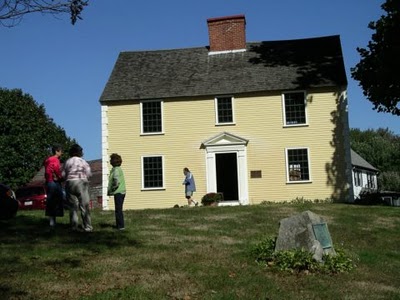
The Death of General Warren at the Battle of Bunker Hill by John Trumbull Rather than exercising his rank, Warren served in the battle as a private soldier. Joseph Warren had given our ancestor Reuben Dow his commission

Warren was appointed a Major General by the Provincial Congress on June 14, 1775. He arrived where the militia was forming and asked where would the heaviest fighting be; General Israel Putnam pointed to Breeds Hill. He volunteered as a private against the wishes of General Putnam and Colonel William Prescott, who requested that he serve as their commander. Since Putnam and Prescott were more experienced with war he declined command. He was among those inspiring the men to hold rank against superior numbers. Warren was known to have repeatedly declared of the British: “These fellows say we won’t fight! By Heaven, I hope I shall die up to my knees in blood!” He fought in the redoubt until out of ammunition, and remained until the British made their third and final assault on the hill to give time for the militia to escape. He was killed instantly by a musket ball in the head by a British officer (possibly Lieutenant Lord Rawdon) who recognized him. This account is supported by a 2011 forensic analysis. His body was stripped of clothing and he was bayoneted until unrecognizable, and then shoved into a shallow ditch.

Colonel Prescott was of the opinion that the third assault would have been repulsed, had his forces in the redoubt been reinforced with either more men, or more supplies of ammunition and powder

The retreat of much of the colonial forces from the peninsula was made possible in part by the controlled retreat of the forces along the rail fence, led by John Stark and Thomas Knowlton, which prevented the encirclement of the hill. Their disciplined retreat, described by Burgoyne as “no flight; it was even covered with bravery and military skill”, was so effective that most of the wounded were saved; most of the prisoners taken by the British were mortally wounded.    By 5 pm, the colonists had retreated over the Charlestown Neck to fortified positions in Cambridge, and the British were in control of the peninsula.
The British succeeded in their tactical objective of taking the high ground on the Charlestown peninsula, but they suffered significant losses. With some 1,000 men killed or wounded, including 92 officers killed, the British losses were so heavy that there were no further direct attacks on American forces.  The Americans, while losing the battle, had again stood against the British regulars with some success, as they had successfully repelled two assaults on Breed’s Hill during the engagement.  From this point, the siege essentially became a stalemate.

In July 1775, George Washington took command of the assembled militia and transformed them into a more coherent army. On March 4, 1776, the colonial army fortified Dorchester Heights with cannon capable of reaching Boston and British ships in the harbor. The siege (and the campaign) ended on March 17, 1776, with the withdrawal of British forces from Boston.

Stephen DOW II’s grandson Capt. Reuben Dow (1729 Salem NH – 1811 Hollis, NH )

In our previous episode, Reuben marched his company from Holllis, NH to Lexington on the alarm April 19 and returned home..

Thirty-Nine of his privates returned home in the next few weeks, however Fifty-Three of them volunteered in various units to serve for Eight months. Most of them re-enlisted in a new company under Captain Dow and the same Lieutenants. Shortly after the commencement of the Siege of Boston they were incorporated into Prescott’s Massachusetts Regiment as part of the Grand Massachusetts Army.  Prescott owned land in Hollis and knew most of the men very well, so it must have seemed a natural choice for them to fall under his command, rather than one of the unknown Colonels from New Hampshire.

The call came quickly, so unexpectedly that Reuben’s little son Daniel was left to unyoke the oxen from the plough.  Mrs. Dow made an equal division of the blankets in her store room and her mess pork, one half going to the soldiers.  The company marched 69 strong all Hollis men, assigned to Col.William Prescott, making up roughly one-sixth of his regiment.   It was the second to arrive on the field at Bunker Hill and spent the night of June 16 digging trenches.  Next day, 16 Jun 1775 they were on the firing line

Six men from the Company were killed in the battle, including the 1st Sgt, and eight men were wounded. Rueben was struck in the right ankle by a bullet which shattered the bone.
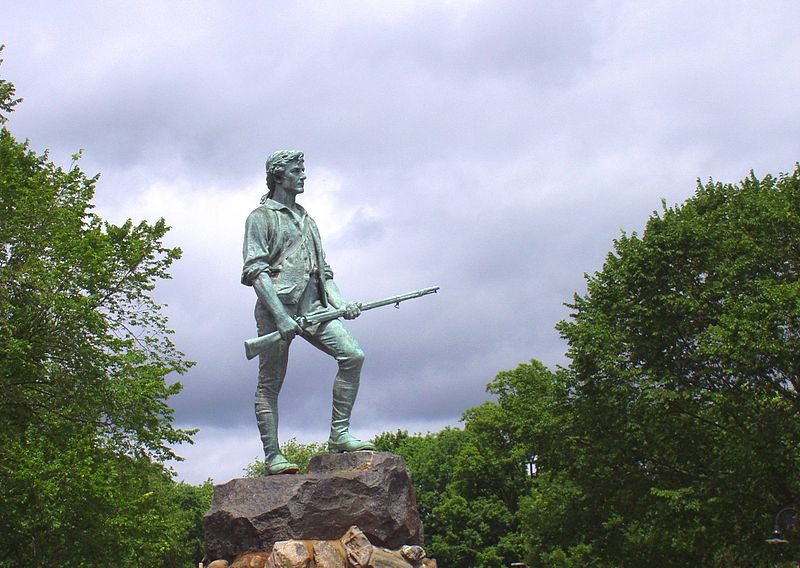
Nevertheless, he made the retreat in good order with his troops.   The bullet, which was extracted, is still preserved; but the effects of the wound are said to have eventually caused or hastened his demise.  The regiment, as a whole, recorded Forty-Two killed and Twenty-Eight wounded.

By year’s end the enlistments of Captain Dow’s men ran out. Some returned home, many were signed on in other units, and some were discharged with pensions due to wounds. Captain Dow was in this last category. He returned to Hollis and served as Chairman of the Committee of Safety.

On account of his disability he was continued for a short time on half pay, later reduced to quarter.  In 1783 he was cited to appear before the State authorities to show cause whey his pension should not be discontinued.  A large number of witnesses were examined concerning Reuben’s ability to care for himself and the verdict confirmed his pension for life.  He died 9 Feb 1811; he and his wife buried in Hollis church yard.  In 1927, the homestead with all its Revolutionary reliecs was owned by Charles Jeremiah Bell (bcdeabeaa).

He had three sons, Daniel, Stephen and Evan.  Evan was a private under his father at Bunker Hill.  There are four instances of a Dow grandfatherm, father and son being in Revolutionary service at the same time,.

Francis BROWN II’s son Capt. Thomas Brown (1745 Newbury – 1803 Essex, Mass)

His story started 19 Apr 1755 as a a private in Capt. Moses Little’s company of minute-men who marched on the alarm of April 19, 1775 to Cambridge – Service 5 days.

Next he was an ensign in Capt. Jacob Gerrish’s Company, Col. Moses Little’s Essex County Regiment. This regiment reach ed Cambridge the morning of battle of Bunker Hill 17 Jun 1775 and although not yet mustered into service, it volunteered to go into action.  Just prior to the action, further reinforcements arrived, including portions of Massachusetts regiments of Colonels Brewer, NixonWoodbridgeLittle, and Major Moore, as well as Callender’s company of artillery

Most of the Regiment including Gerrish’s Company crossed the Charlestown Neck under the fire of British ships on marched into the entrenchments on Bunker Hill.  Gerrish’s Company was with their townsman Little in the redoubt.

Mrs. Brown with her slave Titus followed the regiment to Cambridge.  The night after the battle, she filled a pillow case with provisions (mostly doughnuts made by herself) and placed it on Titus’ back and went with him to Winter Hill to which point most of the continental troops had retreated.  After his freedom had been given him, Titus remained a faithful servant of the family until his death.

Thomas later became First Lieutenant  under Capt. Barnard of the same regiment and then Captain of the Newbury Company under Col Aaron Willard’s Regiment.  As Captain, he marched to Fort Ticonderoga and thence to Fort Edwards to join forces against Burgoyne.

Jasiel PERRY’s  grandson Elijah Perry (1752 Rehoboth –  1779 Woodstock, Windham, CT)

Elijah Perry Rehoboth.Private, Capt. Samuel Bliss’s co. of Minute-men, which marched on the alarm of April 19, 1775; service to April 27, 1775, 1 week 1 day.

Perry, Elijah.Corporal, Capt. James Hills’s co., Col. Carpenter’s regt.; enlisted Dec. 8, 1776; discharged Dec. 22, 1776; service, 15 days, on the alarm at Bristol, R. I., of Dec. 8, 1776; roll dated Bristol and sworn to at Rehoboth;also, Sergeant, Capt. James Hills’s co., Col. John Dagget’s regt.; copy of a list of men stationed at Bristol for 3 months from Dec. 28, 1776.

Elijah Perry, Private, Capt. James Hills’s co., Col. Williams’s regt.; service from Sept. 29, 1777, at Tiverton; reported enlisted out Oct. 9, 1777. Roll sworn to at Rehoboth.

Elijah Perry, Sergeant, Capt. Ichabod Wade’s (Light Infantry) co., Col. George Williams’s regt.; service, 21 days; company stationed at Tiverton Oct. 7, 1777. Roll sworn to at Rehoboth.

Perry, Elijah, Rehoboth.Descriptive list of men mustered by James Leonard, Muster Master, to serve in the Continental Army for the term of 9 months from the time of their arrival at Fishkill, agreeable to resolve of April 20, 1778, dated Taunton, June 1, 1778; Capt. Joseph Franklin’s 10th (Rehoboth) co., Col. Thomas Carpenter’s (1st Bristol Co.) regt.; age, 25 yrs.; stature, 5 ft. 10 in.; complexion, light; hair, dark; eyes, blue; residence, Rehoboth; engaged for town of Rehoboth; arrived at Fishkill June 16, 1778; also, list of men returned as received of Jonathan Warner, Commissioner, by Col. R. Putnam, July 20, 1778.

Elijah Perry, Rehoboth (probably).List of men drafted to serve at Rhode Island for 1 month, dated March 13, 1779.

Joseph COLEMAN (1765 Newbury, Mass – 1858 Lewiston, Maine)

Joseph’s father John Coleman lived nearby during Battle of Bunker Hill – Boston.   Family legend says Joseph, 9 yrs old, was awakened the night before  by the sound of his father and other men “running bullets and making cartridges for use in the anticipated battle.”

Several of Isaac ESTEY’s grandsons marched on the alarm April 19 from Topsfield

“At a Meeting of the Alarm List and Training Band of the Foot company, in Topsfield, on the 5th of December, 1774  to choose officers for the said Company, (agreeable to the advice of the Provincial Congress), voted, Mr. Stephen Perkins, chairman; voted, Mr. Joseph Gould. Captain.

The Day being Spent, a Motion was made for said Meeting to be adjourned to the next Morning9 o’clock; the Question was put and passed in the Affirmative and accordingly said Meeting was adjourned to said Time.

December 6. Said Alarm List and Training Band met according to adjournment, a Motion was made said Company to be divided into two distinct Companies; the Question was put and accordingly they were divided into two Companies: the first Company voted Mr. Joseph Gould. Captain; Mr. Samuel Cummings, Lieutenant; Mr. Thomas Moore, Ensign; and all the other Officers by a great Majority. The second Company voted Mr. Stephen Perkins, Captain; Mr. Samuel Dodge, Lieutenant; Mr. David Perkins, Ensignand all the other Officers by a great Majority.” (Essex Gazette, Dec. 27, 1774.)

On April 19, 1775 the two companies of the Topsfield Militia left their plows in midfurrow and galloped off to Lexington and Concord to help drive the Redcoats back to Boston. They did not see active service on that day, however, as they arrived after the battle was over.

February 13, 1777, the town voted to give eight pounds to those who volunteered to serve three years in the American army in addition to what Congress granted. A month later the amount was raised to eighteen pounds.

In May, 1778, a rate of one hundred and twenty pounds was assessed to defray the charges of clothing for the Topsfield soldiers in the continental army.

In 1780, the town voted to purchase eight thousand four hundred and forty pounds of beef for the army. In 1777, a committee was formed to look after the soldiers’ families if need be.

South Ward Company

A muster Roll of Capt. Joseph Gould; Company of the Militia whereof John Baker Esq. is Coll. who marched on the 19th day of April last past in consequence of the Alarm made on that Day by the English Troops. Topsfield, December 26, 1775. The company marched 6O miles and saw a service of 3 to 5 days. Capt. Gould was paid £ l-6-5, while the privates received about 12s 19 3/4d. as an average.”

Isaac Estey’s grandchildren

David Balch (1714-1787)

Daniel Eatesy (1739-1830)

Wm Eatesy (1748)

Benjamin Dwinell (1726 – 1805)

Moses Perkins (1732-1807)

Posted in History, Storied, Veteran | Tagged | 9 Comments