Thomas Miner Diary

The diary of Thomas Miner is a unique memorial of daily life in 17th Century New England.  Almost all other writing from the period concerns religious and legal matters.  Although the entries are terse and never give details, they do give us a glimpse into his daily events and community activities. He records many births, marriages, and deaths among his neighbors.  He meticulously records the day of the week, the number of days in the month and the year, for no doubt this served as his only calendar. He entered the date when a field was planted and its yield, for this would guide him in his planting the following year; unusual weather conditions such as “a great snow” or “bitter cold” made his diary truly his farmer’s almanac. The death of his 21-year-old son is reported in simple and unemotional language, though it must have caused him considerable pain. He makes brief notes of some of his financial transactions.

Thomas Miner - Diary Page

It is quite probable that after the death of Thomas Miner, his son Manasseh Miner may have considered it his duty to continue a diary as long as possible.  Manasseh’s diary covers 1696 – 1720 and is available on Ancestry.com.

To give you a flavor of the diary, here is an entry for 1654 (spelling, punctuation as in the original):

The first month is march .1654 and hath .31 days wensday the first friday the third John went to Coneticut & tusday the .7. I made an End of hewing of timber at the mill brooke  watch came backe from Coneticut and wensday the eight I begun to plow the wheat land and monday the .13. I made an End of sowing pasnepes and monday the .22. I looked for the swine and wensday .29. I vewed Cary lathams farm and friday .31

The above entry represents one month.  It is somewhat difficult to track in detail what is happening in the diary – places aren’t identified in a recoverable way, and it is in many ways a listing of agricultural highlights, with occasional visitors or other events mentioned.

In a typical month, Miner’s business could run the gamut from farmer to selectman, and from husband to member of the trainband. [in those days double ff meant the same thing as today’s capital F]

The third moneth is may and hath .31 days  The ffirst is svath day: the 5 day I was at The ffarme and Ephraim with me  ffryday the 6.  I was planting Corne in the playne.  The .7th day manaseth and Hames Averie Came heare sabath day the .8 mr noyce said he must goe abroad I put up a paper on the meetinghouse doore the 10. day the Two mares ffolled: the 12 day I made an end of plowing the 14. day I Ended the litle house sabath day the 15. and sabath day the 22. I was come ffrom stratford monday 23. I covered the oven and sabath day 29.  The .27. day I was at new London hanah and marie with their Children came whome with me monday 30. we sheered our sheep Tuesday 31. The 25. day wensday the Leeftenant tooke the Charge of the Company in the ffield p. 96 [1670]

It does give some picture of local life in places, though; for instance:, from pages 8-9:

Sabiantwosucke promised the .30. of desember befor mr stanton and tomus shaw to make Watch a canoow for that which I had and to bring me six pecks of nunup (Indian word for beans).

By 1668, when this selection from his journal was written, Miner, his wife Grace, and their children were living in what is now Stonington, a town on the Connecticut coast. Indians lived nearby, and the journal shows Miner and his family interacting with them. Miner was a farmer, and he also had a number of public responsibilities including town treasurer, leader of the militia, selectman, and brander of horses. He also participated in church and in town meetings. This selection records one year in Miner’s life. He began the year in March, as people in England and New England did until the mid-eighteenth century. While his spelling is idiosyncratic and therefore difficult to read, the journal is a valuable record of how written English looked at that time—and probably also of how Miner pronounced his words.

The ffirst month is march & hath .31. d: sabath day the first and in the first after the leap yeare and from the Creation .5617. and the yeare .1668. and the 20th yeare of the reinge of our lord King Charels the second the .6. day Thomas Tracie and leaffingwell was heare the .7. dai I branded .2. Coults [colts] I sowed hemp & pease in the orchard sabath day the .8. day: sabath day the 15. The 13. I was at mr palmes I had A barell of mallases [molasses] wensday the 18. we made an End between Jossepth & Marie Averie monday the 30 day I ffecthed [fetched] my wifes mare and 26. day Thursday we trained fryday .31.

The second moneth is Aprile and hath 30 days wensday the ffirst we sowed pease in the plaine & wheate: the 7. day we had a towne meeting wensday the .8 I gardned the .9 day I mended the Brige & was at Tagwoncke The 14. day it snowed and the 15 day being wensday ye 16 day we plowed ffor segamoot in the plaine The 20 day mr Brewster and mr star was heare I marked the red mares Coult wensday the .22. I sowed fflax the 23 I was with mr noyce to pay him it was wet.

The third moneth is may and hath .31. days ffriday the first Thursday I was at black hall [Black Hall, a coastal town west of Stonington] John [his son] came hither ffriday the 8. the .11. day I was at norig [Norwich] and burnt my bill: the 12. day John went Away I was to goe to the Court the 14 day was the Electun [election] ffriday the 15 The 17 day I was sicke the 22 I was at Courte the being ffriday monday 25 I came whome [home] the 30 day I paid thee firkin of buter to badcok sabath day 31. [[A firkin was a quarter barrel. Butter and soap used to be sold by the firkin, too. In these cases it was a measure of weight, instead of volume: e.g., 56 lb and 64 lb respectively]

The fouerth moneth is June and hath .30. days monday the ffirst: The .4. I came from new london the same day I received .3 letters ffrom bristoll & monday the 8 I was caring wood the tenth I was lookeing horses Monday the .15 hanah [his daughter] went to Tagwonck The same day was a towne meeting to Chuse a Constable Thomas wheeler was Chosen my lot drawne and the 18 day we ended all about our ffarmes agedowset his five ackers [acres] laid out and he and I exchanged monday 22. the 23 day I was branding horses 24 day my wife came whome sicke ffrom Tagwouncke monday 29 I had mowed most of my orchard Tusday the 30 I was to go to New london we Killed the catle.

July is the fift moneth and hath .31. days wensday the first Thursday mr hill was maried the second day wensday the 8. I was at Crandals mill ffriday the .10. we had our ffloore laid I had ffouer loads and halfe of hay in the baren wee wer [sentence unfinished] Tusday the 14 Cap denison nehemiah palmer & Tho minor was Chosen to make the Contrie Rate and lists the 15 day we made the Contrie Rate being wensday the 17 day I was at pocatuck [Pawcatuck] the 20 day monday Josepth [his son] had Twentie six shillings of wamppum and wensday the 22. 23 I had 2 load of pease into the barne the .25 day saterday we had all our oates & pease into the barne Rachell mason was heare wensday 29. Tho bell came to worke my wheat came all downe ffriday 31 I was at badcoks

The sixt moneth is Agust and hath .31. days saterday the ffirst we tooke all our fflag out of the water the ffifte day wensday I was at Crandals mill saterday the .8. Crandall and his wife was heare we had Ten load of hay whome monday 10 I went to bostowne with the oxen saterday the 15 monday the 17 I came whom from bostowne and saterday 22 I ffecthed the litel Reeck with the .2. steer: and The .27. we had ale our hay whome. 28. we gathered aples saterday .29. I writ letters to Bristoll monday 31.

The seventh moneth is september and hath .30. days Tusday the ffirst saterday the .5. we set up the place for to put corn in monday the 7 we gathered hops Tusday the 8 Thomas perke was heare The 11 I was at new london monday the 14 the Towne meeting about parkers land Tusday the 15. the 17 day I was at the Courte saterday I came whome Tusday .22. the Jurie was discharged Thursday the 24 was our Traing day: .36. was ffined when we came to the Top of the greate hill we met Thomas perk and his sonn Thomas perk and Robert holmes it Rained and wensday the 30 we made an End of carring of indean corne

The Eight moneth is october and hath .31. days Thursday the ffirst the secon day wee chose deputees p’fected our list: mr Richerdson discovered Captaine gookin his horse the .8. day John his wife and Children was heare my wife and I was at london and let the Catele to John keny Thursday the .15 ffriday the 16 John & the Rest went away the 7 day of this moneth John ffish was hurt and Thursday The 22. I make an End of Shuflin in the yard the .18 day mr Thorneton Taught heare thursday .29. we wer to traine

The ninth moneth is november and hath .30. days and sabath day the ffirst The 4 day we delivered the mares to nathaniell Cooper sabath day the .8. mr noyce came whome the 9 day I sent to John and sabath day the 15 the 16 day we broke our wheel Caring muck the 17 day we gathered Turneps we had bushels wensday the 18 was A day of Thanksgiving sabath day 22 the high Tide was sabath 29 mr noyce apoynted the 30 day of december to be a day of ffasting and debate being wensday month and munday the 30 we laid out 300 ackers of land ministrie

The tenth moneth is december and hath .31. days Tusday the ffirst we laid out 200 ackers of land for the ministry The third day the .2. snow and Elisha Cheesbroughs son was borne the 6 day my wife ffell of the mare at the Cart brige the 7 day we looked land the 8 day Tusday I was at the Captaines and gallops the 15 day tusday the 3. snow I begun to thresh and wensday the 4 snow my sons went to new london Tusday the .22. I was at new london Thursday .24. I arested shumatuck 26 day williams was heare

The 16 day of November 1669 Thomas park Junior ffetched a barell of sider and one bushell of apples that was the Just sume ffor the house building

The leventh month is Januarie and hath .31. days ffriday the ffirst and ffriday the eight I tooke up my bay horse The 13 day mr noyce Captaine and his wife was heare the 14 day Ephraim and marie was heare and ffecthed wood the ffifteen ffriday The 20 day wensday The meeting was at our house ffriday 22 The snow melted all away the 23 day we ffecthed wood ffriday the 29 and sabath the .31.

The 25 day of ffebruarie .1668. there was due to me Thirteen shillings from Thomas bell.

The Twelvth moneth is ffebruary & hath .28. days monday the ffirst: this is the yeare of our lord god .1668. from the Creation .5617. and the first after the leap yeare: and The .20th yeare of the Reinge of king Charles the second the .2. day a towne meeting about mr Richarson building upon marshall wights land the same day I was Chosen Towne Treasurer the third day I was at london and paid the marshall the 8 day monday we wer laing out an acker of land at beaporton the ninth day we sent .4. gallons of oyle to goodwife Cheesbrough the 15 day I was with mr noyce at london monday 22 the 24 I was at poquatuck with mr noyce The 25 day Thursday mr Richardson cried out murther The 27 day I was at new london sabath day 28

There is an interesting analysis of his diary in “By Nature and by Custom Cursed: Transatlantic Civil Discourse and New England Cultural Production, 1620-1660, by Phillip H. Round, Tufts University, starting on page 99.  If this link is still valid, you may find this here.  One thing I found a little surprising in the diary was the prickly nature of the relationships between the settlers; at some points they were suing each other over matters, at others supporting each other in various ways, or cooperating in politics.

I was sent for to pequit for to be reconsiled to the Church and at eveining the the maigor pt met at goodman Calkins hous namly Mr. Blinnman Mr. Bruen Goodman Caulkin Ralpth perker goodman lester goodman morgan goodman coit hugh Roberts Captain denison and goodman Cheesbrough being there all tooke satisfaction in my acknowledging the hight of my spirit Secondly in that I saw my evil in my suden and rash speaking to Mr. Blinnman and with all there was acknowledgement of the Churchs part with promises on both parties that all former offences should be buried and never more to be agitated so desiring the praiers each for other parted from that meeting. (p. 13)

Miner’s unpunctuated account offers a glimpse of the meeting house as a social agent for whom the church was not the only source of agency.  Thomas’ prose emphasizes the fundamentally dialectical nature of the experience of “reconciliation” and highlights the space opened up for improvisatioin by such social interactions.  In spite of the seemingly obligatory nature of Miner’s humble response, his report features a range of options and  is marked by a distinct reciprocity.  His journal catalogs everyone who witnessed his apology, listing not onlytheir names, but their status, separating the middling gentry of “Misters” from the captain and the other “goodmen.”

Miner’s meetinghouse marginality was initially matched by social marginality.  Although technically within the borders of Connecticut, he was actually living on the fringe of the Massachusetts colony’s authority and at first paid his rates to the Bay Colony.  In 1658, however, he decided to cut his ties to the “bay men”, recording his decision in a voice that highlights his true priorities and the origins of his emerging sense of agency

Because that the bay men begun in an unjust way to lay out mens lands that they had in possession before the things were wholy ended maks me to turne wholy to Coneticut & and them my list {p. 28)

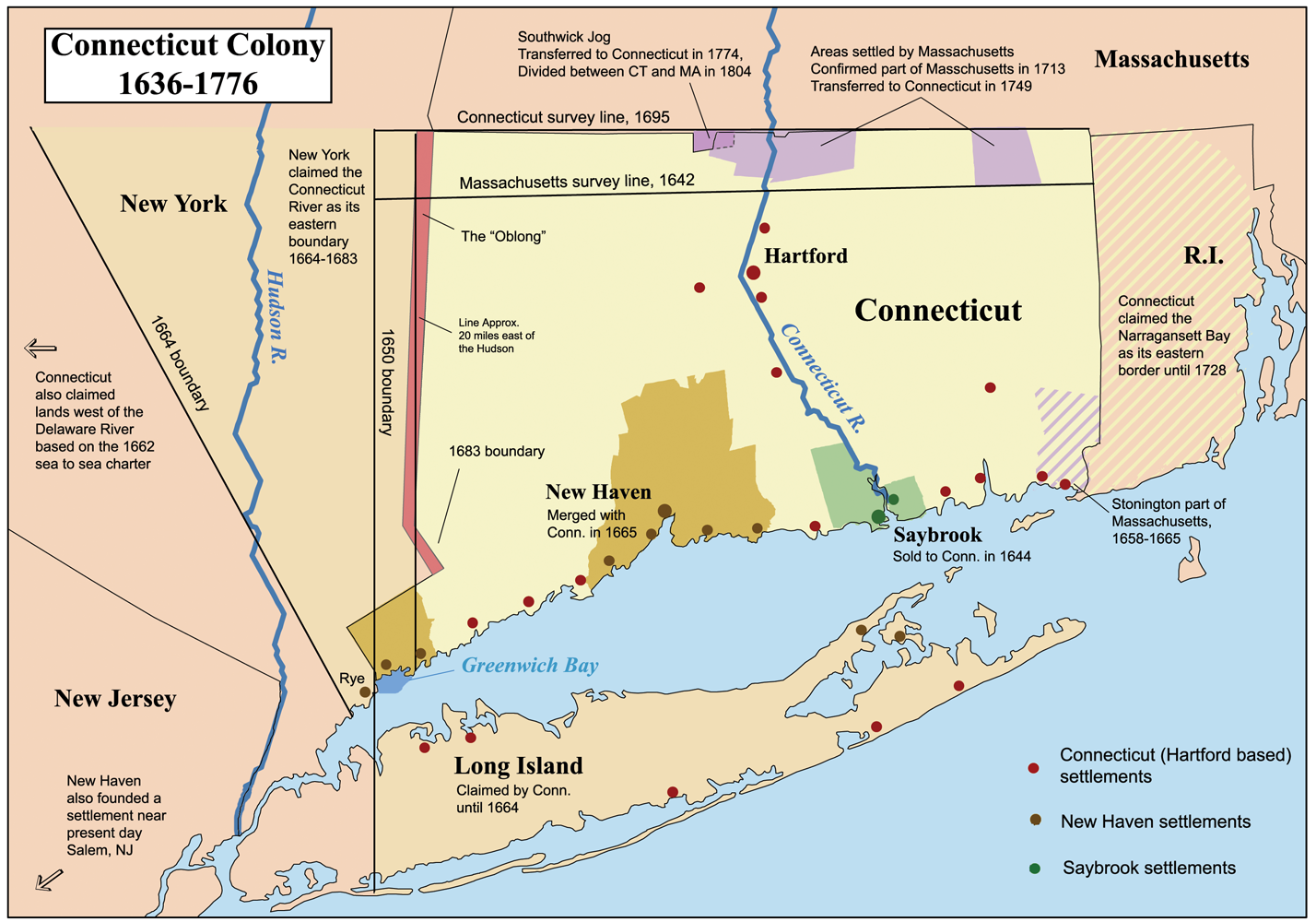
Stonington was part of Massachusetts 165-1665

Yet his private decision to put his whole effort into the Connecticut enterprise did not make him instantly “visible” to his fellow townsmen.  Later that year he found himself in trouble again, this time with the civil authorities

I was questioned at my ffathers for being a leader to make division 2ly to  take yet Captains power from him 3ly that [I would][ deliever the Captain if he was demanded 4ly for lightness at Towne. (p. 33)

In spite of this official reprimand, Miner seems to have impressed several members of the community with his honesty for later he was

Called to view the dead body of William Bostuck being by the jury conceived to be poysoned.

Miner’s feeling of belonging faltered in 1664 when the town renewed its effort to parcel out land.  When he was denied a fair share of the territory, Miner signaled his feeling in his pronouns:

Third meeting of the town when they drew lots and granted Twentie lots of an hundred ackers appece.  I and my sons had none. p. 55

There should have been a new choice of all officers in the Towne Tuesday .. we had not meeting Tuesday 22 .. we had no meeting for three sabbaths before friday the 15 . p. 61

When the town finally does meet it is without him

The .4 meeting [of the town] John Gallop was Chosen Townsman and The Captain left out as I was tould.  p. 55

When the Stonington constable delivers a warreant to one Mr. Richardson, a man who makes frequent appearances in the journal as a central player in town affairs

The Constable’s warrant was Torne  … [and] Mr. Richardson and the constable fell out.  p. 132

When Samuel Cheesbrough brought an Execution for 22 pounds to Miner, Miner

Denied to him deliver him anything … and tould him that he should carrie nothing … out of [his] house.  informing Cheesbrough to his face “I [do] not owne [you] to be a constable to me at this time.  p. 196

On another occasion, Miner ran afoul of Cheesbrough for trying to collect a debt himself:

I was  at [Shas} & he was not a whome & I asked 30 s of Shas wife and Sam. Cheesebrough was there and forbid Shas wife to pay it me and said that he would answer fit at the Couret & Thomas Stanton Junior was A witnes.  p. 70

Cheesbrough and Miner were not friends, nor were Mr. Richardson and the constable, but neither did these townsmen play the roles of insider and outsider, elect and reprobate.  Both Cheesbrough and Miner garnered enough of the assembled town’s approval to be elected to serve together as deputies of the court.

Here is another run in of Miner’s with the Cheesbrough clan:

A Towne meeting the month being out that the Court order was published about branding horses I desired it might be attended Elisha Cheesbrough said it was but my Story there was no order for it, John Packer Edward fanning was there.  p. 70

More about Thomas Miner’s nemesis William Cheesebrough …,

1649 – The first settler of Stonington, Connecticut, William Cheesebrough , a gunsmith, came in the spring of 1649, overland from Rehoboth in Plymouth where he had been accused (falsely, he always maintained) of selling firearms to the Indians. He came with his wife, Anna Stevenson, and their sons.   He picked a site on a knoll on the west bank at the head of Wequetequock Cove where there was a well sheltered landing place and open meadows for grazing and cultivation. But the authorities suspected he planned illicit trade in rum and firearms with the Indians, so on 7 Nov 1649, the constable at Pequot (New London) informed him that ‘the Goverm’t of Connecticutt doth disslike and distastes the way hee is in and trade he doth among the Indians; and they doe require him to desiste therefrom,’ ordering him to report to [our ancestor] Major John MASON at Saybrook, or some other magistrate, and give an account of himself and his lonely settlement. East of Chesebrough, on the Pawcatuck (just across the river from present Rhode Island), Thomas Stanton built his Indian trading post. A monopoly of trade in furs with the Indians was sort of bonus to the salary of $25 a year paid by the Connecticut colony for his services as official interpreter.

Walter Palmer, a six-foot-four giant, 68 years old, settled close beside his friend Chesebrough, and Palmer son-in-law, Thomas MINER, took up land four miles westward at Quiambaug Cove.  George Denison came in 1654 with his family and located a little north of MINER on a rocky knoll overlooking a great meadow with a glimpse of the ocean beyond. He erected a little lean-to and surrounded it with a stout stockade.

Finally a lyric of town subjectivity

The 22. of July 1662
its the day wherein I went astraty in Companie of Two:
thyat professed they loved me well:
but shouyld we all hold on:
I feare not only I but all had fell:
my children when I am dead:
let none but your selves this read:
but do take heed of being with your professed friends misled:
the two men Il name to you:
remember well the time and you will find it true:
Thomas Stanton and William Cheesbrough were the ment;
but I with them at Shas was merely catched them:
o lord deliever and keep both me:
and you:
from our corrupt harts and them:
and so I say amen.
p. 190

Sources:

http://historymatters.gmu.edu/d/6228

http://historymatters.gmu.edu/d/6228

By nature and by custom cursed: transatlantic civil discourse and New England By Phillip H. Round Google Books , Townsman Thomas Miner’s Lyric Subjectivity Pg 99-105

The Diary of  Manasseh Minor – Ancestry.com – Published by Frank Denison Miner 1915

Posted in Fun Stuff, Line - Miner, Storied | Tagged | 16 Comments

Lyon’s Whelp

While we are on the subject of our original Thomas Miner,  he arrived on the Lyon’s Whelp in 1629.  I bet you didn’t know there was a whole whelp of Lyon’s Whelps – Nine in All …

1629  – Lyon’s Whelp The Talbot and the Lion’s Whelp sailed from Gravesend on Saturday, April 25, 1629, at seven o’clock in the morning,  On Tuesday, June 30, Governor Endecott went on board the Talbot, bade the passengers welcome to Salem.

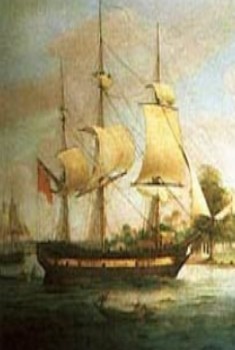
The National Maritime Museum at Greenwich has a small (5" x 10") painting by Abraham de Verwer on copper dated about 1650. The ship corresponds to the general appearance of the Whelps in that she is a three-masted ship having one gun deck with a grating or flying deck over the waist and eight broadside gun ports.

Thomas Miner was onboard.  Alternatively, he arrived on the John Winthrop’s flag ship Arabella.

Now in this year 1629, a great company of people (The Higginson Fleet) of good rank, zeal, means and quality have made a great stock, and with six good ships in the months of April and May, they set sail from Thames for the Bay of the Massachusetts, otherwise called Charles River.  The fleet consisted of, the George Bonaventure of twenty pieces of ordnance; the Talbot nineteen; the Lion’s Whelp eight; the Mayflower fourteen; the Four sisters fourteen and the Pilgrim four, with 350 men women and children, also 115 head of cattle, as horses, mares, cows and oxen, 41 goats, some conies (rabbits), with all provision for household and apparel, 6 pieces of great ordnance for a fort, with muskets, pikes, corselets, drums, colors, and with all provisions necessary for a plantation for the good of man.”  (The True Travels, Adventures and Observations of Captain John Smith – London 1630)

The Lyon’s Whelp was the name of several British naval ships dating back to the 1600s, the tenth of which was an important part of the pre-Great Migration flow of immigrants into New England.

A painting of single-decker in the National Maritime Museum shows a ship similar to the Lion's Whelp with the English coat of arms at the stern. This picture (negative number A3627) used to hang in the Queen's House in the 1970's- artist unknown

The name is possibly from the biblical quotation from Genesis; Judah, the fourth son of Leah, is described with these famous words: “Judah is a lion’s whelp; On prey, my son, have you grown. He crouches, lies down like a lion, like the king of beasts, who dare rouse him? The scepter shall not depart from Judah, nor the ruler’s staff from between his feet….” (Genesis 49:9-10 )

Rev. Mr. Higginson wrote, for the satisfaction of friends, upon their request, a journal during the voyage, the original manuscript of which is in the possession of the Massachsetts Historical Society. With this he wrote under date of July 24, 1629, and also sent before November following a description of the region about Naumkeag and of its conditions, entitling it “New-Englands Plantation.” This was published in London in 1630, and two other editions followed immediately.
Mr. Higginson wrote of his book as follows: “A Trve Relacon of ye last voyage to new England, declaring all circumstances wth ye maner of ye passage wee had by sea.

One of the ships, the George Bonaventure, was a strong vessel of about three hundred tons burden, with twenty pieces of ordnance and manned by about thirty mariners. It was commanded by Thomas Cox, and carried fifty-two planters and provisions and twelve mares, thirty kine and some goats. Among the passengers were Rev. Samuel Skelton and his family, consisting of his wife Susanna and three children, Samuel, aged six, Susanna, four. and Mary, nearly two. As it was specially desirable that the George should sail as early as possible, it set out upon its voyage about the middle of April and from the Isle of Wight May 4, and safely arrived at Naumkeag June 22, 1629.

The Talbot, Thomas Beecher, master, was also a strong ship of three hundred tons, with nineteen pieces of ordnance and manned by thirty mariners. It carried about one hundred planters, and as freight six goats, five great pieces of ordnance, with oatmeal, pease and all kinds of munitions and provisions sufficient for the plantation for a year. Several servants of the Pilgrims came in this vessel at this time and also Mr. Higginson and his family, consisting of his wife Ann and children, John, the eldest, aged twelve, Francis, Timothy, Theophilus, Samuel, Mary, Ann, Charles and Neophytus.

Lyon's Whelp Model

The Lion’s Whelp, John Gibbs, master, was a ship of one hundred and twenty tons, well proportioned and fast, carrying eight pieces of ordnance, six fishermen and about forty planters, principally of Dorsetshire and Somersetshire, besides the mariners and provisions and four goats. Rev. Francis Bright and his family, consisting of his wife, two children and one maid servant, were among the passengers.

The Talbot and the Lion’s Whelp sailed from Gravesend on Saturday, April 25, 1629, at seven o’clock in the morning, with a wind so light that a progress of only twelve miles was made that day. They remained where they were that night and the next day, keeping the Sabbath. On Monday, they sailed as far as Gorin Road, where they anchored for the night. On Tuesday, they proceeded a little further and anchored opposite Margaret Town, waiting for wind to carry them through The Downs. The next day, they passed The Downs, and remained there that night. For the next three days the southwest wind caused the water to be so rought [sic] that a number of the passengers, among them Mrs. Higginson, were sea-sick. At this time, officers from the king’s ship, named the Assurance, impressed two of the seamen. Sunday, May 3d, was a cold windy day, and the vessels were still at The Downs. The next day, the wind became fair from the north-north-east, and sails were spread. The vessels passed Dover, where they saw six or seven sail of Dunkirks coming toward them. For some reason, probably because of the presence of other vessels, the latter returned. That night the Isle of Wight was reached, and the vessels were anchored to wait for the light before attempting to go through the channel. On the next day, they entered the channel, passed Portsmouth, and anchored at night opposite Cow-Castle. Here, Rev. Mr. Higginson, his wife and daughter Mary and several others from both vessels went on shore to refresh themselves and wash their linen. They remained on shore all night. In the evening, however, sails were hoisted, and the vessels proceeded eight miles, anchoring opposite Yarmouth. The next morning, a shallop from the Talbot was sent to take in those who had gone on shore the night before. The water was so rough that the women, at their request, were put on shore when they had got within three miles of the vessels, and they walked to the town, where they lodged that night. At this place the vessels remained until Monday, May 11, and took on board some fresh provision. On Saturday, officers from the king’s ship impressed two more men, but by entreaty one was returned. On Sunday, Mr. Higginson preached aboard the Talbot in the morning and in the afternoon at Yarmouth in response to an earnest invitation. On Monday afternoon, at three o’clock, sail was again set, and about an hour later the vessels passed the narrow Needles and entered the sea.
The next day they sailed as far as Lizzard Head, and on the following day, Wednesday, May 13, to Land’s End. There, most of the company saw their native England for the last time. Mr. Higginson called his children and other passengers to the stern of the ship to take their last look at the homeland. He said: “We will not say, as the separatists were wont to say at their leaving of England, ‘Farewell, Babylon!’ ‘Farewell, Rome!’ but we will say, ‘Farewell, dear England! farewell, the church of God in England, and all the Christian friends there!’ We do not go to New England as separatists from the church of England; though we cannot but separate from the corruptions in it; but we go to practise the positive part of church reformation, and propagate the gospel in America.” He concluded with a fervent prayer for the king, and church and state, in England; and for the presence and blessing of God with themselves in their present undertaking for New England. (Magnalia Christi Americana. by Rev. Cotton Mather, page 360.)

About ten leagues further on, they passed the Scilly Islands and turned the prows of their vessels directly toward the new world. Sea-sickness followed the first experience of the passengers with the rough Atlantic. The next Sunday, the religious services were disturbed by the approach of a man-of-war of the Biskaniers. Apparently concluding that an attack would be Unsuccessful, the ship sailed away. On the same day two children of Mr. Higginson, Samuel and Mary, became sick of small pox, and subsequently many more were afilicted. The disease had been brought aboard the vessel by a Mr. Browne who was sick with it at Gravesend. Samuel Higginson recovered, but Mary lived only two days, and her body was, of course, committed to the sea. She was five years old, and for a year had been hunch-backed, weak and sickly, and had suffered much pain. Her death was regarded as a great relief from suffering.

The second day thereafter (Thursday, May 21) was kept as a day of humiliation, fasting and prayer tobeseech [sic] God to cause sickness and death on board the ship to cease. There was another clergyman on the Talbot, Rev. Ralph Smith,2 who although not in full sympathy with Mr. Higginson observed the service with many of the people on board.   Rev. Ralph Smith came voluntarily and on his own account, and the Company did not learn that he was not in accord with the ministers who came under contract until his provisions for the voyage were on shipboard. Governor Endecott was directed to allow him to remain within the limits of their grant only while he was conformable to the government.  Mr. Smith was baptized in the parish of Gainford, Durham, England, April 5, 1589, and was son of Rev. Ralph and Catheran (Mathewson) Smith; and graduated at Christ College, Cambridge, in 1614. He remained in Salem a short time, and with his family removed to the struggling little colony of fishermen at Nantascot, now Hull. He found only insufficient shelter for his family, and a lack of associations and surroundings that were agreeable to a man of grave demeanor and education. He went to Plymouth a few weeks later, and preached there until 1636. He continued to live in Plymouth until 1642, when he went to the little settle-

The sailors were much interested in the exercises, saying that they had never heard of a fast day service at sea.  During the entire passage the seamen were religiotis and kind. Each day was opened and closed with reading and expounding a chapter in the Bible and by singing and prayer. On Sundays Mr. Higginson preached twice and catechised on the Talbot, and probably similar services were held on each of the other vessels. The master of the Talbot and his crew set the eight and twelve o’clock watches each night with singing a psalm and prayer “that was not read out of a book.”

On Wednesday, May 27th, there was a fearfull gale, and rain fell in torrents. The darkness was intense; and the waves poured over the ships, filling the boats with water. As the end of the voyage approached some of the men became sick with the scurvy and others with small pox, but during the entire journey no one died but Mary Higginson until toward the end, when one of the men and a child of Goodman Black died, the latter of consumption, having been sick before they left England. On Tuesday, June 2d, another fast was held.

As the days passed and the American coast was approached, many and various kinds of fish and whales were seen, and great ice-bergs floated near them.
A great deal of the time during the voyage the Talbot and the Lion’s Whelp were in sight of each other. June 15th and 16th, when fog shut off the view, a drum was beat on the Talbot to learn the position of the Lion’s Whelp, and response was made by ment at Jeffries Creek. Now Manchester. firing a cannon. A week elapsed before the vessels were again within sight of each other.

On Wednesday, June 24, a clear sight of Arnerien was obtained, the ships being seven or eight leagues to the south of Cape Sable. There they saw on the water flowers resembling yellow gilliflowers; and in the afternoon of the next day they clearly saw many islands and hills by the sea-shore. By noon of Friday, they were within three leagues of Cape Ann; and as they sailed along the coast saw “every hill and dale and every island full of gay woods and high trees.” An increased longing for the new world came upon them as they saw the woods and flowers. Saturday night, June 27, they anchored at the old fishing station at Cape Ann. Some of the men went upon the little island in the harbor, and brought back ripe strawberries and gooseberries and sweet single roses. This was the first taste of the fruit of the new land.

Some of the planters had seen the colors on the vessel and so apprised Governor Endecott, who thereupon sent a shallop with two men to pilot the vessels into the harbor. The next day was the seventh Sunday they had spent on the voyage, and the first in America. The two pilots spent the day with them. The next day, Monday, they sailed to Naumkeag. Mr. Higginson, in his journal, states that by God’s blessing and the directions of the pilots they “passed the curious and difficult entrance into the large spacious harbour of Naimkecke.” When they had come within the harbor they saw the Ship George which had arrived the preceding week. With great thankfulness and gladness and satisfaction they had ended their tedious voyage of three thousand miles and six weeks and three days from Land’s End and nine weeks and three days from Gravesend. The next morning, Tuesday, June 30, Governor Endecott went on board the Talbot, bade the passengers welcorne, and invited Mr. and Mrs. Higginson on shore to take lodging in his house, which they did.

Lord Admiral Buckingham instituted a class of warships named the Lyon’s Whelps. There were ten of them built, the First Lyon’s Whelp in the late 1620s. They were named First Lyon’s Whelp, Second Lyon’s Whelp, and so on. The Fourth went down off Jersey. The Fifth was also lost with 17 men on board. The seventh exploded off Suffolk due to negligence in the powder-store. The Tenth was built by Robert Tranckmore of Shoreham, ended her sailing days, and “sold by candle” on 19 Oct. 1654.

As one sees, there are many British ships with the name, Lyon’s Whelp. The most famous may have been the First Lions/Lyon’s Whelp was invested by Lord Admiral Howard as his contribution in backing the El Dorado “entrada” (expedition) to Guiana, South America organized by Sir Walter Raleigh around 1594. The Lion’s Whelp was listed in the Raleigh privateering fleet in 1595. The Lion’s Whelp was sent to the Low Countries by Lord Cobham. Following Raleigh’s voyage, the Lion’s Whelp returned to West Indies in 1596-97 captained by Henry Reynolds. The Lion’s Whelp saw action at Cadiz in 1596, most probably captained by Henry Gifford, knighted for this action. In 1601, Lord Admiral Howard sold the Lion’s Whelp to the state. She was refurbished and was serviceable until 1625. During this time, James I gave the Lion’s Whelp to Lord Admiral Buckingham for a planned expedition to discover the Northwest Passage to Asia; however, the Lion’s Whelp did not sail and was not heard of again.   Could this be the Lion’s Whelp that brought Thomas Miner to Salem in 1629?  This is conjecture, but to interest everyone so that some may further investigate and report on our Lion’s Whelp.

The Salem Company had purchased the Lion’s Whelp, and hired the other two ships. The charge for the hire of these ships was so great that it was economical to speedily return them with some kind of a cargo, — of beaver, otter or other skins, fish, especially sturgeon, or staves or wood. Though beaver and fish were the more desirable, timber was selling in England better titan it had for many years. Sassafras, sarsaparilla and sumach were also suggested as a cargo; also, a ton of silk grass and anything else that might be useful for dyeing or in the practice of medicine. Information as to the quantity of each of these articles that could be found in the region about Naumkeag was also requested. No delay was to be allowed; if articles were not ready for shipment, the vessels were to sail at once, though without a cargo. The George was to proceed to Newfoundland with dispatch, and the Talbot to return to England, but the Lion’s Whelp was to be retained for some time if there were occasion therefor.

John Wessel thinks our Lyon’s Whelp was a privately owned vessel – possibly the First Lyon’s Whelp reparied by Phineas Pett in about 1602 and considered seaworthy enough for an expedition to find the North-West passage in 1625. There are no references in the CSPD (Calendards of State Papers, Domestic)  in 1629, which I would expect if what was by then a King’s ship was used for this purpose. (The Ten Whelps having been “taken over” from the estate of the Duke of Buckingham after his murder in the summer of 1628).     From his notes it seems that only the First Whelp is a possibility- there is no mention of her in CSPD for 1629.  He thinks this was due to the need for repairs after the battering that the fleet took in the bad weather during the return from the La Rochelle campaign (during which the Sixth Whelp was wrecked)- several other Whelps are recorded as needing such repairs before giong to sea in 1629.
Wessel believes his research would also have picked up any reference to a non-royal “Lyon’s Whelp” if it was mentioned in the CSPD.  The references to the other eight Whelps mean it is highly unlikely that any of them could have sailed to the new world and back that year.

George Villiers (1592-1628), created Duke of Buckingham by King James, had a precedent for naming the ten new ships lion’s whelps in 1628. A ship called Lion’s Whelp was owned by Charles, Earl of Nottingham who was Buckingham’s predecessor as Lord Admiral of England. This ship was loaned to Sir Walter Raleigh for his 1595 expedition and was sold to the State in 1602 and repaired at Chatham by up-and -coming shipwright Phineas Pett.

Buckingham received her as a gift from King James just before James died in 1625. She was to be the Duke’s contribution to an expedition under William Hawkridge to find a North-West passage. As this gift was not ratified when James died, the whole procedure had to be repeated with Charles, the new King. I have not traced the fate of this ship.

Although masted and armed from Royal Navy stores, the 10 Whelps were built at the Duke’s expense. As the Duke’s private fleet, they were used to prey on French shipping (with the proceeds going to the Duke’s war-chest) before joining the rest of the English fleet for the final attempt to relieve the siege of La Rochelle. They were taken into the Royal Navy after the Duke was assassinated and in 1632 the State reimbursed his estate with £4,500. The accounts of Captain Pennington (who supervised their construction) show that the Duke spent almost £7,000 on them. Had he lived he would probably have recouped his expenses by selling them to the State (following Nottingham’s precedent) – at a better price than that paid to his estate.  The coat of arms of the Villiers family was a lion rampant- no doubt the Duke appreciated the allusion in the name!

FIRST LION’S WHELP (the one that could be ours)
Built by William Castell of St. Saviour’s (Southwark). Converted into a chain ship for the Chatham “Barricado” c. 1641. Sent to Harwich as a careening hulk in August 1650 and not mentioned futher, but was probably the hulk at Harwich ordered to be sold October 1651.

SECOND LION’S WHELP
Built by John Taylor of Wapping. Converted into a chain ship for the Chatham “Barricado” c. 1641. Ordered to be sold in August 1650 together with the Defiance and the Merhonour as being too rotten for service. She was to have been sent to Harwich as a careening hulk but was found to be “too decayed” even for this.

THIRD LION’S WHELP
Built by John Dearsley of Ipswich at Wapping. Listed as unfit for service in Batten’s survey of 1642 and “cast” before February 1643.

FOURTH LION’S WHELP
Built by Christopher Malim of Redriff. Used for experiments on the “project of a Dutchman” c. 1633. Works in the hold were ordered to be removed in March 1634 as they were of no use in a man-of-war. I have not found any details of these works, which were probably carried out by Cornelis Drebbel, who died in 1633. Struck a rock in St. Aubin’s Bay, Jersey on 4 August 16361 and sank, without loss of life.

The following report is preserved in the State Papers, Domestic for 1633 (SP16 262) – spelling modernised and abbreviations expanded for clarity-

Right Honourable.
We have returned to your Lordships (amongst the other ships mentioned in the last survey at Chatham) the defects to be repaired on the 4th Whelp which in effort is no more than the other Whelps want that have been strengthened already since their first build: but the 4th Whelp had diverse works fitted in her hold on the project of a Dutchman by his Majesty’s command signified from our very good lord the Earl of Holland: and now we finding those works unuseful for the ship to go to sea; and in the mean time to annoy her timbers in hold so as they will thereby sooner perish. We desire your lordships directions whether we shall proceed to repair her, and make her fit for a man of war as the rest are; which to do the said works within board must be broken down & the stuff, being of 3 & 4 inch plank will be very useful for the repairing of divers defects on other ships, & save longer planks; and in our judgments if she be to continue for his Majesty’s service will be the best course: which we humbly leave to your Lordships’ consideration.
and rest at your Lordships command
Minchyn (Mincing) Lane this 17th of March 1633 (1634)

FIFTH LION’S WHELP
Built by Peter Marsh of Wapping. Spent most of her service life based in Ireland. Foundered in the North Sea on 28 June 1637 (Capt. Edward Popham commanding) with the loss of 17 men. The blame was placed on her construction of “mean, sappy timbers”.

Right Honourable

According to your Lordship’s order directed to the captains of the Pleiades and the Industry and myself we wafted over to the Brill three vessels laden with the goods and servants belonging to the Prince Elector, and on Monday the 26th June about four of the clock in the afternoon, when we had seen them safe before the Brill, we stood off again to sea and plied away all that night and the next day. Between seven and eight of the clock that night the wind began to blow very hard at the North West, the storm continued all this night and the next day. My ship I found took in much water at her ports and over her head and therefore once every glass I pumped and still cleared her as fast as she took it in. At eleven of the clock the eight and twentieth day of June I pumped and baled her, at twelve of the clock I looked in the well and found two and twenty inches water. I then plied both my pumps but the water still increased. The carpenters and other of my officers searched to find where the leak was but could never come to know where it was. We therefore bore up for the next port, my officers being all of opinion that we could not long keep her above water, we kept both our pumps continually going and as many buckets as we had hands to spare from the pumps, but do what we could before four of the clock in the afternoon on the eight and twentieth day of June, she sank within four hours after she had sprung her leak. The two ships which the evening before were in my company, the night and the storm robbed me of, and in them all hopes of any safety, we being then 16 leagues from the coasts of Holland which was then our nearest. Seventeen men sank with the ship, myself and forty men more got into a small boat which I had aboard of the ship and but newly cleared her of the ship when she sank. We rowed with the boat from four of the clock that evening ’till eight the next morning before we could see anything that could give us the least hope of succour. We then made a ship riding at an anchor which when we recovered we found her to be an English ship riding before the Brill and bound for Rotterdam where he landed me with the rest of my men that were saved. At Rotterdam I had news of some of his Majesty’s ships that were at Helford Sluce (Helvoetsluys), where I found the St. George, the Vantguard and the William and aboard of these ships I have placed all my men, not knowing how to get a more speedy and convenient passage for them. As soon as wind and weather shall give us leave I shall myself wait on your Lordships to give you a more full relation and to recieve your Lordships’ commands for the disposing of my men, and for this present humbly take my leave, and rest,

your Lordships’ most faithful servant, ever to be commanded
Edw. Popham
from aboard the St. George now riding at Helford Sluce this 4th of July 1637

SIXTH LION’S WHELP
Built by Peter Pett of Ratcliffe. Captained by Phineas Pett’s son John and lost with all hands off the coast of Brittany while returning from La Rochelle in 1628. Pett lost other relatives in the wreck and there were Army casualties too- A Captain James Whitehead of Colonel Greville’s regiment was lost.

From “The autobiography of Phineas Pett” (W.G. Perrin, Navy Records Society, 1918) p. 141:

In this interim I received certain intelligence of the great loss of my son John, his ship, and all his company, who foundered in the sea about the Seames, in a great storm about the beginning of November; not one man saved to bring the doleful news; no ship near them to deliver the certainty, but a small pink belonging to the fleet that was within ken of her and saw her shoot 9 pieces of ordnance, hoping of succour. This affliction was the greater for that his dear wife was, much about the time of her husband’s loss, delivered of a son at my house in Chatham, having a mournful time of lying in, which son was baptized at Chatham Church on Sunday the 23rd day, afternoon, called Phineas.

Seames = Chaussee de Sein, a rock-bound area south of Ushant in Brittany. Not a place to be caught on a lee shore, even today.

John Pett (1601-1628) was Phineas Pett’s eldest son.

SEVENTH LION’S WHELP
Built by Matthew Graves of Limehouse. Blown up on 25 October 1630 and lost. She and the Mary Rose were involved in a dispute with a Dutch warship from Enkhuisen over a Dunkirk privateer captured off the Suffolk coast. Only 10 men survived the explosion, which was caused by negligence in the powder store as the ship set about the Dutchman. Captain Dawtrey Cooper survived but lost both a son and a nephew.

Captain Francis Sydenham of the Mary Rose wrote the following letter (State Papers, Domestic: SP 16 .173) describing the loss.  The spelling has been modernized for clarity.

May it please your Lordships
I received order from Sir Henry Mervyn to go to the northwards and the 7th Whelp with me to scour the coast of the Dunkirkers or to take any of them, sink or fire them. The 23rd of September we came in with Orfordness at 12 of the clock where we did see at anchor under Sharpness a ship of Newport whom, when he had made what we were he made all the sail that he could and we with the Whelp chased him so far as Dunnage, (Dunwich) the wind being at south east and then the wind came to the east north east so he tacked to sea and the Whelp and I after him. So standing off, we descried two sail running to the southwards one of them proved to be a Holland man of war chasing of a Dunkirke(r) so we following our chase and the Holland man of war his, we fetched up ours and made him to strike amaine for the King of England, so he came by the lee, then I sent my boat off to enter him but the Hollander seeing that, gave over his own chase, struck his topsail to me and before my boat could get aboard he run stemling* aboard my prize and entered his men, and when my men came to enter he bid them keep off or else he would sink them. So I, seeing that he he gave me that affront I was forced to let fly some ordnance at him before he would free my prize of his ship, whereupon he fell off but left 23 of his own men on board her. Then I sent my boat again to enter her but coming the Flemings resisted them but yet they entered , then the Flemings being too strong for them would a hoisted sail and a followed the Dutchman a war, so my men calling out to me I gave order to the 7th Whelp to assist them and withall told him (Captain Cooper) that I would stand with the Dutchman a war to bring him under my command. In the meantime that I stood off with the Dutchman of war an unfortunate fellow went down to the powder room with a candle in his hand without a lanthorn and took hold of the powder and blew her up and she sank down in an instant. I, seeing that awful sight and hearing the terrible cries of the poor men, I bore up to save as many of them as I could, which was but ten, the captain being one of them. In the instant that I bore by to save the men this Dutchman of war took away himself. I was resolved to have made stay of him until I had heard from your Lordships, he committing the insolent attack as he did unto the King’s ship. The captain’s name is John Bleker, he is captain of the Rue Base of Ancusan (Enkhuisen) I have 23 of his men which I purpose to send ashore to be kept until I have order from your Lordships for the releasing of them. When the Dutchman of war laid my prize aboard all the Dunkirks ran aboard of him fearing he had sunk their ship. There was forty of them at least, there is only two boys left which I have. May it please your Lordships the prize is about 60 tons and she has 4 iron minion guns in her and she has about 20 days victuals in her for 30 men and she goes exceeding well and I have manned her and if your Lordships please to give warrant for victualing of her for the time that the Mary Rose is victualed I make no question but she will do every good service. I have not any ship with me but this and here is 7 sail of Dunkirkers upon this coast as I am reliably informed, so leaving this to your Lordships’ consideration, I rest,
yours Hons. to command
Fra. Sydenham

from on board his majestys ship the Mary Rose in North Yarmouth road 25th September 1630

* “stemling” – the Dutch warship appears to have struck the smaller Dunkirker amidships with his bows, enabling his men to board from the overhanging beakhead.

EIGHTH LION’S WHELP
Built by John Graves of Limehouse. Used to transport gold to the Scottish parliament in 1644. By July 1645 was considered too rotten to be worth repairing and was ordered to be laid up on shore at Woolwich.2

NINTH LION’S WHELP
Built by John Graves of Limehouse. Spent her service based in Irish waters. Captained by Dawtrey Cooper in 1632/33, during which time there were constant disputes and near-mutinies on board. These seem to have resulted from Cooper’s actions- perhaps the loss of the Seventh Whelp affected his reason. The Ninth was wrecked in the river Clyde with the pinnace Confidence while taking supplies from Ireland to Dumbarton Castle (on the Clyde near Glasgow) in April 1640. She may be the ship referred to in a warrant of 1642 authorising the Marquis of Argyle to use “four of the best ” of the cannon lying near Newark Castle which had come from the “English ship” cast away there3. The Eighth and Ninth are noted in some records as having been sunk in 1628. This arises from a misreading of a letter in the State Papers, Domestic stating that they were “lost to the fleet” in the bad weather that wrecked the Sixth Whelp. In fact they were separated from the fleet and returned to Portsmouth later.

TENTH LION’S WHELP
Built by Robert Tranckmore of Shoreham. Went over to the Royalists after the fall of Bristol in 1643 and was recaptured by Parliament’s forces in 1645. Was at Helvoetsluys with the Earl of Warwick’s fleet in 1648 (see below) and was fitted out as a fireship for Blake’s pursuit of Prince Rupert to Lisbon in 1650. She was used for convoy work and despatches during the first Dutch war. Sold “by the candle” (a form of auction- a pin is stuck in the side of a candle and the last bid made before the pin falls, wins) on 19 October 1654 to Jacob Blackpath for £410. (SP18.89)

Sources:

http://en.wikipedia.org/wiki/Lyon’s_Whelp

http://www.portlandyacht.com/lionswhelp/1629/Crossing.html

http://www.portlandyacht.com/lionswhelp/1629/TenWhelps.html

http://www.packrat-pro.com/ships/lyonwhelp.htm

Journal of the Voyage, kept by Rev. Francis Higginson, London, 1630.

http://www.usigs.org/library/books/ma/SalemV1-1924/Salm_p116.htm

http://homepages.which.net/~j.wassell/whelps.htm

Posted in Fun Stuff, Line - Miner, Storied | Tagged | 11 Comments

The Curious Pedigree of Lt. Thomas Minor

I like the story of a 328 year old hoax better than the real thing ….

From the NEHGS New England Historical and Genealogical Register of July 1984, pages 182-185

By  John A. Miner and Robert F. Miner

For over a period of perhaps some three hundred years, descendants of Lt. Thomas Minor, as well as students and writers of history and genealogy, have accepted a certain coat of arms and the seventeenth-century essay detailing Thomas’s heritage as fact. The Register published the Herauldical Essay Upon the Surname of Miner” as well as the supposed Miner coat of arms (v13 [1859]: p161-164; v82 [1928]: p160).

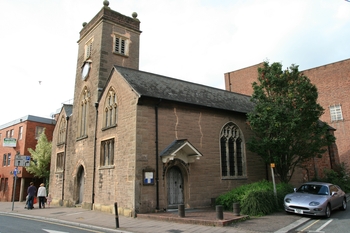
The authenticity of these artifacts remained unquestioned until the fall of 1979 when some 75 descendants journeyed to Chew Magna, Somerset, England, Thomas’s birthplace, to commemorate the 350th anniversary of his departure for America. To recognize the occasion, a marble plaque honoring Thomas Minor was affixed to an inner wall of St. Andrew’s Church where he was baptized in 1608. His coat of arms was to have been placed above the plaque, but this was delayed pending approval by the bishop following the customary search and recommendation of the College of Arms.

In late November 1979, the Chester Herald, D. H. B. Chesshyre, M.A., F.S.A., of the College of Arms sent a letter to the Vicar of St. Andrew’s Church, stating he had “found no references to the Miners of Chew in any of the Herald’s visitations to Somerset and, thus, no confirmation of the arms which appeared to be very similar to those of a family of Mynors of Uttoxeter – but with a different crest.” Accordingly, he would not recommend the display of the arms in question.

The original essay, entitled “An Herauldical Essay Upon the Surname of Miner,” is now in the possession of the Connecticut Historical Society in Hartford. Designed to answer the question whether the surname should be spelled with an “e” or an “o”, it purports to explain the origin of the name by noting that a Henry Miner of the Mendip Hills in Somerset was given a coat of arms by Edward III for his services for the up-coming war with the French. This Henry was said to have been a miner, or mine operator; therefore, the name should be spelled with an “e.” The essayist went on to give the descent from Henry (said to have died in 1359) to Thomas and cited Thomas’s children. The coat of arms is colorfully displayed at the top of the scroll.

In view of the recommendation of the College of Arms, and after reviewing the findings of Roger Ashley, a Chew Magna historian whose study of the Chew Magna parish records indicated that the line of descent given by the essayist was not at all corroborated by the facts shown in those records, it was determined that more research would be valuable. Subsequently, John A. Miner and a cousin, Robert F. Miner, made independent study-trips to England. Meetings were held at the College of Arms, with Roger Ashley and others, and finally with Robin J. E. Bush, Deputy County Archivist for Somerset. After a full discussion of the problem between Bush and Robert Miner, and a review of Bush’s credentials as a specialist in medieval genealogy, he was engaged to conduct a thorough search as to the facts.

Bush reported that there was no evidence whatsoever for a visit to the Mendip area of Somerset by Edward III or any contemporary record of the Miner family as significant land owners in Somerset in the fourteenth or fifteenth centuries. There were no Inquisitions Post Mortem into Miner lands among those at the Public Record Office. The feet of fines, a form of medieval land registry, have been published for Somerset up to the reign of Henry VI, but no Miners are recorded. Bush also questioned finding the Christian name “Henrietta” in the essay, stating that he had never found it in any fourteenth century England records.

With respect to the coat of arms assumed (by) some descendants of Thomas Minor, the Herald’s College has registered no such arms as having been borne by any Somerset Miner, nor were any registered at any heraldic visitation for the county. The essay was likely written in 1683 as it names family members as living in 1683 at particular places. Yet a marginal note on the original document records the following: “This Coat of the Miners of Chew I attest to be entered at Bath in Somersett by Clerenceux [sic] the 4 of K. James the first, which visitation is in custody of me: 1606. Alex: Cunninghame.” The Clarenceux King of Arms in 1606 was actually William Cumden. Possible fabricators of the pedigree would include this Alexander Cunningham who attested it. There were two prominent men of this name in 1683, one a critic 1655(?)-1730, the other an historian, 1654-1737.

Bush uncovered from a compotus, or account roll, of Chew Magna manor for the year 1494-5, records of John Minere as one of four men who paid for the grass of 46 acres of meadow and Joan Minere as one of the widows who paid a tax known as churchscot. A William Myner was assessed in a lay subsidy (national tax) collected in 1523 in the tithing of North Elm in Chew Magna and paid 4d. on assessment of 2 pounds on his goods. (F. A. Wood, Collections for a History of Chew Magna, 1903, p84; original in Public Record Office).

William Miner may be possibly identified with William Mynard, who took a new grant of a messuage (house) and a fardel of land of old auster in Chew Magna on 29 June 1554, to be held on the lives of himself, his son Thomas and Thomas’ wife, Joan (Somerset Record Office DD/S/WH, box 41, court roll). William is the earliest member of the family from who a connected line of descent can be shown. He was the great-grandfather of the Thomas Myner baptized at Chew Magna on 23 April 1608.

 Source:

http://alum.wpi.edu/~p_miner/CuriousPedigree.html

Posted in Fun Stuff, Immigrant Coat of Arms, Line - Miner, Storied | Tagged | 2 Comments

Clement Miner Sr

Clement MINER Sr. (1560 – 1640) Thomas Miner’s father. He is Alex’s 11th Great Grandfather, one of 4,096 grandfathers in this generation in the Miner line.

Clement Miner was born in 1560 in Chew Magna, Somerset, England.  His parents were Thomas MINER and Joan [__?__]. His wife is unknown.  Clement was buried in Chew Magna on 31 Mar 1640.

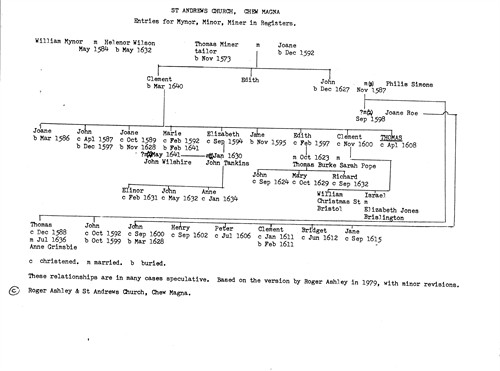
Clement Miner Sr – Family Tree – This is the most accurate information we have of Thomas Minor’s ancestry taken from the Registries of St. Andrew’s Church, Chew Magna, England. (First published in 1987).

Children born in Chew Magna, Somerset, England and listed from the parish records of St. Andrew’s Church:

Name Born Married Departed
1 Joan Miner c. 1585 23 Mar 1585/86
3. John Miner 23 Apr 1587 3 Dec 1597
4. Joan Miner 19 Oct 1589 9 Nov 1595
5.
Mary Miner 19 Feb 1591/92 Unmarried 9 Feb 1640/41
6.
Elizabeth Miner 7 Sep 1594 John Tompkins 14 Jan 1629/30
7.
Edith Miner 6 Feb 1596/97 Thomas Bucke
31 Oct 1623
8.
Clement Miner 23 Nov 1600 Sarah Pope
9.
Thomas MINER 23 Apr 1608 Grace PALMER
23 Apr 1634 Rehoboth, Plymouth, Mass.
23 Oct 1690
Stonington, CT

Clement’s son Clement Jr lived near Bristol. Descendants continued to live in England.

An abstract of the will of his daughter Mary exists. The will was dated 4 Dec 1640, and proved 23 Feb 1640/41, value of estate was £25-2-2. It lists the children of Clement Miner (William and Israel), Thomas Bucke (Richard, Mary and John), and John Tompkins (John, Eleanor and Mary). Somerset Record Office DD/X/SR 3 b, p89.

Clement’s father was Thomas MINER Sr. (1530 – 1573)  Thoms Sr. is Alex’s 12th Great Grandfather, one of 8,192 in this generation in the Miner line. He was born about 1530 in Chew Magna, Somserset, England.  His parents were William MINER and [__?__]. He married Joan   [__?__] about 1554/9. He was a tailor and resident of Chew Magna in 1556 at which time it was known as a cloth making town. He was buried at Chew Magna on 15 November 1573. An abstract of his will, dated 20 October 1573 and proved 15 September 1574, survives. It indicated his desire to be buried in the church yard of Chew. To the church he granted 4 pence, to sons Clement and John a lamb each, to daughter Edith a lamb and a yearling heifer, residue to wife Joan, Executrix. To William Winch and Thomas Horte as witnesses he granted each 20 pence. The inventory of his estate totaled 16 pounds 5 shillings.  The manor court rolls show Joan succeeding her husband on 19 Jul 1574 under a grant of 29 Jun 1554. She was buried at Chew Magna on 21 December 1592.

Children listed in Thomas Sr.’s will of 20 Oct 1573:
Clement b. c1560 d. 31 Mar 1640
John b. c1563/6  m. Philippa Simons on 23 Jun 1587 at Chew Magna
Edith b. c1566 m.  Richard Kente

Thomas’s father was William MINER (? – 1586) (Minor, Mynar)  William is Alex’s 13th Great Grandfather, one of 16,384 in this generation of the Miner line.  He is listed as a resident paying taxes (one of 13) in North Elm section of  Chew Magna, Somerset, England in 1523 (Paid 4p tax on goods assessed at 2£4s.). Wife unknown. He received a Chew Magna house and land grant on 29 Jun 1554 with his son Thomas and Thomas’ wife, Joan. He was buried at Chew Magna on 23 February 1585/86. He may be related to John Minere who appears on a Chew Magna manor account roll for the year 1494-5 as paying for the grass on 46 acres of meadow and to Joan Minere, a widow, who appears on that roll as paying a tax known as churchscot.

There is a document written about 1683 and titled “An Herauldical Essay Upon the Surname of Miner” which traces the Miner ancestry back to Henry Bullman in the 1300s. The purported line of descent was Henry (died 1359) -> Henry (m. Henrietta Hicks) -> William (b. ca 1375) -> Thomas -> Lodowick (m. Anna Dyer) -> Thomas (1436-1480, m. Bridget Hervie) -> William (m. Isabella Hartope) -> William (Buried 23 Feb 1585) -> Clement (died 31 March 1640) -> Thomas (the immigrant).

A Study, named “The Curious Pedigree of Lt. Thomas Minor” by John A. Miner and Robert F. Miner and published in the NEHGS Register of Jul 1984 (volume 138, pages 182-5), indicates that the contents of this document and the coat of arms it presents are FALSE.

Children

6. Elizabeth Miner

Children of Elizabeth and John Perkins listed in Mary’s 1640 will

i. John Tompkins

ii. Eleanor Tompkins

iii. Mary Tompkins

7. Edith Miner

Children of Edith and Thomas Bucke listed in Mary’s 1640 will:

i. Richard Bucke
ii. Mary Bucke
iii. John Buck

8. Clement Miner

Children of Clement and Sarah Pope

i. William Miner m. Sarah Batting daughter of John of Cliffon. Lived on Christmas St in Bristol. 1683+

ii. Israel Miner m. Elizabeth Jones of Brislington.

Sources:

  1. Thomas Minor Family History
  2. The Miner Branch of the Hubbards
Posted in 13th Generation, Line - Miner | Tagged | 1 Comment

Veterans

Jamestown 1610

Thomas WEST 3rd Baron de la Warr (1577 – 1618)  (Wikipedia)  was the Englishman after whom the bay, the river, and, consequently, an American Indian people and U.S. state, all later called “Delaware“, were named.

In 1597 he was elected member of parliament for Lymington, and subsequently fought in Holland and in Ireland under the Robert Devereux 2nd Earl of Essex, being knighted for bravery in battle in 1599. He was imprisoned for complicity in Essex’s revolt (1600-1601), but was soon released and exonerated. In 1602 he succeeded to his father’s title and estates and became a privy councillor. Becoming interested in schemes for the colonization of America, he was chosen a member of the council of the Virginia Company in 1609, and in the same year was appointed governor and captain-general of Virginia for life.

After the Powhatans murdered the colony’s governor, Lord Ratcliffe, and attacked the colony in the first First Anglo-Powhatan War, Lord De La Warr led the reinforcement of Virginia.  Sailing in March 161o with three ships, 150 settlers and supplies, he himself bearing the greater part of the expense of the expedition,

Even with the arrival of the two small ships from Bermuda under Captain Christopher Newport, the colonists were faced with abandoning Jamestown and returning to England. On June 7, 1610, both groups of survivors (from Jamestown and Bermuda) boarded ships, and they all set sail down the James River toward the Chesapeake Bay and the Atlantic Ocean.  On June 9, 1610, Lord De La Warr and his party arrived on the James River shortly after the Deliverance and Patience had abandoned Jamestown. Intercepting them about 10 miles  downstream from Jamestown near Mulberry Island, the new governor forced the remaining 90 settlers to return, thwarting their plans to abandon the colony. Deliverance and Patience turned back, and all the settlers were landed again at Jamestown.

As a veteran of English campaigns against the Irish, De La Warr employed “Irish tactics” against the Indians: troops raided villages, burned houses, torched cornfields, and stole provisions; these tactics, identical to those practiced by the Powhatan themselves, proved effective. He had been given instructions by The London Virginia Company to kidnap Native American children. These instructions also sanctioned attacking Iniocasoockes, the cultural leaders of the local Powhatans. The campaign ended the Powhatan siege and resulted in the marriage of Pocahontas and John Rolfe which introduced a short period of truce between the English and the Powhatan Confederacy.

Pequot War  1634 – 1638

Maj. John MASON(1600 – 1672) was the commanding officer in the Pequot War.   At the time, he was a victorious hero who later became  Deputy Governor of Connecticut and founded Norwich, Connecticut.  Now, he is viewed by some as a war criminal due to his responsible for the Mystic Massacre.

Capt. William HEDGE (1602 – 1670)  is favorably mentioned by a soldier in the Pequot War , who served with him, as a gentleman, of Northamptonshire, England. He was several times captain of the military company in Yarmouth and of the council of war.

Thomas CLARKE (1605 – 1697) Headed list of volunteers to act against the Pequot Indians in 1637 in Plymouth being then mentioned as of Eel River now Chiltonville.

Robert  CROSS (1613 – 1693) was one of the young men of Ipswich, seventeen in number, who saw service as soldiers in the Pequot war. The war lasted six months and the men were paid at the rate of 20s. a month.

King Philips War 1675 – 1676

Lt. William CLARKE (1606 – 1690)He was chosen Lieutenant of the first military company ever organized in Northampton, when that was the office of highest rank to which the company, on account of its small number of men was entitled, and was in active service during King Philip’s War and was at the same time a member of the military committee of the county. He supplied the commissary department to some extent during King Philip’s Indian War and the Legislature ordered the Treasurer to pay him in 1676 ‘thirty-eight pounds, eighteen shillings for “Porke and bisket” delivered to the country’s use’.

Thomas MINER (1608 –  1690) He was the chief military officer of Stonnington CT and in 1676, when King Philip’s War started, Lieutenant Thomas Minor, then 68 years old, picked up his musket and marched off to battle accompanied by several of his sons.  The draft age at that time was sixty.

The 24th of Aprill, 1669, I Thomas Minor am by my accounts sixtie one yeares ould I was by the towne and this year Chosen to be a select man the Townes Treasurer The Townes Recorder The brander of horses by the General Courte Recorded the head officer of the Traine band by the same Courte one the ffoure that have the charge of the milishcia of the whole Countie and Chosen and the sworne Commissioner and one to assist in keeping the Countie Courte.

Lt. John TOMSON (1616 – 1696) became a Lieutenant of the military company in 1675, and was in that year a commander of a garrison in King Philips War.

Capt. John GORHAM (1620 – 1675) –  John was Captain in the 2nd Barnstable Company, Plymouth Regiment in King Phillip’s War .Our ancestor Captain  Jonathan Sparrow was John’s Lieutenant in the same company.  While they are both related to us, they are five generations removed from each other.  John led his troops in the Great Swamp Fight  of 19 Dec 1675 and  died  5 Feb 1675/76.  He was wounded by having his powder horn shot which split against his side, and he was severely weakened further from exposure. He died of the resulting fever.

Sgt. Thomas WILMARTH (1620 – 1690) appears in the contributors to the expenses of King Philip’s War.

Lt. Ephraim MORTON (1623 – 1693) In 1664, having previously served as sergeant, he was elected by the General Court lieutenant of the Plymouth Military Company, and in 1671 was chosen a member of the council of war, in which he was of ”much service” many years, including the period of King Philip’s war. In March, 1677, owing to the great distress consequent upon the war, he was appointed one of a committee of three to distribute to the people of Scituate the moneys contributed by divers Christians in Ireland for the relief of those who suffered during the war.

George POLLEY Sr. (1625  – 1683)A George Polly served in King Philip’s War under Captain John Carter (or Cutler). (See Bodge’s 1906 King Philip’s War, p. 286 and D. H. Hurd’s 1890 History of Middlesex Co., Mass., pp. 382-383. The latter quotes some of Bodge’s earlier articles in the NEHGR.) Authorities disagree as to whether it was George Polly, Sr. or George Polly, Jr. who actually served. The senior Polly would have been about 49 and the son would have been about 20. Thus it could have been either. Since there is no “Junior” indicated on the rolls, many believe it to be the father. However, the oldest son John POLLEY Sr. (1650 – 1711), aged about 26 at the time, also served in the war. This fact might lead one to believe that it was the case of two brothers going off to wa

Major John FREEMAN (1627 – 1719)    First as a Lieutenant, then as Captain, and later as Major, John took an active part in the Indian Wars including King Philip’s War.

“The militia companies in the Cape Cod area; Barnstable, Eastham, Sandwich, and Yarmouth, were organized into a regiment called “The Third Regiment” of which John Freeman, of Eastham, was commissioned Major Commandant. The company at Falmouth was added in 1689, and company of Rochester, 1690. A company at Harwich was added in 1694 and one at Chatham in 1712. The colonial regiment continued until June 2, 1685, when the colony was divided into 3 counties, and the militia of each county was made to constitute a regiment of itself.

4 Oct 1675 –  As a Captain, was one of a committee to take an account of the charges ‘arising by this psent warr’, meaning King Philip’s War. He also served actively in that campaign and as a result his estate received a grant of land in Narragansett Township No. 7, at what is now Gorham, Maine. This section was not assigned to the heirs of the participants until 1733, or fifty-eight years after the battle occurred, but it finally assured lot No. 34 to the estate of John.  (Gorham Maine is named after our ancestor John Gorham)

1675-6 – While John Freeman and Jonathan Sparrow were members of the council of Eastham their duties included the assignment of men to both watch and ward, to keep garrison and to do scout duty; included also arrangement for the supply, conservation and apportionment of the town’s stock of ammunition and for laying a tax to cover the purchase of the same. ‘Watch’ implied service from sunset to sunrise and ‘ward’ from sunrise to sunset. If anyone who was called for such service failed to appear, he was to be fined five shillings for each failure and a distress warrant therefor levied on his estate; or if he had no property he was ‘to be sett necke and heeles (a punishment described as tying the neck and heels together so as to force the body into a round ball) not exceeding halfe an houre.’ Fines were also specified for those who were tardy in arrival as watchmen or who came without ‘fixed armes and suitable ammunition.’

Jun 1676 –  The Treasurer’s account showed that ‘Capt. Freeman’ owed the Colony L1 for a gun. ‘The suffering and loss occasioned to the colonies by King Philip’s War stirred the sympathies of many people across the water and contributions were made which were apportioned between the colonies, Plymouth receiving a share of over L120.

1677 – A major in the expedition against Indians at Saconet.

June, 1678 –  Taunton still owed the colony certain sums ‘for billetting Captaine Freeman and his men and theire horses’ ‘in the late warr with the Indians,’ ‘likewise to pay for beef which was disposed off when Capt. Freeman was att youer towne, either by Capt. Freeman or any of youer celect men for the releiffe of some of youer poor, whoe were in extreamyty.’

Nov 1679 – Thomas Clark asked L50 damage from him, claiming that John had pulled up a boundary stake by Clark’s land and the jury gave the plaintiff ten shillings and costs to the amount of L3.

Feb 1682-3 – For unseen reason, the Deputy Governor, John Freeman,Jonathan Sparrow, John Doane, and John Miller departed this Court before it was finished, all being members thereof,’ therefore, ‘this Court orders that if att June Court they render not a suffient excusse they shalbe fined according to law.’

2 Jun 1685 – The military companies of Barnstable, Sandwich, Yarmouth, and Eastham were made the 3rd Regiment and John Freeman was commissioned Major Commandant thereof, with other companies added later.

1691 – the town of Eastham mortgaged to him two islands, as security for the payment of L76 which he had advanced as the town’s proportion of the expense of obtaining the new charter from England.

John LOW (1629 – 26 Mar 1676)  died  at Nine Men’s Misery a site in current day Cumberland, Rhode Island where nine colonists were tortured by the Narragansett Indian tribe during King Philip’s War. A stone memorial was constructed in 1676 which is believed to be the oldest veterans memorial in the United States.  Cumberland was originally settled as part of Rehoboth, Mass  which is listed as the location of John’s death.

Pierce’s Fight was followed by the burning of Providence three days later, and then the capture and execution of Canonchet, the chief sachem of the Narragansetts. The war was winding down even at the time that Pierce’s party was destroyed, and in August, King Philip himself was killed.  Our ancestors children, John Millard, son of John MILLARD and Benjamin Buckland, son of William BUCKLAND also died in the battle.

Daniel THURSTON (1631 – 1693) was a military man. He bequeathed to his son James his pistols and his “houlsters”, to his son Joseph a gun and to his son Steven  his carbine. He was a soldier in King Philip’s war in 1675, a trooper in Capt. Appleton’s  company. Eight of the “kinsman’s” descendants were soldiers in all the various wars prior to Revolution.  Sgt. Oliver Thurston was with Sullivan in his  expedition asainst the six nations, and was wounded at the battle of Newtown.

Capt. Jonathan SPARROW (1633 – 1707) was Lietenant in the 2nd Barnstable Company, Plymouth Regiment in the war with King Phillip.  Our ancestor Captain John Gorham was Jonathan’s Captain in the same company.  While they are both related to us, they are five generations removed from each other.  John Gorham led his troops in the Great Swamp Fight (aka Massacre) of December 19, 1675, was wounded and died two months later..

Clement MINER (1638 – 1700) was a Lieutenant in the Militia which was a considerable honor in his day. In the records of New London, Clement is mentioned as “Deacon” or “Ensign”, but the record of his appointment as Ensign has not been found. With his father and brothers, he served in King Philip’s War in 1676, and as a volunteer, was granted a lot in Voluntown, Connecticut.

Samuel PERRY (1648 – 1706) was a soldier in King Philip’s War

John WILLEY (ca. 1649 – 1688) granted lands posthumously in Voluntown, Conn., in 1696, for his services in the Connecticut volunteers in King Philip’s War [Narragansett Hist. Beg., 1882, p. 146.]

Samuel HADLEY Sr. (1652 – 1745) was one of the training band of Amesbury in 1680 and a soldier in the Narragansett War under Capt. Frank Davis

Samuel PERKINS (1655 –  1700) served as a soldier in the Narragansett war, for which he received a portion of land at Voluntown, on the eastern border of Connecticut, which land afterward came into possession of his son Ebenezer, who settled upon it, and in 1735 sold it to John Wildes of Topsfield, Mass.

Jonathan WILMARTH (1656 – 1713) of Rehoboth Mass appears in the list of those participating in the Narragansett expedition  known as the Great Swamp Fight.

18 Sep 1675 – Leonard Harriman’s son John was killed at the Battle of Bloody Brook with Captain Lathrop. At a given signal, hundreds of warriors, who were lying concealed all around the spot, opened fire on the convoy. Chaos followed, bullets and arrows flew from every direction. Captain Lathrop immediately fell. Of the 80 soldiers, only 7 or 8 escaped.

19 Dec 1675 – Joseph Batcheller’s son Mark was killed as a soldier in the company of Capt. Joseph Gardner of Salem,  in King Philip’s War, in the Great Swap Fight with the Indians. The colonists lost many of their officers in this assault: about 70 of their men were killed and nearly 150 more wounded.  Mark’s estate was valued at £131.

10 Feb 1675/76 –  Jonathan Fairbank’s son Joshua and grandson Joshua were killed during a raid in King Philip’s war. Several hundred Indians attacked Lancaster, setting many homes on fire.  More than 50 English were killed, and twenty four taken captive with the Indians, who roamed about with their prisoners for the next few months. Our ancestors John Houghton and Jonas Houghton were made homeless  in this same attack and they fled  to Charlestown under escort. (See John Houghton’s page for the story of Indian captive Mary Rowlandson.)

Battle of Quebec – 1690
The Battle of Québec was fought in October 1690 between the colonies of New France and Massachusetts.

Following the capture of Port Royal in Acadia, during King William’s War, the New Englanders hoped to seize Montréal and Québec itself, the capital of New France. The loss of the Acadian fort shocked the Canadiens, and Governor-General Louis de Buade de Frontenac ordered the immediate preparation of the city for siege.

When the envoys delivered the terms of surrender, the Governor-General famously declared that his only reply would be by “the mouth of my cannons.”  Sir William Phipps led the invading army, which landed at Beauport in the Basin of Québec. However, the militia on the shore were constantly harassed by Canadian militia until their retreat, while the ships were nearly destroyed by cannon volleys from the top of the city.
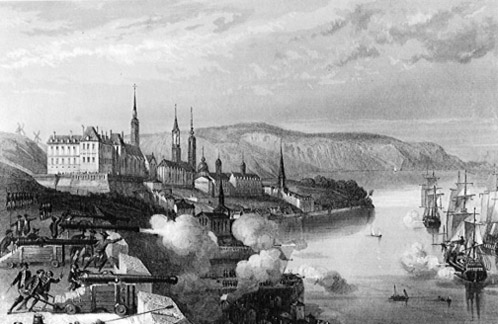
Battle of Quebec 1690 – The Batteries of Quebec bombard the New England fleet.

Edmund GREENLEAF’s son Captain Stephen Greenleaf (1628-1690) drowned 1 Dec 1690 off Cape Breton, Nova Scotia, Canada, at age 62 . In the French and Indian War, Captain Stephen Greenleaf, Lieutenant James Smith, Ensign William Longfellow, Sergeant Increase Pillsbury, William Mitchell and Jabez Musgrave were cast away and lost on an expedition against Cape Breton.

“The expedition under Sir William Phips, consisting of thirty or forty vessels, carrying about two thousand men, sailed from Nantasket on the ninth day of August, 1690, but did not arrive at Quebec until the fifth day of October. Several attempts were made to capture the town, without success; and, tempestuous weather having nearly disabled the vessels and driven some of them ashore, it was considered advisable to re-embark the troops and abandon the enterprise. On their way back to Boston, they encountered head winds and violent storms. Some vessels were blown off the coast, and ultimately arrived in the West Indies. One was lost upon the island of Anticosti, and several were never heard from. Capt. John March, Capt. Stephen Greenleaf, Lieut. James Smith, Ensign William Longfellow, and Ensign Lawrence Hart, of Newbury, Capt. Philip Nelson, of Rowley, and Capt. Daniel King, of Salem, were among the officers commissioned for service in the expedition to Canada, under the command of Sir William Phips.”

Ezekiel JEWETT’s son Ezekiel Jr (1669 – 1690)  was in the Canada expedition 1690 and no further mention is found of him.” The town records of Rowley of May 6, 1691 show that the town paid the following named persons, in bills of credit, the sum set against their names for military service in Canada. To Deacon Ezekiel Jewett for his son Ezekiel £5 0s. 3d..

John ORMSBY Sr. (1641 – 1718)  John ORMSBY Jr. (1667 – 1728) Were in Gallup’s Company in 1690 in Phips’ expedition against Quebec.”

Elisha HEDGE (1640 – 1732) served in the 1690 Canadian expedition under [Col. Shubal Gorham, the son of Lt. Col John Gorham  and grandson of our ancestor  Capt. John GORHAM

Capt. Stephen CROSS (1646 – 1704) was a commander of the ketch Lark in the Battle of Quebec.  The Lark was a Salem vessel and Cross brought her back to her home port on March 18, 1690/91, and the arms on board were placed in Mr. Derby’s warehouse.  His was one of about thirty-two ships (only four of which were of any size) and over 2,3000 Massachusetts militia men.

John GUILFORD’s son Paul (1653 – 1690) died during an expedition for an assault on Quebec, possibly of small pox.  He first marched under Capt. Joshua Hobart of Hingham in 1675 during King Philip’s War, being on the roll of payments 24 August 1675. He once more marched under Capt. Samuel Wadsworth and was paid on 24 July 1676 and Hingham paid him further for service under Capt. John Holbrook .  Paul was on expedition with Sir William Phipps [of Maine] who first sailed from Boston early in the spring of that year to Port Royal [Nova Scotia] to fight the French [in King William’s War]. That effort being successful, Phipps again regrouped at Boston with about 30 ships and 2,000 Massachusetts men for an assault on Quebec, this expedition meeting with disaster. Paul was among those who were either killed or carried off by smallpox during this expedition.

Thomas WOOD’s son Samuel died 25 NOV 1690 at Port Royal.

Queen Anne’s War 1702 – 1713
the second in a series of French and Indian Wars fought between France and England  in North America for control of the continent.  The war was fought on three fronts.

The English colonies of New England fought with French and Indian forces based in Acadia and Canada, whose capital, Quebec, was repeatedly targeted (without ever being successfully reached) by British expeditions.  The war between New France and New England was dominated by French and Indian raids against targets in Massachusetts (including present-day Maine), and repeated English attacks that resulted in the taking of Acadia’s capital, Port Royal.

On Newfoundland, the English colonial presence at St. John’s disputed control of the island with the French based at Plaisance.

Spanish Florida and the English Province of Carolina were also each subjected to repeated attacks from the other, and Carolinians also tried to dispute the French presence at Mobile.

The Treaty of Utrecht in 1713 resulted in the French cession of claims to the territories of Hudson Bay, Acadia, and Newfoundland to Britain, while retaining Cape Breton and other islands in the Gulf of St. Lawrence.

Jonas HOUGHTON (1663 – 1723) At sunrise on February 10, 1676, during King Philip’s War, Lancaster came under attack by Narragansett, Wampanoag, and Nashaway/Nipmuc Indians.   Jonas was thirteen and after the massacre, he fled with his family to Charleston.  Jonas and Mary were married while staying in Woburn, Massachusetts due to Indian hostilities.  He was in the garrison at Lancaster and served in the Queen Anne’s War.

Edward HARRADEN (1624 – 1683)  son John Harraden (1663- 1724) was pilot of HMS Montague, (sixty guns, commanded by Sir George Walton) in the disastrous 1711 expedition against Canada.

The Quebec Expedition, or the Walker Expedition to Quebec, was a British attempt to attack Quebec in 1711 in Queen Anne’s War, the North American theatre of the War of Spanish Succession. It failed because of a shipping disaster on the Saint Lawrence River on 22 August 1711, when seven transports and one storeship were wrecked and some 850 soldiers drowned; the disaster was at the time one of the worst naval disasters in British history.

Colonial  Militias

John PERKINS(1583 – 1654)  served in the local militia until 26 March 1650, when “John Perkins Sr., being above sixty years old, is freed from ordinary training.”

John HOWLAND (1591 – 1673) was  in command of Kennebec Trading Post in Maine in 1634.    He and John Aldenwere the magistrates in authority there.     Unfortunately, Pilgrims and Indians were not the only ones on the Kennebec. Agents of Lord Say and Seal and Lord Brooke also were on hand to make a fast pound or two.

One April day John Howland  found John Hocking riding at anchor within the area claimed by Plymouth. Hocking was from the nearby Piscataqua Plantation. Howland went up to him in their “barke” and asked Hocking to weigh anchors and depart.  Apparently Hocking used some strong language and the two exchanged some words not recorded, but the result of the conversation was that Hocking would not leave and Howland would not let him stay. Howland then sent three of his men—John Irish, Thomas Savory and William Rennoles (Reynolds?) — to cut the cables of Hocking’s boat. They severed one but the strong current prevented them from cutting the other cable so Howland called them back and ordered Moses Talbott to go with them. The four men were able to maneuver their canoe to the other cable, but Hocking was waiting on deck armed with a carbine and a pistol in his hand. He aimed first at Savory and then as the canoe swished about he put his gun almost to Talbott’s head. Seeing this, Howland called to Hocking not to shoot his man but to “take himself as his mark.” Saying his men were only doing what he had ordered them to do. If any wrong was being done it was he that did it, Howland shouted. Howland called again for Hocking to aim at him.

Hocking, however, would not even look at Howland and shortly afterwards Hocking shot Talbott in the head and then took up his pistol intending to shoot another of Howland’s men. Bradford continues the story in his history of Plymouth:  Howland’s men were angered and naturally feared for their lives so one of the fellows in the canoe raised his musket and shot Hocking “who fell down dead and never spake word.”  The surviving poachers must have skedaddled for home where they soon wrote to the bigwigs in England but failed to tell the whole truth including the fact that Hocking had killed a Plymouth man first. The lords “were much offended” and must have made known their anger.

The Hocking affair did have severe international implications. Colonists feared that King Charles might use it as an excuse for sending over a royal governor to rule all New England. This was a real threat for early in 1634 the king had created a Commission for Regulating Plantations with power to legislate in both civil and religious matters and even to revoke charters.  Not long after the killings Plymouth sent a ship into the territory of Massachusetts Bay and authorities there quickly seized John Alden who was aboard the ship. Alden was imprisoned although he had no direct part in the Kennebec tragedy. When Alden was jailed Plymouth was quite obviously upset for Massachusetts Bay had no jurisdiction over the Kennebec area or over citizens of Plymouth. This was not of their business. Plymouth dispatched Capt. Myles Standish to Boston to present letters explaining the situation and Gov. Thomas Dudley quickly freed Alden, and after a later court hearing all blame was laid to Hocking. The matter was settled.

William TWINING (1599 – 1659) In 1643 included in the list of those able to bear arms at Yarmouth, and for the next two years the records rank him among the militia, consisting of fifty soldiers, to each of whom was given, on going forth, one pound of bullets and one pound of tobacco.

1645 – William  was one of eight soldiers sent out on a fourteen-day mission against the Narragansett Indians.  Of the eight soldiers, the leader of the expedition was Jonathan Hatch , and other members included Nathaniel Mott .  The famous Myles Standish  of the Mayflower was the overall military leader of Plymouth at the time.

William BEAMSLEY (1605 – 1658) – Admitted to the Boston Artillery Company in 1657  and attained the rank of ensign

John GOULD (1610 – 1691) Military service in the early days must have been very exacting, for it appears that he was excused from training in 1682, when he was seventy-three years old.

John PARMENTER Jr. (c. 1612 – 1666) A list of Officers and Soldiers of the first Foot company in Sudbury under the command of Capt. Moses Maynard, Lt. Joseph Curtis and En. Jason Glezen included John Parmenter Jr. [History of Sudbury, 340]

Captain John FITCH (1615 – 1698) may have received his rank as a soldier in the English Civil Wars [1642-1646 and 1648] or in the colonial militia. One of his brothers was also a Captain and another was a minister.

Capt. Thomas BAYES (ca. 1615 – 1680) In 1656 he was selected as leader of the train band for Martha’s Vineyard. This office he also held in 1661, 1662, and 1663. Trainbands were companies of militia  , first organized in the 16th century and dissolved in the 18th.  In the early American colonies the trainband was the most basic tactical unit. However, no standard company size ever existed and variations were wide. As population grew these companies were organized into regiments to allow better management. But trainbands were not combat units. Generally, upon reaching a certain age a man was required to join the local trainband in which he received periodic training for the next couple of decades. In wartime military forces were formed by selecting men from trainbands on an individual basis and then forming them into a fighting unit.

Thomas HUCKINS (1617 – 1679)  was one of the twenty-three original members of the Ancient and Honorable Artillery Company, charted in 1638. Thomas bore its standard in 1639.

The Ancient and Honorable Artillery Company of Massachusetts is the oldest chartered military organization in North Americaand the third oldest chartered military organization in the world.   While it was originally constituted as a citizen militia serving on active duty in defense of the northern British colonies, it has become, over the centuries primarily an honor guard and a social and ceremonial group in Massachusetts. Today the Company serves as Honor Guard to the Governor of Massachusetts who is also its Commander in Chief.

Governor Winthrop granted a charter in March 1638, and on the first Monday in June following, an election of officers was held on Boston Common. Among the charter members was Nicholas Upsall, who later forsook his membership to join the Quakers. Since that time, the company has continued to hold their annual elections on the Boston Common on the first Monday in June by casting their votes on a drum head. Company membership has long been considered a distinction among the New England gentry in a similar manner to which regimental membership conferred distinction on the sons of the English gentry.   Since 1746, the headquarters of the Company has been located in Faneuil Hall. In this armory, the company maintains a military museum and library containing relics from every war in which the United States has been engaged since its settlement

Ralph DAY (1623 – 1677) was ensign of the Dedham military company, and used to beat the drum for meetings before the days of church bells.  An ensign carried the colors as the lowest commissioned officer of infantry.  Ralph left his tools and drum to his son Ralph, a citterne to Abigail and one of his swords to his son-in-law, John Ruggles.

Capt. John HAWES (1633 – 17 01)  was appointed ensign of Yarmouth’s military  company on 31 Oct 1682 and by 1700 was Captain.  He was of age to serve in King Philip’s War, but so far I have found no record of his service.

Capt. Phillip CROMWELL (1634  – 1708) was commisioned Captain of the Dover New Hampshire’s Militia in 1683.

Lt. Andrew NEWCOMB Jr. (1640 – 1707) Lieutenant in the Martha’s Vineyard militia.Mr. Newcomb was chosen Lieut. of Militia 13 Apr 1691, and that he was in command of fortifications is shown from the following:

Andrew Newcomb, Commander of the fortifications: who had such number of men as occasionally were ordered by the chief Magistrates.
“All debts to the king, customs, excise, wrekes &c. were the care of the collector, and the ordinarie let at 10 Ib. per annum, viz. custome & excise.

William FISKE (1643 – 1728) was a lieutenant in the militia of Wenham, Mass.

Capt. Thomas TABER (1646 – 1730) was a captain in the militia

Jean PERLIER II (1669 – 1823)  served in the French and Indian War in 1711 and in the South Company of the local Staten Island militia in 1715.

William MINER ( 1670 – 1725) served in some of the early colonial wars and got the title of lieutenant.  The Sons of Colonial Wars placed a Louisburg cross on his gravestone in the old Stone Cemetery in East Lyme on the 24th of June, 1924.

Battle of La Prairie – 1691

Hendrick Gerritse Van Wie was one of the members of the expedition against Fort La Prairie in the French and Indian War; was wounded while attacking the fort and died as a result in Albany NY.

In 1691 Pieter Schuyler petitioned the governor for the relief of Hendrick Gerritse, “a volunteer in the late expedition to Canada, who was desperately wounded at Paray in Canada and was cared for at the house of the widow of Jacob Tys Van Der Heyden.”

During the summer of 1691 a force led by Major Peter Schuyler invaded the French settlements along the Richelieu River south of Montreal. Callières, the local French governor, responded by massing 700-800 French and allies at the fort at La Prairie, on the south shore of the Saint Lawrence River.

Schuyler surprised the much larger French force in a rainstorm just before dawn on August 11, inflicting severe casualties before withdrawing towards the Richelieu. Schuyler’s force might have remained intact but instead was intercepted by the force of 160 men led by Valrennes that had been detached to block the road to Chambly. The two sides fought in vicious hand-to-hand combat for approximately an hour, before Schuyler’s force broke through and escaped.

The French had suffered the most casualties during Schuyler’s initial ambush, but the casualties the Albany force suffered after Valrennes’ counterattack meant that they had incurred the greater proportion of loss. Instead of continuing his raids, Schuyler was forced to retreat back to Albany.

The battle was also the subject of a 19th-century poem by William Douw Schuyler-Lighthall.

French and Indian Wars 1689 – 1763

A series of conflicts in North America that represented colonial events related to the European dynastic wars. The title, French and Indian War, is used in the US specifically for the warfare of 1754-1763, the colonial counterpart to the Seven Years War in Europe.

Many of our Haverhill ancestors were members of a large company of soldiers, under the command of Lieutenant-Colonel Saltonstall, were also kept constantly armed and equipped, and exercised in the town; and, that these soldiers might be the better prepared for every emergency, the General Court (June 19. 1710,) ordered them to be supplied with snow shoes. Snow shoes were also supplied to the whole of the North Regiment of Essex.  Daniel BRADLEY’s son Joseph, Joseph HUTCHINS’ son John, Anthony COLBY II,  Josiah HEATH’s sons Josiah Jr and John, and Stephen DOW’s son Samuel were all members.

Capt. William CLARK (1656 – 1725) He was captain of militia, serving in the Indian Wars.

Capt. Nathaniel FITCH (1679 – 1759) He was a soldier in the French and Indian Wars; a Captain in military service.

Philip CALL II (1684 – 1757) He was an Indian Scout and died about 10 Aug 1757 either at Stevenstown or maybe at Ft. William. Henry in New York in battle.  His wife

Stephen GATES IV’s son Nehemiah (1723 – 1790) was one of the Connecticut soliders who marched in Aug 1757 on the alarm for the relief of Fort William Henry.  He was in the 3rd Regiment Connecticut Militia (New London, Norwich, Lyme) under Col. Eliphalet Dyer, Seventh Company under Captain Ichabod Phelps.   In August, 1755, this regiment was raised in eastern Connecticut to assist in the proposed expedition against Crown Point. Eliphalet Dyer was appointed lieutenant colonel of this regiment. Each town of the county was ordered to furnish its proportion of men.

In the French and Indian War Dyer was a Lt. Colonel in the militia. He was a part of the expedition that captured Crown Point from the French in 1755. In 1758, as a Colonel, he led his regiment to Canada in support of Amherst’s and Wolfe’s operations.  I’m not sure if Nehemiah participated in these other operations.

The Siege of Fort William Henry was conducted in August 1757 by French General Louis-Joseph de Montcalm against the British-held Fort William Henry. The fort, located at the southern end of Lake George, on the frontier between the British Province of New York and the French Province of Canada, was garrisoned by a poorly supported force of British regulars and provincial militia led by Lieutenant Colonel George Monro. After several days of bombardment, Monro surrendezred to Montcalm, whose force included nearly 2,000 Indians from a large number of tribes. The terms of surrender included the withdrawal of the garrison to Fort Edward, with specific terms that the French military protect the British from the Indians as they withdrew from the area.

In one of the most notorious incidents of the French and Indian War, Montcalm’s Indian allies violated the agreed terms of surrender and attacked the British column, which had been deprived of ammunition, as it left the fort. They killed and scalped a significant number of soldiers, took as captives women, children, servants, and slaves, and slaughtered sick and wounded prisoners. Early accounts of the events called it a massacre, and implied that as many as 1,500 people were killed, even though it is unlikely more than 200 people (less than 10% of the British fighting strength) were actually killed in the massacre.

Charles B. WEBBER   (1741 – 1819) (Also Served in Revolutionary War)
09 Apr 1757, French & Indian Wars – Nathaniel Donnell’s Co.;
Jan 1759 – Capt. Ichabod Goodwin’s Co., Col.  Jedidiah Preble’s Regiment
Military service 1: Revolutionary War – 2nd Lt. in Capt. Dennis Getchell’s 2nd Lincoln Co., Regiment of Mass. Militia; also 2nd Lt. in Capt. Daniel Scott’s Co., Col. Joseph Korth’s regiment raised in 1776

Battle of Havana – 1762
Two sons of Stephen GATES IV (1690 – 1782) died in October and November 1762.  A 19th Century genealogy said they died in the French and Indian War.  I was confused because the French and Indian War ended that September.  I found their unit and commanding officer and through Major General Phineas Lyman found that they were casualties of the Battle of Havana.

Revolutionary War

Nathaniel PEASE I (1700 – 1771)’s son Captain Levi Pease (1729 – 1824) was enrolled in a Blandford company of minutemen at the outbreak of the revolution. but instead of serving in the field was assigned individual duties. For some time he was employed by General Thomas on the northern frontier as a postrider, and displayed much courage and discretion in eluding capture while conveying important despatches. He subsequently proved exceedingly useful to General Wadsworth, who as commissary-general employed him to purchase beeves and other supplies for the army. In these transactions he was often entrusted with large sums of money, for which no receipt was required by the General, who had implicit confidence in his integrity, and he never betrayed that confidence. Upon the arrival of the French fleet and troops at Newport, Pease was employed by the Continental government to procure horses for the purpose of conveying the artillery to Yorktown, and he was afterward engaged in foraging for the army. He was always referred to as Captain, but there is no record of his ever having been commissioned.

Thomas Gibson CARSON (1710 – 1790) was in the military in 1780 and 1781 in Georgia and Tennessee, serving as a horseman in Captain Joseph Carson’s Company of the South Carolina Militia, and participated in the battles of Rocky Mount and Hanging Rock under Colonel William Bratton. He was certified as a Revolutionary War Soldier by Colonel Elijah Clarke and received bounty land in Washington County for his services. Georgia sources show he served in the Battalion of Minute Men. He applied for an invalid soldier’s pension. His home was burned by the Tories during the Revolutionary War.

Thomas FRENCH Jr. (1722 – 1793) was a Private in Captain Alexander Foster’s Company, Colonel John Daggett’s Regiment marching to Bristol Rhode Island on the alarm Dec 8, 1776.  Service 25 Days.   December 8, 1776 at Newport, Rhode Island – Gen. Sir Henry Clinton, under orders from Gen. William Howe, who had found Clinton’s insistent advice aggrevating, sailed into Newport with 6,000 soldiers and took possession of Newport without any resistance.
Conclusion: British Victory

Also Captain Stephen Richardson’s Company Attleborough Service 25 days.  Company marched from Attleborough to Rhode Island Apr 21, 1777 to hold the line until men could be raised for that purpose for two months .

Also Captain Israel Trow’s Company, Colonel Josiah Whitney’s Regiment May 14 – July 6 1777 in Rhode Island.  In July, 1777, the Massachusetts Council of War, suddenly aware of New England’s peril if the victorious progress of Burgoyne was not stayed, hurriedly sent heavy reinforcements of militia to aid Gen. Benj.  Lincoln, who was then harassing the rear of the invading army. Col. Josiah Whitney, on July 27 ordered a draft of one-sixth of the training bands and alarm lists in his regiment to march at once to Bennington with six days rations, and on Aug. 2 ordered one-half of the militia to follow with eight days rations.

Also Captain Richardson’s Company, Colonel George William’s Regiment.  Company marched on a secret expedition Sep 25 – Oct 29, 1777.  Thomas’ son-in-law Seth RICHARDSON II was on this same secret mission.

Oliver WELLES (1732 – 1810) On the 9th of July 1779, an alarm at Saybrook called for help from this town.  Captain John Ventres, with his company, responded, and repaired to the defense of that place. Nothing serious appears to have resulted, however, and the company was retained in the service only two days. This company was then attached to Colonel Worthington’s regiment. The pay roll for that expedition shows that the following wages—remarkably high, on account of a depleted currency—were paid, per day, for service: To the captain, £2 8s.; lieutenant, £1 12s.; ensign, £1 4s.; sergeants, £1 9s. 2d.; corporals, £1 7s. 3d.;
privates, 10s. 6d.

The company was then composed of: Captain John Ventres; Lieutenant James Arnold; Ensign Oliver WELLS ; Sergeants Thomas Shailer, Charles Smith, Reuben Smith, and Jonathan Smith; Corporals Samuel Arnold, Samuel Lewis, David Arnold, and Augustus Lewis; Drummer Daniel Smith.

In September 1781 another alarm appeared at Saybrook, and Capt. John Ventres and his company again entered the service. They were under the regimental command of Col. John Tyler, and used six days—from the 7th to the 12th, inclusive—in the expedition.

David WING IV (1732 – 1761)

19 Apr 1775 – Wing, David, Sandwich. Private, Capt. Ward Swift’s (2n Sandwich) co. of militia, which marched in response to the alarm.   On April 19, 1775, British and American soldiers exchanged fire in the Massachusetts towns of Lexington and Concord. Henry Wadsworth Longfellow’s poem “Paul Revere’s Ride” tells how a lantern was displayed in the steeple of Christ Church on the night of April 18, 1775, as a signal to Paul Revere and others.

6 Sep 1778 – Also, Capt. Swift’s co., Col Freeman’s regt. service 10 days, on an alarm at Dartmouth and Falmouth.

1778 – In Capt. Ward Swift’s company of militia, which marched on the Lexington Alarm

John BRADLEY (1736 – 1830) A tall strong man with a fiery temper, he joined Ethan Allen and the Green Mountain boys in Vermont. When the Revolutionary war began, Bradley was with Ethan Allen at the capture of Ft Ticonderoga. When Benedict Arnold started his march through Maine, Bradley was chosen as a scout and hunter. Arnold expected to find enough wild game to feed his men, but game was scarce. After hunting all day, Bradley returned with only one partridge. Arnold sent for him and called him a worthless loafer. Bradley talked back to the commander who then drew his sword, which Bradley knocked from his hand. The fighting continued and Aaron Burr came with a file of soldiers and had Bradley arrested and bound to a tree. A man had been shot that morning and Bradley had no doubt that he would also be shot. He finally managed to twist the straps free from his wrists and attempted to escape. A guard tried to stop him and he killed the guard. Bradley had no weapons and his enemies were behind him as he ran into the woods.

Nathan BALCOM (1741 –  1787) was part of Capt Sedgwick’s company, Col. Hinman’s regiment which went from Winchester CT to Ticonderoga in 1775.

4th CONNECTICUT REGIMENT

Authorized 27 April 1775 in the Connecticut State Troops as the 4th Connecticut Regiment. Organized 1-20 May 1775 to consist of ten companies from Litchfield and Hartford Counties. Each company to consist of 1 captain or field grade officer. 2 lieutenants, I ensign, 4 sergeants, 4 corporals, 1 drummer. I fifer, and 100 privates.

COMMANDER: Colonel Benjamin Hyman (Hinman) May 1, 1775-December 20,1775.

Adopted 14 June 1775 into the Continental Army.  Took part in the Invasion of Canada, Battle of Quebec (Autumn and Winter 1775). Two companies from this regiment were garrisoned at Fort Ticonderoga.

Disbanded in December 1775 in Canada, less two companies disbanded 19-20 December 1775 at Cambridge, Massachusetts. These latter two were Lieutenant Colonel Ozias Bissell’s and Captain Hezekiah Parsons’ Companies, which stayed behind to serve at the Siege of Boston.

The Invasion of Canada in 1775 was the first major military initiative by the newly-formed Continental Armyduring the American Revolutionary War. The objective of the campaign was to gain military control of the British Province of Quebec, and convince the French-speaking Canadiens to join the revolution on the side of theThirteen Colonies. One expedition left Fort Ticonderoga under Richard Montgomery, besieged and capturedFort St. Johns, and very nearly captured British General Guy Carleton when taking Montreal. The other expedition left Cambridge, Massachusetts under Benedict Arnold, and traveled with great difficulty through the wilderness of Maine to Quebec City. The two forces joined there, but were defeated at the Battle of Quebec in December 1775.

Montgomery’s expedition set out from Fort Ticonderoga in late August, and began besieging Fort St. Johns, the main defensive point south of Montreal, in mid-September. After the fort was captured in November, Carleton abandoned Montreal, fleeing to Quebec City, and Montgomery took control of the city before heading for Quebec with an army much reduced in size by expiring enlistments. There he joined Arnold, who had left Cambridge in early September on an arduous trek through the wilderness that left his surviving troops starving and lacking in many supplies and equipment.

Charles B. WEBBER – (1741 – 1819) (Also served in French & Indian War)
– 2nd Lt. in Capt. Dennis Gatchell’s  (Getchell) 2nd Lincoln Co., Regiment of Mass. Militia. On July 23, 1776, Dennis Gatchell was commissioned captain of the 5th company, 2nd Lincoln County regiment of Massachusetts militia.  At the first town meeting at Vassalboro, held Apr 26, 1771, Gatchell was elected first selectman, an office which he held many times. Gatchell and his company of 50 men served at Riverton, Rhode Island in 1777.

Charles was also 2nd Lt. in Capt. Daniel Scott’s Co., Col. Joseph Korth’s regiment raised in 1776

Samuel FOSTER (1743 – 1825) was a Revolutionary soldier, corporal in Capt. David Dexter’s Company, Col. Israel Angell’s battalion, 2nd Rhode Island Regment; in service of United States August, November and December, 1778, January and February, 1779. Certif. Charles P. Bennett, Secretary of State of Rhode Island.

The 2nd Rhode Island Regiment served to February 1781, having distinguished itself at the Battles of MonmouthRhode Island, and Springfield with several other skirmishes and minor engagements.

Samuel participated in the Battle of Rhode Island, (also known as the Battle of Quaker Hill) which took place on August 29, 1778, when units of the Continental Army under the command of John Sullivan attempted to recapture the island of Rhode Island (now known as Aquidneck Island to distinguish it from the state of Rhode Island in which it is located), from British forces. The battle ended inconclusively but the Continental Army had to give up its goal of capturing the island and securing Narragansett Bay for American and French ship traffic.

John COLEMAN (1744 – 1823)  lived nearby during Battle of Bunker Hill – Boston.

John was a Private in Captain John Walter’s Company, Colonel David Green’s Regiment (2d Middlesex Co) which marched on the alarm of 19 Apr 1776 (Now celebrated as Patriot’s Day) (Service 5 days – Page 534 Mass Soldiers and Sailors of the Revolutionary War.

On the night of April 18, 1775, General Gage sent 700 men to seize munitions stored by the colonial militia at Concord, Massachusetts. Riders including Paul Revere alerted the countryside, and when British troops entered Lexington on the morning of April 19, they found 77 minutemen formed up on the village green. Shots were exchanged, killing several minutemen. The British moved on to Concord, where a detachment of three companies was engaged and routed at the North Bridge by a force of 500 minutemen. As the British retreated back to Boston, thousands of militiamen attacked them along the roads, inflicting great damage before timely British reinforcements prevented a total disaster. With the Battles of Lexington and Concord, the war had begun.

Elihu MINER Jr. (1745 – 1821) enlisted 12 May 1775, 1st Company, Col Joseph Spencer‘s 2nd Connecticut Provincial Regiment Served at the Siege of Boston,  Bunker Hill, and Arnold’s expedition to Canada. He enlisted again 4 Mar 1777, in Capt Eliphalet Holmes 1st Connecticut Regiment, Col Jedediah Huntington‘s Brigade. Enlisted third time as Sgt in Capt Zechariah Hungerford’s Company, Col. Samuel McClellan‘s Connecticut militia. Elihu probably participated in theBattle of Groton Heights which was very near his home in East Haddam.  He filed for pension, S-36135, 14 Apr 1818 in Middlesex Co, CT.

 Capt. Thomas Brown (1745 – 1803)   He was first a private in Capt. Moses Little’s company of minute-men who marched on the alarm of April 19, 1775 to Cambridge – Service 5 days.  Next he was an ensign in Capt. Jacob Gerrish’s Company, Col. Moses Little’s Essex County Regiment. This regiment reach Cambridge the morning of battle of Bunker Hill 17 Jun 1775 and although not yet mustered into service, it volunteered to go into action.  Most of the Regiment including Gerrish’s Company crossed the Charlestown Neck under the fire of British ships on marched into the entrenchments on Bunker Hill.  Gerrish’s Company was with their townsman Little in the redoubt.

Mrs. Brown with her slave Titus followed the regiment to Cambridge.  The night after the battle, she filled a pillow case with provisions (mostly doughnuts made by herself) and placed it on Titus’ back and went with him to Winter Hill to which point most of the continental troops had retreated.  After his freedom had been given him, Titus remained a faithful servant of the family until his death.

Thomas later became First Lieutenant  under Capt. Barnard of the same regiment and then Captain of the Newbury Company under Col Aaron Willard’s Regimennt.  As Captain, he marched to Fort Ticonderoga and thence to Fort Edwards to join forces against Burgoyne

Seth RICHARSON II (1755 – 1824)
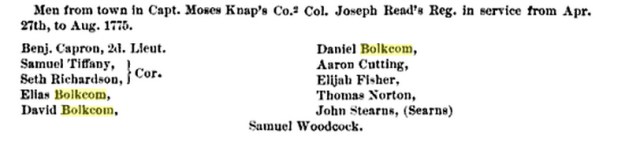
Seth Richard Revolutionary War Service  His wife’s cousins Elias, David and Daniel were also in the company. Source: A sketch of the history of Attleborough: from its settlement to the division By John Daggett 1894

Joseph Read (March 6, 1732 – September 22, 1801) was a soldier and a Colonel in the American Revolutionary War.  He was a lieutenant colonel at the battles of Lexington and Concord on April 19 1775. Note that Seth’s service started 8 days later on Apr 27.  Thereafter, until the end of 1776, Read served as colonel in command of several regiments of the Massachusetts Line.

The Massachusetts Line was a formation within the Continental Army. The term “Massachusetts Line” referred to the quota of numbered infantry regiments assigned to Massachusetts at various times by the Continental Congress. These, together with similar contingents from the other twelve states, formed the Continental Line. The concept was particularly important in relation to the promotion of commissioned officers. Officers of the Continental Army below the rank of brigadier general were ordinarily ineligible for promotion except in the line of their own state.
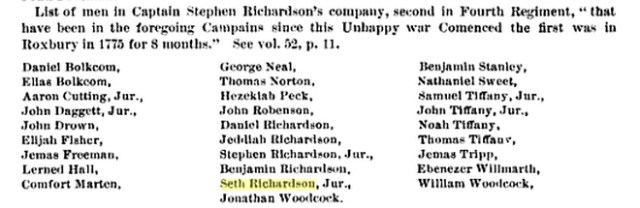
Seth Richardson Roxbury Campaignn Source: A sketch of the history of Attleborough: from its settlement to the division By John Daggett 1894

The 4th Massachusetts Bay Provincial Regiment was commanded by Colonel Theophilus Cotton, of Plymouth,  who served as colonel until the end of the year.  In August 1775, Cotton’s Regiment was designated “The 16th Regiment of Foot.” It served in the Siege of Boston until its disbandment.
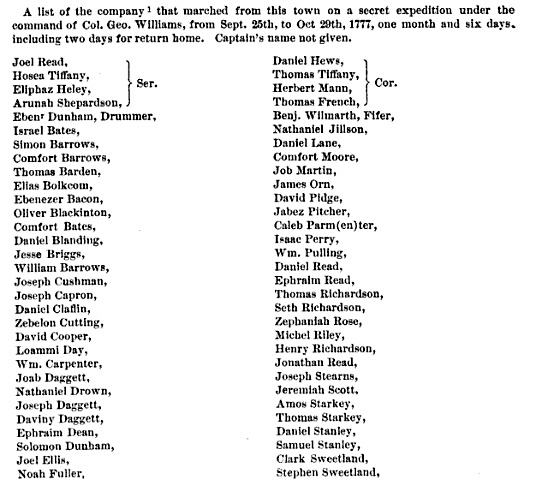
Seth Richardson Secret Mission Source: A sketch of the history of Attleborough: from its settlement to the division By John Daggett 1894

Seth’s father-in-law Thomas French was a corporal in this same secret mission which left from Taunton on Sept 27 1777.

Hendrik TURK (1756 – 1833) with his brothers Jacob and Johannes fought in the Revolutionary War in the Ulster County 1st Regiment under Colonel Johannes Snyder.

Snyder’s Regiment of Militia was known officially as The First Regiment of Ulster County Militia. It was the first regiment of four created in Ulster County, New York as ordered by the Provincial Congress ofNew York. It was also referred to as the Northern Regiment since it members were from the Northern section of Ulster County towns including Kingston, New York (then also called Esopus) and Saugerties, New York (then called Kingston Commons)

Johannes Snyder was given his commission and officially took his post as Colonel on May 1, 1776. At that time the 1st Ulster County Militia was reported to have 472 officers and men. In April of that year, he was elected to the Provincial Congress as a Delegate, and thus did not start active duty until September 1, 1776 when he was directed to proceed to Fort Montgomery in the Hudson Highlands and take command. He arrived on September 27.

The three months for which the Regiment had been called out expired on November 30. In the following year, 1777, he was with his regiment at Ft Montgomery as early as June 4. On July 30, he took his seat as a member of the Assembly in the first legislature chosen in New York State. His activity was said to be “untiring! ” He was at the head of his regiment in the Highlands, and was assigned to every court-martial convened by General George Clinton to try Tories who were active everywhere, and whom his Regiment seized on every hand. He was also a member of the Council of Safety in Ulster County. Colonel Snyder was thus in Kingston when Major General Vaughan landed to destroy Kingston, New York State’s first Capital. He could only muster 5 small cannons and about 150 men. The rest of the 1st Ulster were either with General, now Governor, George Clinton on their way to Kingston from the defeat at Fort Montgomery or as part of Colonel Graham’s Levies from Dutchess and Ulster counties which were facing John Burgoyne at Saratoga. Colonel Snyder along with Colonel Levi Pawling threw up a hasty earthwork at Ponckhonkie overlooking theHudson River and the mouth of the Rondout Creek, and a second one at the hill near O’Reilly’s Woods—the present site of Kingston’s City Hall, and placed his cannons. The British numbering over 2,000 of course drove the defenders out and commenced to torch the city on October 16, 1777. As General Vaughan wrote, “Esopus [Kingston] being a nursery for almost every Villain in the Country, I judged it necessary to proceed to that Town…they fired from their Houses, which induced me to reduce the Place to Ashes, which I accordingly did, not leaving a House.” After this, Governor Clinton assigned Colonel Snyder and a part of the regiment to assist and help rebuild the ruined city. He energetically took hold of the work with his men, and the town rapidly arose from the ashes. In 1778, and through the remainder of the war, Colonel Snyder was credited that no enemy descent was made upon exposed settlements in the northwest Catskills frontier where Governor Clinton committed its defense to him and his regiment. Part of the regiment was usually stationed at Little Shandaken to watch the approach through the valley of the Esopus Creek. Scouts constantly covered the territory from Hurley woods to the Palentine Clove along the foot of the Catskills. On at least three documented occasions, marauding Indians and Tories were turned back by finding their movements watched.

James McCAW (1762 – 1840) served eight tours between 1775 and 1781 in all at least two years and two months.   In his 1833 pension application he declared that he had to apply to history for the periods of the war but can well recollect his fighting and can pretty well recollect his service.

James took part in the Battle of Williamson’s Plantation, also called Huck’s Defeat. Captain Christian Huck, a Philadelphia Loyalist, came south as a part of Tarleton’s legion. He commanded a cavalry unit of about 100 Loyalists and was given marching orders to “push the rebels as far as you deem convenient.”
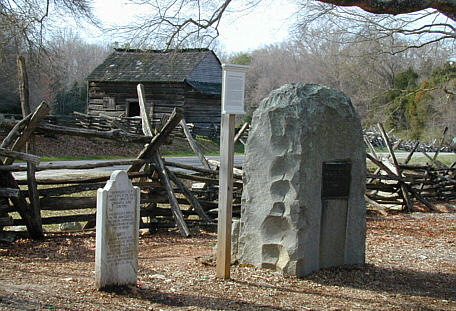
James took part in the Battle of Rocky Mount. The Battle took place on 1 Aug 1780 as part of the American War of Independence. Loyalists commanded by Lieutenant Colonel George Turnbull occupying an outpost in northern South Carolina withstood an attack by 600 American Patriots led by Colonel Thomas Sumter.

James also took part in the Battle of Hanging Rock on 6 Aug  1780 and the Battle of Fishdam Ford, an attempted surprise attack by British forces under the command of Major James Wemyss against an encampment of Patriot militia under the command of local Brigadier General Thomas Sumter around 1 am on the morning of 9 Nov 1780, late in the Revolutionary War. Wemyss was wounded and captured in the attack, which failed because of heightened security in Sumter’s camp and because Wemyss did not wait until dawn to begin the attack.

Revolutionary Loyalists

Nathaniel PARKS (1738 – 1818)  and his son Joseph enlisted in the loyalist 3rd Battalion, New Jersey Volunteers (known as Skinners Greens) on 6 June 1778.  Nathaniel was 40 when he enlisted and his son was 18 years old. The N.J. Volunteers were relocated to Canada arriving in Parrtown New Brunswick  in Oct 1783 aboard the Duke of Richmond (Parrtown was renamed Saint  Johns in 1785.  The name is written out to distinguish it from St. John Newfoundland.  The name of the nearby St. John river is abbreviated).Both Nathaniel and Joseph are on the battalion land grant list for King’s County, New Brunswick on 14 July 1784.

Nathaniel was a sergeant in Captain Thatcher’s company of the 3rd Battalion of the New Jersey Volunteers, which was commanded by Lt. Col. Isaac Allen. (The battalion was redesignated as the 2nd Battalion after a regimental reorganization in 1781.)  This battalion served in the New Jersey/New York area until it was ordered south to join in the Southern Campaign. Col. Allen’s battalion served with distinction at the siege of Fort Ninety Six, South Carolina, and later participated in the bloody battle of Eutaw Springs, SC.

Nathaniel’s eldest son, Joseph, served in the same outfit as his father and attained the rank of Corporal. For his service he was granted 200 acres in Sunbury County, NB, on 24 Feb 1785. Along with his father, Joseph was one of the 73 participants in the four acre St. John River island rights grant.

Nathaniel Parks was enlisted by Captain Peter Campbell for his company in the 3rd Battalion, New Jersey Volunteers (known as Skinners Greens) on 6 June 1778. Joseph Parks enlisted as a sergeant in the same company and battalion and on the same date, except that he was enlisted by Lieutenant Bartholomew Thatcher. Both Campbell and Thatcher were from Hunterdon County, New Jersey and the dates of enlistment of the men in their company suggest that the men were enlisted during the British march from Philadelphia to Sandy Hook.

In the muster of August 31, 1778 however, Nathaniel Parks is listed as the sergeant and Joseph Parks as a private, in now Captain Bartholomew Thatcher’s Company. This was the same company as before, except Peter Campbell did not have the command, as there was much confusion over his eligibility for rank.

In October of 1778, Joseph Parks participated in the successful raids on Egg Harbor, New Jersey under Captain Patrick Ferguson and the subsequent surprise of Pulaski’s Legion.

Both Parks sailed with the expedition to take Savannah, Georgia, which was effected on 29 Dec 1778. They subsequently took part in the Franco- American Siege of that city in September/October 1779. They were both listed as sick in quarters on November 29, 1779, Joseph now promoted to corporal, both still serving in the same company and battalion.

Both Parks continued in this situation through 1780 and into 1781. During that period the battalion march in July of 1780 from Savannah to Augusta, Georgia, and shortly thereafter to Ninety Six, South Carolina. At Ninety Six there were numerous small expeditions and skirmishes, which they may have taken part in. They took part in the Siege of Ninety Six by the Rebel forces under General Nathanael Greene through May and June of 1781, and the immediate evacuation of that post after the lifting of that event. They also took part in the very bloody Battle of Eutaw Springs, South Carolina, on 8 Sep 1781, surviving apparently unscathed. At this time they were serving in the same company but the battalion had just been renumbered to the 2nd. This was due to the “old” 2nd battalion being under strength and drafted into the 1st and late 4th battalions.

The two Parks were in their same situation, company and battalion at Charlestown in the April 1782 muster. They would continue there until the city was evacuated by the British in December of 1782, when they sailed back to the British garrison at New York. Joseph Parks was sent with an advance party of the battalion to Nova Scotia with the fleet in the Spring of 1783. There he remained until joined by Nathaniel and the rest of the battalion that did not take their discharge at New York. The battalion was disbanded on 10 Oct 1783 and they were discharged on that day. Both Nathaniel and Joseph are on the battalion land grant list for King’s County, New Brunswick on 14 July 1784.

The N.J. Volunteers arrived in Parrtown in Oct. of 1783 aboard the 865 ton warship Duke of Richmond, captained by Richard Davis.

24 Feb 1785 – Nathaniel received a grant of 600 acres in Sunbury County, NB on He was also one of 73 individuals who were granted four acres, designated as “Island Rights”, on an island in the St. John River, NB. This grant was dated 08-Aug-1789.  The island in question is in the vicinity of Frederickton.

War of 1812

Sgt or Ensign Charles WEBBER Jr. (1764  –  1819)  In 1814 the British fleet hovered on the coast of Maine. Vassalboro raised companies by enlistment. One was raised for Lieutenant Colonel Moore’s regiment,  and the captain was Jeremiah Farwell; lieutenant, Aaron Gaslin [Charles’ cousin]. Charles WEBBER, Eli French, John G. Hall and Elijah Morse were sergeants; Benjamin Bassett, Nathaniel Merchant and Heman Sturges, corporals; John Lovejoy, musician; and the file of privates numbered thirty men.

Another version of Farwell’s company: A company was drafted from Vassalboro, of which Jeremiah Farwell was commissioned captain; Nathaniel Spratt, lieutenant, and Nehemiah Gould, ensign. Charles WEBBER, Amariah Hardin, jun., Jabez Crowell and Elijah Morse were sergeants; Rowland Frye, Samuel Brand. Benjamin Melvin and Thomas Whitehouse, corporals; Washington Drake and Timothy Waterhouse, musicians. The company embraced sixty-seven men as privates.

third version  has Capt. J. Farwell’s Company, Lieut. Col. E. Sherwin’s Regiment. From Sept. 24 to Nov. 10. 1814. Raised at Vassalboro. Service at Wiscasset.

Rank and Name.
Jeremiah Farwell, Captain
Nathaniel Spratt, Lieutenant
Nehemiah Gould, Ensign
Charles Webber, Sergeant
Amariah Hardin, Jr., Sergeant
Jabez Crowell, Sergeant
Elijah Morse, Sergeant
Rowland Frye, Corporal
Samuel Brand, Corporal
Benjamin Malone, Corporal
Thomas Whitehouse, Corporal
Washington Drake, Musician
Timothy Waterhouse, Musician

Privates include Charles’ cousins
John Webber
Sylvanus Webber

Seth RICHARDSON III (1778 – 1856) Two Seth Richardsons, Sr. and Jr served in the War of 1812 from Kennebec, Maine.  Seth III was 36, his father Seth II was 59 and his son Seth IV was 11.  As far as we know Seth II lived and died in Attleborough, Bristol, Mass.  Capt. J. Wellington’s Company, Lieut. Col. E. Sherwin’s Regiment.  From Sept. 24 to Nov. 10, 1814. Raised at Albion, Kennebec Maine and vicinity. Service at Wiscasset.

William LATTA (1795 – 1846)  served with Commodore Perry at the Battle of Lake Erie when he was 18 years old.  Nine vessels of the United States Navy defeated and captured six vessels of Great Britain’s Royal Navy. This ensured American control of the lake for the remainder of the war, which in turn allowed the Americans to recover Detroit and win the Battle of the Thames to break the Indian confederation of Tecumseh.

Lower Canadian Rebellion of 1838

The Lower Canada Rebellion, commonly referred to as the Patriots’ War,   is the armed conflict between the rebels of Lower Canada (now Quebec) and the British colonial power of that province. Together with the simultaneous Upper Canada Rebellion in the neighbouring colony of Upper Canada (now Ontario), it formed the Rebellions of 1837

Samuel CRUTCHFIELD  Sr. (1796 -1876) was a private in the second company, (Jamestown Chateauguay River Concession) militia volunteers in the Beauharnois Battalion of Militia for the County of Beauharnois during the rebellion of 1838.  Privates got 1 shilling per day.

Civil War

John Morton McCAW (1789 – 1865) four of John’s son:  James,  Samuel, David, and John were all in the 11th Kansas Regiment during the Civil War.  The 11th Kansas Infantry ceased to exist at the end of April 1863 when it was mounted and changed to the 11th Kansas Cavalry.  John and Samuel enlisted in Company E on 24 Aug 1862 and were mustered out 7 Aug 1865. David and James enlisted 24 Feb 1864 and were mustered out 1 Sep 1865.   John was wounded in action,  7 Dec 1662 at the Battle of Prairie Grove, Arkansas.
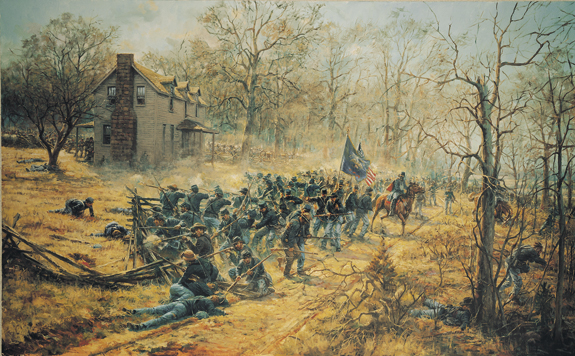
The Eleventh Kansas Cavalry stayed fairly close to home during the Civil War. Part of the Eleventh engaged in the pursuit of William Quantrill following his devastating raid on Lawrence, Kansas, in 1863.

The Eleventh later participated in the Price Raid battles around Kansas City, and skirmishes around Mound City, in October of 1864. The latter actions made it the closest unit among all Kansas regiments to the Battle of Mine Creek, the only full-fledged Civil War battle in the state
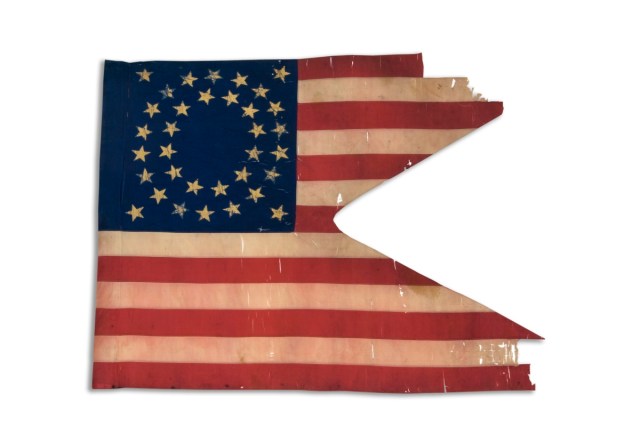
Before the Eleventh was released from its duties, several companies–including Company A–were sent into what is now Wyoming to fight American Indians. This was not a popular decision among soldiers ready to go home after the defeat of the Confederacy. Until they were mustered out, though, they were still in the Federal army and could be deployed as needed.

11th Regiment Actions include Old Fort Wayne or Beattie’s Prairie, near Maysville, 22 Oct 1862. Cane Hill, Boston Mountains, 28 Nov 1862. Boston Mountains 4-6 Dec 1862. Reed’s Mountain 6 Dec 1862. Battle of Prairie Grove 7 Dec 1862. Expedition over Boston Mountains to Van Buren 27-31 Dec 1862. Moved to Springfield, Mo., Jan 1863, and duty there until 17 Feb 1863. Moved to Forsyth, Mo., thence to Fort Scott, Kan. On furlough March. Moved from Fort Scott to Salem, Mo., thence to Kansas City, Mo., 6-20 Apr 1863. The regiment lost a total of 173 men during service; 61 enlisted men killed or mortally wounded, 2 officers and 110 enlisted men died of disease.

Oliver WEBBER (1797 -1862)   Most of our ancestors were either living in Canada, too old, or too young to participate in the Civil War.  Oliver Webber of Vassalboro, Maine  makes up for the good luck all by himself.   He lost four boys, two killed, one wounded and one broken.

Most of our ancestors were either living in Canada, too old, or too young to participate in the Civil War.  Oliver Webber (1797 – 1862) of Vassalboro, Maine  makes up for the good luck by himself.   He lost four boys; two killed, one wounded and one broken.

Before I delved  further, it was romantic to imagine that Oliver’s sons might have been part of the famous 20th Maine Regiment. The 20th Maine’s decisive defense of Little Round Top on July 2, 1863, where it was stationed on  at the extreme left of the Union line was a turning point in the Battle of Gettysburg.  This action is the central engagement of the movie Gettysburg.  It turns out that Virgil and Gustavus were part of the 16th Maine Regiment at Gettysburg who have their own story to tell.

Later on, I thought it was tragic that Oliver died a few months after he lost much of his family in the Civil War.  But in reality, he died in January 1862, a few months before the carnage.  Real life isn’t as tidy as a story.

While a few of our illustrious ancestors attended Oxford before leading  the Great Migartion, Oliver’s son Leigh Richmond Webber was the first I found who attended college in the United States.  These notes came from a Colby alumni record from the 1880’s.
1852, Sept. Entered Colby Sophomore class. In scholarship, one of the best of a superior class.
1855-56. Taught in New Portland, Me.
1856-57. Taught in Troy, Orleans Co., Vermont.
1858, April. Removed to Kansas, and engaged for three years in teaching and farming.
1861. Enlisted as a soldier, and served, during the late war, for three years.
1864, July. Returned to Maine, broken down In health by hardships of military life.
1865, Oct. 11. Committed to Hospital for the Insane, at Augusta. Died, Jan. 5,1866, of consumption, at Insane Hospital, Augusta. He did not marry.

His son Hermon S. Webber was wounded at Fair Oaks, 4 June 1862, and died 10 Aug 1862.  The Battle of Fair Oaks, also known as the Battle of Seven Pines or Fair Oaks Station  took place on May 31 and June 1, 1862, in Henrico County, Virginia, as part of the Peninsula Campaign.  It was the culmination of an offensive up the Virginia Peninsula by Union Maj. Gen. George B. McClellan, in which the Army of the Potomac reached the outskirts of Richmond.  Both sides claimed victory with roughly equal casualties, but neither side’s accomplishment was impressive. George B. McClellan’s advance on Richmond was halted and the Army of Northern Virginia fell back into the Richmond defensive works. Union casualties were 5,031 (790 killed, 3,594 wounded, 647 captured or missing), Confederate 6,134 (980 killed, 4,749 wounded, 405 captured or missing)

Oliver’s son Virgil was killed at the first day of the Battle of Gettysburg 1 Jul 1863 and his son and his son Gustavus was wounded in the same action.   Virgil served in the 16th Maine Regiment at Gettysburg. before I delved  further, it was romantic to imagine that Virgil was part of the famous 20th Maine Regiment. The 20th Maine’s decisive defense of Little Round Top on July 2, 1863, where it was stationed on  at the extreme left of the Union line was a turning point in the battle.  This action is the central engagement of the movie Gettysburg.

In real life, Virgil and his brother Gustavus (also wounded in this action) were in Company E, 16th Maine Regiment. which arrived around 11: 30 on the morning of July 1, 1863, as part of two divisions of the 1st Corps, Army of the Potomac arrived to join a fight that had been raging all morning, as the Confederates advanced on Gettysburg from the west and from the north. Among them was the 16th Maine. The regiment, along with the rest of the army, had been marching since June 12 up from Virginia.  16th Maine fought bitterly for approximately three hours in the fields north of the Chambersburg Pike; but by mid-afternoon, it was evident that, even with the addition of the rest of the 1st Corps and the entire 11th Corps, the position of the Union forces could not be held. They began to fall back toward the town of Gettysburg.

The 16th Maine was then ordered to withdraw to a new position to the east of where they had been fighting. “Take that position and hold it at any cost!” was the command. This meant that those of the 275 officers and men of the regiment who had not already become casualties had to sacrifice themselves to allow some 16,000 other men to retreat. This they valiantly did, but they were soon overwhelmed and forced to surrender to the Confederates.

As the Southern troops bore down upon them, the men of the 16th Maine spontaneously began to tear up into little pieces their “colors.” Like other Union regiments, the 16th Maine carried an American flag and a regimental flag, known collectively as “the colors.” “For a few last moments our little regiment defended angrily its hopeless challenge, but it was useless to fight longer,” Abner Small of the 16th Maine wrote after the battle. “We looked at our colors, and our faces burned. We must not surrender those symbols of our pride and our faith.” The regiment’s color bearers “appealed to the colonel,” Small wrote, “and with his consent they tore the flags from the staves and ripped the silk into shreds; and our officers and men that were near took each a shred.” Each man hid his fragment of the flags inside his shirt or in a pocket. The Confederates were thus deprived of the chance to capture the flags as battle trophies.   Most of the 16th Maine survivors treasured these remnants for the rest of their lives and bequeathed them to their descendents, some of whom still possess them as family heirlooms to this day.

By sunset on July 1, 11 officers and men of the 16th Maine had been killed, 62 had been wounded, and 159 had been taken prisoner.  Company E suffered heavy losses 3 killed, 8 wounded including Capt,William A. Stevens and Lt. Aubrey  Leavitt and 14 taken prisoner including Capt. Leavitt.  Only 38 men of the Regiment managed to evade being captured and report for duty at 1st Corps headquarters. But the 16th Maine had bought precious time for the Union Army. Those whose retreat they had covered were able to establish a very strong position just east and south of the center of the town of Gettysburg along Cemetery Ridge. During the night and into July 2 the 1st and 11th Corps were reinforced by the rest of the Army of the Potomac. For the next two days they would withstand successive assaults by the Confederates until the final repulse of Pickett’s Charge, on July 3.

1,907 men served in the 16th Maine Infantry Regiment at one point or another during its service. It lost 181 enlisted men killed in action or died of wounds. 578 members of the regiment were wounded in action, 259 died of disease, and 76 died in Confederate prisons for a total of 511 fatalities from all causes.

World War I

Horace Horton BLAIR (1894 – 1965)  Got influenza in France

Allied Occupied Germany

Lt. Everton Harvy MINER (19 29 – )

Assigned to Wildflecken is a municipality in the Bad Kissingen district, at the border of northeastern Bavaria and southern Hesse. In 2005, its population was 3,285.

In 1937 the German Army established a large training area in the Rhoen area. Northeast of the village a camp, large enough to house about 9,000 soldiers and 1,500 horses was built. The camp (Camp Wildflecken) and training-area was primarily used by the German Army (Wehrmacht) as well as by the Waffen-SS. During the war several Wehrmacht and Waffen-SS divisions were activated and trained for combat in Wildflecken. Also located in Wildflecken was an ammunition factory and two POW camps, one for Russian POWs and one for POWs of Belgian and French origin. In 1945 elements of the U.S. 14th Armored Division took control of the camp and the training area in April 1945.

From April 1945 to 1951, the base was a displaced persons camp housing approximately 20,000 displaced persons (DPs), primarily Poles, operated first by UNRRA, then by IRO. A Polish cemetery holds the camp’s residents who died during those five years.

After 1951, its range served as a US Army training base operated by the 7th Army Training Command in Grafenwöhr,and it was home station for several U.S.Army units to include Armored, Infantry (Mech), Military Intelligence and logistical units, primarily the 373d AIB of the 19th (later 4th) Armored Group. It also served as a base for Bundesgrenschutz (border police) units and later for the new German Army (Bundeswehr). The Wildflecken Kaserne was decommissioned by the U.S.Army and transferred to the Bundeswehr in 1994.

Lived in Bad Kissingen  a spa town in the Bavarian region of Lower Franconia and is the seat of the district Bad Kissingen.

Reported to HQ in Würzburg– After the war, Würzburg was host to the U.S. Army’s 3rd Infantry Division1st Infantry Division, U.S. Army Hospital and various other U.S. military units that maintained a presence in Germany. The U.S. units were withdrawn from Würzburg in 2008, bringing an end to over 60 years of U.S. military presence.
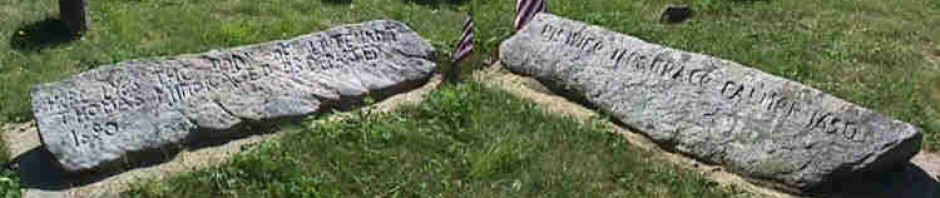
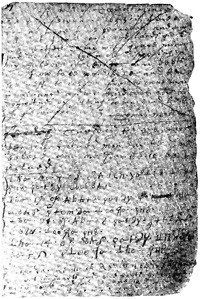
Posted in Fun Stuff | 6 Comments

Capt. Edmund Greenleaf

Capt Edmund GREENLEAF (1590 -1671)  was Alex’s 12th Great Grandfather, one of 8,192  in this generation of the Shaw line and one of 8,192 in the Miller line.  (See his great grandson Thomas BROWNE for details of the double ancestors.)

Edmund Greenleaf was a Silk Dyer

Capt. Edmund Greenleaf was born in 1590 in Ipswich, Suffolk, England.  He married Sarah MOORE on 2 July 1611 in Langford, Essex,  England.  He immigrated in 1634 aboard the Mary and John with his family and was one of the first settlers to come by water to Newbury, Massachusetts, Agawan Plantation near Ipswich, Massachusetts.  After Sarah died, he married second Mrs. Sarah (Jordan) Hill in 1663 in Mass.  Edmund died in Boston, Mass on 24 Mar 1670/71.

Edmund Greenleaf – Memorial

On the parish records of St. Mary’s la Tour in Ipswich, County Suffolk, England, is recorded: “Edmund Greenleaf, son of John and Margaret, was baptized 2 Jan. 1574.” This may be too early for the Edmund Greenleaf who came to America. Other sources suggest a birth date about 1590.

Sarah Moore was born on 17 Sep  1588, All Saints parish, Maldon,  Essex, England.   Her parents were Enoch MOORE and Catherine [__?__].  Sarah died on 18 Jan 1662/63 in Boston, Mass. , at age 74.  Since the late 1800’s, genealogists had assumed Sarah’s last name was Dole, however, a recently discovered 24 Dec. 1615  will by Sarah’s brother (see below)  proves her name to be Moore.

Sarah Jordan was baptized and first married at St Mary Arches, Exeter, Devon, England

Sarah  Jordan (Jordain or Jurdin) was baptized 4 Mar 1598/99 at St Mary Arches, Exeter, Devon, England.(Others say 28 Sep 1612 in England, but then her 1619 marriage would not be possible) Her parents were Ignatius Jourdaine and Elizabeth Baskerville.  Ignatius was a leading Puritan (known at”The Arch-Purtian”) and Member of Parliament,  see bio of William Hill from History and Genealogy of the Families of Old Fairfield, below.

Elizabeth Baskerville sister of Sir Simon Baskerville physician to James I and Charles I descended from the ancient family of Baskervilles in Herefordshire.    The fame Simon had acquired at Oxford preceded him to town, and heralded him to the court of James I, who appointed him one of his physicians. King Charles I employed him in the same capacity, and at Oxford conferred upon him the honour of knighthood. With such distinction the road to affluence lay open to him, and so lucrative was his practice that he acquired the name of Sir Simon Baskerville the Rich. He was considerate and liberal in his profession, to the clergy and inferior gentry, insomuch that, as Prince relates on the authority of Lloyd, “he would never take a fee of an orthodox minister under a dean, or of any suffering cavalier in the cause of Charles I under a gentleman of an hundred a year, but would also with physic to their bodies generally give relief to their necessities.” Sir Simon Baskerville died in July, 1641, aged 68, and was buried in old St Paul’s,.

Tomb slab of John Mullins and memorial to Sir Simon Baskerville, in St Paul’s,” etching, by the Czech-English artist and printmaker Wenceslaus Hollar. 275 mm x 161 mm. Courtesy of the British Museum, London.

(Sir) Simon Baskervill (knight) Doctor of Physic, of the parish of St. Dunstan in the West (London) 20 April 1641, proved 7 July 1641.

I give my dwelling house in Fleet Street and all my houses adjoining, which I lately did purchase of Sir George Crooke, to my dear wife and to her heirs forever. I give to my sister Jourdayne ten pounds. To her son, my nephew Ignatius Jourdayne [Jr] I give all my books of Divinity. I give to my nephew Richard Baskervill two hundred pounds. To my trusty servant Thomas Hall twenty pounds. To the poor of St. Dunstan’s parish wherein I dwell three pounds. All the rest of my goods and leases whatsoever I give to my dear wife whom I make sole executrix. Proved by Dame Catherine Baskervill, relic &c. Evelyn, 88.

Ignatius Jourdaine began his business life with kinsmen in Exeter, county Devon. In 1576 he was sent by his employer to Guernsey, where he was converted. In 1599 he was appointed a Bailiff of Exeter. He was a member of the Chamber in 1608, Receiver of the City in 1610, Sheriff of Exeter in 1611, Mayor in 1617. He served as Deputy Mayor in 1624 for three months during the plague, when all the magistrates had fled. He was a Member of Parliament from Exeter 1625-1628.

“He was a Puritan, and when the proclamation touching the rebellious practices in Scotland was read in Exeter Cathedral, Alderman Jourdain was one of three who put on their hats in silent protest. For this he was commanded either to apologize or to appear before the Council in London. He did neither; but did not long survive.”

His will was dated 1 March 1635, proved 16 October 1640. It named wife Elizabeth, children of son William Hill, and others.

The New York genealogical and biographical record, Volume 44:.

Ignatius Jourdain was of a prominent family of Lyme Regis, Dorset.

John Jourdaine his cousin was a Captain in the service of the East India Company and President in 1618 of the Council of India.

Richard Jourdain his uncle was a member of the Society of Merchant Adventurers of Exeter before 1571, was Bailiff in 1583, and Receiver of Exeter in 1596.

Silvester Jourdaine his brother was the companion of his townsmen Sir George Somers Sir Thomas Gates and Captain Newport in their voyage to America in 1609 and was wrecked with them at Bermuda. On his return home Silvester Jourdaine published A Discovery of the Barmudas otherwise called the Isle of Divels 1610 from which Shakespeare is supposed to have drawn material for The Tempest.

Sarah Greenleaf’s Uncle Silvester Jourdaine wrote a book about his Bermuda adventures that many say is the inspiration for Shakespeare’s The Tempest — The shipwreck in Act I, Scene 1, in a 1797 engraving based on a painting by George Romney

Ignatius Jourdaine went early to Exeter In 1576 he had occasion to go to the isle of Guernsey where probably through the influence of some of the banished preachers he was new borne as he himself expressed it and he was ever afterward a staunch Puritan though also a good churchman and loyal to the King. But he did not hesitate to express his opinion when any royal act clashed with his sentiments. He wrote to the King a strong letter of protest against the Book of Sports and induced Bishop Carey to present it.

When Charles read it he declared that the writer ought to be hanged but the bishop besought the King’s leniency asserting that in Mr Jourdaine God had not a better servant nor his Majesty a better subject in the whole land. Again in 1638-9 when the royal proclamation in relation to the seditious practices of the Scots in matters of religion was read in the Exeter Cathedral. Alderman Jourdaine and others put on their hats by way of protest.

The delinquents were summoned to appear in the Star Chamber to answer but Mr Jourdaine then nearly eighty years old was excused on the certificate of his medical adviser that a journey to London would endanger his life. Ignatius Jourdain died in Exeter June 15 and was buried June 18 1640 in the church of St Mary Arches.

His life was considered of such prominence as to entitle him to a biography written by his pastor and published in London in 1654. It concludes That therefore his name may live and that he may be a pattern of Piety and Charity to succeeding generations it hath been thought fit to commit to writing and to publish to the world those singular graces and memorable acts that did shine forth in him both living and dying.

Mr Jourdain filled many municipal offices in Exeter. In 1599 he was appointed one of the Bailiffs or Stewards and in 1608 he was chosen a member of the Chamber of Alderman. He was Receiver of the city in 1610, Sheriff in 1611, and Mayor in 1617. He acted also as Deputy Mayor in 1624-5 when Exeter scourged by the plague was deserted by Mayor Walker and other officials.

In 1625 he was elected one of the Burgesses to represent Exeter in Parliament and again in 1627-9. He was prominent in both sessions serving on important committees and speaking frequently. He also introduced several bills against profane swearing, against abuses of the Lord’s Day, and for the capital punishment of adulterers.

Mayor Jourdain’s first wife married June 24 1589 was Katherine daughter of John Bodley goldsmith and nearly related to Sir Thomas Bodley from whom the Bodleian Library Oxford was named. She was buried May 4 1593 in St Mary Arches Exeter, and Ignatius married second Aug 5 1593 Elizabeth daughter of Thomas Baskerville.

The Register of St Mary Arches contains the baptisms of seventeen of his children all excepting the first three by the second marriage. Of these Sarah the sixth child was baptized March 4 1598/99.

She married in Exeter Oct 28 1619 William Hill son of James Hill of Lyme Regis and came with him and his six children to New England in the William and Frances arriving in Boston June 5 1632.

William Hill was among the first settlers of Dorchester Mass where he was made a freeman Nov 5 1633. Land was granted to him there Nov 2 1635 and in 1636 he was a Selectman. He removed soon to Windsor Conn which he represented in the General Court in 1639, 1641 and in 1644. Thence he removed to Fairfield Conn where he was an Assistant and Collector of Customs. He died in September 1649. His will made Sept 9 of that year was not proved until May 15 1650 but the inventory of his estate was made at Windsor Sept 24 1649 and at Fairfield Nov 16 1649. His widow was then about fifty years old.

The date of her marriage with Edmund Greenleaf of Boston is not known but it was in or after 1663 as Greenleaf s first wife died January 18 of that year. With these facts before us the myth of a Wilson marriage precedent to Sarah jourdain’s marriage is scarcely worth discussing as it was invented solely to explain the relationship between the Hill and Wilson families.

While Sarah Jourdain’s age twenty at the time of her marriage with William Hill would not absolutely preclude the possibility of an earlier marriage, the fact that she was wedded under her maiden name of Jourdain would seem to settle that question conclusively. We must therefore look further for the solution of the problem in New England genealogy given by Mr OP Dexter in the New England Genealogical Register xxxix 78.

Nor does it seem necessary to accept his suggested solution Gen Reg Hi 83 that if it can be proved that Anthony Wilson and the Hills were not blood relations then I will not hesitate to say that Anthony Wilson married probably in 1655 7 Elizabeth younger daughter of William and Sarah Jordan Hill had by her his daughter Sarah and then immediately lost his wife. While this is not impossible it seems hardly probable for the relation between the Wilsons and the Hills may be accounted for through their marriage connections.

Anthony Wilson whose first wife was Rachel Hubbard Brundish widow of John Brundish married second Sarah Jones Bulkeley daughter of Rev John Jones and widow of Thomas Bulkeley son of Rev Peter Bulkeley. Mr Jone’s coadjutor at Concord Mass. William Hill son of William and Sarah Jourdain Hill married Elizabeth Jones the younger sister of Sarah Jones Bulkeley and this sisterly connection of the two wives fully explains Anthony Wilson’s designation of William Hill as his brother ie brother in law.

While this may not wholly justify viewed from a twentieth century standpoint his speaking of his brother in law’s mother as Mother Hill and of his brothers as brothers Ignatius and James Hill we must remember that family relationships were not very clearly defined in the early days and that the Hills and Wilsons appear to have been very intimately associated.

Those interested in the subject will find wills of the Hills the Jourdaines and the Baskervilles with remarks by Mr Henry F Waters in Gen Reg xlix 494. See also The Life and Death of Mr Ignatius fourdatn by Ferd Nicolls London 1654 and An Exeter Worthy and his Biographer by Frances B Troup a reprint from Transactions of the Devonshire Association for the Advancement of Science Literature and Art 1897.

She first married 28 Oct 1619 St. Mary Arches, Exeter, County Devon, England to William Hill (b. abt. 1594 in Lyme Regis, Dorset, England – d. Sep 1649 in Fairfield, Fairfield, Connecticut) Sarah and William had six children born between 1620 and 1630.

William Hill Bio 1 — From History and Genealogy of the Families of Old Fairfield,1929


Children of Edmund and Sarah all baptized at St. Marys la Tour in Ipswich, County Suffolk, England:

Name Born Married Departed
1. John Greenleaf c 1612 Hester Hoste
18 May 1636,
St. Augustine’s church near Paul’s Gate London
Stayed in England
2. Enoch Greenleaf 1 Dec 1613
St. Mary’s le Tour in Ipswich, Suffolk, England
1617
3. Samuel Greenleaf 8 Jan 1615
St. Margaret’s parish, Ipswich, England
24 Mar 1627
Ipswich, Suffolk, England
4. Enoch Greenleaf 1 Dec 1617/18
St. Margaret’s parish, Ipswich
Mary [_?_]
1647
Boston, Mass
1683
Boston, Mass.
5. Sarah GREENLEAF 26 Mar 1620
St. Margaret’s parish, Ipswich
William HILTON
1640 or 1641
Newbury, Mass
1655
Newbury, Essex, Massa
6. Elizabeth Greenleaf 16 Jan 1622
St. Margaret’s parish, Ipswich
Giles Badger
1642
.
Richard Browne
16 Feb 1648/49
26 Apr 1661
Newbury, Mass
7. Nathaniel Greenleaf 27 Jun 1624
St. Margaret’s parish, Ipswich
24 July 1633
St. Margaret’s parish, Ipswich,
Suffolk, England
8. Judith Greenleaf 2 Sep 1625
St. Margaret’s parish, Ipswich
Henry Somerby
2 Mar 1633 Newbury
.
Tristam Coffin Jr.
2 Mar 1653 Newbury
15 Dec 1705
Newbury
9. Capt. Stephen Greenleaf 10 Aug 1628
St. Margaret’s parish, Ipswich
Elizabeth Coffin
13 Nov 1651 Newbury
.
Mrs, Esther (Weare) Sweet
31 Mar 1679 Newbury
31 Oct 1690
(most genealogies say 1 Dec 1690)
Drowned off Cape Breton, Nova Scotia
10. Daniel Greenleaf 14 Aug 1631
St. Margaret’s parish, Ipswich
Hannah Braintree
1652 Newbury
5 Dec 1654
Newbury, Mass
11. John Greenleaf (May be an grandson?) c. 1632 Hannah Veazie
26 Jul 1665 Newbury
16 Dec 1712
Boston, Mass
12. Mary Greenleaf (May be an grand daughter?) 16 Dec 1633
Newbury
John Wells (Son of our ancestor Nathaniel WELLS)
5 Mar 1667/68 Newbury
5 Mar 1668/69
Newbury? (See discussion below)

State Street in Newbury (now Newburyport) was formerly Greenleaf’s Lane.

Edmund and his wife Sarah (Moore) Greenleaf had ten children, all baptized at St. Marys la Tour in Ipswich, County Suffolk, England:

Of the origin of the family, from all that can be gathered, it is believed that the ancestors of Edmund were Huguenots, the name being a translation of the French “Feuillevert.” As the name has not been found among the English parishes, other than at Ipswich, County of Suffolk, England, it is believed that the family (Feuillevert) came as French refugees to England with many other Huguenots, who fled from their homes on account of their religious principles, and settled in England some time in the sixteenth century. Edmund Greenleaf was a silk-dyer by trade; a trade that does not appear among the English industries until about the time of the coming of the French refugees.

Edmund was one of the original settlers of Quasca Cunquen, afterward Newbury, where each of the first settlers was granted a house lot of at least four acres, with a suitable quantity of salt and fresh meadow. In addition to this, he had a grant of twelve acres, which shows him to have been one of the eighteen principal pioneer settlers. Edmund lived near the old town bridge in Newbury, where he kept a tavern. By trade, he was a silk dyer.

Among the family relics still preserved is the cane brought to this country by Edmund Greenleaf; it bears the initials “J. G.” on a silver band near the handle.

13 Mar 1638 -Edmund was made a freeman in Newbury, Essex County, Massachusetts

1639 – Promoted to Ensign

22 May 1639 – Permitted to keep a house of entertainment.

1642 –  Promoted to Lieutenant

1 Jun 1642 – Commissioner of the General Court of Newbury

8 Sep  1642.- “Ordered to send home an Indian woman.

27 Sept 1642 – “On a committee to take charge of certain orders by the council.”

1645 – Promoted to Captain of the Newbury Militia under William Gerrish

11 Nov 1647 – Requests his “discharge from military service

c. 1650  He and Sarah Moore removed to Boston

1655 – His dyehouse located in Boston by the spring 30 (5 month) 1655.

22 Dec 1688 – Will of  Estate of Edmund Greenleaf of Newbury/Boston.  There was bad blood between Edmund and his second wife Sarah Jordan Hill including a lent wedding gift, unpaid mackeral cider, and bread and pease, and expenses for her grandchild that her son William Hill did not pay.

In the name of God, Amen. The two and twentieth day of December, sixteen hundred and sixty-eight, I, Edmund Greenleaf mindful of my own mortality and certainty of death, and uncertain of the same, and being desirous to settle things in order, being now in good health and perfect memory, do make, appoint and ordain this to be my last will and testament in manner and form following; that is to say first and principally, I give and bequeath my soul into the hands of my blessed Redeemer, the Lord Jesus, who hath died and gave himself for me and his blood cleanseth from all sin, and through his righteousness I do only look for justification and salvation; and do commit my mortal body after this life is ended, into the dust from whence it was taken there to be preserved by the power and faithfulness of my Redeemer Jesus Christ until the resurrection of the just, and then to be raised up by the same power to immortality and life, where I shall see him as he is, and shall ever be with him; and in this faith and hope I desire, through his grace and assistance, to live and die, and at last to be found of him in peace.

Nextly, my will is, being according to God’s will revealed in the word, that we must pay what we owe and live of the rest unto whose rule the sons of men ought to frame their wills and actions; therefore my mind and will is that my debts shall be truly and justly paid to every man to whom I shall be indebted, by my executors hereafter named.

And first I do revoke, renounce frustrate and make void all wills by me formerly made ; and I declare and appoint this to be my last will and testament.

Imprimis – I give unto to my son Stephen Greenleaf, and to my daughter Browne, widow, and to my daughter Coffin to each I twenty shillings apiece.

Item – I give unto my grandchild Elizabeth Hilton ten pounds.

Item – I give unto my grandchild Enoch Greenleaf ten pounds.

Item – I give unto my grandchild Sarah Winslow, five pounds if her, father pay me the four pounds he oweth me.

Item – I give unto my eldest son’s son, James Greenleaf, twenty shillings; and after my funeral debts and legacies are discharged,

I give and bequeath the rest of my estate unto my son Stephen Greenleaf, and to my daughter Elizabeth Browne and to my daughter Judith Coffin, equally to be divided amongst them and their children.

And, further, I desire ad appoint my son Stephen Greenleaf, and Tristram Coffin the executors of this my will see it executed and affirmed as near as they can; and I further entreat my cousin Thomas. Moon, mariner to see to the performance of this my will.

In witness whereof I have hereunto set my hand and seal, this twenty-fifth day of December, 1668. (Signed) EDMUND Greenleaf [L.S.]

Signed, sealed, published, and declared to be my last will in the presence of us,  George Ruggell  John Furnside

The inventory of Mr. Greenleaf’s estate, which was, appended to the will amounted to £131-5s-9d The following paper is also recorded in the “Probate Records,” appended to the will, as, probably, assigning the reason why the name of his second wife, who appears to have outlived him, was not mentioned:

I married my wife I kept her grandchild, as I best remember, three years to schooling, diet and apparel; and William Hill, her son, had a bond of six pounds a year, whereof I received no more than a barrel of pork of £3. 0s. 0d of that £6. 0s. 0d. a year, he was to pay me, and sent to her son Ignatius Hill, to the Barbados, in mackeral cider, and bread and pease, as much as come to twenty pounds, and never received one penny of it. His aunt gave to the three brothers £50 apiece. I know not of whether they received it or no; but I have or received any part of it.

Witness my hand. (Signed) Edmund Greenleaf

Besides when I married my wife, she brought me a silver bowl a silver porringer, and a silver spoon. She lent on gave them to her son, James Hill, without my consent.

Source: Boston Probate Records 1669-1674, pg. 112 as printed in:Genealogy of the Greenleaf Family, James Edward Greenleaf, Boston, 1896.10

1670 – Will  probated 12 (2) 1671 in Boston

This he found in the will of Sarah’s brother Samuel Moore of the Parish of Much Totham, co. Essex, dated 24 Dec. 1615 and proved by his brother Francis More the 2nd of February following.

In the name of God Amen the 24th day of December in the year of our Lord god 1615. I Samuell More late of Much Totharn in the county of Essex husband-man being poor of body but of good and perfect remembrance (thanks be given unto almighty god) Do make and ordayn my last will and testament in manner and forme following: First I commend my soule into the hands of god my creator hoping through the . . merits of Jesus Christ my Blessed savior that att the generall resurrection both body and soule shall be rejoincd together and made perteker of his everlasting kingdom: I bequeath my body unto the earth from which it first came to be buried in decent Christian burial att the Discretion of my Executor.

Item I give to the poor of Much Birch at the time of my . . . six shillings eight pence to be payd at the discretion of the minister and brothers:

Item I give unto my sister Sara the wife of Edmund Grinleaf of Ipswich in the county of Suffolk a Bedsted [and] a flockbed one bolster two pillows.

Item I give unto her two children John and Enoch either of them ten pounds of lawful english money . . .sayd summe my will is shall be paid by my executor to Edmond Grinleaf their father for their use and he enter bond unto my sayd executor for the true payment thereof and . – . from me when they shall come to the several ages of one and twenty years: Item I give to Anna Hewster my Aunt twenty shillings to buy her a gold ring to be worn by her for my sake.

Item I give unto my father Enoch MORE of Haverill the like summe of twenty shillings: Item I give unto Enoch more my brother and to my two sisters Merry and Judith to each of them six shillings eight pence.
All the residue of my goods and shattells unto him as well moveables and imoveables I give unto Francis More my brother whom I nominate and ordayn my sole Executor: And lastly I do — . Nicholas More of Mauldon my Uncle to be supervisor unto this my will unto whom I give for his payment twenty shillings: in witness whereof I have hereto set my hand the Day and Year above written

Samuell More In presence of His mark Robert Ham (?) Edward —— (maybe Bailer or Kailer) John Hewster Arthur Gaywood (Bishop of London Commissory in Essex, Essex Record Office, Chelmsford).

Reference to the parish registers of Maldon, co. Essex (to be found in the old library attached to the medieval tower of St. Peter’s church) gives a few of the vital statistics of the family, though they have to be used in conjunction with the existing wills, two of which are those of Nicholas and William Moore, the paternal grandparents of Sara (More) Greenleaf. Nicholas Moore, according to the parish records of St. Peter’s, was living in that parish when his son Enoch was baptized, 19 Jan. 1560/61, but by 17 Sep 1570, when Nicholas the Younger was baptized, the family was in All Saints parish. No other baptisms of their children are recorded though there were sons Samuel, Thomas and Edward, and daughters Anna and Phillip, according to the various wills.

As is apparent from the above records the parents of Sara were married in All Saints parish 23 Nov. 1585. Sara herself was baptized there 13 Dec 1588, probably not far inside the curious triangular tower to be seen in Maldon today. Her mother died in that parish a little more than a month after the birth of Sara’s brother Francis and was buried 11 Oct. 1593. At some time, perhaps after his father’s death in 1594, Enoch Moore Jr.  moved to Haverhill, co. Suffolk. By 1599, according to a fragmentary record found in the Withington material (Essex Institute, Salem, Mass.), Enoch had married again for the baptism of daughters Mary and Jane occurred in Haverhill. This scrap may have come from the Bishop’s transcripts and could be an indication that other bits of information will in time turn up even though the Haverhill parish records are said not to have survived.

Also curiously an Edmund Grenelif, a mariner, in the City of Tangier, made a will, dated 10 April 1670, in which he left a dwelling in the parish of Stepney to his wife, if she was living-it was proved 21 Jan. 1670/71 by Hannah Greneleafe, the widow (see James Edward Greenleaf, op. cit., p. 499, under “Enoch Greenleaf;” also p. 472, the account of John of Braintree; the will of Edmund of Tangier is filed in London).

Children

1. John Greenleaf

John’s wife Hester Hoste was born xxx.

“The naming of John, the first born son, in the will of his uncle, Samuel More, who, as far as we can know, survived baby-hood, explains the bequest of Edmund Greenleaf to a grandson James, his eldest son’s son.  One cannot help surmising that John Greenleaf, the silk dyer of St Andrews Undershof,Londan, who married Hester Hoste, daughter of James Jost of Stephey, 18 May 1636, in St Augustine’s church near Paul’s Gate in London, may have been the eldest son and elected to remain in England when the rest of the family migrated.  For him the usual pattern would be to name a son James.  It might also be that the John Greenleaf who married in Braintree, Mass., whom nobody has been able to place might be another grandson though it is granted that actual proof is needed.

4. Enoch Greenleaf

Enoch’s wife Mary [_?_] was born in 1620 in England. Mary died in Malden, Mass.

5. Sarah GREENLEAF (See William HILTON‘s page)

6. Elizabeth Greenleaf

Elizabeth’s first husband Giles Badger was born 1620 in Westbury On Severn, Gloucestershire, England. His parents were John Badger and Anne Greenwaye. Giles died 17 Jul 1647 in Newbury, Essex, Mass

Elizabeth’s second husband Richard Browne was born 1607 in Maidstone, Kent, England. His parents were Joseph Browne and Sarah. Richard died 26 Apr 1661 in Newbury, Essex, Mass

8. Judith Greenleaf

Judith’s first husband Henry Somerby was born 17 Mar 1612 in Little Bytham, Lincolnshire, England. His parents were Richard Somerby and Margaret [__?__]. Henry died 2 Oct 1652 in Newbury, Essex, Mass.

Judith’s second husband Tristram Coffin Jr. was born 1632 in Brixton, Devon, England. His parents were Tristram Coffin and Dionis Stevens. His grandparents were Peter COFFIN and Joane KEMBER.  Tristram died 4 Feb 1704 in Newbury, Mass.

Tristram Coffin Jr 1 — Ancestry of Charles Stinson Pillsbury and John Sargent Pillsbury

9. Capt. Stephen Greenleaf

Stephen’s first wife Elizabeth Coffin was born  1634 in Brixton, Devon, England.  Her parents were Tristram Coffin and Dionis Stevens. Her grandparents were Peter COFFIN and Joane KEMBER.  Elizabeth died 9 Nov 1678 in Newbury, Essex, Mass.

Stephen’s second wife Mrs, Esther (Weare) Sweet was born 1629 in Nantucket, Nantucket, Mass.  Her parents were Nathaniel Weare and Sarah [__?__].  She first married 1 Nov 1647 in Newbury, Essex, Mass to Benjamin Swett (b. 12 May 1624 in England – d. 29 Jun 1677 in Black Point, Scarboro, Maine).  Esther died 16 Jan 1718 in Hampton, Rockingham, New Hampshire

Stephen was a representative to the General Court from Newbury, 1676 – 1686.  He was appointed Ensign in 1670, Lieutenant in 1685, and Captain of the Militia in 1686. “As a Captain of the Militia, he went with the disastrous Phips expedition against Port Royal, 1690, to Cape Breton, and was there wrecked in a vessel and drowned in company with nine others.”

29 May 1671 – Stephen was fined four nobles [a noble was six shillings and eight-pence] for his part in the Parker-Woodman War.

Parker- Woodman War

For many years the church in Newbury had been divided, almost equally, between the original pastor, Reverend Thomas Parker, and Mr. Edward WOODMAN, of whom the noted historian Joshua Coffin wrote: “He was a man of influence, decision and energy, and opposed with great zeal the attempt made by the Rev. Thomas Parker to change the mode of Church government from Congregationalism to something like Presbytarianism.” This divison of the town was not due to a great difference of theology, but of church governemt.

As early as 1645 the Rev. Parker and his party maintained the church should be governed by the pastor, his assistants, and a ruling elder. Mr. Woodman’s party believed it was the right of the members of the church, and government should be by the congretation. In a letter to the church council, Mr. Edward stated, “As for our controversy it is whether God hath placed the power in the elder, or in the whole church, to judge between truth and error, right and wrong, brother and brother, and all things of church concernment.” These ecclesiastical problems, which grew more violent and partisan each year, plagued the town for over 25 yearsand became known throughout New England as the “Parker-Woodmam War.”

By 1669 difference of opinion had grown to such proportions that an appeal was made to the civil authorities. the court proceedings began March 13th at Ipswich and continued on and off for over two years. The decision of the court, on May 29, 1671, found in favor of Rev. Parker’s part and levied fines against the members of Mr. Woodman’s party. Edward Woodman was fined 20 nobles. [ A noble is six shillings and eight-pence so Edward’s fine was a little more than 13 pounds]

Mr. Richard Dummer , Richard THORLAY (THURLOW), Stephen Greenleaf [son of Edmund GREENLEAF], Richard Bartlet and William Titcomg, fined 4 nobles each. Francis Plummer, John Emery, Sr., John Emery, Jr., John Merrill and Thomas Browne, a Mark each. [A mark is thirteen shillings and fourpence. ]
All others Nicholas Batt, Anthony MORSE Sr, Abraham Toppan, William Sawyer, Edward Woodman junior, William Pilsbury, Caleb Moody, John Poor Sr, John Poor Jr, John Webster, John Bartlet Sr., John Bartlet Jr, Joseph Plumer, Edward Richardson, Thomas Hale Jr., Edmund Moores, Benjamin LOWLE (LOWELL), Job Pilsbury, John Wells, William Ilsley, James Ordway, Francis THORLA (THORLAY), Abraham Merrill, John Bailey, Benjamin Rolf, Steven Swett, and Samuel Plumer, a noble each.   However, the judgement of the court did not bring an end to the controversy, and the conflict continued for several years. Note: For a complete chronology, see pages 72-112 of Joshua Coffin’s History of Newbury.

21 Nov , 1686, ” Deacon Nicolas Noyes, deacon Robert Long and deacon Tristram Coffin were at the request of the select men chosen standing overseers of the poore for the town of Newbury.”

1 Dec 1686 , “Captain Daniel Pierce and Captain Stephen Greenleaf were added to the deacons as overseers of the poore,” and any three of them had power to act.

In 1686, and in 1689 was appointed as a consultant “for the conservation of the peace of the Country.”

Stephen died on 1 Dec 1690 in Drowned off Cape Breton, Nova Scotia, Canada, at age 62 . In the French and Indian War, Captain Stephen Greenleaf, Lieutenant James Smith, Ensign William Longfellow, Sergeant Increase Pillsbury, William Mitchell and Jabez Musgrave were cast away and lost on an expedition against Cape Breton.

“The expedition under Sir William Phips, consisting of thirty or forty vessels, carrying about two thousand men, sailed from Nantasket on the ninth day of August, 1690, but did not arrive at Quebec until the fifth day of October. Several attempts were made to capture the town, without success; and, tempestuous weather having nearly disabled the vessels and driven some of them ashore, it was considered advisable to re-embark the troops and abandon the enterprise. On their way back to Boston, they encountered head winds and violent storms. Some vessels were blown off the coast, and ultimately arrived in the West Indies. One was lost upon the island of Anticosti, and several were never heard from. Capt. John March, Capt. Stephen Greenleaf, Lieut. James Smith, Ensign William Longfellow, and Ensign Lawrence Hart, of Newbury, Capt. Philip Nelson, of Rowley, and Capt. Daniel King, of Salem, were among the officers commissioned for service in the expedition to Canada, under the command of Sir William Phips.”

Footnote from the Diary of Samuel Sewall, p. 335, which states as follows: “Twas Tuesday the 18th of November (1690) that I heard of the death of Capt. Stephen Greenleaf, Lieut. James Smith, and Ensign Wm Longfellow, Sgt. Increase Pilsbury, who with Will Mitchell, Jabez Musgro, and four more were drowned at Cape Britoon (Breton) on Friday night the last of October.”

Stephen Greenleaf drowned on the return from Phipp’s 1690 Attack on Quebec

The military spirit seems to have been transferred to the 3rd generation.

5 Mar 1696, Stephen’s son Captain Stephen Greenleaf Jr. petitioned the General Court for compensation for repulsing an Indian raid, in which he was wounded in his side and wrist, and it was directed that forty pounds should be paid to him “out of the treasury of the Province.”

The house attacked by the Indians was [our ancestor] John BROWN’s, and the following is the family tradition respecting it: ” The Indians had secreted themselves for sometime near the house, waiting for the absence of the male members of the family, who about three o’clock departed with a load of turnips. The Indians then rushed from their concealment, tomahawked a girl who was standing at the front door; another girl who had concealed herself as long as the Indians remained, immediately after their departure gave the alarm.”

The coat which Captain Greenleaf wore in his pursuit of the Indians is still preserved by his descendants, together with the bullet which was extracted from his wound.

Stephen Greenleaf 1 Source: Ancestry of Charles Stinson Pillsbury and John Sargent Pillsbury (1938)

Stephen Greenleaf 2

Stephen Greenleaf 3

10. Daniel Greenleaf

Daniel’s wife Hannah Braintree was born in 1634 in England.

11. John Greenleaf

John’s wife Hannah Veazie was born 18 Mar 1644 in Braintree, Norfolk, Mass. Her parents were William Veazie and Elinor Thompson.  Hannah died 1670 in Boston, Suffolk, Mass

12. Mary Greenleaf

Mary’s husband, John Welles was born about c. 1630 Colchester, Essex, England.  His parents were our ancestors Nathaniel WELLS and [__?__].  John died 15 Dec 1681 – Newbury, Essex, Mass.

(May be a grand daughter?)

John was a ship’s carpenter.

The consensus for Mary’s date of death is 5 Mar 1669. I don’t see any source of record for that, but there are Massachusetts vital records showing Mary Greenleaf’s 5 Mar 1668 marriage. It seems a coincidence that she died exactly one year after her marriage.

Other genealogies show Nathaniel and Mary having four children which of course puts the 1669 date of death into question. Some of these genealogies say Mary’s father was Edmund’s fourth son Enoch, but he was too young to have been Mary’s father (15 years old in 1633). On the other hand, Edmund’s wife Sarah was 45 years old in 1633, on the outer bound to have another child. I can find no other information for these four children, so maybe they all died young.

Children of John and Mary:

i. Mary Wells b. 16 Dec 1669 in Newbury, Essex Co., MA; d. 2 Feb 1670/71 in Newbury, Essex Co., MA

ii. John Wells b. 20 Aug 1671 in Newbury, Essex Co., MA

iii. Mary Wells b. 12 Feb 1672/73 in Newbury, Essex Co., MA

iv. William Wells b. 15 Jan 1674/75 in Newbury, Essex Co., MA

Sources:

Edmund Greenleaf 1 — Source: Ancestry of Charles Stinson Pillsbury and John Sargent Pillsbury (1938)

Edmund Greenleaf 2

http://www.bdhhfamily.com/edmund_greenleaf.htm

http://trees.ancestry.com/owt/person.aspx?pid=16909153

Ancestry of Charles Stinson Pillsbury and John Sargent Pillsbury (1938) By Holman, Mary Lovering, 1868-1947; Pillsbury, Helen Pendleton Winston, 1878-1957

Posted in 14th Generation, Huguenot, Immigrant - England, Line - Miller, Line - Shaw, Tavern Keeper, Violent Death | Tagged , | 31 Comments

Ship Captains

We have a lot of sea captains in our line. That’s especially interesting to me since I went into shipping too.  That reminds me of an old joke:  My wife is on crack, my daughter is a whore, my sister’s house got repossessed, but the one I’m really ashamed about went into the shipping business!

Robert ANDREWS –  (1560 – 1643) Ship Captain, First tavern keeper in Ipswich (1635)  Capt. Robert Andrews came from Norwich, Norfolk, England,early in the year 1635,as owner and master of the ship”Angel Gabriel.” This Capt. Andrews had a sister Mary,who was the wife of Robert Burnham. Their three boys were John,Thomas and Robert,it is said,were put in the charge of their uncle Andrews, master of the ship”Angel Gabriel.” This ship was cast away at Tammaquid, in Maine, in a terrible storm Aug. 15,1635, after which loss, Capt. Andrews settled with his three nephews at Chebacco in Massachusetts Bay.

On 3 Sep 1635, Robert Andrews was licensed “to keep ordinarye(an Inn) in the plantacon where he lyves during the pleasure of y court.” This is the earliest reference to a public house in the records of Ipswich. Robert lived near the South Church. In 1635;Robert is allowed the sell wine by retail “If he do not wittingly sell to such as abuse it by drunkenness.” May 13,1640,Robert is granted to draw wine at Ipswich,with the conditions of the towne

William KNOWLTON (1584 – 1639) died on the voyage to America, probably off the coast of Nova Scotia.  It is believed that William was at least part owner of the vessel in which he sailed for America.In 1839, a headstone was found by a surveyor in Shelburne, Nova Scotia reflecting “William Knowlton, 1632”. Tradition says his widow and children proceeded to Hingham, MA, where it is said she remarried.  Alternatively, William died 6 Jun 1639 at sea near Nova Scotia, Canada.

John MASTERS (1584 – 1639)  In 1631, he was the pioneer of marine engineering in this country. He made a channel 12′ wide and 7′ deep from the Charles River to Newtown.

Edward BANGS (1591 – 1678) was a shipwright and served on several town committees, holding a responsible position within the community.

William HILTON Sr. (1591 – 1656)   Around  the turn of the 16th/17th century, the Hylton family appears to have had quite a large and successful fishing fleet, fishing in the north sea and off New Foundland. Eric Lamberton says that “both William and Edward Hilton were north sea fishermen operating out of both Monkwearmouth (where the fishing grounds are) and London.  William and Edward are believed to have been amongst the first English fishermen fishing off Newfoundland in the early part of the 17th century. The Hyltons had a monopoly on salt production in Elizabethan England; salt was needed to preserve the catch on its voyage back to England where it was sold at the Billingsgate fish market. Edward was a member of the Fisherman’s Guild of London.”

Capt. John CUTTING (1593 – 1659) was a “Master” mariner; the first record shows him in command of the ship “Francis” of Ipswich, England which set sail the last of April 1634 with some eighty passengers aboard.

Captain John Cutting decided to make his home in New England and brought over his wife and children, probably sometime early in 1636, where they settled in Watertown, Mass. Between 25 July 1636 and 16 June 1637, Capt. John had three grants of land, the first being 60 acres in he First Division, the second being 10 acres in the Beaverbrook plain, and the third being 10 acres in the Remote or West Pine Meadows. He later received an addition 10 acres of upland.

Mariner Capt. John continued his work as a sea captain until at least 1656. It is reported that he made thirteen trans Atlantic trips. His wife, Mary, proved herself of being very capable of managing her husband’s affairs while he was at sea. On one occasion, in 1639, she wrote a letter to the Governor, addressing him as “Right Worshipfull John Winthrop”. She was seeking the Governor’s support in obtaining payment for service of a man, brought over as a servant by them to New England, who was “bound” for eight years. Many of the early, especially single, people “indentured” themselves for a period of time in return for passage and nominal support costs. In this case, a Capt. Thornback, a kinsman of the servant in question, arrived from Virginia to negotiate the release of the servant; Capt. John was amenable to the idea but in the meantime the servant just departed with his goods in wife Mary Cutter’s shallop (a rowing or sailing vessel for use in shallow waters). Mary was asking the Governor’s support in obtaining 20 pounds from Capt. Thornback which she, Mary, thought was “little enough” for three and one years support of the servant including the servant’s original passage cost.

The Cuttings removed to Newbury, Ma. around 1639; in 1641 a document shows Capt. John and his son, John, of Newbury, as Master Mariners of the good ship “Desire”, were bound to pay Lawrence Hazzard, shipwright of London, and Robert Crisp and William Wilbert, mariners, noted sums of money upon arrival of the ship “Desire” in London, England. In 1642, Capt. John Cutting was a “freeholder”,i.e., owner of a freehold, a form of tenure by which an estate, land/house etc, is held for life. He was one of the eight commissioners appointed to arrange for the moving of the village from Parker River to the Merrimac River. By 1645 Capt. John had received many other land grants including a 200 acre farm bounded by Falls River on the south.

Samuel GRAVE’s (1594 – ) son Thomas was a mariner as well as farmer. Thomas and Mark Graves testified at a session of the Court in 1653 to making several voyages in the boats of the Iron Works at Saugus to Boston, Weymouth, Braintree and Hingham, and in 1658 he testified that his boat carried seven tons of bar iron and delivered it to Mr. Hutchins. The iron works were in operation in 1643, the first in America.

Nathaniel WELLS (1600 – 1681) owned many and valuable shipyards in Colchester, Essex, England as well as a large hotel.

Edward SHEPARD (1600 – 1680)  came with his family from England in 1639, he being the captain of his own ship, and settled in Cambridge, Suffolk, Mass.   Edward continued to be a mariner his entire life. Twice he asserts to being a mariner in deeds – to Richard Champney, Mar. 19, 1652/53, and to W. Fessenden, Feb. 18, 1679/80, as well as in his own will dated Oct. 1, 1674. Also, mention is made in the record of the steward of Harvard College 1654, of two importations of wheat “from aboard Edward Shephard’s vessel.” He reportedly carried on trade between Boston and Hartford, and probably other parts.

Albert Andriese BRADT (1607 – 1686)  On 15 May 1658 Albert Andriesen Bradt and Wilem Martensen Hues advertised to sell to the highest bidder their “sloop as it rides at anchor and sails” (as is)

Barent Jacobsen KOOL (1610 – 1676) Barent Jacobsen Cool sailed to New Amsterdam, possibly from Amsterdam as a sailor in late 1632 on the ship Soutberg, which arrived in April 1633 with 140 soldiers. At that time, New Amsterdam, now New York City, had a population of only 400 to 500 people.   Barent later was captain of the yacht Amsterdam between 1638 and 1644. He sailed on the Hudson River and was a river pilot for other boats.  On April 13, 1654, Barent became a wine and beer carrier for the Dutch West India Company. He watched the company warehouse and was appointed by the New Amsterdam burgomasters as an exciseman. He, along with Joost Goderus, boarded ships in New Amsterdam, searched their contents, and levied duty on the goods they found. On September 21, 1663, Barent was appointed as a public porter and was elected foreman (Elder of the Beer Porters) on July 17, 1665.

Capt Matthew BECKWITH: (1610 – 1680) With two partners owned three ships, the “Speedwell,” the “Hopewell.” and the Endeavor.” These ships ranged from 50 to 82 tons, participated in trade between New England, New Amsterdam, and the Caribbean. He owned 30 acres and with two others owned three ships, one of the ships (the “Endeavor,”) was sold in Barbados for 2,000 pounds of sugar, at death the estate was inventoried at 274 pounds.  Matthew’s property is today’s Rocky Neck State Park, the port from which his three ships were based was called Beckwith’s Cove.

William HILTON Jr (1617 – 1675) was an explorer who mapped Cape Fear , rescued English castaways eventually leading to the founding of Wilmington NC which has a large port in on the Cape Fear River.

14 Aug 1662 –  Hilton set sail from Charlestown on his first voyage to explore the Carolinas, commanding the Adventurer. He returned in November with enough information for Nicholas Shapley, a Charlestown navigator, to draw a detailed map of Cape Fear.

10 Aug 1663 – Engaged by a group of businessmen from New England, London, and Barbados, Hilton embarked on a second exploration of the southeastern coast. Again commanding the Adventurer, he set out from Speights Bay with Captain Anthony Long and Peter Fabian. Upon their arrival in the vicinity of St. Helena Sound and the Combahee River they discovered the English castaways being held captive by the local American Indians. During negotiations with the local natives for the release of the castaways, he learned much about the local culture. After sounding the entrance to Port Royal Sound, he set out for Cape Fear, but the ship was blown off course toward Cape Hatteras. On October 12, the crew of the Adventurer finally arrived at the entrance to the Cape Fear River and explored the area until December.

1664 – Hilton published a book about this expedition called A Relation of a Discovery Lately Made on the Coast of Florida, which spurred interest in colonizing the area. A colony established on the Cape Fear river in 1664 led to the establishment of Charles Town (later Charleston, South Carolina) nearby on the Ashley and Cooper rivers.

Thomas HUSKINS (1618 – 1679)  Thomas had a landing place or wharf near his house, where he discharged and received freights.  1 Mar 1653 – Thomas was licensed to sell wines and strong waters until the next June court. He had probably been authorized to keep an ordinary, or public house, during the previous ten years. He was for several years receiver of the excise imposed on the importation of wines and liquors and powder and shot. In the last mentioned year, he was captain of the packet, and he brought into the town for himself 35 gallons of wine and 9 of brandy, besides liquors and powder and shot for other persons.  He was one of the ‘farmers’ or partners that hired the Cape Cod fisheries. In 1670 considerable quantities of tar were manufactured in the colony, and he was appointed one of the purchasers.  Oct 4, 1675.    Thomas and his son Joseph were cast away in hs vessel and perished in a gale 9 Nov 1679 .

Andrew NEWCOMB Sr. (1618 – 1686)   Page 281 of Charlestown (Mass.) Records, shipment of cattle, etc., Fell. 28, 166(5-7, by John Page, of Boston, in Ketch [name blank], Andrew Newcome, Master for Virginia for account of John Ely and Eliakini Ilutchinson—various horses described—avouched by Mr. Page, beinsr bought of Capt. Hutchinson and Samuel Gough

New York Col. MSS. at Albany, vol. 21), page 13, date Aug. 28, 1679, show “Andrew Newcombe” to have been “Master of y’ Sloope Edmund and Martha,” then in the port of New York and bound for “Boston in New England;” probably from Virginia—a part of his lading being tobacco.

Suffolk Court files at Boston contain deposition of Philip Foxwell, in which the statement is made that Andrew Newcomb was with his [ Newcomb’s] vessel iu Saco River from Boston, Oct., 1684—this being the last mention of his name prior to proof of his Will a little more than two years later.

Edward HARRADEN’s (1624 – 1683) son John Harraden (1663- 1724) was pilot of HMS Montague, (sixty guns, commanded by Sir George Walton) in the disastrous 1711 expedition against Canada.

General characteristics after 1698 rebuil
Class and type: 60-gun fourth rate ship of the line
Tons burthen: 905 long tons
Length: 143 ft 10 in  (gundeck)
Beam: 37 ft 8 in
Depth of hold: 15 ft 4 in
Propulsion: Sails
Sail plan: Full rigged ship
Armament: 60 guns of various weights of shot.

A Fourth Rate, 60 gun Ship of the Line


Lyme was a 52-gun third rate Speaker-class frigate built for the navy of the Commonwealth of England at Portsmouth, and launched in 1654

After the Restoration in 1660 she was renamed HMS Montague. She was widened in 1675  and underwent her first rebuild in 1698 at Woolwich Dockyard as a 60-gun fourth rate ship of the line. Her second rebuild took place at Portsmouth Dockyard, from where she was relaunched on 26 July 1716 as a 60-gun fourth rate to the 1706 Establishment.

Montague was broken up in 1749.

The Quebec Expedition, or the Walker Expedition to Quebec, was a British attempt to attack Quebec in 1711 in Queen Anne’s War, the North American theatre of the War of Spanish Succession. It failed because of a shipping disaster on the Saint Lawrence River on 22 August 1711, when seven transports and one storeship were wrecked and some 850 soldiers drowned; the disaster was at the time one of the worst naval disasters in British history.

Edward’s grandson Andrew Haraden (1702 – )  In 1723 and 1724 a gang of pirates and freebooters under command of the notorious John Phillips infested the New England waters. During their first season of marine depredations they had taken 34 vessels, which they looted, killing or maltreating crews. In April, 1724, the sloop Squirrel of Annisquam, commanded by Andrew Haraden, while engaged on a fishing voyage was taken by Phillips. The Squirrel was a fine new craft, therefore Phillips abandoned his own vessel and appropriated the fisherman for his piratical purposes. The vessel had been sent to sea so hastily that the craft had not been finished inside, consequently tools were left aboard to complete the work when the conditions were unfavorable for fishing.

John Phillips forces a captive to drink alcohol. Engraving from The Pirates’ Own Book.

Phillips employed Haraden and the other prisoners in the finishing of the craft. One of the men, Edward Cheeseman planned a recapture. Midnight of the 18th was the time appointed. The vessel was ploughing through the water at a lively rate when Cheeseman seized John Nott, one of the pirate chiefs, who was on deck and threw him overboard. At the same time Haraden despatched Phillips with a blow from an adze, James Sparks the pirates’ gunner suffered the same fate as Nott, while a man named Burrell, the boatswain was killed with a broad axe. Capt. Haraden sailed home to Squam with the heads of Phillips and Burrell fixed at the mast head of the recaptured craft.

John Phillips Pirate Flag

Edward great grandson Jonathan Haraden (1710-1803) (Wiki) was a privateer during the American Revolution. Two destroyers of the United States Navy have been named USS Haraden for him.

Thomas WELLS (1626 – 1700) In 1677 he bought a farm in Westerly RI and that year engaged in constructing vessels at a shipyard in the Pawkatuck River – styled `of Ipswich, shipwright’. In 1680, a lawsuit with Amos Richardson about a vessel of 48 tons which Thomas had contracted to build for AR.

Edward WANTON (1632 – 1716) Wanton Yard was on the old Wanton estate, located on the Scituate side of North River. The old  yard was later divided by a wall, thus making two yards, which  were used separately during the 1700′s and the early part  of the 1800′s. . Edward Wanton began ship-building here, probably,  as early as 1670, and vessels have been recorded as having been built  by him as late as 1707.

Thomas  WEBBER (1639 – 1686)  was a fisherman and a sea captain. He was a mariner of Boston as early as 1644 if not sooner, and the master of the sloop “Mayflower”, while still resident in England in 1652.   By 1660 there were approximately 8 known ships bearing the name ‘Mayflower.’ His ship is not the same ‘Mayflower’ of 1620 .  In 1652 he sold about a quarter of this vessel of two hundred tons, and removed to Maine.

At one time, some unscrupulous individuals attempted to make some fast money from the descendants of Thomas Webber, Sr. Apparently, he once held a deed to land in N.Y., probably at a time when it was New Netherland. He may have taken land land deeds in payment for goods that had been shipped into the New World.  At any rate, some sly genius calculated that this land was now in the heart of New York City and persuaded the descendants to band together to claim 1 foot of land on Wall Street. However, after investigating, it was found that Thomas Webber’s claim to any land in NY took place so long ago that it was impossible to describe the present land, let alone prove that his right existed.  Needless to say, many descendants lost a great deal of money in legal and investigation fees.  So all descendants of Thomas Webber should be aware of this scheme to get rich quick does exist, and you are their targets, even today.”

John BROWN (Hampton) (1640 – 1677 ) built the first ‘barque’ (small boat) ever built in Hampton, New Hampshire in 1641 or 1642 at the river near Perkins Mill.” “… it would seem that this barque was the one that John Greenleaf Whittier features in his poem, ‘The Wreck of River Mouth’.”    This poem expands on the true story of a Hampton shipwreck (click for original report) from 1657, when a group of eight were killed in a sudden storm.   Whittier also includes the character of  another of our ancestors Rev. Stephen BATCHELDER in this poem.

Captain William Kidd (1645 – 1702) When Samuell BROADLEY’s daughter Sarah married Captain William Kidd, she was in her early twenties, already twice widowed,  and was one of the wealthiest women in New York, largely due to her inheritance from her first husband, William Cox.  Sara had two daughters by Cox. She applied for her license to marry William Kidd only two days after the death of John Oort, sparking rumors that her husband may have been murdered. No proof was ever produced, however, and she went on to marry Capt. Kidd, a wealthy widow.

Stephen CROSS (1646 – 1704) was a mariner, owned and lived on Cross Island (an island, just off the Massachusetts coast from Ipswich).

Stephen purchased the twenty ton sloop Adventure in 1672

1672 – Stephen purchased the sloop Adventure . Samuel Cogswell of Ipswich owning a share, and was supposedly made fit to go to sea by Moses Chadwell of Lynn, who did a slow and poor job and lost in the resulting suit in 1676. His business as the captain of a coasting vessel, the sloop Adventure of twenty tons, took him as far afield as Wethersfield in Connecticut and the towns on the Exeter and Piscataqua rivers, the voyages frequently resulting in lawsuits for payment of freight which Cross usually won. Later John Lee owned a share in the sloop. The business was apparently prosperous and Capt. Cross became a personage entitled to the title “Mr.” in the records.

1682 – Stephen had a negro slave in his crew who was “very well known a wicked person.”

1684 – Capt. Cross sold his Water street house to Job Bishop and bought the Richard Saltonstall place from Bishop, the property consisting of fourteen acres of land on both sides of Saltonstall brook, an orchard and the house. Here he opened an inn and began again to be summoned to court, for illegal sales of spirits and for impairing the morals of Ipswich youth, including his future son-in-law, Benjamin Dutch, by providing a “shovelboard.”

Summer of 1689 – The last heard of the Adventure is when Capt. Cross’s sloop, laden with a cargo of deal boards, was off Cape Cod and was captured by the pirate Thomas Pound, who kept the sloop and put her crew into the ketch from which he was operating at the moment and “sent them away”–good treatment from a pirate?

1690 was a commander of the ketch Lark in the Battle of Quebec.  The Lark was a Salem vessel and Cross brought her back to her home port on March 18, 1690/91, and the arms on board were placed in Mr. Derby’s warehouse.  His was one of about thirty-two ships (only four of which were of any size) and over 2,3000 Massachusetts militia men.

Jean PERLIER I (1648 – 1688)  came from a maritime family in La Treamblade France  and grew up to be a Pilotte de Navire, a title that literally translated means a naval pilot. Back then that meant not only a navigator but the person who actually created the charts. He worked for ship owner Andre Arnaud and married his daughter Marie Arnaud. During this time there was a great turmoil in France and the Huguenots were under tremendous pressure. The Edict of Nantes, decreed by French King Henry IV in 1598 guaranteed full civil rights, freedom of conscience and public worship to the country’s minority Protestants.  Gradually, these rights were stripped away until in 1685, Louis XIV revoked the Edict altogether.  It was open season on Protestants including the Perliers.  When the slaughter and persecution began, the Perlier family was ripped apart.  Possibly Jean was at sea, for he managed to flee north to Holland.  He never saw his family again and for many years believed then dead.

Andre Arnaud smuggled daughter Marie and the two boys out of the country hidden in wine casks  aboard one of his ships. It has been told that they hid in hogsheads which had holes bored in them and were stored with the freight in the bottom of the ship until they were out of reach of the inspectors.   On the ship Marie met the captain, Pierre Traverrier.  Marie and Pierre were married4 Jan 1688  in the church at Frenchtown, Narragansett, Rhode Island.

Joseph WELLS (1658 – 1711)

3 Jan 1680 – Joseph Wells signed a contract to finish up a vessel then on the stocks at Pawcatuck.

20 May 1680 – Joseph signed another contract for the building of a vessel, wherein he describes himself as of Mystic, Conn.

Jean PERLIER II (1669 – 1823) was a ship carpenter by trade.

John HEDGE’s grandson Barnabas Clarke (1723 Harwich, Barnstable, Mass; –  1772 Dedham, Mass)  was a shipmaster in 1740 sailing from Boston to London and the Provinces.  After some years Captain Clarke quitted the sea, and became a merchant in Boston.

The Boston Gazette of May 15, 1768, has the following:

Imported in the London Packet, Capt. Calef, from London, and to be sold by Barnabas Clarke at his store on Treats Wharf, Boston, near the market at the lowest rates: –Bohen Tea by the chest or less quantity; Pepper by the bag or ditto; Spices of all kinds; Best Durham Mustard by the box; Russia, English and Ravens Duck; Gun powder by the cask. Also Kippen’s Snuff by the cask; best French Indigo; Pimento; Ground and Race Ginger; Muscovado Sugar; Philadelphia Flour; Bar Iron;Iron Hoops; Anchors.”

David WING IV’s grandson Capt. Josiah Wing (1799 Barnstable, Mass-  1874 Suisan, Solano, California sailed his ship  Diantha around the horn to San Francisco in 1851.  He purchased a the Ann Sophia, and sailed between San Francisco and Sacramento, in the process, founding Suisun City on the Delta.  Late in live he mastered the brig Pride of the West to catch fish in the North Pacific.  The next year he took command of the Dominga and for the next five years he sailed to Petropoulski, on the Okhotsk Sea, returning each autumn with 70,000 to 100,000 codfish.  Other fishing expeditions took him to New Zealand.

In 1822 when he was 23 years old, Josiah was captured by pirates while on a voyage in brig “Iris.”   Warren Lincoln   recorded the adventure  : [Click the link for the rest of the story]

We sailed from Boston about the first of November, 1822, in the brig “Iris,” owned by William Parsons, Esq., of Boston. Our crew consisted of eleven, all told, viz.: Freeman Mayo, of Brewster, master ; Richard Rich of Bucksport, Me., first mate; Sylvanus Crosby of Brewster [Josiah’s father-in-law], second mate; Brewster Mayo of Brewster, seaman, who was the first child born in Brewster, or rather, he was a twin; Josiah Wing of Brewster, seaman; two other seamen; _____ Hooper of Boston, seaman; negro for cook; Mr. Greenleaf of Baltimore, a passenger, and the cabin boy 12 years old belonging in Brewster and the teller of this story.

This was my first voyage, and for the first three days out I was very homesick and seasick. Nothing remarkable occurred until about the 20th. We had passed the Bahama Banks and passed the Double Headed Shot Keys during the night. About sunrise I was called to my duty, which was to keep the cabin tidy, set the table, clear it away, wash the dishes, etc. When I came on deck the island of Cuba was in sight about 30 miles distant, the wind light, the water smooth. We were sailing by the wind, as the sailors term it, “full and by.” I soon noticed the first mate in earnest conversation with the man at the helm and came near enough to hear the mate say :

“They may be pirates,” referring to two vessels in-shore of us, “and I will call the captain.”

He went into the cabin and called Captain Mayo. His first exclamation, spy-glass in hand, was,

“Damn ’em, they are pirates! Call all hands on deck, put up your helm and keep her off ; square the yards, set the fore-topmast studding sail; bear a hand ! “

From   The Way It Was – Capt. Wing steered Suisun City’s early course:

After his first wife’s death, Josiah went back to Brewster, Mass., where he married a widow, Mercy Hurd. He sold the farm in New York and moved to Michigan.  The gold discovery in California drew him away from farming to try his hand at the more lucrative business of transporting passengers and cargo to the gold fields.

Once in California, he went into the business of supplying building materials, goods and food for the miners. He established a very profitable business when he began sailing out of San Francisco to Sacramento. Josiah also converted the ship that he sailed around the horn, The Diantha, into a store ship and then built the Pine Street Hotel in San Francisco from the timber that he had brought with him.

San Francisco Harbor 1851

Evidently The Diantha never sailed again and was broken up or allowed to sink in the bay, the fate of hundreds of ships whose crews jumped ship to pursue the lure of gold.

Followed the acquisition of the schooner Ann Sophia, in 1852, Josiah Wing  came to Suisun. He purchased Suisun “Island” and a tract of adjoining marshland, about 600 acres in all, for $500. He established a permanent wharf at Suisun and built a warehouse with sleeping quarters, then moved   his wood-frame home from its location on Pine Street in San Francisco to Suisun.

He also discovered, that at low tide, Suisun was not an island. Using willow logs, he raised the low-tide connection between the island and the Suisun Valley shoreline. Later this connection would be called Union Avenue.

Next, he sent for his family back in Massachusetts. His wife, Mercy, and children reached San Francisco in August of 1852.

With wife Mercy, and the 10 children from both their marriage and his previous marriage, the family became the founders of Suisun City.

The embarcadero quickly grew into a bustling business district, especially for the farming community in the upper county area. Records of 1852 note shipments of potatoes, another of the early local attempts to develop a variety of agricultural commodities.

In 1854, Capt. Wing began plans for the layout of the new town, with street grids and lot subdivisions with assistance by Owens to be called Suisun City.

Suisun waterfront, today

“They were then engaged in stock raising. Wing’s schooner used to carry away the grain which was brought in from the valleys, being hauled to Suisun by teams of sixteen to twenty mules. I can remember when the stagecoaches came in here, one line running from Benicia to Fairfield and the other from Napa to Sacramento.”

By 1855, the Solano Herald already said about the flourishing town: “It is the point of embarkation of the produce of the county and has for the past few months been the busiest place in the county.”

Suisun became a bustling port of commerce where fortunes were made. At the time, there was a wheat boom. There was a huge demand in Europe for flour.

In the 1850 census, Josiah was ship master in Brewster, Barnstable, Massachusetts. In the 1860 census, Josiah was a seaman in Suisan, California.

By the late 1850s, he sold part of his landholdings in Suisun, including the wharf.  Josiah kept sailing his new ship, The Ann Sophia, on the Sacramento River, and was especially busy at harvest time. He found the land holdings to be a distraction from his first love of shipmaster,   He continued to use the wharf for his business until 1864, when he also sold the Ann Sophia.

Instead of local politics, Josiah’s interests had shifted back to the sea. Over the previous decade, he had made changes to his holdings that eventually allowed him to be gone for much of the year.

In the spring of 1866, at age 67, Josiah Wing went back to sea. This time, the North Pacific beckoned with its highly profitable fishing grounds.   He mastered the brig Pride of the West to catch fish in the North Pacific. His voyage was “crowned with success,” according to news reports.For the next five years, he fished the Pacific Northwest, sailing all the way to the Okhotsk Sea, off the Russian Coast. In some years, he would return with nearly 100,000 caught codfish.

The next year he took command of the Dominga and for the next five years he sailed to Petropoulski, on the Okhotsk Sea, returning each autumn with 70,000 to 100,000 codfish.  Other fishing expeditions took him to New Zealand.

In 1871, he planned on arriving back in Suisun to give the bride away, when his daughter Laura married, but he was delayed for 18 days by calm winds.   His final voyage ended in November 1871. At age 72, he left the sea for good  and he decided to open a fish market.

Posted in Fun Stuff, Sea Captain, Storied | 6 Comments

Origins

Migration of Massachusetts Puritans

At Sea

Storm Albertse Van Der Zee – 2 Nov 1636 at Sea lattitude 41 degrees 50 minutes on the Arms of Rensslaerswyck.
Cornelis Lambertsen Brink –  4 May, 1661. on the ship as his parents and two siblings were coming to the new world. He was baptized in New Amsterdam

Barbabos

Anne Hill Tallman – around 1633

Belgium

Rev Stephen Bachiler – 1561 Tournai, ( Province of Hainaut now Belgium)

Hester le Mahieu Cooke was born about 1585 in Canterbury, England.  Her parents were Jaques le MAHIEU and Jeanne [__?__].  They were Protestant refugees from the Walloon Flanders area. The Mahieus, from Lille, had resided in Canterbury, then London, since the 1570s before moving to Leiden in 1590
Pieter Winne –  14 Apr 1609 at St. Baron Cathedral, Ghent, Flanders

Curaçao

Pieter Winne II – c. 1643 in Curacao, West Indies.

France

Francois LeSueur –  1625 in Challe Mesnil, (3 miles south of Dieppe, Seine-Maritime, Haute-Normandie, France)
Rene Rezeau – 1645, Isle of Re, situated almost opposite the City of La Rochelle
Ann Coursier Rezeau –  c. 1649 Isle of Re
Jean Perlier I
– 1648 in La Treamblade, Charante,
Marie Arnaud Perlier-  24 Nov 1650 in Arvert, Charente Maritim
Jean Perlier II–  3 Nov 1669 in La Treamblade, Charante
Anne Rezeau Perlier – 2 Oct 1678 in Ste. Marie De Re, Charente

Germany

Barent Van Rotmers (Röttmer)  – 1591 or 1595 in Altenbruch, Hannover, Preußen, Germany or Otterdorf (about five miles from Altenbruch, also in Hannover)
Gysje Barentsdotter  (Van Rotmers) – 1591 in Altenbruch, Province of Schleiswig, Holstein
Barent Baltus Van der Lipstadt (Van Kleeck) – 1606 in Lipstadt, Prussia, now North Rhine n Westphalia, Germany.
Annatje Barentse Van Rotmers (Bradt) – c. 1610  Oudenbroek, Oudenbroek may now be that place called Altenbruch, Niedersachsen, Germany.
Macheil Messecar -c. 1620 in Frankenthal, Rhineland-Palatinate.  He and his family arrived in New Amsterdam in 1647 after an approximate nine week crossing .  A Michiel Mesger from Frankendael was a passenger on the Princess Amelia in 1647 bound for New Amsterdam.  (Frankendael Park is in Amsterdam.  Could Frankendael just be the embarkation?)
Peter Tallman 1623 in Hamburg, Germany. Documented numerous times being in New Amsterdam  sometimes as a translator which would seem to confirm his being of Dutch heritage.
Geesje Jans (Pier) – c.  1632 in Norden, Aurich, Niedersachsen (Lower Saxony), Norden is a town in the District of Aurich in Lower Saxony in modern day mainland Germany. It is situated on the North Sea coast line and also borders the former Danish Duchy of Schleswig- Holstein
Johann Conrad Weiser –  1662 in Großaspach, Württemberg, Holy Roman Empire.
Anna Magdalena Uebele Weiser – 1666 in Großaspach, Germany.
Johann Friedrich Markle – 1669 in Bayern, Rheinland-Pfalz , (Palatinate, Rheinland)
Anna Magdalena Schuettendubel Markle was born in 1669, Haßloch, Bad Durkheim, Rheinland-Pfalz , (Palatinate, Rheinland)
Martin Buck – 1689 Palatine.
Anna Magdalena Weiser DeLong – 1692 in Großaspach, Bocknang, Württemberg
Antje Merkel Winne –  21 Dec 1701 in Haßloch, Bad Durkheim, Rheinland-Pfalz,

Map of the Netherlands, linking to the province articles; red dots mark provincial capitals and black dots other notable cities or towns.

Holland


Barent Jansen (Post) – ~1594
Kiis [__?__] Van Gouts – c. 1608
Jan Barentsen -1620
Aertje Gerrtis Coerten – c. 1620
Margriet  Hendrickse (Van Keulen) – c. 1622
Jannetje Symons Schepmoes (Pels) – c. 1629
Jacobje Jans (Meyenderse) –  1645
Hendrick Gerritse Van Wie c. 1646
Neeltje Harmense Messecar – 1654
Isaac Miller Sr.-  about 1748
.
Noord-Brabant
Thomas Jansen Van Dyke –  1580 in Reusel-de Mierden,
Sytie Dirks Van Dyke – 1584 in  Reusel-de Mierden
Hendrick Thomasse Van Dyke – 1609 in Reusel-de Mierden
Martije Jans (Pier) –  1635 in Reusel-de Mierden
Arent Teunisse Pier – 7 Dec 1637 in Reusel-de Mierden
Hendrickje Cornelisse (Brink) – 1639 in  Reusel-de Mierden
Maria Cornelis Adriaens (Becker) – Sep 1643 in Goirle
Adrianus Franciscusz De Langet– c. 1653 at Noord, Sint Anthonis
.
Limburg
Aeltje Wiggers (Albertsz) – 1620 in Heerelen
.
Gelderland
Hendrick Hendrickse Van Gouts
– c. 1598  in Zeltbommel
Harmen Coerten –  1610 in Voorthuizen
Geertruyd Andrissen Van Doesburgh (Alberts) – 1619 in Doesburg
Aert Jacobsen – 1620 in Wagenengin
Annetje Gerritse VanDen Burg – 1624 in Wageningen,
Lambert Huybertsen (Brink) – 1629 in Wageningen
Mayke Cornelise Barnavelt (Ysselsteyn) –  1640 in Barneveld
.
Overijssel
Hilletje Lansing (Van Der Zee) – 1630 in Hasselte
.
Utrecht
Duvertje Cornelisse (Dwertje Cornelise) Botjagers (Van Dyke) – c. 1615 in Utrecht
Martin Cornelisz Ysselsteyn– 1634 in Ysselsteyn, Utrecht
Jan Dareth – c. 1636 in Utrecht
Ryckje Ulrica Van Dyck (Dareth) –  c.  1636 in Utrecht
.
Zuid Holland
Jan Janse
– c. 1603 in Pijnacker
Susanna Ring Clarke – 1614 in Leiden
Mary Allerton Cushman – Jun 1616 in Leyden.
Paulus Martense Van Benthuysen -1624 in Rijnsburg diocese,  Benthuizen
Johannes De Deckers –  Jun 1626 in Dordrecht
Paulus Jacobszen Turck – 1635 in Den Haag
.
Noord Holland
Leuntje Janse Lydecker De Grauw ~1600 at Amsterdam
Leendert Arentsen De Grauw – 1601 at Aalsmeer,
Gerrit Frederickse Lansing – c. 1610 in  Hassel
Mayken (Maria) ( de Quiters or (Deguiltjers) Guyter – 17 Aug 1611 in Haarlem
Barent Jacobsen Kool – 10 May 1610 in Niewe Kirk, Amsterdam
Hildebrand Pietersen – 1613 in Amsterdam
Marretje Leenderts DeGrauw (Kool)- 1617  in Aalsmeer
Paulus Jurckse – c. 1630 in Texel
Jan Juriaensen Becker – c. 1630 in Amsterdam
Jan Theunissen Pier – 19 Oct 1631 in Amsterdam
Egbert Meynderse – 1635 in Amsterdam
Margaret (Margreta) Van Belcamp  De Deckers – c. 1636 in Amsterdam
Jannatie Hildebrand Pietersen (LeSeur) –   1639 in Amsterdam
Matthew (Mattheus) De Deckers -1670 in Amsterdam
.
Friesland
Aechie Jans Van Schaick (Winne) – 1613 in Leeuward
Nieltje Von Breuckelen – c. 1624 in Harlingen
Jannetje Albertse (Wiine) –   1645 in Leeuwaerden
Jan Jansen Postmael – 1655 in Harlingen, Harlingen

Ireland
Alexander Johnston – c. 1755 Northern Ireland
William Johnston
– c. 1791 Northern Ireland

County Antrim – Northern Ireland
Map highlighting County Antrim
.
William McCaw -1740
Anne Watson – 1740
James McCaw – 1762
John Morton

County Down – Northern Ireland
Map highlighting County Down
Samuel Patterson Sr. – c.  1725 in Dysart, Newry,
Mary Carson Patterson – c. 1730 in  Newry
Samuel Patterson Jr –  17 Oct 1765

County Donegal
Map highlighting County Donegal
Samuel Rankin – 1743 in Tauboyne Parish Near St. Johnston
Robert Storey – 1774  Convoy
William Latta II 17 October 1795
Elizabeth Rankin Latta  1765 in  Hastrough
Robert McConahey – 767 in Convoy
Margaret Story McConahey – 1777 in  Convoy

County Tyrone, Northern Ireland.

County Tyrone, Ireland

County Tyrone, Ireland

Thomas Gibson Carson – 11 May 1710
Margaret McDowell  Carson – 12 Jun 1713
Robert Smith  – 1727

Armagh, Northern Ireland
William Blair – 1786
Mary Hueston Blair –  1799

Londonderry, Northern Ireland
William L Latta – 1757

Galway
David O’Kelly –  c. 1636 Gallagh also called Castle-Blakeney

Wicklow
Gerrard Fennell – c. 1795

Norway

Albert Andriese Bradt –  26 August 1607 in Fredrikstad,Smaalenenes (now Otsfold, Norway). In America he was known as “de Noorman” which meant “of Norway”

Poland

Evert Pels –  5 Jun 1624 in Stettin, Pommern, Pressen, Germany  Szczecin ([ˈʂt͡ʂɛt͡ɕin] ( listen); GermanStettin [ʃtɛˈtɪːn] ( listen); KashubianSztetëno formerly known as Stettin, is the capital city of West Pomeranian Voivodeship in Poland. It is the country’s seventh-largest city and the largest seaport in Poland on the Baltic Sea.

Scotland

Sarah Upham Ormsby – c. 1609 in Salsburg, Lanarkshire
John Berbeane, – 1628 in Saint Thomas
William Shaw – 1830 in  Edinburgh

Wales

Mary Johnson Peaslee – 1604
Lt. John Tomson
–  1616 in the northern part of Wales, and it is presumed that he was of Scottish descent.
Jane Powell O’Kelly – c. 1638

England

South West England

Devon
File:EnglandDevon.png
John Parker Sr.  – 25 Sep 1568 in Georgeham
Edmond Perry – 27 Jan 1587/88
Sarah Crowell Perry – c. 1592
Judith Wignol Foster – 1597/1602 in Exeter
John Parker Jr. – 20 Apr 1601 in Bideford
Mary Crocombe Parker – 28 Jan 1600 in Georgeham
Philip Taber – 1 Sep 1604 at Tiverton
Lydia Masters Taber – c.  1605 at Tiverton
William Buckland – 23 Nov 1606 in Branscombe
Sarah Upham Ormsby – c.  1609 Yettington
Richard Martin -22 Nov 1609 in Ottery, St Mary’s
Elizabeth Salter Martin –  26 Aug 1610 in Honiton On Otter
John Diamond – c. 1610 or 1613 in Dartmouth
Capt Andrew Newcomb – about 1616 or 1618 in Tormoham
Grace Sammon Diamond – 1 Jan 1619 in Dartmouth
George Corliss – 1617 in Exeter
John Foster Sr. – 1618 in Kingswear
Anthony Perry – 1624
Samuel Fogg – 1 Jan 1627/28 in Exeter
Lt. Andrew Newcomb – 1640 Wolbourgh
Grace Eleanor Martin Ormsby –  21 Sep 1640 in Ostey, St. Mary’s
John Prowse – 1643 in Exeter
Enoch Hutchins – 1645

Bristol
Joseph Peaslee – c. 1600 in Bristol, Avon

Gloucestershire
EnglandGloucestershire.png
Gov. Thomas Prence -1599 in  Lechlade
Cicely Thayer Davis –  1 May 1600 in Thornbury
Capt. Robert Ware – 1611
Ens John Davis – 28 Jan 1621 in Thornbury
Sarah Thayer Clark – 1620 in Thornbury
Elizabeth Holder Chase – c.  1625 in Winterbourne
Sarah Riley Jackson – 12 Aug 1625 in Huntley

Somerset
EnglandSomerset.png
Percival Lowell – 1571 in Kingston, Seymour
Rebecca Lowell
Richard Strong – 1575 in Chard
Henry Andrews – 1582
Juliana Carpenter Morton –   7 Mar 1584 in Wrington
Eleanor Dean Strong –  1586 in South Chard
Thomas Holbrook – c. 1589
Simon Hoyt – 20 Jan 1590 in West Hatch
Priscilla Carpenter Cooper – 3 Sep 1598 in Wrington
John Strong – 1605 in Chard
John Lowell –  16 Feb 1605 in Kinston, Seymour
William Sargent – 28 Jun 1606 in Bath
Thomas Miner – 23 Apr 1608  Chew Magna
Nicholas Norton –  about 1610 in Broadway
Rose Holly Allen Holloway – 1610 in Bridgewater
John Hoyt
– 12 Mar 1614 in West Hatch,
Thomas Harvey – 1617 in Ashill
Thomas Prince Sr. was born about 1618 in South Pertherton
Anne Holbrook Reynolds – c. 1631 in Broadway

Dorset
EnglandDorset.svg
Thomas Lumbert – 2 Feb 1581/82  in Thorncombe
George Allen – before 1583 
Walter Palmer
about 1585 in Yetminster
Thomas Ford – 6 Jan 1589/90 in Dorchester
Elizabeth Chard  Ford – c. 1590
Dorothy Wheatley Bliss –  22 Aug 1591, Maiden Newton
Mary Rawlins – c. 1592 in Weymouth
Thomas Rawlins – c.  1600 in Weymouth
Lt. William Clarke – 22 Jul 1610
Sarah Strong Clarke – 1613  in Chardstock
Elizabeth Isaac Norton –  about 1617 in Weymouth
Abigail Ford Strong – 8 Oct 1619 in Bridport
John Chipman –  3 Jun 1621 in Briantspuddle
Miles Moore-
1627 in Powerstock

Wiltshire
EnglandWiltshire.png
William Carpenter Sr. – 1575 Newtown, Shalbourne Parish
John Ayer – 2 Sep 1582 in Salisbury
James Davis- 1583 in Marlborough
Mary Ward Cutting –  1592 in Cholderton
Thomas Davis – 1602 in Marlborough
Thomas Coleman – c. 1602 in Marlboro
Abel Huse – 1603
Giles Cromwell – about 1603 in Salisbury
William Carpenter Jr. – 1605
Susanna Raulines Coleman –  c. 1605
Edward Woodman – 27 Dec 1606 in Corsham, Salisbury
Thomas Brown –  about 1607 in Christian Malford
Mary Healy Brown –  1612 in Christian Malford
Isaac Willey I –  1614
Robert Ring – 1614 in Marlborough
Joanna Salway Woodman – 1614
Elizabeth Jarvis Ring –  1618 in Marlborough
lanJoanna Davis Corliss –  about 1624 in Marlborough
Francis Brown – 1 Jan 1633 in Chritian Malford
Ann Morse Thurlow – 6 Feb 1633/34 at Marlborough

Cornwall
Edward Avery – c.  1650

Isles of Scilly

South East England

Berkshire
Mary Norris Allerton -c. 1592 in Newburrey,
Joseph Carpenter – 6 Apr 1634 at Shalbourne

Buckinghamshire
Buckinghamshire within England
Jeffery Staples – 1576 in Halton
Katherine Foster Tompkins – 1577 in Wendover, Amersham,
Margery Chrismas Staples – 1585 in Halton
Joan Bartram North –  1600 in Olney
William Chase  I
–  4 Jan 1607 in Hundrick Parish, Chesham
Richard Montague – c.t 1614 or 1615  at Boveny,  Burnham Parish
William Chase II – 15 Jun 1621 in Chesam
Susanna North Martin (Wikipedia) – 30 Sep 1621 in Olney
Mary Tompkins Foster – 1621 in Edlesborough

Hampshire
EnglandHampshire.svg
Thomas West Baron Del la Warre – 9 Jul 1577 in Wherwell
Stephen Hopkins –  30 Apr 1581 in the Church of All Saint, Upper Clatford
Richard North – 1590 in Romsey
Deborah Bachiler Wynge  – 23 Jun 1592 Wherwell
Deborah Bates Bachiler  – c. 1595
John Hutchings -1604/1608
Alice Weeks Cromwell –    1610 in Erling,
Frances Alcock Hutchings – 1612
Elizabeth Andrews Harvey – 1614 in Stoneham, Southampton
John Kingsley –  7 Sep 1614
George Martin – 1618 in Romsey
Captain Phillip Cromwell -1634 in Eling
John Millard Jr – 1636 in Southampton

Sussex
Ancient extent of Sussex

Cicely Shirely West Baroness De la Warr – c. 1580 in Wiston
John Benjamin – 21 Mar 1585 in Chalvington, Heathfield
Edmund Freeman – 25-Jul-1596 at Pulborough
Bennet Hodsoll Freeman – Between 1597 and 1598 at Pulborough
Thomas Skinner I was born 1617 in Chichester
Mary Godden Skinner – 1621 in Chichester
Edward Harraden –  1624 in Edburton
Maj. John Freeman –  28-Jan-1626/27 at Billingshurst
Alexander Balcom Sr – c.  1630 in  Balcombe
Thomas Skinner II was born 15 Jul 1645 in Subdeanerie Parish, Chichester

Isle of Wight

Kent
EnglandKent.png
Robert Cushman – 9 Feb 1577/78  Rolvenden
William Warriner –  c. 1583  in Canterbury
Hester le Mahieu Cooke – c. 1585 in Canterbury
Daniel Epps
–  1595 at Maidstone
Thomas Call – 5 Jun 1597 in Hernhill
Bennett Harrison Call –  21 May 1597 in Hernhill
William Bassett  – bef. 1600 in Sandwich
Abigail Eddye Benjamin – 1 Oct 1601 Cranbrook
Richard Sparrow –  1605
Thomas Cushman Sr. – Feb 1607/08 in Canterbury
John Johnson –  1609 in Herne Hill
Susanna Johnson – 1611 in Herne Hill
John Winge II – 1 Sep 1611 Strood
Samuel Kitcherel (Kitcheral or Kitcherell) – 1619 in Rolvenden
Edward Sturgis – 30 Jan 1613 in Woodnesborough (a village two miles west of Sandwich)
Sarah Ann Bourne Smith –  18 Jan 1614/15 in Tenterden
Elizabeth Hinckley Sturgis –  20 Sep 1617  Harrietsham
Susannah Knowlton Guilford – 1624 in Canterbury
Phillip Call – 1627, in Hernhill
Daniel Thurston (the Kinsman) – 1631 in Cransbrook
Captain Jonathan Sparrow – 26 Oct 1633

Oxfordshire
Rev. John Wynge- 12 Jan 1584 in  Banbury

Surrey
John Clark – 26 Mar 1575 in Redriffe (Rotherhithe)
William Collier – ~1585/1586 in Southwark
Rev. Henry Whitfield – 597 in Mortlake,
John Brown Sr. – 29 June 1600 in Dorking
Thomas Jewell – 1600 in Kingston,

London – Middlesex
William Reynolds -1560 in London
Mary Morton (Woton) Clark – 1577 in St. Elins, London
Capt. William Knowlton – 1584 in Chiswick, London
John Brown – 1589
Isaac Allerton –  1586
Jane Clarke Collier –  20 Oct 1591 in London
Capt. John Cutting–  c. 1593

Roger Shaw – 26 Aug 1594 in St. Peter’s upon Cornhill
John Proctor – 1595
Nicholas Snow – 8 Jan 1600 in Hoxton a district  immediately north of the City of London,
Thomas Clarke –  8 Mar 1600 in St. Dunstan’s, Stepney
Mathijs Jansen Van Keulen was born  during a family trip to London and was  baptized on 2 Feb 1601/02 in the Austin Friars Dutch Reformed Church His parents were both from the Netherlands
Hannah (Anne) Carter Titus – 1604 at St. Katherine’s
Humphrey Griffin –  1605 in Stepney
Martha Harper Proctor –  1607
Mary Collier Prence, bapt. in 1612 at St Olave, Southwark
Hendrick Alberts – 1613
Ephraim Kempton Jr. – 18 Mar 1621
George Polley – c. 1625.   St. Leondard, Shoreditch,  an area in the north east section of London.
Elizabeth (Mary) Lynde Beckwith – 1625  Her father, Enoch Lynde, was a shipping merchant in the Netherlands engaged in foreign trade and he was also connected with the postal service between England and Holland.  He was fluent in Dutch and may have been of Dutch extraction.
John Titus – 18 Dec 1627 at St. Katherine’s, London
Edward Wanton – c. 1632
Mary Proctor Hadley – 1633


East of England

Essex
EnglandEssex.svg

Ann Elizabeth Kemball Hunt Wells – 1568 in Colchester,
Lionel Chute Sr. – 1580 in Dedham
Thomasine (“Rose”) Barker – c. 1580 in Dedham
Mark Symonds – 1584 in Birch Great
John Parmenter Sr. – 12 Jan 1587/88 in Little Yeldman
Sarah Moore Greenleaf –  17 Sep  1588 , All Saints Parish, Maldon
Ann Lume Pickard – 1589 in Great Sampford
Anna Reeve Fitch – c. 1590 in Garret Manor, Bocking or Gosfield
Edward Bangs – 28-Oct-1591 at Penfield
Anthony Lord – 1592 in St. Gregory, Sudbury
Sarah Hartwell Fletcher – 1593 in Chelmsford
Katherine Thompson Lord – 1594 in St. Gregory, Sudbury
William Warner – 20 Oct 1594 in Boxted
Edward Shepard – 27 Jun 1596, Elmstead
Violet Charnould Sheppard – 26 Sep 1596, Mistley
Joanna  Symonds – c. 1598
Elizabeth Stoughton Scudder – 1600 in Coggeshall
Nathaniel Wells – 29 Oct 1600 in Colchester
Martha Reade Epps – 13 July 1602 at Wickford
Elizabeth Sutton Safford –  1603 in Saffron Walden,
James Chute, Sr. – 2 Feb 1613 in   St. Mary the Virgin Church, Dedham
Amey Eames Parmenter –  3 May 1614 in Little Yeldham
Bartholomew Heath – 1615 in Nazeing
Capt Thomas Bayes – 1615 in Dedham
Richard Pratt –  29 June 1615 at All Saints Church, Malden
Capt. John Fitch – 16 Jul 1615 in Bocking
John Parmenter Jr – 16 Sep 1616 in Little Yeldham
Mary [__?__] Pratt – 1617 in Malden
Hannah Moyce Heath – 16 Sep 1618 in Dennington
Grissell Fletcher Jewell – 1618 in Chelmsford
William Lamson – 1620
Rev. James Fitch –  24 Dec 1622 in Bocking
Thomas Wells – c. 1626 in Colchester
Abigail Carpenter Titus – 31 May 1629 in Shalbourne
Abigail Symonds Pearce – c. 1630, in Birch Great
John Pease – Feb 1631 in Great Baddow
Abigail Shepard Pond – 1631 in Lawford
Sarah Low Safford – c. 1637 in Boxford
Sarah Lamson Brown – 1645 in Ipswich

Hertfordshire

EnglandHertfordshire.svg
Robert Titus – 1600 in St. Catherines Parish, near Stanstead Abbots
William Reede – 18 Apr 1601  in Brocket Hall, a country house 
Samuel Richardson
– 22 Dec 1602 in Westmill, (Christened at St. Mary, Virgin)
Joanna Thake Richardson –  2 Feb 1606 in Barkway
Francis Baker –  7 Jun 1611 in St. Albans
Isabell Joyner Moore – 6 June 1613
Martha Chapman Kitcherel –  Apr 1616 in Digswell
Francis Wyman – 24 Feb 1618/19 in West Mill
Abigail Justice Reed Wyman – 1634

Bedfordshire
Bedfordshire within England
Joan Hurst Rogers Tilley –  13 March 1568 in Henlow
John Tilley – 19 Dec 1571 in Henlow
Ursula Carter Dillingham –  20 Jun 1590
Elizabeth Tilley Howland –  30 Aug 1607 in Henlow
John Houghton –  24 Dec 1630 in Eaton Bray

Cambridgeshire
Cambridgeshire within England
John Howland – c. 1591 in  Fenstanton, previously Huntingdonshire
Joseph Holloway – 1605
Mabel Kendall Reede – c. 1606 in Cambridge
Arthur Howland – ca. 1607 in Fenstanton,
Margaret Walker Reed Howland – 1614 in Fen Stanton

Suffolk
EnglandSuffolk.png
William Ring – 1565 in Pettistree
Martha Whatlock Scott –  18 Jun 1568 in Rattlesden
Elizabeth Franklin Andrews –  c.  1570
John Shatswell -1574 in Ipswich
William Hammond – 30 Oct 1575 in Lavenham
Judith Dillingham Shatswell – 1578 in Ipswich
Rev. Timothy Dalton – c. 1578 at Ipswich.
Mary West Lawrence –  1579 in Wisset
Rev. Robert Peck – 1580 in  Beccles
Ann Lantersee/Lawter Fiske – 1580 in  So Elmham
Rose Stewart Woodward –  c.  1582 in Ipswich,
Mary Durrant Ring – 1584 in Ufford
Thomas French – 11 Oct 1584 in Bures St. Mary Parish,
Susan Riddlesdale French – 20 Apr 1584 in Boxford
Henry Lawrence – 10 Apr 1586 in Wisset
Austin Kilham – 1587 in Dennington
Jeffery Estey – 1586 in Woolverstone Parish in Freston or Hinglesham
Elizabeth Penn Hammond – 1586 in  Lavenham
Bridget Daveye Parmenter – 12 Feb 1588/89 in Bures St. Mary
Stephen Jordan – c. 1589 in Denham
Rev. Joseph Downing – c. 1589 at St. Nicholas, Ipswich
Richard Woodward – 1589/1590 in Ipswich
Edmond Greenleaf – 1590 in Ipswich
Abigail Scott Bosworth –  5 Mar 1591 in Rattlesden
Robert Pond –  1592 in Groton
Humphrey Bradstreet – 1594 in St.Mary
Elizabeth Strutt Scott – 16 May 1594 in Rattlesden
Thomas Scott – 26 Feb 1594/95 in Rattlesden
Mary Margaret Hawkins Pond – 1596 in Groton
Thomas Scudder – 1587 in Groton
Margaret Todd Low –  1597 in Boxford or in Polstead Hall, Cosford
Joseph Moyce –  1597
Alice Gorbal Kilham – 1598 in Dennington
Robert Bullard – 1598/99 at Barnham,
Theophilus Shatswell – c. 1599 in Ipswich
Anne Martyn Bullard – 1600 in  Barnham
Elizabeth Lowers Scudder – 1600 in Groton
Hannah Folcord Moyce –  1601 in Dennington
John Hunting– 24 Jan 1601/02 in Thrandeston
Robert Goodale – 16 Aug 1601 in Dennington
Bridget Harris Bradstreet –  c. 1604 Ipswich
Thomas Low – c. 1605  in Boxford,
Richard Scott – 9 Sep 1605 probably in Clemsford
John Lawrence –  8 Oct 1609 in Wisset, Norwich
Elizabeth Cooke Lawrence -9 Dec 1610 in Wisset Norwich
Anna Hammond Lathrop –  Jul 4 1616 in Lavenham
Abigail Downing Montague – 5 Oct 1617 at St. Lawrence Church, Ipswich
George Woodward – 1619 in Ipswich
Mary Gibbson Woodward – was c. 1620 in Ipswich,
Sarah Greenleaf – 26 Mar 1620 St. Marys la Tour in Ipswich,
John Kimball – c. 1621 in Rattlesden
John French Sr – 26 May 1622 – St. Edmund’s, Assington
Humprhey and Bridget Bradstreet were married in 1622  in Capel Saint Mary


Isaac Estey I
–  27 Nov, 1627 in Freston
George Hadley – 9 Mar 1628 in Reydon
Thomas West – 1630
Anna Bullard Dana –  c. 1630 in Barnham
Mary Bradstreet Kimball –  1633 in  Ipswich

Norfolk
EnglandNorfolk.png

Robert Andrews – c.  1560
John Goodale c. 1563 in Downham
Robert Pease Sr – 1565 in Great Baddow
Margaret King Pease –  1573-1574 in Great Baddow
Edmund Hobart – ~1575 in Hingham
Elizabeth Parlett Goodale – 1584 in Stradsett
Joseph Peck – 30 Apr 1587 in Hingham,
John Pierce – 8 Apr 1588 in Norwich
Robert Pease Jr – 28 Oct 1589 in Great Baddow
Elizabeth Trull Pierce – 1591 in Norwich
John Sutton
– 1593 in Attleborough
Sarah Elwyn Metcalf – 17 Jun 1593 in Wagnham, near Norwich
Michael Metcalf Sr. – 18 Dec 1594 in Tatterford Parish
Joanna Blessing Towne – 1594 in Great Yarmouth
Samuel Graves  Sr. – 1594, possibly King’s Lynn
Edward Wood –  1598
William Towne
– 18 Mar 1598/99 in St. Nicholas Parish Church, Great Yarmouth,
Esther Seaborn Hunting – c. 1597 in Hingham
Julian Adcocke Sutton –  11 Feb 1598/99 at the Assumption of the Blessed Virgin Anglican Church in Attleborough
Stephen Gates I – c. 1600 in Hingham
Thomas Howes – 1600/01
Ruth Lee Wood – 1602
Mary Townley Chase –  5 Mar 1603
Ralph Smyth  – 6 Apr 1610 in Hingham
Rebecca Hobart Bangs  –  29 Dec-1611 Wymondham
Henry Champion – 1611 in Norwich
Elizabeth Hobart Smyth –  9 Oct 1612 in Hingham
Phebe Latly Dow – 1612
Thomas Dow – 1613 at Runham, Yarmouth
Elizabeth Goodale Lowell – 5 Jun 1614 in Yarmouth
Mary Burr Howes – 1615
Anne Peck Mason – 16 Nov 1619 in Hingham
Michael Metcalf Jr – 29 Aug 1620 in St. Benedicts, Norwich
Elizabeth Andrews Griffin – 1624 in Norwich
Mary Sutton Fitch –  about 1626 in Attleborough
Samuel Graves Jr. – 1628
Mary Smith Call –  1630 in Shropham,
Robert Pease – Apr 1630 in Great Baddow,
John Peck – 1634 Hingham
Elizabeth Hunting Peck – 4 May 1634, Oakley
Mary Towne Estey –  14 Oct 1656  Great Yarmouth,

West Midlands

Shropshire
Thomas Carter – 1620 in Wem

Herefordshire
Ralph Tompkins (Tomkins) –  5 Aug 1585 Monington
Thomas Newman Sr.- 1615 in Brilley
Alice Maddox Newman –  1624 in Brilley,

Staffordshire
Rev Nehemiah Smith – 1605 in New Castle
Catherine Reynolds Starbuck – c. 1609 in Dover

Warwickshire
Warwickshire within England
Francis Griswold – c. 1610 in Kenilworth
Elizabeth Perkins Sargent – 31 Mar 1611 in Hillmorton
Edmund Hawes – 15 Oct 1612 in Solihull
Quartermaster John Perkins – 1614 in Hillmorton
Mary Griswold – c. 1617 in Kenilworth

Worcestershire
Worcestershire
Francis Nichols – 25 May 1575 at Sedgeberrow
Nicholas Brown -1601 in Inkberrow Parish,  Wychavon,
William Washburn–  9 Nov 1601 in Bengeworth
Jane Whitehead Washburn –  1603 in Bengeworth
Elizabeth Leids Brown – 1605 in Malford
Cornelius Brown  – 632 in Malford,

East Midlands

Derbyshire
Derbyshire within England
John Masters d-  1580
Thomas Bourne – 1581 in Matlock
Edward Starbuck – 1604
Robert Abell – c.  1605 in Stapenhill
Dorothy Cochet [Cotchet] Joyce –  16 Oct 1608, Mickleover
John Joyce  ~ 1615

Leicestershire
A small county, located in the center of a country. The county is entirely bounded by other counties.
Edward Bosworth -1589 in Market, Bosworth
Edward Dillingham – 6 December 1595 at Cotesbach
Mary Bosworth Buckland –  1611/1617 Market Bosworth
Ralph Allen – c,1615 in Thurcaster
Elizabeth Dillingham Winge II – 2 Apr 1616 in Cotesbach
Abigail Whitfield Fitch -1 SEP 1622

Northamptonshire
EnglandNorthamptonshire.png

Ralph Gorham – 1575 in Benefield,
Margaret Stevenson Gorham – 1579 in Benefield
Dorothy Beauchamp Browne – 1583
William Holman – 29 Dec 1594 in Northampton
Winifred Henchman Holman –  1600 in Preston Capes
William Hedge – 27 Mar 1602 (his father was born in Adston)
John Gould – 1610 in Towcester
Thomas Wilmarth -1611 in Daventry
Elizabeth Bliss Wilmarth 19 Sep 1615 in Daventry
Edward Sturgis – 30 Jan 1613 Hannington
John Tuttle – 1618 Ringstead

Nottinghamshire
EnglandNottinghamshire.png
Mary Wentworth Brewster – Scrooby
George Morton – 2 Aug 1585 in Harworth, near Scrooby
Patience Brewster Prence –  circa 1600 probably in Scrooby
Hannah Holman Johnson –  30 Nov 1627 in All Saints, Northampton
Samuel Crutchfield -1796
Mary Wooley Crutchfield  – 14  Feb 1796

Lincolnshire
EnglandLincolnshire.svg

Richard Scammons – 19 Aug 1577 in Nettleton
Hanniel Bosworth – 1589 in Boston,
Robert Carver
– 1594 in Boston,
Richard Scammons – 29 Jun 1598 in Nettleton
Richard Ormsby – 28 Jul 1602 in Theddlethorpe, All Saints
Elizabeth Tailor Scammons-24 Oct 1602 in Nettleton
Mary Margaret Masterson Ormsby – 28 Sep 1603 in Theddlethorpe All Saints
Edward Winn was born in 1604 in Thorton Curtis
Anthony Colby –  8 Sep 1605 in Horbling
William Beamsley
– about 1605
Elizabeth Wright Pell – 02 Nov 1606 in Hareby
Edward Burcham – 3 Jan 1607 in Markby
Edward Hazen Sr. -14 Dec 1614 in Cadney
Twyford West – 22 Dec 1616 in Brinkhill
Katherine Marbury Scott – c. 1617 in  Alford
Elizabeth Scammon Atkins  1625 in Tattershall
Susanna Bosworth Shatswell –  before 1629 in Boston

North West England

Cumbria

Lancashire
Henry Lancaster – 20 Apr 1605 in Woodplumpton

Greater Manchester
Richard Dana – 31 Oct 1617 in Manchester

Merseyside
Henry Trussell – c. 1655 in Liverpool

Cheshire
EnglandCheshire.png
William Hilton Sr. – c. 1591 in Northwich
John Millard Sr. – 1608 in St. Chadd’s
Elizabeth Baugh Millard – was 1612 in St. Chaddis
William Hilton Jr. – 20 Jun 1617 in Northwich
Ann Shaw Fogg – Apr 1632 in Gawsworth

Yorkshire and the Humber

Humberside

Yorkshire
Elder William Brewster -1566/7  in Doncaster,

North Riding Yorkshire
John Boynton –  1614 in Knapton,Wintringham

West Riding Yorkshire
County boroughs are marked in yellow.
Danyell Broadley de West Morton –  26 Jan 1588/89 in Bingley
Elsabeth Atkinson Broadley –  c 1589
Robert Fletcher – 1592
Jonathan Fairbanks–  about 1594  in  Heptonstall, Halifax
Grace Lee Fairbanks – about 1600 
Enos Hunt
– 27 Jan 1605 in Halifax
Maximillian Jewett – 4 Oct 1607 in Bradford
John Pearson – 17 Feb 1609/10 in Bradford
Matthew Beckwith 22 Sep 1610 in Pontefract
Daniel Broadley – 29 Aug 1613 in Bingley
Samuell Broadley – c. 1620 in Bingley (or Shipley)
Mary Fairbanks Metcalf – 18 Apr 1622 in Sowerby
Beatrix Wallker Houghton – 1625 in Elland

East Riding Yorkshire
Map of England showing county borders with the East Riding of Yorkshire block filled in red
Rev. John Lothrop – Dec 1584 in  Etton
Robert Crosby – 30 Oct 1596 in Holme-on-Spalding-Moor
John Pickard Sr.
– c. 1600 in Holme-on-Spaulding-Moor
Thomas Grant– 12 Feb 1600/01 in Hessle
Jane Haburne Grant – 10 Oct 1602 in Cottingham
Constance Brigham Crosby -1602  in Holme-on-Spalding
Hugh Chaplin – 22 May 1603 in Bradford
Richard Thurlow -ca.1606 in Holme-Upon-Spaulding-Moor
John Hardy – 2 Jun 1613 in Wetwang,
Francis Parratt – 1614 in Rowley
Dorcas Pickard –  c. 1621  in Holme-On-Spaulding Moor
John Pickard Jr. -1622 in Holme-On-Spaulding Moor
Leonard Harriman – 1622 in Rowley
Samuel Lathrop – Feb 1623 in Lowthrorpe
Jane Crosby Pickard –  22 Apr 1627 in Holme, Spaulding Moore
Margaret Palmer Harriman – 1626 , 1628 or 1632 in Rowley,
Hannah Grant Hazen – 16 Oct 1631 in Cottingham

Tyne and Wear

North East England

Northumberland
EnglandNorthumberland.png
Ephraim Kempton – 26 Oct 1591 in Berwick-Upon-Tweed
Reginald Forster – 1594/1595 in Brunton Hall
Roger Parkes Sr. – 1648 in Hexham
Ann Patison Parkes –  1658 in Allendale
Roger Parke II – 1664 in Hexham
Susannah Robinson Parke – 1668 in Hexam

County Durham

Posted in Fun Stuff | 6 Comments

Capt John Cutting

Capt John CUTTING (1593- 1659) was Alex’s 11th Great Grandfather; one of 4,096 in this generation of the Shaw line.

Capt. John Cutting was a “Master” mariner; the first record shows him in command of the ship “Francis” of Ipswich, England which set sail the last of April 1634 with some eighty passengers aboard.

Capt. John Cutting was born c. 1593 in London, England. (He gave his age as being 63 in April 1656.  His brothers and sisters were baptized at St Clement Danes, Westminster, London, England. His parents were Francis CUTTING and [__?__]. He married Mary WARD about 1615 probably at Little Wrathing or Ipswich, Suffolk, England.  He died on 20 Nov 1659 in Newbury, Mass.

Mary Ward was born in 1592 in Cholderton, Wiltshire, England.  Her parents were Edward WARD and Judith [__?__].  After John died, she married in Newbury, Mass as his second wife John Miller on 1660 in Newbury, Essex, Mass.  John Miller was a gentleman who matriculated at Caine and Gonville College, Cambridge. Mary died on 6 Mar 1663 or 1667 in Newbury, Mass.  

Children of John and Mary:

Name Born Married Departed
1. John Cutting Jr 1613 Mary  Coffin (Daughter of Peter COFFIN ) 1635 London, England 20 Nov 1659 Newbury, Mass
2. Judith Cutting? c. 1620 or 1616 in Ipswich, England James BROWNEbefore 1637 Charlestown, Mass Between 1643 and 1646
3. Mary Cutting 1622 London, England Capt. Nicholas Noyes 1641 Newbury 23 Nov 1701 Newbury, Mass
4. Sarah CUTTING 1628 Ipswich, England James BROWNEc. 1643 Charlestown, Mass 25 Oct 1699 Newbury
5. Thomas Cutting c. 1632 Watertown, Mass 1632Died as an infant

The name Cutting is a rare English surname which is almost exclusively found in County Suffolk with many in the area of the city of Ipswich.   Capt. John Cutting was a “Master” mariner; the first record shows him in command of the ship “Francis” of Ipswich, England which set sail the last of April 1634 with some eighty passengers aboard. About the same time, the ship “Elizabeth”, William Andrews, Master departed from Ipswich, England with a Richard Cutting, age 11 and a William Cutting, age 26 among the over one hundred passengers aboard.   Savage stated that these two vessels departed from Ipswich, England on the same day and likewise arrived at Boston on the same day.

Passengers include our ancestors  Robert PEASE Jr Robert was accompanied by his brother John, his eldest son Robert PEASE – The Former, a Miss Clark, aged fifteen, who was the daughter of a fellow passenger, and a Miss Greene, aged fifteen, perhaps a servant. Robert Pease’s second son John PEASE may have been aboard as well.

William HAMMOND, along with his older children, came to America before his wife and younger children, though the exact year is not known. Elizabeth PENN HAMMOND, aged 47 years, with children Elizabeth, aged 15, Sarah, aged 10 and John, aged 7 years embarked at Ipswich, England, in the ship, “Francis,”   April, 1634, and joined her husband in New England.

There is no known relationship between our Capt. John Cutting and the above mentioned Richard and William Cutting. Richard Cutting, born 1621 and died 1696, settled in Watertown, Ma. and married Sarah [__?__] in 1648. Captain John Cutting decided to make his home in New England and brought over his wife and children, probably sometime early in 1636, where they settled in Watertown, Mass. Between 25 July 1636 and 16 June 1637, Capt. John had three grants of land, the first being 60 acres in the First Division, the second being 10 acres in the Beaverbrook plain, and the third being 10 acres in the Remote or West Pine Meadows. He later received an addition 10 acres of upland.

Mariner Capt. John continued his work as a sea captain until at least 1656. It is reported that he made thirteen trans Atlantic trips. His wife, Mary, proved herself of being very capable of managing her husband’s affairs while he was at sea. On one occasion, in 1639, she wrote a letter to the Governor, addressing him as “Right Worshipfull John Winthrop”. She was seeking the Governor’s support in obtaining payment for service of a man, brought over as a servant by them to New England, who was “bound” for eight years. Many of the early, especially single, people “indentured” themselves for a period of time in return for passage and nominal support costs. In this case, a Capt. Thornback, a kinsman of the servant in question, arrived from Virginia to negotiate the release of the servant; Capt. John was amenable to the idea but in the meantime the servant just departed with his goods in wife Mary Cutter’s shallop (a rowing or sailing vessel for use in shallow waters). Mary was asking the Governor’s support in obtaining 20 pounds from Capt. Thornback which she, Mary, thought was “little enough” for three and one years support of the servant including the servant’s original passage cost.

The Cuttings removed to Newbury, Ma. around 1639; in 1641 a document shows Capt. John and his son, John, of Newbury, as Master Mariners of the good ship “Desire”, were bound to pay Lawrence Hazzard, shipwright of London, and Robert Crisp and William Wilbert, mariners, noted sums of money upon arrival of the ship “Desire” in London, England.

In 1642, Capt. John Cutting was a “freeholder”,i.e., owner of a freehold, a form of tenure by which an estate, land/house etc, is held for life. He was one of the eight commissioners appointed to arrange for the moving of the village from Parker River to the Merrimac River.

By 1645 Capt. John had received many other land grants including a 200 acre farm bounded by Falls River on the south.

In 1648, Capt. John bought a house and land in Charleston and was a resident there.

In a long document prepared and signed by Mr. Anthony Somerby on 21 Jun 1651 the Newbury holdings of John Cutting are recorded.  His farm was granted him by the town of Newbury, containing 200 acres of upland and meadow he had sold to John hall for £100.  Apparently, he also had 100 acres adjoining the farm which had originally been granted to Mr. Greenleaf who sold it to [our ancestor] Percival LOWELL who in turn sold it to Cutting.  By purchase and grant he held upland and meadow in lots running from 6 to 50 acres with a house lot of 6 acres which he had turned over to the town in exchange for a house lot of the same size on East Street adjoining Thomas Hale’s by the nine lots.

In 1651 he was styled a “gentleman” and Mary, his wife, was admitted to “full communion” in the Charlestown church in 1652. Mary acted as attorney for her husband when he, Capt. John, was at sea.

The family returned to Newbury, Ma. by 1656. The last record of the living Captain John Cutter is dated 29 March 1659 wherein he was haled before the court at Ipswich for “taking tobacco in the bell yard”. He was fined but the fine was remitted until the court should take further action. Capt. John Cutting of Newbury made his will on 22 October 1659 with the will being proved on 27 March 1660. He was literate to a degree as seen in the opening words of his will.

“Bee it knowne vnto all men by theife prfents that I John Cutting of Newbury in the County of Effex in Newengland being through gods mercy in health of body and perfect memory, Confidering ferioufly minr owne fraility and mortality, endeauouring to leave mine eftate to my relations as may continue loue & peace amongft them et al”.

His will is quite encompassing and mentions among many, “his daughter Mary the wife of Nicholas Noyes”. The valuation of Capt. John’s inventory amounted to £737, a large estate for the time.

Mary Ward Cutting Miller made her will on 26 Nov. 1663 which was proved 29 March 1664. The value of the inventory, not including land, total £71.

Will of John Cutting Field 27 Mar 1660

Bee it knowne unto all men by thiese prsents that I John Cutting of Newbury in the County of Essex in New england being through gods mercy in health of body and of perfect memory. Considering seriously mine owne frailty and mortality, endeavouring to leave mine estate to my relations as may continue loue & peace amongst them, I do hereby make my last Will and Testament, first I comend my Soule into the hands of my blessed Redeemer Jesus Christ and my body when I shall decease this life, if I dy in ewbury to be buryed in the burying place in Newbury in hope of a happy resurrection. And for my worldly goods I dispose of as followeth, first I giue and bequeath unto mary my wife dureing her widdowhood, all my Lands goods and chattels. And so will and appoint her my sole executrix of this my last will and testament. But if my said wife shall change her Condition and marry againe, then I order and appoint that she my said wife shall pay yearely afterwards dureing her naturall life out of my lands fifteene pounds a yeare. That is to say. To my Daughter Mary, the wife of Nicholas Noyes fiue pounds a yeare, And to my Daughter Sara Browne of Charlestowne, the wife of James Browne, fiue pounds a yeare, and to my Grand child Mary–the wife of Samuell Moody, fiue pounds a yeare, and also out of my stocke to every one of my Grand children and great grand children thirty shillings a peice. And at the death of the said Mary, my wife I giue & bequeath unto my said Daughter Mary Noyes all that house and land now in the possession of Thomas Bloomfield that lyeth on the east side of the high way conteineing about fifty or fiue and fifty acres bee it more or lesse both vpland pasture land & meadow and after my said Daughter Mary Noyes her decease to remaine and abide to the proper use of her Son Cutting Noyes, his heires & assignes foreuer.
2dly I giue and bequeath vnto my Daughter Sara, the wife of James Browne abousaid & her heires, all the house I now dwell in, with the twelue acres of vpland that the house stands vpon, and three quarters of that twenty acres of Salt Marsh land lately purchased of Mr. Steuen Dummer bee it more or lesse.
3dly I giue and bequeath vnto my Grandchild Mary moody, the wife of Samuel moody abouesaid, all the house and Land that is in the possession of John Dauis with the six akers of meadow in the Birchen meadows and the quarter part of the twenty acres of the salt marsh land bee it more or lesse as is abouespecifyed, further I give vnto her my said Grandchild Mary Moody, all that parcell of arable land lately purchased of the said mr. Dumer, lyeing vpon the southwest of the highway betweene the land of Henry shorte on the southeast and John Knights land on the northwest conteineing about twenty or fiue twenty acres more or lesse. And the first yeare the said Samuell Moody, his heirs &c. shall possesse the abouesaid parsell of Land which shalbe after my wives decease, then the said samuell Moody or his heirs shall pay to my Daughter sara, the wife of James Browne aforesaid the summe of forty pounds. But if my grandchild Mary moody abousaid shall dye without Issue of her owne body, then all the land aboue specifyed that is hereby given vnto her, shall after her decease, Remaine equally to bee diuided vnto my abouesaid two daughters Mary Noyes & sara Browne & their Children for euer.
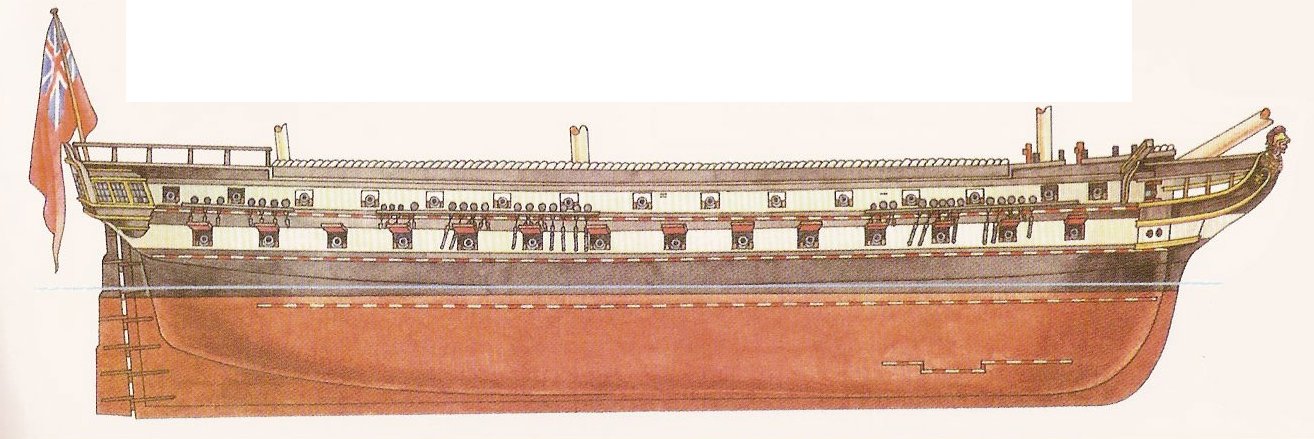
And the forty pound that is here mentioned to be paid by Samuell moody vnto my daughter Sara Browne abouesaid, if paid before, shall be paid backe againe unto the abouesaid Samuell Moody my Debts and funerall rites being discharged by my said executrix. In witness whereof I the aboue mentioned John Cutting haue sett my hand and seale october the two & twentyeth. In the yeare of our Lord one thousand sixe hundred fifty nine.

John (Seal) Cutting Witness: Anthony Somerby John Browne his marke Nicholas O Wallington Sworne in Court held at Ypswich the 27th of march 1660 by Anthony Sumerby to be the last Will and testament of John Cutting. Robert Lord Clerke Certified upon oath by John Browne to be sealed and subscribed by John Cutting in Court held at Ypswich the 27 (1) 1660. Robert Lord Clerke

27 May 1662 – Mary Cutting Miller granted to her daughter Sarah Browne “the freehold that my husband Cutting had” and the share in Plum Island that belongs to it.  This was done with the consent of her husband John Miller was signed the deed with her.

Children

1. John Cutting Jr.

John’s wife Mary Coffin was born 1615 in Devon, England. Her parents were Peter COFFIN and Joanna THEMBER. Mary died 6 Mar 1664 in Newbury, Essex, Mass.

John, Jr was noted as joint “master” of the ship “Desire” of Boston in 1641. John Jr married, prior to 1638, Mary (–) and they had a daughter Mary who married Samuel Moody. The latter two are mentioned in Capt. John’s will. It is assumed that John Jr died prior to the writing of the will. It is well established that Capt. John and his wife Mary had a daughter, Sarah, who married, prior to 1652, James Brown, born 1605 died 1676. They also are mentioned in Capt. John’s will. Sarah subsequently married, 29 Nov. 1677 at Newbury, William Healey and, as a third husband, Sarah married, 03 Dec.1685 at Newbury, Hugh March. There is, maybe, another daughter, i.e., Judith who supposedly married, in 1638, the above James Brown, as his first wife with Judith dying prior to 1652. Recognized documentary sources are divided on whether James Brown’s first, Judith, was a Cutting or a woman with a different surname.

3. Mary Cutting

Mary’s husband Nicholas Noyes who was born in 1616 at Cholderton, Wilts, England and died 09 April 1701. He was the son of Rev. William and Anna Parker Noyes.

What was evidently a family group of six, having decided to go to New England, took the Oath of Allegiance – John Woodbridge, George Brown, Nicholas Noyes, and Richard Brown – on March 24, 1633/34, Thomas Parker and James Noyes on March 26, 1634 – and all embarked on the Mary and John at Southampton, reaching Nantasket (now Hull) near Boston sometime in May 1634 and removed to Agwam (Ipswich) where they remained during the following winter. The Rev. Parker and friends remained in Ipswich until the following spring when they applied to the General Court for liberty to settle on the Quascacunquen in an area known as Wessacucon. May 6, 1635, the following orders were passed by the General Court:

– Wessacucon is allowed by the court to be a plantation & it is refered to Mr. Humfry, Mr. Endicott, Capt. Turner and Capt. Trask or any three of them, to sett out the bounds of Ipswich & Wessacucon or so much thereof as they can & the name of the said plantation in changed & hereafter to be called Neweberry.

Most of the passengers who came to New England in the ship “Mary & John” were induced to remove to Newbury early in the year 1635. Tradition asserts that they came by water from Ipswich and landed on the north shore of the Quascacunquen (now Parker) river, about two or three hundred rods below the bridge that connects the “Lower Green” with the “Great Neck” and the town of Rowley. A monument marks the spot where the settlers disembarked in May or June, 1635. Tradition states that young Nicholas was the first person to leap ashore when their boat anchored in the Quascacumquen (now the Parker) River. [John J. Currier, “History of Newbury” p.312; Sarah Anna Emery “Reminiscences of a Nonagenarian” p.112]. They joined 23 men and their families who formed a cattle-breeding company and were among the first settlers at Newbury where their children were born. Newbury’s first minister was a cousin, Thomas Parker.

Newbury Landing Site

Rev. Nicholas Noyes, in his account of his uncle, Rev. James Noyes, told of the coming of Mr. Parker, Mr. Noyes and his younger brother Nicholas Noyes, a single man, adding “between which three was more than ordinary endearment of affection, which was broken but by death.”

In the first allotment of lands granted to the settlers for house lot he did not receive any, probably because he was young and unmarried.

24 Feb 1636/37 – at a towne meeting it was agreed that Wm. Moody, James Browne, Nic. Holt ffrancis Plumer and Na Noyes shall lay out -all the generall fences in the towne that are to be made.

Nicholas took the Freeman’s Oath as “Nicholas Noise” in Cambridge on May 17, 1637 when he and eight others walked from Newbury to Cambridge to vote for Gov. Winthrop. Their immediate purpose was to strengthen Governor Winthrop’s Party and prevent the re-election of Sir Harry Vane. [Records of the Governor and Company of the Massachusetts Bay in New England, 1628-1686 (MBCR) 1:373].

17 May 1637 – Admitted Freeman.  Nicholas Noyes, we learn from the historian, Coffin, took great interest in Governor Winthrop’s campaign for the governorship against Sir Harry Vane, as the close of the latter’s term drew near. So Mr. Noyes, with nine others  including Thomas COLEMANJohn CHENEY,   Henry Sewall Jr, Nicholas Noyes [Cheney’s future father-in-law], Robert Pike [future founder of Nantucket, liberal dissenter, witch trial critic and son-in-law of Joseph MOYCE], Archelaus Woodman [Edward WOODMAN‘s half-brother], Thomas Smith, James BROWNE, Nicholas Holt [future son-in-law of Humphrey BRADSTREET, and John Bartlett, walked forty miles from Newbury to Cambridge on foot to take the “freeman’s oath” and qualify themselves to vote in the election which was soon to take place.  It was by such prompt movements that Winthrop was elected and the conservative party triumphed.

He was admitted to the Newbury church prior to 17 May 1637 implied by freemanship.

21 Apr 1638 – He was one of five men fined 2s. 6d. apiece for absence from Newbury town meeting after due warning. The meeting was called to order at eight o’clock in the morning. Two of the men (not Nicholas) had their fines remitted, having sufficient excuses.

It must have been very soon after this in 1638 that Noyes sailed on a voyage to England, possibly to settle family affairs and to report on conditions in Massachusetts Bay. He returned to New England on the Jonathan which sailed from London, probably soon after April 12, 1639, and “came to Anchor in Boston Harbor.” Also on theJonathan were Anthony Somerby of Newbury and Mr. Peter Noyes of Sudbury, who, having come over on the Confidence in 1638, aged 47, and found New England to his liking, had gone back to his home in Penton, near Andover, co. Hants, to fetch his family. Peter was doubtless a kinsman of Nicholas. [EQC 1:268; [New England Historical and Genealogical Register (NEHGR), 32:407-11].

12 Mar 1641 – He is recorded as having 4 shares in the stint of the ox & cow comon.

When it was proposed to remove the inhabitants of Newbury from their first settlement on the Parker river to a new site nearer the Merrimac, the name of Nicholas Noyes appears in the list of the ninety-one freeholders of the town and was a deputy “for the managing of those things that concern the ordering of the New Town” on Dec  7, 1642. When the lands at the “new towne” were laid out he had a lot “joyning South Street” now Parker street.

He was on the Ipswich and Salisbury grand jury, 29 Sep 1646, 24 Apr  1649 [EQC 1:103, 164]; petit jury, 28 Sep  1647, 26 Sep  1648, 25 Mar  1651 [EQC 1:124, 146, 210].

10 Dec 1646 – At a towne meeting the towne being informed that Mr. Thomas Parker was unwilling to act any longer in any matters concerning the new towne & that Mr. Cutting was going to sea, they were apprehensive of the weighty occasions of the towne that are likely to bee retarded, did make choyse of Nicholas Noyes & William Titcomb in their roome, to be added to the rest of the new towne men for sixe weeks that so things may with more speed be dispatched.

16 Dec 1646 – He was “sent” at the meeting  when orders and grants were made in regard to the removal of the town.

Apr 1647 – He was one of seven men chosen to “act in ye Prudential affaires of ye Towne for one whole year from ye date hereof” and was re-elected to this service Apr 27, 1648, and March 1, 1674/75 and as selectman, Mar 4, 1677/8, Mar 7, 1680/91 and Mar 11, 1683/84.

Apr 1647 – He was chosen way warden

At Salem Court, 6:5:1647, he was appointed one of the administrators of the estate of John Lowle [John LOWELLlate of Newbury, deceased, until the General Court takes further order.

At Ipswich Court 28:7:1647 he was one of the jury in the case of Mr. Symonds v. the Towne.

At the same court, Mr. William Gerrish, Richard Knight and Nicolas Noice, Administrators of the estate of John Lowell acknowledged judgment of £40 in favor of Persifall Lowell against the goods of John LOWELL.

The assignment of James Godfrey by Mr. Jo Spencer to Nicolas Noyce of Newbery, dated Oct 17, 1646 confirmed at Ipswich court 28:1:1648.

27 Apr 1648 – Thomas Marvyn was granted two akers of land lying near to the new pond on back side of Mr. Nicholas Noyes house lott at the new towne for his encouragement to kill wolves.

Nich Noyse in list of Jury of trials Ipswich court 26:7:1648 and 25:1:1651.

Nicolas Noyce one of, grand jury as Quarterly court Salisbury, 24:2:l649.

In 1650 Nicholas and four other men were before the court for saying that “the elders would transgress for a morsel of bread.” He lost no prestige thereby for on September 30, 1651, at Ipswich he was sworn clerk of the Newbury market. In 1652 many were brought before the court for not observing the Sumptuary laws of 1651. The records say “Nicholas Noyes’ wife, Hugh March’s wife, and William Chandler’s wife were each presented for wearing a silk hood and scarf; but were discharged on proof that their husbands were worth £200 each. John Hutchins’ wife was also discharged upon testifying that she was brought up above the ordinary rank.” [George F. Dow, “Records and Files of the Quarterly Courts of Essex County, Massachusetts (Salem, Mass., 1911), 1:303.]

19 May 1650 – Mr. Woodman, Henry Short, Nicholas Noyes & Richard Knight were chosen to lay out ” highways from all parts of the Towne to the mill and also to the farms.” This committee granted Richard Pettingell fourteen akers of Land in exchange for land given up for a convenient way for the town’s use.

Q. C. Ipswich, 24:7:1650, he was a witness in the case John Tillison fined for his many offences.

In the Registry of Deeds at Salem- Ipswich Deeds, vol. l. p, 183 there is a Transcript of the lands of Mr. John Spenser of Newbury, signed by Edward Rawson, William Titcomb, Edward Woodman and Nicholas Noyes.

12 Nov 1650 – Mr. Ed. Rawson, Mr. William Gerrish, Henry Short; Rich. Knight, Nich Noyes, and John Pike Junr issued an order requiring all the inhabitants of the town to record all sales and exchanges of land,

He was Newbury clerk of the market, 30 September 1651 [EQC 1:233; Selectman, 28 January 1660; 15 June 1681 [EQC 4:139, 8:148].

Nicholas was appointed “commissioner to end small causes”, or local justice, in 1652, 28 Mar 1654, 25 Mar 1656, 31 Mar 1657, 30 Mar 1658, 29 Mar 1659, 25 Mar 1662, 28 Jun 1664, 27 Mar 1666, 1668, 30 Mar 1669, 16 Mar 1669/70, 31 Mar 1674, 27 Mar 1677, 29 Nov 1681, 1683

His most important service, however, was as deputy to the General Court in 1660 and in 1678 when on September 19 he was chosen by the town “to serve at the next session of the Court until it be ended,” a special session having been called for October 2 at which the oath of allegiance to King Charles II was submitted and signed by the deputies; he served also 28 May 1679, 19 May 1680, and 4 Jan 1680-84.

Ipswich court 28:7:1652, in case of Richard Kent v. William Moody. For making use of the ten acres of land granted him by the town on the west side of Merimack Ridge. Richard Kent, Jr., acknowledged before Wm. Gerrish, Edward Woodman and Nicholas Noyes, commissioners that he broke the wedge of one of the bars, etc.

Also at the same court, declaration of Nicholas Noyes & John Pike in behalf of the town of Newbury, in the case of the town of Newbury v. Jo. Davis about some corn distrained for rates due from Mr. Clarkes farm now in possession of Jo. Davis, etc.

At the same court Nicholas Noyes and Anthony Somerby presented written testimony concerning Thomas Blanchard and his family who came with them to New England in the Jonathan about thirteen years before.

29 Nov 1652 – Mr Woodman, Richard Kent Jr Lieut Pike and Nicholas Noyes chosen to be “a committee for manageing the business of the school” that a school house be built and that £20 a year be appropriated for the schoolmaster. Evidently they failed to accomplish much business for on May 6, 1659 at Ipswich Quarterly Court, “Town of Newbury for want of a lattin scool” is ordered to pay five pounds to Ipswich Latin school unless by the next court they provide a Latin school-master according to law. [EQC 2:70].

13 Jun 1653 – Samuel Bidfeild, George Little, Anthony Somerby, Francis Plummer and Nicholas Noyes took the Inventory of the estate of William Stevens of Newbury reported at Salem Q.C. in July 1653.

29 Sep 1653 – His wife was brought into court for wearing a silk hood, and scarf, but was discharged because it was proved that her husband was worth two hundred pounds.

28 Mar 1654 – At Ipswich Court  Capt. Gerrish, Nicholas Noice and John Pike were sworn commissioners to end small causes for Newbury. March 29,1659, Mr. Edward WOODMAN, Nicholas Noyse and Lt. John Pike were sworn for the same service.

3 May 1654 – He was on the Massachusetts Bay committee to enquire about the petitioners in support of Lt. Robert Pike. 6 May 1657, he was on the committee to settle the bounds between Salisbury and Hampton

31 Mar, 1657 – Nicholas Noyse and John Pike were sworn.

30 Mar 1658 – Mr. Edward Woodman, Nicholas Noyse and William Titcombe were sworn,

29 Mar 1659 – Mr. Nicholas Noyse. March 25, 1662, Capt. William Gerrish, Mr. Edward Woodman & Nicolas Noyse were chosen and were re-elected for two succeeding years.

5 Mar 1665/56 – Capt Gerrish, Mr. Joseph Hill & Nicholas Noyes were chosen and were reelected for three terms.

3 Mar 1672/73 – Capt. Gerrish, Nicholas Noyes & Lieut. Woodman were chosen and reelected for three successive years.

5 Mar 1676/77 – Mr. John Woodbridge, Nicholas Noyes & Daniel Pearce Jr. were chosen.

9 Sep 1681 – Capt. Daniel Pearse Mr. Nicholas Noyes & Serg Tristram Coffin were
appointed.

19 Jul 1654 – Nicolas Noyes, Anthony Somerby and Robert (his mark) Adams were witnesses to lease of Richard Kent of Newbury, yeoman, to Lancilit Graneger of his great Island or farm.

Nicholas Noyes and John Allen took inventory of the estate of William Mitchell,
26:7m: 1654.

Nicholas Noyes and Capt. William Gerrish were appointed to interview those who had signed the petition asking the release of Robert Pike, which was presented to the Generall Court, May 14, 1654 and to make a report of the reasons given at the October session of the court.

Henry Fay who died June 30, 1655, owe Nicholas Noyes 10s.

21 Sep 1655 – Mr Nicholas Noyes of Newbery, gent. and Robert Long of Newbery, weaver, were appointed attorneys for Thomas Noyes of Sudbury, yeoman, to let his house and lands in Newbury, formerly Henry Fay’s.

Thomas Noyes of Sudbury, son of Peter Noyes, had apparently settled in Newbury, but returned to live in Sudbury before 1656 when he appointed his friend Mr. Nicholas Noyes, gentleman, and Robert Long, both of Newbury, his attorneys to let his house and lands.

14:3m: 1656: In answer to the pet of the inhabitants of Salisbury in refference to the settling of the bounds between Hampton & them, the (General) Court hath nominated Lieut John Applton, Mr Joseph Metcalfe & Mr Wm Bartholmew of Ipswich, Nico Noyce & Daniel Pearce of Newbery who are hereby empowred a commissiors to act in this case according to former orders of court; & whatsoever they or ye major pt of them shall conclude in reference to the sd bounds mentioned in the pet to stand firme & good pvided that Capt Nico. Shapleigh of Charles Towne be pcured by the ptyes to assist the commissionors in drawing out a plott & rüning the line according to their direction; the charg of the commissiors to be borne equally by both townes & the artist to be payd by Salsbury only & that a true returne be made of what is done herein to the next session of this court to be ratifyed & confirmed. Apparently the results of this committees work was not agreeable to the parties concerned, for on 6 May 1657, these bounds not per-fected & settled to the satisfaction of the parties the same committee members were recalled to repeat the service. 26:9:1656, at Salem court. Will of Mr. James Noies of Newbery was proved by Capt. Wm Gerrish and Nicholass Noies. Sara Noyes, the widow swore to the inventory, 21 Nov. 1656, before Edward Woodman and Nicholas Noyes.

At a meeting of the selectmen Jan. 26, 1656/57, Henry Short & Nicholas Noyes stated that there was a way through Richard Kents Island from the way that is 1aid out thru  John Cheny’s land to the way that is laid out over the marsh. 29 7:1657, Richard Kent sued John Cheny at Ipswich court. For denying him a way where it was laid out. John Chenye ordered to make this way laid out by the town sufficient, as Mr. Nicholas Noyes and Henry Short should judge.

9 Apr  1657 – At Ipswich court, in the case of William Titcombe presented for lying at a general town meeting when they voted for governor, it was reported that Richard Brown. Henry Jaquish, John Knight, Captain Gerrish, Nicholas Noyes, Richard Knight, Atony Sommarbee, Henry Lunt & Heu March had been arbitrators in the matter.

19:9:1657, at Ipswich court, Nicholas Noyes and Joseph Noyes deposed in the case of John Chater presented for detaining a steer that was lost out of Mr. Noyse herd.

26 May 1658 – The General Court “In answer to the petition of seuerall other inhabitants of Newbury informing of disorders dc in ye last peticon of theire neighbors, the Court judgeth it meete to declare that the execution of what is passed in referenc to ye former petition be suspended, and the case to be in status quo; & it is ordered yt the secretary issue out his warrant agt the next Gennerall Court to Jno Emery, Jno Webster & such others as are named in the papers brought into the Court, to appear before the Generall Court in October next to answer wt is laid agt them for theire abusive carriages in that petition & yt Hen Short, Rich Kent, Rich Knight, Nicholas Noyes & Anthony Somers by then also appeare & make good wt they chardge agt the other persons.

Mr. Nicho Noyes served as Deputy to the Generall Court Dec. 9, 1660, May 18, 1678, May 19, 1680, & Jan. 4, 1680/81.

Richard Brown in his will proved 24 June 1660 “appownt my loving friends Richard Kente, Nicholas Noyes and Robert Long my overseers to put in exicution this my wille and testament.”

25 Mar 1662 – At Ipswich court, Nicholas Noyes and Hugh Marsh in the name of the selectmen of Newbury v Willm Sawyer for detaining and not resigning up ten acres of salt Marsh. Withdrawn.

28 Apr 1662 – Nicholas Noyes, George Abbott, Richard Parker & Nathan Parker took inventory of the estate of John Stevens of Andover.

28 Jun 1662 – Nicholas Noyce & Samuel Moody took the inventory of the estate of John Brabrooke.

At a meeting of the commissioners of Newbury, Aug. 27, 1662, Mr. Woodman, Capt. Gerrish & Nicholas Noyes being present, in the case of Samuell Plumer attorney for his father v. Richard Dole for cutting and carrying away hedging stuff from land of Francis Plumer. The commissioners found for the plaintiff. Richard Dole the defendant appealed to next Ipswich court. Sept. 30 at Ipswich court the verdict was given the defendant Samuel Plumer, upholding the decision of the commissioners.

Inventory of the estate of Rev. William Worcester of Salisbury was taken, 6:9:1662 by Edward French Richard Wells and Nicholas Noyes.

8 Jun 1663 – When John Bishop sold his mill to Peter Cheney the record reads “it standeth upon the Little River between the land of Nicholas Noyes on the south-west and land lately purchased by the town of Capt. William Gerrish.”

In the inventory of the estate of Robert Rogers of Newbury, who died Dec. 23, 1663: -“in Nicholas Noyce, his handes, 18s.”

When Mary Miller, his mother-in-law made her will on “nouemb: 26th 1663, “she gave “two oxen that is in my son Nicholas Noyes his hands I give to my said son Nicholas prouided that he pay also to my said Daughter Sara Browne eight pounds out of the said oxen”. She also made a bequest to “my daughter Mary the wife of Nicholas Noyes”.

Sept. 11, 1666, he was one of those who signed the petition to the General Court, asking the adoption of conciliatory measures and the repeal of all legislative acts displeasing to the king.

30 Mar 1669 – He was one of the witnesses to the letter sent to Ipswich court by Richard Kent, Henry Short and Anthony Somerby making complaints against Mr. Edward woodman who spake in a town assembly against Mr. Woodbridge (Coffin p 74)

30 Sep 1679 – “Nicholas Noyes” was one of ten Newbury men who “were discharged from ordinary training, each paying one bushel of Indian corn yearly” [EQC 7:263-64].

In the long and bitter controversy between Rev. Mr. Parker and Edward WOODMAN Nicholas was one of Parker’s chief supporters. He was chosen deacon of the First Parish of Newbury on March 20, 1683/84.

Sometime before his death his son Nicholas, the Salem parson, wrote of him as “through the mercy of God yet living, and hath of children, grandchildren and great grandchildren above one hundred.”

ESTATE:

On 19 March 1648[/9?], “John Spenser of Newbery” sold to “Nicholas Noice of Nubery … thirty acres of land lying in Newbury at the west end of his farm on the other side of the street called by the name of Merrimack Street” [ILR 1:95]. On 16 April 1651, “Nicholas Noyes of Newbury …, yeoman,” sold to “George Little of the same town and county, tailor, all that parcel of land, containing sixteen acres … in Newbury”; acknowledged 11 April 1664 by “Nicholas Noyes … and Mary Noyse his wife” [ILR 4:186-87]. On 4 January 1653[/4?], “Henry Shorte of Newbury …, yeoman, & Sarah my wife” sold to “Nicholas Noyes of the aforesaid town & county, yeoman also, all that parcel of land formerly purchased of Nicholas Holt, containing forty acres … in Newbury” [ILR 5:421].

26 Apr 1655 -“Nicholas Noyes of Newbury … & Mary my wife” sold to “John Allen of the abovesaid town & county all that parcel of land which was lately William Mitchell’s, which the said William Mitchell purchased of Jno. Knight Senior & John Knight Junior and of John Davis, except the garden plot & the house & that which the house standeth upon & is for the yard, the which land & house being mortgaged unto Anthony Somerby lately by William Mitchell in his lifetime & since his death his wife not being in a capacity to redeem, the said Nicholas Noyes, with the consent of the widow of the said William Mitchell, deceased, have redeamed it the said house and land, and now also with the consent of the said Mary, the relict of the said William Mitchell deceased, & with the consent also of the abovenamed Anthony Somerby to whom the said land and house was mortgaged, he and said Anthony Somerby yielding hereby up all his right & title and interest in the said house & land”; signed by Nicholas Noyes, Mary Noyes, Mary Savory and Anthony Somerby [ILR 1:195-96].

13 Oct 1659 – “John Woolcott of Newbury …, carpenter, and Mary my wife” sold to “Nicholas Noyes of the said town and county all that six acres of upland and marsh … lately purchased of Benjamin Swett, granted by the town to Thomas Brown” [ILR 2:69]. On 14 March 1660[/1?], “John Bond of Newbury … & Esther my wife” sold to “Nicholas Noyes of the abovesaid town & county all that parcel of meadow and upland containing by estimation about nineteen acres” [ILR 2:26].

1 Apr 1673 – “Nicholas Noyes and Mary my wife” for a payment of four pounds a year deeded to “our son Cutting Noyse all the right that we have in that farm lying and being on the east side of the way going to Merrimak [illegible] was formerly Stephen Dummer’s … likewise I Nicholas Noyes do reserve four acres of meadow … which is in exchange for Cutting Noyes to have four acres of salt marsh in Holt’s neck, likewise it is agreed upon by Nicholas Noyes and Mary his wife that if the four pounds a year be not paid according to agreement, that then five acres of the plowland and ten acres of the meadow on the south side of the farm the said Nicholas Noyes or Mary his wife may rent out” [ELR 33:8-9].

6 Apr 1682 – “Henry Jaquish of Newbury …, carpenter, … with the consent of Anne my wife” sold to “Nicholas Noyes of the abovesaid town …, yeoman, … a parcel of salt marsh lying and being in the Great Marshes in Newbury containing by estimation four acres” [ELR 14:217].

5 Jul 1692 – “Nicholas Noyes Senior of Newbury” sold to “Ensign Joseph Knight of Newbury aforesaid all my right, title & interest in a piece of arable land containing three acres … in the township of Newbury aforesaid in a common field there known by the name of the Common Great Field” [ELR 22:146].

9 Apr 1696 – “Nicholas Noyes of Newbury” sold to “Samuel Smith of Haverhill … a certain messuage or tenement lying in Haverhill aforesaid containing about twelve acres of land … also three acres of meadow lying in said Haverhill … commonly known by the name of Duck Meadow” [ELR 25:103-4].

19 Apr 1698 – “Nicholas Noyes Senior of Newbury” deeded to “my loving and dutiful grandson Nicholas Noyes of Newbury aforesaid, the eldest son of my eldest son John Noyes late of Newbury deceased, … about eighteen acres of upland lying in the township of Newbury … by name of Deacon Noyes His Neck adjoining unto a parcel of upland which I formerly gave to my son John Noyes deceased …, also I give to my said grandson Nicholas Noyes Junior eight acres of meadow … lying in said neck adjoining unto the meadow which I gave to my said son John Noyes aforesaid and was inventoried as his estate” [ELR 15:41-42].

The homestead of Nicholas Noyes was owned and occupied in 1885 by the heirs of Nathaniel Little.

4. Sarah CUTTING (See James BROWNE‘s page)

Sources:

From Abel Lunt 1963 by Walter Goodwin Davis

http://www.jackson-flint.org/Pedigree/jackson/aqwg88.htm#1192

http://stanleyhistory.net/descnarratives/cuttingjohn3406.shtml

Posted in 13th Generation, Immigrant - England, Line - Shaw, Pioneer, Public Office, Sea Captain | Tagged , , , , , | 19 Comments

James Browne

James BROWNE (1605 -1676) was Alex’s 10th Great Grandfather; one of 2,048  in this generation of the Shaw line.

We have five separate Brown lines and seven different Brown immigrant ancestors, by far the most of any surname.  When the surname is of English origin it is derived from a nickname concerning the complexion of an individual, or the colour of their hair. Brown is derived from the Old English brunbrūn; Middle English brunbroun; or Old French brun.

1. John BROWNE Sr. (Swansea). (1583 Hawkedon, Suffolk  – 1662 Swansea, Mass)
John BROWN Jr.  (1620 -1662 Rehoboth, Mass)

2. John BROWN (Hampton) (1589 London – 1677 Salem, Mass)

3.  Nicholas BROWN (1601 Inkberrow, Worcester – 1694 Reading, Mass)

4. James BROWNE (1605 Southhampton, Hampshire  -1676 Salem, Mass.)

5. Thomas BROWNE (1607 Christian Malford, Wiltshire – 1687 Newbury, Mass.)
Francis BROWN I (1633  Christian Malford, Wiltshire – 1691  Newbury, Mass.)

James Browne was born in 1605 in Southhampton, Hampshire, England. His parents were JOSEPH BROWNE and Sarah [__?__].  He married Judith CUTTING about 1637.  After Judith died, he married her sister Sarah Cutting in 1646. in Charlestown, Mass. He lived in Charlestown until about 1660, then moved to Newbury and finally Salem as early as 1672.  James died on 3 Nov 1676 in Salem, Mass.  Will dated 29 Jan 1674, probated 29 Nov 1676.

James Brown and his son were glaziers.  Work consisted  of glass-blowers, boiler men, glaziers and glass carriers.

Judith Cutting was born in 1616 in Ipswich, Suffolk, England.  Her parents were Capt. John CUTTING and Mary WARD.  Judith died between 1643 and 1646. Some researchers don’t believe a 17th Century man would have  married his wife’s sister and think that this must have been a different Judith.  See Walter Goodwin Davis’ analysis at the bottom of this page.

Sarah Cutting was born 1628 in Ipswich, Suffolk, England.  She was admitted to the Charlestown church 14 Mar 1652. After James died, Sarah married William Healy Sr of Cambridge on 29 Nov 1677. Finally she married Hugh March Sr on 3 Dec 1685 in Newbury. Sarah died 25 Oct 1699 in Scarbough, Maine. There were two James Browns about the same age in Charlestown in the 1630’s.  The genealogist Coffin calls ours James Jun to distinguish him from Mr James Browne who was one of the first settlers of Newbury and called late teacher at Portsmouth in 1656.  James Brown was born in England in 1605 or 1617-18, and when “a youth of seventeen” came to America on the ship “James,” sailing from Southampton or Hampton, England, and arriving in Boston, June 3, 1635. This record may not belong to our James Brown or the age  may have been given wrong. This James Brown was known as James Brown, the glazier; settled first in Charlestown. Massachusetts. Children of James and Judith & Sarah:

Name Born Married Departed
1. John BROWNE Jun 4 Jan 1638 Newbury Mass Mary WOODMAN 20 Feb 1659 Newbury 1674
2. James Brown 20 Feb 1642 8 Aug 1643
3. James Brown (1st Child of Sarah) Aug 19 1647 Charlestown Hannah House (Huse)
16 Mar 1670
27 Feb 1708 Newbury
4. Nathaniel Brown 21 Nov 1648 Charlestown Children by 1st wife Before 1674
5. Sarah Brown 1652 Charlestown Robert Beasly
Before 1675
.
William Healy Jr
c. 1682
6. Samuel Brown 14 Jan 1656 Charlestown 15 Nov 1690 At Sea
7. Hannah (Anna) Brown 12 Sep 1658 Charlestown 1701
8. Abraham Brown 14 Oct 1660 Charlestown 13 Jan 1688 Newbury
9. Mary Brown 25 May 1663 Newbury After 1674
10. Abigail Brown 24 Oct 1665 Newbury After 1674
11. Martha Brown 22 Dec 1667 John Tappan 3 Sep 1688 Andover, Mass 4 Jul 1717

James, the glazier, was admitted a freeman May 17, 1637; hired Lovell’s Island of the town of Charlestown in 1636 and must have been of age at that time. He removed to Newbury where he was one of the proprietors in 1637 and was elected to various town offices. He removed again to Salem. He deposed December 29, 1658, that he was about fifty-three years old. That would make his year of birth 1605, and that is probably correct. He died at Salem, November 3, 1676. His will was proved November 29, 1676. bequeathing to wife Sarah; brother Nicholas Noyes; children, John, James, Samuel, Abraham, Anna, Mary, Abigail, Martha, Sarah Beasly; to eldest son John estate left by Henry Bright, of Watertown, for money lent him many years ago; estate at Newbury left to wife by her father, Captain John Cutting.

He married (first) Judith Cutting, daughter of Captain John Cutting, and (second) Sarah Cutting, sister of his first wife. She was born in 1605, according to her statement in 1658. Children: 1. John, born January 4, 1637-38. 2. James, born in 1642, died in 1643. 3. James, born August 19, 1647, mentioned below. 4. Nathaniel, born November 21,165—. 5. Samuel, born January 14, 1656-57. 6. Hannah, baptized September 2, 1658. 7. Abraham, baptized October 14, 1660. 8. Mary, born May 25, 1663. 9. Abigail, born October 24, 1665. 10. Martha, born December 22, 1667.

17 May 1637 – Admitted Freeman.  James Browne, we learn from the historian, Coffin, took great interest in Governor Winthrop’s campaign for the governorship against Sir Harry Vane, as the close of the latter’s term drew near. So Mr. Browne, with nine others including John CHENEY,  Thomas COLEMAN, Henry Sewall Jr, Nicholas Noyes [son-in-law of Capt. John CUTTING and Cheney’s future father-in-law], Robert Pike [future founder of Nantucket, liberal dissenter, witch trial critic and son-in-law of Joseph MOYCE], Archelaus Woodman [Edward WOODMAN‘s half-brother], Thomas Smith, Nicholas Holt [future son-in-law of Humphrey BRADSTREET, and John Bartlett, .walked forty miles from Newbury to Cambridge on foot to take the “freeman’s oath” and qualify themselves to vote in the election which was soon to take place.  It was by such prompt movements that Winthrop was elected and the conservative party triumphed.

Vane lost his position to the elder John Winthrop  in the 1637 election.  The contentious election was marked by a sharp disagreement over the treatment of John Wheelwright, a supporter of Anne Hutchinson [daughter of our ancestor Francis MARBURY  (1555–1611) (wikipedia)] Winthrop won in part because the location of the vote was moved to Cambridge, reducing the power of Vane’s Boston support.  In the aftermath of the election Anne Hutchinson was put on trial, and eventually banished from the colony.

Many of her followers seriously considered leaving after the election. At the urging of  Roger Williams, some of these people, including Hutchinson, founded the settlement of Portsmouth on Aquidneck Island in the Narragansett Bay (later named Rhode Island and joined to Providence to form the Colony of Rhode Island and Providence Plantations).

Vane decided to return to England, apparently with the notion that he would acquire a royal governorship to trump the colonial administration.  Before his departure, he published A Brief Answer to a Certain Declaration, a response to Winthrop’s defense of the Act of Exclusion; this act was passed after the election to restrict the immigration of people with views not conforming to the colony’s religious orthodoxy.

Will

I James Browne of Salem being weak of body but of p[er]fect  memory do make this my last will & testament  Imprs (Imprimis) I give & bequeath unto my beloved wife Sarah my dwelling house & outhouseing with the ground adjoining lying hear in Salem during her natural life & at her decease to be disposed of as followeth

It[em] my will is that my eldest son John Browne whoe (who) have had his portion given him formerly, and doe further will & order, of that estate left by Henry Bright of watertowne deceased which is my proper right & due in consideration of money’s lent to him or paid for him many years ago, which said estate I leave My sonne to recover, all my right of interest in that estate, or that of right doe belongs to me, he the sd John Browne shall have the[re]on half thereof to himself his heirs & assignes, he paying the one half of the charges of what he recovers, And the other half of what estate he shall recover as aforesd to be to Sarah my said wife & to her heires & assignes for Ever

It[em] whearas there are certain routings drawne betweene my said wife & my said me James Browne bearing date 10 march 1672 wherein on my records part all the houseing & land lying in newberg Given & bequeathed to my said wife by her father John Cutting deceased in his last will and testament, are mad[e] over to my said son James Browne & to his heires for ever he on his part paying p[er] anum to his mother for [as] long as she lives for much as is exprest in sd ________ ________ (too light  and cut off at the end of the sentence here) & at her decease to paye or cause to be pd thirty five pounds to be pd for those of my other children according as is heare after exprest which is my will with the mutuall agreement of my said wife It[em]I give to my son Samuell my dwelling house & outhouseing with soe much of the ground belonging thereto begining next to Samuel Pickworth ground & from therin, northerly to take in one pole beyond on the north side of the barne, & for right cross the ground from the high waye to John Gedney deceased his ground, to have & in joye the saime, to him his heirs & assignes for Ever,

next after his mothers decease he  paying fifteene pounds for the use of my daughters, to be devided as is heareafter expressed, & my will is that my Sonn Samuell shall live with his mother to be helpful to his mother untill he come to the age of one & twenty yeares It[em] I give to my Son Abraham, about thirty two pole of ground, belonging to my dwelling house to begin at one pole beyond the barne as aforesaid,  & to extend fouer pole in bredth next the high waye, & for to run right crosse the same bredth to the land of John Gedney,  aforesd,  to have & to injoye the same to him his heires & assignes, next after his mothers decease, but in case the Said Abraham depart this life before he come to the age of twenty one yeares  then the said p[ar]cell of ground to fall to my Son Samuell and further my will is that my son Abraham shall be under my care & dispose the time after he have erned his apprenticeship until he come to the age of one & twenty yeares It[em] I give unto my said wife Sarah, the use of the ground, beyond that thirty two pole of ground given to my Son Abraham, northward to the ground of John Cromwell for her to dispose of for the payment of my debt made for her necessary use [for]the time of her life, And in case she be________ ______ _____ (cut off at the end of the sentence here) nessessitated to sell the said land in her life time, for paiment of debts for her necessary use, then at her decease my Son Abraham shall injoy it,  he paying fouer fifths of the value there of for the use of his four Sisters viz: Anna mary, Abagaile & Martha, equaly to be devided amongst them or the longest livers of them,  if any dye before they come to the age eighteen yeares or married,

And further my will is that the thirty five pounds that my Sonn James is to paye & fifteene pounds that my son Samuell is to paye at there mothers decease, which is fifty pounds in all, be equally devided amongst my five daughters, viz: Sarah Beazely, Anna, mary Abigaile & martha Browne, that is to Say ten pounds each of them, to be paid at theire mothers decease at the age of eighteene yeares or marriage & my will is that in case that in case (written twice) any of them dy before they come to age or are marryed then her or theire part to sale to those of my daughters that doe survive to be equally devided amongst them Lastly I give to my Said wife, all the use of my Said estate when my debts are paid, & doe appoynt her my sole executrix of this my will & doe appoynt  my brother Nicholas Noyer , And Hilliard  Veren Sen[ior] to be overseeres, & heare unto I have Set  my [hand] & Seale, this 29 of January 1674

witnes: Hilliard Veren Sen[ior]
James Browne & a Seale Samuell Pickworth Hilliard Veren gave oath in court at Salem 9:9:76 that he was p[re]sent when the said James Browne signed, sealed, & declared the above written as his last will and testament & that there is noe later will of his that he knows of & further that he saw the said pickworth set his hand as witness: attested Hilliard Veren   Clry  (Clergy?) The Inventory of ye goods of James Browne Sen(ior) lately deceased taken by Nicholas Noyer & Nathaniell Beadle whoe deceased 8:9:1676

Sources: pg 362 – Sarah married (1) John Browne of Charlestown, later of Newbury and …

Children 

1. John BROWNE Jun (See his page)

3. James Brown

James wife Hannah House (Huse) was born about 1649 in Charlestown, Mass. Hannah died 18 Nov 1713 – Newbury, Essex, Mass.

James Jr  was also a glazier by trade. By James’  29 Jan 1674 Will son Samuel received his father’s dwelling house and ground in Salem next to lands of Samuel Pickworth and John Gedney

5. Sarah Brown

Sarah’s first husband Robert Beasly
.
Sarah’s second husband William Healy Jr was born 11 Aug 1652. His parents were William Healy and Mary Rogers. William died in 1697 – Boston, Suffolk, Mass.

11. Martha Brown

Martha’s husband John Tappan was born 24 Dec 1645 in Newbury, Essex, Mass. His parents were Abraham Tappan and Susanna Taylor. John died Dec 1717 in Newbury, Essex, Mass

From Abel Lunt 1963 by Walter Goodwin Davis

New England marriages prior to 1700 By Clarence Almon Torrey, Elizabeth Petty Bentley

http://www.bradleyfoundation.org/genealogies/Bingley/tobg04.htm#37323

The old families of Salisbury and Amesbury, Massachusetts: with some related

http://freepages.genealogy.rootsweb.ancestry.com/~hwbradley/aqwg3287.htm

http://www.genpc.com/gen/files/d0013/f0000010.html#I15559

Historic homes and places and genealogical and personal memoirs …, Volume 3 edited by William Richard Cutter

http://www.genpc.com/gen/files/d0013/f0000010.html#I15559

A sketch of the history of Newbury, Newburyport, and West Newbury, from 1635 to 1845 (1845) By Coffin, Joshua, 1792-1864; Bartlett, Joseph, 1686-1754

Posted in 12th Generation, Immigrant - England, Line - Shaw | Tagged , , | 18 Comments