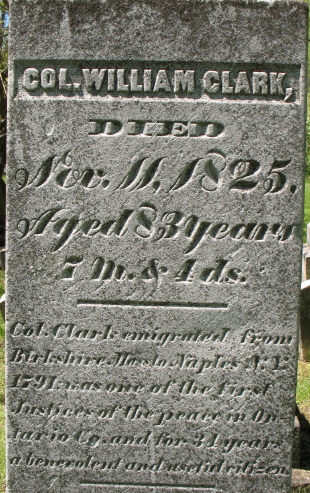
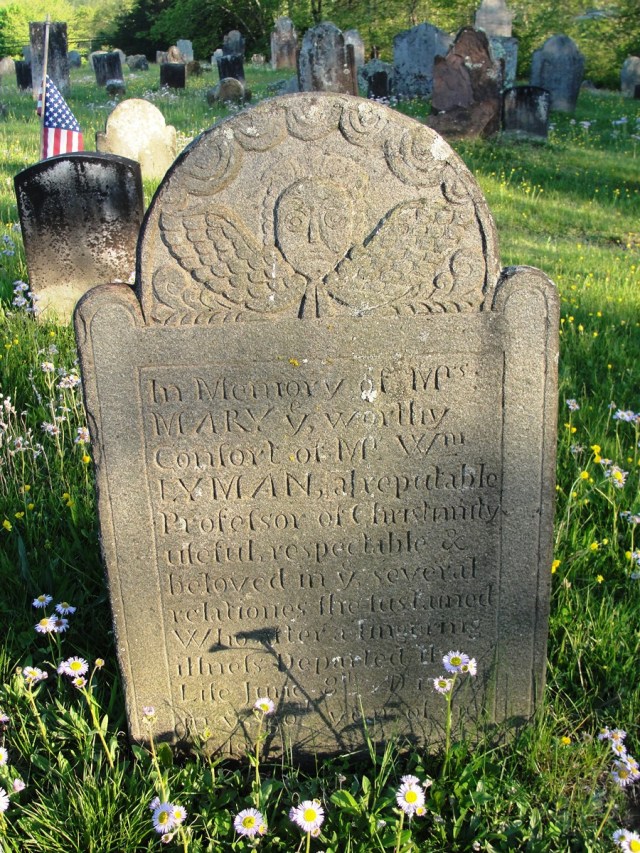
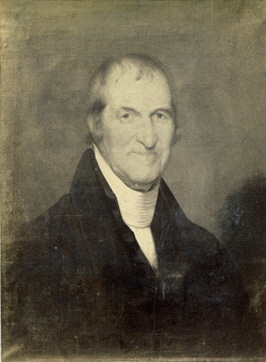
Elder John Strong

Elder John STRONG (1605 – 1699) was Alex’s 9th Great Grandfather; one of 1,024 in this generation of the Miller line.

John Strong was born in 1605 in Chard, Somerset, England.  His parents were Richard STRONG and Eleanor DEAN.  He married Margerie Dean in 1625 in Somerset, He sailed in on the Hopewell, Master John Driver from Weymouth, Dorsetshire, England on 8 May 1635 with his wife and their two children:  John Jr age 2 and an infant plus John’s sister Eleanor age 22.

Some sources state he came to America in the year 1630 the Mary and John from Plymouth in England, in company with Mr. Wareham Maverick, Mason, Clap, etc., and arrived at Nantasket on the 30th of May, of that year, and settled in Dorchester.  His future wife Abigail Ford was on board, but John Strong is only a “maybe” on the passenger list.

After Margerie died, he married Abigail FORD in Dec 1635 in Dorchester, Mass.  John died 14 Apr 1699 in Northampton, Mass.

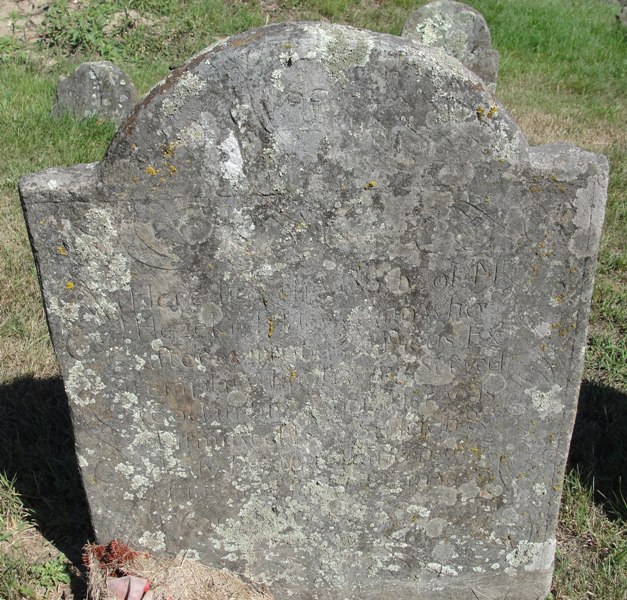
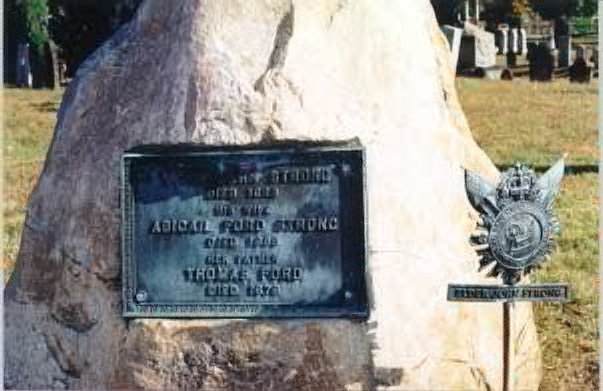
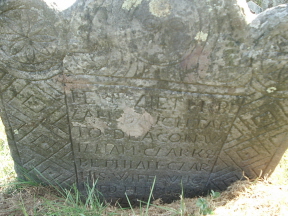
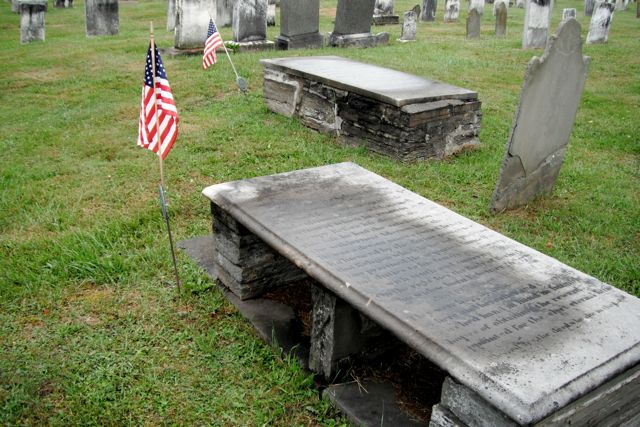
Elder John Strong Memorial –  Bridge Street Cemetery, Northampton, Hampshire Co., Massachusetts

Margerie Dean was born in England.  Her parents were William Dean and [__?__]. She and John had one son: John Strong Jr.  John Jr. was born about 1626 in England.  He married Mary Clark on 26 Nov 1656. John Jr died 2 Feb 1697/98 in Windsor, CT.    Margerie and her baby Joseph Jerijah Strong died during a difficult childbirth in 1635 in Hingham or Taunton, Mass.

Abigail Ford was born on 8 Oct 1619 in Bridport, Dorset, England.  Her parents were Thomas FORD and Elizabeth CHARD. She emigrated with her parents in 1630 on the Mary & John.  Abigail died 6 Jul 1688 in Northampton, Mass.

Children of John and Margerie Dean:

Name Born Married Departed
1. Thomas Strong
2. John Strong bapt.
22 Jul 1634
England
Elizabeth Warriner (Sister of William WARRINER)
1664 in Windsor, Hartford, CT
.
Hannah Smith
2 Nov 1686 in Windsor, Hartford, CT
20 Feb 1697
Windsor, CT
3. Joseph Jerijah Strong 1635 1635
at two months.

.
Children of John and Abigail:

Name Born Married Departed
4. Thomas Strong c. 1637 Dorchester, Mass. Mary Hewitt
5 Dec 1660 Northampton
.
Rachel Holton
10 Oct 1671
3 Oct 1689 Northampton Mass.
5. Jedediah Strong 7 May 1637 Hingham, Mass. Freedom Woodward
18 Nov 1662 Northampton
.
Abigail Stebbins
28 Dec 1681 Northampton
.
Mary Hart
5 Jan 1691/92 Northampton
22 May 1733 Coventry, Tolland, CT.
6. Josiah Strong 1639
Mass.
1726 Taunton, Bristol, Mass.
7. Return Strong 9 Apr 1640 Taunton, Bristol, Mass. Sarah Warham
11 May 1664 Windsor, CT
.
Margaret Newberry
23 May 1689 Windsor, Hartford, CT
.
[__?__]
c. 1707
9 Apr 1726 Northampton
8. Ebenezer Strong 1643
Taunton, Mass
Hannah Clapp
14 Oct 1668 Northampton
11 Feb 1728/29 Northampton
9. Abigail Strong 1645 Taunton, Mass Nathaniel Chauncy
12 Nov 1673 Dorchester
.
Medad Pomeroy
8 Sep 1686 Northampton Mass
15 Apr 1704 Northampton
10. Elizabeth Strong 29 Feb 1647/48 Windsor, CT Coronet Joseph Parsons
17 Mar 1668/69 Mass
11 May 1737 Northampton
11. Experience Strong 4 Aug 1650 Windsor,  CT Zerubbabel Filer
27 May 1669 Windsor, CT
20 Oct 1714 Windsor, CT
12. Samuel Strong 5 Aug 1652 Windsor, CT. Esther Clapp
19 Jun 1684 Mass.
.
Ruth Sheldon
28 Oct 1698
29 Oct 1732 Northampton
13. Joseph Strong 5 Aug 1652 Windsor, CT
(Twin of Samuel)
23 Dec 1762 Windsor, CT
14. Mary Strong 26 Oct 1654 Windsor,  CT John Clark (Son of Lt. William CLARK)
20 Mar 1678/79 Windsor, CT.
8 Dec 1738 Northampton
15. Sarah Strong 26 Oct 1656 Windsor, CT Joseph Barnard
19 Dec 1675 Windsor, Hartford, CT
.
Jonathan Wells
23 Sep 1698 Wethersfield, Hartford, CT
10 Feb 1732/33 Deerfield, Hampshire, Mass.
16. Hannah STRONG 30 May 1659 Northampton Capt. William CLARK
15 Jul 1680 Northampton Mass.
31 Jan 1693/94 Northampton Mass
17. Hester Strong 7 Jun 1661 Northampton Thomas Bissell
15 Oct 1678 Windsor,  CT
4 Mar 1725/26 Windsor, CT
18. Thankful Strong 25 Jul 1663 Northampton Jonathan Baldwin
1694
Windsor, CT
5 Mar 1725/26 Milford, CT
19. Jerijah Strong 12 Dec 1665 Windsor, CT Thankful Stebbins
18 Jul 1700 Northampton
24 Apr 1754 Northampton

John lived in England at Taunton, the county seat of Somersetshire. His father, whose name was Richard, died while his son was young. His grandfather, who was a Roman Catholic, lived to be very old, but died before his grandson left England.

He married his first wife in England, who died soon after landing in America leaving two young children, the youngest of which died in two months after its mother.

He married second to Abigail Ford (sister to Captain Clap’s wife), at Dorchester in 1635, or 1636. He afterwards removed from Dorchester to Windsor in Connecticut, and with four others, to wit : Messers. John MASON, Ludlow, Wolcott, and Thomas Stoughton [son of Rev. Thomas STOUGHTON Sr.], was appointed to superintend and bring forward the settlement at that place. He lived there several years and from there removed to Northampton, in 1659 or 1660, where he died, April 14, 1699, about 94 years old. He was the first ruling elder of the church in Northampton. His wife died July 6, 1688. A sister of his came with him from England, who afterwards married Walter Dean.  Fifteen of his children grew up and married, more than any other of our ancestors.  He had 24 son and daughter in-laws, again more than any other ancestor.

John served as constable at Taunton. Sometime before 1645 the family moved to Windsor, CT where his father in law was a large land holder. After living fifteen years at that young settlement, the Strongs returned to Massachusetts, settling at Northampton in 1660. As well as plying his trade as a tanner, John was appointed the first ruling elder of the church at Northampton. He died there April 14, 1699, his wife, Abigail, preceeded him in death July 6, 1688.

HINGHAM, MASSACHUSETTS
Land granted, 18 September, 1635, for five acres of land on North Street near Ship Street, Hingham, Plymouth Colony, Massachusetts.

Freeman on 9 March 1636/37

TAUNTON, MASSACHUSETTS:
House lot on Dean Street west of John Dean house.

4 Dec 1638 – Freeman of Plymouth Colony

First Constable, 1638 and 1639, juror 1645.

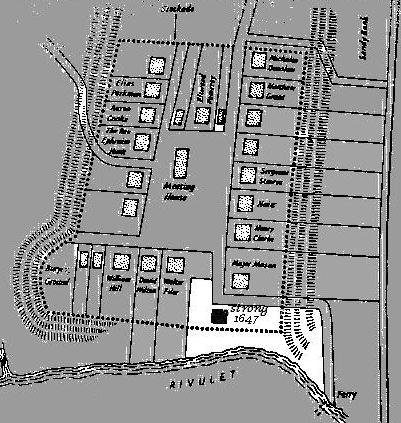
John’s lot was by far the largest in early Windsor Connecticut

4 Feb 1647 – “Thomas Thorton al his land formerly recorded in figures is sold to Thomas Ford and John Strong where the particulars fully apperar….”

This included a house, out house, yards, orchards and gardens containing about two acres, more or less, bounded north and west by the land of Walter Fyler, south by the rivulet, on the east by the highways, and adjoining at the foot of the hill, in the great meadow, one acre and three quarters more or less bounded north by the land of John Mason and east by the land of William Hill [Windsor Register of Deeds]

15 May 1654 – Freeman of Connecticut.

NORTHAMPTON, MASSACHUSETTS:

1663 – John Strong was ordained and Elder of the church.

14 Oct 1660 – John Strong bought from John Webb, a parcel of land lying in the Third square and bounded by land of Richard Lyman on the north and the highway on the south and on the sides bordering the land of David Wilton on the east by Samuel Allyn on the west – Seven acres .

John Strong bought another parcel from John Webb, a home lot bounded on the highway east and north and the mill trench on the west containing two acres. Part of this was given to his son Samuel.

John Strong bought another parcel from John Webb, which lies on the south side of Mill River and bounded by the highway east and west, the sides bordering the highway south and Mill River north containing – two acres.

15 Oct 1660 – Northampton granted to him several parcels of land including a tan yard which was bounded on the east and west by the highway, north by Ralph Hutchinson’s land and the common land, and the meeting house hill on the south. John gave this to his son Ebenezer, on 15 Dec 1688.

The original tan yard contained one quarter acre. It was on King Street Brook a little north of Hampshire Marble Works. The town by vote directed all hides be taken to him to be tanned at his own price because of his reputation for honesty.

15 Oct 1660 – Northampton granted to him his home lot which was bounded on the highway north and Mill River on the south and bounded on the sides by the land of Capt. Aaron Cooke on the east and Alexander Edwards on the west. John Strong conveyed these parcels to John Webb 18 Oct 1660.

The home lot granted to him by Northampton on West Street was nearly opposite the Parson’s Homestead. He sold it to John Webb, and purchased John Webb’s home lot at the corner of Main and South Streets [today in Easthampton]. The property remained in the family for 103 years.

Northampton granted John Strong another parcel of land in Manham Meadow which butts up on the Great River on the east and Mill River on the west containing four Six acres plus. John gave half of this lot to Ebenezer, 15 Dec 1688.

Children

1.  John Strong

John’s first wife Elizabeth Warriner was born 1640 in Windsor, Hartford, CT. Her parents are not known, but She was probably a brother to our ancestor William WARRINER.  Elizabeth died 7 Jun 1684 in Windsor, Hartford, CT.

John’s second wife Hannah Smith was born 24 Jan 1647 in Rowley, Essex, Mass. Her parents were Hugh Smith and Mary Ellsworth. She first married 6 May 1669 in Rowley, Essex, Mass to Joseph Trumbull (b. 19 Mar 1647 in Rowley, Mass – d. 15 Aug 1684 in Suffield, Hartford, CT). She married John Strong 2 Nov 1686 in Windsor, Hartford, CT. Finally, she married 16 Jun 1698 in Windsor, Hartford, CT to Nicholas Buckland (b. 24 Mar 1646 in Windsor – d. 24 Aug 1728 in Windsor). Hannah died 21 Mar 1719 in Northampton, Hampshire, Mass.

John was the only surviving child of his father’s marriage to Margerie Dean marriage born before 22 July 1634 when he was named with his mother in the will of his grandfather, William Deane of Southchard, Chard, Somerset, England.

John was a tanner and spent his life in Windsor, CT. He was a man of prominence in the affairs of that city.

His family was not mentioned in the will of Elder John Strong having received, along with his brother Return Strong the Tanneries in Windsor as his inheritance portion.

The inventory of the estate of John Strong, was taken Feb 28, 1697/98; it names the children as

– John Strong, age 32,
– Jacob, 25;
– Josiah, 19;
– Mary Stanly, 40, and
– Hannah Hopkins, 36.

The following month, two agreements were made by the heirs, the first relating to the dower of the widow Hannah Strong, who is called mother-in-law [stepmother] of the sons; the second, relating to distribution to the children, signed by John, Jacob and Josiah Strong, Return Strong, as the guardian of Josiah, and Timothy Stanley and John Hopkins.

4. Thomas Strong

Thomas’ first wife Mary Hewett was born 2 Aug 1640 in Dorchester, Suffolk, Mass. Her parents were Ephraim Hewett and Isabel Overton. Mary died 20 Feb 1671 in Northampton, Hampshire, Mass.

Thomas’ second wife Rachel Holton was born in 1650 in Northampton. Her parents were William Holton and Mary Winche.   After Thomas died, she married May 15, 1698. as his third wife, to Nathan Bradley (1638 – 1713).    Rachel died in 1714 in Madison, New Haven, CT.

Thomas was a trooper in 1658, at Windsor, under Major  John MASON (recorded March 11, 1657-8). He removed to Northampton with his father in 1659.

Of his 15 children,  all but one were living at his death, nine of whom were under 15 years of age, after which one more was born. He died intestate. His estate was inventoried at £379  14 sterling. The estate of his son Hewett was £28  and divided equally between his three brothers and sister, children of Mary Hewett.  John, brother of Hewett died insolvent. Thomas Strong was a farmer.

By the will of Thomas Strong, his eldest son Thomas had “half the house and homestead forever; hoping he will come and live there and so be a help to his mother-in-law.” The mother had ” the whole of the rest of the estate for five years to bring up the children; then the estate to be divided according to law, Thomas to have a double portion – he to pay if half of whole is too much”.

The patriot Nathan Hale is his 2nd Grandson.  Children of Thomas and Rachel include:

vii. Joseph Strong (Elder John’s Grandson) b. 2 Dec 1672 Northampton, Hampshire, Mass. d. 23 Dec 1763, Coventry, Tolland, Connecticut; m. Sarah Allen 1694 in Northampton, Hampshire, Mass. Children of Joseph and Sarah include:

b. Joseph Strong  (Elder John’s Great Grandson) b. 25 Jul 1701, Northampton, Hampshire, Mass. d. 9 Apr 1773 Coventry, Tolland, Connecticut; m. Elizabeth Strong 12 May 1724 in Coventry, Tolland, Connecticut.  Elizabeth was also Elder John’s great grand daughter so Nathan Hale was his 3rd Great Grandson two ways! Children of Joseph and Elizabeth include:

aa. Elizabeth Strong (Elder John’s 2nd Great Grandson) b, 2 Feb 1727, Coventry, Tolland, Connecticut; d. 21 Apr 1767 Coventry, Tolland, Connecticut; m. Richard Hale 17 May 1746 in Coventry, Tolland, Connecticut. Children of Elizabeth and Richard include:

fff. Nathan Hale (Elder John’s 3rd Great Grandson) b. 6 Jun 1755 Coventry, Tolland, Connecticut. d. 22 Sep 1776 New York, NY Nathan Hale was born in Coventry, Connecticut in 1755 to Richard Hale and Elizabeth Strong. In 1768, when he was thirteen years old, he was sent with his brother Enoch to Yale College. Nathan was a classmate of fellow patriot spy Benjamin Tallmadge.  The Hale brothers belonged to the Yale literary fraternity, Linonia, which debated topics in astronomy, mathematics, literature, and the ethics of slavery. Graduating with first-class honors in 1773, Nathan became a teacher, first in East Haddam and later in New London. After the Revolutionary War began in 1775, he joined a Connecticut militia and was elected first lieutenant. When his militia unit participated in the Siege of Boston, Hale remained behind, but, on July 6, 1775, he joined the regular Continental Army’s 7th Connecticut Regiment under Colonel Charles Webb of Stamford. He was promoted to captain and in March 1776, commanded a small unit of Lt. Col. Thomas Knowlton’s rangers defending New York City. They managed to rescue a ship full of provisions from the guard of a British man-of-war.

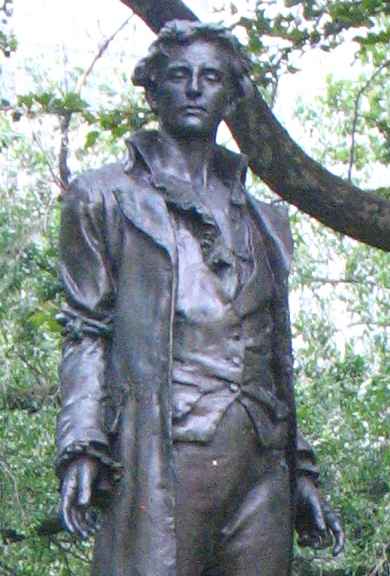
Nathan Hale by Frederick MacMonnies, 1890, City Hall Park, New York.

Nathan volunteered for an intelligence-gathering mission in New York City but was captured by the British. He is probably best remembered for his purported last words before being hanged: “I only regret that I have but one life to give for my country.” Hale has long been considered an American hero and, in 1985, he was officially designated the state hero of Connecticut

5. Jedediah Strong

Jedediah’s first wife Freedom Woodward was born 1642 in Dorchester, Suffolk, Mass. Her parents were Henry Woodward and Elizabeth Mather. Freedom died 17 May 1681 in Northampton, Hampshire, Mass.

Jedediah’s second wife Abigail Stebbins was born 6 Sep 1660 in Northampton, Hampshire, Mass. Her parents were John Stebbins and Abigail Bartlett. She first married 30 May 1678 in Northampton, Hampshire, Mass. to William Phelps (b. 22 Jun 1657 in Northampton, Hampshire, Mass. – d. 1 Jun 1745 in Northampton). Alternatively, her parents were Robert Bartlett (1612 – 1676) and   Ann [__?__]t ( – 1676) and her first husband was John Stebbins (1626 – 1679).  Abigail died 15 Jul 1689 in Northampton, Hampshire, Mass.

Jedediah’s third wife Mary Hart was born 14 Aug 1664 in Hartford, Hartford, CT. Her parents were Stephen Hart and Margaret Farmington. Mary died 10 Oct 1710 in South Hadley, Hampshire, Mass.  On 10 Oct 1710 his wife Mary died from the injury which she received the day previous by the fall of the horse on which she was riding (on a pillion [a secondary pad, cushion, or seat behind the main seat or saddle on a horse], behind her husband), when just started well upon their way to Coventry, together, to visit their children The record reads thus at Northampton: “Oct. 9, 1710, Jedediah Strong, and wife set out early in the morning to visit their children, at Coventry; but when they came against the Falls (at S. Hadley) among the broad smooth stones, the horse’s feet slipped up and he fell flat on the off side and by the fall killed the woman: though she was not quite dead then, but had life in her until the next day – yet never spoke a word.”

Jedediah Strong was a farmer at Northampton until 1709, when at the age of 70 years and upwards he removed with his family to Coventry, CT, where 24 years afterwards he died aged 96.

On May 31, 1674, Martin Smith of Pocumtuck, was fined 20 shillings for trying to kiss FREEDOM on the street. She was 32 at the time and the mother of 8 children. However, Martin was to experience worse trouble in his life. In 1693, he was captured by Indians and taken to Canada. While he was away, his wife, Sarah, entered a complaint against John Evans, for “attempting to force an unclean act upon her”.

When Martin returned from captivity, in 1698, after 5 years, he found his wife under a death sentence for murdering her illegitimate baby. Three judges, with an escort of 26 troops, took her to the court in Springfield. A grand jury, headed by John Holyoke, charged that on Jan. 11, 1697, in Deerfield MS, between 1:00 and 5:00 in the afternoon, in Daniel Wells’ house, a bastard child was born. Led by the instigation of the devil, withholding her natural affection, she refused all necessary help to preserve the life of the child, and with the intent to conceal her lewdness, she strangled the baby. She pleaded innocent, but she was found guilty and was hung, Apr. 25, 1698, in Springfield. According to tradition, the house in which the murder occurred was afterwards haunted and ghosts were seen there. The final chapter of Martin Smith’s life occurred on Feb. 29, 1704, when the French and Indians launched there attack on Deerfield. Martin was smothered in a cellar with the family of John Hawk’s, Jr., after the Indians set the house afire.

During the years 1677-8 & 9, Jedediah was paid 18 shillings a year for blowing the trumpet on Sunday to summon the people to church. He lived with his first wife 19 years, with his second 7, and with his third wife 9, and notwithstanding his three marriages spent 33 years as a widower, and 61 unmarried.

Jedediah was constable in 1683.

Jedediah and Freedom’s daughter Sarah married Thomas CUSHMAN Jr‘ son Thomas in 1700.

7. Return Strong

Return’s first wife Sarah Warham was born 28 Aug 1642 in Windsor, Hartford, CT. Her parents were Rev. John Warham and Jane Dabinott (widow of widow of Thomas Newberry). Sarah died 26 Dec 1678 in Northampton, Hampshire, Mass.

John Warham graduated from St. Mary Hall, Oxford, B.A. , 14 Nov. 1614 and M.A., 18 May 1618. In 1627 he served in the church of Crewkerne, Somerset where he was born, but when he was rebuked for preaching Puritanism by Bishop William Laud, he left and the Bishop of Exeter gave him a living at St. Sidwell’s parish in Exeter. In 1629, after he decided to come to New England he returned to preach one last, time in Crewkerne and he was rebuked again.

In March 1630 Rev. John Warham and Rev. John Maverick became the ministers of the “Mary & John” group, among whom were many families from Crewkerne. He and Maverick were the ministers at Dorchester, MA until 1636, when Maverick died and Warham moved to Windsor, CT with most of the “Mary & John” families, where he was their minister until his death.

Return’s second wife Margaret Newberry was born 23 Oct 1662 in Windsor, Hartford, CT. Margaret died 1699 in Windsor, Hartford, CT.

Return was a tanner at Windsor and a man of large estate. He married a third time, but whom or when the author has not been able to find. He removed in his later years to Northampton.

8. Ebenezer Strong

Ebenezer’s wife Hannah Clapp was born 20 Sep 1646 in Dorchester, Suffolk, Mass. Her parents were Nicholas Clapp and his cousin Sarah Clapp. Hannah died 1729 in Northampton, Hampshire, Mass.

Ebenezer was a farmer and tanner at Northampton, and like his father a ruling elder in the church. The tannery (1/4 of an acre) was deeded to him by his father Dec. 15, 1688. His estate was inventoried at his death at £950, of which, personal estate £896, and real £44. He willed “all his part in the tan-yard to his son Ebenezer”. He was often selectman between 1682 and 1728, and was in early life called sergeant and deacon, and was constable in 1679.

9. Abigail Strong

Abigail’s first husband, Rev. Nathaniel Chauncey was born 1639 in Plymouth, Mass. His parents were Charles Chauncey and Catherine Eyre. Nathaniel died 4 Nov 1685 in Hatfield, Mass.

Nathaniel preached at Windsor, CT (1666-78), and at Hatfield, MA (1679-85). His effects were inventoried as follows: Estate, £429 ; house barn &c., £100; and Library (which was exceedingly valuable for those time) £85 . He was assistant and successor to Rev. John Warham of Windsor, while preaching there, and was a strong advocate of his views of the half-way covenant. An earnest minority in the church dissenting from such views withdrew and formed a second church, inviting Rev. Benjamin Woodbridge in 1669-70, to become their pastor just before the death of Mr. Warham.

The Half-Way Covenant was a form of partial church membership created by New England in 1662.

Full membership in the tax-supported Puritan church required an account of a conversion experience, and only persons in full membership could have their own children baptized. Second and third generations, and later immigrants, did not have the same conversion experiences. These individuals were thus not accepted as members despite leading otherwise pious and upright Christian lives.

In response, the Half-Way Covenant provided a partial church membership for the children and grandchildren of church members. Those who accepted the Covenant and agreed to follow the creed within the church could participate in the Lord’s supper. Crucially, the half-way covenant provided that the children of holders of the covenant could be baptized in the church. These partial members, however, couldn’t accept communion or vote.

Many of the more religious members of Puritan society rejected this plan as they felt it did not fully adhere to the church’s guidelines, and many of the target members opted to wait for a true conversion experience instead of taking what they viewed as a short cut. Response to the Half-Way Covenant may have sown the seeds for the First Great Awakening in the 1730s

Abigail’s second husband Deacon Medad Pomeroy was born 19 Aug 1638 in Windsor, Hartford, CT. His parents were Eltweed Pomeroy and Margery Rockett. He first married 21 Nov 1661 in Suffolk, Dorchester, Mass. to Experience Woodward (b. 10 Nov 1643 in Dorchester, Suffolk, Mass – d. 8 Jun 1686 in Northampton, Mass.). He married Abigail second 8 Sep 1686 in Northampton. Finally, he married 24 Jan 1705 in Westfield, Hampden, Mass. to Hannah Warriner (b. 17 Aug 1643 in Springfield, Hampden, Mass. – d. 12 May 1721 in Westfield, Hampden, Mass.) Her parents were William WARRINER and Joanna SEARLE. Medad died 30 Dec 1716 in Northampton, Hampshire, Mass

Medad was a blacksmith and gunsmith who came to Northampton in 1659. Served as town clerk, magistrate, selectman, deputy to the General Court and town treasurer.

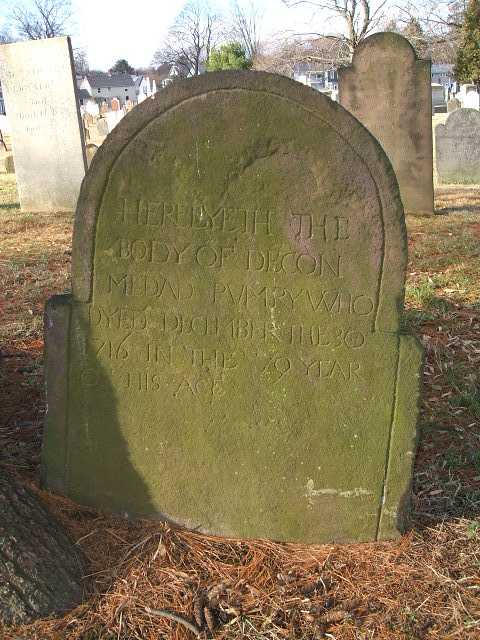
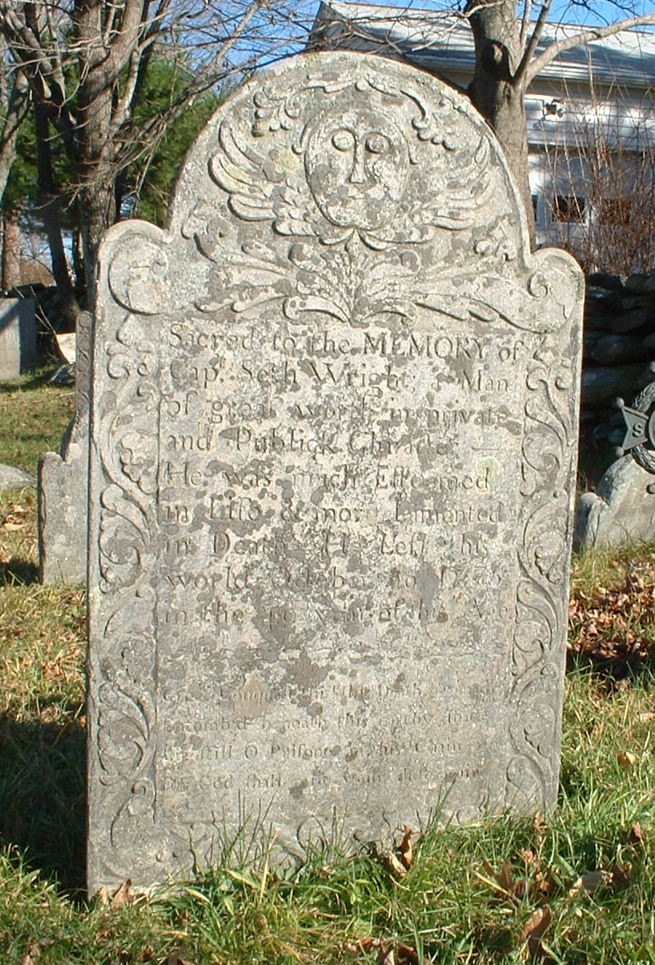
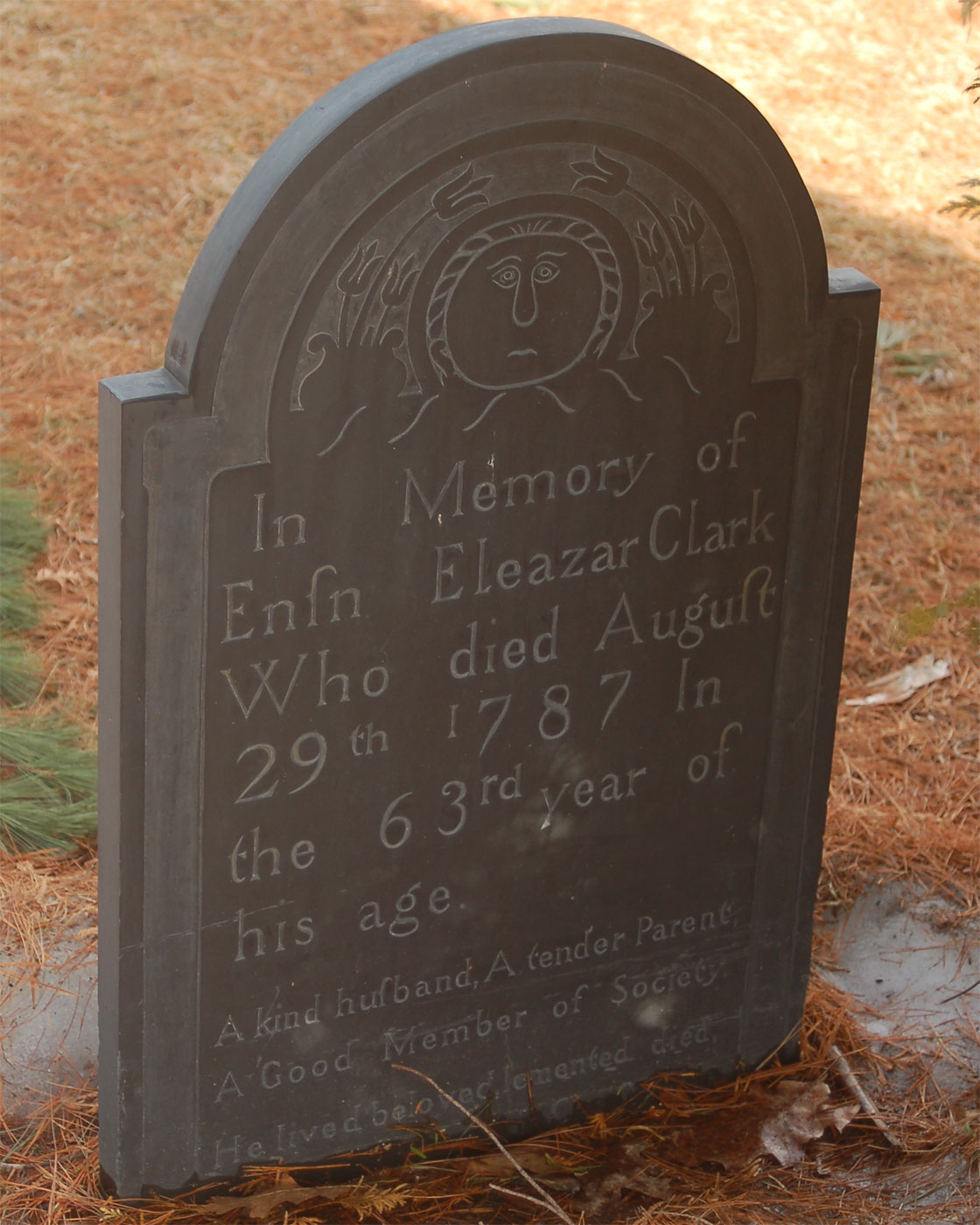
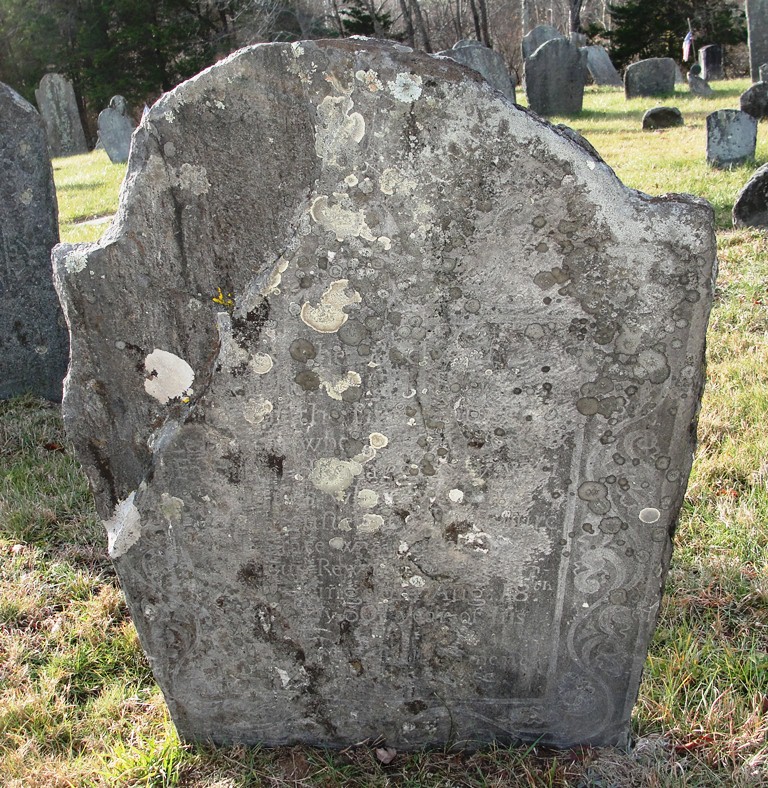
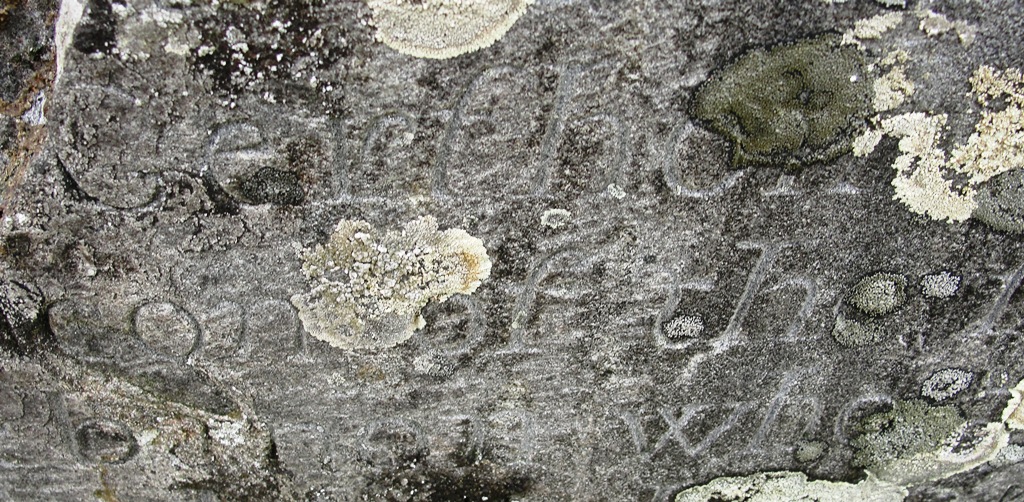
Medad Pomeroy Gravestone — Bridge Street Cemetery, Northampton, Hampshire County, Mass

10. Elizabeth Strong

Elizabeth’s husband Joseph Parsons, Esq. was born 1 Nov 1647 in Springfield, Hampden, Mass. His parents were Joseph Parsons and Mary Bliss. His grandparents were [our ancestors] Thomas BLISS and Dorothy WHEATLEY. Joseph died 29 Nov 1729 in Northampton, Hampshire, Mass.

Joseph was a lawyer and justice of the peace at Northampton, and first judge of the County Court of Hampshire Co. (1698), and was a man of extensive business at all times, and much engaged in political and military life. For 60 years they lived together in wedded life.

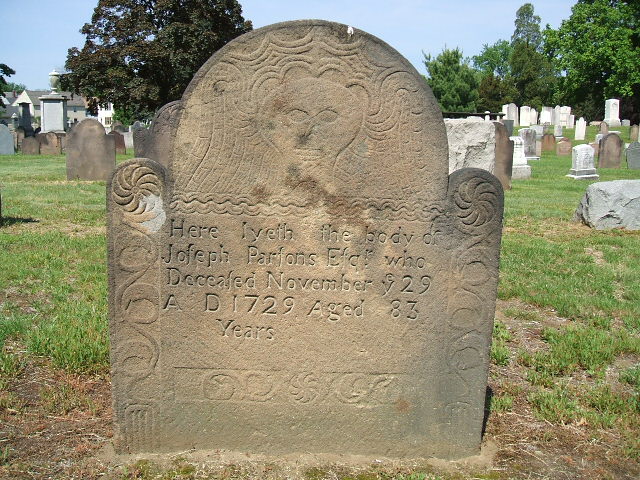
Joseph Parsons Gravestone — Bridge Street Cemetery, Northampton, Hampshire County, Mass.

Inscription:
“Here lyeth the body of Joseph Parsons Esqr who Deceased November ye 29 AD 1729 Aged 83 Years”

11. Experience Strong

Experience’s husband Zerubbabel Filer was born 23 Dec 1644 in Windsor, Hartford, CT. His parents were Walter Filer and Jane Irving. Zerubbabel died 21 Oct 1714 in Windsor, Hartford, CT.

In 1668 Thomas FORD gave a conditional bond for deeding the homestead, after the death of he and his wife, to Zerubabel Filer, if he should marry Thomas’ granddaughter Experience Strong. These two married 27 May 1669 and Experience received the deed 23 August 1672.

Zerubbabel moved to Suffield, but afterwards returned to Windsor again.

12. Samuel Strong

Samuel’s first wife Esther Clapp was born Jul 1656 in Dorchester, Suffolk, Mass. Her parents were Edward Clapp and Susannah Cockerell. Esther died 26 Jan 1698 in Northampton, Hampshire, Mass.

Samuel’s second wife Ruth Sheldon was born 27 Aug 1663 in Northampton, Hampshire, Mass. Her parents were Isaac Sheldon and Mary Woodford. She first married 6 Nov 1679 in Northampton, Hampshire, Mass to Joseph Wright (b. 2 Jun 1657 in Northampton, Hampshire, Mass. – d. 16 Feb 1697 in Northampton). Ruth died 16 May 1728 in South Hadley Falls, Hampshire, Mass.

A twin with Joseph who died at age 10. A farmer at Northampton, Mass.

14. Mary Strong

Mary’s husband Deacon John Clark was born 1 Sep 1651 in Dorchester, Suffolk, Mass. He was her first cousin. His parents were Lt. William CLARK and Sarah STRONG. John’s first wife Rebecca Cooper was born 15 May 1657 in Springfield, Hampden, Mass. They were married on 12 Jul 1677 and she died during childbirth when their only child Sarah was born on 28 April 1678. Rebecca was the daughter of Captain Thomas Cooper and Sarah Slye and her father-in-law’s step-daughter due to a double marriage. John died 3 Sep 1704 in Windsor, Hartford, CT.

His death occurred “from fatigue and cold taken in a snow storm” en route home from Boston. Most sources indicate he died Sept 3, but I have also seen Nov 2 as a death date, which would make some more sense if the cause of his death was a snowstorm. His death is recorded in Windsor, Connecticut on Sep 3, 1704.

“It is not known where John lived and brought up his family but, probably in the house later known as the Upham House, half way between Pres. Seelyes’ and Mr. Maltby’s. He inherited the southern six acres of Lt. William’s home lot but, at that time, he was already the father of eight children. Sometimes referred to as “Sgt. John”, but more usually as “Dea. John”, he was a much respected and useful man in both town and church affairs. He was first elected selectman in 1689 and served in that office in 1692, 93, 96, 98 and from 1700 until his death. He also served on numerous committees and was a Deputy to the General Court from 1699 to 1703. In 1691, he was the sixth man chosen as Deacon of the First Church and served 14 years until his death. Deacon John died at Windsor, Ct. Sept. 3, 1704 from fatigue and cold taken in a snowstorm on his way home from Boston. At that time, a trip to Boston on horseback was about a week’s journey.

Most sources indicate he died Sept 3, but I have also seen Nov 2 as a death date, which would make much more sense if the cause of his death was a snowstorm.

On 12 Oct 1704, his widow and sons, John and Nathaniel, filed an inventory of his estate which included 13 parcels of land valued at £488.10s. This included his house and homestead, the Joshua Carter lot willed to him by his father and land in Lebanon, Ct. His personal estate valued at £161.9s included 2 oxen, 4 cows, 10 steers, 3 heifers, 3 horses, a mare, colt, sheep and a long list of household goods and furniture. The estate was owed £24-07-05 and owed debts which totaled £43-19-07. The net estate value was £630-06-05.”

Of this family says Prest. Dwight in his “Travels in New England (vol. I, Letter 33):” “Four lived to to be above 90; three, above 80: and three above 70. The youngest son died in his 98th year; and at the time of his death there had sprung from the original pair 1145 persons of whom 960 were still living.” He was a very worthy useful man, and a representative to the General Court for 14 years, but not consecutively. He was often also selectman between 1689 and 1732 and was called variously, deacon, and sergeant. The six sons of this family lived each with the wife of his youth, more than fifty years. They all outlived their wives, and the daughters, their sisters, all outlived their husbands.

Children with Mary: John, Nathaniel, Ebenezer, Increase, Mary, Rebecca, Experience, Abigail, Noah, Thankful, and Josiah. Eleven of his children lived to marry and have families.

15. Sarah Strong

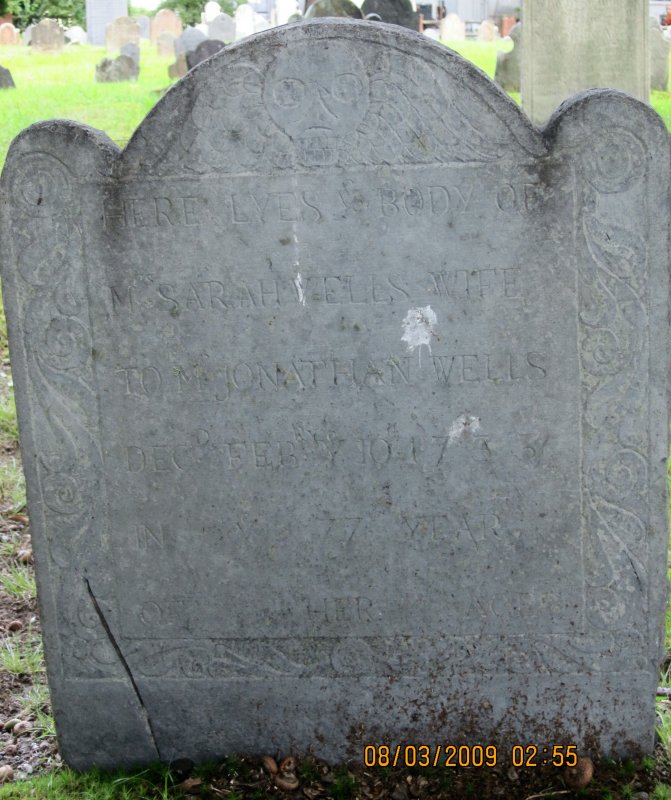
Sarah Strong Gravestone — Old Deerfield Burying Ground, Deerfield, Franklin County, Mass

Sarah’s first husband Joseph Barnard was born 1641 in Windsor, Hartford, CT. His parents were Francis Barnard and Hannah Marvin. Joseph died 6 Sep 1695 in Deerfield, Franklin, Mass.

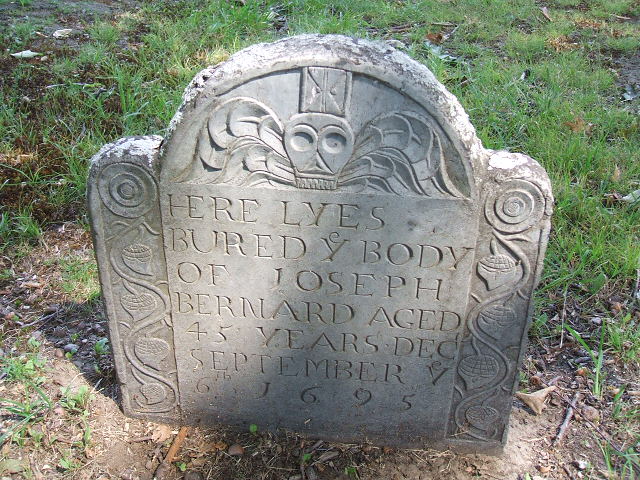
Joseph Barnard Memorial — Old Deerfield Burying Ground, Deerfield, Franklin County, Mass.

Joseph was of Hadley, MA, and afterwards of Deerfield, MA. He resided in Northampton. He died from wounds received from Indians 6 Sep 1695 in Deerfield.

He was one of the founders of Deerfield. He was shot and mortally wounded by Indians near his home. A marker was placed by a descendant (James Barnard) at the location where he was shot.

Sarah’s second husband Jonathan Wells was born 1658 in Wethersfield, Hartford, CT. His parents were Thomas Wells and Mary Beardsley. He first married 3 Dec 1682 in Longmeadow, Hampden, Mass. to Hepzibah Colton (b. 7 Jan 1657 in Longmeadow, Hampden, Mass. – d. 27 Aug 1697 in Longmeadow, Hampden, Mass.) Jonathan died 3 Jan 1739 in Deerfield, Franklin, Mass.

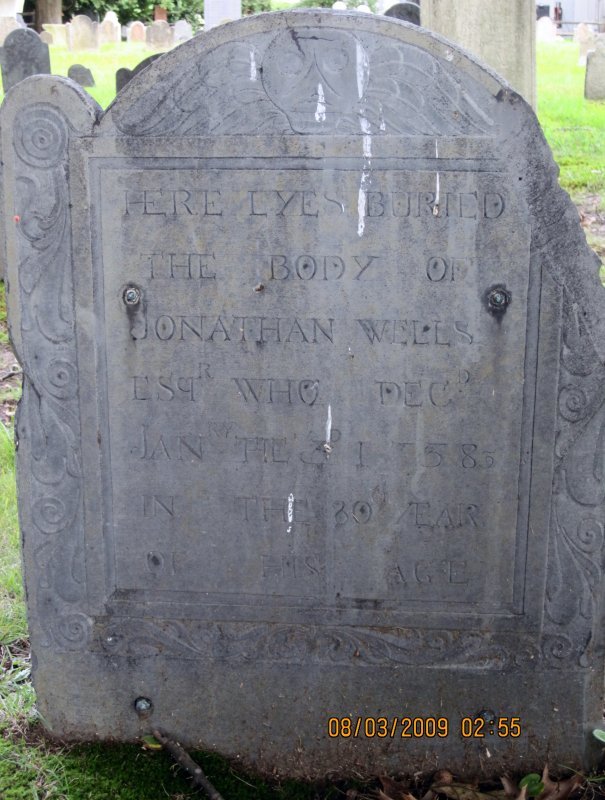
Capt Jonathan Wells Gravestone — Old Deerfield Burying Ground , Deerfield, Franklin County, Mass.

Jonathan  was made a Captain upon the death of his brother Thomas Wells III in 1691. Jonathan was the “boy hero” of the Peskeomskat  Fight, also known as Turner’s Falls Fight [see my blog article] and he was Military Commander of the settlement at Deerfield when the town was attacked on Feb 29, 1703/04 [see my article Raid of Deerfield – 1704].

Turners Falls Reporter 1875

Mr. Jonathan Wells of Hatfield, one of the twenty who remained in the rear when Turner began his march from the Falls, soon after mounting his horse, received a shot in one of his thighs, which had previously been fractured and badly healed, and another shot wounded his horse.

With much difficulty he kept his saddle, and after several narrow escapes, joined the main body just at the time it separated into several parties, as has been related. Attaching himself to one that was making towards the swamp, on the left, and perceiving the enemy in that direction, he altered his route and joined another party flying in a different direction. Unable to keep up with the party, he was soon left alone, and not long after fell in with one Jones, who was also wounded.

The woods being thick and the day cloudy, they soon got bewildered, and Wells lost his companion, and after wandering in various directions, accidentally struck Green River, and proceeding up the stream, arrived at a place since called the Country Farms, in the northerly part of Greenfield. Passing the river and attempting to ascend an abrupt hill, bordering the interval west, he fell from his horse exhausted.

After lying senseless some time, he revived and found his faithful animal standing by him. Making him fast to a tree, he again lay himself down to rest, but finding that he should not be able to remount, he turned the horse loose, and making use of his gun as a crutch hobbled up the river, directly opposite the course he ought to have taken. His progress was slow and painful, and being much annoyed by mosquitos, towards night he struck up a fire, which soon spread in all directions, and with some difficulty he avoided the flames.

Now new fears arose; the fire, he conjectured, might guide the Indians to the spot, and he would be sacrificed to their fury. Under these impressions, he divested himself of his ammunition, that it might not fall into their hands, bound up his thigh with a handkerchief, staunched the blood, and composing himself as much as possible, soon fell into a sleep. A dream suggesting to him that he was travelling from, instead of to Hatfield, he reversed his course, and through time brought up at the upper part of Greenfield, and soon found a foot path which led him to the trail of his retreating comrades.

This he pursued to Deerfield River, which, with much difficulty, he forded by the aid of his gun. Ascending the bank he laid himself down to rest, and being overcome with fatigue, he fell asleep, but soon waking he discovered an Indian making toward him in a canoe. Unable to flee, and finding his situation desperate, he presented his gun, then wet and filled with sand and gravel, as if in the act of firing.

The Indian, leaving his own gun, instantly leaped from his canoe into the water, escaped to the opposite shore and disappeared. Wells now concluded he should by others who he knew were but a short distance down the river, but determining if possible to elude them, he gained an adjacent swamp, and secreted himself under a pile of drift wood.

The Indians were soon heard in search of of him, traversing the swamp in all directions, and passing over the drift wood; but lying close, he fortunately avoided discovery, and after they had given up the search and left the place, he continued his painful march through Deerfield meadows. Hunger now began to prey upon him, and looking about he accidently discovered the skeleton of a horse, from the bones of which he gathered some animal matter, eagerly devoured, and which in a measure allayed his hunger and added to his strength.

Passing the ruins of Deerfield, at dusk, he arrived next morning at Lathrop’s battle ground, at Bloody Brook, in the south part of Deerfield, where he found himself so exhausted that he concluded he must give up further efforts and lie down and die

But after resting a short time, and recollecting that he was within eight miles of Hatfield, his resolution returned, and he resumed his march through pine woods, then smoking with a recent fire; there he found himself in great distress from a want of water to quench his thirst, and almost despaired of reaching his approximated home. But once more rousing himself, he continued his route and about mid-day on Sunday reached Hatfield, to the joy of his friends, who had supposed him dead. After a long confinement, Mr. Wells’s wound was healed, and he lived to an advanced age, a worthy member of the town.

16. Hannah STRONG (See Capt. William CLARK‘s page)

17. Hester Strong

Hester’s husband Thomas Bissell was born 2 Oct 1656 in Windsor, Hartford, CT. His parents were Thomas Bissell and Abigail Moore.   Thomas died 26 Dec 1738 in Windsor, Hartford, CT.

Children of Hester and Thomas:

i. Esther Bissell b. 10 Sep 1679 Windsor, Hartford, CT

ii. Abigail Bissell b. 20 Oct 1681 Windsor, Hartford, CT

iii. Thomas Bissell b. 3 Dec 1683 Windsor, Hartford, CT; m1. 16 Feb 1710 to Martha Loomis; m2. 20 Dec 1743 to his first cousin Hannah Clark.  Hannah’s parents were Capt. William CLARK and Hannah STRONG.

iv. Ebenezer Bissell b. 1 Aug 1685 Windsor, Hartford, CT

v. Eunice Bissell b. 30 Mar 1686 Windsor, Hartford, CT

vi. Nathaniel Bissell b. 14 Apr 1690 Windsor, Hartford, CT

vii. Jerijah Bissell b. 1698 Windsor, Hartford, CT

18. Thankful Strong

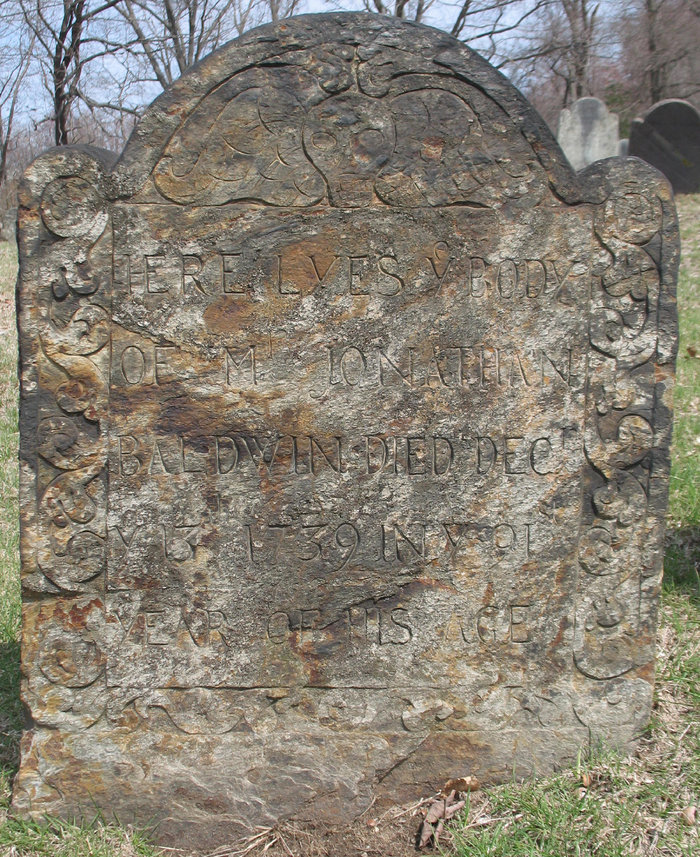
Thankful’s husband Jonathan Baldwin was born 15 Feb 1647/48 in New Haven, CT. His parents were Joseph Baldwin and Hannah Whitlock. Jonathan died 13 Dec 1739 – Milford, New Haven, CT.

Jonathan Baldwin Gravestone — Milford Cemetery, Milford, New Haven County, Connecticut

Inscription:

Here lyes ye body of
Jonathan baldwin
Died dec ye 13th 1739 in ye 91st
year of his age..

19. Jerijah Strong

Jerijah’s wife Thankful Stebbins was born 11 May 1678 in Northampton, Hampshire, Mass. Her parents were John Stebbins and Abigail Bartlett. Thankful died 24 May 1744 in Northampton, Hampshire, Mass

Sources:

http://www.genealogyofnewengland.com/b_s.htm

http://strongfamilyofamerica.org/elder-john-strong/ 

http://trees.ancestry.com/owt/person.aspx?pid=155114

Posted in 11th Generation, 90+, Be Fruitful and Multiply, Immigrant - England, Line - Miller, Pioneer, Public Office, Twins | Tagged , , , , , | 14 Comments

Lt. William Clarke

Lt. William CLARKE (1610 – 1690) was Alex’s 9th Great Grandfather; one of 1,024 in this generation of the Miller line.

We have more unrelated Clark families in our tree than any other surname.  In addition to Lt. William ClARKE, our Clark family founders are: John CLARK (Plymouth) (1575 – 1623),  John CLARK (Hingham) (1560 – 1615), and Arthur CLARK (Boston) (1620 – 1665)

Immigrant Ancestor

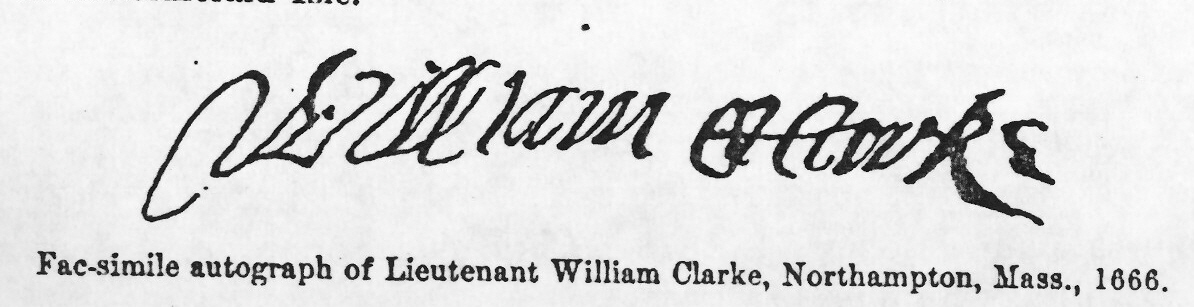
Lt. William Clarke was born in 22 Jul 1610 in Dorsetshire, England.  His parents may haven been Thomas CLARKE (1578/83 – 1623/27) and Rose KEREDGE (1587 – ).   He married Sarah STRONG around 1636 in Dorchester, Mass.   He moved to Northampton, Mass in 1659.  His Northampton homestead is now the Northern half of Smith College.

In 1653 William Clarke was granted 12 acres on the West side of what is now Elm Street, bordering on Mill river, and comprising today the North half of the campus of Smith College.                    Paradise Pond, here framed by apple blossoms, is a focus of  the Smith College landscape as well as an educational, historical, and environmental asset. The Pond is part of the Mill River, which in the 1800s was one of the most heavily industrialized rivers of its size in the world.

After Sarah died, he married Sarah Slye Cooper on 15 Nov 1676 in Northampton, Mass.   William died 19 Jul 1690 in Northampton, Mass and is buried in the Bridget Street Cemetery in Northampton.

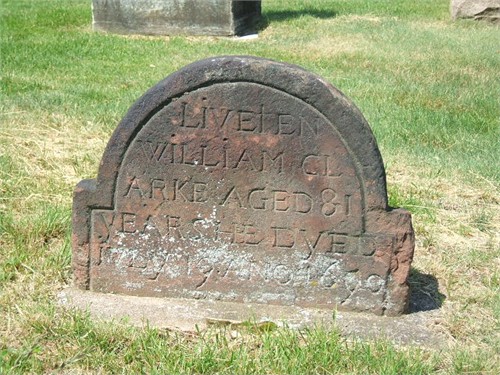
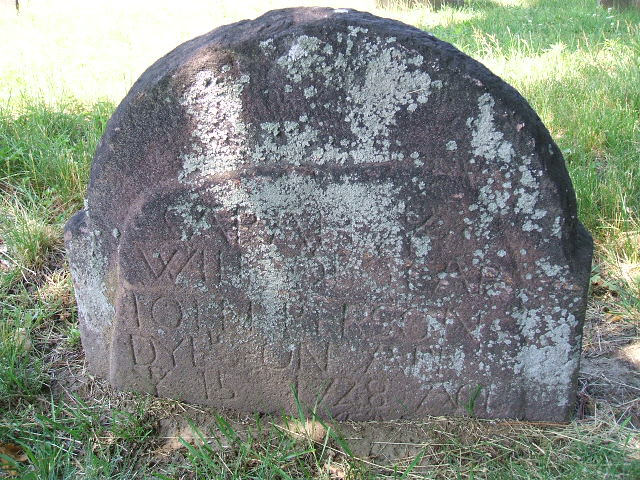
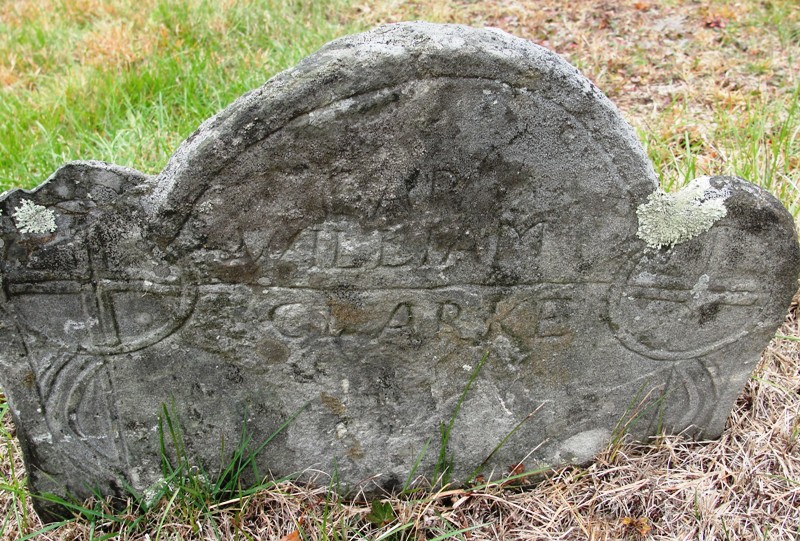
William Clarke – Headstone Bridge Street Cemetery Northampton, Hampshire, Massachusetts  Note: the headstone is not original

There are three versions on the arrival of William Clarke in the New World:

Version 1 – He departed Plymouth, England on March 30, 1630 aboard the ship ‘Mary and John’ arriving in Nautucket (now called Hull) on May 30, 1630. He would have been 21 at that time. This is the version that appears in most family records.

Version 2 – William Clarke emigrated in 1630 aboard the ship ‘William and Mary’ in the company of Rev. Mister Warham of Plymouth, Dorsetshire, England. He settled first in Dorchester, Suffolk, Ma. prior to 1635, where he officiated as Townsman or Selectman from 1646 to 1653, removing to Northampton in 1659.

Version 3 – William Clarke left England on the ship ‘Mary and Jane’, which sailed from London on March 24, 1633, arriving in New England in June of that year. This last version seems the most likely, even though it does not agree with ‘old family tradition’. The port of embarkation also differs.

Sarah Strong was born 1613  in Chardstock, Dorsetshire, England  Her parents were Thomas STRONG and Joanna BAGGE. Thomas was the brother of Richard Strong who was their daughter-in-law Hannah’s father.  That makes Sarah’s grandfather, George STRONG  (1556 – 1636) a double ancestor. Sarah died on 6 Sep 1675 in Northampton Mass and is also buried at the Bridge Street Cemetery in Northampton.

Little is known for sure about Sarah, not even her surname, or exact date and place of birth. Since her husband, William Clarke, is first noted in the town of Dorchester in 1635, and apparently arrived there from England unmarried, virtually every unmarried Sarah in Dorchester at that time, has been suggested. I have seen Strong, Holton, Bolton, Lambert, Lumbert, Smith and too many more to mention. What I haven’t seen is any positive proof for any of these. At present, all that has been proven of Sarah, is that she and William were admitted as Church members in Dorchester in 1636, resigned from that church to be admitted to the new church in Northampton, in 1666, that all of her children were born in Dorchester, and that she was a good and loving wife to William.  There are several theories about William’s first wife Sarah:

Mark Tyree believes Sarah Strong And Eleanor Strong (both born 1613 of Richard John STRONG) are the same person and that she arrived in America with her mother Eleanor and her stepfather William Cogan sometime before 1636.

Robin Mitchell says Elder John Stronge is the son of John (Richard) Stronge and Eleanor Deane. John (Richard) Stronge died before the birth of his youngest child in 1613. This is well documented in his will.

After John (Richard) Stronge’s death, his wife, Eleanor Deane, daughter of a tanner, married William Cogan (a tanner by trade) before the birth of John (Richard) Stronge’s offspring by Eleanor in 1613. Following a west country tradition, the daughter is christened “Eleanor,” after her mother. Though she is a “Stronge” by blood, William Cogan refers to her as “my daughter,” and raises her as such with the name Eleanor Cogan.

Young (Elder) John Stronge learns the tanning trade from William Cogan and Eleanor Deane’s father, Walter Deane. Sarah Stronge, the future wife of Lt. William Clarke, was born in 1613 to Thomas Stronge, the brother of Elder John Stronge’s father. This makes Sarah Stronge the cousin of Elder John Stronge.

An Ancestry.com user named hourglasssrs adds “It appears from reviewing all the data that Sarah was born Strong; then her mother remarried a man named Holton (or Houlton) – thus she ended up being known by both names.”

Some say Some genealogists say that he married Sarah Strong earlier and he married Sarah Lumbert  in 1636. (See discussion below)

Here’s what I’ve found about the Holtons in Northampton

William Holton (1610 – 1691 ) of Hartford & Northampton came to New England in “The Francis”, sailing from Ipswich in 1634. He had a sister, Sarah, who was baptized in Nayland, Suffolk, England, Parish of Holton St. Marys, but nothing more is known about her.”

Deacon William Holton was one of the first settlers of Hartford, CT, and one of the eight original petitioners for liberty to plant and settle at Nonotuck (Northampton), Massachusetts, whither he went in 1653. When the first board of magistrates was appointed in 1665 by the General court, it consisted of William Holton, Thomas Bascom and Edward Elmore. he was the first deacon of the church of Northampton (ordained June 13, 1663), and a representative to the General court (1667-69). He died Aug. 12, 1691, at age about 80. His widow Mary died Nov 16, 1691.

His daughter Sarah married Nov 18, 1656, Capt. John King of Northampton, whose grand-daughter, Experience King (daughter of Lt. John King, Jr., of Northampton, and Mehitable Pomeroy) married Col. Timothy Dwight of Northampton, grandfather of President Timothy Dwight of Yale College. His second daughter Mary married Nov 18, 1656, David Burt, whose daughter, Mary Burt, married Dr. Thomas Hastings of Hadley, Mass., the ancestor of Thomas Hastings, Esq., Musical Doctor and Composer in New York.  His remaining daughter Ruth married Feb 5, 1663, Joseph Baker and afterwards to 2nd husband Thomas Lyman (son of Richard Lyman the settler). They were the parents of Noah Lyman father of the celebrated Gen. Phineas Lyman of Suffield, CT)

Some genealogists say that he married Sarah Strong earlier and he married Sarah Lumbert  in 1636.   Supposedly, this Sarah was the sister of Thomas LUMBERT and Bernard Lumbert.  While the Lumberts were also from Dorsetshire, they immigrated to Barnstable on Cape Cod.

My revised guess is that William Clarke’s daughter Sarah died young and Joseph BENJAMIN‘s wife Sarah was the daughter of Arthur CLARK and Sarah THAYER.

William’s Sarah was born 21 Apr 1638 Dorchester, Suffolk, Mass. and died 21 Jun 1638 Dorchester.

Arthur’s Sarah was born 1 Aug 1639 Yarmouth, Barnstable, Mass. She married Joseph BENJAMIN. This Sarah died after 1716 as she was still living in New London, New London, Connecticut when her son John died.  The Sarah who married Joseph Benjamin would have been 1st cousin to Jemima, 1st wife of Joseph and Daughter of Thomas LUMBERT.

Sarah Slye Cooper was baptized 29 Oct 1615 at Lapwirth, Warwickshire, England.  Her parents were George Slye and [__?__].  There is evidence she was a sister of Capt. Robert Slye of Hartford,CT, later of Maryland.   She first married Lt. Thomas Cooper about 1642.   Sarah died 8 May 1688 in Northampton, Mass.

There is some contention about this Sarah’s heritage. Different sources say that she was the daughter of either George Slye or John Russell.  Either way, this Sarah was the wife of Lt. Thomas Cooper of Springfield.  After he was killed there on 5 Oct 1675 during the Indian raid, Sarah and at least one daughter fled to Northampton.   Sarah and Rebecah lived with Lt. Clarke and his family (he was a widower at this time). Lt. Clarke married Sarah and his son John married Rebecah on 12 Jul  1677.  The unpublished manuscript of Edith M. Clark Nyman states that Sarah was the sister of William Russell of New Haven, which would mean she was the daughter of John Russell. There is some evidence that there were TWO Thomas Cooper’s in Springfield at the time of the Indian raid-both married to a Sarah. 

Thomas Cooper was born about 1617 (aged 18 in 1635). Carpenter who came to Massachusetts Bay in 1635 on the “Christian.” First settled in Windsor; moved to Springfield by 1642 when he married Sarah Slye.   They had nine children: Sarah Day, Timothy, Thomas, Elizabeth, Mary Colton Stebbins, John, infant daughter, Rebecca Clark, & John.  Thomas was killed 5 Oct 1675 in Springfield, Hampden, Mass.

Children of William and Sarah Strong:

Name Born Married Departed
1. Sarah Clark? 21 Apr 1638
Dorchester, Suffolk, Mass.
or
1 Aug 1639 Yarmouth, Barnstable, Mass
Joseph BENJAMIN
7 Dec 1668 Yarmouth, Mass.
21 Jun 1638
Dorchester
or
after 1716 as she was still living in New London, New London, Connecticut when her son John died
2. Jonathan Clark 1 Aug 1639
Dorchester
1 Oct 1639
Dorchester
3. Nathaniel Clark 27 Jan 1642
Dorchester
Mary Meekins
8 May 1663
Hadley, Mass.
30 Mar 1669
Northampton Mass
4. Experience Clark 30 Mar 1643
Dorchester
1662
Northampton
5. Increase Clark 1 Mar 1646
Dorchester
24 Apr 1662
Northampton
6. Rebecca Clark 1 Mar 1648/49
Dorchester
Israel Rust
9 Dec 1669
8 Feb 1733
Northampton
7. Deacon John Clark 1 May 1651
Dorchester
Rebecca Cooper (daughter of Sarah Slye Cooper)
.
Mary Strong (Daughter of Elder John STRONG)
20 Mar 1679
Northampton
3 Sep 1704 or 2 Nov 1704
Windsor, CT
from fatigue and cold taken in a snowstorm on his way home from Boston
8. Samuel Clark 16 Oct 1653
Dorchester
Elizabeth Edwards
1 Mar 1682
Northampton
5 Aug 1729
Northampton
9. Capt. William CLARK 3 Jul 1656
Dorchester
Hannah STRONG
15 Jul 1680
.
Mary Smith
31 Jan 1694/95
9 May 1725
Lebanon, CT
10. Sarah Clark 19 Mar 1659
Dorchester
Capt. John Parsons
23 Dec 1675
Northampton
15 Apr 1728
Northampton

The first fully proven record of William Clark is found in Dorchester Church Records which shows that William Clarke and wife, Sarah, were members of that church on August 23, 1636. The births of their 10 children were all recorded in Dorchester. Town records of Dorchester show that William obtained about 8 acres of land at Squantum Neck from William Hill before February 23, 1638, because he sold an acre and a quarter on that date.

He was elected Selectman in Dorchester in 1645, 1647 and 1650. He was a ‘Rater’ (assessor) in 1651, 52, 55 and 57. In 1652-1653 he was one of four men appointed to lay out land for Augustine Clement and was elected Fence Viewer in 1653, 56 and 58.

In May of 1653, Clarke was one of 24 petitioners to the Mass. General Court who desired to inhabit Northampton. All except Clarke were from Connecticut.  On Oct 3, 1653, the first meeting of the proprietors of Northampton was held at either Springfield or Hartford, and William Clarke attended and signed as a proprietor. However, he didn’t move there because in 1654 he was chosen as a “Boundsman” to lay out a way to the burial grounds and to determine the bounds between Dorchester and Braintree. In 1655, between Dorchester and Dedham; and in 1658 between Dorchester and Braintree and Dorchester and Roxbury. Also in 1658, he was on a committee to lay out land for Gamaleel Beaman, and in 1659, to lay out meadow lots and to survey land for a school. The committee later appointed John Capen to replace Clarke, who had moved to Northampton.

In the Genealogical and Family History of State of CT-Vol II, c. 1911 starting on page 652 “Lt. William Clarke, immigrant ancestor, was mentioned.

He was granted 12 acres on the West side of what is now Elm Street, bordering on Mill river, and comprising today the North half of the campus of Smith College. He built a log house where he lived until 1681, when it was burned, being set on fire by a negro, Jack, a servant of Samuel Wolcott, who took a brand of fire from the hearth and swung it up and down to “find victuals”. The new house built in its place remained standing until 1826. Lt. Clarke organized in 1661 a train band of 60 men, which he commanded in King Philip’s War. He served as selectman 20 years, and was also a judge of the county court. After his death a monument was erected in 1884 to his memory by his descendants. The old gravestone is still preserved. One last item that will hopefully clear up some confusion-although Lt. William spelled his last name CLARKE, only one of his children continued to do so after his death. That was his namesake-William Jr., who left Northampton about 1698 for Lebanon, CT. Most of William Jr’s offspring continue this tradition for several generations before dropping the E. Some, to this day, never have.

William Clarke was the first citizen of Northampton to be elected deputy to the General Court, and 14 times between 1663 and 1682 was elected to that office, although not consecutively. He was Associate Justice of county court for 26 years; In 1662, he was authorized by the General Court to solemnize marriages, being the first person in that town to hold that responsible position. Frequently appointed by the Court to deal with Indians.

He was chosen Lieutenant of the first military company ever organized in Northampton, when that was the office of highest rank to which the company, on account of its small number of men was entitled, and was in active service during King Philip’s War and was at the same time a member of the military committee of the county. He supplied the commissary department to some extent during King Philip’s Indian War and the Legislature ordered the Treasurer to pay him in 1676 ‘thirty-eight pounds, eighteen shillings for “Porke and bisket” delivered to the country’s use’.

He helped to build the first grist mill and the first saw mill in the town. He was greatly interested in promoting the new settlement of Squakheag (Northfield) and is named as having served as town clerk at the second settlement of that place, although there is no evidence that he ever lived there. Several times he was chosen commissioner, with others, to determine disputed boundaries between Northampton and neighboring towns. His home lot, one of the largest, covered the north half of the Smith College property. Tradition states that here he built a block house upon this lot which was used for refuge during the Indian troubles.  In 1671, he was licensed to sell “wine, cider or liquor for a year”. He had large grants of land in the meadows and elsewhere and purchased many acres in different parts of the town. All his lands, embracing nearly two hundred acres, with the exception of 7 3/4 acres, he disposed of before his death to his sons, reserving to himself an annuity of 24 pounds.

His dwelling house was burned in 1681, having been set on fire by a Negro, as he averred in search of food.

“The house of Lieut. William Clarke, situated very nearly on the ground now occupied by the main Smith College building, was burned on the night of July 14, 1681. It was built of logs, and Clarke and his wife were living in it at the time. A Negro, named Jack, set the house on fire. He confessed the deed and pretended that it was done accidentally, while he was searching for food, swinging a burning brand to light his way. Jack did not belong in town; he was a servant to Samuel Wolcott of Wethersfield;  and had already been before the courts for other misdemeanors.  His object undoubtedly, was robbery, and it is not probable that he went about the house searching for food even, with a lighted pine torch in his hands. Very likely after stealing whatever he could lay his hands upon, he set the house on fire to conceal the robbery, or from spite against William Clarke, who was at this time 72 years of age.

Jack was arrested in Brookfield or Springfield, and was brought before the court in Boston, where he plead not guilty. When his confession was read to him, however, he acknowledged it, and the jury brought in a verdict of guilty. The court believed his confession as to setting the house on fire, but did not credit his statement that it was done carelessly. He was sentenced to be “hanged by the neck till he be dead and then taken down and burnt to ashes in the fire with Maria, the Negro”. Maria was under sentence of death for burning the houses of Thomas Swan, and of her master, Joshua Lamb, in Roxbury. She was burned alive. Both of these Negroes were slaves. Why the body of Jack was burned is not known.

note 1: Many slaves were burned alive in New York and New Jersey, and in the southern colonies, but few in Massachusetts. note 2: Tradition has handed down the following items concerning the burning of Clarke’s house: The Negro fastened the door on the outside so that no one could escape, and set the fire on the outside. William Clarke injured his hands considerably (pounded them, it is said) in his endeavor to escape, and his wife was somewhat burned. John Clarke, grandson of William, a little more than a year old, was brought out of the house and laid beside the fence. There was powder in one of the chambers, and when it exploded the ridge pole was blown across the road, and one end forced into the ground. The Negro had taken offense at something William Clarke had done in his official capacity, and set the fire in a spirit of revenge. He was discovered either at Brookfield, Springfield, or near New Haven, and identified by means of a jack-knife in his possession that belonged to the Clarke’s.” History of Northampton Massachusetts From Its Settlement in 1654 (James Russell Trumbull – Printed in Northampton in 1898)

Children:

1. Sarah CLARKE? (See Joseph BENJAMIN‘s page)
My revised guess is that William Clarke’s daughter Sarah died young and Joseph’s wife Sarah was the daughter of Arthur CLARK and Sarah THAYER.

William’s Sarah was born 21 Apr 1638 Dorchester, Suffolk, Mass. and died 21 Jun 1638 Dorchester.

Arthur’s Sarah was born 1 Aug 1639 Yarmouth, Barnstable, Mass. She married Joseph BENJAMIN. This Sarah died after 1716 as she was still living in New London, New London, Connecticut when her son John died.  The Sarah who married Joseph Benjamin would have been 1st cousin to Jemima, 1st wife of Joseph and Daughter of Thomas LUMBERT.

By the way, Thomas LUMBERT’s son Bernard Lumbert (1608-1663) married as his second wife Mary Clarke (1611 in Great Bromley, Essex, England – 1683 in Barnstable, Mass.)  Her parents were William Clarke (1576 in Great Bromley, Essex, England – 12 Jul 1632 in Great Bromley) and Margaret Hadlock.   She had a brother William Clarke who was born on 6 Feb 1611 in Great Bromley, Essex, England.  He married Katherine Bunce.  This William and Katherine immigrated before 1631 to New England.  They   He died on 15 Mar 1682 in Woburn, Middlesex, Massachusetts.

Spouse: Katherine BUNCE.

3. Nathaniel Clark

Nathaniel’s wife Mary Meekins was born 8 Jun 1645 in Roxbury, Suffolk, Mass. Her parents were Thomas Meakins and Sarah Catherine Beardsley. Mary died 10 Apr 1705 in Northampton, Hampshire, Mass.

6. Rebecca Clark

Rebecca’s husband Israel Rust was born 12 Nov 1643 in Hingham, Plymouth, Mass. His parents were Henry Rust and Hannah [__?__]. Israel died 11 Nov 1712 in Northampton, Hampshire, Mass.

7. Deacon John Clark

John’s first wife Rebecca Cooper was born 15 May 1657 in Springfield, Hampden, Mass. They were married on 12 Jul 1677 and she died during childbirth when their only child Sarah was born on 28 April 1678. Rebecca was the daughter of Captain Thomas Cooper and Sarah Slye and her father-in-law’s step-daughter due to a double marriage.

John’s second wife Mary Strong was born on 26 Oct 1654 at Windsor, Hartford, CT.   Her parents were [our ancestors] Elder John STRONG and Abigail FORD. Mary died on 8 Dec 1738 at Northampton, Mass.

“It is not known where John lived and brought up his family but, probably in the house later known as the Upham House, half way between Pres. Seelyes’ and Mr. Maltby’s. He inherited the southern six acres of Lt. William’s home lot but, at that time, he was already the father of eight children. Sometimes referred to as “Sgt. John”, but more usually as “Dea. John”, he was a much respected and useful man in both town and church affairs. He was first elected selectman in 1689 and served in that office in 1692, 93, 96, 98 and from 1700 until his death. He also served on numerous committees and was a Deputy to the General Court from 1699 to 1703. In 1691, he was the sixth man chosen as Deacon of the First Church and served 14 years until his death. Deacon John died at Windsor, Ct. Sept. 3, 1704 from fatigue and cold taken in a snowstorm on his way home from Boston. At that time, a trip to Boston on horseback was about a week’s journey.

Most sources indicate he died Sept 3, but I have also seen Nov 2 as a death date, which would make much more sense if the cause of his death was a snowstorm.

On 12 Oct  1704, his widow and sons, John and Nathaniel, filed an inventory of his estate which included 13 parcels of land valued at £488.10s. This included his house and homestead, the Joshua Carter lot willed to him by his father and land in Lebanon, Ct. His personal estate valued at £161.9s included 2 oxen, 4 cows, 10 steers, 3 heifers, 3 horses, a mare, colt, sheep and a long list of household goods and furniture. The estate was owed £24-07-05 and owed debts which totaled £43-19-07. The net estate value was £630-06-05.”

Children with Mary: John, Nathaniel, Ebenezer, Increase, Mary, Rebecca, Experience, Abigail, Noah, Thankful, and Josiah. Eleven of his children lived to marry and have families.

8. Samuel Clark

Samuel’s wife Elizabeth Edwards was born 22 Feb 1660 in Northampton, Hampshire, Mass. Her parents were Alexander Edwards and Sarah Baldwin Searle of Springfield.  Elizabeth died 4 Sep 1690 in Northampton, Hampshire, Mass

Children who lived to adulthood: Elizabeth, Sarah. Samuel, Joanna, and Miriam.

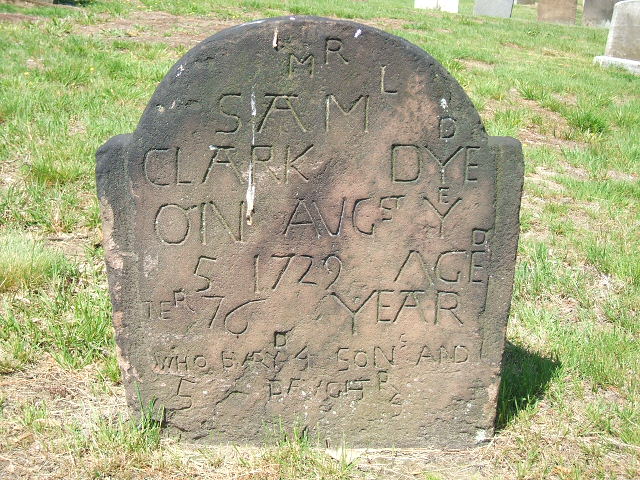
Samuel Clark Headstone “Mr Saml Clark dyed on Augst ye 5 1729 aged ner 76 year who buryd 4 sons and 5 daughtr” Bridge Street Cemetery Northampton, Hampshire County, Massachusetts

9. Capt. William CLARK (See his page)

10. Sarah Clark

Sarah’s husband John Parsons was born 14 Aug 1650 in Springfield, Hampden, Massachusetts.  His parents were Joseph Parsons (1620 – 1683) and
Mary Bliss  (1628 – 1712).  John died 15 Apr 1728 in Northampton, Hampshire, Mass.

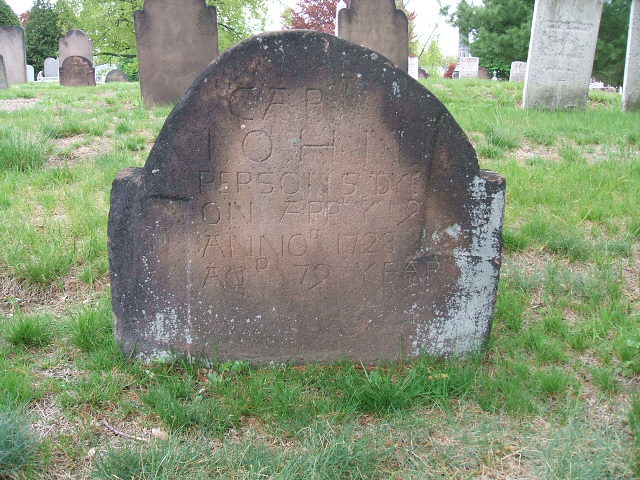
Capt. John Parsons Gravestone –Bridge Street Cemetery, Northampton, Hampshire County, Massachusetts,.

Inscription:
“Capt John Persons dyed on Apr ye 19 annod 1728 aged 79 years”.

Children: Sarah, Mary, Samuel, William, Experience, and Joseph. Samuel and Joseph were killed by Indians in 1708.

Sarah Clark Parsons Bridge Street Cemetery Northampton, Hampshire, Massachusetts

Sources:

http://www.familytreesite.org/clarke.htm

http://www.theharmons.us/harmon_t/names17.htm

http://trees.ancestry.com/owt/person.aspx?pid=172497&st=1


Posted in 11th Generation, Double Ancestors, Historical Monument, Immigrant - England, Line - Miller, Pioneer, Public Office, Tavern Keeper, Veteran | Tagged , , , , | 53 Comments

Capt. William Clark Sr.

Capt. William CLARK Sr. (1656 – 1725) was Alex’s 8th Great Grandfather; one of 512 in this generation of the Miller line.

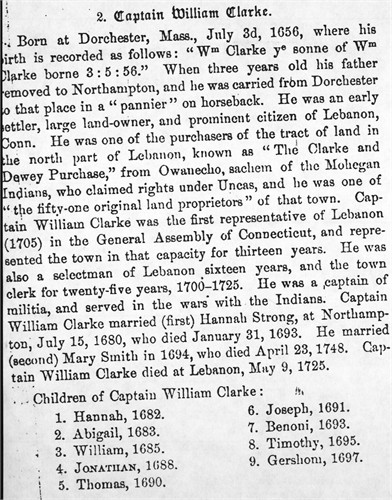
Capt. William Clark Sr. was born 3 July 1656 at Dorchester, Mass. His parents were Lt. William CLARK and Sarah STRONG.   He married Hannah STRONG, his second cousin on 15 Jul 1680 in Northampton, Mass.   After Hannah died, he married Mary Smith on 31 Jan 1694/95 in Lebanon, New London, CT.  William died 9 May 1725 in Lebanon, CT.

Capt William Clark Jr. Headstone  Old Cemetery Lebanon, New London, Connecticut Here lives what was mortal of Capt. William Clark, Esq. who died May ye 9th 1725 and in ye 69th year of his age.

Hannah Strong was born 30 May 1659 in Northampton, Mass.  Alternatively, she was born 20 May 1657,  in Windsor, CT.  Her parents were Elder John STRONG and Abigail FORD.  Hannah died 31 Jan 1693/94 in  Lebanon, Connecticut.

Mary Smith was born 14 Mar 1662 Milford, New Haven, Connecticut. Her parents were Benjamin Smith and Mary Baldwin.  Mary died 23 Apr 1748 in Lebanon, New London, Connecticut.

Mary Smith Clark Headstone – Most of the stones in the cemetery are illegible but her foot stone is tilted forward and you can still read Mary Clark. Her grave is right next to her husband Capt William Clark Jr.

Children of William and Hannah:

Name Born Married Departed
1. Hannah Clark 5 May 1681 Northampton Mass Ebenezer Hunt
27 May 1698
.
Thomas Bissell
20 Dec 1743
10 Jun 1758
2. Abigail Clark 25 Jan 1683/84 2 May 1687
3. William CLARK Jr. 5 Feb 1685 Northampton Hampshire, Mass Bethiah WILLIAMS
5 Jan 1709/10
Lebanon, CT
28 Aug 1753 Lebanon, CT
4. Jonathan Clark 13 May 1688 Hannah Smalley
6 Jan 1713/14
12 Jan 1743/44 Lebanon, CT
5. Thomas Clark 14 Apr 1690
Lebanon, CT
Sarah Strong
27 Jun 1717
.
Mary Hine
30 Jul 1760 in Lebanon, New London, CT
12 Nov 1765 Waterbury, New Haven,  CT
6. Joseph Clark 31 Dec 1691 Rebecca Huntington
20 Jun 1717
10 Sep 1769
Columbia, Tolland, CT
7. Benoni Clark 1 Feb 1693/94 Lebanon, CT Hannnah Root
6 Nov 1718

Children of William and Mary Smith::

Name Born Married Departed
8. Timothy Clark 12 Oct 1695, Lebanon, Connecticut; Deborah Beard
19 May 1722
12 Jul 1752 Lebanon, CT
9. Gershom Clark 12 Oct 1695, Lebanon, Connecticut; Esther Strong 18 Aug  1747 Lebanon, New London, CT
10. Mary Clark  c. 1699
11. David Clark  c. 1701

As a small child William moved from Dorchester to Northampton carried in a pannier [a basket, especially a large one, for carrying goods, provisions, etc.]  on his mother’s horse.   He took the Oath of Allegiance from Major Pynchon on February 8, 1676 in Northampton, MA.

At age 20, in May 1676, he was one of 22 soldiers of Northampton who took part in the Falls Fight under Capt. William Turner.  Today, Turners Falls is an unincorporated village and census-designated place in the town of Montague in Franklin County, Massachusetts.

Of the men, directly connected with Northfield history, in this fight, were Nathaniel Alexander, James Bennett, Philip Mattoon, Joseph Kellogg, Samuel Boltwood, Stephen Belding, William CLARKE, John Lyman, Cornelius Merry, and  Joseph WARRINER.

Turner’s Falls 19 May 1676

THE TURNERS FALLS, MASSACHUSETTS FIGHT – Excerpt abridged from The History of Deerfield, Vol. I, George Sheldon, 1895, pp. 155-157.

After sunset, Thursday, May 18th [1676], this little army set out on a memorable march…. The cavalcade passed out from Hatfield street with high hopes and determined hearts. Crossing the meadows to the north, vowing vengeance for stolen cattle, they wended their way slowly up the Pocumtuck path. Over the Weequioannuck and through the hushed woods as darkness was closing down, to Bloody Brook. Guided by Hinsdell, the troops floundered through the black morass, which drank the blood of his father and three brothers, eight months before; they passed with bated breath and clinched fire-lock, the mound under which slept Lothrop and his three score men. As they left this gloomy spot, and marched up the road, down which the heedless Lothrop had led his men into the fatal snare, the stoutest must have quailed at the uncertainty beyond. Was their own leader wise? Did he consider the danger? Was it prudent to neglect precautions against surprise?

Leaving his horses under a small guard, Turner led his men through Fall river, up a steep ascent, and came out on a slope in the rear of the Indian camp. He had reached his objective point undiscovered. Silence like that of death brooded over the encampment by the river, save for the sullen roar of the cataract beyond. With ears strained to catch any note of alarm, the English waited impatiently the laggard light, and with the dawn, stole silently down among the sleeping foe; even putting their guns into the wigwams undiscovered. At a given signal the crash of a hundred shots aroused the stupefied sleepers. Many were killed at the first fire. The astonished survivors, supposing their old enemy to be upon them, cried out “Mohawks! Mohawks!” rushed to the river, and jumped pell-mell into the canoes which lay along the shore. Many pushed off without paddles; in other cases the paddlers were shot, and falling overboard, upset the canoe; many in the confusion plunged into the torrent, attempting to escape by swimming. Nearly all of these were swept over the cataract and drowned. Others, hiding about the banks of the river, were hunted out and cut down, “Captain Holyoke killing five, young and old, with his own Hands from under a bank.” A very slight resistance was made, and but one of the assailants wounded; another “was killed in the action by his friends, who, taking him for an Indian as he came out of the wigwam shot him dead.” The wigwams were burned, and the camp dismantled.

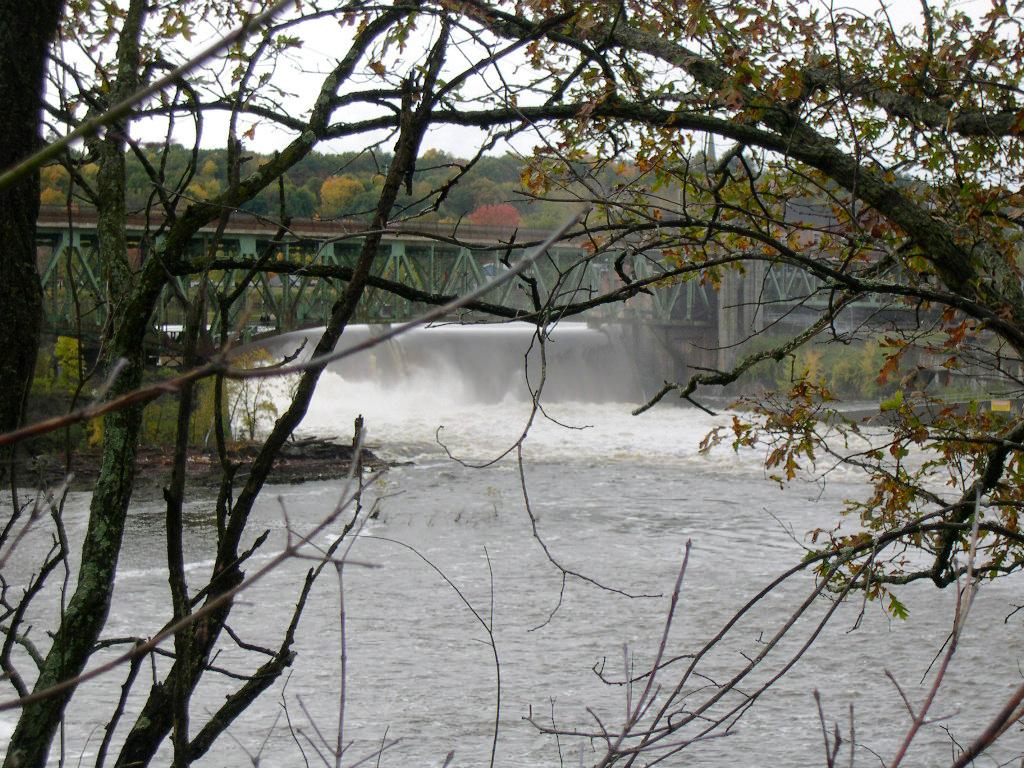
Turners Falls, Massachusetts

In 1736, the General court granted to the survivors of this fight, and their descendants, a township,which in commemoration of the event was named Fall-town, since incorporated under the name of Bernardston.  Bernardston was first settled in 1738 as a part of “Fall Town,” which also included Colrain and Leyden.

Benardston,  Franklin, Mass

After King Philip’s War, William assisted his father in the resettlement of Northfield from 1682-1690 and served as administrator of his father’s estate in 1690. He was Selectman for Northampton in 1694 and 1696. Northampton vital records show William was a freeman in 1690 and removed to Lebanon about 1698.

In 1705, he was one of the first representatives from the town to the general court. serving for 13 years. He was a selectman for 16 years, and town clerk 25 years. He was captain of militia, serving in the Indian Wars.

In 1698, except for his oldest daughter, who had married, William and his family moved to Lebanon where he was one of 51 original proprietors.  Two of our ancestors Maj. John MASON and Rev. James FITCH were the founders of Lebanon.  See Rev. Fitch’s page for the story.   On May 2, 1700, he and Josiah Dewey of Northampton bought a large tract of wilderness in what is now Lebanon and the surrounding towns from Owanecho, Sachem of the Mohegans, commonly called the Clark-Dewey purchase. William immediately became prominent in the new settlement. William was chosen as the first Deputy to the General Assembly from Lebanon in May 1705 and represented the town again in 1706 through 1713,1715, 17, 18 and 1719.

The Clarke and Dewey Purchase

On September 25, 1699, two Massachusetts men, William CLARKE of Northampton and Josiah Dewey, Snr., originally of Northampton and later of Westfield, purchased a large tract of land from Thomas Buckingham and John Clarke of Saybrook, who were acting on behalf of Abimelech, the young son and heir of Joshua. The tract adjoined the Five Mile Square on its northern boundary, across the Ten Mile River

On May 2, 1700, this tract was conveyed again to Clarke and Dewey (who had already settled in Lebanon) by Oweneco, who also claimed the land that his brother Joshua had bequeathed to Abimelech. This section of Lebanon was known as the North Society or Lebanon Crank. It is now the town of Columbia.

Oweneco died in 1715, aged, it is probable, about seventy or seventy-five years. The brave warrior who, in his youth and early manhood, fought gallantly against the Pocomtocks, the Pokanokets and Narragansetts, became in his old age a mere vagabond. With his blanket, his gun, his squaw, and a pack on his back, he used often to wander about the settlements adjacent to Mohegan. At his old friends and acquaintances he was generally made welcome, and established himself, during his stay, in the kitchen or some of the out-houses. To strangers, who were unable to understand his imperfect English, he sometimes presented a doggerel petition which had been written for him by a settler named Bushnell.

“Oneco, king, his queen doth bring,
To beg a little food;
As they go along his friends among
To try how kind, how good.
“Some pork, some beef, for their relief,
And if yon can’t spare bread,
She’ll thank yon for pudding, as they go a gooding,
And carry it on her head.”

The last line refers to an Indian mode of carrying burdens, by a metomp, or bag, hanging down the back, and supported by a strap passing over the forehead.-)

Oweneco had three sons, Josiah, Mamohet, (or, as the English settlers usually called it, Mahomet,) and Cesar. Josiah and Mamohet died before their father, and Mamohet, the son of Mamohet, being still a child, his uncle Cesar, on the death of Oweneco, assumed the sachemship

These large tracts with the later addition of several gores and town boundary adjustments made up the town of Lebanon. The town was incorporated by the General Assembly on October 10, 1700.

William Clarke was a member of the Governor’s Council in 1719 and 1721 and Deputy again in 1723 and 1724. He was Speaker of the House in 1723. In October 1708, he served as Justice of the Peace for New London County from 1708 – 1724. In May 1717, he was appointed Justice of the Peace and Quorum from June 1717 – June 1724, his name appears regularly as one of the Justices in the records of the New London County Court. He was Judge of the Probate Court, District of Windham, from May 1723 until his death.

Children

1. Hannah Clark

Hannah’s first husband Ebenezer Hunt was born 6 Feb 1676 in Northampton, Hampshire, Mass. His parents were Jonathan Hunt (1637 – 1691) and Clemence Hosmer. Ebenezer died 23 Feb 1743 in Lebanon, New London, CT.

Hannah’s second husband Thomas Bissell was also her first cousin.  He was born  03 Dec 1683 in Windsor, Hartford, CT.  His parents were Thomas Bissell and Hester Strong.  His maternal grandparents were Elder John STRONG and Abigail FORD. He first married 16 Feb 1710 to Martha Loomis.    Thomas died 11 Jun 1771 in East Windsor, Hartford, CT,

Children of Hannah and Ebenezer

i. Hannah Hunt b. 4 Oct 1699 Northampton, Hampshire, Mass.; d. 1769 New London, CT; m. 24 Jun 1731 Lebanon, New London, CT to Saxton Bailey (b. 1708 in Lebanon – d. 1743 in Lebanon)  His parents were Isaac Bailey (1681 – 1711) and Mercy Saxton (1686 – 1759) Hannah and Saxton had at least one child:  Saxton (b, 1743)

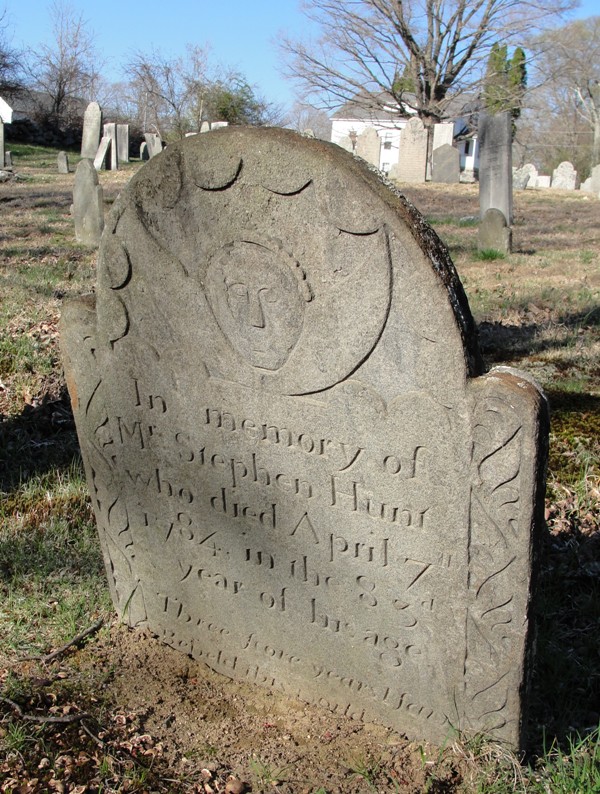
ii. Stephen Hunt b. 24 Jul 1701 Lebanon New London, CT; d. 7 Apr 1784 Columbia, Tolland, CT; m. 18 Jun 1730 in Lebanon to Esther Janes (b. 1695 in Northampton, Hampshire, Mass. – d. 17 Feb 1779 in Lebanon) Her parents were Abel Janes (1644 – 1718) and Mary Judd (1658 – 1735). Stephen and Esther had nine children born between 1731 and 1749.

1758/59 – Stephen served in the French and Indian War.

Stephen Hunt Gravestone --Old Yard Cemetery  Columbi, Tolland, CT Find A Grave Memorial# 62466785

Stephen Hunt Gravestone –Old Yard Cemetery
Columbi, Tolland, CT Find A Grave Memorial# 62466785

iii. Deacon Ebenezer Hunt b. 28 Aug 1703 Lebanon, New London, CT; d. 21 Feb 1788 Northampton, Hampshire, Mass; m. 9 Dec 1730 in Northampton to Elizabeth King (b. 15 Jun 1707 Northampton – d.  5 Jun 1777 Northampton) Her parents were William King (1660 – 1728) and Elizabeth Denslow (1666 – 1746). Ebenezer and Elizabeth had six children born between 1732 and 1750.

19 Jan 1734 –  Ebenezer Hunt’s hat shop burns

19 Sep 1738 – Ebenezer Hunt’s Northampton hatshop burglarized by Samuel West, who is caught and branded

Inscription:
HERE LIES ThE Body
oF Deacon
EbENEZER Hunt
who died FEbRy 21
1788 in the 85th yEAR
oF his AGE
The Moments seize; a moment you may wish when worlds want
wealth to buy.

iv. William Hunt b. 12 Oct 1705 Northampton, Hampshire, Mass.; d. 6 Jan 1783 Lebanon, New London, CT; m. 19 Dec 1734 in Lebanon to Sarah Lyman (b. 24 Jan 1713 in Lebanon – d. Feb 1746 in Lebanon) Sarah’s sister Hannah married William’s brother Simeon. Their parents were Jonathan Lyman (1684 – 1753) and Lydia Loomis (1686 -1776). William and Sarah had seven children born between 1735 and 1745.

v. Abigail Hunt b. 16 Jul 1708 Northampton, Hampshire, Mass.; d. 1778; m. 16 Apr 1730 in Lebanon, New London, CT to Isaac Bailey (b. 1707 in Stonington, New London, CT – d. 1767) His parents were Isaac Bailey (1681 – 1711) and Mercy Saxton (1686 – 1791).

vi. Daniel Hunt b. 17 Aug 1711 Northampton, Hampshire, Mass.; d. 1 Oct 1807 Turnbridge, Orange, Vermont; m. 15 Feb 1740 in Lebanon, New London, CT to Hannah Burnham (bapt. 2 Aug 1723 in East Hartford, Hartford, CT – d.  Apr 1808 in Tunbridge) Her parents were Josiah Burnham (1696 – 1763) and Hannah Stedman (1699 – 1726).  Daniel and Hannah had at least four children born between 1749 and 1762.

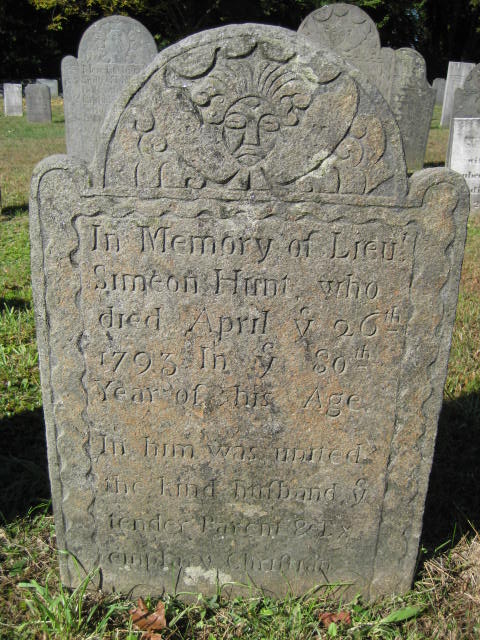
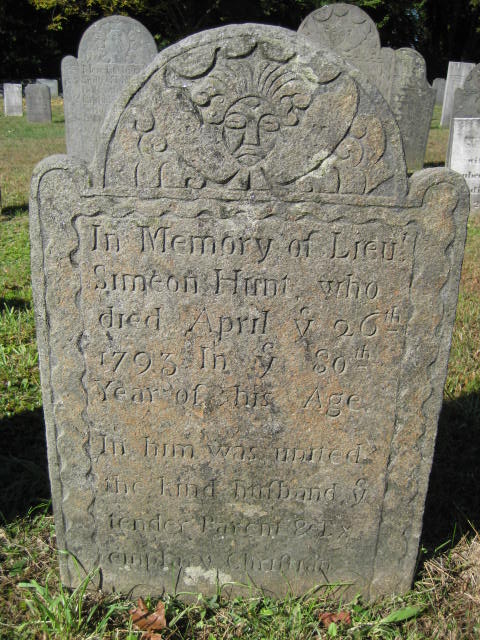
vii. Lt. Simeon Hunt b. 3 Nov 1713 Coventry, Tolland, CT; d. 26 Apr 1793 Lebanon, New London, CT; m. 29 Jul 1736 in Lebanon to Hannah Lyman (b. 15 Feb 1715 – d. 2 Jan 1758 Burial: South Street Cemetery, Coventry). Hannah’s sister Sarah married Simeon’s brother William. Their parents were Jonathan Lyman (1684 – 1753) and Lydia Loomis (1686 -1776) Simeon and Hannah had eight children born between 1739 and 1761.

Simeon served in the French Indian War Capt. Abner Barker’s 2nd Company, Col Shubel Connant’s 5th Connecticut Regiment, Muster Roll of company of militia at Ft.Edward, Ft.William Henry and parts adjacent.  Company in service during alarm and for relief of Ft.William Henry and parts adjacent.

Lt Simeon Hunt Gravestone -- North Coventry Cemetery, Coventry, Tolland CT,  Find A Grave Memorial# 15422901

Lt Simeon Hunt Gravestone — North Coventry Cemetery, Coventry, Tolland CT, Find A Grave Memorial# 15422901

viii. Phineas Hunt b. 24 May 1716 Northampton, Hampshire, Mass.; d. 22 Aug 1787 Sharon,Litchfield, CT; m. 17 Aug 1756 at Sharon, CT to Mary Brown (b. 29 Jan 1729 in Kent, Litchfield, CT – d. 10 Dec 1812 Burial: Hillside Cemetery, Sharon)

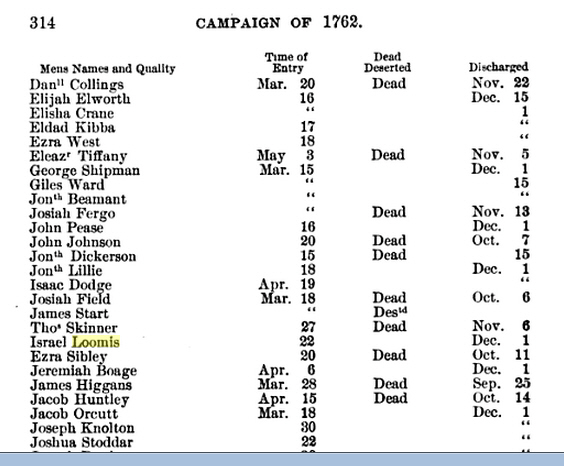
ix. Esther Hunt b. 27 Oct 1718 Lebanon, New London, CT; d. 16 Feb 1743 Lebanon; m. 15 Dec 1737 in Lebanon to Capt. Israel Loomis (b. 29 Sep 1715 in Lebanon – d. 2 Oct 1801 in Lebanon) His parents were John Loomis (1681 – 1755) and Martha Osborn (1687 – 1725). Esther and Israel had three children born between 1738 and 1742. He married second  27 Sep 1743 in Lebanon to Mary Holbrook (b. 1715 in Lebanon – d. 3 Apr 1744) who soon died. Finally, he married 8 Apr 1747 in Lebanon to Mercy Marsh (b. 1725 in Lebanon – d. 18 Oct 1795 in Lebanon) and had seven more children between 1748 and 1760.

1762 – Pay Role Capt. Robert Durkee’s Ninth Company, Major General Phineas Lyman’s First Connecticut Regiment

Campaign of 1762 - 1st Regiment - Rolls of Connecticut Men in the French and Indian War, 1755-1762, Volume 2  By Connecticut Historical Society

Campaign of 1762 – 1st Regiment – Rolls of Connecticut Men in the French and Indian War, 1755-1762, Volume 2
By Connecticut Historical Society

Rolls of Connecticut Men in the French and Indian War, 1755-1762, Volume 2 By Connecticut Historical Society

The Battle of Havana – 1762 (See my post)  had by far the most America deaths of any battle up until that time, especially for Connecticut, but until I found family casualties in this genealogy project, I had never heard of it.  As you can see on this page, the casualty rate was almost 50%, mostly from malaria and yellow fever.

x. Sybil Hunt b. 7 Nov 1720 Lebanon, New London, CT; d. 11 Aug 1748 Lebanon, New London, CT; m. 12 Dec 1744 in Lebanon to Moses Spear (b. 3 Jul 1720 in Braintree, Norfolk, Mass. – d. 8 Jan 1782 in West Suffield, Hartford, CT). His paarents were Nathaniel Spear (1692 – 1732) and Thankful Woodward (1693 – 1749) Sybil and Moses had two children Elijah (b. 1746) and Nathaniel (b. 1748)  After Sybil died, Moses married 9 Mar 1749 to Submit Hastings (1727 – 1782) and had nine more children born between 1749 and 1769.

Moses’ gravestone inscribed: And as a flash of summer comes and calls me to my lasting home, come children and view where I lie and learn how sudden you may die.

The will of Moses Spear dated Jan 18, 1872 left on third to his wife Submit, the balance of all real estate to his son Moses II, 5 pounds to Nathaniel, 10 shillings to Elijah, 35 pounds to Elihu, 35 pounds to Joshua, 35 pounds to Ashel, 5 shillings to Sibble, 5 shillings to Submit, 4 pounds to Elizabeth, and 35 pounds Thankful, appraisers were John Sheldon and John Hastings.

Among those of the name who fought as officers of War of the Revolution were Lieutenants Edward and John Spear, of Pennsylvania : Lieutenants Moses, Jacob , David, William, and Zebdiah Spear of Massachusetts.

xi. Beulah Hunt b. 16 Mar 1723 Lebanon, New London, CT; d. 23 Jan 1810 Northampton, Hampshire, Mass.; 25 Feb 1746 in Northampton to Jacob Parsons (b. 22 Oct 1719 in Northampton – d. 19 Jan 1795 in Northampton). His parents were Josiah Parsons (1682 – 1768) and Sarah Sheldon (1688 – 1738). Beulah and Jacob had eleven children born between 1747 and 1763.

Jacob Parsons Gravestone -- Bridge Street Cemetery  Northampton, Find A Grave Memorial# 19943066

Jacob Parsons Gravestone — Bridge Street Cemetery
Northampton, Find A Grave Memorial# 19943066

3. William CLARK Jr.  (See his page)

4. Jonathan Clark

Jonathan’s wife Hannah Snow Smalley was born 25 Nov 1695 in Eastham, Barnstable, Mass. Her parents were Benjamin Smalley (1665 – 1721) and Rebecca Snow (1676 – 1753).  Hannah died in 1753 in Lebanon, New London, CT.

Jonathan was a farmer at Lebanon, CT.

Children of Jonathan and Hannah:

i. Jonathan Smalley Clark b. 1 Nov 1715 Lebanon, New London, CT; d. 1802; m. 16 Jan 1735 in Lebanon to Mercy Saxton Dewey (b. 1 Apr 1714 in Lebanon – d. 1783 in Lebanon). Her parents were William Dewey (1692 – 1759) and Mercy Saxton (1686 – 1791) Jonathan and Mercy had eight children born between 1735 and 1755.

ii. Hannah Clark b. 1715 Lebanon, New London, CT

iii. Samuel Clark b. 1719 Lebanon, New London, CT

iv. Daniel Smalley Clark b. 1721 Lebanon, New London, CT

v. David Clark b. 1727 Lebanon, New London, CT

vi. Terriah Clark b. 1729 Lebanon, New London, CT

vii. Lemmuel Smalley Clark b. 1731 Lebanon, New London, CT

viii. Mary Clark b. 19 Jun 1743 Lebanon, New London, CT; d. 3 Mar 1843 Dixmont, Maine; m. 20 May 1773 in Townsend, Mass to Jacob Upton (b. 10 Dec 1739 in North Reading, Mass. – d. 4 Jul 1804 in Goffstown, New Hampshire) Mary and Jacob had five children.

5. Thomas Clarke

Thomas’ first wife Sarah Strong was born 1696 in Lebanon, New London, CT. Her parents were John Strong (1665 – 1749) and Hannah Trumbull (1673 – 1747). Sarah died 18 Sep 1749 in Waterbury, New Haven, CT.

Thomas’ second wife Mary Hine was born 1690 in Hampshire, Mass.

According to The History of Waterbury, Connecticut, published in 1858, The Congregational Church’s Deacon Thomas Clark  was adopted as a young child by his uncle, Timothy Stanley, one of Waterbury’s first settlers, who had no children of his own.  The timing seems off as Thomas’ father Capt. William Clark lived until 1725 when Thomas was 35 years old.  On the other hand, William remarried when Thomas was five, married Mary Smith on 31 Jan 1694/95.

In March 1798,  two agreements were made by the heirs of Thomas’ uncle John Strong, the first relating to the dower of  John’s second wife, the widow Hannah Strong, who is called mother-in-law [stepmother] of the sons; the second, relating to distribution to the children, signed by John, Jacob and Josiah Strong, Return Strong, as the guardian of Josiah, and Timothy Stanley and John Hopkins. (See Elder John STRONG’s  page)

Back to the history of Waterbury, Clark learned his uncle’s trade as a cloth weaver and managed the family farm. He was also a storekeeper and served as Town Clerk and Treasurer. He inherited his uncle’s home on the south side of the Green, and occasionally took in boarders and fed soldiers passing through town. Clark’s store sold items such as pepper, salt, wine, almanacs, cloth, rum and tobacco. He bought supplies for his store from Derby and New Haven.

 Clark may have been Waterbury’s first slave owner. He brought a boy named Mingo to Waterbury sometime around 1730. Mingo helped work Clark’s farm and was at times hired out to other Waterbury residents. Clark’s three sons and four daughters were also hired out to work in other households.

Following Deacon Clark’s death in 1767, Mingo had chosen to remain in the family home, but when it became a tavern, he moved to the Town Plot section of Waterbury, to live with the Deacon’s other son, Timothy. By the time the 1790 census was taken, Mingo was a free man living in the Clark household. He may have been given his freedom after Deacon Clark died. Mingo was a member of the First Congregational church in 1795 and died in 1800.

Children of Thomas and Sarah:

i. Sarah Clark b. 13 Dec 1723 Waterbury, New Haven, CT; d. 29 Sep 1813 Waterbury; m. 14 Jan 1749 in Waterbury to Stephen Upson (b. 9 Dec 1717 in Waterbury – d. 27 Mar 1769 in Waterbury) His parents were Stephen Upson (1686 – 1777) and Sarah Bronson (1691 – 1748). Sarah and Stephen had eight children born between 1750 and 1769.

ii. Hannah Clark b. 30 Jun 1726 Waterbury, New Haven, CT;  d. 24 Jul 1800; m. 7 Jan 1765 to Rev. Solomon Mead (b. 25 Dec 1725 in Greenwich, Fairfield, CT – d. 5 Sep 1812 in South Salem, New York) His parents were Ebenezer Mead (1692 – 1775) and Hannah Brown (1697 – 1710)  He first married Hannah Strong ( b. 1737 – d. 20 Oct 1761, South Salem, Westchester, New York)  Hannah and Solomon had two children: Clark (b. 1769) and Martin (b. 1771).

Inscription:

” Memory of the
Rev, Solomon Mead
First Pastor of the Presbyterian
Church in this place, JE 86.
He had the charge of this people
48 years,
Ob. September, 1812.
While marble monuments decay,
The Righteous live in endless day,
And earthly temples turn to dust.
Blest is the memory of the just.”

iii. Hephzibah Clark b. 17 Oct 1729 Waterbury, New Haven, CT; d. 29 Jul 1800 New Haven, New Haven, CT; m. 28 Nov 1754 in Waterbury to Joseph Hopkins (b. 6 Jun 1730 in Waterbury – d. 27 Mar 1801 in New Haven) His parents were Stephen Hopkins (1689 – 1769) and Susannah Peck (1697 – 1755). Hephzibah and Joseph had nine children born between 1755 and 1772.

Joseph Hopkins Silver Mark

Joseph Hopkins Silver Mark

Joseph learned silversmith trade and opened shop in Waterbury. Made plated knee buckles, shoe buckles, silver sleeve buttons and other silver and plated ware. First of his trade to seek business beyond local markets.

Originally from a section of Waterbury that is now in the nearby town of Naugatuck, Joseph Hopkins started out as a silversmith and watchmaker. His shop was on West Main Street in Waterbury, near St. James’ church, which was at the corner of Willow Street.

Hopkins pursued a legal career, becoming Justice of the Peace in 1762. He was elected to the General Assembly 45 times, beginning in 1764; and he was the first judge of probate for Waterbury. By the Revolutionary War, Hopkins was considered to be the most prominent citizen in Waterbury and dined with George Washington and the Marquis de Lafayette when they passed through Waterbury during the war.

Hopkins owned one slave, a woman named Silence Will whom he purchased in Middletown, possibly in the 1760s. He was also the executor of Cuff Capeny’s will. Cuff Capeny was a free African American who served during the Revolutionary War. In his will, dated 1777, Capeny left money for Silence, “servant” of Joseph Hopkins. Hopkins freed Silence in 1798.

Hopkins died in 1801 while in New Haven as senior assistant judge of the county court. He was buried “within the land of his friend and neighbor, Mrs. Sarah Leavenworth,” in a cemetery plot that later became part of the Grand Street Cemetery.

1764 to 1796 – Joseph was representative in the Connecticut General Assembly

1766 – Advertised in the Connecticut Courant, 1766, that shop had been broken open; silver buckles, silver spoons, etc. stolen. Offered reward of five dollars.

31 Aug 1767 – Advertised in the Connecticut Courant, with Martin Bull of Farmington, in response to notice relative to silver prices, their determination to serve customers at rates “lower than the wages of most other tradesmen.”

24 Nov 1772 – Advertised in the Connecticut Courant, , a notice with lengthy description of Giles Richards, his apprentice, who had run away, and who had had the care of his shop for some time. Offered reward of ten dollars.

22 Jan 1773 – Advertised in the Connecticut Journal & New Haven Post-Boy, , as a goldsmith.

~ 1780 Appointed Judge of the Probate Court

18 Oct 1785 – Samuel Bishop, James Hill-house, Joseph Hopkins, and John Goodrich petitioned the General Assembly of Connecticut to authorize the production of copper coins. It was stated in the petition that there was a great scarcity of small circulating coins in the state, and those that were seen were apt to be counterfeits. The petitioners were granted the right to establish a mint under the direction and superintendence of the General Assembly, with a royalty of one twentieth part of all copper coins to be paid into the treasury of the state.

The authorization was given to coin no more than 10,000 pounds lawful money in value of the standard of British halfpennies, to weigh six pennyweight each, and to bear a design of a man’s head on one side with the letters AUCTORI: CONNEC: (“by the authority of Connecticut”). The reverse side was to depict the emblem of Liberty with an olive branch in her hand and with the inscription INDE: ET. LIB: 1785. Yet another condition was specifically stated:

Nothing in this act shall be construed to make such coppers a legal tender in payment of any debt, except for the purpose of making even change, for any sum not exceeding three shillings.

Connecticut Copper Coins

iv. Capt. Timothy Clark b. 19 May 1732 Waterbury, New Haven, CT; d. 18 Sep 1824 Waterbury; m1. 4 Nov 1756 in Waterbury to Sarah Hopkins (b. 25 May 1730 in Waterbury – d. 21 Oct 1757 in Waterbury) Her parents were Timothy Hopkins (1691 – 1748) and Mary Judd (1701 – 1744) Timothy and Sarah had one child: Sarah (b. 1757);

m2. 13 Jun 1759 in Waterbury to Hannah Bronson ( – 15 Sep 1783) Her parents were Isaac Bronson (1707 – 1799) and Eunice Richards (1716 – 1749). Timothy and Hannah had four more children born between 1760 and 1766; m3. 1784 to Elizabeth Porter (b. 9 May 1742 in Waterbury – d. 1 Feb 1815)

m3. 1783 to Elizabeth Porter (b. 09 May 1742 in Waterbury, New Haven, CT – d. 01 Feb 1815)

v. Esther Clark b. 22 Jun 1735 Waterbury, New Haven, CT; d. 18 Mar 1772 in Waterbury, Litchfield, CT; m. Col. Phineas Porter (b. 1 Dec 1739 in Waterbury – d. 9 Mar 1804 in Waterbury) His parents were Capt. Thomas Porter (1702 – 1797) and Mary Welton (1704 – ) Esther and Phineas had one child: Esther (b. 1772). After Esther died in child birth, Phineas married 23 Dec 1778 in Waterbury to Milliscent Baldwin Lewis and had six more children born between 1779 and 1790.

“Waterbury, Connecticut men enlisted in six of the eight companies forming Col. Douglas’s regiment, of which Phineas Porter was major.

The militia regiment of Col. Baldwin reached New York about two weeks before the battle of Long Island. In that battle, Major Porter’s regiment ‘was in the thickest of the fight.’ In the retreat from Long Island to New York, Major Porter is said to have been in the last boat which put off in the fog from the Brooklyn shore. This was about two months after his entrance into the Continental army as major of the 5th battalion of foot under Col. William Douglas.

About two weeks later, Sep 15, 1776, an attack was made at Kip’s Bay (Kip’s Bay was a cove on the eastern shore of the island, extending roughly from present-day 32nd to 38th Streets, and as far west as Second Avenue.) where the 5th battalion, under Col. Douglas, to which Major Porter belonged, was stationed. The main body of the army was then at Harlem Heights. The British ships ascended the North and the East rivers, and their fires swept across the whole island, under cover of which, Howe landed near Kip’s Bay.

Landing at Kip's Bay

Heavy advance fire from British naval forces in the East River caused the inexperienced militia guarding the landing area to flee, making it possible for the British to land unopposed at Kip’s Bay. A first wave of more than eighty flatboats carried 4,000 British and Hessian soldiers. Skirmishes in the aftermath of the landing resulted in the British capture of some of those militia. British maneuvers following the landing very nearly cut off the escape route of over a third of Washington’s Continental Army forces stationed further southeast on the island. The flight of American troops was so rapid that George Washington, who was attempting to rally them, was left exposed dangerously close to British lines.

By late afternoon another 9,000 British troops had landed at Kip’s Bay, and Howe had sent a brigade toward New York City, officially taking possession.

Washington is said to have become so excited that he threw his hat to the ground, exclaiming, ‘Are these the men with whom I am to defend America?’ At this moment, Washington, when ‘within eighty paces of the enemy and exposed to capture, was saved by his attendant who turned the head of his horse and hurried him from the field.’ It is pleasant to know that one Waterbury man–Major Phineas Porter–was between the enemy and the general, for in this retreat he was taken prisoner. He suffered nearly three months of hunger and imprisonment, during which time he parted with his knee buckles and other articles of value for food.

The operation was a decisive British success, and resulted in the withdrawal of the Continental Army to Harlem Heights, ceding control of New York City on the lower half of the island. The following day, however, the British and American troops fought the Battle of Harlem Heights, which resulted in an American victory.

Washington was extremely angry with his troops’ conduct, calling their actions “shameful” and “scandalous”. The Connecticut militia, who already had a poor reputation, were labeled cowards and held to blame for the rout. However, others were more circumspect, such as General William Heath, who said, “The wounds received on Long Island were yet bleeding; and the officers, if not the men, knew that the city was not to be defended.” If the Connecticut men would have stayed to defend York Island under the withering cannon fire and in the face of overwhelming force, they would have been annihilated.

vi. Thomas Clark b. 26 Jan 1737 Waterbury, New Haven, CT; d. 25 Oct 1779 Waterbury

Thomas inherited the home on the Green, which he operated as a tavern until his death.

vii. David Clark b. 25 Apr 1740 Waterbury, New Haven, CT; d. 24 Nov 1815 Watertown, Litchfield, CT; m. 27 Oct 1772 in Lebanon to Hannah Nichols (b. 17 Apr 1739 in Willington, Tolland, CT – d. 9 Aug 1827 in Watertown, CT ) Hannah’s parents were Samuel Nichols and [__?__]  David and Hannah had at least one child:  Hannah (b. 1774)

6. Joseph Clark

Joseph’s wife Rebecca Huntington was born Feb 1699 in Norwich, New London, CT. Her parents were Samuel Huntington (1665 – 1717) and Mary Clark (1669 – 1743). Rebecca died 1 Jun 1759 in Columbia, Tolland, CT.

Rebecca Clarke Headstone “wife of Capt. Joseph Esq.”  —  Old Yard Cemetery Columbia, Tolland, Connecticut

Children of Joseph and Rebecca:

i. Mary Clark b. 11 Jul 1720 Lebanon, New London, CT; d. 13 Apr 1810 Tolland, CT; m. 7 Jul 1741 in Hartford, Hartford, CT to Aaron Gaylord (b. 1718 in W Hartford, CT – d. 28 Aug 1750 in W Hartford, CT) His parents were William Gaylord (1678 – 1770) and Hope Butler (1680-1793). Mary and Aaron had five children born between 1742 and 1750.

ii. Abigail Clark b. 26 Nov 1721 Lebanon, New London, CT; d. 30 Oct 1796; m. 9 Nov 1738 in Lebanon to Lt. Joseph Loomis IV (b. 10 Oct 1710 in Windsor, Hartford, CT – d. 11 Apr 1759 in Lebanon) His parents were Joseph Loomis III (1684 – 1733) and Sarah Bissell (1690 – ) Abigail and Joseph had ten children born between 1741 and 1759.

Joseph Loomis Gravestone -- Old Yard Cemetery , Columbia, Tolland CT, Find A Grave Memorial# 36444826

Joseph Loomis Gravestone — Old Yard Cemetery , Columbia, Tolland CT, Find A Grave Memorial# 36444826

Some sources say Abigail married 3 Feb 1735 to Jacob Burnap (b. 1721 – d. 30 Apr 1771 in Windham, CT) his parents were John Burnap (1655 – 1725) and Mary Rice (1661 – 1741); Abigail and John had eleven children born between 1737 and 1761. However, Jacob’s Abigail Clarke died 3 Oct 1790 “in ye 82d year of her age” (b. 1709) Burial: Palmertown Cemetery , Scotland, Windham, CT

iii. Joseph Clark b. 8 Dec 1723 Lebanon, New London, CT; d. 1748 Lebanon;

iv. Rebecca Clark b. 27 Feb 1727 Lebanon, New London, CT; d. 19 Apr 1834; m. 22 May 1746 Lebanon to William Buckingham (b. 1727 in Connecticut) His parents were Richard Buckingham (1673 – 1735) and Abigail Prickett (1674 – 1739)

v. Lydia Clark b. 13 Feb 1729 Lebanon, New London, CT; d. 16 Jan 1787 Choconut, Susquehanna, Pennsylvania; m1. 1751 to Seth Wright (b. 1726 in Northampton, Hampshire, Mass. – d. 20 Dec 1775 in Windsor, CT.) His parents were Jonathan Wright (1681 – 1743) and Experience Edwards (1689 – 1721). Lydia and Seth had five children born between 1752 and 1761.

Aug 1757 – Seth served in Capt. John Baldwin’s Company, Col. Christopher Avery’s Regiment at the time of alarm for relief of Fort William Henry and parts adjacent.

Seth Wright Gravestone -- Old Yard Cemetery,  Columbia, Tolland CT, Find A Grave Memorial# 36444984

Seth Wright Gravestone — Old Yard Cemetery,
Columbia, Tolland CT, Find A Grave Memorial# 36444984

m2. 11 Feb 1768 in Lebanon to Edward Simms (b. 19 Jun 1745 in Lebanon – d. 20 Mar 1824 in Andover, Tolland, CT) His parents were William Sims (1707 – 1796) and Mary Fairbanks (1720 – 1800) Lydia and Edward had seven children born between 1770 and 1785.

vi. Simon Clark b. 1735 Lebanon, New London, CT; d. 2 May 1819 Columbia, Tolland, CT; m1. 25 May 1758 to Elizabeth Moseley (b. 15 Nov 1737 in Windham, Windham, CT – d. 19 Jul 1769 in Lebanon) Her parents were Samuel Moseley (1708 – 1791) and Bethiah Otis (1703 – 1750); m2. 1770 to Elizabeth Huntington.

vii. Asahel Clark b. 25 Mar 1738 Lebanon, New London, CT; d. 1 Apr 1827 Columbia, CT; m. 13 Dec 1758 in Lebanon to Lydia Brewster (b. 7 Aug 1739 in Pembroke, Plymouth, Mass. – d. 13 Dec 1758 in Granville, Mass.) Her parents were Ichabod Brewster (1711 – 1797) and Lydia Barstow ( 1717 – 1815) Asahel and Lydia had four children born between 1761 and 1769.

viii. Irene Clark b. 17 Sep 1742 Lebanon, New London, CT; d. 1 Jun 1813 Canaan, Columbia, New York; m. 16 Feb 1781 in Chatham, Columbia, New York to Benjamin Hutchinson (b. 27 Feb 1760 in Preston, New London, CT – d. 28 Mar 1813 in Canaan, Columbia, New York) His parents were Israel Hutchinson (1713 – 1776) and Phebe Guile (1725 – 1756)

7. Benoni Clark

Benoni’s wife Hannnah Root was born 12 May 1699 in Lebanon, New London, CT. Her parents were Thomas Root and Sarah Clark. Hannah died 10 May 1748 in Lebanon, New London, CT.

Benoni was named for Benoni Jones who was indentured to his grandfather. Lt William Clark until he came of age. It was stipulated that Clarke should “learn him to read and write and give him five pounds at the end of his term with sufficient clothing such as servants usually have and at the end of his time two suits of apparel”. He and four others resided in Pascommuck, now Easthampton, settled about 1699. His farm was about four miles from Northampton center and was the garrison house during Indian hostilities.

On May 13, 1704, the French and Indians made a descent upon Pascommuck and killed Benoni Jones and his two youngest children.

Benoni Clark was a farmer at Lebanon, CT.  Benoni’s son Benoni Jr. served in French & Indian War-Capt Joseph Fitch’s company, Col Jonathan Trumble’s Regiment-company at service at time of alarm for relief of Fort William Henry and parts adjacent. In 1758 Benoni Clark served in the 1st Connecticut Regiment under Phineas Lyman, Phineas Colonel & Captain, 9th Company under Capt Gideon Wolcott.

Children of Benoni and Hannah:

i. Sarah Clark b. 22 Aug 1720 Lebanon, New London, CT; d. 23 Sep 1811 East Hartford, CT; m. 12 Feb 1740 in Lebanon to Hezekiah Lanphere (b. 15 Nov 1714 in Stonington, New London, CT – d. Feb 1732 in Lebanon) His parents were Shadrach Lanphere (1674 – 1728) and Experience Read (1675 – 1732). Sarah and Hezekiah had seven children born between 1744 and 1762.

ii. Zerviah Clark b. 27 Jun 1722 Lebanon, New London, CT; d. 1 Nov 1739 Lebanon

iii. Ensign Eleazar Clark b. 25 Aug 1724 Lebanon, New London, CT; d. 29 Aug 1787 Claremont, New Hampshire; m. 23 Apr 1747 in Lebanon to Esther Gibbs (b. 5 Sep 1730 in Lebanon – d. 1769) Her parents were John Gibbs (1699 – 1767) and Sarah Cushman (1709 – 1771). Eleazer and Esther had ten children born between 1752 and 1770.

Eleazar Clark Gravestone -- Union Cemetery  Claremont, Sullivan, New Hampshire,  Find A Grave Memorial# 30301196

Eleazar Clark Gravestone — Union Cemetery
Claremont, Sullivan, New Hampshire,
Find A Grave Memorial# 30301196

iv. Hannah Clark b. 1 Oct 1726 Lebanon, New London, CT; d. 26 Jul 1747; m. 2 Jul 1747 in Lebanon to Rufus Collins (b. 21 Nov 1726 Dighton, Bristol, Mass. – d. 25 Nov 1790 Columbia, Tolland, CT) . His parents were Benjamin Collins (1691 – 1759) and Elizabeth Weare (1700 – 1778). Hannah died less than a month after her marriage. Alternatively, Hannah and Rufus had twelve children born between 1748 and 1770.

Rufus was a Revolutionary Soldier in Captian Pineo’s Company.

v. Miriam Clark b. 1 Sep 1728 Lebanon, New London, CT; m. John Allen (b. 2 Aug 1706 in Groton, New London, CT – d. 1788 Oak Hill, Sanford, Maine Alternatively, John died in Henrico, Virginia) His parents were John Allen (1682 – 1725) and Mary Fargo (1680 – 1756) Miriam and John had at least one child Lydia (b. 1748)

vi. Benoni Clark b. 7 Sep 1730 Lebanon, New London, CT; m. 12 Nov 1750 in Lebanon to Ruth Carpenter (b. 1732 in Lebanon – ) Benoni and Ruth had three children born between 1751 and 1755.

vii. Experience Clark b. 8 Jul 1732 Lebanon, New London, CT; m. William Downer (b. 1722 in Connecticut)

viii. Martha Clark b. 8 Jul 1732 Lebanon, New London, CT; d. 20 May 1821 Columbia, Tolland, CT; m. Jedediah Buckingham (b. 20 Jan 1727 in Saybrook, CT – d. 9 Jul 1809 in Columbia) His parents were Thomas Buckingham (1693 – 1760) and Mary Parker (1693 – 1771) Martha and Jedediah had ten children born between 1753 and 1767.

ix. Sybil Clark b. 3 Jun 1734 Lebanon, New London, CT; d. 1800 Stephentown, Rensselaer, New York; m. 1753 in Norwich, New London, CT to Ebenezer Waterman (b. 10 Mar 1734 in Norwich – d. 1800 in Stephentown) His parents were Ebenezer Waterman (1699 – 1782) and Sarah Griswold (1701 – 1749). Sybil and Ebenezer had seven children born in Norwich between 1755 and 1770.

Ebenezer enlisted May 8, 1775 in Norwich in the 3rd Company of Col John Durkee’s 3rd Connecticut Regiment under General Putnam. His company was at Bunker Hill. Ebenezer was discharged 10 Dec 1775

Ebenezer enlisted again at Norwich May 3, 1777 for the duration of the war in the company of Capt. Christopher Ely. He was transferred to the corps of invalids (disabled) capable of limited service. He was discharged Apr 23, 1783.

One of Sybil and Ebenezer’s sons, Luther age 21, was killed at the Siege of Fort Mifflin Nov 14, 1777. The siege from Sep 26 to Nov 16, 1777 saw British land batteries and a British naval squadron attempt to capture an American fort in the Delaware River commanded by Lt Col. Samuel Smith. The operation finally succeeded when the wounded Smith’s successor, Maj. Simeon Thayer, evacuated the fort on the night of November 15 and the British occupied the place the following morning. Owing to a shift of the river, Fort Mifflin is currently located on the north bank of the Delaware adjacent to Philadelphia International Airport.

x. John Clark b. 27 Aug 1736 Lebanon, New London, CT; d. 1758; m. 16 Jul 1755 in New London to Sarah Loomis (b. 22 Feb 1734 in Windsor, Hartford, CT – d.: 14 Aug 1758 in New London) Her parents were Isaac Loomis (1694 – 1752) and Hannah Eggleston (1692 – 1752). John and Sarah had one child: Josiah (b. 1757)

xi. Rhoda Clark b. 5 Nov 1738 Lebanon, New London, CT

xii. Thomas Clark b. 11 Jan 1741 Lebanon, New London, CT; d. 1742 Lebanon

8. Timothy Clark

Timothy’s wife Deborah Beard was born 14 Oct 1699 in Milford, New Haven, CT. Her parents were Samuel Beard and Sarah Clark. Deborah died 1742 in Lebanon, New London, CT.

Timothy’s epitaph in the old cemetery at Lebanon reads:

‘Here lies ye body of Lieutenant Timothy Clark, a man prudent peaceable, charitable, pious and useful in his life. beloved while he lived, lamented when he died. He departed this life ye calm and peaceful hope of life eternal July 12, 1752, in the fifty-seventh year of his age.’

He was a farmer at Lebanon, and received large tracts of land by deed from his father. He was ensign of the North Company, or train-band, in 1737 and was commissioned lieutenant of the same company in May 1741. He held many of the town offices and was one of the prominent citizens of Lebanon, justice of the peace 1728-29. He married May 10, 1722, Deborah Beard. He had several children. Samuel, second son of Timothy Clark was born at Lebanon, November 13, 1729, and always lived in his native town in the part called ‘The Crank’…..”

Timothy worked as a leather scaler, surveyor of highways, fence viewer, and brander of horses.

In the land records of Lebanon William Clarke grants his son Timothy 1021 acres dated 23 January 1722. Then on 22 February 1722 William grants to his sons William and Timothy one hundred and ninety acres. Lands which William had purchased from Major Clark and Mr. Buckingham of Saybrook.

Children of Timothy and Deborah:

i.  Capt. Timothy Clark b. 21 Oct 1725 Lebanon, New London, CT; d. 1 Jul 1798 Chaplin, Windham, CT ; m. 26 Feb 1750 Lebanon to Submit Williams (b. 1731 Lebanon – d. 19 Mar 1813 Chaplin).  Her parents were Samuel Williams and Deborah Throok.  Timothy and Submit had nine children born between 1752 and 1773.

They lived in Lebanon until about 1768, when they moved to that part of Mansfield, which was afterwards included in Hampton, and later in Chaplin. He endorsed a note for someone, and that person failing to pay, he was liable and lost nearly all he had. With what he had left, he bought land in Chaplin where it was cheap and poor and the Clarks were never wealthy after that, though always honest.

ii. Samuel Clark b. 13 Nov 1729 Lebanon, New London , CT; d. 27 Sep 1807 Lebanon; m. 26 Jun 1755 to Sarah Cushman ( b. 12 Nov 1736 Plymouth, Plymouth, Mass.- d. 8 Apr 1812 Lebanon)  They had eleven children: Samuel, Asaph, Sarah, Parthena, Deborah, Eliphas, Elijah, William, Samuel (2nd),  Lora,  and Asaph (2nd).”

Samuel always lived in his native town in the part called “The Crank.” He was a farmer. He served in the Revolutionary War as a private in Captain John Watson’s company, Colonel Benjamin Hinman’s regiment, in 1775; also as private in Captain Jonathan Johnson’s company, Colonel Phillip B. Bradley’s regiment, in 1776, and was taken prisoner at Fort Washington.

He was also in Captain William Belcher’s company, Colonel Jedediah Huntington’s regiment, enlisting May 12, 1777, for three years, discharged May 12, 1780.

Sarah was a lineal descendant of Robert CUSHMAN, who obtained the patent for the Plymouth colony, hired the “Mayflower” to transport the pioneers.

9. Gershom Clark

Gershom’s wife Esther Strong was born 12 Apr 1699 in Waterbury, New Haven, CT. Her parents were John Strong (1665 – 1749) and Mary Pinney (1667 – 1747). Esther died 1760 in Lebanon, New London, CT.

Gershom Clark Gravestone — Old Cemetery , Lebanon, New London County, Connecticut,

Gershom Close up after 258 years of snow and rain.

Children of Gershom and Esther:

i.  David Clark b. ~ 1735; d. 16 Jul 1735 aged 1 year Burial: Old Cemetery, Lebanon

ii. Esther Clark. b. ; d. 4 Jan 1818 Burial South Street Cemetery, Coventry, Tolland; CT; m. Dr. Elijah Lyman (b. 1728 – d. 5 Apr 1782 Coventry)

Inscription:
In memory of Mrs. Esther Lyman relict of
Doct. Elijah Lyman who died Jan 4th, 1818 in
the 88th year of her age
Lord I commit my soul to thee
Accept the sacred trust
Receive this nobler part of me
And watch my sleeping dust

Sources:

Capt William Clarke – Bio – Extracted from “Ancestry of General Emmons Clark of New York City” 1891

http://strongfamilyofamerica.org/strong/hannah.html

http://www.familytreesite.org/clarke.htm

http://home.earthlink.net/~cyberkiwi/soldiers/scenario6.html

http://trees.ancestry.com/owt/person.aspx?pid=201302&st=1

Posted in 10th Generation, Historical Monument, Immigrant - England, Line - Miller, Pioneer, Public Office, Veteran | Tagged , , , , , , , | 23 Comments

Capt. William Clark Jr.

Capt. William CLARK Jr. (1685 -1753) was Alex’s 7th Great Grandfather; one of 256 in this generation of the Miller line

Capt. William Clark Jr. was born 5 Feb 1685 in Northampton, Mass.   His parents were Capt. William CLARK Sr. and Hannah STRONG.  He married Bethiah WILLIAMS on 5 Jan 1709/10 in Lebanon, CT.  William died 28 Aug, 1753,  in Lebanon, CT.

William Clark Jr Headstone – Old Cemetery, Lebanon, New London, Connecticut Most of the stones in the cemetery are illegible but you can barely read Cap William Clark on the foot stone. Janet Reasoner traced him by finding his daughter Beulah’s headstone. Next to Beulah is Capt William Clark III and then his wife Bethiah. Capt William Clark Jr’s grave is about ten feet away

Bethiah Williams was born 5 May 1686 in Killingworth, Middlesex, CT.  Her parents were Augustine WILLIAMS and Hannah NORTON.  Bethiah died 19 Oct 1758 in Lebanon, CT.

Bethia Williams Clark Old Cemetery Lebanon New London County Connecticut. Most of the stones in the cemetery are illegible but you can barely read Bethiah Clark on the foot stone. Janet Reasoner traced her by finding her daughter Beulah

Children of William and Bethiah:

Name Born Married Departed
1. Hannah CLARK 1 Feb 1710/11 Benjamin NEWCOMB
1727
Canaan, CT
2 Jan 1797 Canning, Kings, Nova Scotia
2. William Clark III 28 Oct 1712 Lebanon, CT Lydia Lamb
3 Oct 1738
Lebanon, CT
1782
3. Bethiah Clark 27 Sep 1714 Lebanon, CT Jonathan Lyman
2 Oct 1735 Lebanon, CT
29 Jan 1805 Lebanon, CT
4. Beulah Clark 24 Oct 1716
Lebanon, CT
10 Feb 1725/26 Lebanon, CT
5. Phineas Clark 15 May 1718 Priscilla Case
5 Nov 1741
Lebanon, CT
.
Hannah Collins
20 Jun 1751
11 Apr 1808 Chaplin, Windham, CT
6. Mary Clark 22 Jan 1717
or
9 Aug 1720 Lebanon, CT
Caleb Abell
7 Feb 1738   Lebanon, CT
or
Joseph Hatch
10 Mar 1741 Tolland, CT
4 Sep 1792
Lebanon, CT
7. Jemima Clark c. 1721
Enfield, Hartford, CT
Capt. Isreal Jones
23 Sep 1744 Lebanon, CT
3 Jun 1788 East Hartford, CT
8. Martha Clark 2 Feb 1723/24 Lebanon, CT Maj. Jethro Hatch
5 Nov 1747 Lebanon, CT
15 Jul 1815 Kent, CT
9. Submit Clark 19 Mar 1726 Samuel Throop
27 May 1747 Lebanon, CT
.
Lt. Simeon Hunt
After 1758
2 May 1808 Coventry, Tolland, CT
10. Beulah Clark 20 Dec 1729 After father’s 1752 Will
Not able to “manage the affairs of the world as is common”

William was about 13 when his family moved to Lebanon, CT.  He was a Selectman in 1725 and 1727 and represented the inhabitants of the northerly part of the First Society of Lebanon at the General Assembly on 3 Feb 1730.

In October 1730, the General Assembly of Connecticut commissioned William Captain of the North Company or trainband of Lebanon. In 1737, Capt. Clarke’s company of militia in Lebanon consisted of 92 men.

Capt. William Clarke was a Selectman in 1731, 1733, 1735 and 1736.

25 Jan 1732 – For £150, William sold to his brothers, Joseph and Gershom, 75 acres in the North Society at a place called Maple Swamp-part of the 150 acres farm which fell to me from our Honored father.

14 May  1745 – He sold to his son, William, for love and goodwill 1/2 of the farm, with buildings, which his father had given him and where he was living at the time. Two days later, for £500, he deeded to his son, Phineas, 130 acres with the buildings in Lebanon Village so-called, bounded on the S.W. by the highway from the village to the sawmill and S.E. by land of his brother, Timothy. These represent only a few of the land conveyances for Capt. William in Lebanon.

13 Aug 1752 – William left a will, fortunately naming his daughters by their married names. Proved 24 Sep 1753 in which he gave his wife, Bethiah, the use and improvement one half his farm and half his house, “namely the northeast end and the cellar” for the rest of her life and a third of his personal estate to be taken as she chose, except for his negro man. The negro man was given to his son, William, along with the rest of the farm and buildings and William was to pay the bequests to his sisters £35 to Hannah and £30 to each of the others. William bequested £150 to Beulah and son, William, was to care for her and was named executor. He left a personal estate of £331-5-11 and real estate of 70 acres with buildings valued at £210. William died 28 Aug 1753 in Lebanon, CT when he was 68 years.

Beulah received a special provision ” since God in his holy providence has not given to my daughter Beulah those powers and faculties to conduct herself and manage the affairs of the world as is common, 150 pounds and as much as needed for her comfortable support.” (Wyndham Probate Records, Vol.4, p388) So he had a slave as recently as 1753.

Children

1. Hannah CLARK (See Benjamin NEWCOMB‘s page)

2. William Clark III

William’s wife Lydia Lamb was born 3 Apr 1713 in Oxford, Worcester, Mass. Her parents were Abiel Lamb (1679 – 1771) and Hannah Taylor (1679 – 1771). Lydia died in 1782.

William was a farmer at Lebanon, CT.

William Clark IV was a member of the Connecticut State Assembly for 4 years.

Children of William and Lydia

i. Deacon Joseph Clark b. 26 Nov 1739 in Lebanon, New London, CT; d. 22 Apr 1816 Northampton, Hampshire, Mass. Burial: Bridge Street Cemetery Northampton

ii. Lt. Col. William Clark b. 27 Mar 1742 in Lebanon, New London, CT; d. 11 Nov 1825 Naples, Ontario, New York; m. 1767 in CT to Miriam Bingham (b. 6 Apr 1749 in Lebanon, New London, CT- d. 13 Nov 1780 in Windsor1, Berkshire, Massa.) Miriam’s parents were Eleazer Bingham and Miriam Phelps. William and Miriam had ten  (some say fourteen) children between 1769 and 1788.

m2. 3 Jan 1782 Cummington, Hampshire, Mass. to Mary Warner (b. 1747 Mass. – d. 9 Nov 1809 Naples, Ontario, New York; Buried Fairview Cemetery, Naples) Mary first married Timothy Mower in Massachusetts.

William Clark V. was  commissioned ensign  of the 6th Regiment of the Connecticut Colony in 1772. Removed with his father to Gageborough (afterwards Windsor)    He was 1st  Lieutenant. in Capt. Nathan Watkins Company of minute men which  which marched Apr 22 1775, in response to the alarm of Apr 19  1775 He was also in Capt. Bliss’ company Col Paterson’s regiment reported commissioned May 3 1776.

He was chosen Captain by election 8th company, 2nd Berkshire Regiment May 4, 1776.  Captain William Clark’s company  was in Col. Benjamin Simond’s regiment in August 1777  Benjamin Simonds was commissioned colonel of Berkshire County volunteers, forming a regiment of some five hundred men known as the “Berkshire Boys.

William marched on the alarm from Windsor to Bennington Aug 14, 1777 by order of General Stark.

Simonds’ Regiment of Militia also known as the 3rd Berkshire County Regiment was raised in Berkshire County, Massachusetts during the  Revolutionary War. The Regiment was at Fort Ticonderoga during the winter of 1776-1777. Simonds’ Regiment was called up in the summer of 1777 during the Saratoga Campaign fighting at the Battle of Bennington with General John Stark’s Brigade of New Hampshire Militia. Many volunteers also joined the regiment at this time including William Easton, and the “Fighting Parson,” Thomas Allen.

Late on the night of August 15, Stark was awakened by the arrival of Parson Thomas Allen and the Berkshire Boys who insisted on joining his force. In response to the minister’s fiery threat that his men would never come out again if they were not allowed to participate, Stark is reported to have said, “Would you go now on this dark and rainy night? Go back to your people and tell them to get some rest if they can, and if the Lord gives us sunshine to-morrow and I do not give you fighting enough, I will never call on you to come again.

Simonds’ Regiment attacked Friedrich Baum’s redoubt from the south during the battle as Stickney’sHale’s and Hobart’s attacked form the east and Nichols’ attacked from the west.

Total German and British losses at Bennington were recorded at 207 dead and 700 captured; American losses included 30 Americans dead and 40 wounded. The battle was at times particularly brutal when Loyalists met Patriots, as in some cases they came from the same communities.

The effect on Burgoyne’s campaign was significant. Not only had he lost nearly 1,000 men, of which half were regulars, but he also lost the crucial Indian support. In a council following the battle, many of the Indians (who had traveled with him from Quebec) decided to go home. This loss severely hampered Burgoyne’s reconnaissance efforts in the days to come.  The failure to bring in nearby supplies meant that he had to rely on supply lines that were already dangerously long, and that he eventually broke in September.  The shortage of supplies was a significant factor in his decision to surrender at Saratoga.  following which France entered the war.

August 16 is a legal holiday in Vermont, known as Bennington Battle Day.

The regiment would continue on to the Battle of Bemis Heights and the surrender of British General John Burgoyne’s army. The regiment would also be called up in response to Carleton’s Raid and the Royalton Raid of 1780

The 1st Massachusetts Regiment was authorized on 23 April 1775 in the Massachusetts State Troops as Paterson’s Regiment under Colonel John Paterson and was organized at Cambridge, colony of Massachusetts during the spring of 1775 constisting of eleven companies of volunteers from Berkshire, Hampshire, Suffolk, Middlesex, Worcester, York counties and Litchfield County Connecticut. The regiment was adopted into the main Continental Army on 14 June 1775 and was assigned to Heath’s Brigade on 22 July 1775. On Jan 1 1776 the regiment (less two companies) was consolidated with Sayer’s and Sullivan’s companies of Scammon’s Regiment; re-organized to eight companies and redesignated as the 15th Continental Regiment of Heath’s Brigade. The regiment saw action at the Battle of Bunker Hill.   After the British evacuation of Boston, Col. Paterson and his regiment were ordered to take part in the Invasion of Canada and the battles of Trenton and Princeton in New Jersey.

Paterson was later a Major General under George Washington and Congressman from New York

William was a captain at the Battle of Bennington Vermont (Aug 16 1777), a victory of American patriots over the British army. He also served as an aide to Gen. George Washington for a time.

Berkshire County Mass

In 1781 William Clark V. was commissioned a Lt Col in the  Berkshire County Militia

In 1781, William Clark was commissioned a lieutenant colonel of the Berkshire County Massachusetts Militia. In 1789, he led 60 pioneers from Binghamton, Berkshire, Mass to Ontario County, NY, where they formed a colony soon to be known as Naples.

Map of Phelps and Gorham Purchase 1802–1806

Map of Phelps and Gorham Purchase 1802–1806.

Naples was part of the Phelps and Gorham Purchase  The town was established in 1779 along with Ontario County, and settlement began the following year. The town, known at one time as “Watkinstown” (after Captain Nathan Watkins, a Revolutionary War veteran and early settler) and “Middletown,” was finally given the name “Naples” in 1782. Naples was not quickly settled due to its hilly terrain. Part of the new town was used to form the Town of Italy in 1815, and another part was used to form part of the Town of Springwater in 1816.  Grapes, first planted in the 1760s, led to the modern grape and wine industry of the town .  The annual  Naples Grape Festival is held in September, and the area is known for its wineries and grape pie.

Col. William Clark Gravestone Fairview Cemetery Naples

Inscription:
“Col. Clark emigrated from Berkshire, Mass to Naples, NY 1791, was one of the first justices of the peace in Ontario Co. and for 34 years a benevolent and useful citizen.”

iii. Nathaniel Clark b. 1751 in Lebanon, New London, CT; d. 3 Mar 1776 Windsor, Berkshire, Mass.

iv. Patience Clark b. 20 Jul 1753 in Lebanon, New London, CT; d. 2 Feb 1805 Marcellus, Onondaga, New York; m. 1774 to William Foster (b. 7 Apr 1753 in Marcellus, Onondaga, New York – d. 23 Apr 1813 in Marcellus, Onondaga, New York)  William’s parents were Josiah Foster, and Ann [__?__].  Patience and William had six children born between 1775 and 1793.

William Served in Rev. War from Ducthess and Albany Co. Listed as having cattle earmarked in Granville, Washington Co., NY in 1803.

v. Prudence Clark b. 20 Jul 1753 in Lebanon, New London, CT; d. 1 Feb 1805 Andover, Tolland, CT; m. 27 Sep 1770 in Hebron, Tolland, CT to Aaron Swetland (b. 4 Jan 1748 in Hebron, Tolland, CT – d. 17 Aug 1804 in Hebron, Tolland, CT)  Aaron’s parents were Joseph Sweetland, and Anna Hutchinson.

vi.  Lavinia ” Lovina” Clark b. 25 Apr 1755 in Lebanon, New London, CT; d. 13 Jun 1790 Andover, Tolland, CR; m. 1774 in CT to Nathaniel Loomis (b. 28 Aug 1747 in Coventry, Tolland, CT – d. 16 Dec 1824 in Westmoreland, New York Burial: Westmoreland Union (New) Cemetery) Nathaniel’s parents were Nathaniel Loomis Sr. and Sarah Ryley. Nathaniel first married 1770 in Coventry, Tolland, CT to Mary Simms (b. 1749 – d. 16 Oct) and had one son Nathaniel Jr (b. 1771). Lovina and Nathaniel had ten children born between 1774 and 1788 in Coventry.

Nathaniel Loomis was a member of Captain Simeon Sheldon’s company serving at Guilford and New Haven during July 1777 and his name is on the pay role of said company.

The Loomis family moved to Westmoreland, Oneida, New York prior to the 1800 census.

3. Bethiah Clark

Bethia’s husband Jonathan Lyman was born in 23 Apr 1712 in Lebanon, New London, CT. His parents were Lt. Jonathan Lyman and Lydia Loomis. Jonathan died 28 Jul 1792 in Lebanon, New London, CT.

Jonathan Lyman Gravestone — Old Cemetery, Lebanon, New London, Connecticut

Jonathan was a farmer, tanner and currier in Lebanon CT.

Bethia Clark Lyman – Aged 90 years – Old Cemetery Lebanon New London County Connecticut, USA

Children of Berthia and Jonathan:

i. Jonathan Lyman (b. 8 May 1737 Lebanon, New London, CT – d. 4 May 1766 Springfield, Mass.)

ii. William Lyman b. 12 Aug 1738 Lebanon, New London, CT; d. 2 Apr 1827 Lebanon; Burial: Old Cemetery, Lebanon; m1. 12 Feb 1761 in Lebanon to Mary Barker (b. 29 Jan 1744 in Lebanon – d. 8 Jun 1792 in Lebanon Burial: Old Cemetery, Lebanon); Mary’s parents were Joshua Barker and Mary Throop. William and Mary had nine chilldren born between 1762 and 1783 in Lebanon

Mary Barker Lyman Gravestone

Mary Barker Lyman Gravestone. Old Cemetery, Lebanon, CT

m2. 24 Oct 1793 in Lebanon to Theodah Williams (b. 11 Dec 1744 in Lebanon – d. 2 Oct 1821 in Lebanon)

Gravestone Inscription:
Revolutionary War
Capt. Vaugham’s Co.
ae 88

iii. Rachel Lyman b. 20 Mar 1740 Lebanon, New London, CT; m. 2 Nov 1791 to [__?__] Emmons

iv. Bethiah Lyman b. 15 Oct 1741 Lebanon, New London, CT; m. 17 Oct 1765 in Lebanon to Joseph Leach.  Bethiah and Joseph had four children between 1770 and 1781.

v. Sarah Lyman b. 8 Jan 1747 Lebanon, New London, CT; d. 1750 Lebanon

vi.  Rev. Joseph Lyman b. 3 Apr 1749 Lebanon, New London, CT; d. 27 Mar 1828 Hatfield, Hampshire, Mass; m. 15 Oct 1772 in Lebanon to Hannah Huntington (b. 25 Aug 1749 in Lebanon- d. 10 Aug 1829 in Norwich, CT) Hannah’s parents were cousins Simon Huntington and Sarah Huntington. Joseph and Hannah had seven children born between 1773 and 1786.

Rev Joseph Lyman

Rev Joseph Lyman (1749 – 1828)

Joseph was minister of the First Congregational Church in Hatfield, Hampshire County, Massachusetts for almost 56 years.

Joseph Lyman was the minister in Hatfield, Hampshire, Mass for 56 years

Joseph Lyman was the minister in Hatfield, Hampshire, Mass for 56 years (1772-1828)

Hatfield,  one of the oldest settlements in Hampshire county, is located on the west bank of the Connecticut River at the mouth of the Mill River.  It was incorporated in 1670. The Rev. Hope Atherton appears to have been the first minister. Mr. Atherton died in 1679, aged 33. He was succeeded by Rev. Nathaniel Chauncy. Mr. Chauncy died in 1685, and was succeeded by Rev. William Williams, who died in 1741. Rev. Timothy Woodbridge was installed here in 1740, and was succeeded by Rev. Joseph Lyman, D. D., in 1772. Dr. Lyman died in 1828.

The Advantages and Praises of Wisdom. A Sermon Delivered at Deerfield, Jan. 1, A.D. 1799, at the Opening of Academy

The Advantages and Praises of Wisdom. A Sermon Delivered at Deerfield, Jan. 1, A.D. 1799, at the Opening of Academy.

On January 1, 1799 Deerfield Academy was formally opened and dedicated with a sermon delivered by the Reverend Joseph Lyman (1749-1848), minister of nearby Hatfield, Massachusetts, and a trustee of the new Academy. The occasion was considered important enough that the sermon was published. Reverend Lyman’s theme was a prevalent one in American public education, a focus on useful knowledge. He believed that understanding equaled wisdom and that wisdom then rendered men useful. Lyman stressed also the profitable aspects of attaining knowledge (wisdom) for both material gains and for personal enrichment.

Deerfield Seal

Today  Deerfield Academy is an independent, coeducational boarding school  with approximately 600 students and about 100 faculty, all of whom live on or near campus.  In 2007 Deerfield’s endowment was valued at US$415 million, or roughly $680,000 per student. Fees were around $33,000 for day students and $45,000 for boarders in 2010–2011

Rev. Joseph Lyman, Yale College B.A. 1767, D.D. Williams College 1801, a trustee of Amherst College and one of the founders of the American Board of Commissioners for Foreign Missions.

The Haystack Prayer Meeting, held in Williamstown, Massachusetts, in August 1806, is viewed by many scholars as the seminal event for the development of Protestant missions in the subsequent decades and century.  Missions are still supported today by American churches.

Haystack Monument, Williams College 1806

Haystack Monument, Williams College 1806 –

In August 1806, five Williams College students met in the maple grove of Sloan’s Meadow to pray. A thunderstorm drove them to the shelter of a haystack, and the fervor of the ensuing meeting inspired them to take the Gospel abroad.

Within four years of that gathering, some of its members established the American Board of Commissioners for Foreign Missions (ABCFM).

The ABCFM  was the first American Christian foreign mission agency. It was proposed in 1810 by recent graduates of Williams College and officially chartered in 1812. In 1961 it merged with other societies to form the United Church Board for World Ministries.

The founding of the ABCFM is associated with the Second Great Awakening. Congregationalist in origin, the American Board supported missions by Presbyterian (1812–1870), Dutch-Reformed (1819–1857) and other denominational members.

The first five missionaries were sent overseas in 1812. Between 1812 and 1840, the ABCFM sent missionaries to: Tennessee to the Cherokee people, Bombay India, northern Ceylon,, the Sandwich Islands,  China, Singapore and Siam, Greece, Cyprus, Turkey, Syria, the Holy Land and Persia.; aWestern Africa—Cape Palmas—and Southern Africa—among the Zulus).  Many of its missionaries undertook translation of the Bible into native languages, and some created written languages where none had existed before.

Joseph was Vice President from 1819  to 1823 and President of the board from 1823 to 1826.  The ABCFM’s  fought against Indian removal policies in general and the Indian Removal Act of 1830 in particular

Joseph was a patriot and actively supported the cause. During the   Revolution, Hatfield was an important source of supplies and men for the rebels. In 1786 the town was used as an assembly area for the discontented who became involved in Shays’ Rebellion.

Joseph was President of the Convention in 1818  establishing Amherst and later a trustee. As early as 1815, six years before the opening of Amherst College, the question of relocating Williams College to some more central part of Massachusetts was agitated among its friends and in its board of trustees. At that time Williams College had two buildings and fifty-eight students, with two professors and two tutors. The library contained fourteen hundred volumes. The funds were reduced and the income fell short of the expenditures. Many of the friends and supporters of the college were fully persuaded that it could not be sustained in its present location. The chief ground of this persuasion was the extreme difficulty of the access to it. (Williamstown is  in the extreme northwest corner of Massachusetts. It shares a border with Vermont to the north and New York to the west.

At a meeting on November 10, 1818, chaired by Rev. Joseph Lyman, the board of trustees resolved that it was expedient to remove the college on certain conditions.Nine out of twelve of the trustees voted for the resolutions, which were as follows:

“Resolved, that it is expedient to remove Williams College to some more central part of the State whenever sufficient funds can be obtained to defray the necessary expenses incurred and the losses sustained by removal, and to secure the prosperity of the college, and when a fair prospect shall be presented of obtaining for the institution the united support and patronage of the friends of literature and religion in the western part of the Commonwealth, and when the General Court shall give their assent to the measure

In 1821, the president of the college, Zephaniah Swift Moore, who had accepted his position believing that the college would move east, decided to proceed with the move. He took 15 students with him, and refounded the college under the name of Amherst College

Some students and professors decided to stay behind at Williams and were allowed to keep the land, which was at the time relatively worthless. According to legend, Moore also took portions of the Williams College library

History of Amherst College during its first half .. By William Seymour Tyler

History of Amherst College during its first half .. By William Seymour Tyler

Gravestone Inscription:
Rev. JOSEPH LYMAN, D.D., 56 years Pastor of the church of Christ in Hatfield, 5 years President of A.B.C.F.M., Died March 27th, 1828, aged 79 years. Mrs. HANNAH HUNTINGTON, Relict of Rev. JOSEPH LYMAN, Died Aug. 4th, 1829, aged 80 years.

vi. Lydia Lyman b. 1 Aug 1751 Lebanon, New London, CT; d. 22 Jan 1813  Colchester, New London CT; Burial: Wesley Brown Cemetery, Salem, New London, CT; ,m. 4 Oct 1787 at age 36 in Colchester to Elias Peck (b. 20 Jun 1748 in Lyme, New London, CT – d. 17 Oct 1812 Colchester) Elias’ parents were Lt. Benjamin Peck ( – 1784) and Sarah Champion.  Elias first married  Sarah Ely (1753 – 20 Jul 1786)

vii. Rev. Eliphalet Lyman b. 5 Mar 1754 Lebanon, New London, CT; d. 2 Feb 1836 Woodstock, Windham, CT; m. 1779 in CT to Hannah Huntington (b. 28 Apr 1753 in Norwich, CT – d. 19 Apr 1836 in Woodstock) Eliphet and Hannah had nine children born between 1780 and 1797 in Woodstock.

Rev Eliphalet Lyman

Rev Eliphalet Lyman.  Woodstock Hill Cemetery, Woodstock, Connmectiut

This marble is erected
as a memento of the
REV ELIPHALET LYMAN
who died instantly
Feb. 2. 1836:
in the 83rd year
of his age.
& 58th of his ministry.

viii. David Lyman b. 11 May 1756 Lebanon, New London, C; d. 14 May 1760

ix. Asa Lyman b. 31 Oct 1757 Lebanon, New London, CT; d. 14 Jun 1771 Lebanon

4. Beulah Clark

Beulah Clark Gravestone — Old Cemetery, Lebanon, New London, Connecticut,

Most of the stones in the cemetery are illegible. Beulah’s headstone is tilted forward and reads,”Here lieth Beulah daughtar to Deacon William Clark and Bethiah Clark his wife who died February 9, 1726 9 years.”

5. Phineas Clark 

Phineas’ first wife Priscilla Case was born 22 Sep 1722 in Lebanon, New London, CT. Her parents were Jonathan Case and Bathsheba Williams. Priscilla died 13 Dec 1750 in Lebanon, New London, CT.

Phineas’ second wife Hannah Collins was born about 1720.

Phineas was a farmer in Lebanon, CT.

Children of Phineas and Priscilla (six girls):

i. Bathsheba Clark b. 6 Jun 1742 Lebanon, New London, CT; m. 9 Jul 1772 Lebanon to Lemuel Sparks (b. 11 Sep 1747 in Windham, CT – d. Onondago, New York) Lemuel’s parents were Joseph Sparks (1720 – ) and Mehetable Johnson (1730 – )

ii. Priscilla Clark b. 10 Aug 1743 Lebanon, New London, CT; d. 1848 in Casenovia, Madison, New York; m. 1769 to Ephraim Robertson (b. 29 Apr 1749 in Tolland County, CY – d. 17 Oct 1826 in Coventry, Tolland, CT) Ephraim’s parents were Ephraim Robertson (1721 – 1752) and Esther Rose (1721 – 1804)

iii. Mary Clark b. 11 Feb 1745 Lebanon, New London, CT; d. 28 Oct 1841 in North Madson, Lake, Ohio; m. 27 Oct 1768 Lebanon to Pelatiah Holbrook (b. 25 Aug 1743 in Lebanon – d. 2 Sep 1798 in Poultney, Rutland, Vermont) Pelatiah’s parents were Nathaniel Holbrook (1703 – 1787) and Martha Wright (1705 – 1761). Mary and Pelatiah had seven children between 1769 and 1785

Pelatiah was a prince against whom Ezekiel prophesied, and who fell dead at the close of the prophecy Eze 11:1-13 (no wonder this wasn’t a popular baby name choice)

Pelatiah served as a sergeant in Daniel Tilton’s company during the Lexington Alarm in service 18 days and was paid 1 pound 10 shillings and 9 pence.

Private in Capt. Daniel Dewey’s company Col. Obidiah Hosford’s 12th Regiment of Connecticut State Militia marched to East Chester New York in Sep 1776.

iv. Hannah Clark b. 24 May 1746 Lebanon, New London, CT

v. Alice Clark b. 24 Apr 1748 Lebanon, New London, CT

vi. Lydia Clark b. 3 Mar 1750 Lebanon, New London, CT

6. Mary Clark

Mary’s husband Caleb Abell was born 25 Apr 1709 in Lebanon, CT. His parents were Caleb Abell and Abigail Sluman. Caleb died 23 Nov 1804 in Lebanon Village, CT.

Alternatively, Mary’s husband was Joseph Hatch.  Joseph was born on 12 Sep 1715. Tradition says that he was the first male child born in Tolland, CT. His parents were Joseph Hatch and Mary Delano. Joseph died 23 Feb 1772 in Tolland, Tolland, CT.

Mary and Joseph had twelve children: Mary, Jonathan, Mercy, William, Joseph, Alice, Bethiah, Daniel, Ann, Timothy, Isaac, and Rebecca Hatch.

Mary Clark Hunt Headstone “In the 90th year of her age” South Yard Cemetery Tolland, Tolland, Connecticut

Children of Mary and Caleb:

i. Creta Abell b. 5 Dec 1738 Lebanon, New London, CT; d. 5 Jun 1754 – Lebanon

ii. Abigail Abell b. 21 Aug 1740 Lebanon, New London, CT; d. 1814 Lebanon; m. 22 May 1766 in Lebanon to Nathan Clark (b. 13 Sep 1736 in Lebanon, CT – d. 1793) Nathan’s parents were Timothy Clark and Deborah Beard.

iii. Elizabeth Abell b. 21 Dec 1742 Lebanon, New London, CT; d. 4 Feb 1825; m. 15 Feb 1770 in Lebanon to Comfort Brewster (b. 20 Aug 1745 in Lebanon – d. 27 May 1822 in Lebanon) Comfort’s parents were Comfort Brewster Sr. and Deborah Smith. Elizabeth and Comfort had seven children born between 1771 and 1787 in Lebanon.

iv. Joseph Abell b. 29 Oct 1744 Lebanon, New London, CT; d. 1765 in Lebanon; m. Lydia Finney (b.1744 in Lebanon – d. 1767 in Lebanon)

v. Mary Abell b. 18 Nov 1747 Lebanon, New London, CT; d. 8 Jul 1790; m. 18 May 1768 in Lebanon to her father’s third cousin Charles Hyde (b. 8 Oct 1748 in Norwich, New London, CT – d. 1 May 1839 in Lebanon) Charles’ parents were Daniel Hyde and Abigail Wattles. Mary and Charles had nine children born between 1769 and 1786.

After Mary died, Charles married 1803 in Lebanon, CT to Roxanna Rogers (b. 1752 in Windham, CT) and had five more children between 1802 and 1816. I’m investigating the conflict between Roxanna’s 1752 birth and the children’s a half a century later.

vi. Caleb Abell b. 23 Feb 1751 Lebanon, New London, CT; d. 26 May 1814 Lebanon;  Burial: Old Cemetery; m. 6 Dec 1770 in Lebanon to Jerusha Lyman (b. 4 Dec 1747 in Lebanon – d. 23 Sep 1803) Jerusha’s parents were Jabez Lyman and Martha Bliss. Caleb and Jerusha had six children between 1771 and 1790.

Caleb enlisted 1st Company,  8th Connecticut Provincial Regiment (1775) commanded by Colonel Jedediah Huntington. In August 1775, Huntington’s Regiment was designated “The 29th Regiment of Foot.”Huntington raised a regiment in which he was made captain, joined the army at Cambridge, on  Apr 26 1775, and aided in repulsing the British at Danbury, Connecticut, in April 1776.  He “fought courageously during the Battle of Bunker Hill, from which he emerged a Colonel.

vii. Lydia Abell b. 21 May 1753 Lebanon, New London, CT; d. 8 Feb 1833 in Hudson, Columbia, New York; m. 1769 Lebanon to Abel Fitch (b. 17 Nov 1750 in Lebanon – d. 17 Jul 1826 in Hudson, Columbia, New York) Abel’s parents were Ezekiel Fitch (1732 – 1811) and Susannah Higley (1730 – 1816)

viii. Lucretia Abell b. 30 Oct 1755 Lebanon, New London, CT – d. 1840 in Lebanon.

7. Jemima Clark

Jemima’s husband Capt. Israel Jones was born 18 Mar 1715/16 Enfield, CT. His parents were Thomas Jones and Mary Meacham.  Afer Jemima died, he married Rhoda Parsons (25 Nov 1759 Granville, Hampden, Mass. – d. 26 Jun 1796 Hartland, Hartford CT).  Israel died 28 Dec 1798 Lebanon, CT.

In 1759, Israel and Jemima were the 2nd settlers in the wilderness at Barkhamsted, Litchfield, CT

Israel settled in the northeast corner of Barkhamsted township upon the eastern slope of East Mountain.

Captain Israel Jones was a prominent man of Enfield before he became one of the first settlers of Barkhamsted in 1759. He retained military and residence interests in Enfield and Somers for many years after moving, as Barkhamsted was not incorporated until 1779. Israel and Jemima were the 2nd settlers in the wilderness at Barkhamsted.

Isreal Jones Revolutionary Record

Isreal Jones Revolutionary Record

x

Israel Jones Home

Israel Jones Home

Residence of Captain Israel Jones from 1771 to his death In 1798; then son Samuel Jones to 1822; then to Samuel’s son Elijah to 1850; then to Edwin P. Jones, son of Elijah. Sold in 1900 by Fred H Jones, son of Edwin, to LeGeyt family. Occupied by Legeyt family from 1900 to 1990; in disrepair and taken down ca. 2007. Photo courtesy Bertha (LeGeyt) Warner with thanks.

Israel Jones Home  Illustration from "History and Genealogy of the Ancestors and Descendants of Captain Israel Jones of Barkhamsted Connecticut", 1902 by L.N. Parker

Israel Jones Home — Illustration from “History and Genealogy of the Ancestors and Descendants of Captain Israel Jones of Barkhamsted Connecticut”, 1902 by L.N. Parker

Barkhamsted Hollow was flooded by the creation of the Barkhamsted Reservoir in 1940, splitting Barkhamsted and the nearby town of Hartland, Connecticut in half.

Israel Jones Memorial Extracted From Barkhamsted, Conn., & Its Centennial 1879

Jemima Clark Jones Gravestone — East Hartland Cemetery, Hartland, Hartford County, Connecticut, Plot: Section 1 E

Inscription:
Jemina Jones
Wife of Capt. Israel
Died June 3, 1788
Age 66

Children of Jemima and Israel:

i. Samuel Jones b. 31 Jan 1745 in Enfield, Hartford, CT; d. 4 Sep 1747 in Enfield,

ii. Mary Jones b. 25 Oct 1747 Enfield, Hartford, CT; d. 29 Oct 1826 Enfield; Burial: Shaker Cemetery Enfield m. 30 Nov 1769 to Elijah Billings (b. 21 Jan 1743 in Somers, Tolland, CT – d. 5 Jun 1814 in Enfield, Tolland, CT) Elijah’s parents were Samuel Billings and Mary Kibbe. Mary and Elijah had four children born between 1770 and 1780.

Family tradition says that Mary and John Billings renounced their marriage and joined the Society of Shakers. The records of that society show “Mary Billings died 24 Oct 1826, aged 79 years” and “Elijah Billings died 5 Jun 1814, aged 71 years.” Both are buried in the Shaker Cemetery in Enfield.

The Shakers saw themselves as the avant garde of the kingdom of God, preparing the way for the new era when God’s will was done on earth. In the kingdom, as in the Shaker fellowship, there was “neither marrying nor giving in marriage.” Celibacy was a preparation for the kingdom. By 1774, Ann Lee and some eight of her followers had emigrated from England to America, settling in New York. There they preached their doctrines and won a surprising following. Ann herself was a powerful preacher and charismatic personality, travelling around the colonies, particularly in New England, preaching her gospel views. When confronted about a female’s right to preach, she responded that “all the children, both male and female, must be subject to their parents; and the woman, being second, must be subject to her husband, who is the first; but when the man is gone, the right of government belongs to the woman: So is the family of Christ.”

Shaker Dancing and Worshop

Established in the 1780s, Enfield was the only Shaker community established in Connecticut. Not to be confused with the well-known Enfield Shaker Historic District of New Hampshire, the Connecticut Enfield Shaker village was a community of around 150 individuals and three families. Of the almost 100 buildings once part of the village, only 15 now remain, the majority of which comprised the South Family complex, which still resembles a Shaker village with its tightly grouped buildings. The few buildings that remain from the Church and North Families reflect the variety of Shaker architecture found within a community

Enfield (CT) Shaker Village c. 1910

A Shaker village was divided into groups or “families.” The leading group in each village was the Church Family, and it was surrounded by satellite families that were often named for points on the compass rose. Each village was governed by a leadership team consisting of two men (Elders) and two women (Eldresses). Shakers lived together as brothers and sisters. Each house was divided so that men and women did most things separately. They used different staircases and doors. They sat on opposite sides of the room in worship, at meals, and in “union meetings” held to provide supervised socialization between the sexes. However, the daily business of a Shaker village required the brethren and sisters to interact. Though there was a division of labor between men and women, they also cooperated in carrying out many tasks, such as harvesting apples, food production, laundry, and gathering firewood.

iii. Samuel Jones b. 31 Jul 1749 Enfield, Hartford, CT; d. 29 Mar 1822 Barkhamstead, Litchfield, CT; m. 7 Dec 1773 in East Haddam, Hartford, CT to Ruth Ackley (b. 9 May 1752 in East Hadden – d. 25 Jul 1843) Ruth’s parents were Isaac Ackley and Ruth Gates. Samuel and Ruth had eight children born between 1774 and 1789.

Samuel Jones lived upon the farm which was settled by his father, and supported his aged parents during their declining years. It is evident that he was a man of thrift and devoted his energies to the support of his family, which developed into worthy citizens. The time in which lived was a trying one for all; for property, as well as life, were placed upon “Liberty’s Altar. ‘ ‘ His descendants have always retained possession of the “old home,” and the place is the “Mecca” of all the descendants of his father.

Samuel Jones was one of those quiet, unobtrusive men whose influence was felt rather than heard. Fearless in integrity and unwavering in honesty, he w T as a person whose judgment was often appealed to, and whose advice it was safe to follow.

With a wife and five children —the eldest not yet seven years old — he started from Hartland, Conn., for his new home in the west, Sept. 10, 1811. Shortly after his arrival in Ohio he settled upon a farm where he continued to reside until after the death of his wife, in 1863, when his declining days were passed with his children. He died May 16, 1880, aged 98 years, 10 months, 17 days, respected and venerated by all who had known him during his long life. His wife was a sister of Hon. Titus* and Col. Richard Hayes. Col. Richard commanded the troops raised in this part of the Reserve in the war of 1812.

An anecdote well illustrates “Uncle Sam’s” (as he was familiarly called) thrift. The children had been sent to a neighbor’s to ask permission to pick some elderberries on their,place. Permission was granted with the remark that ” If Mr. Jones wasn’t so shiftless, he would raise his own elderberries.”

His children grew up an honor to their parents, and took an active interest in the progress of the township. Of the sons, Linus, Flavel, Anson and Samuel, each served as justices of the peace; while of his grandsons, Rollin T. and Flavel E., each have filled the same office. There was a pronounced musical talent in the family, which coupled with their good voices, made them quite an acquisition to any community.

iv. Thomas Jones b. 1751 Enfield, Hartford, CT; d. 13 Jun 1832 Richland, Oswego, New York; Burial: Burial: Pulaski Village Cemetery, Oswego NY; m. 1773 in Barkhamsted, Litchfield, CT to Susannah Adams (b. 1752 in Barkhamsted – d. 18 May 1815 in Richland, New York) Susannah’s parents were Daniel Adams and Rebecca Kendall Thomas and Susannah had seven children born between 1777 and 1795.

The family moved from Barkhamstead, CT to Litchfield, NY between 1790 and 1795.

v. Lt. Israel Jones b. 2 Sep 1753 Enfield, Hartford, CT; d. 1 Sep 1812 Barkhamsted, Litchfield, CT; Burial: Barkhamsted Center Cemetery ; m1. 19 Jan 1778 in Hartland, Millford, CT to Rhoda Parsons (b. 25 Nov 1759 in Granville, Mass. – d. 26 Jun 1796) Rhoda’s parents were David Parsons and Rebecca Robinson. Israel and Rhoda had seven children born between 1779 and 1790.

m2. 27 Dec 1796 in Barkhamsted to Lois Wadsworth (b. 1764 Farmington, Hartford, CT- d. 19 Nov 1813 Barkhamsted) Lois’ parents were Hezekiah Wadsworth and Lois Judd. Israel and Lois had four more children between 1797 and 1806.

Isreal Jones, Jr. was a soldier in the Continental Army.

Israel and Lois’ son Henry (b. 1800) was a Probate Judge 1857-1863; also a Representative to the General Assembly 1845.

vi. Jemima Jones b. 5 Jun 1755 Enfield, Hartford, CT; d. 22 Dec 1818 Hartford, Trumbull, Ohio; m. 11 Jun 1788 to Asahel Borden (b. 18 Jun 1755 in East Haddam, Middlesex, CT – d. 22 Jul 1826 in Hartford, Trumbull, Ohio) Asahel’s parents were John Borden and Mary Cone.

About 1804, the family was one of over a hundred people who moved from Barkhamsted, Connecticut to Hartford, Trumbull. Ohio. So many were leaving at the same time that a general sermon was preached on the occassion. In many cases, three or four generations of the same family made the trip together. It was part of the Connecticut Western Reserve , land claimed by Connecticut from 1662 to 1800 in the Northwest Territory in what is now mostly part of Northeast Ohio.

vii. Submit Jones b. 18 Oct 1757 Barkhamsted, Litchfield, CT; d. 29 Dec 1785 West Williamsfield, Ohio Based on Joshua’s subsequent marriage and children’s birth locations it seems more likely Submit died in Connecticut; m. 28 Oct 1779 in Hartland, Hartford, CT to Joshua Giddings (b. 9 Nov 1756 in Hartland – d. 21 Oct 1833 in Wayne, Ashtabula, Ohio) Joshua’s parents were Joshua Giddings Sr. and [__?__] Reed. Submit and Joshua had four children born between 1780 and 1785.

After Submit died, Joshua married 22 Mar 1787 in Enfield, CT to Elizabeth Pease (b. 29 May 1756 in Enfield, CT – d. 24 Sep 1827 in Wayne, Ohio) and had five more children between 1787 and 1795.

viii. William Clark Jones b. 9 May 1760 Barkhamsted, Litchfield, CT; d. 25 Nov 1841 Hartford, Trumbull, Ohio;

Baldwin says that William was a Revolutionary War Soldier.

m1. 28 Dec 1784 in Barkhamsted to Elizabeth Hayes (b. 1762 – d. 12 Dec 1787 in East Hartland, CT) William and Elizabeth had one child William (b. 1785)

m2. Rebecca Rolland William and Rebecca had one child Seldon (b. 1793)

m3. 4 Feb 1796 to Lorana “Lorain ” “Lorany” “Rany” Brockway (b. 29 Dec 1772 Branford, New Haven, CT – d. 26 Dec 1819 Ohio) Lorana’s parents were Edward Brockway and Martha Hoadley

Marriage Register – “4 February 1796 in Connecticut. “Rany” from Hartland and William from Snowbush, assume CT.

The family moved Litchfield New York in 1802 to Hartford Townwhip, Trumble Ohio, locating on lot 12. Traditional sources claim that they were living in Hartland just prior to coming to Ohio

m4. 8 Oct 1819 Burghill, Trumbull, Ohio to Isabella (Shephard) Hall

Hartford, Trumb;e, Ohio Jul 4th Celebrations

Hartford, Trumble, Ohio Jul 4th Celebrations

ix. Isaac Jones b. 25 Apr 1764 Barkhamsted, Litchfield, CT – d. 16 Jul 1830 Hartford, Trumbull, Ohio; m1. 2 Dec 1784 in Hartland, Hartford, CT to Abigail Brockway (b. 17 May 1765 in Branford, New Haven, CT – d. 17 Sep 1815 in Hartford, Trumbull, Ohio) Abigail’s parents were Edward Brockway and Abigail Palmer. Isaac and Abigail had seven children between 1785 and 1809.

m2. After Abigail died, Isaac married 25 Apr 1816 at 52 years old in Trumbull, Ohio to Chloe Giddings (b. 31 Jan 1768 at Hartland, Hartford, CT – d. 12 Jun 1825 Vernon, Trumbull, Ohio) Chloe’s parents were Joshua Giddings and Jane Reed, Chloe’s first married Moses Brockway (1762 – 1805), the brother of Isaac’s first wife.

On Aug 19, 1799, Isaac Jones, his father-in-law Edward Brockway and his future son-in-law Asahel Brainard (Asahel would marry Issac’s daughter Mary Matilda in 1807) spent their first night in Western Reserve under a tree on what in 1873 was the farm of Elijah Woodford. Edward Brockway cut the first tree in this new land. They made a clearing and sowed a field of wheat. Jones and Brockway returned home to bring their families. Brainard stayed on alone during the first winter, engaged in felling trees and clearing land.

Isreal Jones Revolutionary Record

Isreal Jones Revolutionary Record

Edward Brockway Bio

Edward Brockway Bio

1803 – The family came to stay in Ohio.

8. Martha Clark

Martha’s husband Jethro Hatch was born 17 Sep 1722 Tolland, Tolland, CT.  He was Martha’s first cousin.   His parents were Timothy Hatch and Deborah Newcomb.  His maternal grandparents were Simon NEWCOMB and Deborah LATHROP.  Jethro died 20 Sep 1818.

Revolutionary War Soldier; died at age 96.

Jethro was promoted to Major from Kent in Oct 1776,  Col. Increase Moseley’s (1740 – 1811)  13th Regiment of Militia.

Major Jethro Hatch participated in the capture of Ticonderoga. (1775) Benedict Arnold had frequently traveled through the area around the fort, and was familiar with its condition, manning, and armaments. En route to Boston following news of the events of April 19, he mentioned the fort and its condition to members of Silas Deane‘s militia, The Connecticut Committee of Correspondence acted on this information; money was “borrowed” from the provincial coffers and recruiters were sent into northwestern Connecticut (where Jethro lived), western Massachusetts, and the New Hampshire Grants (now Vermont) to raise volunteers for an attack on the fort.  Although the scope of this military action was relatively minor, it had significant strategic importance and  involved two larger-than-life personalities in Ethan Allen and  Benedict Arnold, each of whom sought to gain as much credit and honor as possible for these events.

Children of Martha  and Jethro:

i. Reliance Hatch b. 17 Jan 1750 in Kent, Litchfield, CT; d. 23 Jul 1839 Bethlehem, CT; m. 16 Jan 1771 in Litchfield, CT to James Kasson (b. 19 Jun 1748 in Woodbury – d. 27 Jan 1803 Bethlehem, Litchfield, CT) James’ parents were James Kasson Sr. (1714 – 1791) and Esther Duncan. Reliance and James had eight children.

James Kasson Sr. was born in Carricle, Furgus, Ireland, a son of Adam Kasson and Jane Hall. The family immigrated to the United States in 1722. Adam Kasson and wife Jane Hall were among the earliest settlers of Voluntown, CT. He was chosen Deacon of the Voluntown Church.

James Kasson Jr. served in Capt. Epaphras Bull’s company of Major Shell’s Light Horse as clerk which marched Sep 23 1776 discharged Nov 20 1776. being part of the Connecticut troops. This command in whole or in part accompanied General Washington in his retreat through New Jersey in Dec 1776.

Sheldon’s Horse, The Second Continental Light Dragoons was commissioned by Congress under the command of Colonel Elisha Sheldon on December 12 of 1776 at the direct recommendation of General George Washington. Sheldon first came to the attention of the Commander in Chief earlier that year when Sheldon lead the 5th Regiment Connecticut Light Horse to Washington’s New York headquarters to volunteer for army service. The offer was refused due to lack of sufficient forage for men and horses. However, after the October 1776 defeat at White Plains, NY, and the rear guard actions of the Connecticut 5th Light Horse across New Jersey, Washington came to recognize the value of a regular mounted establishment and the Second Continental Light Dragoons was born with Elisha Sheldon commissioned as Colonel-Commandant.

5th Connecticut Reenactors --  www.5cr.org/

5th Connecticut Reenactors — http://www.5cr.org/

The unit never served as a whole. The first action occurred when Capt. Epaphras Bull and Lt. Thomas Young Seymour led a portion of the Second Dragoons at the battles at Trenton and Princeton Members of the unit comprised Washington’s personal bodyguard. Men of the Second Light Dragoons guarded John Andre during his incarceration, trial and subsequent execution in Nyack, New York.

Inscription:
James Kasson, Capt. Bull’s Co.(Flag), Revolutionary War.
died age 55

ii. Martha Hatch b. 14 Sep 1752 in Kent, Litchfield, CT; d. 27 Mar 1818 Kent, CT; m. 5 May 1768 in Kent to Ephraim Beardsley (b. 1738 in Kent – d. 22 Mar 1806 in Kent; Burial Good Hill Cemetery) Ephraim’s parents were David Beardsley and Sarah Welles. Martha and Ephraim had seven children.

Ephraim served as a fifer in Capt Whiting’s company, Col. David Waterbury’s 5th Connecticut Provincial Regiment (1775). Worked on guns for 20 days at Ticonderoga Aug 1775. Waterbury’s Regiment was assigned to the Separate, or New York, Department in 1775. The 1st through 6th regiments of the Connecticut Line were adopted by the Continental Congress on June 14, 1775.

iii. Lydia Hatch b. 22 Jul 1755 in Kent, Litchfield, CT; d. 9 Nov 1847 Warren, Litchfield, CT; m. 20 Feb 1781 in Warren to Ebenezer Tanner (b. 20 Jan 1757 in Cornwall, CT – d. 5 Oct 1819 – Litchfield, Litchfield, CT) Ebenezer’s parents were William Tanner (1719 – 1763) and Hannah Newcomb (1728 – 1806)

Ebenezer Tanner was a Sergeant in Col. Heman Swift’s 7th Connecticut, 30th April, 1777; Ensign, 25th May, 1779; transferred to 2nd Connecticut, 1st January, 1781; 2d Lieutenant, 28th March, 1782; retired 1st January, 1783.

The 7th Connecticut Regiment was raised on Sep 16, 1776 at New Milford, Connecticut. The regiment saw action in the Battle of Brandywine, Battle of Germantown and the Battle of Monmouth. The regiment was merged into the 5th Connecticut Regiment on January 1, 1781 at West Point, New York and disbanded on November 15, 1783.

Because Continental army troop strength had fallen to less than half 1777 levels, Congress consolidated the remaining men into a smaller number of unit On Jan 1, 1781, the Continental Line was to be reduced from 80 regiments to 50. Each regiment continued to have nine companies, including a light infantry company, but the companies were made larger. For the first time, each regiment was to have a permanent recruiting party of 1 lieutenant, 1 drummer, and 1 fifer

The 2nd Connecticut Regiment (1781) was constituted in the Connecticut Line by consolidation of the 5th and 7th Connecticut Regiments of 1777. The regiment was commanded by Colonel Heman Swift from Jan 1 1781 until June 1783.

During the spring of 1781, the light infantry companies of Connecticut regiments were detached and the battalion companies participated in several expeditions around New York City under General Washington. When Washington moved half his army south to rendezvous with the French at Yorktown, two of the 5th’s companies were assigned to General Lafayette’s command. The bulk of the regiment remained in the Hudson Highlands to decoy the British command in New York from determining Washington’s true intentions. The two companies that marched off to Yorktown were selected to participate in the famous midnight attack on British redoubt #10, in which Sergeant William Brown of Stamford earned the highest Medal of Merit awarded to the ranks during the entire war – a purple heart. Only three were given. Another 5th Connecticut soldier, Sergeant Jeremiah Keeler of Ridgefield, was given a ceremonial sword by Lafayette himself for his bravery in the assault.

iv. Timothy Hatch b. 12 Dec 1757 in Kent, Litchfield, CT; d. 24 Jan 1847 Sherburne, Chenango, New York; m. 28 Nov 1782 in Stratford, Fairfield, CT to Ruth Wells (b. Aug 1759 in Huntington, Fairfield, CT – d. 6 Nov 1848 in Sherburne, Chenango, New York) Ruth’s parents were Gideon Welles (1719 – 1805) and Eunice Walker (1719 – 1805). Timothy and Ruth had eight children born between 1783 and 1799.

Ruth Welles, was the sister of Martha Welles, wife of the Rev. Blackleach Burritt, and a direct descendant of Gov. Thomas Welles, the Fourth Colonial Governor of Connecticut and the transcriber of the Fundamental Orders into the official colony records of Connecticut.

Timothy  enlisted Apr 1777 in the 4th Connecticut Troop. Residence: Sharon. Occupation: Carpenter Stature: 5′ 7 1/2″ Complexion: Light Eyes: Grey Hair: Light Discharged Jan 1778

The 4th Connecticut Regiment (1777) was commanded by Colonel John Durkee from Jan 1 1777 to Jan 1 1781. Colonel Durkee was wounded at the Battle of Monmouth (Jun 28 1778).

Drummer in Capt. Abner? Prior’s company.

Timothy took part in the Battles of Saratoga (Sep  19 and Oct  7, 1777 conclusively decided the fate of British General John Burgoyne‘s army and are generally regarded as a turning point in the war).    Timothy  was a pensioner at the time of his death in 1856 at the age of ninety-six years.

Souvenir of the Sherburne, [Chenango, New York] Centennial Celebration 1893 — The act of the Legislature incorporating the town specified that the first Town Meeting should be held “at the dwelling house of Timothy Hatch”, which was a log house, located on the upper cross road over the river, not far from the present Wiley residence ; and it was there held on the first Tuesday in April, 1795, Isaac Foote acting as Moderator. The
following officers were then and there chosen :

Supervisor — Isaac Foote.
Town Clerk — Orsamus Holmes.
Assessors — John Hibbard, Joseph Simons, Josiah Lathrop.
Constable and Collector — Eleazer Lathrop.
Overseers of Highways — Joel Northrop, Abner Calkins, James Raymond, Stephen Parker, Joseph Guthrie.
Pound Keeper — Newcomb Raymond.
Commissioners of Highways — John Lathrop [Prudence Hatch’s husband] , John Guthrie, Timothy Hatch.
School Commissioners — Isaac Foote, Orsamus Holmes, John Hibbard, Josiah Lathrop.
Fence Viewers — Joel Hatch [Timothy’s brother], Ichabod Munger.

Timothy and Ruth’s grandson Jethro Ayers Hatch ( 1837 –  1912) was a U.S. Representative from Indiana in the 54th Congress (1895-1897)  He was not a candidate for renomination and  returned to Kentland, Indiana, resuming the practice of medicine.

v. Simeon Hatch b. 28 Feb 1760 in Kent, Litchfield, CT; d. 1 Nov 1760 Preston, CT

vi. Clark Hatch b. 16 Apr 1762 in Kent, Litchfield, CT; d. 7 Aug 1842 New Preston, CT; Burial: New Preston Village Cemetery; m. 9 Sep 1789 in Bethleham, CT to Polly Camp (b. 31 Aug 1760 in Bethleham, CT – d. 2 Nov 1834 in New Preston, CT) Clark and Polly had nine children between 1791 and 1808 in Kent, CT.

Clark Hatch, Fifer, Capt. Acter Patten’s co., Col. Samuel McCobb’s regt.; service between July 3, 1779, and date of discharge, Sept. 25, 1779, 2 mos. 20 days, on Penobscot expedition; mileage (76 miles) allowed. Roll certified at Topsham

vii. Joel Hatch b. 27 Aug 1764 in Kent, Litchfield, CT; d. 26 Mar 1855 in Sherburne, Chenango, New York; Burial: Sherburne Quarter Cemetery m. 5 Dec 1787 in Pos Sherburne, Chenango, New York to Ruth Gray  (b. 16 Dec 1766 in Dover, Dutchess, New York – d. 7 Aug 1838 in Sherburne, Chenango, New York)  Ruth’s parents were Nathaniel Gray (1737 – 1810) and Deborah Lothrop Gray (1730 – 1770). Joel and Ruth had eight children born between 1789 and 1808.

Joel Hatch Portrait

Joel died at age 90 years, 7 months; “He with others first explored Sherburne, Chenango, New York in 1791; was one of the 13 who first settled here in 1792; the last survivor of that number, the last Revolutionary Soldier in this town, and an active member in church and society. The fathers, were are they.”

Joel first explored the town of Sherburne at the north border of Chenango County in 1791.

The settlement of Sherburne occurred around 1792 near the present day Sherburne village. The town was named after the tune “Sherburne” which was written by Daniel Read in 1783. The early inhabitants had a habit of frequently singing the tune of Sherburne, which was a great favorite with them.  Most of the earliest inhabitants and settlers of Sherburne were originally from the town of Kent, Litchfield County, Connecticut. Sometime around 1785 or 1786, the future Proprietors and Pioneers of Sherburne, New York left Kent, Connecticut and emigrated to Duanesburgh, Schenectady County, New York. After a few years residing at Duanesburgh,  New York they had been unable to secure title to the lands on which they settled. It was at that point, that they resolved to move again as a body to the Chenango Valley, which had just begun to open lands in the Twenty Townships.

View near Sherburne, Chenango County by Jasper Francis Cropsey (1823-1900)

In June 1791, Deacon and Judge Nathaniel Gray [Ruth’s father],  Elisha Gray, Joel Hatch, Abram Raymond, Newcomb Raymond and James Raymond, visited these lands in the interest of the company as an exploring party, accompanied by Josiah Throop, chief of the corps who had surveyed the tract that and the preceding years. On their arrival they found that a family consisting of five men, one woman and some small children from Paris, Oneida County, New York had squatted a few hours previously on Handsome Brook, and were occupying a bark cabin. There they found hospitable welcome through the night and in the morning was regaled by their hostess with new bread and beer, both her own making. This family remained but a short time, for they had left before the return of the exploring party.

The exploratory party examined the south-west quarter of the 9th township, containing 6,2221acres, which they and their associates eventually bought of Colonel William S. Smith, to whom the township was patented by the state of New York for $1.25 per acre. The exploratory party returned to Duanesburgh with a good report sometime prior to October 9, 1791 for on that date, James Raymond married Melissa Burritt, the second daughter and child of Rev. Blackleach Burritt and the spiritual leader of the company and Martha Welles.

In the summer of 1792, the exploratory party returned, which was mainly composed of the original Proprietors, and settled in a cabin near Handsome Brook. During the later summer and fall, the exploratory party had accomplished the work they had set out to do, and they returned to their families in Duanesburgh, except Abram Raymond and his wife, Betsey Gray Raymond, the daughter of John Gray and Elizabeth Skeel and sister of Nathaniel Gray.

Within a year, the first settlers of Sherburne established themselves on their newly acquired plots. And it was not confined alone to the Proprietors and their families, most of whom arrived that time, but many of their friends and neighbors from Duanesburgh joined with them.  The advance company arrived on a Saturday night in March 1793. Their first organization of the town was that of the Congregational Church of Sherburne, founded on July 6, 1794.

viii. Prudence Hatch b. 23 Apr 1767 in Kent, Litchfield, CT; d. 22 Dec 1841 Clinton, Oneida, New York; Burial: Sherburne Quarter Cemetery; m. 9 Jan 1794 in Amenia, Dutchess, NY to John Lathrop (b. 1 Mar 1762 in Amenia – d. 17 Jul 1825 in Sherburne, Chenango, NY) Prudence’s brother Joel married John’s niece Ruth. John’s parents were Melatiah Lathrop and Mary Hatch. John’s maternal grandparents were Captain Timothy Hatch and Deborah Newmcomb. His maternal great grandparents were our ancestors Simon NEWCOMB and Deborah LATHROP.

Souvenir of The Sherburne Centennial Celebration 1893

The spring and early summer of 1793 witnessed a lively emigration in this direction. And it was not confined alone to the Proprietors and their families, most of whom came on at that time, but many of their friends and neighbors joined with them, and others who had heard of the fertile and beautiful Valley of the Chenango came this way prospecting with the view of settlement. It was a part of the great overflow of New England, of that Yankee invasion of New York which had steadily extended its irrepressible advance all along the borders from the days of Wouter Van Twiller until now. In a comparatively short period the whole township was taken up and populated. There were the Grays from Beverly, Mass., by way of Windham County and Sharon, Conn., two of whom, Nathaniel [Joel Hatch’s father-in-law] and John Gray, Sr., had been soldiers in the French war, 1758, and the latter a member of the Committee of Public Safety in King’s District, present Columbia Co., during the Revolution, — both prominent members of the new settlement; there were the four Lathrop brothers, Capt. Josiah, Eleazer, John and Ezra, stalwart sons of Deacon Melatiah, who was of Kent, Conn., and Dover Plains and Canaan, N. Y., descendants of the honorable Lathrop family of New England, from [our ancestor] Rev. John LATHROP, the noted Dissenter.

9. Submit Clark

Submit’s first husband Samuel Thropp was born 17 Jan 1726 in Lebanon, CT. His parents were Samuel Throope and Dorothy Gray. Samuel died 20 Oct 1753 aged 28 years.

Submit’s second husband Lt. Simeon Hunt was born 13 Nov 1713 in Coventry, Tolland, CT. He was her first cousin.   His parents were Ebenezer Hunt and Hannah Clark.  His grandparents were Lt. William ClARKE and Sarah STRONG.  He first married Hannah Lyman (1715 – 1758).  Simeon died 26 Apr 1793 in Lebanon, CT.

Simeon Hunt Gravestone — North Coventry Cemetery, Coventry, Tolland, Connecticut,

Submit was a relict of Lieut Siemon Hunt age 82.   Simeon served in the French Indian War in Capt. Barker’s Company.

Submit Clark Hunt Headstone – North Coventry Cemetery Coventry, Tolland, Connecticut

Children of Submit and Samuel:

i. Samuel Throop b. 8 Apr 1748 Lebanon, New London, CT

ii. Elijah Throop b. 25 Oct 1749 Lebanon, New London, CT; 17 Dec 1756 Lebanon

iii. Submit Troop b. 14 Aug 1752 Lebanon, New London, CT; d. 22 Feb 1806 Coventry, Tolland, CT; m. 16 Nov 1769 in Coventry to Justus Richardson (b. 30 Sep 1743 in Coventry – d. 28 Aug 1813 in Coventry) Burial North Coventry Cemetery Justus’ parents were Amos Richardson and Rachel Yarrington. Justus had ten children born between 1770 and 1794 in Coventry.

iv. Simeon Throop b. 27 Jul 1753 Lebanon, New London, CT; d. 9 Oct 1753 Lebanon, CT

10. Beulah Clark

Beulah received a special provision in her father’s will “since God in his holy providence has not given to my daughter Beulah those powers and faculties to conduct herself and manage the affairs of the world as is common, 150 pounds and as much as needed for her comfortable support.” (Wyndham Probate Records, Vol.4, p388)

Beulah Clark Headstone

Sources:

http://strongfamilyofamerica.org/genealogy/getperson.php?personID=I201996&tree=strong

http://trees.ancestry.com/owt/person.aspx?pid=201335&st=1

http://freepages.genealogy.rootsweb.ancestry.com/~mbfriedlander/tanner.html#Clark

http://freepages.genealogy.rootsweb.ancestry.com/~havens5/p4210.htm

http://worldconnect.rootsweb.ancestry.com/cgi-bin/igm.cgi?op=GET&db=kennard1&id=I4343

History and genealogy of the ancestors and descendants of Captain Israel Jones who removed from Enfield to Barkhamsted, Conn. 1902

Posted in -9th Generation, Historical Monument, Line - Miller, Public Office, Veteran | Tagged , | 8 Comments

Capt. Andrew Newcomb Sr

Capt Andrew NEWCOMB Sr. (1618 – 1686) was Alex’s 9th Great Grandfather; one of 1,024 in this generation of the Miller line.

Andrew Newcombe – Coat of Arms

Capt Andrew Newcomb was born about 1616 or 1618 in Tormoham, Torbay, Devon, England. His first married Susan COCK.  Susan died in England and he emigrated with his children.  (It is possible that Andrew Jr. was a nephew instead of a son, see discussion below) Some sources say he was a Sea Captain who first arrived in Barbados and from there removed to Virginia.   He married  second Grace [__?__] Ricks in 1663 in Boston Mass and lived in the former residence of William Ricks.  Andrew died 31 Jan 1688/86 when he was found dead floating near Plum Island off the northeast coast of Massachusetts, north of Cape Ann.  The left side of his face was swollen as if he had received a great blow, but the cause of death was not determined.

Susan Cock was buried  23 Apr 1652.

Grace was born about 1623 in England.  She married first William Ricks (Rix) and had Elisha, Mary, John, Thomas and Ezekiel, b. in Boston 1645-1655

Children of Andrew and Susan:

Name Born Married Departed
1. Andrew NEWCOMB Jr. 1640 in Devon Sarah YOUNG
c. 1661
.
Anne Bayes (daughter of Capt. Thomas BAYES)
1676
Edgartown, Martha’s Vineyard Mass
c. 1707 in Edgartown, Martha’s Vineyard, Mass.
2. Susanna Newcomb 10 May 1649
Tormoham, Devon
Philip Bleague
1670
.
Benjamin Pritchard
1679
BEF 13 OCT 1681 Boston, Mass.

.
Child of Andrew and Grace Ricks:

Name Born Married Departed
3. Grace Newcomb 20 Oct 1664 Boston, Mass. James Butler 2 Aug 1685 Boston, Mass.
.
Andrew Rankin
15 April 1692 in Boston, Suffolk, Mass
Aug 1713

Page ‘281 of Charlestown (Mass.) Records, shipment of cattle, etc., Fell. 28, 166(5-7, by John Page, of Boston, in Ketch [name blank], Andrew Newcome, Master for Virginia for account of John Ely and Eliakini Ilutchinson—various horses described—avouched by Mr. Page, beinsr bought of Capt. Hutchinson and Samuel Gough

New York Col. MSS. at Albany, vol. 21), page 13, date Aug. 28, 1679, show “Andrew Newcombe” to have been “Master of y’ Sloope Edmund and Martha,” then in the port of New York and bound for “Boston in New England;” probably from Virginia—a part of his lading being tobacco.

Suffolk Court files at Boston contain deposition of Philip Foxwell, in which the statement is made that Andrew Newcomb was with his [ Newcomb’s] vessel iu Saco River from Boston, Oct., 1684—this being the last mention of his name prior to proof of his Will a little more than two years later.

Suffolk Deeds contain copy of Agreement, date Feb. 14, 1072, in which Andrew Newcomb and wife Grace are to enjoy during life the old dwelling-house, “now in the tenure and occupation of the said Newcomb,” formerly of William Ricks, deceased; John and Thomas Ricks, sons of William, to have the new dwelling-house adjoining the same, etc., near the water-mill in Boston, half of land to each; they to pay Newcomb £20.

Suffolk Deeds, vol. 10, page 358, Andrew Newcomb, Mariner, for £67 16″ 3”, bought of Simon Lynde, merchant, and Sarah, wife of Joseph Goodale, the administratrix of Thomas Ricks, the right to redeem an estate in Boston mortgaged to Lynde by Thomas Ricks in 1077; date A pi1. 13, 1681. Again, vol. 12, page 46, Andrew N., of Boston, and wife Grace, for £25 sold John Ricks all right in house near Mill Bridge that belonged to Thomas Ricks, then deceased; date Apr. 14, 1681.

Capt. Andrew Newcomb made a will on 31 Jan 1682/83. His will mentions only his wife Grace, daughter Grace Butler, grandson Newcomb Blake by name, as relatives. “Wife’s grandchildren” mentioned in as group. No mention was made of son Andrew. There is some current debate if Capt. Andrew was actually the ancestor of the Newcombs or if Lt. Andrew, his purported son, was not his son but came from Devon on his own.

Many North American Newcombs claim descent from a Lieutenant Andrew Nucomb  supposed son of Sea Captain Andrew Newcomb born in England in about 1618 who both appear in the records of New England in the mid 1600s.

Much of our knowledge of Captain Andrew and Lt. Andrew comes from a genealogy published in 1874 by John Bearse Newcomb of Elgin Illinois entitled “Genealogical Memoir of the Newcomb Family”. JB Newcomb employed “Antiquarians” to search both the New England records and British Isles (Devon) records for indications of where the Andrews came from in England. He was not successful in this and claimed “a lack of means” prevented him from solving the problem.

John Bearse Newcomb explains why Andrew Jr. might not be mentioned in Andrew Sr.’s will

The fact that Capt. N. also, at the time of making his will, held peculiar relations to his grandchild Newcomb Blague,.who demanded from his youth and condition as an orphan ( then 1years old, and the only living child of his parents) his most conscientious consideration, and that his child Grace Newcomb,3 by his 2d wife, had in her mother a watchful guardian or friend in presenting her claims to the consideration of Capt. N.; all of which easily and plainly may account for the diversion of his property from his sou Lieut. N. It needs but to be added that in colonial times, where bequests were not made to children of the testator, their names were frequently omitted.

Bethuel Merritt Newcomb attempted to solve the problem in his book “Andrew Newcomb and his Descendants” published in 1923. He to ran into problems when the English records were removed for safe keeping during World War I. His book is a continuation of the JB book with little additional information on the two Andrews. BM was wealthy and employed many researchers in the pursuit. Both men appear to have exhausted the New England records without result.

JB tells us that the first record of Captain Andrew in North America is in 1663 when he married his second wife Grace Ricks (widow), they lived in Boston.  He states his first wife’s name was not known.

The first record of the Lt. Andrew Nucomb is from a meeting he attended on the Isle of Shoals (off Portsmouth, N.H.) in July 1666 where he was known to be living until he removed to Marthas Vineyard about 1675. His first wife Sarah died the previous year He was a Lieutenant in the militia hence is referred to as Lt. Andrew Nucomb. He died in between 1703-1708.

Captain Andrew was known from New England records to be the master of various sailing vessels between New England and Virginia. JB says Lt. Andrew was son of Captain Andrew and that a father/son connection will be established later in the book. A careful reading of the book however fails to show any evidence of the relationship of the two Andrews. The only indication that they are connected is that their first and last names are the same and they were in the same geographical area at the same time. In my opinion there is evidence contrary to them being father and son. Lt. Andrew spelled his name Nucomb while Captain Andrew usually spelled it Newcombe though he occasionally dropped the “e” and once it was written “Nucombe”. Both men were literate according to JB. In his will probated in 1686 Captain Andrew left his estate to his Grandson. No mention of any other children appear in the will. JB feels this was due to their being no need to assist his son Andrew who was well off by that time.

JB’s book says of Captain Andrew: “That he was born in England is quite certain; “that he immigrated from the “west of England,” perhaps Devonshire or Wales, nearly all traditions declare.” This would certainly narrow the search but how much credit can we give to “tradition”? JB began his research in 1861. He interviewed some elderly Newcombs who would have been born in the late 1700’s. Oral tradition would have been approximately 100 years older than the death of Lt. Andrew, but may well have survived the few generations between Lt. Andrew and JB.

The IGI shows Devon and area to have had a relatively large Newcomb population in the 1600s. The Devon records have two Andrew Newcombs living in Devon at the right time and within five miles of each other, but not as father and son. That they were related in some other way seems quite possible.

Tormoham, Devon is a seaport on the English Channel. Records show an Andrew Newcomb married Susan Cock in Tormoham, 13 Aug  1648. Their daughter Suzanna was christened 10 May 1649. No other births are shown for this couple. BM lists a daughter of Captain Andrew named Susanna, born between 1645-1650. The record also shows Suzan wife of Andrew Newcomb buried 23 Apr 1652. We know from JB that Andrew remarried in 1663 at Boston. The record shows no other births or deaths for this family. It seems possible that this is Captain Newcomb and his first wife Susan Cock. After the death of his wife he immigrated to North America with daughter Susan.

Five miles North west of Tormoham is Wolborough, (Newton Abbot). This place is not on the sea. Six children were christened to the family of a Thomas Newcombe as shown below.

Christenings
i. Emley Lucomb Aug 1630
ii. Mary Newcombe 23 Oct 1631
iii. Elizabeth Newcombe 29 Sep 1633
iv. Katherine Newcombe 21 Sep 1634
v. Andrew Nucombe 24 Nov 1639
vi. William Newcombe 17 May 1646

The child Andrew Nucombe may well be our Lt. Andrew. His year of birth exactly agrees with the age given in JB in the court deposition9 in March 1672 as “thirtey tow yeares or theare about”. Three of Lt. Andrew’s children by his second wife are named Mary, Elizabeth, and Emlen or Emiline10, which match his sisters names. Mary and Elizabeth are common names but Emeln was not common at that time. From his first wife their first son was Andrew but the third son was Thomas, perhaps named after the fathers father.

What then is the connection between the two Andrews? The fact that they were living within a few miles of each other in Devon suggests that they may be related. The fact that Captain Newcomb lived by the sea in Devon while Lt. Andrew lived inland, fits with the facts that in North America Captain Andrew was a sea farer all his life while Lt.Andrew appears to have spent more of his life on land though he did engage in fishing yoyages when he was younger. The record names Andrew of Wolborough’s father as Thomas therefore the Tormoham Andrew cannot be his father. The immediate area around Tormoham/Wolborough has only a few Newcombs according to the IGI. It may be that Lt. Andrew was a nephew or cousin of Captain Andrew and they came to North America together or separately.

But maybe the name is so common that other Andrews can be found at other locations in England that would match up. A search of the IGI  failed to find any other matches that are remotely likely. Indeed from 1600-1640 only three Andrew Newcombs are recorded in the IGI for the entire British Isles. For comparison purposes the number of records of common given male names are extracted from the IGI for the 1600-1640 period, for the surname Newcomb (and all spelling variants), for all of the British Isles.

John 65, William 52, Richard 44, Thomas 43, Robert 24, Henry 16, George 15, Francis 14, Edward 10, Alexander 4, Stephen 3, Charles 3, Andrew 3, Joseph 2, Hugh 2, Samual 1, Simon 1, Peter 1, Gilbert 1

In summary we find two Andrew Newcombs living in close proximity in Devon which is one of the possible areas mentioned in the “tradition”. All birth and marriage dates match closely with those estimated by JB, there are no contradictory dates. Names of children appear to be from previous generations. No record appears in the IGI of these two Andrews being in England when they were known to be in North America.

What can be done to further the case? A non-transcript copy of the original documents from Devon England is necessary to prove the accuracy of these records which are a double transcript. I understand that they are only available in Devon and have not been released to any library but can be viewed locally on microfiche. This copy is very difficult to read as it has faded badly. A search of various records from Devon from 1663-1730 or so would reinforce the theory if the Andrews are absent from England and disprove it if they are present.

Children

1. Andrew NEWCOMB Jr. (See his page)

2. Susanna Newcomb

Susanna’s first husband Philip Bleague (Blaque) was born 24 Mar 1643 in Braintree, Mass. His parents were Henry Blague and Elizabeth [__?__]. Philip died 30 Sep 1678 in Boston, Suffolk, Mass.

Susanna’s second husband Benjamin Pritchard was born about 1651 in Devon, England. Benjamin died 13 Oct 1681 in Boston, Suffolk, Mass.

3. Grace Newcomb

Grace’s first husband James Butler was born 2 Aug 1665 in Boston, Suffolk, Mass. His parents were Stephen Butler and Jane [__?__]. James died in 1689 in Boston, Suffolk, Mass.

Grace’s second husband Andrew Rankin was born 1660 in Boston, Suffolk, Mass. His parents were Andrew Rankin (b. 1645 Scotland – d. 1677 York, Maine) and Martha Merry. Andrew died 10 Aug 1699 in Boston, Suffolk, Mass

Sources

Andrew Newcomb – Bio – Andrew Newcomb and his Descendants, a revised edition f “Genealogical Memoir” of the Newcomb family, p. 442.

Andrew Newcomb 4

Andrew Newcomb 5

http://www.genealogyofnewengland.com/b_n.htm

http://genealogy.drnewcomb.ftml.net/b196.htm#P289

Genealogical memoir of the Newcomb family By John Bearse Newcomb 1874 (Google Books)

Posted in 11th Generation, Immigrant - England, Line - Miller, Sea Captain | Tagged , | 11 Comments

Lt. Andrew Newcomb Jr.

Lt. Andrew NEWCOMB Jr. (1640 – 1707) was Alex’s 8th Great Grandfather; one of 512 in this generation of the Miller line.

Lt. Andrew Newcomb was born in 1640 Wolborough,  Devon, England.  His parents were Andrew NEWCOMB Sr. and Susan COCK. He married Sarah YOUNG about 1661. After Sarah died, he married Ann Bayes in 1676.   Andrew died 20 Aug 1708  in Edgartown, Dukes [Martha’s Vineyard], Mass.

Lt Andrew Newcomb – Signature

Alternatively, Andrew was  born in 24 Nov 1639 in Wolborough (Newton Abbot) Devon, England, Andrew Sr. was his uncle, and his father was Thomas NEWCOMBE.

Wolborough is five miles North west of Tormoham.  It is not on the sea. Six children were christened to the family of a Thomas Newcombe:

i. Emley Lucomb Aug 1630
ii. Mary Newcombe 23 Oct 1631
iii. Elizabeth Newcombe 29 Sep 1633
iv. Katherine Newcombe 21 Sep 1634
v. Andrew NUCOMBE 24 Nov 1639
vi. William Newcombe 17 May 1646

The child Andrew Nucombe may well be our Lt. Andrew. His year of birth exactly agrees with the age given in JB in the court deposition in March 1672 as “thirtey tow yeares or theare about”. Three of Lt. Andrew’s children by his second wife are named Mary, Elizabeth, and Emlen or Emiline , which match his sisters names. Mary and Elizabeth are common names but Emlen was not common. From his first wife their first son was Andrew but the third son was Thomas, perhaps named after the father’s father.

What then is the connection between the two Andrews? The fact that they were living within a few miles of each other in Devon suggests that they may be related. The fact that Captain Newcomb lived by the sea in Devon while Lt. Andrew lived inland, fits with the facts that in North America Captain Andrew was a sea farer all his life while Lt. Andrew appears to have spent more of his life on land though he did engage in fishing yoyages when he was younger.  The immediate area around Tormoham/Wolborough has only a few Newcombs according to the IGI. It may be that Lt. Andrew was a nephew or cousin of Captain Andrew and they came to North America together or separately.

Sarah Young was born  about 1642 in Kittery, Maine.  Sarah died about 1674 in Kittery, Maine. The name of his first wife, Sarah —, whom he married about 1661, has been found but once upon record. From deeds at Exeter, N. W., Vol. 3, p. 80, it appears that “Andrew Newcombe, of Hogg Island (Now Appledore Island, the largest of the Isles of Shoals located about seven miles off the Maine/New Hampshire coast so called from its rude resemblance to a hogg’s back) on ye Ile of Sholes,” fisherman, for £52 in merchantable fish, sold Henry Platts, of same place, with consent of his wife, Sarah, house on Hog Island (not described) 19 July 1673, in the 25th. year of Charles the Second, deed recorded 21 July 1673. From the foregoing it would seem that Mr. Newcomb had previously lived upon Hog Island and after the purchase of his house in Kittery he removed his family to the mainland..

Ann Bayes was born about 1658 in Edgartown, Martha’s Vineyard, Mass.  Her parents were Capt. Thomas BAYES and Anna BAKER.  Ann died in 1731 in Edgartown

Children of Andrew and Sarah:

(A number of websites claim that Simon and his brother Simeon are the same person. This leads to a lot of confusion, especially since Simeon’s name was sometimes written as Simon.)

Name Born Married Departed
1. Simeon Newcomb c. 1662 [__?__]
bef. 1683 Martha’s Vineyard
aft. 12 Jun 1711
2. Andrew Newcomb c. 1664 Unmarried June 1687 Edgartown
His father was indicted for taking the life of his son, but the jury decreed in 1688  that  the death was accidental.
3. Simon NEWCOMB c. 1665 in Kittery (Isle of Shoals) York, Maine. Deborah LATHROP
c. 1687 Martha’s Vineyard, Mass.
20 Jan 1744/45 in Lebanon, New London, CT
4. Thomas Newcomb c. 1668 Kittery, (Isle of Shoals) ME. Elizabeth Cook
Oct 1693 Eastham, Mass
After 1723
5. Sarah Newcomb c. 1670 Joshua Conent
9 Jan 1690/91
Salem, Mass.
.
William Eldredge
30 Jan 1706
Sandwich, Mass
6. Mary (Mercy) Newcomb 1672 Edgartown Thomas Lombard
4 Oct 1694
Sandwich, Barnstable, Mass.
13 Nov 1736
Truro, Barnstable, Mass.
7. Peter Newcomb c. 1674 Edgartown Mercy Smith
11 Mar 1699/00 Sandwich, Mass
Bef. 31 Mar 1723
Sandwich, Barnstable, Mass.

.

Children of Andrew and Ann Bayes

Name Born Married Departed
8. Ann Newcomb 1677 Edgartown, Dukes, Mass. Mathew Mayhew 16 Apr 1743
Edgartown
9. Andrew Newcomb 1680 in Edgartown, Dukes, Mass. Mercy Oldham
4 Nov 1708
Scituate, Mass
9 Dec 1748
Truro, Barnstable, Mass.
10. Elizabeth Newcomb c. 1681 Edgartown John Atkins
5 Mar 1700
16 Apr 1723
Eastham, Barnstable, Mass.
11. Capt. Joseph Newcomb 1683 Edgartown Joyce Butler
20 Nov 1705
Jan 1732/33 Fairfield, Salem, New Jersey
12. Emeline Newcomb c. 1685 Edgartown Samuel Atkins
8 Apr 1703
Kittery, York, Maine
1768
Chatham
Barnstable
Mass
13. Tabitha Newcomb c.1688 Edgartown Peter Ray
1708 in Edgartown
 1731
Edgartown
14. Hannah Newcomb c. 1694 Edgartown Thomas Dumary
14 Oct 1714
Boston, Mass
15. Zerviah Newcomb 1698 Edgartown Josiah Bearse
2 Nov 1716
Edgartown
 5 Sep 1789
New Fairfield, Fairfield, CT
16. Mary Newcomb c. 1700 Edgartown Jonathan Pease
13 Jun 1728
19 Sep 1784

Andrew Newcomb was born about 1640 in England. He was living in 1666 in Isles of Shoals.  The Isles of Shoals are a group of small islands and tidal ledges situated approximately 10 miles  off the east coast of the United States, straddling the border of the states of New Hampshire and Maine.

“Kittery is the least quantity of land of any town in the county. To the town of Kittery was attached the north half of the Isles of Shoals; was then and has ever since been attached. This portion of Kittery was ‘the N 1/2 Of ‘the Isles of Shoales. This north half consisted of two islands, Hog Island and Smutty Nose (alias Church) called Georges -part or northerly part of the group. These isles contained the better land but Star Island, on account of their convenience for the fisheries, was very early lined with fishing stages and studded with fish houses–taken up before 1660. Majority of people lived upon the northerly islands. “While the Church, Court House and principal Ordinary still remained on Smutty Nose, about 1629 the southerly half of the Shoals was reclaimed from Mass., and annexed to N. H., the new Province, and a large part of the inhabitants of the northerly half removed across the harbor to Star Island. No less than 40 families crossed over from Hog Island at the time. Courts ceased to be held on Smutty Nose after 1684.”

27 Mar 1672 – Andrew deposed regarding the price of fish in  Ipswich, Essex, Massachusetts. At that time his age was stated to be 32 years or there about. Richard Endell of the Isles of Shoals had brought a case against Jonathan Wade of Ipswich, for fish and oil delivered to Wade for several years.  The case turned on the price of fish in 1666; and to this Andrew Newcomb made affidavit, which is now on file among the court papers at Salem, Mass.  This is how we know Andrew’s birth year.

Andrew Newckum aged thirtey tow yeares or theare aboutt Swaren and Saith that in the year 1666 the prise off ffish wass Sett and mad at the Illes off Showles marchanabell fish–thirtey tow Railles per quntel this deponent then Receued Seuerall poundes in marcha fish att the prise Corrantt aboue Rightin and this deponent Knew no other prise Corrantt Butt that aboue Rightin and fforder Saith nott
Taken upon oath 27 : 1 mo
[16]72 Wm Hathorne Assist

Andrew was a Lieutenant in the Martha’s Vineyard militia.Mr. Newcomb was chosen Lieut. of Militia 13 Apr 1691, and that he was in command of fortifications is shown from the following:

Andrew Newcomb, Commander of the fortifications: who had such number of men as occasionally were ordered by the chief Magistrates.

“All debts to the king, customs, excise, wrekes &c. were the care of the collector, and the ordinarie let at 10 Ib. per annum, viz. custome & excise.

The earliest record found of Andrew(2) Newcomb’s purchase of land in this country is upon deeds at Alfred, York Co., Maine, Vol. 2, page 162, date 20 Apr. 1669, from which it appears that Daniel Moore of Portsmouth, blacksmith, for £58 sold Andrew Newcomb of Kittery, York Co., Me., fisherman, a dwelling-house in Kittery, near Thomas Spinney’s and formerly in the tenure and occupation of James Emberry (Emery), also. 6 acres of land adjoining the house at Emberry’s (Emery’s) Point.

The house and land, as above, “next to the land of Spinney’s of Kittery side,” were sold 7 July 1674 to John Cutt of Portsmouth; and he sold the same 8 Jan. 1674/75 to Samuel Fernald, who bequeathed them, 1698, to his son, Nathaniel; and Nathaniel, again, in 1743, to his Son, Nathaniel. This place in Kittery, York Co., Me., is on the southeast side of the mouth of Spinney Creek, and bounded westerly by the Piscataqua River, [the boundary between Maine and New Hampshire] about half a mile from the city of Portsmouth and was owned and occupied by Miss Sally Carter in 1874.   From this description, it looks like the site is occupied by the Great Cove Boat Club today [Google Maps.]

The Great Cove Boat Club is located on Andrew Newcomb’s homestead in Kittery, now Elliot, Maine

He also appears to have owned other land at Kittery, record of purchase not found.York Deeds at Alfred, York Co., Me., 3/123-4 —

“William Hearle and wife Beaton of Portsmouth, for valuable sum of money and goods, sell John Fernald of Kittery, Shoemaker, all that parcel of land which was formerly in possession of Adrew Newcomb, lying in Kittery near unto and butting upon ye Broad Cove commonly called Spinny’s Cove, containing 20 acres, being 40 rods broad butting upon said Core and having the land of Christian Ramix (Remich) on the South side. and the land of John Saward on ye North side,and so runs 80 rods east into the woods; which said land was sold by William Hilton unto the said Andrew Newcomb.” Deed acknowledged 1 Feb. 1680 and recorded 26 Apr. 1683.

Mr. Newcomb, held the office of constable and was living at the Shoals or in Kittery in 1671, as shown by the following from York Court Records, Book E, page 51:

September 8, 1671 — Marke Roe complaynd of by Andrew Nucum Constable of ye Yles of Shoales for threatening to break his bones and tearing of his shyrt, & other uncivill behayors towards him, in the execution of his office, upon his serueing of an Attachment: from the … for the breach of his bonds And further the Constable complayns of seuerall Oaths sworn by the sd Roe in comeing ouer, who upon examination the sd Marke Roe confesed before mee yt hee was provoaked to sware seurall oaths
Edw Rishworth Asst

16 May 1672 – Probate at Exeter, first file, Edward Carter’s estate owed Andrew Newcomb 12 shillings

Among the court papers (filed in covers at office of deeds) at Exeter, N. H., is an original bond given by Mr. Newcomb, in which he agrees to appear at next county court at Dover, the last Tuesday in June 1673, to answer complaint of Francis Small

“for withholding the Hull of a ffishing shallop of sd Smalls receiued of Thomas Trickle by virtue of sd Small’s order,” The case came to trial 26 June 1673, at which time Lydia Green testified that she heard Small agree with “Andrew Newcombe of the Ile of Shoales that he would carry on one quarter part of A fishing voyage at ye Ile of Shoales in the Shollop that the said Andrew Newcombe recd of Mr Thomas Tricky pr order of sd Small and this was sometime about Nouember or December last past.” The case was withdrawn, there being no cause for action.

At the time of his residence upon the Shoals they were places of resort, and the Church, Court House and principal Ordinary being located upon Smutty Nose or Church Island, together with the fishing industry, in which Mr. Newcomb was engaged, caused the islands to be preferred for residences until later, when the mainland became more thickly settled.

“Att a County Court houlden at Wells for the County of Yorke July 7, 1674, the Worshipfl Major Tho. Clarke, Praesident, Major Bryan Pendleton, Mr. Geo. Munjoy, Edw- ReCor. Assotiates.

Mr John Cutt is plantiffe in an action of debt Contra Andrew Newcom Defendt. In ye action Capt. Davess is taken off and Capt. Charles Frost is put in his place. The Jury finds for ye Plantiffe 16:00:0 one halfe in marchtble fish & ye other halfe in refuge fish, according to bill: 5″ Damage & costs of Court 25 & 6d.”

Mr. Newcomb removed from Kittery and Isles of Shoals in the year 1674 or early in 1675. From the foregoing it will be seen that after the decision of the Court at Wells (7 July 1674) he turned over to John Cutt his house and land in Kittery and, his wife having died previously, he took his seven young and motherless children to a more favorable location, for it is possible that the Indians had become troublesome in Maine, as King Philip’s war broke out in June 1675. and this may have influenced him in his decision to move. He settled at Edgartown, on the Island of Martha’s Vineyard, the same year, where he became a proprietor and at various times received shares in the divisions of lands in that town and where he and his wife both died.

Andrew Newcomb became a prominent citizens of Martha’s Vineyard.  He was juror at quarter court at Eastham 25 Sept. 1677 and 28 Dec. 1680; foreman of grand jury Sept. 1681, June 1700 and 1703 and 7 Mar 1704; constable in 1681; was chosen 25 Nov. 1685. with two others, “to make ye governors rate of three half penny upon ye pound”; tithingman 10 May 1693; selectman 1693/94; and overseer 16 Mar 1693/94. His name appears many times upon record as witness to deeds, etc. Upon the records of Martha’s Vineyard, Mass., he is in nearly every case called “Mr.” a title then conferring more honor and distinction and doubtless commanding higher respect than that of “Hon.” today.

Here’s an example of the high esteame in which he was held.

Maj. Wait Winthrop in a letter to Gov. Phips, no date but received 21 Oct 1692, mentions “Mr. Newcomb”; and in a letter Simon Athern to the Governor and Council Oct. 1692 says: “being sensable of much troble on marthas vineyard for want of dew settlement of the affairs of that Iland And Considering the present state of persons and things there I humbly shew that if Mr. Andrew Newcomb be made Cheefe Justice And Mr. Joseph Norton & Mr. James Allen Justices there who are reputed welthy and having such influence in the people there, will be most Reddy way to settle your government there.”

There are reasons for believing that he was a merchant several and perhaps many years. On 18 Feb 1683 he paid Nathaniel Fryer £3: 11s. in feathers. Land Records, Edgartown, Dukes Co., Mass., Vol. I, p. 219.

“Received this 18th of February 1683 from Mr. Andrew Newcomb of Edgartown upon Martin Vineyard the sum of three pounds, eleven shillings in feathers for account of my father Nathaniel Fryer in full of all debts dues and demands from the beginning of the world to this day. Received pr me Joshua Frier.
“Joshua Frier acknowledged the above written receipt this 18th day of Feb., 1683-4. Before me,
Matt Mayhew, Justice of Peace.”‘

Court Records (Edgartown).

“Special Corte held this 16th December 1684, Mr. Andrew Nurcom complayneth agaynst Amos an Enden for Inbaseling or purloyning away Sider & Rum. They joyne ishew before the Court to his the sayed Nucom great treble to the damag to ye vallew of seven pounds & twelve shillings.

“In ye case betwene Mr. Andrew Nurcorn plantife Amos Endian defendant we find ye defendant gilty of one cask of Rum containing 12 gallons, and one pound & twelve shillings damage with costs of Corte.”

From Records at Albany, N. Y.-N. Y. Col. Mss. 34: part 2, p. 35-3ce

“Insula Martha Vineyard. I under written doe confess and acknowledge to owe and to be Indepted unto Richard Sarson his heirs &c ye summe of thirty eight pounds ffive Shillings and three pence money to be paid unto ye aforesaid Richard Sarson his heirs &c, upon ye Bottome of ye Shipp Betty now in the Harbour of ye above Island being for wages paid to the men of ye Shipp Betty as witness my hand this 13th ffebry 1684-5

Rob: Right
Witness
Andrew Nucombe
Thomas Harlock
The abovesaid Capt Robert Right acknowledged the abovewritten to be his act & Deed the day & year abovesaid
Matt Mayhew
Chiefe Magistrate.”

“Insula Marthas Vineyard. I underwritten doe obleidge myself my heires &c to pay or cause to be paid unto Andrew Newcombe Junior three pounds Money to his heirs &e upon Demand, being soe much due for three Months wages on ye Shipp Betty of Carolina, Capt Robt Right commandr: as witness my hand this 13th ffebry 1684-5
Robt Right
Testes

Stepen Hussey
Andrew Neucombe Senior.

Court Records (Edgartown) p. 71.

“At Court Sept 30, 1690
“September 24, 1690, Andrew Newcomb haueing legally purchased a neck of land caueled Job’s neck [Google Satellite] of ye Sachem thereof, ye Sachem haueing given legall conuayance to sd Andrew Newcomb being ye trew and proper oner of ye sayd neck, one Jobe an Indian hauing noe just nor lawfuli caues therefore hath trespassed on ye sayd neck by tilling, improfing, moing, and to his own use converted the benefitt of sayd land thereby not only berefing sayd Andrew Newcomb of such benefitt which he ought and might lawfully make of ye same but deffaming his just title thereunto whereby ye sayd Newcomb hath ben lett and hindred from a dew Improfement thereof and his title to the same questioned to his great dammage and lose of which he doubteth not to make this Court sencible and humbly prayeth relefe in his sd caus and shall eaver pray yo” humble Supplyant (not signed) “In ye case pending betwene Andrew Newcomb plaintife and Jobe the Indian defendant, the verditt of ye Jury is We find for ye plaintife Six pence dameg and Cost of Court”

Andrew (2) ,Newcomb bought of Indian Job 24 Sept. 1690 a tract of land called “at Saprataine” or in the deed called “Sopotaminy,” Martha’s Vineyard records. Court Records (of Edgartown) p. 95.

“Court of common pleas holden at Edgartown, Oct. 3, I693. Andrew Newcomb complaineth against Jacob Washaman and notick quanum alis Elizabeth queon Sachem his wife in an action of trespas on the case for Refusing to give to sd Andrew Newcomb posesion of certain land in Edgartown containing one neck of land caled Sapotomane.

“The humble petytion and declaration of Andrew Newcomb to their Majesties honoured Court seting Octobr 3d. 93 humbly sheweth that whereas the sd Andrew Newcomb procured a deed of sale of Jacob Washaman & Elizabeth his wife of the neck of land called Sapautamane whereby sd Jacob was legally… end
“In the case depending between Andrew Newcomb plaintife and Jacob Washaman an indian defendant, the Jury find for the defendant and cost of Court.”

“Court of Quarter Sessions, holden at Edgartown, Oct 2d 1696 by their Majesties’ Justices for Martha’s Vineyard.
“Dick alias Soo-ah-chame, an Indian, being legally convicted of lifting the door of Andrew Newcombs’ dwelling house at Edgartown off from the hinges and entering into the house, being late in the night, thereby disturbing and frighting the people of the house, is adjudged to pay the summe of three pounds to said Newcombe and to stand committed until payed.”
“October 4″ 27th 1684 voted that Mr. Newcomb Joseph Norton and Thomas Butler are chosen to make up ye accounts of ye men that hav, done any Seruice for ye Town or Layed out any money for ye town and to make a Rate and to sett all things to Rights and to make all Rates for this year.”

Maj. Wait Winthrop in a letter to Gov. Phips, no date but received 21 Oct 1693 mentions “Mr. Newcomb”; and in a letter Simon Athern to the Governor and Council Oct 1692 says:

“being sensable of much troble on marthas vineyard for want of dew settlement of the affairs of that Iland And Considering the present state of persons and things there I humbly shew that if Mr. Andrew Newcomb be made Cheefe Justice And Mr. Joseph Norton & Mr. James Alien Justices there who are reputed welthy and having such influence in the people there, will be most Reddy way to settle your government there.

Mr. Newcomb’s first purchase of land on Martha’s Vineyard was made 13 Feb. 1677 of John Daggett, for £25, 10 acres land, “according to the bounds thereat as it was layed out, unto John Freeman, Blacksmith, and to him granted by the said town; as likewise half a Commonage in the said townshippe; for him, the said Andrew Newcomb, to have and to hold the aforesaid land and p’misses, with the now dwelling house thereon standing and being, with all and singular the outhouseing barnes shoppes hovells fence and fencing stuff on the said land and p’mises being.”

This land situated on the south side of the village, together with a house-lot, he sold Israel Daggett for £40, 3 Feb. 1702. May 13, 1686, he bought of Jacob Washaman and Notickquanum (also written Wonnottoohquanam) alias Elizabeth, his wife, Sachem, and Queen of Nunpauque, for £5, a piece of land called Job’s Neck, alias Sapotem or Sapotamane, running into a pond on south side of the township, bounded southerly by pond, easterly and westerly by coves of water to Mill Path (also written Milne Path). He sold this land, Job’s Neck, 22 Jan. 1701/02, to his son, Simon(3), one of the witnesses to the deed being Peeter(3) Newcomb. He sold for £22 land at Sanchacantaket, bought of Misam alias Wabamuck; and in 1700 he sold the land, later occupied as a famous camp-meeting ground on Martha’s Vineyard. (Vol. 3, p. 320.)

In June 1703 he, with others, gave Samuel Holman, the tanner, a lot of land “to encourage him in his business.” Mar. 10, 1709-10, Thomas Harlock sold lands bought of “Mr. Andrew Newcomb, late deceased.” He owned the land in Edgartown upon which the Court House was afterwards built.

Mrs. Newcomb’s name is in the earliest preserved list of church members, 13 July 1717; also in the list of 24 Jan. 1730-1. She received in 1680, by will of her father dated 4 Feb. 1679-80, £50; also, a three-eighths interest in his real estate, which was increased by rights of her sister bought by Mr. Newcomb in 1686. Of the Indian lands of Capt. Bayes Mr. and Mrs. Newcomb owned, in 1688, three and a half shares at Sanchacantaket, near the camp-meeting ground ten acres at Pompineches Neck, and one half-share on the Island of Chappauiddick.

In 1710 Mrs. Newcamb sold 5 acres of land near the court house in Edgartown, formerly from her father, and in 1716 she, “widow, Relict of Andrew Newcomb, late of Edgartown,” sold her stepson, Simon(3) Newcomb, for £20, land in Edgartown. In 1728 she sold her dau. Mary “all my household goods, to enter upon at my decease.”

Mr. Newcomb was chosen Lieut. of Militia 13 Apr 1691, and that he was in command of fortifications is shown from the following:

“University of the State of New York, etc. New York State Library Albany, N. Y. May 15, 1896.

Andrew Newcomb, Commander of the fortifications: who had such number of men as occasionally were ordered by the chief Magistrates.

“All debts to the king, customs, excise, wrekes &c. were the care of the collector, and the ordinarie let at 10 Ib. per annum, viz. custome & excise.

“A Nantucket commanded As chief Magistrate Capt: John Gardener James Coffin Justices of peace William Gayer William Worth “Capt. John Gardener, Collector, and his charge was all dues for the king. Ye chief Magistrate in the County, present, had a casting voice in (a word illegible) Dedimus potes tatem to Matthew Maphew to Administer the Oath to all the Magistrates and officers Civil & military in Dukes County. Dated 20th. Augt. 1691. Ret 20 March following.

“Judges, John Gardener, James Coffin & Richd Sars (on) (two last letters missing in the original),br> Common Pleas.
G. R. Hatch.”

Andrew Newcomb appears to have died without making- a will, and no inventory or settlement of his estate has been found upon record. By his first wife he had seven children, all of whom appear to have been born in the vicinity of Kittery, Me. By his second wife there were eight children, all of whom were married and had families, and although no record of their births has been preserved yet their relationship as brother and sisters, also that they were children of Andrew(2) and Anna Newcomb, has been authenticstted by a plea for partition of land and brought 1 Oct. 1731, in which all, or nearly all of the children and heirs are named.

Children

1. Simeon Newcomb

Simeon resided in the north part of Eastham, now Truro, Cape Cod., Mass.  Jan  28, 1701/02, “voted to make inquiry concerning a whale which (it is said) Simon Newcomb and Richard Rich cut up at Billingstgate last year.” Mr. Newcomb was chosen fence-viewer in 1702. There was laid out to him in 1811, as one of the proprietors of Truro, two pieces of land – four acres for his tenement on Lieutenants Island, two acres in northeasterly corner and two acres northeasterly of Samuel Mayo, Jr.’s lot. “A record of the division of the pond of Moonpoon and the Old Field at Eastern Harbor in the north part of Truro called Moonpoon old field division as they were laid out and lotted and bounded for the proprietors thereof on they fourth day of March 1711/12 the sixth lot fell to Wm. Dyer Simeon Newcomb and Daniel and Benj. Small,” twelve acres. He received, by division, other lots of land near the line of Eastham and Truro and near Pamet Point.

Children of Simeon and [__?__]

i. Joanna Newcomb b. ~ 1683 Eastham, Barnstable, Mass; m. 30 Mar 1703 Eastham by our ancestor Jonathan SPARROW  to Ebenezer Savage (b. 1679  Eastham)  His parents were John Savage and Katherine [__?__] Joanna and Ebenezer had one son  John (b.1704)

ii. Simeon or Simon Newcomb m1. 15 Aug 1705 Eastham to Hannah Carter; Simon and Hannah had four children born between 1706 and —.

m2. 1 Mar 1744 to Jemima Treat  Jemima’s parents were Nathaniel Treat and Mary Lyon.

Simon resided in Truro, Mass. where he received as one of the proprietors, grants of lands on Griffith’s Island at Billingsgate on the south side of Pame Great Meadow

iii. Andrew Newcomb b. 1680 Edgartown, Dukes, Mass; d. 9 Dec 1748 Scituate, Plymouth, Mass; m. 4 Nov 1708 at Scituate to Mercy Oldham (b. 28 Jul 1689 in Scituate – d. 2 May 1730) Her parents were Thomas Oldham and Mercy Sprout.  Andrew and Mercy had nine children born between 1710 and 1729.

1716 – “Town meeting for settling a School agreed the School shall be kept one half the time at Andrew Newcombs or somewhere thereabouts.”

1719 –  Andrew was chosen moderator of town meeting and the three years following 1720, 21 and 22 he served as selectman.

1723 – “Agreed the school should be settled the first half year at house of Andrew Newcomb or as near it as may be. and again in 1730 the same decision regarding the location of the school was made.

1730 – He was grand juryman.  His cattle mark was a “crop off yet tip of right ear”

iv.  Deborah Newcomb   m. 7 Mar 1710/11 to Jonathan Young (b. 1681 – d. 1755)

Deborah was admitted to church at Sandwich, Mass. 1 Apr 1706. Jonathan Young’s son Jonathan was administrator on his estate 4 Jun 1755; an allowance was made to his widow (name not mentioned) 3 Feb 1756

v. Rebecca Newcomb m. 26 Mar 1711 to George Ward (b. 1680 in Eastham, Barnstable, Mass – d. Eastham). Rebecca and George had five children born between 1712 and 1729.

George settled in the northern part of Eastham near Wellfleet about 1700.

vi. John Newcomb b.  ~ 1695/96 Truro, Mass; m1. 13 Jul 1717 Salem, Essex, Mass. to Hannah Cromwell; John and Hannah had six children born between 1718 and 1728.

m2. 16 Oct 1729 to Hannah Bullard.  There was a Hannah Bullard b. in Dedham 13 Aug 1704, daughter of Joseph and Mary Bullard.  On 2 Nov 1729, seventeen days after John’s marriage to Hannah Bullard, there were baptized at St. Michael’s Episcopal Church at Marblehead, six children of John and Hannah: Hannah, Elizabeth, Margaret, John, Mary and Henry.  John and Hannah Bullard had two more children: Robert (b. 1731) and Mary Jane (b. 1734)

John Newcomb was a master mariner and lived in Salem; removed to Chatham, 1720 where he was constable the same year, was grand juror 1721, returned to Salem, where he was taxed 1726-37.

He was probably the ‘Captain Newcomb’ who subscribed L1 for a bell for St. Peter’s church at Salem in 1741.

vii. Elizabeth Newcomb m. 10 Apr 1718 to Charles Paine

Andrew Newcomb and his Descendants, a revised edition of “Genealogical Memoir” of the Newcomb family

2. Andrew Newcomb

Andrew died through an accident at Edgartown, in the early part of Jun 1687; doubtless unmarried. Just prior to 13 Feb 1684/85, he labored three months “on board the ship Betty of Caroline, Capt. Robt. Right,” and received a note at the above date for £3 as pay for his services.

Court: 1688. His father was indicted for taking the life of his son, Andrew, but the jury decreed that Andrew’s death was accidental.

3. Simon NEWCOMB (See his page)

4. Thomas Newcomb

Thomas’s wife  Elizabeth Cooke was born in Jun 1674 in Eastham Mass.  Her parents were Josiah Cooke (1645 – 1732) and Deborah Hopkins (1648 – 1727).  She and Thomas married Oct 1693 in Eastham Mass.  Elizabeth  died  7 Dec 1727 in Eastham Mass.

They resided in the northern part of Eastham, and the births of their first three children are recorded there. The baptisms of heir other six children are recorded in the Congregational Church at Truro, 2 June 1717. At a meeting of proprietors of Pamet Lands, 2 July 1703, three or four acres of land near the swamp above Thomas Newcomb’s were granted to Michael Atwood. In Pratt’s history of Eastham, Thomas is said to have been a son of Simeon Newcomb, but no evidence has been found going to show that such was the case. Mr. Newcomb’s name is upon an original petition from the inhabitants of Billingsgate, alias North Eastham, to the legislature, 1723, concerning attendance on public worship, the petition now on file in Mass. Archives. There is no record of the settlement of Mr. Newcomb’s estate. Elizabeth Newcomb of Provincetown, whose estate was administered upon in 1776 by James Pratt of Boston, may have been widow of Thomas Newcomb.

Children of Thomas and Elizabeth:

i.  Edward Newcomb b. 3 Aug 1695 Eastham, Barnstable, Mass; no further trace

ii. Thomas Newcomb b. 13 Aug 1697 Eastham, Barnstable, Mass.;d. 1764 Provincetown, Barnstable, Mass; m1. 1722  Provincetown to Hepzibah [__?__] (b. 1700 in Eastham, Barnstable, Mass. – d. 31 May 1732 in Provincetown)  Thomas and Hepzibah had two children Sarah (b. 1723) and Silas (b. 1725)

m2. 31 May 1732 in Provincetown to Mary Tilton (b. 1697 in Eastham, Barnstable, Mass)  Thomas and Mary had six children born between 1734 and 1745.

Thomas was admitted to the church in Truro in 1749.  He lived in Provincetown where he was selectman in 1747.  His widow, Mrs. Mary Newcomb married second 28 Nov 1765 to William Atwood (b. 14 Apr 1721) whose first wife was Bathsheba Smith (b. 9 May 1723)

iii. Simon Newcomb b. 30 Nov 1699 Eastham, Mass; d. 1778 (will 16 Mar 1778, proved 15 Apr 1778) ; m1. 5 Apr 1722 to Lydia Brown (b. 3  Apr 1702). Her parents were Samuel Brown and Susannah Harding. Simon and Lydia had five children born between 1723 and 1737.

m2. pub. 30 Aug 1758 to Mrs. Sarah Higgins of Eastham

Simon was a resident in that part of Eastham which was set off in 1763 to form the town of Wellfleet.  He was a farmer and in 1751 he served as constable.  In the valuation of 1770, he was put down “1 poll not ratable, 1 horse, 2 cows, 2 oxen, 4 sheep, 1 swine and 4 acres of pasture.

South of Brush Valley, a distance of three miles, there is an opening called Newcomb’s Hollow, east of the head of Herrings river in Wellfleet.  This valley is a quarter of a mile wide.

iv. Deborah Newcomb b.  1702; m. 28 Jan 1728 to Thomas Larkin

v. Mary Newcomb b. 1704 Truro, Barnstable, Mass; d. 22 Mar 1756 Eastham, Barnstable, Mass; m. 11 Apr 1723 in Eastham to Luke Stubbs (b. 5 Jul 1696 in Hull, Plymouth, Mass. – d. 1756 in Bucksport, Hancock, Maine).   His parents were Richard Stubbs (1661 – 1711) and Rebecca Lobdell (1670 – 1743).   Mary and Luke had twelve children born between 1725 and 1748.

vi. Josiah Newcomb b. 1706 Truro, Barnstable, Mass; m. 16 Feb 1758 in Norton, Bristol, Mass to Esther Briggs (b. 1706 in Easton, Bristol, Mass)

vii. Elizabeth Newcomb b. 1709 Truro, Barnstable, Mass; d. 2 Jun 1717 Eastham, Barnstable, Mass; m. 24 Jul 1729 in Eastham to Joshua Pierce (b. 1707 in Truro, Barnstable, Mass. – d. 1760 in Eastham) Elizabeth and Joshua had three children.

viii. Capt. Ebenezer Newcomb b. 1712 Truro, Barnstable, Mass; bapt. 2 Jun 1717 Truro;  d. 11 Oct 1782 Greenwich, Hampshire, Mass; m1. 15 Jun 1738 in Eastham, Barnstable, Mass to Thankful Freeman (b. 15 Feb 1714 in Eastham – d. 17 Dec 1757 in Eastham) Her parents were Ebenezer Freeman (1687 – 1760) and Abigail Young (1688 – 1781) Ebenezer and Thankful had seven children born between 1739 and 1749.

m2. 6 Feb 1758 in Eastham to Experience Smith (b. 20 May 1725 in Eastham – d. 18 Mar 1838) Her parents were William Smith (1702 – 1780) and Dorcas Doane (1703 – 1727)Ebenezer and Experience had one more child: Sarah (b. 1759)

He was a mariner and about 1773 removed with his son David to Oxford, Mass. and in 1782 to Greenwich, Mass.  In 1760, his son David was appointed guardian to his younger brothers and sisters to take care of property which fell to them as heirs of their maternal grandfather Ebenezer Freeman.

Capt. Newcomb was in the Old French War as a sailing master 2 Mar 1747/48. The work on navigation which he used was preserved as a family relic for many years.

ix.  Joseph Newcomb b. 1715 Truro, Barnstable, Mass; d. 1762 Wellfleet, Barnstable, Mass; m. 16 Mar 1739 in Eastham to Mary Eldredge (b. 15 Mar 1721 in Eastham – d. 25 Mar 1767 in Chatham, Barnstable, Mass)  Her parents were Elisha Eldredge (1690 – 1754) and Dorcas Mulford (1693 – 1755).  Joseph and Mary had six children born between 1739 and 1760

After Joseph died, Mary married 15 Sep 1763 to Thomas Bassett.  His parents were Nathan Bassett and Mary Craw.  He first married Deborah Godfrey.

Joseph serviced in the Old French War, was in the expedition against Louisburg on Cape Breton; he was with Captain Church against the French and Indians on Casco Bay.  He also served through the War of the Revolution.

5. Sarah Newcomb

Sarah’s first husband  Joshua Conant was born on 15 Apr 1657 in Salem, Essex, Mass.  His parents were Joshua Conant and Seeth Balch.  He first married 31 Aug 1676 in Salem to Christian More (b. 5 Sep 1652 in Salem – d. 30 May 1680 in Salem) He and Sarah married 9 Jan 1690/91 in Salem. Joshua before 1706 in Salem.

Sarah and Joshua probably removed about 1700 to the northern part of Eastham, now Truro, Mass.

Sarah’s second husband William Eldredge was born 1656 in Yarmouth, Barnstable, Mass.  His parents were Robert Eldredge and Elizabeth Nickerson.  Sarah and William married 30 Jan 1706/07 in Sandwich Mass. William died 27 Apr 1749 in Chatham, Barnstable, Mass

Children of Sarah and Joshua:

i.  Keziah Conant b. 8 Nov 1691 Salem, Essex, Mass.

ii. Caleb Conant b. 13 Nov 1693 Salem, Essex, Mass.; m. his first cousin Hannah Lombard (b. 16 Jan 1703 in Truro, Barnstable, Mass)  Hannah’s parents were Thomas Lumbert (1671 – 1736) and Mary Newcomb (1672 – 1736) (See below).  Caleb and Hannah had seven children born between 1721 and 1737.

iii. Sarah Conant b. 12 Apr 1695 in Eastham, Barnstable, Mass; m.  4 Sep 1712 in Eastham to Nathaniel Eldredge (b. 1690 in Chatham – d. 1729 in Chatham) His parents were Jehosaphat Eldredge (1658 – 1732) and Elizabeth Covell (1666 – 1747). Sarah and Nathaniel had six children born between 1712 and 1726.

iv. John Conant b. 19 Apr 1700 Salem, Essex, Mass. or Beverley; d. Provincetown, Barnstable, Mass; m. 18 Oct 1725 in Truro, Mass to his first cousin Keziah Lumbert (b. 30 Jun 1705 in Truro, Barnstable, Mass) Her parents were Mary Newcomb and Thomas Lombard (See below)  John and Keziah had four children born between 1726 and 1746.

6. Mercy Newcomb

Mercy’s husband Capt. Thomas Lambert (Lumbert) was born 22 Jun 1671 in Barnstable, Barnstable, Mass. His parents were Jedediah Lambert (1640 – 1663) and Hannah Wing (1642 – 1682).  His grandparents were our ancestors Thomas LUMBERT (1582 – 1665) and  Joyce SMALL.   Thomas died on 13 Nov 1736 in Truro, Barnstable, Mass.

Children of Mercy and Thomas:

i.  Thomas Lombard b. 3 Aug 1698 Barnstable, Barnstable, Mass.; d. 20 Apr 1779 Truro, Barnstable, Mass; m. Apr 1721 in Truro to Elizabeth Binney (b. 25 Dec 1702 in Hull, Plymouth, Mass – d. 21 May 1787 in Truro)  Her parents were Samuel Binney (1681 – 1724) and Rebecca Vickery (1679 – 1760).  Thomas and Elizabeth had eleven children born between 1723 and 1746.

ii. John Lombard b. 5 Jan 1694 Barnstable, Barnstable, Mass.; d. 6 Oct 1758 Truro; m. 7 Apr 1737 in Truro to Bethiah Harding (b. 1698 in Truro – d. 13 Nov 1786 in Truro, Barnstable, Mass.) Her parents were Nathaniel Harding (1676 – 1741) and Hannah Collins (1680 – 1765) John and Bethiah had four children born between 1738 and 1750.

iii. Jedediah Lombard b. 16 Feb 1696 Barnstable, Barnstable, Mass; d. 10 Sep 1739; m. 28 Sep 1717 in Truro, Barnstable, Mass. to Mary White (b. 25 Dec 1702 in Scituate, Plymouth, Mass. – d. 17 Dec 1741 in Truro)   Her parents were Samuel White (1678 – ) and Rebecca Vickers (1681 – ).  Jedediah and Mary had seventeen children born between 1717 and 1744.

iv. William Lombard b. 25 Jan 1700 Truro, Barnstable, Mass.; m1. 3 Aug 1721 in Truro, Barnstable, Mass to Mary Gaines (b. 1701 in Sandwich, Barnstable, Mass)  William and Mary had six children born between 1723 and 1737.

m2. 22 Jul 1761 in Truro to Hannah Green (b. 1705 in Sandwich, Barnstable, Mass)

v. Simon Lumbert b. 28 Nov 1701 Truro, Barnstable, Mass.; d. 1736 Truro

vi. Hannah Lombard b. 16 Jan 1703 Truro, Barnstable, Mass.; m. her first cousin Caleb Conant (b. 13 Nov 1693 in Salem, Essex, Mass)  His parents were Joshua Conant (1657 – 1706) and Sarah Newcomb (1670 – 1707) (See above) Hannah and Caleb had  six children born between 1723 and 1737.

vii. Keziah Lumbert b. 30 Jun 1705 Truro, Barnstable, Mass.; m. 18 Oct 1725 in Truro to her first cousin John Conant (b. 19 Apr 1700 in Salem, Mass – d. Provincetown, Barnstable, Mass)  His parents were Joshua Conant (1657 – 1706) and Sarah Newcomb (1670 – 1707) (See above).   Keziah and John had four children born between 1726 and 1746.

7. Peter Newcomb

Peter’s wife Mercy Smith was born 3 Jan 1679 in Sandwich, Barnstable, Mass. Her parents were Shubael Smith (1654 – 1734) and Mary Swift (1659 – 1682). Mercy died 17 Jan 1723 in Sandwich, Barnstable, Mass.

Rev. William Holmes, minister at Chilmark, Mass., 1716-1746, wrote the following in his diary under date of 31 Mar. 1723: “I had an account that Mr. Newcomb died lately; he was taken suddenly while [he] was in the cellar drawing molasses, either with an apoplectic fit or a sudden lethargy which carried him off.”

Peter had a residence in 1699 in Edgartown MA. In the record of his marriage, he is said to be “late of Edgartown”. He worked as an innkeeper. He established the family home at Sandwich, Mass., where he kept an inn or public-house until his death. The inn passed into the hands of his son, William, and his grandson, William Newcomb, and for many years remained in the possession of the family.

Children of Peter and Mercy:

i. Mercy Newcomb b. 4 Mar 1701 Sandwich, Mass.; d. bef. 1734; m. 5 Dec 1722 to Jabez Dimmock (bapt. 5 Oct 1719 Boston – d. 15 Jan 1771) His parents were Shubael Dimmock and Bertha Chipman.  He was a shipwright and was admitted to Second Church 23 May 1723.

ii. William Newcomb b. 29 Aug 1702 Sandwich, Barnstable Mass; d. 8 Apr 1736 Sandwich; m. Bathsheba Bourne (b. 11 Nov 1703 Sandwich – d.  Mar 1787 Hardwick, Worcester, Mass)  Her parents were Hon,. Melatiah Borne and Desire Chipman.  Her maternal grandparents were our ancestors John CHIPMAN and  Hope HOWLAND.  William and  Bathsheba had eight children born between 1723 and 1735.

William graduated at Harvard University in 1722, the first Newcomb in America graduating from college.  He inherited from his father a large estate and kept the same inn which his father had occupied before him.

After William died, Bathsheba married 18 Sep 1735 to Gen. Timothy Ruggles (wiki) (b. 20 Oct 1718 – d. 4 Aug 1795 Wilmot, Nova Scotia)  His parents were Reverend Timothy (Harvard College 1707) and Mary [__?__].   He was grandson of Capt. Samuel Ruggles of Roxbury and Martha Woodbridge, who was a granddaughter of Governor Thomas Dudley.   Bathsheba and Timothy had seven children.

Timothy Ruggles

Brig. General Timothy Ruggles (1711-1795)

His father wanted him to be a learned man and sent
him to Harvard. However, he did not follow his father into the ministry because he did not have the reserved temperment of a clergyman. Instead, he was more inclined towards the adversarial disposition of a lawyer. Consequently he studied law and graduated in 1732. Upon graduation, he opened up a practice in his home town of Rochester where he was also elected as a Representative of the General Court, or Assembly, at the age of 25. From the beginning, he was ambitious and driven towards success. Being over six feet tall, he projected a commanding presence over his much shorter associates.

His practice took him to County Courts in Plymouth and Barnstable. When traveling to Cape Cod, he usually stayed at the Newcomb Tavern in Sandwich. It was the first inn to open in Sandwich and the building still stands as a private home on Grove Street. The tavern was being run by Bathsheba Bourne
Newcomb, a beautiful, dark skinned and wealthy widow with 7 children. There must have been an instant spark of passion between these two fiery personalities because they were married within five months of Bathsheba’s burying her first husband. Neither cared about the opinions of others. Timothy (age 25) and Bathsheba (age 32) were wed in 1736 by her father, Judge Melitiah Bourne, the wealthiest man in Sandwich. The fact that she was beautiful, independently wealthy and from a prominent family; must have played a role in his decision to become the instant head of a large family. He was no stranger to
a house full of children because he was the eldest of 12.

They resided at the inn in Sandwich and immediately began a family of their own. However, Timothy initially kept his official residence in Rochester because of his re-election to the General Court from that town. The unexpected death of lawyer Nathaniel Otis created a need for an attorney in Sandwich and Ruggles filled the void and officially became a Sandwich resident in 1739.

Ruggles hung his lawyer’s shingle outside the inn and maintained the dual role of attorney and inn keeper. In 1821, a family descendent wrote, “He was social, witty, profane, wise about human nature, and quick to drop ceremony and convention when they ceased to be of social value.” Hard manual work was not beneath him and he personally attended both the stable and the bar. Oddly enough, he was a virtual teetotaler who only drank an occasional small beer.

All the while, he continued to expand his law practice and was recognized as one of the leading lawyers in the province of Massachusetts. He served as a representative of the Crown for a fixed fee which often brought him into opposition with James Otis Sr., a Cape Cod neighbor from Barnstable who was representing individuals who had charges brought against them by the authorities. Later in his career, Ruggles would find himself vying against James Otis Jr., a strong advocate for the cause of independence, but that would happen many years later. In the meantime, Ruggles political career continued to move forward and among the many posts he held was that of Excise Collector for Barnstable County. He remained popular among his new townspeople and was elected to 6 terms as Sandwich’s Representative to the Assembly in Boston during the 17 years he lived there.

In 1753, at age 42, he was seeking a grander life style and he moved his wife and their 7 children to Hardwick, a new town outside of Worcester. The relocation had been in the planning stage for some time and Ruggles acted in concert with 6 other Ruggles families who moved to the area where they had acquired a very large tract of land. Timothy was by far the richest and most well known person in the new town. Bathsheba’s children from her first marriage were now older and some were married and they did not make the move to Hardwick. William Newcomb Ruggles now ran the Sandwich tavern.

He served as chief justice of the Court of Common Pleas in Worcester, Massachusetts, from 1762 to 1764, and founder and most eminent citizen of the town of Hardwick, Worcester, Mass.  He was Hardwick’s representative to the General Court in Boston from 1754 to 1770. As speaker of the House in 1762, with Hardwicke being very prosperous, Timothy Ruggles used his position to promote a formal act of the court, establishing the first Fair to be held in his home town of Hardwick, to be known as the  Hardwick Faire, now the oldest annual fair in the United States. . This was the equivalent of having the King grant his favor in England.   The 251st program  was held Friday and Saturday Aug 16 and 17 2013. See this pdf for its history.

General Ruggles was president of the Stamp Act Congress of 1765.   After serving as Speaker of the Massachusetts House of Representatives in 1763, Timothy Ruggles was selected as a delegate to the first colonial (or Stamp Act) congress of 1765 meeting in New York on October 7, Ruggles was elected its president. After he refused to sanction the addresses sent by that body to Great Britain he was publicly censured by the General Court of Massachusetts.

He became one of the leading Tories of New England. He commanded the Loyal American Association and was a Mandamus Councillor appointed by General Gage in Boston. The Loyal American Association vowed to: – Not submit to rebellious assembly. – Enforce obedience to the King. – Defend each other if imperiled by unlawful assembly. – Repel force with force. – Use retaliation if any member or their property were injured.

In 1775, he left Boston for Nova Scotia with the British troops and accompanied Lord Howe to Staten Island. His estates were confiscated, and in 1779 he received a grant of 10,000 acres  of land in Wilmot, Nova Scotia, where he settled.

The Revolution split the Ruggles family. When he fled to Boston, Bathsheba did not go with him and she never joined her husband in exile. Over the years their relationship had withered and any bond between them was now gone. Perhaps his nearly 7 year war time absence drained the relationship and added further to Bathsheba’s independent spirit. Their 400 acre farm was confiscated by the authorities and she went to live with her son Timothy III until her death. On the other hand the Brigadier had the loyalty of his 3 sons. John and Richard would join Ruggles in Boston and ultimately in Nova Scotia. Timothy III also moved to Nova Scotia after the death of his mother and later became a member of the House of Assembly of Nova Scotia. His 4 daughters were married and stayed in Massachusetts.

Ruggles left his daughter, Bathsheba Ruggles, behind enemy lines in Massachusetts. In 1778 she was hanged while pregnant for killing her husband Joshua Spooner,  the first woman to be executed in the United States by Americans rather than the British.

Under public censure for his refusal to sign the Stamp Act protest as Massachusetts representative to the 1765 Stamp Act Congress, Ruggles might have arranged the marriage on Jan 15, 1766, for his daughter to Joshua Spooner, but no documentation has yet turned up to explain why Bathsheba Ruggles married a man she very soon came to hate. See wikipedia for the sordid tale of how she was executed while five months pregnant.

8. Anna Newcomb

Anna’s husband Matthew Mayhew was born on 29 Nov 1674 in Edgartown, Dukes, Mass.. His parents were Matthew Mayhew and Mary Skiffe. Matthew died on 20 Apr 1720,and was buried in Edgartown MA.

Children of Anna and Matthew:

i. Micajah Mayhew b. 1697 Edgartown, Dukes, Mass.; d. 20 Dec 1760 Edgartown; m. Sarah Ripley (b. 1702)

ii. Matthew Mayhew b. 1699 Edgartown, Dukes, Mass.; d. 1714  Edgartown

iii. Fortunatus Mayhew b. 1700 Edgartown, Dukes, Mass.; d. 1757 Mass.

iv. Thomas Mayhew b. 1704 Plymouth, Plymouth, Mass; d. 1784 Plymouth, Mass; m. 8 Jul 1740 in Plymouth to Mary Wetherell (b. 5 Jun 1722 in Plymouth – d. 3 Sep 1776 in Plymouth) Her parents were Thomas Wetherell (1682 – 1743) and Rebecca Knowles (1690 – 1755). Thomas and Mary had eight children born between 1742 and 1760.

v. Elijah Mayhew b. 1708 Edgartown, Dukes, Mass.; d. 30 Dec 1734 Chilmark, Dukes, Mass; m. 11 Jun 1729 in Chilmark to Eunice Norton (b. 1711 in Edgartown – d. 11 Jun 1729 in Chilmark)  Her parents were Samuel Norton and Content Coggeshall.  Elijah and Eunice had two children Anna (b. 1730) and Constant (b. 1731)

vi. Anna Mayhew b. 1710 Chilmark, Dukes, Mass; d. 25 Sep 1780 Chilmark ; m. 1726 in Edgartown to William Bassett (b. 17 Dec 1702 in Chilmark – d. 24 Dec 1782 in Chilmark) His parents were Nathan Bassett (1667 – 1743) and Mary Huckins (1673 – 1743).  Anna and William had nine children born between 1730 and 1751.

vii. Mary Mayhew b. 31 Mar 1714 Edgartown, Dukes, Mass.; d. 16 Sep 1778 Chilmark, Dukes, Mass; m. 12 Dec 1728 in Chilmark to Beriah Tilton (b. 13 Oct 1703 in Chilmark – d. 10 Jul 1779 in Chilmark)  His parents were John Tilton (1668 – 1750) and Abiah Mayhew (1673 – 1750).  Mary and Beriah had at least one child William (b. 1736)

9. Andrew Newcomb ?

Andrew’s wife Mercy Oldham was born about 1687 in Eastham, Barnstable, Mass. Her parents were Thomas Oldham and Mercy Sprout. Mercy died 2 May 1730 in Truro, Barnstable, Mass.

Died in his 68th year.
Inscriptions on Gravestones in the Old North Cemetery, Truro, Mass.

10. Elizabeth Newcomb

Elizabeth’s husband Capt. John Atkins was born 6 Aug 1674 in Eastham, Barnstable, Mass. His parents were Henry Atkins and Bethiah Linnell. John died 30 Jan 1732 in Chatham, Barnstable, Mass

Capt. John Atkins Gravestone — Chatham Old Burial Ground, Chatham, Barnstable County, Mass

11. Capt. Joseph Newcomb

Joseph’s wife Joyce Butler was born 1680 in Edgartown, Dukes, Mass. Her parents were John Butler (1651 – 1738) and Priscilla Norton (1655 – 1738). Her grandparents were Nicholas NORTON and Elizabeth ISAAC. Joyce died 1739 in Fairfield, Salem, New Jersey

Joseph lived for many years in Edgartown. He was man of prominence and held positions of trust in the community. He was chosen selectman and sealer of weights and measures in 1712 and sealer of weights in 1713. He served as town treasurer and moderator of the town meeting. On 19 Feb. 1718, he was one of a committee to consider  building the meeting house. Three years later, 1721, he was representative from Edgartown to the General Court (Legislature) of Mass. at Boston. Prior to 1722 he was called “Capt.”, and afterward “Gent.” Doubtless he was a commander or captain of ships; he may have been captain of a military organization.

Children of Joseph and Joyce:

i. Capt. Bayes Newcomb b. ~ 1708 Edgartown, Dukes, Mass; d. Feb 1783; m. 5 Feb 1733/34 to Amey Martin (b. 1 Sep 1716 Edgartown – d. 24 Nov 1792 Tisbury,  Dukes, Mass)  Her parents were Thomas Martin and Amey Daggett. Eight of their eleven children were baptized 4 Dec 1748.

With the exception of 1743 at Windham, CT, Capt Bayes and his wife lived in Edgartown prior to 1758, afterward in Tisbury, an adjoining town on Martha’s Vineyard.  Although administration up his father’s estate had  been granted in Salem County, NJ to his mother in 1733, Capt. Bayes took out letters of administration upon his father’s estate at Edgartown 21 Feb 1739.

7 Mar 1757 – Enlisted in the Tisbury Foot Company for service in the Old French War

Prior to 1773 Capt. Newcomb was a mariner, a commander of ships and subsequently a husbandman.

Capt. Newcomb bought from most of the heirs of his paternal grandfather Lt. Andrew NEWCOMB Jr. certain rights to lands on Martha’s Vineyard, and owned a large property there.  He lost nearly all at the time of the Revolutionary War.  Two of his sons, perhaps more, were in the service; one Lieut Andrew died “while returning from captivity.

ii. Priscilla Newcomb b. ~ 1711 Edgartown, Dukes, Mass.; d. 5 Jan 1792 Lebanon, New London, CT; m. 16 Jun 1731 to Deacon James Pineo (b. 1709/10 Bristol, Rhode Island – d. 18 Apr 1789) His parents were James “Jacques” Pineo (1667 Lyon, France – 1747 Lebanon, CT)  and Dorothy Badcock  (1684 Lebanon, CT – 1737 Lebanon).   Priscilla and James had nine children born between 1732 and 1747.

Jacques Pinneo and his lifelong friend Jean Soulard (John Sullard) fled from the king’s men when interrupted at a prayer meeting, hid in a cave for three days, and made their way to England. Near the turn of the century they took passage to America and landed at Plymouth, Mass., becoming indentured servants for it was common then for the captain of the ship to sell the indentures of those passengers unable to pay for their passage. However, for some extraordinary deed or service they were released after just one year. They went to Bristol, RI, and then removed to Lebanon Crank (now Columbia), CT, where they both established homes and raised families. Letters of administration of James Pinneo’s estate were granted Oct. 10, 1727.

James Jr. was chosen deacon of the Second Church of Lebanon in 1755.

iii. Joyce Newcomb b. ~ 1712; d. 22 Oct 1774; m1. 10 Jun 1731 to Pelatiah Jones (b. 1703 Marthas Vineyard, Dukes, Mass) Joyce and Pelatiah had two children.

m2. 14 Dec 1749 to Samuel Glover (b. 16 Dec 1706) His parents were Pelatiah Glover and Hannah Parsons.   They resided at Springfield, Mass.

iv. Anna Newcomb b. 1714; d. bef. 1763; m. 1732 to Benjamin Thompson (b. 9 Dec 1708 Rhode Island – d. 29 Mar 1763 New Jersey) His parents were  Benjamin Thompson (1682 – 1775) and Elizabeth [__?__]. Anna and Benjamin had seven children born between 1735 and 1749. After Anna died, he married second Abigail [__?__]

Benjamin owned a farm of 560 acres in Salem County, New Jersey

v. Joseph Newcomb b. 17 Sep 1718 Edgartown, Dukes, Mass; d. 1793; m1, 1740 to Meriba Bateman (b. 14 Feb 1721 – d. aft. 16 Feb 1765) Joseph and Meriba had twelve children born between 1741 and 1765.

m2. Abigail [__?__] who, following the death of her husband m. 21 May 1800 to William Backley.

1732 – Joseph removed with his parents to Salem, now Cumberland County, NJ .  The county is part of the Delaware Valley area.   He lived in Downe township, near the line of Fairfield and head of Newport Creek at a place called “New England town”.

He was a miller, an officer in the Revolution and later justice of the peace

vi. William Newcomb b. 7 Apr 1721 Edgartown, Dukes, Mass; d. 7 Apr 1785 Fairfield, Cumberland, NJ ; m1. [__?__]  ( – d. ~ 1758) No record has been found of her name nor of the date of marriage, though they had five children together born between 1740 and 1755.

m2. Pleasant Long (b. 1734 – d. 28 Feb 1791 Cumberland Co, NJ) Her parents were Peter Long and Grace [__?__] William and Pleasant had five more children born between 1760 and 1770.

William removed with his parents to New Jersey when eleven years of age.  After his marriage he resided in Fairfield between Newport and Cedarville.  He built the house which his son Butler afterward owned and occupied.  Over the door he cut in stone his name, date of birth, etc.

The name Fairfield refers to its original settlers, who were émigrés from  Fairfield,  Connecticut. The oldest Presbyterian church in South Jersey is said to date from before 1697. There is a plaque and an old cemetery which indicates the original log building.

vii.  Brig Gen. Silas Newcomb b. 17 Apr 1723 Edgartown, Dukes, Mass; d.  17 Jan 1779 in ”New England Cross”, Farifield, Cumberland, New Jersey; m. 1745 Fairfield, Cumberland, New Jersey to Bathsheba Dayton (b. 1725 – d. 1781 Fairfield, Cumberland, New Jersey) Silas and Bathsheba had five children born between 1747 and 1757.

Silas had such an interesting career as a Greenwich, New Jersey tea partier and a general under General Washington that I made him his own page Brig. General Silas Newcomb

viii. Ruth Newcomb b. 26 Jul 1730; m. Thomas Ogden (b. 1720  Fairfield, Cumberland, New Jersey – d. 23 Dec 1785 Fairton, Fairfield, New Jersey)  His parents were John Ogden (1670 – 1745) and Mary Dimon (1674 – ).

12. Emeline “Emblem” Newcomb

Emeline’s husband Samuel Atkins was born 25 Jun 1679 in Eastham, Barnstable, Mass. His brother Capt. John Atkins married Elizabeth Newcomb, Emeline’s sister. Their parents were Henry Atkins and Bethiah Linnell. Samuel died 9 Aug 1768 in Chatham, Barnstable, Mass.

They also settled at Chatham, where he held various town offices, being juryman in 1728, selectman for three years from 1736. His name does not appear on the tax list or records of the town after 1755, but his estate was not administered upon until 9 Aug 1768, when his son, Henry, was appointed administrator; inventory taken 26 Aug. 1768, estate settled 8 Aug. 1769. No mention is made of his widow, and the entire estate was assigned to his son, Henry, he paying to his sisters certain sums of money.

Children of Emeline and Samuel:

i. Eunice Atkins b. 1705 ; d. 2 Jan 1790 Barnstable, Barnstable, Mass; m. 1726 in Chatham, Barnstable, Mass to Solomon Collins (b. 6 Feb 1704 in Eastham, Barnstable, Mass. – d. 26 Nov 1765)  His parents were John Collins (1674 – 1765) and Hannah Doane (1669 – 1765).  Eunice and Solomon had seven children born between 1728 and 1744.

ii. Anna Atkins b. 1704 Chatham, Barnstable, Mass; d. 31 Oct 1799 Chatham; m. 27 Jan 1734/35 Chatham, Barnstable, Mass. to Thomas Kendrick (b. 1708 in Harwich, Barnstable, Mass. – d. 13 Mar 1783 in Chatham) Thomas’ brother Solomon married Anna’s sister Elizabeth.  Their parents were Edward Kendrick and Elizabeth Snow. Their grandparents were our ancestors Jabez SNOW and Elizabeth SMITH. Anna and Thomas had eight children born between 1735 and 1756.

iii. Elizabeth Atkins b. 1715 in Chatham, Barnstable, Mass.; d. 1790 in Sherose Island, Shelburne, Nova Scotia, Canada; m. 1735 Chatham, Barnstable, Mass. to Solomon Kendrick (b. 1706 in Harwich, Barnstable, Mass.; d. 1790 in Barrington, Shelburne, Nova Scotia, Canada) Solomon’s brother Thomas married Elizabeth’s sister Anna. Their parents were Edward Kendrick and Elizabeth Snow. Their grandparents were our ancestors Jabez SNOW and Elizabeth SMITH.  Elizabeth and Solomon  had six children born between 1731 and 1755.

Solomon and Elizabeth removed to Barrington Nova Scotia about 1762.

Their son John Kendrick (wiki)  (c. 1740–1794) was the first ship master who went on a voyage to the Northwest coast of the United States and discovered the Columbia River. Kendrick Bay on Prince of Wales Island near the southern tip of the Alaskan panhandle and Kendrick Islands, at the mouth of the bay are named for John Kendrick.

[This story is  a little much for a 2nd cousin, but it’s a rousing adventure tale  and he is our cousin two different ways, so I’m including the long version here – Solomon Kendrick]

iii. Bethia Atkins 1716  Barnstable, Barnstable, Mass; d.  1769; m. 3 Feb 1757 in Chatham, Barnstable, Mass to Christopher Taylor (b. 12 Aug 1716 in Barnstable – d. 21 Sep 1774 in Barnstable)  His parents were Abraham Taylor (1683 – 1764) and Mary Beetle

iv. Desire Atkins b. 1716 Barnstable,, Barnstable, Mass; m. 24 May 1749 in Boston to Samuel Silvester (b. 19 Sep 1705 in Marshfield, Plymouth, Mass – d. 1771) His parents were Samuel Silvester (1676 – 1735) and Lucretia Joyce (1676 – 1719)

v. Tabitha Atkins b.  1718 Chatham, Barnstable, Mass; m. 12 May 1757 in Chatham to Southworth Hamlin (b. 1712 in Barnstable, Barnstable, Mass)

vii. Henry Atkins  b. 1720 Barnstable, Barnstable, Mass; d. 1783; m. 8 Dec 1768 in Barnstable to Deborah Lothrop (b. 1737 in Barnstable – d. 22 Nov 1822 in Barnstable)

13. Tabitha Newcomb

Tabitha’s husband Peter Ray was born about 1681 in Kittery, York, Maine. Peter died 1 Oct 1731 in Edgartown, Dukes, Mass.

Peter worked as a housewright. Land: 1738, Massachusetts.  Sold to Huxford Marchant “all my right, title and interest in the Island of Marthas Vineyard or Chappaquiddick… that descended to me by my mother, deceased.

Children of Tabitha and Peter

i. Peter Ray b. 2 Jan 1711 in Edgartown, Dukes, Mass.; d. 1741; m. Elizabeth Nickerson (b. 28 Mar 1707 in Chatham, Barnstable, Mass – d. 1755) Her parents were Robert Nickerson (1684 – 1755) and Rebecca Jones (1684 – 1765)

ii. Hannah Ray b. 16 Oct 1712 in Edgartown, Dukes, Mass.; d. 29 Nov 1745 Barnstable, Barnstable, Mass; m. 25 Jan 1728 in Barnstable to Samuel Phinney (b. 1 Apr 1702 in Barnstable – d. 26 Nov 1754 in Barnstable)  His parents were Ebenezer Phinney (1673 – 1754) and Susanna Linnell (1673 – 1752)

14. Hannah Newcomb

Hannah’s husband Thomas Dumary was born 16 Mar 1690 in Boston, Mass.

Hannah and Thomas Dumary were married by Rev. Cotton Mather.  Both died before 5 Apr 1755, because at this date their son John, of Lunenburgh, Mass., and daughter Anna, unmarried and living in Boston, the only surviving heirs, through their attorney, John Allen, sold one-ninth of a lot in Martha’s Vineyard that formerly belonged to their mother’s parents. Thomas worked as a housewright.

Children of Hannah and Thomas:

i. Hannah Dumary b. 3 Aug 1715

ii. Thomas Dumary b. 1718

iii. Charles Dumary b. 23 Oct 1719

iv. Anna Dumary b. 17 Nov 1723

v. John Dumary b. 27 Feb 1726

vi. Elizabeth Dumary b. 12 Aug 1733

15. Zerviah Newcomb

Zerviah’s husband Josiah Bearse was born 10 Mar 1690 in Barnstable, Barnstable, Mass. His parents were Joseph Bearse and Martha Taylor. Josiah died 31 Aug 1753 in New Fairfield, CT.

Josiah’s birthplace was Barnstable, and he resided at East Barnstable, but was dismissed from the church there 29 Dec 1734, to the church at Greenwich, Conn., to which place he moved, 1733. In 1738 they removed to New Fairfield, Conn., where he died. They sold to her nephew, Bayes Newcomb, 31 Oct. 1743, all rights on Martha’s Vineyard.

Children of Zerviah and Josiah:

i. Anna Bearse b. 11 Jul 1719 Barnstable, Barnstable, Mass.; m. 1791 to Benjamin Stevens.

ii. Josiah Bearse b. 3 Feb 1721 Barnstable, Barnstable, Mass.; d. 28 Jan 1787 Litchfield, Litchfield, CT; m. Jun 1747 in Litchfield to Rebecca Baldwin (b. 1723 in Fairfield, Fairfield, CT – d. 1808 in Schaghticoke, Rensselaer, New York)  Her parents were John Baldwin (1685 – ) and Mercy Caroline (1688 – )Josiah and Rebecca had six children born between 1755 and 1766.

iii. Eunice Bearse b. 2 Jan 1723 Barnstable, Barnstable, Mass.; d. 6 Apr 1727 Barnstable

iv. Jonathan Bearse b. 22 Nov 1724 Barnstable, Barnstable, Mass.; d. 2 Dec 1731 Mashpee, Barnstable, Mass

v. Lois Newcomb Bearse b. 17 Jul 1726 Barnstable, Barnstable, Mass.; d. 10 Mar 1804 Millerton Spencers Corner, Dutchess, New York; m. 17 Feb 1758 in New Fairfield, Fairfield, CT to Thomas E Knapp (b. 1733 in Danbury, Fairfield, CT – d. 10 Mar 1804 in New Fairfield, Fairfield, CT) His parents were Ebenezer Knapp (1706 – 1784) and Elizabeth Benedict (1706 – 1795). Lois and Thomas had five children born between 1758 and 1765.

vi. Thomas Bearse b. 10 Mar 1729 Barnstable, Barnstable, Mass.; d.  29 Dec 1814 New Fairfield, Fairfield, CT; m1. 1 Jan 1754 in Danbury, Fairfield, CT to Abigail Pickett (b. 1729 in Danbury, CT -d. 7 Feb 1756 in New Fairfield, Fairfield, CT) Thomas and Abigail had one child Thomas (b. 1756)

m2. 9 Dec 1756 in Redding, Fairfield, CT to Esther Lyon (b. 1732 in Attleboro, Plymouth, Mass – d. 1797 in New Fairfield, Fairfield, CT) Thomas and Esther had three more children born between 1758 and 1769.

vii. Joseph Bearse b. 1734 Barnstable, Barnstable, Mass.; d. 13 Aug 1818 New Fairfield, Fairfield, CT; m. 16 Oct 1758 in New Fairfield, Fairfield, CT to Prudence Hurlburt (b. 1734 in Barnstable, Barnstable, Mass. – d. 15 May 1824 in New Fairfield) Joseph and Prudence had five children born between 1756 and 1768.

viii. Benjamin Bearse b. 1736 in Mashpee, Barnstable, Mass.; d. 8 Mar 1802 New Fairfield, Fairfield, CT; m. 16 Mar 1757 in New Fairfield to Abigail Barrett (b. 10 Mar 1734 in Killingly, Windham, CT – d. 14 Mar 1802 in New Fairfield) Her parents were David Barrett (1710 – 1793) and Abigail Spaulding (1711 – 1794) Benjamin and Abigail had four children born between 1759 and 1771.

ix. Martha Bearse b. 26 Jun 1738 in Mashpee, Barnstable, Mass.; d. 8 Mar 1802 Northeast, Dutchess, New York; m. 1759 in Danbury, Fairfield, CT to Peter Knapp (b. 1736 in Danbury, Fairfield, CT – d. 1800 in Northeast, Dutchess, New York) His parents were Ebenezer Knapp (1706 – 1784) and Elizabeth Benedict (1706 – 1795).Martha and Peter had eight children born between 1760 and 1782.

x. Mary Bearse b. 8 May 1741 in Greenwich, Fairfield, CT; d. 1810 Harpersfield Center, Delaware, New York; m. 28 Apr 1762 in New Fairfield, CT to Gideon Beardsley (b. 1738 in New Fairfield, Stratford, CT – d. 28 May 1810 in Hapersfield Center, Delaware, New York)  His parents were Obadiah Beardsley (1706 – 1806) and Mercy Jackson (1713 – 1754)Mary and Gideon had six children born between 1766 and 1779.

 16. Mary Newcomb

Mary’s husband Jonathan Pease was born 3 Oct 1705 Edgartown, Dukes, Mass.  His parents were John Pease (1657 – 1748 and Bathsheba Merry (1665 -: 1765). Jonathan died Jan 1778 Edgartown, Dukes, Mass

5 Apr 1743, Edgartown Mass – Mary  sold to her nephew, Bayes Newcomb, for £20, “all estate descended to me from father and mother, Andrew and Ann Newcomb, excepting my lot at harbor” at Edgartown.

Sources:

Andrew Newcomb and his Descendants, a revised edition f “Genealogical Memoir” of the Newcomb family

Genealogical memoir of the Newcomb family By John Bearse Newcomb 1874 Google Books

http://www.genealogyofnewengland.com/b_n.htm

http://genealogy.drnewcomb.ftml.net/b196.htm#P292

http://newcomb-family.com/lan_a.htm

http://www.thenewcombs.org/?page_id=7

Biographical Sketch of General Timothy Ruggles Sandwich Historical Society by Bill Daley December 2008

http://wellerharvey.wordpress.com/2009/04/01/silas-newcomb-greenwich-tea-burning-1774/

http://trees.ancestry.com/owt/person.aspx?pid=27500602&st=1

Posted in 10th Generation, Immigrant - England, Line - Miller, Missing Parents, Public Office, Veteran | Tagged , , , , | 14 Comments

Simon Newcomb

Simon NEWCOMB (1665 – 1745) was Alex’s 7th Great Grandfather; one of 256 in this generation of the Miller line. His 3rd great grandson was Simon Newcomb (wiki) (1835 – 1909), a famous Canadian-American astronomer and mathematician. 

Simon Newcomb was born about 1665 in Kittery, York, Maine.  His parents were Lt. Andrew NEWCOMB and Sarah YOUNG. When he was eight years old he moved with his father Andrew to Martha’s Vineyard, where he raised his children.  He married Deborah LATHROP about 1687 in Martha’s Vineyard, Mass. In 1711 he made his first purchase off the Island, in Lebanon, Connecticut. and moved there permanently in 1714.   Simon died 20 Jan 1744/45 in Lebanon, New London, Connecticut.
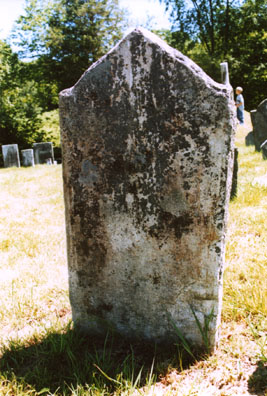
Simon Newcomb headstone  Old Cemetery Lebanon, New London County, Connecticut
Simon Newcomb Footstone (1665-1743)

Deborah LATHROP was born about 1664 in Edgartown, Mass.  Her parents may have been  Samuel LATHROP and Elizabeth SCUDDER.  However, many Lathrop genealogies don’t include their daughter Deborah.  All of Deborah’s Lathrop siblings were born in Connecticut, while Deborah was supposed to be born in Martha’s Vineyard.   Simon did have property in Lebanon, CT.  Some genealogies state that her parents were Samuel William Buell and Deborah Griswold.  However, their Deborah Beuell married  Nathaniel Porter in 1710 in Killingworth, CT.    Our Deborah died on 17 Jul 1756 in Lebanon, CT.
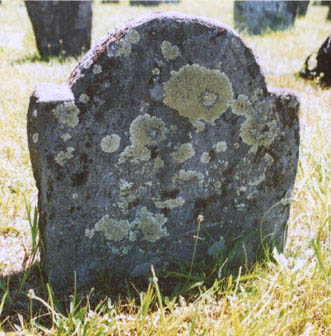
Deborah Newcomb Headstone Here lies ye body of Mrs Deborah Newcomb Wife of Simon Newcomb She was a pious virtuous woman & Died in hope of Eternal life thro ye mercy of ye Lord Jesus June ye 17 1756 in the 92 year of her age.
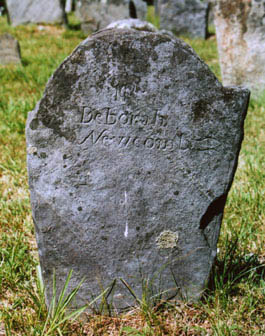
Deborah Newcomb Footstone (1644-1756)

Children of Simon and Deborah:

Name Born Married Departed
1. Deacon John Newcomb ~1688 Edgartown, Martha’s Vineyard, Mass. Alice Lambert (or Lombard)
23 Sep 1709 Edgartown
23 Feb 1765 Cornwallis, Kings, Nova Scotia
2. Thomas Newcomb 1691 Edgartown Eunice Manning
28 Oct 1712 Nantucket, Mass.
.
Judith Woodworth
17 Jan 1718/19 Lebanon, CT
1761
Pleasant Valley, Duchess, NY
3. Hezekiah Newcomb 1693 Edgartown Jerusha Bradford
14 Nov 1716 Norwich, New London, CT
.
Hannah Smith
1741
15 Aug 1772 Lebanon, CT
4. Capt. Obadiah Newcomb 1695 Edgartown Abigail Curtis
.
Mrs. Mary Post
22 Jun 1758 Hebron, CT
.
Elizabeth May
4 May 1761
Hebron, CT
5. Deborah Newcomb 1696 Edgartown Capt. Timothy Hatch
1716 Lebanon, CT
17 Jun 1756 Kent, Litchfield, CT
6. Sarah Newcomb 15 June 1698 Edgartown Capt. Ebenezer Nye
13 Jan 1719/20 Tolland, CT
c.  1778
Tolland, CT
7. Benjamin NEWCOMB c. 1700 Edgartown, Martha’s Vineyard, Mass. Hannah CLARK
1727
Canaan, CT
1774 Waterborough, Royal, New Brunswick, Canada
8. Elizabeth Newcomb 15 June 1702 Edgartown Ebenezer Wright
20 Apr 1721
13 Jan 1726/27 Windham, Windham Co, CT
9. Simon Newcomb c. 1705 Edgartown Hannah Carter
.
Jerusha Lothrop
17 Nov 1740 Lebanon, CT
.
Jane Lothrop
(sister of Jerusha)
c. 1750
c. 1770 Cornwallis, Nova Scotia, Canada

A number of websites state that Simon and his brother Simeon (1662-1711)  are the same person. This leads to a lot of confusion, especially since Simeon’s name was sometimes written as Simon.

From B.M. Newcomb’s 1923 book.

It is possible that at the time of his birth his parents were residing upon one of the islands of the group called “Isles of the Shoals”, situated in the ocean, a few miles from Kittery and Portsmouth. It appears that the first four years of his life were spent on what was then called Hog Island or Appledore, the most picturesque of the “Shoals”. The next four years were spent on the mainland, in the village of Kittery.   Soon after he was eight years old the family removed to Edgartown, on the island of Martha’s Vineyard, Dukes Co., Mass., where they remained until the autumn of 1713, when his father established the family at Lebanon, New London Co., Conn.
Simon spent his first four years on Appledore, the largest of the Isles of Shoals

That Mr. Newcomb and his wife belonged to the churches of Edgartown and Lebanon there can be no doubt; but the loss of early records makes it impossible to give positive proof. That they had a family of about twelve children, baptized in infancy, is proven by tradition, entitled to the very highest respect, and furnished by John Burton Newcomb, in 1873, then 64 years of age, who stated that his father’s mother, Mercy (Gore) Newcomb, his contemporary twenty-four years, informed him that her husband’s father, Simon, who died when she was twenty-four years old, told her that he was the youngest (or nearly the youngest) of a large family, about twelve in number, all of whom were in their infancy presented to the Lord in baptism and prayer by their pious and truly exemplary parents. (This leaves an opening for other children, providing a record of such can be found, who perhaps died young.)

1686 – Mr. Newcomb’s name first appears upon record as owning land at Sagadahock, Maine

26 July 1693 – He bought land; recorded Salem, Maine, 28 Aug. 1693, “near the mouth of Sagadahock River”. (Kennebec River)

13 Mar 1693/94 – He bought of Thomas Wallen, for £10, Meadow at Manado, by the beach, one share called the Purchase, 10 acres upland a half-mile from the harbor, adjoining Mill Path, and half of Common, on Martha’s Vineyard.

10 May 1690 – He was named in the will of William Vinson of Edgartown as one to see that the provision of the will were faithfully executed. He owned several shares of land upon the Island of Chappaquiddick, across the channel, and a short distance southeasterly from the village of Edgartown, where he kept large numbers of cattle and sheep – his mark a “slit on the Right Ear.”

As one of the proprietors of lands in Edgartown, Mr. Newcomb received several shares, the first in 1695.

22 Jan 1701/02 –  Simon Newcomb bought of his father, Andrew Newcomb, for £50, a tract of land called Job’s Neck Pond, alias Sopotaming, situated four miles southwest from the village of Edgartown, and bounded on the south and west by what is now known as Job’s Neck Pond, and two years later purchased two shares of adjoining land. In 1707 there was granted to him by the freeholders, a certain tract of land, “to extend from his corner bounds of Job’s Neck, next to Pohoggannut, and so to come six rods above his house, and thence upon a straight line to the head of his corner next to Pokitipasses Neck.” Upon this large farm – the result of purchases and grants as above – he lived for many years. His house must have been in full view of the blue Atlantic.

1710/11 –  Mr. Newcomb bought of Susannah, widow of William Vinson, for £40, shares in meadow in Sanchakantachet Neck and Commonage – later the celebrated camp-meeting ground near Holmes Hole, in the town of Tisbury.

1716 – He bought of his stepmother, Anna Newcomb, for £20, land in Edgartown, bounded easterly by Weentucket, northerly by Mill Path to the utmost extent of town, southerly by ponds and cove. He also owned lands at Swan Neck Point, and at other places, all on Martha’s Vineyard. his lands on Chappaquiddick he sold to various persons

6 Mar 1711-12 – He sold a part of his home farm at Job’s Neck  to Samuel Smith.

1 Jun 1713 – He sold to his brother, Joseph Newcomb, a half-share meadow at Felixes Neck, and 6 acres at Manado for £27.

10 Jun 1714, for £7: 12s: 6d., half of the 15th in Farm Neck.

1727 – Joseph Newcomb sold these lands to John Worth of Edgartown for £70, and described them in his deed as lands “which I bought of my brother Simon Newcomb, late of Edgartown.”

1734 – Mr. Newcomb sold his son Thomas, for £70, all rights by heirship of all estate in Edgartown – doubtless as heir to his father, Andrew. His name appears several times in land titles of Tisbury; and a cart path – long known as “Simon Newcomb’s Path” – leads to that place.

Mr. Newcomb made several purchases of land in Lebanon, Conn. He gave farms to each of his sons (except his youngest son Simon, who received the homestead), the consideration being “love, goodwill and affection”.   Mr. Newcomb’s earliest purchase of lands in Lebanon was made of Israel and Mary Phelps, 26 Sept. 1711, for £290, about 160 acres on the eastward side of town, with the “buildings, orchards, gardens, fences, fencing stuff and fruit trees thereon; also, 50 acres common right, and 30 acres common at the village”. The farm, situated on the south side of Windham road, near Phelps Hill, two miles and fifty-two rods northeasterly from the town of Lebanon, and about three-fourths of a mile beyond the old cemetery, was described then as “butting on the highway that goeth towards Windham northwestwardly, being about one hundred and sixty rods at said highway lying against the heirs of John Hadlock’s land northwestwardly and butting against land of Mr. Samuel Bliss southeastwardly and lying against Able Janes land southwestwardly.”

Mr. Newcomb lived upon this farm, one of the very best in the locality, until his death, when it went by will to his son Simon, by whom it was conveyed in 1761 to Silas Sprague for £750, by whom it was sold the following year to Jabez Dean, of Norwich. Mr. Dean sold it, 1773, by one deed, the purchasers being Daniel and Joshua Lothrop, of Norwich; and Nathaniel Greene, Jonathan Simpson, Esq., John Hancock, Esq. (first president of Continental Congress), and Ebenezer Storer, all of Boston, Mass. The farm was later owned and occupied in part by Asa N. Burgess and F.H. Simpson.

Mr. Newcomb served as a member of various committees in town affairs; in May 1693 had “full power and order for the ordering of the sheep & cattle”; signed a venire as Constable of Chelmark, 1699 (according to Court Record); was chosen to settle bounds of lands in 1704; viewed lands to find Thomas Peas’ dividend on 28 Jan 1705; found records of town’s bounds 5 Mar. 1705/06; in 1710 he was chosen by his townsmen as “Field Driver” at Edgartown. Simon Newcomb took the Freeman’s Oath at Lebanon and was elected highway surveyor in 1714. On 15 Sept. of the same year he was one of a “Comity” of three for building “meetin” house in Hebron, and reported, 5 Oct. following, a proper site for same. In 1718 he was chosen grand juryman; in 1721 he was appointed guardian to Caleb Jones and in 1741 was chosen fence viewer.

The following is a copy, verbatim et literatim., of the Will and Inventory of Simon Newcomb, from Windham Probate Records, Vol. 3, pages 169 to 172.

In the Name of God amen I Simon Newcom of lebanon In ye County of Wendham and Coloney of Connecticut In New England being In Good state of bodyly health and of sound and Disposeing memory for wch I bles God: but caling To mind my own mortality and that It Is appointed for all men once to Dye Do make and ordain this my last Will and Testament Princapaly and first of all I Recomend my Soul to God: The Giuer Theireof and my body To The Earth To be beuried In Decent Christian burial at ye Descretion of my Executor Herein Namd: Nothing Doubting but that I Shall Receive ye same again at ye General Resurrection Through ye power of almighty God From whome I lok for Redemption and Saluation Through The lord Jesus Christ and Now as toye Wordly Goods and Estate Wherewith It hath pleased God to bles me in this life.

I Giue hequeath and Dispose Their In manar and form: Following (viz) after my Just Debts and Funeral Expence are all paide Imp I Glue and bequeath to my Well beloued wife debrah Newcom The Incom or use of my wholl Estate both Reall or personal during her Natural life—Item: I Giue and bequeath to my Well beloved Eldest son John Newcomb fifty pounds in Bills of Publick Credit to be Estemed by Siluer at 28s pr ounce to be paide him In manar form and at such Times as I shall hereafter ordar In this my Will and farther I glue To him all my Wareing appariel and my lomb and ye Tacklin Theireto Belonging–

Item to my beloved 2d son Tho. Newcomb I glue no legacy because I Judg he has had his full part or portion out of my Estat Heartofore

It I Giue to my 3d beloved son Hezekiah Newcomb: fifty pounds In bills of Publick Credit to be Estemed by Siluer at 28 shillings pr ounce To be paide him In manar and form and at such Time as I shall Heareafter ordar In this my Will.–

Item I Giue to my beloued 4th son Obediah Newcomb Ten Pounds In bills of Credit to be Estemed by Siluer at 28s pr ounce to be paide him In manar and Form and at such Times as heareafter I shall ordar In this my last Will and the Reason I Glue him no more Is because I Judg I haue hearetofore Giuen him The princeapal part of his portion out of my Estate

Item I Giue to my two daughters Debroah Hatch and Sarah Nye fifty Pounds Each In my house hold Goods as they shall be apprised in an Inventory To be taken of them after my Wifs Deceas: If Shee shall out liue me and what ye house hold Goods shall fall of 100 pounds in value at The apprisement as abouesd shall be paide Them In money In manar and form and at such Times as I shall heareafter ordar In this my Will

It I Giue to 5th son Benjamin NEWCOMB fiue pounds In bills of Credit at ye value afore sd to be paide In Manar and form: and at such Times as heareafter I shall ordar In this my Will and ye Reason Why I Glue him no more Is because I Haue already Giuen him ye Greatest Part of his portion

It I Giue to my Three Grand Children (viz) Ziruiah Debroah: and Ebenezer Wright to Each of them twenty pounds In bills of Credit to be ualued as in my other legacies to be paide In manar and form and at such Times as I shall ordar In this my Will

It I Glue to my sixth son Simon Newcomb all my wholl Estate both Reall and Personall that is not In this my last Will heareto fore Particularly Disposed of: to be to him his heirs and assigns for Euer He in no manar molesting or hindaring his mother In ye free use and Improuement of What I haue Giuen har for and Deuring hur Natural life and he paying out ye seueral legacies In money or Bills of Credit hearin before by me Giuen to my seueral Children or Grand children afore Named at or before Eight years Next after ye Death of me and my Wife or ye longest liuer of us.

And I do heareby make ordain and appoint my son Simon Newcomb to be ye sole Executor of this my last Will and Testament Heareby Reuoakeing and making Null and uoid all formar or other Will or Wills by me made Ratifieing and Confirming This and no other to be my last Will and Testement In witness Whereof I have heareunto Set my hand and Seall this 23d Day of July A D. 1741.

Signed Sealed Published and declared by ye sd Simon Newcomb:
To be his last Will and Testament
HIS
Simon S Newcomb
MARK

In Presents of us:
William Bewel
Ann Gray
Jonathan Trumble

The Inuentory of The Estate of Simon Newcom late of lebanon Deceased Taken by us ye subscribars apprisors under oath Is as followeth viz

a hat 2 15 0
a mixt Coast and Jacoat 7–10s–0d a Camblit Coat & Jacoat Coten 11 0 0
a Coat and Jacoat 3d 10s 2 Great Coatts 4-10 8 0 0
Woolen briches 4 pr 3d a pr lining briches 16s 3 16 0
a pr Coten briches 5s 3 Woolin Sharts 1d 10S 1 15 0
2 linen Shafts 1d 3 linin Caps 7s a hed Kerchif & pr Gloues 15s 2 2 0
a pr Wosted Stockins 10s 4 pr yearn Stockins 1d 12s 2 2 0
a pr of Shoes I65 Mr Shaws book 8S & M’ Willards book 49 1 8 0
a Salm book 49s a Great Bible 3d 1s an old bible 10s 4 4 0
Hous on ye Sabbath 1s bed bedsted curtans 2 pillow bolster under bed and all ye beding 27d 17s 27 18 0
a bed bedsted bed Cord and beding 27 15 0
a Balster and Pillows 1d 14s bed bed Cord & beding 14d 15s 16 9 0
2 Woolin blankits 3d 5s 2 pillow Cases 12d 2 Cotton sheets 2d 5 17 0
2 linin Sharts 1d 10s 17 yds linin Cloaths 4d 13s 6d 6 3 6
3 pillo bears 10s 20 1/4£ of putar 7d 2s Quart Cup 12s 8 4 0
a large peuter basom 12s 2 Quart basons 14s 1 6 0
4 pint basons 12s 2 Small platers 12s a pint putar Cup 6s 1 10 0
2 putar Chamber pots 1–8 a Worming pan 2d 3 8 0
6 Spons 3s a Salt Selar and pepar box s5 a bras Skilit & frame 5s 0 10 0
a brass Kitle 7d an Iron Kitle & Skillet 16s 7 16 0
2 Iron potts & Pot hooks 2d 8s a Copar frying pan 1d 5s 3 13 0
3 Iron Candle Sticks 6s Shie & Tongs 15s 2 Tramils 1d 8s 2 9 0
a pr of and Irons 2d 6s a hamar 7s a box Iron and heaters 12s 3 5 0
a Gun 3d 10s a Chest with Drawers 3d 10s 7 0 0
a Small Trunk 1d a Great Table 16s Small Table 10s 2 6 0
10 Chairs a 3s 1d 10s a Great Chair 10s 2 0 0
a Grid Iron & pot hooks 6s a lomb & Tacklin belonging to it 5d 5 6 0
a Churn 12s an old hogshead & 3 barrels 7s 0 19 0
an old back Sword 5s a set of buckit hoops 12s 0 17 0
a Ridleing Slue 5s 2 bags 6s a half bushell 5s half peck 1s 6d 0 17 6
a paile & small Tub 4s a piggin & a Can 4s 6 wooden plates 2s 0 10 0
2 pails 10s 2 Kniues and 3 forks 12s a Can 2s 4 Trays 10s 1 16 0
2 Troues 10s 2 small Tubs 10s an old Seadar Tub 6s 0 6 0
a meat Tub 4s a fat Tub 3s Earthan Jarr 10s 0 17 0
a ston Jugg 14s a Earthen pot 2s a Great Wheall 17s 1 13 0
a foot Wheall 2d a little Wheall 2s a pr of Stilyards 1d 3 5 0
a mayr 20d a yearling Coalt 24d yoak of oxen 40d 83 0 0
3 yearlings 13d pr 3 year old Steers 26d 10s 3 2 year old 20d 59 10 0
3 Cows 43d 16 Sheep 20d 2 swine 7d 10s half a Cart 5d 75 10 0
a Chain Id 5s a yoak and staple & Ring 15s Cloe & Pim 6s 2 6 0
2 Wedges and a beetle Ring 12s 6d an ax 7s 0 10 0
half an Iron harrow 3d pr of fork tines & hay hook 6s 3 6 0
half a Dung fork 6s Shed Shoel 4s a hacket 12s 1 2 0
2 oald hoes 3s hors Chains and Whipletre Chain 2d 2 4 0
Half a Grind Ston 10s a pr of Plough Irons 2d 2 10 0
Half a Crow barr 1d a pigen net & Rope 10s 1 10 0
pr Shep Shears 3s a botle 8: Drinkin Glass 3s 6d 3 6 6
a pr of Spectacles 5s a Siue 4s 9 0
Sume Total £414 = 19s 0dlebanon Febr 19th 1744-5
Jedediah Phelps
Nathll holebrook
aprisers under oath

Andrew Newcomb and his Descendants, a revised edition of “Genealogical Memoir” of the Newcomb family

Children

1 Deacon John Newcomb

John’s wife Alice Lombard was born 19 Oct 1686 in Edgartown, Dukes, Mass. Her parents were Jonathan Lombard and Elizabeth Eddy. Alice died 8 Jan 1767 in Cornwallis, Kings, Nova Scotia, Canada

At the age of 72, John made a trip to Nova Scotia to investigate conditions there. Being favorably impressed, he returned to Lebanon and made plans to bring his family to Nova Scotia. On Oct 12 1760 at the age of 72, he moved his wife and children to Nova Scotia, where they helped found the town of Cornwallis. He also helped found the First Presbyterian Church there in 1761

John was born in Edgartown, Martha’s Vineyard and removed to Lebanon CT where he was admitted to the First Church March 20 1715, and his wife June 8, 1718. They settled in the north part of town called the “Crank”, “Second Society”, or “North Society”, which in 1804 was set off from Lebanon as a town under the name of Columbia. Upon the organization of the Second Society, 1718, he joined it and became first deacon, an office which he held 42 years,until his removal to Cornwallis, Nova Scotia, in 1760. He took the “Freeman’s Oath” in Lebanon, date not given; was elected surveyor of highways 1725, and selectman 1744.

Seal of Columbia, Connecticut

The township of Cornwallis, Kings County in a valley 40 miles by 10 miles, containing roughly 10,000 acres, was granted to the proprietors, chiefly from Connecticut, during the last years of the reign of King George II and five or six years after the expulsion of the Acadians. Deacon John and his three sons Eddy, Jonathan and John Jr. came to Cornwallis, as did a brother Benjamin, his son William and his youngest brother Simon.

Cornwallis Township was one of the original townships of Kings County, Nova Scotia. The township was named after Edward Cornwallis, the founder of Halifax, Nova Scotia. It bordered Aylesford Township to the west and Horton Township to the south. While the name has fallen into disuse on maps, many historical places and documents refer to Cornwallis. The Parish of Cornwallis, however, is still in use today after more than 250 years.

After the French colonists, the Acadians were commanded to leave Nova Scotia in the Great Expulsion, the area was relatively desolate. The Township was established by a group historians refer to as the New England Planters. In the early 1760s the Planters brought with them the colonial pattern of land division; each town or township was to contain one hundred thousand acres.

A generation after the Planters, a sudden influx of United Empire Loyalist settlers arrived to escape the Revolutionary War in New England. Towns such as Kentville, Kingsport and Canning took shape.

The Survey Plan of Cornwallis Township, Kings County By E.L.Eaton The Nova Scotia Historical Review Volume 1, Number 2, 1981

The New England Planters who settled in Nova Scotia during the early 1760s brought with them their familiar pattern of land division, the town or township, which also became the unit of local government. In general, the surveys for each township were made with precision, and reliable maps were drawn. Unfortunately, the original map or plan for Cornwallis Township has disappeared. There is a tradition that it was lost in a house fire, from which records of the Registry of Deeds were, happily, rescued. These books are kept today in the registry office at Kentville, along with subsequent deed volumes and later maps of the country.

Cornwallis Township, like Horton Township from which it is separated mainly by the Cornwallis River (Habitant River on early documents), was to contain one hundred thousand acres. Cornwallis was assigned one hundred and fifty settlers, Horton two hundred, reflecting the importance given to the visible Grand Pre dyke. Only later did the Horton grantees realize that Cornwallis had practically as much dyke land, more widely distributed and thus more accessible. A feeling of deception is said to have remained in Horton for many years.

Beginning at the mouth of the Cornwallis River, following the river to Kentville, then south-westerly in a line parallel to the Horton-Falmouth line to the Aylesford Township border, thence northerly to the Bay of Fundy, then east and south by the Bay of Fundy and Minas Basin to the place of beginning, Cornwallis Township indeed possessed many advantages. Divided among one hundred and fifty individuals, each proprietor was thus given the theoretical allowance of six hundred and sixty-six and two-thirds acres. The general survey is said to have begun in 1759.

Louisburg had been captured the year before; Quebec and Montreal were still in French hands; hostile Indians and French were a very real threat; and so, protection of the new settlers was essential. The typical township was composed of a compact town site that could be easily defended, with ten-acre lots nearby for food production, farm lots slightly removed, remote wood lots, a common field for pasture of milk cows, a parade ground, and land allotted for a church and school.

Cornwallis Township does not exist today, this is the best I can approximate  A: Cornwallis River  B. Kentville  C. Aylesford  (township actually ran to Aylesford Township border) D. Bay of Fundy

The actual allocations were made by drawing lots, with three men as supervisors:  Captain Eliakim Tupper Jr., Captain Stephen West and Captain John Newcomb.  Each of these three received a share and a half, perhaps because of the added responsibility.  Naturally, a few of the farm lots which were found to have wet or poor land and were thus not attractive were rejected, so that additional lots were laid off beyond the boundaries of the original divisions, notably at the west ends of Belcher Street and Church Street, and between Kingsport and Pereau.

Since the drawing of lots took place in 1761, when the Seven Years’ War was coming to a close, there was no longer so great a need for elaborate protection for the settlements.  As a result, the ten-acre plots and the half-acre town lots were rapidly consolidated into holdings of more appropriate size, while many settlers proceeded to establish themselves on their 44-acre farm lots.  Land between Canning and Sheffield Mills, originally designated as woodland, was recognized as desirable for clearing, as was land west of Kentville, west of Centreville and between Kingsport and Pereau.

It will be seen from the attached list of grants that only 125 of the intended 150 farm lots in the fifteen divisions were taken up by the original grantees, while 140 names appear on the assessment roll for 1765.  Of these 125 occupied lots, four were not taxable and were therefore omitted from the assessment roll: the glebe, the first minister’s lot, the school and the common.  The remaining 19 persons were assigned land in areas previously intended as woodlots.

A generation after the Planters, when the sudden influx of Loyalist settlers arrived, very little unoccupied good land remained and the grants the newcomers received, generous as they may have seemed on an ordnance map of the time, offered little advantage for permanent settlement.  This was true not only in Cornwallis Township, but also in the other townships surrounding the Minas Basin, the Annapolis Basin, and down into the more arable parts of the south shore of the province

Andrew Newcomb and his Descendants, a revised edition of “Genealogical Memoir” of the Newcomb family
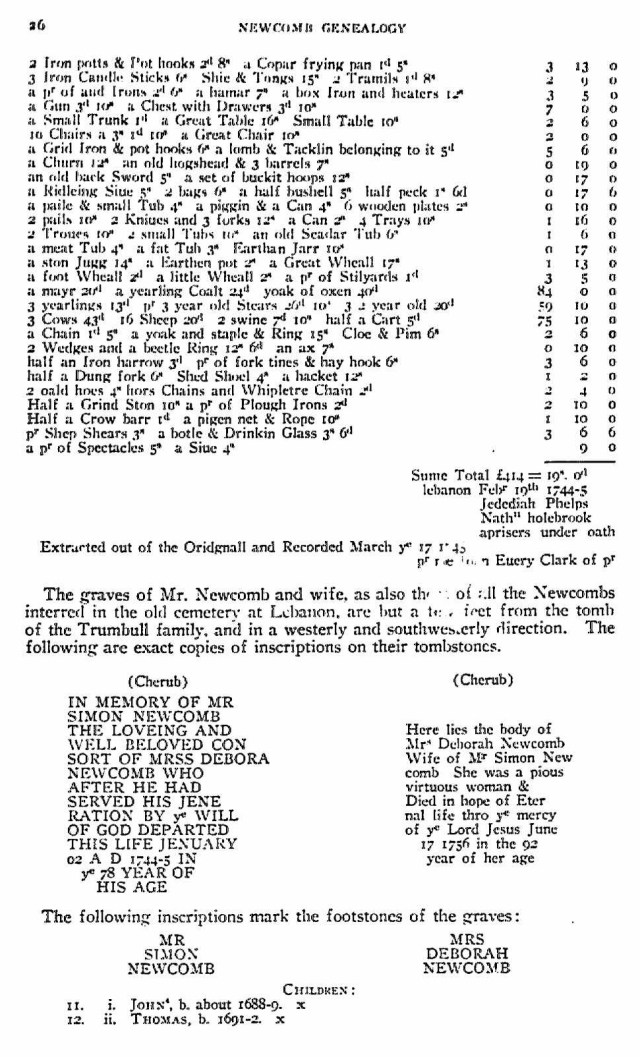
Children of John and Alice:

i. Catherine Newcomb b. 21 May 1710 Lebanon, New London, CT; d. 20 Sep 1762 Mansfield, Tolland, CT; m. 1728 in Lebanon Noah Webster (b. 9 Aug 1706 in Lebanon, New London, CT – d. 20 Sep 1762 in Mansfield) His parents were George Webster and [__?__]. Catherine and Noah had  twelve children born between 1729 and 1757 in Lebanon.

The “Father of American Scholarship and Education” Noah Webster was born in Hartford C 1758, just a year after our Catherine and Noah’s Noah Jr (1757-1762) They were third cousins, sharing common 2nd great grandparents John Webster (1590-1661) and Agnes Smith.

ii. Alice Newcomb b. 24 Mar 1712 Lebanon, New London, CT; d. 17 Jun 1752 Lebanon; m. 1733 in Lebanon to Jonathan Marsh (b. 23 Sep 1713 in Lebanon – d. 1760 in CT) Jonathan’s parents were Joseph Marsh and Hannah [__?__]. Alice and Jonathan had ten children between 1735 and 1750 in Lebanon.  After Alice died, Jonathan married the widow of Keziah Phelps.

iii. Eddy Newcomb b. 23 Sep 1713 Edgartown, Dukes, Mass. ; d. 19 Oct 1781 Cornwallis, Kings, Nova Scotia; m. 1741 in Lebanon, New London, CT to Abigail English (b. 12 Nov 1724 in Lebanon – d. 1790 in Cornwallis, Kings, Nova Scotia) Eddy’s sister Abigail married Abigail’s brother John. Their parents were Richard English and Mary Hinksman. Eddy and Abigail had nine children born between 1742 to 1768; the first six in Lebanon and the last three in Cornwalis.

After his marriage Eddy removed to Falltown, now Bernardston, Franklin Mass., where, on Feb 2 1742, he “for £63, bot of Aaron Denior, of Deerfield 1 share house lot No. 32 containing 50 acres; also meadow lot No. 69 containing 6 acres; also 1 full share in all the undivided land in said Township.” Also in 1742, Mr. Newcomb was moderator of proprietors’ meeting in Falltown. In 1741 his minister’s tax was 1. 6s. 3d. On account of the hostility of the Indians he was compelled to leave the country, and returned to Lebanon, where he bought several tracts of land, 1744-1750, near the present village of Columbia.

He sold his homestead, 4 July 1759, for 200 pounds. His town tax in Lebanon the following year was 1£. 6s. 3d. 4 Mar. 1760, “Eddy Newcomb of Lebanon for 30 pounds sells Rowland Powell Jr., of Lebanon all my rights of land in Falltown, which I bought of Aaron Denior.”

Soon after the sale of his land in Falltown, Eddy Newcomb removed to Cornwallis, N.S., as it is stated upon the town records of Cornwallis that their daughter, Sarah, was born there on 4 Sept. 1760. Mr. Newcomb was one of the original grantees of Cornwallis, 1761, and drew as his share several lots of land. In 1768 he is called “yeoman.”

He served as captain under Cornwallis in the War of the Revolution; was taken prisoner with him and his army,  Oct 19 1781.   British General Charles Cornwallis surrendered his army of some 8,000 men to General George Washington at Yorktown, giving up any chance of winning the Revolutionary War.

The British had asked for the traditional Honors of War (marching out with dignity, flags waving, muskets shouldered, and playing an enemy [American] tune as a tribute to the victors), but remembering that the British, on taking Charleston earlier in the war, had refused the Americans (under Benjamin Lincoln) the same privilege, Washington firmly denied their request. Consequently, the British and Hessian troops marched with flags furled, muskets reversed in shame, while according to legend the British drummers and fifers played the tune “The World Turn’d Upside Down” – actually a popular British marching tune of the time, and in line with custom, but curiously appropriate under the circumstances.


wallis in the War of the Revolution; was taken prisoner with him and his army 19 Oct  1781

iv. Abigail Newcomb b. 16 Nov 1715 Lebanon, New London, CT; d. 20 Jan 1785 Cornwallis, Kings, Nova Scotia; m. 9 Nov 1738 in Lebanon to John English (b. 17 Oct 1718 in Lebanon 18 Oct 1758 in Cornwallis) Abigail’s brother Eddy married John’s sister Abigail. Their parents were parents were Richard English and Mary Hinksman. Abigail and John had eight children born between 1741 and 1758

v. Abraham Newcomb b. 22 Jul 1718 Lebanon, New London, CT; d. 10 May 1732 Lebanon; m. 10 May 1732 in Lebanon to Mary Tupper (b. 1722 in Lebanon)

vi. John Newcomb Jr. b. 23 Oct 1720 in Lebanon, New London, CT; d. 13 Apr 1778 in Cornwallis, Nova Scotia; m1. 15 Jul 1747 Plymouth, Plymouth, Mass. to Mercy Barnaby (b. 1730 in Provincetown, Barnstable, Mass. – d. 27 Mar 1776 in Cornwallis, Kings, Nova Scotia); Mercy’s parents were Timothy Barnaby and Martha [__?__]. John and Mercy had eleven children born between 1751 and 1776.

m2. 13 Feb 1777 Cornwallis, Nova Scotia. to his first cousin and our ancestor Deborah NEWCOMB. Deborah first married 22 May 1766 in Kings County, Nova Scotia. to  Isaac MILLER.

Mar 10, 1760, he and his father and their wives sold their lands in Lebanon for £550, and removed to Cornwallis, Nova Scotia, where they arrived before Oct  12, 1760. He was one of the original grantees of the township of Cornwallis, 1761, and received several lots of land there. He appears to have been a leading man among the first settlers.

It is said he had 21 children; a part dying young, their names not preserved. The farm, in east Cornwallis, upon which he lived and died (and upon which his father, Deacon John, died) was left to his son John, his son’s son John, and is now [1874] owned and occupied by his great grandson, Elder John Samuel Newcomb, who has a son named John Stewart Newcomb..

John Newcomb settled in Lebanon upon a farm adjoining his father’s. From his father he received by gift “for love and affection” in 1745, fifty acres; this farm was enlarged by several purchases. His town tax in 1760 was £5.1s.8d., a large tax at that period. 10 Mar. 1760, he and his father and their wives sold their lands in Lebanon for £550, and removed to Cornwallis, N.S., where they arrived before 12 Oct. 1760. He was one of the original grantees of the township of Cornwallis, 1761. He received a one-half acre lot in the compact part of town by reason of the birth of his daughter, Martha, 12 Oct. 1760. He also received a five-acre lot, letter F, No. 5; six acres Dyke lot No. 18; sixty-six acres arm lot No. 1, 6th Division, draughted by his uncle, Benjamin Newcomb. He appears to have been a leading man among the first settlers. He is said to have had twenty-one children, a part dying young, their names not preserved. The first four children were born in Lebanon, Conn.

The farm, in East Cornwallis, upon which John Newcomb lived and died (and upon which his father, Dea. John died) was left to his son John, his son’s son John, and was later owned and occupied by he great-grandson, Elder John Samuel Newcomb, who had a son named John Stewart Newcomb.


vii. Jonathan Newcomb b. 21 Aug 1722 Lebanon, New London, CT; d. 16 May 1765 Cornwallis, Kings, Nova Scotia; m. 9 Nov 1746 in Lebanon to Deborah Tupper (b. 24 Mar 1728 in Sandwich, Barnstable, Mass = d. 1794 in Kings, Nova Scotia) Deborah’s parents were Eliakim Tupper and Joanna Fish. Jonathan and Deborah had five children born between 1750 and 1758.

His Estate was inventoried Sept. 26, 1765. Samuel Dunham and Daniel Dunham were granted permission to sell four acres of land in Hebron, Oct. 1765. Samuel Dunham was guardian of Joanna and Rubee; Deborah Newcomb was guardian of Alice, Deborah and Zilpha

viii. Jacob Newcomb b. 10 Oct 1724 Lebanon, New London, CT; d. 1777 New York; 1748 in Lebanon to Elizabeth Hamilton (b. 1724 in Lebanon – d. 1796 in Thetford, Orange, Vermont) Jacob and Elizabeth had seven  children born between 1749 and 1764.

Jacob joined the patriot army and died in the service at the age of 53. The cause of his death was apparent drowning while crossing Lake Champlain. His son Bethuel, after leaving the service, went in pursuit of his father Jacob; traced him to Lake Champlain, but was unable to find further positive intelligence of him; learned that he, sick of camp disease, and two other soldiers, attempted to cross the lake in an open boat; nothing further could be ascertained.

Jacob Newcomb settled at Lebanon on a farm adjoining his father’s on the southwest. In addition to several purchases of lands, he received fifty acres in Lebanon as a gift from his father, for “love, good will and affection”. In 1760 he sold the most of his lands, possibly intending to settle in Cornwallis, N.S., where his parents, two brothers and their families removed that year; apparently, however, he remained in Lebanon. His town tax in 1760 was 1 5s 2d. He was a farmer. When his, son Bethuel, moved to Thetford, Vt., Elizabeth, widow, accompanied him, riding behind him on horseback. She died at Thetford, at the home of her son Israel.


2. Thomas Newcomb

Thomas’ first wife Eunice Manning was born 1685 in Nantucket, Nantucket, Mass. Her parents were Dennis Manning and Catherine Innes. Eunice died 7 Dec 1715 in Lebanon, New London, CT.

Thomas’ second wife Judith Woodworth was born in 1701 in Scituate, Plymouth, Mass. Her parents were Benjamin Woodworth and Hannah Damon. Judith died in 1720 in Lebanan, New Hampshire.

Thomas was a Merchant in Lebanon, New London, Connecticut from 1715 to 1739.  He was called a Cordwainer in deed of 1734 from his father, (somebody who makes shoes and other articles from fine soft leather.)

Soon after his settlement in Lebanon he became largely interested in mercantile pursuits, which business he followed until 1739, or over 20 years. The venerable book (No. 5) in which he began accounts, Oct.1735, and which he appears to have used until 1738, is a prized possession of the family. This book contains the names over over 350 persons with whom he had business transactions and 80 other individuals are mentioned in connection with the accounts. Among his patrons were his father, Simon, and brothers, John, Hezekiah, Obadiah, and Benjamin. His customers were were from Colchester, Coventry, Crank Society (a part of Lebanon), Goshen, Hebron, Mansfield, Scotland, Stafford and Windham. He purchased some of his merchandise at Norwich, Conn. Mr. Newcomb appears to have kept for sale everything wanted by his customers, dry goods, groceries, shoes, “Rhum”, etc.

Mr. Newcomb was constable from 1721-24. In 1727 he was Quartermaster of a regiment in Windham Co., Conn. The next year he was confirmed Quartermaster. Oct. 1736 he was Lieutenant of troop in Windham Co., Conn. In 1737, he gave Hannah Harsel credit, 11s, 8d. for schooling his children.

Mr. Newcomb was elected surveyor of highways, 8 Dec. 1729, and lived in Lebanon as late as 19 Mar 1738/39, but removed to Salisbury, Conn. before 11 Oct. following, and became one of the origianl proprietors of the town. He was moderator of the town meeting, 9 Nov. 1741, and the first chosen selectman.

Seal of Salisbury, Connecticut

Children of Thomas and Judith:

i. Cyrenius Newcomb b. 16 Apr 1721 in Lebanon, New London, CT; d. 1760 Oswego, Oswego, New York; m. 1744 in Salisbury, Litchfield, CT to Sarah Smith (b. 15 Jul 1723 in East Haddam, Middlesex, CT – d. 1793) Sarah’s parents were John Smith and Elizabeth Kennard. Cyrenius and Sarah had eight children born between 1747 and 1758.

At the age of 18 years, Cyrenius Newcomb removed with his parents to Salisbury, Conn., where he was the first town clerk, 9 Nov. 1741, an office which he held up to the time of his removal in 1746 to Nine Partners, Crum Elbow Precinct, now Pleasant Valley, Dutchess Co., N.Y. His property in 1742-44 was set down each year at £33. He made several grants of land in Salisbury after his removal to New York. By trade he was a tanner, currier, and shoemaker

He served as an officer in the French and Indian War, and died while in service. In Muster Roll for Dutchess Co., N.Y., 1 May 1760, the following is stated concerning him: “Age 39, born in Conn., laborer, 5 ft. 5 in, brown hair fresh complexion, enlisted Apr. 8. Capt. Peter Harris Co.” His name is among those on the list of deceased soldiers, 1756 to 1762, whose heirs received the pay due them at the time of their deaths.

ii. Azariah Newcomb b. 18 May 1722 in Lebanon, New London, CT; d. 29 Dec 1784 Poughkeepsie, Dutchess, New York; m. 4 May 1743 in Salisbury, Litchfield, CT to Deborah Buell (b. 18 Apr 1726 in Killingworth, Middlesex, CT – d. 29 Dec 1784 in Salisbury) Deborah’s parents were Nathaniel Buell and Deborah Horton. Azariah and Deborah had eight children born between 1744 and 1762.

In 1746 Azariah Newcomb removed from Salisbury, where he had gone with his parents in 1739, to Crum Elbow Precinct, or Nine Partners, now Pleasant Valley, Dutchess Co., N.Y. In the same year he bought lands of his father in Salisbury. He owned a merchant vessel, and it is highly probable that he was engaged for a time in trade on the Hudson River. There is no record of the place or date of his death, but he probably died at Poughkeepsie, where he was living at the time of the birth of his son Asariah

iii. Zaccheus Newcomb b. 19 Feb 1725 in Lebanon, New London, CT; d. 1790 NY; m . 3 Jan 1755 in Poughkeepsie, Dutchess, New York to Sarah Tobias (b. 28 Feb 1737 in Nine Partners, Dutchess, NY – d. 29 Jan 1799 in Lebanon) Sarah’s parents were Christian Tobias and Ruth Dean. Zaccheus and Sarah had nine children born between 1756 and 1779

Zaccheus Newcomb was probably born on what was called “Chestnut Hill”, as his father owned at that time a large farm there. When he was fourteen year of age (1739) his parents moved to Salisbury, Conn., where his name appears upon the town list for 1746. He removed during the latter part of 1746 to Crum Elbow Precinct, or Little Nine Partners, now Pleasant Valley. The will of William Allen of Charlotte Precinct, Dutchess Co., dated 24 Jun 1772, make Zaccheus an executor; the will was proved 11 Jun 1773.

While he was serving his country in the patriot army of the Revolution, Zaccheus Newcomb’s wife built a large brick house, her resource being the profit of a large dairy. The mansion, from its size and general appearance, was long known and admired throughout the country; and it is a notable fact that this fine old residence was the only brick edifice for family purposes erected in that vicinity prior to, and for a long time after, the Revolution. It was long known as the “Old Brick house”, and when near a hundred years old was still in a good state of preservation. It was successively owned and occupied by Zaccheus’s son, Thomas, and grandson, John Hopper Newcomb. It was sold by the latter, in 1859, to James Allen, and was afterwards owned and occupied by Anthony Briggs.

At the time that General Washington had his headquarters at Newburgh, Mrs. Newcomb sent him a cheese; while discussing its merits at dinner due credit was given for its excellence. As she was not – as a matter of policy – so good a patriot as her husband, General Dunscome, of General Washington’s staff, remarked that, “if she has had a better cheese, she has sent it to General Clinton!”

Mr. Newcomb was commissioned, 7 Oct. 1783, as one of the assistant-justices of the inferior court of common pleas for the county of Dutchess. Jan 26, 1787, certificate of location was granted him and others of Vancour’s Island, in Lake Champlain, 700 acres. On 23 Mar. 1787, he bought township 39 in Totten and Crossfield’s Purchase, selling same 1 Dec. 1789. Mr. Newcomb was a farmer and miller.

iv. Adonijah Newcomb b. 3 Feb 1726 in Lebanon, New London, CT; d. 1795 Pittstown, Rensselaer, New York; m1. 3 Feb 1749 to Ruth Mead (b. 1726 in Lebanon – d. 28 Mar 1756 in Rhinebeck, New York) Ruth’s parents were Jonathan Mead and [__?__]. Adonijah and Ruth had three children born between 1749 and 1755. After Ruth died, Adonijah married Ruth Marshall

v. Thomas Newcomb b. 11 Nov 1730 in Lebanon, New London, CT; d. Dutchess, New York; m. 2 Jun 1754 in Exeter, Rhode Island to Bridget Gardner (b. 21 Aug 1734 in Exeter,) Bridget’s parents were Isaac Gardiner and Elizabeth Davis. Thomas and Bridget had five children born between 1755 and 1767 in Dutchess, NY.

vi. Judith Newcomb b. 31 May 1733 in Lebanon, CT; d. 31 Aug 1808 Poughkeepsie, Dutchess, New York; m. 11 Nov 1751 in Poughkeepsie to James Livingston (b. 29 Mar 1728 in Esopus, New York – d. 2 Jun 1790 in Poughkeepsie, New York) James’ parents were   Gilbert Livingston (1690 – 1746) and   Cornelia Beekman  (1693 – 1742)

Judiith’s father-in-law Gilbert Livingston c. 1710

The Livingston family of New York is a prominent family which migrated from Scotland to the Dutch Republic to the Province of New York in the 17th century. Descended from William, 4th Lord Livingston, its members included signers of the United States Declaration of Independence (Philip Livingston – James’ cousin) and the United States Constitution (William Livingston – Philip’s son). Several members were Lords of Livingston Manor and Clermont Manor in 18th century eastern New York.

Judith’s mother-in-law Cornelia Beekman c. 1700

James Livingston came to Poughkeepsie to live about the time of his marriage in 1751, and in 1753 bought a plot of land and built his home where he lived the rest of his life. This plot of one hundred and fifteen acres lay between the King’s Highway (now the Post Road from New York to Albany) and the Hudson River, and extended from the land owned by his brother, Henry Livingston, who had come to Poughkeepsie several years before, north to the road which is now Pine Street, Poughkeepsie. This tract now contains many streets and homes as well as the grounds of Vassar Brothers Hospital, Eastman Terrace, Eastman Park and the former location for many years of the Riverview Military Academy.

During the Revolution a Continental shipyard occupied a part of the shore line, where two large frigates, the Congress and the Montgomery, as well as other naval vessels, were built. In later years the cove where the shipyard was located has been practically filled in and is now the site of the DeLaval Separator Company. A point of land extending into the river is still known as Shipyard Point. The James Livingston residence stood on a knoll not far from the entrance to Eastman Park.

James Livingston was a captain in the Provincial Militia from 1760; was sheriff of Dutchess County 1761-1768; was a member of the Provincial Congress, 1776-1777, and served as chairman of the Committee of Safety in 1778. He died in 1790, aged 62 years.

vii. Simon Newcomb b. 9 Jan 1736 in Lebanon, New London, CT; d. 26 Dec 1819 Pittstown, Rensselaer,New York; m. 1758 in Dutchess, New York to Sarah Mead (b. 6 May 1731 in Greenwich, Fairfield, CT – d. 1815 in Greenwich, Fairfield, CT) Sarah’s parents were Jonathan Mead and Esther Butler. Simon and Sarah had six children born between 1759 and 1779.

viii. Deborah Newcomb b. 21 Jun 1738 in Lebanon, New London, CT; d. 24 Jun 1739 Lebanon;

3. Hezekiah Newcomb

Hezekiah’s first wife Jerusha Bradford was born 26 Nov 1692 in Norwich, CT. Her parents were Thomas Bradford (1658 – 1731) and Anne Raymond (1664 – 1705).  Her grandparents were Maj. William Bradford (1624 – 1703) and  Alice Richards  (1629 – 1671) and her great grandparents were Alice Carpenter-Southworth Bradford (1590 – 1670). and William Bradford (1590 – 1657) who arrived on the Mayflower in 1620, and was Governor of the Plymouth Colony for many years.   Alice’s parents were ancestor Alexander CARPENTER and Priscilla DILLEN. For the Bradfords’ story, see Carpenter’s page.  Jerusha died 15 Aug 1772  in Lebanon, CT.

Jerusha’s maternal grandparents were Deacon Joshua Raymond  (1639-1676) and Elizabeth Smith (1641-1712)  Her great grandparents were our ancestors Nehemiah SMITH and Sarah Ann BOURNE.

Hezekiah’s second wife Hannah Smith

Hezekiah settled in Lebanon, Conneticut, shortly after his marriage to Jerusha Bradford 14 Nov 1716.   Occupation: Carpenter / joiner.

Hezekiah was admitted to the church in Lebanon 22 Mar. 1719, and his wife 20 Nov. 1720.  He took the “Freeman’s Oath” in Lebanon and held various town offices there. From various sources comes the tradition that Mr. Newcomb was a deacon: he was held in high veneration by his neighbors, his children and grandchildren. Isaac Foster, of Spencerport, N.Y., states that he was told by his grandmother, Submit (Downer) Newcomb, “that during the whole time of her having her ten chilren at his [Hezekiah Newcomb’s] house, she never heard him speak an angry word. The whole day long he would most always have his Bible in his hands.”

Lebanon Hezekiah Newcomb Headstone –  Old Cemetery Lebanon Here lies the body of Mr Hezekiah Newcomb who after a virtuous Pious and Exemplary life having served God in his generation Was Dismissed by a sudden and Easy Death fell asleep in Jesus Augt 15 1772 in ye 79 year of his age

Children of Hezekiah and Jerusha

i. Silas Newcomb b. 2 Sep 1717 Lebanon, New London, CT; d. 24 May 1773 Lebanon; m. 5 Mar 1739 in Lebanon to Submit Pineo (b. 19 Oct 1717 in “Lebanon Crank” now called Columbia, CT- d. 12 Feb 1804 in Lebanon) . Submit’s parents were Jacques “James” Pineo and Dorothy Babcock. Silas and Submit had ten children born between 1741 and 1762.

Wife, Submit, lived with Silas’ parents 3 years before they were married. In 1741 they moved to Falltown, MA (now Leyden, Franklin, Mass) They were forced to return to Lebanon in 1745 due to Indian hostilities.

Silas was elected surveyor, 1748 and fence-viewer in 1750-1751 suggesting he was a trusted individual.

“He died instantaneouly of palsy while sitting under a tree on his farm” His tombstone reads:
“Here lies the Bod of Mr. Silas Newcomb who lived a sober virtuoius life, a kind tender husband & parent, after a life of serious religion died in hope of a happy imortality May 24, 1773 in the 56th year of his age.”

Submit was born soon after her parents had moved from Rhode Island. She was actually born in Submit lived with her son John after her husband, Silas died. Three of her sons became doctors. Submit is said to have been very close to her children and grandchildren. In 1790 Submit Newcomb was head of a household in Mansfield, Conn. consisting of 5 females.

ii. Peter Newcomb b. 28 Nov 1718 Lebanon, New London, CT; d. 26 Sep 1779 Lebanon; m. 22 Nov 1740 in Lebanon to Hannah English (b. 19 Sep 1722 in Lebanon – d. 9 Jan 1796 in Lebanon) Hannah’s parents were Richard English and Mary Hinksman. Peter and Hannah had seven children born between 1741 and 1762

iii. Anne Newcomb b. 4 Mar 1720 in Lebanon, New London, CT; d. 1770; m, [__?__] Smith (1718-1788) They had Samuel and David named in their grandfather Newcomb’s will.

iv. Hezekiah Newcomb b. 27 Dec 1722 in Lebanon, New London, CT; d. 27 Dec 1722 Lebanon

v. Thomas Newcomb b. 3 Sep 1724 in Lebanon, New London, CT; d. 26 Aug 1753 Lebanon; m. 26 Mar 1751 in Lebanon to Anna Hibbard (b. 13 Aug 1734 in Canterbury, Windham, CT – d. 29 Dec 1759 in Canterbury) Anne’s parents were John Hibbard and Martha Durkee. Thomas and Anna had one child, Joseph born in 1752. After Thomas died, Anna married Francis Fenton.

vi. Jerusha Newcomb b. 24 Mar 1726 in Lebanon, New London, CT; d. 25 Oct 1804 Burlington, CT; m. May 1745 in Canterbury, Windham, CT to Ezra Cleveland (b. 17 Apr 1726 in Canterbury – d. 7 Nov 1802 in Burlington) Ezra’s parents were Joseph Cleveland and Sarah Ainsworth. Jerusha and Ezra had twelve children born between 1748 and 1770 all in Canterbury, except the last in Tolland.

vii. Elizabeth Newcomb b. 19 Dec 1727 in Lebanon, New London, CT; d. 31 Jul 1801 Canterbury, Windham, CT; m. 21 Apr 1747 in Norwich, CT to John Barstow (b. 31 Dec 1724 in Norwich, CT – d. 9 Feb 1796 in Canterbury) John’s parents were Job Barstow and Rebecca Bushnell.  Alternatively, the were Joseph Barstow and Abigail Hydes.  Elizabeth and John had ten children born between 1748 and 1767, the first in Norwich and the rest in Canterbury.

viii. Samuel Newcomb b. 2 Sep 1729 in Lebanon, New London, CT; d. 9 Sep 1748 Lebanon

ix. Jemima Newcomb b. 14 Dec 1730 in Lebanon, CT; d. 14 Aug 1769 or 19 Jun 1794 Thetford, Vermont; m1. 23 Nov 1749 to Jonathan Lamb (b. 1735 in CT – d. 13 Nov 1754 in Norwich, CT) Jemima and Jonathan had two children born in 1751 and 1753.

m2. 12 Jun 1755 in Norwich, CT to Joseph Kinne (b. 17 Feb 1718 in Preston, CT – d. 15 Oct 1793 Thetford, Orange, Vermont) Joseph’s parents were Capt. Joseph Kinne (1680 – 1745) and Kesiah Peabody (1688 – 1717). Joseph first married 10 Jun 1740 in Preston, CT to Sarah Blunt (b. 29 Oct 1718 in Preston, New London, CT – d. 23 Dec 1754 Preston ) and had five children between 1743 and 1752. Jemima and Joseph had eleven children born between 1756 and 1773.

On May 30, 1756, Joseph and Jemima were admitted to Preston Church, coming from East Norwich Church; the family was dismissed later when they removed to Vermont. He was Captain of the Preston Training Band.

In 1761 he was appointed Lieutenant-Colonel of the 1st Company, Eighth Regiment Connecticut Militia in the French and Indian War. In 1763, he represented Preston in the General Assembly.

In 1781, Joseph deeded land at Cardigan, Vermont (now Orange, Grafton County, New Hampshire). Orange was granted in 1769 and incorporated in 1790. It was originally named Cardigan, after George Brudenell, fourth Earl of Cardigan. The Cardigan name lives on with Mount Cardigan and Cardigan State Park. After the Revolution, voters attempted to rename the town Bradford, Middletown, Liscomb, and finally Orange. The large quantities of yellow-orange ochre found in Mount Cardigan may have been the source of the name Orange.

x. James Newcomb b. 7 Feb 1733 in Lebanon, New London, CT; d. 14 Dec 1799 Stephentown, Rensselaer, New York; m. 11 Sep 1755 in Lebanon to Submit Downer (b. 1725 in Norwich, New London, CT – d. 1820 in Mansfield, Tolland, CT) Submit’s parents were Samuel Downer and Phebe Bishop. Submit first married in Norwichl, CT to [__?__] Davis 1746 James and Submit had nine children born between 1756 and 1771 in Lebanon.

James resided with his father in Lebanon until the death of the latter in 1772, when he was one of the excutors of the will and received as his share of the estate “seventeen acres with the dwelling house.” James Newcomb was elected hayward (an officer having charge of hedges and fences around a town common, especially to keep cattle from breaking through and to impound stray cattle.) in 1766; surveyor of highways in 1774. While residing in Lebanon, he was said to have been the stoutest man ever born in that town. He removed to the state of New York; was residing in Little Hoosac, Albancy Co., in 1782; removed, 1785, to Stephentown, Rensselaer Co.


4. Capt. Obadiah Newcomb

Obadiah’s first wife Abigail Curtis was born about 1693 in Andover, Tolland, CT.  Her parents were Samuel Curtis (1649 – 1721) and Sarah Alexander.  Abigail died 9 May 1757 in Hebron, CT.

Abigail Curtis Newcomb Gravestone — Townsend Cemetery , Andover, Tolland , Connecticut,

Obadiah’s second wife Mary Post was born 1695 in Edgartown, Dukes, Mass. Mary died in 1767

Obaidah’s early manhood was spent in Edgartown, and in 1713 he removed to Lebanon, Conn., soon thereafter settling in the adjoining town of Hebron. He was engaged in the military service, hence the title “Capt.” upon his tomb, which is situated upon land which he formely owned, for generations known as the “Newcomb farm.” Assembly confirmed him Captain of the company or train band, in the parish of Andover, Conn., and requested that he be commissioned accordingly.

The farm above referred to is in that part of Hebron, now Andover, about three-fourths of a mile from the railway station. The homestead was deeded to Obadiah Newcomb’s son Daniel as a gift, on July, 27, 1758, and consisted of 250 acres of fertile land. Capt. Newcomb invested in farm lands, and in 1718 purchased fifty acres of Joseph Bradford of New London, Conn. In 1726 he bought ten acres on “Village Hill” adjoining land of his brother Hezekiah. In 1738 he added seventy acres between “Ten Mile Brook and Hop River,” and in 1747 he invested in 100 acres in Shron, Conn. Like his forebearers, Capt. Obadiah Newcomb was an estimable man, a pious Christian, and from March 1727, a member of the Bolton Church.

21 Nov 1727 – A road was laid out to the southeast corner of Mr. Obadiah Newcomb’s orchard. In May 1743 Obadiah Newcomb’s name (with ohters) was signed to a petition of the residents of Hebron “praying there may be a district ecclesiastical society” there.

Will: 25 Oct 1758.  Probated 6 July 1761, East Haddam Dist., Vol. 3, P. 112, Records (now Colchester Probate District)

Gives wife Mary 1/3 dwelling house during widowhood and 1/3 personal estate, not given to son. She and son Daniel Executors. To son Daniel, he gives land in Hebron and Coventry, and 2/3 farming tools, wearing apparel, gun, sword, and can, bonds, notes and book accounts “due me” (having already given him lands) he paying debts of estate and legacy to daughter. To daughter Abigail wife of David Barber 100 acres (land) in Sharon, bought of Joseph Owen; 1/3 personal estate and £50 “proclamation money” to be paid two years after decease by son Daniel.  To daughter Jemima, wife of Seth Wales, two tracts of land in Cornwall 50 acres bought of Palmer, 200 acres bought of Wm. Turner and 1/3 personal estate. Provision made for Phinehas Ford who was indentured to Capt. Obadiah Newcomb.  Only son, Daniel Newcomb, appeared and accepted trust, 6 July 1761.

Children of Obidiah and Abigail

i. Eunice Newcomb b. 1725 in Hebron, Tolland, CT; d. May 1768; m. 27 Feb 1745 to Daniel Bliss. (b. 1723 in Hebron -d. 27 Feb 1765) Daniel’s parents were Rev. John Bliss (1690 – 1741) and Anne Terry (1691 – 1732) Eunice is not mentioned in her father’s 1758 will. Daniel had four children born between 1745 and 1765. There was a 14 year gap between Gillam (b. 1751) and Zenas (b. 1765). Maybe Eunice passed away before her father’s will and Zenas had a different mother.

ii. Abigail Newcomb b. 1727 in Hebron, Tolland, CT; d. 22 Mar 1805 in Hebron; m1. 27 Feb 1745 Age: 18 Hebron to Aaron Horsford (b. 1720 in Edgartown, Dukes, Mass. – d. 24 Dec 1746 in Hebron); m2. 1749 Age 22 Hebron to Capt. David Barber (b. 17 Feb 1716 in Hebron – d. 14 Jan 1801 in Hebron) David’s parents were David Barber (1686 – 1729) and Hannah Post (1693 – 1759) David first married 8 Mar 1738 Age: 22 Hebron to Patience Case (1723 – 1748) and had five children between 1740 and 1748. Abigail and David had nine children born between 1749 and 1768.

David was an inn‑keeper, and a well‑to‑do merchant in Hebron, but lost his fortune in the Revolution, when he held a wealth of continental currency, which became worthless. He was a Deputy to the Connecticut General Assembly 1769‑72. He also was a Captain in the Militia. David enlisted for 15 days in the Lexington Alarm, and also joined Capt. James Clark’s Company, 1775, to march to Boston, where they were at the Battle of Bunker Hill. Later he was stationed at Peekskill NY, and participated in the Battle of Saratoga. In 1778 he was appointed Captain in the 8th Company of the 1st Connecticut Regiment. He was a Justice of the Peace from 1777 on.

iii. Eleazer Newcomb b. 1727 in Hebron, Tolland, CT; d. young


iv. Daniel Newcomb b. 9 Nov 1729 in Hebron, Tolland, CT; d. 1789 Hebron; m. ~1754 Wethersfield, Hartford, CT to Elizabeth May (b. 3 Dec 1730 Wethersfield – d. 1789 Hebron) Elizabeth’s parents were Hezekiah May (1696 – 1783) and Anna Stillman (1699 – 1767). Daniel and Elizabeth had six children born between 1755 and 1767.

The homestead was deeded to Obadiah Newcomb’s son Daniel as a gift, on July, 27, 1758, and consisted of 250 acres of fertile land

His father’w will gave son Daniel land in Hebron and Coventry, and 2/3 farming tools, wearing apparel, gun, sword, and can, bonds, notes and book accounts “due me” (having already given him lands) he paying debts of estate and legacy to daughter.

Petition mentioning Daniel Newcomb’s bankruptcy and one of his creditors.

24 April 1777 – Daniel enlisted for eight months as a Private in the Captain Sylvanus Brown’s company, Col John Chandler’s 8th Artillery Regiment. He is listed as being made an invalid.

Jul 1777 – On Company Muster Roll, paid 2 pounds for month of July
Aug 1777 – On Company Muster Roll, paid 2 pounds for month of August
Sep 1777 – On Company Muster Roll, paid 2 pounds for month of September

The 8th Connecticut Regiment also known as 17th Continental Regiment was raised on Sep 16, 1776 at Danbury, Connecticut. The regiment would see action in the Battle of Brandywine Sep 11 1777, Battle of Germantown Oct 4 1777 and the Battle of Monmouth Jun 28 1778. The regiment was merged into the 1st Connecticut Regiment on Jan  1 1781 at West Point, New York and disbanded on Nov 15 1783.  Joseph Plumb Martin served in this regiment from 1776 until he was assigned Light Infantry in 1778. He would publish his memoirs about his experiences in 1830.

v. Jemima Newcomb b. 8 Dec 1730 in Hebron, Tolland, CT – d. 28 Dec 1786 in Leverett, Franklin, Mass; m. 12 Mar 1754 Hebron to Seth Wales (b. 2 Apr 1734 in Windham, Windham, CT – d. 28 Dec 1786 in Leverett) Seth’s parents were Ebenezer Wales (1696 – 1776) and Esther Smith (1702 – 1737). Jemima and Seth had eleven children born between 1754 and 1775.

Her father’s will gave to daughter Jemima, wife of Seth Wales, two tracts of land in Cornwall 50 acres bought of Palmer, 200 acres bought of Wm. Turner and 1/3 personal estate.

History of Coos County, New Hampshire 1888 “Columbia This township was granted Dec 1, 1770, to the same men to whom the grant of Colebrook was made, and called Cockburne Town, in honor of Sir James Cockburne, one of the grantees. It was incorporated by an act of the legislature approved December 16, 1797, and named Cockburne in response to a petition to the legislature signed by Abel Larned, Philip Jordan, Julius Terry, Nathaniel Wales, Ebenezer Larned, Jacob Terry, Jacob Terry, Jr., Abner Osgood, Abel Hobart, Ahaz French, William Wallace, Abijah Learnard. By an act approved November 30, 1804, Wales’s Location was annexed to the town. This tract, said to contain 5,822 acres, was granted May 4, 1773, to Seth Wales and seventeen others. The name of the town was changed, by an act approved June 19, 1811, to Columbia. Population in 1775, 14; 1790, 26; 1800, 109; 1810, 142, 1820, 249.”

Seth Wales was an original settler in Columbia, Coos, New Hampshire

Columbia township was originally chartered in 1762 and named Preston, after Richard Graham, 1st Viscount Preston of Scotland. Settlers failed to meet the terms of the original grant, so the plantation was transferred in 1770 to grantees including Sir James Cockburn, 8th Baronet, after which it was named Cockburn Town, incorporated in 1797. In 1811, in the lead-up to the War of 1812, Governor John Langdon changed the name to Columbia.

Although the surface is uneven and mountainous, the soil was of good quality. Maple sugar became an important product, and lumber was cut and transported on rafts down the Connecticut River to markets.

From “The History of the Town of Amherst, Massachusetts,” by Carpenter & Morehouse, 1896, “Innkeepers in the earlier history of the town were —Seth Wales, 1779-80. —, Joseph Pettis, 1783-88.” And again, “in 1789____ & Joseph Pettis and Oliver Clapp were innkeepers.” Seth’s daughter Charlotte married Joseph Pettis, in 1782.

vi. Elizabeth Newcomb b. 1731 in Hebron, Tolland, CT; d. 7 Mar 1799 in Andover, Tolland, CT; m. Rev. Samuel Lockwood.  This may be the Rev. Samuel Lockwood who was born 30 Nov 1721 at Norwalk, CT.  He graduated from Yale in 1745 and married Anne May after he settled in Andover.  However, Elizabeth Newcomb may have been a first wife.

vii. Ebenezer Newcomb b. 13 May 1732 in Hebron, Tolland, CT; d. 14 Sep 1740 in Hebron

viii. Lydia Newcomb b. 26 Sep 1737 in Hebron, Tolland, CY; d. 20 Aug 1740 in Hebron

5. Deborah Newcomb

Deborah’s husband Captain Timothy Hatch was born 19 Oct 1695 in Falmouth, Barnstable, Mass. His parents were Benjamin Hatch and Elizabeth Eddy. Timothy died 30 Mar 1766 in Kent, Litchfield, CT.

Timothy Hatch moved to Tolland when a young  man and purchased land in 1721. They settled at Tolland, Conn., where their children were born. May 14 1739, he, of Tolland, bought,  for £300, land in Kent, Conn., to which place he removed. On  May 12  1743 he was commissioned Captain of the Train Band. He and his wife  were received into the church at Kent Jun 28 1741, and he was  appointed the first deacon on the 31st of July of the same year.  Captain Hatch laid out the town of Kent and was and influential  citizen. He owned considerable land in the vicinity and served as a  justice of the peace.

Timothy Hatch laid out Kent, Litchfield, Connecticut incorporated in 1739

Kent is a town in Litchfield County, Connecticut, alongside the border with New York. The population was 2,858 at the 2000 census. The town is home to three boarding schools: South Kent SchoolKent School and The Marvelwood School. The Schaghticoke Indian Reservation is also located within town borders.

Children of Deborah and Timothy

i. Sylvanus Hatch (b.11 Jul 1717 Bridgeport, Fairfield, CT – d. 1785 Kent, Litchfield, CT; m. 14 Apr 1743 in Kent to Mehitabel Hubbell (Mehitable Hubble) (b. 1726 in Bridgeport) Mehitable’s parents were Ephraim Hubbell and Abigail Bradley. Sylvanus and Mehitable had thirteen children born between 1743 and 1765 in Kent, CT.

ii. Mary “Mercy”? Hatch b. 17 Aug 1718 Lebanon, New London, CT; d. 16 Oct 1788 Columbia, New York; m. 15 Nov 1738 in Tolland, Windham, CT to Melatiah Lathrop (b. 20 Feb 1714 in Falmouth, Barnstable, Mass. – d. 5 Sep 1787 in Canaan, Columbia, NY’ ) Melatiah’s parents were cousins Capt. Hope Lathrop (1671 – 1734) and Elizabeth Lathrop (1677 – 1763). Mary and Melatiah had sixteen children born between 1739 and 1766.

Melatiah and Marah Lothrop settled 1739 at Kent, CT where in 1745 her father gave them a 50-acre farm; Town Clerk;

They removed 1757 to Amenia, Dutchess Co, NY where he was an early settler in the southeast part of that town and Deacon of the Presbyterian Church at Oblong.

Melatiah Lathrop and 5 of his sons were in the Revolutionary War in the 17th New York Regiment of Militia  He was a private in Capt. Ebenezer Cady’s Company, Col. William Whiting’s Regiment, of Albany County Militia.

Melatiah Lothrop Gravestone – Burial: DeWitt Brown Road Cemetery , New Concord, Columbia, NY

iii. Jedidah (Jedidiah) Hatch b. 13 Dec 1720 Lebanon, New London, CT; d. 15 Sep 1792 Kent, CT

iv. Jethro Hatch b. 17 Sep 1722 Tolland, Tolland, CT; d. 29 Sep 1818 Kent, Litchfield, CT; m. 5 Nov 1747 in Lebanon to Martha Clark (b. 2 Feb 1723 in Lebanon – d. 15 Jul 1815 in Kent) Martha’s parents were our ancestors William CLARK Jr.  and Bethiah WILLIAMS.   Jethro and Martha had eight children born between 1750 and 1767.

Jethro was a Revolutionary War Soldier; died at age 96.

Jethro was a major in the 13th Connecticut Volunteers, Militia under Col. Increase Moseley.  13th  Regiment Connecticut Militia – Raised 1739 (Woodbury, New Milford, Litchfield, Kent, Cornwall, Goshen, Canaan, Norfolk, Salisbury, Sharon, New Fairfield)

He enlisted Apr 3 1777 in 3rd Troop of Sheldon’s Dragoons. Served until Jan 1788  He drew a pension from Jul 27 1788 until his death

The 2nd Continental Light Dragoons, also known as Sheldon’s Horse after Colonel Elisha Sheldon, was commissioned by the Continental Congress on Dec 12, 1776 and was first mustered at Wethersfield, Connecticut in Ma 1777 for service with the Continental Army. The regiment consisted of four troops from Connecticut, one troop each largely from Massachusetts and New Jersey, and two companies of light infantry.

The regiment saw action at the Battle of WoodbridgeBattle of BrandywineBattle of KingstonBattle of SchoharieThe Battle of The Flocky (site of the first cavalry charge on American soil), Battle of PaoliBattle of WhitemarshBattle of MorrisaniaBattle of SaratogaBattle of Germantown, and the Battle of Yorktown.

The unit almost never served as a whole. Usually individual troops were assigned as necessary. The regiment also performed numerous raids from whaleboats against British and Loyalist installations on Long Island. Some of the successful raids captured Fort St. George, Ft. Slongo and Lloyd’s Neck, Long Island.

Elements from the unit comprised Washington’s personal bodyguard. In 1778, when Loyalist agents and a crack British commando team shadowed Washington for weeks with the intention of kidnapping him, they had to abandon the operation because, according to the British Intelligence Dispatches, “The 2nd Dragoons are (always) with him.” The 2nd Dragoons also guarded John Andre during his incarceration, trial and subsequent execution in Nyack, New York.

The regiments main patrol areas during the war were in Southern Connecticut and New York, where they intercepted British supplies and fought off bands of Loyalist partisans who preyed on local citizens. This duty earned them the nickname “Watchdogs of the Highlands”. They also earned the sobriquet “Washington’s Eyes”, likely because of their spy work. Major Benjamin Tallmadge became a spy master who ran one of the most successful spy rings of the war, able to infiltrate the British military command in New York city.

vi. Timothy Hatch b. 22 Jun 1725 Tolland, Tolland, CT; d. 21 Jun 1801 Ballston, Saratoga, New York; m. 20 Apr 1755 in Kent, Litchfield, CT to Eunice Beardsley (b. 8 Nov 1735 in Stratford, Fairfield, CT – d. 27 Aug 1819 in Richfield, New York) Eunice’s parents were John Beardsley and Keziah Wheeler. Timothy and Eunice had nine children born between 1756 and 1773

vi . Simon Hatch b. 22 Mar 1726 Lebanon, New London, CT

vii. Deborah Hatch b. 10 Apr 1729 Lebanon, New London, CT

viii. Job Hatch b. 10 May 1731 Lebanon, New London, CT Several genealogies say that Job died in Young, Texas, but I don’t think that would have been possible that early. They probably copied that he died young.

ix. Benjamin Hatch b. 1733 Lebanon, New London, CT; d. 29 Aug 1750

x. Elizabeth Hatch b. 1735 Lebanon, New London, CT

6. Sarah Newcomb

Sarah’s husband Ebenezer Nye was born in 1692 in Sandwich, Barnstable, Mass.  His parents were Caleb Nye and Elizabeth Atwood. He first married Susanna Delano who died 20 Jan 1718. He married (2d) January 13, 1719-20, Sarah, daughter of Simeon and Deborah Newcomb.  Ebenezer died 2 Jul 1759 in Tolland, Tolland, Connecticut.

Father to thirteen children: (by Susanna) Susanna; (by Sarah) John, Sarah, Ebenezer, Elizabeth, Benjamin, Eunice, Lois, Silas, Mallitiah, Thankful, Samuel, and Sarah Nye.

Ebenezer was at Tolland, Connecticut as early as 1718, and was for forty years one of the leading citizens of that town. His farm was in the eastern part of that town lying on the Willimantic River at a point known as Nye’s Bridge.

He was clerk of the military company in 1722. Ensign, May 1736; Lieutenant, May 1737; Captain, October 1751.

He was Surveyor for many years.  Ebenezer was a Selectman for thirteen years, and Representative in 1753.

Ebenezer’s son Samuel enlisted in the 2nd Connecticut Regiment,. Colonel Swift August 7, 1781 and was discharged Dec 13, 1781.

Ebenezer Nye Headstone South Yard Cemetery Tolland Tolland County Connecticut,

Children of Sarah and Eleazer

i. Elizabeth Nye b. 14 Dec 1720 in Tolland, Tolland, CT; d. 14 May 1749 Mansfield, Tolland, CT; m. 10 Nov 1743 in Mansfield to Seth Pierce (b. 30 Nov 1716 in Woburn, Middlesex, Mass. – d. 5 Dec 1794 in Mansfield) Seth’s parents were Samuel Pierce and Abigail Johnson.

ii. John Nye b. 7 Nov 1722 in Sandwich, Barnstable, Mass. m. 8 Jun 1749 in Wilmington, CT to Abigail Fuller (b. 23 Feb 1730 in Sandwich – d. 8 Jun 1749 in Wilmington) Abigail’s brother Daniel married John’s sister Lois. Their parents were Daniel Fuller and Lucy Goodrich. John and Abigail had six children between 1752 and 1762.

iii. Ebenezer Nye b. 14 May 1726 in Sandwich, Barnstable, Mass.; d. 2 Feb 1727 Tolland, CT

iv. Benjamin Nye b. 13 May 1728 in Tolland, Hartford, CT; d. 1818 Willington, Tolland, CT; m1. 12 Jun 1755 in Tolland, Tolland, CT to Phebe West (b. 2 Sep 1735 in Tolland – d. 4 May 1769 in Middlebury, Addison, Vermont) Phebe’s brother Oliver married Benjamin’s sister Thankful. Their parents were Amasa West and Amy Hatch. Benjamin and Phebe had six children born between 1752 and 1762.

m2. 22 Feb 1770 in Willington, CT to Mary Crocker (b. 14 Mar 1737)

v. Eunice Nye b. 15 Feb 1730 in Tolland, Tolland, CT; m. 11 Jan 1750 in Willington, Tolland, CT to [__?__] Merrick

vi. Lois Nye b. 25 May 1732 in Tolland, Tolland, CT; m. 19 Jul 1755 in Willington, CT to Daniel Fuller (b. 12 Mar 1732 in Willington, Mass. – d. 1790) Daniel’s sister Abigail married Lois’ brother John. Their parents were Daniel Fuller and Lucy Goodrich.

vii. Meletiah Nye b. 21 Apr 1734 in Tolland, CT; d. 4 Aug 1794 Glastonbury, CT; m. 8 Mar 1757 in Glastenbury, Hartford, CT to Nancy Hubbard (b. 1738 in Glastenbury, Hartford, CT) Nancy’s parents were David Hubbard and Prudence Goodrich.

viii. Thankful Nye b. 2 Aug 1736 in Tolland, CT; d. 13 Mar 1806 Lee, Berkshire, Mass.; m. 20 Jan 1757 in Tolland, CT to Oliver West (b. 2 Oct 1733 in Tolland, Tolland, CT – d. 23 Apr 1816 in Lee ) Oliver’s sister Phebe married Thankful’s brother Benjamin. Oliver’s parents were Amasa West and Amy Hatch. Thankful and Oliver had eight children between 1758 and 1775.

ix. Samuel Nye b. 20 Jul 1738 in Tolland, Tolland, CT; d. 8 May 1781 Tolland, Tolland, CT;m. 20 May 1765 in Tolland, Tolland, CT to Abigail Benton (b. 1740 in Tolland, Tolland, CT – d. 1 Mar 1782 in Tolland, Tolland, CT) Samuel and Abigail had seven children between 1766 and 1779.

x. Silas Nye b. 21 Aug 1740 in Sandwich, Barnstable, Mass.

xi. Sarah Nye b. 25 May 1743 in Tolland, Tolland, CT; d. 22 Oct 1817 Tolland, Tolland, CT; m. 22 Nov 1764 in Tolland, Tolland, CT to Rufus West (b. 1 Oct 1735 in Tolland, Tolland, CT – d. 12 Aug 1814 in Tolland, Tolland, CT) Rufus’ parents were Joseph West and Joanna Delano.

7. Benjamin NEWCOMB immigratged to Cornwallis, Nova Scotia in 1760. (See his page)

8. Elizabeth Newcomb

Elizabeth’s husband Ebenezer Wright was born 22 Feb 1701, at Lebanon, (Conn);  His parents were Abel Wright and Rebecca [__?__].  Elizabeth bore him three children, and died 13 Jan 1727. He married second, 28 Mar 1728, Sarah Huntington, b. May 25, 1705, dau. of Joseph Huntington and Rebecca Adgate, and sister to Gov. Samuel Huntington (Wiki)’s father, by whom eight children, when she died Oct. 19, 1775. He married third, Feb. 13, 1776, Mrs. Mary (Mason) Huntington, the widow of David Huntington, a brother of his wife Sarah, with whom he lived ten years, and died April 22, 1786, at Mansfield, (Conn.), aged 85.

Ebenzer was a farmer and quite a land owner, like his father Abel. He removed to Mansfield about 1740, where he became a Baptist, as several of his children did also. His last will, dated Dec. 2, 1768, at M(ansfield) names all his eleven children, and makes his wife Sarah (Sarah crossed off and Mary added in pencil), and his son Capt. Amaziah W(right), the executors of his estate… Children with Elizabeth: Zervia, Deborah, and Ebenezer

Samuel Huntington (1731 -1796)  was technically the first president of the United States.  He was a jurist, statesman, and Patriot in the American Revolution from Connecticut. As a delegate to the Continental Congress, he signed the Declaration of Independence and the Articles of Confederation. He also served as President of the Continental Congress from 1779 to 1781, chief justice of the Connecticut Supreme Court from 1784 to 1785, and the 18th Governor of Connecticut from 1786 until his death.

Children of  Elizabeth and Ebenezer:

i. Zerviah Wright b. 12 Mar 1722 in Windham, CT; d. 1768; m. 8 Jan 1741 in Windham, CT to John Upton (b. 27 Apr 1717 in Reading, Mass.)

ii. Deborah Wright b. 29 Jan 1725 in Windham, Windham, CT; m. 7 May 1747 in Mansfield, CT to Paul Davison (b. 5 Apr 1711 in Mansfield, CT – d. 20 Aug 1751 in Newton, New Jersey) Paul’s parents were Peter Davison and Ann Morgan. Paul first married 30 Aug 1733 in Mansfield, Tolland, CT to Abigail Phelps (b. 12 Mar 1712 in Mansfield, Tolland, CT – d. 7 May 1747 in Mansfield, Tolland, CT) and had three children. Deborah and Paul had three more children.

m2. 16 Jan 1753 to Aaron Younglove (b. 6 Nov 1718 in Springfield, Hampden, Mass.)

iii. Ebenezer Wright b. 2 Jan 1727 in Windham, CT; d. 18 Jul 1809 Cornwall, Canada; m. 11 Mar 1751 in New Fairfield, CT to Mercy Leach (b. 12 Nov 1733 in Windham, CT – d. 13 May 1801 in Cornwall, Ontario, Canada) Mercy’s parents were Amos Leach and Mercy Martin. Ebenezer and Mercy had eleven children born between 1752 and 1776.

Ebenezer   was a farmer, lived in Mansfield, (Conn.) a few years, then in New Fairfield, Conn., then in Newtown, Sussex Co., N.J., and about 1765-6 removed to Shaftsbury, VT.  The events of the War of the Revolution sent him to Canada West, where he spent the evening of his life, with his companion and five children near him, at Cornwall and Johnstown.

9. Simon Newcomb

Simon’s first wife Hannah Carter was born 1707 in Eastham, Barnstable, Mass.

Simon’s second wife Jerusha Lathrop was born Jul 1706 in Edgartown, Dukes, Mass. Her parents were Thomas Lathrop and Mehitable Sarson. Jerusha died 13 Apr 1748 in Lebanon, New London, CT.

Simon’s third wife Jane Lathrop was born 8 Sep 1687 in Edgartown, Dukes, Mass. Her parents were Thomas Lathrop and Mehitable Sarson. Jane died after 1770 in Cornwallis, Kings, Nova Scotia, Canada.

When, in 1755, under orders of the General Assembly a total force of 3000 men was raised in Connecticut, the payroll of Capt. John Terry’s Company, which marched from Lebanon 15 Sept., included “Simon Newcomb, master”, signing for Stephen. Harding Williams, Private, who served from Aug. 29 to Dec. 9, 1755. This signature seems to show that Williams was the bound servant of Simon Newcomb. Simon Newcomb served two weeks (as long as any) in Lieutenant-Colonel David Whitney’s company of militia for the relief of Fort William Henry, Aug. 1757. All of his company were Canaan men.

Simon Newcomb, 28 July 1740, bought of his brother, Thomas, for £100, “all Rights by Heirship of my Honored father Simon Newcomb of all estate in Edgartown,” Mass., the same which Thomas bought of their father in 1734. Mr. Newcomb resided upon his father’s farm, which he inherited by will (after paying certain legacies) and which he came into full possession of upon the death of his mother in 1756. In 1760 Mr. Newcomb’s tax was £4 3s 4d, a large tax for that period. On 15 May 1761, he sold the farm to Silas Sprague for £750.

Mr. Newcomb was chosen by his townsmen for several positions of trust; for example, surveyor of highways and fence viewer, and was a man of prominence in his community.

Simon moved with his family and brothers John and BENJAMIN to Cornwallis with his parents in 1761.  Daughter Jerusha was born in Martha’s Vineyard and later went to Lebanon, CT with her family. The family lived in Lebanon where Simon lived on his father’s farm, which he inherited upon the death of his mother in 1756. He left Lebanon with about 60 other families from Lebanon for Nova Scotia, many to Cornwallis. There Jerusha married neighbor Archelaus Hammond in the first marriage of the Planters recorded in Kings County.

Simon signed a Letter and Petition from Nova Scotia February 8th, 1776

To His Excellency George Washington Esquire Generalissimo of the Army of the Twalve United Colonies of America  May it please your excellency

The Liberty we take in addressing a person of so Exalted a Rank, will we presume be fully pardoned, when you perceive the Occation of it —

The Inhabitants of Nova Scotia, & in particular those of the County of Cumberland have been under the Greatest Axiety and Apprehension ever since the Great Contest [subsisting?] between Great Britain and the American Colonies. Our situation has been such that we have not had it in Our Power to do any thing in Conjunction with the other Colonies. The form of Government we are under and the manner of Executing its Authority has been such that we are Rather to be looked upon as slaves than freemen —

With Anxious [—] have we been waiting for the success of your Righteous Cause, and that you would Cast an Eye of Pity toward this forlorn part, we have indeed nothing to Recommend us, but missery and impending destruction and devastation — we trust our [account?] of proceedings will have the desired Effect on you, as well as the others who are the Instruments of supporting the Liberty of Mankind —

We have been harmed much. Occation’d by Different proceedings of Government, threatened are we because we have such sentimts Concerning the Cause Contended for by our Brethern on the [—] have been [—] that Troops will soon be sent among us. This in a [—] [—] many who were [—] in Lethergy. Committees have been Appointed from the different Town (Including the Acadians) to fall upon some method for Safety — there being a number among us (vainly Called Governments men) are Continually prying into Our proceedings, and with Accumulated Tales Give Information to the Govt at Halifax — Liable therefore are we to be Cut in Pieces, having no Expectation Justace but what Comes through your Excellency — We Agree in Our Committees that nothing should be done publickly as it might aggravate the others to fall upon us <sooner> than they <Intended> further as we [—] not tell the Intention of the honble Continental Congress Concerning us — therefore as Individuals who belongs to the foresaid Committee, do recommend Jonathan Eddy Esq to your Excellency who will acquaint you with Our Situation, & Praying with [Arden—?] that your Excellency will please Believe us, so that we may be able to Give Our Sentiments publickly Join with Our Little Streangth in Conjunction with the other Colonies, in preventing the [—] of Slavery from being sett up in any part of this Great Empire. We further pray your Excellency will keep this Our Request as a Secret for the Present.   We do Separatley & Jointly Pray for the Success of your Arms and that you may be Victorious & Vanquish all your Enemys — We are with the Greatest Respect

Your Excellencys

Most Devoted & very [—]
Elijah Ayer
Nath  Reynolds
Mark Patton
J[ohn] Allan
William Lawrence
Amasa Killam
Jesse Bent
William Maxwell
Geo. Forster
Simon Newcomb
Robert Foster
Simeon Chester

Children of Simon and Jerusha:

 xi. Mehitable Newcomb i. 7 Mar 1742 in Edgartown Dukes, Mass.; d. 1810; m1. Elijah Bent (b. 7 Oct 1739 in Framingham, Middlesex, Mass. – d. 1795 in Nova Scotia); Elijiah’s parents were Elijaih Bent Sr. and Susanna Stone. m2. Nathan Davidson. It’s possible that Mehitable died soon after she first married and Elijah married before 1771 to Dorcas Prentice (b. 6 Dec 1751 in Stonington, New London, CT – d. 28 Feb 1802 in Liverpool, Queens, Nova Scotia)

They lived at New Horton New Brunswick.

ii. Jerusha Newcomb b. 2 Jan 1744 in Lebanon, New London, CT; d. 1834 New Brunswick; m. 1762 in the first marriage of the Planters recorded in Kings County Nova Scotia to neighbor Capt. Archelaus Hammond (b. 1736 in Fairhaven, Mass. – d. 1805) Archelaus’s parents were Archelaus Hammond Sr. and Elizabeth Weeks. Jerusha and Archelaus had five children born between 1762 and 1771.

iii. Deborah Newcomb (twin) b. 28 Dec 1745 in Lebanon, New London, CT; d. 9 Mar 1751 Lebanon, New London, CT

iv. Simon Newcomb (twin) b. 28 Dec 1745 in Lebanon, CT; d. Dec 1776 – Amherst, Cumberland, Nova Scotia of smallpox; m. Mercy Gore (1743 – 1833).  Mercy’s parents were Moses Gore and Desire Burns.  Simon immigrated with his parents and later  moved from Cornwallis to Amherst.  From this line comes Simon Newcomb, Professor of Mathematics and Astronomy in the United States  After Simon died, Mercy married 18 Dec 1783 Horton Nova Scotia to  Timothy Bishop (b. 22 Jul 1740 New London, CT – d. Greenwich, Horton, Nova Scotia)

Children of Simon and Mercy: (Grandchildren)

a. Simon Lathrop Newcomb b. 9 Jun 1769 in Ft. Cumberland, Nova Scotia; d. Sep 1846 in Wallace, Cumberland, Nova Scotia; m. 1798 to Jane Harris Pictou, Nova Scotia, Canada

Children of Simon and Jane (Great Grandchildren):
aa. Simon Newcomb (1800 – 1870)
bb. Margaret Newcomb (1802 – )
cc. Briseis Newcomb (1804 – 1886)
dd. Thomas Newcomb (1806 – 1849)
ee. John Burton Newcomb b. 10 Jul 1809 in Pictou, Nova Scotia; d. 20 Nov 1882 in Saltillo, Aguascalientes, Mexico; m. 13 Mar 1834 Moncton, New Brunswick, Canada to Emily A Prince

Children of John and Emily (2nd Great Granchildren):
aaa. Simon Newcomb (wiki) (1835 – 1909) was a Canadian-American astronomer and mathematician. Though he had little conventional schooling, he made important contributions to timekeeping as well as writing on economics and statistics and authoring a science fiction novel.

Born March 12, 1835 Wallace, Nova Scotia
Died July 11, 1909 (aged 74) Washington D.C.
Citizenship American
Nationality Canadian
Fields Astronomy
Alma mater Harvard University

Simon Newcomb was born in the town of WallaceNova Scotia. His parents were Emily Prince, the daughter of a New Brunswick magistrate, and itinerant school teacher John Burton Newcomb. John moved around teaching in different parts of Canada, particularly in different villages in Nova Scotia and Prince Edward Island. Newcomb seems to have had little conventional schooling other than from his father and from a short apprenticeship to Dr. Foshay, a charlatan herbalist, in New Brunswick in 1851. Nevertheless, his father provided him with an excellent foundation for his future studies. Newcomb’s apprenticeship with Dr. Foshay occurred when he was only 16. They entered an agreement that Newcomb would serve a five-year apprenticeship during which time Foshay would train him in using herbs to treat illnesses. For two years he was an apprentice but became increasingly unhappy and disillusioned with his apprenticeship and about Foshay’s unscientific approach, realizing that the man was a charlatan.

He made the decision to walk out on Foshay and break their agreement. He walked the 120 miles to the port of Calais in Maine where he met the captain of a ship who agreed to take him to Salem, Massachusetts so that he could join his father. In about 1854, he joined his father in Salem (John Newcomb had moved earlier to the United States), and the two journeyed together to Maryland.

After arriving in Maryland, Newcomb taught for two years from 1854 to 1856; for the first year in a country school in Massey’s Cross Roads, Kent County, then for a year at a school not far south in Sudlersville. In his spare time he studied a variety of subjects such as political economy and religion, but his deepest studies were made in mathematics and astronomy. In particular he read Newton’s Principia at this time. In 1856 he took up a position as a private tutor close to Washington and he often travelled to that city to study mathematics in the libraries there. He was able to borrow a copy of Bowditch’s translation of Laplace’s Traité de mécanique célestefrom the library of the Smithsonian Institution but found that the mathematics which the book contained was rather beyond his current knowledge.

Newcomb studied mathematics and physics privately and supported himself with some school-teaching before becoming a human computer (a functionary in charge of calculations) at the Nautical Almanac Office in Cambridge, Massachusetts in 1857. At around the same time, he enrolled at the Lawrence Scientific School of Harvard University, graduating BS in 1858.

In 1888 Newcomb was quoted  “We are probably nearing the limit of all we can know about astronomy.”

Professor Simon Newcomb Obituary from The Times

bbb. Thomas Prince Newcomb (1837 – 1920)
ccc. Harriet Elizabeth “Hattie” Newcomb (1839 – 1923)
ddd. Richard Henry Newcomb (1841 – 1895)
eee. Sarah J Newcomb (1844 – 1922)
fff. James Tristram Newcomb (1847 – 1887)
ggg. John Burton, Jr Newcomb (1851 – )
.
ff. Charlotte Newcomb (1811 – 1890)
gg. Matthew Harris Newcomb (1813 – 1832
.
b. Deborah Newcomb (1772 – 1827)
c. Obadiah Newcomb (1775 – 1847)
d. Desiah Newcomb (1776 – 1811)
e. Ebenezer Bishop (1784 – 1846)

v. Hope Newcomb b. 7 Aug 1748 in Lebanon, New London, CT; d. 10 Oct 1748 Lebanon, CT

Child of Simon and Jane:

vi. Mary “Molly” Newcomb b. 1 Mar 1752 in Lebanon, New London, CT; d. 3 Dec 1797 Nova Scotia; m. 26 Jan 1769 in Cornwallis, Kings, Nova Scotia, Canada to Moses Gore (b. 2 May 1744 in Norwich, New London, CT – d. 1797) Moses’ parents were Moses Gore Sr. and Desire Burris. Mary and Moses had five children born between 1770 and 1782.

Sources:

Genealogical Memoir of the Newcomb Family By  John Bearse Newcomb: Elgin Illinois, 1874

Andrew Newcomb and His Descendants: A Revised Edition of “Genealogical Memoir” of the Newcomb Family by John Bearse Newcomb By  Bethuel Merritt Newcomb  New Haven CT, The Tuttle, Morehouse & Taylor Co., 1923

http://genealogy.drnewcomb.ftml.net/b222.htm#P349

http://www.genealogyofnewengland.com/b_n.htm

http://dwellers.wordpress.com/2009/03/12/simon-and-deborah-newcomb/

http://www.thenewcombs.org/?page_id=7

http://trees.ancestry.com/tree/9833241/person/158850454?ssrc=

http://trees.ancestry.com/owt/person.aspx?pid=141948&st=1

http://wc.rootsweb.ancestry.com/cgi-bin/igm.cgi?op=GET&db=rkwest&id=I3252

Posted in -9th Generation, Line - Miller, Public Office | Tagged , | 11 Comments

Benjamin Newcomb

Benjamin NEWCOMB (1700 – 1775) was Alex’s 6th Great Grandfather; one of 128 in this generation of the Miller line.

Benjamin Newcomb was born about 1700 in Edgartown, Martha’s Vineyard, Mass.  His parents were Simon NEWCOMB and Deborah LATHROP.  He married Hannah CLARK in 1727 in Canaan, CT.  After the final defeat of and expulsion of the Acadians, British control of the land was secured by repopulating the former French lands with settlers from the New England States.  Between 1760 and 1768 some 8000  New England “Planters” came to a new colony, see my post New England Planters in New Brunswick for their historical story.

Kings County comprised three  agricultural  townships: Horton, Cornwallis, and Aylesford.  Benjamin emigrated to Cornwallis Township in Kings County, Nova Scotia in 1760 at the same time as his four of his  children. Benjamin died after 1775 in Sunbury County, New Brunswick, Canada or in 1774 Waterborough, Royal, New Brunswick, Canada.

Waterborough, New Brunswick where Benjamin Newcomb died

Hannah Clark was born 21 Feb 1710/11 in Lebanon, CT.  Her parents were William CLARK Jr and Bethiah WILLIAMS. Tradition says that Mrs. Newcomb was of Scotch descent.  That her surname was Clark is inferred from a charge upon his brother, Thomas Newcomb’s acct. book, 10-12-1737, when Mr. Newcomb was debited with 17 1/2 lbs. tallow “by his mother Clark.”  Hannah died 2 Jan 1797 in Canning, Kings, Nova Scotia.

Children of Benjamin and Hannah:

Name Born Married Departed
1. Hannah Newcomb c. 1728
Lebanon, CT
William Tanner
23 Mar 1749
.
Elisha Hatch
6 Aug 1806 Canaan, CT
2. Benjamin Newcomb baptized 12 Oct 1729 Died Young
3. Simon Newcomb baptized
25 Jan 1730 Columbia, Toland, CT
Served in the military from 1 Jul 1779 to 16 Dec 1780
4. Lydia Newcomb baptized 30 Jun 1731 Deacon Justus Sackett
1 Jan 1756
16 Nov 1808 Warren, CT
5. William Newcomb 18 Jun 1733 Willington CT Phebe Porter
Mar 1761
Cornwallis Nova Scotia
2 May 1814 Warren, CT
6. Bethiah (Berthia) Newcomb 26 Feb 1735 Lebanon, CT David Raymond
19 Feb 1756 Kent, CT
.
Nathaniel Gray
30 Dec 1773 Kent, Litchfield, CT
19 Aug 1811 Sherburne, NY
7. Benjamin Newcomb Baptized
12 Oct 1746 Kent, CT
Elizabeth Lewis
25 Jun 1766 Cornwallis Township, Kings Co, Nova Scotia
Dec 1818 Waterborough Sunbury Co, New Brunswick
8. Oliver Newcomb c. 1738
Kent or Lebanon, CT
Mary Anne Mahegan
15 Dec 1773 Cornwallis Township
c.  1821
Pope’s Harbor, Nova Scotia
9. Iram Newcomb c. 1740 Kent or Lebanon, CT Elizabeth Lewis
1765
Kent, CT
 Canada
10. Deborah NEWCOMB 25 Mar 1744
Kent, Litchfield County, CT
Isaac MILLER Sr.
22 May 1766 Kent CT
.
John Newcomb Jr (her 1st cousin)
13 Feb 1777
.
Nathaniel Gallop
Sunbury County
after 30 Jun 1783
c. 1796
11. Jemima Newcomb Baptized 27 Mar 1748 Colin Brymer
18 Sep 1776 Kent, CT
Cornwallis Twp, Kings Co, Nova Scotia
12. Submit Newcomb 1750
Kent, CT
John Woodworth
9 Feb 1769 Cornwallis Township
18 May 1821 Cornwallis, Kings, Nova Scotia,

1760  Place: Nova Scotia, Canada Family Members: Son Benjamin; Daughter Deborah; Son Iram; Daughter Jemima; Son Oliver; Daughter Submit; Son William

Benjamin moved with his father from Edgartown to Lebanon CT  in 1713 and stayed there until 1732, then moved for four years to Willington, Connecticut, finally settling in Kent, Connecticut in 1742. He also bought land in neighboring Sharon.

Then like his brother, Deacon John Newcomb, he became fascinated by the land in Nova Scotia, from which the French Acadians had just been expelled, and where  good established farmland was available.  He moved again, with most of his family, becoming one of the original proprietors of Cornwallis in 1761.   Cornwallis is across the Bay of Fundy from St John New Brunswick,  See Satellite Map.  He received a half-acre house-lot in the compact part of town, for residence and several large lots in the vicinity as his share.  Mr. Newcomb and his wife aided in the organization of the 1st Church in Cornwallis.

They removed with their son, Benjamin after 1775, to Waterborough, now Canning, in Sunbury, New Brunswick, where both died.

His three eldest daughters had married men who did not want to leave Connecticut. The famous astronomer. Simon Newcomb (wiki), of the US Naval Observatory, was a descendant of his brother Simon.

Cornwallis Township was one of the original townships of Kings County, Nova Scotia. The township was named after Edward Cornwallis, the founder of Halifax, Nova Scotia. It bordered Aylesford Township to the west and Horton Township to the south. After CFB Cornwallis  closed in 1994 the property was converted to civilian use. A local development authority used the name Cornwallis Park and this name was formally adopted for the community in 2000.  While the name has fallen into disuse on maps, many historical places and documents refer to Cornwallis. The Parish of Cornwallis, however, is still in use today after more than 250 years

After the French colonists, the Acadians were commanded to leave Nova Scotia in the Great Expulsion, the area was relatively desolate. The Township was established by a group historians refer to as the New England Planters. In the early 1760s the Planters brought with them the colonial pattern of land division; each town or township was to contain one hundred thousand acres.

A generation after the Planters, a sudden influx of United Empire Loyalist settlers arrived to escape the Revolutionary War in New England. Towns such as Kentville, Kingsport and Canning took shape.

Benjamin lived Lebanon, New London, CT;  Kent, Litchfield, CT;  Cornwall, Litchfield, CT;  Cornwallis, Kings, Nova Scotia; Waterborough, Queens, New Brunswick; and Canning, Queens, New Brunswick.

From B.M. Newcomb’s 1923 book.

Mr. Newcomb “owned covenant” at Lebanon in the oldest church, 15 Oct 1732. He had resided in Lebanon since the autumn of 1713, when he removed with his father’s family, and there resided until 1732, when he went to Willington, Conn. After four years he returned to Lebanon. In 1733 Benjamin Newcomb with his father, Simon of Lebanon, bought land and rights amounting to 171 acres and 13 1/2 acres commons in Willington. Subsequently Mr. Newcomb established his home in Kent, Conn., where he wife was received to church 6 Jun 1742, and he, 26 Feb. 1749. The same year he bought 40 acres in Sharon for £700 “old tenor”. Oct 1751 Benjamin Newcomb “of Cornwall Conn.” is on petition.

About 1760, soon after the expulsion of the Acadians from Nova Scotia, he removed with his family, except three daughters, to the town of Cornwallis, Kings Co., and become one of the original proprietors in 1761, receiving a half-acre house-lot in the compact part of town for residence, and several large lots in the vicinity as his share. Mr. Newcomb and his wife aided in the organization of the first church in Cornwallis. Tradition says that Mrs. Newcomb was of Scotch descent. Some time after 1775 he removed with his son, Benjamin, to Waterborough, New Brunswick, later Canning, where they died. In a letter from Benjamin to his sister Submit, dated 16 Oct 1818, the statement is made: “Since I have seen you I have buried our honored father and mother, and two near and dear wives, two sons and one daughter.”

Children

1. Hannah Newcomb

Hannah’s first husband William Tanner was born in East Haddam, Connecticut 15 May 1719 . He arrived in Cornwall with his father in 1740 and was given some land of his own. In 1930 his was the oldest legible tombstone in Cornwall Cemetery. (He should not be confused with the other William Tanner, “Great Tanner” who came from Rhode Island.) William died 27 Jun 1763 in Cornwall, Litchfield Connecticut.

Hannah’s second husband Elisha Hatch was born 1722 in Cornwall, Litchfield, CT.  Alternatively, he was born 26 Jun 1721 in Rochester, Plymouth, Mass.  His parents were Elisha Hatch (1692 – 1770) and Patience Keen (1699 – 1737). He first married 13 Nov 1746 Cornwall, Hartford, CT to Isabel Griffis (1726 – 1767).  Alternatively, it was his father who married Isabel as his second wife.  Elisha died 1786 in Hillsdale, Columbia, New York

Another settler in Cornwall, CT in 1740 was Joseph Allen, father of Ethan Allen of the Green Mountain Boys. Ethan who was born about 1737 in Litchfield, lived in Cornwall from 1740 until about 1770. His closest connection to the Tanner family was the time he spent in prison after the fall of Fort Washington in company with Lt. Thomas Tanner.

About 1755 William Tanner built a bridge across the Housatonic River, between Cornwall and Sharon, CT near Abraham Jackson’s farm. In 1757 he petitioned the General Court for relief, and was granted the right to levy toll; then in 1761 he wanted to set up a lottery to raise money to clear the river, but the scheme fell though and he went bankrupt. In 1762, he and Heman Allen (Ethan’s brother) bought four and one-half acres of land upon which to build a smelting furnace for iron, but the venture did not succeed. According to wikipedia, Ethan Allen was also part owner.

Hannah Newcomb Tanner Warren Center Cemetery Old Warren, Litchfield, Connecticut In memory of Hannah wife of Wm Tanner and after his deceased wife of Elisha Hatch who died 6/14/1806 in the 77 yr of age

Children of Hannah and William

i. Consider Tanner b. 3 Mar 1750 in Cornwall, Litchfield, CT; d. 25 Feb 1796; m1. 3 Mar 1772 in Cornwall, CT to Rachel Benedict (b. 1754 – d. 4 Feb 1794); m2. 29 Jan 1795 to Silva Basto

ii. Tryal Tanner b. 20 Dec 1751 in Cornwall, CT; d. 22 Nov 1833 Canfield, Trumbull (now Mahoning) Ohio; m1. 12 May 1777 in Cornwall, CT to Huldah Jackson (b. 1755 in Cornwall Sharon, CT – d. 29 Dec 1803 in Canfield, Ohio); m2. 24 Jan 1805 to Mary (Polly) Doud (b. 1756 CT – d.  13 Jul 1843 Canfield, Mahoning , Ohio)

Revolutionary War – 2nd Lt. Adj., Militia, Capt. Woodbridge’s Co., CT Line  Colonel Samuel Elmore’s Regiment

Tryal Tanner Muster 1 – Source: Record of service of Connecticut men in the I. War of the Revolution, II. War of 1812, III. Mexican War (1889) Author: Connecticut. Adjutant-General’s Office; Johnston, Henry Phelps, 1842-1923

.

Fort Stanwix was a colonial fort whose construction commenced on August 26, 1758, under the direction of British General John Stanwix, at the location of present-day Rome, New York, but was not completed until about 1762. The star fort was built to guard a portage known as the Oneida Carrying Place during the French and Indian War. Fort Stanwix National Monument, a reconstructed structure built by the National Park Service, now occupies the site..

The fort was reoccupied by Colonial troops under the command of Colonel Elias Dayton on July 12, 1776. They began reconstruction and renamed it Fort Schuyler, although many continued to call it Fort Stanwix.

Fort Schuyler

Colonel Peter Gansevoort took over command of the fort from Tryal’s regiment on May 3, 1777.

On August 3, 1777 the fort was besieged by The King’s 8th Regiment,  Loyalists, and Indians, under the command of Brigadier General Barry St. Leger, as part of a three-pronged campaign to divide the American colonies.  The British failure to capture the fort and proceed down the Mohawk Valley was a severe setback and helped lead to the defeat of General John Burgoyneat the Battle of Saratoga.

Tryal was  Regimental Adjutant for the 7th Connecticut, a staff officer who assisted the commanding Col. Heman Swift in the details of regimental duty. The 7th Connecticut Regiment was raised on September 16, 1776 at New Milford, Connecticut. It saw action in 1777 in the Battle of Brandywine,  Battle of Germantown. It wintered at Valley Forge and saw action in 1778 at the Battle of Monmouth. The regiment was merged into the 5th Connecticut Regiment on January 1, 1781 at West Point, New York and disbanded on November 15, 1783.

The Battle of Brandywine, was fought between the American army of Major General George Washington and the British-Hessian army of General Sir William Howe on September 11, 1777. The British defeated the Americans and forced them to withdraw toward the rebel capital of Philadelphia.

The Battle of Germantown, a battle in the Philadelphia campaign was fought on October 4, 1777, at Germantown, Pennsylvania between the British army led by Sir William Howe and the American army under George Washington. The British victory in this battle ensured that Philadelphia, the capital of the self-proclaimed United States of America, would remain in British hands throughout the winter of 1777–1778.

The Battle of Monmouth on June 28, 1778 saw a colonial American army under Major General George Washington fight a British army led by Lieutenant General Henry Clinton. After evacuating Philadelphia on June 18, Clinton intended to march his 13,000-man army to New York City. Washington sent 6,400 troops commanded by Major General Charles Lee to attack the British column of march near Monmouth Court House, New Jersey. When Clinton counterattacked, Lee ordered his badly-deployed troops to fall back immediately. Washington brought up 7,000 men to support Lee’s withdrawing wing and held his ground against repeated British assaults.

Washington Rallying the Troops at Monmouth by Emanuel Gottlieb Leutze

Unsteady handling of lead Continental elements by Major General Charles Lee had allowed British rearguard commander Lieutenant General Charles Cornwallis to seize the initiative but Washington’s timely arrival on the battlefield rallied the Americans along a hilltop hedgerow. Sensing the opportunity to smash the Continentals, Cornwallis pressed his attack and captured the hedgerow in stifling heat. Washington consolidated his troops in a new line on heights behind marshy ground, used his artillery to fix the British in their positions, then brought up a four gun battery under Major General Nathanael Greene on nearby Combs Hill to enfilade the British line, requiring Cornwallis to withdraw.

The Connecticut Brigade was part of the Right Flank under Nathanael Greene’s   Brigadier General Jedediah Huntington

Finally, Washington tried to hit the exhausted British rear guard on both flanks, but darkness forced the end of the engagement. Both armies held the field, but the British commanding General Clinton withdrew undetected at midnight to resume his army’s march to New York City.

While Cornwallis protected the main British column from any further American attack, Washington had fought his opponent to a standstill after a pitched and prolonged engagement; the first time that Washington’s army had achieved such a result. The battle demonstrated the growing effectiveness of the Continental Army after its six month encampment at Valley Forge, where constant drilling greatly improved army discipline and morale.

Both armies’ casualties were about even in the last major battle in the northern colonies. Lee was court martialed for his behavior during the battle.

Mahoning Dispatch, Fri, 7 May 1897 – Article No. 16
Scraps of History by Dr. Jackson Truesdale
Re: The Tryal Tanner family

The Tanner family, for the past 95 years, has occupied a prominent and creditable position in the history of Canfield and to some extent that of Trumbull county, before being reduced to its present limits. The family is said, on the authority of one of its number, to be of Welsh extraction. The founder of the family in Canfield and whose descendants are now distributed among a number of states was Tryal Tanner, who was born in Connecticut in 1751. At the age of 51, in 1802, he settled in Canfield where he died Nov. 22, 1833, aged 82 years. His first wife (Huldah), the mother of nine children, eight of whom grew to maturity, died in 1803. In January, 1805, he married Lydia (sic Mary “Polly”) Doud, who died in July, 1848 (sic 1843), aged 87.

Tryal Tanner’s father died when he was a lad, after which his uncle, Deacon Justus Sackett, took him into his family where he was raised to manhood; for a few years he worked on a farm in summer and taught school in the winter. At the breaking out of the revolutionary war, he was a sergeant in Gen. Arnold’s disastrous campaign in Canada, and in common with all the soldiers with him, suffered incredible hardships in the retreat of 500 miles. See my post Invasion of Canada – 1775.  At the close of this campaign he enlisted in a Continental Connecticut regiment as a lieutenant and was promoted to the adjutancy of the regiment, and in this capacity was in the battle of Monmouth.

The pay of soldiers in Continental money did not support their families. In 1780, Lieut. Tanner,  for the purpose of more effectually supporting his family, resigned his commission in the army and returned to his home and engaged in farming, kept a tavern and in a small way in merchandising.

In the spring of 1801, he exchanged with Judson Canfield his farm in Connecticut for 400 acres of land in Canfield, and the same number of acres in Johnston, with $400 in money or its equivalent. In the same year, he in company with Elijah Wadsworth, Herman Canfield, Eli Baldwin and others came to Canfield, Ohio on horseback and selected the 8-acre lot now partly owned by Mrs. Geo. Edwards and the old Tanner farm.

Having located his land he set about building a cabin on his center lot in the usual style of the locality, perhaps something better, as we are told that Oswald Detcheon with his pit-saw, sawed 2-inch planks for the floor and 1-inch boards for the doors, which were hung on wooden hinges, and greased paper was used in lieu of glass for the windows. Mrs. Lydia Doud (his future mother-in-law) was employed as housekeeper for the inmates of this cabin, consisting of himself, Herman Canfield, Nathan Steele, Homer Hine and Jonah Scoville.

“In 1800 James and Lemuel Doud, unmarried brothers, came to Canfield, Ohio in company with Nathan Moore. In the fall of the same year James returned to Connecticut and in the spring of the ensuing year came back, bringing with him his mother Lydia, and sister Polly, Lemuel in the meanwhile remaining in Canfield. The brothers jointly purchased a large farm on East street, south side, two miles from the center. The farm is now owned by Russel F. Starr. The mother was said to have been as near to perfection as possible in household duties and cookery. She was one of the nine who first organized the Congregational church in 1804; she died in 1808. Polly, the sister, married Tyral Tamer in 1808. ”

Caleb Palmer was hired to clear three acres clean, at $14 per acre. Mr. Tanner also cleared and sowed in wheat and grass 10 acres on the farm. While doing so honors were awaiting him. A territorial organization was effected in 1801 by men subject to military duty in Canfield, Boardman and Poland, and lieutenant or adjutant Tanner was elected captain, but for some reason refused to accept a commission. Perhaps this election gave him the title he afterwards bore as Captain Tanner. In the fall of the same year he returned to Connecticut.

On the 22nd of April, 1802, Capt. Tanner and his revolutionary comrade Wm. Chidester each with eight children, started together in their long journey to Ohio. Including parents and a man by the name of Paine, who drove a team and came out to build a brick chimney for Capt. Wadsworth and another who joined the company enroute, the party was made up of 22 persons. The conveyances used for the Tanner family were two wagons, one drawn by a yoke of oxen and one extra horse to assist either team in case of emergency; and an additional horse, with side-saddle for the women to use alternately. The journey occupied 39 days, which would then be called good time. Archibald Tanner, the oldest son of Tryal, was then a bright lad something more than 16 years old.

In a letter bearing date of 1859, to Mr. Whittlesey, he relates his recollections of this journey. The party came by the southern route, as all or nearly all of the Canfield settlers did. The northern route was through central New York state to Buffalo, from thence to Conneaut or Cleveland by sail or row boats. Sometimes the whole distance was made by land to point of destination.

We will use largely Archibald Tanner’s language as a fair description of all of the emigrating parties; “Our route to our new home was by Newburg, on the Hudson river, Easton, Harrisburg and Bedford to Fort Pitt; thence on the south side of the Ohio river, (there being no road on the north side), which we crossed near a town then building called Beaver Town. Many incidents of course occurred on our long journey of 38 days to be remembered by the family, such as the peculiar dialect and costume of the friendly people.

On the way the question was asked, where are you flitting? or flitting far back? Many we saw going to mill or meeting on pack-saddled oxen, with rope bridles on horses. Those who saw it were astonished to see the Yankees eat jammed potatoes mixed with butter, codfish and pepper, and said it was equal to pork and molasses. We then felt our way through mud and mire to the line between Pennsylvania and the Northwestern Territory. We formally proclaimed ourselves out of the jurisdiction of Gov. McKean and acknowledged fealty to Gov. St. Clair. Our next stopping place was at Poland, at a public house kept by Jonathan Fowler, a very good one for the times, being the first and last one to the imaginary city of Cleveland. Although the house was the best the country afforded, yet Judge Toot, a land proprietor going out, complained of lack of beds, beef and brandy.

[In 1796, Poland Township was the first charted township in the Connecticut Western Reserve. It was settled by people from Connecticut, who were given land grants in the northeastern portion of Ohio, then known as the Connecticut Western Reserve, of which Poland Township was the southeasternmost portion, or Town One, Range One. The township was founded by Jonathan Fowler, who fell in love with Yellow Creek which flows through Poland. Fowler owned an inn near the river which still stands as the oldest building in Poland. ]

Leaving Poland, we plunged deeper into the mud, having often to lift out our wagons and drag our horses by hand out of the mire. Arriving at Canfield about 100 rods west of the center, we found our long-wished-for home, and dinner of pork and beans provided by our neighbor, Mrs. Scoville, on two puncheon boards with plenty of three-legged stools. After dinner, on looking out, we found our little field of wheat nearly cut down by the frost of the 29th of May. Our flour came from Georgetown,  on the Ohio river. Pork from Washington county, Penna., if pork it could be called, for it was deficient in many things, but heads and tails. Generally a half dozen of the former, and the same of the latter. The road from Poland to Canfield was only dotted here and there by little log huts near which the trees were cut down and corn planted among the fallen timber.”

Today,  Canfield is the most affluent suburb city of Youngstown. In 2005 Canfield was rated the 82nd best place to live in the United States by Money magazine.

Tryal Tanner’s experience as an early settler, private citizen and farmer was much the same as others of that day, with plenty of hardships, privations, and discouragements, but ending by perseverance and hard labor by himself and family in the opening up of a good farm and surrounding himself with the comforts of life. The log cabin gave way in 1806 or 07 to a large frame structure. A few old people will be able to recall the appearance of this building. My memory [in 1897] reaches back to it, nearly 70 years, and then it seemed like an old house. The reason, perhaps, was for the want of paint. It stood lengthwise with the road and back from it several rods, a beautiful site, but the dwelling and grounds were destitute of ornamentation.

At the state election in October, 1807, Capt. Tanner was elected sheriff of Trumbull county, then embracing 35 townships.  [Trumbull County is the same place our Miner ancestors pioneered from Connecticut in the 1830’s.]  The total vote was 873 (probably a light vote). Of these the captain received 826 votes. At the election held in 1809 he was again a candidate and was re-elected. The whole number of votes cast was 1198, Capt. Tanner got 595; Sterling G. Bushnell 572; scattering 31. The reason of this close opposition was not based on the ground of dissatisfaction towards Capt. Tanner’s official administration but was sectional, the north part of the county thinking that in the past the south was getting more than its proper share of political preferment.

Capt. Tanner in business affairs and social life was a plain, blunt, out-spoken man, severe in criticism when he thought needful, but with all a man with a kind heart, honest and incorruptable; in official transactions well informed as to his duties, which he dispatched with punctuality and decision.

As an instance of directness in making a statement, one instance may be referred to. He with other citizens were together engaged in making prescribed and formal application and proof in order to obtain long-delayed justice, towards a revolutionary soldier. Ignoring forms, he took a sheet of paper and wrote, “I declare on the honor of an old revolutionary officer that I know Eleazor Gilson to be a private soldier in the 5th Connecticut regiment, 2nd brigade, in the army of the United States from the year 1777 until 1780, and have had personal acquaintance with him seventeen years last past, and know him to be a man of truth and that he is unable to support himself. TRYAL TANNER, late Lieut. and Adj’t in Conn, Reg’t.

Some years before his death he became a communicant of the Protestant Episcopal church.

Capt. Tanner and wife Huldah were the parents of nine children, all born in Cornwall, Conn. Three sons, namely, Archibald, Edmund Prior, and Julius. One of the daughters died in infancy. The five who came with the family to Ohio were Nancy, the oldest, who married James Skinner and are the grandparents of Miss Mary Skinner of Canfield; Peggy, the second daughter, married Benjamin Banning of Vernon, O. They were the parents of Dr. Banning, a celebrated physician and lecturer; Laura, the third child, first married Morgan Banning of Vernon, and a number of years after the death of her first husband married George Stillson of Boardman. Panthea, the fourth daughter, married Joseph Bassett in 1822. She died in 1829, Bassett in 1852. Bridget, the youngest child, died in the bloom of young maidenhood in 1815. Before death she and Comfort Mygatt were engaged to be married but before the event was to occur he died of the “prevailing fever”.

We know but little of Capt. Tanner’s life for many years previous to his death. The infirmities of age and almost total blindness no doubt subdued the energies and enterprise of this sturdy soldier, patriot, and citizen.

Tryal was an original incorporator of the The Western Reserve Bank, chartered on February 20, 1812 just thirty years after the first commercial bank in the United States was organized. It was capitalized with $100,000 and was the only one of Ohio’s early chartered banks that remained solvent until the end of the State Bank organization in 1866. Tryal Tanner had eight shares at $200.00.

iii. Ephraim Tanner b. 17 Jun 1754 in Warren, CT; d. 19 Mar 1801, Warren, Litchfield. CT; m. Huldah Munson (b 15 Oct 1758 in New Haven, CT – d. 1845)

Ephraim Tanner Gravestone Warren Center Cemetery Old Warren, Litchfield, CT

Inscription:
In Memory of Capt
Ephriam Tanner
who departed this life
March 19th 1801 in the
47th year of his age

iv. Ebenezer Tanner b. 20 Jan 1757 Cornwall, Litchfield, CT; d. 5 Oct 1819 Warren, CT; m. 20 Feb 1782 in Kent, CT to Lydia Hatch (b. 1763 in Kent, CT)

v. Joseph Tanner b. 9 Feb 1763 – Kent, CT; d. 18 Dec 1819 – Pleasant, Warren, Pennsylvania; m. 27 May 1784 in West Greenwich, Rhode Island to Lydia Stanton (b. 24 Feb 1761 in Preston, New London, CT) Other sources say Joseph’s parents were Benjamin Tanner and Hannah Perkins

vi. William Tanner b. 28 Jan 1762 – Litchfield, CT; m. 5 Oct 1786 in Plainfield, Windham, CT to Sabrina Phillips

3. Simon Newcomb

Simon served for the colonials in the military from 1 July 1779 to 16 Dec  1780. Perhaps 1st Connecticut Regment. Military: American Revolution, 1779-1780. (3) Probably the same person who served in the 1st Connecticut Regiment from 1 July 1779, or 1780, to Dec. 16, 1780. The regiment was enlisted mainly from New London Co., under Colonel Philip Burr Bradley.

Although a loyal subject of the Crown, events leading to the Revolutionary War turned Bradley into a patriot. He accepted a 3-year commission as a Colonel of the newly formed 5th Connecticut Regiment of the Continental Line in January 1777 and led it until January 1781. Although the 5th was not completely formed, he and a handful of his recruits joined American Generals Arnold and Silliman to help fight the British at the Battle of Ridgefield on April 27, 1777. In the summer of 1777, Bradley’s Regiment joined George Washington’s army. They were part of the lead brigade at the Battle of Germantown, PA, endured the infamous winter at Valley Forge, and distinguished themselves at the Battle of Monmouth.  Noted for his deep-set black eyes, black clothing and stern personality, Bradley was just as well known in his time as his first cousin, Vice-President Aaron Burr.

4. Lydia Newcomb

Lydia’s husband Deacon Justus Sackett was born 9 Mar 1730 in Hebron, Tolland, CT. His parents were Jonathan Sackett and Ann Filer. Justus died 16 Mar 1815 in Warren, CT.

Lydia and Justus removed in 1750 to Warren, CT, where they were one of the 18 founders of the church.  Lydia’s brother-in-law William Tanner died in 1763  and they took their 11 year old nephew, Tryal Tanner into their  family where he was raised to manhood.  Children: Benjamin, Solomon, Homer, Lodemia, Lydia, Betsy, and Minerva.

Lydia Newcomb Sackett – b. 1738, d. 1808. Warren Cemetery, Warren, CT “Wife of Justus Sackett, Esq, AE 78”

Children of Lydia and Justus

i. Benjamin Sackett b. 1762 in Warren, CT; d. 14 Jul 1844 Warren, CT; m. 1782 in Kent, Litchfield, CT to Betsy Eldred (b. 1766 in Connecticut – d. 9 Mar 1819)

ii. Salmon Sackett b. 8 May 1764 in Warren, CT; d. 24 Nov 1846 Tallmadge, Ohio; m. 3 May 1786 in Warren, CT to Mercy Matilda Curtis (b. 19 Oct 1767 in Warren, Litchfield, CT – d. 1831 in Tallmadge, Ohio)

iii. Homer Sackett b. 6 Aug 1765 in Warren, CT; d. 17 May 1853 Warren, Litchfield, CT; m. 19 Aug 1787 in Warren, Litchfield, CT to Sarah Carter (b. 30 Oct 1768 in Warren, Litchfield, CT – d. 25 Oct 1853 in Warren)

iv. Lodema Sackett b. 27 Jan 1767 in Warren, CT; d. 5 Dec 1857 Warren, CT; m. 30 Mar 1785 in Warren, Litchfield, CT to Augustine Curtis (b. 8 Nov 1761 in Warren, Litchfield, CT – d.16 Sep 1832 in Warren, CT)

v. Lydia Sackett b. 1768 in Warren, CT; d. 1813 Warren, CT; m. 1787 in Warren, Litchfield, CT to Benjamin Carter (b. 1764 in Warren, Litchfield, CT – d.30 Jul 1853 in Warren)

vi. Betsey Sackett b. 1770 in Warren, CT; d. 19 Jan 1821 Warren, CT; m. 1792 to Elisha Swift (b. 1766 in Cornwall, CT – d. 4 Jan 1798 in Cornwall, CT)

vii. Minerva Sackett b. 1772 in Warren, CT; d. 12 Apr 1825 Cornwall, Litchfield, CT; m. 10 Dec 1795 in Warren, Litchfield, CT to Abel Curtis Carter (b. 22 Jun 1769 in Warren, Litchfield, C – d. 21 May 1857 in Cornwall)

5. William Newcomb

William’s wife Phebe Porter was born 1740 in Lebanon, New London, CT. Her parents were Samuel Porter and Remember Makepeace. She emigrated to Nova Scotia with her parents where she married William in 1761.

When he was 5 years old, William went to live with his father’s sister, Debora Hatch.  He lived his aunt Deborah’s home in Tolland, CT from 1738 to 1748. In 1760 he went with his parents to Cornwallis, Nova Scotia.  In 1771 he returned to Connecticut with his family. He was a Loyalist, had to return to Canada from 1776 to 1780, but came back to CT after the war was over.  He lived in Warren, CT from 1780.  The last years of his life were spent with his daughter Sarah. He nearly ruined his health, when a young man, in a successful attempt to remove a tree which had fallen upon his father, and was never afterward able to endure hard labor.

His children were born in Cornwallis, where, it is stated upon good authority, he left a considerable tract of land undisposed of. Children: Sarah, Phebe, Simon, Justus, William. and David.

Children of William and Phebe:

i. Sarah Newcomb b. 1762 Cornwallis, NS; d. 25 Mar 1813 CT; m. 3 May 1785 Warren, CT to Samuel Carter (b. 1760 in CT – d. 25 Mar 1813 in Warren, CT) Both Sarah and Samuel died at the time of the “great epidemic” and are interred in the same grave.

ii. Phebe Newcomb b. 23 May 1763 Conrnwallis, NS; d. 10 May 1838 Monkton, Vermont; m. 3 May 1786 in Warren, CT to Solomon Carter (b. 7 Dec 1763 Warren – d. 11 Feb 1836 Monkton) Solomon and Samuel Carter were first cousins.

iii. Simon Newcomb b. 20 May 1764

iv. Justus Newcomb b. 5 Aug 1766 in Cornwallis, Kings, Nova Scotia; d. 11 Dec 1852 Thetford, Vermont; m. 9 Feb 1790 in Warren, CT to Mary Gilbert (b. 30 Dec 1769 in Warren, CT – d. Apr 1855 in Thetford, Vermont)

v. William Newcomb b. 6 Mar 1768 in Cornwallis, Kings, Nova Scotia; d. 8 Jun 1842 Goshen, CT; m. 27 Jul 1795 in Middletown, Middlesex, CT to Artemesia Guild (b. 22 Dec 1764 in Middletown, Middlesex, Mass. – d. 5 Aug 1845 in Goshen, CT)

vi. David Newcomb b. 1770 Cornwallis, NS; d. c. 1791; m. 13 Jan 1790 in Warren, Litchfield, CT to Lydia Stewart (b. 10 May 1770 in Cornwall, Litchfield, CT – d. 19 Nov 1844) Daniel was a weaver, taken with a pain in the hip and died soon thereafter

6. Bethia Newcomb

Bethia’s first husband David Raymond was born 19 Aug 1730 in Kent, Litchfield, CT. His parents were Abraham Raymond and Mercy [__?__]. David died 3 Mar 1771 in Kent, Litchfield, CT.

Bethia’s second husband Nathaniel Gray was born 17 Mar 1736 in Lebanon, New London, CT. His parents were John Gray and Anna Hibbard. He first married 15 Feb 1763 in Amenia, Dutchess, New York to Deborah Lathrop (b. 11 Aug 1739 in Tolland, Tolland, CT – d. 13 Jun 1770 in Kent, Litchfield, CT) .  Nathaniel died 24 Jun 1810, Sherburne, Chenango County, New York.

The town of Sherburne, which was a part of the Valley of the Chenango, were originally inhabited by the Oneida Native American tribe, until the late 1780s when the State of New York purchased the land from them. These parcels were later sold at auction in New York City.

The settlement of Sherburne occurred around 1792 near the present day Sherburne village. The town was named after the tune “Sherburne” which was written by Daniel Read in 1783. The early inhabitants had a habit of frequently singing the tune of Sherburne, which was a great favorite with them.  Most of the earliest inhabitants and settlers of Sherburne were originally from the town of Kent, Litchfield, Connecticut. Sometime around 1785 or 1786,   the future Proprietors and Pioneers of Sherburne, New York left Kent, Connecticut and emigrated to Duanesburgh, Schenectady County, New York. After a few years residing at Duanesburgh, New York they had been unable to secure title to the lands on which they settled. It was at that point, that they resolved to move again as a body to the Chenango Valley, which had just begun to open lands in the Twenty Townships.

Sherburne, Chenango , NY

In June 1791, Deacon and Judge Nathaniel GrayElisha Gray, Joel Hatch, Abram Raymond, Newcomb Raymond and James Raymond, visited these lands in the interest of the company as an exploring party, accompanied by Josiah Throop, chief of the corps who had surveyed the tract that and the preceding years. On their arrival they found that a family consisting of five men, one woman and some small children from Paris, Oneida County, New York had squatted a few hours previously on Handsome Brook, and were occupying a bark cabin. There they found hospitable welcome through the night and in the morning was regaled by their hostess with new bread and beer, both her own making. This family remained but a short time, for they had left before the return of the exploring party.

The exploratory party examined the south-west quarter of the 9th township, containing 6,22212 acres, which they and their associates eventually bought of Colonel William S. Smith, to whom the township was patented by the state of New York for $1.25 per acre. The exploratory party returned to Duanesburgh with a good report sometime prior to October 9, 1791 for on that date, James Raymond married Melissa Burritt, the second daughter and child of Rev. Blackleach Burritt  and the spiritual leader of the company and Martha Welles.

In the summer of 1792, the exploratory party returned, which was mainly composed of the original Proprietors, and settled in a cabin near Handsome Brook. During the later summer and fall, the exploratory party had accomplished the work they had set out to do, and they returned to their families in Duanesburgh, except Abram Raymond and his wife, Betsey Gray Raymond, the daughter of John Gray and Elizabeth Skeel and sister of Nathaniel Gray.

Within a year, the first settlers of Sherburne established themselves on their newly acquired plots. And it was not confined alone to the Proprietors and their families, most of whom arrived that time, but many of their friends and neighbors from Duanesburgh joined with them. The advance company arrived on a Saturday night in March 1793. Their first organization of the town was that of the Congregational Church of Sherburne, founded on July 6, 1794.

The town of Sherburne was created in 1795 from the town of Paris (now in Oneida County). The town of Smyrna was formed from part of Sherburne in 1808, and the size of Sherburne was increased by annexing part of the town of New Berlin in 1852.

The opening of the Chenango Canal in 1837 between Utica and Binghamton, which ran right down the middle of Sherburne, greatly reduced the cost and time of receiving goods and supplies. During the Civil War, Union soldiers set up camp on the banks of the canal, on what is now the home of Westlake Village. The railroad, like elsewhere around New York, replaced the canal in 1867 and two trains came through town on a daily basis.

Inscription:Here lies the body of Nathaniel Gray Having previously explored this country He in the winter of 1793 whilst it yet was a wilderness, took up his abode and cultivated this field, a small portion of which his remains still occupy. Before his departure from this life, he had the3 satisfaction to see the wilderness blossom like the rose.He was a devout man & a pious Christian, influenced by the divine precepts of that Religion which he not only professed but practiced.He acquitted himself of his duties to this family and society with truth and sincerity.On the right lies the Body of Bethiah, his widow, born February 26th – died 18th August 1811. They were happily united in their views here and hereafter, and cheerfully marched hand in hand in humble hopes of obtaining the reward appointed for the elect – eternal bliss.Blessed are the dead who die in the Lord.

Children Abraham, Mercy, Mary, Newcomb, Sarah, James, and Hannah Raymond; and Deborah and Bethia Gray.

Bethia Newcomb Grey — Sherburne Quarter Cemetery, Sherburne, Chenango, New York On the right of the body of Nathaniel Gray lies the Body of Bethiah, his widow, born February 26th, 1735 – died 19th August 1811. They were happily united in their views here and hereafter, and cheerfully marched hand in hand in humble hopes of obtaining the reward appointed for the elect – eternal bliss. Blessed are the dead who die in the Lord.

Children of Bethia and David:

i. Abraham Raymond b. 12 Dec 1757 in Kent, Litchfield, CT; d. 12 May 1830 Sherburne, Chenango, New York; m. 5 May 1787 in Sherburne, Chenango, New York to Elizabeth (Betsey) Gray (b. 13 Apr 1766 in Sharon, Litchfield, Ct – d. 21 Apr 1839 in Victor, Ontario, New York)

Abraham was one of the Proprietors and Pioneers of Sherburne, New York in 1792.

The first settlers of Sherburne came in 1792,….the wife of Abraham Raymond was the only white female in the town. The first white female infant was Abigail Raymond, born in 1793.

ii. Mercy Raymond b. 12 Apr 1759 in Kent, Litchfield, CT; d. 4 Oct 1847 Westfield, Chautauqua, New York; m. Joseph Dixon (1754 – 1839) Rev War Vet aged 84y 7m DAR marker

iii. Mary Raymond b. 12 Apr 1761 in Sherburne, Chenango, New York; m. Joseph Dixon (b. 1756)

iv. Newcomb Raymond b. 20 Jan 1763 in Kent, Litchfield, CT; d. 26 Jan 1852 Sherburne, Chenango, New York; m. 10 Aug 1785 in Sharon, Litchfield, CT to Mabel Gray (b. 10 Nov 1767 in Sharon, Litchfield, CT – d. 11 Feb 1826 in Sherburne, Chenango, New York)

He was one of the Proprietors and Pioneers of Sherburne, New York in 1792.

He served as a private in the American Revolutionary War and was at the battles of Brandywine, Valley Forge and at the siege of Yorktown. He was placed on the pension roll of Chenango county, N. Y., at the age of sixty-nine for service in the Connecticut Continental Line.

Newcomb Raymond Portrait

v. Sarah Raymond b. 1 Jul 1765 in Kent, Litchfield, CT; d. Jun 1822 Pomfret, New York or 24 Dec 1829

Sheridan, Chautauqua, New York; m. 1788 in Florida, Orange, New York to Elijah Gray (b. 12 Mar 1764 Richmond, Berkshire, Mass – d. 1847 Jamestown, Chautauqua, New York)

Elijah Gray, oldest son of Nathaniel Gray and Deborah Lathrop, married Sarai Raymond, daughter of his step-mother, Bethiah Newcomb Raymond Gray, at Florida, N. Y., in 1788, and removed to Sherburne, N. Y., in 1793, of which he was one of the pioneer settlers. He lived with his father and occupied part of his farm. Abram Dixon, a son of Major Abram Dixon and nephew of Elijah Gray, thus describes a visit to that primitive Gray homestead, winter of 1794-5: “Deacon Gray, (who was my step-grandfather,) and his son Elijah Gray, (whose wife was my mother’s sister,) had built a double log house, one part of which was occupied as a school house six hours a day. We found the school in full blast, under the care of Elisha Gray, brother of my uncle Elijah, who at the same time occupied the same room as a dwelling for his family, consisting of his wife and three children: Nathaniel, about my own age, and Amanda and Hannah, and it served as kitchen, parlor, dining and sleeping room, except that we, the children, were sent up the ladder into the loft, to bed !”

After the death of his father and step-mother, Elijah Gray removed with his family to Sheridan, Chautauqua Co., in 1813, and died at Jamestown, N. Y., in 1847. Mr. Gray and his wife were among the founders and original members of the Congregational Church at Sherburne, N. Y.

vi. James Raymond b. 3 Sep 1767 in Kent, Litchfield, CT; d. 15 Nov 1852 Franklin, Venango, Pennsylvania; m. 9 Oct 1791  Duanesburg, New York  to Melissa Burritt (b. 26 Feb 1768 Greenwich, Fairfield, CT – d. 3 Jul 1849 in Brady’s Bend, Pennsylvania)

Brady’s Bend Pennsylvania on the Allegheny River

The Sherburne  exploratory party returned to Duanesburgh with a good report sometime prior to October 9, 1791 for on that date, James Raymond married Melissa Burritt, the second daughter and child of Rev. Blackleach Burritt  and the spiritual leader of the company and Martha Welles.

James Raymond Portrait

Blackleach Burritt (1744 – 27 Aug 1794) was a preacher during the American Revolutionary War. During the American War of Independence, he was incarcerated in the Sugar House Prison.

At the beginning of 1779, he was installed as the pastor of the Congregational Church in Greenwich, Connecticut, and while thus employed, having been prominent in his advocacy of the American cause, he was captured, on the early morning of June 18, 1779,  and taken to the Sugar House Prison in New York City, where he was detained for about fourteen months, during which time his family took refuge in Pound Ridge, New York. The British press referred to Blackleach Burritt as that “most pestiferous rebel priest and preacher of sedition”.

It is worthy of record here in this connection, that while Rev. Burritt was so incarcerated, being sick almost unto death, he was kindly ministered unto by William Irving, father of Washington Irving, and to whom he afterwards gave a quaint certificate vouching for his loyalty and setting forth the facts of the case, he (Irving) evidently being under the impression that his residence in the city during the war might expose him to proscription on the part of the now victorious Patriots. The document is published in Vol. I., of Washington Irving’s Biography, and reference is made to the fact in the Burritt Family Record.

James’ wife Melissa Burritt was activity involved in the temperance and the abolitionist movements as well an advocate for women’s rights and female suffrage. She was a woman of unusual mental gifts and independence. It was said of her: “was noted for her strong traits of character which are perpetuated in her descendants.” Her husband, James, was a founder of Sherburne, New York. They were the parents of three children: Burritt, Philander, and Celestia.

Their second son, Philander Raymond,  was born on March 9, 1794 at Sherburne, Chenango County, New York and died at his residence, at Locust Grove in Bowling Green, Wood, Ohio on December 2, 1868 and was buried in Madison, Ohio. He was thrice married, fathering 11 children.

Philander was the founder of the Great Western Iron Works  which opened at Brady’s Bend, Armstrong County, Penns.  in December 1839, manufacturing “strap rails” for railways.

In 1844, the iron works was acquired by the Brady’s Bend Iron Company, which added a second, third and fourth blast furnace along with additional forges and rolling mills. In 1846, the Brady’s Bend Iron Company became the first iron works west of the Alleghenies to produce T-Rails, using the Bessemer process, which became the industry standard. The company had been known for its innovations since it founding and built the first vertically integrated rolling mill in the United States. This pioneering time and labor saving design would eventually be adopted by all rolling mills.  He was the superintendent of the Company from 1839 to 1850.  The Brady’s Bend Iron Company was, at one time, the largest of the U.S. iron industries plants of the 19th century.

Benjamin Newcomb’s great grandson Philander Raymond (1794 – 1868) was a conductor, agent and station master in the Underground Railroad.

Philander was a conductor, agent and station master in the Underground Railroad and was associated with Horace Ensign (a conductor, agent and station master), Emerson Wadsworth Brewster (station master), James G. BirneyJohn Rankin (abolitionist), Dr. Patrick Wells Gray (a son of Diantha Burritt and John Gray), Joshua R. GiddingsBenjamin F. Wade and William Lloyd Garrison. His work as the superintendent of the Brady’s Bend Iron Company gave him the opportunity to travel to every State and territory in the Union and take an important role in the Underground Railroad.

It was said of him that he had the capacity of great undertakings and brilliant leadership. He was one of the founders of the city of Toledo, Ohio. and he was prominently engaged in the Abolitionist movement. One who knew him well said: “He was a fine looking man, very gentlemanly and genial, with a remarkable mental and moral development.”.

viii. Hannah Raymond b. Aug 1769 in Kent, Litchfield, CT; d. 1840 Lebanon, Madison, New York; m1. Abraham Dixon (b. 1765); m2. Daniel Ormsby (b. 23 Nov 1761 Amenia, Dutchess, New York – d. 1840 Middleport, Madison, New York

Children of Bethia and Nathaniel

ix. Deborah Gray b. 31 Oct 1774 in Kent, Litchfield, CT; d. 23 Sep 1775 Kent, Litchfield, CT

x. Bethia Gray b. 4 Jul 1776 in Sherburne, Chenango, New York; d. 1850 Jamestown, New York; m. Sherburne, Chenango, New York to Daniel Hibbard (b. 1772 in Sherburne)

7. Benjamin Newcomb Jr.

Benjamin’s wife Elizabeth Lewis was born in 1740 in Guilford, New Haven, CT or  1742 in Willington, Tolland, CT. Her parents were Jonathan Lewis and Elizabeth Newell.  Elizabeth died 10 Feb 1824 in Waterborough, New Brunswick, Canada

Benjamin Newcomb moved with his family and grandfather to Cornwallis, Nova Scotia, Canada at the age of seven in 1760. The family settled on a 300 acre tract of land and engaged in farming.

He was a musician and a poet. He wrote several songs, one on the subject of the Wars of Bonaparte and another on the comet around 1800. Most of his poetry was stolen by a traveler and published under that person’s name, robbing him of the honors due him. He was also an expert at hunting.  (Brown, Wall, Fisherand Allied Families. By Gladys Wall and E.H. Phillips. 1971. Page 160)

Children: Lewis, Submit, Lot, Lois, Elizabeth, Lewis, Polly, Rebecca, Lydia, Abraham and Oliver; m.(2) unknown.

Children of Benjamin and Elizabeth

i. Lewis Newcomb b. 18 Jul 1767; d. 6 Feb 1869

ii. Submit Newcombe b. 26 Jan 1768 in Cornwallis, Kings, Nova Scotia; d. 1835 Long Point, West Canada; m. Ephraim Tisdale (b. 23 Jan 1824 in Norfolk, Upper, Canada – d. 4 Aug 1896 in Walsingham, Ontario) Ephraim’s father Ephraim Tisdale Sr. was an officer in the British army.

iii. Lot Newcomb; b. 13 Nov 1770 d. a young man, unmarried

iv. Lois Newcomb b. 27 Oct 1772; d. 7 Jun 1832; m. 22 Mar 1800 to Thomas Goodspeed

v. Elizabeth Newcomb b. 9 Mar 1774; m. [__?__] Tisdale, a farmer

vi. Lewis Newcomb was drowned at the age of eleven

vii. Mary (Polly) Newcomb b. 1760? in Waterborough, Queens, New Brunswick; m. 17 Oct 1799 in Waterborough, Queens, New Brunswick to Hugh Cowperthwaite (b. 1776 in New Jersey -d. 8 Oct 1853 in Woodstock, Carleton, New Brunswick)

viii. Rebecca Newcomb b. 10 Nov 1775; d. 8 Mar 1861 Yarmouth Twnsp, Elgin, Ontario; m. 9 May 1799 in New Brunswick to Anderson Montross (b. 21 May 1774 in Philipstown, Putnam, New York – d. 2 Dec 1846 in Yarmouth Twnsp, Elgin, Ontario)

ix. Lydia Newcomb b. 5 Dec 1777 in Cornwallis, Nova Scotia; d. 24 Feb 1863 Upper Gagetown, Queens, New Brunswick; m. 27 Sep 1798 in Gagetown, Queens, New Brunswick to James Cowperthwaite (b. 1774 in Salem, New Jersey – d.: 14 Feb 1857 in Gagetown, New Brunswick)

x. Abraham Newcomb b. 21 Jun 1784

8. Oliver Newcomb

Oliver’s wife Mary Ann Mehegan was born in 1742 in Willington, Tolland, CT. Her parents were William Mahegan and Eleanor [__?__].

Oliver immigrated in 1760 to Cornwallis Township, Kings Co, Nova  Scotia.  He served in the military from 1776 to 1782. Pay Sargent in British Army. Oliver lived Shoal Bay, Ship Harbour, Halafax Co., N.S., Canada after 1782.

His last years were spent with his son, William B. Most of his descendants have been engaged in the fisheries and have lived in the vicinity at places known as Ship Harbor, Shoal Bay, Pope’s Harbor, Taylor’s Head, Spry Bay, Sheet Harbor, Gedore, and Tangier.  Children: Owen, Oliver, Esther, William, Lydia. William, John. Anne, and Simon.

Oliver Newcomb was a sergeant and Jesse Doherty a private in the late Royal N.S. Volunteers.

Went with Capt. Green in the fall of 1783 to Ship Harbour, where they had cleared upwards of four acres and had planted potatoes – but had no grant.

Memorial for grant of the lands they had improved, about a mile from John Wolfe’s Party.

“A Warrant of Survey for the Above.” Parr. Memorial.

Public Archives of Nova Scotia, RG 20A, Volume 4, 1784-120.

By His Excellency John PARR Captain General & Governor in Chief in and over his Majestys Province of Nova Scotia and its Dependencies

To Charles MORRIS Chief Surveyor of Land

You are forthwith by yourself or your Deputy to admeasure & layout unto The Officers, Non Commissioned Officers and their families of the late Royal Nova Scotia Volunteers a Plantation containing four Thousand four hundred Acres of Land at Ship Harbour agreeable to the List hereunto annex’d and make a due Return into the Secretary’s Office within six months from the Date hereof with a Plot or Description hereunto annex’d as also to certify the Nature and Quality of the said Lands conformable to His Majesty’s Instructions and for so doing this shall be your Warrant.

Given under my hand at Halifax this First Day of July 1784.

J PARR

Return of the Names, Rank & number in each Family destined as Settlers for Ship Harbour & Owls Head 2d June 1784-

Names Rank No. in Family Acres
Thomas GREEN Captain 3 150
Andrew POWER Serjeant 1 200
Oliver NEWCOMB Do 5 450
Joseph GRANDY Corporal 1 200
John BERRY Do 1 200

Children of Oliver and Mary Ann:

i. John Newcomb b. 1765; m. Catherine Elizabeth Siteman (b. 1770)

ii. Owen Newcomb b. 22 Feb 1776 in Cornwallis, Nova Scotia, Canada; d. 10 Sep 1850 Shoal Bay, Nova Scotia, Canada; m. 10 Aug 1800 in St Pauls, Halifax, Nova Scotia to Jane Christina Beaver (b. 4 Nov 1780 in Lunenburg, Nova Scotia – d. Nova Scotia)

iii. Oliver Newcomb b. 26 Mar 1777; d. 29 May 1801 Popes Harbour, Nova Scotia; m. 20 Jun 1799 to Margaret Ann McGraw (b. 1779) He was drowned at Pope’s Harbour and his widow married and moved away.

iv. Esther Newcomb b. 7 Jul 1780; d. 20 Jun 1856; m. 7 Dec 1815 Halifax, NS to Charles Samuel Wallis. Charles was a shoemaker.

v. William Newcomb b. 25 Jul 1782; d. 21 Jun 1783

vi. Lydia Newcomb b. 27 Feb 1785; m. Duncan Cameron 9 Nov 1802 (b. 21 Feb 1844 in West Bay, Cape Breton, Nova Scotia – d. 13 Jan 1933 in Montana)

vii. William Benjamin Newcomb b. 26 Nov 1786 in Harbour, Nova Scotia; d. 27 Mar 1866 Taylors Head, Nova Scotia; m. 1 Sep 1834 in Taylors Head, Nova Scotia to Catherine Glawson (b. 18 Feb 1792 in Halifax, Halifax, Nova Scotia)

viii. John Newcomb b. 24 Aug 1788 in Harbour, Nova Scotia; d. 28 Feb 1859 Harbour, Nova Scotia; m. 9 May 1814 in St Pauls, Halifax, Nova Scotia to Catherine Elizabeth Siteman (b. 6 Jun 1785 in Jeddore, Nova Scotia – d. 16 Jun 1856 in Harbour, Nova Scotia)

ix. Ann Newcomb b. 1 Feb 1791; d. 30 Oct 1794 Harbour, Nova Scotia

x. Simon Newcomb b. 3 Nov 1792 in Harbour, Nova Scotia, Canada; d. 1866 Shoal Bay, Halifax, Nova Scotia; m. 5 Dec 1822 in St Pauls, Halifax, Nova Scotia to Frances Margaret Siteman (b. 1799 – d. 19 Jan 1874 in Pleasant Harbour, Nova Scotia)

9. Iram Newcomb

Iram’s wife Elizabeth Lewis was born 1741 in Kent, Litchfield, CT.

Iram was about 20 years old when he immigrated about 1760 to Cornwallis Twp, Kings Co, Nova Scotia with his father.  He was a Shipmaster.  He drafted shares of land in Cornwallis in 1761, although not one of the grantees of the township. Several lots were surveyed for him in 1765, 1766 and 1775. Soon after 1775 he removed with his family, accompanied by his aged parents, to Waterborough, now Canning, in Sunbury Co., N.B. The news of the death of his second wife is state in a letter written soon after by him to his sister Submit in Cornwallis. He sold part of his lands in Cornwallis, but frequently stated before his death that he still owned lands there.  He lived in Halifax, Nova Scotia, Canada.

Children of Iram and Elizabeth:

i. Elizabeth Lewis Newcombe

ii. Martha Newcombe

iii. James Newcombe b. 1781 in Halifax, Nova Scotia; d. 21 Nov 1834 Boston, Mass; m. 19 Aug 1808 in Boston, Mass. to Abigail Clough (b. 1781 in Boston, Mass. – d. 15 Jul 1867 in Boston, Mass.)

10. Deborah NEWCOMB (See Isaac MILLER Sr.‘s page)

11. Jemima Newcomb

Jemima’s husband Colin Brymer was born 1741 in Kent, Litchfield, CT. Colin died 27 Feb 1827, Chipmans Corner, NS. Buried: Chipmans Corner Cemetery, Cornwallis, Nova Scotia, Canada

Children of Jemima and Colin:

i. Euphemia Brymer b. 4 Feb 1768 in Cornwallis, Nova Scotia; m. 13 Dec 1798 St. John’s Anglican, Cornwallis, NS to Simeon Fox (b. 1780)

ii. Jean Brymer b. 13 Jan 1770 in Cornwallis, Nova Scotia;

iii. Colin Brymer b. 17 Dec 1771 in Cornwallis, Nova Scotia;

Petition on behalf of Colin Brymer, 11 September 1821, Prince William, “Black Loyalists in New Brunswick, 1783-1854,” Atlantic Canada Virtual Archives, digital image, document no. Brymer_Colin_1821_01, pp. 1, 4. RS 108: Index to Land Petitions: Original Series, 1783-1918

A diplomatic rendition of the source document can be found here.

Written across title page}

Colin C: Brimer
Not recommended
Decr 29. 1821
12th .Septr..1821
Paid

Pp. 1, 4
{Written opposite title}

To excellency Major General George Stracy Smith
Lieutenant Governor and Command in Chief of the Province of Newbrunswick
The Mamorial of Colin C. Brymer
of Prince William
Humbly Sheweth that your Memorialest is a British Subject and a native of this Province Aged twenty one years a Single man and never had any Land from the Crown, humbly Prays your Excellency that he may have two lots of Land Lying in the Parish of Prince William in the rear of two Glebe lots numbered 142.144 Containing about two hundred Acres And Mamorialist begs leave to Sate that he is of Ability and intends forhwith to Cultivate the Same agreeable to the Royal Instruction and that he has not either directly or indirectly made any Bargin or transference of Said Land to any person or persons whatever, and your Mamorialest begs leav further, to State that at the age nineteen years he was left a fatherless Boy to act for himself and a family of eleven Children a upon Sixty
— 2 —

Pp. 2, 3
{Written on inside left hand side}

Acres of land an And he prays that your excellency would take it into Consideration and grant him the above mentioned lots as he is fully able to make the Required improvements with the assistance of three younger Brothers that are of the age of 19 . 16 and 14 years, and your Mamorialis is in Duty Bound will ever pray
Colin C. Brymer
Prince William

September 11th 1821

Pp. 2, 3
{Written on below petitioner’s signature}

York Co.
Personally appeared before me this 12th. day of September 1821. Colin C. Brymer and made oath that the contents of this Petition are true —
P. Moses Justice Peace

Pp. 2, 3
{Written inside on right hand side}

Situation herein described is ungranted Land applied for in 1819 by a Black man named Wm
Cornelison.
Ay:Lockwood
Sur Genl 11th September 1821
Note — Wm. Cornelison asked for No. 134 which was refused

iv. Alexander Brymer b. 16 Sep 1773 in Cornwallis, Nova Scotia;

v. Benjamin Brymer b. 8 Sep 1775 in Cornwallis, Nova Scotia;

vi. Charlotte Brymer b. 20 Sep 1777 in Cornwallis, Nova Scotia; n. m. 21 Nob 1802 in St. John’s Anglican, Cornwallis, NS to William Robinson

vii. Allen (Alden) Brymer b. 29 Apr 1781 in Cornwallis, Nova Scotia;

viii. Jemima Brymer b. 2 Apr 1783 in Cornwallis, Nova Scotia;

ix. Mary Brymer b. 2 Apr 1783 in Cornwallis, Nova Scotia; m. 12 Mar 1806 in St. John’s Anglican, Cornwallis, NS to Lawrence Van Buskirk

x. Lavenia Brymer b. 29 May 1785 in Cornwallis, Nova Scotia; m. 12 Dec 1818, in St. John’s Anglican, Cornwallis, NS to John Duncan

xi. Arabella Brymer b. 10 May 1787 in Cornwallis, Nova Scotia; m. 19 Mar 1815 in St. John’s Anglican, Cornwallis, NS to John T. Outhit

12. Submit Newcomb

Submit’s husband John Woodworth was born 17 Feb 1749 in Lebanon, New London, CT. His parents were Silas Woodworth and Sarah English. John died 29 May 1816 in Cornwallis, Kings, Nova Scotia, Canada

Children: Hannah, Ira, Abner, Sarah, Alice, Silas, John, Benjamin, Elias, Elizabeth, James, Andrew, Submit, Solomon, Submit, Rebecca. (WOW! Another Submit.)

Children of Submit and John

i. Hannah Woodworth b. 1 Sep 1769 in Cornwallis, Nova Scotia; d. 21 May 1821; m. 11 Apr 1793 to Joseph Pierce (b. 1765 – d. 1846)

ii. Ira Woodworth b. 7 Feb 1771 in Cornwallis, Nova Scotia; d. 30 Dec 1832 Cornwallis, Kings, Nova Scotia; m. 1800 in Cornwallis, Kings, Nova Scoti to Deborah Sanford (b. 8 May 1774 in Cornwallis, Kings, Nova Scotia – d. 1 Jan 1829 in Nova Scotia)

iii. Abner Woodworth b. 19 Jan 1773 in Cornwallis, Kings, Nova Scotia; d. 3 Sep 1860; m. 23 Feb 1797 in Cornwallis, Kings, Nova Scotia to Hannah Loveless (b. 1777 in Nova Scotia – d. 19 Mar 1856)

iv. Sarah Woodworth b. 28 Oct 1774 in Cornwallis, Nova Scotia; d. 22 Mar 1841 Cornwallis, Nova Scotia

v. Alice Woodworth b. 9 Aug 1776 in Cornwallis, Nova Scotia;d. 13 Mar 1838; m. 7 Jan 1796 to Stephen Chase (b. 22 Nov 1770 in Cornwallis, Nova Scotia – d. 1840)

vi. Silas Woodworth b. Apr 1777 in Cornwallis, Nova Scotia; d. 1779

vii. John Woodworth b. 8 Apr 1779 in Cornwallis, Nova Scotia; d. 1 Nov 1827 Cornwallis, Kings, Nova Scotia; m. 14 Nov 1809 in Cornwallis, Kings, Nova Scotia to Margaret Bolles (b. 22 Aug 1777 – d.3 Jan 1864)

viii. Benjamin Woodworth b. 2 Feb 1781 in Cornwallis, Nova Scotia; d. 15 Nov 1856; m. 19 Jan 1812 in Cornwallis, Kings, Nova Scotia to Phebe Ells (b.18 Oct 1791 – d. 20 Nov 1862)

ix. Elias Woodworth b. 7 Sep 1782 in Cornwallis, Nova Scotia; d. 20 Sep 1879 Granville, Annapolis, Nova Scotia; m. 31 Oct 1805 in Granville, Annapolis, Nova Scotia to Sarah Jefferson (b. 1780 in Round Hill, Annapolis, Nova Scotia – d. 12 Feb 1823 in Annapolis, Nova Scotia)_

x. Elizabeth Woodworth b. 25 Sep 1784 in Cornwallis, Nova Scotia; m. 1812 to Perry Borden Ells (b. 11 Jul 1785 in Cornwallis, Kings, Nova Scotia – d. 31 Dec 1819 in Bay Fundy)

xi. James Woodworth b. 10 Aug 1786 in Cornwallis, Nova Scotia; m. 22 Aug 1809 in Cornwallis, Kings, Nova Scotia to Eunice Fox (b. 2 Dec 1787 -d. 1 Feb 1835)

xii. Andrew Woodworth b. 6 Oct 1788 in Cornwallis, Kings, Nova Scotia; d. 1870; m. Emma Davidson (b. 1792)

xiii. Solomon Woodworth b. 15 Dec 1793 in Cornwallis, Nova Scotia; d. 5 Dec 1883 Cornwallis, Kings, Nova Scotia; m. 26 Apr 1847 to Margaret Alice Newcomb (b. 22 Nov 1811 – d. 11 Dec 1864)

xiv. Submit Woodworth b. 4 Jan 1796 in Cornwallis, Nova Scotia; d. 1856; m. Thomas Magee (b. 1792)

xv. Rebecca Woodworth F 4 Jun 1797 in Cornwallis, Nova Scotia; d. 23 Jan 1857

Sources

From the book, “Planters and Pioneers”,(Pre-loyalist settlers of Nova Scotia) by Esther Clark Wright

“Newcomb, Benjamin Cornwallis, Immigrated 1761 to St. John River(?)
b.c.1700, Edgartown,Mass. Son of Simon and Deborah Newcomb. M. Hannah Clark ?
Ch. Hannah, Benjamin, Simon, Lydia, William, Bethia, Benjamin, Oliver, Iram, Deborah, Jemima, Submit.”

Andrew Newcomb and his Descendants, a revised edition of “Genealogical Memoir” of the Newcomb family
http://familytreemaker.genealogy.com/users/m/i/l/Calvin-Miller/GENE1-0001.html

http://genealogy.drnewcomb.ftml.net/names9.htm#NEWCOMB

http://strongfamilyofamerica.org/strong/hannah.html

http://www.genealogyofnewengland.com/f_1f.htm#97

http://familytreemaker.genealogy.com/users/m/y/e/Linda-Myers-VA/GENE1-0005.html#CHILD10

http://www.thenewcombs.org/?page_id=7

http://freepages.genealogy.rootsweb.ancestry.com/~mbfriedlander/tanner.html

SMITH, LEONARD H., JR., and NORMA H. SMITH. Nova Scotia Immigrants to 1867. Baltimore: Genealogical Publishing Co., 1992. 546p.  Page: 186  – Name: Deborah Newcomb Year: 1760  Place: Nova Scotia, Canada Family Members: Son Benjamin; Daughter Deborah; Son Iram; Daughter Jemima; Son Oliver; Daughter Submit; Son William

http://trees.ancestry.com/owt/person.aspx?pid=39896343

Centennial of Sherburne, New York 1893

Black Loyalists in New Brunswick

Posted in -8th Generation, 90+, Be Fruitful and Multiply, Immigrant - North America, Line - Miller, Veteran | Tagged , | 9 Comments

Isaac Miller Sr

Isaac MILLER Sr. (1748 – 1773) was Alex’s 5th Great Grandfather; one of 64 in this generation.

Isaac Miller Sr. was born about 1748 in Holland.  He married Deborah NEWCOMB on 22 May 1766 in Kings County, Nova Scotia.      Isaac died on 30 Sep 1773 in Cornwallis (Google Maps), Nova Scotia, Canada.  Alternatively, Isaac died in Halifax, Nova Scotia.

Isaac and Deborah were married in Kings County, Nova Scotia

According to a letter by his grandson John Allan Miller on 8 Aug 1908, Isaac Miller was born in Holland.  In this letter written to Herbert Miller in Admire, Kansas, by his uncle, John Allan Miller, from Thomas (near Seattle), Washington, Isaac’s family as he knew them is discussed in depth. He says his grandfather, Issac, “was imported stock, not exported as many of the ancestors of the FFV’s (First Families of Virginia) were. He was imported from Holland.

Alternatively, Isaac was born about 1740 in Kent, Litchfield, Connecticut and married Deborah on 22 May 1766 in Kent,  CT.   However, Deborah’s brothers Benjamin, Oliver and sister Submit had already moved to Nova Scotia and it appears that her father emigrated to Cornwallis Township in Kings County, Nova Scotia in 1760.  It would make more sense that Isaac emigrated from Holland to Canada if Deborah and Isaac married in Nova Scotia than if they married in Kent CT and later moved with Deborah’s family

Deborah Newcomb was born 25 Mar 1744 in Kent, Litchfield, Connecticut.  Her parents were Benjamin NEWCOMB and Hannah CLARK.     After Isaac died, Deborah married her first cousin John Newcomb Jr. on 13 Feb 1777.   John Newcomb Jr died a year later and Deborah married a third time to Nathaniel Gallop about 1780 when she was about 40 years old.  She  may have followed her father and her brother, Benjamin, to St. John, New Brunswick, and up the St. John River as they moved north to Waterborough (now Canning), Sunbury Co. New Brunswick. Deborah died in 1815 in Sheffield, Sunbury, New Brunswick. (Google Maps)

John Newcomb Jr was born 23 Oct 1720 in Lebanon, New London, CT. His parents were Deacon John Newcomb and Alice Lombard. His grandparents were Simon NEWCOMB and Deborah LATHROP.  He first married  15 Jul 1747 Plymouth, Plymouth, Mass. to Mercy Barnaby (b. 1730 in Provincetown, Barnstable, Mass. – d. 27 Mar 1776 in Cornwallis, Kings, Nova Scotia).  Her parents were Timothy Barnaby (1706 – 1762) and Martha [__?__] (1706 – 1738).  John died Death 13 Apr 1778 in Cornwallis, Nova Scotia.

Nathaniel Gallup was born in 1734 in Boston, Mass.   His parents were Nathaniel Gallop (1707 – 1744) and Dorcas Collins (1713 – 1749). He first married before 1760 to Hannah Parent (b. 1739 in Mass – d. 1780 in Truro, Nova Scotia.) Nathaniel died about 1820 in Sheffield, York, New Brunswick, Canada.  Nathaniel wasn’t a Loyalist, he was a New England Planter.  See my post New England Planters in New Brunswick for their historical story.

Children of Isaac and Deborah:

Name Born Married Departed
1. Isaac MILLER Jr 15 June 1768 Cornwallis, Nova Scotia Susannah Gallop
10 Dec 1793 Northampton or Woodstock, York County, New Brunswick
Harriett PARKS
31 Jul 1815 Woodstock, New Brunswick
c. 1837
York or Carleton County, New Brunswick

From the book, “Planters and Pioneers”,(Pre-loyalist settlers of Nova Scotia) by Esther Clark Wright

Newcomb,John Jr. immigrated to Cornwallis, 1761

b.July 20,1720,Lebanon,Conn., son of Deacon John and Alice Lumbert Newcomb, d. 13 April. 1778. M. 15 July 1747, Mercy, Dau. of Timothy and Martha Barnaby, d. 27 Mar 1776. M.(2) 13 Feb 1777, Mrs. Deborah Miller.

Ch. Joseph, Benjamin, John, Catherine, Martha, Alice, Mercy, Lydia, Ruth, Jonathan, Jacob, (2 d.)? Catherine. Others died young.” (2 d. means child of second marriage)

Children of John Newcomb Jr. and Mercy Barnaby:

i. Joseph Newcomb b. 8 Jul 1751 in Lebanon, New London, CT; d. 17 Apr 1832 in Pereaux, Kings, Nova Scotia

ii. Benjamin Newcomb b. 22 Feb 1753 in Lebanon, New London, CT; d. 6 Aug 1821 in Cornwallis, Kings, Nova Scotia; m. 6 Jun 1776 Cornwallis, Kings, Nova Scotia to Abigail Sanford (1759 – 1840)

iii. John Newcomb b. 16 Feb 1756 in Lebanon, New London, CT; d. 14 Mar 1832 in Cornwallis, Kings, Nova Scotia

iv. Catherine Newcomb b. 11 Apr 1758 in Lebanon, New London, CT; d. Norwich, New London, CT

v. Martha Newcomb b. 12 Oct 1760 in Cornwallis, Kings, Nova Scotia; d. 11 Feb 1791 in Cornwallis, Kings, Nova Scotia

vi. Alice Newcomb b. 21 Jan 1763 in Cornwallis, Kings, Nova Scotia; d. 12 Mar 1791 in Cornwallis, Kings, Nova Scotia

vii. Mary Newcomb b. 12 Apr 1764 in Cornwallis, Kings, Nova Scotia

viii. Lydia Newcomb b. 16 Feb 1766 in Cornwallis, Kings, Nova Scotia

ix. Ruth Newcomb b. 18 Feb 1768 in Cornwallis, Kings, Nova Scotia; d. 10 Jul 1815 in Cornwallis, Kings, Nova Scotia

x. Jonathan Newcomb b. 5 Nov 1770 in Cornwallis, Kings, Nova Scotia; d. 11 Jun 1851

xi. Jacob Newcomb b. 6 Jan 1776 in Cornwallis, Kings, Nova Scotia; d. 4 Aug 1854 in Cornwallis, Kings, Nova Scotia

Children of Nathaniel Gallop and Hannah Parent:

i. Susannah Gallop

ii. Hannah Gallop b. 22 Jan 1760 New Brunswick; d. 15 Sep 1847 Burton, Sunbury, New Brunswick, Canada ; m. 5 Jul 1781 Edward Burpee

iii. Mary Gallop b. 8 Aug 1763  Massachusetts?; d. Mar 1845 in Centreville, New Brunswick, Canada; m. Solomon Farley (1746 – 1819)

iv. Esther Gallop b. 27 Mar 1766

v. Benjamin Gallop b. 12 Apr 1769; d. 09 Jun 1871; m. Elizabeth McDonald; m2. Lydia Shaw

vi. Nathaniel Gallop b. 21 Nov 1771;  d. 1851 in Springhill, New Brunswick, Canada; m. 4 Jan 1797 to Elizabeth Clarke (1778 – 1859)

vii. Dorcas Gallop b. 28 Feb 1774

The British began the Expulsion of the Acadians with the Bay of Fundy Campaign (1755). Over the next nine years over 12,000 Acadians were removed from Nova Scotia.  During the various campaigns of the expulsion, the Acadian and Native resistance to the British intensified.  The war ended and Britain had gained control over the entire Maritime region.

Between 1759 and 1768, about 8,000 (roughly 2,000 families) New England Planters  farmers and fishermen, responded to Governor Charles Lawrence‘s request for settlers from the New England colonies.

The farmers settled mainly on the rich farmland of the Annapolis Valley and in the southern counties of what is now New Brunswick but was then part of Nova Scotia. Most of the fishermen went to the South Shore of Nova Scotia, where they got the same amount of land as the farmers did. Many fishermen especially wanted to move there because they were already fishing off the Nova Scotia coast.

The movement of some 2000 families from New England to Nova Scotia in the early 1760s was a small part of the estimated migration of 66,000 people to New York’s Mohawk River valley, to New Hampshire, and to what later became the states of Vermont and Maine. In the year 1760 to 1775, some fifty-four new towns were established in Vermont, 100 in New Hamphsire, ninety-four in Maine, and fourteen in Nova Scotia. Land scarcity was the principal cause, free land the attraction, while the defeat of French power in North America, achieved in 1758-60, explains the timing.

The Planters were the first major group of English-speaking immigrants in Canada who did not come directly from Great Britain. Most of the Planters were Protestant  Congregationalists, in contrast to the largely Roman Catholic Acadians. They were soon joined by Ulster and Yorkshire emigrants from Britain and United Empire Loyalists who left the New England colonies after the American War of Independence in 1783. The latter influxes greatly diminished the Planter political influence in Nova Scotia. However the Planters laid the foundations of a large number of the present day communities of Nova Scotia and New Brunswick and their political and religious traditions had important influences on the culture of the region. In Nova Scotia, the New England Planters inspired the provincial nickname of “Bluenoser” as the term was first used to distinguish Planter candidates from Loyalist candidates in elections after the American Revolution.

The Planters have been the subject of considerable scholarly research in recent years, led by a series of Planters Studies conferences at Acadia University in Wolfville, Nova Scotia. They are also commemorated by a Parks Canada exhibit at the Kings County Museum in Kentville, Nova Scotia.

The Newcomb genealogy, “Andrew Newcomb 1648-1686 and His Descendents,” p. 47, lists “Deborah, bapt. 25 Mar. 1744, d. —-; m. first, 22 May 1766, in Kent, Isaac Miller, …… The family home was in Cornwallis, N. S.” Isaac’s children are named with many of the same names as Deborah’s siblings. Thus I believe that Isaac is the son of Isaac and Deborah (Newcomb) Miller who settled in Cornwallis, N. S. in the late 1760’s, joined her father, Benjamin, and many of her family there, and subsequently followed them to St. John, N. B. and north toward Sunbury Co., perhaps after her husband, Isaac, died. That Isaac Miller, son of Isaac and Deborah (Newcomb) Miller, and Isaac Miller, husband of Susannah Gallop, are the same person is not proven. But it appears very probable.

LDS Ancestral file.Family search.org details the Newcomb genealogy, shows Isaac Miller’s date of birth as 1740 in Kent, Litchfield, Connecticut, date of marriage May 22, 1766, to Deborah Newcomb, born in 1744, also of Kent, Litchfield, Connecticut.

Planters and Pioneers,(Pre-loyalist Settlers of Nova Scotia) by Esther Clark Wright, also lists:Miller, Isaac  Cornwallis  M.22 May 1766, Deborah, dau of Benjamin and Hannah Clark Newcomb, b.1744. Ch: Isaac

Ref: “Andrew Newcomb 1618-1686 and His Descendents,” compiled and revised by Bethuel Merritt Newcomb, pub. by The Tuttle, Morehouse & Taylor Co., New Haven, Conn. 1923.

Deborah married second —- Gallop. It would appear that Isaac died when they were in Cornwallis. N. S. and she may have followed her father and her brother, Benjamin, to St. John, N. B., and up the St. John River as they moved north to Waterborough (now Canning), Sunbury Co. N. B. See also the “Gallup Genealogy, p. 28, which shows Nathaniel Gallup married second Deborah ———–. Although no confirming document of this marriage has been found to date, it appears very probable that Deborah’s second husband was Nathaniel Gallup, that they were married after all of Nathaniel’s children by Hannah were born, the last of whom was Susannah, probably born about 1776-78. It is probable the marriage was in Sunbury County after 30 June 1783 when Nathaniel Gallup from Coveget was listed as living on the St. John River with a wife and seven children.

Calvin Miller Notes: From the book, “Planters and Pioneers”,(Pre-loyalist settlers of Nova Scotia) by Esther Clark Wright, The following is noted:

“Newcomb, Benjamin Cornwallis, 1761 St.John River(?)

b.c.1700,Edgartown,Mass. Son of Simon and Deborah Newcomb. M. Hannah Clark ?

Ch. Hannah, Benjamin, Simon, Lydia, William, Bethia, Benjamin, Oliver, Iram, Deborah, Jemima, Submit.”

“Newcomb,John Jr. Cornwallis,1761

b.July 20,1720,Lebanon,Conn., son of Deacon John and Alice Lumbert Newcomb, d. 13 April. 1778. M. 15 July 1747, Mercy, Dau. of Timothy and Martha Barnaby, d. 27 Mar 1776. M.(2) 13 Feb 1777, Mrs. Deborah Miller.

Ch. Joseph, Benjamin, John, Catherine, Martha, Alice, Mercy, Lydia, Ruth, Jonathan, Jacob, (2 d.)? Catherine. Others died young.” (2 d. means child of second marriage)

x

Sources

http://familytreemaker.genealogy.com/users/m/i/l/Calvin-Miller/GENE1-0001.html

http://genealogy.riddel.com/individual.php?pid=I874&ged=riddel.ged

Marriage date: 22 May 1766 from The History of Kings County Nova Scotia, Arthur Wentworth Hamilton Eaton, M. A., D. C. L., (The Salem Press Company, Salem, Massachusetts, 1910 Title page also gives ….. Heart of the Acadian Land – Giving a Sketc), p. 761.

SMITH, LEONARD H., JR., and NORMA H. SMITH. Nova Scotia Immigrants to 1867. Baltimore: Genealogical Publishing Co., 1992. 546p.  Page: 186  – Name: Deborah Newcomb Year: 1760  Place: Nova Scotia, Canada Family Members: Son Benjamin; Daughter Deborah; Son Iram; Daughter Jemima; Son Oliver; Daughter Submit; Son William

Posted in -7th Generation, Immigrant - Continent, Immigrant - North America, Line - Miller | Tagged | 7 Comments

Capt. Robert Andrews

Pemaquid Point where Capt. Robert Andrew’s ship the Angel Gabriel was shipwrecked is featured on the 2003 Maine State Quarter

Capt. Robert ANDREWS (1593 – 1643) was Alex’s 11th Great Grandfather; one of 4,096 in this generation of the Shaw line.  He was also Alex’s 12th Great Grandfather; one of 8,192 in this generation of the Miller line.

Robert Andrews – Coat of Arms

Robert Andrews was born about 1593 in Norfolk, England.  He married Elizabeth [__?__] about 1618 in Norwich, Norfolk, England. Capt. Robert Andrews came from Norwich, Norfolk, England, early in the year 1635, as owner and master of the ship”Angel Gabriel”  which sank in the Great Colonial Hurricane, Robert died 1 Mar 1642/43 in Ipswich, Mass.

Robert Andrews was master of the Angel Gabriel which sank in a storm off Pemaquid Point, near the newly established town of Bristol, Maine, on August 15, 1635.

Elizabeth [__?__] was probably a widow with a young daughter Elizabeth when she married Robert.  When Robert’s bachelor son Thomas died without a will in 1683, most of his nephews and nieces inherited by intestacy, but [our ancestor] Elizabeth ANDREWS Griffin Sherrat’s  children were not included.  Moreover, the court ordered distribution of the estate of Thomas Andrews to the children of his “only brother,” and to “the children now living who descended from the two sisters” [EQC 9:120]. It is, therefore, clear that Elizabeth was not a sibling of the whole  blood to the rest. The question then is whether she was a daughter of Robert Andrews from a previous marriage, or a daughter of Elizabeth, wife of Robert Andrews, from a previous marriage. Because Robert Andrews did not name Elizabeth in his will, though she was still living, and because her mother and her husband were in court later for calling each other names, and because her children are not named as heirs to Thomas Andrews’s estate, we conclude that Elizabeth was more likely a daughter of Elizabeth [__?__] Andrews from a previous marriage than she was a daughter of Robert Andrews himself.  Elizabeth died in 1643 in Ipswich, Mass

Children of Robert and Elizabeth:

Name Born Married Departed
1. Elizabeth ANDREWS (probably half sister, see above) c. 1616
Norwich, Norfolk, England
Humphrey GRIFFIN
1639
Ipswich, Mass
.
Hugh Sherratt
10 Feb 1662/63
Haverhill, Mass
8 Apr 1670 Haverhill, Mass
2. Alice Andrews c. 1618 Norwich, England William Franklin
c. 1638
Ipswich, Mass.
2 Apr 1641
Boston Mass
3. John Andrews 1629 Norwich, England Sarah Holyoke
c. 1660
Ipswich, Mass.
13 Mar 1665
Ipswich, Mass
4. Thomas Andrews c. 1631 Norwich, England Unmarried 27 Nov 1683
Ipswich, Mass
5. Abigail Andrews 1622
Norwich, England
Daniel Hovey
1640
24 Jun 1665
Brookfield, Mass

Ship Captain, First tavern keeper in Ipswich (1635) “The White Horse”

The Angel Gabriel [Wikipedia] was a 240 ton English passenger galleon. She was commissioned for Sir Walter Raleigh‘s last expedition to America in 1617 and took part in the Duke of Buckingham’s 1627 assault on Cadiz. She sank in a storm off Pemaquid Point,  (Google Maps) near the newly established town of Bristol, Maine, on August 15, 1635. The sinking occurred during the middle of the Great Migration.

The ship was initially built as the Starre in 1615 and renamed the Jason by Sir Walter Raleigh for use in his second expedition to Guiana (then under control of the Spanish) in 1617. Following Raleigh’s return it was seized and became a merchant ship, renamed the Angel Gabriel.

In 1617 the Angel Gabriel was named the Jason and used for Sir Walter Raleigh’s quest for El Dorado

In 1616, Raleigh was released  from the tower to conduct a second expedition to Venezuela in search of El Dorado. During the expedition, Raleigh’s men, under the command of Lawrence Keymis, attacked the Spanish outpost of Santo Tomé de Guayana (San Tomé) on the Orinoco River. In the initial attack on the settlement, Raleigh’s son Walter was killed by a bullet. On Raleigh’s return to England, the outraged Count Gondomar, the Spanish ambassador, successfully demanded that King James reinstate Raleigh’s death sentence.

El Dorado is marked on this 17th Century map on the northwest shore of Parime Lacvs, not too far from the Orinoco River

Lawrence Kemys  was a seaman and companion of Sir Walter Raleigh. Kemys was unintentionally instrumental in the sequence of events that led to the final downfall and execution of Raleigh after leading a party of Raleigh’s men in an attack on the Spanish Outpost of Santo Tome on the Orinoco River, against Raleigh’s orders, and in violation of peace treaties with Spain. Raleigh’s son Wat was killed during the attack. A condition of Raleigh’s release from the Tower of london in 1616 to undertake his mission to Guiana in search of gold deposits had been that he not attack or harass Spanish colonies or shipping. As Raleigh had been under a suspended death sentence for treason since 1603, the fact that men under his command had violated this order meant that James I would have had little option but to enforce this earlier sentence.

Kemys had sailed with Raleigh to Guiana in search of gold with which Raleigh hoped to buy back a degree of royal favour. Because of his history of antagonism with the Spanish, it was required that Kemys, and not Raleigh lead the expedition onto the mainland. The sequence of events that led to Kemys’ attack on Santo Tome in January 1618 is unclear, with English and Spanish sources offering differing accounts of the incident, and each accusing the other of having fired the first shots, but it seems unlikely that Kemys intended what transpired. Raleigh’s son Wat was the first casualty of the brief skirmish, killed by a musket ball. one other Englishman and two Spaniards were also killed, before the Spanish garrison fled. Kemys’ men found themselves in control of the town, but surrounded by hostile Spanish forces. Kemys sent out a few brief expeditions in search of the promised gold, but these were unsuccessful. After 29 days and failed attempts to negotiate with the Spanish, Kemys ordered Santo Tome looted and burned. They set off back down the Orinoco to rejoin Raleigh and their fleet, finally arriving back there on 2 March.

Kemys had already informed Raleigh by letter of the unfolding disaster and the death of his son. He went to Raleigh’s cabin [on the future Angel Gabriel] to beg forgiveness, but found Raleigh unable to grant him this. In Raleigh’s words “I told him that he had undone me by his obstinacy, and that I would not favour… in any sort his former follie.” Kemys reportedly replied “I know then, Sir, what course to take.” before returning to his own cabin. Keyms then committed suicide by shooting himself in the chest with a pistol, then when that did not prove immediately fatal, stabbing himself in the heart with a knife.

Raleigh was beheaded in the Old Palace Yard at the Palace of Westminster on 29 October 1618. “Let us dispatch”, he said to his executioner. “At this hour my ague comes upon me. I would not have my enemies think I quaked from fear.” After he was allowed to see the axe that would behead him, he mused: “This is a sharp Medicine, but it is a Physician for all diseases and miseries.” Sir Walter’s final words (as he lay ready for the axe to fall) were: “Strike, man, strike!”

Raleigh just before being beheaded – an illustration from c. 1860

A stout ship designed and built to cope with combat, even as a merchant ship the Angel Gabriel was involved in many further skirmishes between 1618 and 1635, including a notable engagement in 1627 off Cadiz where it was boarded several times but was able to clear its decks each time and eventually beat off three Spanish ships. This was possible because the defenders were able to retreat into the forecastle and sterncastle which had reinforced bulkheads fitted with gunports for small cannon and shoulder weapons.

The attack on Cadiz was led by George Villiers, 1st Duke of Buckingham (1592–1628), the favourite, claimed by some to be the lover, of King James I of England. Despite a very patchy political and military record, he remained at the height of royal favour for the first two years of the reign of Charles I, until he was assassinated. He was one of the most rewarded royal courtiers in all history.

George Villiers, 1st Duke of Buckingham by Peter Paul Rubens

In Buckingham led an expedition to repeat the actions of Sir Francis Drake by seizing the main Spanish port at Cádiz and burning the fleet in its harbour. Though his plan was tactically sound, landing further up the coast and marching the militia army on the city, the troops were ill-equipped, ill-disciplined and ill-trained. Coming upon a warehouse filled with wine, they simply got drunk, and the attack was called off. The English army briefly occupied a small port further down the coast before re-boarding its ships.

This was followed by Buckingham leading the Army and the Navy to sea to intercept an anticipated Spanish silver fleet from its American territories. However, the Spanish were forewarned by their intelligence and easily avoided the planned ambush. With supplies running out and men sick and dying from starvation and disease, the fleet limped home in embarrassment.

Buckingham then negotiated with the French Prime Minister to the King, Cardinal Richelieu, for English ships to aid Richelieu in his fight against the French Protestants (Huguenots), in return for French aid against the Spanish occupying the Palatinate. Seven English warships participated in operations against La Rochelle and in the Siege of Saint-Martin-de-Ré (1625),  but Parliament was disgusted and horrified at the thought of English Protestants fighting French Protestants. [Note we have several ancestral Huguenot families in our family tree who escaped from La Rochelle and Isle de Re to New Amsterdam, though they left about fifty years after these battles when thing got really bad.]  The plan only fueled their fears of secret Catholicism at court. Buckingham himself, believing that the failure of his enterprise was the result of treachery by Richelieu, formulated an alliance among the churchman’s many enemies, a policy that included support for the very Huguenots whom he had recently attacked.

In 1627, Buckingham led another failure: an attempt to aid his new Huguenot allies besieged at La Rochelle in France, by leading the Siege of Saint-Martin-de-Ré (1627). He lost more than 4,000 of a force of 7,000 men. While organizing a second campaign in Portsmouth in 1628, he was stabbed to death, on August 23, at the Greyhound Pub; the assassin was John Felton, an army officer who had been wounded in the earlier military adventure. Felton believed he had been passed over for promotion by Buckingham. Felton was hanged in October of that year.  Buckingham was buried in Westminster Abbey. His lavish tomb bears a Latin inscription that may be translated as “The Enigma of the World”.

From England to Massachusetts in a fleet of five ships, the Angel Gabriel joined the James, the Elizabeth (Bess), the Mary and the Diligence. As they approached New England, an unusually powerful early season hurricane struck, known as the “Great Colonial Hurricane of 1635“, and the James and the Angel Gabriel were forced to ride it out just off the coast of modern-day Hampton, New Hampshire. and off Pemaquid Point, Maine respectively

A recent re-analysis of data from the Great Colonial Hurricane of 1635 by scientists of the Atmospheric Oceanic Meteorological Laboratory’s Hurricane Re-analysis project analyzes the hurricane as being a Category Four hurricane when it made landfall in the Northeast. In addition, the hurricane is noted for potentially causing the highest storm surge along the Eastern Coast of the United States in recorded history: near the head of Narragansett Bay with a value of approximately 20 feet . The town of Plymouth, Massachusetts suffered severe damage with houses blown down and the wind cut great mile-long sections of complete blowdown outside Plymouth and other eastern Massachusetts rural areas.  The study also indicates that this hurricane was very likely the most intense hurricane to ever impact the New England region in recorded history. In addition, reconstruction of the track and intensity using storm surge modeling indicates that the hurricane potentially had an intensity of 938 mbar (27.7 inHg) when it made landfall near Long Island.

We are fortunate that the chronicles of three great writers of the time have left us details of the storm. The journals of the leaders of the two colonies, John Winthrop of Massachusetts Bay and William Bradford of Plymouth, both mention in some detail the meteorological aspects of the storm. Both also make mention of several ships caught in the fury of the storm and sea. The James of Bristol, held Reverend Richard Mather (wiki) father of the famous Increase Mather and grandfather of Cotton Mather.  Another, a small bark, carried Antony Thacher and family.  I included Thacher’s legendary story just for fun.

The strength of the tempest is readily apparent from the accounts. Winthrop wrote of such violence “that blew down many hundreds of trees…overthrow some houses and drove ships from their anchor.” Bradford spoke of:

“such a mighty storm of wind and rain as none living in these parts, either English or Indian ever saw…. It blew down sundry houses and uncovered others…. It blew down many hundred thousands of trees turning up the stronger by the roots and breaking the higher pine trees off in the middle.”

Increase Mather, writing nearly fifty years later from contemporary accounts including those of his father, indicated that the fury of the storm “threw down (either breaking them off by the bole or plucking them up by the roots) thousands of great trees in the woods.” Such damage to wide areas of New England’s forests would not occur again until the Great September Gale of 1815.

The Isle of Shoals where the some of the fleet  tried to ride out the storm is just past the point of arrow on the top of  this map. Pemaquid Point where the Angel Gabriel was wrecked is about 150 miles north of Ipswich.

According to the ship’s log and the journal of Increase Mather, whose father Richard Mather and family were on the James, the following was recorded;

“At this moment,… their lives were given up for lost; but then, in an instant of time, God turned the wind about, which carried them from the rocks of death before their eyes. …her (James) sails rent in sunder, and split in pieces, as if they had been rotten ragges…”

Some of the fleet tried to stand down during the storm just outside the Isles of Shoals, but the James lost all three anchors, as no canvas or rope would hold, but on Aug 13, 1635, torn to pieces, and not one death, all one hundred-plus passengers aboard the James managed to make it to Boston Harbor two days later.

Pemaquid Point Lighthouse – Artistic View

The Angel Gabriel was wrecked off Pemaquid Point in Maine, but the smaller, faster ships, the Mary, the Bess, and the Diligence outran the storm, and landed in Newfoundland on August 15, 1635.

Pemaquid Point Arial View

A plaque commemorating the loss was dedicated August 8, 1965 at Pemaquid Point, Maine. Many of the passengers survived the sinking.

The ship “Angel Gabriel” pulled into Pemaquid Bay (Pemaquid, Maine) on August 13, 1635 and laid at anchor. The next day there was a terrible rain storm which ravaged the whole coast from Nova Scotia to New York starting at morning. The Angel was torn to pieces by the savage storm and cast away. Most of the cattle, 1 seaman and 3 or 4 passengers died. The others escaped to shore. Among the few personal belongings saved was a chest belonging to the Burnham boys. The tides had been as high as 20 feet.

Some passengers set up tents along the shore and John Cogswell [Coggswell] went to Boston and sought the help of a Capt. Gallop who commanded a smallbark, or barque as it was called then. He took some passengers to Ipswich and made another trip the end of October. Andrew probably went to Chebacco [southeast Ipswich, then Essex] with his nephews, the three Burnham brothers, and John Cogswell and his family in Capt. Gallop’s barque.

Angel Gabriel Monument

Passengers on the last voyage

  • Capt. Robert ANDREWS, Ship’s Master, Ipswich, Massachusetts
  • John Bailey, Sr., weaver from Chippenham, England to Newbury, Massachusetts
  • John Bailey, Jr., b. 1613
  • Johanna Bailey (possibly came on a later ship)
  • Henry Beck
  • Deacon John Burnham [Robert’s nephew]
  • Thomas Burnham  [Robert’s nephew]
  • Robert Burnham  [Robert’s nephew]
  • Ralph Blaisdell of Lancashire, settled in York, Maine
  • Mrs. Elizabeth Blaisdell
  • Henry Blaisdell
  • William Furber, age 21, London, England, settled in Dover, New Hampshire
  • John Cogswell & Elizabeth Cogswell and eight of their children, Westbury Leigh, Wiltshire, England, settled in Ipswich, Massachusetts Mr. Cogswell and his family escaped with their lives, but well drenched by the sea and despoiled of valuables to the amount of five thousand pounds sterling. (He had sold his “mylls called Ripond, situate within the Parish of Frome Selwood,” and other real estate early in 1635)
  • Samuel Haines, about age 24, apprentice to John Cogswell, settled in Greenland, New Hampshire
  • William Hook
  • Henry Simpson
  • John TUTLE, [also our ancestor] about age 17, Devonshire, England, settled in Chebasco near Essex, Massachusetts and finally Dover, New Hampshire (known to locals as “Shipwreck John Tuttle”)

” This Capt. Andrews had a sister Mary,who was the wife of Robert Burnham. Their three boys were John, Thomas and Robert, it is said,were put in the charge of their uncle Andrews, master of the ship”Angel Gabriel.” This ship was cast away at Tammaquid, in Maine, in a terrible storm Aug 15, 1635, after which loss, Capt. Andrews settled with his three nephews at Chebacco in Massachusetts Bay.

Rumor has it that the boys left England to get away from their brother Edward and possibly intended to return to England afterwards; however, this mother and father did come to Mass. Another brother, Benjamin, went to India, amassed a fortune which he left to his brothers in the Colonies [the will was contested by Edward and was never settled.]

Benjamin Burnham (born in 1621), also a son of Robert Burnham, did not make the trip to America and eventually went to Madras, India where he lived from 1660-1684. He amassed a great fortune in real estate, including 150 acres which included a part of Burnham Road [which is now Regent Street, London], Burnham Beach Cottage and Burnham Wood.

When Benjamin died in London, England about 1691, his will of June 8, 1685 stated that everything would go to his 3 brothers in America. The oldest brother, Edward, who had stayed in England, was quite upset and fought the will in courts. After a long battle in courts of England, the British Crown confiscated the entire estate, as they were noted for such practice in those days, and the Burnhams never regained the estate. Over the next 100 to 200 years, several Burnhams in America would make the long journey to England to contest the taking over of the estate, but were not successful. In 1860, Benjamin’s total estate consisting of real and personal property was valued at $65,200,000 giving an annual income of $2,392,000. We can only imagine what it would be worth today.

Capt. Andrews and his three nephews settled at Chebacco [Chebacco Parish was the southeastern-most part of the town of Ipswich, Massachusetts that later became the separate municipality of Essex.], in Massachusetts Bay on the south side of a river, possibly Chebacco Creeke. Land records of 1635 show that his houselot adjoined property belonging to Thomas Firman, John PERKINS Jr., John Cross, Richard Hoffield and Thomas Hardy.

Deacon John Burnham joined the Pequot Expedition in 1637 and in 1639 Ipswich granted him land for his services as a soldier in that expedition. He was appointed deacon of the church at Chebacco. He became the owner of a large tract of land, lying on the east side of what is now known as Haskell’s Creek, which is where he died on 5 Nov. 1694.

Lt. Thomas Burnham also joined the Pequot Expedition in 1637 along with his brother, John. He was made Selectman in 1647; Sergeant of the Ipswich Company in 1664; made Ensign in 1665 and was commissioned as Lieutenant in 1683. He was Deputy to the General Court from 1683 to 1685 and on town committees. In 1667 he was granted the privilege of errecting a saw mill on the Chebacco River. He owned much land both in Chebacco and in Ipswich which was divided between his sons, Thomas and James upon his death.

In 1645, Thomas married Mary Lawrence [NOT Mary Tuttle], daughter of Thomas Lawrence and Joan Antrobus. Thomas Lawrence died in 1625 in England and his widow, Joan, married John Tuttle. In June 1635, John and Joan Tuttle came to America in the ship “Planter”, along with their children, Joan’s mother [Mrs. Joan Antrobus] and 3 of the Lawrence children.

Robert Burnham came to Ipswich at the age of 11 and he removed to Boston in 1644, at the age of 20. He married Frances Hill soon after. While in Boston, he became one of a company who purchased the town of Dover, N.H. Ten years later, in 1654, he removed to Oyster River, N.H. and erected his “garrison house”.

In a book entitled “Ancient Pemaquid,” by J. W. Thornton, 1857, it says:

“On the last wednesday of May in this year (1635), the Angel Gabriel, a strong ship of 240 tons, and carrying a heavy armament of 16 guns swung at her moorings in the King’s Road, four or five miles distant from the city. Her destination was Pemaquid. On her deck was a company of many Godly Christians, some from other ships, bound for New England; one of them was Richard Mather, visited there by Sir Ferdinando Georges [Gorges], but the chief personage in the company was John Cogswell, a London merchant of wealth who with the fragments of his freight, and accompanied by his servants, settled at Ipswich.”

In the fury of an easterly storm the ship with her cargo were totally lost; some of the passengers not escaping death, most notably the Blaisdell family. This shipwreck is chronicled as one of the greatest disasters in the annals of Pemaquid.

Bonus Story – Legend of Thatcher Island

While only a few of the Angel Gabriel were lost, the same fate did not await the twenty-three souls aboard a small bark distinguished only as owned by a Mr Allerton.

[I can’t confirm the connection, but our ancestor Isaac ALLERTON could very well have been the bark’s owner.  While serving as the Plymouth colony’s business agent, Allerton began many business ventures of his own, relying on the colony’s credit for collateral. These ventures failed, thus leaving his colleagues back in Plymouth saddled with a greatly increased debt. Also, Allerton was asked to bring over trade goods to sell to the natives, however, Allerton brought over retail goods to sell to the colonists and fishermen who came over every year. ]

Among the passengers was a Mr Antony Thacher who, along with his wife, alone survived. He wrote an account of his rescue “with drowned pen and shaking hand to indite the story of such sad news as ever before this happened in New England.”

On the 11th of August 1635,  Reverend Avery embarked from Ipswich, Massachussets bound round Cape Ann for Marblehead where he was to be the minister for that new community.  With Avery sailed his wife and nine children and his cousin and long time friend, Antony Thacher, accompanied by his wife and six children.

The evening of the 14th brought the bark into a gale as she rounded Cape Ann. The aged canvas sails split under the high winds, and the crew resolved to set the anchor until morning before restoring the rigging. But before day’s light, “it pleased the Lord to send so mighty a storm as the like never known in New England.”

Driven before the wind and wave, Avery and Thacher solemnly recommended themselves to the Lord both of earth and seas, expecting the next wave to swallow them into the deep.

Thacher’s own words best express the fear of the moment:

“And as my cousin, his wife, and my tender babes sat comforting and cheering one the other in the Lord against ghastly death, which every moment stared us in the face, and sat triumphing upon each other’s forehead, we were by the violence of the waves and the fury of the winds (by the Lord’s permission), lifted up upon a rock between two high rocks, yet all was one rock, but it raged with the stroke which came into the pinnace…. The waves came furiously and violently over and against us.”

“Now look with me upon my distress and consider my misery… my goods and provisions swimming in the seas, my friends almost drowned, and mine own poor children so untimely… before mine eyes drowned and ready to be swallowed up, and dashed to pieces against the rocks by the merciless waves, and myself ready to accompany them.”

The surf beat relentlessly upon the vessel. The foremast was down, the main thrice broken, the fore part of the pinnace beaten away, goods tossed about in the sea,  accompanied by the wail of children beseeching their Savior’s intercession. A sailor was washed overboard and back again upon the same wave, crying for mercy the while.

As the two families huddled together in that torn cabin, comforting one another in the face of the cruel sea, a huge wave washed Thacher out upon the rocks. Arising, he saw that his daughter, Rev. Avery, and Avery’s eldest son had also been swept to a small hole in the top of the rock. Thacher’s wife was attempting to come to him when another great wave dashed the pinnace to splinters, washing her away in the scuttle. Those remaining in the bark were likewise swept into the sea. The same wave also swept the four from the rocks and into the raging waters; “the Lord, in one instant of time, disposing of fifteen souls of us, according to His good pleasure and will.”

Fortune, however, smiled upon Thacher, for as he was swept off the rock, he slid into the sea with his head above water. There he espied a plank from the bark, and, reaching out, took hold seconds before the sea dashed him against the rocks.

Battered about in the turbulent waters, Thacher soon found his right foot had touched ground. Struggling, he crept to the shore and safety. Turning, he searched the shore for signs of his family and friends. There before him lay his wife untangling herself from the wreckage.

“When we were come to each other, we went and sat under the bank. But fear of the seas roaring, and our coldness would not suffer us there to remain. But we went up into the land and sat us down under a cedar tree which the wind had thrown down, where we sat about an hour almost dead with cold.”

Soon the wind died, though the seas remained rough and fearful to the Thachers. Hope for their children stirred him to lift his bruised body and search the shore. But he didn’t find anything.

Later, their clothes tattered and torn to the barest threads, the Thachers combed the beach for any scrap of goods by which to sustain their lives. Thacher found a knapsack containing a steel, flint, and horn of powder, then a drowned goat and the hat and coat of his son William. Mrs Thacher found a petticoat. Also found were two wheels of cheese, some butter, and a small brass pot. With the powder, which was miraculously dry, Thacher struck a fire by which they warmed themselves and boiled part of the goat.

By Monday, three days after their ordeal had begun, a boat in search of another lost vessel removed them from that desolate island to which Thacher gave the name Thacher’s Woe. The rock he called Avery’s Fall. Buried upon the island, he had left Avery’s eldest daughter, the only body found of the twenty-one lost.

Winthrop provided us with a postscript to this tale of remarkable providence. “The court gave Mr Thacher £26.13.4 toward his losses, and divers good people gave him besides.”

So was a legend born, another place-name given to a new land in memorial to man’s struggle with storm and sea.

Thacher Island

Back to Capt. Robert Andrews

Robert was “made free 6 May 1635.”

The name of Robert Andrews does not appear among those who went to Aggawam [soon to be Ipswich] in 1633; but it does appear frequently in the public records after that date. Hammatt says that he possessed a houselot on the south side of the river in 1635 and it is said that he lived near the South Church. His name appears several times in the records of grants of lands:

3 Sept 1635 — Robte Andrews licensed to keep ordinarye (an inn) in the plantacon where he lyves during the pleasure of ye court.” This is the earliest reference to a public house in the records of Ipswich.   Robert lived near the South Church. In 1635; Robert is allowed the sell wine by retail “If he do not wittingly sell to such as abuse it by drunkenness.” May 13, 1640, Robert is granted to draw wine at Ipswich,with the conditions of the towne

Aprill 20, 1635. Thomas Firman was granted one hundred acres of land, beyond Chebacco Creeke having Robert Andrews land on the north west and a great bare hill on the south west.

John PERKINS Junr was granted a house lott containing an acre lying by the river, hauing Thomas Hardyes & Robert Andrewes house lotts on the south west side.

Granted to John Cross likewise five and Twenty acres in the North Side the Towne haueing the land of Thomas Dudley Esqur on the North, and Robert Andrews toward the South.

1635 — Robert Andrews is allowed to sell wine by retail, “if he do not wittingly sell to such as abuse it by drunkenness.”

1636 — Thomas Hardy had a house lot near the river adjoining Robert Andrews and Thomas Howlett.

1640 May 13 — Robert Andros is granted to draw wine at Ipswitch, with the conditions of the towne.

18 Jan 1641 — Robert Andrew wittnessed a deed from Daniel Denison to [our ancestor] Humphrey GRIFFIN of a dwelling house &c near the mill.

Richard Scofield conveys the same to Robert Roberts 2:5mo : 1643. in which it is bounded by Robert Andrews, Mr. Bartlemew, John Perkins the younger and Thomas Boreman.

Robert’s will, dated 1 March 1643, names his wife, Elizabeth, and his sons, John and Thomas; and his grandchildren, Elizabeth Franklyn and Daniel Hovey; showing that he must have had daughters, naming their husbands. By this means we are able to indentify them in other records and documents.

The fact that he mentions John, son of Humphrey GRIFFIN, as a legatee, strongly suggests that the legatee was a relative. Humphrey Griffin died at Ipswich, 16 September 1662, leaving a widow, Elizabeth; his wife Joan died 17 July 1657; possibly the first wife may have been a kinsman to Robert Andrews, a sister perhaps. He also mentions with certainty his nephews, John, Thomas, and Robert Burnham.

Thomas Howlett, designated as the guardian of his son, John, may have been related, yet he does not so state. Howlett was one of the first settlers who went to Ipswich with Mr. John Winthrop, and his name is frequently mentioned in the early records, from which it appears that Andrews and Howlett resided near each other at Ipswich.

Children

1. Elizabeth ANDREWS (See Humphrey GRIFFIN‘s Page)

2. Alice Andrews

Alice’s husband William Franklin was born about 1608 in England.  William died Jul 1658 in Hendon, Middlesex, England.

Alice, whose daughter Elizabeth Franklin was born in Boston on 3 October 1638, could not have been born herself much later than our suggested birth year for Elizabeth. And Abigail, who had a son by the time her father made his will, was probably not born later than 1623. There is then a gap of approximately five years before John’s birth. We know that Thomas was younger than John, since John was asked in his father’s will to look out for Thomas, hence the estimated year of birth of 1630 for the son Thomas. All of these, with the possible exception of John, are estimated dates, and some tolerance in either direction must be allowed for in the absence of more substantial evidence.

3. Lt. John Andrews

John’s wife Sarah Holyoke was baptized 18 Sep 1623 in Tanworth, Warwickshire, England. She immigrated with her parents Edward Holyoke and Prudence Stockton. Sarah died 29 Apr 1666 in Lynn, Essex, Massachusetts.  Sarah was the great-aunt of the famous Ann Putnam Jr. from the Salem Witch Trials.

Sarah’s brother Captain Elizur Holyoke (c. 1624 – 1676) of Springfield, Massachusetts was the namesake of the mountain, Mount Holyoke, and (indirectly), of the city of Holyoke, Massachusetts and Mount Holyoke Female Seminary (now Mount Holyoke College)

Sarah’s sister Ann married Lieutenant Thomas Putnam  on 17 Oct 1643 in Salem, Essex, Massachusetts.  His parents were John Putnam and Priscilla Gould and his grandparents were (our ancestors) Richard GOULD and Mary COLDER.Their son Thomas Putnam (1652 – 1699) was a participant in the Salem witch trials.   Thomas was the husband to Ann Carr, and father of Ann Putnam, Jr.. Thomas’ brother, Edward, also participated in the witch trials.

Ann Carr Putnam by Kristie Alley

Arthur Miller wrote the play “The Crucible” using composite characters from actual records of the Salem witch hysteria.  In the play Thomas Putnam lives in Salem village and owns a bit of land close to Giles Corey. Giles accuses him of trying to steal it, and says that Putnam got his daughter to accuse Giles’ wife of witchcraft. This possibility is strongly supported by the play, and thus Putnam is one of the play’s true villains because of his resentments toward others and tendency to use it to advance himself.  Ann Putnam is the wife of Thomas Putnam. She has one daughter, Ruth, but has had seven miscarriages. Ann is accusatory and harsh to many, but also very hurt by the deaths of her babies.  In the play Ann Jr.’s name is Ruth, to avoid confusion with her mother, Ann Putnam Sr.

In the play John Proctor is portrayed as being in his thirties and Abigail Williams is 17 and a half years old, while the real John Proctor and Abigail Williams were respectively about sixty and eleven years old at the time of the witch trials. In the play, they had an affair, as a result of which Abigail accused Elizabeth Proctor of witchcraft. In reality, Elizabeth Proctor was initially named by twelve year old Ann Putnam Jr. on March 6, alleging that Proctor’s spectre attacked the girl. She was accused by Abigail on March 14 and further accusations were made by Mercy Lewis. Miller has Mary Warren accuse Proctor of afflicting her but this followed his initial accusation by Abigail in early April 1692. There is no historical evidence to suggest that Abigail even knew John Proctor before she accused him of witchcraft.

Ann Putnam, Jr (18 Oct 1679 – 1716), along with Elizabeth “Betty” ParrisMary Walcott and Abigail Williams, was an important witness at the Salem Witch Trials.

Ann was intelligent, well educated, and had a quick wit. At the time of the outbreak of witchcraft accusations, Ann was 12 years old. She was a close friend of several of the other afflicted girls. Mercy Lewis, 17, was a servant in the Putnam house, and Mary Walcott, 17, who was also afflicted, was perhaps Ann’s best friend. Ann, Mary, and Mercy were among the first villagers outside of the Parris household to be afflicted.

Ann and six other young girls had listened as Tituba, Parris’s Indian servant woman, told tales of voodoo and other supernatural events in her native Barbados. The girls also engaged in fortune telling–concerning, for example, matters such as what trade their sweethearts might have. During one fortune telling episode, Ann reported seeing a specter in the likeness of a coffin. After this incident, Ann, Betty Parris, and Abigail Williams (the niece and home resident of Parris) began to display strange symptoms. They complained of pain, would speak in gibberish, became contorted into strange positions, and would crawl under chairs and tables.

After Betty Parris was sent away, Ann and Abigail became the most active–as well as the youngest–of the accusers. Ann claimed to have been afflicted by sixty-two people. She testified against several in court and offered many affidavits. Her father, Thomas Putnam, was the chief filer of complaints in the village, and maintained complete control over the actions of the two afflicted girls living in his house. Most of the afflicted and the accusers were in some way related to the Putnam family. Ann Putnam Sr., Ann’s mother, would also become afflicted at times, and was in court almost as much as her daughter and servant. The mother and daughter Ann were a particularly formidable pair of actors. People from miles around trooped into the courtroom to watch their performances.

In 1706, Ann Putnam publicly apologized for the part she had played in the witch trials.

I desire to be humbled before God for that sad and humbling providence that befell my father’s family in the year about ninety-two; that I, then being in my childhood, should, by such a providence of God, be made an instrument for the accusing of several persons of a grievous crime, whereby their lives were taken away from them, whom, now I have just grounds and good reason to believe they were innocent persons; and that it was a great delusion of Satan that deceived me in that sad time, whereby I justly fear I have been instrumental, with others, though ignorantly and unwittingly, to bring upon myself and this land the guilt of innocent blood; though, what was said or done by me against any person, I can truly and uprightly say, before God and man, I did it not out of any anger, malice, or ill will to any person, for I had no such thing against one of them; but what I did was ignorantly, being deluded by Satan.

And particularly, as I was a chief instrument of accusing Goodwife Nurse and her two sisters, I desire to lie in the dust, and to be humble for it, in that I was a cause, with others, of so sad a calamity to them and their families; for which cause I desire to lie in the dust, and earnestly beg forgiveness of God, and from all those unto whom I have given just cause of sorrow and offense, whose relations were taken away or accused.

Some historians have speculated that her parents, Thomas and Ann (Carr), Sr., coerced Putnam to accuse those they were feuding with or sought revenge on. Many of the accused had some sort of relationship with the powerful Putnam family.  When her parents died in 1699, Ann was left to raise her nine siblings aged 7 months to 16 years. Putnam never married.

Children of John and Sarah

i. John Andrews Jr. b. ca. 1648; d. will proved 17 May 1709; m. Ann Jacobs

ii. Joseph Andrews b. 20 Sep 1657 in Ipswich, Essex, Mass.; d. 5 Mar 1724 in Ipswich, Essex, Mass.;  m. 16 Feb 1680 to Sarah Ringe under name Joseph Andrews, Senr., of Chebacco, in Ipswich.

John Jr. signed the petition in support of John Proctor oldest son of our ancestor John PROCTOR  and his wife Elizabeth Proctor at the Salem Witch trials.

5. Abigail Andrews

Abigail’s husband Daniel Hovey was born 9 Aug 1618 in Waltham Abbey, Essex, England. His parents were Richard Hovey and [__?__]. Daniel died 24 Apr 1692 in Ipswich, Essex, Mass.

Daniel Hovey Memorial

Daniel the ancestor of the American Hoveys, was born at Waltham Abbey, in Essex
county, England, Aug. 9, 1618, being son of Richard Hovey, a glover, of that place. He was apparently a man of education, and the fact that the curate of his parish church was friendly to and interested in him while he was in his teens and far away in a strange land, indicates that there were elements in his character which drew and held
attention to him.

He was one of the early settlers of Ipswich, Massachusetts, in 1635, at the age of seventeen. Feb. 5, 1637, the town granted to him six acres of land on Muddy creek ; and
also “Granted to Daniell Hovey, an house lott, i acre of ground on the South syde of the Town River, having a house lott, granted to William Holdred on the West, and a house lott granted to Thomas Sherman on the East. Also six acres of planting ground, lying on Sagamore Hill, having a planting lott, formerly granted Henry Wilkinson on the West, and a planting lott granted to William Holdred on the East: to enjoy the sayde Landes, to him, his heirs, or assigns forever. Entered this 27″” day of March 1639.”

The freemen of the town granted to William Holdred a house lot of half-an-acre adjoining Daniel Hovey’s on the southwest, being on the south side of the river, and bounded by the house lot of Roger Preston on the southwest; also six acres of planting ground on Sagamore hill adjoining Daniel Hovey’s planting lot west, and the planting lot of Roger Preston on the east ; the grants being entered April 9, 1639; and both of these lots were conveyed by Mr. Holdred to “Daniel Hovey of Ipswich, planter,” and, also, one dwelling house built on the house lot and all the fencing belonging to both lots. Entered April 10, 1639.

10 Feb 1644 -The town of Ipswich ordered that Mr. Hovey be paid three shilHngs for killing three foxes.

In 1648, he subscribed three shillings three times a year to Maj. Daniel Denison, “so long as he shall be their leader, to encourage him in his military helpfulness,” the whole annual sum being twenty-four pounds and seven shillings, and the largest subscription ten shillings.

Mr. Hovey was somewhat prominent, and held several town offices in Ipswich, being chosen one of the selectmen Feb. 14, 1659; a surveyor of highways in 1648-9 and 1649-50; and a constable in 1658. In 1656, he was one of a committee to set up a saw mill on Chebacco river. The selectmen ordered, 12: 12: 1650, that Symon Tomson and Daniell Hovey shall view a certain parcel of land.* In 1649, he was a juror at Ipswich court.

In the county court which sat at Ipswich 29: i: 1642, Mr. Hovey was plaintiff in three civil actions. One was against James Pitney and James Howe, in which he recovered judgment for nine bushels of corn ; one against Jo : Lee, which was not tried : and the other was against George Varnham and Jo : North, which was continued.

4 Mar 1650 – Daniel Hovey was granted a highway to go to his lot in, by the town of Ipswich

22 Dec 1652 – The town gave him liberty to set his fence down to the river at his ground which he bought of William Knowlton, making a stile at each end.
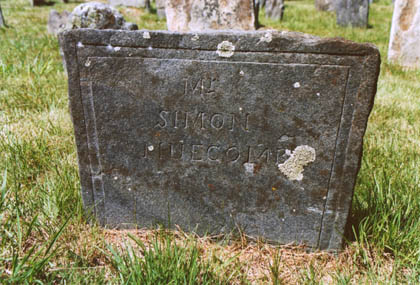
At a town meeting held Feb. 14, 1659, Daniel Hovey was granted liberty to build a wharf against his ground that he bought of William Knowlton, and, also, such building as may tend to the improvement thereof.

Mr. Hovey was living on his farm in Topsfield in 1663 and 1664. Jan. 15, 1663, he was chosen one of two persons to lay out some land.

Mr. Hovey was complained of for speaking falsely to the prejudice of General Denison, and was fined twenty shillings in Ipswich court Sept. 24, 1667. The records show that in some case, in which evidently General Denison acted as magistrate, Mr. Hovey said that Major Denison did not write his determination nor state his sentence in public, and what was done occurred after he was gone, and that John Gould whispered in the major’s ear as he was going away. Magistrates did not allow themselves to be criticised in those days.

In May, 1660, a colony went from Ipswich to Quaboag, a place subsequently named Brookfield ; and Daniel Hovey joined it in 1668. His sons James and Thomas went with him. The lots of land laid out to the father and sons adjoined, and were situated easterly of the little brook, on the north side of the road.

Daniel Hovey was living in Quaboag in May, 1672, and settled in Hadley before the massacre at Quabog in 1675. See my post Siege of Brookfield for details

While in Hadley, he lived on a farm of Mr. Henry Gierke ; and Mr. John Russell, jr., and Mr. Peter Tilton, sr., executors of the will of Mr. Gierke of Hadley, deceased, brought an action against Mr. Hovey, at the court in Springfield Sept. 26, 1676, for withholding rent due to said plaintiffs “for a ft’arm or Land of ye sayd Mr. Henry Glerkes which ye sayd Hovey hath Occupyed as a tenement.”* The jury found a verdict for the plaintiffs, and awarded them fourteen pounds damages, due in i676.

At the succeeding term of court held at Springfield the same year, Mr. Hovey brought suit against Mr. John Russell, jr., being an “Action of unjust molestation in a Suite at ye last Corte at Springfield & for uncharitable charges to ye defamation or Slandour of the sd. Dan” Hovey & his Wife & Charging ye sd Daniel to be a man of a Scandolous life in an Open Afsembly & therefore was denyed Church Gomunion & this threatened to be made Out to his Church and ye he belonged too & all ye Churches thereaboute.”

The jury found a verdict for Mr. Hovey. Whether these proceedings and the unhappy contentions that must have been engendered by them had aught to do with his departure from Hadley or not the writer does not know ; but Mr. Hovey returned to Ipswich in 1678.

While living in Hadley, he suffered much at the hands of the Indians, and was also a sharer in providing defence for the town. Three years after his return to Ipswich, he sent to the colonial council a petition, an exact copy of which, copied from the original instrument on file in the Massachusetts archives, at the state house in Boston, is as follows:

To the Honoured Council now sitting in Boston ; the humble petition of Daniel Hovey of Ipswich,

Wheras your humble petitioner was an inhabitant of Hadly in the time of the late Indian warrs, and there expended (beside my lofses) much of my Estate in the Countreys service against the common enemy; and since that time was removed thence by Providence to Ipswich, where I have remained now these three veers last past ; and by reason of the remote distance fro Hadly and want of intelligence thence I mifsed the opportunity of sending in my last acco” together with my neighbours there, to the last Sefsions of the Gen” Court; which caused me much labour and long travell thither from Ipswich :

yet at the last I have gained a certificate of those my Expences from the Committee of Militia in Hadley, being the last of mine Expences tliere on the Countreys service; amounting to ii'” 13′ 08”; as by the said Certificate doth fully appear: now my humble request and petition is, that yo’ Hono” would be pleased to grant me an Order to the Constables of Ipswich that I may receive the said Sums there; where my setled residence is, and have no commerce or dealing at Hadley : that so I may discount my present Rates, and may have the residue for the relief of my family, which hath been much straitned by my Icfses and expences there in time of the warrs, and by rates both then and since. The Lord direct your counfells and afsist yo” endeavo”‘^ in all weighty transactions now in hand, that we may rejoice and blefs God under yo’ good governm’ continued over us. so prayeth
Yo’ humble petitioner,

Daniel Hovey.

The order thereon was as follows : —

28 flfebruary

It is ordered that the Trefurer pay vnto Daniel Hovey of Ipswich the Sume of Eleven pou[n]ds out of there Country Rate in full of all his Account in Controversy p council! Edw Rawsom Secre'”

Councils act to pay Daniel Hovey ii”” 1681.

The selectmen of Ipswich granted to him six pine trees, presumably for timber, at two times, three on Jan. 2, 1678, and three Dec. 15, 1679.*

Daniel Hovey married Abigail, daughter of Robert and Elizabeth (Franklin?) Andrews of Ipswich, about 1641. Mr. Andrews died in 1643, having given to Mr. Hovey a legacy of ten pounds. In the settlement of the estate of Mrs. Hovey’s brother Thomas Andrews, a prominent schoolmaster, Mr. Hovey certified to the county court as follows:

[some spelling corrected, many “f” to “s” for readabilty]

September 27. ’83’
Thefe may inform this Honored Cort. & may it please your Honors,
to take notis touching the relations of this worthy gentilman Mr. Thomas
Andrews, my truly louing dear & wel. beloved Brother &c. I did more
then forty years ago. match w'” his Loving & welbeloved sister .Abigal
Andrews, by home the lord blest me with six sons. & one dafter. five of
which sons are yet liuing fo that by thes it may apear that we ar
suerly related to this [deceased] gentlman. but in breif he hath fix nefews &
two nefes. as. follows their is the son and dafter of his brothe’ as namly
John. Andrews & fara Connant his sister both which are Confiderably
deters vnto his eftate as alfo M’* Elifibeth Glouer wo is married to Mr.
John Glouer formerly liuing at Bofton now at Swansy w”” also is deter
to the estate ther is myfelf alfo deter to ye estate five shilins vpon the
prifin of some things he lent me for my present vs & gaue me order to
use & keep them til he Caled for them, there is Daniel & John Hovey two
of his nefews deter to the estate for scolin their Children about four
pounds, their is also Thomas, Joseph & nathaniel Hovey. three of his
nefews w”” never had the value of one shiling of the estate of their unkls
that I know of. I humbly draw your favor to ouerlook my weaknes in
indevrin to lay this narative befor your Honors, ye when their shal aper
a vifibl estat of my Loving Brothers youe mav haue so much as thef
few lines may aford as touching the fetling of his eltat upon his relations
that we quietly & peafably w'” ye lords blefing may haue the benifit of the
vf of y’ his eftate w”” he left vndisposed of now the good lord of
heaven so influenl your heads & hearts by ye lit of his holy spirit as that
a Gevin fentans may pro fed frome you as god may haue honor your-
felus ioy in the day of Christ & no perfons or perfon may haue caufe of
complaint but that we may blef god for his merfy to fe juftis & judg’
fil runin in our Itrets. lo prays your humble petitioner.

Mrs. Hovey died between 1676 and 1683. He died in Ipswich April 24, 1692. His will was proved Oct. 31, 1692. The following is a copy of the original document on file in the probate office at Salem: —

I Daniell Hovey fenier of Ipfidg Confidrin the changes of man doe
defier by the help of the Lord to setel my consents as may be for the
glory of god and the good of my family my fole I defir to resign and
Comit unto the hand of my Levin ffather in Jefus Chriit ho is the Lord
my Ritofnis my body to be desently buried in erth in hop of a glorious
and blefed reserectio by chrift amen

Itt The ftat which god of his grace hath giuen me I haue disposd
of af folows to my Eldest sons Daniell and John houey and my daftor
Airs I haue giuen them thire proptions of yt Eftat I had to our mutual!
content ye one at Ipfig ye other in Topsfill Now in their pofefon Abigals
paid by my fon John to my son Airs :

Itt To my fon Thomas and James his fon Daniell I give all that my
Hand caled houeys Hand which with the thatchbanks and Low marsh
belongin to me on the other sid the crek which I a Lowed quarter matter
Perkins [Quarter master John PERKINS] to improue holdin my posesion till I had ocasion for fam alio all y’ houfe and Land in Ipfig y’ I fhall not dispos of befor deth

Itt I giue to my son Joseph and Nathanil Houey one hundred rods
of ground a piece Joseph bounded Next to m’ Emersons Land from ye
hiway to ye Land Daniell Ringes Nathanil one hundred rod of my Land
Next to my fon Daniell with ye dweling hous Bam part of ye orchard to
but on Danil Ring: half planting Lot a bout three acres w’ a way to it
or ye bridg I made to go to it three acrs at plum Hand also: which
Lands I Leaue in ye hands of my Executor and oversears : ye if left after
my death To be disposed of as folows : the Children of Joseph Hovey : to
haue an equall proporfhon of what if Left after my Deth : as to ye father
Legaci : the children of my son Nathaniell to haue an Equall proporfhon :
amounxt y”‘ only Nathaniell Houey y’ son of Nathaniell Houey to haue
a duble pro porfhon: if he Line to y” eage of one and twenty if not y”
to be diuided among ye other Children of ye family :

Itt my mouables to my son Nathaniell those sheep he hath of mine
to his children : my cart and plow Irons chains great tramill great brass
cittell Iron Cettell Little Iron pot : my poutter poringer and drincking
Cup with one chamber pot: and my wife wearing aparell to Nathaniell
children : the other to Joseph his brothers children all my wearing cloths
my great brass pot and putter pot and my great bible an dbooks as faloweth :
come to chrift and wellcom Gotten one y’ Counant madcr : 7: sarmons to
Nathaniell Children to Daniell gran child those sheep with w’ hif mafter
and books alfo Christan warfer Caluen one Job tcnn deuins y” golden
fepter with what other Books undefpofd by me of mine and shuch towls
for his trade as are sutable of mine : to Abigel Hodgkins wife of Thomas
Hodgkins y’ brafe pan and a putter falfeller, my part of ye meare and
colt to gran child Daniell and luory

Itt my entreft of brockfeld and fwampfeld I giue to my son Joseph and Nathaniell children

Itt I make my son Thomas Executor and would haue his Nephu in
case he Lines to eage if capable to Joyne in y” fame w’ him and he to pay
out of his part to his brother James and sister prafila and John Aires tenn
pounds a pice within thre after his poseson and in Cafe of hi death I put James Houey in his Rome and Let y” four Equally deuid his part: my bed bolfter and pillow w’ my gren Rug a paier of ‘■’lanckits. w” ye bedfted to Daniell gran child. I would haue my son John of topsfeld to tack in to his pof ef hon with his Books :

Itt I doe apoynt rny Louing sons Daniell Houey ; and John Hovey
to be oversers : of this my Laft will ; and fe : to discharg my ffunerall
Chargis which I alow four pounds Eftat : and to take any : inventary of
my estate : and discharge all my dets and make probet of my will : and
to fe his Nephufe haue their equall proporfhon : Joseph and [torn] chil-
dren how haue lately defefed: for which I a Low my our fears three
pounds apice for their ceare and truble : This is my will ; as witnes my
hand and feal

wittnesis
Philemon Dane
Thomas Hodgkins

Sources:

From Annis Spear, 1945 – Walter Goodwin Davis

http://paulasgenealogy.com/andrews.htm

http://www.ourfamilystories.com/ourfamily/pafg28.htm#1236

http://greenerpasture.com/Ancestors/Details/647

http://webpages.charter.net/rpitzner/burnham2.html

http://www.islandnet.com/~see/weather/events/gh1635.htm

Angel Gabriel: The Elusive English Galleon byWarren Curtis Riess  This jewel of a book presents the history of and search for the remains of a fascinating seventeenth-century ship. She was built for Sir Walter Raleigh’s last expedition to America in 1617, carried many people on adventures in the Atlantic Ocean for eighteen years, brought families to settle in America, and was wrecked by a hurricane at Pemaquid, Maine in 1635

Posted in 13th Generation, 14th Generation, Historical Monument, Immigrant - England, Line - Miller, Line - Shaw, Sea Captain, Storied, Witch Trials | Tagged , , , , , | 17 Comments