Maximilian Jewett II

Maximilian JEWETT II (1672-1730) was Alex’s 8th Great Grandfather; one of 512 in this generation of the Miller line.

Deacon Maximilian Jewett was born 5 Feb 1672 in Rowley, Essex, Mass. His parents were Ezekiel JEWETT and Faith PARRATT. He married Sarah HARDY in 1698 in Rowley, Mass. Maximillian died 23 Mar 1730 in Rowley, Essex, Mass.

Sarah Hardy was born 25 Mar 1672 in Bradford, Essex, Mass. Her parents were John HARDY and Mary JACKMAN. After Maximilian died, she married May 20, 1731 to Capt. Samuel Pickard. Sarah died 3 Feb 1744 in Bradford, Essex, Mass.

Capt. Samuel Pickard was born MAY 1663 Rowley. His parents were John PICKARD Jr. and Jane CROSBY. He first married Elizabeth Bradstreet 22 JUN 1685 in Rowley. He married second Elizabeth Hale 31 MAY 1687 Rowley. Finally, he married the widow Sarah Jewett 20 May 1731. Samuel died 2 SEP 1751 in Rowley.

Children of Maximilian and Sarah:

Name Born Married Departed
1. Hannah Jewett 6 Apr 1699
Rowley, Mass
John Tenney
23 Jan 1718 Rowley, Essex, Mass
Mar 1802
Bradford, Mass.
2. Elizabeth JEWETT 3 Mar 1700/01 Rowley, Mass. Deacon Caleb BROWN
18 Oct 1722  Rowley, Mass
23 Nov 1758
3. Seth Jewett 15 OCT 1704
Rowley, Mass.
Dorcas Hardy
12 Feb 1726/27 Rowley, Mass.
.
Mehitable Hardy
6 Sep 1739
Rowley, Mass
26 OCT 1756
4. Sarah Jewett 3 JUN 1707 Rowley, Mass. Joseph Pickard
bef. 1729
Rowley, Mass.
22 NOV 1802 in Rowley, Essex, Mass
5. Faith Jewett 30 APR 1710
Rowley, Mass.
Paul Dodge
30 Mar 1736
Hamlet Parish, Mass
6. Hepsibah Jewett 2 NOV 1712
7. Anne Jewett 17 JUL 1715 Charles Tuttle
23 Apr 1735 – Rowley, Essex, Mass
30 Jan 1799 – Rowley, Essex, Mass
8. Jeremiah Jewett  1720 7 Jun 1785
Rowley, Mass
Elizabeth Choate
27 Mar 1742 Ipswich, Mass

Maximilliam settled in that part of Byfield Parish, Rowley, that was set off and incorporated as Georgetown in 1838. He was dismissed from the Rowley Church to Byfield Parish, Jan. 15, 1710-11, and soon became deacon.

Administration was granted on Maximillian’s estate in 1730 to his widow Sarah. The real estate was divided March 23, 1730/31 to widow Sarah; eldest son Seth ; son Jeremiah a minor ; daughters Hannah Tenney, Elizabeth Brown, Sarah Pickard, Faith, Hepsebah a minor, Ann a minor.

Widow Sarah Jewett, married (2d) (Pub. May 20, 1731) Captain Samuel Pickard (his third wife). Samuel died Sept. 2, 1751. She died Aug. 26, 1771, in her 94th year. Her will, dated Nov. 22, 1768, proved Sept. 23, 1771, mentions: Hannah Tenney, Elizabeth Brown, Sarah Pickard, Faith Dodge, Plepsebah Jewett, Ann Tuttle, also Seth Jewett Foster, ” grandson of my late son Seth Jewett.”

Children

1. Hannah Jewett

Hannah’s husband John Tenney was born 8 Dec 1692 in Bradford, Essex, Mass. His parents were Samuel Tenney and Sarah Boynton. John died 23 Aug 1732 in Bradford, Essex, Mass.

2. Elizabeth JEWETT (See Deacon Caleb BROWN‘s page)

3. Seth Jewett

Seth’s first wife Dorcas (Dorothy) Hardy was born 28 Jan 1702. Her parents were Capt. Daniel Hardy and Martha Wicom. Dorcas died 4 Nov 1764 – Rowley, Mass.

Seth’s second wife was Mehitable Hardy born 20 Mar 1717/18 and they married 6 Sep 1739 – Mass. Her parents were Joseph Hardy and Mary Burbank.

Seth lived in Bradford and had at least one child, a daughter, who married — — Foster,
and had a son, Seth Jewett Foster.

4. Sarah Jewett

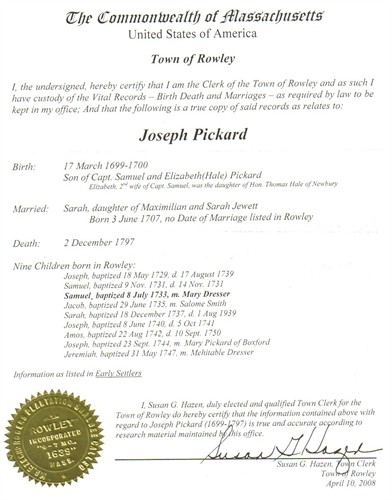
Sarah’s husband Joseph Pickard was born 17 MAR 1700 in Rowley, Essex, Mass. His parents were Samuel Pickard and Elizabeth Hale. After Elizabeth died, Samuel would later marry S May 20, 1731 to Sarah’s mother (See Above) Joseph died 02 DEC 1797 in Rowley, Essex, Mass

5. Faith Jewett

Faith’s husband Paul Dodge was born in 1709 – Essex, Mass. His parents were Richard Dodge and Martha Low. Paul died 3 Jan 1773 – Hamilton, Essex, Mass.

7. Anne Jewett

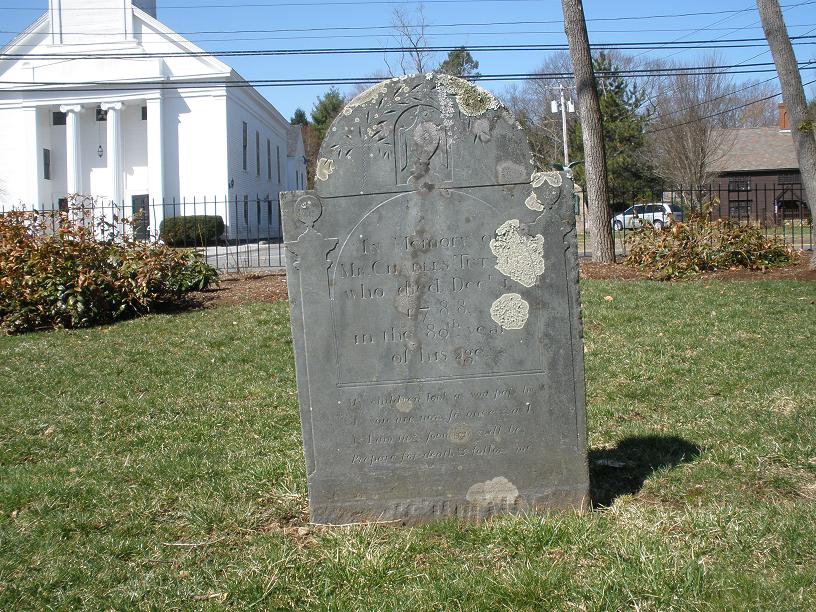
Anne’s husband Charles Tuttle was born 1 Dec 1708 in Ipswich, Essex, Mass. His parents were Charles Tuttle and Mary Burnham. Charles died 1 Dec 1788 in Rowley, Essex, Mass.

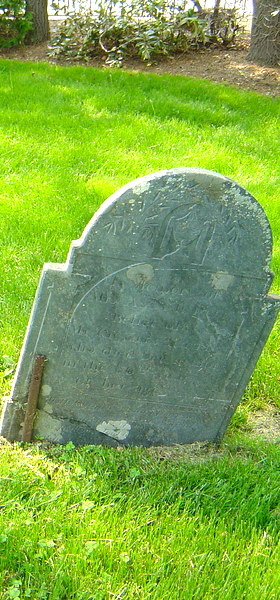
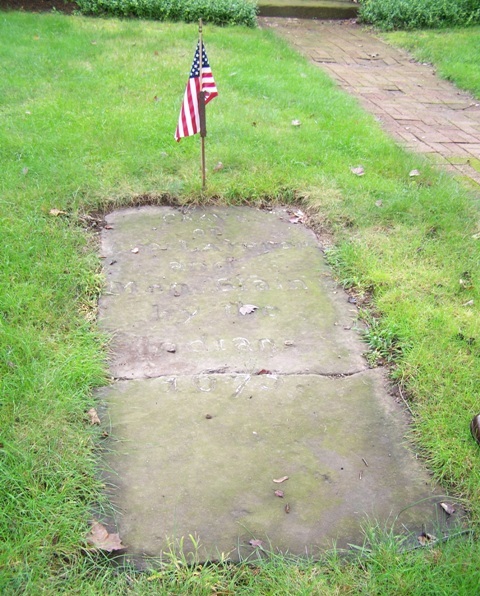
Anne Jewett Tuttle Gravestone

Charles Tuttle Gravestone -- Hamilton Cemetery, Hamilton, Essex County, Mass

8. Jeremiah Jewett

Jeremiah’s wife Elizabeth Choate was born 26 JAN 1717 in Ipswich, Essex, Mass

Jeremiah lived in Byfield Parish, Rowley, and was a member of the First Foot Co. of Rowley. His will, dated June 7, 1785, proved Oct. 3, 1785, mentions: wife Elizabeth; sons Jeremiah, Seth, Maximilian, and Samuel, and daughters Elizabeth Webber and Ann Nourse.

Sources:

http://trees.ancestry.com/owt/person.aspx?pid=16782243

http://trees.ancestry.com/tree/27531102/person/5008786604

http://www.geni.com/people/Deac-Maximilian-Jewett/6000000015723634876?through=6000000015723634881

History and genealogy of the Jewetts of America; a record of Edward Jewett, of Bradford, West Riding of Yorkshire, England, and of his two emigrant sons, Deacon Maximilian and Joseph Jewett, settlers of Rowley, Massachusetts, in 1639; also of Abraham and John Jewett, early settlers of Rowley, and of the Jewetts who have settled in the United States since the year 1800 (1908) By Frederic Clarke Jewett

Posted in 10th Generation, Line - Miller | Tagged , | 4 Comments

Edward Brown

Edward BROWN (1574 – 1610) was Alex’s 11th Great Grandfather; one of 2,048 in this generation of the Miller line.

Brown Coat of Arms

We have five separate Brown lines and seven different Brown immigrant ancestors, by far the most of any surname.  When the surname is of English origin it is derived from a nickname concerning the complexion of an individual, or the colour of their hair. Brown is derived from the Old English brunbrūn; Middle English brunbroun; or Old French brun.

1. John BROWNE Sr. (Swansea). (1583 Hawkedon, Suffolk  – 1662 Swansea, Mass)
John BROWN Jr.  (1620 -1662 Rehoboth, Mass)

2. John BROWN (Hampton) (1589 London – 1677 Salem, Mass)

3.  Nicholas BROWN (1601 Inkberrow, Worcester – 1694 Reading, Mass)

4. James BROWNE (1605 Southhampton, Hampshire  -1676 Salem, Mass.)

5. Thomas BROWNE (1607 Christian Malford, Wiltshire – 1687 Newbury, Mass.)
Francis BROWN I (1633  Christian Malford, Wiltshire – 1691  Newbury, Mass.)

Edward Brown was not born 9 Sep 1586 in Inkberrow Parish, Worcestershire, England because he would have been too young to be married in 1599.   1574 is a better bet. Edward married Jane LEIDS about 1599 in Inkberrow, Inkberrow, Worcs, England.  Edward died after 1610 in Inkberrow, Worcs., England.

Jane Leids was born in 1578 in Inkberrow, Parish, Worcestershire, England and was christened in Igi, 17, 17. Her parents were Thomas LIDE and Jane GIBBS. She died after 1610 in  Inkberrow, Worcestershire, England.

Children of Edward and Jane:

Name Born Married Departed
1. Anne Browne c. 1595
England
Thomas Hutchinson
1616 in Inkberrow, Worcester, England
.
Adam Hawkes
1630 in Charlestown, Suffolk, Mass
4 Dec 1669 Lynn, Mass
2. Nicholas BROWN 1601
Inkberrow Parish,  WychavonWorcestershire
Elizabeth LEIDS
1624 England.
.
Frances Parker
aft. 1 Nov 1674
16 Nov 1694 in Reading, Middlesex, Mass
3. Lydia Brown c. 1602
Inkberrow, Worcester, England
5 Apr 1673?
Reading, Middlesex, Mass.
4. Preserve Browne c. 1604
Inkberrow, Worcester, England
5 Apr 1673?
Inkberrow, Worcester, England

Looks like Jane Leids 1578-1610 and Elizabeth Leids 1604-1674 were sisters, daughters of Thomas Leids 1546-1609 and Jane Grubbs/Gibbs 1550-1604.  Inkerburrow, England.

Jane Leids married Edward Brown 1586-1610.

Their son, Nicholas Brown 1601-1694, may very well have married his mother’s much younger sister, Elizabeth.

This makes Thomas Leids 1546-1609 and Jane Grubbs/Gibbs 1550-1604, Alex’s 13th and 14th great grandparents.

Children

1. Anne Browne

Anne’s first husband Thomas Hutchinson was born 1595 in Inkberrow, Worcester, England. Thomas died 1631 in Charlestown, Suffolk, Mass very shortly after his arrival in America.

Anne’s second husband Adam Hawkes was baptized 26 Jan 1605/06 at St. Andrews Church, in Hingham, Norfolk, England. His parents were John Hawkes and [__?__]. Adam died 13 Mar 1672 in Lynn, Essex, Mass.

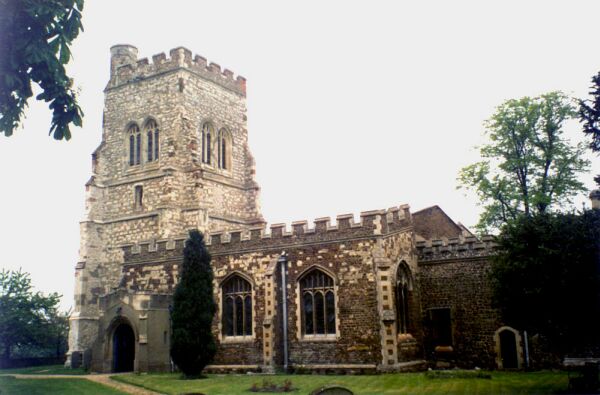
Adam was the first infant to be baptized by the newly installed Rector, Rev. Robert PECK. The ancient baptismal font is no longer in use but in the church one can still see “a wooden ball”, the only remnant of an ancient Font cover. The church is one of great antiquity. It is known that Remigius de Hethersette, Rector from 1316 to 1359 was responsible for its construction. The tower stands 120 feet high. The glass in the east window is medieval but was not installed until the 19th century. There are eight bells in the tower, the oldest of which was cast in 1450.

Our ancestor Robert Peck was rector of St Andrews Church in Hingham, Norfolk, England

Hingham was a small town of ancient origin located 97 miles northeast of London, in Norfolk county in a part of England formerly known as East Anglia. It lies about 14 miles west of Norwich, now the capital of Norfolk. It was an agricultural community during Adam’s time, with lush fields and its own market place. Yet it had a small population.

In the early centuries the area of Norfolk and neighboring Suffolk experienced invasion by Viking Norsemen, and in 1066 was invaded by William the Conqueror. Over the centuries there was much change in the ethnic makeup of the area. During the 16th century, in Elizabethan times, many Heguenots and Walloons came across the North Sea to East Anglia. All of these changes probably played a part in Adam’s decision to leave that country for America.

Adam Hawkes came to America with the Winthrop Fleet in 1630, perhaps on the ship Arbella. Originally there were to have been eight ships sailing together from England. The Arbella was the first to cast off at 10:00 AM on March 29. It sailed to Yarmouth and waited for the other seven. Only three showed up, so the fleet, consisting of four ships, left the next morning for America. These ships were built to carry cargo, not passengers, so there were few comforts. They first sighted land, Cape Sable, on June 6. They arrived at Salem on June 12, but continued to explore the area before permanently anchoring on June 29.

Adam first settled in Charlestown, Suffolk, MA, trying to eke out an existence with four acres of land. Soon after arriving in this country he had married Ann (Brown) Hutchinson, a widow of Thomas Hutchinson, who had also come with the Winthrop Fleet. She had four sons and a daughter, who grew up in the Hawkes’ household. A child, John, was born but did not survive. In 1633 a smallpox epidemic in the area caused Adam to begin thinking about moving away from the area and its poor health conditions. Finally, on Jan. 10, 1635/36, he sold the land to N. Easton and J. Sibley.

It is not known exactly when Adam and Anne left Charlestown for the more ample agricultural acres of Saugus. In 1638, at the time of the first division of land in Lynn, Essex, MA, he received a grant of one hundred acres, and settled in that part of Lynn, now known as North Saugus, on the homestead which has since been in the family. He was a farmer there.

Adam chose a rocky knoll for the site of his first home there, later to be known as Close Hill at Hawkes Corner as it had a small field enclosed by a stone wall called a close. A small part of the original home site remains in the ownership of the Adam Hawkes Family Association and a part of the old stone wall still exists. This site although only eight miles from the former home in Charlestown was far up the winding Saugus River with nothing beyond except the wigwams of local indians.

Shortly after the house was built, it was totally destroyed by fire. Adam built a second house near the site of the first. A few years later, in 1642, an iron works was built just downstream from his property. A dam was built as a power source, which caused a lot of flooding of Adam ‘s land. In 1688 the Saugus Iron Works went out of business. Eventually the old Iron Works was restored by the American Steel Companies and is now a national historic site.

Apparently, Adam never took the freeman’s oath. This is not suprising as only a minority of men in the early Massachusetts Bat Colony did so. He did serve public office however. On Feb. 24, 1657, he was appointed to a committee to lay out land lots in the community. He was also a juror in 1655 and 1659, and in 1660 served on the grand jury, Essex County, where he was the only person referred to as “mister”.

Ann was 75 years old when she died Dec. 4, 1669, in Lynn.

Adam married, second, Sarah Hooper in June, 1670. She was just 19. She was born Dec. 7, 1650, in that part of Reading which is now Wakefield. She was the oldest living child of 11 born to William and Elizabeth Hooper, a weaver, who had come in the James from London in 1635 at the age of 18.

The following year a daughter, Sarah, was born to Adam and Sarah, on Jun. 1, 1671. Less than a year later Adam died at age 67, on Mar. 13, 1671/72. He left an estate valued at over 817 pounds, including 554 acres of land.

Sarah married a second time 9 Jan 1672/73, to Samuel Wardwell, son of Thomas and Elizabeth Wardwell. They had six children. Samuel was accused of practicing witchcraft and was executed due to his retracting a “forced” confession.  He was hanged on Sep. 22, 1692 at Gallows Hill, along with seven others, and according to tradition the last ever to be hanged for witchcraft in the Massachusetts Bay Colony.

Samuel Wardwell was born 16 May 1643 to a modest Quaker family in Boston. He studied carpentry and moved to Andover, Massachusetts in 1672 to find work. There he married his second wife, Sarah Hawkes, a wealthy widow with whom he had seven children. In 1692, he was accused of witchcraft and brought to trial in Salem. The fact he was found guilty is not surprising, as his father Thomas who been a follower of John Wheelwright and Ann Hutchinson.  Samuel  had dabbled in fortune telling as a young man, had family members who were disliked in Andover, and had married a woman whom many did not think he was worthy of marrying. During his court examination, he confessed to being a witch by submitting a long and detailed story of his indiscretions in order to save his life. His conscience and personal courage led him to recant the story and claim innocence, knowing the risk involved. He was hanged on September 22, 1692.

The “state” confiscated his property which left his family destitute. Sara herself was accused of witchcraft. Her minor children were taken from here and placed in custody of friends and relatives. Her oldest daughter and mother-in-law were also accused and acquitted of witchcraft. Eventually she was released. However the impoverished and miserable conditions she endured in a prison dungeon must have contributed to an early death. Samuel’s son, too young at the time, later sued and won some compensation for the family’s ordeals.

The Lynn Vital Records list four additional children of Adam , having been born “before 1660”. It is generally accepted that this is a mistake, and these are actually his grandchildren

2. Nicholas BROWN (See his page)

Sources:

http://trees.ancestry.com/owt/person.aspx?pid=17000722

http://freepages.genealogy.rootsweb.ancestry.com/~lotus525/pafg544.htm#9410

http://trees.wmgs.org/getperson.php?personID=I2943&tree=Schirado

http://www.jfredpeterson.com/tree/g12hawk.htm

http://freepages.family.rootsweb.ancestry.com/~ahfa/

Samuel Wardwell Salem Witchcraft Manuscripts and Transcripts

Posted in 13th Generation, Line - Miller, Violent Death, Witch Trials | Tagged , | 5 Comments

Nicholas Brown

Nicholas BROWN (1601 – 1694) was Alex’s 10th Great Grandfather; one of 1,024 in this generation of the Miller line.

Brown Coat of Arms

We have five separate Brown lines and seven different Brown immigrant ancestors, by far the most of any surname.  When the surname is of English origin it is derived from a nickname concerning the complexion of an individual, or the colour of their hair. Brown is derived from the Old English brunbrūn; Middle English brunbroun; or Old French brun.

1. John BROWNE Sr. (Swansea). (1583 Hawkedon, Suffolk  – 1662 Swansea, Mass)
John BROWN Jr.  (1620 -1662 Rehoboth, Mass)

2. John BROWN (Hampton) (1589 London – 1677 Salem, Mass)

3.  Nicholas BROWN (1601 Inkberrow, Worcester – 1694 Reading, Mass)

4. James BROWNE (1605 Southhampton, Hampshire  -1676 Salem, Mass.)

5. Thomas BROWNE (1607 Christian Malford, Wiltshire – 1687 Newbury, Mass.)
Francis BROWN I (1633  Christian Malford, Wiltshire – 1691  Newbury, Mass.)

Nicholas Brown was born in 1601 in Inkberrow Parish,  WychavonWorcestershire that is often thought  to be the model for Ambridge, the setting of the long running radio serialisation or soap opera The Archers. In particular ‘The Bull’, the fictional Ambridge pub, is supposed to be based on a very real pub, the Old Bull, in Inkberrow. It is at this historic public house or wayside inn, a black and white half-timbered building, that William Shakespeare is reputed to have stayed while on his way to Worcester to collect his marriage certificate. His parents were Edward BROWN and Jane LEIDS. He married Elizabeth LEIDS in 1624 in England.   After Elizabeth died,  he married widow Frances Parker.  Nicholas died 16 Nov 1694 in Reading, Middlesex, Mass

Elizabeth Leids was born in 1605 in Malford, Worchester, England. Her parents were Thomas LIDE and Jane GIBBS. It’s not known what exactly was her relationship with Nicholas’ mother Jane Leids.  Some sources say that Elizabeth’s older sister married the father of Elizabeth’s husband which sounds incestous to me, even if Jane was Edward’s second wife.  Other sources say that Thomas Lide and Jane Gibbs were Jane’s parents and Nicholas’ grandparents.  Elizabeth died 1 Nov 1674 in Reading, Middlesex, Mass.

Children of Nicholas and Elizabeth: I don’t have documentation of the location of the births of these children.  It appears Nicholas maintained a connection to both Lynn and Reading in the 1640’s.

Name Born Married Departed
1. Thomas Brown c. 1628 in Inkberrow, Worcester, England
According to his deposition taken July 11, 1666. (Essex Co., Court Papers, B. XIII.L 62,)
Mary Newhall
16 Jun 1653 Lynn, Essex, Mass.
28 Aug 1693  Lynn, Essex, Mass.  Burial: Western Burial Ground
2. Anthony Brown 1630 in Malford, Worcs., England
3. Josiah Brown 1630 in Malford, Worcs., England Mary Fellows
23 Nov 1666 Reading, Middlesex, Mass
29 Jan 1690
Reading, Middlesex, Mass
4. Cornelius BROWN 1632 in Malford, Worcs., England Sarah LAMSON
6 Jun 1665 in Reading, Middlesex, Mass.
.
Sarah Burnap
20 Nov 1684
.
Mary Dustin
26 Nov 1698
1701
Ipswich, Essex, Mass.
5. Ergn Brown 1632 in Worcs., England Sarah Burnett
1657 in Malford, Worcs., England
1701
Essex, Mass
6. Capt. John Brown 1634
Malford, Worcs., England
Elizabeth Osgood
12 Oct 1659 Reading, MA
.
Anne Fisk
30 May 1677 Chelmsford, Middlesex, Mass
.
Elizabeth Bulkeley
29 Mar 1682 Malford, Worcs., England
.
Rebecca Crawford
24 June 1697 Malden, Mass.
12 Mar 1717
Reading, Middlesex, Mass.
.
7. William Brown 1638 Lynn, Essex, Mass. Lydia Parchment
11 Apr 1656 Boston, Suffolk, Mass
1689
Bristol, Bristol, Rhode Island,
8. Nicholas Brown  1639
Lynn, Essex, Mass.
Catherine Almy
1664 in Of Malford, Worcestershire, England
.
Mary Chambers
1707 in Of Malford, Worcestershire, England.
2 Jun 1711 New Jersey
9. Edward Brown 15 Aug 1640
Lynn, Essex, Mass.
Sarah Dix
21 Jul 1679 Reading, Middlesex, Mass
26 Apr 1685
Reading, Middlesex, Mass
10. Jane Brown 1645 in Malford, Worcs., England James Babcock
1645 in Reading, Middlesex, Mass
4 Feb 1719
Westerly, Washington, Rhode Island,
11. Elizabeth Brown 10 Dec 1647
Reading, Middlesex, Mass
Hananiah Parker
30 Sep 1663 in Reading, Middlesex, Mass
10 Mar 1724
Reading, Middlesex, Mass
12. Joseph Brown 10 Dec 1647
Reading, Middlesex, Mass
Elizabeth Bancroft
26 May 1674 in Reading, Middlesex, Mass
17 Oct 1723
Reading, Middlesex, Mass
13. Sarah Brown 28 Jun 1650
Reading, Middlesex, Mass
Robert Burnap
28 May 1662 in Reading, Middlesex, Mass
1695
Reading, Middlesex, Mass
14. Mary Brown 1653 Reading, Middlesex, Mass Thomas Upham
2 Oct 1704 in Malden, Middlesex, Mass
21 Apr 1707
Reading, Middlesex, Mass
15. Mehitable Brown 1656 in Reading, Middlesex, Mass John Townsend
23 Apr 1690 in Reading, Middlesex, Mass
1735
Reading, Middlesex, Mass

Nicholas Browne of Reading is not the same person as Nicholas Browne of Haverhill nor Nicholas Browne of Portsmouth, Rhode Island.

Nicholas a native of Inkberrow, Worcestershire, England. He may have come to Lynn as early as 1630, but he  first appears in New England records in March, 1638, when he is one of the 100 planters who received grants of land in the “Six-mile Grant”, of Lynn, Massachusetts.

Nicholas received 210 acres, one of the largest grants. Many of the grantees did not occupy the land, but sold it to others. Nicholas did live on his land however, and he was active in the affairs of Lynn until 1649. He served as Lynn’s representative to the General Court, on various juries, and on the Essex County Grand Jury from 1641 to 1649.

Sometime during those years, he moved his family to Reading, where he had also received several grants of land. His last two children are recorded in Reading, in 1640 and 1647, although Nicholas and his wife belonged to the church in Lynn until 1663. From 1651 on, Nicholas also took an active roll in Reading. He was chosen to fill various rolls such as selectman, commisioner “to try small causes”, and tax collector. Nicholas and Elizabeth had six children, the first four probably born in England, or possibly Elizabeth, thought to have been born about 1639, was born in Lynn, but not recorded there. The last two children are recorded as having been born in Reading.

In 1660, Nicholas granted his son John power of attorney, as John was traveling to England. John was to attempt to recover whatever he could of the estate that his mother inherited from her father, Thomas Lide. Nicholas made his will on March 29, 1673 and died on April 5th. His estate was probated on April 17, 1673, it was valued at over 1200 pounds, a large estate in those days. Elizabeth died in Reading on November 1, 1674.

7 Sep 1638 – Freeman in Lynn
1641 – Representative to the General Court
1644- Removed to Reading
1655 – 1658 to 1661 – Deputy from Reading
1660 – Sent his son John to England to look after the property of Thomas Leide which he had inherited as next of kin.

Nicholas’ will was dated 9 Mar 1673, proved 17 June 1673. He bequeathed to children: John, Josiah, Edward, Joseph, Cornelius, and Elizabeth, and to his wife Elizabeth.

Many of the Massachusetts Bay Colony‘s original settlers arrived from England in the 1630s through the ports of Lynn and Salem. In 1639 some citizens of Lynn petitioned the government of the colony for a “place for an inland plantation”. They were initially granted six square miles, followed by an additional four. The first settlement in this grant was at first called “Lynn Village” and was located on the south shore of the “Great Pond”, now known as Lake Quannapowitt. On June 10, 1644 the settlement was incorporated as the town of Reading, taking its name from the town of Reading in England.

The first church was organized soon after the settlement, and the first parish, later known as “South Reading”, became the separate town of Wakefield in 1868. Thomas Parker (Elizabeth Brown’s father-in-law) was one of the founders of Reading. He also was a founder of the 12th Congregational Church (now the First Parish Congregational Church), and served as deacon there.   He was a selectman of Reading and was appointed a judicial commissioner.  There is evidence that Parker was “conspicuous in naming the town” and that he was related to the Parker family of Little Norton, England, who owned land by the name of Ryddinge.

A special grant in 1651 added land north of the Ipswich River to the town of Reading. In 1853 this area became the separate town of North Reading. The area which currently comprises the town of Reading was originally known as “Wood End”, or “Third Parish”.

Children

1. Thomas Brown

Thomas’ wife Mary Newhall was born 1637 Lynn, Essex, Mass. Her parents were Thomas Newhall and Mary Jane Pendleton. Mary died  2 Jun  1694  Newbury, Essex, Mass. and was buried Western Burial Ground , Lynn, Essex, Mass

Thomas Newhall was one of the earliest settlers in Lynn, and lived on the east side of Federal Street, a few rods south of the mill brook, owning all the land on that side between the turnpike and Marion Street. (Lynn, Lewis & Newhall, p. 482)

When Thomas died, Aug 28, 1693, his widow, Mary, was appointed administratrix, Oct. 9, 1683, on the same day the nuncupative will of Thomas Browne was taken down(on file in the office of the Register of Probate in Salem). He names his eldest son, Thomas, and his sons Joseph, John, Daniel, and Ebenezer, and dau. Norwood. Two depositions cited by Waters, pp. 15 and 16, show her age. Her name first appears in records as wife of Thomas Browne in 1658. “Her husband was a dish-turner and was said to be of Grawton, Middlesex, in June, 1663, when he bought of William Longley his house lot (6 acres), bounded E. with lands of Richard Haven, W. with land of John Newhall, S. by Mill Street, and N. by the common.”

Child of Thomas and Mary:

i.  John Brown (b. 1664 Lynn, Essex, Mass. – d. Aug 1733 Stonington; Burial: Old Taugwonk Cemetery); m. Elizabeth Minor b. 30 Apr 1674; d. 19 Jan 1736 Stonington, New London CT; Burial: Old Taugwonk Cemetery.  Elizabeth’s parents were Ephraim Minor and  Hannah Avery.  Her grandparents were our ancestors, Thomas MINER and Grace PALMER.

3. Josiah Brown

Josiah’s wife Mary Fellows was born 1642 in Ipswich, Essex, Mass. Her parents were William Fellows and Mary Ayer. Mary died in 1699 in Reading, Middlesex, Mass

4. Cornelius BROWN (See his page)

5. Ergn Brown

Ergn’s wife Sarah Burnett was born

6. Capt. John Brown

John’s first wife Elizabeth Osgood was born about 1636 in Wherwell, Hampshire. Elizabeth died 31 July 1673, Andover, Mass.

John’s second wife Anne Fisk was born 15 Jan 1646 in Malford, Worcester, England. Her parents were John Fiske and Anne Gipps. Anne died 30 May 1681 in Reading, Middlesex, Mass.  Inscription: Here lyes the body of Anna Fiske, first wife of Captain John Brown, Esquire, who dyed May 30, 1681, in her 36th year.

John’s third wife Elizabeth Bulkeley was born 1638 in Concord, Middlesex, Mass. Her parents were Edward Bulkeley and Lucian [__?__]. Her grandfather was Peter Buckley (wiki), an influential early Puritan preacher who left England for greater religious freedom in the American colony of Massachusetts. He was a founder of Concord,  and was named by descendant  Ralph Waldo Emerson in his poem about Concord, Hamatreya.   Elizabeth first married 7 Dec 1665 in Concord, Middlesex, Mass to Joseph Emerson (b. 25 Jun 1620 in England – d. 3 Jan 1680 in Concord, Mass.) Elizabeth died 4 Sep 1693 in Reading, Middlesex, Mass.

Rev Peter Buckley (Jan 31, 1583 – Mar 9, 1659)

Rev Peter Buckley (1583 – 1659)

Old Burying Ground  Wakefield, Middlesex , Mass - Find A Grave  Memorial# 21230461

Elizabeth Bulkeley Brown Gravestone – Old Burying Ground
Wakefield, Middlesex , Mass – Find A Grave Memorial# 21230461

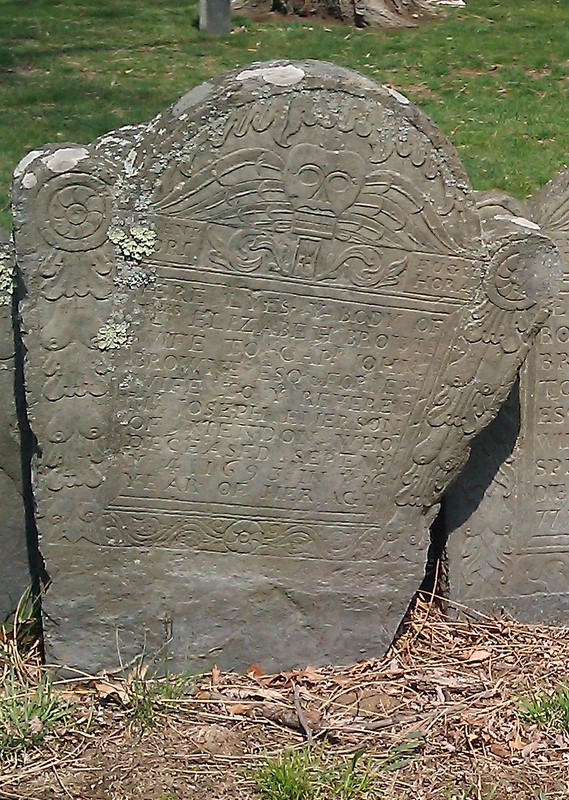
Inscription: Here lyes the body of Mrs. Elizabeth Brown, wife to Capt. John Brown, Esquire, formerly wife to Rev. Joseph Emerson of Mendon, who deceased Sept. 4, 1693, in the 56th year of her age.

John’s fourth wife Rebecca Crawford was born about 1634. Rebecca died 8 July 1710, Reading, Mass.

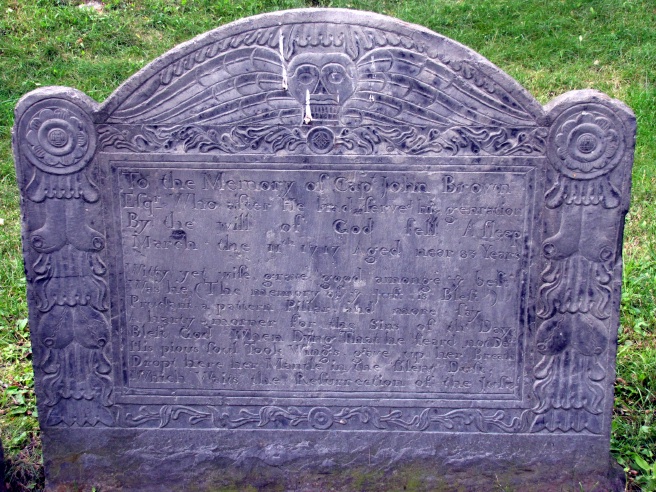
John lived on the farm now [1874] owned by Dr. Francis P. Hurd. He was captain, justice of the peace, selectman, and representative. His epitaph: “Witty, yet wise, grave, good, among the best/ Was he,—the memory of the just is blest.”

Old Burying Ground  Wakefield Middlesex County Mass  Find A Grave Memorial# 22257450

Old Burying Ground, Wakefield, Middlesex,
Mass  – Find A Grave Memorial# 22257450

7. William Brown

William’s wife Lydia Parchment was born 1635 in Boston, Suffolk, Mass. Lydia died in 1680 in Bristol, Bristol, Rhode Island.

9. Edward Brown

Edward’s wife Sarah Dix was born 1644 in Reading, Middlesex, Mass. Her parents were Ralph Dix and Esther [__?__]. After Edward died, she married 24 Nov 1685 Lynn, Mass. to Thomas Laughton (b. abt 1642, England – d. 19 Dec 1713, Lynn, Mass.) Sarah died 21 Jul 1679 in Reading, Middlesex, Mass

10. Jane Brown

Jane’s husband James Babcock was born 1641 in Portsmouth, Newport, Rhode Island. His parents were James Babcock and Sarah Brown. James died 1698 in Westerly, Washington, Rhode Island

11. Elizabeth Brown

Elizabeth’s husband Hananiah Parker was born 1638 in Lynn, Essex, Mass. His parents were Deacon Thomas Parker and Amy [__?__]. Hannaniah died 10 Mar 1724 in Reading, Middlesex, Mass

Thomas Parker (1605–1683) was one of the founders of Reading, Massachusetts, and a deacon and one of the founders of the 12th Congregational Church in Massachusetts (now the First Parish Congregational Church)

Dea. Parker sailed from London on March 11, 1635, for Massachusetts. He settled first in Lynn, but in 1638 became either the first, or one of the first, settlers of what became the town of Reading. It was first known as Lynn Village, but was incorporated in 1644 as Reading, with a total of seven families living in seven houses.  There is evidence that Parker was “conspicuous in naming the town” and that he was related to the Parker family of Little Norton, England, who owned land by the name of Ryddinge. 

Wakefield Common

Parker was a selectman of Reading and was appointed a judicial commissioner. He owned 200 acres of land on the north side of the Ipswich River, but his homestead bordered the east side of the Wakefield (then part of Reading) Common, just northeast of today’s Wakefield Town Hall. Reading split into three towns in the late 18th century, Wakefield (First Parish), North Reading (Second Parish) and Reading (Third Parish).

12. Joseph Brown

Joseph’s wife Elizabeth Bancroft was born 7 Dec 1653 in Reading, Middlesex, Mass.  Her parents were Lt. Thomas Bancroft and Elizabeth Metcalf.  Her grandparents were Michael METCALF and  Sarah ELWYN.  Elizabeth died 31 Dec 1732 in Reading, Middlesex, Mass.

13. Sarah Brown

Sarah’s husband Robert Burnap was born 28 Nov 1627 in Hoddesdon, Hertfordshire, England. His parents were Robert Burnap and Ann Miller. He first married 1653 in Reading, Middlesex, Mass to Ann [__?__] (b. 1631 in Reading – d. 25 Jun 1661 in Reading) Robert died 18 Oct 1695 in Reading, Middlesex, Mass

14. Mary Brown

Mary’s husband Thomas Upham was born 1668 in Malden, Middlesex, Mass. His parents were Phineas Upham and Ruth Wood. Her grandparents were Edward WOOD and Ruth LEE. Thomas died 26 Nov 1735 in Reading, Middlesex, Mass

15. Mehitable Brown

Mehitable’s husband John Townsend was born 1640 in Lynn, Essex, Mass. He first married 27 Mar 1668 in Lynn, Essex, Mass to Sarah Pearson (b. 20 Jan 1648 in Lynn – d. 9 Jul 1689 in Lynn). John died 14 Dec 1726 in Lynn, Essex, Mass

Sources:

http://trees.ancestry.com/owt/person.aspx?pid=16909362&st=1

http://www.genealogyofnewengland.com/f_72.htm#94

http://aleph0.clarku.edu/~djoyce/gen/report/rr02/rr02_335.html#P15228

http://trees.wmgs.org/getperson.php?personID=I2640&tree=Schirado

http://freepages.genealogy.rootsweb.ancestry.com/~lotus525/pafg522.htm#9033

http://www.ctgenweb.org/county/conewlondon/bios/Brown1.htm

Posted in 12th Generation, 90+, Be Fruitful and Multiply, Immigrant - England, Line - Miller, Twins | Tagged | 21 Comments

Cornelius Brown Sr.

Cornelius BROWN Sr. (1632 – 1701) was Alex’s 9th Great Grandfather; one of 1,024 in this generation of the Miller line.

Cornelius Brown was born 1632 in Malford, Worcestershire, England. His parents were Nicholas BROWN and Elizabeth LEIDS.  He married Sarah LAMSON 6 Jun 1665 in Reading, Middlesex, Mass. On 20 Nov 1684 Cornelius second married Sarah Burnap.  Southwick in Reading, MA. On 26 Nov 1698 Cornelius third married Mary Dustin, in Reading, Mass. Cornelius died in 1701 in Ipswich, Essex, Mass.

Sarah Lamson was born 1645 in Ipswich, Essex, Mass. Her parents were William LAMSON and Sarah AYERS. Sarah died 4 Oct 1683 in Reading, Middlesex, Mass.

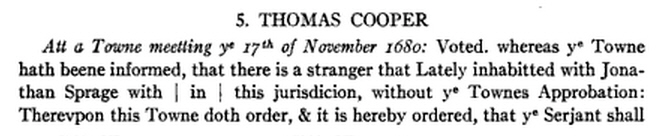
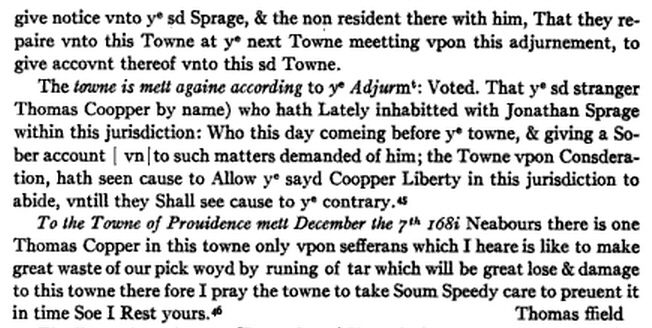
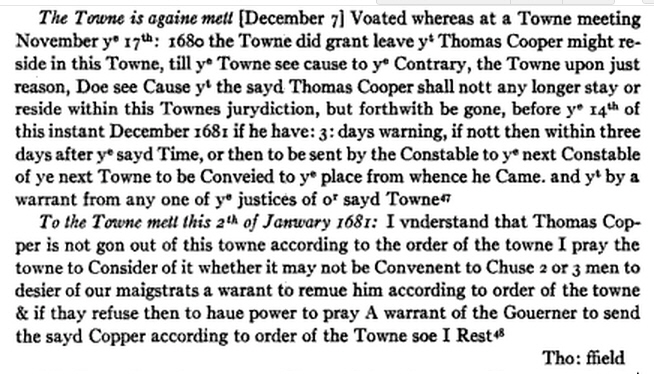
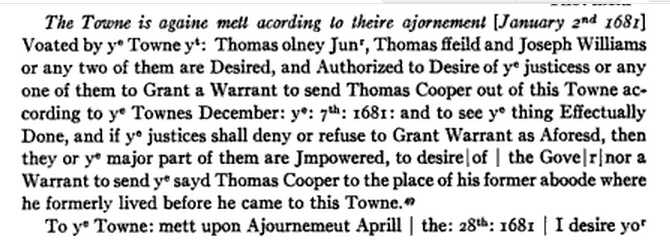
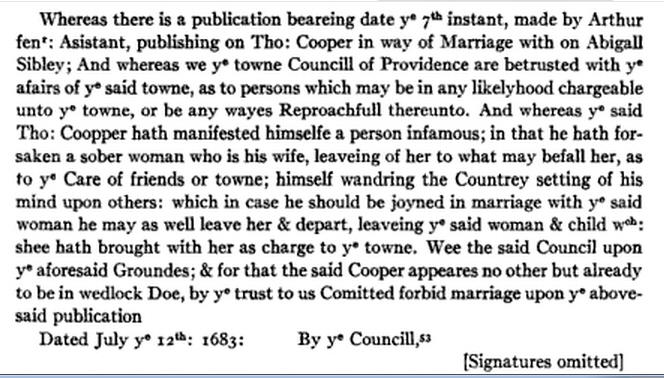
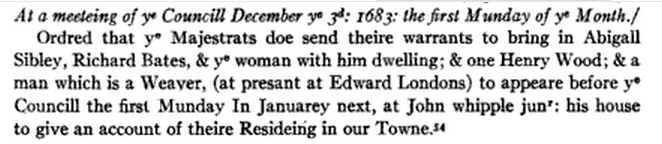
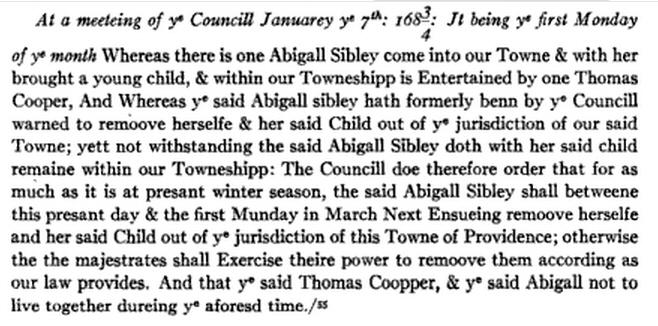
Sarah Burnap was born 1648 in Salem, Essex, Mass. Her parents were Robert Burnap and Ann Miller. She first married 3 Feb 1669 in Salem, Essex, Massachusetts. to John Southwick (b. 1620 in England – d.  25 Oct 1672)  She second married 12 Jun 1674 in Salem  to Thomas Cooper (b. 1645 in Salem –  d. 6 Jan 1712 in Providence, Rhode Island).   In Nov 1680 Abigail Sibley “for fornication with Thomas Cooper, was sentenced to be severely whipped or pay a fine.”  Sarah divorced Thomas Cooper for adultery and abandonment, 2 Sep 1684.  Thomas had already married again in Jun 1684 in Newport, Rhode Island to Abigail Sibley (b: 3 Jul 1659 in Salem, Essex, Mass).   Sarah married a few months later 20 Nov 1684 to Cornelius Brown. Sarah died bef 1698.

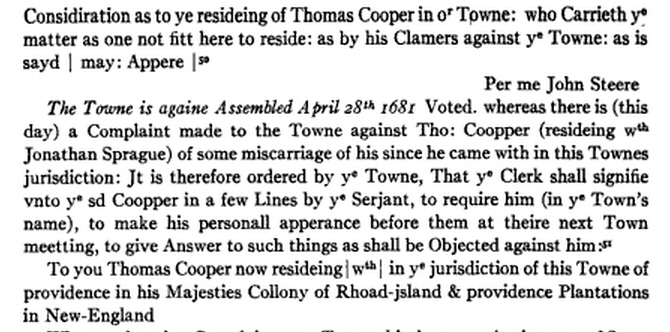
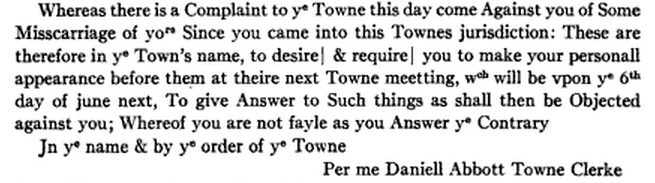
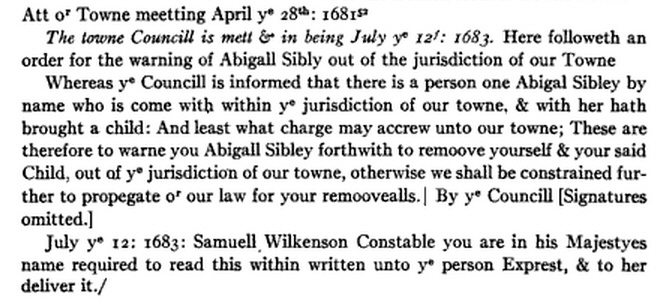
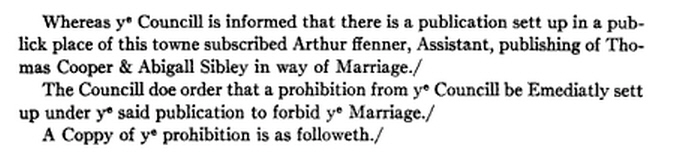
12 Jul 1683 –  Abigail Sibley, with her child, was ordered out of Providence, Rhode Island. Thomas Cooper published his intention of marriage with Abigail, which was forbidden, because he had ” manifested himself a person infamous in that he hath forsaken a sober woman, who is his wife.” Mistress Abigail, with her child, appears again, Dec. 13, ” entertained by Thomas Cooper.” Her time of removal was extended to the first Monday in March, ” not to live with Thomas Cooper” meanwhile.

Thomas Cooper 1 – Three Centuries of Poor Law Administration: A Study of Legislation …, Issue 24 By Margaret Creech 1636

Cornelius’ third wife, Mary Dustin was born 8 Nov 1650 in Reading, Mass. Her parents were Josiah Dustin and Lydia [__?__].  She first married 7 Sep 1676 to Adam Colson (d. 1 Mar 1687) had Josiah, b. 6 Mar. 1673, d. in few mos.; Elizabeth 9 Oct. 1676; Lydia, 31 Mar. 1680; and David, 26 Apr. 1682; and d. 1 Mar. 1687. Mary was accused of being a witch in the Salem Witch Trials.  Both Mary and  her mother Lydia were found not, guilty, but Lydia died in the Salem jail in 1693 because she could not pay the jail fees.

Mary’s mother, Lydia Dustin, a resident of Reading (Redding), Massachusetts, was arrested on April 30, 1692 on the same day as George Burroughs, Susannah Martin (wiki), (Susannah MARTIN – minerdescent)  Dorcas Hoar, Sarah Morey, and Philip English. Lydia Dustin was again examined on May 2 by magistrates Jonathan Corwin and John Hathorne, on the same day as Sarah Morey, Susannah Martin, and Dorcas Hoar . She was then sent to Boston’s jail.

Mary’s unmarried sister Sarah Dustin was the next in the family accused and arrested, followed by Mary’s daughter, Elizabeth Colson [16 years old in 1692], who eluded capture until after the third warrant was issued (sources differ on whether she was ever captured). Then Mary Colson was also accused; she was examined but not indicted.

Mary Beth Norton states in “In the Devil’s Snare” that “In Malden, Mistress Mary Swayne Marshall, sister of a militia major, declared that on April 8 the specter of Elizabeth Colson of Reading, the teenage granddaughter of a woman long believed to be a witch [Lydia Duston], had knocked her down, ‘Strikeing of me deafe and Dumm Tortering my body in most parts; Chokenig [sic]of me quite dead for Some time.’ Colson, she declared, had bruised her head, wrung her neck, and even dislocated her shoulder.”

Both Lydia and Sarah were found not guilty by the Superior Court of Judicature, Court of Assize and General Gaol Delivery in January or February, 1693, after the initial trials had been suspended when criticized for their use of spectral evidence. However, they could not be released until they paid jail fees. Lydia Dustin died still in jail on March 10, 1693. She is thus usually included on lists of those who died as part of the Salem witchcraft accusations and trials. Lydia’s husband, Josiah (1623 – 1671), had been one of the founders — and leading land owners — of Reading, Massachusetts.

Children of Cornelius and Sarah:

Name Born Married Departed
1. Nicholas Browne 7 Apr 1666 Reading, Middlesex, Mass 25 May 1666
Reading, Middlesex, Mass
2. Cornelius BROWN Jr. 3 Jun 1667 Reading, Middlesex, Mass Susanna STORY
1688 in Lynn, Essex, Mass.
4 Jul 1743 in Ipswich, Essex, Mass.
3. Sarah Browne 23 Dec 1668  Reading, Middlesex, Mass 12 Jan 1669
Reading, Middlesex, Mass
4. Sarah Browne 21 Apr 1670 Reading, Mass. Thomas Wellman
6 Jan 1697 Reading, Middlesex, Mass.
5. John Browne 8 Aug 1671 Reading, Middlesex, Mass 1674
Reading, Middlesex, Mass
6. Abigail Browne 5 Apr 1674 Reading, Middlesex, Mass 6 Aug 1674
Reading, Middlesex, Mass
7. Samuel Browne 13 Sep 1675 Reading, Middlesex, Mass Mary Andrews
17 April 1703 Ipswich, Mass.
1720
8. Susannah Browne 5 Mar 1677
Reading, Middlesex, Mass
9. Mary Browne 1 Jan 1678 Reading, Middlesex, Mass Jeremiah Gould
3 June 1701 Reading, Mass
5 Oct 1770
Reading, Middlesex, Mass
10. Hannah Browne 28 Aug 1680 Reading, Middlesex, Mass Abraham Wood
30 Dec 1708 in Reading, Middlesex, Mass
7 Nov 1746
Sudbury, Middlesex, Mass
11. Lt. William Browne 14 Feb 1682 Reading, Middlesex, Mass Deborah Robbins
11 Nov 1703 Cambridge, Middlesex, Mass
.
Mary Bailey
13 October 1744
Cambridge, MA
2 May 1768
Natick, Middlesex, Mass

Cornelius built a house in Reading before 1667, but did not transfer from the church in Lynn to the one in Reading until 1670. Cornelius served in various minor governmental rolls in Reading.

In addition to his original house lot, Cornelius inherited half of his father’s “Wigwam” farm in 1673, and received various grants of land from the town of Reading. His wife Sarah died at Reading on October 4, 1683. Cornelius then married Sarah Southerick on November 20, 1684. His second wife died before 1698, and on September 26, 1698, Cornelius married Mary Dustin Colson, the widow of Adam.

In 1689, Cornelius deeded land to his sons Cornelius and Samuel in return for a small payment each year, a sort of colonial pension plan. Cornelius died, intestate, about 1701, his third wife was still alive in 1703. His place of his burial is not known.

5 Sep 1692 – Examination of Mary Colson

Mary Coulston examined before said Justices for the Maj’ties Sept. 5. 1692 Jno. Hathorn Esq’re Mary Coultson: you are here acused for afflicting Mrs Mary Marshall by witchcraft Mrs Marshall with others fell Down at her Coming into the Court. s’d Coultson helped Mrs Marshall up by a touch of her hand: but s’d Coultson s’d she never hurt s’d Marshall in her life: Mrs Marshall was asked how long Coultson had afflicted her: she s’d: at times: she had afflicted her ever since her Mother Dastin [Mary’s mother Lydia Dustin] had been in Prison and that she did it in vindication of her mother:

These 3: Tayler: Lilly & Coultson came to me & s’d [through] Mr. Pearpoint song that Psalm: god will be a husband to the widdow: but he would be none to me they sayd: they told me also if I had served their god my husband had bin alive yet: but s’d Coulston was bid to look on the afflicted persons: and s’d some of the afflicted was bid to look on her: and Eliz Booth: & George Booths wife & Allice Booth with others: was struck Down with her look & afflicted & helpted up & was well by a touch of Coultsons hand: they were asked when they were well agayn who hurt: them & s’d it was Coultson it was told Coultson it was evident that she acted witchcraft now before them: & it was like to apear that she had a hand in W’m Hoopers Death & in Ed Marshals Death: And she s’d if she should Confes she should be by her selfe: examined before Jno. Hawthorn Esq’re: & others their Majests: Justice.
this is the substance of what Mary Coultson s’d at her examination,
Attest
*Simon Willard
(Reverse)
I und’r written: being appointed by Authority: to take the within examination: Doe testifie upon oath taken in Court that this is a true Coppy of the Substance of it to: the best of my knowledge Janu’ry 5: 1692/3
*Simon Willard

Children

2. Cornelius BROWN Jr..(See his page)

4. Sarah Brown

Sarah’s husband Thomas Wellman was born on 11 Oct 1669 in Lynn, Mass. His parents were son of Abraham Wellman and Elizabeth Cogswell. Thomas died about1735 in Reading, Mass

7. Samuel Browne

Samuel’s wife Mary Brown was born 1679 in Reading, Mass.

9. Mary Browne

Mary’s husband Jeremiah Gould was born about 1678 in Charlestown, Mass. His parents were John Gould, and Abigail Belcher. His grandparents were John GOULD and Joanna [__?__]. Jeremiah died 25 July 1752 in Stoneham, Mass.

10. Hannah Browne

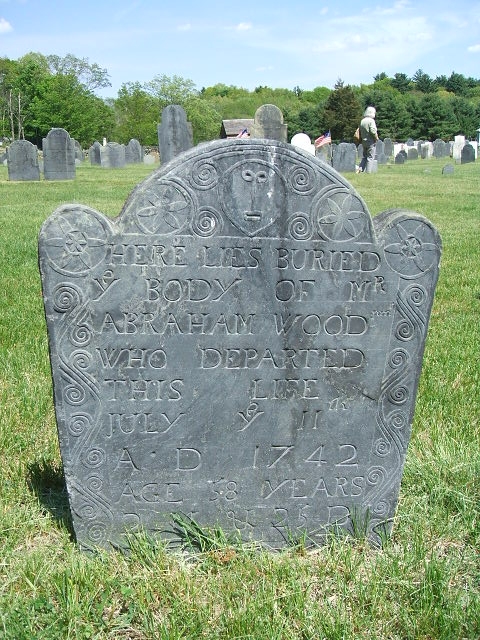
Hannah’s husband Abraham Wood was born 16 Apr 1684 in Concord, Middlesex, Mass. His parents were Abraham Wood (1655 – 1747) and   Sarah Dakin (1659 – 1748). Abraham died 11 Jul 1742 in Sudbury, Middlesex, Mass

Abraham and Hannah lived in Sudbury until after the birth of Samuel, the first of their seven children, then they moved to Concord. In 1729, they returned to Sudbury, where they both lived the rest of their lives.

Abraham and his father leased the “new” mills from the Town of Sudbury in 1700. The mill had been donated to the town by Peter Noyes, to be used to help support the poor. They ran the mill under lease until 1728, when they bought it from the town for 700 pounds. Abraham must have been a miller by trade. That Abraham was also a contractor of some repute, there is no doubt. He built a new meeting house in the west precinct for the Town of Sudbury, with Joseph Dakin as a partner, in 1725. They were paid 400 pounds to erect the building.

Abraham Wood Gravestone Revolutionary War Cemetery  Sudbury Middlesex, Mass Find A Grave Memorial# 35771899

Abraham Wood Gravestone Revolutionary War Cemetery
Sudbury, Middlesex, Mass
Find A Grave Memorial# 35771899

11. Lt. William Browne

William’s first wife Deborah Robbins was born 6 Jun 1674 in Cambridge, Middlesex, Mass. Her parents were Nathaniel Robbins and Mary Braside. She first married 1701 in Middlesex, Mass. to Thomas Squire (b. 25 Jul 1672 in Cambridge, Middlesex, Mass. – d. 11 Nov 1703 in Cambridge). Deborah died 13 Oct 1744.

William’s second wife Mary Bailey.

Sources:

http://trees.ancestry.com/owt/person.aspx?pid=40631484&st=1

http://trees.wmgs.org/familygroup.php?familyID=F11000&tree=Schirado

http://aleph0.clarku.edu/~djoyce/gen/report/rr05/rr05_140.html

Lydia Dustin Salem Witchcraft Transcripts

http://freepages.genealogy.rootsweb.ancestry.com/~pattyrose/engel/gen/fg07/fg07_405.htm

Posted in 11th Generation, Immigrant - England, Line - Miller, Witch Trials | Tagged , , , | 6 Comments

Cornelius Brown Jr.

Cornelius BROWN Jr. (1667 – 1743) was Alex’s 8th Great Grandfather; one of 512  in this generation of the Miller line.

Cornelius Brown Jr. was born 3 Jun 1667 in Reading, Middlesex, Mass. His parents were Cornelius BROWN Sr. and Sarah LAMSON. He married Susanna STORY 1688 in Lynn, Essex, Mass. Cornelius died 4 Jul 1743 in Ipswich, Essex, Mass.

Susanna Story was born 4 Mar 1664 in Ipswich, Essex, Mass. Her parents were William STORY and Sarah FOSTER. She first married 13 Jul 1681 in Lynn, Essex, Mass to John Clark. Susanna died 9 Jan 1734 in Boxford, Essex, Mass

John Clark was born 2 Nov 1658 in Lynn, Essex, Mass. His parents were William Clark and [__?__], John died 18 Dec 1685 in Lynn, Essex, Mass.

Children of Cornelius and Susanna:

Name Born Married Departed
1. Susanna Brown 6 Mar 1690 in Lynn, Essex, Mass Samuel Cole
3 May 1712 in Lynn, Essex, Mass
29 Jul 1785
Boxford, Essex, Mass.
2. Jemima Brown 17 Dec 1691 in Reading, Middlesex, Mass Daniel Boynton
1 Mar 1721 in Groton, Middlesex, Mass
Mar 1729
Groton, Middlesex, Mass
3. Jeremiah Brown 17 Dec 1691 in Reading, Middlesex, Mass
4. Moses Brown 19 Apr 1694 in Reading, Middlesex, Mass Martha Emmons
15 Apr 1719
5. Aaron Brown 19 Apr 1694 in Reading, Middlesex, Mass Susanna Hovey
30 Dec 1718 Bradford, Essex, Mass
15 Feb 1723
Boxford, Essex, Mass
6. Caleb BROWN 23 Oct 1698 in Lynn, Essex, Mass Elizabeth JEWETT
18 Oct 1722 Rowley, Mass.
23 Nov 1758 in Harvard, Mass.
7. Judah Brown 10 Nov 1700 in Reading, Middlesex, Mass

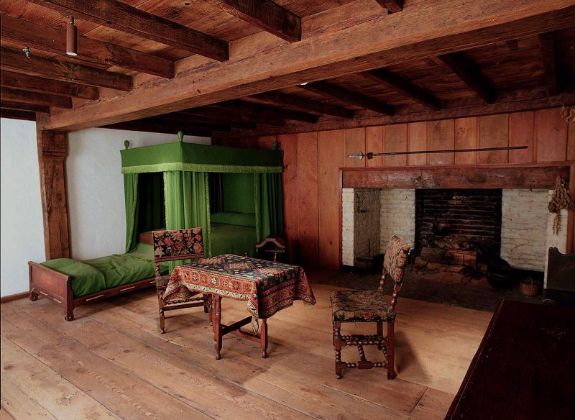
In 1925 the Brown-Pearl House was acquired by the Boston Museum of Fine Arts and dismantled.  The living area was reconstructed as an exhibit hall – an example of colonial architecture and early domestic life.  It was taken down and stored 10 or 11 years ago when the museum began construction of the new Art of the Americas Wing.

Another relative’s house was also reconstructed in a museum.  The New York Dutch Room  in the New York Metropolitan Museum comes from a house built in 1751 in Bethlehem, New York, for Peter WINNE’s son Daniel Pieter Winne (1720–1800)..

On Nov. 20th, 2010, the new wing was opened to the public and the Brown–Pearl Hall is again on display as a gallery in the lowest level of the new wing.

Brown Pearl Hall in Boston Museum of Fine Art

The woodwork in this room came from a house built by Cornelius Brown, a farmer, and his wife Susannah in Boxford, a small town in Essex County, north of Boston before the American Revolution. In 1738, the house passed to Richard Pearl and descended in his family until it was dismantled. The heavy oak framework, pine sheathing (or wall boards), and large fireplace are characteristic of houses of its day.

This would have been the central living space of the house, called the “hall.” Here, the family would conduct important matters of cooking, eating, and sleeping. It is clear from the imported pottery on the table that this house belonged to a well-to-do family. Imported items signal the shift in Puritan culture towards material prosperity. As New England seaport towns grew and prospered before the Revolution, successful citizens called upon the arts to express and enhance their new mode of life.

A little bit of history as excerpted from Norton Lee Bretz’ “Family Tree of John Pearl” (with additional comments in italics):

“John Pearl’s youngest son Richard  purchased the house, barn, and land from Cornelius Brown in 1737.   Mention was made in the deed of 175 acres of this land previously purchased by Richard.  Mr. Brown was allowed to live in the house until May 20 of that year.  It was on a narrow winding road near West Boxford.  Near the time of its purchase, Richard built a grist mill in the rear of the house, the first in the parish.  Major additions were put on the house in 1725 and in 1843 when an abandoned parish church was patched onto the building.

In 1925, the house was bought by the MFA.  It had been abandoned as a dwelling for some years and was rapidly deteriorating.  The structure was made of massive hewn, red oak beams, 12 by 14 inches, hand-fit at the supports.  The fireplace was over seven feet wide with a lintel made of oak.  The architecture was typical of the seventeenth century and one of the best remaining examples of colonial craftsmanship.  The living room, which the family knew as the foreroom, is what is now on display at the museum.  The original room was 19×19 feet and has an 8 foot ceiling.”

We also have this information from the “History of the Pearl Family” by Marian Arlene Pearl:

“John and his wife Elizabeth Pearl undoubtedly spent the remainder of their life on the Pearl Homestead at Boxford as the youngest son, Richard, was said to have been brought there in a bread trough when an infant.  This house stood on a 200 (acre) tract of land laid out originally to John Sandys in 1667.  The acreage passed into the hands of Joseph Dowding a Boston merchant who sold it Sept. 10, 1703 to Cornelius Brown of Reading for seventy pounds.

Mr. Brown built the house of solid hewn oak timber and it stood true and plumb throughout the years.  Alice Heath Fairbank Dow in her Pearl history of Richard’s line states that ‘one of the timbers measures 18 inches and between the inside and outside finish are bricks, larger than modern bricks, solidly laid in mortar and there are two or three wooden latches with the latch string in the house and the one on the south door is very large’  There were no highways when this home was erected and it faced south fronting a field.,  The road when eventually constructed was laid out at the rear of the house.  The Browns lived there many years, the wife Susannah died in 1734 at age 74.  The Pearl family occupied one side of it, and during this period it was known as the Brown-Pearl house.”

The house was built around 1704 and in this room the home’s occupants cooked, ate and slept, illustrating New England domestic life in the first years of the 1700’s.  Furnishings in the room as now displayed in the Museum are from other early homes and illustrate the multipurpose nature of a 17th and early 18th century hall.

Children

1. Susanna Brown

Susanna’s husband Samuel Cole was born 27 Dec 1687 in Lynn, Essex, Mass. His parents were John Cole and Sarah Alsbee. Samuel died 20 Jan 1765 in Boxford, Essex, Mass

2. Jemima Brown

Jemima’s husband Daniel Boynton was born 26 May 1692 in Rowley, Essex, Mass. His parents were Samuel Boynton and Hannah Switcher. His grandparents were John BOYNTON and Elinor PELL. Daniel died in 1756 in Groton, Middlesex, Mass.

4. Moses Brown

Moses’ wife Martha Emmons was born in Lynn, Essex, Massa

5. Aaron Brown

Aaron’s wife Susanna Hovey was born 25 JUL 1699 Topsfield, Essex, Mass.  Her parents were Luke Hovey and Susana Pillsbury.  After Aaron died, she married 25 NOV 1731 Boxford, Essex, Mass. To William Lakeman (b. 1710 Ipswich, Essex, Mass. – d. 14 MAR 1780 Boxford, Essex, Mass.) Susanna died 10 JUN 1782 Boxford, Essex, Mass.

6. Caleb BROWN (See his page)

Sources:

http://trees.ancestry.com/owt/person.aspx?pid=40631485&st=1

http://educators.mfa.org/galleries/slideshow/3984

http://thepearlsofhampton.org/tag/brown-pearl-hall/

http://www.wickedlocal.com/boxford/news/x1868079297/Brown-Pearl-House-is-back-on-display-at-MFA-in-Boston#axzz1rONgJ5qU

Posted in 10th Generation, Artistic Representation, Line - Miller | Tagged , | 5 Comments

Hannah Dustin – Heroine or Cold Blooded Killer

On 15 Mar 1697, George CORLISS (1617 – 1686)’s daughter Mary Neff was  nursing Hannah Dustin who had given birth the week before.  They taken prisoner by the Indians in an attack on Haverhill and carried towards Canada.

Hannah Duston (1657 – 1736) was a colonial Massachusetts Puritan woman who escaped Native American captivity by leading her fellow captives in scalping their captors at night. Duston is the first woman honored in the United States with a statue.
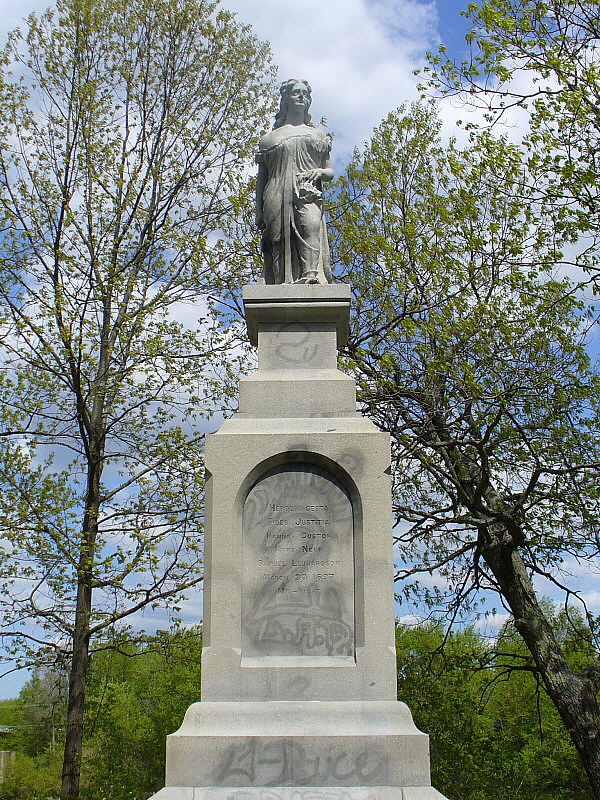
Hannah Dustin Statue Penacook New Hampshire

Today, Hannah Dustin’s actions are controversial, with some  calling her a hero, but others calling her a villain, and some Abenaki leaders saying her legend is racist and glorifies violence. As early as the 19th Century, Hannah’s legal argument had lost its Old Testament authority and came to be interpreted, or misinterpreted, as a justification for vengeance.

Chief Nancy Lyons of the Coasek tribe of the Abenaki Nation, said using Dustin as a promotional tool not only insults American Indians but glorifies violence.

“It’s not so much because Hannah Duston killed Indians. The biggest issue that I find absolutely appalling is that the promotion that they’re doing is extremely racist – it’s emphasizing violence and they’re promoting that to young people,” Lyons said. “More than being an Indian, being a mother I find it absolutely appalling that a community would promote violence and a violent act in a racist manner to young people today.”

Charles True, speaker of the Abenaki Nation of New Hampshire, said Duston has become a folk legend over the years and her legend bears little resemblance to the actual events of 1697.

“Folk legends rarely represent the actual truth about things,” True said. “In New England history books, our people have not had a fair shake. We were victimized very cruelly by New England people. … It makes you wonder why history books for schoolchildren over the years have made us out to be blood-thirsty savages. Haverhill can do what it pleases with its folk hero. We’re not interested.”

Margaret Bruchak, an Abenaki historian, said in order to properly understand the Duston story, it’s important to understand the Abenaki culture’s view of combat and captivity.

“The whole point of taking a captive was to then transport that person safely. For the whole of that journey they were treated like family,” Bruchak said. “When captives were taken, they were almost immediately handed off from the warriors to individuals who would then look after them. Hannah, we know for a fact, was handed over to an extended family group of two adult men, three women, seven children and one white child.”

That’s why the Abenaki viewed Duston’s actions after she escaped with such horror, she said.

“It’s almost like the Geneva Conventions, when you think about it. Hannah betrayed the Abenaki Geneva Conventions. It wasn’t while she was in the midst of warfare that she did these supposedly brave acts. It was while she was in the care of a family,” Bruchak said. “If she had merely escaped, there probably would be very little story to tell, but the fact that she escaped, then stopped and went back to collect scalps – the bloody-mindedness of it is really quite remarkable. …

“She became a hero because of it. The Colonial Puritan society which saw the killing of white children as an unpardonable sin that required the death penalty saw the killing of Indian children as a glorious act that turns someone into a hero,” she said.
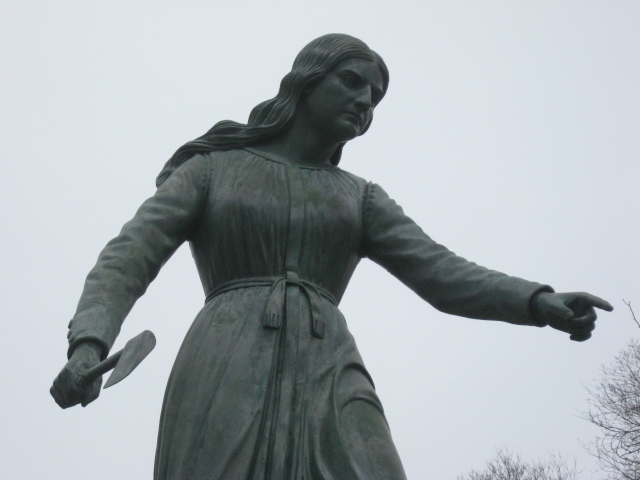
Hannah with Axe

Hannah’s  name has been used to sell every conceivable product including a rock concert, liquor and horse racing and still remains extremely attractive to people seeking to prove a genealogical connection.  In 2008, after the New Hampshire Historical Society began selling a Hannah Duston bobblehead, one employee has quit and another has refused to sell it. They said they find the Duston doll, as well as another bobblehead of Chief Passaconaway, offensive to Native Americans.  The bobblehead is also for sale at the John Greenleaf Whittier Birthplace in Haverhill and the Friends Shop at Haverhill Public Library.
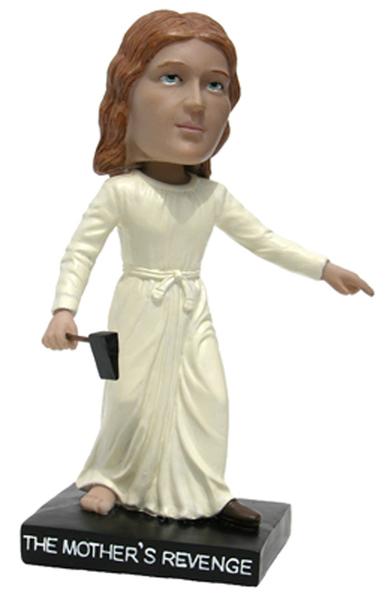
Hannah Dustin Bobblehead

Early nineteenth-century New England, apparently under the impetus of the romantic interest of the past, rediscovered its own colonial history and exploited it in novels and tales. Stories of captivity of the colonists had a wide appeal, not only because they were straight-forward and exciting, but because the ancestors of many New England men and women had been among the captives.

Some even want to make a movie.   “It’s the ultimate feminist story,” said Rebecca Day, a Massachusetts native and freelance writer who has done script development for Hallmark Entertainment and Lifetime Television. “It has all the qualities of a hot Lifetime movie. I would pitch it as ‘Ransom’ meets ‘The Crucible.'”

“What interests me is exploring what made her tick,” Day said. “I think the story perfectly illustrates what happens when one’s world turns into chaos. A person really has to go into survival mode, regardless of what role society thinks he or she is supposed to play. Although women at this time were considered second-class citizens, I think it’s funny how many men so easily became her followers and admirers.”

The story of Hannah Dustin is memorable among such accounts because it is both briefer and more violent than most of the narratives. From the beginning it appealed not only to the historical imagination of its readers but to the moral imagination as well. It illustrated the hardihood of New England pioneers but it raised questions about the moral cost of their triumph. As succeeding generations retold Hannah Dustin’s story, it came to illustrate not only frontier conditions during King William’s War, but the shifting judgements and sensibilities about morality and the role of women of later centuries.
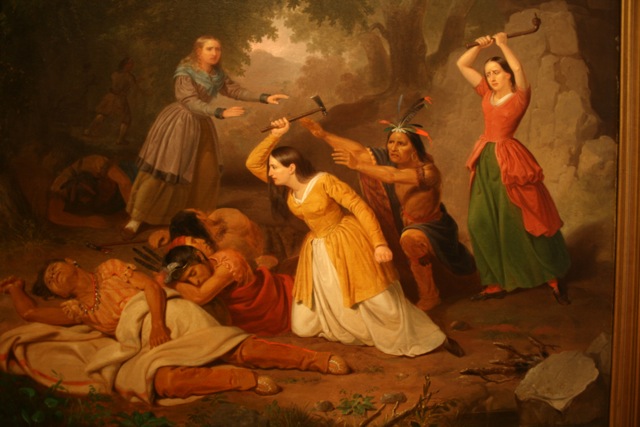
Hannah Dustin and Mary Neff take justice into their own hands —  Painted in 1847, by Junius Brutus Stearns

Twenty-seven persons were slaughtered, (fifteen of them children) and thirteen captured. The following is a list of the killed:-John Keezar, his father, and son, George; John Kimball and his mother, Hannah ; Sarah Eastman [Daughter of Deborah Corliss and grand daughter of George CORLISS]; Thomas Eaton ; Thomas Emerson, his wife, Elizabeth, and two children, Timothy and Sarah ; Daniel BRADLEY’s son Daniel Bradley, his wife, Hannah (she was also Stephen DOW’s daughter), and two children, Mary and Hannah ; Martha Dow, daughter of Stephen DOW; Joseph, Martha, and Sarah Bradley, children of Joseph Bradley, another son of Daniel BRADLEY ; Thomas and Mehitable Kingsbury [Children of Deborah Corliss and grand daughter of George CORLISS]. ; Thomas Wood and his daughter, Susannah ; John Woodman and his daughter, Susannah; Zechariah White ; and Martha, the infant daughter of Mr. Duston.” Hannah Dustin’s nurse Mary Neff, daughter of our ancestor GEORGE CORLISS, was carried away and helped in the escape by hatcheting her captors.   Another captive who later wrote about the adventure and was kidnapped a second time ten years later was Hannah Heath Bradley, wife of Daniel BRADLEY’s son Joseph, daughter of John Heath and Sarah Partridge, and grand daughter of our ancestor Bartholomew HEATH.
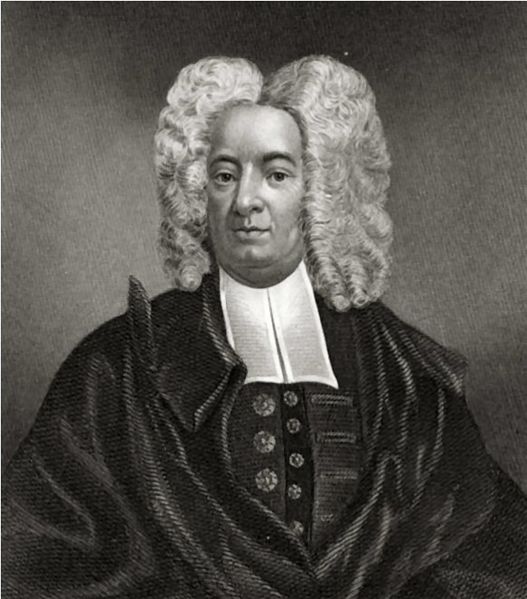
Cotton Mather Portrait c. 1700

The account begins with Cotton Mather, not only because he heard the story from Hannah herself and was the first to record it, but because his account in the Magnalia Christi Americana (1702) contains the germs of all the moral and social questions to which later writers would respond: Is the killing of one’s Indian captors justified? Is killing squaws and children ever justifiable? Is killing Christian (although Catholic) Indians justifiable? Is scalping Indian victims and collecting a bounty on the scalps justifiable? Should a wife and mother be judged by standards not applied to men? And finally, was Hannah admirable as well as courageous?

Mather’s account in the Magnalia served as a primary source for all except two of the subsequent retellings.
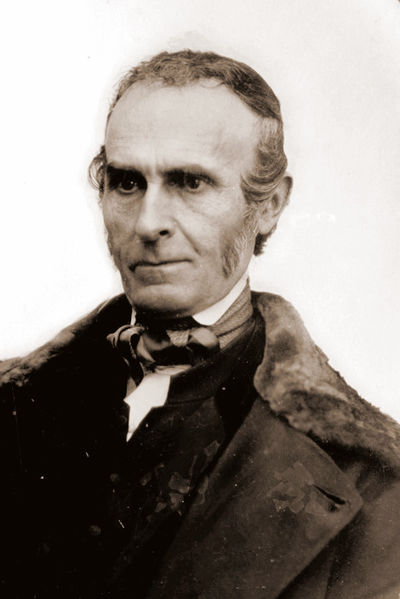
John Greenleaf Whittier (1807-1892)

John Greenleaf Whittier popularized the incident in “A Mother’s Revenge” . His story differed significantly from the Mather account, apparently reflecting both local tradition and conscious literary manipulation of his material. His theme was the resolution created in a woman’s character by the exigencies of the frontier. In Whit tier’s version of the story, Hannah heroically sends her husband to protect the children. He thus adds luster to Hannah’s character and redeems Thomas Dustin from possible charges that he deserted his wife and infant daughter.

Hannah Dustin

Statue of Hannah Dustin in Haverhill, Mass

George Chase, in the History of Haverhill (1861), brought together the Mather, Sewall, and Mirick accounts, supplementing them by use of the town records. He corrected Mirick at some points and provided a definitive recital of the Indian raid and its aftermath. He reprints Mather’s Magnalia account in its entirety because he says it is the most reliable, Mather having “heard the story direct from the lips of Mrs. Dustin.”  Then, having discussed the location of the Dustin house, Chase deliberately and needlessly turns to compare Hannah’s deeds unfavorably with those of her husband. He reasons that Hannah attacked “twelve sleeping savages, seven of whom were children, and but two of whom were men. It was not with her a question of life or death, but of liberty and revenge.”

In this instance Chase, with the Mather account directly before him, discarded both of Mather’s justifications for the killings. Chase judges Hannah on the basis of a revenge motive that he, Whittier, and Bancroft ascribe to her. The only support for such an interpretation is Hannah’s explanation that being where she had not her own life secured to her by law she felt it lawful to kill the Indians, “by whom her child had been butchered.” The context in which these words appear suggests that Hannah is not seeking vengeance but invoking the Old Testament law of “an eye for an eye” which, for people who consciously formed their legal system upon Biblical law, represented not revenge but justice.

As time passed Hannah’s legal argument lost its Old Testament authority and came to be interpreted, or misinterpreted, as a justification for vengeance. As Hannah’s historians became further removed from frontier life, they increasingly admired women rather for their frailty than for their hardihood. The new crop of authors, fascinated by Hannah’s story, yet deploring her conduct, insisted upon the harsher details of her exploit, while religious ardor and ethical judgement faded before social convention.

Detailed Account
Here’s a more detailed account of Hannah and Mary from The Duston / Dustin Family, Thomas and Elizabeth (Wheeler) Duston and their descendants. and The Story of Hannah Duston Published by the Duston-Dustin Family Association, H. D. Kilgore Historian Haverhill Tercentenary – June, 1940.  I’ve kept most of the 19th Century language, only removing a few breathless adverbs, opinionated adjectives and changing some pejorative nouns.

On March 14, 1697, Thomas and Hannah Duston lived in a house on the west side of the Sawmill River in the town of Haverhill. This house was located near the great Duston Boulder and on the opposite side of Monument Street.

Their twenty years of married life had brought them material prosperity, and of the twelve children who had been born to them during this period, eight were living. Thomas, who was quite a remarkable man, – a bricklayer and farmer, who, according to tradition, even wrote his own almanacs, and wrote them on rainy days, – was beginning to have time to devote to town affairs, and had just completed a term as Constable for the “west end” of the town of Haverhill.

He was at this time engaged in the construction with bricks from his own brickyard of a new brick house about a half mile to the northwest of his home to provide for the needs of his still growing family, for Baby Martha had just made her appearance on March 9.

Under the care of Mrs. Mary Neff,  (daughter of George CORLISS and widow of William Neff) both mother and child were doing well, the rest of the family were in good health, his material affairs were prospering, and it was undoubtedly with a rather contented feeling that Thomas, to say nothing of his family, retired to rest on the eve of that fateful March 15, 1697, little knowing what horrors the morrow was to bring.

Of course, there was always the fear of Indians. However, since the capture in August of the preceding year, of Jonathan Haynes and his four children while picking peas in a field at Bradley’s Mills, near Haverhill, nothing had happened, and apprehensions of any further attacks were gradually being lulled. Besides, less than a mile on Pecker’s Hill, was the garrison of Onesiphorus Marsh, one of six established by the town containing a small body of soldiers. It was believed that there was little ground for uneasiness.

But this was only a false security. Count Frontenac, the Colonial Governor of Canada, was using every means at his disposal to incite the Indians against the English as part of his campaign to win the New World for the French King. The latter, due to the need for troops in Europe, where the war known as King William’s War was going on, was unable to send many to help Frontenac. So, with propaganda and gifts, the French Governor had allied the tribes to the French cause and bounties had been set on English scalps and prisoners. Every roving band of Indians was determined to get its share of these, and even now, such a band was in the woods near Haverhill, preparing for a lightning raid on the town with the first light of dawn. The squaws and children were left in the forest to guard their possessions, while the Indian warriors moved stealthily towards the house of Thomas and Hannah Duston, the first attacked. [The Treaty of Ryswick in 1697 ended the war between the two colonial powers, reverting the colonial borders to the status quo ante bellum. The peace did not last long, and within five years, the colonies were embroiled in the next phase of the French and Indian Wars, Queen Anne’s War.]
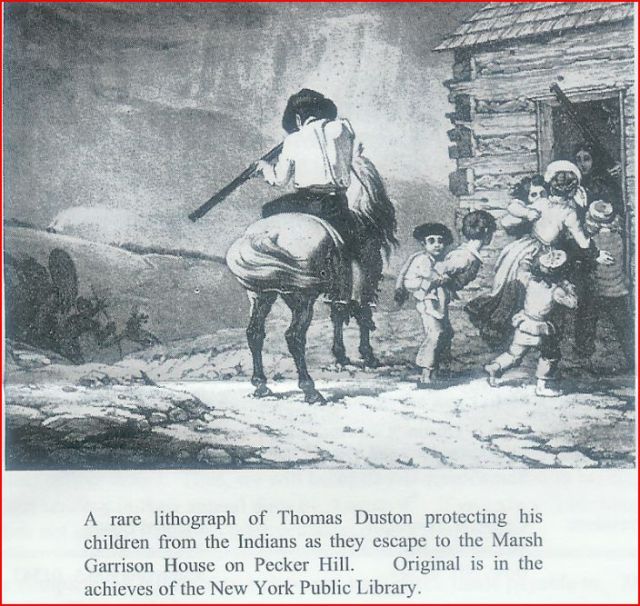
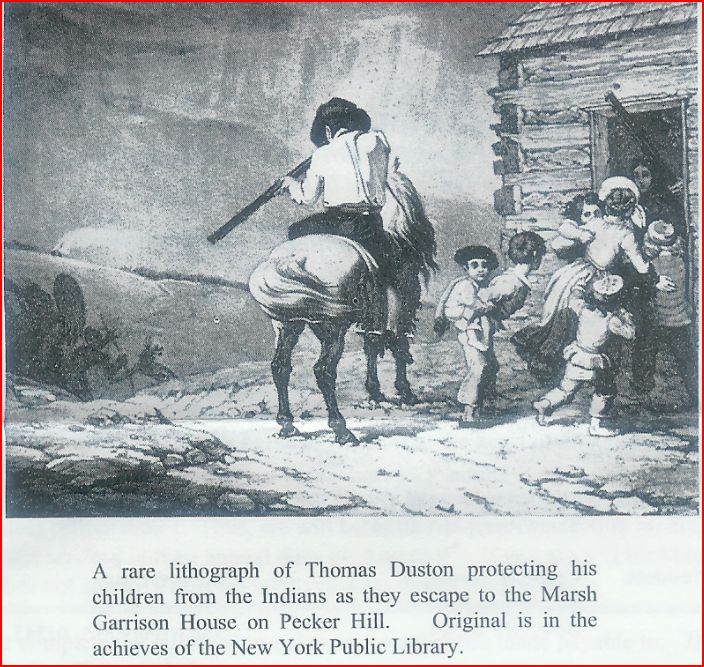
Early the next morning, Thomas, at work near the house, suddenly spied the approaching Indians. Instantly seizing his gun he mounted his horse and raced for the house, shouting a warning which started the children towards the garrison, while he dashed into the house hoping to save his wife and the baby. Quickly seeing that he was too late, and doubtless urged by Hannah, he rode after the children, resolving to escape with at least one. On overtaking them, finding it impossible to choose between them, he resolved, if possible, to save them all. A few of the Indians pursued the little band of fugitives, firing at them from behind trees and boulders, but Thomas, dismounting and guarding the rear, held back the savages from behind his horse by threatening to shoot whenever one of them exposed himself. Had he discharged his gun they would have closed in at once, for reloading took considerable time. He was successful in his attempt, and all reached the garrison safely, the older children hurrying the younger along, probably carrying them at times. This was probably the garrison of Onesiphorus March on Pecker’s Hill.
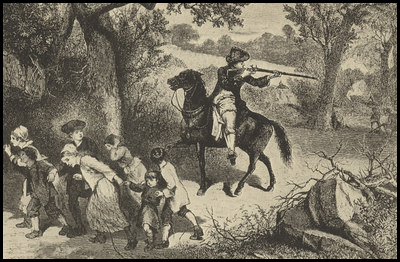
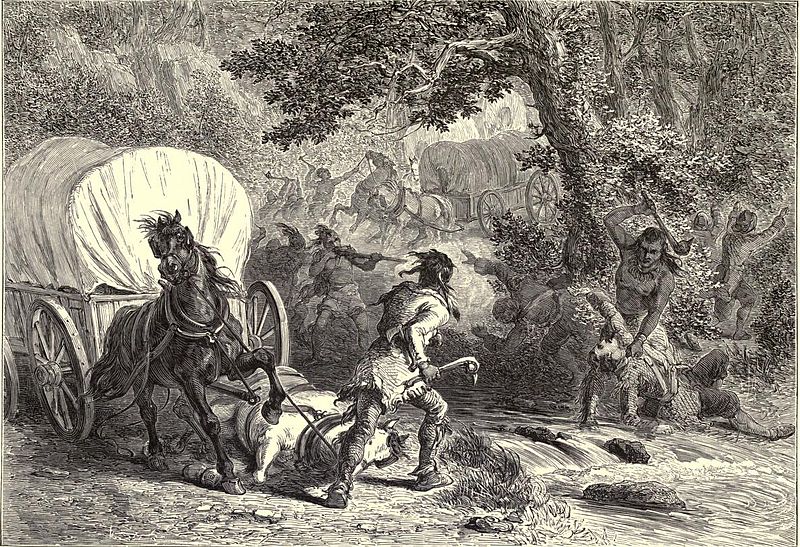
Escape of Thomas Dustin & children. Source: Some Indian Stories of Early New England, 1922

Meanwhile a fearful scene was being enacted in the home. Mrs. Neff, trying to escape with the baby, was easily captured. Invading the house, the Indians forced Hannah to rise and dress herself. Sitting despairingly in the chimney, she watched them rifle the house of all they could carry away, and was then dragged outside while they fired the house, in her haste forgetting one shoe. A few of the Indians then dragged Hannah and Mrs. Neff, who carried the baby, towards the woods, while the rest of the band, rejoined by those who had been pursing Thomas and the children, attacked other houses in the village, killing twenty-seven and capturing thirteen of the inhabitants.

Hannah Dustin Memorial Bas Relief 1.

Finding that carrying the baby was making it hard for Mrs. Neff to keep up, one of the Indians seized it from her, and before its mother’s horrified eyes dashed out its brains against an apple tree. The Indians, forcing the two women to their utmost pace, at last reached the woods and jointed the squaws and children who had been left behind the night before. Here they were soon after joined by the rest of the group with their plunder and other captives.

Fearing a prompt pursuit, the Indians immediately set out for Canada with their booty. Some of the weaker captives were  knocked on the head and scalped, but in spite of her condition, poorly clad and partly shod, Hannah, doubtless assisted by Mrs. Neff, managed to keep up, and by her own account marched that day “about a dozen miles”, a remarkable feat. During the next few days they traveled about a hundred miles through the unbroken wilderness, over rough trails, in places still covered with the winter’s snow, sometimes deep with mud, and across icy brooks, while rocks tore their half shod feet and their poorly clad bodies suffered from the cold – a terrible journey.

Near the junction of the Contoocook and Merrimack rivers, twelve of the Indians, two men, three women, and seven children, taking with them Hannah, Mrs. Neff and a boy of fourteen years, Samuel Lennardson (who had been taken prisoner near Worcester about eighteen months before), left the main party and proceeded toward what is now Dustin Island, situated where the two rivers unite, near the present town of Penacook, N.H. This island was the home of the Indian who claimed the women as his captives, and here it was planned to rest for a while before continuing on the long journey to Canada.

This Indian family had been converted by the French priests at some time in the past, and was accustomed to have prayers three times a day, – in the morning, at noon and at evening, – and ordinarily would not let their children eat or sleep without first saying their prayers. Hannah’s master, who had lived in the family of Rev. Mr. Rowlandson of Lancaster some years before told her that “when he prayed the English way he thought that it was good, but now he found the French way better.” They tried, however, to prevent the two women from praying, but without success, for as they were engaged on the tasks set by their master, they often found opportunities. Their Indian master would sometimes say to them when he saw them dejected, “What need you trouble yourself? If your God will have you delivered, you shall be so!”

[Mary (White) Rowlandson (c. 1637 – Jan 1711) was a colonial American woman who was captured by Indians during King Philip’s War and endured eleven weeks of captivity before being ransomed. After her release, she wrote a book about her experience, The Sovereignty and Goodness of God: Being a Narrative of the Captivity and Restoration of Mrs. Mary Rowlandson, which is considered a seminal work in the American literary genre of captivity narratives.

During the long journey Hannah was secretly planning to escape at the first opportunity, spurred by the tales with which the Indians had entertained the captives on the march, picturing how they would be treated after arriving in Canada, stripped and made to “run the gauntlet”; jeered at and beaten and made targets for the young Indians’ tomahawks; how many of the English prisoners had fainted under these tortures; and how they were often sold as slaves to the French. These stories, added to her desire for revenging the death of her baby and the cruel treatment of their captors while on the march, made this desire stronger. When she learned where they were going, a plan took definite shape in her mind, and was secretly communicated to Mrs. Neff and Samuel Lennardson.

Samuel, who was growing tired of living with the Indians, and in whom a longing for home had been stirred by the presence of the two women, the next day casually asked his master, Bampico, how he had killed the English. “Strike ‘em dere,” said Bampico, touching his temple, and then proceeded to show the boy how to take a scalp. This information was communicated to the women, and they quickly agreed on the details of the plan. They arrived at the island some time before March 30, 1697.

After reaching the island, the Indians grew careless. The river was in flood. Samuel was considered one of the family, and the two women were considered too worn out to attempt escape, so not watch was set that night and the Indians slept soundly. Hannah decided that the time had come.
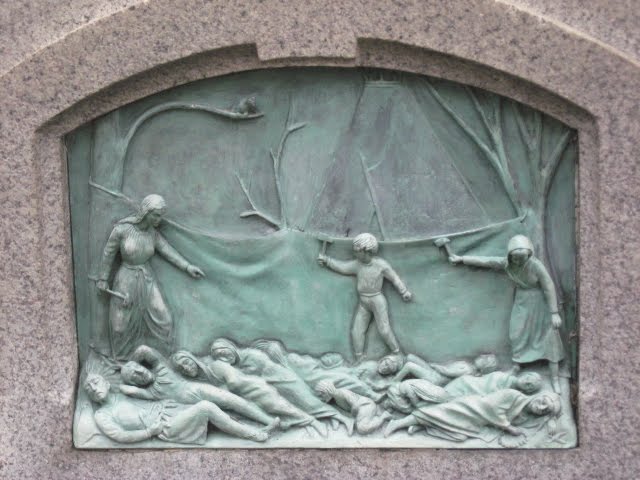
Hannah Dustin Memorial Bas Relief 2

Shortly after midnight she woke Mrs. Neff and Samuel. Each, armed with a tomahawk, crept silently to a position near the heads of the sleeping Indians – Samuel near Bampico and Hannah near her master. At a signal from Hannah the tomahawks fell, and so swiftly and surely did they perform their work of destruction that ten of the twelve Indians were killed outright, only two – a severely wounded squaw and a boy whom they had intended to take captive – escaped into the woods. According to a deposition of Hannah Bradley in 1739 (History of Haverhill, Chase, pp. 308-309),

“above penny cook the Deponent was forced to travel farther than the rest of the captives, and the next night but one there came to us one Squaw who said that Hannah Dustan and the aforesaid Mary Neff assisted in killing the Indians of her wigwam except herself and a boy, herself escaping very narrowly, shewing to myself & others seven wounds as she said with a Hatched on her head which wounds were given her when the rest were killed.”
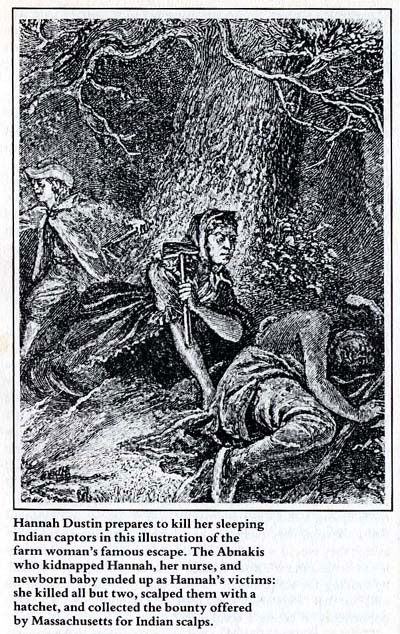
Hastily piling food and weapons into a canoe, including the gun of Hannah’s late master and the tomahawk with which she had killed him, they scuttled the rest of the canoes and set out down the Merrimack River.
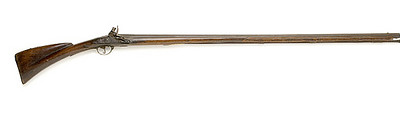
Original Gun taken by Hannah Dustin

Suddenly realizing that without proof their story would seem incredible, Hannah ordered a return to the island, where they scalped their victims, wrapping the trophies in cloth which had been cut from Hannah’s loom at the time of the capture, and again set out down the river, each taking a turn at guiding the frail craft while the others slept.  [this was Hannah’s explanation,  Is it credible to you?]
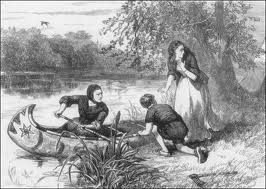
Hannah Dustin and Mary Neff make their escape

Thus, traveling by night and hiding by day, they finally reached the home of John Lovewell in old Dunstable, now a part of Nashua, N.H. Here they spent the night, and a monument was erected here in 1902, commemorating the event. The following morning the journey was resumed and the weary voyagers at last beached their canoe at Bradley’s Cove, where Creek Brook flows into the Merrimack. Continuing their journey on foot, they at last reached Haverhill in safety. Their reunion with loved ones who had given them up for lost can better be imagined than described.
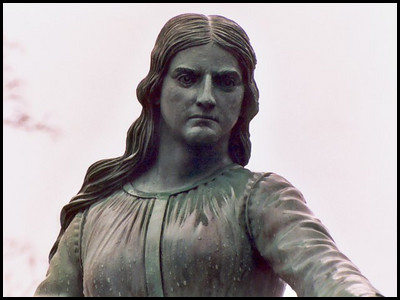
Hannah Dustin Detail

Thomas took his wife and the others to the new house which he had been building at the time of the massacre, and which was now completed.  Here for some days they rested.  The fear induced by the massacre caused Haverhill to at once establish several new garrison houses. One of these was the brick house which Thomas was building for his family at the time of the massacre. This was ordered completed, and though the clay pits were not far from the home, a guard of soldiers was placed over those who brought clay to the house. The order establishing Thomas Duston’s house as a garrison was dated April 5, 1697. He was appointed master of the garrison and assigned Josiah HEATH, Sen., Josiah Heath Jun., Joseph Bradley, John Heath, Joseph Kingsbury, and Thomas Kingsbury as a guard.
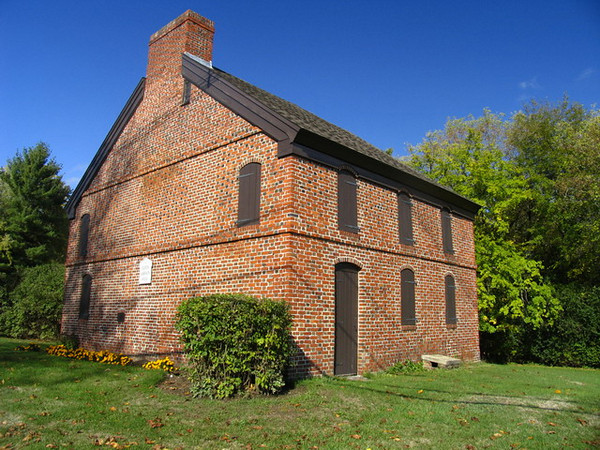
Dustin Garrison

In 1694 a bounty of fifty pounds had been placed on Indian scalps, reduced to twenty-five pounds in 1695, and revoked completely on Dec. 16, 1696.

Hannah had risked precious time to gain those scalps. The explanation sometimes given later, that her story would not be believed without evidence, is patently false. If her credibility were the only issue at stake, sooner or later there would be corroborative accounts. Actually, Hannah Bradley, another Haverhill woman, was a captive in the camp where the wounded squaw sought refuge. But to collect a scalp bounty Hannah needed to produce the scalps.

Thomas Duston believed that the act of the two women and the boy had been of great value in destroying enemies of the colony, who had been murdering women and children, and decided that the bounty should be claimed.  So he took the two women and the boy to Boston, where they arrived with the trophies on April 21, 1697.

Here he filed a petition to the Governor and Council, which was read on June 8, 1697 in the House

To the Right Honorable the Lieut Governor & the Great & General assembly of the Province of Massachusetts Bay now convened in BostonThe Humble Petition of Thomas Durstan of Haverhill Sheweth That the wife of ye petitioner (with one Mary Neff) hath in her Late captivity among the Barbarous Indians, been disposed & assisted by heaven to do an extraordinary action, in the just slaughter of so many of the Barbarians, as would by the law of the Province which——–a few months ago, have entitled the actors unto considerable recompense from the Publick.

That tho the———-of that good Law————–no claims to any such consideration from the publick, yet your petitioner humbly—————-that the merit of the action still remains the same; & it seems a matter of universal desire thro the whole Province that it should not pass unrecompensed.

And that your petitioner having lost his estate in that calamity wherein his wife was carried into her captivity render him the fitter object for what consideration the public Bounty shall judge proper for what hath been herein done, of some consequence, not only unto the persons more immediately delivered, but also unto the Generall Interest

Wherefore humbly Requesting a favorable Regard on this occasion

Your Petitioner shall pray &c
Thomas Du(r)stun

Despite the missing words its purport is clear. Hannah has performed a service to the community and deserves an appropriate expression of gratitude. It also implies a justification for killing the squaws and children, if any justification were needed when the captives’ safety depended upon several hours head start.

The same day the General Court voted payment of a bounty of twenty-five pounds “unto Thomas Dunston of Haverhill , on behalf of Hannah his wife”, and twelve pounds ten shillings each to Mary Neff and Samuel.  This was approved on June 16, 1697, and the order in Council for the payment of the several allowances was passed Dec. 4, 1697.  (Chapter 10, Province Laws, Mass. Archives.)

While in Boston Hannah told her story to Rev. Cotton Mather, whose morbid mind was stirred to its depths.  He perceived her escape in the nature of a miracle, and his description of it in his “Magnalia Christi Americana” is extraordinary, though in the facts correct and corroborated by the evidence.

In Samuel Sewall’s Diary, Volume 1, pages 452 and 453, we find the following entry on May 12, 1697:

Fourth-day, May12….Hanah Dustin came to see us:….She saith her master, who she kill’d did formerly live with Mr. Roulandson at Lancaster: He told her, that when he pray’d the English way, he thought  that was good: but now he found the French way was better.  The single man shewed the night before, to Saml Lenarson, how he used to knock Englishmen on the head and take off their Scalps: little thinking that the Captives would make some of their first experiment upon himself.  Sam. Lenarson kill’d him.

This remarkable exploit of Hannah Duston, Mary Neff, and Samuel Lennardson was received with amazement throughout the colonies, and Governor Nicholson of Maryland sent her a suitably inscribed silver tankard.
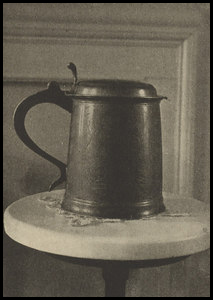
Dustin Tankard, A gift from the Gov. of Maryland to Hannah Dustin in 1697. In possession of the Haverhill Historical Society, Hav. Mass. Source: Some Indian Stories of Early New England, 1922

Historian Kathryn Whitford notes that the Abenaki Indians themselves didn’t take revenge on Hannah, though they had the opportunity and there are a good many recorded instances of Indian vengeance upon men who had betrayed them.  She concludes “It almost seems as though the Indians recognized that they and Hannah approached border warfare in the same spirit and that they owed her no grudge.”

Sources:

Hannah Dustin: The Judgement of History By Kathryn Whitford Associate Professor, Department of English, University of Wisconsin-Milwaukee.

http://quod.lib.umich.edu/a/amverse/BAH8738.0001.001/1:20?rgn=div1;view=fulltext

http://www.colby.edu/academics_cs/museum/upload/pdf-western-expansion.pdf

http://news.google.com/newspapers?nid=2199&dat=19971129&id=J7oyAAAAIBAJ&sjid=hegFAAAAIBAJ&pg=6482,4822396

http://www.thehammersmithgroup.com/about/images/reconsidering.pdf

http://www.eagletribune.com/x1876255787/Hannah-Duston-Heroine-or-villainess-Festival-posters-rekindle-age-old-debate/
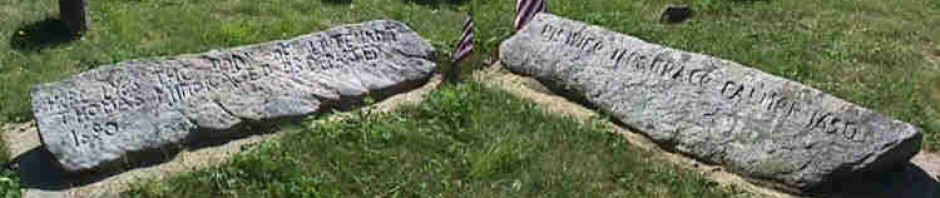
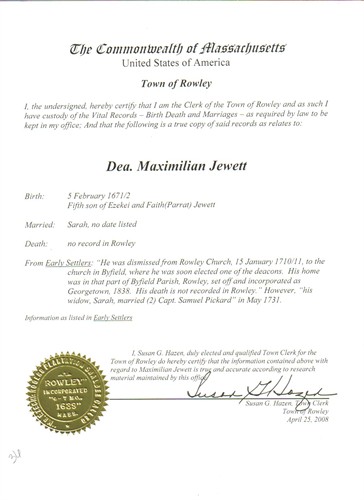
Posted in History, Violent Death | Tagged | 41 Comments

Robert Tilley

Rpbert TILLEY (1540 – 1612) Two of Robert’s sons came to America on the Mayflower, both dying the first winter.  Robert was Alex’s 13th Great Grandfather in the Shaw line.

Robert Tilley was born in 1540 in England. His parents were William TILLEY and Agnes [__?__]. He married 1570 in Henlow, Bedfordshire, England to Elizabeth [__?__]. Robert died 31 Dec 1612 in Henlow, Bedford, England.

Elizabeth was born in 1544 in Henslow, Bedfordshire, England. Elizabeth died in 27 Mar 1614

St. Mary the Virgin Church, Henlow, Bedfordshire, England

Children of Robert and Elizabeth:

Name Born Married Departed
1. John TILLEY 19 Dec 1571 Henlow, Bedfordshire, England Joan HURST Rogers 20 Sep 1596 in Henlow, Bedfordshire, England 10 Apr 1621 Plymouth, Plymouth, Mass
2. Rose Tilley 8 May 1574 Henlow, Bedfordshire, England John Goods 24 Jun 1599 in Henlow, Bedfordshire, England 1621 England
3. George Tilley 28 Jan 1576 Henlow, Bedfordshire, England 1612 Henlow, Bedfordshire, England
4. Agnes Tilley 6 Mar 1579 Henlow, Bedfordshire, England 1612 Henlow, Bedfordshire, England
5. Elizabeth Tilley 26 Jan 1582 Henlow, Bedfordshire, England Richard Austin
15 Dec 1608 in Henlow, Bedfordshire, England
20 Feb 1625 Henlow, Bedfordshire, England
6. William Tilley 1 Sep 1585 Henlow, Bedfordshire, England Elizabeth Peppitt
11 Nov 1612 in Henlow, Bedfordshire, England
18 Jan 1625 Henlow, Bedfordshire, England
7. Edward Tilley 27 May 1588 Henlow, Bedfordshire, England Agnes Cooper
20 Jun 1614 in Henlow, Bedfordshire, England
1621 Plymouth, Plymouth, Mass.
8. Alice Tilley 28 Feb 1590 in Henlow, Bedfordshire, England 29 Jul 1597 Henlow, Bedfordshire, England
9. Mary Tilley [__?__] Farr

x

Children

1. John TILLEY (See his page)

2. Rose Tilley

Rose’s husband John Goods was born 1574 in Henlow, Bedfordshire, England.

5. Elizabeth Tilley

Elizabeth’s husband Richard Austin was born 1580 in Henlow, Bedfordshire, England. His parents were William Austin and Mary Bromeham. Richard died in 1613.

6. William Tilley

William’s wife Elizabeth Peppitt was born 1590 in Henlow, Bedfordshire, England. Elizabeth died 1635 in Henlow, Bedfordshire, England

7. Edward Tilley

Edward’s wife Agnes Cooper was baptized 7 Nov 1585, Henlow, Bedford, England,   Her parents were Edmund  Cooper and Mary Wyne.

Agnes’ sister Martha married James Samson, and they were the parents of Mayflower passenger Henry Samson.  Agnes’ brother Robert was  the father of Mayflower passenger Humility Cooper.

Agnes Cooper’s ancestry has been successfully traced back as far as Wido de Reinbudcourt, the Domesday Lord of Chipping Warden and Burton, Northampton, England, who lived during the 10th century; but no royal lineages have yet been noted for any of her lines..

Edward was one of the Pilgrims who came over on the Mayflower.  Tilley was also a signer of the Mayflower Compact, which has been called the world’s first written constitution.

Edward Tillie was one of the signers of the Mayflower Compact, though he didnt live through the first winter in Plymouth

Edward came to New England with his wife, Ann, his brother John, and two cousins, Henry Samson and Humility Cooper, who were children.

The first winter was very difficult for the Pilgrims, due to hunger, cold and disease. Out of the 102 Mayflower passengers, 52 of them died before spring. When the Pilgrims feared an Indian attack, they would pull the sick members out of bed, prop them up against trees, and put a gun in their hands. Governor John Carver died, and virtually every family lost a loved one. Both Edward and Ann Tilley died in that first winter, as did John Tilley and his wife, Joan.

The children survived, though. Humility Cooper was sent back to England, where she grew to adulthood. Henry Samson and Elizabeth Tilley (daughter of John and Joan Tilley) grew to adulthood in Plymouth Colony, married and thrived.

Sources:

http://trees.ancestry.com/owt/person.aspx?pid=29855914

http://en.wikipedia.org/wiki/Edward_Tilley

http://www.mayflowerhistory.com/Passengers/EdwardTilley.php

Posted in First Comer, Line - Shaw | 2 Comments

Turner’s Falls Fight

The Battle of Turner’s Falls, also known as the Peskeompscut massacre, was fought on May 19, 1676, during King Philip’s War, in present-day Gill, Massachusetts near a falls on the Connecticut River. The site is across the river from the village of Turners Falls. A band of English colonists under the command of Captain William Turner fell upon the poorly guarded Indian village of Peskeompscut near the falls at dawn, slaughtering many of its inhabitants. Many of the warriors in the camp escaped, and they regrouped with those from other nearby camps to dispute the English retreat, during which Turner was killed.

Turners Falls, Massachusetts

Prelude

At what is now Turners Falls, many Peskeomscut Indians went to cath and cure fish. Months of war with the English had usedmup their limited supplies of food, so they needed to store up as much as possible. they also went to the abandoned fields at Deerfield to plant and hpoefully harvest crops before the winter came. During the summer of 1676, many warriors went to English settlemants to organize cattle raids that would hopefully bring back enough food for their tribes.

One night, a group of warriors raided some cattle in nearby Hatfield. Determined, the settlers rounded up a group of 150 men to retreive their livestock

English Attack

Led by Captain William Turner, the unit crossed Bloody Brook and the Deerfield River, eventually arriving at Mount Adams, which was within a mile of the Peskeomscut Falls (Present day Turners Falls). Having feasted well on fresh fish and cattle, the Peskeomscut Indians were sleeping and they had not sent out any scouts. The settlers marched closer and closer to the wigwams, with the Indians having no indiacation of what was going to happen. As the settlers were pressed right up to the wigwams, Captain Turner gave a prearanged signal. Suddenly all guns thrust into the wigeams and fired. Many of the Indians were killed instantly, while some ran into the falls and drowned. Being ruthless in their attack, the colonists killed men, women, children, and the elderly, leaving no one alive.

The History of Deerfield, Vol. I, George Sheldon, 1895

Leaving his horses under a small guard, Turner led his men through Fall river, up a steep ascent, and came out on a slope in the rear of the Indian camp. He had reached his objective point undiscovered. Silence like that of death brooded over the encampment by the river, save for the sullen roar of the cataract beyond. With ears strained to catch any note of alarm, the English waited impatiently the laggard light, and with the dawn, stole silently down among the sleeping foe; even putting their guns into the wigwams undiscovered. At a given signal the crash of a hundred shots aroused the stupefied sleepers. Many were killed at the first fire. The astonished survivors, supposing their old enemy to be upon them, cried out “Mohawks! Mohawks!” rushed to the river, and jumped pell-mell into the canoes which lay along the shore. Many pushed off without paddles; in other cases the paddlers were shot, and falling overboard, upset the canoe; many in the confusion plunged into the torrent, attempting to escape by swimming. Nearly all of these were swept over the cataract and drowned. Others, hiding about the banks of the river, were hunted out and cut down, “Captain Holyoke killing five, young and old, with his own Hands from under a bank.” A very slight resistance was made, and but one of the assailants wounded; another “was killed in the action by his friends, who, taking him for an Indian as he came out of the wigwam shot him dead.” The wigwams were burned, and the camp dismantled.

English Retreat

Several hundreds of Indians lost their lives while only one colonist died. However, Captain Turner had not devised a retreat plan, and, hearing the shots, nearby tribes along the river were alerted and started to approach the site. Begining to panic, the settlers retreated in groups, hoping to find their way back. Inflicting casualties whenever possible, the warriors pursued the colonists.

Of the 150 colonial men, about 40 were killed, including Captain Turner. Others had to try to find their way back home, a few were successful, while others never made it home. About a month later, Captain Turner’s body was found. It was buried on the bluff where he fell and Peskeomscut Falls was renamed Turners Falls.

Of the 150 colonial men, about 40 were killed, including Captain Turner. Others had to try to find their way back home, a few were successful, while others never made it home. About a month later, Captain Turner’s body was found. It was buried on the bluff where he fell and Peskeomscut Falls was renamed Turners Falls.

Turner’s Falls 19 May 1676

History of the Connecticut Valley in Massachusetts, Volume II,” by Louis H. Everts, 1879

Unhappily, the glorious victory was destined to be followed by a disastrous defeat. Capt. Turner, knowing full well that formidable bodies of Indians were in the neighborhood, and were likely to attack him, tarried after the fight but long enough to destroy the Indian camp, and then gave the order for the return march. By this time, however, the Indians on the east bank of the river, and others from below the scene of the fight, were gathering to attack the English, and it was not without some difficulty that the whites reached the place where they had left their horses, for they were twice attacked while en route, although in each case they successfully repulsed their assailants. Shortly after mounting and taking up the return journey for Hatfield, Capt. Turner, who had earlier in the day manifested signs of physical indisposition, grew so ill that it was with difficulty he was enabled to keep his seat on his horse. At this juncture, the command having reached Smead’s Island, opposite where Montague City now stands, a sudden attack in large force was made by Indians, and, a report circulating that the attack was led in person by Philip, at the head of a thousand savages, the whites became panic-stricken, and, separating into small bodies, fled in the wildest disorder.

The passage from Smead’s Island to Green River was little short of slaughter. The savages, pursuing, shot down the flying foe or took them into captivity, and when at last Green River was reached, the English ranks had been reduced to less than 150 men. Here Capt. Turner received his death wound, and fell in Greenfield Meadow, near the mouth of Green River, where his body was subsequently found by the English and tenderly cared for.

Upon the fall of Capt. Turner, Capt. Holyoke, assuming command, rallied the scattered remnants of the band, and, although constantly beset by savage attacks, conducted the retreat with skillful tact and bravery, and eventually reached Hatfield, with 38 men missing from his command.

Ancestors

Falls Fight Memorial

At age 20, in May 1676, William Clarke was one of 22 soldiers of Northampton who took part in the Falls Fight under Capt. William Turner.  Today, Turners Falls is an unincorporated village and census-designated place in the town of Montague in Franklin County, Massachusetts.

Of the men, directly connected with Northfield history, in this fight, were Nathaniel Alexander, James Bennett, Philip Mattoon, Joseph Kellogg, Samuel Boltwood, Stephen Belding, [Capt.] William CLARKE, John Lyman, Cornelius Merry, and  Joseph WARRINER.

Richard KIMBALL’s son-in-law Joseph Turner He was killed by the indians near Deerfiled Mass on his return from the Falls Fight.

Richard PRATT’s son John was a mariner. He was a soldier of King Philip’s war, serving under Captain William Turner and took part in the Turner Falls Fight May 19, 1676,. at Hadley, and for his service in that war his son Thomas about sixty years afterward had land granted him in Bernardston, Mass.

John MILLARD’s son Robert  was taxed  5.17.06.  The Massachusetts towns were then required to equip and provision their own militiamen, and the money listed in this account was probably used for this purpose.  Besides this financial contribution to the war effort, Robert Millard served at the Falls Fight under Capt. William Turner.

THE TURNERS FALLS, MASSACHUSETTS FIGHT – Excerpt abridged from The History of Deerfield, Vol. I, George Sheldon, 1895, pp. 155-157.

After sunset, Thursday, May 18th [1676], this little army set out on a memorable march…. The cavalcade passed out from Hatfield street with high hopes and determined hearts. Crossing the meadows to the north, vowing vengeance for stolen cattle, they wended their way slowly up the Pocumtuck path. Over the Weequioannuck and through the hushed woods as darkness was closing down, to Bloody Brook. Guided by Hinsdell, the troops floundered through the black morass, which drank the blood of his father and three brothers, eight months before; they passed with bated breath and clinched fire-lock, the mound under which slept Lothrop and his three score men. As they left this gloomy spot, and marched up the road, down which the heedless Lothrop had led his men into the fatal snare, the stoutest must have quailed at the uncertainty beyond. Was their own leader wise? Did he consider the danger? Was it prudent to neglect precautions against surprise?

Leaving his horses under a small guard, Turner led his men through Fall river, up a steep ascent, and came out on a slope in the rear of the Indian camp. He had reached his objective point undiscovered. Silence like that of death brooded over the encampment by the river, save for the sullen roar of the cataract beyond. With ears strained to catch any note of alarm, the English waited impatiently the laggard light, and with the dawn, stole silently down among the sleeping foe; even putting their guns into the wigwams undiscovered. At a given signal the crash of a hundred shots aroused the stupefied sleepers. Many were killed at the first fire.

The astonished survivors, supposing their old enemy to be upon them, cried out “Mohawks! Mohawks!” rushed to the river, and jumped pell-mell into the canoes which lay along the shore. Many pushed off without paddles; in other cases the paddlers were shot, and falling overboard, upset the canoe; many in the confusion plunged into the torrent, attempting to escape by swimming. Nearly all of these were swept over the cataract and drowned. Others, hiding about the banks of the river, were hunted out and cut down, “Captain Holyoke killing five, young and old, with his own Hands from under a bank.” A very slight resistance was made, and but one of the assailants wounded; another “was killed in the action by his friends, who, taking him for an Indian as he came out of the wigwam shot him dead.” The wigwams were burned, and the camp dismantled.

Richard MONTAGUE’s son-in-law Isaac Harrison  served in King Philip’s War and was killed by Indians in the Turner’s Falls Fight, while serving under Captain William Turner. After his death his family brought suit in court against John Belcher, a surviving soldier of the fight, claiming that Belcher failed to render aid to Harrison and left him to die. However, the court took no action against Belcher.

History of Hadley : including the early history of Hatfield, South Hadley, Amherst and Granby, Massachusetts pg 165. (1905)

The complaint of Martha Harrison, which was substantiated by testimony before the Commissioners of Hadley, June 22, 1676, exhibits some incidents of this disorderly flight. Martha Harrison of Hadley, widow, makes complaint against John Belcher of Braintree, a soldier in Capt. Turner’s company, for being the culpable occasion of the death of her husband, Isaac Harrison, a wounded man, riding upon his own horse, who fell from his horse, being faint, and this John Belcher, who was behind him, rode from him with Harrison’s horse, though he entreated him not to leave him, but for God’s sake to let him ride with him.

Stephen Belden of Hatfield, testified that he, riding behind Jonathan Wells, saw Isaac Harrison on the ground rising up, and heard him call to the man on his horse, 3 or 4 rods before, to take him up, saying he could ride now; the man rode away, and both Jonathan Wells and I called him to go back, and he would not. This was when we were returning from the fight at the falls.

There is no record of Belcher’s being punished. — Many had lost their horses. — Mather says the soldiers were more numerous than the Indians that pursued them.

Elder John STRONG’s son-in-law Jonathan Wells (1659-1739) was made a Captain upon the death of his brother Thomas Wells III in 1691.  At the age of 16, Jonathan was the “boy hero” of the Peskeomskat  Fight.  He also was Military Commander of the settlement at Deerfield when the town was attacked on Feb 29, 1703/04 [see my article Raid of Deerfield – 1704].

Turners Falls Reporter 1875

Mr. Jonathan Wells of Hatfield, one of the twenty who remained in the rear when Turner began his march from the Falls, soon after mounting his horse, received a shot in one of his thighs, which had previously been fractured and badly healed, and another shot wounded his horse.

With much difficulty he kept his saddle, and after several narrow escapes, joined the main body just at the time it separated into several parties, as has been related. Attaching himself to one that was making towards the swamp, on the left, and perceiving the enemy in that direction, he altered his route and joined another party flying in a different direction. Unable to keep up with the party, he was soon left alone, and not long after fell in with one Jones, who was also wounded.

The woods being thick and the day cloudy, they soon got bewildered, and Wells lost his companion, and after wandering in various directions, accidentally struck Green River, and proceeding up the stream, arrived at a place since called the Country Farms, in the northerly part of Greenfield. Passing the river and attempting to ascend an abrupt hill, bordering the interval west, he fell from his horse exhausted.

After lying senseless some time, he revived and found his faithful animal standing by him. Making him fast to a tree, he again lay himself down to rest, but finding that he should not be able to remount, he turned the horse loose, and making use of his gun as a crutch hobbled up the river, directly opposite the course he ought to have taken. His progress was slow and painful, and being much annoyed by mosquitos, towards night he struck up a fire, which soon spread in all directions, and with some difficulty he avoided the flames.

Now new fears arose; the fire, he conjectured, might guide the Indians to the spot, and he would be sacrificed to their fury. Under these impressions, he divested himself of his ammunition, that it might not fall into their hands, bound up his thigh with a handkerchief, staunched the blood, and composing himself as much as possible, soon fell into a sleep. A dream suggesting to him that he was travelling from, instead of to Hatfield, he reversed his course, and through time brought up at the upper part of Greenfield, and soon found a foot path which led him to the trail of his retreating comrades.

This he pursued to Deerfield River, which, with much difficulty, he forded by the aid of his gun. Ascending the bank he laid himself down to rest, and being overcome with fatigue, he fell asleep, but soon waking he discovered an Indian making toward him in a canoe. Unable to flee, and finding his situation desperate, he presented his gun, then wet and filled with sand and gravel, as if in the act of firing.

The Indian, leaving his own gun, instantly leaped from his canoe into the water, escaped to the opposite shore and disappeared. Wells now concluded he should by others who he knew were but a short distance down the river, but determining if possible to elude them, he gained an adjacent swamp, and secreted himself under a pile of drift wood.

The Indians were soon heard in search of of him, traversing the swamp in all directions, and passing over the drift wood; but lying close, he fortunately avoided discovery, and after they had given up the search and left the place, he continued his painful march through Deerfield meadows. Hunger now began to prey upon him, and looking about he accidently discovered the skeleton of a horse, from the bones of which he gathered some animal matter, eagerly devoured, and which in a measure allayed his hunger and added to his strength.

Passing the ruins of Deerfield, at dusk, he arrived next morning at Lathrop’s battle ground, at Bloody Brook, in the south part of Deerfield, where he found himself so exhausted that he concluded he must give up further efforts and lie down and die

But after resting a short time, and recollecting that he was within eight miles of Hatfield, his resolution returned, and he resumed his march through pine woods, then smoking with a recent fire; there he found himself in great distress from a want of water to quench his thirst, and almost despaired of reaching his approximated home. But once more rousing himself, he continued his route and about mid-day on Sunday reached Hatfield, to the joy of his friends, who had supposed him dead. After a long confinement, Mr. Wells’s wound was healed, and he lived to an advanced age, a worthy member of the town.

Aftermath

In 1736, the General court granted to the survivors of this fight, and their descendants, a township,which in commemoration of the event was named Fall-town, since incorporated under the name of Bernardston.  Bernardston was first settled in 1738 as a part of “Fall Town,” which also included Colrain and Leyden.

Benardston,  Franklin, Mass


Sources:

http://www.americancenturies.mass.edu/classroom/curriculum_6th/lesson5/turners.html

http://home.earthlink.net/~cyberkiwi/soldiers/scenario6.html

http://www.franklincountyhistory.com/gill/everts/03.html

http://www.usgennet.org/usa/topic/newengland/philip/11-20/ch17pt4.html

http://www.usgennet.org/usa/topic/newengland/philip/11-20/ch17pt6.html – list of slain soldiers

PESKE-OMPSK-UT OR, THE FALLS FIGHT. A Series of Random Sketches SHOWING A GLIMPSE OF THE EARLY HISTORY OF TURNERS FALLS, WHICH APPEARED IN “The Turners Falls Reporter,” DURING THE MONTHS OF JANUARY AND FEBRUARY, 1875. TURNERS FALLS, MASS. : PRINTED AT THE “REPORTER” JOB OFFICE. 1875. PRICE, 25 CENTS.

History of Hadley : including the early history of Hatfield, South Hadley, Amherst and Granby, Massachusetts (1905) By Judd, Sylvester, 1789-1860; Boltwood, Lucius M. (Lucius Manlius), 1825-1905

Posted in History, Veteran, Violent Death | 5 Comments

Henry Kembold

Henry KEMBOLD (1565 – 1619) was Alex’s 11th Great Grandfather; one of 4,096 in this generation of the Miller line.

Immigrant Ancestor

Henry Kembold was born 4 Jan 1565 Brettenham, Suffolk, England. His parents were Henry KIMBOLD and Margaret MUNNING. He married JOHANNA [__?__] about 1588 in Ipswich, Suffolk, England. Henry died 10 Sept 1619 Rattlesden, Suffolk, England.

Johanna was born 1567 Mistley, Essex, England

Children of Richard and Ursula:

Name Born Married Departed
1. John Kemball 20 Apr 1584 Brettenham, Suffolk, England Elizabeth Colby
21 Jun 1618
Brettenham, Suffolk, England
21 Apr 1633 Brettenham, Suffolk, England
2. Frances Kemball 9 Apr 1587 Brettenham, Suffolk, England William Seir
9 Oct 1608
Great Finborough, Suffolk, England
3. Rachel Kemball 22 Jun 1589 Rattleden, Suffolk, England Thomas Carver
2 Nov 1609
Of Rattlesden, Suffolk ,England,
4. Henry Kemball 1590 Rattleden, Suffolk, England Susan Stone
27 Nov 1628 Rattlesden, Suffolk, England
19 Aug 1648
Watertown, Mass
5. Richard KIMBALL 10 Apr 1595 Rattlesden, Suffolk, England Ursula SCOTT about 1614
.
Margaret Cole
23 Oct 1661
Ipswich, Mass
22 Jun 1675 Ipswich, Essex, Mass
6. George Kemball 1598 Rattlesden 15 Nov 1636 Rattlesden

Parents

Henry’s father Henry Kembold b. 1539 Hitcham, Suffolk, England d: 1583 Brettenham, Suffolk, England) married Margaret Munning (b: 1545 Brettenham, Suffolk, England d: 8 Dec 1582 Brettenham, Suffolk, England), daughter of Humphrey MUNNING and Eunice (Ellen) UNGLE on 12 June 1564 in Brettenham, Suffolk, England. Their children:

i. Priscilla Kimball (b: 1569 Brettenham, Suffolk, England d: 1583 England) m: John Pilbarrow

ii.  Henry KYMBOLD (b: 1566/1567 Brettenham, Suffolk, England d: after 1619 Rattlesden, Suffolk, England) m: Johanna

iii. Richard Kembold  b: 4 Jan 1565 Lawford, Essex, England d: 10 Sept 1619 Rattlesden, Suffolk, England) m: Elizabeth

Grandparents

Henry’s grandfather Henry KEMBOLD was born 1510 Hitcham, Suffolk, England d: 4 Jan 1558 Hitcham, Suffolk, England) married Cecelia (Cisila) SYSLEY (b: 1517 Hitcham, Suffolk, England d: 8 Dec 1584 Hitcham, Suffolk, England).

Henry was of Hitcham, Suffolk, England. He owned a tenement called Pogelle’s, as well as some land in Rattlesden, Suffolk, England. His will was made 4 Jan 1558 and proved 10 Mar 1558. Henry was probably buried in the churchyard at Hitcham, Suffolk, England, according to his desires.

Will of Henry Kembold of Hechm 4 Jan  1558, proved 10 Mar 1558.

To be buried in the churchyard of Hechm. To my wife Sysley Kembold my tenement I live in called Pogelle’s &c. and a piece of land in Rattlesdam. These to son Henry after my wife’s decease, he to pay certain sums to his brothers and sisters. To son Thomas peice of land in Rattlesden after my wife’ decease. To Thomas three pounds six shillings and eight pence, whereof thirty three shillings and four pence at his age of twent one years and then every year six shillings eight pence untill the sum, three pounds six shillings eight pence, be fully paid. To son Henry a piece of land, which I have in mortgage of Henry Bowle. To son richard six pounds thirteen shillings four pence, for to be paid by Henry Kembold my son, at his age of twenty one years. to daughters Agnes and Margaret Kembold thirty three shillings each at days of marrige and the same sum in five years. Wife Syslye and son Henry to be executors and Edmond Lever to be supervisor. Bury Wills, Book Bell, L. 542.

Children of Henry and Cisila:

i.  Priscilla Kembold (b: about 1543 Hitcham, Suffolk, England)
ii. Thomas Kembold (b: 1543 Hitcham, Suffolk, England d: after 1582 Hitcham, Suffolk, England)
iii. Agnes Kembolde (b: about 1548 England d: after 1582 Hitcham, Suffolk, England)
iv. Margaret Kembold (b: 1556 Hitcham, Suffolk, England d: 9 June 1578 Suffolk, England) m: Thomas Pricke
v. Richard Kembold (b: 1541 Hitcham, Suffolk, England d: before 10 Sept 1619 England) m: Elizabeth
vi. HENRY KEMBOLD ( (b: 1539 Hitcham, Suffolk, England d: 1583 Brettenham, Suffolk, England) m: Margaret Munning .

Children

1. John Kemball

John’s wife Elizabeth Colby

2. Frances Kemball

Frances’ husband William Seir

3. Rachel Kemball

Rachel’s husband Thomas Carver

4. Henry Kemball

Henry’s wife Susan Stone was born Oct 4 1590 in Mistley (or Great Bromley), Essex, England.  Her parents were David Stone (1540 – 1625) and Ursula [__?__] (1560 – 1592). Susan died 19 Aug 1684 in Watertown, Middlesex, Mass.

Savage

HENRY, Watertown, probably brother of Richard the first, came in the Elizabeth, 1634, from Ipswich, aged 44, with wife Susanna, 35; children Elizabeth 4; and Susan, 1 and ½; and servant Richard Cutting, 11; freeman 2 May 1638; had John, born 5 March 1638, died soon; Mary, 26 November 1641; Richard, 13 October 1643; and John, again, 25 December 1645; and died 1648, his inventory being of 22 July. His widow married again, and died 19 Aug. 1684. Elizabeth married Capt. Thomas Straight, and Susanna married John Randall, both of Watertown.

5. Richard KIMBALL (See his page)

Sources:

http://www.boydhouse.com/michelle/coffin/henrykembold.html

http://www.angelfire.com/tx4/custer/kimball.html

http://helenesgenes.com/Kimball.html#hen

http://www.geni.com/people/Henry-Kimball/6000000001212791810

Posted in 13th Generation, Line - Miller | Tagged | 4 Comments

Battle of Bloody Brook

The Battle of Bloody Brook was fought on Sep 12, 1675 between English colonial militia from the Massachusetts Bay Colony and a band of Indians led by the Nipmuc sachem Muttawmp. The Indians ambushed colonists escorting a train of wagons carrying the harvest from Deerfield to Hadley during King Philip’s War. They killed at least 40 militia men and 17 teamsters out of a company that included 79 militia.

19th Century depiction of Battle of Bloody Brook

Leonard HARRIMAN’s son John (16 May 1650 Rowley, Mass ) was killed at the Battle of Bloody Brook with Captain Lathrop. At a given signal, hundreds of warriors, who were lying concealed all around the spot, opened fire on the convoy. Chaos followed, bullets and arrows flew from every direction. Captain Lathrop immediately fell. Of the 80 soldiers, only 7 or 8 escaped.

Henry BENNETT’s son John (b. 1655 Ipswich, Mass) was killed at the Battle of Bloody Brook.  At the Battle of Bloody Brook on September, 18, 1675, the dispossessed Indians destroyed a small force under the command of Captain Thomas Lathrop before being driven off by reinforcements.  Originally intended to be a uneventful delivery of wheat by oxcarts to Hadley, the men apparently took few precautions and were confident that their numbers belied attack.  It would have disastrous consequences.  Colonial casualties numbered about sixty. In retaliation, at dawn on May 19, 1676, Captain William Turner led an army of settlers in a surprise attack on Peskeompskut, in present-day Montague, then a traditional native gathering place. They killed 200 natives, mostly women and children. When the men of the tribe returned, they routed Turner, who died of a mortal wound at Green River.

Edmund GREENLEAF’s grandson Stephen (b. 1652) was killed at the Battle of Bloody Brook.

Richard KIMBALL’s son-in-law Robert Dutch (b. 1623 – d. 1686)was a soldier in King Philip’s War of 1675 with Captain Moseley. In the Bloody Brook battle, he was wounded, beaten, stripped, and left for dead, but he recovered.

“As Capt Mosely came upon the Indians in the Morning, he found them stripping the Slain, amongst whom was one Robert Dutch of Ipswich having been sorely wounded by a bullet that rased to his Skull and then mauled by the Indian Hatchets, was left for dead by the Salvages, and stript by them of all but his skin…”.

Richard KIMBALL’s  grandson  Caleb, b. 1647; was in Captain Lothrop’s company at Bloody Brook, in King Philip’s war, and was killed 12 Sep 1675.  Estate Of Caleb Kimball.
Administration upon the estate of Caleb Kemball, who was slain in the war, was granted 21 : 10 : 1675, to Henry and Richard Kemball, the latter making oath to the inventory which was allowed.
—Salem Quarterly Court Records, vol. 5, leaf 92.

Inventory of the estate of Caleb Kemball, slain with Captain Laythrop in the country service, taken 25 : 9 : 1675, by Charls Gott and Walter Fayerfield: one hous and twenty-four akers of land, £34. 5s.; one hors, £3; one mare, £2 10s.; 15 bushells and 1-4 of inden corn, £2 5s. 9d.; tools, 17s. 6d.; one muskett, £1 5s.; by 7 wekes wadges dew from the country, £2 2s.; one chest and boox and on par of shoes, 10s.; tining ware and other small things & bible, 10s. 6d.; wearing clothes, £3 Debts due from the estate: to the hayers or administrators of Henery Kemball his father, £25; to Deakon Goodhew, £4 3s.; Walter Fayerfeld, £2; Ezekell Woodward, £2 3s.; Master Batter, Hi. 5s.; Thomas Ives, 1li. 2s.; Peeter Chevers, 2s. 6d.; Mr. Phil1ip Cromwell, 6s.; Mistres Newman, 5s; Goodman Hayward the hatter at Ipswich, 13s. 6d.; to John Baker of Ipswich, 4s. 6d.; John Safford, 5s. 6d.; Cornitt Whipple, 9s.; John Sparks, Is.; his unkle Richard Kembal’s estate, 4s. 6d.; to Leweie Elford, 2s.; that his father Henery Kemball had in money, 17s.; delivered to E1izabeth Norten by Caleb’s order a chist and box and tin ware, 8s.; four bushels and half of Indien corne that henery Kemball his father had of Caleb Kemball’s corn, 15s. 9d.; debts that are dew and out of my hand of Caleb Kembal’s estate, £38 7s. 3d.; the 17s. in money and 15s. 9d. in corne is dew from the estate of his father henery kemball and a paile the window [widow?] kemball hath, l1i. 13s. 9d.
Administration on the above estate granted to Hen. and Richard Kimboll and said Richard attested 30:9:1675, to the truth of this inventory.
The said Henry being deceased sole administration is granted to Richard and he was ordered to pay to the twelve children of the deceased Henry Kimboll 18s. at age.
—Essex County Quarterly Court Files, vol. 25, leaves 81, 82..

Thomas Kimball had wages due him from the county at the time of his death, as stated in his inventory, that it is possible that he had been engaged in the war with the Indians, and was probably with his nephew, Caleb Kimball, at the time the latter was killed at Bloody Brook.

Bloody Brook Mass Grave

The Battle of Bloody Brook took place during King Philip’s War, a conflict between certain Native American tribes and colonists in New England in 1675 and 1676. The conflict is named for King Philip, also called Metacomet, chief of the Wampanoag. He was one of several Native American leaders who led warriors from various tribes. The war was touched off by the killing of a John Sassamon, a liaision between the colonists and the Wampanoag, but it followed decades of expanding colonial settlements and challenges by displaced Native Americans.

In June 1675 a gruesome cycle began. Colonists and Native Americans burned one another’s settlements. Loyalties of tribes and individual Native Americans shifted, and mistrust fed on itself. In the Massachusetts Bay Colony, settlers grew so suspicious of Native Americans that they exiled some who still claimed to be their friends. Many colonists stopped believing the sincerity of the “praying Indians,” who had converted to Christianity. (In Connecticut, colonists managed to keep somewhat better alliances with Native American tribes, and they enjoyed more safety.)

In the summer, Native Americans who opposed the expansion of colonial settlements tasted victory in attacks on villages in Massachusetts. Assaults drove settlers to abandon their homes in September. They gathered in the blockhouse at Deerfield. Lacking food for winter, the settlers dispatched some eighteen teamsters, under the guard of Captain Thomas Lothrop and about seventy newly recruited soldiers, to retrieve a gathered harvest of grain from their fields.

The men loaded the harvest without incident and possibly began to feel too safe. On September 18, 1675, they attempted to haul the grain back to Deerfield. After traveling some distance, the convoy stopped to rest. The inexperienced soldiers laid their firearms in the carts of grain and picked some wild grapes nearby to eat.

Unbeknown to Lothrop, his soldiers, and the teamsters, a much larger force of hostile Native Americans had been shadowing them. While the colonial troops rested, the Native Americans attacked. As many as ninety colonial soldiers and teamsters were killed. Many, but not all, of their names have been preserved.

Bloody Brook Photo

Most of the dead were young men, and many were unmarried and childless. Among the teamsters, a father and three of his sons perished. Captain Lothrop, about 65 years old, had no biological children, although probate documents by his widow, Bethiah Lothrop, name an “adopted daughter Sarah Gott.”

Captain Moseley and a troop of 60 soldiers who were in the area heard the sounds of the ambush and hurried to the scene. For approximately 6 hours, a battle was fought with neither side gaining the upper hand. Each soldier fought in the Amerindian style: conceal yourself, select a target and shoot. Finally a troop of 100 Connecticut soldiers with a band of Mohegans arrived. Realizing they could not win now, the warriors disappeared into the forest. The surviving soldiers straggled back to Deerfield for the night. According to D. E. Leach in his book, Flintlock and Tomahawk, p. 88, “Moseley retired to Deerfield that night, and there he and his grim-faced men were taunted from a safe distance by a group of the enemy warriors who gleefully displayed articles of clothing taken from the English dead.” The surviving soldiers returned the next day to bury the dead in a mass grave. The sluggish little brook was re-named Bloody Brook. Deerfield was abandoned shortly afterward and later the village was destroyed by King Philip’s warriors..

The battle took place near Deerfield Village on the banks of Muddy Brook, afterward called Bloody Brook. The dead soldiers and teamsters were buried in a mass grave nearby. The bloodshed led the remaining settlers swiftly to abandon Deerfield. For years after the war’s end, settlers’ attempts to reclaim the land provoked attacks by Native Americans. The settlers gradually prevailed.

Bloody Brook Monument - Deerfield, Mass

The mass grave was marked in 1838 with a flagstone bearing Lothrop’s name and an inscription about the event; the site was excavated beforehand to confirm the presence of remains. A taller monument to the tragedy was later erected nearby. The grave, monument, and site of battle are located in South Deerfield, Franklin County, western Massachusetts.

According to Eben Putnam, Lothrop’s men were “almost entirely from the county of Essex,” which borders the Atlantic coast. This is why fishermen and ship’s carpenters are found among the dead of this battle to defend farm settlements along the western frontier. The teamsters, on the other hand, mainly lived in the newly settled area in and around Deerfield.

SURVIVORS. Most of the colonial soldiers at Bloody Brook died and were buried in the mass grave. The kist of survivors include: Henry Bodwell, Robert Dutch, John Stebbins, John Toppan, and Thomas Very.

Google Map of Battle location

Sources:

http://www.findagrave.com/cgi-bin/fg.cgi?page=cr&CRid=2347043

http://www.bio.umass.edu/biology/conn.river/bloodybr.html

Posted in History, Violent Death | 7 Comments