John Pickard Jr.

John PICKARD Jr. (1622 – 1683) was Alex’s 9th Great Grandfather; one of 1,024 in this generation of the Miller line.

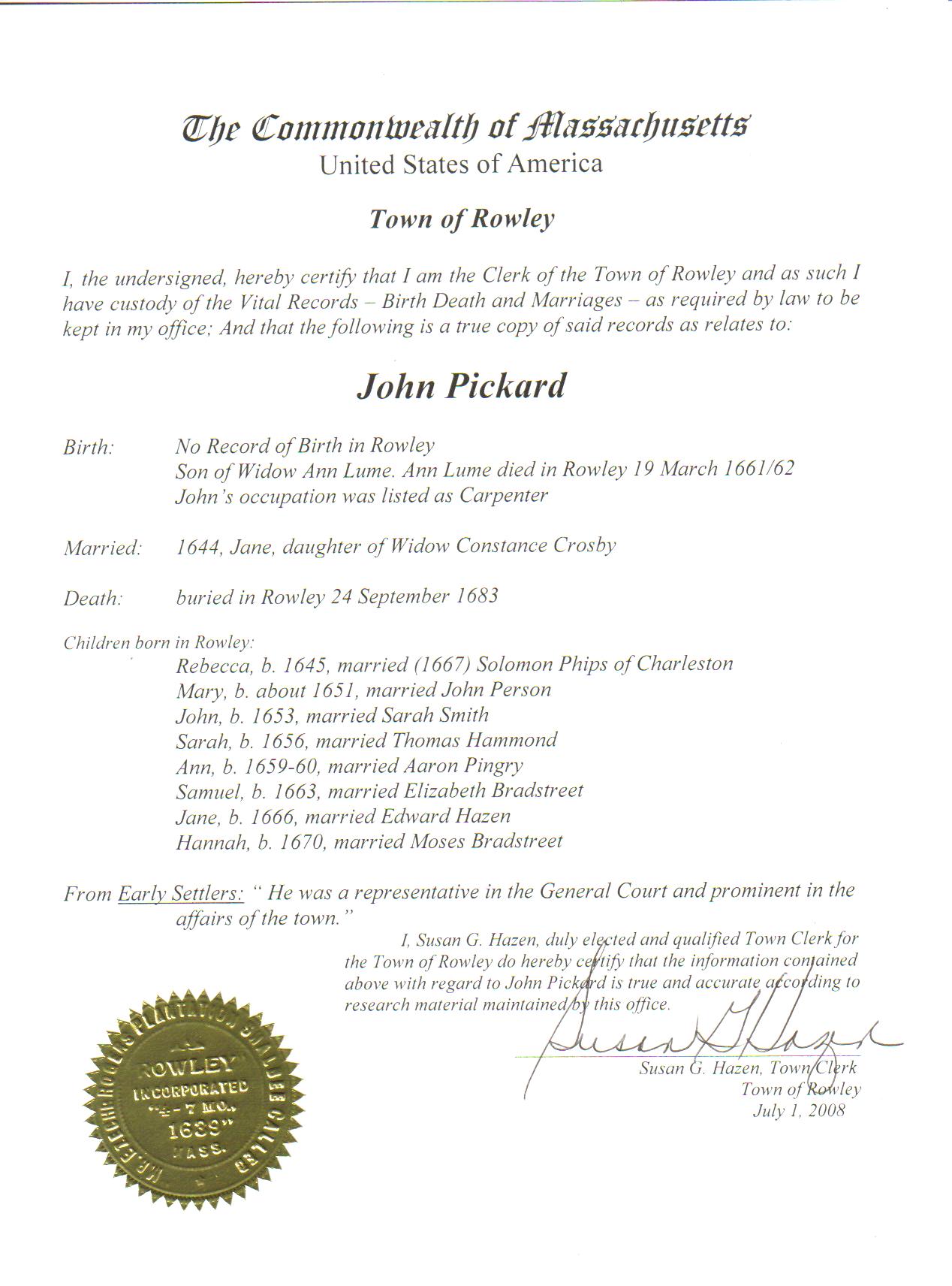
John Pickard Jr. was born in 1622 in Holme-on-Spaulding Moor,  East Riding of Yorkshire, England.  His parents were John PICKARD Sr. and Ann LUME.  Perhaps the Pickards and the Crosbys sailed to America on a ship called the “Lion” in either 1635 or 1638.  He married Jane CROSBY on 29 Oct 1644 in Rowley, Mass.  John died in Sep 1683 in Salem Mass.

Jane Crosby was born 22 Apr 1627 in Holme-on-Spaulding-Moor, Yorkshire, England. Her parents were Robert CROSBY and Constance BRIGHAM. She immigrated with her parents or her widowed mother before 1643.  Jane died 20 Feb 1715/16 in Rowley, Mass.

Inscription:
HERE LYES Ye BODY
OF Mrs JEAN PICKARD
WIFE OF Mr JOHN
PICKARD WHO DIED
FEBRUARY Ye 20 1715/16
AGED 89 YEARS

FOR THIS DEPARTED SOUL
& ALL Ye REST
THAT CHRIST HATH PURCHASED
THAY SHALL BE BLEST

Children of John and Jane:

Name Born Married Departed
1. Rebecca Pickard 3 Oct 1645 Rowley, Mass Capt. Solomon Phipps
13 Nov 1667 Charlestown,  Mass.
1 Feb 1667/68
Charlestown, Mass
2. Deborah Pickard? 13 Oct 1646 Rowley, Mass 1695
Rowley
3. Thomas Pickard? Sep 1648 Rowley
4. Mary Pickard 1651 Rowley, Mass John Pearson
(Son of John PEARSON)
14 Feb 1670/71
Rowley
13 Apr 1728 Rowley
5. Daniel Pickard? Feb 1651/52 Rowley
6. John Pickard 1 Mar 1652/53 Rowley Sarah Smith
11 Feb 1679/80
Rowley
.
Johanna Tutle (Widow of Job Bishop)
5 Mar 1691 Rowley
1 Nov 1697 Rowley
7. Jacob Pickard? Feb 1653/54 Rowley
8. Sarah Pickard 31 Jan 1656/57 Rowley Thomas Hammond
6 Dec 1679
16 Jan 1712/13 Ipswich, Mass
9. Ann Pickard 15 Jul 1659 Rowley Aaron Pengry
22 Mar 1682
Ipswich, Mass
3 Feb 1739/40 Rowley
10. Capt. Samuel Pickard May 1663 Rowley Elizabeth Bradstreet
22 Jun 1685
Rowley
.
Elizabeth Hale
31 May 1687 Rowley
.
Sarah Hardy
20 May 1731
2 Sep 1751 Rowley
11. Jane PICKARD 22 Apr 1666 Rowley, Mass. Edward HAZEN JR.
6 Nov 1684 in Rowley, Mass.
After 1748
Rowley
12. Hannah Pickard 10 Apr 1670 Rowley Moses Bradstreet
19 Jul 1686 Rowley
3 Jan 1736/37 Ipswich, Mass.

John Pickard was a Carpeneter

According to Jim Pickard,  John Pickard Jr.  came to America with Rev. Ezekiel ROGERS, a Puritan minister from Rowley in Yorkshire, England. Rogers brought twenty families  of his congretation with him. The Pickards stayed in Rowley for several generations. It is presumed by some that John was also a minister, but that has not been proven.  John married Jane Crosby who came with her parents from Holme on Spaulding Moor.

He was a selectman in Rowley in 1676, and on the Freeholder list of 1677.

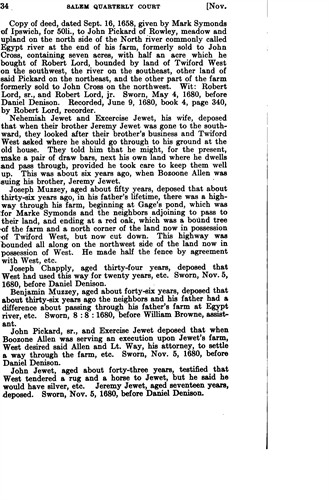
16 Sep 1658 – (Ipswich Deed IV : 340) . . . Marke SYMONDS of Ipswich . . . for . . . fifty pounds . . . Have Granted . . . unto John PICKARD of Rowley … his pcell of ground . . . lyeing on the North Syd of the North River … at the end of his farme formarly sold to John Crose containeing seaven acres . . . with about halfe an acre bought of Robert Lord . . . having the land of Twyford WEST toward the Southwest …  . . . Rec. June 9, 1680.

John along with Joseph Jewett witnessed the will of Hugh CHAPLIN and proved the will in Ipswich Court, 31, Mar 1657.  Hugh did not sign his will.   The will had not been proven by the widow within the twenty month allowed for the action, so she was sentenced to forfeit one hundred pounds to the court. On 6 Apr 1657, Elizabeth Jackson petitioned the court for an abatement of the fine of  £100 for neglecting to present her former husband Hugh Chaplin’s will to be probated and on 29 Sep 1657, the count moderated the fine of Nicholas JACKSON for not proving the will of his wife’s former husband.

10 Feb 1668 – Will of Richard Longhorne of Rowley  and proved in court by Mr John Ward.

To daughter Elizabeth a double portion who with his brother Thomas Longhorne were appointed executors if Elizabeth died without issue one half of the estate given her was to be given equally to his other three daughters to servant Samuel Wood 10li and if the latter’s father Obadiah Wood be willing that his son serve out his time with testator’s brother John Johnson of Rowley £10 more be given him if Samuel died before his time was out the £20 to be divided among his children the remainder of the estate to be divided equally John Pickard John Johnson and James Bayley of Rowley overseers Wit Anthonie Crosbie Daniell Ela and John Ward who made oath in court Original on file in the Registry of Probate

Jonathan Platts deposed that going to Haverill when Richard Longhorne was sick with John Pickard he left the latter on this side the river and went over with the daughter of Richard Longhorne to see him and told him his brother Pickard was on the other side. He told deponent that he was very glad of it for he had a great desire to speak with him that he knew not how God might dispose of him and he desired deponent to come to him again when his brother came over the river. And so coming to him again his brother being with him and he having told his mind to his brother Pickard the latter told Longhorne that he would relate what he said to deponent for fear of spending him. Concerning his children’s disposal John Pickard said to leave them to the disposal of their grandmother to which Longhorne replied that he would and also to their two aunts and that he have them advise with Goodwife Bayly who was a good woman whom he believed loved them well. This was about three years before he died. John Pickard affirmed the same Sworn 30 1 1669 in Ipswich court. Anthony Crosbie deposed that being in Haverill when Richard Longhorne made his will before Mr Ward wrote it said Long borne was very desirous that his brother Thomas Longhorne should be one of his executors But Thomas was not willing to serve pleading his unfitness on account of living so far away etc Sworn in court Daniell Ela deposed that he heard Longhorne say that he desired his brother to take his smaller children and estate etc Sworn in court

Inventory of the estate of Richard Longhorne appraised Mar 24 1668 9 by John Tod Ezekiell Northend and Samuell Brocklebanke Wearing apparel household furnishings silver pewter glass tools household utensils grain hops domestic animals dwelling house brew house orchard £67 Newmarshes lot land bought of Thomas Abbott land at Cow bridge gate land 6 gates Merimacke land land at the great plain land bought of Thomas Dickanson and John Scales land in Shatswell’s meadow meadow at Newbury causeway salt marsh on southeast side of Mr Nelson’s Island marsh at Hogg Island total £732 11s 1d

Sworn Mar 30 1669 by Thomas Longhorne and Elizabeth Longhorne executors At court held Sept 29 1674 more was added to the inventory Original on file in the Registry of Probate”

John Pickard  died 24 Sep 1683.  His will was signed and sealed 6 Sep 1683 proved 27 Nov 1683, and his estate was valued at one thousand two hundred and seventy-nine pounds, two shillings and four pence.

John Pickard Jr – Vital Record

Children

1. Rebecca Pickard

Rebecca’s husband Capt. Solomon Phipps was born 1646 in Charleston, Suffolk, Mass. His parents were Solomon Phipps and Elizabeth Wood. Rebecca died soon after they were married and he married Jul 1669 in Cambridge, Middlesex, Mass to Mary Danforth (b. 28 Jul 1650 in Sudbury, Mass. – d. 1725 in Sudbury) Solomon died Jul 1693.

Oct. 6, 1710, Mary, daughter of Honorable Thomas Danforth, by deed conveyed to her daughters, Sarah and Abial, all her rights in the corn-mills and fulling-mills on Charles River in Watertown.

4. Mary Pickard

Mary’s husband John Pearson was born 27 May 1644 Rowley, Mass. He was Mary’s first cousin.  His parents were John PEARSON and Dorcas PICKARD.  John died 12 Mar 1721/22 Rowley, Mass.

John was a Miller, Clothdresser, and Farmer.

6. John Pickard

John’s first wife Sarah Smith was born 14 Apr 1660 in Rowley, Essex, Mass.  Her parents were John Smith and Faith Parrett. Sarah died 28 Sep 1689 in Rowley, Essex, Mass

John’s second wife Johanna Tutle was born 24 Sep 1664 in Ipswich, Essex, Mass. Her parents were Simon Tuttle and Sarah Cogswell. She first married Job Bishop. Johanna died 1731 in Ipswich, Essex, Mass.

John Pickard IV of Rowley died 5 Aug 1706 at Billerica having been wounded by the Indians.

8. Sarah Pickard

Sarah’s husband Lt. Thomas Hammond was born 11 Jul 1656 in Watertown, Middlesex, Mass. His parents were Thomas Hammond and Hannah Cross.  His grandparents were William HAMMOND and Elizabeth PAYNE (PENN).   He first marriedAfter Sarah died, he married 17 Oct 1713 in Rowley, Mass to Hannah Platts, daughter of Ensign Abel Platts and Lydia Bailey. She was born 5 Feb 1678/79 in Rowely and died June 26, 1748 in Rowely.   Hannah was the widow of Samuel Lancaster who was drowned in Rowley River Sept 19, 1710. Thomas died 26 Feb 1724/25 in Ipswich, Essex, Mass.

Thomas was left an orphan when but a few months of age. His grandfather, William Hammond, died when he was but four years of age and his grandmother, Cross, surviving but a few years, it is probable that his uncle, Lieut. John Hammond, Watertown, took charge of his bringing up and education. He appears to have been much better educated than the average man of his time. He was a fine penman as is shown by specimen of his handwriting which are still in existence. It seems that he had some military training in his younger days, probably owing to the influence of his uncle, Lieut. John, and he is credited with service in King Philip’s war, in the Company of Capt. Joseph Syll, in 1675, and Capt. Joseph Cutter, in 1676. It is probable that he took an active part in the military affairs later in life as he is mentioned as “Lieut.” in the records at Ipswich.

Growing up as he did without parent restraint he early learned self-reliance and became one of the most active, enterprising men of the locality in which he liveed. The following account found on page 143, of the Essex County Genealogical Register, shows the characteristics of the man.

“Thomas Hammond if living now would be one of our liberal men Paul Jewett, who was contemporary with him, reports him through his son Dea. Joshua Jewett, that Hammond had no particular reverence for Sunday, parson or church; that he was a hustler in business and paid little regard to time or place albeit he might coin an honest dollar. He was born too early and the stiff orthodoxy of his day condemned him, and the ‘faithful’ said that Devil held him. It became the whispered secret that ‘Tom Hammond had sold himself to the Devil.’ Time passed, ‘Tom’ kept business in a whirl and made money. He owed several of his townsmen, as would be natural with a man who drove his business. Gossip was rife and ‘Tom’ resolved to test it–in modern phase he suspended. Then calling in his creditors, who were also his accusers, he said: ‘Gentlemen, there are two piles of money; the larger pile is ample to pay you all, but I got it through Satanic influence, and you must take the responsibility of its spell upon you. The other pile will pay you only a small dividend, but it is free. I hoarded it before I made a league with the Devil. Take which you will and sign a release.’ They took the smaller pile. Few people now-a-days play a shrewder game.”

Thomas Hammond Gravestone

Thomas Hammond and his wife rest in the Rowley Cemetery, on the left near the entrance. Their headstones are beautifully engraved in the fashion of that time, and read as follows: HERE LIES YE BODY OF MR. THOMAS HAMMOND, DECST. FEBRUARY YE [A figure cut out and 16, it looks like, cut above]6, 1724, IN YE 69TH YEAR OF HIS AGE. HERE LYETH BURIED YE BODY OF MRS. SARAH HAMMOND, WIFE OF MR. THOMAS HAMMOND, WHO DIED JANUARY YE 16, 1712-13, AGED 57 YEARS.

He appears to have lived in Ipswich on the old Cross farm, after his second marriage, until about 1690 when he removed to Watertown, where he had considerable property interests. He was admitted freeman April 18, 1690, and continued to reside there until about 1706, when he returned to Ipswich and spent the remaining years of his life on the old farm situated near the west end of Muzzey hill, adjoining the town of Rowley. He was a large owner of real estate as is shown by the Essex Registry of Deeds. The following abstracts serve to show the relationship between the parties and prove conclusively that Thomas married a third wife and had two daughters by her, although this marriage is not mentioned in any of the works now in print. June 11, 1713, he conveyed the old Cross farm to his sons, David and Nathaniel Hammond, “in consideration of parental love.” The farm is described as follows: “Bounded on the cart way which lyeth next ye line yt parts Ipswich at Rowley, and on ye N. W. side by Bradstreet farm, so-called containing 100 acres, subject to a yearly lien which John Cross, the former owner, put upon said farm for the support of ye Grammar school.” The deed is witnessed by Nehemiah Jewett, Philip Nelson and Elizabeth (her X mark) Bu?? (Essex Registry 25; 243.)

Nov. 7, 1717, he conveyed “for love and affection to me son-in-law, Ephraim Jewett–thatch lot on Rogers island in Ipswich and new up-land lot at Jeffries.” His wife, Hannah relinquished her right of dower in the same. (Essex Registry?? 32; 208.) May 23, 1724, Thomas Hammond “in consideration of parental love which I bear my son, Thomas Hammond of Watertown,” conveyed to him a salt marsh in Ipswich with the proviso that, “should I die before my now present wife, my said son, Thomas, shall pay to my said wife the sum of ?40, provided she doth acquit rights of dower, or power of thirds in all of my estate according to Covenant, and not else.” Thomas was also required to pay his brothers, David and Nathaniel Hammond, ?5 each. Proved in Court April 13,1725, by witnesses Nathaniel Knowlton and Thomas Manning, to have been the deed of Thomas Hammond, late of Ipswich, deceased. (Essex Registry 44; 158.)

28 Mar 1724 – He conveyed “to my daughter Elizabeth Jewett, the now wife of Ephraim Jewett, in consideration of parental love,” &c., lands in Ipswich and Rowley. (Essex Registry 44; 162.) By a deed proved in Court April 13, 1725, “in consideration of parental love,” &c., he conveyed lands to his two daughters, Hannah and Mary Hammond, minors, of Ipswich; “my daughter, Hannah, must pay to my daughter, Sarah Lambert, ?10, and my daughter, Mary, shall pay to my daughter, Elizabeth Jewett, ?10.” (Essex Registry 45; 29.) His daughter, Hannah, afterwards married Lieut. Nathaniel Bradstreet, and the lands then deeded to her have since remained in possession of her descendants and are now owned (1897) and occupied by John Francis Bradstreet, who has in his possession the original deed given by Thomas Hammone in 1724. This deed is a finely executed document, written in a bold old English hand, and has a fine signature showing him to have been a good penman at that advanced age, is characteristic of the family for many generations.

Thomas Hammond was selectman in Watertown in 169?? and 1696.   He was executor of the will of his kinsman, Timothy Hawkins, in Watertown, in 1697. Buried in Rowley Cemetery on the left near the main entrance. Source: History and Genealogies of the Hammond Families in America Vol 1 [p. 72 – 75] Vital Records of Rowley, MA, p. 468. Died in his 69th birthday.

Sarah Pickard Hammond Gravestone – Rowley Burial Ground 
Rowley, Essex County, Massachusetts.

Inscription:
HERE LYETH BURIED
Ye BODY OF MIS SARAH
HAMMOND (WIFE OF
Mr THOMAS HAM
MOND) WHO DIED
JANUARY Ye 16 1712/13
AGED 57 YEARS

9. Ann Pickard

Ann’s husband Aaron Pengry was born 1652 in Ipswich, Essex, Mass. His parents were Deacon Moses Pengry and Lydia Clements. Aaron died 14 Sep 1714 in Ipswich, Essex, Mass.

10. Capt. Samuel Pickard

Samuel’s first wife Elizabeth Bradstreet was born 22 Mar 1667 in Ipswich, Essex, Mass. Her parents were Capt. Moses Bradstreet and Elizabeth Harris of Ipswich, Mass. Her grandparents were Humphrey BRADSTREET and Bridget HARRIS. Elizabeth died 28 May 1686 in Rowley, Essex, Mass.

Samuel’s second wife Elizabeth Hale was born 16 Oct 1668 in Newbury, Essex, Mass. Her parents were Hon. Thomas Hale and Mary Hutchinson. Elizabeth died 29 Jun 1730 in Rowley, Essex, Mass.

Samuel’s third wife Sarah Hardy was born born 25 Mar 1672 in Bradford, Essex, Mass. Her parents were John HARDY and Mary JACKMAN. She first married Maximilian JEWETT in 1698 in Rowley, Mass.   Maximilian died 23 Mar 1730 in Rowley, Essex, Mass.  Finally, she married May 20, 1731 to Samuel Pickard. Sarah died 3 Feb 1744 in Bradford, Essex, Mass.

11. Jane PICKARD (See Edward HAZEN JR.‘s page)

12. Hannah Pickard

Hannah’s husband Moses Bradstreet was born 17 Oct 1665 in Ipswich, Mass. His parents were Capt. Moses Bradstreet and Elizabeth Harris of Ipswich, Mass. Her grandparents were Humphrey BRADSTREET and Bridget HARRIS. Moses died 20 Dec 1737 in Rowley, Essex, Mass.

An extract of Moses’ father’s will is found in the Historical Collections of the Essex Institute, Vol. 5, and reads:

“Will of Moses Bradstreet, dated 16th of August 1690, mentions his wife’s children by her former husband; son, John Bradstreet, to him one half of the farm ‘yt was my Father Broadstreets,’ sons, Humphrey, Nathaniel, Moses and Jonathan. Daughters, Bridget and Hannah. Appoints John and Moses exrs. Witnesses, Edward Payson, Nicholas Wallis and Nehemiah Jewett, probate Sept. 30, 1690. Inventory of above estate, taken 26th of Sept., 1690, by Samuel Platts and Nehemiah Jewett, amounting to £1257 2s., debts against the estate £31 12 s. 5d. Returned Sept. 30, 1690.”.

Sources:

http://trees.ancestry.com/owt/person.aspx?pid=11551597

http://www.genealogyofnewengland.com/b_p.htm

http://familytreemaker.genealogy.com/users/f/l/e/Marion-Caswell-flemin/PDFGENE3.pdf

http://www.bereanonline.com/ipp.htm

http://aleph0.clarku.edu/~djoyce/gen/report/rr_idx/idx155.html#PICKARD

Posted in 11th Generation, Immigrant - England, Line - Miller, Public Office | Tagged , , , | 25 Comments

Thomas Grant

Thomas GRANT (1601 – 1642) was Alex’s 10th Great Grandfather; one of 2,048 in this generation of the Miller line.

Thomas Grant – Coat of Arms

Thomas Grant was born 12 Feb 1600/01 in Hessle, East Riding Yorkshire, England.   it is part of a larger urban area which consists of the city of Kingston upon Hull, the town of Hessle and a number of other villages but is not part of the city. It is on the north bank of the Humber Estuary where the Humber Bridge crosses.  His parents were John GRANT and Jane WATSON.   He married Jane HABURNE on 21 Sep 1624 in Cottingham, Yorkshire, England.  He emigrated with his wife and four children in 1638.  The Grants were one of Rowley’s founding families who arrived on the ship John of London less than two decades after the Mayflower brought the Pilgrim Fathers to America.  Rowley was founded by a Puritan minister called Rev. Ezekiel ROGERS.. He had gathered together 20 families, including the Grants, from his Yorkshire parish of Rowley in England to establish the American Rowley.  Thomas died in 1642 in Rowley, Mass.

Jane Haburne was born 10 Oct 1602 in Cottingham, East Riding Yorkshire, England. Her parents were Ralph HABURNE and Maud JECLES.  Jane died 16 Feb 1697/98 in Rowley, Mass.

On the “tenth of the eleventh Anno Dni 1643, Thomas Nelson, Edward Carlton, Humphrey Reynon & Francis PARRAT made a survey of the town and a register of the several house lots of from 1 1/2 to 6 acres then laid out to the settlers.

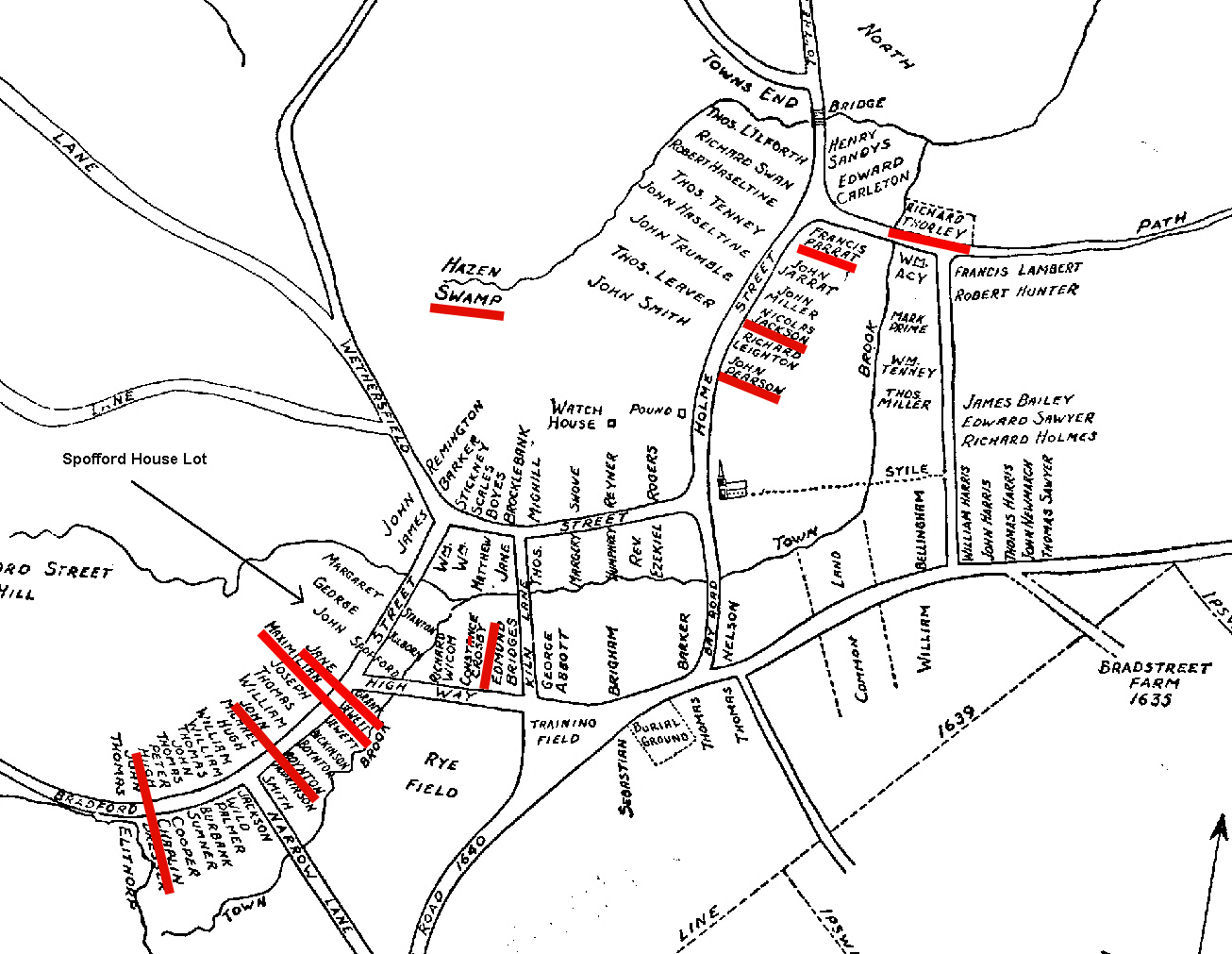
10 of our ancestor families (underlined in red) had plots in Rowley in this 1642 map.  Jane Grant’s lot was located at the corner of Bradford and High

.Here is today’s approximate location of Jane’s lot on Google Maps.

Children of Thomas and Jane:

Name Born Married Departed
1. Jane Grant 8 Mar 1626 Cottingham, Yorkshire, England 12 Mar 1626
Cottingham, Yorkshire, England
2. John Grant 5 MAR 1627/28 Cottingham, England Mary Hunt (Daughter of Enos HUNT)
1652 Ipswich, Mass
18 MAR 1695/96 Rowley
3. George Grant 16 Apr 1629
Cottingham, England
16 Apr 1629
Cottingham, England
4. Hannah GRANT 16 Oct 1631 Cottingham, England Edward HAZEN Sr.
Feb 1649/50 in Rowley, Mass
.
Capt. George Browne
Haverhill, Mass
Feb 1715/16 Haverhill, Mass
5. Frances Grant 12 Jun 1634 Cottingham, England Solomon Keyes
2 Oct 1653 Newbury, Mass.
1708 Chelmsford, Mass
6. Ann Grant 21 Dec 1637 Cottingham, England Robert Emerson
4 Nov 1658 Rowley, Mass
28 Jul 1718 Haverhill, Mass.

Who Do You Think You Are?

The Grants were featured in a 2007 episode of the BBC One series Who Do You Think You Are? See Edward HAZEN Sr.’s page for details

In a parish register for neighbouring Cottingham (the records for which go back to 1563), we found a baptism entry for Hannah Grant, daughter of Thomas Grant, in 1631. So Hannah was only six or seven years old when her family and their community made their epic journey to America. In a second volume, we found a record in Latin for the marriage of Thomas and Jane Grant, which took place on 21 September 1624.

With the assistance of documents nearly 400 years old, we had proved that Jodie’s ancestor Hannah Grant really did come from Yorkshire, and that before leaving for America she and her family worshipped in the Rowley church.

Before we left the church in Rowley, Reverend Angela showed Jodie a window that commemorates the communal exodus from Rowley in 1638.

The window incorporates images of the church, of Reverend Ezekiel Rogers, and of the men, women and children who joined him to leave Yorkshire forever. The window also features an image of Rowley church’s chalice, which the church still treasures. Jodie held the chalice, dated 1634, from which Thomas and Jane Grant would probably have drunk.

Ezekiel Rogers, St. Peter’s Church Rowley, England  – In 1994 the people of Rowley, Massachusetts gave to the church of St. Peter’s in Rowley, Yorkshire a stained glass window to honor the memory of their founder. This window depicts Rev. Rogers, several of the settlers and the ship upon which they sailed

Jodie Kidd (born 25 September 1978 in Guildford),  an English television personality and fashion model was featured on the show.

Affidavit filed in the Essex County Probate Court in the settlement of the estate of  John Grant, who died at Rowley, 18 Mar. 1696/97;

“I Sam Stickney Sr of Bradford do testifie and say That I came over from England to New England in the same ship wth Thomas Grant and Jame Grant his Wife, who brought over with them Foure Children, by name John, Hannah, Frances and Ann, whome I was well acquainted with, and next or near neighbours unto in Rowley. And ye said John being deceased, I do affirm that the sisters of John Grant above named, now by marriage knowne by he names of Hannah Browne, Frances Keyes, and Ann Emerson, are ye same yt came over sth their Father and Mother, and by them owned wth said John for their children.” Sworn to 20 July 1698.

Thomas and Jame Grant came from England in 1638. No record of their death is known, but as Widow Jane Grant she had a house lot on Bradford Street, Rowley, in 1643, and was taxed for two cows in 1653.   Satellite View of Today’s Bradford Street from Google Maps

The town of Rowley was settled under the leadership of Rev. Ezekiel Rogers, who arrived in Salem, Mass., in December, 1638, with about twenty families of his Yorkshire friends, “godly men, and most of them of good estate.” He had labored, with great fidelity and eminent usefulness, for seventeen years in the parish of Rowley, in the southern part of Yorkshire, but at length was suspended, “for refusing to read that accursed book that allowed sports on God’s holy Sabbath, or Lord’s day, and, by it and other signs of the times, driven, with many of his hearers, into New England.” The company spent the winter in Salem, some of them prospecting at New Haven, where they were importuned to settle. About April, 1639, increased to about sixty families, they made a settlement between Ipswich and Newbury, which was incorporated 7 Sept. 1639 under the name of Rowley.

“These people it appears, labored together and in common, for nearly five years from the time they commenced a settlement in this place; no man owning any land in severalty from the company, until after they had, probably, cleared up the lands on each side of the brook that runs through the central part of what is now the first parish in Rowley, and laid out the several streets as now improved.” [Gage, Hist. of Rowley, p. 122.]

Children

2. John Grant

John’s wife Mary Hunt was born about 1630 in England. Her parents were Enos HUNT and [__?__]. Mary died 16 Feb 1697 – Rowley, Essex, Mass.

4. Hannah GRANT (See Edward HAZEN Sr.‘s page)

Although the maiden name of Mrs. Hannah Hazen does not appear in her marriage record, in accordance with the practice of the town clerk for that year, nevertheless her family history is known from an affidavit filed in the Essex County Probate Court in the settlement of the estate of her brother John Grant, who died at Rowley, 18 Mar. 1696/97;

“I Sam Stickney Sr of Bradford do testifie and say That I came over from England to New England in the same ship wth Thomas Grant and Jame Grant his Wife, who brought over wth them Foure Children, by name John, Hannah, Frances and Ann, whome I was well acquainted with, and next or near neighbours unto in Rowley. And ye said John being deceased, I do affirm that the sisters of John Grant above named, now by marriage knowne by he names of Hannah Browne, Frances Keyes, and Ann Emerson, are ye same yt came over sth their Father and Mother, and by them owned wth said John for their children.” Sworn to 20 July 1698. [Essex Inst. Hist. Coll., 21:99.]

5. Frances Grant

Frances’ husband Solomon Keyes was born 1630 in England. His parents were Robert Keyes and Sarah [__?__] Solomon died 28 Nov 1702 in Chelmsford, Middlesex, Mass.

Genealogy. Robert Keyes of Watertown, Mass., 1633. Solomon Keyes of Newbury and Chelmsford, Mass., 1653. And their descendants: also, others of the name  By Asa Keys (1880)

A tradition prevailed among the earlier descendents of Solomon, and is now current among the older members or the “Keyes*’ family, that two brothers from England, settled in this country and were the ancestors of all of the name in America. Various names have been ascribed to the brothers, and different ports have been mentioned as their place of landing, but I find no record relating to either of them, earlier than that of the marriage of ‘Solomon Keies and Frances Grant at Newbury, Mass., Oct. 2. 1653.”

The birth of the five elder children is recorded at Newbury. In 1664 and 1665, Solomon and Joseph Keyes took up land in Chelmsford, Mass., and in that town is recorded the birth of the other children of Solomon and Frances. There appears to be no record of the marriage of Joseph, supposed to be the the brother of Solomon, or of the birth of children. He might have had children born in England, or before he came to this country. Solomon was town clerk and tything man in Chelmsford, and seems to have been a man of influence in those early days.

“The old Keyes homestead, par excellence, a roomy, two story white house, now [1880] more than two hundred years old, stands in the town of Westford, which was set off from Chelmsford, and incorporated in 1729, and most of the families of the name in that vicinity, are now said to be of Westford. The village according to an old writer, is handsomely situated on a swell of fine land, commanding a beautiful prospect of great extent, and contains an academy of ancient date and respectable standing.”

Solomon’s house in Chelmsford (now Westford), Mass.

There are beautiful views of the Monadnock mountain from certain points in the town, and a fair amount of summer visitors,  gives variety to the society, while the academy gives to it a tone of unusual intelligence.

In an old town book of Chelmsford, we find the following:

‘ Sar g nt Solomon Keys,
dyed, Mch 28, 1702.”
His wife Frances, died, 1708.

The name is spelled Keyes in the Newbury records, with one exception, where the second e is omitted, probably by mistake. At Chelmsford, the records make it Keies, generally, during the life of Solomon, although during the few years preceding, as in the record of his death, we find it sometimes Keys.

Solomon Keyes House

Inside Keyes House – Westford, MA – Westford Eagle By Kathleen Kirwin / Staff Photographer GateHouse News Service Posted Jul 23, 2008

Westford — More than a foot of grass, floors sinking to the basement and resident raccoons – these are what Phil and Abby Gilbert saw when they first looked at the Keyes house 15 years ago. Since then, the Gilberts have done sizable improvements to the house, refurbishing almost every room, landscaping and maintaining the difficult clapboard exterior.

“It has been a process but to own a property like this always is. You have to love the process as much as you love the finished product,” said Abby. According to papers from the Massachusetts Historical Commission, “Solomon Keyes, an early settler in Westford on Francis Hill around 1664, may have built 16 Francis Hill Road. The house may have been used as garrison to protect residents from attack by Native Americans. By 1730, the house was owned by Joseph Keyes, son of Solomon and selectman in 1730. The next owner was Jonathan, grandson of Joseph. By 1855, the owner was Trueworthy Keyes, grandson of Jonathan. His wife, Sophia, was resident here until approximately 1885. The land around the house on Francis Hill has been used for the cultivation of apples since at least the mid nineteenth century and continues to produce fruit today.”

Fifteen years go the Gilberts didn’t have much of an idea of where to start. All they knew was they loved the house. The couple had spent previous years as caretakers for people who lived in an older house and they felt at home in the 300-year-old property.

“It was love at first sight,” said Abby. Although the house seemed neglected, as the Gilberts started the purchasing process it became apparent there was still quite a lot of feeling invested in the property.

“The previous owner interviewed us to make sure we would keep the historical nature of the house,” said Abby. The previous owners had nothing to worry about, the Gilberts wanted to restore the house to its previous glory.

“We really wanted a home for our family,” said Abby. Since purchasing the house, the Gilberts have restored the foundation on the sagging house and put insulation in the walls. Phil, a carpenter by trade, has been building cabinets for the kitchen. Abby said they chip away at the project.

“We do it in our spare time,” said Abby. The kitchen has been remodeled slightly, as they cut away the wall that separated the main entryway from what used to be the buttery, a room where butter and cream were made. The large main fireplace still stands in the middle of the room. Abby said she the family still lights fires in it during the wintertime.

“It really is a comfortable place to sit and talk with other people,” said Abby. The kitchen is a long time coming since Phil is busy with work. For a few years the kitchen didn’t exist and Abby had to operate out of a makeshift one while they were tearing up the floors to replace the rotted wood. Now, at least, the kitchen is in its final resting place and waiting for a last coat of paint and some shelves.

“We joke about the kitchen all the time,” said Abby. The mudroom by the first staircase leading to the second floor has been turned into a second bathroom.

“When we moved here there was only a bathroom upstairs and I have three boys. So we squeezed one in the mudroom,” said Abby. The living room has also had some slight changes. A large window was taken out and replaced with double doors that will lead out to a patio over looking the backyard. Although the double doors are a big change to the room, the Gilbert chose doors that fit with the charm of the house and don’t seem out of place in the room.

An unexpected roadblock in the refurbishing of the house was furnishing it. “The doorways are so small, we had to really measure everything out before bringing it home,” said Abby.

The entryway at the front of the house is an example of the Gilbert commitment to keeping the house’s original character. Phil removed the old floorboards, sanded and refinished each one and nailed them back in place with rustic iron nails that resemble nails in other older parts of the house. The wall next to the stairway still has a small door leading to the smoke room where people would hang meats so they could be smoked from the heat of the fireplace.

Outside the Gilberts hired a landscaper to help fill in the receding yard and add rock steps leading down to the small pond on the side of the yard. Phil also built a rustic looking workshop on the property to run his carpentry business out of.

One of the biggest disappointments of remodeling was the treasures the Gilbert’s found while they were reconstructing the room. “We thought we would find little treasures an old pair of shoes or pictures but we found nothing,” said Abby.

The living room is the only room left to have the rotted wood pulled out and replaced. “I always joke with my three boys saying one day when we have a family gathering we are going to end up in the basement,” said Abby.

The Gilberts always encourage descendants of the Keyes to drop by their house and take a tour. Abby said they have had about 25 people visit so far.

“We love having them visit, just to hear their stories,” said Abby

6. Ann Grant

Ann’s husband Robert Emerson was born 8 Nov 1629 in Cadney, Lincolnshire, England. His parents were Thomas Emerson and Margaret Froe. Robert died 25 Jun 1694 in Haverhill, Essex, Mass.

Sources:

http://www.genealogyofnewengland.com/b_g.htm

http://familytreemaker.genealogy.com/users/f/l/e/Marion-Caswell-flemin/PDFGENE3.pdf

http://trees.ancestry.com/owt/person.aspx?pid=7721002&st=1

Genealogy. Robert Keyes of Watertown, Mass., 1633. Solomon Keyes of Newbury and Chelmsford, Mass., 1653. And their descendants: also, others of the name  By Asa Keys (1880)

Inside Keyes House – Westford, MA – Westford Eagle By Kathleen Kirwin / Staff Photographer GateHouse News Service Posted Jul 23, 2008

Posted in 12th Generation, Historical Site, Immigrant - England, Line - Miller, Pioneer, Storied | Tagged , , , , | 10 Comments

Edward Hazen Sr.

Edward HAZEN Sr. (1614 – 1683) was Alex’s 9th Great Grandfather; one of 1,024 in this generation of the Miller line

Edward Hazen Sr. was born 14 Dec 1614 in Cadney, Lincolnshire, England.  His parents were Thomas HASSEN and Elizabeth [__?__].  He emigrated between 1643 and 1647.  He married Hannah GRANT in Feb 1649/50 in Rowley, Mass.  Edward died 22 Jul 1683 in Rowley, Mass.
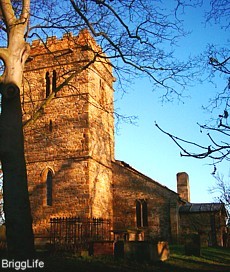
Edward Hazen may have been baptized in Cadney, All Saints Church

Hannah Grant was born 16 Oct 1631 in Cottingham, East Riding Yorkshire, England.  She immigrated with her parents Thomas GRANT and Jane HABURNE  in 1638.  The Grants were one of Rowley’s founding families who arrived on the ship John of London less than two decades after the Mayflower brought the Pilgrim Fathers to America.  A Puritan minister called  Rev. Ezekiel ROGERS  had founded Rowley. He had gathered together 20 families, including the Grants, from his Yorkshire parish of Rowley in England to establish the American Rowley.  After Edward died, she married Capt. George Browne of Haverhill 17 Mar 1683 in Haverhill, Essex, Mass.   Hannah died in Feb 1715/16 in Haverhill, Mass

Capt. George Browne was born 29 Aug 1622 in Salisbury, Wiltshire, England. His parents were George Brown and Christian Hibbert. He first married 25 Jun 1645 in Salisbury, Essex, Mass. to Ann Eaton (b. 1622 in England – d. 16 Dec 1683 in Salisbury). George died 31 Oct 1699 in Haverhill, Essex, Mass.

Children of Edward and Hannah:

Name Born Married Departed
1. Elizabeth Hazen 8 Mar 1650/51 Rowley Nathaniel Harris
5 Sep 1670 Rowley
24 Apr 1732
Rowley
2. Hannah Hazen Sep 1653 Rowley, William Gibson Before 1683
3. John Hazen 22 Sep 1655 Died Young
4. Lieut. Thomas Hazen 29 Jan 1657/58 Rowley Mary Howlett
1 Jan 1682/83 Rowley
12 Apr 1735 Norwich, CT
5. Edward HAZEN Jr. 10 Sep 1660 in Rowley Jane PICKARD
6 Nov 1684 Rowley
26 Dec 1748 Rowley
6. Isabel Hazen 21 Jul 1662 Rowley John Wood (Son of our ancestor Thomas WOOD)
16 Jan 1679/80 Rowley
7 Mar 1729
Littleton, Mass
7. Priscilla Hazen 25 Nov 1664 Rowley Jeremiah Pearson
(son of John PEARSON)
21 Jul 1681
Rowley
25 Apr 1752
Newbury, Mass
8. Edna Hazen 20 Jun 1667 Rowley Timothy Perkins
2 Aug 1686 Topsfield, Mass
1728
Topsfield
9. Lieut. Richard Hazen 6 Aug 1669 Rowley Mary Peabody
5 Dec 1694 Rowley
.
Mrs. Grace Hall Currier Kimball
3 Apr 1733 Haverhill
25 Sep 1733 Haverhill, Mass
10. Hepzibah Hazen 22 Dec 1671 Jonathan Dickenson
30 Jan 1693
Rowley
29 Nov 1689
11. Sarah Hazen 22 Aug 1673 Rowley Daniel Wicom
27 Jun 1690 Rowley
9 Apr 1706 Rowley

Evidence supporting the conclusion that Edward Hazen of Rowley, Massachusetts, the founding ancestor of the American family, was the same “Edwardus Hasson filius Thomae” who “fuit baptizatur 24 die Decembris 1614” as entered in the registers of Cadney, Lincolnshire

  1. The surname was not a very common one in England, and a great deal of research in Northumberland and Lincolnshire has not disclosed any other Edward Hazen of suitable age.
  2. No other history has been found for Edward Hazen (baptized 24 Dec. 1614), who was living in 1628 when his father made his will. No record of burial has been found in the search of many Parish registers of Lincolnshire. In July 1641, Parliament passed an act that Every clergyman should take a census of males over eighteen in his Parish, presenting to them for signature a paper upholding
    the Protestant faith. ; This “Protestation Roll” is very compete for Lincolnshire. It shows at Cadney, William Hassen, first cousin of Edward; at Great Limber, Richard Hason, Edward’s brother; and at South Ferraby, a Thomas Hason, servant to William Bromby. Edward does not appear in this Roll, indicating that unless he had died with record, he had left Lincolnshire before 1641.
  3. The date of birth is about what we should expect for Edward of Rowley, and makes him in his sixty-ninth year at death.
  4. The names which Edward of Rowley gave his children are very significant. The first child was Elizabeth named after his mother, and also his grandmother who lived until he was fifteen years old. The next child, Hannah, was named for Edward’s wife. Then came John, the eldest son, which was the name of Edward’s grandfather and elder brother. The next child, Thomas, was named after both
    grandfather, Edward’s father and Hannah’s father both bearing the name of Thomas. The next son, Edward, was named for himself, and the youngest, Richard, for Edward’s brother of that name. The names of the other children, who were daughters, are not significant, since Edward had no sisters for whom they could have been named.
  5. Other settlers in Rowley were from Lincolnshire, and after Edward Hazen married Hannah Grant, her sister Anna married Robert Emerson, who was, like Hazen, a native of Cadney.
On the “tenth of the eleventh Anno Dni 1643, Thomas Nelson, Edward Carlton, Humphrey Reynon & Francis PARROTT made a survey of the town and a register of the several house lots of from 1 1/2 to 6 acres then laid out to the settlers.
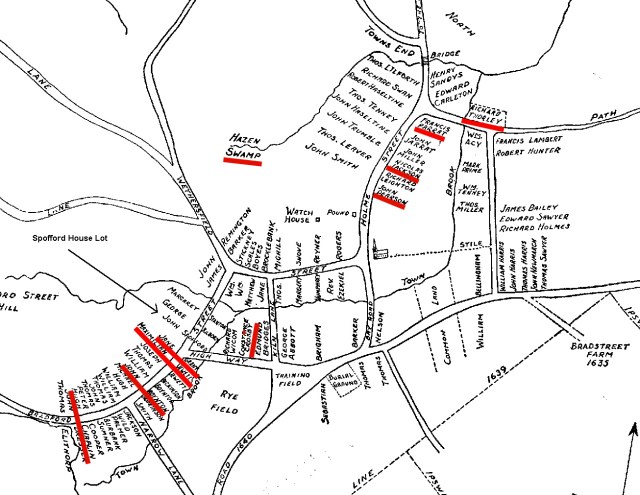
10 of our ancestor families (underlined in red) had plots in Rowley in this 1642 map.  The Hazen Swamp is in the northwest section of this map.

This road leads to Hazen Swamp today on Google Maps.

3 Jan 1650 – At a town meeting, Edward Hazen was chosen as on of the four overseers, and was again chosen to this office, 19 Dec 1651 and 12 Dec 1654. He was also overseer for the years 1660, 1661, and 1662, and was a selectman for the year 1669.

These overseers were not the same as selectmen, as sometimes has been stated, but were always named after and in addition to the select men, or “prudentiall men,” and in 1649 are described as “ouerseers for the execution of towne orders and Hy wayes.”

10 Jan 1660/70 – “Thomas Tene” and “Edward Hasne” werre chosen “ouerseers for vuiin fences and hywayes and vuiin Chimneys.”

1651 – Among the “Towne Charges for the year past : for John Smith for going to Court 0-4-6: alsoe for Edward Hasen the lyke worke 0-3-6.”

1665 – “Town charges : Edward hasen a Day Jury Man.”

The Ipswich Court Records and Files show that Ed. Hassen served on Trial Jury 30: 7: 1651 and also 26:7:1654.

9 Jan 1665/66 – Edward Hazon was chosen one of the four judges of delinquents “for not comeing to towne meetings”

9 Jan 1666/67 – “Edward hasen Judge for yeare ensuing.”

In a list [of town charges?] 1662: “Ed hason 0-10-2.” Towne charges 1667: “Edward Hason for ueiwinge fence 0-3-0.” In an undated record probably referring to King Phillip’s War and to Edward Hazen’s sone: “Work done for Samuel person in ye war–James Tenny 1 day: Thomas Hasen and Edward each a day.”

The follow account of the settlement of Edward Hazen’s estate is taken from the original papers, in two sheets, on file at Salem, and differs somewhat from the clerk’s book copy.
Edward Hazen and his wife Hannah appear in the following deeds:

Peter Eyers and wife Hannah of Haverhill convey to Edward Hasen of Rowley 6 1/2 acres of puland, Peter Eyers’ 3d division, with land abutting on the Merrimack River, (date not give in copy). Witnesses, Jno. Carlton, Jno. Gryffyn

Edward Hassen and wife Hannah of Rowley convey to John Tennie of Rowley 100 acres in the division called “Merimake land,” the northwest end abutting on the Merrimack River, and 4 acres of meadow called Crane meadow; also a parcel of land granted to John Harris, John Tod, Richard Longhorne, Richard Holmes, and Edward Hassen by the town of Rowley, dated 20 May 1664. Witnesses, Ezekiell Jewit, Thomas Tenny.
The name was signed “Hasin.” Edward acknowledged 16 June 1673.

John Pearly and wife Mary of Newbury convey to Edward Hazen of Rowley 7 acres of upland in Rowley Village-land of Thomas Pearly, Daniel Wood, and Ezekiel Northen mentioned, (date not given in copy). Witnesses, Benjamin Rolfe, Thomas Hale. John and Mary acknowledged on 19 Feb. 1684 and she resigned her right of dower to Edward Hazen’s administrators.

“Hanah ye Relict and late wife of said Edward Hason deceased & Edward Hason son of ye said Edward Hason Joynt administrators” confirm to Thomas Hason land in Rowley Village where he now lives and which his father Edward before his death settled upon him as his portion-land bought of John Pearly of Rowley Village and on 19 Feb 1684 acknowledged by him, dated 14 May 1685. No witnesses. Signed “Hannah Hazzen alias Browne.” Hannah acknowledged 19 May 1685; Edward, 4 Nov. 1685.

Hannah Browne of Haverhill, widow and relict of Capt. George Browne, “for & in consideration of natural & christian love & afection which I beare unto my loving & beloved sonns Thomas & Edward wch I had by my former Husband Edward Hazen long time deceased at Rowley,” conveys to them all the interest in the estate of her brother John Grant of Rowley, dec’d; 1 Mar. 1699 or 1700.
Witnesses, Thomas Eaton, Senr., Richard Saltonstall.

Capt. George Brown and wife Hannah of Haverhill convey to Thomas Carlton of Bradford 76 acres laid out to her former husband Edward Hazzen of Rowley, dec’d, and her part of the estate of Edward Hazzen in Bradford-widow Smith, widow Hobson mentionsed,
3 Apr 1697. Witnesses, Abraham Perkins, Solomon Reves, Senr., Jacob Perkins, 3d. Acknowledged 3 Dec. 1698.

Richard Hazzen, Thomas Hazzen, Edward Hazzen, Daniel Wicom, Junr., Nathaniel Storey, children of Edward Hazzen and Hannah, now wife of Capt. George Browne, quitclaim to Thomas Carlton, 3 Apr 1697. Witnesses, Edward Carleton, Nath. Walker, Solomon Keyes, Senr., Jacob Perkins, tertius.

An agreement concerning some land that was their father Edward Hazen’s and that after his death was laid out to his wife for her thirds, was made by Thomas Hazen of Norwich, John Wood of Bradford, Timothy Perkins of Topsfield, Edward Hazzen of Boxford,
Richard Hazzen of Haverhill; first, that Edward Hazzen is satisfied with 16 pounds already received, one ox gate in east end of ox pasture, and 5 pounds which his brothers promise to pay; secondly, that the others are satisfied with a piece of march, call cowbridge marsh, and a piece of land called cowbridge lot, and another piece of land in Symond’s new field from their mother’s thirds, taking in brother Jeremy Person, brother Harris’ children, brother Gibson’s children, and brother Wicom’s children, they having their share with the others; dated 20 June 1716. Witnesses, Thomas Perley, Junr., Nathaniel Perley.

On 4 July a “Hanah Hazen” was a witness to the will of Ann Swan, relict of Richard Swan of Rowley. [Essex Co. probate files, Docket 268976.] It is highly probable that she was the wife of Edward Hazen, as his daughter Hannah was presumably married before that date.

10 Jan. 1643 – A survey of the town was made by Mr. Thomas Nelson, Mr. Edward Carleton, Humphrey Reyner, and Francis PARROT, and the location and size of each house lot (consisting usually of an acre and a half) recorded; in this register the name of Edward Hazen does not appear. The remaining undivided land was called commons, and it was agreed that every 1 1/2 acre house lot should have 1 1/2 “gates” or cow rights in the common pastures.

In a later survey, undated, but probably made before 1647, is found the first mention of our common ancestor as a land owner, probably also the earliest record of the family in America:

Certaine Divisions of Meadow laid out in the Meadow Called Crane Meadow:
To Edward Hassen three Acres of meadow lying on the South east side of John Smithes meadow the northeast end abutting upon a pond the south west end upon the upland.
To Leonard HARRIMAN seaven Acres of meadow lying on the Southeast side of Edward Hassens meadow pt of it bought of William Hobson and pt of John Harris the east end abutting upon a brooke the west end upon the upland —
Uplands laid out at the plaine Called the Great plaine Imp
To Edward Hassen foure Acres & an halfe of upland at the plaine Called the great plaine lying next the south ffence by the Country way the east end abutting toward the fence the west end towards other.
To John Smith 5 Acres of upland lying on the north side of Edward Hassens land abutting as aforesaid.
To Thomas Tenny two Acres & and halfe of land lying on the north side of John Smithes land abutting as aforesaid.
To William Tenny two Acres of land lying on the north side of Thomas Tennyes land abutting as aforesaid

In a list, apparently regarding cattle about 1648, is found “Edw Hasen 2”

August 1650, apparently a tax list for oxen, “Edward hasen *2”; and a similar list slightly later, “Ed;hassen paid – butter.” “The names of those that has Calues & the number of them 1650: Ed Hasen – 1 T Tenne-1 Ri Swan-2.”

In accordance with an order made in the year 1650, the fences of the common fields of the town of Rowley were divided according to the proportion of land held by individual proprietors, and a number was assigned to each man’s portion; the comparative length of
the fence to be maintained by Edward Hazen and some of his neighbors who became ancestors of many Hazen descendants is of interest as indicating their relative holdings at this time: “the hundred and fort Rod of the feild fence which they who have gats in the ox pastur are to make and mainetaine its thus numbered as followeth

VI frances PARRAT six rale Length
VII Mr Shewell Twelue rale Length
VIII William Asee six rale Lengths
VIII Mr Carlton six Rale Lengths
X Thomas Teney six rale Length
XI Thomas Crosbee six rale Length
XII Richard Swane nine rale Length
XIIII Edward HASEN three Rale Length
XV Mr Ezekiell Rogers nineteene rale Lengths
XVIII Mr Thomas Nellson Thirty one rale Lengths

The fence between the ox pasture and the medow which is a two Rale fence at further sid of the ox pasture to ye mill ward thos are the severall proportions as folleth every ox gate Two rale lengths and euer aker of medow foure and a half–
II frances PARRAT foure rale Lengths
XVI Mr Ezekiell Rogers twelue rail Length
XVII Edward HASEN Twol rale Lengths
XVIII John Smith foure rale Lengths
XVIIII John PEARSON [also our ancestor] eighteen rale Lengths
XX Mr Edward Carlton Thirty rale Lengths
XXI Robert Swane foure rale Length & halfe and Richard Swane suenteene and half of length
XXII William BOYNTON [also our ancestor] nine rale Lengths
XXIII Will Teny and Thomas Teny nine Lengths

There were others with small holdings, but Edward Hazen’s proportion in comparison with those listed above was even less then appears, since their names are on another list from which his is absent.

5 May 1659 – “At a generall and legall towne meeting held the same tyme It was granted that Richard Swan and John Lambert should view and lay out a certaine percell of land as they shall see cause unto Edward Hazen Joyneing to his owne land in the Common feild nere Cowbridge.”

4 Feb 1661 – Edward Hazen had attained a relatively high degree of prosperity, as shown in “A Survay of The Seuerall Gates or Commonages belonging unto The seuerall Inhabbitants of The Towne of Rowley as They are Now in possession haueing Been Transfered and Sould from one To another since the Begining of the Said Towne”

To Edward Hassen his halfe two acre lot that he purchased of John Smith two gates and one quarter purchased of John Tod one gate purchased of the towne one and of Thomas Crosbie one 2 gates purched of Thomas Nelson one and one that he had of the towne for land he laid downe — 2 gates This total os seven and one quarter gates, or cattle rights, appears to have been surpassed only by Elizabeth Tenney alias Parratt and two or three others, the average number was about three gates to a proprietor.

Surveys in 1662: “To Edward Hassen as his first devission of land three acres and one hundred Rod be it more or less lieing on the south side of Richard hollmes land the west end buting against William tennys land the east against the common. To Edward Hasen
three acres and one hundred Rod lieing on the south side of Mark Prime’s land.”

In 1667 Hog Island marshes were divided and laid out, and Edward Hazen received a share. On 16 Apr. 1688, “the town passed an order, directing the town brook to be cleared out, three feet wide and two feet deep, and so kept: Beginning at Jonathan Jackson’s
land on Bradford Street, and so through Jachin Reyner’s land downward, till the brooks meet, and thence downward till the brook enters Satchwell;s meadow; and from Edward Hazen’s bridge in his swamp [Town’s End bridge] downward to the other brook-”

Who Do You Think You Are?

The Hazens were featured in a 2007 episode of the BBC One series Who Do You Think You Are?

Jodie Kidd (born 25 September 1978 in Guildford),  an English television personality and fashion model was featured on the show.  Jodie always knew that she had a Canadian background, and one that was potentially well established. But she had no idea that tracing her roots would take her to America.

Our cousin  — Jodie Kidd too tall for Mission Impossible II – 10th Round of BBC’s Strictly Come Dancing

The show followed William Hazen’s trade route from Saint John 300 miles south to where he was born in Haverill, Massachusetts, USA. Haverill is in the heart of New England and was once described by George Washington as the ‘pleasantest village’ he had passed through.  [Our Haverhill ancestors, the Dows  and the Bradleys also moved to New Brunswick]

STEP 1 – LOCAL HISTORIAN
The show arranged to meet local historian Thomas Spitalere. When visiting former communities of ancestors, it is always useful to gain local knowledge from historical experts or genealogists in the area. It is usually possible to find someone in advance, either through genealogical websites or by contacting local archives or family history societies before travelling to ask for their advice (see Related Links).

Thomas asked to meet him at a road junction in Haverill, and had brought some documents to show.

STEP 2 – VITAL RECORDS
The early records of New England towns are often very well preserved. In the 19th century, amateur historians transcribed the details of vital records (births, marriages and deaths). These records mean that it is possible to trace family lines right back to the first settlers in the town.

Since the earliest days of settlement, the town clerk of the community has been responsible for vital records. He or she is usually the best person to approach for advice about how to access the records.

Thomas brought some of Haverill’s vital records with him; birth records in particular. Through examining these records we discovered that William Hazen was born in 1738 to Moses Hazen and Abigail White.

The records also revealed that Moses was also born in Haverill, to Richard and Mary Hazen in 1701. This was an exciting discovery, as we were beginning to trace Jodie’s family right back to the earliest period of European settlement in the area.

Jodie noticed that we were talking to Thomas on the corner of Hazen Avenue. Thomas then revealed that a red brick house across the street was called the Hazen Garrison House, and had actually been built by Richard Hazen hundreds of years ago!

STEP 3 – ANCESTOR’S HOMES
For New England settlers, the allocation of land was very important. The promise of owning one’s own land and home was a major factor in people’s decision to leave Britain and travel across the Atlantic to America. As a consequence, it was important for communities to keep accurate records about which piece of land had been allocated to whom.

When searching for land owned by your ancestors, it can be helpful to look at local street directories (usually kept in local archives) for street names or house names that incorporate your family name. You can also search through deeds to find the exact location of your ancestor’s land. In addition, wills and inventories can reveal the location of property held by certain individuals.

Not only did the Hazen family home stand at the corner of Hazen Avenue, it was known locally as the Hazen Garrison House, and had Richard Hazen’s name recorded in its deeds.
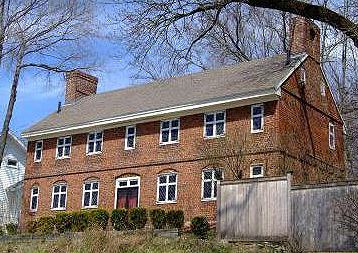
Hazen Garrison House

So Jodie was able to step inside the house that her great-great-great-great-great-great-great-grandfather Richard Hazen had built. She learned that the Hazen Garrison House was built with bricks, as opposed to wood, in order to defend the family and surrounding community from Native American attack.

During Richard’s life, Haverill was a frontier community surrounded by nothing but a vast expanse of open land. As the European settlements expanded, they encroached upon Native American territory, provoking attacks from tribes like the Abenaki. In one famously savage assault at the end of the 17th century, the Abenaki burnt many of Haverill’s wooden houses and killed 40 people.

The Hazen Garrison House had been built to provide a fortified refuge for Richard’s family and their neighbours as a response to this massacre.

Thomas also gave Jodie a document which referred to an even older Hazen, who could possibly have been Richard Hazen’s father. The document stated that Edward Hazen died in a place called Rowley in 1683. Rowley is only a short distance from Haverill, so we headed to the town to look for proof that Edward really was Richard’s father.

STEP 4 – LOCAL RECORDS
In Rowley we went to the Town Hall, where the local records are kept. Rowley was one of New England’s earliest settlements, founded in 1639. Like Haverill, it was originally inhabited by a small group of Puritans who emigrated from England.

The Town Hall holds a book called Early Settlers Rowley, Massachusetts. Within the alphabetical lists in the book, Jodie found an entry for Edward Hazen. She also found Richard’s name amongst the details for his children. The books stated that Richard was born in 1669 and went on to live in Haverill where his 11 children were born.

We wanted to know whether Edward had been born in Rowley too, but there was no date of birth recorded for him there. The earliest mention of the Hazen name referred to the burial date of Edward’s first wife, Elizabeth, in 1649. The Rowley archivist presumed therefore that any birth records for Edward would probably be found back in England.

GREAT-GREAT-GREAT-GREAT-GREAT-GREAT-GREAT-GREAT-GRANDMOTHER – HANNAH HAZEN (NÉE GRANT)
But before we left, the archivist directed our attention to Edward’s second wife Hannah, who was the mother of Jodie’s great-great-great-great-great-great-great-grandfather Richard Hazen.

Hannah had been born Hannah Grant to Thomas and Jane Grant, who were original settlers in Rowley. We learned that the Grants were one of Rowley’s founding families who arrived on the ship John, just two decades after the Mayflower brought the Pilgrim Fathers to America.

Jodie discovered that a Puritan minister called Ezekiel Rogers had founded Rowley. He had gathered together 20 families, including the Grants, from his Yorkshire parish of Rowley in England to establish the American Rowley.

We now wanted to find out what had made the Grants and Ezekiel Rogers come out to America.

STEP 5 – COMMUNITY HISTORY
We went to visit Reverend Bob Hagopian, Reverend Ezekiel Rogers’ modern-day counterpart in Rowley, to see whether he had any answers.

When groups of people have migrated across oceans and continents, it is likely that a common belief or interest bound them together and determined their communal history. Such experiences can be passed down in written and oral testimony and are often still commemorated today. In the Grants’ case, their religious faith was what led them to become part of a small, embattled Puritan community.

In the 1630s, during the reign of Charles I, Puritanism was not tolerated. The group of 20 families, led by Ezekiel Rogers, escaped this religious persecution to face a dangerous journey and harsh conditions in a place where they had to build a community from scratch.

STEP 6 – ENGLISH PARISH RECORDS
Jodie had travelled thousands of miles to Canada and America to discover that ancestors on one of her paternal lines were originally from Yorkshire. Back in England, we went to the original Rowley in Yorkshire and visited the church where the Reverend Ezekiel Rogers had ministered 400 years ago.

Jodie met Reverend Angela Bailey, together with East Ridings archivist Lizzy Baker. Lizzy had brought along some incredible parish records to show her.

Parish registers record baptisms, marriages and burials, and are a key resource when searching for ancestors prior to 1837, when civil registration began in England and Wales. They are usually held in county archives, and some can also be consulted online (see Related Links).

If you are tracing Puritan emigrant ancestors it is worth searching through neighbouring parish records as well as those for the parish in which they lived. Puritans would often travel to attend services led by preachers who reflected their own views, rather than attending the local church.

In a parish register for neighbouring Cottingham (the records for which go back to 1563), we found a baptism entry for Hannah GRANT, daughter of Thomas GRANT, in 1631. So Hannah was only six or seven years old when her family and their community made their epic journey to America. In a second volume, we found a record in Latin for the marriage of Thomas and Jane GRANT, which took place on 21 September 1624.

With the assistance of documents nearly 400 years old, we had proved that Jodie’s ancestor Hannah Grant really did come from Yorkshire, and that before leaving for America she and her family worshipped in the Rowley church.

Before we left the church in Rowley, Reverend Angela showed Jodie a window that commemorates the communal exodus from Rowley in 1638.
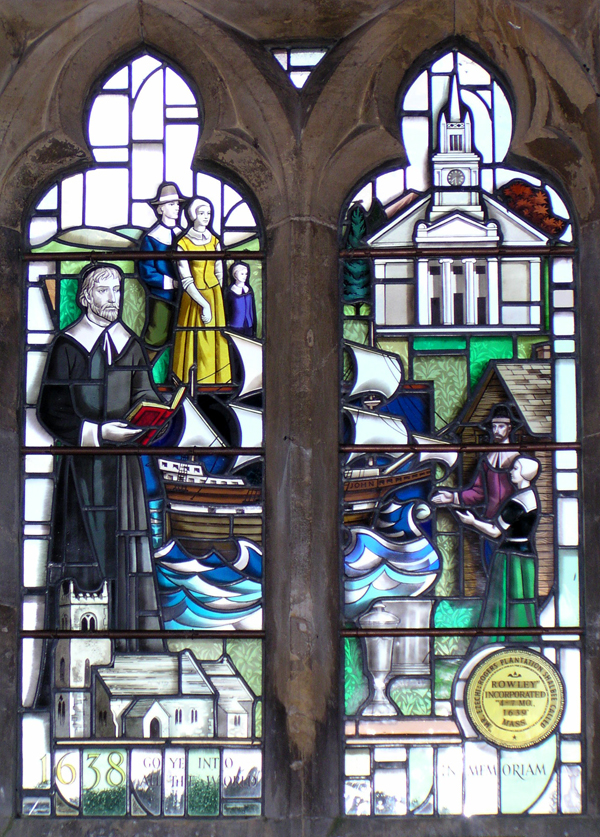
Ezekiel Rogers, St. Peter’s Church Rowley, England –In 1994 the people of Rowley, Massachusetts gave to the church of St. Peter’s in Rowley, Yorkshire a stained glass window to honor the memory of their founder. This window depicts Rev. Rogers, several of the settlers and the ship upon which they sailed

The window incorporates images of the church, of Reverend Ezekiel Rogers, and of the men, women and children who joined him to leave Yorkshire forever. The window also features an image of Rowley church’s chalice, which the church still treasures. Jodie held the chalice, dated 1634, from which Thomas and Jane Grant would probably have drunk

Children

1. Elizabeth Hazen

Elizabeth’s husband Nathaniel Harris was born 1647 in Rowley, Essex, Mass. His parents were John Harris and Bridget Angier. Nathaniel died 24 Apr 1732 in Rowley.

Nathaniel Harris of Rowley, bought land in York, 1701-03, and lived there 1703-06; and called of York, formerly of Rowley, conveyed land in Rowley in 1703. He was of Pembroke, Plymouth County, Mass., 1715/16, when he sold 50 acres at Coxhall to his son-in-law John Prichard of Boston.

Children of Elizabeth and Nathaniel

i. Nathaniel Harris b. 6 Jan 1671 in Rowley, Essex, Mass.

ii. Bridget Harris b . 26 Nov 1672 in Rowley, Essex, Mass

iii. Hannah Harris b. 10 May 1679 in Rowley, Essex, Mass

iv. Sarah Harris b. 2 Apr 1681 in Rowley, Essex, Mass

v. Jane Harris b. 12 Mar 1683 in Rowley, Essex, Mass

vi. Eleazer Harris b. 0 Oct 1686 in Rowley, Essex, Mass

vii. Edward Harris b. 25 Jan 1689 in Rowley, Essex, Mass

viii. Elizabeth Harris b. 3 Nov 1694 in Rowley, Essex, Mass

ix. Job Harris b. 29 May 1698 in Rowley, Essex, Mass

x. John Harris

2. Hannah Hazen

Hannah’s husband William Gibson was born in 1651 in Rowley, Essex, Mass. William died in 1711.

4.  Thomas Hazen

Thomas’ wife Mary Howlett was born about 1664 in Ipswich, Mass. Her parents were Thomas Howlett and Lydia Peabody.  Mary died 24 Oct 1727 in Norwich, Connecticut.

Lieutenant Thomas Hazen’s name is on the roll of Major Samuel Appleton’s company which served in the Narraganset campaign in King Phillip’s War in 1675,.  He is on a list of divers persons who were “damnified” by the burning of Major Appleton’s tent at Narranganset, whose losses the court voted to repay, Sept. 1676.  Narranganset was the Great Swamp Fight of 19 Dec 1675.  As a reward for this service he was made one of the grantees of Narraganset Township No. 4 (now Greenwich, Mass.), the grant being confirmed about 1738-40. [Bodge, Soldiers of King Philip’s War, pp. 154, 157, 426.]

He was in possession of a farm in Rowley given him by his father at the death of the latter. Soon after his marriage he removed to Boxford, where he was made freeman, 22 Mar. 1689/90. He was admitted to full communion in the church in Topsfield, 28 Aug 1687. He was dismissed from this church, where the record of the baptism of most of his children is found, to become one of the members of the church in Boxford, 4 Oct. 1702.

The records of the town of Boxford contain many items which are of interest in showing his growing importance in the life of the community.

“At a legal Towne meting hild in Boxford the — day of March 1687–Thomas Radington Thomas hazan Josaph Andrus be Chosen Survaiers.” On “2 July 87 the Selact men of this Towne of Boxford have leat the pasoneg medow to Thomas hazen and daniel wood this presant year for Six shillings to be payed in Coren to the Cunstabul for the Ves of the Towen.”

On 21 May 1688, “the Town choes 6 men for Selact men for ye year in sewing by a voat” of whom Thomas hazen was fourth.
On 24 June 1689, “Corporall Thomas hazen” was second of the “Selact men,” also on 8 Mar 1691/92 and 13 Mar 1693/4, “Corporel Thomas hazen’s” name is first among the five “selact men.”

On 29 Jan 1694/95, “the Town Choes 5 men to be a commety to carey on the worck of bulding the meting hous in the Town of Boxford a Cording to thair beast discrasion,” of whom Thomas hazen was one.

In Feb 1696/97, Thomas “hazen” was chosen one of the “fenc vewars for the yer insewing.” “At a Lawful town meetin ghild in Boxford the Eai[g]th of Septem 1698 the Town Choes Thomas hassen moderator.” On 3 Jan 1698/9, “The Town Choes Sargent hazen moderator for the day”; also “Sargent Thomas heasen” was one of the “5 men Chosen for our Commety to carey on the meting hows.”

On 12 Mar. 1699/1700, “first the Town Choes E[n]sien hazen moderator for the day.” On 16 Jan. 1700/1, Samuel English, an Indian, for the sum of nine pounds, gave a deed for the 12000 acres constituting the township of Boxford to a committee of five men appointed by the town, of whom Ensign Thomas hazen was one.

On 20 Jan 1700/01, “the Town has voted to Choes 5 men to settel our inhabetane of the Town in seating our inhabitane in our meting hous a Cording to thair Sivel wrights having Regard Chefly to Estats yet soe as to have Respacts to ould age: the men Chosen for this servis bee as foloweth Ensien hazen Sargent bixbee Corparal Radington John Andrus and Jonathan foster.” On 11 Mar. 1700/1, “the Town Choes william foster and Ensien hazen tithing men for the year.” “At a Town meting hild in Boxford the 24 of november 1701 The Town Choes Ensien heasen moderator for the day.”

10 Mar 1701/02 – “Ensien hazen is Chosen town Trasurer for the year insewing …. also Ensien hazen is chos to saru on the Jury of trials this next Court to bee houlden at Ipswich.” “At A law Full towen meting held in Boxford Dacember the 15:1702 the tow[n] chos insin hazzan modarator for the day” (record by Joseph Bixby).

9 Mar. 1702/03 – “the Town Choes Ensien Thomas hazen moderator for the presant meting . . . .also the Towen have chosen 5 Selact men and thaier names be as followeth: John pebody Ensien Thomas hazen Jonathan foster Samuel Simons juenr and Timothy Dorman . . . also the Towen Choes Ensien Thomas hazen Towen treasurer for the yer.”

On 22 Feb. 1703/4, “Ensien thomas hazen” was chosen in place of Zerrubabal Endicot to whom the town of Topsfield made objection to serve on a committee to settle the bounds between the towns. On 13 Mar. 1704/5, “The Towen Choes Insien hazzen moderator for the presant meting . . .also voted by the Towen that Ensien hazen shal be Towen trasurer for the year insuring.” On 26 Feb. 1705/6, “also Towen Choes Ensign hazzen Sargent bixbe and Zerobebabel Endicot to vew a pees of land that John wood desirad of the Towen lying in the Eastwardly corner of the pasnig farm and to mack Retorn to the towen what they did Estem sd land to bee worth.”

12 Mar 1705/06 -“also Ensien hazzen is Choes Selact man for the yer 1706 also assesar for 1706 . .also Insien hazen is chosen Touen Trasurer for the year in sewing . . .. also . . . wee haue chosen leiut pebody Ensien hazzen and John Eames to bee a Commety to meet with Topsfiles commety . . . a bout a deuiding lien between our towens.” He was a selact-man also in 1708, and 13 Mar. 1710/11 “The Town chos Leften. hazen for Town Clark” to succeed Capt. John Peabody, who had filled the office till that time.

Probably it was not until the spring of the following year that he removed to Norwich, Conn., for his first deed there is dated 17 Mar 1711/12, and reads “Thomas Hazzen of Boxford, Mass., yeoman,” bought of Jonathan Hartshorn for 200 pounds, twenty acres “on the east side of the highway that leads to Pottapouge, with a dwelling house, abutting easterly on the land of Benjamin Armstrong.” He was admitted an inhabitant in Norwich, 21 Dec. 1712. “Mr. Thomas Hazen member of ye church in Boxford” and his wife were received into the First Church of Norwich (date omitted in the church records); in 1716 he and his sons John and Thomas were among the petitioners for the formatioen of the West Farms Society to accommodate the portion of the town in which they lived, and 4 Jan. 1718, upon the organization there of the Second Church of Norwich (now the Franklin Congregational Cahurch), Thomas Hazzen and Mrs. Mary Hazzen were among the original members.

No record of the will of this Thomas Hazen has been found, and probably he left none, for he gave each of his two sons a farm soon after their marriage, and the following deed dated 5 Feb. 1717/18, provided for the rest of the children: ‘

“I Thomas Hazzen . . . for and in consideration of ye love goodwill and ffatherly affection which I have and do bare towards my well beloved son Jacob Hazzen, ye same Norwich afores’d Together with ye Consideration of good and sufficient security by my s’d son Jacob given to me at ye signing and sealing of these presents for ye payment of Thirty pounds apiece to his seven sisters (that is to say) thirty pounds to each of them yt have had nothing, and to make up ye sum of Thirty pounds to each of them yt have had part thereof allready, and also to take care, with myself, to pay my just Debts during my life, and after my death to discharge all my Just Debts,. . . have and do give . . . .unto him my s’d son Jacob Hazzen all my farme of lands which I now live uon in ye Township of Norwich and was laid out in four pacells, To say fourteen acres lying on ye East side of ye highway yt leads to pottapauge with ye dwelling house upon it. . . .with twenty three acres on ye west side of ye highway opposite . . .with twenty two acres on ye east side by ye house . . . .with four acres on ye hill called mount hope.”

This farm descended directly to Jacob”s great-grandson, Col. Henry Hazen of Franklin; it was more recently owned by a Driscoll family.

On a mound called the Old Indian Burying-ground in a field opposite the house, is a tombstone inscribed “HERE LYES Ye BODY / OF MRS MARY HAZEN / LAT WIFE TO LEUT / THOMAS HAZEN / WHO DIED OCTOr / Ye 24 1727 AGED / 63 YEARS.”

It is said that her husband was also buried there, but no stone remains to mark his grave. It is said that some stones were taken from this place by an irresponsible Irishman, for use as rabbit traps.

Children of Thomas and Lydia

i. Hannah Hazen b. 10 Oct 1685 Boxford, Mass.; d. 17 Oct 1740; m. 15 Nov 1705 Boxford, Mass. to John Symonds

ii. Alice Hazen b. 10 Jun 1686 Boxford, Mass.; d. 17 Oct 1740 Boxford, Mass.; m. 20 Dec 1710 Boxford, Mass.to Jeremiah Perley

iii. John Hazen b. 23 Mar 1686/87 Boxford, Mass.; m. Mercy Bradstreet

iv. Thomas Hazen b. 7 Feb 1688/89; d. ~1776 Norwich, CT; m. 30 Sep 1714 Norwich, CT. to Sarah Ayres  Her parents were Joseph Ayres and Sarah Corliss. Her grandparents were George CORLISS and Joanna DAVIS.

v. Jacob Hazen b. 5 Dec 1691

vi. Lydia Hazen 1 Sep 1694 Topsfield, Mass.; m. 17 Mar 1712/13 to Benjamin Abell. His parents were Benjamin Abel and Hannah Baldwin. His grandparents were Robert ABELL and Joanna [__?__] .

vii. Mary Hazen b. 1 Sep 1694 Topsfield, Mass.; m. 4 Jul 1711 Boxford, Mass. to Increase Moseley

viii. Hephsibeth Hazen b. 22 Mar 1695/96

ix. Ruth Hazen b. 3 OCT 1699 Boxford, Mass.; d. 18 Feb 1739/40 Norwich, New London, CT.; m. 25 Feb 1723/24 Norwich, New London, CT. to Jabez Crocker

x. Jeremiah Hazen b. 4 Jan 1700/01; d. d. 12 Oct 1721

xi. Edna Hazen b. 25 Dec 1704 Boxford, Mass.; d. 28 Sep 1774 Lebanon, CT.; m. Joshua Smith His parents were Martha Abell and Obidiah Smith. His grandparents were Joshua ABELL and Mehitable SMITH.

5. Edward HAZEN Jr. (See his page)

6. Isabel Hazen

Isabel’s husband John Wood was born 2 Nov 1656 in Rowley, Essex, Mass. His parents were Thomas WOOD and Ann HUNT. John died 24 Jun 1735 in Littleton, Middlesex, Mass. Alternatively, John died 7 Mar  1729 probably in Littleton

John and Isabel Wood settled soon in Bradford, Mass., and lived there for many years.  On 22 Aug. 1726, they sold their land there to Robert Savory, and followed their eldest son to Littleton, Mass., where John Wood had bought a farm, 11 May 1726. This farm of 160 acres with buildings thereon, John Wood, Sr., deeded 7 March 1728/9 to Joseph Wood, carpenter, both of Littleton. Richard and Josiah Wood witnessed this deed.

In Mr. George B. Blodgette’s Early Settler of Rowley [Essex Institute His. Coll., 24:61], it is stated that John Wood was of Rowley Village (Boxford), 20 June 1680, but this is based on the baptism on that date of “Goodman Wood of ye Village, son John”; however, Daniel Wood has settled in Boxford about 1675, and had a son John born 25 March 1680, to whom this baptismal record doubtless applies.

During King Philip’s War, John Wood served at Marlborough as a private under Capt. Samuel Brocklebank of Rowley, his name appearing on pay-rolls dated 24 March 1675/6 and 24 June 1676; also, 24 Aug. 1676 his wages (£3.15.08 ) were assigned to the town of Rowley. His name appears on the list of proprietors of Narragansett Township No. 6, now Templeton, Mass., granted 12 Feb. 1733 to veterans living in Littleton and neighboring towns. [Bodge, Soldiers in King Philips War, pp. 207, 271, 435..

Children of Isabel and John

i. Hannah Wood b. 20 Jan 1681 in Rowley, Essex, Mass

ii. John Wood b. 13 Feb 1683 in Rowley, Essex, Mass

iii. Priscilla Wood b. 27 Aug 1686 in Bradford, Essex, Mass

iv. Edward Wood b. 7 Sep 1689 in Bradford, Essex, Mass

v. Thomas Wood b. 28 Nov 1691 in Bradford, Essex, Mass

vi. Samuel Wood b. 18 Nov 1693 in Bradford, Essex, Mass

vii. Joseph Wood b. 5 May 1696 in Bradford, Essex, Mass

viii. Ebenezer Wood b. 8 Sep 1698 in Bradford, Essex, Mass

ix. Bethia Wood b. 19 Jan 1703 in Bradford, Essex, Mass

x. Richard Wood b. 30 Jan 1705 in Bradford, Essex, Mass

xi. Josiah Wood b. 5 Apr 1708 in Bradford, Essex, Mass.

7. Priscilla Hazen

Priscilla’s husband Jeremiah Pearson was born 25 Oct 1653 in Rowley, Essex, Mass. His parents were John PEARSON and Dorcas PICKARD. Jeremiah died 23 Feb 1737 in Newbury, Essex, Mass.

Being dimissed from Rowley they joined the Newbury church, January 15, 1710

Children of Priscilla and Jeremiah:

i. Priscilla Pearson b. 3 Dec 1682 in Rowley, Essex, Mass

ii. John Pearson b. 10 Apr 1690 in Rowley, Essex, Mass

iii. Hephsibah Pearson b. 10 Dec 1692 in Rowley, Essex, Mass

iv. Miriam Pearson b. 8 Feb 1695 in Rowley, Essex, Mass

v. Moses Pearson b. 26 Mar 1697 in Rowley, Essex, Mass.

vi. Jeremiah Pearson b. 12 Sep 1699 in Rowley, Essex, Mass

vii. Amos Pearson b. 5 Jan 1702 in Rowley, Essex, Mass

viii. Hannah Pearson b. 12 May 1704 in Rowley, Essex, Mass.

8. Edna Hazen

Edna’s husband Timothy Perkins was born 11 Aug 1658 in Weymouth, Norfolk, Mass.  Other sources say he was born in Topsfield.   His parents were  William Perkins and Elizabeth Wooten.  Timothy died in 1728 in Topsfield.

His parents were not Thomas Perkins and Phebe Gould, whose grandparents were our ancestors John PERKINS and Judith GATER.   This other Timothy Perkins was born 6 Jun 1661 in Topsfield, Essex, Mass.  and died 18 Dec 1751 in Topsfield, Essex, Mass.  He married, first, Hannah , about 1688-9. She died about 1693. He married, second, Abigail , about 1694. She died about 1710-11. He married, third, Ruth Dorman about 1712. The dates of the several marriages of Timothy Perkins are very unreliable, as the early records are exceeding defective; we only base a conjecture upon the mention of the births of their children. In the last will of Ephraim Dorman of Topsfield, he mentions the fact that his daughter, Ruth, had married Timothy Perkins, and was then dead, leaving a daughter, Ruth, to whom he gives “Ten pounds if she live to the age of eighteen years.” This will was signed in July, 1720.

Going back to the 1500s, the two lines are not related. Both come from Warwickshire England but are perhaps 30 miles apart there. The two Perkins men also came to America in the early 1630s and were both in Ipswich it would seem at the same time at least briefly.

The will of Timothy Perkins of Topsfield, dated 10 May 1727, proved 30 Sept. 1728, gave “to my dearly beloved wife Edna Perkins ye lower Room in the west end of my house and cellar room, with the improvement of all my household goods during her natural life and £30, and if that is not enough comfortably to subsist her then I order my executor to pay to her £35 a year during her natural life”, to my son Timothy Perkins, a confirmation of what I gave him by deed and £5; to my son Nathaniel Perkins, £5; to my son Jacob Perkins all the homestead (except my wife’s portion) together with all but five acres of the pasture adjoining and my meeting house lot and marsh land in Ipswich; to my son William Perkins, all remainder of lands and meadow in Topsfield on the north side of Ipswich River; to my daughter Hephsibah How, £43; to my daughter Hannah Nickolls, £23

9. Richard Hazen

Richard’s first wife Mary Peabody was born 6 Apr 1672 in Boxford, Essex, Mass.  Her parents were John Peabody and Hannah Andrews. Mary died 13 Sep 1731 in Haverhill, Essex, Mass

Richard’s second wife Grace Hall was born 25 Nov 1672 in Groton, Middlesex, Mass. Her parents were Christopher Hall and Sarah [__?__]. She first married 7 Feb 1706 in Haverhill, Essex, Mass.to John Currier (b. 22 Apr 1673 in Haverhill – d. 25 Jul 1722 in Haverhill) She married second 4 Sep 1729 in Bradford, Essex, Mass to Thomas Kimball (b. 1665 in Ipswich – d. 11 Jan 1732 in Bradford). Grace died 20 May 1761 in Haverhill, Essex, Mass.

9 Sep 1693 – Richard was adopted by his step-father Lieut. George Browne, as his sole heir, and upon the death of the latter, 21 Oct. 1699, came into his large estate in Haverhill.

Richard was an officer in the militia, and served at Constable in Haverhill in 1702
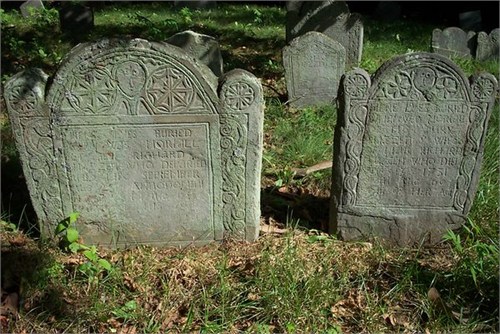
Richard Hazen Headstone – HERE LYES BURIED WHAT WAS MORTALL OF LIEUT. RICHARD HAZEN WHO DEPARTED THIS LIFE SEPTEMBER the 25th ANNO DOMINI 1733 IN the 65 YEAR OF HIS AGE HERE LYES BURIED WHAT WAS MORTALL OF MRS MARY HAZEN Ye WIFE OF LIEUT. RICHARD HAZEN WHO DIED SEPT 13th 1731 IN the 60th YEAR OF HER AGE

Hazen was involved in drawing the border with New Hampshire, and one of his sons was involved in settling Concord, N.H.

Richard Hazen built the English manor-style house at 8 Groveland St. in 1724 about 75 yards from the Merrimack River, where he wanted to build a trading wharf. The city was settled only about 80 years earlier.

Other owners of the home include Wallace Nutting, a minister, author, photographer and entrepreneur, who bought the home in 1914.  John Moulton, a Haverhill librarian who bought it in 1919.

Wallace Nutting  rebuilt colonial houses at the turn of the 20th century. He had an eye for special houses – this is one of only three brick First Period (i.e., before 1725) houses built in Haverhill. Brick arches span the windows and reinforce the chimneys, and only 4 rooms large, the house feels bigger because the chimneys are built within the ends, as part of the brick walls. So, unlike a center chimney colonial with two windows on either side of the front door, here there are three – the third being a little window for the cubby hole by the fireplace. The chimney and fireplaces are set into the rooms because once they are warmed by fires; they radiate heat into the rooms.

Hazen Garrison House , 8 Groveland St., Haverhill, 1724

Here is the house today on Google Street View  Near the intersection of Hazen Street and Garrison Square.  The house is only about 150 feet from the banks of the Merimac River.
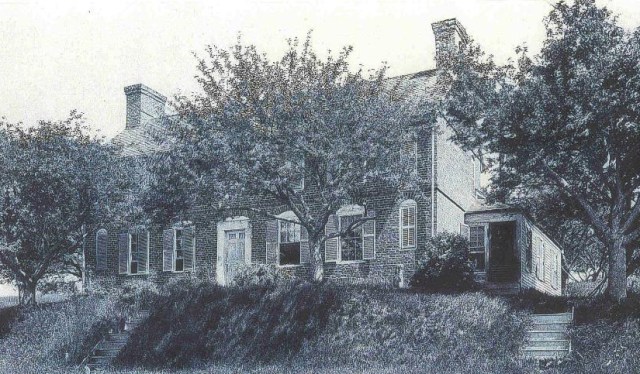
Hazen Garrison House c1870  Note how Nuttering changed the exterior

Wallace Nutting had no doubts about how this house must have looked originally.  Discarding the existing windows – square paned traditional sash that slid up and down – he added the diamond paned hinged casements seen in this photograph, sure that the house had originally looked like an English medieval manor. He wanted the house to have been built before 1700. Today, we date it to about 1724. Nutting labeled it a ‘garrison’, referring to the last American Indian raid on Haverhill, which was in 1721. So this house may have been  made of brick at the second and third floor is not an overhang of one floor over another, but a way of covering the ends of the wood joists, which tie into the brick wall there.
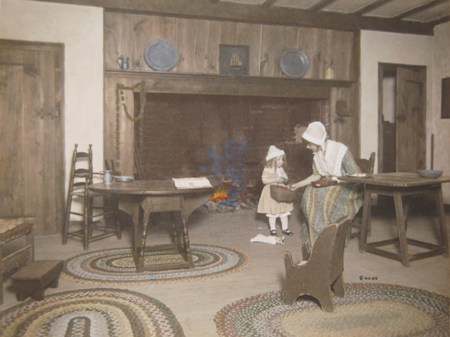
A Little Helper – Taken inside the Hazen-Garrison House, Haverhill, Massachusetts; one of the five old houses Wallace Nutting owned and furnished with antiques for his picture business.

The Hazen “Garrison” House Built 1680 – 1690
8 Groveland Street, Haverhill, Mass. three quarters of a mile down river from Haverhill bridge Author: Wallace Nutting

This house, though reputed to have been built to serve on occasion as a garrison, problably gained its reputation because it is brick and has two large ovens such as garrison houses had, to provide cooking facilities for many refugees in emergency. Its solid oak doors (restored) certainly gave it strength. But at that period all windows were small and, so far as known, were always leaded. So late as 1720 leaded windows were used in new houses. This house is a beautiful type of the small English manor. Such a house exists in Kent today and the resemblance is so close as to make it probable that our house is a copy of that.

The Hazen House stands on a high bank overlooking the Merrimac River, and is easily noticeable as one follows the river road from the city. The present entrance is at the corner, to avoid a flight of steps.

The bricks are laid in shell mortar, which was very convenient in the early days, kitchen middens made by the Indians being available for shells. The bricks, if brought from England, probably came as ballast, and not because they were not obtainable in America.

The notable feature of the exterior is the fenestration, there being, besides the two usual windows in the rooms each side of the front door, two additional windows on both floors, at the ends, and of half width. A similar narrow window is above the front door in the second story hall. The beauty and the balance of this arrangement is thoroughly good and quite charming. The double door also has a transom. The knocker is a very early and beautiful type. One steps over the raised sill as over a high threshold. The exterior, for the rest, is just as originally designed. The end chimneys enhance the effect of balance. A modern ell was removed and a fireproof service building, completely detached, constructed in the rear. The fenestration of the rear of the house is also very interesting.
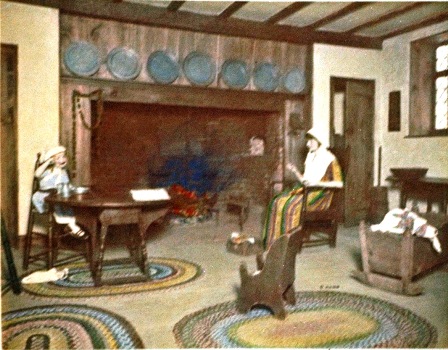
By The Great Horn Spoon – a companion photograph titled, A Little Helper” studio # 9212 which has the child standing next to the woman who is still seated

The Kitchen and the parlor have each of them eight-foot fireplaces. One should open the closet doors in the kitchen to observe the beehive-shaped ovens. Also, now that we are within doors, the reason for the narrow windows appears. They light the closets, on both floors, each side of the chimneys.

On the kichen side, on both floors, the house has not only wooden latches, but even wooden hinges of oak. Some of these are as old as the house. In the earliest days iron was dear and mostly came from England. Hence wood was made to serve many purposes usually served by iron. The remaining hardware of the house is all old, except that on the windows. Strap and butterfly hinges appear in the parlor and parlor chamber.

The furniture in the kitchen comprises a butterfly table (so called from the shape of its swinging brackets) with the original heavy pine top. A large splay-legged table with fine heavy turnings (two stretchers restored) is another good piece. Hornbeam barrels, hollowed from the log, stand in the corners.

The little settle is really a sleigh or pung seat [Pung – Chiefly Eastern Canada and New England, a sleigh with a boxlike body.], the marks of wear appearing on the ends, where it bore against the high sides of the pung. Such seats were made removable, so that on occasion the pung could be used as a freight vehicle. A low and a high child’s chair are of rare merit, the high one showing straddling legs to save its occupant from tipping over. There is a Jacobean cradle, with Cupid’s bow edge, and other interesting chairs and tables and a “wag-on-the-wall.” The old dresser is probably somewhat later than the house, but it is plainly the ancestor of the modern kitchen cabinet.
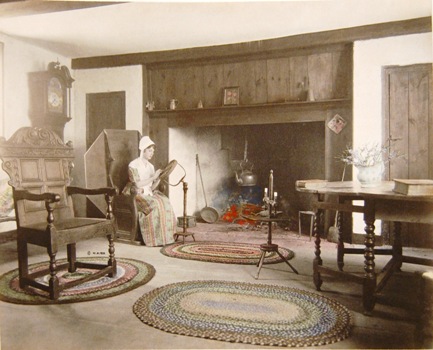
Embroidering – Taken inside the Hazen-Garrison House, Haverhill, MA. One of the five old houses Wallace Nutting owned and furnished with antiques for his picture business. Note the large fireplace

The hall contains among other things a small turned table of rare style with splay legs. The front-door fastenings should be observed, and the fine latches on both doors.

There is a small desk of turned pattern in the parlor. The great double gate-legged oak table is rare. The large carved oak wainscot chair is a fine specimen. A side table with carved rail merits careful attention. A bible box rests upon it, and an early mirror is above. The day bed (couch, chaise longue) is a piece dating from 1700 and is in fine condition. The origin is perhaps Pennsylvanian. The rush seat, of course, is recent.

Of great interest are the very rare chair table and candle stand. The table is in pine. The top has battens with Gothic suggestions, and the panels at the ends are curved. The candle stand has both the candle bar and the circular table, each rising and falling on a wooden screw which forms the standard. The piece is all original.
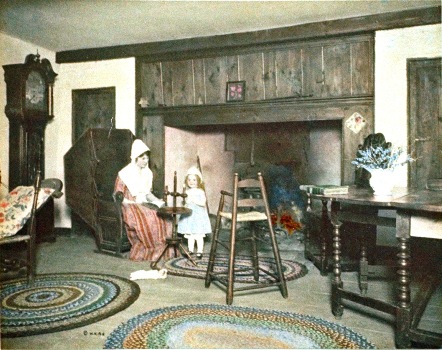
The Whirling Candle Stand – By Wallace  Nuttering in his restored Hazen Garrison House

The huge and heavy “back bower” is very early and interesting. The burn in the back was caused by a Betty lamp. There is a pair of caned armchairs well carved, so that this house presents upstairs and down a remarkable number of Jacobean specimens. A three-legged folding gate table is among the rarest pieces. It is all original except one foot.

The engravings date from the early part of the eighteenth century. The embossed leather pieces represent scenes from sacred history.

The corner cupgoard excites admiration from its rosette decoration. At the time of this house only pewter, wood, and earthenware were used on the table, unless a family possessed silver.

Without mentioning other articles we proceed upstairs, noting that the rail and steps are largely original. In the front of the hall is a little room for shoemaking, with a toggle-jointed cobbler’s lamp bracket. The significance of this room lies in the fact that the house a century or so ago was used as a shoe manufactory, said to be the first in America, just as Broadhearth was the seat of the earliest iron manufactory. This little room was the office.
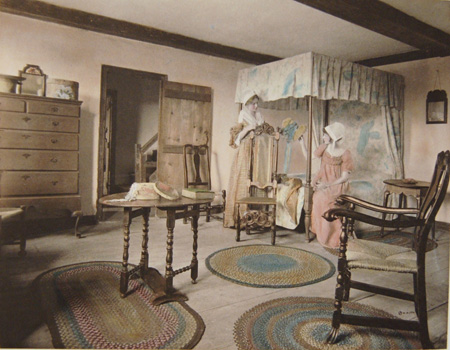
Proud as Peacocks – Taken inside the Hazen-Garrison House, Haverhill, MA. One of the five old houses Wallace Nutting owned and furnished with antiques for his picture business.

The kitchen chamber contains a loom, a reminiscence of the day when all cloth was made at home. The bed and trundle bed are quaint. A very rare piece is the Queen Anne table, with heavy pine-turned legs (part of the outside of balls testored). This table is not the base of a highboy, but was used to hold a small, movable chest. Note that it stands low. We have accordingly placed on it a rare pine desk box, with carving. The combination is very happy.

A Chair here (rockers, of course, added) has the heaviest and quaintest front stretcher (rung, round) the owner has seen. The heavy arm Windsor (black) is one of the finest known as regards the ramp of the seat and the sharply scrolled carved arm. The chest with turned legs is an odd survival. The table with spraddled bulldog legs, and several odd chairs or chests, make this a room of many attractions.

The parlor chamber proves attractive. A beautiful Queen Anne chair with ram’s horn arms of very rare merit is flanked by side chairs to match. The sharp outturn of the Spanish feet in all these pieces is quaint. A bandy-legged whitewood high chest of drawers with original engraved handles is opposite. The bulbous turnings on the feet of an early Dutch chair are amusingly prominent. A Flemish chair in this room is the only one in the house too weak backed to bear a human burden, but it is too excellent in its carving to put aside.

The so-called library table in walnut, while not rare, raises the interesting question whether such tables, with hinged tops, were not dining and kitchen tables also. The writing chair (student’s or school master’s chair) is rather elegant and light, and therefore somewhat late, but always delightful and desirable.

The hangings of the bed, all of the same goods, are a quaint early blue bed furnishing and are not easily surpassed in the home sense by the more elegant beds. A small oak folding gate-legged table here is very rare, dating from about 1675. The painted pine chest is a typical piece showing a taste for ornament. It is said that in houses of this date and after, having two closets in a room, one of them was used as a powder closet, so that the process of powdering the hair would not dust the entire room! We are delivered from some woes!

The garret contains such odds and ends as make garrets the charm of visitors and the bane of the housewife.

This compact, solid little house is perhaps unique in its completeness as a restoration of a house of this kind. It is practically all original except as already noted.

The heating flue for this house is carried underground to the building in the rear in order not to disturb the feeling for the old fashion.

An incident of old days was the hiding about the house of seven thousand dollars by the town treasurer, who lived here and who wished to save the money from falling into British hands. He died without revealing the secret of the hiding place. Old panel work was once torn down in the parlor in the search for the treasure. Any visitor who can stand with a witch’s wand over the spot where the pot of gold lies will be given a share in the find! As for us we fear to disturb the foundations unless we are sure of our ground in advance.

From this house the Hazen of that day went out and made the survey, which still exists, of the line which divides Massachusetts from Vermont. And from this house, in General Hazen’s time, started the army which made its ill-fated march into the great north woods of Canada.

Historians today wish that Wallace Nutting had kept records of what he found as he rebuilt this house, so that we could agree or disagree with his vision of its original architecture

Children of Richard and Mary

i. Moses Hazen b. 17 May 1701 in Haverhill, Essex, Mass;d. 1750 Haverhill, Essex, Mass; m. 5 Mar 1728 in Haverhill, Essex, Mass/ to Abigail White (b. 21 Oct 1709 in Haverhill, Essex, Mass. – d. Dec 1792 in Haverhill, Mass)

Moses and Abigail’s second son Moses Hazen (wiki) (1 Jun 1733 – 5 Feb 1803) was a Brigadier General in the Continental Army during the American Revolutionary War.   He saw action in the French and Indian War with Rogers’ Rangers. His service included particularly brutal raids during the Expulsion of the Acadians and the 1759 Siege of Quebec. He was formally commissioned into the British Army shortly before the war ended, and retired on half-pay outside Montreal, Quebec, where he and Gabriel Christie, another British officer, made extensive land purchases in partnership. During his lifetime he acquired land in Quebec, New Hampshire, Vermont, and New York, but lost most of his Quebec land due to litigation with Christie and the effects of the revolution.

In 1775 he became involved in the American invasion of Quebec early in the American Revolutionary War, and served with the Continental Army in the 1775 Battle of Quebec. He went on to lead his own regiment (the 2nd Canadian, also known as “Congress’ Own”) throughout the war, seeing action in the 1777 Philadelphia campaign and at Yorktown in 1781. He was frequently involved in litigation, both military and civil, and constantly petitioned Congress for compensation of losses and expenses incurred due to the war. He supported similar efforts by men from his regiment who were unable to return to Quebec because of their support for the American war effort.

Moses and Abigail’s youngest son was William Hazen was born 17 Jul 1738 Haverhill, Essex, Mass. He married 14 July 1764 Sarah Le Baron of Plymouth, Mass., and they had at least 16 children William died 23 Mar 1814 in Saint John, New Brunswick, Canada.

Dictionary of Canadian Biography Online HAZEN, WILLIAM, businessman, politician, and office holder

William Hazen’s father died in 1750, leaving a small inheritance to each of his five children. Nine years later, when soldiers were needed for Jeffery Amherst’s campaign into Canada, William enlisted. After the war he set up as a merchant in what became Newburyport, Mass., and with the remainder of his small inheritance as capital he participated in the traditional staple trade of the New England “sedentary” or wholesale merchant.  (See my post New England Planters in New Brunswick for more)

Hazen’s interest in Nova Scotia was sparked by the activities of his two cousins James* and Richard Simonds, who had begun in the early 1760s to investigate business prospects around the mouth of the Saint John River (N.B.), and also by the closing to New England of the back-country trade after the Royal Proclamation of 1763. For established merchants the end of the Seven Years’ War meant dull trading, but for younger merchants such as Hazen the close of the war and the cancellation of wartime contracts often led to bankruptcy. With his business flagging, Hazen looked to Nova Scotia for opportunities to expand. In 1763 he was associated in a commercial venture with James Simonds, and the following year a partnership was formed to pursue the fishery, the fur trade, and other activities at Portland Point (Saint John, N.B.), where the Simonds brothers had obtained a licence to occupy lands from Lieutenant Governor Montagu Wilmot.

The firm created on 1 March 1764 had three senior partners: Samuel Blodget, an established merchant in Boston, James Simonds, and Hazen. The three junior partners were Richard Simonds, James White, another of Hazen’s cousins, and Robert Peaslie, Hazen’s brother-in-law. The firm extended to Nova Scotia a pattern of trade already established in the Thirteen Colonies: Hazen and Blodget resided in New England where they operated as sedentary merchants; James Simonds and the junior partners set up a trading-post at Portland Point that was typical of back-country merchants. A perusal of the firm’s account-books reveals how trade was carried on in fish, fur, and feathers. These staples were sent from Nova Scotia to Hazen and Blodget, who sold the furs to British merchants, the fish to West Indian planters, and the feathers to coastal traders. Hazen and Blodget acquired the manufactured goods and provisions that Simonds and the junior partners used in domestic trade with the settlers who moved into Nova Scotia prior to the American Revolutionary War [see Israel Perley]. The firm also exploited the limestone quarries at Portland Point and supplied the garrison at nearby Fort Frederick. A sawmill was soon established, schooners were built, and both lumber (some of it acquired from settlers in payment of debts) and lime were exported. To further the company’s trade Simonds established branch operations 60 miles inland from Portland Point on the Saint John River and 70 miles south at Passamaquoddy Bay.

Early in 1765 Richard Simonds died and a few months later Peaslie retired from the company. In May 1766 Blodget also withdrew, and his share in the firm was bought by Hazen and Leonard Jarvis, whom Hazen had brought into the company in 1765. Consequently, on 16 April 1767, a new partnership was formed between Hazen, Jarvis, Simonds, and White. As associates of the Saint John River Society [see Beamsley Perkins Glasier] members of the original company had acquired large grants of land in the Saint John River valley in 1765. Seven years later Hazen decided to settle on part of his property, but the move was delayed until 1775. By that time conflict between the Thirteen Colonies and Great Britain had caused trade between Nova Scotia and New England virtually to cease, although Hazen managed to carry it on for a short time by using circuitous routes and questionable business practices. The company pursued the West Indian trade until the end of 1775, when it became both too hazardous and too expensive.

Like many New Englanders, Hazen had mixed feelings about the revolutionary war. His elder brother Moses Hazen was a general in the revolutionary army and family contacts were maintained; however, incursions into Nova Scotia by soldiers from New England persuaded Hazen that his future lay within the British empire. Although in 1776 the company was undisturbed by Jonathan Eddy’s ragtag army that attacked but failed to capture Fort Cumberland (near Sackville, N.B.), in the summer of 1777 Hazen and White were held prisoner for a time by forces under John Allan and that autumn the company’s stores were robbed by marauding privateers from the Thirteen Colonies. The firm complained bitterly to government officials in Halifax and later that year troops under Gilfred Studholme began construction of Fort Howe, which overlooked the company’s warehouses at Portland Point. In 1778 the firm played a role in British attempts to secure the neutrality of the Micmac and Malecite Indians, who were being encouraged by Allan to support the American cause. As deputy to Michael Francklin, superintendent of Indian affairs, James White was particularly influential; as commissary at Fort Howe, Hazen was responsible for distributing supplies to the Indians.

In 1773, Jarvis having left the company, Simonds, Hazen, and White had contracted a verbal agreement to carry on their trade. Five years later, with the business at Portland Point at a standstill, Simonds broke from the firm and moved inland. By 1781, however, Hazen had established a new partnership with White and Francklin. Francklin’s contacts with the government at Halifax helped secure a masting contract for the company and, despite the rivalry of William Davidson, the business prospered. The new firm also dealt in furs, which were sent to the London firm of Brook Watson and Robert Rashleigh. Francklin, in effect, took the place of the sedentary merchant in the partnership and Halifax became the firm’s entrepôt for overseas trade.

Although the loyalists who arrived on the Saint John River in 1783 had little sympathy with pre-loyalists, Hazen was quickly recognized as a community leader, for his position at Portland Point was pre-eminent. He served as a loyalist agent, and he was the only pre-loyalist to be chosen in 1784 to sit on the Council of the newly created province of New Brunswick. He continued to be active in provincial politics and also served on municipal committees in Saint John, acting as commissioner of highways and overseer of the poor from 1791 to 1797. The influx of loyalists gave considerable impetus to his business. He was able to rent out the company’s wharfs and buildings and he supplied the new settlers with manufactured goods and lumber. Although many of his early land grants had been escheated, he had received other large holdings in compensation and was able to turn his property to profit by collecting rents from newly arrived tenants. In the late 1780s he was managing a grist-mill at Saint John which he owned jointly with Ward Chipman and Jonathan Bliss, both loyalists. When commercial relations were resumed with the United States after the war Hazen re-established his coastal trade, and with the end of privateering he was able to pick up the West Indian trade. He again engaged in shipbuilding, frequently selling a ship and its cargo to overseas merchants, and he continued his masting business, though demand declined after the war. Although prosperous, Hazen’s latter years were troubled by an extensive litigation with Simonds and White over the lands their company had acquired. The issue was not finally resolved until 1810.

Hazen’s career illustrates the dexterity of the 18th-century businessman, and his ventures into fishing, lumbering, shipbuilding, and trading were portents of New Brunswick’s future. His entrepreneurial skills both gave direction to the new colonial economy and guaranteed a future for the Hazen family. His progeny, which included at least 11 sons and 5 daughters, became stalwarts of the community. One daughter married Ward Chipman and another Amos Botsford’s son William; a grandson, Robert Leonard Hazen, became a prominent lawyer and politician in New Brunswick.

ii. Richard Hazen b. 20 Jul 1696 in Haverhill, Essex, Mas

iii. Priscilla Hazen b. 25 Nov 1698 in Haverhill, Essex, Mass

iv. George Hazen b. 2 Aug 1703 in Haverhill, Essex, Mass

v. Mary Hazen b. 23 Aug 1705 in Haverhill, Essex, Mass.

vi. Sarah Hazen b. 24 Dec 1707 in Haverhill, Essex, Mass

vii. Hannah Hazen b. 5 Feb 1710 in Haverhill, Essex, Mass

viii. Elizabeth Hazen b. 10 Sep 1712 in Haverhill, Essex, Mass

ix. John Hazen b. 24 Jan 1714 in Haverhill, Essex, Mass

x. Ann Hazen b. 4 May 1717 in Haverhill, Essex, Mass.

10. Hepzibah Hazen

Hepzibah’s husband Jonathan Dickenson was born about 1667 in Rowley, Essex, Mass.

11. Sarah Hazen

Sarah’s husband Daniel Wicom was born in 1665 in Rowley, Essex, Mass. His parents were Daniel Wicom (1635 -1700) and Mary Smith (1642-1691). Daniel died in 1724 in Norwich, CT.

Children of Sarah and Daniel:

i. Mary Wicom b. 4 Jun 1691 in Rowley, Essex, Mass

ii. Sarah Wicom b. 27 Jul 1694 in Rowley, Essex, Mass

iii. Hannah Wicom b. 1699 in Rowley, Essex, Mass

iv. Hephzibah Wicom b. 22 Apr 1701 in Rowley, Essex, Mass

v. Elizabeth Wicom b. 1703 in Rowley, Essex, Mass

vi. Priscilla Wicom b. 9 Apr 1706 in Rowley, Essex, Mass

vii. Daniel Wickham b. 22 Apr 1712 in Rowley, Essex, Mass.

Sources:

http://www.genealogyofnewengland.com/b_h.htm

http://home.earthlink.net/~djaness/d45.htm#P4790

http://familytreemaker.genealogy.com/users/f/l/e/Marion-Caswell-flemin/PDFGENE3.pdf

http://trees.ancestry.com/owt/person.aspx?pid=42254327

http://www.bbc.co.uk/whodoyouthinkyouare/new-stories/jodie-kidd/how-we-did-it_3.shtml

http://www.wallacenuttinglibrary.com/hazengarrison.htm

http://www.eagletribune.com/haverhill/x1876398231/British-TV-show-films-at-historical-house-in-Haverhill

http://sundaydrivemerrimackvalley.blogspot.com/2008/02/no-117-august-1993-hazen-garrison-house.html

http://familytreemaker.genealogy.com/users/f/l/e/Marion-Caswell-flemin/PDFGENE3.pdf
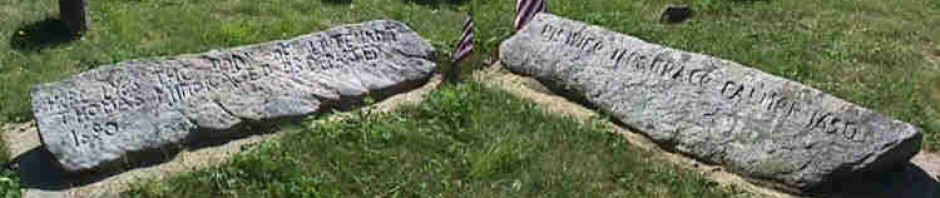
Posted in 11th Generation, Artistic Representation, Be Fruitful and Multiply, Historical Monument, Historical Site, Immigrant - England, Line - Miller, Pioneer, Place Names, Public Office, Storied | Tagged , , , , , , , | 20 Comments

Edward Hazen Jr.

Edward HAZEN Jr. (1660 -1748) was Alex’s 8th Great Grandfather; one of 512 in this generation of the Miller line.

Edward Hazen was born on 10 Sep 1660 in Rowley, Mass.  His parents were Edward HAZEN Sr. and Hannah GRANT.  He married Jane PICKARD on 6 Nov 1684 in Rowley, Mass.  Edward died 26 Dec 1748 in Rowley.

Jane Pickard was born 22 Apr 1666 in Rowley, Mass.  Her parents were John PICKARD Jr.and Jane CROSBY. Jane died after 1748

Children of Edward and Jane:

Name Born Married Departed
1. Jane Hazen 11 Oct 1685 Rowley, Mass Joseph Jewitt
8 Nov 1707/08 Rowley
1727
Pepperell, Middlesex, Mass
2. Edward Hazen 17 Jul 1688 Rowley Sarah Perley
~1709 Boxford, Essex, Mass
19 Apr  1723 Newbury, Mass.
3. John Hazen 24 Jan 1691/92 Rowley Sarah Nelson
9 May 1715 Rowley
24 Feb 1772 Norwich, CT
4. Benjamin Hazen (twin) 17 Feb 1694/95 Rowley Elizabeth Blanchard
25 Jul 1717 Rowley
.
Betty Nutting
2 Apr 1740 Groton, Mass
18 Sep 1755 Groton, Mass
5. Hepzibah Hazen (twin) 17 Feb 1694/95 Rowley Nathaniel Perkins
15 Nov 1716 Boxford, Mass
Before 1768
6. Samuel Hazen 20 Jul1698 Rowley Sarah Harriman
1 Oct 1723 Rowley
20 Sep 1790 Shirley, Mass
7. Israel HAZEN 20 Jul 1701 in Rowley Hannah CHAPLIN
27 May 1724 Rowley
2 Jan 1784 Rowley
8. Hannah Hazen 14 Jan 1703/04 Rowley Joshua Morse
13 Jul 1727 Boxford, Mass
.
Samuel Greenleaf
19 Jul 1730 Rowley

“Edward Hasen and his wife Joan” were received into the church in Rowley, 26 July 1691. He removed to Boxford probably after his brother Thomas went to Norwich, CT.

Mr. Sidney Perley (in Dwellings of Boxford, pp. 28, 29) states that on 28 Feb. 1711/12

Thomas Hazen sold his farm to Timothy Perkins of Topsfield; “fifty rods nearly north from the residence of Mr. Francis Marden, in a pleasant clearing are an apple tree and the remains of a well, near which is a slight indentation in the ground which is all that now remains of the cellar over which stood the Perkins house. It was only one story in height . . . . Mr. Perkins conveyed the farm to his son Nathaniel in the spring of 1720.”

Mr. Perley supposes that Edward Hazen lived there from 1712 until his death in 1748, and states that Dr. David Wood, J. P., in 1736 charged Nathaniel Perkins for writing “his Father Hazen’s will” –Nathaniel Perkins had married Edward Hazen’s daughter Hephzibah in 1716.

However, Edward may not have gone to live with the Perkinses until considerably later.

On 15 July 1729, for parental love and affection, Edward Hazen of Boxford (with his wife Jane assenting by mark) conveyed to his son Israel HAZEN about seventeen acres in Rowley, and “one half of ye Dwelling House which I live in, and one half of ye Barn which I improve,” reserving a way across the land for himself and his heirs .  [Essex Deeds, 56:268]

This will, probated 26 Dec. 1748 at Ipswich, is on file at Salem:

I Edward Hazzen of Boxford in ye County of Essex In ye Province of Massachtts Bay in New England being in perfect health of body and sound mind and memory Thanks be give to God therefor: yet considering the uncertainty of this life and being grown into years Do make this my last will and testament for the settlement of the estate which God has bestowed on me in manner following: Herby Revoking all other and former wills by me heretofore made:–

Resigning my soul to God that gave it and my body to decent burial at ye Discretion of my executor hereafter named Hoping for a glorious Ressurrection in and through the merits of Jesus Christ and as to my outward estate Dispose of as followeth–

I give and Bequeath to my beloved wife Jane Hazzen the Improvement of house that I now live in with my cellar and so much of my barn as to put hay into and keep one Cow and to house her in in the Winter and liberty to keep a pig at the Door and fire wood brought to the Door sufficient for one fire and I order my executor to carry my wife to publick worship as often as she sees case to goe and also to carry her to visit her relatives as often as may be reasonable If she sees case and also to pay to my wife twenty give pounds a year according to the value of Bills of Credit Old Tenor as they now pass and to pay it that is one quarter at a time quarterly I also give to my wife one of my cows which she chooses: all of above Bequest I order to be performed annually during her natural life. I also order my wife’s Cow to be brought to her Door night and morning for milking All the above Bequest is in Room of her right Dower.

Item, I give to my beloved son John Hazzen a confirmation of what I have already given him and five pounds to be paid by my executor hereafter named within one year after my decease which is in full of his portion.

Item–I give and confirm to my beloved son Benjamin Hazzen what I have already given him and ten pounds–in full of his portion

Item–I give my beloved son Samuel Hazzen a confirmation of what I have already given him and five pounds

Item — I give to my son Israel HAZZEN a confirmation of what I have already given him and five pounds

Item–I give and confirm to my beloved daughter Jewet a confirmation of what I have already given her and five pounds-

Item–I give and confirm to my daughter Hannah Greenleaf a confirmation of what I have already bestowed and five pounds–

Item–I give to my beloved wife the use and improvement of all my household goods (or as many as she needs during her natural life. I order and appoint that all my just debts and mine and my wifes funeral charges be paid and discharged in the first place.

Item–I give to my son-in-lawNathaniel Perkins (whom I make executor) and Hepzibah his wife all my estate both real and personal wither in Boxford Rowley or elsewhere that is not already given in this will to him his heirs and assigns freely to be possessed and enjoyed forever and in confirmation of the premises I the sd Edward Hazzen have hereunto sett my hand and seal this twenty seventh day of May anno 1738.

Children

1. Jane Hazen

Jane’s husband Joseph Jewitt was born 14 Sep 1685 in Ipswich, Mass. His parents were Nehemiah Jewett and Exercise Pierce. We have Jewitts in our family tree, but the connection is pretty far back. Joseph’s grandparents were Nehemiah Jewett and Exercise Pierce. His great grandparents were Joseph Jewett and Mary Mallinson. Finally his 2nd Great grandparents were our ancestors Edward JEWETT Sr. (1579 – 1615) and Mary TAYLOR.   Joseph died in 1751 in Pepperell, Middlesex, Mass

Children of Jane and Joseph:

i. Seth Jewett b. 15 Oct 1704 in Bradford, Essex, Mass; d. 26 Oct 1756 Ft William Henry, Mass; m. 6 Sep 1739 in Bradford to Mehitable Hardy (b. 20 Mar 1718 in Bradford – d. 20 Sep 1759 in Bradford)   Mehitable’s parents were Joseph Hardy (1674 – 1747) and Mary Burbank (1675 -1762).

ii. Joseph Jewett b. 9 Oct 1708 in Bradford, Essex, Mass; m. 20 Jan 1732 in Middlesex, Mass to Mary Gage (b. 6 Nov 1707 in Bradford ) Mary’s parents were John Gage (1677 -1759) and Susanna Ross (1674 – 1746).

Joseph and Mary removed from Groton to Tewksbury, Mass.

iii. Eunice Exercise Jewett b. 19 Nov 1710 in Ipswich, Essex, Mass; d. 1743 in Billerica;  m1. 4 Apr 1732 in Townsend, Middlesex, Mass. to James Horsley (b. 9 May 1702 in Billerica, Middlesex, Mass. – d. 28 Mar 1745 in Billerica) James’ parents were James Hosley Sr. (1675 – 1728) and Mariah Jewett (1680 – 1753) Exercise and James had six children born between 1732 and 1743.

m2. 30 Jul 1746 Townsend, Middlesex, Mass. to Ephraim Brown (b. 23 Jan 1702 in Billerica, Middlesex, Mass. – d. 20 Sep 1767 in Townsend) Eunice and Ephraim had four more children born between 1747 and 1756.

Of North Town.

iv. Moses Jewett b. 1711 in Ipswich, Essex, Mass; m. 17 Nov 1737 in Bradford, Essex, Mass to Martha Hale (b. 1715 in Essex, Mass)

v. Edward Jewett b. 11 Aug 1714 Ipswich, Essex, Mass; d. 23 Dec 1790 in Rindge, Cheshire, New Hampshire; m. 1741 Groton, Grafton, New Hampshire to Sarah Farmer ( b. 14 Dec 1723, Billerica – d. 08 Dec 1819, Berlin, Mass.) Sarah’s parents were Oliver Farmer and Abigail Johnson. Edward and Sarah had ten children born between 1741 and 1767

Edward and Sarah lived in Concord (1741), Pepperell (1744), and Berlin.

vi. Nehemiah Jewett b. 28 Feb 1717 in Ipswich, Essex, Mass; bapt at Groton  Middlesex, Mass, 3 Mar 1716/17; d. 13 Sep 1758, Pepperell, Mass.; m. 29 Aug 1738 Groton to Lydia Blood ( b. 28 Sep 1720 Groton – d. 13 Sep 1758 in Pepperell, Mass) Lydia’s parents were John Blood (1689 – 1758) and Joanna Nutting (1690 – 1782.  Nehemiah and Lydia had eleven children born between 1740 and 1759.

Nehemiah was a soldier in service jn the French and Indian Wars.

Nehemiah Jewett’s Bridge Groton Street, spanning Nashua River, Pepperell, Middlesex County, MA

Before Pepperell was even Pepperell, a bridge of some kind crossed the Nashua River at what was known in Colonial times as Jo Blood’s fordway (now part of Groton Street). First it was the uncovered Nehemia Jewett’s Bridge, built in 1742. That structure was replaced in 1847 by a 147-foot-long covered bridge. In 1920, a five foot sidewalk was added to the west side of the structure along the concrete footings. The bridge survived (with only minor damage) the Town’s worst flood on March 19, 1936. In 1936, the lower portion of the bridge was reinforced with steel I-beams to accommodate the increase in weight of the newer automobiles and trucks.

July 6, 1958 — Slow decay results in the closing of the covered bridge to traffic 1962-1963 — A new covered bridge, named the Chester H. Waterous Bridge after the legislator who won funding for it, is built for $233,000 at the site

The aging Chester H. Waterous Bridge was closed to vehicles on April 7, 2008 and demolished beginning July 30, 2008. The current bridge officially opened on July 30, 2010.

1847 Nehemiah Jewetts Bridge in 1940

It’s interesting that Nehemiah’s bridge lasted 95 years to 1847 the second bridge lasted 101 years to 1958, but the 1963 bridge only lasted 45 years to 2008. Did we build better before, or are we more safety conscious now?

vii. Jedediah Jewett b. 5 Sep 1719 in Groton, Middlesex, Mass; d. 12 May 1804, Pepperell, Middlesex, Mass; Burial: Walton Cemetery, Pepperell; m1. 17 Jan 1743/44, Groton to Elizabeth Shattuck (b. 12 Jan 1721/22, Groton  – d. 25 Jul 1782, Pepperell); Burial: Walton Cemetery, Pepperell; Elizabeth’s parents were Jonathan Shattuck (1693 – 1771) and Elizabeth Chamberlain (1700 – 1719). Jedediah and Elizabeth had seven children between 1740 and 1760 at Pepperell and Groton.

m2. 01 Oct 1783 to Mary Baldwin

viii. Jane Jewett b. 2 Apr 1722 in Groton, Middlesex, Mass; m. [__?__] Sloan

ix. Benjamin Jewett b. 30 Nov 1724 in Groton, Middlesex, Mass; Some genealogies say Benjamin died 2 Oct 1776 – Ticonderoga, Essex, New York, but I don’t think that’s correct, There was a Benjamin Jewett Jr. from Connecticut at Ticonderoga.; m. 31 Dec 1754 Pepperell, Middlesex, Mass to Sarah Flagg (b. 26 Oct 1726 in Woburn, Middlesex, Mass. – d. : Hillsborough, New Hampshire) Sarah’s parents were Eleazer Flagg and Hannah Knight. Benjamin and Sarah had seven children born at Pepperell between 1755 and 1767.

Benjamin served in the Revolution, and may have removed late in life to Gilmanton, Belknap, NH.

Jewett, Benjamin, Pepperell. Private, Capt. Asa Lawrence’s company, Col. William Prescott’s regiment.; muster roll dated Aug. 1, 1775; enlisted April 25, 1775; service, 3 mos. 8 days.

Jewett, Benjamin.Capt. Abrabam Dodge’s co., Col. Moses Little’s regt.; order for bounty coat or its equivalent in money dated Dec. 21, 1775.

Jewett, Benjamin, Pepperell (also given Ashby).List of men mustered by Nathaniel Barber, Muster Master for Suffolk Co., dated Boston, May 23, 1779; Capt. Child’s co., Col. Wesson’s regt.; also, Drummer, Capt. Child’s (6th) co., Col. James Wesson’s regt.; Continental Army pay accounts for service from Dec. 1, 1778, to Dec. 31, 1779; residence, Ashby; also, list of men raised in Middlesex Co., agreeable to resolve of June 9, 1779, as returned by Joseph Hosmer, Superintendent; engaged for town of Ashby; term, during war; also, Drummer, Colonel’s co., Col. Wesson’s (9th) regt.; Continental Army pay accounts for service from Jan. 1, 1780, to Dec. 31, 1780; residence, Pepperell.

William Prescott (1726 – 1795) was an American colonel in the Revolutionary War who commanded the rebel forces in the Battle of Bunker Hill. Prescott is famous for his order to his soldiers, “Do not fire until you see the whites of their eyes”, such that the rebel troops may shoot at the enemy at shorter ranges, and therefore more accurately and lethally, and so conserve their limited stocks of ammunition.

In 1774, when Massachusetts towns began forming militia companies, Prescott was made a colonel commanding the Pepperell company. Asa Lawrence and Henry Farwell were elected to lead the two companies of about fifty men each.

The alarm that was raised on the evening of April 18, 1775, that British troops were marching on Concord reached Pepperell about 10 a.m. on April 19. The alarm spread quickly to the surrounding countryside, and by late morning the two Pepperell minuteman companies were marching toward Concord, some fifteen miles away. They arrived too late for the fighting so they hurried toward Cambridge, camping overnight at Lexington. At Cambridge, they joined the hundreds, later thousands, of militiamen who were to bottle up General Gage’s Regulars, until the British had to abandon Boston in March of 1776. A few days after the Lexington and Concord action the troops that stayed were enlisted into a Continental Army under the command of General Artemus Ward. Colonel Prescott’s nine companies became the 10th Massachusetts Regiment of the Continental Line.

On May 25th Prescott’s company captains, to make sure that there would be no change of command, certified in writing to the “Honorable Congress of the Province of the Massachusetts Bay now sitting in Watertown” that they were “well contented with their officers.”

On May 27th, a mixed force of about 200 men under the command of Colonel John Nixon, which including the two Groton companies, were dispatched to remove livestock from Noddle’s and Hogg Islands, now known as East Boston, but in 1775 it was a swampy area on the north shore of Boston harbor. The British detected the movement and sent the schooner H.M.S. Diana, with a company of Royal Marines, to intercept the colonials. After a brief skirmish, the Marines were forced to return to their ship, which then took the militiamen under fire from its ship’s guns. Shortly thereafter, the H.M.S. Diana ran aground in one of the shallow channels, caught by the ebbing tide. Listing badly, her guns no longer could be brought to bear. The British were forced to abandon ship.

Wading through waist deep water, Captain Asa Lawrence led a boarding party which burned the H.M.S. Diana, but only after removing her twelve cannons and other supplies. Several of our cousins were in Asa Lawrence’s company including Benjamin Jewett, David Hazen and Nathaniel Shattuck.

On June 16th, Colonel Prescott was ordered to take command of the regiments of Colonel Bridge and Frye, and with his men, proceed to Bunker Hill, under cover of darkness, and erect fortifications to preempt a possible breakout of the British by way of the Charlestown peninsula. Because Prescott’s men thought they would be relieved after the breastworks were completed, they took only their entrancing tools, a minimum supply of ammunition, and almost no food or water. They disobeyed their orders by marching past Bunker Hill to Breed’s Hill, where they worked quietly through the night without being detected. But, with the coming of daylight the surprised British opened a heavy barrage from Copp’s Hill in Boston and from four warships anchored in the Charles River, less then a mile away. Prescott’s men continued their digging in spite of this bombardment, suffering several casualties, including Lieutenant Joseph Spaulding of Asa Lawrence’s company, who was decapitated by a cannon ball as he stood next to Colonel William Prescott.

The British lost 226 killed and 828 wounded for a total of 1,054 or nearly fifty percent of the 2,300 British soldiers engaged. Many companies of about forty men each had only three or four men left, and casualties among the officers were well over fifty percent. A month after the battle, General George Washington put the American losses at 115 killed, 305 wounded and 30 missing, for a total of 450, out of the 1,500 who were actually engaged. More men were lost from Groton than from any other town, a total of twelve, including six of Asa’s men who were killed outright and a number of others wounded.

x. Hepsibeth Jewett b. 12 Aug 1727 in Groton, Middlesex, Mass; m. Ezekiel Shattuck (b. 1723) of Pepperill

2. Edward Hazen

Edward’s wife Sarah Perley was born 1683 in Boxford, Essex, Mass. Her parents were Thomas Perley and Lydia Peabody (1640 – 1715). After Edward died, Sarah married 20 Dec 1723 Age: 40 Newbury, Essex, Mass. to Samuel Hale.   Sarah died 17 Jun 1769 in Bradford, Essex, Mass.

Samuel Hale (b. 06 Jun 1674 in Newbury – d. 13 Dec 1745 in Bradford) His parents were Thomas Hale (1633 – 1688) and Mary Hutchinson (1630 – 1715). He first married Martha Palmer (1677 – 1723 ) and had seven children between 1699 and 1718.

3. John Hazen

John’s wife Sarah Nelson was born 19 Aug 1690 in Rowley, Essex,  Mass. Her parents were Philip Nelson (1669 – 1721) and Sarah Varnum (1664 – 1693) Sarah Varnum had first married John Hobson  (1657 – 1683) Sarah died 26 May 1773 in Rowley.

John Hazen and his brother Samuel were among the Rowley residents who petitioned the General Court to be set off as the Second Parish, 27 May 1730. In 1838 it was incorporated as Georgetown.

Georgetown, Essex, Mass.

Georgetown was originally settled in 1639 as a part of the town of Rowley by the Reverend Ezekiel Rogers. (See my post) The town at the time stretched from the Atlantic coast to the Merrimack River, south of Newbury and north of Ipswich. Several farmers, finding suitable meadowlands in the western half of the settlement, began settling along the Penn Brook by the middle of the seventeenth century, creating Rowley’s West Parish. Though not directly involved in King Philip’s War, the village nonetheless did become a victim of Indian raids. The village, which became known as New Rowley, grew for many years, with small mills and eventually a shoe company opening up in the town. By 1838, the town was sufficiently large enough for its own incorporation, and was renamed Georgetown. Small industry continued, and today the town is mostly residential in nature, a distant suburb of Boston’s North Shore

By his will, dated 2 Apr. 1748, proved 13 Dec. 1756, John gave to Sarah his wife one third of his real estate, one half of his living stock and all the household goods; to his son Jeremiah Hazzen five pounds; and to his daughter Jane Hazzen all other real estate not before disposed of to Jeremiah, “as also one third that I have given to my wife after her decease I give unto said Jane always with this proviso that it shall not be in power of sd Jane to sell or dispose of any of these lands without sufficient provision be made for the maintenance of my other daughter Sarah Hazzen during her natural life.” Jane Hazzen and Moses Hobson were executors.

Children of John and Sarah:

i. Jeremiah Hazen b. 29 Feb 1716 in Rowley,  Essex, Mass; d. 5 Jan 1779, Rowley of smallpox; Burial: Metcalf Rock Pasture Burial Ground, Rowley; m. 13 Oct 1737 in Rowley to Sarah Adams (b. 11 Oct 1714 in Rowley) Sarah’s parents were John Adams and Sarah Pearson. Jeremiah and Sarah had two children: Sarah (b. 1738) and Moses (b. 1743)

ii. Sarah Hazen b. 17 Mar 1719 in Rowley, Essex, Mass; d. 09 Feb 1778, Rowley;  unmarried; It’s possible that Sarah was the daughter of John’s cousins John Hazen and Elizabeth Dart or Mercy Bradstreet.

iii. Jane Hazen b. 17 Jun 1723 in Rowley, Mass. It’s possible that Jane was the daughter of John’s cousins John Hazen and Elizabeth Dart or Mercy Bradstreet.

4. Benjamin Hazen

Twin of Hephzibah

Benjamin’s first wife Elizabeth Blanchard was born 25 Jun 1694 in Groton, Mass. Her parents were James Blanchard and Anna Blood. Elizabeth died in Apr 1740 in Groton, Mass

Benjamin’s second wife Elizabeth (Betty) Nutting was born 20 Mar 1718 in Groton, Mass. Her parents were Daniel Nutting (1691 – 1756) and Hannah Green (1695 – 1740). She was young enough to be Benjamin’s daughter as she was born the year after his first marriage. Betty died in 1799 in Groton, Mass.

Benjamin’s will was presented for probate, 20 Oct 1755:

In the name of God Amen I Benjamin Hazen of Groton in the county of Middlesex yeoman being at this time verey weeke and in Languishing feer constanly as to my Body apprehending that I have but a short continuance in this world knowing that it is appointed for all men once to Dye therefore I do macke this my last will and testement in the following mannar and form first of all I Recommend my precious and Immortal Soul into the hands of God who gave it me: trusting in the merrets of Jesus Christ alone for Salvation and as to such worley estate as it hath pleased God to Bleass me with all in this Life I Dispose of the same in the following mannar and form vizt.–

first my will is and I hereby order all my just debts and funirol charge be well and truly paid oute of my estate by executrix after named–

secondly my will is and I do hereby give and beQueath to Bettey Hazen my dear and Loveing wife all my Husbandry tools and moveable Estate Creturs and everything in dowrs and oute except my Carpendar and turnors tools which I resarve all this except what is excepted I give to my sd wife to Inable her to pay all my just debts funirol charge and Bring up my children withall I allso give to my said wife the Youse and Improvement of all my Reall estate until my Son Benjamin comes to the age of twenty one years further to Inable her to bring up my sd children and then my said wife to have the Youse and Improvement of one third parte of my Reall Estate so long as she Remains my widow.–

3ly I give to my Son Benjamin Hazen his heirs and asigns for ever Resarving the Income and provefit theirof as above untill my said son come to the age of twenty one years and then one third as above to my sd wife so Long as She Remains my widow all my Land and Bilding in Groton provided he pay to his Brothers and sisters the Zeverial sums after mentioned vizt. to my son David three pounds and to my Dafter Bety the sun of three pounds and to my Dafter Mary the sum of three pounds and to my Dafter Eunis the sum of three pounds and to my said Dafter Bety and within one year next after my sd son Benjamin coms to the age of twenty one years and my other sons when they come to the age of twenty one years and my Dafter Eunis at the age of Eighteen years

I also give to my said two sons John and David all my Carpenter and turney tools to be equally Divided between them and this with the three pounds above mentioned three Dafters the sum of three pounds to each and to be paid as above and that to bee their full parts oute of my estate. Imprimos whereas I have given Hepsebath Rolfe my eldest Dafter a grate Deall moore than I have or can give to any of my other Children theirfore I now give to my sd Dafter Rolfe her heirs and assigns for ever the sum of five shillings to be paid by my executrix within one year next after my Decease and this with what I have allready don for her to be her full lparte and portion oute of my estate–

my will is and I do hereby appint BAety my Dear and Loving wife my sol executrix of this my last will and testement and in testemoney theirof I have sett to my hand and seall this Seventeenth Day of September A.D. 1755 and In the 29th year of his majestys Reign signed and sealled published prounced and declaiered by me the sd Benjamin Hazen to be my Last Will and testement In presents of us. Ezekiel Nutting Joseph Bennitt William Lawrance Benjamin Hazen

Children of Benjamin and Elizabeth Blanchard:

i.Elizabeth Hazen b. 5 Feb 1719 in Groton, Mass; d. ~1720, Groton, Mass

ii. Timothy Hazen b. 1 Sep 1720 in Groton, Mass; d. ~1721, Groton, Mass

iii. Eunice Hazen b. 20 Oct 1722 in Groton, Mass.; d. 14 Nov 1728, Groton, Mass

iv. Hephzibah Hazen b. 19 Feb 1725 in Groton, Mass; m. 19 Jan 1737 in Concord, Merrimack, New Hampshire to Benjamin Rolfe (b. 15 Feb 1714 in Newbury, Mass. – d. 1 Jan 1761 in Concord, New Hampshire) Benjamin’s parents were Daniel Rolfe and Mercy Pattee.

Children of Benjamin and Elizabeth Nutting:

v. Betty Hazen b. 30 Nov 1740 in Groton, Middlesex, Mass.; d. 25 Sep 1758 Groton; m. 30 Mar 1758 in Groton to Jonathan Foster (b. 24 Jun 1719 in Shrewsbury, Worchester, Mass. – d. 31 Mar 1821 in Cortland, Cortland, New York) Jonathan’s parents were Jonathan Foster Sr. (1698 – 1743) and Mary Goulding (1697 – 1731).

Ironically, Betty died at 18 and only was married for six months while Jonathan lived to be 101 and was married four times. He first married 2 Aug 1741 Age: 22 in Shrewsbury to an older woman, Bathsheba Crosby (1698 – 1741) but she died right way. He next married Betty and shortly after she died married 11 Apr 1759 – Groton, Middlesex, Mass to Thankful Harrington ( – 1779) and had seven children between 1759 and 1776. Finally, he married 30 Nov 1779 Age: 60 Mason, Hillsborough, New Hampshire to Mercy Towne (6 Nov 1750 in Topsfield, Essex, Mass – d. 1844 in Hillsboro, Hillsborough, New Hampshire) and had seven more children.

Jonathan enlisted in 1775; Pvt. New Hampshire and Mass.
Served in the Company commanded by Captain Christopher Woodbridge in the Massachusetts line:
fought and was wounded in the Battle of Bunker Hill:
applied for and received a pension in 1818;
widow Mercy applied and received pension in 1831;
‘Revolutionary War Pension File’ #W14742

vi. Mary Hazen b. 28 Apr 1743 in Groton, Middlesesx, Mass.; d 28 Aug 1828 in Groton; Burial: Old Burying Ground, Groton;   m. 09 Jan 1772 in Groton  to Jacob Patch (b. 05 Apr 1747 in Groton. – d. 29 Dec 1818 in Groton; Burial: Old Burying Ground, Groton) Jacob’s parents were Ebenezer Patch (1719 – 1777) and  Sarah (Wright) Patch Chamberlain (1730 – 1793) Mary and Jacob had seven children born between 1772 and 1784.

Mary Hazen was admitted to the Groton church, 16 Oct. 1763

During the American Revolution Jacob is listed as Corporal under the command of Captain Josiah Sartell, and served 15 days marching 70 miles. Also, “Lord’s Day July 3, 1808 notice was given for divine service A.M. that Mr. Jacob Patch and 11 others were requested by the church to read during the intermission at the meeting house on Sabbath, the following season (D. Chaplin, Pastor).”

Jacob’s brother Simon was wounded in the thigh at the Battle of White Plains on Oct. 28, 1776. Jacob in a distance of more than 200-miles brought him home to Groton, MA on a litter (made by fitting the butt end of small trees to the stirrups of a saddle and covered with a sack of hay). Simon died of these wounds on Dec. 31, 1776 at his father’s home in Groton.

Battle of White Plains – 225th Anniversary Reinactment  – Jacob brought his wounded brother Simon home  to Groton in a litter, a distance of more than 200 miles

Jacob’s death was caused suddenly by the wheels of a loaded wagon going over his body and was found about 15 minutes after the accident by his son Zara.

GRAVESTONE

In Memory of
Mr. Jacob Patch
Who Died Dec. 29,
1818 Age 71
Also Mrs. Mary
Wife of
Mr. Jacob Patch
Died Aug. 28, 1828 Age 85

MILITARY MARKER
Jacob Patch
Corpral in Capt. Josiah Sawtell’s Company
Minute Men April 19, 1775
Private Captain Thomas Warren’s Company
Colbrook’s Regiment
At White Plains

vii. Benjamin Hazen b. 7 Dec 1745 in Groton, Middlesex, Mass.; d. Jul 1807 in Groton; m1. 20 Nov 1770 in Groton to Lydia Wood (b. 23 Jan 1744/45 in Groton – d. Aug 1820 in Groton) Lydia’s parents were Amos Wood and Hannah Nutting. Benjamin and Lydia had eight children born between 1774 and 1789.

m2. to Margaret Winter (b. 19 Apr 1766 in Ashburnham, Mass – d. bef 1808) Margaret’s parents were Andrew Windrow (Winter) (1722 – 1792) and Mary Henerck (1723 – 1814)

Benjamin was a Private in Capt. Josiah Sartell’s company which marched on the Alarm of 19 Apr. 1775 (Lexington) to headquarters at Cambridge, fourteen days; also Private on a Pay roll, dated 13 Jan. 1776, of Capt. Henry Haskell’s Co., Col. Prescott’s Regt., mileage to and from headquarters, seventy miles; also Fifer, Capt. Zachariah Fitch’s Co., Col. Samuel Brewer’s Regt., service 23 Aug. to 30 Sept 1776.

John Sheple was appointed administrator of the estate of “Benjamin Hazen who last dwelt in Groton within one month last past,” 11 Aug. 1807. In the division of the estate, the children mentioned were Benjamin, Amos, Josiah, Asa, and William; “Edmund” (Edward) and “Elizabeth wife of David (Jonas) Lawrence” had removed to place unknown.

viii. John Hazen b. 31 May 1749 in Groton, Middlesex, Mass; d. 10 Feb 1814 in Tyngsboro, Middlesex, Mass.; m. 19 Oct 1792 in Groton  to Hannah Worcester (b. 08 Jan 1775 – d. Jan 1859 in Harvard, Mass) Hannah’s parents were Francis Worcester and Mary Simonds. John and Hannah had twelve children born between 1793 and 1813.

ix. David Hazen b. 29 Oct 1751 in Groton, Middlesex, Mass.; d. 30 Sep 1826 in Groton.; m. Hannah [__?__] (b. 1747 in Groton, – d. Groton). David and Hannah had four children born between 1783 and 1788.

Enlisted as a private, 25 April 1775, in Col. Asa Lawrence’s Co., Col. William Prescott’s Regiment, serving three months, eight days. He was also a Private in Capt. Aaron Jewett’s Co., Col. Samuel Bullard’s Regiment, enlisted 15 Aug. 1777, discharged 29 Nov. 1777; this company marched to Saratoga.Col. William Prescott’s Regiment fought at the Battle of Bunker Hill.

x. Eunice Hazen b. 30 Apr 1754 in Groton, Middlesex, Mass.; d. 09 Jul 1844 in Groton; m. Dunstable, Mass to Nathaniel Shattuck (b. 1746 in Hollis, NH – d. 05 Apr 1813 in Groton) Nathaniel’s parents were William Shattuck and Experience Spaulding. Eunice and Nathaniel had six children between 1775 and 1796.

Shattuck, Nathaniel, Groton Private, Captain Asa Lawrence’s Company; Col. William Prescott’s Regiment Muster Rolls dated Aug 1 1775; Enlisted as a private, 25 April 1775, Service 3 months, 8 days; Also company returned dated Oct 6 1776 reported absent

(Willow Tree and Urn)
IN
memory of
Mr.
Nathaniel Shattuck,
who died
April 5. 1815.
AEt. 67.
Friends nor physicians could not save,
My mortal body from the grave;
Nor can the grave confine me here,
When Christ shall call me to appear.

m2. 19 Jan 1815 – Groton to Thomas Bennett (b. 21 Aug 1757 in Burlington/Woburn, Middlesex, Mass. – d. 18 Mar 1822 in Groton) Thomas’ parents were James Bennett (1727 – 1809) and Sarah Dodge (1738 – 1810).

.

5. Hepzibah Hazen

Twin of Benjamin

Hepzibah’s husband Nathaniel Perkins was born 13 Sep 1689 in Topsfield, Mass. He was Hepizbah’s first cousin. His parents were Timothy Perkins and Edna Hazen.  His maternal grandparents were Edward HAZEN Sr. and Hannah GRANT.  His paternal grandparents were Thomas Perkins and Phebe Gould.  His great grandparents were John PERKINS and Judith GATER.     Nathaniel died in 1773

Another Nathaniel Perkins was born in the same year (b. 1689 in Ipswich, Essex, Mass – d. 3 May 1771 in Ipswich) His parents were Abraham Perkins (1639 – 1725) and Hannah Beamsley (1643 – 1734) He married Esther (b. 1693 in Ipswich, Essex, Mass.)

Nathaniel Perkins was a selectman in 1724 and 1745; Ensign in the militia in 1734, Lieutenant in 1735, and Captain in 1742. His will, dated 31 Oct 1768, proved 6 Oct 1773, call him “gentleman.” He gave “to my son Nathaniel all the lands which I bought of my honored Father in Law Mr. Edward Hazzen and all which I bought of my brothers in law John Hazzen and Israel Hazzen in Boxford and Rowley.” He gave also to his son Jacob, his grandson Daniel Perkins, and to the daughters of his son Nathaniel. Nathaniel married his cousin.

Children of Hepzibah and Nathaniel

i. Nathaniel Perkins b. 4 Mar 1716 in Boxford, Essex, Mass; m. 28 Mar 1744 in Lynn, Mass to Bethiah Johnson (b. 25 Feb 1724 in Lynn, Mass,) Bethiah’s parents were David Johnson (1688 – 1763)  and Ester Laughton (1689 – 1766).

Nathaniel Perkins of Salem, blacksmith, conveyed for 154 pounds to his son Nathaniel Perkins of Boxford, a tract of 44 acres in Boxford and Rowley, “the buildings on the farme which my honored father Mr. Nathaniel Perkins gave by will to my Brother Jacob and my son Daniel,” and Bethiah Perkins signed her consent by mark. Daniel Perkins of Boxford sold, 7 July 1774, to his brother Nathaniel Perkins of Boxford, for 60 pounds, his interest in the house and barn which fell to him by the will of his grandfather Nathaniel Perkins

ii. Daniel Perkins b. 1 Sep 1717 in Boxford, Essex, Mass; d. bef 1759 in Mass; m. 27 Nov 1740 in Newbury, Mass to Sarah Dole (b. 12 Mar 1720 in Newbury – d. 1792 in Haverhill, Essex, Mass.) Sarah’s parents were John Dole (1684 – ) and Esther Burpee (193 – ). After Daniel died, Sarah married 26 Sep 1759 Newbury to Deacon John Ayer (1714 – 1777)

iii. Israel Perkins b. 1 Jul 1719 in Boxford, Essex, Mass; m. 1 Mar 1749 in Boxford to Hephzibah Jewett (b. 06 Oct 1724 in Boxford, Essex, Mass) Hephzibah’s parents were Ezekiell Jewett and Martha Thirston (1699 – )

iv. Mary Perkins b. 23 Feb 1722 in Boxford, Mass; d. 1811 – York, York, Maine; m. 18 May 1736 Gorham, Cumberland, Maine to Nathaniel Freeman (b 1719 in York, York, Maine – d. 1810) Nathaniel’s parents were Nathaniel Freeman (1673 – 1727) and Alice Peniwell

v. Benjamin Perkins b. 26 Jan 1725 in Boxford, Mass. m. Boxford to Rebecca Johnson (b. ~1725 in New Haven, New Haven, Connecticut)

vi. Hannah Perkins b. 26 Dec 1727 in Boxford, Mass; d. 13 May 1736 – Ipswich, Mass

vii. Hephzibah Perkins b. 14 Jan 1731 in Boxford, Mass

viii. Jacob Perkins b. 19 Jun 1737 in Boxford, Essex, Mass; d. 1 Jan 1778 Boxford, Mass; m. 28 Oct 1759 in Boxford, Mass to Mercy Fowler (b. 26 Oct 1740 in Ipswich, Essex, Mass. – d. 12 Jan 1811 in Haverhill, Essex, Mass.) Mercy’s parents were John Fowler and Mercy Howe.

ix. Eunice Perkins

6. Samuel Hazen

Samuel’s wife Sarah Harriman was born 19 Mar 1701 in Rowley, Essex, Mass. Her parents were Jonathan Harriman and Margaret Elithorpe. Sarah died 1 Aug 1794 in Shirley, Middlesex, Mass.

Samuel Hazen, with his brother John, was among those who petitioned the General Court to be set off as the Second Parish of Rowley, 27 May 1730; this territory is now Georgetown. (See story of Georgetown above with John)

He removed from Rowley to Groton, Mass., in 1736. In 1749 he purchased a farm in what was called “Stow Leg,” a strip of land soon after annexed to Shirley and forming its entire southern boundary. It is said that he lived in a log house at first. This estate was still in the possession of descendants after 1900, together with the fine two-story house built by him for his son Samuel about 1765; also the house opposite, built by his grandson, Thomas Hazen, in 1795.

Samuel built the first grist mill in Shirley with his partner John Longley.

Beside old hearth-stones“. Boston: Lee and Shepard, 1897.

William Longley the father, and William the son, were both millers. In order to distinguish the craftsmen, the good farmers of the locality, who brought their grist to be ground at the mill on the Catacunemaug, called the elder ”Old Will the Miller.” No disrespect was implied; for the rugged yeomen looked upon Old Will as their great benefactor. He had been the first to set up that indispensable institution, a mill, thus relieving them of much of the burden of life.

The Longley and Hazen mill was rude indeed, but in keeping with the dwellings of the farmers, made as they were from rough-hewn logs, and affording but little beyond the bare necessities. The farmers, young and old, delighted in listening to Old Will’s recitals of his father’s experience during the five years of his life in captivity. Waiting for grist was no hardship for them if Old Will, dressed in powdered apparel, was tending the stones. The elder William was a sufferer from rheumatism, and not in a mood for story-telling at all times ; but when he was at his best in describing the life among the Indians, the farmer’s boy was reluctant to leave. In fact, the fathers were known to tarry long after Old Will had taken his toll, and emptied a fresh sack into the hopper.

These stories of savage warfare served a two-fold purpose. They amused the miller’s patrons, and prevented their being impatient while waiting their turn, and also kindled a fire of patriotism in the minds of the farmers, which served them well when the time came for opposing the king.

When Shirley was separated from Groton, Samuel Hazen was chosen one of the five selectmen and a highway surveyor, 1 Mar. 1753. He was selectman also in 1755. Todat, Hazen Road is a located near Shirley Center.

Once part of “The Plantation of Groton,” Shirley was first settled about 1720. It broke away from Groton to be incorporated in 1753. The town was named in honor of William Shirley, governor of Massachusetts (1741–1757). A paper mill was built here around 1790 and in 1812 Shirley established the first of seven cotton mills. In 1793, three years after Samuel diedm the Shakers established a utopian religious community in Shirley. The Shakers advocated pacifism, common property, celibacy and communal living. They are renowned for their plain architecture and furniture.

Samuel Hazen Headstone – at Center Cemetary Rowley Mass Death: Sep. 20, 1790 94yrs, 1mon, and 20 days

Children of Samuel and Sarah:

The first five children of Samuel Hazen and Sarah Harriman died of “throat distemper” which was probably the old term used for what we now know to be diphtheria.

i.  Edward Hazen b. 26 May 1724, Rowley, Essex, Mass;  d. 10 Jan 1736/37, Rowley

ii. Margaret Hazen b. 23 Jan 1730 in Rowley, Essex, Mass; d. 24 Dec 1736 Rowley

ii. Sarah Hazen b. 9 Apr 1731 in Rowley, Essex, Mass; d. 20 Dec 1736, Rowley

iii. Benjamin Hazen b. 22 Apr 1734 in Rowley, Essex, Mass; d. 06 Jan 1736/37, Rowley

iv. Eunice Hazen b. 8 Aug 1736 in Rowley, Essex, Mass; d. Nov 1808, Herkimer Co.,  NY; m1. 28 Jun 1758 in Harvard, Mass. to Jonathan Farwell (b. 15 May 1730 in Groton, Mass – d. 29 Nov 1761 in Charlestown, Mass.) Jonathan’s parents were Joseph Farwell and Mary Gilson.

m2. 25 May 1763 in Lancaster, Mass. to Nathaniel Willard (b. 03 Apr 1742 in Lancaster – d. Jan 1813 Eatonsville, Canada) Nathaniel’s parents were William Willard (1713 – 1813) and Sarah Gates (1716 – 1813). Eunice and Nathaniel had six children born between 1765 and 1783.

Nathaniel Williard was a minute man in the Revolutionary War. He was only 8 years old when he went with his dad William Willard and helped tip the British tea overboard into the Boston Bay.

Nathaniel was a private Capt. William Greenleaf’s company, Col. Josiah Whitney’s Regiment Enlisted Aug 22 1777 Discharged Aug 26 1777 service 4 days on an alarm at Bennington.

Nathaniel Willard sold land in Lancaster, Mass., in 1769, and in “Stow Leg” in 1775. He removed to Herkimer County, N. Y., in 1794. He was elected Pathmaster in Herkimer, 7 Apr. 1795 and 2 Mar. 1802. John DeLancey sold land in the town of Herkimer in Hassenclever’s Patent to Nathaniel Willard of Herkimer, 29 Sept. 1807

On 27 Jun 1762, Jonathan Farwell’s widow “Unis” was appointed to administer his estate, Samuel Hazen of Stow and Joseph Farwell of Groton being her bondsmen; the inventory amounted to 251/11/3 pounds. Eunice Farwell (now Willard) on 16 Apr. 1764 craved allowance from the estate for “bringing up the two younger children until seven years old.

v. Edward Hazen b. 2 May 1738 in Groton, Mass. ; d. ~1796, Little Falls, Herkimer Co., NY; m. 10 Jan 1758 – Harvard, Worcester, Mass. to Sarah Willard (b. 02 Sep 1735 in Lancaster, Worcester, Mass. – d. 09 Aug 1785 in Herkimer, Herkimer, New York) Sarah’s parents were William Willard (1713 – 1813) and Sarah Gates (1716 – 1813). Samuel and Sarah had eleven children born between 1758 and 1775.

m2. 8 Sep 1785 Age: 47 Swanzey, Cheshire, New Hampshire to Jemima Bathrick Dodge (b. 18 Mar 1751 in Lunenberg, Worcester, Mass. – d. 9 Mar 1836 in Denmark, Lewis County, New York; buried at Copenhagen) Edward and Jemima had three more children between 1786 and 1793.

Edward died of smallpox [the date 1796 is given in Chandler’s Shirley, p. 446, while a narrative by his grandson, Edward Hazen, states that he died about 1805, aged 75] He lived in Shirley, Mass., until about 1768, when he settled in Swanzey. On 4 Jan. 1770, ‘Edward Hazen of Swanzey in the province of New Hampshire, husbandman,’ bought of John and Hannah Pierce of Shirley, for 178.13.8, pounds, 160 acres in that part of Swanzey taken from Richmond. This land he, while of Swanzey, sold 18 Feb. 1789 to Joseph Trumbull, for 318 pounds; witness, Samuel Hazen. About 1794 he emigrated to Little Falls, N. Y., apparently having sojourned for a time with his sons living in Dummerston, VT.

He was a worker in iron, probably both a blacksmith and iron-founder.

During the Revolution, he was a Private in Capt. Joseph Hammond’s Company which responded to the Lexington Alarm, April 1775; also in Capt. Davis Howlett’s Co., Col. Ashley’s Regt., N. H. Militia, which marched from Keene to reinforce the Continental Army at Ticonderoga 3 to 11 July 1777.

He was also in Capt. Samuel Wright’s Company, which marched from Winchester to join Stark’s command at Bennington and Stillwater; the pay-roll of 23 Feb 1778 reported to the town meeting reads: ‘Edward Hazen, 12 days to Cambridge, 12 days to Otter Creek, and two months by his son: 6.19.2 pounds.’ [Read, History of Swanzey, pp.103, 104, 120; N.H. Rev.Rolls,2:63.][Hazen21404.FTW]

vi. Samuel Hazen b. 24 May 1740 in Groton, Mass.; d. 16 May 1815, Shirley, Mass. m. 20 Nov 1769 in Lunenburg, Mass. to Elizabeth Little (b. 1740 in Lunenburg, Worcester, Mass. – d. 11 Sep 1814 in Shirley, Essex, Mass.) Samuel and Elizabeth had eight children born between 1770 and 1784.

Samuel’s descendant Mr. Thomas L. Hazen reports in “Beside old hearth-stones“. Boston: Lee and Shepard, 1897.

“My great-great grandfather Samuel Hazen Jr was at work in these acres [the southerly part of Shirley, not far from the Longley-Hazen Mill] when the alarm of the 19th of April reached him. He immediadately left his plough, ran to the house, took his gun and powder horn [the horn was in possession of Thomas L Hazen in 1897] and said to his wife “Betty, you take care of the children and the cattle! I must go! The family then consisted of five children, the eldest not ten years and the youngest less than two months. He, with the others from Shirley reached Acton about eleven o’clock where they heard of the fight at Concord and of the retreat; but they concluded to march on, and pursued the enemy to Cambridge. Samuel Hazen remained there thirteen days and later joined the army and was made captain of the Shirley company.

SHIRLEY UPLANDS AND INTERVALES
ANNALS OF A BORDER TOWN OF OLD MIDDLESEX, WITH SOME GENEALOGICAL SKETCHES
By ETHEL STANWOOD BOLTON
GEORGE EMERY LITTLEFIELD
BOSTON, 1914

About 1800, Captain Samuel Hazen, Jr., moved into the Dehorte house. He had bought in 1777 the Brooks farm, and land from Charles Perrin in 1778, “where John Maddin now lives, ” which is the land formerly owned by Seth Walker. Captain Hazen clapboarded the house, and they say that all the clapboards came from one tree and have never been changed. The one nearest the roof has a bevel on its edge. The roof was raised to its present form of hip-roof and the ornaments to the front door were added. Up and down each corner of the house is a heavy quoin or border, carved from a slab of pine. This house passed in 1815 to Samuel’s son, Thomas, who never lived in it.
….
The next tavern keepers were James Brooks and Obadiah Sawtell. Which came first no one can now say, but as Brooks was the older we will assume that he did. The Brooks tavern was on no public road, but stood in the corner of the field now owned by Mrs. Grace Winslow on the road from Pound Hill to Ayer. The road was laid out much later. Tradition is very silent about James Brooks and his doings. The tavern was sold in 1777 to Samuel Hazen, Jr., and thereafter ceased to be a tavern, but underwent many vicissitudes. Two cellars were dug for it on the other side of the road, one almost opposite and a second farther east, when the oldest Hazen girl, Sarah, married Asa Longley. The house was shorn of its upper story, and was moved to the eastern cellar-hole, where the young couple started housekeeping. Later another story was added, and so it stands today, owned by Mr. Boutilier.

7. Israel HAZEN (See his page)

8. Hannah Hazen

Hannah’s first husband Joshua Morse was born 30 Mar 1700 in Newbury, Essex, Mass. His parents were Benjamin Morse and Mercy Bell. Joshua died 4 Aug 1728 in Newbury, Essex, Mass.

Hannah’s second husband Samuel Greenleaf was born 24 Dec 1706 in Newbury, Essex, Mass. His parents were Tristram Greenleaf and Margaret Piper. His grandparents were Stephen Greenleaf and Elizabeth Coffin. His great grandparents were our ancestors Edmond GREENLEAF and Sarah DOLE.

Children of Hannah and Samuel

i. Mary Greenleaf b. 19 Jul 1731 in Newbury, Essex, Mass.; d. 20 Apr 1764 in Byfield, Essex, Mass; m. 5 Oct 1750 – Newbury, Essex, Mass. to Nathaniel Plummer (b. 9 Jun 1708 in Newbury – d. 1789 in Byfield) Nathaniel’s parents were Joshua Plumer (1668 – 1723) and Elizabeth Dole (1679 – 1735)

Source: The Plummer Genealogy

Sources:

http://www.genealogyofnewengland.com/b_h.htm

http://home.earthlink.net/~djaness/d45.htm#P3712

http://familytreemaker.genealogy.com/users/f/l/e/Marion-Caswell-flemin/PDFGENE3.pdf
http://trees.ancestry.com/owt/person.aspx?pid=42254330&st=1

http://www.genealogy.com/users/h/a/z/Walter-Eugene-Hazen/GENE1-0003.html#CHILD5

http://www.revolutionarywararchives.org/lawrence.html

Posted in 10th Generation, Line - Miller, Twins | Tagged | 6 Comments

Israel Hazen

Israel HAZEN (1701 – 1784 ) was Alex’s 7th Great Grandfather; one of 256 in this generation of the Miller line.

Israel Hazen was born 20 Jul 1701 in Rowley, Mass. He was baptized 27 July 1701. His parents were Edward HAZEN II and Jane PICKARD.  He married Hannah CHAPLIN on 27 May 1724 in Rowley, Mass.  After Hannah died, he married Jane Bailey on 18 Jun 1761 in Rowley.   Israel died on 2 Jan 1784 in Rowley.

Hannah Chaplin was born 20 Feb 1701/02 in Rowley, Mass.  Her parents were John CHAPLIN and Margaret BOYNTON.   Hannah died 10 Jun 1760 in Rowley.

Jane Bailey was born 4 Feb 1706 in Bradford, Essex, Mass. Her parents were Thomas Bailey and Eunice Walker.  She first married John Harriman on 7 May 1726 in Rowley. Jane died 8 May 1803 in Rowley, Essex, Mass.

Children of Israel and Hannah:

Name Born Married Departed
1. Margaret “Peggy” Hazen 7 Jan 1727 Boxford, Mass
2. Hannah HAZEN 7 Jan 1727 Boxford, Mass Richard ESTEY II
7 Feb 1750
Rowley
28 Sep 1817 Kingsclear Parish, York Co., New Brunswick
3. Hepzibah Hazen 6 Sep 1730 Boxford, Mass.
4. Israel Hazen Nov 1734, Boxford, Mass Died soon after
5. Jacob Hazen ca. 1739 Rowley, Mass. Abigail Perley
16 Nov 1761 Rowley, Essex, Mass
1795
Rowley
6. Israel Hazen 27 Jul 1740 Rowley, Mass 1 Jan 1750 Rowley
7. Margaret Hazen 8 Aug 1742 Rowley, Mass. Nehemiah Jewett
8 Jan 1767 Rowley
Aug 1776
Ipswich, Mass
8. Amos Hazen 1 May 1748 Rowley, Mass. 3 Jan 1750 Rowley

On July 15 1729, for parental love and affection, Edward Hazen of Boxford (with his wife Jane assenting by mark) conveyed to his son Israel Hazen about seventeen acres in Rowley, and “one half of ye Dwelling House which I live in, and one half of ye Barnwhich I improve,” reserving a way across the land for himself and his heirs.

From the record of his children it would appear that Israel Hazen spent his early married life in Boxford, Mass., and later removed to Rowley; but probably his farm, like that of his son Jacob, was on the border and partly in both towns. In a deed dated Jan 26 1738, “Israel Hazzen of Boxford” conveyed to his brother John of Rowley, “one half of the home and barn in Boxford where my Father Edward Hazzen and I now dwell and seventeen acres in Rowley.”

On 16 Feb 1761, “Israel Hazen of Rowley, wheelwright, for love, good will and parental affection,” gave to his son Jacob Hazen of Rowley, cordwainer, half of all his land in Rowley and half the buildings thereon, and half of his land in Boxford, and half of his land in the County of Middlesex.

Israel Hazen was a Sergeant in a company which served at Lake George and vicinity, 7 Aug. to 17 Dec. 1755. He and his son Jacob were Privates in Capt. Richard Thurston’s Train Band in Rowley in 1757.

Children

2. Hannah HAZEN (See Richard ESTEY II‘s page)

5. Jacob Hazen

Jacob’s wife Abigail Perley was born 28 Dec 1732 in Boxford, Mass. Her parents were Amos Perley and Margaret Cogswell. She first married 1 Nov 1750 in Boxford, Essex, Mass. to William Spofford (b. 18 Oct 1730 in Rowley, Essex, Mass.) and had three children between 1851 and 1853.

Sergt. He was “of Boxford” at the time of the publishment of his ;marriage. His farm was in the East Parish, on the edge of Rowley.

On 16 Feb 1761, “Israel Hazen of Rowley, wheelwright, for love, good will and parental affection,” gave to his son Jacob Hazen of Rowley, cordwainer, half of all his land in Rowley and half the buildings thereon, and half of his land in Boxford, and half of his land in the County of Middlesex.

Jacob served under Capt. Israel Herrick, of Boxford, in 1760, in the Canadian campaign, French and Indian War. [Gage, History of Rowley, p. 225.]

He enlisted, 15 Feb  1775, in Capt. William Perley’s Company of Minutemen, Col. James Frye’s Regiment, (10th Massachusetts Regiment), which was in service seven days at the time of the Lexington Alarm, 19 Apr. 1775. Return of men in camp at Cambridge dated May 17, 1775;  Disbanded December 31, 1775.

Those men who enlisted for eight months in the Cambridge campaign:

Jacob Hazen, Asa Smith, John Towne, Andrew Peabody, Allen Perley, Robert Andrews, Joshua Andrews, Samuel Brown, Rufus Burnham, Thomas Dwinnell, Job Davis, Stephen Emery, Edmund Herrick, John Hale, Stephen Perley, Daniel Peabody, Joshua Rea, Jonathan Wood, Moses Wood, Eliphalet Wood, John Wild (or Willet), Seth Burnham, Nathaniel Fuller, Jacob Perkins, Ivory Hovey, Samuel Cole, Eliphalet Cole, Moses Carleton, Nathan Kimball, jr., Enoch Kimball, Benjamin Foster, Asahel Goodridge, John Stiles, John Towne, jr., Elijah Gould, Joseph Simmons, Robert Perkins, Joseph Peabody, Stephen Gould, jr., Daniel Cole, Dudley Foster, Moses Kimball, Ebenezer Peabody, Stephen Merrill, Moses Porter, jr., Jeremiah Robinson, David Sessions, Elijah Clark, and Jonathan Gilman. (from The History of Boxford)

Most of Frye’s regiment was assigned to Col. Prescott and worked to build and defend the redoubt and adjacent breastwork at Bunker Hill, but I can find no evidence Perley’s Company was included. One source cites Frye as being sick at the beginning of the battle and not with the men, another has him wounded during the battle.

The estate of  “Jacob Hazen of Rowley ” was administered by his son Jacob, 8 Nov. 1796; the inventory amounted t o $1101.14. A receipt was given to Jacob Hazen, administrator of  “the Estate of our honored Father Mr. Jacob Haz en, ” 21 Nov. 1796, by Israel Kimball, William Hazen, Thomas Dresser, and Jona. Dickinson.

Children of Jacob and Abigail:

Jacob and Abigail’s children William, Jacob, Hannah, Enoch and Josiah were all original settler of Brigton, Cumberland, Maine, today a resort area in Maine’s Lakes Region.

Jacob Hazen’s children were original settlers of Bridton, Maine — Shawnee Peak at Night — Bridgton, Maine

The undeveloped land was first called Pondicherry. It was granted in 1768 by the Massachusetts General Court to Moody Bridges and a group of proprietors. Settlement began in 1770 at what is now North Bridgton, where a tavern was built. The community was organized in 1779 as Bridgetown Plantation, named after Moody Bridges, and then incorporated on February 7, 1794 as Bridgton.

Stevens Brook is only a mile and a half long, but it provided water power for 12 mill sites. It developed as an industrial center, with sawmills, gristmills, woolen textile mills, a tannery, shoe factory and brick manufacturer. Later, a corn and vegetable packing plant was built, in addition to a foundry, machine shop, shovel handle factory, sash and blind factory, and a coffin shop. Population increased when goods manufactured by water power could be transported to outside markets on the Cumberland and Oxford Canal, which opened to Portland in 1832. By the mid-19th century, the town contained about 3,000 inhabitants.

i. Deacon William Hazen b. 26 May 1766 in Boxford, Essex, Mass; d. Aug 1840 in Sweden, Oxford, Maine; m1. Sarah Kneeland  (b. 1770 in Boxford, Essex, Mass.)

m2. 27 Nov 1834 at the age of 68 Sweden, Oxford, Maine to Sophronia Bumpus (b. 17 Jun 1803 in Randolph, Maine – d. 15 May 1892 in Norway, Oxford, Maine) Sophronia’s parents were Silas W. Bumpus (1781 – 1839) and Keziah Packard (1779 – 1874) William and Sophronia had two children: John Bunyan (b. 1836) and Maria Theoda (b. 1840) She married third, John Merrill.

William settled in Bridgton, Maine, as early as 1794, and in numerous deeds there is styled “William Hazen, Gentleman” (while his brothers were call “yeomen”). His farm was just north of that of his brother Enoch, and in 1908 was owned by George Hilton, who stated that he was a man of considerable wealth, but lost his property through lawsuits and other misfortunes. By his last Cumberland deed, “William Hazen of Bridgton, yeoman” sold to Jacob H. and Richard Kimball, both of Bridgton, joiners, the land and buildings where he then lived, for $650.00. According to an old account, he was a colonel in the state militia. ; He was probably a deacon in the Baptist Church of Bridgton, and it is said that some of his property was expended in avoiding a suit that might bring discredit on this office. He and his second wife were “both of Sweden” at the time of their marriage, but there is no record of his estate in Oxford County, and he has no deeds recorded at Paris.

Called New Suncook Plantation, Sweden was granted by the Massachusetts General Court in 1774 to the officers and soldiers (or heirs) for their services to the state. In 1800, the town was incorporated as Lovell after Captain Lovewell.

The southeast portion of Lovell (which would become Sweden) was first settled in 1794 by Colonel Samuel Nevers from Burlington, Massachusetts. He was followed in 1795–1796 by Benjamin Webber from Bedford, Jacob Stevens from Rowley, Andrew Woodbury and Micah Trull from Tewksbury, and Peter Holden from Malden. On the plan which accompanied the petition for incorporation of the southeast portion, it was labeled Southland. It was set off as Sweden on February 26, 1813. The surface of the town is somewhat broken, but had good soil for farming, particularly the cultivation of grains. Other industries included a sawmill that produced short and long lumber, in addition to shooks. The town also had a carriage factory

ii. Sgt. Jacob Hazen b. 22 Oct 1762 in Boxford, Essex, Mass; m. 4 Dec 1798 to Hannah Wood (b. 2 Feb 1764 in Boxford, Essex, Mass. – d. 22 May 1840 in Bridgton, Cumberland, Maine) Hannah’s parents were Nathan Wood and Elizabeth Wood. Jacob and Hannah had six children between 1799 and 1810.

Jacob was a Sergeant in Capt. William Perley’s company of Minutemen, Col. James Frye’s Regiment., which marched on the alarm of April 19, 1775; service to April 25, 1775, 7 days; reported enlisted Feb. 16, 1775; also, Capt. William Perley’s co., Col. James Frye’s regt.; return of men in camp at Cambridge, dated May 17, 1775; also, same co. and regt.; receipt for advance pay, signed by said Hazen and others, dated Cambridge Camp, June 22, 1775; also, Sergeant, same co. and regt.; muster roll dated Aug. 1, 1775; enlisted April 26, 1775; service, 3 mos. 13 days; also, company return [probably Oct., 1775]; also, order for bounty coat or its equivalent in money dated Cambridge, Nov. 14, 1775

Hazen, Jacob, Jr. Receipt dated Boxford, May 5, 1781, for bounty paid said Hazen by Class No. 4 of the town of Boxford, Asa Perley, Chairman, to serve in the Continental Army for the term of 3 years.

Jacob Hazen
Rank: Private
County: Cumberland Co.
Annual Allowance: $96.00
Sums received: $1521.60
Description of service: Massachusetts line
When placed on the pension roll: 25 Jan 1819
Commencement of pension: 28 Apr 1818

Jacob Hazen, Jr., of Boxford, Mass., yeoman, bought of Richard Peabody of Boxford, gentleman, for 45 pounds, the sixth lot in the seventh range in Bridgton, Cumberland Co., Mass. [Maine], 4 March 1785; this land he sold to his brother Enoch, 3 March 1797. The names of Jacob and William Hazen and Israel Kimball are on a list of the inhabitants of Bridgton in 1794, but not on a list dated 31 Dec. 1787. Richard Peabody of Boxford, gentleman, sold to Jacob Hazen of Bridgton, for $30, a lot on the easterly side of Long Pond in Bridgton, drawn on the 63rd right, originally owned by William Bennett, 1 Feb. 1796. He kept a tavern at North Bridgton before 1800.

Nathan W. Hazen Bio 1

Nathan W. Hazen Bio 2

Nathan W. Hazen Bio 3

iii. Hannah Hazen b. 3 Jul 1764 in Boxford, Essex, Mass; d. 23 Apr 1822 Bridgeton, Cumberland, Maine; m. 15 Nov 1791 in Boxford, Essex, Mass to Thomas Dresser (b. 7 Aug 1762 in Boxford, Essex, Mass. – d. 10 Apr 1823 in Bridgeton, Maine) Thomas’ parents were John Dresser (1735 – ) and Jane Bailey Harriman (1741 – 1788).

This Hannah Hazen was celebrated as the “witch” of Spofford’s Hill, in Georgetown. She was involved in something called “the notorious meal-chest affair on Spofford’s Hill, Georgetown”, but I haven’t discovered what that was.

Thomas Dresser of Boxford, Mass., blacksmith, purchased 14 Sept. 1802 of Joseph Sears in Bridgton, eight acres together with the shop lately erected by Timothy Frisbie on Mill Brook, with a sufficient quantity of water to carry a trip hammer, bellows and grindstone. In 1807 Thomas Dresser “of Bridgton” and wife Hannah sold a portion of this land, and 4 Mar. 1823, “Thomas Dresser of Bridgton, wool carder,” and Hannah his wife sold another portion to Uriah Gibbs. On 24 Aug. 1827, John Dresser, Joseph Dunnels and Rebecca his wife in her right, James McLellan, Jr., and Eunice his wife in her right. all of Newfield, County of York, and Abner Dole of Limerick and Lydia his wife in her right, sold to Jefferson Brigham of Bridgton, all their title to a carding machine building, as heirs of Thomas Dresser, late of Bridgton, blacksmith, deceased intestate. No children.

iv. Hepzibah Hazen b. 2 Apr 1768 in Boxford, Essex, Mass; m. 30 Jan 1793 – Ipswich, Essex, Mass to Jonathan Dickinson (b. 06 Mar 1771)

v. Enoch Hazen b. 9 Mar 1770 in Boxford, Essex, Mass; d, 08 Feb 1853 in Bridgton, Maine; m. 09 Feb 1797 in Boxford, Mass. to Martha Thompson (b. 16 Oct 1774 in Deer Isle, Maine – d. 19 Apr 1860 in Lovell, Maine) Martha’s parents were Thomas Thompson and Foster. Enoch and Martha had eleven children born between 1797 and 1813.

On Mar 3 1797, Enoch Hazen of Bridgton, yeoman, bought of his brother, Jacob Hazen of Bridgton, yeoman, for $1,200.00, lot number 6 in the 7th range in the first division. This was the farm about two miles north of Bridgton village on the Sweden road, where he always lived. Part of it was owned more recently by his grandson, Walter S. Hazen.

vi. Phebe Hazen b. 3 Dec 1772 in Boxford, Essex, Mass; d. 20 Nov 1854 in Bethel, Maine; m. Israel Kimball (b. 27 Dec 1769 in Andover, Mass. – d. 06 Dec 1829 in Bethel, Maine) Israel’s parents were Asa Kimball and Hulday Tapley. Phebe and Israel had eight children born between 1795 and 1816 in Bridgton, Maine.

Israel was an excellent farmer and a good citizen

vii. Josiah Hazen b. 23 Oct 1774 in Boxford, Mass.; d. 20 Oct 1804 in Bridgton, Maine; m. 17 Jan 1799 to Lucy Perley (b. 26 Mar 1773 in Rowley, Mass. – d. 22 Nov 1860 in Georgetown, Mass.) Josiah and Lucy had three children born between 1799 and 1805. After Josiah died Lucy had three children by Daniel Conan

Baptized at Boxford, Mass. Jacob Hazen of Bridgton, Gentleman, as administrator of the estate of Josiah Hazen late of Bridgton, yeoman, deceased, by order of court Nov. 1806, sold Josiah Hazen’s land, for $1,000.00, to James Barker as the highest bidder at public vendue, deed dated 28 Jan. 1807.

7. Margaret Hazen

Margaret’s husband Nehemiah Jewett was born 25 Dec 1737 in Ipswich, Mass. His parents were Purchase Jewett and Ruth Todd. Nehemiah died 8 Nov 1815 in Ipswich, Mass.

Nehemiah Jewett from Ipswich served three days in Capt. Moses Jewett’s troop of horse, which marched to Medford on the alarm of 19 April 1775.

Nehemiah was one of the troopers who signed the following document  Source:  Ipswich in the Massachusetts Bay Colony, by Thomas Franklin Waters, Sarah Goodhue and John Wise.  Published by the Ipswich Historical Society.

14 Nov 1774 , Ipswich, Essex, Mass

The Troop of Horse in the third Regiment of Militia in the County of Essex, Being about to choose their Officers, (agreeable to the Advice of the Provincial Congress) came into the following Agreement this fourteenth day of November, Anno Domini 1774, viz…

We the Subscribers the Troopers hereafter Named promise to subject ourselves to the Officers that may be chosen whither it be the captn or other Officers under him, duely Chosen by a Major part of the Troop, and that we will attend all military Musters, and in case of Delinquency, we Promise to pay a fine as By-Law in that case is made and provided, unless a Reasonable Excuse be given to the Commanding Officer for the time being, in witness whereof We have hereunto sett our hands the Day & year above written

Children of Margaret and Nehemiah:

i.Nehemiah Jewett b. 1768 in Ipswich, Essex, Mass; d. 2 Mar 1838 Pepperell, Middlesex, Mass; m. 22 Oct 1795 in Ipswich, Mass to Sarah Jewett (b. 1 Jul 1763 in Ipswich Village, Essex, Mass. – d. 12 Aug 1833 in Ipswich) Sarah’s parents were Moses Jewett and Abigail Bradstreet.

ii. Jenny Jewett b. 1770 in Ipswich, Mass

iii. Abraham Jewett b. 25 Aug 1772 in Ipswich, Mass; d. 28 Jan 1858 Ipswich, Mass; m. 1 Jun 1800 in Rowley, Mass to Judith Matson (b. 23 Sep 1776 – d. 14 Mar 1860 in Ipswich, Mass.) Abraham and Judith had seven children born between 1801 and 1820 in Ipswich.

iv. Hannah Jewett b. 1775 in Ipswich, Mass; d. 1868 Ipswich, Mass [It might be another Hannah Jewett who lived to be 93 years old. A Hannah Jewett was born 19 Dec 1776 in Rowley to Stephen Jewett and Elesabeth [__?__]

v. Infant Jewett b. 1776 in Ipswich, Massachusetts, USA

Sources:

http://www.genealogyofnewengland.com/b_h.htm

http://home.earthlink.net/~djaness/d47.htm#P4339

http://trees.ancestry.com/owt/person.aspx?pid=42258459

http://www.noktree.com/individual/2297796.html

http://www.genealogy.com/users/h/a/z/Walter-Eugene-Hazen/GENE1-0025.html


Posted in -9th Generation, Line - Miller, Twins | Tagged | 5 Comments

Harmen Coerten

Harmen COERTEN (1610-1689) was Alex’s 11th Great Grandfather; one of 4,096 in this generation of the Miller line.

Voorthuizen Flag

Harmen Coerten was born in 1610 in Voorthuizen in the Province of Guelderland, the Netherlands.  His father was Mathias COERTEN.  He married Aertje GERRTIS before 1642.  He emmigrated with his family on 12 Feb 1659 aboard the ship “Der Trouw“.  (The Faith) commanded by Capt. Jan Jansen Bestevaer. They were recorded as: Harmen Coerten from Voorhuysen, wife, and 5 children, 5, 6, 8, 9, and 17 years old. The family lived for a time in New Utrecht, Long Island, but by 1664, after a dispute with the English, moved to Bergen, New Jersey.

Harmen’s death was recorded 26 Nov 1689 in Death and Membership Record, Bergen, NJ (Holland Soc. Yearbook, 1915, p 105).  Harmen was Burried at the Dutch Church, Bergen County, NJ. He was the 19th member of the Church. He was the 105th person to be buried there and the 48th to be covered with the pall at Dutch Reformed Church, Bergen County, New Jersey.

New Utrecht, Long Island

Aertje Gerrtis was born  in 1620 to Gerrit GERRITS in Holland.  Aertje died 2 Dec 1684 in Bergen NJ.  She was the ninth member of the Dutch Church and was the 78th person to be buried in Bergen and the 26th to be covered with the church pall at her funeral.

Children of Harmen and Aertje:

Name Born Married Departed
1. Gysbertje Coerten Harmons c.1642
Voorthysen, Netherlands
Arent Leonardszen De Graw (son of Leendert Arentsen De GRAUW)
30 Jan 1660 New York City
1679 Flatbush, NY
2. Reyckje Coerten Harmons c.1650 Amsterdam Jurianen Thomassen Van Ripen (Riper)
25 May 1667 in Bergen, NJ
1691 Bergen, Hudson, NJ
3. Neeltje Harmense COERTEN c. 1651 Amsterdam Johannes Magielse MESSECAR
23 Jun 1670 Bergen, NJ.
1754 Staten Island, NY.
4. Geertje Harmons c.1652 Voorhuysen, Netherlands Hendrick Mathysen Smock
1668
New Utrecht, Kings, NY
1708 Staten Island, NY
5. Jan Coerten Harmons 1654 Gerder, Gelderland, Netherlands Neetje Janse Buys
23 Jun 1684 Bergen, NJ
1 Jan 1699
New York City

The village of Voorthuizen where Harmen Coerten is from is now part of the municipality of Barneveld. If you are looking for the ancestors of Harmen Coerten it is likely that you will have to look into the names.

– Coert
– Coerten
– Coert Van Voorhees
– Coert Van Voorhies
– Coerten Van Voorhie

At the time of their travel, the children are assumed to be as follows; Gysbertje would have have been the 17 year old, Reyckje the 9 year old, Neeltje the 8 year old, Geertje the 6 year old. There is a possibility that Jan may have been the 17 year old.

14 Feb 1664 – In a declaration made at New Utrecht at the request of the Sheriff of Midwout and Schepens of the Village of New Utrecht, respecting the Violent Conduct of John Schot [Scott], Harmen  gave his age as 54. ”

New Amsterdam gazette, Volumes 1-3

 During the troubles in 1663 and the beginning of 1664, and prior to the English conquest of New Netherlands, where the towns of Hempstead, Jamaica, Newtown, Oyster Bay, and Gravesend, —whose settlers were mostly English— entered into a “combination,” as they termed it, to manage their own affairs but in reality to throw off the Dutch yoke and join the English, and employed Capt. John Scott (a bold and unprincipled adventurer who had been banished by the Parliament from England for his misdeeds) to manage their affairs and fight their battles—the valiant Captain, at the head of his 150 followers, after marching to Brooklyn ferry, Flatbush, and other localities, and frightening the peaceable fanners with his antics and warlike display, marched into the quiet village of New Utrecht. There, among other singular feats, he dismounted the small cannon in the block-house erected for defence against the Indians, and then removed it to another port and fired a salute. At the house of Rutger Joesten, one of his valiant band, an Englishman from Hempstead Plains, a smith by trade, came along making considerable noise and uproar, inquiring for Matthys Pickstaert, threatening to ran “Tryntje Claes,” Rutger’s wife, through with a sword which he held in his hand, and pointed three different times at her breast, calling out ” Where is the man”?” so that eventually all the Englishmen came into her house and stilled the fury, and relieved her of the dread and peril in which she was placed. 

DIVERS DECLARATIONS RESPECTING THE VIOLENT CONDUCT OF JOHN SCHOT

BEFORE ME, PELGROM CLOCQ, BY THE RIGHT HONABLE DIRECTOR- GENERAL AND COUNCIL ADMITTED A NOTARY PUBLIC RESIDING IN THE VILLAGE OF MIDOUT, IN NEW NETHERLAND, AND THE UNDERNAMED WITNESSES, APPEARED JACOB HELLAKENS, AGED 52 YEARS, CRISTIAEN ANTHONYS, AGED 42 YEARS, JAN VAN DEVENTER, AGED 35 YEARS, THEUMIS IDEND, A SINGLE MAN, AGED 25 YEARS, HARMEN COERTEN, AGED 54 YEARS, ADRIAEN WILLEMSEN, AGED 27 YEARS, JAN VAN CLEEFT, AGED 36 YEARS, AND TREYNTJE CLASS, A PREGNANT WOMAN. AGE 46 YEARS, WIFE OF RUT JOOSTEN,

ALL INHABITANTS OF THE VILLAGE OF NEW UTRECHT, WHO HEREBY DECLARE AND TESTIFY, ON THIER TROTH, IN FAVOR AND FOR THE ENDS OF JUSTICE, ON THE REQUISITION AND AT THE REQUEST OF MR. ADRIAEN HEGEMAN, SHERIFF OF THE VILLAGE OF MIDOUT, ECT., BY AND IN THE PRESENCE OF MR. BALTASAR DE VOS AND FRANCIS DE BRUYN, AT PRESENT SCHEPENS OF THE VILLAGE OF NEW UTRECHT HERE, THAT IT IS TRUE AND TRUTHFUL THAT ON SATURDAY, THE 12TH OF JANUARY LAST, JOHN SCHOT, CAPTAIN OF A TROOP OF HORSE AND FOOT, CAME TO THEIR VILLAGE, MAKING GREAT NOISE. THE AFORE-SAID JOHN SCHOT, STANDING ON THE BLOCK-HOUSE, SPOKE IN ENGLISH, BUT ALL THAT THE ABOVE NAMED ARYEN WILLEMSE COULD UNDERSTAND WAS JOHN SCHOT SAYING: THIS COUNTRY AND ALL AMERICA FROM VIRGINIA UNTO BOSTON, BELONG TO KING CHARLES. THE ABOVE NAMES DEPONENTS ALSO JOINTLY DECLARE THAT JOHN SCHOT WENT INTO THE BLOCK-HOUSE AND EXAMINED THE LITTLE CANNON WHICH HE UPSET WITH THE CARRIAGE. AND HIS MEN, HAVING AFTERWARDS REPLACED IT, BY HIS ORDER, SETTING IT IN THE KINGS’S NAME, IN ANOTHER PORT-HOLE OF THE BLOCK-HOUSE, WHICH HE CALLED THE KING’S PORT, THEY FIRED A SALUTE ON THIS OCCASION.

JACOB HELLAECKENS FUTHER DECLARES ALONE, THAT JOHN SCHOT CAME TO HIM, AND UNDERSTANDING THAT HE, DEPONENT, WAS A MAGISTRATE, ENQUIRED IF HE WILL SUBMIT TO THE KING’S AUTHORITY AT PRESENT?

WHERE-UNTO THE DEPONENT ANSWERED: THE KING IS OUR FRIEND ALREADY, FOR WE ARE NOT AT WAR; BUT I REMAIN UNDER THE LORD TO WHOM I HAVE SWORN ALLEGIANCE. THEN JOHN SCHOT SPOKE: AS YOU WILL NOT CONSENT, THEN YOU MAY SEE WHAT WILL COME OF IT.

JAN VAN CLEEF DECLARES, IN COMMON WITH ALL THE DEPONENTS EXCEPT TREYNTIE AFORESAID, THAT JOHN SCHOT SAID: YE SHALL NOT ANY LONGER LOOK UPON PIETER STUYVESANT YOUR GOVERNOR, BUT ONLY AS A PRIVATE MAN, FOR HE IS A GENERAL NO MORE; HE, JOHN SCHOT, FORBIDDING THEM, THE DEPONENTS, TO GIVE HIM ANY PROPERTY OR MAKE HIM ANY PAYMENT; AND (IF THEY MUST GIVE OR HAD GIVEN ANY, THAT HE, JOHN SCHOT,) WOULD INSIST TO PIETER STUYVESANT FOR IT AND CONSTRAIN HIM THEREUNTO BY THE SWORD.

TREYNTIE CLAES, WIFE OF RUT JOOSTEN, DECLARES THAT WHILST IN HER HOUSE AN ENGLISHMAN OF GREAT FLATT, A SMITH, CAME ALONG MAKING CONSIDERABLE NOISE AND UPROAR, INQUIRING FOR MATTHUS PICSTAERT, THREATENING TO RUN HER THROUGH WITH A SWORD WHICH HE HELD IN HIS HAND CLEAR OUT OF THE SCABBARD, AND POINTED THREE DIFFERENT TIMES AT HER, THE DEPONENT’S BREAST, CALLING OUT, WHERE IS THE MAN? SO THAT, EVENTUALLY, ALL THE ENGLISHMEN CAME INTO HER HOUSE AND STILLED THE FURY; SHE, THE DEPONENT, BEING IN GREAT DREAD AND TROUBLE.

FURTHER DEPONENTS SAY NOT, BUT ARE WILLING TO CONFIRM BY OATH, IF NEEDS BE, ALL THE AFORESAID. THRU DONE AND EXECUTED IN THE VILLAGE OF NEW UTRECHT ABOVEMENTIONED, ON THE 14TH FEBRUARY 1664, IN THE PRESENCE OF ME BALTASAR DE VOS AND FRANCOYS DE BRUYN. SCHEPEND, AS WITNESSES, WHO HAVE SIGNED THE ORIGINAL MINUTE REMAINING WITH ME, THE NOTORY, AS WELL AS THIS COPY.

(SIGNED)

ARIAEN WILLEMS HIS MARK
HARMEN COERTEN HIS MARK
TREYNTIE CLAES HER MARK
JAN CLEEF HIS MARK
CHRISTIAEN ANTONIS HIS MARK
JAN VAN DEVENTER,
JACOB HELLAKENS,
THEUNIS IDENS,
B. VOSCH,
FRANCOIS DE BRUYNE

Family later moved to Bergen (now Newark) N.J.

Harmen had a brother Guert Coerten who came in 1641, he had no children and cut his wife out of his will for being unfaithful. The early Dutch records are full of stories on her.

22 Nov 1665 – Harmen Coerten took the oath of allegiance to the English in the Town of Bergen . (History of Hudson County, NJ by Charles H. Winfield, p. 103).

On p. 83 History of Land Titles in Hudson County he is listed as owning property next to Guert Coerten, his brother.

1671 – In the NJ Colonial Documents p 146 he is listed as the universal heir of his brother Guert Coerten on the will dated 5 Feb 1671 and recorded 1 June 1671.

1677  – Harmen was a witness of a child born to Pieter Hesselse and Elysabet Gerrits according to the Bergen Reformed Church written in the Holland Society Year Book, 1976 p. 24. Peter Hesselse was Harmen’s sisters son.

1689 – Harmen’s death is recorded in Death and Membership Record, Bergen, NJ (Holland Soc. Yearbook, 1915, p 105).

Children

Harmen’s children were married in Old Bergen Dutch Reformed Church First Building built in 1680.

1. Gysbertje Coerten

Gysbertje’s husband Arent Leonartszen was born about 1642 in Amsterdam Holland,  His parents were Leendert Arentsen De GRAUW and Aertje GERRTIS.  After Gysbertje died, he married Marritje Hendrickse Gerrits in 16 July 1679 in New York City.   Arent died between 1686- 1690 in New York City

2. Reyckje Coerten Harmons

Rejckje’s husband Jurianen (Jurian) Thomassen Van Ripen (Riper) was born 1650 in Ripen, North Jutland, Denmark.   Jurianen died 12 Sep 1695 in Bergen, New Jersey.

Ribe (German: Ripen), the oldest extant Danish town, is in southwest Jutland. Established in the first decade of the 8th century and first attested in a document dated 854 AD. 11-12 October 1634: a storm tide floods the city with waterlevels rising to 6.1 meters above average.

Rypen is very ancient, has an old cathedral, and its fine harbor once made it a great seaport. The locality was a battle-ground between Denmark and Sweden from 1637 to 1645, when the Swedes took the city. It was given back by treaty, but war soon broke out again, and it was not concluded until 1660. Then came a remarkable revolution in domestic politics, and the first Van Riper – Jurian Tomassen – left Rypen on April 2, 1663, in the ship  “T Bonta Koe” The Spotted Cow, bound for New York. There were ninety other names on the passenger list, but he seems to have been the only one of his family.

He, with thirteen others, received a patent, March 16,1684, for what was then called “Haquequenunck” a name which was until lately preserved in the title of the former  Acquackanonk Township (1693-1917).  When formed, Acquackanonk Township included parts of present day CliftonPaterson and Passaic.   The Acquackanonk were a Lenape group who spoke the same Algonquian language dialect and shared the same totem (turtle) as the neighboring Hackensack and Tappan. They were so called by the exonymby the New Netherlanders, who commonly referred to the people by the indigenous word for their territory. The name may mean a place in a rapid stream where fishing is done with a net.

Tomassen received of Guert Coerten, by his will, dated Feb 5, 1671, a parcel of land in and about the town of Bergen, which Coerten had purchased of Peter Carteret, May 12, 1668. Here he lived and died.

He and his wife were witnesses at the baptism of their grandson, Jurjaen, son of Thomas Jurjaense and Jannetje Straet, Sept. 1, 1693, as set forth in the Acquackanonk church records, which contain no other mention of him, a fact which makes it seem unlikely that he settled at Acquackanonk at all. His death is recorded at Bergen, as having occurred Sept. 12, 1695. He probably died there.

Ryke Harmsse (doubtless his widow) was a witness at the baptism of another grandson, Jurie, son of Jan Juriance and Neeltje Gerrebrantze, in the Acqnackanonk church Feb. l0, 1703. She owned lot No. 2, in the Goutum sudivision.

Some of his decendents assumed the name of Juriance, now Yeriance and Auryansen, while others took the name of the ancestral town and became Van Ripens and Van Ripers.

3. Neeltje Harmense COERTEN (See Johannes Magielse MESSECAR‘s page)

4. Geertje Harmons

Geertje’s husband Hendrick Mathysen Smock was born 1644 in Voorhuysen, Netherlands. His parents were Mathais Smock and Swaine Jansen. Hendrick died in 1708 in Staten Island.

Hendrick Matthysen emigrated before October 1654 from New Utrecht to Kings County, New York.

Hearig of the Dutch Reformed Church of Breukelen near New Utrecht, concerning an incidente caused by “Jan Thomaszen” (Van Dyck), a schepen of New Utrecht. It seems that a social gathering in New Utrecht, at which half a keg of beer was served, became a bit too lively and Jan Thomaszen got into a fight with a woman named Clara Gerrits De Moff. Jan Van Cleef came to the woman’s rescue by pulling Jan Thomaszen by the hair, whereupon Jan Thomaszen drew his knife, slashed Van Cleef’s coat and drew blood. Jan Thomaszen’s son Thomas Jansen then joined the fran and Van Cleef, obviously not seriously wounded, caught Thomas by the hair and “Hendrick Matthysen” caught him by the feet and threw him to the ground. The upshot of all this was a 300 guilder fine for Jan Thomaszen.

21 Sep 1661 – “Hendrick Mathysen”, of New Utrecht contracted a debt, duly recorded and witnessed to “Nicholas Maeyer”, Burgher, of New Amsterdam, of 68 guilders in Beaver skins at eight guilders a piece.

25 Apr 1662 – Hendrick purchased from Jacques Cortelyou Plantation Lot 10 in New Utrecht, containing 30 morgens.

16 Jan 1665 – The first assessment of New Utrecht named, “Hendrick Matysen Smock”: 1 poll, 4 horses, 3 cows, 3 cows of two years, 3 cows of one year, 93 Pounds, Pounds; 20 morgens of land and valley, 133 Pounds. Another Matteise, and gives the value of land and meadow as 40 Pounds for a total assessment of 133 Pounds.

1668 – He married Geertje Harmons, daughter of Harmen Coerten and Aertje Gerrits, at Dutch Reformed Church, New Utrecht, Kings County, New York.

24 Aug 1675 – Hendrick was one of several defendants in a law suit, at the Court of Sessions in Gravesend, involving the stoping of some horses; the jury found for the defendants.

Dec 1675 – Hendrick Matthysen Smock was appointed Magistrate

1676 – “Hendrick Matheyse” assessment listed: 1 pol, 4 horses, 3 cows, 3 cows of three years, 3 cows of two years, 3 cows of one year, 105 Pounds, plus 30 morgens of land 60 Pounds, total 165 Pounds. Of the 28 families assessed, only two assessments were of greater value the Hendrick’s.

29 Sep 1676 – Hendrick sold a farm to Hans Hansen.

1677 – He and Geertje Harmons were founding members of the Dutch Reformed Church, Flatbush. Hendrick Matthysen Smock and Geertje Harmons became members of the Dutch Reformed Church in New Utrecht under Dominee Van Zuuren.

1679 – Hendrick Matthysen Smock was appointed Magistrate. He was appointed Magistrate in 1682.

12 Apr 1682 – Hendrick and seven other men were named in a return of survey, of the 5,320 acre Saddle River Patent in Bergen County, NJ.

1683 Hendrick was on the assessment roll at Saddle River Patent, Bergen County, New Jersey.

1683 – Lucas or Mayerse, a boatman, sold a plot of “Hendrick Mattyse Smack” according to the town record of New Utrecht.

1687 – “Hendrick Mattysse Smack” and his Uncle “Swaen Janssen”, toolk the Oath of Allegiance to the English Crown in New Utrecht, affirming that they had been in America 33 years.

1698 – Hendrick Matthysen Smock appeared on the census of Kings County, New York.

1 Apr 1706 – Hendrick Smock is listed as Assessor, West in the records of Staten Island, Richmond County, NY at Staten Island, Richmond County, New York.

1 Apr 1707 – He was elected an assessor.. He died after April 1708 at Staten Island, Richmond County, New York.

5. Jan Coerten Harmons

aka Jan Harmensen Coerten

Jan’s wife Neetje Janse Buys was born 1663 in Brooklyn. Her parents were Jan Cornelis Buys and Eybe Lubbertse Van Blarcom. Neetje died in 1707 in New York

Sources:

http://www.stormfront.org/forum/t29329/

http://trees.ancestry.com/owt/person.aspx?pid=21754361

http://www.njgsbc.org/files/familyfiles/p768.htm

http://freepages.genealogy.rootsweb.ancestry.com/~kmiller/courter/courter.htm

http://ripernet.johnriper.nl/vanripercc/juriaen.htm

http://www.conovergenealogy.com/famous-p/p544.htm

http://www.conovergenealogy.com/famous-p/p547.htm#i27320

Posted in 13th Generation, Immigrant - Continent | Tagged , | 8 Comments

Michiel Messecar

Machiel MESSECAR (1620 -)  was Alex’s 11th Great Grandfather; one of 4,096 in this generation of the Miller line.

Macheil Messecar was born about 1620 in Frankenthal, Rhineland-Palatinate, Germany. He married Miscaer [__?__] On May 11, 1647, Michiel Miscaer and his family arrived in New Amsterdam (now New York City) aboard the Princess Amelia after an approximate nine week crossing.  Ship documents list him as Michiel Mesger from Frankenthal, Germany. (Frankendael Park is in Amsterdam.  Could Frankendael just be the embarkation?)  The following year, Machiel baptized his son, Johannes, in the Reformed Dutch Church located within the walls of the fort at the tip of Manhattan. 

Frankenthal was first mentioned in 772. In 1119 an Augustinian monastery was built here, the ruins of which — known, after the founder, as the Erkenbertruine — still stand today in the town centre.

In the second half of the 16th century, people from the Netherlands, persecuted for their religious beliefs, settled in Frankenthal. They were industrious and artistic and brought economic prosperity to the town. Some of them were important carpet weavers, jewellers and artists whose Frankenthaler Malerschule (“Frankenthal school of painting”) acquired some fame. In 1577 the settlement was raised to the status of a town by the Count Palatine Johann Casimir.

In 1600 Frankenthal was converted to a fortress. In 1621 it was besieged by the Spanish during the Thirty Years’ War, and then successively occupied by troops of the opposing sides. Trade and industry were ruined and the town was not reconstructed until 1682. If Michiel was born in Frankenthal in 1620, then he may have become a refugee at a very young age.

In 1689 the town was burnt to the ground by French troops in the War of the Grand Alliance. The town did not fully recover from this for more than fifty years.

Miscaer [__?__] was born about 1625 in Holland.

Children of Machiel and Miscaer:

Name Born Married Departed
1. Adam Messcar  Holland
2. Richard Messecar
3. Johannes MESSECAR 1648
New Amsterdam
baptized at the Reformed Dutch Church
Neeltje HARMENSE
(Neeltse HARMAN) on 23 Jun 1670
1687
4. Femmetje Messecar
5. Arientje Messecar

Messencar is also spellled Mesger, Mesecar and Miscaer

First Residence – Europe. Second Residence – New Amsterdam in 1647. Third Residence – Gravesend, Kings County, New York.

Children

1. Adam Machielse Messcher

As his name was spelled in 1687 when he took the Oath of Allegiance , emigrated to New Amsterdam in 1647 with his father. In 1670, Stoothoff listed him as a dealer in whale oil, and in 1675 he was on the assessment rolls as living in Flatlands, Long Island. He was living at Gravesend with his brother in 1687 . He was still there in 1690 when he witnessed the land deed of Peter and Marguerite Sympson and also bought his own lot (#30) the same year.

Child of Adam and [__?__]

i. Abraham Masicar was a resident in 1704 in New York City. At that time he had a wife and 5 children under the age of 16; 3 boys and 2 girls.

Abram Messeker, of Hackinsack tried to marry the widow Amelyntie Herte in 1709. He was “not confirmed in the marriage state” as he “had already a wife living.”

Abraham /Abram may have been a son of Johannes and Neeltje, but it is also possible that he might be a child of Adam Messecher. Abram was listed as having been born at Gravesend.

Sources:

http://home.mountaincable.net/~debralandry/massacar.html

http://familytreemaker.genealogy.com/users/c/a/u/Terry-Caulfield/ODT2-0001.html

http://freepages.genealogy.rootsweb.ancestry.com/~rclarke/page1/miscaer2.htm

http://wc.rootsweb.ancestry.com/cgi-bin/igm.cgi?op=GET&db=1947444&id=I14734


Posted in 13th Generation, Immigrant - Continent, Line - Miller | Tagged , , | 3 Comments

Johannes Messecar

Johannes MESSECAR (1648 – After 1701) was Alex’s 10th Great Grandfather; one of 2,048 in this generation of the Miller line. His father, Michiel Miscaer and his family arrived in New Amsterdam  on 11 May 1647 aboard the Princess Amelia.   The following year, Machiel baptized his son, Johannes, in the Reformed Dutch Church located within the walls of the fort at the tip of Manhattan. The sponsors for his son were listed as Casper Steynmits and Roelof Cornelisen (Van Houten), both military men, and “Christyntie and Lysbeth” (no last names). Johannes Messecar was born in 1648 in New Amsterdam.  He was baptized at the Reformed Dutch Church in New Amsterdam.  His parents were Michiel MESSECAR and [__?__].  He married Neeltje Harmense COERTEN, on 23 Jun 1670 in Bergen, NJ.  Johannes died between 1701 when they witnessed the baptism of their grandson, Johannes Ryker, and the 1706 census

The Dutch Reformed Church was located in the walls of the fort at the foot of Manhattan (Now Wall Street)

Neeltje Harmense was bornin 1654 in Holland.  Her parents were Harmen COERTEN and Aertje GERRITS. Neeltje died at the age of 100 in 1754 in Staten Island, NY. Children of Johannes and Neeltje:

Name Born Married Departed
1. Eve (Eva) MESSECAR c. 1671 Staten Island, NY Matthew De DECKERS c. 1687 Staten Island, NY
2. Marritje Messecar 1680 Pieter Rycken (Ryker) Staten Island 1765
3 Aefie Messecar 1671?
4. Appolonia Messecar (Messeker) 1679 or 1683
Staten Island, NY

Barent Symessen

(Symonssen)

1752 Staten Island, NY
5. Harman Messecar (Harmen Mesker) 1682 Marritje Rycken (Marytje Ryker) 1775
6. Machiel Messecar 23 Nov 1684 1720 New York
7. Evert Messecar 1685 Brooklyn, Kings, NY Antje [__?__] 1785

First Residence – New Amsterdam. Second Residence – Gravesend, Kings County, New York in 1672 and 1687. Third Residence – Flatbush, Kings County, New York. Fourth Residence – Richmond County, New York in early 1700’s. Source [Record: April 1984 page 91] Johannes Mesecar, as his name was spelled on a 1701 land deed, was baptized in the Dutch Reform Church in New Amsterdam on the 8 June, 1648.

On 23 Jun 1670, he married Neeltje Harmense Coerten, daughter of Harmen Coerten and Aertje. Her father had arrived in the country on 12 Feb  1659. Harmen Coerten, his wife and their 5 children lived for a time in New Utrecht, Long Island, but by 1664 had moved to Bergen, New Jersey. It was in Bergen that Johannes and Nellie married, but there is every indication that Johannes continued to live at Gravesend where he raised his family.

In 1672, Johannes was alloted a plot of land at Gravesend, and the following year he paid 8 guilders to the Flatlands church for the use of the pall. Johannes and Nellie also paid for part of the funeral of her mother in Bergen in 1684.

While living at Gravesend, Johannes started to acquire property elsewhere. In 1675, he was one of 34 men to partition for lots of 80 acres on Staten Island. Included on this petition were also the names of Thomas Morgan and Barent Tysen (Sweem) who would later become neighbors and friends At some point toward the end of the 1600, Johannes moved his family over to Staten Island. They appear to have settled on property near the Fresh Kill, on the western side of the island.

Using Staten Island as a stepping stone to the west, Johannes purchased and sold lands on the Raritan River in Piscataway, New Jersey, and may have travelled north up the Passaic River and bought additional property there. He signed his name to documents with the letter “M.” When the 1706 census for Staten Island was taken, Johannes and Neeltje were not listed. They may have died between 1701 when they witnessed the baptism of their grandson, Johannes Ryker, and the 1706 census. What is certain is that many of their children lived, married and started to raise families on Staten Island, and many then moved westward into New Jersey.

Children

2.Marytje Messeker

Marytje’s husband Peter Ryker

She was a resident of Staten Island in 1706. They went north up the Passaic River and settled in Gansegat, or Horseneck. The Rykers and the Mesecors continued to weave their families together over the next 100 years.

Marytje and Peter Ryker had the following children:

i. Nealthe m. Isaac <Simon> Van Ness
ii. Elizabeth, Althe
iii. Magdalena
iv. Johannes (1701) married Rachel <Simon> Van Ness
v. Hendrick (1703)
vi. Peter (1706)
vii. Abraham (1710)
viii.  Isaac (1714)
ix. Jacob (1717). m. Tryntje <Johannes> Spier Rycken/Van Giesen

4. Appollonia Messeker 

Appollonia’s husband Barent Symessen was born about 1675 Port Richmond, NY. His parents were parents were Simon Barents, also known as Simon Blanck, and Wyntie Arents. Barent died in 1752 Staten Island.

Resident of Staten Island in 1706. Appollonia and her family went down into Somerset County to live.

Children of Appollonia and Barent Simonsen.  Their names can be found in Jacob Janeway account books and church records at the Readington DRC.

Readington Township is located in the easternmost portion of Hunterdon County.  The Reformed Church at Readington, N. J., was formerly ” The Dutch Reformed Church of North Branch.”  Records remain from the beginning of the ministry of its first pastor, Rev. Theodorus Jacobus Frelinghuysen. It is stated that when he ” accepted the call which had been sent forward to the Classis of Amsterdam, it had been waiting for him two years;” and as he was here in January, 1720, the clurch must have been organized as early as 1717. Dr. Messier says, ” We are therefore led to fix the date of the organization of the church of North Branch [now Readington] between 1715 and 1718

i. Wyntie Symessen bapt. 5 Mar 1701 in Port Richmond, NY, and died 1783 in Bedford Co, VA.
ii.  Debora Symessen
iii. Simeon Symessen
iv. Johannes Symessen b. 1707; married Dina Symons Van Leuween.
v. Aron Symessen b. 1710
vi.  Neeltje Symessen b. 1715?
vii. Maria Symessen baptized 24 Aug  1718. Staten Island, New York Church Records

5. Harmon Mesker 

He had married Marytje Ryker (and his sister, also Marytje, had married Peter Ryker.)

Resident of Staten Island in 1706. He was living on property near Thomas Morgan’s family and the family of Hendrick and Femmetje Ryker. Harmon settled on property in Essex County, New Jersey, in about 1715. Later, his children and the Rykers would own property in nearby Gansegat (Horseneck). Soon they would find themselves involved in an ugly dispute over the ownership of their property. Known as the Horseneck Riots, several of Harmon’s sons and daughters would find themselves ejected off their properties.

Children of Harmon &   Marytje:  (Dates recorded at the Acquacknonk and Second River Dutch Reform Church in Gansegat N.J.) Reformed Dutch Church of Second River, also known as the Belleville Dutch Reformed Church was founded in 1697 as a Dutch Reformed Church, located in present day Belleville, New Jersey. The church is named after the Second River which is a tributary of the Passaic River. The church was rebuilt in 1725 and again in 1807. The church steeple was used as a observation post during the American Revolution. Over 62 Revolutionary soldiers are buried in the adjacent graveyard. The current church building was built in 1853

i. Neeltje Messecar b 1705. married Steven <Egbert> Van Seyl
ii. Johannes Messecar b 1707.
iii. Hendrick Messecar b ab.1710.
iv. Femmetje Messecar b ab. 1710.
v. Lena Abraham Messecar b 1714. married Hendrick Ryder 20 DEC 1737 in RDC, Acquackanonck Township, Passaic, NJ. He was born ABT 1718 in Richmond, NY.
vi. Antje Messecar b ?.
vii. Marytje Messecar b ?.
viii. Lodewyck Messecar b ?.

The Horseneck Riots in some ways were precursers of the American Revolutionary War. Misunderstanding of the law was the root of the evil that caused the riots. The settlers had obtained an Indian Deed to the Horseneck Section and — contrary to the law — believed they therefore owned the land. The question arose: Were Indian deeds to be recognized as legal? The Proprietors said “no” and cited the acts of 1683 and 1703. To avert real trouble, they sought to negotiate a peaceful settlement with the Indian Deed settlers. Letters were sent to the settlers, outlining plans of agreement. These were rejected and the Proprietors began to evict the settlers.

The question here involved was: Could an Indian Deed establish the right to settle, or did the Proprietors have the right to evict people who had not obtained land through British authorities? Right or not, the Proprietors did begin to evict. On September 19, 1745, Samuel Baldwin of Horseneck was evicted and taken to Newark prison. While there, a group of settlers freed him — using force — and then marched back to Horseneck riotously. This was the beginning of a long series of riots. Accounts of them, taken from contemporary newspapers and from the proceedings of the East Jersey Proprietors, tell the full story. Their implications are manifold. They were classified as open rebellion against the motherland. The Proprietors called it treason. The settlers answered these charges with plausible arguments. It then became a matter to be decided in the courts, and the seriousness of the situation was great. The flaunting of British law may have been a forerunner of the Revolution itself, at least the question involved was the same — individual rights versus blind obedience to law as administered by royal decree.

These Horseneck Riots have great importance in New Jersey colonial history because they gave impetus to other riots which began to spread in neighboring counties. The Horseneck Rioters were certain that they were right. Taking advantage of a popular democratic procedure, they sent several petitions to the New Jersey Assembly, stating why they should be allowed to remain on the land. One of the Proprietors, a Mr. Nevill, tore these petitions apart and did his best to show the fallacy of the settlers’ belief. The New Jersey Proprietors as a group on March 25, 1747, outlined the negotiations that occurred between the settlers and the Proprietors of Horseneck. They attempted to show that the Rioters knew they were guilty and were afraid to have the matter brought into the courts. In order to prove once and for all that the Proprietors were right, the land policy of the government was outlined.

From this outline it became very clear why there had been so much confusion concerning land ownership. From the citation of English Common Law to the Act of 1703, a picture of complete confusion was apparent. It seems strange that the Proprietors should expect the unlettered settlers to understand this policy. No wonder the settlers held that Indiana deeds were legal. Riots continued. Finally law suits were brought against the Horseneck settlers. Many lost their lands, others paid up. In conclusion, the following observations may be made:

  1. The settlers of Horseneck found that in Indian Deeds, not recognized by the Proprietors, there was trouble. Had they investigated the law, they would have found themselves in the wrong, and the riots might have been avertted.
  2. This, however, may have been in impossibility, because the Horseneck settlers were unlettered men, unfamiliar with legal terminology, and the law in itself was confusing. Many of the settlers believed they were acting quite within the law. The Proprietors, on the other hand, were shrewd and clever men, who took advantage of the settlers lack of knowledge.
  3. The question of land ownership was settled in a manner favorable to the Proprietors; the settlers were either evicted or paid the Proprietors for their lands.
  4. The riots themselves accomplished little at the time they occurred, but they were a foreshadowing of things to come.

6. Machiel Messecar

On 23 Nov 1684, Johannes and Nellie baptized a son, Michiel, in the Flatbush Dutch Reform Church. The sponsors for the child were Jacob Hendrickz and Catherine Beauvois.  Less than a month later, Johannes was a sponsor for Cornelis and Adam, twin sons of Cornelis Buys (son of Jan Cornelis Buys) and his wife, Machteld Gerritz of New Utrecht. ( It appears as if the family of Machteld Gerritz and the Mesecars have some sort of connection, but it has not been determined at this time.)

7. Evert Masacor/Mesker/Messakor

A resident of Piscataway, NJ in 1703, but he baptized several of his children at Port Richmond on Staten Island. Evert inherited 100 acres of land on Amrose Brook in Piscataway from his father. In 1716, Evert enlisted in Thomas Farmer’s regiment in the neighboring town of Woodbridge. His wife may have been named Antje. Evert and his sister Appollonia later went south down the Raritan River to settle in Somerset County. His children’s names can be found in the Readington Dutch Church records and the Jacob Janeway account books.
Children of Evert and Antje:

i. Hendrickje Mesker  b. 1705
ii. Neeltje Mesker  b. 1707
iii. Evert Mesker b. 1710 married Lena Tietsoort b: in of Somerset Co, NJ
iv. Johannes? (or was this his son-in-law?)
v. Mattheus Mesker b. 1715 Mattheus died in 1741 fighting pirates in the Caribbean.

Task Masker, a resident of Staten Island in 1708. Task might be a misspelling of Tewes/Teves or Dutch for Matthew or might be Tamsk or Thomas. Anyway, this gentleman was living on Staten Island and was mentioned in a land deed dated 23 September, 1708. He probably belongs to the family of Johannes and Neeltje.

Sources:
http://familytreemaker.genealogy.com/users/c/a/u/Terry-Caulfield/ODT2-0001.

http://home.mountaincable.net/~debralandry/massacar.html

http://freepages.genealogy.rootsweb.ancestry.com/~rclarke/page1/miscaer2.htm

http://wc.rootsweb.ancestry.com/cgi-bin/igm.cgi?op=GET&db=1947444&id=I14734

Posted in 12th Generation, 90+, Immigrant - Continent, Line - Miller, Pioneer | Tagged , , | 4 Comments

Johannes De Deckers

Johannes De DECKERS (1626 – ) was Alex’s 10th Great Grandfather; one of 2,048 in this generation of the Miller line.

Johannes De Deckers was born Jun 1626 in Dordrecht, Holland.  His parents were David De DECKERS and Maeyken Gisbrechtsdr MELCEN. He arrived in New Amsterdam in Apr 1655 on the ship Swarte Arent.  He was sent back to Holland in 1657 and married Margaret Van BELCAMP on 27 Oct 1657 in Dordrecht Holland. Alternatively or in addition, they were married in the New Church in Amsterdam on 13 Nov 1657.

Johannes may have been baptized in the Groot Kerk (Great church) in Dordrecht

Margaret (Margreta) Van Belcamp was born about 1636 in Amsterdam, Holland.  Her parents were Jacob Van BELCAMP and Hester BACHER.  Margaret died in Staten Island.

Children of Johannes and Margaret:

Name Born Married Departed
1. Jacob De Deckers 17 Nov 1658
New York Dutch Reformed Church
May have returned to Holland, for he does not appear in NY or Staten Island records
2. Matthew De DECKERS c. 1670 in Amsterdam, Holland Aefte Eve MESSECAR
c. 1687 in Staten Island, NY
Between 1715 and 1718
Carles Neck, NY

Johannes may have been baptized in the Groot Kerk (Great church) in Dordrecht. He lived for awhile with his uncle Abraham de Deckere, and he may have known the famous artist Rembrandt, who was a friend of his uncle’s.

On 07 Oct., 1647 he was a Notary in Dordrecht, and in 1650, 1653, and 1654 a Notary in Shiedam, Holland. He was also listed in town records of Shiedam in 1654 as that states Attorney. That he was a well placed, and educated man there can be no doubt, he could write very well, Judaical, and was a leader.

In April, 1655 he arrived in New Amsterdam on the ship “Swarte Arent“. He served as the Supercargo on this voyage, and he bore a letter dated 23 Nov., 1654 from the Director of the Amsterdam Charter of the Dutch West Indies Company, addressing his fine qualities, and great abilities. This letter was addressed to Pieter Stuyvesant, the Governor of the New Amsterdam colony.

Upon his arrival in New Amsterdam he soon came into contact with this famous Statesman, and Pieter liked him, and made him a State Attorney in New Amsterdam, as shown in the Colonial Documents of this period. Other letters dated 23 Nov., 1654, and 26 May, 1655 also spoke of Johannes good qualities, and that he was a good financial man.

Shortly after his arrival in New Amsterdam, Johannes was sent to Fort Orange in Albany, New York to become their Commissary Manager. He appears in this role on 16 June, 1655. From 13 July, 1655 until 17 July, 1656 the court records of Albany shows a conflict between Johannes, and members of the Albany court. Pieter Stuyvesant sided with Johannes, and made him both the Commissary, and the Inspector of Goods, and on 13 March, 1656 he was appointed a member of the Fort Orange Council. He shortly after became the Vice-Director of Operations for the Dutch West Indies Company in Fort Orange.

Shortly after his arrival in New Amsterdam, Johannes was sent to Fort Orange in Albany, New York to become their Commissary Manager.

On 19 Dec., 1656 Johannes was sent back to Holland by the company to procure supplies.  At this time he received as compensation 25 Florins monthly, and 50 Florins for being Councilor, and 200 Florins for rations. He published his marriage banns in Amsterdam, Holland on 27 Oct., 1657. Just before his marriage he stayed with his uncle Abraham, and with his wife’s father Jacob Van Belcamp who lived on the Keizergracht in Amsterdam.

In December, 1657, he and his new wife left Holland and sailed back to New Amsterdam, but in early 1658 he once again made the journey back to Amsterdam on company business. In the spring of 1658 he returned to New Amsterdam to join his wife, and on 28 May, 1658 he received a license to operate a Ferry with Nicassius de Sille.

On 13 Feb 1659 he received as compensation from the West Indies company 300 Florins for rations . In 1659 Johannes, and his wife Margreta made another journey to Amsterdam, Holland on the ship “Trouw” This gave Margreta a chance to visit her parents, and family. Johannes returned to New Amsterdam on 14 April, 1660 as the colonies new Councilor, and Superintendent of Finances, and the name of his ship was the “Golden Otter

On 21 July, 1659 Johannes acquired from Hendrick Jans de Boer a lot which he resold on 10 Oct., 1663 to Johannes de Witt in New Amsterdam. It was located by the old Dutch church, which is now located on Pearl street.

In April, 1662 he left the employ of the Dutch West Indies company, and he visited Esopus, New York, now located in Ulster county.

On 20 Jan., 1664 he was asked once again by the Dutch West Indies company to help them out. Just after this date he went to Virginia with the new Commissary Verlet, because of the seizure by a Portuguese privateer the ship “T Waepen van Amsterdam“. He left with Verlet, and a cargo of slaves. He was given a send off in New York Bay by the Governor, with a cannonade of 18 pounds of powder. He was gone 6 months, but the trip was unsuccessful.

He returned to New Amsterdam, and was one of the first signatories to the articles of surrender of the Dutch Colony to the British forces under Col. Nicolls on 27 August, 1664. However, soon after this date Nicolls accused Johannes of fermenting discord. No doubt Johannes wanted the Dutch rule back, but Nicolls saw differently. Johannes was charged by Nicolls of transporting, and selling gun powder, and slaves in Albany, New York, and other settlements along the Hudson. The then newly elected Governor Nicolls ordered Johannes to leave the New York colony, and on 08 Oct., 1664 (Johannes sailed with 8 Negroes for any of the French Plantations of Martinique, Guadaloupe, or St. Christophers, and then he went to Holland.

On 15 May, 1664 before he left the colony he secured a patent for 60 morgens of land on Staten Island. (The size of a morgen varies from 1/2 to 2½ acres,) He was owed 7,350 Florins by the Dutch West Indies company, and he secured such, and then wrote a letter to the newly elected Governor of New York, Mr. Lovelace, asking him if he could return to New York. On 21 Dec 1670, and on 09 Jan., 1671 he was living now on his property in Staten Island. The New York council decided against him moving to New York City, but they let him live on his land in Staten Island. New York.

History of Richmond County (Staten Island), New York from its discovery to the present time. Richard Mather Bayles.  1883

In 1661 Melyn returned to Holland, having, in consideration of fifteen hundred guilders (six hundred dollars), conveyed all his interest in Staten Island to the West India Company. The deed was dated June 14, 1659. He was also granted an amnesty for all offenses which had been charged upon him by either Stuyvesant or his predecessor. Van Cappelan being dead, the company also purchased all the title he had to any part of the island during his life time, and thus became the possessors of the whole of it.

About this time Johannes de Decker, who first came to New Amsterdam in 1655, acquired title to one hundred and twenty acres of land on Staten Island. He was a young man of good reputation, and for a time occupied important official trusts.

By what steps he obtained possession of the land mentioned, or where it was located, we have not learned. By some disagreement with Stuyvesant he fell into discord with that turbulent official and was dispossessed and banished. The sentence was, however, in all probability reversed, since he was back in the colony again at the time of the conquest of 1664. Among the last of the Dutch patents was one granted to him for this land, dated January 15, 1664. During the administration of JSTicolls, however, his Dutch patriotism made him offensive to the English government, and he was again banished from the province.

Some time after the peace of Breda, he applied to the Duke of York for a redress of his grievances and a restitution of his property. This application the duke referred to Lovelace, with instructions to do in the premises what might be just and proper ; the result was that de Becker was restored to all his rights and privileges, and he retired to private life on his arm on Staten Island.

He was the progenitor of a numerous family now residing on the island, by the name of Decker, and further notice of him will be found in connection with the history of that family.

Soon after the sale of the island by Melyn and Van Cappelan’s heirs to the West India company, the latter made grants of land to several French Waldenses, and a still greater number of Huguenots from Rochelle [Including our ancestors Jean PERLIER II andAnne REZEAU], the descendants of whom are still residents here, and in a few instances still occupying the identical grants made to their ancestors. About a dozen families commenced a settlement south of the Narrows. In 1663 they built a block-house as a defense against the Indians, and placed within it a garrison of ten men, and armed it with two small cannons. At the request of these settlers, Dominie Drisius, of New Amsterdam, visited them every two months and preached to them in French, performing also the other functions of his calling. Rev. Samuel Drisius was sent to America by the Classis of Amsterdam, in 1654, at the request of the people, who desired a minister who could preach to them either in Dutch or French, which he was able to do. On his arrival at New Amsterdam he was at once installed as the colleague of the Rev. Johannes Megapolensis, who had resided in the country since 1642. Drisius continued to officiate at New Amsterdam and on Staten Island until 1671. From about 1660 his visits to the island were more frequent, being made once each month.

The English claimed to have discovered, through their representative, Sebastian Cabot, as early as 1497, the coast of North America. Their claim extended from thirty to fifty-eight degrees north latitude. Voyages were made to different parts of the coast by English navigators before the year 1606. On the 12th of March. 1664, Charles II. of England, by virtue of the claim just stated, made a grant of land to his brother James, Duke of York, which included within its liberal boundaries the territory then occupied by the Dutch at New Amsterdam and vicinity, of which Staten Island formed a part.

The duke immediately fitted out an expedition to take possession of the field covered by this patent. Richard Nicolls was commissioned deputy governor of this colony, and his associates in the government were Robert Carr, George Cartwright and Samuel Maverick. Four ships composed the fleet. and they together carried nearly one hundred guns and some six hundred men. The fleet arrived in New York bay in August of the same year, and Colonel Nicolls sent a demand to Governor Stuyvesant for the surrender of the fort and the government. The latter at first stoutly refused to comply with the demand, but after a few days spent in consultation with the burgomasters and people of the city, and finding the latter strongly in favor of such a course, he was forced to yield to the popular sentiment, and with much reluctance agreed to a surrender. This was accomplished on the 26th of August, and the sceptre of New Netherlands passed from the wooden-legged warrior to the representatives of the Duke of York.

It is worthy of remark that when the English fleet arrived in the bay the first Dutch property seized by them was on Staten Island, where the block house was taken and occupied.

Stuyvesant appointed six commissioners, among whom was Dom. Megapolensis and Johannes de Decker, to meet a like number on the part of the English, to arrange the terms of the capitulation. These were just and reasonable, under the circumstances; no change was to be made in the condition of the people but all were to be permitted to enjoy their property and their religion to the fullest extent. As the individual rights and privileges of no one were to be molested, the people submitted to a change of rulers, not only with a good grace, but many with satisfaction, as it released them from the overbearing and arbitrary tyranny of the director.

Though de Decker had been one of the commissioners who agreed to and signed the articles of surrender, yet, when the English began to change the names of places, and appoint new officers in place of those who had become obnoxious to them; in short, when everything began to assume an English aspect, his patriotism began to revolt, and he endeavored in some instances to oppose the work of reform which the conquerors had initiated. This brought him to the notice of Nicolls, who, to rid himself of a troublesome subject, ordered him to leave the colony within ten days. In the course of a few months everything became quiet, and the people seemed to be content with the new order of things. Unappropriated lands now began to be parcelled out to English proprietors, by English authority. Staten island, already settled by the Dutch and French, was now to receive acquisition of another nationality.

Sources:

http://familytreemaker.genealogy.com/users/l/a/c/Ellsworth-J-La-coste-/BOOK-0001/0026-0003.html

The register of New Netherland, 1626 to 1674″


Posted in 12th Generation, Historical Church, Immigrant - Continent, Line - Miller, Storied | Tagged , , , , | 7 Comments

Matthew De Deckers

Matthew De DECKERS (c. 1670 – c. 1718) was Alex’s 9th Great Grandfather; one of 1,024 in this generation of the Miller line.

Matthew (Mattheus) De Deckers was born about 1670 in Amsterdam, Holland.  His parents were Johannes De DECKERS and Margaret Van BELCAMP.  He married Aefte (Eve) MESSECAR about 1687 in Staten Island, NY.  Matthew died between 1715 and 1718 in Carles Neck, Fresh Kills, Staten Island, New York.

Fresh Kills, Staten Island – In 1695 Matthew owned a farm at Carles Neck, Staten Island, New York, near the Freshkills. He had a cattle mark patented there on 13 April, 1704, and on 07 April, 1705 he owned a home, and lands near a road in Staten Island.

Fresh Kills (from the Middle Dutch word kille, meaning “riverbed” or “water channel”) is a stream and freshwater estuary in the western portion of the New York City borough of Staten Island. It is the site of the Fresh Kills Landfill, formerly New York City’s principal landfill. The watershed (basin) of the Fresh Kills drains much of the wet lowlands of the western portion of the island and flows into the Arthur Kill around the Isle of Meadows.

Eve Messecar was born about 1671 in Staten Island, New York. Her parents were Johannes MESSCAR and Nealthe HARMENSE.  Eve died after 19 May, 1718 when Lambert Garrison conveyed land to Eve Decker, the widow of Mattheus.

Children of Mattew and Aefte (Eve):

Name Born Married Departed
1. Catherine DECKER (Catharina Dekkers) c. 1689 Staten Island NY Edward (Eduard) JONES
c. 1715
Staten Island
After 1750
Staten Island
2. Pieter Decker ca. 1691
Staten Island NY
Susanna Hatfield (Hetfeel)
1717
Staten Island
Before
1 Dec 1772
Staten Island, NY
3. Charles Decker ca. 1695
Staten Island NY
Magdalena (Lena) Sweem
1726
6 Mar 1754
Staten Island, NY
4. Johannes Decker 7 Sep 1696
Port Richmond Dutch Reformed Church
Staten Island NY
Maria (Marytje) Sweem
c. 1723
Dec 1779 Staten Island
5. Nealthe (Neeltje) Decker ca. 1705
Staten Island NY
Nicholas (Nicolaas)  Depuy 1781 – New York,
6. Abraham Decker 21 Oct 1707
Richmond Dutch Reformed Church,
Staten Island NY
7. Zegar (Seger) Decker ca. 1709
Staten Island NY
Elizabeth Depuy
.
Susannah Jones
(Daughter of Edward JONES)
c. 1732
8. Elizabeth Decker 17 Apr 1711
Richmond Dutch Reformed Church,
Staten Island NY
9. Matthew Decker 19 Apr 1715
Richmond Dutch Reformed Church,
Staten Island NY
Aaltje Merrill
16 Dec 1742
Port Richmond, Staten Island
c. 1765
Staten Island

There is some confusion as to where Matthew De Deckers was born; some historians state in New Amsterdam, others in Amsterdam, Holland, and still others at sea on one of the families many trips to Holland.

In 1695 Matthew owned a farm at Carles Neck, Staten Island, New York, near the Freshkills. Calendar of N. Y. Colonial Manuscripts, indorsed Land Papers; in the Office of the Secretary of State of New York, 1 643-1 803.” It will be seen from a perusal of this volume that the land on Karle’s Neck and on Long Neck was in great demand in 1675 and later, and on one of the oldest maps, published in 1781, the words ” well settled” are placed across that portion of the Island.

Karle’s Neck. “Description of a survey of 8o acres of land at ye head of ye meadows between Long Neck and Karle’s Neck, upon Staten Island, with 6 acres of salt meadow and 4 acres of fresh in ye cove to the north of Seadar Poynte, laid out for Jon. Bissell.” Land Papers, 1676. St. Andrew’s church is described as being on Karle’s Neck, at the head of Fresh Kills, in the Land Papers, 1713, and in Bayles’ History, p. 395. “Charle’s Neck” is mentioned in Bayles’ History, p. 129, and is shown by Smith, 1836. Karle’s Neck was sometimes called Short Neck to distinguish it from Long Neck

Long and Short Points. Parts of the irregularly shaped peninsula of meadowlying between Dock and Flowk Creeks on Karle’s Neck. Long Point is the farthest west.

Du Puy’s Point. The southerly point at the mouth of Peter’s Creek

He had a cattle mark patented there on 13 April, 1704, and on 07 April, 1705 he owned a home, and lands near a road in Staten Island. He appears in the Staten Island census of 1706, and he was listed as a Cooper at this time. He was a member of the North Militia company in 1715, and was listed as 36 years old in the 1706 census. On 12 May, 1712 he conveyed land to John Depuy (probably the father-in-law of two of his children) at Carles Neck at the Freshkill, and on 19 May, 1718 Lambert Garrison conveyed land to Eve Decker, the widow of Mattheus. This land was comprised of 3 acres. On 13 April, 1704, Methuors Dacker “had his mark with three hapenies one each ear that is to say on each side of the ear one hapeney and one on the top of the ear and fo like wife one the other ear” (Richmond County Records p. 30).

Ann Lawler Messecar  wrote an article which  appeared in the New York Genealogical & Biographical Society Record in April  1984 in which she very carefully lays out proof of the identity of Eve,  the wife of Mattheus DE DECKER. Here is an excerpt:

“Matthew De Decker, born about 1670 to Johannes De Decker and Margaret  Belcamp and his many descendants formed an integral part of that area’s  history. Around 1690, Matthew married Aefie or Eve _____, and they raised a  large family on a farm at ‘Carles Neck’ near the Fresh Kill. Much is known about the Decker family, but the identity of Eve’s parents has remained a  mystery.

“While there are no known documents which prove Eve’s maiden name, it appears from a careful examination of existing records that she was the d/o  Johannes Machgielzen Mesecar and Nealthe Harmense, residents of the county of  Richmond (Staten Island) in the early 1700s.
“Evidence to support the assumption that Eve was a Mesecar comes from early records of Kings and Richmond counties.
1. The ‘1706’ census of Staten Island shows two of Eve Decker’s older  children were named in the traditional Dutch fashion after her parents,  Johannes and Nealthe.
2. The 1706 census and church records at Port Richmond also identify  Harmen “Mesker” and two other Mesecar-related families living on the island  and the Deckers acted as baptismal sponsors for a child belonging to each of them.  Another Mesecar, Evert, lived nearby in New Jersey, and the Deckers
also sponsored one of his sons.”…
3. The most important proof of Eve’s identity can be found in the Port  Richmond church records for 1718. Here Eve is listed as a sponsor for two of  her grandchildren, once using her maiden name in the Dutch fashion, and once  using her married name in the English tradition.
>20 Jul 1718 Eve’s eldest dau and Eduard Jones bap their 1st child. Spon:  Barent Symessen and Eva Messeker
>21 Sep 1718 Eve’s eldest son Pieter bap dau witnesses: Eduard Jones and  Eva ‘Dekker’

Since records show no evidence of an unmarried Eve Decker living at this  time, it seems safe to assume that Eve Messeker and Eve Decker are the same  person, and that Eve was the daughter of Johannes Machgielzen Mesecar.
The Mesecar line was established in this country in the year 1647 with the  arrival of Machil ‘Miscaer’ in New Amsterdam. A year later Machiel baptized a  son, Johannes, in the St. Nicholas Reformed Dutch Church. (BDC24). The family  appears to hav settled in Kings County where years later (1672) Johannes was
allotted a plot of land in Gravesend and older brother, Adam, was a dealer in  whale oil. Both brothers lived at Gravesend in 1687 when they took the Oath  of Allegiance.
“Johannes married Nealthe Harmense as evidenced by the baptismal record of  their son, Machiel, at Flatbush on 23 November 1684. Several daughters and a  son, Harmon (1682) were born prior to this time and probably spent their  childhood in Gravesend.

By the early 1700s however, Johannes and his family had crossed the bay  to take up residence in Staten Island. The history of their subsequent moves into New Jersey followed the pattern of hundreds of other Dutch and English  families of the time who used Staten Island as a brief stop-over point on their journeys  westward. A few families, such as the Deckers, stayed. Many, like the  Symessens and Evert Mesker, went down the Raritan River and settled in  Somerset County, NJ….”

Children

1. Catherine DECKER (See Edward (Eduard) JONES‘s page)

2.Pieter Decker

Pieter ‘s wife Susanna Hatfield was born Abt. 1693 in New York.

Children of Pieter Decker and Susanna Hatfield (Hetfeel):

i. Maria Decker, b. 21 Sep 1718 in Port Richmond Dutch Reformed Church. Witness to her baptism were Eduard JONES and Eva DEKKER.
ii. Johannes Decker, b. 24 Jul 1720 in Port Richmond Dutch Reformed church, Staten Island. married Nancy Merrill
iii. Susanna Decker, b. 24 May 1724 in Port Richmond Dutch Reformed church, Staten Island.
iv. Sara Decker, b. 23 Oct 1726 in Port Richmond Dutch Reformed church, Staten Island.
v. Mattheus Decker, b. 28 Jun 1728 in Port Richmond Dutch Reformed church, Staten Island.
vi. Eva Decker, b. 26 Mar 1732 in Port Richmond Dutch Reformed church, Staten Island.
vii. Abraham Decker, b. 7 Apr 1735 in Port Richmond Dutch Reformed church, Staten Island. died 03 April 1813 at 78 years of age.
viii. Jacob Decker, b. 7 May 1741 in Port Richmond Dutch Reformed church, Staten Island. married Sarah Simonson

3.Charles Decker

Charles’ wife Magdalena (Lena) Sweem was born Abt. 1699 in New York.

Charles’ will was dated 06 March, 1754 in Staten Island.

Children of Charles Decker and Magdalena Sweem:

i. Charles Decker, b. 18 Feb 1727/28 in Port Richmond Dutch Reformed church, Staten Island. He married Helena Sweem.
ii. Matthys Decker, b. 5 Apr 1730 in Port Richmond Dutch Reformed church, Staten Island.
iii. Magdalena Decker, b. 29 Oct 1732 in Port Richmond Dutch Reformed church, Staten Island.
iv. Mattheus Decker, b. 16 Mar 1733/34 in Port Richmond Dutch Reformed church, Staten Island.
v. Esther Decker, b. 8 Jan 1734/35 in Port Richmond Dutch Reformed church, Staten Island.
vi. Eva Decker, b. 7 May 1741 in Port Richmond Dutch Reformed church, Staten Island.
vii. Marya Decker 28 Jul  1751,  Charlis Deckker, helena Sweem.

4.Johannes Decker

Johannes’ wife Mary (Marytje or Maria) Sweem was born in Staten Island, New York.  Her parents were Matthys Sweem and Sarah Praal.

Johannes was listed in the Staten Island census in 1706.

Abstracts of Wills Vol IX 1777-1783, pages 87 & 88:

Page 175.–“In the name of God, Amen. I, JOHANES DECKER, of Richmond County, March 16, 1779. I leave to James Simons Decker, son of my son John, deceased, 10 shillings. To the other children of my son John, deceased, viz., Rebecca, Jemima, Moses, and Silvanus, £100 between them. I leave to Mary Decker, daughter of my son Moses, and to Isabel Wood, the money that John Decker, son of Peter Decker, owes me. I leave to my son Moses £50; also a lot of 15 acres, bounded by the road and Barent Dupuy. I leave to my daughter Elizabeth, wife of Edmund Christopher, and Eve, wife of Benjamin Cole, 19 acres of land adjoining the above. All the rest of my lands to my sons, Matthew and Matthias, and Matthias to have the north part. The house of Matthias is to be made equal to that of Matthew. My three sons, Matthew, Matthias, and Moses, I make executors.”

Witnesses, Peter Hausman, Aaron Dupuy, Barent Dupuy. Proved, December 27, 1779.

Children of Johannes Decker and Mary Sweem:

i. Maria Decker, b. 3 Jul 1726 in Port Richmond Dutch Reformed church, Staten Island.
ii. Sara Decker, b. 21 Apr 1728 in Port Richmond Dutch Reformed church, Staten Island.
iii. Matthys Decker, b. 24 May 1730 in Port Richmond Dutch Reformed church, Staten Island.
iv. Eva Decker, b. 25 Mar 1739 in Port Richmond Dutch Reformed church, Staten Island. m. Benjamin Cole
v. John Decker d. before his father’s 1779 will
vi. Moses Decker
vii. Mathew Decker
viii. Elizabeth Decker m. Edmund Christopher

Baptisms
May 24, 1730, Matthys, Johannes Dekker, Maria Sweem.
Mai. 25, 1739, Eva, Joh: Dekkers, Marytje Sweem.

5. Nealthe (Neeltje) Decker

Nealthe’s husband Nicholas DePuy was born aabout 1701 in New York.

She was found in the 1706 Staten Island census, and she, and her husband attended the Port Richmond Dutch Reformed church.

DePUY. At the revocation of the Edict of Nantes, there was a Protestant family of this name in Languedoc. Two brothers of this family, Philip and David, then fled to Holland, and became officers in the army of William of Orange ; they accompanied him to England, and were both killed at the battle of the Boyne. Another brother, Samuel, was an officer in the British army, and served in the Low Countries. But some of the name were in America before the revocation.

In 1662, Nicolas du Pui, with his wife and three children, came to this country in the ship called the “Purmerland Church;” he probably settled on Staten Island, and was the progenitor of the family here, as we find his baptismal name perpetuated among them. If this assumption is correct, then the names of two of the three children were John and Francis, for we find them mentioned in the public records as early as 1681) ; John as defendant in a suit in March of that year, and Francis as owning a tract of woodland near Fresh kill, in December of that year. We do not meet with the name of Francis after that date, but find the name of John again, in the church record, as having a daughter Elizabeth baptized October 22, 1707, and a son Moses, July 22, 1714.

Nicolas, perhaps a grandson of the original, and Neeltje (Cornelia) Dekker had the following children : A daughter, baptized April 6, 1724 ; and sons John, baptized June 27, 1725 ; Matthew, baptized October 8, 1726 ; Nicholas, baptized June 4, 1730; Moses, baptized October 27, 1732; Aaron, baptized August 26, 1739. Nicholas, last mentioned, was supervisor of Westfield in 1766. John, last mentioned, and his wife Sarah, had a son Nicholas, baptized in 1757. Moses, last mentioned, and his wife Leah, had the following children : John, born January 10, 1759 ; Nicholas, born June 3, 1766 ; Moses, born January 17, 1769. Barent, who probably was another son of Nicolas and Neeltje, and his wife Elsie Poillon, had the following children : Martha, baptized May 20, 1750, and Elsie, baptized December 9, 1739.

Children of Nealthe Decker and Nicholas DePuy:

i. Catharina Depuy, b. 6 Apr 1724 in Port Richmond Dutch Reformed Church. Witness to her baptism were Eduard Jones, and Catharina Dekkers.

ii. Johannes Depuy, b. 27 Jun 1726 in Port Richmond Dutch Reformed church, Staten Island. married Sarah Crocheron DuPuy/Larzelere

iii. Mattheus Depuy, b. 9 Oct 1726 in Port Richmond Dutch Reformed church, Staten Island.

iv. Nicolas Depuy, b. 4 Jan 1730/31 in Port Richmond Dutch Reformed church, Staten Island.

v. Moses Depuy, b. 29 Oct 1732 in Port Richmond Dutch Reformed church, Staten Island.  married Elizabeth Klaarwater

vi. Catharina Du Puy b. 6 Apr 1734

vi. Aaron Depuy, b. 26 Aug 1739 in Port Richmond Dutch Reformed church, Staten Island.

7. Zegar Decker

Zegar’s first wife Elizabeth Depuy was born Abt. 1712 in Staten Island, New York.

Zegar’s second wife Susannah Jones was born Abt. 1716 in Staten island, New York. Her parents were  Edward JONES and Catharine DECKER.

Susannah was a witness to a baptism on 07 April, 1735 in the Port Richmond DRC of Pieter Decker and Susanna Hatfield’s son Abraham. She was a witness to the baptism of Johannes Decker, son of Johannes Decker, and Nence Merrel in the Port Richmond DRC on 19 April, 1743.

Zegar was a witness to the baptism of Edward JONES and Catherine DECKER’s son Edward Jones, born 14 Aug 1726 in Port Richmond Dutch Reformed Church.

Child of Zegar Decker and Elizabeth Depuy:

i. Eva Decker, b. 5 Apr 1730 in Port Richmond Dutch Reformed church, Staten Island.

Child of Zegar Decker and Susanna Jones

ii. Eva Decker b. 8 Apr 1733

9. Matthew Decker

Matthew’s wife Aaltje Merrill was born April 01, 1718 in Port Richmond, Staten Island, New York. Her parents were Richard Merrill and Aaltje Dorlandt. Aaltje died Abt. 1765 in Staten Island, New York.

Children of Matthew Decker and Aaltje Merrill:

i. Mathew Decker, b. Abt. 1745 in Staten Island, New York. married Miriam Bedell

ii. Elstye Decker, b. 22 Apr 1747 in Staten Island, New York. and died before 1765

Sources:

http://familytreemaker.genealogy.com/users/l/a/c/Ellsworth-J-La-coste-/BOOK-0001/0026-0004.html

http://newsarch.rootsweb.com/th/read/DECKER-SI/2003-01/1042381890

http://familytreemaker.genealogy.com/users/l/a/c/Ellsworth-J-La-coste-/BOOK-0001/0026-0005.html

History of Richmond County (Staten Island), New York from its discovery to the present time. By Mather Bayles. (page 37 of 72)


Posted in 11th Generation, Immigrant - Continent, Line - Miller, Veteran | Tagged | 6 Comments