Domingo Lam-Co

Domingo LAM-CO (1662 – ) was Socorro’s 6th great grandfather.  He was also Jose Rizal’s 2nd great grandfather

Domingo Lam-co was born in Siong-que, (Qiongque, pronounced ”Zhang Guo” in Mandarin) in Losan district, Jinjiang, Fujian province, China.   Church records show that Cue Yi Lam was baptized as Domingo Lamco at the age of 35 in Manila in 1697 and that his birthplace was Siongque village in China.  Hi.s parents were SIANG-CO Cua and Zun-nio [__?__] . He married Ines De la ROSA.

Jinjiang, Fujian Province.  The Taiwanese coast is the the southeast corner of the map.  The dashed lines circle islands controlled by Taiwan near the Chinese coast.

Google map of Jinjiang, Quanzhou, Fujian  I couldn’t quite find the village of Siong-que, but here’s the town of Luoshan.   When President Estrada visited the ancestral village in 2000, Jinjiang City announced it hoped to spend more of its own money to expand it to a 20-hectare park complete with a new museum dedicated to Lam-co’s descendant Jose Rizal.   The monument was completed in Dec 2002.  It is a slightly larger replica of the one standing at the Luneta, now Rizal Park in Manila. It stands 18.61 meters high, representing the year of Dr. Rizal’s birth, 1861. Like the original in Manila, the monument in Jinjiang City also features a bronze statue of the national hero as its centerpiece.

President Gloria Macapagal-Arroyo signs the Guest Book after offering a wreath at the foot of the Rizal Monument in Jinjiang City, Fujian Province on Oct 28, 2006.

Ines de la Rosa was born xx. Her parents were Agustin CHINCO and Jacinta Rafaela [__?__].

Children of Domingo and Ines:

Name Born Married Departed
1. Francisco MERCADO 1731 in Biñan, Laguna, Philippines. Bernarda MONICHA
26 May 1771
Calamba, Laguna, Philippines
 1801
2. Josepha Didnio 1741
Biñan, Laguna, Philippines
1741 in Biñan, Laguna, Philippines.

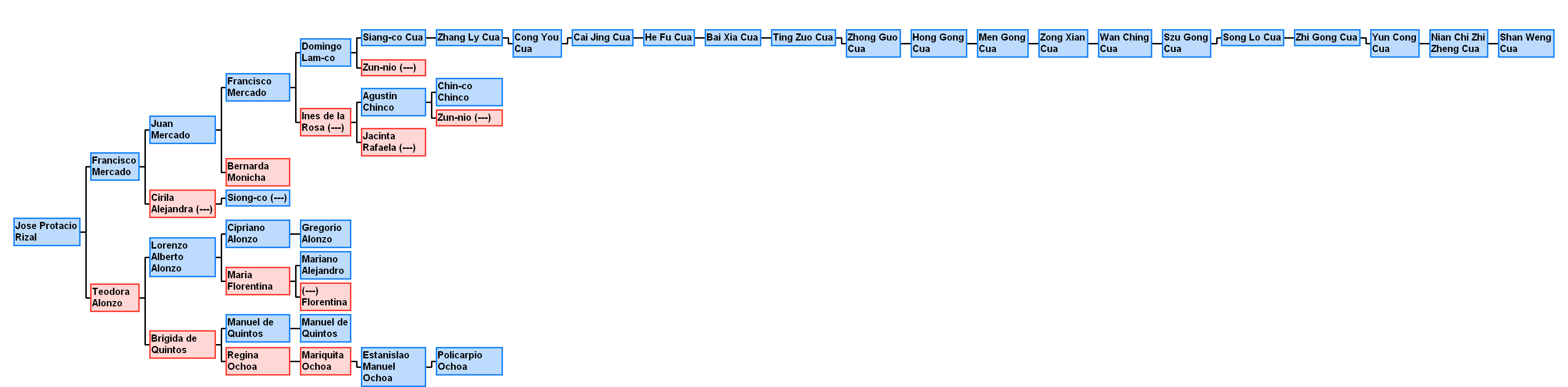
Eusebio Lopez and his cousin Jose Rizal were descendents of Domingo Lam-co. (traditional Chinese: 柯儀南) a Chinese immigrant entrepreneur who sailed to the Philippines from JinjiangQuanzhou in the mid-17th century.

Jose Rizal Pedigree

Domingo Lam-co’s Genealogy

Generation                All Surnamed Cua
1st          ShanWeng
2nd        Nian Chi Zhi Zheng
3rd         Yun Cong
4th          Zhi Gong
5th          Song Lo
6th          Szu Gong
7th          Wan Ching
8th          Zong Xian
9th          Men Gong
10th        Hong Gong
11th        Zhong Guo
12th        Ting Zuo
13th        Bai Xia
14th        He Fu
15th        Cai Jing
16th        Cong You
17th        Zhang Ly
18th        Na
19th    Lam (Cua-Lam or Domingo Lam-co)

Source: Cua Genealogy, Siongque, China.

The above Chinese genealogy shows that Socorro was a 28th -generation Cua of Siongque, (pronounced ”Zhang Guo” in Mandarin) in Losan district, Jinjiang, Fujian province, south China

The Cua clan of south China and Asia trace their origins 3,000 years ago to patriarch Chua Siok-To in the Yellow River basin of central China, in that area now called Henan province. Duke Chua Siok-To was the fifth son of the political genius who founded the Chou Dynasty and his eldest brother later became the king. This era was before the rise of a unified China under first Emperor Chin Shih Huang-Ti. Descendants of Chua (also pronounced ”Tsai” in Mandarin or ”Choy” in Cantonese) include some of the world’s richest billionaires according to Forbes magazine–Taiwanese Tsai Wan-Lin of Cathay Life Group and Indonesian ‘Tobacco King’ Rachman Halim (Chua To-Hing) of Gudang Garam Group. Another clan member was the late Philippine ‘Sugar King’ and philanthropist Antonio Roxas-Chua. Another heir of patriarch Chua Siok-To started the clan of Cua (pronounced ”Ke” in Mandarin, also spelled as ”Qua” or ”Koa,” of which Domingo Lamco and Dr. Jose Rizal were direct male descendants

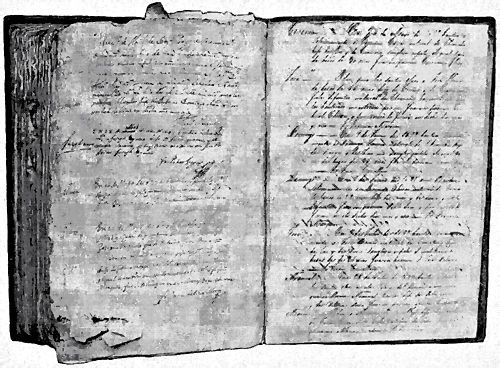
In 1697, at the age of 35, Lam-co was baptized at the San Gabriel Church in the predominantly Chinese community of Binondo.  In his baptismal record, his parents were simply listed as  SIONG-co and JUN-nio.

Domingo Lam-co Baptismal Record

In these church records, he specified his home village to be Siongque  near Quanzhou, Fujian Province.  He was the 19th generation of the first Cua who settled in Siongque.  The rural areas of Jinjiang , Lamoa, Hui-Wa, Chio-Sai, An-Khue and others under Quanzhou are the ancestral places of 80 percent of the top Chinese-Filipino entrepreneurs.

He adopted “Domingo” his baptismal day, as his first name.  He married a Chinese mestiza said to be half his age named Ines de la ROSA, Lam-co married Inez de la ROSA, a Sangley of Luzon. who belonged to an entrepreneurial family in Binondo.  Ines was the daughter of Agustin CHIN-co and Jacinta RAFAELA, a Chinese mestiza resident of the Parian.

Children of Agustin and Jacinta:

i Magdalena Vergara (—)
ii Josepha (—)
iii. Cristoval de la Trinidad (—)
iv. Juan Batista (—) .
v. Francisco Hong-Sun (—)
vi. Ines de la ROSA

With the rigid social stratification prevailing at that time, it was evident that Lam-co came from a good family.  Through his association with two Spanish friars, Fr. Francisco Marquez, authority on Chinese grammar, and Fr. Juan Caballero, he was invited to settle in the Dominican estate of San Isidro Labrador in Biñan, Laguna.  Lam-co was said to have been instrumental in the building of the irrigation works known as Tubigan, which made the area where it was situated the richest part of the estate.  He and his family lived in the estate along with fellow immigrants from Chin-chew, China.

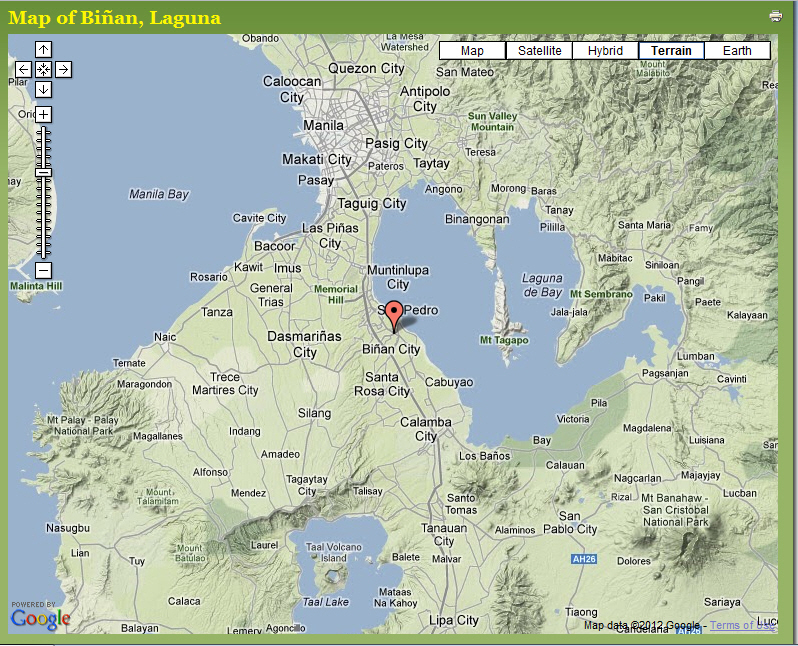
Map of Binan, Laguna

Sangley History

The Spanish colonization of the Philippines required more skilled laborers and they recruited Chinese immigrants from the islands. The economy became highly dependent upon the Chinese for their economic role as traders and artisans. Most of the Chinese living in the Manila area settled in a place called the Parían near Intramuros.

The Spanish founded the Parían in 1581 in what became Manila as the official marketplace and designated residence for the unconverted sangleys. Circumventing a royal decree outlawing the sangleys, as governor-general of the Philippines, Gómez Pérez Dasmariñas created Binondo in 1594 for the Catholic sangleys and their indio wives and their mestizos de sangley children and descendants. He gave the sangleys and mestizo de sangleys a land grant in perpetuity. They were allowed to establish a self-governing organization, called Gremio de Mestizos de Binondo (Guild of Mestizos of Binondo).

The Spanish colonists attempted to assimilate the sangleys into the Hispanic culture and converted many to Catholicism. They allowed Catholic sangleys to intermarry with indio women, but did not recognize marriages of the unconverted sangleys, as they did not officially sanction marriages among subjects that were performed outside the Catholic Church.

Beginning in 1600, the first generation of mestizos de sangley formed a small community of several hundred in Binondo. This is whereSan Lorenzo Ruiz grew up. He later was beatified by the Catholic Church as the first Filipino saint. During the 17th century, the Spaniards carried out four Great Massacres and Expulsions against the unconverted sangleys in response to real or imagined fears of an imminent invasion from China. In the aftermath, many sangleys converted at least nominally to Catholicism, adopted Hispanized names, and intermarried with indio women.

The Spanish encouraged the Chinese to convert to Catholicism. Many of the Chinese men married native women, and over time the multi-cultural mestizo de sangley caste developed. Although the colonial government never imposed on them the adoption of Spanish surnames and were allowed to keep their Chinese surnames, in many cases they chose to change them to the likes of Lopez, Palanca, Paterno, Rizal, Laurel, Osmeña, etc., or to made them look Hispanic by concatenation, for example: Lacson, Biazon, Tuazon, Ongpin, Yuchengco, Quebengco, Cojuangco, Cukingnan, Cuyegkeng, Yaptinchay, Yupangco, Tanchanco, Tiongson, Tanbengco, Tanjuatco, Locsin, Tetangco, etc.

In 1574, a few years after the Spaniards established Manila as the colonial capital of the Philippines, the Chinese pirate Limahong (traditional Chinese: 林風) attacked Manila and burned it to the ground, retreating later to other places around the Luzon coast where his forces continued the killings and looting. Some of them deserted Limahong, settled down and interbred with the locals.

In 1603 a Chinese revolt took place led by Juan Suntay, a wealthy Catholic Chinese. It was put down by joint Spanish and native forces led by Luis Pérez Dasmariñas. In the aftermath most of the 20,000 Chinese that composed the colony were killed. The revolt took place right after a visit to Manila by three official Chinese representatives who disclosed they were searching for “a mountain of gold”. This strange claim prompted the Spanish to conclude that there was an imminent invasion from China in the making. At the time the local Chinese outnumbered the Spaniards by twenty to one, and Spanish authorities feared that they would join the invading forces.  The Chinese afterward played down those events in an attempt to preserve their commercial interests, and in 1605 a Fukien official issued a letter claiming that the Chinese who had participated in the revolt were unworthy of China’s protection, describing them as “deserters of the tombs of their ancestors.

The insurrection was put down by joint Spanish, native and Japanese forces led by Luis Pérez Dasmariñas. A large number of the 20,000 Chinese that composed the colony were killed during the revolt. In the aftermath, the Chinese Ming government played down those events in an attempt to preserve their commercial interests, and in 1605 a Fukien official issued a letter claiming that the Chinese who had participated in the revolt were unworthy of China’s protection anyway, describing them as “deserters of the tombs of their ancestors”.

In 1662, the Chinese pirate, Cheng Ch’eng-kung, (Koxinga), attacked several towns on Luzon’s coast and demanded tribute from the colonial government, threatening to attack Manila if his demands were not met. The Spanish refused to pay the tribute and reinforced the garrisons around Manila.  Although most of the Manila Chinese distanced themselves from the pretensions of Koxinga, and in the end the invasion did not materialize, an increasing anti-Chinese sentiment grew within much of the population and hordes of locals massacred hundreds of Chinese in the Manila area

Most of the sangleys worked as skilled artisans or petty traders. Aside from shopkeeping, the sangleys earned their livelihood as carpenters, tailors, cobblers, locksmiths, masons, metalsmiths, weavers, bakers, carvers and other skilled craftsmen. As metalsmiths, they helped to build the Spanish galleons in shipyards located in Cavite. As masons, they built Intramuros and its numerous structures.

The Spanish gave the mestizos de sangley special rights and privileges as colonial subjects of the Spanish Crown and as baptized converts to the Catholic Church. They were given preference to handle the domestic trade of the islands and to lease land from the friar estates through the inquilino or lessee system, that allowed them to sublet those lands.

Later, the mestizos de sangley came to acquire many native lands, chiefly through a legal instrument called pacto de retro or contract of retrocession. In this scheme, a moneylender extended loans to farmers, who in exchange for cash, pawned their land with the option of buying it back. In the event of default, the moneylender recovered the loan by foreclosing the land from the farmer. Many local farmers lost their lands to mestizos de sangley in this manner.

The Spanish Galleon Trade [1565–1815], tied China to Europe via Manila and Acapulco, Mexico. Acting as a transshipment port, Manila attracted Chinese traders from Xiamen (Amoy) who arrived in armed ships, called Chinese junks, to trade with the Spanish. Chinese luxury goods, such as silk, porcelain and finely crafted furniture, were exchanged for silver from Mexican and Peruvian mines. Twice a year the galleons sailed across the Pacific Ocean from Manila to Acapulco and back. The goods were later taken to Spain via Veracruz, Mexico.

Food

In food, Chinese-Filipinos adapted Hokkien food from Fujian. They used indigenous ingredients and Spanish names to improvise what became part of Filipino cuisine. During the 19th century, noodle shops called panciterias serving comida China (Chinese food) dotted the islands. The ubiquitous pancit (meaning “noodle” from the Hokkien word pian-e-sit) became pancit luglog and lomi (flavored with sauce); mami (served with broth); pancit molo (cooked as pasta) and pancit Malabon (mixed with seafood). The rice staple (and wet-rice agriculture) common to East Asia originated in China, as did the rice porridge called arroz caldo. Other well-known Filipino dishes such as lumpia (egg-roll), maki (soup dish), kiampong (fried rice) and ma-chang (sticky rice,) among others, trace their origins to the culinary arts of the Hokkien migrants settling in the islands over the centuries.

Sources:

http://pinoygenealogy.wordpress.com/2010/04/24/jose-rizals-family-tree/

http://www.travelsmart.net/article/101662/

http://www.abs-cbnnews.com/video/lifestyle/06/17/11/rizal-park-china-quick-look

http://knightsofrizal.org/?p=320

http://www.asiafinest.com/forum/lofiversion/index.php/t13775.html

Posted in -9th Generation, Socorro | 4 Comments

Francisco Mercado

Francisco MERCADO (1731 – 1801) was Socorro’s 5th great grandfather.  He was also Jose Rizal’s great grandfather

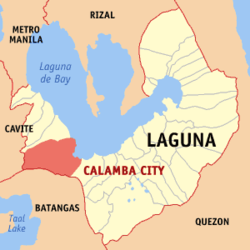
Francisco Mercado was born 1731 in Biñan, Laguna, Philippines. His parents were Domingo LAM-CO  and Ines de la ROSA. He married on 26 May 1771 in Calamba, Laguna, Philippines to Bernarda MONICHA.  Francisco died in 1801.

Biñan, Laguna, Philippines

Bernarda Monicha was a Chinese Mestiza born in  San Pedro Tunasan  or Biñan,  Laguna Philippines.   Not much is known of Bernarda save she was an orphan girl generally thought of as a relative of a certain coadjutor priest in Biñan,.  She was known for her sweet and lovable nature.

Children of Francisco and Bernarda:

Name Born Married Departed
1. Juan MERCADO Cirila ALEJANDRA
Biñan, Laguna, Philippines
2. Clemente Mercado

Domingo and Ines named their son Francisco Mercado believed as a gesture of gratitude to  a family friend Friar Francisco Marquez and Mercado,  a Spanish mestizo friar renowned for his botanical studies.  The surname “Mercado”, which means “market” in Spanish, was quite appropriate, too, since many ethnic Chinese were merchants, and many having adopted the same surname. This Spanish name saved the son from prejudice against Chinese surnames yet retaining a link to the Chinese merchant.

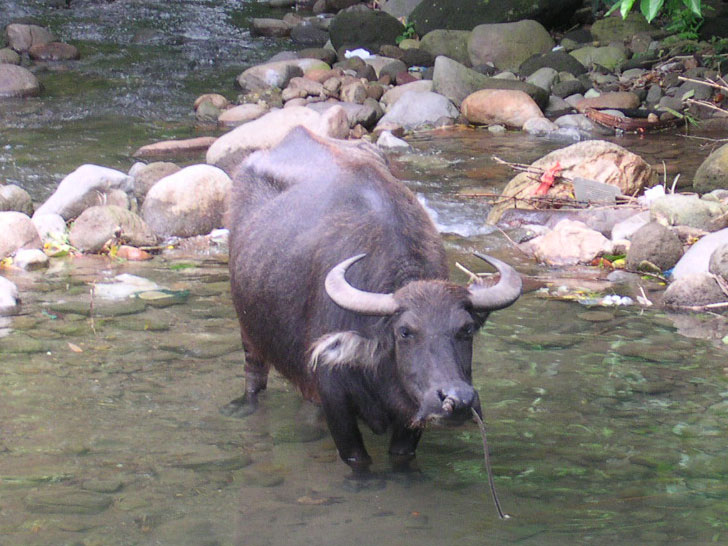
Francisco Mercado turned out to be a well-to-do rancher with a large herd of carabaos.

In 1771, Francisco Mercado married Bernarda MONICA, a native of the nearby hacienda of San Pedro Tunasan, then, like Biñan, was populated by many Chinese migrants, or Chinese mestizos.  They had two sons named Juan and Clemente.  For a short period, he settled his family at the hacienda of San Juan Bautista in Calamba.  However, hostility towards the Chinese immigrants as well as natives of Chinese descent- a backlash from the British invasion of Manila in 1762, during which the local Chinese supported the British against the Spaniards- forced Francisco Mercado to return his family to Biñan.

Francisco Mercado owned the largest herd of carabaos in Biñan.  He was active in local politics.  He was elected as the town’s capitan del pueblo around 1783.  Popular and good-natured, he often stood as godfather during baptisms and weddings, as Biñan’s church records revealed.

Francisco Mercado owned the largest herd of carabaos in Biñan

Since his early manhood, he became a familiar figure in court litigations involving agrarian disputes with the religious orders of Biñan.  It was the characteristic uprightness and courage of Francisco in the face of overwhelming odds that gave currency to the reputation of the Mercado clan as irreconcilable foes of rapacity and  injustice.

Sources:

http://pinoygenealogy.wordpress.com/2010/04/24/jose-rizals-family-tree/

Doctor Jose Rizal and the writing of his story By Valdez, Et Al

Posted in -8th Generation, Socorro | 3 Comments

World Visitors

One of the most rewarding aspects of this project is sharing what I learn with my (very) extended family.  Three-quarters of visitors have been from the United States, but visitors from many other countries have taken a look.

*COUNTRIES with an immigrant ancestor

Country Visitors  thru Mar 25, 2012 Population Population per Visitor
Niue (NZ) 3 1,000 333
*Maine (State with highest per capita visits) 1,323 1,328,188 1,004
Suriname                365                      529,000                     1,449
Falkland Islands (UK)                    2                           3,000                     1,500
Anguilla (UK)                    8                        15,236                     1,905
Tuvalu                    5                        10,000                     2,000
British Virgin Islands (UK)                  13                        28,213                     2,170
Montserrat (UK)                    2                           4,932                     2,466
Bermuda (UK)                  25                        64,237                     2,569
Faroe Islands (Denmark)                  15                        48,372                     3,225
Northern Mariana Islands (USA)                  13                        53,883                     4,145
Turks and Caicos Islands (UK)                  10                        44,493                     4,449
Cayman Islands (UK)                  12                        54,878                     4,573
Saint Kitts and Nevis                  11                        51,970                     4,725
Antigua and Barbuda                  18                        86,295                     4,794
*UNITED STATES 63,611 313,241,000 4,924
Saint Vincent and the Grenadines                  18                      100,892                     5,605
US Virgin Islands                  18                      106,405                     5,911
Aruba (the Netherlands)                  17                      101,484                     5,970
Saint Pierre and Miquelon (France)                    1                           6,082                     6,082
Grenada                  14                      103,328                     7,381
*Netherlands Antilles (CURAÇAO)                  22                      170,810                     7,764
Guernsey (UK)                    8                        62,431                     7,804
Dominica                    9                        71,293                     7,921
Jersey (UK)                  12                        97,857                     8,155
*CANADA            4,213                34,747,900                     8,248
American Samoa                    6                        55,519                     9,253
 Åland Islands                    3                        28,355                     9,452
Guam (USA)                  16                      159,358                     9,960
*BARBADOS                  25                      274,200                  10,968
 Monaco                    3                        35,881                  11,960
Iceland                  26                      319,575                  12,291
Saint Lucia                  13                      166,526                  12,810
French Guiana                  17                      224,469                  13,204
*UNITED KINGDOM            4,644                62,300,000                  13,415
*NETHERLANDS            1,220                16,728,091                  13,712
Isle of Man (UK)                    6                        84,497                  14,083
Greenland (Denmark)                    4                        56,749                  14,187
New Zealand                308                  4,430,440                  14,385
 Gibraltar (UK)                    2                        29,441                  14,721
 Bahamas                  24                      353,658                  14,736
Mississippi (State with lowest per capita visits 198 2,978,512    15,043
 Malta                  26                      417,617                  16,062
 Australia            1,352                22,867,848                  16,914
 Cook Islands (NZ)                    1                        17,791                  17,791
 Andorra                    4                        78,115                  19,529
 Palau                    1                        21,000                  21,000
*Quebec (Province with lowest per capita visits) 372 7,903,001    21,245
 Luxembourg                  24                      511,840                  21,327
*IRELAND                209                  4,581,269                  21,920
*BELGIUM                415                10,839,905                  26,120
Marshall Islands                    2                        54,305                  27,153
Belize                  11                      312,971                  28,452
Seychelles                    3                        90,945                  30,315
San Marino                    1                        32,252                  32,252
Guadeloupe (France)                  12                      401,554                  33,463
Tonga                    3                      103,036                  34,345
Liechtenstein                    1                        36,157                  36,157
Montenegro                  15                      620,029                  41,335
*NORWAY                120                  5,001,100                  41,676
 Cyprus                  18                      838,897                  46,605
 Estonia                  27                  1,316,541                  48,761
 Macau (China)                  11                      560,100                  50,918
 Micronesia                    2                      102,624                  51,312
 Brunei                    8                      422,700                  52,838
Trinidad and Tobago                  23                  1,317,714                  57,292
 Vanuatu                    4                      234,023                  58,506
 Denmark                  81                  5,580,516                  68,895
 Guyana                  11                      784,894                  71,354
 Fiji                  12                      868,000                  72,333
 Jamaica                  37                  2,705,800                  73,130
 Switzerland                104                  7,870,100                  75,674
 Puerto Rico                  48                  3,725,789                  77,621
 Maldives                    4                      317,280                  79,320
 Singapore                  65                  5,183,700                  79,749
World 83,921 6,873,417,682 81,903
Bahrain                  15                  1,234,571                  82,305
Latvia                  25                  2,067,887                  82,715
Czech Republic                126                10,548,527                  83,718
Sweden                113                  9,486,591                  83,952
São Tomé and Príncipe                    2                      169,000                  84,500
Lithuania                  35                  3,192,800                  91,223
Panama                  37                  3,405,813                  92,049
Samoa                    2                      186,340                  93,170
Taiwan                243                23,234,003                  95,613
Cape Verde                    5                      491,875                  98,375
 Qatar                  17                  1,699,435                  99,967
 Kiribati                    1                      101,000                101,000
 Finland                  52                  5,405,850                103,959
 Slovenia                  19                  2,057,210                108,274
 Macedonia                  18                  2,057,284                114,294
 Namibia                  20                  2,324,000                116,200
Costa Rica                  37                  4,301,712                116,262
Israel                  67                  7,848,800                117,146
Greece                  91                10,787,690                118,546
New Caledonia (France)                    2                      245,580                122,790
Croatia                  34                  4,290,612                126,194
Hungary                  79                  9,985,722                126,402
Georgia                  35                  4,469,200                127,691
Austria                  65                  8,452,835                130,044
Martinique (France)                    3                      396,404                132,135
Slovakia                  41                  5,445,324                132,813
French Polynesia                    2                      274,000                137,000
Gabon                  11                  1,534,000                139,455
Portugal                  72                10,561,614                146,689
 Albania                  19                  2,831,741                149,039
Bulgaria                  49                  7,364,570                150,297
*GERMANY                499                81,831,000                163,990
 Serbia                  42                  7,120,666                169,540
 Romania                112                19,042,936                170,026
 Kuwait                  21                  3,582,054                170,574
*FRANCE                384                65,800,000                171,354
 Oman                  16                  2,773,479                173,342
 Bhutan                    4                      720,679                180,170
 Hong Kong (China)                  39                  7,108,100                182,259
 Botswana                  11                  2,038,228                185,293
 Uruguay                  17                  3,251,526                191,266
 Bosnia and Herzegovina                  20                  3,839,737                191,987
 Moldova                  18                  3,560,400                197,800
United Arab Emirates                  41                  8,264,070                201,563
 Lebanon                  21                  4,259,000                202,810
 Armenia                  16                  3,268,500                204,281
Mayotte (France)                    1                      211,000                211,000
 Spain                214                46,196,278                215,870
 Italy                263                60,776,531                231,089
Dominican Republic                  38                  9,378,818                246,811
 Mauritius                    5                  1,280,924                256,185
 Djibouti                    3                      818,159                272,720
*POLAND                141                38,501,000                273,057
South Africa                168                50,586,757                301,112
 Jordan                  20                  6,280,600                314,030
 Mongolia                    8                  2,736,800                342,100
 El Salvador                  18                  6,183,000                343,500
 *PHILIPPINES                267                94,013,200                352,109
 Malaysia                  80                28,334,135                354,177
Palestinian territories                  12                  4,293,309                357,776
 Chile                  41                17,248,450                420,694
 Honduras                  19                  8,215,313                432,385
 Lesotho                    5                  2,194,000                438,800
 Paraguay                  14                  6,337,127                452,652
 Libya                  13                  6,423,000                494,077
 Belarus                  19                  9,463,000                498,053
 South Korea                  95                48,580,000                511,368
 Ukraine                  87                45,644,419                524,648
 Nicaragua                  11                  5,815,524                528,684
 Timor-Leste                    2                  1,066,409                533,205
Solomon Islands                    1                      553,935                553,935
 Liberia                    6                  3,476,608                579,435
 Argentina                  68                40,117,096                589,957
 Gambia                    3                  1,776,000                592,000
 Swaziland                    2                  1,203,000                601,500
 Colombia                  74                46,441,000                627,581
 Thailand                104                65,479,453                629,610
 Tunisia                  16                10,673,800                667,113
 Comoros                    1                      669,300                669,300
 Turkey                108                74,724,269                691,891
 Russia                204              143,030,106                701,128
 Mexico                157              112,336,538                715,519
Equatorial Guinea                    1                      720,000                720,000
 Ecuador                  20                14,483,499                724,175
 Peru                  41                30,135,875                735,021
 Brazil                246              192,376,496                782,018
Venezuela                  34                27,150,095                798,532
Réunion (France)                    1                      816,364                816,364
 Haiti                  12                10,085,214                840,435
 Guatemala                  17                14,713,763                865,515
 Japan                138              127,650,000                925,000
 Saudi Arabia                  29                27,136,977                935,758
 Bolivia                  11                10,426,154                947,832
 Kazakhstan                  16                16,698,000            1,043,625
 Egypt                  67                81,726,000            1,219,791
 Kenya                  31                38,610,097            1,245,487
 Ghana                  19                24,223,431            1,274,917
 Algeria                  29                37,100,000            1,279,310
 Angola                  16                20,609,294            1,288,081
 Sri Lanka                  16                20,653,000            1,290,813
 Madagascar                  16                20,696,070            1,293,504
 Rwanda                    8                10,718,379            1,339,797
 Cameroon                  14                19,406,100            1,386,150
 Morocco                  22                32,503,100            1,477,414
 Uganda                  22                32,939,800            1,497,264
 Azerbaijan                    6                  9,111,100            1,518,517
 Zambia                    8                13,046,508            1,630,814
Papua New Guinea                    4                  7,014,000            1,753,500
 Mali                    8                14,528,662            1,816,083
 Kyrgyzstan                    3                  5,477,600            1,825,867
 Cambodia                    7                13,395,682            1,913,669
 Sudan                  16                30,894,000            1,930,875
 Vietnam                  44                87,840,000            1,996,364
 Burundi                    4                  8,038,618            2,009,655
 Indonesia                112              237,641,326            2,121,798
 Côte d’Ivoire                  10                21,395,000            2,139,500
 Turkmenistan                    2                  5,105,000            2,552,500
 Eritrea                    2                  5,415,000            2,707,500
 Cuba                    4                11,241,161            2,810,290
 Sierra Leone                    2                  5,997,000            2,998,500
 Benin                    3                  9,100,000            3,033,333
 Tanzania                  14                43,188,000            3,084,857
 Laos                    2                  6,465,800            3,232,900
 Pakistan                  55              179,090,000            3,256,182
 Mauritania                    1                  3,340,627            3,340,627
 Nepal                    7                26,620,809            3,802,973
 Tajikistan                    2                  7,616,000            3,808,000
Republic of the Congo                    1                  4,140,000            4,140,000
 Iraq                    8                33,330,000            4,166,250
 Iran                  18                76,239,000            4,235,500
 Senegal                    3                12,855,153            4,285,051
Central African Republic                    1                  4,487,000            4,487,000
 Mozambique                    5                23,049,621            4,609,924
 Uzbekistan                    6                28,000,000            4,666,667
 Ethiopia                  18                84,320,987            4,684,499
 Yemen                    5                24,527,000            4,905,400
 Guinea                    2                10,217,591            5,108,796
 Niger                    3                16,274,738            5,424,913
 India                219          1,210,193,422            5,525,997
 Togo                    1                  6,191,155            6,191,155
 Zimbabwe                    2                12,754,000            6,377,000
 Nigeria                  25              162,471,000            6,498,840
 Malawi                    2                13,077,160            6,538,580
 Bangladesh                  16              142,319,000            8,894,938
 Somalia                    1                  9,331,000            9,331,000
 Syria                    2                21,498,000          10,749,000
 Afghanistan                    2                24,485,600          12,242,800
 Burkina Faso                    1                15,730,977          15,730,977
 China                  74          1,347,350,000          18,207,432
 North Korea                    1                24,052,231          24,052,231
 Myanmar                    2                48,337,000          24,168,500
Democratic Republic of the Congo                    2                67,758,000          33,879,000
 Pitcairn Islands (UK) 0  66  na
 Cocos (Keeling) Islands (Australia) 0 605  na
 Vatican City 0 800  na
 Tokelau (NZ) 0 1,411  na
Christmas Island (Australia) 0 1,462  na
Norfolk Island (Australia) 0 2,302  na
Svalbard and Jan Mayen (Norway 0 2,495  na
Saint Helena, Ascension and Tristan da Cunha (UK) 0 4,000  na
Sint Maarten (the Netherlands) 0 7,429  na
Saint Barthélemy (France) 0 8,902  na
Nauru 0 10,000  na
Wallis and Futuna (France) 0 13,445  na
 Saint Martin (France) 0 36,824  na
 Western Sahara 0 548,000  na
 Guinea-Bissau 0 1,520,830  na
 South Sudan 0 8,260,490  na
 Chad 0 11,274,106  na

x

Source:

http://s05.flagcounter.com/more/2e9

Posted in Research | Leave a comment

North American Visitors

One of the most rewarding aspects of this project is sharing what I learn with my (very) extended family.

I was curious where these distant relations were  coming from. I put a visitor counter on the site and saw that California, New York, Massachusetts, Texas and Florida had the most visitors, but by and large those are just the largest states.  I put together this little analysis to see where people were most interested.

State/ Province Visitors   thru Mar 24, 2012  Population Jul 1 2011 Pop per Visitor
*Maine 1,323 1,328,188 1,004
*New Hampshire 1,015 1,318,194 1,299
*New Brunswick 488 751,171       1,539
*Vermont 394 626,431       1,590
*Massachusetts 3,809 6,587,536       1,729
Iowa 1,749 3,062,309       1,751
*Rhode Island 549 1,051,302       1,915
District of Columbia 276 617,996       2,239
*Connecticut 1,424 3,580,709       2,515
Utah 1,078 2,817,222       2,613
Washington 2,556 6,830,038       2,672
Yukon 12 33,897       2,825
*Nova Scotia 268 921,727       3,439
Idaho 444 1,584,985       3,570
Oregon 988 3,871,859       3,919
Prince Edward Island 34 140,204       4,124
Georgia 2,284 9,815,210       4,297
Alaska 163 722,718       4,434
Colorado 1,097 5,116,769       4,664
*New York 4,055 19,465,197       4,800
*Montana 206 998,199       4,846
*California 7,647 37,691,912       4,929
*Virginia 1,620 8,096,604       4,998
United States  60,227 311,591,890       5,174
Kansas 541 2,871,238      5,307
North America
64,396 345,068,578       5,359
*Nebraska 342 1,842,641      5,388
*South Carolina 859 4,679,230      5,447
Michigan 1,776 9,876,187      5,561
Ohio 2,024 11,544,951      5,704
*Wisconsin 975 5,711,767      5,858
Wyoming 94 568,158      6,044
New Jersey 1,448 8,821,155      6,092
Arizona 1,062 6,482,505      6,104
Delaware 145 907,135      6,256
North Carolina 1,541 9,656,401      6,266
*Minnesota 848 5,344,861      6,303
British Columbia 691 4,400,057      6,368
*Missouri 918 6,010,688      6,548
Maryland 879 5,828,289      6,631
*Pennsylvania 1,882 12,742,886      6,771
Florida 2,761 19,057,542      6,902
Nevada 373 2,723,322      7,301
Hawaii 183 1,374,810      7,513
South Dakota 108 824,082      7,630
Indiana 846 6,516,922      7,703
Ontario 1,628 12,851,821      7,894
Illinois 1,604 12,869,257      8,023
Canada  4,169 3,476,688      8,030
North Dakota 84 683,932      8,142
Tennessee 782 6,403,353      8,188
West Virginia 224 1,855,364      8,283
Oklahoma 444 3,791,508      8,539
Arkansas 343 2,937,979      8,566
New Mexico 241 2,082,224      8,640
Alberta 410 3,645,257      8,891
*Kentucky 490 4,369,356      8,917
Texas 2,778 25,674,681      9,242
Saskatchewan 110 1,033,381      9,394
Newfoundland and Labrador 48 514,536    10,720
Alabama 439 4,802,740    10,940
Manitoba 103 1,208,268    11,731
Northwest Territories 3 41,462    13,821
Louisiana 318 4,574,836    14,386
Mississippi 198 2,978,512    15,043
Nunavut 2 31,906    15,953
*Quebec 372 7,903,001    21,245

* State/ Province where an ancestor was born 

x

Source:

http://s05.flagcounter.com/more/2e9

Posted in Research | 1 Comment

Juan Mercado

Juan MERCADO (17xx –  1826) was Socorro’s 4nd great grandfather.  He was also Jose Rizal’s grandfather

Juan (or Capitan Juan as he was called) Mercado was born in Biñan, Laguna, Philippines.  His parents were Francisco MERCADO and Bernarda MONICA.  He married Cirila ALEJANDRA. at the age of 22.  Juan died in 1826.

Biñan, Laguna, Philippines

Cirila Alejandra was a Chinese Mestiza,  daughter of one of Domingo Lam-co’s godsons, and who hailed from Tubigan.  Her parents were Juan SIONG-CO  (Syongco) and Maria CONIO of Biñan.

Children of Gregorio and Remegia:

Name Born Married Departed
1. Gavino Mercado
2. Potenciana Mercado  Unmarried  1847
3. Leoncio Mercado
4. Fausto Mercado
5. Barcelisa Mercado Hermenegildo Austria
6. Gabriel Mercado
7. Julian Mercado
8. Gregorio Fernando MERCADO Eulalia TRIVINO
.
Remegia Abarientos
9. Casimiro Mercado
10. Petrona Mercado Gregorio Neri
11. Tomasa Mercado F. de Guzman
12. Cornelia Mercado
13. Francisco Engracio Mercado (Rizal) 1818
Biñan, Laguna, Philippines
Teodora Alonso Realonda de Quintos 1898
Calamba, Laguna, Philippines

Juan and Cirila had 13 children.  They lived in large house made of stone in the center of Biñan.  (One of his children, Francisco Engracio, born in Biñan sometime in April 1818 was the father of Jose Rizal).

Like his father, Juan Mercado also served as the town’s capitan del pueblo (gobernadorcillo of Biñan) in 1808, 1813, and 1823.  On many occasions, “Capitan Juan”, as his town mates referred to him, was the hermano mayor in religious and social affairs.  Like his wife, he was benevolent and hardworking.  His status earned him the privilege of electing the Philippine representative to the Spanish parliament in 1812.

After Mexico became independent in 1821, Spain took over direct control of the Philippines. It had been governed by the Virreinato de Nueva España or Viceroyalty of New Spain (Mexico). Coinciding with the advent of steamships and the consequent expansion of the global economy, the Spaniards decided to open up the Philippines to foreign trade. As the subsistence economy shifted to an export crop economy, in 1834 the Spanish allowed both non-Spanish Westerners and Chinese immigrants to settle anywhere in the islands.

The mestizos de sangley largely abandoned wholesale and retail trading altogether. They converted their capital into larger landholdings, and cultivated sugar plantations for a commodity crop for the new export market, particularly in Central Luzon, Cebu, Iloilo and Negros. The mestizos de sangley took advantage of the rapid changes as the colonial economy was integrated into the markets of the Western world.

Many prominent mestizo de sangley families belonging to the landlord class acquired vast landholdings during this period. Their holdings were second only to those of the Catholic religious orders, who owned the most land in the Philippines. As landholders, the mestizo sangleys acquired more power than they has in their economic role as colonial merchants of the Spanish Colonial Period. The middleman role became filled chiefly by new Chinese immigrant traders. In the years to come, mestizo sangleys in the countryside became a kind of feudal power.

In the 19th century, the population of mestizos de sangley grew rapidly over the years as more Chinese male immigrants arrived, converted to Catholicism, settled in Binondo and intermarried with indio or mestizo de sangley women. With no legal restrictions on their movement, mestizos de sangley migrated to other areas in the course of work and business, such as Tondo, Bulacan, Pampanga, Bataan, Cavite, Cebu, Iloilo, Samar, Capiz, etc. The number of unconverted sangleys dropped from a high of 25,000 prior to the First Great Massacre of 1603 to below 10,000 by 1850. From 1810-1894, the population figures for the Philippine islands were as follows:.

Race Population (1810) Population (1850) Population (1894)
indio 2,395,677 4,725,000 6,768,000
mestizo de sangley 120,621 240,000 500,000
sangley 7,000 10,000 100,000
Peninsular (from Spain) 4,000 25,000 35,000
Total 2,527,298 5,000,000 7,403,000

Today Chinese mestizos of mixed Chinese and either indigenous Malay or Spanish ancestry make up 20% of the country’s total population

With the continuous expansion of Metro Manila, the city of Biñan is now included in Manila built up area which reaches Lipa CityBatangas in its southernmost part. Biñan City is also part of the new metropolitan area of the province of Laguna, known as Laguna West Metro.

The City of Biñan is located in the Philippine province of Laguna, about 34 kilometers south of Manila. It is bounded on the north by San Pedro on the south by Santa Rosa City and on the west by CarmonaCavite. On the eastern and northern horizon lies the Laguna de Bay, the largest lake in the country.

Children 

8. Gregorio Fernando MERCADO (See his page)

10. Petrona Mercado

Petrona, for some years had been a dressgoods merchant in nearby Kalamba, on an estate that had recently come under the same ownership as Biñan. There she later married, and shortly after was widowed. Possibly upon their mother’s death, Potenciana and Francisco removed to Kalamba; though Petrona died not long after, her brother
and sister continued to make their home there.

13. Francisco Mercado

Juan Mercado died when his son, Francisco Engracio Mercado, was only eight years old. With his sisters and brothers, Francisco Engracio helped his widowed mother in managing the family’s business.

Francisco, in spite of his youth, became a tenant of the estate as did some others of his family, for their Binan holdings were not large enough to give farms to all Captain Juan’s many sons. The landlords early recognized the agricultural skill of the Mercados by further allotments, as they could bring more land under cultivation. Sometimes Francisco was able to buy the holdings of others who proved less successful in their management and became discouraged.

The pioneer farming, clearing the miasmatic forests especially, was dangerous work, and there were few families that did not buy their land with the lives of some of its members. In 1847 the Mercados had funerals, of brothers and nephews of Francisco, and, chief among them, of that elder sister who had devoted her life to him, Potenciana. She had always prompted and inspired the young man, and Francisco’s success in life was largely due to her wise counsels and her devoted encouragement of his industry and ambition. Her thrifty management of the home, too, was sadly missed.

He married Teodora Alonso Realonda de Quintos, a daughter of one of Manila’s most distinguished families in 1848.   Teodora Alonzo was the daughter of Lorenzo Alberto Alonzo and Brigida de Quintos .  Lorenzo was described as “very chinese” in appearance. Brigida was the daughter of Manuel de Qunitos, a Manila attorney whose family were Chinese Mestizos of Pangasinan.

It is said that Doña Teodora’s family descended from Lakandula, the last native king Tondo. Her great-grandfather, Rizal’s maternal great-great-grandfather, Eugenio Ursua (of Japanese ancestry), who married a Filipina named Benigna (surname unknown). Their daughter, Regina, married Manuel de Quintos, Filipino-Chinese lawyer from Pangasinan. One of the daughters of Atty. Quintos and Regina was Brigida, who married Lorenzo Alberto Alonso, a prominent Spanish-Filipino mestizo of Biñan. Their children were Narcisa, Teodora (Rizal’s mother), Gregorio, Manuel, and Jose.

Sometime after 1849, in compliance with Governor Claveria’s decree ordering Filipinos to adopt Spanish surnames (to facilitate documentation, for, many Filipino families shared the same family name such as “De La Cruz”, etc.)   Francisco adopted the surname “Rizal” (originally Ricial,  the green of young growth or green fields), which was suggested to him by a provincial governor, or as José had described him, “a friend of the family”. However, the name change caused confusion in the business affairs of Francisco, most of which were begun under the old name. After a few years, he settled on the name “Rizal Mercado” as a compromise, but usually just used the original surname “Mercado”.

Francisco moved his family to Calamba, where he farmed lands leased from the Dominican friars, growing sugar cane, rice and indigo.  He also started a mixed orchard engaged in trade, raised poultry, in all of which he was assisted by his wife Teodora.  In time, Franciso’s family became one of the wealthiest in Calamba.

Francisco  changed his surname to Rizal to avoid being implicated in the 1872 Cavite Mutiny, as his son, Paciano Rizal Mercado,, was a student of Fr. Burgos.

Francisco Engracio Rizal Mercado (1818–1898)

Francisco Engracio Rizal Mercado y Alejandro and Teodora Alonso Realonda de Quintos, were prosperous farmers who were granted lease of a hacienda and an accompanying rice farm by the Dominicans. Jose Rizal was the seventh child of their eleven children namely:

i. Saturnina (Neneng) (1850–1913),  She was married to Manuel T. Hidalgo, a native and one of the richest persons in TanauanBatangas. She was known as Neneng..

ii. Paciano (1851–1930)

iii. Narcisa (Sisa) (1852–1939)

iv. Olimpia, Lucia (1857–1919)

v. María (Biang) (1859–1945)

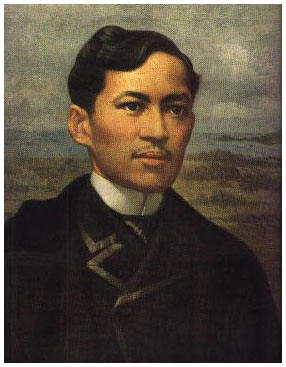
vi.  José Protasio (19 Jun 1861 Calamba, Laguna–1896) soon to become  José Rizal   He was classified as mestizo de sangley due to his Chinese ancestry, although he also had Japanese and Spanish ancestors.  He is famous for asking to classified as indio prior to his execution.

Calamba, Laguna, Philippines

vii. Concepción (Concha) (1862–1865)

viii. Josefa (Panggoy) (1865–1945)

ix. Trinidad (1868–1951)

x. Soledad (Choleng) (1870–1929).

In 1849, the then Governor-General of the Philippines,  Narciso Claveria, issued a Decree by which native Filipino and immigrant families were to adopt Spanish surnames from a list of Spanish family names. Although the Chino Mestizos were allowed to hold on to their Chinese surnames, Lam-co changed his surname to the Spanish “Mercado” (market), possibly to indicate their Chinese merchant roots. José’s father Francisco adopted the surname “Rizal” (originally Ricial, the green of young growth or green fields), which was suggested to him by a provincial governor, or as José had described him, “a friend of the family”. However, the name change caused confusion in the business affairs of Francisco, most of which were begun under the old name. After a few years, he settled on the name “Rizal Mercado” as a compromise, but usually just used the original surname “Mercado”.

Jose Rizal (1861-1896)

Upon enrolling at the Ateneo Municipal de Manila, José dropped the last three names that make up his full name, on the advice of his brother, Paciano Rizal Mercado, and the Rizal Mercado family, thus rendering his name as “José Protasio Rizal”. Of this, Rizal writes:“My family never paid much attention [to our second surname Rizal], but now I had to use it, thus giving me the appearance of an illegitimate child!”  This was to enable him to travel freely and disassociate him from his brother, who had gained notoriety with his earlier links with native priests who were sentenced to death as subversives.

For the difference in the names, Rizal gave the following explanation to his friend Blumentritt:

When you write to my brother, address him Paciano Mercado . . . After the sad catastrophe (1872), he had to leave the university since he was a liberal and the friars did not like him because of his having lived with Burgos. At that time, I had to go to Manila to study, and in order not to have difficulties in my studies, I was advised to use our second name, Rizal. For some time, I am the only Rizal because at home my parents, my sisters, my brother, and my relatives always preferred the old surname Mercado. Our father’s name was in effect Mercado; but in the Philippines there are many Mercados who are not our relatives. There was an alcalde, a friend of the family, who used our name Rizal. My family, however, did not mind this, because even now I alone use the name. Accordingly, does it not appear as if I were an illegitimate son?

My father and all my family remain valiantly united permanently loyal to the Filipino party, and my brother is much braver in exile than he was before. My whole family now carries the name Rizal instead of Mercado because the name Rizal signifies persecution. Good. I want also to stick with them and be worthy of the name of the family. . . ..

Sources:

http://www.geni.com/people/Gregorio-Fernando-A-Mercado/6000000003277269547?through=6000000006179216154

http://wiki.answers.com/Q/Who_are_the_13_children_of_juan_mercado_and_cirila_alejandro

Doctor Jose Rizal and the writing of his story By Valdez, Et Al

http://paniqui_embry.tripod.com/alliedfam/aqwg08.htm

Posted in -7th Generation, Socorro | 4 Comments

Gregorio Fernando A. Mercado

Gregorio Fernando A. MERCADO (1 ) was Socorro’s 3nd great grandfather.  He was also Jose Rizal’s uncle.

Gregorio Fernando A. Mercado was born xx. His parents were Juan MERCADO and Cirila ALEJANDRO.He first married Eulalia TRIVIÑO. He next married Remegia Abarientos. Gregorio died xx.

Eulalia Triviño was born xx.

Remegia Abarientos was born xx.

Children of Gregorio and Eulalia:

Name Born Married Departed
1. Jose Triviño MERCADO Dorotea Moxica QUIZON

.

Children of Gregorio and Remegia:

Name Born Married Departed
2. Restituto Mercado Crescencia Yamson Fuentes
3. Filomeno A. Mercado Consolacion ch. Neri
4. Francisca. A. Mercado
5. Monica A. Mercado Leon R. Chavez
6. Doroteo A. Mercado Carmen P. Zayas
7. Aquilina A. Mercado Macrobio R. Chaves
8. Demetria A. Mercado Nicolas Pelaez
9. Hermana A. Mercado
10. Cresencia A. Mercado Pedro Neri

Other sources state that Juan Mercado and Cirila Alejandro had 14 children: Gregorio Fernando becoming Gregorio and Fernando, two separate persons.

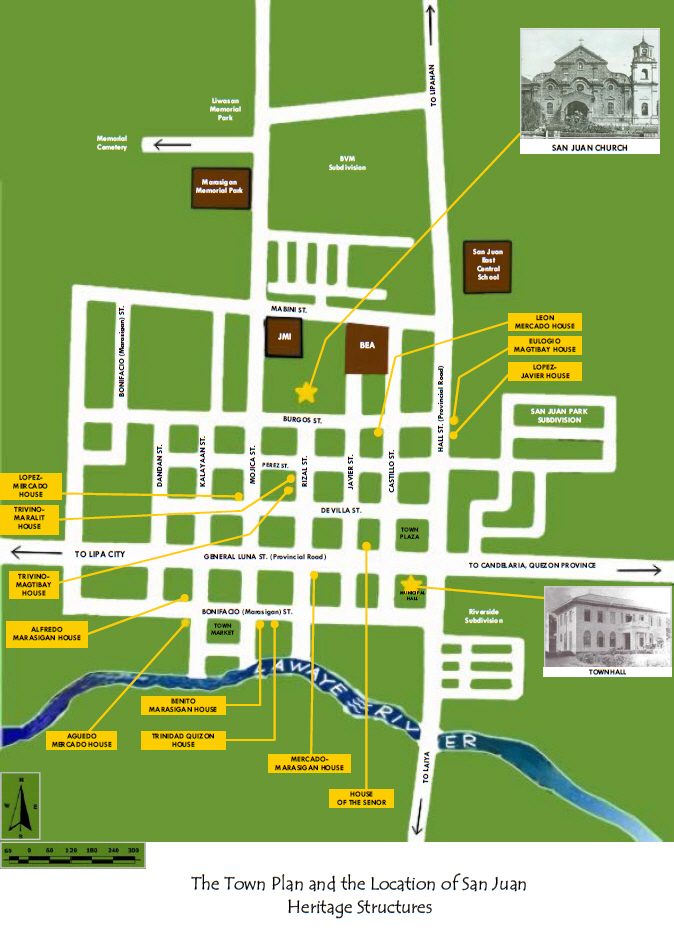
Jose Rizal’s uncles were forced by Spanish harassment  to move.  Gregorio Mercado  ended up in San Juan and married  Eulaia Trivino.

The Mercado-Quizon family has their ancestral properties in the northeastern part of San Juan including some in the adjacent towns of Quezon just across the Malaquing Ilog

Gregorio de Mercado may have been elected gobernadorcillo of San Juan in 1856.

San Juan Batangas was a relatively new place, not settled until the mid 1800’s.  The Angkan families evolved their own local culture of common survival and existence. As emigrants to the new place, many found it socially convenient to rely more on each other if only to maintain their regional customs and expand family holdings. Clearly, they had strong respect for family ties and territorial rights that may have influenced their active nationalism when it was expected of them during times of crisis. The fact that many early Angkan members came from the same region (sharing the same values and customs) and were related to each other through marriage helped further this process along and ensure harmony in the place.

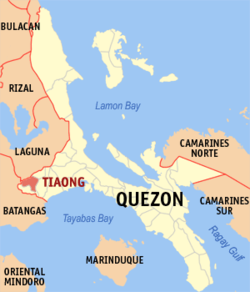
“The Triviño’s are one of San Juan’s oldest families.” (Martin Tinio Jr., Batangas Forged in Fire, p. 189). The Triviño roots were originally from Tiaong (Quezon) who intermarried with the Quizon, Maralit, Mercado, and Perez families of San Juan.

Tiaong, Quezon

The roster of town Tinientes includes a Mamerto Triviño (1839-1840) and a Juan Triviño (1843). Hipolito Mercado, a cabeza de barangay of one of San Juan’s original barangay in 1848, married Maria Triviño. In 1878, Santiago Triviño and Francisco Triviño were cabezas de barangay. Approaching the year 1900, Ciriaco Triviño was a punong bayan of the town. By the 1920s, neighboring heritage houses along Rizal Street leading to the church were built by brothers Emilio and Liduvino Triviño for their families. Some in the Triviño clan moved on and settled in Naga City after the war where they made a name for themselves.

The early San Juan community started in what is now the barangay of Pinagbayanan (the old town site) along the coast of Tayabas Bay. The original immigrants to San Juan mostly appropriated the surrounding virgin territory for themselves and established the first haciendas in the town. The first indication about the profile of those who were responsible for shaping San Juan’s landscape is partly provided through parish and town records. In 1836, a census of the town showed that it had a population of 6,508 residents.

Sources:

http://www.geni.com/people/Gregorio-Fernando-A-Mercado/6000000003277269547?through=6000000006179216154

http://wiki.answers.com/Q/Who_are_the_13_children_of_juan_mercado_and_cirila_alejandro

For more on San Juan, click here for The San Juan Batangas Legacy.pdf  by Leon Mayo.

Posted in -6th Generation, Socorro | 5 Comments

José Triviño Mercado

José Triviño MERCADO (18xx –  ) was Socorro’s 2nd great grandfather.  He was also José Rizal’s first cousin.

José Triviño Mercado was born 18xx. His parents were Gregorio Fernando A. MERCADO and Eulalia TRIVIÑO. He married Dorotea Moxica QUIZON. Santos died xx.

Dorotea Moxica Quizon was born in 1857. Her parents were Vicente QUIZON and Gregoria MOXICA. Dorotea died 18 Feb 1929 San Juan, Calabarzon, Philippines.

Dorotea Moxica Quizon

Dorotea had two brothers and six sisters, named Regino, Juan Sr., Evarista, Urbana, Lutgarda, Estanislawa, Julia and Maxima. She was the youngest of the nine children. Married Jose when she was 13. Became a widow at 21. She died at the age of 72 on February 18th, 1929. Buried in San Juan, Batangas.

Children of José and Dorotea:

Name Born Married Departed
1. Maria MERCADO Santos LOPEZ
2. Leon Quizon Mercado

Three other children died of small pox.

Dorotea’s mother was Gregoria Moxica.  The Moxica family was one  of the earliest landlords in San Juan. “The Moxicas had a lot of land, properties said to have come from Fray Damaso Moxica, the friar who built the town’s (earlier) church.” (Martin Tinio Jr., Batangas Forged in Fire, p. 188). The Fray who came from his previous post in Imus, Cavite arrived in San Juan in 1847 and was the town parish priest for more than 30 years. Lore has it that four children whom the Fray brought with him from Cavite may have descended from the Fray. Later, another child born in San Juan was also said to be a descendant of the Fray. The Mojica children (interchangeable with Moxica) were however mostly female and thus the name is not found in San Juan today. The line however helped produced some of the oldest and wealthiest Angkan families in San Juan including the  Quizon, Mercado, Javier and Magtibay families. This Angkan’s ancestral lands are found in the  northeastern quadrant of the town and include areas of Quezon province close to the Malaking Ilog

Children

1. Maria MERCADO (See Santos LOPEZ‘s page)

2. Leon Quizon Mercado

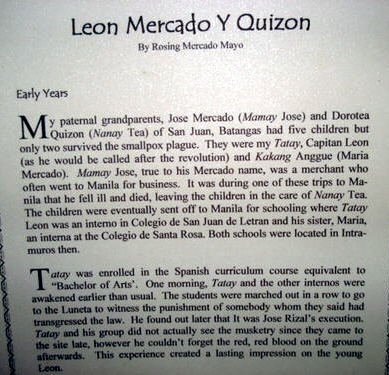
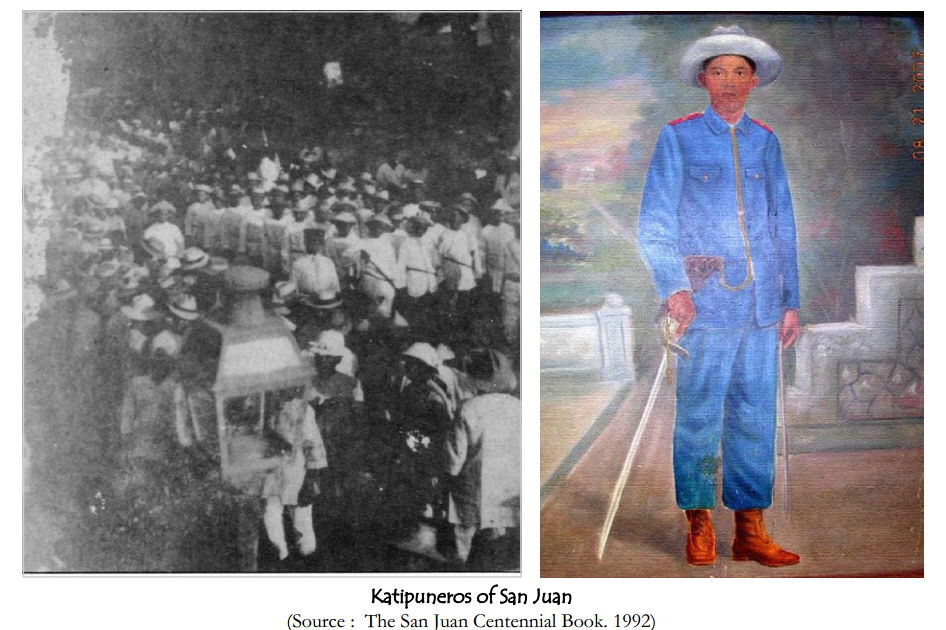
Leon Quizon Mercado, also known as “Kapitan Leon”, was a Katipunero from San Juan who joined the Revolution at age seventeen. He studied in Letran and was fluent in Latin and Greek. He joined the Revolution at seventeen and was known as Kapitan Leon.

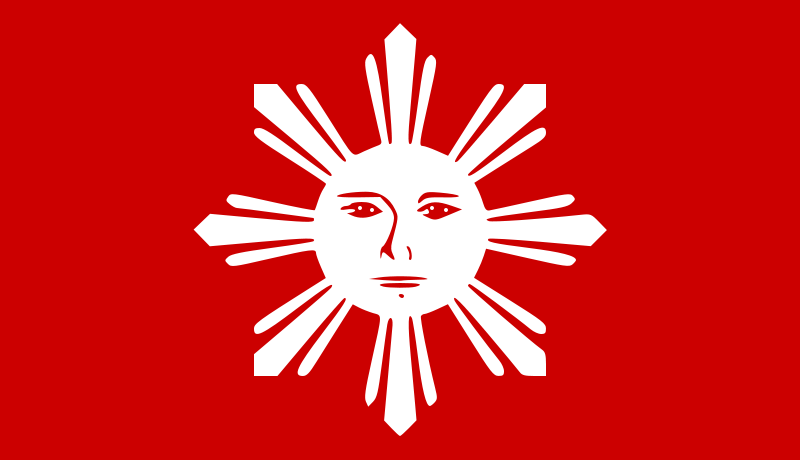
The Katipunan was a Philippine revolutionary society founded by anti-Spanish Filipinosi in Manila in 1892, whose primary aim was to gain independence from Spain through revolution. The society was initiated by Filipino patriots Andrés BonifacioTeodoro PlataLadislao Diwa, and others on the night of July 7, when Filipino writer José Rizal was to be banished to Dapitan. Initially, the Katipunan was a secret organization until its discovery in 1896 that led to the outbreak of the Philippine Revolution.

Flag of the Katipunan in 1897

The word “katipunan”, literally meaning ‘association’, comes from the root word “tipon”, a Tagalog word meaning “gather together” or society

Being a secret organization, its members were subjected to the utmost secrecy and were expected to abide with the rules established by the society.   Aspirant applicants were given standard initiation rites to become members of the society. At first, membership in the Katipunan was only open to male Filipinos; later, women were accepted in the society. The Katipunan had its own publication, Kalayaan (Liberty) that had its first and last print on March 1896. Revolutionary ideals and works flourished within the society, and Philippine literature were expanded by some of its prominent members.

In planning the revolution, Bonifacio contacted Rizal for his full-fledged support for the Katipunan in exchange for a promise of rescuing Rizal from his detainment. On May 1896, a delegation was sent to the Emperor of Japan to solicit funds and military arms. The Katipunan’s existence was revealed to the Spanish authorities after a member named Teodoro Patiño confessed the Katipunan’s illegal activities to his sister, and finally to the mother portress of Mandaluyong Orphanage. Seven days after the Spanish authorities learned of the existence of the secret society, on August 26, 1896, Bonifacio and his men tore their cedúlas during the infamous Cry of Balintawak that started the Philippine Revolution.

(Wikipedia says – “Kapitan” Leon Quizon Mercado – Katipunero, Participated in the insurrection against the US, Farmer, “Coconut King of Batangas” till the early 1960’s)

After the revolution against Spain, Leon also participated in the Philippine-American War (1899-1902).

Leon Quizon Mercado was a young katipunero who served out his term as one of the appointed punong-bayan of San Juan Batangas between the revolutionary years 1892-1899.

In each province where there were Katipunan members, a provincial council called Sangguniang Bayan was established and in each town was an organized popular council called Sangguniang Balangay. Each Bayan and Balangay had its own set of elected officials: Pangulo (president); Kalihim (secretary); Tagausig (fiscal); Tagaingat-yaman (treasurer); Pangalawang Pangulo (vice president); Pangalawang Kalihim (vice secretary); mga kasanguni (councilors); Mabalasig (terrible brother);  Taliba (guard); Maniningil (collector/auditor); Tagapamahala ng Basahan ng Bayan(custodian of the People’s Library);   Tagapangasiwa (administrator);   Manunulat (clerk);   Tagatulong sa Pagsulat (assistant clerk); Tagalaan (warden); and Tagalibot (patroller).   Each Balangay were given a chance to expand their own spheres of influence, through a triangle system in order to elevate their status to Sangguniang Bayan.    Every Balangay that did not gain Sanggunian Bayan status were dissolved and annexed by greater provincial or popular councils.

During the war it is said that Leon captured an American soldier and spared his life. In exchange, the American soldier taught Leon how to speak English.

“Among the other towns in the province of Batangas, San Juan fought harder against the
Americans that it necessitated an order from Gen. Franklin Bell to activate the repressive zona system in the town. This caused hardship to San Juan where perhaps in the whole Tagalog  region, San Juan lost the most number of people (from disease, if not from battle wounds).”  In an account of the Philippine-American war  it was written that “one (zona) camp 2 miles wide by one mile long housed 8,000 Filipinos and sometimes over 200 were confined to one building. In camps in Lobo and San  Juan, over 20% of the population died.”

The 1903 census declared mortality rates in Batangas  Province as follows:

Town Population (1903 Census) Mortality Pct
San Juan  11,853 3,276 27.6%
Taal  17,525 1,971 11.2%
San Jose   8,996 1,061 11.8%
Rosario   8,326    864 10.4%
Lobo  5,781    805 13.9%
Total Batangas Province  52,481 7,977 15.2%

An account of the Philippine-American War in 1899-1902 in the province of Batangas. Glenn Anthony May, an Oregon History Professor fuels controversy in this examination of the Philippine-American War. He rejects  previously accepted explanations , popularized by Teodoro Agoncillo, that the Philippine Revolution was a revolt of the masses. Instead, he argues that the experience of Batangas was unique because it was the political and economic elite of the province who became the backbone of local resistance, serving as military leaders and extending financial and other forms of assistance to the revolutionary troops.
(Yale University Press, 1991.).

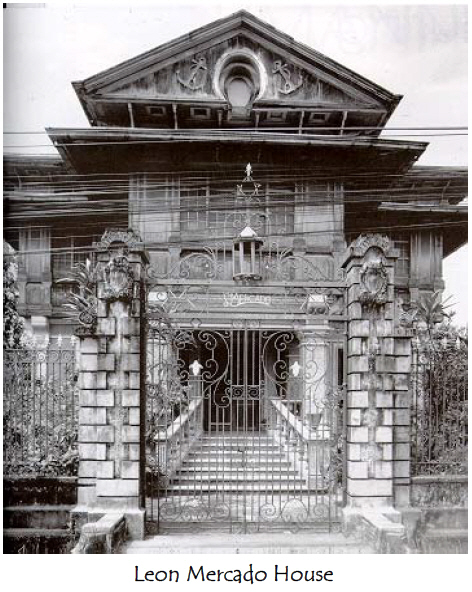
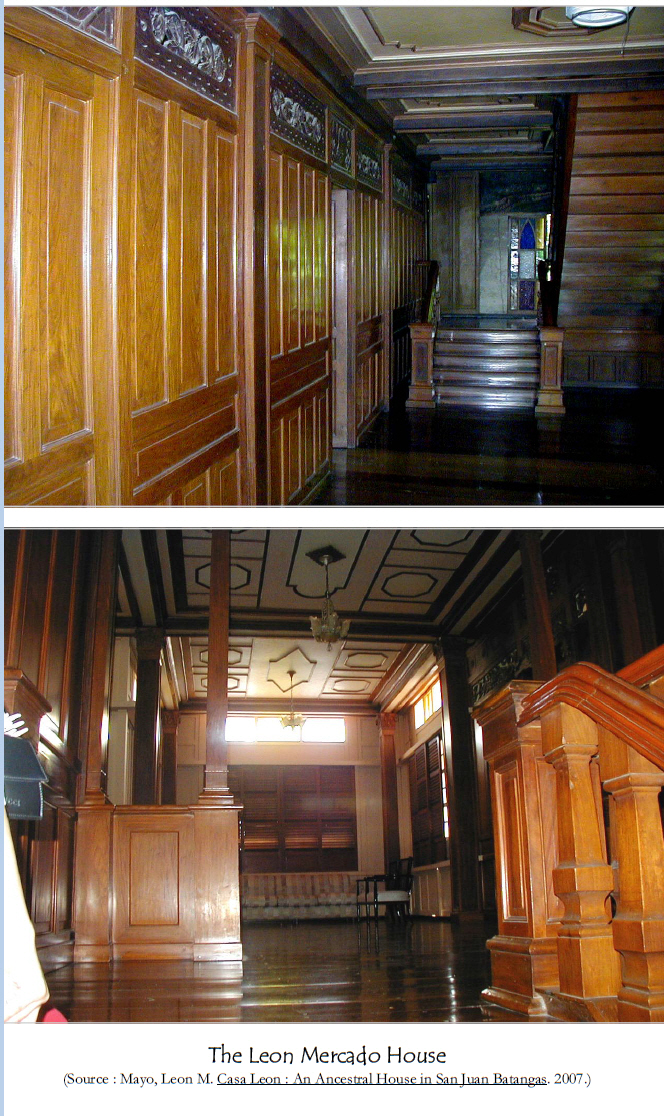
Once the war with the Americans was over, Leon became a successful farmer and was known as the “Coconut King of Batangas”.  Like the Triviño and Marasigan families, Leon Mercado also invested in more coconut plantations in Naga City after the war. Leon Mercado and his wife Emiliana Sales built the Mercado heritage house Casa Leon along Burgos Street in the north side of town. Leon died in the 1960s.

The Bahay na bato, the colonial Filipino house, followed the nipa hut’s arrangements such as open ventilation and elevated apartments. The most obvious difference between the two houses would be the materials that was used to build them. The bahay na bato was constructed out of brick and stone rather than the traditional bamboo materials. It is a mixture of native Filipino, Spanish and Chinese influences.

He had twelve children including Dominador Mercado who developed Corinthian Gardens and Tahanan Village, and Leon Antonio Mercado, architect of Legaspi Towers.

(Wikipedia says: Architect Leon Sales Mercado Jr. – Philippine Architect. Founder/Principal Architect/President of LAS Mercado and Associates from the 1960’s to the 90’s, a firm that specialized/pioneered in the design of large residential development/condominium complexes and private residences in the greater Manila area and suburbs (First to break the 20 floor barrier for high-rise construction in the Philippines). Designer of various higher education facilities (UP). President and founder of “Rainbow Philippines” a citizen’s band radio organization in the 70’s. Youngest son of “Kapitan” Leon Quizon Mercado)

Leon’s children include Angie Marasigan (the grandmother of the famous talented jeweler Ciara Marasigan), Rosing Mayo (f), Dedes (f), Mameng Manalo (f), Ines Gonzales, Pepe Meracdo, Daddy Mercado, Goring Mercado, Bandok Mercado, Loring Mercado and Tony Mercado (the architect who built Legaspi Towers).

Sources:

http://www.geni.com/people/Jose-Trivino-Mercado/6000000010532388296?through=6000000010532142795

For more on San Juan, click here for The San Juan Batangas Legacy.pdf  by Leon Mayo.

Posted in -5th Generation, Socorro | 4 Comments

Santos Lopez

Santos LOPEZ (18xx – ) was Socorro’s great grandfather.

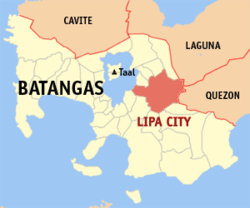
Santos Lopez was born in Lipa, Bantagas. His parents were xx. He married  Maria MERCADO. Santos died xx.

Lipa Batangas

Santos Lopez and Soledad Lopez

Santos Lopez

Santos Lopez

Maria Mercada was born xx. Her parents were Jose Trivino MERCADO and Dorotea Moxica QUIZON. Maria died xx.

Children of Santos and Maria:

Name Born Married Departed
1. Miguel Lopez Catalina Mercado Javier
2. Arsensio Lopez Angeles Rodriguez
.
Pianing (Pia) Salud
3 Soledad LOPEZ 1905
San Juan Batangas
Eusebio M. LOPEZ
1924
4. Leonor Lopez Dr. Jose (Pepe) Soco

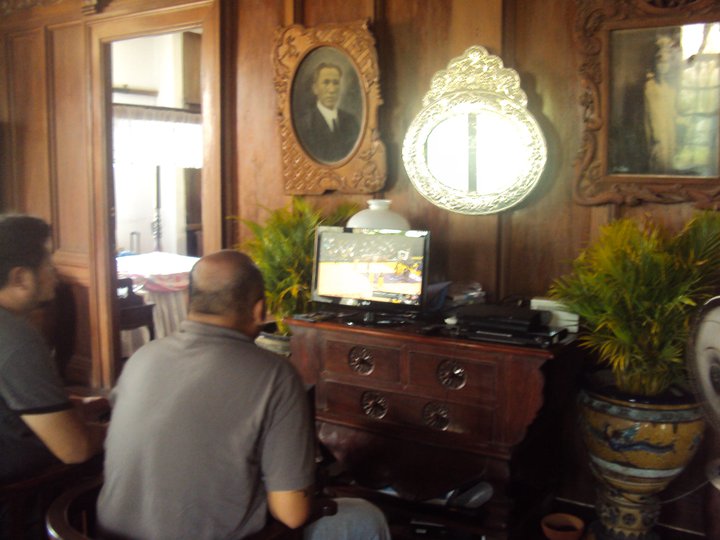
Santos and Soledad oversee a basketball game on the internet

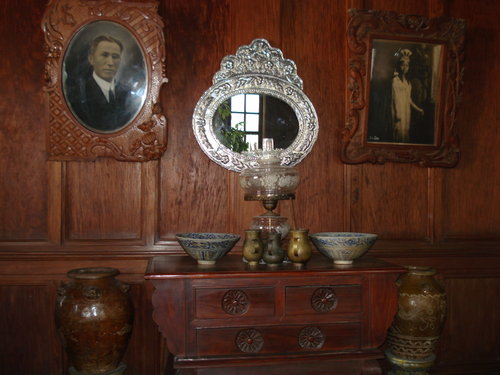
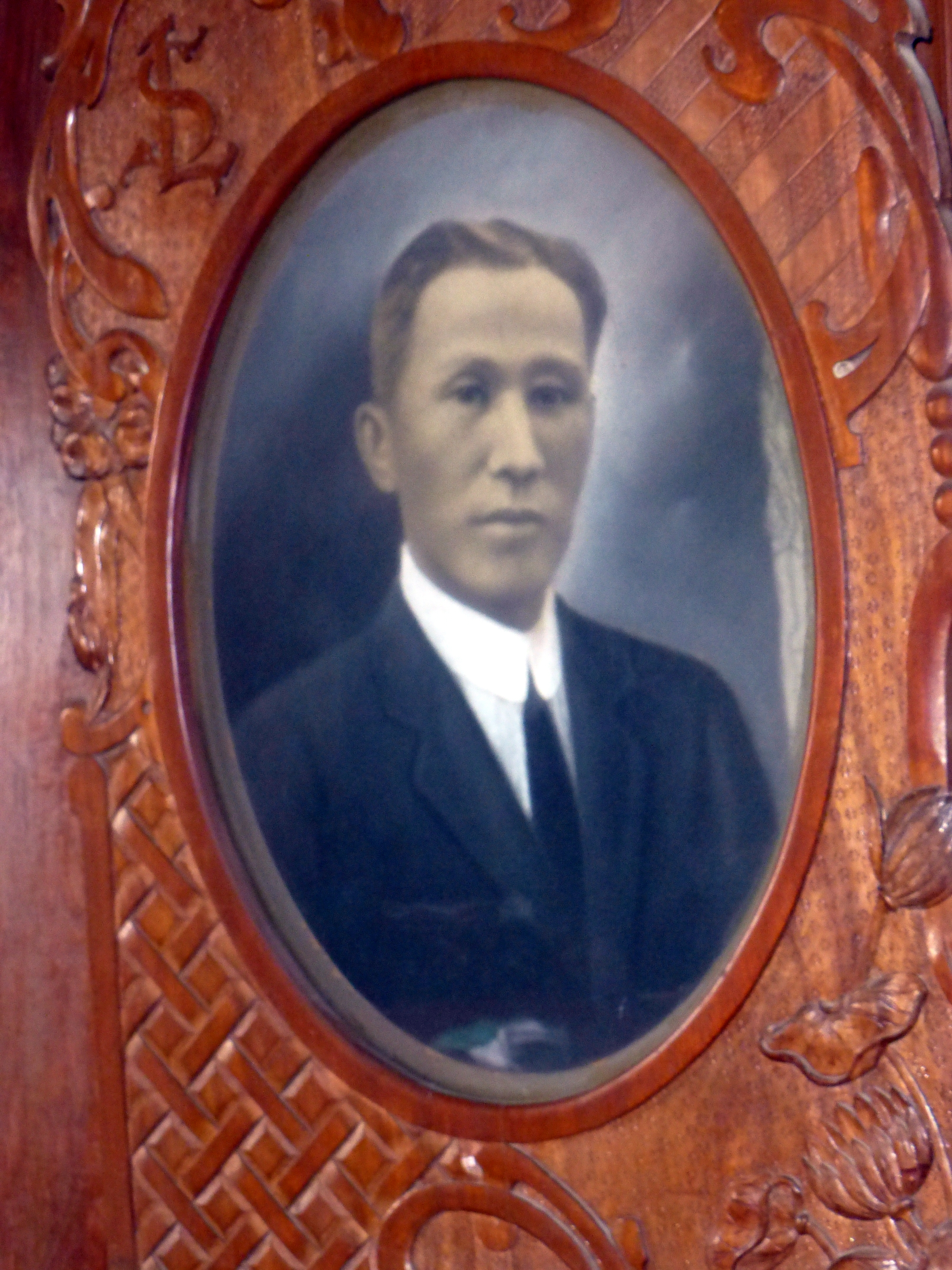
The Lopez ancestral home was built by Lolo Santos Lopez and Lola Maria Mercado. Santos Lopez of Lipa built their heritage bahay-na-bato house in Mojica  Street.   Their pictures still hang in the dining room. See Eusebio’s page for more pictures.

The traditional Filipino “Bahay na bato” style for the large houses  built of stone and wood combines Filipino, Spanish and Chinese style elements.

The two major rivers of San Juan are the Malaking Ilog and the Lawaye rivers. “Malaking Ilog has the largest watershed area among the rivers of Batangas. It drains an area of about 820 square kilometers that includes most of Malepunyo Volcano, two-thirds of San Cristobal Volcano and the southwest quadrant of Banahaw Volcano. Because of its extensive watershed, the lower reaches of Malaking Ilog are prone to flooding and flash floods which early settlers might have experienced perennially.

On October 28, 1883, San Juan experienced a catastrophe due to continuous high winds and storm rain. “Water in the town rose to a height of three meters; houses were destroyed, livestock drowned and planted crops were washed away.

In agreement with the parish authorities, the town officials initiated the petition for the transfer of the lumang bayan upstream to a new site on January 18, 1886. On December 12, 1890 the bagong bayan or new town location in Calitcalit was formally approved by the Government. Two years later by 1893, the Maura Law was passed and all the town heads under the new set up were formally designated and given the title of Capitan Municipal. Four Tinientes (deputies) would make up the Tribuna Municipal or Municipal Council.

San Juan Batangas

The relatively urgent relocation of the township due to the floods actually gave the people a fresh base to start their life anew. Despite its new town setting, however, the socio-economic setup in San Juan retained its feudal character. The large plantations that fostered the tenancy system and were owned by a few families remained the order of the day. As these plantations grew in the hinterlands around the town, the families that established them clustered together in the new poblacion (town urban center). There they built their fine houses at about the same time and socialized with their peers even as their tenant workers lived out their simple life in their nipa huts in the rural field.

Children

1. Miguel Lopez

Miguel’s wife Catalina Mercado Javier

 Don Miguel Lopez (San Juan Mayor 1934-1942)

Don Miguel Lopez (San Juan Mayor 1934-1942)

Children of Miguel and Catalina

i. Marcelo Lopez m. Naty [__?__] Children: Mario, Maricsi, Baby, Lito Lopez

Marcelo Lopez

ii. Natividad Lopez m. Rolando Cueto Child Cesar Cuerto

iii. Librada (Lily) Javier Lopez m. Rudy Asuncion Children: Lolly, Greg, Lydia, Bernie, Phil, and Jun

2. Arsenio Lopez

xxx

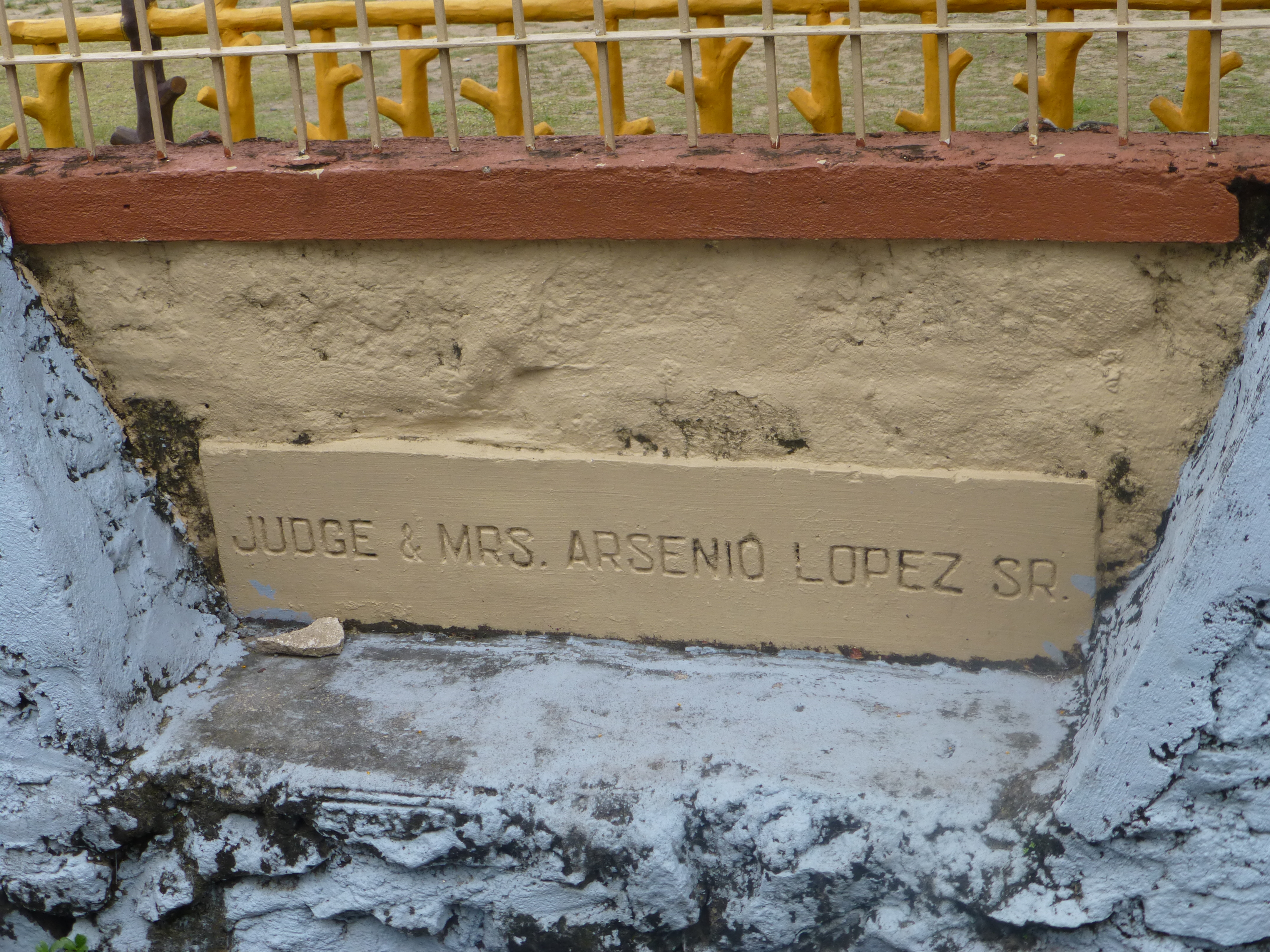
San Juan West Central School – Founder’s Bench

Child of Arsensio and his first wife Angeles Rodriguez.

i. Dennis Lopez m. Noemi Mariano

Children of Arsensio and his second wife  Pianing (Pia) Salud

ii.Nora Lopez m. Atty. Adelfo M. Maceda Children Pia,  Regina Eloisa, Carlos, Johnny and Renato (Tato).

Pia Maceda

Regina Eliosa Maceda

Johnny Maceda

Renato Maceda

Me, Renato Maceda, Socorro Alcid, and Cherry Maceda in their new Jersey City condo on the Hudson.

iii. Jun Lopez m. Ofelia Ledesma; Children Cecil Alcantara, Argie Lopez, Manny Lopez, John Paul Lopez, Pia Lorenzo, Mark Lopez

iv. Zenaida Lopez m. [__?__] Fernandez Children: Noli Lopez Fernandez, Ma. Pia Lopez Fernandez,  Monica Fernandez Ocampo, Mario Lopez Fernandez, Martin Lopez Fernandez, Isidro Fernandez, Pia Fernandez, Martin Fernandez, Mai Mai Fernandez, Monica Ocampo, Noli Fernandez

3. Soledad LOPEZ (See Eusebio M. LOPEZ‘s page)

4. Leonor Lopez

A huge painting of Lola Leonor Lopez Soco – sister of Lola Soledad greets one and all

Leonor Soco

Leonor’s husband Dr. Jose (Pepe) Soco was 15 years older than her.  He was from Hagonoy, Bulacan.

Leonor Lopez Soco

Children of Leonor and Jose

i. Leonor Soco m. Jun Magbag

Lena Magbag

ii. Aggie Lopez-Soco m. Jenny [__?__] Daughter Maan Soco, son JF’s wedding on 6-9-12 in Tagaytay.

iii. Rene Lopez-Soco  m.  Trina Montemayor-Misa of Alaminos, Pangasinan. Children are Angela, Jose Miguel (Mitch), and Jose Paolo (Paul). Angela married Bill Mitchell. Angela’s children are Reid (son 12-23-09) and Ryan (daughter 3-23-12). Mitch married Charlene Arguelles. Paolo married Rebecca Dixon. Paul’s first child is expected October 2012.

BTW, Trina (wife of Rene) and son Mitch; and Lena arrived in PI for JF’S Wedding on 6-9-12 in Tagaytay. JF is son of Aggie Lopez-Soco and Jenny.

iv. Digos Lopez-Soco

v. Boy Lopez-Soco Children Yeyet Soco (son) and Nico Soco (son)

vi. Titol Lopez-Soco m. Ruffy [__?__] Child: Banjo Lopez-Soco

Sources:

http://www.geni.com/people/Santos-Lopez/6000000003187195274?through=6000000003187206590

Posted in -4th Generation, Socorro | 11 Comments

Invasion of Canada – 1775

The Invasion of Canada in 1775 was the first major military initiative by the newly-formed Continental Army during the American Revolutionary War. The objective of the campaign was to gain military control of the British Province of Quebec, and convince the French-speaking Canadiens to join the revolution on the side of the Thirteen Colonies.

One expedition left Fort Ticonderoga under Richard Montgomery, besieged and captured Fort St. Johns, and very nearly captured British General Guy Carleton when taking Montreal.

The other expedition left Cambridge, Massachusetts under Benedict Arnold, and traveled with great difficulty through the wilderness of Maine to Quebec City. The two forces joined there, but were defeated at the Battle of Quebec in December 1775

American Attack on Quebec

Montgomery’s Expedition

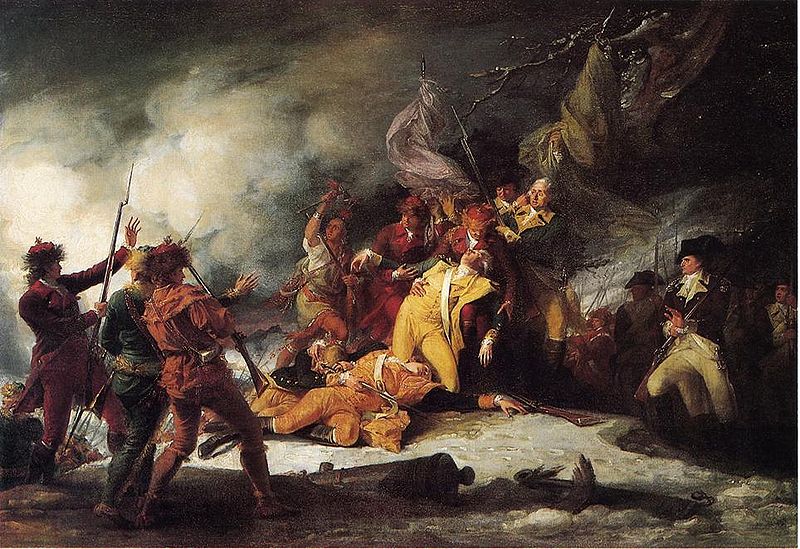
General Richard Montgomery (1738-1775)

Montgomery’s expedition set out from Fort Ticonderoga in late August, and began besieging Fort St. Johns, the main defensive point south of Montreal, in mid-September. After the fort was captured in November, Carleton abandoned Montreal, fleeing to Quebec City, and Montgomery took control of the city before heading for Quebec with an army much reduced in size by expiring enlistments. There he joined Arnold, who had left Cambridge in early September on an arduous trek through the wilderness that left his surviving troops starving and lacking in many supplies and equipment.

In May 1775, aware of the light defenses and presence of heavy weapons at the British Fort Ticonderoga, Benedict Arnold and Ethan Allen led a force of colonial militia that captured Fort Ticonderoga and Fort Crown Point, and raided Fort St. Johns, all of which were only lightly defended at the time.  Ticonderoga and Crown Point were garrisoned by 1,000 Connecticut militia under the command of Benjamin Hinman in June.

Nathan BALCOM (1741 Attleboro – 1787 Attleboro)

Nathan Balcom was part of Capt Sedgwick’s company, Col. Benjamin Hinman ’s regiment which went from Winchester CT to Fort Ticonderoga in 1775.’

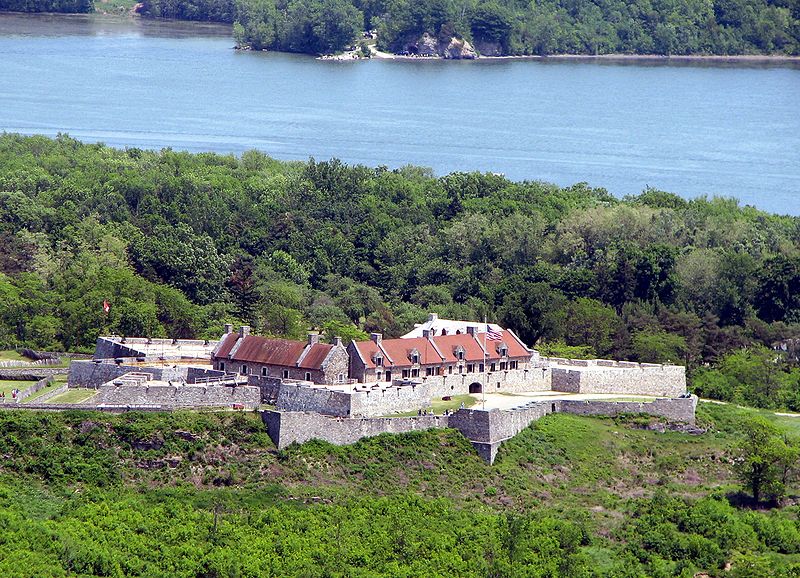
Fort Ticonderoga from Mount Defiance

With the outbreak of the Revolutionary War, Hinman  was commissioned in May 1775 as a captain of the 4th Connecticut Regiment. In May 1775 Benedict Arnold had stabilized Fort Ticonderoga which had been captured by the Americans. On June 17, 1775 Hinman arrived with a thousand troops from Connecticut to rebuild the fort. Because of his rank he claimed authority but Benedict Arnold objected until the three man committee of inspection including Silas Deane from Congress told him he must allow Hinman to command. Benedict Arnold later disbanded his troops and returned home.

4th Connecticut Regiment– Authorized 27 April 1775 in the Connecticut State Troops. Organized 1-20 May 1775 to consist of ten companies from Litchfield and Hartford Counties. Each company to consist of 1 captain or field grade officer. 2 lieutenants, I ensign, 4 sergeants, 4 corporals, 1 drummer. 1 fifer, and 100 privates.

COMMANDER: Colonel Benjamin Hyman (Hinman) May 1, 1775-Dec  20,1775.

Adopted 14 June 1775 into the Continental Army.  Took part in the Invasion of Canada, Battle of Quebec (Autumn and Winter 1775). Two companies from this regiment were garrisoned at Fort Ticonderoga.

Disbanded in December 1775 in Canada, less two companies disbanded 19-20 December 1775 at Cambridge, Massachusetts. These latter two were Lieutenant Colonel Ozias Bissell’s and Captain Hezekiah Parsons’ Companies, which stayed behind to serve at the Siege of Boston.

The Siege of Fort St. Jean, conducted by American Brigadier General Richard Montgomery on the town and fort of Saint-Jean in  Quebec  lasted from Sep  17 to Nov 3, 1775.

After several false starts in early September, the Continental Army established a siege around Fort St. Jean. Beset by illness, bad weather, and logistical problems, they established mortar batteries that were able to penetrate into the interior the fort, but the defenders, who were well-supplied with munitions, but not food and other supplies, persisted in their defence, believing the siege would be broken by forces from Montreal under General Guy Carleton.  On Oct 18, the nearby Fort Chambly fell, and on Oct 30, an attempt at relief by Carleton was thwarted. When word of this made its way to St. Jean’s defenders, combined with a new battery opening fire on the fort, the fort’s defenders capitulated, surrendering on Nov 3.

The fall of Fort St. Jean opened the way for the American army to march on Montreal, which fell without battle on Nov 13. General Carleton escaped from Montreal, and made his way to Quebec City to prepare its defences against an anticipated attack.

Arnold’s Expedition

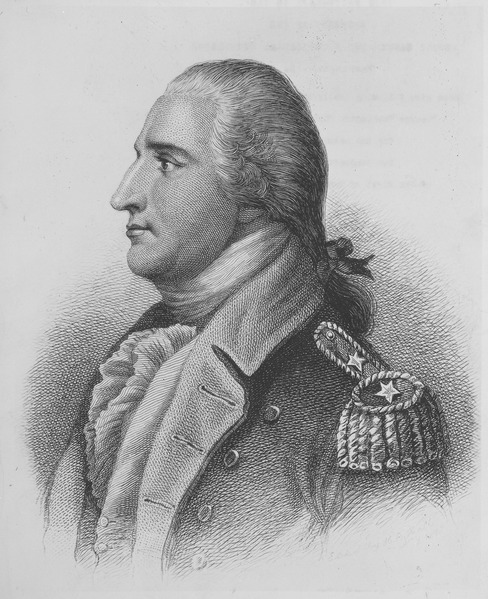
Benedict Arnold (1741-1801)

Benedict Arnold, who had been rejected for leadership of the Champlain Valley expedition, returned to Cambridge, Massachusetts, and approached George Washington with the idea of a supporting eastern invasion force aimed at Quebec City.  Washington approved the idea, and gave Arnold 1,100 men, including Daniel Morgan‘s riflemen, for the effort.   Arnold’s force sailed from Newburyport, MA to the mouth of the Kennebec River and then upriver to Fort Western (present day Augusta, Maine).

Arnold’s expedition was a success in that he was able to bring a body of troops to the gates of Quebec City. However, the expedition was beset by troubles as soon as it left the last significant outposts of civilization in present-day Maine. There were numerous difficult portages as the troops moved up the Kennebec River, and the boats they were using frequently leaked, spoiling gunpowder and food supplies. The divide between the Kennebec and the Chaudière River was a swampy tangle of lakes and streams, where the traversal was complicated by bad weather, resulting in one quarter of the troops turning back. The descent down the Chaudière resulted in the destruction of more boats and supplies as the inexperienced troops were unable to control the boats in its fast-moving waters.

Ebenener’s FOSTER‘s son Bartholomew died on the way to the Siege of Quebec in Oct 1775

Benjamin NEWCOMB’s grandson Tryal Tanner (1751-1833)  was a sergeant in Gen. Arnold’s disastrous campaign in Canada, and in common with all the soldiers with him, suffered incredible hardships in the retreat of 500 miles. At the close of this campaign he enlisted in a Continental Connecticut regiment as a lieutenant and was promoted to the adjutancy of the regiment, and in this capacity was in the battle of Monmouth.

Thomas JEWELL III’s grandson Joseph Jewell (1759 – 1812) was a private in Capt William H. Ballard’s company, Col. James Frye‘s 10th Massachusetts Regiment May 1775, It served in the Siege of Boston until its disbandment at the end of 1775. Col. Frye’s report of Oct 6 1775 places Joseph Jewell as having gone on the Quebec Expedition

John BRADLEY (1736 Haverhill, Mass – bef. 1830 New Brunswick, Canada)

A tall strong man with a fiery temper, John joined Ethan Allen and the Green Mountain boys in Vermont. When the Revolutionary war began, Bradley was with Ethan Allen at the capture of Ft Ticonderoga.

The Flag of the Green Mountain Boys is still used by the Vermont National Guard

When Benedict Arnold started his march through Maine, Bradley was chosen as a scout and hunter. Arnold expected to find enough wild game to feed his men, but game was scarce. After hunting all day, Bradley returned with only one partridge. Arnold sent for him and called him a worthless loafer. Bradley talked back to the commander who then drew his sword, which Bradley knocked from his hand. The fighting continued and Aaron Burr came with a file of soldiers and had Bradley arrested and bound to a tree. A man had been shot that morning and Bradley had no doubt that he would also be shot. He finally managed to twist the straps free from his wrists and attempted to escape. A guard tried to stop him and he killed the guard. Bradley had no weapons and his enemies were behind him as he ran into the woods. (See more of Bradley’s fantastic tale on his page)

By the time Arnold reached the outskirts of civilization along the Saint Lawrence River in November, his force was reduced to 600 starving men. They had traveled almost 400 miles through untracked wilderness. When Arnold and his troops finally reached the Plains of Abraham on November 14, Arnold sent a negotiator with a white flag to demand their surrender, but to no avail. The Americans, with no cannons, and barely fit for action, faced a fortified city. Arnold, after hearing of a planned sortie from the city, decided on November 19 to withdraw to Pointe-aux-Trembles to wait for Montgomery, who had recently captured Montreal.

Battle and Siege of Quebec

On Dec 2, Montgomery finally came down the river from Montreal with 500 troops, bringing captured British supplies and winter clothing. The two forces united, and plans were made for an attack on the city.  Three days later the Continental Army again stood on the Plains of Abraham and began to besiege the city of Quebec.

The Battle of Quebecfought on Dec 31, 1775 , was the first major defeat of the war for the Americans, and it came at a high price. General Richard Montgomery was killed, Benedict Arnold was wounded, and Daniel Morgan and more than 400 men were taken prisoner. The city’s garrison, a motley assortment of regular troops and militia led by Quebec’s provincial governor, General Guy Carleton, suffered a small number of casualties.

Governor Carleton had escaped from Montreal to Quebec,  and last-minute reinforcements arrived to bolster the city’s limited defenses before the attacking force’s arrival. Concerned that expiring enlistments would reduce his force, Montgomery made the end-of-year attack in a blinding snowstorm to conceal his army’s movements. The plan was for separate forces led by Montgomery and Arnold to converge in the lower city before scaling the walls protecting the upper city. Montgomery’s force turned back after he was killed by cannon fire early in the battle, but Arnold’s force penetrated further into the lower city.

Death of Montgomery

Arnold was injured early in the attack, and Morgan led the assault in his place before he became trapped in the lower city and was forced to surrender. Arnold and the Americans maintained an ineffectual blockade of the city until spring, when British reinforcements arrived.

In the battle and the following siege, French-speaking Canadiens were active on both sides of the conflict. The American forces received supplies and logistical support from local residents, and the city’s defenders included locally raised militia. When the Americans retreated, they were accompanied by a number of their supporters; those who remained behind were subjected to a variety of punishments after the British re-established control over the province.

Posted in History, Veteran | 3 Comments

William Boynton

William BOYNTON (1580 – 1615) was Alex’s 11th Great Grandfather; one of 4,096 in this generation of the Miller line.

John Boynton – Coat of Arms

William Boynton was born 1580 Knapton Wintringham, Yorkshire, England. His parents were William BOYNTON and Janet WOODE. He married Elizabeth Janet CHAMBERS 1 Apr 1607 in Knapton Wintringham, Yorkshire, England. William died 2 Jul 1615 in Knapton Wintringham, Yorkshire, England

Elizabeth Janet Chambers was born 1581 in Knapton Wintringham, Yorkshire, England. Elizabeth died in 1640 in Rowley, Essex, Mass.

Children of William and Elizabeth

Name Born Married Departed
1. William Boynton 1605
East Riding, Yorkshire, England
Elizabeth Jackson
1630 in England
8 Dec 1686
Ipswich, Essex, Mass
2. Anne Boynton 1606
Knapton, Wintringham, North Riding Yorkshire
3. Edward Boynton 1608
Knapton, Wintringham, North Riding Yorkshire
1 Apr 1609
Wintringham, Yorkshire, England
4. Margerie Boynton 1610
Knapton, Wintringham, North Riding Yorkshire
5. John BOYNTON 1614 in Knapton, Wintringham, North Riding Yorkshire Elinor PELL
21 Feb 1643 in Boston, Mass.
18 Feb 1669/70 in Rowley, Mass.

William was the youngest son and executor of his father’s estate.

William’s Ancestry

Parents – William BOYNTON was born about 1545 in Knapton, Wintringham, York,  He died on 2 Jul 1615 in Knapton.   m1. Janet WOODE; m2.  Margaret [__?__]. Left second wife Margaret as widow. Four sons: Francis who died at Knapton in 1638, Daniel of East Heslerton, John, William. Two daughters: Anne and Margaret.

Grandparents – Roger BOYNTON was born in 1518 in Knapton, Wintringham, York, Eng. He died in 1558 in Knapton.   He married Jenet WATSON in 1540 in England. Four sons: James, Richard, William, Edmund. One daughter: Alice.

Great Grandparents – James BOYNTON was born about 1495 in Wintringham, Yorkshire, Eng. He died about 7 Mar 1542 in Wintringham. He married Jane [__?__]. three sons: Roger, William, and Christopher)

2nd Great Grandparents – Robert BOYNTON  was born about 1465 in East Heslerton, York, Eng. He died in 1526. He married Mary Agnes STROPE. Four sons: John of East Heslerton, Richard of Newton who died in 1539, William a priest, and James.

3rd Great Grandparents – Sir Christopher BOYNTON of Sadbury was born about 1445. – Had estates in Heslerton, Newton, and in the Parish of Wintringham. First married Elizabeth Wanford. One son William died without issue. His second wife was Jane STRANGEWAYS, daughter of Robert STRANGEWAYS of Kelton. Two sons: Sir Christopher and Robert. Two daughters: Elizabeth and Jane.

4th Great Grandparents – Sir Christopher BOYNTON was born in Sadbury, Yorkshire, England. He married Elizabeth COIGNES who was born in Ornesbury, England and was daughter of Sir John COIGNES of Ormesbury

5th Great GrandparentsSir Thomas BOYNTON of Acklam  m. Isabel NORMANVILLE, daughter of Sir William NORMANVILLE of Kildwick. Two sons, Henry (eldest and heir from whom descends present Baronet) and Christopher.  This is where the ancestry of immigrants John and William split from Sir Matthew Boynton, 1st Baronet who financed their expedition to found a settlement in what became Rowley Massachusetts settlement.

By his will dated 25 Jan 1460, and proved at York 15 Oct 1461. Sir Thomas left an annuity to his two sisters, Elizabeth and Alice, 100s. each out of his land in Boynton-on-the-Wold ; and all his goods he leaves to Isabel his wife and Henry his son, and appoints them his executors.

6th Great GrandparentsWilliam BOYNTON, of Acklam. William married Jane HARDING, daughter of Simon HARDING.

Children of William and Jane:

i. Thomas  

ii.. Elizabeth, mentioned in her brother’s will.

iii.. Alice, mentioned in her brother’s will.

Twenty years and two kings after his father lost his head in a Percy rebellion, William Boynton appealed to Henry VI for the return of the family lands. William was heir to his brother Thomas who died without issue.  He presented a petition to the King that two messuages [A dwelling house with outbuildings and land assigned to its use in other words a farm], three cottages and sixteen bovates  of land in Boynton which his father Henry had assigned to his brother’s wife, Margaret, in dower, might be restored to him.
Farm-derived units of measure

Farm-derived units of measure.

  1. The rod is a historical unit of length equal to 5½ yards. It may have originated from the typical length of a mediaeval  ox-goad.
  2. The furlong (meaning furrow length) was the distance a team of oxen could plough without resting. This was standardized to be exactly 40 rods.
  3. An acre was the amount of land tillable by one man behind one ox in one day. Traditional acres were long and narrow due to the difficulty in turning the plough.
  4. An oxgang was the amount of land tillable by one ox in a ploughing season. This could vary from village to village, but was typically around 15 acres. Bovate is another word for Oxgang.   [16 bovates would have been about 240 acres or about 100 hectares]
  5. virgate was the amount of land tillable by two oxen in a ploughing season.
  6. carucate was the amount of land tillable by a team of eight oxen in a ploughing season. This was equal to 8 oxgangs or 4 virgates
  7. Knight’s Fee – 9 Carucates – A knightly fee was supposed to be sufficient for a knight to support himself and family.

This property had been forfeited through Henry Boynton’s revolt against King Henry IV, and was still in the King’s hands. William petitions for the restoration of the manor of Roxby and the moiety of the manor of Newton-under-Osenburgh, and of a messuage, a cottage, five bovates and forty acres of land in Snainton, North Riding, Yorkshire. All this property had been forfeited by reason of his father’s revolt.

William’s Appeal:

1425. Membrane 13d.
June 11. Westminister.

Commission to Robert Tirwhyt, John Preston and James Strangways, or any two of them, to hold inquisition in the county York, and certify the result into the chancery, relative to a petition presented by William Boynton, as follows: A certain Ingelram de Muncels by deed within the time of legal memory, gave with Alice his daughter in marriage to a certain William de Boynton, who did marry her, and to their heirs of their bodies, 2 messuages, 3 cottages, and 16 bovates of land in Boynton, co. York, by the name of 3 carucates of land in Boiunton, the whole being in the demesne  [The land which was retained by a lord of the manor for his own use and support, under his own management, as distinguished from land sub-enfeoffed by him to others as sub-tenants.] except 2 bovates which Henry, son of Peter held; which 2 bovates are part of the said 3 carucates, together with a capital messuage in the said town.

By virtue of which gift the said William and Alice were peaceably seised in the time of king Edward I, and from them the right of the premises successively descended to Ingelram, their son and heir, Walter, his son and heir, Thomas, his son and heir, Thomas son and heir of the said Thomas, Henry son and heir of the said Thomas son of Thomas, Thomas son and heir of the said Henry, and, the last named Thomas dying without heir of his body, to William Boynton the petitioner, his brother and heir. But the premises came into the hands of Henry IV because it was found by inquisition taken at Gysburn on 24 Juanary, 10 Henry IV, before Thomas de Santon, escheator in the county of York, that Margaret late the wife of Thomas de Boynton, knight, held in dower on the day of her death, 2 messuages, 3 cottages and 16 bovates of land in Boynton by assignment of Henry de Boynton, knight, with reversion to him and the heirs of his body;

and this Henry on 10 July, 6 Henry IV, at Berwyk on Tweed, rose against his said king, for which insurrection and for holding the castle of Berwyk on Tweed against the king’s power, he was adjudged to death; by which forfeiture the said messuages, cottages and bovates after the death of the said Margaret, came to the hands of Henry IV, and are still in the king’s hands. Now the Henry de Boynton mentioned in the inquisition is the same person as Henry the petitioner’s father, and the petitioner prays that right may be done him in the matter. By p.s.

The like commission to the same on another petition presented by the said William as follows: A certain fine was levied at Westminister in the quinzaine of Michaelmass,  [Michaelmas was the feast of St Michael the Archangel – 29 Sept – and the Quinzaine of any feast was the day two weeks later – in this case, 13 October (‘quinzaine’ means ‘fifteenth’, i.e. the fifteenth day after the feast, including the feast day itself in the calculation).]  14 Edward III, before John de Stonore and his fellows, then justices of the common Bench, between Thomas son of Walter de Boynton and Catherine his wife, plaintiffs, and William Moubray, clerk, deforciant, whereby the said Thomas and Catherine recognised the manor of Rouceby and the moiety of the manor of Neuton under Osenburgh, co. York, to be the right of the said William Moubray, by their gift;

and the said William Moubray, in return, granted the premises to them and the heirs of their bodies; of virtue of which fine they were seised, and from them the right descended successively to Thomas their son and heir, Henry his son and heir and so forth as above.

The said manor of Rouceby was granted for life to Elizabeth, late the wife of the said Henry, by letters patent of Henry IV by the name of the town of Rouceby, with the appurtenances;

and after her death came into the hands of Henry V, and is in the king’s hands; and the moiety of the said manor of Neuton came into the hands of Henry IV by virtue of the said inqisition before Thomas de Santon. By p.s.

The like commission on a petition by the same William Boynton relative to a messuage, a cottage and 5 bovates and 40 acres of land in Snaynton, co. York, granted by deed by William de Boiunton to Ingelram his eldest born son and Margaret his wife and the heirs of their bodies, by the name of all the land which he had in the town of Snaington in desmesne, free service, bondage and cottier service (cotagio) with all foreign tillages (forinsecis culturis) which he had in the same town, whereof the said Ingelram and Margaret were seised in the time of Edward I. From them the right descended as mentioned in the last commission but one, the land being in the king’s hands by virtue of the inquisition before Thomas de Santon, already twice mentioned. By p.s.

Calendar of Patent Rolls, Henry VI, 1422-1429, printed for his Majesty’s Stationery Office, pp. 301-302.

the Authorization of return of the land.

July 14. 1427. Westminster. Membrane 2.

To the escheator in Yorkshire. Order to give William Boynton brother of Thomas livery of two messsuages, three cottages and sixteen bovates of land in Boynton;

as upon the finding of an inquisition, taken in York castle 7 August 3 Henry VI before Robert Tirwhit, John Preston and James Strangways by virtue of a commission to them addressed, that Ingram de Muncels by writing made after the time of memory gave the premises to William de Boninton in marriage with Alice his daughter, to them and the heirs of their bodies, by name of three carucates of land in Boninton, namely all in demesne except two bovates held by Henry son of Peter which are those three carucates, together with a capital messuage there, that they were thereof seised by the form of the gift in the time of King Edward I, taking the esplees as in letting of messuages and cottages, the corn, herbage and other kinds of issues amounting to half  mark and more, that from them the right descended, and ought to descent to Ingram as their son and heir, and from him to Walter as his son and heir, and from Walter to Thomas as his son and heir, and from Thomas to Thomas as his son and heir, and from Thomas son of Thomas to Henry as his son and heir, and from Henry to Thomas as his son and heir, and from Thomas son of Henry, for that he died without issue, to William Boynton as his brother and heir, that the same came to the hands of King Henry IV for that it was found by inquisition, taken at Gysburne 24 January 10 Henry IV  [1409] before Thomas de Santon then escheator, that Margaret who was wife of Thomas de Boynton knight at her death held the premises in dower by assignment of Henry de Boynton knight with reversion to him and the heirs of his body, that on 20 July 6 Henry IV  [1405] Henry de Boynton rose in insurrection at Berwyk upon Twede, contrary to his allegiance, that he was convicted of insurrection and of holding Berwyk castle against that king’s power, and was adjudged to death, that by reason of his forfeiture the same pertained to King Henry IV after the death of the said Margaret, that they are the same which are specified by William Boynton in his petition to the king, that Henry de Boynton named in that inquisition was the same as Henry father of William Boynton, and that by letters patent on 5 March 10 Henry IV that king committed to Christopher de Boynton the keeping of the same;

and after upon petition of William Boynton brother of Thomas, praying that the commission to the said Christopher should be revoked and livery of the premises given to the petitioner, the king ordered the sheriff to give the said Christopher notice to be in chancery at a day now past in order to shew cause wherefore the commission to him in respect of the premises ought not to be revoked etc., and the sheriff returned that he gave him notice accordingly; and at that day the said Christopher came not, wherefore by advice of the justices, serjeants at law and others of the council learned in the law it was determined that the same should be revoked in respect of the premises, and William Babthorp suing for the king came and alleged that divers charters, muniments etc. affecting the king’s right were in the treasury it was said, in the keeping of the treasurer and the chamberlains, and it seemed good to the justices, serjeants at law and others of the council aforesaid that before further proceedings were taken in that cause the king should be fully certified concerning the same, if any there were, and at request of William Babthorp and the said serjeants the king commanded the treasurer and the chamberlains to make search of records, rolls, memoranda, charters, muniments etc. in the treasury in their keeping which concerned the premises, and at days now past to certify in chancery what they should find, and they did certify that search was made, and none were found, and deliberation being had with the justices etc. it was after determined that livery should be given to William Boynton.

To [the same]. Like order, mutatis mutandis, concerning a messuage, a cottage, five bovates and 40 acres of land in Snayton, upon a finding that after the time of memory William Boninton by deed gave the same to Ingram his firstborn son and to Margaret his wife and the heirs of their bodies, by name of all the land of William de Boninton in Snaington in desmesne and free service in bondage and cottage with all foreign culture which he had there, that they were thereof seised taking esplees to the amount of 20s. and more, that from them the right descended to Walter etc. (as above), that the said messuage, cottage, close and five bovates were held in dower by Margaret who was wife of Thomas etc., and that the keeping thereof was committed to Christopher de Boynton etc. (as above).

June 28. 1427.

To [the same]. Like order, mutatis mutandis, concerning a moiety of the manor of Neuton under Ounesbegh, upon a finding that a fine levied at Westminster in the quinzaine of Michaelmas 14 Edward III between Thomas son of Walter de Boynton and Katherine his wife plaintiffs and William Moubray clerk deforciant of the manor of Rouceby and a moiety of the manor of Neuton under Osenbergh, whereby the plaintiffs acknowledged the right of the deforciant, and he made a grant of the said manor and moiety to them and the heirs of their bodies, that they were thereof seised, taking the esplees as in letting of messuages, corn, herbage, mowing of the meadow, falling of wood and underwood, rents, arrears etc. (as before), that the late king granted the manor of Rouceby to Elizabeth who was wife of Henry Boynton for her life, by name of the town of Rouceby which was of the said Henry and was forfeit by reason of his rebellion that after her death, the same came to the late king’s hands and is yet in the king’s hand, that the said moiety came to the hands of King Henry IV etc. (as before), was held in dower by Margaret who was wife of Thomas, and the keeping thereof was committed to the said Christopher (as before).

July 14. 1427.

To the same. Like order, mutatis mutandis, concerning the manor of Rouceby.

7th Great GrandparentsSir Henry BOYNTON of Acklam was beheaded on 2 Jul 1405 at Berwick-on-Tweed Castle. m. Elizabeth MERRIFIELD, daughter of Sir John MERRIFIELD

Alternatively, Sir Henry married Elizabeth, daughter of Sir John Conyers, of Sockburne, in the Bishopric of Durham ; she afterwards became the wife of John Felton.

He had joined Henry Percy, Earl of Northumberland, Thomas Mowbray, and Richard le Scrope Archbishop of York who had taken up arms in the Northern Rising against Henry IV in 1405. They were defeated and Henry was executed with 7 others.

A mandate was issued to the Mayor of Newcastle-on-Tyne to receive the head of Henry Boynton, “chivaler,” [Archaic. a knight.] and to place it on the bridge of the town to stay there as long as it would last, but within a month another mandate* was issued to the Mayor to take down the head, where it was lately placed by the King’s command, and to deliver it to Sir Henry’s wife for burial.

Sir Henry  was young and unexperianced, probably in his late twenties, when he succeeded his grandfather Sir Thomas in 1402 and inherited the Boynton family fortune.  He was suspected to be in the interest of Henry (Percy) Earl of Northumberland and his son Henry Hotspur, who had taken arms against the King, Henry IV, for in the fourth year of his reign, when the battle of Shrewsbury (Jul 21 1403) was fought. (See Henry IV Part 1 where  Hotspur was slain)

John Wockerington, Gerald Heron and John Mitford were commissioned to tender an oath to this Henry de Boynton and others,  to be true to the King and renounce Henry, Earl of Northumberland and his adherents

Yet two years after the Percys defeat  at the Battle of Shrewsbury in 1403,   Sir Henry was involved in the Northern Rising against Henry IV.

In 1405 Northumberland, joined by Lord Bardolf, again took up arms against the King. The rising was doomed from the start due to Northumberland’s failure to capture Ralph Neville, 1st Earl of Westmorland. Scrope, together with Thomas de Mowbray, 4th Earl of Norfolk, and Scrope’s nephew, Sir William Plumpton, had assembled a force of some 8000 men on Shipton Moor on 27 May, but instead of giving battle Scrope parleyed with Westmorland, and was tricked into believing that his demands would be accepted and his personal safety guaranteed.  (For Shakespeare’s take on this meeting in Henry IV Part 2 Act IV Scenes i-iii, see my post   Shakespearean Ancestors.)

Henry IV Part 2 Act IV Scene 3

Henry IV Part 2 Act IV Scene 3

Once their army had disbanded on 29 May, Scrope and Mowbray were arrested and taken to Pontefract Castle to await the King, who arrived at York on 3 June. The King denied them trial by their peers, and a commission headed by the Earl of Arundel and Sir Thomas Beaufort sat in judgment on Scrope, Mowbray and Plumpton in Scrope’s own hall at his manor of Bishopthorpe, some three miles south of York.

The Chief Justice, Sir William Gascoigne, refused to participate in such irregular proceedings and to pronounce judgment on a prelate, and it was thus left to the lawyer Sir William Fulthorpe to condemn Scrope to death for treason. Scrope, Mowbray and Plumpton were taken to a field belonging to the nunnery of Clementhorpe which lay just under the walls of York, and before a great crowd were beheaded on 8 June 1405, Scrope requesting the headsman to deal him five blows in remembrance of the five wounds of Christ.

Although Scrope’s participation in the Percy rebellion of 1405 is usually attributed to his opposition to the King’s proposal to temporarily confiscate the clergy’s landed wealth, his motive for taking an active military role in the rising continues to puzzle historians.

Pope Innocent VII excommunicated all those involved in Scrope’s execution. However Archbishop Arundel failed to publish the Pope’s decree in England, and in 1407 Henry IV was pardoned by Pope Gregory XII

Reconstruction of Berwick Castle

Reconstruction of Berwick Castle

Meanwhile Sir Henry fled to Berwick  Castle.  Henry de Boynton was  beheaded on 2 Jul 1405 along with six other knights who were captured when the castle at Berwick upon Tweed was taken. Henry Percy escaped into Scotland.

Ruins of Berwick Castle Today

Ruins of Berwick Castle Today

A mandate was issued to the Mayor of Newcastle-on-Tyne to receive the head of Henry Boynton, “chivaler,” [Archaic. a knight.] and to place it on the bridge of the town to stay there as long as it would last, but within a month another mandate* was issued to the Mayor to take down the head, where it was lately placed by the King’s command, and to deliver it to Sir Henry’s wife for burial.

Tyne bridge, Newcastle-Gateshead Today

Tyne bridge, Newcastle-Gateshead Today  — Not the one where Sir Henry’s head was placed

After the insurrection had been crushed Henry IV inserted into the record of Parliament the perfidy of Henry Percy. Among the indictments was the claim that Henry Percy had appointed Henry Boynton to negotiate for him with the kings of Scotland and France. Whether he engaged in negotiations or was only appointed to engage in negotiations is not clear from the text. But it suggests a close — if surreptitious — working relationship. A relationship that cost Henry Boynton his head.

Sir Henry’s property, the manor of Acklam in Cleveland, with all members being forfeited and in the King’s hands, was granted to Roger de Thornton, Mayor of Newcastle-on-Tyne but in the following August*” a grant was made for life to Elizabeth, late the wife of Henry Boynton, who had not wherewithal to maintain herself and six children or to pay her late husband’s debts, of the towns of Roxby and Newton, late the said Henry’s and forfeited to the King, on account of his rebellion, to hold to the value of £20 yearly, and there was granted to her also all his goods, likewise forfeited, to the value of £20, and she must answer for any surplus.

The Percy Rebellion (1402–1408) was three attempts by the Percy family and their allies to overthrow Henry IV:

  • Battle of Shrewsbury (1403). King Henry IV defeated a rebel army led by Henry Hotspur Percy who had allied with the Welsh rebel Owain Glyndŵr. Percy was killed in the battle by an arrow in his face. [In hand to hand combat with Prince Hall in Henry IV Part I]. Thomas Percy, 1st Earl of Worcester, Sir Richard Venables and Sir Richard Vernon were publicly hanged, drawn and quartered in Shrewsbury on 23 July and their heads publicly displayed. The Earl of Northumberland flees to Scotland.
  • Archbishop of York Richard le Scrope lead a failed rebellion in northern England (1405). Scrope and other rebel leaders including  Sir Henry BOYNTON are executed. The Earl of Northumberland again flees to Scotland.
  • Battle of Bramham Moor (1408). The Earl of Northumberland invades Northern England with Scottish and Northumbrian allies but is defeated and killed in battle.

Children of Sir Henry and Elizabeth:

i. Thomas (1393-1424), son and heir of Sir Henry,’ aged 12 in 1405, married Margaret, daughter of Peter Mirfield, and died without issue.

ii. William 

iii. Henry

iv. Elizabeth, m. Thomas Marton, of Marton-in-Cleveland.

v. Jennett m. John Wydysforth.

vi. Another child.

8th Great Grandparents – Sir Thomas de  BOYNTON ( – 1381/86) was lord of Acklam,  in the North Riding of Yorkshire. Thomas died  in the lifetime of his father.   He probably married twice. (m1.) A daughter of the house of Conyers, by whom he had no issue.

(m2.) Margaret  SPEETON, daughter of John SPEEDTON, of Sawcock.* She died in 1409. By her Sir Thomas had issue, two sons, Henry, and Christopher.

Village of Acklam  Ryedale district of North Yorkshire, England although it is historically part of the East Riding of Yorkshire. It is situated approximately 19 miles north east of York city centre

Village of Acklam Ryedale district of North Yorkshire. Although it is historically part of the East Riding of Yorkshire. It is situated approximately 19 miles north east of York city center.

Sir Thomas was Lieutenant and Constable of Carlisle under Henry Percy, son of the Earl of Northumberland in 1383.  Carlisle Castle, still relatively intact, was built in 1092 by William Rufus, and having once served as a prison for Mary, Queen of Scots

He is probably the Thomas Boynton, Kt., who held one acre of land at Smithpole, in Little Burdon, in the parish of Bishopwearmouth in the time of Bishop Hatfield.

His family had held land in Boynton and added land in Acklam and Roxby to their holdings as early as 1230. Thomas’ family , was moderately wealthy and they were distinguished persons in the history of the county. Just north of Acklam was County Durham. The Prince Bishop of Durham had his own army, money, taxes, and justice system. Thomas served as sheriff of Durham for bishop John of Fordham, 1385-1387, and also for Walter of Skirlaw from 1391 to 1401. He also served as escheator for bishop Walter.

In addition to his work for the bishop of Durham Thomas worked with the Percys in several ways, but, apparently, not economically. The North Riding Boyntons did not hold land from the Percys  nor are there any economic charters that involve them. However, they clearly knew each other and worked together in other arenas. Thomas visited the castle at Alnwick in 1376 to celebrate a religious holiday. He worked with Henry Percy on the Commission of Peace for the North Riding of Yorkshire. They were both members of the Commission in 1385 and 1386.

When Hotspur, the son of the earl of Northumberland, became warden of Carlisle in 1390 he appointed Thomas Boynton constable of the castle  . The king said that Hotspur could take advantage of “meadows, pastures, and fisheries” that other wardens had used. It seems likely that Thomas could take part of that as the constable. Thomas Boynton and the Percys do not seem to have shared land other than the land valued at 1 s. per person he shared with Henry Percy and 31 other families. Since he was twice on the Percy list — the charter in 1376 and the roll of 1388 — he must have been involved in Percy led battles against the Scots. And there is one other bit of evidence that he was a warring person. In his will he made provision for his “armaments.”

Children of Sir Thomas and Margaret:

i. Henry

ii. Christopher – Died on the Saturday before the Feast of St. Lucy, 30 Henry VI (1451), and Sir William Bowes, Kt., and John Ruddeston, clerk, were seized of Castle Levington to the uses of his will.’m. Elizabeth, daughter and co-heir to Sir Robert Conyers, of Ormesby, in the County of York, and by her had a son Christopher

Christopher founded the Sedbury branch of the Boynton family. He was an executor of his father’s will, and is said to have been guardian to his nephew Thomas, son of Sir Henry Boynton
in the time of Henry IV.

Christopher Boynton, Henry’s younger brother, took up law, and threw in with the Nevilles, the other distinguished family from the north. He had a long and distinguished career as a public lawyer. He was the lawyer who could make a quorum for the Commission of Peace in the North Riding. He served on the Commissions of Peace, Assize, and Gaol Delivery in Durham. He was on retainer to the city of York, and he served the king on many ad hoc commissions.

In 11 Henry IV (1410) there was a Commission issued to Christopher Boynton and others to inquire into the capture of salmon and fry in the Rivers Humber, Ouse, Don, Aire, Derwent, Wharf, Nidd, Yore, Swale and Tees, contrary to the statute of Westminster, and to punish offenders. Later, in 1414, he was one of those who had to inquire into the report that certain lands, held by John de Darcy, chivaler, and Elizabeth, late the wife of Philip, late Lord of Darcy on the days of their deaths, were more than were specified in the inquisitions taken.  In 1417 he was on a Commission concerning walls and ditches in the East Riding of Yorkshire.

During the same year he was one of the Commissioners of array for the defense of the realm during the King’s absence in foreign parts,’ and in 1418, he acts as escheator in the County of York. In 1419 he is called upon with others to treat about a loan to be paid to the King for the resistance of the malice of the King’s enemies; in 1422 with others he is “to inquire into the report that whereas divers progenitors of the King, Kings of England, in the first foundation of the Hospital of St. Leonard, York, granted to the master, brethren and poor people of it, a thrave of corn [24 sheaves] each year from all ploughs in the Counties of York, Lancaster, Westmorland and Cumberland for the maintenance of the said brethren and poor people, and Pope Alexander III confirmed the alms, and the master and brethren have had the same, nevertheless divers men of the said parts, religious and others, refuse to render the thraves to Robert FitzHugh, clerk, now master, and the brethren. And during the same year Christopher Boynton with William Stapulton are to survey all defects in the Castle of Carlisle and the other houses and buildings of the Castle, and the walls of the town, and report thereon.s We hear no more of this Christopher Boynton until in 1439-40 he is party to a deed relating to the Manor of Quicke in Sadleworthfrith.

9th Great Grandparents Sir Thomas de BOYNTON of Acclam (known to be alive between 1340-1402) m. Katherine ROSSELLS, daughter and co-heir of Sir Gifford ROSSELLS of Newton-under-Roseberry. Lord of the ancient demense in Boynton of Acclome and Aresome (in right of his mother) and of Rouseby, Newton and Swaynton (by his wife).

There is a fine dated in the quinzane of Michaelmas 14 Ed. Ill (1340) between Thomas, son of Walter de Boynton, and Katherine his wife plaintiffs, and William Moubray, clerk, deforciant, whereby the said Thomas and Katherine recognized the manor of Roxby and the moiety of the manor of Newton under Osenburgh to be the right of the said William Moubray by their gift, and the said William Moubray in return granted the premises to them and the heirs of their bodies.* There is another fine in 1340, between the same, but coupling Acklam with Roxby, whereby Thomas and Katherine and the heirs of their bodies are to hold the said properties, with remainder as to Acklam and Roxby to
the heirs of the body of Thomas, with remainder to his right heirs ; remainder as to Newton to the heirs of the body of Katherine, with remainder to the heirs of the body of Thomas, with remainder to the right heirs of Katherine.

Sir Thomas’s will is dated 26th July, and proved 6 Sep 1402. He desires to be buried in the Church of Acklam.

In 1366 Sir Thomas had free warren in Acklam, Airesome, Roxby, Newton, Stainton and Boynton.’

Children of Sir Thomas and Katherine:

i. Thomas   died before his father.

ii. Henry, who used a trefoil on his seal.

iii. Elizabeth, mentioned in her brother’s will.

iv. Alice, mentioned in her brother’s will.

10th Great GrandparentsSir Walter de BOYNTON 14 Edward III Knighted 1356 in the service of the Prince of Wales in Brittany — m. Katherine ALTON, daughter of William ALTON

Lord of Acklam.’ He was in the service of the Black Prince in 1356, and had the King’s letters of protection. He is mentioned in a grant of land to Handale Priory in Cleveland,” and also in a deed without date concerning land in Roxby, naming a yearly payment of a pair of spurs at a penny price.* He is mentioned as receiving the honor of knighthood and being lord of the manor of Roxby .

Children of Sir Walter and Katherine

i. Thomas.

ii. John, mentioned in his brother’s will. He is probably the John who witnesses a Thornholm deed in 1412.

iii. William.

11th Great GrandparentsIngelram (Ingraham) BOYNTON (c. 1300 – c. 1340) m. Margaret GRINDALL

Held three parts of a Knight’s fee in Acklam, Linthorpe, Thornton, Marton, Tollesby and Roxby. His father, Sir William Boynton, had given him (his eldest born son) and Margaret his wife and the heirs of their bodies, by the name of all the land which he had in the town of Snainton in demesne, free service, bondage and cottier service [cotagio) with all foreign tillages {forenescis culluris) which he had in the same town whereof Ingelram and Margaret were seized in the time of Edward I.-

In 1310 Ingelram de Bovington gave to the canons of Helagh Park in frank-almoign, a toft and croft in Marton in Cleveland, which he bought from William, son of Aylmer, in the town of Marton, paying yearly to the donor and his heirs one penny at Easter.*

In Dugdale I p. 427, there is a confirmation of a gift of land by Engeram de Bovington to Handale Priory .

12th Great GrandparentsSir William BOYNTON (known to be alive 1249 – 1310) aged 60, 21st March, 3 Edw. II (1309-10). m. Alice de MONCEAUX (Muncels) daughter of Ingelram de MONCEAUX (Muncels) who married for her second husband William de Percy . This lady in her widowhood gave two oxgangs of land in Boynton to Nunappleton Priory.

There is a Release by Alice de Monccll, widow of William de Bovington to Sir Richard de Percy of all lands she had in dower in the vill of Herghum (now Arram) on Hull, and in return Percy paid Ingelram, her eldest son, 40 marks of silver to free him from the debts (ad quieiandum se de Judaismo) he owed Aaron and Manasser and other Jews. (Dodsworth. MSS. Ixxiv. lid.)

‘ In 1262 he appears as a juror, and 22nd October, 1279, he appears with others who say that Peter de Brus held of the King in chief sixteen Knights fees, whereof Roger de Merley held two in Burton Annes and elsewhere, William de Bovington one fee and half a carucate of land in Acclum.

In 1277 he made a grant of lands in Scaling whereby he obliged his tenants there to grind all their corn at his mill.’ According to Kirkby’s Inquest, p. 56, William de Bouyngton and John de Munceus held five carucates of land in Bouyngton. The same authority (p. 127) says that William de Bovington held three parts of a fee in Acklam, Linthorpe, Thometon near Stainton, Marton, Tollesby and Roxby, where ten carucates make a fee et redd, hallivo domini regis pro fine iijs {noteijs).

In the time of Henry VI a claim was made of the lands forming the gift of Ingelram de Monceaux to Alice his daughter. It is stated that Ingelram de Muncels by deed, gave with Alice, his daughter, in marriage to a certain William de Bojoiton who did marry her, and to the heirs of their bodies, two messuages, three cottages and sixteen bovates of land in Boynton, in the County of York, by the name of three carucates of land in Boynton, the whole being in demesne except two bovates which Henry, son of Peter held, which two bovates are part of the said three carucates together with a capital messuage in the said town. By virtue of which gift the said William and Alice were peacably seised in the time of Edward I and from them the right of the premises successively descended.’

Children of Sir William and Alice

i Ingelram

ii. Walter, died without issue.

13th Great Grandparents – Ingraham BOYNTON (known to be alive 1222 – 1254) m1. Joan de ACCLUM, daughter of Roger de ACCLUM and widow of Peter de Amunderville Ingelram; m2. a daughter of William St. Quintin, of Harpham

Ingelram and his wife Joan, are mentioned in a Lincolnshire fine. It appears that three weeks from Easter Day, 6 Henry III (23rd April, 1222) there was a fine between Geoffrey, son of Baldwin, plaintiff, by Ralph de Warevill, put in his place, and Ingelram de Boynton and Joan his wife, deforciants, of two carucates of land in Orreby, to wit, of all lands and tenements which the said Ingelram and Joan held in dower of the said Joan, in Lindsey, of the inheritance of Peter de Amunderville, whose wife the said Joan was. And concerning which Geoffrey complained that IngeJram and Joan deforced him of the said tenement against an agreement made between them. Ingelram and Joan acknowledge the said agreement, and let the said land to farm to the said Geoffrey and Peter de Bath for twelve years.

In Michaelmas term 1254, the King commands the Sheriff of York for Ingeram de Bounton (inter alios) to answer to the King with his body together with the executors of Ada de Baylloll for debts to the said Ada in part payment.’

Sir Ingelram de Boynton was seated at Acklara and amersed fifty marks in 1245-6, and in 1248 granted a lease of lands to the miller of Scaling. [Amerce means to punish with an arbitrary penalty, or to punish by a fine imposed arbitrarily by the discretion of the court.]xxx

Ingelram and Joan his wife witness a deed of William, son of Roger de Acclum concerning land at Cleatham, and later confirm the same land to Durham Monastery. His seal which is attached to this deed, at Durham, bears a fess between three crescents differenced by a label of three points and the legend-|-SIGILL INGERAM DE B0V[INT]VNE.

Children of Ingelram and Joan

i. William

ii. Michael

iii. Joan

iv. Margaret

14th Great Grandparents – William de BOYNTON, son of Walter Boynton (I) known to be living in  1206, and is mentioned in Yorkshire fines of that year. He married and had two sons and two daughters:

i. Ingelram.

ii. Henry, who married a daughter of Adam Wastneys

iii. Jane, married to Sir Robert Octon. Kt.

iv. Ursula, married to Sir Roger Welwick, Kt.

15th Great GrandfatherWalter de BOYNTON, (Bovington) (known to be living 1182-1206)  Between 1182 and 1197, bought of Riches de Arnallia, two bovates of land in Arnallia (now Arnold), which he gave to Meaux Abbey, Walter’s brother William confirmed the gift. Walter was party to a fine about land in Burnby in 1201. In 1206 he was a justice itinerant, and held property in Yorkshire, and was one of the indententes named by the King to Robert de Stuteville, Sheriff of Yorkshire. He gave a bovate of land in Bempton to Bridlington Priory, and with William, his son, exchanged seven bovates of land and two tofts in Willardby with the Prior and Convent of Bridlington for six bovates in Bovington.

Walter married and had two sons and possibly a third, namely : —

i. William

ii. Rabod or Rabot, to whom his father, with the assent of William, his son and heir, granted land in Rotsea. Rabot gave a toft and fishery in Rotsea to Guisbrough Priory, and released the Canons from an annual payment of fourpence halfpenny which they used to pay to him,’ he also gave a bovate of land in Tibthorpe to Guisbrough Priory.

iii Geoffrey.

Children

1. William Boynton

William’s wife Elizabeth Jackson was born in 1618 in Rowley, Essex, Mass. Her parents were William Jackson and [__?__].  Elizabeth died 1687 in Salisbury, Essex, Mass.

William, Elizabeth and William’s brother John immigrated  to Massachusetts  in 1638 on the ship John of London with the Rev. Ezekiel Rogers of Rowley, England, near Hull. and his followers, about 20 families from Yorkshire.   John and William’s cousin Sir Matthew Boynton (Wiki) (26 Jan 1591 – 12 Mar 1647),  helped finance the Rowley expedition. John and Sir Mathew were cousins, but not close ones. Their common ancestor was John’s 6th Great Grandfather – Sir Thomas Boynton whose will was proved at York on Sept 6 1408. He had two sons, Henry (eldest and heir from whom descends present Baronet) and our ancestor Sir Christopher.

William Boynton was from Yorkshire, England and was a planter, weaver, tailor, and teacher.    The earliest mention of a school in Rowley, Mass is 3 Feb 1656/57, when William was engaged by the town as a teacher for the term of seven years. This church then agreed to loan him £5, for enlarging his house for the accommodation of his school. He usually received £2 10s. yearly for sweeping the meeting-house, and for ringing the bell. He probably taught here for about twenty-four years, when he was followed, in 1682, by Mr. Simon Wainwright; after whom the Rev. Samuel Phillips was employed as a teacher.

Children of William and Elizabeth:

i. John Boynton  b. 19 Dec 1640 Rowley, Mass; d.  26 Mar 1665

ii. Elizabeth Boynton  b. 11 Dec 1642 Rowley; m. 9 Nov 1644 to John Simmons

iii. Zachariah Boynton b. 11 Oct 1644 Rowley; d. 4  Aug 1660

iv. Joshua Boynton  b. 10 Mar 1646 Rowley; d. 12 Nov 1736 Newbury, Mass);  m1. 9 Apr 1678 Newbury, Mass to Hannah Burnap (Barnet?) ( –    12 Jan 1722 ); m2. 29 Nov 1725 to Mary Daniels (Styles?), ( – 28 Jul 1727); m3.  30 Oct  1727 to Mary, widow of his cousin John Boynton

Joshua was a farmer and soldier in Narragansett wars 1675.

v. Mary Boynton b. 23 Jul 1648 Rowley;  m. 5 Nov 1670 Salisbury,  Mass. to John Eastman.

vi. Caleb  Boynton b. 7 Apr 1650 Rowley; d. 1696 Ipswich, Mass.; m. 24 Jun 1672 Newbury, Mass. to Mary Moore

vii. Sarah Boynton b. 1 Dec 1652 Rowley; d. 8 Aug 1654 Rowley

William Boynton gave a farm to each of his children in his lifetime. William Boynton joined the expedition (with his brother John) under the auspices of Sir Matthew Boynton in 1638 to settle in New England. While Matthew Boynton remained in England and joined the fortunes of Oliver Cromwell, the remainder of the party left Hull in the autumn of 1638 on the ship “John of London” and landed at Boston later the same year.

Many of the families were wealthy and they purchased a tract of land between Newbury and Ipswich. They took possession of the land in April 1639 and named it Rowley (Massachusetts) in honor of their minister Mr. Ezekiel Rogers who had been a preacher at St. Peter’s church in Rowley (Yorkshire, England) for many years.

5. John BOYNTON (See his page)

Sources:

http://trees.ancestry.com/owt/person.aspx?pid=18315237&st=1

http://www.boyntons.us/yorkshire/stories/
Zz cvfr4e3

http://www.quine.org/boynton.html

Review of Sources of Boynton Family History – An introduction to those sources with appropriate warnings about how to read them and what to take seriously and what not to take seriousl

An account of the Boynton family and the family seat of Burton Agnes” –   by the Rev. Carus Vale Collier M.A., F.S.A. Rector of Langton, Yorkshire (Formerly Curate of Burton Agnes) 1914 — Carus Collier had two advantages over earlier Boynton genealogists: 1) the publication of medieval documents by county historical societies and the English government; 2) records privately held by the Boynton family. By 1900 the Yorkshire Archaeological Society had published 44 volumes of medieval records from Yorkshire in its Record series, and the Surtees Society had published 119 volumes of medieval records from northern England in its record series. The English government had published summaries of medieval government documents — patent rolls, close rolls, fine rolls, pipe rolls, inquisitions post mortem, ancient deeds, feudal aids and others — in great numbers. Collier had access to a wealth of published materials that had not been available earlier. In addition, the Boynton family had a substantial collection of deeds, wills, and other documents at Burton Agnes. The collection of more than 1,600 documents was deposited with the library of the University of Hull later in the 20th century. Many of those records are now available from the library on the internet. Collier also had a long standing interest in medieval history [obituary], which prepared him for documents in latin and the esoterica of medieval relationships. The result is the best documented account of the Boynton family available. The focus is almost wholly genealogy; the documentary evidence is used to substantiate the description of who begat whom. It leaves how Boyntons went about their lives to others. It is a little known book. It is infrequently cited, and we could find it in only two libraries — one in the U.S. and the other in York. The chapters about Boynton genealogy are available here. [Collier on Boyntons] With the benefit of records published later in the 20th century one can conclude that Collier was incorrect at some points, but considerably fewer than those who preceeded him.
Posted in 13th Generation, Line - Miller | Tagged , , , , | 4 Comments