Double Dates

Early Romans used a calendar of only 10 months, leaving 60 days in limbo. Eventually they added two more months, but they did not have the weeks. Ides was the 15th (or 13th in some months). But the Romans still had extra days in their year, which became “feast days” (used by politicians to their political advantage).

Julius Caesar came into power in 46 B.C. and called upon an Egyptian astrologer to straighten out their erratic calendar. So 46 B.C. had 14 months, called the year of confusion! The Julian calendar was based on a year of 365 ¼ days with an intercalary day added every fourth year (the leap year).

Because the Julian calendar missed 11 minutes every year, there was a lag of nearly two weeks 1600 years later—one day every 128 years. Feast days of the Church were off schedule, and Pope Gregory XIII appointed a committee to study calendar reform. The resulting Gregorian calendar was adopted in 1582 by most Catholic European countries

The Protestants reacted with violent objections and did not adopt this new calendar until 1700 while Great Britain and the American colonies waited until 1752.

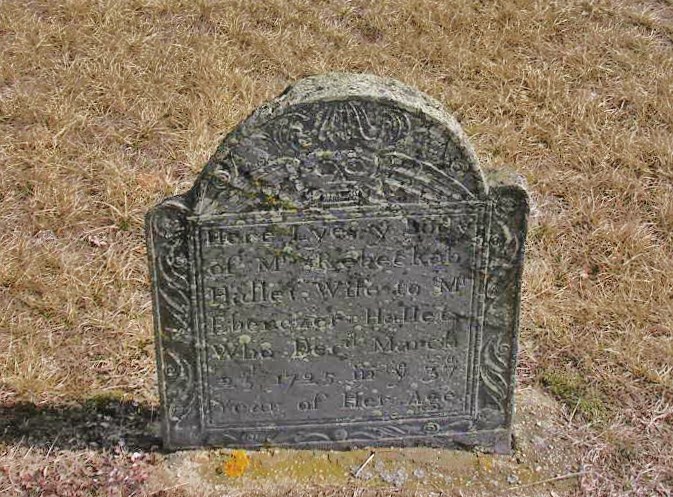
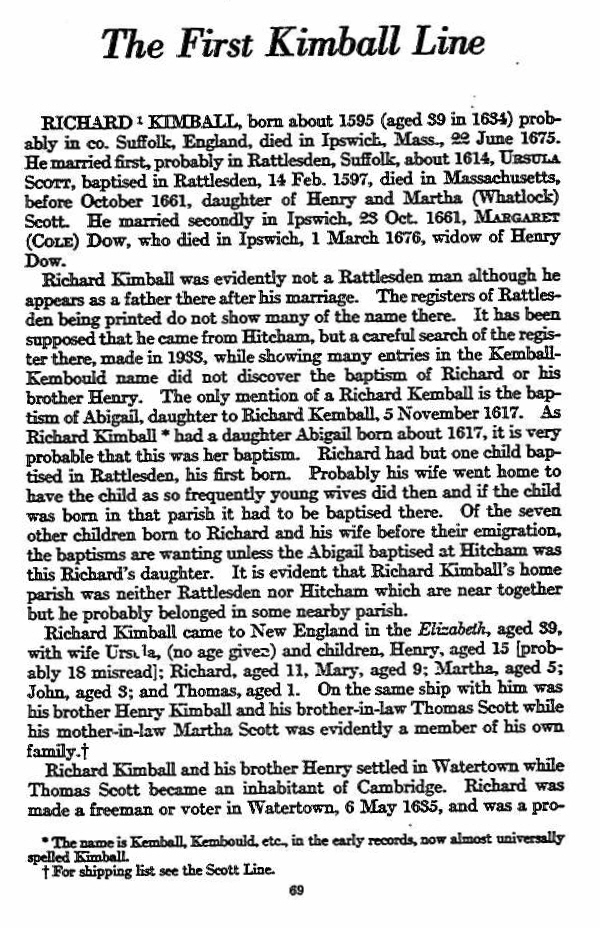
In American history during the 1600’s ten days were missing. Thus our double date confusion began with the adoption of the Gregorian calendar. Prior to the year 1752 English records were sometimes kept in Old Style (Julian) and sometimes in New Style (Gregorian) and sometimes in both calendar styles.

The first day of the new year on the Julian calendar was March 25th while the modern Gregorian calendar begins the new year on January first. So between January 1st and March 24th is the crucial gap. Let’s use January 24, 1742/43 as an example. It was already 1743 in most of Europe, but still 1742 in the Colonies, so early records are often written as 1742/43.

By 1 March 1699/1700 the time lag had increased to eleven days. We observe George Washington’s Birthday as February 22nd in our Gregorian (also called New Style) calendar. But he was born in 1732 when the Julian (also called Old Style) calendar was still used. Remember that we lost 11 days in 1752. So Washington was really born on February 12, 1732/33 by the Old Style dating. It was still 1732 in Virginia but already 1733 in most of Europe.

A possible confusion involving numbered months arises with certain dates in the “first month” [March] when the year is not double dated. Although most clerks regarded 25 March as the first day of the Old Style year, some used 1 March. But even if all of them had used 25 March, there’s still the question of what year was intended for March dates prior to the 25th when the entire month is numbered as “first” and the year is not double dated. The eighth month, however, was October of the year written–period.

Posted in Research | 1 Comment

John Howland

John HOWLAND (c. 1591 – 1673) was one of the Pilgrims who traveled  on the Mayflower, signed the Mayflower Compact, and helped found Plymouth Colony. John was Alex’s 11th Great Grandfather two ways; two of 4,096 in this generation of the Shaw line.  His daughters Desire and Hope both married into the Gorham line. A third daughter Ruth married Thomas CUSHMAN, but we descend from Thomas’ first wife.

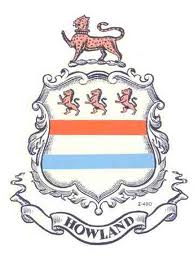
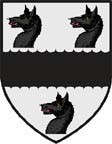
John Howland – Coat of Arms Granted in 1584 by Queen Elizabeth, beginning with Bishop Howland

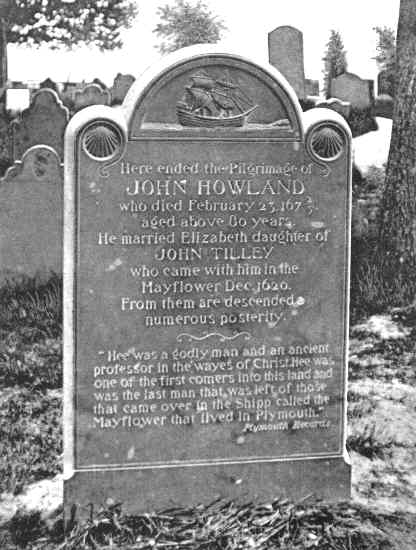
John Howland was born around 1591 in  Fenstanton, Huntingdonshire, England.  His parents were Henry HOWLAND and Margaret AIRES. At the age of 28, he was employed by John Carver, a Puritan minister who joined with William Bradford in bringing his congregation from Leiden, Netherlands to the New World.  Howland, while formally a servant, was in fact Carver’s assistant in managing the migration.   In 1623/24, John married Elizabeth TILLEY by then a young woman of seventeen, (ten years Howland’s junior).   John died 23 Feb 1672/73  in Plymouth, Mass  and was “with honour interred” on Burial Hill. This was accorded only to the leaders of the Colony, and meant that a squad of soldiers fired a volley over his grave. He is described in the records as a “godly man and an ardent professor in the ways of Christ.” The obituary for John Howland is a part of the Plymouth Colony Records.

“The 23th of February Mr. John Howland Senir of the Towne of Plymouth Deceased…Hee lived untilhee attained about eighty yeares in the world…and was the last man that was left of those that Came over in the shipp Called the May Flower, that lived in Plymouth hee was with honor Intered att the Towne of Plymout on the 25th of February 1672.”

John Howland Memorial on Burial Hill in Plymouth Mass.

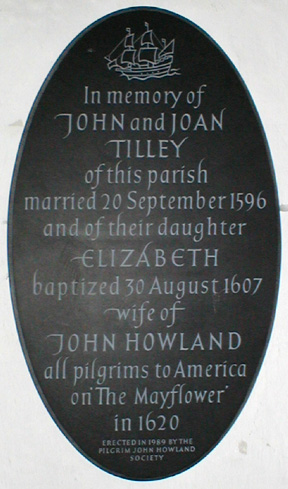
Elizabeth Tilley was born 30 Aug 1607 in Henlow, Bedfordshire, England.  She was the daughter of John TILLEY and his wife Joan HURST Rogers. Her parents had died the first winter and she had become the foster daughter of Governor Carver and his wife who were childless Elizabeth spent her declining years and died 21 Dec 1687 at the age of eighty in the home of her daughter Lydia Brown, in Swansea. Elizabeth is buried in East Providence, Rhode Island, with a memorial marker.

The Tilley Memorial shown here was erected at St. Mary’s Church , Henlow by the Pilgrim Howland Society. The plaque is made from Welsh slate and was dedicated at the Parish Eucharist by the then Lord Bishop of St. Albans, the Right Reverend John Taylor.

Children of John and Elizabeth

Name Born Married Departed
1. Desire HOWLAND 13 Oct 1623
Plymouth Colony
John GORHAM
1643
Plymouth
13 Dec 1683
Barnstable, Mass
2. John Howland 24 Feb 1626/27
Plymouth
Mary Lee
26 Oct 1651
Plymouth
1699
Barnstable, Barnstable, Mass.
3. Hope HOWLAND 30 Aug 1629
Plymouth
John CHIPMAN
13 Sep 1646
Plymouth
12 Jun 1724
4. Elizabeth Howland Feb 1632/33
Plymouth
Ephraim Hicks
13 Sep 1649
Plymouth
.
John Dickerson
10 Jul 1651 Plymouth
26 Jan 1682/83
Oyster Bay, Long Island, NY
5. Lydia Howland Feb 1634/35
Plymouth
James Brown
(Son of our ancestor John BROWNE Sr.
1654
Rehoboth, Bristol, Mass
11 Jan 1709/10
Swansea, Bristol, Mass
6. Ruth Howland 16 Sep 1637
Scituate, Mass
Thomas CUSHMAN
17 Nov 1664
(our ancestors are from Thomas’s 2nd wife Abigail)
1679
Rehoboth
7. Joseph Howland ca. 1638
Plymouth
Elizabeth Southworth
7 Dec 1664
Plymouth
1 Jan 1703/04
Plymouth
8. Hannah Howland 1640
Plymouth
Jonathan Bosworth
6 Jul 1661
Swansea, Mass.
9. Jabez Howland ca.  1644
Plymouth
Bethia Thatcher
1669
Plymouth
7 Apr 1708
Bristol, RI
10. Isaac Howland 16 Nov 1649
Kingston, Mass.
Elizabeth Vaughn
ca. 1677
Middleboro, Plymouth, Mass
9 Mar 1723/24
Middleboro, Plymouth, Mass

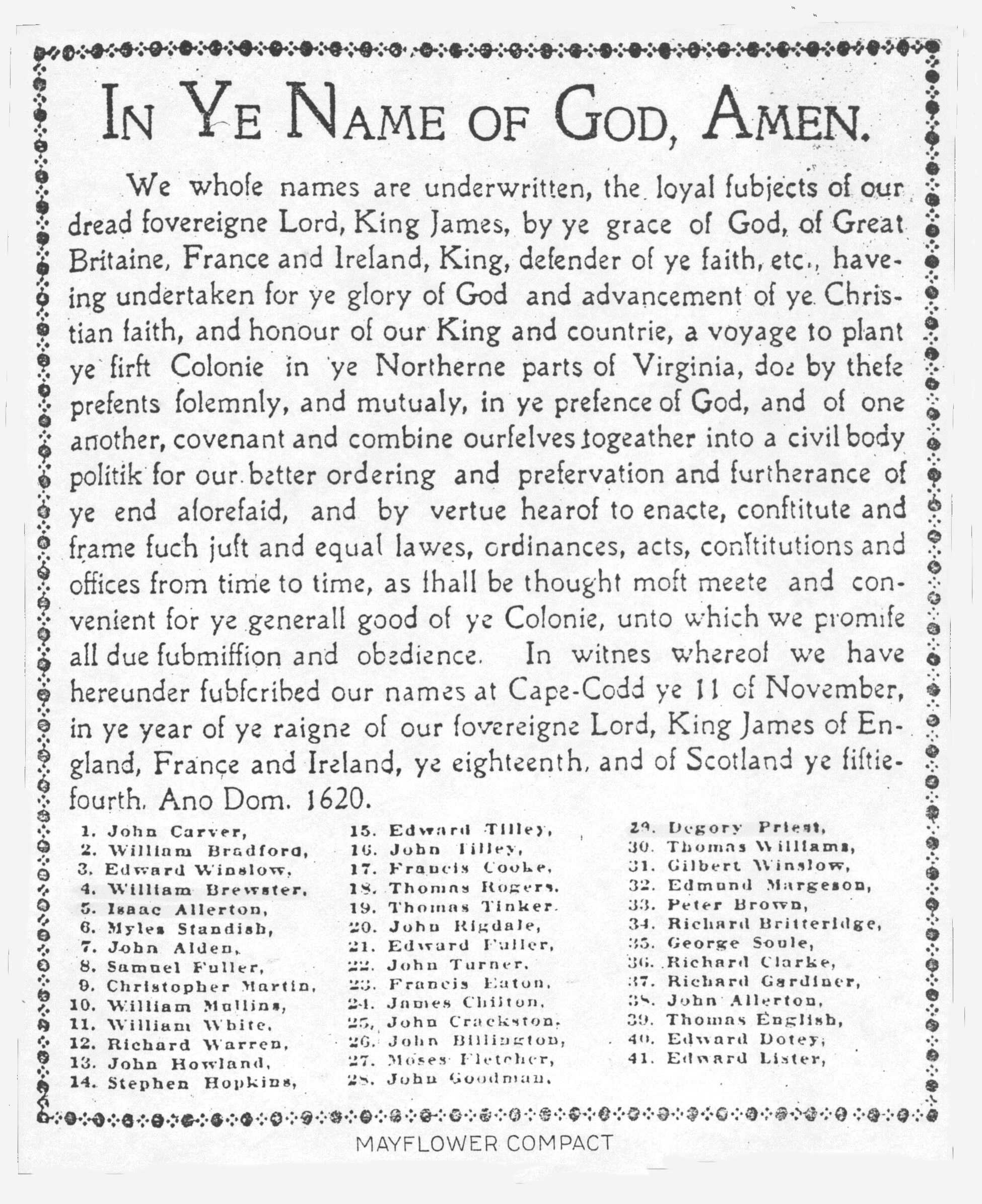
John Howland was one of the signers of the Mayflower Compact

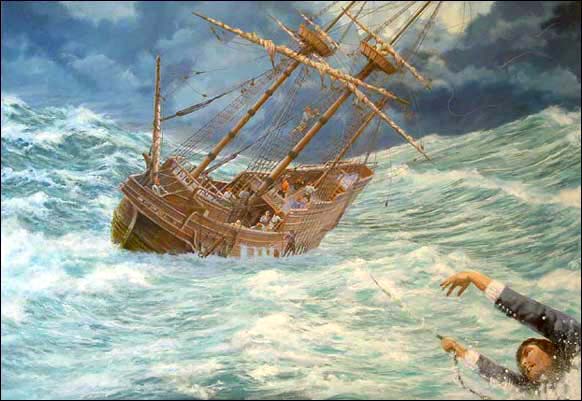
Although he had arrived on the Mayfloweras a servant to the Carver family, Howland was a young man determined to make his mark in the new world, arriving as neither a “saint” as the Pilgrims termed themselves, nor a “stranger” as those passengers recruited by the Mayflower’s Merchant Adventurers were called. The arduous voyage very nearly ended his life as he was thrown overboard in turbulent seas, but managed to grab a topsail halyard that was trailing in the water and was hauled back aboard safely.  The following account describing this incidence was written by William Bradford, political leader of the Pilgrim Colony:

“In sundry of these storms the winds were so fierce and the seas so high, as they could not bear a knot of sail, but were forced to hull for divers days together. And in one of them, as they thus lay at hull in a mighty storm, a lusty young man called John Howland, coming upon some occasion above the gratings was, with a seele of the ship, thrown into the sea; but it pleased God that he caught hold of the topsail halyards which hung overboard and ran out at length. Yet he held his hold (though he was sundry fathoms under water) till he was hauled up by the same rope to the brim of the water, and then with boat hook and other means got into the ship again and his life saved. And though he was something ill with it, yet he lived many years after and became a profitable member both in church and commonwealth.”

John Howland was pitched overboard. Painting by Mike Haywood

The Mayflower was originally bound for the mouth of the Hudson River, in land granted in a patent from the Crown to the London Virginia Company. Storms during the crossing, including the one that blew Howland overboard, caused the Mayflower to land farther north, in what is now Massachusetts. This inspired some of the “strangers” to proclaim that since the settlement would not be made in the agreed-upon Virginia territory, they “would use their own liberty; for none had power to command them….” To prevent this, many of the other colonists decided to establish a government and memorialized the event with the drafting of the Mayflower Compact, of which Howland was the 13th of the 41 signers.

The Carver family with whom John lived, survived the terrible sickness of the first winter, during which many Pilgrims died. But the following spring, on an unusually hot day in April, Governor Carver, according to William Bradford, came out of his cornfield feeling ill. He passed into a coma and “never spake more”. His wife, Kathrine, died soon after her husband. The Carvers had no children. For this reason, Howland is thought to have inherited their estate.  It has been said that he immediately “bought his freedom,” but no record has survived.

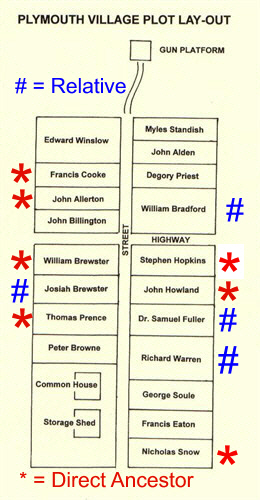
Our ancestors or their close relatives had almost half the lots in early Plymouth – (George Soule was the grandfather of John TOMSON’s son-in-law, not close enough to get a #)

Our ancestors or their close relatives had almost half the lots in early Plymouth – (George Soule was the grandfather of John TOMSON’s son-in-law, not close enough to get a #)

1620 – John was in the “First Encounter” with the Indians at Great Meadow Creek, three days before the landing of the Pilgrims.

1623 –  John and Elizabeth Tilley were married, when Elizabeth was not quite 16 years of age.

1624 -By then he had prospered enough to also bring his brothers Arthur and Henry to the colony as well, solidly establishing the Howland family in the New World.

1625 –   Howland joined with Edward Winslow exploring the Kennebec River, looking for possible trading sites and natural resources that the colony could exploit. The year after that he was asked to participate in buying out the businessmen who had bankrolled the settlement of Plymouth (“Merchant Adventurers” was the term used at the time) so the colony could pursue its own goals without the pressure to remit profits back to England. The amount totaled £1,800 to relinquish their claims on the land, and the group also assumed the colony’s debts of £2,400 more. In return the group, known as undertakers had a monopoly on the colony’s trade for six years.

1626 – A group of colonists assumed the debt owed to the Merchant Adventurers of London who had backed the Pilgrims financially. To pay off the loan, a monopoly over the Colony’s trade was given William Bradford, Isaac Allerton and Myles Standish, who chose Howland as one of their partners.

1626 – Isaac ALLERTON negotiated a patent that granted Plymouth the exclusive right to trade with the Indians and to establish a trading station on the Kennebec River. In 1627 Governor Bradford placed John Howland in charge  and a brisk trade developed there with the Indians. John’s family may have spent time with him in Maine, and some of his children may have been born there.

1627 – In the division of Cattle agreement, John Howland acquired twenty acres for each member of his household. In addition, the colonists were organized in “companies” of thirteen members each. The livestock of the colony was divided equally among the companies. Listed in John’s “company” were John and Elizabeth and their two children, John and Priscilla Alden and their two children, and five unattached men.

1628 -Howland was elevated to the post of Assistant Governor.

In 1628 a trading station was built at Cushnoc (now called Augusta) on the east side of the Kennebec River. A year later, a permanent log-house was built, and Howland, then Assistant Governor, was asked to manage the trading station. For approximately seven years John Howland was in charge of the station. It is not known if Elizabeth and their family of three children lived at the station permanently or for short periods of time. During the time that John operated the station Elizabeth gave birth to three more children, but it is not known whether she gave birth while she was living at the trading station or in Plymouth.

The trading station in Cushnoc was very successful. The Pilgrims traded corn and manufactured goods with the Indians for beaver, otter and other furs. The proceeds of this trade enabled the Undertakers to settle their debts with the Merchant Adventurers. .

1633 –  Howland, then thirty-four, was admitted as a freeman of Plymouth. For nearly forty years, John Howland was actively involved in the governance of Plymouth through elected or appointed positions, viz. one of the seven Plymouth Assistant Governors—1632-35, 1638-39; one of the four Plymouth Deputies to the General Court for nearly thirty years—1641, 1645, 1647-56, 1658, 1659, 1661-68, 1670; one of the five selectmen of Plymouth—1665-66; one of the Plymouth Assessors—1641, 1644, 1647-51; committee on fur trading—1659; surveyor of highways—1650.

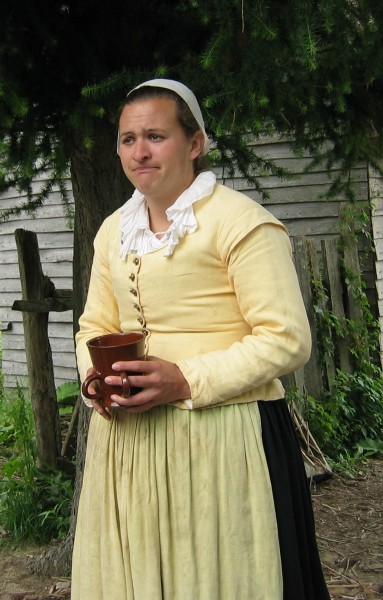
Elizabeth Howland Reenactor —  A group of Plymouth tourists asked Elizabeth Howland if she regretted coming to the new world, after all most every person had lost at least one family member.  To this she responded, “To regret is to doubt God’s will; therefore, I have no regrets.”

1634 –  In command of Kennebec Trading Post in Maine.  John Howland and John Alden were the magistrates in authority there.

In 1637 John received forty acres of land, and in 1639 he was given a choice of additional land for himself or his heirs around Yarmouth, Dartmouth and Rehoboth. John and Elizabeth became major landholders in Plymouth and the surrounding towns. Part of the land he chose was in Yarmouth, which he gave to his son John and daughters Desire and hope and their respective families. In 1639 John purchased land and a house in Rocky Nook, where he spent the rest of his life. Also living in Rocky Nook were Thomas CUSHMAN Sr. and Mary ALLERTON  and their family.

By 1643 a colony in Piscataqua at the mouth of the Kennebec River under the control of London investors, agents of Lord Say and Seal and Lord Brooke, attempted to trade with Indians on the Kennebec River. Howland and men from Plymouth told the Piscataqua men under the command of John Hocking to leave since they were trespassing and the patent granted Plymouth exclusive trading rights.

The Elizabeth Tilley, a replica built for the Pilgrim John Howland Society of the 1628 shallop John Howland sailed in to the trading post in Maine. It is under its own power on the way to Clark’s Island from Plymouth Harbor.

After the ill fated Little James was sent back to England in 1625 with its hold full of trade goods, the colonists were left with the two shallops that the boat builder had built the previous year. One of the shallops was used in an attempt to generate revenue for the colony. They laid a little deck over the midships section to protect a cargo of corn, and Edward Winslow, among others, used it for a successful trading voyage to the Kennebec.

Even with the little deck on the shallop, the colonists felt they ran a great hazard in traveling such a long way in basically an open boat. They realized the need for a larger vessel to safely continue trading in Maine. But as the boat builder had died the previous year, it was left to a house carpenter, who had worked with the boat builder, to attempt to modify one of their shallops. The house carpenter “took one of the biggest of their shallops and sawed her in the middle, and so built her up and laid a deck on her.” This vessel, Bradford reports, provided good service to the colony for seven years.

One April day John Howland found John Hocking riding at anchor within the area claimed by Plymouth. Hocking was from the nearby Piscataqua Plantation. Howland went up to him in their “barke” and asked Hocking to weigh anchors and depart.  Apparently Hocking used some strong language and the two exchanged some words not recorded, but the result of the conversation was that Hocking would not leave and Howland would not let him stay. Howland then sent three of his men—John Irish, Thomas Savory and William Rennoles [son of our ancestor William REYNOLDS] — to cut the cables of Hocking’s boat. They severed one but the strong current prevented them from cutting the other cable so Howland called them back and ordered Moses Talbott to go with them.

The four men were able to maneuver their canoe to the other cable, but Hocking was waiting on deck armed with a carbine and a pistol in his hand. He aimed first at Savory and then as the canoe swished about he put his gun almost to Talbott’s head. Seeing this, Howland called to Hocking not to shoot his man but to “take himself as his mark.” Saying his men were only doing what he had ordered them to do. If any wrong was being done it was he that did it, Howland shouted. Howland called again for Hocking to aim at him.

Hocking, however, would not even look at Howland and shortly afterwards Hocking shot Talbott in the head and then took up his pistol intending to shoot another of Howland’s men. Bradford continues the story in his history of Plymouth:  Howland’s men were angered and naturally feared for their lives so one of the fellows in the canoe raised his musket and shot Hocking “who fell down dead and never spake word.”  The surviving poachers must have skedaddled for home where they soon wrote to the bigwigs in England but failed to tell the whole truth including the fact that Hocking had killed a Plymouth man first. The lords “were much offended” and must have made known their anger.

The Hocking affair did have severe international implications. Colonists feared that King Charles might use it as an excuse for sending over a royal governor to rule all New England. This was a real threat for early in 1634 the king had created a Commission for Regulating Plantations with power to legislate in both civil and religious matters and even to revoke charters.  Not long after the killings Plymouth sent a ship into the territory of Massachusetts Bay and authorities there quickly seized John Alden who was aboard the ship. Alden was imprisoned although he had no direct part in the Kennebec tragedy. When Alden was jailed Plymouth was quite obviously upset for Massachusetts Bay had no jurisdiction over the Kennebec area or over citizens of Plymouth. This was not of their business. Plymouth dispatched Capt. Myles Standish to Boston to present letters explaining the situation and Gov. Thomas Dudley quickly freed Alden, and after a later court hearing all blame was laid to Hocking. The matter was settled.

1638/39 – Bought the Rocky Nook farm

1637, 1639-52 – John served as Selectman, in the General court of Plymouth.

1652, 1659, 1661-1668 and 1670 – John served as Deputy in the Plymouth General Court,

1672/3 – John Howland died in the Plymouth home of his son.  The bond of administration of John Howland’s estate. This bond is dated 5 March, 1672, and bears the autograph signatures of Elizabeth (Tilley) Howland, who was the executrix of her late husband’s will, and of two of her sons-in-law, John CHIPMAN and John GORHAM , who became her sureties. It also bears autograph signatures of Lt. Ephraim MORTON and William Crow, the two witnesses.

This authograph of Elizabeth (Tilley) Howland is believed to be the only one yet discovered, and we are not aware that it has been noticed by previous writers. it is interesting to note that Elizabeth Howland made ‘her mark’ on this bond by printing her initials, and that, thirteen years later, she signed her will in the same way. [Ante, III: 56.] ”

ca. 1675 – The Rocky Nook Farm house burned to the ground. Elizabeth makes her home with Jabez’ family.

1680/81 – Jabez sells the Plymouth house. Elizabeth signed the deed and moved to Swansea to live with her daughter, Lydia Brown.

1687 – Elizabeth Tilley Howland died and was buried in the Brown Family plot.

Howland served at various times as Assistant Governor, Surveyor of Highways and member of the Fur Committee.

Last Will and Testament of John Howland 1672

Know all men to whom these prsents shall Come That I John howland senir of the Towne of New Plymouth in the Collonie of New Plymouth in New England in America, this twenty ninth Day of May one thousand six hundred seaventy and two being of whole mind, and in Good and prfect memory and Remembrance praised be God; being now Grown aged; haveing many Infeirmities of body upon mee; and not Knowing how soon God will call mee out of this world, Doe make and ordaine these prsents to be my Testament Containing herein my last Will in manor and forme following;

Imp I Will and bequeath my body to the Dust and my soule to God that Gave it in hopes of a Joyfull Resurrection unto Glory; and as Concerning my temporall estate, I Dispose thereof as followeth;

Item I Doe give and bequeath unto John howland my eldest sonne besides what lands I have alreddy given him, all my Right and Interest To that one hundred acres of land graunted mee by the Court lying on the eastern side of Tauton River; between Teticutt and Taunton bounds and all the appurtenances and privilidges Therunto belonging, T belonge to him and his heirs and assignes for ever; and if that Tract should faile, then to have all my Right title and Interest by and in that Last Court graunt to mee in any other place, To belonge to him his heires and assignes for ever;

Item I give and bequeath unto my son Jabez howland all those my upland and Meadow That I now posesse at Satuckett and Paomett, and places adjacent, with all the appurtenances and privilidges, belonging therunto, and all my right title and Interest therin, To belonge to him his heires and assignes for ever,

Item I Give and bequeath unto my son Jabez howland all that my one peece of land that I have lying on the southsyde of the Mill brooke, in the Towne of Plymouth aforsaid; be it more or lesse; and is on the Northsyde of a feild that is now Gyles Rickards senir To belonge to the said Jabez his heirs and assignes for ever;

Item I give and bequeath unto Isacke howland my youngest sonne all those my uplands and meddows Devided and undivided with all the appurtenances and priviliges unto them belonging, lying and being in the Towne of Middlebery, and in a tract of Land Called the Majors Purchase near Namassakett Ponds; which I have bought and purchased of William White of Marshfeild in the Collonie of New Plymouth; which may or shall appeer by any Deed or writinges Together with the aformentioned prticulares To belonge to the said Isacke his heirs and assignes for ever;

Item I give and bequeath unto my said son Isacke howland the one halfe of my twelve acree lott of Meddow That I now have att Winnatucsett River within the Towne of Plymouth aforsaid To belonge to him and said Isacke howland his heires and assignes for ever,

Item I Will and bequeath unto my Deare and loveing wife Elizabeth howland the use and benifitt of my now Dwelling house in Rockey nooke in the Township of Plymouth aforsaid, with the outhousing lands, That is uplands uplands [sic] and meddow lands and all appurtenances and privilidges therunto belonging in the Towne of Plymouth and all other Lands housing and meddowes that I have in the said Towne of Plymouth excepting what meddow and upland I have before given To my sonnes Jabez and Isacke howland During her naturall life to Injoy make use of and Improve for her benifitt and Comfort;

Item I give and bequeath unto my son Joseph howland after the Decease of my loveing wife Elizabeth howland my aforsaid Dwelling house att Rockey nooke together with all the outhousing uplands and Medowes appurtenances and privilidges belonging therunto; and all other housing uplands and meddowes appurtenances and privilidges That I have within the aforsaid Towne of New Plymouth excepting what lands and meadowes I have before Given To my two sonnes Jabez and Isacke; To belong to him the said Joseph howland To him and his heires and assignes for ever;

Item I give and bequeath unto my Daughter Desire Gorum twenty shillings

Item I give and bequeath To my Daughter hope Chipman twenty shillings

Item I give and bequeath unto my Daughter Elizabeth Dickenson twenty shillings

Item I give and bequeath unto my Daughter Lydia Browne twenty shillings

Item I give & bequeath to my Daughter hannah Bosworth twenty shillings

Item I give and bequeath unto my Daughter Ruth Cushman twenty shillings

Item I give to my Grandchild Elizabeth howland The Daughter of my son John howland twenty shillings

Item my will is That these legacyes Given to my Daughters, be payed by my exequitrix in such species as shee thinketh meet;

Item I will and bequeath unto my loveing wife Elizabeth howland, my Debts and legacyes being first payed my whole estate: vis: lands houses goods Chattles; or any thing else that belongeth or appertaineth unto mee, undisposed of be it either in Plymouth Duxburrow or Middlbery or any other place whatsoever; I Doe freely and absolutly give and bequeath it all to my Deare and loveing wife Elizabeth howland whom I Doe by these prsents, make ordaine and Constitute to be the sole exequitrix of this my Last will and Testament to see the same truely and faithfully prformed according to the tenour therof; In witness whereof I the said John howland senir have heerunto sett my hand and seale the aforsaid twenty ninth Day of May, one thousand six hundred seaventy and two 1672

Signed and sealed in the prsence of Samuel ffuller John Howland

William Crow And a seale

Last Will and Testament of Elizabeth Howland 1686

In ye Name of God Amen I Elizabeth Howland of Swanzey in ye County of Bristoll in ye Collony of Plymouth in New Engld being Seventy nine yeares of Age but of good & perfect memory thanks be to Allmighty God & calling to Remembrance ye uncertain Estate of this transitory Life & that all fflesh must Yeild unto Death when it shall please God to call Doe make constitute & ordaine & Declare This my last Will & Testament, in manner & forme following Revoking and Anulling by these prsents all & every Testamt & Testamts Will & Wills heretofore by me made & declared either by Word or Writing And this to be taken only for my last Will & Testament & none other.

And first being penitent & sorry from ye bottom of my heart for all my sinns past most humbly desiring forgivenesse for ye same I give & Committ my soule unto Allmighty God my Savior & redeemer in whome & by ye meritts of Jesus Christ I trust & believe assuredly to be saved & to have full remission & forgivenesse of all my sins & that my Soule wt my Body at the generall Day of Resurrection shall rise againe wt Joy & through ye meritts of Christs Death & passion possesse & inheritt ye Kingdome of heaven prepared for his Elect & Chosen & my Body to be buryed in such place where it shall please my Executrs hereafter named to appoint

And now for ye settling my temporall Estate & such goodes Chattells & Debts as it hath pleased God far above my Deserts to bestow upon me I Do Dispose order & give ye same in manner & forme following (That is to say)

First that after my funerall Expences & Debts paid wc I owe either of right or in Conscience to any manner of person or persons whatsoever in Convenient tyme after my Decease by my Execrs hereafter named I Give & bequeath unto my Eldest Son John Howland ye sum of five pounds to be paid out of my Estate & my Booke called Mr Tindale’s Workes & also one pair of sheetes & one pr of pillowbeeres & one pr of Bedblanketts,

Item I give unto my son Joseph Howland my Stillyards & also one pr of sheetes & one pr of pillobeeres

Item I give unto my son Jabez Howland my ffetherbed & boulster yt is in his Custody & also one Rugg & two Blanketts yt belongeth to ye said Bed & also my great Iron pott & potthookes

Item I give unto my son Isaack Howland my Booke called Willson on ye Romanes & one pr of sheetes & one paire of pillowbeeres & also my great Brasse Kettle already in his possession

Item I give unto my Son in Law Mr James Browne my great Bible

Item I give & bequeath unto my Daughter Lidia Browne my best ffeatherbed & Boulster two pillowes & three Blanketts & a green Rugg & my small Cupboard one pr of AndyIrons & my lesser brasse Kettle & my small Bible & my booke of mr Robbinsons Workes called Observations Divine & Morrall & allso my finest pr of Sheetes & my holland pillowbeeres,

Item I give unto my Daughter Elisabeth Dickenson one pr of Sheetes & one pr of pillowbeeres & one Chest

Item I give unto my Daughter Hannah Bosworth one pr of sheets & one pr of pillowbeeres,

Item I give unto my Grand Daughter Elizabeth Bursley one paire of sheets and one paire of Pillowbeeres

Item I give & bequeath unto my Grandson Nathaniel Howland (the son of Joseph Howland) and to the heires of his owne Body lawfully begotten for ever all that my Lott of Land with ye Meadow thereunto adjoyning & belonging lying in the Township of Duxbury neare Jones River bridge,

Item I give unto my Grandson James Browne One Iron barr and on Iron Trammell now in his possession,

Item I give unto my Grandson Jabez Browne one Chest

Item I give unto my Grand Daughter Dorothy Browne my best Chest & my Warming pan

Item I give unto my Grand Daughter Desire Cushman four Sheep,

Item I give & bequeath my wearing clothes linnen and Woollen and all the rest of my Estate in mony Debts linnen or of what kind or nature or sort soever it may be unto my three Daughters Elisabeth Dickenson, Lidia Browne and Hannah Bosworth to be equally Devided amongst them,

Item I make constitute and ordaine my loving Son in Law James Browne and my loving son Jabez Howland Executors of this my last Will and Testament,

Item it is my Will & Charge to all my Children that they walke in ye Feare of ye Lord, and in Love and peace towards each other and endeavour the true performance of this my last Will & Testament In Witnesse whereof I the said Elizabeth Howland have hereunto sett my hand & seale this seventeenth Day of December Anno Dm one thousand six hundred Eighty & six.

The mark of Elisabeth E H Howland
Signed Sealed & Delivd
in ye prsence of us Wittnesses
Hugh Cole
Samuel Vyall
John Browne

John and Elizabeth Howland’s direct descendants include notable figures such as U.S. presidents Franklin D. Roosevelt, George H. W. Bush, and George W. Bush; U.S. first ladies Edith Roosevelt and Barbara Bush; poets Ralph Waldo Emerson, Henry Wadsworth Longfellow; Mormon prophet and founder of the Church of Jesus Christ of Latter-day Saints Joseph Smith, Jr. and his wife Emma Hale; Mormon leader Brigham Young; Continental Congress president Nathaniel Gorham; former Alaska Governor Sarah Palin; former Florida governor Jeb Bush; and actors/actresses Humphrey Bogart, Maude Adams, Lillian Russell, Chevy Chase and Anthony Perkins. U.S. presidents Richard Nixon and Gerald Ford, and British prime minister Winston Churchill are descendants of John Howland’s brothers Arthur (Nixon and Ford) and Henry (Churchill).

The genealogical society, The Pilgrim John Howland Society, is open for membership to all who can claim Howland as an ancestor. It is based in Plymouth, Massachusetts.

Children

All ten of John and Elizabeth’s children married and had children of their own.  Eighty-four grandchildren must have taxed Elizabeth’s memory for there were three Lydias, three Hannahs, three Mercys, three Johns, two Isaacs and two named Shubael. How could she keep them all straight?

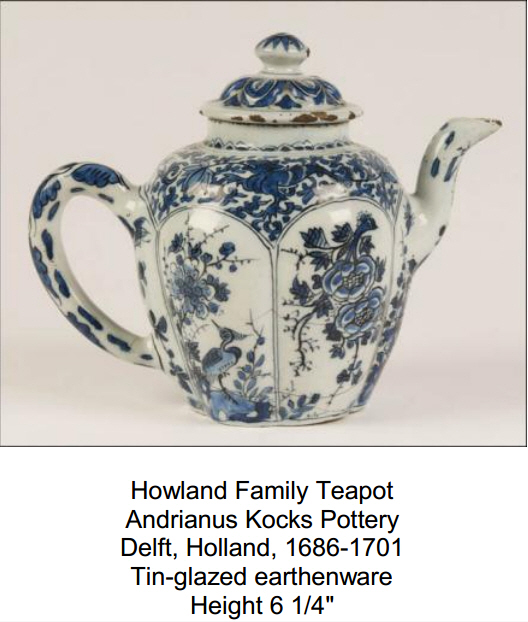
Howland Family Teapot - Pilgrim Hall Museum

Howland Family Teapot – Pilgrim Hall Museum

This  delftware  dates to the last half of the 1600s, indicating that it was purchased by second and third generation members of the Old Colony’s Pilgrim families. Along with  fine textiles, silver and furniture, the fashionable and decorative wares symbolized prosperity and success for these pioneering families. Tea-drinking became fashionable around 1650-1680 in Europe, and early teapots were small because tea was expensive. The Howland family teapot is a rare survivor because, unlike Chinese teapots made of porcelain, delftware teapots often cracked when filled with boiling water. The dainty pot’s design and form imitate that of blue and white Chinese porcelain.

1. Desire HOWLAND (See John GORHAM‘s page)

Desire Minter was the daughter of William and Sarah Minter, members of the Leiden congregation. Desire’s father died in 1618, and she joined John Carver’s family. Her mother remarried in 1622, and her new parents established an endowment that Desire would inherit at the age of twenty-one. After a few years in Plymouth, Desire returned to England to assume her inheritance. John and Elizabeth Howland were very fond of Desire and named their first child Desire in her honor.

2. John Howland

John’s wife Mary Lee was born 1630 in Plymouth,Plymouth, Mass. Her parents were Robert Lee and Mary Atwood. Mary died 6 May 1693 in Barnstable, Barnstable, Mass.

Of their 10 children, the last eight were Barnstable babies. They were Isaac, Hannah, Mercy, Lydia, Experience, Anne, Shubael and John. Both John Howland Jr. and his wife Mary Lee died in the cape town.

Lieutenant John Howland He removed from Plymouth to Marsbfield, and thence to Barnstable about the year 1658. His farm at West Barnatable contained about 90 acres, and in 1672 he conveyed by deed the eaaterly half thereof to his brother-in-law Elder John CHIPMAN. A portion of bis estate is yet owned by his descendants. He held many town offices and was lieutenant of the military company. He was admitted a freeman of the colony in 1658. There is some evidence that in early life be favored the
Quakers. He certainly was opposed to the intolerant party of which George Barlow of Sandwich was the leading man. His wife Joined the church Nov. 22, 1691. He and two other aged men, Joseph Lothrop and James Lewis, Joined the church on the 18tb of June, 1699.

He probably bad two children born in Marshfield, his other eight
children were born in Barnstable.

i. Mary Howland

ii. Eliabeth Howland b. 17 May 1655, m. 1678 to John Bursley

iii. Isaac Howland b. 25th Nov. 1659. (See below.)

iv. Hannah Howland b. 15th May, 1661, m. 20 May 1686 to Jonathan Crocker She died previous lo Feb. 1711.

v. Mercy Howland b. 21 Jan. 1663.

vi. Lydia Howland b. 9 Jan 1665.

vii. Experience Howland b. 28 Jul 1668.

viii. Ann Howland b. 9 Sep 1670, 18th Sept. 1691,
Joseph Crocker.

ix. Shubael Howland b. 8 Sep 1672. (See below.)

x John 81st Dec 1674. (See below.)

3. Hope HOWLAND (See John CHIPMAN‘s page)

4. Elizabeth Howland

Elizabeth’s first husband Ephraim Hicks 1613 in Plymouth, Plymouth, Mass. His parents were Robert Hicks and Margaret Winslow. Ephraim died 2 Dec 1649 in Plymouth, Plymouth, Mass.

Elizabeth’ second husband John Dickerson was born in 1630 in Plymouth, Plymouth, Mass.  His parents were William Dickinson and  Sarah Stacy. John died 26 Jan 1680 in Oyster Bay, Livingston, New York.

Elizabeth’s will, dated Dec 1691

“I Elizabeth Dickinson widow, of Oyster Bay, being somewhat weakly and sick but perfect memory and understanding. I give to my son Jabez my house and lot furnishings, when he die this to go to my son Joseph. I give to my son Samuel 5 shares of land at the planes plus what I have already given him. I give to my son James two rights of three in the Old Purchase of Oyster Bay on the west side of Nicholas Wright going to Lusum. Five Acres of land at Plains and right of Commonage divided equally between Samuel, Jabez and James. I give to my daughter Hannah my bed, curtains, chests and etc. I give to my grandson Robert or Richard Harcut 2 sheep. All remainder of my estate I give to my three youngest daughters Mehetable, Cheshire (Lydia) and Hannah. Dec 1691.

5. Lydia Howland

Lydia’s husband James Brown was born 1623 Watertown, Middlesex, Mass.  His parents were John BROWNE Sr. and Dorothy BEAUCHAMP.  James died 29 October 1710, Swansea Mass.

James Brown, was one of the most prominent of the early settlers in Swansea. He was a leader in the war against Philip, serving as a major. He also was one of the original members of the Swansea church and was fined five pounds for setting up a Baptist church in Rehoboth. He tried his best to bring peace to Plymouth Colony and went twice to see the Indian leader but found Philip “very high and not p’suadable to peace.”

James was in England in 1659 when James Cudworth wrote to him there.  Possibly he went to visit his father, although the circumstances are not known.      In 1665 he succeeded his brother-in-law, Thomas Willett, who was then Mayor of New York City, as Assistant in Plymouth Colony, which post he held also in 1666 and 1673-1683. He was chosen Deputy from Rehoboth in 1666, and from Swansea in 1669, 1671 and 1683.

James was a founder of Swansea, Bristol, Mass.

James Browne being a Baptist was forced to leave Rehoboth in 1663 and with others of his sect founded the town of Swansea, Massachusetts.  For some time he was in the center of the controversy over control of the church in Rehoboth, which raged between Congregationists and Baptists. On 2 July 1667 he and John Myles, the Baptist minister,  were each fined £5 for setting up a public meeting without permission of the General Court, while a Mr. [Nicholas] Tanner was fined 20/-. On 30 Oct 1667 the Baptists were given permission to organize the town of Swansea, with a Baptist church under Mr. Myles, the church being the first of that denomination in Massachusetts. Thus while James Browne served, with John Allen and Stephen Payne, Sr., as a Selectman for Rehoboth in 1666-1667, he was next to serve Swansea as grand enquest in 1668. The records of the two towns were mixed for years afterwards.

As Plymouth Colony Assistant and Lieutenant of the Swansea Military Company, James Browne played an important role in King Philip’s War. On 14 June 1675 he went to King Philip, then chief of the Wampanoags, with a friendly letter from Governor Winslow, and, finding the Indians hostile, warned the colony of impending war. A member of the tribe, Petonowowett, later said Mr. Browne would have been killed that day had not Philip intervened personally. When the war actually began on Sunday, 20 June 1675, it was son James Jr.  who took the word to Plymouth. On “Fasting Day,” the following Thursday, nine settlers were killed while on their way home from church, and on 18 July fifteen were killed in an ambush. That month Mr. Browne, who was one of five (out of seven) Assistants taking the field during the war, led twelve men from Swansea in pursuit of the Indians across the Seekonk plain, with help from the Mohegans and eleven men from the Mt. Hope garrison under Lt. Nathaniel Thomas. During the war James Browne went to Philip twice but found him “very high and not p’swadable to peace.”

On June 20, 1675, the first Indian attack of King Philip’s War had all 70 settlers confined to their stockade. By June 25 the entire town had been burned, although a handful of the colonists escaped to Taunton. When the active war ended in 1676, the town was soon rebuilt.

It has been said that on 19 May 1668 James  used an armorial seal on a deed, “A lion rampant debruised by a bend, chequy, in sinister chief point a crescent,” similar to the arms of the Browns of Cheshire, England. His will, dated 25 Oct. 1694, was proved 11 Jan. 1711.

Dorothy’s will, dated 17 Dec. 1668 and proved 29 March 1674, mentions daughter Mary Willett and her children, Sarah Elliott, daughter of Sarah Elliott deceased, son James Brown, grandson John Browne and his brothers Nathaniel and Joseph, granddaughter Dorothy Browne, daughter-in-law Dorothy Browne, daughter-in-law Lydia BROWNE, and granddaughters Lydia and Anna Browne.

6. Ruth Howland

Ruth’s husband Thomas CUSHMAN was born 16 Sep 1637 in Plymouth, Mass.  His parents were  Thomas CUSHMAN Sr. and Mary ALLERTON. After Ruth died, he married Abigail TITUS Fuller on 16 Oct 1679 in Rehoboth, Mass.  Our ancestors are from Thomas’s 2nd wife Abigail. Thomas died 23 AUG 1726 in Scituate, Mass.

In 1664 Ruth  was the subject of a morals case brought before the Court of Governor’s Assistants. Sexual mores, including chastity before marriage, were issues about which were strict codes of conduct. Ruth Howland fell in love with Thomas Cushman, Jr. (1637-1726), the first son of Plymouth’s Ruling Elder Thomas CUSHMAN (1607-91), and Mary (Allerton) Cushman (1616-1699), a Mayflower passenger. In 1664/65 Thomas Jr. was fined five ponds by the Court for carnal behavior “before marriage, but after contract.” Once again John Howland was Deputy to the General Court for Plymouth and not involved personally in sentencing. Twenty-five years earlier punishment could have been severe, e.g. excommunication, fines, stocks for women and whipping for men. However, in 1664 harsh physical sentencing had been relaxed, and the social meeting of the parties became a factor in sentencing. In 1664 Thomas Jr. and Ruth were married. In addition to John Howland’s embarrassment, Thomas Cushman, Jr. squandered the opportunity to be considered to succeed his father as Ruling Elder. In 1694, Thomas’ younger brother Isaac was chosen to succeed his father as Ruling Elder. Thomas Jr. and Ruth remained in Plymouth. Ruth died as a young woman sometime after 1672, and Thomas Jr. married Abigail Fuller in 1679.

7. Joseph Howland

Joseph’s wife Elizabeth Southworth was born 1645 in Plymouth, Plymouth, Mass. Her parents were Thomas Southworth and Elizabeth Reynor. Elizabeth died Mar 1717 in Plymouth, Plymouth, Mass.

8. Hannah Howland

Hannah’s husband Jonathan Bosworth was born 1636 in Hingham, Plymouth, Mass. His parents were Jonathan Bosworth and Elizabeth Bellamy. Jonathan died 10 Jun 1717 in Rehoboth, Bristol, Mass.

9. Jabez Howland

Jabez’ wife Bethia Thacher was born 1640 in Yarmouth, Barnstable, Mass. Bethia died 19 Dec 1725 in Bristol, Bristol, Rhode Island.

1670 – Jabez Howland bought the house at Plymouth. John and Elizabeth winter there.

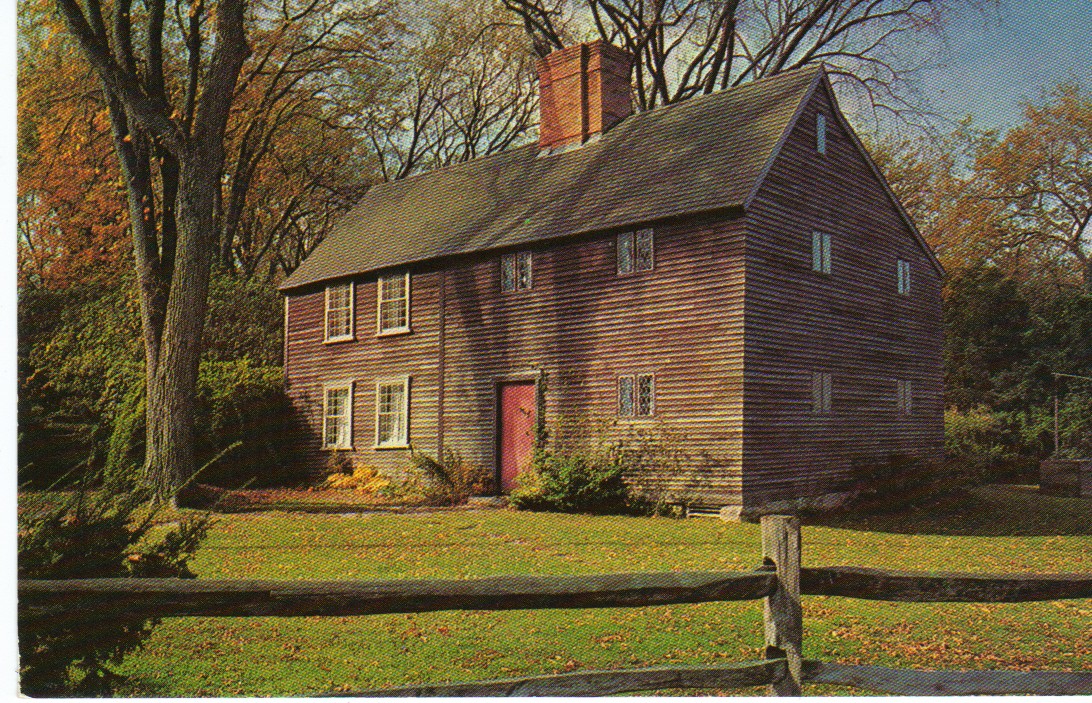
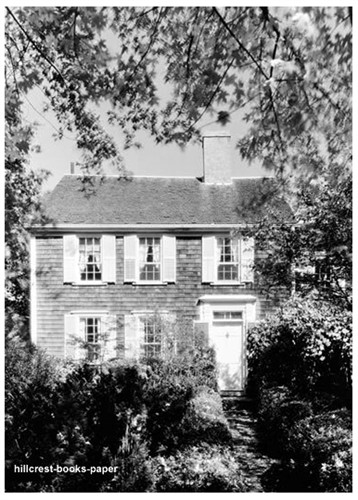
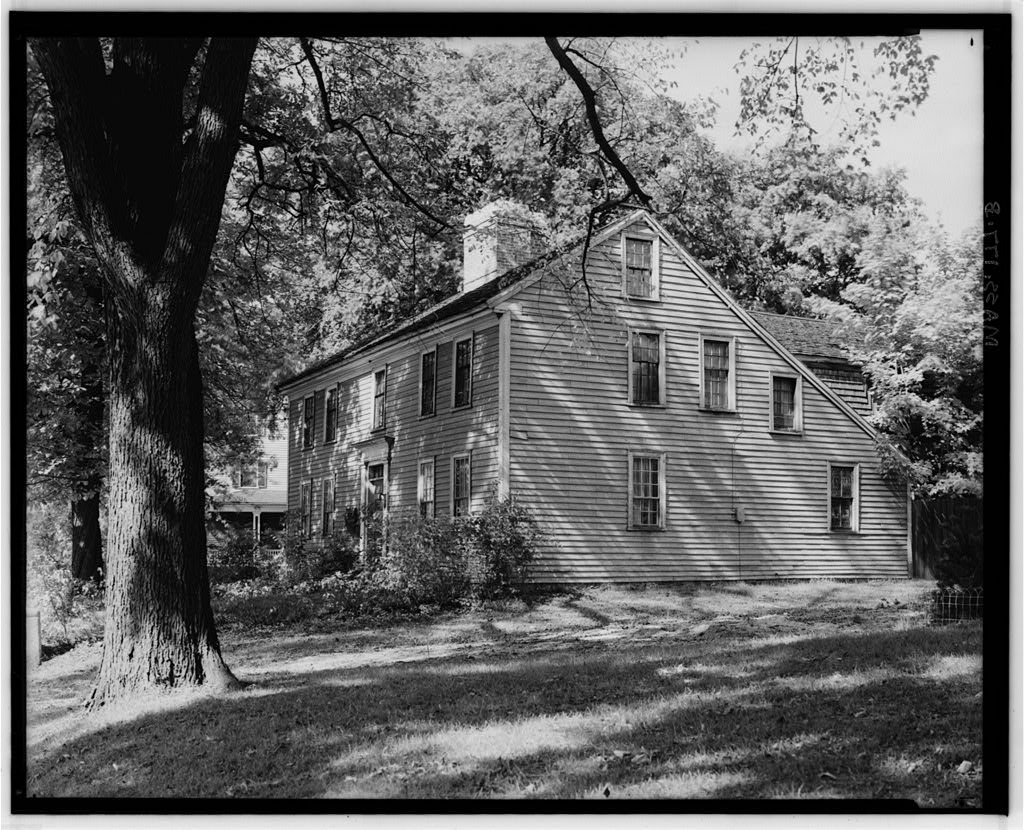
Jabez Howland House is an historic house at 33 Sandwich Street in Plymouth, Massachusetts.

The house was built in 1667 and purchased by Jabez Howland, son of Mayflower passengers John Howland and Elizabeth Tilley Howland, two of the original Pilgrims. John and Elizabeth Howland lived in Jabez Howland’s home after their own house burned. John Howland died in 1674 and Elizabeth lived there until the house was sold in 1680 and Jabez Howland moved to Rhode Island. Elizabeth moved to the home of her daughter, Lydia Browne, in Swansea, where she died in 1687. The Jabez Howland House was owned as a private residence until 1915. Extensive renovations took place in the 1940s. The house was added to the National Register of Historic Places in 1974.

Jabez Howland House Built in 1666

tmay26.jpg (4311 bytes)1. EXTERIOR VIEW The Howland House is the only house left standing in Plymouth where Pilgrims actually lived. The original 17th century two story timber framed house consisted of the porch, hall and hall chamber.   In order to attend church during the winter months both John & Elizabeth Tilley Howland spent part of the season here.During this time Jabez raised the roof and added a back bedroom providing space for his parents. After John’s death in 1673 (Age 8O) and the fire that destroyed their Rocky Nook Farm, Elizabeth lived here until 1680 with her son Jabez and his family. The house was expanded with several lean-tos which made it into a large house by 1750.tmay27.jpg (5419 bytes)2. 1667 LIVING ROOM You will find that as you tour the house there is a fire place in almost every room. The open fire place was a hazard to colonial women as many were badly hurt or died from burns. This due to the long dresses they wore and attempting to get to the kettles or pots being warmed by the fire. The living room would be one of the main areas for reading by the fire.tmay28.jpg (5681 bytes)3. THE OLDE KITCHENNote the various bowls on the table. Also the many plates and utensils hung above the fireplace. Readily accessible for use while cooking meals. Trammels were used to hold cooking pots. The swing arm or crane made cooking safer for women as they were not required to step into the fireplace to take the pot off the fire.tmay29.jpg (4633 bytes)4. THE JOHN HOWLAND BEDROOMThis bedroom was used by John Howland when he and wife Elizabeth stayed here during the winter months before John’s death and Elizabeth remained until son Jabez sold the house in 1680. At this time Elizabeth moved to Swansea, Rhode Island to live with her daughter Lydia Brown. She died there in 1687(age 80) and is buried outside the Brown family plot. The cradle, spinning wheel, chair and chest at the end of the bed add to the ambiance of the period.tmay30.jpg (4353 bytes)5. 1750 BEDROOM The first thing you notice is the ceiling of 1750 is plastered where the earlier rooms showed the beams. Like beds of the period they were canopied. This field bed can be fitted with heavy drapes for warmth and privacy. The curly birch dresser is American Chippendale(1750-1780). Beds were framed with rope strings. In damp weather the ropes had to be loosened and in dry weather tightened in order to keep a firm support for the mattresses. Mattresses were stuffed with whatever was comfortable (i.e. straw, cornhusks). Feathers would have been the best. Often the husband would leave his best feather bed to his eldest son and the second best to his wife.

10. Isaac Howland

Isaac’s wife Elizabeth Vaughn was born 8 Apr 1653 in Scituate, Plymouth, Mass. Her parents were George Vaughn and Elizabeth Henchman. Elizabeth died 29 Oct 1727 in Middleborough, Mass

Sources

Wikipedia – John Howland

http://www.pilgrimjohnhowlandsociety.org/john_howland.shtml – The Five Generations Project has just published the genealogies of the last six children of John and Elizabeth Howland for four generations. This is Volume 23-1 and costs $30. The children are Lydia, Hannah, Joseph, Jabez, Ruth, and Isaac. Plans to finish the fifth generation are in the works. Volume 23-1 can be ordered online from the Mayflower Society book store.

PJHS Rocky Nook Excavation – The archaeological excavation at Rocky Nook, Massachusetts is sponsored by the Pilgrim John Howland Society. The purpose of the excavation is to discover more about the everyday life of the pilgrim John Howland and his family through the material culture left behind at the John and Joseph Howland homestead sites.

Rocky Nook is a property owned by the PJHS. Located on a small peninsula of land, Rocky Nook represents the core of the farmstead purchased by John Howland from John Jenny in 1638 and held by three generations of Howlands. Upon John’s passing, the property went to his second eldest son, Joseph, who in turn gave it to his son James. James sold the property off in pieces, with the last being sold out of the Howland hands in 1725 (until the PJHS reacquired the land in 1920).

http://www.pilgrimjohnhowlandsociety.org/john_howland_john_elizabeth_howland.shtml

http://www.pilgrimjohnhowlandsociety.org/john_howland_courage.shtml

http://www.lynngallup.org/genfam/pafn113.htm#1876

http://www.genealogyofnewengland.com/f_19f.htm#50

http://www.pilgrimjohnhowlandsociety.org/shallop_elizabeth_tilley.shtml

Genealogical notes of Barnstable families  Being a reprint of the Amos Otis Papers originally published in the Barnstable Patriot in 1861; Revised by Charles  F. Swift Largely made from notes made by the author (1888)

http://massandmoregenealogy.blogspot.com/2011/07/mayflower-ancestors-pt-5-john-howland.html

Posted in 13th Generation, Artistic Representation, Be Fruitful and Multiply, Double Ancestors, First Comer, Historical Monument, Historical Site, Immigrant - England, Line - Shaw, Pioneer, Public Office, Storied, Veteran, Wikipedia Famous | Tagged , , , , , , | 33 Comments

Capt. John Gorham

Capt. John GORHAM (1620 – 1676) was Alex’s 10th Great Grandfather three times over, through his daughters Desire and Temperance and his son James. He was three of 2,048 in this generation of the Shaw line.

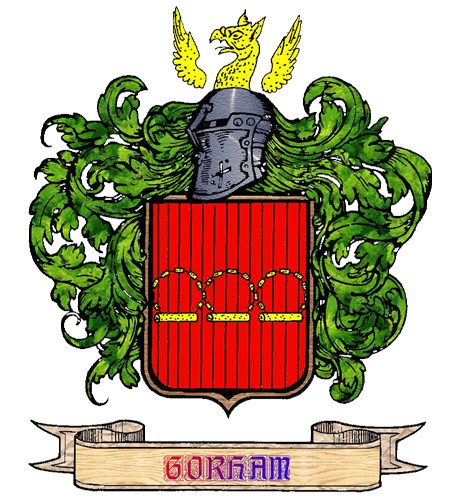
John Gorham – Coat of Arms

John Gorham was born 28 Jan 1619/20 in Benefield, Northamptonshire in England.  His parents were Ralph GORHAM and Margaret STEVENSON. John came to Plymouth, Massachusetts  as a teenager on the Phillip, Richard Morgan, Master, bound for No. America on 20 Jun 1635. The ship’s list  show a Thomas Gorham age 19 and John Gorham age 18.  Thomas isn’t mentioned in Pilgrim records, so he probably died without issue.  John married Desire HOWLAND in 1643 in Plymouth, Mass.  Two children from this family, Desire and James are our ancestors.  John died  5 Feb 1675/76 after being wounded 15 Nov 1675 in the Great Swamp Fight in King Phillip’s War.  He was wounded by having his powder horn shot which split against his side, and he was severely weakened further from exposure. He died of the resulting fever.

While Barnstable is given as his residence at the time of his death, he nonetheless must have died in Swansea, Bristol Co., MA as it is so stated in that town’s record’s. Elizabeth Pearson White in “John Howland of the Mayflower” gives John Gorham’s date of burial as 5 Feb 1676/77. While there exist other references with different dates, the White work is considered the best researched historical reference available to date. However, if he died from wounds received in the Narragansett battle of Dec 1675 then a burial in Feb 1676 seems most reasonable. In 1777, his heirs were granted 100 acres of land at Papequash Neck in Swansea. Only the date of John’s burial is recorded, not his death.

Desire Howland was born 13 Oct 1623 in Plymouth Colony.  Her parents were John HOWLAND,  one of the Pilgrims who  signed the Mayflower Compact, and helped found Plymouth Colony, and Elizabeth TILLEY.   It comes to us as ancient lore that Desire’s father, John Howland, named his first daughter named after a young girl “Desire” who was on the ship “Mayflower” with him and with whom he had taken particular fancy.

Desire Minter was the daughter of William and Sarah Minter, members of the Leiden congregation. Desire’s father died in 1618, and she joined John Carver’s family. Her mother remarried in 1622, and her new parents established an endowment that Desire would inherit at the age of twenty-one. After a few years in Plymouth, Desire returned to England to assume her inheritance. John and Elizabeth Howland were very fond of Desire and named their first child Desire in her honor.

Some researchers place the date of Desire’s marriage to John as 6 November 1644. If so, there must have been some un-Puritan-like hanky-panky going on during their courtship – Somebody might have forgotten to install the bundling board.    John was a resident of Yarmouth at the time of his death, but soon his Desire moved to live with her son in Barnstable and died there 13 Dec 1683.

Children of John and Desire:

Name Born Married Departed
1. Desire GORHAM 2 Apr 1644 Plymouth Capt. John HAWES
17 Oct 1661
30 Jun 1700 Yarmouth, Mass
2. Temperance GORHAM 5 May 1646 Marshfield, Plymouth, Mass Edward STURGIS Jr.
1 Mar 1662/63 Yarmouth, Mass
.
Thomas Baxter
27 Jan 1678/79 Barnstable, Mass.
12 Mar 1715 Yarmouth, Barnstable, Mass
3. Elizabeth Gorham 2 Apr 1648 Marshfield Joseph Hallett
ca. Mar 1666/67 Marshfield, Mass
5 Mar 1683 Plymouth, Plymouth, Mass
4. James GORHAM I 18 Apr 1650 Marshfield, Plymouth, Mass Hannah HUCKINS
24 Feb 1672/73 Barnstable
13 Feb 1726/27
5. Col. John Gorham 20 Feb 1650/51 Marshfield Mary Otis
24 Feb 1673/74 Barnstable
11 Nov 1716 Barnstable
6. Joseph Gorham 16 Feb 1652/53 Yarmouth Sarah Sturges (Daughter of our ancestor Edward Sturgis)
1678
Barnstable, Mass
.
Mrs. Bethiah (Hall) Winslow
19 Mar 1729/30
.
Mrs. Sarah (Howes) Hopkins
3 Jul 1746
9 Jul 1726 Yarmouth,
7. Jabez Gorham 3 Aug 1656 Barnstable Hannah Sturges (Daughter of our ancestor Edward Sturgis)
1677
16 Mar 1724/25 Bristol, RI.
8. Mercy Gorham 20 Jan 1657/58 Barnstable George Denison
1678
Barnstable, Mass.
24 Sep 1725 Westerly, RI
9. Lydia Gorham 6 Nov 1661 Barnstable John Thatcher (his 2nd marriage)
1 Jan 1682/83 Yarmouth, Mass
2 Aug 1744 Yarmouth
10. Hannah Gorham 1663
Barnstable
Joseph Weldon (son of John WHELDEN)
c 1682
Yarmouth, Barnstable, Mass.
1728
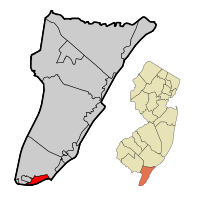
Cape May New Jersey (not
2 Aug 1744 Yarmouth
11. Shubael Gorham 21 Oct 1667 Barnstable Puella Hussey
May 1695
Nantucket, Mass.
7 Aug 1750 Barnstable

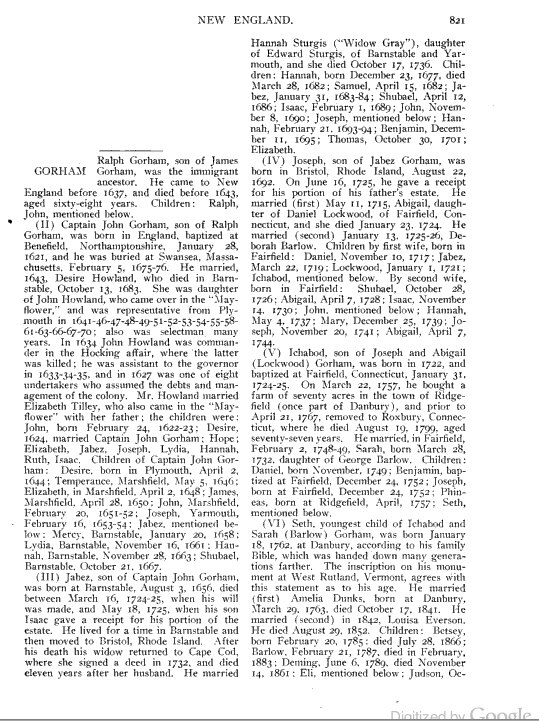
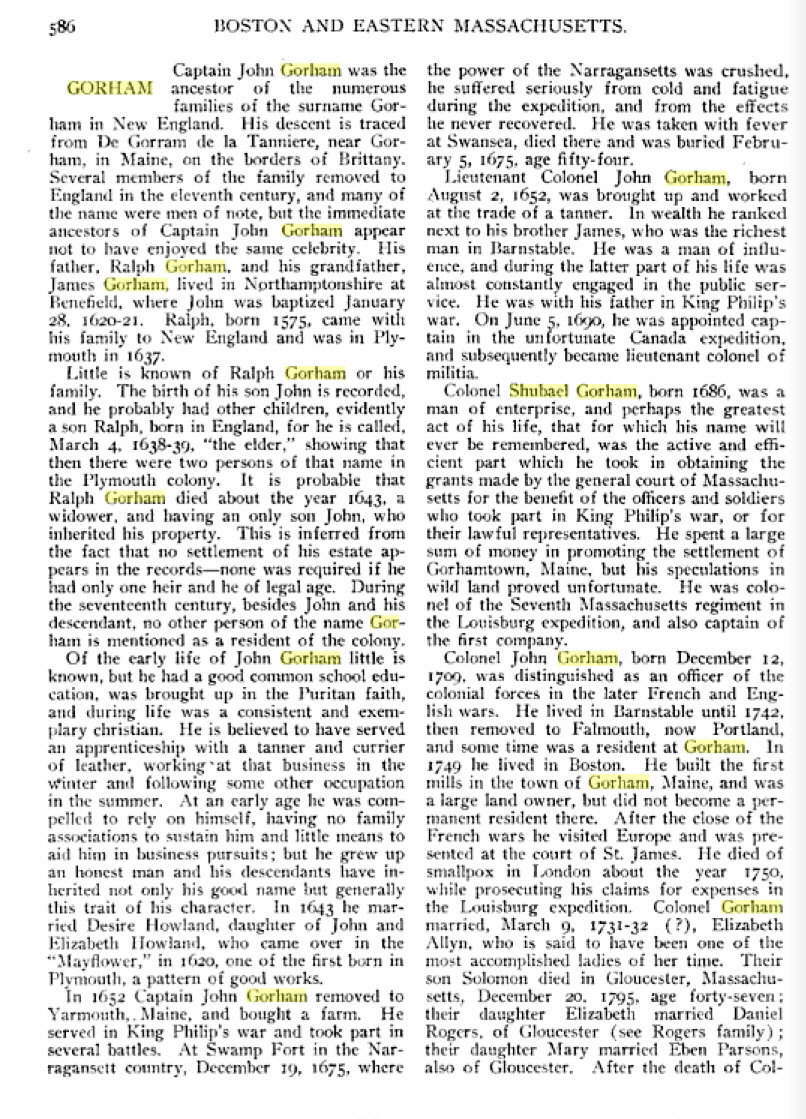
The Gorham family were originally French. The French spelling was DeGorran and they came from La Tanniere near he Brittany border. Several of the family went to England in the Eleventh Century following William the Conqueror and the Norman Invasion of the British Isles.  The Northamptonshire branch of the Gorhams are supposed to have descended from Sir High de Gorham and his wife Margaret, daughter of Sir William l’Angevin. Sir Hugh de Gorham, in 1281, possessed the manor of Churchfield in the parish of Oundle, and land in Benefield which had belonged to his wife’s father.

John and his descendants are the only ones listed in the Plymouth colony throughout the Seventeenth century, so even if there were other brothers, only he survived. John was raised in the Puritan faith and was a leather tanner by trade.

1637 – John is recorded in  Plymouth, MA,

18 Dec 1638 –  John received a land grant in Plymouth.

1638-39 –  John is recorded as having a partnership in Duxbury with one John Rogers.

1643 – John’s name was on a muster roll of men able to bear arms in Plymouth.

1646 – John and Desire moved north along the coast to the new town of Marshfield.  Marshfield is located on the South Shore, about where Cape Cod Bay meets the Massachusetts Bay.

8 Mar 1648 – Desire’s father, John Howland, sold to his “son-in-law, John Gorum”, half of the lands in Marshfield that he had bought from Governor William Bradford.

1648 – Chosen Constable of Marshfield

4 Jun 1650 – Became a freeman in Marshfield

1651 –  Member of the Grand Inquest of the Colony.

1652 – Moved to Cape Cod and settled in Yarmouth and purchased part of the Hallett farm. He had some 100 acres, most of which lay in the town of Barnstable. He operated both a grist mill and a tannery in Yarmouth.      His was one of the better farms in the Colony. He also owned a gristmill known as Hallett’s Mill and a wharf landing nearby. Not far away he had a tannery.  In Barnstable he reared his family and became an influential man in local affairs as a selectman (representative) and a landed proprietor. Some of the Gorham houses still remain in Barnstable.

In 1652 John Gorham came to Yarmouth, and purchased the northwest house lot, on the County road, adjoining the bounds of Barnstable. Subsequently he purchased a part of the farm of Andrew Hallet, adjoining his lot. He also owned the grist-mill, known as Hallet’s mill, and the landing place, or wharf, near the same, but situated farther south than the present mill. The dam built by the settlers only enclosed the southern portion of the mill pond, then appropriately called Stony Cove. Mr. Gorham’s tannery was a short distance south of the present mill, on the west side of the pond, and northerly from the ancient mill. He was a Surveyor of Highways for Yarmouth in 1654. In 1673 and 1674 he was one of the Selectmen of Barnstable, but in 1675 was again a resident of the town and captain of the militia here.

In June of that year, Capt. Gorham and twenty-five men from Yarmouth, “took up their first march for Mount Hope.” The theatre of war changing, the company marched into Massachusetts, without results. In October he was appointed captain of the second company of Plymouth Colony forces, was engaged in the sanguinary fight in the Swamp Fort, Dec. 19, and died at Swansey, from fever contracted in consequence of exposure during that campaign, Feb. 5, 1676, at the age of 55 years.

1653 – Deputy to the Plymouth Colony Court.

1654 – Surveyor of highways

5 Mar 1655 – John Gorham was presented for “unseamly carriage toward Blanch Hull at unseasonabie time being in the night.” She was then the wife of Trustrum Hull of Barnstable, and afterwards the second wife of Capt. William Hedge of Yarmouth. She was a bad woman, being frequently involved in broils and difficulties. Capt. Hedge, in his will, cut her off with “a shilling,” and gives as a reason that “she had proved false to him.” John Gorham was fined 40 shillings, Blanch 50 shillings — a poor speculation for Mrs. Hull.

1669 – Granted a large portion of land in Swansea, Massachusetts. He didn’t seem to go there immediately as in 1673 and 1674 he was a selectman in the town of Barnstable.

16 Feb 1673 – “John Gorum Sen of Barnstable” sold to George Dawson, “now resident at Barnstable”, land in Middleboro formerly belonging to John Howland and Elizabeth, his wife, and given to the said John Gorum before John Howland’s death. The transaction was witnessed by Joseph Laythorpe and John Thompson, and acknowledged 24 February 1673 before Thomas Hinckley, Assistant. Desire, wife of John Gorum gave her consent 30 April 1674.

June 24, 1675, –  Capt. John Gorham, and twenty-nine men of Yarmouth, took their march for Mount Hope, mounted and equipped for service. When they arrived the theatre of war had been transferred to the banks of the Connecticut. After the defeat of Capt. Lothrop at Sugar Loaf Hill, they marched into Massachusetts and pursued the enemy, without results. The following letter, written by Capt. Gorham is on file in the Secretary of State’s office in Boston :

Mendum, October the 1, 1675. Much Honored : My service with all due respects humbly presented to yourself and unto the rest of the Council hoping of your healths. I have made bold to trouble you with these few lines to give your honors an account of our progress in your jurisdiction. According unto your honors’ order and determination I arrived at Mendum with fifty men, and the next day Lieutenant Upham Phineas Upham was grandson of our ancestor Richard UPHAM he would later be wounded in the Great Swamp Fight] arrived with thirty-eight men, and the day following we joined our forces together and marched in pursuit to find our enemy, but God hath been pleased to deny us any opportunity therein; — though with much labor and travel we had endeavored to find them out, which Lieut. Upham hath given you a more particular account. Our soldiers being much worn but having been in the field this fourteen weeks and a little hopes of finding the enemy, we are this day returning toward our General, but as for my own part, I shall be ready to serve God and the country in this just war, so long as I have life and health; not else to trouble you, I rest yours to serve in what I am able. , John Gorrum.

1675 – John was Captain in the 2nd Barnstable Company, Plymouth Regiment in the war with King Phillip, an Indian chief who vowed to run the white men out of his land.  Our ancestor Captain Jonathan SPARROW was John’s Lieutenant in the same company.  While they are both related to us, they are five generations removed from each other. He led his troops in the Great Swamp Fight (or Massacre) of December 19, 1675.

Great Swamp Fight Memorial South Kingston, Rhode Island, was the site of the last stand of the Narragansett Indians in King Philips War against the Colonists  – In 1906 a rough granite shaft about 20 feet high was erected by the Rhode Island Society of Colonial Wars to commemorate this battle. Around the mound on which the shaft stands are four roughly squared granite markers engraved with the names of the colonies which took part in the encounter and two tablets on opposite sides of the shaft give additional data.

John Gorham’s name was on a List of the Soldiers of Yarmouth that were pressed into the country’s service, and that went to Mount Hope against the Indians in 1675, and took their first march upon the 24th June, ’75. The sum of his wages was £12 02 09.

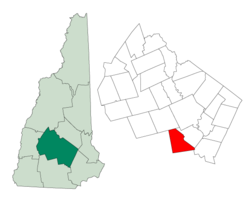
As a reward for service in the war with King Phillip, soldiers were given lands in Maine and the town was named Gorham, Maine in John’s honor. Gorham, New Hampshire is also named in his honor.  First called Narragansett Number 7, Gorham, Maine was one of seven townships granted by the Massachusetts General Court to soldiers (or their heirs) who had fought in the Narragansett War of 1675.  The population was 14,141 at the 2000 census. Gorham is home to the University of Southern Maine

24 Oct 1764  –    Narraganset #7 was  incorporated as the Town of Gorham (Captain John Gorham, Plymouth Company Commander  during King Philip’s War received payment with land known as Narragansett #7).    population 340, sixty to seventy families.  The first sawmill in name was erected in 1743 by a John Gorham at Little River on Fort Hill Road.  The mill was burned by Indians in 1745.

John was a resident of Yarmouth at the time of his death, but soon his widow moved to live with her son in Barnstable. She, Desire Gorham, died there December 13, 1683.

On November 2 1675, General Josiah Winslow led a combined force of over 1000 colonial militia including about 150 Pequot and Mohegan Indians against the Narragansett tribe living around Narragansett Bay. The Narragansett tribe had not yet been directly involved in the war, but had allegedly sheltered many of King Philip’s men, women and children and several of their warriors had reportedly been seen in Indian raiding parties.  The colonists distrusted the Narragansett and feared the tribe would join King Phillip’s cause come spring, which caused great concern due to the tribe’s location. The decision was made to preemptively strike the Narragansett before an assumed uprising. Several abandoned Narragansett Indian villages were found and burned as the militia marched through the cold winter around Narragansett Bay. The tribe had retreated to a large fort in the center of a swamp near Kingston, Rhode Island. The building of such a defensive structure gives credence to the argument that the Narragansett never intended aggressive actions, thus the colonist’s preemptive attack may have been unwarranted and overzealous.

Led by an Indian guide, on December 16, 1675 on a bitterly cold storm-filled day, the main Narragansett fort near modern South Kingstown, Rhode Island was found and attacked by the colonial militia from Plymouth Colony, Connecticut Colony and Massachusetts Bay Colony. The massive fort occupying about 5 acres  of land and was initially occupied by over a thousand Indians was eventually overrun after a fierce fight. The Indian fort was burned, its inhabitants, including women and children, killed or evicted and most of the tribe’s winter stores destroyed. It is believed that about 300 Indians were killed (exact figures are unknown) in the fighting. Many of the warriors and their families escaped into the frozen swamp. Facing a winter with little food and shelter, the whole surviving Narragansett tribe was forced out of quasi-neutrality some had tried to maintain in the on-going war and joined the fight alongside Philip. The colonists lost many of their officers in this assault and about 70 of their men were killed and nearly 150 more wounded. The dead and wounded colonial militiamen were evacuated to the settlements on Aquidneck Island in Narragansett Bay where they were buried or cared for by many of the Rhode Island colonists until they could return to their homes.

The Great Swamp Fight was a critical blow to the Narragansett tribe from which they never fully recovered.  In April 1676, the Narragansett were completely defeated when the Wampanoag sachem Metacom was shot in the heart by John Alderman, a Native American soldier

Nathaniel Gorham, President of the Continental Congress, the poet Henry Wadsworth Longfellow, and Pres. George Bush are some of the more famous descendants of John Gorham.

Children

1. Desire GORHAM (See Capt. John HAWES‘ page)

2. Temperance GORHAM (See Edward STURGIS II’s page)

3. Elizabeth Gorham

Elizabeth’s husband Joseph Hallet was born in 1630 in England. His parents were Andrew Hallett and Mary Reeves. Joseph died 30 JUN 1715 in Plymonth, Mass.

Joseph was five years old when he immigrated with his parents.  Andrew Hallett  at age 28, is listed as a servant to Richard Wade, on a list of persons bound from Weymouth to New England dated March 20, 1635. This was the fifth voyage of the Mayflower.  Andrew, a man of good estate, came as an indentured servant to Richard Wade. The reason he came as an indentured servant was a common practice in Dorset England. Andrew Hallett Sr. wrote to some of his relatives congratulating himself on his cleverness in outsmarting the ship line. If he came as the gentleman he was, he would have had to pay his own fare, as well as that of his wife and all six children. So he persuaded a cooper, Richard Wade, age 60, to list him as an indentured servant in exchange for paying one-half of the fare for Richard Wade. As a result, Andrew Hallett was able to transport his entire family to the colonies for only one-half one one fare, rather than the eight fares he should have paid. Further information from this letter told that when they got off the boat in the new land, Richard Wade began to give Andrew orders, to which he replied, “I am on free soil now; no one shall ever again tell me what to do.” And, according to records of people who knew him in America (including Gov. William Bradford, who confirmed this story in some of his writings), ‘no one ever did!

When Andrew came to Plymouth Colony in 1637 he was a proprietor in Dorchester, Mass. In 1638 he moved to Sandwich, Massachusetts and afterwards to Yarmouth, Mass. His wife was Mary Reeves. He brought his wife and several children to Lynn, Mass. in 1636, then to Plymouth in 1637, and Sandwich in 1638.   Andrew Hallet was among the earliest of the first comers, but did not make his permanent residence here until 1641. He was styled a school master in Lychford’s Plain Dealing.

In 1639 he bought off Dr. William Starr, for ten pounds, seventeen acres of land and twelve acres of meadow, with the frame of a house to be made by William CHASE Sr, the house to be made and set with a chimney, and to be thatched, studded and latched (daubing excepted), which Mr. Chase had agreed to do for the sum of five pounds. The lot for this house was in the northwest part of Yarmouth and the northeast part of Barnstable, off of the county road; the house was probably within the limits of Yarmouth.  He was one of the largest proprietors in Yarmouth in 1639 owning 200 acres, including the tidal  and mill; most of his land was in what became Barnstable.

He was taxed in Bowood, Dorset England in 1640 on a subsidy. Not many of the New England immigrants are found on these subsidies, as only a few of them were freeholders.   The subsidies were a special tax which Parliament permitted the king to levy on landowners who had sufficient personal property to make collection of taxes cost-effective.

At his death, Andrew left a cow to Yarmouth for the use of the poor.   His siblings were better educated than he; but, notwithstanding, Andrew was the most respectable and succeeded best in life.

4. James GORHAM I (See his page)

5. Col John Gorham

John’s wife Mary Otis was born 14 Mar 1653 in Hingham, Norfork, England. Her parents were John Otis (1622 – 1684) and Mary Jacob (1632 – 1683). Mary died 1 Apr 1732 in Barnstable, Barnstable, Mass.

John Gorham was a captain under Major Benjamin Church, in the expedition against the eastern Indians in 1696, and who was a lieutenant colonel in a like expedition in 1703.

During King William’s War, which raged almost uninterruptedly, from 1699 to 1703 no less than five expeditions were fitted out from the colony to operate against the enemy in the Eastern country and in Canada, and in all of these the Cape towns bore a conspicuous part, and especially in the whaleboat fleets, which always accompanied these expeditions. These crafts were necessarily small, because the enemy’s ports were usually located near the heads of rivers, beyond the tide-waters, where ordinary transports could not approach them. They were manned by whalemen, sailors and friendly Indians. Upon the wale of each boat, strong pieces of leather were fastened, so that whenever they grounded the men could step overboard, slip long bars through the leather loops, and take up the boats and carry them to deeper water. At night or in stormy weather, the boats were taken on shore, turned over and used instead of shelter tents. Each boat was fitted with a brass kettle and other conveniences for cooking. These expeditions were commanded by the famous Capt. Benjamin Church, who visited the Cape in the winter of 1703/04, and enlisted a large number of men for his fifth expedition.

BenjaminChurchNewYorkPublicLibraryStephenSchwarzmanBuildingPrintCollectionMiriamAndIraWallachDivisionPrintsandPhotographsID1217364.jpg

Colonel Benjamin Church: Father of American ranging

Lieutenant Col. John Gorham of Barnstable, usually commanded the whaleboat fleets, and in most of these expeditions was second in command, and many officers and men from Yarmouth and other Cape towns, were engaged in them.

Gorham accompanied Church on his fourth and fifth expeditions.  The forth expedition in 1696 carried out the Siege of Fort Nashwaak (present day Fredericton, New Brunswick) which was then Capital of Acadia, and the Raid on Chignecto  in Acadia,  Church now holding the rank of major.  Despite weighing approximately 250 pounds, Church led his troops personally in killing inhabitants of Chignecto, looting their household goods, burning their houses and slaughtering the livestock.

During Queen Anne’s War, Church went on his fifth and final expedition into Acadia. In retaliation for the Deerfield Massacre, in 1704 Major Church raided Acadia in the Raid on Castine, Maine, Raid on St. Stephen, New BrunswickRaid on Grand Pre, Raid on Pisiguit (present day Falmouth and Windsor) and the Raid on Chignecto. Church took prisoners and claimed to have left only five houses standing in Acadia.

A 19th Century historian of Yarmouth relates These expeditions were prolific of adventure, and in after years the old soldiers and sailors who took part in them, seated in their roundabout chairs within their capacious chimney corners, would relate to the young the story of their adventures in the old French wars.

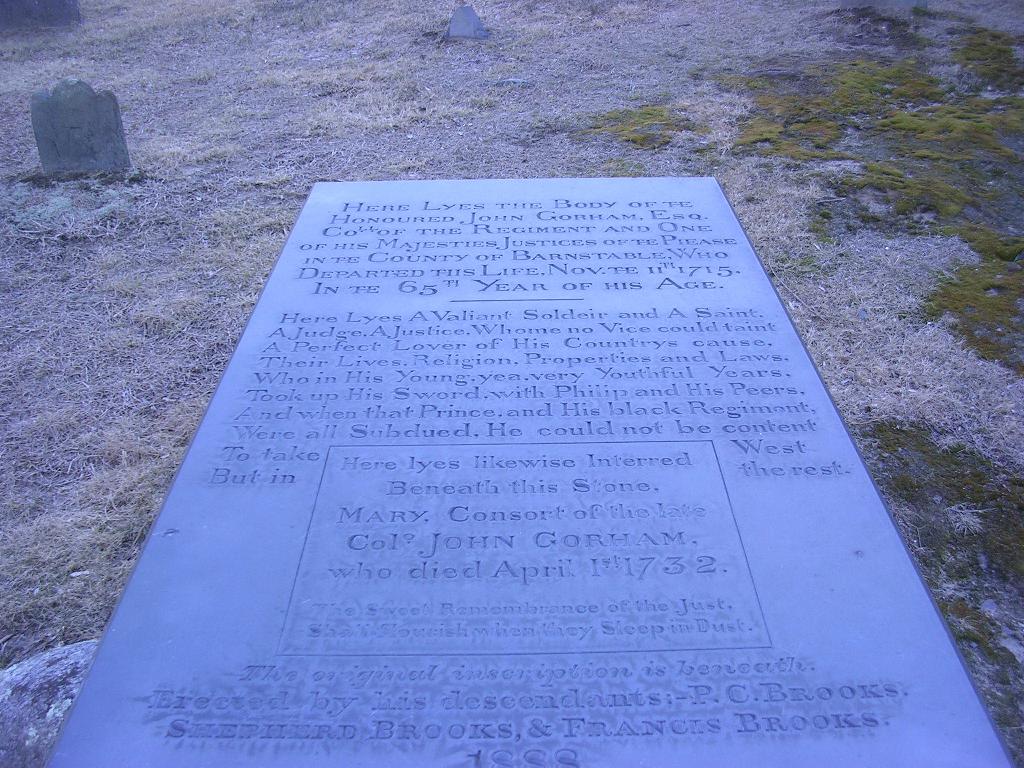
Col. John Gorham Monument – Cobb’s Hill Cemetery (East and West) , Barnstable,  Barnstable, Mass,Mass — HERE LYES THE BODY OF THEHONOURED JOHN GORHAM, ESQ.COLL. OF THE REGIMENT AND ONEOF HIS MAJESTIES JUSTICES OF THE PIEASEIN THE COUNTY OF BARNSTABLE, WHODEPARTED THIS LIFE, NOV. THE 11TH 1715,IN THE 65TH YEAR OF HIS AGE.

Here Lyes a Valient Soldier and A Saint
A Judge, A Justice, Whom no Vice could taint
A Perfect Lover of His Countrys cause,
Their Lives, Religion, Properties and Laws,
Who in His Young, yea, very Youthful Years,
Took up His Sword, with Philip and His Peers,
And when that Prince and His black Regiment
Were all Subdued, He could not be content
to take … West
But in a … the rest

Here lyes likewise Interred
Beneath this Stone
MARY, Consort of the late
Colo JOHN GORHAM,
who died April 1st 1732.

The Sweet Remembrance of the Just
Shall flourish when they Sleep in Dust.

The original inscription is beneath.
Erected by his descendants; – P. C. BROOKS
SHEPHERD BROOKS, & FRANCIS BROOKS
1888

Children of John and Mary:

i. John Gorham

ii. Temperance Gorham (1678-1756) m. Stephen Clapp

iii. Mary Gorham (1680-1748) m. Joseph Hinckley

iv, Stephen Gorham (1683-1743) m. Elizabeth Gardner

v. Shubael Gorham (1686 – 20 Feb 1746, Louisbourg, Nova Scotia) m. Mary Thacher  [Other sources say Col. Shubael died 7 August 1750 at Louisburg, but Louisburg was besieged in 1745, occupied by the New Englanders until restored to France in Treaty of Aix-la-Chapelle in 1749. The second siege did not take place until 1758.]

Shubael was a military officer and had sailed with Colonel John March in 1707 and then again as an ensign in Captain Caleb Williamson’s Barnstable Company with Nicholson when the English took Port Royal in 1710.

His greatest service, however, was his successful effort  in obtaining the grants of Nargansett Townships to the heirs of the soldiers who fought in King Philip’s War.  Col. Gorham spent much time and money promoting the settlement of Gorhamtown, now Dunbarton, Merrimack, New Hampshire.

Dunbarton, Merrimack, NH

Dunbarton, Merrimack, NH

He bought the shares of many who did not desire to emigrate, but his speculations in the wild lands proved unfortunate.  Buying such lands is like lottery tickets, a few get prizes.  Col Gorham was not one of the lucky ones.  He died insolvent in 1746, his own children being his principal creditors.

Shubal Gorham  Land Petition

Shubal Gorham Land Petition

As you can see in the above petition, Shubael also advocated for veterans of the 1690 Canada Expedition including our ancestor Lt. Jabez SNOW.

Originally granted as Gorham’s-town in 1735, and re-granted as Starkstown in 1748, the town was incorporated in 1765 as Dunbarton. The name came from Dunbartonshire in Scotland, hometown to Archibald Stark, a prominent settler.

(Gorham, Maine and Gorham, New Hampshire were also land grant towns and are named for John GORHAM I.)

During the 1745 Siege of Louisbourg, Shubael Gorham of Barnstable was Colonel of the Seventh Massachusetts Regiment. His son, John Gorham, was Lieut. Colonel and became Colonel upon Shubael’s death.  The expedition,consisted of 4,200 militia, sailors & marines, 90 ships & vessels under the command of Gen. William. Pepperell.

The Siege of Louisbourg took place in 1745 when a New Englandcolonial force aided by a British fleet captured Louisbourg, the capital of the French province of Île-Royale (present-day Cape Breton Island) during the War of the Austrian Succession, known as King George’s War in the British colonies.

Although the Fortress of Louisbourg‘s construction and layout was acknowledged as having superior seaward defences, a series of low rises behind them provided attackers places to erect siege batteries. The fort’s garrison was poorly paid and supplied, and its inexperienced leaders mistrusted them. The colonial attackers were also lacking in experience, but ultimately succeeded in gaining control of the surrounding defenses. The defenders surrendered in the face of an imminent assault.

Louisbourg was an important bargaining chip in the peace negotiations to end the war, since it represented a major British success. Factions within the British government were opposed to returning it to the French as part of any peace agreement, but these were eventually overruled, and Louisbourg was returned, over the objections of the victorious colonists, to French control after the 1748 Treaty of Aix-la-Chapelle.

Shubael’s son and John GORHAM’s great grandson John Gorham (wiki) (1709–1751) was a New England Ranger and was the first significant British military presence on the frontier of Nova Scotia and Acadia to remain in the region for a substantial period of time after the Conquest of Acadia (1710). He established the famous “Gorham’s Rangers”.

Gorham’s Rangers was one of the most famous and effective ranger units raised in colonial North America and served as the prototype for many subsequent ranger forces, including the better known Rogers’ Rangers. The unit started out as a Massachusetts provincial auxiliary company, recruited in the summer of 1744 at the start of King George’s War. Governor William Shirley ordered the unit raised as reinforcements for the then-besieged British garrison at Fort Anne in Annapolis Royal. Over the next eight years the unit proved remarkably effective at suppressing Acadian and Mi’kmaq resistance to British rule in Nova Scotia and helped to both expand and secure the British sphere of influence in the region.

Initially a sixty man all-Indian company led by British colonial officers, the original Native American members of the unit were gradually replaced by Anglo-Americans and recent Scots and Irish immigrants and were a minority in the unit by the mid-1750s. The company were reconnaissance experts as well as renowned for their expertise at both water-borne operations and frontier guerrilla warfare. They were known for surprise amphibious raids on Acadian and Mi’kmaq coastal or riverine settlements, using large whaleboats, which carried between ten to fifteen rangers each. This small unit was the main British military force defending Nova Scotia from 1744 to 1749. The company became part of the British army and was expanded during the Seven Years’ War and went on to play an important role in fighting in Nova Scotia as well as participating in many of the important campaigns of the war, particularly distinguishing itself at the Siege of Quebec in 1759.

John Gorham was commissioned a captain in the regular British Army in recognition of his outstanding service. He was the first of three prominent American rangers – himself, his younger brother Joseph Gorham and Robert Rogers – to earn such commissions in the British Army. (Many others, such as George Washington, were unsuccessful in their attempts to achieve a British rank.) John Gorham was active during King Georges War and Father Le Loutre’s War.

John and wife Elizabeth Allyn even met with George II in England on one occasion. On a later trip to London, where he was to attend a meeting on how to proceed against the French, he came down with smallpox and died at the age of only 43.

Shubael’s son and John GORHAM’s great grandson Joseph Gorham  (wiki) ( 1725 – 1790) served as a lieutenant in his brother’s ranger company from 1744 through 1752. Initially the rank and file members of the company were Wampanoag and Nauset Indians from southeastern Massachusetts, prized as much for their small-boat handling skills (learned in the whaling industry) as for their scouting and tracking skills, and also a handful of Pequawket Indians from Maine.  Gorham was in the Battle at Canso during Father Le Loutre’s War (1748-1752). Shortly after his brother’s death in December of 1751, Joseph was promoted to captain and took command of the rangers, who were by then mostly Anglo-Americans. During the French and Indian War he participated in the Expulsion of the Acadians and in both the Battle of Petitcodiac, where he was wounded, and the St. John River Campaign.

A contemporary of the famous ranger Robert Rogers, Joseph led Gorham’s Rangers in the Siege of Louisbourg (1758), the Siege of Quebec in 1759, and after his promotion to Major Commandant of the Nova Scotia Ranger Corps in 1761, the expedition to Havana in 1762, where disease all but wiped out the rangers. (See my post Battle of Havana – 1762)

Joseph settled in Nova Scotia where he was active in Indian affairs and was also briefly the Lieutenant-Governor of Newfoundland. He also fought in the American Revolution, leading the Royal Fencible American Regiment and was also noted as the commander of British forces victorious at Fort Cumberland in 1776.

6. Joseph Gorham

Joseph’s first wife Sarah Sturgis was born abot 1656. Her parents were  Edward Sturgis and Elizabeth HINCKLEY.  Sarah died before 3 Feb 1738/39, Yarmouth, Barnstable, MA.

Joseph’s second wife Bethiah Hall was born in 1672 .  She was the widow of Kenelm Winslow Jr. Bethiah died 9 Sep 1745.

Joseph’s third wife Sarah Howes was born 29 OCT 1673 in Yarmouth, MA. .  Her parents were Thomas Howes Jr and Sarah Bangs.  Her grandparents were our ancestors on both sides, Thomas HOWES and Mary BURR and Capt. Edward BANGS and Rebecca HOBART.  She was the widow of Stephen Hopkins Jr.  Sarah died after 1746.

Joseph was a shoemaker in Yarmouth. In the division of his father’s estate in 1675, he was given forty acres of land and 4 acres of meadow next to land owned by his brother-in-law, Joseph Hallet. Edward Sturgis, in his verbal will probated at Plymouth, MA 3 June 1679, gave Joseph 5 pounds in silver. Joseph was one of the witnesses to the will.

Joseph served as an ensign in the militia before 1682. In Mar 1683/84, after his mother’s death, Joseph and his brothers and sisters agreed that the children of his deceased sister, Elizabeth Hallett, ‘should have an equal part that did belong to their mother.’ In his will dated 27 July 1723, proved 20 July 1726, Joseph Gorham named his wife Sarah, his sons Joseph and Josiah Gorham, his daughter Desire Baxter, his granddaughter Sarah Sears, daughter of his deceased daughter Sarah Howe, and Sarah’s other children, Thomas, Ebenezer and Elizabeth Howes. His wife Sarah and son Josiah were named executors. Witneses were Peter Thacher, Thankful Thacher and Ann Lothrop.

Joseph Gorham Headstone — Ancient Cemetery , Yarmouth Port, Barnstable , Mass

7. Jabez Gorham

Jabez’ wife Hannah Sturgis was born 22 Dec 1654 – Barnstable or Yarmouth Plymouth Colony.  Her parents were Edward STURGIS and Elizabeth HINCKLEY.   She first married John Gray 1672 Barnstable, Mass.  Hannah died 17 Oct 1736 – Harwich, Massachusetts Burial: in Old Burying Ground, Brewster

Jabez was wounded in King Philip’s War.  His name is on a list of townsmen in Yarmouth in 1679. In 1680 he was a constable and in 1683 he took the freeman’s oath and served on the Grand Inquest of Massachusetts Colony in 1683.

The family removed from Barnstable to Bristol, Rhode Island. He was present at the first town meeting in Bristol where he was voted as an inhabitant, can be found in the 1689 Bristol Census, and on July 6, 1696, he became a member of the Congregational Church of Bristol.

At about this time Jabez settled at Papasquash Neck on one hundred acres of land granted to the estate of his father, Capt. John Gorham, for his service in King Philip’s War. The land seems to have belonged to his brother, Shubael Gorham, who sold it to Nathaiel Byfield of Bristol, Feb. 7, 1689/90 for £62. Jabez registered his earmark for cattle and swine in Bristol, June 30, 1683. He was living in Bristol in August 1691 where he was called a carpenter when he bought land.

Was on the  and probably moved to Bristol, Massachusetts soon after. He was a cordwainer by trade. He is mentioned in the Inventory of his father’s estate. Census mentions Jabez Gorham, of Bristol, in the County of Bristol, in the Province of Mass, Bay, Yeoman

Jabez Gorham’s will was dated Mch. 16, 1724/5. Mentions wife, Hannah, oldest son, Jabez, of Yarmouth, sons Isaac, Joseph and Benjamin, dau. Elizabeth, wife of Shubael Baxter, and grandsons, Edward, William, and Samuel Downs. Widow Hannah and son, Benjamin were made Executors of the will. (See Bristol Probate). Son Isaac, of New Haven. Connecticut filed a receipt for his share of his father’s estate, May 18, 1725 and son Joseph, of Fairfield, Fairfield Co. Colony of Connecticut of New England, filed a similar receipt June 16, 1725.

After the death of Jabez, Hannah returned to Cape Cod and on September 12, 1723, the following deed was recorded in the Bristol Co. District Land Records, Vol 21, p. 262, “Hannah Gorham of Yarmouth, in the county of Barnstable, seamstress, quitclaimed to Benjamin Gorham [her son] of Bristol, tanner, all her interest in five acres of land in Bristol”.

8. Mercy Gorham

Mercy’s husband George Denison was born 16 Jul 1653 in Barnstable, Barnstable, Mass. His parents were  George Denison (1621 – 1694) and  Ann Borodell Denison (1615 – 1712). George died 27 Dec 1711 in Westerly, Washington County, Rhode Island.

Mercy Gorham Dennison Headstone – Denison Ground WesterlyWashington CountyRhode Island,

Children of Mercy and George:

i. Edward Denison b. 1678 in Stonington, New London, Connecticut, USA

ii. Joseph Denison b. 1681 in Westerly, Washington, Rhode Island; 18 Feb 1724 Stonington; Burial: Old Taugwonk Cemetery; m. Prudence Miner (bapt. 6 May 1688; d. 17 May 1726 Stonington, Burial: Old Taugwonk Cemetery) Prudence’s parents were Joseph Miner and Mary Avery. Her grandparents were our ancestors Thomas MINER and Grace PALMER.

iii. Mercy Denison b. 1683 in Westerly, Washington, Rhode Island

iv. Samuel Denison b. 26 Sep 1686 in Westerly, Washington, Rhode Island

v. Elizabeth Denison b. 11 Sep 1689 in Westerly, Washington, Rhode Island

vi. Desire Denison b. 16 Apr 1693 in Westerly, Washington, Rhode Island

vii. Thankful Denison b. 1695 in Westerly, Washington, Rhode Island

viii. George Denison b. 1699 in Westerly, Washington, Rhode Island;

9. Lydia Gorham

Lydia’s husband Col. John Thatcher was born 17 Mar 1639 Marblehead, Essex County, Mass. His parents were Anthony Thacher and Elizabeth Jones. John died 8 May 1713 in Yarmouth.

John had previously married Rebecca Winslow in 1661. Her father was Josiah Winslow. nephew of governor of Plymouth Colony..  Rebecca died on July 15, 1683. He married Lydia six months later.

Tradition has preserved a singular anecdote of John Thacher, a son of one of the first settlers in Massachusetts. He was married in 1661 to Rebecca Winslow, and being on his way to Yarmouth with his bride, they stopped for the night at the house of one Capt. Gorham, at Barnstable. In the merry conversation with the newly married couple an infant was introduced, about three weeks old, and the night of her birth was mentioned to Mr. Thacher; he observed that it was the very night on which he was married, and taking the child in his arms, presented it to his bride, saying ‘Here, my dear, is a little lady, born on the same night we were married; I wish you would kiss her, for I intend to have her for my second wife.’ ‘I will, my dear,’ she replied, ‘to please you, but I hope it will be long before your intention is fulfilled.’ Then, taking the babe, she kissed it heartily, and so gave it into the nurse’s hands. This jesting prediction was eventually verifed; Mr. Thacher’s wife died, and the child, arriving at mature age, actually became his second wife in 1684.’ –

He was deputy from Yarmouth, 1669, ’70, ’71; was an Assistant of Plymouth Colony.

Lydia Gorham Thacher Headstone Ancient Cemetery Yarmouth Port, Barnstable, Mass

10. Hannah Gorham

Hannah’s husband Joseph Weldon was born 1685.  His parents our ancestors John WHELDEN and Mary FALLAND.

Joseph was a sea captain and they soon moved to Cape May in New Jersey. She died there in 1728, he in 1727.

Cape May City and County, New Jersey

Cape May City and County, New Jersey

Cape May City and County, New Jersey

Cape May City and County, New Jersey

Hannah and Joseph had five children, the first two were born in Yarmouth, the rest in Cape May

i. Hannah Whilldin b. 1683 in Yarmouth, Barnstable, Mass; d. 1728 Cape May, New Jersey; m1. 18 May 1701 Thomas Leaming (b. 9 Jul 1674 in Southampton, Long Island, New York – d. 31 Dec 1723 in Cape May, New Jersey); m2. 1724 Philip Syng (b. 1676 in Ireland – d. 18 May 1739 in Annapolis, Maryland)

ii. Joseph Whilldin b. ~1689 in Yarmouth, Barnstable, Mass; d. 18 Mar 1748 Cape May, New Jersey; m1. 1711 in Cape May to Mary Wilmon (b. 9 Dec 1689 in Cape May – d. 8 Apr 1743 in Cape May); m2. Abigail [__?__]

iii. Mary Whilldin b. ~1693 Cape May, New Jersey; m. 17 Dec 1708 Josiah Crowell (b. 1675 Cape May – d. 1734 in Cape May)

iv. Experience Whilldin b. 1696 in Cape May, New Jersey; m. 15 Nov 1712 to William Foster (b. 1692 in Burlington, New Jersey)

v. Isaac Whilldin b. 1698 in Cape May, Cape May, New Jersey;  d. 1730; m. Elizabeth [__?___]

11. Shabael Gorham

It was intended that Shubael go on to college, but the death of his father and his lack of drive put that thought aside. He became a carpenter in Barnstable. He met and married Puella Hussey of Nantucket in 1696. Her family is covered in the preceding HUSSEY FAMILY HISTORY. He moved to the ocean side of Barnstable and built a home on the water in Hyannis Port. He ran a tavern and a fulling mill as well as following his trade as a carpenter.

Shubael died in 1750 at age eighty-two. Puella died a few years earlier. She was not mentioned in his will of 1748. He left his estate to his son George and his personal estate to his daughters.

While Shubael had never to my knowledge lived on Nantucket, he was a Quaker and the Nantucket Quakers all attended the Sandwich Monthly Meeting on Cape Cod. It would have been here that he met his wife and also where his children met the Nantucket people that they married.

Shubael and Puella had ten children all born in Barnstable

Sources

John Gorham Bio 1

John Gorham – Bio 2

Wing Family of America – John Gorman
Posted in 12th Generation, Double Ancestors, Historical Monument, Immigrant - England, Line - Shaw, Pioneer, Place Names, Public Office, Veteran, Violent Death | Tagged , , , , , | 42 Comments

James Gorham Sr.

James GORHAM Sr. (1650 – 1707) was Alex’s 9th Great Grandfather; one of 1,024 in this generation of the Shaw line.

James Gorham was born 18 Apr 1650 in Marshfield, Plymouth, Mass.  His parents were John GORHAM and Desire HOWLAND. He married Hannah HUCKINS in Barnstable on 24 Feb 1672/73.  James died  at Barnstable, MA, on 18 Nov 1707 and is interred at Lothrop Hill Cemetery, Barnstable, Barnstable, Massachusetts.

James Gorham – Headstone –   Barnstable Lothrop Hill Cemetery

HERE LYES Ye BODY OF JAMES GORHAM DIED NOV’r Ye 18th 1707 IN Ye 58th YEAR OF HIS AGE

James Gorham Detail

The gravestone is carved in the style of William Mumford of Boston.

John Gorham Sr. – Headstone

Hannah Huckins was born 14 Oct 1653.  Her parents were Thomas HUCKINS and Rose TILLIE Hillier. Hannah died 13 Feb 1726/27.

Hannah Huchins Gorham – Headstone – HERE LYES Ye BODY OF Mrs HANNAH GORHAM WIFE TO Mr JAMES GORHAM DEC’D FEB’ry 13 1727/8 IN Ye 75th YEAR OF HER AGE The gravestone displays a round winged skull. Barnstable Lothrop Hill Cemetery

Children of James and Hannah

Name Born Married Departed
1. James GORHAM Jr. 6 Mar 1675/76
Barnstable, Mass
Mary JOYCE
29 Sep 1709
Barnstable, Mass
10 Sep 1718
Barnstable, Mass
2. Experience Gorham 28 Jul 1678
Barnstable
Thomas Lothrop (Lathrop)
23 Apr 1697
Barnstable
23 Dec 1733
3. John Gorham 2 Aug 1680
Barnstable
Ann Brown
24 Feb 1704/05
20 Jul 1729
Yarmouth
4. Mehitable Gorham 28 Apr 1683
Barnstable
Joshua Oldman
12 May 1715 Barnstable
28 Sep 1747
Scituate, Mass
5. Thomas Gorham 16 Dec 1684
Barnstable
Rachel Trott
7 May 1707 Nantucket, Mass
3 Dec 1771
Barnstable
6. Desire Gorham Apr 1685
Yarmouth, Barnstable, Mass.
John Baxter
11 Jun 1706
.
Sgt. Daniel Hambleton [Hamilton] Barnstable
15 Dec 1715.
23 Jun 1749 Yarmouth
7. Joseph Gorham 25 Mar 1689
Barnstable
1762
Barnstable
8. Jabez Gorham 6 Mar 1689/90
Barnstable
Molly [Burbank? or Oysterbanks?] 5 Mar 1739
Fairfield,  CT
9. Sylvanus Gorham 13 Oct 1693 1 Sep 1747
Stamford, CT
10. Ebenezer Gorham 14 Feb 1695/96
Scituate, Mass.
Temperance Hawes
(Sister of  Thomas HAWES I)
9 Nov 1727 Yarmouth, Mass.
16 Nov 1776
Barnstable

As eldest son, James received a large piece of his father’s land in Barnstable and built a large home there. At the time he was the wealthiest man in Barnstable.   James was a farmer all his life.

p. 414 of GENEALOGICAL NOTES OF BARNSTABLE FAMILIES

James Gorham, eldest son of Capt. John Gorham, was a farmer, and often employed in public business.  In the dividion of his father’s homestead, he had the north westerly and central portions, on which he build a large and elegant mansion house.  It stood on the spot where Mr. Warren Marston’s house now stands and was taken down about twenty years since.  It appears by the schedule of the dividion of the common lands made in 1703, that he was then the richest man in the town of Barnstable.  He married Hannah, daughter of Mr. Thomas Huckins, of Barnstable.  He died in 1707, aged 57, and his widow 13th Feb. 1727, aged 74 years.

Children 

1. James GORHAM Jr. (See his page)

2. Experience Gorham

Experience’s husband Thomas Lothrop was born 6 JAN 1673/74 Barnstable, Mass.  His parents were Melatiah Lothrop and Sarah Farrar. His great grandfather was our ancestor Rev. John  LATHROP (1584 – 1653) .  Thomas died 23 JUL 1757 Barnstable, Mass.

3. John Gorham

John’s wife Ann Brown was born about 1685.  Her parents were John Brown (1650 – 1709) and Anne Mason (1650 – 1709)  Ann died 26 Feb 1730. Her grandparents were both our ancestors Ensign John BROWN (Rehoboth) Lydia BUCKLAND and  John MASON & Anne PECK.

4. Mehitable Gorham

Mehitable’s husband Joshua Oldham was born 20 Jun 1684 in Scituate, Plymouth, Mass. His parents were Thomas Oldham (1660 – 1734) and Mercy Sprout (Sproat) (1662 – 1728).  After Mehitable died, he married Bathsheba LaBrocke 25 Mar 1752 – Scituate, Plymouth, Massachusetts.  Joshua died after 16 Apr 1759 in Scituate, Plymouth, Mass.

5. Thomas Gorham

Thomas’ wife Rachael Trott was born 1683 in Nantucket Island, Mass. Her parents were John Trott and Ann [__?__].  Rachael died 1758 in Barnstable, Massachusetts.

Thomas was a blacksmith.

6. Desire Gorham

Desire’s husband John Baxter was her first cousin. He was born about 1680 Yarmouth, Barnstable, Mass. His parents were Thomas Baxter and Temperance Gorham. John died in Yarmouth, Barnstable, Mass.

Desire’s second husband Daniel Hambleton [Hamilton] was born about 1669 in Newport, RI.  His parents were Thomas Hambleton and Lydia Wing. Daniel died 08 DEC 1738 in Chatham, Barnstable, Mass.

10. Ebenezer Gorham

Ebenezer’s wife Temperance Hawes was born 31 Dec 1705 Barnstable, Mass. Her parents were Joseph HAWES and Mary HOWES. Temperance died 21 Feb 1767 Barnstable, Mass.

Children of Ebenezer and Temperance:

i. Ebenezer Gorham b. 7 Aug 1729 in Barnstable, Barnstable, Mass

ii. Mary Gorham b. 16 Jun 1735 in Barnstable, Barnstable, Mass;

iii. Prince Gorham b. 14 Mar 1731 in Barnstable, Barnstable, Mass;

iv. Hannah Gorham b. 16 Apr 1733 in Barnstable, Barnstable, Mass;

v. Sarah Gorham b. 22 May 1737 in Barnstable, Barnstable, Mass;

vi. Thankful Gorham b. 22 Apr 1739 in Barnstable, Barnstable, Mass;

vii. Temperance Gorham b. 20 May 1744

viii. Silvanus Gorham b. 17 Jul 1746 in Barnstable, Barnstable, Mass; d. 29 May 1805 in Barnstable; m. 19 Mar 1768 in Barnstable to Anna Gorham (b. 17 Jul 1748 in Barnstable – d. 27 Oct 1811 Barnstable). Anna’s parents were Hezekiah Gorham and Ann Allyn. Her grandparents were Silvanus’ uncle James GORHAM Jr. and Mary JOYCE. Anna and Silvanus had thirteen children born between 1769 and 1793.

Sources:

Wing Family of America – James Gorman
Posted in 11th Generation, Historical Monument, Line - Shaw | Tagged | 9 Comments

James Gorham Jr.

James GORHAM Jr. (1677 – 1718) was Alex’s 8th Great Grandfather; one of 512 in this generation of the Shaw line.

James Gorham was born 6 Mar 1677 in Barnstable, Mass.  His parents were James GORHAM Sr. and Hannah HUCKINS.  He married Mary JOYCE on 29 Sep 1709. James died 10 Sep 1718 in Barnstable, Mass and is interred at Cobb’s Hill Cemetery  Barnstable, Barnstable, Massachusetts.

James Gorham Jr. Headstone – Here Lyes ye Body of Mr JAMES GORHAM Dec’d Sept ye 10th 1718 in ye 42 Year of His Age

Mary Joyce was born 12 Nov 1682 in Marshfield, Plymouth, Mass.   Her parents were Hosea JOYCE  and Elizabeth CHIPMAN.  After James died, she married 26 May 1720 in Barnstable, Mass Age: 39 to Elisha Parker.  After Elisha died, she married 16 Sep 1736 Age: 55 to Thomas Lothrop.  Mary died 28 Jun 1778.

Other sources say her parents were Walter JOYCE and Elizabeth LOW who lived in Marshfield, Mass.  Marshfield is about 50 miles away from Yarmouth.  Since Hosea Joyce lived in Yarmouth, a relatively small place and his family married into many of the same families as the Gorhams, I think it is more likely that Hosea was Mary’s father.

Children of James and Mary:

Name Born Married Departed
1. Thankful GORHAM Barnstable, MA
25 May 1711
Thomas HAWES I
1730
Yarmouth, Barnstable, Mass
At sea
Bef.
8 Dec 1801
2. Isaac Gorham bapt.
17 Apr 1715, Barnstable, Barnstable, Mass.
Mary Hallett
24 Jul 1738
Yarmouth, Mass
.
Mary Cobb
21 Sep 1742 Barnstable, Mass
Jan 1753
Scotland
3. Capt. Hezekiah Gorham bapt.
17 Apr 1715  Barnstable, Barnstable, Mass.
Ann Allyn
12 May 1746
Barnstable, Mass.
30 Nov 1778
Barnstable, Mass
4. James Gorham ca. 1717
Barnstable, MA
Unmarried, though intentions published Nov 11 1738 to Mary Hallett 1742
5. Mary Gorham 19 Jul 1719
Barnstable, Mass
Thomas Hedge
25 Jan 1738/39
Barnstable, Mass.
.
Thomas Hallett (son of Jonathan HALLET)
5 Jan 1769 Yarmouth, Mass
.
Capt. Benjamin Lathrop
2 Jun 1795
Yarmouth, Mass.

James will is dated 10 Sep 1717 and proved 5 Nov 1718.  In it he names his wife Mary and his sons Isaac, Hezekiah and James and daughter Thankful.  His daughter Mary was born after his death and therefore not named.  He describes land in the common field bounded by the land of his Uncle Shubael.  Executors, his wife Mary, her brother Thomas Joyce and Joseph Davis.  All the lands on the north of the road in the northeasterly part of town, was then called the “Common Field.”

Children

1. Thankful GORHAM (See Thomas HAWES I page)

2. Isaac Gorham

Isaac’s first wife Mary Hallett was born 17 Dec 1717 Yarmouth, Mass. Her parents were John Hallett (1688 – 1765) and Thankful Thacher (1694 – 1768)  Mary died 19 Aug 1741 Barnstable, Mass. age 24.

Isaac’s second wife Mary Cobb was born 17 Dec 1717, Yarmouth, Barnstable, Massachusetts.  Her parents were Gershom Cobb (1675 – ~1751) and Hannah Davis (1683 – )  After Isaac died, she married James Churchill 3 Feb 1756/57.  Mary died aft 1804, Barnstable, Barnstable, Massachusetts, age: 82

Isaac was a sea captain and died in Scotland.

Isaac Gorham House Barnstable, Mass

Children of Isaac and Mary Hallett:

i. Mary Gorham b. 1738 in Barnstable, Barnstable, Mass.; d. 11 Oct 1828 Mass.;

ii. Thankful Gorham b. 1741 in Barnstable, Mass.; d. 31 Dec 1812 Yarmouth, Barnstable, Mass.; m. John Hallett (b. 1738 in Yarmouth, Mass.)

Children of Isaac and Mary Cobb:

iii. Edward Gorham b. 1743 in Barnstable, Barnstable, Mass.;

iv. James Gorham b. 4 Aug 1745 in Barnstable, Barnstable, Mass.; d. 24 Dec 1804 Pitt, North Carolina; m. Mary Baker (b. 1748)

v. Sarah Gorham b. 1748 in Barnstable, Barnstable, Mass.;

vi. Hannah Gorham b. 1750 in Barnstable, Barnstable, Mass.;

3. Hezekiah Gorham

Hezekiah’s wife Ann Allyn was born 1 Jan 1717/18 Barnstable, Mass. Her parents were James Allen and Susanna Lewis. She first married John Davis Jr 25 Mar 1736. Ann died 21 APR 1792 Barnstable, Mass.

Like his twin brother, Hezekiah was a sea captain.

Children of Hezekiah and Ann:

i. Anna Gorham b. 17 Jul 1748 in Barnstable, Barnstable, Mass; d. 27 Oct 1811 Barnstable, Barnstable, Mass; m. 19 Mar 1768 in Barnstable to Silvanus Gorham (b. 17 Jul 1746 in Barnstable – d. 29 May 1805 in Barnstable) Silvanus’ parents were Ebenezer Gorham (1696 – 1776) and Temperance Hawes (1705 – 1767).  Her paternal grandparents were James GORHAM Sr. and Hannah HUCKINS.  Her maternal grandparents were Joseph HAWES and Mary HOWES.  Anna and Silvanus had thirteen children born between 1769 and 1793.

ii. James Gorham b. 22 Feb 1747 in Barnstable, Barnstable, Mass; d. 1748

iii. Lemuel Gorham b. 1751 in Barnstable, Barnstable, Mass;

iv. Jonathan Gorham b. 1753 in Barnstable, Barnstable, Mass; m. Mary Davis (b. Aug 1757 in Nantucket, Nantucket, Mass. – d. 5 Jul 1839 in Nantucket, Nantucket, Mass) Mary’s parents were Josiah Davis and Thankful [__?__].

v. Susannah Gorham b. 1754 in Barnstable, Barnstable, Mass; m. Gorham Easterbrooks (b. 1751)

vi. Issac Gorham b. 1760 in Barnstable, Barnstable, Mass;

4. James Gorham

James was a mariner like his brothers.  He died in 1742 leaving no issue.  He was published Nov 11 1738 to Mary Hallett, but I can find no record of a marriage.  In his will dated 19 Mar 1738/39, he gives all his estate, appraised at £145 14 06 to his brother Hezekiah

5. Mary Gorham

Mary’s first husband  Thomas Hedge was born 5 May 1719 Yarmouth, Barnstable, Mass. His parents were Thomas Hedge and Hannah Taylor. His grandparents were Elisha HEDGE and Mary STURGIS. Thomas died 15 Jun 1764 Yarmouth, Barnstable, Mass.

Mary’s second husband,  Thomas Hallett  was born 1691 in Yarmouth, Barnstable, Mass. His parents were Jonathan HALLET and Abigail DEXTER.  Thomas was married four times.  Thomas died 10 Apr 1772 in Yarmouth, Barnstable, Mass. at age 81.

  1. He first married 9 Apr 1719 in Yarmouth, Mass to Sarah Hawes, daughter of Joseph HAWES  and Mary HOWES (b. 1 Apr 1696 Yarmouth, Mass – d.31 Jan 1720 in the birth of their first child.)
  2. After Sarah died, he married 8 Feb 1722 in Harwich, Barnstable, Mass. to Hannah Gray (b. 1693 in Harwich, Mass – d. 6 Feb 1750 in Yarmouth, Mass.)
  3.  After Hannah died, he married a third time 19 Aug 1750 in Yarmouth, Barnstable, Mass to Desire Gorham (26 Aug 1710 in Yarmouth, Mass – d. Dec 1767 in Yarmouth) Desire’s parents were John Gorham and Anne Brown.  Her grandparents were James GORHAM Sr. and Hannah HUCKINS.
  4. After Desire died, he married a fourth and final time 5 Jan 1769 in Yarmouth, Mass to Mary Gorham (b. 19 Jul 1719 in Barnstable, Mass – d. 2 Jun 1795 in Yarmouth). Mary’s parents were James GORHAM Jr. and Mary JOYCE. 

Mary was born after her father’s death and therefore is not mentioned in his will.

Mary was a “singular woman.”  She was known as “Mrs. Slicker” and her children were known as “Slickers.”  She was no advocate for celibacy and held that it was no breach of etiquette for women to propose marriage.

Children of Mary and Thomas Hedge:

i. Mary Hedge b. 30 Jun 1740 in Yarmouth, Barnstable, Mass; d. 4 Aug 1740 Yarmouth

ii. Thomas Hedge b. 8 Apr 1742 in Yarmouth, Barnstable, Mass; d. 19 Apr 1742 Yarmouth

iii. Hannah Hedge b. 20 Jul 1743 in Yarmouth, Mass; m. 30 May 1761 in Plymouth to Barnabas Hedge b. 3 May 1740 in Plymouth, Mass.’ d. 17 Nov 1778 Plymouth, Mass; Barnabas’ parents were Barnabas Hedge and Mercy Barnes. His grandparents were our ancestors John HEDGE and Thankful LOTHROP.

iv. Sarah Hedge b. 21 May 1748 in Yarmouth, Mass; d. 1796 Yarmouth; m. 1767 to Edward Hallett (b. 6 Apr 1747 in Yarmouth – d. 8 Mar 1796 in Yarmouth) Edward’s parents were Ebenezer Hallett (1709 – ) and Elizabeth Bangs (1721 – 1807) Sarah and Edward had eight children born between 1768 and 17873

v. Thankful Hedge b. 17 Feb 1751 in Yarmouth, Mass; d. 7 Apr 1823 South Dartmouth, Bristol, Mass; m. 1768 in Yarmouth to William Thacher (b. 30 Mar 1743 in Yarmouth – d. 24 May 1829 in South Dartmouth) William’s parents were Judah Thacher (1693 – 1775) and Sarah Crosby ( -1771). Thankful and William had six children born between 1772 and 1787.

vi. James Hedge b. 3 Jul 1758 in Yarmouth, Mass; d. 1761

Sources:

http://www.genealogyofnewengland.com/f_5b.htm#143

Wing Family of America – Thomas Hawes I

Wing Family of America – Thankful Gorman

Genealogical Notes of Barnstable Families By Amos Otis

http://trees.ancestry.com/owt/person.aspx?pid=41908391&st=1

Posted in 10th Generation, Historical Monument, Line - Shaw, Sea Captain, Twins | Tagged | 10 Comments

Thomas Howes

Thomas HOWES (1601 – 1665) was Alex’s 10th Great Grandfather; one of 2,048 in this generation.

Howes Family Coat of Arms

Thomas Howes was born in Jan 1600/01 in Norfolk, England. An early Howes genealogy by JC Howes gives a long history of the family in Morningthorpe, Norfolk, England, but this has since been proven inaccurate.   He married Mary BURR in England.   Thomas, Mary, and their family of three sons – Joseph (1630), Thomas (1634), and Jeremiah (1637), landed at Salem, MA from England about 1637, and moved to Yarmouth (now Dennis) Cape Cod about 1638 to farm the land granted by the King’s Governor.  Thomas died 26 Sep 1665 in Dennis, Massachusetts.

Thomas Howes Memorial = On the side of the monument it is indicated that the number of Thomas Howes descendants then (1834) living were as follows: 315 in Dennis,MA, 138 in Chatham,MA, and 396 in “other places”.1637 – Arrived in Salem, MA 1639 – Moved to Old Yarmouth, Mass.  Settled in Dennis, Mass.1644 – Appointed Constable 1652 – Appointed to recieve “oil of the country” 1652 – Deputy to the General Court  1658 – Member of Council of War

Thomas Howes Memorial

Thomas Howes Memorial

Thomas Howes Memorial

Thomas Howes Memorial  – Howes Cemetery Dennis, Barnstable, Massachusetts

The pictured monument above was erected upon a millstone at the Howes Cemetery in 1834 to mark the resting place of Thomas and Mary (Burr) Howes.

Mary Burr was born ca. 1615 in England.  After Thomas died, she married our ancestor Gov. Thomas PRENCE between Feb 26 1665/6 and Aug 1 1668 as his fourth wife.  Thomas and Mary’s son married Prence’s daughter Sarah, so the families were closely connected.  Mary  died 9 Dec 1695 in Yarmouth, Mass. and is  buried at Howes Burial Ground, Dennis, Barnstable, Massachusetts.

Children of  Thomas and Mary

Name Born Married Departed
1. Joseph Howes 1634
London, England
Elizabeth Mayo
1653
Yarmouth, Mass
19 Jan 1694/95 Yarmouth
2. Capt Thomas Howes 1636
England
Sarah Bangs (daughter of Edward BANGS)
1656
Yarmouth
20 Nov 1676
Yarmouth
3. Jeremiah HOWES 1637 at sea on journey to America Sarah PRENCE
1656
Eastham, Mass
9 Sep 1708
Yarmouth
4. Hannah Howes ca. 1641
Yarmouth
11 Feb 1710/11
Yarmouth, Barnstable, Mass
6. Elizabeth Howes ca. 1643
Yarmouth
Daniel Butler
28 Apr 1665
Sandwich, Mass.
1689
Barnstable, Mass
6. Benjamin Howes ca. Nov 1654
Yarmouth

The Howes family record goes back to 1066 when John de Huse received a grant of manor in Berkshire.  John Howys was decended from him in unbroken line.  Thae family seat was then Besthorpe in Norfolk County (1457).  A decendant, Thomas, married Tabitha Roope, of Morningthorpe Manor, which has since been the seat of the Howes family in England

Thomas Howes married Mary Burr, and came from Norfolk, England. Thomas and his wife were in Salem in 1637, where they first landed. They brought with them 3 sons, Joseph, Thomas, and Jeremiah. Joseph went on to marry Rev. John Mayo’s daughter, Elizabeth Mayo. They lived in the Nobscusset area of Yarmouth, Plymouth colony, in present day Dennis. Jeremiah was the last born on the passage over to America. There is evidence that they lived in Lynn, Mass. at some point before coming to Cape Cod to permanently settle. They lived in the vicinity of Beach Street and New Boston Road in present day Dennis. – Jean Mayo-Lakatos

Map of Old Yarmouth 1644 – Our Ancestors: 1 Andrew Hallett, 3. Andrew Hallett Jr,  5. Edmund Hawes, 13 Thomas Howes, ,  9 William Hedges  and 10 Edward Sturges were pioneers in Yarmouh, Mass on Cape Cod. Unfortunately, I can’t quite make out the numbers on this map to identify exactly where their residences were.  Do you have better eyes?

Thomas became a freeman in Yarmouth, Mass on 18 Dec 1638.  In addition to being a planter, he was a cooper and taught the trade to his grandson Samuel.

Thomas, along with Anthony Thacher and John Crow, founded the town of Yarmouth. They were authorized to settle there permanently in early 1639. The area where Thomas settled later became the town of Dennis.

Nine of our ancestral families were first comers in Dennis:  1 . Francis Baker, 2.  Daniel, Baker, 3. William Chase,  4. Thomas Folland, 5. Thomas Howes, 6. John Joyce, 7. David O'Kelley, 8. William Twining, 9. Gabriel Weldon.  Map courtesy of Lynn Keller and Cape Cod Genealogical Society

Nine of our ancestral families were first comers in Dennis: 1 . Francis Baker, 2. Daniel, Baker, 3. William Chase, 4. Thomas Folland, 5. Thomas Howes, 6. John Joyce, 7. David O’Kelley, 8. William Twining, 9. Gabriel Weldon. Map courtesy of Lynn Keller and Cape Cod Genealogical Society

In 1648 Pilgrim Myles Standish was sent to settle a land dispute in Yarmouth. Other settlers felt the land division was unfair and that Howes, Thacher and Crow gave themselves too much land. Thomas had taken up 100 acres of upland and 20 acres of meadow. Around the same time, Indian Sachem Janno complained he was not paid for the land purchased by Thacher and Howes. The Sachem was compensated and Thomas later purchased more land from him.

In Yarmouth he served on the committee to divide planting lands in the first division, served as constable in 1644, on the council of war in 1658, was a frequent deputy to colony court, and was appointed to “reserve the oil of the country” for Yarmouth (the government claimed a portion of whale products that came ashore within the colony). He was once fined for not attending court, but the fine was remitted when he had valid excuse.

5 Mar 1638/39 – Thomas was on the commission of division in 1639. – The Colony Court ordered the Committee of the town of Yarmouth, consisting of Mr. Anthony Thacher, Mr. Thomas HOWES, Mr. John Crowe, Mr. Nicholas Sympkins, William Palmer, Philip Tabor and Joshua Barnes, to make the first division of the planting lands, to be divided equally “to each man according to his estate and quality, and according to their instructions.” Thacher, Howes and Crowe, had surveyed the lands during the previous winter, and it appears that Andrew HALLETT Sr. was also in Yarmouth, and had “assumed to himself” more land than was thought equitable, and the Colony Court appointed March 5, 1638/39, Joshua Pratt, of Plymouth, and Mr. John VINCENT of Sandwich, to view the lands, “and make report thereof unto the Court, that if these proportions which Mr. Andrew Hellott hath assumed to himself there shall be so p’judiciall to the whole, that then some just and equall order be taken therein, to prevent the evil consequences it may be to the whole plantation.”

No report of the committee is on record, and it would appear from the subsequent action of the Court that Mr. Hallett had not “assumed to himself” a greater proportion of the planting lands than he had a right to claim.
———————————-
alternativley:
“Note as to Howes. The “Genealogy of the Howes Family” (1892), by Joshua C. Howes, gives the name of the wife of Thomas1 Howes as Mary Burr,(b) but no proof of her surname can be found. Mr. Howes says that the emigrant came from the County of Norfolk, England, but here again there is no proof that the emigrant had any connection with the Norfolk family or was entitled to the coat of arms given in the book. Burke’s General Armory, 513, gives the arms of Howes or Howse (Morningthorpe,Co. Norfolk), without indication of date, from which those in this book of J. C. Howes are taken, but Burke gives two different sets of arms without indication of place or date, and also gives the arms of Joan Howes, heiress of the family in the time of Henry VIII, Co, Essex. He also gives different sets of arms for various families named Hughes, Hugh, Hewes and for others having similar names. At the time of the emigration of Thomas1 Howes the name was not uncommon in various parts of England.

The author also says (p. 7) that “they [Thomas1 and his wife] were in Salem, Mass., two years before, or in 1637, where they first landed. They brought with them three sons, Joseph, Thomas and Jeremiah, the last born on the passage over, or soon after arrival.” There is no evidence that they had lived in Salem. There is evidence that they had lived in Lynn. The date and place of their arrival in America nowhere appear. They may have landed in Boston or Salem and in view of the litigation he was engaged in in 1638, no doubt as early as 1637. Jeremiah was born about 1637, but whether in England, on the passage over or in America is not known. There is no proof of the age of Thomas1 Howes at his death. This genealogy by J. C. Howes contains many errors and is imperfect. He appears not to have consulted the Barnstable Probate Records, only a few miles away from him. I have not relied on him except in a few instances where other authority was lacking.” – Thomas Howes genealogy, 1917

The permanent and authorized settlement of the town of Yarmouth commenced early in 1639. The grantees of the court were, Mr. Anthony Thacher, Mr. John Crow, Mr. Thomas HOWES , each of whom had taken the oath of allegiance the December and January preceding, and had surveyed the lands, preparatory to occupation. They, with John Coite, “to be inquired of,” Mr. Madrick Matthews, Philip Tabor, William Palmer, Samuel Rider, Wm. Lumpkin and Thomas Hatch, were proposed, 7th Jan. 1639, ” to take up their freedom at Yarmouth.” The same page records the following “persons there excepted against : Old Worden, (dead,) Burnell, Wright, Wat Deville.” In March following, Mr. Nicholas Simpkins, Hugh Tilley, Giles Hopkins and Joshua Barnes are mentioned in the court records as of Yarmouth.

The first mention of the name of Yarmouth, as applied to this township, is found in the court record of January, 1639, in connection with the grant to Thacher, Howes and Crow, From the fact that this name was selected, it has been inferred that the settlers of this town came from Yarmouth, in England. This may have been true of some individual, but does not apply to the settlers as a body. They did not come from any single locality. Some were Eastern County men, some were from the Midland Counties, some from Wales, and others from the South of England. Yarmouth, the principal seaport on the eastern coast of England, was the place of embarkation and debarkation between that country and Holland, and was naturally associated in the minds of the Pilgrims with their experiences in the mother country. Hence, perhaps, the name.

Thomas was a Constable in 1644, and of the Council of War in 1658. He was frequently one of the Deputies to the Colony Court, but was evidently disinclined to public service. Mr. Howes was once fined for not attending Court, but the fine was remitted, he presenting a valid excuse.

Janno, an Indian sachem, having complained that lands belonging to him in Yarmouth which were purchased by Mr. Thacher and Mr. Howes had not been paid for, Mr. John Alden and Lieutenant Southworth were appointed to settle the controversy. The result is embodied in the following documents :

” A writing appointed to be recorded : Whereas there hath been some unhappy differences between the town of Yarmouth and their committees, concerning some lands which they apprehended were formerly purchased of Janno, but through some neglect of theirs in not paying of the Indian for the said lands, have been of late denied by him to be sold, and the possessors molested; Mr. John Alden (wiki) and Capt. Josias Winslow  (wiki) being ordered by the court to hear, and if it might be, determine such differences as were either between the English before mentioned or between the committees and the Indians, the town of Yarmouth having made choice of Mr. Edmund HAWES, Robert Dennis, Ed. Sturges [Edward STURGIS], and Thomas Boardman, and empowered them to manage and issue their aforesaid differences, there being propositions made on both sides tending to a composure, yet they not fully closing their propositions, but referring it, by mutual agreement, to the abovesaid Mr. John Alden and Capt. Josias Winslow as umpires, to determine between them about the premises : We the abovesaid John Alden and Josias Winslow do determine as followeth, viz: That the charge of the purchase, as now agreed upon between us and Jano, shall be equally borne between the said committees and the town ; and further, that the other six pounds, which is charges that the town have been at about this business, shall be four pounds of it borne by the town, and by Mr. Anthony Thatcher and Mr. Howes, twenty shillings apiece, and of this latter six pounds, old Mr. Crow to be excused ; and that this be a final end of all differences about the premises.

May 14th, 1668. John Alden, Josias Winslow.”

Another document is as follows : “May, Anno Dom., 1658.

Witnesseth these presents, that Janno hath, the day and year above written, for and in consideration of six coats, six pairs of small breeches, ten hoes, ten hatchets, two brass kettles, the one of six spans, and the other of seven, of Joanno’s aforesaid spans, and one iron kettle of six spans, to be paid to him, Joanno, or his assignees, the one half moiety, by the first of August next ensuing the date hereof, and the other half moiety by the middle of May, which shall be in the year of our Lord, 1659, bargained, sold, and confirmed unto Mr. John Alden and Josias Winslow, in the behalf of the townsmen of Yarmouth,

all that tract and tracts of land, both uplands and meadows, lying and being between the Bass Pond River and a river called by an Indian name Tamahappasouakou, by the English the Fresh River, and so along that river to the great swamp at the head thereof, and from the westermost end of the said swamp on a straight line through the land into Stoney Cove River, with all the profits. perquisites, and appurtenances thereunto or to any part or parcel thereof in any wise belonging,

to have and to hold the said tracts of land to the town of Yarmouth forever, and defend and save harmless from time to time the said townsmen of Yarmouth, and every of them, of and fron: all titles, claims, and molestations which shall be made by any Indian or Indians to the said tract of land, or any part or parcel of the same, at any time hereafter. In testimony whereof the said Joanno hereunto hath set his mark.

“The mark X of the said Joanno.
” In presence of Thomas Dexter,
The mark of [ — ] Josias, an Indian,
The mark of Nick ;^, an Indian.”

A list of Freemen of Yarmouth taken about in 1659 , comprises the following names :

Mr. Anthony Thacher, Samuel Arnold,
James Matthews, Thos. Falland [Thomas FOLLAND],
Mr. John Crow, Richard Sears,
Mr. Edmund HAWES, Richard Hoar,
Mr. Thos. HOWES, Mr. Yelverton Crow,
Edward STURGES, Emanuel White,
Mr. John Miller, Joseph Howes.

Cape Code Library of Local History and Genealogy, Vol I

Chatham, Barnstable, Mass

Chatham, Barnstable, Mass

In 1665, to settle the difficulty at Monomoy, now Chatham between William Nickerson and the Colonial government respecting the illegal purchase of land of the Indian sachem there, Nickerson was allowed one hundred acres of the purchased land, and Major John FREEMAN, with Thomas Hinckley, William Sargeant, Anthony Thacher, Nathaniel Bacon, Edmund HAWES,  Thomas HOWES, Sr,  Thomas FOLLAND, Sr and Lt. Joseph Rogers was allowed a grantee of the remaining portion with the privilege with the above named to purchase adjacent land.

In 1672,  Major Freeman disposed of his right to William Nickerson; and in 1674 Major Freeman and  Capt. Jonathan SPARROW were appointed to lay out Nickerson’s land with instructions, but for some cause the work was not accomplished by the committee until 1692.

Native American tribes who lived in the Chatham before European colonization include the Nauset, specifically the Manomoy or Monomoy people. “Manamoyik” was a Nauset village located near present-day Chatham. Explorer Samuel de Champlain landed here in 1606, contacting (and skirmishing with) the Nauset. English settlers first settled in Chatham in 1665, and the town was incorporated in 1712, naming it after Chatham, Kent, England. Located at the “elbow” of Cape Cod, the community became a shipping, fishing, and whaling center. Chatham’s early prosperity would leave it with a considerable number of 18th century buildings, whose charm helped it develop into a popular summer resort.

Howes Chest

Howes Chest

The Dennis Historical Society has the large oak chest owned by Thomas and Mary on display at the Josiah Dennis Manse.

Howes-Prence Cupboard

Howes-Prence Cupboard

The beautiful cupboard Mary brought to her second married to Gov. Thomas Prence (as his fourth wife) was purchased by Wallace Nutting and is on display at Wadsworth Atheneum in Hartford, Connecticut.You can read an article about the cupboard in Antiques magazine here.

Children

1. Joseph Howes

Joseph’s wife Elizabeth Mayo was born 22 May 1653 in Eastham, Barnstable, Mass. Her parents were Rev. John Mayo (1598 – 1676) and Thomasine Constable (1605 – 1682). Elizabeth died 12 Mar 1700/01 Yarmouth, Barnstable, Mass.

John Mayo (died 1676) was the first minister of Old North Church in Boston also known as Second Church or Paul Revere’s Church. Increase and Cotton Mather took over this church upon his retirement.  This is the Old North Church that was in North Square (across the street from what became Paul Revere’s house) until the church was dismantled and used by the British for firewood during the occupation of Boston during the Revolutionary War.

John Mayo of Northamptonshire, a commoner’s son, was one of 504 students who matriculated at Magdalen Hall, Oxford University in 1615. He came to New England in 1638. In order to travel, the harassed clergy had to disguise themselves and use assumed names. His wife was named Tamsen but we don’t know where or when they were married. John Mayo was in Barnstable by 1639, where he was ordained a minister on April 15, 1640. Governor William Bradford, Thomas Prence, and Captain Myles Standish were in attendance when Mr. John Mayo of Barnstable was admitted as a Freeman by the court of Plymouth on March 3rd in the 13th year of his Majesty’s Reign, 1640. In 1646 he moved to the newly settled town of Nausett (Eastham), where he served as the minister until 1654. While in Boston, he served as an overseer of Harvard College and the Boston Latin School.

At his death, Rev Mayo was living with  his daughter Elizabeth and Thomas in Yarmouth having left Boston in 1673.

Children of Joseph and Elizabeth:

i. Samuel Howes b: ~1655 in Yarmouth, Plymouth Colony

ii. Mercy (Mary) Howes b: 1657 in Yarmouth, Plymouth Colony; d. 17 Jan 1695 in Yarmouth, Barnstable, Mass.; m. 16 Feb 1681 in Yarmouth, Mass. to John Hallett (b. 11 Dec 1650 Yarmouth, Barnstable, Mass; d. 10 Jun 1726 Yarmouth, Barnstable, Mass. John’s parents were Andrew HALLETT Jr. and Anna BESSE.

iii. Joseph Howes b: 1659 in Yarmouth, Plymouth Colony

iv. John Howes b: ~1664 in Yarmouth, Plymouth Colony

v. Elizabeth Howes b: ~1666 in Yarmouth, Plymouth Colony

vi. Nathaniel Howes b: ~1670 in Yarmouth, Plymouth Colony

vii. Hannah Howes b: ~1676 in Yarmouth, Plymouth Colony

viii. Amos Howes b: ~1679 in Yarmouth, Plymouth Colony

ix. Capt. Thomas Howes b: ~1680 in Yarmouth, Plymouth Colony; Will: 29 May 1736 Chatham, Mass.; Proved 19 Oct 1738; m. Content Smith (b. 8 Jun 1680 in Eastham, Plymouth Colony) Content’s parents were Daniel Smith and Mary Young. Her grandparents were our ancestors Ralph SYMTH and Elizabeth HOBART.

On 8 Apr 1703 Thomas bought by deed from William Griffith, Sr., all his real estate at Monomoit. It included a homestead lot of 26 acres in the Christopher Smith neighbourhood, 1/2 of 20 acres on the Great Neck, and about 40 acres of meadow land. On 22 Oct 1705 he bought by deed from Philip Griffith a lot of 4 acres adjoining the homestead, the other half of the 20 acre lot on the Great Neck, and another lot of meadow. On 6 Apr 1713 he bought by deed from James Eldredge, the farm he had inherited from his father Nicholas Eldredge, and which adjoined part of the Howes farm. He was selectman 2 years and treasurer 2 years. He was ensign of the military company in 1715, later becoming lieutenant and then captain.

2. Thomas Howes

Thomas’ wife Sarah Bangs was born in 1638 in Eastham, Mass.  Her parents were Edward BANGS and Rebecca HOBART.  Sarah died 28 Feb-1682/83 in Yarmouth, Mass.

Thomas Howes purchased land  on 5 October 1658 at a certain farm lying in the liberties of Yarmouth, Yarmouth; confirmation of a sale by Capt. Miles Standish . to Mr. Thomas Howes of Yarmouth.

On 4 July 1673 the court at plymouth Colony; authorized Lt. Thomas Howes of Yarmouth as Guardian of “Marcye Hedge” [Mercy Hedges]. Mercy was the daughter of our ancestor William HEDGE.

Thomas served in King Philip’s War just before his death 20 Nov 1676 in Yarmouth. I haven’t found evidence he died as a result of the war.   In the third expedition, early in 1676, Yarmouth furnished nine one month men, under Capt. Thomas Howes. The destination and nature of the service performed by this company is not stated, nor indicated in any of the records, but records state that Captain Howes was paid £6 00 00 for this service.

The third expedition, with Capt. Howes — for one month’s service
Capt. Thos. Howes £6 00 00
Sergeant Sam. Hall £3
Lemuel Hedge £1 16
John Matthews £1 16
John Whiting Jr. £1 16
Sam. Thomas £1 16
Sam. Jones £1 16
John Gage £1 16
Ben Rider £1 16
Total ….   £19 16 00
Arms lost and expense of money and ammunition, and other expenses to the said service £4 03 09

The fifth expedition consisted of 21 men, under Capt. Thomas Howes.  £11 13 00

3. Jeremiah HOWES (See his page)

5. Elizabeth Howes

Elizabeth’s husband Daniel Butler was born about 1642. His parents were Thomas Butler and Dorothy [__?__]. Daniel died 10 Jan 1715/16 Sandwich, Barnstable, Mass.

Daniel Butler was arrested by marshal George Barlow for entertaining a strange Quaker in his house and for resisting arrest, for which the court sentenced him to be whipped on 13 Jun 1660.

At a court of 5 Oct 1663, “Mr. Thomas Hawley complained against William Allen and Daniell Butler… to a damage of £40, with all other damages, for taking away his mare in a violent and royetous maner.” The jury found for the plantiff and awarded fifty shillings damages and costs “if the mare and colt delivered to the plaintiffe. otherwise £16.” This item is interesting for two reasons: (1) As we have seen, Thomas Butler had appeared on behalf of his son Daniel in the tar case of 5 May 1663. This would imply that Daniel Butler may have reached his majority between the two dates, so that his father was not responsible for the son in Oct 1663. (2) The implication is that the parties concerned did not consider this a case of theft. One wonders whether this mare may not have been one which was taken from the Quakers by the marshall since, if so, the question of maral ownership by Hawley may have been in doubt, which would explain the comparative mildness of the award to the plaintiff, as well as the wording of the entry. William Allen was a leader of the Quaker faction.

With the outbreak of the Pequot War in 1675, Daniel Butler was required to serve in the militia. As a Quaker he could not do so, and was fined £8 as a “deliquent soldier” 10 Mar 1675/6. His brother Obediah then was noted as “absent” and it may be that Daniel Butler also absented himself from Sandwich for a time, as his name does not appear on a 1675 list of Sandwich men. However, he does reappear in the list of 1677. He subscribed to the fund for a new Friends meeting house 1 of 7 mo. 1709, as did his son Obediah. He and his wife Elizabeth, their son Obediah and other relatives signed as witnesses to the marriage of the daughter Dorothy Butler, 23 of 11 mo. 1710, to Joseph Wing (Friends Meeting Records).  Dorothy married Joseph Wing 03 Nov 1710, son of John Wing and Martha Spooner.   She married Jashub Wing 30 Apr 1729.

Probably he acquired a major share of his father’s land in Falmouth by deed of gift, or purchase, and possibly he reared his family in that town, although their births are of record neither at Sandwich nor Falmouth. Fortunately, we find a Plymouth County deed which is helpful:

“I, Daniel Butler, Senr., of ffalmouth… yeoman… in considration of the love and goodwill and affection which I have and do bear unto my Loving Son, Obediah Butler of the town of Sandwich… husbandman, as also for other good considerations… do grant… all that my one lott, piece or parcell of upland… adjoining a little Cedar Swamp, in the town of Plymouth, and lyeth near the new way that leads from Sandwich Town to the dwelling house of Jonathan Morey, being by estimate thirty acres and a piece of land, formerly fraunted my Honoured Father Thomas Butler, deceased and derived from Quechassett, Indian Sachem and is bounded on the mosr Easterly side by the Cedar Swamp. and know ye further that John Sepit of ye sd Town of Plymouth, Indian, grandson and heir of the above name Quackassett, Indian Sachem, doth hereby acknowledge the bounds…” Signed by the marks of Daniell Butler and John Sepott. Dated 20 March 1714/5. Witnessed by Benjamin Swift, Ruth Stetson, Nathan Bassett. Acknowledged 25 Mar, entered 30 Mar 1715.

The will of Daniel Butler, Senr., of Falmouth… “now growing unto years” is dated 10 Sep 1712 and was presented for probated 10 Jan 1717. He gives:

“To my grandson Judah Bulter, only son of Judah Butler my son, deceased, all the land and meadow which I have not sold lying next to Nye’s land in Falmouth, afsd., part of which my sd son Judah Butler built a house on and, having the lands formerly of Edmond Freeman, lying on the Southerly side of it, which I give to him, my grandson… and I give to him… one bed and bedding that I bought which was his mother’s (provided that my son Daniel Butler does not see cause to keep the bed and bedding which he may do, provided that he five my sd grandson £10 in lieu of them). To my son Obediah Butler… all my upland and meadow ground which I formerly purchased of the Ellis’s, it lying and being in the town of Sandwich… and my five parcells of land lying at that [place] called the Herring Pond within the township of Plymouth and all my twenty on Division last layed out in Sandwich afsd, excepting what lies of it within the fence of the house lott on which Obediah now dwells, and also my right and interest in the common or undivided lands in the town of Sandwich after that forty acres is laid out called the Sheep Pasture and I also give unto him… all my household goods that now are and have been commonly used in that dwelling house in which he now dwells in Sandwich… and if it so happens that I do not in my life time sell and dispose of that dwelling house in which sd Obediah now dwells and the lott of land part of which sd house stands upon, that then my will is that the sd Obediah Butler my son shall have the house and lott of land, being all now within fence and uplands… in Falmouth which I purchased of or did belong to Joseph Allen, he the sd Daniell only pay to Shearjashub Bourne of Sandwich so much money as I shall justly owe him at the time of my decease if I shall not live to receive it an pay it myself to them, and also to each of them £5 out of my personal estate…”

Sources:

Posted in 12th Generation, Dissenter, Historical Monument, Immigrant - England, Line - Shaw, Pioneer, Public Office | Tagged , | 26 Comments

Jeremiah Howes

Jeremiah HOWES (1637 – 1708) was Alex’s 9th Great Grandfather two times over through his daughters Mary and Susannah; he was two of 1,024 in this generation of the Shaw line.

Jeremiah Howes was born in 1637 at sea on the passage from England.  His parents were Thomas HOWES and Mary BURR.   He married Sarah PRENCE about 1656 in Eastham, Mass.  He is also listed as marrying 1665 which is a better match with Sarah’s birhdate, but doesn’t explain Jeremiah Jr.’s early birth.  Jeremiah died 9 Sep 1708 in Yarmouth, Mass.

Jeremiah Howes Headstone Howes Cemetery Dennis, Barnstable County, Mass

“The gravestones of this couple, which are in an excellent state of preservation, although evidently the oldest in the cemetery, furnish the only statement of their ages which we have. . . Both of these chiseled records are at variance with the dates found upon Yarmouth Town Records, which give Jeremiah’s death Dec. 9, 1708, and Sarah’s March 3, 1703-4. In the former case, the epitaph is supported by the fact that Jeremiah Howes’s will (Barnstable Probate, iii:174), bearing date 14 Aug. 1708, was presented for probate 6 Oct. of that year. In the entire absence of other direct evidence, we must assume that Sarah Howes was born about 1643 to 1646, and her husband in 1637. The date 1650 given by Savage and others for their marriage must then be erroneous. This conclusion is supported by several facts. Jeremiah Howes, ‘youngest son’ of Thomas (so called in his will), was not admitted a freeman of the Colony until June, 1663; Joseph Howes, ‘oldest son’ of Thomas, was not admitted until 1657; Capt. Thomas Howes, the ‘second son,’ m. Sarah Bangs in 1656. From Jeremiah Howes’s will , made in 1708, it appears that he left the following heirs: . . . to all my children now in being: to wit: . . . Elizabeth Bacon . . . From all of these statistics it seems clear that 1650 is too early to set the marriage of Jeremiah and Sarah (Prence) Howes. In his father’s will, dated 26 Sept. 1665 (Plymouth Col. Records, ii:ii:31), he is mentioned as being already in possession of lands given him by his father, and was probably married by that date. ”

Sarah Prence was born ca. 1643 in Duxbury, Mass. Her parents were Gov. Thomas PRENCE and Mary COLLIER. Sarah died 31 Mar 1707 in Yarmouth, Mass.

Sarah Prence Howes – Headstone Howes Cemetery Dennis, Barnstable, Massachusetts

Children of Jeremiah and Sarah:

Name Born Married Departed
1. Jeremiah Howes 1657
Yarmouth, Barnstable, Mass
Mary Daggette
ca. 1693
Edgartown, Dukes, Mass.
6 Jan 1705/06
Pemmaquid, Maine
2. Sarah Howes 26 Jun 1664
Yarmouth
Daniel Mayo
ca. 1694
Eastham, Barnstable, Mass.
Oct 1734
Yarmouth, Mass
3. Elizabeth Howes ca. 1666
Yarmouth,
Jeremiah Bacon
10 Dec 1687
Barnstable, Mass.
9 Mar 1706
Barnstable, Barnstable, Mass
4. Prince Howes ca, 1669
Yarmouth
Dorcas Joyce (Daughter of Hosea JOYCE)
8 Aug 1695
Yarmouth, Barnstable, Mass
2 Oct 1753, Yarmouth?, Barnstable, Mass
5. Thomas Howes ca. 1672
Yarmouth
Sarah Hedge
(Daughter of our ancestor Elisha HEDGE)
23 Jun 1698
Yarmouth, Mass.
8 Aug 1700 Yarmouth
6. Mary HOWES ca. 1672.
Yarmouth
Joseph HAWES
(Isaac’s brother)
at sea, before 1696
10 Jan 1727/28
Yarmouth
7. Capt. Ebenezer Howes 1674 Yarmouth Sarah Gorham
20 Apr 1699
Yarmouth
.
Lydia Joyce
(Daughter of Hosea JOYCE)
20 Nov 1706
8 Jan 1726/27
Yarmouth
8. Berthia Howes ca. 1680 Yarmouth Isaac Hawes
(Joseph’s brother)
8 Jan 1700/01
Yarmouth
.
John Smith after
11 Apr 1741
.
Rev Joseph Lord of Chatham in Harwich,MA 16 Nov 1743
 7 Jul 1748 Chatham, Barnstable, Mass.
9. Mercy Howes  c. 1687
Yarmouth
Samuel Sturgis (Son of Edward STURGIS II)
17 Oct 1700
Yarmouth
28 Aug 1723 Yarmouth
10. Susanna HOWES ca.  1684 Yarmouth Joseph BASSETT Sr.
27 Feb 1705/06
Yarmouth
27 Feb 1718/19
Yarmouth
11. Rebecca Howes 1685 Yarmouth Ebenezer Hallett (Son of Jonathan HALLETT)
14 Aug 1712
Yarmouth, Mass.
23 Mar 1724/25
Yarmouth

Jeremiah Howes was born in 1637, some authorities say on the passage from England, the son of Thomas and Mary Howes. He lived in Yarmouth where he was a prominent and influential citizen, on many church and town committees. A freeman, 1663. He was appointed to secure the bodies of whales that were cast up on shore, and to receive 4 pounds a whale. He was constable; was on the Council of War for Yarmouth in 1676; deputy to General Court, 1679.   Both Jeremiah and Sarah were buried in the old Howes burying ground at North Dennis, where their gravestones, in excellent condition although evidently the oldest in the cemetery, furnish the only statement of their ages. He was ‘aged about 71 years,’ and she was ‘in her 60th year.’ His will, dated Aug. 4, 1708, mentions eight daughters and four sons.”

Towns in Cape Cod

The Council of War ordered that each town should have its own council, which was empowered to order a schedule by which their town woould have a continuous guard to warn of attack. . . . Fines were to be collected from those appointed to watch or ward who failed to do their duty. The Town Council for Yarmouth was made up of Mr. Edmund Hawes, John Miller (son of the former minister) and Jeremiah Howes.”

“In 1680 the Town Meeting appointed the following men to watch for drift whales and claim them for the town: Paul Sears, Samuel Worden, Silas Sears and John Burges from Sawtucket to Nobscusset Point and Samuel Howes, John Howes and Jeremiah Howes from that Point to Yarmouth Harbor. At some early but not certain date, land was appropriated and houses built to shelter the watchers in the seasons of winter and early spring when whatles were most likely to be spotted.”

Whale Viewer

“On October 17, 1691, a new charter was finally issued. It combined Maine, Acadia, Massachusetts Bay and the Old Colony of Plymouth into one province. . . The towns went about the business of electing representatives to serve at Boston. the choices of the Yarmouth voters were John Thacher (1638/39-1713) who was the only freeman of Yarmouth to serve as a Governor’s Assistant at Plymouth and Jeremiah Howes (1637-1708), stepson? and son-in-law of former Plymouth Colony Governor Thomas Prence.”

“The Great and General Court of Plymouth Colony met for one final time on the last Tuesday of July, 1692. Silas Sears (c. 1638-1697/98) and Jeremiah Howes (1637-1708) were the representatives from Yarmouth on that occasion. The Court set aside the last Wednesday in August as a day of fasting and prayer. ”

Both he and his wife were buried in the old Howes burying ground at North Dennis, where their gravestones, in excellent condition although evidently the oldest in the cemetery, furnish the only statement of their ages. He was ‘aged about 71 years,’ and she was ‘in her 60th year.’ His will, dated Aug. 4, 1708, mentions eight daughters and four sons.”

Jeremiah  was a deputy to the General Court at Plymouth for seven years, commencing in 1677; and for eleven years one of the selectmen, commencing in 1677.

1 Jun 1663 – Jeremiah was admitted a freeman and sworn

30 Jun 1667, he and his brothers Joseph and Thomas signed a paper to the Governor and Assistants in favor of the Rev. Thomas Thornton against an attack by Nicholas Nick-erson

3  Jun1668, he was on the grand jury.(

2 Mar 1668/89, John Mocoy had an action against Jeremiah Howes for taking up and detaining from him without his leave or order complainant’s horse, which was nonsuited because the letter of attorney by the plaintiff to Elisha Hedge “was found to be illegall.”

28 Apr 1672 – He was on a jury of inquest to inquire into the death of a child in Yarmouth and signed the verdict.

13 Mar 1672/73 – Gov. Thomas Prence by his will gave to his daughter Sarah Howes (wife of Jeremiah) his biggest beer bowl and a share of the residue of his estate.

29 Feb 1675/76 – In King Philip’s War, Councils of War, for each town of the colony, were chosen by the court, Edmund HAWES, John Miller and Jeremiah HOWES constituting the members from Yarmouth.

7 Jun 1676 – He is mentioned as constable of Yarmouth.

10 Jun 1676 – The following heirs, individually or through their attorneys, sold land of Gov. Thomas Prence’s estate, viz.: Susannah Prence, single, of London; Capt. John Freeman in behalf of his wife Mercy; Jonathan Sparrow and his wife Hannah; Nicholas Snow and his wife Jane; Jeremiah Howes and his wife Sarah; John Tracy and his wife Mary; and the widow Mary Prence.

In the rate of 1676 “towards the charges of the late war” the tax of Jeremiah Howes was £7 14s.

5 Jun 1677 – Mr. Jeremiah Howes is mentioned as one of the selectmen of Yarmouth and as one of the deputies to the General Court from that town.

3 Jun 1679 and 1 Jun 1680 – Jeremiah Howes was one of the selectmen of Yarmouth.

28 Sep 1680 – He was added to the committee to dispose of the Yarmouth lands, succeeding his brother Joseph.

In February, 1680/81, the town agreed that Jeremiah Howes, with Joseph and Samuel Howes, should secure for it all such whales as should be cast up between Sawsuit Harbor mouth and Yarmouth Harbor for £4 a whale.(t)

7 Jun, 1681, 6 Jun, 1682, 6 Jun, 1683, 3 Jun, 1684, 2 Jun 1685, Jun 1686, Jun 1689, and 3 Jun 1690 -Jeremiah Howes is mentioned as one of the selectmen of Yarmouth and one of the deputies from Yarmouth to the General Court.

6 Feb 1682/83 – Mr. John Miller and Jeremiah Howes of Yarmouth were appointed to sell the house and lands of Richard Berry, deceased, to pay his debts, there being no other estate to pay them.

8 May 1684 – Mr. Jeremiah Howes was chosen by his nephew Jonathan (youngest son of Capt Thomas Howes, deceased), as his guardian, and accepted

Gov. Prence had with others purchased land on the N. side of Titticut river near Bridgewater. This land was bounded Dec. 24, 1686, and then divided into ten lots of 100 acres each. Jeremiah Howes had the 10th lot.(t5)

1692 – Jeremiah Howes bought land in South Harwich of John Skinnaquit, an Indian.

1692 – John Thacher and Jeremiah HOWES were chosen the first Representatives to Boston, under the Charter of the Province of Massachusetts Bay. The charter took effect on May 14, 1692 and included the former Massachusetts Bay Colony and Plymouth Colony, as well as the Province of MaineMartha’s VineyardNantucket, and what are now the Canadian provinces of Nova Scotia and New Brunswick.

File:Masscolony.png

22 Mar 1693/94 – Jeremiah Howes, with John Thacher and John Miller, fixed the bounds of certain. land belonging to John Hawes

In the rate of 1698 in Yarmouth the tax of Mr. Jeremiah Howes was £4 8s. 6d.

1698 – Difficulty was experienced in getting the proper persons to take the office of Representative to the General Court. Mr. Thomas Sturgis, Sergeant Rider, Mr. John Howes and Mr. Jeremiah HOWES, were each chosen and declined. The meetings were so thinly attended that it was found necessary to impose a fine of 1s. on every legal voter absent.

1701 – Mr. Jeremiah Howes was chosen one of a committee to make out a list of such persons as were rightful proprietors of the commons.

1703 – John Thacher, Jeremiah HOWES, Samuel Sturgis, Joseph Hall and Peter Thacher were appointed a committee to “seat persons in the meeting-house,” a matter which seemed frequently to require rectification and re-adjustment.

After the death of his brother Thomas, he became one of the committee to make grants of the common lands, his father having been an original member.

Jeremiah died a wealthy man.

His will, dated Aug 14 1708, and proved Oct 6 1708, was witnessed by Thomas Howes, John Howes and Nathaniel Howes.  He mentions his eldest son Jeremiah, deceased, the latter’s son Jeremiah, his daughters Hannah, Sarah, Mary and Martha, and his widow Mary. The will then names the testator’s sons Prince, Ebenezer, Thomas (deceased), the latter’s son Thomas, and testator’s eight daughters: Elizabeth Bacon (and her son Joseph Bacon), Sarah Mayo, Mary Hawes, Bethiah Hawes, Mercy Sturgis, Susannah Bassett, Thankful Miller and Rebecca Howes. He made his sons Prince and Ebenezer and his son-in-law Samuel Sturgis executors of his will. “A true Inventory of all and singular the Goods chattels and Credits of Mr. Jeremiah Howes Deceased September the 9th 1708: prized by Joseph Hall and John Howes at Yarmouth September 23d 1708,” and sworn to by his executors Oct. 6, 1708, amounted to £1,463 13s. 5d., of which £100 consisted of land at Middleborough and Bridgewater and £950 of “housing and land” at Yarmouth and Harwich.

Children

1. Jeremiah Howes Jr.

Jeremiah’s wife Mary Daggett was born in 1668 Edgartown, Marthas Vineyard, Mass. Her parents were Thomas Daggett and Hanah Mayhew. Her maternal grandfather Thomas Mayhew, Sr. (1593 – 682) established the first English settlement of Martha’s Vineyard in 1642.

Mary brought forward a claim on lands that Prince had bought from her husband. She claimed to have never signed the purchase deed, so it may have been right of dower. It appears she never obtained anything from the claim

He moved to Pemmaquid, Maine, where he died

2. Sarah Howes

Sarah’s husband Daniel Mayo was born 24 Jun 1664 Eastham, Barnstable, Mass. His parents were John Mayo and Hannah Reycraft. John died about 1715.

Children of Sarah and Daniel:

i. Elizabeth Mayo b. 1693 Truro, Barnstable, Mass.

ii. Margery Mayo b. 1696 Eastham, Barnstable, Mass.

iii. Daniel Mayo b. 1697 Eastham, Barnstable, Mass.

iv. Mary Mayo b. 1700 Eastham, Barnstable, Mass.; m. Seth Whelden (b. 14 Jan 1700 in Yarmouth, Barnstable, Mass – d. 5 Jun 1773 in Barnstable, Barnstable, Mass) Seth’s parents were our ancestors our ancestors Jonathan WHELDON and Mercy TAYLOR. Mary’s cousins Ann and Susannah Hallet married Seth’s brothers Ebenezer and John.

v. Jeremiah Mayo b. 1701 Eastham, Barnstable, Mass.

vi. Bethiah Mayo b. 1707 Eastham, Barnstable, Mass.

3.  Elizabeth Howes

Elizabeth’s husband  Jeremiah Bacon was born 8 May 1657 Barnstable, Barnstable, Mass. His parents were Nathaniel Bacon and Hannah Mayo. Jeremiah died 1706 Barnstable, Barnstable, Mass.

4. Prince Howes

Prince’s wife Dorcas Joyce was born 31 Mar 1674, Yarmouth, Barnstable, Mass   Dorcas’ sister Lydia married Prince’s brother Ebenezer.  Their parents were Hosea JOYCE   and Elizabeth CHIPMAN. Dorcas died 14 Nov 1757  and is buried at Howes Cemetery , Dennis,Barnstable, Mass.

Prince was named for his maternal grandfather, Gov. Thomas PRENCE (Prince). Soon after marrying, Prince built a house in New Boston., Dennis, Barnstable, Mass the first one on that side of the brook and meadow. For 150 years there was a footbridge only over the stream. A 1706 account book of his shows his penmanship to have been very rudimentary. His will mentions daughters Dorcas and Desire

Howes-Prence Cupboard

Howes-Prence Cupboard

Prince inherited the beautiful cupboard his grandmother Mary Burr Howes  brought to her second married to Gov. Thomas Prence (as his fourth wife)  It was latger purchased by Wallace Nutting and is on display at Wadsworth Atheneum in Hartford, Connecticut. You can read an article about the cupboard in Antiques magazine here.

Prince Howes Headstone  – Howes Cemetery , Dennis, Barnstable, Mass — Here lyes Buried the body of Mr Prince Howes Who departed this life OCTOeY 9 AD 1753 in ye 84th year of his age

Children of Prince and Dorcas:

i. Desire Howes b. 22 May 1696 in Yarmouth, Barnstable, Mass.; d. 3 Apr 1775 in Yarmouth.; m. 17 Feb 1719 in Yarmouth to Jonathan Hallett (b. 1693 Yarmouth, Barnstable, Mass. – d. 24 May 1783 Yarmouth) Jonathan’s parents were Jonathan HALLETT and Abigail DEXTER.

ii. Mary Howes b. 10 Feb 1698 in Hokonum, Yarmouth, Mass.

iii. Prince Howes b. 1 Feb 1700 in Yarmouth, Barnstable, Mass.

iv. Dorcas Howes b. 11 Mar 1702 in Yarmouth, Barnstable, Mass.

v. Jeremiah Howes b. 26 Apr 1704 in Yarmouth, Barnstable, Mass.

vi. Thomas Howes b. 27 Jun 1706 in Yarmouth, Barnstable, Mass.; d. 12 Mar 1771; m.  4 Jul 1734 in Yarmouth to Hannah Sears (b. 6 Mar 1715 Yarmouth, Barnstable, Mass. –  d. 9 Nov 1739 Yarmouth)  Hannah’s parents were Paul Sears and Mercy Freeman.  Her grandparents were Deacon Thomas FREEMAN and Mercy PRENCE.

vii. Lot Howes b. 24 Dec 1708 in Yarmouth, Barnstable, Mass.

viii. Ebenezer Howes b. 1710 in Yarmouth, Barnstable, Mass.

ix. Sarah Howes b. 1711 in Yarmouth, Barnstable, Mass.

5. Thomas Howes

Thomas’ wife Sarah Hedge was born 3 Mar 1677/78 Yarmouth, Mass. Her parents were our ancestors Elisha HEDGE and Mary STURGIS. Sarah died 24 MAR 1776.

6. Mary HOWES (See Joseph HAWES‘ page)

7. Capt. Ebenezer Howes

Ebenezer’s first wife Sarah Gorham was born 16 Jan 1677/78 Yarmouth, Barnstable, Mass. Her parents were Joseph Gorham and Sarah Sturgis. Her grandparents were our ancestors  Capt. John GORHAM and Desire HOWLAND.  Sarah died 9 Sep 1705 in Yarmouth.

Ebenezer’s second wife Lydia Joyce was born in 1684 Yarmouth, Barnstable, Mass.  Lydia’s sister Dorcas married Ebenezer’s brother Prince. Their parents were Hosea JOYCE and Elizabeth CHIPMAN.  Lydia died 4 Nov 1755 in Dennis, Barnstable, Mass.

Ebenezer held the rank of captain in the militia. He lived and died on the ancestral acres, where Almond T. Howes later lived, or a little back of there. He owned a large property of land, and was prosperous and influential. As the youngest son, he retained his father’s homestead per custom of the day.

Ebenezer Howes Headstone Howes Cemetery ,Dennis,Barnstable, Mass

Children of Ebenezer and Sarah:

i. Thomas Howes b. 22 Jan 1699 Yarmouth, Barnstable, Mass.;

ii. Sarah Howes b. 22 Jan 1700 Yarmouth, Barnstable, Mass.; d. 1748 East Hampton, Middlesex, CT; m. 26 May 1720 in Yarmouth to Ebenezer Sears (b. 15 Aug 1694 Yarmouth, Barnstable, Mass.; d. 1748 East Hampton, Middlesex, CT); Ebenezer’s parents were Paul Sears and Mercy Freeman. His maternal grandparents were Deacon Thomas FREEMAN and Mercy PRENCE.  Sarah and Ebenezer had eleven children born between 1721 and 1744.

iii. Elizabeth Howes b. 28 Sep 1701 Yarmouth, Barnstable, Mass.;

iv. Boy Howes b. 5 Jan 1704 Yarmouth, Barnstable, Mass.; d. Jul 1704

v. Ebenezer Howes b. 8 Sep 1705 Yarmouth, Barnstable, Mass.;

Children of Ebenezer and Lydia:

vi. Samuel Howes b. 14 Dec 1707 Yarmouth, Barnstable, Mass.;

vii. Lydia Howes b. 10 Aug 1709 Yarmouth, Barnstable, Mass.;

viii. Thankful Howes b. 22 Aug 1711 Yarmouth, Barnstable, Mass.;

ix. Mary Howes b. 27 Dec 1713 Yarmouth, Barnstable, Mass.;

x. Anna Howes b. 14 Feb 1715 Yarmouth, Barnstable, Mass.;

xi. Prince Howes b. 13 Apr 1718 Yarmouth, Barnstable, Mass.;

xii. Susannah Howes b. 10 Oct 1720 Yarmouth, Barnstable, Mass.;

xiii. Mary Howes b. 7 Jan 1723 Yarmouth, Barnstable, Mass.;

8. Berthia Howes

Berthia’s husband Lt. Isaac Hawes was born 9 Mar 1678/79 Yarmouth, Barnstable, Mass. His parents were Capt John HAWES and Desire GORHAM.  His brother Joseph married Berthia’s sister Mary.   Isaac died 18 Mar 1730/31 Chatham, Mass.

She married, second, after Apr 11,1741 as his second wife, John Smith Jr. He was the son of John Smith and Hannah Williams Smith of Eastham, Mass.

She is likely the Bethia, widow of John Smith, that married Rev Joseph Lord of Chatham in Harwich,MA on Nov 16,1743. However, there was a Bethia (Snow) Smith, widow of John, that could have been the Reverend Lord’s second wife.

Children(by first marriage): Bethiah Hawes Harding Nickerson, Isaac Hawes Jr, Thankful Hawes, John Hawes, Desire Hawes, Jeremiah Hawes, possiblyPatience Hawes Hunt, possibly Hannah Hawes Slater Myrick, and Sarah Hawes Higgins.

9. Mercy Howes

Mercy’s husband Samuel STURGIS II was born 1668 in Yarmouth, Barnstable, Mass. His parents were Edward Sturgis and Temperance Gorham. His maternal grandparents were our ancestors  Capt. John GORHAM and Desire HOWLAND. He first married Mary Oris on 14 Oct 1697 Barnstable, Barnstable, Mass. Samuel died 12 Jan 1737 Yarmouth.

Mercy Howes Sturgis Headstone — Ancient Cemetery Yarmouth Port,Barnstable, MassHere Lyes Buried ye Bodyof Mrs MARCY STURGES,Wife to SAMUELSTURGES Esqr, WhoDec’d August ye 28, 1723in ye 42nd Year of HerAge

10. Susanna Howes (See Joseph BASSETT Sr.’s page)

11. Rebecca Howes

Rebecca’s husband Capt. Ebenezer Hallett was born about 1690 Yarmouth, Mass. His parents were Jonathan HALLETT and Abigail DEXTER. After Rebecca died, he married 27 Jun 1728 in Yarmouth to Hannah [__?__] (b. 1700 in Yarmouth, Barnstable, Mass. – d.  20 Apr 1729 in Yarmouth)  He married a third time  30 May 1737 in Yarmouth to Mercy Gray (b.  13 Apr 1696 in Yarmouth – d. 25 Mar 1775 in Yarmouth.) Mercy’s parents were Edward Gray  (1656 – 1726) and  Melatiah Lewis ( – 1729).  Ebenezer died  28 Jun 1760 in Yarmouth, Barnstable, Mass

Rebeckah Howes Hallet Headstone Ancient Cemetery Yarmouth Port Barnstable County Mass

Children of Rebecca and Ebenezer:

i.Ann Hallett b. 1 Nov 1714 Yarmouth, Barnstable, Mass.; m. 24 Aug 1738 Yarmouth to Ebenezer Wheldon. (9 Sep 1708 Yarmouth – d. 14 Mar 1743 Yarmouth) Ann’s sister Susannah married Ebenezer’s brother John. Their parents were our ancestors Jonathan WHELDON and Mercy TAYLOR. Ann’s cousin Mary Mayo married Ebenezer’s and John’s brother Seth Wheldon.  Ann and Ebenezer had one child Ebenezer (b. 1739)

After Ebenezer’s death in 1743, Ann remarried 12 Nov 1752 in Yarmouth, Barnstable, Mass to Joseph Crowell (1696 – 1783) and had four more children born between 1753 and 1761 in Yarmouth. Ann died Oct 1795 in Yarmouth.

ii. Howes Hallett b. 18 Dec 1715 Yarmouth, Barnstable, Mass.;

iii. Betty Hallet b. 25 Feb 1717 Yarmouth, Barnstable, Mass.;

iv. Sarah Hallett b. 22 Oct 1718 Yarmouth, Barnstable, Mass.;

v. Ebenezer Hallett b. 9 Dec 1719 Yarmouth, Barnstable, Mass.;

vi. Susanna Hallett b. 25 Jan 1722 Yarmouth, Barnstable, Mass.; m.. 20 Dec 1739 Yarmouth to John Wheldon (b. 14 Jan 1711 Yarmouth – d. 30 Jun 1797 Yarmouth) Susannah’s sister Ann married John’s brother Ebenenezer. Their parents were our ancestors Jonathan WHELDON and Mercy TAYLOR. Susanna’s cousin Mary Mayo married John’s and Ebenezer’s brother Seth Wheldon.  Susannah died 12 Nov 1751 in Yarmouth.

John remarried 21 Sep 1752 or 23 Sep 1757 in Yarmouth to Lydia Taylor.

vii. Rebecca Hallett b. 19 Jul 1723 Yarmouth, Barnstable, Mass.;

Sources:

Posted in 11th Generation, Double Ancestors, Historical Monument, Line - Shaw, Public Office, Veteran | Tagged | 17 Comments

Humphrey Bradstreet

Humphrey BRADSTREET (1594 – 1655) was Alex’s 10th Great Grandfather; one of 2,048 in this generation of the Miller line.
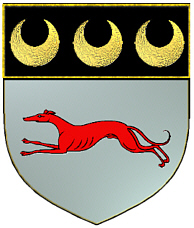
Humphrey Bradstreet - Coat of Arms

Humphrey Bradstreet was born in 1594 in St.Mary, Suffolk, England. His father was Thomas BRADSTREET.  He married Bridget HARRIS in 1622  in Capel Saint Mary, Suffolk County, England
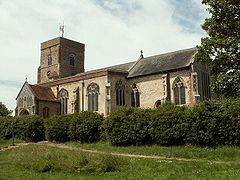
St. Marys Church Capel St Mary, England where Humphrey and Bridget were married

Humphrey was 40 years old when he came to America in 1634 from Ipswich in the ship Elizabeth with wife Bridget and children Hannah, John, Martha, and Mary.   Richard KIMBALL and his extended family arrived on this same voyage. Humphrey settled in Ipswich, Massachusetts and was admitted as a freeman on May 6, 1635 along with Richard KIMBALL He was made a representative to the general court in 1635.   He died on 25 September 1655 in Ipswich, Essex, MA.  As he lived near Rowley line, Richard ordered his body to be put in the graveyard there.
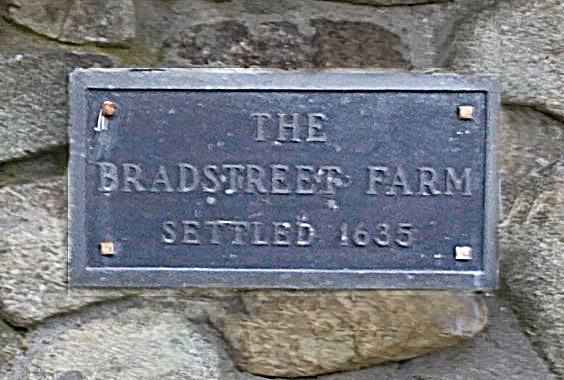
Humphrey's farm granted by Charles II in 1635 remained in his family for 372 years until 2007 when it was sold to the town of Rowley.

Bridget Harris  was born ca. 1604 in Ipswich, Suffolk, England. Her parents were John HARRIS and Bridget [__?__].  Bridget died in Nov 1665 in Ipswich, Mass. Children of Humphrey and Bridget:

Name Born Married Departed
1. Hannah Bradstreet 1625 Rattlesden, Suffolk, England Daniel Rolfe  1645 Ipswich, Essex, MA
.
Nicholas Holt
20 Jan 1658 Ipswich Essex, Mass
20 Jun 1665 Andover, Essex, Mass
2. John Bradstreet 1631 Ipswich, Suffolk, England Hannah Peach
ca.  1656 Marblehead, Essex, MA
1660 Marblehead, Essex, MA
3. Martha Bradstreet 1631 Ipswich, England Thomas Rowlandson 1648 (Annulled)
.
William Beale
1655 Marblehead
6 Apr 1675 Marblehead
4. Mary BRADSTREET 1633 Ipswich, England John KIMBALL
6 May 1655 Ipswich Mass
6 Mar 1698 Ipswich Mass
5. Sarah Bradstreet 1638 Ipswich, Essex, Mass Nicholas Wallis
15 April 1657 Ipswich
6. Rebecca Bradstreet 1639 Ipswich or Rowley, Essex, Mass. George Bonfield
13 April 1657 Marblehead, Essex, Mass
30 Apr 1687 Marblehead, Essex, Mass
7. Moses Bradstreet 1644 Ipswich, Essex, Mass. Elizabeth Harris
11 Mar 1662 in Rowley, Essex, Mass .
Sarah  Platt (Widow of Samuel Prime)
11 Mar 1662 Ipswich, Mass
17 Aug 1690 Rowley, Essex, Mass.

Humphrey was the second cousin of Governor Simon Bradstreet sharing great grandfather John Bradstreet.

Simon Bradstreet (1604 –  1697) was a colonial magistrate, businessman, diplomat, and the last governor of the Massachusetts Bay Colony. Arriving in Massachusetts on the Winthrop Fleet in 1630, Bradstreet was almost constantly involved in the politics of the colony but became its governor only in 1679. He served on diplomatic missions and as agent to the crown in London, and also served as a commissioner to the New England Confederation. He was politically comparatively moderate, arguing minority positions in favor of freedom of speech and for accommodation of the demands of King Charles II following his restoration to the throne.
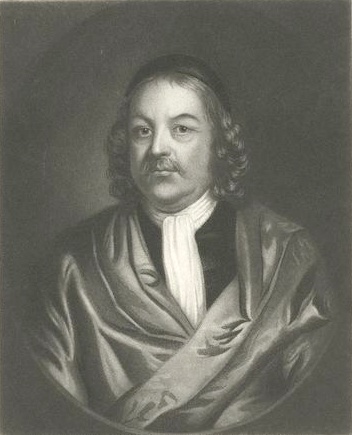
Simon Bradstreet

Bradstreet was married to Anne, the daughter of Massachusetts co-founder Thomas Dudley and New England’s first published poet. He was a businessman, investing in land and shipping interests. Due to his advanced age (he died at 93) Cotton Mather referred to him as the “Nestor of New England”.

George DOWNING’s  grand daughter Ann Downing b. 12 Apr 1633 in Salem, Mass.; d. 19 Apr 1713 Salem, Essex, Mass. m1.  Capt. Joseph Gardner 2 May 1667 in Salem, Essex, Mass. m2. Simon Bradstreet 1676 when Ann was 43 and Simon 72 years old.

Humphrey’s Ancestors

Humphrey’s father Thomas Bradstreet was born in 1573 Ipswich, Suffolk, England. Thomas died in 1594.

Humphrey’s grandfather Humphrey Bradstreet was born 1540 in Gislingham, Suffolk, England. He married 21 Oct 1564 in Gislingham, Suffolk, England to Audrey Straketon (b. 1539 in Gislingham, Suffolk, England) Humphrey died 7 Aug 1618 in Gislingham, Suffolk, England.

Humphrey and Simon shared great grandfather John Bradstreet, born 1518 in Gislingham, Suffolk, England. He married Joan Warren (b. 1529 in Gislingham d. 1560) John died 1559 in Gislingham, Suffolk, England

Simon’s Ancestors

Simon’s  father Simon Bradstreet was born 1580 in Horbling, Lincolnshire, England. He married 1600 in Horbling, Lincolnshire, England. to Margaret [__?__] (b. 1584 in Horbling – d 1631 in Horbling)  He was the rector of the parish church, and was descended from minor Irish nobility. He was a vocal Nonconformist, imparting his his Puritan religious views to his son early in life. Simon died 9 Feb 1621 in Horbling, Lincolnshire, England

Simon’s grandfather Symond Bradstreet was born 1542 in Gislingham, Suffolk, England. Simon died 9 Feb 1621 in Horbling, Lincolnshire, England.

Simon and Humphrey shared great grandfather John Bradstreet, born 1518 in Gislingham, Suffolk, England. He married Joan Warren (b. 1529 in Gislingham d. 1560) John died 1559 in Gislingham, Suffolk, England

The New England Historical and Genealogical Register 1911,.

The will of John Bradstreet of Capel, dated 1610, mentions a nephew Humphrey Bradstreet, probably the emigrant Humphrey Bradstreet, aged 40, who came in 1634 from Ipswich in the ship Elizabeth  with wife Bridget and children Hannah, John, Martha, and Mary.

I believe John of Capel, the testator of 1610, and his brother Thomas (probably father of Humfrey), to be the sons of that name born to Humfrey Bradstreet of Gislingham in 1568 and 1571. I also believe that the son Simon Bradstreet, mentioned in the will of John Bradstreet of Gislingham in 1559, was the father of Rev. Simon Bradstreet and grandfather of Governor Simon Bradstreet.

It is known that the Governor’s father. Rev. Simon, born about 1565-70, was a minister and held a living at Horbling, Lincolnshire, where the Governor was born in 1603, and that before this he held a living at Hinderclay, co. Suffolk, which is only five miles from Gislingham. (For the will of Rev. Simon Bradstreet of Horbling)There were Bradstreet families at Buxhall and vicinity, but there is no apparent connection with the Gislingham and Capel families. E. F.]

Humphrey’s American Career

6 May 1635 –  Humphrey became a Freeman  was thereafter referred to as Mister (vs.
Goodman).

2 Sep 1635 – Was appointed the deputy for Ipswich to Massachusetts Bay General Court on
6 May 1635 –  Included on committee to consider Mr. Endicott’s defacing of the colors,

28 Dec 1641, 26 Sep 1648 – Served on Essex County jury

Humphrey, like many of his contemporaries, used the court to address personal squabbles  and disagreements. He was commonly at odds with John Cross, whom he likely knew prior  to his immigration, as Mr. Cross and his wife Anne were also passengers on the Elizabeth.

“Humphrey sued John Cross at court 27 March, 1649, but the case was nonsuited…John
Cross returned the favor and sued Humphrey Broadstreet, Richard Jacob and John Gage
for trespass on 25 September 1649…Cross also sued John Bradstreet that day. The family  was again entangled with Cross in November 1649 when Cross was fined for slanderous  speeches against Mr. Rogers of Rowley, and John Bradstreet was fined, evidently for the  same thing, and Humphrey served as his surety.

“A later court case, 26 December 1649, showed that the trespass in question dealt with a
gray colt. Bradstreet claimed that the colt was not his, ‘he never had a colt in his life’. At
September Term 1650, Humphrey Bradstreet and John Bradstreet had their bond of good  behavior discharged.

“On 29 March 1653, Humphrey took Stephen Kent to court ‘for taking away, using and
abusing and not returning a boar, and for suspicion of taking away other swine.’ The case
was withdrawn.”

1653 – Humprhey sold his daughter Abigail’s father-in-law [our ancestor]  Richard KIMBALL a horse for 50 pounds.

Richard KEMBALL. sen’r, & Joseph Fowler, both of Ipswich,  wheelwright & husbandman, in the county of Essex, in New England, do bind ourselves, heirs & executors, to Humphry BRADSTREETE of Rowley, in the same  county, in the full & just sume of fifty pounds, for to secure the said Humohrey,  his heirs, executors & administrators, from all charges & incumbrances touching the horse that the s’d Humphry BRADSTREETE, hath sould me, and recovered  from Zacheus Gould , in December 1649, witness our hand. Richard KIMBALL  (the marke of). Joseph Fowler. Signed, sealed & del’d in the presence of these, 3  of the 01 month, dat. 1653, witnes Matha WIllims  John Bradstreete.”

The family farm, a 130-acre parcel granted to Humphrey by King Charles I
in 1635, was left to his son Moses. This farm remained in the family, passed down from
generation to generation, until it was sold in 2007 to the Town of Rowley for 2.75 million
dollars.  The land, he said, had passed in unbroken succession from father to son from 1635 to 2001, when George F. Bradstreet assumed ownership.
Bradstreet Farm in the family for 372 years (1635-2007)

The current barn on the property was constructed about 1774, and the house about 1850.
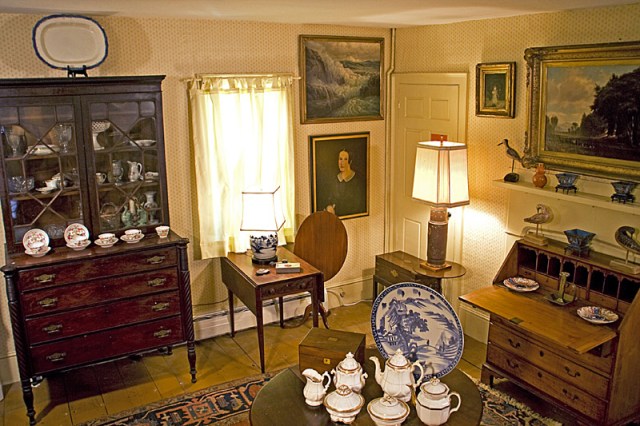
Bradstreet Living Room prepared for auction in 2007.

Will of Humphrey Bradstreet Essex Co. Probate Files Docket 3,081

The last will and testament of Umphrah Brodstreate of Ipswich, jul 21 1655 being weake in boddy doe therfore ordaine this my last will, in manner as followeth: I give my soule to God that gave it me, and my boddy to be buried in the buring place of Rowley, and doe beleve the cumfortable resurrection of the same; as for my outward estate, my will is my farme on which I now dwell, with halfe the commons belonging to me from Ipswich, and all the commons to me from Rowley, shall be my beloved wifes, for the terme of her life , in case she doe not marry, but if she marry , then the one halfe of the farme shall be for the bringing up of my sonn Moses, and in case she dy, before my sonn Moses attain the age of 21, then the one halfe shall be my sonn Mosesis, and the other halfe (that is the benefit of it) shall be equally divided among my five daughters, or so many of them as shall be then Living, and my will is that when my sonn Moses attains the age of 21: he shall have and injoy the whole said farm except my wife be then living , who shall then enjoy halfe the said farme, with all the dwelling house for the terme of her life, and after her death it shall all be my sonn Mosesis.

Item I doe give unto my wife Bridget one brown cow, one ew sheepe, one horse colt.

Item I doe give unto my sonn John allmy farme at Mudde River, now in the occupation of Richard Camball of Ipswich, with one halfe of my commons from Ipswich soe long as he keeps the farme unsold, but in case he sell it, the commons are to returne (and belong) to the farm given to my wife.

Item I doe give to my daughter Hannah Rofe 20 (twenty) pound.

Item I doe give to my daughter Martha Beale one pound and more. I doe leeve fiftene pounds in the hand of her mother, to be given to her her or to her child at her discretion.

Item I doe (give) to my daughter Mary Brodstreete forty pound.

Item I doe give to my daughter Sarah Brodtreete thirty pound.

Item I doe give to my daughter Rebecca Brodstreet forty pound :

Item I doe give to my two grand choldren Daniel and Hannah Rofe each of them five pound to be paid out of the farme by my sonne Moses when they attain the age of 21 years.

Item I doe give to Sammuell Beale (five pound) to be paid as above as the said Daniell and Hannah Rofe is.

Item I doe give to the pore of Rowley one pound

and my will is that if my estate doe fall short of the full discharge of all my debts and Legacies then there shall be an equall abatement out of the severall Legacies given acording to proportion. and I doe intreat my beloved friends Mr Sammuell Phillips, Mathew Boyes, and John Harris, to ioine with my wife for the disposing of my children in mariage. or otherwise as need may require. and I doe make my wife Bridget Brodstreete Sole exequiteris of this my last will, and I have hereunto set my hand July 21: 1655: Humphri Bradstreet Witness: Mathew Boyes, John Harris. Proved 25:7:1655 by the witnesses.

Bridget Harris Bradstreet died on November 16, 1665 in Ipwich, Essex, Mass. Her will was probated in September, 1666. John KIMBALL was appointed one of the executors of her will which was proved March 28, 1666. She left her most of her worldly goods to her daughters since her sons had inherited from their father.

Moses inherited her barn, musket (a long gunintended to be fired from the shoulder), large chest, chair, a kettle, a “bern” vessel, two “kelers”, and a churn in addition to the 40 pounds he had already received.

Martha Kimball (Beale?) inherited the land that she already had, a green hood, a pewter dish, a book by John Norton, one sheet and one “pelober.”
Mary Kemball inherited her old Bible, a cloth waistcoat (vest), a small reticule? (peticutes), a bolster, one pillow, one pewter dish, and one brass candlestick.

She gave Mary and Sarah Wallace her “fteny.” They were to both use them. They also received her beehive and they were to give the first swarm to their other two sisters.

Sarah received a book by Thomas Cobbet, a serge (strong twilled fabric) gown and cloak, a pewter dish, a skillet, her mother’s bed, a bolster and pillow, and pillow form, a white rug, one iron pot, and one pintado? (chintz) petticoat.

Rebecca Bonfield received a black serge petticoat, shawl? (baring chulh), a pewter dish, and the two best iron pots.

Hannah’s daughter Hannah Rolfe received her hat, wearing linen, a chest, one pair of sheets, a two year old cow, and a serge waistcoat..

The will of Mrs. Bridget Bradstreet of Ipswich was proved in the court held at Ipswich March 28, 1666. The following is a copy of the original instrument on file in the probate office at Salem.

The fextenth day of Ocktober in the yer of our lord 1665 I Bregit Brodftret of Ipfwipch in New England being of whole mind and of good and perfect memory doe make and ordaine this my Laft will and testiment in maner and forme following:

Inprimes bejng now very weake I Commend my Spirit in to the hands of my Lord and fauiour Jefus Chrift and my body to the grond with an Liuly hope of my Refure un to Life at the coming of my Lord and fauior Jefus Chrift

Itum I will that all debts and duties as I ough to any one be well and truuly paid by mine Executor here after named

Itum After all my funerall Expences difcharged: I will that my fon Mofes fhall haue my Barne: and my mufket: ad my great Cheft: and Chaire: I all foe giue unto him the kettle: the Bern veffell: ad my touw kelers: and my churne together with what I haue all Redy giuen to my fon mofes: which as I confeue doth amount to aboue forty pounds.

2ly vnto my Eldeft daughter martha Kimball: I giue the ground of mine that fhe haue in Pofetion and my grene hood: a peuter difh: and Mr Nortons Bocke: and on fheat and on Pelober

3ly I giue unto my daughter Mary Kemball my ould bibell: my cloth wefkot: my fmell peticutes an boulfter on yelow: on peuter difh: and on brafen candill ftick

I giue unto my daughter Kemball and my daughter walles my fteny the Eufe of them both and after the defes of ether of them the Longeft Liuer of them and all foe I giue to them my fkey of Befe: and my defier is that they giue tham furft fworme to ther other too Sifters:

4th I giue unto my daughter wailes Mr. Cobbets Bock: my ferg gound: ad cloke; on peuter difh and on fkilit: the Bed that I now Ly upon; on boulfter ad yellow and yellow Born: or whight Ruge: on Iron Pote: and on Penifton Peticote.

5ly I giue vnto my daughter Rebecka bondfeld I giue vnto hur my blacke ferg peticote: and my baring chulh: on Peuter difh and my touw beft IRon pots

6ly vnto my grad child hanah Roph I giue my hate: my waring liny and my cheft: and on Pair of fheat : and I giue vnto hur on ho * cow toow yer ould in the fpring and I giue on Serg wefket

7ly my will is that the Reft of my goods: Chattels: and debts be Equally diuided among my fouer dafters aboue Ritten

and I will and nominate and doth her by difier my Louing frend Samuell plats: to be mine Execkter of this my will and I doe defier him to fee this my will full feled and in witnes her of I haue her unto fet to my hand the day and and yer of our Lord aboue mentioned

I do will defier and nominate my louing frinds Samuell Appleton and Jofeph Whipple to be my ouer fers of this my will

The mark of B B Breget Brad

In the Prefents of us
Samuell Appleton,
Jofeth Whipple

Children

1. Hannah Bradstreet

Hannah’s first husband Daniel Rolfe was born 1620 in Ipswich, Essex, Mass. His parents were Robert P Rolfe and Joan Isles. Daniel died 24 Jun 1654 in Salem, Essex, Mass .

According to the Essex Antiquarian in the court of June 3, 1651 “Joseph Muzye fined for lying and for saying, when some one was reading that it was the devil’s service book. Witness: Daniell Rofe.”

Daniel, Sr. died in 1654 before Daniel, Jr. was born. The inventory of his estate gives us a fascinating glimpse of their lives. Although Hannah was made the administratrix of the estate, all the the family’s assets were listed because they belonged to her husband since a married woman could not own property in her own name.

Daniel  Rolfe Jr was slain by Indians  in the Great Swamp Fight,the 19 Dec., 1675 attack on the fort at Narragansett.

Daniel owed more neighbors than any other relative I can find.  Inventory of the estate of Daniell Rofe of Ipswich, deceased taken June 24, 1654, by Daniel (his D mark) Thurston, John (his I mark) Gage and Robert Lord:

One bedsted & cord, £1;
a little flock-bed & boulster, an ould Rugge & blanket, 2 paire of sheetes, 16s.;
His weareing apparell, £3 10s.;
a little table and 2 chaires, 2 little stooles, 12s.;
one Cradle, 4s.; a warmeing pan, 4s. 6d.;
1 skillet & brase ladle, . 3s. 6d., 8s.;
one Iren pot, 8s.,
1 dozzon of trenchers, 12d., 9s.;
one square, 3 agures, a broad axe & a pr. compasses, 12s.; felling axes & one howe, 5s.;
other Tooles & an ould sithe & one hinge, 12s.,
another ould sithe & snath, 2s. 6d.;
a hatbrish axe, a pr. of sisers and an ould tubb, 2s.;
a fowling peece, £1. 13s. 4d.;
one box, 4s.,
1 houre glass, 1s., 5s.;
1 beetle, 20d., one Iron pot, 10s., 11s. 8d.;
an ould bible & one other booke, 6s.;
one little kettell & a little skillet, 6s.; 2 sives, 2s.;
one earthen pot, 4 spoones, 20d., 3s. 8d.;
4 little keelars, 7s.,
one little pondering tub, 3s., 10s.;
1 ould chirne, one runlet bucking tub & firkin, 9s.;
one bottle & other wooden ware, 5s. 6d.;
one earthen pot & 20 lb. of butter, 10s.;
5 cheeses, 4s.;
a pr. of wood in scales & earthen weres, 6s.;
an acre of Rye on the ground, £1;
4 acres of Indian corne slit corne, £3;
about 9 acres of wheat & barlye, 1 £6;
a paire of oxen, £16 5s.,
1 cart & plough, 32s., £17 17s.;
a cowe & a calfe, £6; one asse, £5, 11li.;
one small sow & 2 piggs, £1 10s.;
a raper, 22s., belt, 2s., £1 4s.;
powder & shot, 18d.;
a drum & sticks, £2;
a little fowleing peece, £1;
a chaire, 18d., 1s. 6d.;
owing to the estate, £3;
the grass that is to be mowne, £1 12s.;
£3 of yarne, 5s.;
total, £74 17s. 8d.

Debts due:
To Mr. Jewet [Jewett], £11  & he requires £9 more for damages, £20;
to my father, Humphry Broadstreet, £11;
to Goodman Weekes of Salem, £6;
to John Woodam, £ 10s.;
to Goodman Thurston, £1 19s.;
to John Gage, £3.; to Mr. Baker, 10s.;
to Nath. Stow, 40s., £2. 10s.;
to Goodwife Elitrip & Marke Quilter, 2li.;
to Lieft Remington, 12s.,
to Goodman Kemball [Kimball], 12s., £1. 4s.;
to Mr. Payne, 4s. 6d.,
to John Tod, 24s., £1 8s. 6d.;
to Goodwife Lumkin, 3s.;
to William Beale, £4;
to Major Denison, 10s. 6d.;
total, £60  5s.

Hannah’s second husband Nicholas Holt was born 19 Oct 1602 in Ramsey, Essex, England. His parents were Thomas Holt and [__?__]. He manufactured woodenware and called himself a “plate turner.” On the ship roll he was called “tanner”. He first married Elizabeth Short. She died at Andover, November 9, 1656. After Hannah died, he married 21 May 1666 in Andover, Essex, Mass. to Mrs. Martha Preston, widow of Roger Preston (b. 1622 in Enband – d. 21 Mar 1703 in Andover, Mass.) Nicholas died 30 Jan 1685 in Andover, Essex, Mass.

Nicholas came from Romsey, England, in the ship “James,” William Cooper, master, sailing April 6, and landing in Boston June 3, 1635. He was one of the first settlers at Newbury and Andover, Massachusetts. At Newbury he was husbandman, proprietor and town officer.

17 May 1637 – Admitted Freeman.  Nicholas Holt, we learn from the historian, Coffin, took great interest in Governor Winthrop’s campaign for the governorship against Sir Harry Vane, as the close of the latter’s term drew near. So Mr. Coleman, with nine others including John CHENEY,  Thomas COLEMAN, Henry Sewall Jr, Nicholas Noyes [Cheney’s future father-in-law], Robert Pike [future founder of Nantucket, liberal dissenter, witch trial critic and son-in-law of Joseph MOYCE], Archelaus Woodman [Edward WOODMAN‘s half-brother], Thomas Smith, James BROWNE, and John Bartlett, walked forty miles from Newbury to Cambridge on foot to take the “freeman’s oath” and qualify themselves to vote in the election which was soon to take place.  It was by such prompt movements that Winthrop was elected and the conservative party triumphed.

Vane lost his position to the elder John Winthrop  in the 1637 election.  The contentious election was marked by a sharp disagreement over the treatment of John Wheelwright, a supporter of Anne Hutchinson [daughter of our ancestor Francis MARBURY  (1555–1611) (wikipedia)] Winthrop won in part because the location of the vote was moved to Cambridge, reducing the power of Vane’s Boston support.  In the aftermath of the election Anne Hutchinson was put on trial, and eventually banished from the colony.

Many of her followers seriously considered leaving after the election. At the urging of  Roger Williams, some of these people, including Hutchinson, founded the settlement of Portsmouth on Aquidneck Island in the Narragansett Bay (later named Rhode Island and joined to Providence to form the Colony of Rhode Island and Providence Plantations).

Vane decided to return to England, apparently with the notion that he would acquire a royal governorship to trump the colonial administration.  Before his departure, he published A Brief Answer to a Certain Declaration, a response to Winthrop’s defense of the Act of Exclusion; this act was passed after the election to restrict the immigration of people with views not conforming to the colony’s religious orthodoxy.

He was a tanner as well as a farmer. He removed to Andover in 1644. He sold his Newbury land November 14, 1652.

2. John Bradstreet

John’s wife Hannah Peach was born 1646 in Marblehead, Essex, Mass. Her parents were John Peach and Alice Ealis Ester. After John died, she married 14 Jun 1660 in Marblehead, Essex, Mass to William Waters (b. 1646 in Marblehead, Essex, Mass. – d. 1684 in Essex, Essex, Mass.) Hannah died in 1687 in Mass. John  probably suffered from mental illness. John Winthrop mentioned in his journal that John Bradstreet was accused of bewitching a dog. The dog was hung as a witch. John was whipped.  He was tried in Ipswich on July 28,1652,on a charge of “familiarity with the devil.” John said that he had read a magic book and heard a voice telling him.

Go make a bridge of sand over the sea; go make a ladder of sand up to heaven, and go to God and come down no more.

The witnesses against him were [our ancestor] Frances PARRATT and wife, of Rowley, and William Bartholomew of Ipswich; who testified that he told them that he had read in a book of magic, and that he heard a voice asking what work he had for him; and the voice answered, “Go make a bridge of sand over the sea; go make a ladder of sand up to heaven, and go to God and come down no more.” It is supposed that Bradstreet had related to these witnesses what he had heard in a dream; and yet, upon that testimony principally, he was held on a charge of witchcraft and, according to Winthrop, publicly whipped. The court found that he had told a lie. This was his second conviction. He was sentenced to be whipped or to pay a fine of twenty schillings.

Earlier according to the Essex Antiquarian Volume 9 in the court of June 3, 1651

Thomas Scott deposed that he heard Joseph Muzy say that John Bradstreett had three or four bastards at Road eyeland and that he should know them wherever he saw them for they had a natural mark and that was lowell ears like their father, and I told him so to his face. Sworn to in Ipswich court 25-1-1651.

Joseph Fowler testified that being upon occasion at Goodman Cross’ house to see him, being very sick, Joseph Muzi being present, John Bradstreet and I persuaded Joseph Muzi to give his brother satisfaction for calling him bastard and to agree with him. Joseph replied:

You have been whipt once allredy for faying yt the fellow in the filver buttons came and faid he fwore hime befor the gret faggamore the deputy Gouernar and he would doe the beft he could to bring hime to it againe and tould him he would haile hime out by the hares and yt he waf good for nothing but to rune rouging about the Cuntry. That he heard this latly deceafed John Croff fay that he formarly loued John brodftret well vntell that Joseph Muzi had railed fuch reports on hime which caufed him to procfcecut againft him which he feaied now feing he waf a lying fellow had don him rong for the faid John cross: faid he was fuch a lying felow thar waf noe beleving of him he waf a nofe to fet a hole town and cuntrary togeather by the years.

Sworn to in Ipswich court 25- 1 -1651.

Daniell Roffe testified that he heard Joseph Muzi say he never spoke the words, but the witness spake falsely; and another time I heard him say he would rather my brother would be quiet, but if he would come to the court he should make yet appear to be true of what he had said: he thought he were better they did not go to the court, but if they did it would be to his disgrace as to me; also, that my brother Bradstreet and I being at Goodman Cross, the latter said I believe Joseph Muzi is a lying fellow and the cause of the breaches between John Bradstreet and myself. Sworn to in Ipswich court 25-1-1651.

John Remington deposed that last haytime twelve month, being with the late deceased Goodman Cross, I had much discourse with him about John Bradstreet, and he gave John good commendation, saying that he bore great love towards him in so much that he could willingly have bestowed his daughter on him to wife if he carried himself well; their farms lay together; also, he commended him for minding good things and loved him well until he heard a report raised by Joseph Muzie against him, concerning himself and others, which did exceedingly incense Goodman Cross against said John, and altered his mind towards him, etc. Sworn to in Ipswich court 25-1-1651.

Hannah Crosse, daughter of John Crosse, testified:
I heard Joseph Muzzy say that John Bradstreet

was the leereingest hang doge that waf in the world and that he had three or fouer tones at Rode eyland,

and that he intended to go thither once in a while and then he should see them, and he was confident he should know them, and said that he used to set maids on their heads when he did dwell at Rode Eyland; and that Joseph Muzzy said that John Bradstreet inticed him to combine with him to knock Goodman Cross off his horse when he was upon Muddy river bridge, etc.
Sworn to in Ipswich court 26-1-1650, before Samuel Symonds.

Thomas Scott deposed that being at Goodman Cross’ house, that the latter said he believed Joseph Muzzy to be a lying fellow, etc. Sworn to in Ipswich court 25-1-1651.

Ezekiel Northene and Thomas Abbott testified that Joseph Muzzy said, beginning of March, 1651, that John Bradstreet had dealings with the maids at Road Island, set them on their heads, took them by the gingoes, etc. Sworn to in Ipswich court 25-1-1651.

Elizabeth How deposed that she heard Joseph Muzzy say that John Bradstreet had three or four bastards at Rhode Island, and that he was going there and hoped to see them. Sworn to 26-10-1650, before Samuel Symonds.

William Smith deposed that he heard Joseph Mussy say in Master Appleton’s barn that John Bradstreet desired him to combine with him and to lie in wait at Muddy river to knock Goodman Cross off his horse and to knock him on the head, and said John would run away with his horse; and that said John had bastards at Rhode Island, and he should go there ere long and should know them by their Bangell ears, just like himself. Sworn to in Ipswich court 25 : 1 : 1651.
John Bradstreet, Joseph Fowlar, Tho: Scott and Richard Betts, upon their presentments, discharged.

Thomas Scott, Joseph ffowler, John Broadstreet and Richard Bettes presented 26-1-1651. Witnesses: Nathaniel Stow and Thomas Nor—. Mark Symonds, informant.
Presentments signed by William Bartholmew for the grand jury.

John died, childless, in 1660 when he was only 29 years old. Shortly after his death, his widow Hannah married William Waters on June 4, 1660.

3. Martha Bradstreet

Martha’s first husband Thomas Rowlandson was fined 10s for marrying without being published three times; divorced about March 1651 when

“Thomas Rolinson, proven impotent, on complaint of his wife, was to take counsel of physicians forthwith, follow their advice, and report to court.”

Per the Great Migration, Thomas Rowlandson subsequently married again and had nine children recorded at Salisbury.

I found two Thomas Rowlandsons, father and son who could have been Martha’s first husband .

Thomas Rowlandson Sr. was born about 1597 in England. He married 1622 to Bridget Kerley. Thomas died 17 Nov 1657 in Lancaster, Worchester, Massachusetts

By the way, Thomas Sr. son, Thomas Jr’s brother, Reverend Joseph Rowlandson maried Mary White in 1656.  Mary (White) Rowlandson (1637 – 1711) was a colonial American woman who was captured by Native Americans during King Philip’s War and held for 11 weeks before being ransomed. Years after her release, she wrote a book about her experience, The Sovereignty and Goodness of God: Being a Narrative of the Captivity and Restoration of Mrs. Mary Rowlandson, which is considered a seminal American work in the literary genre of captivity narratives. It went through four printings in a short amount of time and garnered widespread readership, making it in effect the first American “bestseller.”.
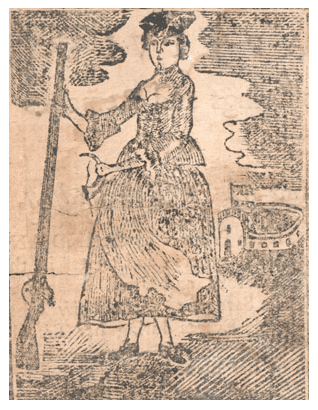
Mary Rowlandson Mary Rowlandson from A Narrative of the Captivity, Sufferings and Removes of Mrs. Mary Rowlandson, Boston: Nathaniel Coverly, 1770

Thomas Rowlandson Jr. was born about 1625, Salisbury, Essex, Massachusetts. He married 17 May 1653 in Salisbury, Mass to Dorothy Portland (d. abt. 1694, Salisbury, Essex, Mass.) Thomas died 7 Jul 1682, Salisbury, Essex, Mass.

“A Genealogical Dictionary of The First Settlers of New England, Before 1692 Volume #3” by James Savage)

Thomas Rowlandson; Salisbury, son of the preceeding born in England. married 17 May 1653 or 4, as the record says, Dorothy Portland, although where this name was found, is quite a mystery. had Elizabeth born 7 June 1654, died next year Thomas, 5 July 1656; Sarah, 5 Aug. 1658; Elizabeth again, 26 Feb. 1661; Joseph, 18 Feb. 1664; Mary, 24 Aug. 1665; Martha, 24 Aug. 1666; John, 20 Mar. 1668; and Ann, 16 Mar. 1669. His will of 7 July 1682, just before his death names son Joseph and four daughters Sarah married 5 Dec. 1684, Nicholas Bond..

WILL dated July 7, 1682, proved September 21, 1682. Mentions wife Dorothy; son Joseph; 4 unnamed daughters..

The annulment was to cause the Beals considerable difficulty as some of their neighbors disapproved of the annulment and considered them to be living in adultery. One Elizabeth Hollingworth was fined by the court and required to apologize in the meeting house for calling Martha “adultress” and “jade” and for saying that she “made the church a cover for her roguery”.   Martha was only 43 when she died, and had borne twelve children in twenty years.

Else L. Hambleton describes Martha’s first marriage and consequences in detail in Daughters of Eve: Pregnant Brides and Unwed Mothers in Seventeenth-century Massachusetts.

Secret marriages were prohibited; banns had to be posted for three weeks prior to the marriage ceremony. Thomas Rowlandson was fined 10 shilings in 1648 for “marrying without being published three times” and his marriage to sixteen-year old Martha Bradstreet was annulled. There was however, resistance to the Puritan assertion of control over marriage formation.

Seven years after Bradstreet’s marriage to Rowlandson was annulled, Bradstreet married William Beale. Twenty-two years later a neighbor, the wife of Mr. William Hollingsworth, was forced ot pay a £ fine for defeaming Beale by calling her an adulterer.That the wive of a gentleman was prosecuted in the first place emphasizes the seriousness with which the court regarded her accusation because as they said in their judgement, her claim reflected on “civil justice and the church.”. . . Later that year, William Beale was threated by men engaged in a traditional charivari who stood before his house and shoulted: come out, you cuckoldly cut: we are come to beat thee. Thou livest in adultery.

While these actions occurred within the context of an extended neighborhood dispute, more than two decades had elapsed since the annulment. When neighborhood tempers were aroused the circumstances surrounding the Beale marriage could be resurrected and used against them. Fortunately for the Beals, questioning their marriage also meant questioning the right tof the civil authorities to make or break marriages, so the court was willing to intervene on their behalf.”.

Martha’s second husband William Beale was born 1628 in Marblehead, Essex, Mass. His parents were John Beale and Margaret [__?__]. After Martha’s death, he married Mrs. Elizabeth Jackson the widow of Edmund Jackson on December 16, 1676. William died 1694 in Marblehead, Essex, Mass.

4. Mary BRADSTREET (See John KIMBALL‘s page)

5. Sarah Bradstreet

In 1655 she received 30 pounds from her father’s will.

Sarah’s husband Nicholas Wallis was born 1633 in Ipswich, Essex, Mass.   His parents were James Wallis and Rebecca [__?__]. After Sarah died, he married widow Rebekah Somerby of Newburyport on April 28, 1691.  Nicholas died 1 Feb 1711 in Ipswich, Essex, Mass.

A little lower down, where the stream narrows in the beautiful gorge between the hills, a bridge, probably of logs, was built by the farmers, whose land abutted on the river on both sides, about 1667. In that year John Adams, Nathaniel Adams, Samuel Adams, Joseph Saiford, Nicholas Wallis and Thomas Staco were “freed from working in the common highway for 7 years to come,” “upon consideration of there building a bridge over the river at there own expense.” In 1697 Nicholas Wallis received, but did not exercise permission to build a mill. Ipswich in the Massachusetts Bay Colony by Thomas Franklin Waters, Sarah Goodhue, John Wise, Ipswich Historical Society.

Nicholas Wallis, whose farm is now owned by the Brooks heirs, received permission in March, 1686-7 “to improve tho water by damming in the river against his own land not exceeding three foot for the building a fulling mill or mills, provided he do it within a year and a half.” Sergeant Wallis did not improve his privilege and in March. 1696-7, John Adams, Sen., his son John, Jim. and Michael Farley Jun. petitioned the Town for permission to build a dam, and operate a grist mill and a fulling mill. After a little delay, they received the desired liberty, and built the dam, with a fulling mill on the north side and the grist mill on the south, in the year 1697.

In 1701 Nicholas and his two sons were granted liberty

to build a shed for their horses next to one to be built by Corn’t Matthew Whipple and others, of forty feet in length and not exceeding ten foot wide, about twenty feet from ye Watch House, southerly towards ye old Meeting-house. (the Hammatt Papers, p, 390).

6. Rebecca Bradstreet

In 1655 she received 40 pounds from her father’s will. She was 16 years old and chose Joseph Jewett as her guardian. Her mother was not made her guardian because in 17th century colonial America women did not have full civil rights.

Rebecca’s husband George Bonfield was born 1638 in Marblehead, Essex, Mass.  He was a fisherman.  George died 1709 in Marblehead, Essex, Mass

In 1666 Sarah inherited a black serge petticoat, shawl? (baring chulh), a pewter dish, and the two best iron pots from her mother.

In 1673 George and Rebecca were sued by for slander by her sister, Martha, and her husband.

Court Held At Salem, September 9, 1673, Judges: Mr. Samll. Simonds, Deputy Govr., Major Daniell Denison and Major Wm. Hathorne. Wm. Beale and Martha, his wife v. George Bonfeild and Rebecka, his wife, in behalf of themselves and children. Slander. Withdrawn.

Writ: William Beale, and wife Martha v. George Bonfield, and wife Rebecka; slander, for themselves and their children maliciously raising and commonly reporting several pernicious and false slanders on him and Martha, his wife, on set purpose to provoke them; dated 17-9-1673; signed by Hilliard Veren’t for the court; and served by Henry Skerry, marshal of Salem, by attachment of house and land of defendant..
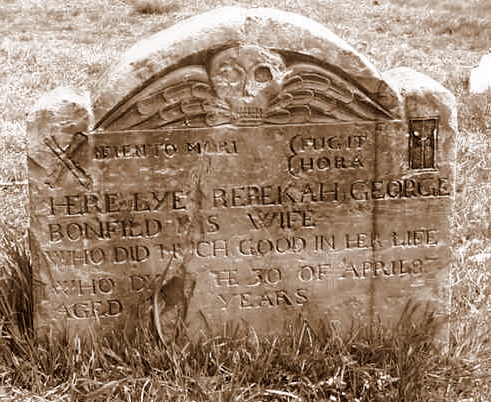
Rebecca Bradstreet Bonfield Gravestone

Rebecca was buried on the Old Burial Hill in Marblehead, Massachusetts with her son George.

7. Moses Bradstreet

Moses’ first wife Elizabeth Harris was born 14 Nov 1644 in Ipswich, Essex, Mass. Her parents were John Harris and Bridget Angier. She first married 1 Jan 1674 in Rowley, Essex, Mass to Samuel Prime (b. 14 Jun 1649 in Rowley, – d. 18 Mar 1684 in Rowley). Elizabeth died 1684 in Rowley, probably in childbirth.

Moses’ second wife Sarah Platt was born 16 Aug 1654 in Rowley, Essex, Mass. Her parents were Samuel Platts and Sarah [__?__].   Sarah died in 1697 in Rowley, Essex, Mass (Widow of Samuel Prime)

A letter dated June 28, 1689, in which the company petitioned the Governor to appoint Moses Captain.  “The foot company being called together by order, the militia in the said town being desired to  bring in their votes for a nomination of a meet person for a Captain, to supply the place of  Captain Johnson, deceased, the said Company have unanimously chosen Corporal Moses  Bradstreet, to be their Captain, if the Honored Counsell please to establish him in said office, a man whom we judge in good measure qualified and fitted for such place; and the said company being so fully satisfied with the said nomination, wee think wee need not say further  in way of commendation…”

The following month, Gage notes Moses’ role in the Indian hostilities of 1689:

“July 22. Captain Moses Bradstreet, and Lieutenant John Trumble, petitioned the Governor and Council for leave to withdraw some of the Rowley men from the guard at Haverhill, one in a week, or two in a fortnight, supplying their places with other men. This they ask for on account of the busy season of the year. They also petitioned to have the Rowley men, who went out with Major Appleton (of Ipswich), and who are now stationed in the several garrisons  at Cocheco, (Dover,) and other places in that vicinity, sent home. They represent Rowley as  being more hardly dealt with than Newbury or Ipswich, as their men have all been permitted to  return home before haying.”.
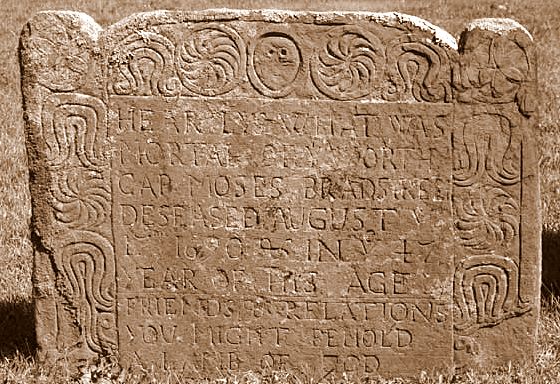
Moses Bradstreet Gravestone

Moses died the following summer on 17 August, 1690. He is buried in the Old Burying
Ground, his gravestone the oldest in the cemetery. It reads:
HEAR LYS WHAT WAS
MORTAL OF Ye WORTHY
CAP MOSES BRADSTREET
DESEASED AUGUST Ye
17th 1690 & IN Ye 47th
YEAR OF HIS AGE
FRIENDS & RELATIONS
YOU MIGHT BEHOLD A LAMB OF GOD
FLtt FOR Ye FOLD
An extract of Moses’ will is found in the Historical Collections of the Essex Institute, Vol. 5, and  reads:

“Will of Moses Bradstreet, dated 16th of August 1690, mentions his wife’s children by her  former husband; son, John Bradstreet, to him one half of the farm ‘yt was my Father  Broadstreets,’ sons, Humphrey, Nathaniel, Moses and Jonathan. Daughters, Bridget and  Hannah. Appoints John and Moses exrs. Witnesses, Edward Payson, Nicholas Wallis and  Nehemiah Jewett, probate Sept. 30, 1690. Inventory of above estate, taken 26th of Sept.,  1690, by Samuel Platts and Nehemiah Jewett, amounting to £1257 2s., debts against the  estate £31 12 s. 5d. Returned Sept. 30, 1690.”.

Sources:

http://www.theharmons.us/harmon_t/names10.htm#BRADSTREET

http://www.genealogyofnewengland.com/b_b.htm

http://www.anamericanfamilyhistory.com/Bradstreet%20Family/BradstreetHumphreyBridgetHarris.html

http://trees.ancestry.com/owt/person.aspx?pid=9694910

http://stanwoodfamily.com/histories/BRADSTREET_Martha_Ancestor.pdf

http://www.newburyportnews.com/local/x845825905/Rowley-shows-off-prized-Bradstreet-Farm-to-public/print

http://www.stinsonauctions.com/auctions/2007-09-16/auction_2007_09-16.html

A sketch of the history of Newbury, Newburyport, and West Newbury, from 1635 to 1845 (1845) By Coffin, Joshua, 1792-1864; Bartlett, Joseph, 1686-1754
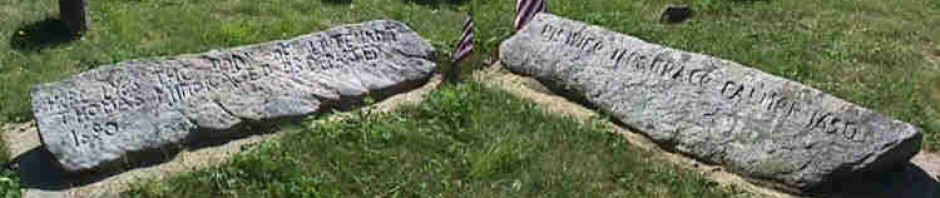
Posted in 12th Generation, Historical Church, Immigrant - England, Line - Miller, Public Office, Witch Trials | Tagged , | 22 Comments

Richard Kimball

Richard KIMBALL (1595 – 1675) was Alex’s 10th Great Grandfather; one of 2,048 in this generation of the Miller line.

Immigrant Ancestor

Richard Kimball was born 10 Apr 1595 in Rattlesden, Suffolk, England.  He may be the son of Henry KEMBOLD and Sysley [__?__] of Hitcham, Suffolk, England. He married Ursula SCOTT about 1614 (23 Oct 1615 is after the birth of Henry Jr.)  in Rattlesden.

Richard and Ursula emigrated to New England aboard the Elizabeth, sailing from Ipswich, England,  on 30 Apr, 1634 with seven of their children, Ursula’s mother and brother Thomas Scott and his family, and Henry Kemball (probably Richard’s brother) and his family.  The crossing took almost three months and they landed in Boston.

The Kimballs settled in Watertown, Middlesex, Massachusetts. Richard became a freeman there in 1635 and a proprietor in 1636/37. The family moved to Ipswich, Essex, Massachusetts. Richard was a wheelwright. He married second Margaret Cole (widow of Henry Dow) 23 Oct 1661. There were no children from this marriage, although, from his will, Richard evidently held Margaret Dow’s children from her first marriage in great affection. Richard’s will was made 5 Mar 1674/75 and proved 28 Sep 1675. Richard died 22 Jun 1675 in Ipswich, Essex, Massachusetts.

Richard Kimball was a Wheelwright

Ursula Scott was baptized 14 Feb 1597/98 in Rattlesden, Suffolk England.  (As Urslaye Scoote) Her parents were  Henry SCOTT and Martha WHATLOCK.  Ursula died 1 Mar 1659/60 in Ipswich Mass although another record gives her death as 17 June 1656.

Margaret Cole was born in Ormesby, Norfolk, England.  She had known Henry Dow in Ormsby, had come to America in 1639 with the Metcalfe family and had settled in Dedham. She was indentured, just as Ann Manning had been, and was younger than Henry Dow. In First Church Dedham: Margaret Koole, a maid servant, giving good satisfaction to ye church was received in ye 3rd month of this yeare, 1639.  She first married in 1641, Watertown, Middlesex, Mass to Henry Dow (b.  1605 in Runham, Norfolk, England – d. 21 APR 1659 in Hampton, Rockingham, NH)  Margaret died 1 Mar 1676 in Ipswich, Essex, Mass.

Children of Richard and Ursula:

Name Born Married Departed
1. Alexander Kimball 20 Feb 1614
Hitcham, Suffolk, England
Unmarried 1618
2. Henry Kimball Bapt.
12 Aug 1615
(As Henry Kemball)
Rattlesden, Suffolk, England
Mary Wyatt
1640 Wenham MA
.
Elizabeth Black (widow of William Rayner).
ca. 1673
12 Aug 1676 Wenham
3. Abigail Kimball 5 Nov 1617
Hitcham or Rattlesden, Suffolk, England
John Severans
1635
Ipswich, Mass
17 Jun 1658
Salisbury, Essex, MA
4. Mary Kimball ca. 1625
Rattlesden, England
9 years old on voyage
Robert Dutch
12 Jul 1686 Gloucester, Mass
5. John KIMBALL ca. 1631
Rattlesden, England
3 Years old on voyage
Dollie Hoyt
1653
Ipswich, Mass.
.
Mary BRADSTREET
6 May 1655 Ipswich Mass
6 May 1698
Ipswich Mass
6. Elizabeth Kimball 1621 Rattlesden, England
13 years old on voyage
Richard Sawtelle
c. 1638
1676
Ipswich, Mass
7. Richard Kimball ca.  1623 Rattlesden, England
11 years old on voyage
Mary Cooley
1648
.
Mary
(widow of Charles Gott)
26 May 1676
Wenham, Essex, MA
26 May 1676
Wenham, Mass
8. Martha Kimball Aug 1629
Rattlesden, England
5 years old on voyage
Joseph Fowler
1655
19 May 1677
killed by the Indians near Deerfield, Mass.
9. Thomas Kimball 1633 Rattlesden, England
1 year old on voyage
Mary Smith
bef. 1658
Ipswich, Mass
Killed by Indians
2 May 1676
Rowley,  Mass
10. Sarah Kimball 1635 Watertown, Mass. Edward Allen
24 Nov 1658
Watertown, Mass.
12 Jun 1690
Suffield, Hartford, CT
11. Benjamin Kimball 12 May 1637 Ipswich, Mass Mercy Hazeltine
Apr 1661
Salisbury, Essex, Mass.
11 Jun 1695 Bradford, Mass.
12. Caleb Kimball 1639
Ipswich
Anna Hazeltine
7 Nov 1660
Ipswich
1682
Ipswich

Richard Kimball was born about 1595, presumably in a parish near Rattlesden, Suffolk, England. The family of Kymbould, Kembold or Kemball was numerous at Hitcham near Rattlesden in the sixteenth century, but Richard Kimball’s baptism is not found in the parish register, nor is that of his brother Henry Kemball. It is only after its translation to New England that the family name became Kimball. Richard Kemball married Ursula Scott of Rattlesden about 1614 and they had a child baptized in her parish in 1615. Very probably their second child was that Abigail, daughter of Richard Kemball, baptized at Hitcham in 1617, but where the six younger children whom their parents brought to New England were baptized has not been discovered.

When Richard and Ursula Kemball sailed for America in the Elizabeth of Ipswich in 1634 their home was stated to be Rattlesden. With them were Martha Scott, Ursula’s mother, Thomas Scott,, her brother, and his family, and Henry Kemball, Richard’s brother, and his family. The Scotts were Rattlesden people and Henry Kemball is also listed as from that village. On the list Richard’s age is given as thirty-nine, while the children were Henry, fifteen (probably a mistaken reading of eighteen), Elizabeth thirteen, Richard eleven, Mary nine, Martha five, John three, and the baby, Thomas, one. It was a heavy expense and no light responsibility to embark on a long voyage with such a brood.

After they landed both of the Kemball families went to Watertown, where Richard Kemball was made a freeman on May 6, 1635, and where he was a proprietor in 1636/7. His home lot is thus given by Dr. Henry Bond: “Richard Kimball, six acres, bounded on the north by Cambridge, east by the land of W. Hamlet, south by the highway, and west by land of Edward White.”

This lot was situated a long way from the centre of the town. It is now in Cambridge, which many years ago annexed the eastern part of Watertown. The lot was situated near what is now the corner of Huron avenue and Appleton street, and near springs of water.

By the latter part of 1637, he had moved his family to Ipswich where he had been granted a house lot at the west end of the town. Soon after this date he was invited to remove to Ipswich, where they were in need of a competent man to act as wheelwright to the new settlement. Here he spent the remainder of his days. The town granted him a house lot, 23 Feb 1637, “next adjoining Goodwin Simons at the west end of the town.” He was also granted at the same time “40 acres Beyond the North Riuer near the land of Robert Scott.”

Ipswich in the Massachusetts Bay Colony … By Thomas Franklin Waters, Sarah Goodhue, John Wise, Ipswich Historical Society 1927

Richard Kimball’s Ipswich Lot

Richard Kimball received a house lot, adjoining Goodman Simons in the original apportionment, and it was recorded in 1637. He may have been the original owner of the two lots, which John conveyed to Richard Kimball in 1696 (12: 114). Certainly Richard Kimball owned the lot next in order, and in his will, probated Dec. 25, 1752, he bequeathed his real estate to his son Richard and daughter Elizabeth, both minors (331: 107).

Elizabeth married Philip Lord,  and, after his death, she sold one eighth of an acre and part of her house to John Kimball Jr., Dec. 25, 1806 (186: 147); the same that John Lane Jr. sold to Benjamin Fewkes, March 21, 1832 (264: 87). This house, now owned and occupied by Mr. Nathaniel Burnham, was built probably by Philip Lord. A narrow drift-way or cowpath bounds this property on the west. It is mentioned in the deeds of this vicinity for two hundred years. Originally it turned to the right and ran along the hillside to the Cemetery, bounding the house lots on the north.

Richard Kimball sold the original Kimball house, with a half acre to Isaac Lord, felt-maker, Feb. 26, 1784 (142: 213), and Elizabeth Lord sold him a small piece, Dec. 5, 1805 (180:219). Isaac bequeathed his property to his nephew Joseph, whose heirs own the house now standing, but the original house stood on the site of Mr. Thomas H. Lord’s, and was occupied by his widow, when it had fallen into a very ruinous condition.

In 1639 he had liberty to pasture “two cows free.” On “the last day of the last month 1641” he is mentioned as “Among the Commoners of Ipswich.” He was appointed one of the seven men on 1 Mar 1645. On the “22nd day of the tenth mo. 1647” he was allowed two Pounds for killing two foxes.

His services as wheelwright were appreciated by his townspeople, for he was permitted in January, 1649, “to fell such White Oaks as he hath occasion to use about his trade for the town use.”

19 Dec 1648, he contributed with others three shillings as his annual proportion toward the sum of £27, 7s, as a rate for the service of their military leader, Major David Dennison, then commander of the military forces of Essex and Norfolk counties.

In Sep 1652, he was one of the appraisers of the estate of John Cross, one of the earliest settlers of Ipswich.

On the “25th day, 11 mo 1652,” he and his son Richard, Wheelwrights, “for £14, sold 30 acres upland bounding on the land of Mr. John Winthrop,” also another lot of land of ten acres of “medow.” 1653 he was one of a committee of three to survey fences in the common fields north of the river. His brother-in-law, Thomas SCOTT, died Feb. 1653/54 and he was joint executor with Edmund Bridges of his will. On May 25, 1654, their official position was recognized by Thomas Scott, Jr., then a resident of Stamford, Conn.

In 1660 he was granted the right “to fell 20 white oak trees to make wheels for the townsmen their use.” In 1664 he owned 43 shares in “Plumb Island.”

Either he or his son Richard, of Wenham, was on Essex county trial juries in 1658 and 1667, and grand juries of 1661, 1664, 1668 and 1669. He was seldom in legal difficulties, there being a record of a few suits of debt in which he was plaintiff or defendant and three or four actions of various types against Richard Shatswell, none of which produce information of interest.

After the death of his wife Ursula, Kemball married on October 23, 1661, widow Margaret (Cole) Dow of Hampton. He died in Ipswich June 22, 1675, and she survived only until March 1 1675/76. Administration was granted to her sons Daniel Dow and Thomas Dow on March 4, 1675/76. There were £40 due her by her marriage contract.

Richard Kimball, sr., of Ipswich made his will on March 5, 1674/5, and it was proved September 28, 1675.

He directed that his wife should live in his house, have the improvement of the land belonging thereto and the increase in the stock for a year after his decease. At the end of the year the £40 due her and the goods she brought to their marriage were to be paid to her. After that she was to have the parlor end of the house to live in, a part of the cellar, one cow, firewood and a quarter of the fruit of the orchard, but if she desired to move to her own house she was “to be sett in itt” by the executors and allowed 40 s. a year for life.

The his eldest son Henry, £90. To his son Richard, £40. To his son John £20.. to his son Thomas, £25, and to his children £7 divided equally among them as they came of age. To his son Benjamin beside two oxen already given him, £25, and to his children £6 to be divided equally among them as they married or came of age. To his son Caleb, land known as Ting’s lot, land at Wattle’s neck, marsh known as Wiat’s marsh and working tools except two axes. To Caleb’s children, £14 to be divided equally as they married or came of age. To his son-in-law John Severance, £10. To his daughter Mary £10. To his daughter Sarah, £40, and to her children £7:10:0 as they married or came of age. Also to Sarah, the bed he lay on with its furnishings.

To his wife’s children Thomas and Mary, 40s. each, and to Jeremiah, £15. To the two eldest daughters of Giles Cowes that he had by his first wife (the testator’s great-granddaughters) £8 to be equally divided when they reached sixteen. To his cousin Haniell Bosworth, £4. Executors:  his sons Richard and John Kimball. Overseer:  cousin Haniell Bosworth. Witnesses:  Moses Pengry, sr., Aaron Pengry, sr. The homestead was worth £200 and there was a good stock of animals, utensils, furnishings and linen, the total value being £737.

Children

2. Henry Kimball

Henry’s first wife Mary Wyatt was born 1622 Assington, Suffolk, England. She was a daughter of John and Mary Wyatt, who came to America in the same ship he did. Mary died 12 Aug 1672 Watertown, Middlesex, Mass.

Henry Kimball remained at Watertown after his father removed to Ipswich, but about 1646 he also removed to Ipswich, and in 1655 to Wenham, where he lived the rest of his life. Henry was constable of Wenham in 1669.

26 Aug 1676 – Henry Kimball received £01.06.10: as wages due him for services in King Philip’s War of 1675-6, his brother Caleb serving at the same time.

Henry’s second wife Elizabeth Black was born 1632 in Salem, Essex, Mass.  She was married four times.  Elizabeth died 29 Mar 1693 in Ipswich, Essex, Mass.

  1. First she married 1655 in Ipswich, Essex, Mass to Humphrey Gilbert (b. 1615 in England – d. 13 Feb 1657)
  2. Next she married 24 Sep 1658 in Ipswich, Essex, Mass to William Rayner (b. 1615 in England – d. 26 Oct 1672 in Marblehead, Essex, Mass).
  3. Third she married about 1673 to Henry Kimball (b.1615 – d. 1676) When they married she owned a house and 12 acres of land valued at £40, which was her former husband’s.
  4. Finally she married 25 Dec 1679 in Wenham, Essex, Mass. to Daniel Kilham. Daniel was the son of Austin KILHAM and Alice GORBALL .

Henry died in Wenham 12 Aug 1676, leaving twelve children who divided the estate by agreement dated September 26, 1676. Another son Caleb, b. 1647; was in Captain Lothrop’s company at Bloody Brook, in King Philip’s war, and was killed 12 Sep 1675.

Ancestry of Charles Stinson Pillsbury and John Sargent Pillsbury (1938)

Ancestry of Charles Stinson Pillsbury and John Sargent Pillsbury (1938)

Richard Kimball 7
.

3. Abigail Kimball

Abigail’s husband John Severans was born 1609 in England. His parents were John Severance and Mary Langley. After she died John married Susanna the widow of Henry Ambrose in 1663. John died on April 9, 1682. John died 9 Apr 1682 in Salisbury, Essex, Mass

John was a planter, “victualler”, and vinter. According to the History of Salisbury he was master of the ship George and brought a ship of emigrants to New England in 1635.

Their youngest child, Elizabeth Severans, married Samuel Eastman, of Salisbury in 1686. Her granddaughter, Abigail Eastman, was born on July 10, 1737, daughter of Thomas and Abigail (French) Eastman, married Ebenezer Webster, and was the mother of Daniel Webster, the statesman.

4. Mary Kimball

Mary’s husband Robert Dutch was born 1623 in Bridport, Dorset, England. His parents were Osmund Dutch and Margaret Haywell. Robert died 21 Aug 1686 in Gloucester, Essex, Mass.

They setled at first in Gloucester and then moved to Ipswich.

Mary and Robert’s children were John Dutch, (1646), Robert Dutch (1647), Samuel Dutch (1650), Mary Dutch (1652), Caleb Dutch (1659), and Benjamin Dutch (1665).

Robert was presented at Court in September, 1653, “for reproachfull speeches against mr wm Perkines in a publick towne meeting.” Files, Volume II. 86.

When her father died in 1675 she received “ten pounds, five pounds to be payd a year & halfe after my decease, the other five pound the year after that.”

Robert was a soldier in King Philip’s War of 1675 with Captain Moseley. In the Bloody Brook battle, he was wounded, beaten, stripped, and left for dead, but he recovered.

“As Capt Mosely came upon the Indians in the Morning, he found them stripping the Slain, amongst whom was one Robert Dutch of Ipswich having been sorely wounded by a bullet that rased to his Skull and then mauled by the Indian Hatchets, was left for dead by the Salvages, and stript by them of all but his skin…”

5. John KIMBALL (See his page)

6. Elizabeth Kimball

Elizabeth’s husband Richard Sawtelle was born 7 Apr 1611 in Somerset, England. His parents were John Sawtelle and Agnes Pittard. Richard died 2 Aug 1694 – Groton, New London.

Richard Sawtelle’s wife, named Elizabeth, was probably a daughter of one of the early Watertown settlers, but which one is unknown. Richard Kimball had a daughter, Elizabeth, of marriageable age and was living in Watertown at the time.  She was still living when her father died, but who she married is unknown. However, there were at least two other Watertown men who married Elizabeths about that time, but there is no clue as to which of these was Elizabeth Kimball, if any.

Richard Sawtell (Sawtle/Sartwell,etc.) first appears in New England records as a proprietor of Watertown, MA 25 July 1636. He was probably from Somersetshire, England where the name is numerous, but no proof of this has been established.  His parents may have been John Sawtelle and Agnes Pittard. He had a brother, Thomas, who was admitted Freeman 2 May 1649 at Boston and died there in 1651 childless and apparently unmarried. Thomas’s will of 14 May 1651 refers to brother Richard and brother and sister Kenrick of Muddy River. These are possibly John and Ann of Muddy River, now Brookline, but Savage says that Ann Kenrick was probably sister of Robert Smith; she died 15 Nov 1656. Richard administered the estate of brother Thomas. “Richard Sawtell of Watertown .

On 28 Feb 1637 at Watertown, the plowlands at Beverbroke Plains were divided and allotted out to townsmen, one acre per person and likewise for cattle vaued at 20 pounds per head. Richard was granted one acre, indicating that he was a single man. Since his first child was born 1 May 1638, he was likely married in the summer of 1637.

Richard lived at Watertown for more than 25 years and then, with sons Jonathan and Zacharish, became an original proprietor and settler of Groton, MA. He served as the first town clerk there, 1662-1664. King Philip’s War broke out in 1675 and Richard’s home, one of the 5 garrison houses in Groton, was burned on 13 Mar. 1676. Richard and most of the others, including his sons, returned to Watertown where he lived the remainder of his life. He served as a Selectman in Watertown in 1689.

Richard’s will is dated 16 May 1692 and he died “aged man” 21 Aug 1694. His estate was valued at 147 pounds, 11 shillings; real estate was located at Watertown except for a 20 acre right at Groton. (“Richard Sawtell of Watertown, MA,” NEHGS “Register,” Vol 126, pg. 3)

Elizabeth married Philip Lord,  and, after his death, she sold one eighth of an acre and part of her house to John Kimball Jr., Dec. 25, 1806 (186: 147); the same that John Lane Jr. sold to Benjamin Fewkes, March 21, 1832 (264: 87). This house, now owned and occupied by Mr. Nathaniel Burnham, was built probably by Philip Lord. A narrow drift-way or cowpath bounds this property on the west. It is mentioned in the deeds of this vicinity for two hundred years. Originally it turned to the right and ran along the hillside to the Cemetery, bounding the house lots on the north.

Children of Elizabeth and Richard include:

i. Hannah Sawtelle b. 10 Dec 1642 in Watertown,MA.;d 18 Feb 1721/22 in Woburn,Middlesex, MA.. She married Increase Winn on July 15, 1665 in Woburn,Middlesex County,MA., son of our ancestors Edward WINN and Joanna Jane SARGENT.

7. Richard Kimball

Richard’s first wife Mary Cooley was born 1612. Mary died 2 Sep 1672 in Essex, Essex, Mass.

Richard’s second wife Mary was born xx. She first married Charles Gott.

In a deposition dated Sep 1658, Richard mentions having “lived on Goodman Shatswell’s farm for seven years.” He removed to Wenham between 1652 and 1656, settled in the westerly part of the town, and was the first settler named Kimball in that town. It seems that he was the largest taxpayer among the early settlers. That he owned large amounts of lands at different times is shown by the records of numerous conveyances in the records at Salem, Nov 8, 1657, he subscribed £3 to the minister’s rate, to be paid one-half in wheat and one-half in Indian corn. The next year he was chosen selectman, and was continued in that office with the exception of three years, till 1674. December 4, 1660, he was one of a committee to see about building a new meeting house. Feb 28, 1663, the town leased two hundred acres of the best of its common land for one thousand years to Abner Ordway, Thomas Searles, John Edwards and Richard Kimball Jr. Richard Kimball was one of a committee to perfect the line between Bass River and Wenham, and Jul 18, 1673, was one of a committee to establish rates for the cost of building a meeting house.

The amount of the inventory of his estate taken after his death was £986 16s. 6d. His dwelling house and one hundred and thirty-two acres of land and one hundred and seventy acres of meadow belonging to it were appraised at £370. He also had two hundred acres at Rowley Village. The genealogist deduces from the fact that Thomas Kimball had wages due him from the county at the time of his death, as stated in his inventory, that it is possible that he had been engaged in the war with the Indians, and was probably with his nephew, Caleb Kimball, at the time the latter was killed at Bloody Brook.

8. Martha Kimball

Martha’s husband Joseph Fowler was born 1622 in Marlborough, Wiltshire, England. His parents were Philip Fowler and Mary Winsley. Joseph died 19 May 1676 in Deerfield, Essex, Mass.

Joseph came with his parents aboard the ship “Mary and John” from England in 1634 and arrived in Ispwich, Mass.  He was killed by the indians near Deerfiled Mass on his return from the Falls Fight.

In 1649 (7th mo.) in Essex Court records is the following: ” “We present Joseph Fowler, Thomas Cooke, Thomas Scott, and two of ye sons of Richard Kimball, for goeing into ye woods, shouting and singing, taking fire and liquors with them, all being at unseasonable time in ye night, ocasioning yr. wives and some other to go out to them.” “Joseph Fowler, Thomas Scott, John Kemball and Thomas Kemball for their presentment, had a legal admonition.” These young men probably met to celebrate the twenty-first birthday’ of Thomas Scott, who was Joseph Fowler’s cousin, and the son of Thomas SCOTT, a merchant, who came in the “Elizabeth,” 1634, from Ipswich, England, to Ipswich, New England, and afterwards married Margaret, the sister of Rev. William Hubbard, the historian of the Indian wars, and had one child, Thomas, who was killed by the Indians at Squakeheage, 08 Sep 1675.

His widow married second, Ezekiel Rogers, H. C, 1659, nephew of the Rev. Ezekiel Rogers, of Rowley, who disinherited him, as he persisted in wearing his hair long, contrary to his wish.

9. Thomas Kimball

Thomas’ wife Mary Smith

In Nov of 1666  Thomas exchanged his Ipswich farm with George HADLEY and immediately rem. there.  The Kimball farm was in the westerly part of Ipswich known as the Line Brook Parish near Topsfield.  On May 3, 1676, the house Thomas Kimball received of George Hadley was burned by the Indians, Kimball was killed and his wife and 5 children carried into captivity.

10. Sarah Kimball

Sarah’s husband Edward Allen was born 1634 in Scotland. Edward died 21 Nov 1696 in Suffield, CT.

11. Benjamin Kimball

Benjamin’s wife Mercy Hazeltine was born 16 Oct 1642 in Rowley, Mass. Her parents were Robert Hazeltine and Ann [__?__].   Mercy died 5 Jan 1707/08 in Bradford, Mass.

Benjamin Kimball 1 — Source: Ancestry of Charles Stinson Pillsbury and John Sargent Pillsbury (1938)

Benjamin Kimball 2

Benjamin Kimball 3

Benjamin Kimball 4

12. Caleb Kimball

Caleb’s wife Anna Hazeltine was born 1 Apr 1640 in Rowley, Essex, Mass. Anna died 9 Apr 1688 in Ipswich, Essex, Mass

Sources:

From Phoebe Tilton, 1947 by Walter Goodwin Davis

Richard Kimball 1 Source: Ancestry of Charles Stinson Pillsbury and John Sargent Pillsbury (1938)

Richard Kimball 2

Richard Kimball 3

Richard Kimball 4

Richard Kimball 5a
.

http://www.genealogyofnewengland.com/b_k.htm

http://www.angelfire.com/tx4/custer/kimball.html

http://www.boydhouse.com/michelle/coffin/richardkimball.html

http://www.geni.com/people/Richard-Sawtell/6000000000533865947

Ancestry of Charles Stinson Pillsbury and John Sargent Pillsbury (1938) By Holman, Mary Lovering, 1868-1947; Pillsbury, Helen Pendleton Winston, 1878-1957

http://wc.rootsweb.ancestry.com/cgi-bin/igm.cgi?op=GET&db=buszidog31&id=I04691

Posted in 12th Generation, Historical Site, Immigrant - England, Line - Miller, Pioneer, Public Office, Violent Death | Tagged , | 26 Comments

John Kimball

John KIMBALL (1631 – 1698) was Alex’s 9th Great Grandfather; one of 1,024 in this generation of the Miller line.

John Kimball was born about 1621 in Rattlesden, Suffolk, England.   His parents were Richard KIMBALL and Ursula SCOTT. When John was 3 years old, he sailed for America on 30 Apr, 1634 on the ship Elizabeth of Ipwich with his parents, brothers and sisters, grandmother, uncle and cousins.  The crossing took almost three months and they landed in Bostson.  He first married Dollie Hoyt in 1653 in Ipswich, Mass.  After Dollie died, he married Mary BRADSTREET on 6 May 1655 in Ipswich Mass. He came over on the same ship with her and her father and mother.  Mary Bradstreet Kimball may have died in 1665 due to complications of childbirth when the twins were born. Some researchers believe John married Mary Jordan on Oct  8, 1666.  John died 6 May 1698 in Ipswich Mass.

John Kimball House - 77 High St. Ipswich 1680 - 1st period 2 story, timber frame, transom-lit entry.

Dollie Hoyt was born in 1631 in Rattlesden, Suffolk, England.   Dollie died 6 May 1698 in Ipswich, Essex, Mass.

Mary Bradstreet was born in 1633 in  Ipswich, Suffolk, England.  She emigrated with her parents Humphrey BRADSTREET and Bridget HARRIS , brothers and sisters on the same voyage of the Elizabeth as the Kimball clan.   Mary died in 1665 in Ipswich Mass.

Mary Jordan was born 16 May 1641 Ipswich, Essex, Mass. Her parents were Francis JORDAN and Jane WILSON.  Mary died Jan 1674 Newbury, Essex, Mass.

Children of John and Mary Bradstreet:

Name Born Married Departed
1. John Kimball 8 NOV 1657 Ipswich, Mass. 24 FEB 1657/58 Ipswich
2. Mary Kimball 10 DEC 1658 Ipswich, Deacon Thomas Knowlton (Son of William KNOWLTON)
17 MAY 1682
20 Nov 1688
Ipswich
3. Sarah Kimball 20 JUL 1661 Ipswich John Potter
1677
Ipswich, Mass
13 JUN 1724 Ipswich
4. Rebecca Kimball FEB 1663/64 Ipswich Thomas Lull
21 JAN 1688/89
Ipswich, Mass
21 Jan 1689
Rowley, Mass
5. Elizabeth Kimball 22 SEP 1665 Ipswich Jeremiah Jewett
4 JAN 1687/88
15 Feb 1731/32 Ipswich
6. Corporal Richard Kimball 22 SEP 1665 Ipswich Lydia Wells
13 Feb 1688 – Ipswich, Essex, Mass
.
Sarah Waite
30 Aug 1705
26 May 1716 – Ipswich, Essex, Mass

.
Children of John and Mary Jordan:

Name Born Married Departed
7. Abigail KIMBALL 22 MAR 1666/67 Ipswich Isaac ESTEY
14 OCT 1689 Topsfield, Mass.
12 FEB 1760 Topsfield, Mass
8. John Kimball 16 MAR 1667/68 Ipswich Sarah Goodhue
2 DEC 1692 Watertown, Mass
4 MAY 1761 Preston, CT
9. Benjamin Kimball 22 JUL 1670 Ipswich Mary [__?__]
16 JUL 1694
28 MAY 1716
10. Moses Kimball SEP 1672 Ipswich Susannah Goodhue
1696
Ipswich
23 JAN 1749/50
Ipswich
11. Aaron Kimball Jan 1673/74 Ipswich 1697
Ipswich
12. Jospeh Kimball 24 JAN 1674/75 Ipswich Sarah Warner
(Daniel WARNER’s grand daughter)
29 Apr 1696 in Ipswich
1761

By trade John was a wheelwright, but by occupation, he seems, like his brothers, to have been an extensive farmer. He frequently bought and sold land, and there are a number of deeds on record in Salem bearing his name.

Sep 1649 (when John was 18 years old)  the Essex Court admonished

Joseph Fowler [John’s brother-in-law, his sister Martha Kimball’s husband], Thomas Cooke, Thomas Scott [a cousin], and two of ye sons of Richard Kimball [John and Thomas], for goeing into ye woods, shouting and singing, taking fire and liquors with them, all being at unseasonable time in ye night, occasioning yr. wives and some other to go out to them.

1656 – John was appointed attorney for his cousin Thomas Scott of Stamford, Connecticut, [son of Thomas Scott, Sr., late of Ipswich, the brother-in-law of John’s father, Richard Kimball, Sr.] Thomas Scott’s will was approved 8 Mar 1653/54, and mentions children Thomas, Elizabeth, Abigail, Hannah, Sarah, Mary and brother Richard Kimball.  Thomas Scott, Jr., was in the Indian War, under Capt Lathrop, when he was killed at Squakehege (Northfield, Massachusetts) 8 Sept 1675.

16 Oct 1665, he was appointed one of the executors of the will of Bridget Bradstreet. In her will she mentions her oldest daughter, Martha Kimball. (This is evidently a clerical error, Martha was the wife of William Beal). She givers to her “the ground she hath now in her possession, and my greine hood, peuter dish, and Mr. Morton’s Bocke and on sheet and on peliber (Pillowbear) To my daughter Mary Kemball my ould bible, my cloth waskate, my stamell peticote, on boulster and on palow, on peuter dish and on candlestick.”

On 8 Mar 1673, he united with the church by taking the covenant.

1680 –  A saltbox house is a Colonial style of architecture which originated in New England.  Saltboxes are frame houses with two stories in front and one in back, having a pitched roof with unequal sides, being short and high in front and long and low in back. The front of the house is flat and the rear roof line is steeply sloped. The sturdy central chimney is a simple but effective focal point. The simplicity and strength of this design, first seen around 1650, continues to make saltbox houses popular today.

John Kimball House - General view from the southeast

The John Kimball house  has an unusual 12 inch overhang and an early molded gutter. The interior represents 2 different periods. The great keeping room to the left has a chamfered summer beam with a small cupboard with wide-board tongue and groove sheathing, all in a rich, old tobacco brown color. The rooms on the right side of the house are Federal in appearance with painted woodwork, smaller fireplaces, wall-papered walls, and fine 18th century panelling.

John Kimball House Elevations

One theory holds that the saltbox form was popularized by Queen Anne‘staxation of houses greater than one story. Since the rear of the roof descended to the height of a single-story building, the structure was exempt from the tax.  More likely, though, the saltbox shape evolved organically from the need for additional space for growing families; adding a lean-to was an economical way to enlarge the house. The earliest saltbox houses were created when a lean-to addition was added onto the rear of the original house extending the roof line sometimes to less than six feet from ground level. Old weathered clapboards are still in place on parts of the original rear exterior walls of some of the earliest New England saltbox houses.

In a deposition made in 1684, when John was 53 years old, he and his nephew, Philip Fowler, testify “that Mary wife of Thomas patch, Abigail Bosworth (probably wife of Haniniel Bosworth, who Richard, Sr., calls cousin in his will), and Elizabeth Spofford were daughters of Thomas Scott, Sr.”

His will is made 18 Mar 1697/98. In it he mentions his sons Richard, John and Mosis, to whom he gives “sixe shillings a peece in money, which is all i intend to for them having by deed of gift giuene before what I them intended out of my estat.” He mentions his six “dafters Mary, Sarah, hannah, Rebekah Elizabeth and Abigail.” His “sunes Beniaman and Jospeph kimbal” have all the personal property divided between them, except one steer that he gives “to my sun beiamin, and my best cubbard I gue toe my sun beniamin’s wife: in consideration of what they have dune or may doe for em in my eage and weaknes.” His real estate had all been given away before this time, and his personal property which was estimated at £131.9s.11d. consisted mainly of “Quick Stock” as follows: “Six Oxen £24. Eight cows £26. 13 young cattle £18.10s. 29 shepp £6. 12 swine £5.”

Children

2. Mary Kimball

Mary’s husband Deacon Thomas Knowlton was born 1622 in Canterbury, Kent, England.  His parents were William KNOWLTON and Ann Elizabeth SMITH. He first married Susannah [__?__]. They left a beautiful manor hall in Kent and sailed on the ship that Captain Knowlton owned to New England. They settled in Ipswich. Thomas had been married before to Susannah who died on November 20, 1680. Thomas died 23 Apr 1692 in Ipswich, Mass.

When Mary and Thomas married on 17 May 1683 she was 25 and he was 61.

Thomas had a share in Plum Island. He was a cordwainer and shoemaker, a deacon of the old First Church of Ipswich. Since he had no children of his own, he sent his brother William’s boys to school and cared for a daughter until she married. as well as taking in Nathaniel, his nephew, to live with him.  His will of 5 Dec 1688 settles the matter of his childlessness since all legatees are stated to be children of his brother.

3. Sarah Kimball

Sarah’s husband John Potter was born 1652 in Ipswich, Essex, Mass. His parents were Anthony Potter and Elizabeth Stone. John died 9 Sep 1718 in Lynn, Essex, Mass.

Their children were Mary Potter, Esther Potter, John Potter (1680), Sarah Potter (1685), Elizabeth Potter (1695, married Jonathan Perkins) and Aaron Potter (1699).

4. Rebecca Kimball

Rebecca’s husband Thomas Lull was born 1661 in Ipswich, Essex, Mass. His parents were Thomas Lull and Elizabeth Whitmore. Thomas died 11 Feb 1713 in Ipswich, Essex, Mass.

Children of Rebecca and Thomas:

i. Mary Lull Lakeman b. 22 Oct 1690; m. Lt. Sylvanus Lakeman

ii. Elizabeth Lull  b. 28 Aug 1692, m. Captain John Caldwell and Edmund Heard, Jr.). She was killed by Indians.

iii. Rebekah Lull b. 26 Nov 1694, m. Deacon Jacob Caldwell and Samuel Goodhue).

iv. Hannah Lull b. 26 Nov 1696

v. Abigail Lull Henderson b. 10 May 1699 m. John Henderson in 1725

vi. Thomas Lull b. 10 Apr 1701 m. Miriam Trask of Salem

vii. Sarah Lull Knowlton b. 5 Jun 1705, m. Abraham Knowlton in 1725

viii. John Lull b. 5 Jun 1705 m. widow Margaret Greenleaf in 1733. She died in 1754
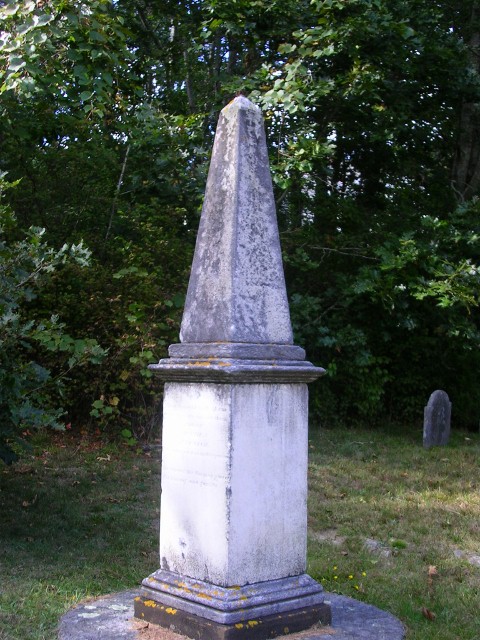
5. Elizabeth Kimball

Elizabeth and Richard were twins.

Elizabeth’s husband Jeremiah Jewett was born 20 Dec 1661 in Essex. His parents were Jeremiah Jewett and Sarah Dickinson. After her death Jeremiah married Elizabeth Bugg. Jeremiah died February 15, 1731.  Jeremiah died 15 Feb 1732 in Ipswich, Essex, Mass. Elizabeth married Thomas Day after he died.

6. Corporal Richard Kimball

Richard and Elizabeth were twins.

Richard’s wife Lydia Wells was born 5 Apr 1668 in Ipswich. Her parents were Nathaniel Wells and Lydia Thurley. Nathaniel was the son of Thomas Wells (son of our ancestor Thomas WELLS and Abigail Warner. (daughter of our ancestor William WARNER).

Richard and Lydia’s children were Lydia Kimball (1690—She died as an infant), Richard Kimball, Aaron Kimball (1692), Lydia Kimball Kinsman, (1694), Mary Kimball (1699), Nathaniel Kimball (1700) and Martha Kimball Heard (1701). Mary married her cousin Moses Kimball, son of Moses. Martha married Edmund Heard son of Edmund Heard and Elizabeth Warner.

19 Jun 1697 – His father deeded him the house and land on which he was living and other property.

2 Nov 1700 – He was chosen to be on a a committee to meet with the Indians concerning land titles.

7. Abigail KIMBALL (See Isaac ESTEY‘s page)

8. John Kimball

John’s wife Sarah Goodhue was born 1672 in Ipswich, Essex, Mass. She was Susannah’s sister and her parents were Joseph Goodhue and Sarah Whipple. Sarah died 1726 in Preston, New London, CT.

In 1726 they moved to Stonington, Connecticut and then in 1727 to Preston, Connecticut where they bought a farm of 200 acres.  John died on May 4, 1761 in Preston, New London County, Connecticut.

Ipswich in the Massachusetts Bay Colony … By Thomas Franklin Waters, Sarah Goodhue, John Wise, Ipswich Historical Society 1927

After the Common lands were distributed, and the Common fence ceased to be, John Kimball acquired possession of a lot, beyond the Smith Dow location. On May 25, 1752, he deeded to his son, John, “the southeast half of my lot of land, on which my said son John’s house and barn now stand, together with the orchard & buildings on the premises, bounded east on the lane leading to the Parsonage Pasture, south on said Parsonage Pasture (101: 141).” The house still stands, and near the house on the east, a lane leads over the railroad track to the Parsonage Pasture, which is still enjoyed by the old First Parish. The property was inherited by Charles Lord and by Eben Kimball his son-in-law.

John Kimball Jr House - 110 High St Ipswich - 1730 2 story, asymmetrical, eastern half earlier

9. Benjamin Kimball

Benjamin’s married his cousin, Mary Kimball. on July 16, 1694. Mary was born on 15 Jan 1670/71 in Topsfield, Essex County, Massachusetts. She was the daughter of John and Sarah Kimball.  John was the son of Richard Kimball, Jr.

10. Moses Kimball

Moses’ wife Susannah Goodhue was born 1676 in Ipswich, Essex, Mass. She was Sarah’s sister and her parents were Joseph Goodhue and Sarah Whipple. Susannah died 23 Jan 1750 in Ipswich, Essex, Mass.

On March 28, 1696 his father sold him a house and orchard and an acre of land in Ipswich when he married Susannah.

Their children were Moses Kimball (1697), Ebenezer Kimball (1699), Susanna Kimball Sutton (1701), Ezekiel Kimball (1705), Katherine Kimball Pindar (1706), Mary Kimball Smith, John Kimball, Sarah Kimball Leatherland (1713), Joseph Kimball (1715), and Aaron Kimball (1718).

He died suddenly in his tailor shop on January 23, 1749/50.

12. Jospeh Kimball

Joseph’s wife Sarah Warner was born 22 Oct 1673 in Ipswich, Essex, Mass. Her parents were Daniel Warner and Sarah Dane. Her grandparents were Daniel WARNER and Elizabeth DENNE. Sarah died 28 Feb 1754 in Ipswich, Essex, Mass.

On his marriage Apr 29, 1696 his father deeded to him the southern end of the farm, bounding on the commons in Ipswich, and he farmed there.

The Essex County Court at Newberry records for September 26, 1699 cite

Joseph Kimball, with Sarah Warner, whom he carried to Salem with the child within 24 hours after birth, which child died an hour and half after arrival in Salem. Bond of 50 pounds, sureties, Richard Kimball and Philemon Warner.

Joseph and Sarah’s children were Sarah Kimball ( Jul 19, 1700), Joseph Kimball (Apr 12, 1702), Philemon Kimball (1704), Eunice Kimball Skillon (1706), Mercy Kimball Skillon (1708), Daniel Kimball ( Nov 11, 1710), Stephen Kimball (Dec 27, 1713), Joshua Kimball (Dec 18, 1715), and Dean Kimball (Sep, 1717 to 1771).

Sources:

http://www.genealogyofnewengland.com/b_k.htm

http://www.angelfire.com/tx4/custer/kimball.html

http://www.kimballfamily.com/Tree/2/2-7.htm

http://trees.ancestry.com/owt/person.aspx?pid=9707044

http://john-slaughter.rootsweb.com/WalkingTour/JohnKimball.html

http://www.loc.gov/rr/print/list/175_sal2.html

http://www.anamericanfamilyhistory.com/Kimball%20Family/KimballJohn1631.html

Posted in 11th Generation, Be Fruitful and Multiply, Historical Site, Immigrant - England, Line - Miller | Tagged , | 13 Comments