Robert Storey

Robert STOREY (1739 – 1835) is Alex’s 7th Great Grandfather, one of 256 in this generation of the Miner line.

Robert Storey was born in 1739 in Convoy, County Donegal, Ireland.  He emigrated and settled in Chester County and Crawford County, Pensylvania. He married Margaret  Lacey LACKEY in Ireland.  Robert died 28 June 1835 in South Shenango Twp., Crawford Co., Pennsylvania. age 95 years, 10 months.

Margaret Lacey Lackey was born in 1740 in Ireland. Margaret died in 05 Feb 1836 in Crawford County, Pennsylvania.  age 96 years

Children of Robert and Margaret:

Name Born Married Departed
1. Robert Storey 1774
Ireland
Anne Reed Feb 1846
South Shenango Township Crawford County, PA
2. Margaret STOREY 1777
Convoy, Donegal, Ireland
OR Letterkenny, Donegal
Robert McCONAHEY
1799
12 Aug 1844
South Shenango Township Crawford County, PA.
3. James Storey 10 Jun 1805
Pennslyvania

1800 PA Census Records for Shenango Township, Crawford County
Story, Robert – 1 male age 16 thru 25
1 male age 45 and over
1 female age 45 and over

1810 PA Census Records for Shenango Township, Crawford County
Storey, Robert – 2 males under 10 years of age
1 male 26 thru 44
1 male 45 and over
1 female under age 10
1 female 26 thru 44
1 female 45 and over

In the 1830 census, Robert was in his 90’s and Margaret in her 80’s were living in South Shenango, Crawford, Pennsylvania

Males: 2 born 1820-1825, 1 — 1815-1820, 2 — 1810-1815, 1 — 1800-1810, 1 — 1760-1770, 1 — 1730-1740. Females: 1 born 1825-1830, 1 — 1820-1825, 1 — 1815-1820, 1 — 1810-1815, 1 — 1800-1810, 1 — 1780-1790, 1 — 1740-1750. Total Free White Persons: 15

Notice from Meadville Courier dated February 24, 1835
DIED – “At the residence of his son in South Shenango on the 28th of January, Mr. Robert Story, in the 96th year of his age, one of the first settlers of that township.”

Children

1. Robert Story

Robert’s wife Anne Read (Reed) was born 25 Jul 1782. Her parents were John Reed ( – d. 1816) and Ann Atchison (b. 1747 in Lancaster Co., PA) Her paternal grandparents were David Reed ( – 1748 Martik, Lancaster, PA) and Jennie Culbertson (1714 – 1772). Her maternal grandparents were John Atchison (1710 – 1776) and Catherine Clark  (or Calhoon) (1712 – 1792)

Ann’s father John Reed was a son of David Reed, one of the earliest pioneers of Washington County, Penn.   John Reed, who was of Scotch-Irish descent, and a native of Lancaster county, Penn., about the year 1777 came with a brother, David, to Washington county. They were offered settlement rights by the State of Virginia on certain conditions which they accepted, and immediately erected their cabins on “the waters of Miller’s Run,” presently the Venice-Southview area. In the fall they returned to Lancaster county, where John’s wife was awaiting him, and David’s betrothed then becoming his bride.  John was already married [to Anna Atchison, daughter of John Atchison and his wife Catherine {Calhoon}], and David was married [to Margaret May] on his return home. In the spring following they with their wives moved to their new homes. They lived several years undisturbed.

David Reed Marker — 40° 18.89′ N, 80° 16.15′ W. Marker is in Venice, Pennsylvania, in Washington County. Marker is on Miller’s Run Road (Pennsylvania Route 50) 0.4 miles east of Southview Road, on the right when traveling west

On the 22d of September 1784. John and David Reed dined with George Washington at David’s house [Google Satellite View] in Mount Pleasant township,  The brothers were later ejected from lands in Mount Pleasant township found by the court to be the property of George Washington and they moved to Cecil township, eight miles away.  Today, both are rural suburbs of Pittsburgh.

By the end of the War for Independence George Washington owned about 58,000 acres of western lands in Pennsylvania and what is now West Virginia. Washington believed that the woods of western Pennsylvania and the Ohio Valley beyond would one day become part of a great American nation. But the retired general also feared that unsupervised settlement could lead to disaster. Poor families moving onto the land, and beyond control of eastern elites, could lead to Indian wars, and an uncouth democracy whose weak commercial ties with the east could lead to calls for secession from the Union, or annexation by Spanish Louisiana or French Canada.

IGeorge Washington’s Land in Pennsylvania. In 1781 this parcel became part of the state’s new Washington County, named in the general’s honor.

In September 1784, Washington traveled into western Pennsylvania to survey the 2,813 acres the British government had awarded him for his service in the French and Indian War. There, families had already settled on some of his lands, and the general feared that the loss of even a single parcel to squatters would have a cascading effect, and that he and other legitimate investors might lose hundreds of thousands of acres.

Washington also hoped to attract settlers to western Pennsylvania as part of a tremendously ambitious plan for development of the new nation. The retired general was planning a grandiose scheme of canals and roads that would link Lake Erie to the Ohio River to the Potomac River to the Atlantic Ocean, a system that would carry the wealth of the nation’s interior to himself and his home state of Virginia.

Washington’s Perspective

In 1784, on his only visit to this area, Washington lodged with John Canon and from here went to visit his land. On September 19, he noted in his diary, “Being Sunday, and the People living on my Land apparently very religious, it was thought best to postpone going among them until tomorrow.”

The next day General Washington dined at David Reed’s log house and met with the settlers, who were reported to be “mostly Seceders,” another name for the members of the Associate Presbyterian Church. Washington wrote, “Dined at David Reed’s after which Mr. James Scott and Squire Reed began to enquire whether I would part with the Land and upon what terms.”

The diary of Washington continues, “I told them I had no inclination to sell, however, after hearing a great deal of their hardships, their religious principles and unwillingness to separate or remove…concluded by making offers, which after long consultation the settlers refused. All chose to stand suit and abide the issue of the law.”

The court ruled that Washington’s title to the land was the valid one; so, shortly thereafter, most of the settlers purchased new claims nearby in what is now Cecil and Chartiers Townships where they were still within walking distance of their meeting house at Oak Spring.

Covenanters Perspective

When Washington arrived at his Pennsylvania properties in September, 1784, he was met by a group of Scotch-Irish Presbyterians led by David Reed, who had already settled upon and laid claim to the lands given to him by Congress. When these squatters had arrived in the early 1770s, the area was a trackless forest, still considered by many to be part of the sprawling colony of Virginia. These frontier families had cleared the land; built fences, log cabins and barns; and endured the risk of Indian attacks. They had grown their own corn and wheat, raised cows and pigs, and hunted wild game.

Now, years later, they were being confronted by an absentee landlord, who had kept track of every acre he owned and every shilling of rent he was due. Operating on the assumption that those who improved the land had stronger legal and moral claim to ownership than someone who simply possessed a paper title, they refused to grant Washington occupancy and were unimpressed by his revolutionary war credentials.

Calling themselves the Covenanters, they identified themselves with the Scotsmen who in the 1640s had opposed King Charles I’ efforts to tax and rule them without their consent. Washington, on the other hand, saw himself as the victim. Unlike other speculators such as Robert Morris, Henry Knox, William Bingham, and the Holland Land Company, Washington actually took pains to physically visit and attempt to settle and organize his several holdings. He also knew that squatters frequently sold land to which they had no real title.

Washington was convinced that the squatters had taken advantage of him, penalizing him for the years he had led his country’s army in its fight for independence. “Indeed, comparatively speaking I possess very little land on the Western Waters,” he wrote to his attorney. “To attempt therefore to deprive me of the little I have, is, considering the circumstances under which I have been and the inability of attending to my own affairs, not only unjust, but pitifully mean.” He had little sympathy for this “grazing multitude,” who “set forth their pretensions” to his land, and attempted to “discover all the flaws they could in my Deed.”

On September 14, 1784, Washington and the squatters faced off near his gristmill at present-day Venice. After explaining their respective positions, they agreed to meet again in a few days. Doing his best to salvage the situation, the general met again with the squatters, who again refused to recognize his ownership.

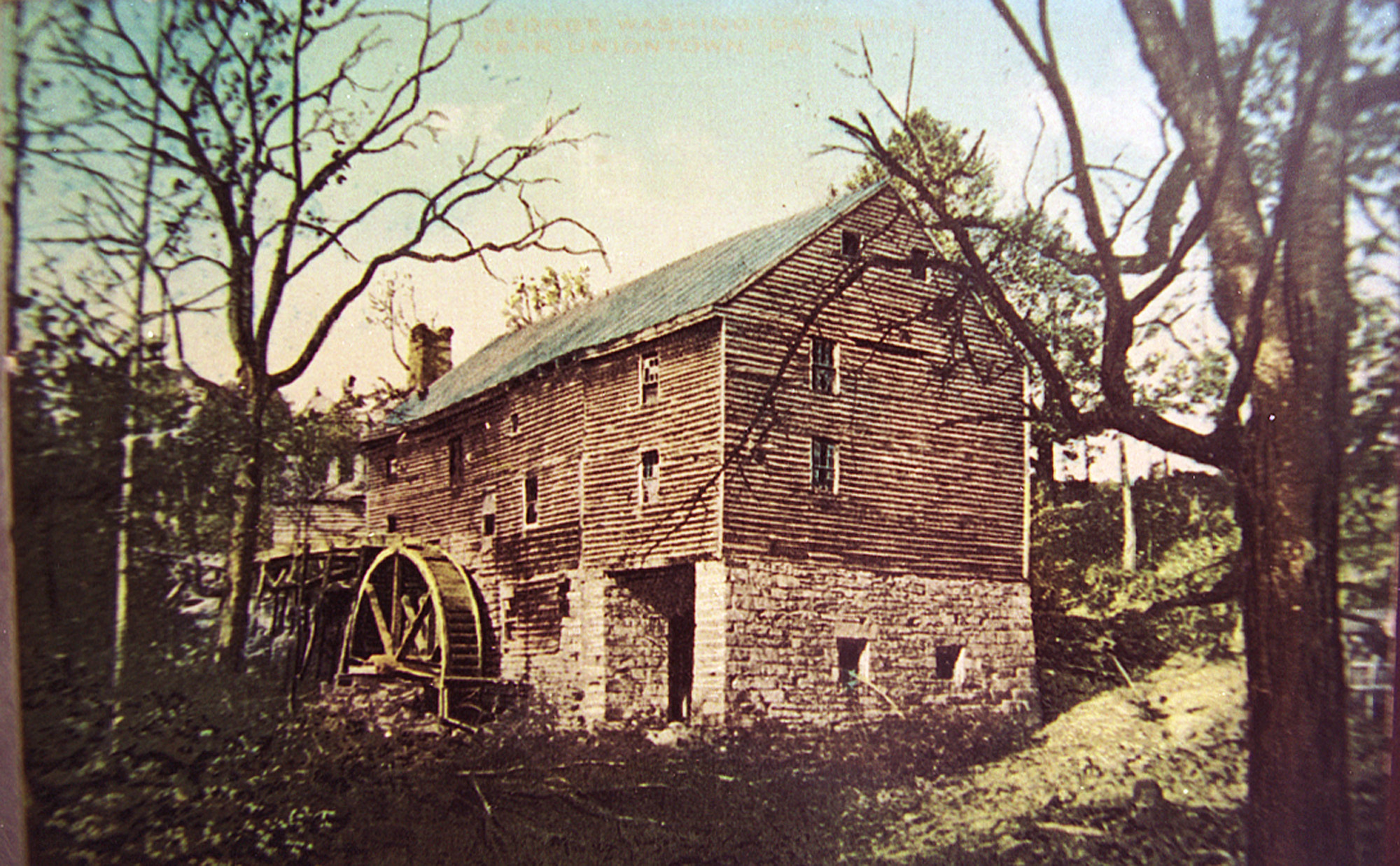
George Washington’s Grist Mill in Perryopolis.Early 1900’s

On September 20, 1784, thirteen of the farmers who had been squatting on Washington’s lands for the previous twelve years, met with the general at the home of Reed.  After Washington again insisted he held title to the land, they announced that they would be willing to buy the land from him outright. They made clear to the general that they were not conceding that he owned the land, but had no desire to engage in a long and nasty dispute – a dispute they well knew Washington could win.

Washington said he would accept no less than twenty-five shillings an acre, paid in three annual installments, with interest. Otherwise, they could sign a 999-year lease. These were stiff terms. None of the thirteen squatters was interested in the lease. When they asked Washington if he would sell the land at his asking price over a much longer period of time and without any interest, he refused, at which point they formally declared that they did not recognize his ownership.

The ensuing lawsuit dragged on for two years. In October, 1786, Pennsylvania Supreme Court Justice Thomas McKean, riding circuit in the western part of the state, presided over the trial in Washington, Pennsylvania. When the jury came back with a verdict in favor of the general, he became the proprietor of thirteen separate plantations. Washington showed some mercy by absolving the squatters from twelve years of back rent. Permitting the squatters to keep their plantations, he only demanded that they pay future rent. But the squatters would have none of it.

Abandoning the homes they had built over many years, they all moved away. Several obtained warrants for land adjacent to or near Washington’s land, cleared it, and built new plantations.

Washington would keep his grip on the land for another decade. In 1796, with western land speculation in full collapse, he sold the entire tract to a local agent for the modest sum of $12,000. When the agent defaulted on the mortgage, the general then retained the land until his death.

Soon after the organization of Washington County in 1781, John Reed was chosen justice of the peace of the district which afterwards in 1787 became the Fourth, and justice of the peace of the Court of Common Pleas, and was reappointed in November, 1788. On the 2d of October, 1783, he purchased of David Lindsey “all that tract or parcel of land lying and being on the waters of Miller’s Run, within the county and State aforesaid, containing four hundred acres,” adjoining James McCormick and others. ,

They lived there several years in undisturbed possession, but the land being really a portion of the George Washington survey, was afterward claimed by that famous personage.  After the ejectment suit was decided, the two brothers removed to Cecil township, where they purchased land.   John died in 1816, leaving the following children: David (who settled on the home farm), John (sold his land, which was later owned by John Cabbage), Catherine (Mrs. Daniel McClean, Chenango, Penn.), Ann (married to Robert Story), Jane (wife of David Emery [sic], Darlington, Beaver Co., Penn.) and Mary (wife of Rev. Alexander Murray, Slippery Rock, Penn.) .

OBITUARY OF MR. ROBERT STORY.

Obituary.—Robert Story departed this life February, 1846, in the 72d year of his age. He was a native of Ireland, and emigrated with his parents to America when a youth, and after some changes as to their residence, he with his parents came to Crawford County, Pa., and settled in the bounds of the Associate congregation of Shenango. Although at that time a member of the Presbyterian church, he for reasons satisfactory to himself, left his former connection with that church and became a member of the Associate church, and also a ruling elder in their congregation of Shenango for many years. His acquaintance with the doctrines of grace, his knowledge of church discipline, and his zeal for God’s declarative glory, rendered him eminently useful in his day; hence his relations not only sustained a loss in his death, but the church, and especially the congregation, of which he was an efficient member. Yet to him death appeared a welcome messenger, as he died in the full assurance of faith. “Blessed are the dead which die in the Lord from henceforth: yea, saith the Spirit, that they may rest from their labours; and their works do follow them.”

Copy of will for Robert Story of South Shenango Township, Crawford County, PA lists the following…

Wife – Ann
Eldest son – John Reed (deceased) – John’s children listed as John and Jane
Other sons – David, Robert Murray, Alexander, and James
Daughters – Margaret, Ann, and Mary
Amanda also listed in this will; however, there is no mention as to her relation to the deceased.
Executors – son, James, and Robert Martin
Witnesses – Robert and Margaret McCONAHEY
Dated 22 December 1843

 Crawford County  Census Records for the Storys

1840 PA Census Records for South Shenango Township, Crawford County

Story, Robert – 1 male of 10 and under 15
1 male of 15 and under 20
1 male of 20 and under 30
1 male of 60 and under 70
1 female of 10 and under 15
3 females of 20 and under 30
1 female of 50 and under 60

1860 PA Census Records for South Shenango Township, Crawford County

Forest, Jonathon – farmer age 23 born in PA
Amanda – age 24 born in PA
Margrette – age 5/12 born in PA
has Maria Story, age 40 – born in PA, living with family

Story, Anne J. – age 39 farmer born in Ohio
Mary Ann – age 17 born in PA
Margrette – age 15 born in PA
Trina (?) – age 10 born in PA
William – age 8 born in PA

Story, Anna – age 48 farmer born in PA

Story, James – age 82 farm laborer born in PA

(All four of these households are next door to each other.)

South Shenango Township Cemetery Records – Crawford County, PA

Robert Murray Story b. 1816 d. 1853
Ann Jane, wife of Robert, b. 1817 d. 1908
Margretta J. b. 1844 d. 1906
William Russell b. 1847 d. 1849

Jean, daughter of Robert and Ann Storey, who departed this life May 24, 1838 age 19 years

John Reed Story, died 9/25/1841 age 36 years

Robert Storey d. 2/1/1846 age 72 years
Anne, wife of Robert Storey d. 12/9/1848 age 67 years

Story, Margaret b.1807 d. 1851
Story, Mary b. 1814 d. 1884
Story, Anne b. 1812 d.1902

Row V

James Story 1823-1916
Sarah Maria Story 1866-1866
Sarah Snodgrass Story b.1834 d.1866

Children of Robert and Ann:

i. John Reed Story b.  1805 Ireland; d. 25 Sep 1841 South Shenango Township; m. Mary [__?__] (b. 1810 Pennsylvania – d. aft 1860 census)

John’s children listed as John and Jane

John R Story [Jr.] of South Shenango Twp.:  mother and sister /s Mary Storey, Jane Story; request William Q Snodgrass; witness Thomas Glen, John Glen; South Shenango Twp. 8 Aug. 1866; filed 29 Oct. 1866. .

In the 1850 census, John’s widow Mary was living in South Shenango, Crawford, Pennsylvania.
Story, Mary – age 39 born in PA (listed as head of family)
Jane – age 11 born in PA
John A. – age 8 born in PA.

By the 1860 census, the three were still together, though this time John R was listed as head of household

ii. David Story b. 1810 Penns;  d. Betw. 1860-1870 census, Nebraska; m.  his first cousin Sarah  McConahey (b. 1811 Penns – d.  Betw. 1860-1870 Cass Nebraska)  Her parents were Robert McCONAHEY and Margaret STORY.

1840 Census South Shenango Township, Crawford County
Story, David – 1 male of 30 and under 40
1 female unfer 5
1 female of 5 and under 10
1 female of 30 and under 40

In the 1850 census, David and Sarah were farming in South Shenango Township, Crawford County with eight children at home.

Story, David – age 40 born in PA farmer
Sarah – age 39 born in PA
Ann R. – age 11 born in PA
Margaret – age 9 born in PA
Robert – age 8 born in PA
William I. – age 6 born in PA
Alexander M. – age 4 born in PA
Sarah M. – age 2 born in PA
David E. – age 2 born in PA
Daniel M. L. – age 1/12 born in PA
(Robert R. and David Story lived next door to each other, with James Story only two houses over in this census.).

David came to Nebraska Territory in 1857, settling on a claim in Cass county about one mile southeast of Murray.

In the 1860 census, David was living in Cass, Nebraska Territory

In the 1870 census, Sarah was a widow farming in Rock Bluffs, Cass, Nebraska with her children Robert, William, Alexander and Sarah.

In the 1880 Nebraska census, Sarah was living with her son-in-law and daughter H.L. and Sarah Oldham in Rock Bluff, Cass, Nebraska..

The History of the United Presbyterian Church, Murray, Nebraska, 1860-1960 by Margaret Spangler Todd

“According to appointment of the General Assembly of the United Presbyterian Church made at Philadelphia in May 1860 I came a missionary to Nebraska Territory in July and commenced preaching half time in Rock Bluff Cass County.” Thus Rev. Thomas McCartney entered the first minutes in the Session Records of the Rock Bluffs United Presbyterian Church.

The next item entered was dated August 18, 1860, reading: “By arrangement with those who requested preaching August 18th was designated as the time for the organizing a church. And on the day appointed, after a sermon from Matthew 11:29 the following people were admitted in full communion by assenting to the pricinples of the church, to wit: Robert M. LATTA [our ancestor and David Story’s first cousin] Letitia LATTA [Robert’s wife], William L. Thompson, Hanna E. Thompson, William H. Royal, Elizabeth Royal, David Storey  , Jane Latta and Mary Latta.” Also Robert M. LATTA and W.L. Thompson were, by ballot, chosen as ruling elders and the organization named “The United Presbyterian Congregation of Rock Bluffs.”

The following Act of Legislature was approved January 4, 1861: “To incorporate The United Presbyterian Church at Rock Bluffs City: Section I – Be it enacted by the council and the house of representatives of the Territory of Nebraska, that Joh Latta [Robert’s brother John Allison], William H. Royal, David Storey,  Robert M. LATTA and William L. Thompson and their associates and successors, the members of the United Presbyterian Church of Rock Bluffs City, Cass County, be, and the same are hereby created a body politic and corporate, under the name style and title to remain in perpetual succession with full power to plead and be impleaded, to sue and be sued, to receive, acquire hold and possess prpoerty, real, person and mixed; to use, employ, manage and dispose of all such property as they deem proper for use and well being of said church and in consistent with the provisions of said act, to elect such trustees and other officers and make such rules and by-laws as they deem proper provided always, that they do any act or make any rule or by-law which shall in any way conflict with t he constitution of the United States or doctrine or usages of the United Presbyterian Church of the United States of America.”

For more on the pioneers of Rock Bluff, Nebraska see my posts Robert McConahay LATTA  and Western Pioneers.

iii. Alexander Storey

iv. Margaret Story b.1807 d. 1851

In the 1850 census, Margaret was living with her brother James in South Shenango, Crawford, Pennsylvania.

v. Ann Story b. 1812 Penns. d.1902 South Shenango

In the 1850 census, Ann was living with her brother James in South Shenango, Crawford, Pennsylvania.

In the 1880 census, Ann was single and living in South Shenango with a daughter named Magdalena, born in 1867 in Pennsylvania. Since Ann was 55 in 1867 and unmarried, Magdalena must have been adopted.

In the 1870 census, Magdalena was living with her parents William and Magdalena Minesinger in Pittsburgh.

By the 1900 census, Ann and her brother James were again living together in South Shenango together with Mary (Magdalena) W Mienersager age 32 and her brother William Mienersager age 28.

vi. Mary (Maria) Story b. 1814  Pennsylvania; d. 1884

In the 1850 census, Mary was living with her brother James in South Shenango, Crawford, Pennsylvania

In the 1870 census, Maria was living with Amanda and Jonathan Forest in South Shenango, Crawford. PA.
Forest, Jonathan – age 34 farmer born in PA
Amanda – age 37 keeps house born in PA
Margatta – age 10 born in Ohio
Emma Jane – age 8 born in PA
Has Maria Story, age 56 born in PA, living with them.

Story, Anne – age 58 born in PA was their next door neighbor.

In the 1880 census, she was still living with the family in Pine Township, Crawford County

Forrest, Jonathan – age 44, farm laborer, born in PA, father born in PA, mother born in IRE
Amanda – age 47, wife, keeps house, born in PA, father born in IRE, mother born in PA
Etta – age 20, daughter, at home, born in Ohio, parents born in PA
Emma – age 19, daughter, at home, born in PA, parents born in PA
Henderson – age 9, son, at home, born in PA, parents born in PA
Story, Maria – age 64, cousin, keeps house, born in PA, father born in IRE, mother born in PA.

vii. Robert Murray Story b. 1816 Penns.; d. 1853 South Shenango, Crawford, Pennsylvania; m. Ann Jane [__?__] ( b. Apr 1817 Ohio – d. 1908)

In the 1850 census, Robert R Story was farming in South Shenango, Crawford, Pennsylvania

Story, Robert R. – age 35 born in Ireland
Ann Jane – age 36 born in OH
Mary A. – age 8 born in PA
Margaretta I. – age 6 born in PA
Terzah – age 2/12 born in PA

In the 1900 census, Ann Jane [__?__]  was living in South Shenango, Crawford, Pennsylvania with her daughters Margareta and Tizrah. Tizrah was an inmate at the United Presbyterian Home for the Aged in Wilkinsburg, Allegheny, Pennsylvania in 1920 and 1930.

viii. James Story b. Nov 1823 Penns.; d. 1916 South Shenango, Crawford, Pennsylvania.

In the 1850 census, James was farming in South Shenango, Crawford, Pennsylvania
Story, James – age 26 farmer born in 1823 PA (real estate = $1500) living with
Margaret Story- age 43 born in 1807 PA (real estate = $250)
Ann Story – age 38 born in 1812 PA (real estate = $250) James’ sister
Mary Story – age 36 born in PA (real estate = $250) James’ sister
Joseph Cowan – age 16 farm hand born in PA
Amanda Story – age 22 born in PA born 1828. Who is this?

In the 1910 census, James (age 86) was living with his niece Terzah in South Shenango, Crawford, Pennsylvania.

2. Margaret Story (see Robert McCONAHEY‘s page)

Sources:

Obituary of Robert Story – Google Books

Conneaut Township History

http://www.storeygenealogy.com/ireland/donegal/donegalstoreys.html

http://boards.ancestry.com/thread.aspx?mv=flat&m=626&p=surnames.story

http://trees.ancestry.com/tree/8056270/person/-122033210

http://explorepahistory.com/hmarker.php?markerId=1-A-28F

Posted in -9th Generation, 90+, Immigrant - Scot-Irish, Line - Miner, Storied | Tagged , | 8 Comments

Deacon Caleb Brown

Caleb BROWN (1698 – 1758) was Alex’s 7th Great Grandfather; one of 256  in this generation of the Miller line.

Deacon Caleb Brown was born 23 Oct 1698 in Lynn, Mass.  His parents were Cornelius BROWN Jr.  and Susanna STORY.  He married Elizabeth JEWETT on 18 Oct 1722 in Rowley, Mass.  Caleb died 23 Nov 1758 in Harvard, Mass.

Elizabeth Jewett was born 3 Mar 1700/01 in Rowley, Mass.  Her parents were Maximilian JEWETT and Sarah HARDY. Elizabeth died 23 Nov 1758

Mary Brown was born 19 Jan 1725/26 in Bradford, Essex, Mass.  Many genealogical records show her parents to be Caleb Brown and Elizabeth Jewett.  However,  many other sources  show Caleb’s and Elizabeth’s Mary married Francis Peabody

Children of Caleb and Elizabeth

Name Born Married Departed
1. Sarah Brown 17 Apr 1724 Rowley, Essex, Mass
2. Mary BROWN 19 Jan 1725/26 in Bradford, Essex, Mass. David DOW
10 Apr 1744 in Salem NH
or
Francis Peabody
18 Nov 1742 Boxford, Essex County, MA
24 Oct 1771
or
20 Oct 1770 Sudbury, New Brunswick
3. Hannah Brown 15 May 1729 Boxford, Essex, Mass
4. Elizabeth or Abigail Brown 11 Feb 1731 Boxford, Essex, Mass 18 Sep 1739 Boxford, Essex, Mass
5. Caleb Brown 29 May 1732 Boxford, Essex, Mass
6. Susanna Brown 4 Mar 1735 Boxford, Essex, Mass 20 Sep 1739 Boxford, Essex, Mass
7. Clark Brown 24 Feb 1734 or 1736 Boxford, Essex, Mass Lucy Davis
9 Mar 1757 Harvard, Worcester, Mass
8. Hephizibah Brown 2 Oct 1737 Boxford, Essex, Mass 4 Jul 1766 Harvard, Worcester, Mass
9. David Brown 24 Jun 1739 Boxford, Essex, Mass
10. Maximillian Brown 27 Sep 1741 Boxford, Essex, Mass 13 Mar 1747 Harvard, Worcester, Mass
11. Ebenezer Brown 30 Jun 1745 Harvard, Worcester, Mass 23 Jul 1746 Harvard, Worcester, Mass

x

Children

2. Mary Brown

Mary married David DOW or Francis Peabody.

 Francis lived in Boxford, Mass. until 1764, when he moved to the St. John River in a part of Nova Scotia set off in 1784 as New Brunswick. He and two sons-in-law, James White and James Simonds, were among the pioneer English settlers of Maugerville, NB. Francis was commander of a company in the French and Indian War. He participated in the attack on Ticonderoga in July 1759.

The next year, his company was in the expedition against Canada by way of Albany and Lake Champlain. After the French surrendered at Chambly, the company returned to Ticonderoga, then marched across country to Boxford, arriving about Dec. 1.

7. Clark Brown

Clark’s wife Lucy Davis was born 26 Jun 1726 in Concord, Middlesex, Mass. Lucy’s parents were Simon Davis (1692 – 1763) and Hannah Potter (1690 – 1782). Lucy died 28 Aug 1796 in Boxford, Essex, Mass or Brookline, Brookline, Hillsborough, New Hampshire.  Alternatively, Lucy was born 24 Feb 1734/35 and died 28 Aug 1776.

Child of Clark and Lydia:

i. Lydia Brown b. 24 May 1773 Brookline, Hillsboro, NH; d. 3 Jan 1812 in Chesterfield, NH; m. 1790 to Amos Crouch(b. 27 Aug 1769 Harvard, Worcester, Mass – d. 18 Aug 1861 in Chesterfield, New Hampshire) Amos’ parents were John Crouch (1728 – 1814) and Hannah Brown (1729 – 1789).

In the 1860 census, Amos age 90 was living in Chesterfield, Cheshire, New Hampshire with Abigail Crouch age 75 and his daughter Hannah Crouch age 53.

ii. Sarah Brown, b. 12 Dec 1777, Raby, NH; d. 12 Mar 1836 Denmark, Oxford Co., Maine; m. 20 Mar 1803 Hopkinton, Merrimack, New Hampshire Parson Pingree ( b. 21 Aug 1776, Rowley, Mass. – d. 10 Mar 1862 Denmark, Oxford Co., Maine) Parson’s parents were Thomas Pingree (b. 2 Jun 1745 ) and Hannah Chapman (b. 3 Jun 1744, Ipswich, Mass.) Sarah and Parson had nine children born between 1803 and 1822.

In the 1860 census, Parson was living with his son Jasper in Denmark, Oxford, Maine.

In both 1850 and 1860, Parson with living with Sarah nee. [__?__] Parson (b. 1787 Maine)

Source:

http://www.genealogyofnewengland.com/b_b.htm

http://www.angelfire.com/music2/greggwager/wager1474.html

http://freepages.genealogy.rootsweb.ancestry.com/~rhutch/nti03123.htm

http://trees.ancestry.com/owt/person.aspx?pid=40502202

http://www.geni.com/people/Clark-Brown/6000000000437803775?through=6000000000437803788

http://www.genealogycenter.info/20050034/getperson.php?personID=I09706&tree=20050034

Ancestry of Daniel James Seely, St. George, N. B., 1826, and of Charlotte Louisa Vail, Sussex, N. B., 1837- St. John, N. B., 1912; with a list of their descendants (1914)

Posted in -9th Generation, Line - Miller | Tagged , | 5 Comments

William Ring

William RING (1565 – After 1620 Before 1629) was Alex’s 11th Great Grandfather; one of 4,096  in this generation in the Shaw line.

William Ring was born about 1565 in Pettistree, Suffolk, England.  His parents  are not known.   He married Mary DURRANT 21 May 1601 in Ufford, Suffolk, England.   William had been aboard the Speedwell, sister ship to the Mayflower, intending to voyage across the Atlantic in 1620. William was, however, among the passengers who could not fit aboard the Mayflower when the Speedwell was deemed unseaworthy. He returned to Leiden and died there sometime between 1620 and 1629.

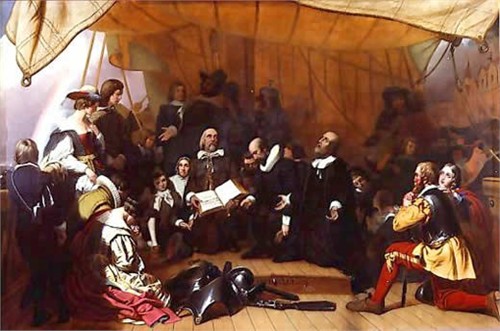
The Pilgrims on the Speedwell

Mary Durrant was born about 1584 in Ufford, Suffolk, England.  Her parents were Thomas DURRANT and Mary [__?__].   Mary was a member of the Leiden Separatist community.   She arrived in Plymouth in 1629 or 1630 most probably on the second Mayflower, which sailed from Gravesend in March, and landed at Salem MA. on 15 May 1629, bringing 35 passengers, several of whom were from the Pilgrim colony which had been living for a number of years in the Netherlands.   Mary Ring seems to have some education : she signed her will herself and her inventory contains books. She also seems to have been a woman of business, with money owed to her by William Bradford and Edward Winslow.  Mary died 15 Jul 1631 om Plymouth, Plymouth Colony.

Mary Ring wrote a will, and an inventory of her estate was taken at her death.

Children of William and Mary:

Name Born Married Departed
1. Elizabeth Ring 1602
Ufford, Suffolk, England
Stephen Dean
Sep 1627 in Plymouth, Mass
.
Josiah Cooke
16 Sep 1635 Plymouth, Mass
28 Dec 1687
Plymouth, Mass.
2. Susanna RING ca. 1606
England
Thomas CLARKE
Jul 1631   Plymouth
28 Jun 1697 Rochester, Plymouth, Massachusetts
3. Andrew Ring 1618
Leiden, Hollan
Deborah Hopkins (daughter of Stephen HOPKINS)
23 Apr 1646 Plymouth
.
Lettice Kempton (daughter of Ephraim KEMPTON)
after 3 Oct 1673
Middleboro, MA
22 Feb 1693
Plymouth, Mass

The parish registers of Ufford, Suffolk Co., 1558-1630 are  the following entries that are believed to be the same individuals: 1601:  Wylliam Ringe of Ptetistrey singlman and Marie Durrante of Ufford single  woman weare married together the 21 of May 1602: Elizabeth Ringe the  daughter of William Ringe and Marie his wife was baptized the xxiij day of Februarie” (1602/3)

William was a weaver and member of the Separatist community in Leiden Holland, and a devoted follower of the Pilgrim’s pastor, Mr. John Robinson. The family is known to be present in Leyden by 1614. These Separatists had  found the English church, once Catholic, now Anglican, to be irredeemable  and sought to remove themselves from the world, rather than fight and die as martyres. Crossing to permissive  Holland after 1605, the group spent their first year in the roaring port  of sinful Amsterdam (where abject poverty juxtaposed with wealth “confronted them like an armed man”). Fearing for their communal  continuity, they then retreated into the academic quiet of nearby Leyden.  The distance was not enough, and so the colony arranged to transplant itself to the new world in 1620.

William was guaranteed by William Bradford and Alex Price on June 7, 1619. (Guaranteed mean’t vouched for and sworn in.)  When the “Speedwell” sailed from Delfthaven on July 22, 1620, William was aboard.

Though the settlers continued from England in two ships, the Speedwell had to return to England due to dangerous leaking, and the Mayflower continued alone. According to Capt. John Smith, writing in 1622, ‘They left the coast of England the 23 of August, with about 120 persons, but the next day the lesser ship sprung a leake, that forced their return to Plimoth, where discharging her and 20 passengers, with the great ship and a hundred persons besides sailers, they set saile againe the Sixt of September.’

At Dartmouth, on August 17th, after leaks forced the ship into port, one of the separatist leaders,  agent Robert Cushman wrote that “Poor William Ring and myself do strive who shall be meat first for the fishes, but we look for a glorious resurection.” When the “Mayflower” set out alone on September 6th, neither William nor Mary were aboard.

Here is a link to the full text from Mary’s will: http://www.pilgrimhall.org/willmring.htm

Children

1. Elizabeth Ring

Elizabeth’s first husband Stephen Dean was born 1606 in Southwark, England. Stephen died 6 Oct 1634  in Plymouth, Mass.

Elizabeth and Stephen’s daughter Miriam was born at Plymouth about 1634.   On  31 Jan 1692/93 she became the  second wife our ancestor John WING II  (1611-1699). She is interred at Dillingham Cemetery.  Miriam’s will dated 24 May 1701 proved 8 Jan 1702/03 gives all her property to Dean Smith, “son of my Kinswoman, Bethiah Smith of Monomoy.”  Bethiah was Miriam’s niece, daughter of her sister Susannah Dean and Stephen Snow.

Elizabeth’s second husband Josiah Cooke was born 1610 in England. Some say his parents were our ancestors Francis COOKE and Hester le MAHIEU but serious genealogists don’t believe in this connection.  Josiah died 17 Oct 1673 in Eastham, Barnstable, Mass.

Robert Charles Anderson, in his 1995  The Great Migration Begins cited George Ernest Bowman’s comments of 1901 as still being definitive. In a footnote in volume 3 of  Mayflower Descendant Bowman presented a simple and convincing argument. Not only had he (and he must have been the premier student of the Mayflower in his time if not of all time) never found “a single record which even remotely indicates the existence of any kinship,” but he had found several records which prove “conclusively that they were not father and son.” Of these Bowman cites three. There is a court case in which Francis was the plaintiff and in which Josias sat on the jury and Bowman points out that the court would not allow a son to sit on a jury judging the father. Bowman cites an agreement which the court would have required to be signed by all of Francis’s living children which Josias, who was alive, did not sign, and a deed which states that it is made by all the children and which does not include Josias. (MD 3:97)

However there are old books, some made newly available on CD and online which make the claim that Josias is a son of Francis. One such is  Signers of the Mayflower Compact  by Annie Arnoux Haxtun, which was first published in 1897-1899 and was reprinted by Genealogical Publishing Company. “The argument now [that Josias is not the son of Francis] is founded not upon what was said, but what was not.  Some say certainty is self-evident and requires no assertion, but I’m including because the question comes up quite often.

Children of Elizabeth and Stephen

i.  Elizabeth Deane b: 1630 in Plymouth, Plymouth Colony

ii. Merriam Deane b: 1633 in Dorchester, Massachusetts Bay.  Miriam is the oldest first time bride in our family tree.  She was 59 when she married our ancestor John WING as his second wife.   She is interred at Dillingham Cemetery.  Miriam’s will dated 24 May 1701 proved 8 Jan 1702/03 gives all her property to Dean Smith, “son of my Kinswoman, Bethiah Smith of Monomoy.” Bethiah was Miriam’s niece, daughter of her sister Susannah Dean and Stephen Snow.

iii. Susannah Deane b: ~ 1635 in Plymouth, Plymouth Colony; d. bef.  Apr 1701 in Eastham, Barnstable, Mass.; m. Stephen Snow (b. 1636 Plymouth, Plymouth Colony – d.  17 Dec 1705 Eastham)  Stephen’s brother Mark married Susannah’s half sister Anna. Their parents were our ancestors Nicholas SNOW and Constance HOPKINS.   ASusannah and Stephen had five children born between 1666 and 1672.  After Susannah died, Stephen married  9 Apr 1701 in Eastham, Massa, to  Mary Cottle

Children of Elizabeth and Josiah

iv. Bethiah Cooke b: 1640 in Plymouth, Plymouth Colony

v. Anna Cooke b: 1636 in Plymouth, Plymouth Colony; d. 25 Jul 1656 in Eastham, Plymouth Colony; m. 18 Jan 1654 in Eastham, Plymouth Colony to Mark Snow (b.  9 May 1628 in Plymouth, Plymouth Colony – d. 9 Jan 1695 in Eastham, Barnstable, Mass.)  Mark’s brother Stephen married Anna’s half sister Susannah. Their parents were our ancestors Nicholas SNOW and Constance HOPKINS.  Anna  had one daughter Anne Snow who was born 7 Jul 1656 in Eastham three weeks before her death.

After Anna died, Mark married 9 Jan 1660 in Eastham to Jane Prence (daughter of Gov. Thomas PRENCE) and had eight more children between 1661 and 1679.

vi. Micajah Cooke b: 1645 in Nauset (Eastham), Plymouth Colony

vii. Josiah Cooke b: 1645 in Nauset (Eastham), Plymouth Colony; d.  d. 31 Jan 1732 Eastham ); m. 27 Jul 1668 in Eastham to Deborah Hopkins (b: Jun 1648 in Eastham, Plymouth Colony; d. Bef Dec 1727 Eastham)  Deborah’s parents were Gyles Hopkins and Katherine Wheldon.  All four of her grandparents were our ancestors.  Gabriel WHELDON & Jane [__?__] and Stephen HOPKINS and Mary [__?__]. Josiah and Deborah had eight children born between 1669 and 1686..

2. Susanna RING (See Thomas CLARKE‘s page)

3. Andrew Ring

Andrew’s first wife Deborah Hopkins was born 1625 in Plymouth, Plymouth, Mass.  Her father was our ancestor Stephen HOPKINS. Deborah died 1674 in Plymouth, Plymouth, Mass.

There were two woman named Lettice [joy in Latin] in early Plymouth.   Lettice Hanford and Lettice Kempton  are often mixed up with four marriages between them.  There is only one recorded death:  22 Feb 1691.  Here’s my crack at unsorting the tangle.  

Andrew’s second wife Lettice Kempton was about 1629 in London.  Her parents were our ancestors Ephraim KEMPTON and Hannah [__?__].  Lettice first  married 1648 in Plymouth, Plymouth, Mass to John Morton, son of George MORTON (b. 1616 in Leyden, Holland – d. 3 Oct 1673 in Plymouth, Mass.). Lettice died 22 Feb 1691 in Middleboro, Plymouth, Mass.

Lettice Hanford was baptized  8 June 1617,at Alverdiscott, Devonshire.  Her parents were Jeffrey Hanford and Eglin Hatherley.   Lettice Hanford clearly preceded her mother & younger sisters to New England.  On 10 Apr 1635, Eglin Hanford,” aged 46, & “2 daughters, Margaret Manford,” aged 16, & “Eliz[abeth] Hanford,” aged 14, along with “Rodolphus Elmes,” aged 15. & “Tho[mas] Stanley,” aged 16, were enrolled at London as passengers for New England on the Defence.)

Lettice Hanford first married  8 Apr 1635 in Scituate, Plymouth, Mass. to Edward Foster (b. 24 Jan 1590 in Frittendon, Kent, England – d. 25 Nov 1643 in Scituate, Plymouth, Mass.)  at Mr. Cudworth’s [Scituate] by Captain Standish. She was admitted to Scituate church (as “Goody Foster”) 25 December 1636. They had 3 children: Timothy, Timothy again, & Elizabeth Hewett Ray.

After Edward died, she married Edward Jenkins (1618  Kent, England – d. 1699 Scituate, Plymouth, Mass)  On 4 March 1634/5, “Edw[ar]d Jeakins,” one of seven servants of Nathaniel Tilden of Tenterden, Kent, was included in the list of passengers of the Hercules of Sandwich.  Lettice and Edward had 3-4 children: Samuel (b. 1645), (probably) Sarah Bacon, Mary Atkinson Cocke, & Thomas.  In the late 1660s and early 1670s Edward Jenkins had to come to the aid of two of his children who experienced a number of problems. On 5 Mar 1666/67, “Dinah Silvester, Sarah Smith, and the daughter of Edward Jenkens, [are] summoned to the next court.

Children of Andrew and Deborah:

i. Samuel Ring b: 1649 in Plymouth, Plymouth Colony

ii. Elizabeth Ring b: 19 Apr 1652 in Plymouth, Plymouth Colony

iii. William Ring b: 1653 in Plymouth, Plymouth Colony

iv. Eleazer Ring b: 1655 in Plymouth, Plymouth Colony

v. Mary Ring b: 1657 in Plymouth, Plymouth Colony

vi. Deborah Ring b: 1659 in Plymouth, Plymouth Colony

vii. Susanna Ring b: 1661 in Plymouth, Plymouth Colony

Sources:

http://www.pilgrimhall.org/ringmary.htm

http://www.pfarrell.com/genealogy/internettree/ps04/ps04_191.htm

http://www.findagrave.com/cgi-bin/fg.cgi?page=gr&GRid=122494553

http://trees.ancestry.com/owt/person.aspx?pid=24553104


Posted in 13th Generation, Dissenter, First Comer, Immigrant - England, Line - Shaw, Pioneer, Storied | Tagged , , , , | 19 Comments

Thomas Clark

Thomas CLARK (1605 – 1697) was Alex’s 10th Great Grandfather; one of 2,048 in this generation in the Shaw line.

Thomas was baptized in St. Dunstans, Stepney, London , England

Thomas Clark was baptized on 8 Mar 1600 in St. Dunstan’s, Stepney, London , England.  His parents were  John CLARK and  Mary MORTON. His parents were from Ratcliff and were married at St. Dunstan’s Feb-1598/99. His paternal grandparents were William Clarke and Margaret Walker. He was an only child.

Stepney is an inner-city area in the East End of London that grew out of a medieval village around St Dunstan’s church and the 15th century ribbon development of Mile End Road. St Dunstan’s  stands on a site which has been used for Christian worship for over a thousand years.  In about AD 952 the Bishop of London — who is also Lord of the Manor of Stepney— replaced the existing wooden structure with a stone church dedicated to All the saints. In 1029, when Dunstan was canonised, the church was rededicated to St Dunstan and All Saints, a dedication it has retained.  The existing building is the third on the site and was built of Kentish ragstone mainly in the 15th century.  The church has a long traditional link with the sea and many sailors were buried here. It was once known as the ‘Church of the High Seas’, and until quite recently births, marriages and deaths at sea were registered here.

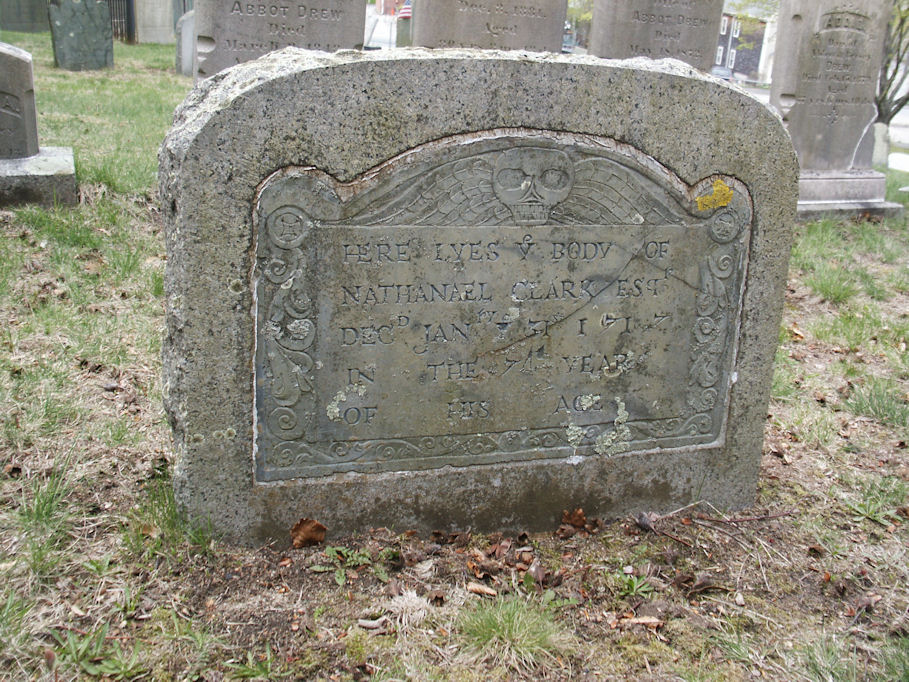
Thomas Clarke - Memorial - This Stone is erected to hismembory by his descendants A.D. 1891.

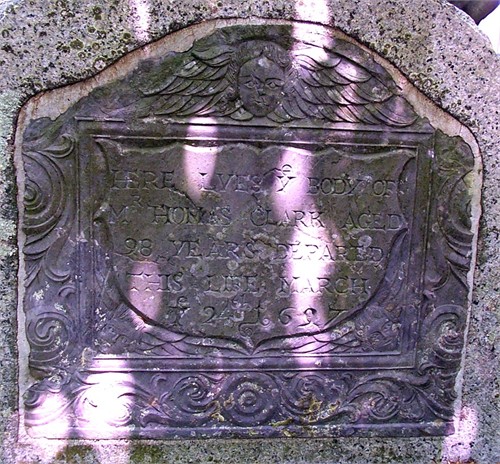
He came over in the Anne in Jul 1623  in a company of forty-two adult passengers, besides children.  He brought with him considerable property, especially cattle, and had land allotted to him near Eel River, now Chiltonville.  He has been suggested as son of John Clark, pilot of the Mayflower, who gave his name to Clark’s island, of which he took possession, December 8, 1620.  The Great Migration Begins, states “the hypothesis is very attractive, and was accepted by [Donald Lines] Jacobus, but remains under proven.”   He married Susanna RING, before Jul 1631 in Plymouth.  In 1664 after Susanna, died  he remarried to Alice Hallet Nichols  of Boston,   Thomas died 24 March 1697.  His gravestone, one of the oldest extant on Burial Hill in Plymouth, shows that he was born about 1600.

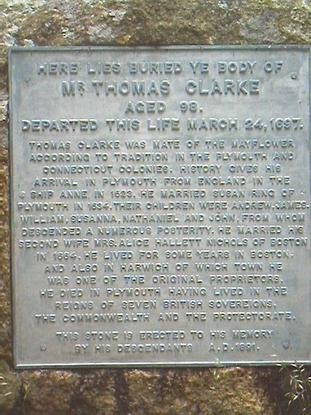
Thomas Clarke - Headstone - His gravestone on Burial Hill reads: "Here lies ye body of Mr. ThomasClark, aged 98 years. Departed this life March 24, 1697."t

Some sources state that he died  2 Dec 1674 in Newport, Rhode Island, but that appears to be a different Thomas Clark.

Susanna (also known as Susannah) was  born between 1605 and 1612 in Leiden, Holland. Her parents were William RING and Mary DURANT.   She immigrated in 1629 or 1630 to Plymouth with her widowed mother, a brother and a sister.  Susannah died sometime between 1645-46, after her last child was born, and 20 Jan 1664/5, the date when her husband entered into a pre-nuptual agreementwith Mrs. Alice (Hallett) Nichols.

He and his second wife, Alice Hallett, signed a pre-nuptial agreement on January 20, 1664. Alice was widow of Mordecai Nichols.

Children of Thomas and Susanna:    Estimates of the birth dates of these children vary widely.

Name Born Married Departed
1. William Clark ca. 1634
Plymouth
Sarah Wolcott
1 Mar 1659/60, Plymouth
.
Hannah Griswold
7 Mar 1677/78, Saybrook, CT
.
Abiah Wilder
3 Aug 1692, Plymouth
28 Mar 1720
Plymouth, Mass
2. James Clark ca. 1636 Abigail Lothrop
(Barnabas’ sister and daughter of Rev. John Lathrop)
7 Oct 1657
29 Feb 1711/12 Stratford, CT
3. John Clark ca. 1640 Rochester, Plymouth, Mass. Sarah Smith (daughter of Rev. Nehemiah SMITH )
by 1668
.
Mary Walker
19 Mar 1719
Old Lyme, New London, Connecticut
4. Susanna CLARK 28 Sep 1641
Plymouth
Barnabas LATHROP
13 Nov 1658
Barnstable, Mass
28 Sep 1697
Barnstable, Mass. Buried in Lothrop Hill.
5. Nathaniel Clark ca. 1642
Plymouth
Alice Halleton 1664
.
Dorothy (Lettice) Gray 1685/86.
31 JAN 1716/17 Plymouth
6. Andrew Clark ca. 1644
Plymouth
Mehitable Scottow
1671
Boston, Mass
1706
Harwich, Barnstable, Mass
? Thomas Clark ca. 1636 Rebecca Leonard

John Insley Coddington argued forcefully that Thomas Clark was the son of John Clark, pilot of the Mayflower, and that he was identical with the “Thomas son of John Clarke of Ratliff” who was baptized 8 March 1599/1600 at St. Dunstan’s, Stepney, Middlesex [TAG 42:201-02]. The hypothesis is very attractive, and was accepted by Jacobus [TAG 47:3], but remains underproven.

THOMAS CLARK was a common name in early New England. Between 1623-1680 there were no less than a dozen by that name in the towns of Plymouth, Boston, Lynn, Reading, Ipswich, Scituate, Chelmsford and Charlestown in Massachusetts, and in Newport, RI and New Haven, CT.  The Thomas Clark who heads the family in this Genealogical record arrived in Plymouth in July 1625 on the Ann, a ship of 140 tons. He was one of a company of 42 adults and several children.

Thomas Clarke - Portrait

In Plymouth and Boston records he was describe successively as carpenter, yeoman, merchant, and gentleman. In later years he was generally addressed as “Mr Thomas Clark” to indicate the respect in which he was held.

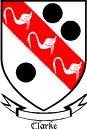
Thomas Clarke - Coat of Arms

In 1627 Thomas was the only person of that name in Plymouth Colony. In documents of the period he is called variously a carpenter, yeoman, merchant or gentleman.

1632 – He was taxed for […]

1633 – Took the freeman’s oath in Plymouth

1634 – Took on William Shuttle as an apprentice for 11 years..

1637 – Headed the list of volunteers to act against the Pequot Indians, being then mentioned as of Eel River.

4 Dec 1637 – A previous grant of sixty acres to him was confirmed and ordered to be laid out

1638 – Was presented to the Court for stopping the highway to Eel River

1639 – Fined 30 shillings for selling a pair of boots and spurs for 158 shillings that he bought for 10 shillings.

Jan 1639/40, as he had relinquished his grant of land at “the Whoop Place”, the court granted him 85 acres.

1640 – Included in the list of fifty-eight “purchasers or old comers” in Plymouth which included all those who came to Plymouth on the first three ships: the Mayflower in 1620, the Fortune in 1621, and the Ann in 1623.

1641-43-44-45-46-47 he was constable and surveyor of highways.

1643 – In the list of the men of the colony able to bear arms.

1644 – Had suits with Matthew Fuller and William Powell; won both

1650 – Was a member of the Committee of Plymouth Colony

1651 and 1655 – Representative to the general court, and was at one time employed to audit the accounts of the colony.

1652 – Was presented for staying and drinking at James Cole’s; acquitted

1654 – Was on a committee to raise means to fit out an expedition ordered by the Lord Protector

1655 – Was presented to the Court for taking 16 pounds for the use of 20 pounds for one year; acquitted.  Thomas evidently aspired to be a lawyer, prosecuting several cases in addition to bringing suits against a number of men who owed him money.

8 Jun 1655 – Deputy for Plymouth, as well as serving on numerous other committees.

Between 1655 and  his second marriage in 1664 – Removed to Boston, where he lived in the vicinity of Scotto’s Lane. His son Andrew married Mehitable, daughter of Thomas Scotto, and Thomas Clark gave him a house in that region. In a deposition made by him in Boston, 15 Dec 1664, he stated that he was late of Plymouth and then about 59 years old, thus understating his age by about four years.

When the son Andrew removed to Harwich Thomas Clark appears to have followed him, and the two were among the earliest proprietors of that town. In his latter days he lived with his daughter, Susanna Lothrop, at Barnstable.

From 1654 to 1697 he was a deacon of the Plymouth church.

In a deed executed 6 Oct 1668, Henry Kimball of Boston, blacksmith, [and our ancestor’s Richard KIMBALL’s son]  conveyed to Thomas Clark, sometime of New Plymouth, merchant, for 140 pounds, all his piece of ground lying near the lesser drawbridge near ShelterCreek in Boston.

In a deed of gift, dated 18 June 1673, Thomas Clark gave to his son Andrew a house and ground in Boston “that I received from the estateof John Nichols by virtue of a Judgement granted me March 5th 1672…”

As late as 14 May 1677 he was called “Thomas Clark of Boston, late of Plymouth, merchant.” Thomas Clark returned to Plymouth about 1678.

6 June 1693 – He provided for his children and grandchildren before his death by a deed of gift , in which he conveyed to “Andrew Clarke and to Mehitabel his wife during their natural lives the dwelling house and land on the westerly side of Satucket River[Harwich] where they live … upon their decease to become the property of Andrew Clarke, Scotto Clarke, and Nathaniel Clarke, equally … ” Thomas Clark, eldest son of Andrew, was excluded by reason of having been the recipient of the lion’s share of his grandfather’s estate (J. Paine, Hist of Harwich. 1937, p. 111).

30 Jan 1694/5, – Thomas deeded all his lands, goods and money to his son William and William’s wife Abiah for taking care of him (Plymouth Co Deeds 2:32).

Thomas Clark died in Plymouth in March 1697/98. A huge boulder was placed on this grave in 1893, and a metallicplate secured to it reads: “Here lies ye body of Mr. Thomas Clark, aged 98 years. Departed this life March 24, 1697.”

Children

1. William Clark

William’s first wife Sarah Wolcott was born 1638 – Plymouth. Her parents were John Wolcott and Winifred Crawford. Sarah was killed in an Indian attack 18 Mar 1676 in a garrison house by Eel river, Chiltonville Plymouth, Plymouth, Mass.

William’s second wife Hannah Griswold was born 11 Dec 1658 – Middlesex, Mass. Her parents were Lieut Francis Griswold and Mary Tracy. Hannah died 20 Feb 1687 – Plymouth, Plymouth, Mass.

William’s third wife Abiah Wilder was born in 1656 in Plymouth. Her parents were Edward Wilder and Elizabeth Eames. Abiah died 2 Nov 1725.

William’ s 1634 date of birth is based on his deposition 10 Aug 1671 that he was aged thirty-seven [TAG 47:4, citing SJCCase #1179]  William Clark’s Garrison Located on the Eel River near Chiltonville. Originally built in the 1660’s, it was destroyed during King Philip’s War (March 1676).

“He lived in a garrison house by Eel river, which was suprised by the Indians on a Sunday, March 18, 1676, while he was at church. His wife was killed in this attack, which is said to have been the only serious one ever made on the settlement.  His son,Thomas, was left for dead, but afterwards recovered, and had a silver plate put over his exposed brain, by the celebrated surgeon Dr. John Clarke, of Boston. He ever afterwards was known as ‘Silver-headed Tom.’ ”

July 1676 – Two hundred Indians surrendered themselves to the Plymouth Governor, and were pardoned, with the exception of those who had been concerned in the slaughter at Clarke’s garrison at Plymouth. These were put to death. — Baylie’s History. The Colony records give the names of these Indians, and state that they were decapitated.”

1670 – William Clarke and Edward Gray of Plymouth; Richard Bourne and William Swift of Sandwich; Thomas Hinkley and Thomas HUCKINS of Barnstable; Samuel Sturgis, of Yarmouth and John FREEMAN of Eastham, formed a company to engage and regulate the making and disposing of all the tar made in the colony, at the price of 8 shillings for every small barrel, and 12 shillings for every great barrel, during the full term of 2 years.”**

1679 – Joseph and Barnabas LOTHROP, of Barnstable; Kenelm Winslow of Marshfield; and William Clarke of Plymouth, as the agents of thirty partners, purchased for the sum of 200 pounds, the remainder of the lands not already granted, between Dartmouth on the West, Plymouth Purchase on the East and Middleboro’ and Plymouth on the North, ‘to be settled in four years with an Orthodox ministry’, these grants include present towns of Rochester and Marion —-Baylie’s History.”**

1684 – William Clarke hires the basse fishing at Cape Cod, of the the town of Plymouth, at 30 pounds a year. —Plymouth Records.”

1697 – He received a grant of land from the town of Plymouth where he was living in 1714.”

1682 – The Court have agreed with Mr. William Clarke of Plymouth to provide suitably for the Governor and Magistrates diet, lodging &c. in the County House at Plymouth for four courts, viz. October, March, June and July, and to pay him forty pounds in money for the same; if it shall happen that the General Court be adjourned, or special courts called within the time of the year, he is to be allowed for those Courts according to his just accounts.’ —Records.”

A Reinterpretation of the Attack on the Clark Garrison/ RM Site Plymouth, MA

“March 12 (1676). This Sabbath eleven Indians assaulted Mr. William Clarks House in Plymouth, killed his wife [Sarah Wolcott], who was the Daughter of a godly Father and Mother that came to New-England on the account of Religion, and she herself also a pious and prudent Woman: they also killed her suckling Childe, and knocked another Childe (who was about eight years old) in the head, supposing they had killed him . . .And whereas there was another Family besides his own, entertained in Mr. Clarks house, the Indians destroyed them all, root and branch, the Father and the Mother, and all the Children. So that eleven persons were murdered that day, and under one roof; after which they set the house on fire.” (Slotkin and Folsom 1978: 112).

William Clark and his family were the inhabitants of the Clark garrison house in 1676. William Clark was the oldest son of a very influential Boston importer, Thomas Clark. He was probably born around the middle 1630s. In the 1660s he married Sarah Wolcott, daughter of another very influential Boston family. Their children were James, John and Andrew. Clark held numerous positions in Plymouth town government such as surveyor and rater but who was William Clark and why was his house attacked?

The Plymouth Colony records are somewhat slim about actually coming out and explicitly stating who just about anyone was, but in Clarks case we can determine it with some certainty and the who is intimately connected with the why. Both William Clark and his father Thomas appear to have been opportunistic merchants. His father moved to Boston in 1655 where he married the daughter of a prominent upper class family. William, while not moving to Boston, also married the daughter of one of the most respected and well off families in Boston, the Wolcotts. It is known from later records that Clark had a warehouse in downtown Plymouth on Town Brook and was the highest rated merchant in town.

But, the warehouse in Plymouth center was not the only place where Clark stored goods. From the archaeological excavation of Clarks house, we can now state with reasonable confidence that he also either stored goods in his house at the Eel River, or most probably, he had another warehouse or trading house near his Eel River home. This, I believe, was the reason why Clarks house was targeted on March 12, because the Natives who attacked on Sunday had probably traded with Clark before at his house and knew that he had goods such as powder, shot and arms that they needed.

Excavations were carried out at the site in 1941, 1949, 1968, 1987 and 1995 but the 1940s excavations were the most revealing in terms of data recovered Dozens of features were uncovered spanning the entire Native to present day use of the knoll on which the site lies and thousands of artifacts were recovered. Unfortunately, while excellent notes, plans, profiles and photographs were taken, the true layout of the site has not been understood or appreciated until now. James Deetz identified the house as being of a longhouse form popular in certain parts of England, but what neither he, nor anyone else identified was the fact that the longhouse that he saw was a result of at least two successive building episodes at the site

The initial house built was a post-in-ground structure approximately 20 square and is evidenced by large corner and smaller intermediate posts. The expanded structure was 14 meters long and 6 meters wide with a 3 meter square cellar in the western half and a 2.5 meter wide hearth in the eastern half. A second post-in-ground structure has been identified to the east of the main house, paralleling it. This structure is at least 7 meters wide and continues beyond the area that has been excavated. A 3 meter wide hearth is located on the western end of this structure. A third structure possibly associated with the seventeenth century occupation is located 7 meters to the north of the first and is identified as being of post-in-ground construction. This building, which may have been a barn or other outbuilding is at least four meters wide and appears to extend to the north out of the area excavated.

The hypothesis that his house was attacked because it was used as a trading house is supported by the Plymouth Court records. In 1676 a certain Native woman had identified the warriors that had attacked the house and the court recorded that:

Keweenam . . . hee went to him (Tatoson) and certifyed him that hee had lately bin att the house of William Clarke, att the Eelriver, and that his house was slightly fortifyed, and that it was well furnished with nessesaries, and that his way would be to repaire thither now, and that on the Lords day, the folkes of the house being but three, the most of them would be gon to meeting, and they, being there, might descerne it; and incase they left a man att home or soe, they might soon dispatch him, and then they would mett with noe opposition. . . the said Tatoson went towards Plymouth, and on the morrow following, in the morning about 9 or ten of the clocke, hee with his companie did this cruwill villanie. . . . Keweenam . . .hee did not fully owne the said accusation, onely hee owned that hee was att William Clarkes house a little before the facte comitted, and in the company of Tatoson the day before . . . and had given him information of the weakness of the house, both with respect to fortification and men”(PCR 1676:205).

Before the house was attacked, the Natives who were to eventually attack it knew that it was not well fortified, that it contained a good store of material they needed, that there were not many people living there, and that on the Sabbath, there, theoretically should not be anyone there except perhaps a male guard whom they could quickly kill. The attack on Clarks house was not a random act of violence by a marauding band of Indians, as has been often claimed, it was, in fact, a well thought out attack that was done on Sunday with the expectation that their would be no one there to resist them that they would have to kill. It is truly amazing that this Keweenam had been to Clarks house the day before it was attacked. Obviously Clark knew the southeastern Massachusetts Natives, and was probably trading with them before and during the war.

Increase Mather, living in Boston and receiving his information at least second-hand, reported that “eleven persons were murdered that day” by 11 Natives, yet the Plymouth Colony records, the official records of this singular attack on Plymouth state that only one person, Sarah Clark, was killed ” Att the same time three other Indians appeered before the councell, whose names were Woodcocke, and Quannapawhan, and one called John Num; the two former were accused by an indian squa, that they were present and actors in that bloody murder of Mistris Sarah Clarke . . .” (PCR 1676:205). When all accusations were made final, 11 Natives men in all were accused and found guilty of the attack on the Clark house.

Why is there a discrepancy between what Increase Mather reported and what was reported by the Court? What was the real number of persons killed? I believe that it was only one or possibly two and not 11 and that Mather either intentionally or accidentally inflated the figure. But why would Mather do this, was it accidental or was there a more insidious reason behind it? In Increase Mathers mind, the attack on William Clark’s house was not a random act of violence, it was punishment from God on persons who were not strictly following the tenets of Puritanism, it was a sign for all to see, that this is what happens when the faith is neglected for the pleasures of the world.

Increase Mather did not hide his reasons for writing his history of King Philips War, on the contrary, he was very open about what the war meant to him, it was a sign sent by God to punish New Englanders for their fall from grace. Misunderstanding and misinterpretations of events that occurred during the war were reported throughout Mathers work. Richard Slotkin and James Folsom in their work, So Dreadful a Judgment, report that such misunderstandings were essential to the concept of history that Mather employed and advocated (Slotkin and James 1978:67).

Increase Mather felt that the actual persons fighting the war were inconsequential to the fact that God had caused the war to occur. To this end he sought messages from God in the battles and occurrences of the war and “. . . providential deaths and rescues, incidents in which peculiar ironies and coincidences are prominent, become central to the narrative.”  The result of this focus on any event, no matter how trivial, that shows how God had punished the Puritans for their fall from grace, had the intent of reinforcing Mathers main intention of writing the narrative which was “. . . to restore a religious world view, a God-centered consciousness of historical process, and a sense of mans powerlessness and absolute dependence on the will of an angry God.” (Slotkin and Folsom 1978:67).

With the preconceived notion that all actions of the war took place as a result of the Puritans sins and worldliness, how would Mather have reacted when he heard of the attack at William Clarks house? It has to be assumed that Mather would have known more about William Clark and Sarah Wolcott than he recorded in his writings. He must have known that Clark was a merchant and he did know that Sarah’s family had come to Massachusetts Bay for religious reasons. From informant intelligence or a reading of the Plymouth court records, he would have known that the Natives who attacked Clarks house on the Sabbath were probably on friendly or at least trading terms with him. For Mather the situation could have been summed up as follows: The house of William Clark, one, if not the, most prosperous merchant in Plymouth who had trading connections with Boston, was attacked on the Sabbath and a number of people who had not gone to the Sabbath meeting, including Sarah Wolcott (Clark), daughter of pious parents who had come to the New World on matters of religion, were killed by warring Natives. He may have also heard that the number of people involved was 11, but had not or did not care to make the distinction that the 11 persons involved were not 11 English who were killed but 11 Natives who attacked. I believe that the number of persons killed was inconsequential to Mather, the most important aspect of the attack, that aspect which reinforced his belief in a God sent war due to the colonists having strayed from Him, was that the persons killed were not at Sabbath meeting and that the most important one killed was Sarah Wolcott (Clark) the second generation of a pious religious family.

2. James Clark 

James’ wife Abigail Lothrop was born 2 Nov 1639 Barnstable Mass.  She was Barnabas’ sister and her parents were Rev. John LATHROP  and Anna HAMMOND.  Abigail died xx.

James brought suit  in 1668 for defamation against Sarah Barlow and Mary Bartlett for reporting’that they saw him kisse his mayd on the Lord’s day.’ They were fined ten shillings each. ”

“In 1671, he was one of the chosen to assess damages for injury done to the Indians by the horses and hogs of the English.”

3. John Clark

 John’s 1640 date of birth is based on his  31 October 1671 deposition that he was aged about thirty [TAG 47:4, citing SJCCase #1179]); m. by 1668 Sarah _____ (eldest child b. Boston 11 November 1668 [ BVR 107]; see further discussion on this John in TAG 43:19-26, 47:7, 49:143).

John’s first wife Sarah Smith was born about 1642 in Marshfield, Mass.  She was baptized in the First Church, New Haven, 14 Dec 1645 when about three years old. Her parents were our ancestors Rev. Nehemiah SMITH and Sarah Ann BOURNE.  Sarah died 25 JUL 1674 New Haven, CT.

John’s second wife Mary Walker was born 1641 in Fairfield, Fairfield, CT. Her parents were Robert Walker and Sarah [__?__]. Mary died 18 March 1711 in Stratfield, Fairfield, CT.

Child of John and Sarah.

i. Sarah Clark b. 4 Oct 1671 in New Haven, New Haven, CT; d. 17 Jun 1718 in New Haven, New Haven, CT; m. John Wilmot (1667 – 1731)

Children of John and Sarah:

ii. Daniel Clark b. 28 Jun 1677 in New Haven, New Haven, CT; d. 1743; m. Hannah Beecher (1679 – 1751)

4. Susanna CLARK (See Barnabas LATHROP‘s page)

5. Nathaniel Clark

Daniel’s first wife Alice Halleton 1664

Daniel’s second wife Dorothy Lettice was born in 1648 in Yorkshire England.  Her parents were Thomas Lettice and Anne Savoy.  She first married Edward Gray.  Dorothy died 30 Apr 1726 – Plymouth, Plymouth, Mass.

Nathaniel married Dorothy between July 1684 (when she entered an account of the estate of her deceased husband Edward Gray  and 4 June 1686 (when she sued Nathaniel Clark for divorce .  Dorothy (Lettice) Gray was the daughter of Thomas Lettice and widow of Edward Gray.

Nathaniel was an attorney-at-law, or as near to one as the conditions and exigencies of the times either permitted or required. He married Dorothy, the widow of Edward Gray, an enterprising and thrifty merchant, and daughter of Thomas Lettice, a respectable innkeeper, but had no children, and left no descendants. Soon after his election to the office of Secretary of Plymouth, Sir Edmund Andros arrived in the country commissioned by James II as Governor of New England. Under his administration the colonial government was superseded, and the office of secretary vacated. Andros declared all public lands vested in the crown, and ordered that all private titles should be quieted by his confirmation alone. The governments of the other colonies were also suspended, and the confederated union was dissolved. With popular dissatisfaction almost universal, Mr. Clark fastened himself to the royal Governor, and became one of his most subservient instruments and tools.

Nathaniel’s house was on the main street, the same that was afterwards occupied by Judge Thomas.

Andros made him a grant of Clark’s Island  which the people refused to confirm so he was never able to secure that property.   The island was named for his grandfather the “Mayflower’s” mate, John CLARK, who, in command of the shallop of the “Mayflower,” safely landed his boat’s company there on the 8th of November, 1620, and spent there the following Sabbath.  The State archives contain the following record:

“By hit Excellency.—Whereas, Mr. Nathaniel Clark, of Plymouth, hath by his petition desired that a certain small Island, called Clark’s Island, lying near New Plymouth, being vacant and unappropriated, may be granted to him for the better settlement and improvement thereof, of which notice hath been given already to tho said town, but no due return made nor any persons appeared thereon. These are, therefore, to require you forthwith to give public notice in the said town that if any person or persons have any claim or title to the said Island they appear before me, in Council, on tho 1st Wednesday in February next, and thon and there show forth such their claim and title accordingly, of which you are not to fail and to make due return. Dated at Boston 21 day of Dec., 1687. Andros. “To Mr. Samiel Sprague, High Sheriff of the County of Plymouth.

“By His Excellencies command.

“Tho above written was publicly read to the whole of the Town of Plymouth, aforesaid, at their Town-meeting the 23 day of January, 1687/88
“pr Sam’L Sprague, Sheriff.”

A later record contains the following:

“By virtue of a warrant from his Excellency, Sir Edmund Andros, Knight, Captain-General, and Governor-in-Chief of his Majesty’s territory and dominion of New England, bearing date Boston, the 23d of February, 1687, I have surveyed and laid out for Mr. Nathaniel Clark a certain small Island, being known by the name of Clark’s Island, and is situated and lying in New Plymouth Bay, bearing from the meeting-house in Plymouth north by northeast about three miles, and is bounded round with water and flats, and contains eighty-six acres and a quarter and three rods. Performed this 3rd day of March, 1687/8. Phillip Wells, Surveyor.”

But the town did not yield up the island to the usurper without resistance. A town-meeting was called and a committee chosen to take steps towards reclaiming the island, and to collect subscriptions to defray the expenses of the undertaking. The committee, together with Elder Faunce, the town clerk, and Ichabod Wiswell, were arrested for levying and aiding in levying taxes upon his Majesty’s subjects and bound over to the Supreme Court at Boston. The annoyances and vexations to which they were subjected only increased the spirit of resistance and strengthened the determination of the town to maintain its rights.

Before the matter was settled, however, news was received (on the 18th of April, 1689) of the landing of the Prince of Orange in England, and on the 29th William and Mary were proclaimed in Boston. Andros was arrested and sent to England, and Clark, as his most pliant coadjutor, was arrested also, and sent as his companion. At a town-meeting of the inhabitants the following declaration was made:

“Whereas, we have not only just grounds to suspect, but are well assured that Nathaniel Clark hath been a real enemy to the peace and prosperity of the people, and hath, by lying and false information to the late Governor, caused much trouble and damage to this place, endeavored to deprive us of our lands, and exposed us to the unjust severity of persons ill affected to us whereby a considerable part of our estates is unrighteously extorted from us, to the great prejudice of our families and the loss of many necessary comforts, and he persisting from time to time in his own malicious forging of complaints against one or another of us, whereby we are in continual hazard of many further great inconveniences and mischief, we do therefore seize upon his person, resolving to secure him for the hands of justice to deal with him according to his desert.”

On his arrival in England Clark was discharged and sent back, and on his return to Plymouth and his practice he built a house on the northeast corner of what is now the garden of Albert C. Chandler, where he lived until 1717, the year of his death. Clark’s Island was restored to the town, but soon after it was voted to sell the island, Saquish, the Gurnet, and Colchester Swamp to defray the expenses of its attempted recovery. In 1690 it was sold to Samuel Lucas, Elkanah Watson, and [our ancestor] Deacon George MORTON, and after a few years passed wholly into the hands of the Watson family, by whose various branches it is still owned.

Nathaniel was educated in the law office of Secretary Morton and was known as Counselor Clarke.   He was appointed Secretary of the Dominion of New England by Sir Edmund Andros after the death of Nathaniel Morton in 1685.

The Dominion of New England in America (1686–89) was an administrative union of English colonies in the New England region of North America. It initially consisted of the territories of the Massachusetts Bay, Connecticut, New Hampshire, and Rhode Island colonies, but was expanded to include New York and East and West Jersey in 1688.  The dominion was ultimately a failure because the area it encompassed was too large for a single governor to manage, and because its governor, Sir Edmund Andros, was highly unpopular, engaging in actions that offended significant stripes of the New England population.

On the arrival of Andros as Governor of New England, Nathaniel became one of the royal governor’s most willing and offensive tools.” During the Boston Revolt of 1689, Andros was arrested and sent to England. The dominion then effectively collapsed, as local authorities in each colony seized dominion representatives and reasserted their earlier power. In Plymouth dominion councilor Nathaniel Clark was arrested on April 22, and previous governor Thomas Hinckley was reinstated.   After his release by the King, Clarke returned to Plymouth, a favorite with the court of England and continued there in the practice of the law until his death.

The 1689 Boston revolt was a popular uprising on 18 April 1689 by Bostonians against the rule of the unpopular governor of the Dominion of New England, Sir Edmund Andros. A well-organized “mob” of provincial militia and citizens formed in the city, arresting dominion officials and adherents of the Church of England, who were suspected of being sympathetic to the dominion leaders. Leaders of the former Massachusetts Bay Colony then reclaimed control of Massachusetts, and leaders of other colonies forming the dominion also retook control of their governments.

Andros had been commission governor of New England in 1686, with instructions to harmonise colonial laws with those of England, and to ensure an organised common defence of the frontier with New France. His rule was extremely unpopular: he vacated land titles, promoted the hated Church of England in the Puritan colonies, restricted town meetings, and enforced the Navigation Acts, to the detriment of colonial trade.

After Andros’ arrival, the council began a long process of harmonizing laws across the dominion to conform more closely to English laws. This work was so time-consuming that Andros in March 1687 issued a proclamation stating that pre-existing laws would remain in effect until they were revised. Since Massachusetts had no pre-existing tax laws, a scheme of taxation was developed that would apply to the entire dominion. Developed by a committee of landowners, the first proposal derived its revenues from import duties, principally alcohol. After much debate, a different proposal was abruptly proposed and adopted, essentially reviving previous Massachusetts tax law.  These laws had been unpopular with farmers who felt the taxes on livestock were too high.  In order to bring in immediate revenue, Andros also received approval to increase the import duties on alcohol.

The first attempts to enforce the revenue laws were met by stiff resistance from a number of Massachusetts communities. Several towns refused to choose commissioners to assess the town population and estates, and officials from a number of them were consequently arrested and brought to Boston. Some were fined and released, while others were imprisoned until they promised to perform their duties. The leaders of Ipswich, who had been most vocal in their opposition to the law, were tried and convicted of misdemeanor offenses.

Plymouth’s relatively poor landowners were hard hit because of the high rates on livestock. Somewhat ironically, the Andros taxes were lower in Massachusetts than those of its previous administration, and of the ones that followed; however, its colonists grumbled more about those imposed by Andros.

One consequence of the tax protest was that Andros sought to restrict town meetings, since these were where that protest had begun. He therefore introduced a law that limited meetings to a single annual meeting, solely for the purpose of electing officials, and explicitly banning meetings at other times for any reason. This loss of local power was widely hated. Many protests were made that the town meeting and tax laws were violations of the Magna Carta, which guaranteed taxation by representatives of the people.  It’s ironic that those who made this complaint had, during the colonial charter, excluded large numbers of voters through the requirement of church membership, and then taxed them.

Massachusetts authorities sent agents to London in 1688 to protest his actions to King James II.

Bostonians seized Governor Andros during their brief revolt

The pro-Catholic James, however, was deposed in the 1688 Glorious Revolution, which brought the Protestant William and Mary to the throne. When word of this event reached Boston, Andros’ opponents conspired to bring about his downfall. Andros and others were imprisoned until February 1690, when they were returned to England for trial. The charges against Andros and other dominion leaders were dismissed, but William and Mary did not renew the idea of the dominion.

The dissolution of the dominion presented legal problems for both Massachusetts and Plymouth. Plymouth never had a royal charter, and that of Massachusetts had been legally vacated. As a result, the restored governments lacked legal foundations for their existence, an issue the political opponents of the leadership made it a point to raise. This was particularly problematic in Massachusetts, whose long frontier with New France, its defenders recalled in the aftermath of the revolt, was exposed to French and Indian raids with the outbreak in 1689 of King William’s War. The cost of colonial defense resulted in a heavy tax burden, and the war also made it difficult to rebuild the colony’s trade.

Agents for both colonies worked in England to rectify the charter issues, with Increase Mather petitioning the Lords of Trade for a restoration of the old Massachusetts charter. When King William was informed that this would result in a return of the hard-line Puritan government, he acted to prevent that from happening. Instead, the Lords of Trade decided to solve the issue by combining the two provinces. The resulting Province of Massachusetts Bay, whose charter was issued in 1691 and began operating in 1692 under governor Sir William Phips, combined the territories of those two provinces, along with the islands south of Cape Cod (Martha’s Vineyard, Nantucket, and the Elizabeth Islands).

Nathaniel Clark - Headstone

When he married Dorothy Lettice Gray (widow of Edward Gray, a rich merchant) they became owners of the whole main square of  the town of Plymouth, including the upper and lower lots, which were already the property of Nathanial Clarke.  However, their relationship was a rocky one. After much scandal, Dorothy left him, suing for divorce on the grounds of impotency on 4 Jun 1686. Afterwards, says James Thatcher, she returned to live with him. He died without any children on 31 Jan 1717 at age 74.

Nathaniel and his wife Dorothy were owners of the whole main square of the town of Plymouth

From “The Thomas Clarke Family…” by Radasch p.10:

“The divorce was not granted and a settlement was arranged. However, the record of her death in Plympton, 30 May 1728, age above 80, calls her the ‘divorced wife’ of Nathaniel Clark, Esq, and the second wife of Edward Gray of Plymouth.

From “Plymouth Church Records: Vol I, Part V p. 258”:

“July 25: The same day, inasmuch as there had bin a great fame, as if Mris Dorothy Clarke, (formerly Grey) a sister of the Church, had bin guilty of some breach of the Rule in the management of the differences, betwixt her and her now Husband, Nathaniel Clarke, the Elders having spoken with her & found her willing to attend the Rule, she then presenting us with a confession of her failing in words & then in writing, the Elders [t]hen brought the matter publickly before the Church, & read her confession, which she publickly owned to be hers, with which the church declared themselves to be well satisfyed: The Elder then speaking a few serious words to Nath: Clarke as a child of the church, he brake forth into a wicked passion & spake vile words, intimating , as if the church would cleare the guilty & condemne the inno\ent, abusing also Pauls words to the mariners, as if it were better & nearer to salvation to be out of such a church then in it etc which carriage & words of hiswere highly offensive, & soe declared by the Pastour to be, but at the present it was thought meete not further proceed upon.”

Offences of Dorothy Clark, 1689:

“July, 3: the church met after Lecture at the Pastors house, & after Prayer, the Elder propounded, that there were offences committed by Mris Dorothy Clarke, in full communion with us as also by Nathaniel Clarke & William Clarke, children of the church, which should be looked after; the church sent Deacon Faunce & Bro. Ephraim Morton Junior to call on Mris Clarke to come before us; before she came, the Pastor read a letter from Deborah Fish (whom the church [h]ad sent letters of Admonition unto the last yeare for her fornication) wherein she manifested her Repentance for her sin etc.
Mris Clarke being come, the Elder declared her offences, 1: In particular her violent carriage to a child of the Pastors, full evidences of which was presented to the church: 2:her Joyning with & encouraging her husband to get Clarks Island from the towne & at last setting her hand to the sale of it: she was called to speake, & a Narrative of her carriage to the child, & in divers words & carriages showed an evill frame of spirit; the issue was, many bretheren exprest their dissatisfaction at her, & the Elder summed up her offence, in these things, viz that she was in a passion, when [s]he pulled the lad out of the tree with her hand, & then threw him over the fence; that she ought first to have told the mother of her childs fault in getting up the tree & not have toucht him herselfe; that there was violence appeared in her carriage to the child; these things she ought to confesse her evill in, to which was added by some of the Church, too much appearence of untruths in the words in that she said “she tooke the lad gently downe from the tree & he came downe upon his feete”, whereas the evidence did positively assert, the child fell flat upon the ground by her pulling him by the leg: another was that she told Mr. Arnold that Mris Cotton had by putting a key into Josiah’s mouth caused his bleeding, whereas she used noe such meanes; Mris Clarke also in her speech before the church did say, she had heard Mris Cotton did put a key into the childs mouth, by a credible person, but would not, though much urged by divers bretheren to it, mention her Author, but presently said she must study who it was & would speake with them first to see if they woule owne it, which gave vehement ground of suspition she therein spake untruly; for these things & her offensive carriage about the Island, it was solemnly declared to her, that the church was offended with her & she should prepare by Repentance to give them satisfaction, & was then ordered to withdraw: the church then sent Bro: Jos: Dunhan & Bro: Ele. Churchel to call Nathaniel Clarke to come to them, the bretheren returned with this answer from him namely, “that he would not come, he had nothing to say to us, nor would have any thing to doe with us”: upon which the Pastor declaring to the church sundry of his scandalous wicked words & practises, & that now he had practically disowned his relation to the church, the church then unanimously agreed in choosing Bro: Harlow and Bro: Bonum to goe to Nath: Clarke & tell him, that the church did require him in the Name of Christ to attend them in the publick assembly by the next Sabbath in the afternoone, his answer to them was “he should not come, for he could not speake, because he was under bonds”. this meeting was with much peace & comfortable unity in the whole church & was concluded with Prayer.” –Plymouth Church Records, Vol I pp265-266.

“May 25 (1690): After the blessing the Elders stayed the church, & called forth sister Dorothy Clarke to give publick satisfaction to the church for which she was left under Admonition, she then manifested her Repentence, in confession of sin, selfe-Judging, desiring Pardon of God, his church, the Pastor & his wife; the Bretheren generally exprest their acceptance & pardon of her; & that being alleadged, that she acted irregularly in offering last sacrament day to speake to the church, the Elders knowing nothing of it before, this also she confest her fault in, & the church formgave her & were dismissed with prayer by the Elder.” — Plymouth Church Records, Vol. I p. 269.

6. Andrew Clark

Andrew’s wife Mehitable Scottow was born in 1648. Her parents were Thomas Scotto and Joan Sandford. Mehitable died 24 Apr 1712 – Brewster, Barnstable, Mass.

Andrew’s 1644 date of birth is base on his  31 October 1671 deposition that he was aged about twenty-five [TAG 47:4, citing SJC Case #1179]);  His 1671 marriage date to Mehitable Scottow is based on the birth of his eldest child on  10 July 1672 in Boston [BVR122]; son Scotto Clark b. 1680 [ MF 3:37]).

In a deed of gift, dated 18 June 1673, Thomas Clark gave to his son Andrew a house and ground in Boston “that I received from the estate of John Nichols by virtue of a Judgement granted me March 5th 1672…”

Andrew lived in Scotto’s Lane where his father bought him a house, and he carried on the shoe business. He was an assistant counsellor, and several times representative to the General Court. Finally he removed to Harwich, of which town he and his father were among the original proprietors in 1694. He died there in 1706.

The family of Scotto, or Scottow as it is sometimes written, was of some note in the early history of Boston. They came from Norwich, Norfolk County, England, and were cabinet-makers by trade. The family consisited of the widow Thomasine Scotto, and her two sons- Thomas, born 1612; and Joshua, born 1615. She was admitted to the First Church in 1634, her sons in 1639. Thomas Scotto had a house and garden in School Street, which he sold in 1645 for 55 pounds. It joined the Burying Place on the East, and seems to have included the same property which his gr-gr- grandson Samuel Clarke owned and occupied 133 years after, which estate remained in the family till about 1825, when it was sold to the city by Dr. Samuel Clarke, and now forms part of the City Hall Square.

Sources:

http://familytreemaker.genealogy.com/users/b/a/i/Susan-C-Bailey/GENE1-0001.html

http://reocities.com/jescalise/genealogy/clarkl.html

http://www.genealogyofnewengland.com/b_c.htm

http://www.conovergenealogy.com/ancestor-p/p178.htm

http://sciway3.net/clark/clark/thomasclarkeplymouth.htm

http://xpda.com/family/default.htm?page=Clark-Thomas-ind00641.htm

History of the town of Plymouth: with a sketch of the origin and growth of … By William Thomas Davis

Genealogy of the Descendants of Thomas Clark of Plymouth, 1623by Arthur and Katharine Warner Radasch, 1972.pq

Handbook of Old Burial Hill, Plymouth, Massachusetts, Its History, Its Famous Dead and Its Qvaint Epitaphs by Frank H. Perkins

http://plymoutharch.tripod.com/id16.html

http://www-personal.umich.edu/~bobwolfe/gen/pn/p6675.htm

http://trees.ancestry.com/tree/1508732/person/-457097504/story/345848d2-0286-4ef6-a35d-2fd0762eea00?src=search

Posted in 12th Generation, 90+, Artistic Representation, First Comer, Historical Church, Historical Monument, Immigrant - England, Line - Shaw, Public Office, Storied, Veteran, Violent Death | Tagged , , , , , , , | 22 Comments

Capt Thomas Bayes

Thomas BAYES (ca. 1615 – 1680) was Alex’s 10th Great Grandfather; one of 2,048 in this generation of the Shaw line.

Bayes Coat of Arms

Thomas Bayes was born in 1615 in Norfolk or  Dedham in Essex, England. (His testimony given in June 1679 states his age as 64.)   Thomas  first appeared in this country in 1636, when he signed  (Wikipedia shows his name on the list) the Dedham, Mass. town Covenant  (Here’s a link to the document)   In Dedham, he became a selectman and married Anna BAKER on 25 Dec 1639 .  He moved to Boston around 1645 and to Edgartown, Martha’s Vineyard as early as 1652 where he lived for the rest of his life. Thomas died between his 14 Feb 1680 will and the 31  May 1680 inventory of his estate.

The surname of BAYES was a locational name ‘the dweller at the outer wall of a feudal castle’.

Anna Baker was born in 1617 in England. Her parents were Alexander BAKER and Frances G. PENDLETON.  Anna died in Edgarstown, Mass.

Children of Thomas and Anna

Name Born Married Departed
1. Anna Bayes 1642 in Dedham, Norfolk, Mass 1655
Prob in Boston
2. Ruth BAYES 2 Jul 1643 Dedham Isaac NORTON
1663
Edgartown
1690 Martha’s Vineyard
3. Thomas Bayes 1640 in Dedham 1644 in Dedham
4. Hannah Bayes 1644 in Dedham Before 1653
5. Thomas Bayes 14 Mar 1646
Boston
Anna Baker 17 Nov 1669
Edgartown
6. Abigail Bayes 1648
Boston
Probably not Hackaliah Bridges (See below)
.
Timothy Batt
1671
Boston
1678
7. Joseph Bayes 1650
Dedham
8. Isaac Bayes 1652
Dedham
1690
Edgartown
9. Hannah Bayes ca. 1653
Boston
Samuel Bridge
1671
Boston
1678
Boston
10. Mary Bayes 1654
Edgartown, Mass
Joseph Norton
(Isaac’s brother and son of Nicholas NORTON)
1673
1696
11. Anna Bayes 1658 Edgartown Lt. Andrew NEWCOMB (his second marriage)
1676 Edgartown
Sep 1731 Edgartown

In 1635 there were rumors in the Massachusetts Bay Colony that a war with the local Indians was impending and a fear arose that the few, small, coastal communities that existed were in danger of attack. This, in addition to the belief that the few towns that did exist were too close together, prompted the Massachusetts General Court to establish two new inland communities. The towns of Dedham and Concord, Massachusetts were thus established to relieve the growing population pressure and to place communities between the larger, more established coastal towns and the Indians further west.

Dedham Town Seal

The grant from the colony gave them over “two hundred square miles of virgin wilderness, complete with lakes, hills, forests, meadows, Indians, and a seemingly endless supply of rocks and wolves. Aside from “several score Indians, who were quickly persuaded to relinquish their claims for a small sum, the area was free of human habitation. The original grant stretched from the border of Boston to the Rhode Island border.

Thomas arrived in  the summer of 1636 when Dedham was settled by “about thirty families excised from the broad ranks of the English middle classes” traveling up the Charles River from Roxbury and Watertown traveling in rough canoes carved from felled trees.These original settlers paddled up the narrow, deeply flowing stream impatiently turning curve after curve around Nonantum until, emerging from the tall forest into the open, they saw in the sunset glow a golden river twisting back and forth through broad, rich meadows

The first public meeting of the plantation they called Contentment was held on August 18, 1636 and the town covenant was signed; eventually 125 men (including Thomas) would ascribe their names to the document. As the Covenant stipulated that “for the better manifestation of our true resolution herein, every man so received into the town is to subscribe hereunto his name, thereby obliging both himself and his successors after him forever.” They swore that they would

“in the fear and reverence of our Almighty God, mutually and severally promise amongst ourselves and each to profess and practice one truth according to that most perfect rule, the foundation whereof is ever lasting love.”

They also agreed that “we shall by all means labor to keep off from us all such as are contrary minded, and receive only such unto us as may be probably of one heart with us, [and such] as that we either know or may well and truly be informed to walk in a peacable conversation with all meekness of spirit, [this] for the edification of each other in the knowledge and faith of the Lord Jesus…” Before a man could join the community he underwent a public inquisition to determine his suitability. Every signer of the Covenant was required to tell all he knew of the other men and if a lie was uncovered the man who spoke it would be instantly excluded from town.

The covenant also stipulated that if differences were to arise between townsmen that they would submit the issue to between one and four other members of the town for resolution,

“eschew[ing] all appeals to law and submit[ting] all disputes between them to arbitration. The commitment in the Covenant to allow only like-minded individuals to live within the town explains why “church records show no instances of dissension, Quaker or Baptist expulsions, or witchcraft persecutions.”

They also agreed to pay their fair share for the common good.

Thomas was in trouble in 1643 for “mutinous and turbulent  speeches” and “offensive speeches”

Thomas was the Miles Standish of the Vineyard. He was a carpenter, possibly a ship carpenter. He was a proprietor at Great Harbor as early as 1652. In 1655 he was made a Constable. In 1656 he was selected as leader of the train band. This office he also held in 1661, 1662, and 1663. The last office he held was Selectman, in 1676.

Thomas made a will on 14 February 1679/80. Names “my wife Ann Bayes,” “Hannah Bridges, my daughter,” “my two daughters Mary, the wife of Joseph Norton and Anna, the wife of Andrew Newcomb,” “their brother deceased,” “my daughter Ruth wife of Isaack Norton,” “the children of my daughter Abigail, deceased,” “my wife and Thomas Mayhew.”

Thomas Mayhew was the self styled Governor of Martha’s Vineyard.

Children

2. Ruth BAYES (See Isaac NORTON page)

5. Thomas Bayes

Thomas’ wife Anna Baker was born 1642 in Edgartown, Marthas Vineyard, Mass. Anna died Sep 1731 in Edgartown, Marthas Vineyard, Mass

6. Abigail Bayes

Some sources say Abigail’s first husband was Hackaliah Bridges, but this marriage probably didn’t happen.  Hackaliah  was born about 1638  in Andover, Essex, Mass. His parents were Edmund Bridges (1612 – 1684) and Elizabeth Manwaring (1612 – 1664). Most genealogies say Hackoliah died Feb 1671/72 in Martha’s Vineyard, Dukes, Mass, some giving the more specific date of 18 Feb, but he actually drowned 23 Nov 1671.  18 Feb 1672 was when administration of his estate was granted to his brother Obidiah who was to bring in an inventory.

Hackaliah ‘s father Edmund Bridges came to New England in 1635 on the “James.” He first resided in Lynn, then removed to Rowley by 1641, Ipswich by 1660, Salem by 1670, and Ipswich by 1684. He was a blacksmith. His will, dated 6 Jan 1684/85 was proved 31 Mar 1685

Hackaliah got into a lot of trouble.  He was fined for running away from his father and later got two unmarried women pregnant all before he was twenty years old. In one court case he was sued for defamation, in another for debt.

Hackaliah Bridges, accused by Sarah ffrench of his getting her with child, bound over, being brought by Sergent ffrench, was discharged

Hackaliah Bridges fined or to be whipped for lying, and to pay Josias Hubbard for his gloves. [John Younglove and Samuel Belcher deposed that he inquired of Hackiliah Bridges one night that week concerning a pair of gloves with black fringes, which Nehemiah Jewett took from Edmund Bridges, laying claim unto in his brother Josiah Hubbard’s name, and Hackiliah said that he bought them of John Smith of Rowley for two shillings. Sworn in Ipswich court April 9, 1657.

Edmond Bridges, for fornication, etc., to be severely whipped and bound to good behavior. Mary Browne, for suffering it, to stand by and see him whipped.

[Samuel Younglove, aged twenty years, testified that Edmond Bridges was mowing with him, and Bridges told him all his undue relations with Mary Brown* and Mary Quilter, and John Allen Mary Browne ; and he had been persuad-ing Thomas G it tins and others, etc. Sworn to in Ipswich court 29 : 7 : 165 ‘■

Simon Stacey deposed that he met Bridges on lecture day, and asked Bridges if he had heard of the story around town of him (Bridges) and two wenches. I said, No. He said he told Samuel Younglove about it, and the simple went and told Thomas Fowlar. Bridges confessed it in court.

John Allen deposed that he saw Edward Bridges at Mr. Hubbard’s house two or three times this summer ; and saw his unseemly carriage toward Mary Browne; etc.

—Fiks.-]

Hackaliah Bridges to be severely whipped for fornication ; to give bond of good behavior and to secure the town about bringing up the child.

Mary Quilter to be severely whipped for fornication.

[John How deposed that last Michaelmass, going over the new bridge he overtook Hackaliah Bridges, who asked him to go with him (Bridges) to Mr. Rogers, where he said he had a wench, Mary Quilter, and boasted of his relations with her. I went with him as far as William Avrey. Then I parted to my uncle Danes, and he went to Mr. Rogers. I spoke to him of this business in the prison, and he bid me hold my peace, for he had resolved to deny it, and knew they could not whip him, unless they could prove it, or I confess. Sworn in Ipswich court 29 : 7 : 1657. — Files.’]

Edmond Bridges bound to good behavior, especially towards Mary Quilter.

Ordered that such as were bound to secure the town from any charges of Hackaliah Bridges’ child by Mary Quilter, pay two-fifths of what they subscribed in the bond unto the widow Quilter at or before February 1st next and they should be discharged of their bond, and those who did not should be liable to pay the whole amount.

Mar 1668 Ipswich Court
Mr. Wm. Patteson v. Edmond Bridges. Debt. Verdict for plaintiff.

John How v. Mr. William Pateson. Defamation. Verdict for plaintiff.

Mr. Wm. Pateson v. Anthony Carrell. Defamation. Verdict for defendant.*

*Writ: Mr. William Patteeson v. Anthony Carrill; defamation; for reporting that he heard Hackaliah Bridges say at Mr. Baker’s that he heard it spoken at Edward Dear’s house that plaintiff stole from his master in Barbadoes fifteen hundred pounds, and further reported that Ed. Deare’s wife replied “I doubt Hacaliah is mistaken for the marchent himself did owne he stole five hundred pounds from his master;” dated, Jan. 27, 1667; signed by Robert Lord,f for the court; and served by Robert Lord.f marshal, by attachment of farm and house of defendant, and, not giving security, he committed him to prison.

William Norton deposed that he heard Anthony Caryll own Mr. Patersen’s charge against him etc. John Edwards deposed the same. Sworn in court.

Mr. Patteeson’s bill of costs, 21i. 6s. 8d.

Edmond Bridges, Hachaliah Bridges and Daniel Blacke deposed that Mr. Pattarson agreed to acquit Hachaliah Bridges if the other two deponents would testify that Anthony Carall reported the story. Sworn in court.

Robert Lord, jr., deposed that being in Mr. Patterson’s chamber with Mr. Norton and Anthony Carroll, etc. Sworn in court.

Andrew Petters and Robert Lord, jr., deposed that having occasion to be in Topsfeild, they met Hackaleah Bridges riding near the meeting house, and asked him why he allowed the poor man to lie in prison for words which he spoke himself and he replied that he went to Patteeson’s chamber, etc. Sworn in court.

Jonathan Ransford, aged thirty odd years, deposed that he, being in Barbadus some years before at a great sessions, saw William Patterson stand at the bar, and upon inquiry what it was for, was told that it was for persuading Mr. Jno. Bawden’s man to let him have some of his master’s sugar to carry along with him in partnership. And after the jury had brought in their verdict, deponent saw said Petterson standing in a place called the “bale dock,” and inquiring how he got clear, they told him by a fine of some thousand of sugar. Sworn, Mar. 19, 1667-8, before Jno. Leverett,t assistant.

Sep 1670 Ipswich Court
Frances Wainwright v. Hackaliah Bridges. Debt. Verdict for plaintiff.*
Writ, dated Sept, 19, 1670, signed by Robert Lord, for the court, and served by Robert Lord, marshal of Ipswich, by attachment of a debt in the hands of Robert Dutch due to Hackaliah Breges.

Bill of cost against Hakoliah Bridges of Salem, 18s. 2d.
Hackoliah Bridges, Dr., 6:9: 1667: To Brandy 1 gallon, 8s., the balance of yor. former accot., 8s.; July 12, 1669, to 8 1-2 yds. dowlis at 4s. 6d., Hi. 18s. 3d.; to a parsell Cambricke, 6s. 3d.; thrid, 2d.; 3 1-2 yds. of oszinbrigs at 2s., 7s.; Aug. 5, 1669, to 1 Guilt Bible, 10s. 6d.; 1 1-2 yd. slezy hollond at 4s., 6s.; total, 31i. 16s. 2d. This account Bridgis promised to pay to
Stephen Haskit of Salem. [Note: is a parsell Cambricke bricks? what are oszinbrigs? and what the heck is one and a half yards of slezy hollond?? These spelling are exactly as they were published by the Essex Institute in 1914]

Stephen Haskit of Salem deposed that he went with Francis Wainwright to Hackoliah Bridges and he promised to pay him above three pounds, etc. Sworn, Sept. 28, 1670, before Daniel Denison.J

Thomas Booen, aged about forty-seven years, deposed that he heard Frances Wandret, on Sept. 15, 1670, ask Hachahah Bridges for a note to Goodman Duch for a parcel of fish which he was informed was in said Duches hand. Said Bridges replied that the fish was none of his for it was already engaged but he would pay him in brick. Wandret said he would take anything and told him not to meddle with the fish. Sworn by Bowen and his daughter Ruth, 23 : 7 : 1670, before Wm. Hathorne, assistant.
The History of Martha’s Vineyard by Dr. Charles Banks:Volume III Family Genealogies: pp. 41-45 Compiled by Dr. Charles Banks, c. 1925.

HACKOLIAH BRIDGES, previously of Ipswich, was a resident of the Vineyard and was drowned “att the Gay Head” 23 Nov 1671. His estate was administered by Richard Sarson.

Hackaliah Bridges bio - Great Migration Study Project - NEGHS 1999

Hackaliah Bridges bio – Great Migration Study Project – NEGHS 1999

He is the only Hackaliah I have encountered. Hachaliah was the father of Nehemiah, the author of the Book of Nehemiah, which is a book of the Hebrew Bible, known to Jews as the Tanakh and to Christians as the Old Testament. Hachaliah’s name is mentioned at the beginning of the book. Hachaliah distinguishes Nehemiah from others with the same name. Little is known about his status; his name means: ‘whom Jehovah enlightens

Abigail’s second husband Timothy Batt was born 1645 in Salisbury, Mass. His parents were Christopher Batt (1601 – 1661) and Ann Baynton (1602 – 1679). Timothy’s parents were baptized and married in St. Edmonds, Salisbury, Wiltshire. They immigrated on the Bevis from Southampton in May 1638. Christopher was a merchant in Boston. Timothy died Jan 1678/79 or about 1697 in Boston, Suffolk, Mass

In January, 1671/72, Timothy Bait’s name is mentioned in connection with the settlement of the estate of Hackoliah Bridges who was drowned at Gay Head.

Timothy was a tailor in Boston.

Children of Abigail and Timothy

i. Timothy Batts b. 20 Apr 1672 in Boston; d. 1711; m. 3 Aug 1699 Boston to Sarah Tedman (b. 1680 in Boston – d. 3 Nov 1716 in Reading, Middlesex, Mass.) Timothy Jr and Sarah had at least one child John (b. 1702)

Timothy Jr. was a cordwainer.

vol. 1, page 227, of the Land Records of Dukes County, under date of March 16, 1696-7, Timothy Batt, of Boston, cordwalner, son of Timothy Batt, of Boston, lately deceased, gives power of attorney to Mr. James Breading, of South Hampton, N. V., names “my father’s estate” and “the legacy that was left me by my grandmother Bayes, of Martha’s Vineyard, deceased.”

ii. Barnabas Batt b. 14 Apr 1673 Boston

iii. Ebenezer Batt b. 14 Dec 1678 Boston; d. 16 Aug 1685 – Newbury, Essex, Mass.

9. Hannah Bayes

Hannah’s husband Samuel Bridge was born 25 Mar 1647, bapt. 19 Jun 1647 in Charlestown, Suffolk, Mass. His parents were William Bridge (1615 – ) and Persis Pierce (1625 – 1683). After Hannah died, he married Christian Stoddard (1647 – 1717) Samuel died 29 Nov 1717 in Boston, Suffolk, Mass

Samuel was a carpenter. He was admitted freeman in Boston in 1672. Between 1673 and 1701, he was elected or appointed to town office during 14 years; also being a member of Capt. Hill’s (1677) company, he was chosen a thithing man in 1686, served on special committees; the last service being in 1718 to inspect the town in regard to the observance of the by-law for keeping ladders at each house.

Samuel’s will ( Suffolk Wills, Vol. XX, folio 123 ) mentions five daughters and two sons. The latter Benjamin and Ebenezer Bridge joined the Artillery Co. in 1711 and 1717 respectfully”. The will dated Nov. 29, 1717 names a grandson, William Bridge and four sons: Benjamin Bridge, Ebenezer Bridge, Samuel Torry and Arasmus Stephens. (Of course the last two are son-in-laws) “In Vol. XX, p. 326 appears inventory of estate of Samuel Bridge, late of Boston, totals 2461 pounds.”

Children of Samuel and Hannah:

i. Samuel Bridge Jr. 1672 –

ii. Hannah Bridge 1673 – 1690

iii. Ellen Bridge 1677 –

iv. William Bridge 1679 – 1699

v. Abigail Bridge 1681 – 1742

vi. Persis Bridge 1683 – 1739

vii. Benjamin Bridge 1684 – 1739

viii. Ebenezer Bridge Sr 1687 – 1753

ix. John Bridge 1689 – 1690

10. Mary Bayes

Mary’s husband Joseph Norton was born MAR 1650/51 Weymouth.  His parents were Nicholas NORTON and Elizabeth ISAAC.  After Mary died, he married Ann Trapp in 1702.  Joseph died 30 JAN 1741/42 in Martha’s Vineyard.

11. Anna Bayes (See Andrew NEWCOMB Jr.‘s page)

Sources:

http://capecodhistory.us/genealogy/us/i10.htm#i13104
http://familytreemaker.genealogy.com/users/r/i/c/Stanton-G-Richards/FAMO2-0001/d38.htm#P3508

http://genealogy.drnewcomb.ftml.net/b26.htm#P5758

http://cdm.reed.edu/cdm4/item_viewer.php?CISOROOT=/colhist&CISOPTR=109&CISOBOX=1&REC=5

http://trees.ancestry.com/owt/person.aspx?pid=12812160

Posted in 12th Generation, Dissenter, Immigrant - England, Line - Shaw, Pioneer, Public Office, Veteran | Tagged , | 13 Comments

Nicholas Norton

Nicholas NORTON (ca. 1610 – 1690) was Alex’s 10th Great Grandfather; one of 2,048 in this generation of the Shaw line.  He was also Alex’s 9th Great Grandfather, one of 1,024 in that generation of the Miller line.  The two lines didn’t come together for 350 years until I was born in 1959!

Nicholas Norton – Coat of Arms

Nicholas Norton was born about 1610 in Broadway, Somerset, England.  His parents were Nicholas NORTON Sr. and [__?__]. He emigrated to America in 1635, probably coming with the party of colonists accompanying Rev. John Hull.  On the ship “Hopewell” which left England in Sept 1635 was: Norton William 25 – Sworn August 29, 1635.

He probably came with the party of colonists accompanying Rev. John Hull.  (See my article The Hull Company.)  He  married Elizabeth ISAAC in 1637 in Weymouth, Mass.  Nicholas died in 1690 in Edgartown, Dukes, Mass.

16thC Tudor Houses, Broadway, Somerset

Elizabeth Isaac was born about 1617 in Weymouth, Dorset,  England.  Her parents were Joseph ISAAC and Elizabeth [__?__]. Elizabeth died about 1690 in Edgartown, Mass.

Children of Nicholas and Elizabeth:

Name Born Married Departed
1. Isaac NORTON 2 May 1641 Weymouth, Mass. Ruth BAYES
1663
Martha’s Vineyard, Mass
1723
Edgartown, Mass
2. Jacob Norton 1 MAR 1642/43 Weymouth Elizabeth [___?__] After 1691
Martha’s Vineyard
3. Elizabeth Norton ca. 1646
Weymouth
James Pease
22 Apr 1706 Edgartown
1695
Edgartown
4. Joseph Norton MAR 1650/51 Weymouth Mary Bayes
1673 Edgartown
.
Ann Trapp
1702
30 JAN 1741/42 Martha’s Vineyard
5. Sarah Norton 1653
Weymouth
John Stanbridge
1673
Edgartown,
1723
Edgartown
6. Priscilla Norton 1655 Edgartown John Butler
4 OCT 1665 Edgartown
1738 Great Neck, Dukes, Mass
7. Hannah NORTON ca. 1657 Edgartown Augustine WILLIAMS
c. 1673
Stonington, CT
.
John Brown
c. 1699
1709 Lebanon, CT
8. Ruth  Norton 1657 Edgartown Moses Cleveland
4 OCT 1676 Woburn, Mass.
9. Benjamin Norton 1659 Edgartown Hannah Bolter
ca. 1684
1733 Edgartown
10. Esther Norton 1662 Edgartown Samuel Huxford
ca. 1683 Edgartown
.
Jonathan Dunham
APR 1724 Edgartown
11. Mary Norton ca. 1666
Edgartown
Thomas Woolen
1686
Edgartown
1734
Edgartown

English Origins
There is a will of Robert Norton of Wells, Somersetshire, dated Sept. 29, 1590 who mentions his nephew Nicholas. (17, St. Barbe.) This is too early for our settler, but may be a clue to the family. It will probably be found upon investigation that he emigrated from Somersetshire, and perhaps came from the vicinity of Batcombe or Broadway in that county, and there is some reason for inferring that he was one of the party of colonists accompanying the Rev. John Hull in 1635 to New England.  Rev. Mr. Hull brought twenty families from the vicinity of Batcombe and Broadway, and in 1639 Nicholas Norton had some business dealings with one Standerwyck, a clothier of Broadway in the County of Somerset. In 1640 he had a suit at law with Parson Hull.]

1637 – Some sources state that Nicholas was a veteran of the Pequot War.

1637 – Nicholas first appears at Weymouth, Mass., where he married his wife Elizabeth, and in which place he maintained a residence for twenty years prior to his removal to the Vineyard.

1651 – Shared in the division of lands in Weymouth

1657 – Constable in Weymouth

1658 – That he was of a social station somewhat above the average appears from the fact that he kept a servant, whose “miscariages” brought the subject of this sketch into trouble with the magistrates of Massachusetts. The following petition explains the case as related by Nicholas Norton himself to the General Court.  The Court granted his petition providing he should bring his servant to bar.

To the Honord Genll Court now assembled the Petition of Nicholas Norton humbly Sheweth

That whereas yor poore peti’or stood engaged to the Treasurer in the sume of five pounds to bring in his servant to a County Court held at Boston to give answer for sume miscariages Comitted, which accordingly he did, at which Court yor poore peti’ors servant was also pr’sented by the grand-Jury either for the same or for some other offenses, the Court was then pleased, to deferre the Issue of the Case, & to require the Coutynuatio of the sd bond of yor poore peti’or, where upon he did agayne engage himselfe in the foresd sume to bring in his sd servant to the last Court of assistants, but in regard he was under a pr’sentment, expected to have him sent for by warrens & that wittnesses should also have bin sent for to prove the same as is usueall in case of pr’sentments, where upon vor poore peti’r, through Ignorance of the manner of Courts p’ceedinges in such Cases hath forfeited his foresd bond.
Now although yor peti’r cannot blame any but himselfe, vet is bold to Crave the favour of this Honrd Court, that the forfeiture may not be required of yor poore peti’r, but short you would be pleased (out of yr woonted tendernes in offenses which p’ceed meerely out of Ignorance, to remits the same or so much of it as in yr wisdome you shall thinke meet, hopeing you will the rather be moved hereunto considering the great loss yor poore peter hath sustayned in the service of the Country in Collecting of the Country rate which he hopes is vet in yor mynds, & that the delinquent is ready when required suffer the Just sentence of the Court according to the merritt of his offenses, which if the Lord move yr harts to grannt it will abundantly engage yr poore pet’r ever to pray. [Mass. Archives, XXXIX, 39.]

Nicholas Norton – Signature

1659 – While  still called “of Weymouth,” Nicholas’ name first appears in the records of Edgartown, a town located on Martha’s Vineyard.  Edgartown was first settled by the English in 1642. Rev. Thomas Mayhew, Jr. led a group of families to start a colony on the island after its purchase by his father.  Edgartown is famous for being the site of Chappaquiddick and its population was 3,779 at the 2000 census. Nicholas was chosen a referee to represent the town in its controversy with John Daggett respecting his farm at Oak Bluffs.

Nicholas Norton was one of the first share holders of Martha’s Vineyard – On Aug. 22, 1659 “Goodman” Norton was granted “a Lott of forty acres of Land”  located north of the Great Swamp and south of the present road to West Tilsbury. He also owned land at Sanchacantackett in the vicinity of Major’s Cove where his descendants lived for two centuries, and he owned a plot of meadow land at Aquampache.

22 Aug 1659, “Goodman” Norton was granted “a Lott of forty acres of Land” and on the same day it was” ordered by the town that Goodman Norton shall have Liberty to make use of any Pond about the Ox Pond for his Trade, except the Great Ponds.” It does not appear what trade Nicholas Norton followed, but the use of ponds suggests that he may have been a tanner.

1659 – Sued by Henry Goss in that year and was mulcted in the sum of five shillings “for charges about the cure of Mr. Gousse’s child: to pay one half in Wampam current and halfe in come and five shillings to the constable for the Tryall about the abuse of Mr. Gousse’s child.” The exact nature of this suit at law is not clear from the records.

1659 – Sued the Rev. Mr. Cotton, missionary to the Indians.

1661 – One of a committee to buy land of the Indians for the use of the town.

1662 63 and 1669, he again appears in litigation with various townsmen, and if not a pattern in this respect, his fence was deemed the pattern and lawful standard to which others were required to conform in the maintenance of boundary fences in the town.

1666 – Forbidden by the proprietors of the fish weir from taking any fish at Mattakeesett Creek, the right to which he claimed by purchase from the sachem Tewanticut, “contrary to our patent,” upon a penalty of £5 yearly so often as he disobeys the order.

1673 – Joined in the ” Dutch Rebellion ” with others of his townsmen, and when it had collapsed he was tried, convicted and forced to pay a fine of L51.

Through a maze of conflicting land grants, changing political allegiances, and settler unrest, Thomas Mayhew. (self-styled “Governour Mayhew”) began to rule his island with an iron hand. The attempt of the Mayhews to create a hereditary aristocracy on the Vineyard met with increasing opposition as more and more colonists arrived. When the Dutch temporarily recaptured New York in 1673, open rebellion broke out and lasted until the English re-won New York and restored the authority of the Mayhews on the island. An appeal to both the Governor and to the council of the Massachusetts Bay to return to the form of government originally intended in the Lord Stirling grant met with no success, Governor Mayhew refusing to the petitioners, who represented over half of the landowners on the island. Failing any concern from the Massachusetts Bay council over the matter, the ‘rebels’ attempted to form their own independent government, succeeding with the dual government for little over a year. During this time, Governor Mayhew “…was quietly putting the screws on individuals where he could, fining them so heavily that it amounted to a sequestration of their property.  The following is the record in the case.:

Whereas Nicolas Norton upon Commission from the Right honorable Sr Edmond Andros Knight Governor of New York &c hath beene before the Court legally convicted of oppugning the Government established here under his Majestie wherein he acknowledgeth that he is ashamed and Sorry in his heart that he was Misled therein and hopes he shall be more careful for the future: The Court by virtue of the said Commission do adjudge the said Nicolas Norton to make a publique acknowledgment of the same at this Court and at the next quarterly Court holden at ‘Marthas Vineyard: or to pay the summe of fifty one pounds as a fine to the Country. [Dukes County Deeds, I, 65.]

Another version of the Dutch Rebellion Story

In the 1660s and ’70s, there was a little confusion regarding from which colony Martha’s Vineyard was governed: New York or Massachusetts. Thomas Mayhew, the original Yankee autocrat, preferred New York, which was farther away and therefore less likely to meddle in the benign monarchy he was trying to establish on the Vineyard. So he was pleased when he was officially informed in 1670 by Governor Francis Lovelace of New York that the Vineyard answered to Manhattan. At the governor’s suggestion, Mayhew went in person to New York. The trip began almost as a feudalistic show of homage, but Mayhew quickly turned it to his advantage. He so charmed Lovelace that when he returned to Martha’s Vineyard, Mayhew was – by official decree – Governor for Life and Lord of Tisbury Manor. As Charles Banks tells us, in response to this: “The spirit of Simon Athearn rose within him….He felt that there was no place in the Massachusetts system for governors for life.”

To be honest, it wasn’t purely Athearn’s democratic spirit rebelling. It was also his purse. As Lord of the Manor, Mayhew had the right to charge Athearn and others rent for land that they owned and already paid taxes on. The agitation and political proactivity of Athearn (and others) made the Island’s secessionist movement some three hundred years later look severely anemic. Most officeholders on the Island were Mayhews; most members of the judicial system, likewise. Because officers did not pay taxes, and the Lord of the Manor got to decide how taxes were spent, the effect was that non-Mayhews paid all the taxes and Mayhews (especially Thomas Mayhew) decided where all the tax money went. There was no incentive for the tax money to be spent on non-Mayhews’ welfare.

Simon Athearn was enraged by Mayhew’s assumption of titles and attendant privileges, but he had no means, or even right, to complain – until 1673 when the Dutch retook Manhattan and reestablished New Amsterdam. Thomas Mayhew’s Governor-for-Life-etcetera gig was legally founded in the power of the governor of New York. Suddenly, there was no governor of New York – because there was no longer a New York!

That meant Mayhew was no longer governor – at least, according to Simon Athearn and about half the European population of the Vineyard.

Mayhew himself, though, remained Zeus-like, supremely indifferent to his supposed loss of power. He carried on as though he were still in charge, and in effect, he was.

Simon Athearn and Thomas Burchard, the other leader of the “rebels,” found themselves in what must have been an infuriating Catch-22: The only person to whom they could petition for relief from their grievances was the exact person who caused their grievances. Following is a dramatized, but barely fictionalized, discussion between Athearn and Mayhew circa 1673:

Athearn: We’re petitioning to have Martha’s Vineyard made a part of Massachusetts rather than New York, seeing as how New York doesn’t really exist. We hope you’ll join with us.

Mayhew: I think things are fine the way they are.

Athearn: But Massachusetts is closer to us, and more efficiently run, and more democratic.

Mayhew: Three excellent reasons why I want nothing to do with them.

Athearn: Oh. Um. Okay. Well, we also have this other petition, which abolishes the role of Governor for Life, and says we’ll hold elections for a governor next year. So will you sign this one?

Mayhew: You’ve got to be kidding.

map

Simon Athearn’s 1694 rough Island map, now in the Massachusetts State Archives, was published in Arthur Railton’s The History of Martha’s Vineyard .

Athearn and the others, determined to bring about change, tried a new tack. They sent their petition directly to the governor of Massachusetts, asking that he make the Vineyard part of his colony. This would effectively dislodge Mayhew from his pedestal.

Governor John Leverett, however flattered he must have been to be so courted by unwashed, ragged rebels from an under-populated island, turned them down. “[It would be] His Majesty’s pleasure, whether [or not] to establish your own government or to settle you under some other…colony’s,” he cautioned them (in far worse English than that; I have taken the liberty to modernize his secretary’s spelling). In other words, only His Majesty the King of England could save them from His Majesty the Mayhew of Tisbury.

There is no record of Simon Athearn and his cohorts taking the logical next step of writing to the king. Instead, they warmed to their roles as rebels by forming a rebel government. It was entirely ineffective and does not seem to have done much of anything beyond protesting the validity of Mayhew’s governance.

This proved to be an unfortunate party platform for them: In November of 1674, per the above history lesson, the British retook Manhattan. Once again New York legally existed. As did the New York governor – and the validity of all the New York governor’s proclamations. Which meant Thomas Mayhew was officially, once again, Governor for Life.

Governor Mayhew accused the rebels of various crimes. Their status was determined, per the rule of law, by the chief magistrate of the courts – who happened to be Governor Mayhew. Some rebels were fined, and some fled the Island. Simon Athearn got the harshest treatment: He was arrested and faced deportation to New York for trial.

At this point, the impetuous Athearn did something uncharacteristically cowardly: He ratted out his compatriot Thomas Burchard in a plea-bargain arrangement. In exchange for naming Burchard as the head of the rebel conspiracy, Athearn escaped deportation to New York, gave the court (that is, Mayhew) a few head of cattle, and was allowed to go free. Burchard, strangely enough, was apparently never charged with any crime or even fined for malfeasance.

1685 –  Committee “chosen to make the Govenors Rate” and this is his last appearance on the town records before his death.

There is no consolidated record of his real estate holdings such as was entered by others proprietors. He lived on his forty acre grant situated north of the Great Swamp and south of the present road to West Tisbury. He was an early owner of land at Sanchacantackett in the vicinity of Major’s Cove, where his descendants for two centuries resided and improved that beautiful estate. These purchases were made of the Wampamoag Indians or “Sam” and Thomas Sisseton, both of which are unrecorded, though it is said that the original deed from “Sam” was in existence in recent years in the hands of a descendant. It is not believed that he ever resided on this property. He also held the usual proprietor’s shares in the various divisions of town lands, besides a plot of meadow land at Aquampache. At the ripe age of four score years Nicholas Norton died, leaving four sons and six daughters, at least two of whom were born in Weymouth.

17 Apr 1690 – Date of Nicholas Norton’s will.

The last will and testament of me Nicolas Norton Being very weak in body but of perfect understanding and Souend memory After my death and desent Christian burial: I give and bequest my worry good as foloeth:-

Iprimes: I give my Son Izak Norton on half Comminig as also fouer Small Shares of medow
Secondly I give my Son Benjamin Norton all my medow at Saniacantick as also my medow at Morthals neck beach from the Crick dug into the Great pond westward as also my now dwelling hones and all my land aioyning to my Sayd houes after the deces of my wife Elizabeth Norton as also my lots at quompasha with all my devided land Elsewhere: provided my Sayd Son Beniamin deliver up his now dweling houes to my now wife Elizabeth Norton with the land aioyning to the Sayd houes: to be at my Sayd wifes sole will and pleseuer to dispose of at or before her desese, as also all that medow I have from a Creek to Izak Norton Medow
thirdly. I give Moses Cleveland the Remaynder of the Sayd medow to joyne with Weeks medow also on halfe Commonidg with all prevleges belonging there untoo
fourthly I give my Son in law Thomas Wolling on halfe Commonidg with all prevelidges belonging to it with a pese of medow from Izak Norton’s medow to the Creeke abofe named.
fifthly I give my Son Joseph Norton a tract of land lying at Saniacantacket joyning to the mill Creke which I bought of Mr Sam.
Sixtly I give that whole Commonidg which was Arys to my aforeSayd Son Beniamin Norton
Seventhly I give to Elizabeth Norton my wife all my Catle Coues oxen Steeres & Sheepe also all my hors kind & furder I give my Sayd wife Elizabeth Norton all my houeshold goods Beding pewter bras Iron tin wood wood as Chests trunks tables Chayers and all other things not named, also all plowes Carts Chayns yoks and all other utensells with all lumber: furder I leve my Sayd wife to give my dafter pese and my dafter wil (Wollong or Williams) and my dafter Stanbridg & my dafter Butler Something to Every one of them as much as shee sese cause: as also my dafter huxford to her my wife knows my mind
Eithly, my medow at the neck Caueled the Manado I leve to my wife Elizabeth Norton
Ninthly I doe apoynt my Sayd wife Elizabeth Norton to be my Sole Execitor and to performe my will as abof whritin.
The mark of N Nicklis Norton
Witness
Richard Sarson
Joseph Norton.

His widow did not long survive to carry out the provisions of her husband’s will. She died a few monthes after him, between June 8, the date of her will, and Oct. 8, 1690, when it was proven in Court. The following is a copy of her will:

The Last will and testament of me Elizabeth Norton widow I doe give to my fouer dafters named in my husbons will, five Shillins to Each of them.
I give that houes & land to Ester huxford that my Son Benjamin Norton lives in and to be delevered before his Entering into mine I dwell in acording to my Said husbons will & mind he left with me to performe & I give my Sd dafter Ester huxford that pese of medow laying between Izak Nortons meadow and the medow of Moses Cleveland nere Mortols Neck. Then my will is after my death Christian buryall & funeral! Rights be performed first I give that pese or parsoll of medow laying at a place Caueled Manadoo to my Son Joseph Norton
Secondly I give to all and Every on of my gran Children on Shillin in money to Every one of them and to be payd wthin ten days after my buriall
thirdly I give all my lands houeses medows fences Commons Cattle Sheep horses and horskind & monys with all my household goods as beding & bed furnyture with all my Chests trunks tables Chayers with all my pewter bras Iron and tin vesels with all my plews Carts Chayns yoks wedges Siths with all other things and goods that is mine to all my Sons and darters to be Equally devided amongst them to Every on alick Equall portion and skier
fourthly I doe apoynt my Son Joseph Norton to be Exe citor to this my will to pay all my depts and delever out all my legasys treuly and faythfullv acording this my mind and will.
fifthly I doe Request Richard Sarson to be overser to see this my will performed soe far as he is able: and in witnes to this my will I have put too my hand and Sele the day and yere abof whritin
Sixtly doe Request my beloved son Izak Norton to be overser with Richard Sarson to this my will
The mark of U Elizabeth Norton
Witness here untoo
The mark of X Johnnathan danham

gershom donham
This abof mentioned will be profed in Coart is Exepted
Court held Octobr the Eight: 1690
pr Curiam Tho Butler Clarke
Whereas by the last will and testament of Elizabeth Norton is mentioned as bequeathed to hester huxford an hous and land according to the will of Nicolas Norton left with his wife sd Elizabeth Isaac Norton

The History of Martha’s Vineyard by Dr. Charles Banks:

Of the first of the name on the Vineyard, Nicholas Norton, a full biographical sketch has been given in this history (Vol. II, pp. 85-90 Annals of E.), and nothing of material importance about him has been found since that was written except the statements which follow concerning his English ancestry. [*One fact is worthy of record as being recently discovered. He served in the Pequot War, 1635-7 as shown by a petition of himself and others. (Sup. Jud. Court Mss. No. 477).]

The opinion hazarded in the sketch of his life above referred to that Nicholas “emigrated from Somersetshire and probably came from the vicinity of Batcombe or Broadway in that county” has been established to the satisfaction of the author after a long search of all the known sources of records which might throw light on the case. His business dealings with Richard Standerwicke, a clothier, of the parish of Broadway, has proved to be the important clue in locating this prominent pioneer as a resident and probable native of the same parish. [*Standerwicke sold to Norton in 1639 “all the cattle whether Bowes, steers or calves, whatsoever I have with Mr. Hull in New England.” (Plymouth Col. Rec.). The Standerwick family have been Lords of the Manor in Broadway for over four hundred years and possessed their memorial records for four centuries. I am indebted to the Rev. Mr. Standerwick for assistance in my search and notes from his family records on the Norton family.]

The Norton family was long settled in Somersetshire where the name was generally spelled Nourton and Nurton in the earlier records, and there are references to them as early as 1400 in wills and deeds. They are to be found in more than a dozen different parishes in that county before 1600, including the parish of Broadway. Wills, depositions, chancery suits, and other documents of the 16th century show that a Norton family, tanners, lived at White Lackington, an adjoining hamlet of Broadway, and the fact that Nicholas Norton of Edgartown was a tanner is quite significant. [*John Norton of White Lackington, a tanner, was a witness to the will of John Standerwick of Broadway in 1568, but the Manor Rolls of 1555 do not contain his name. William Norton wee churchwarden of Ilminster in 1543, a still earlier record of the family in that vicinity.] In those days occupations were continued in families from generation to generation.

The first known ancestor of Nicholas Norton was WILLIAM NORTON, tanner, of White Lackington about 1540 described as the eldest of the family, but his parentage is unknown. He had two younger brothers, JOHN, also a tanner who made his will in 1576, and ROBERT NORTON, who took up his residence in the cathedral city of Wells where he followed the occupation of innholder and was at the date of his death (1590) without issue. He left considerable property to his nephews.

WILLIAM NORTON of White Lackington was born abt. 1535 and was living in 1604 in Broadway. He had among other children two sons, namely:

I.  NICHOLAS, b. 1562.
II. WILLIAM, executor of the will of his uncle, Robert of Wells.

Robert Norton of parish of S. Cuthbert, Wells, innholder, at his decease had four water mills, which he disposed of by will dated 1590, viz: two to his wife and two to his brother William.

In 37 Elizabeth (1594) Joan the widow, William and Nicholas began suit against William Norton the executor, and litigation was continued by John, the son of Nicholas. The latter had followed the prosecution of this suit for 22 years, according to the complaint of John, to the ruin of his estate and in the end “sickened & died with great greife & anguishe of mince leavinge behinde him a poor widdowe and 8 children (1616) whereof yor subject is the eldest, but not one pennye towards their reliefe & maintenance other than the hopes of the said decree, by means of whose death his wiffe & children have nott only lost a careful! pvider for them but also a possibilitie of an estate wch the said Nicholas had, after the said William the executor, worth at least 200 marks.” [*Star Chamber Proceedings, (James I) 221/10, John Norton of Broadway, Chapman, plaintiff vat William Norton et als defendants. The compiler has much other material on this family, which is omitted for want of space. Doubtless the complete pedigree of this family could be worked out in England from the authors’ notes.]

NICHOLAS NORTON, the father of the emigrant, removed from White Lackington with his father when a child, and died there at the age of 54 years (1616) as described in the chancery suit. That he was a man above the average is shown by the fact of his occupying the position of church warden of the parish (1599) but as the parish register does not exist prior to 1678 it is not possible at present to determine the names of but half of his eight children. The attested copies of parish registers then required by church law preserved the names of three of them and the chancery suit furnishes the name of his eldest son. Unfortunately, the Bishops Transcripts of Broadway Parish in the Diosceasan Registry at Wells for the years 1609-11 inclusive, the particular years in which we should undoubtedly find the baptism of our Nicholas whose birth fell, as we know, within those years are missing from the files. His known children are as follows:

1- JOHN, b. abt. 1590.
2- JOAN, bur. 1598.
3- JAMES (?) bur. 1678 at Broadway.
4- JOSEPH, bapt. 3 Feb. 1607.
5- NICHOLAS, b. 1610 (the emigrant). He deposed in 1676 aged 66 years.
6- ELIZABETH, bapt. 1612.

The occurrence of the names Joseph and Nicholas in the Broadway family which were also distinctive in the Vineyard family together with other collateral circumstances makes it practically certain that we have here the parentage and home of the first of this family to settle on Martha’s Vineyard. All other clues have been carefully followed out and give no such marked combination of the probabilities as does this, and the author is satisfied that it is the right solution.

Broadway, situated in the Hundred of Bulstone, is so-called, because it consists of one wide street leading from Ilminster two miles distant to the Forest of Roche on the West. It has about fifty houses with about 300 population and two religious edifices, one belonging to the Church of England, dedicated to S. Aldhelm, where the parents of Nicholas Norton worshipped, and a dissenting chapel of which latter named the present minister is the Rev. John W. Standerwick, a direct descendant of the Richard Standerwick, who had the business dealings with Nicholas Norton. [*Edward Poole, who was a neighbor of Nicholas Norton in Weymouth, was an emigrant from Broadway also.]

Children

1. Isaac NORTON (See his page)

2. Jacob Norton

Jacob’s wife Elizabeth [___?__]

3. Elizabeth Norton

Elizabeth’s husband James Pease was born 15 Mar 1627 in Salem, Essex, Mass. His parents were John Pease and Lucy Weston. His grandparents were Robert PEASE Sr. and Margaret KING. James died 27 Mar 1719 in Edgartown, Dukes, Mass

4. Joseph Norton

Joseph’s first wife Mary Bayes was born 1654 in Dedham, Norfolk, Mass. Her parents were  Thomas BAYES and Anna BAKER.  Mary died 1696 in Edgartown, Dukes, Mass

Joseph’s second wife Ann Trapp was born 1681 in Edgartown, Dukes, Mass. Her parents were Thomas Trapp and Mary [__?__]. Ann died 7 Aug 1753 in Marthas Vineyard, Dukes, Mass

Joseph was one of the leading citizens of Martha’s Vineyard and its first representative to the General Court of Mass. in 1692. He was sheriff of the county in 1699 and was commissioned as Justice of the Court of Common Pleas in 1702.

One of the first houses built in what is now Oak Bluffs was built at Farm Neck by Joseph Norton before 1670. It stood near the half-way watering place on the highway that leads from Edgartown to Vineyard Haven. A description of this house will apply to nearly all the houses built at that time. With two or three exceptions they were of one story; large on the base and low in the post. They were always located near springs of fresh water, or where water could be had by digging shallow wells at which old-fashioned sweeps could be used. Another interesting fact is that near the site of these ancient dwellings can be seen old pear and cherry trees, which tradition says were planted soon after these houses were built The frames of these houses were of oak and pine which grew near. There was a saw pit he the neighborhood, to which these great trees, many of which were three feet in diameter, were hauled by oxen and sawed into convenient dimensions by hand, one man in the pit and another above.

Joseph Norton Homestead at Farm Neck 1750

Foundation and cellar walls were of old field stone; one hardly, if ever, finds a stone that has been split by drill or wedge. The chimneys were very large, many eight feet square at the base, made of crude bricks burnt in the neighborhood The lime used to make the mortar was as of the very best quality, made by burning oyster, clam, and other shells found along the shores. Specimens of it are as hard as rock at the present time. Another kind made mostly of clay was used where it didn’t come to the weather.

The rooms were arranged conveniently for use, a small front entry, with stairs leading to the chamber from it. Two large front rooms to the right and left, usually sixteen or eighteen feet square, and always on the southerly side of the house. The panel work over the fireplaces in these rooms was very elaborate and is now considered worthy of preservation. The “beaufat” must not he forgotten as it was the receptacle for the best china and silverware which the house afforded. Next was the large kitchen in the rear, with its fireplace eight by six feet, in the center of which hung the trammel used to hold the great kettle for the cooking of the savory meals for the large families of those days. To the right and left of the kitchen were four rooms used for sleeping and storerooms. The “up stairs part” of the house was divided into two sleeping rooms and the “open chamber,” which was used for storing everything from the India shawl to grandfather’s chair. This was also used as the spinning and weaving room, for the housewife made all the cloth and linen used by the family.

5. Sarah Norton

Sarah’s husband John Stanbridge was born 1653 in Newport, Rhode Island. John died in 1730

6. Priscilla Norton

Priscilla’s husband John Butler was born 6 Jul 1651 in Dorchester, Mass. His parents were John Butler and Mary Lynde. John died in 1738 in Great Neck, Dukes, Mass

7. Hannah NORTON (See Augustine WILLIAMS‘ page)

8. Ruth Norton

Ruth’s husband Moses Cleveland was born 1 Sep 1651 in Woburn, Middlesex, Mass. His parents were Moses Cleveland and Ann Winn. His maternal grandparents were Edward WINN and Joanna SARGENT. Moses died 30 Oct 1717 in Southold, Suffolk, New York.

9. Benjamin Norton

Benjamin’s wife Hannah Bolter was born 27 Jun 1665 in Hampton, Rockingham, New Hampshire. Her parents were Nathaniel Boulter and Grace Swain. Hannah died 1693 in Hampton, New Hampshire

10. Esther Norton

Esther’s first husband Samuel Huxford was born 1660 in Edgartown, Mass. His parents were Nicholas Huxford and [__?__] Samuel died in 1691 in Out Boston, Mass

Esther’s second husband Jonathan Dunham was born 1661 in Falmouth, Barnstable, Mass. His parents were Jonathan Dunham and Mary Cobb. Jonathan died in 1745 in Edgartown, Dukes, Mass.

11. Mary Norton

Mary’s husband Thomas Woolen was born 1666 in Edgartown, Dukes, Mass. Thomas died in 1722

Sources:

http://history.vineyard.net/nortoni.htm#isaac10

http://history.vineyard.net/nortoni.htm

http://www.genealogyofnewengland.com/b_n.htm

http://familytreemaker.genealogy.com/users/r/i/c/Stanton-G-Richards/FAMO2-0001/d38.htm#P1200

http://history.vineyard.net/hfnorton/history.htm

http://trees.ancestry.com/owt/person.aspx?pid=126162838&st=1

Posted in 12th Generation, Be Fruitful and Multiply, Double Ancestors, Immigrant - England, Line - Miller, Line - Shaw, Pioneer, Public Office, Veteran | Tagged | 8 Comments

Isaac Norton

Isaac NORTON (1641 – 1723) was Alex’s 9th Great Grandfather; one of 1,024in this generation of the Shaw line.

Isaac Norton was born 2 May 1641 in Weymouth, Mass.  His parents were Nicholas NORTON and Elizabeth ISAAC.  He married Ruth BAYES in 1663 in Martha’s Vineyard, Mass.  Isaac died in 1723 in Edgartown, Mass .

Isaac Norton and his brother Jacob received original half shares in the settlement of Martha's Vineyard. His father Nicholas received a full share.

Ruth Bayes was born 2 Jul 1643 in Dedham Mass.  Her parents were  Thomas BAYES and Anna BAKER. Ruth died 1690 in Martha’s Vineyard.

Children of Isaac and Ruth

Name Born Married Departed
1. Hannah Norton ca. 1664 Edgartown, Dukes, Mass Joshua Daggett 1685 Edgartown 7 SEP 1724 Edgartown
2. Abigail Norton 1666 Edgartown Richard Weekes
1678
1724
Attleboro, Mass
3. Jacob Norton 1668 Edgartown Dinah Coffin
ca.  1690
27 NOV 1743 Newport, RI
4. Benjamin Norton ca. 1672 Edgartown Avis Stanton
1695
Newport, RI
ca. 1755 Newport, RI
5. Samuel Norton 1674
6. Sarah NORTON 1676
Edgartown
Capt. Ebenezer HAWES
23 Feb 1700
Edgartown, Dukes, MA
9 Jan 1742
Yarmouth
7. Joseph Norton ca. 1676 Edgartown Sarah Swaine 1694
Edgartown
1734 Edgartown
8. Thomas Norton 1678 Edgartown Hepziabah Skiffe
1698
Edgartown
1753
Edgartown
9. Isaac Norton 1680 Edgartown Millicent Cheney
15 Jun 1693 Edgartown
Nov 1765
Edgartown
10. Ruth Norton 1681 Edgartown Isreal Daggett
31 JAN 1700/01 Edgartown
11. Mercy Norton 1887
Edgartown
James Claghorn
30 Nov 1715
Edgartown
1762
Martha’s Vineyard

Isaac was a farmer.

Isaac’s estate was administered  by his son Jacob. Inventory showed property to the value of £73-6-6, which was divided to the heirs 28 Mch 1723.

Children

1. Hannah Norton

Hannah’s husband Joshua Daggett was born 1664 in Edgartown, Dukes, Mass. His parents were Thomas Doggett and Hannah Mayhew. It is recorded that Thomas was the first in the family to spell his surname with an “a” instead of an “o” thus changing Doggett to Daggett. Joshua died 7 Sep 1724 in Attleborough, Bristol, Mass.

Joshua Daggett 1

2. Abigail Norton

Abigail’s husband Richard Weekes was born 1653 in Dorchester, Suffolk, Mass. His parents were William Weeks and Elizabeth Atherton. Richard died 26 AUG 1724 in Attleboro, Bristol, Mass.

3. Jacob Norton

Jacob’s wife Dinah Coffin was born 21 Sep 1671 in Nantucket, Nantucket, Mass. Her parents were Stephen Coffin and Mary Bunker. Dinah died 1727 in Newport, Rhode Island

4. Benjamin Norton

Benjamin’s wife Avis Stanton was born 1672 in Newport, Newport, Rhode Island. Her parents were John Stanton and Mary Harndell. Avis died 12 Aug 1757 in Weymouth Norfol, Mass

6. Sarah NORTON (See Capt. Ebenezer HAWES‘ page)

7. Joseph Norton

Joseph’s wife Sarah Swaine was born 13 Jul 1670 in Nantucket, Mass. Her parents were John Swan and Mary Weare. Sarah died 1700 in Edgartown, Dukes, Mass.

8. Thomas Norton

Thomas’ wife Hepziabah Skiffe was born 1679 in Edgartown, Dukes, Mass. Her parents were Nathan Skiffe and Hepsibah Codman. Hepziabah died 1 May 1769 in Edgartown, Dukes, Mass

9. Isaac Norton

Isaac’s wife Millicent Cheney was born 15 Jun 1693 in Newbury, Suffolk, Mass. His parents were Thomas Cheney and Hannah Woodis. Millicent died Marthas Vineyard, Mass

10. Ruth Norton

Ruth’s husband Israel Daggett was born 1674 in Edgartown, Dukes, Mass. His parents were Thomas Doggett and Hannah Mayhew. Israel died 6 Aug 1756 in Edgartown, Dukes, Mass.

Israel Daggett 1

11. Mercy Norton

Mercy’s husband James Claghorn was born Aug 1689 in Barnstable, Barnstable, Mass. His parents were Shubael Claghorn and Jane Lovell. James died 29 Jan 1749 in Edgartown, Dukes, Mass.

James Claghorn residence Barnstable, innkeeper; removed to Eastham about 1715. He was the first of the name to settle permanently on the island. He made his first purchase of land July 26 1717 and resided on this property on North Water St. Here he kept a public house, 1740-48. He suffered from mental disorder from 1745 until his death Jan 18 1749-50 in Edgartown. He is buried in Tower Hill Cemetery.

Sources:

http://history.vineyard.net/nortoni.htm#isaac10

http://www.genealogyofnewengland.com/b_n.htm

http://familytreemaker.genealogy.com/users/r/i/c/Stanton-G-Richards/FAMO2-0001/d38.htm#P1200

http://trees.ancestry.com/owt/person.aspx?pid=22503791

Posted in 11th Generation, Be Fruitful and Multiply, Line - Shaw, Pioneer | Tagged | 4 Comments

Thomas Davis

Thomas DAVIS (1602 – 1683) was Alex’s 10th Great Grandfather; one of 2,048 in this generation of the Miller line.

Thomas Davis Coat of Arms

Thomas Davis was born in 1602 in Marlborough, Wiltshire, England. He was the son of John DAVYS and Agnes SAMON. He married Christian COFFIN on 14 Nov 1622 in Chipping, Gloucester, England.  He emigrated with his wife and daughter on 5 Ar 1635 on the ship James arriving in Boston on 3 Jun 1635.  Thomas died 27 Jul 1683 in Haverhill, Mass.

Christian Coffin (Coffer was born about 1607 in Butlers, Devon, England.  She was NOT the daughter of  Peter COFFIN and  Joan THEMBER, but I made a page for them because so many genealogies say they are. She died on 17 Apr 1688 in Essex County, Mass.

Children of  Thomas and Christina:

Name Born Married Departed
1. John Davis 1623
Marlborough, England
Elinor Milford
17 Dec 1641 Newbury
12 Nov 1675
Newbury
2. Joanna DAVIS ca. 1624
Marlborough, Wiltshire, England.
George CORLISS
26 Oct 1645 Haverhill, Mass
.
James Ordway
4 Oct 1687 in Newbury, Mass
12 Jan 1692/93 Haverhill, Mass
3. Joseph Davis 1626 Marlborough, England Mary
Spring
15 SEP 1671 Haverhill

Thomas and Christina can trace their  family origins from Wales.

As a young man, Thomas Davis looked for opportunities beyond his farming community in Marlborough. He acquired a trade, becoming a sawyer according to one history, or a mason, as stated in a deed of 1664.

3 Jun 1635 – Arrived in Boston

2 Jun 1641 – Became a Freeman

1642 – Removed to Haverhill, where he became a prominent citizen.

1646 – One of the first selectmen of the town of Haverwill

1648  – Was again selectman in Haverhill

1648 –  Thomas and two others were appointed to try “small causes under forty shillings.”

1651 – Our ancestor Stephen DOW  was apprenticed at age 9. He was bound out to  Thomas DAVIS  and wife  Christian COFFIN , who agreed to teach him the stone mason’s trade, to read and write. The testimony of his mother showed that this was a verbal agreement and that finding a home for Stephen was a great relief to herself and her husband. The boy was weak, undersized and sickly, sure to become a burden. In a lawsuit at age 15, Stephen testified he had run away a number of times but for no definite reason, except possibly once to see his mother, and always intended to come back. He admitted that his master and mistress were good and kind, but he did ‘acknowledge that it was a good while before he could eat his master’s food viz. Meate and milk or drink beer, saying he did not know it was good, because he was not used to eat such victual, but to eate bread and water porridge and to drink water.’ Stephen’s apprenticeship was to last until he was 18, and it probably did. Nothing more appears about him until he was 22, a healthy, vigorous man

1655 – Repairs to the meeting house were needed and Thomas, given his masonic prowess, was granted “ground-pins and dawb” providing stones and clay for the underpinning.

1655 – He was also appointed Constable. Thomas remained active in town affairs until his death in 1683 at the age of 80 years. ”

1671 – Thomas signed the deed from the Pennacook Indians to purchase the village of Pentuckett, which was “Entered and recorded in ye County Records for Norfolk ye 29th day of April 1671 as attested, Tho Bradbury Recorder.”

Christian’s surname has been in doubt. In various secondary sources (IGI, LDS Ancestral files, web-based genealogical records, publications) it has been reported as Coffin, Coffer, Bellsire or unknown. Douglas Richardson provides the following basis for Bellsire, as reported in Sanborn’s Second Supplement to Torrey’s work: ” …I got the information from the Bishop’s Transcripts for Chipping Sodbury, co. Gloucester. This appears to be the couple who immigrated to New England, as Thomas Davis himself originated from nearby Acton Turville, co. Gloucester. The name Bellsire (an alternative form of Belcher) is a common name in the area. I ordered several Bellsire wills but found nothing to connect them to Christian (Bellsire) Davis.

Children:

1. John Davis

John’s wife Elinor Milford was born 1620 in England. Elinor died 1685 in Newbury, Essex, Mass.

John  grew up in Newbury or Haverhill, the entire area being known as Salem at that time in history. Salem records show that he married Mary, possibly of the family Milford, and had seven children. Of this brood, the sixth child, Cornelius, was a man who was called to fight for England and his King, and the fact that he did so had a profound effect on where subsequent generations of the Davis Family would live.

John’s son John Jr. (15 Jan 1645, Newbury, Mass – 1727, Amesbury, Mass.) married Sarah Davis on 8 Apr 1681 in Newbury, Mass. Sarah was the daughter of our ancestor Thomas CARTER.

John’s son Zachary Davis (22 Feb 1645/46 in Newbury, Mass –  25 Jun 1692 in Newbury) married our  ancestor Judith BROWN on 4 Feb 1680/81 in Amesbury/Salisbury, Mass.  After Zachary died, Judith married Henry BRADLEY on 7 Jan 1695/96 in Newbury, Mass.

John’s son Cornelius Davis (1653-1730) lived in Haverhill and married Sarah Elizabeth Hilton in 1688. He was called to fight in the Narragansett Wars and for that service, he received from the General Court a grant of a tract of land located in what is now known as West Stafford, Connecticut.

Its northern boundary was what is now the Massachusetts state line and its western boundary was that part of Enfield which later became known as Somers, Connecticut. Although Cornelius never removed to his granted lands, he deeded them to his son Cornelius, the second of his three sons. In his later years, he lived in Rowley, Massachusetts, and died there in 1730.

2. Joanna DAVIS (See George CORLISS page)

3. Joseph Davis

Joseph’ wife Mary Spring was born 1623 in England. Mary died 1656 in Watertown, Middlesex, Mass.

Sources:

http://www.genealogyofnewengland.com/b_d.htm

http://www.angelfire.com/sc/whitefeather/Davis.html

http://familytreemaker.genealogy.com/users/e/n/f/Jerry-A-Enfield-Richmond/GENE1-0049.html

http://freepages.genealogy.rootsweb.ancestry.com/~pattyrose/engel/gen/fg13/fg13_254.htm

http://freepages.genealogy.rootsweb.ancestry.com/~pattyrose/engel/gen/fg13/fg13_137.htm

http://trees.ancestry.com/owt/person.aspx?pid=1800668&st=1

Posted in 12th Generation, Immigrant - England, Line - Miller, Public Office | Tagged , , | 7 Comments

George Corliss

George CORLISS (1617 – 1686) was Alex’s 9th Great Grandfather; one of 1,024 in this generation of the Miller line.

George Corliss was born about 1617 in Exeter, Devonshire, England.  He married Joanna DAVIS 26 Oct 1645 in Haverhill, Mass. George died 19 Oct 1686 in Haverhill.  It is a fact worthy of note, that George Corliss, his son, John, and his grandson, John, all died on the same farm, and each one when sitting in the same chair.
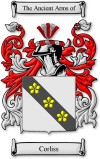
George Corliss – Coat of Arms

Joanna Davis was born about 1624 in Marlborough, Wiltshire, England.  Her parents were Thomas DAVIS and Christian COFFIN.  She emigrated with her parents on April 05, 1635  on the ship “James” After George died, she married James Ordway on 4 Oct 1687 in Haverhill.  Joanna died 12 Jan 192/93 in Haverhill.

Children of  George and Joanna

Name Born Married Departed
1. Mary Corliss 8 Sep 1646 Haverhill William Neff
23 Jan 1664/65 Haverhill
22 Oct 1722 Haverhill
2. John Corliss 4 Mar 1647/48
Haverhill
Mary Wilford
17 Dec 1684 Haverhill
17 Feb 1697/98
Haverhill
3. Joanna CORLISS 28 Apr 1650 in Haverhill Joseph HUTCHINS
29 Dec 1669 in Haverhill
29 Oct 1734 in Haverhill
4. Martha Corliss 2 Jan 1652/53 Haverhill Samuel Ladd
1 Dec 1674 Haverhil
22 Feb 1698
Norwich, New London, Connecticut
5. Deborah Corliss 6 Jun 1655 Haverhill Thomas Eastman
20 Jan 1678/79
.
Thomas Kingsbury
29 Jun 1691 Haverhill, Essex, Mass
22 Oct 1722 Haverhill
6. Ann Corliss 8 Nov 1657 Haverhill John Robie
1 Nov 1677 Haverhill
1 Jun 1691 Haverhill
7. Huldah Corliss 18 Nov 1661 Haverhill Samuel Kingsbury
5 Nov 1679 Haverhill
26 Sep 1720, Haverhill, Essex, Mass
8. Sarah Corliss 23 Feb 1663/64
Haverhill
Joseph Ayres
24 Nov 1686 Haverhil
1753
Franklin, New London, CT

Google books: Genealogical and Personal Memoirs Relating to the Families of the State of Massachusetts  By William Richard Cutter, William Frederick Adams; Published by Lewis Historical Pub. Co., 1910 Item notes: v.2; Corliss pages 770-772; Original from Harvard University; Digitized Jan 31, 2008

“(I) George Corliss, first American representative

of this ancient family, was born in the county of Devonshire, England, about 1617, and came to this country in 1639, settling at Newbury, Massachusetts. The next year he moved to the neighboring town of Haverhill, where he lived nearly half a century, or until his death in 1686. The original tract of land on which he settled in 1640 and on which he built a log house in 1647, was in what is now known as the West Parish. The farm itself is called “Poplar Lawn,” and has never been out of the possession of his direct descendants.

In some of the old records the name of Thomas Corliss, of Devonshire, England, appears as the father of George Corliss ; but whether this refers to the American emigrant is not certainly known.

George Corliss appears to have been an enterprising and industrious citizen, one well qualified to take part in the settlement of a new town. At his death, October 19, 1686, he left a large property, being possessed of most of the land on both sides of the old “Spicket Path” for a distance of more than three miles. It is a fact worthy of note, that George Corliss, his son, John, and his grandson, John (2), all died on the same farm, and each one when sitting in the same chair.

The name of George Corliss appears on the list of freemen of Haverhill in 1645, and March 26, 1650, he was chosen constable. He served as selectman in 1648-53-57-70-79.

On October 26, 1645, at Haverhill, Massachusetts, George Corliss was united in marriage to Joanna Davis. There is evidence to show that she was either sister or daughter of Thomas Davis, a sawyer, of Marlborough, England, who came over in the “James and William,” in April, 1635. The Corliss marriage was the second in town, and there is a tradition in the family that at the time it occurred the bridegroom was possessed of a pair of silk breeches of such generous proportions that his wife afterward converted them into a gown for herself. There is no further record of Joanna Corliss after the settlement of her husband’s estate, unless she contracted a second marriage. The county records show that on October 4, 1687 “Johannah Corley” married James Ordway, at Newbury, Massachusetts.

Children of George and Joanna (Davis) Corliss:

Mary, born September 6, 1646; John, whose sketch follows; Joanna, born April 28, 1650; Martha, June 2, 1652; Deborah, June 6, 1655 ; Ann, November 8, 1657; Huldah, November 18, 1661 ; Sarah, February 23, 1663. According to the father’s will, the eldest daughter, Mary, married William Neff ; Martha married Samuel Ladd ; Deborah married Thomas Eastman ; Huldah married Samuel Kingsbury. The youngest daughter is mentioned in the will as “Sarah Corley.” “

George Corliss owned a farm called “Poplar Lawn”
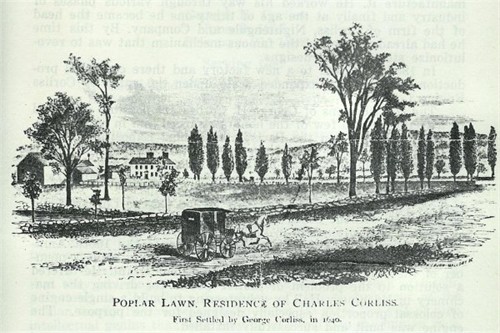
Residence of Charles Corliss

1639 – Settled in Newbury, MA, at which date he gave his age as 22 yrs.

1645 – Was made  Freeman

1650 – Elected Constable of Haverhill, MA

Elected Town Selectman repeatedly

Children

1.  Mary Corliss

Mary’s husband  William Neff was born about 1642 in Newbury, Essex, Mas. His parents were William Nesse and Jerusha West.  William died 7 Feb 1689 in Pemaquid, Maine.

On 15 Mar 1697 Mary Neff was nursing Hannah Dustin who had given birth the week before.  They taken prisoner by the Indians in an attack on Haverhill and carried towards Canada.

Hannah Duston (1657 – 1736) was a colonial Massachusetts Puritan woman who escaped Native American captivity by leading her fellow captives in scalping their captors at night. Duston is the first woman honored in the United States with a statue.

Today, Hannah Duston’s actions are controversial, with some  calling her a hero, but others calling her a villain, and some Abenaki leaders saying her legend is racist and glorifies violence. As early as the 19th Century, Hannah’s legal argument had lost its Old Testament authority and came to be interpreted, or misinterpreted, as a justification for vengeance. See my post Hannah Dustin – Hero or Cold Blooded Killer for details on how the telling of the story has evolved.
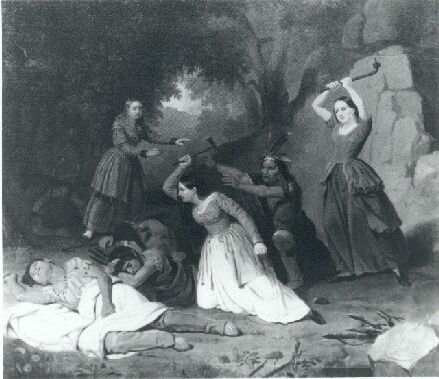
Hannah Dustin and Mary Neff take justice into their own hands

Twenty-seven persons were slaughtered, (fifteen of them children) and thirteen captured. The following is a list of the killed:-John Keezar, his father, and son, George; John Kimball and his mother, Hannah ; Sarah Eastman [Daughter of Deborah Corliss and grand daughter of George CORLISS; Thomas Eaton ; Thomas Emerson, his wife, Elizabeth, and two children, Timothy and Sarah ; Daniel BRADLEY’s son Daniel Bradley, his wife, Hannah (she was also Stephen DOW’s daughter), and two children, Mary and Hannah ; Martha Dow, daughter of Stephen DOW; Joseph, Martha, and Sarah Bradley, children of Joseph Bradley, another son of Daniel BRADLEY ; Thomas and Mehitable Kingsbury[Children of Deborah Corliss and grand daughter of George CORLISS] ; Thomas Wood and his daughter, Susannah ; John Woodman and his daughter, Susannah; Zechariah White ; and Martha, the infant daughter of Mr. Duston.” Hannah Dustin’s nurse Mary Neff, daughter of our ancestor GEORGE CORLISS, was carried away and helped in the escape by hatcheting her captors.   Another captive who later wrote about the adventure and was kidnapped a second time ten years later was Hannah Heath Bradley, wife of Daniel BRADLEY’s son Joseph, daughter of John Heath and Sarah Partridge, and grand daughter of our ancestor Bartholomew HEATH.

15 March 1697 –  After the attack on Duston’s house, the Indians dispersed themselves in small parties, and attacked the houses in the vicinity. Nine houses were plundered and reduced to ashes on that eventful day, and in every case their owners were slain while defending them.

The ordeal of Hannah Dustin is among the most horrific in New England colonial history. According to an early account by Cotton Mather, Dustin was captured on March 15, 1697 by a group of about 20 Indians and pulled from her bed one week after giving birth to her eighth child. Her husband managed to get the others to safety. The infant was killed when a member of the raiding party smashed it against a tree. Dustin and small group of hostages were marched about 60 miles from her home in Haverhill, MA to an island in the Merrimack River near Concord. Enlisting the help of others, including her nurse and an English boy previously captured, the group managed, amazingly, to kill 10 of their captors. Dustin sold the scalps to the local province for 50 pounds in reparation. A monument to Dustin can be seen in Haverhill and the site of her escape with companions Mary Neff  and Samuel Lennardeen can be seen in Boscowen, NH. The Hannah Dustin Trail in Pennacook leads to another monument on the island on the Contoocook River.
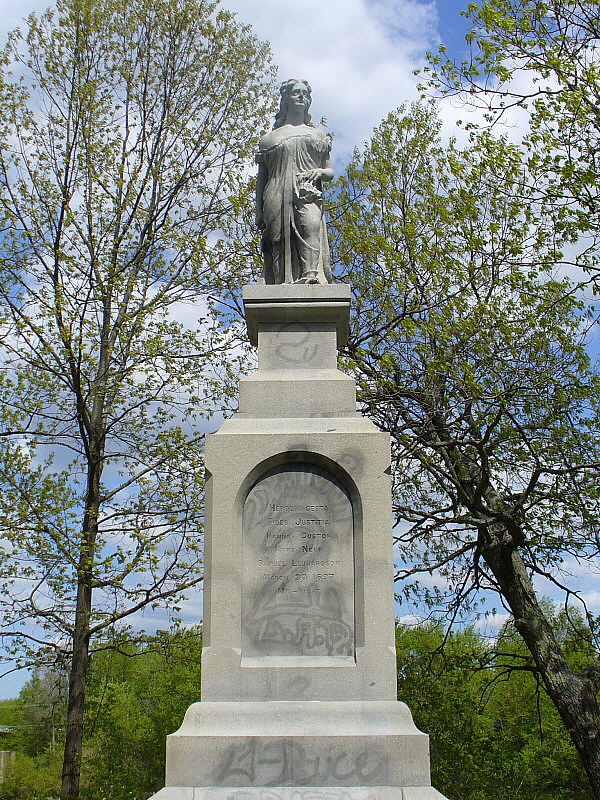
Hannah Dustin Statue Penacook New Hampshire

Chase, History of Haverhill, pg. 216

Summer 1707 – “Sometime in the summer of this year, a small party of Indians again visited the garrison of Joseph Bradley; and it is said that he, his wife and children, and a hired man, were the only persons in it at the time. It was in the night, the moon shone brightly, and they could be easily seen, silently and cautiously approaching. Mr. Bradley armed himself, his wife and man, each with a gun, and such of his children as could shoulder one. Mrs. Bradley, supposing that they had come purposely for her, told her husband that she had rather be killed than be again taken. The Indians rushed upon the garrison, and endeavored to beat down the door. They succeeded in pushing it partly open, and when one of the Indians began to crowd himself through the opening, Mrs. Bradley fired her gun and shot him dead. The rest of the party, seeing their companion fall, desisted from their purpose, and hastily retreated.”

“Among the things which call far mention in our history for 1738, is the petition of Hannah [Heath] Bradley, of this town, to the General Court, asking for a grant of land, in consideration of her former sufferings among the Indians, and ” present low circumstances.” In answer to her petition, that honorable body granted her two hundred and fifty acres of land, which was laid out May 29, 1739, by Richard Hazzen, Surveyor. (Son of our ancestor Edward HAZEN Sr.)  It was located in Methuen, in two lots, -the first, containing one hundred and sixty acres, bordering on the west line of Haverhill ; the other, containing ninety acres, bordering on the east line of Dracut

Mrs. Bradley’s good success in appealing to the generosity of the General Court, seems to have stimulated Joseph Neff, a son of Mary Neff, to make a similar request. He shortly after petitioned that body for a grant of land, in consideration of his mother’s services in assisting Hannah Duston in killing “divers Indians.” Neff declares in his petition, that his mother was ” kept a prisoner for a considerable time,” and ” in their return home past thro the utmost hazard of their lives and Suffered distressing want being almost Starved before they Could Return to their dwellings.”

Accompanying Neff’s petition, was the following deposition of Hannah Bradley, which well deserves a place in our pages, for its historical interest. The document proves that Mrs. Bradley was taken prisoner at the same time with Mrs. Duston, and travelled with her as far as Pennacook:

Deposition was sworn to before Joshua Bayley, of Haverhill, June 28th, 1739.”

” The deposition of the Widow Hannah Bradly of Haverhill of full age who testifieth & saith that about forty years past the said Hannah together with the widow Mary Neff were taken prisoners by the Indians & carried together into captivity, & above penny cook the Deponent was by the Indians forced to travel farther than the rest of the Captives, and the next night but one there came to us one Squaw who said that Hannah Dustan and the aforesaid Mary Neff assisted in killing the Indians of her wigwam except herself and a boy, herself escaping very narrowly, chewing to myself & others seven wounds as she said with a Hatched on her head which wounds were given her when the rest were killed, and further saith not.

her
Hannah X Bradly.”
mark

Hannah Heath Bradley’s (Joseph Bradley’s wife) desposition is a little confusing because she was taken captive in 1707 and Mary Neff was taken captive ten years earlier in 1697.  Either Hannah was taken captive twice or she used poetic license in her deposition connecting herself with the more famous Dustin case. Two other Hannah Bradleys were killed in the 1697 attack, Daniel Bradley Jr’s wife and daughter.

Hannah Dustin

Statue of Hannah Dustin in Haverhill, Mass

Detailed Account

Here’s a more detailed account of Hannah and Mary from The Duston / Dustin Family, Thomas and Elizabeth (Wheeler) Duston and their descendants. and The Story of Hannah Duston Published by the Duston-Dustin Family Association, H. D. Kilgore Historian Haverhill Tercentenary – June, 1940.  I’ve kept most of the 19th Century language, only removing a few breathless adverbs, opinionated adjectives and changing some pejorative nouns.

On March 14, 1697, Thomas and Hannah Duston lived in a house on the west side of the Sawmill River in the town of Haverhill. This house was located near the great Duston Boulder and on the opposite side of Monument Street.

Their twenty years of married life had brought them material prosperity, and of the twelve children who had been born to them during this period, eight were living. Thomas, who was quite a remarkable man, – a bricklayer and farmer, who, according to tradition, even wrote his own almanacs, and wrote them on rainy days, – was beginning to have time to devote to town affairs, and had just completed a term as Constable for the “west end” of the town of Haverhill.

He was at this time engaged in the construction with bricks from his own brickyard of a new brick house about a half mile to the northwest of his home to provide for the needs of his still growing family, for Baby Martha had just made her appearance on March 9.

Under the care of Mrs. Mary Neff,  (daughter of George CORLISS and widow of William Neff) both mother and child were doing well, the rest of the family were in good health, his material affairs were prospering, and it was undoubtedly with a rather contented feeling that Thomas, to say nothing of his family, retired to rest on the eve of that fateful March 15, 1697, little knowing what horrors the morrow was to bring.

Of course, there was always the fear of Indians. However, since the capture in August of the preceding year, of Jonathan Haynes and his four children while picking peas in a field at Bradley’s Mills, near Haverhill, nothing had happened, and apprehensions of any further attacks were gradually being lulled. Besides, less than a mile on Pecker’s Hill, was the garrison of Onesiphorus Marsh, one of six established by the town containing a small body of soldiers. It was believed that there was little ground for uneasiness.

But this was only a false security. Count Frontenac, the Colonial Governor of Canada, was using every means at his disposal to incite the Indians against the English as part of his campaign to win the New World for the French King. The latter, due to the need for troops in Europe, where the war known as King William’s War was going on, was unable to send many to help Frontenac. So, with propaganda and gifts, the French Governor had allied the tribes to the French cause and bounties had been set on English scalps and prisoners. Every roving band of Indians was determined to get its share of these, and even now, such a band was in the woods near Haverhill, preparing for a lightning raid on the town with the first light of dawn. The squaws and children were left in the forest to guard their possessions, while the Indian warriors moved stealthily towards the house of Thomas and Hannah Duston, the first attacked. [The Treaty of Ryswick in 1697 ended the war between the two colonial powers, reverting the colonial borders to the status quo ante bellum. The peace did not last long, and within five years, the colonies were embroiled in the next phase of the French and Indian Wars, Queen Anne’s War.]
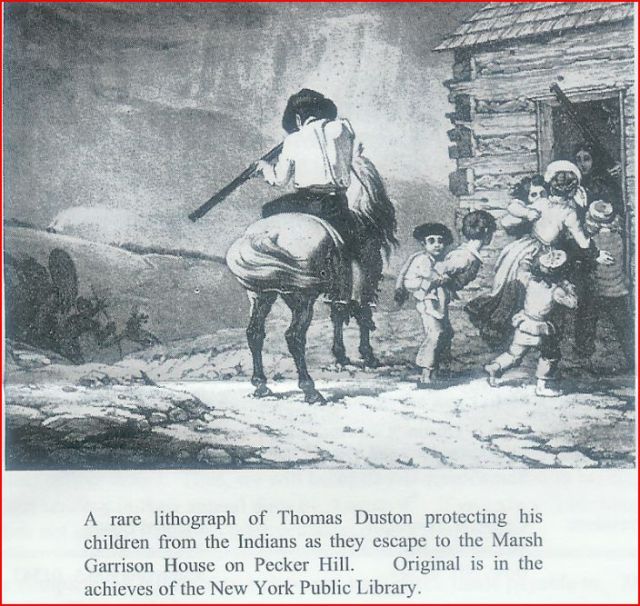
Early the next morning, Thomas, at work near the house, suddenly spied the approaching Indians. Instantly seizing his gun he mounted his horse and raced for the house, shouting a warning which started the children towards the garrison, while he dashed into the house hoping to save his wife and the baby. Quickly seeing that he was too late, and doubtless urged by Hannah, he rode after the children, resolving to escape with at least one. On overtaking them, finding it impossible to choose between them, he resolved, if possible, to save them all. A few of the Indians pursued the little band of fugitives, firing at them from behind trees and boulders, but Thomas, dismounting and guarding the rear, held back the savages from behind his horse by threatening to shoot whenever one of them exposed himself. Had he discharged his gun they would have closed in at once, for reloading took considerable time. He was successful in his attempt, and all reached the garrison safely, the older children hurrying the younger along, probably carrying them at times. This was probably the garrison of Onesiphorus March on Pecker’s Hill.
Escape of Thomas Dustin & children. Source: Some Indian Stories of Early New England, 1922

Meanwhile a fearful scene was being enacted in the home. Mrs. Neff, trying to escape with the baby, was easily captured. Invading the house, the Indians forced Hannah to rise and dress herself. Sitting despairingly in the chimney, she watched them rifle the house of all they could carry away, and was then dragged outside while they fired the house, in her haste forgetting one shoe. A few of the Indians then dragged Hannah and Mrs. Neff, who carried the baby, towards the woods, while the rest of the band, rejoined by those who had been pursing Thomas and the children, attacked other houses in the village, killing twenty-seven and capturing thirteen of the inhabitants.

Finding that carrying the baby was making it hard for Mrs. Neff to keep up, one of the Indians seized it from her, and before its mother’s horrified eyes dashed out its brains against an apple tree. The Indians, forcing the two women to their utmost pace, at last reached the woods and jointed the squaws and children who had been left behind the night before. Here they were soon after joined by the rest of the group with their plunder and other captives.

Fearing a prompt pursuit, the Indians immediately set out for Canada with their booty. Some of the weaker captives were  knocked on the head and scalped, but in spite of her condition, poorly clad and partly shod, Hannah, doubtless assisted by Mrs. Neff, managed to keep up, and by her own account marched that day “about a dozen miles”, a remarkable feat. During the next few days they traveled about a hundred miles through the unbroken wilderness, over rough trails, in places still covered with the winter’s snow, sometimes deep with mud, and across icy brooks, while rocks tore their half shod feet and their poorly clad bodies suffered from the cold – a terrible journey.

Near the junction of the Contoocook and Merrimack rivers, twelve of the Indians, two men, three women, and seven children, taking with them Hannah, Mrs. Neff and a boy of fourteen years, Samuel Lennardson (who had been taken prisoner near Worcester about eighteen months before), left the main party and proceeded toward what is now Dustin Island, situated where the two rivers unite, near the present town of Penacook, N.H. This island was the home of the Indian who claimed the women as his captives, and here it was planned to rest for a while before continuing on the long journey to Canada.

This Indian family had been converted by the French priests at some time in the past, and was accustomed to have prayers three times a day, – in the morning, at noon and at evening, – and ordinarily would not let their children eat or sleep without first saying their prayers. Hannah’s master, who had lived in the family of Rev. Mr. Rowlandson of Lancaster some years before told her that “when he prayed the English way he thought that it was good, but now he found the French way better.” They tried, however, to prevent the two women from praying, but without success, for as they were engaged on the tasks set by their master, they often found opportunities. Their Indian master would sometimes say to them when he saw them dejected, “What need you trouble yourself? If your God will have you delivered, you shall be so!”

[Mary (White) Rowlandson (c. 1637 – Jan 1711) was a colonial American woman who was captured by Indians during King Philip’s War and endured eleven weeks of captivity before being ransomed. After her release, she wrote a book about her experience, The Sovereignty and Goodness of God: Being a Narrative of the Captivity and Restoration of Mrs. Mary Rowlandson, which is considered a seminal work in the American literary genre of captivity narratives.

During the long journey Hannah was secretly planning to escape at the first opportunity, spurred by the tales with which the Indians had entertained the captives on the march, picturing how they would be treated after arriving in Canada, stripped and made to “run the gauntlet”; jeered at and beaten and made targets for the young Indians’ tomahawks; how many of the English prisoners had fainted under these tortures; and how they were often sold as slaves to the French. These stories, added to her desire for revenging the death of her baby and the cruel treatment of their captors while on the march, made this desire stronger. When she learned where they were going, a plan took definite shape in her mind, and was secretly communicated to Mrs. Neff and Samuel Lennardson.

Samuel, who was growing tired of living with the Indians, and in whom a longing for home had been stirred by the presence of the two women, the next day casually asked his master, Bampico, how he had killed the English. “Strike ‘em dere,” said Bampico, touching his temple, and then proceeded to show the boy how to take a scalp. This information was communicated to the women, and they quickly agreed on the details of the plan. They arrived at the island some time before March 30, 1697.

After reaching the island, the Indians grew careless. The river was in flood. Samuel was considered one of the family, and the two women were considered too worn out to attempt escape, so not watch was set that night and the Indians slept soundly. Hannah decided that the time had come.

Shortly after midnight she woke Mrs. Neff and Samuel. Each, armed with a tomahawk, crept silently to a position near the heads of the sleeping Indians – Samuel near Bampico and Hannah near her master. At a signal from Hannah the tomahawks fell, and so swiftly and surely did they perform their work of destruction that ten of the twelve Indians were killed outright, only two – a severely wounded squaw and a boy whom they had intended to take captive – escaped into the woods. According to a deposition of Hannah Bradley in 1739 (History of Haverhill, Chase, pp. 308-309),

“above penny cook the Deponent was forced to travel farther than the rest of the captives, and the next night but one there came to us one Squaw who said that Hannah Dustan and the aforesaid Mary Neff assisted in killing the Indians of her wigwam except herself and a boy, herself escaping very narrowly, shewing to myself & others seven wounds as she said with a Hatched on her head which wounds were given her when the rest were killed.”
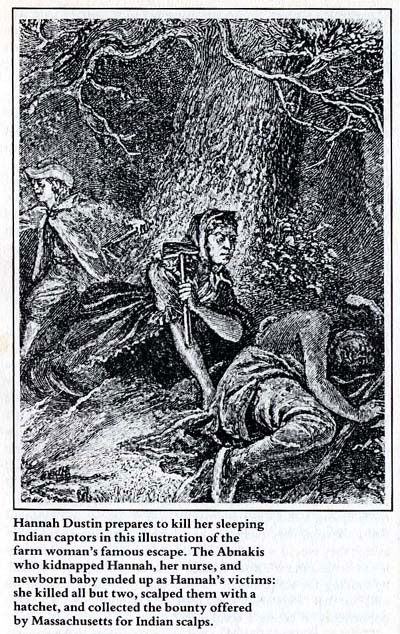
Hastily piling food and weapons into a canoe, including the gun of Hannah’s late master and the tomahawk with which she had killed him, they scuttled the rest of the canoes and set out down the Merrimack River.
Original Gun taken by Hannah Dustin

Suddenly realizing that without proof their story would seem incredible, Hannah ordered a return to the island, where they scalped their victims, wrapping the trophies in cloth which had been cut from Hannah’s loom at the time of the capture, and again set out down the river, each taking a turn at guiding the frail craft while the others slept.
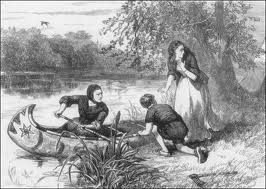
Hannah Dustin and Mary Neff make their escape

Thus, traveling by night and hiding by day, they finally reached the home of John Lovewell in old Dunstable, now a part of Nashua, N.H. Here they spent the night, and a monument was erected here in 1902, commemorating the event. The following morning the journey was resumed and the weary voyagers at last beached their canoe at Bradley’s Cove, where Creek Brook flows into the Merrimack. Continuing their journey on foot, they at last reached Haverhill in safety. Their reunion with loved ones who had given them up for lost can better be imagined than described.
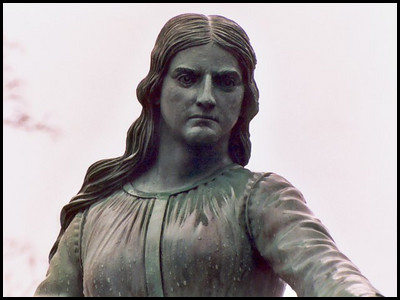
Hannah Dustin Detail

Thomas took his wife and the others to the new house which he had been building at the time of the massacre, and which was now completed.  Here for some days they rested.  The fear induced by the massacre caused Haverhill to at once establish several new garrison houses. One of these was the brick house which Thomas was building for his family at the time of the massacre. This was ordered completed, and though the clay pits were not far from the home, a guard of soldiers was placed over those who brought clay to the house. The order establishing Thomas Duston’s house as a garrison was dated April 5, 1697. He was appointed master of the garrison and assigned Josiah HEATH, Sen., Josiah Heath Jun., Joseph Bradley, John Heath, Joseph Kingsbury, and Thomas Kingsbury as a guard.
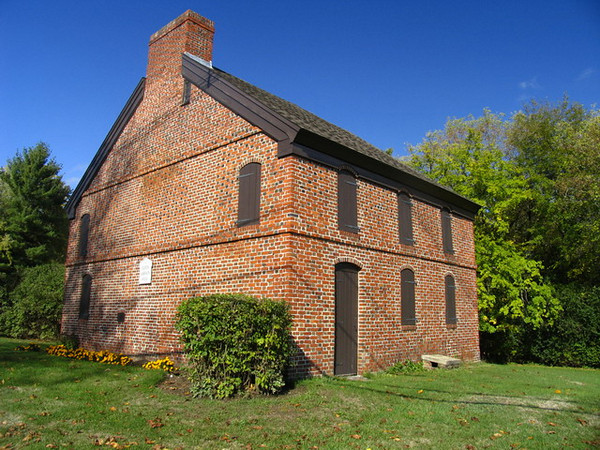
Dustin Garrison

In 1694 a bounty of fifty pounds had been placed on Indian scalps, reduced to twenty-five pounds in 1695, and revoked completely on Dec. 16, 1696.

Hannah had risked precious time to gain those scalps. The explanation sometimes given later, that her story would not be believed without evidence, is patently false. If her credibility were the only issue at stake, sooner or later there would be corroborative accounts. Actually, Hannah Bradley, another Haverhill woman, was a captive in the camp where the wounded squaw sought refuge. But to collect a scalp bounty Hannah needed to produce the scalps.

Thomas Duston believed that the act of the two women and the boy had been of great value in destroying enemies of the colony, who had been murdering women and children, and decided that the bounty should be claimed.  So he took the two women and the boy to Boston, where they arrived with the trophies on April 21, 1697.

Here he filed a petition to the Governor and Council, which was read on June 8, 1697 in the House

To the Right Honorable the Lieut Governor & the Great & General assembly of the Province of Massachusetts Bay now convened in BostonThe Humble Petition of Thomas Durstan of Haverhill Sheweth That the wife of ye petitioner (with one Mary Neff) hath in her Late captivity among the Barbarous Indians, been disposed & assisted by heaven to do an extraordinary action, in the just slaughter of so many of the Barbarians, as would by the law of the Province which——–a few months ago, have entitled the actors unto considerable recompense from the Publick.

That tho the———-of that good Law————–no claims to any such consideration from the publick, yet your petitioner humbly—————-that the merit of the action still remains the same; & it seems a matter of universal desire thro the whole Province that it should not pass unrecompensed.

And that your petitioner having lost his estate in that calamity wherein his wife was carried into her captivity render him the fitter object for what consideration the public Bounty shall judge proper for what hath been herein done, of some consequence, not only unto the persons more immediately delivered, but also unto the Generall Interest

Wherefore humbly Requesting a favorable Regard on this occasion

Your Petitioner shall pray &c
Thomas Du(r)stun

Despite the missing words its purport is clear. Hannah has performed a service to the community and deserves an appropriate expression of gratitude. It also implies a justification for killing the squaws and children, if any justification were needed when the captives’ safety depended upon several hours head start.

The same day the General Court voted payment of a bounty of twenty-five pounds “unto Thomas Dunston of Haverhill , on behalf of Hannah his wife”, and twelve pounds ten shillings each to Mary Neff and Samuel.  This was approved on June 16, 1697, and the order in Council for the payment of the several allowances was passed Dec. 4, 1697.  (Chapter 10, Province Laws, Mass. Archives.)

While in Boston Hannah told her story to Rev. Cotton Mather, whose morbid mind was stirred to its depths.  He perceived her escape in the nature of a miracle, and his description of it in his “Magnalia Christi Americana” is extraordinary, though in the facts correct and corroborated by the evidence.

In Samuel Sewall’s Diary, Volume 1, pages 452 and 453, we find the following entry on May 12, 1697:

Fourth-day, May12….Hanah Dustin came to see us:….She saith her master, who she kill’d did formerly live with Mr. Roulandson at Lancaster: He told her, that when he pray’d the English way, he thought  that was good: but now he found the French way was better.  The single man shewed the night before, to Saml Lenarson, how he used to knock Englishmen on the head and take off their Scalps: little thinking that the Captives would make some of their first experiment upon himself.  Sam. Lenarson kill’d him.

This remarkable exploit of Hannah Duston, Mary Neff, and Samuel Lennardson was received with amazement throughout the colonies, and Governor Nicholson of Maryland sent her a suitably inscribed silver tankard.
Dustin Tankard, A gift from the Gov. of Maryland to Hannah Dustin in 1697. In possession of the Haverhill Historical Society, Hav. Mass. Source: Some Indian Stories of Early New England, 1922

2. John Corliss

John’s wife Mary Wilford was born 18 Nov 1667 in Rowley, Mass. Her parents were Gilbert Wilford and Mary Dow. Her maternal grandparengts were Thomas DOW and Phebe LATLY. After John died, she married 23 Jan 1702/03 in Haverhill to William Whittaker (b. 21 Dec 1658, Haverhill). Mary died after 1711 in Haverhill.

John served in King Philip’s War, under Lieutenant Benjamin Swett, June 1676, also August 1676 . He owned at least one slave, Celia. In 1798 John’s house was valued at $350. He inherited the farm from his father, George Corliss and lived there all his life.

John Corliss fought in King Philip’s War under Lt. Benjamin Swett in June & August, 1676; took the oath of allegiance, November 28, 1677. From the Essex County Quarterly Courts Records, 4:193: “John Corliss deposed that he heard Joseph Davis send to Pecker to raise the flood gates when the sawmill at Haverhill was lost in the 1668 flood and Ensign James Pecker was charged with responsibility.

Children of John and Mary:

i. John Corliss, Jr., b. 14 Mar 1685/86, Haverhill, Essex, Massachusetts , d. Nov 1766, Haverhill

ii. Mary Corliss, b. 25 Feb 1687/88, Haverhill, Essex , Mass , d. Aft 3 May 1708

iii. Thomas Corliss, b. 2 Mar 1689/90, Haverhill, Essex, Mass , d. 3 Sep 1781, Haverhill

iv. Hannah or Anna Corliss, b. Sep 1691/92, Haverhill, Essex , Mass , d. 8 Sep 1764

v. Timothy Corliss, b. 13 Dec 1693, Haverhill, Essex , Mass , d. 1783, Weare, Hillsborough , New Hampshire; m. 15 Feb 1725/26 in Haverhill to Sarah Hutchins (b. 20 Jun 1701 in Haverhill)  Sarah’s parents were John’ Hutchins and Sarah Page.  Her grandparents were Joseph HUTCHINS and Joanna CORLISS

vi. Jonathan Corliss, b. 16 Jul 1695, Haverhill, Essex, Massachusetts , d. 22 Mar 1787, Salem, Rockingham, New Hampshire

vii. Mehitable Corliss, b. 5 May 1698, Haverhill, Essex , Massachusetts , d. Jan 1742, Rumford (Concord), Merrimack , New Hampshire

3. Joanna CORLISS (See Joseph HUTCHINS’ page)

4. Martha Corliss

Martha’s husband Samuel Ladd was born 1 Nov 1649 in Haverhill, Essex, Mass. His parents were Daniel Ladd and Ann Moore.  Samuel was killed in Indians 22 Feb 1698 in Haverhill, Essex, Mass.   According to his son, the Indians didn’t take him captive because “‘he so sour’.”  Little did they know the poetic justice of Ladd’s demise and the immoral crimes he had inflicted on Elizabeth Emerson.

History of Haverhill – Jonathan Haynes and Samuel Ladd, who lived in the western part of the town, had started that morning, with their teams, consisting of a yoke of oxen and a horse, each, and accompanied with their eldest sons, Joseph (age 22) and Daniel, to bring home some of their hay, which had been cut and stacked the preceding sumner, in their meadow, in the extreme western part of the town. Whey they were slowly returning, little dreaming of present danger, they suddenly found themselves between two files of Indians, who had concealed themselves in the bushes on each side of their path. There were seven of them on a side. With guns presented and cocked, and the fathers, seeing it was impossible to escape, begged for “quarter.” To this, the Indians twice replied, “boon quarter! boon quarter! (good quarter.) Young Ladd, who did not relish the idea of being quietly taken prisoner, told his father that he would mount the horse, and endeavor to escape. But the old man forbid him to make the attempt, telling him it was better to risk remaining a prisoner. He cut his father’s horse loose, however, and giving him the lash, he started off at full speed, and though repeatedly fired at by the Indians, succeeded in reaching home, and was the means of giving an immediate and general alarm.

Two of the Indians then stepped behind the fathers, and dealt them a heavy blow upon the head. Mr. Haynes who was quite aged, instantly fell, but Ladd did not. Another of the Indians then stepped before the latter, and raised his hatchet as if to strike. Ladd closed his eyes, expecting the blow would fall – but it came not – and when he again opened them, he saw the Indian laughing and mocking at his fears. Another immediately stepped behind him and felled him at a blow.

The Indians, on being asked why they killed the two men, said that they killed Haynes because he was ‘so old he no go with us;’ – meaning that he was too aged and infirm to travel; and that they killed Ladd, who was a fierce, stern looking man, because ‘he so sour’. They then started for Penacook, where they arrived, with the two boys. Young Ladd soon grew weary of his situation, and one night after his Indian master and family had fell asleep, he attempted to escape. He had proceeded but a short distance, when he thought that he should want a hatchet to fell trees to assist him in crossing the streams. He accordingly returned, entered a wigwam near his master’s, where an old squaw lay sick , and took a hatchet The squaw watched his movements, and probably thinking that he intended to kill her, vociferated with all her strength. This awakened the Indians in the wigwam, who instantly arose, re-captured him, and delivered him again to his master, who bound his hands, laid him upon his back, fastened one of his feet to a tree, and in that manner kept him fourteen nights. They then gashed his face with their knives, filled the wounds with powder, and kept him on his back, until it was so indented in the flesh, that it was impossible to extract it. He carried the scars to his grave, and was frequently spoken of his descendants as the ‘marked man.’

After several years, Daniel did escape and returned to Haverhill where he lived until his death in 1751. On Daniels’ return to his home he became heir to his father’s estate and head of the family. He married 17 Nov 1701, Haverhill to Susannah Hartshorne and fathered (children 1702-17: Mary, Susanna, Samuel, Daniel, Ruth, John)

When Daniel returned home his brother Nathaniel resented being under the control of his older brother, so he decided to leave home and make his own way. For about a year he stayed in Haverhill and worked for his uncle in a sawmill he operated. This mill had been built by his grandfather in 1659. While there, he lived with another uncle and was able to save most of his wages.

Nathaniel left Haverhill and spent several years at various places in Connecticut and Massachussetts working at any job available. In 1706, at the age of 22, he had saved enough money to purchase a small farm at Franklin, New London County, Connecticut. In 1707 he met Abigail Bodwell, a daughter of a local farmer, and they married the following year. About this time, Nathaniel purchased a larger farm in Coventry, Tolland CT which was a newer settlement about 15 miles north of Franklin and situated on Lake Waumgumbaug.  In Coventry he prospered, added more land, and also took active part in church and civic affairs. He served as Selectman for the town for many years. Also held other public offices.

Nathaniel died at Coventry, Tolland, CT on June 11, 1757 at the age of 73. The records show his wife died on August 7, 1798 and would have been over 100 as they were married in 1708. It is possible that Abigail had passed away earlier and he married a younger woman..

Samuel  Ladd was responsible for crimes of his own.  He was the father of three children born out of wedlock to Elizabeth Emerson, the last two being twins.

i. Dorothy Emerson, b.  10 April 1686 in Haverhill

ii. Infant Emerson, b. 8 May 1691 in Haverhill, d.  10 May 1691

iii. Infant Emerson, b. 8 May 1691 in Haverhill, d. 10 May 1691

Elizabeth was subsequently hanged in the Boston Commons after having been convicted of killing her twins. There is no evidence that Samuel assumed any responsibility with respect to Elizabeth and the children. Elizabeth was the daughter of Michael Emerson and Hannah Webster. She was born 26 Jan 1665 in Haverhill,  and was hanged 8 Jun 1693 in The Boston Common. The Records of the Court of assistants of the Massachusetts Bay, Volume I, has an excellent account of the charges and related information regarding Elezabeth Emerson. The Diary of Cotton Mather also has an extended account.

The Story of Elizabeth Emerson

On June 8, 1693 The Reverend Cotton Mather delivered a sermon before a large crowd in Boston. Mather exhorted the crowd, delivering what he unabashedly referred to as one of his greatest sermons ever. In the crowd sat Elizabeth Emerson, singlewoman of Haverhill. Whether she sat penintently looking downwards or definantly staring into Mather’s eyes we can only imagine. That the sermon was delivered for her benefit is undoubted. The lecture was based upon Job 36:14, “They die in youth and their life is among the unclean.”

The life of Elizabeth Emerson would have been wholly unremarkable were it not for three related events: The first was a severe beating she suffered at the hands of her father when she was a child; the second, the birth of her illegitimate daughter Dorothy; and the third event, the reason for her presence in the meeting hall that June day three hundred years ago, her death by hanging for the crime of infanticide.

Elizabeth was born in the town of Haverhill in what was then the Massachusetts Bay Colony 26 Jan 1664/65. She was the sixth of fifteen children of Michael and Hannah Webster Emerson, and one of only nine to survive infancy.

Michael and Hannah Emerson were among the early settlers of Haverhill, though not founding members of the town. He was variously employed as a contable, a Grand Juryman, a cordwainer, a sealer of leather, and a tax collector.  Despite the impressive sound of this list, they were positions which those of greater estate would endeavor to avoid. Michael Emerson’s life, too, would have been wholly unremarkable were it not for the fame of one daughter and the infamy of another.

In 1666, when Elizabeth was but a year old, Michael Emerson chose to move his family closer to town. He decided to settle on Mill Street which was then in the heart of Haverhill. One of his new neighbors, a Mr. White, evidently disliked either Michael, his family, or perhaps both. It was decided by the town that if the Emersons would “go back to the woods,” they would grant him an additional tract of land. Michael seeminly obliged the town and moved two miles from the center, which at the time would indeed have been in “the woods.’   This incident seems innocuous enough and is certainly a unique and expedient way of resolving a neighborly difficulty in an area rich in land. One wonders, though, what it was about the family that so angered Mr. White. Undoubtedly, removal that far from town was not only inconvenient but dangerous. The reason for the removal, unfortunately, is not described by the record, but it certainly must have been compelling.

Michael’s first child, Hannah Emerson Dustin, was born23 Dec  1657. She was destined to become famous in the annals of New England history as the only female Indian captive ever to have slain her captors and escaped, not only with her scalp but with theirs as well.  Hannah slew her captors with the help of Mary Corliss Neff  [George CORLISS‘ daughter see story above] , and a young boy, Samuel Lennardson. Upon her escape from her captors she realized she had forgotten to take trophies of her exploit. She returned to the scene and took scalps from the ten dead Indians; six children, two women and two men. She and her little party managed to find their way down the Merrimac River, from near present day Concord, New Hampshire, to their home in Haverhill. She became a heroine to white New Englanders frustrated with the long Indian wars.

Violence was inescabable in the lives of early New Englanders. Certain types of violence were unacceptable to community standards, whereas other types were not only accepted but also condoned. Among the types of condoned violence were not only violence toward Indians, but also corporal punishment of children, servants and in some cases wives

Children were often singled out as victims of violence. The poetess Anne Bradstreet once wrote “some children (like sowre land) are of so tough and morose a dispo[si]tion, that the plough of correction must make long furrows upon their back. Surely if so gentle a personage as Anne Bradstreet advocated corporal punishment in the raising of children, then it must have been both widespread and condoned. This very approval on a community-wide basis serves as a counterpoint to the case that was brought before the Quarterly Court of Essex County Massachusetts in May of 1676.

Michael Emerson was brought to court that May day “for cruel and excessive beating of his daughter with a flail swingle and for kicking her, was fined and bound to good behavior.”The daughter in question was Elizabeth In November of the same year the back due portion of his fine was abated because of Emerson’s status as a grand juryman, and he was freed from his bond for good behavior, Corporal punishment in and of itself was not considered a crime, but the excessive beating of a child did deserve punishment. Although Michael’s status as a grand juryman did help to get his fine abated and perhaps influenced his release from the bond for good behavior, it did not prevent his fellow grand jurymen from censuring him for the cruelty of his act. What Elizabeth did to deserve such a beating is unknown. Also, whether this beating was an isolated incident or a pattern of violence in the family can only be guessed, but a court case involving another family member may shed further light.

The case involved Elizabeth’s younger brother Samuel who was apprenticed to a John Simmons. Simmons was brought to court by another of his servants, Thomas Bettis, in March of 1681. Bettis claimed in his deposition that his “master haith this mani yeares beaten me upon small and frivelouse ocasion.” Bettis claimed that Simmons had “brocke my hed twice, strucke me on the hed with a great stick…tied me to a beds foott [and] a table foott” and a long list of other injuries and insults suffered at his master’s hand. He begged the court to be allowed to leave his master. A number of community members deposed that Bettis had, indeed, been beaten excessively and had not been clothed properly. But Samuel Emerson took his masters side in the suit saying, “that he had lived with his master Simmons about four years and Bettis was very rude in the family whenever the master was away, etc.”

Perhaps Samuel’s deposition was a form of self defence. After all, he still had to live with Simmons after the suit was over. But maybe Samuel really did think that Bettis deserved the beatings and that they were not excessive given the situation. If the latter is true, it could indicate that this type of violence was by no means foreign to Samuel Emerson’s upbringing. In any event, Bettis was told to return to his master’s house, and there the record ends.

On April 10, 1686 Elizabeth Emerson gave birth to her first child, an illegitimate daugher named Dorothy. There is some controversy surrounding the father of her first child. Charles Henry Pope in his book The Haverhill Emersons stated unequivocally that the father of little Dorothy was Samuel Ladd of Haverhill. This is the same Samuel Ladd who would later be named as the father of the dead twins. Pope, in what can only be viewed as a noble attempt to salvage the reputation of his ancestress, writes that “whatever else Elizabeth might have been, she was certainly not promiscuous.” But the Records And Files Of The Ipswitch Quarterly Court reflect something quite different.

Michael Emerson accused a neighbor, Timothy Swan, of being the father of Elizabeth’s daughter Dorothy. Timothy Swan’s father, Robert Swan, Sr., vehemently denied the charge. Robert Swan went on record as saying that it was unlikely that Timothy was the father as he “…had charged him not to go into that wicked house and his son had obeyed and furthermore his son could not abide the jade.”

Timothy Swan was not a nice person either.  Our ancestor Francis HUTCHINS was arrested on the 19th August 1692 as a result of a witchcraft complaint filed by Timothy Swan, Ann Putnam, Jr., and Mary Walcott.  Francis was imprisoned until the 21st December 1692 when she was released on bond posted by  her son Joseph HUTCHINS his wife Joanna CORLISS HUTCHINS  and Joanna’s brother-in-law Samuel Kingsbury (Huldah Corliss ‘ husband)   No trial records were found.

Timothy Swann also accused John PERKINS’ daughter Mary Perkins Bradbury. Witnesses testified that she assumed animal forms; her most unusual metamorphosis was said to have been that of a blue boar.  Another allegation was that she cast spells upon ships. Over a hundred of her neighbors and townspeople testified on her behalf, but to no avail and she was found guilty of practicing magic and sentenced to be executed. Through the ongoing efforts of her friends, her execution was delayed. After the witch debacle had passed, she was released. By some accounts she was allowed to escape. Others claim she bribed her jailer. Another account claims that her husband bribed the jailer and took her away to Maine in a horse and cart. They returned to Massachusetts after the witch hysteria had died down.  Mary Bradbury died of natural causes in her own bed in 1700..

The phrase “that wicked house” rings down through the centuries. Why was Michael Emerson’s house referred to as “wicked” and why was Timothy forbidden to enter the house? Not that Timothy Swan would have necessarily have had to enter the house in order to be the father of Dorothy. It is possible and even likely that Elizabeth contrived to get pregnant elsewhere. But why the phrase “wicked house”?

Presumably Robert Swan and Michael Emerson were well acquainted with one another. Robert Swan had even sold Michael and his brother Robert Emerson “twenty or thirty acres of land.”  They had also voted on the same side in a dispute about moving the meeting house to a different location. The breakdown of the meeting house case is rather interesting as Nathaniel Saltonstall, a very wealthy and respected member of the Haverhill community as well as a member of the Court of Assists, and Robert Emerson, brother to Michael but much wealthier and a member of the church in question. both came down on the opposite side of the argument, favoring building the new meetinghouse on the site of the old one.  This would indicate that the proposed location of the new meetinghouse was more convenient to both Michael Emerson’s and ?Robert Swan’s households, i.e. they must have been “neighbors.”

Neighbors or otherwise, Robert Swan threatened to “carry the case to Boston” if his son Timothy was formally accused of being Dorothy Emerson’s father. Nothing ever came of the charges against Timothy and little Dorothy came into the world fatherless.

Elizabeth was 23 years old at the time of Dorothy’s birth. She still resided at her father’s house. Three years previous to Dorothy’s birth Elizabeth had witnessed her sister Mary’s successful marriage to Hugh Matthews of Newbury on August 28, 1683. Hugh and Mary were both sentenced by the Essex County Court in September of 1683 to be “fined or severly whipped” for the crime of fornication before marriage.  No offspring of this alleged fornication is mentioned in the records but that they did the deed and subsequently had a successful marriage could not have gone unnoticed by Elizabeth. Perhaps Elizabeth expected the same thing to happen to her upon getting pregnant. And why not? The colonial court records are literally strewn with cases involving fornication before marriage where the parties did, indeed, get married and became respectable members of the community. As we know, for Elizabeth, this would not be her fate.

Elizabeth next appeared in the court records in May of 1691, five years after the birth of Dorothy, when she was arrested and charged with the murder of two bastard infants. On May 7, 1691 Elizabeth gave birth to twins sometime during the night in a trundle bed at the foot of her parents bed. She managed to somehow hide the birth from her parents, conceal the infants for three days in a trunk, sew them up in a bag and bury them in the backyard of the Emerson house.

The Sunday following the birth, while her parents were at church, some concerned citizens of Haverhill who suspected that Elizabeth was pregnant went to the Emerson house to find her. When they arrived at the Emerson home they inquired after Elizabeth’s health which she descibed to them as “not well.” She was read a warrant and told that the women who were present were appointed to examine her.

Elizabeth submitted to this examination without protest. Meanwhile, the men went into the backyard and found the bodies of the two infants sewn up in a bag and buried in a shallow grave.

The discovery of the bodies led to statements being taken by Nathaniel Saltonstall. The depositions of the parties involved were similar. They suspected Elizabeth of being with child and therefore sought her out that Sunday morning with the intent of making inquiry. Elizabeth denied any wrongdoing, stating that she “never murdered any child in my life.” She also said “I never committed a murther that I know of….” But the evidence against her in the form of the infant bodies and the physical examination by the women present, where they discovered Elizabeth to be post partum, was overwhelming.

The following day, May 11th, Elizabeth, Michael and Hannah Emerson were all questioned and a transcript of that exchange is still extant. Elizabeth was asked her husband’s name to which she replied, “I have never [had] one.” She confessed that she did give birth to twins. When asked where they were born she replied, “On the bed at my father’s beds feet….” She stated that she did not call for help during her travail because, “there was nobody near but my Father and Mother and I was afraid to call my mother for fear of killing her.” When asked if she told her father or mother afterwards, she replied, “No, not a word; I was afraid.” Elizabeth was then questioned as to whether either of her parents knew of her pregnancy to which she replied that they did not know of the pregnancy, birth or burial of them.

How could Elizabeth have given birth to twins in the same room her parents were sleeping and kept it a secret from them? The record indicates that her mother did suspect Elizabeth of being pregnant but was told “no” every time she inquired of Elizabeth. Elizabeth’s fear of “killing” her mother denotes a certain amount of love and respect, but what of her statement, “No, not a word; I was afraid”? Elizabeth had, after all, been in this position before. She already had one illegitimate child which her father had unsuccessfully tried to pin on Timothy Swan. Could it be that the treatment she had received from ther father after the incident with Robert Swan, Sr. made her loathe to reveal to him her latest indiscretion? After all, Michael was known to have beaten her severely at least once; perhaps she was afraid of similar treatment if the truth was made known to him. Whatever her reason, it must have been compelling for her to have given birth to twins in complete silence while her parents slept mere inches away.

Michael was also questioned on May 11th regarding his daughter’s crime. According to the transcript, he did not even suspect that Elizabeth was with child, nor did he know of the birth or burial of them. When asked if he knew who the father was, he stated for the first time on the record, that the father of the children was Samuel Ladd.

Samuel Ladd was a resident of Haverhill. He was considerably older than Elizabeth, for he was married to his wife on December 1, 1674 when Elizabeth was 9 years old. At the time of the twins birth Pope gives his age as 42 and Elizabeth’s as 28. Although Samuel Ladd was named as the father of the children a number of times in the court records, he was even said to be the one person who knew of Elizabeth’s pregnancy, he was never questioned about the matter.

Samuel Ladd’s father, Daniel Ladd was on the list of the first settlers of Haverhill in  As a 1640 first settler he would have received a considerable estate from the normal course of land distribution. Samuel was referred to as Lieutenant Ladd, high rank in the Colonial militia, and he was paid more than twice the amount of any of the other soldiers who formed the militia company during King Philips War.  Thus Samuel Ladd was not only the son of a wealthy founder of the community but an important member of it in his own right. As to the character of Samuel Ladd, a court case in which he was involved may be instructive.

On June 9, 1677 Samuel Ladd “was fined for misdemeanors.” “Frances Thurla, [our ancestor Francis THURLOW] aged about forty-five years, and Ane Thurla, his wife, testified that in the evening after Mr. Longfelow’s vessel was launched, about nine or ten o’clock, and after he and his family were in bed, having shut the door and bolted it, Sameull Lad of Haverhill and Thomas Thurla’s man, Edward Baghott, came to their house. One or both of them went into the leanto where their daughter Sarah lay, and having awakened her urged her to rise and go to her aunt’s, telling her that she was very sick. Whereupon deponent arose and seeing one at the door reproved him for being there, and mistrusting that there was one with his daughter, as he went to light a candle, Samuell Lad leaped out of the house. Sworn in court.”

For this Samuel Ladd was found guilty of a misdemeanor. What was he doing at Frances Thurla’s house after all had retired to bed? Why had he tried to get Sarah to leave the house and go to her aunt’s? And if her aunt were, in fact, sick, why did he not tell Sarah’s parents, as the aunt presumably would have been sister to one of them? Was Samuel Ladd bent upon the seduction of young [age 14 at the time] Sarah Thurla ? At the time of the incident Samuel had been married for three years.  Sarah THURLOW [also our ancestor] would later William DANFORTH

This was the man accused of being the father of the dead twins. Why he was never questioned regarding his involvement is unknown. Perhaps it was his relative standing in the community that saved him. He was, after all, the son of a founder and somewhat wealthy himself based upon his position in the community. The Emersons were undoubtedly much poorer. And certainly, the fact that Elizabeth already had one bastard child made her testimony as to the patrimony of the twins suspect.

Samuel Ladd did eventually reap some kind of poetic justice for his part in Elizabeth’s demise. On Feb  22, 1697/98 he was killed during an Indian raid. He left a wife and five (legitimate) children.

Elizabeth’s mother Hannah was the next to be questioned regarding her daughter’s crime. She stated for the record that she suspected her daughter was pregnant but as she was big, she could not tell and Elizabeth would not confess to it. She was then accused of being the one to sew them up in a bag but again she denied any knowledge of it. She too named Samuel Ladd as the father of the children.

The women who were sent to the house to examine Elizabeth also gave testimony at the same time as the Emersons. They testified that one of the children had its navel string twisted about its neck. There was apparently no sign of violence to either of the children but in their opinion one or both of them died “for want or caer att the time of travell..”

With these statements went another intriguing document. In it, Elizabeth confessed that Samuel Ladd was the father of the children and that the “place of his begetting…was at Rob’t Clements inn house.”

Elizabeth also states for the record that Samuel is the only man with whom she had slept, indicating by this that he was not only the father of the dead twins but the father of Dorothy as well, contrary to her father’s assertion that Timothy Swan was the father of Dorothy.

There is no record of Robert Clements running an inn or tavern, though he is listed as one of the founders of the town. It is entirely possible that he was running an unlicensed ordinary as this was not an uncommon practice at the time. Evidently Samuel Ladd and Robert Clements were well acquainted with one another as they were close neighbors. Nathaniel Saltonstall was later to write of the perfidy of tavern houses and could well have been thinking of this case when he wrote it.

Elizabeth was remanded to the custody of the Boston prison on May 13, 1691, accompanied by a letter from Nathaniel Saltonstall. In this letter he writes that he had Elizabeth before him on May 11th and 13th…”upon examination for whore-dom.” He then reiterated the facts of the case as they were known and commanded the prison keeper to safely keep her in prison until she “shal be thence delivered by due order of Law.”

Elizabeth was kept in prison until September 1691 when she was sentenced to hang for her crime. Previous to this case it was a crime in England to conceal the death of a bastard child. This law, though repealed in England by the time of the Emerson case, was still on the books in the Massachusetts Bay.

Therefore, while it was never sufficiently proven that she intentionally killed her children, such proof was unnecessary as their very concealment was considered to be a crime. She did maintain her innocence of the charge throughout the proceedings but that was of little consequence, even though by 1691 convictions on the charge of concealment of the death of a bastard were waning. Nathaniel Saltonstall’s comment that she had been examined for “whore-dom” was, perhaps, more to the point. It could be that the good people of Haverhill had tired of the antics of Elizabeth and had determined that being a whore, she could just as easily be a murderess. The society at large may have wanted to point to her as a warning to their own children. At the time, fewer and fewer of the children of the first settlers were owning the covenant and that was certainly a cause for great concern among the “saints.”
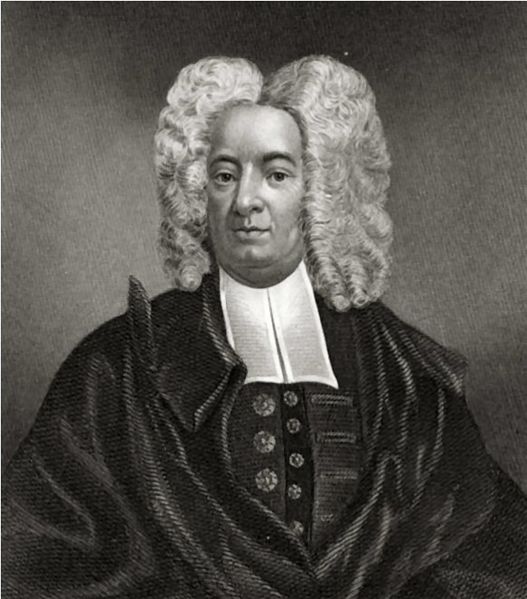
Cotton Mather Portrait c. 1700

Although convicted in Sep 1691 Elizabeth was not hanged until June 8, 1693. In the interim she came under the care and guidance of the Reverend Cotton Mather. How he found time to minister to Elizabeth while at the same time actively pursuing the Salem Witch Trials is unknown. Perhaps it was purely convenience, as Elizabeth was incarcerated in Boston, presumably with the unfortunate victims of the witchcraft hysteria. He did, however, get her to do something which nobody else could, to “confess.” During his sermon on Job 36:14 he read to the congregation what he claimed was a confession given him by Elizabeth. He writes that she confessed that “when they were born, I was not unsensible, that at least, One of them was alive; but such a Wretch was I, as to use a Murderous Carriage towards them, in the place where I lay, on purpose to dispatch them out of the World.” What did she mean by “murderous carriage?” Did she lay upon them or did she merely neglected them? Or were they, as per her initial assertion, truly stillborn?

According to Mather, she claimed that she should have listened to her parents, that she was “always of an Haughty and Stubborn Spirit.” and that “Bad Company” was what led to her downfall. Although her confession is very moving and seemingly sincere, Cotton Mather was not moved. He claimed that she “has more to confess, I fear…” and held little hope for her salvation. According to Mather “there never was Prisoner more Hard-Hearted, and more Unfruitful than you have been…”

It is a little puzzling that Mather was so disappointed with his prisoner. She did, after all, confess her crime and exhort the rising generation not to follow in her footsteps. Perhaps she did not confess readily enough to suit him. She was in prison for a little over two years and under those circumstances would surely have been broken into a confession at the hands of a less expert confessor than Mather. She may have continued to protest her innocence until very near the end, disappointing Mather who would have wanted to use her for his own ends.

Elizabeth was executed in Boston on that June day in 1693 and there her story ends. Dorothy, her daughter, also diseappeared from the record, and one can’t help but wonder at her fate. Michael, in his last will dated 1709, left distributions of a few shillings to at least some of his grandchildren, but Dorothy was noticeably absent.

Elizabeth may be seen in a number of different ways, as either victim or murderer, as evil or misguided. Her concealment of the birth seems unintellibible to many but in the context of a 17th century Puritan home it may be understandable, particularly in light of Michael Emerson’s known temper. That Samuel Ladd certianly bore responsiblity is undeniable. That he was not even questioned can only be seen as a result of his class and standing in the community. Was she coerced into sexual relations, and when the result was made known to him did he exhort her to silence? Perhaps, but by her own admission she had slept with Ladd many times. If he was the father of Dorothy as well as the twins they must have had a relationship lasting over five years. Such a relationship would not be seen as adulterous, as adultery was defined by the marital status of the woman.

But what of Michael Emerson’s charge in court that Timothy Swan was Dorothy’s father? The Swans and the Emersons were from the same social strata of Haverhill society. It may have been easier to try to claim paternity of his grandchild was the responsibility of an unmarried young neighbor than that of a high ranking, older married man. Perhaps Elizabeth herself, weighing the options, chose to lie to her father regarding Dorothy’s paternity, hoping that Timothy would marry her or seeking to protect Samuel from scandal. Eventually the truth must have come out as both of Elizabeth’s parents name Samuel Ladd without hesitation as the father of the twins. One thinks they may have known of their relationship prior to the discovery of the dead girls.

If Elizabeth had lived in the 20th century her life would have been very different. Rarely is the charge of whore-dom meted out today. In today’s society it would be her sister, Hannah Dustin, seen as the murderess, and Elizabeth as only an unfortunate girl, a victim of circumstance. But in the context of the 17th century Elizabeth was seen as the result of a moral degeneration that was very real and very frightening to Puritans of the first generation. A vast falling away from godliness in New England, not to be rectified until the next century’s Great Awakening. With nowhere to turn in her society, she sought to hide her pregnancy as long as possible, and when the twins were either born dead or died shortly thereafter, she took what steps she thought necessary to conceal her sin from her parents and from the community. How many others who did likewise were not caught

5. Deborah Corliss

Deborah’s first husband Thomas Eastman was born 11 Sep 1646 in Salisbury, Essex, Mass. His parents were Roger Eastman and Sarah [__?__]. Thomas died 29 Apr 1688 in Haverhill, Essex, Mass.

Deborah’s second husband Thomas Kingsbury was born 1653 in Ipswich, Essex, Mass. He first married Susanna Gage (b. 1617 d. 21 Feb 1678 in Haverhill). Thomas died 11 Jun 1720 in Plainfield, Windham, CT.

In 1676, Thomas Kingsbury was in the company of Lt. Benjamin Sweet in King Philip’s war; 1690 served under Sgt. John Webster at garrison east of Haverhill bridge

He was also active in other Indian wars and received land on the Saco River as a reward. Both Joseph and Thomas were in the Brick House garrison commanded by Thomas Dustin after the massacre of 1696/97 which took the lives of Thomas’s sons and probably his wife also.

In 1699-1700 Thomas appears to have received six shillings for serving on the committee to seat the meeting-house of Haverhill. In 1698 he made a committment to cut and carry two quarters of wood to the minister, Mr. Rolf. He also promised to attend meeting in the  new house of worship when the glass was installed..

1706 captured by Indians; when released, moved to Plainfield

Wheareas thro’ the Goodnes of God Thomas Kingsbury is returned from a Long Captivity, and is not providentially Cast amongst us, and where as that he hath Lost most wch he had by the enemies, we the subscribers Look upon it our Duty to extend an act of Charity to him and that he maye have wherewith all to Live comfortably amongst us — we being the Lawfull proprietors of the Land within the Township of Plainfield — Be it known to all that maye be any way concerned that we the Subscribers do hereby give, grant, alloocate, and confirme unto the sd Thomas Kingsbury To his heirs and assigns for ever a certaine Tract or percell of Land To the quantity of Twenty acres Lying on the North Side of the River Moosup Bounded west on Land that is to be Laid out to James Kingsbury, the above Twenty acres is to be Laid out in Som sutable form bye persons appointed by the proprietors and the sd Kingsbury is to setle upon sd Land and upon these termes we do freelye give it to the above sd Kingsbury — to his heirs and assigns for ever to have and to hold the same as his own proper inheritance in fee simple with out mollestation for us our executors and Administrators, in witness hereunto that it is our own proper act and Deed we have hereunto set our hands for our selves, Oct. 7, 1708.

Deborah may have died Mar 15 1696 in the same Indian raid that killed her daughter Sarah.

In 1704, Deborah’s son Jonathan Eastman (b. 1681) was captured by Indians, His 8-day-old baby was killed. He rescued his wife Hannah Green 3 years later at Three River, Canada.

6. Ann Corliss

Ann’s husband John Robie was born 2 Feb 1649 in Exeter, Rockingham, New Hampshire. His parents were Henry Robie and Ruth Moore. Just two weeks after Ann died, John was killed by Indians 16 Jun 1691 in Haverhill, Essex, Mass. leaving 7 children none over 12 yrs. of age.

Children born in Haverhill Ruth, Ichabod, Henry, Joanna, Sarah, Deliverance, John, Mary.

7. Huldah Corliss

Huldah’s husband Samuel Kingsbury was born 25 Mar 1649 in Haverhill, Essex, Mass. His parents were Henry Kingsbury and Susanna Gage. Samuel died 26 Sep 1698 in Haverhill, Essex, Mass.
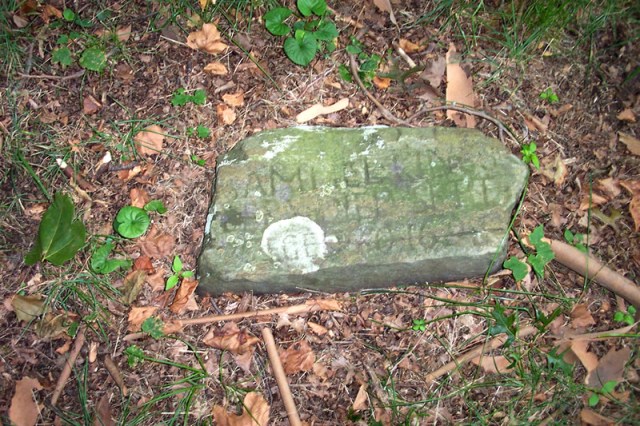
Samuel Kingsbury Gravestone — The Pentucket Cemetery is located on Water Street in Haverhill and was established in 1668. It’s located adjoining the Linwood Cemetery.

8. Sarah Corliss

Sarah’s husband Joseph Ayres was born 16 Mar 1658/59 Haverhill, Mass. His parents were John Ayres and Sarah Williams. Joseph died 30 Nov 1748 in Norwich, New London, CT.

Joseph was a planter or yeoman. He took the oath of allegiance and fidelity in Haverhill 28 Nov., 1677, with his father and brothers. Lived there until he removed to Ipswich, and thence about 1703 to West Farms (Franklin), Conn. John and Joseph Ayer settled at Preston and North Stonington as farmers. Joseph’s farm was within the bounds of “Norwich East Society” (part of Preston) where he was admitted an inhabitant in 1704. His mother’s brother, Joseph Williams, had come a short time before to this vicinity. Joseph Ayer brought his two sons with him; no doubt the other children came soon after, for they married in this neighborhood. He bought a large tract of land from Uncas (a Mohecan chief) and built the Ayer homestead in a narrow gap at the foot of Ayer’s mountain, known as Ayer’s Gap, where his father had settled before him.

Children of Sarah and Joseph

i. Joseph Ayres b. 8 MAY 1688 Haverhill, Mass.; d. 30 MAY 1688 Haverhill, Mass.

ii. Sarah Ayres b. 15 OCT 1690 Haverhill, Mass. d. 16 SEP 1753 Norwich, CT.; m. 30 SEP 1714 Norwich, CT. to Thomas Hazen. His parents were Lieut. Thomas Hazen and Mary Howlett.  His grandparents were Edward HAZEN Sr. and Hannah GRANT.

iii. Abigail Ayres b. 8 SEP 1693 Haverhill, Mass.; m. Dennis Manough

iv. Joseph Ayres b. 23 DEC 1695 Haverhill, Mass.

v. Timothy Ayres b. 25 MAR 1698 Haverhill, Mass.

Source:

http://www.genealogyofnewengland.com/b_c.htm

http://www.angelfire.com/sc/whitefeather/Davis.html

http://familytreemaker.genealogy.com/users/f/l/e/Marion-Caswell-flemin/PDFGENE3.pdf

http://freepages.genealogy.rootsweb.ancestry.com/~pattyrose/engel/gen/fg13/fg13_083.htm

“They Die in Youth And Their Life is Among the Unclean” The Life and Death of Elizabeth Emerson By Peg Goggin Kearney May 6, 1994 University of Southern Maine

Hannah Dustin: The Judgement of History By Kathryn Whitford Associate Professor, Department of English, University of Wisconsin-Milwaukee.
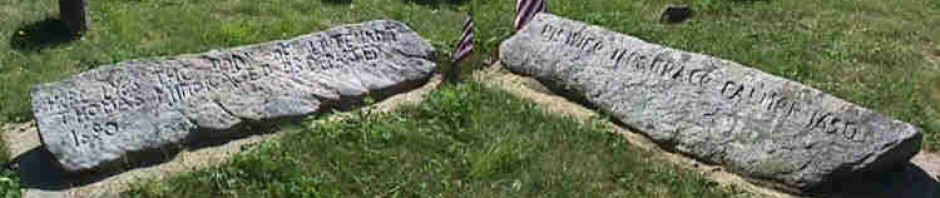
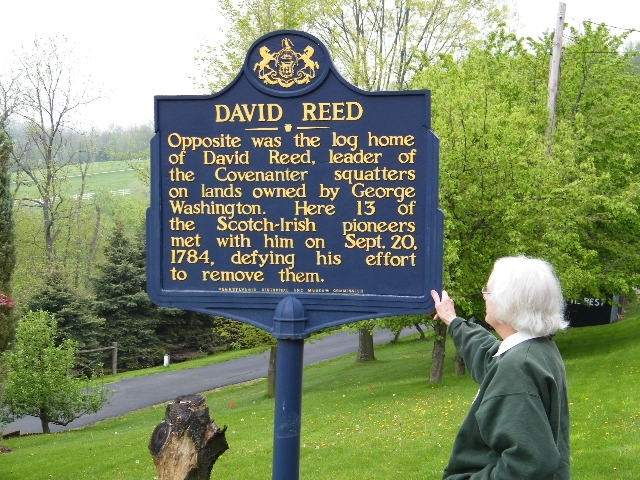
Posted in 11th Generation, Artistic Representation, Historical Monument, Immigrant - England, Line - Miller, Public Office, Storied, Violent Death | Tagged , , , , | 14 Comments

John Hutchins

John HUTCHINS (1604 – 1685) was Alex’s 9th Great Grandfather; one of 1,024 in this generation of the Miller line.
John Hutchins – Coat of Arms

John Hutchins was born in 1604/1608 in Hampshire, England. There are at least three theories as to how he arrived from England: 1) On the “Friendship” as carpenter’s mate in 1636; 2) On the “Mary and John“, date unclear; and the most likely 3) On the “Bevis” which sailed in May, 1638.
The Passenger List of the “Bevis” 1638 includes John Hutchins(on) and Frances Alcock.

Richard Dummer….40 of Bishopstoke, Hants..gentleman…to Newbury
Mrs. Alice Dummer…35
Thomas-19; Joan-19; Jane-10; Dorthy-6; Richard-4; Thomas-2
——————————
Stephen Dummer…of Bishopstoke,Hants, husbandman…to Newbury
and with him came:
John Hutchinson…30, servant; carpenter
Francis Alcock…26..servant
Adam Mott…19..servant, tailor
William Wakefield…22 servant
Anne Wakefield…20 servant
Samuel Poor…18 servant
Daniel Poor…14..servant
Alice Poor…20 servant
Nathaniel Parker..20, servant, of London, baker
Richard Bayley..15..servant

He married Frances ALCOCK. in Haverhill, Mass.  John died on 6 Feb 1685 in Haverhill, Essex, Massachusetts.

Frances Alcock  was born in 1612 in Hampshire, England. She came to America in 1638 at age 26 on the ship Bevis as a servant to Richard Dummer. John Hutchins was another servant to the same family. The Dummers were from the Southampton area of England, so  it’s logical to assume the Alcocks and Hutchins were also.  Frances died on 5 Apr 1694 in Haverhill.

Children of John and Frances:

Name Born Married Departed
1. Elizabeth Hutchins c. 1636 prob. England Thomas Ayres (Son of John Ayre)
22 Feb 1650 or 1 Apr 1656 Haverhill
1710
Haverhill
2. William Hutchins c. 1638 in Haverhill or England? Mary Edmunds
1 Sep 1657
Newbury
.
Sarah Hardy 1 Jul 1661 Haverhill
.
Elizabeth Eaton Grath 30 April 1685 Bradford (Haverhill)
1 Jul 1661 Bradford, Essex, Mass
3. Ensign Samuel Hutchins 1640 or 1645 in Haverhill Hannah Johnson (Daughter of John JOHNSON)
18 Jan 1713 Haverhill
18 Jan 1713 in Haverhill, Essex, Mass.
4. Joseph HUTCHINS 15 Nov 1640 Newbury, Mass Joanna CORLISS
29 Dec 1669
Haverhill
19 Apr 1689 Haverhill
5. John Hutchins 10 Oct 1641
Newbury, Mass
6 Feb 1685 Haverhill
6. Benjamin Hutchins 15 May 1643
Newbury, Mass
Sarah Lampry
5 June 1694
Haverhill
1699
7. Love Hutchins 16 Jul 1647
Haverhill
Samuel Sherburne (twin)
15 Dec 1668
Haverhill
Feb 1738/39
Kingston, NH
8. Thomas Hutchins 1649
Haverhill

John first settled in Newbury and later moved to Haverhill. His principle occupation was as a carpenter, although there are records that he also fished the Merrimack River, had a partnership in a sawmill, and did some farming. John may have been the first one in Haverhill to have servants; they included Elizabeth Shaw and an Indian named Hopewell. So this was a respectable family of some means.

John was Selectman in 1669-70; Constable in 1663-4, and built the first church in town. He married Frances. In 1692 she was arrested for being a witch, but was never tried. She was brought before the Court in 1653 for wearing a silk hood, but “upon testimony of her being brought up above the ordinary way,” she was discharged.

His heirs received a grant of land in Narragansett Township, No. 3, (now Amherst, N. H.,) for services performed in King Philip’s War. He removed to Haverhill, Mass., and died there Feb 6, 1685, aged 77. Frances died Apr 5, 1694, aged 84. His will was probated Mar 30, 1686.

Timeline

1642 – John Hutchins, Newbury, brought suit in Ipswich Court

Before 1647 – Removed to Haverhill

1653 – Francis was in court. Around 1650 the General Court had passed a law prohibiting the display of finery by persons “of meane condition” defined as persons whose property was valued under £200. Francis was arrested on 17 Sep 1653 for wearing a silk hood, as was her friend, Mrs. Joseph Swett. Francis Hutchins was acquitted because “upon testimony of her being brought up above the ordinary way,” while Mrs. Swett was found guilty and had to pay ten shillings.  [Considering Frances arrived as an indentured servant, I wonder what was the basis for her “being brought up above the ordinary way”]

23 Nov. 1654 – Gave house and land at Newbury to wife Frances, and cattle to daughter Elizabeth and son William.

29 April, 1661 – Conveyed land to son Joseph

25 Sep 1658 owed to “Goodman Hutchins” 9s. 8p. by estate of Henry Fay, for a coffin and a peck of corn;

9 Jun 1658 – Will of Robert Clements mentions debt of “seavern” pounds for “repaireing the house and fencing the home loth”; 13 Oct 1668 John Hutchins sued a Portsmouth committee for £140, case withdrawn; sued Richard Cutt for £61 for work done on the Moodie house and for the seats and canopy of the meeting house, case withdrawn

6 Mar 1657 – Permitted to set a weir in the Merrimack River and to cure the fish on the island, with the condition that he sell the fish to the townspeople at a fair price.

1685 – “This Court, being informed of the inability of John Hutchins of Haverhill, by reason of his being dumbe, to mannage his estate, by impleading of his debtors & answering to any action that may be considered against him, doe grant power to Francis, his wife, to act those affaires in her own person, or by her substitute”.

Francis’ Witch Trial Arrest

1692 – Francis was arrested again 18 Aug 1692 for witchcraft as a result of a witchcraft complaint filed by Timothy Swan, Ann Putnam, Jr., and Mary Walcott.  The charge was not pressed because her son Samuel and Joseph Kingsberry (1665 – ~1695)  posted 200 pounds bond to satisfy the accusers and gain her release on 21 Dec 1692.  No trial records were found.

Warrant for Arrest of Frances Hutchins and Ruth Wilford

“Essex/ To the Constable of Haverhill
Complaint being made to me this day, by Timothy Swan of Andover: & Mary Wallcott & Anna Putnam of Salem Village, Against Mrs: frances Hutchins & Ruth Willford, of Haverhill that the s’d frances Hutchins & Ruth Willford, hath sorely afflicted them, the s’d Timothy Swan Mary Walcott & Anna Putnam in their bodies, by witchcraft Severall times Contrary to the Peace of o’r: Sovereigne Lord & Lady King William & Queen Mary, of England &c: & to their Majests Law in that Case provided: & s’d Timothy Swan having according to Law, given sufficient bond, to Prosecute s’d Complaint, before Their Majests: justices of Peace att Salem the 19th: or 20th Instant. These therefore require you in their Majests. names to Apprehend & sease the bodies of the afores’d frances Hutchins & Ruth Willford, upon sight hereof, & them safely Convey to [to] Salem afores’d, to their Majests: justices of the Peace there, to be examined & proceeded with according to law: for which this shall be yo’r warrant: Given under my hand & seal this eighteenth day of August Anno Domini 1692: In the 4th year of their Majests. Reigne. &c
*Dudley Bradstreet
Justice of Peace

(Reverse) according to this warrant I have seesed and brought don mrs frances huchins: but sought with Diligenc for Ruth Wilford and she cannot be found
August 19: 1692
by Me Wilum Strlin Constbl for haverihill”

(Note: Ruth Wilford was taken into custody on August 20, 1692.)

Recognizance for Francis Hutchins

Memorandum —

That on the Twenty one Day of Decemb’r: Anno’qe D[mbar ] : one Thousand Six hundred Ninty & two in the: fourth year of the Reigne of our Sovereigne Lord & Lady William & Mary by the Grace of God of England &c. King & Queen Defenders of the faith &c: Personally came and Appeared before me George Corwin High Shirriffe for the County of Essex of the Province of the Massathutets Bay in New England — Samuel Hutchens of Haverell and Jospeh Kingsbury of Haverell afores’d Husbandman and Acknowledged themselves Indebted Unto our Sovereigne Lord & Lady the King & Queen or the Survivors of them their Heires & Successors: in the Summe of two hundred pounds to beleaved one their Goods & Chattles Lands & Tenements for the Use of our Sovereigne Lord & Lady the King & Queen or the Successors of them if Default be made in the Performance of the Condition Underwritten

Videllisitt —

The condition of the above written Recognizance is Such That Whereas francess Hutchens Widdow of Haverell afores’d is Suspected of and Accused of Committing Divers Acts of Witchcrafts If therefore the Said frances Hutchens afores’d: Shall & do make her Personall Appearance before the Justices of our Sovereigne Lord & Lady the King & Queen at the Next Court of Assize of Oyer & Terminer Next Generall Goal Delivery to be held for & within the County of Essex afores’d; to answar what shall be objected ag’t: her on their Maj’tes: behalfe Refering to the Witchcrafts & to do & Receive that by w’ch said Court shall be then and there Injoyned & not Darpart without Licence Then the said Recognizance to be Void: or Else to abide in full force & Vertue In Wittness wherof the: above Named Persons #[have] Sam’ll: Hutchings & Joseph Kingsberry have hereunto sett our hands & seales this Twenty first Day of December in the Year of our Lord one Thousand six hundred Ninty & two, and in the fourth year of their Maj’ties Reigne

Wittnessed:

Thomas Beadle (1668 – 1735)
Joshua Conant (1657 – 1706)
John Giles (1645 – 1715)  1692

*Samuel huchins
*Joseph Kingsberry

Ann Putnam, Jr. (18 Oct – 1716), along with Elizabeth “Betty” Parris, Mary Walcott and Abigail Williams, was an important witness at the Salem Witch Trials of Massachusetts during the later portion of 17th century Colonial America. Born 1679 in Salem, Essex, Massachusetts, she was the eldest child of Thomas Putnam (1652–1699) and Ann Carr (1661–1699). She was friends with some of the girls who claimed to be afflicted by witchcraft and, in March 1692, proclaimed to be afflicted herself.

In 1706, Ann Putnam publicly apologized for the part she had played in the witch trials.

I desire to be humbled before God for that sad and humbling providence that befell my father’s family in the year about ninety-two; that I, then being in my childhood, should, by such a providence of God, be made an instrument for the accusing of several persons of a grievous crime, whereby their lives were taken away from them, whom, now I have just grounds and good reason to believe they were innocent persons; and that it was a great delusion of Satan that deceived me in that sad time, whereby I justly fear I have been instrumental, with others, though ignorantly and unwittingly, to bring upon myself and this land the guilt of innocent blood; though, what was said or done by me against any person, I can truly and uprightly say, before God and man, I did it not out of any anger, malice, or ill will to any person, for I had no such thing against one of them; but what I did was ignorantly, being deluded by Satan.

And particularly, as I was a chief instrument of accusing Goodwife Nurse and her two sisters [including our ancestor Mary Towne ESTEY], I desire to lie in the dust, and to be humble for it, in that I was a cause, with others, of so sad a calamity to them and their families; for which cause I desire to lie in the dust, and earnestly beg forgiveness of God, and from all those unto whom I have given just cause of sorrow and offense, whose relations were taken away or accused.

Some historians have speculated that her parents, Thomas and Ann (Carr), Sr., coerced Putnam to accuse those they were feuding with or sought revenge on. Many of the accused had some sort of relationship with the powerful Putnam family. When her parents died in 1699, Putnam was left to raise her nine siblings aged 7 months to 16 years. Putnam never married.

House of Ann Putnam, Jr. Danvers circa 1891

She was a first cousin once removed of Generals Israel Putnam and Rufus Putnam.

In Arthur Miller’s play The Crucible, her name is Ruth, to avoid confusion with her mother, Ann Putnam Sr.

Will of John Hutchins 24 Jun 1674 – 30 Mar 1686:

Be known unto all men by these presents that I, John Hutchins of Haverhill, Mass., in the county of Norfolk, Mass., New England, being through God’s mercy in indifferent health of body and of perfect memory considering mine age and mortality do here make my last will and testament, commending my soul in the hands of my blessed Redeemer And for my worldly goods I dispose as followeth:

For my eldest son William Hutchins, I formerly gave him a parcell of land when he was married and therefore give him but twenty shillings.

And to my son Joseph I also gave a parcell of land to; which he now posesseth and also give him but twenty shillings.

And also I give my daughter Elizabeth Ayres (besides what she hath had already) twenty shillings,

I also give to my daughter Love Sherburne, (besides what she hath had already) twenty shillings;

And also I give to my son Benjamin Hutchins all the land he now possesseth, and which I formerly gave him and twenty shillings also.

And further I give to my son Samuell Hutchins all the land I formerly gave to him and which he now possesseth and twenty shillings also.

And I appoint Francis my wife to be the sole executrix of this my last will and testament, And my house and land that now I do possess and enjoy, both upland and meadow with goods and chattels and all my land undisposed I give to my said wife during her natural life, that if she see cause for her own necessity rather than to suffer she shall have liberty to sell for her comfortable livelihood, And at her decease to dispose of all at her discretion among my children, my debts and funeral being discharged.

Witnesses:
Anthony Somerby
John Hutchins
William (his mark) Titcomb

Anthony Somerby did on his oath testify that he saw John Hutchins sign, seal and declare the above written to be his last will & testament, & set his hand as a witness and also saw William Titcomb to set his hand as a witness. March 30, 1686 before me, John Woodbridge, authorized to take oaths in Newbury.

In obedience to and pursuant of an order of Ipswich Court, March 30, 1686, requiring and empowering it, I did repair to Anthony Somerby who made oath that he did see John Hutchins sign, seal and declare this will (written on the other side) to be his last will and testament and that himself and William Titcomb did also sign it as witnesses the said Hutchins being than as he judged of a disposing mind.

Sworn, April 8, 1686, before me,
Robert Pike  (son-in-law of Joseph MOYCE)  (assistant)

Will of Francis Hutchins is as follows:

“The last will and testament of Francis Hutchins of Haverhill in perfect memory and understanding but sensable of my drawing nigh the day of my death:

Do in the first place bequeath my soul to God and my body to decent burial and after my just debts being paid to will my estate as followeth and in the – –

First place I do will to my son William Hutchins one common right having his portion sufficient already this being in full.

2ndly I do will to my two daughters Elizabeth and Love my wearing apparel both lining and woolen.

3dly I do will to my daughter in law Johannah Hutchins my mortar and pestal.

4thly I do will to my son Benjamin the great brass kettle and one common right.

5thly I do will to my son Samuel the table board and the frame and great cubbard.

6thly I do will to my son joseph, his children viz: John, Francis, Mary, Samuel, Joseph twelve acres of land adjoining to the land which I have given to their mother at the west end of my land adjoining to the land of Samuel Hutchins.

7thly I do will to my son Joseph Hutchins deceased his children one common right.

8thly I do will to my daughters Elizabeth and Love and to my two sons Samuel and Benjamin all the rest of my estate of what nature and kind soever to be equally divided amongst them all that is to say the said four.

9thly If any of my above children shall lay any claim to any of my husband’s lands or other estate of my husbands or mine by verture of any former promise not given under hand in writing shall forfeit their right unto what is bequeathed and willed unto him or them except five shillings which I do will to any such person and no more provided he or they shall endeavor to make out any such claim by law.

To this will I do constitute and appoint my son samuel Hutchins and my son in law Samuel Sherburn executors – the words common right was interlined as to my son Benjamin, before assinging and hearunto I have set my hand this fourth day in March in the year of our Lord, one thousand six hundred and ninety-four.

Francis Hutchins
Robert Ford
Josiah Gage
Before Honorable Bartholemew Gedney, Exquire, May 16, 1694.

Robert Ford and Josiah Gage made oath that they were present and saw Mrs. Francis Hutchins sign this Instrument and heard her declare it to be her last will and testament and that she was then of a disposing mind to my best deserning.
Stephan Sewall (Registrar)”

Children

1. Elizabeth Hutchins

Elizabeth’s husband Thomas Ayres (Ayer) was born about 1630 in England. His parents were John Ayers and Hannah Evered. He may have lived in Newbury in 1657. Thomas died 9 Nov 1686 in Haverhill, Essex, Mass.

Thomas’ sister  Mary (Ayer) Parker of Andover, Mass., was executed September 22, 1692, with several others, for witchcraft in the Salem witch trials. She was 55 years old and a widow. Mary’s husband, Nathan, died in 1685.     Her daughter, Sarah Parker, was also accused.

In Sep 1692, Mary Ayer Parker of Andover came to trial in Salem Massachusetts, suspected of witchcraft. During her examination she was asked, “How long have ye been in the snare of the devil?” She responded, “I know nothing of it.” Many people confessed under the pressure of the court of Oyer and Terminer, but she asserted they had the wrong woman. “There is another woman of the same name in Andover,” she proclaimed. At the time, no one paid much attention. Mary Ayer Parker was convicted and hanged by the end of the month.

Mary Parker Memorial

Modern historians have let her claim fall to the wayside as well, but what if she told the truth?  Was there another Mary Parker in Andover? Could it be possible that the wrong Mary Parker was executed?

The end of her story is recorded for every generation to see, but the identity of this woman remained shrouded in mystery for over three centuries. We still don’t know why she was accused in 1692. Puritan women were not particularly noteworthy to contemporary writers and record-keepers. They appeared occasionally in the court records as witnesses and plaintiffs but their roles were restricted to the house and family. Mary Parker was a typical Puritan wife. She appeared in the records only in birth notices and the records associated with the will of her late husband Nathan Parker. Notably, the records included no legal trouble at all, for witchcraft or anything else.

John and Hannah Ayer gave birth to their daughter Mary sometime in the early to mid 1600’s. Mary and her siblings may have been born in England, and later moved to America with their parents. The Ayers moved several times during the early stages of their settlement in America but resettled for the last time in 1647 in Haverhill.

The family was apparently of some prominence. Tax records from 1646 showed that John Ayer possessed at least one hundred and sixty pounds, making him one of the wealthiest settlers in Haverhill.

Mary Ayer married Nathan Parker sometime before her father’s death in 1657. Although no marriage record survived in the hometowns of either Nathan or Mary, the wording of her father John Ayer’s will made it obvious that she was married with children when it was written.  Nathan married his first wife Susanna Short on Nov 20, 1648. Within the next three years, the couple relocated to Andover, where she soon after died on August 26, 1651. Andover’s Vital Records listed the birth of Nathan and Mary Parker’s first son John in 1653.  Nathan could have remarried and had children within the two years after the death of his first wife.

Mary and Nathan marriage was not documented but we do know Nathan and his brother Joseph settled in Newbury, Massachusetts sometime in the early 1630’s. They settled in Andover where they were amongst its first settlers. Nathan came over from England as an indentured servant, but eventually he became rather wealthy in Andover. The original size of his house lot was four acres but the Parker’s landholdings improved significantly over the years to 213.5 acres.  His brother Joseph, a founding member of the Church, possessed even more land than his brother, increasing his wealth as a tanner. By 1660, there were forty household lots in Andover, and no more were created. The early settlers, including the Parkers, would be those of importance. By 1650, Nathan began serving as a constable in Andover. By the time he married Mary Ayer, his status was on the rise. It continued to do so during the early years of their marriage as he acquired more land.

Mary and Nathan continued to have children for over twenty years after the birth of John Parker in 1653. Mary bore four more sons: James in 1655, Robert in 1665, Peter in 1676, and a son Joseph.   She and Nathan also had four daughters: Mary, born in 1660 , Hannah in 1659, Elizabeth in 1663, and Sara in 1670. James died on June 29, 1677, killed in an Indian skirmish at Black Point. Robert died in 1688 at the age of 23. Hannah married John Tyler in 1682. Nathan and Mary’s daughter Elizabeth married John Farnum in 1684.

When Nathan died on June 25, 1685, he left an ample estate to his wife and children. Mary Ayer Parker brought an inventory of the estate to court in September of the same year, totaling 463 pounds and 4 shillings. The court awarded her one-third of the house and lands, equal shares to Robert, Joseph, Peter, Hannah, Elizabeth, and Sarah, and a double share to John.  Mary Parker widow obtained an estate of over 154 pounds-a good amount of money in the late 17th  century.

Mary Parker did not appear in Essex County records after Sep 29, 1685 when she brought the inventory to court. We know little about her interaction with her neighbors and the community after her husband’s death. The Parkers were a respectable family that continued to root itself in the community. So why, less than a decade after her husband’s death, was Mary accused as a witch? There was no documented friction with any of her neighbors, any no prior accusations. The closest tie Mary had with witchcraft was a distant cousin on her father’s side, William Ayers whose his wife Judith was accused of witchcraft in 1662.  But this was not enough to justify Mary’s accusation. What really happened in 1692 to Mary Ayer Parker?

The Salem crisis had spread to Andover when William Barker Jr. named her in his confession on Sep 1, 1692. He testified that “goode Parker went with him last Night to Afflict Martha Sprague.” He elaborated that Goody Parker “rod upon a pole & was baptized at 5 Mile pond,” a common reference to a union made with the devil. The examination of Mary Parker occurred the next day. At the examination, afflicted girls from both Salem and Andover fell into fits when her name was spoken. The girls included Mary Warren, Sarah Churchill, Hannah Post, Sara Bridges, and Mercy Wardwell. The records state that when Mary came before the justices, the girls were cured of their fits by her touch-the satisfactory result of the commonly used “touch test,” signifying a witch’s guilt.

When Mary denied being the witch they were after Martha Sprague, one of her accusers, quickly responded that is was for certain this Mary Parker, who had afflicted her. Sprague and Mary Lacy effectively fell into fits. Historian Mary Beth Norton discovered that Mary Parker was related to Sprague; she was Sprague’s step-great-aunt.  Mary Parker’s son-in-law John Tyler’s father Moses Tyler had married Martha’s mother. >Martha also lived in Andover, and the Tylers and the Parkers were friendly for sometime before their families were joined in marriage.  Still, it was a distant relation and Martha was only sixteen years old at the time of the trial, so it is doubtful she knew Mary Parker personally.

Nevertheless, Mary Parker’s defense was ignored, both by the courtroom, and most historians until now. However, Mary Ayer Parker told the truth: there was another Mary Parker living in Andover. In fact there were not one, but three other Mary Parkers in Andover. One was Mary Ayer’s sister-in-law, Mary Stevens Parker, wife of Nathan’s brother Joseph. The second was Joseph and Mary’s daughter Mary. The third was the wife of Mary and Joseph’s son, Stephen. Mary Marstone Parker married Stephen in 1680. To complicate things even further, there was yet another Mary Parker living nearby in Salem Towne.

Confusion could easily have arisen from the multitude of Mary Parkers abound in Essex County. However, similarities between Mary Ayer Parker and her sister-in-law may have instigated confusion in even her accusers. The two Mary’s married the Parker brothers by the late 1640’s, and began having children in the early 1650’s. They had children of the same name including sons named Joseph and daughters Mary and Sara (Mary, daughter of Nathan and Mary may have died soon after her father). Nathan and Mary Parker’s son James, born in 1655, and Joseph and Mary Parker’s son John born in 1656, died on June 29, 1677, killed by the Indians at Black Point  In 1692, both Mary Parker Sr.’s were reasonably wealthy widows. Joseph’s wife received their house and ample land from his will, dated Nov 4, 1678. The two women shared almost fifty years of family ties. But in September of 1692, it was only Nathan Parker’s wife who was accused, tried, and found guilty of witchcraft. Why was Mary Ayer brought to trial?

On the surface, the two Mary Parkers seemed almost interchangeable but the will of Joseph Parker revealed something important about his branch of the Parker family. Joseph made some peculiar stipulations regarding the inheritance of his son Thomas. The will described Thomas as “who by god’s providence is disenabled for providing for himself or managing an estate if committed to him by reason of distemper of mind att certain seasons.” The management of his portion of the estate was given to his mother Mary until her death, after which, Thomas would choose his own guardian.

This “distemper of mind” seemed to run in the family. Stephen Parker later petitioned in Sep 1685 that his mother be barred from the management of her own affairs for the same reason. Stephen revealed that his mother was in a “distracted condition and not capable of improving any of her estate for her owne comfort.” Whether mental illness influenced the reputation of Joseph Parker’s wife cannot be ascertained, but it is likely that if she was mentally instable, it was well known in the tight-knit community of Andover.

Mental illness was often distrusted and feared. In fact, a case in 1692 involved a woman with a history of mental illness. Rebecca Fox Jacobs confessed to witchcraft in 1692 and her mother Rebecca Fox petitioned both the Court of Oyer and Terminer and Massachusetts Governor Phips for her release on the grounds of mental illness. According to her mother, it was well known that Rebecca Jacobs had long been a “Person Craz’d Distracted & Broken in mind.”  Evidently mental illness could have made someone more vulnerable to witchcraft accusations. This does not guarantee the girls intended to accuse Mary Stevens Parker but it does make the case for Mary Ayer Parker’s misidentification stronger.

A notorious figure in Salem Towne, also named Mary Parker muddled the case further. This Mary Parker appeared multiple times in the Essex courts and made a reputation for herself beginning in 1670’s. In 1669, she was sentenced for fornication.  In 1672, the court extended her indenture to Moses Gillman for bearing a child out of wedlock. A year later, she went back to court for child support from Teague Disco of Exiter.  The court sentenced her ten stripes for fornication. She came to trial two more times for fornication in 1676.  A scandalous figure indeed, Mary from Salem further sullied the name “Mary Parker.”

Mary Ayer Parker told the truth about the other Marys, but the court ignored her. William Barker Jr. came in to speak against her. He testified “looking upon Mary Parker said to her face that she was one of his company, And that the last night she afflicted Martha Sprague in company with him.” Barker Jr. pointed Mary out in court but he may have been confused himself. In his own confession, William accused a “goode Parker,” but of course, he did not specify which Goody Parker he meant.There was a good possibility that William Barker Jr. heard gossip about one Goody Parker or another and the magistrates of the court took it upon themselves to issue a warrant for the arrest of Mary Ayer Parker without making sure they had the right woman in custody.

Mary Parker’s luck plummeted when Mary Warren suffered a violent fit in which a pin ran through her hand and blood came from her mouth during her examination. Indictments followed for the torture and other evil acts against Sarah Phelps, Hanna Bigsbee, and Martha Sprague. Martha’s indictment was rejected, returned reading “ignoramus,”  but the indictments for both Hannah Bigsbee and Sarah Phelps were returned “billa vera”, and the court held Mary Parker for trial. Sara claimed that Mary tortured her on the last day of August as well as “diverse other days and times.” Hannah said that Mary tortured her on the first day of September: the indictment stated that she had been “Tortured aflicted Consumed Pined Wasted and Tormented and also for Sundry othe[r] Acts of Witchcraft.

Capt. Thomas Chandler approved both indictments. Significantly both Sarah and Hanna were members of the Chandler family, one of the founding families in Andover. The Captain’s daughter Sarah Chandler married Samuel Phelps on May 29, 1682. Their daughter Sara Jr. testified against Mary Parker in 1692.  Hannah Chandler, also the daughter of Capt. Thomas, married Daniel Bigsbee on December 2, 1974.  Capt. Thomas Chandler’s daughter Hannah and granddaughter Sarah.gave evidence that held Mary for trial. Did the Chandler family have it out for the Parkers?

Thomas and his son William settled in Andover in the 1640s.  Elinor Abbot wrote that they originally came from Hertford, England. The revelation of strong Chandler ties to Mary’s case is peculiar because until then, the relationship between the Parkers and the Chandlers seemed friendly. Public and private ties between William, Thomas, and the Parker brothers were manifest in the public records. Nathan and William Chandler held the responsibility of laying out the land lots, and probably shared other public duties as well.  Joseph Parker’s will called Ensigne Thomas Chandler  his “loving friend”, and made him overseer of his estate. Nathan Parker’s land bordered Thomas Chandler’s and there was no evidence of neighborly disputes.  It is difficult to understand where the relationship went bad.

The only hint of any fallout between the families came more than a decade before Joseph Parker’s 1678 will. On June 6, 1662, Nathan Parker testified in an apprenticeship dispute between the Tylers and the Chandlers.48 The Chandler family may have felt Nathan Parker unfairly favored the Tyler family in the incident. Bad blood between the Chandler and Tyler families could have translated into problems between the Chandler and Parker families. This discord would have been worsened by the alliance between the Tyler and Parker families through Hannah Parker and John Tyler’s marriage in 1682.

This still does not seem enough to explain the Chandlers’ involvement 1692. Perhaps after Nathan Parker’s death in 1685, neighborly tensions arose between Mary’s inherited state and the bordering Chandler estate. The existing records betray nothing further. Perhaps these speculated neighborly problems were coupled with the desire to distract attention from an internal scandal in the Chandler family.

In 1690 Hannah and Daniel Bigsbee testified in the trial of Elizabeth Sessions, a single woman in Andover who claimed to be pregnant with the child of Hannah’s brother Joseph. The Bigsbees refuted her claim and insisted she carried the child of another man. The Chandlers were respected people in Andover; even Elizabeth referred to them as “great men,” and they surely resented the gossip. The crisis of 1692 was a perfect opportunity for them to divert attention away from the scandal. When Mary Parker was arrested, they found the ideal candidate to take advantage of: her husband and her brother-in-law were no longer around to defend her and her young sons could not counter the power of the Chandlers.

After the initial indictments, Hannah Bigsbee and Sarah Phelps dropped from documented involvement in the case. Here, the documentation gets rather sloppy and confused. Essex Institute archivists erroneously mixed much of the testimony from Alice Parker’s case in with Mary Parker’s. When the irrelevant material is extracted, there is very little left of the actual case.50

The only other testimony came from two teenage confessors: Mercy Wardwell and William Barker Jr. On Sep 16, fourteen-year-old Barker told the Grand Inquest that Mary “did in Company with him s’d Barker : afflict Martha Sprag by: witchcraft. the night before: s’d Barker Confessed: which was: the 1 of Sept’r 1692”.  Eighteen-year-old Mercy did not name Mary a witch, but did say that “she had seen: the shape of Mary Parker: When she: s’d Wardwell: afflicted: Timo Swan: also: she: s’d she saw: s’d parkers Shape: when the s’d wardwell afflicted Martha Sprage”.

Nothing else remains of Mary Parker case. It appeared that Mary’s trial was over on Sep 16, 1692. She was executed only six days later. Evidence seems lacking. In essence, Mary was convicted almost solely from the testimony from two teenage confessors. Her examination, indictment, and grand inquest all took place expediently, and within one month, Mary was accused, convicted and executed.

Her death seems irresponsible at the least, and even almost outrageous. She was convicted with such little evidence, and even that seems tainted and misconstrued. Amidst the fracas of 1692, a woman died as the result of sharing the unfortunate name “Mary Parker.”

2. William Hutchins

William’s first wife Mary Edmunds

Williams’s second wife Sarah Hardy was born about 1640 in Bradford, Essex, Mass. Her parents were Thomas Hardy of Ipswich and Lydia [__?__]. Sarah died 19 Sep 1684 in Bradford.

William’s third wife Elizabeth Eaton was born 12 Dec 1650 in Salisbury, Essex, Massachusetts. Her parents were John Eaton (1625-1682)and Martha Rowlandson (~1623-1712). She had previously married 7 Jan 1674 to Dr. John Groth (Grath) (abt 1645, Germany – bef 1685) He was allowed by the Salisbury court to practice “physick and chyrurgerie” in 1679.

3. Ensign Samuel Hutchins

Samuel’s wife Hannah Johnson was born 1641 in Andover, Essex, Mass. Her parents were John JOHNSON and Susanna ASHERST. Hannah died in Boston, Suffolk, Mass

Samuel’s mother Francis Hutchins was arrested on the 19th August 1692 as a result of a witchcraft complaint filed by Timothy Swan, Ann Putnam, Jr., and Mary Walcott. She was imprisoned until the 21st December 1692 when she was released on bond posted by Samuel Hutchins and John Kingsbury.

4. Joseph HUTCHINS (See his page)

6. Benjamin Hutchins

Benjamin’s wife Sarah Lampry was born about 1670.  Benjamin was 51 when they married in 1694 and she was much younger.  I haven’t found more about Sarah and haven’t been able to verify if that was the right Benjamin.

7. Love Hutchins

Love’s husband Samuel Sherburne was born 4 Aug 1638 in Portsmouth, NH. His twin Elizabeth married 10 Jun 1656 in Portsmouth, Rockingham, New Hampshire to Tobias Langdon. His parents were Henry Sherburne and Rebecca Gibbons of Portsmouth. He was the chief heir of his grandfather Gibbons. In 1670, he had a 60 acre grant and ferry priveledge In 1674 he had a home and land at Little Harbor from his father. In 1678 he bought the old Tuck inn at Hampton, where he was selectman in 1683 and 1688.

9 Dec 1684 he was indicted for beating Dr. Richard Hooper in the streets of Hampton;
4 Jun 1699 Elizabeth wife of Dr. Richard Hooper, conveyed to Love Sherburne, widow of Samuel, a tract of land at Hampton (in honor of a note given for part of the cost from a suit brought to recover payment of the note on 3 Apr 1684)

He was Captain of the militia.  Samuel was killed by Indians 4 Aug 1691  in Maquoit or  Casco Bay, Cumberland, Maine.

Source:

http://familytreemaker.genealogy.com/users/l/a/b/Jean-Labrack/GENE4-0031.html

http://www.genealogyofnewengland.com/b_h.htm

http://www.ourfamilystories.com/ourfamily/pafg10.htm

http://familytreemaker.genealogy.com/users/r/i/c/Stanton-G-Richards/FAMO2-0001/d109.htm#P3597

http://genforum.genealogy.com/alcock/messages/127.html

http://genforum.genealogy.com/alcock/messages/165.html

The Tucker genealogy: a record of Gilbert Ruggles and Evelina Christina … By Tyler Seymour Morris

http://freepages.genealogy.rootsweb.ancestry.com/~pattyrose/engel/gen/fg18/fg18_201.htm

http://trees.ancestry.com/owt/person.aspx?pid=36989691&st=1

The Untold Story of Mary Ayer Parker: Gossip and Confusion in 1692  By Jacqueline Kelly  2005`ns

Posted in 11th Generation, Immigrant - England, Line - Miller, Public Office, Storied, Veteran, Witch Trials | Tagged , , , , , | 19 Comments