Maj. John Mason

Maj. John MASON (1600 – 1672) was the commanding officer in the Pequot War.

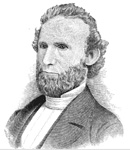
John Mason Portrait

At the time, he was a victorious hero who later became  Deputy Governor of Connecticut and founded Norwich, Connecticut.  Now, he is viewed by some as a war criminal due to his responsible for the Mystic Massacre.  He was Alex’s 10th great grandfather, one of 2,048 in this generation of the Miner line.

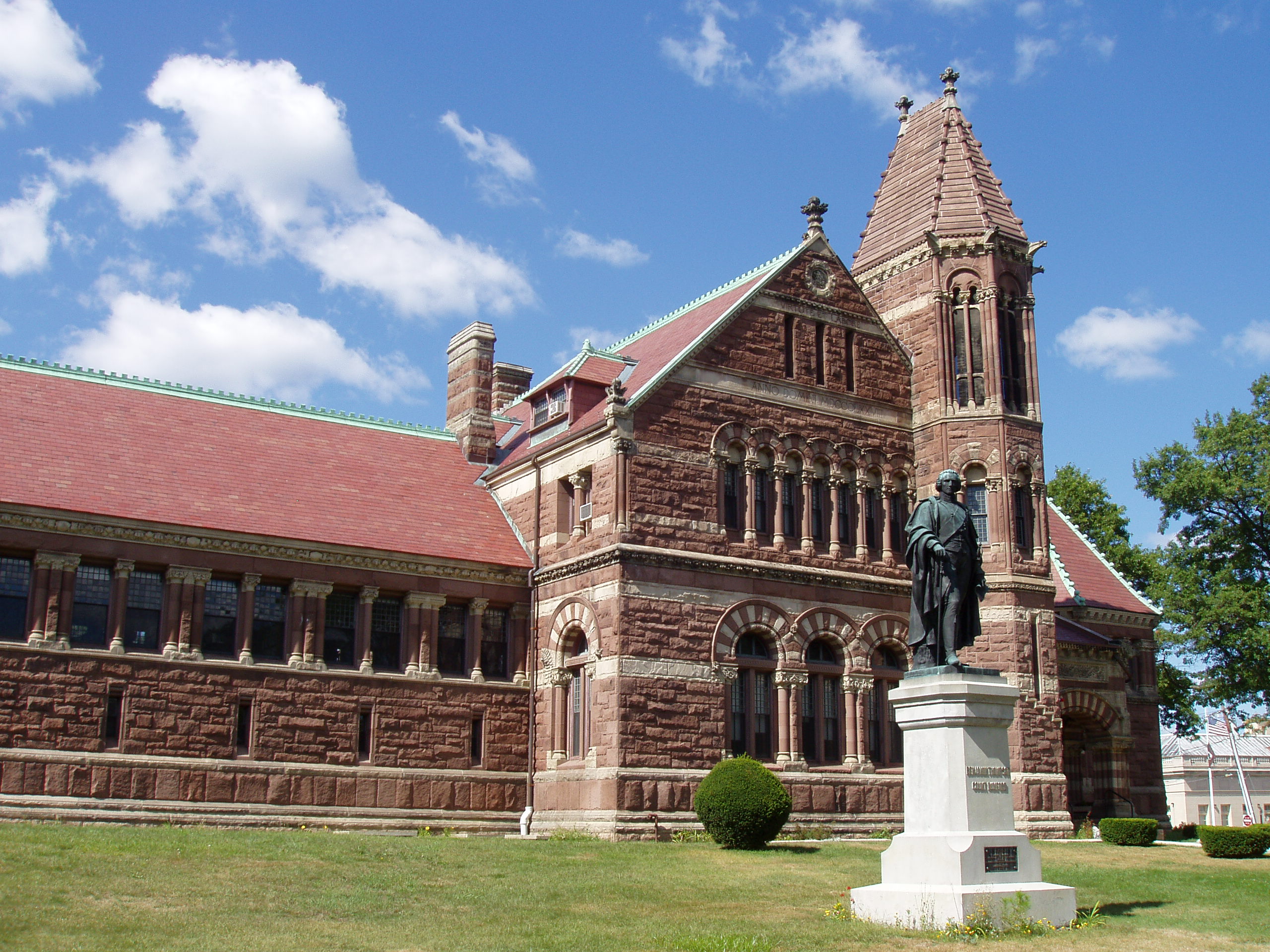
The statue of Alex’s 10th Great Grandfather, Major John Mason stood on Pequot Hill, Mystic, CT at the spot where on June 7, 1637 he ordered his 90 colonists soldiers and 100 Mohegan Indians to attack and burned to death 600-700 men, women and children of the Pequot Indian Tribe.

A statue of Major John Mason is on the Palisado Green in Windsor, Connecticut.   The John Mason statue was originally placed at the intersection of Pequot Avenue and Clift Street in Mystic, Connecticut, near what was thought to be one of the original Pequot forts.The statue remained there for 103 years. After studying the sensitivity and appropriateness of the statue’s location near the historic massacre of Pequot people, a commission chartered by Groton, Connecticut voted to have it relocated. The State in 1993 relocated the statue to its current setting.

The work of the committee is an interesting piece of history in its own right, raising issues of history, our national identity, fairness and revisionism. See my post John Mason’s Controversial Statue for more of this story.

Maj. John Mason was born in 1600 in England.   He became an officer in the English army and served as a lieutenant under Sir Thomas Fairfax.  He married his first wife Isabel [__?__] about 1630 in England.  They immigrated to New England in 1630 on the Mary and John. Within five years he had joined those moving west from the Massachusetts Bay Colony to the nascent settlements along the Connecticut River that would become the Connecticut Colony. Tensions there rose between the settlers and the dominant Indian tribe in the area, the Pequots, ultimately leading to bloodshed. After some English settlers were found dead, the Connecticut Colony appointed Mason to lead an expedition against the Pequot stronghold in Mystic, Connecticut. The result is known as the Mystic Massacre, and it was the major engagement of the Pequot War, which virtually destroyed the Pequot tribe.

John Mason – -Pequot War

After Isabel died, he married Anne PECK in Jul 1640 at Hingham, Mass.   John died on 30 Jan 1671/72 in Norwich, CT.  Mason’s Island in Stonington, Connecticut, is named after John Mason.

Isabel [__?__] was born about 1604 in England. She had one son Isrel Mason who was born before 10 Mar 1637/1638 in Windsor, CT.  Isrel died after 15 Mar 1693/1694 in Windsor, CT. Isabel died in 1637 in Windsor, Hartford, CT.

Anne Peck was born on 16 Nov 1619 in Hingham, Norfolk, England.  She was the daughter of Rev. Robert PECK and Anne [__?__].

Children of John and Ann:
The record of births of John Mason’s children by his second wife was entered in Norwich vital records, even though none of the births had occurred there, with only the month and year of the birth given. The division of births between Windsor and Saybrook is based on the knowledge that Mason was in Saybrook by 1647.

Name Born Married Departed
1. Priscilla MASON Oct 1641
Windsor, CT
Rev. James FITCH
2 Oct 1664
Norwich, CT
1714
Norwich, CT
2. Maj. Samuel Mason Jul 1644 Windsor, CT Judith Smith
JUN 1670
.
Elizabeth Peck
4 Jul 1694
30 Mar 1705 Stonington, CT
3. Capt. John Mason 19 Aug 1646 Windsor, CT Abigail Fitch (daughter of Rev. James FITCH above)
c. 1668
.
Hannah Arnold
c.  1676
18 Sep 1676 New London, CT
Fatally wonded in the Great Swamp Fight Narragansett, Dec 19, 1675.
4. Rachel Mason 1648 Saybrook, CT Charles Hill
1678
1679
5. Ann Mason Jun 1650 Saybrook, CT John Brown
(son of our ancestor John BROWN)
8 NOV 1672 Swansea, Mass
1709 Swansea, Bristol, Mass
6. Daniel Mason Apr 1652 Saybrook, CT Margaret Dennison
.
Rebecca Hobart
10 OCT 1679
28 Jan 1736/37
7. Elizabeth Mason Aug 1654 Stonington, CT Maj. James Fitch (Son of Rev. James FITCH above)
Jan 1674/75
8 Oct 1684 Norwich, CT
?. Judith Mason? c. 1639 Windsor, CT John Bissell
17 JUN 1658 Saybrook, CT
1665

Early life

Mason was born in England about 1602. He became an officer in the English army and served as a lieutenant under Sir Thomas Fairfax.  He later served in the English military in the Netherlands under Sir Horace de Vere when English protestants assisted protestant Hollanders in their fight with the Catholic Spaniards.

In 1630 Mason immigrated to America on the Mary and John and settled in Dorchester,  Massachusetts, where he represented that village in the General Court.   In 1632 Lt. Mason was paid 10 pounds by the colonial government for going after a pirate, and soon thereafter he was promoted to Captain.  He was elected freeman March 4, 1634/5 (as “Captain John Mason”). “Major John Mason” is shown in the October 9, 1681 list of Connecticut freemen in Norwich.

In his few years in Massachusetts John Mason was found very useful by town and colony. On 2 Jul 1633, an order is “given to the Treasurer to deliver to Lieutenant Mason £10 for his voyage to the eastward, when he went about the taking of Bull”. On 5 Nov 1633, “Sergeant [Israel] Stoughton [son of our ancestor Rev. Thomas STOUGHTON] is chosen ensign to Captain Mason”. On 3 Sep 1634, “Captain Mason” was appointed to a committee to “find out the convenient places for situation, as also to lay out the several works for fortification at Castle Island, Charelton, and Dorchester”. A rate was gathered for the support of Captain Mason on 29 Dec 1634.

In 1635 he moved to what would become Windsor, Connecticut, in company with the Reverend John Warham, Henry Wolcott, and others, prominent settlers of the town. He was elected an assistant or magistrate of the Connecticut Colony from Windsor in 1642. On 3 Sep 1635, “Captain Mason is authorized by the Court to press men and carts to help towards the finishing of the fort at Castle Island, and to return the same into the Court”.

Education

His prose is vigorous and direct in his regular correspondence with the Winthrops and in his history of the Pequot War.  His activities from the earliest days in New England give evidence of training as a military engineer.

Pequot War

From The Wordy Shipmates

The Pequot War is a pure war.  An by pure I don’t mean good.  I mean it is war straight up, a war set off by murder and vengeance and fueled by misunderstanding, jealousy, hatred, stupidity, racism, lust for power, lust for land, and most of all, greed, all of it headed toward a climax of slaughter.  The English are diabolical,  The Narragansett and the Mohegan are willing accomplices,  The Pequot commit distasteful acts of violence and are clueless as to just how vindictive the English can be when provoked.  Which is to say that there’s no one to root for.  Well, one could root for Pequot babies not to be burned alive, but I wouldn’t get my hopes up.

On 1 May 1637, the Connecticut General Court raised a force of 90 men to be under the command of Captain John Mason for an offensive war against the Pequot. Mason commanded the successful expedition against the Pequot Indians, when he and his men immortalized themselves in overthrowing and destroying the prestige and power of the Pequots and their fort near Mystic River, on the Groton side. During the attack, they killed virtually all of the inhabitants, about 600 men, women, and children. This event became known as the Mystic massacre.
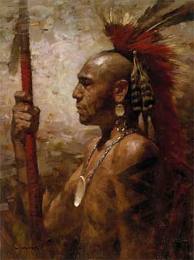
John Mason – Pequot Warrior

Mason reports that on May  25

“about eight of the clock in the morning, we marched thence towards the Pequot with about five hundred Indians.

Their original aim was to attack the headquarters of Sassacus, the Pequot sachem,  After all, it was Sassacus who had murdered Captain Stone to avenge his father’s death.  But at some point, they decide to attack the Pequot fort at Mystic instead.  It’s closer.

As the day wears on, they get hotter and hungrier.  Mason says that “some of our men fainted.

Mason writes :   I then inquired of Uncas what he thought the Indians would do? Uncas predicts, “The Narragansetts would all leave us.” As for the Mohegan, Uncas reassures Mason that “he would never leave us: and so it proved. For which expressions and some other speeches of his, I shall never forget him,  Indeed he was a great friend and did a great service.”

At night, recalls Mason “the rocks were our pillows, yest rest was pleasant.

The next morning, Mason asks Uncas and his comrade Wequash where the fort is.  They tell him it’s on top of a nearby hill.  Looking around Mason wonders where the hell the Narragansett have disappeared to.  They are nowhere to be seen.  Uncas replies that they’re hanging back “exceedingly afraid.” Mason tells Uncas and Wequash not to leave but to stand back and wait to see “whether Englishmen would now fight or not.

Then Underhill joins in the huddle and he and Mason begin “commending ourselves to God.”  They divide their men in half, “there being two entrances to the fort.

The Pequot fort is encircled within  a palisade, a wall made of thick tree trunks standing up and fastened together.  Around seven hundred men, women and children are asleep in wigwams inside.

Mason writes that they “heard a dog bark.” Their sneak attack is foiled.   Mason says they heard “an Indian crying Owanux, Owanx! Which is Englishman! Englishman!”

Mason: “We called up our forces with all expedition, gave fire upon them through the palisade, the Indians being in a dead – indeed their last – sleep.”

Mason commands the Narragansett and Mohegan to surround the palisade in what Underhill describes as a “ring battalia, giving a volley of shot upon the fort.”  Hearing gunfire, the awakened Pequot, writes Underhill, “brake forth into the most doleful cry.”

The Pequot screams are so dolefule Underhill says the English almost sympathize with their prey – almost.  Until the English manage to remember why they are there in the first place (to avenge the murder of various Englishmen from a drunken, wife-stealing pirate to the settlers on the Connecticut frontier whehn those girls were kidnapped.  Thus Underhill reports “every man being bereaved of pitty fell upon the work without compassion, considering the blood [the Pequot] had shed of our native countrymen.”

Then the English enter the fort, carring, per Underhill ” our swords in our right hand, our carbines or muskets in our left hand.”  Mason and Underhill start knocking heads inside the wigwams.  Various Pequot come at them “Most courageously these Pequot behaved themselves”.  Underwill will praise them later on.

Combat in the cozqy little bark houses is chaos – too dangerous and unpredictable.  Mason is hit with arrows and Underhill’s hip is grazed.  Mason is faced, on a smaller scale, with the same problem Harry Truman would confront when he was forced to ponder the logistics of invading Japan in 1945.  A ground war would damn untold thousands of American troops to certain slaughter.  The Puritan commander, in a smaller, grubbier, lower-tech way, arrives at the same conclusions as Truman when he ordered the bombing of Hiroshima and Nagasaki.  Mason says “We must burn them.

And they do,

Mason dashes inside a hut, lights a torch and “set the wigwam on fire.”  The inhabitants are stunned.  “When it was thoroughly kindled,” Mason recalls, “the Indians ran as men most dreadfully amazed.”

Underhill, too, lights up his vicinity, and “the fires of both meeting in the center of the fort blazed most terribly and burnt all the space of half an hour.

The wind helps.  According to Mason, the fire “did swiftly overrun the fort, to the extreme amazement of the enemy and great rejoicing of ourselves.”  Mason notes that some of the Indians try to climb over the palisade and others start “running into the very flames.”  They shoot arrows at the Englishmen who answer them with gunfire, but, writes Underhill, “the fire burnt their very bowstrings.”

“Mercy they did deserve for their valor.” Underhill admits of the Pequot.  Not that they get any.   William Bradford was told by a participant that “it was a fearful sight to see them thus frying in the fire, and the steams of blood quenching the same, and horrible was the stink and scent thereof.”

The Englishmen escape the flames and then guard the two exits so that no Pequot can escape.  According to Underhill, those who try to get away “our soldiers entertained with the point of the sword; down fell men, women and children.”

Mason summarizes, “And thus … in little more than an hour’s space was their impregnable fort with themselves utterly destroyed, to the number of six or seen hundred.”

Two Englishmen died and about twenty are wounded.  Mason is triumphant.   After all, this is the will of a righteous God. He praises the Lord for “burning them up in the fire of his wrath, and dunging the ground with their flesh: It is the Lord’s doings, and it is marvelous in our eyes!”  That might be the creepiest exclamation point in American Literature.  No, wait – it’s this one: “Thus did the Lord judge among the heathen, filling the place with dead bodies!”
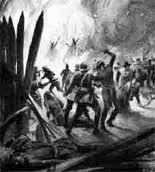
John Mason – Pequot War Woodcut

The Narragansett and Mohegan, whom Underhill calls “our Indians”, were shaken by the viciousness of the English and the horror of the carnage.  Especially the Narragansett.  Recall they had explicitly asked before the campaign, via Roger Williams, “that it would be pleasing to all natives, that women and children be spared.

“Our Indians,” Underhill writes, “Came to us much rejoiced at our victories, and greatly admired the manner of Englishmen’s fight, but cried ‘Mach it, mach it’ that is ‘It is naught.  It is naught, because it is too furious and slays too many men.”  The word “naught” to a seventeenth -century English speaker, meant “evil.”

Captured Pequot are divvied up as spoils among the victors.  Boston sells some of its share of Pequot survivors into slavery in Bermuda.  Many Pequot descendants still live on Bermuda’s St. David Island, their Indian slave ancestors having intermarried with their African slave ancestors.

In 1638, the Connecticut English host a treaty party where a few remaining Pequot are dived among the tribes that had been English allies.  The Pequot absorbed into Uncas’s tribe later became known as the Mashantucket Pequot.  In 1976, this tribe successfully sued the state of Connecticut for recovery of some of its land in Connecticut and recirved federal recognition from Ronald Reagan in 1983.  This is the home to the tribe’s wildly profitable Foxwoods Resort Casino.

The Pequot Indians Today

In 1889, a statue of Mason drawing his sword was erected on the site of the Mystic Fort massacre, in the present day town of Groton. The event is commemorated by a boulder monument that formerly was on Mystic Hill upon the pedestal of which is a life-size statue of Major Mason drawing his sword, representing the moment when he heard the war-whoop of “Owanux” in their fort.

On Pequot Hill, Mystic, Ct. stands the statue of Major John Mason at the spot where on June 7, 1637 he with 90 colonists and 100 Mohegan Indians burned to death 600 to 700 men, women and children of the warlike Pequot Indian Tribe

In 1992, a Pequot named Wolf Jackson petitioned the town council to remove the statue.  According to the Hartford Courant, in one of the meetings in which the statue’s fate was debated, one citizen proclaimed “that the statue on Pequot Avenue is about as appropriate as a monument at Auschwitz to Heinrich Himmler, architect of the Nazis’ Final Solution.”   As a compromise, in 1996 the statue was moved a way from the site of the massacre to nearby Windsor which was founded by Mason.  The New York Times reported that nine protesters attended the rededication ceremony: “‘No Hero’ said one sign; ‘Remember the Pequot Massacres’, said another.  A few weeks later, vandals doused the bronze Mason with red paint
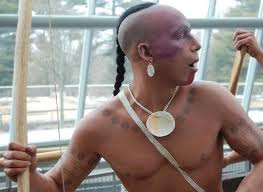
Present Day Pequot

He took a company of Englishmen up the river and rescued two English maids during this war. On 8 March 1637/8, in the aftermath of the Pequot War, the Connecticut General Court “ordered that Captain Mason shall be a public military officer of the plantations of Connecticut, and shall train the military men thereof in each plantation”.

John Mason fought alongside two Native American tribes, the Mashantucket and Narrangansetts.

Later Career

John Mason was one of the most trusted men in Connecticut during his three and a half decades of residence there, in both civil and military matters. In his latter years the formal colony records referred to him simply as “the Major,” without forename or surname. Only a sampling of his activities can be presented here.

John removed his family to Old Saybrook, Middlesex County, Connecticut in 1647. He was awarded land by the state of Connecticut where Lebanon, New London County, Connecticut was founded and in 1660 united with a number of distinguished families in the settlement of Norwich, New London County, Connecticut where he was Deputy/Lieutenant Governor (1660-1669), and Major General of the forces of Connecticut.

From 1647 to 1657

On 2 Jun 1647 the court ordered that Captain Mason should for the peace, safety and good assurance of the Commonwealth, have the command of all soldiers and inhabitants of Seabrooke, and in case of alarum or danger by approach of an enemy, to draw forth or put the said soldiers & inhabitants in such posture for the defense of the place as to him shall seem best,” and “whereas Captain Mason, at the special instance & request of the inhabitants of Seabrooke, together with the good liking of the Commonwealth, did leave his habitation in the River and repair thither, to exercise a place of trust. It is this day ordered, that his former salary of £ 40 per annum be continued.

During the winter of 1647/48 Winthrop records thatin the depth of winter, in a very tempestuous night, the fort at Saybrook was set on fire, and all the buildings within the Palisado, with all the goods, etc., were burnt down, Captain Mason, his wife, and children, hardly saved. The loss was estimated at one thousand pounds, and not known how the fire came.

Prior to the sitting of the court on 6 Oct 1651, Captain Mason had sent a letter to the court, wherein he desires, among other things, the advice of this Court touching a motion propounded by some of New Haven interested in Dillaware design, for his assistance of them in that business, with some encouragements for his settling there.” The Court did not like the idea, but admitted they could not prevent him, and gave the irreluctant permission to “attend the service for 3 months, provided he will engage himself to return within that time and continue his abode amongst them as formerly.

New Haven was at this time attempting to establish a daughter colony on the Delaware River.

By the sitting of the Court on 18 May 1654 he had been advanced from Captain to Major, the rank that he would hold for the remainder of his life. On 13 Jun 1654 he and Captain John Cullick were sent to Boston as agents of Connecticut, to discuss Cromwell’s plans for fighting the Dutch at New Amsterdam. In Apr 1657 he received from the General Court an extensive commission, requiring him to go to Southampton and investigate the complaints of the inhabitants of that town (then under Connecticut jurisdiction) regarding depredations made by the Montauk Indians.

From 1659 to 1670

On 15 Jun 1659 Mr. Willis was requested to go down to Sea Brook, to assist the Major in examining the suspicions about witchery, and to act the rein as may be requisite.

NORWICH, MASSACHUSETTS
Norwich was settled in 1660. Most of these original proprietors of Norwich came from Saybrook, and East Saybrook (now Lyme). The 35 original proprietors of that town were:

Reverend James FITCH, the first minister
Major John MASON, afterwards Lieut. Gov. of Connecticut
Lieut. Thomas Leflingwell
Lieut. Thomas Tracy and
his eldest son John Tracy
Deacon Thomas Adgate
Christopher Huntington and
his brother, Deacon Simon Huntington
Ensign Thomas Waterman
William Hyde and
his son Samuel Hyde, and
his son-in-law John Post
Thomas Post
Lieut. William Backus and
his brother Stephen Backus
Deacon Hugh Calkins (from New London, CT, and
his son John Calkins (from New London, CT) and
his son-in-law Jonathan Royce (from New London, CT)
John REYNOLDS
Thomas BLISS
Francis GRISWOLD
John Birchard
Robert Wade
Morgan Bowers
John Gager (from New London, CT)
Thomas Howard
Dr. John Olmstead
Nehemiah SMITH (from New London, CT)
Richard Edgerton
John Elderkin
John Bradford (from Marshfield, MA)
Thomas Bingham
Robert Allen (from New London, CT)
John Baldwin
John Pease (Son of  Robert PEASE Sr.) (from New London, CT and Edgartown)
Thomas Smith (from Marshfield, MA)

In the summer of 1669 residents of Easthampton, Southampton and Stonington addressed letters to Mason, warning him of an impending attack by several groups of Indians. Mason passed these letters on to the colony authorities in Hartford, and added his own strongly worded advice.

In the summer of 1670 John Mason acted as an intermediary between Roger Williams and the Connecticut government regarding a boundary dispute between Rhode Island and Connecticut.

Estate

On 10 Feb 1634/35 “Captayne Mason” received a grant of 2 acres (8,100 m2) in Dorchester. He drew 6 acres of meadow beyond Naponset in lot #73.

In the Windsor land inventory on 28 Feb 1640/41 John Mason held seven parcels, six of which were granted to him: “a home lot with some additions to it”, 10 acres; “in the Palisado where his house stands and mead adjoining” 20.5 acres; “in the first mead on the north side of the rivulet, for mead and addition in swamp” 8 acres; “in the northwest field for upland” 8 acres “with some addition on the bank side”; “over the Great River in breadth by the river twenty-six rods more or less, and continues that breadth to the east side of the west marsh, and there it is but sixteen rods in breadth and so continues to the end of the three miles”; 9 acres “of land by Rocky Hill”; and “by a deed of exchange with Thomas Duy [Dewey] … on the east side of the Great River in breadth eighteen rods more or less, in length three miles”.

On 5 Jan 1641/42 Connecticut court ordered “that Captain Mason shall have 500 acres of ground, for him and his heirs, about Pequot Country, and the dispose of 500 more to such soldiers as joined with him in the service when they conquered the Indians there”.

On 12 Jul 1644 John Mason of Windsor sold to William Hosford of Winds or 8 acres  in a little meadow with addition of swamp. On 11 Sep 1651 “the island commonly called Chippachauge in Mistick Bay is given to Capt. John Mason, as also 100 acres of upland and 10 acres of meadow near Mistick, where he shall make choice”.

On 14 Mar 1660/61 the “jurisdiction power over that land that Uncus and Wawequa have made over to Major Mason is by him surrendered to this Colony. Nevertheless for the laying out of those lands to farms or plantations the Court doth leave it in the hands of Major Mason. It is also ordered and provided with the consent of Major Mason, that Uncus & Wawequa and their Indians and successors shall be supplied with sufficient planting ground at all times as the Court sees cause out of that land. And the Major doth reserve for himself a competence of land sufficient to make a farm”.

On 14 May 1663 the court granted “unto the Major, our worshipful Deputy Governor, 500 acres of land for a farm, where he shall choose it, if it may not be prejudicial to a plantation already set up or to set up, so there be not above 50 acres of meadow in it”. On 13 Oct 1664, the “Major propounding to the Court to take up his former grant of a farm, at a place by the Indians called Pomakuck, near Norwich, the Court grants liberty to him to take up his former grant in that place, upon the same terms as it was granted to him by the Court”.

On 20 May 1668 the “Major desiring this Court to grant him a farm” of about 300 acres , for “one of his sons, his desire is hereby granted (provided there be not above 30 acres of meadow) and Lt. Griswold & Ensign Tracy are hereby desired to lay it out to him in some convenient place near that tract of land granted Jer[emiah] Adams, it being the place the Major hath pitched upon, the name of the place is Uncupsitt, provided it prejudice no plantation or former grant”.

On 9 May 1672 “Ensign Tracy is appointed to join with Sergeant Tho[ma s] Leffingwell in laying out to the Major and Mr. Howkins their grants of land according to their grants”.

Offices

  • Deputy for Dorchester to Massachusetts Bay General Court, 4 March 1634/35, 2 Sep 1635.
  • Captain by 1637.
  • Deputy for Windsor to Connecticut Court, November 1637, March 1638, April 1638, September 1639, February 1641, April 1641, September 1641.
  • Assistant, 1642-1659, 1669-71 [CT Civil List 35].
  • War committee for Saybrook, May 1653, Oct 1654.
  • Major, June 1654 (but he was called Major at the General Court of 18 May 1654).
  • Connecticut Deputy Governor, May 1660, May 1661, May 1662, Oct 1662, May 1663, May 1664, May 1665, May 1666, May 1667, May 1668.
  • Commissioner for United Colonies, Jun 1654, May 1655, May 1656, May 1657, May 1660, May 1661.
  • Patentee, Royal Charter, 1662.
  • Militia Committee, May 1667 – June 1672.
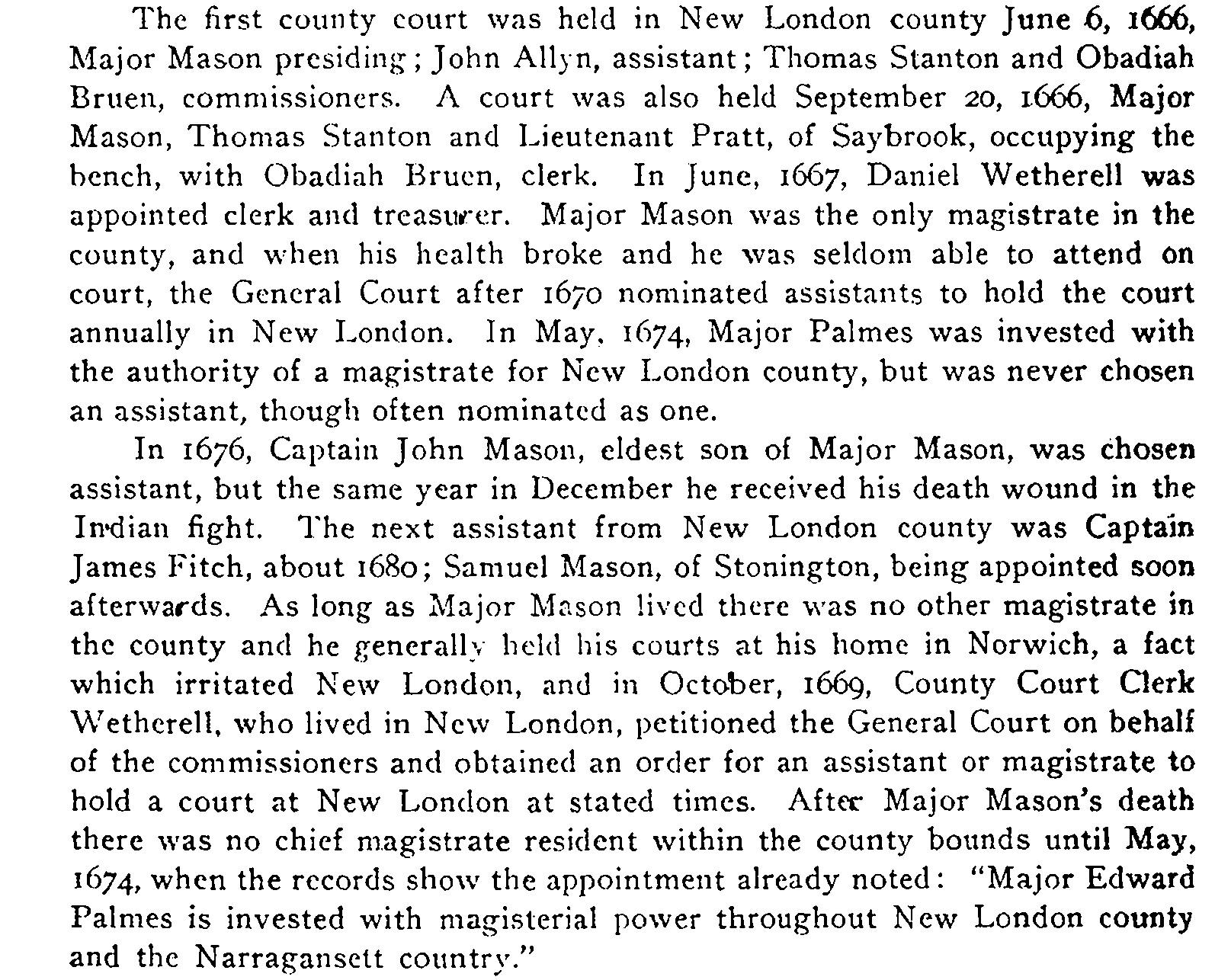
Founding the New London Court – Maj, John Mason was the first magistrate followed by his son-in-law Capt James Fitch and sons Capt. John Mason and Capt. Samuel Mason – Source: New London County, Connecticut A Modern History

Children

1. Priscilla MASON (See Rev. James FITCHs page)

2. Maj. Samuel Mason

Maj. Samuel Mason  held the office of major of the militia, and was an assistant of the colony, besides holding other positions of trust.

Samuel’s first wife Judith Smith was born about 1650.  Her parents were Capt. John Smith of Hingham, Mass.

Samuel’s second wife Elizabeth Peck was 30 years younger than Samuel, born 29 Dec 1673 Wallingford, New Haven, CT. Elizaabeth died 1709 ‎(Age 35) Wallingford, New Haven, CT.  She survived him, and m. Gershom Palmer of Stonington, son of our ancestor Walter PALMER.

After a brief interval of quiet, troubles broke out anew early in 1700. Captain Sabin observed many suspicious indications, and mysterious hints were dropped by certain Indians. A meeting was held at Crystal Pond, ostensibly for fishing, which was attended by most of the Indians, but after several days’ absence they came back without fish, and a few days afterward they started off again, with squaws and children and the treasure of the tribe, “pretending fear and danger from the Mohegans.” Fears were at this time entertained throughout the Colonies of a general combination and uprising among the various Indian tribes, and it was at once conjectured that the Wabbaquassets had gone to meet the combined forces at Monadnock and join in a general foray. A panic ensued. Dispatches were sent at once to the Governor and Council of Connecticut, who sent to their relief, Captain Samuel Mason, with twelve English soldiers and eighteen Mohegans. Arriving at Woodstock at 2 P. M., Saturday, February 3, they found the people in great excitement. James Corbin’s cart, laden with ammunition, was on the road from Boston in great danger of interception and capture by the enemy. News had come that the fugitives traveled sixteen miles the first night, though divers children were much frozen, and one man nearly drowned in crossing a river. A consultation was held with Mr. Dwight, Captain Sabin and the principal men of Woodstock, who thought it best to send for the Indians to return and assure them of their friendship and protection. Three Wabbaquassets, “of great faithfulness to the English”-Kinsodock, Mookheag and Pesicus-were accordingly sent on Sunday to Colonel King, of Dunstable, with a note from Captain Mason, praying him “to forward them on their journey to Penacook or Monadnuk, where, as we understand, the combined Indians keep their head-quarters, or to any other place where our Indians are gone, and if there be with you any Indians it may be well to send some with them, that they may fully inform the Indians that the English have no designs against them, and that if Tobey himself should return he would have courteous treatment showed him.” A pass was given to these envoys, forbidding people to take their arms from them. A dispatch was also sent to Lord Bellmont, governor of Massachusetts, by John Ingalls, of Oxford, showing their fear of approaching evil from the enemy, and the aid sent from Connecticut.
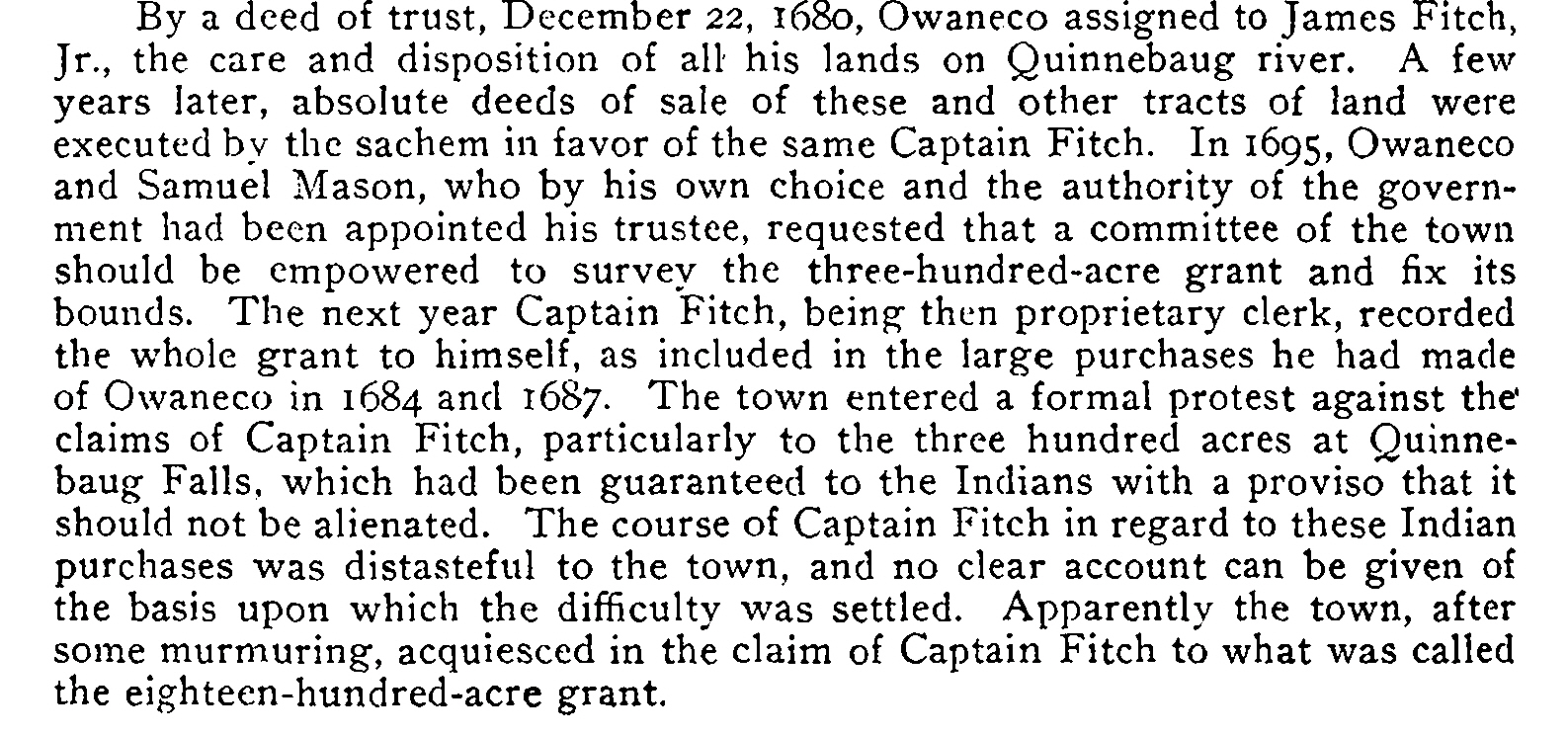
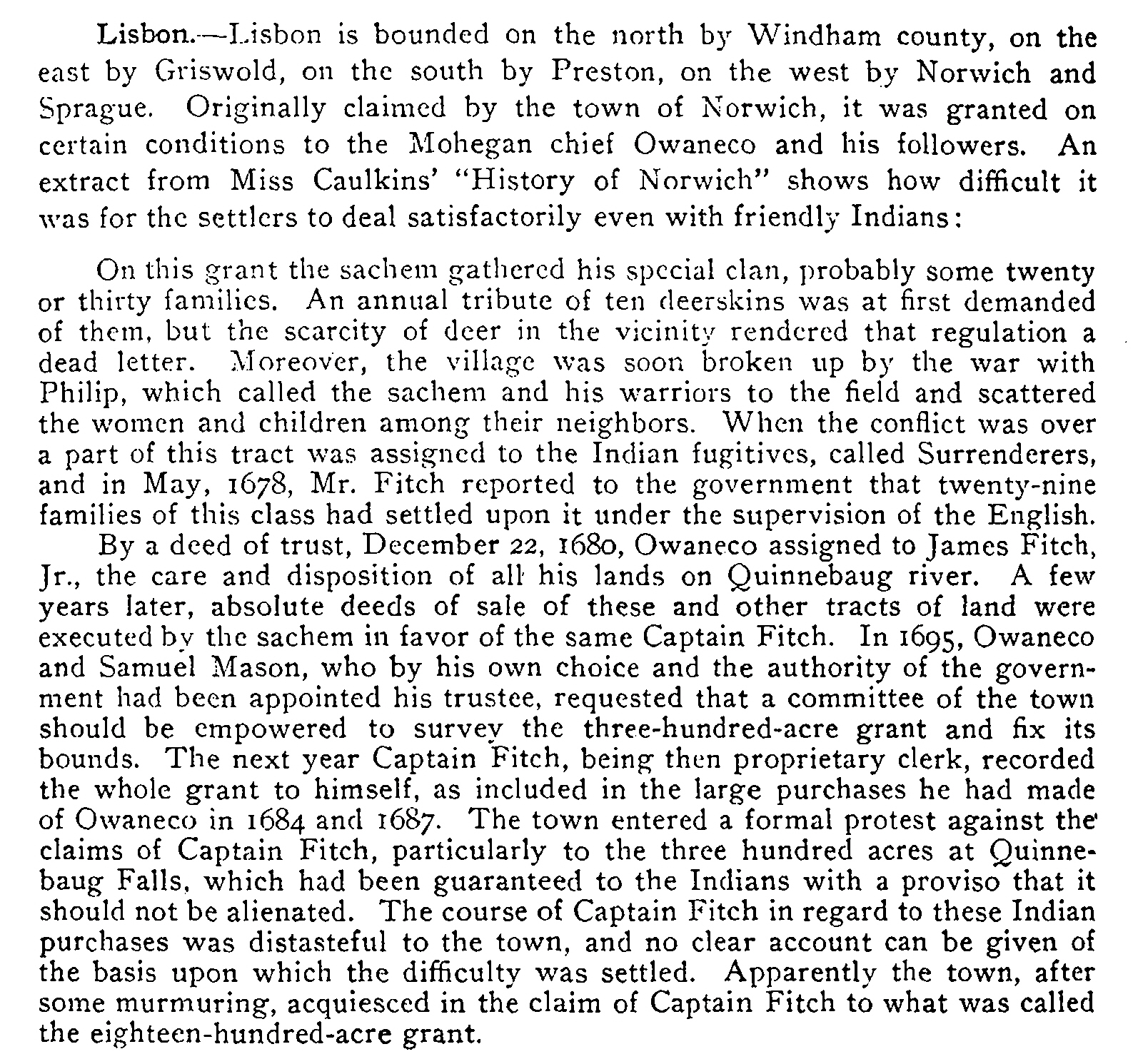
Samuel Mason was Owaneco’s agent in land dealings in Lisbon Township.  Owaneco was son of the famous Uncas.  Samuel’s brother-in-law Capt. James Fitch played a questionable role in these grants.

Children of Samuel and Judith

i. John Mason b. ca. 1672; d. 1705

ii. Anne Mason b. ca. 1675

iii. Sarah Mason b. ca. 1680 Windham, CT; d. bef. 1721 Lebanon, New London, CT; m. Joseph Fitch son of Rev. James FITCH and (Sarah’s aunt) Priscilla MASON. Joseph and Sarah lived in Stonington, Connecticut. She died and he married Ann Whiting of Windham in 1729 and they moved to Lebanon. Joseph died in Windham on May 9, 1741 and Ann died there September 18, 1778.

iv. Samuel Mason Jr. b. ca. 1682; d. 1701

v. Elizabeth Mason b. 1684

vi. Hannah Mason b. ca. 1686

3. Capt. John Mason Jr.

John’ wife Abigail Fitch was born 5 Aug 1650 in Saybrook, CT. Her parents were our ancestor Rev. James FITCH and his first wife Abigail Whitfield.  Abigail’s brother married John’s sister Elizabeth and her father married his sister Prescilla.  Abigail died 18 Sep 1676 in Stonington, New London, CT.

John died of wounds suffered in the Great Swamp Fight on 18 Sep 1676 in New London, CT.  Of the 71 Connecticut troops killed in the battle, nine were from John Mason’s 5th Company of Norwich. To the First and Fifth Connecticut Companies were attached Indian Scouting Companies, numbering seventy-five to each, made up mostly of Indians from the Mohegan and Pequod tribes.

Second Letter of Joseph Dudley

Mr Smith’s, 21, 10, 1675
May it please your honour

The comming of the Connecticut force to Petaquamscott, and surprisal os six and slaughter of five on Friday night, Saturday we marched towards Petaquamscott, though in snow, and in conjunction about midnight or later, we advanced: Capt. Mosley led the van, after him Massachusetts, and Plimouth and Connecticut in the rear; a tedious march in the snow, without intermission, brought us about two of the clock afternoon, to the entrance of the swamp, by the help of Indian Peter, who dealt faithfully with us; our men, with great courage, entered the swamp about twenty rods; within the cedar swamp we found some hundreds of wigwams, forted in with a breastwork and flankered, and many small blockhouses up and down, round about; they entertained us with a fierce fight, and many thousand shot, for about an hour, when our men valiantly scaled the fort, beat them thence, and from the blockhouses. In which action we lost Capt. Johnson, Capt. Danforth, and Capt. Gardiner, and their lieutenants disabled, Capt. Marshall also slain; Capt Seely, Capt. Mason, disabled, and many other officers, insomuch that, by a fresh assault and recruit powder from their store, the Indians fell on again, recarried and beat us out of, the fort, but by the great resolution and courage of the General and Major, we reinforced, and very hardly entered the fort again, and fired the wigwams, with many living and dead persons in them, great piles of meat and heaps of corn, the ground not permitting burial of their store, were consumed; the number of their dead, we generally suppose the enemy lost at least two hundred men; Capt. Mosely counted in one corner of the fort sixty four men;

Capt. Goram reckoned 150 at least; But, O! Sir, mine heart bleeds to give your honor an account of our lost men, but especially our resolute Captains, as by account inclosed, and yet not so many, but we admire there remained any to return, a captive women, well known to Mr. Smith, informing that there were three thousand five hundred men engaging us and about a mile distant a thousand in reserve, to whom if God had so pleased, we had but been a morsel, after so much disablement: she informeth, that one of their sagamores was slain and their powder spent, causing their retreat, and that they are in a distressed condition for food and houses, that one Joshua Tift, an Englishman, is their encourager and conducter. Philip was seen by one, credilbly informing us, under a strong guard.

After our wounds were dressed, we drew up for a march, not able to abide the field in the storm, and weary, about two of the clock, obtained our quarters, with our dead and wounded, only the General, Ministers, and some other persons of the guard, going to head a small swamp, lost our way, and returned again to the evening quarters, a wonder we were not prey to them, and, after at least thirty miles marching up and down, in the morning, recovered our quarters, and had it not been for the arrival of Goodale next morning, the whole camp had perished; The whole army, especially Connecticut, is much disabled and unwilling to march, with tedious storms, and no lodgings, and frozen and swollen limbs, Major Treat importunate to return to at least Stonington; Our dead and wounded are about two hundred, disabled as many; the want of officers, the consideration whereof the Genreal commends to your honer, forbids any action at present, and we fear whether Connecticut will comply, at last, to any action. We are endeavoring, by good keeping and billetting oue men at several quarters, and, if possible removel of our wounded to Rhode Isalnd, to recover the spirit of our soldiers, and shall be diligent to find and understand the removals on other action of the enemy, if God please to give us advantage against them.

As we compleat the account of dead, now in doing, The Council is of the mind, without recruit of men we shall not be able to engage themain body.

I give your honor hearty thanks for your kind lines, of which I am not worthy
I am Sir, your honors humble servant

Joseph Dudley

Since the writing of these lines, the General and Council have jointly concluded to abide on the place, notwithstanding the desire of Connecticut, only entreat that a supply of 200 may be sent us, with supply of commanders; and, whereas we are forced to garrison our quarters with at least one hundred, three hundred men, upon joint account of colonies, will serve, and no less, to effect the design. This is by order of the council.  Blunderbusses, and hand grenadoes, and armour, if it may, and at least two armourers to mend arms.

This gallant young captain was severely and, as it proved, fatally wounded in the Great swamp fight at Narragansett, Dec. 19, 1675. It is probable that he was brought home from that sanguinary field by his Mohegan warriors on an Indian bier. His wounds never healed. After lingering several months, he died, as is supposed, in the same house where his father expired, and was doubtless laid by his side in the old obliterated graveyard of the first comers. Though scarcely thirty years of age at the time of his death, he stood high in public esteem, both in a civil and military capacity. He had represented the town at three sessions of the Legislature, and was chosen an assistant the year of his decease. In the probate of his estate before the County Court he is called “the worshipful John Mason.”

The Rev. Mr. Bradstreet, of New London, records his death in these terms:

“My hon’d and dear Friend Capt. Juo Mason one of ye magistrates of this Colony, and second son of Major Jno Mason, dyed, Sept. 18, 1676.”

Children of Abigail and John Mason

i. John Mason , III, Captain b: 1673 in Stonington, CT; d. 1736; m. 15 Jul 1719 to Anne Sanford b: 1680

ii. Anne Mason b: ABT 1676 in Stonington, CT; m. 1690 to Captain John Dennison , Jr.  b: 1 JAN 1668/69 in Stonington, Conn John died of tuberculosis in 1699, at the age of thirty.

4. Rachel Mason

Rachel’s husband Charles Hill was born in 1630 in Barlow, Derbyshire, England, His father was George Hill. Charles died Oct 1684 in New London, CT

5. Ann Mason

Ann’s husband John Brown was born 30 Sep 1650 in Swansea, Bristol, Massachusetts, His parents were our ancestor John BROWN (1630 – 1662) and Ann Dennis (1633 – 1700) John died 24 Nov 1709 in Swansea, Bristol, Mass.

6. Daniel Mason

Daniel’s first wife  Margaret Denison was born 15 Dec 1650 Roxbury, Suffolk, Mass. Margaret died 16 May 1678 in Stonington, CT

Daniel’s second wife Rebecca Hobart was born 9 Apr 1654 in Hingham, Plymouth, Mass. Her parents were Peter Hobart (1604 – 1679) and Rebecca Peck (1620 – 1693). Her paternal grandparents were our ancestors Edmund HOBART and Margaret DEWEY.   Her maternal grandparents were our ancestors Joseph PECK and Rebecca CLARK.  Rebecca died 8 Apr 1727 in Stonington, New London, Connecticut, United States

Daniel Mason was well-educated and of independent means, and occupied in Stonington an ample estate in the “Five Mile Purchase”, in which territory the family then held large interest.  This estate was near the borders of Long Island Sound, and comprised of Chippacursett Island in Mystic Bay, since then called the Mason Island, and a large tract of upland and meadow.  He was the earliest school teacher in Norwich, CT.

He was commissioned quartermaster of the New London County Troop of Dragoons in October 1673, when he was 21.  He was later promoted to the rank of Captain.  While staying in Norwich, he filled for a short time, in 1679, the office of instructor at the newly established “School on the Plain”.  He later moved to Stonington as his permanent place of residence.   He was active and influential in the various civil duties connected with the incorporation, by act of the General Court in 1700, of the town of Lebanon, where he died.

Children of Daniel and Rebecca:

i. Peter Mason (1680 – 1737

ii. Rebecca Mason (1682 – 1742

iii. Margaret Mason (1683 – 1683

iv. Samuel Mason (1686 – 1737

v. Abigail Mason(1689 – 1717

vi. Priscilla Mason (1691 – 1719

vii. Nehemiah Mason (1693 – 1768

7. Elizabeth Mason

Elizabeth’s husband Maj. James Fitch helped to reestablish colonial government after the Revolution of 1689. He served in the military as Company Sergeant Major of New London Company in 1696. He was Assistant in 1690. He also served as Boundary Commissioner and Land Reviser. He led military expeditions, named forts, and guarded the frontier. He exercised jurisdiction over the Mohegans and all their lands and interests.  James died 10 Nov 1727 in Canterbury, Windham, CT.

Children of Elizabeth and James:

i. James Fitch III b: JAN 1676/77; d. within the week.

ii. James Fitch III b: 7 JUN 1679;  died as a child

iii. Jedediah Fitch b: 17 APR 1681 in Norwich, CT; d. 20 NOV 1756 in Nantucket, Mass.  He moved to Nantucket and there in 1701 married 1701 to Abigail Coffin b: 9 JUL 1683 in Nantucket, Mass.

All his brothers were soldiers fighting Indians and such. As a young teenager, Jed moved to the north shore of Massachusetts and settled in Newbury, and then later went to Nantucket Island off the coast of Massachusetts. Nantucket was a Quaker colony at the time and in 1701 he married into an established Quaker family. His father had been quite friendly with the local Indians, the Mohegans and Pequots, yet fought against other tribes. Perhaps Jedediah became a pacifist and wanted no part of fighting the Indians he grew up with and so left for Nantucket.

iv. Samuel Fitch , Sr. b: 12 JUL 1683 in Norwich, CT; d. 1729 in Lawrenceville, New Jersey; m. Mary Smith b: SEP 1682 in Burlington, New Jersey

Sources:

http://www.newenglandgenealogy.pcplayground.com/f_3a.htm#28

http://users.ece.utexas.edu/~perry/fun/genealogy/mell/fitch.html

http://www.jeanniemay.com/genealogy/turkfair/pafg11.htm#153

http://familytreemaker.genealogy.com/users/j/o/n/Frances-J-Joneslory/GENE4-0024.html
http://trees.ancestry.com/owt/person.aspx?pid=21009406&st=1

Posted in 12th Generation, Artistic Representation, Immigrant - England, Line - Miner, Pioneer, Place Names, Public Office, Storied, Veteran, Violent Death, Wikipedia Famous | Tagged , , | 39 Comments

Rev. James Fitch

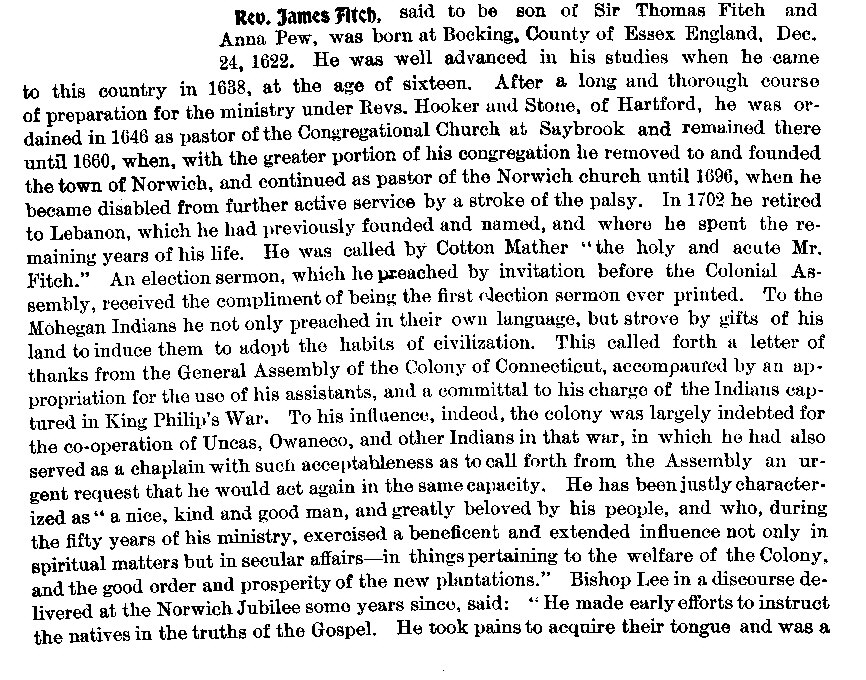
Rev. James FITCH (1622 – 1702) was Alex’s 9th great grandfather, one of 1,024 in this generation of the Miner line. He helped found the towns of Saybrook, Norwich and Lebanon Connecticut and was instrumental in getting Sachem Uncas and the Mohegans, and also the Pequot Indians, to side with the English against King Philip’s the Narragansett tribes in King Philip’s War.

Hawkeye and Uncas discuss whether to attack the British from the movie the Last of the Mohegans

Rev. James Fitch was born  24 Dec 1622 in Bocking, Essex, England. His parents were Thomas FITCHand Anne REEVES.  His brother Capt. John FITCH was also our ancestor through the Shaw line.  He came to America in 1638 and was the first minister at Norwich.  He was ordained as the minister of Saybrook in 1646.  He first married Abigail Whitfield on 18 Oct 1648 in Guilford, CT. James  and Abigail were, according to legend at least, married by her father in the north end of the living room of the Gilford Stone House on 1 October 1648. This seems unlikely however because the 17th Century congregational church, marriage was not a sacrament, and marriages were generally performed by civil authorities rather than clergy. The marriage was recorded “after the fact” in the Norwich, Connecticut vital records.  After Abigail died, he married Priscilla MASON on 2 Oct 1664 in Norwich, CT.  James died 18 Nov 1702 in Lebanon, CT.

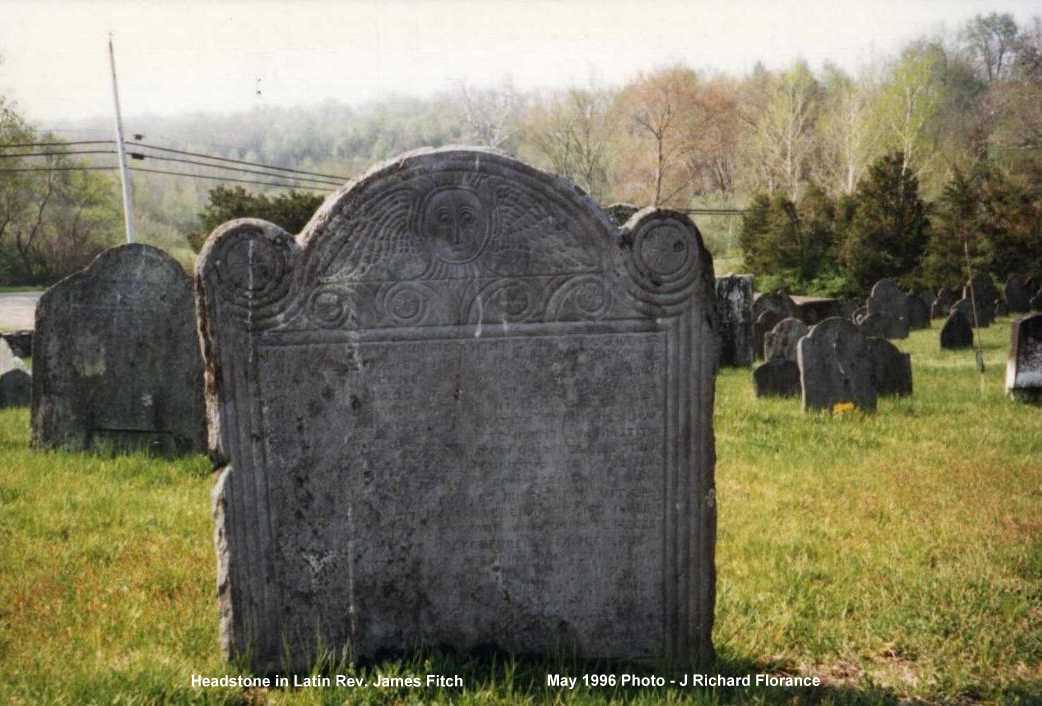
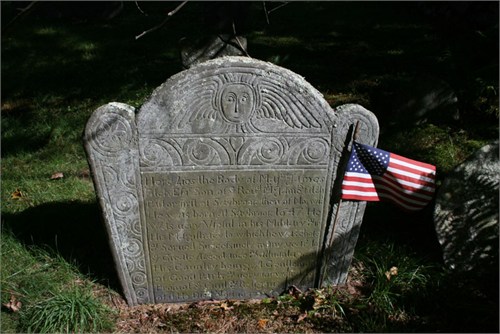
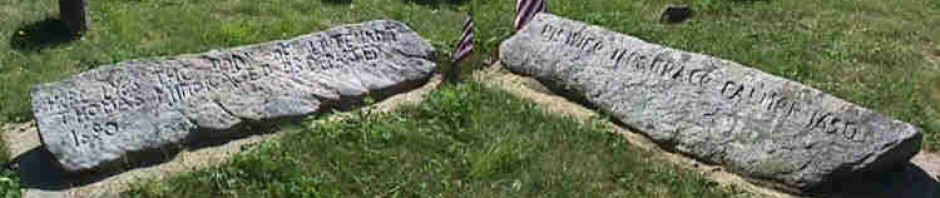
Rev. James Fitch Headstone in Latin  – Old Cemetery Lebanon, New London, Connecticut Source: Findagrave.com

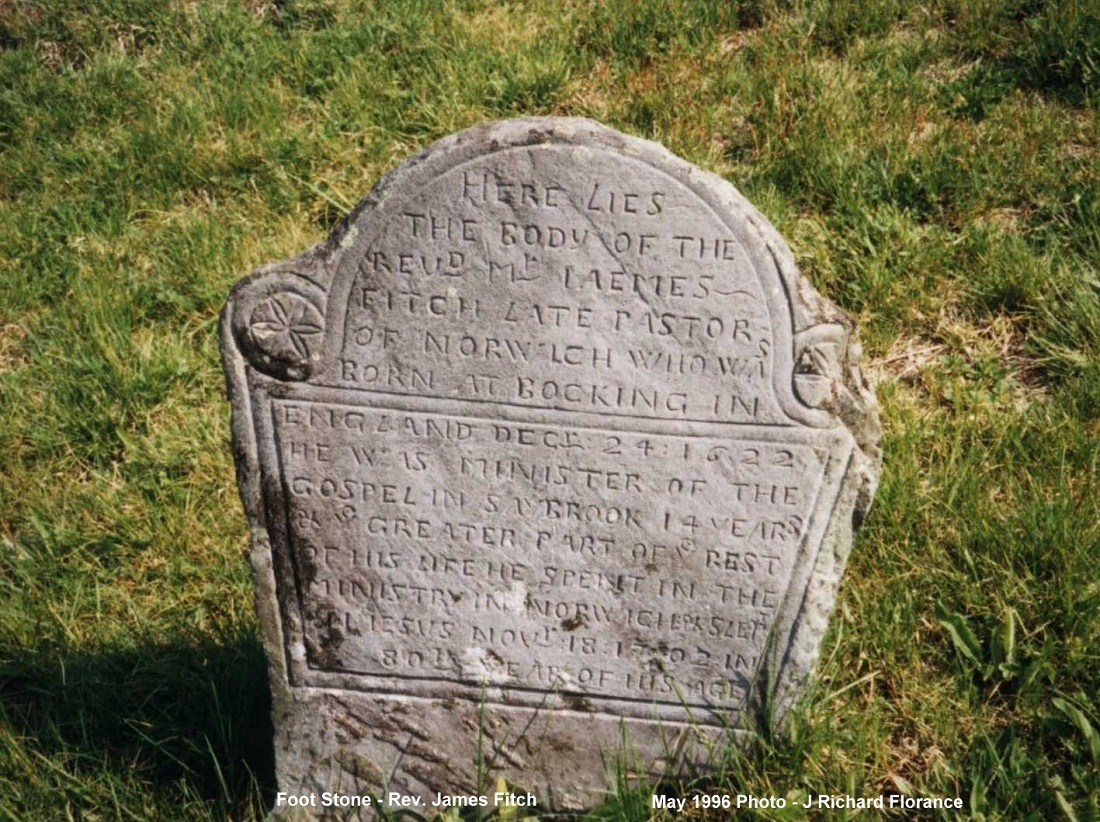
Grave inscription in Latin reportedly written by James’ son Jabez. “In Hoc Sepulcro Depositae Sunt Reliquiae Viri Vere Reverendi D: Jacobi Fitch: Natus Fuit Apud Bocking in Comitatu Essexlae in Anglia, Anno Domino 1622 Decembr 24 Qui Post-Quam Linguis Literatis Optime Instructus Fuisset In Novangliam Venit Aetat. 16 Et Deinde Vitam Degit Harteordlae Per Sepennium Sub Institutione Virorum Ceeeberimorum D: Hooker Et D: Stone Postea Mtnere Passorali Functus Est Apud Saybrook Per Annos 14 Illinc Cum Ecckesiae Maiori Parte Norvicum Migravit Et Ibi Ceteros Vitae Annos Transegit In Opere Evangelico In Senectute Vero Prae Corporis Infirmitate Necessario Cessabat Ab Opere Publico : Tandemque Recessit Liberis Apud Lebanon Ubi Semianno Fere Exacto Obdormivit In Iesu Anno 1702 Novebr 18 Etat 80 Vir, Ingenii Acumine, Pondere Judicii, Prudentia Charitate, Sanctis Laboribus, Et Omnimoda Vitae Sanctitate Peritiaquoque Et Vi Concionandi Nulli Secundus.”

Translated “In this grave are deposited the remains of that truley reverend man, Mr. James Fitch. He was born in Bocking, in the County of Essex, in England, the 24th day of December, in the year of our Lord 1622; who after he had been most excellently taught the learned languages came into New England at the age of sixteen, and then spent seven years under the instructions of those very famous men, Mr. Hooker and Mr. Stone. Afterwards he discharged the pastoral office fourteen years at Saybrook. Thence he removed with the major part of his Church to Norwich, where he spent the other years of his life in the work of the gospel.

In his old age indeed he was obliged to cease from his public labors by reason of bodily indisposition and at length retired to his children at Lebanon, where after spending nearly half a year, he slept in Jesus in the year 1702, on the 18th day of November, in the 80th year of his age. He was a man as to the smartness of his genius, the solidity of his judgement, his charity, holy labors, and every kind of purity of life, and also as to his skill and energy of preaching, inferior to none.”

Rev. James Fitch Footstone  Old Cemetery Lebanon, New London County, Connecticut  Source: Findagrave.com

Abigail Whitfield was born  1 Sep 1622 in Ockley, Surry, England.  Her parents were  Rev. Henry Whitfield  and Dorothy Sheaffe. Abigail died  9 Sep 1659 in Saybrook, CT.

Priscilla Mason was born in Oct 1641 in Windsor, CT.  Her husband was almost twenty years older than she was.  The gap bewtween the oldest and youngest child was 34 years.  Her parents were Maj. John MASON and Ann PECK.  Priscilla died in 1714 in Norwich, CT.

Children of James and Abigail Whitfield

Name Born Married Departed
1. Maj. James Fitch 2 Aug 1649
Saybrook, CT
Elizabeth Mason (Daughter of Maj. John MASON)
Jan 1674/75
.
Alice Bradford
8 May 1687 Saybrook, CT
10 Nov 1727 Canterbury, CT
2. Abigail Fitch 5 Aug 1650
Saybrook, CT
Capt. John Mason Jr. (Son of Maj. John MASON)
 about 1668
.
John Buttolph
1682
5 Jul 1687 Wethersfield, Norwich, CT.
3. Elizabeth Fitch 2 Jan 1652 Rev. Edward Taylor
5 Sep 1674
1689
4. Hannah Fitch 17 Sep 1653 in Saybrook, Middlesex, CT Thomas Meeks (Mix)
30 Jun 1679 New Haven, CT
after 1705
Stonington, New London, CT
5. Samuel Fitch 5 Apr 1655 Saybrook, CT Mary Anne Brewster
28 Nov 1678
18 Feb 1724/25 Preston, CT
6. Dorothy Fitch
16 Apr 1658 Saybrook, New London, CT Nathaniel Bissell
4 Jul 1683
Windsor, CT
28 Jun 1691 Windsor, CT

.
Children of James and Priscilla:

Name Born Married Departed
7. Capt. Daniel Fitch 16 Aug 1665
Norwich, CT
Mary Sherwood
7 Mar 1697/98
Preston, New London, CT
3 Jun 1711 Norwich, CT
8. Capt. John Fitch Jan 1667 Norwich,  CT Elizabeth Waterman
10 Jul 1695 Norwich, CT.
24 May 1743
Windham, CT
9. Capt. Jeremiah Fitch 10 Sep 1670 Norwich, CT Ruth Clara Gifford
4 Jun 1698
Norwich,
22 May 1736/1756 Coventry, Tolland, CT
10. Rev. Jabez Fitch Apr 1672 Elizabeth Appleton Ipswich, CT
26 Jul 1704 Ipswich, MA
22 Nov 1746 Portsmouth, NH
11. Anna Fitch 6 Apr 1675 Norwich, CT Lt. Joseph Bradford
5 Oct 1698 Lebanon, CT
17 Oct 1717 Lebanon, CT
12. Capt. Nathaniel FITCH Oct 1679 Norwich CT Anne ABELL
10 Dec 1701
Lebanon, CT
May 1759 Lebanon, CT
13. Joseph Fitch Nov 1681 Norwich, CT Sarah Mason
2 Nov 1703
Norwich, CT
9 May 1741 Lebanon, CT
14. Deacon Eleazer Fitch 14 May 1683 Martha Brown
1708
4 Jun 1748

James Fitch’s father Thomas died when James was only ten years old. James was left money in his fathers’ will, which enabled him to go and study at Cambridge University. During his studies at Cambridge, he was taken under the wing of  Rev. Thomas Hooker of Chelmsford, a friend of Thomas Fytche who was also mentioned in the will.

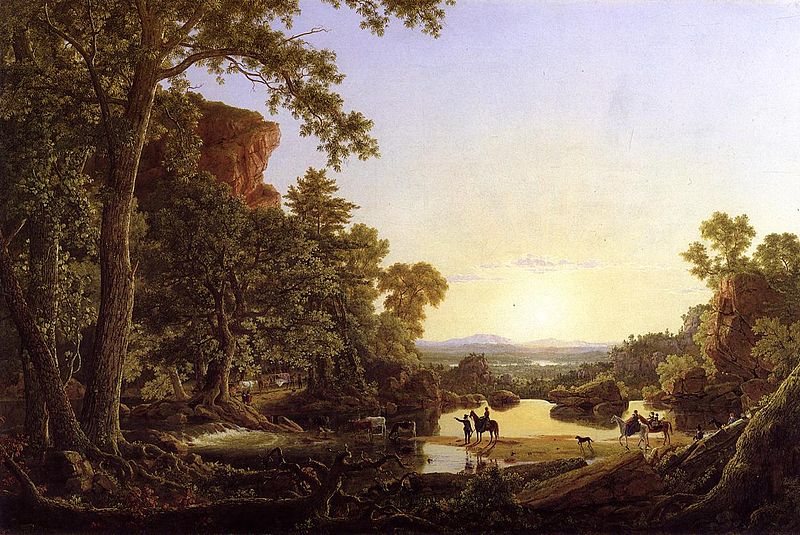
Hooker and Company Journeying through the Wilderness from Plymouth to Hartford, in 1636, Frederic Edwin Church, 1846

Frederic Edwin Church, 1846

At only sixteen, he sailed to America in 1638 with the Rev. Hooker who had decided to go to America and establish a church there. James finished his theological study in Hartford, Connecticut under the Reverend Hooker and Reverend Samuel Stone, also of Bocking, England. A new Church was built in Saybrook, Connecticut and James Fitch was ordained as its first minister in 1646.

James wrote several important documents which were circulated widely. He struggled to clarify several important points of puritan doctrine,

  1. He struggled to find grounds for proving the necessity of works without curtailing the absolute freedom of God to chose and reject regardless of man’s achievement
  2. He wanted to resolve the question of individual assurance, that is how a man might reach some working assurance that he was of the regenerate even though pure knowledge was an inscrutable secret open to God himself
  3. He wanted to justify God’s ways in concepts meaningful to the human intellect to bring him into line, so to speak, with the more rationale laws of ethics.

James lived near the new meeting house on a two acre lot with a house, a barn and an orchard.

In the early summer of 1647 “an epidemical sickness” swept through parts of New England. Governor Winthrop of Massachusetts reported that it seized the victims “like a cold and light fever with it”. On 7 July James’ mentor, the Reverend Thomas Hooker, died at Hartford, Connecticut.

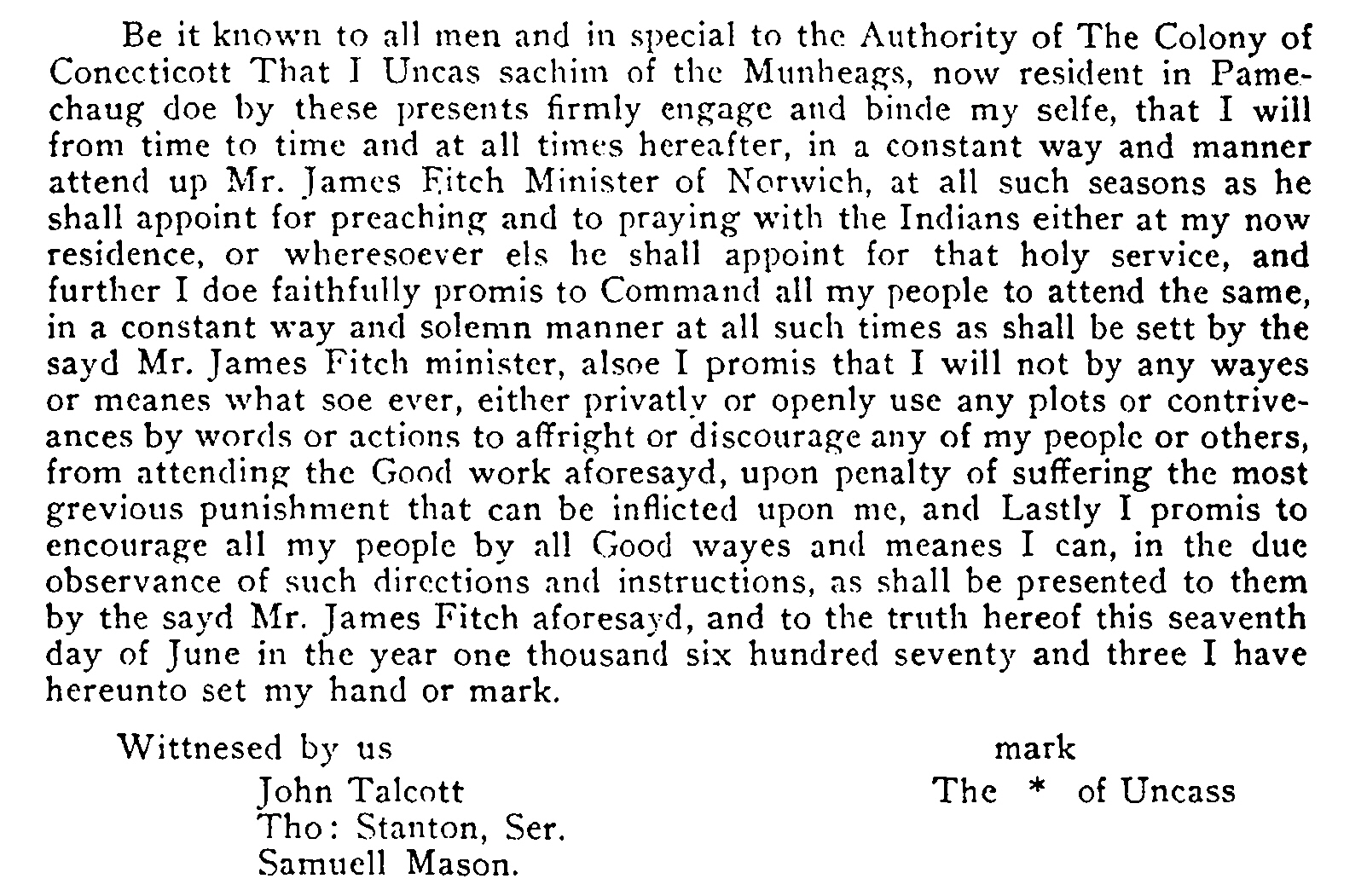
James was a Founding settler of Norwich and Saybrook, Connecticut and the first minister in those two towns as well.  He was ordained Rev. James Fitch, to become the first ordained minister of Saybrook Congregational Church and the First Congregational Church of Norwich.  James intervention got Uncas of the Mohegans, and the Pequot Indians, to side with the English against King Philip’s Narragansett tribes. Their fair dealings with the Indians spared these settlers who were on the very frontier at that time.

in 1673, Uncas promised that his people would attend the preaching of Rev. James Fitch   Source: New London County, Connecticut A Modern History

Uncas (c. 1588 – c. 1683) was a sachem of the Mohegan who through his alliance with the English colonists in New England against other Indian tribes made the Mohegan the leading regional Indian tribe in lower Connecticut.

On Oct 1, 1648, James married Abigail Whitfield (born 08/1622) of nearby Guilford, Connecticut. The ceremony was performed by her father, Reverend Whitfield.

James must have approached his mother, Anna (nee Reeve 1590-1686) and his brothers about settling in America, and in about 1650, Anna Fitch and her sons Thomas, Samuel and Joseph sailed from England, to join James.

In 1659, the congregation at Saybrook received permission to establish a new settlement at Norwich, Connecticut.  The nine square miles of land for the town of Norwich was purchased from the Indian Sachems of Mohegan for £70 in Jun 1659.  Norwich was settled in the spring of 1660.  Rev. James Fitch accompanied them as their leader along with his father-in-law Major John MASON. Just before leaving, Abigail died on September 9, 1659. James and his six children, James II, Abigail, Elizabeth, Hannah, Samuel and Dorothy, went alone to Norwich the following month.  James continued as pastor at Norwich until  he resigned in 1696.  He moved to Lebanon in 1702.

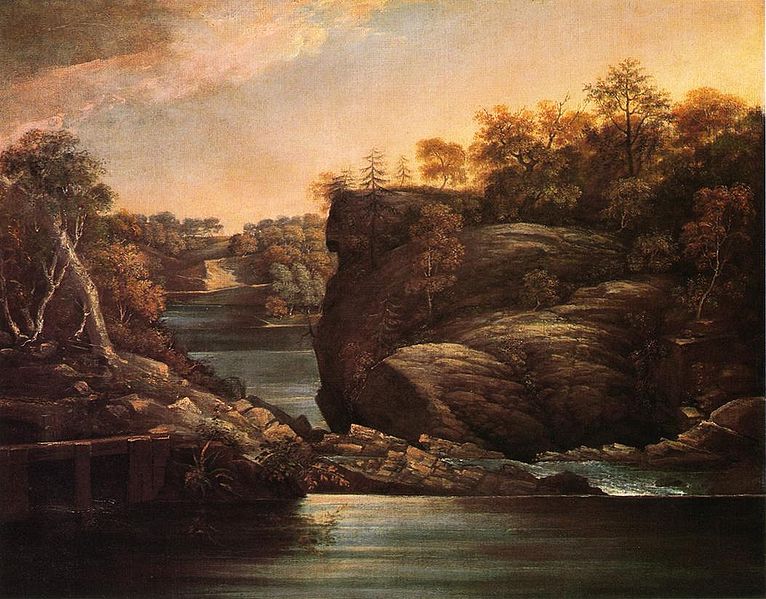
Norwich Falls, oil on canvas

Norwich Falls, oil on canvas, John Trumbull, 1806

Norwich, Connecticut
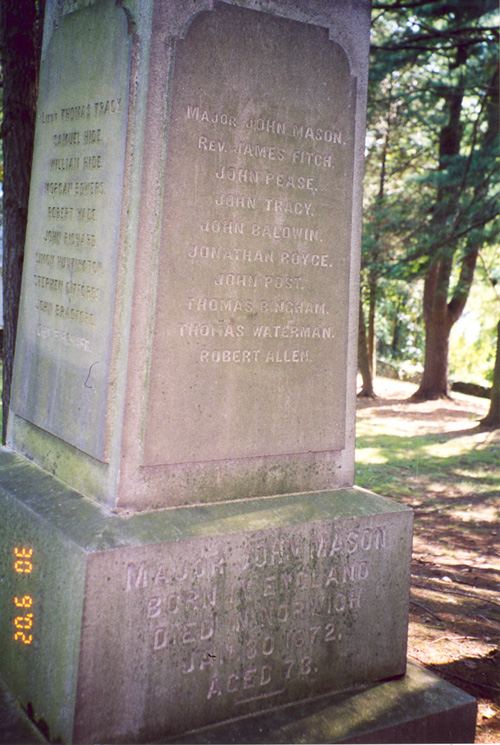
Norwich was founded in 1658 by settlers from Old Saybrook led by Major John Mason and Reverend James Fitch.  Most of these original proprietors of Norwich came from Saybrook, and East Saybrook (now Lyme). The 35 original proprietors of that town were:

Reverend James FITCH, the first minister
Major John MASON, afterwards Lieut. Gov. of Connecticut
Lieut. Thomas Leflingwell
Lieut. Thomas Tracy and
his eldest son John Tracy
Deacon Thomas Adgate
Christopher Huntington and
his brother, Deacon Simon Huntington
Ensign Thomas Waterman
William Hyde and
his son Samuel Hyde, and
his son-in-law John Post
Thomas Post
Lieut. William Backus and
his brother Stephen Backus
Deacon Hugh Calkins (from New London, CT, and
his son John Calkins (from New London, CT) and
his son-in-law Jonathan Royce (from New London, CT)
John REYNOLDS
Thomas Bliss
Francis Griswold
John Birchard
Robert Wade
Morgan Bowers
John Gager (from New London, CT)
Thomas Howard
Dr. John Olmstead
Nehemiah SMITH (from New London, CT)
Richard Edgerton
John Elderkin
John Bradford (from Marshfield, MA)
Thomas Bingham
Robert Allen (from New London, CT)
John Baldwin
John Pease (Son of  Robert PEASE Sr.) (from New London, CT and Edgartown)
Thomas Smith (from Marshfield, MA)

Norwich Founders Memorial

James Fitch then married Priscilla MASON , daughter of Major John MASON in October of  1664. This marriage produced eight more children, Daniel, John, Jeremiah, Jabez, Ann, Nathaniel, Joseph and Eleazer.

When King Philip’s War began in 1675, Rev. Fitch was instrumental in getting Uncas and the Mohegans, and also the Pequot Indians, to side with the English against King Philip’s Narragansett tribes. Their fair dealings with the Indians spared these settlers who were on the very frontier at that time. Uncas, was the Indian chief made famous by James Fenimore Cooper in ‘The Last of The Mohegans’.  He was the chief who sold the lands of Norwich to Fitch and Mason and the others settlers.

Sometime in late 1694, James suffered what we would call a stroke or, in those days a stroke of the palsy. It probably affected his speech, making it difficult to serve as minister.

In 1695 at the age of 74, James founded and settled a new town nearby, Lebanon, Connecticut, where he moved to in 1701 when he retired from the church in Norwich. He remained in Lebanon until his death at age eighty on November 18, 1702. He is buried at the churchyard there and his stone remains in the old cemetery.

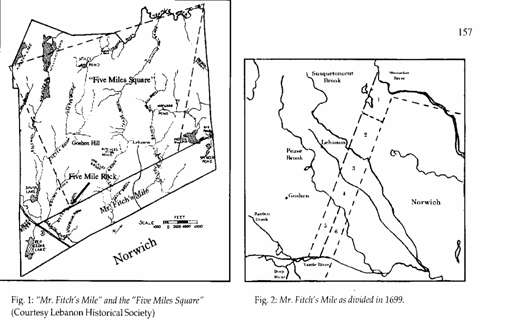
The town of Lebanon has its origins with the settlers of Norwich, who wanted to expand beyond the “nine miles square” they had bought from the Mohegan sachem Uncas. In 1663, the first grant in the area was given in to James’ father-in-law  Maj. John Mason, deputy governor of the Connecticut colony; the next year, Mason accepted 500 acres  northwest of Norwich. This area, known as “Pomakuck” or “Pomocook” by the Mohegans, is now the Goshen Hill area of Lebanon. In 1666, Connecticut granted an additional 120 acres  to the Rev. James Fitch, minister of Norwich, adjacent to Maj. Mason’s land which was now known as Cedar Swamp. The Mohegans conferred their blessing on the grants by giving an additional seven-mile strip to Maj. Mason’s son in 1675, who split the land with the Rev. Fitch, his father-in-law. This area is now known as “Fitch and Mason’s Mile,” or just “The Mile.”  This page was getting a little long, so you can see details of Mr. Fitch’s Mile here.

Mr. Fitch’s Mile

Rev. James Fitch’s reputation rests on his missionary work among the Connecticut Indians, particularly the Mohegans. He mastered their language and was particularly useful to the colonists during King Philip’s War.

Ancestry.com

Birth: Dec. 24, 1622, England Death: Nov. 18, 1702 Lebanon New London County Connecticut, USA Founding settler of Norwich and Saybrook, Connecticut. Rev. James Fitch was the first ordained minister of Saybrook Congregational Church and the First Congregational Church of Norwich. He was instrumental in getting Uncas and the Mohegans and the Pequot Indians to side with the English against King Philip’s Narragansett tribes. Their fair dealings with the Indians spared these settlers who were on the very frontier at that time.

Children

1. Major James Fitch

James first wife Elizabeth Mason was born in Aug 1654 in Saybrook, CT.   She was the widow of William Adams of Dedham, Massachusetts. Her parents were Maj. John MASON and Anne PECK. The family relationship was unusual.  When James married Elizabeth in 1675,  Elizabeth’s older sister Priscilla had been James’ step-mother  for over 10 years having married his father in 1664.  Elizabeth died 8 Oct 1684 in Norwich, Conn.

James second wife Alice Bradford was born 27 Mar 1661 in Plymouth, Mass. Her parents were William Bradford and Alice Richards.  William and Alice lived on the north side of Jones River in Stony Brook, Kingston, in the Plymouth Colony. William Bradford Plymouth Solider (Wiki) was Major Commander-in-chief of the Plymouth forces in the Great Swamp Fight in 1675 where he was severely wounded. He was active in politics.   Alice died 10 Mar. 1745/46 Canterbury, Windham, CT

Maj. James Fitch helped to reestablish colonial government after the Revolution of 1689. He served in the military as Company Sergeant Major of New London Company in 1696. He was Assistant in 1690. He also served as Boundary Commissioner and Land Reviser. He led military expeditions, named forts, and guarded the frontier. He exercised jurisdiction over the Mohegans and all their lands and interests.

Cleaveland Cemetery , Canterbury, Connecticut Here lies the Body of Maj’r James Fitch Esq’r son of ye Rev’d Mr. James Fitch Pastor first of Saybrook then Norwich. He was born at Saybrook 1647. He Was very Useful in his Military & in His Magistracy to which he was chose’n & Served successively many years to ye Greate Acceptance & Advantage of His Country: being: A Gentleman of Good Parts & very forward to Promote ye Civil & Religious interes’ts of it. He died Nov. 10, 1727 Aged 80 y

James was a large landowner and founder of the town in 1697 in Canterbury, Windham County, Connecticut. He dug the first cellar there in 1697, and erected the first permanent habitation. He selected as his residence a neck of land partially enclosed by a bend in the Quenbang River. His home on the neck became a rendezvous for land traders, civil and military officials, and Indians. Here courts were held, military expeditions were organized, and many thousand acres of land were bartered away. It’s doors, the only residence between Norwich and Woodstock, were always open to weary travellers. A road was laid from Windham to his home and connected with the Greenwich path.

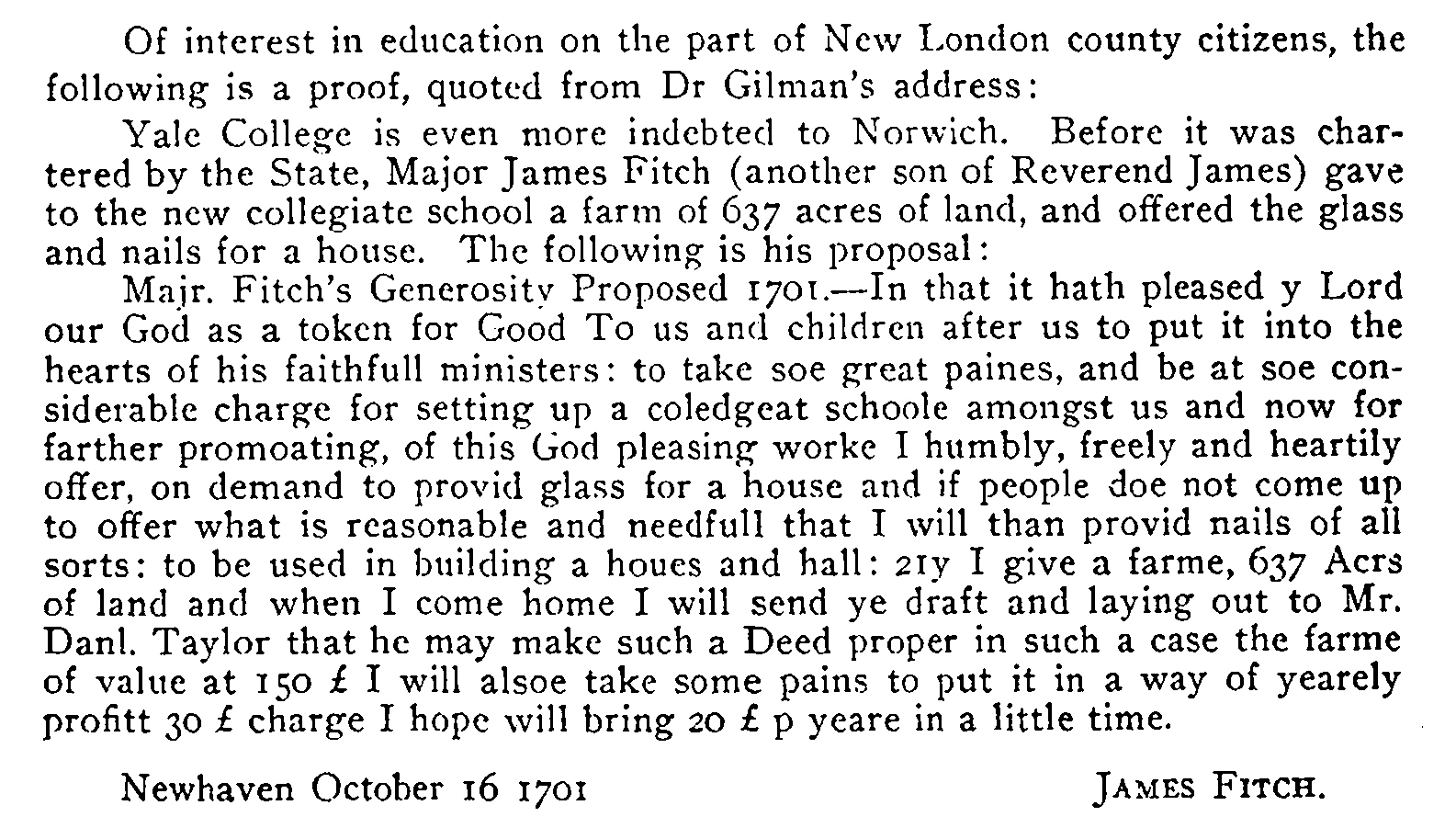
James Jr. gave nails and glass for the Yale’s first building, and endowed it with 635 acres of land in Killingworth, Middlesex County, Connecticut.

Source: New London County, Connecticut A Modern History

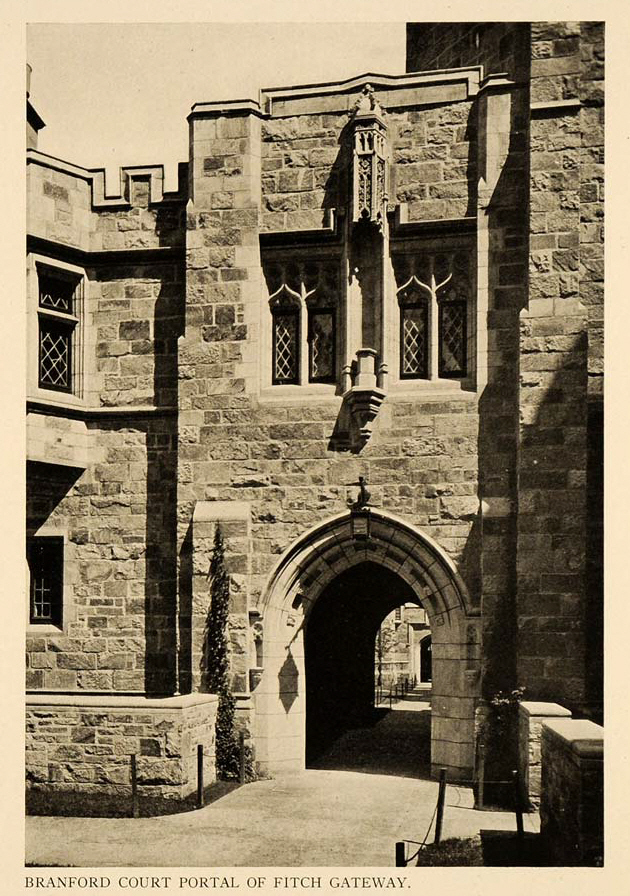
He supplied money, land and materials to help found a church college in New Haven, Connecticut that was to become Yale College in 1701. Fitch Gateway in the Harkness Quadrangle memorializes James Fitch.

Fitch Gateway Yale is named for Maj. James Fitch

He died on 10 Nov 1727 in Canterbury, Windham County, Connecticut. He is said to have settled in Norwich, but also resided in Preston, Plainfield, and Canterbury as well.

Another view –  James Fitch was a land speculator and magistrate. In 1660 his father, Reverend James Fitch (1622-1702), led a group of people to settle the town of Norwich. Raised on the frontier in close contact with Indians, Fitch gained knowledge of the unsettled eastern Connecticut lands and learned to manipulate the Indians who owned them. In 1680 and 1684 Owaneco, chief of the Mohegans, granted Fitch title to a large tract of land, the Quinebaug lands, in northeastern Connecticut. His acquisition and later disposal of Indian lands drew to his side all those who claimed title by native right and who entered the political arena in order to maintain the land they claimed.

Capt. James Fitch was involved in questionable land deals in the township of Lisbon along with his Mason brother-in-laws.Source: New London County, Connecticut A Modern

Fitch was first elected deputy from Norwich in May 1678 and three years later was chosen to the Connecticut Upper House. Fitch opposed the Dominion of New England, and upon its overthrow in the spring of 1689 he was a leader in the movement to restore charter government. The old rulers of the colony procrastinated, but Fitch aroused the freemen to demand new elections and the reestablishment of the old government. In this effort he was successful, but the old magistrates, most of whom had willingly acquiesced to Governor Andros’ rule, managed to retain their former offices. James Fitch was a powerful and disturbing figure to those who cherished traditional patterns of deference and who opposed his speculations and sale of lands in eastern Connecticut. He might have won control of the government had it not been for Fitz-John Winthrop (1638-1707). Winthrop secured reaffirmation of the Connecticut charter, thereby propelling himself into the governor’s chair and restoring the good image of those who had a decade earlier supported the Dominion of New England.

The enemies of James Fitch quickly went on the offensive. Previously county courts were presided over by a local assistant like Fitch, but new legislation vested all appointive power in the hands of the General Assembly. In the 1698 election Fitch lost his Council seat. Although he was to regain it in 1700, political fortunes tuned against him. He was placed on the defensive and eventually lost control of the Quinebaug lands. He retired to Canterbury where he died in 1727.

James Fitch was for a period of almost twenty years one of the most powerful men in the colony. To his enemies he was “Black James” or the “Great land pirate,” but he led a faction devoted to charter government and native right that helped mark the transition from Puritan commonwealth to provincial Yankee society.

In 1694 and 1695 a group of Ipswich men, Joseph Stafford [son of our ancestor Thomas SAFFORD], Richard Smith, Meshach Farleyh, Matthew Perkins and Samuel Bishop bought from Capt. James Fitch of Norwich  of Norwich in the Connecticut colony a tract of eighteen hundren acres which was later called Preston and on which three of Safford’s children settled.  Captain Fitch’s title to this land was extremely dubious.  After King Philip’s War he held it as a sort of trust for a small local tribe of Indians known as the Shetuckets to whom it had been guaranteed. When Fitch transferred the title to himself there were murmurs of disapproval among the more sensitive of the Norwich settlers, but nothing was actually done to restore what seems to have been, in bald terms. and by 1694 the title was regarded as good. [History of Norwich by Frances Caulkins, edition of 1866]

Many of our ancestors lived in Preston around this time including John SAFFORD Jr.Ebenezer PERKINS and Daniel WOODWARD

Children of James and Elizabeth Mason

i. James Fitch III b: Jan 1676/77; d. within the week.

ii. James Fitch III b: 7 Jun 1679;  died as a child

iii. Jedediah Fitch b: 17 Apr 1681 in Norwich, CT; d. 20 Nov 1756 in Nantucket, Mass.  He moved to Nantucket and there in 1701 married 1701 to Abigail Coffin b: 9 Jul 1683 in Nantucket, Mass.

All his brothers were soldiers fighting Indians and such. As a young teenager, Jed moved to the north shore of Massachusetts and settled in Newbury, and then later went to Nantucket Island off the coast of Massachusetts. Nantucket was a Quaker colony at the time and in 1701 he married into an established Quaker family. His father had been quite friendly with the local Indians, the Mohegans and Pequots, yet fought against other tribes. Perhaps Jedediah became a pacifist and wanted no part of fighting the Indians he grew up with and so left for Nantucket.

iv. Samuel Fitch , Sr. b: 12 Jul 1683 in Norwich, CT; d. 1729 in Lawrenceville, New Jersey; m. Mary Smith b: Sep 1682 in Burlington, New Jersey

Children of James and Alice Bradford

v. Abigail Fitch b: 22 Feb 1686/87 in Norwich, CT; d. 19 May 1759 in Windham, CT; m. John Dyer , Sr., Colonel b: 9 Apr 1692 in Weymouth, Mass.

John Dyer was born in Weymouth, but removed to Winhdam, CT with his brother Thomas. Later he sold out his Windham holdings to Thomas and removed to Canterbury where he settled. He appears a number of times in the Canterbury records:1714: Eight hundred acres of second-division land south of the Mashamoqut and west of Newichewanna Brook were sold by Major FITCH to John Dyer, and by him conveyed to Col. Thomas FITCH of Boston. Dyer for eight hundred acres gave £120.  1723: At the Canterbury land division of 30 Apr  1723, the long contest was over, and John Dyer received one share as a proprietor under patent.1739: The military companies of Plainfield, Canterbury, Pomfret, Killingly and Voluntown were constititued the 11th Connecticut Regiment with John Dyer as its Lt. Col.He was often referred to as “Captain” John Dyer, and the “History of Windham County” once refers to him as “Colonel John Dyer”

vi. Ebenezer Fitch , Sr. b: 10 Jan 1689/90 in Norwich, CT; d. 20 Nov 1724 in Windsor, CT; m. 1712 to Bridget Brown b: 7 Jul 1685. Bridget was previously married to  John Perry , Captain and  Samuel Hall b: Abt. 1678

vii. Daniel Fitch , Sr. b: Feb 1692/93; d. 1752; m. 1719 to Anna Cook b: 1695

viii. John Fitch , Captain b: 1695; d. 1782

ix. Lucy Fitch b: ABT 1698; m. Henry Cleveland b: 22 DEC 1699 in Chelmsford, Mass.  Henry’s uncle, Aaron Cleveland, is the 4th great grandfather of President Grover Cleveland.

x. Jerusha Fitch b: 19 Feb 1698/99 in Canterbury, CT; d. 1780 in Windsor, CT; m. 1718 to Daniel Bissell , Jr. b: 31 Oct 1694 in Windsor, Conn.

xi. Theophilus Fitch , Sr. b: 1701 in Norwich, CT; d. 20 Jul 1751 in Canterbury, CT; m. 15 Dec 1731 to Mary Huntington b: 4 Aug 1707 in Windham, CT; m2. 2 Oct 1734 to  Grace Prentice b: Jan 1705/06 in Newton, Mass.

xii. Jabez Fitch , Sr., Colonel b: 30 Jun 1702 in Canterbury, CT; d. 31 Jan 1784; m1. 29 May 1722 to Lydia Gale b: 9 Jul 1699 in Watertown, Mass.; m2. 14 Jan 1754 Elizabeth Darby b: Abt. 1706; m3. 1782 Rebecca Ensworth b: Abt. 1706

Jabez  settled on the land which his father gave him, he became captain, colonel, justice of the peace and quorum, and was for many years a Judge of Probate.

2. Abigail Fitch

Abigail’s first husband Captain John Mason, Jr. was born 16 Aug 1646 in Windsor, CT. His parents were Maj. John MASON and Anne PECK. Abigail’s brother married John’s sister Elizabeth and her father married his sister Prescilla. John died of wounds suffered in the Great Swamp Fight on 18 Sep 1676 in New London, CT.  Of the 71 Connecticut troops killed in the battle, nine were from John Mason’s 5th Company of Norwich. To the First and Fifth Connecticut Companies were attached Indian Scouting Companies, numbering seventy-five to each, made up mostly of Indians from the Mohegan and Pequod tribes.

This gallant young captain was severely and, as it proved, fatally wounded in the Great swamp fight at Narragansett, Dec. 19, 1675. It is probable that he was brought home from that sanguinary field by his Mohegan warriors on an Indian bier. His wounds never healed. After lingering several months, he died, as is supposed, in the same house where his father expired, and was doubtless laid by his side in the old obliterated graveyard of the first comers. Though scarcely thirty years of age at the time of his death, he stood high in public esteem, both in a civil and military capacity. He had represented the town at three sessions of the Legislature, and was chosen an assistant the year of his decease. In the probate of his estate before the County Court he is called “the worshipful John Mason.” The Rev. Mr. Bradstreet, of New London, records his death in these terms:

“My hon’d and dear Friend Capt. Juo Mason one of ye magistrates of this Colony, and second son of Major Jno Mason, dyed, Sept. 18, 1676.”

Children of Abigail and John Mason

i. John Mason , III, Captain b: 1673 in Stonington, CT; d. 1736; m. 15 Jul 1719 to Anne Sanford b: 1680

ii. Anne Mason b: Abt. 1676 in Stonington, CT; m. 1690 to Captain John Dennison , Jr.  b: 1 Jan 1668/69 in Stonington, Conn John died of tuberculosis in 1699, at the age of thirty.

Abigail’s second husband John Buttolph was born 28 Feb 1639/40 in Boston, Mass. John first married Hannah Gardner. John died 14 Jan 1692/93 in Wethersfield, CT.

Children of Abigail and John Buttolph

iii. Abigail Buttolph b: 3 Apr 1683 in Wethersfield, CT; d. 1719; m. Her 2nd cousin Nathaniel Fitch b: 17 Mar 1668/69 in Hartford, Conn.

iv. James Buttolph b: 22 Dec 1684

3. Elizabeth Fitch

Elizabeth’s husband Rev. Edward Taylor was born about 1642 in Skiteby, England. His parents were John Taylor and Rhoda Holt. Edward died 24 Jun 1729 in Westfield, Mass.  He was a theology student of her father and later A.B., Harvard, 1671, A.M., 1720;. They were married and then moved to Westfield, Massachusetts. She had eight children, most of whom died young.  Elizabeth died in 1689. Edward later remarried with Ruth Wyllis of Hartford, Connecticut. His five daughters all married Connecticut clergymen.

Children of Elizabeth and Edward

i. Samuel Taylor b: 27 Aug 1675 in Westfield, Mass.

ii. Elizabeth Taylor b: 27 Dec 1676 in Westfield, Mass.

iii. James Taylor b: 2 Oct 1678

iv. Abigail Taylor b: 6 Aug 1681

v. Bathsheba Taylor b: 17 Jan 1683/84 in Westfield, Mass.

vi. Elizabeth Taylor b: 5 Feb 1684/85

vii. Mary Taylor b: 3 Jul 1686

viii. Hezekiah Taylor b: 18 Feb 1686/87

4. Hannah Fitch

Hannah’s husband Thomas Meeks (Mix) was born 30 Aug 1645 in New Haven, CT. His parents were Thomas Meeks Sr. and Rebecca Turner. Thomas died 30 Jul 1706 in Stonington, CT.

Children of Hannah and Thomas

i. Daniel Meeks b: 23 Apr 1678 in Norwich, CT; m. Elizabeth Brewster b: 23 Jun 1676 in Norwich, Conn.

ii. Abigail Meeks b: 10 Mar 1679/80 in Norwich, CT; m. Samuel Rockwell b: 30 Sep 1676 in Norwich, Conn.

iii. James Meeks b: 29 Dec 1683

iv. Hannah Meeks b: 13 Mar 1686/87 in Norwich, CT; m. Jonathan Pierce b: Abt. 1681

v. Rebecca Meeks b: 14 Apr 1687 in Norwich, CT; m. John Rockwell b: Dec 1677.

vi. Elizabeth Meeks b: 15 Apr 1689 in Norwich, CT; m.  John Pearson (Pierson) b: Abt. 1685

vii. Dorothy Meeks b: 23 Nov 1691 in Norwich, CT; m. Jeremiah Andrews b: Abt. 1689.

viii. Ann Meeks b: 7 May 1694 in Norwich, CT; m. Benjamin Andrews , Sr. b: 13 Apr 1685 in Ipswich, Mass

ix. Zebediah Meeks b: 12 Dec 1697 in Norwich, CT; m. Sarah Cheeseborough b: 1700 in Stonington, CT. Sarah parents were Elihu Cheeseborough and Hannah Miner

They lived in Norwich and had nine children.

5. Samuel Fitch

Samuel’s wife Mary Brewster was descended from the Mayflower Pilgrim William Brewster. Mary was born 10 Dec 1660 in Norwich, CT. Her parents were Benjamin Brewster and Ann Addis. Mary died 2 Dec 1750 in Guilford, CT. They lived in Norwich and Preston, Connecticut.

Children of Samuel and Mary:

i. Mary Fitch b: 10 Mar 1679/80

ii. Samuel Fitch , Jr. b: 5 Oct 1681

iii. Hezikiah Fitch b: 2 Jan 1681/82; m. Anna ? Fitch b: Abt. 1686

iv. Elizabeth Fitch b: 15 Feb 1683/84 in Norwich, CT; m. 1712 to Samuel Mason b: 11 Feb 1685/86 in Stonington, Conn..

v. Abigail Fitch b: 1 Feb 1685/86 in Norwich, CT; m. James Clark , Sr. b: 1688 in Ipswich, Mass.

vi. Samuel Fitch , Jr. b: 28 Nov 1688; d. 1755

vii. Deacon Benjamin Fitch , Sr. b: 29 Mar 1691 in Norwich, CT; d. 10 Oct 1727 in Norwich, CT; m. 17 Nov 1713 to Hannah Reed b: Jul 1688 in Norwich, Conn.

viii. John Fitch b: 17 May 1693;

ix. Jabez Fitch , Sr. b: 3 Jun 1695 in Norwich, CT; d. 28 Mar 1779 in Norwich, CT; m. 1 Aug 1719 to Anna Knowlton b: Abt. 1698.

x. Pelatiah Fitch , M. D. b: 18 Feb 1697/98 in Norwich, CT; d. 24 Feb 1749/50 in Preston, CT; m1. 24 Dec 1723 to Elizabeth Haskell b: Abt. 1704.; m2. 2 Nov 1726 to Elizabeth Choate b: 9 Dec 1706

6. Dorothy Fitch

Dorothy was the second wife of Nathaniel Bissell of Windsor, Connecticut.  Nathaniel Bissell was born 24 Sep 1640 in Windsor, CT. His parents were John Bissell and Mindwell Moore. Nathaniel died 12 Mar 1713/14.  They had two children. Dorothy died June 28, 1691.

Children of Dorothy and Nathaniel

i. Dorothy Bissell b: 27 Dec 1686

7. Capt. Daniel Fitch

Daniel’s wife Mary Sherwood was born 1674 in Fairfield, CT. She was his cousin. Her parents were Matthew Sherwood and Mary Fitch. After Daniel died, she married 25 Feb 1716 in New London, CT to Joseph Bradford (b. 18 Apr 1675 in Plymouth, Plymouth, Mass. – d. 16 Jan 1747 in New London, CT). Mary died 16 Sep 1752 in Montville, CT.

Joseph Bradford had previously married to Daniel’s sister Anne Fitch on 5 Oct 1698 in Lebanon, New London, CT.

Daniel was active in the Indian Wars and settled near New London, Connecticut at a town called Montville.

Children of Daniel and Mary

i. Adonijah Fitch, b. Apr 1700, Montville; d. 1780 in Montville, CT; m. 1725 to his first cousin Sarah Fitch b: 24 Jan 1705/06 in Stonington, Conn.

ii. Capt and Deacon James Fitch, b. Oct 1702; d. 1789; m. 1728 to Anne Denison, Abt. 1728; b. 1707; d. 1792.

iii. Lemuel Fitch, b. Jan 1704; d. 1757 in Colchester, CT; m. Mary Bigelow.

iv. Mary Fitch, b. Sep 1707; d. 25 Oct 1768.

v. Capt. Daniel Fitch, b. 1709, Montville; d. 12 May 1755 Stratford, CT; m. Sarah Carle b: Abt. 1690

8. Capt. John Fitch

John’s wife Elizabeth Waterman was born 6 Aug 1675 in Norwhich, CT. Her parents were Thomas Waterman and Miriam Tracy. Elizabeth died 25 Jun 1751 in Windham, CT.

John lived in Windham, Connecticut and was active in local government.

Elizabeth Waterman Fitch – Windham Center Cemetery Windham, Windham, Connecticut

John died May 24, 1743 and Elizabeth died June 25, 1751. Children were: Elizabeth, Miriam, Priscilla and John Jr.

Capt John Fitch – “In memory of Capt. John Fitch Esq. and son to the Rev. James Fitch Pastor of the Church of Christ in Norwich and the Loveing & well beloved consort of Mrs. Elisabeth Fitch. Aged 76 years”  –  Windham Center Cemetery Windham, Windham, Connecticut,

Children of John and Elizabeth

i. Elizabeth Fitch b: 1 Jun 1696 in Windham, CT.; d. 1780; m. 1718 to Nathaniel Webb , Sr. b: 10 Feb 1695/96 in Mass.

ii. Miriam Fitch b: 17 Oct 1699 in Windham, CT.; d. 1744;  m. 1740 to Hezekiah Ripley b: 10 Jun 1695

iii. Priscilla Fitch b: 5 Feb 1701/02 in Windham, CT.; d. 1782; m. 1732 to Rev. Solomon Paine , Sr., b: 16 May 1698

iv. John Fitch , Jr., Captain b: 1705 in Windham, CT.; d. 19 Feb 1760 in Windham, CT; m. 1731 to Alice Fitch b: 1712

9. Capt. Jeremiah Fitch

Jeremiah’s wife Ruth Clara Gifford was born 30 Dec 1676 in Norwich, CT. Her parents were Stephen Gifford and Hannah Gore. Ruth died in Coventry, CT after 1756.

Jeremiah moved from Lebanon to Coventry, Connecticut about 1703. He was a soldier, surveyor and town official.

Children of Jeremiah and Ruth:

i. Lucy Fitch b: 18 Apr 1699 (Twin); d. 8 Mar 1736 in Lebanon, New London, CT

ii. Ruth Fitch b: 18 Apr 1699 in Lebanon, CT.  (Twin) d. 1762; m. 1744 to  Daniel Whitmore b: 1702 in Billerica, Mass.

iii. Hannah Fitch b: 1700 in Lebanon, CT.; d. 1785; m. Humphrey Davenport b: 11 Oct 1702 in Hartford, CT.

iv. Jeremiah Fitch , Jr. b: 17 Apr 1701 in Coventry, CT.; d. 8 Jan 1779; m. 1730 to Mercy Porter b: 10 Oct 1708

v. Abner Fitch , Sr. b: 8 Jul 1703 in Lebanon, CT.; d. 23 Jun 1797 in Coventry, CT; m. 1736 to Ruth Rose b: 13 Mar 1715/16 in Wethersfield, Conn.

vi. Gideon Fitch , Sr. b: Abt. 1705 in Lebanon, CT.; m. 1736 to Sarah Calkins b: 6 May 1716 in Norwich, Conn. Sarah’s parents were Phebe Abell and Hugh Calkins and her grandparents were Joshua ABELL and Berthia Gager.

vii. Joseph Fitch b: Abt. 1710;

viii. James Fitch , Sr. b: 24 Jul 1711 in Lebanon, CT.;d. Vermont; m. Oct 1738 to Phebe Meraugh b: 1720 in Coventry, Conn.

ix. Stephen Fitch , Sr. b: Abt. 1712 in Coventry, CT; d. 9 Feb 1806 in Windham, CT; m. 24 Jan 1736/37 to Eleanor Strong b: Abt. 1716

x. Elisha Fitch b: Abt, 1714 in Coventry, CT.; d. 1791; m. 1736 to Priscilla Patton b: Abt. 1718

10. Rev Jabez Fitch

Jabez’ wife Elizabeth Appleton was born 23 Apr 1682. Her parents were John Appleton Jr and Elizabeth Rogers. Elizabeth died 18 Oct 1765 in Portsmouth, New Hampshire.

Jabez graduated from Harvard in 1694. He became a Fellow at Harvard and then was ordained minister in Ipswich, Massachusetts in 1703. He took over a church in Portsmouth, New Hampshire (then part of Massachusetts) in 1725 and remained there until his death on November 22, 1746.

Children of Jabez and Elizabeth:

i. Elizabeth Fitch b: 16 Aug 1705 in Ipswich, Mass.; d. 1774 in Portsmouth, New Hampshire; m. 1728 to John Wibird , Sr. b: 20 Oct 1705 in Portsmouth, New Hampshire

ii. John Fitch , M. D. b: 18 Aug 1709 in Ipswich, Mass.; d. 26 OCT 1736 in Newbury, Mass.

iii. James Fitch b: 19 Jun 1712; d. 1722

iv. Margaret Fitch b: 15 Nov 1715 in Ipswich, Mass.; d. 1742 in Salem, Mass.; m. 1739 to Henry Gibbs , Jr., Librarian b: 13 May 1709 in Watertown, Mass. d. 1759  of measles. After Margaret died, he married Katherine Willard in 1747.

At age seven, Henry lost his mother and seven years later, while a sophomore at Harvard, he lost his father as well. As the only surviving son (he also had two sisters), Henry came into a considerable inheritance from both sides of the family and was able to live comfortably, if not lavishly. Henry graduated with the class of 1726, but remained at college as a resident graduate, earning a second degree in 1729 and serving as college librarian from 1730 to 1734. Leaving Harvard and Boston behind, he sold off his property in the city and relocated to Salem to begin a career as a merchant, never attaining the success of the previous generations of Gibbs. In 1737, he met and began to court Margaret Fitch, daughter of Rev. Jabez Fitch of Portsmouth, a niece of his brother-in-law. The couple wed on January 31, 1739, but the marriage was not to last. Margaret died suddenly only three years later, leaving two daughters, one of whom shortly followed her mother in death.

Henry remarried in 1747, selecting the much younger Katherine Willard, daughter of the Provincial Secretary, for his second wife. This marriage further cemented the prominent place of the Gibbs in Salem society but brought comparatively little lucre, and only the fortunate bequest of £500 from a friend, William Lynde, helped the Gibbs maintain their lifestyle and social obligations. A theological liberal and political supporter of the power of the crown and broad colonial obligations, Gibbs held several important local and provincial offices during the next several years, including justice of the peace (appt. 1753), judge, delegate in the House of Representatives (three terms, beginning in 1753), and Clerk of the House (1755-1759). In February, 1759, at what should have been the peak of his career, he contracted measles, leaving five children and an insolvent estate with a meager 10s allotted to each child.

Among the more important materials in the Gibbs papers are Henry Gibbs’ (1709-1759) copies of 21 of his 27 courtship letters to his first wife, Margaret Fitch, written between December 27th, 1737 and December 19th, 1738 (the first of the letters preserved is numbered “6”, and they continue in unbroken succession until one month before the couple was married). These letters provide an intimate view of the initiation and pursuit of a relationship between members of two of Salem’s elite families. From the beginning, the letters are familiar, affectionate, even flirtatious, becoming ever more so over the course of the year. “I ought to look upon myself as somewhat unreasonable in my desires,” he wrote in letter no. 8 (the third preserved), “when ye more I am with you, ye more Covetous I am of being so, & yt it is with regrett yt I am even now at a distance from you: however, I can’t but regard it as a sure presage yt (if ever it be my happy Lott to live with you) your Company will alwaies be a Source of ye most pleasing entertainment & Delight to me.” Elsewhere (letter 10), he wrote “When I mention ye friendship I have for you, I am far from confining it to a cold, Stoical Approbation of ye good qualities I think you possessed of, but include in it all yt is meant by Love considered as an Affection of ye Soul. Tis this tender passion joined with that regard & esteem which reason and judgement approve of, yt is ye only foundation of ye pleasure yt is ever found in Friendship.” In this correspondence, Henry eloquently describes weddings, a Quaker meeting he attended, the love lives of acquaintances, local gossip, and above all, often at considerable length, his ideas of love. At several crucial junctures in letter 16, Henry resorted to the use of a code to disguise passages dealing with an apparently embarrassing encounter with a newly married friend. The letters are a rich source for the study of views of love and marriage among the upper classes in colonial Massachusetts.

v. Anne Fitch b: 19 Jul 1718 in Ipswich, Mass.;d. 1747;  m. 1743 to Nathaniel Gookin , Jr., Reverend b: 1713 in Hampton, New Hampshire

Nathaniel graduated at Harvard in 1731, ordained Oct. 31, 1739, at North Hampton.  He first married  Judith Coffin, daughter of Capt. Eliphalet Coffin of Exeter, Jan. 1, 1741. After Ann died, he married third a daughter of Joshua Wingate of Hampton.

vi. James Fitch b: 3 Oct 1720

vii. Mary Fitch b: 24 Mar 1722/23 in Ipswich, Mass.’ d. 1756; m. 1745 to Francis Cabot , Sr. b: 22 May 1717

11. Anne Fitch

Anne’s husband Lieut. Joseph Bradford of Plymouth.was born 18 Apr 1675 in Plymouth, Mass. His parents were Major William Bradford and Widow Sarah Griswold Wiswall. After Anne died, he married 25 Feb 1716 in Lebanon, New London, CT to Mary’s sister-in-law. Mary Sherwood (1674 in Fairfield, CT – d. 16 Sep 1752 in Montville, CT. Mary had previously been married to Mary’s brother Capt. Daniel Fitch. Joseph died 16 Jan 1747 in New London, CT.

Joseph’s father, William served in King Phillips as the commander in chief of the Plymouth forces and had the rank of Major. He was shot by a musket at the Narraganset Fort Fight and her carried the ball until his death. His grandfather was William Bradford (1590 – 1657) an English leader of the settlers of the Plymouth Colony who served as governor for over 30 years. Joseph died in 1747.

They settled in Norwich and then Lebanon where she died October 17, 1715

Children of Anne and Joseph

i. Anne Bradford b: 26 Jul 1699 in Lebanon, CT; d. 1747 in Mansfield, Conn.; m. 1723 to Timothy Dimock b: 16 Jul 1698 in Barnstable, Mass.

ii. Joseph Bradford , Jr. b: 9 Apr 1702 in Lebanon, CT. m. Henrietta Swift b: 1701 in New London, Conn.

iii. Priscilla Bradford b: 9 Apr 1702 in Lebanon, CT.; d. 14 May 1778 in Lebanon, CT; m. 1725 to Samuel Hyde III b: 10 Sep 1691 in Windham, Conn.

iv. Alithea Bradford b: 6 Apr 1704; (Twin) died Apr 1704.

v. Irene Bradford b: 6 Apr1704 (Twin) died Apr 1704.

vi. Sarah Bradford b: 21 Sep 1706; m1. c. 1729 to Daniel Tuttle b: Abt. 1703; m2. 1747 to Israel Lathrop , Jr. b: 1 Feb 1686/87 in Norwich, CT.

vii. Hannah Bradford b: 24 May 1709; m. 1730 to Timothy Buell b: 24 Oct 1711

viii. Elizabeth Bradford b: 21 Oct 1712; d. 1808; m. Andrew Lisk b: Abt. 1714

ix. Alithea Bradford b: 19 Sep 1715; m. 1740 to David Hyde b: 22 MAar 1718/19

x. Irene Bradford b: 19 Sep 1715 d. 1785, prob. Brimfield, MAass.; m. Jonathan Janes, 18 Mar 1736, Lebanon, CT

12. Capt. Nathaniel FITCH (See his page)

Nathaniel operated a grist mill and a fulling mill in Lebanon. He married Ann Abel of Norwich on December 10, 1701. After her death in 1726, he married Mindwell Tisdale of Lebanon on September 17, 1729. He died May 4, 1759 at age seventy-nine. The children by Ann were: Anne, Joshua, Nathan, Nehemiah, James, John, Nathaniel, Mehitable, Elizabeth, Rachel, Abel and Caleb. With Mindwell, he had: Jabez, Ezekiel and Isaac.

13. Joseph Fitch

Joseph’s first wife Sarah Mason was born about 1683 in New London, CT. Her parents were Maj. Samuel Mason and Judith Smith. Her grandparents were John MASON and Anne PECK.. Sarah died 9 FEB 1720/21 in Lebanon, New London, Conn. Joseph married Sarah Mason in Saybrook and they lived in Stonington, Connecticut. She died and he married Ann Whiting of Windham in 1729 and they moved to Lebanon. Joseph died in Windham on May 9, 1741 and Ann died there September 18, 1778.

Joseph’s second wife Ann Whiting was born 2 Jan 1698 in Windham, CT. Her parents were Samuel Whiting and Elizabeth Adams. Ann died 18 Sep 1778 in Windham, CT.

Children of Joseph and Sarah

i. Judith Fitch b: 4 Feb 1703/04 in Stonington, CT.; d. Feb 1742/43 in Lebanon, CT; m. 1722 to John Wattles , Sr., Captain b: 28 Jun 1700 in Stonington, Conn.

ii. Sarah Fitch b: 24 Jan 1705/06 in Stonington, CT; d. 05 JAN 1741 in CT; m. 1726 to Capt Adonijah Fitch

iii. Mason Fitch b: 11 Sep 1708 in Stonington, CT; d. 10 Mar 1734 in Connecticut

iv. Joseph Fitch , Jr., Captain b: 14 Jul 1711 – New London, CT; d. 14 Jun 1773 – Lebanon, New London, CT; m. Zerviah Hyde 28 Dec 1738 – Stonington, New London, CT

Joseph’s second wife Ann Whiting was born about 1690. Her parents were Rev. Samuel Whiting and Elizabeth Adams. Ann died 18 SEP 1778 in Windham, CT.

Children of Joseph and Ann:

v. Samuel Fitch b: 16 Jan 1723/24 in Lebanon, CT.; d. 1784 in London, England; m. Mar 1753 to Elizabeth Lloyd b: 20 Jul 1722 in Lloyds Neck, Long Island, New York

vi. Eleazer Fitch b: 29 Aug 1726 in Lebanon, CT; d. 1796 in Canada; m. 1746 to Amy Bowen b: ABT 1727 in Rhode Island

vii. Azel Fitch , Sr. b: 7 Nov 1728 in Lebanon, CT; m1. Rhoda Collins b: 3 May 1731; m2. 1752 to Silence Howell b: 28 Feb 1732/33

viii. Ichabod Fitch b: 17 May 1734 in Lebanon, CT; d. 1794; m1. Mary Hyde , Widow b: Abt. 1738; m2. 1758 to Lucy Lathrop b: 1 Sep1735

ix. Ann Fitch b: 12 Jul 1737 in Lebanon, CT; d. 1827; m. Dec 1761 to Shem Burbank b: 21 May 1736

x. Thomas Fitch b: 11 Jun 1739; d. 27 FEB 1746

14. Deacon Eleazer Fitch

Eleazer married his cousin Martha Brown of Swanzey (Swansea), Massachusetts and they lived in Lebanon where he died in 1747. He had no children.

Martha Brown was born 20 Nov 1681 in Swansea, Bristol, Mass. Her parents were John Brown and Anne Mason.  Three of her grandparents were our ancestors: John BROWN & Lydia Buckland and John MASON & Anne PECK.  Martha died 1747 in Lebenon, CT.

Sources:

Three books are available at Amazon.com about Rev. James Fitch. PURITAN IN THE WILDERNESS: A Biography of the Rev. James Fitch 1622-1702;

Descendants of the Rev. James Fitch 1622-1703, Vol 1 & 2. by John T. Fitch.

History of New London county, Connecticut: with biographical sketches of Pioneers and Prominent Men … edited by Duane Hamilton Hurd 1882

Genealogy of the Fitch Family in North America collected and arranged by John G. Fitch (Olmsted, Ohio: printed for private distribution, 200 copies) 1886.

History of the Fitch family A.D. 1400-1930: a record of the Fitches in England and America, including “pedigree of Fitch” certified by the College of Arms, London, England  by Roscoe Conkling Fitch (Haverhill, Massachusetts: Record Pub. Co.) 1930.

http://www.newenglandgenealogy.pcplayground.com/f_3a.htm#28

http://users.ece.utexas.edu/~perry/fun/genealogy/mell/fitch.html
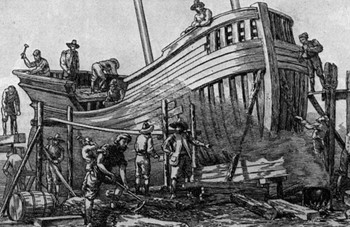
http://www.jeanniemay.com/genealogy/turkfair/pafg11.htm#153

http://geoffreytlaw.tribalpages.com/

http://www.baronage.co.uk/bphtm-01/fitch-1.html

http://trees.ancestry.com/tree/1122756/person/-1992512673/photo/3729b2b9-7fa5-49f4-b345-c08121cde08a?src=search

http://www.americanancestors.com/mr.-fitchs-mile/

http://freepages.genealogy.rootsweb.ancestry.com/~jakratzner/fitch_james_rev.htm

http://www.billputman.com/Fitch.pdf

http://familytreemaker.genealogy.com/users/p/o/p/Sandra-Popiel/FILE/2132text.txt

http://trees.ancestry.com/owt/person.aspx?pid=124486208&st=1

http://hylbom.com/family/paternal-lines/paternal-dy-to-gi/fitch-2590/#_ftn1

Posted in 11th Generation, College Graduate, Historical Monument, Immigrant - England, Line - Miner, Pioneer, Place Names, Storied, Violent Death | Tagged , , , , , | 39 Comments

Capt. Nathaniel Fitch

Capt. Nathaniel FITCH (1679 – 1759) was Alex’s 8th great grandfather, one of 512 in this generation of the Miner line.

Capt. Nathaniel Fitch was born in Oct 1679 in Norwich CT.  His parents were Rev James FITCH and Priscilla MASON.  He married Anne ABELL on 10 Dec 1701. After Anne died, he married Mindwell Higley Tisdale on 17 Sep 1729 in Lebanon, CT.  Nathaniel died 4 May 1759 in Lebanon, CT.

Nathaniel Fitch – Headstone the old burying ground at Lebanon, Conn- ” Here lies the body of Capt. Nathaniel Fitch who, in his life, was useful to the world, and rendered himself beloved and esteemed by Kindness, humanity, Benevolence and other Virtues, and in a comfortable hope of divine Acceptance through Christ departed May 14, 1759 in the 80th year of his age.”

Anne Abell was born 2 Apr 1681 in Norwich CT.  Her parents were Joshua ABELL and Mehitable SMITH.  Anne died  3 Jul 1728 in Lebanon CT.

Mindwell Higley was born in Lebanon, CT.  Her parents were  Capt John Higlye and Hannah Drake.  She was widow of Jonathan Hutchinson and James Tisdale.  Mindwell died 1 Sep 1769 in Lebanon, New London, CT.

Children of Nathaniel and Anne:

Name Born Married Departed
1. Anne Fitch 5 Nov 1702
Lebanon, CT
John Partridge
27 Sep 1722
Norwich, CT.
11 NOV 1748
Norwich, CT
2. Joshua Fitch 13 Feb 1704
Lebanon, CT
Mary Trumbull
c. 1730
7 Jun 1790
Salisbury, CT
3. Nathan Fitch 29 Mar 1705
Norwich, CT
Hannah Huntington
19 JUN 1725
Norwich, CT
12 Jun 1750
Lebanon, CT
4. Nehemiah Fitch 10 Feb 1708 Elizabeth Vetch
3 Nov 1731 Lebanon
.
Anne Metcalf
26 Jan 1738  Lebenon
16 Nov 1745 Lebanon, CT
5. James Fitch 15 Oct 1709 Lebanon, CT Abiel Metcalfe
22 Nov 1733 Lebanon, CT
15 Nov 1760 Salisbury, CT
6. John FITCH 7 Jan 1712 Lebanon CT Hannah SCOTT
5 Nov 1734 Lebanon, CT
7 Jan 1742 Lebanon CT
7. Nathaniel Fitch 14 May 1714
8. Mehitable Fitch 3 Feb 1717
Lebanon, CT
William Whittlesey (Whiting)
30 Sep 1741 Lebanon, CT
Feb 1800
Lebanon, CT
9. Elizabeth Fitch 26 May 1718
Lebanon, CT
Daniel Bissell
15 Feb 1747
.
Elijah Bushnell
1749
18 Dec 1747
Lebanon, CT
10. Rachel Fitch Oct 1720
Lebanon, CT
28 May 1726
Lebanon, CT
11. Abel Fitch 22 Nov 1722
Lebanon, CT
17 Jun 1725
Lebanon, CT
12. Caleb Fitch 17 Jun 1725 Ruth Woodworth
4 APR 1747
Bozrah, CT
19 Mar 1750
Lebanon, CT

.

Children of Nathaniel and Mindwell Higley:

Name Born Married Departed
13. Jabez Fitch 4 Oct 1730 14 Nov 1730
14. Ezekiel Fitch 11 Mar 1732
Lebanon, CT
Susannah Highley
3 Dec 1749
Lebanon, CT
1811
Coxsackie, NY
15. Isaac Fitch 10 May 1734 Susannah Blackman
23 Jun 1752 (Their 1st son was born 18 Nov 1752)
.
Violetta Alden
Bef. 1769
Lebanon, CT
1791
Lebanon, CT

Nathaniel was the 2nd of the three brothers who settled in Lebanon, New London, CT. He owned a grist mill and a fulling mill.

In 1713 he was appointed Ensign in the 2nd Co., Lebanon militia and was made Capt. of the Company in 1713. He transferred to the South Company in 1726. He was also a Deputy from Lebanon to the General Court in 1720.

Nathaniel outlived six of his children and left the bulk of his estate including the gristmill to Midwell. He provided for most of his children with gifts of land and money, but left the fulling mill to his daughter Mehitabel and various pieces of land to sons Ezekiel and Isaac as well as to some of his grandchildren. He was buried near his father in the old Lebanon cemetery. On either side of his gravestone are those of his wives Ann and Mindwell.

He was a soldier in the French and Indian Wars; a Captain in military service.  Sergeant, possible promoted to Col. during the French and Indian War. Appears to have fought around 1756 – 1758.

Nathaniel Fitch – Soldier

Children

1. Ann Fitch

Ann’s husband John Partridge was born 27 Dec 1697 in Duxbury, Plymouth, Mass. His parents were John Partridge Sr. and Hannah Seabury. John died 9 Sep 1780 in Lebanon, New London, CT.

Children of Ann and John:

i. Benjamin Partridge b. 25 NOV 1724 Lebanon, CT. m. married Elizabeth Morgan. She was born ABT 1728.

ii. Rachel Partridge b. 25 OCT 1726 Lebanon, CT; m. Nathan Brewster

iii. Hannah Partridge b. 19 JUL 1730 Lebanon, CT; m. 12 Apr 1753 to Joseph Bissell.

Joseph graduated from Yale in 1761.  Their second son was the father of Governor Clark Bissell (Yale 1806).

In October, 1755, Joseph Bissell was appointed by the General Assembly as one of the County Surveyors for Windham County.

He and his wife are traced in the land-records of Lebanon as residing there down to March, 1800. His later history is not known, but he is marked as deceased in the Triennial Catalogue of graduates issued in 1814.

His eldest son, John Partridge Bissell, moved to Ohio, after his marriage in 1790, and it is probable that his parents went thither also.

2. Joshua Fitch

Joshua’s wife Mary Trumbull was born 21 Aug 1713 in Lebanon, New London, CT. Her parents were Joseph Trumbull and Hannah Higley.  Mary died 25 Jul 1771 in Kent, Litchfield, CT.

Mary’s brother Jonathan Trumbull, Sr. (12 Oct 1710 – 17 Aug 1785) was one of the few Americans who served as governor in both a pre-Revolutionary colony and a post-Revolutionary state. During the American Revolution he was one of a very few colonial governors who supported the American side.

Trumbull was a friend and advisor of General Washington throughout the revolutionary period, dedicating the resources of Connecticut to the fight for independence. Washington declared him “the first of the patriots.” When Washington was desperate for men or food during the war, he could turn to “Brother Jonathan.”

Jonathan Trumble Sr 16th Governor of Connecticut In office 1769–1784

Trumbull College at Yale, the town of Trumbull, ConnecticutTrumbull County, Ohio, once part of the Connecticut Western Reserve and the mascot of The University of Connecticut, is named “Jonathan” in his honor.  The Jonathan Trumbull House, now a museum, was built by Joshua’s brother Isaac Finch (see below)

Jonathan (costume version) standing under a blow-up version of a husky.

There was a strong connection between Connecticut and the Western Reserve.  Our ancestor Philo Sidney MINER (1811 – 1890)  immigrated to Kinsman, Trumbull County Ohio from Hebron Connecticut between his 1834 marriage to Sophia and 1838 when Philo Sidney Jr. was born. Several of his siblings including Calvert, Selden, Edward Everett and Melissa also moved from Connecticut.  When his father died in 1842, he went back to Connecticut and retrieved his mother and two youngest sisters to come live in Ohio. Philo’s wife Sophia POLLEY was Nathaniel Fitch’s 2nd Great Granddaughter.

Children of Joshua and Mary:

i. Jonathan Fitch , Sr. b: 1 DEC 1730 in Norwich, CT.; d. 1799; m.  1753 to Anne Calkins b: 1733 in Lebanon, CT

ii. Mary C. Fitch b: 25 APR 1732

iii. Joseph Fitch b: 28 MAY 1734 in Norwich, CT.; M. Jemima [__?__]

iv. Ephraim Fitch , Sr., Captain b: 29 MAR 1736 in Norwich, CT.; d. 1807 in Oxford, New York; m. 1757 to Lydia Root

Ephraim Fitch, one of the early settlers of Oxford, NY. He raised a family of four children, one girl and three boys. He was the first elected supervisor of the town; was well educated, having passed through college. The first visit that he made to Oxford was on horseback, accompanied by Daniel Tremain, through the woods, guided only by marked trees and Indian paths. The two travelers bought land and afterwards settled upon it; the former near Fitch hill, north of the village, which subsequently was named after him, and the latter on the east side of the river, near Brisbin. They improved large farms, raised families, and lived to be very old men. Mr. Fitch died in Cattaraugus county, where he moved in 1814. He was said to have been 96 years of age at the time of his death. His sons, John and Jonatham, held town offices.

v. Mason Fitch b: 3 MAR 1737/38

vi. Nathaniel Fitch b: 17 NOV 1739

vii. Hannah Fitch b: 10 AUG 1741

viii. Abigail Fitch b: 16 MAR 1742/43 in Norwich, CT.; m.  Benjamin Braman , Sr. b: 6 JUN 1738

ix. David Fitch , Sr. b: 11 OCT 1744 in Norwich, CT.; d. 1769 in Kent, CT; m. 1766 to Mary Roods b: 11 MAR 1746/47

x. Joshua Fitch , Jr. b: 29 APR 1746 in Norwich, CT.; d. 1792; m. 1770 to Mary Bentley b: 9 FEB 1751/52

xi. Faith Fitch b: 16 DEC 1747;

xii. Elizabeth Fitch b: 28 NOV 1753

xiii. Rachel Fitch b: 28 NOV 1754

3. Nathan Fitch

Nathan’s wife Hannah Huntington was born 1703 in Norwich, New London, CT. Her parents were Simon Huntington and Mary Clark. Hannah died 1 Feb 1738 in Lebenon, CT.

Children of Nathan and Hannah:

i. Ebenezer Fitch b: 22 MAR 1730/31 in Lebanon, CT. d. 1777 in Nova Scotia; m. 1750 to Lydia Fish

ii. Simon Fitch b: 24 AUG 1732 d. Died young.

iii. Cyprian Fitch b: 16 MAR 1733/34 d. Died young.

iv. Nathan Fitch , Jr. b: 26 JUN 1736 in Lebanon, CT.; m. 1755 to Dinah Higley b: 1 JAN 1731/32 in Simsbury, Conn.

v. Capt. Abraham Fitch  b: 22 Jan 1738 in Lebanon, CT.; d. 1 Apr 1821 in Lebanon, CT.; m. Elizabeth Bissell b: 1 May 1737
Captain of ad Connecticut Regiment light horse cavalry in the Revolutionary War, served in French and Indian war, was never ill a day in his life, walked out of doors an hour before death (see Stiles His. Ancient Windsor)
One of Abraham’s sons, Azel of Lebanon Ct. and Ashtabula Ohio. b. in Lebanon Apr. 29, 1771, d. in Ashtabula Sep. 10, 1842, was enterprising man of affairs, manufacturer. of woolens, the peace of 1815 flooded American markets with cheap foreign goods which injured his business, followed his son to Ohio and invested in land 1829 (m. 1802 Fanna Hinckley, dau. of Charles Hinckley of Lebanon, who m. Elizabeth Throop, dau. of Rev. Benjamin Throop, grad. Yale 1735, who m. Sybil Dyer, dau. of Col. Thomas Dyer of Windham);

4. Nehemiah Fitch

Nehemiah’s first wife Elizabeth Vetch was born 5 Aug 1693 in Boston, Suffolk, Mass. Her parents were Andrew Vetch and Elizabeth [__?__] Elizabeth died before 1738 in Lebanon, New London, CT.

Nehemiah’s second wife Ann Metcalf was born 18 Mar 1716 in Lebanon, CT. Her parents were Ebenezer Metcalf and Hannah Abell. Ann died 1779 in Lebenon, CT.

Children of Nehemiah and his first wife Elizabeth Vetch

i. Elizabeth Fitch b: 11 AUG 1736 in Lebanon, CT; d. 1822; m. 1759 to Capt. Andrew Waterman , Sr  b: 18 MAY 1737 in Norwich, CT.

ii. Lucy Fitch b: 24 JUL 1739; m. Aaron Peabody , Sr. b: 9 MAY 1742 in Rhode Island

Children of Nehemiah and his second wife Anne Metcalf

iii. Nehemiah Fitch , Jr., Captain b: 30 JUN 1741 in Lebanon, CT; d. 1822 in Plainfield, New York; m. 1763 to  Rebecca Peabody b: 9 MAY 1739 in Little Compton, Rhode Island

iv. Elias Fitch , Sr. b: 5 JUN 1743 in Lebanon, CT; d. 1786 New York;  m. Elizabeth Peabody b: 16 NOV 1745 in Rhode Island

5. James Fitch

James wife Abiel Metcalf was born 15 Nov 1709 in Falmouth, Barnstable, Mass. Her parents were Joseph Metcalf and Abiel Adams. Abiel died 2 Feb 1778 in Greenbush, Rensselaer , New York.

Children of James and Abiel:

i. William Fitch b: 18 SEP 1734 in Lebanon, CT.; d. 1785 in Pawlet, Vermont; m. 1760 to Heyltje Wheeler b: ABT 1738

ii. Rachel Fitch b: 7 JUL 1736 in Salisbury, CT.; d. 1815 in Salisbury, CT; m. Judge, Robert Woodworth b: 13 JUN 1743 in Norwich, Conn.

iii. Jabez Fitch b: 11 AUG 1738

iv. James Fitch , Jr. b: 3 AUG 1740

v. Sybil Fitch b: 13 SEP 1743 in Salisbury, CT; m. 1767 to Moses Marsh b: ABT 1738

vi. John Fitch b: 18 NOV 1745

vii. James Fitch , Jr. b: 17 MAR 1746/47

viii. Joseph Fitch b: 17 OCT 1749 in Salisbury, CT; d. 1779 in Schodack, New York; m. 1776 to Catalyntje Bresie b: 25 OCT 1755 in Linlithgo, New York

ix. Nathaniel Fitch b: 7 AUG 1752 in Salisbury, CT; d. 1814 in Troy, New York; m. Jemima ? Fitch b: ABT 1755

6. John FITCH (See his page)

8. Mehitable Fitch

Mehitable’s husband William Whitely (Whittelsey) was born 1717 in Lebanon, CT. His parents were Duren Whittelsey and [__?__]. William died Feb 1764 in Lebenon, CT.

Children of Mehitable and William

i. Anne Whitely b: ABT 1743

ii. Margaret Whitely b: ABT 1745

iii. Ada Whitely b: ABT 1747

iv. John Whitely b: ABT 1749

v. Elizabeth Whitely b: ABT 1751

vi. William Whitely , Jr. b: ABT 1754

vii. James Whitely b: ABT 1756

viii. John Whitely b: ABT 1758

9. Elizabeth Fitch

Elizabeth’s husband Daniel Bissell was born 4 JAN 1697/98 in Windsor, Conn. His parents were John Bissell and Sarah White. Daniel died 3 Oct 1776 in Lebanon, CT.

Elizabeth died a few days after the birth of her only son.

Child of Elizabeth and Daniel

i. Daniel Bissell , Jr. b: 6 DEC 1747;d. 1813;  m. 1768 to Sarah Wattles b: 11 JUL 1749

12. Caleb Fitch

Caleb’s wife Ruth Woodworth was born 27 Apr 1730 in Lebanon, New London, CT. Her parents were Joshua Woodworth and Ruth Brown.. After Caleb died in 1750, in 175 she married Jonathan House (b: 3 Mar 1720/21) In 1800 Ruth House was living in Coventry, CT and may have died there in 1807. Record says Widow House age 80.

It looks like there were two Ruth Woodworths born in 1730 Connecticut, one who was born in Hartford to Benjamin Woodworth, Hannah Damon, the other born in New London to Joshua Woodworth and Ruth Brown.

It looks like it was the Hartford Ruth who married Joseph Owen (b. 29 Jan 1683/84 in Simsbury, Hartford, CT – d. 29 Sep 1758 in Simsbury, Hartford, CT)

Some sources say that Ruth died 19 Mar 1751 in Lebanon, New London, CT, but most state it was in Litchfield, Connecticut which is much closer to Hartford and Simsbury than it is to Lebanon, so it’s logical to assume this was the other Ruth.

Children of Caleb and Ruth:

i. Anne Fitch b: 7 Jan 1747/48 in Lebanon, CT; d. 1832 in Huntsville, Ohio; m. Thomas W. Hunt IV b: 28 AUG 1745 in Ipswich, Mass

ii. Caleb Fitch , Jr. b: 23 MAR 1749/50

14. Ezekiel Fitch

Ezekiel’s wife Susannah Highely was born 6 May 1730 in Simsbury, CT.  Her parents were Josiah Higley and Dinah Gillette.  Susannah died 1816 in Cooperstown, Otsego, New York.

In a 1756 French and Indian War muster roll, an Ezekiel Fitch was 2nd Lt. 2nd Company, Capt. John Payson in the 1st Connecticut Regiment, Major-General Phineas Lyman.  He was later 1st Lt. in Capt Edmund Welles’ 11th Company.

Children of Ezekiel and Susannah:

i.  Mindwell Fitch (1749 – 1816) m. 1773 to David Bosworth Jr.  Eleven Children

ii. Abel Fitch , Sr. b: ABT 1750 in Lebanon, CT; d. 1826; m. Lydia Abel

iii. Elijah Fitch , Sr. b: ABT 1752 in Lebanon, CT; d. 1776 Warwickshire, England

iv. Theodosia Fitch b: ABT 1753 in Lebanon, CT. d. 1820;; m. 1778  to Benjamin Hawley Sr.

v. Ezekiel Fitch , Jr. b: ABT 1755; d. 1779  Ezekiel was a “Marien” on the ship “”Oliver Cromwell” under Commander Parker. Pay Roll for Ship “”Oliver Cromwell””, 1777 to Sept. 1778.

vi. Lucinda Fitch b: ABT 1757 in Lebanon, CT; d. 1836; m. Capt. Oliver Beaumont Eight children

vii. Presinthia Fitch b: ABT 1759

viii. Lucretia Fitch b: ABT 1761

ix. Wealthy Fitch b: ABT 1763

x. Elizabeth Fitch b: ABT 1765 in Lebanon, CT; d. 1825 Farmington, Ohio; m. Ebenezer Curtis Jr.

xi. Violetta Fitch b: ABT 1766

15. Isaac Wesley Fitch

Isaac’s first wife Susannah Blackman was born 12 Aug 1733. Her parents were Elisha Blackman b: ABT 1707 and Susannah Higley b: ABT 1712.  The year in the Bible record is clearly 1752, which implies Susannah was pregnant at the time of marriage and helps explain why “Isaac and wife Susannah Fitch confessed sin of fornication & owned ye covenenant,” 3 Jun 1753. Warren and Nutmegger give the year, 1753 which, being well after the birth of their first child, seems unlikely.

Isaac’s second wife Violette Alden was born 8 APR 1748. Her parents were John Alden , Sr. b: 23 JUL 1716 in Duxbury, Mass. and Elizabeth Ripley b: 4 NOV 1724 in Windham, Conn. Violette died in 1810.

Isaac Fitch was the architect recommended by Gov. Jonathan Trumbull as “The best Architect within the compass of my acquaintance.”

Isaac Fitch was one of Connecticut’s most skilled and accomplished colonial builders and carpenters. He was born in Lebanon, a cousin of Jonathan Trumbull Senior (1710-85), the Governor of Connecticut and supplier to Washington’s Continental Army.  Isaac died relatively young, and had he lived longer Fitch would probably have been known as one of Connecticut’s greatest eighteenth-century architects.

According to the Duke de Lauzun, who was encamped in the town with his French cavalry forces in the winter of 1780/81, Lebanon then resembled Siberia. He caustically described it as “a few huts scattered among vast forest.” But during that very winter, as the French aristocrat and his troops were mingling with Lebanon’s locals, master builder Isaac Fitch was renovating a house across from the Lebanon Green, into a fine Georgian-style house, fit for a gentleman. The house belonged to Jonathan Trumbull Junior (1740-1807), the future Governor of Connecticut.

Jonathan Trumble Jr 2nd Speaker of the US House of Representatives

The house has been opened to the public since 1978, and offers a fine opportunity to see Fitch’s craftsmanship. By the time Fitch began working on Trumbull Junior’s house, he had built an enviable reputation across eastern Connecticut for the quality of his workmanship.

Governor Trumbull House

Isaac Fitch was a skilled cabinetmaker and joiner who supplemented his income making wheels, axles, coffins, and sleighs. He also made picture frames for Jonathan Trumbull Junior’s brother, the famed artist John Trumbull (1756-1843).

File:US $2 reverse.jpg

Reverse of U.S. two-dollar bill John Trumbull’s Declaration of Independence

Evidence suggests that Fitch may also have built Jonathan Trumbull Senior’s “shop” or workshop in 1758, the structure now known as the Lebanon War Office.

During the Revolutionary War, Governor Jonathan Trumbull convened the Council of Safety to deal with the defense of the colony of Connecticut and to supply provisions to the Continental Army. Many of the over 1,100 meetings were held in this building. Among major figures who participated in the work done here were General Knox, Putnam, the Count de Rochambeau, George Washington and the Marquis de Lafayette. Administered by the Connecticut Society of the Sons of the American Revolution.

The Lebanon War Office was built by Isaac Fitch

The War Office is owned by the Sons of the American Revolution and is open Saturday and Sunday 12:00 PM to 4:00 PM from Memorial Day until Labor Day.

Little is known about Fitch’s early training, or early life, but his 1791 probate records reveal that Fitch owned a book named Architecture, written by the famed British architect, Sir James Gibbs (1682-1754). Gibbs had a great influence on early American architecture, particularly the design of church steeples. The book may have been obtained for Fitch by his cousin, Jonathan Trumbull Senior, an importer of English books. Records of Isaac Fitch’s building and carpentry transactions appear in Jonathan Trumbull Senior’s meticulous records, and reveal that Fitch probably built a “handsome porch” on the Second Lebanon Meeting House as early as 1758/59.

The Trumbull family had a shipyard in East Haddam in the colonial years, where ships were built and repaired for the lucrative transatlantic and Caribbean trade, and records show that Fitch worked on the building of a merchant ship at East Haddam called Neptune. Jonathan Trumbull Senior was deeply in debt in 1764/65 to English merchants, and he formed a partnership with Windham’s Eleazer Fitch to build a ship of 160 tons, the Neptune, to help pay off his debts. It unfortunately sank four days out to sea on its maiden voyage to London. Fitch also worked on a sloop called Seaflower.

Fitch also manufactured gunstocks from black walnut plank for Jonathan Junior and John’s brother, David Trumbull (1752-1822), who had a small arms manufactory in Lebanon during the Revolutionary War. David Trumbull was the supplier for Rochembeau’s French Army when they landed at Newport, Rhode Island in 1780, and he also supplied all the provisions, barracks and housing for officers for the Duke de Lauzun’s cavalry legion at Lebanon in 1780/81. From November 1780 until June 1781 David Trumbull turned over his magnificent Lebanon house, Redwood, to Lauzun to use as his headquarters.

Redwood was designed and built by Isaac Fitch in 1778/79, and was considered to be the most sophisticated piece of domestic architecture for its time in Connecticut. It stands on land, opposite the Lebanon town hall, purchased by his grandfather, Joseph Trumbull in 1713.

Redwood House

Isaac Fitch was commissioned by David Trumbull to build copies of English furniture for Redwood. Furniture in Boston was very expensive during the Revolutionary War, and David’s brother John Trumbull, studying art in Boston, suggested that David get Isaac Fitch, the house builder, to make copies. John Trumbull also hoped to obtain captured goods, bound for the West Indies market from two English merchant ships for his brother’s house. David Trumbull sent Fitch to Boston to buy the articles to furnish Redwood. They consisted of “elegant” curtains, wallpaper, paints, china and glass.

Redwood House Fireplace

Fitch’s building work was not limited to Lebanon. Examples can be found in New London and Colchester. Probably his most famous piece of work is New London’s town hall, built in 1784/85. This outstanding building still stands, and it has described by the architectural historian William Warren as “an ambitious and expensive undertaking for a small region in the New Republic.”

New London Town Hall was built by Isaac Fitch

Prior to his New London work, Isaac Fitch was employed to build the pulpit and plan the joinery, trim and interior cabinetwork of Colchester’s third meetinghouse in 1771. The church was located next to the Bacon Academy, and was later torn down and replaced by the current church. Fitch also built Colchester’s Deming House in 1768. This fine mansion was demolished in 1958, but it possessed outstanding examples of Fitch’s craftsmanship. The house’s most elaborate work, located in the northeastern parlor was purchased by the American Museum in Bath, England.

Deming Parlor

Children of Isaac and Susannah:

i. Capt. Jabez Fitch , Sr. b: 18 NOV 1752 in Lebanon, CT
After serving with distinction in the Revolutionary War, Jabez married Molly Bosworth, at Lebanon, Conn., and after the close of the war, with a number of other young people from Lebanon came in 1793, to Columbia county, New York, where his son, Dr. Jabez Fitch, Junior, was born, November 6th, 1794. Subsequently in 1810, he removed to the town of Mooers, in Clinton county, New York. He was an architect and builder, whose skill is shown by different churches and public buildings still standing in Columbia and Clinton counties. His son, Dr. Jabez Fitch, was a physician in large practice at Mooers and Plattsburg, New York, served in the war of 1812 on the medical staff, and held, besides his position as surgeon to which he was appointed by DeWitt Clinton, many public offices.

ii. Ichabod Fitch b: ABT 1754

iii. Uriah Fitch b: ABT 1755 in Lebanon, Conn.

iv. Nathaniel Fitch b: 1763 in Lebanon, Conn.

v. Mary Fitch b: ABT 1763 in Lebanon, Conn.

vi. Lucinda Fitch b: ABT 1764

vi. Elizabeth Fitch b: ABT 1766 in Lebanon, Conn.

Children of Isaac and Violetta

 vii. Mary Fitch b: ABT 1769

viii. Elizabeth Fitch b: ABT 1770

ix. Brimtha Fitch b: ABT 1772

x. Lucretia Fitch b: ABT 1773

xi. Octavia Fitch b: ABT 1774

xii. Parthena Fitch b: ABT 1783

Sources:

http://www.newenglandgenealogy.pcplayground.com/f_1e.htm#85

http://users.ece.utexas.edu/~perry/fun/genealogy/mell/fitch.html
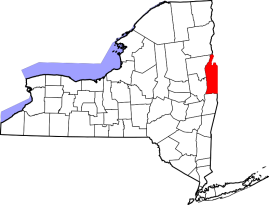
http://familytreemaker.genealogy.com/users/p/o/p/Sandra-Popiel/BOOK-0001/0291-0003.html
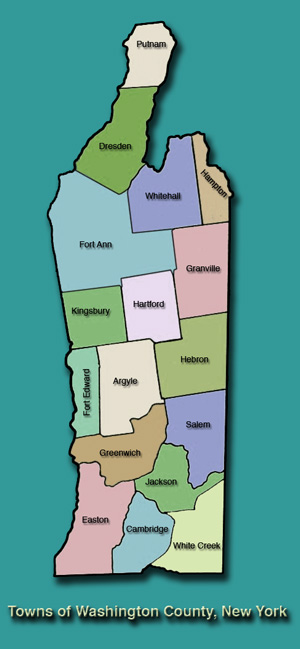
http://www.lebanontownhall.org/trumbullbuilder.htm

Isaac Fitch of Lebanon, Connecticut, master joiner, 1734-1791 By William Lamson Warren 1978

http://trees.ancestry.com/owt/person.aspx?pid=25432476&st=1


Posted in 10th Generation, Artistic Representation, Historical Church, Historical Monument, Historical Site, Line - Miner, Place Names, Public Office, Storied, Veteran | Tagged , , , | 12 Comments
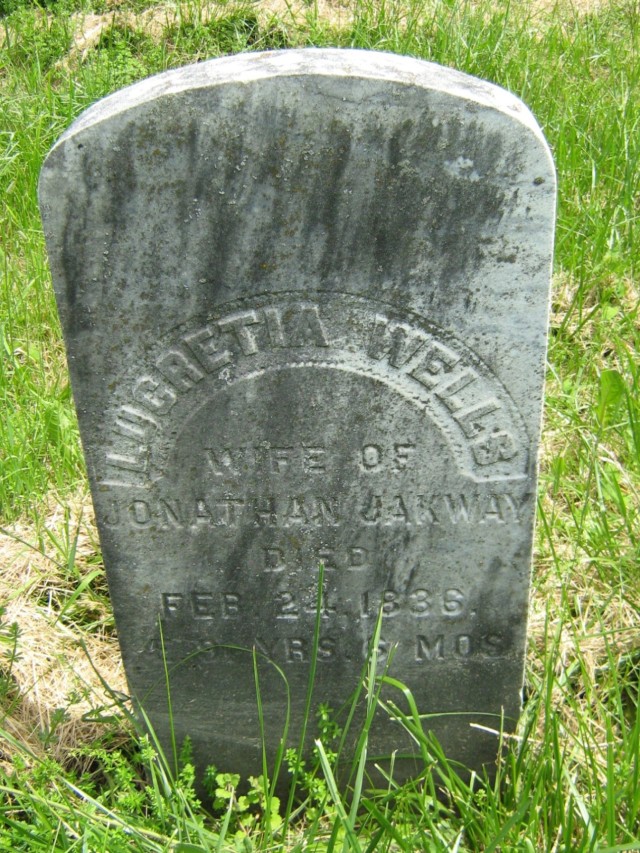
John Fitch

John FITCH (1712 – 1742) was Alex’s 7th great grandfather, one of 256 in this generation of the Miner line.

John Fitch was born on  7 Jan 1712 in Lebanon, New London, Connecticut.  His parents were Capt. Nathaniel FITCH and Anne ABELL.  He married Hannah SCOTT on 5 Nov 1734 in Lebanon, CT.  John died on 7 Jan 1742 in Lebanon CT.

Hannah Scott was born  about 1721. Her parents were John SCOTT Jr. and Elizabeth WANTON. However, OneWorldTree at Ancestry.com says that her parents were Benjamin Scott, born 1686. and Mary [__?__]  born 1689.    However, that is the only information about the proposed parents they provide.

Children of John and Hannah:

Name Born Married Departed
1. Anne Fitch 6 Oct 1735 Lebanon, CT Elijah Lamphere
1758
1806
2. Hannah Fitch 15 June 1737 Lebanon, CT Nathaniel Winslow?
9 Apr 1753 Salisbury, Litchfield, CT
Fall from a horse
1 Aug 1806 Williston, Chitteden, VT ‎
3. Benjamin Fitch 26 Jan 1739 Lebanon, New London, CT
4. Tryphena Fitch 10 Aug 1740 Lebanon, CT Samuel Minard
6 Jan 1759 Colchester, New London, CT
5. Azuba (Azubah) FITCH 7 Apr 1742 in Lebanon, CT. Oliver WELLS
7 Feb 1760 Norwich-Bozra, CT
26 Aug 1814 Colchester, CT

Children

1. Anne Fitch

Anne’s husband Elijah Lanphere (Lanfere) was born 23 Aug 1744 Norwich, New London CT. His parents were John Ellis Lamphere (1712 – 1757) and Bethiah Richards (1722 – ). Other sources say he was born in Hopkinton, Kings, Rhode Island and his parents were Joshua Lanphere (1712 – 1784) and Zerviah Ellis (1716 – ).  Elijah died 15 Sep 1828 Hamilton, Madison NY.

Elijah appears in 1790 & 1800 census in Berkshire Mass.

There are many theories on the origin of the Lanphere name, Some say it is of Welsh origin, and is the Anglicization of the Welsh locational name “Llanfair”, but there are few Lanpheres in Wales.

There are many variations which makes genealogy a challenge including: Lanfear, Lanfier, Lanfire, Lanfere, Lamphire, Lanphier, Lamphier, Lanfiere, Langfield, Lamphere, Langfear, Lanfyre, Lanfeere, Langfere, Lanfer, Lanfeer, Lampher, Lanfeare, Landfield, Landfear, Lanfeir, Lamfear, Lanfair, Lampheir, Lamfier, Langfer, Lamphir, Lanfilde, Lanfeire, Lanifier, Landfer, Lamphear, Lampheare, Lamfire, Lamfer, Lamfeere, Langfire, Langfell, Landfere, Lanphere, Lanpher, Lanpheare, Langfielde, Lanfyer, Lanfield, Lanfeld, Lanfar, Landfire, Landfier, Landfar, Landfair, Lampyer, Lampier, Lamphyre, Lampfield, Lamper, Lamfeir, Lamfeare, Lansear, Lankfill, Langford, Langfild, Langfeld, Langfaire, Lanfior, Lanfild, Lanfiar, Lanfeur, Lanfaw, Lanfare, and Lanefer.

Children of Anne and Elijah:

i Fitch Lamphere (Lamphier) b. 30 Mar 1761 Lebanon New London, CT; d. 10 Jan 1826 Durham, Greene, New York; m. 12 Jan 1792 Durham, Middlesex, CT to Jerusha Merwin (b. 27 Aug 1768 Durham). Jerusha’s parents were Miles Merwin Jr. (1744 – 1793) and Mary Parmalee (1747 – 1795) of Durham, CT. Fitch and Jerusha had nine children born between 1793 and 1811.

Fitch was a Revolutionary War soldier. Fitch enlisted April 22, 1777, at Lebanon, Connecticut, in Capt. Paul Willis’ company of Col. Samuel Blatchley Webb’s regiment. He served until April 28, 1780, when he was discharged at the expiration of his term of service, at Morristown, N.J. Ref. Pension Claim W27145 (38 pages).

Fitch served under Col. Samuel Blachley Webb

Col. Samuel Blachley Webb, commander of Fitch Lamphere’s regiment from 1777 to 1781.

S.B. Webb’s Additional Continental Regiment, later became the 9th Connecticut Regiment. Early in 1777, Washington offered command of one of these additional regiments to Samuel Blatchley Webb, who accepted. Webb had formerly served as one of Washington’s personal aides. Webb’s Regiment was allotted to the Connecticut Line on July 24, 1780, and officially designated the 9th Connecticut Regiment.

The regiment was raised on January 11, 1777 at Danbury, Connecticut by Colonel Samuel Blachley Webb, a stepson of Connecticut politician Silas Deane. It was one of several so-called “additional regiments” authorized by the Second Continental Congress that were not associated with any particular state quotas.

The regiment first saw action at the Battle of Setauket in August 1777 under Brigadier General Samuel Holden Parsons. It was then sent to the Hudson River Valley, where it served under General George Clinton in the aftermath of the October Battle of Forts Clinton and Montgomery. In December 1777 the regiment was involved in a failed expedition to Long Island (a more elaborate attempt on Setauket than that of the previous August) in which Colonel Webb was captured. The regiment spent the winter of 1777-78 at West Point, where it assisted in the construction of fortifications (including the Webb redoubt, probably named for the colonel).

In 1778 the regiment was attached to the brigade of General James Varnum. As part of a combined Franco-American attempt to retake British-occupied Newport, Rhode Island, the brigade marched to Rhode Island, where it was involved in the August 29 Battle of Rhode Island. The battle was tactically indecisive, but the regiment was noted for its performance. The regiment wintered in Rhode Island.

The regiment spent most of 1779 in Rhode Island, but was sent to winter quarters at Morristown, New Jersey. In the spring of 1780, the remnants of Sherburne’s Additional Continental Regiment were merged into the unit, and it was formally added to the Connecticut Line as the 9th Connecticut Regiment.

Fitch is found in the 1800 and 1810 Oneida, Madison, NYCensus records of Albany Co., NY, pp. 182 [as Lamphier] and 91 [as Lanpher] respectively.

1820 census Elijah Lamphier Hamilton, Madison, New York

His signed affidavit places him in Catskill, Greene, NY, by June of 1820; the federal census confirms this on p. 141 of the corresponding census where his name appears as Fitch “Lamphier”.

Fitch died in 1826 in Durham New York. Durham was first settled around 1782 within Albany County. The town was established from part of the Town of Coxsackie in 1790 as the “Town of Freehold.” In the spring of 1800 Freehold became part of the newly formed Greene County. The town’s name was changed to “Durham” in 1805, the town having been called informally “New Durham” by the many settlers from Connecticut. Part of the town was lost to form, in 1803, the new Towns of Cairo, Greenville, and Windham. In 1836, the western part of Durham became the Town of Conesville in Schoharie County.

I have not found his widow or his children in the 1830 census.

Jerusha (Merwin) Lanphere signed an affidavit in May of 1839 placing her in Durham, Green Co., NY, and mentions her sister, Olive Smith, living in the same town. Along with the affidavit, Jerusha sent the New Testament title page of the family bible, printed in New York by M. L. & W. A. Davis in 1801. Abstract and copy of bible record printed in The New York Genealogical and Biographical Record, Volume LXXI, 1940, p. 272.

The reverse of the title page contained the following:

Fitch Lanphere was Born March the 30 AD 1761
Jerusha Merwin was Born Aurgust the 27 AD 1768
Miles Lanphere was Borne May 12 AD 1793 and died December 19th 18[26]
Elisabeth Lanphere was Borne Decmbar 13 AD 1794
Nancy Lanphere was Borne Novembar 16 AD 17[erased; 1796 written in later]
Rhoda Lanphere was Borne the Novembar 9 AD 1798
Samuel Lanphere was Born octobar 10 AD 1801 and Decst in 3 moths
Jesse Lanphere was Borne December 2 AD 1803
Mary Lanphere was Born 7 June AD 1807
Noah Lanphere was Boarn May 10 AD 1809
Danel Lanphere was Borne Aurgust 9 AD 1811 Desest 6 days oald
Fitch Lanphere died January 10th 1826
Miles Lanphere died December 19th 1826
Mary Servoss Departet this Life Febuary 26th 1832
Lemuel fich Servoss Son of Henry and Mary Servoss who departed this life
Febuary 25th 1832

In Fitch Lanphere’s 1820 affidavit he states that his daughter “Roda” has been deranged for about 10 years; and that his nine-year-old son, Noah, “has St. Vitises Dance and Cannot Speak.” His son, Jesse, was described as an able bodied boy; and his daughter, Mary, in good health.

Sydenham’s chorea or chorea minor (historically referred to as Saint Vitus Dance) is a disease characterized by rapid, uncoordinated jerking movements affecting primarily the face, feet and hands. Sydenham’s chorea results from childhood infection with Group A beta-hemolytic Streptococcus and is reported to occur in 20-30% of patients with acute rheumatic fever. No vaccines are currently available to protect against Streptococcus pyogenes infection, although there has been research into the development of one.

ii. Samuel Lamphere b. 1767;p d. Mar 1798 Stonington, CT

iii. George Lamphere b. ~ 1773

2. Hannah Fitch

Hannah’s husband Nathaniel Winslow was born 22 Apr 1730 in Rochester, Plymouth, Massachusetts.  His parents were Deacon John Winslow (1701 – 1755) and Bethiah Andrews. Nathaniel died 6 Jan 1778 in Salisbury, Litchfield, CT.

Nathaniel “fell a victim of a prevailing epidemic, while exerting his powerful influence in aid of the American army during the Revolutionary War”. – Blake’s Biographical Dictionary.

According to the history of the Kellogg family in Connecticut, Hannah was the “daughter of Rev. Mr. Fitch of Coventry, CT” and was “instantly killed from a fall while mounting a horse” in Aug. 1806 in Williston, Vermont.

It’s possible that the Hannah Fitch who married Nathaniel Winslow was the daughter of Jeremiah Fitch, Jr. and Mercy Porter and was born 13 Sep 1735 in Salisbury, Litchfield, CT instead of 15 June 1737 in Lebanon, CT.

Children of Hannah and Nathaniel

i. Lemuel Winslow b. 1 Apr 1755 in Salisbury, Litchfield, CT; d. Aug 1828 in Williston, Chittenden, Vermont; m. Elizabeth Beach (b. ~1760) Their daughter Betsey was born in 1784 in Salisbury, CT and married Dr. Moses J. Hill.

ii. Hannah Winslow b. 14 Feb 1757 in Salisbury, Litchfield, CT; d. 28 May 1802 in Williston, Chittenden, Vermont; m. 1780 Richmond, Berkshire, Mass. to Timothy Tuttle (b. 10 Jun 1755 in Goshen, Litchfield, CT – d. 14 Jun 1814 in Williston, Chittenden, Vermont) Timothy’s parents were Timothy Jonathan Tuttle (1716 – 1760) and Hannah Wadhams (1712 – 1733) Hannah and Timothy had six children born between 1781 and 1792.

iii. Bethia Winslow b. 31 Dec 1759 in Salisbury, Litchfield, CT; d. 2 Jun 1820; m. Samuel Chamberlain (b. 17 Apr 1757 in Westborough, Worcester, Mass – d. 11 Nov 1823 – Massena, St Lawrence, New York) Samuel’s parents were John Chamberlain (1721 – 1805) and Mercy Brown (1724 – ) Bethiah and Samuel had five children between 1784 and 1794 at Richmond, Chittenden, Vermont.

European settlement of Vermont did not begin until the Treaty of Paris ended the French and Indian War in 1763. While surrounding townships were being granted by Governor Wentworth of New Hampshire and being settled and organized, there was not one dwelling in the area destined to become Richmond. In 1775, Amos Brownson and John Chamberlain established homesteads in the area known as “the flats” which was at that time a part of the Williston Township. This early settlement coincided with the advent of the American Revolution when Vermont settlements on the borders of civilization were vulnerable to Indian attack. A man and a child were killed at the Chamberlain homestead before Richmond’s settlers, along with nearly all the other families in Chittenden County, abandoned their new homes and fled to the south for safety.

After the close of the Revolutionary War, in the spring of 1784, they returned to the farms, on which they had made beginnings, accompanied by Asa and Joel Brownson, Samuel and Joshua Chamberlain, Jas. Holly, Joseph Wilson and Jesse McFairlain. Settlements were built in areas which were then portions of Huntington, Bolton, Jericho and Williston. Portions of these settlements formed what became Richmond. After petitioning the State, Richmond was granted township status Oct 27 1794, and has the distinction of being the first town chartered by the newly formed State of Vermont. By the time the census was taken in 1800, Richmond had grown to a population of 718. Formal community responsibility began with the first Town Meeting in March 1795.The Winooski River and Huntington River both offered locations for water mills. Industries began to manufacture wagons, harnesses, tinware, brass, cabinet work and woodenware.

John Chamberlain was the first settler in Richmond, Chittenden,, Vermont

John Chamberlain and Amos Brownson were the first settlers in Richmond, Chittenden, Vermont

iv. Nathaniel Winslow b. 9 Apr 1761 in Salisbury, Litchfield County, CT; d. 30 Apr 1831 Thomas Chittenden Cemetery, Williston, Chittenden, Vermont; m1. Joanna Kellogg (b. 4 Jul 1766 in Sheffield, Berkshire, Mass. – d. 15 Mar 1784) Joanna’s parents were Amos Kellogg (1716 – 1770) and Prudence Sedgwick (1724 – 1812);

m2. Anna Hannah [__?__] (b 1766 – 14 Feb 1810 Thomas Chittenden Cemetery, Williston, Chittenden, Vermont,) Nathaniel and Anna had three children born between 1789 and 1803, including Hubbard Winslow (1799-1864) who graduated Yale Theological Seminary in 1825 and spent much of his life as a Presbyterian pastor.

Hubbard’s most influential works include Are You a Christian?, Intellectual Philosophy, and Moral Philosophy. The Historical Magazine adjudged “in the province of philosophy he had few equals.” Intellectual Philosophy was a popular 19th century textbook wherein he surveys the history of philosophy and, as well, relates influential thinkers to Christian philosophy in an accessible manner.

Hubbard Winslow (1799-1864)

Hubbard Winslow (1799-1864)

In his Moral Philosophy; Analytical, Synthetical, and Practical, Winslow argues that basing ethics on theoretical philosophy is a “prevailing error.” Metaphysics and logic, he argues, are not subservient to everyday consciousness of freedom and responsibility. In this reading, Winslow argues that philosophy should be used in the service of faith. He believes faith is a direct “manifestation of the truth” presented to each person’s conscience and adduces just as “[w]e must not wait until we can philosophize upon food before we eat…” so also “[n]either should we wait to learn all the grounds and reasons of duty, before doing what we already know to be right.”

Nathaniel Winslow Jr.- Thomas Chittenden Cemetery, Williston, Vermont

v. Mercy Winslow b. 16 Mar 1763 in Salisbury, Litchfield, CT; d. 1840; m. 1785 to John Devereaux (b. 1756 in Goshen, Litchfield, CT – d. 1843 in Richmond, Chittenden, VT) John’s parents were Jonathan Devereaux (1716 – 1767) and Sarah Seymour (1741 – 1808). Mercy and John had nine children between 1786 and 1797.

John enlisted as private in Oct 1775 at Richmond, MA, under Captain Moses Ashley, Colonel Patterson’s Regiment. “Was taken prisoner at the battle of the Cedars and paroled in June 1777.”

“John Devereaux was a Sergeant in Washington’s Army. He was repeatedly called into active service and was finally taken prisoner with three hundred of his fellow soldiers, by the enemy, near the Three Rivers in Lower Canada. The severe contest which resulted in their capture lasted for about two hours, when they were compelled to surrender, about one=third of their regular number having been already slain; their wounded companions were now unmercifully mistreated and were plundered of everything. In exchange for their clothing, they had each an Indian blanket. They were then crowded into an old building used as a prison house where they were confined in a state of suffocation and utter distress for twenty-four hours, all food and drink prohibited. After this they were kept close prisoners on an island until fortunately redeemed by an American General.”

The Battle of The Cedars was a series of military confrontations early in the Revolutionary War during the Continental Army’s invasion of Quebec that had begun in September 1775. The skirmishes, which involved limited combat, occurred in May 1776 at and around The Cedars, 45 km west of Montreal, Quebec. Continental Army units were opposed by a small number of British troops leading a larger force of Indians (primarily Iroquois), and militia.

Brigadier General Benedict Arnold, commanding the American military garrison at Montreal, had placed a detachment of his troops at The Cedars in April 1776, after receiving rumors of British and Indian military preparations to the west of Montreal. The garrison surrendered on May 19 after a confrontation with a combined force of British and Indian troops led by Captain George Forster. American reinforcements on their way to The Cedars were also captured after a brief skirmish on May 20. All of the captives were eventually released after negotiations between Forster and Arnold, who was bringing a sizable force into the area. The terms of the agreement required the Americans to release an equal number of British prisoners. However, the deal was repudiated by the Second Continental Congress, and no British prisoners were freed. Another story is the men were exchanged for British soldiers captured at the St. Jean eight days after their capture.

Colonel Timothy Bedel and Lieutenant Isaac Butterfield, leaders of the American force at The Cedars, were court-martialed for their roles in the affair. Bedel was found not guilty and Butterfield was found guilty of cowardice. News of the affair included greatly inflated reports of casualties, and often included graphic but false accounts of atrocities committed by the Iroquois that made up the majority of the British forces

John again “Enlisted Aug, 1777, for three months as Sargeant under Captain Fitch, Colonel Henry Livingston’s Regiment in the New York troops.”

John Devereaux was living in 1780 at Stephentown, NY.

John Devereaux appeared on the census of 1790 at Williston, Chittenden, VT.

John Devereaux was living on 1 Jun 1840 at Richmond, MA with his son Alanson

vi. Lovina Winslow b. 4 May 1765 Salisbury, Litchfield, CT; d. 28 Sep 1832 Thomas Chittenden Cemetery, Williston, Vermont. She married May 1788 in Williston, Chittenden, Vermont to Nathan Allen (b. 13 Mar 1760 Litchfield, Litchfield, CT – d. 13 Jan 1834 Thomas Chittenden Cemetery, Williston, Vermont) Nathan’s parents were Elihu Allen and Abigail Dean.

Lovine Allen – Thomas Chittenden Cemetery, Williston, Vermont

vii. John Winslow b. 4 May 1767 in Salisbury, Litchfield, CT; d. 30 Nov 1852 Medina, Medina, Ohio; m. 2 Jan 1787 in Hillsdale, Columbia, New York to Mary Covell (Scoville) (b.25 Aug 1772 in Hillsdale, Columbia, New York – d. 25 Aug 1837 in Medina, Medina, Ohio) Mary’s parents were Zaccheus Covell-Scoville and Mary Wooden. John and Mary had twelve children born between 1794 and 1820 in Williston, Chittenden County, Vermont.

(See – Family Charts of John Winslow (1767-1852) and Mary Scoville Covell: And Allied Families of Gifford, Fitch and Porter by Leanora Lucile Calkins Barbrick, 1970 96 pages)

viii. Jonathan Winslow b. 7 Jun 1769 in Salisbury, Litchfield Co, CT;  d. 5 Oct 1838 in Farmersville, Cattaraugus Co, NY. m. ~ 1792 in Williston, Chittenden Co, Vermont to Mary “Polly” Spoor (b. 24 Mar 1772 Fair Haven, Rutland, Vermont – d. 18 Apr 1848 in Grove City, Jasper, Illinois) Polly’s sister Lydia married Jonathan’s brother Jared. Their parents were Nicholas Spoor (1743 – 1814) and Zilpha Cleveland (1749 – 1816) Her parents were NOT John Spoor and Lydia [__?__]. Jonathan and Polly had five children between 1793 and 1806.

ix. Jared Winslow b. 9 Jun 1771 in Salisbury, Litchfield, CT; d. 2 Nov 1852 in Waukegan, Lake, Illinois m. Lydia Spoor (b. 1769 Fair Haven, Rutland, Vermont – d. 1846, Freedom, Cattaraugus, New York) Lydia’s sister Polly married Jared’s brother Jonathan. Their parents were Nicholas Spoor (1743 – 1814) and Zilpha Cleveland (1749 – 1816) Her parents were NOT John Spoor and Lydia [__?__]. Jared and Lydia had ten children born between 1797 and 1816.

x. Charity Winslow b. 14 Dec 1774 in Salisbury, Litchfield, CT; d. 1846; m. 05 Dec 1791 to Enoch Judson (b. 30 Jan 1766 Stratford, Stratford, CT – d. 1840 in Madison, Lake, Ohio) Enoch’s parents were Micah Judson (1737 – ) and Esther Leavenworth (1739 – 1797)

xi. Rhoda Winslow b. 7 May 1777 in Salisbury, Litchfield, CT; d. 16 Jun 1862; m1. Noah Adama and had three children between 1790 and 1797; m2. 24 Jul 1800 Williston, VT to Ralph Parker Stearns (b. 19 Aug 1778 in Rockingham, VT – d. 26 Apr 1863 Stockholm, St. Lawrence, New York) Ralph’s parents were Eleazer Stearns (1737 – 1814) and Elizabeth Pierce (1737 – 1814)

Stockholm was erected from part of the Town of Massena by a legislative act passed February 21, 1806. It received its name by the surveyors from Stockholm, Sweden. It retained its original territory until April 9, 1823, when a part was annexed to Norfolk, and on April 15, 1834, another portion was annexed to the same town. During the War of 1812 some residents left the town and a lesser number returned

In the 1850 census, Ralph and Rhoda were living in Stockholm, Saint Lawrence, New York with the family of Hugh and Olive Allen.

One version is Rhoda married Noah Adams (b. 27 Aug 1747 in Pomfret, Windham, CT – d. 26 July 1819 Cavendish, Windsor, Vermont) Noah’s parents were Isaac Adams (1696 – 1757) and Eleanor Fassett (1696 – 1784) Noah first married 22 Nov 1770 Brooklyn Congregational Church, Brooklyn, Windham, CT to Elizabeth Fassett (1749 – 1831) and had five children born between 1773 and 1782. Rhoda and Noah had three children born between 1790 and 1797.

Noah assisted in the defense of the fort at the Battle of Wyoming. July 3, 1778 (See my post about the battle and the adventures of the Blackman family)

The first settlers in Cavendish, John and Susanna Coffeen and their children, arrived in 1769. Salmon Dutton, who came in 1781, founded what is today known as the village of Cavendish, while Leonard Proctor arrived in 1782, developing what is now called the village of Proctorsville.

There is a question which Noah Adams married Rhoda Winslow and how it relates to Rhoda’s marriage to Ralph Stearns.

Linda Welch writes – Noah Adams (5) {Isaac (4), Richard (3), James (2), John (1)}, was born in Pomfret Conn, 27 Aug., 1747. He m. in Pomfret, Conn., 22 Nov., 1770, Elizabeth Fassett (b. Pomfret, Conn., 14 June, 1749, dau. of Adonijah Fasset & Anne Copeland); He was a Revolutionary soldier. He was ten years old when his father died Shortly after his marriage he moved to the Susquehanna Land Company’s new settlement in Westmoreland, Connecticut (the Wyoming Valley of Pennsylvania). A very long story about how they were caught in the cross-fire in the American Revolution… Noah Adams settled finally… in Cavendish (Windsor County) Vermont where he d. 26 July, 1819 (age 72

Maureen Downs writes“Here in Northeatern PA, there are many descendants of Noah Adams (born 1747). I have believed him to be my gggg-grandfather. There is a Noah Adams Family Plot where he is buried in Forkston, Wyoming Co of PA. In the 1940’s, there was a ceremony at the gravesite honoring this Revolutionary War veteran. In fact, there are several local women (long deceased) who gained their membership in the DAR with this Noah Adams as their veteran ancestor. The death date given for Noah Adams was about 1834. Possible but probably questionable. After reading that he indeed moved back to VT and his wife Elizabeth with him and that he died there brought me to ask who really is the Noah Adams who is buried here in PA.

The local version of the story is that his wife died as did the children of his first marriage and that he then married 2nd, a Rhoda Winslow. He brought her here to NE PA and they had several sons and a daughter among whom were: Gilbert, Seril, Harriett and Asaph. These names are names found in the family of Noah and Miriam (Adams) Adams. Could it be that my gggg grandfather is really Noah Adams born 1763 son of Noah and Miriam Adams? I can’t find any information on Noah (b. 1763) as far as marriage or a deathdate. These Adams are all part of the same family since Miriam was a sister of Noah (b. 1747)!! Adding to the confusion, perhaps causing the confusion, is that the CT Vital records refer to Noah (1747) as “Jr.” in his marraige listing when in fact he was not a JR. but the son of Isaac Adams. Thank you for any information you may be able to provide in sorting this out.”

4. Tryphena Fitch

Tryphena’s husband Samuel Minard was born about 1735.

Tryphena (Fitch) Minard filed for divorce 17 Aug. 1778 in Colchester against her husband Samuel Minard saying that Samuel had a child (gender not given) with Alice Dodge, a single woman of Colchester. It infers the child was born about Feb. 1778. Who was Alice? Did she and Samuel ever marry? Samuel Minard was not found again after this date. Did he change his name?

5. Azuba (Azubah) FITCH (See Oliver WELLS‘ page)

Sources:

http://users.ece.utexas.edu/~perry/fun/genealogy/mell/fitch.html

http://wingetgenealogy.com/tree/family.php?famid=F13831&show_full=1

http://trees.ancestry.com/owt/person.aspx?pid=25486064

http://archiver.rootsweb.ancestry.com/th/read/LANPHEAR/2000-02/0949528706

Posted in -9th Generation, Line - Miner | Tagged | 9 Comments

Nathaniel Wells

Nathaniel WELLS Sr. (1600 – 1681) was Alex’s 10th great grandfather, one of 1,028 in this generation of the Miner line.

Nathaniel Wells – Coat of Arms

Nathaniel Wells was born 29 Oct 1600 in Colchester, Essex, England. He was baptized 8 Feb 1601,  St Albans Abbey, Hertsford, England.  His parents were Thomas WELLS (1566 – 1620) and Ann Elizabeth HUNT Kemball (1568 – 1646).  He bragged that he owned many and valuable shipyards in Colchester, as well as a large hotel. During the religious persecution in 1629, he is said to have made some remarks in favor of the Puritan feeling, and was forced to flee from the country.

Colchester, Essex, England

Nathaniel arrived at Boston, Mass., in 1629.  His nephew Nathaniel Wells married Lydia Thurley.  He took the freeman’s oath in Boston, 2 Nov 1637.  In 1639 or 1640 he removed to Rhode Island. He settled near the present town of Westerly, founding the town which he named Wellstown on about four hundred acres of land purchased from the Narragansett Indians, and lived there the remainder of his life.” Now Wellstown is a road in Hopkinton and Ashaway Rhode Island.  Nathaniel died in 1681 Wellstown, Washington County,  Rhode Island.

Some researchers cast doubt on the existence of this Nathaniel Wells and say that Thomas was the original immigrant.  However there is a present day Wellstown in Ashaway, RI 02804, a couple miles north of Westerly and less than a mile from the Connecticut state line.  Here is a Google Maps Street View Street View of Wellstown Road. No town today, the road runs through the woods for about a mile.

Children of Nathaniel :

Name Born Married Departed
1. Thomas WELLS c. 1626 Colchester, Essex, England Naomi MARSHALL
12 Feb 1655 Boston, Mass
12 Feb 1700 Hopkinton, Rhode Island
2. John Wells c. 1630 Colchester, Essex, England Mary Greenleaf (Daughter of our ancestor Edmund GREENLEAF)
5 Mar 1667/68
Newburyport, Mass
15 Dec 1681 – Newbury, Essex, Mass.
3. Nathaniel Wells 1632
Salem, Mass
4. Edward Wells 1635
Salem, Mass
5. Naomi Wells c. 1637
Naumkaeg (Salem), Mass
1688
Salem, Mass

Our Wells ancestors, original immigrant Nathaniel, son Thomas, and grandson Joseph and were all ship builders

Nathaniel Wells, the immigrant ancestor, born about 1600, came from Colchester, England, where he owned many and valuable shipyards, as well as a large hotel. During the religious persecution in 1629, he is said to have made some remarks in favor of the Puritan feeling, and was forced to flee from the country. He arrived at Boston. Massachusetts, in 1629. He took the freeman’s oath in Boston, November 2. 1637. In 1639 or 1640 he removed to Rhode Island. He settled near the present town of Westerly, founding the town which he named Wellstown on about four hundred acres of land purchased from the Narragansett Indians, and lived there the remainder of his life. Nathaniel’s brothers were Hugh, of Hartford, Joseph, of Boston. Deacon Thomas, of Ipswich. George and William, of Lynn, Massachusetts, and Deacon Richard, of Salisbury, Massachusetts, all of whom came over between 1630 and 1635. Children: our ancestor Thomas,  John, born in Colchester, about 1630; Naomi, born in Salem or Ipswich, 1637

Children

1. Thomas WELLS (See his page)

2. John Wells

John’s wife Mary Greenleaf was born 16 Dec 1633 in Newbury, Mass.  Her parents were our ancestors Edmund GREENLEAF and Sarah MOORE.

The consensus for Mary’s date of death is 5 Mar 1669. I don’t see any source of record for that, but there are Massachusetts vital records showing Mary Greenleaf’s 5 Mar 1668 marriage. It seems a coincidence that she died exactly one year after her marriage.

Other genealogies show Nathaniel and Mary having four children which of course puts the 1669 date of death into question. Some of these genealogies say Mary’s father was Edmund’s fourth son Enoch, but he was too young to have been Mary’s father (15 years old in 1633). On the other hand, Mary’s mother Sarah was 45 years old in 1633, on the outer bound to have another child. I can find no other information for these four children, so maybe they all died young.

John was a ship’s carpenter.

Children of John and Mary:

i. Mary Wells b. 16 Dec 1669 in Newbury, Essex Co., MA; d. 2 Feb 1670/71 in Newbury, Essex Co., MA

ii. John Wells b. 20 Aug 1671 in Newbury, Essex Co., MA

iii. Mary Wells b. 12 Feb 1672/73 in Newbury, Essex Co., MA

iv. William Wells b. 15 Jan 1674/75 in Newbury, Essex Co., MA

Sources:

[Wells3 253] Nathaniel Wells had 6 brothers  who came to America settling in various parts of New England: Hugh 1590, Joseph c1595, William c1598, Thomas 1605, Richard 1609, and George 1611.

[TorreyCD] WELLS, Nathaniel (-1681, 1682) & Lydia THURLEY/THURLO, m/2 Nathaniel EMERSON; 29 Oct 1661; Ipswich {Reg. 4:12; Wells (#2) 1; Wells (#4) 48; Wells (#5) 9; Wells (#10) 154; Wells (#12) 9; Hammatt: Ipswich 403; Dodge Anc. (1896) 24; Snow-Estes 1:131}

[Wells 142] Brother of Deacon Thomas Welles of Ipswich and Richard Wells of Salisbury. Emigrated to America in 1629 and landed at either Salem or Boston. Freemans oath, Boston, 2 November 1637

[NEGRH 3:95] Moved to Rhode Island c 1640: settlement in the wilderness of a track of over 400 acres purchased of the Narragnasett Indians (near Wickford) and called the place Wellstown. Tradition has it that NW was the owner and proprietor of extensive shipyards in Colchester and which he stated to have been more valuable than the whole of Westerly, Newport, and Charlestown.

http://freepages.genealogy.rootsweb.ancestry.com/~hillmer/DNA/p219.htm#i5718

http://users.ece.utexas.edu/~perry/fun/genealogy/mell-chrt7.pdf

http://www.lavynder.com/descendants/pafg166.htm#6187

http://users.ece.utexas.edu/~perry/fun/genealogy/mell/wells.html

New England families, genealogical and memorial: a record of the …, Volume 4 edited by William Richard Cutter 1913


Posted in 12th Generation, Dissenter, Historical Church, Immigrant - England, Line - Miner, Pioneer, Sea Captain | Tagged , | 6 Comments

Thomas Wells Sr.

Thomas WELLS Sr. (1626 – 1700) was Alex’s 9th great grandfather, one of 1,028 in this generation of the Miner line.

Thomas Wells was born about 1626 in Colchester, Essex, England.  His parents were Nathaniel WELLS and [__?__].  He emigrated with his parents  in 1629 and landed at either Salem or Boston.  Thomas Wells was one of the early band of planters at Pequot Harbor (New London, Connecticut); probably on the ground in 1648, and certainly in 1649. He removed from there to Ipswich where he was engaged in shipbuilding until 1677, at about which date he removed to Rhode Island and lived in Wellstown.  He was a carpenter, and worked with Elderkin on mills and meetinghouses.  He married Naomi MARSHALL on 12 Feb 1655 in Boston, Mass.  Thomas died 12 Feb 1700 in Hopkinton, Rhode Island.

Our Wells ancestors, original immigrant Nathaniel, son Thomas, and grandson Joseph and were all ship builders

Some researchers cast doubt on the theory that Thomas’ father Nathaniel immigrated and say that Thomas was the original immigrant.

Naomi Marshal was baptized 24 Jan 1637 in Salem, Mass.  Her parents were Edmund MARSHALL and Millicent BLINMAN.   Naomi died in 1700 in Westerly, Washington, Rhode Island.

Children of Thomas and  Naomi:

Name Born Married Departed
1. Joseph Wells 7 Jun 1656
Boston
bef. 1658
2. Joseph WELLS c. 1658 Boston Mass. Hannah REYNOLDS
28 Dec 1681
26 Oct 1711  Groton, CT
3. Thomas Wells Jr. 4 Dec 1661
Boston
Sarah Rogers
1691
29 Jun 1716
4. Mary Wells 15 Apr 1665
Ipswich, Mass
Ezekiel Maine
15 Dec 1690
12 Jan 1693
Stonington, CT
5. Ruth Wells 1667
Ipswich
James Kenyon
1690
South Kingstown, Washington, Rhode Island
aft. 1720
South Kingstown, CT
6. Sarah Wells 27 Aug 1668
Ipswich
Joseph Clark
11 Dec 1693
Boston
1699
7. John Wells 1670
Ipswich, Mass
Mary Peck
18 Feb 1697
.
Eliza Bickford
31 Oct 1698 in Boston
aft. 1700
8. Nathaniel Wells 10 Dec 1673
Ipswich
Mary Crandall
1706
Westerly, Washington, Rhode Island
1769
Chimney Orchard Burial Ground, Hopkington, Washington, Rhode Island

Ship-building. — The first ship-builders in this region were Thomas Wells and George Denison. They resided in what is now Westerly, though at the time claimed as a part of the present town of Stonington.

Thomas, son of Nathaniel Wells, was born in Colchester, England, in 1626. He came with his parents to America in 1629. He was a shipwright and carpenter. From 1648 to 1651 he was in New London. Connecticut, where he had a grant of land in 1649. He removed from there to Ipswich where he was engaged in shipbuilding.  The records are confusing and hard to read, but he was arrested for reproaching the court court in Ipswich in 1668.  About 1677,  he removed to Rhode Island and lived in Wellstown. He is mentioned at Westerly in 1677 as engaged in building vessels in a shipyard, and is called “of Ipswich, shipwright”.   He bought a farm of one hundred and eighty acres in Westerly, Rhode Island, on the east side of Pawcatuck river, now Westerly. For this farm Wells agreed to build a 48 ton vessel for Amos Richardson, but he soon found that the land was claimed by Rhode Island and as he was afraid of losing the land he refused to build the ship. Richardson sued in the lower court and it was carried to the court of assistants at Hartford, where it lasted until 1680. Two of Thomas Wells’ sons, Joseph H., aged twenty-two, and Thomas, aged seventeen, appeared as witnesses in this lawsuit. Rhode Island won the suit and Wells procured the land by paying Rhode Island.

Thomas died 12 Feb 1700, aged seventy-four, at his home in Wellstown, located in that portion of the township of Westerly which afterward became the township of Hopkinton, and was buried in the burial place called Chimney Orchard, on the estate first purchased by his father.

I have modernized some of the spelling in these Ipswich court records.  Thomas Wells was deposed for reproaching the court, particularly Major General Daniel Denison.  His brother-in-law  Benjamin Marshall was also deposed.  There was very bad blood between Thomas, his wife Naomi and Benjamin and her parents Edmund and Millicent Marshall. Thomas was not very sorry for what he had said.   While the testimony is very detailed, in the end the case was referred to the Salem Court and I have no record of how it all came out.

Warrant, dated Nov. 13, 1668, to Thomas Wells, ship carpenter, for reproaching the court at Ipswich, signed by Samuel Symonds.* Bond of Thomas Wells, Reginald Foster, surety.

Warrant, dated Nov. 16, 1668, to Benjamin Marshall, for high misdemeanors, also to witnesses, Stephen Crosse, John Bayer, and Robert Crosse, jr., signed by Samuel Symonds.* Bond of Benjamin Marshall, Richard Brabrooke, surety.

Steeven Crosse,* Benjamin Marshall* and John (his mark) Bayer, testified that Thomas Welles commonly spoke of the court and magistrates, “y’ or Courts at Ipswich was all one the Inquisition house in Spain: when a man is once brought into Court thofe: he knows not for what: he had as good be hanged: thof what the inquisition house is we know not: therfore leave it to be Judged by them y’ vnderstand it & that puld Brandstreet was a worse yousorror then Godforey & vapporing a bout wondering what became of all the fines: he answers himself: why they keep it to by sack with all: and let Cases go which way they will: they care not so long as they can feast their fat goats,” etc.

Roberte Crosse, jr.,* and John (his mark) Bayer testified that Welles also said he “can set spelles & Rases the Devil, he affirming himself to bee an artise.”

Thomas Wells, aged about forty-two years, and Naomi, his wife, aged about thirty-one years, testified that Goodman Cross said “the Major daneson [Major General Daniel Denison] was disgraced in the Court at Boston because he said to the Court concerning  mestres Love that they had Condemned and hanged a omen and y* know not for what for which the members of Boston Court gave him a sharp reproof and the Major Denison wos not respected in the Court of Boston and goodman Cross said that there Came more appeals from Ipswich Court than any town in the country and that some of Boston told him that we in the eastern parts Cap him in place or ofes or alls he had been torned out of place before now and the semen that belonged to ore Caches said  that Goodman Croce told them that his sons were sate in the stocks and punished for nothing and he told us that the Major  could not abide him and therefore I fare the worse in the Court and my sons also were punished for a matter of nothing.” Sworn, Nov. 18, 1668, before Samuel Symonds.*

Robert Crose, jr., aged twenty-seven years, deposed. Sworn in court.

Thomas Wells deposed that Goodman Cross said that “mestor bradsted wos the ondoing of a man at Watertown which wos of a great estate and of good account which went in good apparel and select stockings and they had dellings to gather Mister Bradstreet sued him from Court to Court… till he had on dun him and made him so poor that he brought him from selcke that he wore that he had instead tharof nothing but patched Clothes and Stockings out at the heals and that Mister Bradstreet was as bad as one godfree in veseri, which ore ansar was to him what that godfree was which answer was made to us that he was a well liked fellow and that he was a great uesoror and if he Came before a gogee his locks would hang him and the Court considered the man so on don the Court gave him a sum of money for to halp him Mister Bradstreet came to hear of it took it away from him and so he saruess him … I did not know Mister Bradstreet nor to this day nafter know or see godfree and nafer had dellings with Mister Bradstreet,” etc. Sworn, Nov. 18, 1668, before Samuel Symonds.* They further deposed that Marshall said that Major Denison was deceitful as his two sorts of hair showed and that Goodman Andros was like him, and on a training day he would be knocked down and none should know how it came to pass.

Thomas Wells and wife Naomi confessed that the reason they revealed the things spoken against the court at Ipswich was because they thought they concerned the life of the Commonweath. “It has ben the pleasure of god to visit my wife with sickness near unto death and other troubles which I never was tried with all before which made us between ourselves to consider what the mind of god should be in it and it put us in mind that the referent magistrates were spocken against and threatened which in this Court we both know in the presence of god and his people we both can afirm thos things spoken against the magistrates by thos persons then our consciouses smot us severely and heare in wee have sinned against god and his people because we had not revellied it Sonor then we said thow we have lived in thes naglate and not to revell it we Can find no rule in Scripture that wee Shale Hue any longer tharin and we hard of a ganarall training to bee at Ipswich intended and might be a fet opportunity as to do so as some have said for Christ says he that loveth father or mother more then me is not worthy of me and we apprehend this to be the Case of Christ and we had now rast in our consciouses night nor day till wehad reuelled thos things thar fore wee Commend ourselves to god and to the honored Court for we had rather suffer wth a good conscious than not to suffer  with a accused conscious,” etc.

Steephen Crosse, aged about twenty-three years, deposed that the day when Jacobe Perkens’ house was raised, about a month ago,Thomas Wells said that Benjamin Marshall should be put to service for seven years, etc. Sworn in court.

Thomas Wells further testified that Benjamin Marshall said that Goodman Brags presented these young men for breaking up the bridge and being vexed with him said that it should not be long before his house should be burned or his cattle knocked in the head, and that he had come from old Goodman Crose’s when he said so. Sworn, Nov. 18, 1668, before Samuel Symonds.*

John Giddinge and Edmond Marshall deposed that being at Goodman Storry’s house, etc. Sworn, Nov. 23, 1668, before Samuel Symonds.*

Richard Brandbrooke, aged fifty-five years, deposed that Welles said he would give his brother Benjamin Marshall more wages if he would live with him again and that Merchant Booship advised it; this was after the vessel was launched. Sworn in court.

Robert Crosse, sr., aged about fifty-five years, deposed. Sworn in court.

Marthy Low, aged about twenty-seven years, deposed concerning John Bare.

Sarah Marshal, aged about twenty years, deposed. Sworn, Nov. 21, 1668, before Daniel Denison.*

Sarah Story, aged about forty-eight years, deposed, Nov. 23, 1668, that Robert Cross, jr., lived near Goodman Wells a year and his dealings had always been just.

Thomas Wells further deposed that Stephen Cross said that the magistrates sat between the court at dinner drinking burnt sack and when they came into court they were “broshing,” looking red as though they were “flustred,” and acted as though they were all “fodeeled.” To which his father replied that it was the fines they took that fed their fat sides, and the father said further that “I looked so big and spack so sorlie” that he made the Court quake, etc. Sworn, Nov. 18, 1668, before Samuel Symonds.*

Ezekiel Woodward testified that he had known Wells seventeen or eighteen years and he had carried himself soberly and discreetly and without offence; and was reputed a civil, neighborly man in the place where he lived. Sarah Foster testified to his good conduct, having lived very near him. Sworn, Nov. 21, 1668, before Daniel Denison.*

John Bayer and Benjamin Marshall testified that last April, coming down from the Falls with brother Welles, when they passed Goodman Brandbroock’s, Welles wiped his feet upon some sheets that were hanging upon the rails, etc. Sworn in court.

Goodman Bryadbrooke deposed that he asked John Bayer “why did you dirty your Anttes sheet,” but he said that Thomas Welles did it, whereupon deponent went to Welles and “asked him was this a requitall y’ you gave me for lending you my canoe?” etc. Bayer mentioned his master Crose. Sworn in court.

Edmond Marshall, aged twenty-three years, deposed that Wells said he had nothing against Benjamin and proffered friendship to them before deponent’s father and mother. He wished to see Benjamin and asked to have him “Come & reckon with me but not before my wife for it is very likely she would Rayele at him but you must Considor: she is but a woman & therfore not Come to the howse when I am not at home.” Sworn in court.

Thomas Clungen, aged about twenty-four years, deposed that Robert Cross, jr., was at his master’s house and his dame asked him if he saw any miscarriage of her husband’s and he said he had not, etc.

John Bayer deposed. Sworn in court.

Sarah Story deposed that Goodwife Brabruck said John Baer used language not fit to be spoken in a family, etc.

Mehitabell Brabrooke, aged about sixteen or seventeen years, deposed. Sworn, Nov. 19, 1668, before Samuel Symonds.*

Edmund Marshall, aged about seventy years, and his wife Melesent, aged sixty-seven years, deposed “As for my son Benjamin we never knew him given to Mallice or Revenge in all our Hues: nor to speak reproachfully of Magistrates or of any other: and as for Goodman Crosse we haue lived by him many years and neuer hard him spake ill of authority or against any Magistrate, but as for our Daughter Naomi we do think in our very hearts that certainly in her heart she hates her Brothers both Edmund and Benjamin though we spake it with greif of heart, for she would off en revile Benjamin and call him Rogue before our faces when we could never find what grounds she had so to do or hard any cause he had giuen her in words or actions; and when we reproved her for it, she would face us down it was false giving us the lye as it were to our faces, where upon I told her that I had been in y* church of Salem 30 years and upward and never was so detected as your father and I am by you our one child, where upon she replied again to us saying we might tell a hundred lies for all that and nare be known, for she could do it, and being long sick and in y* opinion of most y* came to visit me Judged I should neuer recover, yet she could say in a reviling way that I did desemble, and further we atest that Thomas Wells did say in a threatening way that there was something aworking that would tak affect not long after we heard of his accusing of our son Benjamin to goodman Brag for threatening his house should be burned and his Complaint of him concerning our honored Major, which is matter of great grief to us now in our old age, whether it be not out of a spirit of  maliciousness that Thomas Wells should do thus, we have cause to think no other, by reason of his words to his brother Edmund at my house one Sabbath day: for coming in we ask him to eat with us, but Thomas Wells answered no for if I cant have your good will except I be a servant to y* Devil I care not: to the which his mother replied and asked him whether he knew what he said: and he answered yea; because you persuaded me to be at peace with him whom I can haue no peace with pointing to his brother Edmund; we asked why he said so, he said he had committed no sin in so doing; this we are forced to speak with grief of heart our conscious puts us upon it, further when he drew our daughter Sarah away from helping of me when I was in distress and lame, for we said to him that he would undo her but he said trouble not yourselves I will provide for her, so that she is gone from us and left us desolate of help: and now can call her Brothers Edmund and Benjamin Roges at will.” Sworn Nov. 19, 1668, before Samuel Symonds.

Robert Crosse, sr., Steephen Crose and Benjamin Marshall  deposed that the wife of Thomas Welles said after court in Mr. Giddnes kitchen that Edmond had witnessed falsely, etc. Sworn in court.

Edmund Marshall deposed that Welles said that although Stephen Crose was a turbalent fellow, he never heard him speak ill of authority, etc.

Thomas Bragg, aged about twenty years, deposed that Goodman Brabruck said at Chebaco that Welles was a very honest man, etc.

Samuel Symonds referred the case to the Salem court.

17 Sep 1679 – He took the oath of fidelity to the colony at Westerly, Rhode Island

Caulkins, History of New London, pp 74, 355-6 [Wells 142-3]

Aged 42 in 1668. Thomas Wells was one of the early band of settlers at Pequot Harbor in 1648/49. A carpenter, he worked with Elderkin on mills and meeting houses. Last notice of him is in 1661, when Wells and Elderkin were enjoined to repair the turret of the meeting house

Wells, Thomas.—Westerly, 1680. He was called ” of Ipswich, ship-wright.” He died Feb. 12, 1700. His will was verbal, dated Dec. 27, 1699; in it, he mentions children Joseph, Thomas, Mary, Ruth, Sarah, John and Nathaniel. His wife was Naomi

RIGR 4:354 – Westerly Town Council and Probrate, vol 2 (1) 1699-1719

Thomas Wells. Will dated 27 December 1699 presented for probate 1 April 1700. pg 7 mentions wife Naomi Wells, sons Joseph Wells eldest, Thomas Wells, John Wells and Nathaniel Wells. Daughters Mary Wells eldest, Ruth Wells and Sarah Wells. Winesses: Joseph Maxson, Stephen Randall.

[Reynolds 137] TW and NW of Ipswich Mass and late of Stonington Conn.

[Salisbury 352] TW was a shipbuilder and married NM, daughter of Edmund Marshall, EM’s son Benjamin was in Ipswich in 1677 and was called “bro” of TW.

[Wells3 254] Sometime after 1651, he removed to Ipswich where his uncle Thomas lived and commenced the business of shipbuilding there which he continued until 1677. In 1677, TW bought a farm of 180 acres in Westerly RI and moved there with his sons Joseph and Thomas. The farm was on the east side of the Pawkatuck River, now Westerly and Welles agreed to build a vessel of 48 tons and furnish all the wood and iron but not the rigging to pay for the land. The land was claimed by both Connecticut and RI and as TW felt he was in danger of loosing his land, refused to build the vessel. RI got Westerly and TW got his farm by paying something to RI. TW and NM had Joseph 1656, Joseph 1658, Thomas 1661, Mary 1665, Ruth 1667, Sarah 1668, Nathaniel 1676.

From the “Connecticut, 1600s-1800s Local Families and Histories New England Families, Vol. IV, Genealogies and Memorials”, Pg. 2086

“Thomas, son of Nathaniel WELLS, was born in Colchester, England, in 1626. He came with his parents to America in 1629. He was a shipwright and carpenter. From 1648 to 1651 he was in New London, Connecticut, where he had a grant of land in 1649. He removed from there to Ipswich where he was engaged in shipbuilding until 1677, at about which date he removed to Rhode Island and lived in Wellstown. He is mentioned at Westerly in 1677 as engaged in building vessels in a shipyard, and is called “of Ipswich, shipwright”. He bought a farm of one hundred and eighty acres in Westerly, Rhode Island, on the east side of Pawcatuck river, now Westerly. For this farm Wells agreed to build a small vessel for Amos Richardson, but he soon found that the land was claimed by Rhode Isalnd and as he was afraid of losing the land he refused to build the ship. Richardson sued in the lower court and it was carried to the court of assistants at Hartford, where it lasted until 1680. Two of Thomas Well’s sons, Joseph H., aged twenty-two, and Thomas, aged seventeen, appeared as witnesses in this lawsuit. Rhode Island won the suit and Wells procured the land by paying Rhode Island. He died February 12, 1700, aged seventy-four, at his home in Wellstown, located in that portion of the township of Westerly which afterward became the township of Hopkinton, and was buried in the burial place Chimney Orchard, on the estate first purchased by his father. He took the oath of fidelity to the colony at Westerly, September 17, 1679.”

Children

2. Joseph WELLS (See his page)

3. Thomas Wells

Thomas’ wife Sarah Rogers was born in 1663. Her parents were Thomas Rogers and Sarah Cole. She married Thomas in Hopkin about 1691. Sarah died in 1716 in Westerly, Kings (Washington) Co., Rhode Island.

Thomas was born in Ipswich, Massachusetts, in 1663. At the age of fourteen he removed with his father to Westerly, Rhode Island. In 1677 the family settled in Wellstown, Hopkinton township, Rhode Island, and Thomas lived there the remainder of his life. He died 1716, aged fifty-three years. He took the oath of fidelity at Westerly, September 17, 1679. In a deed, dated 1694, he and his wife Sarah gave to his brothers Nathaniel and John a piece of land given him by his father. It was situated near Crandall’s Mills, in Westerly township. His will was dated April 11, 1716, and proved in 1716. On October 2, 1711, a general recorder’s quit-claim deed was granted to Thomas Wells. Nathaniel Wells, and others. His name was on the list of freemen from first settlement.

Children born in Wellstown: Thomas, about 1692: Edward, mentioned below: Sarah, about 1696.

4. Mary Wells

Mary’s husband Ezekiel Maine was born 1670 in Scituate, Plymouth, Massachusetts. his parents were Ezekiel Maine (1645-1714) and Mary [__?__].  After Mary died, he married Hannah Rose on 22 Oct 1695 in Stonington, New London, Connecticut.  Ezekiel died 20 Oct 1715 in Stonington, New London, Connecticut

Child of Mary and Ezekiel:

i. Ezekiel Maine b. 24 Dec 1691, d. 24 Dec 1691

5. Ruth Wells

Ruth’s husband James Kenyon was born 4 Jul 1657 in Glodwick Oldham, Lancashire, England. His parents were James Kenyon and Esther Smith. James died 4 May 1724 in South Kingstown, Washington, Rhode Island.

Children of Ruth and James:

i. Sarah Kenyon b.1691 in South Kingstown, RI; d. 1721;  m. 1710 in Kingstown, Washington, RI to Samuel Crandall

ii. James Kenyon b. 7 Apr 1693 in South Kingstown,RI; d. 1729 South Kingstown, Washington, RI; m.

iii. Thomas Kenyon b. 1695 in South Kingston, RI; d. 1774 Charlestown, Washington, RI;  m. 4 Oct 1717 in South Kingstown, Washington, RI to Mary Ladd

iv. Ebenezer Kenyon b. 1697 in South Kingstown, RI; d. 1755 Westerly, RI; m. Elizabeth [__?__]

v. John Kenyon b.1698 in South Kingstown,RI; d. 1755 Charlestown, Washington, RI;  m. 25 Sep 1720 in North Kingstown, Washington, RI to [__?__] Ladd

vi. Ruth Kenyon b. 1702 in South Kingstown,RI d. 1720

vii. Peter Kenyon b. 1704 in South Kingstown, RI; d. 23 Sep 1746
Charlestown, Washington, RI; m. 15 Sep 1726 in Westerly, Washington, RI to Naomi Wells daughter of Nathaniel Wells and Mary Crandall.

7. John Welles

John’s second wife Eliza Bickford was born in 1670 in Boston, Mass.

Children of John and Eliza

i. John Wells b. 1711 in Plainfield, Windham, CT; d. 29 Sep 1739; m. 19 Jan 1732 to Amey Wilcox

8. Nathaniel Wells

Nathaniel’s wife Mary Crandall was born in 1686 in Westerly, Washington, Rhode Island. Her parents were Joseph Crandal and Deborah Burdick.  Mary died in 1763 in Westerly, Washington, Rhode Island.

Children of Nathaniel and Mary:

i. Naomi Wells b. 01 May 1707 in Westerly, Washington, Rhode Island; d. 1737; m. 15 Sep 1726 in Westerly, Washington, RI to Peter Kenyon

ii. Jonathan Wells b.22 Jun 1712 in Westerly, Washington, RI; d. 1734; m. 29 Nov 1734 in Westerly, Washington, RI to Elizabeth Maxson.

iii. Tacy Wells b.4 Jan 1715 in Westerly, Kings,RI; d. 1755 RI; m. 4 Jan 1734 in Westerly, Washington, RI to Hubbard Burdick

Sources:

http://freepages.genealogy.rootsweb.ancestry.com/~hillmer/DNA/p201.htm#i6413

http://users.ece.utexas.edu/~perry/fun/genealogy/mell-chrt7.pdf

http://users.ece.utexas.edu/~perry/fun/genealogy/mell/wells.html

History of New London county, Connecticut: with biographical sketches of … edited by Duane Hamilton Hurd

New England families, genealogical and memorial: a record of the …, Volume 4 edited by William Richard Cutter 1913

Records and Files of the Quarterly Courts of Essex County, Massachusetts … By Massachusetts. County Court (Essex County)

http://trees.ancestry.com/owt/person.aspx?pid=32791522&st=1

Posted in 11th Generation, Immigrant - England, Line - Miner, Sea Captain | Tagged , , | 12 Comments

Joseph Wells

Joseph WELLS (1658 – 1711) was Alex’s 8th great grandfather, one of 512 in this generation of the Miner line.

Joseph Wells was born  about 1658 near Pequot Harbor, Massachusetts.  He had a brother also named Joseph born 7 Jun 1656 in Boston Mass and died as an infant.  His parents were Thomas WELLS Sr. and Naomi MARSHALL.   He married Hannah REYNOLDS on 28 Dec 1681 in Westerly, Washington, Rhode Island.  Joseph died 26 Oct 1711 in Groton Conn, though some say he died in Boston, Mass.

Our Wells ancestors, original immigrant Nathaniel, son Thomas, and grandson Joseph and were all ship builders

Hannah Reynolds was born in 1662 in Westerly, Washington, Rhode Island.   Her parents were John REYNOLDS and Anne HOLBROOK.  Hannah died after 1711 in Stonington, New London, Connecticut,

Children of Joseph and Hannah:

Name Born Married Departed
1. Joseph Wells Jr. 1682
Groton, CT
1711
3. John Wells c. 1690
Groton, CT

1767
2. Thomas WELLS 1687
Groton, CT
Elizabeth HOWLAND
c. 1707
after  13 June 1767 at Cobb Place, or Cobbstown, near Mystic CT.
4. Anne Wells 1692
Groton, CT
1711?

Ship-building. — The first ship-builders in this region were Joseph’s father Thomas Wells and George Denison. They resided in what is now Westerly, though at the time claimed as a part of the present town of Stonington. Joseph, the son of Thomas Wells, was also a ship-builder.

1677 – Joseph’s father bought a farm of 180 acres in Westerly RI and Joseph (age 21)   and his brother Thomas (age 17) moved with their father from Ipswich, Mass. The farm was on the east side of the Pawkatuck River, now Westerly and Welles agreed to build a vessel of 48 tons and furnish all the wood and iron but not the rigging to pay for the land. The land was claimed by both Connecticut and RI and as Thomas Wells  felt he was in danger of losing his land, refused to build the vessel.

For this farm Wells agreed to build a 48 ton vessel for Amos Richardson, but he soon found that the land was claimed by Rhode Island and as he was afraid of losing the land he refused to build the ship. Richardson sued in the lower court and it was carried to the court of assistants at Hartford, where it lasted until 1680. Two of Thomas Wells’ sons, Joseph H., aged twenty-two, and Thomas, aged seventeen, appeared as witnesses in this lawsuit. Rhode Island won the suit and Wells procured the land by paying Rhode Island.

3 Jan 1680 – Joseph Wells signed a contract to finish up a vessel then on the stocks at Pawcatuck.

20 May 1680 – Joseph signed another contract for the building of a vessel, wherein he describes himself as of Mystic, Conn.

28 Dec 1681 – He married Hannah Reynolds, of Stonington (Mystic), , and settled in Groton, where he died, Oct. 26. 1711.

To what extent ship-building was carried on in Stonington from the days of Joseph Wells down to the Revolution it is now impossible to tell, for no known record thereof exists. Several small craft were built at Stonington, Long Point, and on the Mystic River before and during the war of the Revolution, but their owners and tonnage is not certainly known.

Sources:

[Wells 145] Moved to Westerly RI 1677, then Groton where he lived and died 26 Oct 1711. Bought a tract of land 1696 in Groton (then New London) on the eastern slope of Cow Hill. In 1706 purchased another tract of 10 acres, 1708 another 50 … just below Mystic on the west side of the river. Has date of birth for JW as 1658.

[Savage 4: 474-480] In his will are mentioned his wife and children Joseph, John, Thomas and Ann.

[Reynolds 137] JW was a noted shipbuilder of Pawcatuck River and Groton, having a farm and residence near the head of Mystic on the Groton side of the river. Will dated 26 October 1711.

[Wells3 254] The first Joseph Wells was born 7 June 1656 and died young. The second Joseph was born c1658. [Salisbury 352] records the date of the first JW.

http://freepages.genealogy.rootsweb.ancestry.com/~hillmer/DNA/p218.htm#i6789

http://users.ece.utexas.edu/~perry/fun/genealogy/mell-chrt7.pdf

http://users.ece.utexas.edu/~perry/fun/genealogy/mell/wells.html

Early Connecticut marriages as found on ancient church records …, Volume 5 edited by Frederic William Bailey

http://trees.ancestry.com/owt/person.aspx?pid=32858918

History of New London county, Connecticut: with biographical sketches of … edited by Duane Hamilton Hurd

Posted in 10th Generation, Line - Miner, Sea Captain | Tagged , | 4 Comments

Thomas Wells

Thomas WELLS (1687 – 1767) was Alex’s 7th great grandfather, one of 256 in this generation of the Miner line.

Thomas Wells was born in 1687 in Groton CT.  Alternatively, Thomas was born in 1682.  His parents were Joseph WELLS and Hannah REYNOLDS.  He married Elizabeth HOWLAND.  Thomas died between 13 June 1767 and 1 Sep 1767  at Cobb Place, or Cobbstown, near Mystic CT.  In his will probated 1 sep 1767 he mentions wife, Elizabeth

and children: Lois, Phebe, Eunice, Amey, Elizabeth, Lucretia, Wait, & Oliver.

Elizabeth Howland was born in 1689 in Groton, CT.  Elizabeth died in 1767 or 1770 in Groton, CT.

Children of Thomas and Elizabeth

Name Born Married Departed
1. Thomas Wells Jr. c. 1710
New London, CT
2. Lois Wells c. 1711
New London
Samuel Lamb
5 Mar 1745 Stonington, CT
3. Amy Wells c. 1712
New London
[__?__] Scott
4. Eunice Wells c. 1713
New London, CT
Thomas Clapp
16 Jul 1740 Newington, Conneticut
5. Phebe Wells c. 1714
New London, CT
6. Elizabeth Wells c. 1715
New London, CT
7. Lucretia Wells ~1719 or
13 Aug 1744 Stonington, CT?
Jonathan Jackway?
1762 in Stonington, New London, Connecticut
24 Feb 1836 West Hartford, NY
8. Wait Wells 3 May 1724 Groton, CT (Old Mystic) Anna Strickland
13 Dec 1753 New London, CT
24 May 1819 Groton, CT
9. Oliver WELLS 19 Jun 1732 Groton, CT Azuba (Fenbor) FITCH
7 Feb 1760 in Norwich-Bozra, CT
25 Oct 1810 Colchester, CT

[Boston Transcript: 8 Apr 1907 9169] Oliver Wells was the son of Thomas and Elizabeth Wells of Groton Conn. Beyond this proof is lacking. Thomas(4) is given as being the son of Joseph(3) and Hannah (Reynolds) Wells of Groton Conn and Westerly RI; son of Thomas(2); son of Nathaniel(1) of RI. The maiden name of wife of Thomas(4) is said by a descendent to have been Howland. Thomas(4) died at Cobb Place, or Cobbstown, near Mystic Ct. His will was dated 13 June 1767 and mentions wife Elizabeth and sons Wait and Oliver, daughters Elizabeth, Locretia, Lois, Phebe, Eustice, and Amy.

Delynn Flinn in researching Margaret Wells who married Aaron Stark 1709 in Groton, New London, CT.found the following excerpt:

“Aaron Stark, John Wells & Thomas Wells all of Groton yeomen sendeth greetings, £35, from Joseph Wells of Groton yeoman, lott of land in Groton being the heads of that land [ ] by their father deceased containing by estimation forty acres, [unreadable),

Signed: Aaron Stark, John Wells, Thomas Wells.
Wit: Ebenezer Avery, Dorothy Avery.
Ack. And Recd: 20 Jan 1713/4.”

Children

2. Lois Wells

Lois’ husband Samuel Lamb was born 1692 in Glastonbury, Hartford, CT and was christened 6 Aug 1693 in Glastonbury, Hartford, Connecticut. His parents were Samuel Lamb (1656-1737) and Rebecca Bird.

Lois and Samuel didn’t marry until 1745 when she was about 35 and he was 52. Maybe they didn’t have any children.

4. Eunice Wells

Eunice’s husband Thomas Clapp was born about 1725 Hartford, Hartford Co., CT. His parents were Ensign Thomas Clapp (1688 – 1745) and Mary King (1691 – 1772). He was baptized on Dec 5, 1725 and married Eunice Wells. (Families of Early Hartford, p. 175) Thomas died 26 Jun 1768 in Hartford.

Children of Eunice and Thomas

i. Thomas Clapp b. ~1760 in Hartford, Hartford, CT; m. 8 Feb 1781 Middlesex, CT or Jan 1782 Newington, Hartford, CT to Huldah Bull (b. ~1765 in Hartford)

ii. Roger Clapp b. ~ 1763; d. 24 Sep 1806 in Hartford, Hartford, CT; m. Mary [__?__] (b ~ 1766 Hartford, Hartford, CT – d. 14 Mar 1800 in Hartford, Hartford, CT)

7. Lucretia Wells

Research from Bob Foran – Connecticut shows that it is possible our Lucretia Wells married Thomas Quniley instead of Jonathan Jakways.

The plot on Lucretia Wells b 1744 in either CT or RI and married to Jonathan Jakways (Jaques) 1762 in either Stonington, CT or Exeter, RI – thickens. But another DAR record may be my undoing. DAR 14:340: Thomas Quinley and Lucretia Wells, his wife. Thomas Quinley, (1754-1832), who was born in Scotland, served in the Connecticut militia under Col. Jedediah Huntington. He received a pension for three years’ actual service. He died at New London.

Since Thomas Quinley died across the Thames River from Groton, CT where Thomas & daughter, Lucretia, Wells lived, there is the possibility (probability?) that the Groton Lucretia Wells is not (unfortunately) the same that marred Jonathan Jakways. I would be most grateful for any info or suggestions on tracking down the lineage of Lucretia. Thanks much.

Not only that, but Lucretia’s mother Elizabeth Howland Wells would have been 55 years old 13 Aug 1744 Stonington, CT when Jonathan Jackway’s wife was born. Since Jonathan’s wife’s gravestone shows 24 Feb 1836, there is not much room for her to be born earlier.

Lucretia’s husband Jonathan Jackway, eighth child of Thomas Jacques (1689 – 1744) and Hannah Spink (1696 – 1778) was born April 2, 1739 in Stonington, CT.   Jonathan died 20 Sep 1824 in West Hartford, NY. Burial: West Hartford Cemetery.

The Jackway family is difficult to find  as the name is spelled umpteen different ways including: Jackwais, Jakways, Jackways, Juquay, Jacques, Jackway,  Jackewish, Jaques, and Jaquith.

Jonathan’s great grandfather Abraham Jaquith (1615 – 1676) is believed to have landed in Boston June 18, 1643 with Huguenots from La Rochelle, France, who stopped at Cape Sable Island, Nova Scotia, where Charles de la Tour and Madame La Tour boarded their vessel. They proceeded to Boston where La Tour persuaded Governor Winthrop and his council that they could stay.”

The ancestors of the Jaquiths were French Huguenots who fled France some time previous to 1628 and went to Cornwall, England, [possibly back to France temporarily], and from there to America. They became a well known, highly respected family of patriots. They were first –in presence and in numbers– at Lexington, Massachusetts at the outbreak of the American Revolution. Abraham was admitted to the 1st Church of Charlestown on October 9, 1643. His wife, Ann, had been admitted earlier in the same year, on February 13, 1643.   In 1648/49, Abraham purchased the home of “Widow Alice Barnard”. He was declared a “Freeman” in 1656.  Abraham died during the smallpox epidemic which swept Charlestown in 1676 but the actual cause of death and place of burial are not known.

Washington County New York

Jonathan and Lucretia moved to what is now Washington County, New York in 1773. Washington County is a long narrow county located between Vermont and the Hudson River.  They stayed in Cambridge township for  two years. They then moved to Fort Miller  a pretty little village on the Hudson, for two years. Then they moved to Kingsbury, Washington, NY for three years.  During the Revolution, Kingsbury was twice invaded by British armies. The second invasionary force set fire to everything but the homes of Loyalists. The family finally to West Hartford, Washington, NY in 1780 and settled. Charlotte County, of which Hartford was a part, was annexed by the Vermont Republic in 1781. The following year, it renounced its claim to Charlotte County, and New York officially recognized the town.  Many of the family are buried in the Jakway Cemetery on the Henry Jakway farm in West Hartford, NY.

Towns of Washington County NY

In the 1800 census, Jonathan Jackways was head of household in Hartford, NY with five members over 25 and six under 25.  In the 1810 census, his household included 25 members!

Males – Under 10: 5
Males – 10 thru 15: 1
Males – 16 thru 25: 7
Males – 45 and over: 1
Females – Under 10: 5
Females – 16 thru 25: 4
 Females – 45 and over : 1
Number of All Other Free Persons:(Non White) 1
Number of Household Members: 25
Lucretia Wells Jakways Gravestone

Lucretia Wells Jakways Gravestone  aged 91 y 6 m —  West Hartford Cemetery, Hartford, Washington County, New York

Children of Lucretia and Jonathan

i. Cynthia Jakways  b: 02 Sep 1765 in Stonington, New London, CT;  d: 09 Sep 1835 Madison, Madison, New York; m. 08 Apr 1784 in Hartford, Washington, NY to Oliver Stewart  (b: 02 Mar 1761 in Colrain, Franklin Co, MA  m: – d: 21 March 1858 in Stockbirdge, Madison, NY) Oliver’s parents were Samuel Stewart (1739 – 1759) and Rebecca Henry (1738 – 1823) Cynthia and Oliver had nine children between 1785 and 1806.

Oliver was in the New York Militia in the Revolution.

Settled in 1791 in Augusta (now Stockbridge) Madison, New York The area was a location where the Stockbridge Indians relocated around 1780, assisted by Quakers and was called the New Stockbridge Territory. These natives of New England accepted an invitation of the Oneida tribe to relocate in New York. Subsequent disagreements with the influx of white settlers caused the Stockbridge group to relocate to Indiana and later to Wisconsin. Stockbridge was the birthplace of meatpacking industrialist Philip Danforth Armour and brother Herman Ossian Armour

The town was first settled in 1791 by white pioneers. The town was formed in 1836 from parts of four other towns.

After Cynthia died, Oliver married 6 Jan 1844 Age: 82 Colrain, Franklin, Mass. to Margaret Spoor.  When he died in 1858 he was one of the last remaining Revolutionary war veterans.

Oliver Stewart 1

Author: Edson, George Thomas Publisher: Burchard, Neb., The Times print shop Language: English Call number: 39999064403635

Oliver Stewart Stewart Clan Magazine Tome F Vol.XXXVIII, No.8 page 134 February 1951 Editor George Edson Olathe Kansas

Oliver Stewart Stewart Clan Magazine Tome F Vol.XXXVIII, No.8 page 134 February 1951 Editor George Edson Olathe Kansas

Oliver Stewart 3

ii. Lucretia Jakways

iii. Asenath “Sena” Jakways  b. 06 May 1763 Litchfield, CT; m.1780 to Asa Durham (b ~ 1760 in Torrington, Litchfield, CT – d. May 1834) Asa’s parents were Samuel Darwin (1722 – 1789) and Dorthy [__?__] (1722 – ) Asenath and Asa had five children born between 1786 and 1808.

iv. Jesse Jaques b. 1765 Rhode Island; d. 1817 in Delaware, New York; m. Maria Boice (b. 1771 in Sandy Hill, Washington, New York – d. 1828 in Delaware, New York,) Maria’s parents were Abraham Boyce (1755 – 1831) and Mary Cowen (1750 – 1824) Jesse and Maria had eight children born between 1791 and 1816.

Jesse appears on the 1800 and 1810 census for Washington county, NY, but is known to have removed to Schoharie county before 1814.

v. Hannah Jakways b. 24 February 1768; m1. Hiram Arnold; m2. [__?__] Sloan

vi. Jonathan Jakways  b. 1770 in Hartford, Washington. NY; d. 1850 – Washington, New York

vii. Elisha Jakways  b. 2 May 1773 Washington, NY (Rhode Island on his 1850 census record); d. 14 May 1856 in Hartford, Washington, NY;m.  Lydia [____] (b. ~1781  – d. 17 Sep 1842 Washington, NY) Elisha and Lydia had four children between 1802 and 1814.

In the 1850 census, Elisha was living in Hartford, Washington, New York with his children John (48), Jonathan (42) and Almira (40).

viii Spink Jakways b. 15 May 1774; d. 20 Jun 1843 in West Hartford, Washington,  NY’; m. Mary [__?__] (b. 4 Jul 1800 (1804 New York according to 1850 census) – d. 6 Dec 1857) Spink and Mary had six children born between 1832 and 1843.

In the 1850 census, Mary was living in Hartford, Washington, New York with Harriett Grant her children Simeon (18), Melissa (16), Matilda (14), Lucretia (12) and Thomas (9).

ix. George Jakways b. 03 Oct 1777;  d. 18 Nov 1825 in West Hartford, Washington, NY; m. 1794 Age: 17 Fort Ann, Washington, New York to Ruth Morey (b. 24 Dec 1776 in Rhode Island – d. 17 Nov 1868 in Martville, Cayuga, New York) George and Ruth had eight children.

In the 1860 census, Ruth was living with her youngest son Archibald Jackways in Victory, Cayuga, New York.

x.  Simeon Jakways  b. 6 Jan 1780;  d: 17 Oct 1825 in West Hartford, Washington, NY; m. Sara [__?__] (1789 – 31 Jul 1838 Washington County New York)

xi. Thomas Jakways b. 1782;  d.  16 Sep 1841 in West Hartford, Washington, NY; m. Mary “Polly” Rosey (b. Massachusetts – d. 25 Dec 1855) Thomas and Mary had eight children.

In the 1850 census, five of their children Ira (39), Morgan (31), Hester (26), Frank (22) and Bill (23) were farming together in Cato, Cayuga, New York.

The village of Cato was part of the Central New York Military Tract, land set aside in 1782 for veterans of the Revolution. Prior native occupants were compelled to live on reservations established at that time. The first permanent settler arrived around 1805, and the new community was called “Jakway’s Corners.”

xii.  John Jakways  b. 28 Sep 1784 – Hartford, Washington, New York; d. 30 Apr 1845 – Cato, Cayuga, New York

John is buried within an iron picket enclosure over six feet high, with no gates, located between two buildings in back of the Jewel Funeral Home in Cato NY.

Settlement at Cato was commenced in 1805, by Platt Titus, who remained only two or three years. The first permanent settler was Dr. John Jakway, who came from Vermont [Washington County, New York could have been considered part of Vermont at that time], in company with John Hooker, the latter of whom settled in the Ira side of the village. They came about 1809, and were preceded by some squatters, whose improvements Jakway bought. The village was long known as Jakway’s Corners, a name it derived from the fact of Jakway’s settlement there.

Dr. John Jakway opened a store about 1838, which he kept some seven or eight years, when he sold his stock to Wm. H. Nobles, who kept a store four or five years.

The first physician at Cato was John Jakway, who practiced till his death in 1844. The next was John Hoxie, who practiced with Jakway till 1833. Ezra Parker came in from Fort Ann, Washington county, about 1833, and practiced with Jakway some ten years, when he removed to Wisconsin.

FROM STORKE’S HISTORY OF CAYUGA COUNTY N.Y., PG. 290: Dr. John Jakway came in- about 1809, from Vermont, where he was a confrere of Ethan Allen, of whose singularly rugged energy he largely partook. About 1812 he bought the improvements of Abner Hollister, at Cato,.to which place he gave the name of Jakway’s Corners, by which it was known for many years. He was the first permanent settler at that village. He was preceded by some squatters, among whom were John West and Barber Allen, whose improvements he also bought. Jakway was a bachelor and a confirmed infidel, and a man of generous impulses and marked idiosyncrasies.

xiii. Henry Jakways b. 07 April 1788 – Unknown

8. Wait Welles

Wait’s wife Anna Strickland was born 1733 in Groton, New London, Connecticut. Her parents were Thomas Strickland and Zipporah Billings. Anna died 28 Apr 1799 in Groton, New London, Connecticut. Burial: Wightman Cemetery, Groton

Wait enlisted May 8, 1775; discharged Dec 17, 1775; Served as a Private in Captain Abel Spicer’s company and 1776 served in Captain Edward Motte’s t for the defense and protection of the harbor of New London.  Wait fought at White Plains.

Wait’s great great grandson said he served in the 10th company, 6th Continental Regiment, but I can’t find a record of that regiment.  10th company,  The only Connecticut unit at White Plains I can find is  Joseph Spencer‘s 2nd Connecticut Regiment.  Washington ordered Spencer out to slow the British advance.

The Battle of White Plains was fought on October 28, 1776. Following the retreat of George Washington’s Continental Army northward from New York City, British General William Howe landed troops in Westchester County, New York intending to cut off Washington’s escape route. Alerted to this move, Washington retreated farther, establishing a position in the village of White Plains but failed to establish firm control over local high ground. Howe’s troops drove Washington’s troops from a hill near the village; following this loss, Washington ordered the Americans to retreat farther north.

Later British movements chased Washington across New Jersey and into Pennsylvania. Washington then crossed the Delaware and surprised a brigade of Hessian troops in the December 26 Battle of Trenton.

Wait Wells ( Gravestone   Findagrave Memorial # 45709305

Wait Wells (1724-1819) Gravestone Findagrave Memorial # 45709305

Children of Wait and Anna:

i. Thomas Wells b. 12 Sep 1753, Groton, New London, CT; d. 16 Apr 1846, Groton (age 92) Burial: Wightman Cemetery, Groton; m. 1782 Stonington, New London, CT to  Phoebe Ecclestone (b. 1765 Stonington – d. 17 Sep 1840 Groton) Phebe’s parents were Benedict Eggleston (1739 – 1834) and Abigail Woodward (1747 – 1802). Thomas and Phebe had nine children.

ii. Zipporah Wells b. 1761 Groton, CT; d. 31 Dec 1859, Whitman Burial Ground, Groton, New London, CT

Zipporah Wells Gravestone  It appears she lived to 98 unmarried

Zipporah Wells Gravestone It appears she lived to 98 unmarried, though her sister Hannah’s gravestone doesn’t mention a husband either

iii. Hannah Wells b. 1764, Groton, CT; d. 28 Dec 1849 Groton, CT; Burial: Wightman Cemetery, Groton Hannah’s gravestone doesn’t mention a husband, maybe because Roswell Hoskins died almost 40 years earlier; m. 1 Dec 1791 Winchester, Litchfield, CT or Wethersfield, Hartford, CT to Roswell “Rozel” Ira Hoskins (b. 30 Aug 1769 in Winsted, Litchfield, CT – d. 1810 in Brookfield, Morgan, Ohio) Roswell’s parents were Joseph Hoskins (1731 – 1818) and Eunice Coe (1742 – 1810). Hannah and Roswell had five children between 1794 and 1811.

iii(a). I’m including this alternative Hannah Wells because she is listed in so many genealogies, but I don’t think any of Wait and Anna’s children were born in Stamford. b. 26 Apr 1766 in Stamford, Fairfield, CT; d, 25 Apr 1849 in Middle Granville, Washington, New York; m. 1782 to Asa Reynolds (b. 8 Aug 1759 in Nine Partners, New York – d. 25 Dec 1834 in Ganville, Washington, New York) Asa’s parents were Joseph Reynolds (1727 – 1799) and Lydia Parker (1732 – 1789) Hannah and Asa had fourteen children between 1781 and 1806.

iv. Edward Welles b. 3 May 1768, Groton, New London, CT;  d. 5 June 1856, Groton, New London , CT m.  19 Oct 1809 to Ruth York (b. 26 Mar 1786 Groton – d. 31 Oct 1870 Groton) Edward and Ruth had five children born between 1812 and 1824.

In the 1870 census, Ruth was living with her son Russell in Groton.

v. Sarah Wells b. 1774 in Groton, New London, CT; d. 1795 in Groton

vi. Wait Wells b. 30 Jan 1776 – Hartford, CT; d. 21 May 1777 – Glastonbury, Hartford, CT

Sources:

hhttp://freepages.genealogy.rootsweb.ancestry.com/~hillmer/DNA/p222.htm#i5665

http://users.ece.utexas.edu/~perry/fun/genealogy/mell-chrt7.pdf

http://users.ece.utexas.edu/~perry/fun/genealogy/mell/wells.html

Early Connecticut marriages as found on ancient church records …, Volume 5 edited by Frederic William Bailey

Posted in -9th Generation, Line - Miner | Tagged | 8 Comments

Oliver Wells

Oliver WELLS (1732 – 1810) was Alex’s 6th great grandfather, one of 128 in this generation of the Miner line.

Oliver W ells was born 19 Jun 1732 in Groton, CT.  His parents were Thomas WELLS and Elizabeth HOWLAND.  He was married to Azuba  FITCH on 7 Feb 1760 in Norwich-Bozrah, CT by Rev. James Fitch.   Oliver died 25 Oct 1810 in Colchester, CT and is buried in Wells Cemetery , Colchester, New London County, Connecticut,

Oliver Wells Gravestone — Inscription: aged 79 – Wells Cemetery , Colchester, New London County, Connecticut — Thank you to findagrave for headstone photos,

Azubah (Fenbor) Fitch was born 7 Apr 1742 in Lebanon, CT. Her parents were John FITCH and Hannah SCOTT. Azubah died 26 Aug 1814 in Colchester, CT.

Azubah Fitch Wells Gravestone —  Inscription:
relict of Oliver, age 73 –Wells Cemetery,
Colchester, New London County, Connecticut

Children of Oliver and Azuba:

Genealogies have wildly different dates of birth for the Wells children. A primary source doesn’t have any birth dates.   I’ve rearranged according to my best guess that Oliver Jr. came first, the later dates are more reliable than the earlier ones and the unknown birthdates at the end.

Name Born Married Departed
1. Oliver Wells Jr Married  Age 40
2. Abigail (Abbie) Wells 1765 Unmarried 13 Feb 1833
Colchester, New London, Connecticut
3. Jesse Wells c. 1767
Groton, New London, CT
Esther Witter 12 Oct 1810
Groton, CT
4. Annie C WELLS 1774 Joshua POLLEY
bef 1792
21 Dec 1844 in Lisbon CT.
5. Roswell Wells 1775
Colchester, New London, CT
Content Lamb
Abt 1795 – East Hampton, CT
18 Feb 1824 Chatham, Middlesex, CT
6. Nathan Wells 1780
Groton, CT
Desire (Deiah) Knowles 2 Feb 1824
Colchester, CT
7. Elias Wells abt 1781
Connecticut
Mehitable Sweeney 1 Nov 1821 New Haven, Connecticut
8. (14th) George Wells 19 June 1784
Colchester, New London, CT
Mary Babcox (Babcock)
12 Mar 1810
North Stonington, New London, CT
1858
Plainfield, Union, New Jersey
9. William Wells Colchester, CT Eunice Clark
15 Jan 1797 
Preston, CT
.
Betsy Meyer
10 Jedial Wells Rhoda Chelsea
11. Hannah Wells Jason Coleman
m. “Betsey Wells”
28 Aug 1780
Colchester, CT

[OWBR] Family records list OW and FF and their 11 children (ACW is the 10th in the list) but no dates. OW Sr died at age 79; FF died at age 71. Children: Oliver Wells Jr was a Baptist minister, married, died age 40; Wm Wells married Eunice Clark, afterwards Betsy Meyer; Elias Wells married Mehitibel Sweeney; Roswell Wells married Content Lamb; Jedial Wells married Rhoda Chelsea; Jessee Wells married Esther Witter; Nathan Wells married Desiah Knowls; George Wells married Mary Babcox; Abbie Wells, unmarried; Hannah Wells married Jason Coleman; Annie C.?. Wells married Joshua Polley [born in Bozra Ct 1765 – in a later hand]; Eunice Wells died aged 4 years.

Here is a different list of children from the Wells Surname DNA Study.  It’s very different, but at least Ann Wells is in both lists and born about the same time

Several DAR lineages are given for Ensign Oliver Wells: 137:68, 148:271, and 152:261. Oliver was an Ensign in the 7th Regiment in 1780.

On the 9th of July 1779, an alarm at Saybrook called for help from this town.  Captain John Ventres, with his company, responded, and repaired to the defense of that place. Nothing serious appears to have resulted, however, and the company was retained in the service only two days. This company was then attached to Colonel Worthington’s regiment. The pay roll for that expedition shows that the following wages—remarkably high, on account of a depleted currency—were paid, per day, for service: To the captain, £2 8s.; lieutenant, £1 12s.; ensign, £1 4s.; sergeants, £1 9s. 2d.; corporals, £1 7s. 3d.;
privates, 10s. 6d.

The company was then composed of: Captain John Ventres; Lieutenant James Arnold; Ensign Oliver WELLS ; Sergeants Thomas Shailer, Charles Smith, Reuben Smith, and Jonathan Smith; Corporals Samuel Arnold, Samuel Lewis, David Arnold, and Augustus Lewis; Drummer Daniel Smith,  and Privates Frederick Smith, Obadiah Dickerson, Elibu Bates, James Arnold, Roger Thomas, James Merwin, David Higgins, George Kelsey, William Ely, Samuel Ray jr., Josiah Scovel, Nathan Brooks, Hawes Higgins, Jesse Brainerd, Noah Clark, Ezra Shailer, Jesse Tinker, Jeffrey Smith, John Porter, Samuel Bates, Samuel Shailer, Jethro Smith, Oliver Brainerd, James Smith, Peter Ray, David Dickerson, Jonathan Smith, Hezekiah Shailer, John Smith, Zachariah Brainerd, John Church, Abraham Tyler jr., and Daniel Ray.

In September 1781 another alarm appeared at Saybrook, and Capt. John Ventres and his company again entered the service. They were under the regimental command of Col. John Tyler, and used six days—from the 7th to the 12th, inclusive—in the expedition.

Children

1. Oliver Wells Jr.

Oliver was a Baptist minister, married, died age 40;

2. Abigail Wells

Abby never married and was buried at age 68 in the family cemetery in Colchester.

Abigail Wells Gravestone — Wells Cemetery, Colchester, New London County, Connecticut

3. Jesse Wells

Hezekiah Douglass married Esther Witter, April 11, 1771 in Preston, Connecticut

Children of Jesse and Esther

i. Benjamin Geer Wells b. 1 Jun 1802, Colchester, New London, CT; d. 22 Dec 1875, Colchester, New London, CT; m. 7 June 1826, New York City to Rebecca Long

Benjamin Geer Wells Bio — Source: History of the Welles Family in England and Normandy: With the Derivation from Their Progenitors of Some of the Descendants in the United States (Google eBook) 1875

4. Annie WELLS (See Joshua POLLEYs page)

5. Roswell Wells

Some genealogies say Roswell was born in 1763 instead of 1775.

Roswell’s wife Content Lamb was born 1772 in Middlesex, Connecticut. Her parents were Silas Lamb and Eunice [__?__]. Content died 25 Dec 1845 in Chatham, Middlesex, CT.

History of Luzerne County Pennsylvania

Members of the lower house of the legislature have been sent from the district, including or consisting of Luzerne county, as follows, the district comprising Luzerne, Bradford and Susquehanna, from 1814 to 1828. inclusive: Roswell Wells, 1797-8

District No. 1, for which the first appointment was made in 1806, was composed of Huntinoton, Nescopeck, Salem and Sugarloaf townships until 1811; then of Huntington, Nescopeck and Salem townships six or seven years; then of Wilkes-Barre borough and township and part of Covington township till 1835, when it comprised only Wilkes-Barre borough and township; part of Covington township also belonged to it in 1836 and 1837. Justices for this district were commissioned as follows: John Myers and Roswell Wells; 1823,

Children of Roswell and Content

i. William Wells b. 29 Feb 1796 in Middlesex, Connecticut; d. 12 Aug 1855 in Chattam, Middlesex CT;  m1. 24 Aug 1818 East Hampton Middlesex Connecticut to Lydia Ann Clark (b. 16 Nov 1800 in Middlesex, Connecticut – d. 08 Oct 1852 in Chatham, Middlesex CT); m2. 18 Mar 1853 to Pamelia Skinner (b. 20 Jun 1800) In the 1850 census, William and Lydia were farming in Chatham, Middlesex, Connecticut with four children at home ages 8 to 26.

ii. Oliver Welles b.  1808 Connecticut; m. 8 Dec 1826 Marlborough to Lydia Brown (b. 1806 CT –  bef. 1870 census)  In the 1860 census, Oliver and Lydia were living  in Hebron, Tolland, Connecticut with five children,  ages 14 to 31, at home. Oliver was a mechanic.  In the 1870 census, Oliver was farming in Hebron with only Eliza (b. 1830 CT) and Ellen (b. 1848 CT) at home.

6.  Nathan Wells

Some genealogies say Nathan was born c. 1762 Colchester, but his 1824 gravestone states he was aged 44 years.

Nathan Wells Gravestone — Wells Cemetery, Colchester, New London County, Connecticut

Nathan’s wife Desire “Dessie” Knowles was born 1794 in Connecticut. Her parents were Robert Knowles (1766 – 17 Dec 1838 Colchester) and Desire [__?__] (1769 – 9 Oct 1820 Colchester). Desire died 20 Feb 1873 in Colchester, New London, CT.

Desire was a widow for almost fifty years. She seems to have lived with different families every decade. In the 1860 census, “Dessie” was living with her daughter Eliza Perry in Colchester, CT.

Desire Knowles Wells Gravestone — Wells Cemetery, Colchester, New London County, Connecticut

Children of Nathan and Desire:

i. Mary Wells b. 1817 Connecticut; d. 8 Jul 1843  burial Wells Cemetery  Colchester New London County Connecticut; Inscription: age 26, wife of Ogden & daughter of Nathan & Desire Wells, m. 26 Mar 1837 – Bozrah CT to Odgen Crouch (b. 1804  New London, CT- d. 12 Dec 1859 burial Wells Cemetery  Colchester )  In the 1850 census, Odgen was a widower farming in Colchester, New London,Connecticut.

ii. Elizabeth “Eliza”  Wells b. 1818 Connecticut; d. 1882 in Pawnee Co, Kansas; m. 24 Jun 1844 Colchester, CT to George Perry (b. 1815 Connecticut – d. betw. 1860 – 1870 census) In the 1860 census, George and Eliza were farming in Colchester, New London, Connecticut.

iii. Nathan Wells b. 1819 d. 18 Jul 1835 Wells Cemetery,  Colchester New London County Connecticut; Inscription: son of Nathan & Desire, age 16

iv. George Lyman Wells b. 1824 Connecticut; d. 24 Jul 1843 burial Wells Cemetery  Colchester New London County Connecticut  George and his sister Mary died as young adults, two weeks apart

Inscription: son of Nathan & Desire, age 19 yrs.

7. Elias Wells

Elias’ wife Mehitable Sweeney origins are not known

8. George Wells

George’s wife Mary Ann Babcock’s was born in 1791 in Gales Ferry, CT.   Her parents were Ichabod Babcock and  Dorcas Hoxie.  Mary Ann died in Plainfield, NJ.

George was a merchant.  He removed to New York in 1810 and from there to Plainsfield, New Jersey in 1829 where he died in 1856.

In the 1850 census, George and Mary were farming in Plainfield, Essex, New Jersey.  In addition to daughter Adelia, Sarah Smith (b. 1833 NJ) and John Wells (b. 1843 NJ) were living with the family.

Children of George and Mary Babcock

i. Albert Wells b. 1818, Palymra, Wayne, New York; d. 1881, prob., New York City, New York; m. 02 Dec 1844, Palymra, Wayne Co., New York to Catherine Matson Beckwith (b. 02 Jun 1826 in Palmyra, NY – d. 23 May 1886 in Palmyra, NY) Her parents were George Beckwith (b. 16 Oct 1789 East Haddam, CT – d. 29 Nov 1868 Palmyra, Wayne, NY) and Ruth Matson (b. 2 Feb 1793 – d. 29 Jan 1882) Ruth’s father was Grurdon Clark

Palyrma is in Wayne County, NY 20 miles southeast of Rochester. Mormon. founder Joseph Smith, Jr., whose family lived on a farm that straddled the line between Palmyra and Manchester, claimed to have been visited by God the Father and Jesus Christ in 1820, an event known as the First Vision.

In the 1850 census, Albert and Catherine M J were living New York Ward 8, New York, New York in a large household. Albert and Catherine had a daughter Catherine (b. 1845 NY). Albert’s profession is listed as “express” Other adults in the household include: Robert Mitchell (b. 1805 CT), Julia Mitchell (b. 1832 NY), Julia Munson (b. 1810 CT), Sarah Walker (b. 1825 NY), William Bush (b. 1827 NY) and Morris Bado (b, 1821 NY) The 8th Ward was bounded by Houston Street on the north, Broadway on the east, Canal on the south and the Hudson River on the west.

In the 1870 census, Albert and Catherine were living in Palymra, Wayne, New York. Albert was an insurance agent (F & L). The household also included Ruth Beckwith (b. 1793 CT) , Amelia Wells (b. 1840 NY) Albert’s sister? and a domestic Mag Hogan (b. 1854 Ireland)


ii. Mary Ann Welles b. 1821 in Elmira, Chemung, NY (Connecticut?); d. 1897 in Plainfield, N.J In the 1860 census, Mary was living with her sister Adelia and brother-in-law Jared Sparks in Williamsburg, Brooklyn.

iii. Adelia Hoxie Wells b. 31 Jan 1831, Plainfield, NJ; m1. 16 Oct 1850, Plainfield, NJ to Jared Sparks; m2. 15 Feb 1873, Williamsburg, Kings., New York to John West Esq.

In the 1860 census, Adelia H and Jared lived in Williamsburg, Brooklyn. Jared was working as a lawyer. In the 1870 census, Adelia was living in the large household of Rev. David Morris (b. 1789 Wales) in Brooklyn Ward 13.

Adelia Hoxie Wells Bio — History of the Welles Family in England and Normandy:.

9. William Wells

William’s first wife Eunice Clark’s origins are not known.

William’s second wife Betsy Meyer

The town of Preston was named about Oct  1687. The Congregational Church was organized Nov. 16, 1698 with Rev. Salmon Treat, pastor until 1744.  Marriages by Rev Lemuel Tyler — William Wells of Colchester & Eunice Clark, Jan. 15, 1797

11. Hannah Wells

Hannah’s husband Jason Coleman was born 4 May 1758 – New London, CT. His parents were John Coleman and Hannah Gay. Jason died 9 Nov 1796 – Colchester, Connecticut Inscription: age 38 Burial: Scott Hill Cemetery, Colchester, New London County, Connecticut,

The Barbour Collection marriage record shows Jason married “Betsey” Wells 28 Aug 1780 by Icabod Allyn

Sources:

http://users.ece.utexas.edu/~perry/fun/genealogy/mell-chrt7.pdf

http://users.ece.utexas.edu/~perry/fun/genealogy/mell/wells.html

Early Connecticut marriages as found on ancient church records …, Volume 5 edited by Frederic William Bailey

http://freepages.genealogy.rootsweb.ancestry.com/~hillmer/DNA/p238.htm#i6388

History of the Welles Family in England and Normandy: With the Derivation from Their Progenitors of Some of the Descendants in the United States (Google eBook) By Albert Welles  1876

 .

Posted in -8th Generation, Be Fruitful and Multiply, Historical Monument, Line - Miner, Veteran | Tagged | 6 Comments

Edward Winn

Edward WINN (1603 – 1682) was Alex’s 10th great grandfather, one of 2,048 in this generation of the Miner line.

Edward Winn – Coat of Arms

Edward Winn was born in 1604 in Thornton Curtis, Lincolnshire, England.   His parents were Edward WYNNE (1570 – 1645) and Dorothy BERKELEY (1584 – 1608). It is also speculated that he was a master builder and came from Ipswich, England or vicinity. He married Joanna SARGENT about 1628 in England.  He emigrated with his wife Joanna, and children Ann, Elizabeth and Joseph. He settled first in Charlestown, Massachusetts, and was one of the commissioners for founding the contemplated town of Woburn and met with them 18 Dec 1640.   After Joanna died, he married Sarah Beal on 10 Aug 1649.   After Sarah died, he married his third wife Anne Page Wood and moved to Watertown where was his wife’s estate.   Edward died 5 Sep 1682 in Woburn, Mass.

Edward Winn may well have been baptized at St Laurence Church, Thornton Curtis, Lincolnshire, England

Joanna Sargent was born about 1608 in England.  Her parents were Richard SARGENT (1575 – 1675)  and Katherine STEVENS (1580 – 1609).  Alternatively, her maiden name was Katherine Hatch or Mary Berkeley. Joanna died 8 Mar 1649 in Woburn, Mass.

Sarah Beal was born about 1608.  She was the widow of Nicholas Wood. Sarah died 15 Mar 1679/80 in Woburn, Mass.

Anne (or Hannah) Page Wood was born about 1608.  She was respectively the wife of William Page, of Watertown; Nicholas Wood, of Medfield; and Edward Winn of Woburn. Anne died before 1 Nov 1686.

Children of Edward and Joanna:

Name Born Married Departed
1. Ann Winn 1626
Wales?
Moses Cleveland
26 Sep 1648
Woburn
bef
6 May 1682
Woburn, Mass
2. Elizabeth WINN 1628 England George POLLEY
21 May 1649
2 May 1695 Woburn, Mass.
3. Sarah Winn 1636
England
4. Ensign Joseph Winn btw 1639-1642
England?
Rebecca Reed (Daughter of William READE)
1664
Woburn
22 Feb 1714/15
Woburn
5. Increase Winn 5 Dec 1641
first recorded birth in Woburn, Mass
Hannah Satwell
13 July 1665 Woburn, Mass
14 Dec 1690
Woburn

The earliest record of Edward Winn in America is whe he appears at the house of Mr. Thomas Graves in Charlestown, as one of the Commissioners, at their first meeting, 18 Dec 1640, held for consulting on the affairs of the contemplated town of Woburn.

The conditions for inhabiting the new town of Woburn were stated in five separate orders.The first order fixed the price of land at six pence an acre. The second order required return of lots if they were not improved in 15 months. The remaining orders concerned fencing, inmates (archaic usage: boarders, etc.), and timber.Among the 32 signatories was Edward Winne.

Edward Winn was one of the original planters of Woburn.  On 8 Feb 1640/41, the commissioners came from Charlestown to find a location. After two days’ search, they pitched upon a spot, unquestionably on Aberjona River, over which, 10 Feb 1640/41, they built a bridge near the house of Edward Convers. To this spot they came, in March and May following, and laid out house lots, and buildings were doubtless erected during the year.

Several other of our ancestors helped found Woburn

14 Aug 1642 – When the church was constituted in Woburn,  Samuel RICARDSON, his two brothers, with John Mousall, Edward Johnson, Edward Convers, and William Leonard, solemnly stood forth, as the nucleus around which the church was to be gathered.

Woburn, Middlesex, Massachusetts

That whole territory was then a wide, uncultivated waste. In the February following, the commissioners built a bridge over the Aberjona River, as the Mystic River is called, north of Mystic Pond. This bridge was known in after times as Convers’ Bridge, from Edward Convers, the proprietor of the adjacent mill.

Deacon Edward Converse House 1640 First House Built in Woburn, Massachussetts

The conditions for inhabiting the new town of Woburn were stated in five separate orders.The first order fixed the price of land at six pence an acre. The second order required return of lots if they were not improved in 15 months. The remaining orders concerned fencing, inmates (archaic usage: boarders, etc.), and timber.Among the 32 signatories was Edward Winne.

Francis  WYMAN traveled from England to Massachusetts with his brother John and were in Woburn as  early as 1640.

Woburn was first settled in 1640 near Horn Pond, a primary source of the Mystic River, and was officially incorporated in 1642. At that time the area included present day towns of Woburn, Winchester, Burlington, and parts of Stoneham and Wilmington. Woburn got its name from Woburn, Bedfordshire. Woburn played host to the first religious ordination in the Americas 22 Nov 1642 .Rev. Thomas Carter was sworn in by many of the most prominent men of New England. The establishment of the church preceded the incorporation of the town, as was customary in those days. The population of Woburn was 37,258 at the 2000 census.

The first born child entered in the records of Woburn: Increase son of Edward Winn, born (5th) of 10th mo: 1641.

10 May 1643 – Edward Winn was made a freeman

8 Sep 1645 – Edward taxed in Woburn in the rate for the country,  and the subsequent rates.

Edward was one of the leading men in town affairs, and chosen a town officer, a Survayor for Sale, 1658-9, Selectman, 1669. The signature of Edward Winn appears as a subscribing witness, 10 Apr 1653, to a deed of George POLLEY to John Lakin of Groton, land at Woburn, some of it lying on lan of Moses Cleaveland.

Edward’s residence was near a place in Woburn, known as the Vineyard, at which was a watering-place (on present Park street), the house being on some spot near Middlesex, Chestnut and Kilby streets.  Today, Winn Street is a major thorough fair in Woburn

Edward Winn in his will, made 6 May 1682, names his son Increase; his son Joseph’s daughte Sarah; the three youngest children of his daughter Ann, wife of Moses Cleaveland; and the three youngest children of his daughter Elizabeth, wife of George POLLEY.

Inventory, Sept. 11, 1682 (by Deacon Josiah Convers, and Ensign James Convers
of Woburn, where his estate was), £160. 4s. 6d. The Will of his widow Anna,
dated Sept.9, 1685, proved Nov 1, 1686, gave John Coolidge, £5; brother-in-law, Gleason, 40s.; kinsman,Thomas Gleason, 20s.; wife of Thomas Pratt, 20s. and bequests to kinsmen, Joseph, John,Philip, Isaac, William, Mary and Anne Gleason

The Winn family had a rich history in Woburn, Mass.  The 1879 Winn Memorial Library in Woburn was designed as a public library by American architect H. H. Richardson and is now a National Historic Landmark.

The Winn family specifically requested that the library not be named after them despite their generosity paying for constructing the library, and the library is properly called the “Woburn Public Library.” Nevertheless, it is popularly known, in architectural circles, as the Winn Memorial Library.

The library was built between 1876-1879 as the first of Richardson’s series of library designs and in it he established his characteristic, asymmetrical plan for such buildings: an entrance and reception, usually with staircase tower; the reading room(s) with stacks; and an optional art gallery.

The library’s front facade presents a long, single-story stack area (at left), with high, column-separated windows forming a strip below the peaked roof; a projecting, three-story set of reading rooms with entryway and High Victorian tower at center right; and picture gallery and octagonal museum at the right side. The facade is formed of brownstone with lighter stone trim, arranged in polychrome over the main arches, accented with a red tile roof.

Children

1. Ann Winn

Ann’s husband Moses Cleveland was born on 2 Feb 1619/20 in St. Stephens, Ipswich, Suffolk, England. His parents were Samuel Cleveland and Alice [__?__].   Moses was a direct ancestor of Grover Cleveland.

In 1635 Moses (age 12) and the group he was with came first to Virginia to settle, but having too much trouble with the Indians they boarded a ship and came up the coast to Plymouth, Massachusetts. Moses came to New England as a ship carpenter’s apprentice in exchange for passage to America; although, it is generally stated that he came from Ipswich as an indentured apprentice to a joiner, housewright, or master builder, thought to be Edward Winn who would become his father-in-law.  In 1640/1641 Moses (age 21) moved to Woburn, Middlesex County, Massachusetts with his master and settled there.

Children of Ann and Moses:

i. Moses Cleveland b. 1 Sep  1651 d. Moses died 30 Oct 1717 in Southold, Suffolk, New York.  m. Ruth Norton, daughter of Nicholas NORTON and Elizabeth ISAAC.

ii. Hannah Cleveland (b. 4 August 1653)

iii. Aaron Cleveland (b. 10 January 1654/1655); m. Dorcas Wilson

Son Aaron m.  Abigail Water
Grandson Aaron Cleveland m. Susannah Porter
Great Grandson Aaron m.Abiah Hyde
2nd Great Grandson William m. Margaret Falley
3rd Great Grandson Richard m. Ann Neal
4th Great Grandson President (Stephen) Grover Cleveland m. Frances C. Folsom

iv. Samuel Cleveland (b. 9 June 1657)

v. Miriam Cleveland (b. 10 July 1659)

vi. Joanna Cleveland (b. 19 September 1661)

vii. Edward Cleveland (b. 20 May 1663)

viii. Josiah Cleveland (b. 26 February 1666/67)

ix. Isaac Cleveland (b. 11 May 1669)

x. Joanna Cleveland (b. 5 April 1670)

xi. Enoch Cleveland (b. 1 August 1671)

2. Elizabeth WINN (See George POLLEY‘s page)

4. Joseph Winn

Joseph’s wife Rebecca Read was born 26 Dec 1647.  Her parents were our ancestors William READE and Mabel KENDALL. Rebecca died 29 Jan 1733/34.

Joseph was a soldier in King Phillip’s war, 1676, and an ensign in Phipps’ Canada expedition to Quebec, 1690. His company was commanded by Captain Ebenezer Prout, of Concord (in the Middlesex county regiment, commanded by Major Nathaniel Wade, of Medford), the lieutenant of his company being Nathaniel Barsham, of Watertown, and the ensign Joseph Winn, of Woburn.

Children of Joseph and Rebecca:

i. Rebecca Winn b. 25 May 1665; d. 6 Apr 1679

ii. Sarah Winn b. 9 Nov. 1666; d. 23 Oct 1733; m. on 13 Apr 1691 when Sarah was 24, she married Ebenezer Johnson

iii. Abigail Winn b. 18 June 1670, d. next wk.

iv. Joseph Winn b. 15 May 1671; d. 18 Jan 1718;  m1. 7 Apr 1696 in Woburn, Mass to  Martha Blodgett; m2. 17 Aug 1733 to Mary Richardson Mary’s first husband, Thomas Wyman, was the son of our ancestors Francis WYMAN Jr and Abigail Justice REED

v. Josiah Winn b. 15 Mar. 1674  He married as his first wife Lydia Littlefield, daughter of  our ancestors John LITTLEFIELD  and Patience WAKEFIELD before October 1701. Josiah Winn married Mary Wyman as his second wife on 17 Aug 1733 in Woburn, Province of Massachusetts Bay.  He died before 10 Feb 1734/35 in Wells, Province of Massachusetts Bay, now Maine.

vi. Timothy Winn. d. 22 Mar. 1678

vii and viii.. Rebecca and Hannah Winn, tw. 14 Feb. 1679, of wh. Rebecca d. soon On 5 Mar 1699/1700 when Rebecca was 21, she married Timothy Spaulding

ix. Ann Winn b. 1 Nov. 1684, d. young

x. Timothy Winn b. again, 27 Feb. 1687;  d. 5 Jan. 1753. m1. Elizabeth Brooks; m2. Jane Belknap

5, Increase Winn

Increase’s wife Hannah Sawtell was born 10 Dec 1642 in Watertown, Middlesex, Massachusetts. Her parents were Richard Sawtell and Elizabeth Kimball.  Her grandparents were our ancestors Richard KIMBALL and Ursula SCOTT.  Hannah died 18 Feb 1723 – Woburn, Middlesex, Massachusetts.

Increase, is a direct ancestor of Herbert Hoover, the 31st president.  He was sergent and then ensign. and d. 14 Dec. 1690.

Children of Increase and Hannah:

i. Hannah Winn b. 11 Apr. 1666

ii. Edward Winn b. 15 June 1668

iii. Mary Winn b. 1 May 1670; m. Nathaniel Wyman (1665-1717) son of Francis WYMAN and Abigail Justice REED d.  7 Jun 1743 in Woburn, Middlesex, Mass.

iv. Sarah Winn b. 23 Dec. 1672

v. Abigail Winn b. 8 Jan. 1678

vi. Rebecca Winn b. 5 Nov. 1679

vii. Jacob Winn b. 4 Oct. 1681

m. Prudence Wyman (b. 1683), as his first wife, in 1704,

Son Jacob Winn, Jr., (b. c1715), who married Sarah Buck (b. c1720)

Grandson Jacob Winn (1744-1809), who married Phoebe Grout (1751-1819),

Great Granddaughter Endymia Winn (b. c1770), who married Thomas Sherwood (c1766-1844), :

2nd Great Granddaughter Lucinda Sherwood (1794-1854), who married John Minthorn (1768-1859)

3rd Great Grandson Theodore Minthorn (1718-1866), who married Mary Wasley (1818-1903)

4th Great Granddaughter Hulda Randall Minthorn (1848-1884), who married Jesse Clark Hoover (1846-1880)

5th Great Grandson Herbert Clark Hoover (1874-1964), 31st President of the United States.m. Lou Henry, First Lady.

viii. Joanna Winn b. 24 June 1683

ix. Increase Winn b.9 Feb. 1685.

Sources:

http://www.yeoldewoburn.net/Winn.htm

http://www.rgcle.com/SS/p63.htm

http://www.gulbangi.com/5families-o/p87.htm

http://trees.ancestry.com/owt/person.aspx?pid=20161671&st=1

http://archiver.rootsweb.ancestry.com/th/read/GenMassachusetts/2002-07/1025536937

http://freepages.genealogy.rootsweb.ancestry.com/~jakratzner/cleveland_moses.htm

Posted in 12th Generation, Immigrant - England, Line - Miner, Pioneer, Public Office | Tagged , , | 8 Comments