Eliphalet Foster

Eliphalet FOSTER (1777 – 1834) was Alex’s 5th Grandfather; one of 64  in this generation of the Shaw line.

Eliphalet Foster was born on 20 Oct 1777 in Winthrop, Kennebec, Maine.  Alternatively he was born 20 Oct 1780.  His father moved around a lot, but his great uncle Timothy Foster was the first settler in 1765 in what became Winthrop, Maine. Timothy’s farm was on the west shore of Cobbossecontee  Lake about two miles from its northerly end.  See Maj. John FOSTERs page for Timothy’s story.

Eliphalet’s parents were Samuel FOSTER and Leah EVERY. He married Prudence PERKINS 13 Feb 1803.  Eliphalet died 17 Jun 1834.

Prudence Perkins was born in 21 May 1775 in Saratoga, New York.  Her parents were Oliver PERKINS and [__?__].  Prudence died  24 Mar 1856 in Farmington Township, Tioga County, PA.

Children of Eliphalet and Prudence

Name Born Married Departed
1. Elias Foster 22 Apr 1804
2. Caroline Foster 1 Jun 1806
Northumberland, Saratoga County, NY
John Crippen
21 Jan 1824
10 Dec 1900
Farmington Hill Cemetery, Tioga County, PA
3 Josiah Harvey FOSTER 18 Sep 1808
Northumberland, Saratoga, NY
Mary Ann TURK After 1860 Census
Arlington, Columbia, Wisconsin
4. Horatio N Foster 12 Jun 1810
Northumberland, Saratoga, NY
5. Mary Ann Foster 2 Mar 1812
or 1818
New York
Hiram Merritt
c. 1831
 1876

1810 Census -Eliphalet resided in Northumberland, Saratoga, New York
…………………… Male                       Female
Under 10                  1     Josiah (2)         2  Caroline (4),  ?
10-15                        1     Elias (8?)          1   ?
26-44                        1     Eliphalet           1 Prudence

Northumberland, Saratoga, New York –  Stone & Stewart Publ., Philadelphia, 1866

The town of Northumberland was first settled about ten years before the Revolution. Hugh Munroe came to Northumberland in 1765 and erected a saw mill on the bank of one of the creeks in the eastern part of the town at Gansevoort. He was a noted Tory. He fled to Canada and his property was confiscated. James Brisbin settled, also in 1765, about a mile and a half west of Fort Miller. Archibald McNeil probably was the first to locate at what is now Northumberland village.

Fort Miller was built in this town in 1755, under the direction of Colonel Miller. It was located upon the flat, above the rapids, and was inclosed on three’ sides by the river. A blockhouse was built on the heights that commands the position on the west. Fort Miller bridge was first erected by a company incorporated March 16, 1803. A new bridge was built in 1845. John De Monts opened a store just above Fort Miller soon after the Revolution. Alexander Bacon had the first store at Bacon Hill and Charles Carpenter at Northumberland village.

There are three small villages in Northumberland. – Gansevoort was named after Colonel Peter Gansevoort, a Revolutionary hero who, at the close of the war, bought the estate of the Tory Hugh Munroe, discovered the irons of Munroe’s mill and erected a saw mill and a grist mill. Bacon Hill was named after Ebenezer Bacon, who came from Connecticut and settled there in 1794, opening the first frame tavern in town that year. The place was formerly called Fiddletown and Pope’s Corners. Northumberland lies on the Champlain canal in the extreme southeastern part of the town.

The Reformed church of Northumberland, organized in 1820, was a branch of the pioneer church at Schuylerville. The Reformed church of Gansevoort was formed in 1839, the M. E. church of Gansevoort in 1839.

The town of Northumberland was formed from Saratoga March 16, 1798. A part of Hadley was taken off in 1801, Moreau in 1805, and Wilton in 1818.

1820 Census – Eliphalet resided in Colchester, Delaware County, New York

………………………..Male                   Female
Under 10                  2     Horatio (9)  ?     1 Mary Ann (8)
10-15                        1     Josiah (12)        1   Caroline (14)
26-44                        1     Eliphalet           1 Prudence

Elias would have been about 16 in 1820, but he is not present in the census.

Colchester, Delaware County, New York

Colchester – was formed from Middletown, April 10, 1792. A part was annexed to Walton in 1799; Hancock was taken off in 1806, and a part of Walton was annexed in 1827. It occupies a central position upon the S.E. border of the co. Its surface is a mountainous upland, broken by the narrow valleys of the streams. The E. branch of the Delaware flows westward through the N. part of the town, dividing the highlands into two distinct parts. From the N. it receives West Trout, Downs, and Coles Brooks, and from the S. Clearwater and several smaller brooks. Beaver Kil flows through the S.W. corner, receiving Spring Brook as a tributary. The valleys of these streams are all narrow, and many hundred feet below the summits of the hills which rise on either side. The soil is a reddish clay, and is often very stony. A considerable share of the surface is still covered with forests. Lumbering is extensively pursued. Downsville, on the Delaware, at the mouth of Downs Creek, contains 3 churches. Pop 206. Pepacton and Colchester are p. offices. The first settlement was begun in May, 1774.** The first religious services (Bap.) were conducted by Elder Haynes, and the first church (Bap.) was formed in 1803.

The Presbyterian Church of Farmington (Tioga County, PA) 1844 – 1944 by Victor Detty

Several persons, members of different Presbyterian Churches, residing in the Town of Farmington, Tioga County, Pa., including Prudence Perkins Foster, having united in a petition to the Presbytery of Chemung for the organization of a Church in said Town, the Presbytery appointed a committee to organize a Church as requested by the petitioners. By agreement of the Committee the Rev. S. J. McCullough, one of the members proceeded to Farmington and met the persons wishing to constitute the Church at the house of Johnson Butts on Saturday the 10th of February 1844

Children

2. Caroline Foster

Caroline’s husband John Crippen was born 12 May 1796 in Delaware Co., NY.  His parents were  Roswell Crippen (~1755 – 1812) and Sarah Griffis.     He lived in Rutland, this county, from 1824 to 1827; then bought 50 acres of wild land on Farmington Hill. He cut his way through the woods to that place, where he was one of the first settlers. He served in the war of 1812 at New York.  John died  17 Mar 1875 in Farmington Hill, Tioga Co., PA. After his death, his widow lived at the old homestead.

In the eastern part of Farmington John and Daniel Crippin penetrated the dense wilderness, and began to make improvements. They were soon followed by others–Johnson Butts, Henry B. Turk, Harvey Foster, Hiram Merritt, Samuel Buckbee, Daniel Buckbee, Abner Webster and others–who began improvements; but, as usual in such cases, these improvements changed hands quite often, until the year 1841, when the entire township was entered and occupied by permanent settlers; with very few exceptions these lands were held by the trustees of the estate of the late Mr. Bingham, by virtue of warrants issued from the surveyor-general’s office at Harrisburg, and were located and numbered. Although considerable opposition was made at first by the settlers the courts subsequently decreed the validity of their claim, and their title has been fully established.

In the eastern part there are two churches-Presbyterian and Methodist. There are eleven fine schoolhouses, and they are usually kept open about six months in each year, with competent teachers.

There is no place in the township where intoxicating liquors are bought and sold. The people, are all engaged in agricultural pursuits.

Children of Caroline and John

i. Prudence Crippen b. 21 Jan 1825, NY; d. 4 Dec 1907; m. 17 Nov 1844 to Samuel Buckbee (b. 1821 New York –  bef. 1870 census )

In the 1850 census Samuel and Prudence were living in Berlin, Rensselaer, New York.

By the 1860 census, they had removed to Union Grove, Whiteside, Illinois.

ii. Mary Ann Crippen b. 25 Sep 1826, PA; d. 10 Aug 1866; m. 22 Sep 1844 to William Thomas

iii. Sarah Crippen, b. 1829, Farmington Twp, Tioga, PA; d. 1915, Farmington Twp, Tioga, PA; m.  2 Apr 1854 to Jesse Howe

In the 1880 census, Sarah and Jesse were farming in Middlebury, Tioga, Pennsylvania.

iv. Leonard Crippen, b. 12 Mar 1832, Farmington Twp, Tioga, PA; d. 18 Sep 1906, Farmington Twp, Tioga, PA; m. Abby Henry

In the 1880 census, Leonard and Abby were farming in Farmington, Tioga, Pennsylvania.

v. George Pine Crippen, b. 25 Aug 1836, Farmington Twp, Tioga, PA; d. 06 Jun 1921, Farmington Twp, Tioga, PA; m. 7 Dec 1861, St. Bend, PA to Adelia Brown.  Arthur and Herbert, sons of George lived at Rochester, N.Y. Arthur married Ida M. Hall of Farmington.

George Pine Crippin

vi. William Crippen b. 4 Mar 1844; d. 17 Mar 1844

3. Josiah Harvey FOSTER (See his page)

5. Mary Ann Foster

Mary Ann’s husband Hiram Merritt, was born in 1808 in Delaware Co., NY.   He lived in Farmington Twp., Tioga Co., PA. After Mary Ann died, he married Mary McDonald. He may be related to William Merritt (1821 – 1898) who m. Eliza Ann Hazlett and Peter Merritt, William’s father.

In the 1850, 1860 and 1870 census, Hiram and Mary Ann were farming in Tioga, Pennsylyvania.

Victor Detty who wrote The Presbyterian Church of Farmington (Tioga County, PA) 1844 – 1944 says that Josiah FOSTER’s wife was Hiram’s sister, not Mary Ann TURK as I have it.

Four of Mary Ann’s children are buried at the Meritt – Buckbee Burial Ground on Croft Hollow Road, Farmington Twp, Tioga Co., PA. Some stones were removed and used in a sidewalk. The house has burned and ground has been bulldozed. Quite a few graves are marked by fieldstones.

Meritt – Buckbee Burial Ground Farmington Township, Tioga County, Pennsylvania

There is a separate burial ground nearby, but no remnants can be found. This Cemetery was recorded by Rev. Victor C. Detty in 1944. The M.E. Church was torn down long ago, so this makes it harder to determine the location of this Cemetery. This is what Rev. Detty wrote –

A child of Josiah H. and Mary Ann Merritt FOSTER is buried in the old and abandoned cemetery located in a pasture about 100 yards North the Farmington Methodist Church. The marble stone, found lying flat, has this inscription – “Jane Maria, daughter of Josiah and Mary Ann Foster, died Sept. 15, 1852, aged 4 years and 17 days”. This land, now owned by Fred Ackert, was once possessed by Hiram Merritt, four of whose children’s names are on stones found there. Hiram Merritt married Mary Ann Foster, according to their niece, Mary Merritt Hall of Osceola, PA.

Children of Mary Ann and Hiram from the inscriptions on the stones:

i. John Merit b. 1831 New York; d. After 1880 census when he was living with his brother Josiah Harvey

ii. Josiah Harvey Merit b. 1836 New York; d. 1915; m. Henrietta (Nettie, Etta) M Butler (b. 4 Jun 1836 Lindley, Steuben, New York – 1818)

iii. Annis Merit (twin) b. 1838 d. 23 Apr 1841 age 2y 6m 25d

iv. Anson Merit (twin) b. 1838 d. 20 Apr 1841 age 2y 6m 22d

v. Sally M. Merit b. 1840 d. 1 Apr 1845 age 4y 7m2 4d

vi. Charles Merit b. 1842 d. 31 Jul 1864 age 22y 3m 11 d,

vii. George Merit b. 1846 d. 22 Mar 1848 age 1y 11m

viii. Mary Ann Merit b. 1847 d. 12 Jul 1852 age 4y 10m 12d.

ix. Sarah Merit b. 1849 d. 10 Jul 1852 age 3y, 3m, 12d.

x. Jane M. Merit b. 1853 Pennsylvania

xii. Orcelia Merit b. 1854. d. 23 Jun 1856 age 1ym 7m, 23d

In addition to these inscriptions there are two others on marble stones:

Temperance E., wife of T. T. Mann, died Sept. 5, 1858, age 40 yr, 5 mo & 7 da

Stone broken – only daughter of Henry and Mary E. Hall died May 1, 1852, aged 7 yr, 10 m & 16 da.  Rhodes Hall had a brother, Henry C.

There are also two Buckbee stones:

S. P. Buckbee, died Jan. 10, 1855, aged 47 yr, 2 mo 9 da

Hannah, wife of Samuel Buckbee, d. Jan. 22, 1854, aged 73 yr, 6 mo, & 5 da.  They were the grandparents of Mrs. L. Palmer (Frankie Buckbee).

Sources:

http://www.joycetice.com/church/farmpres.htm

http://www.newhorizonsgenealogicalservices.com/1776-ny-census-suffolk-southampton-west.htm

http://oocities.com/xvkcym/Crippen2.html

http://trees.ancestry.com/tree/15444749/person/324100258?ssrc=

http://trees.ancestry.com/tree/10387763/person/95151605

Posted in -7th Generation, Line - Shaw, Pioneer | Tagged , | 6 Comments

Francis Cooke

Franics COOKE (c.1583 -1663) (Wikipedia) was one of the 102 passengers on the Mayflower. This early settler is one of the twenty-six male Pilgrims known to have descendants. He was Alex’s 10th Great Grandfather; one of 2,048 in this generation of the Miller line.

Francis Cooke was born in 1583 probably in England.  He is described in Leiden Walloon church marriage records dating from 1603 as a “woolcomber out of England”. However, his origins are unknown. He could have been a refugee from religious persecution elsewhere in continental Europe.  He married Hester le MAHIEU in Leiden, Holland with marriage intentions published 20 Jul 1603 . While in Leiden, Francis and Hester were members of the Walloon church. In 1606, they left Leiden briefly for Norwich, England, where they joined another Walloon church, returning to Leiden in 1607, possibly for religious reasons. Between 1611 and 1618, the Cookes were members of the Pilgrim Separatist congregation in Leiden.  The Pilgrim church was not established in Leiden until 1609, so Francis was living there long before their arrival and must have met up with and joined them afterwards.

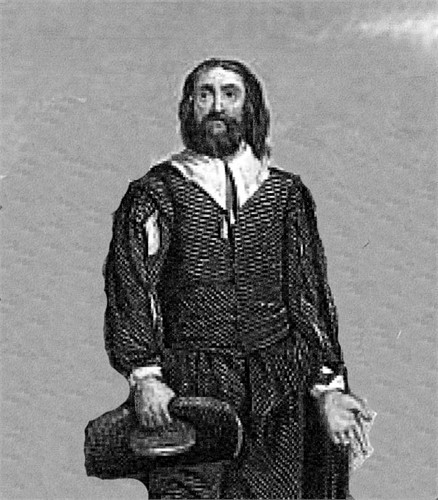
Francis Cooke – Portrait

In 1620, Francis, his son John, and nephew Philippe de Lannoy boarded Speedwell at Delftshaven. Francis left Hester and their younger children behind to follow when the colony was established. The Leiden Separatists bought the ship in Holland. They then sailed it to Southampton, England to meet the Mayflower, which had been chartered by the merchant investors. In Southampton they joined with other Separatists and the additional colonists hired by the investors.

The two ships began the voyage on 5 Aug 1620, but the Speedwell leaked badly and had to return to Dartmouth to be refitted at great expense and time. On the second attempt, the two ships sailed about 100 leagues beyond Land’s End in Cornwall, but the Speedwell was again found to be leaky. Both vessels returned to Plymouth where the Speedwell was sold. It would later be revealed that there was in fact nothing wrong with the ship. The crew had sabotaged it in order to escape the year long commitment of their contract.

Eleven people from the Speedwell (including Francis and John Cooke) boarded the Mayflower, leaving 20 people (including our ancestor Robert CUSHMAN and Philippe de Lannoy) to return to London while a combined company of 103 continued the voyage. For a third time, the Mayflower headed for the New World. She left Plymouth on September 6, 1620 and entered Cape Cod Harbor on 11 Nov 1620.

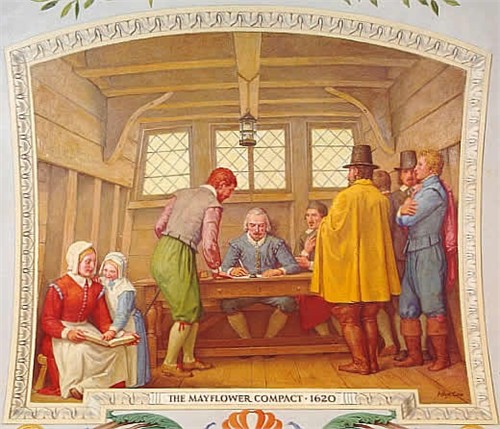
Arriving at what is now Provincetown, Massachusetts, on November 11 (November 21, new-style calendar), forty-one of the passengers, among them Francis Cooke, signed the Mayflower Compact as the boat lay at anchor.  Francis died on 7 Apr 1663 in Plymouth, Mass.

Francis Cooke – Mayflower Compact

Hester le Mahieu was born about 1585 in Canterbury, Kent, England.  Her parents were Jaques le MAHIEU and Jeanne [__?__].  They  Protestant refugees from the Walloon Flanders area. The Mahieus, from Lille, had resided in Canterbury, then London, since the 1570s before moving to Leiden in 1590.  Hester Mahieu’s name also appears in records in Leiden in 1603 as having been accepted as a member of the French Reformed Church (known as the Walloon Church) of Leyden. Her name in this list reads “Esther de Mahieu.” The baptism of John Cooke, Francis and Hester Mahieu Cooke’s firstborn son, is also in the Walloon Church records.

 Hester and their daughters Jane and Elizabeth and son Jacob arrived on the Anne in 1623. Two more children, Hester and Mary  were born at Plymouth. Hester died after 8 Jun 1666.

Children of Francis and Hester:

Name Born Married Departed
1. Jane Cooke c. 1604-1609
Leyden, Zuid Holland, Netherlands
Experience Mitchell
aft 22 May 1627
bef. 1640
Bridgewater, Plymouth, Mass.
2. John Cooke bapt. Jan-Mar 1607
Leiden, Netherlands
Sarah Warren
28 Mar 1634
23 Nov 1695 (last Mayflower male survivor)
Dartmouth, Mass.
3. Child Cooke bef. 20 May 1608
Leiden, Holland
bur. 20 May 1608
Leiden, Holland
4. Josiah Cooke?? (See discussion below) 1610
England
Elizabeth Ring (daughter of William RING)
16 Sep 1635 in Plymouth, Mass
17 Oct 1673
Eastham, Barnstable, Mass.
5. Elizabeth Cooke bapt.
26 Dec 1611
Leiden
Aft 1623 and
bef. 22 May 1627
Cattle Division
Plymouth, Mass
6. Jacob Cooke c. 1618
Leiden
Damaris Hopkins (daughter of Stephen HOPKINS)
10 Jun 1646
.
Elizabeth Lettice
18 Nov 1669
7 Jul 1676
Plymouth
7. Hester Cooke aft. after May 1624 (9 months after the family reunited) and before Jun 1625 (to clear the stage for Mary) Richard Wright
c. 1644
21 May 1669
8. Mary COOKE bef. 22 May 1627
Plymouth, Mass.
John TOMSON
26 Dec 1645 Plymouth, Mass.
21 Mar 1714 Middleboro, Mass.

Francis  appears frequently in Plymouth records on grand and trial juries, as a surveyor of the highways, on various ad hoc committees, and in a number of land transactions.

Francis Cooke was the 17th signer of the Mayflower Compact.

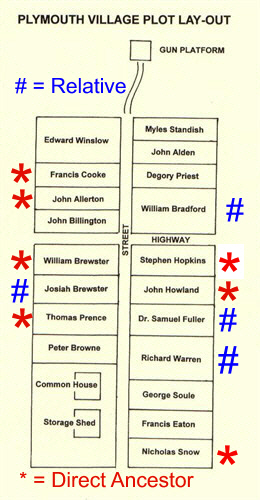
Our ancestors or their close relatives had almost half the lots in early Plymouth – (George Soule was the grandfather of John TOMSON’s son-in-law, not close enough to get a #)

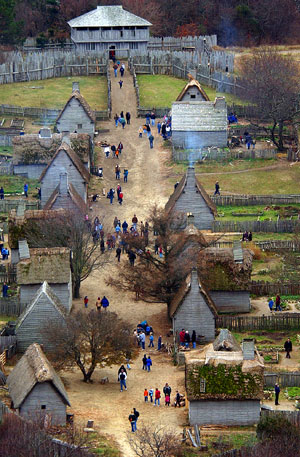
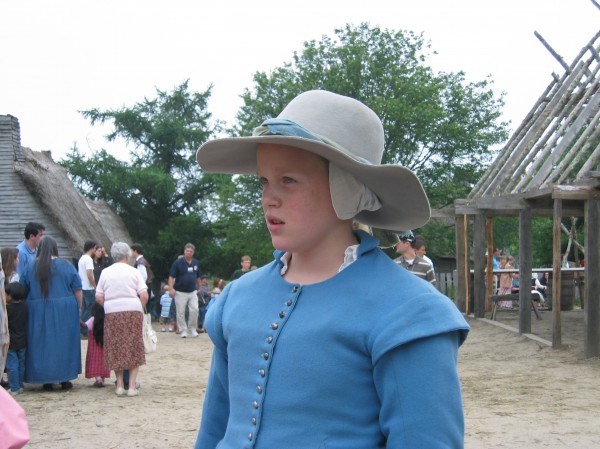
Plimoth Plantation  Recreation of 1627 Village

Plimoth Plantation Recreation of 1627 Village

After the common house had been completed, houses for the families were built. Since the winter had seen so many deaths, the Pilgrims were reduced to 19 families and each of these 19 received a parcel of land about fifty feet deep. Frontage was proportional to the number in the family, about eight feet per person. Lots were cast to decide each family’s position in the “two rows of houses” which were to be built “for more safety.” This allotment was for their use for only the year, to build houses and plant gardens, and they could not pass the land down to their heirs. Francis Cooke appears on a diagram of “meersteads & garden plots of [those] which came first laid out 1620” with his plot being on the south side of the street, with Isaac Allerton and Edward Winslow on his east and west.

Hester le Mahieu’s sister was Marie le Mahieu, wife of Jan Lano, another Protestant refugee in Canterbury and then Leiden, whose son, Philippe de Lannoy (anglicized to ‘Delano’) migrated on the Fortune to join his uncle Francis Cooke and his cousin Robert at Plymouth colony in 1621, having been left behind with twenty others when the Mayflower’s sailing mate, the Speedwell, foundered and returned to port in England leaving the Mayflower to sail alone. Philippe is the progenitor of the branch of the Delano family from which Franklin Delano Roosevelt descends.

On Friday, February 16, 1621, while Capt. Myles Standish and Francis Cooke were at work in the woods they were recalled by an alarm at the approach of Indians. “Écoming home left their tools behind them; but before they returned, their tools were taken away by the savages. This coming of the savages gave us occasion to keep more strict watch, and to make our pieces and furniture ready, which by moisture and rain were out of temper.” The Indians returned the tools a month later.

In the late 1623 Plymouth Land Division, he received two acres as a passenger on the Mayflower with his son John, plus four acres for the rest of his family which came on the Anne in August 1623. Some of this land was apparently sold to William Bradford by 1639.

In 1627, when personal ownership of land became a fact, Francis received 20 acres for each share held in the Plymouth Company, that is, for each member of his family.

The Division of Cattle made at Plymouth on May 22, 1627 assigned the first lot “Éto ffrancis Cooke & his Companie Joyned to him his wife Hester Cooke (3) John Cooke (4) Jacob Cooke (5) Jane Cooke (6) Hester Cooke (7) Mary Cooke (8) Moses Simonson (9) Phillip Delanoy (10) Experience Michaell (11) John ffance (12) Joshua Pratt (13) Phinihas Pratt. To his lot fell the least of the 4 black heyfers Came in the Jacob, and two shee goats.” This is the earliest Plymouth Colony records found which names the wife and children of Francis. Not surprisingly, the six unmarried men associated with the family included friends and relations. Philip Delano, then 23, was probably Hester’s nephew. Experience Mitchell was to marry Francis’s daughter Jane shortly after this.

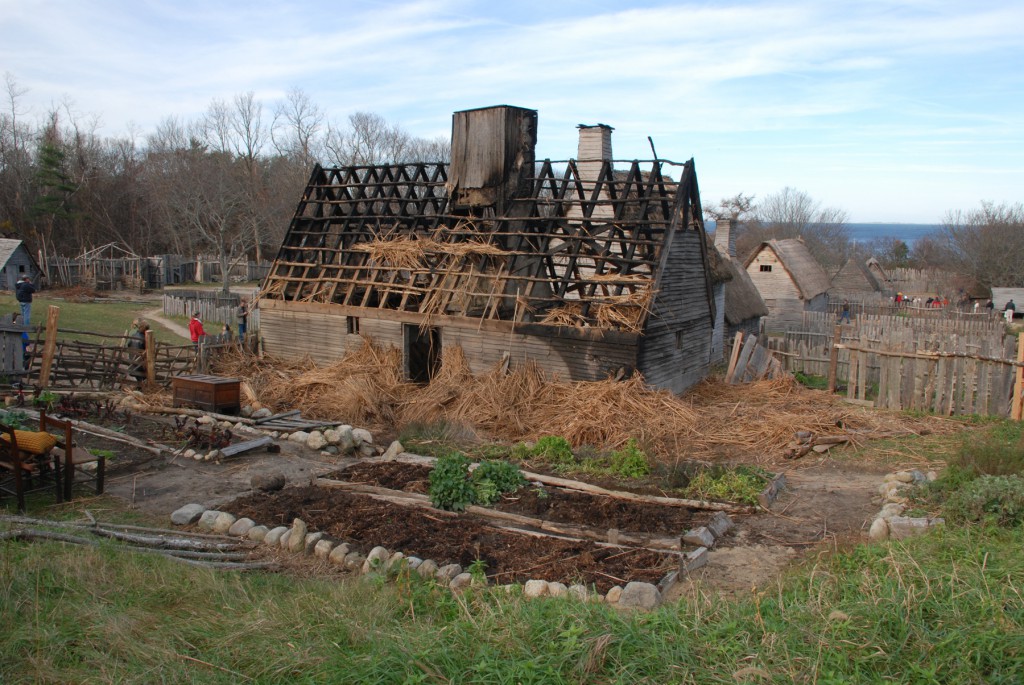
Francis Cooke's home in the recreated 1627 Plimoth Plantation burned in 2011

Francis Cooke’s home in the recreated 1627 Plimoth Plantation burned in 2011

Cooke House, RE-constructed: Part 1  – And to be as faithful to the period as we can reasonably hope to be, this house will be a timber-framed-cottage-using-historic-methods-of-scribed-joinery-and-dozens-of-green-oak-trees-which-will-be-processed-using-only-hand-tools-appropriate-to-the-17th-century-and-after-research-might-have-been-of-a-style-plausibly-built-circa-1621-by-the-first-wave-of-English-colonists-at-Plimoth-using-aproximately-700-individually-hand-wrought-nails-300-hand-riven-clapboards-numerous-pieces-of-lathe-for-roof-and-walls-and-even-more-sticks-to-make-a-framework-of-wattle-and-mortar-for-the-walls-and-chimney-made-by-stomping-barefoot-in-a-clay-filled-pit-and-about-3600 square feet-or-so-of-hand-cut-cattail-and-reed-meticulously-dried-for-the-thatched-roof-and-several-trips-to-local-woods-to-harvest-small-trees-for-studs-and-rafters-and-this-house-will-be-constructed-in-front-of–our-museum-guests-as-we-interpret-our-historic-milieu-while-arrayed-in-our-canvas-and-wool-suits-and-our-regional-dialects-to-boot–

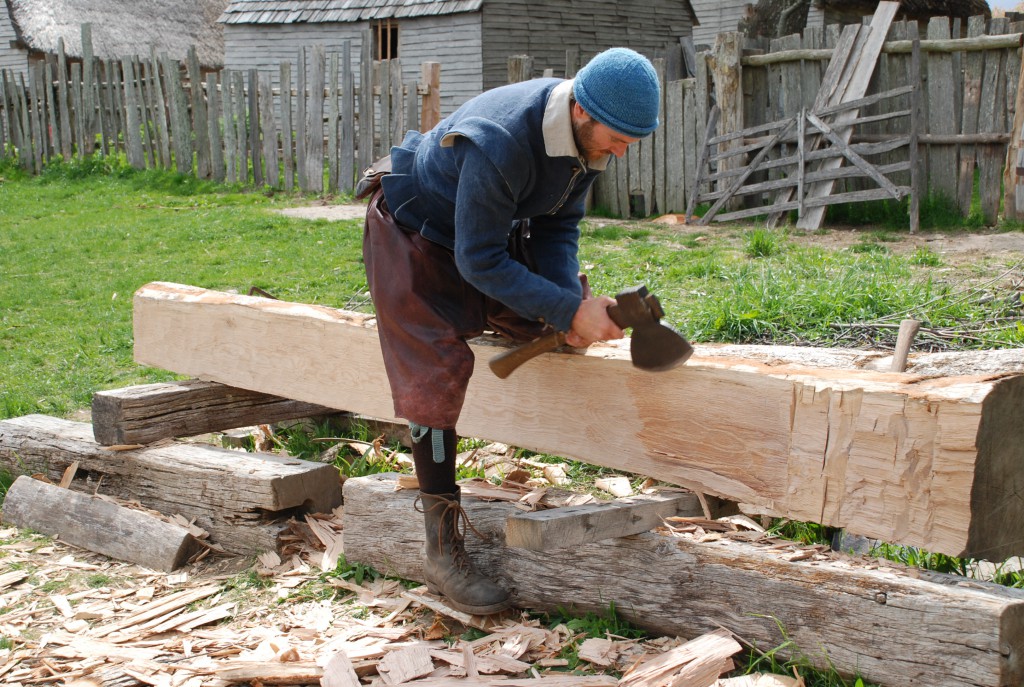
The fire gave volunteers an opportunity to practice their 17th Century building skills - Seeing plumb while hewing flat

The fire to Francis Cooke’s home gave volunteers an opportunity to practice their 17th Century building skills – Seeing plumb while hewing flat

The Pilgrims had a contract with the Company stating all land and profits would accrue to the Company for 7 years at which time the assets would be divided among the shareholders. Most of the Pilgrims held some stock. Francis Cooke was one of the “Purchasers” who in 1627 bought all the rights of the London “Undertakers.” One month after the Division of Cattle he signed a more favorable contract between the “Purchasers” and the “Undertakers” by which the latter were to have, for six years, the control of the entire trade of the plantation with the outside world.

In 1651, fellow Pilgrim William Bradford wrote of him:

“Francis Cooke is still living, a very old man, and hath seen his children’s children have children. After his wife came over with other of his children; he hath three still living by her, all married and have five children, so their increase is eight. And his son John which came over with him is married, and hath four children living.

1 Oct 1634 : ”Apoynted for laying out of highwayes :

For Duxbery side, Capt Miles Standish, Mr William Colier, Jonathan Brewster, William Palmer, Steuen Trace.

For Plimouth, John Jeney, Francis COOKE, [George KEMPTON’s son ], Manaseh Kempton, Edward BANGS, Nicholas SNOW, John Winsloe, James Hurst.
The high wayes to be layd out before the 15 of Nouember next.”

Francis Cooke was on the 1633 Plymouth list of freemen ahead of those admitted Jan 1 1632/33 and also on the Mar 7 1636/37 and 1639 lists of Plymouth freemen. He was also in the Plymouth section of the list of freemen of 1658.

In the tax list drawn up by order of the General Court held Jan 2 1632/33, he was taxed eighteen shillings to be paid in corn at six shillings per bushel. One year later, January 2, 1633/4, his tax was nine shillings and his son John was taxed nine shillings.

7 Jan 1632/33 – Robert Hicks and Francis Cooke were appointed arbitrators to settle a difference between Dr. Samuel Fuller and Peter Brown.

James Hurst, Francis Cooke and John Doane took the inventory of Martha Harding’s estate which was presented to the court October 28, 1633. James Hurst, Francis Cooke and Phineas Pratt took the inventory of Francis Eaton’s estate on November 8, 1633.

1 Oct 1634 – John Jenney, Francis Cooke and five others were appointed to lay out highways for Plymouth.

15 Nov 1636 – A law was passed requiring every man to register his cattle marks. Francis Cooke’s are recorded as follows: “ffrancis Cooke a hole in the left eare and a slit in he (*) right eare downe the middest of the eare.”

24 Dec 1636 – John Harmon, son of Edmond of London, contracted to became the apprentice of Francis Cooke for seven years “from the first of Octbr, 1636, to the exiraon of the said terme, and then to be dowble apprelled” and to received twelve bushels of corn from him.

7 Mar 1636 – Francis Cooke sued Mr. John Browne, the elder and Thomas Willet, together with several other men working for them: Thomas Lettis, James Walter, John Browne the younger and Thomas Teley. The charge was that on November 9, 1636 they had caused £10 in damages by abuse and injury to some of his cattle, viz: “vnreasonably abuse the cattle of the said Francis Cooke, insomuch that therevpon one cowe cast her calf, & hath lost her milk, & is in danger to be lost herself.” The jury found in Francis Cooke’s favor against John Browne the elder “3£ damnage, & 13s. 6d. charges of the suite.” On June 7, 1637 Francis Cooke was granted an execution against John Browne.

2 Jan 1637/38 – “Franc Cooke” served on several trial juries: Michaell Turner against John Davis for damage to a boat; Edward Dotey against John Holmes in a case of transpass; and John and Elisabeth Willis against William Bradford, Edward Winslow and Thomas Prince (as executors of a will) in a dispute about land.

7 Mar  1636/37  – “Frauncis Cooke complains against Thomas Lettis, James Walter, John Browne the yeonger, & Thomas Teley, and against Mr John Browne the elder & Thomas Willet, vpon an action of the case, to the damnag of x [shillings], for that they, the said Thomas Lettis, James Walter, John Browne the yeonger, & Thomas Teley, in the service of the said John Browne thelder, & Thomas Willet, did, about the ix’th day of November last, vnreasonably abuse the cattle of the said Francis Cooke, insomuch that therevpon one cowe cast her calf, & hath lost her milk, & is in danger to be lost herself. The jury found for the pltiff against John Browne thelder, and doe assesse him three pounds damnage, and the cost of the suite.

2 Mar 1640/41 – Under an agreement the Purchasers and Old Comers received grants of land in three areas near present-day Yarmouth, Dartmouth and Rehoboth, “the purchasers, or old comers, witnes two in especiall, thone beareing dated the third of March, 1639, thother in Decembr ye first, 1640…”

Francis Cooke’s name appears in two lists of the townsmen of Plymouth. The first is dated December 10, 1646. The second is undated, but was probably made between 1648 and 1659. Francis Cooke’s team is mentioned in a list of teams, with men assigned to each, for drawing wood; but part of the leaf is missing and the purpose is unclear. There is no date, but it was probably made between 1648 and 1652.

1 Aug 1648 [Francis Cooke was on an investigative panel for a murder case of the four-year old daughter of Richard and Allis Bishop] “These sheweth, that on July the 22cond, 1648, wee, whose names are vnderwritten, were sworne by Mr Bradford, Gouerner, to make inquiry of the death of the child of Allis Bishop, the wife of Richard Bishope.
“Wee declare, yt coming into the house of the said Richard Bishope, we saw at the foot of a ladder wh leadeth into an vpper chamber, much blood; and going vp all of us into the chamber, wee found a woman child, of about foure yeares of age, lying in her shifte vppon her left cheeke, with her throat cut … and the said Allis hath confessed to fiue of vs att one time, yt shee murdered the child with the said knife.
John HOWLAND, James Hurst, Robert Lee, John Shawe, Francis COOKE, John Cooke, James Cole, Gyells Rickard, Richard SPARROW, Thomas Pope, Francis Billington, William Nelson.
Plymouth Colony Records, Vol. 2, p. 132.

Francis’ will was made  10 Jul 1659. He makes his wife Hester and son John executors. It is witnessed by Howland and Alden. Inventory was taken 1663 by Eph. Tuckham and Wm Crowe.

The Last Will and Testament of ffrancis Cooke made this seaventh of the tenth month 1659

I being att prsent weake and Infeirme in body yett in prfect memory throw mercy Doe comitt my soule unto god that gave it and my body to the earthe ; which my will is should bee Intered in a Decent and comly manner;
As for such goods and lands as I stand posessed of I Doe will and bequeath as followeth:
1 My will is that hester my Dear and loveing wife shall have all my moveable goods and all my Cattle of all kinds ; viz : neat Cattle horsekind sheep and swine to be att her Dispose
2 my will is that hester my wife shall have and Injoy my lands both upland and meddow lands which att prsent I posesse During her life
3 I doe ordaine and appoint my Deare wife and my son John Cooke Joynt exequitors of this my said will
ffrancis Cooke
Witnes
John Alden
John HOWLAND

An inventory was taken of his possessions by Ephraim Tinkham and William Crow on May 1, 1663. His total net worth at that time was 86 pounds, 11 shillings, and 1 pence.

£- s- d
Imprs 2 Iron potts & 1 Iron skillett
00-16-00
Item 2 paire of pott hookes
00-01-00
Item 7 pewter Dishes & 2 basons
00-17-06
Item 3 pewter potts
00-06-06
Item 1 pewter bason 2 porringers & 1 salt seller
00-02-00
Item 1 pewter Candlesticke
00-02-00
Item 2 Alcemy spoones
00-03-00
Item 1 lanthorn 1 gallypot
00-01-00
Item halfe a Dozen of trenchers and one stone bottle
00-01-00
Item 3 olde ladles
00-00-06
Item 1 woodden tray 6 trenchers
00-01-00
Item 1 morter and pestell
00-02-00
Item 4 wooden Dishes
00-00-08
Item 1 earthen pan and 2 earthen potts
00-00-09
Item 1 great brasse kettls
01-06-00
Item 2 smaller kettles
00-08-00
Item 3 wooden pailes
00-03-06
Item 1 pewter Chamber pott
00-02-06
Item 1 warming pan 1 frying pan
00-10-06
Item 1 thwart saw 1 hand saw
00-03-06
Item 1 paire of pincers 1 hammar
00-02-06
Item 1 Drawing Knife
00-00-06
Item 1 water Tubb
00-01-06
Item 1 axe
00-01-06
Item 1 great Chaire
00-05-00
Item 3 smale Chaires
00-03-00
Item 1 gridiron 1 fiershovell 1 paire of tonggs
00-05-00
Item 2 paire of pothangers
00-06-00
Item 2 old musketts
00-12-00
Item 1 paire of sheers 1 paire of sissers
00-00-09
Item 1 great bible & 4 old bookes
00-10-00
Item 1 brush
00-00-02
Item 1 file and 1 paire of pincers
00-00-06
Item 1 Table & forme
00-06-00
Item 1 old bucking Tubb
00-02-06
Item 1 tubb & 2 kimnells
00-05-00
Item 1 Chist
00-03-00
Item 1 pair of Cards and one baskett
00-01-00
Item 4 earthen potts 1 Cupp 2 wooden trayes
00-05-00
Item 1 Chern 1 old Cask & four bottles
00-05-06
Item 1 old trough & a forme
00-00-06
Item 1 woolen wheele & scales
00-04-00
Item 1 Iron Driping pan
00-03-00
Item 1 sifting trough and one old trough
00-03-00
Item 1 tray 1 tubb 1 box
00-03-00
Item 2 seives
00-02-06
Item 3 paire of sheep sheers
00-03-00
Item 3 paire of old Cards
00-01-06
Item 1 Cheespresse 1 Cheesfatt
00-01-00
Item 2 old ferkins & som sope
00-01-06
Item 2 old basketts & yarne
00-04-00
Item 1 feather bed & bolster
02-00-00
Item 1 paire of sheets
00-12-00
Item 1 Coverlid & blankett
01-00-00
Item 1 pound of Candles
00-00-06
Item 2 hoes
00-01-06
Item 1 Cushien
00-00-06
Item 2 Chistes & 3 boxes
01-06-00
Item 1 feather bed 1 bolster 1 pillow
03-10-00
Item 1 paire of sheets 10s. 1 blankett 1 coverlid 15
01-15-00
Item 2 old Curtaines & vallence
00-02-00
Item 2 paire of sheets
01-10-00
Item 3 halfe sheets
00-06-00
Item 2 hatts
00-15-00
Item 1 long coate 25s 2 short coates 30s
02-15-00
Item 1 old coate & 1 Jerkin
00-15-00
Item 2 paire of briches 1 paire of Drawers
01-10-00
Item old clothes stockens gloves shooes
01-00-00
Item 4 shirts & smale linnine
01-10-00
Item 1 bed & beding in the loft
03-00-00
Item 20 lb of woole & 2 paire of old stockens
01-07-00
Item 8 paire of stockens
01-05-00
Item some other old lumber about the house
00-02-00
Item 2 mares & one yearling mare
26-00-00
Item 2 Cowes & one Calfe
07-10-00
Item 1 2 yeare old and 1 yearling heiffers
03-10-00
Item 16 sheep
08-00-00
Item 5 lambes
01-00-00
Item 4 smale swine
01-04-00
The sume apprised is
85-01-01
Debtes Due to the estate from severall about
04-00-00
Due from the estate of severall about
02-10-00
summs totalis
86-11-01

Besides the housing and land; the goods and Chattels amount to eighty six pounds eleven shillings and a peney; apprised by us, Ephraim Tinkham his E T , William Crow

An agreement made June 8, 1666 between John Cooke, Jacob Cooke, Hester Wright the wife of Richard Wright and Mary Tompson the wife of John Tompson disposed of the land of Francis Cooke. The agreement mentions Hester Cooke is still living. On the same date John Cooke confirmed to Richard Wright and Thomas Mitchell, in equal shares, sixty acres of upland, near Jones River Meadow formerly given them by Francis Cooke. On July 5, 1670 a court record mentions that land called “old Cookes Holes,” lying at Jones River was given by Francis Cooke to Richard Wright and Thomas Mitchell and since his (Francis) decease confirmed unto Richard Wright and Thomas Mitchell by John Cooke.

Children

1. Jane Cooke

Jane’s husband Experience Mitchell was born 1609 in Leyden, Holland. His parents were Thomas Mitchell and Margaret Williams. After Jane died, he married Mary before 1641 in Plymouth, MA?.. Experience died 4 Sep 1689 in Bridgewater, Plymouth, Mass.

Experience Mitchell arrived in Plymouth in 1623 on the Anne, and Banks writes that he was from Duke’s Place, London. Underhill (Small Descendants, 1:510), based in part on Dexter (p. 625), thought Experience was the son of Thomas Mitchell of Cambridge, England, who was a member of Francis Johnson’s church at Amsterdam, and that Experience was born in Leiden in 1611.

There is much controversy over the children of the two marriages of Experience Mitchell: “MFIP (Mayflower Families In Progress) , Cook:3 states Elizabeth Mitchell was b. 1628 and Thomas Mitchell c 1631. These two have been accepted by the General Society of Mayflower Descendants as Jane Cooke’s. Since Thomas was the only Mitchell child known to have received land from grandfather Francis Cook, doubt is cast on the remaining Mitchell children who were born later than Thomas.”

Ralph Wood takes exception, however, in his MF5G:12 volume, 1996, and includes Mary “presumed, quite safely, as a daughter of Jane, based on Mary’s approximate date of birth.”. Mary is born about 1632, presuming Jane married about 20. There is then a near 10-year span before the rest of Experience’s children are born, presumably, by his second wife, Mary,.

Another observation is that if Jane died very early in their marriage, Experience was left with near infant children–quite a hardship in any event, and especially so in those days. Many such men would hasten to find a new wife and mother for such small children, and female companionship for themselves, however, Experience doesn’t remarry until 1640/41.

2. John Cooke  

John’s wife Sarah Warren was born 1614 in England.   Her parents were Richard Warren and Elizabeth Walker.  She arrived with her mother on the Anne in 1623.  Sarah died  25 Jul 1686 in Dartmouth, Mass.

Richard Warren (c. 1580–1628) was a passenger on the Mayflower  in 1620. He settled in Plymouth Colony and was among ten passengers of the Mayflower landing party with Myles Standish at Cape Cod on Nov 11, 1620.  Warren co-signed the Mayflower Compact  and was one of nineteen (of forty-one) signers who survived the first winter.

His wife’s maiden name was Elizabeth Walker, the daughter of Augustine Walker of Great Amwell, Hertford; she was baptised 1583 in Baldock,Hertfordshire, England, died October 2, 1673.  She and his first five children, all daughters, came to America in the ship Anne in 1623. Once in America, they then had two sons before Richard’s death in 1628.

Although the details are limited, Richard Warren and wife, Elizabeth, and children were mentioned in official records or books of the time period.  All seven of their children survived and had families, with thousands of descendants, including: President Ulysses S. Grant, President Franklin D. Roosevelt, former Alaska Governor Sarah Palin,  astronaut Alan Shepard, author Laura Ingalls Wilder (Little House on the Prairie series), actor Richard GereLavinia Warren, also known as Mrs. Tom Thumb, educator and poet Henry Wadsworth Longfellow, and the Wright brothers.

Warren is among the less documented of the Mayflower pioneers. Clearly a man of rank, Warren was accorded by Governor William Bradford the prefix “Mr.,” pronounced Master, used in those times to distinguish someone because of birth or achievement. From his widow’s subsequent land transactions, we can assume that he was among the wealthier of the original Plymouth settlers. And yet, Bradford did not mention him in his History of the Plimouth Plantation except in the List of Passengers.

In Mourt’s Relation, published in 1622, we learn that Warren was chosen, when the Mayflower stopped at Cape Cod before reaching Plymouth, to be a member of the exploring party among 10 passengers (and 8 crew), and he was described as being “of London” among 3 men. Charles Edward Banks, in Ancestry and Homes of the Pilgrim Fatherswrites: “Richard Warren came from London and was called a merchand of that city (by Mourt) Extensive research in every available source of information — registers, chancery, and probate, in the London courts, proved fruitless in an attempt to identify him.”

He was not of the Leiden Pilgrims, but joined them in Southampton, England to sail on the Mayflower.

Richard Warren received his acres in the Division of Land in 1623. In the 1627 Division of Lands and Cattle, in May 1627, “RICHARD WARREN of the Mayflower” was given “one of the black heifers, 2 she-goats, and a grant of 400 acres  of land”  at the Eel River (Plymouth, Massachusetts). The Warren house built in that year (1627) stood at the same location as the present house; it was re-built about 1700, at the head of Clifford Road, with its back to the sea, and later owned by Charles Strickland (in 1976).[2]

Warren died a year after the division, in 1628, the only record of his death being found as a brief note in Nathaniel Morton’s 1669 book New England’s Memorial, in which Morton writes:

“This year [1628] died Mr. Richard Warren, who hath been mentioned before in this book, and was a useful instrument; and during his life bore a deep share in the difficulties and troubles of the first settlement of the plantation of New Plimouth.”

John was the last male survivor of the Mayflower passengers. John’s daughter Esther was the first wife of our ancestor Thomas TABER.  John was a part time Baptist minister at Dartmouth. There is a memorial plaque to his memory on Pilgrim Street, Fairhaven, MA. In 1637, he volunteered in Capt. Prince’s company, for the Pequot War. In 1639, was elected one of the governor’s assistants.  When the schism arose in the church at Plymouth (of which he was at the time an elder), in regard to baptism, he took sides with the opposition, afterwards known as Baptist, and was excommunicated. 1654, as one of the deputies of Plymouth, he made the report of the Committee on the Affairs between the Plymouth and Massachusetts Bay Colonies. In 1662, he removed to Dartmouth, and was appointed by the Court the first magistrate of the town, an office which he held for many years; and was deputy from that town to the General Court for a long succession of years. Previously, he had held the office of deputy from Plymouth for a number of years,–from 1640 until his removal.

On the breaking-out of Philip’s War, the town of Dartmouth was one of the first to feel its effects, and the house of John Cook was the first to suffer; being burned to the ground. On the division of Capt. Church’s force in this neighborhood, when in pursuit of the Indians, soon after, one party was ordered to “rendezvous at the ruins of John Cook’s house.” As a prominent person in colonial affairs and in the new settlement, it is very probable that he had increased the hostility of the Indians, having had much to do with them in the purchase of lands, &c.; as in 1665  he was appointed by the Court, with the Treasurer, to treat with King Philip about the sale of some lands in behalf of the colony. In the same year, he purchased for other parties the Island of “Nakatay;” and the Court ordered, that, unless they pay him for his trouble and expense in the same, he was to have it for his own use.

In 1668, he was ordered by the Court to establish and maintain a ferry between Dartmouth and Rhode Island; and in the same year he took the testimony of parties, and established the boundaries of the town, which had long been in dispute with the Indians. 1668, he was ordered to appear at court, and answer for trespass upon the lands of Samuel Fuller. I mention this case as something to the credit of the family, as, in a long course of years, this appears to be the only instance of any one of this name being engaged as defendant, for any cause whatever, in any of the courts. In 1672, he seems to be in a controversy with some of the settlers of the town. I transcribe from the records:–

“July 1, 1672 at this court, in the controversay between John Cook and several of the purchasers of Dartmouth, the court appointed Samuel Hicks, John Smith, and Pelig Trip, to settle the differences. They ordered that John Cook should have Ram Island, before given him by the town for former services, also 11 pounds for his services and disbursments, and 3 pounds for his damages and trouble, which 14 pounds shal be paid to him or his order in good merchantable Pork, Beef and corn, in equal proportions, at or before the middle of Oct. next, or otherwise to his content, and in return he should deliver up the deeds of the lands to whoever the Town should appoint to receive them.”

That he was not at variance with his neighbors, in the following year, 1673, he was again elected one of the two selectmen of the town, and deputy to the General Court at Plymouth. 1674, he settled the estate of Mrs. Elizabeth Warren, his mother-in-law. Same year, he had liberty of the Court, with Capt. Bradford and shal be paid to him or his order in good merchantable Pork, Beef and corn, in equal proportions, at or before the middle of Oct. next, or otherwise to his content, and in return he should deliver up the deeds of the lands to whoever the Town should appoint to receive them.”

Dartmouth was  almost totally destroyed at the breaking-out of Philip’s War.  On 5 Oct 1675 “John Cook, as magistrate of the town of Dartmouth, is ordered by the Court to communicate to the inhabitants their orders in regard to rebuilding and settling the town again.” 1677, he was appointed by the town to receive their portion of the funds raised for the relief of the Colony by “divers Christians” in Ireland (occasioned by the wars). In the controversy of the town with Dr. Cooper of Newport, R.I., for his attendance and services on William Dio, a pauper, John Cook, as magistrate, is ordered by the Court, March 5, 1678, to call a town-meeting of the inhabitants, for the purpose of receiving money to pay the bill, some time before October. His daughter Sarah married Arthur Hathaway, Nov. 20, 1652. He died, according to Dartmouth Records, Nov, 23, 1695.

Click here for John Cooke’s last will and testament

4. Josiah Cooke

Josiah’s wife Elizabeth Ring was born 23 Feb 1603 in Ufford, Suffolk, England. Her parents were our ancestors William RING and Mary DURRANT. Elizabeth died 28 Dec 1687 in Plymouth, Plymouth, Mass.

Robert Charles Anderson, in his 1995  The Great Migration Begins cited George Ernest Bowman’s comments of 1901 as still being definitive. In a footnote in volume 3 of  Mayflower Descendant Bowman presented a simple and convincing argument. Not only had he (and he must have been the premier student of the Mayflower in his time if not of all time) never found “a single record which even remotely indicates the existence of any kinship,” but he had found several records which prove “conclusively that they were not father and son.” Of these Bowman cites three. There is a court case in which Francis was the plaintiff and in which Josias sat on the jury and Bowman points out that the court would not allow a son to sit on a jury judging the father. Bowman cites an agreement which the court would have required to be signed by all of Francis’s living children which Josias, who was alive, did not sign, and a deed which states that it is made by all the children and which does not include Josias. (MD 3:97)

However there are old books, some made newly available on CD and online which make the claim that Josias is a son of Francis. One such is  Signers of the Mayflower Compact  by Annie Arnoux Haxtun, which was first published in 1897-1899 and was reprinted by Genealogical Publishing Company. “The argument now [that Josias is not the son of Francis] is founded not upon what was said, but what was not.  Some say certainty is self-evident and requires no assertion, but I’m including because the question comes up quite often.

5. Elizabeth Cooke

Mayflower Families Through Five Generations, p. 25-27, has a discussion regarding Elizabeth and Hester. There were only three children with their mother on the Anne in 1623. Jacob and Jane are known, and the third was either Elizabeth (and then Hester was born in Plymouth) or it was Hester (and then Elizabeth had died before leaving Holland). Elizabeth was not listed in the Cattle Division so definitely she died by 22 May 1627. Since Hester later successfully filed suit to share in grants to children born in Plymouth, it is probable she was born in Plymouth after 1623. That would mean Elizabeth was was the third child on the Anne, hence alive in 1623.

6. Jacob Cooke

Jacob’s first wife Damaris Hopkins was born 1627 in Plymouth, Plymouth, Mass. Her parents were Stephen HOPKINS  (Wiki) and Elizabeth Fisher. Damaris died 18 Nov 1669 in Plymouth, Plymouth, Mass

Jacob’s second wife Elizabeth Lettice was born 1636 in Lincolnshire, England.  Her parents were Thomas Lettice and Anna [__?__].  Elizabeth died 31 Oct 1693 in Swansea, Bristol, Mass

7. Hester Cooke

Hester Cook Reenactor

Hester’s husband Richard Wright was born 1608 in Norfolk, England. His parents were Richard Wright and Margaret [__?__]. Richard died 9 Jun 1691 in Plymouth, Mass.

Ralph Wood, in Mayflower Families Through Five Generations suggests that Francis’ daughter Elizabeth made the trip to New England before dying. (John came with Francis in 1620, 3 children with Francis’ wife Hester on the Anne in 1623: Jane, Jacob and either Elizabeth or Hester.) Birth dates of 1620 for Hester must postulate that Elizabeth died before coming to New England, so Hester was born before Francis came. However, Richard and Hester Wright appear to have shared in a grant of land to children born in Plymouth (and were sued by Family:John Tomson and Mary Cooke (1) to share in it-PCR 4:54), suggesting she was born after coming to New England, and consequently that Elizabeth was one of the 3 children on the Anne. Next child, Mary, based on age at death, born Mar 1626 to Mar 1627. So Hester born after May 1624 (9 months after the family reunited) and before Jun 1625 (to clear the stage for Mary). Hester married in 1644, and since legal age for women is 18, she was born by 1626, which is easily satisfied either way.

Francis Cooke, in Anderson, Robert Charles. The Great Migration Begins: Immigrants to New England, 1620-1633. (Boston: New England Historic Genealogical Society, 1995).

One of the three children for which Francis received an acre land in 1623, and therefore conceived before Francis left on the Mayflower in 1620.

This source does not explicitly allocate this land to Hester, as is implied by this abstract, only to the part of the family that came on the Anne. It cites PCR 12:4-5, which only notes that the grants are made to Francis Cooke, 2 acres from being on the Mayflower, 4 acres for those who came on the Anne. However, this source does show a birth of Mary in “say 1620”, but with no source cited, so it is not clear what this estimate is based on. The qualifier “say” usually indicates situations where a child is inserted in a likely gap between other siblings. Elizabeth is shown being born but no death or any further information. In sum, this site does not seem to have any real evidence to show whether Elizabeth or Hester was the third child on the Anne.

8. Mary COOKE (See John TOMSON‘s page)

Sources:

http://en.wikipedia.org/wiki/Francis_Cooke

http://www.werelate.org/wiki/Person:Francis_Cooke_(2)

http://www.franciscookesociety.org/famous.html

http://www.mayflowerfamilies.com/cooke/d8.htm#P1

http://freepages.genealogy.rootsweb.ancestry.com/~onebigfamily/all/aqwg288.htm#28984

http://www.pilgrimhall.org/cookefrancisrecords.htm

http://trees.ancestry.com/owt/person.aspx?pid=11115362&st=1

http://homepages.rootsweb.ancestry.com/~sam/cooke/francis.html

http://genforum.genealogy.com/pilgrims/messages/391.html

Posted in 12th Generation, Artistic Representation, Dissenter, First Comer, Immigrant - England, Line - Miller, Storied, Wikipedia Famous | Tagged , , , | 25 Comments

Lt. John Tomson

Lt. John TOMSON (1616 – 1696) was Alex’s 9th Great Grandfather; one of 1,024 in this generation of the Miller linehjwas of Scottish descent.  It is said his father died soon after his birth, and his mother married again.  Even the name of his step-father is not known.  One theory is that his father was Amos THOMPSON who was born in or near Orby, Lincolnshire, England and married Carynthaphuch JACKSON on 10 Nov 1697 in Orby, Lincolnshire, England.

Ignatius Thompson’s “Genealogy of John Thompson” says he came to America in “the third embarkation,” a company under the patronage of Thomas Weston, a merchant of distinction in London. The company contained 60 or 70 men, some of them with families. Among them was John Tompson, then 6 years old. They landed at Plymouth early in May 1622. However, there seems to be some errors in Ignatius’s account.

What is properly called the “third embarkation,” the “Little James and Anne,” actually arrived in Aug 1623 with 60 passengers. There were other other arrivals, the “Sparrow” in May 1622, with seven passengers, was indeed sent by Thomas Weston. Still another arrival was the “Charity and Swan” in Jul 1622, also sent out by Thomas Weston, with sixty colonists bound for Wessagusset or Weymouth, which stopped at Plymouth with letters from Mr. Weston stating that he had quit the “Adventurers.” John Thompson may have indeed arrived in May 1622 as Ingnatius Thompson said, but this was not termed the “third embarkation.”.

John married Mary COOKE on 26 Dec 1645 in Plymouth, Mass.  John died 16 Jun 1696 in Middleboro, Mass.

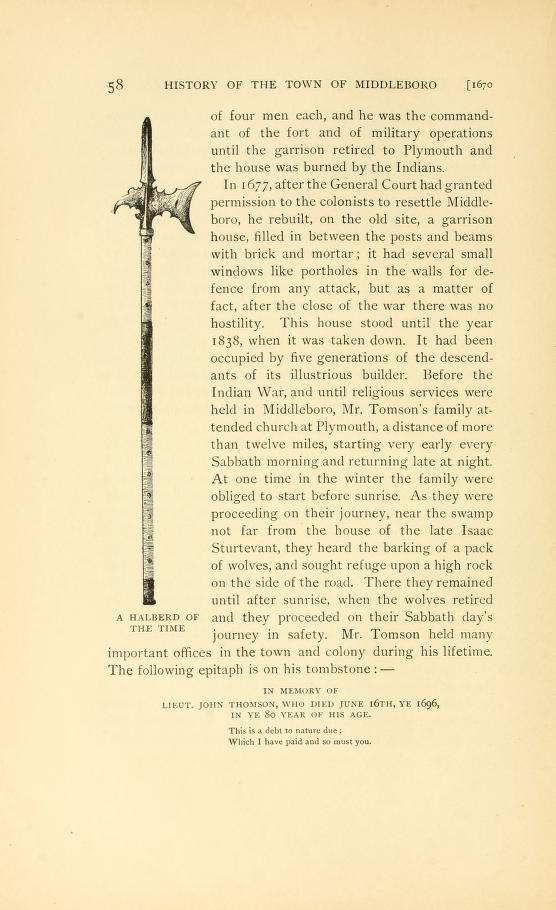
John Tomson – Memorial, Middleboro, Mass – “In Memory of LIEUT. JOHN THOMPSON, who died June 16, ye 1696, in ye 80th year of his age. This is a debt to nature due, Which I have paid, And so must you.

Mary Cooke was born before 22 May 1627 in Plymouth, Mass.  Her parents were Francis COOKE and Hester MAHIEU. Mary died 21 Mar 1714 in Middleboro, Mass.

Children of John and Mary:

Name Born Married Departed
1. Adam Tomson 1646
Less than nine months after his parents marriage, for which they were fined.
Plymouth, MA
c. 1647/48
2. John Tomson 2 Oct 1648
Middleboro, Mass
11 Feb 1648
Plymouth or Barnstable, Mass
3. John Tomson 24 Nov 1649
Plymouth, Mass
Mary Tinkham
c. 1680
25 Nov 1725
Middleboro, Mass
4. Mary TOMSON 1650
Dartmouth, Mass
Capt. Thomas Philip TABER
2 Jun 1672
Dartmouth
3 May 1734,
or 3 May 1724
probably at Dartmouth, Mass
5. Ester Tomson 28 Jul 1652
Barnstable, Mass
William Reed
c. 1675
bef. 12 Sep 1706
Weymouth, Mass
6. Elizabeth Tomson 28 Jan 1654
Barnstable, Mass
William or Thomas Swift
22 Sep 1687
aft Jun 1700
7. Sarah Tomson 7 Apr 1657
Plymouth
Never Married 2 Dec 1730
8. Lydia Thompson 5 Oct 1658/59
Plymouth
James Soule
14 Dec 1693
Duxbury, Mass
14 Mar 1741
Middleboro
9 Jacob Tomson Esq. 24 Apr 1662
Barnstable
Abigail Wadsworth
28 Dec 1693
Middleboro
1 Sep 1726
Middleboro
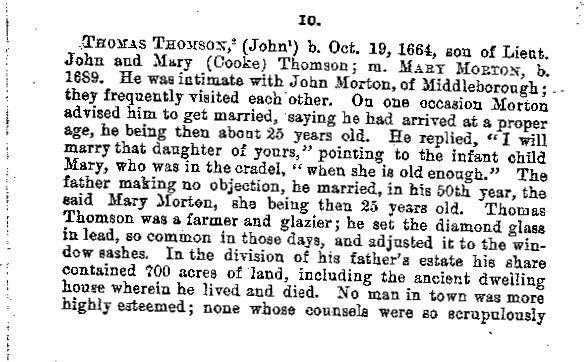
10 Thomas Tomson 19 Oct 1664
Plymouth
Mary Morton
13 DEC 1715 Middleboro
26 Oct 1742
Halifax, Mass
11 Peter Tomson c. 1667
Plymouth
Rebecca Sturtevant
1692 in Middleboro, Plymouth
.
Sarah Simmons
1699
Scituate, Mass
.
Sarah Wood?
before 29 Apr 1731
Barnstable, Plymouth, Mass
11 Mercy Tomson Apr 1671/72
Plymouth
Never Married 19 Apr 1756
Halifax

Parents and Siblings

Amos THOMPSON was baptized 5 Apr 1575 in St Margarets, Sibsey, Lincolnshire, England  He married Carynthaphuch JACKSON on 10 Nov 1597 in Orby, Lincolnshire, England. Amos died 10 Nov 1606 in Orby, Lincolnshire, England.

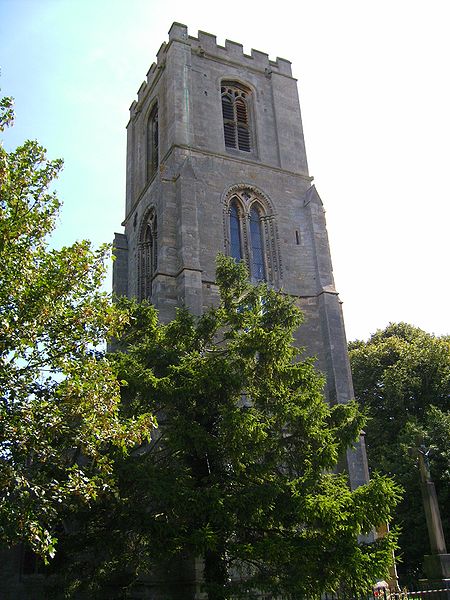
Western Tower, St. Margaret’s Sibsey, Lincolnshire, England

PARISH REGISTERS AT ORBY, LINCOLNSHIRE, ENGLAND, FHL microfilm #504,584, cited in the article by Jane Fletcher Fisk, EDWARD WILCOX of Lincolnshire & Rhode Island, NEW ENGLAND HISTORICAL & GENEALOGICAL REGISTER, Vol. 147, Apr 1993, page 188 & subsequent.
Amos Thompson marryed Carynthaphuch Jackson 10 Nov 1606.
i. Susanna Thompson, the daughter of Amos Thompson, baptized 6 Sep 1607     Edward Wilcocke & Susan Tomson [married] 12 May 1631.
ii.   John THOMPSON, the sonne of Amos Thompson, laborer was bap. Dec’ber 21, 1609
iii.    George [son of] Amos Thopson [baptized] Febrary 13th 1619/20  George Thompson, son of Amos Thompson [buried] June 2, 1620

Lt. John Tomson

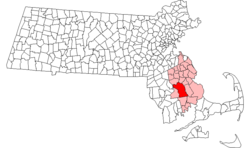
John is was a pioneer in three areas inland from Plymouth:  Halifax, Bridgewater and Middleborough.

Halifax, Plymouth, Mass

Bridgewater, Plymouth, Mass

Middleborough, Plymouth, Mass

John  was a carpenter, though his primary occupation was a farmer. Besides building his own houses, he built homes for others. In 1637 he and his friend Richard Church built the first framed meeting house in Plymouth. He then sued Thomas Willett, the town’s agent, for not complying with the contract. As compensation for his labor, the town gave him a deed to a piece of land extending back from the market house to the herring brook, later called Spring Hill. He was great friends with Richard Church, and after his death, with his brother, Captain Benjamin Church, the Indian fighter.

On 3 Mar 1645 he purchased a house and garden of Samuel Eddy near Spring Hill in Plymouth.

He purchased his first farm in Sandwich, in that part called Nobscusset, where he lived for a few years. He soon came to the conclusion that he could better his fortune by moving further into the interior.

He selected a place 13 miles west of the village of Plymouth on the outskirts of Bridgewater, Middleborough, and what later became Halifax. He purchased land of William Wetispaquin, sachem of the Neponsets, the purchase having been approved by the Court. The deed is recorded in Book 4, page 41, in the Registry of Deeds for Plymouth County. His homestead, including other purchases other than the above deed, contained more than six thousand acres. It was later divided into more than one hundred farmsteads. It commenced at the herring brook in the northern part of Halifax and extended nearly five miles south into Middleborough. He built a log house in Middleborough, about twenty rods west of the Plymouth line, where he lived until it was burned by the Indians.

Tradition says that he began clearing land with the intention of locating his house near where the saw mill of Ephriam B.Thompson later stood. After working for a while, he became thirsty and went into a valley near by to search for water. Upon finding a lively brook of pure water, he came to the conclusion that the spring could not be far away. He followed the brook up about one hundred rods and came to the fountain of pure, gushing water. A clearing was made here and a log house built.

Charles H. Thompson says, “The importance of locating near a spring of never failing water, instead of attempting to dig wells, at that time, is apparent when we consider that shovels and spades in those times were made of wood instead of iron; wooden shovels were used by the third and fourth generations from John Thomson. When Ebenezer, a grandson of his, had a wooden shovel pointed or shod with iron, it was considered a very great improvement and was borrowed by the neighbors far and near. The ancient practice of building dwelling houses near springs and running water accounts for the very crooked roads in many localities of the old colony.”

John served as representative from Barnstable in 1671 and 1672. He was a sergeant of the military company in 1673. He became a representative for Middleboro about 1674 and served for the next eight years.  He was Selectman in Middleborough from 1674 to 1687. He became a Lieutenant of the military company in 1675, and was in that year a commander of a garrison in King Philips War.

During King Philip’s War (1675–76), Middleborough’s entire populace took shelter within the confines of a fort constructed along the Nemasket River. (The site is located behind the old junior high school (now a kindergarten), and is marked by a state historical commission marker along Route 105.) Before long, the fort was abandoned and the population withdrew to the greater shelter of Plymouth colony; in their absence, the entire village was burned to the ground, and it would be several years before the town would be refounded.

Jun 1675  – The residents of Middleborough, were becoming agitated   “…many occurrences served to confirm the fears of the Middleboro settlers. Some of the Indians were sullen and morose, manifesting unusual eagerness in procuring firearms and powder at almost any cost…the settlers…found their cows milked, and occasionally some animal missing.

Most of the inhabitants, especially those living far from the centre, thought it unsafe to remain about their farms and came to the garrison, some taking their provisions and household furniture, others in such haste that they left everything, on hearing of the attack on Swansea. They were unable to gather their crops, and no aid could be sent from Plymouth, as all of the available forces in the colony had been dispatched to towns where the danger was even greater than at Middleboro.…

John Tomson formed sixteen able-bodied men into a company for their protection….The company was equipped, beside the ordinary gun, which every settler possessed, with a long gun, evidently made for purposes other than hunting. It was seven feet, four and a half inches long…besides these they had a haliberd, a brass pistol, and a sword….

Early in June a band of warriors was seen from the fort on the opposite bank of the river, near the “hand rock,” so called from an impression of a man’s hand upon it. Here for several days an Indian came and offered insults in gestures and words to the garrison to provoke an attack…

After careful consideration it was decided that they should attempt to shoot him. The gun of the commander, especially adapted to a long range, was brought out, and Isaac Howland was selected for his skill as a marksman. He fired, resting the gun on the shoulder of a comrade, and the Indian fell, mortally wounded. The shot was considered remarkable at the time, as the distance was one hundred and fifty-five rods, [850 yards, about half a mile] much beyond the range of the ordinary musket. The Indians, raising a yell, bore the wounded man away to the house of William Nelson…where he died….The house was then burned.

Immediately after the fall of the Indian, the warriors who were about him sought revenge and attacked the grist-mill of Samuel Barrows. They crept along the fence to within gunshot, but Mr. Barrows saw them approach and, suspecting their design, ran out to shut down the mill, and then fled for his life…he escaped unharmed to the fort with some bullet holes in his coat. After the mill was burned, many of the houses were destroyed by fire….The inhabitants who had found refuge in the fort remained about six weeks; then it was deemed wise to go to Plymouth…the inhabitants remained in Plymouth till after the close of the war.

John died 16 Jun 1696 at Middleboro, Plymouth County, Massachusetts, in his 80th year. He was buried in the first burying ground in Middleborough, Plymouth County, Massachusetts.

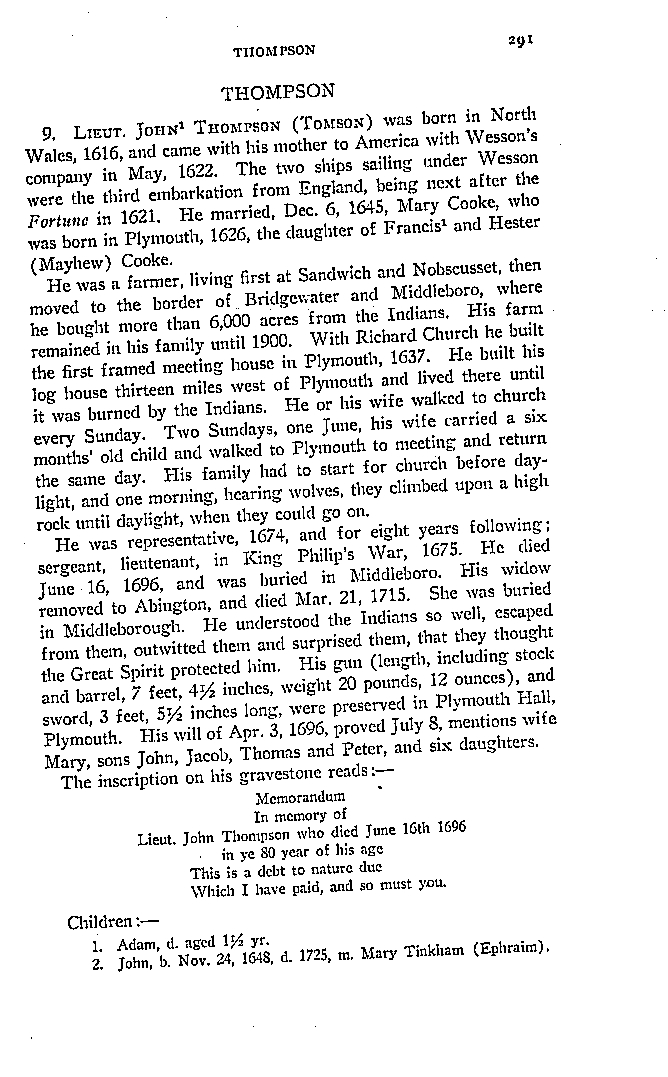
John Tomson – Biography

John Tomson – Biography 2

Children

1. Adam Tomson

Adam was born less than nine months after his parents marriage, for which they were fined.

3. John Tomson

John’s wife Mary Tinkham was born 5 Aug 1661 in Plymouth, Mass. Her parents were Ephraim Tinkham aned Mary Browne. Mary died 1731 in Halifax, Plymouth, Mass

4. Mary TOMSON (See Capt. Thomas Philip TABER‘s page)

5. Esther Tomson

Esther’s husband William Reed was born 15 Dec 1639 Weymouth, Norfolk, Mass. His parents were William Reed and Iris Avis Deacon. William died before 2 Sep 1706 at: Weymouth, Norfolk, Mass.

6. Elizabeth Tomson

Elizabeth’s husband William Swift was born 28 Aug 1654 in Sandwich, Barnstable Co, Mass, His parents were William Swift III and Ruth Tobey. William died 17 Jun 1700 in Sandwich, Barnstable Co, MA.

Some sources say Elizabeth was “not the daughter of John Thomson as often assumed”. and that Elizabeth married Thomas Swift.

Thomas Swift was born on 30 (5) 1659 in Dorchester, Mass. His parents were Thomas Swift and Elizabeth Vose. He is problematic. He died before his father and, in his will, his father appears to suggest that his son Thomas, might not really be his son. Vose says that he was unmarried, but is usually claimed that married Elizabeth Tomson. Some, however, suggest that Elizabeth married a William Swift

7. Sarah Tomson

Never Married

8. Lydia Thompson

Lydia’s husband James Soule was born 4 Oct 1659 in Duxbury, Plymouth, Mass. His parents were John Soule and Rebecca Simmons. His grandfather George Soule (c. 1595 – 1679) was a signer of the Mayflower Compact, and one of the original 102 Pilgrims who arrived on the Mayflower.  Soule was born in England about 1595, and as a young man became a teacher to Edward Winslow‘s children. Soule came with Winslow to America on the Mayflower in 1620 probably as an indentured servant. He was present at the time of the “First Thanksgiving” in 1621. In the 1623 Plymouth division of lands, Soule received 1-acre as a passenger on the Mayflower. About 1626, Soule married a woman named Mary (likely Mary Buckett), and they had nine children: Zacariah, John, Nathaniel, George, Susanna West, Mary, Elizabeth, Patience, and Benjamin. In 1637, Soule volunteered to serve during the Pequot War. Soule moved to Duxbury, Massachusetts at some point before 1642 and eventually became a prominent landowner there. He served as a deputy (representative) for Duxbury to the Plymouth General Court and on many committees in Plymouth Colony. Soule died in 1680, leaving a sizable estate. He was likely buried in Miles Standish Burial Ground where a stone was later erected in his memory.

James died 27 Aug 1744 in Middleboro, Plymouth, Mass

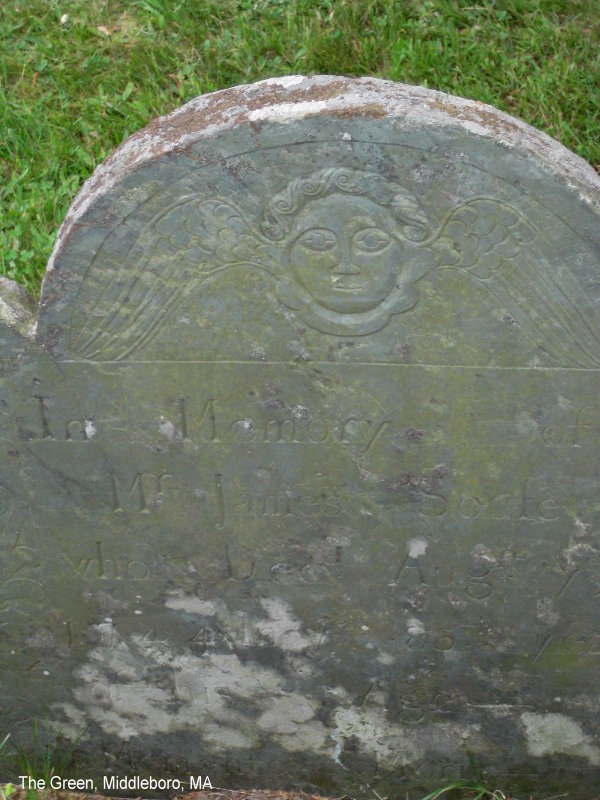
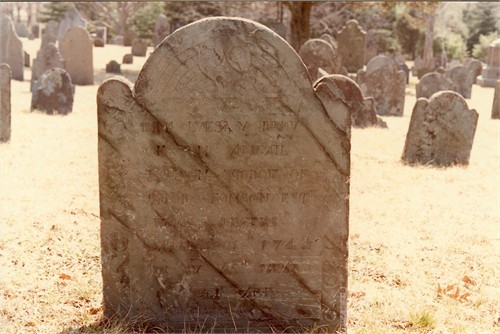
James Soule Headstone — Cemetery at The Green Middleboro Plymouth County Mass

Perhaps America first conscientious objector, James Soule was impressed 2 April 1690 “for services of Their Majesties at Canada” and, having refused to serve  on the Canadian expedition., was sentenced 9 Oct 1690 by the Council of War at Plimouth to fine and imprisonment.  His will dated Middleboro 30 Nov 1736, proved 20 Sept 1744, names wife Lydia; daughters Rebecca, and Martha Faunce wife of Joseph; son Jacob who was also named executor.  A codicil dated 22 Aug 1744 notes the death of his wife and son Jacob and names as executor Benjamin Weston, “faithful kinsman of Plympton.”

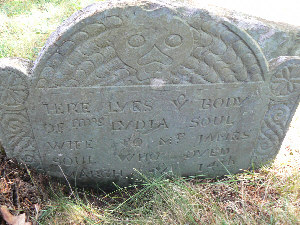
Lydia Tomson Soule Headstone — Cemetery at The Green Middleboro Plymouth County Mass

9. Jacob Tomson Esq.

Jacob’s wife Abigail Wadsworth  was born 25 Oct 1670.  Her parents were Deacon John Wadsworth and Abigail Andrews of Duxbury.  Abigail died 15 Jan 1744 in Halifax, Plymouth, Mass, in her 75th year, according to her gravestone, beside her husband’s.

Abigail Wadsworth Tomson Headstone — Cemetery at The Green Middleboro Plymouth County Mass.

Jacob was one of the original members of the First Church of Middleborough, Selectman from 1697 to 1702, and again from 1706-1726 and Representative in the General Court in 1716 and 1719. In the local militia he was ensign in 1700 and in 1708 was made Captain.

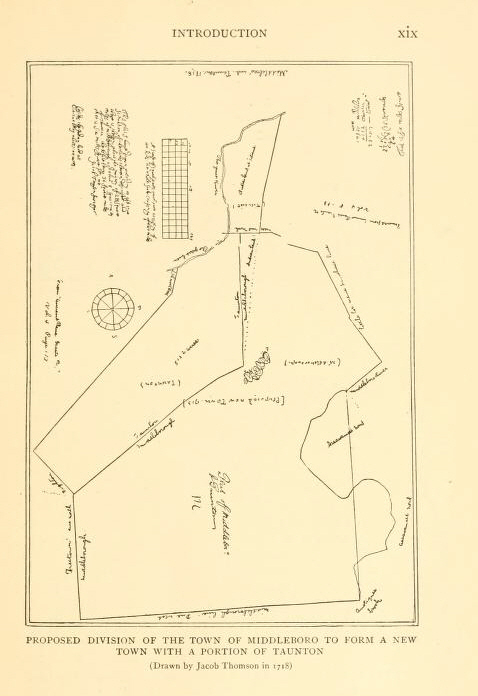
Middleborough Map drawn by Jacob Tomson in 1718 Jacob surveyed the “26 Men’s Purchase” dividing it among the Proprietors  into lots

Jacob  held a commission of Justice of the Peace a number of years. He was often referred to as “Jacob, Esquire.” He died 1 Sep 1726 in the 65th year of his age. Jacob and Abigail (wadsworth) had ten children, five of them living “beyond the common age allotted to man.” Caleb lived to be 75, John 90, Jacob 94, Barnabas 94, and Mercy 100. Jacob Tomson, his son, was appointed administer of the estate of his father, Jacob, Esq. who died intestate. On 22 Sep 1726 Jacob Tomson, as administrator, Thomas Tomson, and Ichabod King, gave a bond as sureties of Middleborough. The inventory of the estate was reported on 7 Mar 1726/7 with the personal estate valued at £652 19s, 7d. The inventory reported “instruments belonging to  surveying and writing” valued at 16s 2d, and 3s 9d respectively. “paper and parchment” was valued at 7s. The real estate amounted to £4,568  03s, considerable wealth for the time.

Probate, Relating To The Estate Of Jacob Tomson.

On 22 Sep 1726, “mr Jacob Tomson of middleboro” was appointed administrator on the estate of “your Father Jacob Tomson Esqr late of Middleboro …. dyed Intestate”

[From unrecorded bond] On 22 September, 1726 Jacob Tomson, as admirristrator, with Thomas Tomson and Ichabod King, as sureties, all three of Middleborough, gave a bond for £2000. The witnesses were Consider Howland and Nehemiah Bennett.

[From original warrant] On 23 September, 1726, “mr Isaac Cushman mr David Bosworth both of Plimpton and mr Samuell Harrow of Middleborough” were appointed to appraise “all the Estate both Reall and Personall”

An inventory of “ye Estate both Real & Personal” was taken, by the three appraisers, at Middleborough, 7 March, 1726/27. The personal estate was valued at £652, 19s., 7d. “Instruments belonging to Surveying & writing” were valued at £2, 3s., 9d.; “Paper & Parchment” 7s.
The real estate, amounting to £4568, 3s., was as follows:


“His two hundred acre Lotts being in Number ye 12th & ye 18th Lotts with ye 14th Lott of meadow all in ye 26 mens Purchase & given by Deed to His Son Jacob” £220.
“His Lott of meadow in ye upper meadow in sd Purchase” £20.
“His Lott of meadow Ground bought of John Haskall & Isaac Wallker being ye 10th Lott in sd Purchase” £18.
“His Lott of Cedar Swamp bought of Adam Wright being ye 34 Lott in sd Purchase” £60.
“This Lott in ye first allottment in ye Sixteen Shilling Purchase in ye Right of anthony Snow being ye 46th Lott” £55.
“His Lott in sd first alkittment bought of Jabez Wood being …. ye Eleventh Lott” £30.
“His two Lotts in ye third allottment in sd Purchase in ye Right of John Haskall being … ye 23d & 24th Lotts with I/4 of ye 18th Lott &: 19th Lotts in Said 3d allottment” £33.
“His 3/4 of ye 44th Lott in ye above sg first allottment” £36.
“His 169th Lott Bought of Samuel Barrows, His one halfe of ye 173 Lott bought of Samuel Dellanoe & His 2/3 of ye 156th & 174th Lotts in ye Right of mr Samuel Fuller all in ye third allottmont in ye Sixteen Shilling Purchase” £63.
“Ells 51st & fifty Second Lott & ye Lott which He bought of Samuel Sampson all in ye South Purchase: with His Sixteen
The Estate of Jacob Tomson, Esq. 169
acres Laid out with ye Lands of Ephraim morton in sd Purchase with all ye Comon Land which He bought of Leiut Nathaniel Southworth in Said Purchase Except a Small Parcell thereof Lying on ye west side of ye black Brook” £173.
“His Thirty acre Lott Called ye Pine wood Lott in …. Snipetuit Purchase with ye 14th Lott III sd Purchase as also His Lott of Cedar Swamp adjoyning thereto” £95.
“all His Rights in ye Little Shares in last allottment in Said South Purchase” £8.
“His 3/4 of ye 57th Lott in assawamsett neck in ye Right of Experience michell, with 3/8th of ye Saw: mill on Bartletts Brook £42, 1s.
“His Homestead with Buildings with all His Lands meadows & Swamps whether in middleboro, Plympton, or Pembrooke Lying on ye north side of winnatuxit River Excepting His Lott of meadow Lying on ye north Side of Colchester brook in Plympton” £1099, 5s.
“His 3/8th of ye Saw: mill near His House” £34.
“His Lott of Cedar Swamp :Bought of Samuel Bennett in ye 26 mens Purchase with one third of His 21 acres of Land on ye Beach Island in sd Purchase” £43, 6s.
“His fourty first & fourty Eight Lotts in ye South Purchase” £40.
“His 2/3d of a Lott on assawamsett neck in ye Right of mr Samuel Fuller” £16.
“His Lott of Cedar Swamp Bought of Nathan Howland being ye 16th Lott with one third Part of His 22 acres on ye Beach Island both in ye 26 mens Purchase” £28, 7s.
“His fifty ninth, Eighty Seventh & Eighty Eighth Lotts in ye South Purchase” £80.
“His three twenty five acre Lotts butting on ye great River with His Lott of Cedar Swamp in ye Right of Capt Mathew Fuller & one third Part of His twenty one acres of Land on ye Beach Island all Lying in ye 26 mens Purchase” £183, 7s.
“His Lott of meadow lying on ye north side of Colchester brook in Plympton with 1/8th of ye Saw: mill on Bartletts brook in middleboro” £67, 10s.
His Lott of Land in ye original Right of John morton in ye first allottment in ye 16 Shilling Purchase His 8th 9th & tenth Lotts in ye Second allottment in ye Sixteen Shilling Purchase with His Peice of Land bought of Leiut Nathaniel Southworth adjoyning to ye Southerly Side of ye abovesaid tenth Lott” £118.
“His Eleventh Lott in Snipetuit Purchase with His Lott in
170 The Estate of Jacob Tomson, Esq.
ye Cedar Swamp Called black brook Cedar Swamp in sd Purchase. His two Shares & a Halfe in ye fourth allottment in ye Sixteen Shilling Purchase” £75.
“His two Lotts in ye first allottment in ye Sixteen Shilling Purchase being …. ye 62d & 65th Lott with two thirds of ye 40th Lott in Said first allottment” £97.
“His Halfe Lott of Cedar Swamp bought of david Alden in ye 26 mens Purchase” £11.
“His Quarter of a Share of Cedar Swamp in ye Right of Experience michel in ye Sixteen Shilling Purchase with His two & a Quarter acres of meadow on baiting Brook” £3, 10s.
“His 106 acres of Land in ye five mens Purchase with ye 157th Lott in ye South Purchase given by deed to His daughter marcy Bennett” £160.
“His 4th & 20th Lotts in ye South Purchase” £60.
“His 105th & 106th Lotts in sd South Purchase” £60.
“His 107th & 108th Lotts in sd South Purchase £54.
“His 114th & 168th Lotts in sd South Purchase £41.
“His 197th Lott in Said South Purchase” £20.
“The one halfe of His Share of Land in ye Purchase Called Lothrops & Tomsons Purchase adjoyning to Rhochester Lands” £100.
“His 58th & fifty ninth Lotts on assawamsett neck with one third Part of ye Island Called annuxanan in quitticus Pond” £40.
“His 32 acres of Land on sd neck being Part of ye Lott which did formerly belong to Foelix ye Indian” £50.
“His one Halfe of ye Lott of Land at wopanockett in ye Right of william Bradford Junr” £11.
“His 3/4 of ye two Lotts in South Purchase in ye Right of Experience michel” £38.
“The one Halfe of His Share of Land in …. Lothrops & Tomsons Purchase adjoyning to Rhochester Lands” £100.
“His 30th & 37th Lotts with Halfe ye 28th Lott all Lying on assawamsett neck” £64.
“His 6th Lott in Snipetuet Purchase with His 122 acre between sd 6th Lott & Quittagues Pond in sd Snipetuit Purchase” £160.
‘His 37 & fourty Seventh Lotts in ye South Purchase” £45.
His Halfe Lott in ye Second allottment in ye Right of william Bradford Junr being ye 47th Lott” £15.
His 82 d & 98th Lotts in ye third allottment in ye Sixteen Shilling Purchase” £38.
His 106th & 1 17 Lotts in sd 3d allottment ‘ £35.
His 121st & 124 Lotts in sd 3d allottment” £48.
The Estate of Jacob Tomson, Esq. 171
“His 128 & 181 Lotts in sd 3d allottment” £48
His 163d & 164 Lotts in sd 3d allottment £30.
“His 2/3d of a Share in ye Right of mr Samuel Fuller & I/4 of a Share in ye Right of Experience michel in ye fourth allottment in ye 16 Shilling Purchase” £1, 18s.
“His Second Lott 69th & 70th Lotts in ye Second allottment in ye 16 Shilling Purchase” £97.
“His 45th 48th & ye 57th Lotts in ye third allotment in ye Sixteen Shilling Purchase with 16 acres at Sprouts meadow near Said Lotts” £128.
His Sixty Second, 74th & 75th Lotts in Said 3d allotment with halfe ye 63 Lott in Said allotment” £110
“His Halfe of ye 53 Lott in sd 3d allotment” £18
His 2/3 of a Share of Cedar Swamp in ye Right of Samuel
“His 4 shares in ye Right of matthew Fuller, Peregrin White, anthony Snow, & I Share bought of Timothy wood in ye South allohnent in sd Purchase” £8.
“His 90 acres of Land laid out to ye westward of the Pond Called ye Elders Pond in ye 16 Shilling Purchase” £160.
all His Interest in ye Lands Laid out on ye Easterly Side of namaskett River on ye northerly Side ye fall brook in sd Sixteen Shilling Purchase” £17.
“His 1/4 of ye Saw: mill on ye Herring River” £30
The inventory was sworn to by “mr Jacob Tomson administrator, and by the three appraisers, on 9 Mar 1726/27.
[5 :230, 231] On 22 Mar 1726/27,

Caleb Tomson, Esther Tomson, Hannah Tomson and Mary Tomson, children of “Jacob Tomson Esqr Late of middleborough”, and all minors between the ages of fourteen and twenty-one, chose “mr Thomas Tomson of middleborough as their guardian, and the choice was allowed.

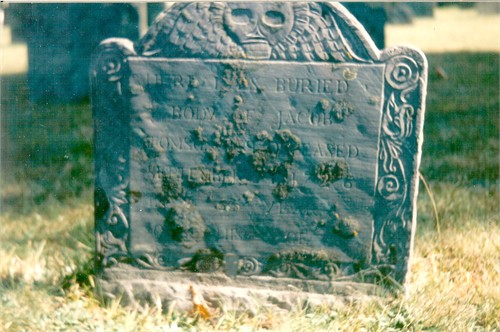
Jacob Tomson Headstone — Cemetery at The Green Middleboro Plymouth County Mass

10. Thomas Tomson

Thomas’ wife Mary Morton was born 15 Dec 1689 in Plymouth, Plymouth, Mass.  Her parents were John Morton and Mary Ring.  Mary died 20 Mar 1781 in Halifax, Plymouth, Mass

Thomas Tomson Jr. Bio

11. Peter Tomson

Peter’s first wife Rebecca Sturtevant was born 1670 in Middleboro, Plymouth, Mass.

Peter’s second wife Sarah Simmons 1670 in Scituate, Plymouth, Mass. Her parents were Moses Simmons and Patience Barstow. Sarah died 24 Oct 1742 in Halifax, Plymouth, Mass

Peter’s third wife Sarah Wood was born 1682 in Middleboro, Plymouth, Mass.

11. Mercy Tomson

Never Married

Sources:

http://freepages.genealogy.rootsweb.ancestry.com/~onebigfamily/all/aqwg1147.htm#29304

http://www.werelate.org/wiki/Person:John_Tomson_(1)

http://www.mayflowerfamilies.com/cooke/d9.htm#P33

http://www.themorrisclan.com/GENEALOGY/TOMSON%20John%20F3824.html

http://trees.ancestry.com/owt/person.aspx?pid=10565523

http://trees.ancestry.com/owt/person.aspx?pid=10565523&st=1


Posted in 11th Generation, Dissenter, First Comer, Historical Church, Historical Monument, Immigrant - England, Line - Miller, Pioneer, Public Office, Veteran | Tagged , , , , | 9 Comments

John Cooper

John COOPER (1592 – 1684) may have been Alex’s 10th Great Grandfather; one of 2,048 in this generation of the Miller line.

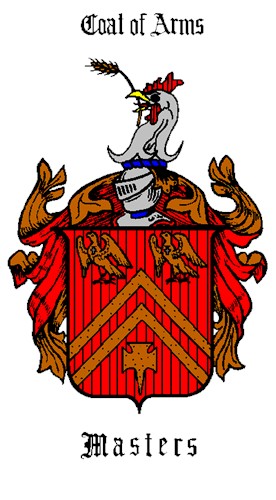
Cooper Coat of Arms

John Cooper was born 1592 in England.   He immigrated with his sister Lydia Cooper about the year 1632. He immigrated in 1634 and became a freeman on 1 Jan 1634/35 in Scituate, Plymouth Colony.  He married Priscilla CARPENTER on 27 Nov 1634 in Scituate, Mass.  About 1645, Lydia married Priscilla’s nephew Nathaniel Morton, son of Priscilla’s sister Juliana Carpenter MORTON Kempton.   Lydia & John Cooper also have a sister, Ann Cooper who died 1 Sept 1691 in Massachusetts.  The parents of Lydia, John & Ann Cooper are not known. However, their grandfather may be Thomas COOPER of Fluton with Silsoe, Bedfordshire, England. This line needs further research.  He left a will on 28 Dec 1676. His will was proved on 25 Feb 1683/84.   John died 25 Feb 1684 in Barnstable.

Priscilla Carpenter was born 3 Sep 1598 in Wrington, Somerset, England.  Her parents were Alexander CARPENTER and  Priscilla (Drucilla) DILLEN She was the sister of Juliana Carpenter. She first married William Wright who went to New England on the Fortune in 1621. Stratton, in “Plymouth Colony” believes that Priscilla did not come before 1627.  Priscilla died 28 Dec 1689 in Duxbury, Plymouth Mass.

William Wright was born in England probably around 1596 (based on his wife’s age). Nothing is known of his life in England. William Wright came over as a single man. By his marriage he was connected to William and Alice (Carpenter) (Southworth) Bradford and Samuel Fuller, whose second wife was Agnes Carpenter. He was a freeman of Plymouth in 1633, but died shortly thereafter. His inventory contained a number of woodworking tools. He married Priscilla Carpenter between 1629 and 1633 in Plymouth. They had no children

Many sites claim Ann was the Child of John and Priscilla:  However, Their marriage took place in 1634, 10 years before Ann Cooper married Ephraim Morton, which would make Ann an exceedingly young bride. Also John’s will written in 1676 mentions his sister Lydia and Priscilla’s sister Alice Bradford (Julianna) but does not mention any children, although Ann was alive at the point

Name Born Married Departed
1. Ann COOPER 1625 in Plymouth Colony Lt. Ephraim MORTON
18 Nov 1644
Plymouth, Mass
1 Sep 1691
Plymouth, Mass

John Cooper, planter, was in Scituate 1634.

John  was chosen a constable of Barnstable in 1639/40 and became a deputy there in 1642 and 1643.

In 1638, ‘tongue island,’ so called, was granted to John by the committee for laying out lands. This is one of the marsh Islands near Little’s bridge, and has been known by the name of Cooper’s Island. In 1639, he sold the island to William Wills, and the island bears the name of Wills’s island to this [1831] day. … He removed to Barnstable, 1639.  His will was made 1676.

John Cooper was not on the 1633 or 1634 Tax lists, but he was married at Plymouth on 27 Nov 1634 to Priscilla (Carpenter) Wright, widow of William Wright, and he became a freeman 1 Jan 1634-35.

In January 1634-35 a servant of Nicholas Snow said that he was willing to serve out the time of his indenture with John Cooper.

Cooper later moved to Scituate, and sometime between September 1634 & 1637 Goodman Cooper acquired John Hewes house in Scituate.

1 Jan 1637/38 –  John Cooper was one a group of men at Scituate who complianed about not having enough land to subsist on, and the Court of Assistants granted them additional land between the North and South Rivers.

He was chosen a constable of Barnstable in 1639/40 and became a deputy there in 1642 and 1643.

He dated his will 28 Dec 1676, sworn 25 Feb 1683/84, and he named his loving wife Priscilla, the children of his sister Alice Bradford, and the surviving children of his sister Lydia Morton. Alice (Carpenter) Bradford was the sister of his wife Priscilla (Carpenter) Cooper, and Lydia Morton was the Lydia Cooper who married Nathaniel Morton on 25 Dec. 1635; There is no known relationship of the Cooper family of Henlow, Bradfordshire, allied with the Sampson and Tilley families.

John Cooper was one of the first settlers in Barnstable, where he was active in town affairs and became a Deacon in the church; John Cooper and his sister, Lydia, came to Plymouth colony about the year 1632. In 1634, John married Priscilla, widow of William Wright and daughter of Alexander Carpenter.

John’s sister Lydia Cooper married Nathaniel Morton, son of our ancestor   George MORTON -Pilgrim Father and Juliana Carpenter, on 25 Dec 1635 in Plymouth, Plymouth Colony.

This John Cooper should not be confused with the John Cooper who was fined ten shillings on 5 July 1666 for profane and abusive carriage toward another, and who was a servant to Robert Bartlett on 4 July 1663, Bartlett complaining that Cooper refused to serve him because he had lost the indenture papers.

Sources:

http://familytreemaker.genealogy.com/users/c/o/w/Linda-A-Cowdrick/WEBSITE-0001/UHP-0431.html

http://www.rgcle.com/SS/p118.htm#i2360

http://www.gulbangi.com/5families-o/p227.htm#i5670

http://www.capecodhistory.us/genealogy/wellfleet/Names85.htm#COOPER

Posted in 12th Generation, 90+, Dissenter, First Comer, Immigrant - England, Line - Miller, Public Office | Tagged , | 7 Comments

Joseph Holloway

Joseph HOLLOWAY (1605 – 1645) was Alex’s 9th Great Grandfather; one of 1,024 in this generation of the Miller line.

Joseph Holloway – Coat of Arms

Joseph Holloway (Holley) was born in 1605 in West Anglia, an area north of London, England.  He married Rose Holly ALLEN about 1628 in Weymouth, Dorset, England. Joseph is listed on the roll of The “Elizabeth and Ann” which left London, England, arriving in Massachusetts Bay. Registration was open between 13 April – 14 May 1635. Her master was Robert Cooper. (sometimes Cowper) … #87 Holloway Jo. 21,   Joseph died in Dec 1645 in Sandwich, Mass.

Rose Holly Allen was born in 1610 in Bridgewater, Somerset, England.  Her parents were George ALLEN the Elder and [__?__] After Joseph died, she married  William Newland 19 May 1648 Sandwich, Mass. Rose died in 1691 in Sandwich, Mass.

Children of Joseph and Rose:

Name Born Married Departed
1. Joseph Holloway (Holly) c. 1636
Barnstable, Mass
Mary Hull
11 May 1657 Sandwich, Mass
5 Sep 1692
Sandwich, Mass
2. Sarah HOLLOWAY 1640 Sandwich, Plymouth Colony Joseph ALLEN
Jul 1662
1680
Dartmouth, Mass
3. Mary Holloway 1643
Sandwich, Mass
Nathaniel Fitz Randolph (son of Edward FITZ RANDOLPH)
11 Mar 1662 Barnstable, Mass
12 Jul 1703 Woodbridge, Middlesex, NJ
4. Experience Holloway (Holley) 1644
Barnstable, Mass
John Goodspeed
9 Jan 1667/68
Suffolk, Barnstable, Mass
1719
Barnstable, Mass
5. Hopestill Holloway (Holly) 1646
Barnstable, Mass
Dr. Samuel Worden
1665
Yarmouth, Barnstable, Mass
15 Sep 1715
Stonington, Connecticut

.
Children of Rose and William Newland

Name Born Married Departed
6. Mary Newland 16 Apr 1649
Sandwich, Barnstable, Mass
 4 Sep 1658
Sandwich, Mass
7. Mercy Newland 16 Apr 1649
Sandwich, Barnstable, Mass
William Edwards?
1685 in Weymouth, Norfolk, Mass
16 Jun 1674
Duxbury, Mas
8. Rose Newland 1651
Sandwich, Barnstable, Mass
Joseph Buck
2 Feb 1683 Sandwich, Barnstable, Mass
25 Nov 1683
Sandwich, Barnstable, Mass
9. Elizabeth Newland 1653
Sandwich, Barnstable, Mass
4 Sep 1658
Sandwich, Barnstable, Mass.

Joseph settled first in Saugus (Lynn), MA about 1635, but in 1637 moved to Sandwich, Barnstable, MA, with 61 other families. He was a millwright (miller).

Joseph Holloway lived in Sandwich, MA as early as 1641. He was on a committee to set apart the land of the whites from that of the Indians. Joseph also lived at Dorchester in 1634, and at Weymouth in 1639.

Here’s Barack’s Genealogy:

1) Joseph Holloway (1605-1647) married 1641 Rose Allen (1609-1692)
2) Mary Holloway (1638-1703) married 1662 Nathaniel FitzRandolph (1642-1713)
3) Samuel FitzRandolph (1668-1754) married Mary Jones (????-1760)
4) Prudence FitzRandolph (1696-1766) married 1716 Shubael Smith (1693-1768)
5) Mary Smith (1716-1791) married 1730 Jonathan Dunham (1710-????)
6) Samuel Dunham (1742-1824) married 1770 Hannah Ruble (1753-????)
7) Jacob Dunham (1795-1865) married 1819 Catherine Goodnight (1794-????)
8) Jacob Mackey Dunham (1824-1907) married 1853 Maria Eliza Stroup (1837-????)
9) Jacob William Dunham (1863-1937) married 1890 Mary Ann Kearney (1869-????)
10) Ralph Waldo Emerson Dunham (1894-1970) married 1915 Ruth Lucille Armour (1900-????)
11) Stanley Armour Dunham (1918-1992) married 1940 Madelyn Lee Payne (1922-????)
12) Shirley Ann Dunham (1942-1995) married 1960 Barack Hussein Obama (1936-living)
13) Barack Hussein Obama (1961- living)
14) Malia and Sasha!

and here’s ours
1. Joseph HOLLOWAY (1605 – 1645)
2. Sarah HOLLOWAY (1640-1675) Joseph ALLEN (1642 – 1704 )
3. William ALLEN (1673 – 1760)
4. Elizabeth ALLEN was born 1 Dec 1725 Seth MORTON (1722 – 1802)
5. Ruth MORTON b.  3 Jun 1752 in Freetown, Mass. m. Enoch DOW (1744 – 1813)
6. Ruth DOW b. 1 Dec 1787 m. Abraham ESTEY (1790 – )
7. Mary ESTEY b. 5 Jan 1820 in New Brunswick m. George MILLER (1817 – 1860)
Frank Nelson MILLER (1858 – 1903)
9. Genevieve MILLER (1899 -1965) m.  Horace Horton BLAIR (1894 – 1965)
10. Nancy and Everett
11. Mark, Janet and Ellen
12. Alex!

William Newland

William was born in 1610 in England. His parents were William Newland (1580 – 1673) and Agnus Greenway (1587 – 1653). William’s sister Mary married Henry HOWLAND’s son Henry. He first married 17 Jan 1627 Boston, Lincolnshire, , England to Catherine Mellowes.  William died 6 Jun 1694 Sandwich, Barnstable, Mass.

Rose Allen and her second husband, William Newland, were fined 10 shillings for being at a Quaker meeting on October 2, 1661, and that same year, William Newland was complained of for having entertained a Quaker in his home.

In 1657, “the people called Quakers” made their first appearance in Sandwich. In Bowden’s “History of the Society of Friends in America,”it is mentioned that two English Friends named ‘Christopher Holden  (See Puritans v. Quakers – Boston Martyrs) and John Copeland came to Sandwich on the 20th of 6th month ,1657, and had a number of meetings, and that their arrival was hailed with feelings of satisfaction by many who had long been burdened with a lifeless ministry and dead forms in religion. But the town had its advocates of reliigous intolerance and no small commotion ensued.” The Governor issued a warrant for their arrest, but when a copy of the warrant was asked for by William Newland at whose house the meetings had been held, it was refused and its execution was resisted. A severe rebuke and a fine was then inflicted upon them. The two prisoners,  were sentenced to be whipped, but the selectmen of the town declined to act in the case and the marshal was obliged to take them to Barnstable to find a magistrate willing to comply with the order.

Children

1. Joseph Holloway (Holly)

Joseph’s wife Mary Hull was born 30 Sep 1645 in Barnstable, Barnstable, Mass. Her parents were Tristham Hull and Blanche [Ridley?]. Joseph died 1692 in Barnstable, Barnstable, Mass.

Tristham Hull came to America about 1635, with his father, Joseph. He became a sea captain. He married about, 1643, age 19, to Blanch Ridley. He first resided in Yarmouth, Barnstable, MA. He was constable in 1661, and also selectman.

Tristam, along with several brothers, became a Quaker. His views frequently embroiled him with the authorities.

Their son, Capt. John Hull, mentions in his will, “a cousin, Mark Ridley.” This has led to the opinion that Blanch is the sister of Mark Ridley.

2. Sarah HOLLOWAY (See Joseph ALLEN‘s page)

3. Mary Holloway

Mary’s husband Nathaniel Fitz Randolph was born 15 May 1642 in Barnstable, Barnstable, Mass. His parents were Edward Fitz Randolph and Elizabeth Blossom.  After Mary died, he married 12 Apr 1706 to Jane Curtis Ogborn Hampton.  Nathaniel died 21 Nov 1713 in Woodbridge, Middlesex, New Jersey.

Woodbridge, Middlesex, New Jersey

Our  Nathaniel, eldest of ten children, was born at Barnstable, Mass., in 1642. He and his immediate descendants were the only members of this prominent family belonging to the Friends. It is thought Nathaniel joined the Society at his marriage in 1662.He suffered persecution from Plymouth government and was fined 10 pounds (1663) & 2 pounds, 2 shillings (1669) by Plymouth court. Before 1677, he received severe beating from Puritan neighbor after a religious argument and that same year he exchanged house in Barnstable for land in Woodbridge, NJ. He was succesful in New Jersey serving on the Vigilance Committeeman, Assoc Justice & High Sheriff of Middlesex Co, NJ, State Assemblyman, Overseer of Highways, Woodbridge Town Committeeman. Before 1713 he was a patentee of 590 acres of land in Middlesex Co, NJ.

In 1704 his house was opened for weekly meetings of the Friends. He died in 1713. His descendants have married with the Hulls, the Kinseys, the Hartshorns, the Hamptons, the Marshes, the Vails, the Laings, the Websters, the Shotwells and the Smiths.

On the 24th of August, 1704, at a quarterly meeting held in Shrewsbury, it was “agreed” that “for time to come it [the meeting] should be kept at Nathaniel Fitz Randolph’s house, in Woodbridge every first day of the week until Friends se kause to alter it.” “it was then and there proposed by some friends in and about Woodbridge, to wit, John Kensy, Benjamin Griffith, William Sutton and John Laing whether it might not be konvenient to have a Preparative-meeting setled there to be held once a month? the Question was considered by friends and they answered, that it was their sence that it might be Serviceable and agreed to it, and left the appointment of the day when it should be held, to the friends of Woodbridge meeting.”

The Woodbridge meetings, except two, (held at John Kinsey’s in November & December, 1707) continued from this time forward to be held at the house of Fitz Randolph until the Friends had completed their meeting house, in which the first session was held September 19th, 1713. We cannot tell where Fitz Randolph dwelt; hence we cannot designate the locality where the Quakers met, for so many years, in harmonious council. Nor are we wiser in regard to the house of Benjamin Griffith where the first Quaker meeting in the village was convened. In 1707 we find the latter spoken of as an inhabitant of Amboy, from which we infer that he had returned to that place, although he attended the Woodbridge meetings with unabated interest. It may not be out of place to state that some well-informed people believe Nathaniel Fitz Randolph’s residence to have occupied the site of the building which was the property of the late John Barron, near the depot on Green Street.

On the 18th of August the building of a Meeting-house was again discussed, John Kinsy offering a plot of ground for the purpose. Kinsy’s offer was not accepted on account of the inconvenience of the locality in which his land lay. It was resolved, however, to select a suitable place. In September, Nathaniel Fitz Randolph reported that no eligible spot had been heard of; but in October he stated that a man willing to sell a desirable piece of ground had been found. He was authorized to effect the purchase of it. On the 21st of January, 1706, he informed the Friends that the land, comprising of half an acre, could be obtained for six pounds. The meeting approved the proceedings of Fitz Randolph, and he was directed to make the purchase in his own name. A subscription of eleven shillings and six pence was paid, which was swelled at subsequent meetings to the full amount required. William Sutton, being about to remove from Piscataway to Burlington, on the 15th of June donated a year-old steer “towards building [the] Meeting-house.” The animal was taken to be “wintered” for 6s. by Thomas Sutton, son of William, by order of the Friends. At this date the land in question had been laid out by Nathaniel Fitz Randolph and John Allen; and a deed was written by the Clerk, Benjamin Griffith, by which the land was held in trust for the Quakers by Fitz Randolph and John Kinsy. John Allen, formerly minister of the Woodbridge Town Church, was the man from whom the plot was bought , the said Allen owning considerable property about where the Methodist Episcopal Church now stands. Many of our Woodbridge readers remember the Friends’ burial place recently occupied by the lecture-room of the Methodists; but few, if any, are aware that a Quaker Meeting House once stood there. Such is the fact, and the history of this ancient building, no trace of which is left, is that which we are now recounting. How soon, alas, perishes all the handiwork of man! This house cost much sacrifice and toil to complete it, as the records show; but what remains, except these yellow leaves, to tell us the struggles of the godly worshipers. May they sleep the sleep of the just in their unknown graves, for the story of their toils is know to One who giveth rest to His beloved.

Fitz Randolph Gates

Nathaniel’s nephew Nathaniel Fitz Randolph is the man most responsible for Princeton University being located in Princeton. He was a large land owner in and about Princeton, and one of its prominent citizens. A number of other locations for the college of New Jersey were considered. New Brunswick was more favored than any other site by the Trustees, but Fitz Randolph by his energy fulfilled the monetary requirements for the location of the college, where others failed, and won the prize.

The myth surrounding Fitz Randolph Gate prevents most students from venturing out the main exit.

The FitzRandolph Gate was initially constructed to keep townspeople off the University campus. It was built in 1905 and kept closed and locked, except during the Parade and graduation. The graduation march through the gate, which is still observed, symbolizes the graduates’ transition from the University into the larger world.

The gate was also opened occasionally to honor notable visitors.  For example, President Grover Cleveland passed through the gate during his visit to campus.

In 1970, the gate was permanently cemented open, at the request of the Class of 1970. This gesture was intended to reflect improving relations with the town. The opening also embodied a greater significance.  Given the student uproar over Vietnam and Cambodia, it was an attempt to symbolize that Princeton was open and responsive to the world, and not just a cloistered ivy tower.  Since 1970, the gate has remained open for regular use. However, the superstition that emerged shortly after the opening has caused some students to avoid the gate.

According to the myth, students may imperil their graduation by exiting the gate towards Nassau Street.   While entering the gate is apparently safe, some students still take extra precaution.

“I know people that won’t walk in the gates,” said Emily Moxley ’05. “I always laugh at them when I walk in and they take an extra minute or two to go to one of the side gates.

Some alumni are still quite serious about observing FitzRandolph protocol. Michelle Yun ’06 visited campus as a pre-frosh with Thomas F. Schrader ’72. At the time, she was not aware of the myth and nearly walked out of the gate to take a photograph.  “Mr. Schrader jumped up . . . and grabbed me with both arms, pulling me back suddenly,” she said.  Since the incident, Yun says she will not enter or exit the gate and will not permit anyone walking with her to do so either.

Edward Fitz Randolph came with his parents when a lad from Nottinghamshire in old England to New England in 1630, and lived at Barnstable, Massachusetts. There he married a wife whose maiden name was Blossom. Her parents had fled from persecution in England in about 1620. They put into Holland and she was born there.”

Edward Fitz Randolph and his family left their Massachusetts home in 1669, and settled in East Jersey, near the mouth of the Raritan river, where he purchased from the Proprietary a large tract of land. Several of his older sons also taking up lands in their own right at the same time. At the time of Edward’s death in 1675 his land had not been surveyed.

Several of the Fitz Randolph families made East Jersey their home for many generations. But Benjamin in a few years moved to the site of the present town of Princeton. Our knowledge of his family is entirely due to the records left by his son Nathaniel Fitz Randolph of Princeton.

4. Experience Holloway (Holley)

Experience’s husband John Goodspeed was born 15 Jun 1645 in Barnstable, Barnstable, Mass. His parents were Roger Goodspeed and Alice Layton. John died 1719 in Barnstable, Barnstable, Mass.

John Goodspeed spent the first few years of his life at Barnstable, MA, but after about 1647 lived uninterruptedly at Misteake (now Marstons Mills), Barnstable, MA.  Upon his marriage, his father gave him a small tract of land at Misteake for a home, probably the nucleus of the estate owned by him.

After reaching the proper age, he was made a freeman and townsman.  In 1675-1676 he participated in the Narragansett Wars of King Philip and his allies.  He was in the 3rd expedition under Capt. Thomas Howes [son of Thomas HOWES] of Yarmouth , and very probably was in one or more of the other three expeditions.  In the division of the gratuity of land granted the soldiers of these wars, John received 112 lots.  He probably participated in the bloody battle of Rehoboth on March 26, 1676.

John’s admission as a townsman entitled him to participate in the division of lands of the town propriety. In 1678, his father transferred to him and his brother Ebenezer all of the old homestead except six acres, in consideration of their maintaining him and their mother during the rest of their lives. The old homestead at Misteake (now Marston Mills) is early referred to as “at the South Sea” and the Goodspeeds were called “South Sea men.”

The will of John is dated August 5, 1718

“Item. I Give and bequeath to my Loving Wife Experience the use and Improvement of all my personal estate of whatever nature Kind & quality forever both within doors and without for her comfort use and benefit and after her decease in manner following viz: To my eldest son John I Give four Pounds to be allowed and discounted out of the Twenty Pounds he oweth me on verbal promise for upland and meadow he bought of me if his mother see cause otherwise to be paid out of ye estate she may have at her decease.

“Item. I give and bequeath to my son Benjamin forty shillings and my home after my wife’s decease.

“Item. I Give and bequeath to my grandchild Ruth Daughter of my son Saml Deceased fourteen pounds.

“Item. I give and bequeath to my three Daughters Mary, rose and Bathsheba all ye Rest of my movable estate, viz, all my bedding, Housal goods and utensils within Doors and all my flock of Cattle which shall Remain & be left after my sd wife’s decease.

“Item. I Give and bequeath to my Grandson Samuel Goodspeed my saddle I use to ride on.

“Lastly, I nominate and appoint my sd wife Experience to be executrix to this my Last Will and Testament to execute what she may judge proper During her Life, and after her Decease my will is that my Two sons John and Benjamin above named shall be executors to fulfill and perfect the same.

Signed by John Goodspeed, his mark and a seal.

John was a farmer, and left a large estate (which included a looking glass, glases, books and a gold piece) for those times. (Son John seems to have been unfilial to his mother Alice in her old age and after the death of his father. As a consequence, in her will she cut him off with a shilling, and directed that what he owed her should be paid “to her loving son Ebenezer.”)

5. Hopestill Holloway (Holly)

Hopestill’s husband Samuel Worden was born 1646 in East Dennis, Barnstable, Mass. His parents were Peter Worden and Mary Winslow. I can’t find reference to how Samuel became a doctor. Samuel died 26 Aug 1716 in Stonington, New London, Connecticut.

Dr. Samuel definitely married Hopestill Holley before May 1665, when Hopestill’s
stepfather paid the children of Joseph Holley, Sr. the money due from their father’s estate.
Hopestill, ”wife of Samuel Worden” was one of them.

28 Oct 1668 Samuel Worden filed the following complaint in Plymouth Colony:

“In reference unto the complaint of Samuell Worden against Edward Crowell and James Maker, for goeing in his absence into his house in the dead time of night, and for threatening to breake up the dore and come in att the window, if not lett in, and goeing to his bed and attempting the chasity of his wife and sister, by many lacious carriages and affrightening of his children, the Court have centenced them, the said Edward Crowell and James Maker, to find sureties for theire good behavior and pay each of them a fine of ten pounds to the use of the collonie and also to defray all the charges of the said Samuel Werden hath bine att in the vindecation of his wifes innosensy or to be severally whipt.”Both defendants paid their fines and were released.

1672 – Samuel Werden was proposed for a freeman.

1687 The will of Mary Worden, widow of Yarmouth:

“That there be no difference amongst my children, my said children also having manifested their willingness and consent on to me to dispose or bequeth what should leift of my worldly goods or estate at my decease as I should see cause as per articles of agreement in writing indented bearing date of the second of May 1681 doeth and may appeare. I … declare this … my last will.” All wearing apparel to be equally divided between her three daughters Mary Burge, Mercy Winslow, and Martha Severance; the rest of the estate after debts are paid, to son-in-law John Burge; “excepting my Indian squaw servant which will and bequeath to my son Samuell Worden.

Executor John Burge Dated 6 March 1686
Signed by her mark
Proved 31 May 1687
Witnesses: Samuel Sears, Silas Sears, and Gov. Thomas Hinkly.
Recorded 8 June 1687 by Joseph Lathrop, Dep. Reg.

Before 1693 – Dr. Samuel bought land in Rhode Island, because in a deed registered there on 19 Sep 1693, Werden’s Pond is called by his name. Wordens Pond [google maps] is just a couple miles south of the site of the Great Swamp Fight

8 Jul 1695 – Samuel  bought land consisting of 250 acres from the estate of Gov. Benedict Arnold [great-grandfather of Benedict Arnold the traitor], one of the original purchasers of a tract of land in this “collony comonly called Pitticomcott.” Besides Roger Williams, Arnold was the only member of the colony who was highly proficient in the Narragansett and Wampanoag tongues, and he was often called upon to interpret during negotiations.  This was originally purchased by Benedict Arnold in 1658 and comprises the present towns of South Kingston and Narragansett.

1696 -Dr. Samuel sold his farm in the town of Yarmouth, Mass. to Isaac Chapman “except one half aker of land which I Samuel Werden except and reserve to myself and to my fathers posterity forever, lying square about the place where my father Werden was buried, out of the aforementioned farm, notwithstanding whatever is said above to the contrary, with free liberty of ingress and egress with horse or cart or foot from the common highway to same to have and to hold forever.” He therefore preserved this land to all Wordens forever.

Hopestill and Samuel were still married when she died  September 13, 1715. In the Norwich Ct. Town clerk’s Office is found; “ It was to me that woeful day in which my dear and tender and loving wife departed this life and was buried on ye 15th”

A few months after Hopestill died, Dr. Samuel married Francis West. In Stonington, Connecticut 18 September 1716, “Francis Werden, widow and relique of Samuel Werden late of Stonington dec. refuseth to administer upon ye estate of her late husband, Samuel Werden dec. and desireth that adm. may be granted to Isaac Werden. Isaac Werden died in 1718 and his wife Rebekah became administer for both estates.

8. Rose Newland

Rose’s husband Joseph Buck was born 26 Jun 1657 in Scituate, Mass. His parents were John Buck and Elizabeth Granger. Joseph died 1698 in Sandwich, Barnstable, Mass.

Sources:

http://jfredpeterson.com/tree/g12holl.htm

http://www.geneamusings.com/2007/02/yep-barack-obama-is-my-cousin.html

http://trees.ancestry.com/owt/person.aspx?pid=28429017&st=1 

http://trees.ancestry.com/owt/person.aspx?pid=11360123

Randolph–Pangburn: William Pangburn and his wife Hannah Fitz Randolph; their ancestry and descendants, 1620-1909″

http://freepages.genealogy.rootsweb.ancestry.com/~amorrow/fg01/fg01_299.html

Posted in 11th Generation, Dissenter, Immigrant - England, Line - Miller, Place Names, Storied, Twins | Tagged , , , | 9 Comments

George Allen the Elder

George ALLEN the Elder (c. 1568 – 1648) was Alex’s 10th Great Grandfather two times over; two of 2,048  in this generation of the Miller line.  His daughter Rose and son Ralph are both our ancestors.

George Allen – Coat of Arms

George Allen was born before 1568 in Weymouth, Dorset, England.  His parents were Ralph ALLEN and Margaret WYOTT.  He married Katherine [WATTS?] 26 Oct 1592 in Scraptoft, Leicestershire, England.  After his first wife died, he married Katherine [Starkes?] about 1624 in London, England. He and his family immigrated with the Hull Company and arrived in Massachusetts Bay Colony on 6 May 1635 from England.   George died 2 May 1648 in Sandwich, Mass.

Katherine Watts was born 7 Oct 1576 in North Petherton, Somerset, England.  Katherine died about 1619 in Saltford, Somerset, England.

Katherine [Starkes] was born in 1605 in Woking, Surrey, England.  Sometime after George passed away in 1648, Katherine married for a second time to a man named John Collins, who was a shoemaker in Boston. Katherine died 1656 in Sandwich, Barnstable, Mass.

Children of George and Katherine [Watts?]:

Name Born Married Departed
1. Joan Allen 1602
Weymouth, Dorset, England
Clement Briggs
1 Mar 1631 Dorchester, Norfolk, Mass
1639
Weymouth, Mass
2. John Allen 1609
Weymouth, Dorset, England
Christina Bacon
1634 Weymouth, Dorset, England
3 May 1690 Swanzy (now Swansea, Bristol, Mass)
3. Ralph ALLEN c. 1615 Thurcaster, Leicester, England Susannah [__?__]
c. 1638
Mar 1698 Sandwich Mass.
4. Rose ALLEN 1610 Bridgewater, Somerset, England Joseph HOLLOWAY
c. 1628 Weymouth, Dorset, England
.
William Newland
19 May 1648 Sandwich, Mass
1691 Sandwich
5. George Allen c. 1619 Weymouth, Dorset, England Hannah [Calib]
1643 Sandwich
.
Sarah Lamb
6 Jun 1657 Sandwich
22 Apr 1693 Sandwich
6. Robert Allen aft. 1622
England
Unmarried 15 May 1661
Rehoboth, Mass.
(committed suicide)

.
Children of George and [Katherine Starkes?]:

Name Born Married Departed
7. William Allen c. 1627
Weymouth, Dorset, England
Priscilla Browne
21 Mar 1649/50
Sandwich, Mass
1 Oct 1705
Sandwich, Mass.
8. Mathew Allen 1629 Sandwich, Plymouth Colony Sarah Kirby
5 Jun 1657
Sandwich, Mass
6 Mar 1694/95
Dartmouth, Mass
9. Samuel Allen 10 Nov 1632
Windsor, CT
18 Oct 1718
Northampton, Mass
10. Gideon Allen 1635
Sandwich, Mass
Sarah Ann Prudden
1672
Milford, New Haven Colony
1693/94
Milford, New Haven Colony
11. Henry Allen 1637
Sandwich, Mass
Sarah Hill (Black?)
1662
.
Rebecca Sherwood (Mrs. Robert Rose)
Stratford, CT
1680
8 Nov 1690
Stratford, CT
12. Francis Allen 1643
Sandwich, Mass
Mary Barlow
20 Jul 1662
1 Dec 1696/97
Sandwich, Mass
13. Caleb Allen 27 Jun 1645
Sandwich, Mass
27 Jun 1647
Sandwich, Barnstable, Mas

George’s Life in England

Although it is not known for sure, George Allen may have been born in either Somersetshire, or Dorsetshire, England, or have at least resided in one of these places prior to emigrating. Lending some support for this belief is the fact that the Rev. Hull, and many of the other families that emigrated with George, appear to have been from one of these shires. George Allen is known to have married twice while still residing in England.   His second wife, Katherine,  accompanied George to America, and is believed to have been the mother of his youngest children. According to the roster of passengers making up the Hull party, Katherine was listed as being thirty years old in 1635, thereby indicating that she had probably been born in about 1605 in England.

Although one commonly sees postings and family write-ups that indicate that our George Allen is the George Allen who married as his second wife, Katherine Starkes, on 5 Nov 1624 in All Hallows Church, Honey Lane, London, there is no documentation that would support that this is the same George Allen. On the contrary, there is evidence that suggests that this George Allen was the son of Richard Allen of the Tower of London, and that he was still residing in London, England as late as 1640, when he was mentioned in his brother, Henry’s, will. This George Allen is also believed to be the same George Allen who died at St. Michael Queenhithe, London on 26 Mar 1664.

In addition to the above, it has also been accepted by some that our George Allen was the son of John Allen of Saltford in Somersetshire, England. As with the above assertion, there is no evidence that I know of to substantiate this. There is, however, strong evidence that indicates that this George Allen was still residing at Saltford in 1638, when he was involved in a court case regarding tenements in the Tything of Saltford. By 1638, our George Allen was already well established at Sandwich on Cape Cod. Aside from the fact that a person named George Allen was identified as living in Saltford, England during the 1630’s, any connection to our George Allen appears to be based more on conjecture than supportable facts.

The same also appears to be true regarding the assertion that our George Allen was the son of Ralph Allen of Thurcaston, England. Even though there were two individuals named Ralph Allen who were associated with our George Allen in New Plymouth Colony, I am not aware of any evidence, other than name similarity, to support this contention either.

The Hull Company

George’s name, along with the names of those he emigrated with (106 in all), was discovered on a list of passengers who departed from Weymouth, England for the New World on 20 March 1635.   The Hull Company under the leadership of the Rev. Joseph Hull, was granted leave to settle at Wessaguscus Plantation by the General Court at Boston.  Wessaguscus was soon given municipal rights, at which time it was renamed Weymouth, and its inhabitants were allowed representation in the General Court at Boston.

The Allen family appears on a  listing of immigrant ships and their passengers of the Hull Company. This ship sailed from Weymouth on 20 March 1635  and arrived on 8 July 1635.

46 George Allin, aged 24 years.  (George ALLEN the Elder was a much older man in 1635, closer to 54. He had been preceded by two sons (by a first wife) Henry and Samuel, who came in 1629-30.)

47 Katherine Allin, his wife, aged 30 years.
48 George Allin, his son, aged 16 years.
49 William Allin, his son, aged 8 years.
50 Matthew Allin, his son, aged 6 years.
51 Edward Poole, his servant, aged 26 years.

Actually, we believe that George was a bit older than 24 years old, closer to 54 years. The George Allin, 16 was a son by his first wife, not Katherine

“Reputedly Anapabtists, Rev. Hull and his flock, including the Allens, first settled at Lynn, MA but in 1637 George Allen with Edmund FREEMAN and 7 or 8 others joined in buying the Township of Sandwich on the North shore of Cape Cod, an area inhabited by friendly Indiants. George’s name is on the first list of church members there (1638) and in 1639 he was elected “Constable”, a very important office, representing the entire civil authority for the orderly proceedings of the Township.

George’s Life in America

In 1640-42 he was Deputy to the General Court at Plymouth and in 1641 was one of a committee to divide the land among the settlers and given 6 1/2 acres for this task. In 1646 he built his home about 1/4 mile from the Quaker Friends Meeting House on the main road down the Cape – a home which was still standing 236 years later until 1882.”  George died in 1648 at the age of 80.

Although no records have been found to verify it, shortly after settling at Wessaguscus (Weymouth), George and his family may have moved to the village of Saugus, Massachusetts (now Lynn, Massachusetts). Sometime during the period 1637/38, however, George and his family again moved, this time to the newly organized settlement in New Plymouth Colony of Sandwich on Cape Cod. George, who was a farmer by trade, was subsequently recommended for “freeman” status in New Plymouth Colony on 5 March 1638/39, and was later admitted as such on 3 September 1639. George was later sworn in as the Constable of Sandwich on 4 June 1639, and served as Surveyor of Highways in 1640. He also served as a Committeeman for the New Plymouth Court in 1640, 1641, 1642, and 1644. and was Deputy to the New Plymouth Court during the 1640’s.

George was an Anabaptist, a sect originating in Zurich, Switzerland, in 1523, which rejected infant baptism, advocated separation of church and state, so it is easy to understand his family’s sympathy with the Quakers.

George apparently died during the latter part of April 1648 at Sandwich, New Plymouth Colony, as he was subsequently buried there on 2 May 1648. George’s will was later probated before the New Plymouth Court on 7 June 1648, and one year later, on 8 June 1649, his widow, Katherine, furnished an inventory of George’s estate to the New Plymouth Court.

Although the identities of all of George’s children have never been determined beyond all doubt, the names of eight children have been verified through various documents. In addition to these eight, it is highly probable that three other individuals, namely John, Robert, and Francis Allen, are also sons of George. Aside from those children that are known and very probable, some researchers also believe that the Joan Allen who married Clement Briggs at Dorchester in 1630/31, and the Joshua Allen who married Mary Crowell at Yarmouth in 1671, are also George’s children.

It should also be mentioned that the “five least children” that George referred to in his will have not been verified beyond all doubt either. However, these children, who have been interpreted by most authorities to be the children George Allen had with his second wife, Katherine, are strongly believed to be Matthew, William, Henry, Samuel, and Gideon.

George Allen – Biography 1
George Allen – Biography 2
George Allen – Biography 3

Children

1. Joan Allen

Joan’s husband Clement Briggs was born 1587 in Southwark, Surrey, England. His father was John Briggs. Clement died 23 Dec 1648 Weymouth, Norfolk, Mass.

Savage’s Genealogical Dictionary

BRIGGS, Clement, Plymouth, came in the Fortune, 1621, probably young; removed to Dorchester, there married, 1630 or 1631 early, Joan Allen, for officiating at which ceremony Thomas Stoughton [son of our ancestor Rev. Thomas STOUGHTON], the constable, was fined £5 at the March Court in 1631.

[Stoughton had exceeded his authority and at that time, the Governor received a fee of £5 for performing marriage ceremonies] “A Court of Assistants, holden att Boston 1th of March 1630-31. Mr. Tho: Stoughton, Constable of Dorchester, is fyned 5 pounds for takeing upon him to Marry Clemt Briggs & Joane Allen, & to be imprisoned til hee hath paid his fyne.” but 6 Sept. 1638, the fine referred to was discharged. ]

Thence he removed to Weymouth, 1633, had a son, Thomas, b. June 14, 1633, also Jonathan, b. June 14, 1635; John, David, b. Aug. 23, 1640, and Clement, b. Jan. 1, 1643. Grievous is our feeling of regret at finding the Court in June 1638, led to forbid the wife to come into the company of Arthur Warren, as we are compelled to fear the marriage was imprudent. Before he died he had another wife, Elizabeth. Of his will, the abstract is given in (N. E.) “Genealog. Keg. VII 233,” but the envelope on it is labeled Mart/ Mouth, which the blundering clerk read for Weymouth, the residence of the testator. His inventory of Feb. 23, 1649, was labeled Osomunt Bray, full evidence of knowledge by the scrivener of the old writing. In vol. IX. of the “Register” the correct name is given. (Estate prized by Robert Tucker, 23 last mo. .’48. Testified before Mr. Bellingha’m, 24 (8) 1650. William Aspinwall, Recorder.) His son Thomas was of Taunton, 1668, and number of descendants in that vicinity.

Joan Allen and Clement Briggs Timeline

1. Lands Recorded – Granted; 1623; Plymouth Colony, MA 2 3. Page 6 of the colony records: The fales of their grounds which came in the Fortune according as their lots were cast 1623. This ship came Novr 1621; these lye to the sea, eastward: Clemente Brigges – 1

“1 Acre beyond the first brooke to the wood westward.” [Records of the Colony of New Plymouth, 1:5]

2. Division of Cattle; 1 Jun 1627; Plymouth Colony, MA 4. Number 10 in the fourth lot for the division of cattle. This group received “one of the 4 heyfers Came in the Jacob Called Raghorne.”

3. Removal; Bef 6 Feb 1630/31; Massachusetts Bay Colony, MA. Mentioned in the letter from William Bradford, Governor of Plymouth Bay Colony, to John Winthrop, the Governor of the Massachusetts Bay Colony: “Now ther are diverce goone from hence, to dwell and inhabite with you, as Clement Brigges..”

Some have argued that Clement Briggs and the others who went to Massachusetts were not of the original Pilgrim group and left for religious reasons. Another possibility is that Clement and the others were granted land in Weymouth before the boundary was drawn between the two colonies. Clement, as a fellsmonger, may have relocated to Weymouth in order to obtain the bark from a certain species of oak tree used in the tanning process

4. Fine; 6 Oct 1634; Massachusetts Bay Colony, MA. Clement Briggs fined 10s for entertaining an Indian without leave.  At a Court, holden at Newe Towne October 6th, 1634 Clemt Briggis is ffined Xs for entertaineing an Indean without leaue, & is enioyned forthwith to discharge himselfe of him.” (Record of the Gov. Mass. 1:132) “At a Generall Court, held at Boston, the 6th day of the 7th Month 1638. Dicto, (6Oct. 1634) Clement Brigs, being fined 10 shs, is discharged by the Court.” (Rec. of the Gove. Mass. 1:244)

5. Lands Recorded; 8 Oct 1637; Plymouth Colony, MA. Clement Briggs exchanged four acres of land in Plymouth for four acres of land on “Joanes” River. The deed was recorded by Gov. Bradford.

“Know all men by these prnte that I Clement Briggs of Wessaguscus for and in consideracon of the sume of fiue shillings inmoney to me paid by John Browne of Plymouth the eight day of October 1637 do couenant and graunt that the said John Browne [our ancestor John BROWNE Sr. ] shall haue and ejoy for him and his heirs foreuer foure acres of land of the vpper end of that lot of land that appertaineth vnto me the said Clement Briggs and that the said John Browne doth also agree that the sd Clement Briggs shall haue for him & his heirs for euer the quantitie of foure acres of land out of the land of the said John Browne lying at the end and adjoyneing to the residue of the land of the aforsd Clement Briggs at Jonanes Riuer witnesse my hand the day & yeare aforesd. The mark of Clement ~~ Briggs. Richard Cornish witnes.” [Rec. of the Colony of New Plymouth, 1:22]

6. Provided Bond; 6 Mar 1637/38; Massachusetts Bay Colony, MA. On 6 Mar, 1637/8, clement Briggs was bonded for £10 for his wife to appear in the next court for Arthur Warren being in her company. [Rec. of the Governor and Company of Mass. Bay Colony, 1:219, 233, & 244] There is no evidence that this was in any way a moral charge against Joan Briggs.

The records (Rec. Gov. Mass 1:219) are as follows:

“At a Quarter Court, held at Newetowne the 6th day of the first month (March) 1637-1638. Clement Briggs is bound in 5 pounds for his wifes appearance at the next Quarter Court. The presentment of Arthur Warren, for keeping company with Clement Briggs wife, was found to bee true.” 1.233 “At a Courte of Assistants, held at Cambridge, the 5th day of the 4th Mo. anno 1638, being a Qrter Courte. Clement Brigs his wife is enioyned not to come into the Company of Arthur Warren.”

7. Deposition; 29 Aug 1638; Weymouth, Plymouth Co., MA. The Deposition of Clement Briggs of Weymouth felmonger, taken at New Plymouth the xxix day of August in the fourteenth yeare of ye now reigne of our sovaryne Lord Charles by the grace of God of England &c. 1638, before Thom Prence [Gov. Thomas PRENCE] of New Plymouth gent ovr, and Willm Bradford for the same Gent, assistant of the govnt &c.

“This Deponent Deposeth and sayth that about two and twenty yeares since, this depont then dwelling wth one Mr Samuel Lathame in Barmundsey street Southwarke, a felmonger, and one Thomas Harlow then also dwelling wth Mr. Robte Heeks in the same street a fellmonger, the said Harlow and this depont had often conferrence together how many pelt eich of their masters pulled a week. And this depont deposeth and sayth that the said Robte Heeks did pull three hundred pelts a week, and divers tymes six or seven hundred & more a week in the killinge seasons, wch was the most part of the yeare (except the tyme of lent) for the space of three or foure yeares. And that the said Bobte Heeks sould his sheeps pelts at that tyme for fourty shillings a hundred to Mr Arnold Allard, Whereas this Deponts Mr Samuel Laythame sould his pelts for fifty shilling p C to ye same man, at ye same time, and Mr Heeks pelts were much better ware.

CLEMENT BRIGGS his mark.”

8. Occupation; 29 Aug 1638; Weymouth, Plymouth Co., MA. Describes himself as a fellmonger [tanner] in a deposition.

9. Lands Recorded – Sold; 29 Aug 1638; Plymouth Colony, MA. Recorded by Gov. Bradford: “Memorand the XXIXth day of August 1638 ‘That Clement Briggs acknowledge that for a good & valuble consideracon he hath sould unto Mr. Robte Heeks one acre of land in the upper fall neere the second Brooke & all his right title & interrest into the same to haue * to hold the acre of land unto the said Robte Heeks his heirs and assignes for euer to therr onely pper use and behoofe foreuer.'” [Rec. of the Colony of New Plymouth, 1:34]

10. Court Appearance; 4 Dec 1638; Massachusetts Bay Colony, MA. Clement Briggs was found not guilty of estortion and the case discharged. [Rec. of the Governor and Company of Mass. Bay Colony, 1:247]

11. Lands Recorded – Granted; 6 Oct 1640; Plymouth Colony, MA. Clement Briggs was granted land on the south side of “Joanes Riuer.”[Jones River]  [Rec. of the Colony of New Plymouth, 1:123]. On 6 Oct the bounds of Clement Briggs’ land were set. [Rec. of the Colony of New Plymouth, 1:133]

12. Lands Recorded; 15 Oct 1640; Plymouth Colony, MA. On 5/15 Oct, 1640, John HOWLAND, Francis COOKE, Joshua Pratt and Thomas CUSHMAN Sr. were appointed to examine and adjust the bounds between the lands of Thomas Pence [Thomas PRENCE] and Clement Briggs, at Jones River.

13. Debt Owed To; 1 Jun 1646; Plymouth Colony, MA. Clement Briggs made it known to the Court that Mr. “Isaack Allerton” [our ancestor Isaac ALLERTONwas indebted to him for the sum of £7 [Rec. of the Colony of New Plymouth, 2:101]

2. John Allen

John’s wife Christina Bacon was born 1611, in Huverton, Leicestershire, England and died after 27 May 1690 in Swanzy (now Swansea, Bristol, Massachusetts).

John and his youngest half-brother Gideon were founders of Swansea, Mass. In 1667 the first Baptist church in Massachusetts relocated to Swansea from Rehoboth after experiencing religious intolerance there, and Swansea was incorporated as an independent town.

He and his wife Christian emigrated to New England in the Winthrop Fleet about 1630 in the ship “Abigail“.     He settled in Scituate, MA upon his arrival. By 1633, he was living in Scituate and he also owned lands in Plymouth, MA. He owned land in Springfield, MA in 1639.     John  was one of the original settlers of Rehoboth. He was granted land there in 1643. His homelot was  located next to that of John Miller and Obediah Holmes. John was is Newport, RI in 1651, and in Swansey, MA in 1669.     John and his wife had at least, four children.     He died in Swansey at the age of eighty five on March, 12, 1689. His will was probated on May 27, 1690. He mentioned his wife Christina, and also his sons, John, Isack, Daniel and his daughter Deborah [Allen] Buckland. [Deborah married Joseph Buckland, son of our ancestor William BUCKLAND] He also mentioned his grandchildren, John and Samuel, sons of his son Daniel, and Deborah Buckland Cole, wife of Hugh Cole.   His son Reverend John Allen was the third independent pastor in Woodbridge New Jersey. He was employed in September of 1680. During the entire 15 year existence of the town from the first permanent settlers in 1665 to Mr. Allen only 9 months of religious services had been enjoyed. John Allen was well liked and continued to preach until ill health forced him to retire sometime in late 1685.  Christina died after 1690.

Children of John and Christina:

i.  John Allen   b. ~ 1637 in New Plymouth Colony, Mass.;  d. 1723 at Swansea, Bristol, Mass.; Unmarried

ii.  Elizabeth Allen b. in New Plymouth Colony, Mass.;  m.  13 Nov 1674 Swansea, Bristol, Mass to John Fairweather

iii. Isaac Allen  b. ~ 1642 in New Plymouth Colony, MA.;    d. 1692 at Rehoboth, Bristol, Mass.; m1. 30 May 1673 at Rehoboth, Bristol, Mass.  to Mary Bowen (b. 18 Jan 1652 in Rehoboth – d. 20 Aug 1678)    Mary’s parents were Obidiah Bown and Mary Clifton.  Isaac and Mary had one son Isaac Jr (b. 1674).

m2. ~ 1682 to Katherine Balcom.( b. ~ 1661 Providence RI – d. 1729 Cumberland, Providence, Rhode Island)   Katherine’s father was our ancestor Alexander BALCOM Sr. (~ 1630 – 1711)  Isaac and Catherine had four children born between 1683 and 1691.

Will of Isaac Allen of Rehoboth., dated 3 Oct 1692, probate. date not stated; rec 8 May 1695. Wife Katherine. Only son Nehemiah (minor). Daughters. Katharine (eldest), Sarah & Deborah (last 2 minors) . Brother John Allen & Thomas Reed, Overseers. Wit: Jonathan Sprague, John Allen & Bethiah Allen.

Acct of Estate of Isaac Allen of Reho, pres. by Anthony Sprague of Reho. rec 8 May 1695. Order for div. of Est of Isaac Allen datedd 5 Jan 1693 bewn. Anthony Sprague & chldn. of Isaac Allen. Div of lands held in partner. by Isaac Allen dcd & Anthony Sprague of Rehoboth. Comm: John Allen, Thomas Reed, Joseph Buckland, Sr & Daniel Jencks. dated 16 Jul 1694.

After Isaac died, Katherine married   Daniel Jenckes (b. 19 Apr 1663 in Lynn,Essex,Mass.)  His parents were Joseph Jenckes and Elizabeth [__?__]   Katherine and Daniel had eight more chilldren born between 1692 and 1705. Daniel Jenckes was the town clerk of Attleboro in 1699, and served as selectman from 1697 until 1704.   Daniel died in Mar 1736 in Cumberland, Providence, Rhode Island

iv.  Deborah Allen    b. in New Plymouth Colony, Mass.;    d. 1 Apr 1720 at Rehoboth, Bristol. Mass.;   m. 5 Nov 1659 Rehoboth, Bristol, Mass to Joseph Bucklin

v. Daniel Allen  b. 21 Apr 1648 in New Plymouth Colony, Mass.;  m. 12 Oct 1670 Bristol, Mass. to Mary Dexter

3. Ralph ALLEN (See his page)

4. Rose ALLEN (See Joseph HOLLOWAY‘s page)

5. George Allen

George immigrated in 1635 with his parents and the Hull Company.

George’s first wife Hannah [Calib?] was born about 1625, and died before 1657 in Tisbury, Dukes, Massachusetts Colony. I’m not sure Calib was really her last name because another Hannah Calib was born 21 Jun 1646 in Sandwich, Barnstable, Mass; and died 25 Jul 1714 in Tisbury, Dukes, Mass.

George’s second wife Sarah Lamb was born 1633 Thurcaston, Leicestershire, England. Sarah died 1693.   George was reprimanded by the Quakers for his 1657 marriage to Sarah who was not a Quaker, and later, on 3 June 1687, he acknowledged his wrongdoing. [unconfirmed single source] There were no issue from George’s second marriage.

After their marriage, George and Hannah made their home at Sandwich in the New Plymouth Colony of Massachusetts (now within Barnstable County, Massachusetts). According to various court records, George was fined on 8 June 1651 for failing to serve as a juror, and on 7 Oct 1651 both he and Hannah were fined for failure to attend public worship. George was also fined on several occasions for refusing to take the Oath of Fidelity to the King. In 1675, however, records indicate that George changed his mind and took the Oath of Fidelity.

Although the available land records indicate that George purchased land in 1670 in that portion of the Province of East Jersey that was later formed into Monmouth County, New Jersey, they apparently never moved there. The majority of their children, however, eventually moved to New Jersey, settling in either Burlington County, or in the vicinity of Shrewsbury in Monmouth County.

In 1683, George’s relationship with the Quakers of Sandwich became strained over the marriage of their daughter, Lydia, to Edward Wooley who was not a Quaker.

George Jr. Timeline

1643 – He was on the list of those able to bear arms in Sandwich, MA.

7 Nov 1651 – The town voted the he be one of a committee of five to be responsible for disposing of whales which washed up on the shore within the limits of the town. In Nov 1652 he was one of six appointed to take care of all fish [whales] that the Indians should cut up, and dispose of same for the benefit of the town. The committee had to take care of the whale cut up by the local Indians, provide casks for the oil and dispose of the oil for the town’s use, an equal share going to each citizen of the town.

1654 – George Allen gave to John Ellis for tolls, four bushels of wheat ground in the mill built by John Ellis, William Swift, William Allen, and James Skiff. The mill was built by subscription and of 22 men who subscribed four Allen brothers are listed – George, Ralph, Francis and Matthew.

May 1655 – George subscribed five shillings towards building a public meeting house. Shortly thereafter he embraced the Quaker faith and was repeatedly assailed by the Plymouth government, usually on the grounds that he had refused to take the oath of fidelity (any oath being against Quaker principles).

1656 – George and his brothers conveyed land to him inherited under his father’s will.

12 Mar 1670 – George bought shares in the Indian purchase in Monmouth Co. NJ. He did not take up residence in New Jersey, rather conveying the land to his sons by deed.

23 Feb 1675 – The town recorded the name of George Allen among those who had established their right to the privileges of the town. It may be that the town was admitting him to the franchise which had been taken from him for becoming a Quaker. The list of those voted to have a just right and interest in the town privileges included George Allen plus Caleb, Frederick, John, William, Ralph, and Francis.

The records of the Sandwich Monthly Meeting of Friends also contains references to George Allen. On Nov 11, 1675, he promised to repair the thatching on the Meeting House. In 1674 he contributed one shilling toward the expenses of the committee which was to go to Plymouth to see the Governor.

In 1681 George contributed nine shillings to relieve a needy family, and, in 1683, one shilling toward buying a cow for a needy family.

6. Robert Allen

In 1645, Robert is known to have served for thirteen days in the war against the Narragansett Indians. According to available New Plymouth Colony records,

Robert, who appears to have remained single throughout his life, committed suicide on 15 May 1661 in the home of his elder brother, John, at Rehoboth in the New Plymouth Colony of Massachusetts.

.

Children of George and Katherine Starkes:

7. William Allen

Although William Allen was shown as being eight years of age in the Hull Company’s list of passengers departing Weymouth, England on 20 March 1635, he was not shown on the list of men from Sandwich who were between the ages of sixteen and sixty and able to bear arms in the New Plymouth Colony of Massachusetts. His brother, Matthew, was listed, however. This list had been compiled in 1643 and is believed to be more accurate than the passenger list. As such, the ages of William (8) and his brother, Matthew (6), are believed to have been reversed on the passenger list.

William’s wife Priscilla Browne was born 1627 in Plymouth, Plymouth, Mass. Her parents were Peter Brown, a signer of the Mayflower Compact, and his wife, the widow Martha Ford.   Priscilla and William had no children.  Priscilla died 17 Feb 1697 in Sandwich, Barnstable, Mass.

William and Priscilla resided at Sandwich  for the remainder of their lives.  Both William and Priscilla were very active and outspoken supporters of the Quaker movement, and over the years they were often fined for holding meetings and for entertaining visiting Quakers in their home. Aside from the monetary fines, William and Priscilla also had property seized, and on several occasions William had to endure whipping.

The Sandwich Friends Monthly Meeting, held at William Allen’s 4:3mo.: 1683 records on page 33. the intention of marriage of William Gifford to Mary Mills. “both of Sandwich”. At the same meeting, Gifford contributed 50 shillings to the meeting for the purchase of a cow. The marriage took place at the Meeting of 16 day 5mo.: 1683, the couple “having expressed their intentions at two meetings”. Both, again, are called of Sandwich”, and both signed the certificate (not by mark). It is interesting to note that there were thirty witnesses:  [our relations are in boldWilliam and John Newland: George. William, Francis, Jedediah, Zachariah Allen, Stephen Wing, Edward Perry, Lodowick Hauksie, Jedediah Jones. Thomas Grennell, Isaac Turner and John Goodspeed. Also Rose Newland: Susannah, Hannah and Elizabeth Jenkins: Priscilla, Hannah, Mary and two Elizabeth Allens; Lydia Gaunt, Jane Landers, Sarah Wing. Mary Perry, Mary Hauksie, Experience Goodspeed and Mary Turner. But none of the children of William Gifford signed the document, nor did James Mills, brother of the bride.

In one instance in 1661, Sheriff George Barlow of Sandwich [father-in-law to William’s brother Francis] went to William’s home while William was in jail in Boston. Having already seized the majority of William and Priscilla’s moveable property, Sheriff Barlow went into their home and took Priscilla’s last cooking pot and bag of meal. Upon doing so he sneered;

“Now Priscilla, how will thee cook for thy family and friends, thee has no kettle.”

Priscilla then replied;

“George, that God who hears the young ravens when they cry will provide for them, I trust in that God, and I verily believe the time will come when thy necessity will be greater than mine.”

William Allen died without issue on 1 Oct 1705 at Sandwich, Massachusetts in what had become Barnstable County, Massachusetts. His will, which had been written on 17 Feb 1697/98, was subsequently probated in Barnstable County on 26 Oct 1705. Although Priscilla is believed to have died in Barnstable County also, the date of her death has not been determined.

8. Mathew Allen

Mathew’s wife Sarah Kirby was born 1638 in Sandwich, Barnstable, Mass.  Her parents were Richard Kirby and Jane [__?__]. Sarah died 21 Jul 1707 in Dartmouth, Bristol, Mass

Although Matthew was shown as being only six years of age in the the Hull Company’s list of passengers departing Weymouth, England on 20 Mar 1635, he was later shown on the list of men from Sandwich who were between the ages of sixteen and sixty and able to bear arms in the New Plymouth Colony of Massachusetts. His brother, William, was not listed, however. This list had been compiled in 1643 and is believed to be more accurate than the passenger list. As such, the ages of Matthew (6) and his brother, William (8), are believed to have been reversed on the passenger list.

Sometime after their marriage, Matthew and Sarah settled at Dartmouth in Bristol County, Massachusetts. Matthew subsequently died at Dartmouth in 1695.  His will, which had been written on 7 Feb 1688, was probated before the Bristol County Court on 23 May 1695

9. Samuel Allen

After his father, George, passed away, Samuel resided with his mother, Katherine, and step-father, John Collins, at Boston.  By a deed dated 10 July 1656, Samuel, along with his brother, Henry, sold their inherited share of their father’s land at Sandwich to their elder half-brother, George.  Although it is believed that Samuel probably married and had a family, no additional information has been found which pertains to him.

10. Gideon Allen

Gideon’s wife Sarah Ann Prudden was born 9 May 1650 in Milford, New Haven, Connecticut. Her parents were Peter Prudden and Joanna Boyse.  Sarah died 1693 in Milford, New Haven, Connecticut.

Milford lies in New Haven County on Long Island sound and is separated from the township of Stratford on the west by the Housatonic river, and about 10 miles S.W. of New Haven. The town, one of the original six plantations of New Haven Colony, was established in 1639, two years after the Pequot War, by Reverend Peter Prudden (lot 40). First named Wepowage, the Indian name for the river that flowed through the settlement, by indigenous tribes, Milford was purchased 12 Feb 1639 by William Fowler (lot 41), Edmund Tapp (lot 35), Zachariah Whitman (lot 32), Benjamin Fenn (lot 3), and Alexander Bryan (lot 23) from local tribes for “six coats, ten blankets, one kettle, twelve hatchets, twelve hoes, two dozen knives, and a dozen small looking-glasses.”

The Milford men came in two bodies, those of 1639 and those of 1645. Most of them were from the English counties of Essex, Hereford and York. There were fifty-four heads of families or approximately two hundred settlers. Some came from New Haven, others from Wethersfield, following Sarah’s father Rev. Peter Prudden who had ministered there between the formation of his own church at New Haven, August 22, 1639, and his ordination as pastor of the Milford church, April 18, 1640, after which Mr. Prudden took up his residence in Milford.

In the fall of 1639 a band of settlers from New Haven went through the woods guided by Indian fighter Thomas Tibbals. Peter Prudden (the Herefordshire minister) led the group.Tradition held that the pioneers of Milford were wholly or in large part discontented settlers from Dorchester and Watertown MA who traveled through the woods to Hartford, to New Haven, to Milford. Supposedly they carried the Dorchester church records with them, and the records were lost on the journey. Most of the settlers had come from London to Boston with John Davenport, Theophilus Eaton, etc. two and one-half years earlier. A year later, they went with the Davenport company to the mouth of the Quinnipiac River. The settlement at Milford was laid out in long, narrow lots, which permitted all settlers to have the same kind of land. The salt hay that grew on the marshy meadow was much prized.

Title to the region was based solely on land purchase from the Indians and not upon any grant from the English Crown. The first purchase included nearly all of the present towns of Orange and Milford, and part of the town of Woodbridge. Deeding the land to its new owners was effected with the old English “twig and turf” ceremony. After the customary signing of the deed by both parties, Ansantawae was handed a piece of turf and a twig. Taking the piece of turf in one hand, and the twig in the other, he thrust the twig into the turf, and handed it to the English. In this way he signified that the Indians relinquished all the land specified in the deed and everything growing upon it The Paugusset Indians sold the Wepawaug land in the hope that they would enlist English protection against the Mohawks, who were continually raiding their territory.

Gideon was a cordwainer.

After his father, George, passed away, Gideon resided with his mother, Katherine, and step-father, John Collins, at Boston. Along with his elder half-brother, John, and several other individuals, Gideon has been noted as being one of the original founders of the town of Swansea in what is now Bristol County, Massachusetts. Gideon later administered the estate of his step-father, John Collins, in 1670

11. Henry Allen

Henry’s first wife Sarah Hill was born around 1631.  Her parents were John Hill and Frances [__?__].  Sarah died before 1680.  There is confusion whether Henry’s wife was Sarah Hill, Sarah Black or both.  On Ancestry.com’s One World Tree 85 trees show Sarah Black, 56 show Sarah Hill and just show Sarah.

Henry’s second wife Rebecca Sherwood was born 1625 in St Michaels, London, England. Her parents were Thomas Sherwood (1586 – 1655) and Alice Seabrook (1587 – 1640). Rebecca was the widow of Robert Rose.  Rebecca died in 1704 in Greenwich, Fairfield Co., CT.

After his father, George, passed away, Henry resided with his mother, Katherine, and step-father, John Collins, at Boston. By a deed dated 10 July 1656, Henry, along with his brother, Samuel, sold their share of their father’s land at Sandwich to their elder half-brother, George.

Henry, who was a shoemaker by trade, died in 1690 at Stratford, Connecticut.

12. Francis Allen

Francis’s wife Mary Barlow was born 1634 in Sandwich, Barnstable, Mass. Her parents were Anthony Besse and Jane [__?__].  After Mary’s father passed away, her mother, Jane, married for a second time to the Sheriff of Sandwich, George Barlow [the sheriff who took Francis’ sister-in-law’s cooking pot – see above].   Mary died 1696 in Sandwich, Barnstable, Mass.

Francis died at Sandwich in 1698. His will, which had been written on the 18th day, 12th month, 1695 (18 February 1695/1696), was subsequently probated in Barnstable County on 19 March 1697/1698.

Sources:

http://hylbom.com/family/paternal-lines/paternal-a-to-bl/george-allen-11136/

http://freepages.genealogy.rootsweb.ancestry.com/~jacmac/allen.pdf

http://freepages.genealogy.rootsweb.ancestry.com/~havens5/p21139.htm

http://jrm.phys.ksu.edu/genealogy/needham/d0002/I3055.html

http://trees.ancestry.com/owt/person.aspx?pid=12610203&st=1

http://familytreemaker.genealogy.com/users/h/o/x/Kenneth-E-Hoxie-1/GENE22-0003.html

A GENEALOGY OF THE ALLEN FAMILY, From 1568 to 1882. COMPILED BY HON. WILLIAM ALLEN.\ REVISED BY JOSHUA ALLEN. 1882

http://www.johnbrobb.com/JBR-ALLENtrees-R.htm
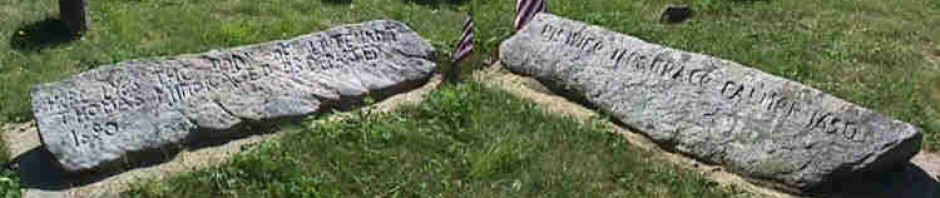
Posted in 12th Generation, Be Fruitful and Multiply, Dissenter, Double Ancestors, First Comer, Immigrant - England, Line - Miller, Public Office, Violent Death | Tagged , , , , , , , , | 26 Comments

Ralph Allen

Ralph ALLEN Sr. (1615 -1698) was Alex’s 9th Great Grandfather; one of 1,024 in this generation of the Miller line.

Ralph Allen – Quaker

Ralph Allen was born about 1615 in Thurcaster, Leicester, England.  His parents were George ALLEN and  Katherine WATTS.    Although it has not been determined when he arrived in the Massachusetts Bay Colony, it is known that he did not travel on the same ship as his father, George.

Ralph was generally referred to as a planter and wheelwright. This was apparently to distinguish him from the other Ralph Allen residing at Sandwich who was married to a woman named Esther Swift and was a mason by trade. Although our Ralph is thought to have married sometime around 1630-1635, it is not known at this time whether he married in England, or after he arrived in the Massachusetts Bay Colony. Our Ralph is believed to have been married to a woman named Susannah [__?__].

Ralph Allen  died in Mar 1698 at Sandwich Mass.  His will, which had been written on 18 Dec 1691, was probated before the Barnstable County Court on 1 Jul 1698. Ralph was subsequently buried, as directed by his will, “in the Friends Burying place at William Allen’s in Sandwich.”

Children of Ralph and Susannah:

Name Born Married Departed
1. Philip Allen c. 1636
or c. 1662
13 Jul 1671
Portsmouth, Rhode Island
2. Benjamin Allen c. 1645
Sandwich, Mass
buried
27 Feb 1669
Portsmouth
3. John Allen 3 Jan 1647
Sandwich
Rebecca [_?_]
1670
Sandwich
.
Rebecca Prince
1696  Massachusetts
1706
Sandwich, Mass.
4. Joseph ALLEN 1 Apr 1642 Sandwich, Mass Sarah HOLLOWAY Jul 1662
.
Sarah Hall
after
7 Mar 1680
Sep 1704 Shrewsbury, Monmouth, New Jersey
5. Ebenezer Allen 10 Feb 1649/50 Sandwich Abigail Hill
1682
Dartmouth
18 May 1725 Dartmouth
6. Increase Allen 18 Dec 1648 Sandwich, Mass Rachel Sherman
1682
7 Mar 1723/24 Dartmouth
7. Zachariah Allen 2 FEB 1650 Sandwich, Mass Sarah [__?__] bef 15 Nov 1732 Dartmouth
8. Mary Allen c. 1649
Sandwich, Mass
Benjamin Field bur. 18 Apr 1675
9. Patience Allen c. 1660
Sandwich, Mass
Richard Evans
10 Jun 1680
Newport, RI
4 Dec 1711
Newport, RI

Ralph eventually settled at Sandwich in the New Plymouth Colony of Massachusetts where his father lived. In 1657, while residing at Sandwich, Quakerism began spreading throughout the Colony, and Ralph and six of his brothers and sisters were apparently among the first to be “convinced.”   The adoption of Quakerism by the Allen’s resulted in their being persecuted and fined for many years for practicing their faith. Their persecution was particularly acute for refusing to take the Oath of Fidelity which they felt was unlawful.

Ralph’s father, George, was an Anabaptist, a sect originating in Zurich, Switzerland, in 1523, which rejected infant baptism, advocated separation of church and state, so it is easy to understand his family’s sympathy with the Quakers.

Ralph, William and Matthew, as well as his brother-in-law, William Newland, were in trouble with the authorities at one time or another because they were Quakers. Ralph  had numerous difficulties with the authorities because of his conversion to the Quaker faith in 1657. In 1658, he was deprived of his vote in town meeting. In 1658 and 1659, he had  £68 in goods taken from him for refusing to swear to oaths and for attending Friends Meeting. In 1661, he was jailed in Boston.  They were liberated by order of Charles II who came to the Throne in 1660, but were taken from the jail and whipped through several towns before being set at liberty.

Ralph and William were called to serve on the jury but declined to take the oath. They were arraigned before the Court for having “disorderly” meetings at their houses. It was the old story of religious persecution. The charge was based on the fact that a few Friends had met in silence to wait upon God. Assembling like this was viewed by the magistrates as a grave offence and each was fined 20 shillings with an order they should find sureties (bond) in the sum of  £80 for their good behavior in the following six months. If they agreed to this, it would imply acknowledgement of the offence and agreement to stop their Quaker worship, so they unhesitatingly refused to comply. They were then put in jail for five months. After two and a half months in jail, they were offered their freedom if they agreed not to receive or listen to a Quaker but this they promptly refused to do.

Ralph Allen and six of his brothers and sisters continued with their Quaker meetings. The local ministers and magistrates seemed to have especially singled out the Allen family.  They were the only individuals required to take the “oath of fidelity.”

By 1658, Quakers suffered increased detention of goods and were prevented from holding religious meetings. They were fined because of their conscientious refusal to take the “oath of fidelity,” which was purposely used to try to catch them, and also fined because they did not attend the local public worship. In the latter part of 1658, sixteen Friends were summoned to court in Plymouth and fined £5 each for refusing to take the oath. Some had already been fined previously on the same charge.

The futility of this punishment comes through clearly in the report that some of these Quaker sufferers, speaking of the persecution to which they had been subjected, remarked that it was “contrary to the law of Christ, whose law is so strongly written in our hearts, and the keeping of it so delightsome to us, and the gloriousness of its life daily appearing, make us to endure the cross patiently, and suffer the spoiling of our goods with joy.”

When the great wave of Governor Endicott’s persecution, torture and hanging of Quakers reached its peak, King Charles’ restoration took place in England, in 1660. The local authorities had been confident that Cromwell would not punish them for their excesses against Quakerism and had therefore dared to run counter to British law. Now, with the Restoration, they were unsure of their power and concerned that the law might go after them. Twenty-seven Friends imprisoned in Boston were released, among them the brothers Ralph and William Allen.

A postscript: In 1678, four prominent Friends, including William Allen and Nathaniel Fitzrandall petitioned the General Court of Plymouth, giving their reasons why they could not in good faith contribute to the mandatory support of the established preachers. Almost fifty years later, King George I finally declared himself in no uncertain terms and the end came to persecution for refusal to pay church rates.

During the years 1663 and 1664, Ralph purchased land at Dartmouth in the New Plymouth Colony (now within Bristol County, Massachusetts), which he later conveyed to his children. Even though he was living at Sandwich at the time of his death, it is believed that he and Susannah probably resided at Dartmouth for a few years. Ralph is mentioned in several deeds as being “of Dartmouth,” and in 1684 he was involved in an agreement with three others to build a gristmill there.

Allen’s Neck Meeting was originally part of Dartmouth Monthly Meeting which met at Apponegansett Meeting House in Dartmouth. In 1758 they felt the need to have their own House of Worship and built their new Meetinghouse on a hill overlooking Buzzard’s Bay about six miles down the road from the Apponegansett Meetinghouse. The new Meetinghouse was finished in 1761.

Allen’s Neck Meeting House, Dartmouth, Mass.

Allen’s Neck Meeting and Smith Neck Meeting still met at Apponegansett once a month for a business meeting. In 1813 Allen’s Neck Meeting was officially designated as the “West Preparative Meeting” by Dartmouth Monthly Meeting. Preparative Meetings hold their own meetings for worship and have limited authority to conduct business. Some preparative meetings will eventually become Monthly Meetings. This was the case with Allen’s Neck when they experienced growth in membership and in 1955 the process began to establish Allen’s Neck as a Monthly Meeting. The process was completed in 1956 when Dartmouth Monthly Meeting approved of Allen’s Neck becoming a Monthly Meeting separate from Dartmouth Monthly Meeting. (Google Maps.)

Allen’s Neck Friends Meeting Religious Society of Friends still meets Sundays: 9 AM Worship & First Day School Fourth Sunday: 10:30 AM Meeting for Business. 739 Horseneck Road – Dartmouth, MA 02748 – Phone: 508-636-2756

Allen’s Pond Wildlife Sanctuary – Grab your binoculars if you’re heading to Allens Pond. You can observe spectacular bird life and salt marsh activity from a number of vantage points at this site. Over 300 bird species have been recorded during migration or nesting season. The sanctuary’s half-mile stretch of beach provides important nesting habitat for rare piping plovers and terns. The sanctuary also attracts many raptors in all seasons including nesting ospreys and migrant bald eagles.

The Quansett Trail system offers visitors the opportunity to observe, interact with, and learn about the great diversity of habitats in the sanctuary. Visitors have many options to choose from including two western loops: one around a fresh pond, the other with a giant boulder to climb for treetop views. Two smaller loops provide east and west overlooks of the pond. Please note that we do not have a nature center; however, correspondence may be directed to 1280 Horseneck Road, Westport, MA 02790, or call 508-636-2437.

The Allens Neck Trail system, located off Allens Neck Rd. in Dartmouth, MA offers 1.5 miles of trails along the Woodland and Boulder Loops. Visitors can wander through rich wetlands, across old pasture land and among giant boulders or pass vernal pools throbbing with fairy shrimp and tadpoles.

Two Ralph Allens in Sandwich

During a short span of time, two Ralph Allens resided in Sandwich, and both of them became involved, with the Quaker movement, along with other members of the Allen family.

The Ralph who was the son of George was the one designated at Ralph Sr. in the records, and was the second one to come to Sandwich.

The Ralph who was NOT the son of George was residing in Sandwich first, and had children born there named Jedediah, Experience and Ephraim. Before the arrival of Ralph Sr. to Sandwich, he was just named Ralph Allen in the records, and became Ralph Jr. after the arrival of the other Ralph to the town.

Prior to their both living there, one Ralph was residing at Sandwich and the other was residing at Rehoboth. Before moving to Rehoboth, however, one Ralph sold thirty acres of land at Weymouth, 22 acres of which originally belonged to George Allen.

The Ralph Allen who was at Sandwich first had a son named Jedediah born there in January 1646/47. The other Ralph was still at Rehoboth where he received a division of the New Meadow in February 1646/47. So based on this alone, the Ralph who sold a piece of land at Weymouth that belonged to George originally, and was living at Rehoboth in 1646/47, was not the Ralph who was the father of Jedediah.

The Ralph who was the father of Jedediah was also found to have had children born at Sandwich named Experience and Ephraim in 1651 and 1656, respectively. This Ralph is also listed as being a mason by trade. This Ralph Allen died in about 1662/1663 as abstracted from Jedediah’s bible. He was married to Esther Swift.

Our  Ralph Allen, who moved from Rehoboth to Sandwich, died in 1698 and left a will naming all of his children. No Jedediah, no Experience, and no Ephraim were named. This Ralph did have a daughter named Mary, however, who died young in 1675. This Ralph was referred to as Ralph, Sr. in the burial record. He was also referred to in other records as being a planter and wheelwright by trade. In his will he also mentions his brother William, who is a known son of George Allen.

Although the suffix Sr. and Jr. were found in a number of cases in the records involving the two Ralphs, the definitive use of the suffix Sr. was with the Ralph Allen, who was a planter, and who died in 1698.

The other Ralph, who was a mason by trade, was married to Esther Swift, and was the father of Jedediah, may very well be related to George Allen somehow, but not his son. He could easily be a nephew or cousin, however.

Children

3.  John Allen

John’s second wife Rebecca Prince was born 1672 in Sandwich, Barnstable, Mass. Her faterher was  Henry Prince born 15 August 1652 in Yoxall, Staffordshire, England  Rebecca died 1699 in Sandwich, Barnstable, Mass.

After John passed away, his widow, Rebecca, married for a second time to a man named Saunders. This second marriage was substantiated by a probate document dated 26 Feb 1711/12, which dealt with the appraisal and settlement of John’s estate. In this document, reference is made to “Rebecca Saunders, late widow of John Allen of Sandwich,” and their three children, Isaac, Benjamin, and Judah.

Children of John and Rebecca

i. Isaac Allen b. Mass.

ii. Benjamin Allen b. Mass. m. 9 March 1720 Falmouth, Barnstable, Mass to Waitstill Bowerman. Waitstill’s parents were Thomas Bowerman and Mary Harper.

iii. Judah Allen b. ~1696 in Mass.; d. Feb 1770 at Dartmouth, Bristol, Mass.; m1. 26 January 1727/28 at Sandwich, Barnstable, Mass to Rebekah Wing (b. 29 May 1702 – d. Mar 1756); Rebekah’s parents were Ebenezer Wing and Elizabeth Backhouse. Her grandparents were Stephen Wing(e) and Sarah Briggs and her great grandparents were our ancestors Rev. John WYNGE and Deborah BACHILER. Judah and Rebekah had five children born between 1729 and 1741.

m2. 8 June 1762 (intentions) Dartmouth, Bristol, Mass. to Elizabeth Allen. Elizabeth’s parents were Noah Allen and Rebecca Kirby. Her grandparents were our ancestors William ALLEN and Elizabeth [__?__] William and Judah were first cousin. If I have it calculated right, Judah and Elizabeth were first cousins twice removed.

Judah and Elizabeth had two children Noah and Rebecca. Judah was subsequently disowned by the Quakers for marrying outside of their Society. Judah died in 1770 at Dartmouth and later, on 31 Dec 1770, bond was posted by Elizabeth to serve as Administratrix of Judah’s estate.

After Judah passed away, Elizabeth married for a second time to Daniel Ormsby. Although an actual record of their marriage has not been found, their intentions to marry were recorded on 16 Nov 1771 at Dartmouth, Mass.

4. Joseph ALLEN (See his page)

5. Ebenezer Allen

Ebenezer’s wife Abigail Hill was born 16 Nov 1651 in Salem, Essex, Mass. Her parents were Zebulon Hill and Elizabeth Dyke. Abigail died 27 Mar 1699 Dartmouth, Bristol, Mass.

Ebenezer and Abigail were Quakers.

6. Increase Allen

Increase’s wife Rachel Sherman was born about 1658 in Dartmouth, Mass. Rachael died 10 Apr 1731 in Dartmouth, Bristol, Mass.

Abstracts of Bristol County, Massachusetts Probate Records, 1687-1745 Volume IV 1721 -1745

Order for inventory to Mrs. Rachel Allen, widow and  Exec. of estate  of her busband Increase Allen of Dartmouth , Yeoman, dated. 31 Oct 1722, probate 19 May 1724. Wife Rachell. Sons: Benjamin, Jedediah & Increase Allen. Hannah Russell,  Dianah Allen. Witnesses: John Tucker, William Wood and Richard Borden.

7. Zachariah Allen

I see two dates of death for Zachariah 10 May 1708  and 15 Nov 1732 – Dartmouth, Bristol, Mass.  It’s possible that both Ralph Allens had sons named Zachariah.

8. Mary Allen

Mary’s husband Benjamin Field was born in 1650 and died in 16668, the same year they were married.

In certain documents Ralph was also referred to as Ralph Allen, Sr., such as the burial record of his daughter, Mary, in 1675. This was apparently to distinguish him from the other Ralph Allen who resided at Sandwich, was married to a woman named Esther Swift, and was a mason by trade

9. Patience Allen

Patience’s husband Richard Evans was born 1654 in Boston, Suffolk, Mass.  His parents were David Evans and Mary Clark.  Richard died  9 Apr 1718 in Scituate, Providence, Rhode Island

Sources:

http://hylbom.com/family/paternal-lines/paternal-a-to-bl/george-allen-11136/

http://freepages.genealogy.rootsweb.ancestry.com/~jacmac/allen.pdf

http://genscraps.wordpress.com/2009/06/30/verifying-secondary-sources-sorting-out-the-ralph-allens/

http://trees.ancestry.com/owt/person.aspx?pid=135172379&st=1


Posted in 11th Generation, Dissenter, Historical Site, Immigrant - England, Line - Miller, Place Names | Tagged , , , | 12 Comments

Joseph Allen

Joseph ALLEN (1642 – 1704 ) was Alex’s 8th Great Grandfather; one of 512 in this generation of the Miller line.

Joseph Allen was born 1 Apr 1642 in Sandwich, Mass. His parents were Ralph ALLENand   Susannah [__?__].  There was another Ralph Allen residing at Sandwich who was married to a woman named Esther Swift and was a mason by trade.   Joseph married Sarah HOLLOWAY in Jul 1662.  After Sarah died, he married Sarah Hall after 7 Mar 1680.  Joseph died in Sep 1704 Shrewsbury, Monmouth, New Jersey

Joseph was one of the original proprietors of Dartmouth, owning a 1/34th share in the Township of Dartmouth.

Sarah Holloway (Holway, Holly) was born in 1640 Sandwich, Plymouth Colony.  Her parents were Joseph HOLLOWAY and Rose ALLEN.  Sarah was Joseph’s cousin.  Sarah appears to have passed away in about 1675, shortly after the birth of their seventh child.

Sarah Hall was born in 1650 in Barnstable, Mass. Her parents were Tristram Hull and Blanche [__?__] .  She first married  Mark Ridley.  It appears that Joseph and Sarah lived at Dartmouth in what is now Bristol County, Massachusetts throughout much of their married life.  Sarah, is believed to have died shortly thereafter in 1705.

Children of Joseph and Sarah Holloway:

Name Born Married Departed
1. Abigail Allen 1 Apr 1663 Dartmouth, Mass. Edward Cottel (Cottle)
c. 1701
Dartmouth, Mass
25 Dec 1733
Tisbury, Mass
2. Rose Allen 1 Oct 1665 Duxbury, Mass Nathaniel Howland
1684
Dartmouth
3 Mar 1723
Dartmouth
3. Joseph Allen 4 Mar 1666/67 Dartmouth Rachel Gilford
.
Jennette Ray
17 Nov 1721
Dartmouth
31 Jan 1734/35 Dartmouth
4. John Allen 15 Jul 1669 Rehoboth Deborah [_?_] 1754
5. Phillip Allen 3 Jul 1671 1690
Dartmouth, Mass
6. William ALLEN 10 Aug 1673 Dartmouth, Mass. Elizabeth [__?__]
c. 1702
1760 Dartmouth
7. Josiah Allen 1674
Rehoboth, Mass.
Remained Single 17 Sep 1718
Dartmouth

.

Children of Joseph and Sarah Hall

Name Born Married Departed
8. Benjamin Allen c. 1680
Dartmouth, Mass
Rebecca Sherman
7 Dec 1747
c. 1747
Frederick, Augusta, VA?
9. Tristam Allen
10. Ralph Allen 1688
Dartmouth
Amey Anthony
13 Jun 1716
Portsmouth, RI
11. Sarah Allen c. 1690
Dartmouth
Jeremiah David (Devol,  Davol and Davel)
24 May 1711
Dartmouth
12. Ruben Allen c. 1690
Dartmouth
Mary Jackson
1720
Baltimore, MD
1741
Orange County, VA
13. Hannah Allen 1694
Dartmouth
Richard Rundels 1719
New Jersey
14. Daniel Allen 1696
Dartmouth
Rebecca Newman
9 Feb 1719/20
Cecil County, MD

Joseph and Sarah were both Quakers and belonged to the Rhode Island Monthly Meeting of Friends. In the records of this Meeting were found the birth dates of their first six children.

Joseph was one of the original proprietors of Dartmouth, owning a 1/34th share in the Township of Dartmouth

During the period 1695-1700, Joseph acted as agent for the Dartmouth Proprietors in a dispute with the towns of Little Compton and Tiverton. In 1697, however, Joseph purchased property in Monmouth County, New Jersey, and at the time of his death he was building a home there. In various deeds, Joseph’s occupation was listed as either a wheelwright, husbandman, or yeoman.

Joseph left two wills, one written in 1696 while he was residing at Dartmouth, and a second, written on 26 June 1704, which states that he was a resident of Shrewsbury in Monmouth County, New Jersey. Joseph died during the month of September 1704, probably at Shrewsbury. Both of Joseph Allen’s wills were subsequently probated on 11 October 1704 before Samuel Cranston, the Governor of Rhode Island.

Children

1. Abigail Allen

Abigail’s husband Edward Cottle (also written Cottel) was born on 28 Sep 1666 at Salisbury in Essex County, Mass. His parents were Edward Cottle and Judith Osgood. This was Edward’s second marriage, having previously married 1690 to Esther Daggett. Edward died 22 Nov 1751 Edgartown, Dukes, Mass.  His will, which had been written on 2 Nov 1748, was probated in Dukes County on 22 Nov 1751.

2. Rose Allen

Rose’s husband Nathaniel Howland was born on 5 Aug 1657 at Duxbury in the New Plymouth Colony of Massachusetts His parents were Zeoth Howland and Abigail [__?__].  His grandparents were Henry Howland and Mary Newland.  Nathaniel died  3 Mar 1723/24 at Dartmouth, Mass.

22 Dec 1657 – Henry, his son Zoeth and brother Arthur were called before the Plymouth court to answer for entertaining a Quaker, and suffering and inviting sundry to hear said Quaker. They were fined for using thier homes for Quaker meetings. The families of Henry Howland and his brother Arthur, were two Plymouth families most identified as practicing Quakers. The families ceased attending Plymouth religious services and allowed their homes for the conduct of Quaker meetings. Throughout his life, Henry’s brother John HOWLAND(also our ancestor) remained faithful to Separatist belief and practice, but his compassion for Quakers is not known.

3. Joseph Allen

Joseph’s first wife Rachel Gifford (Gilford) died 10 Apr 1731 Dartmouth, Mass.

Joseph’s second wife Jenett Ray was born in 1670 in Dartmouth, Bristol, Mass.

6. William ALLEN  (See his page)

8. Benjamin Allen

Benjamin eventually left Massachusetts and moved to Cecil County, Maryland, where he purchased approximately 900 acres of land on 29 Nov  1714. He later sold half of this
land to his brother, Reuben Allen. Benjamin sold his remaining Cecil County property in 1729, at which time he is thought to have moved into the state of Pennsylvania.

In 1734, however, Benjamin Allen, together with Riley Moore and William White, moved to the Shenandoah Valley of Virginia. During the following year, 1735, Benjamin purchased 290 acres of land from Joist Hite. This land was situated near Mt. Jackson in what is now Shenandoah County, Virginia. It was on this property that he later built his water grist mill. On 29 January 1739, Benjamin received a patent for an additional 400 acres of land that was situated on both sides of the North Branch of the Shenandoah River, and adjoined his other property. Benjamin, who had remained single throughout his life, subsequently died intestate in about 1747 in that part of Augusta County that was later formed into Shenandoah County, Virginia.

9. Tristham Allen

Tristram may possibly have been married to a woman named Mary. Even so, he is not believed to have had any children.

Tristram is known to have been residing in Monmouth County, New Jersey until
sometime after 1719. He was found in the records of the Shrewsbury Monthly
Meeting of Friends as a witness to two marriages taking place in 1704 and 1707. He was also mentioned in the will of his brother, Josiah, as living there. Tristram was later found residing at Newport in Rhode Island County, Rhode Island (now within Newport County, Rhode Island) in 1725. No other records have been found concerning this individual.

10. Ralph Allen

Ralph’s wife Amy Anthony was born at Portsmouth on 13 April 1688, Her parents were Abraham Anthony and Alice [__?__].

11. Sarah Allen

Sarah’s husband Jeremiah Devol (also written Davol and Davel) on 24 May 1711. His parents were Jonathan Devol and Hannah Audley.

Even though Sarah and Jeremiah resided at Rochester in Plymouth County,Massachusetts for a time, they apparently remained closely connected with theDartmouth settlement. Jeremiah died at Dartmouth on 29 November 1753. His will,which was written on 24 October 1753, was admitted for probate before the Bristol County Court on 29 January 1754.

12. Ruben Allen

As a young man, Reuben moved to Cecil County, Maryland, where he joined his older brother, Benjamin Allen. On 29 Nov 1714, Benjamin had purchased 900 acres of land
in Cecil County, and on 13 Jan 1719/20, he sold 450 acres of this property to Reuben.

It is believed that Reuben was probably married in about 1720, as a property deed
was found that was dated 16 Jan 1720/21, which stated that he had a wife named Mary at that time. This deed conveyed Reuben’s 1/12th interest in his half-brother, Josiah’s, land to Benjamin Wilber after Josiah’s death. Five years later, in June of 1726, Reuben sold his Cecil County, Maryland property to Herman Hinkey.

By 1729, his brother, Benjamin, had also disposed of his land, and it is thought that they, along with their brother Daniel, may have moved into Pennsylvania at this time.

In 1734, Reuben and Mary moved into Virginia, however, settling near Mt. Jackson in
the Shenandoah Valley. Seven years later, in 1741, Reuben passed away. He died intestate while still residing near Mt. Jackson in what was then Orange County, but is now Shenandoah County, Virginia. Mary, on the other hand, died in Orange County, Virginia in 1751.

13. Hannah Allen

Hannah’s husband Richard Rundels was a carpenter by trade.  Hannah and Richard eventually moved to New Jersey, where they resided at Shrewsbury in Monmouth County. They were members of the Shrewsbury Monthly Meeting of Friends, and apparently remained members of this Meeting until their deaths. Both Hannah and Richard died in New Jersey.

14. Daniel Allen

Although it remains to be verified beyond doubt, this Daniel Allen is believed to be the same Daniel Allen who was married to Rebecca Newman in St. Joseph’s Parish in Cecil County, Maryland on 9 Feb 1719/20.

Daniel eventually moved into that portion of Orange County, Virginia that was later formed into Augusta County in 1745. The last document that was found which pertained to Daniel Allen was an Augusta County, Virginia Order Book entry that was dated 18 Mar 1746/47. This entry pertained to the administration of his brother, Benjamin Allen’s, estate.

Sources:

http://freepages.genealogy.rootsweb.ancestry.com/~jacmac/allen.pdf

http://trees.ancestry.com/owt/person.aspx?pid=16623576&st=1

http://www.genealogyofnewengland.com/b_a.htm

Posted in 10th Generation, Be Fruitful and Multiply, Dissenter, Line - Miller, Pioneer | Tagged , , | 4 Comments

William Allen
William ALLEN (1673 – 1760) was Alex’s 7th Great Grandfather; one of 256 in this generation of the Miller line.

William Allen was born on 10 Aug 1673 in Dartmouth, Mass. His parents were Joseph ALLEN and Sarah HOLLOWAY. He married  Elizabeth [__?__] about 1702.  William died in 1760 at Dartmouth, Massachusetts.

Children of William and Elizabeth:

Name Born Married Departed
1. Barbara (Barbery) Allen 10 Feb 1703/04 Dartmouth, Mass. John Handy
29 Nov 1728 Dartmouth
 3 Mar 1768 – Dartmouth, Bristol, Mass
2. Noah Allen 24 Jul 1707 Dartmouth Rebecca Kirby
5 Oct 1727 Dartmouth
3. George Allen 10 Nov 1709 Dartmouth Rachel Smith
14 May 1740 Dartmouth
20 Sep 1763
4. Josiah Allen 29 Oct 1711 Dartmouth Elizabeth Mosher
6 Jan 1736/37 Dartmouth
1742 – Tiverton, Newport, Rhode Island
5. Sarah Allen 21 Mar 1714 Dartmouth James Ellis
23 Aug 1752 Dartmouth
6. Marmaduke Allen 23 Aug 1716 Dartmouth Unmarried 6 Aug 1751 South Carolina Colony
7. Mary Allen 9 Jul 1718 Dartmouth John Tinkham
13 May  1741 Dartmouth
1790
Dartmouth, Mass.
8. Joseph Allen 23 May 1721
Dartmouth
Mary Faun (Faunce)
28 Aug 1748 Dartmouth
9. William Allen 18 Aug 1723 Dartmouth Lydia Joy
29 Mar 1744 Dartmouth
1758
Bristol County, Mass.
10. Elizabeth ALLEN 1 Dec 1725 Dartmouth Seth MORTON
4 Dec 1746 Dartmouth

William lived his whole life in Dartmouth, Bristol. Mass. the third largest town in the state. Dartmouth was first settled in 1650 and was officially incorporated in 1664, just nine years prior to William’s birth.

The land was purchased with trading goods from the Wampanoag chiefs Massasoit and Wamsutta by elders of the Plymouth Colony; reportedly thirty yards of cloth, eight moose skins, fifteen axes, fifteen hoes, fifteen pairs of shoes, one iron pot, and ten shillings’ worth of assorted goods .

It was sold to the Religious Society of Friends or Quakers, who wished to live outside the stringent religious laws of the Puritans in Plymouth. There are still Quaker meeting houses in town, including the Smith Neck Meeting House, the Allens Neck Meeting House, and the the Apponegansett Meeting House.

During the years 1663 and 1664, William’s grandfather Ralph purchased land at Dartmouth in the New Plymouth Colony , which he later conveyed to his children.. William’s father Joseph was one of the original proprietors of Dartmouth, owning a 1/34th share in the Township of Dartmouth.   It was named for the town of Dartmouth, Devon, England, from where the Puritans originally intended to depart for America.

Allen’s Neck Meeting was originally part of Dartmouth Monthly Meeting which met at Apponegansett Meeting House in Dartmouth. In 1758 they felt the need to have their own House of Worship and built their new Meetinghouse on a hill overlooking Buzzard’s Bay about six miles down the road from the Apponegansett Meetinghouse. The new Meetinghouse was finished in 1761.

Allen's Neck Meeting House, Dartmouth, Mass.

Allen’s Neck Meeting House, Dartmouth, Mass.

Allen’s Neck Meeting and Smith Neck Meeting still met at Apponegansett once a month for a business meeting. In 1813 Allen’s Neck Meeting was officially designated as the “West Preparative Meeting” by Dartmouth Monthly Meeting. Preparative Meetings hold their own meetings for worship and have limited authority to conduct business. Some preparative meetings will eventually become Monthly Meetings. This was the case with Allen’s Neck when they experienced growth in membership and in 1955 the process began to establish Allen’s Neck as a Monthly Meeting. The process was completed in 1956 when Dartmouth Monthly Meeting approved of Allen’s Neck becoming a Monthly Meeting separate from Dartmouth Monthly Meeting. (Google Maps.)

Allen’s Neck Friends Meeting Religious Society of Friends still meets Sundays: 9 AM Worship & First Day School Fourth Sunday: 10:30 AM Meeting for Business. 739 Horseneck Road – Dartmouth, MA 02748 – Phone: 508-636-2756

Allen's Neck Clam Bake began in 1888  and has now celebrated over 120 years

Allen’s Neck Clam Bake began in 1888 and has now celebrated over 120 years

Allen’s Pond Wildlife Sanctuary – Grab your binoculars if you’re heading to Allens Pond. You can observe spectacular bird life and salt marsh activity from a number of vantage points at this site. Over 300 bird species have been recorded during migration or nesting season. The sanctuary’s half-mile stretch of beach provides important nesting habitat for rare piping plovers and terns. The sanctuary also attracts many raptors in all seasons including nesting ospreys and migrant bald eagles.

Allen's Pond, Dartmouth is the site of  Audubon Society Bird Walks

Allen’s Pond, Dartmouth is the site of Audubon Society Bird Walks

William’s will, which had been written on 6 Dec 1752, was subsequently probated before the Bristol County Court on 4 Nov 1760.

Children

1. Barbara (Barbery) Allen

Barbara’s husband John Handy was born 11 May 1704, Sandwich, Barnstable, Mass.  His parents were Richard Handy (1672 – 1729) and Patience Parker Randall (1679 – 1730). John died aft.  17 Dec 1785 in Dartmouth, Mass.

Children of Barbara and John:

i. Elizabeth Handy b. 17 July 1730 at Dartmouth, Bristol, Mass. m. 15 Dec 1750 Dartmouth to Isaac Russell (b. 21 July 1717 in Dartmouth) Isaac’s parents were Jonathan Russell (1679 – 1730) and Judith Sampson (1683 – 1752). Elizabeth and Isaac had three children between 1751 and 1761 in Dartmouth.

ii. Judah Handy b. 18 Dec 1733 at Dartmouth, Bristol, Mass.; m. 27 Apr 1782 – Dartmouth to Isabel Russell (b. 20 Sep 1741, Dartmouth – ) Isabel’s parents were George Russell (1707 – 1785) and Mercy Shermanm (1710 – 1754) Judah and Isabel didn’t marry until their forty’s so they probably didn’t have any children.

iii. Paul Handy b. 1736 at Dartmouth, Bristol, Mass.; m. 11 Dec 1762 Dartmouth to Mary Shearman (b. 8 Mar 1739 in Sandwich, Barnstable, Mass – d. 1781) Alternatively, Mary was born in Middleborough, Plymouth, Mass. Mary’s parents were Jacob Sherman (1713 – 1778) and Margaret Faunce (1713 – 1755) Alternatively, her parents were Eber Sherman (b. 1709) Hazzard (b. 1715) Paul and Mary had four children between 1764 and 1779.

iv. George Handy b. 7 June 1740 at Dartmouth, Bristol, Mass; d. bef. 27 Oct 1808; m. 4 Jul 1776 Dartmouth to Mary Potter (b. 25 Jul 1748 in Dartmouth – d. 1808 Dartmouth) Mary’s parents were John Potter (1723 – 1778) and Margaret Gifford (1722 – Aft. 1778) George and Mary had three children born between 1777 and 1783.

v. John Handy b. 29 Oct 1744 at Dartmouth, Bristol, Mass.; d. Aft. 1800 in Dartmouth; m. 24 Mar 1778 Dartmouth to Thankful Raymond (Raiment)(bapt. 13 Oct 1751 in Rochester, Bristol, Mass – Aft. 1800) Thanksful’s parents were William Raymond (Raiment) (1712 – 1809 and Hannah Tupper (1714 – 1795) John and Thankful had seven children born between 1779 and 1795.

vi. Sarah Handy b. 26 Sep 1746 at Dartmouth, Bristol, Mass.; m. 12 Dec 1782 to Gershom Wodel Jr. of Tiverton

2. Noah Allen

Noah’s wife Rebecca Kirby was born on 28 Nov 1703 in Dartmouth, Bristol, Mass. Her parents were John Kirby (1672 – 1727) and Rebecca Mosher (1677 – 1746).

Children of Noah and Rebecca:

i. Elizabeth Allen b. 6 Feb 1727/1728 at Dartmouth, Bristol, Mass.; m1, 8 June 1762 (intentions) Dartmouth to Judah Allen (b. Feb 1696 Duxborough, Plymouth, Mass – d. 1770 Darmouth) Judah’s parents were John Allen and Rebecca [__?__]. His grandparents were Ralph ALLEN and Susannah [__?__] who were Elizabeth’s 2nd Great Grandparents. Judah and Elizabeth had two children Noah and Rebecca.

Judah first married 26 Jan 172728 Sandwich, Barnstable, Mass. to Rebekah Wing (1702-1756) Judah and Rebekah had five children born between 1729 and 1741. Judah was first cousin with Elizabeth’s grandfather William. If I have it calculated right, Judah and Elizabeth were first cousins twice removed.

Judah was subsequently disowned by the Quakers for marrying outside of their Society. Judah died in 1770 at Dartmouth and later, on 31 Dec 1770, bond was posted by Elizabeth to serve as Administratrix of Judah’s estate.

After Judah passed away, Elizabeth married for a second time to Daniel Ormsby. Although an actual record of their marriage has not been found, their intentions to marry were recorded on 16 Nov 1771 at Dartmouth, Mass.

ii. Jonathan Allen b. 3 Aug 1729 at Dartmouth, Bristol, Mass.; d. 1787 in Dutchess, New York; m. 1756 to Martha Tripp (b. 27 Oct 1732 in Dartmouth, Bristol, Mass) Martha’s sister Ruth married Jonathan’s brother Sylvanus. Their parents were William Tripp (1702 – 1784) and Ruth Mosher (1707 – 1771) Jonathan and Martha had three children

iii. Sylvanus Allen b. 30 Dec 1730 at Dartmouth, Bristol, Mass.; m1. int. 8 Feb 1755 to Mary Howland. Mary’s parents ere Zoeth Howland and [__?__].

m2. 25 Oct 1764 Dartmouth to Ruth Tripp (b. 1728 in Dartmouth) Ruth’s sister Martha married Sylvanus’ brother Jonathan. Their parents were William Tripp (1702 – 1784) and Ruth Mosher (1707 – 1771)

iv. Noah Allen b. 17 May 1732 at Dartmouth, Bristol, Mass.; d. d. 09 Mar 1799; m. 18 Nov 1762 Dartmouth to Sarah Chandler of Duxbury Noah and Sarah had two children Sarah (b. 1768) and Mary (b. 1774)

v. John Allen b. 8 Feb 1733/1734 at Dartmouth, Bristol, Mass.

3. George Allen

George’s wife Rachel Smith was born 2 Jan 1712. She was George’s cousin. Her parents were Eliashib Smith and Dinah Allen. Rachel died 25 Sep 1793.

Feb 22, 1792 a deed recorded in Plymouth in which Job Sherman of Foxborough sells to George Allen of New Bedford for 900 silver dollars a tract of landlying in Rochester which was half of the homestead farm of his father John Sherman which was near “Peaked Rock.”

Also another piece of 7 acres more or less with bounds starting on the “northwardly site of the highway” and extending southwestward along the brook.

Children of George and Rachel:

i. Dinah Allen b. 2 June 1742 at Dartmouth, Bristol, Mass.; d. 08 JUL 1818 in Fairhaven, Bristol County, Mass; m. Nathaniel Delano (b. 23 Dec 1728 in Dartmouth – d. 12 Sep 1797 in Dartmouth or 8 July 1818 at Fairhaven, Bristol, Mass.) Nathaniel’s parents were Nathaniel Delano (1695 – 17700 and Elizabeth Durfee (1702 – 1784). Dinah and Nathaniel had seven children born between 1773 and 1784.

Nathaniel first married 12 Dec 1751 Age: 22 Dartmouth to Mary Taber (1731 – 1770) and had seven children born between 1753 and 1766.

ii. George Allen b. 26 July 1746 at Dartmouth, Bristol, Mass; m1. Susanna Sherman (b. 10 Mar 1752 in Mass ) George and Susannah had ten children born between 1777 and 1795. m. 9 Nov 1776 Darthmouth to Alice Case

George Allen enlisted as a private in Capt. Benjamin Wilcox’s Co. on Dec 8 1776, and served for 17 days. Marched from Dartmoth to Howland’s Ferry,RI to repel British forces which arrived at Newport on Dec 7, 1776.

George Allen was disowned by the Quaker church on July 2, 1777 for privateering.

iii. Rufus Allen b. 20 Jul 1748 at Dartmouth, Bristol, Mass; d. 7 May 1838 in Fairhaven, Bristol, Mass; m. 8 May 1777 Darthmouth to Rebecca Delano (b. 18 Oct 1752 Dartmouth – d.7 May 1838 at Fairhaven, Bristol, Mass.) Rebecca’s parents were Nathan Delano (1732 – 1805) and Sarah Tripp (1734 – 1787)

iv. Audria Allen b. 5 May 1751 at Dartmouth, Bristol, Mass.; m. 8 May 1777 Dartmouth to Peter Fuller

v. Elisha Allen b. 9 Aug 1753 at Dartmouth, Bristol, Mass; m. 15 Oct 1780 Dartmouth to Sarah Wing (b. 27 Jun 1761 in Dartmouth, Bristol, Mass – d.24 Jul 1823) Sarah’s parents were Barnabas Wing and [__?__]

4. Josiah Allen

Josiah’s wife Elizabeth Mosher was born 11 Jul 1720 in Dartmouth, Bristol, Mass. Her parents were Joseph Mosher (1692 – 1766) Mehetabel Smith (1691 – 1768). Elizabeth died 22 Apr 1768 in Darthmouth, Bristol, Mass.

Children of Josiah and Elizabeth

i. Jethro Allen b. 22 Apr 1737 at Dartmouth, Bristol, Mass.; d. 11 May 1803 in Darthmouth; m. 18 October 1760 Dartmouth to Thankful Philips ( 2 Aug 1741 in Dartmouth – d. 17 Aug 1792 in Dartmouth) Thankful’s parents were Peter Philips (b.1692) and Mary [__?__]

ii. William Allen b. 21 May 1739 at Dartmouth, Bristol, Mass.

iii. Ede Allen b. 17 Nov 1743 at Dartmouth, Bristol, Mass.; m. 26 Oct 1762 Dartmouth to William Hall

iv. Prince Allen b. 31 Dec 1746 at Dartmouth, Bristol, Mass.; m. 2 Aug 1775 Age: 28 Dartmouth to Abigail Pratt (b. 20 Apr 1750 in Framingham, Middlesex, Mass – d. 1799) Abigail’s parents were Ebenezer Pratt (1724 – 1798) and Charity [__?__] (1725 – 1761)

v. Ruth Allen b. 5 Jun 1750 at Dartmouth, Bristol, Mass.; d. 1782 in Charlestown, Washington, Rhode Island

5. Sarah Allen

Sarah’s husband James Ellis was born probably in Harwich, Barnstable, Mass. about 1717.   His parents were Manoah Ellis and Elizabeth Atkins.  He first married 3 Mar 1741/42, in Harwich to Desire Ellis, (b. ~ 1722 Harwich – d. bef. Aug 1752). Desire’s parents were Samuel Ellis and Thankful Smith. He married second, 23 Aug 1752, in Dartmouth, Bristol, Mass. to Sarah Allen. James’ only child thus far identified is James Jr. (b. ~ 1745). No issue have been found from Sarah’s marriage to James Ellis.

6. Marmaduke Allen

Marmaduke was unmarried. He died without issue in 1751 at Dartmouth. An inventory of his estate was carried out on Aug 3 1751, and his brother, Noah Allen, was appointed by the Bristol County Court to administer it.

7. Mary Allen

Mary’s husband John Tinkham was born before 1720 in Dartmouth, Mass. His parents were John Tinkham and Sarah [__?__].  John died before 3 May 1785 in Dartmouth, MA

John was a soldier in Captain Isaac Wood’s company, on the Lexington Alarm and also in Capt. Joshua Tobey’s company in 1775, corporal in 1778, and sargent in 1780 in Rhode Island

Children of Mary and John:

i. Elizabeth Tinkham b. 17 Jul 1741 at Dartmouth, Bristol, Mass.

ii. John Tinkham b. 10 May 1743 at Dartmouth, Bristol, Mass.; d. 2 Jun 1810 in New Bedford, Bristol, Mass m. 16 Jan 1772 Dartmouth to Mary Myrick

iii. Almy “Amy” Tinkham b. 15 Sep 1745 at Dartmouth, Bristol, Mass.; m. 1 Nov 1774 in Dartmouth, Bristol, Mass Ephraim Tripp (b. 24 Sep 1753 in Attleboro, Bristol, Mass. – d. 1835 in Fairhaven, Bristol, Mass.) Ephraim’s brother Thomas married Almy’s sister Mary. Their parents were Nathaniel Tripp (1712 – 1790) and Alice Mott

iv. Mary Tinkham b. 4 Sep 1747 at Dartmouth, Bristol, Mass. m. 18 Jun 1767 Dartmouth to Thomas Tripp (b. 1750 in Dartmouth – d. 1817 in New Bedford, Bristol, Mass) Thomas’ brother Ephraim married Mary’s sister Almy. Their parents were parents were Nathaniel Tripp (1712 – 1790) and Alice Mott. Mary and Thomas had seven children born between 1768 and 1780.

v. Barbara Tinkham b. 14 Jul 1749 at Dartmouth, Bristol, Mass.; d. 6 May 1794; m. 19 Aug 1774 Dartmouth to Samuel Myrick

vi. Deborah Tinkham b. 22 May 1751 at Dartmouth, Bristol, Mass.; d. 6 May 1794; m. 11 Jul 1772 Dartmouth to her cousin (see below ) William Allen. William parents were William Allen and Lydia Joy.

Alternatively or maybe William died young, m. 13 Aug 1774 in Dartmouth to William Waggoner ( – d. 22 Apr 1786)

vii. Hannah Tinkham b. 3 Dec 1754 at Dartmouth, Bristol, Mass.; d. 19 Sep 1801 Berkley, Bristol, Mass; m. 18 Jan 1781 Darthmouth to Joseph Paul (b. 23 Jan 1757 in Berkley, Bristol, Mass. – d. 7 May 1816 in Berkley, Bristol, Mass.) Joseph’s parents were John Paul (1730 – 1811) and Love Caswell ( – 1814)

8. Joseph Allen

Joseph’s wife Mary Faun’s last name is also written Fawn and Faunce

Children of Joseph and Mary”

i. Jane Allen b. 1 Dec 1751 at Dartmouth, Bristol, Mass.

ii. Mary Allen b. 23 Apr 1757 at Dartmouth, Bristol, Mass.

iii. Elijah Allen b. 23 Apr 1759 at Dartmouth, Bristol, Mass.

iv. Amie Allen b. 27 May 1761 at Dartmouth, Bristol, Mass. d. 11 Jan 1849 in Dartmouth; m. 29 Nov 1781 Dartmouth to Stoughton Booth (b. 1761 in Dartmouth – d. 08 Jul 1831 in Dartmouth) His parents were Anthony Booth (1724 – 1764) and Rachel Parker (1727 – ) Amie and Stoughton had thirteen children born between 1782 and 1804.

v. Sarah Allen b. 13 May 1764 at Dartmouth, Bristol, Mass.; d. Masonville, Delaware, New York; m. Simon Clark (b. 18 May 1760 in Stafford, CT – d. 9 Jan 1840 in Masonville, New York)

9. William Allen

William’s wife Lydia Joy was born 04 Apr 1725 in Dartmouth, Bristol, Mass. Her parents were Samuel Joy, Jr. and Content [__?__].

Children of William and Lydia:

i. William Allen b. in Bristol, Mass.; m. 11 July 1772  Dartmouth to his cousin (see above) Deborah Tinkham (b. 22 May 1751 in Dartmouth) Her parents were John Tinkham and Mary Allen.

ii. Marmaduke Allen b. in Bristol, Mass.

iii. Dorothy Allen b. in Bristol, Mass.

iv. Lydia Allen b. 3 Dec 1754 at Dartmouth, Bristol, Mass.

v. John Allen b. 25 Nov 1756 at Dartmouth, Bristol, Mass.; m. 20 Nov 1777 Dartmouth to Sally Langford

10. Elizabeth ALLEN (See Seth MORTON‘s page)

Sources:

http://freepages.genealogy.rootsweb.ancestry.com/~jacmac/allen.pdf

http://trees.ancestry.com/owt/person.aspx?pid=37943938

http://trees.ancestry.com/owt/person.aspx?pid=37399882


Posted in -9th Generation, Line - Miller, Missing Parents | Tagged | 6 Comments

John Masters

John MASTERS (1584 – 1639) was Alex’s 10th Great Grandfather; one of 2,048 in this generation of the Miller line.

John Masters and his family arrived on the Arabella as part of Winthrop’s Fleet in 1630

John Masters was born about 1584 in Aldenham, Herts, England.  His parents were John MASTERS and Elizabeth THOMPSON.  He married Jane COX before 1606 in Aldenham, Herts, England.  He arrived with his wife and children  in Salem Massachusetts Bay Colony on 12 June 1630 with the John Winthrop, Sr. fleet on one of eleven vessels.   John Masters children’s names are from the passenger list of the Arbella and from his will.  John died on 21 Dec 1639 in Cambridge  Mass.

John Masters – Coat of Arms

Jane Cox was born about 1586 in England.   Her father was Anthony COCKE (b. 1568 in Tiverton, Devon, England) .  Jane died on 10 Dec. 1639 in Cambridge, Mass., yet her husband named her in his will, suggesting an error on the clerk’s part or lack of awareness on John’s. Alternatively, Jane could be a daughter or other relative of John’s and his wife’s name unknown.

Children of John and Jane:

Name Born Married Departed
1. Nathaniel Masters c. 1606 Elizabeth Bourne
1621
Kent, England
.
Ruth Pickworth
19 Dec 1639
Manchester, Mass
2. Sarah Masters 1604 Tiverton, Devon, England [__?__] Dobyson
1632
1639
3. Elizabeth Masters c. 1612 Edmund Lockwood
bef. Nov 1632
.
Cary Latham
aft 3 Mar 1634/35
Unknown Moved to New Haven, CT
4. Lydia MASTERS c. 1615 Tiverton, Devon, England Philip TABER
21 Dec 1639 Watertown, Mass.
c. 1649
5. Abraham Masters 1609
Tiverton, Devon, England
1615
Cambridge, Middlesex, Mass

John came over in 1630, lived at Watertown.  He was a member of Watertown church by July 1632.

Later in 1633 he moved to Newtown (now Cambridge), living near Brattle Street, where for a while he kept an inn.  On 3 Sep 1635 “John Maistrs” was licensed to keep an ordinary at Cambridge.  On 4 June 1639 for some unknown offense “John Masters, having license, was discharged”

Brattle Street in Cambridge, Massachusetts, called the “King’s Highway” or “Tory Row” before the American Revolutionary War, is the site of many buildings of historic interest, including a Georgian mansion where George Washington and Henry Wadsworth Longfellow both lived (though at different times.) Samuel Atkins Eliot, writing in 1913 about the seven Colonial mansions of Brattle Street’s “Tory Row,” called the area “not only one of the most beautiful but also one of the most historic streets in America.”

In 1631, he was the pioneer of marine engineering in this country. He made a channel 12′ wide and 7′ deep from the Charles River to Newtown.

On 27 Jan 1631/32 Winthrop reported on an expedition made by himself and others “about eight miles above Watertown,” during which they “came to another brook, greater than the former, which they called Masters’ Brook, because the eldest of their company was one John Masters”

On 5 July 1632 Winthrop described Masters’s independent spirit: “The strife at Watertown congregation continued still; but at length they gave the separatists a day to come in, or else to be proceeded against. At that day, all came in and submitted, except John Masters, who, though he were advised by diverse ministers and others, that he had offended in turning his back upon the sacrament, and departing out of the assembly, etc., because they had then admitted a member whom he judged unfit, etc.; yet he persisted. So the congregation (being loath to proceed against him) gave him a further day; 8, at which time he continuing obstinate, they excommunicated him; but, about a fortnight after, he submitted himself, and was received in again”

OFFICES – Commissioner to settle the estate of Mr. Crispe, 27 Sep 1631 [MBCR 1:92]. Committee (for Watertown with Mr. Oldham) to confer with the court about raising public stock, 9 May 1632

ESTATE – On 5 Aug 1633 granted one-half acre for a cowyard at Cambridge

In the division of meadow on 20 Aug 1635 he had a proportional share of 1½ [CaTR 13]. In the 8 Feb 1635/36 list of houses in Cambridge John Masters had two in the Westend

In the Cambridge land inventory on 10 Oct 1635 John Masters held three parcels: seven acres in the West End with “one house with other out houses backside and planting ground”; two acres by the Pine Swampe; and six acres in the Great Marsh . By 1639 he had acquired three more parcels: one house and garden with eight acres (bought of Thomas Winckall); seven and a half acres of marsh at the Fresh Pond (granted him by the town); and five acres of marsh at Oyster Bank (purchased of Robert Lockwood)

The following is from “The Genealogy of Francis Weekes”, by Dr. Frank Edgar Weeks, Kipton, Ohio, 1939: and from “Masters, Massachusetts and English Notes”, by George W. Chamberlain, Malden, Mass., (manuscript) on file at the New England Historic Genealogical Society of Boston.

The date of John Master’s birth in England is not known: he died at Cambridge, Mass., on Dec 21 1639.  He undoubtedly came with Governor Winthrop in 1630 to Boston.

The earliest notice of him occurs in Governor Winthrop’s Journal, dated Jan 27 1631 detailing the incidents of a proposed expedition up the Charles River about eight miles above Watertown, Mass. The first brook they came to on the north side of the river, he named Beaver Brook, because the beavers had shorn down “divers great trees there and made divers dams across the river”. Thence they went to a great rock upon which stood a high stone, cleft in sunder, that four men might ge upon (through) which they named Adams Chair, because the youngest of their expedition was Adams Winthrop. Thence they came to another brook, greater than the former, which they named Master’s Brook, because the eldest of the company was John Masters: this was later called Stony Brook.

On 18 May 1631, John Masters was made freeman of Watertown. In June 1631 he engaged to construct a canal from the Charles River, through the marsh to the upland near the foot of Dunster Street, for which the General Court paid him £30.

In 1633 he removed to Newtown.
In 1635 he owned a house and seven acres of land on the weather side of East Street, near Brattle Street, Cambridge.
He married, date unknown, Jane —-, who died at Cambridge on December 26 1639.

On 14 Mar 1630/31 John Masters wrote from “Watertown, near Charles River, New England,” to Lady Barrington at Hatfield Broadoak, Essex; this letter is described as being in “excellent handwriting”

In his letter of 14 Mar 1630/31 to Lady Barrington, Masters stated that she and her family had “desired me to write of this country, and said you would believe what I should write”; he also stated that “Sir Richard Saltonstall hath put me in place to oversee his great family, with his worthy son”.  These comments, and the entire tenor of the letter, indicate that Masters had in the past been in service to one or more of the Puritan gentry families of Essex, and his origin should be sought there.

John Masters – Letter to Lady Barrington

John Masters – Letter 2

John wrote his will on 19 Dec 1639:

This is the minde & will of me John Masters.

Item – I give to my wife all my estate for the terme of her life & after hir decease I will & bequethe unto my Daughter Sarah Dobyson ten pownds.
Item – to my daughter Lidya Tabor ten pownds,
Item – to my Grand child John Lockwood ten pownds,
Item – to Nathaniell Masters ten pownds to Abraham Masters ten shillings,
Also my minde & will is that the ten pownds I give to John Lockwood, & the ten pownds I give to Nathaniell Masters shal be layde out upon somethinge that may turne to the encrease of theire portions ffurthermore my will is that these leagacyes shal be well & truly discharged wthin six monthes after my wives decease, these & all other my debt beinge discharged I give all the remainder of my estate unto my daughter Elizabeth Latham.

John doesn’t call Nathaniel and Abraham “son” or “grandson” immediately after specifying his daughters and grandchild. Although this may have been due to them having the last name Masters whereas the others did not, it was still the norm to specify sons, daughters and grandchildren in wills. There is no reason to think they weren’t relatives, but based on this document and a lack of others, they shouldn’t be assumed to be his sons. Perhaps they were orphaned nephews, giving cause to include them in his will. Abraham may have been an adult. Nathaniel and John Lockwood apparently were minors, which may have led to John’s request that the money be invested for them. Nathaniel of Wells, Maine, and Manchester, Massachusetts, was about nine at the time. This would also place him in John’s granchild generation unless he married Jane late in life and she was of childbearing age.

Children

3. Elizabeth Masters

Elizabeth’s first husband  Edmund Lockwood was born 9 Feb 1594 in Combs, Suffolk, England. His parents were Edmund Lockwood and Alice Cowper. Edmund died 9 Mar 1634 in Cambridge, Mass.

Elizabeth’s second husband Cary Latham was born 30 May 1612 in Elstow, Aldenham, Hertfordshire, England. His parents were Nicholas Latham and Elizabeth Newman.  Cary died in 1685 in Groton, New London, CT.  Mitchell says: “perhaps b. (to Robert) and brother of William Latham Mayflower Pilgrim.

Cary Latham was an early resident of Cambridge, afterward removing to New London where he was in public life for nearly 20 years.

In 1663 he was an author of the following report to the Commissioners of the United Colonies of New England regarding the property rights of the Pequot Indians:

“Boston, September 19th, 1663

We, being desired by the Commissioners of the United Colonies to enquire of the Indians present concerning the interest of the Pequots, or respecting lands which Uncas layeth claim unto, we accordingly have endeavored the same, according to our best skill and understanding; and there being present, Cassisinnamon, Kitchamoquion and Tomasquash Ecoadno (alias,) the old honest man, Pequots; also, Womesh, Mumuho, Kaiton, Narragansett Councillors, with many others Indians; which do all jointly affirm, that long before the Pequots were conqered by the English, Uncas, being akin unto the Pequots, did live upon and Enjoy that land above a place called Montononesuck, upon which Mr. Winthrop’s saw mill standeth; also, that it was his father’s before him, and left unto him by his father; which he pssessed some time. But he growing proud and treacherous to the Pequot Sachem, the Pequot sachem was very angry, and sent up some soldiers, and drave Uncas out of his country; who fled unto Narragansett, for a while. At last he humbled himself to the Pequot Sachem, and desired that he might have liberty to live in his own country again; which the Pequot Sachem granted, provided he would be subject unto him, and carry it well. But soon after, he grew proud again, and was again driven out of his country, but his men subjected unto the Pequot Sachem; and yet again, upon his humbling, was restored, and grew proud again, and was conquered; and so five times; and upon his humbling himself was restored, and again conquered; until when the English went to war against the Pequots; and then Uncas went along with the English; and so, since, the English have made him high.”

“They further say, they know not the English fashions, but according to their manners and customs, Uncas had no lands at all, being so conquered. This they say, Uncas cannot deny, but if he should deny it, the thing is known to all the Indians round about.”

“Also the Narragansetts say that there is yet two of his men yet alive that fled with him into the Narragansett country, and have there abode ever since, who knew these things to be true. And further, they jointly affirm that Uncas had at first but little land and very few men, insomuch he could not make a hunt, but always hunted by order from other Sachems, and in their companie; which Sachems, being five brothers, lived at a place called by the Indians, Soudahque, at or near the place where Major Mason now liveth; who were the sons of the great Pequot Sachem’s sister, and so became very great Sachems, and had their bounds very large, extending their bounds by Connecticut path almost to Connecticut, and eastward meeting with the bounds of Paswuattuck (who lived at Showtackett, being a Pequot Sachem whose bounds extended eastward and took in Pachogg;) the which five Sachems, being brothers grew so great and so proud that upon hunting they quarrelled with the Pequots; at which the great Pequot (Sachem) being angry with them, made war upon them and conquered them and their country, and they all fled into Narragansett country, (leaving their country and men unto the Pequot Sachem,) from whence they never returned, but there died. So that Indians affirm all their lands and Woncas’s too, according to their customs and manners, were Pequot lands, being by them conquered, and now are the true right of the English, they having conquered the Pequots.

George Denison,

John Stanton,

Cary Latham”

He was a Deputy to the General Court from 1664 to 1670. He left a large estate at his death.

______

SWAMP YANKEE, by James Allyn, page 10.

He may have been the son of William Latham who came to Plymouth on the Mayflower. To provide a ferry across the “Great River” to the Groton side, the town first gave a long term lease to Edward Messenger. In 1654 he moved to farmland north of Norwich, so the lease was transferred to Latham. Messenger had only to provide a canoe the first year, and after that a boat to carry man and beast. Latham’s lease was for fifty years, so he moved across the river and built a house on Groton Bank. He probably had in mind to provide board and rooms if the weather was bad. After his death in 1685, the town took over the ferry with the income going for schools. Earlier Latham was named Town Agent (Tax Accessor) with William Douglass. One year later they were fined for not preparing a complete list. Apparently this was not to serious an offence, for he continued to hold various town positions.

SPICER GENEALOGY, by Susan Spicer Meech and Susan Billings Meech, pg. 522-527.

Cary was among the first five, after Governor Winthrop, to have house-lots laid out to them in New London, CT. These lots were located northwest of Winthrop’s Neck, on Main and William Streets. He came to New London from MA. In 1649 he had a little difficulty with a constable – he, Robert Bedell, and Isaac Willy being accused of letting go an Indian intrusted to their charge. He was one of those who helped build the “Old Town Mill”, in 1650.

In 1653 he sold the land and unfinished house, originally property of Philip Taber, his brother-in-law, who came to New London, in 1651, from “Martin’s Vineyard.”

In 1654 he was awarded a lease and monopoly of the ferry over the Pequot River at the town of Pequot (now Thames River and New London) for fifty years. He built a house east of the river before October, 1655, and became the first resident of what is now called Groton Bank. His home occupied the site of the Mitchell house, now standing.

Sources:

http://armidalesoftware.com/issue/full/Thaler_311_main.html#N5

http://www.antonymaitland.com/

http://trees.ancestry.com/owt/person.aspx?pid=4184745&st=1

Posted in 12th Generation, Immigrant - England, Line - Miller, Sea Captain, Tavern Keeper | Tagged , , , , | 8 Comments