Ralph Gorham

Ralph GORHAM (1575 -1643) was Alex’s 11th Great Grandfather; one of 4,096 in this generation of the Shaw line.

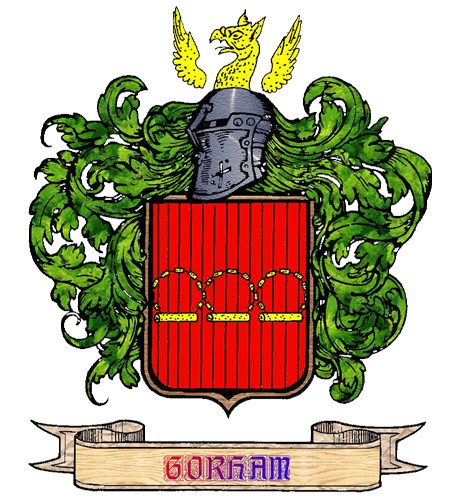
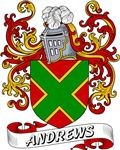
Ralph Gorham - Coat of Arms

Ralph Gorham was born in 1575 in Benefield, Northamptonshire, England. His parents were James GORHAM and Agnes BERNINGTON. He married Margaret STEVENSON on 23 May 1610 in Benefield, Northamptonshire, England.  He came to America in 1635.   Ralph died in 1643 in Plymouth, Mass

Margaret Stevenson was born in 1579 in Benefield, Northamptonshire, England.  Margaret died in 1637 in Plymouth, Massachusetts.

Children of Ralph and Margaret:

Name Born Married Departed
1. Ralph Gorham 1619 in Benefield, Northants, England 1643
Plymouth, Mass
2. Capt. John GORHAM 28 Jan 1621 in Benefield, England Desire HOWLAND
1643
Plymouth, Mass.
5 Feb 1675/76
Swansea, Mass after being wounded 15 Nov 1675 in the Great Swamp Fight in King Phillip’s War.
3. Thomas Gorham 29 Jun 1626 in Benefield, England

The Gorham family were originally French. The French spelling was DeGorran and they came from La Tanniere near he Brittany border. Several of the family went to England in the Eleventh Century following William the Conqueror and the Norman Invasion of the British Isles.  The Northamptonshire branch of the Gorhams are supposed to have descended from Sir High de Gorham and his wife Margaret, daughter of Sir William l’Angevin. Sir Hugh de Gorham, in 1281, possessed the manor of Churchfield in the parish of Oundle, and land in Benefield which had belonged to his wife’s father.

Ralph Gorman was in Plymouth (or the Plymouth Colony at least) in 1637 when he was granted land on which to build a house on October 2, 1637.

5 Mar 1638/39 – Ralph Gorham the elder was presented for beating Webb Adey.  Webb Adey is probably the best-recorded antisocial pauper in Plymouth Colony. Although he seems to have done his best at all times to live by his own rules and not those of the Colony, he did receive grants of land, and at his death had not one house but two.
In 1638 he was referred to as elder’ his birth recorded and John was the only one mentioned in the records of the Plymouth Colony. Ralph Gorham is mentioned in 1642 but he was not on any later records. As he was sixty seven years old he probably died in about 1643. His son John inherited his plantation.

John and his descendants are the only ones listed in the Plymouth colony throughout the Seventeenth century, so even if there were other brothers, only he survived. John was raised in the Puritan faith and was a leather tanner by trade.

Notes from John Howland of the Mayflower, Vol. 1:

A Ralph Gorham was granted land in Plymouth October 2, 1637 for a house and garden. On March 5, 1637/8, he complained against Frances Sprague. A year later, “Ralph Gorham the older” was presented for breaking the peace. On September 1, 1640 he sued Tristam Clark and John Crab for debt [Gorham MS 1:3-4: N.B. Shurtleff, Records of the Colony of New Plymouth, Court Orders 1:66, 118; Judicial Acts 7:8]. He then disappeared from the Plymouth records.

Sources:

http://trees.ancestry.com/owt/person.aspx?pid=34612803

Ralph Gorham - Bio

Posted in 13th Generation, Immigrant - England, Line - Shaw, Violent Death | Tagged | 4 Comments

Mark Batchelder

Mark BATCHEDLER (1578 –  ) may not have been Alex’s 11th Great Grandfather; one of 4,096 in this generation of the Miller line.

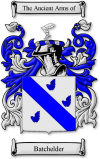
Mark Batchelder - Coat of Arms

Mark Batchelder was born in 1578 in Minster-in-Thanet, Kent, England. He married  Mary FANTINGE 30 Oct 1598 in Thanet, Kent, England. Mark died in Margate, Thanet, Kent, England.

Mary Fantinge was born in 1576 in St Jonnesen, Thane, England. Her father was Andrew FANTINGE.   Mary died in Margate, Kent, England

It appears there were two first cousins,  both named Ruth, born a couple years apart  who both immigrated from Massachusetts to New Brunswick;  William FISKE and Marah [__?__]‘s daughter Ruth and Joseph FISKE  and Susannah WARNER’s daughter, Ruth. [Susannah Warner was Mark Batcheller’s great granddaughter.]  Many genealogies mix these two women up, but it’s not possible that the same woman was mother to both Richard ESTEY‘s children and David Kilborne’s children because they were born at the same time.  It”s more likely that William Fiske’s daughter was our ancestor, but I’m including posts for both families.

Children of  Mark and Mary:

Name Born Married Departed
1. Henry Batchelder 1602
Dover, Kent,England
Martha Wilson
15 Apr 1637 Thanington, Kent, England
2 Feb 1676
Ipswich, Mass
2. Mary Batchelder 1607 in Margate, Kent, England
3. Joseph BATCHELLER
c. 1608 in Canterbury, England Elizabeth DICKENSON in 1628 in England. March, 1647.
Wenham, Mass
4. John Batchelder 1610 in Canterbury, Kent, England Rebecca [__?__]
1625
England
.
Elizabeth Herrick
8 May 1653 in Salem, Essex, Mass
10 Sep 1675
Salem, Mass

Various Spellings of Batcheller-
Bachelder, Bacheldor, Bacheler, Bacheller, Bachelor, Bachelour, Bachildor, Bachiler, Bachilor, Batcheldor, Batcheldour, Batcheler, Batcheller, Batchellor, Batchellour, Batchelor, Batchclour, Batchiler and Batchilor

This notable and long-established surname is of Old French origin, and is a status name for a young knight or novice at arms, deriving from the Old French “bacheler”, from the medieval Latin “baccalarius”. The name was introduced into England by the Normans after the Conquest of 1066, and was adopted into Middle English. By the 14th Century the word “bachelor” had already been extended to mean “(young) unmarried man”, but it is unlikely that many bearers of the surname derive it from the word in that sense. Early examples of the surname include: Stephen le Bachilier (Suffolk, 1203); Walter le Bachelor (Surrey, 1248); and Magg’ (Margaret) Bacheler, noted in the 1273 Hundred Rolls of Huntingdonshire. In Scotland, the name has acquired an added meaning, that of “young tenant farmer” or “holder of a small farm”.

Children

1, 3, 4. Three brothers Henry, Joseph and John immigrated to America in 1637  on the ship “Hercules“.

In a list headed “A true roll or list of names, surnames, and qualities of all such persons who have taken passage from the town and port of Sandwich for the American plantations, since the last certificate of such passengers returned into the office of Dover castle. Henry Bachelor of Dover, brewer, and Martha, his wife, 4 servants. Joseph Bachelor of Canterbury, taylor, and Elizabeth, his wife, 1 child, 3 servants. John Bachelor, of Canterbury, taylor.”

1. Henry Batchelder

Henry’s wife Martha Wilson was born 1605 in Kent, England. Martha died 4 Apr 1686 in Ipswich, Essex, Mass

3. Joseph BATCHELLER (See his page)

4. John Batchelder

John’s first wife Rebecca [__?__] was born in 1610 in Canterbury, Kent, England.

John’s second wife Elizabeth Herrick was born 1610 in Canterbury, Kent, England. Elizabeth died 10 Sep 1675 in Salem, Essex, Mass.

John received grant of 20 acres land in 1639 in Salem, Massachusetts Bay Colony.   He became a member on 23 Jun 1639 in Salem, Massachusetts Bay Colony.  He took the oath of a freeman on 13 May 1640 in Salem, Massachusetts Bay Colony. He granted 20 acres after 13 Nov 1640 in Salem, Massachusetts Bay Colony.  He signed a will on 17 May 1673 in Salem, Essex, MA.   Bequeathed to his wife his house and all movable estate, and then onto son John after her death, less 20 acres which he bequeathed to John Cressy (husband of daughter Mary). He also gives his grandchild John Cressy 6 acres. He resided near the present golf grounds near Elliot Street before 1675 in Beverly, Essex, MA.   He died on 13 Nov 1675 in Salem, Essex, MA  He left, according to his inventory, £230 (included “considerable” tracts of land, orchards, and buildings) about 13 Nov 1675 in Salem, Massachusetts Bay Colony.   He Purchased 60 acres of land.   He was a taylor.  John’s daughter Mary died “in child-bed” in 1659 at the age of 19, the mother of John. John (and his brother Joseph) raised his grandchild rather than his father, Mighill Cressey, who was 31 when Mary died.

Sources:

http://trees.ancestry.com/owt/person.aspx?pid=5968878&st=1

New England Historic Genealogical Register
Page: v163:13 Canterbury Marriage Licenses 1:19
Text: Mark & Mary Fantinge (widow)

Posted in 13th Generation, Line - Miller | Tagged , | 8 Comments

John Fiske

John FISKE (1580 – 1633) was Alex’s 11th Great Grandfather; one of 2,048 in this generation of the Miller line.

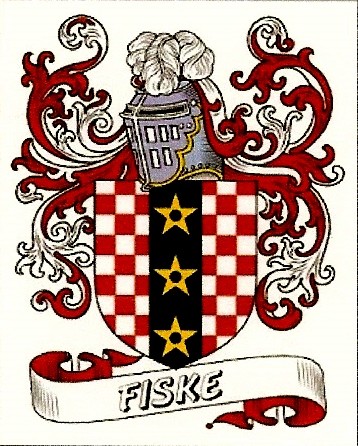
William Fiske - Coat of Arms

John Fiske was born in 1580 in All Saints, South Elmham, Suffolk, England.  His parents were William FISKE (1566 – 1623) and Anna AUSTYE (1551 – 1601). He married his second cousin  Ann LANTERSEE on 8 Mar 1607 in South Elmham, Suffolk, England.  John died in May 1633 and was buried as “Goodman” Fyske [ ie. a Yeoman] at St. James, South Elmham, Suffolk on 14 May 1633.

Ann Lantersee (Lawter) was born about 1580 in  So Elmham, Suffolk, England.  Her father was Robert Lawter.  Ann died in 1637 during a voyage to New England accompanying her sons John and William, daughter Anne and son-in-law Francis Chickering.

Children of John and Ann:

Name Born Married Departed
1. Rev. John Fiske 20 Mar 1607
St James, Suffolk, , England
Ann Gibbs/Gipps
c. 1635 in Frenze Hall, Norfolk,
England
.
Elizabeth Henchman
01 Aug 1672
14 Jan 1677 Chelmsford, Middlesex, Mass
2. Eleazer Fiske 1609
So. Elmham,  Suffolk, England
1616
England
3. Anne Fiske 1 Apr 1610
So. Elmham, Suffolk, England
Francis Chickering
c. 1630
So. Elmham, Co. Suffolk, England
5 Dec 1649 Dedham, Norfolk, Mass.
4. Martha Fiske 1614
England
Captain Edmund Thompson
England
6 Oct 1649 Yarmouth, England
5. Nathaniel Fiske 1612
England
1614
6. William FISKE Bef. 18 Mar 1618/19
St. James Parish, So. Elmham, Suffolk, England
Bridget MUSKETT
1641
Salem, Mass
Sep 1654
Wenham, Mass

An account by his son Rev. John ffiske describes his parents as “pious”.  John Sr. was a churchwarden at St. James, South Elmham in 1628.

A problem with the Fiske family is that the reconstructions vary with who you believe. The way Moriarty reconstructed it in NEHGR 1932 – 34;

[John’s grandfather] Robert FISKE married Sibilla GOLD. (Originally his granddaughter Mary married Anthony Fisher and it changed to daughter of Robert’s brother Nicholas, because Nicholas’s will mentioned Mary and Robert’s didn’t, and because Candler said in his Candler Manuscript on the genealogy of the Fiske family, that Mary the daughter of Nicholas married ___ Fisher and they adn their children went to New England, and the author of that manuscript was Mary’s first cousin once removed.

Robert was the ancestor of most Fiske Puritan fanatics who went to New England, though several of his brothers shared his fanaticsm and they were running around England in circles for a while because the executioner was after them.

So Robert1 had a bunch of sons, and two of them were Thomas2 and William2. William’s son John3  produced two particularly brilliant fanatics; Rev. John Fiske4, and William Fiske4. They went to Salem and Wenham. Rev. John Fiske4 served as pastor at Salem briefly and then went elsewhere to practive religion and medicine in the wilderness and teach college. William stayed at Salem and had Deacon William Fiske5, who was one of the jurors in the witch trial.

Thomas2 had Thomas3, whose son Phineas4 went to Salem and Wenham, and his son Captain Thomas5 and Thomas’s son Captain Thomas6 were foreman and juror on the jury. I get third cousins and third cousins once removed.

All three of them later signed the admission of error or whatever admitting the error of the Salem Witch Trials.

Children

1. Rev. John Fiske

John’s wife first wife Ann Gibbs (Gipps) was born about 1602 in Frenze Hall, Norfolk, England.  Ann died 14 Feb 1671/72 in Chelmsford, Mass. 

John’s second wife Elizabeth Henchman was born 1605 in St James, Suffolk, England. Elizabeth died after 14 Jan 1676/77.

Rev. John Fiske from Savage Vol 2, Dict First Settlers of New England

FISKE, JOHN, Wenham, son of that John who died 1633 (and was son of William, son of Robert, who was son of Richard of Laxfield in Queen Mary’s time); born as Mather tells (in Magn. III. c. 24), about 1601, at St. James parish in South Elmham, a subdivision of the hundred of Wangford, County Suffolk bred at King’s College Cambridge. There took his A. B. 1625, though Mather makes it Emanuel,

married at eight and twenty years of age, by the same authority 1629, Ann Gipps of Frinshall, County Norfolk, had, as tradition said, two children who died as infants but two others he brought with his wife and a younger brother, perhaps William, to Boston, 1637,

sat down first at Cambridge, but removed the same year to Salem, freeman 2 November 1637, taught the grade school among his pupils one being famous afterward as Sir George Downing, [grandson of our ancestors George DOWNING and Dorcas BELLAMY. see his nefarious story on their page] minister for Cromwell and Charles II at the Hague,

had John, born 29 August, baptized 2 September 1638, died under nine years; Sarah, 24, baptized 26 July 1640;

Moses, born at Wenham, 12 April, baptized at Salem by Mr. Norris in June 1642, Harvard College 1662; he had preached occasionally for Hugh Peters, and removed to be minister at Wenham, ordained 8 October 1644,

had there Ann, 15 January, baptized 12 March 1646, being the first baptism in that church, Eliezur, 8, baptized 14 February 1647, died young;

removed 1655 to and was minister of Chelmsford, where his wife Ann died 14 February 1672, “after living with him about 37 yrs.” This renders Mather’s account of the marriage in 1629, impossible and also the tradition of his having had four  children in England as she was his first wife and makes it probable that he brought only one child. On 1 August following, he married Elizabeth, widow of Edmund Henchman, and he died 14 January 1677. His daughter Ann married Captain John Brown of Reading, and died 30 May 1681, aged 35.

3. Anne Fiske

Anne’s husband Francis Chickering was born in Risbridge, Suffolk, England. His parents were Henry Chickering and Mary [__?__]. After Anne died, he married 11 Jun 1650 to Sarah [How?] Sibley Chickering Bowles. Francis died 2 Oct 1658 in Dedham, Norfolk, Mass.

John Sibley married by about 1631 Sarah [How?] (They had one child of record: Sarah (Sibley) Dwight.  Sarah married (2) at Dedham on 11 Jun 1650 Frances Chickering. She married (3) after 1658 John Bowles of Roxbury & was buried there on 4 Sep 1686. In her will Sarah [How?] Sibley Chickering Bowles made a bequest to “my loving brother Joseph How.” Which of the Joseph Hows of early New England he may have been has not been determined.

4. Martha Fiske

Martha’s husband Capt. Edmund Thompson was born in England.  His parents were John Thompson of Holkham in Norfolk and Anne Hastings.

She and Capt. Edmund Thompson had 7 children. She and Capt. Edmund Thompson immigrated in 1637 to Salem, MA., where they had four children: Martha, Edmund, Thomas and Hannah. Capt. Thompson was admitted to the church in Salem, Mass. in Dec 1639.  They returned after 4 Jul 1647 to Yarmouth, England  where they had a further three children, all of whom died in infancy. According to the Candler manuscript Capt. Thompson was a sea-captain who served the Colonies after the death of King Charles I.

9. William FISKE (See his page)

Sources:

http://boards.ancestry.com/topics.salem-20-witch-20-trials/135.2/mb.ashx

http://familytreemaker.genealogy.com/users/p/o/p/Sandra-Popiel/FILE/1169text.txt

http://genforum.genealogy.com/fisk/messages/865.html

http://www.oocities.org/heartland/acres/6302/emerson.html

Posted in 13th Generation, Immigrant - England, Line - Miller | Tagged | 2 Comments

Genealogical Societies

Here is a list of societies we are qualified to join

Ancient and Honorable Artillery Company of Massachusetts – This is the third oldest chartered military organization in the World, and the oldest in the Western Hemisphere! The rich tradition of the Ancient and Honorable Artillery Company can be seen in its Museum Headquartered in Faneuil Hall , Boston, the Company boasts one of the finest military museums in the United States. It is located on the fourth floor of Faneuil Hall and is open to the public free of charge from 9:00 a.m. to 3:00 p.m.

Associated Daughters of Early American Witches

The Purpose of this Society shall be:

1. To search for and preserve the names of those accused of witchery in that portion of Colonial America now the United States of America.

2. To locate the living female descendants of all witches who were accused in the American colonies prior to published records of same.

The Requirement: A woman must be at least sixteen years of age and able to prove descent from an ancestor or ancestress who was accused or tried or executed for the practice of witchcraft prior to 31 December 1699.

Descendants of Whaling Masters – It would seem that the beaching of whales was taking place in colonial times.  In 1680 John HAWES was one of four men who were “to look out for and secure for the town all such whales as by God’s providence shall be cast up in their several bounds.”  His territory was the western part of the town.  He was paid 4-5 pounds for each whale payable in blubber or whale oil.

Dutch Colonial Society – Proven direct descent from a Dutch settler born in the Netherlands, and, who immigrated, no later than 19 April 1775, to any settlement in what is now the United States.

Dutch Settlers of Albany – Strives to perpetuate the memory of the individuals who settled in the greater Albany area during the Dutch colonial period of 1624 – 1664.  The Society is charged with collecting and preserving information pertaining to the early history of Albany (Fort Orange, later Beverwijck) including genealogical records of the settlers and their descendants

Elder William Brewster Society – (Locked)

Flagon and Trencher Society –  Those persons, either male or female, who can prove direct descent from a person conducting a tavern, inn, ordinary, or other type of hostelry prior to 4 July 1776 (within the area which became the first 13 states).
National Huguenot Society – A member must be lineally descended in the male or female line from a Huguenot, without regard to ethnic origin or adherence to any particular sect of Protestantism, who, subsequent to 10 December 1520 and prior to the promulgation on 28 November 1787 of the Edict of Toleration, immigrated to North America or some other country.

Order of the Crown of Charlemagne – Historical and genealogical research and to perpetuate the memory and to honor the name of Emperor Charlemagne; to bring into one group the descendants of his successors and heirs; to maintain and promote the traditions of chivalry and knighthood; to recognize acts of merit; to recognize achievements in the Arts, Sciences and Letters; to inspire patriotism and loyalty to our country; and for such other lawful and proper purposes as the Executive Council of the order may from time to time decide upon. To collect and preserve books on genealogy, family history, heraldry and general history. To collect and preserve documents, manuscripts, relics, records and traditions relating to Emperor Charlemagne and his successors; to create a popular interest in ancient history and genealogy. The Order is non-political and non-sectarian. Percival LOWELL can trace his roots back to Edward I and Charlemagne,  Robert ABELL (c. 1605 – 1663) can also trace his roots back to Charlemagne.

Pilgrim Francis Cooke Society – Formed in 2003, to perpetuate the memory of Francis Cooke, as he had many descendants.   Franics COOKE (c.1583 -1663) (Wikipedia) was one of the 102 passengers on the Mayflower. This early settler is one of the twenty-six male Pilgrims known to have descendants. He was Alex’s 10th Great Grandfather; one of 2,048 in this generation of the Miller line.

Pilgrim John Howland Society – The Society consists of descendants of the Pilgrim John HOWLAND (c. 1591 – 1673), one of the 102 English passengers who came to New England from Holland and England aboard the ship Mayflower in 1620.

John Howland was born about 1592/3. He came to Plymouth on the Mayflower in 1620 as a servant to John Carver. During the Atlantic voyage, he was swept overboard and rescued. He also served as a member of the party that explored Cape Cod before the landing in Plymouth.

Society of the Descendants of the Colonial Clergy – An applicant must have a proven lineal, lawful descent from a clergyman who was regularly ordained, installed, or settled over a Christian church within the limits of the thirteen colonies prior to July 4, 1776.

Society of the Descendants of the Founding Fathers of New England – Membership is open to any person who can provide proof of lineal descent
from a male ancestor who was in New England before 1650.

Society of the Descendants of Washington’s Army at Valley Forge

Sons and Daughters of Montana Pioneers

United Empire Loyalists’ Association of Canada – The United Empire Loyalists were those who had been settled in the thirteen colonies at the outbreak of the American Revolution, who remained loyal to and took up the Royal Standard, and who settled in what is now Canada at the end of the war.   Nathaniel PARKS (1738-1818) was 40 when he enlisted and his son was 18 years old.  The N.J. Volunteers were relocated to Canada arriving in Parrtown New Brunswick  in Oct 1783 aboard the Duke of Richmond (Parrtown was renamed Saint  Johns in 1785.  ”Saint” is written out to distinguish it from St. John’s Newfoundland.). Both Nathaniel and Joseph are on the battalion land grant list for King’s County, New Brunswick on 14 July 1784

Posted in Fun Stuff, Storied | 2 Comments

Colonial Tavern Keepers

Descendants of Colonial Tavern Keepers qualify for membership in the Flagon and Trencher Society. Those persons, either male or female, who can prove direct descent from a person conducting a tavern, inn, ordinary, or other type of hostelry prior to 4 July 1776 (within the area which became the first 13 states).

Flagon and Trencher Society

In colonial times, taverns, ordinaries, pubs and other hostelries were usually kept in a person’s home and no other building existed for this purpose. Therefore, the majority of the “taverns” as we think of them in that time probably did not have names. In smaller municipalities named taverns were probably not the rule. In larger ones the taverns had names to distinguish them apart.

The key to establishing membership is proving that your ancestor was licensed by the local authority to conduct the business of keeping an ordinary, hostelry, inn or hotel or licensed to sell spirituous liquors. The name of the establishment is not necessary. Brewers do not qualify.

Here’s to our ancestors! Without them where would be?
Flagon and Trencher Traditional Toast

To the old, long life and treasure;
To the young, all health and pleasure;
To the fair, their face,
With eternal grace,
And the rest, to be loved at leisure.
Ben Jonson

A feast is made for laughter, and wine maketh merry.
Ecclesiastes 10:19

Here’s champagne to our real friends
and real pain to our sham friends. To the militia:
Invincible in peace;
invisible in war.
Good company, good wine, good welcome make good people.
Shakespeare

Drink down all unkindness.
Shakespeare, Merry Wives of Windsor, Act 1

Better to pay the tavernkeeper than the druggist.
Spanish proverb

It is around the table that friends understand best the warmth of being together.
Old Italian saying

Beer is proof that God loves us and wants us to be happy.
Benjamin Franklin

Wine is sunshine held together by water.
Galileo Gallileo

Sir Richard (Williams) CROMWELL (1504 – 1544)  (Wikipedia) father   Morgan WILLIAMS (1469 – ) was an ale brewer and innkeeper at Putney, a district in south-west London 5 miles south-west of Charing Cross.  Morgan’s father-in-law  Walter CROMWELL was also a brewer.  I remember Catherine was a sympathetic older sister in and Walter was an abusive father in Hillary Mantel’s novel Wolf Hall.

Capt. Robert ANDREWS (1560 – 1643) On Sept. 3,1635,Robert Andrews was licensed “to keep ordinarye(an Inn) in the plantacon where he lyves during the pleasure of y court.” This is the earliest reference to a public house in the records of Ipswich.  Robert lived near the South Church.

John GOODALE (1563 -1625 ) The family name Goodale  applied to the maker or seller of good ale, i.e., a bewer or tavern keeper. Our lineage commences with Thomas Goodale, the Elder who was born in the 1530′s and died prior to 03 October 1588, Both at Downham, Norfolk which is located in the far western end of the county and a few miles south of Kings Lynn.

Stephen HOPKINS (1580 – 1644) (wiki)

Keeping in mind the delicate balance in Plymouth between (Saints and Strangers) “covenant” and “noncovenant” colonists, it is reasonable to assume that Hopkins must have been a leader of the non-Separatist settlers, and in his career at Plymouth can be seen some of the ambiguity that attached to the non-Separatists living in a Separatist colony. Even though he was an Assistant Governor from 1633 to 1636 he often found himself in conflict with the Plymouth authorities over his tavern.

2 Oct 1637 – He was presented twice, first for suffering men to drink in his house on the Lord’s day before meeting ended, and for allowing servants and others to drink more than proper for ordinary refreshing, and second for suffering servants and others to sit drinking in his house (contrary to orders of the court), and to play at shovel board and like misdemeanors is therefore fined fourty shillings.”

2 Jan 1637/38 – Hopkins was presented for suffering excessive drinking in his house “as old Palmer, James Coale, & William Renolds”

Jan 2 1637 : “Presentment by the Grand Jury.
“1. William Reynolds is psented for being drunck at Mr Hopkins his house, that he lay vnder the table, vomitting in a beastly manner, and was taken vp betweene two. The witness hereof is Abraham Warr, als Hoop, als Pottle, and sayth that there was in company Francis Sprague, Samuell Nash, & Georg Partrich.
2. Mr Hopkins is psented for sufferinge excessiue drinking in his house, as old Palmer, James Coale, & William Renolds, John Winslow, Widdow Palmers man, Widdow Palmer, Thomas Little, witnesss & Stepheen Travy

5 Jun 1638 – He was presented for selling beer for two pence a quart which was not worth a penny a quart, and for selling wine at excessive rates “to the oppressing & impovishing of the colony”; he was fined £5 for some of these offenses, including selling strong waters and nutmegs at excessive rates

5 June 1638 : “Presentments by the Grand Jury…
“Mr Steephen Hopkins is prsented for selling beere for ij d the quart, not worth j d a quart. Witness, Kenelme Winslow.
“Item, for selling wine at such excessiue rates, to the opressing & impouishing of the colony. Kenelme Winslow & John Winslow, witnesses.”

Thomas LUMBERT (1582 – 1665) Thomas was an Innkeeper.  Plymouth Colony Records show that on 3 Dec. 1639 Thomas Lumbert was “allowed to keepe Victualling, or an ordinary, for entertainement of passengers, and to draw wyne at Barnstable he keeping good order in his house”.

John MASTERS (1584 – 1639)  On 3 Sep 1635 “John Maistrs” was licensed to keep an ordinary at Cambridge.  On 4 June 1639 for some unknown offense “John Masters, having license, was discharged”

Deacon John PARMENTER Sr. (1588 – 1671) – The Parmenter Tavern, established by Deacon John in 1643, when a license for the “house of entertainment ” was issued 10 May 1643. This naturally provided a livilehood for the Deacon and his wife. Prior to opening this business Deacon John probably farmed along with his son John Jr.. When John Jr. took over the ownership and management of the Tavern is not presently known, but in 1653-4 another license was issued to John, Jr. This was seven years before Deacon John moved to Roxbury to marry his second wife in 1660.

Capt Edmund GREENLEAF (1590 -1671) Edmund was one of the original settlers of Quasca Cunquen, afterward Newbury, where each of the first settlers was granted a house lot of at least four acres, with a suitable quantity of salt and fresh meadow. In addition to this, he had a grant of twelve acres, which shows him to have been one of the eighteen principal pioneer settlers. Edmund lived near the old town bridge in Newbury, where he kept a tavern. By trade, he was a silk dyer.

Thomas FORD (1590 – 1676)  – In June 1644, the General Court voted that each of the three River towns should arrange that some responsible inhabitant “keepe an Ordinary” as accommodation for strangers passing through. Soon after his marriage to Ann, Thomas Ford moved to Hartford and established the first tavern there, in the home of her former husband Thomas Scott, standing at the corner of State and Front streets. John Winthrop Jr. visited the inn on 17 November 1645 and noted it in his journal. Soon after his marriage Thomas purchased a house and two acres of land in Hartford from Samson Shore. Thomas maintained the inn until 1648.  Although he  kept his lands at Windsor, on 9 March 1652 he sold the tavern to Thomas Cadwell.  Today, the Arch Street Tavern, located around the corner the tavern Thomas established 367 years before was just voted best happy hour in the state by Connecticut magazine.

The Front Street District is the final phase of Adriaen’s Landing, a state and privately-funded master planned development intended to attract activity to downtown by way of residents, retail, and other commercial activity. The plan includes the existing Connecticut Convention Center, Connecticut Science Center (opening spring 2009), and the 409 room Marriott Hartford Hotel.

The Front Street District is a major development project in downtown Hartford. is located directly across Columbus Boulevard from the Connecticut Convention Center and the Marriott Hotel. When completed, the project will include 150,000 square feet  of building area that will be occupied by restaurant, entertainment and retail spaces.   In total, over $1 billion of public and private capital has been invested in new development projects in downtown Hartford including the Adriaen’s Landing master plan area.

Capt. Edward BANGS (1591 – 1678)  was a shipwright and served on several town committees, holding a responsible position within the community. Edward Bangs signed his will and several deeds. He was also an Innkeeper (“Liberty is granted unto Edward Bangs to draw and sell wine and strong waters at Eastham, provided it be for the refreshment of the English, and not to be sold to the Indians,”

William HILTON Sr. (1591- 1656) William was in Dover by 1628, later moving to Kittery (1648) and York (1651). He served in various official capacities,including juror and committeeman, in Dover, and York. While in Kittery he was a tavern keeper and ferry operator.

Roger SHAW (1594 – 1661) Roger was for a time Vintnor and Keeper of the Ordinary in Hampton New Hampshire, and in 1650 he was empowered and ordered by General Court “to sell wine or any sort of strong liquors to Christians and the Indians, as in his judgment shall seem meet and necessary, on just and urgent occasions, and not otherwise.”

Nicholas SNOW (1600 – 1676)  1670 – he, with Capt. Jonathan SPARROW, was appointed to visit the ordinaries in Eastham, Plymouth Colony, and see that there was no excessive drinking; and the same year was one of the Grand Inquest.

Martha BEAMSLEY (1606 – 1668) “In”answer to the petition of Martha Beamesly, of Boston, widow, humbly desiring the favor of this Court to grant her license to distill & retail strong waters, &c., the Court judgeth it meet to grant her request, she giving security to the secretary for the keeping due order, without offence or prejudice to the law & order of the County Court”

Robert ABELL (c. 1605 – 1663)  Robert Abell came from London in 1630 and resided first at Weymouth and then moved to Rehoboth in 1643. In 3 July 1656 RA was allowed by the court to keep an ordinary in Rehoboth.

Lt. Edward WOODMAN (1606 – 1694) a mercer and wine merchant, was licensed 12 January 1637/1638 to sell wine and strong drink in Newbury, Mass.  Among his commissions from the state was “to see people marry” which he later resigned saying “An unprofitable commission: I quickly laid aside the works, which has cost me many a bottle of sacke and liquor, where friends and acquaintances have been concerned.”

Lt. William CLARKE (1610 – 1690) In 1671, he was licensed to sell “wine, cider or liquor for a year”in new settlement of Squakheag (Northfield) Massachusetts.

Barent Jacobsen KOOL (1610 – 1676)  On April 13, 1654, Barent became a wine and beer carrier for the Dutch West India Company. He watched the company warehouse and was appointed by the New Amsterdam burgomasters as an exciseman. He, along with Joost Goderus, boarded ships in New Amsterdam, searched their contents, and levied duty on the goods they found. On September 21, 1663, Barent was appointed as a public porter and was elected foreman (Elder of the Beer Porters) on July 17, 1665.

Gerrit Frederickse LANSING (1610 – c. 1655) was was the father of the Lansing family – the most numerous family group to live in early Albany.   John Lansing, Jr. (the younger – even though he was the son of Gerrit), orJohn 5 Lansing– an innkeeper who was the fifth generation “John” in his particular line.

William FISKE (1613 – 1654)  According to Wenham, Mass town records William Fiske received liberty from the General Court in 1643 to keep an ordinary (public house) In 1646 he was licensed to sell wine and strong water

Edward STURGIS (1613 – 1695) 7 Jul 1646 – Granted a license “to keep an ordinary and draw wyne” in Yarmouth

Bartholomew HEATH (1615 – 1681)  moved to Haverhill, Massachusetts as early as 1642-1646, where he was an innkeeper. Haverhill was a new village, founded in 1640, and then considered to be in the wilderness and controlled by Indians. Bartholomew and Hannah were some it’s first inhabitants.  Bartholomew as appointed  Constable and Selectman there.

John PARMENTER Jr. (1616 – 1666) John became a freeman in May 1642; kept a tavern or ordinary, at which the committee of the Colonial Court and Ecclesiastical Council for the settlement of difficulties in Sudbury, in 1655, was held.

Thomas SKINNER I (1617 – 1704) Thomas had been a victualler (English innkeeper) in Chichester and was, on May 31, 1652, licensed to keep an ordinary in Malden.  He was admitted a freeman in Malden, May 18, 1653. Thomas received a license to operate an inn formerly licensed to a John Hawthorne, who had been convicted of forgery in neighboring Lynn, MA. It is unclear whether Thomas operated both inns or if he sold or abandoned his original venture. In 1654, a Malden property was transferred from a Roland Lathorne to Thomas Skinner who, in turn, rented it to Thomas Call. It was located near the corner of Cross and Walnut Streets, about 5 blocks from Joseph Hills’ homestead. By 1657, Thomas Skinner retired from his inn-keeping occupation and the license to operate the inn and tavern was transferred to his eldest son, Abraham, on April 16, 1657. There are indications the Inn/tavern owned by Abraham was called the ‘Surf and Turf’.

Thomas  HUCKINS (1618 – 1679) 1 Mar 1653 – Thomas was licensed to sell wines and strong waters in Barnstable until the next June court. He had probably been authorized to keep an ordinary, or public house, during the previous ten years. He was for several years receiver of the excise imposed on the importation of wines and liquors and powder and shot. In the last mentioned year, he was captain of the packet, and he brought into the town for himself 35 gallons of wine and 9 of brandy, besides liquors and powder and shot for other persons.

“When Mr. Huckins settled there, a stream of fresh water run all the year on the south of his house, through a morass impassable by teams. In this isolated spot he kept an ordinary, as taverns were then called, for the accommodation of travellers. It is however to be presumed that the lovers of ‘strongwater’ knew the paths that lead to his house.”

William WOODCOCK Sr.’ son John Woodcock (1627 – 1701) The first settlement within the bounds of the town of Attleborough was in the neighborhood of the Baptist meetinghouse, where Hatch’s old tavern still stands. It was commenced by Mr. John Woodcock, his sons and their families, soon after the first division in 1669. Here he built a public house on the “Bay Road,” and fortified it as a garrison, and laid out lands to the amount of about three hundred acres, which afterwards made an excellent farm. Woodcock’s house was occupied for a garrison.
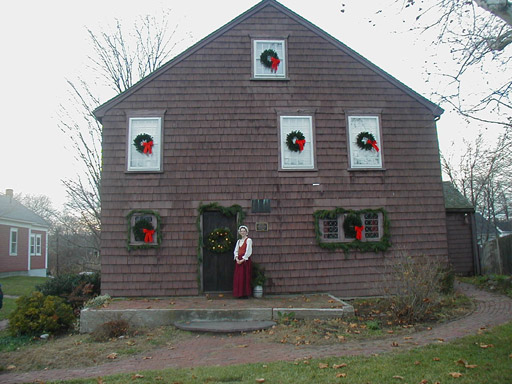
Woodcock Garrison House all dressed up for Christmas

It was licensed in 1670, according to the following record :—

“July 5th, 1670. John Woodcock is allowed by the Court to keep an Ordinary at the ten mile river (so called) which is in the way from Rehoboth to the Bay ; and likewise enjoined to keep good order, that no unruliness or ribaldry be permitted there.”—Old Col. Rec.

Jan Juriaensen BECKER (c. 1630 – 1697)   In 1655 the West India Company resolved to reduce the Swedish colony on the Delaware by conquest. Director General Stuyvesant set sail with a fleet and bloodlessly took Fort Christina. Jan Becker [age 25] went with him and was posted as clerk of the colony.  In 1658 he was made provisional commisary or commander.   In 1660 a permanent commander was sent.  He found Becker insubordinate and engaged in violating the law by trading liquor to the Indiana for game. So Becker was brought to Manhattan tried before the  Burgomaster.   Jan was fined 300 guilders for selling liquor to the Indians. He proved the Fort’s new commandant also sold liquor and his fine was dismissed, though he was banished from South River.

On being returned to Manhattan, and out of his job with the Company for want of anything better to do (as he himself said in a petition to the Company) he opened a tavern. It was located just east of Bowling Green, on the part of Marketfield Street now covered by the produce Exchange. Not far away was the anchoring place and dock at Whitehall and Pearl Streets. Across the street was the Fort and in the fort was the church.

On the fourth of August 1660, a Sunday, his son Jeuriaen was born, and there was a tapping of casks for the neighbors and midwives and a carousing. There followed a prosecution for disturbing the peace, and the services in church, and a fine. Not all went well with the tavern business. The visiting sailors were not always quiet. Too many patrons were trusted.

In 1663, he got in trouble again  for liquor selling at Greenbush, Rensselaerswyck, New York.

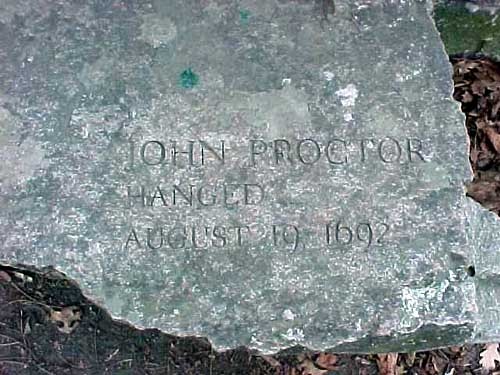
John PROCTOR Jr. (1632 -1692)  was a successful farmer, entrepreneur, and tavern keeper who lived far from Salem Village center, on the edge of Salem Town. He had never been directly involved in Salem Village politics or litigation with the Putnams, but his interests were diametrically opposed to those of the old, established village elite. He had risen to considerable wealth and prestige. But to the Putnams, with their defensive, inflexible outlook, Proctor and his wife remained hated outsiders.

Although farming was his primary business, Proctor’s wife and daughter ran a local tavern on Ipswich Road. Proctor seems to have been an enormous man, very large framed, “impulsive,” with great force and energy. Proctor is described on several occasions, from various sources as a strong-willed beast of a man. Charles Upham writes, “He was a man of Herculean frame…he had great native force and energy…he was bold in his spirit and in his language.” Although an upright man, he seems to have been rash in speech, judgment, and action. It was his unguarded tongue—that would eventually lead to his death.

Daniel WOODWARD (1653 – 1713)  was christened on 2 Sep 1653 in Medford, Mass.   It is supposed that he was the Daniel Woodward, of Medford, who was licensed by the Court, May 1, 1690, to keep an inn.

Storm Albertse Van Der ZEE (Bradt) (1663 – 1712)   Growing up on the Normanskill, by the mid-1650s he was trading lumber, furs, and tobacco in New Amsterdam – probably on his father’s behalf. In 1662, he obtained a lot and then a house in Beverwyck. Thereafter, he settled in Albany – forming a number of trading partnerships, opening a tavern, and marrying Hilletie Lansing.

Running a tavern and other enterprises frequently brought him before the Albany magistrates.  When Storm died, a  joint will left everything to his wife with provision that half the estate be divided among their children when they reached adulthood. At the same time, she stood to inherit a share of her father’s estate in Holland. Within a year,  she had remarried. Her second husband was Willem Ketelhuyn – who took over her husband’s tavern.

Johannes BECKER (1663 – 1712) At Albany the brothers-in-law Hogan and Becker conducted a tavern. In a letter to Johannes Becker from Lieut. Matthew Shanks, sailing for England, with a promise to pay in time his indebtedness for drinks. The back of the letter served for a reckoning of drinks served to the first citizens of Albany. The date is 1698. Shortly after 1700 Johannes removed to a farm on the Van Rensselaer patroonship, in the town of Bethlehem, near the hamlet once known as Becker’s Corners, now Selkirk.

Nathaniel PEASE I (1700 – 1771) Like his grandfather, he was a weaver by trade. In 1759 he settled in Blandford, Massachusetts, where for several years he carried on a public house in connection with farming.  In 1771 he sold his tavern to his son Levi and is said to have removed to Stephentown, New York, where he died.

Benjamin COLMAN’s son Col. Dudley Colman (1745-1797)  was the last owner of the famous  Bunch of Grapes Tavern.  Col. Dudley Coleman applied for and received a license to operate the tavern on State Street in Boston in 1790 and continued to run it until his death.  The tavern was demolished in 1798.
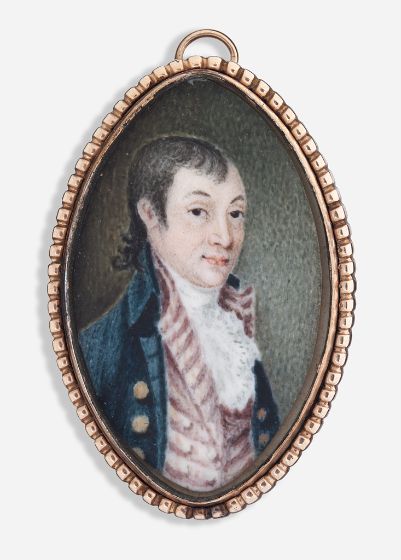
Col Dudley Colman (1745-1797) Collection of Fogg Musuem Harvard.  For the reverse see his father’s page.

The Bunch-of-Grapes was a tavern located on King Street (State Street today) in Boston,Massachusetts, in the 17th and 18th centuries. Typical of taverns of the time, it served multiple functions in the life of the town. One could buy drinks, concert tickets, slaves; meet friends, business associates, political co-conspirators.
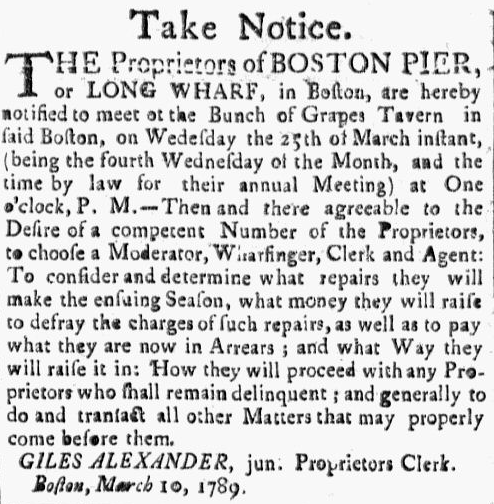
1789 Bunch of Grapes Meeting Notice

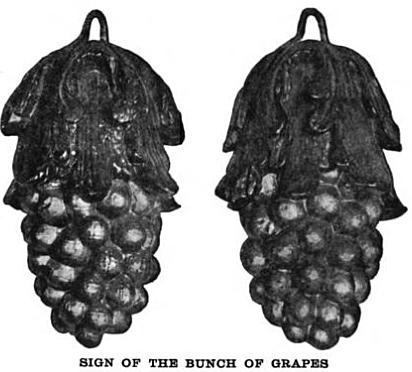
Located in the center of town activity, the facade of the Bunch-of-Grapes building featured iconic signage: “Three gilded clusters of grapes dangled temptingly over the door before the eye of the passer-by.”
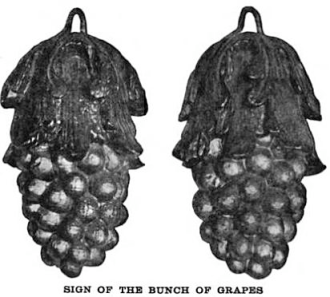
Sign of the Bunch of Grapes

Notable events occurred on tavern premises. “On Monday, July 30, 1733, the first grand lodge of Masons in America was organized here by Henry Price, a Boston tailor, who had received authority from Lord Montague, Grand Master of England, for the purpose.” They  formed what was appropriately named First Lodge No. 126 (now St. John’s Lodge—Massachusetts does not number their Masonic lodges). It was, in fact, the first lodge in America that the Grand Lodge had authorized (unlike earlier lodges that existed in Pennsylvania), and Price’s position as “Provincial Grand Master of New England and Dominions and Territories thereunto belonging” gave him the sole right to charter new lodges in the Colonies.
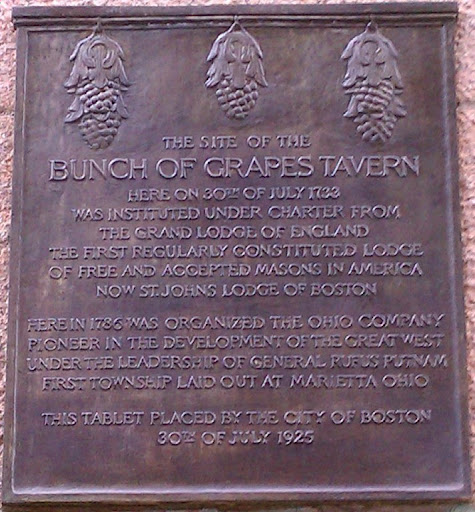
Bunch of Grapes Plaque 1925

A replica of the sign that hung over the door of the Bunch of Grapes tavern was carved from a block of wood from the U.S.S. Constitution and now hangs in the Grand Lodge building in Boston.
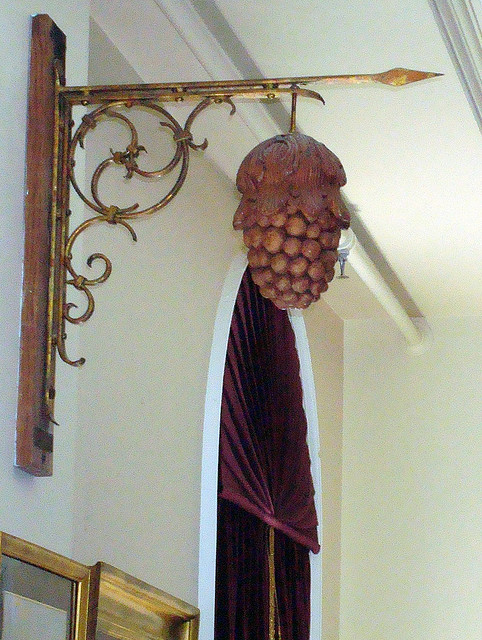
Bunch of Grapes Replica Hanging in the Grand Lodge of Massachusetts Building in Boston

In 1769, the tavern offered tickets for sale for “Love in a Village,” the first professional opera performance in Boston.  Artist Christian Remick (b.1726) displayed his paintings in the tavern in 1769.

A darker chapter in the tavern’s history involved slavery. For potential buyers, a “search for slave labor in Boston began and ended along the bustling King Street corridor that connected the warehouses of Long Wharf to the commercial center of town. Three of Boston’s busiest public houses — the Royal Exchange, the Crown Coffee-House, and the Bunch of Grapes tavern- lined that half-mile stretch. All offered fine drink and lively conversation, and at times all served as clearinghouses for slaves.”

In the revolutionary era, “the Bunch of Grapes became the resort of the High Whigs, who made it a sort of political headquarters, in which patriotism only passed current, and it was known as the Whig tavern.”  Paul Revere and others gathered here.
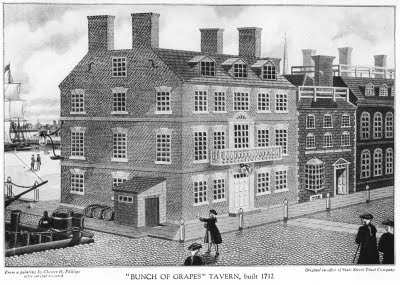
Bunch of Grapes Tavern

However during the British occupation of Boston, British troops met at the tavern. In January 1776, James Henry Craig, company commander of the 47th (Lancashire) Regiment of Foot, arranged a meeting at the tavern: “The ancient and most benevolent of the Friendly Brothers of St. Patrick. The Principal Knot of the 47th Regiment is to meet at the Bunch of Grapes on Thursday the 29th inst. at eleven o’clock in the forenoon. . . . All the Friendly Brothers in the army are requested to meet at the same place at one o’clock, on business relating to the order in general. J.H. Craig, S.P.K. 47th Reg.

After the Siege of Boston ended in March 1776, “General Washington was handsomely entertained” at the Bunch-of-Grapes, as was Lafayette, and General John Stark.
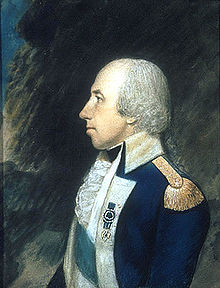
General Rufus Putnam formed the Ohio Associates at the Bunch of Grapes Tavern

In  1786, Rufus PutnamBenjamin TupperSamuel Holden Parsons and Manasseh Cutler, met at the Bunch of Grapes tavern to form the Ohio Company of Associates, which  pioneered the development of the territory around the Ohio River Under the leadership of General Rufus Putnam, the company was formed on March 1, 1786 and  the first township laid out at Marietta Ohio.
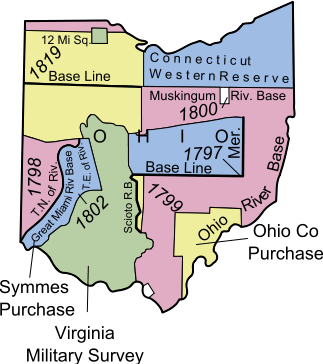
Ohio Lands — The boundaries of the Ohio Company Purchase are shown on the lower right.

The first contract was for the Ohio Company to purchase 1,500,000 acres  of land at the confluence of the Ohio and Muskingum rivers, from a point near the site of present-day Marietta, to a point nearly opposite present-day Huntington, West Virginia, for a payment of $1 million in government securities, then worth about 12¢ specie to the dollar. The contract also provided that one section of land in every township be devoted to the maintenance of public schools, another section be set apart for religious uses, and two entire townships be reserved for a university.

The second contract was an option to buy all the land between the Ohio and the Scioto rivers and the western boundary line of the Ohio Company’s tract, extending north of the tenth survey township from the Ohio, this tract being preempted by Manasseh Cutler and Winthrop Sargent for themselves and others for the Scioto Company. Cutler’s original intent was to buy only about 1,500,000 acres  for the Ohio Company, but on the July 27, Congress authorized a grant of about 5,000,000 acres  of land for $3,500,000; a reduction of one-third was allowed for bad tracts, and it was also provided that the lands could be paid for in United States securities.
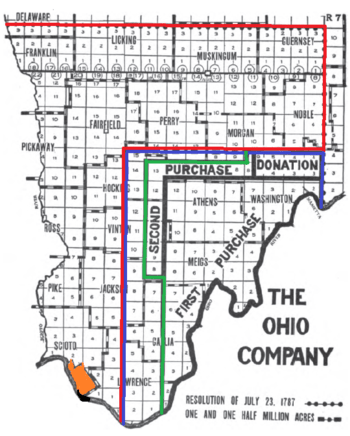
The proposed purchase by the Scioto Company is shown in red. The proposed purchase of 1,500,000 acres (6,100 km2) by the Ohio Company is in blue. The final dimensions of the Ohio Company is in green, including the First Purchase, Second Purchase, and Donation Tract.

Owners of the tavern included: William Davis (prior to 1658); William Ingram (1658); John Holbrook (1680); Thomas Waite (1731); and Elisha Doane (1773).  Keepers of the tavern included: Francis Holmes (1690–1712); Mrs. Francis Holmes (1712-ca.1731); William Coffin (1731–1733); Edward Lutwich (1734); Joshua Barker (1749); Mr. Weatherhead (1750-ca.1757); Joseph Ingersol (1764–1772); John Marston (ca.1776-1778); William Foster (1782); James Vila (1789); and Dudley Colman (1790).

The Bunch-of-Grapes building was demolished in 1798.

Links:
Posted in Fun Stuff, Storied | Tagged | 6 Comments

2010 in Review

I have pretty much come to the end of the line in Tracing each branch back to the American arrival.    Here are the final stats.

I found 626 Ancestral Families that have lived in America.  Based on my four grandparents:
– 9 Blair
– 109 Miner
– 151 Miller
–  and the big winner 357 Shaw
There are still 32 families with missing parents who lived in America which balanced by the 33 families with double (and one triple – Gov. Thomas Prence) who had more than one child who ended up to by an ancestor.
What’s left is to collect stories, understand life experience and historical context, add pictures and make fun connections.

The stats helper monkeys at WordPress.com mulled over how this blog did in 2010, and here’s a high level summary of its overall blog health:

Healthy blog!

The Blog-Health-o-Meter™ reads Wow.

Crunchy numbers

Featured image

The average container ship can carry about 4,500 containers. This blog was viewed about 16,000 times in 2010. If each view were a shipping container, your blog would have filled about 4 fully loaded ships.

In 2010, there were 633 new posts, not bad for the first year! There were 536 pictures uploaded, taking up a total of 104mb. That’s about a picture per day.

The busiest day of the year was November 28th with 301 views. The most popular post that day was John Proctor.

Where did they come from?

The top referring sites in 2010 were search.aol.com, webcache.googleusercontent.com, mariaozawa2u.blogspot.com, alphainventions.com, and http:///.

Some visitors came searching, mostly for how is “millard fillmore” related to john lathrop?, john proctor, lord de la warr, “susannah martin” “george martin”, and simon bradstreet england.

Attractions in 2010

These are the posts and pages that got the most views in 2010.

1

John Proctor October 2010
6 comments

2

Thomas West 3rd Baron de la Warr June 2010
5 comments

3

Origins July 2010

4

Vassalboro September 2010
1 comment

5

Passages May 2010
2 comments

Posted in Fun Stuff | 7 Comments

Thomas West

I originally thought Thomas WEST (1630 – 1674) was Alex’s  10th Great Grandfather; one of 2,048 in this generation of the Shaw line.  However, I now think that Thomas’ one time granddaughter Dorothy COLBY was not the daughter of Anthony COLBY II, as I first thought, but instead was the daughter of his cousin Isaac COLBY and Martha PARRATT.

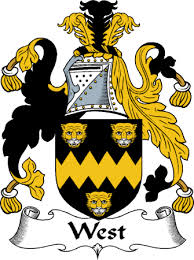
Immigrant Ancestor - West Coat of Arms

Immigrant Ancestor – West Coat of Arms

Thomas West was born in 1630 in Suffolk, England. He married Mary [__?__]. Thomas died 16 Apr 1674 in Salem, Essex, Massachusetts.

Another Thomas West was born 1629 in  England. He died 23 Dec 1720 in Bradford, Essex, Massachusetts.  Thomas married Phebe Waters on 11 Oct 1658 in Salem, Essex, Massachusetts.  Phebe Waters was born in 1634 in Salem, Essex, Mass. She died 16 Apr 1672 in Salem, Essex, Mass.

A third Thomas West was born in 1630 in Bradford, Massachusetts.  He died  23 Dec 1720 in Bradford, Essex, Mass.  He married Mary Tenney 14 Aug 1674 in Salem, Mass.  Mary Tenney was born 24 Sep 1646 in Rowley, Essex, Mass.  Mary died 12 May 1731 in Bradford, Essex, Mass.

Children of  Thomas and Mary:

Name Born Married Departed
1. Elizabeth WEST 1660 in Amesbury, Essex, Mass. Anthony COLBY II
1678 in Massachusetts.
25 Jun 1738 in Haverhill, Mass.
2. Joseph West 7 May 1688
3. John West 1690

Anthony’s cousin Anthony Colby may have married a different Elizabeth West

This  Anthony was born 24 Jan 1669 in Rowley,Essex,Mass. and died in Of E. Haverhill,Essex,Massachusetts.  His parents were Isaac Colby (1640 – 1723) and Martha Parratt (1649 – 1730)   He first married Mary Curries (Courier) 23 Oct 1701 in Rowley, Essex, Mass.

Sources:

http://trees.ancestry.com/tree/9255920/person/157218127

Posted in 12th Generation, Immigrant - England, Line - Shaw | Tagged | 4 Comments

Thomas Scudder

Thomas SCUDDER (1587 – 1657)  Many genealogies say that his daughter Elizabeth married Samuel LATHROP, but our actual ancestor was her cousin Elizabeth whose parents were his brother John SCUDDER and sister-in-law Elizabeth STOUGHTON.

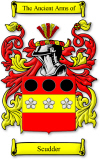
Thomas Scudder - Coat of Arms

Thomas Scudder was born in 1587 in Groton, Suffolk, England. His parents were Henry SCUDDER and Elizabeth HALE. He married Elizabeth Lowers in 1618 in Groton, Suffolk, England.  He and Elizabeth arrived in Salem, Mass. in 1635.   Thomas died in 1657 in Salem, Essex, Massachusetts.

Elizabeth Lowers was born in 1600 in Groton, Suffolk, England. Her father was John Lowers.    Elizabeth died 9 Sep 1666 in Ipswich, Essex, Massachusetts, United States,

Children of Thomas and Elizabeth:

Name Born Married Departed
1. Henry Scudder 1615
Daruth, Kent, England
Catherine Este (son of Jeffery ESTEY )
1637
Southold, Suffolk, NY
14 Nov 1690
Huntington, Long Island, New York,
2. Thomas Scudder 1615
Daruth, Kent, England
Mary Ludlam
1654
Huntington, Suffolk, NY
14 Nov 1690
Huntington, Long Island, New York,
3. John Scudder 1619
Daruth, Kent, England
Mary King
1642
Newtown, Long Island, NY
.
Joanna Betts
20 Apr 1669 in NY
Jul 1692
Newton, Queens, NY
4. Martha Scudder 1621
Daruth, Kent, England
1657
Salem, Mass
5. Elizabeth Scudder 12 May 1622 in Suffolk, England. Henry Bartholomew
1640
Burford, Oxfordshire, England
28 Feb 1700 Salem, Essex, Massachusetts.
6. William Scudder 1628
London, England
Penelope [__?__] 1655
Salem, Mass

The name Scudder is of both Dutch and English Origin. Scudder means one who fought with a bow and arrow, an archer; or one who constantly shook or trembled from disease

Thomas Scudder was from Horton Kirby, Kent County, England. He came to New England in 1638, and he was a proprietor in Salem.

1660 Lot #92 -The Division of the North Fields was laid out before the Salem town records were begun. Most of the original lots consisted of ten acres each. See the above link for the location of Thomas’ land.

Here is Thomas’s Will:

“By the will of God Amen, I Thomas Scudder inhabitant of Salem in Newengland, being sick, & weake in bodye, but of perfect strength of memorye, & vnderstandinge, doe appoint, ordeeine, & make this my last will & testament. I doe therefore by these presents appoint, & give vnto my welbeloved wiffe Elizabeth Scudder, dureinge her life, all my wordly goodes, & estate whatsoever of houses, landes, Cattle, & all moveable goodes, & vsentles of what kind soever, & all personall estate whatsoever & I doe allso ordeine, & make, & appoint her my said Wiffe, my full, & sole Execatrixe after my death onely my desire is that after her death, what shee shall leave, of any of my foresaid personall estate, it shalbe devided amongst my Children, John Scudder, & Thomas Scudder & Hennry Scudder, & Elizabeth Barthelmew, And Thomas Scudder my Grandchilde, the sonne of my sonne William Scudder desesed, & my mynde & will is, that all such estate, as my said wiffe Elizabeth Scudder shall leave after her death shallbe valewed, & equally devided to my said Children, & Grandchild, & my said Grandchild to have as much as any one of them. Neverthelesse, one Cowe, which I formerlye gave my said wiffe, I doe in noe wise dispose of, butt leaue itt wholly to my said wiffe to dispose of itt, as shee shall thinke good. And that this is my last Will, & testament I have herevnto sett my hand, and seale, this thirtyeth daye of September, one thousand sixe hundred fiftye & seaven:”

his mark
Thomas C Scudder
Witness: Richard Waters, Wilom Traske, Joseph F Boyse and Thomas Deutch.
his mark
Proved in Salem court June 29, 1658, by Richard Waters and Cap. William Traske. Essex Co. Quarterly Court Files, vol 4. leaf 63.

Inventory of estate of Thomas Scudder, deceased, 1657, taken by Thomas Gardner and Joseph (his X mark) Boys, and sworn to by his widow, Elizabeth (her X mark) Scudder: His house & orchyard, £20*; three Oxen, £13,; three Cowes, £9; foure sheepe & lambe, £7.; two swine, 1li.; Axes & other tooles, 1li.; hempe, 5s. 4d.; two brasse panns panns & foure skillets, 1li. 2s.; two spitts, one pott hanger, fire pan, & tonges, one feather bed & bolster & two pillowes, £4; three sheetes, 10s.; his wearinge apparrell, 3li.; two Cushins & three Curteins, 12s.; two Chests & Etwo boxes, 17s.; one barrell with tallowe, 17s.; Tubbe & pales, 10s.; other Lumber, 10s.; total £73 8s. 4d.
Essex Co. Quarterly Court Files, vol. 4, leaf 64.

Administration upon the estate of Tho. Scudder, which was left in the hands of his wife who lately deceased, was granted 28: 9: 1665, to Mr. Henery Bartholomew and Hillyard Veren, who were ordered to bring in an inventory, Salem Quarterly Court Records, vol. 4, page 152.

Children

1. Henry Scudder

Henry’s wife Catherine Este was born 1630 in Freston Par, Suffolk, England. Her parents were [our ancestors] Jeffery ESTEY and Margaret POTT. Catherine died 4 Jan 1658 in Massachusetts.

2. Thomas Scudder

Thomas’ wife Mary Ludlam was born 7 Aug 1639 in Matlock, Derbyshire, England. Her parents were William Ludlam and Clemence Fordham. Mary died in 1690 in Huntington, Suffolk, New York.

3. John Scudder

John’s first wife Mary King was born 1619 in Kent, England. Her parents were William King and Dorothy Hayne.

John’s second wife Joanna Betts was born 1650 in Newton, Queens, New York. Her parents were Richard Betts and Joanna Chamberlain. Joanna died 16 Mar 1711 in Newtown, Queens, New York.

John was a currier; a person who dresses, dyes, and colours leather. During June 1650, he was regularly excused from military training because of his trade, since leather might spoil after a day’s absence. He was obliged, however, to pay an 18 pence fine for each day of training he had to miss. When he married in 1642, he was granted a half acre lot as a house lot near his 10 acres, located by Kings Cove in “Royalls Neck.” This half acre was for “other uses” so he may have had his business there.

Although the Dutch had established New Amsterdam on the southern tip of Manhattan Island in 1624, with subsequent villages established in Brooklyn shortly thereafter, the colonization of the eastern end of the Long Island did not immediately follow. It was not until the late 1630’s that individual families began acquiring land and settling there and not until 1640 that a town was established.

On the north fork of the island a settlement was established at Southold in October 1640, by a group of Puritans from Southwold and Hingham, England, by way of New Haven, under the leadership of the Reverend John Youngs. Augustus Griffin, author of Southold’s first history, wrote in 1857, “a company consisting of 13 men, with their families left their mother country, old England, about the year 1638, for a newly discovered World, known as America. After a passage of some weeks, they arrived at New Haven, then a small village in the then colony of Connecticut. At this place they stopped until early in the autumn of 1640, having made their stay there about two years.”

While this settlement was the first organized community, the Puritans under Reverend Youngs were not the first English inhabitants of the area. The first footholds were established by individual pioneers, by some indications as early as 1636. One of them, who had already built a home and made other improvements, sold his property four days after Reverend Youngs had “gathered his church anew” on October 21, 1640.

In 1655, John sold his house in Massachusetts and moved to Southold, Long Island. Economically, the region was heavily dependent on small farming, with fishing along the coastal areas, and trade with New England. With the defeat of the Dutch in 1664, all of Long Island was annexed into the new English colony under the control of James, Duke of York, brother of King Charles II. The new situation included the imposition of new laws dictated by York. Although loosely based on English common law, these new dictates did not include a representative assembly and required all trade to flow through the port of New York. This imposition generated much resentment among the settlers of eastern Long Island. Three east end towns went so far as to petition the king in 1672 for a return to Connecticut’s jurisdiction.

On 13 December 1680 John gave his estate to his son, Samuel, in exchange for the maintenance of himself and Mary for the remainder of their lives.

5. Elizabeth Scudder

Elizabeth’s husband Henry Bartholomew was born 1606 in Burford, Lincolnshire, England. His parents were William Bartholomew and Friswide Metcalf. Henry died 22 Nov 1692 in Salem, Essex, Mass.

Many genealogies say that his daughter Elizabeth married Samuel LATHROP, but our actual ancestor was her cousin Elizabeth.

Elizabeth’s husband Henry Bartholomew came from London, England, when he was 29 years old. He arrived in New England, on 7 Nov 1635, and he settled in Salem. Henry was a Representative (in 1635) and for eighteen years afterwards. His brother William Bartholomew settled in Ipswich after coming to Massachusetts on the Griffin. Henry was a merchant who lived in Salem, except for 1679-1681, when he lived in Boston, Massachusetts. Henry was born about 1607 and died on 22 Nov 1692.

1663 Lot #57  -The Division of the North Fields was laid out before the Salem town records were begun. Most of the original lots consisted of ten acres each. See the above link for the location of Henry’s land.

Children of Henry and Elizabeth were:

i. Elizabeth Bartholomew was baptized May 8, 1641, and died young.

ii. Hannah Bartholomew was bapitized on 12 Feb 1642/43 and married first James Brown and next Dr John Swinerton.

iii. John Bartholomew was baptized on 10 Nov 1644.

iv. Eleazor Bartholomew was baptized 29 Jul 1649.

v. Abraham Bartholomew was baptized 6 Oct 1650.

vi. Abigail Bartholomew was baptized on 6 Oct 1650, and married Nehemiah Willoughby.

vii. William Bartholomew was baptized 2 Oct 1652.

viii. Elizabeth Bartholomew was baptized 2 Jul 1652 and married John Pilgrim.

ix. Henry Bartholomew, Jr. was baptized on 10 May 1657 (a merchant) and member of the First Church in Boston, and he married Katherine ? They had no children, but adopted a daughter, Katherine, who married a ? Walker before 1694.

x. Sarah Bartholomew was born on 29 Nov 1658 in Salem, Essex County, Massachusetts and christened on 6 Dec 1658.

Henry Bartholomew’s Land Purchases: Henry Bartholomew was granted 50 acres of land, in Salem, on December 26, 1638. On October 9, 1639, Henry was granted 100 acres. On June 10, 1642, he was granted another 100 acres plus 10 acres of meadow in Salem surrounded by a lake of 10-12 acres. Henry’s lake was called “Bartholomew Pond.” Bartholomew Pond was surrounded by “Bartholomew Rocks” and “Bartholomew Woods.” Henry’s land was located about four miles outside of the city of Salem. On May 14, 1645, Henry Bartholomew was seated in the General Court with Captain William Hathorne, as Deputy. Captain Hathorne was the ancestor of Nathaniel Hawthorne (1804-1864) the author of Twice Told Tales (1831), The Scarlett Letter (1850), and The House of Seven Gables (1851/1852).

Henry’s brothers were Richard’s brothers: Richard Bartholomew, William Bartholomew, Thomas Bartholomew, Abraham Bartholomew, and his sister Sarah Bartholomew, all lived in Salem.  Richard Bartholomew was an unmarried merchant.  Richard died on a trip back to London, England in the spring of 1646.

Henry Bartholomew and seven others were commissioners of the eight towns within the county. They met in Salem on March 31, 1652, and elected Major Dan Denison and Captain William Hathorne for the office of magistrates for the county courts of Essex.

6. William Scudder

William’s wife Penelope [__?__] was born in 1612.

Sources
http://trees.ancestry.com/tree/16301956/person/467460740

http://trees.ancestry.com/owt/person.aspx?pid=4053715

http://www.angelfire.com/mi4/polcrt/Scudder.html


Posted in Immigrant - England, Place Names, Research | Tagged | 7 Comments

Samuel Lathrop

Samuel Lathrop (1623 – 1700) was Alex’s 8th Great Grandfather; one of 512 in this generation of the Miller line.

Lowthorpe is located in East Riding of Yorkshire

Lowthorpe is located in East Riding of Yorkshire

Samuel Lathrop was born in Feb 1623 in Lowthrope, Yorkshire, England. His parents were Rev. John LATHROP and Hannah HOWSE. He married Elizabeth SCUDDER 28 Nov 1644 in Barnstable, Mass.   Their marriage was recorded by his father on the Barnstable Church Register as follows:

“My sonn Samuel & Elizabeth Scudder Marryed at my house by Mr. Freeman Nov. 28, 1644.”

They settled in Barnstable where his house stood next to that of John Scudder.  After Elizabeth died, he married Abigail Doane in Mar 1690 in Eastham, Barnstable, Mass,  Samuel died 29 Feb 1700 in Norwich, New London, Connecticut.

Elizabeth Scudder was born 12 May 1624 in Boston, Suffolk, England. Her parents were John SCUDDER and Elizabeth STOUGHTON.  Many genealogies say that her parents were John’s brother  Thomas Scudder (See his page) and sister-in-law Elizabeth Lowers. But their daughter Elizabeth married Henry Bartholomew and they had ten children between 1641 and 1658  Elizabeth died 1 Sep 1682 in Salem.  There were two Elizabeth Scudders. Her cousin Elizabeth died 28 Feb 1700 in Salem

Abigail Doane was  born January 29, 1632, died 1734, Her father was Deacon John Doane, of Plymouth. Upon the occasion of her one hundredth birthday, 13 Jun 1732, at which time she retained in a large measure her youthful intelligence and good spirits, a great number of people assembled at her house, and the pastor of her church, Rev. Mr. Lord ,  preached a sermon on the completion of her century, in her bedroom at the house of her son.

Children of Simon and Deborah:

Name Born Married Departed
1. John Lathrop 7 Dec 1645
Boston, Mass
Ruth Royce
15 Dec 1669
26 Aug 1688
Wallingford, New Haven, CT
2. Elizabeth Lathrop Mar 1648
Norwich, CT
Isaac Royce
15 Dec 1669
.
Joseph Thompson
1690
Wallingford, New Haven, CT
3. Samuel Lathrop 6 Mar 1650
Norwich, CT
Hannah Adgate,
Nov 1675
Norwich, CT
.
Mary Edgerton
30  Dec 1697, Norwich, CT
9 Dec 1732
Norwich, CT
4. Hanah Lathrop 1653
5. Sarah Lathrop Oct 1655
Norwich, CT
Nathaniel Royce
21 Apr 1681
11 Nov 1706
Wallingford, New Haven, CT
6. Martha Lathrop Jan 1657
New London, CT
John Moss
1677
21 Sep 1719
Wallingford, New Haven, CT
7. Israel Lathrop
Oct 1659 Rebecca Bliss
8 Apr 1686
5 Jul 1740
Norwich, CT
8. Joseph Lathrop
Oct 1661 Mary Scudder
8 Apr 1686
.
Elizabeth Waterhouse
2 Feb 1669/97
.
Martha Morgan
22 Nov 1727
Norwich, New London, CT
9. Deborah LATHROP c. 1664 in Edgartown, Mass Simon NEWCOMB
c. 1687 in Martha’s Vineyard, Mass.
17 Jul 1756 Lebanon, CT.
10. Abigail Lathrop 11 May 1665
Norwich, CT
Christopher Huntington
9 Dec 1686
23 Jan 1734
11. Ann Lathrop 7 Aug 1667
Wallingford, New Haven, CT
William Hough 19 Nov 1745
Norwich, CT

Samuel ended up in Norwich Connecticut where he is considered one of the founding fathers. He was a builder and later a farmer and for a while a “constable”, “townsman” and judge.

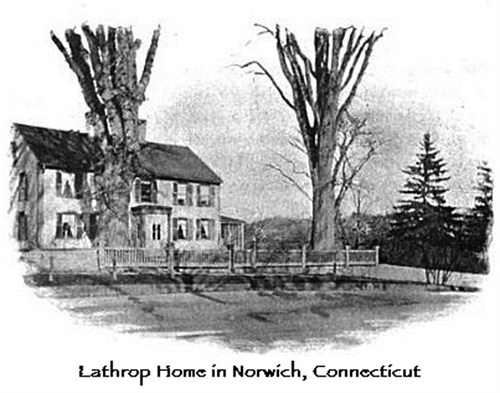
Samuel Lathrop Home in Norwich, CT

Samuel Lathrop was an inhabitant of New London in 1648 and perhaps earlier.  He and John Elderan appear to have been in partnership  as master builders.  The second meeting house in New London and the first in Norwich were built by contract with them.  Mr. Lathrop moved to Norwich in 1668, having purchased the homelot of Elderkin.  He is found on record as constable the same year, and acted afterwards in various public capacities.

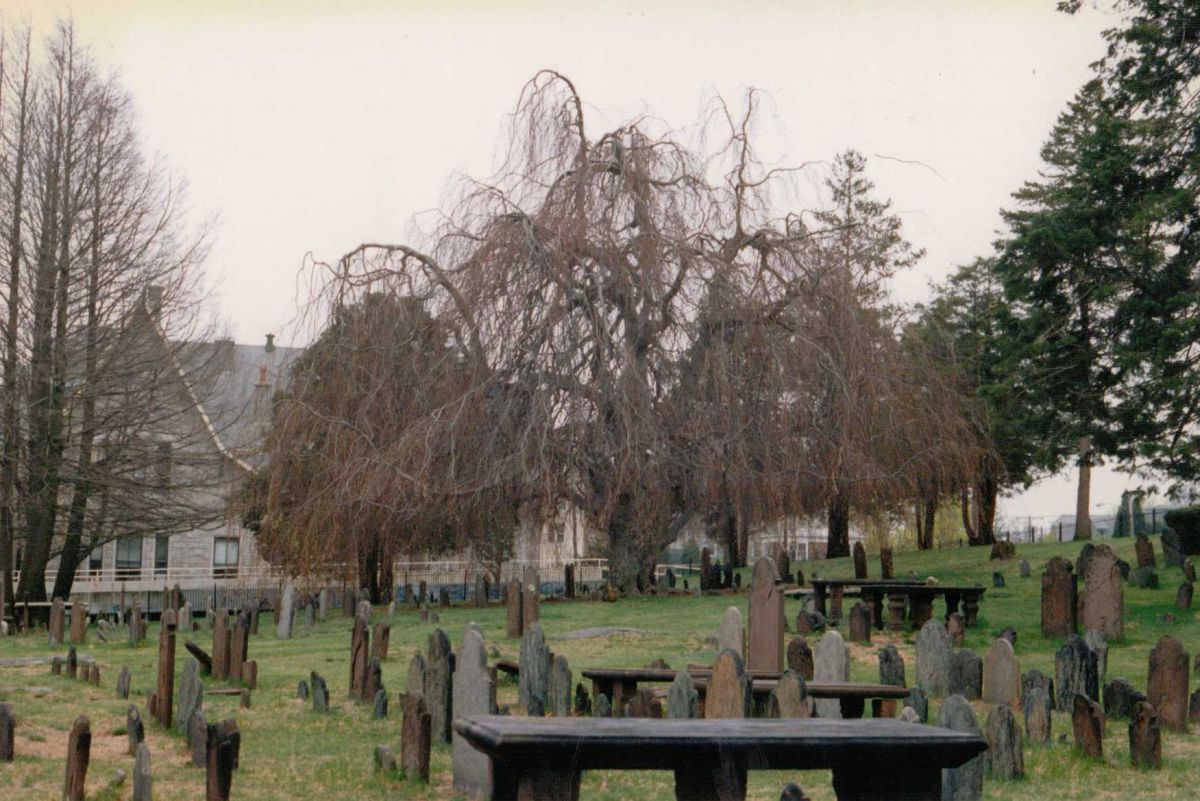
Ye Antientist Burial Ground in New London, Connecticut is one of the earliest graveyards in New England, and the oldest colonial cemetery in New London County. The hillside lot of 1.5 acres adjoins the original site of the settlement’s first meeting-house. From here the visitor has a broad view to the east of the Thames River, and on the far shore, the heights of Groton.

Samuel Lathrop built New London's second Meeting House near the Ye Antientist Burial Ground

Norwichtown Historic District is an historic neighborhood in the city of Norwich, Connecticut. It is generally the area immediately north of the Yantic River between I-395 and Route 169.

The earliest settlement of Norwich, in 1659, was in Norwichtown. Initial settlement, by 35 English settlers who bought land from the Mohegans, was centered around the Norwichtown Green. The Green is triangular in shape, with an area of about 1.75 acres. It is surrounded by shade trees and bordered by Town Street, East Town Street and Elm Avenue.

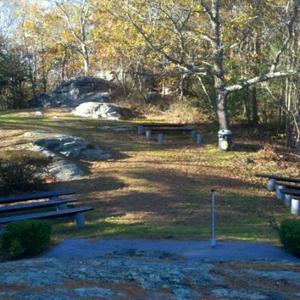
Meeting House Rock Norwich, CT - Samuel Lathrop built Norwich's first Meeting House on this site.

Standing north of the Green area is Meeting House Hill, a cliff of large rocks that is also known as the Meeting House Rocks. It was on this cliff that the village’s second and third meetinghouses were established, with the site used as a lookout point. The memorial on top of the rocks and pathway are cared for by the First Congregational Church.

From Huntington Page 38:

Samuel, born in England, and came with his father to Scituate in 1634, thence to Barnstable, where he Married, Nov. 28, 1644, Elizabeth Scudder, who had been dismissed from the church in Boston Nov. 10, 1644, to remove her church relation to that in Barnstable. She is reported in Savage as a sister to that John Scudder who was in Barnstable in 1640. He had made the acquaintance of Miss Scudder in Boston, where he commenced his business life as a house builder, afterwards combining with his extensive farming operations. Their marriage was recorded by his father on the Barnstable Church Register as follows: “My sonn Samuel & Elizabeth Scudder Marryed at my house by Mr. Freeman Nov. 28, 1644.”

They settled in Barnstable where his house stood next to that of John Scudder.
He is reported, in 1643, as one of five Lothrops at Barnstable liable to bear arms.
In 1648 he removed to New London, Connecticut, then called Pequot. We now find Mr. Lothrop mentioned in two letters from Governor Winthrop to his son at Pequot. In one of these bearing date Aug. 14, 1648, on the subject of obtaining a minister for the settlement, he writes, “Your neighbour Lothrop came not at me (as I expected) to advise about it,” etc.

His house lot in the new plantation was the third in order from that of John Winthrop Jr. Esq. and his name was one of the first eighteen to whom were assigned lands on the east side of the “great river” of Pequot, and for these the lots were drawn on the 17th and 31st of January, 1648/49.

May 1649 – At the session of the General Court,  the following regulations were made respecting Pequot:

1. The inhabitants were exempted from all public country charges — i.e., taxes for the support of the colonial government — for the space of three years ensuing.

2. The bounds of the plantation were restricted to four miles each side of the river, and six miles from the sea northward into the country, ” till the court shall see cause and have encouragement to add thereunto, provided they entertain none amongst them as inhabitants that shall be obnoxious to this jurisdiction, and that the aforesaid bounds be not distributed to less than forty families.”

3. John Winthrop, Esq., with Thomas MINER and Samuel LOTHROP as assistants, were to have power as a court to decide all differences among the inhabitants under the value of forty shillings.

4. Uncas and his tribe were prohibited from setting any traps, but not from hunting and fishing within the bounds of the plantation.

5. The inhabitants were not allowed to monopolize the corn trade with the Indians in the river, which trade was to be left free to all in the united colonies.

6. ” The Courte commends the name of Faire Harbour to them for to bee the name of their Towne.”

7. Thomas MINER was appointed ” Military Sergeant in the Towne of Pequett,” with power to call forth and train the inhabitants.

Another source states that Samuel was constable of Norwich in 1673 and 1682, he was a builder by trade, and he died in New London, Connecticut.

Samuel ended up in Norwich Connecticut where he is considered one of the founding fathers. He was a builder and later a farmer and for a while a “constable”, “townsman” and judge.

Children

1. John Lathrop

 John’s wife Ruth Royce was born 7 Dec 1645 in Wallingford, New Haven, CT. Her parents were Robert Royce and Mary Sims. Ruth died 10 Nov 1732 in Wallingford, New Haven, CT.

John and his sister Elizabeth were married at the same time by Commissioner Daniel Wetherell, …

2. Elizabeth Lathrop

Elizabeth’s first husband Isaac Royce was born in 1643 New Milford, CT. His parents were Robert Royce and Mary SDimms. Isaac died 1681 Wallingford, NewHaven, CT.

Elizabeth’s second husband Joseph Thompson was born about 1648 New Haven, CT. Joseph died about 1703 New Haven, CT.

Elizabeth married Dec. 15, 1669, Isaac, son of Robert Royce of New London, and settled in Wallingford. After his death she married Joseph Thompson of Wallingford, who was as a collector of taxes there as late as 1681, and had six children: Elizabeth, Samuel, James, Phebe, Hannah, and Keziah. Joseph Thompson, who married Hannah Clark, Feb. 1, 1709-10; John Thompson, born Feb. 1, 1685, and married June 23, 1710, Sarah Culver. They had six children: Abel, Abel 2d, Anna, Marsh, Sarah, and John. Hannah Thompson,born April 16, 1687.

3. Samuel Lathrop

Samuel’s first wife Hannah Adgate was born 6 Oct 1653 in Norwich, CT. Her parents were Thomas Adgate (1620 – 1707) and Mary Marvin (1628 – 1713). Hannah died 18 Sep 1695 in Norwich, CT.

Children of Samuel and Hannah:

i.  Elizabeth Lathorp m. John Waterman.  Their daughter Hannah Waterman (wiki) in Norwich, CT circa 1708. Hannah’s first husband, Absalom King, was a wealthy merchant who had settled in the area. The couple had a daughter, also named Hannah. Not long after, however, King died at sea from small pox.

Hannah Waterman King married again, this time to Benedict Arnold III, descendant of an early governor of Rhode Island, also named Benedict Arnold. The Arnolds had six children. As was not unusual at the time, most of the couple’s children died very young, many within months of one another due to a yellow fever outbreak, including Benedict Arnold IV. The future patriot and traitor Benedict Arnold V was born in 1741 and was named after his deceased older brother. Shortly thereafter, market downturns caused hardships in the family finances.

A head and shoulders profile engraving of Benedict Arnold. He is facing left, wearing a uniform with two stars on the shoulder epaulet. His hair is tied back.

Hannah's son Benedict Arnold V

After years of heartbreak, Hannah Arnold died on 15 Aug 1758. She was buried in the Old Norwichtown Burial Ground. Hannah’s death fell hard on her widowed husband, Benedict Arnold III, who lingered some time and suffered with alcoholism and depression from his failed business. He died in 1761.

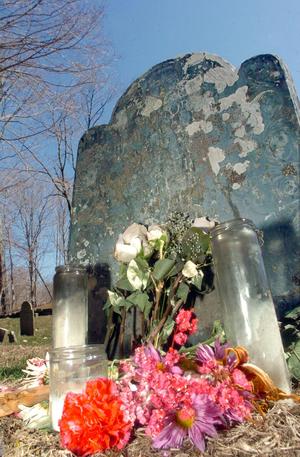
Hannah Arnold Grave "IN MEMORY oF Hannah ye well beloved Wife of Capt Benedict Arnold & Daughter of Mr John & Elizabeth Watermen, (She was a Pattern of Piety Patience and Virtue) who died Augst 15th 1759 AEtatis Suae 52" - Old Norwichtown Cemetery Norwich, New London, CT

Hannah Arnold was and is remembered in Norwich as a worthy woman and a model of “piety, patience, and virtue.” Her gravestone is still visible in Norwichtown Burying Grounds, yet no one knows who paid for it. The mysterious “Norwich Visitor” regularly pays homage to her at her grave. He or she leaves candles, flowers, and an occasional note. He or she always comes at night, is never seen, and whose identity remains unknown to this day.

“The mystery is part of the fun,” said David Oat, a member of the Norwich Historical Society’s committee on city cemeteries. “People tend to do this kind of thing with places they feel they have a connection to.”  Oat said it doesn’t surprise him that Arnold’s grave was singled out.

“There was a lot of suffering associated with her life,” he said. “Besides what her son did, her husband’s business went down the drain and he became the town drunk. She was know as a pious woman, but no one knows who actually paid for her gravestone.”

Rumors about the “Norwich Visitor” abound. Local lore insists the gifts are left only during a full moon, that the visitor will not enter the cemetery if others are inside and that the gifts are connected to ancient Freemason rituals.

Norwich City Historian Dale Plummer, who laughingly denied being the graveside visitor, said the cemetery has attracted its share of supernatural stories over the years.

“There’s a story that the ghost of Benedict Arnold rides into the cemetery on Halloween on a white horse,” he said. “But this particular person sounds like an imitator of the Poe visitor.”  For decades, a mysterious individual left roses and a bottle of cognac at the original Baltimore gravesite of Edgar Allan Poe.

ii. Hannah Lathrop b. 6 JAN 1676/77 Norwich, CT; d. 14 APR 1721 Norwich, CT; m. Jabez Perkins  His parents were Sgt Jacob Perkins and Elizabeth Whipple.  His grandparents were John PERKINS and Judith GATER.

ii. Thomas Lothrop b. 25 AUG 1681 Norwich, CT.; m. 24 FEB 1708/09 to Lydia Abell.  Her parents were Joshua ABELL and Bethia Gager.

Samuel’s second wife  Mary Edgerton of Norwich. They settled in Norwich where she died Jan. 81, 1727-8, and he Dec. 9, 1732.

His rank among the citizens of Norwich is shown in the enrollment of 1730, where his name stands next to the two Deacons Huntington, their names following those of the three ministers, Lord, Willes, and Kirtland. He was a member of the First Church in Norwich.

5. Sarah Lathrop

Sarah’s husband Nathaniel Royce was born 1 APR 1639 Wallingford, CT. His parents were Robert Royce and Mary Simms. He first married 27 OCT 1673 To Esther Moss (b. 2 JAN 1652/53 New Haven, CT. – d. 19 JUN 1677). Nathaniel died 8 FEB 1735/36 Wallingford, CT.

Sarah  married as his second wife, April 21, 1681, Nathaniel, son of Nathaniel Royce of Wallingford, where they settled, and where he died Nov. 1706. He was a carpenter and joiner and blacksmith, and died Feb. 8, 1736, having had four wives.

6. Martha Lathrop

Martha’s husband John Moss was born 11 JAN 1638/39 New Haven, CT. His parents were John Moss and Abigail Charles. John died 31 MAR 1717 Wallingford, CT.

John’s father immigrated to New Haven and became prominent in the new town of Wallingford. He occupied for his homestead the lot on which the elegant home of Moses Y. Beach stood in 1873, and there the elder Moss died at the age of 103 years in 1707. The son died March 31, 1717, and she Sept. 21, 1719.

7. Israel Lathrop

Israel’s wife Rebecca Bliss was born March 1662/63 Norwich, CT.  Her parents were Thomas Bliss and Elizabeth Birchard, who went from Saybrook to Norwich. Her grandfather was Thomas Bliss, Sen., of Hartford. Rebecca died 22 AUG 1737 Norwich, CT.

They settled in Norwich. His rank among his townsmen in 1730, when all the freemen were enrolled, was next to hisbrother Samuel. He was a man of worldly thrift, and had a family of enterprising sons, who are said to have planted themselves on seven hills within the old nine-miles square of Norwich. He died March 28, 1733, and she Aug. 22, 1737. His headstone in old Norwich Town burial ground is the oldest one now there with an inscription on it. It gives us this tribute to his worth: ” Here lies buried ye body of Mr. Israel Lothrup, ye Husband of Mrs. Rebekah Lothrup, who lived a life of exemplary piety & left ye Earth for Heaven Mar. ye 28, 1733, in ye 73d year of’ his age. ”

Children of Israel and Rebecca:

i. Israel Lathrop b. 1 FEB 1686/87 Norwich, CT; m. 20 Jun 1710 to Mary Fellows

ii. William Lathrop b. 20 SEP 1688 Norwich, CT; d. 27 SEP 1778 Norwich, CT; m. 18 DEC 1712 Norwich, CT to Sarah Huntington.

iii. John Lathrop b. 2 OCT 1690 Norwich, CT; d. 18 APR 1752 Norwich, New London, CT; m. 7 APR 1715 Norwich, New London, CT to Elizabeth Abell. Her parents were Joshua ABELL and Bethia Gager

iv. Samuel Lathrop b. 12 JUL 1692 Norwich, CT; m. 26 Jun 1712 to Elizabeth Waterman

v. Rebecca Lathrop b. 20 APR 1695 Norwich, CT; m. 21 Feb 1715/16 to Isaac Huntington

vi. Mary Lathrop b. 15 NOV 1696 Norwich, CT; m. her first cousin as his first wife Simon Lathrop. His parents were Samuel Lathrop and Hannah Adgate.

vii. Martha Lathrop b. 15 NOV 1696; d. 16 OCT 1775; m. 24 Mar 1713/14 as his second wife her first cousin Simon Lathrop

viii. Benjamin Lathrop b. 31 JUL 1699 Norwich, CT; d. d. 11 FEB 1774 Windham, CT; m. 13 NOV 1718 Norwich, CT to Mary Adgate

ix. Ebenezer Lathrop  b. 7 FEB 1701/02 Norwich, New London, CT; d. 28 JAN 1781 Norwich, New London, CT; m. 13 MAY 1725 Norwich, New London, CT to Lydia Leffingwell.

x. Jabez Lathrop b. 11 JAN 1706/07 Norwich, CT; d. 11 FEB 1796 Norwich, New London, CT; m. 28 NOV 1728 Norwich, CT to Elizabeth Burnham

8. Joseph Lathrop

Joseph’s first wife Mary Scudder was born in 1663 in Norwich, New London, CT. She was Joseph’s first cousin. Her parents were John Scudder and Hannah [__?__]. Her grandparents were John SCUDDER and Elizabeth STOUGHTON. Mary died 18 Sep 1695 in Norwich, New London, CT.

Joseph’s second wife Elizabeth Watrous (Waterhouse) was born 22 Mar 1672 in Wallingford, New Haven, CT. Her parents were Isaac Waterhouse and Sarah Pratt. Elizabeth died 29 Nov 1726 in Norwich, New London, CT.

Joseph’s third wife Martha Morgan was born 20 Mar 1681 in Preston, New London, CT. Her parents were Joseph Morgan and Dorothy Parke. She was the widow of Deacon Joseph Perkins of Newent, now Lisbon, then a part of Norwich. He was a member of the First Church. He died in Norwich, July 5, 1740, and to his death record is added ” born 1661. Martha died 23 Oct 1754 in Norwich, New London, CT.

Children of Joseph and Mary

i. Barnabas Lathrop b. 4 Feb 1685/86 Norwich, CT; d. 25 May 1710 Norwich, CT.; m. 12 JAN 1709/10 to .Abigail Abell, b. 16 Mar 1688/89; d. 2 JUN 1736 Norwich, CT  Abigail’s parents were Caleb Abell and Margaret Post.  Her grandparents were Robert ABELL and Joanna [__?__].

ii. Joseph Lathrop b. 18 SEP 1688 Norwich, CT; d. 1757; m 13 Apr 1735 to Mary Hartshorn

iii. Abigail Lathrop b. 16 SEP 1693 Norwich, CT; m. Jacob Hazen

Joseph’s second wife  Elizabeth “Waterhouse,”  was born March 22, 1661.  Her parents were Isaac and Sarah Watrous. Elizabeth died Nov. 29, 1726.

Children of Joseph and Elizabeth

iv. Mehitable Lathrop b. 2 NOV 1697 Norwich, CT; d. 19 JAN 1731/32 East Windsor, CT; m. William Bushnell

v. Samuel Lathrop b. 23 MAY 1699 Norwich, CT.

vi. Elizabeth Lathrop b. 17 JAN 1700/01 Norwich, CT.

vii. Sarah Lathrop b. 18 OCT 1702 Norwich, CT.

viii. Temperance Lathrop b. 6 OCT 1704 Norwich, CT; m. 22 Aug 1727 Ipswich, Mass to John Bishop

ix. Solomon Lathrop b. 13 DEC 1706 Norwich, CT; d. 10 MAY 1733′ m. 6 Feb 1728/29 to Martha Perkins

x. Ruth Lathrop b. 11 DEC 1709 Norwich, CT.

xi. Esther Lathrop b. 17 NOV 1712 Norwich, CT.

xii. Zeruiah Lathrop b. 9 APR 1718 Norwich, CT; d. 1741 Canterbury, CT; m. 1739 to William Bradford

9. Deborah LATHROP (See Simon NEWCOMB‘s page)

10. Abigail Lathrop

Abigail’s husband John Huntington was born 15 Mar 1666 in Norwich, New London, CT. His parents were Christopher Huntington and Ruth Rockwell.  John died 7 Nov 1732 in Norwich, New London, CT.

They had nine children: Abigail Huntington, born Feb. 19, 1687 ; married James Calkins; John Huntington, born April 20, 1688, and died in 1690. John Huntington, born July 4, 1691, and married Thankful Warner, of Windham, Ct., and settled in Tolland; Hannah Huntington, March 25, 1693-4, and married Joseph Rockwell, of Windsor; `Martha Huntington, born Dec. 9, 1696, and married Noah Grant, of Tolland, and became the ancestress of President Ulysses S. Grant.

11. Anne Lathrop

Anne’s husband William Hough Jr. was born Oct. 13, 1657 in Saybrook, Middlesex, CT.  He was the third son of William Hough Sr. and Sarah Calkin of New London .  William Jr. died April 22, 1705 in New London, New London, CT, and she in Norwich, Nov. 19, 1745. William Hough, Sen., was the son of Edward Hough, of Westchester County of Chester, England. He came to Gloucester, Mass., when he married Oct. 28, 1645, Sarah, daughter of Hugh Calkins, the pioneer.

Sources:

http://trees.ancestry.com/owt/person.aspx?pid=131606529

http://www.newenglandgenealogy.pcplayground.com/f_8b.htm#27

http://trees.ancestry.com/tree/16301956/person/465476422

http://trees.ancestry.com/tree/16301956/person/465476435

http://users.erols.com/jlathrop/genealogy.html#Part%202

http://trees.ancestry.com/owt/person.aspx?pid=131606529

History of New London county, Connecticut, with biographical sketches of many of its pioneers and prominent men (1882) by Hurd, D. Hamilton (Duane Hamilton) (Story of founding of Voluntown)

Posted in 10th Generation, 90+, Immigrant - England, Line - Miller, Public Office, Storied | Tagged , , , , | 18 Comments

Henry Andrews

Henry ANDREWS (1582 – 1638) was Alex’s 12th Great Grandfather; one of 8,192 in this generation of the Miner line.

Henry Andrews was born in 1582 in Somerset,  England. His parents were Thomas ANDREWS (1543 – 1594) and Joan BELSON (1552 – 1600). He married Elizabeth BOND 22 Jun 1609 in Ashill, Somerset, England.   He emigrated to Dorchester, Mass in 1636, but returned to England and died in 1638 in Ashill, Somerset, England.  Alternatively, Henry’s children Henry Jr. and Elizabeth emigrated together.

Henry Andrews - Coat of Arms

Elizabeth Bond was born in 1585 in England.  Elizabeth died in 1621 in Somerset, England.

Children of Henry and Elizabeth:

Name Born Married Departed
1. Henry Andrews 1608
Somerset, or Daventry, Northamptonshire, England
Mary Pool
10 Feb 1627 Bridgewater, Somerset, England
3 Mar 1652
Taunton, Mass
2. Elizabeth ANDREWS 1614 in Stoneham, Southampton, Hants,England. Thomas HARVEY
.
Francis Street
Taunton, Mass
.
Thomas Lincoln
10 Dec 1665
Taunton, Mass
1717
aged one hundred and three
3. John Andrews 1621

Note: Mary Andrews (1628 – 1700, Taunton, Mass) who is often shown as the daughter of Henry Sr., was actually the daughter of Henry Jr.

Children

1. Henry Andrews Jr.

Henry’s wife Mary Pool was born 1611 in Bridgewater, Somerset, England.  Her parents are unknown.  Mary died 14 Feb 1643 in Taunton, Bristol, Mass

Henry Jr. was an original purchaser at Taunton, MA in 1637, built the first meeting house in 1647 for which he received a tract of land known as the “calves pasture,” and was deputy to the Plymouth general court in 1639, 1642, 1643, 1647, and 1649. Probably married about 1628 in England.

Henry and Mary married in 1628, when Henry would have been but 20 years old and Mary only 19.  Their first child, Henry Jr., was born in 1629, followed by Mary in 1631.  Both Henry Jr. and Mary were born in England, narrowing the Andrews family immigration to between 1631 and 1637.  Two more children, Sarah (1644) and Abigail (1647), were born in Taunton, Massachusetts.

Some accounts show Henry Andrews’ wife as Mary Street, often with the same 1628 marriage date.  This presents the possibility that his wife’s name was actually Mary Pool Street or Mary Street Pool, and that she was a recent widow when she married Andrew.  However, there is no evidence to support this hypothesis.  Other accounts have Mary Pool as Henry’s first wife and Mary Street as his second wife.

In Taunton, Henry Andrews was one of the first seven freemen of the town, one of the first two deputies to the general court in 1639 (also 1643, 1644, 1647 and 1649), one of the first stockholder of the Taunton Iron Works, and in other ways one of the more prominent men of the town.  He built the first town meeting house in 1647 for which he received a tract of land known as the “calves pasture.”

Henry Andrews prepared his will on March 13, 1652, and the will was proved on February 10, 1653.  The inventory of his estate was taken 10 Feb 1653 and valued at 330 pounds,16 shillings.  It is believed he died shortly before the February 10th date.  He was about 45 years old.  His wife, Mary, prepared her will the following year as is believed to have died in 1655 at about age 46.  Sarah and Abigail Andrews would have only been 11 and 8 years old, respectively, in 1655, and it is not known who took care of them.  Very possibly, it was their older brother, Henry III., who would have been 26 years old in 1655.

Henry Andrews III., would suffer a premature death when he was killed by Indians at age 47 on May 23, 1676, during King Philip’s War.

Sources:

http://trees.ancestry.com/owt/person.aspx?pid=2904162&st=1

The Cary family in America By Henry Grosvenor Cary, Isaac Harris Cary

Posted in 14th Generation, Immigrant - England, Line - Miner | Tagged | 9 Comments