Unknown White

[Unknown] WHITE (c. 1635 – ) was Alex’s 10th Great Grandfather, one of  2,048 in this generation in the Shaw line.

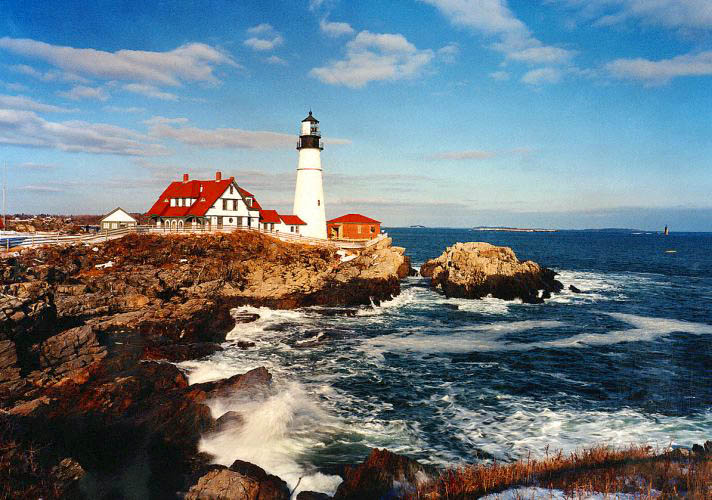
Lighthouse at Cape Elizabeth, formerly Cape Purpooduck, Maine

Children of Nathaniel White:

Name Born Married Departed
1. Josiah White  c. 1652
2. Nathaniel WHITE about 1660 in Purpooduck (Now Downtown Portland), York, Maine. after 1691 His ear was cut off and he was later killed in Indians.

What we know of Nathaniel White’s brother Josiah comes from the story of his son Rev. John White of Glouscester, Mass.

Children

1. Josiah White

There appears to be no occasion to doubt (though it has been questioned) that the Rev. John White, of Gloucester, was son to Josiah White, one of the grantees of Falmouth in its first settlement. Josiah and his brother Nathaniel went there early, had grants at Maiden Cove, and remained until they were obliged to flee from the Indians. Nathaniel was killed later by the Indians. Josiah White, before 1703, had returned to Purpooduck with Michael Webber, Joseph Morgan, Thomas Loveitt, Joel Madford, and Benjamin, Joseph, James, and Josiah Wallis, sons to John Wallis. They built houses, brought their families there, and “engaged heartily in establishing of the Settlement;” but they were again driven away by the savages. Josiah White had two sons, John and Samuel, his daughter Miriam was married to Richard Suntay or Sontag.* The Rev. John White, in the desire that his sons should profit by the land that had cost his father so dear, purchased, as he says, of the other heirs their interests at Maiden Cove.

On February 16, 1724-25, he bought of “Hannah White, Relict of Samuel White in the Town of Boston,” for £10, one half of the grant of fifty acres formerly “laid out to and possessed by Josiah White of Falmouth … in Casco Bay . . . Situate on Papooduck;” it is evident that the other half already belonged to Rev. John White, as an heir.

On April 18, 1727, “ye Reverd John White of ye Town of Gloucester in ye County of Essex Pastour,” bought of Nathaniel Danford, of Newbury, for £25, fifty acres “joining to little Brook near Maiden Cove … in Falmouth . . . Casco Bay.” This was the land formerly granted to Nathaniel White, as deposed by one John Lane, in August, 1727. The said John Lane, aged seventy-three years, testified that about forty-two years ago, ” while I lived there the Town of Falmouth did grant unto Josiah White & Nathanael White one hundred Acres of Land lying between Little Brook so called & a Brook called Maiden Cove Brook,” which they divided equally and lived, ” each on his Part,” several years. “Josiah died possessed of his Part of said Land, and Nathanael White possessed his . . . until he was driven away from the same by the Indian War & he was afterward slain by the Indians.” (York County Deeds Book 12 Part 1 Pgs 170, 177) Besides these hundred acres, Rev. John White bought, for £40, on January 26, 1724-25, of James Wallis, of Gloucester, his tract of land ” in papooduck, which he drew by lot near his brother Benjamin.”

Other Theories

Some genealogies say Rev. John White’s parents were Joseph White (d. 10 Sep 1725 in Brookline, Mass.) and Hannah [__?__]. and his grandparents were John White  (d. 15 Apr 1691 in Brookline, MA.) and Frances Jackson.

On 10 Apr 1640 John married Frances Jackson in Brookline, MA. Born on 7 Nov 1619 in Hamseterley, Durham, England. Frances died in Brookline, MA, on 26 Feb 1695/6; she was 76.

From Lothrop’s article “John White of Watertown and Brookline, and some of his descendants”:

“John White was living in Watertown whe the first inventory of estates was taken. This appeaars to have been as early as 1639. He then owned ‘An Homestall of seven acres more or less bounded the south and east with the highway, the north with the swamp and the west with William Paine, bought from Ephraim Child.’

“He remained in Watertown until 1650, when he moved to Muddy River (now Brookline), and bought from Thomas Oliver of Boston ‘50 acres upland 18 acres of marsh and six acres of fresh marsh in Muddy River … for & in consideration of … the full & just summe of one hundred & thirty pounds sterl. to be paid in good & merchantable corne & fatt cattle at prices current or as they shall be prized by two men indifferently chosen.’
“The deed conveying the property is dated ‘thirteenth day of the twelfth month one thousand six hundreth & ffifte.’

“He afterwards bought other tracts of land in Brookline, and became a large proprietor. His will, dated April 13, 1691, names wife Frances and three sons.”

It is claimed by many, though no attempt is made here to prove it, that the Rev. John White, of Gloucester, Massachusetts, was a descendant of Rev. John White, of Dorchester, England, whose autograph appears in this volume on a bill of Isaac Allerton’s, in 1640.* This branch of the White family certainly was superior, and had more money than was common in that day.

Children of Josiah and xx:

i. Rev. John White b. 2 Jul 1674 in Gloucester, Mass; d. John died in Gloucester, MA, on 16 Jan 1760 in Gloucester; m1. 9 Jun 1703 when John was 28, Lucy Wise (ca 1681 -5 Mar 1727), daughter of John Wise & Abigail Gardner; m2. Abigail Mather

Education: Harvard 1698.

John settled as minister at Gloucester 21 Oct 1702.

Probably no divine of his day was more sincerely revered for his learning and piety than Rev. John White. He was graduated from Harvard College in 1698, and was ordained April 21, 1703.* The following notice of his death is in the Gloucester records : —

“The Revd . Mr. John White who had been settled a minister in this town from the 21 day of October 1702 as appears by Votes of the Town on Record deceased in his chair about eleven of the clock in the forenoon on the 16 day of January 1760 being the 59 year after his beginning his ministry here and the eighty third year of his age.”

Rev. John White assisted substantially the new settlement at Cape Elizabeth ; he also organized the town of New Gloucester, Maine, and was moderator at the first meeting of the Proprietors of the new town, held in Gloucester, Massachusetts. In March, 1736-37, when the first division of lots at New Gloucester was made, ” The Rev. John White ” had “lot N° 20” set off to him ; “lot N° 21 ” was given to him for his son Thomas, who removed there.

New Gloucester was established under a grant from the Massachusetts Bay Colony. In 1736, the General Court of Massachusetts Bay Colony granted a 6-square-mile tract of land in the Maine Territory to sixty inhabitants of the Gloucester fishing village on Cape Ann. The first settlers followed the road newly bushed out from North Yarmouth and built cabins on Harris Hill between 1739 and 1742. The settlement was abandoned from 1744-1751 due to the heightened Indian attacks during King George’s War.

Settlers returned and in 1753 commenced work on a two-story, fifty-foot square blockhouse with a palisade stockade 110 feet on a side. This was home to twelve families for six years. The men worked at clearing the surrounding 60 acres of common land under the protection of two swivel guns manned by a garrison of six soldiers. One attack was made upon the fort, resulting in one scalping and two men captured. As the Indians gradually withdrew to Canada, the settlers moved out into their own newly built homes. The blockhouse continued to serve for worship and town affairs until the first meetinghouse was built in 1773. In 1788, the blockhouse was sold at auction for seven bushels of corn and moved to a farm in the intervale, where it was rebuilt as a hog house.

New Gloucester became a half shire town with Portland, and the courts met here from 1791 until the organization of Oxford County in 1805, when they returned to Portland. With good soil for agriculture, the town developed as a prosperous farming community. In 1858, when the population was 1,848, other industries included six sawmills, two gristmills and two tanneries.

Sabbathday Lake Shaker Village was founded in 1783 by the United Society of True Believers at what was then called Thompson’s Pond Plantation. It was formally organized on April 19, 1794. Today, the village is the last of formerly nineteen religious societies, stretching from Maine to Florida, to be operated by the Shakers themselves. It comprises 18 buildings on 1,800 acres of land.

John’s sons John and William White went to Falmouth, where, on April 22, 1728, they were admitted inhabitants upon payment of £10, each; two years later, they were mentioned among those who had fulfilled the conditions of settlement That they were sons to the Rev. John White, of Gloucester, Massachusetts, is proved by the following deed, dated March 14, 1736-37: —

John White and his wife Abigail, of Gloucester, in the County of Essex, ” for love & parental affection,” conveyed ” to my Sons John & William White of Falmouth . . . Tanner & Carpenter . . . fifty acres in Falmouth . . . adjoining to Maiden Cove it being the Fifty acres bought of the Heirs of Josiah White formerly of Falmouth and which were granted to him by said Town under Governor Danforths Settlement as by the Town Grant may farther appear or by living evidences of said Grant viz of an Hundred Acres between Maiden Cove Brook & Little Brook so called which Fifty acres William White has given to him Twenty acres Adjoining to the Fifty formerly given to him & to John White Thirty acres adjoining to said Williams Land & between that & Maiden Cove Brook.”

Witnesses : (Signed)
” Samuel Stevens Junr ” John White [seal]
Abigail White Junr ” Abigail White “* [seal]

Besides the lands at Maiden Cove and other locations given by their father to John and William White, they received several grants of land from the Proprietors of Falmouth. They also bought and sold land on the south side of Fore River. John built a house of white oak logs, “squared,” which is still standing close by Fort Preble; it is the ell of a more modern house. William lived at Deep Brook, towards the present Casino, on the Purpooduck side of Mountain View Park, near the dividing line (1906) between South Portland and Cape Elizabeth.

Children of John and Lucy (Wise) White:
1. John White, b. 15 Jun 1704; d. 1738; He was a tanner, and lived at Cape Elizabeth on the present site of Fort Preble.
2. Lucy White, b. 27 Mar 1706;
3. Joseph White, b. 21 Feb 1707/8, d. 4 Nov 1708;
4. William White, b. 4 Nov 1709;
5. Thomas White, b. 27 Jan 1712;
6. Joseph White, b. 2 Feb 1716, d. 17 Feb 1718;
7. Benjamin White, b. 8 Jan 1718, grad. Harvard 1738;
8. Abigail White, b. 17 Apr 1720;
9. Hannah White, b. 16 Oct 1721, d. æ. 93;
10. Mary White, b. 20 Mar 1723;
11. Samuel White, b. 20 May 1725, d. 1758, grad. Harvard 1741

ii. Samuel White

iii. Miriam White m. Richard Suntay or Sontag (Smith and Dean’s journal, 1849 : p. 47)

2. Nathaniel WHITE (See his page)

Sources:

Descendants of Edward Small of New England, and the Allied …, Volume 2  By Lora Altine Woodbury Underhill

http://aleph0.clarku.edu/~djoyce/gen/report/rr04/rr04_319.html#P51725

Posted in 12th Generation, Line - Shaw, Missing Parents | Tagged | 2 Comments

Mathias Coerten

Mathias COERTEN (1585 – ) was Alex’s 12th Great Grandfather; one of 8,192 in this generation of the Miller line.

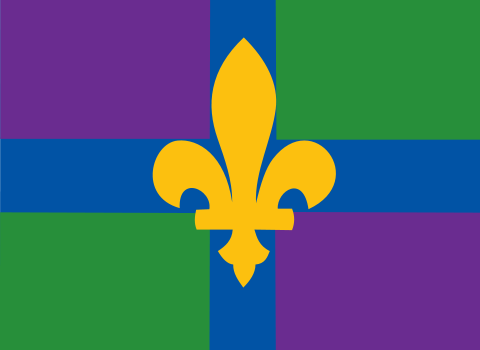
Voorthuizen Flag

Mathias Coerten was born in 1585  Voorhuysen, Netherlands. Mathias died  in Voorthuizen, Gelderland, Netherlands

Children of Harmen and Aertje:

Name Born Married Departed
1. Harmen COERTEN c. 1610 in Voorthuizen in Guelderland, Netherlands Aertje GERRTIS before 1642. 26 Nov 1689
Bergen, New Jersey
2. Guert  (Gerrit) Coerten c. 1620 in Voorthuysen, Gelderland, Holland Gertje Jacobs Dunnears
13 Oct 1647 New Amsterdam
before June 1671 in Bergen, New Jersey

Children

1. Harmen COERTEN (See his page)

2. Guert (Gerrit) Coerten

Guert’s wife Geertje Jacobs Dunnears was born about 1625 in Statyn, Netherlands.  Her father was Jacob Dueunaers. In Guert’s will he annuls testament made with his wife Geertje Jacobs Duenaers because she had been unfaithful to him. He, also, annuls testament of March 24, 1664.

“In his will he mentions Pieter Hesselse, the son of his sister;
Thomas Jurianses, oldest son of Ryckje Hermans (his niece);
Henricksen Smack, oldest son of Guertje Harmens, his brother’s daughter Jan Harmensen, his brother’s son; and makes his universal heir his brother Harem Coerten.”

The Courten family purchased land in Bergen County as one of the first original landholders in New Jersey. From there they moved West into today’s Passaic and Morris County. Guert, the first Courten descendant arrived in NY about 1641. He had no children but his brother, Harmen, came to US in 1660

1641 Ship Passenger Lists NY & NJ states: “Special conditions mentioned in contract between Wouter van Twiller engaged Gerrit Courten van Voorthuizen, 21 years old, on the 13th Nov 1641 to go to New Netherland to sow, to mow, to plow, to dig ditches and to do farm work in the Gelderland manner.”

The Dutch did not use first and last names. So Guert would have been Gerrit and he would be the son of Couerte. He was from the area of Voorthuizen in the area of Gelderland in Holland in 1641.

Looking at this record the name could have been spelled any way the person writing the record wanted it to be written. The town/area would have probably been correct because the van Twiller company probably recruited a lot of people in the same area to come to New Netherlands to work property.

They did not go to NYC first but went to Albany, NY up the Hudson River and then came back down to NYC before 1660 and settled in Bergen County, NJ.

When Guert purchased the property around 1660 his brother Harman came to New Netherlands with his family.

18 Dec 1646 – Guert is first mentioned, when he rented with Wouter Aertsen the bouwery of Wouter van Twiller on Mahattan Island

13 Oct 1647 “Guert married Geertje Jacobs.”

1657 “Guert was confirmed in his rights as a Small Burgher on ? 13, 1657, his name appearing as Gewit Coerten (RNA-VII-152) and on ? 13, 1657, he sold a house and lot in Manhattan (Valentine’s Manual-595).”

1661 “In 1661, he was a resident of Communipaw (HSYB-100-32) Communipaw is a section of Jersey City, New Jersey west of Liberty State Park and east of Bergen Hill, and site of one the earliest European settlements in North America.

12 May 1668 – Phillip Carteret to Guert Coerten 1st Patent at Bergen for 7 tracts of land

1st tract begins at stake leads from roan town of English Neighborhood (easterly corner of lot #35 beloning to Adrian Post)
N75.50W32c18l to stake middle of road
N23.30E5c26l to first mentioned road to a stake
S75.50E31c to first mentioned road
along road S10.15W5c26l to beginning

2nd tract is lot #48 begins at stake (southerly corner lot of Frederick Phiipse’s patent marked #47)
N56.20W29c60l to stake by road
S33W2c53l along said road to a stake
S56.20E29c90l to a stake
N30E2c53l

The description that follows this deed said it was 14 by 150 rods = 3 1/2 morgens. A morgen was a unit of measurement of land in Germany, the Netherlands, Poland and the Dutch colonies, including South Africa and Taiwan. The size of a morgen varies from 1/2 to 2½ acres, which equals approximately 0.2 to 1 ha. The word is usually taken to be the same as the German and Dutch word for “morning”. Similarly to the Imperial acre, it was approximately the amount of land tillable by one man behind an ox in the morning hours of a day.

3rd tract stake (east corner lot of Adrian Post #55)
N55W29c10l to a stake by road
N39E3c60l along said road to a stake
S54.50E29c30l to a stake
S41.45W3c60l

description it is a wood lot 19 by  150 rods = 4 8/? morgens. It is owned by Aaltje Van Winkle in 1764.

4th tract upland and meadow #91 stake near the road leading form town of English Neighborhood (S corner of lot of Arent Lawrence #92)
N67.30W9c24l
N43W32c47l to Bridge Creek
returning to stake to place of beginning
S16.05E5c60l along road to a stake
S10W8c61l along road to a stake
S51W7c95l to stake
N63W7c75l to stake
S88.20W4c87l to stake standing near small brook
N4E1c6l to stake top of hill
N9.30W1640l stake edge of of meadow
N44.20W14c53l to Bridge Creek
then up along creek several courses and until it comes to other line that strikes said creek

description E of Samuel Edsall on Creapel Bosch with meadow = 27 acres owned by Garret VanRypen and in 1764 to his son George who sold it to Garret Newkirk.

5th tract garden plot #94 NW side of town
Beginning NW side of street (S50W2c68l from stake which last stake stands 30l from E corner of Widow Van Riper’s house on

1668 Guert became a member of the Bergen Church 8 Jul 1668, and was dismissed.
Guert Coerten had no children.

5 Feb 1671 – In Guert’s will he annuls testament made with his wife Geertje Jacobs Duenaers who he married on 15 Jan 1657 because she had been unfaithful to him. He, also, annuls testament of 24 March 1664.

“In his will he mentions Pieter Hesselse, the son of his sister;
Thomas Jurianses, oldest son of Ryckje Hermans (his niece);
Henricksen Smack, oldest son of Guertje Harmens, his brother’s daughter Jan Harmensen, his brother’s son; and makes his universal heir his brother Harem COERTEN.”

The article continues with information about him in later dates even though will probate stated he died bef 1671. There is a conflict in dates of marriage that should be checked.

Calendar of New Jersey Wills, Vol. II 1730-1750. Part II Appendix Page: 558 Name: Guert Coerten Date: 05 Feb 1671 Location: from Voorthuysen in Guelderlant, now living at Bergen

Calendar of New Jersey Wills, Vol. II 1730-1750. Part II Appendix
will of (in Dutch). Made before Claes Arentsen Toers, constable of Bergen. Annuls testament made with his wife Geertje Jacobs Dueunaers January 15, 1657, because she has been unfaithful; also testament of March 24, 1664; and names as legatees the son of his sister, Pieter Hesselse, brother Thomas Jurianses, oldest son Ryckje Harmens, Mathys Hendricksen Smack, oldest son of Guertje Harmens, his brother’s daughter, Jan Harmensen, brother’s son, Christyntje Claes, dau. of Claes Christiansen, universal heir brother Harmen Coerten.

Sources:

http://www.njgsbc.org/files/familyfiles/p766.htm#i24855

http://freepages.genealogy.rootsweb.ancestry.com/~kmiller/courter/courter.htm

Posted in 14th Generation, Line - Miller | 2 Comments

Maine Volunteers

This page is dedicated to our Maine ancestors, sons and grandsons; fathers, uncles and cousins who served in the Civil War.  While all were born in Maine, some served in regiments of other states.

Of the 32 Maine sons and grandsons whose Civil War service records I found, 15 were killed in action, or died of their wounds or disease.  Civil War casualty rates were high, but not almost half.  I’m probably missing service records of some Maine relatives who survived.

1st Maine Volunteer Cavalry Regiment

Organized in Augusta, Maine on October 31, 1861 for three years. The original members were mustered out on November 25, 1864 when their service was up, but later recruits, along with members of the 1st District of Columbia Cavalry and those who chose to reenlist, were retained in the regiment until its mustering out at Petersburg, Virginia on August 1, 1865.
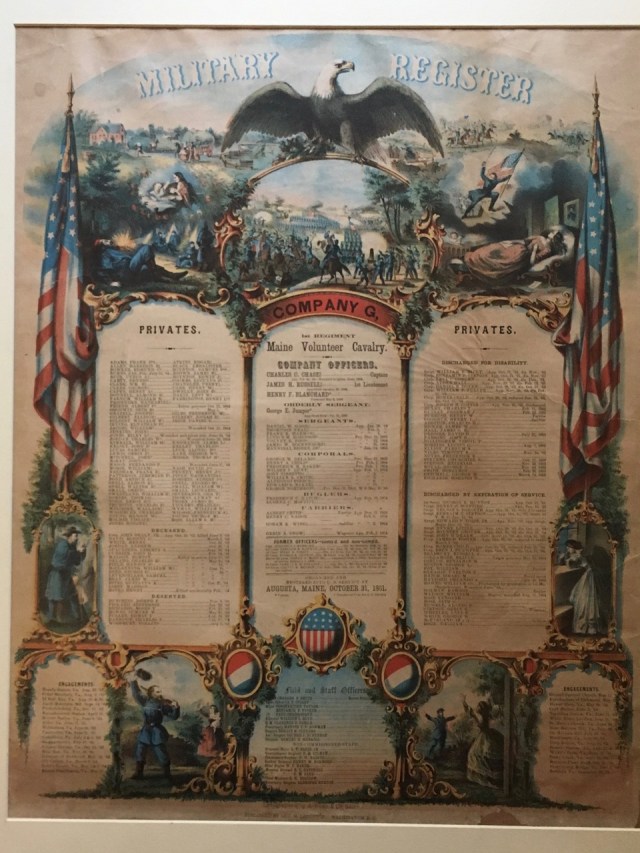
IMG_1961

Joseph COLEMAN’s grandson John Eldridge Coleman (1827-1902) served in Company B 1st Regiment, Maine Heavy Artillery

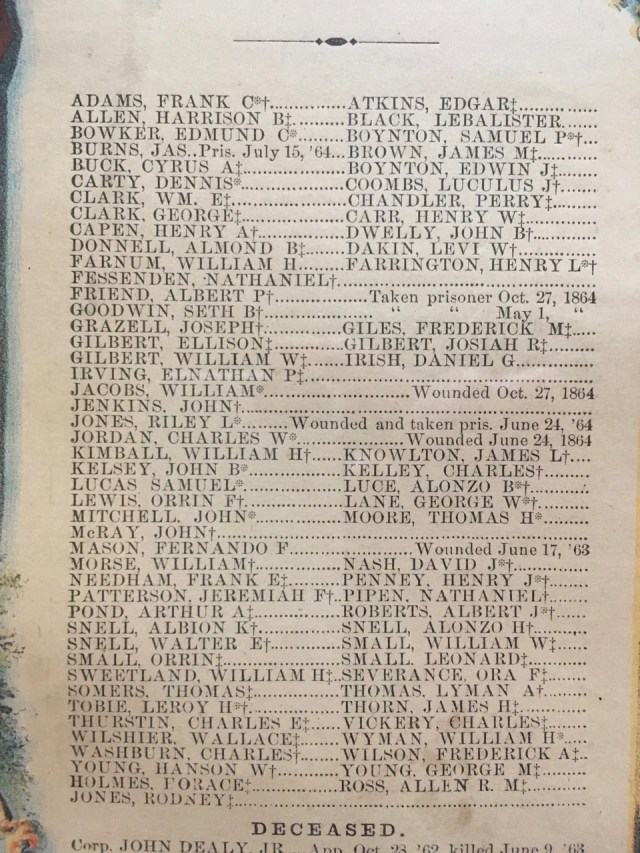
Dudley COLEMAN’s son-in-law William Wallace Gilbert (b.  3 Jun 1839 in Leeds, Kennebec, Maine – d.  21 Apr 1916 in Vassalboro, Maine.)  He enlisted 30 Jan 1864 and transferred to Company G, Maine 1st Cavalry Regiment on 19 Feb 1864. Mustered out on 01 Aug 1865 at Petersburg, VA.
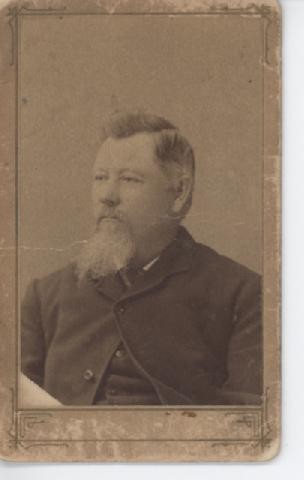
WW Gilbert Age 52
IMG_1962

Detail showing WW Gilbert

Three hundred selected men from the 1st Regiment participated in the daring raid of Gen.Kilpatrick to the vicinity of Richmond, Feb. 27 to March 12, 1864, the loss of the 1st in this famous raid being 93 men killed, wounded or missing and over 200 horses. It also moved with the cavalry corps on Gen. Sheridan’s first raid, May 9, 1864, until within 3 miles of Richmond. In the engagement at Trevilian Station, June 24, 1864, its loss was 10 officers and 58 enlisted men.

During August of this year its loss in killed, wounded and missing was 49 men and 75 horses, and the total casualties during 1864 amounted to 295 officers and enlisted men. In Aug., 1864, seven companies of the 1st D. C. cavalry were transferred and assigned to the several companies of this regiment by a special order of the war department. The original members of the regiment whose term of service expired Nov. 4, 1864, were mustered out at Augusta, Me., on the 25th, while the regiment, now composed of veterans recruits and members of the 1st D. C. cavalry whose term had not expired, participated in the closing battles of the war; was mustered out of the U. S. service at Petersburg, Va., Aug., 1, 1865, and arrived in Augusta, Me., on the 9th.

1st Maine Heavy Artillery Regiment

Suffered more casualties in an ill-fated charge during the Siege of Petersburg  June 18, 1864, than any Union regiment lost in a single day of combat throughout the war. It was also the Union regiment with the highest number of officers killed (23).

The regiment was mustered in Bangor, Maine, in 1862 as the 18th Maine Volunteer Infantry Regiment and consisted mostly of men and officers from the Penobscot River Valley (the area around Bangor and points east). It was commanded by Col. Daniel Chaplin, a Bangor merchant. Charles Hamlin, son of Vice President Hannibal Hamlin, was originally an officer in this regiment, but was promoted to a position on the staff of Maj. Gen. Hiram G. Berry before it saw significant action.

The regiment’s name was changed in 1863 to the 1st Maine Heavy Artillery Regiment, and it served in the defenses of Washington, D.C. before being reassigned to the Army of the Potomac during the Overland Campaign in the spring of 1864. At the Battle of Spotsylvania Court House,  (May 8, 1864 – May 21, 1864) the regiment took its first heavy casualties—6 officers and 76 men killed, and another 6 officers and 388 men wounded.

At Petersburg, however, an ill-advised charge across an open field toward Confederate breastworks on June 18, 1864, ordered by Chaplin, resulted in the greatest single loss of life in a Union regiment to occur in the war, with 7 officers and 108 men killed, and another 25 officers and 464 men wounded. These casualties constituted 67% of the strength of the 900-man force. Chaplin survived the action but was killed by a sharpshooter Aug. 18 at Deep Bottom.

The regiment subsequently participated in the battles of  Totopotomy, Cold Harbor, Petersburg, Deep Bottom, Boydton road, Weldon railroad, Hatcher’s run, and in all the final movements resulting in the evacuation of Richmond and  Petersburg and the surrender of Gen. Lee.

In the action on the Boydton plank road, Oct. 27, the regiment lost 3 commissioned officers and 29 men. In an engagement of a little more than an hour at Hatcher’s run, March 25, 1865 it lost 1 officer and 3 men killed, and 23 wounded and captured. The regiment was at  Bailey’s cross-roads April 16, and later participated in the grand review at Washington.

All in all, the 1st Maine sustained one of the highest casualty rates in the war, with 421 killed, and another 260 dead of disease.

A monument to the 1st Maine stands on the former battlefield at Petersburg.

Isaac HAWES’ grandson Hadley O. Hawes (1847-1902) was drafted to Company G, Maine 3rd Infantry Regiment on 29 Aug 1863, two months after Gettysburg. Transferred on 28 Jun 1864, just 10 days after the ill-fated Petersburg charge to Company K, Maine 1st Heavy Artillery Regiment.  Mustered out on 01 Sep 1866.  Hadley’s twin Henry served in the 21st Maine

Samuel FOSTER’sgreat grandson Eben Foster (1837 Maine – 1864)  enlisted in Company C, Maine 1st Heavy Artillery Regiment on 05 Feb 1863.   Eben was killed in the Civil War. Eben enlisted in Company C, Maine 1st Heavy Artillery Regiment on 05 Feb 1863. Killed Company C, 1st Heavy Artillery Regiment Maine on 19 May 1864 at the Battle of Spotsylvania Court House, Virginia. In the end, the battle was tactically inconclusive, but with almost 32,000 casualties on both sides, it was the costliest battle of the Overland campaign. Eben was killed at the Harris Farm Engagement which claimed 1,598 casualties on both sides. The Harris Farm Engagement was the end of the long Battle of the Spotsylvania Courthouse.
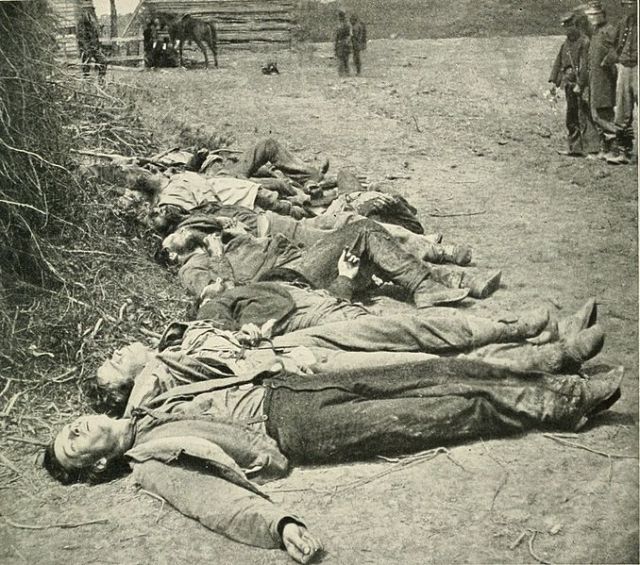
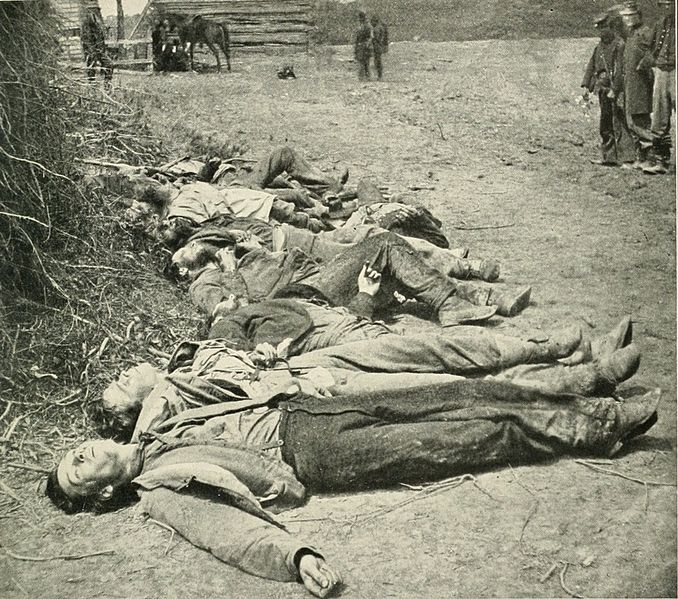
Confederate dead lined up for burial at the Alsop farm May 19, 1864

3rd Maine Volunteer Infantry Regiment 

Mustered in at Augusta, Maine for three year’s service on June 4, 1861 and were mustered out on June 28, 1864. Veterans who had re-enlisted and those recruits still liable to serve were transferred to 17th Maine Volunteer Infantry Regiment.

The 3rd Maine enrolled 1,586 men during its existence. It lost 10 officers and 124 enlisted men killed in action or died of wounds received in battle and an additional 1 officer and 148 enlisted men died of disease.  33 men died in Confederate prisons. Total fatalities for the regiment were 316 (20%)

The loss of the 3rd in killed and wounded at the battle of Fair Oaks was nearly one-third of the men engaged. It was in this engagement that Sergt.-Maj. F. W. Haskell of Waterville so greatly distinguished himself as to win the commendation of his colonel and of the entire regiment.

The 3d gave an excellent account of itself in the battle of Gettysburg. At the close of the second day’s fighting Gen. Sickles declared that, “The little  3d Me. saved the army today.” Its loss at Gettysburg was 113 killed, wounded and missing. On the return of the regiment to Augusta, June 11, 1864, only 17 officers and 176 enlisted men were left to be mustered out. Sixty-four of these men reenlisted, and together with the recruits were transferred to the 17th Me. Not one of the original field and staff officers returned with the regiment and only one of the original captains–the veteran Moses B. Lakeman–who returned in command  of the regiment.

Oliver WEBBER’s son Herman Webber (b. Oct 1839, Vassalboro, Maine – d. 10 Aug 1862 New York from wounds suffered at Fair Oaks VA)

Herman enlisted in Company B, Maine 3rd Infantry Regiment on 04 Jun 1861. Mustered out on 30 Jun 1862. Herman was wounded at Fair Oaks, 4 June 1862, and died 10 Aug 1862.

Wounded at Battle of Fair Oaks (Peninsular Campaign) 1 Jun 1862. Admitted to General Hospital, Davids Island, New York Harbor 8 Jun 1862. Amputation of arm. Died 30 Jun 1862 (tetanic convulsions). Burial: Cypress Hill, 30 Jun 1862, grave number 143
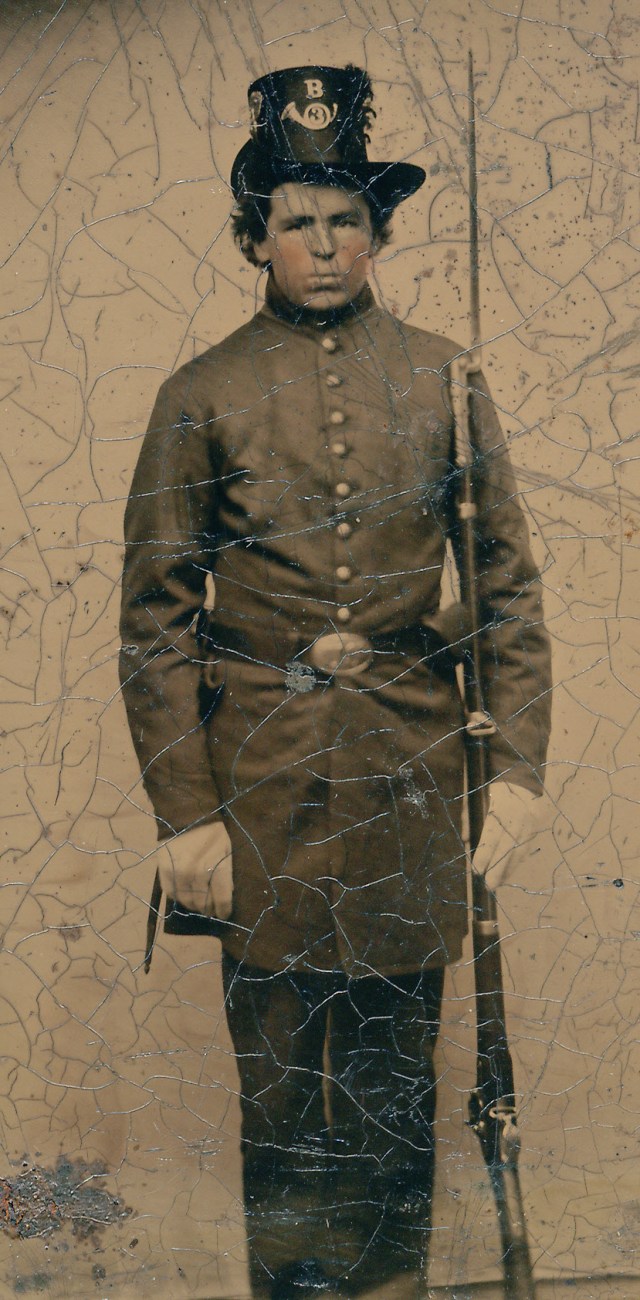
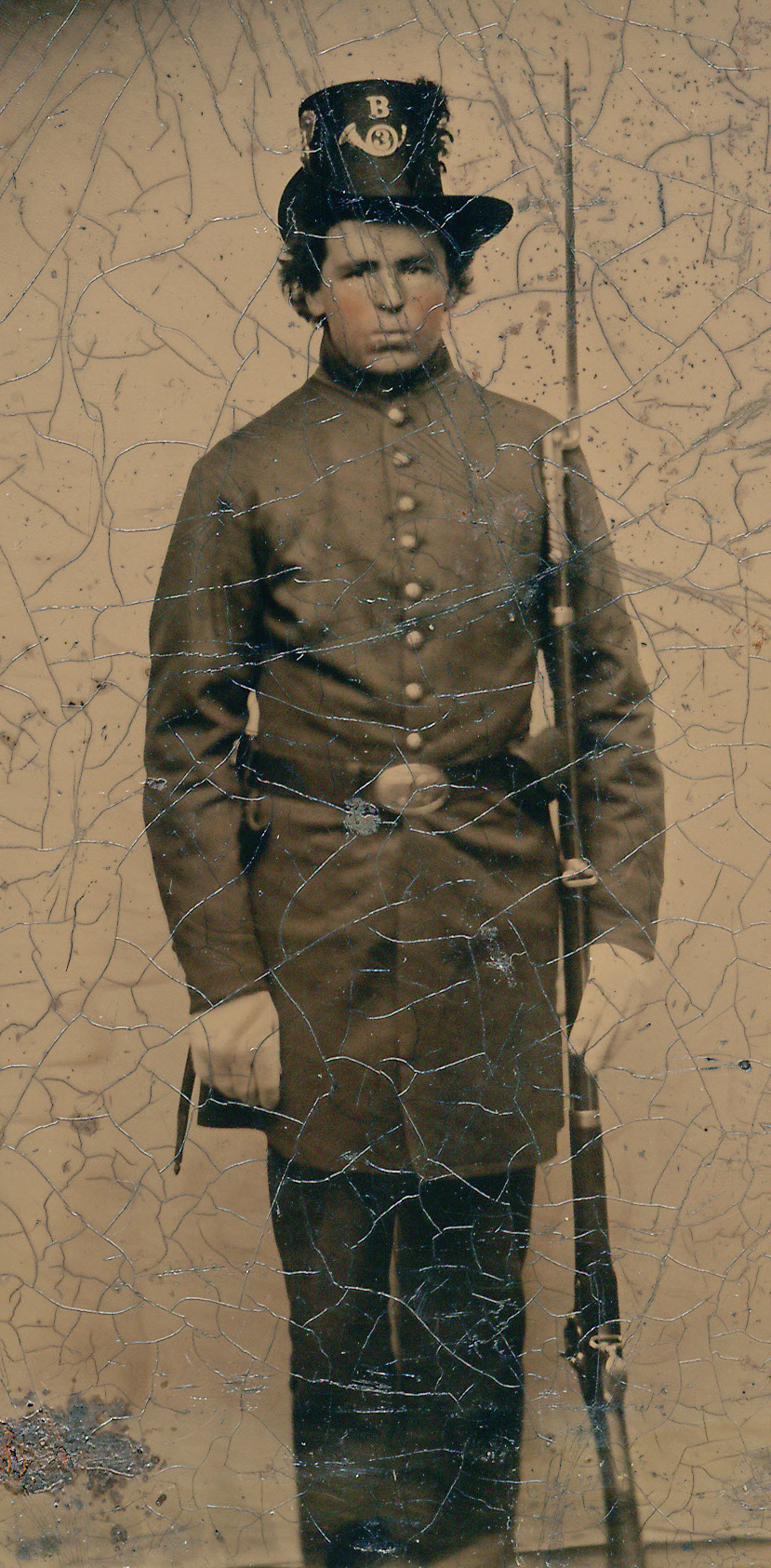
Pvt Herman S. Webber (1840-1862) Co. B, 3rd Maine Infantry, 1861 Courtesy Chuck Russell Find A Grave Memorial# 105998579

Pvt Herman S. Webber (1839 – 1862) Co. B, 3rd Maine Infantry, 1861 Courtesy Chuck Russell Find A Grave Memorial# 105998579

Isaac HAWES’ grandson Hadley O. Hawes (1847-1902) was drafted to Company G, Maine 3rd Infantry Regiment on 29 Aug 1863, two months after Gettysburg. Transferred on 28 Jun 1864 to Company K, Maine 1st Heavy Artillery Regiment.  Mustered out on 01 Sep 1866.

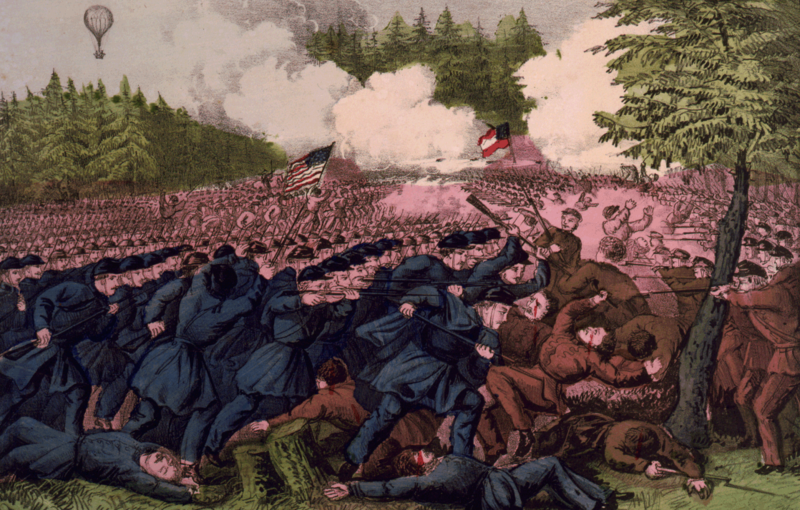
The Battle of Fair Oaks, also known as the Battle of Seven Pines or Fair Oaks Station  took place on May 31 and June 1, 1862, in Henrico County, Virginia, as part of the Peninsula Campaign.  The battle was frequently remembered by the Union soldiers as the Battle of Fair Oaks Station because that is where they did their best fighting, whereas the Confederates, for the same reason, called it Seven Pines.
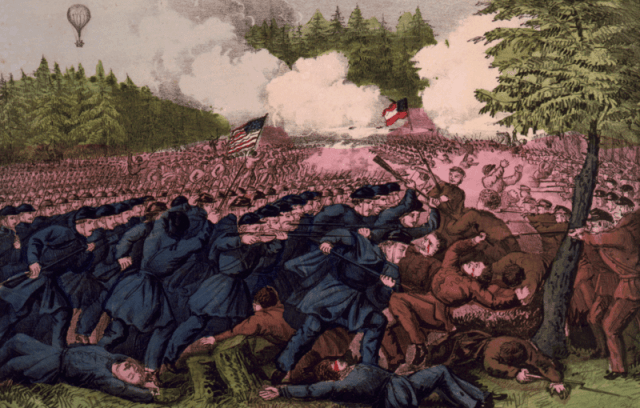
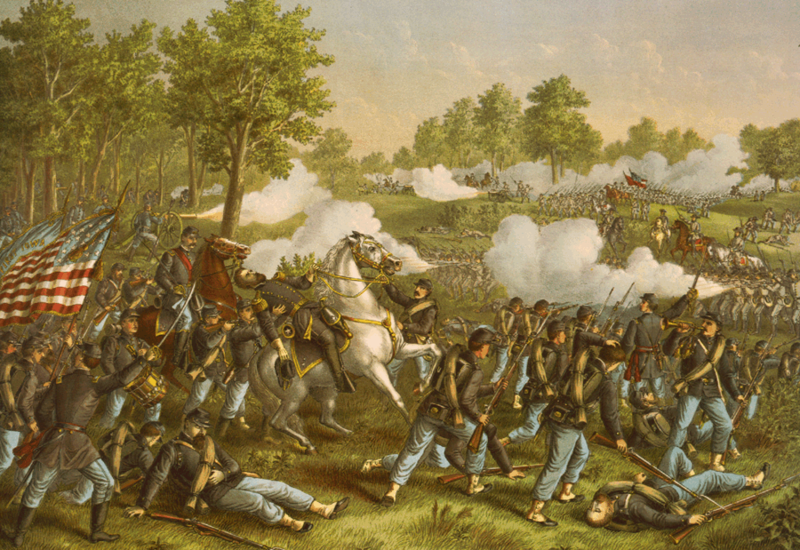
The Battle of Fair Oaks, Va. by Currier and Ives (1862)

The Battle of Fair Oaks, Va. by Currier and Ives (1862)

It was the culmination of an offensive up the Virginia Peninsula by Union Maj. Gen. George B. McClellan, in which the Army of the Potomac reached the outskirts of Richmond.  Both sides claimed victory with roughly equal casualties, but neither side’s accomplishment was impressive. George B. McClellan’s advance on Richmond was halted and the Army of Northern Virginia fell back into the Richmond defensive works.
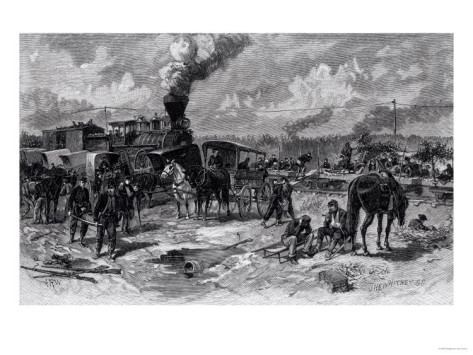
After the Battle of Seven Pines June 1862

Although the battle was tactically inconclusive, it was the largest battle in the Eastern Theater up to that time (and second only to Shiloh in terms of casualties thus far, about 11,000 total) and marked the end of the Union offensive, leading to the Seven Days Battles and Union retreat in late June.  Union casualties were 5,031 (790 killed, 3,594 wounded, 647 captured or missing), Confederate 6,134 (980 killed, 4,749 wounded, 405 captured or missing)

4th Maine Volunteer Infantry Regiment

Assembled in Rockland, Maine  May 20th, 1861 with Colonel Hiram G. Berry as it’s commanding officer. He received four Knox County companies, one from Searsport, Winterport, Wiscasset, and Damariscotta, and two from Belfast. In all, 1,085 men, including a regimental band, were mustered. The regiment was mustered out of service July 19th, 1864, with the expiration of their term. The veteran volunteers and recruits were transferred to 19th Maine Infantry. Of the 1440 men that served in the regiment during the war 170 men were killed in action or died of wounds received in battle. An additional 443 were wounded, 137 men perished of disease, and 40 men expired in Confederate prison.

Seth RICHARDSON’s grandson Alfred W Richardson (b. 1842 in Freedom, Waldo, Maine; d. Jul 1861)

Alfred enlisted in Company B, Maine 4th Infantry Regiment on 15 Jun 1861. Mustered out  01 Jul 1861 at Hospital.  The regiment left Maine on June 20th and went into action, a month later, at the First Battle of Bull Run July 21 1861.  It seems more likely that Alfred died of wounds from Bull Run than of disease just two weeks after he was mustered in.

5th Maine Volunteer Infantry Regiment

The regiment, organized in May 1861, was mustered in at Portland, Maine on 24 June 1861 for three years’ service. 193 original members were mustered out on 27 July 1864, while the reenlisted veterans and later recruits were transferred first into a battalion with the remaining members of the 6th Maine Infantry, and afterward was combined with those of the 7th Maine Infantry to form the 1st Maine Veteran Volunteer Infantry Regiment.

107 men were killed in action or died of wounds, while another 77 died of disease. Another reference only has 137 men dying or being killed in battle (though same volume, in appendix, also claims 143 for casualty count)

Edward STURGIS‘ grandson Edward G. Sturgis b: 1833 in Vassalboro; d: 3 May 1863 in KIA, Battle of Chancellorsville.  In the 1850 census, Edward was living in Vassalboro with his eldest sister Eliza and brother-in-law Josiah Wentworth.

William B. Lapham, History of Bethel, Maine, (1981), 279, Edward G. Sturgis was mustered into Company I, Fifth Maine Regiment, November 13, 1961, and was killed in battle, May 3, 1863.

The Battle of Chancellorsville  was fought from April 30 to May 6, 1863, in Spotsylvania County, Virginia, near the village of Chancellorsville. Two related battles were fought nearby on May 3 in the vicinity of Fredericksburg. The campaign pitted Union Army Maj. Gen. Joseph Hooker’s Army of the Potomac against an army less than half its size, Gen. Robert E. Lee’s Confederate Army of Northern Virginia. Chancellorsville is known as Lee’s “perfect battle” because his risky decision to divide his army in the presence of a much larger enemy force resulted in a significant Confederate victory. The victory, a product of Lee’s audacity and Hooker’s timid decision making, was tempered by heavy casualties and the mortal wounding ofLt. Gen. Thomas J. “Stonewall” Jackson to friendly fire, a loss that Lee likened to “losing my right arm.”.

6th Maine Volunteer Infantry Regiment

The 6th Maine Infantry was organized in Portland, Maine and mustered in for a three year enlistment on July 15, 1861. The regiment was attached to W. F. Smith’s Brigade, Division of the Potomac, to October 1861. 2nd Brigade, Smith’s Division, Army of the Potomac, to March 1862. 1st Brigade, 2nd Division, IV Corps, Army of the Potomac, to May 1862. 1st Brigade, 2nd Division, VI Corps, to February 1863.

The regiment left Maine for Washington, D.C., Jul 17 1861. Duty in the defenses of Washington, D.C., until Mar 1862. Advance on Manassas, Va., Mar 10-15, 1862. Ordered to the Peninsula Mar 16. Advance toward Yorktown Apr 4-5. Siege of Yorktown Apr 5-May 4. Reconnaissance toward Yorktown Apr 6. Reconnaissance toward Lee’s Mills Apr 28. Battle of Williamsburg May 5. Duty at White House until May 18. Duty near Richmond until June 6 and picket on the Chickahominy until Jun 25. Seven days before Richmond Jun 25-Jul 1. Gaines’ Mill Jun 26. Gold-Inn’s Farm Jun 27. Savage Station Jun 29. White Oak Swamp Bridge Jun 30. Malvern Hill Jul 1. [Orson F Richardson is listed at The Battle of Cedar Mountain, which took place on Aug 9, 1862]   Duty at Harrison’s Landing until Aug 15. Retreat from the Peninsula and movement to Centreville Aug 15-27. In works at Centreville Aug 27-31. Assist in checking Pope’s rout at Bull Run Aug 30, and cover retreat to Fairfax C. H. Sep 1. Maryland Campaign Sep-Oct. Sugar Loaf Mountain, Md., September 11-12. Crampton’s Pass, South Mountain, Sep 14. Battle of Antietam Sep 16-17. Duty in Maryland until Oct 29. The regiment lost a total of 255 men during service; 12 officers and 141 enlisted men killed or mortally wounded, 2 officers and 100 enlisted men died of disease.
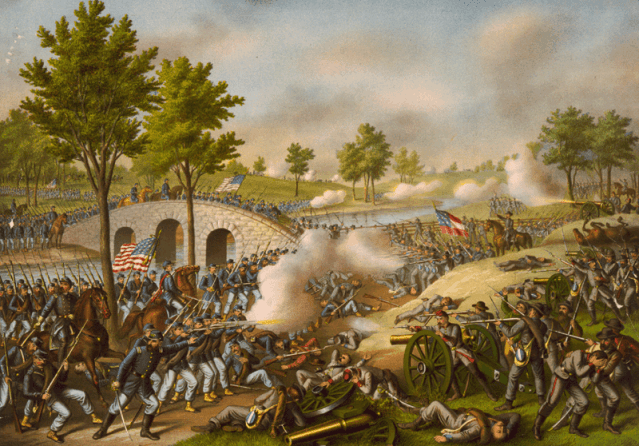
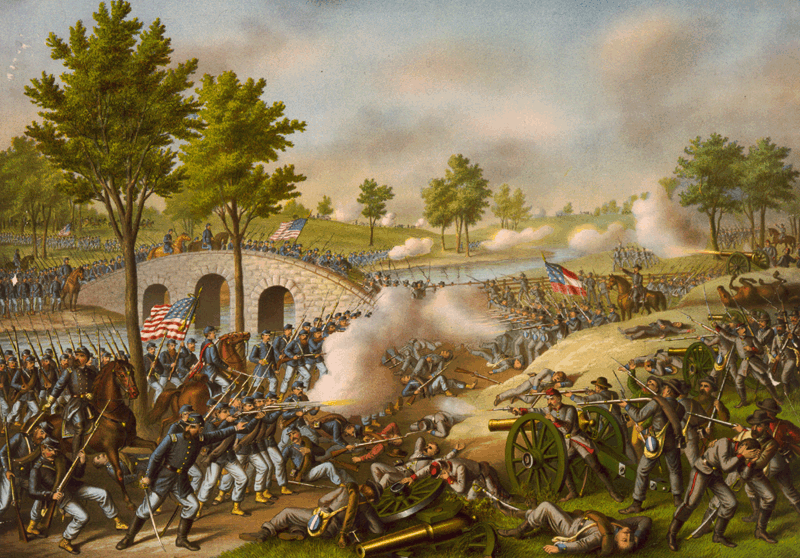
Battle of Antietam by by Kurz & Allison, depicting the scene of action at Burnside’s Bridge

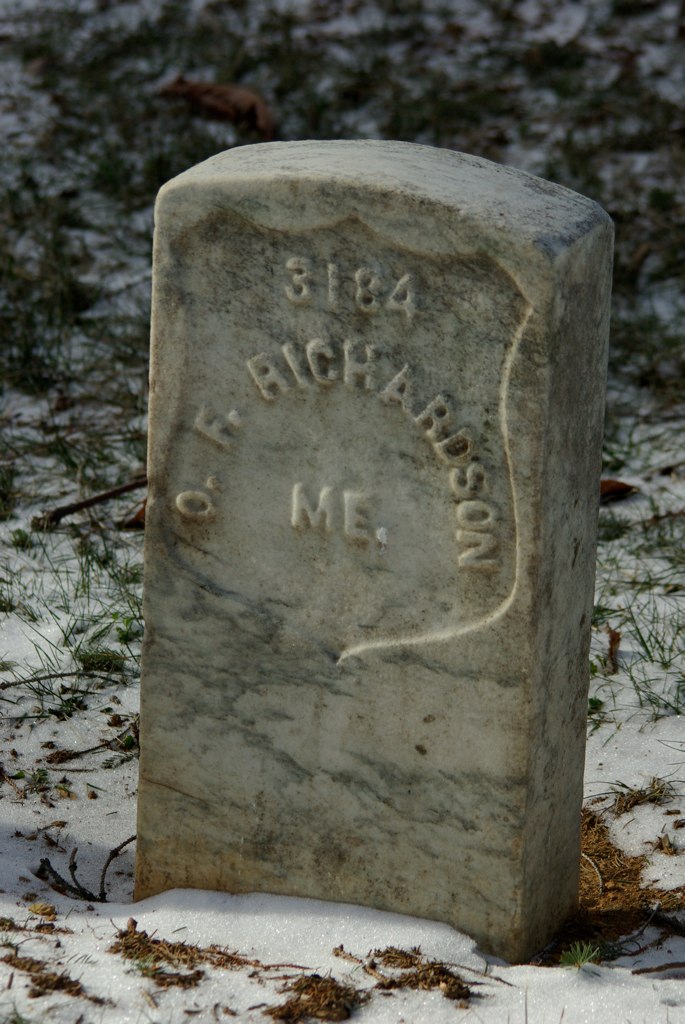
Seth RICHARDSON’s grandson Orson Franklin Richardson (b. 15 Mar 1845 in Vassalboro, Kennebec, Maine; d. 16 Oct 1862 in Smoketown, Maryland). Buried Antietam National Battlefield Site, Sharpsburg, MD 21782 Buried At: Site 3184
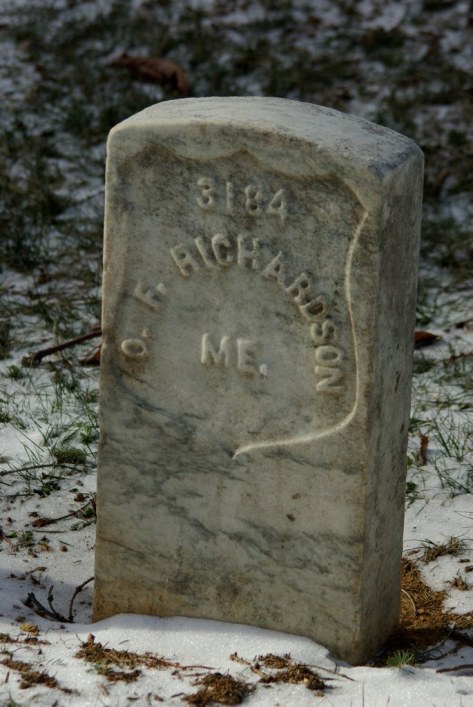
Orson F Richardson Gravestone

Orson was a Private in E Company of the 6th Maine Volunteer Infantry.

The Battle of Antietam also known as the Battle of Sharpsburg, particularly in the South, fought on September 17, 1862, near Sharpsburg, Maryland, and Antietam Creek, as part of the Maryland Campaign, was the first major battle in the American Civil War to take place on Union soil. It was the bloodiest single-day battle in American history, with about 23,000 casualties on both sides. Orson died a month later, perhaps of disease or maybe due to injuries.

10th Maine Volunteer Infantry Regiment

Col., George L. Beal; Lieut.-Col., James  F. Fillebrown; Majs., Charles Walker, Charles S. Emerson. When the 1st Maine was mustered out of service in the Union army the  various companies composing it, and which had enlisted in the State militia for two years and in the U. S. service for only three months, were ordered to rendezvous at Portland for the purpose of reorganizing the regiment to serve out the rest of their time. This was found to be partially impracticable, however, except by the employment of coercive measures. All the companies were reorganized except A, C and D, but 697 out of the 881 men were paid bounty as newly enlisted troops. Co. C was formed by a fusion of the three companies not able to organize separately;  These companies were organized to

form the new 10th at Cape Elizabeth, Me., in Oct., 1861, and were mustered into the U. S. service as follows: Companies B, C, E, F, G, H, I, and K to serve two years from May 3, 1861, and A and D to serve three years from Oct. 4, 1861.

The regiment left Portland Oct. 6, 1861, and arrived in Baltimore on the 9th, where it remained encamped at “Patterson Park” until Nov. 4, when it moved to Relay House, Md., and relieved the 4th Wis. as guard of the Baltimore & Ohio railroad until Feb. 27, 1862. It afterward guarded the main line of the same road leading to Harper’s Ferry, and the railroads leading to Martinsburg and Charlestown, W. Va. The regiment was concentrated at the First Battle of Winchester on May 24, and the following day was given the dangerous duty of rear-guard to the forces of Gen. Banks on his retreat to Williamsport, Md., during which it suffered a loss of 90 men. At Williamsport it was assigned to the 1st brigade, 1st division, Banks’corps. May 28, it made a reconnoissance towards Martinsburg, advanced to Winchester on the 31st, occupied Front Royal June 22, and took part in the reconnoissance to Luray Court House on June 29. On July 6, it proceeded towards Culpeper Court House and arrived there on the 24th. Gen. Crawford, the brigade commander, often stated that the 10th Me. contained more scouts than all other regiments in the brigade combined. It subsequently participated in the battle of Cedar Mountain, where its losses were 173 men, and was in all the movements of Gen. Pope’s army on his retreat toward Washington. At the Battle of Antietam the regiment lost

20 killed and 48 wounded.

From Sept. 19, 1862, to Sept. 28, 1863, it was at Maryland heights, opposite Harper’s Ferry, Berlin, Md., Fairfax Station and Stafford Court House, Va.,  leaving the latter place on April 28, 1863, for Maine, as the two years’ term of service had expired. The original members were mustered out at Portland on May 7-8, 1863.

The regiment lost 8 officers and 74 enlisted men killed in action or dying of wounds received in battle. An additional officer and 53 enlisted men died of disease. Total fatalities for the regiment were 136

Joseph COLEMAN’s grandson Thomas Augustus Eastman (1842-1919) enlisted in Company C, Maine 10th Infantry Regiment on 05 Oct 1861. Mustered out on 07 May 1863.

14th Maine Volunteer Infantry Regiment

Organized at Augusta, Maine and mustered in on Dec 31, 1861. The regiment left the state for Boston, Massachusetts on Feb 5, 1862, and there embarked on Feb 6 on the steamer “North America.” They arrived at Ship Island, Mississippi on March 8. The regiment was attached to Butler’s New Orleans Expeditionary Corps, Jan 1862.

The Regiment remained at Ship Island until May 19, 1862, then moved to New Orleans, Louisiana from May 19 to 25. They remained on duty there until July 7. They moved to Baton Rouge, Louisiana on July 7. A . The Regiment participated in the Battle of Baton Rouge on August 5. The 14th Maine Volunteer Infantry Regiment is the focus of the poem “On the Men of Maine killed in the Victory of Baton Rouge, Louisiana” written by Herman Melville.

They moved to Carrollton on August 20, and remained on duty there until December 13, 1862.  It lost 86 killed or died of wounds and 332 died from disease.

Seth RICHARDSON’s grandson Isaac Cummings (b. 17 Jun 1842 in Freedom, Waldo, Maine; d. 21 Aug 1862 in New Orleans, Louisiana)

Isaac enlisted in Company B, Maine 14th Infantry Regiment on 04 Dec 1861. Promoted to Full Corporal. Fought at the Battle of Baton Rouge, a ground and naval battle fought in East Baton Rouge Parish, Louisiana, on August 5, 1862. The Union victory halted Confederate attempts to recapture the capital city of Louisiana. Mustered out on 21 Aug 1862 at New Orleans, LA.

Seth RICHARDSON’s  grandson Hugh Anderson Cummings (b. 18 May 1845 in Freedom, Waldo, Maine; d. 1933 Indiana);  Hugh enlisted in Company G, Maine 14th Infantry Regiment on 15 Mar 1865. Mustered out on 28 Aug 1865.

It is also said he served with the 8th Regiment, Indiana Cavalry, Co. B.

Seth RICHARDSON’s grandson Hale P Sylvester (b. 10 Sep 1844 in Unity, Waldo, Maine; d. 9 Jan 1937 in Freedom, Waldo, Maine) enlisted in Company G, Maine 14th volunteer Infantry Regiment on 15 Mar 1865. They marched to Augusta, Georgia from May 6 to 14, 1865 and then on to Savannah between May 31 and June 7. They then moved to Darien June 9–10. Mustered out on 28 Aug 1865. The regiment was mustered in for three year’s service on Dec 31, 1861 and were mustered out on Jan 13, 1865.

15th Maine Volunteer Infantry Regiment

Organized in Augusta, Maine December 6-31, 1861 and mustered in January 23, 1862 for a three year enlistment

Cols., John McCluskey, Isaac Dyer; Lieut.-Cols., Isaac Dyer, Benjamin B. Murray, Jr., Pembroke; Majs., Benjamin Hawes, Franklin M. Drew, James H. Whitmore, John R. Coates. This regiment was raised principally in Aroostock county, and was organized at Augusta, Me., from Dec. 6 to 31, 1861, to serve for three years. It was mustered into the U. S. service on Jan. 23, 1862,[one week before Augustus’ enlistment] and embarked from Portland March 6 for Ship island, Miss., at which date it numbered 962 men, rank and file. The regiment remained encamped at Carrollton, La., from May 19 to Sept. 18, during which time it suffered much from malarial diseases. In September it went to Pensacola, Fla., where it remained until June 21, 1863. Here the health of the men so improved that the number in hospital was reduced to less than one-quarter. During the first year of its service the 15th lost by desertion, discharge and death 329 men, although it had never been in battle. On its return to New Orleans in June, 1863, it joined Gen. Banks’ expedition to Texas and rendered conspicuous service in the capture of Fort Esperanza, in Matagorda bay.

While at Matagorda peninsula, from Jan. 17 to Feb. 28, 1864, three-fourths of the original members of the regiment reenlisted for another term of three years. Returning to New Orleans in March, the regiment formed a part of Gen. Banks’ Red River expedition, during which it marched more than 700 miles in two months, and participated in the battles of Sabine cross-roadsPleasant HillMonett’s Ferry and Mansura plains. In June, 1864, it was ordered to New Orleans, and on July 5 embarked on transports for Fortress Monroe, Va., where it arrived on the 17th. Six companies were then ordered to Bermuda Hundred, and the remaining companies participated in the campaign up the valley in pursuit of Early’s army. The command was reunited at Monocacy Junction, Md., Aug. 4, when the veterans of the regiment who had reenlisted received a 35 days’ furlough, returning to the field Sept. 27. In October it went to Martinsburg, where it remained until Jan. 7, 1865.

The original members of the regiment who had not reenlisted were mustered out on Jan. 18, 1865, but the reenlisted men, recruits, volunteers, drafted men and substitutes forwarded from Camp Berry, Portland, were sufficient to reorganize the regiment, which was ordered to Washington in April, and went to Savannah, Ga., on June 4. On the 13th, it embarked on transports for Georgetown, S. C., where it was assigned to the 3d separate brigade, Department of South Carolina, and remained here until the date of muster out, July 5, 1866, whence the men went to New York, where they were finally paid and discharged.

Dudley COLEMAN’s son-in-law Augustus Plummer was born about 1833 in Maine and died in the Civil War.

On 31 Jan 1862 Augustus enlisted in Company D, 15th Infantry Regiment Maine. He was promoted to Full Musician in 1862. Company D, 15th Infantry Regiment Maine mustered out on 5 Jul 1866, but Augustus had died before then because on 5 Sep 1863, his wife Mrs. Roxannah Plummer married Charles R. Church. Roxannah and Charles didn’t last because she married a third time on 22 Aug 1869 to Marcellus C. Lovejoy.
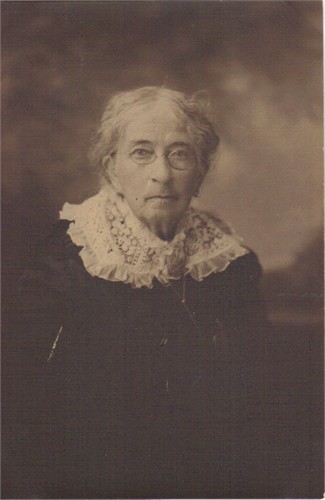
Roxanna Parmenter Coleman was widowed when Augustus Plummer didn’t return from the Civil War

Jonathan PARKS‘ son George (b. 4 Jun 1819, Upper Kent, New Brunswick – d. 6 Aug 1864, Washington, DC) also served in the 15th Maine. George enlisted as a Private on 26 Jan 1864 at the age of 42 in Company G, 15th Infantry Regiment Maine. George was still enlisted in Company G, 15th Infantry Regiment Maine when he died of disease on 7 Aug 1864 in Washington, DC.
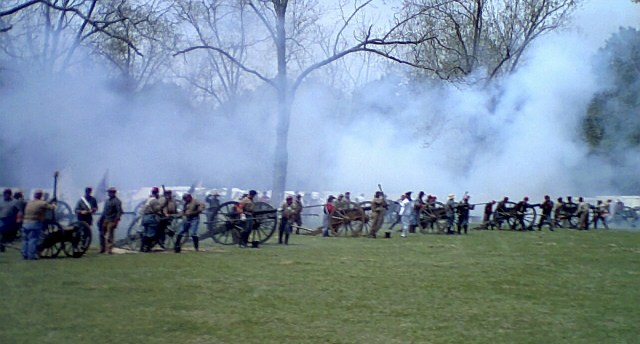
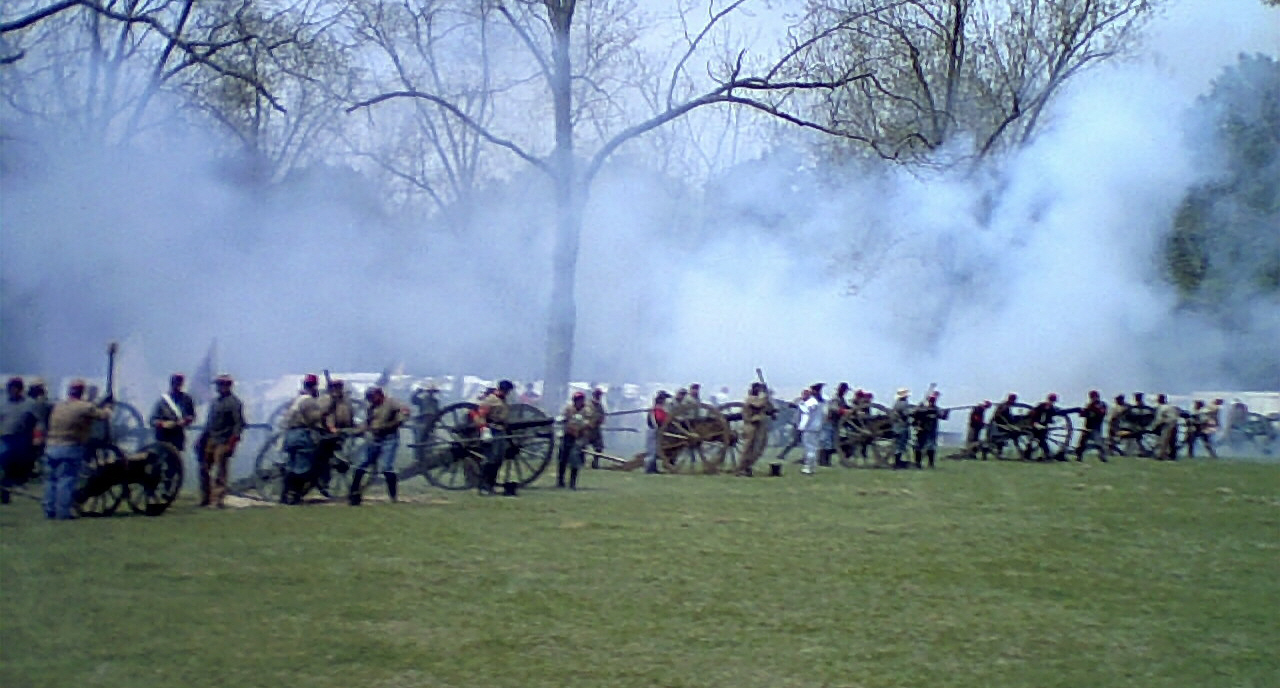
Battle of Pleasant Hill Reenactment

George participated in the Red River Campaign,  a series of battles fought along the Red River in Louisiana  from March 10 to May 22, 1864. The campaign was a Union initiative, fought between approximately 30,000 Union troops under the command ofMaj. Gen. Nathaniel P. Banks, and Confederate troops under the command of Lt. Gen. Richard Taylor, whose strength varied from 6,000 to 15,000.

The campaign was primarily the plan of Union General-in-Chief Henry W. Halleck, and a diversion from Lt. Gen. Ulysses S. Grant’s plan to surround the main Confederate armies by using Banks’s Army of the Gulf to capture Mobile, Alabama. It was a dismal Union failure, characterized by poor planning and mismanagement, in which not a single objective was fully accomplished.

While at Matagorda peninsula in Texas, from Jan. 17 to Feb. 28, 1864, three-fourths of the original members of the Maine 15th regiment reenlisted for another term of three years. Returning to New Orleans in March, the regiment formed a part of Gen. Banks’ Red river expedition, during which it marched more than 700 miles in two months, and participated in the battles of Sabine cross-roads [Battle of Mansfield], Battle of Pleasant Hill, Cane river crossing [Battle of Monett’s Ferry] and Mansura plains [Battle of Mansura]. In June, 1864, it was ordered to New Orleans, and on July 5 embarked on transports for Fortress Monroe, Va., where it arrived on the 17th. Six companies were then ordered to Bermuda Hundred, and the remaining companies participated in the campaign up the valley in pursuit of Early’s army. The command was reunited at Monocacy Junction, MD, Aug. 4, when the veterans of the regiment who had reenlisted received a 35 days’ furlough, returning to the field Sept. 27.
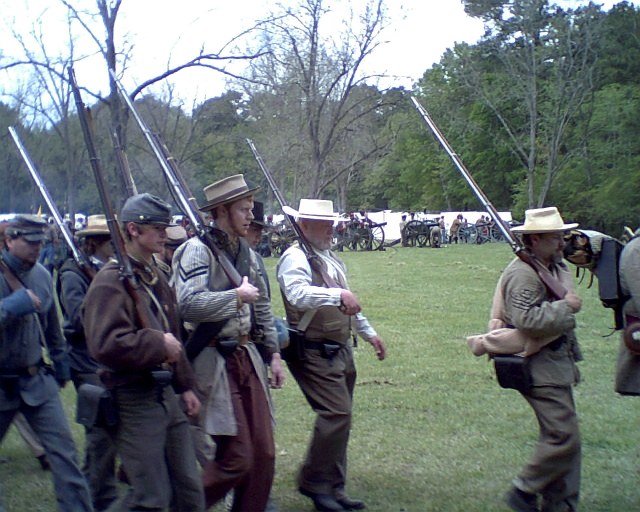
Battle of Mansfield Reenactment

16th Maine Volunteer Infantry Regiment

Organized at Augusta, Maine, and mustered into Federal service for a three year enlistment on August 14, 1862.  The regiment was discharged from service on June 5, 1865.

1,907 men served in the 16th Maine Infantry Regiment at one point or another during its service. It lost 181 enlisted men killed in action or died of wounds. 578 members of the regiment were wounded in action, 259 died of disease, and 76 died in Confederate prisons for a total of 511 fatalities from all causes, a rate of 57%.
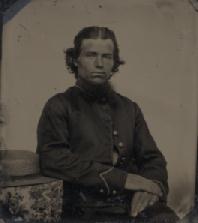
Pvt. Gustavus Vacy Webber Co E 16th Maine Volunteers. Photo taken about the time of his enlistment Jul. 1862

Oliver WEBBER’s son Gustavus Vacy Webber (b. 16 Aug 1832 Vassalboro, Maine – d20 Jan 1917 China, Kennebec, Maine) enlisted as a Private on 14 August 1862 at the age of 28. in Co E -16th Maine -Wounded at Gettysburg, see below.   Gus Webber was discharged 16 Dec 1863 with disability from leg wound received 1 July 1863 Gettysburg, PA (where he was captured and paroled 3 July 1863)
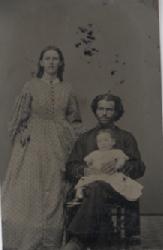
Gustavus V Webber, wife Mary, daughter Alice, Photo taken about 1865 or 1866 as Alice was born in 1865. Mary died in 1870.

Oliver WEBBER’s son Virgil H Webber (b. 1836 in Maine – d. 1 Jul 1862 Gettysburg PA). Virgil served in the same company as his brother Gustavus. Virgil was killed 1 Jul 1863, the first day of the Battle of Gettysburg.
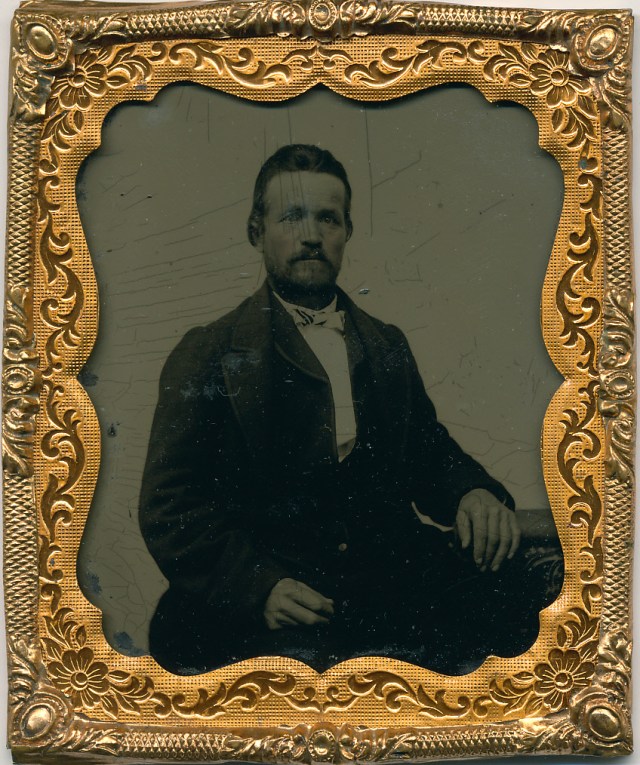
Pvt Virgil H. Webber (1836 - 1862)

Pvt Virgil H. Webber (1836 – 1862)

Virgil and his brother Gustavus (also wounded in this action) were in Company E, 16th Maine Regiment. which arrived around 11: 30 on the morning of July 1, 1863, as part of two divisions of the 1st Corps, Army of the Potomac that arrived to join a fight that had been raging all morning, as the Confederates advanced on Gettysburg from the west and from the north. Among them was the 16th Maine. The regiment, along with the rest of the army, had been marching since June 12 up from Virginia.  16th Maine fought bitterly for approximately three hours in the fields north of the Chambersburg Pike; but by mid-afternoon, it was evident that, even with the addition of the rest of the 1st Corps and the entire 11th Corps, the position of the Union forces could not be held. They began to fall back toward the town of Gettysburg.


The 16th Maine was then ordered to withdraw to a new position to the east of where they had been fighting. “Take that position and hold it at any cost!” was the command. This meant that those of the 275 officers and men of the regiment who had not already become casualties had to sacrifice themselves to allow some 16,000 other men to retreat. This they valiantly did, but they were soon overwhelmed and forced to surrender to the Confederates.

As the Southern troops bore down upon them, the men of the 16th Maine spontaneously began to tear up into little pieces their “colors.” Like other Union regiments, the 16th Maine carried an American flag and a regimental flag, known collectively as “the colors.” “For a few last moments our little regiment defended angrily its hopeless challenge, but it was useless to fight longer,” Abner Small of the 16th Maine wrote after the battle.

“We looked at our colors, and our faces burned. We must not surrender those symbols of our pride and our faith.” The regiment’s color bearers “appealed to the colonel,” Small wrote, “and with his consent they tore the flags from the staves and ripped the silk into shreds; and our officers and men that were near took each a shred.”

Each man hid his fragment of the flags inside his shirt or in a pocket. The Confederates were thus deprived of the chance to capture the flags as battle trophies.   Most of the 16th Maine survivors treasured these remnants for the rest of their lives and bequeathed them to their descendents, some of whom still possess them as family heirlooms to this day.

By sunset on July 1, 11 officers and men of the 16th Maine had been killed, 62 had been wounded, and 159 had been taken prisoner.  Company E suffered heavy losses 3 killed, 8 wounded including Capt,William A. Stevens and Lt. Aubrey  Leavitt and 14 taken prisoner including Capt. Leavitt.  Only 38 men of the Regiment managed to evade being captured and report for duty at 1st Corps headquarters. But the 16th Maine had bought precious time for the Union Army. Those whose retreat they had covered were able to establish a very strong position just east and south of the center of the town of Gettysburg along Cemetery Ridge. During the night and into July 2 the 1st and 11th Corps were reinforced by the rest of the Army of the Potomac. For the next two days they would withstand successive assaults by the Confederates until the final repulse of Pickett’s Charge, on 3 Jul.

17th Maine Volunteer Infantry Regiment

Cols., Thomas A. Roberts, George W. West, Charles P. Mattocks; Lieut.-Cols., Charles B. Merrill, William Hobson; Majs., George W. West, Charles P. Mattocks. This regiment was recruited chiefly from the counties of York, Cumberland, Androscoggin and Oxford, and was mustered into the U. S. service at Camp King, Cape Elizabeth, Aug. 18, 1862, to serve for three years.
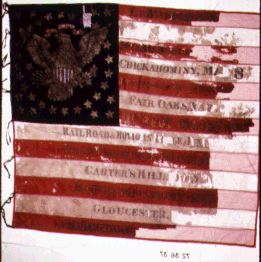
17th Maine Volunteer Infantry (1862-64)

The 17th left the state for Washington Aug 21, 1862, and occupied the line of forts on the east side of the Anacosta and north side of the Potomac rivers, until Oct 7, engaged in both heavy artillery and infantry drill and garrison duty. It then joined the 3d brigade (Berry’s), 1st division (Birney’s), 3d corps, at Upton’s hill, Va. On Dec. 13, 1862, it participated in the Battle of Fredericksburg, losing 2 men killed and 19 wounded, and was complimented by Gen. Berry for the steadiness of the men, who were under fire for the first time.

The regiment remained encamped at Falmouth, Va., until May 1, 1863, when it took part in the Chancellorsville campaign, being hotly engaged at Chancellorsville on May 2-3, losing 113 men in killed, wounded and missing out of about 625 men in the action.

The regiment was next engaged at Gettysburg, during the last two days of the battle, where it lost 132 in killed, wounded and missing.

On Nov. 27, it took a prominent part in the Battle of Mine Run, losing 52 men. It wintered at Brandy Station until March 25, 1864, during which time its ranks were filled by returned convalescents and recruits, and numbered about 500 men for the spring campaign. It was now assigned to the 2nd brigade, 3d division, 2nd army corps, and participated in the battle of the Wilderness, losing 24 men killed, 147 wounded and 12 missing.

On May 12th, the corps made its famous charge, part of the Battle of Spotslyvania Court House, upon the enemy’s lines at the Po river, where the regiment lost 53 men.  Surviving participants attempted to describe in letters, diaries, and memoirs the hellish intensity of that day, many noting that it was beyond words. Or, as one put it: “Nothing can describe the confusion, the savage, blood-curdling yells, the murderous faces, the awful curses, and the grisly horror of the melee.”  May 12 was the most intensive day of fighting during the battle, with Union casualties of about 9,000, Confederate 8,000; the Confederate loss includes about 3,000 prisoners captured in the Mule Shoe.

On May 23, in the charge which drove the enemy across the North Anna river, it lost 23 men. It was under fire at Cold Harbor, and in two assaults on the enemy’s works at Petersburg it lost 84 men.

Subsequently it encamped near Fort Sedgwick, where it remained until Feb. 5, 1865, having meanwhile taken part in the attack on the Weldon railroad under Gen. Warren. They subsequently participated in all the movements of the 2nd corps in the vicinity of Hatcher’s run, until March 29, 1865. On May 1, it left Burkesville, Va., for Washington, where it was mustered out on June 4. Its aggregate losses during the years 1862, 1863 and 1864 were 745.  The 17th Maine suffered the highest battle casualties of any Maine regiment.

Joseph COLEMAN’s grandson Nathaniel Bryant Coleman (1833 – 1927) Enrolled in Colby College in 1859 and in 1860 transferred to Princeton. The death of a brother called him back to Maine and the outbreak of war put an end to his college course. He enlisted as a Hospital Steward on 15 Aug 1862 in Company S, 17th Infantry Regiment Maine on 15 Aug 1862. Promoted to Full Assistant Surgeon on 22 Nov 1863. Mustered Out Company S, 17th Infantry Regiment Maine on 4 Jun 1865 at Washington, DC.

In 1865 he graduated in medicine from Dartmouth and practiced medicine and surgery in New Hampshire, California and Washington.

At the beginning of the Civil War the personnel of the Medical Department of the regular army was composed of one surgeon-general with the rank of colonel, thirty surgeons with the rank of major, and eighty-four assistant surgeons with the rank of first lieutenant for the first five vears of service, and thereafter with the rank of captain, until promoted to the grade of major. There was no hospital corps, but the necessary nursing and other hospital assistance were performed by soldiers temporarily detailed to hospital duty from organizations of the line of the army, (the qualifications and character of the soldiers so detailed were usually far from satisfactory).

At the beginning of the war, each regimental surgeon was furnished with a suitable equipment for his regiment for field service, in quantities regulated by the supply table. This table, which was revised about a year later, seemed to contemplate the medical and surgical outfitting of regiments on the basis of independent service, and when they became brigaded much of the equipment so supplied was found to be not only unduly heavy and cumbrous but also unnecessary.

The medical and surgical material available on the firing line was practically that carried by the surgeon in his case, known as the ” surgeon’s field companion,”and by his orderlv in the “hospital knapsack,” a bulky, cumbersome affair weighing, when filled, about twenty pounds.

Wounds were expected-nay, encouraged-to suppurate, and that they could heal without inflammation was undreamed of by the keenest surgical imagination. Their repair was always expected to be a slow, painful, and exhausting process. Nothing in the nature of antiseptics was provided. The cleanliness of wounds, except in respect to the gross forms of foreign matter, was regarded as of little or no importance. Even the dressings carried into action were few and scanty; where the soldier of the present carries on his person an admirable sterile dressing for wounds as part of his military equipment, in the Civil War the injured man covered his wounds as best be might with a dirty handkerchief or piece of cloth torn from a sweaty shirt. Elastic bandages for controlling hemorrhage were unknown, the surgeon relying, except in the case of larger vessels, on packing the wound with astringent, coagulant, and generally harmful chemicals. Medicines were carried in pill form, often largely insoluble and uncertain in result, or else in liquid form, difficult to carry and liable to loss. Soluble tablets were unknown. Crude drugs, like opium, were carried in lieu of their concentrated active principles, like morphine, now almost exclusively employed. Not a single heart stimulant of those regarded as most effective by modern medical science bad place in the surgeon’s armament carried in the field. A little chloroform was carried, but the production of surgical anesthesia was still a relatively new procedure, and several hundred major operations were reported during the war in which no anesthetic was employed.

In the first part of the war, each regiment had a hospital of its own, but the medicine-chest, mess-chest, and bulky hospital supplies were transported in wagons of the field-train, and hence were usually far in the rear and inaccessible. Panniers containing the more necessary dressings medicines, and appliances were devised to be carried along into action by pack-mules, but they were inconvenient and heavy, and were generally brought up in the ambulances after the fighting. Special wagons for medical supplies were then devised.

Surgical instruments were furnished by the Government to, each medical officer, who receipted for and was responsible for them. They were contained in four cases, one for major operations, one for minor operations, one a pocket-case, and one a field-case to be carried by the surgeon on his person into action. The instruments were well assorted, but they were used indiscriminately and without more than superficial cleansing upon both flesh and festering wounds, with the result that they habitually conveyed infection.

Under the surgical practice of the time, germs of blood poison, gangrene, and lockjaw were conveyed into the body. Moreover, it was the custom for the surgeons to undertake the most severe operations at the front, often under fire, under conditions in which even a pretense of surgical cleanliness could not have been maintained, even if the knowledge of the time bad been sufficient to cause it to be attempted. What we would now term ” meddlesome surgery ” was not peculiar to the army but was characteristic of general surgical practice of the time. In fact, toward the end of the war the best surgeons in the country were probably those with the military forces, and the admirable results which they frequently achieved bear evidence, not only of their accurate anatomical knowledge and surgical dexterity but of the amount of injury and infection which the human organism can resist.

20th Maine Volunteer Infantry Regiment

The 20th Maine had an initial enrollment of 1,621 men, losing 150 dead from combat, 146 dead from disease, 381 wounded, and 15 in Confederate prisons.

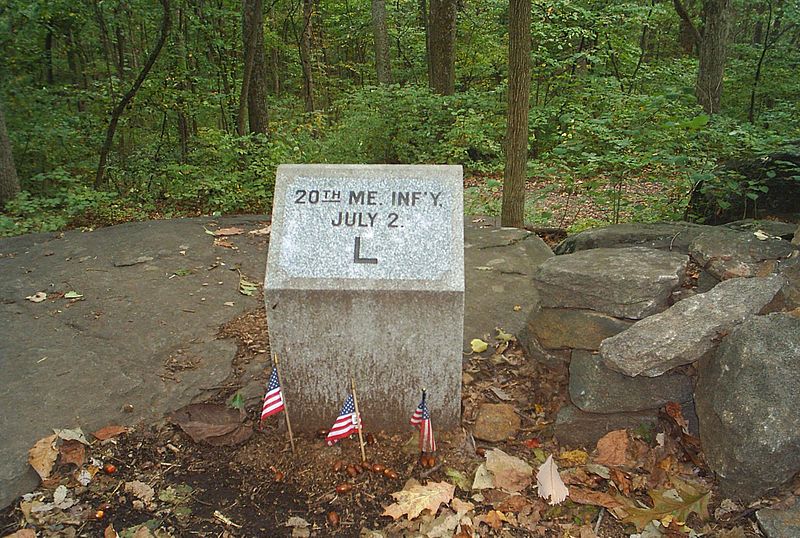
The Maine 20th Volunteer Infantry Regiment  is famous for its defense of Little Round Top at the Battle of Gettysburg, July 1863.  When the regiment came under heavy attack from the Confederate 15th Alabama regiment,  the 20th Maine ran low on ammunition after one and a half hours of continued fighting; it responded to the sight of rebel infantry forming again for yet another push at them by charging downhill with fixed bayonets, surprising and scattering the Confederates, thus ending the attack on the hill.
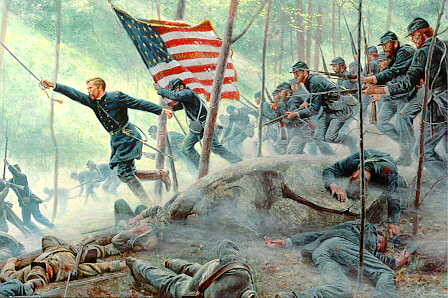
.

Had the 20th Maine retreated from the hill, the entire Union line would have been flanked, and would have most likely lost the battle of Gettysburg.  If the Union had lost the battle of Gettysburg the Confederate army could possibly been able to march on to Washington D.C. and end the war. The 20th Maine’s action in holding the hill has been credited with helping to turn the tide of the war.

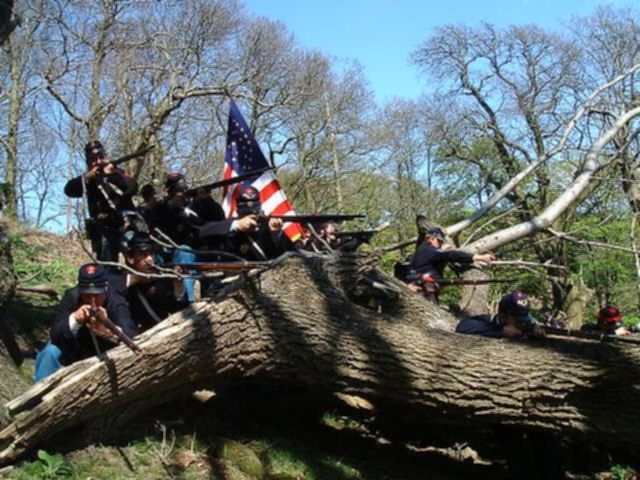
20th Maine Reenactment Courtesy: 20th Maine Company B http://endued.tripod.com/index.html

In 1989 members of the 1st Oregon Volunteer Infantrydecided that they would portray Company A of the 20th Maine at their battle reenactments.

The soldiers of Company A came from nearly a dozen little towns that are scattered in the lower central portion of the state. Unincorporated townships such as Clinton, Sidney, Freedom, Winslow, Alton, Solon, Rome, Alfred, Pittsfield, Concord, Anson, and Belgrade are shown on the regimental roster for 1862. However, of the 98 soldiers that made up the original company, the largest number (23) came from the town of Waterville on the Kennebec River some forty miles from Portland, (Maine) and twenty miles each way from Brunswick and Augusta. The initial Captain of Company A (Isaac S. Bangs Jr.) [a relative of Amasa’s sister-in-law Abigail Bangs] and 1st Lieutenant Addison W. Lewis, both came from Waterville. Two Sergeants, George C. Getchell and Reward A Sturtevant plus three Corporals, William H. Low, Charles R. Shorey and David J. Lewis also came from this city of approximately 500 souls in 1862.

Of the total soldiers in Company A (98) Captain Bangs reported in November of 1862 that only 59 were fit for duty. John Pullen in his book “The Twentieth Maine” writes that the reason for these reduced numbers was disease contracted after the Battle of Antietam and unusually cold weather in Maryland during October of 1862. Like the rest of the inexperienced regiment, Company A was spared participation in the great battle of Antietam only to be devastated from exposure (they were without even shelter halves) and microbes made worse by camp life, poor diet and unsanitary conditions.

Captain Isaac Bangs Jr. enlisted as a private on August 9, 1862 but was appointed commander of Company A by Colonel Adelbert Ames on August 29, 1862 when the regiment was mustered into Federal service. He was a 31 year old married cashier at the time. Captain Bangs served until January of 1863 when he was promoted to Lieutenant Colonel and later served as Colonel of the 7th U.S. Colored Heavy Artillery on garrison duty in defense of New Orleans, Louisiana until his honorable discharge in July of 1864. In March of 1865 he was given the title of Brevet Brig. General of U.S. Volunteers.
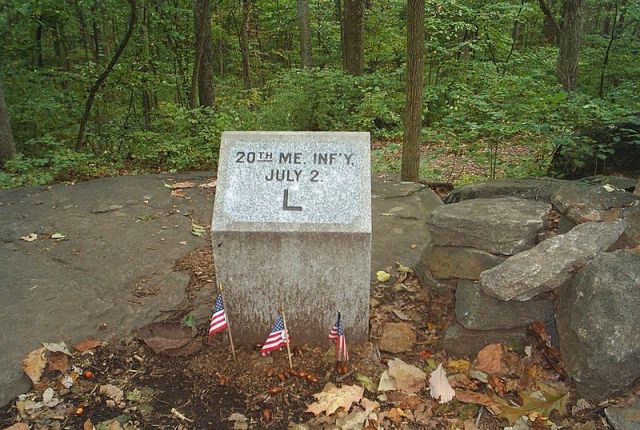
The 20th Maine is famous for holding the left flank of the Union line at Little Round Top, saving the Battle of Gettysberg and possibly the entire Civil War

The best known engagement for the 20th Maine was the Battle of Gettysburg. Company A took up position just to the right of where the battle line bent to the left. Casualties were approximately 30% for both the company and the regiment. The report of the state Adjutant General for December, 1863 shows the effects of the hard fighting. There were no commissioned officers for the company at that time. The report was filed by 1st Lieutenant William W. Morrell who was then commander of Company H. Of a total 83 soldiers only 31 were fit for duty. Howard L. Prince, a 22 year old school teacher from Cumberland, Maine, was initially the Regimental Quartermaster but was promoted to 1st Lieutenant in February of 1864 then Captain of Company A in December of that year.

That final year of the war was very hard on the 20th Maine and Company A. Very few of the “Boys of 62″ survived until the end in 1865. In his Spring campaign of 1864 General Grant called for the conversion of garrisoned forces of heavy artillery into infantry because of the terrible casualties at such places as Spotsylvania Courthouse, Cold Harbor and Petersburg. States such as Maine were called upon to convert units of coastal artillery to help depleted infantry regiments. In October of 1864 the records indicate that Company A received approximately 40 transfers from the 1st Maine Heavy Artillery which had been in state service until this time. The final numbers indicate only one commissioned officer (Captain Prince), two Sergeants, two Corporals and approximately 50-60 total enlisted soldiers who stood along that road at Appomattox Court House with General Joshua L. Chamberlain to accept the surrender of General Robert E. Lee’s ragged Army of Northern Virginia in April of 1865.
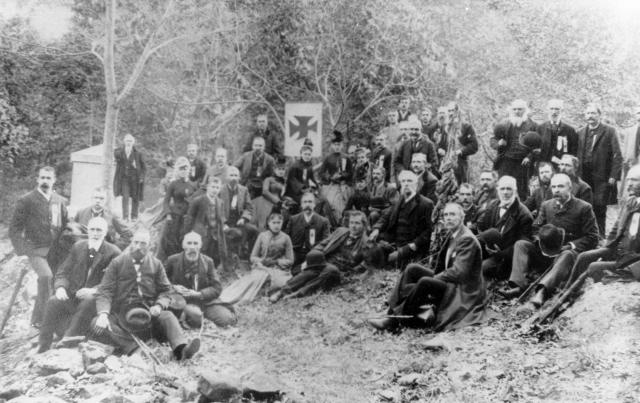
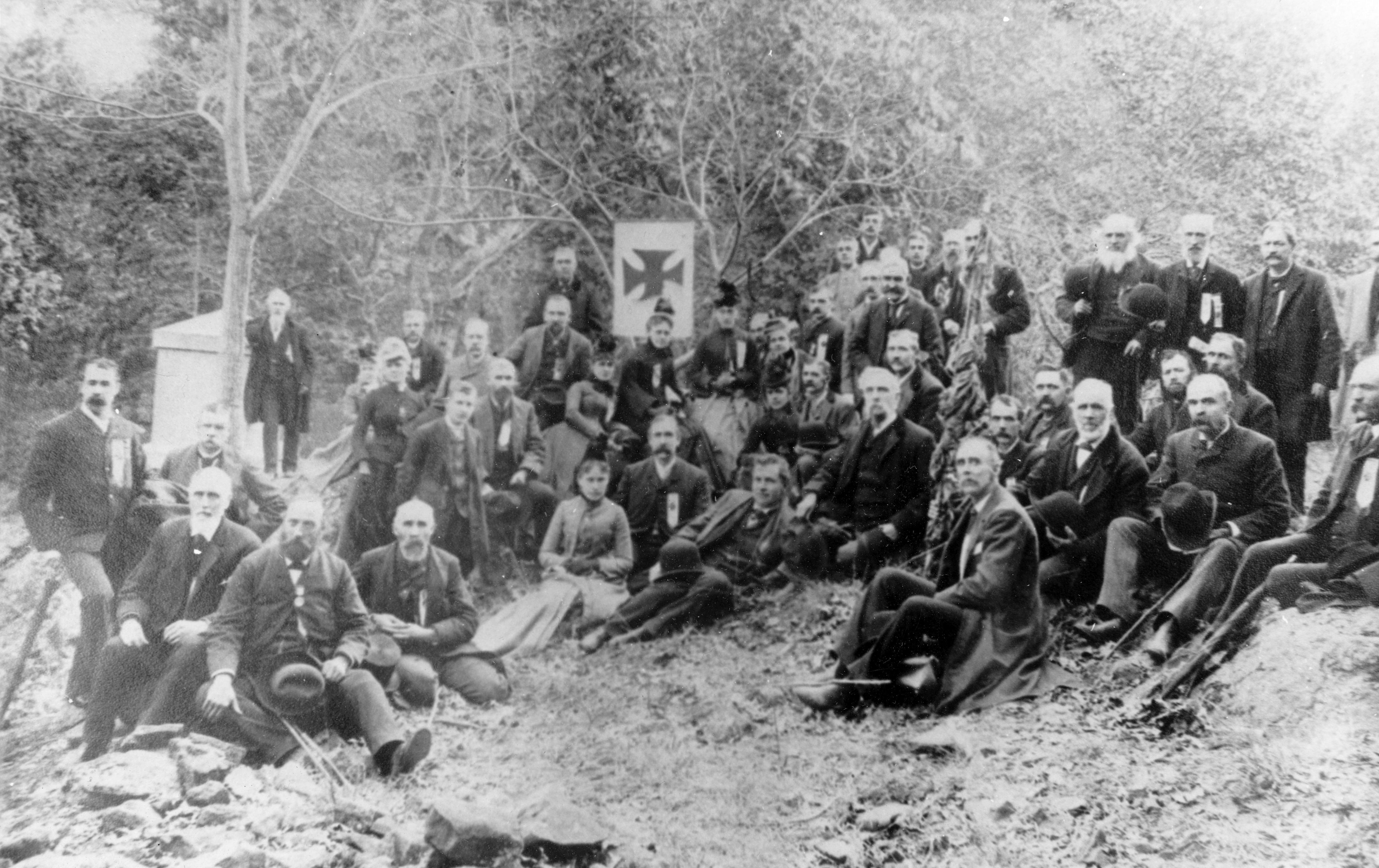
20th Maine Volunteer Reunion —  Gettysburg, Pennsylvania, 1889

Seth RICHARDSON’s grandson Amasa Cummings (b. May 1840 in Freedom, Waldo, Maine; d. 23 Apr 1910 in Palermo, Waldo, Maine.)  Amasa enlisted in Company A, Maine 20th Infantry Regiment on 29 Aug 1862

Seth RICHARDSON’s grandson Ira R. Sylvester (b. 13 Oct 1842 in Albion Gore, Kennebec, Maine; d. 20 May 1910 in Washington, Knox, Maine) enlisted in Company A, Maine 20th Infantry Regiment on 29 Aug 1862. Mustered out on 30 Jun 1865.    The 20th Maine marched from Appomattox, Virginia, on May 2, reaching Washington, D.C., on May 12, where it was mustered out of service on July 16, 1865.

21st Maine Volunteer Infantry Regiment 

Col., Elijah D. Johnson; Lieut.Col., Nathan Stanley; Maj., Benjamin G. Merry. This regiment, like the seven succeeding ones, was raised under the call of Aug. 4, 1862, for 300,000 militia for nine months’ service. It was mustered into the U. S. service at Bangor, Oct. 14, 1862, and started for Washington, D. C., on the 21st. While en route it was ordered to report to Maj.-Gen. N. P. Banks, commanding the Department of the Gulf, at New York city, then organizing his expedition for the opening of the Mississippi. It remained quartered at East New York for two months and then proceeded to New Orleans, where it arrived early in Feb., 1863.

It went at once to Baton Rouge and was assigned to the 1st brigade, 1st division, 19th corps. The men suffered from disease contracted in the low southern country, despite the precautions taken. Baton Rouge was now an important Union “base,” and theregiment was occupied in doing picket duty and protecting the city from guerrilla attacks. On March 14th, it advanced with the corps against Port Hudson, while Adm. Farragut’s fleet was engaged in passing the enemy’s works there on that memorable night.

Our relative Henry Hawes was killed April 9

The army, however, made no attack in force at that time, but on May 21 it engaged the enemy at Plains Store. The regiment took part in the siege of Port Hudson and participated in the assaults on May 27 and June 14, losing in the two engagements 88 men killed and wounded. Though its term of service had expired during the siege, the regiment volunteered to remain until the capture of Port Hudson, which occurred on July 9, 1863. Preparations were then at once made to transport home those regiments that had already remained beyond their term of service. The 20th was assigned to the 2nd brigade of the post forces, and July 25 embarked for Maine. With other regiments, it was the first to pass up the Mississippi river and received a continuous ovation. It arrived in Augusta, Aug. 7, where the men were mustered out on Aug. 25th, by Lieut. F. E. Crossman of the 17th U. S. infantry.

The regiment lost a total of 172 men during service; 1 officer and 26 enlisted men killed or mortally wounded, 1 officer and 144 enlisted men died of disease.

Seth RICHARSON II’grandson Ira Richardson Hodges (1816 – 1896) age 44 enlisted in Company D, Maine 21st Infantry Regiment on 13 Oct 1862.Mustered out on 25 Aug 1863 at Augusta, Maine.

Isaac HAWES’ grandson Henry Hawes (1847-1902) enlisted in Company E, Maine 21st Infantry Regiment on 13 Oct 1862. Killed in action 09 Apr 1863.

His twin Hadley served in Maine 3rd Infantry Regiment  and 1st Heavy Artillery Regiment.

Charles B. WEBBER ‘s great grandson Charles E Webber (1831-1863), son of Horatio Nelson Webber enlisted in Company D, Maine 21st Infantry Regiment on 13 Oct 1862 as a Private. He died on duty in the Civil War 04 Apr 1863 and is buried in  the Baton Rouge National Cemetery.

I don’t know whether Charles died in battle or of disease, given the regiment totals above, disease is much more likely.  His regiment was in involved in operations, but his regiment was assisting in operations around Port Hudson a few days before his death.

The Siege of Port Hudson occurred from May 22 to July 9, 1863, when Union Army troops assaulted and then surrounded the Mississippi River town of Port Hudson, Louisiana, during the American Civil War.

Battle of Port Hudson Davidson.jpg

Confederate batteries fire down onto Union gunboats on the Mississippi.

In cooperation with Maj. Gen. Ulysses S. Grant’s offensive against Vicksburg, Mississippi, Union Maj. Gen. Nathaniel P. Banks’s army moved against the Confederate stronghold at Port Hudson on the Mississippi River. On May 27, 1863, after their frontal assaults were repulsed, the Federals settled into a siege that lasted for 48 days. Banks renewed his assaults on June 14 but the defenders successfully repelled them. On July 9, 1863, after hearing of the fall of Vicksburg, the Confederate garrison of Port Hudson surrendered, opening the Mississippi River to Union navigation from its source to the Gulf of Mexico.

Barbette position at Port Hudson mounting a 10-inch (254 mm) Columbiad. This type of cannon would use a 102 pound shell, projected from a smooth bore.

 24th Maine Volunteer Infantry

-Col., George M. Atwood; Lieut. Cols., Charles T. Bean, Eben Hutchinson; Majs., Eben Hutchinson, William Holbrook. This regiment was mustered into the U. S. service at Augusta, Oct. 16, 1862, to serve for nine nonths. On the 29th it left for New York and reported to Maj.Gen. Banks. The regiment was detained at East New York by sickness until Jan. 12, 1863, when it embarked for New Orleans, arriving there Feb. 14. On the 26th it was ordered to Bonnet Carre, 40 miles above New Orleans, and was there assigned to the 3d brigade, 2nd division, under command of Gen. Nickerson. While at this place details from the regiment were variously engaged in active duties at different times and places. On May 21, it was ordered to Port Hudson and participated in the entire siege of that stronghold, including the desperate assaults of May 27 and June 14, but suffered few casualties.

The southern climate, however, worked havoc in their ranks, as they lost 184 men from disease and nearly 100 more were discharged for disability. Of the 900 men who went out with the regiment, 570 returned. It left Port Hudson for Maine, via Cairo, Ill., July 24, arrived at Augusta on Aug. 6, and was mustered out on the 25th of the same month, after a term of service of nearly one year. None was killed in battle or died of wounds.

Samuel FOSTER’s grandson Philander Soule Foster (1828-1899) enlisted in Company A, Maine 24th Infantry Regiment on 11 Oct 1862. Mustered out on 25 Aug 1863 at Augusta, ME.

26th Maine Volunteer Infantry

Col., Nathaniel H. Hubbard; Lieut.-Col., Philo Hersey; Maj., James N. Fowler. This regiment was raised in the counties of Knox, Hancock and Waldo, and was rendezvoused at Camp John Pope, Bangor, where it was mustered into the U. S. service Oct. 11, 1862, to serve for three years. It left the state Oct. 23, and arrived in Washington on the 27th. On Nov. 9 it embarked for Fortress Monroe, and on Dec. 1 reembarked at Newport News on the steamers Pocahontas and Matanzas for Ship island, where it arrived on the 12th, and at New Orleans on the 16th.

It proceeded at once to Baton Rouge, where it was assigned to the 3d brigade, Grover’s division, remaining here until March 12, 1863, when it joined in the reconnaissance to Port Hudson, returning on the 16th, and on the 28th embarked on the river steamer St. Maurice for Donaldsonville, 60 miles below. Thence, with the other forces from Baton Rouge, it proceeded to Thibodeaux, thence by rail to Brashear City, and on April 11, together with Grover’s division, it proceeded to Irish bend, near Franklin, La., where on the 14th it engaged the enemy and met with a loss of 68 men out of 300 engaged.  Guarded and conducted supply train from Alexandria to Brashear City, a march of 300 miles, May 21-26.  On May 30 it arrived at Port Hudson and engaged in supporting a battery until June 14, when it participated in the assault of that day, afterward returning to its former position.

On the surrender of Port Hudson, it remained on duty inside the fortifications until July 26, when it embarked for Maine, and was mustered out of the U. S. service at Bangor on Aug. 17, 1863. The regiment lost a total of 165 men during service; 34 enlisted men killed or mortally wounded, 1 officer and 130 enlisted men due to disease.

Seth RICHARDSON II’s grandson Silas Richardson b. 3 Feb 1813 in Attleborough, Bristol, Mass; d. 30 Apr 1863 in Baton Rouge, Louisiana; PVT US Army Interment Date: 30 Apr 1863 Baton Rouge National Cemetery Section 37 Site 2436 m. Abigail D. Barber (b. 1818 Maine)

In the 1850 census, a Silas and Abigail and their oldest child , Olive B Richardson (b. 1840 Maine) were farming in Searsmont, Waldo, Maine.

Silas enlisted in Company: B 26th Maine Volunteers.

Isaac HAWES’ grandson Charles Isaac Ness (1824 – 1905) enlisted in Company F, Maine 26th Infantry Regiment on 11 Oct 1862. Mustered out on 17 Aug 1863 at Bangor, ME.

Seth RICHARDSON II’s grandson Caleb Parmenter (1816-1892) enlisted in Company A, Maine 26th Infantry Regiment on 11 Oct 1862. Mustered out on 19 Dec 1862. The 26th Maine Infantry was organized in Bangor, Maine and mustered in October 11, 1862 for nine months’ service. The regiment left Maine for Washington, D.C., October 26. Duty in the defenses of that city until November 16. Moved to Fortress Monroe, Virginia, November 16, then sailed for New Orleans, Louisiana, December 2. Caleb mustered out 17 days later, maybe because he was 46 years old?

29th Maine Volunteer Infantry

The 29th Maine Infantry was organized in Augusta, Maine and mustered in December 17, 1863 for three years’ service under the command of ColonelGeorge Lafayette Beal. Company A and Company D were transferred in from the 10th Maine Infantry Battalion on May 30, 1864.

The regiment lost a total of 237 men during service; 2 officers and 40 enlisted men killed or mortally wounded, 4 officers and 191 enlisted men due to disease.

The regiment was attached to 2nd Brigade, 1st Division, XIX CorpsDepartment of the Gulf, to July 1864. 1st Brigade, 1st Division, XIX Corps, Department of the Gulf and Army of the Shenandoah, Middle Military Division, to March 1865. 1st Brigade, 1st Division, Army of the Shenandoah, to April 1865. 1st Brigade, 1st Division, Department of Washington, to June 1865. District of South Carolina, Department of the South, to June 1866.  Company A mustered out October 18, 1864 at the expiration of its original enlistment. The remainder of the 29th Maine Infantry mustered out of service June 21, 1866.

Fought on  8 Apr 1864 at Sabine Cross Roads, LA.  The battle was a decisive Confederate victory which stopped the advance of the Union army’s Red River Campaign.

Seth RICHARDSON II’s  grandson Charles S Cain (b. 19 Feb 1833 in Clinton, Kennebec, Maine – d. 14 Oct 1916 in Vassalboro, Kennebec, Maine) enlisted in Company F, Maine 29th Infantry Regiment on 13 Nov 1863 at the age of 30. Mustered out on 22 Aug 1865.

Seth RICHARDSON III’s grandson Sylvester Wesley Cummings (b. 16 Oct 1834 in Freedom, Waldo, Maine; d. 17 Jun 1864 in Morganza, Point Coupee, Louisiana )

Sylvester enlisted as a Sargent in Company B, Indiana 8th Cavalry Regiment on 29 Aug 1861.  Mustered out on 16 Aug 1862, discharged disability.  Maybe this was a different Sylvester Wesley Cummings?

Sylvester was commissioned a Full 2nd Lieutenant in Company G, Maine 29th Infantry Regiment on 16 Dec 1863.    Died of typhoid fever and mustered out on 17 Jun 1864 at Morganza, LA.

 30th Maine Volunteer Infantry

The 30th Maine Infantry was organized in Augusta, Maine and mustered in January 8, 1864 for three years’ service. While recruiting the regiment received veterans and new recruits from the 13th Maine Infantry, which had been reduced to battalion strength.

The regiment was attached to 3rd Brigade, 1st Division, XIX CorpsDepartment of the Gulf, to July 1864, and Army of the Shenandoah, Middle Military Division, to December 1864. Garrison of Winchester, Virginia, Army of the Shenandoah, to April 1865. Department of Washington to June 1865. District of Savannah, Georgia, Department of the South, to August 1865.

The 30th Maine Infantry mustered out of service August 20, 1865.

Duty at Deep Bottom until July 31. Moved to Washington, D.C., then to Harpers Ferry, W. Va. Sheridan’s Shenandoah Valley Campaign August 7-November 28. On detached duty, guarding supply trains, stores, etc., until October 26. Bunker Hill October 25. Duty near Middletown until November, and at Newtown until January 1865. At Winchester and Stevenson’s Depot until April 1865. Moved to Washington, D.C., April 20, and duty there until June 30. Provost guard during the Grand Review of the Armies May 23–24. Moved to Savannah, Ga., June 30-July 7, and duty there until August.
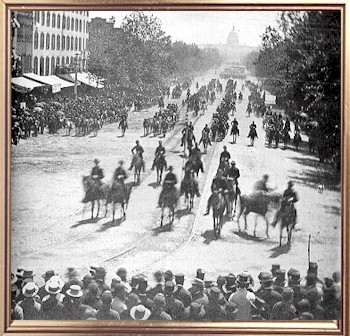
Grand Review of the Armies

Jonathan PARKS’ son-in-law Samuel Sands Samuel enlisted in Company D, Maine 30th Infantry Regiment on Dec 1 1864. Received a disability discharge on 23 May 1865.

8th Indiana Cavalry Regiment

Fought at the Battle of Stones River  from December 31, 1862, to January 2, 1863, in Middle Tennessee. Of the major battles of the Civil War, Stones River had the highest percentage of casualties on both sides. Although the battle itself was inconclusive, the Union Army’s repulse of two Confederate attacks and the subsequent Confederate withdrawal were a much-needed boost to Union morale after the defeat at the Battle of Fredericksburg, and it dashed Confederate aspirations for control of Middle Tennessee..

Seth RICHARDSON’s grandson Sylvester Wesley Cummings (b. 16 Oct 1834 in Freedom, Waldo, Maine; d. 17 Jun 1864 in Morganza, Point Coupee, Louisiana)

Sylvester Wesley Cummings enlisted as a Sargent in Company B, Indiana 8th Cavalry Regiment on 29 Aug 1861.  Mustered out on 16 Aug 1862, discharged disability.  Maybe this was a different Sylvester Wesley Cummings?

Sylvester was commissioned a Full 2nd Lieutenant in Company G, Maine 29th Infantry Regiment on 16 Dec 1863.   Fought on  8 Apr 1864 at Sabine Cross Roads, LA.  The battle was a decisive Confederate victory which stopped the advance of the Union army’s Red River Campaign.   Died of typhoid fever and mustered out on 17 Jun 1864 at Morganza, LA.  The regiment lost a total of 237 men during service; 2 officers and 40 enlisted men killed or mortally wounded, 4 officers and 191 enlisted men due to disease.

Seth RICHARDSON’s  grandson Hugh Anderson Cummings (b. 18 May 1845 in Freedom, Waldo, Maine; d. 1933 Indiana);  Hugh enlisted in Company G, Maine 14th Infantry Regiment on 15 Mar 1865. Mustered out on 28 Aug 1865.

It is also said he served with the 8th Regiment, Indiana Cavalry, Co. B.

1st Kansas Volunteer Infantry Regiment 

Organized at Camp Lincoln near Leavenworth, Kansas, May 20 – June 30, 1861 and mustered in for three years. The greatest number of men were recruited between May 20 and June 3. It mustered in under the command of Colonel George Washington Deitzler.  The 1st Kansas Infantry mustered out of service on August 30, 1865.  The regiment lost a total of 252 men during service; 7 officers and 120 enlisted men killed or mortally wounded, 3 officers and 122 enlisted men died of disease.

Action at Dug Springs August 2. At Springfield, Mo., until August 7. Battle of Wilson’s Creek August 10. March to Rolla, Mo., Aug 11–22, thence to St. Louis, Mo., and duty on the Hannibal & St. Joseph Railroad until October. Duty at Tipton, Mo., Oct 1861, to Jan 1862. Expedition to Milford, Mo., Dec 15–19, 1861. Shawnee Mound, Milford, December 18. At Lexington until Feb 1862. Moved to Fort Leavenworth, Kansas. New Mexico Expedition April and May. Ordered to Columbus, Ky., and duty guarding Mobile & Ohio Railroad. Headquarters at Trenton, Tenn., until Sep. Moved to Jackson, Tenn., and duty there until November. Brownsburg Sep 4. Trenton Sep 17. March to relief of Corinth, Miss., October 3–5. Pursuit to Ripley October 5–12. Actions at Chewalla and Big Hill October 5. Moved to Grand Junction November 2. Grant’s Central Mississippi Campaign. Operations on the Mississippi Central Railroad to the Yocknapatalfa River November 1862, to January 1863. Moved to Moscow, thence to Memphis, Tenn., and to Young’s Point, La., January 17, 1863. Regiment mounted Feb 1, 1863. Moved to Lake Providence February 8, and provost duty there until July. Actions at Old River, Hood’s Lane, Black Bayou and near Lake Providence February 10. Pin Hook and Caledonia, Bayou Macon, May 10. Expedition to Mechanicsburg May 26-June 4. Repulse of attack on Providence June 9. Baxter’s Bayou and Lake Providence June 10. Bayou Macon June 10. Richmond June 16. Lake Providence June 29. Moved to Natchez July 12–13, and duty there until October. Expedition to Harrisonburg, La., Sep 1–8. Cross Bayou Sep 14. Moved to Vicksburg, Miss., October, and duty at Big Black River and near Haynes’ Bluff until June, 1864. Big Black River October 8, 1863. Scout from Bovina Station to Baldwyn’s Ferry November 1. Scout to Baldwyn’s Ferry January 14, 1864. Expedition up Yazoo River April 19–23. McArthur’s Expedition to Yazoo City May 4–21. Benton May 7–9. Luce’s Plantation May 13. Non-veterans ordered to Fort Leavenworth, Kans., June 1, 1864. Attacked near Columbus, Ky., June 2. Mustered out June 19, 1864.

Oliver WEBBER’s son  Leigh Richmond Webber (b. 5 Dec 1830, Vassalboro, Maine – d. 5 Jan 1866, consumption, at Insane Hospital, Augusta ME)

1852, Sept. Entered Colby Sophomore class. In scholarship, one of the best of a superior class.

1855-56. Taught in New Portland, Me.

1856-57. Taught in Troy, Orleans Co., Vermont.

1858, April. Removed to Lawrence, Kansas, and engaged for three years in teaching and farming.

Lawrence, Kansas was founded in 1854 for the New England Emigrant Aid Company by Charles Robinson.  The New England Emigrant Aid Company was a transportation company created to transport immigrants to the Kansas Territory to shift the balance of power so that Kansas would enter the United States as a free state rather than a slave state. Created by Eli Thayer in the wake of the Kansas-Nebraska Act, which allowed the population of Kansas Territory to choose whether slavery would be legal, the Company is noted less for its direct impact than for the psychological impact it had on proslavery and antislavery elements.  The exact number of people who left for Kansas is unknown. James Rawley puts the numbers somewhere around 2000, of whom about a third returned home, while The Kansas Historical Society puts the number around 900 who left for Kansas in 1855 alone.

3 June 1861 – Enlisted as a Private in Company D, 1st Infantry Regiment Kansas.

10 Aug 1861 – Wounded in action Wilson’s Creek, Mo.

16 Jun 1864 – Mustered Out Company D, 1st Infantry Regiment Kansas

Jul 1864 – Returned to Maine, broken down In health by hardships of military life.

11 Oct 1865 –  Committed to Hospital for the Insane, at Augusta. 5 Jan 1866 – Died of consumption, at Insane Hospital, Augusta. He did not marry.
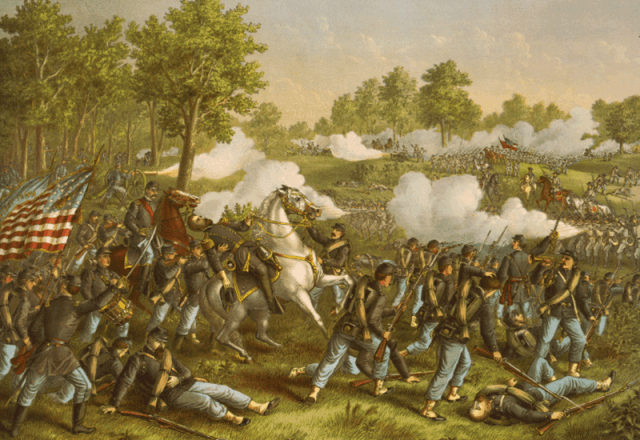
Leigh Webber was wounded at the Battle of Wilson’s Creek – Painting by Kurz and Allison

The Battle of Wilson’s Creek, also known as the Battle of Oak Hills, was fought on August 10, 1861, near Springfield, Missouri, between Union forces and the Missouri State Guard, early in the American Civil War. It was the first major battle of the war west of the Mississippi River and is sometimes called the “Bull Run of the West.” Brig. Gen. Nathaniel Lyon’s Army of the West was camped at Springfield, Missouri, with Confederate troops under the commands of Brig. Gen. Benjamin McCulloch approaching. On August 9, both sides formulated plans to attack the other. At about 5:00 a.m. on August 10, Lyon, in two columns commanded by himself and Col. Franz Sigel, attacked the Confederates on Wilson’s Creekabout 12 miles (19 km) southwest of Springfield. Rebel cavalry received the first blow and fell back away from Bloody Hill. Confederate forces soon rushed up and stabilized their positions.

The Confederates attacked the Union forces three times that day but failed to break through the Union line. When General Lyon was killed during the battle and General Sweeny wounded, Major Samuel D. Sturgis assumed command. Meanwhile, the Confederates had routed Sigel’s column, south of Skegg’s Branch. Following the third Confederate attack, which ended at 11:00 a.m., the Confederates withdrew. Sturgis realized, however, that his men were exhausted and his ammunition was low, so he ordered a retreat to Springfield. The Confederates were too disorganized and ill-equipped to pursue. This Confederate victory buoyed southern sympathizers in Missouri and served as a springboard for a bold thrust north that carried Price and his Missouri State Guard as far as Lexington. In late October, a rump convention, convened by Governor Claiborne Fox Jackson, met in Neosho and passed out an ordinance of secession. Wilson’s Creek, the most significant 1861 battle in Missouri, gave the Confederates control of southwestern Missouri.

128th New York Volunteer Infantry

Nicknamed Old Steady, was a volunteer regiment from Dutchess County and Columbia County in upstate New York.  Formed in Hudson  on Sep 5, 1862, by Col. David S. Cowles, the regiment was made up of volunteers from the surrounding towns and villages.

Organized at Camp Kelly on the fairgrounds in Hudson, N.Y (a marker can be found today in the town indicating the location of the camp). The regiment was mustered into service on September 4, 1862 and left for Washington D.C. Sep 5, 1862 aboard the steamship Oregon which took them to NYC. From here the regiment rode aboard railroad cars to Baltimore. Camp Millington, where the regiment practiced drill and march was set up just outside of Baltimore. The 128th’s first attempt to engage the enemy took them on a rapid jaunt to Gettysburg in an effort to confront Gen. Jeb Stuart’s Confederates. This proved uneventful however as Stuart retreated upon learning of the Union Army’s approach; History would not be made in Pennsylvania until the following year.

The regiment was attached to defenses of Washington D.C. and Baltimore, Maryland until December 1862 when the regiment boarded a ship, destination unknown, and headed south. The regiment soon learned they would be attached to General Nathaniel Banks Department of the Gulf whose ultimate goal would be to open the Mississippi River to the Union. While aboard the ship Arago, sickness and disease infested the ranks. After a stop at Fortress Monroe where the regiment witnessed some of the famous Union ships including the ironclad Monitor, the regiment made its way to New Orleans..

Isaac HAWES’ grandson Granville Parker Hawes  (1838 East Corinth, Maine – 1893 NYC) Commissioned a 1st Lt in Company A, New York 128th Infantry Regiment on 14 Aug 1862. Appointed as Captain of Commissary Nov 3, 1862 Promoted to Full Captain on 18 Mar 1863 by order of Major General Banks. Transfered out out on 18 Mar 1863 at New Orleans, LA. Promoted to Full Captain on 26 Nov 1862. Commissioned an officer in the U.S. Volunteers Commissary Dept Infantry Regiment on 26 Nov 1862. Mustered out on 23 Nov 1864..
Granville Parker Hawes Bio 1 From: Association of the Bar of the City of New York Yearf Book.
.

XIX Corps  spent most of its service in Louisiana and the Gulf, though several units fought inVirginia’s Shenandoah Valley.  It was created on December 14, 1862, and assigned to Maj. Gen. Nathaniel P. Banks, the commander of the Department of the Gulf. The corps comprised all Union troops then occupying Louisiana and east Texas. It originally consisted of four divisions, numbering 36,000 men. The 3rd Division of the corps left behind at New Orleans remained in the Department of the Gulf, and, in the spring of 1865, participated with the Thirteenth and Sixteenth corps in General Canby’s operations against Fort Blakely, Spanish Fort, and Mobile.

General William H. Emory was most importantly a topographical engineer and explorer. He conducted boundary surveys of both the Mexican-American border (1848–1853) as well as the Canadian-American border (1844–1846). His mapmaking skills were so superb and detailed with such great accuracy that he often made other maps obsolete; thus making him the authority of the trans-Mississippi west. Accompanying General Stephen W. Kearny he wrote Notes of a Military Reconnaissance from Fort Leavenworth to San Diegowhich became an important guide book for the road to Southern California..
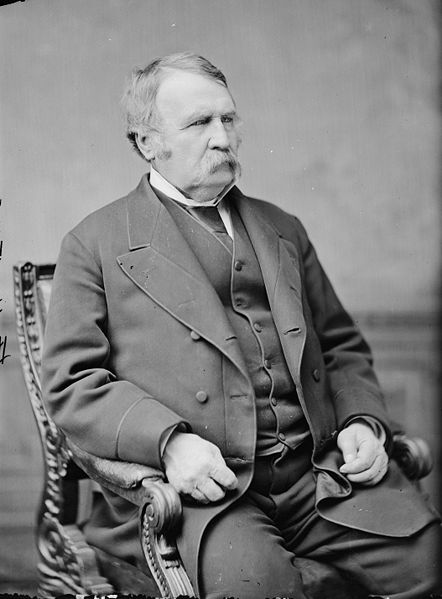
General William H. Emory (1811 – 1887)

Emory served as a brigade commander in the Army of the Potomac in 1862, and was transferred to the Western Theater. He later commanded a division in the Port Hudson campaign. He subsequently returned to the East as the commander of the Nineteenth Corps, serving in all the major battles in the Shenandoah Valley Campaign of 1864, especially at the Battle of Cedar Creek, where Emory’s actions helped save the Union army from a devastating defeat until Maj. Gen. Philip Sheridan’s arrival.

When, Emory went East, Granville was assigned to Major General Francis Herron.  Herron  was appointed captain of the 1st Iowa Volunteer Regiment in April 1861. He served with Nathaniel Lyon‘s forces in Missouri, participating in the battles of Boonville and Wilson’s Creek. In August, Herron was promoted to lieutenant colonel of the 9th Iowa Volunteer Regiment and fought in the battle of Pea Ridge, where he was wounded and taken prisoner, but exchanged shortly afterwards. He received a promotion to brigadier general of volunteers for his actions in this battle, and later received the Medal of Honor.
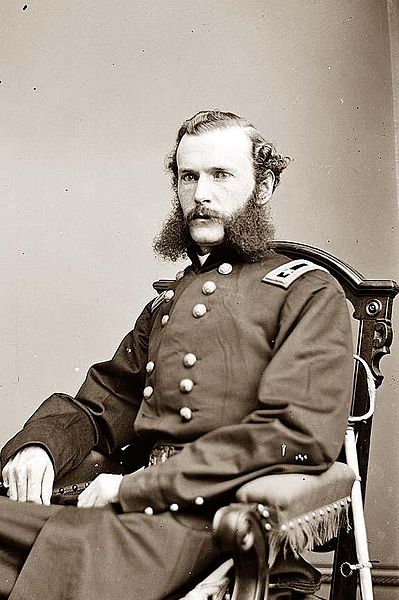
Major General Francis J. Herron (1837 – 1902)

He commanded both the 2nd and 3rd Divisions of the Army of the Frontier and made a forced march of 114 miles (183 km) in three days to join James G. Blunt‘s division in western Arkansas. Herron’s and Blunt’s combined command engaged Thomas C. Hindman in the battle of Prairie Grove and forced the Confederates to abandon western Arkansas. For his actions at Prairie Grove, Herron was appointed major general of volunteers, becoming the youngest major general on either side at the time of his promotion.

His two divisions were consolidated to form “Herron’s Division” which was attached to the XVII Corps. During the Siege of Vicksburg, Herron’s division was placed on the extreme left flank of the Union lines. Upon the surrender of the city Ulysses S. Grant chose Herron, along with generals James B. McPherson and John A. Logan, to lead the procession into the city and accept the formal surrender of arms on July 4, 1863. He next led the Yazoo City expedition, capturing the city, a Confederate fleet and supplies there. Herron was appointed to command of the XIII Corps and occupied the Texas coast with headquarters at Brownsville. During this time, he provided aid to Mexican President Benito Juárez and prevented French troops of Emperor Maximilian from establishing themselves along the Rio Grande. As the Civil War came to an end, Herron commanded the District of Northern Louisiana.

During the 1860s Union soldiers occupied Brazos Santaigo Island and it’s strategic harbor, during the Civil War and launched the Brazos Santiago expedition from the island which led to the war’s last battle known as the Battle of Palmito Ranch.

US Navy

x

Isaac HAWES’ grandson Walter Hawes (1845 – ) served in the US Navy during the Civil War.

x

Sources:

The First Maine heavy artillery, 1861-1865: a history of its part and place ...By Horace H. Shaw, Charles J. House Portland Maine 1903

http://www.civilwarhome.com/armysurgeon.htm
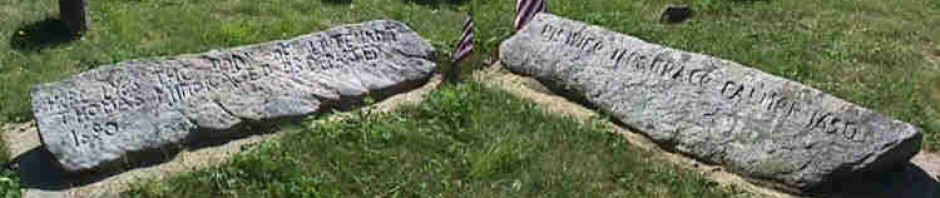
Posted in History | 9 Comments

Jan Goosens

Jan GOOSENS (1581 – 1626) was Alex’s 12th Grandfather; one of  8,192 in this generation of the Shaw line.

Jan Goosens was born about 1581 in Dakkam, Friesland, Netherlands. His parents were Jan Gerritsz MADDELIENEN (1560 – 1602) and [__?__]. He married Ebelken HERMANS 24 Dec 1606 in Sint Anthonis, Noord-Brabant, Netherlands Jan died in the Netherlands. Jan died in 1626 in Reusel-de Mierden, Noord-Brabant, Netherlands

Ebelken Hermans was born in 1578 in Noord, Sint Anthonis, Noord-Brabant, Netherlands Ebelken died in 1625 in Reusel-de Mierden, Noord-Brabant, Netherlands.

Children of Jan and [__?__]

Name Born Married Departed
1. Jan JANSE 1603 in Pijnacker, Zuid Holland, Netherlands.  [__?__] New Netherlands
2. Harman Jansz 6 Mar 1611 Reusel-de Mierden, Noord-Brabant, Netherlands 1612
3. Goosen Jansz 1612 in Reusel-de Mierden, Noord-Brabant, Netherlands
4. Aucke Janse VanNuys 1621 in Nuis, Marum, Groningen, Netherlands Magdalena Pieterse
23 Apr 1645
.
Leysebeth (Elizabeth) Janse
c. 1663
.
Geertje Gysbrecht
Bef. 1682
Reusel-de Mierden, Noord-Brabant, Netherlands
1698 in New Utrecht, New York

x

Children

1. Jan JANSE (See his page)

4. Aucke Janse Van Nuys

Aucke’s first wife Magdalena Pieters Van Langedyck was born about 1625 in Broek Op Lang, Noor Holland, The Netherlands. Her parents were Pieter Jansz (b: Abt.  1588 in Broek Op Lang, Nord Holland) and Adriaentgen Arentse (b: Abt. 1590 in Alkmaar, Nord Holland). Magdalena died in 1663 in New York, New York.

Aucke’s second wife Lysbeth (The Elder) Jans was born about 1625. She first married Jan Claeszen (b: ABT 1628) Lysbeth died about 1680

Aucke’s third wife Geertje Gysbrecht was born about 1635. She first married Jan Jacobse Van Rheenen (b: ABT 1630.)

Aucke Janse lived in Nuis (Nuys) Holland.  In 1651 he came to Flatbush, Long Island, New York.  To avoid confusion with other Janse families, the name was changed to Van Nuys.  Van means “of” or “from”.  Van Nuys means “from the town of Nuis (Nuys).  Nuys has been changed to Nice by some families.  The first sone of Aucke Janse was Jacobus Auckes.

Abstracts of wills on file in the Surrogates Office, City of New York (Volume I. 1665-1707), Pgs. 294, 295

“In the name of our Lord, Amen. Whereas I, Ankie Janse Van Huys, of the Town of Flatbush, in Kings County, considering the certainty of death and the uncertainty of the hour, And not willing to depart out of this world before he should have disposed of his worldly estate.”

Leaves “to his eldest son, John Anke, procured by his lawful wife Magdalena Anke,” £1, 4s. in money. Leaves to “all his children, procured by his first wife, Magdalena Anke, deceased, and to the children of his present wife, Geetie Ankes, procured by her first husband, John Jacobse, that are named and baptized Anke,” each 6 shillings.

Leaves all estate, houses and lands, to his Wife Geetie for life, and then to his children by his first wife Magdalena, viz., Anatie, wife of Dirck Janse Waertman, and the two children of Geetie Anke deceased, procured by Joost Fransen, viz., Sara Joosten, and Magdalena Joosten for one share. And Janettie Anke, wife of Ryne Aertsen, Jan Anke, Pontus Anke, Abigail, wife of Lippit Peterse, Jacobus Anke, and Famettie wife of Jan Stevense. And to the children of his present wife Geetie, procured by her first husband Jan Jacobse, viz. Lysbett Janse, wife of Dirck Janse Van Sutphen, and Eva Janse, wife of Jan Anke.

Sources:

http://trees.ancestry.com/tree/16620397/person/405415927

http://wc.rootsweb.ancestry.com/cgi-bin/igm.cgi?op=GET&db=barbarapumyea&id=I28666

Posted in 14th Generation, Line - Shaw | 1 Comment

Edward Allerton

Edward ALLERTON (1555 – 1590)  was Alex’s 12th Grandfather; one of 8,192 in this generation of the Shaw line.

Edward Allerton Coat of Arms

Edward Allerton was born in 1555 in St Dionis Backchurch, London, England. His parents were William ALLERTON and [__?__]. He married Rose DAVIS 14 Feb 1579 in St Dionis Backchurch, London, England. Edward died in 1590 in England.

St Dionis Backchurch was a parish church in the Langbourn ward of the City of London. Of medieval origin, it was rebuilt afrter the Great Fire of London to the designs of Christopher Wren and demolished in 1878.

Rose Davis was born 1559 in St Peter Cornhill, London, England. Rose died Jun 1596 in London, England and was buried  23 Jun  1596 St Dionis Backchurch, London, London, England.

St Peter upon Cornhill is an Anglican church on the corner of Cornhill and Gracechurch Street in the City of London Of medieval origin, it was destroyed in the Great fire of London in 1666 and rebuilt to the designs of Sir Christopher Wren. It is now a satellite church in the parish of St Helen’s Bishopsgate, and is used for staff training, bible studies and a youth club.

Children of Edward and Rose:

Name Born Married Departed
1. Isaac ALLERTON 1586
London, England
Mary NORRIS
4 Nov 1611 Stadhuis, Leyden, Holland.
.
Fear Brewster about 1625.  .
Joanna Swinnerton betw 1634 and 1644
12 Feb 1658/59 in New Haven CT.
2. Sarah Allerton 1588
London, England
John Vincent
c. 1608
Leyden, Holland
.
Degory Priest
4 Nov 1611 in Leyden, Holland
.
Godbert Godbertson
13 Nov 1621 in Leyden, Holland
1633
Plymouth, Plymouth, Mass
3. Edward Allerton 1690
London
26 Jan 1590
London, England

x

Children

1. Isaac ALLERTON (See his page)

2. Sarah Allerton

Sarah’s first husband John Vincent was born about 1590 in: London, Middlesex, England. He and Sarah married about 1608 in Leiden. John died about 1610 at: Leiden, Zuid-Holland.  Some researchers have given John and Sarah a son John, but no documentation has been found, and suggest Sarah brought 5 children with her in 1623 – the only children documented are Mary Priest, Sarah Priest and Samuel Cuthbertson

Sarah’s second husband Degory Priest (Wiki) origins are uncertain.  Degory Priest, also known as Digory” “Gregory”, “Degorie”, or “Digorie” and “Preist”, was born about 1579/80 in England. In a document signed in Leiden, Holland in April 1619 he deposed he was 40 years old.  It has been suggested that he may have been the Degorius Prust, baptized 11 Aug 1582 in Hartland, Devon, England, the son of Peter Prust.  However, given that the baptism appears to be about 3 years too late, and the fact that none of the Leiden Separatists are known to have come from Devonshire, it is unlikely this baptism belongs to the Mayflower passenger.  Degory Priest was one of the earliest to have arrived in Leiden, so it is more reasonable to suspect he is from the Nottinghamshire/Yorkshire region, the Sandwich/Canterbury region, the London/ Middlesex region, or the Norfolk region: all of the early Separatists in Leiden appear to have come from one of these centers.  Degory died 1 Jan 1621 in Plymouth, Mass.

Sarah and Degory were married on the same day as her brother Isaac ALLERTON and Mary NORRIS – 4 Nov 1611 Stadhuis, Leyden, Holland.

Diggorie Preest Jonman van Londe In Engelant Vergeselchapt met William Leesle & Samuel Fuller zyn bekende met Sarah Vincent mede van Londe in Engelant wedue van Jan Vincent Vergeselschapt met Jannetge Diggens & Rasemyn Gipsyn haer bekende

(Degory Priest, unmarried man, from London, in England, accompanied by William Lisle and Samuel Fuller, his acquaintances, with Sarah Vincent, also from London, in England, widow of John Vincent, accompanied by Jane Thickins and Rosamond Jepson, her acquaintances)

Sarah’s third husband Godbert Godbertson [sometimes transliterated as  Cuthbert Cuthbertson] was born in 1592 in “Oostland,” the area around Danzig, Poland. His parents were John Cuthbert and Katherine Coog. He was living in Leiden by April 1615, where he was a hatter. While in Leiden, he attended the English Separatist church.   He first married Elizabeth Kendall on May 27, 1617, in Leiden.   News of  Degory’s death was conveyed back to Leiden where his widow remarried in Nov 1621 to Godbert Godbertson.  Godbert died of smallpox 24 Oct 1633 in Plymouth, Plymouth, Mass.

Degory Priest was one of the first Separatists to arrive in Leiden, Holland, residing in that city by November 1611. He was a professional hatter. It is believed he came from one of the centers from which the earliest Separatists came – the London/Middlesex region. At his betrothal to Sarah Vincent in Leiden, he proclaimed that he was from London.  He was admitted a citizen of Leiden, Holland, in November, 1615, Isaac Allerton “guaranteeing for him” upon his admission to civic rights in that city.

Degory Priest departed Plymouth, England on the Mayflower on September 6/16, 1620 with 102 passengers and about 30 crew members in a small 100 foot ship leaving his wife and two daughters in Leiden, Holland. He had always planned to bring over his family later after the colony was established.

They had one son, Samuel. In 1623 Godbert, Sarah, their son Samuel and his step-children Mary and Sarah Priest came to Plymouth on the ship Anne.

Godbert was a freeman of the colony. He and his wife both died in 1633 during an outbreak of smallpox.The inventory taken after their deaths was the earliest in Plymouth to include both the wife’s and husband’s possessions. The estate at their deaths was heavily indebted, including one entry to Sarah’s brother, Isaac Allerton, of over £75.

Children of Sarah and Degory

i. Marah Priest b. 1613 Leyden, Holland; m. 1630 in Plymouth, Mass Phineas Pratt (b. 1590 in England – d. 19 Apr 1680 in Charlestown); d. 1 Jan 1671 Charlestown, Suffolk, Mass

Marah had eight children. Her name is often given as “Mary,” but Marah, meaning “bitterness” in Hebrew, taken from Ruth 1:20,was her name.

ii. Sarah Priest b. 1615 Leyden, Holland; m. 1631 in Plymouth, Plymouth, Mass to John Coombs (b. 1610 in Hemel Hempstead, Hertfordshire, England – d. 15 Oct 1646 in Plymouth) d. By October 1646 she went to England and presumably may have died there

Children of Sarah and Godbert

iii. Samuel Godbertson b. in Leiden about 1622. He was apprenticed to Richard Higgins to learn trade of tailor on 1 April 1634 He eventually settled in Dartmouth. He married a woman whose name is unknown, and had one son

Sources:

http://trees.ancestry.com/owt/person.aspx?pid=21890228&st=1

http://www.mayflowerhistory.com/Passengers/DegoryPriest.php

http://www.americanancestors.org/pilgrim-families-godbert-godbertson/

http://freepages.genealogy.rootsweb.ancestry.com/~pattyrose/engel/gen/fg04/fg04_013.htm
Posted in 14th Generation, First Comer, Line - Shaw | 4 Comments

Thomas Brigham
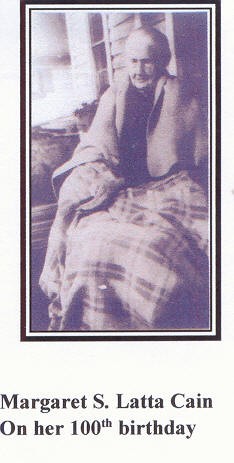
Thomas BRIGHAM (1576 – 1632) was Alex’s 11th Great Grandfather; one of 4,096 in this generation of the Miller line.

Thomas Brigham was born 21 May 1576 in Holme-on-Spaulding-Moor, East Riding Yorkshire, England. His parents were Richard BRIGHAM and Gillian TWELISON (Chillian, Tryelinson, Trevlin, Twelson, or Tryelinson) He had four brothers and a sister, named John, William, Richard, Robert and Elizabeth. He was the third oldest of the six children. He married Isabel WATSON 4 Feb 1600/01 in Holme On Spaulding Moor, Yorkshire, England. Thomas died 19 Mar 1632 in Holme On Spaulding Moor, Yorkshire, England

Isabel Watson was born 21 Feb 1561 in Holme On Spaulding Moor, Yorkshire, England. Her parents were James WATSON and Margaret [__?__]. She is mentioned in the wills of her father, James Watson, dated 10 July, 1615, her sister Isabel Brigham dated 8 June, 1634, and her brother-in-law Robert5 Brigham, dated 5 Sept., 1640. (P. and E. York Wills, vol. 34, fol. 95, vol. 42, fol. 281, and original will for 1640.) Isabelle had two brothers and eleven sisters, named William, Christopher, Dorothy, Daughter, Miss, Miss, Daughter, Daughter, Prudence, Constance, Katharine, Miss and Daughter. She first married Richard Ellithorpe 27 Oct 1582 in Holme-On Spaulding-Moor, Yorkshire, England. Isabel died 25 Jun 1634 in Holme On Spaulding Moor, Yorkshire, England.

Richard Ellithorpe was born 1560 in Holme On Spaulding Moor, Yorkshire, England. Richard died 1597 in Holme On Spalding Moor, Yorkshire, England.

Thomas  and Isabel Brigham  may be buried at the Church on Spaulding Moor

Children of Thomas and Isabel:

Name Born Married Departed
1. Constance BRIGHAM  1602 in Holme-on-Spalding, Yorkshire, England Robert CROSBY
22 Jul 1622 in Holme-on-Spaulding-Moor.
25 Jan 1683/4 in Rowley Mass.
2. Anne Brigham 1606 in Holme On Spaulding Moor, Yorkshire, England Simon Crosby
21 Apr 1634 in Holme On Spaulding Moor
.
Rev. William Tompson
1645
Braintree Mass.
11 Oct 1675
Braintree, Norfolk, Mass

Thomas’ brother John married Isabel’s sister Constance. John Brigham married Constance Watson 30 Sep 1599 in Holme on Spalding Moor. Their son Thomas Brigham (1603-1653) accompanied his own-cousin Anne (Brigham) Crosby, wife of Simon Crosby, to New England in the ship Susan and Ellen in April 1635. Thomas lived in Cambridge, Mass.

Parents and Ancestors

Thomas’ grandparents were Thomas BRIGHAM and Jennet MILLINGTON  

Isabel’s grandparents were James WATSON and Margaret SOTHERN.

Children

1. Constance BRIGHAM (See Robert CROSBY‘s page)

2. Anne Brigham

Anne’s husband Simon Crosby was born 1608 in Holme On Spalding Moor, Yorkshire, England. His parents were Thomas Crosby and Jane Sotheron. Simon died Sep 1639 in Cambridge, Middlesex, Mass.

Anne’s second husband Rev. William Tompson was born 1598 in Lancashire, England.  His parents were William Thompson and Phillis [__?__]. He first married about 1625 in England to Abigail Collins (b. 17 Oct 1591 in Bramford, Suffolk, England – d. 1 Jan 1642 in Braintree). William died 10 Dec 1666 in Braintree, Norfolk, Mass.

William Tompson matriculated at Brasenose College, Oxford University, England, 28 Jan 1619-20, aged 22, where he received the degree of B.A. 28 Feb 1621/22. He was curate at Winwick, but being persecuted for non-conformity he immigrate to New England in 1636. He was engaged first at Kittery or York, Maine, but after the church was institituted at Braintree 17 Sep 1639, was ordained there along with Rev. Henry Flint 19 Nov 1639

Freeman 13 May 1640 and received grant of 120 acres. In 1645 he was Chaplain for a quota of 200 men raised for campaign against Indians.  Wrote book “An Answer to Mr. Charles Herle” published in 1644 & 1650.

A modest & brotherly ansvver to Mr. Charles Herle his book against the independency of churches : wherein his foure arguments for the government of synods over particular congregations, are friendly examined and clearly answered : together with Christian and loving animadversions upon sundry other observable passages in the said booke : all tending to declare the true use of synods, and the power of congregationall churches in the points of electing and ordaining their owne officers and censuring their offendors

Author: Richard Mather; William Tompson
Publisher: London : Printed for Henry Overton …, 1644.

An heart-melting exhortation together with a cordiall consolation : presented in a letter from New-England to their dear countrymen of Lancashire : which may as well concern all others in these suffering times Author: Richard Mather; William Tompso Publisher: London : Printed by A.M. for I. Rothwell …, 1650.

In 1642 went as Missionary to Virginia but came back in 2 years. His wife died while he was absent on a mission with Rev. John Knowles and Thomas James to Virginia.

He was afflicted with melancholy in later years and died insane. He ‘fell into the Devil’s bath.’ as Cotton Mather’s Magnalia. III. cap. IVII. calls his state of melancholy.  He gave up his public ministry seven years.

William Tompson Gravestone — Hancock Cemetery, Quincy, Norfolk County, Mass.

Anne and Simon emigrated to New England on the Susan and Ellyn in the spring of 1635 to Cambridge Mass.   After Simon died, she married Rev. William Tompson of Braintree MA in 1645.  Anne died 11 Oct 1675 in Braintree, Mass.  Her grave is in the old Hancock burying ground in Quincy Mass.

Simon’s Parents – Thomas Crosby was born about 1575 in County York, England in either Holme-on-Spalding-Moor or Bubwith. He was the second child and only son of Anthony and Alison (Blanchard) Crosby.   Thomas’ father Anthony died in 1599 and Thomas inherited a hundred-acre farm in Holme-on-Spalding-Moor.  Thomas and Jane were married in Holme-on-Spalding-Moor on October 19, 1600. The couple had four sons:

i. Anthony Crosby, born about 1602
ii. Thomas Crosby, born about 1604
iii. William Crosby, born about 1606
iv. Simon Crosby, born about 1608

Tax records and other documents suggest that the family led a fairly well-to-do life.

Relatively late in life, Thomas and Jane emigrated to New England, possibly in the autumn of 1638 with a group of Reverend Ezekiel Rogers’ followers, but in any event prior to 1640. They may have lived with the widow of their son Simon in Cambridge, Massachusetts until she remarried in 1645 — at about that time, Thomas purchased a house in Cambridge. After a few years, he sold his holdings in Cambridge and the couple relocated, for the last time, to Rowley, Massachusetts. Thomas lived to over 85 years of age and died in Rowley in 1661, buried on May 6. Jane died the following year and was buried in Rowley on May 2, 1662.

Jane Sotheron, baptized in Holme-on-Spalding-Moor on March 4, 1581/82, was the daughter of William and Constance (Lambert) Sotheron. 1609 tax records indicate that William Sotheron was the wealthiest resident of the parish.

.
Sources:

http://trees.ancestry.com/owt/person.aspx?pid=29915238&st=1

http://dustyhills.net/b8.htm#P1225

Posted in 13th Generation, Line - Miller | 6 Comments

Centenarians

The total number of centenarians in the world remains uncertain. It has been estimated by the Population Division of the United Nations as 23,000 in 1950, 110,000 in 1990, 150,000 in 1995, 209,000 in 2000 and 324,000 in 2005.   In Japan, centenarian stats were found to be inflated by families collecting pension checks indefinitely.   Our family tree has 12!  Seven men and five women.

Because 100 years is so rare, for this honor roll, I’m counting direct ancestors, their children and their children’s spouses.  Only three of our direct ancestors lived to be a hundred compared to 44 who lived to be 90+ (click the category link to see the list)

Marion Miner of the Central Valley at  103 Years 10 Months 5 Days is the record holder.  Eliza Ann Dow Debeck lived to be 107 Years, 16 days , but she was our ancestor’s grand daughter, so not eligible for the award 😉

25% (4 out of 13)  lived to 100 years, 3 months, maybe just long enough after the excitement of the big event?

British Centenarian Smoking Cigarette, 1937 LIFE

In many countries, people receive a gift or congratulations on their 100th birthday. In the United States, centenarians traditionally receive a letter from the President, congratulating them for their longevity.  The Today Show show has also named new centenarians on air since 1983. In the United Kingdom and the Commonwealth Realms, the Queen sends greetings  on the 100th birthday and on every birthday starting with the 105th. Centenarians born in Ireland receive a €2,540 “Centenarians’ Bounty” and a letter from the President of Ireland.  Japanese centenarians receive a silver cup and a certificate from the Prime Minister of Japan upon their 100th birthday, honoring them for their longevity and prosperity in their lives. Swedish centenarians receive a telegram from the King and Queen of Sweden. Centenarians born in Italy receive a letter from the President of Italy.

An aspect of blessing in many cultures is to offer a wish that the recipient lives to 100. Among Hindus, people who touch the feet of elders are often blessed with “May you live a hundred years”. In Sweden, the traditional birthday song states, May he/she live for one hundred years. In Judaism, the term May you live to be 120 years old is a common blessing. In Poland, Sto lat, a wish to live a hundred years, is a traditional form of praise and good wishes, and the song “sto lat, sto lat” is sang on the occasion of the birthday celebrations–arguably, it is the most popular song in Poland and among Poles around the globe. Chinese emperors were hailed to live ten thousand years, while empresses were hailed to live a thousand years. In Italy, “A hundred of these days!” (cento di questi giorni) is an augury for birthdays, to live to celebrate 100 more birthdays.   Some Italians say “Cent’anni!”, which means “a hundred years”, in that they wish that they could all live happily for a hundred years. In Greece, wishing someone Happy Birthday ends with the expression να τα εκατοστήσεις (na ta ekatostisis), which can be loosely translated as “may you make it one hundred birthdays”.

Happy Birthday to our Centenarians!

107 Years 16 Days —  Enoch DOW’s granddaughter Eliza  Ann Dow – bcdgddg – b. 25 Jun 1814 in Canterbury, New Brunswick; d. 11 July 1921 in Marpole, Old, British Columbia; m. 1837 to George Debeck (1814 – 1870)

Alternative time units

39,097 days

3,377,980,800 seconds

56,299,680 minutes

938,328 hours

5585 weeks

George DeBeck II & Eliza Ann Dow

Longest lived of any Dow;  Children b. Canterbury.  About 1860 the whole family with others of the original Majorfield settlement went by caravan to Eburn, near Vancouver, BC.  Eliza whose posterity is large, became the only centenarian in the Province and her birthday celebration was a notable event.  She lived and retained her faculties six years longer.

Eliza Ann and her son Howard Debeck

See Enoch’s page for a detailed story of the DeBeck Family’s journey from New Brunswick to British Columbia. For example, Eliza Ann’s granddaughter was the first white child to be born in Richmond BC, today population 190,000 and site of an International Airport and Olympic Speed Skating.

103 Years 10 Months 5 Days —  Marion Harland Miner was born 13 Mar 1882 in Rock Bluff, Nebraska. His parents were Philo Sidney MINER Jr. and Calista Jane LATTA. He married Florence Ora Brown about. 1907.  Marion died 16 Dec 1985 in Dinuba, Tulare County, California. (Miner)

Marion was a farmer in the Central Valley.  He lived to be 103 and died in Dinuba, Tulare County.  His brother Anderson wrote in 1972:

At his 90th birthday celebration that “ol boy” don’t look a day older than he did twenty years ago.  He does all of the irrigating and cultivating on 27 acres of vineyard and seems to thrive on it.  His daughter Avalyn lives close by and he gets some of his meals there, but most of the time, he lives there all alone.  Hope I can do that well.

103 Years — Elizabeth ANDREWS was born in 1614 in Stoneham, Southampton, Hampshire, England. Her parents were Henry ANDREWS and Elizabeth BOND.   Elizabeth’s father emigrated to Dorchester, Mass in 1636, but returned to England and died in 1638 in Ashill, Somerset, England.  Alternatively, Elizabeth emigrated with her brother Henry Jr.   She married Thomas HARVEY in 1642 in Taunton, Mass.  After Thomas died, she married (second) Francis Street, of Taunton, to whom she bore one daughter. She married (third) Thomas Lincoln, the miller, of Taunton on 10 Dec 1665. Lincoln died in 1683, and his widow in 1717, aged one hundred and three years. (Miner)

102 Years, 11 Months, 24 Days —  Hannah Jewett was born 6 Apr 1699 in Rowley, Mass. Her parents were Maximilian JEWETT and Sarah HARDY. She married John Tenney 23 Jan 1718 in Rowley, Essex, Mass. Hannah died Mar 1802 in Bradford, Mass.

Hannah’s husband John Tenney was born 8 Dec 1692 in Bradford, Essex, Mass. His parents were Samuel Tenney and Sarah Boynton. John died 23 Aug 1732 in Bradford, Essex, Mass. (Miller)

102 Years, 6 Months, 27 Days — Ruth Fiske Estey was born 31 Mar 1800 in Kingsclear, York, New Brunswick. Her parents were Amos ESTEY and his cousin Mary (Molly) ESTEY. She married John S. Barker 20 Jul 1820. Ruth died 5 Jun 1831 in York, New Brunswick

Ruth’s husband John Spafford Barker was born 25 Oct 1792 in New Brunswick, Canada. His parents were John Barker and Mary Woodbury. John died 22 Apr 1895 in York, New Brunswick, Canada, age 102. (Miller)

101 years, 10 months, 28 days  — Margaret Storey Latta was born 26 Feb 1839 in Pennsylvania. Her parents were John A. Latta and Mary Elizabeth McConahey. Her mother also lived to be a hundred, see below. Her grandparents were Robert McCONAHEY and Margaret STORY and William L. LATTA and Elizabeth RANKIN.  Our ancestors were brother and sister of both her parents: William LATTA II  and  Jane McCONAHEY. Margaret married 9 Apr 1857 Clarinda, Page, Iowa to Pressley Martin Cain (b. 26 Feb 1838 in Beaver City, Beaver, Pennsylvania – d. 9 Jul 1911 in Douglas, Oregon). Margaret died 22 Jun 1941 in Oregon.

Margaret Story Latta 1

101 years 8 months 10 days — Sarah Estey was born 4 Oct 1694 in Topsfield, Mass. Her parents were Isaac ESTEY II and Abigail KIMBALL. She married  Joseph Cummings 22 May 1712 Ipswich, Mass.  Sarah died before 1754 in Topsfield, Mass.

Sarah’s husband Captain Joseph Cummings was born 1 Sep 1692 in Woburn, Middlesex, Mass.  He was second cousin to his brother-in-law of the same name. His parents were Abraham Cummings and Sarah Wright. Joseph died 22 Apr 1794 in Topsfield, Essex, Mass. (Miller)

101 Years, 7 Months 26 Days Thomas MINER’s grandson Joseph Minor was born 4 Mar 1672/73 Stratford, CT. He died 30 Oct 1774 in Woodbury aged 101 years; He married Susanna Roots (b. 13 May 1678 in Fairfield, CT – d. 26 Apr 1738.)

Joesph served the town of Woodbury in many capacities for many years and achieved the military rank of Colonel.

100 Years, 3 Months 29 Days — Henry LANCASTER (Langstar, Langstaff, Lankester) was baptized 20 Apr 1605 in Woodplumpton,   City of Preston, Lancashire, England.   His parents were Edward LANGSTAFF b. 1580 Lathbury Parish, Buckinghamshire, England and Elizabeth COLLINS. He married Sarah [__?__] in England.  Henry died 18 Jul 1705 in Dover, New Hampshire.  Death was by injury 10 days after an accidental fall. “After ten days iIlness, about 100 years old, a hale, strong, hearty man” he died as a result of a fall.  One record states that he fell into his lean-to, causing bruises and later inflammation. Another record, which seems to be  the more popular one, states that he fell from his horse, He is buried at Bloody Point, as is his wife, Lora.

Henry Lancaster was baptized in St Anne’s Church, Woodplumpton

Henry was in Portsmouth, New Hampshire 1630/31, sent by Captain John Mason.  In 1622, Mason and Sir Ferdinando Gorges received a patent from the Council for New England for all the territory lying between the Merrimack and Kennebec rivers.  In 1629 they divided the grant along the Piscataqua River, with Mason receiving the southern portion.  The colony was recharted as the Province of New Hampshire. It included most of the southeastern part of the current state of New Hampshire, as well as portions of present-day Massachusetts north of the Merrimack.

Henry married Josephine Knight in 1637 in New Hampshire.  He was in Dover by 1648.  Henry died 18 Jul 1705 in Dover, New Hampshire.  Death was by injury 10 days after an accidental fall. “After ten days iIlness, about 100 years old, a hale, strong, hearty man” he died as a result of a fall.  One record states that he fell into his lean-to, causing bruises and later inflammation. Another record, which seems to be  the more popular one, states that he fell from his horse, He is buried at Bloody Point, as is his wife, Lora. (Shaw)

100 Years 3 Months 23 Days – Mary Elizabeth McConahey was born 31 Jan 1804 in South Shenango, Crawford, PA.  Her parents were Robert McCONAHEY and Margret STORY. She married John A Latta 9 Mar 1801 in Crawford County, PA.   Her daughter Margaret Story Latta also lived to be over a hundred, see above.   Mary died 23 Apr 1904 Herman, Washington, Nebraska.

Mary Elizabeth McConahey Latta

Our ancestors are this couple’s brother and sister.  Jane McCONAHEY was born 9 Oct 1799 in Crawford County, PA She married William LATTA II  17 Jan 1822.  Jane died 19 Nov 1869 in Cass County, Nebraska.

100 Years, 3 Months, 11 Days — Moroni Miner was born 4 Jun 1835 in Kirtland, Ohio. His parents were Albert Miner and Tamma Dufree.  Albert Miner (1809 – 1848) was the grandson of Sgt Elihu MINER Jr. and the first cousin of  Philo Sidney MINER Sr.  He married Nancy Elizabeth Chase 4 Feb 1861 in Utah. Nancy  was born 27 Nov 1845 and died  3 Jun 1928 in Springville, Utah. Moroni died 14 Aug 1935 in Springville, Utah.  Lived to 100, A healthy Mormon lifestyle?

Tamma wrote in her autobiography:

 On the 4th day of June 1835. I had a son born, called his name Moroni, and Joseph Smith blessed him and said: “he should be as great as Moroni of old and the people would flee unto him and call him blessed.” They were still building the Temple. There were some of the brethren who came from a distance and stayed until the next Spring. Some stayed with us and received their endowments and were there to the dedication of the Temple in March 1836.  [Angel Moroni is the angel that Joseph Smith, Jr. claimed visited him on numerous occasions and led him to the golden plates from which he translated the Book of Mormon]

Moroni Miner(1835 – 1935)

A Short History of Moroni Miner Who Lived to Celebrate his 100th Anniversary

Moroni Miner, oldest resident of Springville, Utah, celebrated his one-hundredth

birthday Tuesday June 4, 1935, with a family reunion. Invitations were Issued to 500 relatives and friends, including the Black Hawk Indian War veterans and committeemen, and a number of other citizens; also to Sons and Daughters of Utah Pioneers and the older citizens of Springville, and Church Officials.

The program began at 10 a.m. at Park Ro-Shee in Springville. It was carried on as follows:

Baseball and other sports, 10 a.m. to noon; 12 noon to 2 p.m. picnic, program and stunts; 2 p.m. to 5 p.m., swimming and other sports; 5 p.m. to 7 p.m., intermission and lunch. At 7:30 p.m. a pageant, portraying the life of Mr. Miner’s mother, Tamma Durfee Miner, written and directed by Mrs. Eva Maeser Crandall, was presented In the Second Ward Chapel. A dance followed,

Mr. Miner, whose formula for a long life includes much work, a cheerful attitude and a desire to be useful, was born June 4th, 1835, in Kirtland, Ohio, a son of Albert and Tamma Durfee Miner. His parents lived at Nauvoo at the time the Latter-day Saints were

driven from that country, and Mr. Miner recalls seeing the Prophet Joseph Smith many times.

After the family moved to a settlement on the Des Moines river, Mr. Miner’s father died and he was forced to make a living for himself at the age of 13 years. He started west with the Brigham Company, but due to his age and not having the consent of his mother, he was advised to return to his family.

In June 1850, with his widowed mother and all her possessions-two oxen, two cows and a wagon, scant provisions and seven children, Mr. Miner crossed the plains. He walked the entire distance of 1000 miles, driving cattle and sheep along the way. He states that during this memorable journey, great herds of buffalo blocked the road and had to be driven back to make passage.

Upon arriving in Utah, the family lived on a farm near the Jordan River until 1851, When they came to Springville, where Mr. Miner has since made his home.

Many are the Interesting stories of early Pioneer life and early Indian uprisings, related by Mr. Miner in a history written by himself. In 1854, with others, he went to Cedar Valley, to burn charcoal for use by the Salt Lake City blacksmiths. The  Industry progressed well until they were discovered by the Indians, who drove them away and burned their belongings. That same year Mr. Miner was called upon to act as guard in the Indian War, and he assisted in moving all the houses outside the eight central blocks in Springville, into a fort. It was during this year, also, that he assisted in building a 12-foot wall around the original eight blocks of the City, the wall being constructed by taxation and donations against Indian attacks.

He was called as a young man to assist in building a fence across the mouth of the canyons east of Springville, as a protection  against Indians. He tells of many anxious hours spent guarding  the canyons from which Indians would swoop down into the valleys  burning and plundering as they came.

When a young man he also was called to haul freight from the Missouri River to Utah enduring many hardships and dangers on the journeys. They also hauled the mail on these trips.

An interesting quotation from his life’s history states: “In June of 1859, the holidays coming on, I was short of ready means I therefore yoked up my oxen and took a scythe into the field and cut a load of hay. After curing it I loaded it onto my wagon and hauled it to Camp Floyd, forty miles away, and sold it for $10.00 This money bridged me along during the holidays in a very  satisfactory, manner.”

In another portion of the sketch he states. “In the fall of 1863, word came that there was a scarcity of flour in Montana. I loaded up 4000 pounds and with Alex Robertson, Bringhurst and Houtz outfits, of four or five wagons, all loaded with flour, left for Montana. Arriving there we sold our loads for $25.00 per hundred Pounds. I took a four mule team and wagon and some gold dust as my share.” That fall Mr. Miner states wheat took a jump to $8.00 per bushel.

Moroni, with his brother Carlos Miner, took a contract with the Central Pacific Railway company, in 1869, to build the grade at Promontory Point where the golden spike was driven to mark the spot where the east and west railroads came together.

Mr. Miner also assisted in the construction of the first irrigation  canals in this vicinity and helped to build the first meeting house.  He was instrumental in bringing educational advantages to pioneer family children in this community.

During his middle and later life, Mr. Miner engages in the grocery business and also has been a successful farmer and stockman.

He married Nancy Elisabeth Chase in February 1861. She died in 1928, at the age of 83 years. They were the parents of twelve sons and three daughters. One child died in infancy, three boys died young, and the rest grew to maturity. Eight sons and two daughters have been married in the Salt Lake Temple.

Aside from the work in Civic affairs, Mr. Miner has always taken an active part in Church affairs, serving in numerous capacities  in the auxiliary organizations. He filled a mission to the Southern States in 1893, leaving at the age of 58 years to begin his mission. Because of his advance age, he resigned from the Stake High Priests in 1914.

Despite his 100 years of life, many of which have been filled with hardships and disappointments, Mr. Miner is still young for his years. He gets about his home, attends Church and sometimes entertainments, converses on topics of the day, and enjoys tales

of pioneer life. He looked forward with a child’s enthusiasm to his 100th birthday celebration and said he hoped to have many more. (However, he passed away during the following year.)

He lived to see five generations of his family and was privileged  to attend the Golden Wedding celebration in 1933 of his eldest son Bert and wife in Springville. Other living children at the 100th anniversary of Moroni, were: Mrs. Elizabeth Miner Whitmore, Gloyd, M.F, and Paul Miner from Springville, Utah; George Miner, San Francisco, California; Thorn Miner, Philadelphia, Pa., Austin Miner, Provo, Utah; Mrs. Ruth Miner Bennion, Vernal, Utah, together with their families. He had 49 grandchildren; 69 great-grandchildren and one great-great grandchild when he was 100 years of age.

Elder George Albert Smith of the Council of Twelve, and President Samuel 0. Bennion, of the First Presidents of Seventy, represented the General Authorities, and spoke in the afternoon meeting.

Mr. Moroni Miner received hundreds of telegrams and letters of congratulation during the day, among them a personal letter from President Heber J. Grant, congratulating him on having lived a full century.

Moroni immediately began his plans to go to the encampment of the Black Hawk Indian War Veterans to be held at Nephi Aug. 13, 14, 15, 16 and expressed a desire to camp out all of those days and nights. (Miner)

100  Years, 3 Months, 10 Days — Desire CUSHMAN was born 18 Sep 1710 in Plympton, Mass.  Her parents were Samuel CUSHMAN and Fear CORSER.   She married Ebenezer FOSTER on 17 Sep 1730 in Attleboro, Mass.  Ebenezer died from consumption 18 Jun 1749 in Cumberland, Providence, RI.  After Ebenezer died, she married John Allen of Bristol County.  Desire died 27 Nov 1810 in Attleboro, Bristol, Mass when she was a hundred years old! – Over 60 years after Ebenezer had passed. (Shaw)

Desire Cushman Foster Headstone — Gerrould Cemetery, Wrentham, MA

100 years 1 month 20 days  – Esther Wilmarth

100 years 1 month 20 days  – Esther Wilmarth was born 28 Nov 1681 Rehoboth, Mass. Her parents were Jonathan WILMARTH and Esther PECK. She marrid William Dryer 4 Mar 1707/08 Rehoboth Esther died 4 Mar 1741 in Rehoboth, Mass

Esther’s husband William Dryer was born 28 Nov 1684 in Taunton, England. His parents were William Dryer and Anna Locke. He immigrated in 1704. William died 18 Dec 1784 in Rehoboth, Mass(came in 1704) D. 100 YRS OLD. (Shaw)

100 Years – Mary Latta was born in 1739 in Ireland. Her parents were Samuel LATTA and Mary McCOBB. She married Robert Glenn in Airsty, Ireland. Mary died in 1839 (Miner)

Alan McCobb, the McCobb family historian, has seen other sites that say that Mary’s parents, Samuel Latta and Mary McCobb married in 1754.

100 Years – Timothy Richardson was born 6 Dec 1682 in Woburn, Mass. His parents were Stephen RICHARDSON and Abigail WYMAN. He married Susannah Holden in 1713 in Woburn Mass. Timothy died 1 Jan 1716/17 in Wobrun Mass.

Timothy’s wife Susannah Holden was born 16 Oct 1694 in Billerica, Middlesex, Mass. Her parents were Justinian Holden and Susannah Dutton. Susannah lived to be a 100 years old and died in 1794 – Malden, Middlesex, Mass. (Shaw)

Tools:

http://www.timeanddate.com/date/duration.html

Posted in Fun Stuff | Tagged | Leave a comment

John Kingsley Sr.

John KINGSLEY Sr. (1579-1614) was Alex’s 12th Great Grandfather, one of  8,192 in this generation of the Shaw line.

John Kingsley – Coat of Arms

John Kingsley Sr. was born 3 May 1579 in England. His parents were Edward KINGSLEY and Margaret BOND. He married Katherine BUTLER in 1614. John died in 1639 in England.

Katherine Butler was born in 1579 in Bodenham, Hertfordshire, England.  Her parents were William BUTLER and Ursula SMYTH.

Children of John and Katherine:

Name Born Married Departed
1. Elder Stephen Kingsley 1598
Boston or Sutterton, Lincolnshire, England
Mary Spaulding
29 Apr 1624 Boston, Lincolnshire, England
4 Jun 1673
Milton, Mass
2. John KINGSLEY 7 Sep 1614  Hampshire, England Elizabeth STOUGHTON c. 1636 Dorchester, Suffolk, Mass.
.
Alice Thatcher after 1656 Dorchester, Mass.
.
Mary Johnson 16 Mar 1674 Rehoboth, Mass.
6 Jan 1679  Rehoboth, Mass
3. Ursula Kingsley 24 Mar 1616
Warwickshire, England
4. Jane Kingsley 5 Jun 1618
Warwickshire, England
5. Martha Kingsley 5 Jun 1618
Warwickshire, England

x
Children

1. Elder Stephen Kingsley

Stephen’s wife Mary Spaulding was born in 1600 in Lincolnshire, England. Her parents were Edward Spaulding and Rachel [__?__]. Her name not being given in any New England records. Mary died 10 Jan 1668 in Milton, Norfolk, Mass.

On 3 Jun 1635, Stephen Kingsley, his brother John, and Captain John Smith sailed on the James from Bristol, England.   Among the one-hundred passengers on board was a minister Richard Mather who sailed in disguise to America in escape from the wrath of King Charles.  John KINGSLEY wrote a journal giving details of the trip including surviving a hurricane, see his page for details.

Aug 1635 – Stephen emigrated to Dorchester, Massachusetts Bay Colony.
Came with Richard Mather in a ship of Puritans which survived a hurricane. Ship records have not been found so it is not known on which ship they came. He moved before 27 Mar 1637 to Braintree, Massachusetts Bay Colony. He was a farmer in Braintree, Massachusetts Bay Colony. Hargrave calls him a “successful farmer.”

3 Apr 1637 – He granted a house lot in Dorchester, Massachusetts Bay Colony. His first record in New England when “it is agreed that Stephen Kinsley, labourer, shall have a house plott next unto our brother Alexander Winchester his garden plott”

19 Feb 1637/38 – Stephen Kinsley was granted a great lot for nine heads; four acres upon a head” at Mt. Wollaston,

27 Jan 1639 – Granted land at Mt. Wollaston, that became part of Braintree.

5 Jul 1639 – “William Needham, the cooper, shall have an acre for his house plot out of the little island at Mount Wollaston over against Barnaby Doryfalls land, beyond Mr. William Coddington’s brook. Also that Stephen Kinsley, husbandman, shall have the residue of the said island for his house plot there”.

22 Feb 1640 – “Brother Stephen Kingsley is to have his four acres formerly granted to be made seven acres upon a head, allowing for the same as others have done and are to do. This last suggests that his “great lot” at Mt. Wollaston was not yet laid out for him in 1641, as it was granted by the town of Boston in 1638, and in the meantime the town of Braintree had been set off, and Stephen Kingsley was one of those “neighbors and brethren of the Mount” who agreed with Boston upon the terms of the separation into a new town on Jan.27, 1639.

13 May 1640 – He took the oath of a freeman in Braintree, Massachusetts Bay Colony. Selectman of Braintree 1640/42/48/51 etc.

Braintree, Norfolk, Mass

The town of Braintree was incorporated in 1640 and named after the English town of Braintree. It comprised land that was later split into RandolphHolbrook, and Quincy, as well as parts of Weymouth and Milton, Massachusetts. The “North Precinct” of Braintree, which is now the bulk of the city of Quincy, was the birthplace of presidents John Adams and John Quincy Adams, as well as statesman John Hancock.  In January 2008 Braintree converted from a representative town meeting form of government to a mayor-council government.

1650 – Representative to the General Court in Braintree, Massachusetts Bay Colony.

1653 – He deposed in the case of Wilson vs. Faxon (Early Court Rec. #188) aged 55,

12 Oct 1653 – Stephen was ordained the first ruling church elder of the church at Braintree. He was an original member of the Braintree Church

1654 – Resided in Milton, Mass

By 1654 he resided in present Milton on Milton Hill, as the road way to the mill at present Milton Lower Mills passed through his yard and 23 Feb 1656 he purchased a half interest in the Hutchinson farm, then in Dorchester bounds, now in present town of Milton (after 1662) (not the William Hutchinson grant in Braintree).

Sometime after moving to Dorchester in 1656, he returned to Braintree. He was Representative to the General Court in 1666 in Milton, Norfolk, MA.

11 May 1670 – He sold property in Milton, Norfolk, MA. and returned to Braintree. It is likely that he lived in Milton prior to this date.

27 May 1673 – He signed a will in Milton, Norfolk, MA.
He died on 4 June 1673 in Milton, Norfolk, MA.
He had an estate probated on 3 July 1673 in Milton, Norfolk, MA.

27 May 1673 – Will of Stephen Kingsly of Milton “being sick in body”

Son John sole executor & I give him my house, barn & orchard & all land adjoining on both sides the country highway & 12 a. salt meadow adjoining & the plain that is at the E. end of my land in Braintree 12 a. part whereof is in his present improvement & 40 a. upon the hill adjoining.

To son in law Henry Crane part of land in Braintree on S.E. side thereof & reaching from E. corner of my lot to end of the line of Gregory Bolster [Baxter] on to Braintree common 20 rods broad by the line so far as it will bear & away over to ye swamp & 3 a. over against his house being part of the field at present on my own improvement & he is to have my “fether” bed, bolster, pillow, rugg, & blanket.

To son in law Anthony Gullive the plain in his present possession excepting one corner thereof which bee over against Henry Crane’s house which shall be Henry’s from a white oak tree over against his barn to N.W. corner of my field providing Henry make a ditch fence between them, & to said Anthony 40 a. in Braintree provided he pay £30 to my son Samuel’s three children, £10 to the son at age 21 and to the daughters at age 18.

To son in law Robert Mason that house & land that was Nicholas White’s with 4 a. bought of Thomas Holman & 5 a. meadows & my lot by Henry Crane’s all besides 3 acres, for seven years and after Henry is to have it forever & Robert Mason is to have some acres of meadow till Isaac Groves is at age & then to be his & Robert Mason to have 15 a. 20 rods on S. side of Braintree line, also 2 oxen, 2 cows & my mare to be his own provided he bring up Isaac Gross orderly and carefully.

Witness: Thomas Holman, Robert Vose, William Daniell.
7-311, Inventory, Jun 27, 1673 – House & barn £60, 55 acres upland & orchard adjoining £420, 22 a. salt meadow £220. 50 a. upland lying on ye plaine at Milton £200, a little house formerly Nicholas White’s with a small orchard & 38 a. on both sides the country highway £152. 190 a. in Braintree bounds £332/10/.

2. John KINGSLEY (See his page)

Sources:

http://trees.ancestry.com/owt/person.aspx?pid=9797236&st=1

http://wc.rootsweb.ancestry.com/cgi-bin/igm.cgi?op=GET&db=spragueged&id=I11435

http://wc.rootsweb.ancestry.com/cgi-bin/igm.cgi?op=GET&db=annak1&id=I2753

Posted in 14th Generation, Line - Shaw | Tagged , | 2 Comments

Raid on Deerfield – 1704

John FRENCH’s son Thomas settled in Deerfield, MA. and was Deacon of the Deerfield Church.  He was blacksmith, town clerk and deacon. He and all his family were taken in the Deerfield raid of 1704. The raiders destroyed 17 of the village’s 41 homes, and looted many of the others. Thomas’ house was not burned, so the town records were saved. His wife Mary Catlin  was killed on the trip on 9 Mar 1703/04.  He and their two eldest children were redeemed in 1706.  Two of his daughters became Catholics, married Frenchmen and stayed in Canada.  The youngest, Abigail b. 8 Feb 1698, lived as an Indian in Caughnawaga, a village of the Mohawk nation,, now an archaeological site near the village of Fonda, New York and never married.  John married again to Hannah Edwards on 9 Mar 1704 in Ipswich, Essex, Mass and died in 1733.

Deerfield, Franklin, Mass

Deerfield was the northwesternmost outpost of New England settlement for several decades during the late seventeenth and early eighteenth centuries. It occupies a fertile portion of the Connecticut River Valley and was vulnerable to attack because of its position near the Berkshire Mountains. For these reasons it became the site of several Anglo-French and Indian skirmishes during its early history, as well as intertribal warfare.

At the time of the English colonists’ arrival, the Deerfield area was inhabited by the Algonquian-speaking Pocumtuck nation, with a major village by the same name. First settled by English colonists in 1673, Deerfield was incorporated in 1677. Settlement was the result of a court case in which the government in Boston returned some of Dedham to Native American control in exchange for land in the new township of Pocumtuck on which Dedham residents could settle. The Dedham settlers’ agent, John Plympton, signed a treaty with the Pocumtuck, including a man named Chaulk, who had no authority to deed the land to the colonists and appeared to have only a rough idea of what he was signing. Native Americans and the English had quite different ideas about property and land use; this, along with competition for resources, contributed to their conflicts.

The Raid on Deerfield occurred during Queen Anne’s War on February 29, 1704, when French and Native American forces under the command of Jean-Baptiste Hertel de Rouville attacked the English settlement at Deerfield, Massachusetts just before dawn, burning part of the town and killing 56 villagers.

Minor raids against other communities convinced Governor Joseph Dudley to send 20 men to garrison Deerfield in February. These men, minimally trained militia from other nearby communities, had arrived by the 24th, making for somewhat cramped accommodations within the town’s palisade on the night of February 28. In addition to these men, the townspeople mustered about 70 men of fighting age; these forces were all under the command of Captain Jonathan Wells.

The Connecticut River valley had been identified as a potential raiding target by authorities in New France as early as 1702. The forces for the raid had begun gathering near Montreal as early as May 1703, as reported with reasonable accuracy in English intelligence reports. However, two incidents intervened that delayed execution of the raid. The first was a rumor that English warships were on the Saint Lawrence River, drawing a significant Indian force to Quebec for its defense. The second was the detachment of some troops, critically including Jean-Baptiste Hertel de Rouville, who was to lead the raid, for operations in Maine (including a raid against Wells that raised the frontier alarms at Deerfield). Hertel de Rouville did not return to Montreal until the fall.

The force assembled at Chambly, just south of Montreal, numbered about 250, and was composed of a diversity of personnel. There were 48 Frenchmen, some of them Canadien militia and others recruits from the troupes de la marine, including four of Hertel de Rouville’s brothers. The French leadership included a number of men with more than 20 years experience in wilderness warfare. The Indian contingent included 200 Abenakis, Iroquois, Wyandots, and Pocumtucs, some of whom sought revenge for incidents that had taken place years earlier. These were joined by another 30 to forty Pennacooks led by sachem Wattanummon as the party moved south toward Deerfield in January and February 1704, raising the troop size to nearly 300 by the time it reached the Deerfield area in late February.

The expedition’s departure was not a very well kept secret. In January 1704, New York’s Indian agent Pieter Schuyler was warned by the Iroquois of possible action that he forwarded on to Governor Dudley and Connecticut’s Governor Winthrop; further warnings came to them in mid-February, although none were specific about the target.

The raiders left most of their equipment and supplies 25 to 30 miles north of the village before establishing a cold camp about 2 miles from Deerfield on February 28, 1704. From this vantage point they observed the villagers as they prepared for the night. Since the villagers had been alerted to the possibility of a raid, they all took refuge within the palisade, and a guard was posted.

The raiders had noticed that there were snow drifts all the way to the top of the palisade; this greatly simplified their entry into the fortifications just before dawn on February 29. They carefully approached the village, stopping periodically so that the sentry might confuse the noises they made with more natural sounds. A few men climbed over the palisade via the snow drifts and then opened then north gate to admit the rest. Primary sources vary on the degree of alertness of the village guard that night; one account claims he fell asleep, while another claims that he discharged his weapon to raise the alarm when the attack began, but that it was not heard by many people. As the Reverend John Williams later recounted, “with horrid shouting and yelling”, the raiders launched their attack “like a flood upon us.”

The raiders’ attack probably did not go exactly as they had intended. In attacks on Schenectady, New York and Durham, New Hampshire in the 1690s (both of which included Hertel de Rouville’s father), the raiders had simultaneously attacked all of the houses; at Deerfield, this did not happen. Historians Haefeli and Sweeney theorize that the failure to launch a coordinated assault was caused by the wide diversity within the attacking force.

French organizers of the raid drew on a variety of Indian populations, including in the force of about 300 a number of Pocumtucs who had once lived in the Deerfield area. The diversity of personnel involved in the raid meant that it did not achieve full surprise when they entered the palisaded village. The defenders of some fortified houses in the village successfully held off the raiders until arriving reinforcements prompted their retreat. More than 100 captives were taken, and about 40 percent of the village houses were destroyed.

The raiders swept into the village, and began attacking individual houses. Reverend Williams’ house was among the first to be raided; Williams’ life was spared when his gunshot misfired, and he was taken prisoner. Two of his children and a servant were slain; the rest of his family and his other servant were also taken prisoner. Similar scenarios occurred in many of the other houses. The residents of Benoni Stebbins’ house, which was not among the early ones attacked, resisted the raiders’ attacks, which lasted until well after daylight. A second house, near the northwestern corner of the palisade, was also successfully defended. The raiders moved through the village, herding their prisoners to an area just north of the town, rifling houses for items of value, and setting a number of them on fire.

As the morning progressed, some of the raiders began moving north with their prisoners, but paused about a mile north of the town to wait for those that had not yet finished in the village. The men in the Stebbins house kept the battle up for two hours; they were on the verge of surrendering when reinforcements arrived. Early in the raid, young John Sheldon managed to escape over the palisade and began making his way to nearby Hadley to raise the alarm there. The fires from the burning houses had already been spotted, and “thirty men from Hadley and Hatfield” rushed to Deerfield. Their arrival prompted the remaining raiders to flee, some of whom abandoned their weapons and other supplies in a panic.

The sudden departure of the raiders and the arrival of reinforcements raised the spirits of the beleaguered survivors, and about 20 Deerfield men joined the Hadley men in chasing after the fleeing raiders. The English and the raiders skirmished in the meadows just north of the village, where the English reported “killing and wounding many of them”. However, the pursuit was conducted rashly, and the English soon ran into an ambush prepared by those raiders that had left the village earlier. Of the 50 or so men that gave chase, nine were killed and several more were wounded. After the ambush they retreated back to the village, and the raiders headed north with their prisoners.

As the alarm spread to the south, reinforcements continued to arrive in the village. By midnight, 80 men from Northampton and Springfield had arrived, and men from Connecticut swelled the force to 250 by the end of the next day. After debating over what action to take, it was decided that the difficulties of pursuit were not worth the risks. Leaving a strong garrison in the village, most of the militia returned to their homes.

The raiders destroyed 17 of the village’s 41 homes, and looted many of the others. They killed 44 residents of Deerfield: 10 men, 9 women, and 25 children, five garrison soldiers, and seven Hadley men. Of those who died inside the village, 15 died of fire-related causes; most of the rest were killed by edged or blunt weapons. They took 109 villagers captives; this represented 40 per cent of the village population. They also took captive three Frenchmen who had been living among the villagers. The raiders also suffered losses, although reports vary. New France’s Governor-General Philippe de Rigaud Vaudreuil reported the expedition only lost 11 men, and 22 were wounded, including Hertel de Rouville and one of his brothers. John Williams heard from French soldiers during his captivity that more than 40 French and Indian soldiers were lost; Haefeli and Sweeney believe the lower French figures are more credible, especially when compared to casualties incurred in other raids.

Illustration of 1704 Deerfield Raid Published 1900

The raid has been immortalized as a part of the early American frontier story, principally due to the account of one of its captives, the Rev. John Williams. He and his family were forced to make the long overland journey to Canada, and his daughter Eunice was adopted by a Mohawk family; she took up their ways. Williams’ account, The Redeemed Captive, was published in 1707 and was widely popular in the colonies.

She liked to go to Deacon French’s, who lived on what is now the site of the second church parsonage. The Deacon was the blacksmith of the village, and his shop stood a few rods west of his house. Eunice would stand hours watching him, as he beat into shape the plough-shares, that had been bent by [p.132] the stumps in the newly cleared lands. As the sparks flew up from the flaming forge, she thought of the verse in the Bible, “Man is born unto trouble as the sparks fly upward,” and wondered what it meant. Too soon, alas, she learned.

For the 109 English captives, the raid was only the beginning of their troubles. The raiders still had to return to Canada, a 300 miles  journey, in the middle of winter. Many of the captives were ill-prepared for this, and the raiders were themselves short on provisions. The raiders consequently engaged in a brutal yet common practice: captives were slain when it was clear they would be unable to keep up. Only 89 of the captives survived the ordeal; most of those who either died of exposure or were slain en route were women and children. Thomas’ wife Mary Caitin French was killed on the trip on 9 March 1703/04.

Deerfield Raid Map. Mary Caitlin French was killed about halfway through the journey

In the first few days several of the captives escaped. Hertel de Rouville instructed Reverend Williams to inform the others that recaptured escapees would be tortured; there were no further escapes. (The threat was not an empty one — it was known to have happened on other raids.)  The French leader’s troubles were not only with his captives. The Indians had some disagreements amongst themselves concerning the disposition of the captives, which at times threatened to come to blows. A council held on the third day resolved these disagreements sufficiently that the trek could continue.

Illustration by Howard Pyle showing the journey back to Canada

The raid failed to accomplish one of Governor Vaudreuil’s objectives: to instill fear in the English colonists. They instead became angry, and calls went out from the governors of the northern colonies for action against the French colonies. Governor Dudley wrote that “the destruction of Quebeck and Port Royal would put all the Navall stores into Her Majesty’s hands, and forever make an end of an Indian War”, the frontier between Deerfield and Wells was fortified by upwards of 2,000 men,  and the bounty for Indian scalps was more than doubled, from £40 to £100. Dudley also promptly organized a retaliatory raid against Acadia (present-day Nova Scotia). In the summer of 1704, New Englanders under the leadership of Benjamin Church raided Acadian villages at Pentagouet (present-day Castine, Maine), Passamaquoddy Bay (present-day St. Stephen, New Brunswick), Grand Pré, Pisiquid, and Beaubassin (all in present-day Nova Scotia). Church’s instructions included the taking of prisoners to exchange for those taken at Deerfield, and specifically forbade him to attack the fortified capital, Port Royal.

Deerfield and other communities collected funds to ransom the captives, and French authorities and colonists also worked to extricate the captives from their Indian masters. Within a year’s time, most of the captives were in French hands, a product of frontier commerce in humans that was fairly common at the time. The French and Indians also engaged in efforts to convert their captives to Roman Catholicism, with modest success. Some of the younger captives, however, were not ransomed, and were adopted into the tribes. Such was the case with Williams’ daughter Eunice, who was eight years old when captured. She became thoroughly assimilated, and married a Mohawk man when she was 16. Other captives also remained by choice in Canadian and Native communities such as Kahnawake for the rest of their lives.

Two of Thomas’ daughters who stayed in Canada married and had large families. The third daughter assimilated into the Indians at Kahnawake. One great-grandson was Archbishop Octave Plessis, who was the ranking churchman to champion the Catholic viewpoint to the British government in the first decades of the 1800’s. That the Church survived is largely due to his efforts.

Negotiations for the release and exchange of captives began in late 1704, and continued until late 1706. They became entangled in unrelated issues (like the English capture of French privateer Pierre Maisonnat dit Baptiste), and larger concerns, including the possibility of a wider-ranging treaty of neutrality between the French and English colonies. Mediated in part by Deerfield residents John Sheldon and John Wells, some captives were returned to Boston in August 1706. Governor Dudley, who needed the successful return of the captives for political reason, then released the French captives, including Baptiste; the remaining captives that had chosen to return were back in Boston by November 1706.

Thomas French and his children Mary and Thomas Jr. were brought back to Deerfield in 1706 by Ensign John Sheldon, in his second expedition to Canada for the redemption of the captives. An interesting evidence of the proneness of Deerfield maidens to versifying, exists in a poem said to have been written by Mary French to a younger sister during their captivity, in the fear last the latter might become a Romanist (Catholic).

Soon after his return, Thomas French was made Deacon of the church in Deerfield in place of Deacon David Hoyt, who had died of starvation at Coos on the march to Canada. In 1709, Deacon French married the widow of Benoni Stebbins. He died in 1733 at the age of seventy six, respected and regretted as an honest and usefu1:man and a pillar of the church and state.

Thomas French’s’ wife first wife Mary Catlin was born  10 Jul 1666 in Wethersfield, Hartford, CT.  Her parents were John Catlin and Mary Baldwin.  Mary died 9 Mar 1704 in Deerfield, Franklin, Mass.

No family suffered more than John Catlin’s in the destruction of Deerfield, Massachusetts during the Indian Massacre of 29 February, 1703/4. He was killed trying to protect his home. His sons Joseph and Jonathan were also killed. His married daughters Mary French and Elizabeth Catlin Corse were killed during the subsequent march to Canada. His wife, Mary, “being held with the other prisoners in John Sheldon‘s house, gave a cup of water to a young French officer who was dying. He was perhaps a brother of Hertel de Rouville. May it not have been gratitude for this act that she was left behind when the order came to march? She died of grief a few weeks later.”.

Thomas’ second wife Hannah Atkins was born  xx.   She was the widow of Joseph Edwards, and of Benoni Stebbins, who was also killed at the Deerfield Massacre.  Hannah died in 1737..

Children of Thomas French and Mary Carpon

i. Mary French (8 Mar 1685 in Deerfield, Mass – 12 Mar 1685 in Deerfield)

ii. Mary French (9 Nov 1686 in Deerfield, MA – 24 Mar 1758 in Bolton, Tolland, CT) Carried to Canada 1704.  Redeemed with father in 1706, at age 19.

iii. Thomas French , Jr. (2 Nov 1689 in Deerfield, MA – 26 Jun 1759 in Deerfield, MA)  Redeemed with father and sister Mary in 1706, probably brought back by Ens. John Sheldon

iv. Freedom French (20 Nov 1692 in Deerfield, Franklin, MA – 6 Oct 1757 in Montréal, Ile de Montréal, Quebec)  Freedom was eleven when she was carried to Canada.  She was  placed in the family of Monsieur Jacques Le Ber, merchant of Montreal, and on Tuesday, the 6th of April, 1706, Madame Le Ber had her baptized anew by Father Meriel, under the name of Marie Françoise, the name of the Virgin added to that of her godmother, being substituted for the Puritanic appellation of Freedom, by which she had been known in Deerfield. She signs her new name, evidently with difficulty, to this register, and never again does she appear as Freedom French.  She was often recorded as a guest at the marriages of her English friends.  Two years after her sister’s marrage, on the 6th of February, 1713 at the age of twenty-one, Marie Françoise French married Jean Daveluy, ten years older than herself, a relative of Jacques Le Roi, her sister’s husband. Daveluy could not write, but here, appended to the marriage register, I find for the last time the autographs of the two sisters written in full, Marie Françoise and Marthe Marguerite French.

v. Marguerite Martha French (12 May 1695 in Deerfield, MA Baptême: 23-02-1707, Montréal –  1 May 1762 in Montreal, Quebec, Canada)  Martha was given by her Indian captors to the Sisters of the Congregation at Montreal. On the 23d of January, 1707, she was baptized sous condition, receiving from her god-mother the name of Marguerite in addition to her own. On Tuesday, November 24, 1711, when about  sixteen., she was married by Father Meriel to Jacques Roi, aged twenty-two, of the village of St. Lambert, in the presence of many of their relatives and friends. Jacques Roi cannot write his name, but the bride, Marthe Marguerite French, signs hers in a bold, free hand, which is followed by the dashing autograph of the soldier, Alphonse de Tonty; and Marie Françoise French, now quite an adept in forming the letters of her new name, also signs.  On the third of May, 1733, just one month from the day of her father’s death in Deerfield, Martha Marguerite French, widow of Jacques Roi, signed her second marriage contract, and the following day married Jean Louis Ménard, at St. Laurent, a parish of Montreal.

vi. Abigail French (28 Feb 1698 Deerfield, MA – in Caughnawaga, a village of the Mohawk nation inhabited from 1666 to 1693, now an archaeological site near the village of Fonda, New York.  lived as an Indian, never married.)

vii. John French (1 Feb 1704 Deerfield, Franklin, MA – 29 Feb 1704 Killed in Deerfield Raid)

Deerfield Memorial

John Williams wrote a captivity narrative about his experience, which was published in 1707. The work was widely distributed in the 18th and 19th centuries, and continues to be published today. Williams’ work was one of the reasons this raid, unlike others of the time, was remembered and became an element in the American frontier story. In the 19th century the raid began to be termed a massacre (where previous accounts had used words like “destruction” and “sack”, emphasizing the physical destruction); this terminology was still in use in mid-20th century Deerfield. A portion of the original village of Deerfield has been preserved as a living history museum; among its relics is a door bearing tomahawk marks from the 1704 raid. The raid is commemorated there in leap years.

An 1875 legend recounts the attack as an attempt by the French to regain a bell, supposedly destined for Quebec, but pirated and sold to Deerfield. The legend continues that this was a “historical fact known to almost all school children.” However, the story, which is a common Kahnawake tale, was refuted as early as 1882.

Sources:

Raid on Deerfield: The Many Stories of 1704
Presents the perspectives of the Kanienkehaka, Wobanakiak, Wendats, French and English. Along with these five viewpoints, come different versions of the “facts,” different meanings that have been made out of the experience, and different stories that have been, and continue to be told. There is no “one truth” on this website; rather, it is for the visitor to determine his or her own truth and meaning about this event, the crosscurrents and forces that led up to it, and its powerful legacies.

The Unredeemed Captive: A Family Story from Early America By John Demos 1995   —

Early on the morning of February 29, 1704, before the settlers of Deerfield, Massachusetts, had stirred from their beds, a French and Indian war party opened fire, wielding hatchets and torches, on the lightly fortified town. What would otherwise have been a fairly commonplace episode of “Queen Anne’s War” (as the War of the Spanish Succession was known in the colonies) achieved considerable notoriety in America and abroad. The reason: the Indians had managed to capture, among others, the eminent minister John Williams, his wife, Eunice Mather Williams, and their five children.

This Puritan family par excellence, and more than a hundred of their good neighbors, were now at the mercy of “savages” – and the fact that these “savages” were French-speaking converts to Catholicism made the reversal of the rightful order of things no less shocking. In The Unredeemed Captive, John Demos, Yale historian and winner of the Bancroft Prize for his book Entertaining Satan, tells the story of the minister’s captured daughter Eunice, who was seven years old at the time of the Deerfield incident and was adopted by a Mohawk family living at a Jesuit mission-fort near Montreal. Two and a half years later, when Reverend Williams was released and returned to Boston amid much public rejoicing, Eunice remained behind – her Mohawk “master” unwilling to part with her. And so began a decades-long effort, alternately hopeful and demoralizing for her kin, to “redeem” her. Indeed, Eunice became a cause celebre across New England, the subject of edifying sermons, fervent prayers, and urgent envoys between the Massachusetts Bay Colony and New France. But somehow she always remained just out of reach – until eventually, her father’s worst fears were confirmed: Eunice was not being held against her will. On the contrary, she had forgotten how to speak English, had married a young Mohawk man, and could not be prevailed upon to return to Deerfield.

Book Review by Benjamin Roberts — The Unredeemed Captive: A Family Story from Early America

On the night of the attack the Williams home was raided, and the two youngest children (a six-month old baby and a two-year old) were scalped. John Williams, his wife, and their five other children (Samuel: age fourteen, Stephan: age twelve, Esther age eight, Eunice age six, and Warham age four) were herded along with 112 other Deerfield captives on a three hundred mile journey to Montreal that lasted for two months. During the journey the Williams children were scattered amongst the various participating Indians tribes. Upon arrival in New France the captives were sold to the French, and later negotiated for release by the governors of French and English colonies. Almost three years later John Williams made his way back to New England. A release was negotiated for his children. All were returned except for his six-year old daughter Eunice. She remained in the hands of the Kahnawake Indians who refused to sell her to the French.

After ten years of fruitless attempts for Eunice’s release, John Williams was deeply saddened by the news that Eunice had forgotten how to speak English, had been baptized to the Roman Catholic faith by Jesuit priests, and had married an Indian or a “savage” as they were referred to in the correspondence of the Williams family. Until his death in 1729, John Williams tried several times to have Eunice freed. After his death, his son Stephan Williams, carried on the crusade.

For the first time in 36 years a meeting was arranged with Eunice. The meeting between the two siblings in 1740 lasted shortly: a translator was needed to help them communicate with each other. Eunice and her Indian husband agreed to spend the summer with her brother in New England. During the visit in 1741 the family tried to persuade Eunice, her Indian husband Arosen, and three children to stay permanently; however, they insisted on returning to Canada after agreeing to visit again the following year.

Another twenty years followed before Eunice would see her family again. In the meantime Eunice became a grandmother. The possibility of Eunice leaving her Indian family became even more remote. Years would pass before Eunice and her brother would again hear from each other. Eunice had a letter written and translated to her brother Stephan shortly before her 75th birthday; she requested to hear about her brother’s well-being, and said that she should probably never see him in this world because she had become too old to travel. They never met again. Stephan lived to the ripe-old age of ninety, and Eunice died at the age of eighty-five, yet their descendants, both Indians and New Englanders, kept in touch deep into the 19th century.

FACT: Within two years – perhaps less – of her arrival in Kahnawake, Eunice Williams had forgotten [how] to speak English.

Demos thereafter speculates that psychology could have played an important role:

“the trauma of capture – including as it did, the deaths of mother and siblings – might call forth its own ‘repression’; forgetting everything would be a kind of defense. Whatever the actual sources of change, the result was deeply significant. From now on Eunice would communicate only with her new people, in her new place, with a new set of customary forms. Language was the pivot and symbol of her personal acculturation”.

Besides speculating about Eunice’s loss of the English language, this conjecture also makes Eunice’s life-long desire to remain with the Indians quite understandable. Eunice became accustomed to the Indian way of life: she later married, had children and grandchildren, and became a valued member of the tribe. Who would give that up?

Posted in History, Storied | 16 Comments

John Hardy

John HARDY (1613 – 1670) was Alex’s 11th Great Grandfather; one of 4,096 in this generation of the Miller line

Immigrant Ancestor - Hardy Coat of Arms

Immigrant Ancestor – Hardy Coat of Arms

John Hardy was born in 2 Jun 1613 in Wetwang, East Riding Yorkshire, England. His parents were Richard HARDY and Alice WILSON. He married Olive COUNCIL 1632 in Bedfordshire, England. John died in 9 Jun 1677 in Isle of Wight, Virginia.

Olive Council was born in 1615 in England. Her parents were John COUNCIL and Elizabeth DRAKE. Olive did in 1675 in Lawns Creek Plantation, Isle Of Wight, Virginia,

Children of John and Olive:

Name Born Married Departed
1. George HARDY Sr. 1633
England
Mary JACKSON
1666 in Isle of Wight, Virginia
1694 in Isle of Wight County, Virginia
2. Thomas Hardy 1717
Isle of Wight, Virginia,
3 ?. John Hardy  ???  (See discussion below in the comments) 1635-37
Bedfordshire, England
Dinah
.
Alice Bennett
1677 in Isle Of Wight, Virginia,
9 Jun 1677
Isle of Wight, Virginia,
4. Olive Hardy 1639
Isle of Wight, Virginia,
John Pitt
8 Jul 1680 Isle of Wight, Virginia
1703
Isle of Wight, Virginia
5. Richard Hardy 1640
Yorkshire, England
Mary Vincent
1694 in Isle Wight Cty, Virginia
1734
Isle Wight, Virginia
6. Deborah Hardy 1641 in Isle Wight, Virginia 1 Jun 1720
Isle Wight, Virginia
7. Alice Hardy 1643 in Isle Wight, Virginia

Hardy Family Ancestry

The Hardy family were among the landed gentry of England in the early 11th Century. They are descended from the Norman knight De Hardie.

The first known Hardy in the line was John’s great grandfather John Hardy, who was a merchant in London and served as alderman and sheriff of London in the 1520’s. John Hardy married Mary Stanley, who died in 1543. Mary was of royal ancestry and traces her line back to William the Conqueror.

John and Mary’s son Sir Michael de Hardy was born in 1530 and died in 1595. He married Alice de Shelton.

Michael and Alice’s son Richard Hardy was born in 1567 and died in 1645. He married Alice Wilson. RICHARD HARDY (JOHN5, MICHAEL4 DE HARDY, JOHN3, JOHN2, RICHARD1) was born 1577 in Wetwang, East Riding, Yorkshire, England, and died 1645 in Isle of Wight County, Virginia. He married Alice Wilson 1602 in Yorkshire, England, daughter of Robert Wilson and Unknown. She was born January 12, 1586/87 in Shellington, Bedfordshire, England. Died in Virginia. Their son John Hardy, Sr. emigrated to Virginia.

Children of Richard HARDY and Alice WILSON:

i. Richard Hardy, b. 1604 , Yorkshire, England.

ii. Thomas Hardy, b. 1606, Yorkshire, England.

iii. Alice Elizabeth Hardy, b. 1608, Yorkshire England.

iv. George Hardy, b. 1610, Yorkshire, England.

v. Mary Hardy, b. 1612, Yorkshire, England.

vi. John HARDY, b. 1613, Yorkshire, England

Hardys in Virginia

John Hardy was the owner of the famous Hardy Mill; said to have been burgess, 1641-52; granted 1150 acres in Isle of Wight Co 1666

In 1666, at age 56, John Hardy Sr. received his first land grant. As we all know land grants or “patents” were many times delayed for years, so he probably had been in the Colonies for well over 20 years at the time. He was granted 1150 acres for importing 23 persons including himself, his FIRST wife Olive Council, six of his children (George, Thomas, Richard, Isabel, John Jr., and Ann) as well as his future son-in-law William Mayo all of whom were born in England and he had never received a grant of land for their importation.

After Olive’s death about 1640, John married Alice Bennett and had three daughters, Olive, Lucy and Deborah all born in Isle of Wight Co., VA.

Isle of Wight Virginia

Children

1. George HARDY (See his page)

3. John Hardy

John’s wife Alice Bennett was born in 1640 in Virginia. Alice died in 1683

John Hardy Jr. was b. about 1635-1637 in Bedfordshire and came to Virginia with his father.  His (rather than his father’s) seems to have been the will was made 6 Oct 1676 and probated 9 Jun 1677. We have him m. to (variously) Alice Worthington, Alice, Tucker  Alice Johnson, Dinah [__?__] and the same Alice Bennett, with the following children: Olive, Ann, [+]Lucy, Isabella, and Deborah.

Alice Bennett, the widow Johnson, daughter of Thomas Bennett and Alice, widow Pierce. Thomas Bennett was born in Wilvescombe, Co., Somerset, England, and died in Virginia after 1632, having come on the Neptune in 1618, a member of the House of Burgesses from Mulberry Island in 1632.

John Jr. made a will Oct 7, 1676, probated June 9, 1677; names his wife, Alice Hardy, Daughters, Olivia Driver, Lucy Council and Deborah Hardy He married Alice Johnson, a widow. They had: Olive m. Giles Driver; Lucy m. Hodges Council; Ann m. Robert Burnett; Isabel m. William Mayo; Deborah-untraced.

In John’s 1676-77 will, he names “my beloved wife Alice” and his three daughters Olive Driver, wife of Giles Driver; Lucy Council, wife of Hodges Council; and Deborah Hardy (his daughters by 2d wife Alice Bennett). He did name his grandchildren… Drivers, Councils and Ann Burnett.

John  was a member of the House of Burgesses in 1668, and a Justice of the County Court about 1675.

Lucy Hardy, daughter of John Jr., was born in Isle of Wight County, VA, d. bef 1699, m. in 1670 Hodges Council, born in England, d. in Isle of Wight Co 1699, He received grants of 1200 acres from the VA Governors and purchased 300 acres. He left two wills on file in Isle of Wight Co, each recorded the same day in 1699, with the same people mentioned in both, but with a different division of land between heirs. He was possibly the s/o John Council who m. second in 1666 Alice, widow of Richard Jeffries.

4. Olive Hardy

Olive’s husband John Pitt was born 1 Jun 1634 in Isle Wight, Virginia. His parents were Robert Pitt and Martha Lear. He first married 1657 in Isle Wight, Virginia to Sarah Moone (b. 1639 in Isle Wight – d. 1677 in Isle Wright). John died 1702 in Isle Wight, Virginia.

5. Richard Hardy

Richard’s wife Mary Vincent was born in 1671 in Amelia, Virginia. Her parents were William Vincent and Elizabeth Cleuer. Mary died in 1702 in Isle of Wight, Virginia.


(Deleted 7. Ann Hardy 9/23-2016)

Sources

http://trees.ancestry.com/owt/person.aspx?pid=10969440&st=1

http://www.retracing-our-family-legacy.com/Hardy_Mill.html

http://fourfamilyhistories.com/Hardy/Hardy%20and%20Hardie.pdf

http://trees.ancestry.com/tree/4488393/person/-1595871858/story/4efce172-cace-430a-8a5c-9177a5daec53?src=search

Posted in 13th Generation, Immigrant - England, Line - Miller | 43 Comments