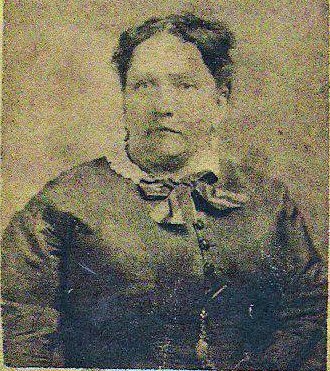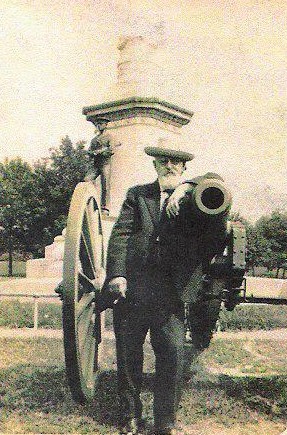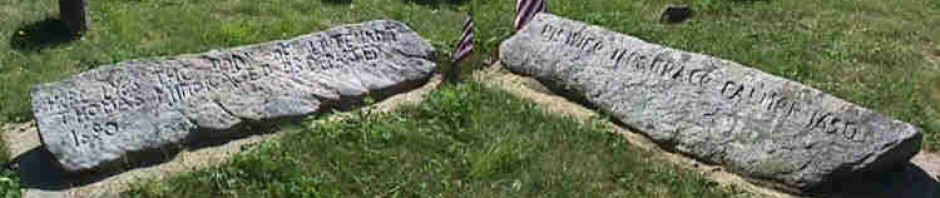
George Polley

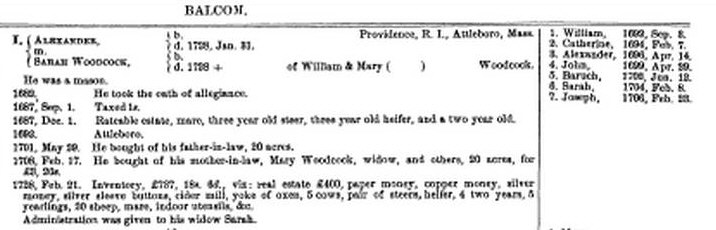
George POLLEY Sr. (1625  – 1683) was Alex’s 9th great grandfather, one of 1,024 in this generation of the Miner line.
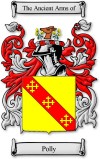
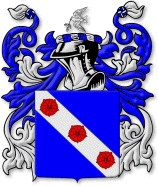
George Polley – Coat of Arms
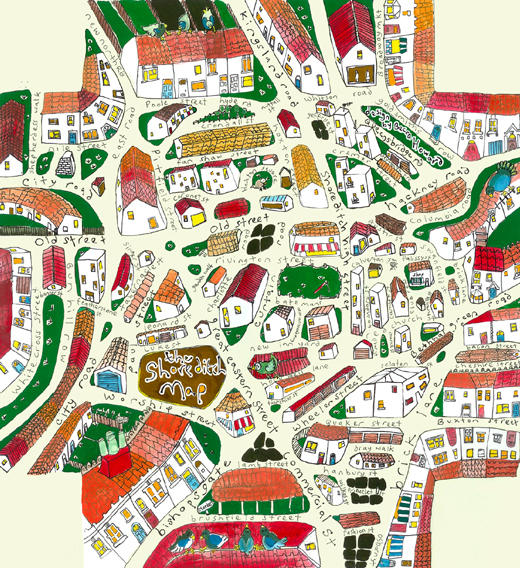
George Polley was born in the Shoreditch area of London. Shoreditch is an area of London within the London Borough of Hackney. It is a built-up part of the inner city immediately to the north of the City of London, located 2.5 miles east-northeast of Charing Cross.

George Polley may have been born about 1625 in Shoreditch, Middlesex, England.  His birth year is based on testimony he gave in court in Woburn, Mass. on 2 Apr 1668 when his age  was recorded as 43.    His father may have been John POLLEY.   He immigrated from St. Leondard,  Shoreditch, Middlesex, England.

George was christened in Woburn, Mass.  He married Elizabeth WINN on 21 May 1649 in Woburn, Mass.  George died 22 Dec 1683 in Woburn, Mass.

Charles E. Banks is the only source found that indicates the origins of George Polly. His book “Topographical Dictionary of 2885 English Emigrants to New England 1620-1650” says he was from St. Leonard Shoreditch, Middlesex County in England. The ship is listed as the Mayflower [of course not the 1620 version]. Shoreditch is an area in the north east section of London. McArthur asserts that George Polly was in Woburn before 1649. That would seem to be borne out by the presence of the Winn family as early as eight years before Polley.

Many sources assume that George and John Polley (1618 – 1689) were brothers, though there is no proof that they even knew each other.  John lived in Roxbury, Mass and married Susanna Bacon, Mary Ives, Hannah Cowdrey and Mary Jane Metcalf. One of John’s daughters Elizabeth has been confused with George’s Elizabeth.  John’s Elizabeth married Caleb Brown 16 Oct 1681 in Roxbury, Suffolk, Massachusetts, the year  before our Elizabeth married John Brown 22 Apr 1682 in Woburn, Middlesex, Massachusetts.

I haven’t seen any documentation to prove John’s parentage. Indeed, there are even some that state that John was from St. Leonard Shorditch which is a misinterpretation that has been perpetuated for many years based on a second hand report that there is a ships entry for George Polley of Woburn by Charles E. Banks in his book “Topographical Dictionary of 2885 English Emigrants to New England 1620-1650”.

Elizabeth Winn was born about 1628 in England. Her parents were Edward WINN and Joanna SARGENT. She came to America with her parents and at least one brother named Joseph.  Joseph is documented as being in America as early as 1642. Another brother of Elizabeth, Increase Winn, is documented as being the first recorded birth in Woburn, Massachusetts, on 5 Dec 1641. A sister, Ann, married Moses Cleveland, a direct ancestor of Grover Cleveland. Thus, all Pollys (or Polleys) who trace their ancestry to George Polly of Woburn can properly claim, through Edward Winn, relationship to our 22nd and 24th president. Also, a brother of Elizabeth, Increase Winn, is a direct ancestor of Herbert Hoover, the 31st president.  Elizabeth died on 2 May 1695 in Woburn, Mass.

Children of George and Elizabeth:

Name Born Married Departed
1. John POLLEY Sr. 16 May 1650 in Woburn, Mass Mary EDWARDS
16 May 1681 Reading Mass.
1711
2. Joseph Polley 25 Dec 1652 Woburn, Mass 1683 –
1713
3. George Polley 4 Jan 1654/55 Woburn, Mass Mary Knight
24 Oct 1677 Woburn, Mass
1717 Colchester, CT
4. Elizabeth Polley 14 Apr 1657 Woburn, Mass John Brown
22 Apr 1682
Woburn, Mass.
Bef. 1709
5. Samuel Polley 24 Jan 1661
Woburn, Mass.
6 Feb 1661
Woburn, Mass.
6. Hannah Polley 6 Apr 1662 Woburn, Mass 6 Apr 1662 Woburn, Mass
7. Hannah Polley 28 Jun 1663 Woburn, Mass. John Baker
18 Oct 1682
Woburn, Mass
28 Mar 1731
Rehoboth, Mass
8. Samuel Polley 1665
Woburn, Mass
Priscilla Eames
1689 Woburn, Mass
1727
9. Edward Polley 1669
Woburn, Mass
Mary Merrow
1696 in Reading Portsmouth New Hampshire,
18 Jul 1715
10. Sarah Polley 1669
Woburn, Mass
Anthony Goffe
29 Sep 1686
Woburn, Mass
1729
Barrington, Rhode Island

George Polley was a Carpenter by trade

Land was ordered laid out to George Polley in Woburn on 3 Feb 1648/49. He was chosen surveyor of fences in 1665. He is recorded as being taxed in Woburn in 1655 and again in 1663/64. He was taxed at the county rate 26 Oct 1666.  His right to share in the common lands of the town was acknowledged in 1668. He was summoned to court with others 18 Jun 1670 in a debt case, giving testimony there on 21 Jun 1670.

John Lakin’s Deed 1653 Communicated by the Hon. Samuel Abbott Green M.D. of Boston: in The New England Historical and Genealogical Register, Boston: Published by The New-England Historic Genealogical Society. XLV: 81-2—

Know all men by this presant Writing that I  do acknoledg the whol sale with the Consent of my wife of all The land and buldding I haue be longing to me liing in the boundes of Woborne • Namely the Dwelling hous with the Barne and three accors of brokup land a Joynning to the dwelling hous with all the un brokeup land all the tensing be loingin to the hous lott and nintene accors of land Liing in the new Bridg feeld six accors liing be twixt a parsall of land of sargin tides [apparently either John Tead, Ted or Tidd Sr (b. ab. 1618 from Yarmouth, Isle of Wight Eng, May 12 1637, Charlestown, signed Dec. 18 1640 Town Orders of Woburn) or his son John Tidd] and a parsall of land of moses Cleaueland [other parcels of land here recited] • VN to John Lakin of Redding. • Witness in the presanc of vs:

Michaell bacon [father of Mary wife of John Lakin],

Edward WINN [father of Ann and of Elizabeth wife of George Polly].

A George Polly served in King Philip’s War under Captain John Carter (or Cutler). (See Bodge’s 1906 King Philip’s War, p. 286 and D. H. Hurd’s 1890 History of Middlesex Co., Mass., pp. 382-383. The latter quotes some of Bodge’s earlier articles in the NEHGR.)

Authorities disagree as to whether it was George Polly, Sr. or George Polly, Jr. who actually served. The senior Polly would have been about 49 and the son would have been about 20. Thus it could have been either. Since there is no “Junior” indicated on the rolls, many believe it to be the father. However, the oldest son John, aged about 26 at the time, also served in the war. This fact might lead one to believe that it was the case of two brothers going off to war. This is a point that may never be resolved satisfactorily.

George and Elizabeth apparently suffered the same foibles then as others do now. An interesting domestic note is found in the Woburn vital records, p. 213.

“In 1658, John Cromwell a Scotchman confessed ‘that he was in the house of George Polly alone with his wife, and that he kissed her once & eate some strawberries’ etc. The Court ordered both Cromwell and the wife of George Polly ‘severely whipt ten stripes a peece.’ [The Middlesex County Court Records, Vol I, p. 158, are the cited providing insight regarding Cromwell.] Cromwell died in 1662 near Chelmsford. He is referred to as ‘late trader with ye Indians,’and Seaborne Cromwell was his relict widow.”

George Polly died in Woburn on 22 Dec 1683. His will was dated 5 Jun 1683 and proved on 1 Apr 1684. A full copy of the will of George Polly appears in”Descendants of Samuel Hills”, compiled for Francis J. Hills by Winifred Lovering Holman, published in 1957 by the Rumford Press, page 87. It reads as follows:

“By these presents be it knowne that I George Polly sen of Woburn in the Massachusetts Colony in the County of Middlesex being of sound understanding and perfect memory: Doe heerby make this writeing my last will and Testament: Renouncing all former wills by me made Committing my soule unto god in Christ my Saviour and my body Decently to be interred in the Earth: And After my Debts are paid and my funerall expenses discharged; I Doe give my estate both personal and Reall as follows:

“Imp. I give unto my beloved wife Elizabeth the use of my now dwelling house all my land which I now posses my household stuff and the use of two oxen two Cows a mare together with cart a plow and ___ ___ _____ during her widowhood. I do give to my son John POLLY all my land and meadow belonging to my houselott lying on the south west side bounded by a white oake stump at the upper end and so by a line through the middle of Drie pole swamp to the river and one Cow; two thirds of all my woodland: paying fourty Pounds as is heer after Expressed: I give unto my son George the other part of my land on the North East side of my houselott and my meadow on the south side of the river one third part of my woodland and one Cow: paying fourty pounds as I heerafter appoint; but if he fails to pay the fourty pounds: then I give him only his ten Acre lott he now possesseth one Cow and one quarter part of my woodlands: I Doe give unto my Daughter Elizabeth twenty pounds and one Cow as part of the twenty pounds: with that she hath already received: to my Daughter Hannah twenty pounds and my seven Acre lott on the other side [of] maple meadow river: to my son Samuel twenty pounds or my great lott and twenty shillings and my musket; to my son Edward twenty one pounds; to my Daughter Sarah twenty one pounds: I Doe Give to my Daughter Hannah one Cow as part of the twenty pounds mentioned before: I Do appoint my sons John and George to pay my legacies to the other Children when they come to possese the lands; that is to say ten pounds yearly as it ariseth due untill the four scoure pounds be paid: only when Edward comes to Receive his legacy I Doe Appoint them to pay fiveteen pounds that year. I Doe give my son Samuel a pair of steers [___?] three year old when he is at age: I Doe give unto my beloved wife Elizabeth two cows a mare and my household stuff for her use dureing her Naturall life… After my wives decease I Doe give my household stuffe equally to be devided Among my Children: I Doe Constitute and ordaine my sons John and George joint executours to this my will: I Doe Appoint my trustie friends Mathew Edwards and John Baker overseers: unto what is above written I George Polly have put to my hand and seal the fifth day of June one thousand six hundred and Eighty three.

his mark
George X Polly
In prsence off

Sam Carter

her mark
Deborah X pierce.”

When the will was proved 1 April 1684, the inventory read in part as follows(as transcribed by Winifred L. Holman):

“An inventory of the Estate of George poly senr who deceased upon the twenty second daye of Janewary 1683-4,” was taken, 21 Feb. 1683[-84], by “frances Kendall & James Converse,” the total amount being L298-09-06. It included “one small hous and about 35 acres of upland adjoyning,” some 101 additional acres in upland, swamp, meadow and woodlot; his stock, with “one mare and bridle sadle and pilion and harnes”; carpenter’s tools; household effects with a “brass scilet listed; a “Swarm of bees,” etc. Note the apparent conflict between the Woburn death record date for the decease of George Polly (22 December 1683), and the date of death stated in the inventory (22-Jan-1683/84). The latter date is believed to be an administrative oversight.

[Cleveland1 537] Of Woburn Mass where land was laid out to him 2 February 1648/9 (perhaps the borhter of John of Roxbury Mass). Married EW of Woburn (daughter of Edward and Joanna Winn of Woburn). Father of GP evidently did not come to America.

[Polley 7] From Shoreditch (South Leonard), Co Middlesex. Was taxed in Woburn in 1655 and 1663/4 and listed in the county rate 26 October 1666. His right to share common lands was ackowledged in 1668. His age is listed as 43 in his testimony on 2 April 1668. GP’s will is dated 5 June 1683 and proved 1 April 1684.

[Cleveland1 2421] A carpenter. Was a surveyor of fences 1665; overseen 5 July 1680 by Henry Belden (Baldwin), tithing man.

Children

1. John POLLEY Sr.  (See his page)

3. George Polley

George’s wife Mary Knight was born 14 Oct 1658 Woburn, Mass.   Her parents were Michael Knight and Mary Bullard.

Woburn, Middlesex County, Massachusetts. 6-24-1676 Served under Captain John Cutler in Kings Army.  Fought in King Philip’s War.  The Town Record of Woburn, MA indicates that George Polly was “pressed into public service in 1692 and his family was helped by the town.”

Children of George and Mary:

i. George Polley b. 11 Oct 1678 Woburn, Mass.

ii. Joseph Polley b. 24 Aug 1680 Woburn, Mass.

iii. Mary Polley 25 Nov 1682 Woburn, Mass.; m. 30 Dec 1703 New London, CT to Thomas Jones

iv. Elizabeth Polley b. 5 Aug 1684 Woburn, Mass.

v. Sarah Polley b. 30 Oct 1686 Woburn, Mass.

vi. Abigail Polley b. 17 Mar 1688/89 Woburn, Mass.

vii. Hannah Polley b. 21 Mar 1690/91 Woburn, Mass.

viii. Ebenezer Polley b. 20 Oct 1693 Woburn, Mass. ; m. He, like a number of the grandchildren of the progenitor, left Woburn and moved westward to what was then the frontier. He established himself in Worcester County in the town of Lancaster. Here he married Dorcas, daughter of [our ancestors Jonas HOUGHTON and Mary BURBEEN.

ix. Miriam Polley b. 31 Oct 1695 Woburn, Mass.

x. Mercy Polley b. 21 Feb 1697/98 Woburn, Mass.

4. Elizabeth Polley

I had some trouble with this entry.  First of all in records and sources there is more than one spelling of the last name (Polley and Polly).  I found two men married to an Elizabeth Polley (John Brown and Caleb Phillips).  As I looked through One World Tree, I believe there may have been two women by this name.  One was the daughter of John Polly b. 1618 and Susannah Bacon.  The other was the daughter of George Polley b 1625 and Elizabeth Winn.  These two women may have had the same date and place of birth as they were related.  It appears that John and George were brothers (the sons of John Polly b. 1592 and Margaret ?)

Elizabeth’s husband John Brown was born 15 April 1657 in Middletown, Middlesex, CT. His parents were Nathaniel Brown (1622 – 1658) and Eleanor Watts (1619 – 1703). John died 18 Feb 1708 in Colchester, New London, Connecticut.

Children of Elizabeth and John:

i. Elizabeth Brown b. 22 Apr 1682 in Colchester, New London, Connecticut; d. 17 Apr 1717 in Woburn, Middlesex, Massachusetts

ii. Hannah Brown b. 27 Apr 1689 in Woburn, Mass. d. 25 Dec 1745 in Lyme, New London, CT; 27 Jul 1720 to Daniel Huntley

iii.  George Brown b. 1697 in Colchester, Hartford, Connecticut; d. 6 Feb 1761 in Colchester, Hartford, Connecticut; m. 12 Apr 1730 to Elizabeth Wells

7. Hannah Polley

Hannah’s husband John Baker was born 25 Mar 1654 in Woburn, Middlesex, Massachusetts. His parents were John Baker (1633 – 1695) and Susanna Martin (1633 – 1714). John died 3 May 1722 in Rehoboth, Bristol, Massachusetts.

John Baker, was “pressed into service” in December of 1675, when preparations for the Narragansett Expedition were being made.  He was one of 16 men from Woburn, Massachusetts who fought in the December 18, 1675 “Great Swamp Fight” (See my posts) against the Indians. He was wounded in battle.

Years later, in the pension letters he wrote (to prove his military service)

The petition of John Baker of Swanzey in the county of Bristol in ye province of Massachusetts Bay, your petitioner was borne at Cambridge and brought up at Woburn, where I lived till I was a man and was in the former Warr with ye Indians. I was impressed into ye County of service against said Indians, I was sorely wounded in a fight at Narraganssett at ye Fort. I sold what I had at Wooburne and removed to Swansey, from wence I was impressed againe by Capt. Brown, now in the late wars with ye Indians, being late in ye year and cold. I was wounded at ye Narragansett Fort, my arms being broak by shott and ye shott went thru pt of my body below my shoulder. I was sent to Road Island to ye doctor. When I was able, my father detached me hom, gott so much of a cure as I learned ye trade of weaver. I have spent all I have in ye world, my father dead my mother a poor widow.

For John‘s  service in King Phillips War, he was given a grant of land in Narragansett Township #4 (now Greenwich, Massachusetts, pronounced “Green-witch”, not “Gren-itch”).  This is clearly established by a deed of his grandson, also named John Baker, found in vol. 48 page 338 of the Bristol County, Massachusetts deeds dated 31 Oct 1745.  It states:

John Baker of Rehoboth, Yeoman, in consideration of ye fatherly love which I do bare towards my eldest son, William baker, of ye same town. I, ye, John Baker hath one equal right or shear of land which fell to me in the Township #4 laid out in ye county of Hampshire and given to said soldier for thar good service done for ye province in ye Narrow Gansett War in ye year 1675 by my father John Baker being his eldest son and only surviving male heir the aforset right of land fell to me, unto my son william Baker all and every of my undivided right of land yet to be laid out in any part of ye Township afforsed..

BenjaminChurchNewYorkPublicLibraryStephenSchwarzmanBuildingPrintCollectionMiriamAndIraWallachDivisionPrintsandPhotographsID1217364.jpg

Col Benjamin Church (1639 – 1718) Father of American ranging

In 1687, John and his family moved from Woburn, Massachusetts to Swansea,
Massachusetts, where he was, once again, pressed into service in the King
William’s War (1689-1697).

The “Plymouth Colony Records” reveal the following: “On August 14, 1689, Swansea was to furnish 4 men for the Church Expedition against the Indians. On May 28,
1690, Swansea furnished 3 men to be sent to Albany, New York and on June 5, 1690 Swansea furnished 7 men for the expedition into Canada”. These same records show that John Baker participated in the first two battles.

During King William’s War,  Benjamin Church led four New England raiding parties into Acadia (which included most of Maine) against the Acadians and Native Americans. On the first expedition into Acadia, on September 21, 1689, Major Benjamin Church and 250 troops defended a group of English settlers trying to establish themselves at Falmouth, Maine. Natives killed 21 of his men, however, he was successful and the natives retreated.  Church then returned to Boston leaving the small group of English settlers unprotected. (The following spring, May 1690, over 400 French and native troops under the leadership of Castin returned to Falmouth and massacred all the British settlers. When Church returned to the village later that summer he buried the dead.

In 1700, Massachusetts Bay Colony voted to pay £10 and an annual pension of £4 to John Baker of Swansea, Massachusetts. To obtain this pension, John had to write a series of letters describing his military service. There is a lot of information in these letters. For John’s service in King Phillips War and King Williams War, he was given a grant of land in Narragansett Township #4 (now Greenwich, Massachusetts). Not sure of date of death, but it was post 1722.

Children of Hannah and John:

i. Hannah Baker b. 5 Dec 1683 and died in infancy.

ii. Another Hannah Baker b. 3 Aug 1685.  On 12 Apr 1709 she appeared before the General Court for having an illegitimate child by John Pearce of Swansea, Massachusetts. They did not marry.  She subsequently married Phillip Walker.

iii. John Baker b.  27 Jun 1687 in Woburn, Mass; d.  about 1767.  On 17 Jun 1714 he married Susanna Wood, who was born 1 Mar 1687 and died 15 Jun 1748..

iv. Jacob Baker 1688 – 1729

8. Samuel Polley

Samuel’s wife Priscilla Eames was born 2 May 1663 in Woburn, Middlesex, Massachusetts. Her parents were Robert Eames (1629 – 1712) and Elizabeth (1631 – 1712). Priscilla died 5 Mar 1747 in Woburn, Middlesex, Massachusetts.

Children of Samuel and Priscilla:

i. Samuel Polley 1689 – 1745

ii. Jonathan Polley (1691 – 1748

iii. Jacob Polley (1694 –

iv. Priscilla Polley (1696 – 1757

9. Edward Polley

Edward’s wife Mary Merrow was born 22 Apr 1673 in Reading, Middlesex, Mass. Her parents were Henry Merrow (b. 1625 in Inverness, Scotland – d. 5 Nov 1685 in Reading, Mass) and Jane Lindes (b. Abt. 1635 in Ireland, – d. 1685 in Reading).  Edward and Mary married 1696 in Reading Portsmou, New Hampshire.

Henry Merrow was captured by Cromwell’s men in the Battles of Dunbar & Worcester in 1650, and sent to the US as a prisoner of war/indentured servant (bonded captive worker), and did not come on his own. He came in 1651 on the ship “Unity,” and landed in Massachusetts. He settled in Reading where his children were born and later moved to Dover, NH. He was listed as a freeman in the May 22, 1677 census.

Another ancestor’s father-in-law had a very similar life story.   Jannetje LOZIER (1660 – 1700)’s father-in-law Alexander Ennis came to America as a Scotish prisoner of war after the Battle of Dunbar  After many adventures (See Jannetje’s page for details),  he became an indentured servant at the Saugus Iron Works and married and Irish refugee from Cromwell’s wars named Katheren Aines.   Just like Jane Lindes, Alexander and Katherine clashed with the Puritan authorities over sexual and religious morals.  (See Jannetje’s page for details of the Roman B  “cutt out of ridd cloth and sowed to her vper garment on her right arme [for blaspheme].”

Nicholas Wallis married Jane Lindes in 1655 by order of the court. He “was hailed into court by Madame Frances Hopkins of Woburn for frequenting her house where Jane was a servant. Date of this action was 6th mo. 28th day 1655.” They had a son, John Wallis, born in 1657 and drowned in 1670 at age 13.

Jane (Lindes) Wallis married 2nd Henry Merrow 19 Dec. 1661 in Woburn, MA. .

He was still quite young, only about 16, when his father died. Apparently, after his mother died in 1696, Edward decided to move. He found his way to New Hampshire and may have had an older brother who already had moved there. While in Reading County, Portsmouth, New Hampshire he met and married Mary Merrow in 1696. Mary was born in Portsmouth, New Hampshire on April 22, 1667.

Sometime, not long after their marriage, Edward and Mary moved to Surry, Virginia located in Pittsylvania County. Presumably both Edward and Mary died and are buried in Virginia because that is where there entire family, except for maybe their oldest son, Edward Jr., were reported as born.

10. Sarah Polley

Sarah’s husband Anthony Goffe was born in 1656 in Rehoboth, Bristol, Massachusetts. His parents may have been Lawerence Goff (1626 – 1727) and Sarah Carpenter (1666 – 1686) Anthony first married in England Anna Carpenter. Anthony died Feb 1726 in Barrington, Bristol, Rhode Island.

Anthony may have been a brother of John Goffe who came to America in 1662/63 “with two brothers whose names have not been identified.” John was presumed to be the son of General William Goffe, regicide, who fled to America in 1660 to escape beheading by King Charles II for his participation on Oliver Cromwell’s Army which executed King Charles I. General William Goffe was one of the judges who condemned him. However, this tale could be another example of the familiar three-brothers-came-to-America legend.

In 1667, an Anthony Goffe was accused of stealing pipestaves in Exeter, New Hampshire (Genealogical Dictionary of New Hampshire). In the same reference, a James Goffe’s death is recorded in 1685. James was an agent for Samson Sheafe, lived in “Lovering House” and married Elizabeth ( ). Perhaps he and Anthony were the two brothers of John.

Anthony and Sarah moved from Billerica, Massachusetts to Woburn, Massachusetts by 1687. They were in Barrington/Swansea before 1694: “At a meeting of the commissioned officer of Bristol regiment held at Bristol August 8, 1694, Anthony Goff was convicted of being impressed into their majesties service in the present expedition against the common enemy, and neglected to attend the same he was sent to the common gaol according to law,” (Letter to Clarence B. Pierce from James M. Cushman citing an “old manuscript book”).

“In the year 1706, Anthony Goff of Swansea was a witness in court; Anthony’ssons dropped the use of the final “e” on Goffe, changing the name to Goff.

Children of Sarah and Anthony:

i. Joseph Goff   b. 1 Nov 1687 Woburn, Middlesex, MA;  d. young

ii. James Goff   b. 3 June 1689 Woburn; d. young

iii. Robert Goff (1691 – 1763) m1. 17 March 1718 Swansea, MA to Mary Gladding; m2. Elizabeth A Horton; m3. 8 May 1733 to Anna Horton

iv. Samuel Goff (1694 – 1771) m. Rachel Toogood; In 1715, Samuel Goff was accused of being the father of a bastard child born of Elizabeth Sabin of Rehoboth, and Anthony Goffe was bondsman for the appearance of Samuel in court to answer the charge.” “In 1727 Samuel Goff was appointed guardian of James and Hezekiah Goff, sons over 14 years of Anthony Goff deceased, of Barrington.” (Bristol County, Massachusetts Probate Records 5:356)

v. Richard Goff  b. about 1695 Woburn, MA ; d. 28 Apr 1743 Rehoboth, Bristol Co., MA; m. 19 July 1722 Rehoboth, MA to Martha Toogood

vi.  Anne Goff (1706 –

vii. Rebecca Goff (1708 –

viii. James Goff b. before 1713; m. 27 Dec 1773 Rehoboth, MA to Mary Ormsbee.

ix. .John Goff m. Sarah Pulle

x. Hezekiah Goff (1712 – 1786) m.  Bethiah Morris 31 Oct 1743 Woodstock, Windham, Connecticut

xi. Anthony Goffe Jr. was born at Swansea, Bristol County, Massachusetts. He married at Swansea Elizabeth Watts. They may have lived at Ashford, Windham County, Connecticut; at some point, an Antony Goffe was among the 45 persons who “gave bonds, drew lots and were admitted proprietors of Ashford,” on or after 5 March 1718. (Larned, Ellen D., History of Windham County, Connecticut, p. 223) In the 1730s they were “warned out” of Bristol. Anthony was a shipwright. Their three sons all served in the American Revolution


Sources:

http://hylbom.com/family/paternal-lines/paternal-a-to-bl/baker-2592/

http://www.genealogyofnewengland.com/b_p.htm

http://users.ece.utexas.edu/~perry/fun/genealogy/mell/polley.html

http://trees.ancestry.com/owt/person.aspx?pid=32271668&st=1

http://freepages.genealogy.rootsweb.ancestry.com/~streeter/goff.pdf

http://www.jhowell.net/ancpage/bookj/b2654.htm  The story of John Polley (1618 – 1689)

http://genforum.genealogy.com/baker/messages/20364.html

http://genforum.genealogy.com/wallis/messages/345.html

http://hylbom.com/family/paternal-lines/paternal-ni-to-po/polley-2594/

Posted in 11th Generation, Immigrant - England, Line - Miner, Public Office, Storied, Veteran | Tagged , , , , , | 22 Comments

John Polley Sr.

John POLLEY Sr. (1650 – 1711) was Alex’s 8th great grandfather, one of 512 in this generation of the Miner line.

John Polley Sr. was born 16 May 1650 in Woburn, Mass.  He was christened in Reading, Mass. His parents were George POLLEY and Elizabeth WINN.  He married Mary EDWARDS on 16 May 1681 in Reading Mass.  John died about 1711.

Mary Edwards was born 25 Mar 1659 in Reading, Mass.  Her parents were Matthew EDWARDS and Mary POOLE. She first married Francis Everett 7 Dec 1675 in Cambridge, or Reading Mass.   Mary died about 1715.

Francis Everett was born circa 1659 at Reading, Middlesex, Mass.  Francis died 22 May 1680 in Reading, Middlesex, Mass.

Mary and Francis may have had one daughter, Mary, b 19 Apr 1678 in Reading, Middlesex, Massachusetts: Died 5 Sep 1761 in Norwich, New London, Connecticut. She married Joseph Eames and had at least two children: James and Mary.  

Children of John and Mary:

Name Born Married Departed
1. Elizabeth Polley 25 Jun 1683 Peter Randall
27 Nov 1706 Stonington, CT
Before
Sep 1719
2. John Polley 21 May 1686 Woburn, Mass.
3. Matthew POLLEY Mar 1689 Woburn Mass Hannah
[__?__]

c. 1718
.
Abigail Gilbert 17 Apr 1738 at the First Church in New London, CT
1750
4. Abigail Polley 29 Apr 1692 Woburn, Mass John Ford
1 Jan 1709/10
4 Mar 1712/13
5. Thomas Polley 13 Oct 1694 Woburn, Mass 14 Apr 1695 Woburn, Mass.
6. Thomas Polley 10 Oct 1696 Woburn, Mass Ann [_?_]
24 Mar 1725
New London, New London, Connecticut
or
1740
22 Mar 1755
Hebron, CT
7. Sarah Polley 12 Oct 1702 Woburn, Mass. Benjamin Newall
4 May 1726
Roxbury, Mass
8. Daniel Polley 1704 Woburn, Mass Jerusha Houghton
24 Mar 1724/25

John’s name is included on a list of men impressed in several towns where Capt. Davenport’s company was raised will serve to identify many of the names. John is listed under Woburn where he was born. Of course, many impressed were either excused for disability or escaped from the service in some other manner. The returns were dated from Nov. 25 to Dec. 3, 1675. Capt. Davenport’s company took part in the Great Swamp Fight.

Salem, New London, CT

John Polley and his wife Mary with their family removed to Colchester, Connecticut some time late in the spring or early summer of 1704 and settled in the parish of New Salem, now the town of Salem, New London, CT. This move is discussed at length in a series of exchanges in the Boston Evening Transcript Genealogy column in 1927, case # 5249.

The Salem area was originally inhabited by Mohegans. The very first settlement of European origin in present-day Salem (then part of the town of Montville) was deeded in 1664. In the early 18th century, more settlements appeared in what was then Colchester. During this time period, the area was called “Paugwonk.” The small neighborhood around the Gardner Lake Firehouse on Route 354 is sometimes still referred to by that name.

Because of the remote location of these settlements and the considerable distance to churches, the people petitioned the Connecticut General Court for a new parish in 1725. It was named New Salem Parish, in honor of Colonel Samuel Browne, the largest landowner at the time, who was from Salem, Massachusetts. Recent archaeological evidence suggests that Colonel Browne owned slaves. The people of New Salem strongly supported the Patriot cause in the Revolution. Salem was the first town in the state of Connecticut to have a plantation, owned by the Browne family.

John was impressed into service in King Philip’s War in November or December of 1675 by Captain Daniel Davenport. Was garrisoned at Chelmsford. He married Mary EDWARDS, 16-May-1681 in Reading, Middlesex County, Massachusetts.

    [Polley 10, 14] Married 1) Mary (Edwards) Everett, daughter of Matthew Edwards and Mary Poole; 2) 8 December 1695, at Reading, Frances Everett (2 children: Mary and Frances).[TorreyCD] POLLEY, John & Mary (EDWARDS) EVERETT, w Francis; 16 May 1681; Reading/Woburn {Bailey: Early MA Mar. 3:80; Court Rec. 1:481}[Cleveland1 2421] Married Mary Bosworth. In the King Philip’s War, 24 August 1676.Note: Since i have been able to find no connection between the Bosworths and Polleys in any of the Bosworth literature, I am inclined to believe the Polley account.

Children

1. Elizabeth Polley

Elizabeth’s husband Peter Randall was born 1676 in Westerly, Washington, Rhode Island.  His parents were John Randall and Elizabeth Morton.  After Elizabeth died,  in Sep 1719 in Preston City, New London, CT, he married Phebe Larrabee.  Peter died in 1726 in Preston, New London, Connecticut.

Children of Elizabeth and Peter:

i. Prudence Randall (1709 – 1811)

ii. Peter Randall b. 2 DEC 1711; d. 1712 Stonington, CT.

iii. Peter Randall (1713 – 1755) m. Keturah Ellis 12 DEC 1732 Preston, CT.

3. Matthew POLLEY (See his page)

4. Abigail POLLEY

Abigail’s husband John Ford was born 11 May 1688 Bradford, Mass. His parents were Matthew Martin Ford and Lydia Griffin. His grandparents were our ancestors John GRIFFIN and Lydia SHATSWELL.   After Abigail died, John married Judith Richards.

6. Thomas Polley

126 Jun 1725 – Corporal from Boston on muster roll of Captain Joseph Heath at Richmond.

The Barbour Collection of Connecticut Vital Records indicates a number of different John Polleys. One that does not connect is the one that married Esther Loomis in Hebron on 5 June 1746. The fact that Esther had a sister Rachel who married Daniel, son of Thomas, suggests that perhaps this John is the brother of Daniel. There is a large gap in the birth order between 1719 and 1727 into which this John seems to fit based on a presumed marrying age of 20 to 25, producing a birth year of 1720 to 1726. It appears that Thomas was on the move some time in this period from Norwich to Hebron, Connecticut. Thus we assign this John speculatively to Thomas as a fourth generation Polley of the Woburn line. Likewise there is question concerning the parentage of William Polley, initially married to one Sarah Mattoon and later to Abigail Cushman. It would appear that he could belong either to Matthew or Thomas of the third generation. However the dates would indicate that this William would be the last of all of Thomas’ children. Also, he was married in Hebron where all of Thomas’ children were raised. Thus we tentatively assign William to the family of Thomas. He married Ann _____.

Children of Thomas and Ann:

i. Daniel Polley, born May 24, 1719 in Norwich, New London, CT; died Abt. 1780; married Rachel Loomis August 20, 1741 in Hebron, Tolland Co., CT.

ii. William Polley, born Abt. 1742 in Hebron, Tolland Co., CT.

7. Sarah Polley

Sarah’s husband Benjamin Newall was born 20 Jan 1704 in Roxbury, Suffolk, Mass.  His parents were Isaac Newell (1660 – 1738) and Sarah [__?__] (1670 – 1728).   Benjamin died 1754 in Mass.

Children of Sarah and Benjamin:

i. Sarah Newell (1727 – 1777) m. 19 Dec 1747 in Dudley, Worcester, Massachusetts to Capt. Joshua Healy;   Joshua Healy, Jr. was the first white male child born in the town of Dudley, Massachusetts.  He was the Captain of a Training Company first mentioned in Chesterfield, Mass in 1763.

ii. Benjamin Newell (1729 –

iii. Abijah Newell (1732 – 1807

iv. Stephen Newell (1734 –

v. Caleb Newell (1738 –

vi. Hannah Newell (1741 – 1736

vii. John Newell (1745 – 1836

8. Daniel Polley

Daniel’s wife Jerusha Houghton was born 25 Jan 1706/07 New London, CT. Her parents were Sampson Haughton and Sarah [__?__].

Children of Daniel and Jerusha:

i. William Polley b. ABT 1736 New London, CT; m. 17 Jan 1771 Hebron, Tolland, CT to Abigail Cushman.

Sources:

http://www.genealogyofnewengland.com/b_p.htm

ttp://genforum.genealogy.com/polley/messages/697.html

http://users.ece.utexas.edu/~perry/fun/genealogy/mell/polley.html

http://trees.ancestry.com/owt/person.aspx?pid=21161828&st=1

Posted in 10th Generation, Line - Miner, Pioneer, Veteran | Tagged , | 9 Comments

Matthew Polley

Matthew POLLEY (1689 –  1750) was Alex’s 7th great grandfather, one of 256 in this generation of the Miner line.

Matthew Polley (Polly) was born in March 1689 in Woburn Mass.  His parents were John POLLEY Sr. and Mary EDWARDS.  He married Hannah Elizabeth TODD  about 1718.  After Hannah died, he married Abigail Gilbert on 17 Apr 1738 at the First Church in New London, CT.  Mathew died in 1750.

Hannah Todd  was born  8 May 1697 in Woodbury, Litchfield, Connecticut,  and died before 1738.  Her parents were John TODD  (1 Nov 1670 Malton, Yorkshire, England – 16 Mar 1708 Robin Hood’s Bay, Yorkshire, England)  and Hannah PETERSON ( 1673n – ??)  Hannah died in 1743

Abigail Gilbert was born 17 Mar 1689. Abigail died 3 Oct 1742 in Bozrah, CT

Children of Matthew and Hannah:

Name Born Married Departed
1. Ebenezer Polley 3 May 1719 Norwich, CT Ruth Richmond
4 Mar 1747 Lebanon, New London, CT
 1750?
2. Abigail Polley 12 Apr 1720 Norwich, CT
3. Lucy Polley 16 May 1722 Norwich, CT Ebenezer Smith
4 Mar 1743/44 Norwich, CT
.
Elisha Blackman
22 Mar 1753 Norwich, CT
10 Sep 1804 Wilkes Barre, Luzerne, PA
4. Jonathan Polley 28 Sep 1723 Norwich, CT Prudence Dewolf
Jan 1758
1776
Connecticut
5. Samuel Polley 7 Nov 1725 Norwich, CT 17 Dec 1762 New York
6. Matthew Polley 5 Aug 1728 Norwich, CT Martha Hosmer
29 Dec 1751 – Middletown, CT
.
Susanna Spicer
14 Nov 1754 Bozrah, CT
7. John POLLEY 20 Apr 1731 Norwich, CT Thankful Walters
16 Mar 1752 Bozrah, CT
.
Zervia JOHNSON Loomer
6 Jun 1764 Lebanon, CT
20 Apr 1731 Norwich CT

Children

1. Ebenezer Polley

Ebenezer’s wife Ruth Richmond was born 1723 in Taunton, Bristol, Mass. Her parents were William Richmond (1715 – 1735) and [__?__] Macomber. After Ebenezer died, she married James Hall. Ruth died in 24 Feb 1799 in Raynham, Bristol, Mass

Children of Ruth Richmond and Ebenezer Polly are:

i. Prosper Polly b. 7 Jun 1749 in Lebanon, New London, CT; d. ~1830 New York; m. Sarah [__?__]

Corporal Prosper Polly, Capt. Caleb Hyde’s company, Col. James Easton’s Regiment.; marched May 10, 1775; service, 5 days; company marched from Lenox on an alarm at Ticonderoga;

Also, Capt. Aaron Rowley’s company, Col. Benjamin Simonds’s (Berkshire Co.) Regiment.; entered service April 26, 1777; discharged May 19, 1777; service, 24 days; company called out by Maj. Gen. Gates and ordered to march to Saratoga;

also, Sergeant, Capt. Oliver Belding’s company, Major Caleb Hyde’s detachment of militia; entered service Jul 8 1777; discharged Jul 26 1777; service, 19 days, in Northern department; also, Capt. Oliver Belding’s co., Col. John Brown’s regiment.; entered service Sept. 21, 1777; discharged Oct 14, 1777; service, 24 days, at the Northward; roll sworn to in Berkshire Company

ii. Hannah Polly b. 19 Apr 1751 in Lebanon, New London, CT

3. Lucy Polley

Lucy’s first husband Ebenezer Smith was born 4 Oct 1724 in Woburn, Mass. His parents were James Smith and Elizabeth Rogers.  Ebenezer died 3 Jul 1754.

Lucy’s second husband Elisha Blackman was born 19 Sep 1727 in Lebanon, CT. His parents were Elisha Blackman and Susannah Higley. Elisha died 10 Sep 1804 in Wilkes Barre, Pennsylvania.

Children of Lucy and Ebenezer

i. Capt. Ebenezer Smith b. 30 Dec 1745 in Lebanon, New London, CT; d. 08 Sep 1816 in New Marlborough, Mass.; m. 27 Nov 1766 to Sarah Deane (b.30 May 1745 in Taunton, Bristol, Mass. – d. 05 Aug 1819 in New Marlboro) Sarah’s parents were Seth Deane and Sarah Waterous. Ebenezer and Sarah had eight children born between 1767 and 1788.

Ebenezer Smith was living in New Marlborough, Mass when the Revolutionary War broke out. Hearing of the battle of Lexington, he at once started for Boston as a non-commissioned officer in a company of Minutemen and from that time April 1775 until the declaration of peace in 1783 he was continually a soldier and an officer in the Continental Army.

May 8 1775 – Enlisted

Aug 1 1775 Roll – Private Capt. Moses Soul’s company, Eighth Regiment of Foot commanded byCol.John Fellow. The 8th Massachusetts Regiment also known as 16th Continental Regiment was raised on April 23, 1775 under Colonel Sargent at Cambridge, Massachusetts. The regiment would see action at the Battle of Bunker Hill, New York Campaign, Battle of Trenton, Battle of Princeton and the Battle of Saratoga.

Jan 1 – Nov 27 1776 – Ensign

Nov 28 1776 – Commission a lieutenant

Dec 1777 – Lieutenant Ebenezer Smith, Capt. John Burnan’s Company, Learned’s 8th Massachusetts Regiment, 4th Brigade.

Winter 1777-78 Ebenezer wintered with the army and suffered at that terrible encampment of Valley Forge, Pennsylvania.

Mar 30 1779 – Commissioned Captain in Smith’s 13th Regiment

The 13th Massachusetts Regiment was first raised on July 11, 1776 as the 6th Continental Regiment under Colonel Edward Wigglesworth and was manned with troops raised primarily from Essex, York, and Cumberland Counties. It was first known as Wigglesworth’s State Regiment. An additional battalion was later raised from Middlesex, Suffolk, Plymouth and Barnstable Counties. The regiment would see action at the Battle of Bunker Hill, Battle of Valcour Island, Battle of Saratoga, Battle of Monmouth and the Battle of Rhode Island.

Ebenezer was at the hottest of the fight at the battle of Monmouth and also present at the battles of Bunker Hill, Siege of Boston, Capture of Burgoyne, Sullivan’s Rhode Island Campaign and Saratoga.

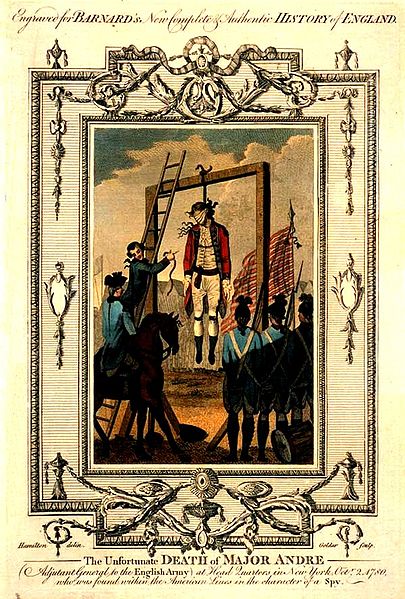
He was at West Point at the time of Benedict Arnold’s treason and the capture of Major Andre. He was captain of the guard in charge of Major Andre from the time of his trial to his execution and passed the night prior to his execution with him, having been specially detailed to that duty by General Washington.

John Andre (1750-1780)

John Andre (1750-1780)

On Sep 29 1780, the board found André guilty of being behind American lines “under a feigned name and in a disguised habit” and ordered that “Major André, Adjutant-General to the British Army, ought to be considered as a Spy from the enemy, and that agreeable to the law and usage of nations, it is their opinion, he ought to suffer death.” Later, Glover was officer of the day at André’s execution. Sir Henry Clinton, the British commander in New York, did all he could to save André, his favourite aide, but refused to surrender Arnold in exchange for André even though he despised Arnold. André appealed to George Washington to be executed by firing squad, but by the rules of war he was hanged as a spy at Tappan on 2 October 1780.

The Unfortunate Death of Major John André

The Unfortunate Death of Major John André

A religious poem, written two days before his execution, was found in his pocket after his execution.

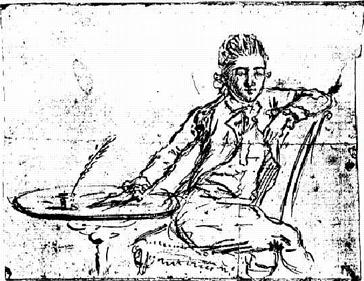
While a prisoner he endeared himself to American officers, who lamented his death as much as the British. Alexander Hamilton wrote of him: “Never perhaps did any man suffer death with more justice, or deserve it less.” The day before André’s hanging he drew, with pen and ink, a likeness of himself, which is now owned by Yale College. In fact André, according to witnesses, refused the blindfold and placed the noose around his own neck.

Self-portrait on the eve of André's execution

Self-portrait on the eve of André’s execution,

By the end of the war, after more than eight years service, Ebenezer was the longest serving captain in the Massachusetts Line. He present in the 6th Massachusetts Infantry when the regiment was furloughed Jun 12 1783 at West Point, New York and disbanded on Nov 3 1783.

Ebenezer’s eldest son David Smith D.D. entered the Continental Army at an early age and served during the last year of the war under his father.

Ebenezer was a founder of the Society of the Cincinnati in Connecticut,  an historical, hereditary lineage organization with branches in the United States and France, founded in 1783 to preserve the ideals and fellowship of the  Revolutionary War officers. The city of Cincinnati, Ohio, then a small village, was named after the Society.

For more about Ebenezer’s Revolutionary experiences see my post Ebenezer Smith – Oldest Captain in the Massachusetts Line

ii. Maj. David Smith b. 2 Dec 1747 in Lebanon, New London, CT; 16 Oct 1814 in Litchfield, Litchfield, Ct; m. Ruth Hitchcock (b. 4 Mar 1749/50 in Suffield, Hartford, CT – d. 8 Nov 1832 in Batavia, Genesee, New York) Ruth’s parents were Aaron Hitchcock (1715 – 1808) and Experience Kent (1716 – 1795) David and Ruth had four children between 1770 and 1784.

Captain Connecticut State Troops, Brigade Major and Brigade Inspector Connecticut Continental Regiments.

Capt. in Samuel Elmore’s State Regiment.  Some Continental infantry regiments and smaller units, also unrelated to a state quota, were raised as needed for special or temporary service. Elmore’s Regiment, raised in 1776 for the defense from Canada, was an example of such an “extra” regiment.

Elmore's Regiment Source: The Record of Connecticut Men in the Military and Naval Service During the ... By John Ed. Johnston, Connecticut Historical Society

Elmore’s Regiment Source: The Record of Connecticut Men in the Military and Naval Service During the …
By John Ed. Johnston, Connecticut Historical Society

Elmore's Regiment 2

Capt Smith's Company 1

Capt Smith's Company 2

Capt Smith's Company 3

Smith’s company was posted at Germann Flats, Herkimer, New York.   This was one of the original areas of the Burnetsfield Patent in the province of New York, where in 1722-1723, Governor Burnet granted Palatine German immigrants leases to purchase land from the Mohawk, one of the powerful nations of the Iroquois Confederacy. It was the first land sold to Europeans west of Schenectady. During the 18th-century warfare in the valley, the village was attacked by French and Iroquois forces during the French and Indian War (Seven Years War), and many women and children were taken to Canada as captives.

In addition to intermittent raids, during the Revolutionary War, the village was attacked in September 1778 by British forces, as well as Iroquois led by the Mohawk chief Joseph Brant. Residents retreated to Fort Herkimer, which they built on the south bank of the Mohawk River.

David Smith served much of the time under General Lafayette .  He was at the battles of Monmouth and Red Fort and captured and disarmed two English officers.  He had the honor of being presented the sword taken from one of the officers by General Lafayette in person.  The sword was still an ,heirloom in the family in 1910.

The Battle of Monmouth was fought on June 28, 1778 in Monmouth County, New Jersey. The Continental Army under General George Washingtonattacked the rear of the British Army column commanded by Lieutenant General Sir Henry Clinton as they left Monmouth Court House.

Unsteady handling of lead Continental elements by Major General Charles Lee had allowed British rearguard commander Lt Gen  Charles Cornwallis to seize the initiative but Washington’s timely arrival on the battlefield rallied the Americans along a hilltop hedgerow. Sensing the opportunity to smash the Continentals, Cornwallis pressed his attack and captured the hedgerow in stifling heat.

Washington consolidated his troops in a new line on heights behind marshy ground, used his artillery to fix the British in their positions, then brought up a four gun battery under Major General Nathanael Greene on nearby Combs Hill to enfilade the British line, requiring Cornwallis to withdraw. Finally, Washington tried to hit the exhausted British rear guard on both flanks, but darkness forced the end of the engagement. Both armies held the field, but the British commanding General Clinton withdrew undetected at midnight to resume his army’s march to New York City.

While Cornwallis protected the main British column from any further American attack, Washington had fought his opponent to a standstill after a pitched and prolonged engagement; the first time that Washington’s army had achieved such a result. The battle demonstrated the growing effectiveness of the Continental Army after its six month encampment at Valley Forge

After the war, David was president of the Society of the Cincinnati in Connecticut.

Lucy’s second husband Elisha Blackman was born 19 Sep 1717 Lebanon, CT. His parents were Elisha Blackman and Susanna Higley. Elisha died 10 Sep 1804 in Wilkes-Barre Pennsylvania.

Elisha and Lucy Blackman were pioneers in the Wyoming Valley, a region of northeastern Pennsylvania, it is also known as the Scranton/Wilkes-Barre area, after its principal cities,

During the French and Indian War  Elisha Blackman served as a private in the Colonial army in three campaigns,

  • From April 10 to October 18, 1755, in the 3d Company (Robert Dcnison of New London, Captain) in the 1st Regiment of Connecticut troops, commanded by Phincas Lyman,
  • From April 8 till November 23, 1756, in the 1st, or Colonel’s, Company, in the 4th Regiment of Connecticut troops, commanded by Col. Andrew Wr.rd, Jr., of Guilford.
  • From March 24 till November 14, 1762, in the 10th Company (Azel Fitch of Lebanon. Captain) in the 2d Regiment of Connecticut troops, commanded by Col. Nathan Whiting. (See “Connecticut Historical Society’s Collections,” IX : 10, 144, 340.)

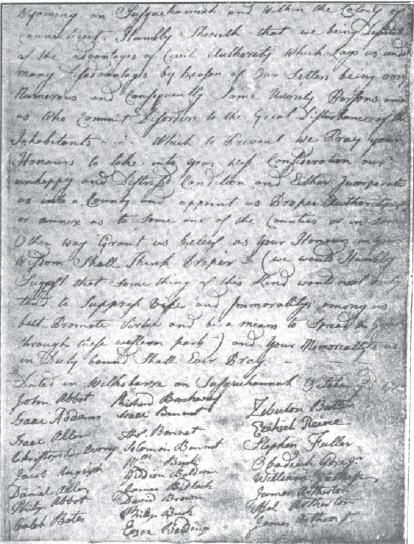
Elisha Blackman came to Wyoming for the first time in June, 1772, and in the following October, at Wilkes-Barre, he signed this petition.

“To the Honourable the General Assembly of the Colony of Connecticut To be Holden at Newhaven on the second Thursday in October A. D. 1772.

“The Memorial of us the subscribers Inhabitants of Wyoming on Susquehannah and within the Colony of Connecticut Humbly Sheweth that we being Destitute of the advantages of Civil Authority which lays us under many Disadvantages by Reason of our setlers being very numerous and consequently some unruly Persons among us who commit Disorders to the great Disturbance of the Inhabitants—which to Prevent we Pray your Honours to take into your wise consideration our unhappy and Distress’d condition and either Incorporate us into a County and appoint us Proper. Authority; or annex us to some one of the Counties or in some other way grant us Relief as your Honours in your wisdom shall Think Proper—(we would Humbly suggest that some thing of this kind would not only tend to suppress vice and Immoralitys among us but Promote virtue and be a means to spread the gospel through these western parts) and your Memorialists as in Duty bound shall ever Pray.

“Dated in Wilksbarre on Susquehannah October ye 3d 1772

Copy of above Petition, Elisha Blackman’s signature is the last one in the center column

About that time Elia was admitted an inhabitant in the township of Wilkes-Barre, and became the owner of a lot in the “Third Division” of the township. His name will be found in the Wilkes-Barre tax-lists for 1776, *77 and ’78. In May, 1777, he was established and commissioned Ensign of the *’2d Alarm List Company in the 24th (or Westmoreland) Regiment of Connecticut Militia,” .

I put the Blackman family adventures in context in my post Battle of Wyoming

The Battle of Wyoming was an encounter during the Revolutionary War between  Patriots and Loyalists accompanied by Iroquois raiders that took place in the Wyoming Valley of Pennsylvania on July 3, 1778.   340 Patriots were killed in the battle out of a total force of about 400 with the Iroquois raiders hunting down fleeing Patriots.  On the British and Iroquois side, 3 killed, 8 wounded.

Exaggerated and fabricated reports of the massacres of prisoners and atrocities at Wyoming infuriated the American public leading to tragic consequences for the Iroquois.

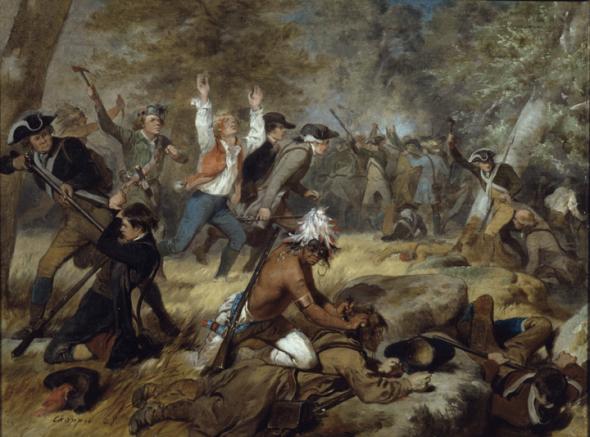
Battle of Wyoming – Depiction of the battle by Alonzo Chappel, 1858

During the battle of Wyoming, Elisha Sr  was garrisoned at  Fort Wilkes-Barre.

“Capt. William Hooker Smith and Ensign Elisha Blackman, Sr., of the 2d Alarm List Company, with a handfnl of their men, served as a garrison; while James Bidlack, Sr., of Plymouth, Captain of the 1st Alarm List Company, in command of a very small number of his men, performed a similar duty at Shawnee Fort in Plymouth.”

The next morning (July 4th) Ensign Blackman said to his wife: “Take the children and make the best of your way to a place of safety; we must stay and defend the fort.” The family set out by the “Warrior Path.” taking with them two horses; but in their alarm and distress took no provisions. They got on their way a scanty supply of huckleberries, but on the third day, having reached the German settlements in Northampton County, they were kindly cared for and supplied with proper food. They finally arrived at their old home in Connecticut.

The British arrived in the valley on June 30, having alerted the settlers to their approach by killing three men working at an unprotected gristmill on June 28. The next day Colonel Butler sent a surrender summons to the militia forces at Wintermute’s (Wintermoot) fort. Terms were arranged that the defenders, after surrendering the fort with all their arms and stores, would be released on the condition that they would not again bear arms during the war. On July 3, the British saw that the defenders were gathering in great numbers outside of Forty FortWilliam Caldwell was destroying Jenkin’s fort, and when the Americans were still a mile away Butler set up an ambush and directed that Fort Wintermute be set on fire. The Americans, thinking this was a retreat, advanced rapidly. Butler instructed the Seneca to lie flat on the ground to avoid observation. The Americans advanced to within one hundred yards of the rangers and fired three times. The Seneca came out of their positions, fired a volley, and attacked the Americans in close combat.

Battle of Wyoming Reinactment

Accounts indicate that the moment of contact was followed by a sharp battle lasting about forty-five minutes. An order to reposition the Patriot line turned into a frantic rout when the inexperienced Patriot militia panicked. This ended the battle and triggered the Iroquois hunt for survivors. Only sixty of the Americans managed to escape, and only five were taken prisoner. Some of the victorious Loyalists and Iroquois killed and tortured an unknown number of prisoners and fleeing soldiers. Butler reported that 227 American scalps were taken.

Colonel Dennison surrendered Forty Fort and two other forts along with the remaining soldiers the next morning. The Americans were paroled with the condition that they not engage in hostilities for the remainder of the war. These soldiers were not harmed. Colonel Dennison and the militia did not honor the terms of their parole, and they were under arms within the year and later attacked Iroquois villages.

There was no substantial killing of non-combatants and almost no inhabitants were injured or molested after the surrender. John Butler wrote :

“But what gives me the sincerest satisfaction is that I can, with great truth, assure you that in the destruction of the settlement not a single person was hurt except such as were in arms, to these, in truth, the Indians gave no quarter.”

An American farmer wrote:

“Happily these fierce people, satisfied with the death of those who had opposed them in arms, treated the defenseless ones, the woman and children, with a degree of humanity almost hitherto unparalleled”.

According to one source, 60 bodies were found on the battlefield and another 36 were found on the line of retreat and all were buried in a common grave. According to another source 73 bodies were also buried in one hole.

The battle caused a panic on the frontier, and settlers in the surrounding counties fled. About 1,000 homes and all of the forts in the area were burned in the days following the battle.

The Iroquois were enraged at the accusations of atrocities which they said they had not committed, as well as at the militia taking arms after being paroled. This would have tragic consequences at the Cherry Valley Massacre later that year. Reports of the massacres of prisoners and atrocities at Wyoming and atrocities at Cherry Valley enraged the American public.

The Wyoming militia led by Denisson and others, violated their parole and later that year under Colonel Hartley ascended the Susquehanna as far as Tioga, destroying Tioga and area Loyalist farms.  In 1779, the Sullivan Expedition commissioned by General George Washington methodically destroyed at least forty Iroquois villages throughout upstate New York.

Back to the Blackman family adventures

Late in the morning of July 4th Ensign Blackman was joined at the fort by his son Elisha, who had escaped from the battlefield, and in the afternoon they set out on foot for Fort Penn. Ensign Blackman’s house and barn and their contents were totally destroyed when Wilkes-Barre was burnt by the Indians. He also lost his oxen and other stock, with the exception of two cows.

His son, Elisha Blackman Jr.  took part in the battle of Wyoming as a private in the “Lower Wilkes-Barre Company,” commanded by Capt. James Bidlack, Jr. [38 men].  In the hardest part of the battle he saw his brother-in-law, Darius Spafford, fall mortally wounded, and he became so intent on avenging the death of the latter that it was some time before he discovered that the Americans were losing ground. In the flight from the field he and a companion headed for the river. Indians chased them and called to them to surrender, assuring them that they would not be hurt. Blackman did not surrender, but his companion did, only to have his skull immediately split open with a tomahawk. (source  ?)

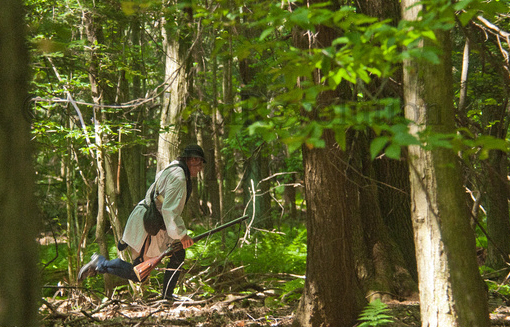
Robert Stray Wolf of Ralston plays an Oneida Indian during the “Escape from Wyoming” re-enactment in July 2010 in Mount Cobb. Mr. Stray Wolf said the Oneidas helped American colonists during the battle.

Blackman strained every nerve to escape, and did so by swimming to Monocanock Island—with the bullets fired by the pursuing savages whistling about his head. He remained in hiding on the island until after nightfall, and then made his way to Forty Fort. The next morning he set out for Wilkes-Barre, and, as previously mentioned, reached the fort here shortly before noon. Miner says (“Wyoming,” Appendix, page 33) that only eight members of Captain Bidlack s company escaped from the battle-ground on July 3, 1778: Ensign Daniel Downing, Serg’t Jabez Fish, Serg’t Phineas Spafford, Elisha Blackman, Jr., Samuel Carey, M. Mullen, Thomas Porter, drummer, and one other.

Battle of Wyoming Reinactment

The two Elishas made their way to Fort Penn in due time, but later they both returned to Wilkes Barre and were in service there as early, at least, as August 9, 1778, in the detachment of militia commanded by Lieut. Col. Zebulon Butler. Some time later in 1778, or perhaps early in 1779.

Ensign Elisha Blackman joined his wife and children in Connecticut, where, in April, 1780, he was one of the signers of a memorial presented to the General Assembly of Connecticut by certain Wyoming refugees who were then temporarily residing in Connecticut. ) In 1787 Elisha Blackman returned to Wilkes-Barre, whither his sons had preceded him in 1786, and here he lived until his death, Sep 10, 1804.

Children of Lucy and Elisha

iii.  Lucy Blackman b. 7 Sep 1755 Lebanon, CT; d. 19 Jun 1825 Plymouth, Litchfield, CT; Burial: Old Burying Ground Plymouth; m. 30 Oct 1789 – Scotland, Windham, CT to Capt. Titus Darrow (b. 15 Feb 1753 East Haven, New Haven, CT – d. 25 Jan 1841 Plymouth, Litchfield, CT; Burial: Old Burying Ground Plymouth) Titus’ parents were Ebenezer Darrow and Lydia Austin.

Titus was a soldier in the revolution and participated in the battle of Saratoga and the capture of Burgyone.

iv. Lovina Blackman b. 7 Sep  1757; d. 3 Jul 1778 in Connecticut; m.  Darius Spafford (b. 4 Jan 1749 in Windham, Windham, CT – d. 3 July 1778 in Wyoming Valley, Pennsylvania) His parents were Asa Spafford (1725 – 1808) and Huldah (Hulda) Flint (1728 – ). He was killed in the battle of Wyoming.   Receiving a death wound, he fell into the arms of his brother Phineas, by whose side he fought. “Brother,” said he, “I am mortally hurt; take care of Lavina.”

v. Elisha Blackman Jr.  b. 4 Apr 1760 Lebanon, CT;  d. 5 Dec 1845 Wilkes-Barre, PA; m.  10 Jan 1788, to Anna Hurlbut (b. 5 Jan 1763 –  d. 6 Jan 1828 Wilkes-Barre, PA) Anna’s parents were Deacon John Hurlbut and Abigail Avery.

Elisha Blackman son of Elisha Blackman and Lucy Polley

Elisha Blackman, Jr. came to Wilkes-Barre in 1773, at the age of thirteen, with the other members of his father’s family.

Elisha Blackman, Jr., returned to Wilkes-Barre in August, 1778, and was in service here as a militia-man under the command of Lieut. Colonel Butler. In the Sullivan Expedition of 1779 he served in the Wyoming militia company commanded by Capt. John Franklin.

Later in that year, or early in 1780, Elisha joined his parents and the other members of their family in Connecticut.

Early in 1781 Elisha Blackman, Jr., enlisted as a private in the company of Capt. Selah Benton of Stratford, in the 5th Regiment, Connecticut Line, commanded by Lieut. Col. Isaac Sherman,and served till the latter part of June, 1782. He was honorably discharged from the service at Fishkill, New York, and thence he went to the home of his parents in Lebanon. There he subsequently learned the trade of a tanner and currier, and in 1786, in company with his brothers Ichabod and Eleazar, he returned to Wilkes-Barre. The three brothers built a log house on the lot of their father—on South Main Street, between the present Academy and Sullivan Streets. [There’s a small shopping center there now]

Elisha Blackman, Jr.. was commissioned First Lieutenant of the Light Infantry Company attached to the “1st Regiment of Militia in Luzerne County,*’ commanded by Lieut. Col. Matthias Hollenback. In 1791 Lieutenant Blackman bought a tract of land in Hanover Township, to which he removed and which he cleared up and converted into a farm.  During the last ten years of his life he was a United States pensioner.

vi. Ichabod Blackman b. 24 Mar 1762  Lebanon, CT. d.   April, 1798 Towanda, Bradford Co, PA; he was accidentally drowned in the Susquehanna River while crossing it in a canoe near the mouth of Sugar Creek, on a very dark night. m. oshen, New York to Elizabeth Franklin (b. 1767 in Litchfield, CT – d. 09 Jun 1809 in Hornbrook, PA) Elizabeth’s parents were Jonathan Franklin (1744 – 1778) and Ruth Hicock (1727 – 1777). After Ichabod died, Elizabeth married to Timothy Winship.

Ichabod was eleven years old when he came with his parents and the other members of their family to Wilkes-Barre. At the time of the irruption of the Tories and Indians into Wyoming Valley Ichabod Blackman was 17 years old, and, being within the age limit  fixed by the militia laws of Connecticut, was an enrolled member of the 24th Regiment. With his father and elder brother, Elisha, Jr., he took part in the military expedition from Forty Fort to Sutton’s Creek, July 1, 1778, as described on page 990. Whether or not Ichabod took part in the battle of Wyoming is not now known. It is-quite probable that he was one of the garrison at Fort Wilkes-Barre. He fled from the Valley with his mother, sisters and younger brother, and, making his way with them to Connecticut, remained there until 1786, when he returned to Wilkes-Barre.

Dec 21 1780 – Ichabod was on the muster roll Nov/Dec as a private in Lt Col Sumner’s 4th Connecticut Regiment

In 1700 Ichabod Blackman removed with his wife and child from Wilkes-Barre to Sheshequin, where he settled on, and cleared up, a large tract of land now owned by one of his descendants. In the month of April, 1798, he was accidentally drowned in the Susquehanna River while crossing it in a canoe near the mouth of Sugar Creek, on a very dark night.

He returned to Wilkes-Barre about 1784. In 1786 he was married at Goshen, NY, to Elizabeth, daughter of Jonathan Franklin. Five years later, in 1791, he removed to Sheshequin, where he settled on, and cleared up, a large tract of land later owned by his grandson, George W. Blackman. He built a log house opposite the present Blackman residence, and afterwards a hewed log house on the upper end of the farm. Mr. Blackman was a shoemaker by occupation, and frequently made a pair of shoes at night after the severe labors of the day in the forest were over. In the month of April, 1798, he was drowned near the mouth of Sugar Creek, while crossing the river in a canoe on a very dark night. The children of Ichabod and Elizabeth Blackman were Franklin, Elisha and David S.

viii. Eleazar Blackman b. 31 May 1765 Lebanon, CT; d. 10 Sep 1843 – Wilkes-Barre, Luzerne, Pennsylvania;  m.  7 Oct 1786, at Wilkes-Barre, to Clorinda Hyde (b. 14 Feb 1769 in Canterbury, CT – d. 1829) Clorinda’s parents were John Hyde (1729 – 1759) and Mary Thompson (1731 – 1750). originally of New London County, Connecticut, but then an inhabitant of Wilkes-Barre, residing on Lot No. 29 of the “Second Division” of the township.  Eleazer and Clorinda had eleven children born between 1788 and 1811.

Major Blackman died at his home 10 Sep 1843, and was buried two days later with the honors of Free Masonry.

Eleazar was eight years old when he came with his parents to Wilkes-Barre. In the Spring of 1778, as a boy of thirteen, he aided in strengthening the defenses of Fort Wilkes-Barre—by hauling logs with an ox-team, and digging in the trenches.  He said says: “I was then a boy of about thirteen, but was called on to work in the fortifications. With spade and pick I could not do much, but I could drive oxen and haul logs.” Every sinew from childhood to old age was thus put in requisition.”

After the battle of July 3d he fled from the Valley with his mother, sisters and brother, as previously related, and proceeded to Lebanon, Connecticut, where he remained until his return to Wilkes-Barre in 1780. (Some years later he removed to Hanover Township.)

Eleazar Blackman settled in Wilkes-Barre. “In the progress of the settlement and opening up of the country be mingled actively in the business of life, held public stations—both civil and military— and during his entire life enjoyed the respect and esteem of all who knew him.”

In 1788 he was a private in the “Troop of Light Dragoons” raised and commanded by Capt. John Paul Schott. In 1790 he was a private in the company of Light Infantry (commanded by his brother, Lieut. Elisha Blackman, Jr.) attached to the “1st Regiment of Militia in Luzerne County,” commanded by Lieut. Col. Matthias Hollenback. In September, 1800, he was elected and commissioned Captain of the “First Troop of Horse,” 2d Brigade, 8th Division, Pennsylvania Militia. This position he held for a number of years, and in 1812 he attained the rank of Major in the militia.

From 1801 till 1803 he was one of the Commissioners of Luzerne County; and from 1808 till 1810 Treasurer of the County. He was made a Free Mason in Lodge No. 61, F. and A. M., Wilkes-Barre, November 2, 1795, and was Secretary of the Lodge in 1797, Senior Warden in 1798, ’99, 1800, ’01, ’02, ’03, ’13, ’14, ’16 and ’16, Treasurer in 1806, and Worshipful Master in 1804 and 1809.

Major Blackman, for many years prior to his death, lived on his farm in Wilkes-Barre near the Hanover Township line and not far from the foot of the mountain. Prior to 1830 he opened up a “coal-bed” on this farm, and thenceforward, for a number of years, he carried on in a small way the business of coal-mining in addition to his farming operations.  In time this coal-bed became known as the “Blackman Mine, and years later—when the operations -had become more extensive—the mine was known as the “Franklin.”

Epilogue

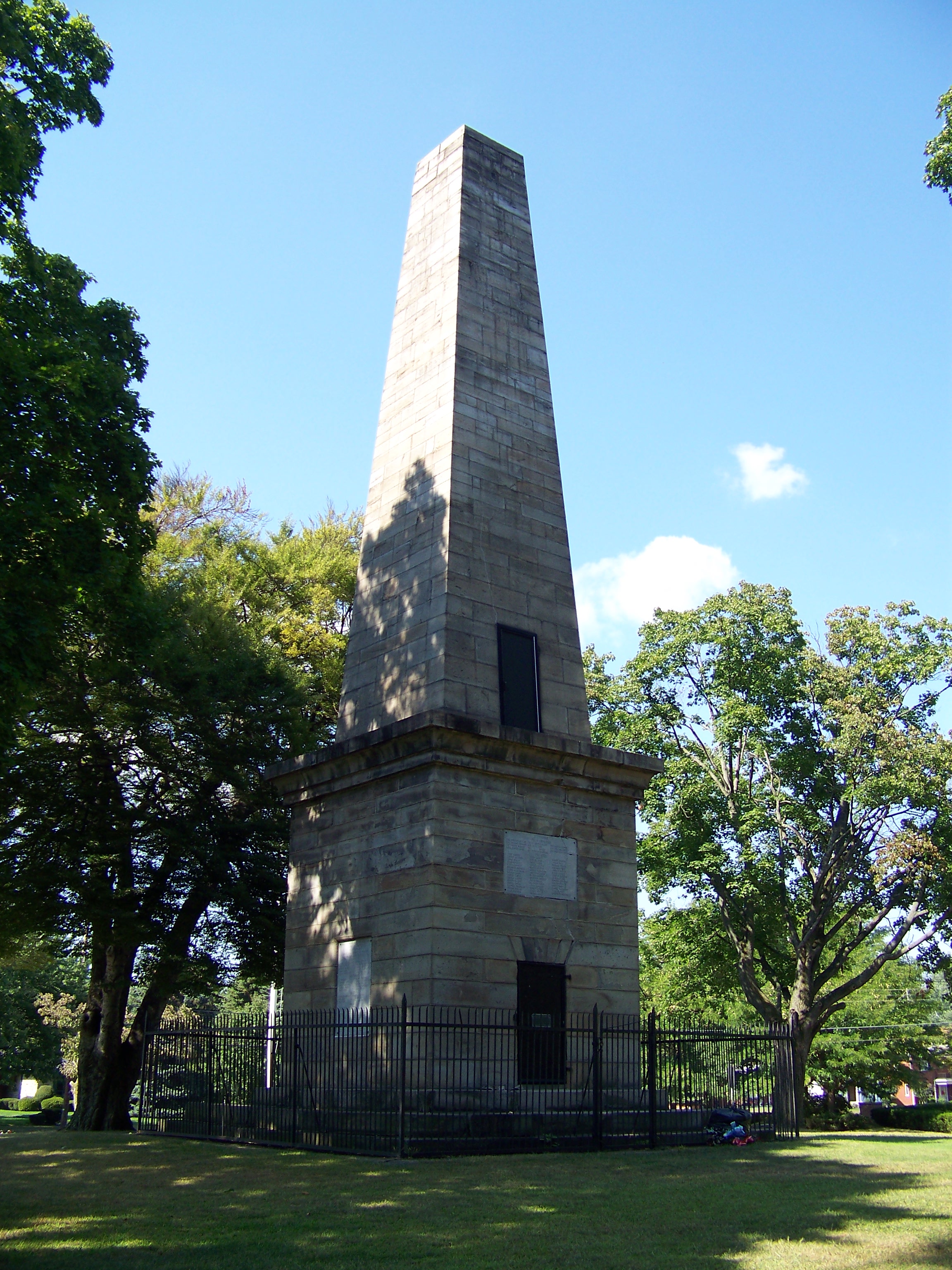
Wyoming Monument –  It was not almost four months after the battle, October 22, 1778 that a recovery party felt the region safe enough to return to begin recovery of the bodies of those slain in the battle. The remains were gathered and interred in a common grave, In 1833, the bones were re-interred in a vault under the present monument. On Aug  2, 2008, the monument was struck by lightning, causing some damage and putting the monument in need of repairs.

There were many lurid and erroneous reports about the Battle of Wyoming and its aftermath. For example:

“They then proceeded to the only remaining fortt called WilkeHwroujth, which, in hopes of obtaining mercy, was surrendered without resistance, or without even demanding any conditions. Here the tragedy was renewed with aggravated horrors. They found here about seventy of that sort of militia who are engaged by the different Provinces merely for the guard and defence of their respective frontiers, and who are not called to any other service. With these, as objects of particular enmity, the slaughter was begun, and they were butchered with every possible circumstance of the most deliberate, wanton and savage cruelty. The remainder of the men, with the women and children, not demanding so much particular attention, were shut up as before in the houses, which being set on fire, they perished all together in the flames.

On December 20, 1820, it appeared in the National Gazelle, and a copy of that issue of the paper falling into the hands of Gen. Lord Butler of Wilkes-Barre, eldest son of Col. Zebulon Butler, then deceased, he wrote to the editor of the National Gazette a letter, to which the written and signed statements of three survivors of the battle of Wyoming were appended. These communications were not designed to form a full historical relation of the events of July 3d and 4th, 1778, but were intended, simply, to point out and correct the errors in Botta’s history, and to remove the false and injurious impressions which such an account was calculated to make upon the public mind with reference to the principal actors in the events described. General Butler’s communication and the accompanying statements were not only printed in full in the National Gazette, but were reprinted in other newspapers, and they read as follows:

“The account as given in the extract is, perhaps, the most incorrect narrative of events that ever found its way into the history of any transaction ever before published, and particularly of one so highly interesting. Indeed, there is scarcely a solitary truth in the whole extract. Most of the circumstances are wholly fabrications; and others are so misrepresented and distorted as hardly to be recognized. That a true estimate may be put upon it, I will point out some of its most prominent deviations from truth and fact.

“In the first place, Col. Zebulon Butler, at the time spoken of, had not the command of the ‘ whole colony,’ as stated in the extract. He was a [Lieutenant] Colonel in Washington’s army, but, happening to be in this part of the country on a furlough, he was requested to give his assistance, and take the command of the men in case it should be necessary to fight. Further, it is not true that Zebulon Butler was a cousin of John, the commander of the enemy’s forces. There was no relationship subsisting between them, [so] of course the influence which the writer of the extract would seem to draw from that circumstance, must fail. It is not true that Col. Zebulon Butler was drawn out of the fort by the ‘lavish promises’ of his enemy ‘that, if he would consent to a parley in the open field, the siege would be raised, and every thing accommodated.’ Nor is it true that he [Col. Zebulon Butler] marched out for that purpose, and ‘ from motives of caution took with him four hundred men, well armed.’ The fact is, the only conference he marched out to was a battle; the only parley he expected was the point of the bayonet.

“The whole number of men under his [Zebulon Butler’s] command that day was about 30-50, and it has since been ascertained that the enemy’s force amounted to from 1,000 to 1,500. The battle was fought sooner than Colonel Butler wished. He advised delay, hoping to ascertain the force, position and intentions of the enemy; [hoping] that succours would arrive, and that he then would be able to meet the enemy to more advantage. But as he had no right to the submission of either the officers or their men—except what they voluntarily paid him—he was obliged to forego his own opinion, and consent to lead them on. Another circumstance obliged him to take this course. There were some brave men among them, but who were as rash and imprudent as they were brave, who were determined to fight that day, or leave the fort and return to their homes.

“It is not a fact that Colonel Butler and his men were enticed into the ‘ dismal solitudes ‘ and ‘thick forests ‘ by a ‘ flag,’ and there ‘completely surrounded’ by the enemy. All that is said in the extract about the ‘ unfortunate American ‘ being ‘ without suspicion of the peril he was in,’ continuing ‘to press forward,’ &c, and 1 being awakened but too soon from this dream of security,’ &c, is false! So far from the Americans having been ‘surprised’ by the British and Indians—had it not been for the imprudence of a few men (sent forward as an advance guard) in firing upon some Indians whom they discovered setting fire to a house, the enemy themselves would in all probability have been taken by surprise, and obliged to engage under many disadvantages.

“The Americans, instead of forming into ‘a compact column,’ fought in a line, on the left of which there was a marsh. The British and Indians, being more than twice as numerous as the Americans, endeavored to outflank them by going around and through this marsh. Colonel Denison, who was a Colonel of the militia, and properly the commander of the ‘whole colony,’ and who had taken charge of the left wing, perceiving the intentions-of the enemy, took prompt measures to defeat their expectations, and gave the necessary orders to effect it.  It was in the execution of these orders that the confusion began! And though Colonel Denison, and the other officers on that wing, did all that men could do to prevent it, the left wing gave way. The right wing was at this time beating the enemy back and advancing upon them.

“Col. [Zebulon] Butler, who had continued on horseback throughout the day, finding that the right was doing well, left it and rode towards the left. When he got a little more than half-way down the line he discovered the men were retreating, and that he was between the two lines, near the advancing line of the enemy. The rout soon became general, notwithstanding the extraordinary efforts of the officers, most of whom were killed in their attempts to rally the men, and bring them again to the charge. It is not true that ‘about sixty men escaped,’ and with Zebulon Butler made their way good to ‘ a redoubt on the opposite bank of the Susquehanna;’ for Colonel Butler, when he found it impossible to rally the scattered troops, instead of seeking his own safety by leaving the field instantly, collected four or five men, made them retain their arms and keep together. These he ordered to fire when any of the enemy approached, and by this means brought them safe to the fort at Kingston.

“As it was impossible to defend this fort [Forty Fort], all the men having been killed in the battle except about forty or fifty (not more than ten or twelve of whom came to the fort), he proceeded to Wilkesbarre, which is about two miles distant, and on the opposite side of the river. Colonel Denison having had a conference with the enemy, next morning sent Col. Zebulon Butler word that they [the enemy] would give no quarter to Continental officers or soldiers. He [Colonel Butler] then hastened into Northampton County. Colonel Denison well knew that the fort in Kingston could not be defended with any prospect of success. He therefore did not make the attempt, but obtained what terms he could from the enemy, and surrendered. There were but few men left, and the fort was crowded with women and children.

“It is not true that Colonel Denison ‘surrendered at discretion,’ nor is it true that the savages ‘enclosed the men, women and childien promiscuously in the houses and barracks, to which they set fire, and consumed all within.’ True they robbed and plundered, contrary to the articles of capitulation, but they killed no one. Finally, it is not a fact that at Wilkesbarre the ‘soldiers of the garrison,’ were (as stated in the extract) ‘put to death;’ nor were the ‘men, women and children burned, as before, in the barracks and houses.’ The British and Indians did not come to Wilkesbarre until the second day after the battle, and then they found the fort and town entirely abandoned. They plundered and burnt every house, except two or three small ones, but there was not an individual killed.

“To perpetuate truth is, or ought to be, the object of history; at all events, history should never be made the vehicle of falsehood. If it be deemed of sufficient interest and importance to the public that any account of the battle of Wyoming should be registered, it certainly is of importance that that account should be correct and authentic. That a true narrative of that transaction may be incorporated into history, is one reason why I have noticed the extract. But it is also due to the memory of Col. Zebulon Butler, and to the feelings of his numerous descendants, that the odium which the account in the extract has so unjustly heaped upon his character should be removed. To do this the more effectually, I add a brief abstract of his military career. * * * *

“Upon the breaking out of the American Revolution, he entered the service of his country in the army under Washington; was a Lieutenant Colonel,and at the close of the war commanded one of the best regiments in the whole army. Colonel Butler was the personal friend of General Washington. I have seen letters from the General to him after the close of the war, written in very friendly terms, proving that Washington, at least, had full confidence in his capacity, integrity and patriotism. It is indeed strange, that after so long a service in both British and American armies, he never before was discovered to have been a coward and a traitor, if he really were such. And yet perhaps this need not be wondered at, when even the brave, the intrepid Putnam has, since his death, been accused of cowardice!

“A desire to be strictly and critically correct in my statement of facts, has unavoidably occasioned some delay in forwarding my letter to you. What I have stated are facts—you may rely on their accuracy. For your satisfaction on this head, however, I send you the certificates of Judge Hollenback and others (who were in the battle) corroborating and substantiating my allegations. Certificates to the same effect might have been obtained from all the survivors of that day’s disasters, who yet live in this part of the country, but it was not tho’t necessary. It is my intention, at some future period, to send you an authentic narrative of the battle of Wyoming, embracing the transactions of several weeks, and perhaps months, both previous and subsequent, which if it should meet your approbation, you will be at liberty to publish.

“I am Vours, &c, [Signed] “Lord Butler.” “Wilkesbarre, Dec. 20, 1820.

Elisha Blackman Jr. certified the above letter as follows:

“I do certify that I was in the battle of Wyoming, fought on the 3d day of July, 1778, and that I am well acquainted with the facts as they took place on that day, and subsequently. I have read the account published in the National Gazette of the 6th insl., and know that most of the circumstances related, and especially the material ones, are absolutely false. I have read, also, the above letter of Lord Butler, Esq., and from personal knowledge, as well as from the information obtained at the time, know the facts therein stated to be correct. I also certify that I was stationed about the centre of the line [of battle], and saw Col. Zebulon Butler, about the time the retreat commenced, riding from the right to the left, between the two contending lines, and saw him turn his horse, ride after his men, and endeavor to stop them. I never heard, until I saw the account above referred to, any blame imputed to Col. Zebulon Butler for his conduct on that, or any other occasion. [Signed] “Elisha Blackman.*”

“December 26, 1820.

4. Jonathan Polley

Jonathan’s wife Prudence Dewolf was born 24 Oct 1739 in Middletown, Connecticut.  Her parents were Joseph DeWolf and Tabitha Johnson. After Jonathan died, she married Simeon Stow (b. 24 Nov 1736 – d. 13 Apr 1823 Wood Creek Cemetery, Whitehall, Washington, New York)  Prudence died 8 Jun 1823 in Whitehall, Washington, New York.

In the French & Indian War, Jonathan was a sergeant in Capt. Peter Van Der Burgh’s Company of New York Provincial Troops from August 1 -31, 1755 and a sergeant in Capt. Michael Thodey’s Company from October 1-31, 1755.

Prudence helped raise her daughter Susanna’s children after Susanna’s death. The Dewolf name was called Dolph at the time. She is the fourth generation from Balthazar DeWolf, who was a German speaking native of Silesia, modern Poland. Prudence’s first husband was Jonathan Polley, who died in Tolland CT ca 1762. They had sons Joseph and Jonathan, who are probably buried here. Her second marriage produced Rebecca, Susanna, and John Stowe. Susanna, first wife of Aaron Osgood III, died at 29 at the birth of her 8th child; her grave Wood Creek Cemetery, WhitehallWashington County New York, but is hard to find in the rubble of stones that abound here. Susanna’s granddaughter, Prudence Osgood Allard, named for this Prudence, is buried in Fair Haven VT.

Simeon Stow was a soldier of the Revolution. Spelled STOW on his stone, and that of his wife, Prudence. One of the few stones standing in this section of the cemetery, which is in very poor shape.

Children of Jonathan and Prudence:

i. Joseph Polley b. 31 Oct 1758 in Hebron, Tolland CT

ii. Jonathan Polley b. 26 Oct 1759 in Windham, Windham, CT; d. 31 May 1840 in Ft Ann, Washington, New York; Burial: Wood Creek Cemetery, Whitehall, Washington, New York; m. Rachel Hubbard (b. 29 Aug 1770 in Washington, New York – d. 23 May 1821 in Whitehall, Washington, New York) Rachel’s parents were Samuel Hubbard (1723 – 1749) and Mary Stow (1729 – 1799) Jonathan and Rachel had nine children born between 1792 and 1806.

Polley-Johnson-Stow-Hubbard Family Plot

Polley-Johnson-Stow-Hubbard Family Plot — Wood Creek/Kinner Cemetery, Whitehall, Washington, New York — Stones standing in row – Jonathan Polley, Rachel Hubbard Polley, Sarah Johnson, William Johnson, Mary Stow Hubbard, Simeon Stow (leaning on Mary’s). Laying flat just to right and out of the photo is the headstone for Prudence DeWolf Polley Stow.

5. Samuel Polley

In 1762, Samuel was enlisted in the 1st Connecticut Regiment under Major-General Phineas Lyman 12th Company under Capt Seth King

6. Matthew Polley

Matthew’s first wife Martha Hosmer was born 1730 in Somers, Tolland, CT.

Matthew’s second wife Susanna Spicer’s origins are not known.

Children of Matthew and Martha:

i. Amasa Polly b. 25 Mar 1753 in Middletown, Middlesex, Connecticut; m. 25 Feb 1778 in Suffield, Hartford, CT to Experience Austin (b. 1752 in Suffield ) Experience’s parents were Jacob Austin (1704 – 1773) and Hannah Pomeroy (1721 – 1773)

On Sep 1 1779, Amasa was an Armoer in Suffield, CT.

ii. Remembrance Polly b. 20 Sep 1757 in Somers, Tolland, CT

iii. Uriah (b. 1769 in New Jersey)

7. John POLLEY (See his page)

Sources:

http://www.genealogyofnewengland.com/b_p.htm

http://users.ece.utexas.edu/~perry/fun/genealogy/mell/polley.html

http://trees.ancestry.com/owt/person.aspx?pid=121446662

Vital records of Norwich, 1659-1848, Volume 1 By Norwich (Conn.), General Society of Colonial Wars (U.S.). Connecticut

A history of Wilkes-Barré, Luzerne County, Pennsylvania, from its …, Volume 2 By Oscar Jewell Harvey 1909

History of Wyoming: in a series of letters, from Charles Miner, to …, Volume 3 By Charles Miner, Adam Hubley

http://trees.ancestry.com/owt/person.aspx?pid=121446662

Posted in -9th Generation, Line - Miller, Missing Parents | Tagged , | 5 Comments

Daniel Johnson

Daniel JOHNSON (1702 –  1755) was Alex’s 7th great grandfather, one of 256 in this generation of the Miner line.

Daniel Johnson was born 18 Jul 1702 in Norwich, CT.   His parents were John JOHNSON Jr. and Susannah [__?__]. He married Jemima ORMSBY on 9 Nov 1726 in Norwalk, CT.  Daniel died 27 Jun 1755 Bozrah, New London, CT and is buried in the Johnson Cemetery, Bozrah.

Jemima Ormsby was born 5 Mar 1701 in Rehoboth, Mass.  Her parents were John ORMSBY and Susannah [__?__]. Jemima died 24 Apr 1764 Bozrah, New London, CT and is buried in the Johnson Cemetery, Bozrah

Children of Daniel and Jemima:

Name Born Married Departed
1. Zerviah JOHNSON 26 Jul 1728 Norwich CT Samuel Loomer
14 Sep 1749 Norwich CT
.
John POLLEY
6 Jun 1764 Lebanon, CT
2. Jemima Johnson 28 Oct 1730 Benjamin Spicer
29 Mar 1753 Norwich, CT
.
William Fox
8 Sep 1779
8 Nov 1815
3. Rhoade (Rhoda) Johnson 13 Oct 1733 Norwich, CT James Crocker
23 Feb 1757 Colchester, CT
6 Jan 1802 Mansfield City, CT
4. Daniel Johnson 7 Feb 1735/36 Norwich, CT Elizabeth Wentworth,
18 Feb 1761 Norwich-Bozrah, New London, CT
5. Asa Johnson 13 Jul 1741 Norwich, CT 26 Mar 1808 Connecticut
    [NVR 123] DJ and JO maried by Henry Willes. Children: Zerviah, 26 July 1728; Jemima, 28 October 1730 (married Benjamin Spicer, 29 March 1753); Rhoade, 13 October 1733; Daniel, 7 February 1735/6 (married Elizabeth Wentworth, 18 February 1761); and Asa, 13 July 1741.

Children

1. Zerviah JOHNSON (See John POLLEY‘s page)

2. Jemima Johnson

Jemima’s husband Benjamin Spicer was born 8 Jul 1730 in Norwich, New London, CT. He was Jemima’s first cousin.  His parents were Samuel Spicer (1691 – 1748) and Susannah Ormsby (1696 – 1752). Benjamin’s grandparents were our ancestors John ORMSBY Jr. and Susannah [__?__]. Benjamin died before 1779 or 25 Aug 1790 in Connecticut.

She may have married second, William Fox, Sept. 8, 1779, but Benjamin may have been still alive.

Aug 8 1751 – Benjamin Spicer bought of Alpheus Wickwere, for one hundred and five pounds in bills of credit, one and one half acres of land lying southward of the town plat, also Mason’s pond in Norwich, ” beginning at a mear stone one rod from William Bushnell’s corner abutting Easterly on the Highway 14 rods to a heap of stones on a rock; thence abutting Easterly on the Highway 12 rods to a mear stone a Bound of land and sometime Thomas Carew’s land; thence abutting on s’d Carew’s land 14 rods to a mear stone by a rock near the Brook Northerly on land of Samuel Post formerly 16 rods to a heap of stones on a rock; thence abutting N’westerly on land laid out to s’d Bushnell 7 rods to a heap of stones by a black oak; thence of same corse 1 rod to the first corner”; witnesses, Isaac and Rebecca Huntington. He sold this property May 8, 1753, for one hundred pounds to John Hughes; witnesses, Richard Hide and Isaac Huntington.

Oct 11, 1751 – He sold all the four acres and ten rods of land in Norwich lying westward of Wawecus Hill, “near ye dark Swamp, . . . beginning at the Northwest corner of sister Anne’s part of Honored Father’s Estate abutting Easterly on Zachariah Huntington’s land,” with all the rights he had in the eight acres to west of above land which was set out to his mother as her right of dower; witnesses, Isaac and Rebecca Huntington.

Apr 9 1752 – He bought of Richard Chelton, for four hundred and fifty pounds in bills of “Publick Credit” 31 rods of land with a shop standing on it “near my dwelling house in said Norwich, …” beginning at the town street at the Southeasterly corner of Ebenezer Huntington’s land; thence abutting Westerly on s’d Huntington’s land 12 rods; thence abutting Southerly on land of James Brown 2 rods and 10 ft.; thence Easterly on my own land 12 rods; thence abutting Northerly on the town street two rods and ten feet to the first corner”; witnesses, William Lothrop and Isaac Huntington.

May 12 1755 – He sold to Benjamin Gager for eight hundred pounds 27 rods of land with dwelling house in Norwich, near the dwelling house of Alpheus Wickwere ” Bounding Northwest on Nathan Stedman West on town street”; witnesses, Isaac andBenjamin Huntington. He was living in Norwich in 1768.

August 1757 – Benjamin Spicer was in Capt. John Perkins’ Company in service for the time of alarm for relief of fort William Henry and parts adjacent

Children of Jemima and Benjamin:

i. Ishmael Spicer b. 27 Mar 1760 Norwich, New London, CT; d. 22 Dec 1832 – Bozrah, New London, CT; Burial: Johnson Cemetery Bozrah; m. 29 Nov 1792 at Norwich ,New London, Connecticut to Martha Abel (b. 24 Jan 1769 Bozrah, CT – d. 20 Apr 1829 Bozrah) Martha’s parents were Simeon Abel and Martha Crocker. Ishmael and Marth had six children born between 1793 and 1802.

Isahmael was a teacher of vocal music for a period of forty-two years. He kept a small memorandum book (dated Bozrah, March 1, 1824). In it is written, “I have taught since Jan. 6, 1793, 106 singing schools in the U. S. and the whole number of scholars 4880 and the money I have received for tuition in forty two years $3934.26.” He was of Hebron, Connecticut, in 1792; Salem, 1803; Lebanon, 1808; and moved to Bozrah April 7, 1810. Ishmael and Martha had five children born between 1793 and 1801.

Although his nominal residence was in those places he seems to have been much in New York State. In 1803 he was teaching in Balston Springs, New York; 1804 in Athens; 1805, in Castleton, Shodack, and Nassau; in 1806 in Hudson and Claversack; 1807 in Kingston (Esophus), Hurley, Marbleton, and Rochester; 1808 in Hudson and Haversack; in 1809 in Schodack and Nassau; 1810 and 1811, in Catskill, Madison, Jefferson, and Athens; 1811 Spencerton, Green River; 1812 in Athens and Jefferson; in 1814 in Claversack and Kinderhook; in 1817-19 in Athens and Coxsackie; in 1820 in Red Hook; 1821, in Red Hook and Rhinebeck; 1823 in Athens, New York, and also in Bozrah and Salem, Connecticut.

He wrote in his little book “In Bozrah, 1811 a cucumber was raised in Ishmail Spicer’s garden that measured 15 & f inches in length 1 1 & f inches round & it weighed 3 lbs and 3 oz;” also “my horse was stolen from my pasture June 1, 1817. I found him again Oct 1, 1818 at Mr. Elisha Storey’s in Preston, sold to him by John Park Avery of Groton and on the 3rd of Oct. I took Messrs. Otis Freeman, Daniel G. Edgerton and Simeon A. Spicer and proved the horse to be mine and I sold the horse to Mr. B. Williams of Franklin, Oct 17, 1818.” In 1797 (age 37) he had a fall, in Chatham, which caused infirmities of body and a life of painful suffering.

ii. Elderkin Spicer b. 16 Sep 1765 Norwich, CT; d. Aft. 1800 census Hebron, Tolland, C; m. 30 Sep 1789 to Eunice Lathrop (b. 4 June 1763 in Lebanon, New London, CT – d. Jul 1851 in Groton, New London, CT). Eunice’s parents were cousins Samuel Lathrop (1743 – 1801) and Lois Lathrop (1742 – 1813.) Elderkin and Eunice had three children born between 1790 and 1794.

3. Rhoda Johnson

Rhoda’s husband James Crocker was born 20 Apr 1732 in Colchester, CT.  His parents were James Crocker (1699 – 1785) and Alice Swift (1698 – 1783).  James died 17 May 1797 in Mansfield, Tolland, CT.

James Crocker Gravestone

James Crocker Gravestone — Olde Mansfield Center Cemetery

Inscription:

In memory of Mr. James Crocker who departed this life May 17, 1797 Aged 65 years. He was possessed of a strong mind and [supported] the man trials to which he was called with unusual magnanimity and cheerfulness. He was a professor of Religion [_______] bore his beliefs with patience and was undaunted at the approach of death behaving as he did that he had long [_________________] that better put which would not be taken from him.”

Note: (the rest is difficult to make out)

Even though his son graduated from Yale, my take is “professor of Religion” is one who professes rather than one with a degree.

” In Memory of RHODA CROCKER who died June 6th 1802 in the 69th year of her age. She was the relict of Mr. JAMES CROCKER who died at Mansfield May 17th 1797 AE 65. She was a professor of Religion, and in her last sickness manifested great joy and peace in believing.”  Grove Street Cemetery New Haven, New Haven, Connecticut

Children of Rhoda and James

i. James Crocker b. 11 Nov 1757 Colchester, New London, CT; 20 Mar 1825 Thetford, Vermont; m. 4 Apr 1782 in Lebanon, New London, CT to Mary Buckingham (b. 1766 in Lebanon – d. 5 Jun 1852 Stowe, Lamoille, Vermont) Mary’s parents were Jebediah Buckingham (1727 – 1809) and Martha Clark (1732 – 1821) James and Mary had six children born between 1784 and 1801.

ii. Rev. Daniel Crocker b. 30 Jan 1760 Colchester, New London, CT; d. 31 Mar 1831 in New Fairfield, Fairfield, CT; m. Ann Austin (b. 3 Feb 1764 in Stratford, Fairfield, CT – d. Oct in Upper Alton, Madison, Illinois). Ann’s parents were John Austin and Ann Mix from Hartford.

Daniel graduated from Yale College in 1782. He united with the College Church on profession of his faith while studying theology at Yale, in Sep 1783.

He was licensed to preach by the New Haven West Association of Ministers on September 30, 1788.

For some years Daniel resided in New Haven, where he and his wife were admitted to membership in the North Church in 1801. Later he affiliated with the Presbyterians; and in 1807 became the first principal of the Academy in Bedford, New York. From this post he was called, in Aug 1809, to be colleague pastor of the Congregational Church in Redding, Connecticut.

He accepted the call, and was ordained there on Oct 4. The senior pastor, the Rev. Nathaniel Bartlett (Yale 1749), died about three months later; and Mr. Crocker continued in useful service there until he took a dismission on Oct 24, 1824.

In Oct 1827, he was again settled, over the small church in New Fairfield, a few miles to the north of his former parish.

He struggled with infirmity and extreme poverty in this charge until his death, which occurred in New Fairfield late in Mar 1831, at the age of 71 years. A daughter married the Rev. Charles G. Selleck (Yale 1827).

iii. Rhoda Crocker b. 1762 in Colchester, New London, CT; d. 26 Apr 1813 in Somerville, Butler, Ohio

It may be that the Rhoda Crocker who died in 1813 Somerville, Ohio was born in 1757 Carver Plymouth Mass, the daughter of Daniel Crocker and Susanna Dunham, and married Daniel Perry

iv. Anna Crocker b. 1764 in Colchester, New London, CT; d. 6 Jan 1860 in Coventry, Tolland, CT m. 1794 Coventry to Jesse Boynton (b. 28 Jul 1767 in Coventry – d. 1 Jun 1858 in Coventry) Jesse’s parents were Samuel Boynton and Apphia Duty. Anna and Jesse had six children between 1795 and 1804.

Some say Jesse’s wife was Anna Fuller (1770-1860), daughter of Josiah Fuller (1728 – 1797) and Margaret Rose (1734 – 1822)

v. Jonathan Crocker b. 1767 in Colchester, New London, CT A Jonathan Crocker born in the same year, died 3 Jun 1817 – New Haven, CT.

vi. Jonathan Crocker 1775 –

4. Daniel Johnson

Daniel’s wife Elisabeth Wentworth was born 29 May 1732. Her parents were Benjamin Wentworth (1698 – 1764) and Mehitable Carrier (1702 – 1750)

Children of Daniel and Elizabeth

i. Daniel Johnson (1762 –

ii. Chandler Johnson (26 Sep 1763 Norwich, CT – 1808) m. Elizabeth Lewis (b. 1770) Elizabeth’s father was Josiah Lewis, active 1755 in New Cambridge

CT

It’s possible that Chandler was born in Bristol, CT the son of Chandler Johnson (1740 – 1818) and Jane Robbins or Daniel Johnson and Bathsheba Pond

Sources:

http://trees.ancestry.com/owt/person.aspx?pid=59994685

http://www.genealogyofnewengland.com/b_j.htm

http://users.ece.utexas.edu/~perry/fun/genealogy/mell-chrt7.pdf

http://users.ece.utexas.edu/~perry/fun/genealogy/mell/johnson.html

http://dunhamwilcox.net/ct/norwich5.htm

History of the descendants of Peter Spicer: a landholder in New London … By Susan Billings Meech

Biographical sketches of the graduates of Yale college with annals of the … By Franklin Bowditch Dexter

Posted in -9th Generation, Line - Miner | Tagged | 5 Comments

John Polley II

John POLLEY (1731 – 1788) was Alex’s 6th great grandfather, one of 128 in this generation of the Miner line.

John Polley (Polly) was born  20 Apr 1731 in Norwich, CT. His parents were Matthew POLLEY and Hannah TODD. He first married Thankful Walters 16 Mar 1752 in Bozrah, Connecticut.  He married Zerviah JOHNSON on 6 Jun 1764 in Lebanon, CT.  John died 28 Dec 1788.

Zerviah Johnson was born  26 Jul 1728  in Norwich, CT.  Her parents were Daniel JOHNSON and Jemima ORMSBY. She first married Samuel Loomer on 14 Sep 1749 in Norwich CT.   Samuel died  1761, probably in August, since 20 Aug 1761, letters of administration upon his estate were filed by Zervia and were granted 20 Sep  1761.  Zerviah died 1805 in Norwich, New London, CT.

Samuel Loomer was born 7 Feb 1725/26 in New London, Connecticut. His parents were Samuel Loomer and Hannah Morgan. Samuel died about 1761.

Child of Zerviah and Samuel Loomer

Name Born Married Departed
i. Samuel Loomer 8 Apr 1751 in Norwich  bapt. 11 Oct 1753 in Bozrah by Mr Gessett Lavina Palmer
Bozrah, CT
9 Dec 1786 Bozrah, New London, CT

.

Children of John and Zervia:

Name Born Married Departed
1. Zerviah Polley 30 Jul 1765 Lebanon, CT Andrew Lathrop
30 May 1802
Bozrah, CT
 1840
2. Amos Polley 24 Sep 1766 – Lebanon, CT
3. Joshua POLLEY 24 April 1771 Lebanon CT Annie C. WELLS.
before 1792.
17 Feb 1853 Lisbon CT

[Bozrah CC 3:31] A John Polley married Thankful Walters 16 March 1752.

In the 1800 census, Zerviah Polley and her daughter were living in Bozrah, New London, Connecticut

I think the following two sources are in error:

[Polley 20, 29] John Polley, son of Matthew and Hannah Polley, married Zerviah Loomis, daughter of Ezechial and Mary (Temple) Loomis.

[Loomis 144] Zervia was the 7th Child of EL; JP and ZL had three children: Zerviah, Amos and Joshua.

.

Children

i.  Samuel Loomer

Samuel’s wife Lavina Palmer’s origins are not known.

Samuel was a Drummer in the Connecticut Militia in the Revolutionary War.

Children of Samuel and Lavina:

i. Jemima Loomer m. 29 Jan 1791 Norwich, New London, CT to William Collier (b. 20 Sep 1769 in Norwich, New London, CT – d. 29 Sep 1814 in Norwich, New London, CT)

ii. Samuel Loomer

iii. Deborah Loomer b. 1773 in Bozrah, New London, Connecticut’ d. 31 Dec 1864 in Bozrah, New London, CT; m. Gurdon Fargo (b. 22 Jun 1773 in Franklin, New London, CT – d. 28 Apr 1851 in Johnson Cemetery, Bozrah, New London County, Connecticut,) Gurdon’s parents were Daniel Fargo and Elizabeth Kelley.

Norwich Courier 6 Oct 1802 , Bozrah, New London, Connecticut,

Connecticut Centinel, May 1, 1804 , Bozrah, New London, Connecticut,

Norwich Courier — 1 Nov 1809 , Bozrah, New London, Connecticut

1. Zerviah Polley

Zerviah’s husband Andrew Lathrop was born 26 Oct 1764 in Bozrah, Connecticut. His parents were Deacon Simeon Lathrop Sr. (1722 – 1804) and Hannah Abel (1726 – 1802).   He first married 22 Jan 1789 Bozrah, CT  to Lucretia Smith (1769 – 1801) and had seven children.  They settled in Bozrah where he was a justice of the peace.  When they married Andrew was 38 and Zerviah was 37.  Andrew died in 21 Apr 1843 – Bozrah, New London, CT

3. Joshua POLLEY (See his page)

Sources:

http://users.ece.utexas.edu/~perry/fun/genealogy/mell/polley.html

The Barbour Collection of Connecticut Town Vital Records: Lebanon, vols. 1 … By Lorraine Cook White

Posted in -8th Generation, Line - Miner | Tagged | 3 Comments

Joshua Polley

Joshua POLLEY (1771 – 1853) was Alex’s 5th great grandfather, one of 64 in this generation of the Miner line.

Joshua Polley was born  24 April 1771 in Lebanon CT and baptized 26 May 1771.  His parents were John POLLEYand Zervia JOHNSON Loomer. He married Annie C. WELLS. before 1792.  Joshua died 17 February 1853 in Lisbon CT.

Joshua Polley was an early settler in Lisbon, New London, Connecticut which was organized May 1786 from Norwich.

Annie C. Wells was born in  1774.  Her parents were Oliver WELLS Sr. and Azuba (Fenbor) FITCH.  Annie died  21 Dec 1844 in Lisbon CT.

Joshua’s parentage of Sophia Polley is an educated guess based on marriage records for Lisbon, CT 1786 – 1850.  Sophia’s marriage to Philo Miner is included along with Fanny’s, Amanda’s and Caroline’s marriages.  There are no other Polley marriages listed, so I am assuming Joshua was the only Polley in Lisbon CT at that time. The same minister conducted all four marriages.

The 1810 census counts 2 males 16-25 (JF and Oliver) 2 females 10- 15 (Nancy and Abby) and 5 females under 10 (Caroline, Amanda, Fanny, Rhoda, +1)   The census of 1820 counts two girls under 10 living in Joshua’s household, so there is space for Sophia.

Children of Joshua and Annie:

Name Born Married Departed
1. Johnson Fitch Polley 3 July 1792 Emma Cross
13 Sep 1815
.
Keziah Mather
1827
Drowned
19 Sep 1838
Greenville, CT
2. Oliver Cromwell Polley 8 Jan 1794
New London, CT
Abigail Payne
.
Lura Abil
17 Feb 1828
Connecticut
6 Sep 1842
Huron, Ohio
3. Nancy C. Polley 1795 William Fuller
Lisbon, CT
18 Jan 1816
Lebanon, CT
18 Mar 1862
Lebanon, CT
4. Abby W Polley 1798
CT
John Fuller
Lisbon, New London, CT
1818
.
Luther Harris
(Daniel’s brother)
Hartford, CT
After 1860 census in West Hartford, CT
5. Caroline Polley 1801 Daniel Harris
(Luther’s brother)
29 Dec 1822
Lisbon, CT
.
Cornelius I Walling
14 May 1850
Keyport, Monmouth, New Jersey
16 Mar 1874
Keyport, Monmouth, New Jersey
6. Amanda Polley 1804 David Bushnell
23 Dec 1824
Lisbon, CT
7. Fanny F. Polley 1806 Joseph Giddings
8 Apr 1827
Lisbon, CT
31 Oct 1878
Lisbon, New London, Connecticut
8. Rhoda Polley 1809 Jacob Austin Van Scoy
Sag Harbor, ME
27 Mar 1863
9. Unknown Daughter 1800- 1810
10. Sophia L POLLEY 6 Aug 1811 in Lisbon CT Philo Sidney MINER
14 Oct 1834 Lisbon CT
27 Sep 1839 Kinsman, Trumbull, Ohio
11. Unknown Daughter 1810 – 1820

Joshua Polley lived in Lebanon in 1790 and 1810 and in Lisbon from 1820 through 1850 (when he was 79)

{[MSS1] has JP’s birthdate in the year 1765, but I think that that is incorrect, as JP is listed in the census records as 79 in 1850. the Bozra record and Lebanon record agree with the the census data.} [Lebanon VR 1:258] lists Joshua, the son of John and Zervia. {as Lebanon is next to Bozra, it is seems likely that the two are identical.}

Census records:

1810 45- 11 in family [vol (75) 5 pp 2034, Lebanon]
1820 45+ 5 [vol (30) 3 pp 1257 Lisbon]
1830 60+ 3 [vol 10 pp 284-5 Lisbon]
1840 70+ 4 [vol (53) 11 pp 360-1 Lisbon]
1850 79 [vol (102) 5 pp 21 Lisbon]

Children

1. Johnson Fitch Polley

Johnson drowned in the Greenville Canal or the Shetucket River at Greenville Conn.

The origins of Johnson’s first wife Emma Cross are not known.  The New London Gazette 13 Sep 1815 has a marriage notice for Johnson F[itch] Polly and Emma Cross.

Johnson’s second wife Keziah Mather was born 27 Aug 1801 in Orange, New York. Her parents were Samuel Mather (1765 – 1838) and Lydia Husk (1765 – 1804).  She first married John Rogers and had Nancy, born 3 Aug 1820, Melinda, born 13 Mar 1822, and Hetty Ann, born 9 Jun 1824.  Keziah died 22 Jan 1861 in Long Island, Suffolk, New York.

Children of Johnson and Keziah:

i. Fitch Polley, born 10 June 1816; d. 1900; m. Mary A. Cross (1815 CT – )

In 1850, 1860 and 1870 Fitch and Mary were farming in Windham,  Windham, Connecticut.

ii. Mary Polly.

Children of Johnson and Keziah:

iii. Lucas Henry Polley, born 18 March 1827

iv. Lydia Jane Polley, b. 22 October 1829, married Henry Taylor of Bridgehampton LI

v. Samuel Mather Polley, b.  25 Aug 1831, Milford, PA, d. 25 Mar 1911 in Norton Home CT; m. bef. 1857 to  Charlotte Edwards  (b. 13 Feb 1827  in Sag Harbor, Suffolk Co., NY – )

Samuel enlisted 26 Jun 1864 at Easthampton, Suffolk, New York in the 4th Battery New Jersey Light Artillery Regiment

Organized at Trenton, N.J., and mustered in September 16, 1863. Left State for Washington, D.C., September 29, 1863. Attached to Barry’s Artillery Command, Defenses of Washington, 22nd Army Corps, to April, 1864. Artillery, 2nd Division, 10th Army Corps, Army of the James, Dept. of Virginia and North Carolina, to May, 1864. Unattached Artillery, 10th Army Corps, to June, 1864. Artillery, 2nd Division, 10th Army Corps, to August, 1864. Artillery Brigade, 10th Army Corps, to December, 1864. Artillery Brigade, 25th Army Corps, to June, 1865.

SERVICE.–At Artillery Camp of Instruction, Defenses of Washington, D.C., until April, 1864. Moved to Fortress Monroe, thence to Gloucester Point, Va., April 23-24. Butler’s operations on south side of the James River and against Petersburg and Richmond May 4-June 15.

Occupation of City Point and Bermuda Hundred, Va., May 5. Swift Creek or Arrowfield Church May 9-10. Petersburg and Richmond Turnpike May 10. Operations against Fort Darling May 12-16. Battle of Drury’s Bluff May 14-16. Operations at Bermuda Hundred May 16-30. Siege operations against Petersburg and Richmond Jun 16, 1864, to Apr 2, 1865. Garrison Battery, Marshall, Bermuda Hundred front, until Aug 16, 1864. Actions Jun 18 and 30, Jul 10 and 25, and Aug 7 and 14. Near Malvern Hill Aug 15-16. Fussell’s Mills Aug  18. Before Petersburg Sep 16-27. Battle of Chaffin’s Farm, New Market Heights, Sep  28-30. Varina Road Sep 29. In trenches before Richmond until Apr, 1865. Occupation of Richmond Apr 3. (Battery detached from army for duty in New York during Presidential election of 1864 Nov 2-17.) Moved to near Petersburg Apr 14, 1865. At City Point until Jun, and at Richmond, Va., until Jun 17. Mustered out Jun 17, 1865. Battery lost during service 6 Enlisted men killed and mortally wounded and 26 Enlisted men by disease. Total 32.

In the 1880 census, Samuel ran a hotel in Noyac, Suffolk, New York.

vi. Fanny Polley, b. 25 Jul 1833 PA, married John William Mell (b. 1824 Electorate of Hesse / Kurhessen)  of Lisbon CT

In the 1880 census, William was a gardener in Lisbon, New London, Connecticut

vii. William Lewis Polley, born 17 Dec 1835 at Lisbon Ct, m1. Johannah Abigail Hedges (1835 – 1869) of East Hampton LI, m2. Adelina Ewing (1826 – 1877)  in Lyme CT; m3. Mary Agnes Lynch.  (1844 – 1931) of Brooklyn NY.   Mary first married Cornelius Robinson in 1868. Cornelius Robinson died in 1871. She second married William Polley in 1878.

(WLP and JH had Emma Hedges Polley, born 21 March 1862 Bridgehampton LI, and Fanny Adams Polley, born 11 May 1868 at Sag Harbor LI)

In the 1880 census, William was a tinsmith in Sag Harbor, Suffolk, New York.

William Lewis Polly  Co. F 6th NY, Vol Cal,

2. Oliver Cromwell Polley

Oliver’s first wife Abigail Payne was born  22 Jul  1790 in Lisbon Conn. Abigail died 10 Jun 1826 in Sprague, Connecticut.

Oliver’s second wife Lura “Lury” Abell was born 29 Sep 1806 Lisbon, New London, CT; d. 15 Apr 1869 Pershing, Fulton, Indiana.

Lura Abell Polley Gravestone — South Germany Cemetery, Pershing, Fulton County, Indiana,

Inscription: wife of Oliver C., d. Apr 15, 1869, ae 60y-6m-16d

Soon after his second marriage he emigrated west and settled in Ohio in 1830, where he died 6 Sep 1842. .

Oliver Cromwell Polley Gravestone – Lyme Cemetery, Huron County, Ohio,

Children of Oliver and Abigail

i. George Augustus Polley b. 18 Oct 1816 in Connecticut; d. 17 Apr 1905 in Cleveland, Ohio; m. 18 Jun 1839 in Peru Township, Huron County, Ohio to Emily Fitch (b. 1823 – d. 26 Jun 1861 Lyme, Ohio)

In the 1860 census, George and Emily were farming in Lyme, Huron, Ohio.

ii. Oliver Cromwell Polley b. 17 Mar 1821 Lisbon, CT; d. 5 Mar 1914 Leiters Ford IOOF Cemetery, Leiters Ford, Fulton County, Indiana; m1. Nov 1846 Sherman, Huron county, Ohio, to Eliza Matilda Mehrling (b. 7 Aug 1824 – d. 19 Oct 1903 Leiters Ford IOOF Cemetery, Leiters Ford, Fulton County, Indiana)

In the 1880 census, Oliver and Eliza were farming in Aubbeenaubbee, Fulton, Indiana.

Rochester, Fulton, Indiana Sentinel  1914 –

Oliver C. Polley , age 93, the oldest man in the county, died at the Woodlawn hospital today about 12 o’clock. His death was due to old age. Mr. Polley has been staying at the local institution for the past year, where he was taken from his home near Leiters Ford.

Mr. Polley is well known over the entire county and is well remembered by those active in local affairs 20 years ago and even many years before that time. A prominent democrat and active in politics, Mr. Polley was a leader in the home town and township. He was known by all his friends as “Crum” Polley.

Deceased was born in New London county, Conn., March 17, 1820. In 1841 [should be 1829] he moved with his parents to Huron county, Ohio, where he lived for several years. In 1849 he moved to this county Rochester Indiana and purchased land along the river for $3.50 an acre. In 1846 he was married to Eliza M. Mehrling. She died ten years ago. One son, George Polley , who lives near Leiters Ford, is the only one surviving of five children.

During the cold weather last winter, Mr. Polley decided that he wanted to be baptized and would not wait for warmer weather. He was taken to the creek by Dr. Shafer, baptized in the cold water and taken back to the hospital no worse for the experience. He had been a member of the church for years, but never been immersed.

The Rochester Sentinel
Thursday, March 12, 1914

Oliver Cromwell Polley, son of Oliver Cromwell and Abigail Polley, was born March 17th, 1830, near Lisbon, Conn., where he resided until ten years of age, when he moved with his father to Huron county, Ohio.

Oliver C. Polley was united in marriage to Eliza Matilda Mehrling, at Sherman, Huron county, Ohio, on Nov. 1st, 1846, where they resided until 1850, when they moved to Fulton county, Indiana, where they lived the remainder of their lives. To this union were born three sons and two daughters, Mary Ellen [Polley], Oliver Perry [Polley], Andrew [Polley], an infant, and George W. [Polley]. Mrs. Polley preceded her husband to the better world, having passed out of this life on Nov. 19, 1903. He was also preceded by his four children first born.

Bro. Polley leaves to mourn his death one son, George W. Polley and one half-brother, William Kimball Polley of Menomonee, Wis., also a host of relatives and friends. Bro. Polley died at Rochester, Ind., where he has resided for the past four years. He died March 5th, 1914, aged 93 years, 11 months and 18 days. Bro. Polley united with the Methodist church in his young manhood and remained a faithful member and exemplary Christian character until his last days. . . . .
He was a member of the I.O.O.F. lodge No. 618, Leiters Ford, Ind.

iii. Amos Polley b. Jul 1825; d. 10 Oct 1825 Old Hanover Cemetery, Hanover, New London County, CT
.

Children of Oliver and Lura:

iv. Edward Baker Polley, b. 2 Jan 1832 Bellevue, Huron county, Ohio; d. 26 Sep 1911 Rochester, Fulton County, Indiana; m. Sarah Jane Clark (1848 – 1909)

Edward enlisted in Company D 54th Indiana Volunteer Infantry October 23, 1862, and lost his left arm at the battle of Hanes Bluff, Mississippi, December 29, 1862, and was discharged on March 24, 1863, at Paducah, Kentucky.

Part of the Vicksburg Campaign, to try and deceive the Confederates as to his true line of operations, Grant ordered diversions by Sherman at Haines Bluff and a cavalry raid by Colonel R.H. Grierson, which proved to be very successful in distracting Pemberton’s attention. Grant had intended to cross his troops from the west bank of the Mississippi River and land at Grand Gulf, Mississippi, but was unable to neutralize the Confederate forces at that place. The next day however, he moved the landing point to Bruinsburg and landed his forces without opposition on April 30. Due to confusion caused by Grant’s diversions resulting in a dispersion of the Confederate army, Pemberton was unable to rapidly field substantial forces to contain Grant’s bridgehead. A Confederate task force under Brigadier General John Bowen met Grant’s advance elements at Port Gibson on May 1, but after a tough all-day fight, was forced to retreat when no reinforcements could be sent by Pemberton.

Company D 54th Indiana was organized by Captain Albert Eggleston at Plymouth, Indiana in Oct 1862 and then marched to Indianapolis, where it arrived Oct 15. Dec  9–11 left Indianapolis, place of rendezvous; reached Memphis, Tennessee, Dec 11. Dec 20–25 on board steamer Crescent City for Vicksburg. Arrived at the mouth of the Yazoo River Dec 25. Dec 26 disembarked ten miles above the mouth of the river. Skirmished Friday afternoon with the enemy at Chickasaw Bayou, being in [John F.] De Courcey’s Brigade, Third Division. Dec 27–29 on Saturday, Dec 27, Sunday, Dec 28 and Monday Dec 29, was respectively engaged in action with the enemy at Chickasaw Bayou near Vicksburg, being in the front in the charges made on Sunday, Dec 28 and Monday, Dec 29 where Edward lost his arm.,

Jan 1, 1863 returned to the fleet. Stationed at Young’s Point, Louisiana, Jan–Feb 1863. Jan 2–8 started up the river to the White River, and up that river, crossing through the cut-off into Arkansas River, and up the Arkansas River, arriving at a point 35 miles from the mouth of the river at a place called Arkansas Post on the evening of Jan 8. Jan 9 disembarked, and marched for Arkansas Post, a distance of four miles, but was not engaged in the battle. Entered the Fort at about 4 p.m., the enemy having surrendered at 3 p.m. same day. Jan 16–21 left Arkansas Post on the steamer War Eagle for Vicksburg, arriving at the mouth of the Yazoo River on Jan 21. Jan 23 disembarked on the morning of Jan 23 and encamped on the Louisiana shore. Stationed in the field, Mar–Apr 1863. Stationed at Richmond, Louisiana, Apr 10, 1863. Stationed in the field, Big Black River, Mississippi, May – Jun 1863. Stationed at Carrollton, Louisiana, July–Aug 1863. Stationed at New Orleans, Louisiana, Dec 8, 1863.

The Rochester Sentinel Friday, Sep 29, 1911

Edward Baker Polley, one of the city’s best known citizens, passed away at 7:15 o’clock at his home on Pontiac street, after an illness of only a couple of hours. He arose Tuesday morning as usual about 5 o’clock and built a fire in the kitchen stove and then returned to his bedroom. His brother, Cromwell Polley, who stays with him, asked him if there was anything he wanted and received a negative reply. The sick man sat down on his bed and later Cromwell heard him breathing so hard that his attention was attracted. This time he asked his brother to let him send for a doctor but a reply in the negative was again received. However, a physician was summoned and later a second doctor was called, but they could do but little for the rapidly failing man and gradually the congestion, which affected the lungs, exacted the life of this popular citizen.

Although ailing for the past three years, Mr. Polley has been up and around all the time performing odd bits of work about his residence, and the sudden death was a severe shock to the community.

Edward Baker Polley, son of Oliver C. and Laura Polley, was born Jan 2, 1832, near Bellevue, Huron county, Ohio, passed away Sep 26, 1911, aged 79 years, 8 months and 24 days. He came to Indiana with his mother in Dec 1860, and resided about two miles north of Leiters. He enlisted in the 54th Indiana Volunteer Infantry Oct 23, 1862, and lost his left arm at the battle of Hanes Bluff, Mississippi, Dec 29, 1862, and was discharged on March 24, 1863, at Paducah, Kentucky. He was united in marriage to Sarah Jane Clark at Inwood, Marshall county, Indiana, Sep 4, 1867. Mrs. Polley passed to the higher life Apr 28, 1909.

Since that time he and his brother, Cromwell Polley, have lived at his home on Pontiac street.  Edward Polley moved to Rochester from Leiters Feb 2, 1882, and during his long residence in this city proved himself a valuable citizen and endeared himself to a wide circle of friends who are now cast in deepest sorrow.

v. Henry Frances Polley b. 12 Jul 1835 in Lyme Township, Huron, Ohio; d. 20 Jul 1894 in Aubbeenaubbee Township, Fulton, Indiana; m. 21 Jul 1861 Fulton, Indiana Age: 26 to Eliza A Krupp (1842 – 1916)

The Rochester Sentinel Friday, July 20, 1894

Henry Polley, a widely known citizen, of Aubbeenaubbee township, died suddenly of heart disease Friday evening, aged 60 6years. He had not been ailing seriously and his death created much surprise in his neighborhood. A friend writes the Sentinel that he was born in Huron county, Ohio, July 12, 1835, and came to Aubbeenaubbee township, Fulton county, accompanied by his mother and brother, E. B. Polley, in 1859. In the same year he was united in marriage with Miss Eliza Krupp to whom were born eight children — four sons and four daughters — all of whom, with the mother and two brothers, survive. He was one of the county’s best citizens and a large concourse of people attended his funeral.

vi. William Kimble Polley b. 4 Nov 1838 in Lyme Township, Huron County, Ohio, d. 15 Dec 1918 at Knapp, Dunn County, Wisconsin, aged 80 years, 1 month and 11 days and was buried there in Teegarden Cemetery.; m. Feb 1864 to Susannah Klingman (7 Sep 1840 – 16 Dec 1895, at Knapp, Wisconsin, aged 55 years, 3 months and 9 days and was buried in the family plot in Teegarden Cemetery.

William enlisted August 18, 1861 at Plymouth, Indiana to serve three years as a Private in Company I of the 29th Indiana Infantry. On August 27, 1861 he was mustered into Federal service at LaPorte, Indiana. At that time he was listed in the Company Descriptive Book as a 6 foot tall, 23 year old farmer with dark hair, gray eyes and a light complexion born in Huron, Ohio.

On the muster roll of March/April 1863 William was listed as absent at Convalescent Camp, Nashville, Tennessee. On April 1, 1863 he was listed as absent in Hospital, Nashville, Tennessee. On May 11, 1863 he received a Disability Discharge at that location. On that document it was noted that he was incapable of performing the duties of a soldier because of “chronic diarrhea – long standing. Greatly enfeebled, disease contracted since enlistment.”

William returned to Indiana after his discharge where he recovered his health. In October 1864 he moved to the vicinity of Knapp, Dunn County, Wisconsin, where he lived out the rest of his days.

On March 7, 1887 William K. Polly filed Application No. 600,837 for an Invalid Veteran’s Pension which was approved under Certificate No. 380,432. When the Bureau of Pensions questioned his date of birth, William had the family Bible examined by a Justice of the Peace, who produced an affidavit.

In the 1890 U.S. Census, William K. Polly was living in Menomonie, Dunn County, Wisconsin

3. Nancy C. Polley

Nancy C. Polley Fuller – Liberty Hill Cemetery Lebanon New London County Connecticut

Nancy’s husband William Fuller was born 19 Apr 1792 in Lebanon, New London, Connecticut. His parents were Abiel Fuller (1739 – 1813) and Eleanor Henry (1740 – ). William died 20 Mar 1848 in Lebanon, New London, Connecticut.

Children of Nancy and William:

i. William Austin Fuller, b. 17 Feb 1817 Lebanon, New London, CT; d. 1896 Lebanon, New London, CT; m. 12 Jun 1844 Lebanon, New London, CT to Emily E. Yeomans (1819 – )

In the 1880 census, William was a surveyor and farmer in Lebanon, New London, CT.

ii. Eleanor N. Fuller, b. 10 Feb 1819 in Lebanon, New London, CT; d. 1857 in Sag Harbor, Suffolk, New York

iii. Lucius Joel Fuller, b. 8 Apr 1821 in Lebanon, New London, CT; 1896 in California; m. Clarissa R [__?__] (b. 1820 CT – )

In the 1870 census, Lucius was a druggist in Windham, Windham, Connecticut.

iv. Silas O. Fuller, b. 18 Mar 1823 Lebanon, New London, CT.; d. 21 Jun 1860 – Connecticut; m. Emily (Tillie) G. Elliott (1829 NY – 1892 NJ)

v. Mary H. Fuller, b. 20 Nov, 1825 Lebanon, New London, CT; m. 17 Jun 1855 to Henry D. Morgan

vi. Harriet N. Fuller, b. 26 Jan 1830 Lebanon, New London, CT; d. 11 Sep 1903; m. 20 Nov 1849 to George F. Barrows,

vii. Lewis N. Fuller, b. 7 Feb 1832 in Lebanon, New London, Connecticut; d. 18 Apr 1866 in Richmondville, Schoharie, New York; m. Adaline [__?__] (b. 1835 NY – )

In the 1860 census, Lewis was living in Liberty, Logan, Ohio.

viii. Minerva Lucinda Fuller, b. 27 Sep 1835 in Lebanon, New London, CT; d. 11 Sep 1903, Hutchinson, Reno County, Kansas; m. 27 Sep 1857 – New London, CT to Andrew Jackson Kingsley (1835 – 17 Apr 1912)

Andrew Jackson Kingsley

The funeral of the late A. J. Kingsley, whose death occurred yesterday afternoon will be held from the family home, 605 North Plum street at two o’clock tomorrow afternoon. The interment will occur in Eastside cemetery.

Mr. Kingsley was 77 years of age; an older man than many took him to be, for he was spry and active up until his last illness. He had lived in Kansas for thirty-six years, and had acquired considerable wealth during his stay in Hutchinson, manly from investments here. He owned extensive real estate holdings in Hutchinson.

He was a New Englander, having been born in Willimantic, Conn., May 1, 1835. He was married in that state in 1857 to Minerva L. Fuller, and they located in Illinois. In 1876 they came to Kansas, settling in McPherson County, where Mr. Kingsley engaged in farming and stock raising.

He retired from the farm 18 years ago and moved to Hutchinson. He is survived by six sons and daughters: Mrs. Flo Lillie, of Roxbury; L. F. Kingsley, of Inman; Mrs. Clara Richards of Hutchinson; Fred Kingsley, of Topeka; Mrs. Mary Merritt, of Haven; and Miss Grace Kingsley, of Hutchinson.

ix. George H. Fuller, b. 19 Jun 1840 in Lebanon, New London, CT; d. 18 Apr 1899 in East Greenwich, Kent, Rhode Island; m. Elmira A [__?__] (1842 Mass – )

In the 1880 census, George was a Dry Goods Merchant in East Greenwich, Kent, Rhode Island

4. Abby Polley

Abbey’s first husband John H. Fuller was born Oct 1780 in Lebanon, New London, Connecticut. His parents were Abiel Fuller (1739 – 1813) and Eleanor Henry (1740 – ).  He first married in 1808 in Lyme, New London, Connecticut to Betsey Howard and had three children.  John died 5 Nov 1825 in Lebanon, New London, Connecticut.

Children of Abby and John:

i. Lavinia S. Fuller b. 4 Jun 1819 in Lebanon, New London, CT; d. 1848 in Sag Harbor, Suffolk, New York; m. 28 Nov 1844 Sag Harbor, Suffolk, New York Age: 25 to Charles N. Brown (1819 – )

ii. Henry L. Fuller b. 24 Jun 1821 – New London, CT; d. Oct 1894 – Lynn, Essex, Mass; m. Abt 1862 Lebanon, New London, CT to Betsey Moore (1835 – 1867)

iii. George Wells Fuller b. 10 May 1823 in Lebanon, New London, CT; d. Jan 1894 in Hartford, Hartford, CT; m1. May 1845 Hartford, Hartford, CT Age: 22 to Catherine N. Wells (1825 – 1854); m2. 5 Apr 1858 Hartford, Hartford, CT Age: 34 to Ellen S. Hancock (1830 – 1859); m3. 12 Dec 1859 Hartford, Hartford, CT to Cynthia M. Watrous (1827 – )

iv. John W. Fuller b. Jun 1825 Lebanon, CT; d. 13 Nov 1869 – Columbia, CT; m. 19 May 1858 to Mary J. Williams

In the 1850 census, Luther was a laborer in Hartford, Hartford, Connecticut.  His parents were Reuben Harris and Lydia Lanphers or Lucy [__?__].  In 1860, Luther was a 73 year old sailorin West Hartford.  Children of Abby and Luther

v. Luther Harris b. 1833 Connecticut; m . 1865 to  Julia A. Case (1833 – 1903)

vi. Martin Harris b. 1836 Connecticut; aft. 1850  census

vii. Franklin Harris b. 1842 Connecticut

5. Caroline Polley

Caroline’s first husband Daniel Harris was born in Connecticut. His parents were Reuben Harris and Lydia Lanphers or Lucy [__?__].  Reuben Harris served as a soldier and was with the troops that terrible winter at Valley Forge. He left the army blind and although he lived nearly fifty years in darkness, he never tired of recounting the battles in which he fought to achieve our independence. He died 27 Dec 1829 – Lisbon, New London, CT, aged eighty-eight.

Child of Caroline and Daniel

i. Sarah Harris b. Connecticut; m. George W.  Newton (1830 – 1916)

George W Newton Bio — The Retail Coalman, Volume 29 – 1916

Caroline’s second husband Cornelius I. Walling was born 25 Jul 1785 in Middletown, Monmouth, New Jersey. His parents were John Jr Walling (1758 – 1807) and Mary Taylor (1751 – 1836). Cornelius died 25 Dec 1873 in Keyport, Monmouth, New Jersey

8. Fanny F. Polley

Fanny’s husband Joseph Giddings IV was born 1 Mar 1801 in Preston, New London, Connecticut. His parents were Joseph Giddings III (1759 – 1832) and Mary Button II (1761 – 1849).  Joseph died 19 Apr 1874 in Lisbon, New London, Connecticut.

In the 1850 census, Joseph was a mill wright in Lisbon, Connecticut.  Joshua, age 79 was living with Joseph and Fanny’s family.

Children of Fanny and Joseph:

i. Ann Giddings b. 11 Jun 1839 in Lisbon, New London, CT; d. 12 Feb 1915

ii. Joseph Henry Giddings b. 13 May 1844 in Lisbon, New London, CT; d. 20 Jan 1916 in East Lyme, New London, CT; m. 28 Oct 1866 – Sprague, New London, CT to Ruth Janette Hazen (1840 – 1918)

8. Rhoda Polley

Rhoda’s husband Jacob Austin Van Scoy was born 29 May 1804 in East Hampton, Long Island, New York.  His parents were Capt or Deacon David Van Scoy (1765-1854) and Hannah Burnett (1763 – aft. 1850).    After Rhoda died, he married 16 May 1866 in East Hampton, New York to Mary Parson. Jacob died before 1880.

A fun story about Jacob Austin Van Scoy’s grandfather Isaac Van Scoy

10. Sophia Polley (See Philo Sidney MINER‘s page)

Sources:

http://users.ece.utexas.edu/~perry/fun/genealogy/mell-names.html

http://users.ece.utexas.edu/~perry/fun/genealogy/mell-chrt7.pdf

http://users.ece.utexas.edu/~perry/fun/genealogy/mell/polley.html

Posted in -7th Generation, Line - Miner | Tagged | 9 Comments

Alexander Balcom Sr.

Alexander BALCOM Sr. (c. 1630 – 1711) was Alex’s 9th Great Grandfather, one of 1,024 in this generation of the Shaw line.

Alexander Balcom – Coat of Arms

Alexander Balcom Sr was born about 1630 in  Balcombe, Sussex, England.   Birth was possibly in Sussex or in Holland as his family is en route to New England. The name of his first WIFE is not known.   The first record of Alexander Balcom in New England was in Portsmouth, Rhode Island, where he was the tenant of a house in 1661.  There is no record of his immigration.  He married Mrs. Jane Holbrook Albee around 1676 in Providence, Rhode Island.  Alexander died 4 May 1711 at Smithfield, RI..   His will was dated 31 May 1711 The inventory of his personal estate was 35 pounds, 4 shillings, 7d.

Alexander Balcom was born in the village of Balcombe, Sussex, England

Jane Holbrook was born about 1647 in Weymouth, Norfolk, MA. Her parents were Capt. William Holbrook and Elizabeth Pitts. Her grandparents were our ancestors Thomas HOLBROOK and Jane POWYES.  She first married John Albee on 18 Oct 1671 in Medfield, Norfolk, MA and had one child, John Albee, born about 1673 in Mendon.  John Albee Sr. (Albree) was killed 14 July 1675 at during the Indian attack at Mendon, MA.   Jane died between  1696 – 1711.

Children of Alexander and [__?__]:

Name Born Married Departed
1. Katherine Balcom c. 1661
Providence RI
Isaac Allen
c. 1682 Rehoboth, Mass.
.
Daniel Jenks
before 1692
Cumberland, Providence, Rhode Island
1729
Cumberland, Providence, Rhode Island
2. Alexander BALCOM Jr. 1664 Providence, Rhode Island Sarah WOODCOCK
c. 1690 Rehoboth, Bristol, MA
31 Jan 1727/28
Attleboro, Mass
3. Sarah Balcom c. 1663 Timothy Sheldon
c. 1684
1744
Providence, RI

Children of Alexander and Jane Holbrook

Name Born Married Departed
4.  John Balcom 1678 Sarah Bartlett
1698 in Providence, Providence, Rhode Island
 30 Jan 1739
5. Freegift Balcom 1680
Providence, RI
Not married After 1722
6. Joseph Balcom 26 JUL 1682 Providence, RI Phebe Menden (Mendon)
1711 in Mendon, Worcester, Mass
1733 Providence, RI.
7. Hannah Balcom ABT 1692 Providence, RI. Ebenezer Hayward
22 Feb 1714/15 Providence, RI
.
John Arnold
3 Oct 1742
8. Samuel Balcom  c. 1686 bef.
14 Jul 1712
Douglas, Worcester ,Mass
9. Deborah Balcom 1688
Providence
 M. Arnold bef.
7 Jul 1713
Mendon, Mass
10. Lydia Balcom 1696 Swansea, Bristol, Mass. Samuel Hicks
14 APR 1721 Swansea, Mass.

Balcom can also be spelled Bolkcom, Balckom, Balkcom, Balkcon, Bolchum, Bolckcum, Bolckom, Bolckum, Bolcom, Bolkcome, Bolkcon, Bolkcum,  and Bolkom.  A puritanical streak caused them to cut out the superfluities, and Balcombe in England became Balcom in America.

Alexander Balcom was a stone mason like his son.

Alexander Balcom was born in England about 1630. He settled in the colony of Rhode Island in New England when a young man. He was a mason by trade. He resided first in Portsmouth, then in Providence. He was deputy to the Rhode Island general assembly from the town of Providence in 1683. He bought a tract of land, July 14, 1686, twelve miles north of Providence. He died May 4, 1711. His will was proved July 18, 1711; he bequeathed to wife Jane and all his children.

c. 1650 Rhode Island, a mason and farmer

31 Jan. 1664 – Alexander is recorded as an inhabitant of Portsmouth, Rhode Island

14 Jul 1664 – He purchased from Nathan Payne, all his interest in a tract of land called “Wesquodonsett” located about twelve miles north of Providence.

1683 Providence, Rhode Island, USA, He served in the Rhode Island Legislature.

14 July 1686 Alexander purchased a tract of land about 12 miles north of Providence, Wesquodomsett, Rhode Island, from Nathan Payne

26 May 1691 – Alexander was granted fifty acres of land located near the colony line and ten mile hill at Rehoboth (Rehoboth Proprietor’s Records vol. 2, p.199.)

His will was proved 31 May 1711. The inventory of his personal estate was £35 4s 7d.

“To Alexander, oldest son, two shillings in money, which with what I have already given him, is a competent portion. Item – To Katharine Jencks, who is my eldest daughter, thirty shillings in money, which is, with what she has already received from me, a competent portion, and all I think meet to bestow to her. Item – To Sarah Shelding, (Sheldon,) my second daughter, two shillings with what she hath received, &c. Item – To John, who is my second son, – after my own and my wife’s deceace – all my dwelling house, and all my lands with the town of Providence. Item – To Freegift, my third son, two shillings, with what I have already given, &c. Item – I give and bequathe to my five younger children, that is to say, Joseph, Hannah, Sam’l Deborah and Lydia, all the remainder of my estate, consisting of moveable at the time of my deceace, – to be equally divided among them, – to be paid unto them and every of them their portions as soon as they shall arrive at lawful age, by my Executors. And I do nominate and appoint my beloved wife, Jane, and John my second son, to be my Executors to this my last will and testament. And I do hereby desire and impower Joseph Jencks, jun., and James Brown to be overseers to this my last will, &c.

Witness, Alexander BALKCOM
Sarah Torry,
Wm. Monroe,
Josiah Torry”

Genealogical and personal memoirs relating to the families of Boston and Eastern Massachusetts Volume 4 edited by William Richard Cutter 1908

Alexander Balkam immigrant ancestor, settled at Portsmouth and Providence. Rhode Island, and became a leading citizen of his day. He was in Portsmouth as early as 31 Jan 1664, and was probably born as early as 1635. He was a mason by trade. He was deputy to the general assembly in 1683 from Providence. He bought a tract of land twelve miles north of Providence, July 14, 1686, of Nathan Payne. He died May 4, 1711, and his will was proved July 18, 1711. His estate was settled by his widow Jane and son John, executors. His will mentions his children by name. He married Jane, daughter of William and Elizabeth Holbrook. Children: 1. Alexander, mentioned below. 2. Catherine, married Daniel Jenckes, born April 19, 1663, son of Joseph and Elizabeth Jenckes. 3. Sarah, married Timothy Sheldon, son of John; four children. 4. John, married Sarah liartlett, born 1678, died January 30, 1739; resided at Providence and Smithfield, Rhode Island, and kept a tavern; names various relatives in his will. 5. Freegift, was insane at time of Joseph’s death. 6. Joseph, born in Portsmouth, about 1660; removed to Mendon, Massachusetts, later to Douglas; married Phebe . 7. Hannah, married, February 22, 1716, Ebcnezer Hayward; four children. 8. Samuel. 9. Deborah. 10. Lydia, married, April 14. 1701, Daniel Hix, born 1660; died March 21, 1746; five children.

Children

1. Katherine Balcom

Katherine’s first husband Isaac Allen was born about 1642 in Rehoboth, Bristol, Mass. His parents were John Allen and Christian Bacon.  His grandparents were our ancestors George ALLEN and Katherine [WATTS?].  He first married  30 May 1673 in Rehoboth  to Mary Bowen (b. 18 Jan 1652 in Rehoboth – d. 20 Aug 1678)    Mary’s parents were Obidiah Bown and Mary Clifton.  Isaac and Mary had one son Isaac Jr (b. 1674).   Isaac died 3 Dec 1692 in Swansea, Bristol, Mass.

Will of Isaac Allen of Rehoboth., dated 3 Oct 1692, probate. date not stated; rec 8 May 1695. Wife Katherine. Only son Nehemiah (minor). Daughters. Katharine (eldest), Sarah & Deborah (last 2 minors) . Brother John Allen & Thomas Reed, Overseers. Wit: Jonathan Sprague, John Allen & Bethiah Allen.

Acct of Estate of Isaac Allen of Reho, pres. by Anthony Sprague of Reho. rec 8 May 1695. Order for div. of Est of Isaac Allen datedd 5 Jan 1693 bewn. Anthony Sprague & chldn. of Isaac Allen. Div of lands held in partner. by Isaac Allen dcd & Anthony Sprague of Rehoboth. Comm: John Allen, Thomas Reed, Joseph Buckland, Sr & Daniel Jencks. dated 16 Jul 1694.

Katherine’s second husband Daniel Jenckes was born 19 Apr 1663 in Lynn,Essex,Mass. His parents were Joseph Jenckes and Elizabeth [__?__]  Daniel Jenckes was the town clerk of Attleboro in 1699, and served as selectman from 1697 until 1704.   Daniel died in Mar 1736 in Cumberland, Providence, Rhode Island.

Children of Katherine and Isaac Allen

i. Katharine Allen b: 18 Jan 1683 in Rehoboth, Bristol,Mass.; d. 11 Dec 1703 in Attleborough, Bristol,Mass.

ii. Bethiah Allen b: 3 Jul 1685 in Rehoboth,Bristol,Mass.; d. BEF 9 Feb 1708; m. Joseph Hopkins

iii. Nehemiah Allen b: 9 May 1688 in Rehoboth, Bristol, Mass. d. Nov 1728 in Attleborough, Bristol,Mass; m. ABT 1709 to Anne Wilmarth

iv. Deborah Allen b: 25 Feb 1690 in Rehoboth, Bristol,Mass. d. 11 Apr 1781 in Rhode Island; m.  BEF 2 Feb 1710/11 to William Hopkins

v. Sarah Allen b: 13 Sep 1692 in Rehoboth, Bristol, Mass.,

Children of Katherine and Daniel Jenckes

vi. Mary Jenckes b: ABT 1692

vii. Elizabeth Jenckes b: 24 Aug 1694

viii. Abigail Jenckes b: 8 Jul 1696

ix. Martha Jenckes b: 5 Aug 1698 Attleboro

x. Susannah Jenckes b: 24 May 1700 Attleboro; d. 18 Mar 1755; m. Zebedee Allen

xi. Daniel Jenckes b: 12 Mar 1701/02 Attleboro

xii. Hannah Jenckes b: 2 Feb 1703/04 Attleboro

xiii. Ruth Jenckes b: 9 Dec 1705 Attleboro

xiv. Joseph Jenckes b: 5 Mar 1709 Attleboro

2. Alexander BALCOM Jr. (See his page)

3. Sarah Balcom

Sarah’s husband Timothy Sheldon was born 29 Mar 1661 in Providence, Providence, RI.  His parents were John Sheldon and Joan Vincent.   Timothy died 31 Mar 1744 in Johnson, Providence, RI.

18 May 1685 – Know yee That I the said John Sheldon …have freely …Giuven …..unto my Eldest son Timothey Sheldon ….. sixty acres of upland with all the benefitts, privetidges & Appertenances thereof.. The said SL’Cty acres ofland tieing in ye said towne of Providence, & about foure miles in distance from the said towne westerly, and on ye southerne part of ye Hill called Sichamachute hill: …

Children of Sarah and Timothy:

i. Martha Sheldon b. 5 MAY 1687 Providence, RI; d. 25 JUL 1787; m. 1703 to Thomas Matthewson

ii. Timothy Sheldon b. 1 MAR 1688/89 Providence, RI; d. 1741; m1. 1712 Providence, RI to Rebecca Carr; m2. between 1719 and 1724 to Ann Chapin

iii. Daniel Sheldon b. 29 JAN 1690/91 Providence, RI.

iv. Mary Sheldon b. 2 AUG 1693 Providence, RI.

4. John Balcom

John’s wife Sarah Bartlett was born 21 Oct 1690 in Rehoboth, Bristol, Mass. Her parents were John Bartlett and Alice [__?__]. Sarah died 19 Nov 1756.   According to A First Book of the Balcombe Family, page 28. John and Sarah had no children.

John kept a public house (tavern) in Smithfield, on the road from Providence to Woonsocket. It was licensed August 25, 1735. The business was discontinued after his death. The tavern stood on the estate owned in 1901 by Dwight Hammond.

Will of John Balcom, interesting for giving his negro servant £100, more than three times as much as his wife received  and setting him free. Our ancestor Alexander BALCOM must have been his favorite nephew because he inherited much more than his other cousins.

Item — To wife Sarah 30 pounds in money, to be paid to her out of my moveable estate, and the one half part of all the rest of my personal estate, together with one-fourth part of my lands, and the westerly end of the house.

Item–To negro servant man, Toney, 100 pounds and sets him free.

Item–To Brother Joseph Balckom’s three sons, viz. Joseph, Samuel and Elijah, 5 shillings money apiece.

Item–To my cousin (Nephew) Alexander Balkcom one-fifth part of all the rest of my moveable estate.

Item–To my four cousins,viz. Aaron, Noah, Daniel & David Arnold, the other one-fifth part of my personal estate.

Item–To my five cousins, viz. Deborah Corray, Martha and Phebe Comstock, Sarah and Mary Balkcom, the other one-fifth part of my personal estate.

Item–To my four cousins, viz. Sarah, John, Deborah and Daniel Hayward, the other one-fifth part of my personal estate.

Item–To my five cousins, viz. Elihu, Tabitha, Esebell, Mary and Levi Hix, the other one-fifth part of my personal estate.

Item–I order my executor to lease out the other one-half part of my land, with the other end of my house which I have not given to my said wife for and during the term of her natural life, and the rest given in the following manner, viz. one-fifth part to my cousin, Alexander Balkcom, one-fifth to my 4 cousins, Aaron, Noah, Daniel and David Arnold, and the other one-fifth to be divided among my aforesaid cousins, in a manner as aforesaid, viz. To my said brother Joseph Balkcom’s daughters (not his sons), and the before-mentioned children of my two sisters, Hannah and Lydia. And after my wife’s death, my executor shall sell all my lands and buildings, and shall bestow the money unto my before-mentioned cousins, (excepting my said brother Joseph Balkcom’s sons) to be divided as follows, one-fifth part to cousin Alexander, and the other four-fifths to be equally divided between my before-mentioned cousins, except my second brother Joseph’s sons.)

CAPT. DANIEL ARNOLD, Executor

5. Freegift Balcom

According to A First Book of the Balcombe Family, Freegift Balcom died unmarried.

He is recorded as buying land of Henry Brown Jr. on October 27, 1704. He died sometime after 1722

At a meeting of the Providence, Rhode Island town council on October 29, 1718, an act was passed to sell “the estate of Freegift Balkcom, a distracted man.” The property was sold on July 7, 1722 to Sam Aldrich for the use of Freegift, 74 acres of land in the town of Providence.

6. Joseph Balcom

Joseph’s wife Phoebe Menden was born in 1678 in Providence, Providence, Rhode Island. Phoebe died in 1733 in Mendon, Worcester, Mass. Mendon was named after a community in England. I wonder if Pheobe was of Mendon rather than named Menden.

Joseph’s name appears in Mendon in 1717 as a town officer.   Joseph  died at Douglas, Massachusetts, March 5, 1732/33. His children as given below were mentioned in his will. He removed to Mendon in 1717 and settled in the section that became Douglas. The will refers to land in Uxbridge and New Sherborn (Douglas) as the homestead. It provides for the helpless brother Freegift. It mentions common and undivided lands, also a cedar swamp. The homestead was located near Beating pond. All of his sons settled in Douglas. His wife Phebe died in 1732 or later. Their children: Joseph, Jr., called the eldest in his father’s will and given his gun; Samuel,  Elijah, Deborah, Phebe, Sarah, Mary, Martha, born May 21, 1714, married Comstock. Joseph Balcom owned land in New Sherborn and Mendon, and appears as a town officer in Mendon in 1717. His will was made in 1732, and he died in 1733. The inventory of his estate was 689 pounds, 3 shillings.

Children of Joseph and Phebe

i. Deborah Balcom b: 13 Aug 1712 in Mendon, Worcester,Mass; m. 21 Mar 1732 to Benjamin Correy

ii. Martha Balcom b: 21 May 1714 in Mendon; d. 6 May 1794 in Smithfield, Providence, Rhode Island; m. Hezediah Comstock as his second wife on 10 Aug 1730 in Providence, Providence, Rhode Island. Hezediah was 32 years older than Martha.

iii. Phebe Balcom b: 19 Sep 1717 in Mendon; m. Joseph Comstock on 22 Nov 1735 in Glocester, Providence, Rhode Island

iv. Sarah Balcom b: 4 or 5 Apr 1720 in Douglas, Worcester, Mass.; d. 30 Dec 1769 in Douglas, Worcester, Mass; m. Joseph Thayer on 27 Feb 1740 in Uxbridge, Worcester, Mass

v. Joseph Balcom b: 20 Jul 1723 in Mendon, Worcester, Mass; m. Hannah Wheeler on 29 Dec 1748 in Sutton,Worcester,Mass.

vi. Mary Balcom b: 12 Dec 1725 in Uxbridge, Worcester,Mass.; d. 4 Apr 1740

vii. Samuel Balcom b: 10 Mar 1727 in Uxbridge; d. abt. 1783 in Glocester, Providence, Rhode Island; m. Susannah Jepherson on 2 Jan 1745 in Glocester, Providence, Rhode Island

viii. Elijah Balcom b: 26 Jul 1729 in Uxbridge; d. 1769 in Worcester, Mass; m. Ruth Creed on 16 Jun 1752 in Douglas, Worcester, Mass

7. Hannah Balcom

Hannah’s first husband Ebenezer Hayward was born 22 May 1679 in Concord, Middlesex, Mass. His parents were Joseph Hayward and Elizabeth Treadway. Ebenezer died 1735 in Brookfield, Worcester, Mass

Hannah’s second husband John Arnold John Arnold was born 01 Nov 1670. His parents were Richard Arnold and Mary Angell. He married Hannah 31 Oct 1742 – Smithfield, Providence, Rhode Island. John died 27 Oct 1756 – Woonsocket, Providence, Rhode Island.

The will of his brother-in-law, John Balcom, gives the family’s surname as Hayward. As this record is from 1739, I have used this last name despite references in other works to Haywood and Howard.

Children of Hannah and Ebenezer

i. Sarah Hayward b. ABT 1719 Providence Co., RI.

ii. John Hayward b. ABT 1721 Providence Co., RI.

iii. Deborah Hayward b. ABT 1723 Providence Co., RI.

iv. Daniel Hayward b. ABT 1725 Providence Co., RI; m. 1754 Glocester, Providence, RI to Faithful Ellis

9. Deborah Balcom

Deborah’s husband M. Arnold’s origins are unknown.

Children of Deborah and M. Arnold as mentioned in the will of their uncle, John Balcom

i.  Aaron Arnold

ii. Noah Arnold

iii. Daniel Arnold

iv. David Arnold

10. Lydia Balcom

Lydia’s husband Samuel Hicks was born 1696 in Swansea, Bristol, Mass. His parents were Daniel Hicks (Hix) and Sarah Edmonds.

Children of Lydia and Samuel Hix mentioned in Uncle John Balcom’s will

i. Elihu Hix

ii. Daniel Hix b. ABT 1722 Swansea, Bristol, Mass d. Not in Uncle John’s will

iii. Tabitha Hix b. ABT 1724 Swansea, Mass.

iv. Isaac Hix b. ABT 1726 Swansea, Mass d. Not in Uncle John’s will

iii. Esebell Hix

iv. Mary Hix b. ABT 1728 Swansea, Mass. to Benjamin Warner

v. Luther Hix b. ABT 1730 Swansea, Mass. d. Not in Uncle John’s will

v. Levi Hix

Sources:

http://worldconnect.rootsweb.ancestry.com/cgi-bin/igm.cgi?op=GET&db=marksusanwalton&id=I10002

http://www.pbalkcom.com/gwb/Jerry-o/p4.htm#i553

http://www.go.ednet.ns.ca/~alex/d1.htm#c3

http://www.angelfire.com/fl/Sumter/pafg159.htm#3197

http://freepages.genealogy.rootsweb.ancestry.com/~krworley/p143.htm#i7146

  1. [S52] Frank W. Balcomb, Balcombe Family Book , Library of Congress.
  2. [S121] Researcher R. Slay, Compiled Descendants of Alexander Balcom.
  3. [S168] Dr. Hoyt M. Warren, Henry’s Heritage.
Posted in 11th Generation, Immigrant - England, Line - Shaw, Public Office, Violent Death | Tagged , | 16 Comments

Alexander Balcom Jr.

Alexander BALCOM Jr. (1661 – 1728) was Alex’s 8th Great Grandfather, one of 512 in this generation of the Shaw line.

Alexander Balcom was born before 1661 in Providence, Rhode Island. His parents were Alexander BALCOM Sr. and [__?__].  He married Sarah WOODCOCK about 1690 in Rehoboth, Bristol, MA.  He settled in Attleborough before 1692.   Alexander died 31 Jan 1727/28 in Attleboro, Mass.

Alexander Balcom was a stone mason like his father.

Sarah Woodcock was born 2 Aug 1667 in Hingham, Plymouth, MA.  Her parents were William WOODCOCK and Mary [__?__]. Sarah died in 29 Nov 1726 in Attleboro, Mass.

Children of Alexander and Sarah all born in Attleboro, Mass:

Name Born Married Departed
1. William Balcom 3 Sep 1692 Mary Tyler
3 Oct 1713
30 Mar 1774
Attleboro
2. Catherine Balcom 7 Feb 1694 Andrew Starkey
2 Feb 1717
Attleboro
1740
3. Alexander Balcom 4 Apr 1696 Martha Obinton (Robinson or Rockinton ),
14 May 1725
Needham
3 Mar 1759
Attleboro
4. John Balcom 29 Apr 1699 Mary Grover
29 Mar 1719
Norton, Mass
.
Sarah Grover
29 Mar 1733
Mansfield, CT
.
Martha Ockington?
9 Feb 1782
Mansfield, CT
5. Baruch (Baruck) Balcom 12 Jun 1702 Patience Blake
16 Dec 1738
Attleboro, Mass
Sep 1758
Bath, Beaufort County, NC
6. Sarah Balcom 8 Feb 1703/04 Richard Atwell
30 Sep 1727
Providence, RI
1 Nov 1739
7. Joseph BALCOM 23 Feb 1705/06 Attleboro, Mass Mary PARMINTER (Parmenter)
21 Mar 1734 Attleboro
17 Dec 1787 Attleboro, Mass.

Balcom can also be spelled Bolkcom, Balckom, Balkcom, Balkcon, Bolchum, Bolckcum, Bolckom, Bolckum, Bolcom, Bolkcome, Bolkcon, Bolkcum,  and Bolkom

Alexander was a stonemason by trade.

He took the oath of allegiance to the English crown in 1682.   He bought of his father-in-law twenty acres of land 29 May 1701. and another parcel of twenty acres 17 Feb 1707/08, of his mother-in-law, Mary Woodcock, and other heirs of William Woodcock.

Bolkcom, Alexander, 1st. who came to Attleborough previous to 1692, from whom all in town’ are descended. He came from Providence and was a mason by trade. He married Sarah Woodcock, daughter of John Woodcock. Sr., and had seven children: William, born September 3, 1692; Katherine, bom February 7, 1694; Alexander, born April 4, 1696; John, born April 29, 1699; Baruck, born June 12,1702; Sarah, born February 8, 1703-/04; Joseph, born February 23, 1705/06.

He died January 31, 1727/28. His son William married Mary Tyler. October 3, 1713; Alexander married Martha Rockinton, of Needham, May 14, 1725 —intentions entered April 8. 1725; Baruck married Patience Blake; John married Mary Grover, by whom he had five children, and afterwards’Sarah Grover. by whom he had eight children; Joseph married Mary Parminter, March 21, 1733/34.

Migration – before 1692 Attleborough, Massachusetts, USA
Land – 1701 Attleborough, Mass, Purchased from William Woodcock, his father-in-law.
Land – 1708 Attleborough, Mass, Purchased 20 acres from, among others, Sarah Woodcock, his mother-in-law.
Death – 31 Jan 1727 Large inventory in his will, included money, livestock, “silver sleeve buttons”. Wife Sarah was named as Administrator.

Children

1. William Balcom

William’s wife Mary Tyler was born 21 Feb 1688/89 Mendon, Worcester, Mass. Her parents were Samuel Tyler and Hannah [__?__]. Mary died 2 Feb 1772 in Attleboro, Bristol, Mass.Children of William and Mary:

i. Mary Balcom b. 11 Aug 1718 Attleborough, Mass.; m. 30 Mar 1732 Attleborough, Mass. to John Fisher

ii. Sarah Balcom b. 11 Aug 1718 Attleborough, Mass.; d. 9 Oct 1718

iii. William Balcom b. 4 May 1726 Attleborough, Mass.; d. 9 Jun 1726 Attleborough, Mass.

2. Catherine Balcom

Catherine’s husband Andrew Starkey was born 1677 in Boston, Suffolk, Mass. His parents were John Thomas Starkey and Sarah [__?__].  He came to Attleboro about 1708.  He first married Mehitable Waite, by whom he had two children: “Meheteble”, born May, 1709; John, born July, 1712.  Andrew  died 16 Aug 1740 in Attleboro, Bristol, Mass

Children of Catherine and Andrew:

i. Jemima Starkey b. Apr. 11, 1722. Attleboro

ii. Andrew Starkey b. 13 Mar 172-. Attleboro; m.  Sibil Fisher of Norton, May 4, 1749.

iii. Thomas Starkey b. 22 May  1733, Attleboro; m. either Thomas, and Easther Pratt, both of A., int. June 29, 1754. or Tho[ma]s [Sterkey. int.], and Rebekah Capron [both of A. int.], —-, 17-. [Aug. 30, 1755. int.]

3. Alexander Balcom

Alexander’s wife Martha Obinton was born 14 Apr 1696 in Needham, Norfolk, Mass. Martha died 31 Jul 1781 in Needham.

Alexander died of a gall stone, according to Genealogy of the Balcom Family, page 6.  His wife, Martha Obinton was born about 1696 in Needham, Norfolk, Mass. Martha died 31 Jul 1781 in Needham, Norfolk, Mass.

Children of Alexander and Martha:

i. Martha Balcom b. 11 Sep 1726 in Attleboro, Bristol, Massachusetts; m. 28 Dec 1752 to Ephraim Dean

ii. Alexander Balcom b. 25 Jul 1729 in Attleboro, Bristol, Massachusetts; m. 17 Jan 1750 in Norton, Bristol, Mass. to Hannah Shepardson. His will, dated Sep 22, 1808 and probated Apr 4 1809, mentions wife Hannah, daughter Hannah [wife of Samuel Tiffany, of Attleboro.  Samuel’s parents were Samuel Tiffany and Mary Richardson and his maternal grandparents were our ancestors Francis RICHARDSON and Sarah HOUGHTON  Samuel’s brother Daniel married Hannah’s cousin once removed Bersheba (See below).], heirs of son David Balcom, Deceased, son Elijah, daughters Lucinda Halsey and Sarah Blake.

iii. William Balcom b.  3 Nov 1734 in Attleboro, Bristol, Mass.; m. 2 Jan 1758 in Wrentham,Norfolk,Mass to Chickering Shepard

iv. Hannah Balcom b. 28 Feb 1737 in Attleboro, Bristol, Mass.; m. 30 Jul 1755  to Solomon Bates

4. John Balcom

John’s first wife Mary Grover was born in Norton, Bristol, Mass. Her parents were Ephraim Grover and Mary Pratt. She married John in 1720 in Norton. . Mary died 4 Jan 1733 in Norton, Bristol, Mass .

John’s second wife Sarah Grover was born 28 Nov 1709 in Norton, Bristol, Mass. Her parents were Andrew Grover and Mary [__?__]. Sarah died 19 Nov 1756 in Smithfield, Providence, Rhode Island.

John’s third wife Martha Ockington was born 28 Nov 1709 in Norton, Mass. Martha died 31 Jul 1781 in Smithfield, Rhode Island.

Children of John and Mary:

i. Mary Balcom b. 14 Dec 1722. m. John Fisher on 23 May 1751.

ii. John Balcom b.  24 Jul 1724; m. Mary Jewett on 8 Nov 1750.

iii. Abigail Balcom b.  23 Jun 1726; m. Ebenezer Short on 18 May 1749.

iv. Jacob Joseph Balcom b. 29 Sep 1728 in Attleborough, Mass;d. 1782 aged 54. Probably died before his father; m. 10 Jan 1760 to Mary King

v. Sarah Balcom b.  14 Feb 1730 in Attleborough, Mass; d.   19 Nov 1766 aged 36. m. Simeon Babbitt on 13 Dec. Simeon was born in Oct 1721. Simeon’s parents were Seth Babbitt and Sarah Crossman

Children of John and Sarah

vi. Samuel Balcom b. 31 Aug 1734; d. 20 Jan 1810 in Attleboro; m. 23 Dec 1769 in Attleboro to Sarah Richardson (b. 7 Oct 1742 Attleboro, Bristol, Mass –  d. 16 Nov 1815 Claremont, Sullivan, New Hampshire)  Sarah’s parents were Jonas Richardson and Mary Cutting.  Her grandparents were Francis RICHARDSON and Sarah HOUGHTON.  Sarah’s cousin Daniel Tiffany married Samuel’s sister Bersheba and her cousin Samuel Tiffany married Samuel”s cousin once removed Hannah. (See above) Sarah and Samuel had seven children born between 1769 and 1790.

Samuel Balkam Bio

Samuel Balkam Bio – Genealogical and Personal Memoirs Relating to the Families of Boston and Eastern Massachusetts …, Volume 4
edited by William Richard Cutter 1908


General John Balkam Bio

General John Balkam Bio

vii. Bersheba Balcom b. 18 Feb 1735; d.  12 Dec 1815 in Attleborough, Bristol, Mass.; m1. 13 Feb 1762  to Daniel Tiffany  Daniel’s parents were Samuel Tiffany and Mary Richardson and his maternal grandparents were our ancestors Francis RICHARDSON and Sarah HOUGHTON Daniel’s brother Samuel married Bersheba’s cousin once removed Hannah (See above); m2. Benjamin Lindsay

viii. Hester Balcom b: 16 Aug 1737 in Attleboro, Bristol, Massachusetts; d. 1738

ix. Daniel Balcom b. 4 Mar 1739; d. 20 May 1788;  m. 5 Nov 1763 to Rebecca Cobb.  His son Daniel Jr. married Lydia French, daughter of Thomas FRENCH Jr.   Daniel was a solider in Captain Richardson’s Company of the Fourth Regiment at Roxbury in 1775

Balckom, Daniel, Attleborough.Private, Capt. Moses Knap’s co., Col. Joseph Reed’s regt.; muster roll dated Aug. 1, 1775; enlisted May 8, 1775; service, 3 mos. 1 day.

Balcom, Daniel, Attleborough.Private, Capt. Thomas Hunt’s (8th) co., Col. Henry Jackson’s regt.; Continental Army pay accounts for service from June 28, 1777, to May 15, 1779; reported deserted May 15, 1779; also, Capt. James Jones’s co., Gen. Jackson’s regt.; pay roll for Feb., 1778, dated Guelph, Pa.; also, pay rolls for June, July and Aug., 1778, dated Providence; also, pay roll for Sept., 1778, dated Pawtuxet; also, pay roll for Nov., 1778; also, pay rolls for Feb.-April, 1779, dated Pawtuxet; reported on command at Newtown in April; enlistment, 3 years.

x. Zilpha Balcom b: 21 Feb 1741 in Attleboro, Bristol, Mass; d. 10 Dec 1825 ; m. 6 Aug 1763 Attleboro  to Ichabod Snow

xi. Annie Balcom b: 16 Sep 1743 in Attleboro, Bristol Mass.;  m. 30 Jan 1772 to John Witherell

xii. Hannah Balcom b: 1 Jun 1746 in Attleboro, Bristol, Mass.; m. 1 Jun 1771 to John Norton

xiii. Lucy Balcom b: 1 May 1748 in Attleboro, Bristol, Mass.; m. in Grafton, Worcester, Mass. to Benjamin Grover

5. Baruch Balcom

Baruch’s wife Patience Blake was born 1705 in Attleboro, Bristol, Mass. Her parents were Jonathan Blake and Elizabeth Candage. She married Baruch 16 Dec 1738 in Attleborough, MA. Patience died in Beaufort, North Carolina.

Listed as Baruck Balkum on both the census and the tax roll in 1755, Beaufort County, North Carolina.

i. Ichabod Balcom b. 26 Jan 1739 in Attleboro, Bristol, Mass; d.  2 Jun 1789 in Edgecombe Co., NC aged 50; m. Bef. 1768 in Beaufort, North Carolina, to Sarah Boyd

Ichabod enlisted in the 3rd South Carolina Regiment of Continentals, commanded by Col. William Thomson on Feb 9, 1779 as a private. Company pay rolls indicate that he served until Nov 1, 1779 in this regiment.

ii. Patience Balcom (Twin) b. 2 Apr 1741.

iii. Prudence Balcom (Twin) b. 2 Apr 1741

6. Sarah Balcom

Sarah’s husband Richard Atwell was born about 1704. His parents were Richard Atwell and Lydia Felt.  After Sarah died, Richard married age 37 on 9 Apr 1741 in Providence, Rhode Island to Mary Lawrence.  He married third to Age: 52 on 30 Dec 1756 to Sarah Nichols.  Richard died 26 Jan 1767 Attleborough, Mass.

Children of Sarah and Richard:

i. Sarah Atwell b. 11 Jun 1728 Attleboro, Bristol, Mass.; d. 1747 Attleboro;. m. 23 Dec 1742 Cumberland, RI. to Josiah Cook.

ii. Amos Atwell b. 20 Oct 1730 Attleborough, Mass.; d. 10 Aug 1807 Providence, RI.; 14 Nov 1754 Providence, RI. to Elizabeth Searle.

iii. Mary Atwell b. 1 Jan 1732/33 Attleborough, Mass.

iv. Ann Atwell b. 8 Oct 1735 Attleborough, Mass.

v. Richard Atwell b. 18 Jan 1737/38 Attleborough, Mass.

vi. William Atwell b. Abt.  1737 Attleborough, Mass.; d. 1775; 17 JUN 1762 to Mary Fuller

vii. Ichabod Atwell b. 16 Nov 1739 Attleborough, Mass.; m. Mary Lawrence

7. Joseph BALCOM (See his page)

Sources:

Alexander Balcom – Bio

http://www.pbalkcom.com/gwb/Jerry-o/p4.htm#i554

http://www.go.ednet.ns.ca/~alex/d2.htm

http://trees.ancestry.com/owt/person.aspx?pid=44572521&st=1

http://worldconnect.rootsweb.ancestry.com/cgi-bin/igm.cgi?op=GET&db=marksusanwalton&id=I10000

Posted in 10th Generation, Line - Shaw | Tagged , , | 13 Comments

Joseph Balcom

Jospeh BALCOM (1705  – 1787) was Alex’s 7th Great Grandfather, one of 256 in this generation of the Shaw line.

Joseph Balcom was born 23 Feb 1705 in Attleboro, Mass. His parents were Alexander BALCOM Jr. and Sarah WOODCOCK.  Joseph Bolkom married Mary PARMINTER 21 Mar 1733/34 in Attleboro, Mass.   Joseph died 17 Dec 1787 in Attleboro, Mass.

Mary Perminter was born in 1709 in Sudbury, Mass. Her parents were Joseph PERMENTER and Mary GIBBS. Mary died in 1752 in Massachusetts.

Children of Joseph and Mary all born in Attleboro, Bristol, Mass.

Name Born Married Departed
1. Mary Balcom 20 Jan 1735 Stephen Anderson
5 Sep 1755
2. Sarah Balcom 5 Dec 1736 Ephraim Hall
26 Mar 1763
10 Dec 1780 in Attleboro, Mass
3. Joseph Balcom 4 Nov 1739 Never married 20 Jan 1805 Massachusetts
4. Nathan BALCOM 1 Jan 1740/41 Sarah JEWELL
12 Jan 1768 Roxbury, Mass
1787 in  Attleboro, Mass.
5. Phebe Balcom 18 Apr 1744 Zephaniah Ross
28 Sep 1765
6. Rachel Balcom 11 Oct 1746 Ebenezer Blake
25 Dec 1783 Attleboro, Mass.
24 Aug 1833 Plainville, Norfolk, Mass
7. Rebeckah Balcom 26 May 1749 William Clark
29 Mar 1773 Norton, Mass.
 22 Nov 1836
Belchertown, Mass
8. Elijah Balcom 2 Sep 1752 Marcy Daggett
30 Nov 1786 Attleboro
7 Jan 1796
Attleboro, Bristol, Mass

Balcom can also be spelled Bolkcom, Balckom, Balkcom, Balkcon, Bolchum, Bolckcum, Bolckom, Bolckum, Bolcom, Bolkcome, Bolkcon, Bolkcum, (Balk Coum)  and Bolkom

PARMENTER can be (Palmmetre, Parmentre, Parmerter, Parmeter, Parminter, Parmintree, Parmiter, Parmitter, Parmity, Permenter)

Children

1. Mary Balcom

Mary’s husband Stephen’s surname is shown as Andros in Genealogy of the Balcom Family on Page 8 as Stephen Anderson in A First Book of the Balcombe Family.

2. Sarah Balcom

Sarah’s husband Ephraim Hall was born about 1741 in Attleboro, Mass. His parents were Ephraim Hall (1704 – 1794) and Deborah Thompson (1717 – 1750). After Sarah died, he married 8 Dec 1791 in Attleboro, Mass to Widow Hannah Fuller. Finally, he married 25 Apr 1807 to Silence Tucker. Ephraim died 31 Jan 1816 in Attleboro, Mass.

Children of Sarah and Ephraim Hall:

i. Ephraim Hall Jr,  b. 26 Jul 1764 Attleboro; d. 1 Mar 1844; m. 6 Jul 1820
Age: 55 Attleboro to Tyla Tucker (b. 3 Seo 1781 in Norton, Mass – d. 19 Mar 1844 in Attleboro)

ii. Sarah Hall b. 29 Oct  1768.

iii. John Hall b. 2 Feb  1772.

4. Nathan BALCOM (See his page)

5. Phebe Balcom

Phebe’s husband Zephaniah Ross origins are unknown.

In the vital records of Attleboro I find:

Phebe (Bolckom), and Zephaniah Ros of Wrentham, int. Sept. 28, 1765.

[Wrentham is about 10 miles north of Attleboro]

A Zephaniah Ross was born 2 Apr 1743 – Rhode Island to John Ross (1717 – 1760) and
Sarah Pope (1700 – 1748), but that Zephaniah is said to have married Abigail Briggs ( – d. 1821 Franklin Co VT)  At the very least, Zephaniah must have been our Zephaniah’s cousin. Attleboro touches Rhode Island. Also this Zephaniah Ross lived in Attleboro at enlistment according to the following pension records.

Zephaniah Ross married 12 Sep 1801 Springfield, Mass to Abigail Marsh. Maybe Abigail Briggs was her maiden name.   Zephaniah was 58 years old in 1801 so Abigail was almost certainly his second wife.

Massachusetts Soldiers and Sailors, p596
Ross, Zephaniah, Attleborough. Private, Capt. Caleb Richardson’s Co, Col. Timothy Walker’s regt.; company return dated Oct. 6, 1775; reported enlisted into the train June 12, 1775 (See Zephaniah Rose); also order for money in lieu of bounty coat, signed by said Ross, dated Feb. 7, 1776; also copy of an order on Ephraim Newell, Town treasurer of Attleborough, dated July 5, 1776 for wages due said Ross and others for service on the alarm caused by the battle of Bunker Hill; also, Private Col. Sherburne’s regt.; Continental Army pay accounts for service from Aug. 22, 1777, to Dec 31, 1779; residence, Attleborough; credited to town of Attleborough; also return of officers and men belonging to Massachusetts in Col. Henry Sherburn’s regt. certified at Boston, June 15,1779, by Capt.

Pension Records
Ross, Zephaniah, Cont. Line (MA), S11328 soldier applied 11 July 1820 aged 77 a resident of Cambridge, VT, soldier lived at Attleborough in Bristol Co. MA at enlistment, soldier original applied 28 May 1818, in 1820 soldier had a wife Abigail aged 66 and no children under his care, on 5 Dec 1835 soldier had moved from St. Albans VT to Wilbraham in Hampden Co MA because both his wife and his daughter with whom he lived and lately died and he wished to live with his relatives and friends of his ‘earlier years’ (no names were given), on 9 Feb 1825, in Franklin Co VT one Lucinda Whitney wife of Paul Whitney, Esq of dunham in Lower Canada made aff’dt & stated soldiers married her mother about 1801 or 1802 in Old Hadley MA & Dec 1810 soldier & wife moved to St. Albans VT and in the fall of 1817 or 1818 soldier moved to Prov of Canada & that his wife (her mother) died at her (Lucinda’s home in 1821.

County: Franklin Co.
Name: Zephaniah Ross Rank: Private
Annual Allowance: 96 00 Sums Received: 593 03
Description of service: Massachusetts continental line
When placed on the pension roll: May 25, 1830
Commencement of pension: January 1, 1828 Age: 91

Children of Phebe and Zephaniah

i. Nathan Ross b. 25 Oct 1767.

ii. Louis Ross, b. 11 Jul  1771.

iii. Anna Ross bp.  17 Apr  1774

iv. Phebe Ross bp. 30 Oct  1773 Attleboro, Mass. – d.  4 Aug 1803  Deerfield, Franklin, Mass. m. John Clapp (b. 13 Dec 1764 in Deerfield, Franklin, Mass. – d. 28 May 1837 in Deerfield, Franklin, Mass) John’s parents were John Clapp (1738 – 1826) and Eunice Smead (1738 – 1825). Phebe and John had at least two children, Calvin (b. 1797) and Euniced (b. 1803).

v. Unis Ross, bp. 30 Oct  1773

vi. Zephaniah Ross  bp.  21 Apr  1776   Enlisted 23 Feb 1814. as a Private in 4th Regiment  Company Commander Capt. Leonard of Mass. He was 5′ 8″” in height, blue eyes, brown hair and a light complexion. Age 38, he was a blacksmith from Attleboro.  He enlisted in Hancock, Berkshire, Mass. (the western most township in the state ) by Capt. Leonard.  His period was for the entire war.  He served at Fort Warren on Governor’s Island in Boston Harbor [now under Logan Airport]. Discharged Mar 31, 1815.

New England experienced very little actual war within its borders, yet it felt its pressure heavily in the paralysis of its industries.

In the 1800 census, Zephaniah was living in Monson, Hampshire, Massachusetts with a household of 4

In the 1820 census, Zephaniah lived in Washington, Berkshire, Massachusetts with a household of nine while in the same census the elder Zephaniah was living in Cambridge, Franklin, Vermont with a household of two.

6. Rachel Balcom

Rachel’s husband Ebenezer Blake was born 9 Oct 1730 in Wrentham, Norfolk, Mass. His parents were Ebenezer Blake and Petronella Peck. He first married 11 Oct 1756 Medway, Norfolk, Mass to Tamara Thompson (b. 14 Feb 1736 in Medfield, Norfolk, Mass. – d. 13 Nov 1776 in Foxboro, Mass.) He next married 8 Feb 1777 to Anne Hodges (1734 – 9 Jun 1783) Finally he married Rachel in 1784 when he was 54 and she was 38. Ebenezer died 11 Sep 1819 in Wrentham, Norfolk, Massachusetts

Rachel Balcom Blake Headstone Shepardville Cemetery , Plainville, Norfolk County, Mass

In a bit of trivial, Eli Whitney’s sister Elizabeth Fay Whitney married Ebenezer’s son from his first marriage Elihu.

Ebenezer Blake Headstone — Shepardville Cemetery, Plainville, Norfolk County, Mass

7. Rebeckah Balcom

rebecca-bolkom

South Cemetery, Belchertown, Mass


Rebeckah’s husband William Clark was born 2 Sep 1747 in Norton, Mass. His parents were Seth Clark (1723 – 1811) and   Mary Wilde  (1721 – 1804)  (NOT Nathan Clark (1704 – 1782) and Jemima Etheridge (1703 – 1793)). William died 20 Mar 1843 in Belchertown, Mass.

William Clark’s declaration of service he states “I William Clark of Belchertown in the county of Hampshire and common wealth of Massachusetts of lawful age do testify and declare that I was born in the town of Norton now the town of Mansfield…” (dated 7 June 1832). another document “Know Ye, That I William Clark of Woodstock ….received of my honored father Seth Clark and to his heirs…(dated 4 May 1786) I have several other documents supporting Seth Clark and Mary as his parents including statements from his brother’s John and David. Norton Records also have this family record (pg. 79). Attleborough records page 247 William Clark of Norton and Rebekah Bolkom Married May 20, 1773. Norton Records page 212, under Clark, ‘William [int. 2nd] and Rebekah Balkom [int. Rebekah Bolcom] of Attlebourough, May 20, 1773.” William’s headstone reads Dea. William Clark died March 20, 1843 AE 90. March just shy of April birth year then 1852. Rebekah’s reads, Mrs. Rebecca wife of Wm. Clark died Nov. 22, 1836. In her 88yr.

Children of Rebeckah and William

i. Rachel Clark b. 24 Jul 1774 in Woodstock, Windham, CT d.  19 Jan 1865 in Belchertown

ii. Seth Clark b. 23 Jun 1776 in Woodstock, Windham, CT

iii. Perley Clark b. 30 Dec 1778 in Woodstock, Windham, CT; d. 15 Dec 1861 in Rutland, Worcester, MA. m1. Rebeccah Hallock (b. 1780 – ) m2. Mary Ann Hallock (b. ~1778 in Vermont – d. 30 Nov 1853 in Rutland, Worcester, Mass.)   Perley and Rebecca had at least 2 children Horace James Clark and Elam W. Clark

In the 1850 census Perly and Meriam were living in Rutland, Worcester, Mass/

iv. Lucinda Clark b. 20 Apr 1781 in Woodstock, Windham, CT, d. 2 Apr 1864  Belchertown, Mass,  m1.  Rufus Wright of Weston NY in Belchertown MA in 1802, m2. David Jenks in 1814.

8. Elijah Balcom

Elijah’s wife Marcy Daggett was born 2 July 1761 in Attleboro, Bristol, Mass.   Her parents were John Daggett and Mercy Shepard. Marcy died Dec 1853 in Sheldon, Wyoming, New York

Elijah was a private and a drummer and fifer in the Revolutionary War.  During the Revolutionary War Elijah Bolkcom served in Captain Stephen Richardson’s Company, second in Fourth Regiment in the “Second Campaign for Cambridge” and in what was called “The Six Week Campaign” in Roxbury, Masschusetts both in 1775.

When Elijah died in February 1798, he left a widow Marcy Daggett Balcom and six children. His son Stephen applied for a pension for Elijah’s service for his mother Marcy, and then as the sole survivor of Elijah after his mother’s death. Marcy’s father who was a Colonel and under whom Elijah served. Elijah’s grandson gave an affidavit on Colonel John Daggett’s and Elijah Balcom’s service.

John Daggett’s Service Career:

  • 1758 ensign in the 2nd militia company of Attleborough.
  • 1768 made Captain by promotion.
  • 1775 commanded the expedition to Assonet [near  Fall River] that broke the Royalist combination which had stored ammunition in that place. This was the one of the first Revolutionary skirmishes. preceding the action at Lexington. Assonet is about 8 miles north of Fall River.
  • 1776 commissioned Colonel in the newly formed 4th regiment.
  • 1778 elected to General Court. Commissioned Justice of the Peace under Provincial Government. At Congress in Cambridge on Sept. 1, 1779 to draw up Mass. Constitution.
  • 1780 represented the town for 9th time at General Court.

Bristol County 4th Regiment

Baloom, Elijah. Private, Capt. Seth Clark’s co., Barnstable Co. regt.; service between July 1 and Dec. 31, 1775, 5 mos. 27 days.

Balcom, Elijah, Douglas.Private, Capt. Samuel Baldwin’s co., Col. Dike’s regt.; return of men in service from Dec 14, 1776, to Mar 1, 1777; reported discharged Jan 27, 1777.

He also served in the Ninth Campaign in York in 1776.

The Boston campaign was the opening campaign of the American Revolutionary War. The campaign was primarily concerned with the formation of American colonial irregular militia units, and their transformation into a unified Continental Army. The campaign’s military conflicts started with the Battles of Lexington and Concord on April 19, 1775, in which colonial militias mustered to defend against the seizure of military stores in Concord, Massachusetts by British Army regulars. Some British units were defeated in a confrontation at Concord’s North Bridge, and the entire British expedition suffered significant casualties during a running battle back to Charlestown against an ever-growing number of colonial militia.

The accumulated militia surrounded the city of Boston, beginning the Siege of Boston. The main action during the siege, the Battle of Bunker Hill on June 17, 1775, was one of the bloodiest encounters of the entire war. There were also numerous skirmishes near Boston and the coastal areas of Boston, resulting in either loss of life, military supplies, or both.

In July 1775, George Washington took command of the assembled militia and transformed them into a more coherent army. On March 4, 1776, the colonial army fortified Dorchester Heights with cannon capable of reaching Boston and British ships in the harbor. The siege (and the campaign) ended on March 17, 1776, with the withdrawal of British forces from Boston.

Abstracted from Robert E Bolkom’s of Lakeland Florida December 1984 Newsletter (thanks to Ronald Balkom for forwarding it to me.)  Do you remember learning in elementary school that Antidisestablishmentarianism was the longest word in the English language?   I never knew what that word meant. Turns out it was the ideology opposing Elijah in 1781.  See my post Fighting Antidisestablishmentarianism for an enhanced version of this story.

In the night of December 17, 1781 Elijah Bolkcom 28 years of age and unmarried was at home with his father Joseph, now 75,  in Attleboro, Mass.  Although Elijah was baptized and raised in the Congregational Church, he changed in May of 1780 to the Baptist Society which was led by Job Simmons.  This church had begun 11 years earlier and were Calvinists in theology and though Elijah attended regularly and supported the church, he did not yet enjoy full membership.

Constable Wilmarth chose this night to place Elijah under arrest for non payment of his religious tax.  On the way to the jail at Taunton, Elijah had second thoughts about leaving he aging father at home alone and agreed to pay the 17 shillings, sixpence and 3 farthings and was released.  [remember 20 shillings to the pound]

Attleboro, like most Massachusetts towns was predominantly Congregationalists and the new state constitution provided for a religious tax on every male inhabitant in order to maintain a “standing church” in each town or parish.  Since Congregationalists were in the majority, the “standing churches” were almost always Congregational.

Following approval by town meetings, the Massachusetts Constitution was ratified on June 15, 1780, became effective on October 25, 1780. It remains the oldest functioning written constitution in continuous effect in the world and was the model for the Constitution of the United States of America, drafted seven years later.

In the summer of 1779, delegates were elected to a constitutional convention, which met in Cambridge in September 1779.  The convention chose a committee of thirty members to prepare a new constitution and declaration of rights, which in turn named a subcommittee of  John AdamsSamuel Adams, and James Bowdoin.   The subcommittee in turn assigned the task of preparing a first draft to John Adams alone, a “sub-sub committee of one,” as Adams later referred to it. For the new declaration of rights, the committee of thirty members assigned the drafting directly to John Adams. However, the articles on religion was referred to Calvinist Congregational Clergy who guided the orthodox Puritan outcome.

Perhaps the most famous line in Adams’s draft declaration of rights was this: “All men are born equally free and independent….” This was slightly revised before being adopted by the constitutional convention: “All men are born free and equal…

Article I. All men are born free and equal, and have certain natural, essential, and unalienable rights; among which may be reckoned the right of enjoying and defending their lives and liberties; that of acquiring, possessing, and protecting property; in fine, that of seeking and obtaining their safety and happiness.

In 1781,  Article 1 was the subject of a landmark case Brom and Bett v. Ashley  which outlawed slavery in Massachusetts.

In 2004,  the Supreme Judicial Court of Massachusetts ruled in Goodridge v. Department of Public Health that it was unconstitutional under the Article 1 of the Massachusetts constitution to allow only heterosexual couples to marry.

It’s inspiring that John Adam’s work of 233 years ago is still bringing justice today, but back to Elijah and Article 3.

Article 2 of the Massachusetts Declaration of Rights said ” no subject shall be hurt, molested or restrained in his person, liberty or estate for worship of God in the manner and season most agreeable to the dictates of his own conscience for his religious profession of sentiments”, but Article 3 asserted that every town or parish had the right to make suitable provision at their own expense for the institution of the public worship of God and for the support and maintenance of public Protestant teachers of piety, religion and morality.  This meant that compulsory religious taxes were still to be laid in the new state.

The fourth paragraph allowed non-Congregationalists to pay the tax to their own pastor, but the courts construed this clause so narrowly that in practice it exempted only members of an incorporated Episcopalian, Baptist, Methodist or Universalist Church. A member of one of these bodies who resided too far from his church to attend, or a non-church goer had to pay to support a Congregational minister ( unless he lived in Boston where the voluntary system prevailed.) In Elijah’s case, he had to pay because he had not yet been accepted as a full member of the Baptist church.

In December of 1780, Attleboro had authorized renovation of its Congregational church in the amount of 23,000 pounds and was aggressively raising funds.  At least four of Elijah’s neighbors who refused to pay had a cow siezed and sold at public auction to satisfy the requirement.  Anyone who refused to pay was called “A Certificate man” which meant that they were probably a Quaker, Baptist or Episcopalian. The Baptists in Massachusetts had been fighting to dis-establish the standing church concept for over 100 years.  By disestablishment, they meant the abolishing of religious taxes.

By Feb 2, 1782 Elijah, with counsel, had filed suit against the assessors Wilkerson, Wilmarth and Richardson and was in the Justice of Peace Court at Norton (held in Justice Holmes’ house).  He stated that because he was a member of the Baptist Society, regular attendance and financally supporting it, that he was not liable for the religious tax.  He claimed that the assessors were in full knowledge of this and that the arrest was arbitrary, illegal and vexatious.   The ruling went against Elijah.  He filed an appeal in the Inferior Court of Common Pleas at the Bristol County Courthouse in Taunton and the review was set for the March term.  His case was based on the claim that Article 3 was unconstitutional.

Article 3 was a compromise which attempted to satisfy those who wanted to continue the old Puritan tradition of an established tax supported church and those who wanted a voluntary church system.  It satisfied neither group and was the most controversial and hotly debated issue at town meetings which preceded the ratification of the constitution.

Isaac Backus (1724-1806) argued Elijah’s appeals case

Massachusetts officials recognized Elijah’s appeal to be an ideal test case and the Attorney General personally appeared to argue for the defendants.  Elijah was suppoted by Isaac Backus, spokesman for the Baptists and other minority  sects whho were closely watching the case progress.  The defendants tried to get a trial by jury, but Elijah realizing the difficulties to seat an impartial jury and because of the complexity of the isses insisted that it be heard by competent judges.  Decision by judges also would enhance the legal precedent and potential for future impact.

Elijah claimed that his relationship with God was purely between he and his creator and the government had no right to intervene.  He argued for a separation of church and state in order that each individual could worship and support the church of his choice.  The court ruled in his favor and awarded him six pounds, eighteen shillings and sixpence court costs and recovery of the tax and penalty.

The Baptists and minority sects (and even some Congregationalists) were overjoyed and the case was appropriately publicized.  Isaac Backus even had tracts printed explaining the expected impact of the decision.

This joy turned to sorrow two years later when Baptist Gershin Cutter of Middleboro found himself in a similar plight as Elijah.  This time the local court ruled in his favor, but on appeal against him.  For the next fifty years Massachusetts authorities did their best to make the religious tax stick until 1833 when the constitution was amended to eliminate it.

While the Bolkcom case was being enjoyed in Massachusetts, Virginia was in the throes of fiery debate on the same subject.  George Washington, Patrick Henry and Richard Lee argued for the general assessment bill with Thomas Jefferson, James Madison and George Mason opposed.  In 1786 the bill was defeated and Jefferson became recognized as the author and initiator of the separation of church and state in the new nation. A close look at Jefferson’s argument reveals that his opposition was based upon a fear that religious influences would creep into government much as they had in Europe and impose their will on the people through government.  An effective philosophy which is as important today as  it was in 1786.

Elijah’s argument  that religion was prior to all states and kingdoms of the world and could not in its nature be subject to human laws was different from Jefferson’s.  How different might our posture be today towards prayer in schools and federal aid to education if his reason for separation had been accepted rather than Jefferson’s.

Children of Elijah and Mary:

i. Olive Balcom b: 29 Jul 1787 in  Attleboro, Bristol, Massachusetts; d. 17 Oct 1820 in Attleboro, Bristol, Mass.. m. 5 Feb 1812 Attleboro to Silas Richardson (b. 2 Apr 1791 Attleboro – 16 Jul 1878 Winslow, Kennebec, Maine) Silas’ parents were our ancestors Seth RICHARDSON II and Sarah FRENCH.  After Olive died, Silas married twice more, 3 Jun 1821 Attleboro to Ruth Cutting and 17 Apr 1854 Winslow, Maine to Mary Daggety.

Silas’ second wife Ruth Cutting was born 18 Jul 1786 in Attleborough, Bristol, Mass. Her parents were Aaron Cutting and Margaret Claflin. Ruth died 19 May 1853 in Winslow, Kennebec, Maine and is buried at Getchell # 4 Cemetery, Winslow, Maine.

Silas’ third wife Mary Daggety was born 10 Dec 1791 in Mass. She first married Nov 1808 to Walter Cain (1780 – 1834) and second to Benjamin Cleveland (1794 – 1853) before she married Silas 17 Apr 1854. Mary died of typhoid fever 23 Apr 1870 in Skowhegan, Somerset, Maine.

In the 1850 census, Silas and Ruth were farming in Winslow, Kennebec, Maine.

Silas (1791-1877), settled in Winslow about 1822. His wife was Ruth Cutting, of Attleboro. Their son, George M., married Achsah D., daughter of Richard, and granddaughter of Richard Handy, who came to Albion from Wareham, Mass. Their children are: Clara J., Ruth C. (Mrs. C. H. Morse, of Randolph), Lester, George D. and Everett.

Silas Richardson Bio

ii. Amelia “Mill”y Balcom b: 25 Oct 1788 in Attleboro; m. 30 Sep 1804 in Attleboro, Bristol, Mass to Hezekiah Bowen Rounds (b. 11 Apr 1785 in Attleboro )

iii. Ebenezer Balcom b: 29 Apr 1790 in Attleboro; d. 15 Feb 1844 in Marietta, Cobb, Georgia; m. 5 Jul 1812 Betsey Starkey

iv. Elijah Balcom b: 30 Sep 1791 in Attleboro; d. Wyoming, New York; m1. Patience Pound; m2. Mary Rounds

v. Dexter Balcom b: 27 Apr 1793 in Attleboro; d. 6 Feb 1844 in Strykersville, Wyoming, New York; m. 7 Sep 1813 in Dighton, Bristol, Massachusetts, to Desire Dillon.  His wife Desire Dilson died in 1876. He was not md to Milly Rounds as Desire was still alive when he died.

vi. Stephen Balcom b: 2 Oct 1794 in Attleboro m. 3 Feb 1819 in Cumberland, Mass. to Anna Ruth Riggins (b. 28 Dec 1796 in Bridgton, New Jersey – d. Mar 1878 in Riverfalls, Wisconsin) Anna’s parents were James Riggins and Nancy Black.

Sources:

http://www.rays-place.com/town/ma/attleb/atte-birth-02.htm

http://dunhamwilcox.net/ma/attleborough_b1.htm

http://www.pbalkcom.com/gwb/Jerry-o/p4.htm#i565

http://pharmacy.isu.edu/~cady/genealogy/WC08/WC08_368.HTM

http://www.rays-place.com/town/ma/attleb/atte-mar-02.htm

http://trees.ancestry.com/owt/person.aspx?pid=44569692&st=1

A First Book of the Balcombe Family By Frank Wippoch Balcomb  The Fraedy Press, Peabody, MA

A history of the Constitution of Massachusetts By Samuel Eliot Morison, Massachusetts. Constitutional Convention

Posted in -9th Generation, Dissenter, Line - Shaw, Storied | Tagged , | 14 Comments

Nathan Balcom

Nathan BALCOM (1741 –  1787) was Alex’s 6th Great Grandfather, one of 128 in this generation of the Shaw line.

Nathan Balcom was born 1 Jan 1741 in Attleboro, Bristol, Mass.  His parents were Joseph BALCOM and Mary PARMINTER He married Sarah JEWELL on 12 Jan 1768 in Attleboro, Mass.  Nathan died in 1787 in  Attleboro, Mass.

Nathan Balcom was part of Capt Sedgwick’s company, Col. Hinman’s 4th Connecticut regiment which went from Winchester CT to Ticonderoga in 1775 and took part in the invasion of Canada.

Sarah Jewell was born 5 Jul 1742 in Rumford, Merrimack, New Hampshire.  Her parents were Thomas JEWELL and Judith LANCASTER.  Sarah died about 1847 at the age of 94.

Children of Nathan and Sarah  all born in Attleboro, Mass.

Name Born Married Departed
1. Huldah Balcom 4 Jun 1768 Simeon Wight
6 May 1796 Foxborough, Norfork,  Mass.
Buried in family graveyard Attleboro, Mass
2. Betsey Balcom 9 Sep 1770 Never married 27 Feb 1852
3. Jesse Balcom 19 Feb 1773 Margaret Getchell
13 Oct 1792
.Olive Everett
.
Eliza Hartford
12 May 1840 – Lowell, Middlesex, Massa
1840
New Hampshire
4. Matilda Balcom 13 Apr 1775 William Smallwood
5. Chloe Balcom 15 May 1777 13  Feb 1804 Attleboro
6. Susannah BALCOM 24 ___, 1781 Seth RICHARDSON III
29 Jul 1802 Attleboro
23 Feb 1832 Vassalboro, Maine
7. John Michael Balcom 29 Oct 1783 Sarah Everett
20 May 1806 Attleboro, Mass
.
Sophia Cook
9 Oct 1841 Palmyra, Wayne, NY
8. Hannah Balcom 8 Mar 1787 Attleboro

Balcom can also be spelled Bolkcom, Balckom, Balkcom, Balkcon, Bolchum, Bolckcum, Bolckom, Bolckum, Bolcom, Bolkcome, Bolkcon, Bolkcum,  and Bolkom

A Nathan Balcom was part of Capt Sedgwick’s company, Col. Hinman’s regiment which went from Winchester CT to Fort Ticonderoga in 1775.

4th CONNECTICUT REGIMENT – Authorized 27 April 1775 in the Connecticut State Troops. Organized 1-20 May 1775 to consist of ten companies from Litchfield and Hartford Counties. Each company to consist of 1 captain or field grade officer. 2 lieutenants, I ensign, 4 sergeants, 4 corporals, 1 drummer. 1 fifer, and 100 privates.

COMMANDER: Colonel Benjamin Hyman (Hinman) May 1, 1775-December 20,1775.

Adopted 14 June 1775 into the Continental Army.  Took part in the Invasion of Canada, Battle of Quebec (Autumn and Winter 1775). Two companies from this regiment were garrisoned at Fort Ticonderoga.

Disbanded in December 1775 in Canada, less two companies disbanded 19-20 December 1775 at Cambridge, Massachusetts. These latter two were Lieutenant Colonel Ozias Bissell’s and Captain Hezekiah Parsons’ Companies, which stayed behind to serve at the Siege of Boston.

The Invasion of Canada in 1775 was the first major military initiative by the newly-formed Continental Armyduring the American Revolutionary War. The objective of the campaign was to gain military control of the British Province of Quebec, and convince the French-speaking Canadiens to join the revolution on the side of the Thirteen Colonies. One expedition left Fort Ticonderoga under Richard Montgomery, besieged and captured Fort St. Johns, and very nearly captured British General Guy Carleton when taking Montreal. The other expedition left Cambridge, Massachusetts under Benedict Arnold, and traveled with great difficulty through the wilderness of Maine to Quebec City. The two forces joined there, but were defeated at the Battle of Quebec in December 1775.

Montgomery’s expedition set out from Fort Ticonderoga in late August, and began besieging Fort St. Johns, the main defensive point south of Montreal, in mid-September. After the fort was captured in November, Carleton abandoned Montreal, fleeing to Quebec City, and Montgomery took control of the city before heading for Quebec with an army much reduced in size by expiring enlistments. There he joined Arnold, who had left Cambridge in early September on an arduous trek through the wilderness that left his surviving troops starving and lacking in many supplies and equipment.

Nathan Bolkcom, when he was a young man, concluded he would go away from home to seek his fortune, which he apparently soon found and brought back with him in the form of a wife, Sarah, —well-named Jewell, —of Haverhill. She came to town with her husband at the age of twenty-four and lived to be ninety-four, in all those seventy years returning but twice to her native town. [Haverhill and Attleboro are about 75 miles apart.]  The women of those days did their full share in the pioneer work in which the men were engaged and found enough to occupy their minds and hands in the daily duties of their humble homes.  It is a pity that this woman who was crowned with almost a hundred years of life should have no lasting memorial tablet inscribed with some tribute to her deeds and virtues.

About a hundred years ago [from 1894] a little plot of ground on the farm of Nathan Bolkcom, on Cutting’s plain, began to be used as a burial place. [In 1959 when Interstate 95 was built, about  30 graves were moved from this family graveyear with the consent of the Bolkcom family to a single grave in North Purchase Cemetery. No headstones could be read at that time, presumably were discarded. ]

It is just south of the house of the late Lorenzo Morse, on the west side of the road, and perhaps five or six hundred feet back from it. The space is about fifty feet square and is on the summit of a little knoll. It was formerly walled in, and remnants of the wall still remain on two sides, the other two being bouuded by a rail fence. The place is wholly given over to the growths of nature, is now onlv a bit of wild woods. The graves are mostly leveled to the surface, scarcely more than six or eight indications of mounds being visible. Two rough, unlettered stones, no doubt marking the head and foot of a grave, are standing; in another place a single stone, and in still another a small bowlder, which may also have been a grave-mark. Only three inscriptions are to be found. Ou a piece of stone lying on the ground can be read. ” Mrs. Hannah Hall, iEt. 55.” The stone is so narrow that only one word could be cut on a line, and the lower part of it, still embedded in the ground, crumbled into fragments when an attempt was made to raise it, so the remainder of the inscription could not be ascertained. This Mrs. Hall, wife of Ephraim Hall, is thought to be the first person buried here.

One Hannah Bolkcom was buried here, and in the southeast corner of the little yard a pair of twins and another young child of the same name. Nathan Bolkcom and Sarah, his wife, were buried here, and Betsy Bolkcom, the latter the last to be interred, and about forty or fifty years ago. The most of the facts relating to this spot were obtained from Mrs. Morse, widow of the late Lorenzo Morse and granddanghter of Nathan Bolkcom. The only other burial, so far as recalled, was that of an infant danghter of Mr. and Mrs. Morse, who died January 3, 1839, at the age of 14 months and 9 days, in the midst of a storm so severe as to render it impossible to get to the cemetery where other members of the family are buried. Stones were erected to nearly if not quite all who were buried here. but all excepting those mentioned have entirely disappeared and probably by being destroyed, for when the wall was broken down they began to share its fate.

This vicinity is the ancient settling-place of the Bolkcoms. Of the three brothers who came early to this country, one settled here, and large quantities of land were cleared in time by members of the family who once owned ” down to the Fisher neighborhood.” One of them worked for others at this occupation, and was paid in land, one acre for one day’s work.

Children

1. Huldah Balcom

Huldah’s husband Simeon Wight was born about 1775 in Massachusetts.

Huldah was buried in the family graveyard.  Huldah and Simeon’s marriage also appears in the vital records of Attleboro and Wrentham.

In the 1830 census, Simeon and Huldah were living in Attleboro, Bristol, Mass. with one other woman age 20-29.

Children of Huldah and Simeon

i. Manning B. Wight b. 1807;  d. 9 Mar  1829 Attleboro, Mass in the 22d year of his age

A sketch of the history of Attleborough: from its settlement to the division By John Daggett 1894 … The third inscription [in the Balcom family cemetery] reads :

In memory of
Mr. Manning B. Wight,
who died March 9, 1829
in the 22d year of his age,
The only son of Simon & Huldah Wight.
Blessed are the dead who die in the Lord..

ii. Sally Wight

An unlettered stone marks the foot of this grave. Sally Wight, sister to the above..

2. Betsey Balcom

Betsey never married.  In the 1850 Census, Betsey Balcom was a 78 year old single head of household living next to her niece Mary Balcom Morse and Lorenzo Morse. Since the family grave yard was just south of the house of the late Lorenzo Morse, on the west side of the road, and perhaps five or six hundred feet back from it, my guess is Betsey lived in the same home all her life.

3. Jesse Balcom

Jesse’s first wife Margaret Getchell was born in 1770 in Vassalboro, Kennebec, Maine. She married Jesse in 1792 and they had five children. Margaret died in 1813.

Jesse’s second wife Olive Everett was born 9 Apr 1786 in New Hampshire. Her parents were Lt. Levi Everett and Lucy Titus. She died at Lowell, having had six children, — Everett, Jesse, George, Julia, Lucinda, and one other who d. young.

Jesse’s third wife, Mrs. Eliza Hartford (b. 1803 New Hampshire) of Lowell, Massachusetts presented him with one child.

Jesse was listed as a laborer in the 1839-1851 Lowell City Directories. Maybe this was his son Jesse Jr.

In the 1850 census, Jesse, Eliza and Sophia were living in Lowell, Mass where Jesse was a laborer even though he was 77 years old..

Children of Jesse and Margaret

i. David Balcom b: 1792 in Vassalboro, Kennebec, Maine; d. Dec 1870 Sharon, Norfolk, Massachusetts of convuls ions; m1.  Elizabeth Carpenter; m2. Betsey Derby. (b. 1796 Mass. – d. 22 Aug 1880) In the 1850 census, David and Betsey were farming in Weston, Middlesex, Massachusetts. His son Hamilton (b. 1827 Maine) was a pattern maker.

ii. William Balcom b: 3 Jan 1795 in Vassalboro, Kennebec, Maine; m. Sophia Lacy (b. 1797 New York – d. aft. 1860) In the 1860 census, William and Sophia were living in Bellingham, Norfolk, Mass with their son-in-law and daughter Benjamin and Sophia Woodbury.

iii. Sally Balcom b: 1801 in Vassalboro, Kennebec, Maine’ d. 1880 in Pawtucket, Providence, Rhode Island; m. Ezekiel Mason Cornell (b. 1801 in Milford, Worcester County, Mass) Ezekiel’s parents were Philip Cornell and Dorcas [__?__].

iv. John Lee Balcom b: 5 Aug 1805 in Vassalboro, Kennebec, Maine; m. Calista Coffin Grey

v. Mary Balcom b: 15 Oct 1812 in Vassalboro, Kennebec, Maine; d. Aft. 1880 census Attleboro, Mass; m. 18 Feb 1834 North Attleboro, Bristol, MA to Lorenzo Morse (b. 01 Dec 1812 in  Foxboro, Norfolk, MA – d.  Aug 1892); His parents were Elisha Morse Jr. and Sally Littlewood.

In the 1860 census, Lorenzo and Mary were farming in Attleboro, Bristol, Massachusetts with four children at home.

Mary was interviewed by John Daggett for his 1894 book A sketch of the history of Attleborough: from its settlement to the division.

Children of Jesse and Olive

vi. Levi E. Balcom b: 24 Dec 1817 in Attleboro, Bristol, Massachusetts; d. 15 Jun 1850 in Lowell, Middlesex, Mass.; m. 18 Apr 1841 in Lowell,  Massachusetts to Lois Nichols Rogers (b. 245 Apr 1822 in Holden, Worcester County, MA – ) In the 1841 Lowell city directory, Levi E was a laborer, h Lamb’s Court, Chapel Hill.

vii. George W. Balcom b: 28 Sep 1823 in Sutton, Merrimack, New Hampshire; d. 1 Mar 1849 in Lowell, Mass.; m. 22 Jun 1845 – Lowell, Mass to Jane C. Gadsby. In the 1841 Lowell city directory, George W was at J. M. Marston’s. In the 1870 census, there was a widow Jane Balcom (b. 1824 Mass.) living with her son George W. Balcom (b. 1846 Mass) living near Tilton, Northfield, Merrimack, New Hampshire. In the 1850 census, Jane and her son G W had been living with S and Sarah Philbrick in Chelmsford, Middlesex, Mass

viii. Everett Balcom b: Abt. 1825 in Vassalboro, Kennebec, Maine; d. c. 1830

ix. Jesse Balcom b. 1819 Sutton, Merrimack, New Hampshire; d. 1908; m. 27 Jan 1849 Lowell, Mass. to Mary Clarissa Hedges (b. 3 Jul 1822 in Fairly, Vermont – d. 26 Mar 1883 in Alto, Lee, Illinois) Mary’s parents were Horace Hedges (1791 – 1830) and Clarissa Wright (1783 – 1835). Mary’s brother Jeremiah married Jesse’s sister Julia Ann (See below).

In the 1841 Lowell city directory, Jesse h Central Street, Chapel Hill

In the 1870 census, Jesse and Mary Balcomb were farming near Rochelle, Alto, Lee, Illinois.

x. Julia Ann Balcom b: 1827 in Sutton, Merrimack, New Hampshire – d. 30 Mar 1896; m. 7 Sep 1845 in Lowell, Middlesex, Massachusetts to Jeremiah Hedges (b. 15 Jul 1819 in Chelsea, Orange, Vermont – d. 15 Feb 1888 in Clinton, Barron, Wisconsin) His parents were Herman Hedges and Clarissa Wright.

Julia Ann Balcom Hedges (1827-1896)

In the 1860 census, Julia was living in Newton, Middlesex, Mass with three children Horace (b. 31 Dec 1846 North Chelmsford, Mass – d. 2 Mar 1932 Riverview Cemetery, Trenton, New Jersey), Julia Isabella (b. 1848 Mass – d. 13 Dec 1941 San Diego) and Lucinda “Lillie” E (b. 1853 Mass.) Meanwhile, in 1860, Jeremiah was trying his luck as a blacksmith in Weaverville, Trinity, California. His household of nine men and women included a saloon keeper, some miners, a housekeeper and another blacksmith. The motley crew were from Pennsylvania, Ireland, Maine, New Hampshire and Prussia and France.

In the 1870 census, Jeremiah was farming in Big Rock, Kane, Illinois, joined by his son Horace who had married in 1869 to Kate Mutchler (b. 2 May 1844) and daughter Julia J who in 1867 had married John R Atwood (b. 1842 Maine) Horace had enlisted in 1866 for three years of service in the army. John Atwood was a Civil War veteran who had enlisted in Company E, Maine 19th Infantry Regiment on 25 Aug 1862 and mustered out on 15 Apr 1864. In the 1910 census, John and Julia were farming in Lemon Grove, San Diego, California.

Meanwhile in 1870 Julia was a housekeeper for Thomas Ranney in Newton, Middlesex, Mass.

Horace J Hedges (1846-1930)

xi. Lucinda Balcom b. Mar 1831 in Sutton, Merrimack, New Hampshire; d. Aft. 1900 census; m. 9 Jun 1849 in Nashua, Vermont to Thomas Scotchburn (b. Mar 1825 in Maryland – d. 30 Jul 1903 in Lowell, Mass)

Thomas was a Civil War veteran. He enlisted in Company F, Massachusetts 33rd Infantry Regiment on 05 Aug 1862. Promoted to Full Corporal on 01 Nov 1863. Promoted to Full Sergeant on 01 Nov 1864. Mustered out on 11 Jun 1865. Thomas fought at Gettysburg. From the monument: “Detached from the Second Brigade, Second Division, Eleventh Corps on July 2nd, 1863. After supporting the batteries in action on Cemetery Hill, while in position in a line extending westward from near this spot, withstood and assisted in repulsing a charge of the enemy’s infantry in its front. In the battle eight killed, thirty six wounded.”

In the 1880 census, Thomas and Lucinda were living in Lowell, Middlesex, Mass where Thomas was a laborer.

Child of Jesse and Eliza

xii. Sophia Balcom b: 1840 in Lowell, Middlesex, Massachusetts; m. 14 Nov 1861 in Fall River, Bristol, Massachusetts to John F. Thorpe (b. 1837 ) In the 1880 census, John and Sophia were living in Taunton, Bristol, Massachusetts where John was a waste dealer. They did not have children.

5. Chloe Balcom

A sketch of the history of Attleborough: from its settlement to the division By John Daggett 1894 … The second inscription reads : —

Chloe Bolkcom died
Feb. 13. 1804
in the 27th year
of her age.
I turn to dust as here you see,

Prepare in time to follow me.

6. Susannah BALCOM (See Seth RICHARDSON III‘s page)

7. John Balcom

John’s wife  Sarah Everett was born 22 Feb 1785 in Mass, Her parents were William Everett and Sarah Richards.  Sarah died 27 May 1876.  According to A First Book of the Balcombe Family, John Balcom and Sarah Everett were married 20 May 1808, not 20 May 1806 as indicated in the IGI.

Also, according to the historian of Wayne County, New York, John Balcom is listed with his wife and children in the 1830 census of Palmyra, but does not appear in the 1840 census.

The only Balcom in Palmyra in 1840 is Jesse, son of John Balcom, with his wife and two small children. If the family tradition is correct and John did die in Palmyra, he may have been visiting Jesse and then been taken back to his home for burial, as there is no burial record in Palmyra for either John Balcom or his wife.

Children of John and Sarah:

i. John Everett Balcom b: 17 Dec 1808 in North Attleboro, Bristol, Massachusetts; d. Apr 1883 Wisconsin; m. 31 May 1831 in Manchester, Ontario, New York to Rhoda Stillwell (b. 6 Apr 1812 in Attleborough, Mass. – d. betw 1870 – 1880 Census, Wisconsin) Rhoda’s parents were William W Stillwell (1772 – 1835) and Rebecca Schenck (1773 – 1839) Rhoda’s brother James married John’s cousin Emily who also moved to Wisconsin. (See below)

Their daughter Sarah Ann Balcom was born 14 Jun 1845 in Geneva, Walworth, Wisconsin. John was a stone mason.

In the 1880 census, John Balcomb was a stone mason in Geneva, Walworth, Wisconsin with a new wife Amanda M. [__?__] (b. 1816 New Hamphsire)

ii. Jesse Balcom b: 23 Aug 1810 in North Attleboro, Bristol, Mass; m. 15 Sep 1836, Farmington, Ontario, NY to Martha Ann Reed (b. 1815 New York)

In the 1860 census Jesse and Martha Balcomb were farming in Hudson, Walworth Co. Wisconsin with five children, William A. (b. 1838 NY), Abi Rebecca (b. 1846 Wisconsin), Russell (b. 1847 Wisconsin and, Jessie (b. 1856 Wisconsin)

iii. William A. Balcom b: 10 Aug 1813 in Lebanon Springs, Columbia, New York; d. 1851 Wisconsin;  m. 15 Sep 1836 to Rhoda Reed (b. Abt 1817 in Lebanon Springs, Columbia, New York – c. 1870 Wisconsin)

iv. Sarah Ann Balcom b: 24 Apr 1816 in Stephentown, Rensselaer, New York; d. 9 Nov 1910 Burial: Orleans Cemetery, Phelps, Ontario, New York; m. William Moore (b. 1816 New York – d. bef. 1900 census)

In the 1880 census, William and Sarah A. were farming in Phelps, Ontario, New York assisted by Sarah’s niece Jessie Balcom (b. 1857 Wisconsin)

The 1910 census inlcudes Sarah A. (age 93, born New York) and Carilla A. Herion age 40, born New York, servant). The census states her only child was not living.

v. Hiram Goodrich Balcom b: 31 Jan or 31 Dec 1818 in Stephentown, Rensselaer, New York; d. 9 Jun 1864 Little Rock, Arkansas or May 1883 in Dansville, Livingston, New York ; m. Kathryn Vance (b. 1811 New York)

In the 1860 census, Hiram and Catherine were living in Malta, DeKalb, Illinois with their children Lydia J. (age 18), Hannah E. (age 15), William M. (age 12), George H. (age 10) and Mary C. (age 7). All were born in New York. He was a stone mason.

Hiram registered for the draft in Jun 1863 Malta, DeKalb, Illinois at the same time as his brother George W.

A Hiram G. Balcom died 9 Jun 1864 while serving with the 1st Iowa Cavalary. He is buried in the Little Rock National Cemetery. The Civil War Pension Record for Hiram indicates his wife was Martha A. Balcom, and a guardian, M. A. Rick, was acting as guardian for Hiram’s children. During a visit to the US National Archives, the transcriber requested his Civil War Pension File, but received a note back indicating that it had been removed from the archives prior to 1910 and had not been returned.

I think the Hiram Balcom that died in Livingston, New York, lived there in the 1870 census with his wife Betsey and an entirely different family.

Likewise, I think the Hiram Balcom working in 1870 as a fence builder in Ann Arbor Ward 5, Washtenaw, Michigan, married to Harriett with another different family was also a different person/

vi. Emily Balcom b: 3 Sep 1821 in Stephentown, Rensselaer, New York; d. 11 Sep 1848 in Mukwonago,Waukesha,Wisconsin; m. c. ABT 1841 to James B Stillwell (b. 19 Dec 1816 New York – d. 9 Dec 1876 New Richmond, St Croix, Wisconsin); James parents were William W. Stillwell and Rebecca Schenck. James sister Rhoda married Emily’s cousin John Everett Balcom who also moved to Wisconsin (see above). In the 1850 census, James was living with his brother William’s family in Mukwonago, Waukesha, Wisconsin.

vii. Caroline Stewart Balcom b: 2 May 1824 in Stephentown, Rensselaer, New York; d. 7 Apr 1868; Burial: Chapman Cemetery, Hopewell, Ontario, New York; m. ABT 1844 in Orleans, Ontario, New York to Joseph Kingsley (b. 1825 New York – Aft 1880 census. Hopewell, Ontario, New York) After Caroline died, Joseph married Orrissa Ann [__?__] (b. 1835 NY)

In the 1860 census, Joseph and Caroline were farming near Orleans, Hopewell, Ontario, New York.

viii. George Washington Balcom b: 29 May 1827 in Palmyra, Wayne, New York; d. 12 Apr 1902 in Marshalltown, Marshall, Iowa; m1. Ann Lanning (b. 1828 in Possibly in Palmyra, New York – d. 7 Jun 1867 in De Kalb, Illinois); m2. 11 Sep 1867 DeKalb County, Illinois to Sophia S. Cook (b. 21 Feb 1834 New York – d. 7 Jun 1889 Marshall, Iowa)

According to family tradition, George walked from New York to Illinois. At that time, bridges were far apart, so whenever a stream was too deep to wade, he took off his clothes, tied them on his head, and swam across.

George Balcomb (age 22, born New York) is enumerated in the 1850 census as a laborer on the farm of Holmes Hammond in Mukwonago, Waukesha County, Wisconsin. This farm was the farm located next to that of George’s brother John Everett.

George settled in DeKalb County, Illinois before 1851, as he is recorded as purchasing land (3+ acres) on 6 Nov 1851 from Clifford and Eliza Smith.  On 14 September 1859, George and Ann sold land in Malta Township (159+ acres) to William Moor of Ontario County New York, described as NW fractional quarter of Section 1 in T-40, R-3-E. In April 1865, Ann Balcom purchased land in Malta Township (40+ acres) by auction bid from George G. Thompson, guardian of the minor heirs of Robert Thompson.  On 20 August 1885, Oscar and Alice Balcom (brother and sister?) sold their interest in property in Section 2 in Malta Township to George Balcom.

George W registered for the draft in Jun 1863 Malta, DeKalb, Illinois at the same time as his brother Hiram.

George Washington Balcom (1827-1902)

In the 1870 census, George and Soppia were farming in Malta, Dekalb, Illinois with five children at home ages 6 to 15.

In 1881, George and his second wife, Sophia Cook (b. 1835 New York), moved to Marshall County Iowa. At the time of Sophia’s death in 1889, George is a physician. In his obituary, his occupation was listed as “a magnetic healer.” George died at the age of 75 years due to blood poisoning resulting from small pox.

Sources:

http://www.rays-place.com/town/ma/attleb/atte-birth-02.htm

A sketch of the history of Attleborough: from its settlement to the division By John Daggett 1894

http://worldconnect.rootsweb.ancestry.com/cgi-bin/igm.cgi?op=GET&db=marksusanwalton&id=I9968

A First Book of the Balcombe Family By  Frank Wippoch Balcomb   The Fraedy Press, Peabody, MA

http://genforum.genealogy.com/balcom/messages/358.html

http://trees.ancestry.com/tree/5360137/person/-441452263

Posted in -8th Generation, 90+, Line - Shaw, Veteran | Tagged | 8 Comments