Thomas Staples

Thomas STAPLES (1674 – 1735 ) was Alex’s 8th Great Grandfather; one of 512 in this generation of the Shaw line through his daughter Susannah.  He was also Alex’s 9th Great Grandfather; one of 1,024 in this generation of the Miller line through his son Samuel.

Thomas Staples was born 19 Apr 1674 in Weymouth, Mass.  His parents were John STAPLES and Sarah ATKINS. He married Elizabeth GRIFFIN on 21 Apr 1694 in Haverhill, Mass.  After Elizabeth died, Thomas next married Mary Wakeman in 1706. Thomas died in 1735 in Haverhill, Mass.

Elizabeth Griffin was born 14 Oct 1667 in Bradford, Essex, Mass.  Her parents were John GRIFFIN and Lydia SHATSWELL. Elizabeth died in 1709 in Haverhill, Essex, Mass.

Mary Wakeman was born in 1675 in New Haven, CT.  Her parents were  Samuel Wakeman and Hannah Goodyear.  Mary died in Fairfield, Connecticut.

Children of  Thomas and Elizabeth:

Name Born Married Departed
1. Samuel STAPLES 24 Feb 1694 Bradford, Essex, Mass. Abigail PRINCE
4 Dec 1714 Haverhill, Mass.
1778
2. Susannah STAPLES 9 Jan 1697/98 in Haverhill, Mass John BRADLEY Sr.
6 Sep 1724
21 Dec 1752
Haverhill, Mass
3. Mary Staples 21 Jun 1702
Haverhill
30 Oct 1725
Atkinson, Rockingham, NH

x

Sources:

http://troutwind.tripod.com/griffin.html

http://www.genealogyofnewengland.com/b_s.htm

http://trees.ancestry.com/owt/person.aspx?pid=29410927&st=1

Posted in 10th Generation, 11th Generation, Double Ancestors, Line - Shaw | Tagged | 6 Comments

Lewis B. Horton

Lewis B. HORTON was Alex’s 4th Great Grandfather; one of 32 in this generation of the Blair line.

Lewis B. Horton was born about 1818 , perhaps 28 Mar 1819 in  Massachusetts. Possible parents are William HORTON and Sarah Ann AVERY Gane  or  William Horton and Nancy Strong.  He married Tryphosa AMES.  Lewis died 20 Jun 1858 in Saratoga, New York.

Tryphosa Ames was born 28 Jun 1812 in Massachusetts.  Her parents may have been  After Lew died, she married John Olmstead Lyon.  Her name was spelled  Stuphosa Horton in the 1850 census, Jiphose Horton in the 1860 census, Tryphosa Lyon in the 1870 census and Tryphosia Lyon in the 1880 census, all in Saratoga, New York.  Tryphosa died 6 Sep 1886 and is buried in Edinburg, Saratoga, New York.

Children of Louis and Tryphosa

Name Born Married Departed
1. Royal A. Horton c. 1836
Massachusetts
 
2. Rebecca Tryphosa HORTON 7 Apr 1841
Massachusetts
Thomas BLAIR
5 Jul 1859
Huntingdon County, Quebec
8 Apr 1927
Franklin Center, Quebec

The Facts

I can only find two definitive records about this family

The 1850 census, shows Lewis, Tryphosa, Royal and Rebecca were living in Providence, Saratoga County, New York.  Lewis was a laborer.

Lewis Horton age 32 born about 1818 in Mass.
Tryphosa Horton age 38 born about 1812 in Mass.
Royal A Horton age 14 born about 1836 in Mass.
Rebecca S Horton age 9 born about 1841 in Mass.

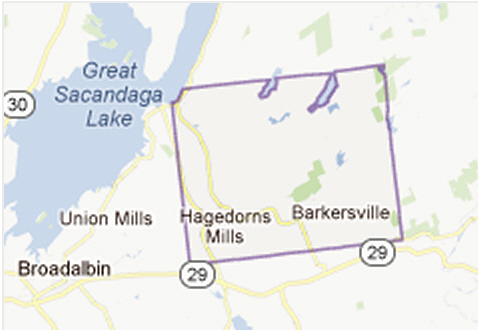
The Town of Providence is on the county’s western border and is west of Saratoga SpringsNew York.

Providence, Saratoga, New York

The area was settled before 1786, but that was the year of any definite settlement, located by Hagedorns Mills. The town was formed from part of the Town of Galway in 1796. The early economy was based on forestry with the harvesting of lumber, and the manufacture of pulpwood being important.

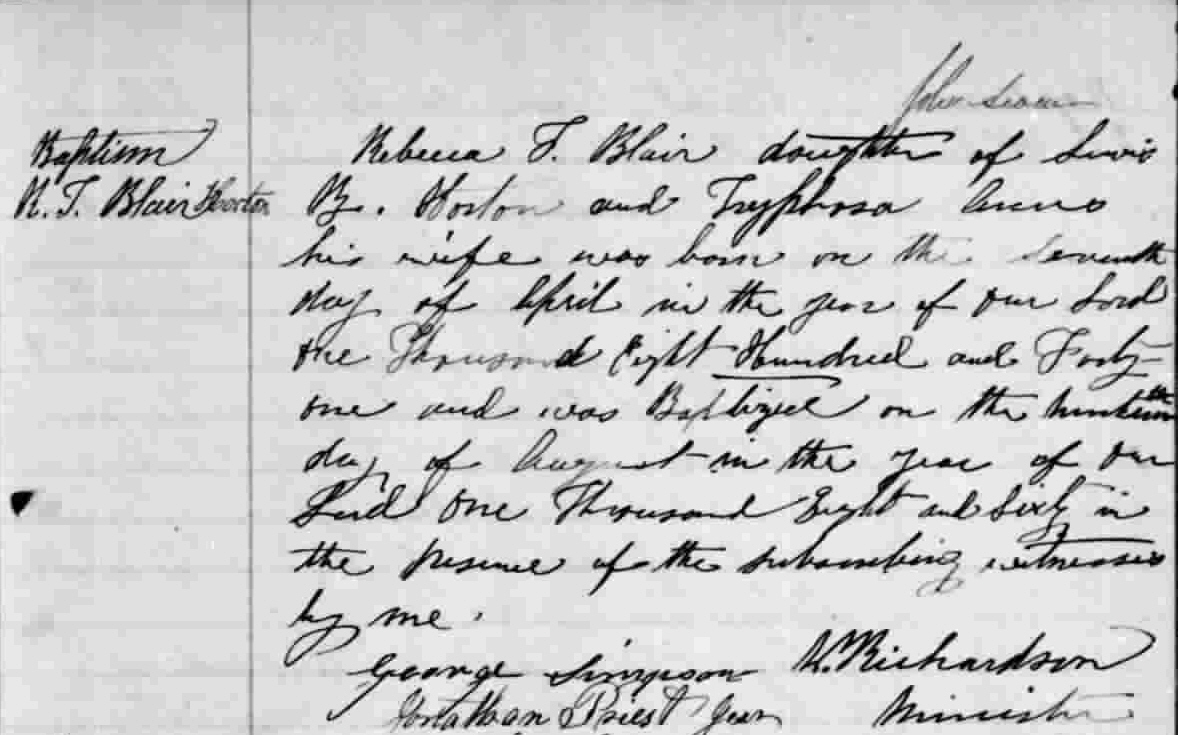
Rebecca’s adult baptism when she married Thomas BLAIR  She was baptized 19 Aug 1860 in Wesleyan Methodist Congregation in the Russelltown Circuit; Franklin Methodist, Huntington, Quebec.  Rebecca’s birthplace shows as USA in the 1881 Canadian census. Rebecca died 8 Apr 1927 at the age of 86 and is also buried in the Franklin Center Cemetery.

Rebecca Horton Baptism – 1860 Franklin, Quebec, Canada

The 1850 census shows Lewis and the baptism record shows Louis.  Lewis is probably correct.

In search of Royal Horton

My assumption is Royal Horton must be a family name.  I’ve found several men with that name living in 19th Century New England.  I’m still piecing together how they fit, but first, here’s a possible 1840 census record for Lewis:

In the 1840 census, there was a Lewis Horton (age 20 – 29)  living in Taunton Township, Bristol County, Massachusetts with one daugther (age 10-14) one son (under 5)  and a wife (age 20-29)

Suspect 1 ) – Rial Royal Horton

Rial Royal Horton was born 6 Mar 1794. His parents were Asa Horton (27 Nov 1765 Dighton, Bristol, Mass – Apr 1810, Charlotte, Vermont) and Mary Ingalls (21 Sep 1767 Rehobth, Mass – Aug 1811 Chester, Rockingham, New Hampshire) Asa and Mary married 3 Nov 1784 in Rehoboth, Bristol, Mass.

His grandparents were Jonathan Horton (b. 1 Jul 1733 Rehoboth, Mass. – d. 1774 Freetown, Bristol, Mass.) and Phebe Ormsbee (b. 1734 in Bristol, Rhode Island – d. Oct 1790) Jonathan and Phebe married 5 Dec 1754 in Warren, Rhode Island.

His great grandparents were Jonathan Horton (b. 1695 Rehoboth, Mass. -d . 20 Jun 1774, Rehoboth, , Mass) and Ann Millard (b. 12 Aug 1708 in Rehoboth, Mass – d. 14 Jul 1751 in Rehoboth, Mass.) Jonathan and Ann married 28 Oct 1725 in Rehoboth, Bristol, Mass.

His 2nd great grandparents were John Horton (b.6 Jun 1672 Milton, Norfolk, Mass. – d. 15 Oct 1742 Rehoboth, Bristol, Mass) and Mehitabel Garnsey (b. 2 Nov 1673 in Milton, Norfolk, Mass. – d. 15 Oct 1742 in Rehoboth) John and Mehitable married 1691 in Rehoboth, Bristol, Mass.

His 3rd great grandparents were Thomas Horton (b. 1638 Springfield, Hampden, Mass. – d. 8 Mar 1716 Rehoboth) and Susannah Keney (b. 18 Jul 1673 in Milton, Norfolk, Mass. d. Jun 1700 in Milton, Mass) Thomas and Susannah married 25 Dec 1693 in Milton, Norfolk, Mass.

His 4th great grandparents were Thomas Horton (b. 1602 Mousley, Leichestershire, England – d. 1641 Springfield, Hampden, Mass) and Mary Eddy (b. 10 Mar 1625 in Nayland, Suffolk, England – d. 19 Sep 1683 in Springfield, Hampden, Mass.) Thomas and Mary were married by 1632 in England.

Thomas, his wife, Mary and their first born child, Mary Horton, along with his brother, Jeremiah, soon followed their brother, Barnabas across the ocean in the ship, “John and Mary.” Thomas and Mary arrived in MA in early 1636 and left immediately for Windsor, Hartford, Connecticut, where their second child, Jeremiah Horton was born. According to Savage, Thomas and Mary removed to Springfield, MA by 1638, but Thomas’ name is listed in The History of Springfield on page 41, 1636 – Thomas Horton witnessed Indian Deed and died here 1641.

Thomas’ brother BARNABAS HORTON born 13 Jun 1600 in Mowsley, Leicestershire, England, died 1680 in Southold,Long Island, NY. Barnabas was a Puritan and decided to follow after Reverend Youngs when he,with some of his congregation, William Wells,Esq., Wm. Hallock, John Tuthill, Richard Terry, Thomas Mapes, Matthias Corwin, Robt. Ackerty, Jacob Corey, John Conklin, Isaac Arnold, John Budd and moved to America. Barnabas and his family wasn’t long in joining them. They left in about 1635 aboard the ship “Swallow” and landed at Hampden, Massachussetts. In 1640, Barnabas, his wife, Mary, and two sons and daughter, Joseph, Benjamin and Ann left for New Haven,CT. On the 21st day of Oct 1640, assisted by Reverend John Davenport and Gov. Eaton, they organized themselves into a Congregational Church and sailed to the east end of Long Island, now Southold. They crossed Long Island Sound, sailed up Peconic Bay and came ashore at Founder’s Landing. Barnabas died on the 13th day of July, 1680, aged eighty years. He was known as ‘Barnabas, The Old Puritan.” .

In the 1820 census, Royal Horton was living in Lysander Township, Onodaga County, New York.
Enumeration Date: August 7, 1820
Males – Under 10: 1  (Could be our Lewis)
Males – 26 thru 44: 1
Females – Under 10: 2
Females – 26 thru 44: 1
Number of Persons – Engaged in Agriculture: 1
Free White Persons – Under 16: 3
Free White Persons – Over 25: 2
Total Free White Persons: 5

Royal Horton continued to live in Lysander, New York in the 1830 and 1840 censuses.

1830
Males – 10 thru 14: 1 (Could be our Lewis)
Males – 30 thru 39: 1
Females – 10 thru 14: 2
Females – 30 thru 39: 1
Under 20: 3
20 thru 49: 2
Total All Persons: 5

1840
Males – 15 thru 19: 1
Males – 20 thru 29: 1 (Could be our Lewis)
Males – 40 thru 49: 1
Females – 10 thru 14: 1
Females – 20 thru 29: 1
Females – 40 thru 49: 1
Total – All Persons  6
Persons Employed in Agriculture: 3
Under 20: 2
– 20 thru 49: 4

One of Rial Royal’s brothers was Lovel Lewis Horton (4 Aug 1789 Berkshire, Mass – 17 Jun 1843  Hortontown Cemetery Lysander, Onondaga NY, near Lamson, NY) Today, Hortontown is a farm in the central part of the town. On 14 Sep 1818 [the same year our Lewis Horton was born]  in Lysander, Onondaga, New York, he married Sylvia Rathbun (19 May 1796 in Pittsfield, Mass – 4 Jan 1887 in New York)    His children :

i Julia Horton (1819 – 1887)
ii. Electa Horton (1820 – 1833)
iii. Ingalls Horton (1824 – 1825)
iv. Elizabeth Betsy L Horton (1825 – 1863)
v. Desdamonia Horton (1826 – 1900)
vi. Delzora Horton (1829 – 1879)
vii. Artemetia Horton (1830 – 1883)
viii. Ingalls Horton (1832 –
ix. Syntha Cyntha Horton (1839 – 1842)
x. Lovel Lewis Horton (1843 – 1928)

Suspect 2 – Royal and Polly Horton

There was a Royal and Polly Horton living in New Albion, Cattaraugus, New York (between Buffalo and Erie) in the 1850 census They were living with Hiram and Harriett Youngs and their children.

Royal Horton Age 56 b. abt 1794 Mass
Polly Horton 58 b. abt 1792 NY
Hiram Youngs 30
Harriet Youngs 30
Mary A Youngs 7
Edmund H Youngs 2
Hiram Warren 12
Amanda Youngs 23

Suspect 3 – Royal Horton and Eunice Lee

There was another Royal Horton born at Rehoboth, 18  Nov 1795. who was the son of Daniel Horton.    He married Eunice Lee 4 May 1823 – Rehoboth, Bristol, Massachusetts, too late to be our Lewis’s father.    However, Royal Horton is an unusual name, so there may be a connection.

In the 1840 census, there was a Royal Horton living in Rehoboth, Mass.  (Age 50 – 59) Wife (Age 50 – 59) 2 Males (Age 20 – 29) 2 Males (Age 10 – 14) for a total household of 6.  Two persons were employed in agriculture and one person was employed in trade/manufacturing.

There was another Royal Horton in the 1820 census in Rehoboth, Mass.  Royal and his wife were  between 26 and 44 years old.  They had 3 boys and 2 girls under 10.  Royal son of Daniel Horton, was born at Rehoboth, 18  Nov 1795 and would have been too young to already have five children by 1820.  The older Royal Horton appears again in the 1840 Rehoboth census.   He and his wife are 50 – 59 years old.  Two of their sons are 20 – 29 and two sons are 10- 14 years old for a total household of 6 persons.

Here is that Royal’s ancestry:

I. Thomas Horton  (b. 1638 Springfield, Hampden, Mass. – d. 8 Mar 1716 Rehoboth) and Susannah Keney (b. 18 Jul 1673 in Milton, Norfolk, Mass. d. Jun 1700 in Milton, Mass) Thomas and Susannah married 25 Dec 1693 in Milton, Norfolk, Mass.  He was also 3rd great grandfather of the other Royal Horton.

II. Solomon Horton, son of Thomas Horton, was born at Milton, Massachusetts, January 11, 1682. He married, at Milton, December 5, 1701, Susanna Babcock. Children, born at Milton: Sarah, 17 May 1702; Hannah, 19 Dec  1706; Anna, 12 Dec 1708; Solomon, about 1712-15.  Perhaps others.

(III) Solomon, son of Solomon (2) Horton, was born about 1712-15. He settled in Rehoboth. He married Mary . Children, born at Rehoboth: Charles, 18 Mar 1739; Constant, 29 Oct, 1740; Solomon, 15 Jan 1742/43; Mary, 10 Aug 1745; Abiall, 14 Oct 1747; Daniel, 30 Jan 1749/50; Aaron, 21 Mar 1752.

(IV) Daniel, son of Solomon (3) Horton, was born at Rehoboth, Jan 30, 1749/50. He was a soldier in the revolution, from his native town, a private in Captain Nathan Carpenter’s company, at Brookline, Massachusetts, in 1776; also in Captain Israel Hix’s company, Colonel Thomas Carpenter’s regiment, marching from Rehoboth to Bristol, Rhode Island, in December, 1776; also sergeant in Captain Israel Hix’s company in 1780. He married, in 1779, Mary Goff. Children, born in Rehoboth.

Children of Daniel and Mary

i. Nancy, 15 Oct 1780, died unmarried at Rehoboth

ii. Silvanus, 20 Sep 1782, married Hannah Slade, and lived at Rehoboth;  One of their two children was Henry Slade  Horton, born 19 Nov 1809, in Rehoboth, long the seat of the family, who  was a farmer all his life until he died 25 Jun 1858; he also was an auctioneer, and a town  office holder and selectman of Rehoboth; he  married Arabella Simmons, born in Aug 1809, daughter of Constant Simmons, of Dighton, Massachusetts, and died at the age of  eighty

iii. Simeon,  (27 Sep 1784 – 1833) , married Melvina (Lavina)  M. Wheeler;    The Wheeler and  Horton  Cemetery  in Rehoboth, Mass is located at “Horton’s Signal” and is one of the best private burial-places in the town, containing about half an acre and enclosed by an excellent wall. The stones are mostly granite and the yard is under perpetual care. Here is buried Shubael Wheeler, a soldier of the Revolution, born Sep. 29, 1758, in the old Wheeler House across the way, now gone. He died Feb 20, 1812. His father was Philip Wheeler, called Capt. Wheeler, born at Rehoboth, May 4, 1733. He was accepted by the D. A. R. as “Patriot.” His grandfather was Capt. Philip Wheeler, who died in Rehoboth Sept. 19,1765, in his 66th year. He is designated as “Colonel Wheeler.”  Shubael’s daughter, Lavina, married Simeon Horton, who with his wife is buried in the Wheeler and Horton yard.

He was descended from Solomon Horton of Dighton (Thomas,1 Solomon,2 Solomon Jr.,3 Daniel,4 born Jan. 30, 1749-50, Simeon6).

Some of his children are buried here;
– Daniel M., 1816-1893, with Adeline his wife, 1833-1872, and their son-in-law, Albert T. Cobb;
– Edward Hiram, 1820-1904, and his two wives Hannah and Maria (Nichols); Edward Hiram kept a store nearby for many years. His daughter Mary, wife of George D. Nichols, is buried here, and his nephew Hiram Kingman, and wife Isadore (Baker).
– George Leonard, 1824-1907, unmarried

iv. Rachel, 18 Jan 1787, married John Slade, and died at Somerset, Massachusetts;
v. Polly,  6 Aug 1789, married Isaiah Simmons, and died at Bristol, Rhode Island;
vi. Lettis, 22 Dec 1791, married George Case, and lived at Rehoboth;
vii. Royal, 18 Nov 1795 mentioned below.

V. Royal was son of Daniel Horton (4), was born at Rehoboth, 18  Nov 1795. He followed farming in his native town all his active life, except for a few years when he lived at Bristol Neck, and he died while in the prime of life. He married Eunice Lee 4 May 1823 – Rehoboth, Bristol, Massachusetts  .  Eunice married (second) Benjamin Childs. By her second husband she had one son, Benjamin Childs Jr., who married Emma Arnold, and died in Providence, Rhode Island.

Children of Royal Horton and Eunice Lee

1. Daniel, married (first) Harriet Amanda Tanner; (second) Mrs. Cornelia Rich ; he was a carpenter and real estate dealer in Providence; his daughter Isabel married Moses W. Horton.
2. Stephen,  b. abt 1827 Mass resided at Rehoboth, and died in Providence.
3. Nathan B., mentioned below.
4. Nancy Maria,  b. abt. 1830 Mass. married (first) John W. Cole; (second) Stephen Garland; she died in Providence in 1904; and her son, John W. Cole, resides in Providence.
5. Royal  b. abt. 1836 Rhode Island.  a retired jeweler, died in Barrington, Rhode Island, in December, 1910; married Helen M. Brown; children: Martha, married Charles F. Boyden, and Jennie, married Fred Smith

In the 1850 census, Royal was living with his brother Stephen in Rehoboth, Mass.

Stephen L Horton Age 23 b. abt 1827 Mass
Nancy Horton Age 20 b. abt. 1830 Mass.
Royal D Horton Age 14 b. abt. 1836 Rhode Island.
Benj M Childs Age 4 b. abt 1846 Rhode Island.

In the 1880 census  and 1900 census Royal D Horton was married and living in Barrington, Bristol, Rhode Island

Royal D. Horton –  Son of Royal (5) Horton and Eunice Lee; b. Bristol, R.I., June 28, 1835; m.  Helen M. Brown, Dec. 1, 1857; children: Walter, Martha, Dexter and Jennie Bucklin. Barrington, Rhode Island – Member Cong. Church.; member of school committee 25 years; a trustee of Public Library; chairman of Com. on Central bridge; member of Town Committee., and State Central Com., business, manufacturing jewelry.

Suspect 4 Gurdon Horton

Gurdon Horton was born 24 Feb 1791 in Union City, Tolland, CT. His parents were Deacon Ezra Horton (1761 – 1848) and Olive May (1765 – 1833) He married 1 May 1816 to Lucy Davidson. Gurdon died 18 May 1877.

Their first child Royal (Roysel), born 31 July, 1819; died 25 Sep 1820.

Another Lewis Horton

Lewis Benjamin Horton was born 25 May 1817 in  Columbus, NY.  His parents were Benjamin and Peninah Horton.  He married on 13 Feb 1850 in Coventry, Chenango, NY. to  Martha Anna Shapley (b. 23 Jun 1815 in Oxford or Guilford, NY)

Their son Albert Lewis Horton was born 3 Aug 1854 and prob. died bef. 1880.

Their grandson Leslie Albert Horton was born in 1873/74. In 1880, his parents he was living with his grandparents. He married Mertie Winston (b. Sep 1872, New York), daughter of Charles G. and Sarah Winston, in 1891. They lived in Coventry, Chenango, NY.

Possible Ames Suspects

Looking for parents of Elizabeth Amos, b. abt 1742. She married John Densmore (Dunsmoor), 15 Apr 1765, Hardwick, Worcester Co. MA. They had 7 children: Amos, John, Eliphalet, Tryphosa, Sophia, Susan, and Nancy. They migrated to Richfield, Otsego Co. NY abt 1792, and Elizabeth died there 13 Oct 1803.

It has been suggested that the name “Amos” might have been spelled “Ames”, “Eames” or “Eams” earlier, and that she could be Elizabeth Eames, d.o. Josiah and Anna Parmenter Eames, b. 7 Apr 1741, Norwich, CT.

Anyone who has information on Elizabeth’s parents, or can shed light on the Amos name derivation, please contact me through this message board, or at rudyskid@hotmail.com

Fisher Ames who married Clarissa Hudson on 8 Mar 1830 in Hinchinbrook PQ is a possible brother of Tryphosa

09-15-1869 Samuel Ernest Ames, son of Fisher Ames, Esq., Franklin Quebec, married Jessie Cain, daughter of David Cain, Esq., of Hinchinbrook, at the residence of the bride’s father, by Rev. George Rogers, Wisleyan minister.

Sources:

http://www.swquebec.ca/results.asp?ID=23543

http://www.rootsweb.ancestry.com/~qchuntin/gleaner/

http://dunhamwilcox.net/ri/barrington_ri_bios2.htm

New England families, genealogical and memorial: a record of the …, Volume 4 edited by William Richard Cutter

http://www.rootsweb.ancestry.com/~rigenweb/articles/163.html

http://freepages.genealogy.rootsweb.ancestry.com/~hortonfamilyhistory/THOMAS%20HORTON%20-%20REGICIDE.html

http://freepages.genealogy.rootsweb.ancestry.com/~hortonfamilyhistory/Solomon%20Horton-1681

A history of Rehoboth, Massachusetts: its history for 275 years, 1643-1918 …

http://freepages.genealogy.rootsweb.ancestry.com/~hortonfamilyhistory/Robert%20Horton.html

Posted in -6th Generation, Line - Blair, Missing Parents | 4 Comments

Gerrard Fennell

Gerrard FENNELL (1795 – 1868) was Alex’s 4th Great Grandfather; one of 32 in this generation of the Blair line.

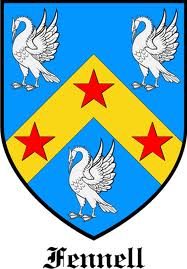
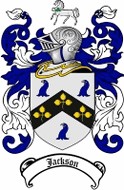
Gerrard Fennell Coat of Arms

Gerrard Fennell, also known as Garret, was born in Wicklow County, Ireland around 1795. He first married Margaret Gill.  After Margaret died, he married Susan WINTER on April 3, 1820 at Delgany, County Wicklow, Ireland.  After Susan died, he married his third wife, Ellen Simpson on 20 May  1852 at the Protestant Episcopal Church at Huntingdon and Parts Adjacent. He died at his residence in Hinchinbrook, Quebec Canada on 16 Feb 1868 in his 74th year. Witnesses: John Fennell; Sarah Fennell; Church: Wesleyan Methodist Congregation in the Russelltown Circuit; Franklin Methodist  Minister: Stephen Bond .

Map highlighting County Wicklow

Map highlighting County Wicklow

Margaret Gill was baptized in 1783 in Ireland, and died before 1820 in Ireland

Susan Winter was born 1785 in Delgany, Wicklow, Ireland.  Her parents William WINTER and Susannah [__?__].  Susan died 28 May 1849 in Hinchinbrook Twp. Quebec, Canada;  [Spouse Spouse: Garnett Fennel] Witnesses: Fennell, Garrett; Simpson, James; Cottingham, Samuel; Church: United Church of England and Ireland at Durham, Ormstown  Minister: William Brethour.

Ellen Simpson was born about 1818.   Her father was [Unknown] Simpson.    Ellen Simpson, relict of the late Gerald Fennell, died  19 Aug 1888 at the Gore, Hinchinbrook, age 70 years.

Children of Gerrard and Susan:

Name Born Married Departed
1. Martha FENNELL Mar 1821 County Wicklow,  Ireland Samuel CRUTCHFIELD Jr
20 Mar 1849 Protestant Episcopal Church At Huntingdon
16 Jul 1897 at the Gore, Hinchinbrook, Quebec
2. William Fennell 28 Aug 1822 Ireland Barbara Winter
Before 1853
6 Oct 1905 St. Malachi d’Ormstown
3. Robert Fennell 1824
Delgany, County Wicklow, Ireland
25 Apr 1844
Farmer
Hinchinbrook
Died by the fall of a tree
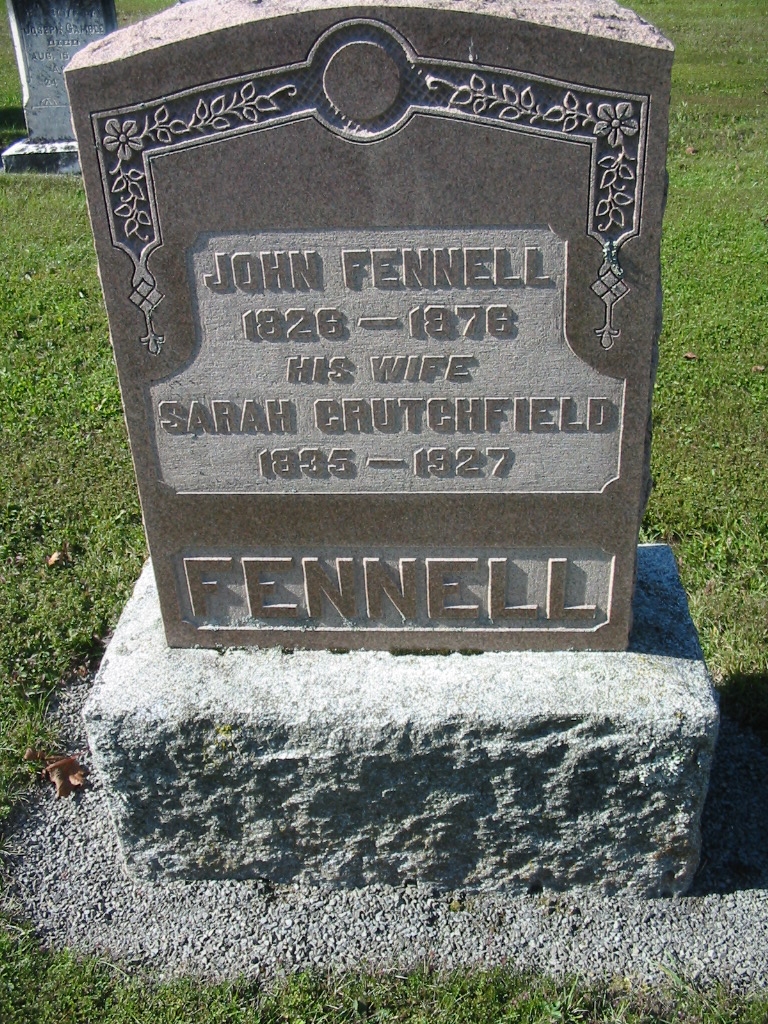
4. John Fennell 19 Mar 1826 Wicklow County, Ireland Sarah Crutchfield
(Samuel’s sister)
12 Sep 1854
Wesleyan Methodist Congregation in the Circuit of Huntingdon
21 Jun 1876 Hinchinbrook
5. Susana Fennell ca. Aug 1829 Ireland Edward Dawson
25 Feb 1851 Protestant Episcopal Church At Huntingdon
.
Edward Johnson
20 Apr 1888 at the Gore, Hinchinbrook

Gerrard’s first name is recorded many different ways:  Gerret, Gerald, Gerred, Garrard,  Gerrld, Garnett, and Girard .

Delgany (Irish: Deilgne, meaning “Thorny Place”) is a village in County Wicklow on the R762 road between Greystones and the N11 road at the Glen of the Downs. It is about 25 km  south of Dublin city centre.

It is a commuter village separated from the western edge of Greystones by the adjoining village of Killincarrig. There is a Church of Ireland parish church and the parish school Delgany National School and a Catholic Carmelite Convent in the village. Delgany is in the Roman Catholic parish of Kilquade and the parish church is located in Kilquade about 4 km south. The local Catholic school is St Laurence’s which is located on Convent Road between Delgany and Greystones. The village is surrounded by wooded hills (including Kindlestown Wood) and the Glen of the Downs.

Recently “The Old Burial Ground” has been restored and opened to the public. The one acre  site is protected and contains the ruins of a 13th century church, the stump of a 6th century high cross and graves dating from the 18th century.

In the 1990s, Delgany was the location for the recording of Tori Amos‘ third album Boys For Pele.

1852 Hinchinbrook Census
Fannell, Gerald Shoemaker Ireland Episcopalian 56 M 1795
Fannell, John Farmer Ireland Episcopalian 25 M 1826
Dorson, Edward Carpenter Ireland Episcopalian 22 M 1829
Fennell, Susana Ireland Episcopalian 23 F 1828

Gerald was a Shoemaker and an Espicopalian.

Children

1. Martha FENNELL (See Samuel CRUTCHFIELD Jr’s page)

07-16-1897 Martha FENNELL, relict of the late Samuel Crutchfield, died at the Gore, Hinchinbrook PQ, age 76 years 04 months. A native of County Wicklow, Ireland.

.

2. William A. Fennell

William arrived in North America by sailing ship as a boy. He  sailed from Cork with his parents and three brothers. Either the father of William, or one of his brothers, was a shoemaker, possibly in the state of Vermont. William Fennell and his wife, Barbara Winter, settled in or around Ormstown, Quebec.

William’s wife Barbara Winter was his first cousin.  She was born 16 Nov 1826  Her parents were John Winter and Margaret McKie. Her grandfather was William WINTER.  Barbara died 7 Apr 1911 at Ormstown PQ, aged 81 years. Witnesses: Fennell, R. G.; Fennell, Evelyn  Church: Wesleyan Methodist congregation Minister: T. Roy

Children of William and Barbara:

i. Susan Winter Fennell, b. 24 Nov 1853 at Huntington, Quebec;  Baptism date: 24 Feb 1854 Witnesses: Winters, Margaret (x); Fennell, Barbara; d. 2 May 1912 Holden, Mass; m. 18 May 1887 Worcester, Mass to Mansur Abbott Stone (b. 8 Oct 1848 in Rutland, Worcester, Mass – d. 1911)

In the 1900 census, Mansur and Susan were living in Worcester Ward 8, Worcester, Massachusetts where Mansur was a house carpenter.

ii. Robert Girard Fennell b. 28 Aug 1856 at Ormstown, Quebec; d. 21 Apr 1927 St. Paul’s United Church, Ormstown); m. 24 Jan 1883 English Episcopal Church in Canada at Franklin Centre and Places Adjacent. to Elizabeth “Lizzy” Bear Dawson (b. 1860 in Rockburn, Quebec – d. 2 Oct 1948) Her parents were William Dawson ( – 1927) and Elizabeth (Betty) Johnston

Robert Gerald was a mail courier.  Elizabeth was daughter of William Dawson (from Castledawson, Derry, N. Ireland?) and Elizabeth Johnston of Huntington Quebec, and had 6 children at Ormstown: Elizabeth came from a large family, and had a twin sister named Sarah. Sarah’s married name was probably Dewick. Robert and Elizabeth lost a set of twin boys Chester and Frank Johnston Fennell, b. and d.1896, and raised 4 other children: Ernest Alexander Fennell of Ormstown, b 1885, Eveline, b 1886 – d. Flu Epidemic of 1917, William Hermin b 1891, and Elsie b 1900.

Ernest married Hazel ?, worked as a mail-carrier with his faithful horse (“Barney”?), and died in Ormstown about 1975.

01-07-1945 Sarah Dawson, beloved wife of the late Charles Dewick, formerly of Huntingdon Québec, died at the residents of her daughter, Mrs. George Winter in Ormstown Québec, in her 85th year. She was daughter of the late William Dawson and his wife, Elizabeth Johnson, spending her early childhood at Rockburn. In 1894, she was united in marriage to the late Charles Dewick, of Huntingdon Québec, where she resided for 34 years, later moving to Ormstown. She leaves to mourn, one son, Charles E. of New London CT, and two daughters, Mrs. Mary G. Winter, of Ormstown, and Mrs. John A. Cluff of Valleyfield, two sisters, Mrs. Elizabeth Fennell of Montreal and Mrs. Stanley Flower of Vancouver BC, also six grandchildren. Funeral took place at Ormstown Québec on January 09, 1945

iii. Margaret “Maggie” Elizabeth Fennell (16 Jul 1859 at Ormstown, Que. – 27 Oct 1935  died at the home of her sister, Mrs. J. F.McCausland, Oak Hill Road, Fayville MA.)

Margaret Elizabeth Fennell, daughter of the late William Fennell and his wife, Barbara Crutchfield [Gleaner mistake, should be Barbara Winter], and sister of the late Robert Fennell of Ormstown PQ, died at the home of her sister, Mrs. J. F.McCausland, Oak Hill Road, Framingham, MA.

In the 1930 census, Margaret was living with her sister Barbara in Southborough, Worcester, Massachusetts. According to the census, she immigrated in 1878.

iv.  Barbara Wilhelmina “Minnie” Fennell, b. 3 Mar 1864 at Ormstown, Quebec; d. 20 Apr 1942 at Fayville Mass.; m. James F McCauseland (b. 1858 Ohio – ) In 1880, James first married Emma Geer (b. Oct 1857 Ohio – d. Aft 1900 Morgan, Ashtabula, Ohio)

In the 1920 census, Barbara and James were living in Southborough, Worcester, Mass/ where James was a rug and carpet merchant.

.

3. Robert Fennell

Robert was killed by a falling tree 25 Apr 1844 Hinchinbrooke.  He was buried 27 Apr 1844  Father Garret  Fennell; Witnesses: John Winter, William Winter, George Fennell  Church: Protestant Episcopal Church at Ormstown, Beauharnois, Chateauguay and Parts Adjacent  Minister: William Brethour .

4. John Fennell

John’s wife Sarah Crutchfield was born 5 Jan 1835 Ormstown Quebec. Her parents were Samuel CRUTCHFIELD Sr.  and Mary WOOLEY.  Sarah died 25 Jun 1927 in Huntington, Quebec.

The witnesses for John and Sarah’s 12 Sep 1854 marriage were John’s cousin William Winter and A McEachern.  Church: Wesleyan Methodist Congregation in the Circuit of Huntingdon Minister: Isaac Barber.

06-25-1927 Sarah Crutchfield, Widow of the late John Fennell, died at her home on the Gore, Hinchinbrook PQ, aged 92 years 05 months 20 days.  As you can see, Sarah was a widow for over fifty years.

John Fennell Headstone — Hillside Cemetery in Hinchinbrooke Township on Route 202 across the road from Rennie’s United Church.

Children of John Fennell and Sarah Crutchfield

i. Susanna Fennell b. 29 Oct 1855 Huntingdon, Quebec, Canada; bapt. 9 Mar 1856 Witnesses: Robert Brown and John Fennell Wesleyan Methodist Congregation In the Huntingdon Circuit; d. 5 April, 1937 in Roland, Manitoba, Canada; m. 3 Nov 1875 to Thomas Purse (b. 20 Mar 1846 in Hinchinbrook, Huntingdon, Quebec, Canada – d. 8 May 1899 in Roland, Manitoba, Canada)

Thomas Purse of Athelstan, Quebec. married Susanna Fennell, daughter of John Fennell, Esq., Hinchinbrook, at the residence of the bride’s father, by Rev. J. W. Chipsham. Wesleyan Methodist Congregation in the Russelltown Circuit; Franklin Methodist Witnesses: William Shearer, Matilda Crutchfield

ii. William Fennell b. 4 Aug 1857 Hinchinbrooke Wesleyan Methodist Congregation In the Circuit of Beauharnois; d.  8 Oct 1905 Methodist Church at Ormstown);  m. 7 Sep 1882 Methodist Church of Canada at Franklin Centre to Ellen J. McHardy (b. 1858 Huntingdon – d. 19 Aug 1902)

Ellen J. McHardy, relic of the late William Fennell, died at Huntingdon PQ, 19 Aug 1902 age 44 years, funeral today, Thursday, at 1 p.m., to Rennie’s graveyard.

28 Jul 1902 – William Fennell, late of the Gore, Hinchinbrook PQ, died at Huntingdon PQ, age 45 years

iii. Robert John Fennell b. 17 Aug 1859 Hinchinbrooke Wesleyan Methodist Congregation In the Circuit of Beauharnois; d. 3 Mar 1937 died of pneumonia, formerly of the Gore, Hinchinbrooke Québec, died at Rosebank Manitoba, age 78 years; m. Dora Halpin (b. 14 Mar 1872 – d. 28 Jul 1959 Roland, Manitoba)

07-12-1896 The wife of Robert Fennell, at Ormstown PQ, twin sons, one died same day.

iv. Sarah Ann Fennell b. 18 Aug 1861 Franklin; d. 2 Sep 1929 in Morden, Manitoba, Canada; m. Thomas Dickenson (b. 1858 Franklin Centre – d. 1928 Huntingdon, Quebec), of Franklin Center, Que., 28 Jun 1882 at the residence of the bride’s mother,Hinchinbrook Que., by Rev. J Carr. Methodist Church of Canada at Franklin Centre Witnesses: Thomas Dickenson, Sarah A. Fennell, John C. McHardy, Susie W. Crutchfield

12-26-1944 William Dickenson, eldest son of the late Thomas Dickenson and his wife, Sarah Fennell, died suddenly at R? Manitoba, in his 61st year.

v. Mary Emma Fennell b. 18 Feb 1864 Hinchinbrooke, County of Huntingdon and Province of Canada East; d. 8 Mar 1921 in Rosebrook, Brooklet, Quebec, Canada; m. 21 Feb 1883 at Methodist Church of Canada at Huntingdon tp James McCracken (b. 1850 Quebec) Witnesses: James McCracken, Emma Fennell, Samuel Edward Fennell, Sarah Jane Crutchfield; d.  8 Mar 1921 Witnesses: J. Alva Wilson, William A. Crutchfield. Aged in her 58th year; Buried in Rennie Cemetery Methodist Church at Franklin Centre)

03-08-1921 Mary Emma Fennell, beloved wife of James McCracken, died at Rosebank, Brooklet PQ, aged 57 years.

vi. Samuel Edward Fennell b. 6 Apr 1866 Hinchinbrooke; d. 2 Apr 1952 Roland, Manitoba; m1. 1 Jan 1890 Morden, Manitoba to Beatrice May Delong (b. 12 Jul 1869 in Hillier Township, Ontario, Canada – d. 18 Jan 1907 in Roland, Manitoba, Canada) ; m2. Levina Margaret Kelly (b. 4 Nov 1866 Huntingdon Quebec – d. 30 Mar 1951 Rowland, Manitoba)

20 Mar 1951 – Levina Kelly, beloved wife of S. E. Fennell, died at the Carmen Memorial Hospital in Rowland MB, in her 85th year. She married Mr. S. E. Fennell, of Rowland and went to Manitoba in 1910 that same year. She is survived by one stepdaughter, Mrs. Nelson Langtry, of Homewood, three stepsons, Ernest L., William F., of Winnebago, and L. Raymond of Fort Garry, also 9 grandchildren. A twin brother, Levi Kelly, predeceased her earlier this month in Huntingdon. Funeral services from the United Church, service conducted by the Rev. George Hambly.Interment at Rowland MB

vii. Martha Margaret “Maggie” Lily Fennell b. 20 Apr 1869 Hinchinbrooke in the County of Huntingdon, P. Q; d. 19 Jan 1903 Chateaugay New York; m. 26 Feb 1890 to William Lavery (b. 27 Apr 1861 in Chateaugay, Franklin, New York – d. 31 Jan 1903 in Chateaugay, Franklin, New York)

William Lavery of Chateaugay New York, married Lillie Fennell, of Hinchinbrook Quebec. At the residence of the brides mother, by Rev. George Cooper Poyser. Witnesses: William Lavery, Lillie Fennell, Thomas Dickinson, John Crutchfield

01-19-1903 Lillie M. Fennell, wife of William Lavery, died suddenly near Chateaugay New York, of acute Cellulitis, aged 33 years. Also on January 31, William Lavery, died of pneumonia,aged 39 years.

In the 1900 census, William and Martha were farrming in Chateaugay, Franklin, New York.

.

5. Susana Fennell

Susana’s husband Edward Dawson was born 5 Aug 1829 in Northern Ireland. He married Susanna 25 Feb 1851 Witnesses were  Gerred Fennell, John Crutchfield, Edward Dawson, and Susanna Fennell.   Edward was a carpenter. He died 27 May 1901 in Roland, Manitoba, Canada.

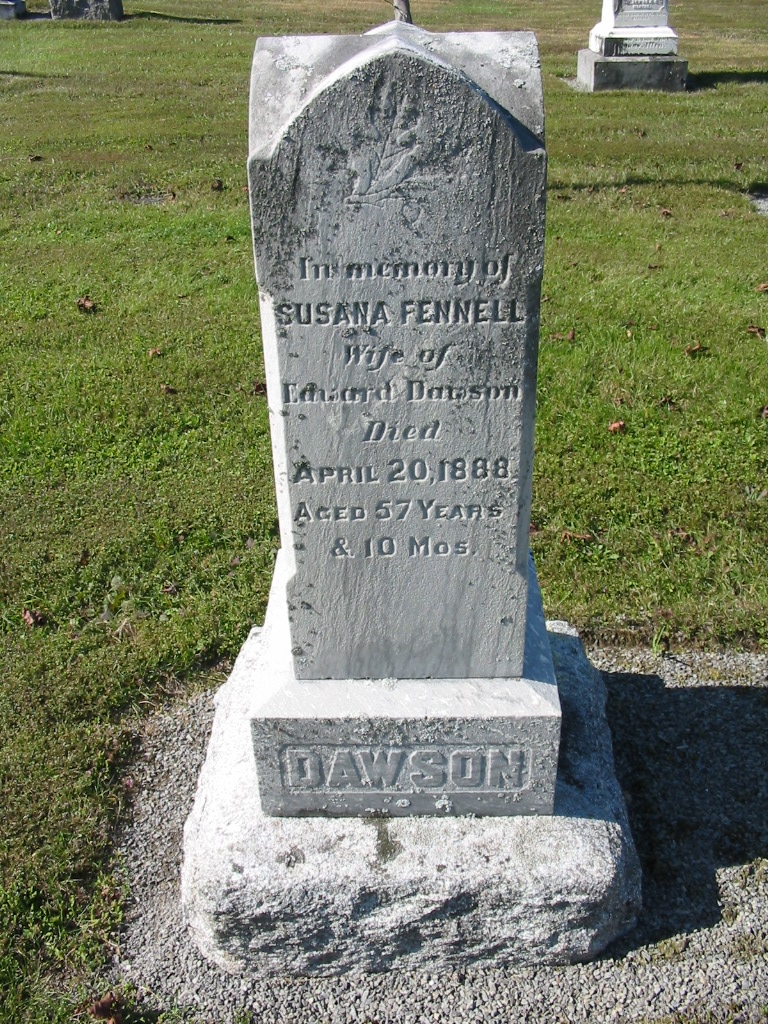
…04-20-1888 Susan Fennell, wife of Edward Johnson, died at the Gore, Hinchinbrook, age 58 years 08 months.

Susana Fennell Dawson Headstone — Hillside Cemetery

Children of Susana and Edward

i. Elizabeth Dawson b. 29 Oct 1852 bapt. 23 Jan 1852 Witnesses Edward Scarlett, Catherine Neely, J.W. Botham  Protestant Episcopal Church At Huntingdon and Parts Adjacent; d. 1931 Roland, Manitoba; m. Huntingdon, Quebec to Thomas Gilligan (b. 1846 Quebec – d. 1939)

ii. Susanna Dawson b. 1855 Huntingdon, Quebec

iii. Martha Jane Dawson is recorded in the records of the Wesleyan Methodist Congregation in the Circuit of Beauharnois, as the daughter of Edward Dawson, yeoman of Hinchinbrooke, and Susanne Fennell, born 10 Jul 1857 and christened, 23 Aug 1857.  Minister, W Hansford and witness, Mary M Winter;  d. 14 Nov 1941 General Hospital, Vancouver, B.C.

Length of time in Province: 31 Years
Length of time in Vancouver: 22 Years
Age at Death:: 83 years, 4 months, 4 days
married William Akister Lambe
Date of Death: October 28, 1932
Place of Death: 1101 Melville Street, Vancouver, B.C.
Residence: 1101 Melville Street,Vancouver, B.C.
Age at Death: 72 Years, 1 month, 6 days
Racial Origin: English
Birthdate: September 22, 1860
Birthplace: Quebec
Occupation: Stone Mason (Retired)
Lived in Province: 23 Years

iv. Mary Dawson b. 12 Nov 1859 bapt. 27 Apr 1860; Witnesses Edward Dawson, Susanna Dawson.  Wesleyan Methodist Church in the Ormstown Circuit

v. William John Dawson b. 1867; d. 9 Feb 1884 Huntingdon, Quebec

vi. Samuel Edward Dawson b. 29 Aug 1869 bapt. 13 Feb 1870 Wesleyan Methodist Congregation in the Russelltown Circuit; Franklin Methodist d. 1958 Roland, Manitoba; m. Beatrice May Delong (b. 12 Jul 1869 in Hillier Township, Ontario, Canada – d. 18 Jan 1907 in Roland, Manitoba, Canada)

vii. Frederick Thomas Dawson b. 28 Jan 1874 bapt. 17 Aug 1874  Wesleyan Methodist Congregation in the Russelltown Circuit; Franklin Methodist; d. 16 Jun 1954 in Winnipeg, Manitoba; m. Anne Jane Evaline Scott (b. 20 Aug 1873 in Osgoode Twp., Ontario – d. 15 Oct 1942

Other Fennells

William John Fennell Married Sarah Jane Rowe. Their daughter  Susan Strange Fennell was born 18 Oct 1851 St. Johns, Huntingdon county and the seigniories of Beauharnois & Châteauguay Baptism date: 19 Feb 1852 Witnesses: Fennell, W. J.; Rowe, S. J.; Davis, Jane Wesleyan Methodist Congregation in the Circuit of St. Johns, C.E.  Minister: George H. Davis

Source:

http://www.genealogy.com/genealogy/users/f/e/n/Loladawn-Fennell/index.html

http://www.rootsweb.ancestry.com/~qchuntin/gleaner/

http://www.swquebec.ca/results.asp?ID=16010

http://automatedgenealogy.com/census52/

http://www.rootsweb.ancestry.com/~qchuntin/cemetery/hillside/pix/index.htm

http://www.genealogy.com/genealogy/users/f/e/n/Loladawn-Fennell/index.html

http://trees.ancestry.com/tree/28024171/person/12001753727

http://www.genealogy.com/genealogy/users/f/e/n/Loladawn-Fennell/index.html

http://trees.ancestry.com/owt/person.aspx?pid=212152316

http://www.swquebec.ca/church_registers/ASP_net_files/surname_search.aspx

ruthfennell@yahoo.ca

Posted in -6th Generation, Immigrant - North America, Immigrant - Scot-Irish, Line - Blair | Tagged | 3 Comments

Danyell Broadley de West Morton

Major Danyell BROADLEY de West Morton (1589 –  1641) was Alex’s 10th Great Grandfather; one of 2,048 in this generation of the Shaw line through his son Samuell. Danyell  was also Alex’s 10th Great Grandfather; one of 2,048 in this generation of the Miller line through his son Daniel which didn’t come back together for over 300 years when I was born.

Danyell Broadley de West Morton was baptized on 26 Jan 1588/89 in Bingley, Yorkshire, England.  His parents were William BRADLEY (1545 – 1600) and Agnes MARGATES (1573 – 1603)   He married  Elsabeth ATKINSON on 1 Jul 1607 in Bingley.  After Elsabeth died, he married (2) Annis Holdroide Liaison.   After Annis died, he married (3) Elizabeth Sheaffe about 1631.   Danyell died in Ulster, Ireland and was buried on 27 Nov 1641 in Bingley, Yorkshire, England.

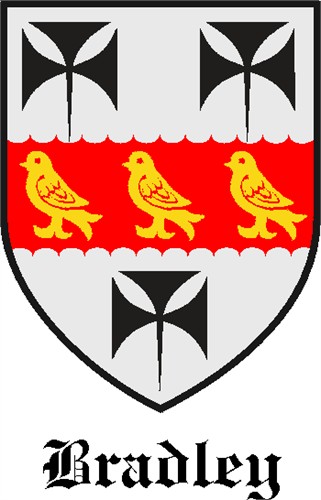
The Broadleys were exceptional among our ancestors having a coat of arms at the time of their immigration

Elsabeth Atkinson was born about 1589 in Yorkshire, England and died about 1625 in Yorkshire, England.

Elizabeth Sheaffe was born about 1601.  With her four sons and one daughter and some of the younger step children, she is said to have followed her son William to America in 1648. She married (second) in this country, John Parmalee, who died 8 Nov 1659;  married (third)  27 May 1663, John Evarts, who died 10 May 1669. Both her American husbands were of Guilford, Connecticut.  Elizabeth died in January, 1683 in New Haven, CT.

Children of Danyell and Elsabeth:

  Name Born Married Departed
1. Agnes Broadley 22 Nov 1607 Bingley, Yorkshire, England    1614
Bingley, England
2. Maj. William Broadley 27 Jan 1609/1610 Shipley (Bradford), Yorkshire, England Alice Pritchard
15 Feb 1644/45 Springfield, Mass
29 May 1691
New Haven, CT
3. Daniel BROADLEY 29 Aug 1613 Bingley, England Mary WILLIAMS
21 May 1662 Haverhill
13 Aug 1689
Haverhill, Mass,
Killed by Indians
4. Mathew Broadley 3 Mar 1615/1616 Bingley (Newclose), England.    
5. Michael Broadley 14 Nov 1619
Bingley,
England
Elizabeth Stones
4 Nov 1653 Bingley
After 1698
England (Did not emmigrate)
6. Samuell BROADLEY c. 1620
Bingley  (or Shipley) Yorkshire, England
[__?__] Long Island, NYY (problaby Southold)
7. Abraham Broadley 17 Apr 1622 Bingley, England    
8. Marie Broadley 27 Dec 1624 Bingley, England Thomas Leaver
1 Sep 1643
Rowley, Mass
26 Dec. 1683
Rowley, Mass

.
Children of Danyell and Annis Holroide Liaison

  Name Born Married Departed
9. Esther Broadley 10 Dec 1626
Bingley, England
   21 Dec 1626
Bingley, England

Children of Danyell and Elizabeth Sheaffe:

  Name Born Married Departed
10. Ellen Broadley  24 Jun 1632 Bingley, England  John Alling 14 Oct 1652 Guilford, New Haven, CT 1683
New Haven, CT
11. Joshua Broadley  1 May 1634
Bingley, England
Judith Lume
26 May 1663
Rowley, Mass
Aft. 1717
Woodbridge, NJ
12. Daniel Broadley 8 May 1636
Bingley, England
   4 Jan 1657/58
New Haven, CT
13. Nathan Broadley 18 Nov 1639
Bingley, England
 Esther (Hester) Griswold
1668
.
Mrs. Hannah (Munson) Tuttle
21 Aug 1694
.
Mrs. Rachel (Holton) Strong
16 May 1698
10 Mar 1712/13
Madison, New Haven, CT
14. Capt. Stephen Broadley  21 Aug 1642
Bingley, England
Hannah Smith
1 Nov 1663
New Haven, CT
 20 Jun 1702
Guilford, CY

Parents, Siblings and Ancestors

William Broadley ,
William Broodeley ,
John Broodeley ,
Thomas Broodeley ,
William de Brodelegh ,
John de Brodelegh ,
John de Bradelay ,
Henry de Bradelay ,
William de Bradelay ,
John de Bradelay ,
Richard de Bradelay ,
Dolphin de Bradelay ,
a daughter of Dolphin Thorfinnsson ,
Dolphin (Bodin) Thorfinnsson of Appletreewick ,
Thorfinn II Sigurdsson ,
Doda Olith of Thora ,
Malcolm II of Alba ,
Kenneth II of Alba ,
Malcolm I ,
Donald II of Alba ,
Constantine II of Alba ,
Kenneth I MacAlpin ,
Alpin of Kintyre ,
Eochaidh IV Rinnamail “the venomous” of Argyll ,
Aedh Fionn the White of Argyll ,
Eochaid III macEchdach ,
Eochaidh II “Crook-Nose” ,
Domangart II macDonnaill ,
Domnall I “the Speckled” of Argyll ,
Eochaidh Buidhe macAidan ,
Aidan macGabhran ,
Gabhran macDomangairt (Goramus) ,
Domangart Réti macFergusson ,
Fergus Mor macEarca ,
Muireadhach ,
Eóghan (Owen) macNéill ,
Niall Mór “of the 9 hostages” ,

Eochaidh Moihmeodhain (Echu Mugmedón) ,
Muirreadhach Tireach ,
9. Alofe (Aife) , married Fiachadh III Streabhruine , 120th Ard Righ of Ireland son of Cairbre Liffeachaire (Carbry of the Leffey) , Ard Righ of Ireland and a daughter of a Prince of the Hebrides. Fiachadh was born about 290. He died in 322
8. a grandchild of King Cole,
7. a child of King Cole ,
6. Coel I “Old King Cole” , King of Siluria (125 – 170),
5. Meric (Marius) ,
4. Genvissa (Venus Julia) ,
3. Claudius Cæsar (Tiberius Claudius Nero Germanicus) ,
2. Antonia Minor , Before moving to Egypt, Mark had several wives in Rome. One of them was Octavia Major and they had a daughter, Antonia Minor.
1. Marcus Antonius See my blog page Marcus ANTONIUS

Danyell’s father William BRADLEY was born Bet. 1545 – 1555 in Coventry, Warwick, England, and died July 19, 1600 in Newclose Farm, Shipley, Parish of Bradford, England. He married Agnes Angeta MARGATES 1584 in Coventry, England, daughter of Thomas MARGATES   Agnes was born Bet. 1565 – 1573 in Reseden, Northamptonshire, England, and died February 01, 1602/03 in Bradford, England.

Children of William and Agnes: (Danyell’s siblings)

i. Daniel (BROADLEY)  BRADLEY, b. January 26, 1588/89, Shipley, Bradford, West Yorkshire, England; d. November 27, 1641, Bingley, West Yorkshire, England; m. Elizabeth SHEAFE, Abt. 1637; b. 1610, Bingley, West Yorkshire, England; d. January 1682/83, Guilford, New Haven, Ct.

ii. Michael Bradley , b. 1587.

iii. Sarah Bradley , b. 1590.

iv. Samuel Bradley , b. April 15, 1591.

v. Thomas Bradley , b. December 09, 1593.

vi. William (Broadley) Bradley [Sir], b. April 1597, Coventry, Warwickshire, England; d. 1653.

Biography

Daniel Bradley (1589-1641) may have been the father of both immigrant William Bradley (1610-1691) and immigrant Ellen Bradley (1632-1683).  It is believed that Daniel Bradley (1589-1641) married first in 1607 and had perhaps 8 children including William Bradley (1610-1691) and that he married third in about 1631 and had 5 children including Ellen Bradley (1632-1683).  Other children from these unions are also believed to have immigrated to America during colonial times.  Daniel Bradley (Haverhill, MA), Michael Bradley (NY), Samuel Bradley (probably a son, probably of NY), Marie Bradley (married Thomas Leaver; Rowley, MA) from Daniel Bradley’s (1589-1641) first marriage are often cited.  And all 5 children of the third marriage are believed to have immigrated to America with their widowed mother Elizabeth Sheaffe Bradley “to join step-son William Bradley” at New Haven, CT by 1648.  Daniel Bradley (1589-1641) of “West Morton” and his children were from the Bingley, Shipley, Bradford area of West Yorkshire, England.

23 Jul 1634 –  A Bingley Register shewinge in what Pewes or Stalls every Househoulder inhabitinge wthin the p’ishe of Bingley hath his seat or seats for his house or houses in the Church of Bingley … In the second Stall, …  Daniell Broadley de West Morton for Butlers farme, … have auncient seats…  Bingley was a center for Puritan sympathizers and because of their persecution prior to the Civil War many of them emigrated to New England.

Children

2. William Bradley

William’s wife Alice Pritchard was born about 1620 in England. Her parents were Roger Pritchard (1588 – 1670) and Elizabeth Prudden (1620 – 1715). Alice died in 1692 in New Haven, New Haven, CT.

Immigrant William Bradley (1610-1691) was born and raised in England.  His parentage is debated.  [Particularly Daniel Bradley and Elizabeth Atikinson, or  his brother Sir William Bradley and Joanna Waddington]  Birthdates of 27 Jan 1610 (christening 08 Jul 1621) and of 04 Sep 1619 are both listed for him in the West Yorkshire area mentioned above.  Definitive birth information is sought.

Tradition says that William Bradley was a friend of Cromwell’s and a major in the Parliamentary Army, “but wanted to live where he could worship according to his own belief”.  This from a letter found in an attic.  It is documented that William Bradley immigrated in 1637 as part of the Davenport-Eaton Expedition.  This group was led by Puritans Theophilus Eaton and William Davenport and it left England in May of 1637 and arrived at Boston Harbor in the Massachusetts Bay Colony in June of 1637.

When it became obvious that there wasn’t a suitable place to settle in Massachusetts, a party was sent to inspect the Quinnipiac area in August of 1637.  In March of 1638 the entire party left Massachusetts to travel to their new home in the Quinnipiac area at which they arrived on 24 April 1638.  The Quinnipiac Indians were friendly and willingly sold land to the new English settlers.  they reserved hunting and fishing rights there for themselves.  The Davenport-Eaton Company bought the land that stretches from the coast of what is now Milford to Guilford Connecticut and inland to include what is now Bethany, Cheshire, Meriden, Orange, Prospect, Wallingford, and Woodbridge for 12 coats and 12 spoons and 12 hatchetts and 12 hoes and 2 dozen knives and 12 “porengers” and 4 cases of French knives.  In a later agreement the Indians received a reservation of more than a thousand acres in the East Haven-Morris Cove area.  The settlers and Indians remained on friendly terms.  The settlers lived in shelters dug into the ground (a far cry from what they were accustomed to in their former affluent lives) during the 3-year building period.

In June of 1639 the church was organized.  This was why they immigrated in the first place.  They voted that the Scriptures provided “a perfect rule” for the governing of men.  In Oct 1639 the civil government was organized.  In 1641 they moved into the completed settlement that had come to be called New Haven.  In May of 1643 the colonies of Plymouth and Massachusetts and Connecticut and New Haven sent representatives to Boston to create The New England Confederation for mutual defense and benefit.  William Bradley and every man there took the Oath of Fidelity in August of 1644.  In 1645 William Bradley was listed as canoe viewer and fence viewer.  William Bradley lived in New Haven, CT in what is now North Haven and owned much land on the west side of the Quinnipiac (East) River about 9 miles north of present-day New Haven.  William Bradley married Alice Prichard (1624-1692) at Springfield, MA in 1645 and they settled at New Haven, CT and raised 8 children there.

By 1648, William was followed by his step-mother,  Elizabeth Sheaffe,  and her little children, Ellen, Daniel, Joshua, Nathan, and Stephen.

William Bradley was a Townsman for 1656 and 1657 and 1658 and perhaps longer.  William Bradley was Deputy to the General Court in 1676.  His will was dated 22 June 1683 and his estate inventory was done in May of 1692.

3. Daniel BROADLEY (See his page)

8 Apr 1635 – Danyell’s son Daniell immigrated and embarked on the “Elizabeth” of London.

5. Michael Broadley

Michael’s wife Elizabeth Stones was born about 1630 in Bingley, Yorkshire, England

6. Samuell BROADLEY (See his page)

8. Marie Broadley

Marie’s husband Thomas Leaver was born about 1615 in Somerset, England. His parents were Thomas Leaver and [__?__]. Thomas died 26 Dec 1683 in Rowley, Essex, Mass

10. Ellen Bradley

Ellen’s husband John Alling was born 22 Nov 1629 in England. John died 26 March 1691 in Guilford, New Haven, CT.

His name may have originally been “Allen”, but it is clear that he went by “Alling” after he immigrated to America and settled in the New Haven Colony there.  John  married at Guilford or New Haven in 1652 to Ellen Bradley (1632-1700) and they had 8 children.  John took the Oath of Fidelity on 04 April 1654 and was on the 04 April 1658 Freeman list.  John Alling “was an energetic and successful planter and stood well among the early settlers of the colony”.  It is unclear whether these Allings lived at Guilford, New Haven, CT or at New Haven, New Haven, CT or if they moved from one to the other.  John’s will was dated 06 May 1689 and the estate inventory was 26 March 1691.  He left land to both of his sons.  Son John Alling (1663-1717) received a farm and home on Homes Race.  Son Samuel Alling (1670-1744) received the family homestead (farm and house) and was to care for his mother there.  Records indicate that mother Ellen Bradley Alling (1632-1700) and son Samuel Alling (1670-1744) both died at Hampden (previously a part of New Haven, New Haven, CT), New Haven, CT and it is unclear if that is where the family homestead was or if they moved there after husband/father John Alling’s (1629-1691) death.

13. Nathan Bradley

Nathan’s first wife  Esther (Hester) Griswold was born 8 May 1648 in Bingley, Yorkshire, England. Her parents were Michael Griswold and Ann Adams. Esther died 21 Aug 1694 in Madison, New Haven, CT.

John’s second wife Hannah Munson was born 1 Jun 1648. Her parents were Thomas Munson and Johannah [__?__]. She first married 2 Mar 1667 Age: 18 to Joseph Tuttle. Hannah died 20 Nov 1695 in Guilford, CT.

John’s third wife Rachel Holton was born 1640 in Northampton, Hampshire, Mass. Her parents were William Holton (1610 – 1691) and Mary Winche (1612 – 1691). She first married 10 Oct 1671 in Northampton Age: 31 to Thomas Strong. Rachel died in 1714 in Madison, CT was the widow of Thomas Strong.

From the “Connecticut Historical Collections” by John Warner Barber published in 1836 and now out of print.

“Mr. Nathan Bradley was one of the first settlers of New Haven, he built his house about two and a half miles eastward of Madison Church and near the Killingworth line. He was but a lad when he came from England he intended to land at New Haven but was obliged to land at Saybrook and come across the wilderness to New Haven then being in settlement at that time.

Mr. Bradley was quite a hunter and was the first white person to discover the source of the Hammonassett River which originates in a pond still called ‘Nathan’s Pond’. Mr. Bradley lived to an advanced age and he killed several hundred bears while residing in this town. Mr. Bradley in his old age went out to see a friend who lived about a mile northerly from the present meetinghouse in Madison.

On his way he met a bear and her cubs. He endeavored to ride around her but as he moved, the bear moved, and when he stopped, she stopped and sitting on her haunches presented an undaunted front and determined to oppose his further passage. Mr. Bradley in his old age being somewhat childish, was obliged to turn back, shed tears that he had killed so many bears should be obliged to turn back on one of them.”

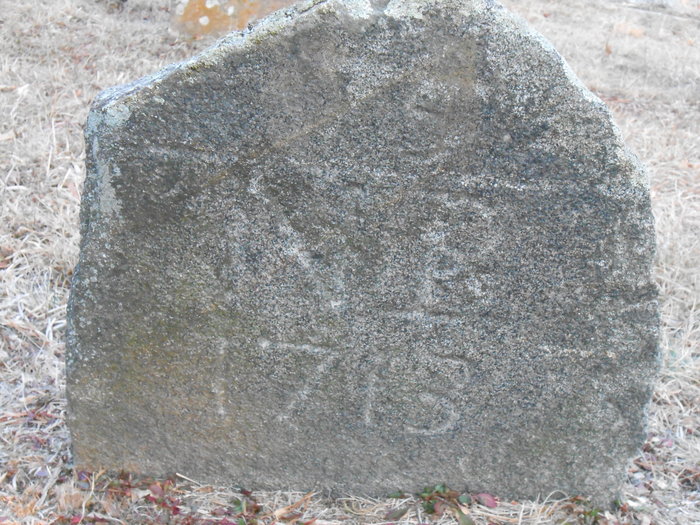
Adjoining the Murray gravestones in the Old Hammonassett Cemetery is a curious marker, which is apparently that of Nathan Bradley. This marker consists of rough natural stone, on which is crudely cut or chiseled “75- N.IL-17 13” in three lines parallel. The New England Genealogical ~ Historical Register, Vol 57 states that Nathan Bradley was born in 1638 and died in 1713 and the letters N.B. for his name.

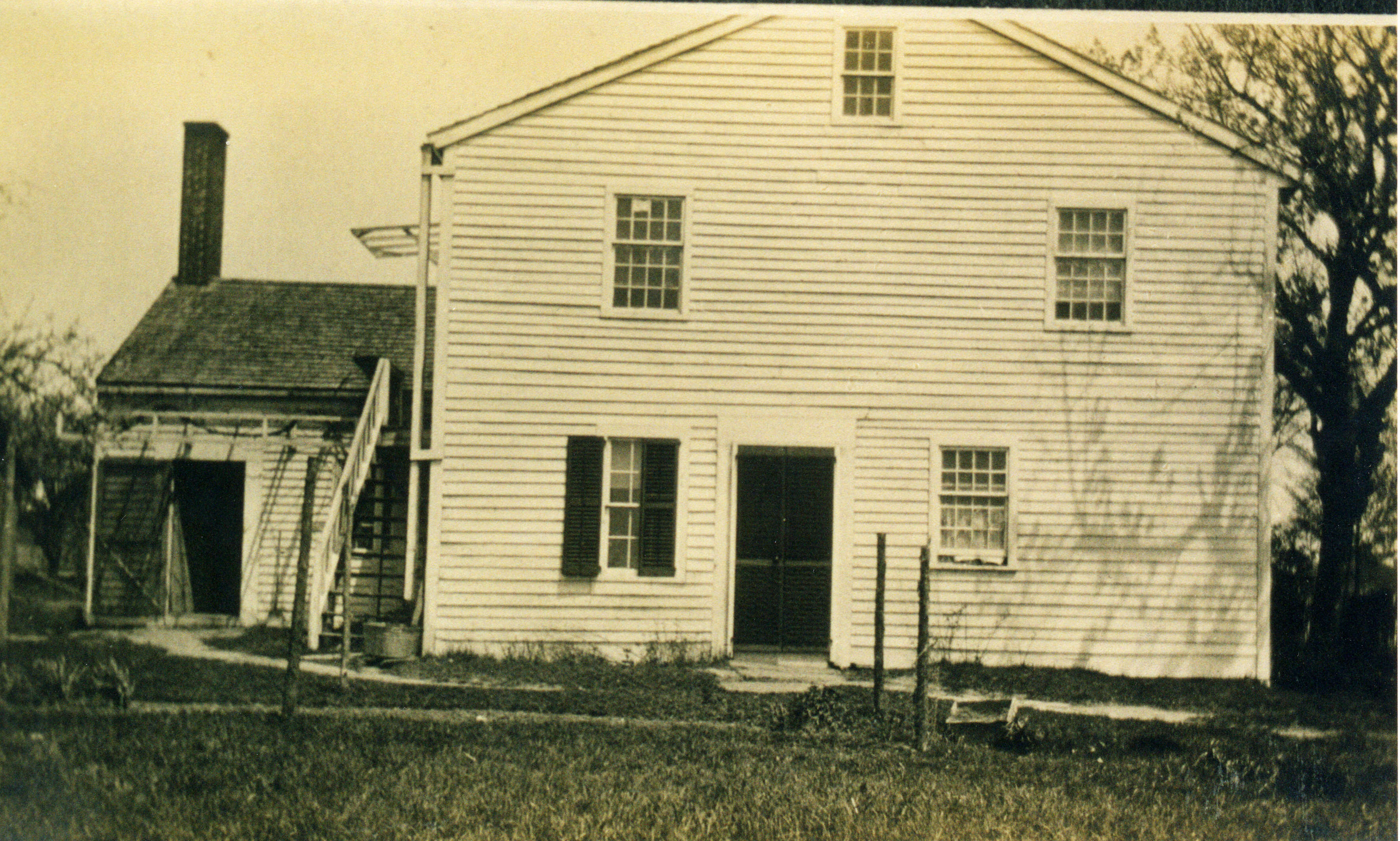
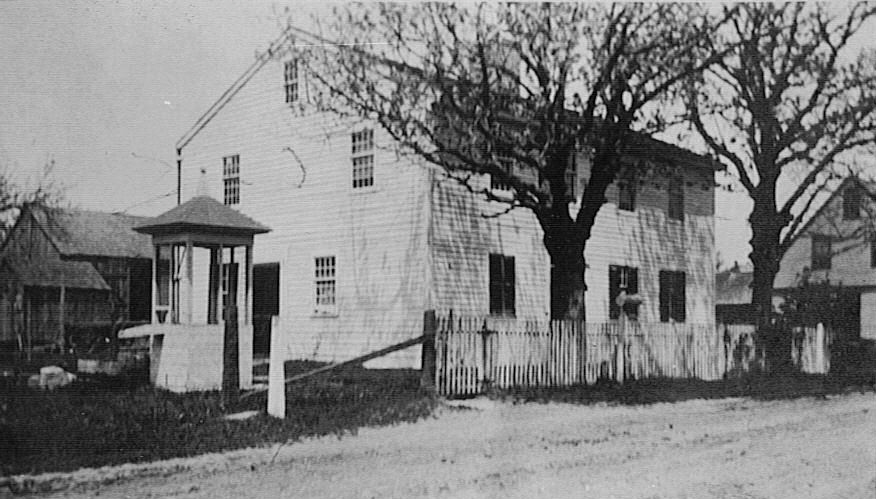
Nathan Bradley Home

Nathan Bradley Home on Dudley Lane. It was torn down when Hammonasset Beach State Park was built. The State Park office and maintenance bldg is on the property now.

20100613_6

Nathan Bradley’s home was located on Dudley Lane, Madison, CT now Hammonasset Beach State Park

Nathan Bradley Home

Nathan Bradley Home. When it was first built it was a Cape Cod style with a high roof and an upstairs. They raised the roof which made it into a full upstairs.

Nathan Bradley Headstone - Hammonasset Cemetery, Madison, New Haven, - Source:  Find A Grave Memorial# 18822557

Nathan Bradley Headstone – Hammonasset Cemetery, Madison, New Haven, – Source: Find A Grave Memorial# 18822557

14. Capt. Steven Broadley

Stephen’s wife Hannah Smith was born 1642 in New Haven, New Haven, CT. Her parents were Nehemiah SMITH and Sarah Ann BOURNE. Hannah died in 1676 in Guilford, New Haven, CT.

Stephen served in the military Ensign of Dragoons raised in New Haven in 1690 in King William’s War. He served in the military Captain of the Trainband in 1698 in New Haven.

Sources:

http://www.bradleyfoundation.org/genealogies/Bingley/tobg01.htm#11136

http://www.scribd.com/doc/27688745/Bradley-Genealogy

http://trees.ancestry.com/tree/14834791/person/1106082277

Posted in 12th Generation, Double Ancestors, Immigrant - England, Immigrant Coat of Arms, Line - Shaw, Place Names | Tagged , , | 25 Comments

Samuell Broadley

Samuell BROADLEY (1619 – aft. 1667) was Alex’s 9th Great Grandfather; one of 1,024 in this generation of the Shaw line. His daughter Sarah married one of the richest men in New York and then as a young double widow married the famous Captain William Kidd.

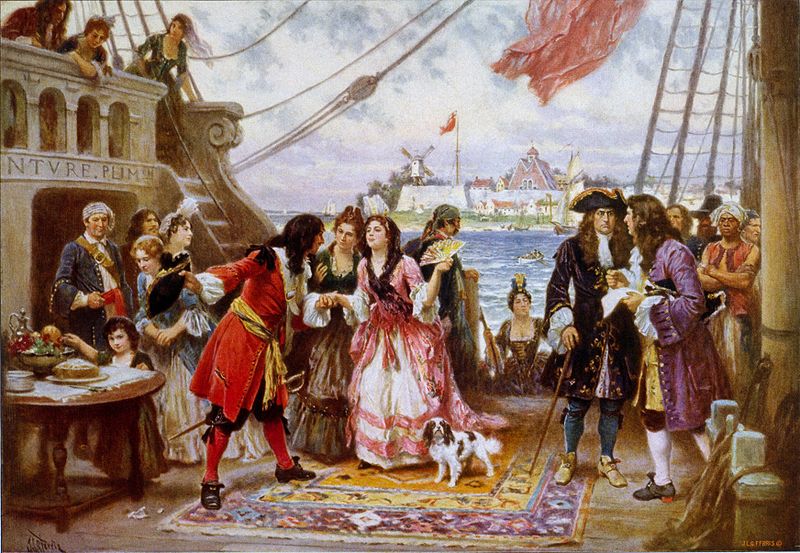
Captain Kidd in New York Harbor 1922 –  Captain William Kidd welcoming a young woman on board his ship; other men and women crowd the deck as another woman steps aboard.   Jean Leon Gerome Ferris (1863–1930)

Samuell Broadley was born 14 Nov 1619 in Bingley (or Shipley) Yorkshire, England.  His parents were Danyell BROADLEY de WEST MORTON and Elsabeth ATKINSON A tradition handed down in several branches of the family states that his father was a friend of Cromwell. His stepmother Elizabeth and her children and stepchildren followed his oldest brother William to New England. He married [__?__]. Samuell died in Long Island, NY (problaby in Southold) after 1667.

Children of Samuell and [__?__]

Name Born Married Departed
1. James Bradley ca. 1640
Long Island, NY
Sep 1704
2. Samuel Bradley ca. 1642
Long Island, NY
Apr 1703 New York, NY
3. Peter Bradley ca. 1655
Long Island, NY
Mary [__?__]
ca. 1677
Long Island, NY
4. Henry BRADLEY ca. 1660 Dorchester, Mass or in Long Island NY. Judith BROWN
7 Jan 1695/96 in Newbury, Mass
before Jul 1735 Dorchester, Maryland.
5. Sarah Bradley 1665
New York
William Cox
1685
New York, NY
.
John Oort
after 1689 in New York
.
the famous Captain William Kidd
16 May 1691 New York, NY
.
Christopher Rousby
4 Nov 1703
12 Sep 1744
New York
6. George Bradley 1667 in Connecticut Hannah Braman
29 May 1717
Tolland, CT
20 Apr 1741 in Tolland, CT

x
Chiildren

2. Samuel Bradley

Samuel’s brother-in-law William Cox was very generous to Samuel in his will, making him a rich man.  Here’s the pertinent excerpt,

I give and bequeath to Samuel Bradley, my brother in law, my other house which I bought of Mr. John Robinson, or that house I now live in, my wife taking her choice.” “If God send my brother in law an heir, he shall call his name Cox Bradley and his children after him the same name.” I leave to Henry Bradley all my right to a piece of land at the mill, and all things thereon, and £100 when of age. Rest of property is left to his wife Sarah and his brother in law Samuel Bradley. .

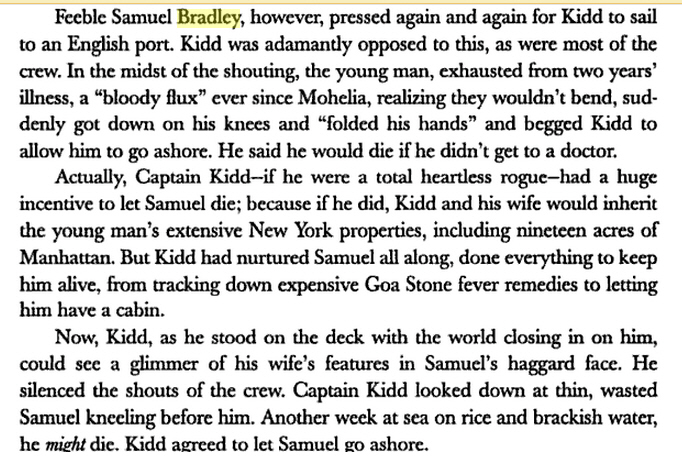
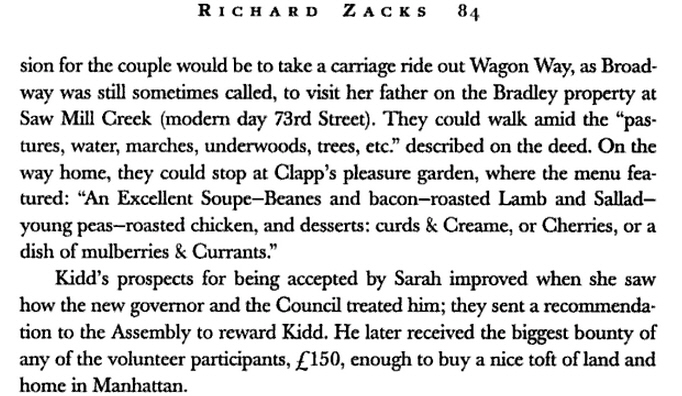
Samuel’s son Samuel Jr. names  his brother in law, Captain William Kidd as his heir because Kidd advanced the capital for his business.  As luck would have it, Samuel Jr. outlived his brother in law by two years. William “Captain” Kidd (c.1645 – 1701) was a Scottish sailor remembered for his trial and execution for piracy after returning from a voyage to the Indian Ocean. Some modern historians deem his piratical reputation unjust, as there is evidence that Kidd acted only as a privateer.

SAMUEL BRADLEY. “In the name of the Lord, Amen. This 5 day of July in ye year of our Lord 1693, I, Samuel Bradley, of the city of New York, merchant, being at present in good health and being now bound on a voyage beyond the sea.” “Whereas my loving brother in law, Captain William Kidd, hath been very careful of me, and hath likewise for my encouragement, now in my minority, at my desire and request, advanced and paid unto me ye sum of œ140, current money of New York, which I now employ in trade and merchandize. For and in consideration of his so great love unto me, as well as in recompense and in full satisfaction of ye said sum of money, advanced as aforesaid, I do give and bequeath unto my said loving brother in law Captain William Kidd, his heirs and assigns for ever, All that my one  half of one certain toft or lot of Ground numbered with the number 6. Situate, lying, and being within ye city of New York, in ye street commonly called and known by ye name of ye Dock street. And likewise all that my one half of a certain messuage or dwelling house and lot lying and being in ye street commonly called by ye name of ye Wall street. And also that my lot or Toft of ground in ye new street, without ye gate of ye said city, called King street. I will that all my goods and chattels be equally divided into three parts, amongst my loving father, Samuel Bradley, my brother in law, William Kidd, and my loving brother, Henry Bradley. And lastly I constitute and appoint my said brother in law, Captain William Kidd, to be executor.

Witnesses, Richard Jones, William Morris, Jacob Mayle, James Graham

Edward, Viscount Cornbury, Captain-General and Governor, etc. Whereas SAMUEL BRADLEY, New York, merchant, lately died, leaving behind him his last will, therein declaring his brother in law, William Kidd, sole executor, who died without having proved the said will. And whereas Sarah Kidd, widow and relict of William Kidd, and sister to ye said Samuel Bradley, hath prayed for the administration, The same is granted, April 13, 1703, and the said Sarah Kidd is sworn as executrix

x

The Pirate Hunter By Richard Zacks

3. Peter Bradley

Peter’s wife Mary [__?__]

4. Henry BRADLEY (See his page)

5. Sarah Bradley

Sarah’s first husband William Cox was born in England. William drowned 12 Aug 1689 in the bay off Staten Island.

Sarah’s second husband John Oort died died on 14 May 1691 in New York City.

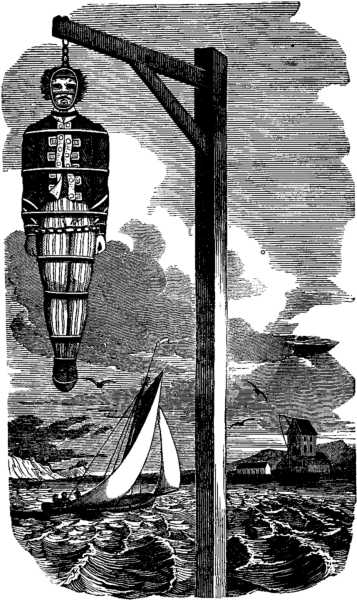
Sarah’s third husband the famous Captain William Kidd was born in Dundee, Scotland January 1654. His father was Captain John Kyd, who was lost at sea. He later settled in the new colony of New York. It was here that he befriended many prominent colonial citizens, including three governors.   William was hanged on 23 May 1701, at ‘Execution Dock‘, Wapping, in London. During the execution, the hangman’s rope broke and Kidd was hanged on the second attempt. His body was gibbeted—left to hang in an iron cage over the River Thames at Tilbury Point—as a warning to future would-be pirates for three years..

Sarah’s fourth husband Christopher Rousby was born 1650 in Ryton, Shropshire,  England.    Christopher died Oct 1732 in New York City.

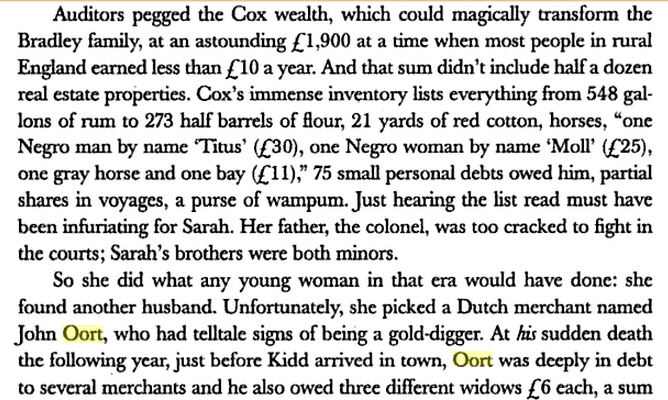
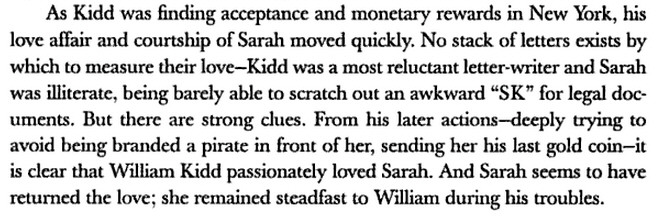
When  Sarah married Captain William Kidd, she was in her early twenties, already twice widowed,  and was one of the wealthiest women in New York, largely due to her inheritance from her first husband, William Cox.  Sara had two daughters by Cox. She applied for her license to marry William Kidd only two days after the death of John Oort, sparking rumors that her husband may have been murdered. No proof was ever produced, however, and she went on to marry Capt. Kidd, a wealthy widow.

William Cox’s Will

“In the name of God, Amen. I, William Cox, merchant.” I bequeath to my well beloved servant, Jacob Mayle, £100 in money, to see my books and accounts settled, and make him one of my executors. I leave to my loving friend, Richard Jones, œ20, and make him executor. I leave to my mother, Alice Cox, alias Bone, £500, to Dorothy Lee, £10. “I give and bequeath to my dear and loving wife Sarah, which house she pleases to have, to her and heirs. I give and bequeath to Samuel Bradley, my brother in law, my other house which I bought of Mr. John Robinson, or that house I now live in, my wife taking her choice.” “If God send my brother in law an heir, he shall call his name Cox Bradley and his children after him the same name.” I leave to Henry Bradley all my right to a piece of land at the mill, and all things thereon, and £100 when of age. Rest of property is left to his wife Sarah and his brother in law Samuel Bradley. “My desire is that this house where I now dwell should be for my brother Samuel, as above expressed, for reasons of fulfilling an oath, formerly sworn to my mother, she forcing me to passion; in fulfilling whereof I desire that there may be no contention after my decease.”

Dated July 15, 1689. Witnesses, Jacob Mayle, Henry Mayle. Proved in Court of Sessions, held the first Tuesday in August, 1689.

Inventory made September 11, 1689. 27 1/4 gallons of sweet wine, £8. 9s., 5 gallons madeira wine, 15s. This inventory is very lengthy, covering several pages, and amounting to some thousands of pounds, showing plainly that William Cox was one of the wealthy merchants of his day.  I wonder why he was so generous with the entire Bradley family.

William Cox is said to have been drowned in the bay off Staten Island, in August, 1689. The house he lived in, which was the one chosen by his wife, is now No. 56 Wall Street. The house bought of Mr. John Robinson is  No. 129 Pearl Street.

The Pearl Street house Sarah inherited from William Cox which she later shared with William Kidd   — Notice the boats beached along Pearl St—back then, the water came right up to its edge, but now Pearl Street sits several streets from the shore.

William Cox, who lived a few years later, in the neighborhood of Hanover Square, was an interesting and more or less important personage. Besides owning a valuable mill property, he was a well known merchant in his day, and extensively engaged in the West India and other foreign trade. Public interests also appear to have claimed a share of his attention. In 1683, he was an Alderman of the city, and in 1689, was sent to Amboy by Leisler, the self-constituted and then acting Governor, to proclaim the accession of William and Mary. Returning from this errand, which he had accomplished with due pomp and ceremony, he was drowned while disembarking from his vessel. He left an estate of some £2,000, and from the inventory of his personal belongings it is evident that luxury was not unknown to New York merchants even in those early days. Costly plate and articles of rare value from foreign lands are enumerated in detail. His home was completely furnished and in a manner which would seem to indicate large wealth and social prominence.

William “Captain” Kidd (c. 1645 – 23 May 1701) was a Scottish sailor remembered for his trial and execution for piracy after returning from a voyage to the Indian Ocean. Some modern historians deem his piratical reputation unjust, as there is evidence that Kidd acted only as a privateer. Kidd’s fame springs largely from the sensational circumstances of his questioning before the English Parliament and the ensuing trial. His actual depredations on the high seas, whether piratical or not, were both less destructive and less lucrative than those of many other contemporary pirates and privateers.

William Kidd.jpg

Kidd was born in Greenock, Scotland around 1645. He is also said to be from a family of Cornish gold-miners. According to myth or other stories, his “father was thought to have been a Church of Scotland minister.” After the death of his father, when he was five years old, Kidd moved to the colony of New York. It was here that he befriended many prominent colonial citizens, including three governors. There is some information that suggests he was a seaman’s apprentice on a pirate ship much earlier than his own more famous pirating.

The first records of his life date from 1689, when he was about 44 years old and a member of a French-English pirate crew that sailed in the Caribbean. Kidd and other members of the crew mutinied, ousted the captain of the ship, and sailed to the English colony of Nevis. There they renamed the ship the Blessed William.  Kidd became captain, either the result of an election of the ship’s crew or because of appointment by Christopher Codrington, governor of the island of Nevis.  Captain Kidd and the Blessed William became part of a small fleet assembled by Codrington to defend Nevis from the French, with whom the English were at war. In either case, he must have been an experienced leader and sailor by that time. As the governor did not want to pay the sailors for their defensive services, he told them they could take their pay from the French. Kidd and his men attacked the French island of Mariegalante, destroyed the only town, and looted the area, gathering for themselves something around 2,000 pounds Sterling. During the War of the Grand Alliance, on orders from the province of New York, Massachusetts, Kidd captured an enemy privateer, which duty he was commissioned to perform off of the New England coast. Shortly thereafter, Kidd was awarded £150 for successful privateering in the Caribbean. One year later, “Captain” Culliford, a notorious pirate, had stolen Kidd’s ship while he was ashore at Antigua in the West Indies. In 1695, William III of England replaced the corrupt governor Benjamin Fletcher, known for accepting bribes of one hundred dollars to allow illegal trading of pirate loot, with Richard Coote, Earl of Bellomont.  In New York City, Kidd was active in the building of Trinity Church, New York.

16 May 1691 – Kidd married Sarah Bradley Cox Oort,  [a mouthful of a name already and  soon to be Sarah Bradley Cox Oort Kidd ]  an English woman in her early twenties, who had already been twice widowed and was one of the wealthiest women in New York, largely due to her inheritance from her first husband.

John Oort

William and Sarah applied for a marriage license on May 16 1691, just two days after John Oort had suddenly and mysteriously died. The exact cause of death isn’t known, however speculation and rumour was rife, with both Kidd and Sarah suspected of being implicated in his death. Nothing could be proved however, and so William and Sarah, together with Sarah’s two daughters from a previous marriage, settled down to respectable married life. Kidd struck up a close friendship with Col. Benjamin Fletcher, the new colonial governor, who was later to be relieved from his post because of his dealings with well known pirates including Thomas Tew and Henry Every.

The Pirate Hunter by Richard Zacks

11 Dec 1695 –  Bellomont, who was now governing New York, Massachusetts, and New Hampshire, asked the “trusty and well beloved Captain Kidd” to attack Thomas Tew, John Ireland, Thomas Wake, William Maze, and all others who associated themselves with pirates, along with any enemy French ships. This request preceded the voyage which established Kidd’s reputation as a pirate, and marked his image in history and folklore.  Four-fifths of the cost for the venture was paid for by noble lords, who were among the most powerful men in England: the Earl of Orford, The Baron of Romney, the Duke of Shrewsbury and Sir John Somers. Kidd was presented with a letter of marque, signed personally by King William III of England. This letter reserved 10% of the loot for the Crown, and Henry Gilbert’s The Book of Pirates suggests that the King may have fronted some of the money for the voyage himself. Kidd and an acquaintance, Colonel Robert Livingston, orchestrated the whole plan and paid for the rest. Kidd had to sell his ship Antigua to raise funds.

The new ship, the Adventure Galley, was well suited to the task of catching pirates; weighing over 284 tons, she was equipped with 34 cannons, oars, and 150 men. The oars were a key advantage as they would enable the Adventure Galley to maneuver in a battle when the winds had calmed and other ships were dead in the water. Kidd took pride in personally selecting the crew, choosing only those he deemed to be the best and most loyal officers.  As the Adventure Galley sailed down the Thames, Kidd unaccountably failed to salute a Navy yacht at Greenwich as custom dictated. The Navy yacht then fired a shot to make him show respect, and Kidd’s crew… responded with an astounding display of impudence—by turning and slapping their backsides in disdain.

Because of Kidd’s refusal to salute, the Navy vessel’s captain retaliated by pressing much of Kidd’s crew into naval service, this despite rampant protests. Thus short-handed, Kidd sailed for New York City, capturing a French vessel en route (which was legal under the terms of his commission). To make up for the lack of officers, Kidd picked up replacement crew in New York, the vast majority of whom were known and hardened criminals, some undoubtedly former pirates.

Among Kidd’s officers was his quartermaster, Hendrick van der Heul. The quartermaster was considered ‘second in command’ to the captain in pirate culture of this era. It is not clear, however, if Van der Heul exercised this degree of responsibility because Kidd was nominally a privateer. Van der Heul is also noteworthy because he may have been African or of African-American descent. A contemporary source describes him as a “small black Man.” However, the meaning of this term is not certain as, in late seventeenth-century usage, the term negro would have been normally used, and the phrase “black Man” could mean either black-skinned or black-haired. If van der Heul was indeed of African ancestry, this fact would make him the highest ranking black pirate so far identified. Van der Heul went on to become a master’s mate on a merchant vessel, and was never convicted of piracy.

Sep 1696 – Kidd weighed anchor and set course for the Cape of Good Hope. A third of his crew soon perished on the Comoros due to an outbreak of cholera, the brand-new ship developed many leaks, and he failed to find the pirates he expected to encounter off Madagascar. Kidd then sailed to the Strait of Bab-el-Mandeb at the southern entrance of the Red Sea, one of the most popular haunts of rovers on the Pirate Round. Here he again failed to find any pirates. According to Edward Barlow, a captain employed by the British East India Company, Kidd attacked a Mughal convoy here under escort by Barlow’s East Indiaman, and was beaten off. If the report is true, this marked Kidd’s first foray into piracy.

As it became obvious his ambitious enterprise was failing, he became understandably desperate to cover its costs. But, once again, Kidd failed to attack several ships when given a chance, including a Dutchman and New York privateer. Some of the crew deserted Kidd the next time the Adventure Galley anchored offshore, and those who decided to stay behind made constant open-threats of mutiny.

30 Oct 1697 – Kidd killed one of his own crewmen.   While Kidd’s gunner, William Moore, was on deck sharpening a chisel, a Dutch ship hove in sight. Moore urged Kidd to attack the Dutchman, an act not only piratical but also certain to anger the Dutch-born King William. Kidd refused, calling Moore a lousy dog. Moore retorted, “If I am a lousy dog, you have made me so; you have brought me to ruin and many more.” Kidd snatched up and heaved an ironbound bucket at Moore. Moore fell to the deck with a fractured skull and died the following day.  While seventeenth century English admiralty law allowed captains great leeway in using violence against their crew, outright murder was not permitted. But Kidd seemed unconcerned, later explaining to his surgeon that he had “good friends in England, that will bring me off for that.”

Acts of savagery on Kidd’s part were reported by escaped prisoners, who told stories of being hoisted up by the arms and drubbed with a drawn cutlass. In truth, many of these acts were committed by his disobedient and mutinous crew. On one occasion, crew members ransacked the trading ship, Mary and tortured several of its crew members while Kidd and the other captain, Thomas Parker conversed privately in Kidd’s cabin. When Kidd found out what had happened, he was outraged and forced his men to return most of the stolen property.

Kidd was declared a pirate very early in his voyage by a Royal Navy officer to whom he had promised “thirty men or so”.   Kidd sailed away during the night to preserve his crew, rather than subject them to Royal Navy impressment.

30 Jan 1698, – He raised French colours and took his greatest prize, an Armenian ship, the 400 ton Quedagh Merchant, which was loaded with satins, muslins, gold, silver, an incredible variety of East Indian merchandise, as well as extremely valuable silks. The captain of the Quedagh Merchant was an Englishman named Wright, who had purchased passes from the French East India Company promising him the protection of the French Crown. After realizing the captain of the taken vessel was an Englishman, Kidd tried to persuade his crew to return the ship to its owners, but they refused, claiming that their prey was perfectly legal as Kidd was commissioned to take French ships, and that an Armenian ship counted as French if it had French passes. In an attempt to maintain his tenuous control over his crew, Kidd relented and kept the prize. When this news reached England, it confirmed Kidd’s reputation as a pirate, and various naval commanders were ordered to “pursue and seize the said Kidd and his accomplices” for the “notorious piracies”they had committed.

Kidd kept the French passes of the Quedagh Merchant, as well as the vessel itself. While the passes were at best a dubious defence of his capture, British admiralty and vice-admiralty courts (especially in North America) heretofore had often winked at privateers’ excesses into piracy, and Kidd may have been hoping that the passes would provide the legal fig leaf that would allow him to keep the Quedagh Merchant and her cargo. Renaming the seized merchantman the Adventure Prize, he set sail for Madagascar.

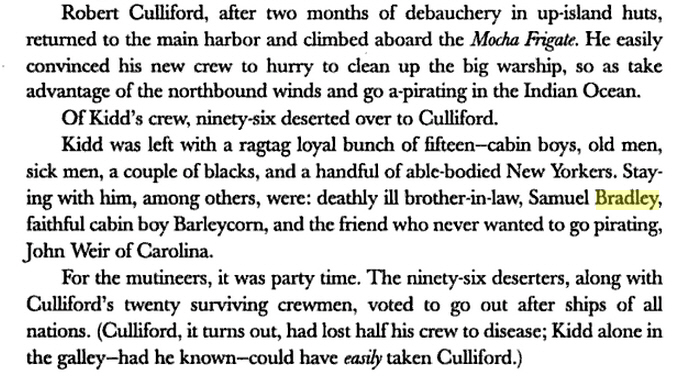
1  Apr 1698 –  Kidd reached Madagascar. Here he found the first pirate of his voyage, Robert Culliford, (the same man who had stolen Kidd’s ship years before) and his crew aboard the Mocha Frigate. Two contradictory accounts exist of how Kidd reacted to his encounter with Culliford. According to The General History of the Pirates, published more than 25 years after the event by an author whose very identity remains in dispute, Kidd made peaceful overtures to Culliford: he “drank their Captain’s health,” swearing that “he was in every respect their Brother,” and gave Culliford “a Present of an Anchor and some Guns.”This account appears to be based on the testimony of Kidd’s crewmen Joseph Palmer and Robert Bradinham at his trial. The other version was presented by Richard Zacks in his 2002 book The Pirate Hunter: The True Story of Captain Kidd. According to Zacks, Kidd was unaware that Culliford had only about 20 crew with him, and felt ill manned and ill equipped to take the Mocha Frigate until his two prize ships and crews arrived, so he decided not to molest Culliford until these reinforcements came. After the Adventure Prize and Rouparelle came in, Kidd ordered his crew to attack Culliford’s Mocha Frigate. However, his crew, despite their previous eagerness to seize any available prize, refused to attack Culliford and threatened instead to shoot Kidd. Zacks does not refer to any source for his version of events.

Both accounts agree that most of Kidd’s men now abandoned him for Culliford. Only 13 remained with the Adventure Galley. Deciding to return home, Kidd left the Adventure Galley behind, ordering her to be burnt because she had become worm-eaten and leaky. By burning the ship, he was able to salvage every last scrap of metal, for example hinges. With the loyal remnant of his crew, he returned to the Caribbean aboard the Adventure Prize.

Prior to Kidd returning to New York City, he learned that he was a wanted pirate, and that several English men-of-war were searching for him. Realizing that the Adventure Prize was a marked vessel, he cached it in the Caribbean Sea and continued toward New York aboard a sloop. He is alleged to have deposited some of his treasure on Gardiners Island, hoping to use his knowledge of its location as a bargaining tool.

Bellomont (an investor) was away in Boston, Massachusetts. Aware of the accusations against Kidd, Bellomont was justifiably afraid of being implicated in piracy himself, and knew that presenting Kidd to England in chains was his best chance to save his own neck. He lured Kidd into Boston with false promises of clemency, then ordered him arrested on July 6, 1699. Kidd was placed in Stone Prison, spending most of the time in solitary confinement. His wife, Sarah, was also imprisoned. The conditions of Kidd’s imprisonment were extremely harsh, and appear to have driven him at least temporarily insane.

He was eventually (after over a year) sent to England for questioning by Parliament. The new Tory ministry hoped to use Kidd as a tool to discredit the Whigs who had backed him, but Kidd refused to name names, naively confident his patrons would reward his loyalty by interceding on his behalf. Finding Kidd politically useless, the Tory leaders sent him to stand trial before the High Court of Admiralty in London for the charges of piracy on high seas and the murder of William Moore. Whilst awaiting trial, Kidd was confined in the infamous Newgate Prison and wrote several letters to King William requesting clemency.

Kidd had two lawyers to assist in his defense, Dr. Oldish and Mr. Lemon.  He was shocked to learn at his trial that he was charged with murder. He was found guilty on all charges (murder and five counts of piracy).

Hanging of William Kidd

23 May 1701 – He was hanged at ‘Execution Dock’, Wapping, in London. During the execution, the hangman’s rope broke and Kidd was hanged on the second attempt. His body was gibbeted—left to hang in an iron cage over the River Thames at Tilbury Point—as a warning to future would-be pirates for twenty years.   His associates Richard Barleycorn, Robert Lamley, William Jenkins, Gabriel Loffe, Able Owens, and Hugh Parrot were convicted, but pardoned just prior to hanging at Execution Dock.

Kidd’s Whig backers were embarrassed by his trial. Far from rewarding his loyalty, they participated in the effort to convict him by depriving him of the money and information which might have provided him with some legal defense. In particular, the two sets of French passes he had kept were missing at his trial. These passes (and others dated 1700) resurfaced in the early twentieth century, misfiled with other government papers in a London building. These passes call the extent of Kidd’s guilt into question. Along with the papers, many goods were brought from the ships and soon auctioned off as “pirate plunder.” They were never mentioned in the trial. Nevertheless, none of these items would have prevented his conviction for murdering Moore.

A broadside song Captain Kid’s Farewel to the Seas, or, the Famous Pirate’s Lament was printed shortly after his execution and popularized the common belief that Kidd had confessed guilty to the false charges.

Howard Pyle’s fanciful painting of Kidd burying treasure

The belief that Kidd had left a buried treasure contributed considerably to the growth of his legend. The 1701 broadside song Captain Kid’s Farewel to the Seas, or, the Famous Pirate’s Lament  lists “Two hundred bars of gold, and rix dollars manifold, we seized uncontrolled”. This belief made its contributions to literature in Edgar Allan Poe’s “The Gold-Bug”, Washington Irving’s The Devil and Tom Walker , Robert Louis Stevenson’s Treasure Island and Nelson DeMille’s Plum Island. It also gave impetus to the never-ending treasure hunts conducted on Oak Island in Nova Scotia, in Suffolk County, Long Island in New York where Gardiner’s Island is located, Charles Island in Milford, Connecticut; the Thimble Islands in Connecticut and on the island of Grand Manan in the Bay of Fundy.

Captain Kidd did bury a small cache of treasure on Gardiners Island in a spot known as Cherry Tree Field; however, it was removed by Governor Bellomont and sent to England to be used as evidence against him.

Kidd also visited Block Island around 1699, where he was supplied by Mrs. Mercy (Sands) Raymond, daughter of the mariner James Sands. The story has it that, for her hospitality, Mrs. Raymond was bid to hold out her apron, into which Kidd threw gold and jewels until it was full. After her husband Joshua Raymond died, Mercy moved with her family to northern New London, Connecticut (later Montville), where she bought much land. The Raymond family was thus said to have been “enriched by the apron”

1 Nov  1732 – Witnesses, Abraham Van Wyck, Benjamin Hildreth, Christopher Roberts. Although Sarah also had two daughters by William Cox, they are not named in her will of 1732.

26 Aug 1743 – Codicil,  My daughter Sarah Latham having died, her share is to go to her children.

12 Sep 1744 – Proved – Witnesses, Mansfield Tucker, James Johnson. The oldest son Christopher was then dead.

In the name of God, Amen. I, SARAH ROUSBY, of New York, widow of Christopher Rousby, late of New Jersey, deceased, being in good health and perfect mind. “The funeralls of my body are to be only such as shall become a Christian.” After the payment of all debts and funeral charges, I leave all the rest of my estate to my five children, Christopher Rousby, Henry Rousby, Sarah, widow of Joseph Latham, William Rousby, and Elizabeth wife of John Troup, Jr. My eldest son Christopher shall have my wedding ring. I make my eldest son Christopher, and my son-in-law John Troup, executors. My houses and lands are to be sold by my executors..

6. George Bradley

George’s wife Hannah Braman was born 2 Sep 1690 in Norton, Bristol, Mass. Her parents were Thomas Braman (1654 – 1709) and Hannah Fisher (1666 – 1714). Hannah died 15 Apr 1778

Sources:

http://www.bradleyfoundation.org/genealogies/Bingley/tobg02.htm#21956

http://www.scribd.com/doc/27688745/Bradley-Genealogy

http://www.geni.com/people/Sarah-Bradley-Cox-Oort-Kidd/6000000000325825464

http://www.racontrs.com/stories/wall-street-stories/captain-kidd-wall-street-pirate/

The Pirate Hunter: The True Story of Captain Kidd By Richard Zacks

Posted in 11th Generation, Artistic Representation, Historical Site, Immigrant - England, Line - Shaw, Sea Captain, Storied | Tagged , , | 8 Comments

Henry Bradley

Henry BRADLEY (1660 – 1735) was Alex’s 8th Great Grandfather; one of 512 in this generation of the Shaw line.

Henry Bradley was born about 1660 in Dorchester, Mass or in Long Island NY. His parents were Samuell BROADLEY and [__?__]. He married Judith BROWN on 7 Jan 1695/96 in Newbury, Mass.  After Judith died, he married Hannah Foster on 19 Apr 1729 in Newbury, Mass. Henry died before Jul 1735 in Dorchester, Maryland.

Judith Brown was born 3 Dec 1660 in Newbury, Essex, Mass.  Her parents were John BROWN and Mary WOODMAN.  She had a previous marriage to Zachary Davis on 4 Feb 1680/81 in Amesbury/Salisbury, Mass.  Judith died on 14 Nov 1728 in Newbury, Mass.

Judith’s first husband Zachary Davis was born 22 Feb 1645/46 in Newbury, Mass.  His parents were  John Davis and Elnor Milford  His grandparents were our ancestors Thomas DAVIS and Christian COFFIN.  Zachary died 25 Jun 1692 in Newbury.

Henry’s second wife Hannah Foster was born 16 Jul 1668 in Andover, Essex, Mass. Her parents were Andrew Foster (1640 – 1697) and Mary Russ (1643 – ). She first married 15 Sep 1690 to Thomas Austin (1671 – 1711). Second, she married 2 Oct 1722 in Haverhill to Jotham Hendrick (1650 – 1727). Third, she married 19 Apr 1729 in Newbury, Mass to Henry Bradley. Fourth and finally, she married 28 Jul 1735 to John Gutterson. Hannah died 28 Jun 1740 in Methuen, Essex, Mass.

Children of Judith and Zachary:

Name Born Married Departed
1. Judith Davis 7 Sep 1684 Newbury, Essex, Mass 9 Dec 1702
Newbury
2. Elizabeth Davis 27 Apr 1687
Newbury, Essex, Mass.
Samuel Bachelder
1 Apr 1706
Newbury, Mass
9 Apr 1733
Hampton, Rockingham,NH
3. Zachariah Davis  ca. 1690  27 Dec  1731
Hampton, NH

.

Children of Henry and Judith:

Name Born Married Departed
4. John BRADLEY Sr 1697 Susannah STAPLES
6 Sep 1724
Haverhill
1751
Haverhill

.
Children

2. Elizabeth Davis

Elizabeth’s husband Deacon Samuel Bachelder was born  10 Jan 1681/82 in Hampton, (now Rockingham), New Hampshire. His parents were Nathaniel Bachiler II and Mary Carter Wyman.   His grandparents were Nathaniel Bachiler and Deborah Smith and his great grandfather was our ancestor Rev. Stephen BACHILER.  Samuel died aft.  27 May 1756 (Samuel’s father Nathaniel II received a generous bequest from Rev Timothy Dalton, perhaps as amends for the feud with his grandfather, Rev. Stephen Bachiller – see Bachiller’s page for details.)

Children of Elizabeth and Samuel:

 i. Judith Bachelder b: 23 Jan 1707/8 in Hampton, (now Rockingham), New Hampshire

ii. Henry Bachelder b: 30 Oct 1709 in Hampton, (now Rockingham), New Hampshire

iii. Mary Bachelder b: 20 Oct 1711 in Hampton, (now Rockingham), New Hampshire

iv. Samuel Bachelder (II) b: 01 Aug 1713 in Hampton, (now Rockingham), New Hampshire

v. Elizabeth Bachelder b: 10 May 1716 in Hampton, (now Rockingham), New Hampshire

vi. Zacheriah Bachelder b: 14 Dec 1717 in Hampton, (now Rockingham), New Hampshire

vii. Hannah Bachelder b: 23 Oct 1720 in Hampton, (now Rockingham), New Hampshire

viii. Ruth Bachelder b: 29 Oct 1722 in Hampton, (now Rockingham), New Hampshire

ix. Mercy Bachelder b: 14 Sep 1724 in Hampton, (now Rockingham), New Hampshire

x. Carter Bachelder b: 31 Oct 1726 in Hampton, (now Rockingham), New Hampshire

xi. Patience Bachelder b: Bef. 27 Dec 1729 in private baptism. being dangerously sick, Hampton, (now Rockingham), New Hampshire

xii. Nathaniel Bachelder b: 02 Mar 1731 in Hampton, (now Rockingham), New Hampshire

Sources:

New England marriages prior to 1700 By Clarence Almon Torrey, Elizabeth Petty Bentley

http://www.bradleyfoundation.org/genealogies/Bingley/tobg04.htm#37323

The old families of Salisbury and Amesbury, Massachusetts: with some related

http://www.oakbaydesigns.com/Maine/2woodman.htm

http://wc.rootsweb.ancestry.com/cgi-bin/igm.cgi?op=GET&db=mewingnut&id=I2124817

Posted in 10th Generation, Line - Shaw | Tagged | 6 Comments

John Bradley Sr.

John BRADLEY Sr (1695 – 1751) was Alex’s 7th Great Grandfather; one of 256 in this generation of the Shaw line.

John Bradley Sr was born about 1695 in Essex, Essex, Mass.  His parents were Henry BRADLEY and Judith BROWN.  He married Susannah STAPLES on 6 Sep 1724 in Haverhill, Mass.   John died 1751 in Haverhill, Mass.

Susannah Staples was born 9 Jan 1697/98 in Haverhill, Mass.  Her parents were Thomas STAPLES and Elizabeth GRIFFIN. After John died, Susannah married 21 Dec 1751 in Haverhill to William Whitticher. Susannah died 21 Dec 1752 in Haverhill, Mass .

William Whitticher was born about 1700.

Children of John and Sarah:

Name Born Married Departed
1. Obadiah Bradley 15 Nov 1724
Haverhill, Essex County, Mass
26 Nov 1736 Haverhill, Mass
2. David Bradley 30 Nov 1726 Haverhill 30 Dec 1728 Haverhill, Mass.
3. Mary Bradley 6 Feb 1728/29 Haverhill 1736
Haverhill
Died from throat distemper.
4. Susannah Bradley 15 Jun 1731 25 Nov 1736 Haverhill
5. David Bradley 16 Jun 1733 Haverhill 1735
Haverhill
6. Elizabeth Bradley 17 Apr 1736
Haverhill
Henry Hall
14 May 1761 Haverhill
7. John BRADLEY Jr. 17 Aug 1738 in Haverhill Mary HEATH
21 Mar 1760 Haverhill
Before 1830
8. Susannah Bradley 17 Aug 1738 Haverhill Philbrook Colby
13 Jul 1758 Haverhill
2 Aug 1778
Pembroke or Weare, NH

Children

6. Elizabeth Bradley

Elizabeth’s husband Henry Hall was born in 30 May 1740 in Rockingham, New Hampshire. His parents were Henry Hall (1712 – 1785) and Joanna Sargent (1715 – 1763). After Elizabeth died, Henry married in 1791 to Sarah Price (b. 1765) and had two more children, an infant that died in 1793 and Josuha b. 1795. Henry died in 1829 in Rumney, Grafton, New Hampshire.

Henry served N.H. as lieutenant under Capt. Elliot & Col. Hobart in the Revolutionary War.

Hobart’s Regiment of Militia also known as the 12th New Hampshire Militia Regiment was called up on July 21, 1777 at Plymouth,  New Hampshire for Gen. John Stark’s Brigade gathering at Charlestown, New Hampshire during the Saratoga Campaign. Hobart’s Regiment along with Hale’s and Stickney’s Regiment would assault Friedrich Baum’s redoubt from the front (east) during the Battle of Bennington as Nichols’ attacked from the rear (west) and Simonds’ attacked from the south. Hobart’s Regiment would continue on in Stark’s Brigade to cut off British Gen. John Burgoyne from retreat or supply after the Battle of Freeman’s Farm. The regiment would be disbanded on October 26, 1777 in northern New York.

Child of Elizabeth and Henry

i. John Hall b. 12 May 1762 in Chester, Rockingham, New Hampshire; d. 15 Feb 1850 in Rumney, Grafton, New Hampshire of palsy; m. 5 Jun 1783 to Ruth Prescott (b. 12 Mar 1761 – d. 15 Sep 1815); m2. 29 Jul 1818 to Ruth Fletcher ( – d. 1850)

In the 1850 census, John was living in Mansfield, Bristol, Mass.

ii. Anna Hall b. 1764 – m. William Doe

iii. Betsey Hall b. 1766 in Candia, Rockingham, New Hampshire; d. Jul 1850 in Washington, Vermont

iv. Lydia Hall b. 1768 –

v. Dorothy Hall b. 1770; m. Peter Merrill

vi. Henry Hall b. 29 Jan 1786 in Rumney, Grafton, New Hampshire; d. Nov 1826 Newfoundland and Labrador, Canada; m. May 1807 to Susan Perkins Burnham (b. 09 Aug 1785 in Rumney, Grafton, New Hampshire – d. 07 Dec 1866 in Groton, Caledonia, Vermont) Susan’s parents were Abraham Burnham (1747 – 1814) and Lydia Bradley (1751 – 1852).

7. John BRADLEY Jr. (See his page)

8. Susannah Bradley

Twin of our ancestor John BRADLEY.

Elizabeth’s husband Philbrook Colby was born 16 Mar 1734/35 in Amesbury, Essex, Mass. His parents were Joseph Colby and Mary Philbrick. Philbrook died died 1793 in Weare, Hillsborough, New Hampshire

Philbrook served under Captain Samuel Gerrish of Newbury in the French and Indian War, from 15 Sep 1755 to 17 Dec 1755.  His name appears on the muster roll of men raised in 1756 for the expedition to Crown Point in Colonel Saltonstall’s regiment, 14 Apr 1756, and on a return of Captain James Richardson’s Company on 5 May 1756. Also as “blacksmith” on the muster roll of Captain Timothy Perkins’s (Parker?) company at Fort Edward, 26 Jul 1756.  On the muster roll dated 2 Mar 1757 of Captain Samuel George’s (or Timothy Parker’s) company ‘s expedition to Crown Point.

Philbrook Coleby entered 15 Mar 1757 deserted in Sep 1757.  Among the one hundred and thirty-three deserters from the Massachusetts forces in the year 1757.  Philbrook is the only name from Haverhill.

Entered Apr 4 1757 age 23 for the invation of Canada. John Osgood Regiment

Nov 2 1759 to Jan 5 1761 Captain Edmund Mooers Company Muster roll dated Nov 2 1759 – Jan 7 1761

In the Revolutionary War, Philbrick served as private in Captain Daniel Hill’s company, Colonel Samuel Johnson’s regiment, which marched to Cambridge on the Alarm to Cambridge 19 April 1775, four days service.

Philbrick Colby and his family moved from Haverhill, Massachusetts, to Weare, New Hampshire, after he had served two enlistments in the Revolutionary War. His wife Susannah Bradley was admitted to the First Church in Haverhill, 2 Aug 1768.

Children of Susannah and Philbrook

i. William Colby b. 6 May 1759 in Haverhill, Essex, Mass; d. 5 Aug 1847 Oswego, New York; Burial: Lewis Cemetery.Granby, Oswego County, New York, m. 2 Apr 1782 in Mass to Eleanor Lord (b. 15 Jul 1763 in Mass. – d. 17 Mar 1835 in Oswego, New York) William and Eleanor had thirteen children between 1786 and 1807.

William Colby of Hannibal, New York, deposed, 20 Apr 1818, that he enlisted, November 1776, for three years, and served under Captain James Carr, Colonel Hale’s regiment in the New Hampshire Line, and continued to serve until the winter of 1782 , when he was attached to a company under Captain Senter, and served until July 1783, when he was discharge at New Windsor, New York. In 1819, William Colby was of Grandby, Oswego County, New York. He deposed, 19 September 1820, as a farmer, of Grandby, New York, aged 60 years:

ii. Samuel Colby b. 1 Nov 1761 in Kingston, New Hampshire; d. 12 Aug 1845 Portland, Maine; m. 8 Jan 1791 in Portland, Maine to Sally Morse (b. 1768 in Portland, Maine – d. 30 Jun 1853 in Portland, Cumberland, Maine) Sally’s parents were Jonathan Morse and Experience Paine.

iii. Susanna Colby b. 1 Apr 1764 in Haverhill, Essex, Mass;

iv. Mary Colby b. 24 Jul 1766 in Pembroke, New Hampshire; d. 1790 Pembroke, New Hampshire

v. Daniel Colby b. 25 Sep 1769 in Haverhill, Essex, Mass;

vi. Jeremiah Colby b. 28 Jan 1771 in Haverhill, Essex, Mass; d. 15 Aug 1850 Berkley, Bristol, Mass; m. 1799 in Mass to Betsey Paull (b. 1780 in Mass.) Betsey’s parents were John Paull and Hanah [__?__]. Jeremiah and Betsey had seven children born between 1804 and 1812.

vii. John Bradley Colby b. 21 Oct 1773 in Haverhill, Essex, Mass; m. Mary Hasseltine (b. 1773)

viii. Benjamin Colby

Sources:

http://freepages.genealogy.rootsweb.ancestry.com/~colby/colbyfam/b753.html

http://www.bradleyfoundation.org/genealogies/Bingley/tobg11.htm#17462l

http://trees.ancestry.com/owt/person.aspx?pid=29425954

The ranger service in the upper valley of the Connecticut, and the most northerly regiment of the New Hampshire militia in the period of the revolution : an address delivered before the New Hampshire Society of Sons of the American Revolution at Concord, N.H., April 26, 1900 By Batchellor, Albert Stillman, 1850-1913

Posted in -9th Generation, Line - Shaw, Twins | Tagged , , | 5 Comments

Nicholas Jackson

Nicholas JACKSON (1613 – 1697) was Alex’s 10th Great Grandfather, one of 2,048 in this generation of the Shaw line.

Nicholas Jackson – Coat of Arms

Nicholas Jackson was born in 29 Aug 1613 in Hunsley, East Riding Yorkshire, England.  Hunsley was a hamlet three miles N.W. of Rowley.  Alternatively, he was born in Huntley, Gloucester, England.  His parents were Nicholas JACKSON and Prudence MARCHE.   In “The Original Lists of Person of Quality; 1600-1700” there is a Nicholas Jackson, age 22 on the Assurance emigrating from London to America, July 24, 1635. He married Sarah RILEY in 1 May 1646. After Sarah died, he married Elizabeth, widow of Hugh CHAPLIN.  Nicholas died 13 Feb 1697 in Rowley, Essex, Mass.

Nicholas Jackson sailed from London, England July 24, 1635 for Virginia on the Assurance.  He was then 22 years of age.

Sarah Riley was born 12 Aug 1625 in Huntley, Gloucester, England.  Sarah  was  buried 12 Aug 1655 in Rowley, Essex, Mass.

Children of Nicholas and Sarah:

Name Born Married Departed
1. Lydia JACKSON 23 Jun 1647 Rowley Tobias COLEMAN
16 Apr 1668 Nantucket
1678
Rowley, Mass
2. Samuel Jackson 23 May 1649
Rowley
3. Jonathan Jackson 12 Jul 1650 Rowley, Mass Hannah Garfield
6 Dec 1681
Rowley
Buried
17 Jun 1715
Framingham, Mass
4. Caleb Jackson 25 Apr 1652
Rowley
Elizabeth Howe
1682
Rowley
10 Aug 1718
Rowley

Nicholas was in Salem, Mass. in 1638 and came to Rowley, Mass. in 1639/40, where he had a grant of land on Holmes St., which is now Central Street.   Also a lot of 2 1/2 acres by the Cart Path. His name is mentioned many times in early town records.

The first Church of Rowley, Mass. was gathered 3 Dec 1639, Nicholas Jackson’s name was on the list of members in full communion.

In spring of 1639 Rowley was originally settled as a plantation by Rev. Ezekiel ROGERS, who had arrived from England on the ship John of London with approximately twenty families.  On 4 Sep  1639, the town was incorporated, and included portions of modern day Byfield, Georgetown, and Haverhill. The town was named after Rowley, East Riding of Yorkshire, where Rogers had served as pastor for twenty years before his suspension due to non-conformist puritanical beliefs. Rogers was installed as Rowley’s pastor on December 3.

On the “tenth of the eleventh Anno Dni 1643, Thomas Nelson, Edward Carlton, Humphrey Reynon & Francis PARRAT made a survey of the town and a register of the several house lots of from 1 1/2 to 6 acres then laid out to the settlers.

10 of our ancestor families (underlined in red) had plots in Rowley in this 1642 map.  Nicholas Jackson’s plot is in the middle of town on Holmes Street two door up from John Pearson

Here is today’s approximate location of Nicholas’ lot on Google Maps.

Hugh CHAPLIN did not sign his will, but it was witnessed by Joseph Jewett and John PICKARD, who proved the will in Ipswich Court, 31, Mar 1657. The will had not been proven by the widow within the twenty month allowed for the action, so she was sentenced to forfeit one hundred pounds to the court. On the 6 Apr 1657, Elizabeth Jackson petitioned the court for an abatement of the fine of £100 for neglecting to present her former husband Hugh Chaplin’s will to be probated and on 29 Sep 1657, the count moderated the fine of Nicholas JACKSON for not proving the will of his wife’s former husband

Children

1. Lydia JACKSON (See Tobias COLEMAN‘s page)

3. Jonathan Jackson

Jonathan’s wife Hannah Garfield was born 1660 in Watertown, Middlesex, Mass. Her parents were Samuel Garfield (1668 – 1684) and Mary Benfield (1638 – 1709). Hannah died in 1705 in Watertown, Middlesex, Mass

4. Caleb Jackson

Caleb’s wife Elizabeth Howe was born 01 Jun 1661 in Andover, Essex Co., Mass. Her parents were  James Howe Jr.( – 1701) and Elizabeth Jackson ( – 1692). Elizabeth died 20 Apr 1701 in Andover, Essex, Mass.

Caleb served in King Philip’s War, Essex Regiment.

There is a Caleb Jackson listed on the 1677 Ipswich, Mass. Oath of Allegiance.

Sources:

http://iagenweb.org/boards/vanburen/queries/index.cgi?read=99142

http://wc.rootsweb.ancestry.com/cgi-bin/igm.cgi?op=GET&db=campbell-jackson&id=I411

http://trees.ancestry.com/tree/15171207/person/300191896

Posted in 12th Generation, Historical Site, Immigrant - England, Line - Shaw | Tagged , | 17 Comments

Benjamin Crispe

Benjamin CRISPE (1610 – 1683) was Alex’s 11th Great Grandfather; one of 8,192 in this generation of the Shaw line. Benjamin Crispe’s family story would have been appropriate for the pilgrim tabloids:

– Morton’s Merrymount, the antithesis to the intolerant Puritans
– Infamous Maypole revels
– Daring maneuvers against the Dutch
– Squaw sachem deals
– Pig stealing
– Illegitimate children
– Murder trials
– Playing cards for money
– Adultery punishments
– Increase Mather quips
– Indian Attacks
– Dog feet gnawing
– Daughters lost to the convent
– And prodigal sons
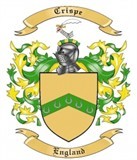
Benjamin Crispe – Coat of Arms

Benjamin Crispe was born about 1611 in Frisby, Lincolnshire, England.   He gave his age as about forty-five in 1656, about fifty-two in 1662 and about seventy-seven in 1683. This produces a bracket of 1606-1611 for his birth. His parents were Richard CRISPE and Dorothie THOMSON.  His parents were married 1610 in Maidstone, Kent, England. He was servant of Maj. Gibbons and probably came over with him in 1630 or 1631.  He married Bridget [__?__].   After Bridget died around 1677, he married Joanna Goffe on 29 Nov 1680.    Benjamin died in betweeen 5 Nov 1683 and 21 Dec 1683 in Watertown, Mass.

Bridget [__?__] was born in 1615 in England. Bridget died 13 Mar 1675 in Groton, Middlesex, Mass.

Joanna Goffe was born 1614 in Frisby, Lincolnshire, England.  She first married William Longley, a prominent citizen of Groton.  Joanna died on 18 Apr 1698 in Charlestown, Mass.  Her son William Jr.  married Benjamin’s daughter Deliverance.  See below for the story of how William and Deliverance were killed in an attack on Groton in 1694.
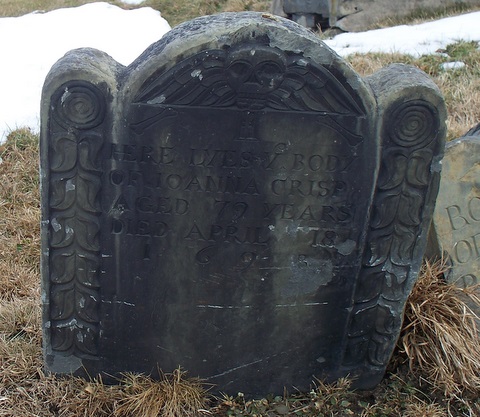
Joanna Goffe Longley Crisp Headstone – Phipps Street Burying Ground Charlestown, Suffolk County, Massachusetts

William Longley first appears upon the records of Groton June 21, 1663, when with Capt. James Parker and others, he voted against the proposal to give Rev. Samuel Willard the use of the house and lands devoted by the town to the purposes of the ministry. There are numerous indications that the first William Longley was not in accord with the attempted ecclesiastical despotism of the day. He was selectman at Groton in 1665, and town clerk in 1666 and ’67.

Groton was destroyed by Indians in the spring of 1676 and its inhabitants dispersed. William Longley and his family went to Charlestown, where they remained for a year or two and where he had a grant of land. Some members of the family were also in Lynn during this period. He returned to Groton with a large proportion of the old inhabitants, and rebuilt his house there. At Groton William died 29 Nov 1680. His widow, Joanna, married, about 1683, Benjamin Crispe, survived him, and died at Charlestown, probably at the home of one of her children, April 18, 1698, age. 79. Her gravestone is still standing in the old Phipps street burial ground, Charlestown, where the remains of many of her descendants also lie. In her will she remembered her three grandchildren who had been carried captive by Indians in 1694. It contains the following clause:

Item. I give and bequeath unto my three grandchildren y* are in captivity, if they return, these three books, one of them a bible, another a sermon book, treating of faith, and the other a psalm book.

Children of Benjamin and Mary:

Name Born Married Departed
1. Elizabeth CRISPE 28 Jan 1636/37 Watertown, Mass. George LAWRENCE
29 Sep 1657
Watertown
28 May 1681
Watertown, Mass;
she was 44.
2. Mary Crispe 20 May 1638
Watertown
William Green
1661
ca 1704
Dunstable, Mass.
3. Jonathan Crispe 29 Jan 1639/40
Watertown
Joanna [__?__]
1663
.
Deliverance Pease (Daughter of Robert PEASE – The Former)
1680
Watertown
Groton, Middlesex
bef 25 Oct 1680
Watertown when his father administered his estate
4. Eleazer Crispe 14 Jan 1641/2
Watertown
Elilzabeth [_?_]
1700
Watertown
10 Apr 1726
Groton, Mass
5. Zechariah (Zachary) Crispe 21 Jan 1645
Watertown, Mass
Did not marry, but had an illegitimate child with Mary Stanwood.  He was bound to pay for Mary Crispe’s support.
6. Mehitable Crispe 21 Jan 1645/6
Watertown
1692
Watertown
7. Mercy Crispe ca 1648 Robert Parish
11 Apr 1667 Chelmsford, Mass
bef 1 Apr 1686
8. Deliverance Crispe 1650
Watertown
William Longley
15 May 1672 Groton
27 Jul 1694
Groton, Mass
Deliverance, her husband and five of his children were massacred by Indians. Three children taken into captivity.

Benjamin was a mason by trade. He was literate as he signed a deed, rather than using a mark.

Servant of Maj. Gibbons, 1630 or ’31, and probably came over with him, 1629; proprietor of Watertown, 1636-7;

Edward Gibbons (c. 1600 – 1654) arrived in the Massachusetts colony about 1623, possibly as an indentured servant to Captain Wollaston or to Thomas Morton, or possibly in the company of Robert Gorges. He lived for a time at Morton’s Merrymount (Mare Mount) settlement and trading post in what is now Quincy, MA and was likely present at the infamous Maypole revels there in 1627.  After Morton was arrested and deported for consorting with and trading guns to the natives, Gibbons joined the new Puritan church and settlement in Boston circa 1630. He served in the Massachusetts militia and was a leader in the Pequot War (1637-8). He was eventually promoted to Major-General, outranking even Myles Standish!

[The story of Merrymount is an interesting counterpoint to the intolerant Puritan.  Thomas Morton (c. 1579–1647) was an early American colonist from Devon, England, a lawyer, writer and social reformer, famed for founding the colony of Merrymount and his work studying Native American culture.

Morton spent three months on an exploratory trip to America in 1622, but was back in England by early 1623 complaining of the intolerance of certain elements of the Puritan community. He returned in 1624 as a senior partner in a Crown-sponsored trading venture, onboard the ship the Unity with his associate Captain Wollaston and 30 indentured young men. They settled and began trading for furs on a spit of land given them by the native Algonquian tribes, whose culture Morton is said to have admired as far more ‘civilized and humanitarian’ than that of his ‘intolerant European neighbours’. The Puritans of the New England colony of Plymouth objected to their sales of guns and liquor to the natives in exchange for furs and provisions, which at that time was technically illegal (although almost everyone was doing it).  The weapons undoubtedly acquired by the Algonquians were used to defend themselves against raids from the Northern Tribes, however, and not against the fearful colonists. The trading post set up by the two men soon expanded into an agrarian colony which became known as Mount Wollaston (now Quincy, Massachusetts).

Morton fell out with Wollaston after he discovered he had been selling indentured servants into slavery on the Virginian tobacco plantations. Powerless to prevent him, he encouraged the remaining servants to rebel against his harsh rule and organise themselves into a free community. Wollaston fled with his supporters to Virginia in 1626, leaving Morton in sole command of the colony, or its ‘host’ as he preferred to be called, which was renamed Mount Ma-re (a play on ‘merry’ and ‘the sea’) or simply Merrymount. Under Morton’s ‘hostship’ an almost utopian project was embarked upon, in which the colonists were declared free men or ‘consociates’, and a certain degree of integration into the local Algonquian culture was attempted. However, it was Morton’s long-term plan to ‘further civilize’ the native population by converting them to his liberal form of Christianity, and by providing them with free salt for food preservation, thus enabling them to give up hunting and settle permanently. He also considered himself a ‘loyal subject’ of the British monarchy throughout this period, and his agenda remained a colonial one, referring to Book 3 of his New English Canaan memoirs as a manual on ‘how not to colonize’, in reference to the Puritans.

Morton’s ‘Christianity’, however, was strongly condemned by the Puritans of the nearby Plymouth Colony as little more than a thinly disguised heathenism, and they suspected him of essentially ‘going native’. Scandalous rumours were spread of the debauchery at Merrymount, which they claimed included immoral sexual liaisons with native women during what amounted to drunken orgies in honour of Bacchus and Aphrodite. Or as the Puritan Gov. William Bradford wrote with horror in his history Of Plymouth Plantation: “They … set up a May-pole, drinking and dancing about it many days together, inviting the Indian women, for their consorts, dancing and frisking together (like so many fairies, or furies rather) and worse practices. As if they had anew revived & celebrated the feasts of ye Roman Goddess Flora, or ye beastly practices of ye mad Bacchanalians.” Morton had transplanted traditional West Country May Day customs to the colony, and combined them with fashionable classical myth, couched according to his own libertine tastes, and fuelled by the enthusiasm of his newly-freed fellow colonists. On a practical level the annual May Day festival was not only a reward for his hardworking colonists but also a joint celebration with the Native Tribes who also marked the day, and a chance for the mostly male colonists to find brides amongst the native population. Puritan ire was no doubt also fueled by the fact that Merrymount was the fastest-growing colony in New England and rapidly becoming the most prosperous, both as an agricultural producer and in the fur trade in which the Plymouth Colony was trying to build a monopoly. The Puritan account of this was very different, regarding the colony as a decadent nest of good-for-nothings that annually attracted “all the scum of the country” to the area. Or as Peter Lamborn Wilson more romantically puts it, ‘a Comus-crew of disaffected fur traders, antinomians, loose women, Indians and bon-vivants’.

But it was the second 1628 Mayday ‘Revels of New Canaan’, inspired by ‘Cupid’s mother’, with its ‘pagan odes’ to Neptune and Triton, as well as Venus and her lustful children, Cupid, Hymen and Priapus, its drinking song, and its erection of a huge 80 ft. Maypole, topped with deer antlers, that proved too much for the ‘Princes of Limbo’, as Morton referred to his Puritan neighbours. The Plymouth Militia under Myles Standish took the town the following June with little resistance, chopped down the Maypole and arrested Morton for ‘supplying guns to the Indians’.  He was put in stocks in Plymouth, given a mock trial and finally marooned on the deserted Isles of Shoals, off the coast of New Hampshire, until an ‘English ship could take him home’, apparently as he was believed too well connected to be imprisoned or executed (as later became the penalty for ‘blasphemy’ in the colony). He was essentially starved on the island, but was supplied with food by friendly natives from the mainland, who were said to be bemused by the events, and he eventually gained enough strength to escape to England under his own volition. The Merry Mount community survived without Morton for another year, but was renamed Mount Dagon by the Puritans, after the ‘evil’ Semitic Sea God, and they pledged to make it a place of woe. During the terrible winter famine of 1629 residents of New Salem under John Endecott raided Mount Dagon’s plentiful corn supplies and destroyed what was left of the Maypole, calling it the ‘Calf of Horeb’ and denouncing it as a pagan idol. Morton returned to the colony soon after and, after finding most of the inhabitants had been scattered, was rearrested, again put on trial and banished from the colonies without legal process. The following year the colony of Mount Dagon was burnt to the ground and Morton shipped back to England.  Check out wikipedia for the rest of Morton’s story and battles with the Puritans.]

In Oct 1635, Lieutenant Edward Gibbons and Sergeant Simon Willard. took a small bark (canoe) to the mouth of the Connecticut with 20 carpenters and other workmen. Perhaps Benjamin Crispe accompanied.   Gov Winthrop had learned that the Dutch were planning to occupy the mouth of the  Connecticut River at Pasbeshauke and sent Gibbons’ expedition to counter the Dutch.  The expedition landed near the mouth of the river, on the west bank in present-day Old Saybrook, on November 24, 1635 and located the Dutch coat of arms nailed on a tree. They tore down the coat of arms and replaced it with a shield painted with a grinning face. They established a battery of cannon and built a small fort. When the Dutch ship returned several days later, they sighted the cannon and the English ships and withdrew. Winthrop renamed the point “Point Sayebrooke” in honor of Fiennes (Viscount Saye) and Lord Brooke.

Edward Gibbons was present with Governor John Winthrop when the Puritans negotiated with the Indians for the sale of land in Charlestown, MA and surrounding areas. He is depicted as one of four settlers involved in a local WPA mural: Purchase of Land from the Indians by Aidan Lasell Ripley, 1934, in the Winchester MA Public Library.  He was evidently on good terms with many Indians; the “Squaw Sachem” gave as a gift for his friendship a large parcel of land near the Mystic River in present Winchester and Arlington, MA to Edward’s son, Jotham Gibbons. He was granted a large tract of land in present Winthrop, MA, where he built a house.

Edward Gibbons is depicted on a Mural in the Winchester MA Public Library

The Squaw Sachem (i.e. woman chief) of the Massachuset tribe ceded all the lands of her tribe, excepting her homestead (which was bounded on the east by the Mystic Lakes and on the south by Mill Brook), to the English Puritan settlers of Cambridge , for “twenty and one coates, ninten fathom of wampom, and three bushels of corne”. Three epidemics of European diseases and warfare with the Abenaki tribe from the north had greatly reduced the number of men in the Massachuset tribe. The survivors were too few to defend their land against the invaders from England and had little choice but to agree to the contract. The Squaw Sachem (whose name is unknown) died in 1658.

Gibbons was also a ship owner and trader. There was a curious incident in the West Indies in which he was either illegally trading with French privateers or his off-course ship was released with his cargo and provisions by a “friendly” French pirate captain who knew him from Piscataqua (NH), where Ambose Gibbons (possibly brother of Edward) had settled.

Later in life he lost much of his fortune by backing the French La Tour’s settlement ventures in Arcadia (Canada) in exchange for a mortgage on a fort in Newfoundland. His widow Margaret tried to recover the money in court.  His children were: Jerusha, Jotham, Edward, Edward, Metsathiell, and John.

Back to Benjamin Crispe

A ‘Mr. Crispe’ came on the Plough in 1631 and settled briefly at Watertown, the same year and place where Benjamin Crisp is first seen. This is suggestive, but may be mere coincidence.”

A Massachusetts Bay record, dated 22 March 1630/, say, “It is ordered, that Beniamyn Cribb, John Cable, & Morris Trowent shall be whipped for stealing 3 pigs of Mr. Ralfe Glovers”.  Benjamin Crispe deposed in 1656 that 25 years ago he was a servant of Major Gibbons. This suggests to Anderson  that this record for Benjamin Cribb is in fact for our Benjamin Crisp: a servant caught behaving badly with other servants  Savage has assumed this identification, without noting the discrepancy in spelling.

6 May 1646 – Admitted Freeman in Watertown, Mass

25 July 1636 – Granted twenty acres in Great Dividend in Watertown.

28 Feb 1636/37 – Granted three acres in Beaverbrook Plowlands.

26 Jun 1637 – Granted three acres in Remote Meadows,

10 May 1642 – Granted a sixty-four acre farm

Benjamin Crispe is on the 6 May 1646 list of freemen.

25 July 1636 – Benjamin was granted twenty acres in Great Dividend in Watertown,.

He was granted three acres of plowland on 28 Feb 1636/7 and three acres of meadow on 26 Jun 1637. He was granted a 64-acre farm on 10 May 1642.

25 Sep 1666 – “Benjamin Crispe of Watertown, mason,” joined by “Bridget Crispe, his wife,” for a valuable sum of money sold to Thomas Boyden of Groton four parcels of land in Watertown: seven acres of upland and buildings; twenty acres of Great Dividend; twelve acres in Lieu of Township; and a 53 acre farm.

13 Apr 1681 – The Watertown selectmen ordered that Benjamin Crispe have “the charge of the meeting house committed to him to sweep and ring the bell and what else is needful to be done to fasten the doors and windows when the exercise is done” For taking care of the meeting house, he was to receive an annual salary of 4 pounds, 10 shillings, and was also to be the keeper of the pound. He was then, by his own estimate, in his 70s. Quite remarkable he was still working at that age, which would have been a positively ancient age in the 17th century.

In the Watertown Inventory of Grants, Benjamin Crisp was credited with six parcels of land: seven acre homestall; twenty acres of upland in Great Dividend; nine acres of upland beyond the Further Plain; one acre of meadow at Beaver Brook; four acres of Remote Meadow; and three acres of plowland in the Hither Plain [Beaverbrook Plowlands] In the Composite Inventory Benjamin Crisp held four parcels of land: seven acre homestall; twenty acres of upland in the Great Dividend; nine acres of upland beyond the Further Plain; and a sixty-four acre farm

1656 – He deposed that he was a ‘servant to major Gibbons 25 years agone,’ or in 1631. Major Gibbons was that Edward Gibbons who began his New England career with Thomas Mortion at Merrymount, regarded by the Pilgrims as the fount of all evil, and who, having been converted at the ordination of Mr. Higginson at Salem in 1629, rose very high in the Puritan government of Massachusetts Bay.”

25 Sep 1666 “Benjamin Crispe of Watertown, mason,” joined by “Bridget Crispe, his wife,” for a valuable sum of money sold to Thomas Boyden of Groton four parcels of land in Watertown: seven acres of upland and buildings; twenty acres of Great Dividend; twelve acres in Lieu of Township; and a fifty-three acre farm.  (Since the Lieu of Township land was the same as the upland beyond the Further Plain, and since the farms, as finally surveyed, were somewhat smaller than originally granted, these four parcels are the same as the holdings more than twenty years earlier in the Composite Inventory.)

Benjamin Crispe, returned from Groton to Watertown, as early as 1681. The selectmen of Wat., on May 24, 1681, chose Benjamin Crospe, in room of Goodman Bloise, to take care of the meeting-house, salary £4 10 s., also to be pound-keeper. He m. for his 2d wife Joanna, wid. of William Longley, Sen., of Groton.

Children

1. Elizabeth CRISPE (See George LAWRENCE‘s page)

2. Mary Crispe

Mary’s first husband William Green was born about 1640 in England.

Mary’s second husband Robert Parish was born 1635 in Cambridge, Middlesex, Mass. His parents were Thomas Parrish and Mary Danforth. He first married 22 May 1663 in Groton, Middlesex, Mass. to Seaborne Bachelder (b. Dec 1634 in Charlestown, Worcester, Mass. – d. bef. 1667 in Charlestown, Worcester, Mass.) Robert died 1794 in Chelsea, Suffolk, Mass.

3. Jonathan Crispe

Jonathan’s wife Deliverance Pease was born 16 Oct 1664 in Salem, Essex, Mass.  Her parents were Robert PEASE – The Former and Sarah [SEDGWICK?].  Deliverance died 27 Jul 1694 in Groton, Middlesex, Mass.

Jonathan was in Groton in 1664 when he owned a house-lot of 28 acres with and addition thereto, 3 acres in the general field, 5 acres in the Flaggy meadow, 3 acres at Massabogue brook, and 2 acres in the Angle meadow, all compared and approved by the selectmen 27 Dec 1664. In 1675 he was of Dunstable.  He was a soldier in King Philip’s war.  When Groton was attacked, Jonathan was paid £2:10:6 for his service on 24 Apr 1676.

Groton was destroyed on 13 Mar 1675/76 and many of the surviving citizens left town, returning two years later to rebuild.

5. Zechariah “Zachary”  Crispe

Zechariah served in King Philip’s War (including duty at Groton garrison)  Zachary was  charged with the murder of Edward Lewis, but was acquitted by a jury in 1675.

Zachary did not marry, but had an illegitimate child with Mary Stanwood.  He was bound to pay for Mary Crispe’s support.  Mary was born ca 1654 in Gloucester, MA. and died on 3 Mar 1674 in Gloucester, MA.  Her parents were Philip Stanwood (ca 1630-7 Aug 1672) and  Jane Whitmarsh (ca 1623-18 Aug 1706).

Homicide: Dorothy Jones, Maurice Bret, Zekariah Crispe m. Edward Levis
Weapon: Hit over the head with a quart pot & died 24 hours later.
Relation: Household Boarder by Boarder
Court Term: 9/1675

Indictment Suffolk files 26747, vol. 212

“We the Grand Jury for our Soveraigne Lord the King do present & Indict Zachariah Crispe of Grotin for not having the feare of God before his Eyes and being Instigated by the Divil did in the house of the late Morgan James of Boston murder the late Edmond [or Edward] Lewis a Lodger in the house on or about January or February last contrary to the peace of our Soveraign Lord the King his Crowne & Dignity the laws of God and of this Jurisdiction soe find this Bill and send [?] him to futher tryall In ye name of ye Jury: William Spark”

File 1422: Testimonies in the Death of Edward Lewis, 9/1675.

Rachel Codner (age 26) sometime in hard weather this winter, Dorothy Jones brought her some “exceedingly” bloody linen to wash: sheets, aprons, handkerchiefs, & several napkins. “upon sight of which” wit. asked DJ’s maid about it. DJ’s maid (HH) said “her masters nose bleed; butt ye deponent replied shee could not think itt could bee so.” Addendum: Hannah Hinckman, DJ’s maid, owned that she had carried the linen to RC, & that RC had asked her how it had become so bloody.

Samuel Marcy (36): latter end of December, Edward Lewis & Maurice Bret had a falling out at the Coffee House in Boston. “I stepped between them–to part them-upon which severall words passed & Marice gave mee a challenge, & gave out threatning words against said Lewis, which I doo not perticularly remember.”

Richard Knight (50): March last, as he was about to go away fr. Dorothy Jones’ house, heard DJ make “a bitter exclamation & complaint against Marrice Brett for gameing & disorder in her house & said that shed knew enough by him to hang him or bring him to the Gallows.” She repeated the same in his & MB’s presence in April.

Joseph Bristo (17) & Mary Right (51): said Hannah Hinckman told them that if Maurice killed Lewis “it was not in a passion but it was in cold Blood.”

John Taylor (27): coming to Dinely’s shop on Saturday morning, some in the shop said Lewis was lately gone to bed in the Coffee chamber “fuddled or drunk.” Went to see him; found him in bed, “in a strange posture,” with his hat over his head & the rug partly pulled over his coat, speaking faintly, as if he were “sick or drunck.” Found Zecariah Crispe in the room with Lewis.

Dorothy Jones: says she did not know that Edward Lewis was killed in her house, but she knew about the sheets, & claims that “shee is troubled wdith convulsion fitts & doth often bleed.” Only she & her husband were in the house, to her knowledge. Admits that she and Maurice Betts “had words severall times together but never said that Shee could tell which would touch said Morris his life, but that hee hath done many things which did not please her at about cleering the house in Season. She doth not know but that Folber [?] might report that her house was as bad as Goodwife Thomas’s.” Says she has not washed for 18 yrs. without bloody linen. She does not deny that she has quarreled with MB, but she denies that she ever quarreled with the deceased. She remembers a quarrel one night b/w Mosely and Brest, but not b/w the deceased. & Brest. “She knew Morrice to starle as if he had been affrighted & that hee kept his sword by his bed” & he said “he had reason to do so.” She fears that MB “had a hand in Lewis his death.” Has no knowledge of why no inquiry was made after EL disappeared. // the night of the alleged murder, Morrice “asked for another quart of wine & told him that he should not have one drop more that night upon which Morrice abused her in his words. That Edward Lewis went from her house on Saturday in ye afternoon.” d.d. 4/23/1675

Hannah Hinckman: wit. lived 3 mo. with Dorothy Jones — only saw Edward Lewis once, when he was asleep in a bed in his clothes in the house on Saturday & “lay there the night before.” Never heard of any quarrel b/w EL & MB until Monday. Says that the bloody sheets came from her master & mistress’s room, not from EL’s. She knows “nothing of gaming” in the house. “She owns that shee did wish she had never been in said Jones her house for ye bad reports that have been of it whereby shee hast lost ye love of her freinds & that her [mistress] had been a very ___ [Cass?] woman.” d.d. 4/23/1675

Samuel Johnson (24): about a fortnight ago, wit. came into Mrs. Jones’s house one night & she “called him into a room & discoursed with him about Morrice Bree & told him that the sd Morice was very cross & had carried it very uncivilly to her since her husband dyed & said he had not need carry it soo cross to her Shee knew of that which could hang him if she would.” d.d. 4/23/1675

Samuel Mosby: about 10 weeks ago, wit. was in company with Edward Lewis, Maurice Betts, & Mr. Sedwick and Capt. Weaver at night at the coffee house. Witness fell asleep. “when he awaked he saw Morris Breck and Ed: Lewis quarreling they having bin at card playing and ___ he parted them, and took uip Lewis his quarrell.” Zachary Crispe told witness the week following that EL “was gone to ____.” Saw EL Friday about 4 o’clock: says that MB “took up a pot or candlestick” and struck EL.

MB: says they were playing cards for money. Denies that he had a quarrel with EL or that he was in company with him on the night in question.

Andrew Gibs: took up a had at Mr. Gib’s wharf the Sat. before Mr. Gib’s died, Jan. 17. That was a week after EL was at the coffee house. “Mr. Atkinson said he knew the hat and that he had formerly sold such a hat to Lewis.”

Arthur Mason: “he met Capt Mosly with his Sword, onhje Day and a little after Morris Breck came with a Sword, and Morris Breck went into the Common, and they ware intended to fight. Said Mason hindered them, Capt Mosly & Morris told mee the ocasion of the quarrel was Mosle’s taking another mans part.” MB had gotten the sword at 1am one night at Pollard’s, saying he needed it because he was going away.

Records of the Court of assistants of the colony of the Massachusetts bay … By Massachusetts. Court of Assistants.

1675 – Dorothy Jones being Comitted to prison in order to hir tryall was brought A the barr & being presented and Indicted by the Grand Jury holding vp hir hand at the barr was Indicted by the name of Dorothy Jo[a]nes for not having the feare of God before hir eyes & being instigated by the diuill did murder the late Edward Leuis a lodger in hir house some times in January or february last Contrary to the peace of our Soueraigne Lord the King his Croune & dignity the lawe* of God & of this Jurisdiction the Jury after pernsall of ye Indictment & euidences in the Cafee produced brought in their virdict they found hir not Guilty

Maurice Bret being in like manner Comitted to Prison was brought to the barr & holding vp his hand was Indicted by the name of maurice Brett of Boston for not hauiug the feare of God before his eyes & being instigated by the Divill did in the house of morgan Jones or elswhere murder the late Edward Leuis a lodger in the house in or about January or february last Contrary to the peace of our Soueraigne Lord the King his Croune & dignity the lawes of God & this Jurisdiction = after ye Indictment & euidences were Comitted to ye Jury, the Jury brought in their virdict they found ye prisoner at the barr not Guilty

Zeckariah Crispe being Also Comitted to the prison as Jones & Bret was brought to the barr was Indicted by the name of Zekariah Crispe of Groaten for not hauing the feare of God before his eyes & being Insticated by the Divil did in the house of the late morgan Jones or elswhere in Boston murder the late Edward Leuis a lodger in the house in or about January or february last contrary to the peace of our Soueraign Lord the King his Croune & dignity the lawes of God & of this Jurisdiction. the Indictm’ & euidence alike Comitted to ye Jury who brought in their virdict they found the prisoner not Guilty.

Note: One of the defendants, Maurice Bret, was found guilty of adultery with Mrs. Mary Gibbs of Boston. (Assistants, 1: 56) on 19 Nov 1675, just a couple months after the murder case.

Maurice Brett was Indicted by the name of Maurice Brett now of Boston for not hauing the feare of God before his eyes being instigated by the divil did on the [blank in the original] day of [blank in the original]  last Comitt Adultery with mary Gibbs contrary to the peace of ou’ Soueraigne Lord the king his Crowne & dignitye the lawes of God & of this Jurisdicon To wch Indictment he pleaded not guilty put himself on trjall on God & the Country After the Indictment & euidences in the Case produced were read Comitted to the Jury the Jury brought In their virdict they found him not legally Guilty but Guilty of very filthy carriage  The Court Considering the Case sentenct him to goe from hence to ye prison & thence to be Carrjed to the Gallows & there wth a Roape about his necke to stand half an hower & thenc tied to the Carts tajle & whipt seuerely wth thirty nine stripes and that he be banished this Jurisdiction & kept in prison till he be sent away paying the prison chardges A he is dischardged

Mary Gibbs the wife of * Gibbs of Boston for ye same fact was alike Indicted guilty and found & had the like sentence banishment excepted

In the Case of maurice Brett for his Contemptuous Carriage Confronting the sentenc of this Court was sentenct to stand in the pillory on ye morrow at one of ye clock his eare nayld to ye pillory & after an howrs standing there to be cut of & to pay twenty shilling for his swearing or be whipt wth ten stripes.

Increase Mather, “Diary,” in Proceedings of the Massachusetts Historical Society, ser. 2, 13 (1899-1900), 340-374, 398-411.

CAS DRO in MA (400-1): 9/14/1675: the ferry boat coming from Charlestown sank in the midst of the river. 14 passengers & 3 horses on board. John Shadock of Watertown was drowned. “He had been wonderfully preserved in the fight w ye Indians when Capt Beers was killed. It is said that just before this evil befel him, he had been in ye Tavern inveighing against the Magistrates & that he was in drink when drowned. In the same boat Crisp was a passanger, who was lately tryed on [ ] suspicion in respect of the Murder committed in the winter. not evidence enough to take away his life. He was bid not to go into the boat because of the danger, but he derided saying He yt was born to be hanged, will never be drowned, & he was not drowned, though in such guilt. It is to be feared yt at last hanging may be his Portion.”

7. Mercy Crispe

Mercy’s husband Robert Parrish was born in 1635 in Cambridge, Middlesex, Mass. His parents were Thomas Parrish and Mary Danforth. Robert died 5 Sep 1709 in Chelsea, Suffolk, Mass

8. Deliverance Crispe

Deliverance’s husband William Longley was born in 1640 in Frisby, Lincolnshire, England. His parents were William Longley and Joanna Goffe. William was killed in an Indian attack 27 Jul 1694 in Groton, Middlesex, Mass.

Deliverance aged 20, testified with Benjamin Crispe in the suit of Cooper vs. Parish in 1670, and it is probable that she was his daughter, unless she was the wife of his son Jonathan, otherwise unknown.

The first of the French and Indian Wars, King William’s War (1689–97) was the name used in the English colonies in America to refer to the North American theater of the Nine Years’ War (1688–97, also known as the War of the Grand Alliance). It was fought between England, France, and their respective American Indian allies in the colonies of Canada (New France), Acadia, and New England.

27 Jul 1694 –  Deliverance and her husband were killed in an Abenaki Indian attack.  Early in the morning of the attack on William and Deliverance Longley’s home the Indians turned Longley’s cattle out of the barnyard into the cornfield and then lay in ambush. The stratagem worked. Longley rushed out of the house unarmed, in order to drive the cattle back, when he was murdered and all his family either killed or captured. The bodies of the slain were buried in one grave, a few rods northwest of the house. A small apple tree growing over the spot and a stone lying even with the ground, for many years furnished the only clue to the final resting place of this unfortunate family, but these have now disappeared…..Lydia, John and Betty were the names of the 3 children carried off by the Indians, and taken to Canada.    Lydia was sold to the French and placed in the Congregation of Notre Dame, a convent in Montreal, where she embraced the Roman Catholic faith, and died July 20, 1758. Betty died soon after her capture from hunger and exposure; and John remained with the Indians more than 4 years, when he was ransomed and brought away. At one time during his captivity he was on the verge of starvation, when an Indian kindly gave him a dog’s foot to gnaw, which for the time appeased his hunger. He was known among his captors as John Augary. After he came home his sister Lydia wrote from Canada urging him to give up the Protestant religion; but he remained true to the faith of his early instruction.

It is said that daughter Jemima was scalped and left for dead during the attack, but survived and later married and had children.
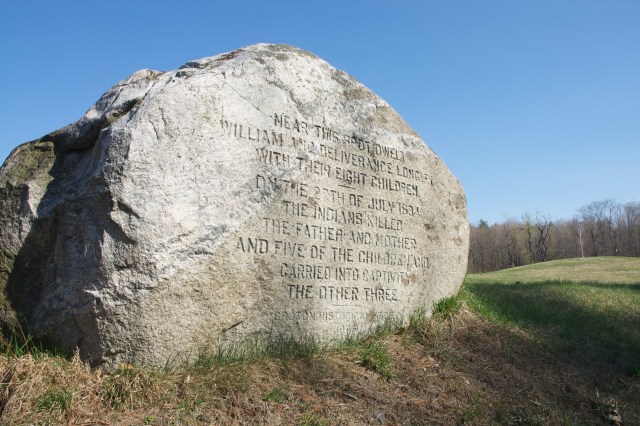
William and Deliverance Longley Memorial – The inscription reads: Near this spot dwelt William and Deliverance Longley with their eight children On the 27th day of July 1694 the Indians killed the father and the mother and five of the children and carried into captivity the other three

The monument can be found off Longley Road in Groton, Mass.  The monument was erected in the autumn of 1879, at the expense of the town of Groton, Mass, on land generously given for the purpose by Mr. Zachariah Fitch, the present owner of the farm; and it was dedicated with appropriate exercises on Feb. 20, 1880

Joanna, the widow of Benjamin Crispe, and mother of William Longley, made her will April 13, 1698, (admitted to probate in Middlesex Co., Ma. the following Dec.) and in it she remembered these absent children: “I give and bequeath unto my three Grand-Children that are in Captivity if they returne, these books one of them a bible, another a Sermon booke treating of faith and the other a psalms book”.

John Longley returned about the time when the grandmother died; and subsequently he filled many important offices both in the church and the town.  It is said he took kindly to life among the Indians, notwithstanding hardships, and, had it not been for determined efforts on the part of his relatives and the Massachusetts government, he would probably have become an Indian chief.  He was ransomed by the government and, with great difficulty, induced to return to civilization.  He remained with the Abenaqui for 4 years. According to his deposition given in 1736, he spent the last 2 ½ years of his captivity as a servant to Chief Madocawando of the Penobscot tribe.
Madockwando Portrait

Madockawando (c. 1630 Maine – 1698) was a sachem of the Penobscot Indians, an adopted son of Assaminasqua whom he succeeded. The Penobscot lands, lying east of Penobscot River, were a part of Acadia, which was given back to France in 1667 by the Treaty of Breda, though the English claimed that the country between the Penobscot and the St. Croix River was included in the Duke of York’s patent. The Indians were brought under French influence by Jean-Vincent d’Abbadie de Saint-Castin, known as Castin in the New England Chronicles. Castin settled among them, and married a daughter of Madockawando.

When King Philip’s confederacy rose against Plymouth Colony, the eastern Indians and the English settlers in Maine and New Hampshire became involved in war. The Penobscots were the first to treat for peace among the Indian tribes, and offered to enter into an alliance with the English. Articles were drawn and subscribed at Boston on 6 November 1676, and the peace was ratified by Madockawando. The English, however, found a pretext for renewing hostilities. The Indians were successful, and destroyed all the English settlements in that part of Maine.

In 1678 a treaty was made at Casco whereby the English were permitted to return to their farms on the condition of paying rent to the Indians. The peace was kept until the territorial dispute with France was brought to an issue in 1688 by Gov. Edmund Andros, who arrived among the Penobscots in a frigate, plundered Castin’s house, and destroyed his fort. The Indian chiefs took up the quarrel, being abundantly supplied with arms by Castin, attacked the white settlements, and thus began King William’s War. Madockawando took a prominent part in the atrocities of this war.

When the English built Fort William Henry at Pemaquid he hastened to Quebec to carry the intelligence to Frontenac, but divulged it to John Nelson, whose messengers warned the authorities in Boston of Iberville’s expedition. In 1693 the English gained Madockawando’s consent to a treaty of peace, yet he was unable to persuade the chiefs who were under the influence of FrenchJesuit emissaries, and was compelled to recommence hostilities. The Indian war continued for more than a year after the Peace of Ryswick had been concluded between France and England, until by the Treaty of Casco of 7 January 1699 the Penobscots acknowledged subjection to the crown of England. In the later operations Castin was their leader, Madockawando having been, perhaps, one of the chiefs treacherously slain by Capt. Pascho Chubb at a conference at Pemaquid in February 1696.

When he was ransomed from captivity, accounts record it was very much against his will.  He became, instead of a great Indian Sachem, a respectable deacon of the church and leading citizen of Groton, Mass. Like his father and grandfather, he was the town clerk during several years. After his four year captivity, he had a long and successful life. He married, first, about 1705, Sarah Prescott, the daughter of Jonas Prescott and Mary Loker Prescott. Sarah died Mar 8,1718 at Groton,MA.  He married, second, on Nov 30,1720 at Lancaster,MA, Deborah (Wilder) Houghton. She was the widow of Robert Houghton Jr.

Children(by first marriage): Sarah Longley Woods, William Longley, John Longley Jr, Jonas Longley, and Lydia Longley Farnsworth.

Children(by second marriage): Zachariah Longley, Joseph Longley, Jonathan Longley, Zachariah Longley, Nathaniel Longley, Robert Longley, and an infant daughter.
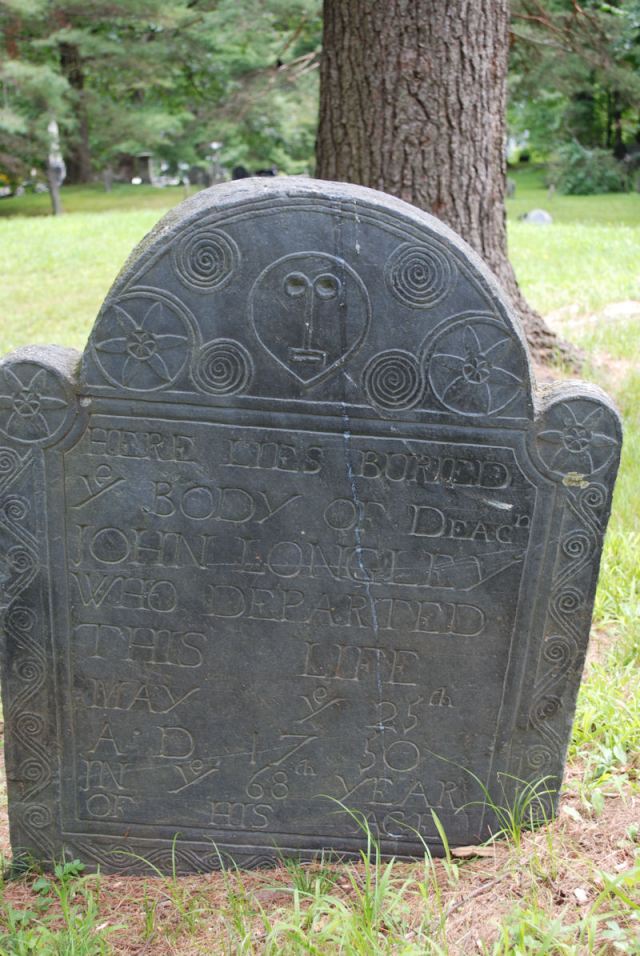
John Longley Headstone – Inscription: Here lies buried Ye body of Deac John Longley who departed this life, May Ye 25th AD l750 in Ye 68th year of his age.

“Dictionnarie Genealogique des Families Canadiennes depusis la fondation de la Colnis jusq’s nos jours” par l’ Abbe. C. Tanguay, A. D. S., Quebec, Canada, MDCCCLXCXI, p. 623:

Lydia was separated from her brother and taken to Villa Marie (Montreal), where she was offered for ransom to the French. Lydia’s ransom was paid by Jacques LeBer, a distinguished, wealthy resident of Montreal, in whose household she was gently cared for and treated with kindness and consideration. For two years she lived and moved in a world so foreign to any she had ever known, and then, by her own decision, reversed her principles, and united with the Catholic Church. On April 24,1696 shortly after her twenty-second birthday, she was baptized into that faith and given the name of Lydia Madeleine.

Within the year Lydia was admitted to the Congregation as a novice and on Sept. 19, 1699 took her final vows, and as Soeur Madeleine de la Congregation de Notre Dame, became the first girl of United States birth to become a Roman Catholic nun. In 1722, she was living on the Isle of Orleans, near Quebec, in the convent of the Holy family, of which it was supposed she was the Mother Superior.

On July 21, 1758, almost sixty-four years after her capture, Lydia Longley de Ste. Madeleine, Englishwoman of the Congregation of Notre Dame, died in her eighty-fifth year, and was buried in the Chapel of the Infant Jesus in the parish church in Montreal. Monique Lanthier, Montreal historian, states: The first church was demolished in 1830. The bodies were then buried under the new church and remained there until 1855 when they were moved to the new cemetery on Mount Royal, Notre-dame-des-Neiges-Cemetery. This is the largest cemetery in North America. There are almost 1,000,000 buried there.

Lydia’s Baptism Record

“Tuesday, April 24, 1696 – ceremony of baptism performed on English girl, Lydia Longley b. April l4, l674 at Groton, MA a few miles from Boston in New England. She was the daughter of William Longley and Deliverance Crispe, protestants. She (Lydia Longley) was captured in the month of July 1694 by the Abenaqui Indians and has lived for the past month in the house of the Sisters of the Congregation of Notre Dame. The godfather was M. Jacques Leber, merchant; the godmother was Madame Marie Madeleine Dupont, wife of M. de Maricourt, Ecuyer, Capt. of a company of Marines; she named the English girl Lydia Madeleine.

Signed: Lydia Madeleine Longley

Madeleine Dupont

Leber

M. Caille acting curate

Sister Madeleine died at the house of the Sisters of the Congregation de Notre Dame, July 20, 1758, at the age of 84 years. Her remains and those of Sister Marguerite (who was her relative, Sarah Tarbell, of Groton) were buried in the little cemetery connected with the convent.

Sources:
From Sarah Hildreth 1958
http://aleph0.clarku.edu/~djoyce/gen/report/rr_idx/idx053.html#CRISPE

http://www.spoonergen.com/res/resg78.htm#27765

http://users.rcn.com/smartin.javanet/longley.htm 

 http://www.treetreetree.org.uk/Crispe.htm 

Who begot thee?: Some genealogical and historical notes made in an effort to trace the American progenitors of one individual living in 1903 … By Gilbert Oliver Bent 1903

http://trees.ancestry.com/owt/person.aspx?pid=9384956&st=1

http://massandmoregenealogy.blogspot.com/2011/09/benjamin-crispe-1610-1683-england-to.html
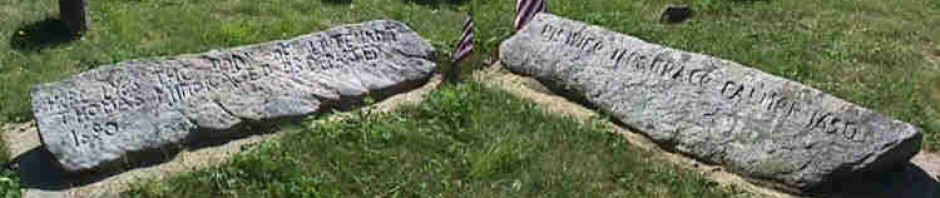
Posted in 13th Generation, Historical Monument, Immigrant - England, Line - Shaw, Storied, Violent Death | Tagged , , , , , , | 9 Comments
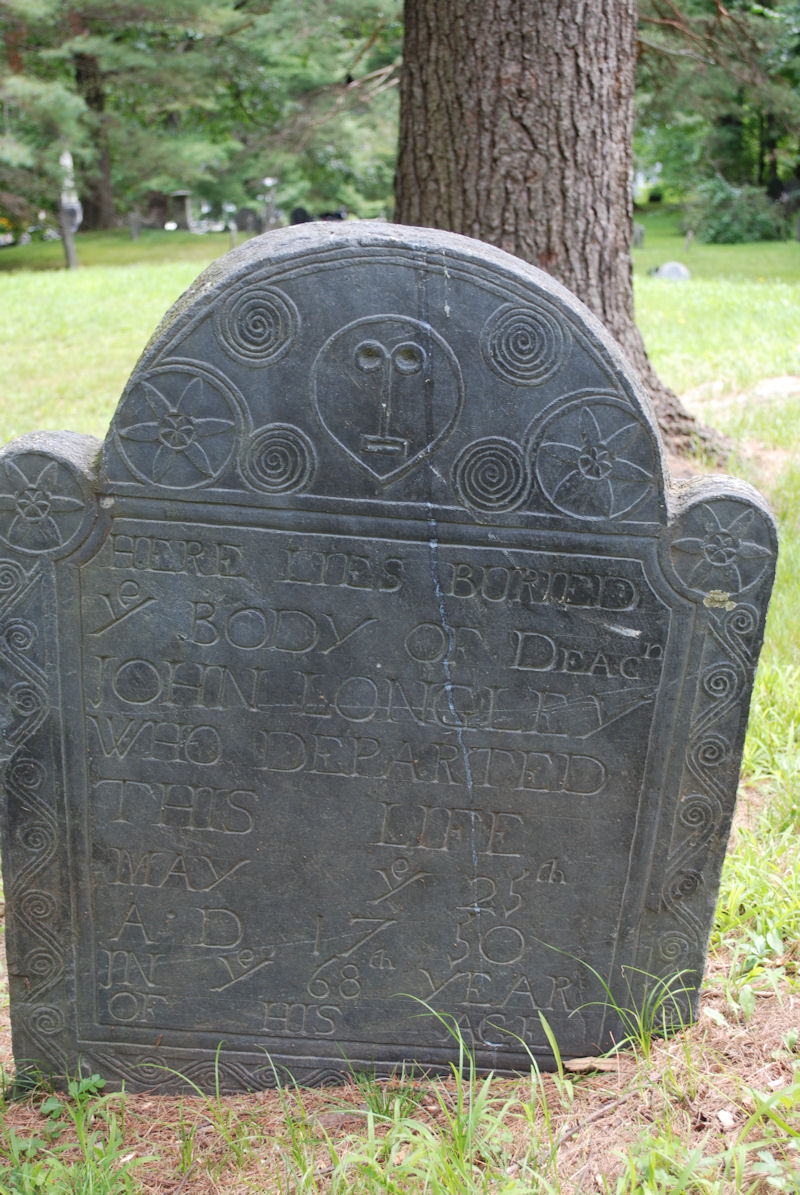
George Lawrence

George LAWRENCE (1637 – 1709) was Alex’s 10th Great Grandfather; one of 2,048 in this generation of the Shaw line.

George Lawrence was born in 1637 in Watertown, Middlesex, Mass.   His parents were John LAWRENCE and Elizabeth COOKE.    He married Elizabeth CRISPE on 29 Sep 1657 in Watertown, Mass.  After Elizabeth died, he married Elizabeth Holland on 16 Aug 1691 in Watertown, Mass.  George died on 21 Mar 1708/09 in Watertown, MA.

George may not have been the son of John and Elizabeth Lawrence of Groton. Although all the other sons of John were named in his will, he named no son George. He may, however, been related to John Lawrence of Groton.

Elizabeth Crispe was born on 28 Jan 1636/37 in Watertown, Mass.  Her parents were Benjamin CRISPE and Bridget [__?__]. Elizabeth died in Watertown, MA, on 28 May 1681; she was 44.

Elizabeth Holland was born in 18 Jun 1676 in Watertown, Middlesex, Mass.  Her parents were Nathaniel Holland and Sarah Streeter. Elizabeth died 21 Mar 1709 in Watertown, Middlesex, Mass.

Children of George and Elizabeth:

Name Born Married Departed
1. Elizabeth Lawrence 30 Jan 1658/59
Watertown, Mass
Thomas Whitney
18 Oct 1681
Watertown
8 Feb 1741
Bolton, Mass
2. Judith Lawrence 2 May 1660
Watertown
John Stearns
1681
Cambridge, Mass
1713
Watertown
3. Hannah Lawrence 24 Mar 1661/2
Watertown
Obadiah Sawtell
1680
Watertown, Mass
1741
Middlesex, Mass
4. John Lawrence 25 Mar 1664 15 Jun 1674
killed by being run over by a load of bricks
5. Benjamin Lawrence 2 May 1666 Mary Clough
4 Jul 1689
Charlestown, Mass
.
Anna Phillips
3 Feb 1695
.
Anna Coolidge
18 Nov 1716
.
Elizabeth Bennett
9 Jul 1719
aft 7 Sep 1733
6. Daniel Lawrence 2 May 1666 Sarah Counce
19 Jun 1689
.
Hannah Mason
Nov 1695
.
Maud Russell
23 Aug 1722
20 Oct 1743
Watertown
7. George Lawrence 4 Jun 1668 Mary [__?__]
Mar 1695 Watertown
.
Anna [__?__]
1715
5 Mar 1735/36
Watertown
8. Mercy LAWRENCE 4 Dec 1671 Watertown Willliam BAKER
ca. 1691
25 Nov 1753 Harwich, MA
9. Sarah Lawrence 4 Dec 1671
Watertown
Thomas Rider
5 Apr 1689
Roxbury, MA
1714
Roxbury
10. Mary Lawrence 11 Dec 1671 John Earl (Erle)
5 Apr 1687
Watertown
.
Michael Flagg
27 Dec 1704
Watertown
1744
Groton, Mass
11. Grace Lawrence 3 Jun 1680
Watertown
John Edes
13 Apr 1698
Charlestown
9 Aug 1758
Charlestown, Mass
12. Martha Lawrence 3 Jun 1681
Watertown
John Dix
29 Nov 1697
Watertown
1723
Watertown
13. Joseph Lawrence c. 1681 Hannah Marrett
2 Feb 1714/45
5 Nov 1785

.
Children of George and Elizabeth Holland:

Name Born Married Departed
14. Patience Lawrence 14 Jul 1694
Watertown, Middlesex, Mass
bef. 1707
Watertown, Middlesex, Mass
15. Rachel Lawrence 14 Jul 1694
Watertown, Middlesex, Mass
aft. 1706

3 Nov 1691  – George was excused by the Court from serving as Constable, ‘in that he could not read a word.

1707 – Will dated

Mentions his wife Elizabeth, two youngest children Joseph and Rachel, sons George, Benjamin, and Daniel, daughter Mercy Baker living at Yarmouth, daughter Grace Edes at Charlestown, daughter Elizabeth Whitney at Stow, daughter Hannah Sawetl at Groton, daughter Judith Sterns of Cambridge Farms, daughter Mary Flagg, daughter Sarah Rider, daughter Marths Dix, and granddaughter mary Earl. Sons Daniel and George were appointed administrators at the request of the widow. Inventory dated 5 Apr 1709

Children

1. Elizabeth Lawrence

Elizabeth’s husband Thomas Whitney  was born 24 August 1656 at Watertown, Middlesex County, MA. His parents were Thomas Whitney and Mary Kendall.   He purchased 112 acres of land in Cambridge,MA in 1679.   In 1682, he bought 60 acres in Stow, MA where his first five children were born.   In 1719 he purchased 52 acres in Lancaster, MA and deeded one-half of the purchase to his son, John. Thomas died 12 April 1742 at Bolton,Worcester, Mass. at age 85.

2. Judith Lawrence

Judith’s husband John Stearns was born 24 Jan 1657 in Cambridge, Middlesex, Mass. His partents were Charles Stearn and Rebecca Gibson.  John died 22 Feb 1722 in Lexington, Middlesex, Mass.

3. Hannah Lawrence

Hannah’s husband Obadiah Sawtell was born 1649 in Watertown, Mass. His parents were Richard Sawtelle and Elizabeth Pople. Obadiah died 20 Mar 1740 in Groton, Mass

5. Benjamin Lawrence

Benjamin’s first wife Mary Clough was born 1670 in Watertown, Middlesex, Mass.  Her parents were John Clough and Frances Hoyt.  Mary died 1695 in Charlestown, Middlesex, Mass.

Benjamin’s second wife Anna Phillips was born  ca 1679. Anna died on 11 Jan 1716.

Benjamin’s third wife Anna Coolidge was born 1671 in Watertown, Middlesex, Mass. Her parents were Nathaniel Coolidge and Mary Bright.  Anna died 28 Dec 1718 in Charlestown, Middlesex, Mass.

Benjamin’s fourth wife Elizabeth Bennett was born 1670 in Watertown, Middlesex, Mass. Elizabeth died 26 Nov 1738 in Watertown, Columbia Cty, Mass.

Occupation: waterman, of Charlestown

Benjamin’s will, dated 7 Sep 1733, mentions wife Elizabeth; granddaughter Mary Lawrence of Boston in her 12th year; children of daughter Abigail Pearkes of Boston, namely, John, Elizabeth, and Ann; daughter Elizabth Colby of Newbury; and daughter Mary Stevens of Sheepscot, York Co

6. Daniel Lawrence

Daniel’s first wife Sarah Counce (Counts) was born 1670 in Watertown, Middlesex, Mass. Her parents were Edward Counce and Sarah Adams. Sarah died 26 Jun 1694 in Charlestown, Middlesex, Mass

Daniel’s second wife Hannah Mason was born 3 Sep 1676 in Watertown, Middlesex, Mass. Her parents were [__?__] Mason and Abigail Eaton. Hannah died died on 27 Aug 1721 in Medway, Norfolk, Mass.

Daniel’s third wife Maud Russell was born 22 Jun 1676 in Watertown, Middlesex, Mass.  Her parents were James Russell and  Mabel Haynes.  Maud died 20 Oct 1743.

Daniel was a veteran of Indian Wars. He was tailor. He lived at Fish St., Charlestown.

7. George Lawrence

George’s first wife Mary [__?__] was born 1670 in Watertown, Mass. Mary died 21 Jan 1740 in Waltham, Middlesex, Massa

George’s second wife Anna [__?__] was born 1672 in Watertown, Middlesex, Mass

8. Mercy LAWRENCE (See Willliam BAKER‘s page)

9. Sarah Lawrence

Sarah’s husband Thomas Rider was born 1667 in Watertown, Middlesex, Mass. Thomas died 1729

10. Mary Lawrence

Mary’s first husband John Earl (Erle) was born 1667 in Boston, Suffolk, Mass. His parents were Francis Earle and [__?__]. John died 5 Apr 1689 in Boston, Suffolk, Mass.

Mary’s second husband Michael Flagg was born 23 Mar 1651 in Watertown, Middlesex, Mass. His parents were Thomas Flagg and Mary Underwood. Michael died 16 Oct 1711 in Watertown, Middlesex, Mass.

Michael was an early proprietor of Worcester.

11. Grace Lawrence

Grace’s husband John Edes was born 22 Aug 1680 in Charlestown, Mass. His parents were John Edes and Mary Tufts. John died 16 Jan 1721 in Charlestown, Middlesex, Mass.  He died of smallpox. Occupation: Cordwainer.

On 13 Apr 1698 when Grace was 17, she married John Edes

12. Martha Lawrence

Martha’s husband John Dix was born 6 Mar 1672 in Watertown, Middlesex, Mass. His parents were John Dix and Elizabeth Barnard. John died 10 Jun 1676 in Watertown, Middlesex, Mass

13. Joseph Lawrence

Joseph’s wife Hannah Marrett wasbaptized on 3 Dec 1696 in Cambridge, Mass. Her parents were Edward Marrett (2 Aug 1670-11 Apr 1754) and Hannah Bradish (14 Jan 166[8/]9-20 Jul 1727). Hannah died on 5 Jun 1755.

Joseph, of Charlestown, and wife Hannah, signed a deed in 1714, and another later, in favor of his brother George

Sources:

http://trees.ancestry.com/owt/person.aspx?pid=11163432

http://aleph0.clarku.edu/~djoyce/gen/report/rr_idx/idx126.html#LAWRENCE

http://www.spoonergen.com/res/resg55.htm#27496


Posted in 12th Generation, Be Fruitful and Multiply, Immigrant - England, Line - Shaw, Twins, Violent Death | Tagged | 4 Comments