Robert Ring

Robert RING (1614 – 1691) was Alex’s  10th Great Grandfather; one of 1,024 in this generation of the Shaw line.

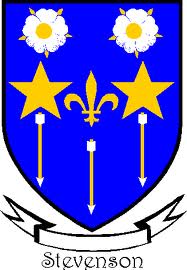
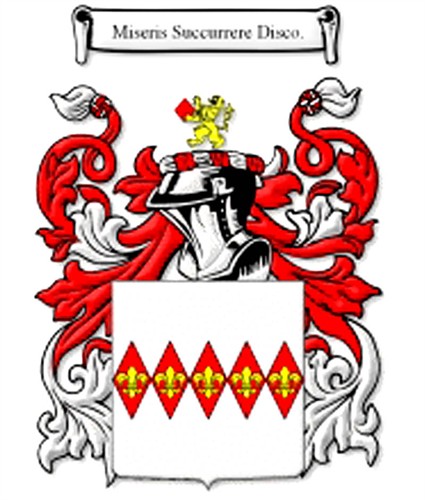
Immigrant Ancestor - Ring Coat of Arms

Immigrant Ancestor – Ring Coat of Arms

Robert Ring was born in 1614 in Marlborough, Wiltshire, England. His parents were Richard RING and Elizabeth SHROPSHIRE. He sailed  on The Confidence from Southampton April 11, 1638 or April 24, with Master John Gibson, and 84 passengers.  He was a servant of John Sanders bound for Salisbury, Mass.  He returned to England about 1643 and married Elizabeth JARVIS there before 1649. He came back about 1650 and lost some rights thereby in the town.   Robert died 31 Mar 1691 in Salisbury, Essex, Mass.

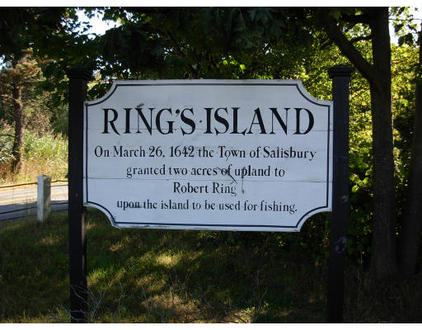
Robert carried on a fishing business on Ring’s Island, Salisbury, Mass

Elizabeth Jarvis was born in 1618 in Marlborough, Wiltshire, England.  Elizabeth died 23 Jan 1736 in Salisbury, Essex, Mass.

Children of  Robert and Elizabeth:

Name Born Married Departed
1. Hannah Ring
1649 in Marlborough, Wiltshire, England Harrison 1688
2. Elizabeth Ring 1652 in Marlborough, Wiltshire, England Nathaniel Griffin (son of Humphrey GRIFFIN)
26 Aug 1671 Andover, Essex, Mass.
Salisbury, Mass
3. Martha RING 12 Dec 1654 Salisbury, Mass. Henry TRUSSELL
1665 in Salisbury, Essex, Mass
11 Mar 1738
Amesbury, Mass
4. Jarvis Ring Feb 1658 Salisbury Hannah Fowler
24 Dec 1685 Salisbury
1 Dec 1727
Salisbury
5. John Ring 17 Feb 1662 Salisbury Priscilla Norton
1691
Salisbury, Essex, Mass
22 Sep 1721
Salisbury, Mass
6. Joseph Ring 3 Aug 1664 Salisbury 1705
Berwick, York, Maine,
7. Robert Ring  c. 1665
Salisbury, Mass
Ruth [__?__]
c. 1690
3 DEC 1705 Amesbury, Mass.

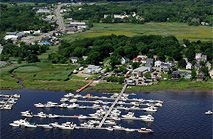
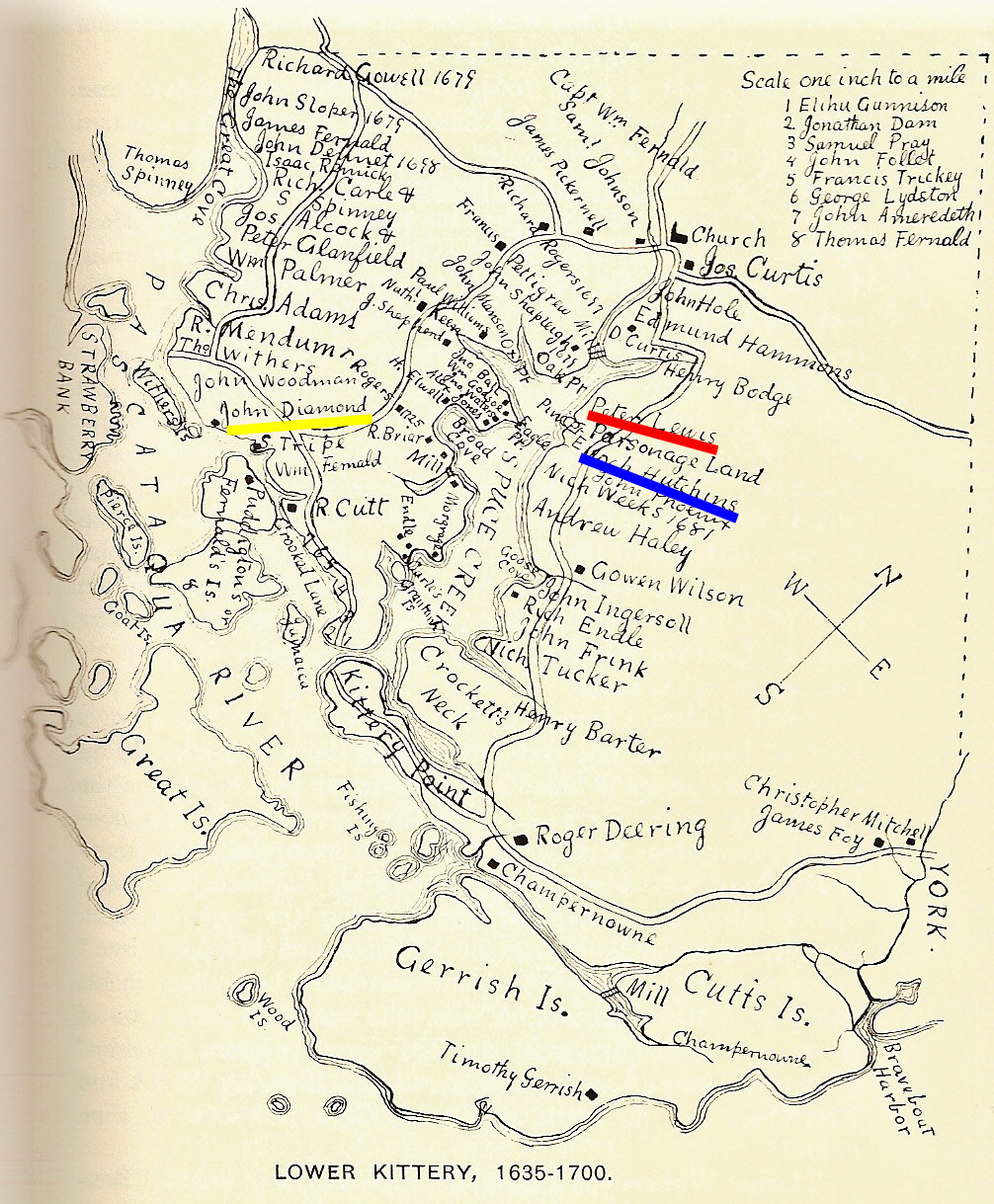
Ring’s Island Map

ROBERT  RING(+) [or RINGE], of Salisbury, “cooper” and “planter,” prob. b. ab. 1614; per. bro. of (1)RICHARD; m. Elizabeth (???). He received land in the “first division” and in 1640; free. Oct., 1640; carried on the fishing business on Ring’s Island in 1642;?? “householder” in S. in 1677; signed petition of 1680; d. 1690; will Jan. 23, 1687-8; March 31, 1691.

Ring’s Island Marina – 16 First Street Salisbury, MA 01952

Among the deeds at Salem is a document, dated Oct. 22, 1668, which states that Richard Ring of Marlborough, Wilts, Old Eng., and his children, namely, Joseph Ring, Isaac Ring, his sons; and Elizabeth Shropshire, wid., and Hester Ring, his daus., claimed debts due them in New England; and Joseph Ring, the bearer, was to travel thither for himself, his father, bro. and sisters. JOHN ROLFE willed them property in 1664.

(*) Rev. Chr. Wordsworth writes that he finds only this entry about Richard Ring on the register of St. Peter’s.

(+) He was prob. the Robert “King,” aged 24, who came as servant of John Sanders, with John Cole, Roger Eastman, William Cottle, John “Roaff” and others, in the “Confidence,” 1638. [G. R. 1860, p. 335.]

Robert Ring returned to England and made Robert Pike (son-in-law of Joseph MOYCE)  his agent by a writing bearing date 1643. He was away about 8 years, and stated that he could not return to America by reason of the wars in England. His name is not on the list of commoners in 1650; but he was taxed in 1650 and 1652, signed the agreement of 1654, and received land that year. After his return to Salisbury he endeavored to regain his common right and that of John Fuller, which he owned. The town claimed that, on account of his absence, land had been given to those who bought his first lots. Various papers relating to the case, bearing date from 1658 to 1665, are in the Norfolk Co. records, the Mass. Archives, and Supreme Court Files, Boston. In one of them he states that he “sent over a servant who is now a useful man in the town and admitted a townsman.”

In it he gave property to “Will Cottle, son to Sarah, now wife of John Hale of Nb., and Joanna, dau. to said Sarah;” also to Rev. Thomas Wells and his son Titus; in addition to his children and grandchildren, named as such.

A wid. Mary Ring m. June, 1710[A], NATHANIEL2 WHITTIER
(Thomas1).

Genealogical and family history of the state of New Hampshire By Lewis publishing company, Chicago, page 1389 (available on Google Books)

“Robert Ring or Ringe of Salisbury is recorded as a cooper and planter.  He was born in 1614 and sailed from Southampton in the ship “Bevis” in 1638.  He was made a freeman at Salisbury in 1640 and received lands in that year and in a previous division.  He carried on the fishing business at Ring’s Island in 1642 and is recorded as a householder in 1677.  He was a signer of a petition in 1680, and died in 1690.  His will was made January 23 1688, and proved March 31 1691. The christian name of his wife was Elizabeth but no record shows her family name. Their children were Hannah, Elizabeth, Jarvis, John, Joseph and Robert.”

[HOWEVER: on the passenger lists themselves of the Bevis in 1638 he does not appear. See: http://familytreemaker.genealogy.com/users/c/a/r/John-R-Carpenter/PHOTO/0012photo.html

A “Robert King” appears on the ships list for the Confidence in 1638:

http://www.packrat-pro.com/ships/confidence.htm

as a servant for John and Sarah Sanders, who has been identified as Robert Ring from Marlborough, Wiltshire, bound for Salisbury. Ref: Hoyt Families Salis. 297. “Topographical Dictionary of 2885 English Emigrants to New England 1620 – 1650” by Charles Edwards Banks, Edited and Indexed by Elijah Ellsworth Brownell, Southern Book Company, Baltimore, 1957 (Lady Anne’s Library)  pg. 179).

So the “Confidence” seems a more likely ship for Ring’s passage than the Bevis, but it’s hardly ironclad.  The Confidence left Southampton April 11, 1638 or April 24, with Master John Gibson, and 84 passengers  Other sources say the master was John Jobson, arriving in Boston from Southampton April 24, 1638. The April 1638 date would be roughly appropriate for Ring becoming a freeman in Oct. 1640.

===========

There are at least four different variations of the “Confidence” passenger lists; see

http://www.angelfire.com/ky3/caroln242/passlist.html

for all four variants.  On one, “Robert King” is listed as the servant of John Sanders/Saunders.  On another, he is listed as the servant of John Cole.  A note on one of the transcriptions states that “In some cases the grouping of the ‘family units’ has to be treated with some caution as it is known that John Sanders (also known as Saunders) and his ‘servants’ was in fact a religious group escaping to the ‘freedom’ of the New World.”

Note that John Saunders’s sister Sarah (erroneously listed as his wife on the Confidence manifest) married Maj. Robert Pike, on 3 Apr 1641, the same in all likelihood being the Robert Pike who served as Robert Ring’s agent during his absence back in England.  See Genealogical and Personal Memoirs Relating to the Families of Boston and Eastern Massachusetts, by William Richard Cutter, Lewis Publ. 1908, page 857.  That book lists “Robert Ring” as one of the servants of Sanders/Saund

Children

1. Hannah Ring

Hannah’s husband Harrison

2. Elizabeth Ring

Elizabeth’s husband Nathaniel Griffin was born c. 1646 Ipswich, Mass. His parents were Humphrey GRIFFIN and Elizabeth ANDREWS. Nathaniel died  in Salisbury, Essex, Mass..

3. Martha RING (See Henry TRUSSELL‘s page)

4. Jarvis Ring

Jarvis’ wife Hannah Fowler was born 7 Jan 1661 in Ipswich, Essex, Mass. Her parents were Thomas Fowler and Hannah Jordan. Hannah died 24 Dec 1685 in Salisbury, Essex, Mass

freeman 1690; witness  Susanna MARTIN  trial, 1692. Susannah was executed for witchcraft on 19 Jul 1692 in Salem, Essex, Mass.
Jarvis and Hannah Ring signed the petition in favor of Mary Perkins Bradbury [Daughter of John PERKINS] in 1692.  Over a hundred of her neighbors and townspeople testified on her behalf, but to no avail and she was found guilty of practicing magic and sentenced to be executed. Through the ongoing efforts of her friends, her execution was delayed. After the witch debacle had passed, she was released. By some accounts she was allowed to escape. Others claim she bribed her jailer. Another account claims that her husband bribed the jailer and took her away to Maine in a horse and cart. They returned to Massachusetts after the witch hysteria had died down.

Salisbury soldier in 1698 and 1702. Adm. est. March 29, 1728. Will of widow Hannah
Feb. 24, 1735-6; Dec. 26, 1743.

Jarvis Ring Witch Trial

Jarvis Ring of Salisbury maketh oath as followeth, That about seven or eight years ago he had been several times afflicted in the night time by somebody or something coming up upon him when he was in bed and did sorely afflict by laying upon him and he could neither move nor speak while it was upon him, but sometimes made a kind of noise that folks did hear him and come up to him and as soon as anybody came, it would be gone. This it did for a long time before and since but he did never see anybody clearly, but one time in the night it came upon me as at othr times and I did then see the person of Susanna Martin of Amesbury. This deponent did perfectly see her and she came to this deponent and took him by the hand and bit him by the finger by force and then came and lay upon him awhile as formerly, and after a while went away. The print of the bite is yet to be seen on the little finger of his right hand for it was hard to heal (he further saith). That several times he was alseep when it came, but at that time when bit his finger he was as fairly awake as ever he was and plainly saw her shape and felt her tooth as aforesaid.

Sworn by Jarvis Ring above said May the 13th 1692
Before Me
Robt. Pike Assit. at Salisbury
Jurat in Curia

5. John Ring

John’s wife Priscilla Norton was born 16 Dec 1667 in Salisbury, Essex, Mass. Her parents were Joseph Norton and Susanna Getchell. Priscilla died in 1721.

6. Joseph Ring

Joseph  was at the taking of Casco Bay Fort;  witness in the  Susanna MARTIN witch trial, 1692; adm. est. gr. bro. Jarvis, May 30, 1705.

Joseph Ring Testimony against Susannah Martin

13 May 1692 | Salem, Massachusetts

Joseph Ring of Salisbury aged 27 years having been strangely handled for the space of almost two years maketh this Relation upon oath as followeth, viz: That in the month of June next after Casco Bay fort was taken this deponent coming between Sandy Beach and Hampton Town met with Thomas Hardy of Great Island and a company of several other creatures with him which said Hardy demanded of this deponent two shillings and with that dreadful noise and hideous shapes of these creatures and fireball, this deponent was almost frightened out of his wits and in about a half an hour (or indeed he could not judge of the time) they left him and he came to Hampton. About ten days after as the deponent came from Boston this deponent was overtaken by a company of people on horseback who passed by him and after they were passed by him, the aforesaid Thomas Hardy turned about his horse, and ame back to this deponent with his horse in hand and desired this deponent to go to Mrs. White’s and drink with him, which being refused he turned away to the Company and they all came up together such a weth (i.e. with so many horses) that it seemed impossible to escape being trod down by them, but they went all past and then appeared no more.

About October following coming from Hampton in Salisbury Pine Plain a company of horses with men and women upon them overtook this deponent and the aforesaid Hardy being one of them came to this deponent as before and demanded his 2s of him and threatened to tear him in pieces to whom this deponent made no answer, and so he and the rest went away and left this deponent. After this this deponent had divers strange appearances which did force him away with them into unknown places where he saw meetings and feastings and many strange sights, and from August last he was dumb and could not speak till this last April. He also relates that there did use to come to him a man that did present him a book to which he would have him set his hand with promise of anything that he would have and there were presented all Delectable things, persons and places imaginable, but he refusing it, would usually and with most dreadful shapes, noises and screeching that almost scared him out of his wits, and this was the usual manner of proceeding with him. And one time the book was brought and a pen offered him to his apprehension there was blood in the ink horn, but he never touched the pen. He further say that they never told him what he should write nor he could not speak to ask them what he should write. He farther in several of their merry meetings he have seen Susanna Martin appear among them.

And that day that his speech came to him again which was about the end of April alst as he was in bed she did stand by his bed’s side and pinched him.

Joseph Ring abovesaid made oath of the truth of all that is above written this 13th day of May 1692.
Before Me
Robt. Pike Assist.
Jurat in Curia the substance of it viva voce.

It is to be understood that the matter about that two shillings demanded of said Ring was this, viz: That when Casco was assaulted before it was taken, Capt. Cedric Walt was going from Great Island in Patascataway with a party for their relief of which party said Ring was one and said Hardy coming up into the room where said Ring [was] before they sailed and played at shovelboard or some such like game and urged said Ring play, said Ring told him he had no money and said Hardy lent him 2s and then said Ring played with him. Said Hardy who won his money away from him again so he could not then pay him this account was by said Ring given to me.
Robt. Pike Ast

13 May 1692 | Salem, Massachusetts
JOSEPH RING v. SUSANNA MARTIN

The deposition of Joseph Ring at Salisbury aged 27 years being sworn saith, That about the latter end of September last being int he wood with his brother Jarvis Ring hewing of timber, his brother went home with his team and left this deponent alone to finish the hewing of the piece for him, for his brother to carry when he came again, but as soon as his brother was gone, there came to this deponent the appearance of Thomas Hardy of the great Island at Patascataway and by some impulse he was forced to follow him to the house of ___ Tucker which was deserted and was about half a mile from the place he was at work in, and in that house did appear Susanna Martin of Amesbury and the aforesaid Hardy and another female person which the deponent did not know. There they had a good fire and drink, it seemed to be cider, there continued most part of the night, said Martin being then in her natural shape and talking as she used to do, but toward the morning the said Martin went from the fire, made a noise and turned into the shape of a black hog and went away and so did the other two persons go away and this deponent was strangely carried away also and the first place he knew was by Samuel Wood’s house in Amesbury.
Sworn by Joseph Ring May the 13th 1692
Before Me
Robt. Pike Assist.
Jurat in Curia

7. Robert Ring

Robert’s wife Ruth [__?__]  was born about 1660 in Amesbury, Essex, Mass. After Robert died, she married  8 Feb 1715 in Amesbury, Mass. to Sgt. John Colby.  John Colby was born 19 Nov 1656 Salisbury, Essex, Mass.  His parents were John COLBY and Frances HOYT.  John died 6 Apr 1719 Amesbury, Mass.  Ruth died May 1748 in Amesbury, Essex, Mass

Sources:

http://www.genealogyofnewengland.com/b_r.htm

http://trees.ancestry.com/owt/person.aspx?pid=24515413

http://www.myancestrallegacy.com/crandall/index3.htm#RING

http://famhist2.blogspot.com/2009/03/murder-in-salem.html

Posted in 12th Generation, Immigrant - England, Line - Shaw, Place Names, Witch Trials | Tagged , | 22 Comments

Henry Trussell

Henry TRUSSELL (1652 – 1731) was Alex’s  9th Great Grandfather; one of 1,024 in this generation of the Shaw line.

Henry Trussell - Coat of Arms

Henry Trussell was born about 1655 in Liverpool, England. His parents were John TRUSSELL and Joane BEDFORD. He came to America as an indentured servant.  He married Martha RING in 1665 in Salisbury, Essex, Mass.  Henry died 9 Apr 1731 in Salisbury, Mass.

Martha Ring was born 12 Dec 1654 in Salisbury, Mass.  Her parents were Robert RING and Elizabeth JARVIS. Martha died 11 Mar 1738 in Amesbury, Essex, Mass.

Children of  Henry and Martha:

Name Born Married Departed
1. Sarah TRUSSELL 26 Jul 1686 Salisbury, Essex, Mass. Philip CALL Sr.
20 Jan 1706/07 Amesbury, Essex, Mass
16 Aug 1754 Stevenstown, (later Salisbury) New Hampshire killed by Indians in an attack on her home.
2. Elizabeth Trussell 26 APR 1689 Amesbury, Mass. John Watts (Mattes?)
bef. 1730
3. Henry Trussell 20 APR 1695 Amesbury, Mass. Hannah Weed
13 JAN 1714/15 Amesbury, Essex, Mass.
1745
Cape Breton, Nova Scotia, Canada

The family was associated with shipping, and the first Trussell to come to the Colonies was taken to America to be an indentured servant.

There are records of earlier Henry Trussells in the colonies.  One Henry Trussell paid taxes in Salisbury, MA in 1640, and another (or the same)  Henry T. who testified at a trial in Amesbury, MA in 1662.  Most Trussell family genealogists show these Trussell’s as related to our line, but the relationships are not consistently shown from one account to the next, and I have not been able to straighten the matter out. One account portrays the Trussells in the U.S. as beginning from two sons of a merchant in Liverpool, England; a certain Henry T. who settled in Salem sometime before 1640 and another  John T. who settled in Virginia in about 1620.  It seems reasonable that the Henry T. who married Martha Ring was related to the Henry T. in Salisbury in 1640 and in Amesbury in 1662.  Trussell has never been a common surname.

An early family history written by Luther Trussell [1802-1888] indicates that the first Trussell in the New England Colonies was Henry Trussell, son of a Captain in the Royal Navy and grandson of a merchant in Liverpool, England. Apparently the first Trussell did not come to the Colonies of his own free will. This account combines Henry’s story with his son’s so it’s hard to say how reliable it is.   Luther’s story follows:

“Henry Trussell was born at Liverpool England and he was the only son of Henry Trussell, a Captain of the Navy, and his grandfather was a merchant of that city. The means by which he came to this country may give us some idea of the manners of the age and the respect paid the laws.

“Being invited by a lad of his acquaintance belonging to a vessel to go on board one afternoon he complied and was treated with such uncommon attention that he soon forgot both time and place. Early the next morning he would have returned, but what was his surprise when instead of a crowded city he beheld from the deck nought but the blue sky and boundless ocean. To remonstrate was folly with such commanders. The vessel was on her way to Boston in the Colonies where she was bound on the passage. They were spoken by the vessel commanded by his father whom he saw and recognized from the deck. The vessel soon after arrived in port where, knowing the Captain’s motive in bringing him was to sell him for his passage, he improved the first opportunity to take French leave of the Ship, Captain, and Crew, and in company with another person who left at the same time, wandered about the country for some time till they arrived at Haverhill, MA. Here he afterwards settled and married Hannah Wade. He then commanded a company at Cape Breton in 1745 where he died, age 50, a victim of the vindictive spirit of the inhabitants who poisoned their wells of water. He left two sons, Henry and Moses and two daughters. Henry settled at Bradford, MA and had two sons, Henry and Levi. Henry moved to Sutton, NH, in 1780 but died the next year without issue. Levi settled in Haverhill, MA. Moses settled in Plaistow, NH and married Jane Mills, an emigrant from Scotland. He died of consumption in 1759, leaving five sons and two daughters. John settled in Hopkinton, NH, James in Boscawen, NH, Joshua in Sedgwick, ME, Jacob, Danville, VT, and Moses in New London, NH.”

Children

1. Sarah TRUSSELL (See xx page)

2. Elizabeth Trussell

Elizabeth’s husband John Watts (Mattes?)

3. Henry Trussell

Henry’s wife Hannah Weed was born 29 Aug 1689 in Amesbury, Mass. Her parents were Samuel Weed and Bethia Morgan.

Henry was a Captain in the Colonial Army in 1745. At that time France was at war with Britain and, in that year, the New England Colonies, with Henry T. in tow, launched an assault on the Fort at Louisburg.

The famous Fort was located on Cape Breton Island, near the mouth of the St. Lawrence River for which it served as sentry, and it was heavily fortified. To everyone’s surprise, the Colonial Expedition succeeded. The victory fired the Colonialists imagination.  They had proved their strength. Unfortunately, after the victory, Captain Trussell and his unit died, reportedly from poison the Indians put in the well that he and his troops were using for water. Even this unfortunate event had a positive outcome as some of Captain Henry’s children received land grants from the government to compensate them for the loss.

Siege of Louisbourg - 1745

The Siege of Louisbourg took place in 1745 when a New England colonial force aided by a British fleet captured Louisbourg, the capital of the French province of Île-Royale (present-day Cape Breton Island) during the War of the Austrian Succession, known as King George’s War in the British colonies.

Siege of Louisbourg Map

Although the Fortress of Louisbourg’s construction and layout was acknowledged as having superior seaward defences, a series of low rises behind them provided attackers places to erect siege batteries. The fort’s garrison was poorly paid and supplied, and its inexperienced leaders mistrusted them. The colonial attackers were also lacking in experience, but ultimately succeeded in gaining control of the surrounding defences. The defenders surrendered in the face of an imminent assault.

Louisbourg was an important bargaining chip in the peace negotiations to end the war, since it represented a major British success. Factions within the British government were opposed to returning it to the French as part of any peace agreement, but these were eventually overruled, and Louisbourg was returned, over the objections of the victorious colonists, to French control after the 1748 Treaty of Aix-la-Chapelle.

The expeditionary corps was formed in ten battalions. They were Pepperell’s, Wolcott’s (of Connecticut), Waldo’s,  Dwight’s (nominally an artillery battalion), Moulton’s, Willard’s, Hale’s, Richmond’s, Gorham’s, and Moore’s (of New Hampshire). One hundred and fifty men of this regiment were in the pay of Massachusetts. Pepperell’s, Waldo’s, and Moulton’s were mostly raised in the District of Maine. Pepperell said that one-third of the whole force came from Maine. Dwight was assigned to the command of the artillery, with the rank of brigadier; Shubael Gorham [grandson of Capt. John GORHAM] to the special service of landing the troops in the whaleboats, which had been provided, and of which he had charge. There was also an independent company of artificers, under Captain Bernard, and Lieutenant-Colonel Gridley was appointed chief engineer of the army.

Pepperell held the rank of lieutenant-general;

1 Gibson was very active during the siege, especially when anything of a dangerous nature was to be done. He was a retired British officer. He was one of the three who escaped death, while on a scout, May 10. With five men he towed a fireship against the West Gate, under the enemy’s fire, on the night of May 24. It burnt three vessels, part of the King’s Gate, and part of a stone house in the city. Being done in the dead of night, it caused great consternation among the besieged.

2 Pepperell’s own regiment was actually commanded by his lieutenant-colonel, John Bradstreet, who was afterwards appointed lieutenantgovernor of Newfoundland, but on the breaking out of the next war with France, he served with distinction on the New-York frontier, risingthrough successive grades to that of major-general in the British army. Bradstreet died at New York in 1774.

3 General Roger Wolcott had been in the Canada campaign of 1711 without seeing any service. He was sixty-six when appointed over the Connecticut contingent under Pepperell. Wolcott was one of the foremost men of his colony, being repeatedly honored with the highest posts, those of chief judge and governor included. David Wooster was a captain in Wolcott’s regiment.

4 Samuel Waldo was a Boston merchant, who had acquired a chief interest in the Muscongus, later known from him as the Waldo Patent, in Maine, to the improvement of which he gave the best years of his life. Like Pepperell, he was a wealthy land-owner. They were close friends, Waldo’s daughter being betrothed to Pepperell’s son later. His patent finally passed to General Knox, who married Waldo’s granddaughter.

5 Joseph Dwight was born at Dedham, Mass., in 1703. He served in the Second French War also. Pepperell commends his services, as chief of artillery, very highly.

6 Jeremiah Moulton was fifty-seven when he joined the expedition. He had seen more actual fighting than any other officer in it. Taken prisoner by the Indians at the sacking of York, when four years old, he became a terror to them in his manhood. With Harmon he destroyed Norridgewock in 1724.

7 Robert Hale, colonel of the Essex County regiment, had been a schoolmaster, a doctor, and a justice of the peace. He was forty two. His major, Moses Titcomb, afterwards served under Sir William Johnson, and was killed at the battle of Lake George.

8 Sylvester Richmond, of Dighton, Mass., was born in 1698; colonel of the Bristol County regiment. He was high sheriff of the county for many years after his return from Louisburg. Died in 1783, in his eighty fourth year. Lieutenant-Colonel Ebenezer Pitts of Dighton, and Major Joseph Hodges of Norton, of Richmond’s regiment, were both killed during the campaign.

9 Samuel Moore’s New Hampshire regiment was drafted into the Vigilant. His lieutenant-colonel, Meserve, afterward served under Abarcromby, and again in the second siege of Louisburg under Amherst, dying there of small-pox. Matthew Thornton, signer of the Declaration, was surgeon of Moore’s regiment.

1° Edward Tyng, merchant of Boston, son of that Colonel Edward who was carried a prisoner to France, with John Nelson, by Frontenac’s order, and died there in a dungeon.

Sources:

http://www.genealogyofnewengland.com/b_t.htm

http://trees.ancestry.com/owt/person.aspx?pid=11505973

The old families of Salisbury and Amesbury, Massachusetts: with some related … By David Webster Hoyt

http://home.earthlink.net/~rrtrussell/chapter01/

http://home.earthlink.net/~rrtrussell/chapter02/

Posted in 11th Generation, Immigrant - England, Line - Shaw | Tagged , | 3 Comments

Thomas Call

Thomas CALL (1597 – 1676) was Alex’s  11th Great Grandfather; one of 4,192 in this generation of the Shaw line.

Immigrant Ancestor

Thomas Call was born in 15 Jun 1597 in Hernhill, near Faversham, Kent, England. His parents were John CALL and Ann [__?__]. He married Bennett (Geanette) HARRISON.

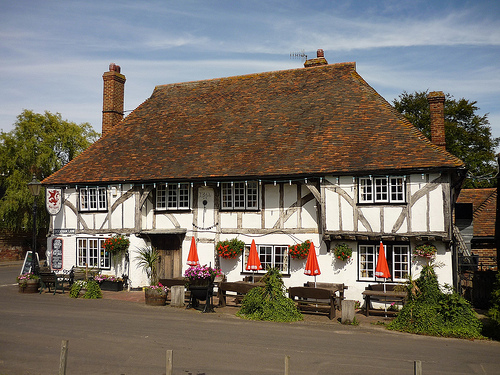
Maybe Thoma lifted a pint at the Red Lion medieval free house pub in Hernhill, Kent as it was already over 200 years old when he lived there;  being  built in 1364.

On May 11, 1637 Thomas and his family left Sandwich, England aboard the Hercules arriving in Charlestown, Massachusetts.    After July 26, 1644 Thomas married Joanna [__?__] , widow of Daniel Shepardson.  His son Thomas Call Jr. later married Joanna’s daughter Lydia.  Thomas died 17 May 1676 in Malden, Middlesex, Mass.

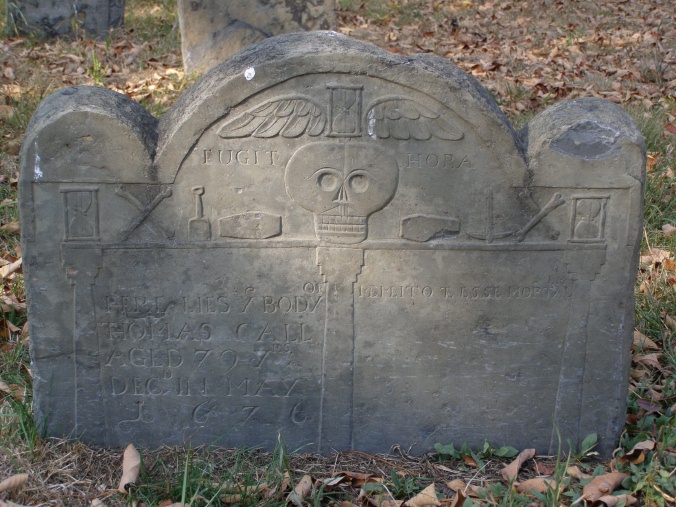
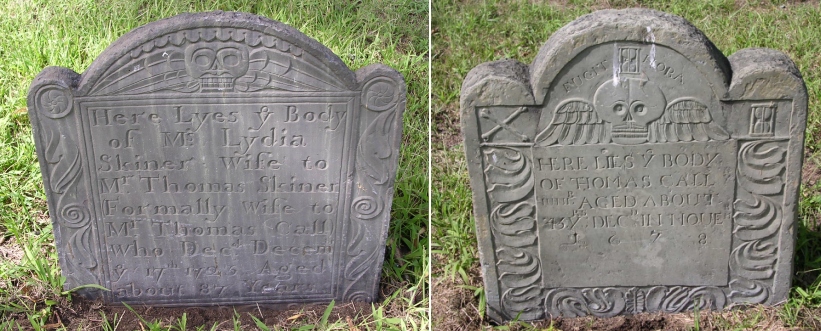
Thomas Call Headstone — Bell Rock Cemetery Malden Middlesex, Mass.

Bennett (Geanett) Harrison was born 21 May 1597 in Hernhill, Kent, England. Her parents were Arnold Harrison and Alice Preston or Bennett.  Bennett died in 1644 in Charlestown, Suffolk, Massachusetts.

Joanna [__?__] first married by 1637 to  Daniel Shepardson (circa 1612, based on the estimated date of his marriage –  26  Jul 1644, Charlestown, Mass).  Daniel was a blacksmith, first found in Charlestown, Massachusetts in 1633. “Daniel Shepheardson” was admitted to Charlestown church on June 8, 1633.  Daniel had little to no formal education, he signed his will by mark.  Joanna was named as the mother at the baptism of all three children. She married, second, between 1644 and 1651 (called “Joanna Call” in a petition of 28 October 1651 to the general court in support of Rev. Marmaduke Matthews) as the second wife of Thomas Call.  Joanna died at Malden on 30 Jan 1660/61.

In 1637 “Dan[ie]ll Sheaperdson” was recorded as having one and three-quarters cow commons.  In the land laid out on Mystic Side on 23 April 1638 Daniel Shepardson received shares of ten, twenty and zero acres.  On 30 Dec 1638 he was recorded as having one and one-third cow commons on the stinted common. In the 1638 Charlestown Book of Possessions Daniel Shepardson held seven parcels: house with garden plot; five roods arable in East Field; one acre of meadow in High Field Mead; one and three-quarters cow commons; five acres in Line Field; ten acres woodland in Mystic Field; and twenty-five acres in Water Field.

In his will of July 16, 1644 “Daniell Shepardson of Charlestown in New England blacksmith” left his estate to his wife during her life, and then after her decease “my house, with the garden, yard, & three acres of ground in the neck with my arms & tools to my son Daniell, whom I would have brought up in the trade of a smith,” the rest to be divided between “my two daughters Lydia & Johanna,” wife to be sole executrix, and “my Mr. Nowell, with brother Heburne & brother Cutler” overseers; witnesses Thomas Carter and Rice Coles.  Final settlement of the estate was delayed for three years, at which time the General Court ordered a distribution different from that in the will, and probably for that reason the file for Daniel Shepardson includes two copies of his will along with the original. On one of these copies Increase Nowell, who wrote the original and both copies, adds at the bottom the following note: “If his wife & 3 children die he gave me Incr: Nowell his house & house plot, at the same time before the same witnesses.

Children of  Thomas and Bennett:

Name Born Married Departed
1. Anne Call
2 Mar 1624
Hernhill, Kent, England
19 Sep 1630
Kent, England
2. Philip CALL I (Nephew who came to America after his uncle) 1627
Hernhill, Kent, England
Mary SMITH 1659
Ipswich, Essex, Mass.
1662 in Ipswich, Mass.
3. Paul Call 2 Feb 1629 Kent, England 21 Feb 1629 Kent, England
4. Margaret Call 30 May 1631 Hernhill, Kent, England Thomas Green
1651 or 1653 Charlestown, Suffolk, Mass
22 Jun 1667 Malden, Middlesex, Mass.
5. Thomas Call 6 Oct 1633
Hernhill, Kent, England
Lydia Sheppardson
22 Jul 1657 Malden, MA
Nov 1678
Malden, Middlesex, Mass.
6. John Call 6 Mar 1636 Faversham, Kent, England Hannah Kettel
21 Jan 1657 – Charlestown, Suffolk, Mass
19 Apr 1697 Charlestown, Suffolk, MA
7. Mary Call 1637
Charlestown, Suffolk, Mass
1642 – Charlestown, Mass
8. Elizabeth Call 21 Dec 1640 Charlestown, Mass Samuel Tingley
20 Sep 1663
Charlestown, Suffolk, M
.
Daniel Shepherdson
11 Apr 1668
Charlestown, Mass
21 Feb 1716 – Attleboro, Bristol, Mass
9. Mercy Call 7 Nov 1643 Charlestown, Mass Samuel Lee
19 Aug 1662 – Charlestown, Suffolk, Mass
.
John Allen
1667
Charlestown, Suffolk, Mass
Jan 1678

Occupation: Tilemaker, baker.

Arrived in America 1637 on “Hercules” to Charlestown, MA. To Malden in 1649.
Being of Faversham, County Kent, Eng. embarked 1636 with wife and 3 children.
Living near the ferry in Charlestown, on the Mystic side.

The three children are thought to be John , Margaret and Thomas II Call.   Philip was Thomas’ nephew.  At least two more children wereborn in Charlestown Elizabeth and Mary/Mercy Call.

Thomas settled down and is listed in the early Charlestown Mass town records and in the town of Malden Mass. where he eventually moved.

Ancestors

Generation I

 John PASTON (Sir Knight) was born 10 Oct 1421, Paston, Norfolk, England. His parents were William PASTON and Agnes BARRY.  He married Margaret MAUTHY before 1440.  John died 22 May / 19 Jun 1466 ,in  London  and is buried in Bromholm Priory, Norfolk, England.

One of ten executors of Sir John Fastolf’s vast Norfolk holdings, which comprised 94 manors. Two days before Fastolf’s death in 1459 his will was changed in favor of John Paston, who received all the manors, lands, and personal property in Norfolk and Suffolk. Suspecting foul play, the other executors were outraged, and seventeen years of claims and counter-claims, law suits, forcible evictions, arrests, and even imprisonment ensued for both John Paston I and his estate manager Richard CALL. In a letter dated Oct 1461, Call, writing from the Norwich gaol, informs John Paston II that William Yelverton and William Jenney, two of Fastolf’s executors, had him arrested and jailed for the theft of the rents from the disputed manor at Cotton: they “hathe certified vup in-to the Kynges Benche jnsurrec[i]ons [and] congregacions a-yenste me.” And unless Call posted security that he would appear in court in London, the sheriff threatened to “send me vp with strengthe of men as a presoner.” Clearly the sheriff backed the claims of Paston’s enemies. Call concludes hopefully, “God sende us a good scheryf thys yere”.

In a letter dated May 3, 1465, Margaret Paston informed her husband ABT the Duke of Suffolk’s attack on their manor at Hellesdon: “I have put youre evydens that com owte of the abbay in a seck, and enseylyd hem vnder Richard Call ys seall”

Children:

1. John Paston (Sir)  2. John Paston 3. Margery Paston 4. Edmund Paston (d. BEF 1504)  5. Walter Paston (b. ABT 1456 – d. 1479) 6. William Paston 7. Margery PASTON (Bef. 1450 – Bef. 1479) 8. Anne Paston 9. Clement Paston (b. ABT 1447 – d. 1448/1534)

Generation II.

Richard CALL was born about 1431. He married Margery PASTON and died after  1431 – d. AFT 1504) After Margery’s death, at some time before 1482, he married  Margaret Trollopp of Edingthorpe, and had two additional sons 4. Andrew and 5. John. According to a Chancery Proceeding, Call was still alive between 1500 and 1515.

Richard and Margery had three sons:
1. John (See Below)
2. William – Frere minor of the Franciscan Order of Grey Friars, whose origin was St. Francis of Assisi.  William Call was the last warden and minister provincial of the order.  The monastary was dissolved and the lands granted to the Duke of Norfolk.
3 Richard.

Richard Call is well-known to readers of the Paston letters as the bailiff or estate manager for John Paston I and his two sons (both confusingly named John) during the last half of the fifteenth century. Young Richard Call went into service with John Paston I upon the recommendation of the Duke of Norfolk, whose seat was in Framlingham. Call served as a devoted and trusted servant under two generations of Paston patriarchs, John I, and later his two sons John II and John III for nearly half a century. Rising to the position of chief bailiff or estate manager, Call was actively involved in the Pastons’ extensive business and legal matters. He negotiated leases and collected rents from tenants; he sold land and woods; he bought and sold commodities and horses; he kept accounts, inventories, and indentures in his own hand; he delivered letters and other documents; he attended various legal hearings on behalf of the family; he transported money and silver to various family members; and he wrote numerous letters on behalf of family members and himself.

In a letter to his brother, dated May 1469, John Paston III expresses his fear that if his sister Margery marries Richard Call she will be made “to selle kandyll and mustard in Framlyngham”. This contemptuous remark exposes not only the Paston’s social snobbery but, more importantly, the growing animosity between the old landed gentry and the new, upwardly-mobile merchant class, represented by Richard Call. Call’s clandestine courtship of and subsequent marriage to Margery Paston, the youngest daughter of John Paston I, caused a major uproar in the Paston household when the affair was discovered in 1469. They had secretly exchanged vows, which under church law constituted a legal marriage. John Paston III expressed the family’s outrage when he wrote that Call “shold neuer haue my good wyll for to make my sustyr to selle kandyll and mustard in Framly[n]gham”. Although the entire family was opposed to the relationship, Margery’s mother Margaret was especially shocked and outraged. Three years before their affair was finally revealed, she expressed her suspicions about Call’s character to her eldest son John by warning him to “be ware of him and of hys felowe” . Upon discovering the relationship, Margaret forced Margery and Call to appear in the Bishop’s Court where they were examined by the Bishop of Norwich. After interrogating both of them, the Bishop ruled that their vows were legitimate, but Margaret refused to let Margery enter her house. She says: “and [if] he [Call] were ded at thys owyre sche xuld neuere be at myn hart as sche was”.

Although Margery became estranged from her mother and brothers for a time, Call continued to handle some of their business affairs.

Unlike John Paston’s two sons, both of whom had university educations, Richard Call was self-educated. From the surviving 23 letters in his own hand, we can conclude that he was not only literate in English, but as evidenced by the “boke of French” stolen from his chambers at Hellesdon and his various memoranda in Latin, he learned at least two foreign languages. One of the functions of a household miscellany is pedagogical, and a number of the texts copied into the Cambridge manuscript concern the improvement of body, mind, and soul. Acquisition of social graces is seen in the The Lytylle Childrenes Lytil Boke, which would have instructed Call and his family in upper-class hygiene and table manners, such as “Loke thyne hondys be wasshe clene, That no fylthe on thy nayles be seyn”; “Pyke not thyne eris ne thy nostrelles”; “Ne spitte thow over the tabylle”; and “Caste not thi bones ynto the flore”.

Generation III.

John CALL was born in 1477 in Little Melton, Norfolk, England. He married Christian (Xpian) CLIPSBY daughter of Clipsby of Obye in Norfolk.  John died in 1527 in Norfolk, England.

Children
1. Constance b. 1514 Obye, Norfolk, England; m. Thomas Riddall of Sallus, Norfolk

2. Elizabeth b. 1516 Obye, Norfolk, England; m.  Ralph Chestine of Chestin, Suffolk

3. Richard (See Below)

Generation IV.

Richard CALL was born 1525 in Little Melton, Norfolk, England.   He married Edith BENNETT in 1550.  Richard died in 1600 in Warwickshire, England.

Children of Richard and Edith
1. Alice b. 1550 Stratford-upon-Avon, Warwickshire, England; m. Thomas Matthew Rogers; d. 07 AUG 1608
2.Thomas Call b. 1550 England, Norfolk, Little Melton
3. Richard b. 1552 England, Norfolk, Little Melton
4. Robert b. 1554 England, Norfolk, Little Melton
5. John b. 1556 England, Norfolk, Little Melton
6. Nicholas b. 1557 England, Norfolk, Little Melton
7. Christopher b. 1559 England, Norfolk, Little Melton
8. Owen b. 1562 England, Norfolk, Little Melton
9. Mary b. 1563 England, Norfolk, Little Melton
10. Christian b. 1565 England, Norfolk, Little Melton
11. Anne b. 1566 England, Norfolk, Little Melton
12. Margaret  b. 1568 England, Norfolk, Little Melton
13. John b. 1571 Hernhill, Kent, England m. Ann [__?__]

Generation V

Here is your Thomas…decending from Richard fourth child in line from John Call of Framlingham m. Rose with John Call 1. brother…where Philip eventually comes down.

John Call of Framlingham m. Rose  Their Children…
1.  John Call, 2.Regnold, 3.Margaret, 4.Richard of Bacton, 5.Nicholas, 6,7,8 Daughters
5. 1.Nicholas, m Christine , and 2.Robert
1.John,2.Francis,3.George,4.Philip,5. Nicholas, 6.Ann,7.Elizabeth, 8.John 11,
4. Philip m Helen

Children of Thomas and Bennett

4. Margaret Call

Margaret’s husband Thomas Green was born 1630 in Malden, Middlesex, Mass. His parents were Thomas Green and Elizabeth Lynde Thomas died 15 Feb 1674 in Malden, Middlesex, Mass.

5. Thomas Call Jr.

Thomas Jr. married his step-sister Lydia Shepardson on 22 Jul 1657 in Malden, MA.

Lydia Shepardson was born 24 Jul 1637 in Charleston, Mass.  Her parents were Daniel Shepardson and Joanna [__?__]. (see above.)  After Thomas Call Jr.  died, Lydia married Thomas SKINNER I  [also our ancestor] in about 1680.  Lydia died 17 Dec 1723 in Malden, Massachusetts at the age of 87.

In 1651, Thomas Call received a license to maintain an inn and sell provisions in Malden. One of the selectmen voting on the license was Thomas Call, who sold beer in another part of Malden (but probably not far Thomas Skinner’s Inn). Apparently, Thomas Skinner and Thomas Call were friends–Thomas Call rented a house from Thomas Skinner. Thomas Call died in 1678 at the age of 43. Thomas Skinner’s wife Mary died in 1671 and Thomas Skinner subsequently married Thomas Call’s widow, Lydia.

Lydia Skinner-Thomas Call graves  Bell Rock Cemetery Malden, Mass

Inscriptions:
HERE LIES Ye BODY
OF THOMAS CALL
JUNE.R AGED ABOUT
45Y.RS DEC.D IN NOVE.MR
1678

Here Lyes ye Body
of Ms Lydia
Skiner Wife to
Mr Thomas Skiner
Formally Wife to
Mr Thomas Call
Who Dec’d Decem
ye 17th 1723 Aged
about 87 Years

6. John Call

John’s wife Hannah Kettell was born 27 Oct 1637 in Charlestown, Suffolk, Mass. Her parents were Richard Kettell and Esther Ward. Hannah died 27 Aug 1708 in Charlestown, Suffolk, Mass.

8. Elizabeth Call

Elizabeth’s first husband Samuel Tingley was born 1638 in Charlestown, Mass. His parents were Palmer Tingley and Anna Fosdick. Samuel died 28 Dec 1666 in Malden, Mass

Elizabeth’s second husband Daniel Shepherdson was her step-brother. Daniel was born 14 Jun 1640 in Charlestown. His parents were Daniel Shepardson and Joanna [__?__]. Daniel died 3 Aug 1723 in Attleboro, Bristol, Mass.

9. Mercy Call

Mercy’s first husband Samuel Lee was born 1640 in Charlestown, Suffolk, Mass. Samuel died 1676 in Malden, Mass

Mercy’s second husband John Allen was born 9 Oct 1648 in Salisbury, Essex, Mass. John died 27 Feb 1696 in Salisbury, Essex, Mass.

Sources:

http://trees.ancestry.com/owt/person.aspx?pid=31182702&st=1

http://www.tudorplace.com.ar/PASTON.htm#John PASTON (Sir Knight)1

http://skn.skinnerwebb.com/

http://freepages.genealogy.rootsweb.ancestry.com/~hutch/EGGLESTON/Skinner.htm

Posted in 14th Generation, Historical Monument, Immigrant - England, Line - Shaw | Tagged , , | 37 Comments

Philip Call I

Philip CALL I (1627 – 1662) was Alex’s  10th Great Grandfather; one of 2,048  in this generation of the Shaw line.

Phillip Call was born  in 1627, in Faversham, Hernhill, Kent, England.   His uncle Thomas CALL. arrived in America with his aunt and uncle in 1637 on “Hercules” and first lived in Charlestown, Mass near the ferry in Charlestown, on the Mystic side. Philip’s arrival is not known, though he may have moved to Malden in 1649 when he was 22 years old.  He married Mary SMITH in 1659 in Ipswich, Essex, Mass.  Philip died in 1662 in Ipswich, Mass.

There is an inference from the language of a deed, dated April 9, 1658, from Philip’s father-in-law, Richard Smith, to his son Richard, of Ipswich, singleman, who is “to pay on Nov. 1, 1658, to his brother-in-law Phillip Call, of Shropham, co. Norfolk, England, at the now dwelling house of the *tfd Richard in Ipswich.” Perhaps Philip Call came over In the summer of 1658, and brought the deed with him.

Mary Smith was born 1630 in Shropham, Norfolk, England.  Her father was Richard SMITH of Shropham, Norfolk, England.   After Phillip died, she married John Burr in 1665 in Ipswich, Mass.  Next she married Henry BENNETT [who I previously thought was our ancestor, but it turns out he wasn’t]  on 18 Feb 1679 in Ipswich, Mass.  Mary died 12 Jan 1708 in Ipswich, Essex, Mass.

John Burr was born in 1644 in England.  He was only 21 years old when he married Mary.  John died  22 Apr 1673 in Ipswich, Essex, Massachusetts, United States

Henry Bennett was born about 1629 in England.   He died after 3 Oct 1709.  He married first Lydia Perkins by about 1651.   Henry was usually styled “Farmer Bennet”.  He bought a 200-acre farm in Ipswich in 1654.    In 1698 Henry sold his farm to John Wainwright.  In 1666 Henry was a signatory to the Ipswich petition to the General Court disapproving of the action of the Massachusetts authorities in opposing the King’s commissioners.  He was on an 18 Feb 1678 list of commoners in Ipswich.  He appears to have had little interest in public life and never appears to have held office.

Children of  Philip and Mary:

Name Born Married Departed
1. Mary Call 1658
Ipswich,  Mass
Nathaniel Lord
31 Dec 1685 in Ipswich, Essex, Mass
4 Oct 1737
Ipswich, Mass
2. Philip CALL II 7 Jan 1659
Ipswich, Massachusetts Bay
Unknown WIFE After 1732 Portsmouth, New Hampshire

.
Children of Mary and John Burr

Name Born Married Departed
3. Jonathan Burr 28 Jun 1665  Ipswich, Essex, Mass
4. Elizabeth Burr 29 Dec 1667 Ipswich, Essex, Mass
5. Frances Burr c. 1669
Ipswich, Essex, Mass
Henry Bennett Jr
20 May 1685
Ipswich, Essex, Mass
12 Jan 1708
Ipswich, Mass
6. Jeremiah Burr 10 Jul 1670 Ipswich, Essex, Mass
7. Abigail Burr 11 Dec 1672
Ipswich, Essex, Mass

Philip was a tilemaker, a baker or a cordwainer.

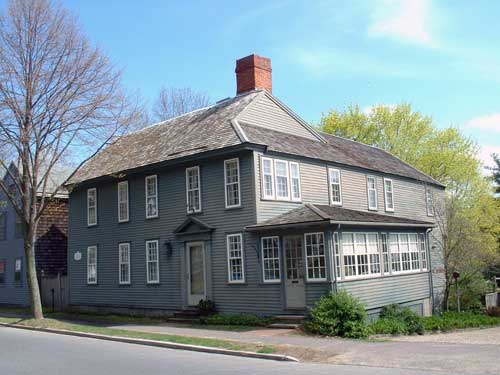
Cordwainer Philip Call House in Ipswich, Mass

This important First Period house was built by cordwainer Philip Call about 1659. The evolution of this property to its current twelve rooms is an outstanding example of careful adaption of various periods over four generations. Appearing as an old Victorian when purchased by the current owners in 1967, its careful restoration uncovered such important elements as an outstanding chamfered 17th century summer beam, that defines the original 2 112 story house, first enlarged around 1725. Restoration also discovered 17th century field paneling behind new walls, and one of the last remaining three hole privies in Ipswich. The contemporary kitchen overlooks a formal boxwood garden.

The town of Ipswich has more existing 17th Century houses than any other, including Philip Call’s.  Philip Call owned a house on this lot in 1659, and, by the deed of Woodam to Brown of the adjoining lot, in 1663, he was still in possession. Brown’s deed of the abutting lot to Paine, gives the owner of this lot as Philip Call’s widow, Mary, then the wife of Henry Bennet. Nathaniel Lord sold this lot to his son-in-law, Joseph Bolles, March 29, 1710. Bolles also bought of Joseph Fowler, owner of the abutting lot, a house and an acre of land, March 5, 1722. Charles Bolles sold his grandson, John Manning 3d, surgeon, an acre and house, bounded by Nathaniel Lord east, and Capt. Ebenezer Lord west, the estate of his deceased father, Jan. 16, 1786. Dr. Manning sold the western part of the lot with ahouse,that he probably built, to Daniel Lord 3d, April 23, 1798, and the heirs of Lord sold to Abraham Caldwell, whose heirs still own the property. Dr. Manning sold the eastern part and house to Ammi R. Smith, April 25, 1798. Smith bought a small pieceof Nathaniel Lord 3d on the east of his lot, Dec. 9, 1820. Abby H. Smith, the executor of Samuel R. Smith sold this estate to John G. Caldwell, being the same conveyed to him by Zenas Cushing in 1850, July 25, 1876. The Caldwell heirs still owned in 1905.

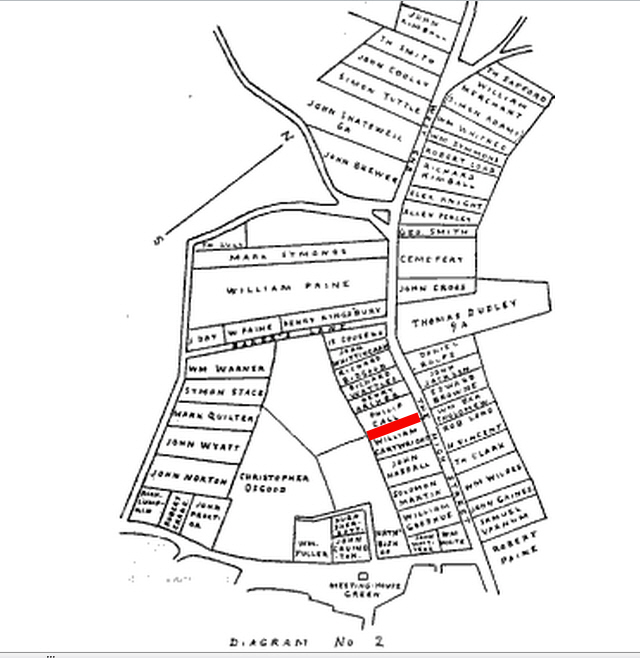
Historic Ipswich – Philip Call’s house is #24 on High Street

Ipswich in the Massachusetts Bay Colony … By Thomas Franklin Waters, Sarah Goodhue, John Wise, Ipswich Historical Society 1927

Philip Call’s Ipswich Lot

Philip Call owned a house on this lot in 1659, and, by the deed of Woodam to Brown of the adjoining lot, in 1663, he was still in possession. Brown’s deed of the abutting lot to Paine, gives the owner of this lot as Philip Call’s widow, Mary, then the wife of Henry Bennet. Nathaniel Lord sold this lot to his son-in-law, Joseph Bolles, March 29, 1710. Bolles also bought of Joseph Fowler, owner of the abutting lot, a house and an acre of land, March 5, 1722. Charles Bolles sold his grandson, John Manning 3d, surgeon, an acre and house, bounded by Nathaniel Lord east, and Capt. Ebenezer Lord west, the estate of his deceased father, Jan 16, 1786. Dr. Manning sold the western part of the lot with a house,that he probably built, to Daniel Lord 3d, April 23, 1798, and the heirs of Lord sold to Abraham Caldwell, whose heirs still own the property. Dr. Manning sold the eastern part and house to Ammi R. Smith, April 25, 1798. Smith bought a small pieceof Nathaniel Lord 3d on the east of his lot, Dec. 9, 1820 Abby H. Smith, the executor of Samuel R. Smith sold this estate to John G. Caldwell, being the same conveyed to him by Zenas Cushing in 1850, July 25, 1876. The Caldwell heirs still own.

Children

1. Mary Call

Mary’s husband Nathaniel Lord was born 1653 in Ipswich, Essex, Mass. His parents were Robert Lord and Mary Waite. Nathaniel died 18 Jan 1733 in Ipswich, Essex, Mass.

2. Philip CALL II (See his page)

5. Frances Burr

Frances married her step-brother. Henry Bennett Jr. was born in 1664 in Ipswich, Mass.  His parents were Henry BENNETT and Lydia PERKINS.  Henry died 1739 in Ipswich, Essex, Mass.

Frances was 10 years old and Henry 15 when their parents married  on 18 Feb 1679 in Ipswich, Mass.  Frances and Henry married six years 20 May 1685 when Frances was only 16 years old.

Only one child is recorded for Henry and Frances; Mary Bennett born 3 Mar 1685 Ipswich, Mass. It is interesting to note that Mary was born two months before her parents marriage date.  Given Frances young age, the questionable marriage of step-children and the conflicting birth and marriage dates, I can only conclude that Henry got Frances pregnant.  (Greg and Marcia Brady?)  Mary went on to marry 29 Apr 1703 in Ipswich, Essex, Mass to Nathaniel Knowlton and died 1716 in Ipswich, Mass.

I had previously that that Frances’ husband was our ancestor Henry BENNETT II who married Sarah CHAMPION 9 Dec 1673 in Lyme CT, but that turns out to be an unrelated Henry Bennett.

Sources:

http://trees.ancestry.com/owt/person.aspx?pid=31138827&st=1

http://trees.ancestry.com/owt/person.aspx?pid=1064180

http://nature.thecompass.com/ipswichbaycircuit/ipswich/history-walk.html

http://capecodhistory.us/genealogy/wellfleet/i455.htm#i39816

Ipswich in the Massachusetts Bay Colony … By Thomas Franklin Waters, Sarah Goodhue, John Wise, Ipswich Historical Society 1905

The New England historical and genealogical register, Volume 29 By Henry Fitz-Gilbert Waters, New England Historic Genealogical Society

http://www.ipswichma.com/gallery/detail.asp?Gallery=Historic+Homes&PhotoID=3

Posted in 12th Generation, Historical Site, Immigrant - England, Line - Shaw | Tagged , , , | 11 Comments

Philip Call III

Philip CALL III. (1684 – 1757)  was Alex’s  8th Great Grandfather; one of 512 in this generation of the Shaw line.  There is a plaque at their cabin site in Franklin, NH, then the northernmost New England settlement, noting that they were the first white settlers of Franklin, and that his wife Sarah was killed there by Indians on 15 Aug 1754.

Franklin, New Hampshire

Phillip Call  was born 1684 in Newbury, Mass. Some sources say his father was John Cole, perhaps born in 1660, but they provide no other information.  Other sources say that his father was Philip CALL II. While there are no records on Philip Call II’s marriage or wife, there are records of his birth and probate.  He married Sarah TRESSEL 20 Jan 1706/07 in Amesbury, Essex, Mass.  Philip died 10 Aug 1757 either at Stevenstown, NH  or maybe at Ft. William. Henry in NY in battle.

Alternatively, (according to Genealogical and family history of the state of New Hampshire: a …, Volume 3 By Lewis publishing company, Chicago 1908)  “Philip Call is said to have been one of two brothers who came to America from England.  Philip is known to have been at Contoocook (Boscawen), as early as 1733. He was the first settler in that township after the granting of the Masonian proprietors, and was subsequently made a grantee, as is shown by the records. ”  This is hearsay evidence from a hundred year old book, but Philip CALL II  has a spotty paper trail as well.

Sarah Trussel was born 26 Jul 1686 in Salisbury, Essex, Mass. Her parents were Henry TRUSSELL and Martha RING. Sarah died 16 Aug 1754 in Stevenstown, (later Salisbury) New Hampshire killed by Indians in an attack on her home.

Children of  Philip and Sarah:

Name Born Married Departed
1. Philip CALL IV. 26 May 1707 Amesbury, Essex, Mass Dorothy HADLEY
17 Jul 1729 Amesbury, Essex, Mass.
c. 1769 in Pownalborough, Maine
2. Obadiah Call 16 Nov 1709
Amesbury, Mass
Eleanor [__?__]
.
Experience Howland
22 Jun 1787
Dresden, Maine
3. Sarah Cole 8 Mar 1715 Newbury Hezekiah Colby
3 Sep 1730 Newbury, Mass
Amesbury, Mass
4. Martha Call 7 Feb 1718 Boscawen, Merrimack, New Hampshire Richard Jackman
1739
Boscawen, Merrimack, New Hampshire
5. Moses Call? 9 Jan 1725/26
Portsmouth, Mass.
Mehitable, Jackman Boscawen, Merrimack, NH
6. Stephen Call 9 Nov 1728
Portsmouth, Rockingham, New Hampshire
Eunice Danforth Was he killed at Ticonderoga NY in Rev. War?

Philip has been called “weaver” of Amesbury,

Philip Call was the first permanent settler in Franklin NH. He was an Indian scout and killed in 1759. His wife, Sarah Trussel Call was also killed in a raid in 1754.

Philip is known to have been at Contoocook (Boscawen), as early as 1733. The native Pennacook tribe called the area Contoocook, meaning “place of the river near pines.” On June 6, 1733, Governor Jonathan Belcher granted it to John Coffin and 90 others, most from Newbury, Massachusetts. Settled in 1734, it soon had a meetinghouse, sawmill, gristmill and ferry across the Merrimack River.

During the year 1734 thirty-three settlers came to Contocook [sic] to begin, as it were, life anew in the wilderness. Rev. Mr. Price has handed down the names of twenty-seven only; but from a deposition made by Moses Burbank in 1792 the number is stated as being thirty-three as follows: David Barker, Sinkler Bean, John Bowen, Josiah Bishop, Andrew Bohonnon, Moses Burbank [future father-in-law of Nathaniel Danforth’s daughter Sarah], Philip CALL, Thomas Cook, John Corser, William Dagodon, William Danforth [son of John DANFORTH], Nathaniel Danforth [Stephen Call’s future father-in-law and son of John DANFORTH and Dorcas WHITE.], Joseph Eastman, Edward Emery, Edward Fitzgerald, Jacob Flanders, Richard Flood, [William Danforth’s brother-in-law], John Fowler, Stephen Gerrish, Ambrose Gould, Richard Jackman [Martha Call’s future father-in-law], George Jackman [Moses Call’s future father-in-law], Joel Manuel, Nathaniel Meloon, William Peters, Nathaniel Rix,  and Daniel Rolfe. It is not probable that many of the settlers’ families came in the spring, but most, if not all, were there before the close of the year.

November 8, 1734, a meeting of the proprietors was held at the house of Archelaus Adams, in Newbury. It was voted that a saw-mill should be built at the charge of the proprietors, and Daniel hale, Joseph Gerrish and Thomas Thoria were chosen a committee to attend to the matter. The same committee was empowered to rectify a mistake made in the laying out of lots, and John Brown, the surveyor, was engaged to go to Contoocook to show the proprietors the locations of the lots.

Five of the proprietors–Joseph Lunt, John Coffin, Thomas Thorla, Benjamin Lunt, Benjamin Coker, and Edward Emery–entered their dissent in regard to the power of the committee.

December 18th another meeting was held. It was voted that the intervale should be fenced by the 15th of May the following year, at the expense of the owners of the lots, and any proprietor neglecting to build his proportion should make satisfaction. It was also voted that Joseph Tappan should obtain a grindstone for the common use of the proprietors. At this meeting further action was taken towards building a sawmill.

The year opened auspiciously to the settlers, for, on January 7th, a daughter was born to Nathaniel Danforth, the first birth in the plantation. The infant was named Abigail, grew to womanhood and married Thomas Foss, whose name frequently appears in the records of the town.

From the action taken in regard to the discharge of the bond given by the fifteen who obligated themselves to build the saw-mill, the evidence is conclusive that the mill had been created. “Voted that the bonds of the men, which have built the saw mill will be delivered & to lay out the bonds for building said mill according to vote as by record.”

It was a pioneer mill of this section of the Merrimack Valley. The saw-mills of that period were such as any carpenter might construct. This mill had no “nigger” wheel to move the “carriage” back after the saw had passed through the log; that labor was done by a man treading upon the cogs of the “ratchet-wheel,”–labor exceedingly fatiguing. For many years it was the only saw-mill in the town, and several of the houses now standing on King Street are covered with boards which were sawn in this first mill.

THE FIRST FORT–It was voted that a fort should be erected at the expense of the proprietors, the inclosure to be one hundred feet square, built of hewn logs, seven feet high and eight inches thick when hewn, “to be built three feet above the logs with such stuff as shall be agreed upon by the committee.”

From this record it may be inferred that there was an upper work,–a chevaux-de-frise of pointed, projecting timbers, designed to prevent the enemy from climbing over the wooden walls, which undoubtedly were loop-holed for the use of musketry.

It was voted to locate the fortification on the “school lot.” The probabilities are that it was erected a few feet south of that lot, near the spot upon which the first framed house was subsequently erected by Rev. Robie Morrill.

It being found that the inclosure was not large enough to accomodate the entire community, another fortification was erected during the winter. No record has been preserved in regard to the dimension of the garrison, but it probably was somewhat smaller, and designed as a retreat for the settlers on Queen Street in case of sudden surprise.

Through the years of trouble with the Indians, these garrisons served to protect the resolute men, who, during the most exciting times, when other frontier settlements were abandoned, never thought of yielding the ground to the foe.

The first attack of the Indians upon Contoocook was made about 1744, though the exact date is unknown. Josiah Bishop, who was at work in his field at the lower end of King Street, was surprised by a party of Indians. They took him into the woods, probably up the rocky hill west of the lower end of King Street. He made an outcry, and quite likely preferred death to captivity. As was subsequently learned form the Indians, he resisted bravely, and they dispatched him with their tomahawks. The capture naturally threw the settlement into commotion; but the citizens having located their homes, determined to defend them. The summer was one of great anxiety. The families took refuge in the garrisons, while sentinels were ever on the watch while the citizens were at work.

The chief item of interest in the call for the annual meeting of the proprietors in 1752 was the erection of a second fort. The meeting was held May 20th, and the following vote passed: “Voted to raise £200 old tenor to be laid out in building a garrison or fort & to be built forthwith and to be set on Samuel Gerrish’s lot which was originally laid out unto Richard Greenough, said fort to be one hundred & ten feet Square or otherwise as the committee shall Judge, allowing said building to cover the land.”

This second fort was erected on the hill. Messrs. Stephen Gerrish, Jacob Flanders, and Richard Jackman were placed in charge of the work. It is probable that this fortification stood on the site of the smaller fort, erected during the previous troubles.

Philip Call was the first settler as early as 1750 in Stevenstown, later Salisbury, later still Franklin, after the granting of the Masonian proprietors, and was subsequently made a grantee, as is shown by the records.

Under King George II New Hampshire returned to its provincial status with a governor of its own, Benning Wentworth, who was its chief magistrate from 1741 to 1766.

During the first two decades of Governor Wentworth’s term New Hampshire had been beset with Indian troubles. With little aid from England, then at war with its old-time enemy, France, the colonists undertook the sieges of Louisbourg, and helped to reduce Crown Point, and in the conquest of Canada. By the time of the signing of the Peace of Paris in 1762, and the end of the Indian fighting under the Rogers Rangers, the entire north country of New Hampshire was ready to be explored, surveyed, and populated.

Governor Wentworth who, as if in anticipation of this opportunity, seems to have been well prepared for it, had arranged the purchase for the sum of fifteen hundred pounds of the unauthenticated claims of Robert Mason, heir of Captain John Mason. This was done through a group of twelve influential citizens who called themselves the “Masonian Proprietors.” Having done this, the governor kept the land “within the province.”

Governor Wentworth, with all or most of the Masonian Proprietors as his councilors, then proceeded to grant towns to prospective settlers. In addition to the thirty-eight towns already granted, more than a hundred others followed after the year 1761. These towns contained lots available to more than thirty thousand families, many from the older towns in southern New Hampshire and Massachusetts, but many from other neighboring states. Some of these towns were located in Vermont, to be released later by a court order, which made the western shore of the Connecticut River the state boundary line.

Wentworth was authorized by the crown to grant patents of unoccupied land, and in 1749 began making grants in what is now southern Vermont, enriching himself by a clever scheme of selling land to developers in spite of jurisdictional claims for this region by the Province of New York. He often named the new townships after famous contemporaries in order to gain support for his enterprises (e.g. Rutland after John Manners, 3rd Duke of RutlandBennington he named after himself). In each of the grants, he stipulated for the reservation of a lot for an Episcopal church. Ultimately, this scheme led to a great deal of contention between New York, New England, and the settlers in Vermont. The dispute long outlived Wentworth’s administration, lasting until Vermont was admitted as a state in 1791.

In 1753 the grantees voted “to build four houses, and that Philip Call’s shall be one of them.” This shows that Philip Call already had a house there. His name appears upon the roll of Captain Jeremiah Clough’s Company as a scout, from September 26 to December 16, 1733. Captain Clough lived in Canterbury, and was a leading citizen of that town. For his service he received one pound and fifteen shillings, provisions being extra. Again in 1746, from July 4 to December 4, he was on scout service, [being out one hundred and fifty-four days] for which he received eight pounds and thirteen shillings, and again in 1747, from January 5 to November 2, receiving sixteen pounds, ten shillings and ten pence besides provisions and ammunition.

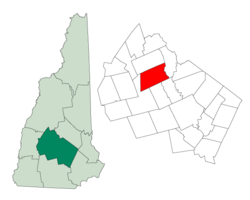
Salisbury, Merrimack, New Hampshire

On the west the first settlement was at Hopkinton, in 1740, but the inhabitants of that locality abandoned their homes in 1746. The first settlement in Salisbury was in 1750, by Philip CALL, Nathaniel Meloon, Benjamin Pettengill, John and Ebenezer Webster [Daniel Webster’s father], Andrew Bohonon. These, with the exception of Pettengill and Webster, moved from Contoocook.

While still part of Massachusetts, the town was granted as Baker’s Town after Captain Thomas Baker in 1736. After New Hampshire became a separate colony, the town was re-granted by the Masonian proprietors in 1749 with the name Stevenstown, and settled as early as 1750. Additionally known as Gerrishtown and New Salisbury, the name Salisbury was taken when the town incorporated in 1768.

Orator and statesman Daniel Webster was born in what had been Salisbury in 1782. His birthplace is now located in the newer city of Franklin.

Franklin, New Hampshire Post Card – – On 15 Aug 1754, Philip’s wife was killed with a blow from a tomahawk when she met attackers at her doorstep.   His daughter-in-law crawled into a hole behind the chimney with her infant in her arms, where she succeeded in keeping her child quiet, and thus escaped from sure destruction.

Have good info on Phillip Call (b. ca. 1684 Ipswich, MA – d. ca 10 Aug 1757 either at Stevenstown or maybe at Ft. William. Henry in NY in battle)

The following excerpt is from The History of Manchester, Hillsborough County, New Hampshire. It describes an attack by “savages in the interests of the French,” a band of about 30 Abenaki.

On the 15th day of August [1754], they made a successful attack on our frontier, on the house of Mr. Phillip Call, in Stevenstown. This town was subsequently known as Salisbury and the attack was made in that part of Salisbury, west of, and upon the Merrimack, now included in the town of, Franklin.

Mrs. Call [Sarah Trussell Call], her daughter-in-law, wife of Phillip Call, Jr. and an infant of the latter, were alone in the house, while the Calls, father and son, and Timothy Cook their hired man, were at work in the field.

Upon the approach of the Indians, Mrs. Call the elder, met them at the door, and was immediately killed with a blow from a tomahawk, her body falling near the door, and her blood drenching her own threashold! [sic]

The younger Mrs. Call, with her infant in her arms, crawled into a hole behind the chimney, where she succeeded in keeping her child quiet, and thus escaped from sure destruction.

The Calls, father and son, and Cook, saw the Indians, and attempted to get into the house before them, but could not succeed. They were so near the house, as to hear the blow with which Mrs. Call was killed.

Seeing however the number of the Indians, they fled to the woods and the Calls escaped. Cook ran to the river and plunged in, but was pursued, shot in the water, and his scalp taken. The Indians, some thirty in number, rifled the house, took Mrs. Call’s scalp, and then retreated up the river. The Calls soon notified the garrison at Contoocook of the attack, and a party of eight men followed in pursuit.

The Indians waited in ambush for them, but showed themselves too soon, and the English party taking to the woods escaped, with the exception of Enos Bishop, who after firing upon the Indians several times was at length taken and carried to Canada as a captive. “

Google Map Directions from Franklin to Salisbury and Contoocook, New Hamphire, a few miles north of Concord

An account of this affair was forthwith despatched to Portsmouth, Andrew McClary of Epson, being the messenger. His account of the affair is thus noticed in the “Council Minutes.”

“PORTSMOUTH, August, 18, 1754.

The said Andrew being examined, declared that Eph’m Foster, and Stephen Moor acquainted the declarant that they were at Stevenstown the day after the mischief was done by the Indians and found the body of Mrs. Call lying dead near the door of her house, scalped and her head almost cut off, and upon further search, found the body of a man named Cook, dead and scalped. That the Indians were supposed to be about thirty in number according to the account of eight men, that upon hearing the news, went immediately from Contoocook to Stevenstown and in that way passed by the enemy, who soon followed them and seeing the Indians too many in number to engaged, they parted and endeavored to escape. One of the company, one Bishop, stood sometime and fired at the Indians, but was soon obliged to run. Cook was found dead by the river’s side. Bishop supposed to be killed and sun in the river, he being still missing,–that there were two men belonging to the plantation at a distance working in a meadow that as yet were not come in.1And it was feared they had fallen into the hands of the enemy,–that as the declarant had understood, all the inhabitants, consisting of about eight families were come down into the lower towns and had left their improvements, corn, hay, and cattle.”

Upon this information the council resolved,

“That his Excellency be desired to give immediate orders for enlisting or impressing such a number of men, as he may thing proper in this immergency, and dispose of the men, to encourage the settlers to return to their habitations and secure their cattle and harvest and to encourage the other frontiers in that quarter.”

Under this advice, Governor Wentworth issued the following order to Col. Joseph Blanchard of Dunstable.

Province of New Hampshire.

To Col. JOSEPH BLANCHARD.

Upon the mischief done by the Indians last week at Stevenstown, I have ordered a detachment from Capt. Odlin’s Troop of twenty-four horse and an officer to command, also the like detachment from Capt Steven’s Troop, to guard the inhabitants in that frontier until I can relieve them by a sufficient number of foot,–and as your regiment lies contiguous to the frontier where this mischief was done; I have thought proper to order and direct that you forthwith enlist or impress fifty men or more if you think that number is not sufficient, and put them under an officer that you can confide in and order them forthwith to march to Contoocook and Stevenstown to relieve the detachment of horse posted there. The troops you send on this order are to remain until I have seen the members of the General Assembly who I have given orders to be convened on this occasion, that the troops may be sure both of pay and subsistence. Given at Portsmouth, Aug., 19 1754.

Col. Blanchard detailed Captain John Goffe of Amoskeag for this duty, who marched to the scene of action and scouted for some days in that vicinity, but without discovering the Indians. Among his men from Amoskeag, were Caleb Paige, Joshua Martin, Wm. Morse, John Harwood, Josiah Parker, Archibald Stark, Lemuel Hogg, Thomas Grear, John Barrett, James McNeil, and Robert Rogers, all men of note in the annals of Amoskeag.

The promptness of Governor Wentworth in this emergency and the effective force detailed, preserved the inhabitants of the Merrimack Valley from any farther molestation.

Bishop was carried to Canada, where he arrived after a tedious journey of thirteen days. After tarrying in captivity a year, he effected his escape, and after a journey of eighteen days through the wilderness, suffering intensely from hunger and fatigue, he arrived at Number Four, now Charleston, from whence he returned to his family at Contoocook.

Genealogical and family history of the state of New Hampshire: a …, Volume 3 By Lewis publishing company, Chicago 1908

Philip Call is said to have been one of two brothers who came to America from England.  Philip is known to have been at Contoocook (Boscawen), as early as 1733. He was the first settler in that township after the granting of the Masonian proprietors, and was subsequently made a grantee, as is shown by the records.  In 1753 the grantees voted “to build four houses, and that Philip Call’s shall be one of them.” This shows that Philip Call already had a house there. His name appears upon the roll of Captain Jeremiah Clough’s Company as a scout, from September 26 to December 16, 1733. For his service he received one pound and fifteen shillings, provisions being extra. Again in 1746, from July 4 to December 4, he was on scout service, for which he received eight pounds and thirteen shillings, and again in 1747, from January 5 to November 2, receiving sixteen pounds, ten shillings and ten pence. The Call family was noted for the muscular activity, swiftness of foot and bravery in Indian fighting of its members. The site of the Call house is to be seen and easily recognized by a pile of broken bricks and stones, which once constituted the chimney, and a large apple tree in close proximity. The site is on the “Orphan’s Home Farm,” southwest from the house on the west side of the railroad track, a mile north of the Boscawen line, and near the Salisbury fort.

Indians, under Captain John Sasup, attacked the place where the family resided, August 15, 1754. Philip, his son Stephen, and Timothy Cook, whose father had been killed in 1746 at Clay hill, were at work in a field and witnessed the attack. Mrs. Call and her son’s wife and infant were in the house. Upon the approach of the Indians, Mrs. Philip Call met them at the door, and was instantly killed by a blow from a tomahawk. She fell across the threshold. Mrs. Stephen Call, with her infant, crawled into a hole behind the chimney. The Indians, about thirty in number, rifled the house, but she succeeded in keeping her child quiet, and was not discovered. When the savages appeared and the purpose of their visit became evident, Stephen wanted to shoot at them, but his father, discovering that there was a large party, would not let him do so for fear the Indians would kill them. The Indians seeing the three whites, pursued them. Cook fled toward the Merrimack, plunged in, but was shot and scalped. Philip took the path for the fort at Contoocook (Boscawen), but finding the Indians close upon his heels, plunged into the Merrimack river and swam to the Canterbury shore. The Indians still pursuing, he swam to the western shore, and thus continuing, he swam back and forth six times, and eventually reached the fort. Stephen ran into the woods and saved himself only by dropping his “nice new hat,” which so pleased his pursuers, that while examining it he escaped.

Philip served in Colonel Nathaniel Meseroe’s Regiment. Captain John Titcomb’s Company, in the expedition against Crown Point in 1757.

It is said that Philip Call built the house subsequently occupied by Colonel Ebenezer Webster as a tavern. His son may have owned it, as Philip died previous to November 28, 1763. and probably before 1759, and was buried in the eastern side of the Webster yard. His wife’s name is not known. We have a record of children, Stephen and Sarah. Sarah Call, of Durham, spinster, by deed dated May 30, 1759. for one hundred pounds old tenor, conveyed to Stephen Call one-half of two tracts of land in Contoocook, which she had of her father, Philip Call

The history of Boscawen and Webster [N.H.] from 1733 to 1878 by Charles Carlton Coffin 1878

There is but one municipality in the world bearing the name of Boscawen. The township, thus named for Lord Boscawen of the English navy, is situated on the west bank of Merrimack river in New Hampshire. Originally it was seven miles square, and, from the date of its settlement in 1733 to 1760, bore the Indian name Contoocook. After a corporate existence of one hundred years, from 1760 to 1860, the township was divided into two parts nearly equal in area, the eastern retaining the original corporate name, the western taking the name of Webster, in honor of America’s great orator, jurist, and statesman, who received his education, in part, in Boscawen, and who for three years was one of its honored citizens.

In the spring of 1734, the proprietors of Contoocook made prepy*- aration to comply with the conditions of their grant. Those intending to settle in the plantation left their homes in April. The route was from Newbury to Haverhill, or Hampstead to Nutfield (Derry), thence to Amoskeag falls, and from thence, by the east side of the Merrimack, to Penacook ferry, which had been established 1731. [Hist. Concord, p. 101.] Another route, leading from Newbury to Chester, thence to Pembroke, had been blazed through the woods in 1726, but the road through Derry was the oue most travelled.

FIRST SETTLERS.

During the year, thirty-three settlers came to Contoocook, to begin, as it were, life anew in the wilderness. Rev. Mr. Price has handed down the names of twenty-seven only; but from a deposition made by Moses Burbank in 1702 [Col. Henry Gerrish’s papers] the number is stated as being thirty-three.

David Barker, William Dagodon, Sinkler Bean, William Danforth, John Bowen, Nathaniel Danforth, Josiah Bishop, Joseph Eastman, Andrew Bohonnon, Andrew Emery, Moses Burbank, Edward Fitzgerald, Philip CALL, Jacob Flanders, Thomas Cook, Richard Flood, John  Corser, John Fowler, Stephen Gerrish, Nathaniel Meloon, Ambrose Gould, William Peters, Richard Jackman, Nathaniel  Rix, George Jackman, Daniel Rolfe, Joel Manuel

In imagination we see them toiling through the forest, following the rude path from Nuffield (Derry) up to Suncook, across the “dark plains” in Concord, crossing the Merrimack just above the mouth of the Contoocook.

Upon the intervale are open spaces where the grass grows luxuriantly, but everywhere else they behold an unbroken forest. Ascending the high bank, they come to the blazed lines where John Brown has laid out the new town. There is no house to shelter them. The first nights they spend beneath the shelter of the trees. They select the sites for their log houses. The forest resounds with the sturdy strokes of their axes. They have a single plow, owned by Stephen Gerrish. The oxen are yoked to it, and the virgin soil of the intervale, which has lain undisturbed since the morning of creation, is turned to the sun. Ere many days have passed, each man has a cabin built of logs, covered with bark, or with long shingles rived from some giant pine.

Children

1. Philip CALL IV. (See his page)

2. Obadiah Call

Obadiah’s first wife Eleanor was born about 1720.

Obadiah’s second wife Experience Howland was born about 1740.  Experience died after 1787.

Philip CALL IV and Dorothy his wife, of Richmond Co. York, Maine, sold to Obadiah Call of Comtoocook, in 1740, land in Amesbury, belonging to the said Dorothy.

“Obadiah Call, the first of that Christian name to live in Dresden Maine, had wife Eleanor; sons Obadiah and Stephen. His holdings of land were more extensive than those of any others of the family. April 7, 1781, he conveyed to Obadiah Call, Jr., 215 acres, situated on Dresden Neck opposite to Little Swan Island, which land appears to have included that which he took by grant from the Proprietors; and to his son Stephen he on the same day conveyed lots Nos. 21 and 22 situate east of Eastern River; the consideration in both transactions being love and good-will…. Philip and Obadiah Call, ‘first settlers’ here, can be traced to Amesbury and Ipswich in Essex County, Massachuesetts, to which their progenitors appear to have come from England.

One Richard Calle long held a position of trust under the Paston family of County Norfolk, England, and he is many times mentioned in the Paston Letters” (Hist. Dresden, 163-165) (See Thomas CALL’s page for details)

Philip, Philip Jr and Obadiah Call were among the settlers petitioning the Massachusetts government for protection from the Indians in 1760. NEHGR 44:202-208 (1890) “Petition of inhabitants of Kennebec River for protection”

Probate, Pownalborough, Maine in Pownalborough, Maine

Obadiah Call, late of Pownalborough. Experience Call, of Pownalborough, widow, Admn’r, 22 Jun 1787; Edmund Bridge and Caleb Barker, both of Pownalborough, sureties. [III, 160] Inventory by William Lewis, Asa Dinsmore and Richard Kidder, all of Pownalborough, 29 Jun 1787 [III, 247-249]

There were several generations of Obadiah Calls in Dresden, Maine

Obdiah’s son Obidiah Call b. 1749 in Maine d. 10 Dec 1821, Dresden, Maine m. Abigail [__?__](c.1752 – Bef May 1777)

Obdiah’s grandson Obidiah Call b. ca. 1770 – Pownalborough, Maine; d. 10 Dec 1821; m. 8 Dec 1796 – Woolwich, Maine to Elizabeth Rittal (Jul 1772 – 10 Dec 1821)

3. Sarah Cole

Sarah’s husband Hezekiah Colby was born 25 Mar 1710 in Amesbury, Essex, Mass. His parents were Samuel Colby and Dorothy Ambrose. Hezekiah died 17 Jul 1788 in Deer Isle, Maine.

4. Martha Call

Martha’s husband Richard Jackman was born 17 Oct 1709 in Newbury, Essex, Mass. His parents were Richard Jackman and Elizabeth Major. Richard died in 1761 in Boscawen, Merrimack, New Hampshire

“History of Boscawen and Webster, From 1733 to 1878” by Charles Carleton Coffin, 1878. page 312

Richard Jackman was brother of George, born in Newbury, Oct. 17, 1709. He married Martha Call, daughter of Philip Call, who was a vigilant citizen durning the war with the Indians.  Mrs. Jackman’s mother was killed by the Indians at South Franklin.”

Children of Martha and Richard:

i. Richard Jackman b. 6 Oct 1740 Canterbury, Merrimack, New Hampshire

ii. John Jackman b. 24 Aug 1743 Merimack, New Hampshire; d. Mar 1813 Boscawen, Merrimack, New Hampshir; m. Mary Danforth (b. 1745 Boscawen, Merrimack, New Hampshire – ) Mary’s parents were William Danforth and Ann Flood. Her paternal grandparents were our ancestors John DANFORTH and Dorcas WHITE John and Mary had  ten children born between 1764 and 1787.

iii. Moses Jackman b. 26 Apr 1746 Boscawen, Merrimack, New Hampshire;

iv. Samuel Jackman b. 17 Mar 1749 Boscawen, Merrimack, New Hampshire;

v. Sarah Jackman b. 29 Sep 1755 Boscawen, Merrimack, New Hampshire;

5. Moses Call

Moses’ wife Mehitable, Jackman was born 1730 in Boscawen, Merrimack, New Hampshire. Her parents were George Major Jackman (1707 – 1795) and Hannah Bishop (1708 – 1745). Mehitable died 19 Oct 1809 in Merrimack, New Hampshire.

CAPTAIN KIMBALL’S DIARY

July 1st 1777, order came from Col. Stickney to me, to muster and Equip one Quarter part of the Company to mark at a minits warning, and in consequence of the same, we met to git the men.

July 4, orders came to march 13 men Immediately to tie [Ticonderoga]
saterday we marcht to perrytown [Sutton] and Loged thare
Sunday 6, we marcht to Unity and Loged thare.
Monday 7, we marcht to No. 4 and Loged thare and drawd 4 Day allowance.
tuesday 8, we marcht to Cavendysh and Loged thare.
Wendesy 9, we marcht to No. 4 again.
thursday 10th, we marcht to Unit and Loged.
fryday 11, we marcht home.”

The men engaged in this service were,–Colonel Henry Gerrish, Captain Peter Kimball, Captain Peter Coffin, Lieut. Enoch Gerrish, Lieut. Moses Call, Nathan Corser, Samuel Clifford, Deacon Jesse Flanders, Enos Flanders, Nathaniel Atkinson, Simeon Atkinson, George Jackman Jr., John Morrill, Deacon Isaac Pearson, Daniel Clark, Daniel Shepherd, John Manuel, Michael Sargent, James French, Benjamin Sweatt, Moses Jackmen.

Boscawen Town Officers
1766–Joseph Eastman, moderator; Moses Burbank, Moses Call, Henry Gerrish, selectmen.
1771–Moses Morse, moderator; Winthrop Carter, Moses Call, Moses Morse, selectmen.
1775–Stephen Webster, moderator; Moses Call, Enoch Gerrish, George Jackman, selectmen; Henry Gerrish, delegate to State Convention.

6. Stephen Call

Stephen’s wife Eunice Danforth was born  3 Dec 1727 in  Rowley, Essex, Mass.  Her parents were Nathaniel Danforth (1703 – 1799) and Priscilla Wicom (1706 – ).  Her grandparents were John DANFORTH and Dorcas WHITE.

Stephen  like his father, did scout duty, serving in Captain Jeremiah Clough’s Company one month and three days. In Captain Ladd’s Company he did scout duty about Canterbury and Concord, in 1746, receiving for his services one pound and ten shillings. He also served in Captain Goff’s Company, scouting on the frontier from May 28 to July 15. 1748, receiving four pounds, fourteen shillings and three pence, and in Captain Ebenezer Webster’s Company, Colonel Nichol’s Regiment, in the Rhode Island campaign of 1776. He was chosen one of the selectmen at the first town meeting after the incorporation of the town and subsequently held other offices. “He was a man of character and ability. He married a sister of Nathaniel Danforth, who settled at Franklin, formerly Andover, about 1750. She died in 1816, and he a few years later. Their children were: John, Nathaniel, Philip, Sarah and Susannah. This John Call was the first white child born in Salisbury.

Some say Stephen may have been killed at Ticonderoga NY in Rev. War.   Stephen’s son their son

Children of Stephen and Eunice:

i. John Call

Reverend John C. Call settled in Wisconsin.

Some say that the John Call was actually Philip CALL IV’s nephew, the son of his brother Stephen Call (b. 1728) and Eunice Danforth.

Historical sources differ about which daughter-in-law hid their son John from Indian attack.

Genealogical and family history of the state of New Hampshire: a …, Volume 3 By Lewis publishing company, Chicago 1908 states that “Mrs. Stephen Call, with her infant, crawled into a hole behind the chimney.”

However, The history of Boscawen and Webster [N.H.] from 1733 to 1878 (published 1878) says ” Mrs. Philip Call, junior, with her infant, crawled into a hole behind the chimney. “

ii. Nathaniel Call b. 1764 Salisbury NH; m. 11 Dec 1783 – Sanbornton, Belknap, New Hampshire to Sarah Chapman

Vermont Pensioners
Name: Nathaniel Call
Rank: Private
Annual Allowance: $43.33
Description of service: New Hampshire continental line
When placed on the pension roll: June 2, 1834
Commencement of pension: March 4, 1831
Age: 70

iii. Philip Call

iv. Sarah Call

v. Susannah Call

Sources:

The history of Boscawen and Webster [N.H.] from 1733 to 1878 1878 compiled by Charles Carlton Coffin

http://www.hadleygenealogy.net/gp6075.html

http://trees.ancestry.com/owt/person.aspx?pid=11511465

http://www.genealogyofnewengland.com/f_17b.htm#164

http://trees.ancestry.com/tree/17232582/person/1038221665

http://hollowhill.com/franklin-historical-societys-ghosts-nh/

http://capecodhistory.us/genealogy/wellfleet/i455.htm#i39869

http://www.websterplace.org/rich-history-webster-place

http://www.nh.searchroots.com/MerrimackCo/documents/History_Boscawen_NH.txt

Posted in 10th Generation, Line - Shaw, Pioneer, Storied, Violent Death | Tagged , , , , | 11 Comments

Philip Call IV

Philip CALL IV (1707 – 1769) was Alex’s  7th Great Grandfather; one of 256 in this generation of the Shaw line.

Philip Call was born 26 May 1707 in Amesbury, Essex, Mass. His parents were Philip CALL III and Sarah TRESSWELL. He married Dorothy HADLEY 17 Jul 1729 in Amesbury, Essex, Mass.   Research by Wyman descendants concluded that Philip’s spouse was a Dorothy Hadley, which disagrees with History of Dresden. However, there apparently was a divorce, and Joanna may have been the second spouse.  Philip died about 1769 in Pownalborough, Maine
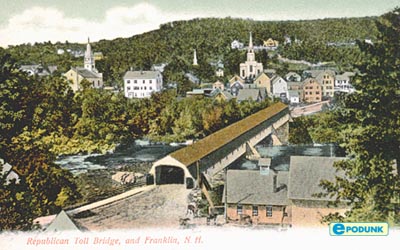
Franklin, New Hampshire Post Card – On 15 Aug 1754, Philip’s wife crawled into a hole behind the chimney with her infant in her arms, where she succeeded in keeping her child quiet, and thus escaped from sure destruction while her mother-in-law was scalped.

Dorothy Hadley was born 20 Jul 1712 in Amesbury, Essex, Mass. Her parents were Samuel HADLEY Jr. and Dorothy COLBY. Dorothy died 1793 in Corinth, Orange, Vermont.

Children of  Philip and Dorothy:

Name Born Married Departed
1. Mary Call 4 Feb 1729  Amesbury, Mass 1730
2. Phillip Call 27 Dec 1731 Amesbury, Essex, Mass Deliverance Wyman
11 Mar 1758 Brunswick, Cumberland, Maine
1787
3. Elizabeth Call 20 Apr 1734 Amesbury Daniel Heath
2 Mar 1753 Amesbury
1759
4. Dorothy Call 24 Apr 1736 Amesbury Abraham Wyman
1753 Pownalborough, Lincoln, Maine
1781
Pond Town, Maine
5. Ruth Call 3 Dec 1738 Amesbury, 1739
6. Sarah Call 8 Sep 1740 Amesbury 1754
7. Martha Call 6 Jan 1742 Amesbury, 1743
8. Hannah CALL 20 Dec 1744 Amesbury, Mass.
or
Dresden, Sagadahoc, Maine.
Charles B. WEBBER
1761
Dresden, Maine
1782 Vassalboro, ME.
9. Mary Call 21 Jan 1747 Amesbury 1748
10. John Call (the child who, with his mother, was hidden behind the chimney) 4 Feb 1751 Amesbury Sarah Lewis
Int. 29 Sep 1770
18 Oct 1770 – Dresden, Maine
.
Dolly Sanborn
1777 – New Hampshire

Inventory — 18 Aug 1769 in Pownalborough, Maine

Philip Call, late of Pownalbarough. John Call, of Pownalborough, Adm’r, 18 Aug 1769.  Inventory by Samuel Goodwin, Robert Twvcross and Mathias Smith, 24 Aug 1770, £264 : 5 : 2.  Account filed 12 Feb 1772.

The following excerpt is from The History of Manchester, Hillsborough County, New Hampshire. It describes an attack by “savages in the interests of the French,” a band of about 30 Abenaki.

On the 15th day of August [1754], they made a successful attack on our frontier, on the house of Mr. Phillip Call, in Stevenstown. This town was subsequently known as Salisbury and the attack was made in that part of Salisbury, west of, and upon the Merrimack, now included in the town of, Franklin.

Mrs. Call [Sarah Trussell Call], her daughter-in-law, wife of Phillip Call, Jr. [Dorothy Hadley] and an infant of the latter, were alone in the house, while the Calls, father and son, and Timothy Cook their hired man, were at work in the field.

Upon the approach of the Indians, Mrs. Call the elder, met them at the door, and was immediately killed with a blow from a tomahawk, her body falling near the door, and her blood drenching her own threashold! [sic]

The younger Mrs. Call, with her infant in her arms, crawled into a hole behind the chimney, where she succeeded in keeping her child quiet, and thus escaped from sure destruction.

The Calls, father and son, and Cook, saw the Indians, and attempted to get into the house before them, but could not succeed. They were so near the house, as to hear the blow with which Mrs. Call was killed.

Seeing however the number of the Indians, they fled to the woods and the Calls escaped.

Cook ran to the river and plunged in, but was pursued, shot in the water, and his scalp taken.

The Indians, some thirty in number, rifled the house, took Mrs. Call’s scalp, and then retreated up the river.

The Calls soon notified the garrison at Contoocook of the attack, and a party of eight men followed in pursuit.

The Indians waited in ambush for them, but showed themselves too soon, and the English party taking to the woods escaped, with the exception of Enos Bishop, who after firing upon the Indians several times was at length taken and carried to Canada as a captive. “

Google Map Directions from Franklin to Salisbury and Contoocook, New Hamphire, a few miles north of Concord

And now the epilogue

1785-86: Ebenezer Webster moved from the Webster birthplace in West Franklin, NH to the vicinity of Elm Farm, building a large two-story tavern on land he had purchased from Sarah Call for £165. This tavern stood a short distance north of Elm Farm, on the road leading north from Concord toward present-day Franklin.

Daniel Webster was born on January 18, 1782, to Ebenezer Webster and Abigail Eastman in Salisbury, New Hampshire, now part of the city of Franklin. There he and his nine siblings were raised on his parents’ farm, a small parcel of land granted to his father. Daniel Webster’s great-great-grandfather was Thomas Webster(1631–1715), who was born in Ormesby St. Margaret, Norfolk, England and settled in New Hampshire. As Daniel was a “sickly child”, his family indulged him, exempting him from the harsh rigors of 18th-century New England farm life.

1799: Ebenezer Webster exchanged his tavern stand with William Haddock for the middle house connected with the orphans’ home, now a National Historic Landmark. In this home, Ebenezer Webster died in 1806. His farm is said to have encompassed 180 acres. It stood on the road leading north from Concord, encompassing the site where the northernmost fort on the Merrimack River had been erected in Stevenstown (later Salisbury) in 1746. This fort was commanded by Philip Call, who eventually obtained title to the surrounding land.

In case you forgot, Daniel Webster (18 Jan 1782 – 24 Oct 1852) was a leading American statesman and senator during the nation’s Antebellum Period.  His increasingly nationalistic views and the effectiveness with which he articulated them led Webster to become the most famous orators and influential Whig leader.  As a leader of the Whig Party, he was one of the nation’s most prominent conservatives, leading opposition to Democrat Andrew Jackson and the Democratic party. He was a spokesman for modernization, banking and industry. During his forty years in national politics Webster served in the House of Representatives for ten years (representing New Hampshire), the Senate for nineteen years (representing Massachusetts), and served as the Secretary of State for three presidents.

1806: Upon Ebenezer Webster’s death, the Elm Farm property passed to Webster’s sons Ezekiel and Daniel as tenants in common. His undivided half interest in the farm passed to his two daughters, whose guardian was Charles B. Haddock, Ezekiel’s and Daniel’s nephew.

1831: Daniel Webster purchased the other half interest in the farm from Haddock.

c. 1844: Webster reportedly added a wing to the western side of the old dwelling. This wing is shown in many photographs, but had been removed by the 1920s.

1847: Completion of the Northern Railroad permitted Daniel Webster to travel here from Boston in about three hours. Webster used the property as an experimental farm and vacation retreat. Many of his family, together with members of the pioneering Call family, are buried in the cemetery east of the house. Now enclosed within the grounds of Elm Farm, this burial ground originally stood beside the public highway extending north from Concord. In 1908, that road was bypassed by the present Daniel Webster Highway, which runs parallel to the Northern Railroad. The road south of the cemetery was discontinued as a highway in 1911.

2008: Webster Place Recovery Center, a non-profit, opened the doors of the Mack Creighton building once more – to help those in need of recovery from alcohol and drug abuse.
You might also know him from The Devil and Daniel Webster 1941 Here’s “Scratch” from  IMDB

Philip, Philip Jr and Obadiah Call were among the settlers petitioning the Massachusetts government for protection from the Indians in 1760.

NEHGR 44:202-208 (1890) “Petition of inhabitants of Kennebec River for protection”

“See the History of Dresden, Maine, 1931, by Charles Edwin Allen, especially pp. 102-105, for discussion of the Calls, including descendants of Philip and his brother Obadiah who were early settlers, before 1739, of (now) Dresden, formerly part of Pownalborough, Maine. His roots were in Amesbury and Ipswich in Essex Co., Massachusetts, perhaps descended from a Richmond Calle of County Norfolk, England.

Philip Call and Dorothy his wife, of Richmond Co. York, Maine, sold to Obadiah Call of Comtoocook, in 1740, land in Amesbury, belonging to the said Dorothy.

Children

2. Phillip Call

Phillip’s wife Deliverance Wyman was born 1738 in Falmouth, Cumberland, Maine. Her parents were James Wyman (1702 – 1766) and Bethia Millett (1709 – 1766). Deliverance died 1828 in Dresden, Maine.

Among the papers in the possession of Joseph Cate is a grant from the Plymouth Proprietors to Philip Call Jr. dated Apr 8, 1760 of 130 acres on the Dresden Neck near Swan Island.

Philip and Deliverance were early settlers in Dresden, Lincoln,  Maine.  The town was originally settled in 1752 under the name Frankfort by French Huguenots, who were part of the first wave of French speaking immigrants to arrive in Maine, but were distinguished from later arrivals by their Protestant faith. First called Frankfort, so that the new French immigrants could pretend to be German, the town was incorporated as Pownalborough in 1760, when Lincoln County was created in the Maine District of Massachusetts.   Pownalborough included the Town of Wiscasset, which was soon set off on its own as the shire town of the county. When the present territory was incorporated in 1794, Lincoln County Probate Judge Jonathan Bowman chose Dresden as the new name of the town because he liked the sound of it. The name of Pownalborough was changed to Wiscasset June 10, 1802.

Dresden is located on the southern side of the Eastern River. Dresden also offers some historical sites as well, including an old, brick school building and the Pownalborough Courthouse, which is now used as a museum and is open to the public. The Pownalborough Courthouse was built in 1760 and was the first seat of government east of the Kennebec River. The families who settled Dresden and those who were soon afterward sent there by the government of Massachusetts played a crucial role in the battle for American independence in Maine. Robert Treat Paine, John Hancock, and John Adams appeared at the Court House in the Revolutionary Era. Well known local families included the Houdlettes, Mayerses, Bridges, Bowmans, Percys, Johnsons, and Trussells. Swan Island was set off from Dresden and incorporated as Perkins June 24, 1847.

Philip Call, late of Pownalborough. Deliverance Call, of Pownalborough, Adm’r, 24 Sep, 1787; Edmund Bridge and William Patterson, both of Pownalborough, sureties. [III, 162] Inventory by Richard Kidder, Samuel Emerson and George Lilly, all of Pownalborough, 4 Sep 1787, £340:16:0. Deliverance Call, guardian unto John, William and Philip, minor sons, Deliverance and Bethiah, minor daughters, 19 Mar 1789.

Account filed 19 Mar 1789. Obadiah, minor son, chose William Lewis to be his guardian, 19 Mar 1789. Margaret, minor daughter, chose William Lewis to be her guardian, 20 Mar 1789. Division of real estate by Jonathan Reed, James Goud and Louis Houdlette, all of Pownalborough, 7 Mar 1789: dower to Deliverance, widow; remainder to Philip and Charles, two of the sons, by consent of other heirs, James, Olive Allen, Elizabeth Patterson, Hannah, Lydia. Order of distribution, 2 Apr 1789.

Philip, Philip Jr and Obadiah Call were among the settlers petitioning the Massachusetts government for protection from the Indians in 1760. NEHGR 44:202-208 (1890) “Petition of inhabitants of Kennebec River for protection”

Pownalborough Marriage Intentions – Dec 13 1788, Samuel Goodwin, Esq., and Mrs. Deliverance Call. This publishment has been forbidden by Mrs. Call in presence of James Call and J. Braggly. [ I wonder what the story was. Philip had died the year before in 1787. James Call was Deliverance’s oldest son.

Children of Philip and Deliverance

i. James Call b. 19 Jul 1759 Dresden (Pownalborough), Lincoln, Maine; d. 17 Oct 1825 Dresden; m. 7 Oct 1786 in Dresden  to Lydia Fitch (b. 1766 or 7 Dec 1772 Bedford, Middlesex, Mass – d. Oct 1835 in Dresden) Lydia’s parents were David Fitch (1743 – 1813) and Mary Fowle (1745 – 1829) [Note: David and Mary were married 3 Apr 1770]. James and Lydia had nine children born between 1787 and 1806.

Pownalborough Marriage Intentions – Oct 7 1786 James Call and Lydia Fitch.

In the 1810 census, James was living in Dresden, Lincoln, Maine with a household of eleven.

ii. Olive Call b. 17 Dec 1760 Pownalborough, Lincoln, Maine ; m. 17 Jul 1780 Pownalborough to Peter Allen (b. ~1757)

Pownalborough Marriage Intentions – Jul 9 1780 Peter Allin and Olive Call.

iii. Elizabeth Call b. 4 Jan 1763 Pownalborough, Lincoln, Maine; d. Aft. 1789; m. 7 Oct 1783 Pownalborough to William Patterson (1754 – 1799) William’s parents were James Patterson ( – 1768) and Margaret Howard ( – 1806 ). Elizabeth and William had six children between 1783 and 1796.

Pownalborough Marriage Intentions – Aug 19 1783, Wm. Paterson and Elizabeth Call.

iv. Philip Call b. 14 Aug 1765; d. 23 Mar 1818 – Swan Island (Dresden), Maine; Burial: in Call Cemetery, Swan Island, Maine m. 21 Jul 1788 – Dresden, Maine to Hannah Whitten (b. 20 Apr 1761 Topsham, Sagadahoc, Maine – d. 1822 Call Cemetery, Swan Island, Maine). Hannah’s parents were John Whitten (1730 – 1802) and Hannah Walker (1740 – 1825). Philip and Hannah had eight children born between 1789 and 1804 in Swan Island, Maine.

Pownalborough Marriage Intentions – Jul 21 1788, Philip Call and Hannah Whitten of Brunswick.

Swan Island is now the Steve Powell Wildlife Management Area. Swan Island, known for its abundant and often quite visible wildlife (especially nesting bald eagles, white-tailed deer and wild turkey), is actually an abandoned 18th and 19th century town called Perkins Township, and has long been recognized for its varied and interesting history. It was used by Native American tribes, early explorers, and settlers, and was reportedly visited by American historical figures such as Aaron Burr and Benedict Arnold. The Maine Historic Preservation Commission, with cooperation from the Maine Department of Inland Fisheries and Wildlife successfully had Swan Island added to the National Register of Historic Places. Each year, more than 4000 people visit Swan Island. The Island’s public visitation season runs from May 1st through Labor Day (with limited access through the fall). All access to the island requires reservation with the exception of self-access day visits. The number of visitors to the island at any one time is limited to 60. A ferry service, run by Inland Fisheries and Wildlife staff, transports visitors to Swan from the town of Richmond. Also included are island tours by flat-bed truck when trails are closed due to nesting season.

This may be the same as Philip Call 1765-1818.
Document offered on eBay, June 2006:
Lincoln Co ME. Dated 1804
Suit brought by Converse LILLY, yeoman against Philip CALL, yeoman…Dresden, …that the said CALL at Dresden…on the eleventh day of July in the year of our Lord eighteen hundred & four with force & arms a violent & unprovoked assault upon the body of the said Lilly did make & then & there with force ..the said CALL did in an angry & menacing manner lift against him said Lilly a certain pole called a Haypole & did strike at him said Lilly with said pole and did push & shove him said Lilly & other wrongs & injuries, etc….Also the aid Converse LILLY apprised that the said Philip CALL will beset him the said Lilly & beat wound and do him some bodily mischief….and burn and destroy Lilly’s dwelling house, etc…

Signatures of Converse LILLY ; Jon BOWMAN, JP and Louis HOUDLETTE Jr., Dep Sheriff. Also testifying, but not signing, for LILLY were Christopher WEBB Jr.; Isaac SMITH and Joseph MATHEWS.

v. Charles Call b. 11 Sep 1767 Pownalborough, Lincoln, Maine Maine; d. 1 Sep 1841 Dresden; Burial: Pine Grove Cemetery, Dresden Mills, Lincoln, Maine; m. 24 Mar 1797 in Maine to Susanna “Susan” Raymond (b. 26 Jul 1768 in Center’s Point, Bowdoin, Sagadahoc, Maine – d. 11 Sep 1858 in Dresden, Lincoln, Maine) Susan’s parents were Elnathan Raymond (1742 – 1814) and Dorcas Jellison (1742 – ). Charles and Susan had four children.

In the 1850 census, Susan was living in Dresden, Lincoln, Maine with her son Charles and his family.

vi. Lydia Call b. Bef 1768 – Pownalborough, Lincoln, Maine (an adult in 1789)

vii. Bethiah Call Abt 1769 Pownalborough, Lincoln, Maine; d. 15 Sep 1836; m. 20 Mar 1801 Age: 32 Dresden, Lincoln, Maine to David Clancy ( 7 Apr 1761 – 1849) David’s parents were David Clancy and Elizabeth Goux (1731 – ) Bethiah and David had at least two children: David (b. 1802) and Mary (b.1804)

28 Jun 1779 – David was a private in Capt John Blunt’s Company, Col Samuel McCobb’s regiment.

The Penobscot Expedition was an American naval expedition sent to reclaim Maine, which the British had conquered and renamed New Ireland. It was the largest American naval expedition of the American Revolutionary War and is sometimes thought the United States’ worst naval defeat until Pearl Harbor. The fighting took place both on land and on sea, in what is today Castine, Maine.

On Aug 1, 1779 General Solomon Lovell ordered a night assault on the Half-Moon Battery, next to Fort George, whose guns posed a danger to the American shipping. The Americans opened fire at 2.00 a.m. Colonel Samuel McCobb’s center column, comprising his own Lincoln County Regiment, broke and fled as soon as the British returned fire. The left column comprising Captain Thomas Carnes and a detachment of marines, and the right column comprising sailors from the fleet, both kept going and stormed the Battery. As dawn broke, the Fort’s guns opened up on the captured battery and a detachment of redcoats charged out and recaptured the Half-Moon, routing the Americans, who took 18 prisoners with them. Their own casualties were 4 men missing (who were killed) and 12 wounded.

The operation ended in disaster when a British fleet under the command of Sir George Collier arrived on August 13th, driving the American fleet to total self-destruction up the Penobscot River. The survivors of the American expedition were forced to make an overland journey back to more-populated parts of Massachusetts with minimal food and armament.

viii. Margaret Call b. Aft 1770

19 Mar 1789 – Margaret, minor daughter, chose William Lewis to be her guardian,

ix. Deliverance Call After 1770 – Pownalborough, Maine

x. Phillip Call After 1770 – Pownalborough, Maine

xi. Obadiah Call b. ~ 1773 – Pownalborough, Maine;  m. 1792 – Dresden, Maine to Sarah “Sally” Goud (b. 10 Mar 1773 Pownalborough, Maine – ) Sally’s parents were James Goud (1738 – 1824) and Margaret Bonhotel ( ~1740 – ) Obadiah and Sally had five children born between 1795 and 1809.

19 Mar 1789 – Obadiah, minor son, chose William Lewis to be his guardian

Pownalborough Marriage Intentions – Dec 16 1792 Obadiah Call, Jun’r, and Sally Goud. [Since Obadiah is called a “Jr.” maybe he is a cousin] His parents may have been Obadiah Call and Experience Howling whose Pownalborough Marriage Intentions were published May 3, 1777.

Alternatively, Philip’s Obidiah may have married Sarah Richards

Obidiah’s son Obidiah Call b. 21 Nov 1803 – Dresden, Maine; d. 1 Feb 1827 – Dresden, Maine. m. Margaret Burke. Obidiah came to Newcastle, N.B. in 1823 to work as a millwright. Margaret  was the daughter of a house carpenter in Newcastle who hailed from Co. Limerick, Ireland. the eldest of severn children. His son Robert Randolf Call  was born in Newcastle, New Brunswick on 12 Sep 1837 and he died in Newcastle, N.B. in 23 Dec 1903.  He married in 1862 to Annie Rankin Niven. Lt. Col. Robert Randolf Call was a businesman and consular agent, militia officer and sportsman and the high sherrff in 1897-1903. Robert Call studed at the newcastle Grammar school and had a interest in business and married at age 24. He was a very influential man in Miramichi. They raised 4 children , two that died prematurely.

xii. William Call b. 1780 Pownalboro, Maine; d. 12 Mar 1871 Swan Island, Maine; Burial: in Call Cemetery, Swan Island, Maine; m. 10 Jul 1817 – Dresden, Maine to Martha “Patty” King (b. Apr 1794 Dresden, Maine – d. 3 Oct 1874 Swan Island, Maine) William and Martha had nine children born between 1818 and 1833.

William’s parents are speculative. William & Martha Call, Philip & Hannah (Whitten) Call were buried in the same small graveyard on Swan Island, but William”s birthdate of 1780 doesn’t fit his being the son of Philip and Hannah, although, Philip’s alternative dates of 1740-1820 would allow him to be Philip’s from an unknown first marriage.

Swan Island is now the Steve Powell Wildlife Management Area.

3. Elizabeth Call

Elizabeth’s husband Daniel Heath was born 25 Feb 1734 in Haverhill, Essex, Mass. His parents were Samuel Heath (1698 – ) and Elizabeth Emerson (1699 – 1743). His grandparents were John Heath and Francis Hutchins. He was the 2nd great grandson of our ancestors Bartholomew HEATH and Hannah MOYCE  as well as the great grandson of Joseph HUTCHINS and Joanna CORLISS. Daniel died 1788 in Coos, New Hampshire “while on a business trip to Coos county.”.

Daniel was evidently in that part of New Chester now Bristol as early as 1779, as his name appears on the tax-list of that year. In 1785, he was taxed for three acres of tillage land, twelve acres of mowing and twelve of pasturage. The amount of land under cultivation was more than that of any other resident of New Chester, except Cutting Favor and Benjamin Emmons, who had about the same.

At the first meeting of the new town of Bridgewater (1788), he served as moderator and was then elected as constable for the collection of taxes. He served as moderator at meetings held Nov. 3 and Dec. 15 of the same year. At a meeting held Apr. 2, 1789, Samuel Worthen was chosen a collector “to complete the collection of taxes for 1788, committed to Daniel Heath, deceased.” By this it would seem that Daniel Heath died between Dec. 15, 1788, and Apr. 2, 1789. He probably died after the annual meeting in March or the election of a successor would have. taken place at that time. His farm was that now owned by Hiram T. Heath, three miles east of Central square. The buildings were on the opposite side of the road from the present farmhouse.

Children and Elizabeth and Daniel:

i. Sarah Heath b. 26 Oct 1754 Plaistow, Rockingham, New Hampshire; d. 1830 – Stewartstown, Coos, New Hampshire

ii. Samuel Heath b. 22 Apr 1756 in Plaistow, New Hampshire; d. 13 Jun 1833 Bristol, Grafton, New Hampshire; m. Sarah Webster (b. May 1761 Candia, New Hampshire – d. 5 Jul 1839 New Hampshire ) Sarah’s sister Hannah married Samuel’s brother Joshua. Their parents were Stephen Webster (1741 – 1788) and Hannah Dolbeer (1742 – ) Samuel and Sarah had at least four children born between 1785 and 1803.

Burial:
Heath Cemetery
Bristol, Grafton, New Hampshire
Inscription:
“I give my mortal interest up, And make my God my all.”

Samuel was a Sergeant in the New Hampshire Militia in the Revolutionary War. He fought in the Battle of Bunker Hill. Wrote to brother Daniel that he had only 20 bullets that day he climbed the hill to fight the British and he fired 19 times.

Samuel was a resident of Plymouth NH 1779 to 1785, when he removed to Bristol. Mrs. Lewis Heath, a daughter-in-law, said he bought the Heath farm, in 1794, of his brother, Stephen. If so, it would seem that Stephen succeeded Daniel in the ownership. Samuel was a teamster as well as farmer and made trips to Boston for freight, occupying two weeks for each trip.

Eight years later while living in Plymouth, NH in June 1783, he heard of a little girl lost in the isolated wilderness near Warren, NH. Her home was 20 miles north east of where he lived and for 3 nights the same dream showed him where the child was. During this time nearer neighbors had been gathering at the Whitcher home and searching the area for little Sarah. Someone reported seeing a child’s footprints near those of a large bear. As the news spread, men and women came from greater distances like Wentworth, Rumney, Orford, Haverhill and even Newbury across the Connecticut River.

The men went out in search parties while the women brought food and cooked for them. It is said that one woman cooked a bushel of beans. A minister, Parson Powers, came to offer consolation. On the 4th day about noon, after a long hard trip along the trail marked only by blazed trees through the forest, Samuel arrived at the Whitcher home saying ‘Give me some dinner and I will find the child’.

As he was eating he told of his dream…that he found the lost child under a big pine top a few rods south west of where the path crossed Berry Brook, guarded by a bear. Some people laughed but Joseph Patch, the first settler in the town went with him. Hours passed and then the grieving family heard three shots, the signal of success. Mr. Patch guided him up the path to where it crossed Berry Brook. Then he followed his dream and found Sarah asleep under a pine tree.

She told of the ‘big dog’ that came to her, sniffed about her legs, lapped blood from her scratches while she rubbed his nose and put her arm around his neck. Then comforted and warmed by his presence, she placed her head on his shoulder and went to sleep. The ‘big dog’ had returned every night to keep her warm. When she was safely home there was a prayer of thanksgiving and all sang Old Hundred.

A resident of Plymouth 1779-1785 when he moved to Bristol. A farmer and a teamster making trips to Boston.

iii. Hannah Heath b. 9 Oct 1757 in Plaistow, Rockingham, New Hampshire; d. 17 Mar 1814 – Lower Intervale Cemetery – Plymouth, Grafton, New Hampshire; m. 29 Jun 1779 – Plymouth, NH to Daniel Clough Webster (b. 24 Nov 1756 in Chester, Rockingham, New Hampshire – d. 22 Feb 1814 Plymouth, NH) Daniel parents were Col. Stephen Webster (1718 – 1807) and his second wife Sarah Baker (1721 – 1765). Hannah and Daniel had ten children born between 1781 and 1800.

Daniel was a soldier in the Revolution and was with Captain Nehmiah Lovewell’s Company from February 9 to Mar 31 1778. Later, Daniel was a farmer in Plymouth NH. The Webster family moved from Hollis around 1765.

Plymouth is a town in Grafton County, New Hampshire, in the White Mountains Region, located at the convergence of the Pemigewasset and Baker rivers. It was originally the site of an Abenaki village that was burned to the ground by Captain Thomas Baker in 1712. Part of a large plot of undivided land in the Pemigewasset Valley, the town was first named New Plymouth, after the original Plymouth Colony in Massachusetts. Colonial Governor Benning Wentworth granted Plymouth to settlers from Hollis, all of whom had been soldiers in the French and Indian War. Some had originally come from Plymouth, Massachusetts. The town was incorporated in 1763. In 1806, then-lawyer Daniel Webster lost his first criminal case at the Plymouth courthouse, which now houses the Historical Society.

iv. Elizabeth Heath b. 6 Apr 1760 in Plaistow, Rockingham, New Hampshire; m. 1783 Canturbury, Merrimack, NH to Jesse Stevens (b. 22 Jan 1757 in Hampstead, Rockingham, New Hampshire – d. 9 Sep 1829 in Canterbury, NH Burial: Canterbury Village Cemetery) Jesse’s parents were Otho “Otto” Stevens (1726 – 1759) and Abigail Emerson (1737 – 1833) Elizabeth and Jesse had four children born between 1784 and 1794.

Jesse was a private in the militia regiment that marched in 1777 to relieve a garrison in Ticonderoga.

v. Joshua Heath b. 10 Sep 1761 in Plaistow, Rockingham, New Hampshire; d. 31 Jan 1832 in Groton, Grafton, New Hampshire; m. 7 Nov 1785 in Plymouth Grafton New Hampshire to Hannah Webster(b. 13 Feb 1767 Plymouth Grafton NH – d. 1 Mar 1842) Hannah’s sister Sarah married Joshua’s brother Samuel. Their parents were Stephen Webster (1741 – 1788) and Hannah Dolbeer (1742 – 1788). Joshua and Hannah had fourteen children born between 1786 and 1811.

vi. Phillip Heath b. 1762; m. Martha Best (b. 1780 in North Carolina); m2. Polly [__?__]

vii. Daniel Heath b. 22 Jan 1764 in Plaistow, New Hampshire; d. 14 Jul 1828 – Enfield, Grafton, NH or 15 Apr 1849  New Hampton, New Hampshire; m. 8 Mar 1785 to Joanna Ingalls (b. 1765). Joanna’s parents were Jonathan Ingalls (1750 – 1834) and Martha Jane Locke ( – 1785) Daniel and Joanna had seven children between 1786 and 1803.

m2. 20 Mar 1812 in Haverhill Grafton, New Hampshire to Tryphena Ladd (b. 23 Jun 1774 in Haverhill, NH – d. 1861 in Orford, New Hampshire) Tryphena’s parents were James Ladd and Hannah Locke. Daniel and Tryphena had four more children between 1812 and 1816.

Daniel was listed as a Drummer in the New Hampshire militia in the Revolutionary War. He enlisted in the Revolutionary army from New

Chester in June, 1780, when his age was given as 16 years. He was in the Continental service for five months. He also served in the War of 1812.

The marriage of Daniel Heath, Jr., and Joanna Ingalls was recorded as solemnized by Elder Ward, Mar. 8, 1785. A Daniel Heath m. Abigail Ingalls, dau. of Jonathan (See), Nov. 12, 1795, and a Daniel

Heath m. Judith George, of Sandwich, June 1, 1797. These three may be identical, but there is nothing to establish the fact.

viii. Mary “Molly” Heath b. 5 Feb 1766; d. 15 Mar 1804 – Bristol, Grafton, NH ; m. 14 Feb 1788 – Bristol, NH to Benjamin Kidder (b. 27 Mar 1766 in Bedford, Hillsborough, New Hampshire, NH – d. 11 Mar 1853 in Bristol, NH; Burial: Worthen Cemetery , Bristol) Benjamin’s parents were John Kidder (1736 – 1828) and Jane Lynn (1740 – 1833). Molly and Benjamin had seven children between 1788 and 1800.

After Molly died, Benjamin married 6 Sep 1804 to Sarah “Sally” Wiggin (b. 1777 in Candia, NH – d. 22 May 1839 in Bristol, NH) and had four more children between 1805 and 1809. Finally, he married 10 Nov 1839 Age: 73 Bristol, NH to Sarah Cross (b. 1787 in Rumney, Grafton, NH – d. 6 Jul 1861 in Bristol, NH)

The town of Bristol was incorporated in 1819. Extensive deposits of fine sand or clay similar to the “Bristol sand” used in Bristol, England to make fine china and pottery gave the town its name. Here the sand was used to make a superior quality brick, marketed as Bristol brick. With water power from the Pemigewasset River, the town was a center of manufacturing in the early days for goods such as paper, leather, woolens, flannel, bedsteads and piano stools.

Benjamin removed to Bristol, Grafton, New Hampshire in 1769, with his father’s family. He settled on the farm next about his father, where Fred Kidder later resided. Benjamin was a member of the Methodist Church for more than 50 years before his death.

In the 1850 census, Benjamin and Salley were living in Bristol, Grafton, NH.

ix. Stephen Heath b. 1768 in Plaistow, Rockingham, New Hampshire; m. 28 Nov 1799 to Anna Peaslee

4. Dorothy Call

Dorothy’s husband Abraham Wyman was born 2 Apr 1728 in Woburn, Middlesex, Mass. His parents were Thomas Wyman (1697 – 1745) and Dorcas Baldwin (1701 – 1745) His grandparents were Thomas Wyman Sr. (1671-1731) and Mary Richardson (1679-1743) and his great grandparents were our ancestors Francis WYMAN (1619 – 1699) and Abigail Justice REED. Abraham died in 1803 in Chesterville, Franklin, Maine.

Abram lived on Eastern River, near the Albert Ham house, in 1758, in Dresden, Maine. (Eastern River is now called Dresden Village.)

Abraham Wyman was the first white inhabitant of what is now Chesterville, Franklin, Maine. He began on the farm which has for several years been owned and occupied by Seth Norcross — about the year 1782. His family was the only one for about a year between Readfield or Mount Vernon and the Sandy River. (About 60 miles, though it is only about 16 miles from Mt Vernon to Chesterville.)

They lived in a quite lonely condition, having few if any callers or visitors, until Mr. Sewall and Mr. Linscott moved in, about three miles north of them. After this, (as Mrs. Wyman stated in after years,) Mrs. Sewall and Mrs. Linscott being sisters, used frequently to walk down to visit her, barefoot!

After a few years Mr. Wyman moved to Livermore.   He did not reside there however many years, but returned and lived with his son Daniel. He died in 1802, his wife in 1817.

Lieut. Abraham Wyman came to the Province of Maine before 1756, and settled in Pownalborough (part that later became Dresden) where he married. He was an assistant to Capt. John North in surveying land and laying out lots on the western side of the Kennebec. He was also, employed as a teamster in building of Fort Halifax in 1756.

On October 12, 1768 Lot#12, located on the northwestern shore of Cobbossee Lake in Winthrop, was granted to Abram Wyman. He was chosen as highway surveyor in 1771. In 1781 he, Dummer Sewall and Samuel Linscott bought the tract of land that later became part of  Chesterville. He moved his family there about that same time. The Wyman name appears on Lots# 6 & 10 in the southwestern part of Vienna on the 1802 map. Between 1802 – 1814 this part of Vienna was annexed to Chesterville and Fayette. In April of 1788 Abram Wyman wrote a petition as follows:

“To the committee for the sale of lands on the Eastern Departmant commonwealth of Massachusetts. The petition of Abram Wyman of a place called Wyman’s Plantation in the county of Lincoln. In behalf of himself and four sons viz. Abraham, Thomas, William and Luther, humbly shewth that whereas your petitioner in 1781 laid out a tract of land east of the Little Norridgewock Pond. In 1782 moved with his family containing a wife, four sons and two daughters, and has been at great expense in clearing roads, building bridges and getting it accepted by the court. It being 11 miles from any inhabitant at that time, and 18 or 20 miles from a mill for some years your petitioner has undergone many hardships occasioned by being the first settled in that part, and he humbly requests your Honors to recommend to the Legislature of the Commonwealth for a grant of land equal to his merit, sufficient for farms for himself and four sons – he has lived for forty years west of the Kennebec, has been burned out two times by savage Indians.”

This petition was signed by Mr. Wyman on April 12, 1788 and verified by signatures of several other settlers.
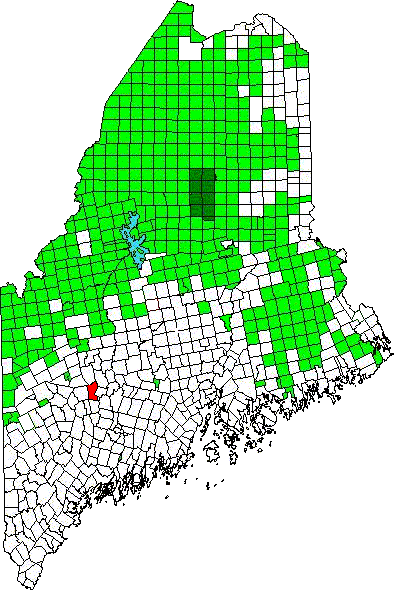
Abraham Wyman was one of the first pioneers in Chesterville, Franklin, Maine (in red)

Abraham Wyman was the first pioneer in Chesterville, Franklin, Maine (in red)

Abraham Wyman was the first white inhabitant of what is now Chesterville. He began on the farm which in 1875 was owned and occupied by Seth Norcross — about the year 1782. His family was the only one for about a year between Kingfield or Mount Vernon and the Sandy River. — They lived in a quite lonely condition, having few if any callers or visitors, until Mr. Sewall and Mr. Linscott moved in, about three miles north of them. After this, (as Mrs. Wyman stated in after years,) Mrs. Sewall and Mrs. Linscott being sisters, used frequently to walk down to visit her, barefoot! After a few years Mr. Wyman moved to Livermore. He did not reside there however many years, but returned and lived with his son Daniel.

Several of the early settlers in the central part of the town of Chesterville were singers. They sometimes met in their

camps to spend an evening in the practice of sacred music. On one of these occasions, (possibly when there were few if any families in the place,) they sung a tune named Chester, supposed to have been composed by Billings, and were much pleased w4th it. — After extolling the tune awhile their thoughts seemed to revert to their situation — only a few- — almost alone in the forest. Dummer Sewall proposed to call the new settlement Chester, a proposition which was agreed to without dispute. From that time to the incorporation of the town that section bore the name of Chester Plantation, while the southerly part of the

town was called Wyman’s Plantation, no doubt in honor of the first inhabitant, Abraham Wyman. When the settlers petitioned for incorporation as a town one of their requests was that the new town should be named Chester; but as there was a, town of that name in Massachusetts the legislature added ville, and the new town came up Chesterville.

Children of Dorothy and Abraham:

i. Daniel Wyman b. 1 Jun 1754 in Winthrop, Kennebec, Maine; d. 5 May 1832 Kingfield, Franklin, Maine; m. 24 Aug 1778 in Winthrop to Ruth Sears Wing (b. 20 Jun 1757 in Harwich, Barnstable, Mass. – d. 6 Jan 1835 in Kingfield) Ruth’s parents were Samuel Wing (1731 – 1786) and Hannah Sears (1734 – 1814). Daniel and Ruth had ten children born between 1780 and 1796.

Daniel enlisted enlisted Jun 1 1775 in Capt. Samuel McCobb’s company, Col. John Nixon’s 6th Massachusetts Regiment service, 2 mos. 5 days. Daniel’s name appears on ists of men returned as having voluntarily enlisted into the army in 1775, and also in 1776, and men supposed to have enlisted into the army for 3 years but not returned to the town, annexed to a petition of the inhabitants of Winthrop, dated March 10, 1777, asking consideration on account of their exposed condition. In 1804 Daniel was given the title “Captain.”Wyman, Daniel, Pownalborough.

It is stated in a historical sketch of the town of Winthrop that Daniel Wyman was at the battle of Bunker Hill. Certificate dated Cambridge, June 24, 1775, signed by Capt. Samuel McCobb, certifying that said Wyman and others belonging to his company, Col. Nixon’s regt., were in need of cartridge boxes and that each had received one, for which said McCobb promised to be accountable; also, Private, Capt. McCobb’s co., Col. John Nixon’s regt.; muster roll dated Aug. 1, 1775; . Daniel, Winthrop.Private, Capt. Samuel McCobb’s co., Col. John Nixon’s (5th) regt.; company return dated Camp at Winter Hill, Oct. 7, 1775.
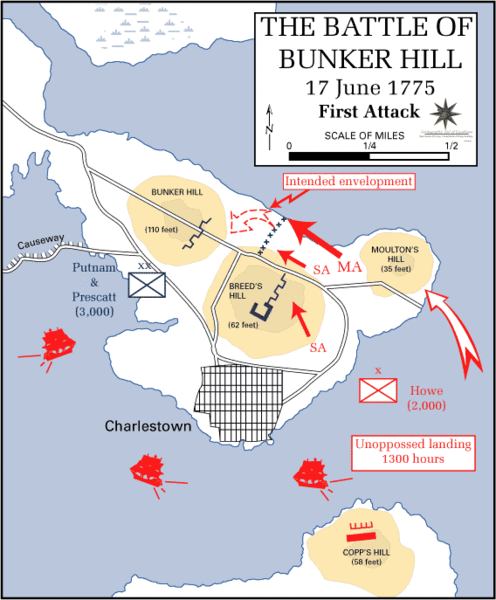
The first British attack on Bunker Hill. Shaded areas are hills

The first British attack on Bunker Hill. Daniel’s company was positioned on Breed’s Hill

During the battle of Bunker Hill the 6th Massachusetts Regiment, under the command of Colonel John Nixon, was positioned in the redoubt on Breeds Hill near Captain Jonathan Brewer and Captain William Prescott regiments. During General William Howe’s first attack on Breed’s Hill, Nixon was wounded and was withdrawn from the battle. The remaining members of the regiment withdrew when the redoubt was overtaken by Howe’s second attack. Nixon’s unit was one of the last to retire from the field.

Daniel’s first captain  Samuel McCobb was a Colonel under Benedict Arnold in the 1776 Expedition to Canada.

History of Chesterville Franklin, Maine – 1875 — Daniel Wyman lived near the large spring, Daniel Wyman, son of Abraham Wyman, came from Readfield, built a house and resided a little north of him. He lived here till about two years after he was chosen Captain when he removed to Livermore. A year or two after, however, found him returned, with his father and mother. Not far from this date he built a house and began to reside where Franklin Currier now lives, which is on the same lot where he first built. He lived here quite a number of years.

He was somewhat noted as a hunter, and in the latter years of his life he was heard to say that he had shot one moose at least on every square mile for several miles around.

A few years after 1820 he sold his farm and moved to Kingfield, living with one of his sons. When almost 70 years old he visited another son residing near the Dead River. Here he was on the day that completed his ” three score and ten.” That day, with his favorite, the gun, well loaded, he made a hunting excursion, with one attendant. As they were in a canoe on the Dead River, they espied two moose swimming across. He was told to tire. “Not yet,” said he. The moose were soon climbing the river bank near each other. Then he fired. On examination it was found that the ball had passed through the vitals of one, killing it outright, and then broke a leg of the other, so that he was soon dispatched.

In another moose story, Capt. Wyman, his brother and Samuel Linscott, once went on snowshoes to Moose Hill hunting. They found three moose and each selecting his object, fired. Two dropped dead, while one remained almost or entirely unhurt. Their dogs worried this one to madness when it rushed towards Mr. Linscott; Capt. Wyman in the mean time loading for another shot. Mr. L. dropped his gun and siezed his axe, waiting the assault. ‘ The moose came rushing towards him, and just as he was crouching for his final spring, Mr. L. settled the axe into his head and thus killed him.

Thus he killed two moose at one shot the day he was seventy years old. Two credible persons informed the writer that they had seen the ball that executed this feat. In the days so far back towards our Revolutionary struggle, as were those that dawned upon the early settlement of this region, the military spirit prevailed. Wyman’s Plantation, with a part or all of the present town of Vienna, (then called Goshen,) united in forming a company of militia, some years before either town was incorporated.

At the organization of this company Daniel Wyman was chosen and commissioned Captain, and he continued in office about two years. He found the cost of uniforming and equipping himself, and the “treating” then customary, bore too heavily upon his purse.

He served in the Revolutionary War and has been known to say that he had taken as good aim at a mtin as he ever had at a moose. He rendered much assistance in 1804 and 1805 to the officers of the company in Chesterville, then recently organized.

ii. Abraham Wyman b. 9 Mar 1768 in Winthrop, Kennebec, Maine; d. bef. 1772

iii. Hannah Wyman b. 24 Apr 1769 in Pond Town, Winthrop, Kennebec, Maine; d. 24 Apr 1769

iv. Rev. Thomas Wyman b. 9 Aug 1770 in Winthrop, Lincoln, Maine; d. 1 Feb 1825 Livermore, Androscoggin, Maine; m. Sep 1790 in Livermore to Susanna Smith (b. 17 Jul 1775 in Readfield, Maine – d. 30 Mar 1825 in Livermore) Susanna’s parents were Elisha Smith (1750 – 1841) and Susannah Wing (1734 – ) Thomas and Susanna had twelve children born between 1789 and 1821.
Thomas and Susana's son Elisha Wyman (1811 - 1853) was a pioneer of Texas.

Thomas and Susana’s son Elisha Smith Wyman (1811 – 1853) was a pioneer of Texas.

v. James Wyman b. 16 Jan 1773 in Goffstown, Hillsborough, New Hampshire; d. 17 Jan 1773; Or m. Nancy [__?__] (b. 1766)

vi. William Wyman b. 13 Apr 1774 in Winthrop, Kennebec, Maine

vii. Dorothy Wyman b. 3 Jan 1776 in Winthrop, Kennebec, Maine; d. 3 Jan 1776 Winthrop

viii. Luther Wyman b. 7 Jul 1778 in Winthrop, Kennebec, Maine; d. bef. d. 9 Sep 1780 Winthrop

ix. Luther Wyman b. 9 Sep 1780 in Winthrop, Kennebec, Maine; d. 9 Sep 1780 or m. Martha Wing (b. 1781 – )

x. Betty Wyman b. 25 Feb 1785 in Winthrop, Maine; m. Feb 1802 to Joseph Wing (b. 7 Jul 1784 in Readfield, Maine – d. 1821) Joseph’s parents were Paul Wing (1760 – 1797) and Patience Trask (1762 – ). Betty and Joseph had ten children born between 1802 and 1820.

8. Hannah CALL (See Charles B. WEBBER‘s page)

10. John Call

When Indians attacked in Aug 1754, three and a half year old John crawled into a hole behind the chimney with his mother and kept quiet, and thus escaped from sure destruction. (See story above)

John’s first wife Sarah Lewis was born about 1748 in Boothbay, Maine.

Pownalborough Marriage Intentions – Sep 29 1770, John Call and Sarah Lewis, of Boothbay.

John’s second wife wife Dorothy “Dolly” Sanborn was born 29 Jan 1756 in Kingston, Rockingham, New Hampshire.  Her parents were Benjamin Sanborn (1719 – 1806) and Dorothy Ladd (1730 – 1784). Dolly died 1775 in Franklin, Merrimack, New Hampshire.

Some say that the John Call was actually Philip CALL IV’s nephew, the son of his brother Stephen Call (b. 1728) and Eunice Danforth. (See Philip CALL III’s page)

Historical sources differ about which daughter-in-law did the hiding:

Genealogical and family history of the state of New Hampshire: a …, Volume 3 By Lewis publishing company, Chicago 1908 states that “Mrs. Stephen Call, with her infant, crawled into a hole behind the chimney.”

However, The history of Boscawen and Webster [N.H.] from 1733 to 1878 (published 1878) says ” Mrs. Philip Call, junior, with her infant, crawled into a hole behind the chimney. “

Children of John and Dolly:

i. Mary “Polly” Call b. 1772 in Salisbury, Merrimack, New Hampshire; d. Andover, Merrimack, New Hampshire; m. 1 May 1796 Sanbornton, Belknap, New Hampshire to Jonathan Weeks (b. 19 Jul 1776 in Epping, Rockingham, New Hampshire – d. 28 Jan 1850 in Franklin, Merrimack, New Hampshire) John’s parents were Cole A. Weeks (1737 – 1801) and Hannah Chapnan (1739 – 1815) Polly and Jonathan had eight children born between 1796 and 1818.

ii. Hazen Call b. 24 Mar 1773 in Andover, Merrimack, New Hampshire; d. 26 May 1853 in Andover; Burial: Burial: Simonds Call Cemetery, Franklin, Merrimack, New Hampshire, Plot: 15; m. Catherine Ash (b. 1 Jun 1769 – d. 1 Oct 1858 Franklin, NH) Hazen and Catherine had six children born between 1802 and 1817.

In the 1850 census, Hazen and Catherine were farming in Franklin, Merrimack, New Hampshire.

iii. Dorothy Call b. 5 May 1784 in Andover, Essex, Mass.; d. 15 Mar 1870 in Newton, Middlesex, Mass.; m. Simeon W Cate Jr (b. 23 Jul 1787 in Sanbornton, Belknap, New Hampshire – d. 23 Feb 1883 in Franklin, Merrimack, New Hampshire) Simeon’s parents were Simeon Cate Sr. (1763 – ) and Abigail Piper (1762 – )

In the 1850 census, Simeon and Dorothy were farming in Newton, Middlesex, Mass.

iv. Eunice Call b. 17 Apr 1793 in Andover, Merrimack, New Hampshire; d. 10 Apr 1835; m. Moses Abbott (b. 3 Aug 1783 in Concord, Merrimack, New Hampshire – d. 18 Oct 1867 in Quincy, Norfolk, Mass.) Moses’ parents were Moses Abbott (1752 – 1837) and Mary Bachelder (1753 – 1833) Eunice and George had at least one son, George (b. 1825)

In the 1860 census, Moses was living with his son George in Harrington, Washington, Maine.

v. Abigail Call

vi. Daniel Call

vii. John Call

viii. Peter Call

ix. Stephen Call

Sources:

http://www.hadleygenealogy.net/ghtout/gp1120.html

http://trees.ancestry.com/owt/person.aspx?pid=31138727

http://www.genealogyofnewengland.com/b_c.htm

http://hollowhill.com/franklin-historical-societys-ghosts-nh/

http://capecodhistory.us/genealogy/wellfleet/Names68.htm

History of Dresden, Maine, 1931, by Charles Edwin Allen, especially pp. 102-105, for discussion of the Calls, including descendants of Philip and his brother Obadiah who were early settlers, before 1739, of (now) Dresden, formerly part of Pownalborough, Maine.

http://archives.mainegenealogy.net/2008/05/marriage-intentions-in-pownalborough.html

History of Chesterville, Maine (1875)
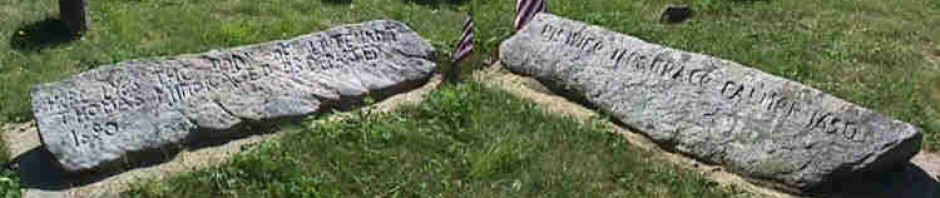
Posted in -9th Generation, Line - Shaw, Storied, Violent Death | Tagged , , | 10 Comments

Charles Webber Jr

Charles WEBBER Jr (1764 – 1837) was Alex’s 5th Great Grandfather; one of 64 in this generation of the Shaw line.

Charles Webber Jr. was born in 1764 in Dresden, Lincoln, Maine. His parents were Charles WEBBER and Hannah CALL. He may have married Ruth THATCHER 2 Apr 1792 in Yarmouth, Maine. He also may have married 18 Apr 1793 in Yarmouth to  Mary STURGIS.    Concerning the Cortright and Webber families in America 1925 states he married Judith CHADWICK and had twelve children.  Charles died 29 Nov 1837 in Winslow, Kennebec, Maine.

the Yarmouth, Massachusetts Vital Records Volume 1 which gives the marriage record of “Charles Webber of Vasselborough in the county of Linclon, (sic) to Molly Sturges Yarmouth April 18, 1793″

Vassalboro; Village Cemetery, North Vassalboro; and Webber Cemetery, Vassalboro,  respectively ( MOCA 4:2655 and 2684). Marriages/intentions in VR Vassalboro.

Charles Webber, Jr. m. Mary Sturgis and m. int. 2 April 1792 Ruth Thatcher of Yarmouth (p. 33)

Ruth Thatcher’s father may have been James THATCHER, from Yarmouth, Cape Cod as were many of the early Vassalboro settlers.

Mary Sturgis was born 12 Dec 1767 in Yarmouth, Barnstable, Mass.  Her parents were Edward STURGIS V and Mary BASSETT.  Edward Sturgis and family moved from Yarmouth to Vassalboro in 1795 when Mary would have been about 28 years old.  If Charles did marry Ruth Thacher in 1792, Mary Sturgis would have been his second wife.

Children of Charles and Ruth:

Name Born Married Departed
1. Daughter 1790 – 1795
2. Oliver WEBBER 1797 Vassalboro Abigail HAWES
17 Mar 1821 Vassalboro Kennebec Maine.
.
Sarah Bryant
22 Jan 1849
15 Jan 1862 Vassalboro, Kennebec, Maine
3. Son 1795 – 1800
4. Daughter 1795 – 1800
5. Daughter 1800 – 1809
6. Daughter 1800 – 1809
7. Son 1800 – 1809
8. Son 1805 – 1809
9. Son 1805 – 1809
10. Daughter 1810 – 1819
11. Child
12. Child

Supporting evidence that Charles Webber Jr. was Oliver’s father

  1. Oliver deposed on Feb 22, 1860 that he was a grandson of Charles B WEBBER.
  2. I have researched the families of Charles’ brothers in depth.  There are no Olivers.
  3. There was a Charles Webber Jr. living in Vassalboro with a large family.  See 1800 and 1810 census records below.
  4. Even though he had at least nine  and probably twelve children, there is no record of their names.
  5. The Webbers were a leading family in Vassalboro.  Webber Pond is the largest lake in the area.  Charles, Jeremiah and Oliver were all Selectmen in different eras.
  6. Oliver’s wife Abigail Hawes grew up in Vassalboro and had her first child when she was 21 so it is very likely that Oliver grew up in Vassalboro as well.
  7. Oliver Webber was related to Charles’ brother Jeremiah because he became guardian of Jeremiah’s grandchildren when their parents died.
  8. According to the 1800 and 1810 census records, Charles was the only Webber in Vassalboro that had a boy who could have been born in 1797.

x

Name Spouse Child Id’d Possibly Oliver Notes
1. Charles Ruth THATCHER?
2 Apr 1792
Yarmouth
.
Mary STURGES?
.
Judith Chadwick?
.
Sarah?
 12  0  12
2. Sarah (Sally) Judah Chadwick  8 8  0
3. Mary (Polly) John Gaslin  12  8  0
4.  James Susanna Woodman
23 Oct 1795
 8  3  5 Moved to Sandusky, Ohio Son James S. Webber, b. 1799 in Belfast, Waldo, Maine;
5. John Lucy Ballard
1 Dec 1793
12 12  0
6. William No Children  0  0 0
7. Nancy 1  0
8. Joseph Mary Brown
25 May 1800
Salisbury, Mass.
 3 3
9. Samuel Jerusha Lambert Capen
14 May 1801
Vassalboro
12 6  0
(Married too late)
Married after Oliver’s 1797  birth
10. Hannah Amos Childs
1 Feb 1801
 7 0  0 Child count from 1830 census
11. George Sybil Webber
7 Nov 1800
.
Temperance Emery
11 Dec 1820 Vassalboro
4  1 0 (Married too late) Married after Oliver’s 1797  birth
12. Benjamin Lydia Hannah Bailey
27 Jun 1805
Pittston, ME
.
Lacina [__?__]
4 4  0
(Married too late)
Son of Charles and Sarah Smiley
Married after Oliver’s 1797  birth
Genealogy counts only 3 children
13. Jeremiah Balsova Horn
1 Jun 1805
Vassalboro, ME
8 8  0
(Married too late)
Son of Charles and Sarah Smiley
Oliver was named guardian of Jeremiah’s grandchildren in 1838
Total Oliver’s Cousins 91 52 17

The early settlers on the river front lots from the Augusta line to Isaiah Hawes’ present [1892] residence were: William Brown, Jeremiah and William Farwell, Charles Webber (who came in 1765 and whose daughter, Sarah, was the first white child born in town), Benjamin Brown, Jacob Faught, Thaddeus and William Snell, Mr. Fallonsbee, James, Jonathan and Heman Sturgis and their father, Edward, from Barnstable, Mass., about 1780; James Thatcher, from Cape Cod, and Isaiah Hawes, also from the Cape. These people lived on the river road and from south to north in substantially this order, beginning with William Brown on lot 51 of the first range

The settlement of town of Vassalboro commenced in 1760. for ten years only eight families had become residents including those in what is now Sidney that was first included in the limits of Vassalboro. Four families settled on the river front below what is now called riverside.  Charles WEBBER came in 1765, soon after his brother Joseph Webber came.   Charles Webber was first town treasurer of Vassalboro 1771, was selectman in 1773, Joseph Webber was selectman of Vassalboro in 1778.  Jeremiah Webber (Charles’ son)  was selectman in  1817 and Oliver Webber was selectman in 1840 and 1841.      Oliver Webber was appointed  guardian of Jeremiah’s son Horatio Nelson Webber’s children when Horatio died in 1838.

Church

Illustrated History of Kennebec County 1892 – One other place and kind of worship will not be forgotten so long as the links of tradition can touch each other — the church and teachings of Charles Webber, who resided on the river road near Riverside, in the house now occupied by Wallace W. Gilbert. Across the road, on what is known as the James S. Emery place, Mr. Webber erected a small edifice in the last few years of the last century. Here he had preaching of his own, and constituted himself the pastor. What was more conspicuous in this arrangement was the fact that said Webber could not read, and depended upon his wife for that important attribute. He could readily grasp the scripture reading of his wife and give wholesome explanation thereon; and only once was his knowledge clouded, when his wife read “log” for “lodge” in the wilderness. His manner of announcing a text was: ” If Polly tells me aright you will find my text, etc.” He urged sinners to repent, often saying that it was as impossible for one to enter heaven as it was for a shad to climb a tree. His eccentricities and goodness survive him, as does the old church, which, on another site, is the residence of Freeman Sturgis.

Churches.—The first religious organization in Sidney was formed in the southwest part of the town, in 1791, by the Calvinistic Baptists, who named their church Second Vassalboro. Asa Wilbur and Lemuel Jackson, then local preachers, were the leaders. The former became the pastor in 1796, and in 1808 he represented the town in the general court of Massachusetts. The church was diminished in 1806, when nineteen members left to form the Second Baptist church, and was increased by a revival in 1811.

A powerful revival in 1805, under the preaching of Rev. Asa Wilbur, resulted in the formation of a second Baptist church, February 7, 1806. The organization was perfected at the house of Benjamin Dyer, on the river road, and signed by seventeen members: Nathaniel Reynolds, jun., Edmund Hayward, Asa Williams, Benjamin Dyer, John Sawtelle, Charles Webber, jun., Henry Babcock, Mary Matthews, Mary Reynolds, Jemima Dyer, Mercy Matthews, Thankful Faught, Elizabeth Andrews, Eunice Williams, Abigail Tuttle, Sarah Ingraham and Susanna Haywar

Military

In 1814 the British fleet hovered on the coast of Maine. Vassalboro raised companies by enlistment. One was raised for Lieutenant Colonel Moore’s regiment, and the commissioned officers were: Daniel Wyman, captain; Alexander Jackson, lieutenant; William Tarbell, ensign. Thomas Hawes, Daniel Whitehouse, Zenas Percival and Roland Frye were sergeants; John Clay, Gersham Clark, Thomas Whitehouse and Jonathan Smart, corporals; George Webber [Charles’ younger brother?], musician. There were twenty-nine privates.

Wing’s company, enlisted in Vassalboro, was attached to the same regiment. The commissioned officers of the company were: Joseph Wing, captain; Levi Maynard, lieutenant, and Nehemiah Gould, ensign. The non-commissioned officers were: Elijah Robinson, Moses Rollins, Stephen Low, Josiah Priest, .sergeants; Levi Chadbourne, Amasa Starkey, John Frye, Reuben Priest, corporals. The musicians were Enoch Marshall and Stephen Townsend. The privates numbered fifty-three men.

Still another small company was enlisted for Moore’s regiment, and the captain was Jeremiah Farwell; lieutenant, Aaron Gaslin [Charles’ cousin]. Charles WEBBER, Eli French, John G. Hall and Elijah Morse were sergeants; Benjamin Bassett, Nathaniel Merchant and Heman Sturges, corporals; John Lovejoy, musician; and the file of privates numbered thirty men.

Another version of Farwell’s company: A company was drafted from Vassalboro, of which Jeremiah Farwell was commissioned captain; Nathaniel Spratt, lieutenant, and Nehemiah Gould, ensign. Charles WEBBER, Amariah Hardin, jun., Jabez Crowell and Elijah Morse were sergeants; Rowland Frye, Samuel Brand. Benjamin Melvin and Thomas Whitehouse, corporals; Washington Drake and Timothy Waterhouse, musicians. The company embraced sixty-seven men as privates.

A third version  has Capt. J. Farwell’s Company, Lieut. Col. E. Sherwin’s Regiment. From Sept. 24 to Nov. 10. 1814. Raised at Vassalboro. Service at Wiscasset.

Rank and Name.
Jeremiah Farwell, Captain
Nathaniel Spratt, Lieutenant
Nehemiah Gould, Ensign
Charles Webber, Sergeant
Amariah Hardin, Jr., Sergeant
Jabez Crowell, Sergeant
Elijah Morse, Sergeant
Rowland Frye, Corporal
Samuel Brand, Corporal
Benjamin Malone, Corporal
Thomas Whitehouse, Corporal
Washington Drake, Musician
Timothy Waterhouse, Musician

Privates include
John Webber
Sylvanus Webber

Court Cases

There are several court cases involving a Charles Webber in the Kennebec County Court in the early days of Vassalboro.

Jul 1799  Plaintiff Debt
Sep 1800 Plaintiff Debt
Jun 1804 Plaintiff Judgment Recovery
Jun 1805  Defendant Illegal Drink Sale
Oct 1805 Plaintiff Judgment Recovery
Oct 1805 Defendant Conversion A conversion is a voluntary act by one person inconsistent with the ownership rights of another.  For example in cases where trees are cut down and the lumber hauled from the land by someone not having clear ownership
Sep 1806 Plaintiff Ejectment
Oct 1819 Defendant Debt
Oct 1826 Petition
Jun 1829 Plaintiff Ejectment
Oct 1829 Petition

Charles Webber Jr. lived next to his father Charles Webber in the 1800 census.  They both lived next to Edward Sturgis (arrived Vassalboro 1792) and James Sturgis (arrived Vassalboro 1796).   Interesting considered some sources state Charles Jr. Mary Sturgis and other sources state his brother William married her.  Sturgis has been spelled Sturges as well.

Charles Webber Jr. 1800 Census

Name: Charles Webber Junior, Vassalborough, Kennebec, Maine
Free White Males Under 10: 2
Free White Males 26 to 44: 1
Free White Females Under 10 : 2
Free White Females 26 to 44 : 1
Number of Household Members Under 16 : 4
Number of Household Members Over 25 : 2
Number of Household Members: 6

Charles Webber Sr – 1800 Census Charles Sr. was born before 1755.  The youngest child we know about, Jeremiah, would have been about 14 in 1800.

Name: Charles Webber Jr, Vassalboro, Kennebec, Maine
Free White Males Under 10: 1
Free White Males 45 and Over : 1
Free White Females 10 to 15 : 1
Free White Females 45 and Over : 1
Number of Household Members Under 16 : 2
Number of Household Members Over 25 : 2
Number of Household Members: 4

Charles Webber Jr. 1810 Census This one shows Charles age between 26 and 44 meaning birth between and 1765 and 1784.  We believe Charles was born in 1764.  Note that this Charles’ wife was older than 45 in this census and he was probably was close to her age.  This census is in alphabetical order with Charles next to Benjamin Webber and several other Webbers. Continue reading

Posted in -7th Generation, Line - Shaw, Veteran | Tagged | 12 Comments

Thomas Stevenson

Thomas STEVENSON (1625 – 1663) was Alex’s 10th Great Grandfather; one of 2,048 in this generation of the Shaw line.

Thomas Stevenson - Coat of Arms

Thomas Stevenson was born in 1625 in England.  His parents were James STEVENSON and [__?__].  He married Margaret [__?__] in 1640 in Dover, NH.  Thomas died 7 Dec 1663 in Durham, Strafford County, New Hampshire, killed by Indians.

Margaret [__?__]  was born c. 1620.  Margaret died November 26, 1663 in Dover, Strafford County, New Hampshire.

Children of Thomas Stevenson and Margaret are:

Name Born Married Departed
1. Margaret Stevenson 1645
Dover, Strafford, NH
William Williams
1660
Durham, Strafford,NH
12 Dec 1707
Oyster River, Strafford, NH
2. Joseph Stevenson 1647
Oyster River, Strafford, NH
Margaret Footman
1671
Oyster River
bef. 4 Aug 1694
3. Elizabeth Stevenson 1649
Oyster River
Robert Chapman
1664
Oyster River
1664
4. Mary STEVENSON Oct 1651 Cocheco (Dover) NHor Durham, NH Enoch HUTCHINS
5 Apr 1667 in Kittery, York County, Maine
Feb 1725
Kittery, Maine
5. Bartholomew Stevenson c. 1653
Oyster River
Mary Clark
10 Oct 1680
Oyster River, (Dover), NH
4 Jun 1718 in Oyster River, (Dover), NH
6. Thomas Stevenson c. 1651
Durham, NH
07 Dec 1663 in Dover, Strafford, NH
or
4 Aug 1694

History of The Town of Durham, New Hampshire (Oyster River Plantation) by E.S. Stackpole and L. Thompson, 1913:

Thomas Stevenson owned land on the south side of Oyster River as early as Jul 5, 1643. In 1644, 3 acres at the Oyster Point were granted to Thomas Stevenson. He was rated at Oyster River in 1648. He had a grant of three acres at Oyster Point in 1649. He was of Cocheco (Dover, NH) in 1648, 1650 and 1658.
Thomas (Stimpson) Stevenson received a grant of thirty acres of land at Oyster River in 1649 and thirty more in 1654. He was living at Oyster River in 1643 in Cocheco (Dover) NH in 1648, 1650, and 1658. Thomas died Dec 7 1663 and his wife Margaret died Nov 16, 1663. Two sons, Joseph and Thomas, were killed by Indians, probably in the massacre of 1663. Thomas on Dec 7, 1663 as was his father.

FTM CD523, Pioneers of ME and NH by Charles Henry Pope, pg 198:
STEVENSON,

Thomas, Dover, had lawsuit in 1642; taxed in 1648. His wife Mary died 26 Nov. 1663; he died 7 Dec 1663 (Dov. Hist. Coll.) Admin. of his estate was granted 28 June 1664, to his son Joseph; he chose William Follett guardian, who gave bonds for payment of portions to Joseph and his brothers and sisters. Brother Bartholomew admin. on estates of Thomas and Joseph in 1694.

FTM CD523, Geneal. Dict., ME & NH by Sybil Noyes, Charles Libby, Walter Davis, GPC, Baltimore, 1979.
pg661:

THOMAS, Oyster River, owned on the south side by July 1643, was gr. 30 acres at Oyster Point in 1649 and had another grant in 1654. Lawsuit 1655. Wife Margaret d. 26 Nov., he 7 Dec. 1663. Adm. 28 June 1664 to s. Joseph, a minor. He chose as guardian. Wm Follett, who gave bond to pay the other children In Dec. 1667, Joseph was ordered to allow his 3 sis. and 2 bros 6 pounds apiece but to have the bros.’ portions for bring them up and all the rest of the est.; Mr. F. to be reimbursed 6 pounds for physick for sis. Chapman. Ch: MARGARET, m. William Williams. JOSEPH, +/- 26 in June 1673, in 1678 and later had difficulties with Nicholas Follet and the Thomas Drews over bounds; served on jury in June 1694. Adm. on his and br. Thomas’ est. gr. to br. Bartholomew 4 Aug. 1694. A p/a given by Williams’s 7 wks. later recites that they were killed by Indians, s.p. ELIZABETH, m. Robert Chapman. MARY, +/- 44 in Aug 1705, m. Enoch Hutchins. THOMAS, +/- 29 in Aug 1680, prob. nearer correc that +/- 26 in Sept. 1683, as he was drunk in 1670. BARTHOLOMEW.

Genealogical Items relating to Dover, N. H., NEHGR, 1854, Vol 8, pg 130:

Stevenson, Thomas, was in Dover before 1641; owned land, which he sold to Jonas Binns, “being next to the point at the Enterance into Oyster River, Compassed wth the Riuer eurie way only the south side, and that Joynes uppon the Land of Mr. Francis Matthewes;” was at O.R. in 1661; his wife Margaret died 26 Noiv. 1663; he died 7 Dec. 1663; “Tho. Steuenson his estat” taxed in 1661.

Children

1. Margaret Stevenson

Margaret’s husband William Williams was born 1630 in Dover, Strafford, New Hampshire. His parents were William Williams and Alice [__?__]. William died 12 Dec 1701 in Durham, Strafford, New Hampshire.

2. Joseph Stevenson

Joseph’s wife Margaret Footman was born in 1651 in of Oyster River, Dover, New Hampshire.

3. Elizabeth Stevenson

Elizabeth’s husband Robert Chapman was born in 1645 in of Oyster River, Dover, New Hampshire.

4. Mary STEVENSON (See Enoch HUTCHINS‘s page)

5. Bartholomew Stevenson

Bartholomew’s wife Mary Clark was born 1660 in Dover, Strafford, New Hampshire. Bartholomew died 5 Apr 1724 in Oyster River, Strafford, New Hampshire

Sources:

http://trees.ancestry.com/owt/person.aspx?pid=34602262

http://familytreemaker.genealogy.com/users/a/s/h/William-Ashbey/GENE5-0049.html

http://familytreemaker.genealogy.com/users/k/a/h/John-B-Kaherl/BOOK-0001/0004-0155.html

http://www.angelfire.com/planet/delonggenealogy/pafg233.htm#7893

Source 1: Durham, NH, Stackpole&Thompson, 1913
Source 2: FTM CD523Gen.Dict.ME & NH, 1979
Source 3: Pioneers of ME & NH by Charles Pope
Source 4: 1854, Geneal. Items, Dover,NH, NEHGR 8:130

Posted in 12th Generation, Immigrant - England, Line - Shaw, Violent Death | Tagged , | 2 Comments

John Diamond

John DIAMOND (1613 – 1667) was Alex’s 10th Great Grandfather; one of 2,048 in this generation of the Shaw line.

John Diamond - Coat of Arms

John Diamond was born about 1610 or 1613 in Dartmouth, Devon, England.  He married Grace SAMMON 2 Jun 1635 in St. Petrox Church, Dartmouth, Devon, England.  John died on 9 Jul 1667 in Kittery, Maine.

John Diamond and Grace Sammon were married at St Petrox Church, next to Dartmouth Castle at the mouth of the River Dart

It is likely that in 1192 it was maintained to provide a light at the harbor entrance. The whole coast was fringed with chapels in medieval times, some of which were used for a few years, whilst others were in service for centuries. The lonely site at the mouth of the Dart would seem to have been abandoned at some date before 1332; when Bishop Grandison licensed two priests to celebrate in the chapel of St. Petrox, built it was said of old, in the parish of the church of Stoke Fleming, the rights of the parish church being preserved. Seventeen years later William Smale (mayor in 1346) was contemplating ‘ the endowment of a chapel at St. Petrox.’ Dartmouth Castle is one of a pair of forts, the other being Kingswear Castle, that guard the mouth of the Dart Estuary in Devon,

Grace Sammon was born 1 Jan 1619 in Dartmouth, Devon, England. Her parents were Andrew  SAMMON and [__?__]. Grace died after 9 Jul 1661 in Kittery, Maine.

Children of John and Grace:

Name Born Married Departed
1. John Diamond c. 1639
St Petrox, Dartmouth, Devon, England
Eleanor Raynes
abt 1661, Kittery, York, Maine
Aft.
10 Jun 1692
Wells, Maine
Tortured by Indians
or
29 Aug 1693
Portsmouth, Rockingham, New Hampshire
2. Andrew Diamond 1640
St Petrox, Dartmouth, Devon, England
Mrs. Joan Grant
c. 1668
.
Elizabeth Elliot
24 Jul 1705
Marblehead, Essex, Mass
bef Apr 1707
Smuttinose Island, Maine
3. Capt. Thomas Diamond bapt.
30 Aug 1641
St. Petrox, Dartmouth, Devon, England
Mrs. Mary Weymouth
aft 25 Jun 1678, Star Island, New Hampshire
.
Jane Gaines
intentions
19 Apr 1707
Ipswich, Essex, Mass
c. 1708
Star Island
4. William Diamond c. 1642
Kittery, York, Maine
Joan [__?__]
abt 1666, Kittery, York, Maine
bef.
1 Apr 1679
Kittery, Main
5. Grace DIAMOND 1645 or 1646
Kittery, Maine
Peter LEWIS
c. 1667
 After 1720

John was a ropemaker in Massachusetts, but built shallops in Kittery and with his sons carried on fishing at Isle of Shoals.  In 1660 Walter Winser from Hemick (Hennock), Devon, was apprenticed to him.  A shallop is either a large heavy boat, usually having two masts and carrying fore-and-aft or lugsail or a small open boat fitted with oars or sails, or both, and used primarily in shallow waters. The source doesn’t say which one John build, but I’d go with small and open.

Map of Lower Kittery Lots - John Diamond's land is underlined in yellow

John’s lot in Lower Kittery was a couple of hundred feet from Badger’s Island.  Prior to the Civil War, Badger’s Island was famous for shipbuilding. Eastern white pine formasts, together with lumber for hulls, arrived down the Piscataqua River from inland forests. Only two tenths of a mile from Portsmouth’s busy wharves, the island’s gradual slope into the deep channel between was ideal for launching vessels. First called Rising Castle Island, it changed to Langdon’s Island when John Langdon established his shipyard. The first U. S. Navy ships commissioned by the Continental Congress were built here by master shipbuilder James Hackett,  including USS Ranger in 1777

Ranger (initially called Hampshire) was launched 10 May 1777 Captain John Paul Jones in command.   After fitting out, she sailed for France on 1 Nov 1777, carrying dispatches telling of General Burgoyne‘s surrender to the commissioners in Paris. On the voyage over, two British prizes were captured. Ranger arrived at Nantes, France, 2 Dec, where Jones sold the prizes and delivered the news of the victory at Saratoga to Dr. Franklin. On 14 Feb 1778, Ranger received an official salute to the new American flag, the “Stars and Stripes,” given by the French fleet at Quiberon Bay.

1647 – Lived in Lynn Mass.

In 1651 he bought by an imperfect deed a house and undescribed land at Crooked Lane, Kittery; the land he claimed was cut down by Thomas Withers and by town grants  to Dennis Downing, Richard Abbott, William. Leighton.  There is no Crooked Lane in modern Kittery, but there is a Crooked Lane Cafe at 70 Wallingford Square, just across the bridge from Portmouth Naval Shipyard.  It got a good review on Trip Advisor.  Compare the modern Google Satellite View vs. the 1635-1700 Lower Kittery Map above.   Crooked Lane looks to be in about the same spot, but the shape of the islands has changed.

John  was on a Jury in 1651,  and a grand jury in 1663.

5 Dec 1651 – At Kittery,   “Grace Dimond & her husband Jo: Dymond depose they stand in fear of life from Mary Mendam — & so her husband Robert Mendam bound in £40 that she shall keep the peace.”  [The Mendam’s home was half a mile north of the Diamond’s]

5 Mar 1651/52 – The Dimonds recover against the Mendams 40 shillings and costs in an action of assault and battery. (Court Record)

5 Jul 1658 – John Dyamont appointed administrator of Nicholas Woddy, fisherman, deceased intestate. (Court Record)

Aug., 1659 – John Dyamont appointed constable at Kittery

Jul 1662 – John appointed Clerk of the writs in Kittery

1667 – John Dyament conveys land to his brother William Dyament; and it appears from Robert Flausell’s deposition, that they were son of John Diamond, deceased, who left also a son Andrew, and that John was the eldest son.

Possibly a synthetic date, administration on his estate is said to have been granted  to son John 9 July 1667; but his wife survived him.  In that court ‘John Dyamont’ was a juryman.

From Old Kittery and her families By Everett Schermerhorn Stackpole

John Diamond and wife Grace were living in Kittery in 1651. He was constable in 1659 and clerk of the writs in 1662. He lived on Crooked Lane and was a shipbuilder. John Diamond, Jr., was made administrator of his estate 9 July 1667.

From Pioneers of Maine and New Hampshire 1623-1660 by POPE pate 55:

DEAMON/DEMOND, ETC:

John , rope-maker, Kittery, bought house and land June 15, 1651. Took oath of allegiance to Mass. govt. 22 Nov. 1652. One of the appraisers in the Gunnison case in 1653. Selectman. Took Walter, son of John Winser, late of Hemmick, Co. Devon, Eng. apprentice for 5 years from 9 Oct. next, May 3, 1660. Sold house and land on one of the Isles of Shoals 2 Nov. 1668 to Henry Maine and Andrew Deament, and another house with land Nov. 18, 1667, to his brother William Deaman.  Administration of his estate was granted 9 July, 1667, to his son John.

Children

1. John Diamond

John’s wife Eleanor Raynes was born about 1648 in Strawberry Bank, Rockingham, New Hampshire. Her parents were Capt. Francis Raynes (~1625-<1706) and Eleanor Moore (~1629->1706). Eleanor died before 1692, Kittery, York, Maine.

John Jr. sold land to brother William in 1667. Mentioned in 1685. Probably married a daughter of Francis Raynes of York.   His children include : Mary, m1. John Spinney, m2. Lieut. Jeremiah Burnham; John, Boston, m. 22 Aug. 1709 Mary Wilson; Thomas, Boston, mar. 2 Jan. 1706 Ann Webster.

A theory, that the 1667 juryman was the son and that he, deeming himself sole heir, undertook to distribute his father’s estate among his brothers. He had laid out to himself in 1674, 40 acres next S.E. of Thomas Withers, 51 rods [841.5 feet] on the river. This became the Woodman-Moore ferry place, conveyed as 40 acres, but with abuttors never named. William’s widow was obliged to repurchase their farm from the Downings. In 1685 John was shoreman of a fishing company on Pickering’s island. Grand jury, foreman 1688. Inv. 29 Aug. 1693, adm. 30 Aug. to Nathl. Raynes and John Woodman. His wife, a daughter of Capt. Francis Raynes, apparently d. first.

John Diamond, 2d, who was put to death with torture by Indians after the Raid on Wells in 1692. Alternatively, this John might have been his nephew, son of his brother William. Magnalia by Cotton Mather –

Magnalia Christi Americana (roughly, The Glorious Works of Christ in America) is a book published in 1702 by Cotton Mather (1663–1728). Its title is in Latin, but its subtitle is in English: The Ecclesiastical History of New England. It was generally written in English and printed in London   It consists of seven “books” collected into two volumes, and it details the religious development of New England from 1620 to 1698. Notable parts of the book are Mather’s descriptions of the Salem Witch Trials, in which he criticizes some of the methods of the court and attempts to distance himself from the event; his account of the escape of Hannah Dustan, [Mary Neff, daughter of our ancestor George CORLISS was Hannah’s nurse and accomplice] one of the best known to captivity narrative scholars; his complete “catalogus” of all the students that graduated from Harvard College, and story of the founding of Harvard College itself; and his assertions that Puritan slaveholders should do more to convert their slaves to Christianity.
From Magnalia Christi Americana …

“At the brave defence of Wells by Captain Converse…, one John Diamond was taken prisoner by the Indians, and dragged away by his hair into the thickets. After their humiliating defeat, in their ‘nefandous rage,’ the savages put their captive to the most dreadful tortures. “They stripped him,” writes Cotton Mather, ‘they scalped him alive; they slit him with knives between his fingers and toes; they made cruel gashes in the most fleshy parts of his body, and stuck the gashes with firebrands, which were after found sticking in the wounds.'”

The Raid on Wells  was part of King William’s War  (1689-1697), the first of what came to be known in America as the French and Indian wars. In fact, the French and Indian Wars were a series of colonial wars between Great Britain and France that lasted three-quarters of a century. Hostilities in King William’s War begain in 1690, when in the course of a few months Schenectady, N.Y., was burned by the French and Indians, and colonial English forces launched attacks on Port Royal (now Annapolis Royal), Nova Scotia, and on Quebec. Despite further raids by the French and Indians, the war ended in a stalemate

The Raid on Wells occurred when French and Native forces from New France attacked the English settlement at Wells, Maine, a frontier town on the coast below Acadia. The principal attack (1692) was led by La Brognerie, who was killed. Commander of the garrison, Captain James Converse, successfully repelled the raid despite being greatly outnumbered.

Wells was the resilient northeastern frontier of English settlement. Other early attempts to colonize Maine above Wells, including the Popham Colony in 1607, [our ancestor John PARKER Sr. was a mate on the 1607 voyage to found the Popham Colony], and Pejepscot (now Brunswick) in 1628, were abandoned except for a few forts and garrisons. Beginning with King Philip’s War in 1675, Native American attacks destroyed many incipient towns. New France resented encroachment by New England in territory it considered its own, and used the Abenaki inhabitants to impede English settlement.

A year earlier, also during King William’s War, , when Wells contained about 80 houses and log cabins strung along the Post Road, the town was attacked on June 9, 1691 by about 200 Native Americans commanded by the sachem Moxus. But Captain James Converse and his militia successfully defended Lieutenant Joseph Storer’s garrison, which was surrounded by a gated palisade. Another sachem, Madockawando, threatened to return the next year “and have the dog Converse out of his hole”

Madockwando b. ? d. 1698 Chief 1667(?) to 1698

During the time of King Philip’s War, Chief Madockawando sought peace between the Penobscot and the English and attended many peace meetings with Lt. Governor William Phips of the Commonwealth of Massachusetts. Phips drafted a treaty that called for the Penobscot to live under English rule and to cut all alliances with the French, but Madockawando and other Penobscot leaders could not agree to these terms. Chief Madockawando tried hard to stay out of King Philip’s War, but after the death of his sister due to English attacks on Fort Pentagoet, he and other Penobscots joined the conflict.

We have another family connection to Cheif Madockawando.  Benjamin CRISPE’s daughter Deliverance, son-in-law William Longley and five of their children were killed in an Abenaki Indian attack 27 Jul 1694 in Groton, Mass.  The Indians killed the father and the mother and five of the children and carried into captivity the other three.  Lydia was sold to the French and placed in the Congregation of Notre Dame, a convent in Montreal, where she converted to Catholicism, and died July 20, 1758. Betty died soon after her capture from hunger and exposure; and John remained with the Indians more than 4 years, when he was ransomed and brought away.  John Longley returned about the time when the grandmother died; and subsequently he filled many important offices both in the church and the town.  It is said he took kindly to life among the Indians, notwithstanding hardships, and, had it not been for determined efforts on the part of his relatives and the Massachusetts government, he would probably have become an Indian chief.  He was ransomed by the government and, with great difficulty, induced to return to civilization.  He remained with the Abenaqui for 4 years. According to his deposition given in 1736, he spent the last 2 ½ years of his captivity as a servant to Chief Madocawando of the Penobscot tribe.

Chief Madockawando

Back to John Diamond, a year passed when cattle, frightened and some wounded, suddenly ran into the town from their pastures. It was a recognized sign that a Native American attack was imminent, so residents sought refuge. On June 10, 1692, a force of 400 Native Americans and some French troops commanded by La Brognerie marched into Wells, knowing that Converse would be in Storer’s garrison. But with a 15 soldier militia and an approximate number of townsfolk, Converse resisted assaults during a 2–3 day siege. The attackers alternated between attacks on the village and the narrow harbor,  where Captain Samuel Storer, James Gooch and 14 soldiers, sent as reinforcements, were aboard two sloops and a shallop. Native Americans shot flaming arrows onto the boats, but the crews extinguished the fires. The attackers fastened a wall of vertical planks to the back of a cart, then pushed it toward the vessels at low tide. La Brognerie and 26 French and Native Americans huddled behind the shield, but the cart got stuck in mudflats within 50 feet of the nearest boat.  (Wells Harbor has mudflats today too See Google Satellite View ) When La Brognerie struggled to lift the wheel, he was shot through the head. The remainder ran, some dropping in the hail of bullets. Next they towed downstream a raft of about 18–20 feet square and covered with combustible material, expecting the ebbing tide to carry it ablaze to the boats. But the wind shifted and the raft drifted to the opposite shore.

Running out of ammunition, the attackers retreated, although not before burning the church and a few empty houses, shooting all the cattle they could find, and torturing to death John Diamond, who had been captured at the outset trying to escape the boats for the fort. They left behind some of their dead, including La Brognerie. The victory of so few against so many brought Converse fame and advancement. A granite monument in Storer Park now marks the site of Lieutenant Storer’s garrison.

Storer Tablet, Wells, ME.jpg

Storer Tablet, which marks the Storer garrison site, Wells, Maine

2. Andrew Diamond

Andrew’s first wife Mrs. Joan Grant was born in 1629.

Andrew’s second wife Elizabeth Elliot was born in 1665. After Andrew died, she married Theophilus Cotton 19 Feb 1708 in Ipswich, Essex, Mass. Elizabeth died 13 Oct 1710.

Andrew for many years a tavener and magistrate on the Isles of Shoals.  Today, there are neither taverns nor magistrates on the isles.  No one lives year-round at the Shoals any more — there’s White Island Light, the Oceanic Hotel where the Unitarian conferences are held, a few summer houses, and the Shoals Marine Research Laboratory.  Andrew lived in Ipswich, Mass., where he m. 1705, Mrs. Elizabeth Eliott; d. s. p. 1707. Widow m. Theophilus Parsons, 5 April 1707-8.

14 Jul 1659 – “Andrew Dyamont of Kittery presented for saying he would kill or be killed in some case of difference about a piece of land. John Dyamont the father of said Andrew affirmeth that said Andrew acknowledgeth his offence & submits himself & is fined 20s & fees 5s & is discharged.”

13 Jun 1673 – William Doe, £40 conveys to Andrew Dymond & Henry Maine, all of Isles of Shoals, his house and land in Ipswich.

30 Oct 1674 – Abadiah wood conveys to Andrew Dymond, both of Ipswich, land in that town.

1 May 1679 – James King conveys to Andrew Dymond, of Isles of Shoals, land in Ipswich

17 Mar 1679/80 – Roger Kelly & Andrew Dyamont are empowered with any one of the Magistrates fo this Province to hold Court of Isles of Shoals.

“Testimony of Andrew Dyamont aged about 39 years in behalf of Walter Matthews of Isles of Shoals — Sworn to 9 June 1680.”

31 Mar 1691 -Administration granted to Mary, widow of Andrew Sargent, Andrew Diamond of Ipswich and William Sargent of Gloucester, bondsmen.

10 May, 1697. Andrew Dimond gives bond as Administrator of Estate of late Andrew Sargent, both of Ipswich

1700 – Subscribed liberally toward the bell and pulpit cushion; was appointed seat among the most considerable of the inhabitants in the new meeting house; given title of “Mr.”  “Diamond Stage” warf and landing named after Andrew with Edward Bragg, prob donated a silver cup to the communion service of the Church of Christ in Ipswich

3. Capt. Thomas Diamond

Thomas’ wife Mrs. Mary Weymouth was the widow of James Weymouth.

Thomas’ second wife Jane Gaines was born 1680 in Ipswich, Essex, England. Her parents were John Gaines and Mary Treadwell. Jane died 2 Mar 1752 in Ipswich, Essex, Mass

Thomas was an ensign and then a captain. Rep. 1693.

He settled on Star Island, on the NH side of the Shoals, where he married the innholder’s widow, Mary, widow of James Weymouth, Senior, and continued the business.  Licensed 1685-98. Apr. 1708, shows no ch. M. 1st Mary, widow of James Weymouth.

25 Jul 1690 – Francis Wainwright, of Ipswich, conveys to Thomas Dymond and Mary, his wife land on Star Island, Isles of Shoals.

Thomas  second married Jane Gains of Ipswich, Mass. Pub. 19 April 1707. His will, recorded in New Hampshire, is dated 14 Jul 1707.  It names wife Jane, brother John deceased, who had sons Thomas and John, sister Grace Lewis, cousin Mary Spinney, daughter of my brother John Diamond, cousin Margaret Tripe daughter of my brother William Diamond, Diamond and Weymouth Currier, sons of my son-in-law Richard Currier. (Richard Currier m. Elizabeth Weymouth, dau. of Thomas Diamond, first wife. Diamond Currier d. int. about 1731.)

4. William Diamond

After William died, his widow Joan first married Edward Carter, and second married James Blagdon. Joan Carter in a deed dated 1691 names children John, Grace, and Margaret Diamond.  John may have been put to death with torture by Indians in Wells in 1692, or it may have been his uncle John. Grace m. Richard Tucker. Margaret m. Sylvanus Tripe.

The widow of William Diamond married Edward Carter and afterward James Blagdon. In 1691 Joan Carter sold to her son, John Diamond, twenty-eight acres on Crooked Land, ten of which she had bought of Dennis Downing, it having been granted to him by the town. Probably John Diamond soon died, for the land was again in the possession of his mother in 1702. She was then Joan Blagdon, and she and her son-in-law, Richard Tucker, and wife, Grace, sold the aforesaid ten acres to Sylvanus Tripe, who had married her daughter, Margaret. Here, then, on Tripe’s or Traip’s Point, William Diamond was the first settler.

5. Grace DIAMOND (See Peter LEWIS‘ page)

Sources:

http://fam.eastmill.com/f615.htm#f10183

http://familytreemaker.genealogy.com/users/c/r/o/Robert-A-Cropley/GENE5-0009.html

http://familytreemaker.genealogy.com/users/a/s/h/William-Ashbey/GENE5-0049.html

Old Kittery and her families By Everett Schermerhorn Stackpole

http://freepages.genealogy.rootsweb.ancestry.com/~pattyrose/engel/gen/fg08/fg08_415.htm

Posted in 12th Generation, Immigrant - England, Line - Shaw, Public Office, Sea Captain, Storied, Violent Death | Tagged , , , , , , | 14 Comments

Enoch Hutchins

Enoch HUTCHINS (1645 – 1698) was Alex’s 9th Great Grandfather; one of 1,024  in this generation of the Shaw line.

Enoch Hutchins was probably born in Devon, England.    His parents were Enoch HUTCHINS Sr. and [__?__].

Map of Lower Kittery Lots – Enoch Hutchin’s land is underlined in blue.

Today,  Hutchins Cove Drive (Google Satellite View)  off of Haley Road marks the spot of Enoch’s homestead.  The Kittery Premium Outlets factory stores are  less than a mile away.

Hutchins Cove Road, Kittery Maine

The first record of Enoch Hutchins in America  is when he was transported to Maryland prior to June 1652 by William Ayres, a gentleman from Nancemond County, VA. Mr. Ayres came to Maryland in May 1651, and it was probably at that time that Enoch arrived.   Next we find Enoch moving from Maryland to Virginia, probably on the Eastern Shore. On February 15, 1655, Enoch Hutchinson was one of 45 people transported to Virginia by William Wright, gent., of Nancemond County, VA.  Enoch probably completed his seven years service and then left Virginia to go to an area populated by his countrymen. It is recorded in a New England reference book that his possessions were taken to Portsmouth, NH by John Hutchins in 1659. The original reference for this data has not been located.

Enoch  first appears  in Maine records as a signer of the Kittery Petition in 1662.  Enoch and John Hutchins were two of the first settlers of Kittery, settling at Spruce Creek, Kittery, in 1667.  Enoch married Mary STEVENSON 5 Apr 1667 in Kittery, York County, Maine.

Enoch died 9 May 1698 in Oyster River Plantation (Kittery, York County, Maine.)  He was killed by Indians at Spruce Creek,  as he was at work in his field, and 3 of his sons carried away. The same day Joseph Pray of York was wounded.” Tradition says the wife of Hutchins was also taken, but she was back in time to show his estate to appraisers on 7 June 1698.

Spruce Creek, Kittery, Maine  –   Enoch was killed “in his own door” by Indians. He resided on the Eastern Branch of Spruce Creek, Kittery, in a garrison house.

Mary Stevenson was born about 1651 in Cocheco (Dover) NH .  Her parents were Thomas STEVENSON and Margaret [__?__] Mary died in Feb 1724, probably, in Kittery, Maine.

Children of Enoch and Mary:

Name Born Married Departed
1. Enoch Hutchins 3 Apr 1671 Hopewell Furbish
13 May 1693
3 Apr 1706
killed by Indians
2. Joseph Hutchins 1673 4 May 1705
killed by Indians
3. John Hutchins 1676 Mary Downer
11 Sep 1718
4. Benjamin Hutchins 1677 or 1683 Joanna Ball
Jan 1702/03
.
Mary Dill
12 Mar 1717/18
Jul 1722
Kittery, Maine
5. Samuel Hutchins 20 Aug 1682 Sarah March
4 Jan 1716
York, Maine
20 Aug or
28 Dec 1742
Arundel, Maine
6. Jonathan Hutchins 1684 Catherine Weeks
c. 1710
.
Judith Weeks
1720
bef. 20 May 1746
7. Mary HUTCHINS 1686
Kittery, Maine
Andrew LEWIS
29 Nov 1701
Kittery, Maine
1760
8. Sarah Hutchins 1687
Kittery
John Dill
bef. 18 Oct 1710
.
Charles Trafton
1716
aft. 17 May 1748

Enoch was a kinsman of Hugh Hutchins – see “Hugh Hutchins of Old England,” Jack R. Hutchins & Richard J. Hutchings (Baltimore: Gateway Press, 1984), but as far as I know, he was not related to our other Hutchins line headed by John HUTCHINS (1604 – 1685)

Enoch Hutchins bought of Thomas Withers, 7 July 1675, a tract of land “the one end facing upon Spruce Cricke, being twenty foure pooles in breadth, & runneng up by a brooke on the South side of It, one hundred & sixty pooles.” It thus contained twenty-four acres. Its location is more definitely stated in Hutchins’ will, wherein he speaks of his Garrison house and “about thirty acres more or less fronting the maine Creeck Bounded in breadth by Rowland Williams and Martins Cove.” This was in 1693. Enoch Hutchins was killed by Indians in his own door, 9 May 1698, and his wife, who was Mary Stevenson of Dover, was carried into captivity. This seems to locate Hutchins’ lot between Peter Lewis on the north and Nicholas Weeks and John Phoenix on the south, at Martin’s Cove, just south of Pine Point.

Old Kittery and her families By Everett Schermerhorn Stackpole

This long war [where Enoch Hutchins was killed]  reduced the population of Kittery to extreme poverty. The houses and barns of many were burned and their cattle killed. The schools were discontinued for fear that the children in going and coming would be exposed to hostile attacks. If religious services were held, they were attended by armed men. Petitions were sent to the General Court every year from 1694 to 1697, asking for relief from taxation and aid in paying the minister at Berwick. The following represents as well as any the sad conditions of the inhabitants.

To the Right Honorable William Stoughton Esqr Leiftt Governr & Commandr in cheif of his Maj ties Prouince of the Massachusetts Bay in New-England, Together with ye Honorable Council of the said Province. The Selectmen of Kittery humbly Petition That yor honors would Condescend to take thought concerning our poor Estate and accordingly be helpful to us. Tis more difficult abundantly plainly to represent our Calamity to yor Honors than solembly here to groan under it; the latter during Gods good pleasure we must endure; which we hope by your sensible acquaintance therewith may in some measure be alleviated, if it might please yor Honors to abate the whole set proportion in that Province Rate which was Granted Novbr 18 1696 amountting to 36 lbs according to ye Treasurers Warrant Mar. 17 1696/7 which (severall things considered) we think scarce possible to be collected within our precincts

1. May it be thought on the Town in Generall are allmost overcome & discouraged by the tediousness of the Warr finding their Estate daily decaying and Expecting Poverty to come upon them like an armed man.

2. As indeed (blessed be God) some and those very few that can wth much adoe Get a Comfortable livelyhood, so very many are in the greatest extremity not having a days Prouison to live upon nor any thing where by to procure sustenance insomuch that it’s wonderfull yt some do not perish for want, and they are destitute of money wherewithall to assist ymselues with things necessary, so we yor Honors humble supplicants cannot (with conscience) impose any burthen upon ym except yor honors after Consideration of ye Circumstances are pleased not to release yr Taxes.

Pike records the following,

4 May 1705: “Many persons surprised by the Indians at Spruce Creek and York. John Brown, H. Bams, a child of Dodavah Curtis and a child of Enoch Hutchins slain,—rest carried captive by ten or a dozen Indians. Also Mrs. Hoit [Hoel it should be], running up the hill to discern the outcry, fell into their hands and was slain.” Penhallow speaks of Mrs. Hoel as a “gentlewoman of good extract and education.” He says also, “The greatest sufferer was Enoch Hutchins in the loss of his wife and children.” The Dennett manuscripts afford further particulars. This Mrs. Hutchins is called the great-grandmother of Col. Gowen Wilson. The family were surprised by the Indians, her husband shot at the door and she was ordered to prepare to march with them. She pulled her husband’s body into the house and shut the door, and then with her two little boys was compelled to march. One of the boys was soon unable to keep up, when one of the Indians, thinking perhaps that the boy would be killed, kindly caught him up in his arms and ran away with him. Several days afterward the mother and boy were under the care of this kind Indian. One of the Hutchins boys is said to have split a wooden shoe from his foot with a hatchet, which feat won the admiration of the Indians. The other shoe was brought home from captivity and is still preserved. It was in the possession of Col. Gowen Wilson in 1869.

Genealogical Dictionary of Maine and New Hampshire, by Sybil Noyes; Charles T. Libby, and Walter G. Davis, 1928-1939:

Like his father, Enoch Hutchins Jr. had trouble with the Indians. The house he inherited from his father was attacked by Indians for the second time on May 4, 1705. Enoch was left wounded and helpless, probably later dying from his wounds. His wife was taken captive with 3 sons; was in Canada in 1706, gave birth to her fourth child while in Canada, but was back by Jan 13, 1706/7.  His son, William, born Aug 1, 1694 (called Nicholas in Canada), returned unexpectedly in Jan 1732 to be disowned by brothers, but accepted by mother. His son, Thomas, born Sep 20, 1696, and his brother Enoch were also captured but how and when they returned is unknown

History of the Town of Durham, New Hampshire (Oyster River Plantation) by Everett Stackpole & Lucien Thompson, 1913:

Enoch appears first in Maine as a signer of the Kittery Petition in 1662. Enoch and his brother John settled at Spruce Creek, Kittery in 1667. They were two of the first settlers of Kittery. He bought land of Thomas Withers at Spruce Creek on Jul 7, 1675 and built a garrison house and lived there the rest of his life. He made his will Jun. 7, 1693. In January 1690 the settlements of the English and French were encroaching on each other, and the French organized Indian war parties to attach these English settlements. This action started the King William’s War which was not settled until 1698, but not before Kittery, Maine was attached and Enoch Hutchins was killed.

He was called an old man when killed by Indians at Kittery while he was at work in his field, and three sons taken into Canada on May 9, 1698.

The long struggle between France and England was not terminated until the English captured Quebec in 1759, and the Treaty of Paris 1763 gave England the French lands in Canada and the Mississippi Valley. His son Benjamin was captured and returned before May 29, 1698, His son Samuel was captured but returned the next January. His son Jonathan was captured but still in Canada May 1701.

The shire of origin of Enoch Hutchins has not been established, although from all indications he was born in Devon in the West Country of Old England. However, examination of all the available Devon and many other parish registers show no Hutchins-Hutchings-Hutchinson with the name of Enoch recorded in the period 1538-1799. It should be remembered, however, that many parish registers have been lost or destroyed, particularly for the period prior to and during the Civil War in the 1640s.

Associated with Enoch in Kittery were three Hutchins who were undoubtedly from his immediate family. John took Enoch’s goods to Portsmouth, NH in 1659, and in 1667 he had land next to Enoch in Kittery. It is assumed that John was Enoch’s brother. Later a David was living next to Enoch, and in all probability this David was a son of a David granted a sawmill permit in Newbury in the year 1658.

In 1663 David and John jointly had a sawmill in Newbury, MA. Assuming that no permit for a mill would be granted to a minor, and assuming that Enoch’s possessions would not be noted in his name if he were not of age, it appears that these Hutchins-Hutchings were all born prior to 1638 and in all probability were brothers born in Devon in the 1630s.

Their origin in Devon is supported by a 1718 deed for five acres of land on Spruce Creek in Kittery which Benjamin Hutchins, son of Enoch, gave to his kinsman Thomas Huchins, son of Hugh Huchins of Old England. Records show that Thomas was probably the son of Hugh and Susanna Huchans and was baptized in Northam Parish, Shebbear Hundred, Devon, on January 22, 1701/2. Thomas went from Devon to Kittery about 1718. Later he moved to Damariscotta, Maine. To date it has not been possible to document the relationship between Enoch and Hugh, but in all probability Enoch was Hugh’s uncle.
The name Enoch was rarely used by Old English Hutchins families. Only one person of that name has been found in English records and that was in the 1800s. Also, in America the name was seldom used outside of the Kittery line. The only other use recorded was an Enoch Hutchins of Loudoun Cty, VA who served in the War of 1812.

The name Hutchins in Kittery is generally spelled Hutchins or Hutchings. However, it is also recorded Huchins, Houchin, etc. Out of areas populated by West Countrymen (from Devon, Cornwall, Somerset, Dorset) the Hutchins name is often erroneously changed to Hutchinson.

The first record of Enoch Hutchins is when he was transported to Maryland prior to June 1652 by William Ayres, a gentleman from Nancemond County, VA. Mr. Ayres came to Maryland in May 1651, and it was probably at that time that Enoch arrived. In addition to Enoch, the following persons were transported in 1651/2 by Mr. Ayres: John Partridge, Nicholas Waterman, Owen Martin, William Sivett, Thomas Ford, Thomas Pool, and John Waller. It is probable that these people settled on Maryland’s Eastern Shore.

Next we find Enoch moving from Maryland to Virginia, probably on the Eastern Shore. On February 15, 1655, Enoch Hutchinson was one of 45 people transported to Virginia by William Wright, gent., of Nancemond County, VA. In addition to Enoch, a John Waller (Walker) and a Thomas Poole were in the group transported. These are probably the same individuals who went to Maryland in 1651/2.

Enoch probably completed his seven years service and then left Virginia to go to an area populated by his countrymen. It is recorded in a New England reference book that his possessions were taken to Portsmouth, NH by John Hutchins in 1659. The original reference for this data has not been located.

Enoch, Progenitor of the Hutchins family in York, appears first in Maine records as a signer of the Kittery Petition in 1662. Enoch and John Hutchins settled at Spruce Creek, Kittery, in 1667. They were two of the first settlers of Kittery. Enoch bought land of Thomas Withers at Spruce Creek on July 7, 1675. He built a garrison house and lived there the rest of his life. He was a farmer and a surveyor. At the time of his death Enoch owned three houses and a hundred acre farm at Spruce Creek. He made his will on June 7, 1693, and was on the grand jury in 1694. Historian Niles called him an old man in his report of the Indian attack when Enoch was killed and three of his sons taken captive to Canada, May 9, 1698. Tradition says the widow was also carried to Canada at that time, however, she showed his estate to appraisers on June 7, 1698. Apparently she kept house for the next thirty years for Rowland Williams, for she billed his estate for this care after his death. Benjamin returned from Canada before May 29, 1701. Samuel returned in January 1699, and Jonathan returned in 1705.

In addition to the descendants of Enoch recorded in this genealogy it is certain that many of the other Hutchins of Kittery and York were of the Enoch line. Enoch’s son John was born in 1676 and was in Enoch’s will in 1693, at the age of 17. However, his marriage is not noted nor are any children attributed to him. The Jonathan Hutchins of York and Boothbay, born about 1700 could be his son. Also, Noah Hutchins was baptized in 1737 in the Spruce Creek Meeting House, but his parents are not known. These and many other unidentified Hutchins are probably from the Enoch or David lines of Kittery.

Family Tree Maker Online: GenealogyLibrary.com, Old Kittery and her Families by , 1925,Press of Lewiston Journal Co., Lewiston, Maine 1903:
pg 542: HUTCHINS

The old records spell the name as above. The recent spelling is Hutchings. Enoch Hutchins m. 5 April 1667, Mary Stevenson of Dover, NH He settled near the Eastern Branch of Spruce Creek and lived in a garrison house. He made his will 1693 “being aged and weak in body.” He was killed by Indians in his own door, 9 May 1698, and his wife was carried captive to Canada.
His will names the following children:
Enoch m. Hopewell Furbish
Joseph, slain by Indians 4 May 1705.
John m. Mary Downer, 11 Sept. 1718.
Benjamin m. (1) Joanna Ball, (2) Mary Dill.
Samuel m. Hannah (???).
Jonathan b. 1684 m. Judith Weeks
Mary m. Andrew Lewis 28 Nov. 1701
Sarah m. John Dill of York about 1709

FTM CD523: Maine Wills 1640-1760 , Page 119 – 121
Probate Office, I, 49.

In the Name of god Amen the 7th day of June 1693 and in the 5th year of ye Reign of our Soueraign Lord and Lady King William and Queen Mary Enoch Hutchings Being aged and Weak in Body But of Sound and Perfect Memory Praise Be giuen to Allmighty God for the same and knowing the uncertainty of this Life on Earth and that all flesh must yeeld to Death When it shall please allmighty god to Call thereunto and Being Desierous to settle things in ordr Doe make this my Last Will and Testament in maner and form following that is to say first and Principally I comend my Soull to allmighty god my asuredly Beleuing that I shall Receiue full Pardon and free Remission of all my sins and that I shall Be saued By the Pretious Death and merrits of my Blessed Sauiour and Redeemer Christ Jesus and my Body To ye Earth from Whence it was taken to Be Buried in Such Decent and Christian maner as to my Executrs hereafter named Shall Bee thought meet and conuenient and touching Such Worldly Estate as ye Lord in Mercy hath Lent mee my Will and meaning is that ye same Shall Bee Imployed and Bestoed as hereafter By this my Will is Expressed and first I doe Reuoake Renounce ffrustrate and make Voyd all Wills By me formerly made & Declared and appoint this to Bee my Last Will and Testament.
Item: I giue and Bequeath unto Mary my Beloued Wife all my wholl Estate whatsoeuer Dureng her Widdowhood as howsing Lands Cattle household Stuff and other Implemts Whatsoeuer to haue and to hold During her naturall Life Prouided she Remaine a Widdow and after her Decease or Mariage with any other man my Will is that all my Whole Estate Be Diuided amongst my Children in maner and form following
Item: I giue and Bequeath unto Enoch my Beloued son my house and thirty acres of Land Joyning to it which Lyeth and is Scituate at ye head or ye Estern Creeck in Spruce creek Being thirty Pole wide or in Bredth By the Water side to have and to hold ye said thirty Acres of Land & house to him and his heirs Lawfully Begotten of his Body foreuer.
Item: I giue and Bequeath vnto my son Joseph twenty fiue Acres of Land at ye head of ye Eastern Creeck Joyning to his Brother Enochs Land and on ye South side thereof in Bredth twenty fiue pole and ye Rest of ye Remaining Bredth containing fiue acres ye sd Joseph alowing ye same Bredth and Quantity to his Brother John for a way to ye water side or for other Uses next to his Brother Enochs Land To Haue and to hold ye sd Land as it is specified to him and his heirs Lawfully Begotten foreuer Vnless ye sd Joseph shall se good to Dispose of ye Primisses to one of his Brothers.
Item: I giue and Bequeath unto my son John Ten acres of Land Lying at ye head of my aboue said Lands Before giuen to my son Enoch and Joseph Being an additionall Grant to ye former and fiue acres out of Josephs for a way and other uses as is Expressed in his Brother Josephs Legacy.
Item: I giue and Bequeath unto my youngest son Jonathan my Garison house Wherein I now Dwell and ye other house By it and all ye Barns and out houses and all ye Land thereto Belonging about Thirty acres more or less fronting the Maine Creeck Bounded in Bredth By Rowland Williams and Martins Coue and so Back into ye Woods as far as my Land Runs allway Prouided and to Be understood that my sons Enoch Joseph and John are enter & Possess their Seueral Leagacys Imediately after my Decease and that my son John shall haue Liberty to Dispose of his Land to one of his Brothers and to no other prson/ this Later Claues to Be understood according to True meaning though any thing to ye Contrary abouesd
Item I giue and Bequeath unto my two sons Benjamin and Samuell all my tock of Cattle of what kind soeuer to Be deuided Between ym according to my Wifes Discreation:
Item: I giue and Bequeath unto my two Daughters Mary and Sarah all my houshold stuff as Beding Linin and Woollen Peuter and Brass and Iron and uessels of Wood/
And Last of all I doe nominate and appoint my three friends vizt the
Worshipfull Capt ffrancis Hook and mr Richard Cutt and Wm Godsoe To Be Executors of this my Last Will and Testamt Witness my hand and seall ye year and day aboue written
Signed Sealed and Deliuered the Sign of
In prsence of us Enoch E: H Hutchings
Rowland Williams (his Seal)
The Signe of
Henry ?? Benson
Wm Godsoe
Recorded 20 October 1698. Inventory sworn to and returned 18 July 1698, at 11. 09. by the widow, which states that said Hutchings deceased May ye 9th 1698. Debts due the estate from Cap Pickrin: Dauid Hutchins: Rowland Williams: John Williams: John: Martin: Wm Hilton Senr: Enoch Hutchings: Bartholow: Steuenson.

FTM CD523, Geneal. Dict., ME & NH by Sybil Noyes, Charles Libby, Walter Davis, GPC, Baltimore, 1979. pg 365-366:

ENOCH, Kittery., lived in garrison house near E. branch of Spruce Creek, where he bought from Thomas Withers 7 July 1675. Poss. brot to Portsm. by [John Hutchins, carpenter from Boston to Portsm. 1659], he signed a Kit. ptn. in fall of 1662, and was with Gowen Wilson at ho. of Goodm. Pickering, Portsm., an evening in Jan. 1663-4. Gr. j. 1684. M(arried) 5 Apr. 1667 Mary Stevenson (Thos.) of Oyster Riv. +/- 44 Aug. 1695, +/- 53 Oct. 1705, evid. much his junr. He made his will 7 June 1693, aged and weak in body, and was called by Niles an old man when killed by Indians in his own doorway, and 3 sons taken 9 May 1698. Tradition carries the widow to Canada at that time, disproved by the fact that she showed his estate to apprs. 7 June 1698.

In Feb. 1723/24 she had washed for Rowland Williams, dressed his diet, tended him near 3 yrs., her bill for ‘house harbor’ 36 yrs. Children in father’s will: ENOCH, b. +/- 1671. JOSEPH, liv. 1693, not found later. JOHN, liv. 1693. Benjamin, captured 9 May 1698, returned bef 29 May 1701, He and brother Samuel recd. all their father’s cattle by will; together they first adm. br. Enoch’s est., bondsm, Rowland Williams, Thos. Rice jr. M. 1st (Ct Jan. 1702-3) Joanna Ball (5), 2d 12 Mar. 1718/19 Mary Dill (2), who was in Ct. Apr. 1721, -wife- of Benjamin A wid. July 6 fol., she and his brother Samuel relinq. administered to Charles Trafton, the Ct. joining her as adm. with Trafton. Ch. 5+1. She m. 2d, 26 June 1723, Philip Carey. SAMUEL. Taken with brothers. but ret. the next Jan. Of Salisbury, he sold his Kittery dwg. 1724; of Arundel bef 20 June 1729, where he d., will 20 Ict-28 Dec. 1742. Wid. Hannah, exec., d. 9 June 1747 10 ch. including Caleb, m. 15 Feb. 1727 Sarah Bryars and repre. John Frink’s ch. in 1734. Saml., Arundel, m. Sarah, wid. of John Baxter; Hannah m. in Wells 7 June 1733 Geo. Perkins; 2d Lt. John Burbank. JONATHAN, =/- 15 in May 1698, still in Canada May 1701. Kit. 1714, 1734, York 1739. Adm. 20 May 1746 to s. Jos. of York. M.____Weeks in Portsm. betw 20 Oct. 1709-20 May 1710; ch. of Judith H., deed., named in will of her step-mo. Mary Weeks 1763. 6 or m. ch. MARY, m. Andrew Lewis(2). SARAH, m. 1st John Dill (3), 2d Chas. Trafton.

John HUTCHINS, 1604-1695 was our ancestor too and lived in Haverhill, Mass. but no evidence of a connection with Enoch

Children

1. Enoch Hutchins

Enoch’s wife Hopewell Furbish was born 1672 in Kittery, York, Maine. Her parents were William Furbish and Christian [__?__].  After Enoch died, Hopewell married William Wilson 25 Apr 1711.  Hopewell died 1721 in Kittery, York, Maine.

Like his father, this Enoch Hutchins had trouble with the Indians. The house he inherited from his father was attacked by Indians for the second time on May 4, 1705. Enoch was left wounded and helpless, probably later dying from his wounds Apr 3, 1706.

His wife was taken captive with 3 sons; was in Canada in 1706, gave birth to her fourth child while in Canada, but was back by Jan 13, 1706/7.

His son, William, born Aug 1, 1694 (called Nicholas in Canada), returned unexpectedly in Jan 1732 to be disowned by brothers, but accepted by mother. His sons, Thomas, born Sep 20, 1696, and Enoch were also captured but how and when they returned is unknown.

No privision made for son William. if he should return. William b. 1 Aug. 1694, housewright called Nicholas in Canada, from where he returned unexpectedly in Jan. 1732 to be disowned by his brothers, but  accepted by his mother. who deposed in 1732 that he was in his 12th yr. when captured in his 14th yr. when she left him in Canada. He won against his brothers in Court and in  Dec 1736, of Kittery, sold a double portion in father’s 1694 grant.  He married in 17 Oct. 1734  to Mary Keene.

2. Joseph Hutchins

Joseph was killed by Indians 4 May 1705

3. John Hutchins

John’s wife Mary Downer was born in 1702.

4. Benjamin Hutchins

Benjamin was captured by Indians 9 May 1698 and returned before 29 May 1701.

Benjamin’s first wife Joanna Ball was born 1688 in Kittery, York, Maine. Her parents were John Ball and Joanna [__?__]. Joanna died Mar 1719 in York, Maine.

Benjamin’s second wife Mary Dill was born 25 Nov 1699 in York, York, Maine. After Benjamin died, she married 2 Jun 1723 to Philip Carey. Mary died in 1731.

Child of Benjamin and Joanna:

i.  Meribah Hutchins b. 1703 in Kittery, York, Maine; d. 1763; m. 1722 to Benjamin Webber (b. 18 Jan 1697/98 Gloucester, Essex, Mass. – d. 1775 Harpswell, Cumberland, Maine).  His parents were our ancestors Samuel WEBBER and Deborah LITTLEFIELD.  Meribah and Waitstill had thirteen children born between 1724 and 1749.

5. Samuel Hutchins

Samuel’s wife Sarah March was born 1683 in Kittery, York, Maine. Sarah died 9 Jun 1747 in Arundel, York, Maine.

There is considerable confusion between the lineage of this Samuel Hutchins and Samuel Hutchins of Haverhill. Both men have a claimed birth date of Aug. 20 1682, and both were supposedly married to a Hannah Merrill, and lived within 50 miles of each other. Both men also have some of the same claimed descendants. However, these appear to be two separate men, with separate sets of siblings. The two Samuels should not be merged, pending the sorting out of their proper descendant lines.

As chance has it, the other Samuel Hutchins was the son of our ancestors Joseph HUTCHINS and Joanna CORLISS. This Samuel married 4 Jan 1715/16
Haverhill, Mass to Hannah Merrill (b. 1686 in Bradford, Essex, Mass – d. 9 J 1744 in Haverhill, Essex, Mass )   Her parents were John Merrill (1663 – 1705) and Lucy Webster (1664 – 1718).

Samuel was captured by Indians on 9 May 1698 and taken to Canada. He was returned 24 Jan 1699.

On 6 Feb 1703 Samuel received 29 pairs of snowshoes, 20 of which were to go to the soldiers at Piscataqua.

In 1720 he was a field officer in Kittery his house being made into a garrison.    He was from Salisbury in 1724 when he sold his house in Kittery. He had moved to Arundel  (later named Kennebunkport) before 30 June 1729.  Samuel was made a proprietor of Arundel in 1731.  Samuel was also a slave owner.

6. Jonathan Hutchins

Jonathan’s first wife Catherine Weeks was born Her parents were Joseph Weeks and Adah Edith Briar.

Jonathan’s second wife Judith Weeks was born 3 Jun 1696 in Kittery, York, Maine. Her parents were Joseph Weeks and Adah Edith Briar. Judith died in 1741.

7. Mary HUTCHINS (See Andrew LEWIS‘ page)

8. Sarah Hutchins

Sarah’s first husband John Dill was born 1666 in York, York, Maine. His parents were Daniel Dill and Dorothy Moore. John died 1712 in York, York, Maine

Sarah’s secomd husband Charles Trafton was born 16 ar 1680 in York, York, Maine. His parents were Thomas Trafton and Elizabeth Moore. Charles died 1748 in York, Maine.

Sources:

http://trees.ancestry.com/owt/person.aspx?pid=37070259

http://familytreemaker.genealogy.com/users/a/s/h/William-Ashbey/GENE5-0035.html#CHILD151455747

Old Kittery and her families By Everett Schermerhorn Stackpole

http://familytreemaker.genealogy.com/users/k/a/h/John-B-Kaherl/BOOK-0001/0004-0072.html

http://familytreemaker.genealogy.com/users/k/a/h/John-B-Kaherl/BOOK-0001/0004-0108.html

http://familytreemaker.genealogy.com/users/k/a/h/John-B-Kaherl/BOOK-0001/0004-0109.html

Durham, NH, Stackpole&Thompson, 1913
Old Kittery by Stackpole, 1925, 1903, pg 542
FTM CD523 Gen.Dict.ME & NH, 1979pg 855
Clough Gen, FTM CD113, 1952, pg 129
FTM CD523 Maine Wills 1640-1760
1853, Early Recds of NH Fam, NEHGR 7:120 (mar.)
1958, Geneal. in Preperation, NEHGR 112:229
Will: June 7, 1693, Signed, recorded 10-20-1698

Posted in 11th Generation, Immigrant - England, Line - Shaw, Place Names, Violent Death | Tagged , , , , | 17 Comments