Joseph Batcheller

Joseph BATCHELLER (1604 -1647) may not have been Alex’s 10th Great Grandfather; one of 2,048 in this generation of the Miller line.

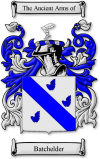
Joseph Batchelder - Coat of Arms

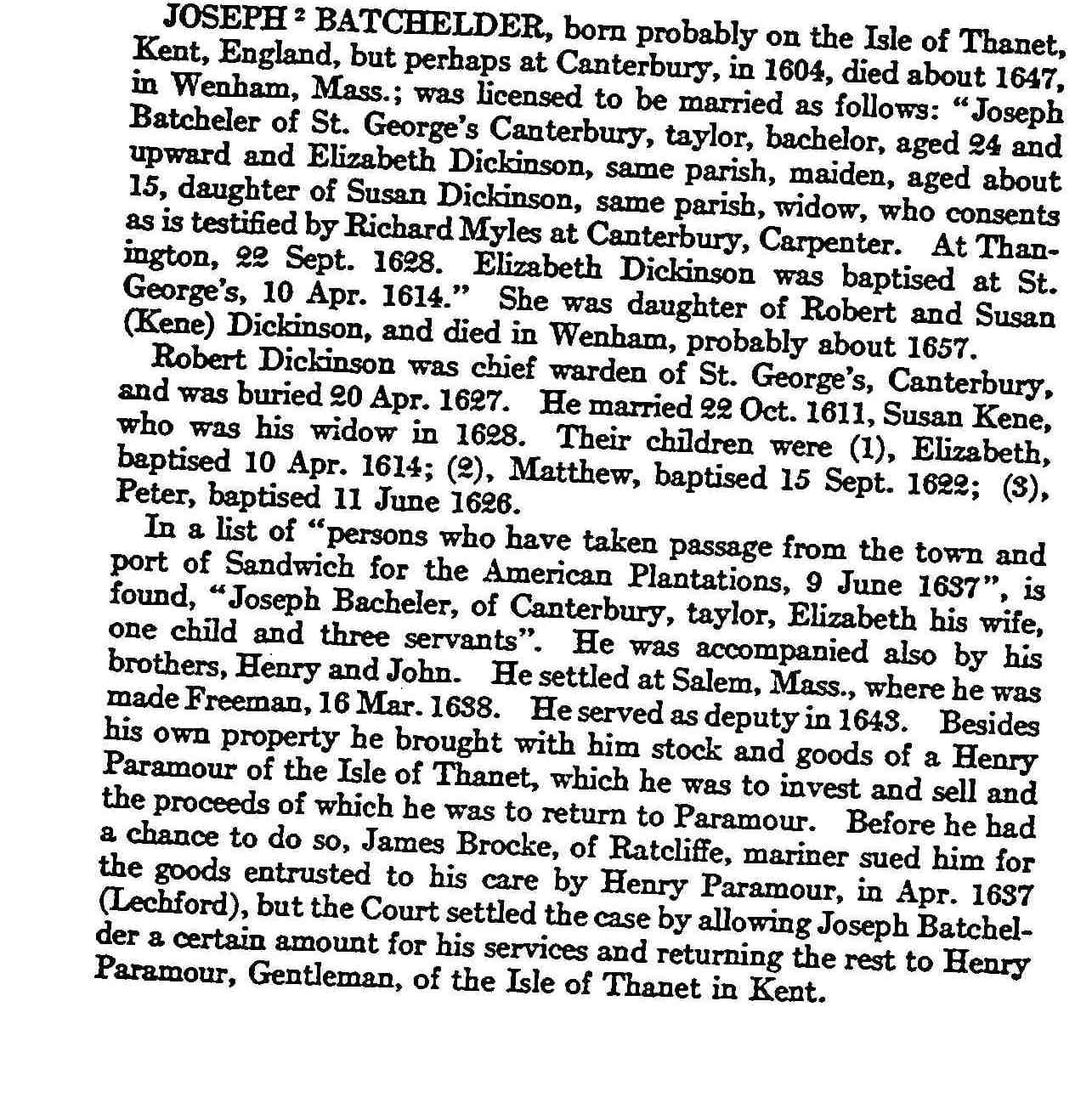
Honorable Joseph Batcheller was born about 1604 in Canterbury, England.  His parents were Mark BATCHELDER and  Mary FANTINGE. Joseph married Elizabeth DICKENSON in 1628 in England.  He was of the parish of St. George, Canterbury,  on 22 Dec 1628, when a licence was granted for his marriage with Elizabeth Dickinson, of the same parish, virgin, aged about 15, daughter of Susan Dickinson, of the same parish, widow, In this licence he is called Joseph Batcheler. The marriage was to be solemnized at Thanington.  Today Thanington Without is a civil parish and Community in Canterbury Kent United Kingdom. Many people, including locals, will say that Thannington is outside Canterbury’s medieval city walls, giving the place its name, but the truth is more complex. If this version were true, other Canterbury districts (such as Wincheap, Nackington, St Stevens and St Martins) which are outside the walls would also have to be called “Without”, but they are not.   In fact, Thannington is outside the area occupied by most of the Canterbury parishes – it stands alone and isolated, hence outside the area of “greater” Canterbury and nothing to do with the city walls.

Joseph immigrated to America in 1637  on the ship “Hercules“. with his wife, son Mark, three servants and brothers Henry, John and Daniel. He was listed as a tailor on the roll of persons who made the passage from Sandwich for the American plantations. Joseph died in March, 1647. The church records said “In ye mesne space it pleased God to take to himself brother Batchel., a man wise, moderate, and very able to be helpful in such cases.” (the case was one of church discipline at the time). His son Mark was the administrator of the estate.

Joseph’s three servants were Thomas Graunger, Edward Harnet and Marie Call.”

Elizabeth Dickenson was baptized 20 Apr 1614 in St George’s Canterbury, England.  Her parents were Robert DICKENSON and Susan KENE.  Elizabeth died in Wenham, Mass about 1657.

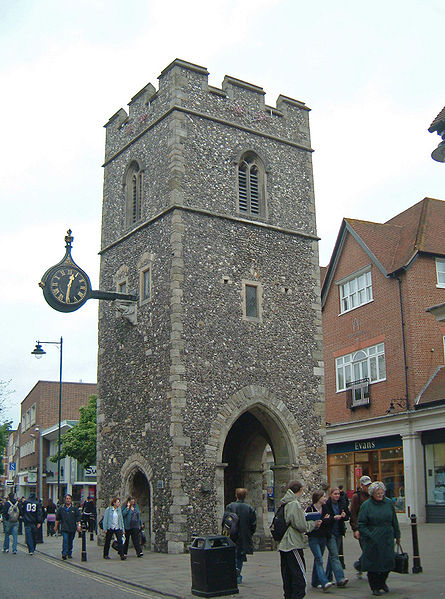
Elizabeth Dickenson was baptized at St. George's Church, Canterbury, as was Christopher Marlowe. The Tower is all that survived of the church after the Baedecker Blitz in World War II.

It appears there were two first cousins,  both named Ruth, born a couple years apart  who both immigrated from Massachusetts to New Brunswick;  William FISKE and Marah [__?__]‘s daughter Ruth and Joseph FISKE  and Susannah WARNER’s daughter, Ruth. [Susannah Warner was Joseph Batcheller’s granddaughter.]  Many genealogies mix these two women up, but it’s not possible that the same woman was mother to both Richard ESTEY‘s children and David Kilborne’s children because they were born at the same time.  It”s more likely that William Fiske’s daughter was our ancestor, but I’m including posts for both families.

Children of  Joseph and Elizabeth

Name Born Married Departed
1. John Batcheller 1 May 1631
St George, Canterbury
2. Mary Batcheller baptized
20 June 1634
St George, Canterbury
Same Day
3. Martha Batcheller baptized
20 June 1634
St George, Canterbury
Same Day
4. Mark Batcheller baptized
4 Oct 1635
St George, Canterbury
Unmarried 19 Dec 1675 Killed in Great Swamp Fight
5. John Batcheller baptized in the First Church at Salem
20 Jan 1638
Mary Dennis
12 Jul 1661
.
Sarah Goodale (daughter of our ancestor Robert GOODALE)
4 May 1666
17 Nov 1698
6. Elizabeth Batcheller Capt. John/James Davis
Gloucester,
6: 10 mo: 1666;
1  Jan 1696/97
7. Hannah BATCHELLER June, 1644 in Essex County, Massachusetts John WARNER
20 April 1665 in Ipswich.
March 10, 1687/88 in Ipswich, Massachsetts.

Various Spellings of Batcheller-
Bachelder, Bacheldor, Bacheler, Bacheller, Bachelor, Bachelour, Bachildor, Bachiler, Bachilor, Batcheldor, Batcheldour, Batcheler, Batcheller, Batchellor, Batchellour, Batchelor, Batchclour, Batchiler and Batchilor

This notable and long-established surname is of Old French origin, and is a status name for a young knight or novice at arms, deriving from the Old French “bacheler”, from the medieval Latin “baccalarius”. The name was introduced into England by the Normans after the Conquest of 1066, and was adopted into Middle English. By the 14th Century the word “bachelor” had already been extended to mean “(young) unmarried man”, but it is unlikely that many bearers of the surname derive it from the word in that sense. Early examples of the surname include: Stephen le Bachilier (Suffolk, 1203); Walter le Bachelor (Surrey, 1248); and Magg’ (Margaret) Bacheler, noted in the 1273 Hundred Rolls of Huntingdonshire. In Scotland, the name has acquired an added meaning, that of “young tenant farmer” or “holder of a small farm”.

Joseph resided in Salem and Wenham, Massachusetts.  He was made freeman in 1637. He was a deputy from March 16, 1637/38 to 1643. He was the first representative from Wenham to the General Court in Boston in 1644. Original member of church of Wenham 8 Oct 1644.

Two Early Passengers Lists, 1635-1637 ” by Eden Putman Bachelor,

Joseph, of Canterbury, co. Kent , and of Salem and Wenham, Mass., tailor, whose name appears on the second passenger list given above, was of the parish of St. George, Canterbury, and was a bachelor, aged about 24 and upwards on 22 Dec 1628, when a licence was granted for his marriage with Elizabeth Dickinson, of the same parish, virgin, aged about 15, daughter of Susan Dickinson, of the same parish, widow, In this licence he is called Joseph Batcheler. The marriage was to be solemnized at Thanington. [Cowper’s Canterbury Marriage Licences, Second Series , column 74] The printed “Register Booke of the Parish of St. George,” Canterbury, pg 24, contains the record of the baptism of Elizabeth Dickenson, daughter of Robert Dickenson, 10 Apr 1614. The same parish register also shows that John, son of Joseph Bacheler, was buried 1 May 1631 (pg 184), that Mary and Martha, daughters of Joseph Bachelor and Elizabeth Diconson his wife, were baptized 20 June 1634 ( p. 32) and were buried the same day (p. 185), and that Mark , son of Joseph Bacheler and Elizabeth Dickinson his wife , was baptized 4 Oct 1635 (p. 32). Joseph Bachelor settle d at Salem, whence he removed to Wenham. He died in 1 mo . 1647/8. [Cf. Pope’s, Pioneers of Massachusetts, p, 26 ] He was probably a brother of Henry and John Bachelor, whose names appear on the same passenger list. (English Origins of New England Families)

Joseph, Salem, freeman 1638; was afterwards of Wenham, which he represented in 1644 (A Genealogical Register of the F irst Families of New England)

JOSEPH, Salem, a tailor, perhaps, elder br. of John the first, came, 1636, from Canterbury, Co. Kent, with w. Elizabet h one ch. and three serv. acc. the certif. of the Mayor of Sandwich, where they, emb. was freem. Mar. 1638; rem. to Wenham, of wh. he was rep. 1644. What was the name of the ch. he brot. or whether he had more on our side of the water, or when he d. are unkn. (Savage’s Genealogical Dictionary)

Joseph, of Canterbury, Eng……Brought cattle with him in partnership with Henry Paramor of Thanet; see accounts July 20, 1639. (Pioneers of Mass)

Joseph, he settled first at Salem, Ma., and later moved to Wenham, Ma. He was made freeman in 1637, and served as deputy to the general court in 1644, being the first representative from Wenham. The inventory of his estate was dated March 31, 1657. He was one of the members of the church at Wenham, which was organized Oct 8, 1644. His wife bec ame a member, November 17, 1644. He died in March 1647, and his son Mark was administrator of his estate. The church records said: “In ye mesne space it pleased God to take to himself brother Batchel., a man wise, moderate, and ver y able to be helpful in such cases.” (The case was one of church discipline at the time). The History of Wenham sa ys: “He was a prominent and useful man in the plantation. ” (New England Families)

Joseph Batchelder - Bio

Joseph’s servant, Edward M. Harnett, Jr. apparently did well for himself in Salem. In 1638, with a year of indentured servitude left, he sent for his parents (Edward, Sr. and Sicily) from England. In 1639, Edward, Jr. was released from his servitude to Joseph Batchelor and received a land grant in Salem. Both Edwards were admitted to the First Church of Salem in 1643.

Although the Harnetts were Quakers, there was no representation for them in Salem. We find, through the early records of Salem, that the Harnetts became disillusioned with the Puritannical First Church of Salem and that they were clearly Quakers as they were fined for “absence from meeting”. Salem records give us an indication of when Edward, Sr. may have died. At a meeting held in Salem on August 31, 1658, Edward Harnett, tailor, “beeinge now about to remove out of the towne, apprenticed Jeremiah, son of Alice Chichester, until he has reached the age of twenty-one, being now about 3 months, for which the towns of Salem and Marblehead agree to pay the said Harnet 8 pounds sterling, and the said Harnet agrees to free the towne from any further charge regarding the said Jeremiah Chichester.” Perhaps the combination of his father’s death and continued oppression by the First Church of Salem, Edward Jr., along with his wife, children and widowed mother, moved to Huntington, Long Island, New York.

Children

4. Mark Batcheller

Mark lived in Wenham; was constable, 1663 and 1666, trial juror, 1658, 1663,1664; and was killed.as a soldier in the company of Capt. Joseph Gardner of Salem, Dec. 19, 1675, in the Great Swamp Fight. His estate was valued at £131.

5. John Batcheller

John’s first wife Mary Dennis

John’s second wife Sarah Goodale was born 31 MAY 1640 in Salem Village, Mass.  Her parents were Robert GOODALE and Catherine KILHAM..  Sarah died 22 MAR 1729/30 in Wenham, Mass.

John was one of the Jury during the witchcraft cases in Salem.  He signed a Declaration of Regret asking forgiveness for the error of their judgement.

“We whose names are under-written, being in the year 1692 called to serve as jurors in court at Salem, on trial of many who were by some suspected guilty of doing acts of witchcraft upon the bodies of sundry persons, we confess that we ourselves were not capable to understand, nor able to withstand, the mysterious delusions of the powers of darkness and Prince of the air, but were, for want of knowledge in ourselves and better information from others, prevailed with to take with such evidence against the accused, as, on further consideration and better information, we justly fear was insufficient for the touching the lives of any (Deut. xvii) whereby we fear we have been instrumental, with others, though ignorantly and unwittingly, to bring upon ourselves and this people of the Lord the guilt of innocent blood; which sin the Lord saith in Scripture he would not pardon (2 Kings xxiv. 4)–that is, we suppose, in regard to his temporal judgments. We do therefore hereby signify to all in general, and to the surviving sufferers in special, our deep sense of, and sorrow for, our errors in acting on such evidence to the condemning of any person; and do hereby declare, that we justly fear that we were sadly deluded and mistaken–for which we are much disquieted and distressed in our minds, and do therefore humbly beg forgiveness, first of God, for Christ’s sake, for this our error, and pray that God would impute the guilt of it to ourselves nor others, and we also pray that we may be considered candidly and aright by the living sufferers, as being then under a strong and general delusion, utterly unacquainted with, and not experienced in, matters of that nature.

“We do hereby ask forgiveness of you all, whom we have justly offended, and do declare, according to our present minds, we would none of us do such things again, on such grounds, for the whole world–praying you to accept of this in way of satisfacton for our offense, and that you would bless the inheritance of the Lord, that he may be entreated for the land.”
John Bacheler

Thomas Fisk, Foreman
William FISK
John Bacheler (son of Joseph BACHELER)
Thomas Fisk
John Dane (Son-in-law of Daniel WARNER)
Joseph Evelith
Thomas Pearly, Sr.
John Peabody
Thomas Perkins
Samuel Sayer
Andrew Eliot
Henry Herrick, Sr.

6. Elizabeth Batcheller

Elizabeth’s husband Capt. James Davis was born 1636 in Gloucester, Essex, Mass. His parents were John Davis and Alice [__?__]. He first marrried 1658 in Gloucester to Mehitable [__?__] (b. 1640 – d. 9 Jun 1666 in Gloucester). James died 1 May 1715 in Gloucester, Essex, Mass

7. Hannah BATCHELLER (See John WARNER‘s page)

Sources:

http://www.ci-n.com/~esdavis/batchell/bat1.html

New England Families – Google Books

http://www.anamericanfamilyhistory.com/Warner%20Family/BatchellerJoseph1610.html

http://trees.ancestry.com/owt/person.aspx?pid=5967762&st=1


Posted in 12th Generation, Historical Church, Immigrant - England, Line - Miller, Pioneer, Public Office, Twins, Violent Death, Witch Trials | Tagged , | 17 Comments

William Warner

William WARNER (1594 – 1648) may not have been Alex’s 11th Great Grandfather; one of 4,096 in this generation of the Miller line.

William Warner – Immigrant Ancestor

William Warner was born in 20 Oct 1594 in Boxted, Essex, England.  His parents were Samuel WARNER and Mary DOWNING.  He married Abigail BAKER in 1611. William came to America with his three children and was in Ipswich, Mass.  before 1637.   It is said by some Warner genealogists that they sailed on the ship,”Increase” in 1635, but he does not appear on the passenger list.  William died in 1648 in Ipswich Mass and is interred at High Street Cemetery, Ipswich, Essex Co., Mass.

Abigail Baker was born in 1590 in Boxted, Essex, England.   Her parents were John BAKER and [__?__].  It appears as though Abigail remained behind to nurse her mother when her husband left Boxted in 1635 on the “Susan and Ellen.” The mother did not accompany the family to America.  It is likely that Abigail died prior to the rest of the family leaving for the New World.

It appears there were two first cousins, both named Ruth, born a couple years apart who both immigrated from Massachusetts to New Brunswick;  William FISKE and Marah [__?__]‘s daughter Ruth and Joseph FISKE  and Susannah WARNER‘s daughter, Ruth.  Many genealogies mix these two women up, but it’s not possible that the same woman was mother to both Richard ESTEY‘s children and David Kilborne’s children because they were born at the same time.  It”s more likely that William Fiske’s daughter was our ancestor, but I’m including posts for both families.

Children of  William and Abigail

Name Born Married Departed
1. Abigail Warner ca.  1613 Boxted, Essex England Thomas Wells (Son of our ancestor Thomas WELLS)
23 Jul 1630
St. Betelph’s, Colchester, Essex, England
22 JUL 1671
Massachusetts
2. John Warner 9 Sep 1616 Boxted, England Priscilla Symonds (daughter of our ancestor Mark SYMONDS)
10 MAR 1654/55
17 May 1692 Hadley, Hampshire, Mass.
3. Daniel WARNER ca. 1618
Boxted, England
Elizabeth DENNY
2 Jun 1641 in Ipswich Mass..
9 Sep 1688 in Ipswich, Mass.

It is said by some Warner genealogists  William WARNER and three children sailed on the ship,”Increase” I just see William’s son John listed , perhaps as a servant of Matthew Marvyn.

#49 Marvynn Matthew 35, husbandman
50 Marvyn Elizabeth 31, wife of Matthew
51 Marvyn Elizabeth 31, sister or duplicate
52 Marvyn Matthew 8, child of Matthew
53 Marvyn Marie 6, child of Matthew
54 Marvyn Sara 3, child of Matthew
55 Marvyn Hanna 1/2 , child of Matthew
56 Warner Jo, 20, listed below Marvyns  (John from Boxted, Essex, bound for Ipswich).
57 More Issac 13, listed below Marvyns

William Warner, a weaver, settled in Ipswich, Mass. in 1637 with his two sons, John and Daniel, and his daughter, Abigail. Where they lived in Boxted is in some doubt. The name given to their house was “Merrylees Cottage” which is not traceable.  After his arrival in Massachusetts, Thomas Wells was granted five acres of meadowland in the name of his father-in-law, William Warner, at Ipswich, Mass.

2 May 1638 – William was admitted a freeman. Any man entering a colony or becoming a member the church, was not free. He was not forced to work, but his movements were carefully observed to see if they followed the Puritanical ideal. After this probationary period, he became a “freeman.” Men then took the Oath of a Freeman where they vowed to defend the Commonwealth and not to overthrow the government.

1637 – The town of Ipswich grants William one house lot, one acre, more or less, on the Mill Street., bounded on the east  by another house lot not yet granted (It was later occupied by his brother-in-law Lumpkin),on the N.E. by the highway leading from the mill Street. to the High St., butting on the Mill St. at the S.W. end , at the north end butting upon the swamp. Also a planting lot of six acres more or less, meadow and upland, and a farm of ninety and seven acres more or less, also a parcel of meadow, lying in the west meadows, being fourteen acres more or less.” The town of Ipswich was established on August 5, 1634, from common land called Agawam.

Ipswich in the Massachusetts Bay Colony … By Thomas Franklin Waters, Sarah Goodhue, John Wise, Ipswich Historical Society 1927
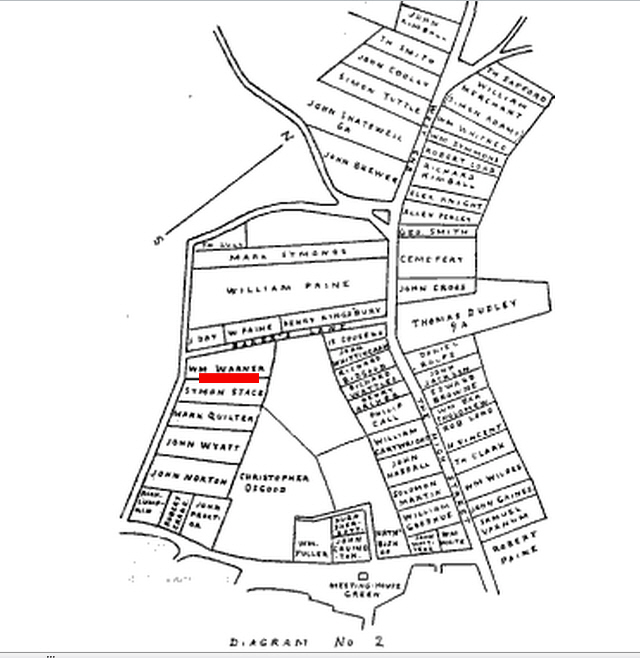
William Warner’s Ipswich Lot

The acre lot on the corner of the Lane, known as Baker’s Lane, was granted to Wm. Warner, 1636. Edward Chapman owned in 1667 and sold Edward Lummus “my dwelling house wherein sd Lummus dwells” with barn and one and one quarter acres, “the Street called Mill St. toward southwest, and the house and land of widow Stacy southeast,” March 2. 1667 (Ips. Deeds 5: 190). Edward Lomas conveyed to his son, Jonathan, his homestead, house, barn and an acre of land, and twelve acres purchased of Mr. Cogswell, May 25, 1682 (Ips. Deeds 4: 466). His will (Ips. Deeds 4: 476) states that the twelve acres were on the opposite side of the Street. Jonathan Lumas sold Daniel Rogers, schoolmaster, “the house in which he now dwells” with two .acres, Thos. Wait’s homestead southeast, June 18,1712 (25:1).

This lot came into the possession of the Waits. Mary Wait sold Robert Stocker Jr., a half acre, March 12, 1792 (155: 191) on which he built the house still called the Stocker house. Mary R. Kimball, the widow of John Stalker, sold to George B. Brown, the lot on which he built a grist mill, Jan. 12, 1881 (1055: 187). She sold the house and land to Bridget Murray, Oct. 11, 1881

Memorial of Professor Aaron Warner By Edward Payson Crowell, E P C Published by s.n., 1884

But among the large number of those who for the sake of civil and religious freedom came to this country in the great period of emigration, between the years 1620 and 1640, were William Warner of Ipswich, England, and his family including three children, who with his pastor settled in 1637 in Ipswich—one of the foremost towns in the colony in the intelligence and worth of character and thrift of its earlier inhabitants, as it was one of the oldest in settlement.

A few years after its founding in 1633, the historian Johnson recorded the fact that “the peopling of this town is by men of good rank and quality, many of them having the yearly revenue of large lands in England before they came to this wilderness.” And in 1638 Cotton Mather wrote concerning it: “Here was a renowned church consisting mostly of such illuminated Christians, that their pastors, in the exercise of their ministry might think that they had to do not so much with disciples as judges.” Of this church William Warner was a member, he died before the year 1648.

Abigail’s Sister

Abigail’s sister Sarah Baker was born 1593 in Boxted, Essex, England.  Sarah married Richard Lumpkin on 20 Oct 1614 at St. Peter’s church by George Phillips in Boxted, Essex, England.   Sarah died Jul 1663 in Cambridge, Middlesex, Massachusetts.

Richard Lumpkin was christened 16 Dec 1582 in Boxted, Essex, England. He died Nov 1642 in Ipswich, Essex, Massachusetts.

Sarah and Richard also immigrated in 1637 from Boxted.    Richard Lumpkin became a farmer and lived at Parsonage Farm, Church Street.  Sarah and Richard settled in Ipswich, Mass. at the same time as William Warner. Relatives of Sarah (Baker) Lumpkin settled in Charlestown.   Accompanying the Lumpkins was William Bartholomew, a farm labourer, married to Ann Stone. There is also a record showing that William Warner  and William Bartholomew were appointed to lay out land granted to Richard Lumpkin and William Whittered. His family were spoken of as ‘people of consideration’.

It is probable that Richard Lumpkin took the house lot next to the Warners and that he farmed the 97 acres of Warner’s land. He died in 1642 and his widow, Sarah, married Simon Stone of Watertown in 1654. On Nov 10, 1654 Sarah Stone, née Baker ex Lumpkin, deeded to Daniel Warner, son of William Warner, her house lot and 158 acres of land in Ipswich.

Sarah went to live with Simon Stone in Watertown but they both returned to live in Ipswich.

In her will of 25 Mar 1663, “Sarah Stone wife of Simon Stone of Watertowne … & the relict of Richard Lumkin deceased. sometime of Boxstead in the County of Essex in England & last of all Ipswich in New England” ordered that the residue of her estate “be equally divided between ny kinsmen John Warner, Daniel Warner & Thomas Wells” & made these 3 men her executors.

Given this close connection between Sarah (Baker) (Lumpkin) Stone & the children of William Warner, & the baptism of 2 of the 3 children of William Warner at Boxted, most writers have proposed that William Warner married a sister of Sarah, but no further evidence has emerged which would confirm that this is the precise relation between the ttwo families.

Children

1. Abigail Warner

Abigail’s husband Deacon Thomas Wells was born 11 Dec 1605 Colchester, England.  His parents were Thomas WELLS  and Elizabeth KEMBALL.  Thomas died 26 Oct 1666 Ipswich, Essex, Mass.

Ipswich in the Massachusetts Bay Colony … By Thomas Franklin Waters, Sarah Goodhue, John Wise, Ipswich Historical Society 1927

By grant of the Town, Thomas Wells had a house lot of an acre and a half on the further side of the river “near the foot-bridge” with the house lot of John Proctor, north, and that of Samuel Younglove, south, on the east and west compassed in by the Town River. This was recorded in 1635. At that time there was no cart-bridge over the river. All wheeled vehicles and horses forded the stream. There was no privilege of approach to the river apparently near the old Choate Bridge. If the foot-bridge were located on the site of the present Damon’s Mill, where the little island in the river would have made a very favorable location, approach to it from the south would have been by the two rod way by the side of the Cove, which was always open to the public. The original grant to Proctor and Wells, bounded by the river east and west, would not have prevented this right of approach. But the road from the corner where the Meeting-House of the South Church stands, to the river-bank near the saw-mill, was opened in a few years. Examination of early deeds of conveyance of the Proctor, Wells and Younglove lots, reveals plainly that they had their frontage on County St. and the houses were near this thoroughfare

.
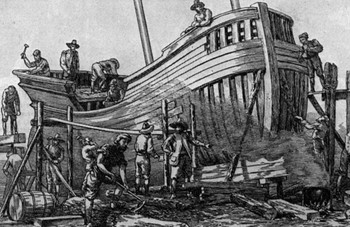
Our Wells ancestors, original immigrant Nathaniel, son Thomas, and grandson Joseph and were all ship builders

 On the Coldham passenger list for the “Susan and Ellen,” Thomas Wells is said to be aged 30 which  places his birth between 15 April 1604 and 09 May 1605. A baptismal date for “Thomas Wells, the son of Thos. Wells, the 11th of December, 1605” was reported as being in “the Register of St. Botolph’s, in Colchester” [co. Essex, England] in “Genealogy of the Wells Family and Families Related,” by Gertrude W. Wells-Cushing (Mrs. William Tileston Cushing) [pub. 1903]. Mrs. Cushing also claimed that “St. Botolph’s Register, page 53, Colchester, Essex, Co., England has the following marriage record: ‘Thomas Wells of —–, single, and Abygall Warner of —–, single, the 23rd July, 1630.'” and adds “the parishes or places to which they belong are illegible.” The baptismal date reported by Mrs. Cushing is not necessarily inconsistent with the date range extrapolated from the passenger list, as baptism did not always occur within days or weeks of birth.

There is a much more serious problem with Mrs. Cushing’s statements, however There is, in fact, some controversy as to whether these St. Botolph’s records actually exist or if they were fabrications. In a private email message of 18 June 1997 from Orin Wells of the Wells Family Research Association, he stated: “I would submit that there is not a shred of evidence to substantiate that Thomas was from Colchester. I did some ‘on the ground’ research in Colchester because Prof. Albert Welles in his work in 1876 claimed that not only did Thomas come from Colchester, but so did the alleged 6 brothers he listed in his book. Turns out that with the possible exception of Thomas and Nathaniel, not a one of them is related to the others. We now know for certain where two of the others came from and the third did not even exist. Someone invented a name for him when they could not explain the “Widow Frances Welles’ in Wethersfield, CT. In fact, the searching of the Colchester records we have done so far has yielded precious few Wells and only one can be traced to the colonies. “Further, one author wrote that the marriage of Thomas and Abigail Warner was shown in the parish record of St. Botolphs on 23 July 1630.  However, a later check and recheck of this parish record and the Bishop’s Transcript for that parish showed that no such record occurred within 25 years of that.

Thomas’s left a will on 1 Jul 1666 at Ipswich, Essex County, Massachusetts.

“Know all men by these presents, that I Thomas Wells of Ipswich in the County of Essex, being weake of body, yet of perfect memorye blessed be god, doe make this my last will & testament, in manner followeinge, viz.: I comend my soule into the hands of my Blessed Redeemer, in hope of a Joyefull resurrection, vnto Eternall life, att the last daye; and my body to be decently buried.

Item. I giue and bequeath vnto Abigaile my wife, eight pounds, yearely to be paide vnto her, out of my lands where I now dwell, dureinge her life, in lewe of her Dowrye; and this is to be paide yearely, in wheate, malte, porke, & Indian corne, in equall proportion, and to be good & marchentable, and paide att ye current marchentable price, as such is then paide at here in Ipswich: Alsoe I giue vnto her to haue one of the best roumes in my house, viz: eyther the Hall, or the Parloure (att her choyce) and to enjoye the same dureing her widdowhoode, And to haue free liberty, to bake, brewe, & washe, &c., in the kitchen, & free liberty to laye her corne, meale & malte, &c., in the Hall chamber, and free vse of garden grounde, where she liketh best, & to haue it well fenced in, and to have lande duely tilled &c to sow flaxe seed on, and that yearely as she shall see cause; & freedome in both the sellars, as she needeth, and shall haue suffitiencye, of firewood provided & seasonably lay’d in, & that yearely att the cost of my executor, & free libty to keepe thre, or fower henns, & a pigg or hogg in the grounde & yards, and shall haue the sixte parte of the fruite, that shall yearely grow in the orcharde, & shall haue the free vse & libty of all these
dureinge her widdowehoode.

Ite. I giue vnto my saide wife the old baye mare (she uses to ride on) and the bridle, pillion seate, and pannell, and two cowes, (att her choyce) and to haue the keeping of a horse or mare and of two cowes for her vse, both summer and winter, & a good house roume for them in winters, & these to be well kept, att the cost of my executor, during her widdowehoode. Also, I giue vnto her the bible she uses, & the booke called the Soule’s preperation for christ, & that of Perkins upon the Creede, and the bedsteed we lye on, & the bedinge, curtans, & vallans, therevnto belongeing, (excepting the blewe rugg) and to have the best greene rugge in lewe thereof And I giue vnto her the “best chist and the” inlayd boxe wth T: W: vpon the lidd; and to haue one halfe of the lynen & lynen clothe, & the thirds of the wollan clothe that is in the house, or in yarne or clothe at the weavers, and the thirds of the woole in the house, at my disease, and one halfe of the putter [pewter] that was her owne fathers, and the putter pinte pott (or tanker), and a brass, or iron pott (att her choyce) saue onely the great Iron pott and I giue vnto her the iron skellet, & foure of the best spounes, & a good porrenger, & a couple of sauscers (att her choyce) and the best lowe chaire, & her little chaire, & a good Cushen, & one of the greate wheeles, & a little spinninge wheele, and the warmeing pan, as legacies

Ite. My will is that my saide wife, shall haue the free vse of any kettle (of mine now in the house) or milke vessells, &c., she needeth, & of anye other smale thinge in the house (that’s mine) as though they were her owne, and that wthout controule, & to haue freedome att the well for watter, and libty for her cloths, or anye thinge els to be spreade, &c., where she pleaseth, and these dureing her widdowhoode

IIte. Whereas John Wells, (my second son) hath receiued of mee, a deed of gifte, of all the lands I had att the Towne of Wells, in the province of Maine, beinge the quantity of three hundred & fifty acres (more or less) arrable, meadowe, & pasture, togeather wth two cowes, and ten pounds, fifteene shillings, yt I have paid (att his request) vnto Stephen Kent of Haverhill in cattle, vpon a bill due from ffrancis Littlefielde, Senr. (his father in lawe) wth severall other things, all wch he hath receiued of mee, in lewe of his portion, & accordeingly my will is, that the same shall soe stande.

Ite. I giue vnto my son John Wells, ten pounds, to be paide vnto him, or to his assignes, wthin three yeares next after my decease, five pounds thereof in cattle neate, & in good condition, & the other five pounds, in wheate, malte, & Indian corne, in equall proportion, & all good & mrchantable, & att the currante marchantable price, as it then goes here in Ipswich, & to be deliurd [delivered] att my now dwellinge house provided that my son John Wells be then liueinge. And I giue vnto him my cloke, & one of the greate putter candlesticks wth the topp thereof, & two great sauscers and two little sauscers more. And I giue vnto Sarah Wells, his wife, (my Daughter in lawe) one five shillings peece of gould, as legacies.

Ite. whereas my two Eldest Daughters, viz: Sarah Massie of Salem, and Abigaile Tredwell of this Towne, hath each of them thirty pounds in lewe of theire portions, my will is that the said Sarah Massie, or her assignes, shall haue a good cowe, or to the value of foure pounds ten shillings, in other cattle neate, & in good condition, (bulls onely excepted) & not to exceed eight yeares of age, & to haue the same deliuered here, where I now dwell, wthin one yeare, & a halfe, next after my decease, and also, to haue the benifitt of the grase of a litle parcell of salte marshe grounde, adjoyneing, to the north: west end of Mr. Wades, neare vnto hogge Iland, and my Daughter Sarah to enjoye the vse of this, vntill the decease of my Bro: Massie, her father in lawe, & then to return vnto my executor. Alsoe I giue vnto Abigaile Tredwell my Daughter, my sixe acre lott of salte marsh, &c., that lies in Plum Ilande, to her, & her heires of male, or a good cowe, to be deliuered vnto her in good condition wthin one yeare, & a halfe, next after my decease.

Ite. I giue and bequeath vnto Thomas Wells my youngest son, two hundred and fifty pounds sterl. in lewe of his portion, to be paide vnto him, his heires or assignes, out of my houssen, and lands where now I dwell, wthin seauen yeares, foure months, & nine; or ten dayes, next after the saide Thomas Wells my son, doe come to the full age of one & twenty yeares, viz: one hundred pounds, to be paide at, or before, the twenteth or one and twenteth day, of the third month, commonly called may, next come twelue months, after that the saide Thomas Wells my son, doe come to the age of one & twenteth yeares. (whose birth day was vpon the eleventh day of the eleventh mo: Anno Dom: one thousand sixe hundred forty sixe) Fortye pounds thereof to be paide in cattle neate, & in good condition, (bulls onely excepted) and in horss kinde, viz, in geldings, & the horss kinde not to exceede, the sume of eight pounds, and for age, not to exceede, aboue sixe yeares olde. And allways provided that the leane cattle, & horss kinde be paide & deliuered in the third mo. called may. And thirty-sixe pounds thereof to be paide in wheate, and barly malte, in equall proportion, and all to be good & marchantable, both sweete, drye, & well dressed. And twenty foure pounds thereof to be paide in Indian corne, pease, porke and sheepe, & all to be good & marchantable, as aforesaid, the Indian corne, not to exceed the sume of twelue pounds, nor the sheepe not to exceed ye sume of foure pounds: And the other hundred pounds, to be duely and faithfully paide vnto the saide Thomas Wells, my youngest son, his heires or assignes, wthin three yeares, next after, the time, & daye, or dayes of payemt of the foremer hundred pounds, & all to be payeable, & well and faithfully paide vnto the said Thomas Wells my son, his heires, or assignes, accordeinge vnto the foremr hundred pounds, both for Kinde, quallity & quantity. And the remaineinge fifty pounds, to be duely, & faithfully paide, vnto the saide Thomas Wells my youngest son, his heires, or assignes, wthin (the premenconed) seaven yeares, foure month’s & nine, or ten dayes, next after, that the saide Thomas, my son, doe come to the age of one and twenty yeares; twenty pounds thereof, to be paide in wheate, and barly malte, both good & marchantable, being sweet, drye & well dressed, & in equall proportion. And fifteen pounds thereof, to be paide in cattle neate, & in good condition, (bulls & bull saggs onely excepted) And fifteene pounds thereof, to be paide in Indian corne, porke, & pease, & all to be good & mrchantable, the Indian corne, not to exceed the sume of seaven pounds ten shillings; and all the cattle, horss kinde & sheep to be duely paide, & dld. [delivered] att my now dwelling house, here in Ipswich, & all the rest, to be likewise delivered here, att my house, where now I dwell, or att anye other house, malte-kilne & wharfe, in Ipswich where the said Thomas, the son, or his assignes shall appointe the same.

Ite. My will is, that if my executor (whom I shall name & appointe) doe not duely, & faithfully pay & dischardge, this two hundred, & fifty pounds as before mentioned, accordeinge to my true intente, (as before expressed) eyther in whole, or in parte. Then, the saide Thomas Wells, my youngest son, his executors, or assignes, shall enter upon and take possession of the houssen, and lands, where now I dwell, both of arrable, meadowe and pasture, & quietly, to possese, & enjoye the same, vntill the whole be dischardged, anye thinge herein contained to the contrarye notwthstandinge.

Ite. my will is, that if the saide Thomas, my youngest son, shall dye & cease this life, before he come to the full age of one & twenty yeares, then the executor, of this my last will, shall pay vnto the rest of my children, the full sum of one hundred, and forty pounds, viz. vnto John Wells, or.

Thomas died on 26 Oct 1666 at Salisbury, Essex County, Massachusetts, at age 60. Thomas’s estate was proved on 15 Nov 1666 at Ipswich, Essex County, Massachusetts.

Children of Thomas and Abigail

i. Nathaniel Wells b. 1636 in Salisbury, Essex, Mass.;  m.  He married 29 OCT 1661 Liedia Thurley, daughter of our ancestor Richard Thurley (THURLOW)   Nathaniel died (15 DEC 1675)(15 DEC 1681) at Ipswich, Essex, Massachusetts.

ii. John Wells  b. 1637 at Ipswich, Essex County, Massachusetts. He married Sarah Littlefield.  Sarah’s parents were Francis Littlefield and Rebecca Rust and her grandparents were our ancestors Edmund LITTLEFIELD and Annis AUSTIN.  He settled in Maine. He died 11 APR 1677 at Wells, York, Maine.

iii. Sarah Wells (1640 – 1703) m. John Massey of Salem, Essex County, Massachusetts.

iv. Abigail Wells b. 1641-1642 at Ipswich, Essex, Mass. She married 19 JUN 1661 to Nathaniel Treadwell, son of Thomas and Mary Treadwell. She died 16 JUN 1677 at Ipswich, Essex, Mass. Nathaniel married (2) Rebekah Titcomb.

v. Peter Wells (1645 – 1715

vi. Rev Thomas Wells b. 11 JAN. 1646/7 at: Ipswich, MAl m. 10 Jan 1669 at: Ipswich, Mass. to Mary Perkins; d. 10 JULY 1734  He was given a “Legacy to be paid him at 22 yrs Going to College.”  was a student at Harvard College under a provision of the will of his father…

vii. Elizabeth Wells b. 2 JUL 1646 at Ipswich, Essex County, Massachusetts. She married 9 JUN 1669 to John Burnham. She died 9 JUN 1731 at Ipswich, Essex, Massachusetts.

viii. Hannah Wells (1648 – 1682) m1.  [__?__] Rogers. She m2.  Richard Symonds on 16 Aug 1679 in Salam, Essex, MA.

ix. Lydia Wells (1651– ) m. John Ropes

2. John Warner

John’s wife Priscilla Symonds was born 1625 in Birch Great, Essex, England.  Her parents were Mark SYMONDS and Joanna [__?__].  Priscilla died 1688 Hadley, Hampshire, Mass.

John and Priscilla’s children were Joseph Warner (1657), Mehitable Warner (1659), Daniel Warner (1661), Eleazar Warner (1662), and Priscilla Warner Cummings (married Thomas Cummings).

John removed from Ipswich to Brookfield in 1670, was one of three men there who took the Indian deed for the town of Brookfield, December 19, 1673, and was one of the principal inhabitants there. When the town was destroyed by the Indians in 1675 he retreated with his younger children to Hadley, Massachusetts, whither Mark Warner, an elder son, and other children had gone to settle.   He was probably one of the 70 villagers who sought refuge in his brother-in-law John Ayer’s tavern.  For details see my post Siege of Brookfield.  He probably died at the home of some of his children, 1692.

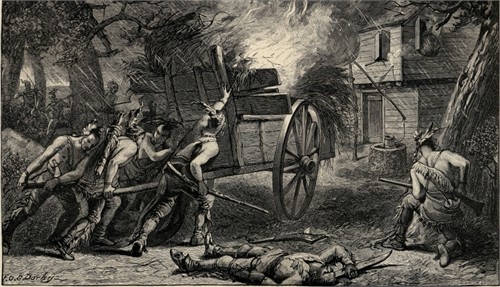
Attack on Ayers Tavern

On May 17, 1692, he gave his property to his sons, Mark, Nathaniel, and Eleazar. His property included the right of two commons in and land in a Hadley and Swampfield. He also gave them 3 beds, 3 coverlets, 3 pairs of sheets, a bolster, 6 pillows, 2 brass kettles, 3 skillets, a frying pan, an iron pot, a pair tongs, an iron peale, an iron trammel, a box of iron, 2 pewter platters, a pewter basin, 2 catechisms, 2 bibles, 6 sermon books, 2 woman’s coats, 2 waistcoats, a large apron, a silk handkerchief, a silk hood, a silk cap, and a hat.

3. Daniel WARNER (See his page)

Sources:

http://www.genealogyofnewengland.com/b_w.htm

http://www.anamericanfamilyhistory.com/Warner%20Family/WarnerWilliam1594.html

http://trees.ancestry.com/owt/person.aspx?pid=7424536

http://www.boxted.org.uk/migration.htm
Posted in 13th Generation, Immigrant - England, Line - Miller | Tagged , | 15 Comments

Daniel Warner

Continue reading

Posted in 12th Generation, Immigrant - England, Line - Miller, Public Office, Witch Trials | Tagged , | 13 Comments

John Warner

John WARNER (1642 – 1712 ) may not have been Alex’s 9th Great Grandfather; one of 1,024 in this generation of the Miller line.

John Warner was born in 1642 in Ipswich, Essex County, Massachusetts. His parents were Daniel WARNER and Elizabeth DENNE.   He married Hannah BATCHELLER on April 20, 1665 in Ipswich.  He became a widower when Hannah died in 1688. His second wife was Mrs. Mary Prince the widow of Jonathan Prince. John died 10 Apr 1712 in Ipswich.

Hannah Batcheller was born in June, 1644 in Essex County, Massachusetts. Her parents were Joseph BATCHELLER and Elizabeth DICKENSON.  Hannah died on March 10, 1687/88 in Ipswich, Essex County, Massachsetts.

Mary [__?__] was born about 1659.   She first married May 1682 in Salem, Essex, Mass to Jonathan Prince (b. 15 Jan 1657 in Salem – d. Nov 1685 in Ipswich)

It appears there were two first cousins,  both named Ruth, born a couple years apart  who both immigrated from Massachusetts to New Brunswick;  William FISKE and Marah [__?__]‘s daughter Ruth and Joseph FISKE  and Susannah WARNER‘s daughter, Ruth.  Many genealogies mix these two women up, but it’s not possible that the same woman was mother to both Richard ESTEY‘s children and David Kilborne’s children because they were born at the same time.  It”s more likely that William Fiske’s daughter was our ancestor, but I’m including posts for both families.

Children of  John and Hannah

Name Born Married Departed
1. Elizabeth Warner 30 Jun 1666
Ipswich, Mass
John Gott
1692
Wenham, Mass
2. John Warner 1669
Ipswich
24 Jul 1697
3. Daniel Warner 16 Apr 1672
4. Hannah Warner 14 May 1674 4 Jul 1696
5. Susannah WARNER 3 Mar 1676
Ipswich, Mass
Joseph FISKE
1692
Wenham, Mass
July 1742
Ipswich, Mass
6. William Warner 2 Mar 1679
Ipswich
30 Aug 1684
Ipswich

.
Children of John and Mary Prince.

Name Born Married Departed
7. Nathaniel Warner 6 Jul 1693 Mary Tuttle
28 Apr 1716 in Ipswich, Essex, Mass
2 Aug 1763
Ipswich, Essex, Mass.
8. Mary Warner 18 Aug 1695 William Adams
bann pub 31 Dec 1715
9. Abigail Warner 8 Apr 1697  6 Apr 1698

1683 – John Warner was one of the administrators of Henry Batcheller’s estate.  Henry was Hannah’s uncle.

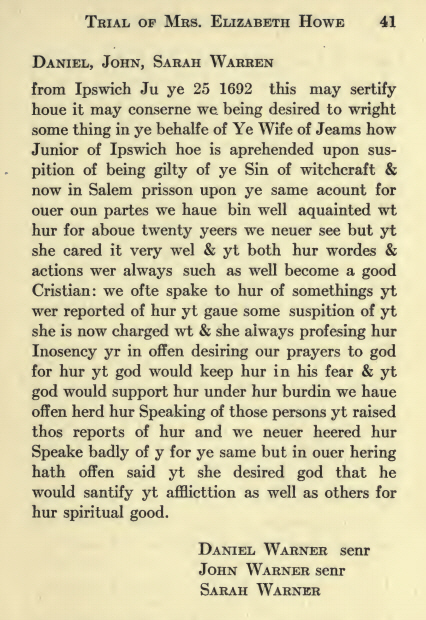
1692 – John Warner, his brother John and sister-in-law Sarah write a petition in support of their neighbor Elizabeth Howe accused of witchcraft

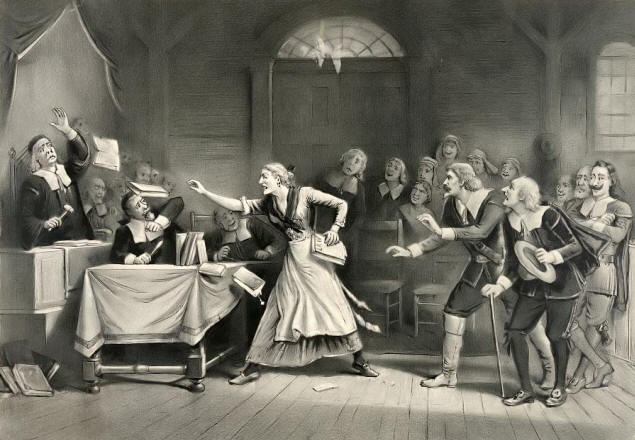
The Perely family of Ipswich, Massachusetts, was among the chief accusers of Elizabeth Howe. They had a ten year old daughter they claimed was being afflicted by Howe. This was due, they claimed, to the fact that they had thwarted Elizabeth Howe’s chance of becoming a member of the Ipswich Church.  The child complained of being pricked by pins and sometimes fell into fits.  In their testimony against Howe, on June 1, 1692, the Perelys quoted their daughter as saying, “I could never afflict a dog as Good Howe afflicts me.” At first the parents did not believe their daughter’s accusations. They took the child to several doctors who told them she was “under an evil hand”.  Her condition continued for two or three years, until “she pined away to skin and bones and ended her sorrowful life”.

Elizabeth Howe was accused of afflicting several other girls within Salem Village. The identities of the girls Elizabeth Howe was accused of afflicting are recorded in the transcript of her examination:

  1. Mercy Lewis was nineteen years old during the Salem trials. When her entire family was killed in an Indian attack she was sent to be a servant in the house of Thomas Putnam. Mercy Lewis acted as key player in the accusation of Elizabeth Howe, as well as many other individuals in Salem Village. Mercy Lewis was a major contributor of spectral evidence in the examination of Elizabeth Howe.
  2. Mary Walcott played a significant role in the Salem trials, being one of the original girls to become “afflicted”. Her name not only appeared on the arrest warrant served to Elizabeth Howe but also appeared in one of two indictments.
  3. Mary Walcott’s cousin Ann Putnam, Jr.  was one of the “afflicted” girls. She was one of the most aggressive accusers, her name appearing over 400 times in court documents. Ann was twelve years old at the start of the trials. She accused nineteen people and saw eleven of them hanged.  In 1706 Putnam retracted her actions; she was the only afflicted girl to do so.

31 May 1692 – When Elizabeth Howe was brought in for examination Mercy Lewis and Mary Walcott, two of her main accusers, fell into a fit. She was accused by Mary of pinching and choking her in the month of May. Ann Putnam added her accusations to these by saying she had been hurt three times by Howe. When asked how she pled to the charges made against her, Elizabeth Howe boldly responded, “If it was the last moment I was to live, God knows I am innocent of any thing of this nature”.

3 Jun 1692 – Having witnessed a conversation between Samuel Perley’s little girl and Elizabeth Howe. Reverend Phillips of Rowley testified in her defense.

In her defense, Elizabeth Howe’s father-in-law testified to her good nature. He said that she, “[set] a side humain infurmitys as [become] a Christion with Respact to [himself] as a father very dutifully & a wifife to [his] son very carfull loveing obedient and kind Considering his want of eye sight.” He concluded his witness by saying, “now desiering god may guide your honours to se a difference between predigous and Consentes I rest yours to Sarve”

25 Jun 1692 –  Support from the Warners

John, his brother Daniel and Daniel's wife Sarah wrote this deposition in support of Sarah Howes.

19 Jul 1692 – Elizabeth Howe was hanged along with Rebecca Nurse (her sister-in-law), Sarah Good, Sarah Wildes and Susannah Martin.

5 Oct 1693 – John purchased from G. Haldey for 220 pounds, a dwelling house, barn and 80 acres. The farm was bounded on the northeast by S. Chapman and the road, on the southeast by Skillion, on the southwest by Perkins and Harris meadow, and on the west and northwest by Joseph Metcalf.

12 May, 1698 – John conveyed this farm to his son-in-law, Joseph FISKE.

John’s will was dated February 7, 1711 and gave his son, Nathan, the house and 60 acres when he was 21 years old. His wife Mary was to enjoy the parlor and the chamber over the parlor. It also mentioned his daughters Elizabeth Gott, Susannah FISKE, and Mary who was 15 years old. It also mentioned his step-sons Nathan and Jonathan Prince. He appears to be living on the Pine Swamp farm in 1688; but it is doubtful whether he lived there till his death.

Children 

1. Elizabeth Warner

Elizabeth’s husband John Gott was born 17 Sep 1672 in Wenham, Essex, Mass. His parents were Daniel Gott and Elizabeth Morris. John died 5 Jun 1761 in Hebron, CT.

5. Susannah WARNER (See Joseph FISKE ‘s  page)

7. Nathaniel Warner

Nathaniel’s wife Mary Tuttle was born 7 Jul 1696 in Ipswich, Essex, Mass. Her parents were John Tuttle and Martha Ward.  Mary died 5 Aug 1776 in Ipswich, Essex, Mass.

According to the terms of his father’s will he was to receive the house and 60 acres of land when he turned 21.

8. Mary Warner

Mary’s husband William Adams was born 26 Nov 1696 in Ipswich, Mass.  His parents were  Nathaniel Adams and [__?__].

William was a farmer in Ipswich until 1771, when he removed to Moultonboro. His will, dated July 3, 1775, was proved, Strafford Co., Sep 21, 1775. He names sons William, Nathaniel and John, and daughters, Mary Whipple, Abigail Bolles, and Sarah Low.

Sources:

http://www.anamericanfamilyhistory.com/Warner%20Family/WarnerJohn1642.html

http://trees.ancestry.com/owt/person.aspx?pid=7396132


Posted in 11th Generation, Line - Miller, Witch Trials | Tagged , | 4 Comments

Austin Kilham

Austin KILHAM (1587 – 1667) was Alex’s 10th Great Grandfather; one of 2,048 in this generation of the Miller line.

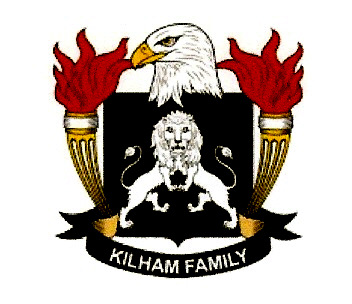
Austin Kilham - Coat of Arms

Austin/Augustine Kilham was born in 1587 in Dennington, Suffolk, England.  Austin’s parents were Henry KILLHAM and Alice GOODALE.  He married Alice GORBALL on 8 Sep 1619 in Wrentham, Suffolk, England. The Kilhams sailed from England on the ship Mary Anne for New England  on 15 May  1637 out of Ipswich, England, William Goose master.  Many people assume the ship went to Salem because Austin’s examination record show him as “being desirous to goe to Salem in New England”.  In fact,  he first landed in Boston on 20 Jun 1637 and then went to Salem where he resided until 1640.  He lived at Dedham until 1649 and then established a permanent home at Wenham.  Austin died 5 Jun 1667 in Wenham, Mass.

Alice Gorball was born in 1598 in Dennington, Suffolk, England. Her parents were John GORBALL and Christian FILBY. Alice died on 18 July 1667 in Wenham, Essex, Massachusetts.

Children of Austin and Alice:

Name Born Married Departed
1. Daniel Kilham 15 March 1620 Dennington, Suffolk, England Mary Safford (Daughter of Thomas SAFFORD)
Oct 1648
Ipswich
.
Elizabeth Black
1674
.
Mrs Mary Maxcy
21 May 1699 in Wenham, Essex, Massachusetts
2. Mary Kilham ca. 1623 in Dennington, England Richard Hutton btw. 1676 and 1696 when Richard remarried
Ipswich, Mass.
3. Ruth Kilham ca. 1625 in Dennington, England
4. John Kilham ca. 1630 in Dennington, England Hannah Pickworth 1659 in Wenham, Essex, Mass. 1683
Wenham, Essex, Mass
5. Lot Kilham 11 July 1641  Salem, Essex, Mass Hannah Goodale (Daughter of our ancestor Robert GOODALE)
22 May 1666 in Salem, Essex, Mass
26 October 1683 in Enfield, Hartford, MA
6. Sarah KILHAM 4 January 1642/3 in Wenham, Essex, MA Deacon William FISKE Jr.
15 Jan 1662/63
26 Jan 1737/38 in Wenham Mass in her 98th year
7. Elizabeth Kilham ca. 1647 in Ipswich, Essex, Mass.

The family name can also be spelled Killham, Killam, Killan, Killiam or Kellum.

Alice’s father John GORBALL was born in 1575 in Wilby, Suffolk, England. He married Christian FILBY  in 1595 in Wilby, Suffolk, England. Christian Filby was born in 1576 in Wilby, Suffolk, England.

Austin (also known as “Augustine”) Kilham came to America on the ship “Mary Anne” in 1637 with his wife and at least 3 children. They lived at Salem for two or three years and at Dedham until 1649. From there Kilham moved to Wenham. It is on record at Wenham that he took letters of dismissal from the Church in Dedham, 14th of the 5th month of 1649, when “Brother and Sister Kilham passed the tryall, and next Lord’s day were taken into the covenant” In 1653 when pastor Reverend John Fiske [William FISKE Sr’s brother] left Wenham and settled at Chelmsford, Austin Kilham and six other heads of families planned to go with him; but for some unexplained reason Austin and one other changed plans and remained at Wenham.

“The Founders of New England”, by Samuel G. Drake, page 49 ; “The Planters of the Commonwealth”, by Charles Edward Banks, page 183; Winthrop: Journal, 1, 222; Wyman, Charlestown, 1, 563; and the original list in Public Records Office.

Austin  was examined May 11, 1637 “as desirous to goe to Salem in the New E”. Both he and his wife being examined sailed aboard the vessel “Marey Anne” of Yarmouth, William Goose, Master. The records show the examination of a “Augusten C- – – – – Alles his wife ageed 40 yeares”. At this particular juncture the ever variable last name is spelled or shown in the original records as a “C”. Due to the poor quality of the original transcript the balance of the name can not be made out.

7 Aug 1637 – Austin was admitted an inhabitant and granted a quarter of an acre of land. He was soon granted a ten acre lot which he exchanged for land on Cape Ann Side.

25 Jun 1638 – Salem Records show Ananias Cocklin, a glass maker, shall have that ten acres of land that was granted to Killam he having it exchanged for land on Cape Ann Side. This land was in what is now Peabody. The glass works was built and made bottles and coarse articles of inferior glass and probably window glass. See Essex Institute Historical Collection Volume 16, 1879 and Perley’s History of Salem. This doubtless was the first glass works in America.

1637 through 1638 – Austin Kilham and William Browne were given the duties as “keeper of the goats” by the town of Salem.”

1 Jun 1639 – Austin was granted thirty acres of land. This land may have been in that part of Salem which is now Wenham. Mr. Killam is said to have been one of the first settlers of Wenham, the others being named Fiske and Goldsmith.

Spring of 1640 – Removed to Dedham, MA.

28 Aug 1640 – Mr. and Mrs. Killam were received into the Dedham Church

2 Jun 1641 – Made a freeman in Dedham. Mr. Killam’s occupation was given as measurer. He was granted several pieces of land in Dedham and served the town in running lines for the division of town lands.

1648 – The family returned to Wenham, and was

21 May 1649 – Admitted to the Wenham Church

26 June 1649 and again in 1655, 1657, and 1658. Mr. Killam served on a Jury in Salem

1652 – Mrs. Killam was in court for wearing a silk scarf or hood. This case was continued and appears to have been dropped.

1653 – He was one of the twenty-five persons of Wenham who contributed toward the support of Harvard College but four gave more than Mr. Killam.

1655 – He was one of seven from Wenham who organized the church in Chelmsford, MA under the Reverend John Fiske who had been the pastor of the Wenham Church. He gave liberally toward the support of the church in Wenham and was one of three on the committee to build the church in 1660 and it was built on his land. The present Church and Soldier’s Monument are said to be on land he formerly owned.

The History of Wenham: Civil and Ecclesiastical : from Its Settlement in 1639, to 1860
By Myron Oliver Allen Published by Printed by Bazin & Chandler, 1860

The name of Austin Kilham occurs among the earliest settlers of Wenham. He is supposed to have come from the West Riding of Yorkshire, where the parish of Kilham still exists, situated near Beverly, the principal market town in that part of England. From this Austin Kilham, all who bear the name of Kilham, which has now become considerably diffused in our country, are supposed to be descended. The family have, at different periods, taken an active and prominent part in the affairs of the town.

History of Captain Roswell Preston of Hampton, Connecticut, His Ancestry and Descendants: Including Ancestry in the Eaton, Knowlton, Butt, Raymond, Witter, Killam, Hinds and Other Kindred Families By Edward M. Preston Published by Edward M. Preston, 1899

AUSTIN, son of Henry and Alice (Goodale) Kilham, born at Dennington previous to 1600, married Alice. They were residents of Dennington, Eng., where they had several children; Daniel, the eldest, being baptised in that parish in 1620. In May, 1637, Austin, with his wife and children, sailed from the port of Yarmouth for New England and landed at Salem, Mass. They lived for brief periods at Dedham and Chelmsford and, in 1638, established a permanent home at Wenham, Mass. From the wills of Austin and Alice Kilham, executed in 1667, we learn that they had three sons: Daniel, John and Lott, and three daughters: Sarah, Elizabeth and Mary. The following entries are to be found in the town records at Wenham: “Austin Killam dyed ye 5th of ye 4th mo. 1667.” “Alice Killam dyed ye 18: 5 mo. 1667.”

Mr. Killam’s will is as follows:

Second of the 4th mo. 1667. The last will and testament of Austin Killim.I being sick and weak of body yet of perfect memory commit my soul into the hands of the Eternal God and Father in Jesus Christ and dispose of my estate as follows:Imprimis, I give to my well beloved wife all my cattle and swine and moveable goods also I give my dwelling house and land thereunto belonging (except six acres which I have already given to my son Lot) both upland and meadow for the term of her life (unless she shall have the need to sell any of the aforesaid meadow for her use) and then my will is that it shall be my son Lot’s. But if he die before his mother my will is that she shall have the sole disposing of it to whom she think meet. Also my will is that my son Lot shall have five acres of land between Ipswich line and the sawpit unless his brother John shall give him an assurance of five acres in the neck of which my son Lot hath now part in his possession and for the rest of my farm both upland and meadow that is not now in my possession I have formerly disposed of it and my will is that there be no alteration of any part of it unless the aforesaid five acres (by the sawpit) to my son Lot and further I make choice of my well beloved wife to be sole executrix to this my will.

Origins Yorkshire or Suffolk?

Over the years there seems to be a common misunderstanding as to the origins of the Killam/Kilham family. Some researchers have written that the family place of origin is in the parish of Kilham, Yorkshire, England. Others have written that the family’s origin is in Bury St. Edmunds, Suffolk, England, and then they moved to Dennington, Suffolk, England.

The earliest reference to a place of origin of Austin Kilham’s Family seems to be from Myron O. Allenwho, in 1860, mentions the Parish of Kilham in West Riding of Yorkshire, England:

“The name of Austin Kilham occurs among the earliest settlers of Wenham. He is supposed to have come from the West Riding of Yorkshire, where the parish of Kilham still exists, situated near Beverly, the principal market town in that part of England. From this Austin Kilham, all who bear the name of Kilham, which has now become considerably diffused in our country, are supposed to be descended. The family have, at different periods, taken an active and prominent part in the affairs of the town.”

In fact, the Parish of Kilham is in East Riding, Yorkshire, England. Unfortunately, this error has been copied by subsequent researchers. Samuel Drake in 1860 makes no mention of West Riding or East Riding:

“These people went to New England with William Goose, Mr of the Marey Anne of Yarmouth.…May the 11th 1637 The examinaction of Augusten C………………………Alles his wife ageed 40 yeares……………………………………………..desirous to goe to Salam in New E…………………………………………“.…

George Staley Brown in 1898 seems to have copied this mistake from Allen.

Children

1. Daniel Kilham

Daniel’s first wife Mary Safford was born about 1637 in Ipswich, Mass..  Her parents were Thomas SAFFORD and Elizabeth SUTTON.  Mary died 16 Jun 1676 in Ipswich.

Daniel’s second wife Elizabeth Black was born 1632 in Salem, Essex, Mass.  She was married four times.  Elizabeth died 29 Mar 1693 in Ipswich, Essex, Mass.

  1. First she married 1655 in Ipswich, Essex, Mass to Humphrey Gilbert (b. 1615 in England – d. 13 Feb 1657)
  2. Next she married 24 Sep 1658 in Ipswich, Essex, Mass to William Rayner (b. 1615 in England – d. 26 Oct 1672 in Marblehead, Essex, Mass).
  3. Third she married about 1673 to Henry Kimball (b.1615 – d. 1676) Henry was the son of our ancestors Richard KIMBALL and Ursula SCOTT. .
  4. Finally she married 25 Dec 1679 in Wenham, Essex, Mass. to Daniel Kilham

Daniel’s third wife Mrs Mary Maxcy was born xx

25 Dec 1679 – Daniel and Elizabeth conveyed to John Lambson the house that had belonged to the Gilberts and Raynors. It was in Ipswich on the north side of Boston Road as it enters into Wenham from Ipswich. The deed was acknowledged by Elizabeth Kilham, June 19, 1684 with Samuel Adams and Isaac Cummings as witnesses.

4. Mary Kilham

Mary’s husband Richard Hutton was born in 1617 in England. Richard died 22 Jun 1713

Mary and Richard arrived in Wenham about 1649. Richard became a freeman and constable in 1653. Richard was a frequent member of the jury. In 1654 he failed to appear for jury duty because of the difficulty of coming over the ferry.

He had a few problems. In 1658 he was fined for having drunk too much liquor and was sued for non-payment of a debt to Humphrey GRIFFIN. In 1661 he was fined for smoking in the street on the Sabbath and was involved in a property dispute with Walter Fairfield.

In 1674 Richard, Elizabeth and their daughter Elizabeth were listed as members of the church. Richard testified for Daniel Kilham in a trespassing case.

In 1675 Richard was a soldier in King Philip’s War.

In 1676 Richard sold Richard Kimball 35 acres and Elizabeth gave up her dower rights to the property.

Elizabeth died between 1676 and 1696 when Richard married Susanna More Dutch who was the daughter of Richard More and Christian Hunter. She was the widow of Captain Samuel Dutch of Salem.

Richard died in Wenham on June 21, 1713 when he was 96 years old.

After Richard died, his second wife Susanna married John Knowlton of Ipswich.

4. John Kilham

John’s wife Hannah Pickworth was born 14 Oct 1638 in Salem, Essex, Mass. Her parents were John Pickworth and Anna Chandler. Hannah died 1682 in Wenham, Essex, Mass.

5. Lot Kilham

Lot’s wife Hannah Goodale was born 6 Aug 1645 Salem Village, Mass. She was Lot’s first cousin  Her parents were Robert GOODALE and Catherine KILHAM.  Hannah died 1677 in Salem, Essex, Mass.

In September 1684, John PEASE was appointed administrator of the estate of Lot Kilham a townsman of his while in Salem and one of the first persons it is said to have died in the new settlement of Enfield, Connecticut.

6. Sarah KILHAM (See Deacon William FISKE Jr.‘s page)

Sources:

http://www.theharmons.us/harmon_t/b1074.htm#P7264

http://www.anamericanfamilyhistory.com/Kilham%20Family/KilhamAustinAlice.html

http://trees.ancestry.com/owt/person.aspx?pid=15440186

Pope’s Pioneers of Massachusetts

Kilham was a “measurer” at Salem in 1637 and a goatkeeper in 1640. Austin and Alice were admitted to the Church at Dedham on 28 June 1640. He was made a Freeman on 2 Jun 1641.

Fiske Family by Albert Augustus Fiske Published by A.A. Fiske, 1867

Austin Kilham, with his brother Daniel, emigrated from the Parish of Kilham, Yorkshire, England, the same year, and probably in company with the Fiskes. Both settled and were freemen in Wenham before 1645, and are presumed to be the ancestors of all New England families of that name.

Posted in 12th Generation, Immigrant - England, Line - Miller | Tagged , | 14 Comments

William Fiske I

William FISKE (1613 – 1654) was Alex’s 10th Great Grandfather; one of 2,048 in this generation of the Miller line.

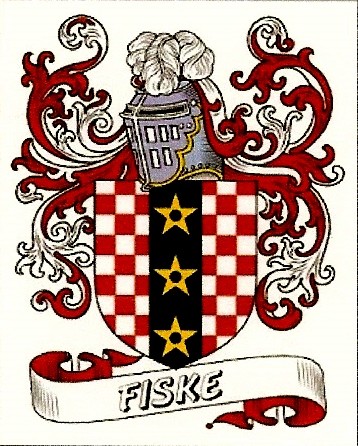
William Fiske – Coat of Arms

William was born about 1613 in England.  His parents were John FISKE and Ann LANTERSEE. He emigrated to America in 1637 with his mother and brother, Rev. John Fiske.  His father died died in 1633 at St. James, S. Elmham, England.  His mother died on the trip to America.  William first settled at Salem where he received a grant of land. He became a member of the Salem church on July 2, 1641. He married Bridget MUSKETT about 1641 in Salem .  He was admitted freeman in Wenham, Mass on May 18, 1643 and was the first chosen town clerk in 1644. He was elected Representative from Wenham to the General Court of the Commonwealth from 1647 to 1652.  William died intestate in Sep 1654 in Wenham and therefore most probably of some sudden and acute disease.  An inventory of his estate was taken 16th 7 mo., 1654.

Bridget Muskett was born c. 1618 in Pelham England.  After William died, Bridget married Thomas Rix, a barber and surgeon, on 3 Sep 1661.  Bridget and Thomas had one child named Theophilus bapt. 20 Aug 1665. Bridget died in 1703.

Thomas Rix was born 1622 at Canninghall, England. His parents were son of Robert Rix and [__?__] He was in Salem as early as 1649. He was a barber surgeon, and spent his last days with his son James in Old Preston, Connecticut, where he died 30 Oct 1718. He was buried in the “Rixtown Cemetery” in Old Preston.

Thomas first married Margaret [__?__], widow of Miles Ward, who died May 24, 1660. His children included: Remember, Sarah, Esther, Thomas, James and (his youngest with Bridget), Theophelus.

Children of William and Bridget

Name Born Married Departed
1. Martha Fiske Apr 1652 in Wenham, Essex, Mass
2. William FISKE Jr. ca. 1643 in Wenham, Mass Sarah KILLIAM
15 Jan 1662/63
1727/28 in Wenham Mass
3. Samuel Fiske 16 Jul 1654 Wenham, Essex, Mass Phebe Redington
6 NOV 1679
.
Hannah Somes
24 May 1697 in Wenham, Essex, Mass
31 OCT 1716 Wenham
4. Joseph Fiske 16 Jul 1654 Wenham, Essex, Mass
Wenham
Elizabeth Bartram
22 MAY 1677 Lynn, Mass.
24 MAR 1688/89 Swansey, Mass
5. Benjamin Fiske ca. 1651 Wenham, Mass. Bathsheba Morse
6 NOV 1674

Fiske is of Old Scandinavian origin, and is a metonymic occupational name for a fisherman or fishseller, or a nickname for someone who bore a fancied resemblance to a fish in some way, from the Old Norse “fiskr”, a fish. In some instances, the name may derive from the Olde English pre 7th Century “fisc”, a fish, with the same meaning as above. “Fisc” also occurs in the Domesday Book of 1086 in Norfolk, as a personal name. Variants of the surname in the modern idiom include Fisk, Fysh and Fish, while the surname itself is largely restricted to the county of Norfolk

William’s great grandfather Robert1 had a bunch of sons, and two of them were Thomas2 and William2. William’s son John3 produced two particularly brilliant fanatics; Rev. John Fiske, and William4 Fiske. They went to Salem and Wenham. Rev. John Fiske served as pastor at Salem briefly and then went elsewhere to practice religion and medicine in the wilderness and teach college. William stayed at Salem and had Deacon William Fiske5, who was one of the jurors in the witch trial.

Thomas2 had Thomas3, whose son Phineas4 went to Salem and Wenham, and his son Captain Thomas5 and Thomas’s son Captain Thomas6 were foreman and juror on the jury. I get third cousins and third cousins once removed.

All three of the Fiske cousins later signed the admission of error or whatever admitting the error of the Salem Witch Trials.

The Fiskes, who have resided in Wenham, occupied farms situated in the western part of the town, and probably seldom or never lived in any other portion of the place; and when they left to settle in the adjoining towns, it was in the immediate vicinity of the original settlement ; namely, in the northeast corner of Danvers and southeast side of Topsfield.

1642 – William Fiske joined the church in Salem, 2d 5 mo., 1642,

18 May 1643 – Made freeman of Wenham.

1643 – According to the town records William Fiske received liberty from the General Court in 1643 to keep an ordinary (public house)

1644 – Chosen first town clerk of Wenham

1646 – Licensed to sell wine and strong water.

1647 – Elected representative to the General Court of the commonwealth and continued in that office by annual election till 1652

Sep 1654 –  He appears to have enjoyed to a large extent the confidence and respect of his townsmen, but was cut short in his career by death in 1654, under forty years of age and having in eleven years served Wenham in all positions of trust within the gift of the people.  He died intestate and therefore most probably of some sudden and acute disease.

An inventory of his estate was taken 16th 7 mo., 1654; and his widow afterward married a Rix, and was alive in 1674, as Rev. John made her a legatee, also calling her the mother of his brother William’s children.

Children

2. William FISKE Jr. (See his page)

3. Samuel Fiske

Samuel’s first wife Phebe Redington was born 7 Apr 1655 in Topsfield, Essex, Mass. Her parents were Captain John Redington and Mary Gould. She was the widow of Thomas Bragg (1649-1675). Phebe died 1 Oct 1696 in Wenham, Essex, Mass.

Samuel’s second wife Hannah Somes was born 3 Sep 1658 in Gloucester, Essex, Mass. Her parents were Morris Somes and Elizabeth Kendall.  Her grandparents were John KENDALL and Elizabeth SACHERELL.. She first married in 1668 to William Allen (b. 1646 in Salem – d. 29 Dec 1696 in Manchester, Mass,) Hannah died 30 Jan 1722 in Gloucester, Essex, Mass.

Samuel was admitted as a freeman in Wenham on March 25, 1685. He held the offices of tythingman, constable and selectman. He left a large estate, which, before his death, he deeded to his sons.

4. Joseph Fiske

Joseph’s wife Elizabeth Bartram was born about 1654 in Salem, Mass. Her parents were William Bartram and Sarah Johnson. Elizabeth married William Hammond (1624-1675) on July 9, 1672 in Swansea, Bristol County, Massachusetts. Elizabeth died in Swansea, Bristol, Mass

5. Benjamin Fiske

Benjamin’s wife Bathsheba Morse was born 20 Jul 1653 in Medfield, Norfolk, Mass. Her parents were Deacon Daniel Morse and Lydia Fisher. Bathsheba died 4 Jan 1737 in Medfield, Norfolk, Mass.

Benjamin and Bethusha lived in Medfield. In 1675 Bethusha’s father, Daniel, wrote during troubles with the Indians

“…I made bold lately to request your help of four men to be the garrison at my house, which is for my family and my son with me, most being married men. I humbly prosecute my request that so it might be that I might have four men out of Medfield, and that Edward West and Benjamin Fisk (sons-in-law) might be two of them, they living in the remote part of Medfield next my farm and they being willing to come…”

Sources:

http://www.genealogyofnewengland.com/b_f.htm

http://www.anamericanfamilyhistory.com/Fiske%20Family/FiskeWilliamBridget.html

http://boards.ancestry.com/topics.salem-20-witch-20-trials/135.2/mb.ashx

http://trees.ancestry.com/owt/person.aspx?pid=28376334&st=1


Posted in 12th Generation, Immigrant - England, Line - Miller, Pioneer, Public Office, Tavern Keeper | Tagged , | 4 Comments

Deacon William Fiske II

William FISKE (1643 – 1728) was Alex’s 9th Great Grandfather; one of 1,024 in this generation of the Miller line.

William Fiske was born about 1643 in Wenham, Mass.  His parents were William FISKE Sr. and Bridget MUSKETT.  He married Sarah KILHAM 15 Jan 1662/63.  William died in Feb 1727/28 in Wenham Mass in his 86th year.

Deacon William Fiske served as a juror in the Salem Witch Trials. He later signed the Declaration of Regret of the Salem Jurors

Sarah Kilham was born on 4 Jan 1642/3 in Wenham, Essex, MA. Her parents were Austin KILHAM and Alice GORBALL.  Sarah died 26 Jan 1737/38 in Wenham Mass in her 98th year.

Children of Richard and Ruth:

It appears there were two first cousins, William Fiske’s daughter and Joseph Fiske’s daughter, both named Ruth, born a couple years apart  who both immigrated to New Brunswick.  Many genealogies mix these two women up, but it’s not possible that the same woman was mother to both Richard Estey’s children and David Kilborne’s children because they were born at the same time.  It”s more likely that William Fiske’s daughter was our ancestor, but I’m including posts for both families.

Name Born Married Departed
1. William FISKE III 31 JAN 1662/63 Wenham Marah
[__?__]
10 DEC 1745 Andover, Mass
2. Sarah Fiske 5 FEB 1663/64 Wenham John Cook
14 SEP 1688 Windsor, CT
Hartford CT
3. Ruth Fiske 2 Mar 1665/66 Wenham
4. Samuel Fiske 2 Mar 1666/67 Before 1670
5. Martha Fiske 15 MAY 1668 Wenham Thomas White
1695
22 APR 1763
6. Joseph Fiske 10 Feb 1668/69 Wenham Before 1672
7. Samuel Fiske 16 FEB 1669/70 Wenham Elizabeth Brown
5 DEC 1699 Wenham
8. Joseph FISKE 14 Apr 1672 Wenham Susannah WARNER
c. 1693
2 May 1745 in Ipwich, Mass.
9. Benjamin Fiske 6 APR 1674 Wenham Mary Quarles
7 MAR 1698/99
6 JUN 1742 Wenham
10. Theophilus Fiske 28 JUL 1676 Wenham Phebe Lamson
18 JUL 1700 Ipswich
.
Mehitable Wilkins
of Topsfield,
26 July 1756
SEP 1759 Wenham
11. Ebenezer Fiske 10 Feb 1676/77 Wenham Before 1679
12. Deacon Ebenezer Fiske 22 MAR 1678/79 Wenham Elizabeth Fuller
24 MAY 1710 Wenham
.
Martha Kimball
1 Dec 1733 in Wenham, Essex, Mass
30 SEP 1771 Wenham
13. Jonathan Fiske 22 Jul 1681 Wenham 14 Feb 1704/05
14. Elizabeth Fiske 12 DEC 1684 Wenham Eleazer Foster
6 DEC 1703
19 FEB 1758 Ipswich

By occupation a weaver.  He also held various public offices
Representative 1701-04-11-13-14
Moderator 1702-03 1712-13-14

He was also called lieutenant.

1670 – Admitted a freeman in 1670

1679 – Chosen Deacon of the Wenham Congregational Church (of which his uncle, Rev. John Fiske, was first pastor)

“Here Lyeth ye body of Decn [Deacon] William Fisk who died Febry ye 5th 1727/8 Aged 85 years.” William Fisk also served as a juror at the Salem trials in 1692 and later signed the 1697 confession of error. -Salem Witch Museum

Declaration of Regret – Salem Jurors

We whose names are underwritten, being in the year 1692 called to serve as jurors in court at Salem, on trial of many who were by some suspected guilty of doing acts of witchcraft upon the bodies of sundry persons, we confess that we ourselves were not capable to understand, nor able to withstand, the mysterious delusions of the powers of darkness and Prince of the air, but were, for want of knowledge in ourselves and better information from others, prevailed with to take with such evidence against the accused, as, on further consideration and better information, we justly fear was insufficient for the touching the lives of any (Deut. xvii) whereby we fear we have been instrumental, with others, though ignorantly and unwittingly, to bring upon ourselves and this people of the Lord the guilt of innocent blood; which sin the Lord saith in Scripture he would not pardon (2 Kings xxiv.4)- that is, we suppose, in regard to his temporal judgments.

We do therefore hereby signify to all in general, and to the surviving sufferers in special, our deep sense of, and sorrow for, our errors in acting on such evidence to the condemning of any person; and do hereby declare, that we justly fear that we were sadly deluded and mistaken –

for which we are much disquieted and distressed in our minds, and do therefore humbly beg forgiveness, first of God, for Christ’s sake, for this our error, and pray that God would impute the guilt of it to ourselves nor others, and we also pray that we may be considered candidly and aright by the living sufferers, as being then under a strong and general delusion, utterly unacquainted with, and not experienced in, matters of that nature.

We do hereby ask forgiveness of you all, whom we have justly offended, and do declare, according to our present minds, we would none of us do such things again, on such grounds, for the whole world – praying you to accept of this in way of satisfaction for our offense, and that you would bless the inheritance of the Lord, that he may be entreated for the land.

Thomas Fisk, Foreman
William Fisk
John Bacheler (son of Joseph BACHELER)
Thomas Fisk
John Dane (Son-in-law of Daniel WARNER)
Joseph Evelith
Thomas Pearly, Sr.
John Peabody
Thomas Perkins
Samuel Sayer
Andrew Eliot
Henry Herrick, Sr.

Capt. Thomas Fiske and Deacon William Fiske were third cousins once removed; Capt. Thomas Fiske, jr., and Deacon William Fiske were fourth cousins;

Children

1. William FISKE III (See his page)

2. Sarah Fiske

Sarah’s husband John Cook was born 3 Aug 1662 in Windsor, Hartford, CT. His parents were Nathaniel Cook and Lydia Vore. John died 27 Feb 1712 in Hartford, CT

5. Martha Fiske

Martha’s husband Thomas White was born 0 Mar 1664 in Wenham, Essex, Mass. His parents were Thomas White and Ruth Haffield. Thomas died 27 Jan 1740 in Wenham, Mass

7. Samuel Fiske

Samuel’s wife Elizabeth Brown was born 27 Jun 1671 in Reading, Essex, Mass. Her parents were Josiah Brown and Mary Fellows. Elizabeth died 21 Jul 1721 in Wenham, Essex, Mass.

He moved to Rehoboth, Massachusetts about 1710 where he died.

8. Joseph FISKE (See his page)

9. Benjamin Fiske

Benjamin’s wife Mary Quarles was born 1677 in Ipswich, Essex, Mass. Her parents were William Quarles and Martha Dickinson. Mary died 11 Jan 1745 in Mass.

They resided in Wenham, where he frequently held town offices. He was a man of property and a liberal patron of the Wenham church. He died in 1742, leaving wife Mary, but no children, as heirs. He left the church 5 pounds when he died.

10. Theophilus Fiske

Theophilus’ first wife Phebe Lamson was born 13 Aug 1673 in Ipswich, Essex, Mass. Her parents were John Lamson and Martha Perkins. Phebe died 23 May 1753 in Wenham, Essex, Mass.

Theophilus’ second wife Mehitable Wilkins was born 24 Nov 1730 in Middleton, Essex, Mass. Her parents were Hezekiah Wilkins and Mehitable Upton. Mehitable died in Wenham, Essex, Mass.

He settled in Wenham, where he made his will June 8, 1757, and died Sep 6, 1759, and his brother, Dea. Ebenezer Fiske, settled his estate. Of his real estate in the inventory, besides his homestead, was twenty- four acres of meadow in Wenham, two acres salt marsh in Ipswich, and three lots in Wenham Swamp; and the homestead was bounded by a Thomas Fiske, John Friend, and Josiah Fairfield.

12. Deacon Ebenezer Fiske

Ebenezer’s first wife Elizabeth Fuller was born 1686 in Salem, Essex, Mass. Her parents were Jacob Fuller and Mary Bacon. Elizabeth died 25 Aug 1732 in Wenham, Essex, Mass.

Ebenezer’s second wife Martha Kimball was born 24 Feb 1688 in Wenham, Essex, Mass. Her parents were Ephraim Kimball and Mary Friend. Martha died 28 Mar 1764 in Wenham, Essex, Mass.

He was appointed executor of his father’s will in 1729.

He was elected deacon of the Wenham church in his place 1739

Deacon Ebenezer Fiske died 30 Sep 1771, in his ninety third year — a venerable and venerated patriarch of his church and town.

14. Elizabeth Fiske

Elizabeth’s husband Eleazer Foster was born 6 Apr 1684 in Ipswich, Essex, Mass. His parents were Isaac Foster and Martha Hale.  His grandparents were Reginald FOSTER and Judith WIGNOL.  Eleazer died 15 Nov 1771 in Ipswich, Essex, Mass.

In 1758 their son, Abijah, and his son Ebenezer both died of smallpox at Crown Point.

Sources:

http://www.genealogyofnewengland.com/b_f.htm

Genealogical and family history of the state of New Hampshire -Google Books

http://www.anamericanfamilyhistory.com/Fiske%20Family/FiskeWilliamSarahKilham.html

Posted in 11th Generation, Line - Miller, Public Office, Veteran, Witch Trials | Tagged , | 9 Comments

Joseph Fiske

Joseph FISKE (1672 – 1745) was Alex’s 8th Great Grandfather; one of 512 in this generation of the Miller line.

Joseph Fiske was born 14 Apr 1672 in Wenham Mass.  His parents were William FISKE II and Sarah KILHAM.  He married Susannah WARNER about 1693.  He married his second wife, Mrs. Elizabeth Fuller on 7 Jan 1742/43.   See Double Dates for an explanation why he didn’t remarry before Sarah died.  Joseph died 2 May 1745 in Ipwich, Mass.

Wenham, Essex, Massachusetts

Susannah Warner was born 3 Mar 1675/76 in Ipwich Mass.  Her parents were John WARNER and Hannah BATCHELDER. Susannah died in July 1742.

Mrs. Elizabeth Fuller was born 1702 Elizabeth died 30 Oct 1755 in Ipswish, Mass

Children of Richard and Ruth:

It appears there were two first cousins, Joseph Fiske’s daughter and William Fiske’s daughter, both named Ruth, born a couple years apart  who both immigrated to New Brunswick.  Many genealogies mix these two women up, but it’s not possible that the same woman was mother to both Richard Estey’s children and David Kilborne’s children,  because they were born at the same time.  It”s more likely that William Fiske’s daughter was our ancestor, but I’m including posts for both families.

Name Born Married Departed
1. Joseph Fiske 4 Jan 1694/95 Ipswich 5 Dec 1698
Ipswich
2. Hannah Fiske 21 Jan 1696/97 Ipswich James Platts
29 Oct 1720 Ipswich
bef. 1726
3. Susanna Fiske 18 Mar 1699/00 Ipswich Jedehiah Kilborne
22 Mar 1722/23
27 Sep 1764 Rowley, Mass.
4. Sarah Fiske 19 Jun 1702
Ipswich
7 Aug 1720
5. Elizabeth Fiske 15 Sep 1704 Ipswich Dr. Michael Dwinnel (his second wife)
10 Dec 1724
26 Dec 1729 Topsfield, Mass.
6. Ruth FISKE 20 Aug 1707
Ipswich MA
David Kilborn
6 Mar 1730/31
Ipswich, Mass.
.
Probably NOT Richard ESTEY
7 May 1728 Ipswich, Mass.
Jun 1774 Sheffield, New Brunswick, Canada
7. Abigail Fiske 8 Aug 1711
Ipswich
29 Jun 1729
8. Joseph Fiske 20 Oct 1713 Ipswich 24 May 1731
9. Mark Fiske 20 Nov 1716 Ipswich Lydia Smith
5 Sep 1738
9. John Fiske 13 Oct 1719 Ipswich 21 Dec 1725

12 May 1698 – Susannah’s father, John Warner, conveyed his farm to Joseph.

1 Feb 1723/24 Joseph and Susannah Fiske sold to shopkeeper, Ammi R. Wise of Ipswich, one quarter of a right in the eighth division consisting of five acres and they sold some of the great meadow in the West End of Wenham consisting of five acres acres bounded southwesterly on land of Theophilus Fiske and Northwestly by Ebenezer Fiske.

7 Feb, 1723/24 they sold to Mr. Perley of Boxford 1 1/2 acres upland in Rowley 1/4 lot on the Range known by the letter C bound westerly and southerly by Perley’s meadow and easterly and northerly by their land.

2 May 1745 – Joseph died  His will left his wife Elizabeth

“all ye household goods she brought to me at marriage,” and among other things the executor “shall carry her to meeting on a good horse on Sabbath day & Lecture days when she shall desire it.”

His daughter Susanna Kilborne, daughter Ruth Easty, and Grandson Mark Platts were to have four pounds old tenor “his mother having had considerable of me before.” Son Mark Fiske to be the executor and to have the residue.

The Fiske Family: A History of the Family (ancestral and Descendant) of William Fiske, Sen., of Amherst, N.H. By Albert Augustus Fiske Edition: 2 Published by A.A. Fiske, 1867

Joseph Fiske, third son of Dea. William, of Wenham, married Susan Warner, of Ipswich, to which place he removed about 1700. He had sons Joseph (died young) and Mark, and daughters Susanna, Sarah, Elizabeth, Ruth, and Abigail. By second wife, Elizabeth, married 1742, he had son John, who also died young. Joseph Fiske died in May, 1745. His executor and son Mark, born in 1716, married Lydia Smith in 1738, and had Lydia, Joseph (1741), Mark (1743), John (1746), and Susanna. Of these, Joseph was twice married, and had following — Eleanor, Joseph (1767), Benjamin (1768), Sarah, Lydia, Elizabeth, and Mark (1778). Some of this family were living in Ipswich as late as the beginning of the present century.

Children

2. Hannah Fiske

Hannah’s husband James Platts was born 20 Apr 1696 in Rowley, Essex, Mass. James’ parents were Sgt. John Platts (1658 – 1752) and Judith Foster. (1664 – 1722) Hannah died on 28 Sep 1723 in Rowley when she was only 25 years old, perhaps due to childbirth complications.   James remarried 25  Jun 1725 to  Mercy Wheeler (30 Aug 1696 Newbury, Essex, Mass – 11 Nov 1753) Mercy’s parents were Nathan Wheeler and Rebecca Safford.  James and Mercy had five more children born between 1726 and 1732.

Children of Hannah and James

i.   James Platts b. 1721; d. 14 Feb 1722/23 as an infant

ii. Mark Platts b. 11 Dec 1722; m. 9 Nov 1747 to Hannah Kilbourne.  (b. 23 Aug 1715 Georgetown, Mass. – d. 4 Oct 1814 in Rowley, Essex, Mass. “in her 100 year” ) Hannah’s parents were George Kilbourne (1686 – 1758) and Phebe Palmer (1684 – 1762) Mark and Hannah had at least one child: Jane (b. 1755)

3. Susanna Fiske

Susanna’s husband Jedediah Kilborne was born 20 Apr 1699 in Rowley, Essex, Mass.  His parents were Samuel Kilburn (1656 – 1722) and Mary Foster (1662 – 1731). His brother David Kilburn married his wife’s sister Ruth Fiske. Jedediah died 4 Feb 1759 in Rowley, Essex, Mass.

4 Feb 1759 – Jedediah is put down as “cornet”

Children of Susanna and Jedediah:

i. Sampson Kilbourne; b. ~1723 Rowley, Essex, Mass; d. 28 May 1761 Rowley; m. 15 Apr 1749 Rowley to Rebecca Pickard  (b. 27 Dec 1724 Boxford, Essex, Mass. – d. Jul 1776  Rowley). Rebecca’s parents were Thomas Pickard (1691 – 1770) and Mehitable Dresser (1694 – 1793. Sampson and Rebecca had four children born between 1750 and 1760.

ii. Jedediah Kilbourne b. 15 Aug 1725 Rowley, Essex, Mass.; d. 1820 Henniker, Merrimack, New Hampshire; m. 7 Nov 1749 in Rowley to his half cousin Hannah Platts (b. 1729 in Rowley)  Hannah’s parents were James Platts and Mercy Wheeler (See above) Jedediah and Hannah had six children born between 1752 and 1768.

Removed to Boscawen, New Hampshire, thence to Henniker, New Hampshire,

iii. Elizabeth Kilbourne b. 16 May 1732 Rowley, Essex, Mass.; d. 1827; m. 10 Jun 1755 in Ipswich, Essex, Mass to John Adams (b. 12 Apr 1721 in Rowley – d. 28 Sep 1803 in New London, Sullivan, New Hampshire) John’s parents were John Adams (1684 -1750) and Sarah Pearson (1691 – 1781). John’s maternal grandparents were our ancestors Benjamin PEARSON and Hannah THURSTON. Elizabeth and John had five children born between 1756 and 1763.

iv. Abigail Kilborn b. 18 Nov 1733 Rowley, Essex, Mass.; d. 19 Mar 1801 Amherst, Hillsborough, New Hampshire; m. 10 Mar 1760 in Danvers, Essex, Mass to Jonathan Smith, Esq. (b. 21 Feb 1735 in Woburn, Middlesex, Mass. – d. 1 Apr 1795 in Amherst, Hillsborough, New Hampshire) Jonathan’s parents were Walter Smith (1694 -1749) and Ruth Fuller (1693 – ) Abigail and Jonathan had three children born between 1761 and 1770.

Their son, Jedediah Kilbourne Smith (wiki), was a senator and councillor in the New Hampshire legislature for many years, and served from 1807 to 1809 as a representative from New Hampshire in the United States congress.

v. Hannah Kilbourne b. 4 May 1735 Rowley, Essex, Mass.; d. 14 Dec 1737 Rowley;

vi. Susannah Kilbourn b. 19 May 1737 Rowley, Essex, Mass.; d. 25 Sep 1800 Farmington, Maine; m. 11 May 1763 in Rowley to Ephraim Cowen (b. 29 Sep 1737 in Dunstable, Middlesex, Mass. – d. 9 Jun 1797 in Farmington, Maine) Ephraim’s parents were Thomas Cowan (1700 – 1748) and Margaret Isted Istead (1711 – 1760). Susannah and Ephraim had six children born between 1764 and 1778.

Ephraim Cowen of Dunstable, Mass., settled on lot number four in Augusta, on which the State House now stands, in 1763. He served as a soldier during most of the French war, and was a shoemaker. For many years, in connection with other pursuits, he pushed the awl and waxed the thread of a cordwainer for the early settlers. He was one of a company of associates who purchased land on the Sandy river; was the first clerk of the company; and removed to the site of Farmington, with his son David Cowen, in 1788, where he remained until his death in 1797

vii?. Nathan Kilborn b. 21 Nov 1750 Rowley, Essex, Mass.; d. 1794 – Boscawen, Merrimack, NH ; m. 12 Jun 1777 in Newbury, Mass to Sarah Plumer (b. 22 Jan 1752 in Newbury) Nathan and Sarah had four children.

I’m thinking that due to the 11 year gap with the next youngest child Hannah, Nathan was Jedediah’s grandson, son of Jedediah Jr.

5. Elizabeth Fiske

Elizabeth’s husband Dr. Michael Dwinnel was born 5 Dec 1670 in Topsfield, Essex, Mass. His parents were Michael Dunnell and Mary Read.

Esther Richards Dwinnell told her granddaughter

that Michail, Jr., the doctor, had at different times, seven wives, and when questioned as to which he felt the strongest affection, replied “that he knew no difference.”

Genealogists have only been able to document five wives.

  1. He married his first wife, Hannah [__?__] , 27 Sep 1692 in Salem, Essex, Mass when he was 23.  Michael and Hannah had eight children born between 1693 and 1719.
  2. He married his second wife, 2o year old Elizabeth Fiske, on 10 Dec 1724  in Wenham, Mass when he was 54 years old.
  3. Before 1731, he married his third wife, Elizabeth Cave, (b. 1676 in Topsfield, Mass. – d. Feb 1737 in Topsfield, Mass.)
  4. On 6 Jul 1737 in Salem, Essex, Mass, he married his fourth wife, Charity Cotton   (b. 1672 -d. 8 Nov 1752 in Topsfield, Mass.)
  5. On 1 Feb 1753 in Topsfield, Essex, Mass., he married his fifth wife, Mary Shaw Balch (b. 1686 in Topsfield, Mass. – d. 14 Apr 1774 in Topsfield).

Michael died 24 Dec 1761 in Topsfield, Essex, Mass.  at the age of 91 in Topsfield. His will was filed on Dec  7, 1761 (Essex County Probate Index, file 8447) and proved on Feb 1, 1862 by Elijah Dorman, Joseph Mathew, and William Foster.

His will, dated July 17, 1753. It was signed with his seal and mark. He left his wife, Mary, “the use and income of all the lands,” and also “one cow.” He left his son Michael 5 shillings, to be paid in 7 years after his own and his wife’s death. to his son Stephen, 5 shillings; his son Jacob 5 shillings; his granddaughter, Esther Balch, wife of David Balch, 5 shillings; son Benjamin, house and barn, and land and meadow in Topsfield, and all else, bonds, and books, debts, etc., to his wife. He also mentioned his daughters, Sarah Foster, and Mary, Hannah, and Abigail.

The inventory of his estate was presented on February 1, 1762 and amounted to £145. Among other articles mentioned were: Sum Books, 5/1, Two Coats and One Great Coat

All of his children were born in Topsfield where the family remained for this generation. They lived on Salem Street. According to the Topsfield Historical Collections Volume 11, Salem Street, extended Wenham Street then passed the “Dwinell Houses” and was about six hundred feet from the present road. The children lived in Topsfield at the same time as and were closely associated with the Aaron Estey family.

Dunnel said “He was the first physician ever recorded in Topsfield, and is styled on old deeds as physician and chirurgeion. What were his medical studies previous to his acquiring his title are not known at this day.” He was a Yeoman.

18 Nov 1730

“The Town Allowed six shillings to Doct Michael Dwinel William Redington and Jonathan Wildes for perambulating with Wenham Last Spring” (Topsfield Historical Collections Volume 19)

Children of Elizabeth and Michael:

i. Benjamin Dwinnell b. 10 Nov 1726 Topsfield, Essex, Mass.; d. 29 Jul 1805 in Keene, Cheshire, New Hampshire; m. 25 Feb 1750 in Topsfield to Mary Estes (b. 1 Jun 1730 in Topsfield – d. 5 Mar 1820 Keene, Cheshire, New Hampshire) Mary’s parents were Aaron Estey (1699 – 1783) and Esther Richards (1705 – 1805) Mary’s grandparents were our ancestors Isaac ESTEY and Abigail KIMBALL. Benjamin and Mary had ten children born between 1751 and 1772 all in Boxford.

When his father died in 1761, Benjamin was willed the “house and barn, and my land and meadow in Topsfield.”

In 1762 Benjamin Dwinnell was seated in church in “The mens 1st seat in ye west gallery [and] . . . Mr. Benjamin Dwinel’s wife was in the women’s 1st seat in ye east gallery.”

Benjamin and at least two of their older sons, Jonathan and Thomas, served in Massachusetts Militia during the Revolutionary War. He was a private on the muster roll of Captain Jacob Gould’s Company in Colonel Samuel Johnson’s Regiment of Militia which marched on the alarm April 19, 1775. The two companies of the Topsfield Militia left their plows in midfurrow and galloped off to Lexington and Concord to help drive the Redcoats back to Boston. They did not see active service on that day, however, as they arrived after the battle was over.

In 1777 the Benjamin Dwinnell family moved to Keene, New Hampshire, so they were there for the majority of the American Revolution. Their children moved with them.

Benjamin died on July 29, 1805 at the age of 76 years in Keene, New Hampshire. He was buried in the North or Court Street Burial Ground in Keene with his wife, Mary.

ii. Thomas Dwinell b. 26 Aug 1729 Topsfield, Essex, Mass.; d. 4 Jan 1734 – Topsfield, Essex, Mass;  Elizabeth died exactly four months after Thomas’ birth on 26 Dec 1729 Topsfield, Mass.

6. Ruth Fiske

Ruth did NOT marry Richard ESTEY

Ruth’s husband David Kilborn was born 12 Mar 1688/89 in Rowley, Essex, Mass. His parents were Samuel Kilburn (1656 – 1722) and Mary Foster (1662 – 1731).   His brother Jedediah Kilburn married his wife Ruth’s sister, Susanna Fiske. David died 25 Oct 1775 in Sheffield, New Brunswick, Canada.

Children of Ruth and David:

Lydia, Ruth, and Samuel became a Shakers. The United Society of Believers in Christ’s Second Appearing were known as the Shakers. They were a Protestant religious sect founded on the teachings of Ann Lee.


i. Baby Kilborne M 6 Nov 1732 Rowley, Essex, Mass;

ii. David Kilburn b. 10 Oct 1733; d. aged three months

iii. David Kilburn b. 22 Nov 1734; d. aged two years

iv. Jonathan Kilbourne b. 15 Nov 1737 Rowley, Essex, Mass; d. 17 Aug 1806 – Lunenburg, Worcester, Mass; m. 22 Jul 1760 in Rowley to Elizabeth Nelson (b. 11 Aug 1737 Rowley – d. 25 Aug 1810 Lunenburg) Jonathan and Elizabeth had two children born in 1762 and 1766. The family removed to Lunenburg in 1767.

15 Jun 1757 Age: 19 – Jonathan served in Capt. Richard Thurston’s Second Foot Company

v. David Kilborne b. 2 Mar 1738/39 Rowley, Essex, Mass;

vi. Ruth Kilborne b. 15 Jun 1740 Rowley, Essex, Mass; d. 1746

vii. Samuel Kilborne b. 12 Apr 1742 Rowley, Essex, Mass; d. 16 Jan 1747 Rowley

viii. William Kilborne b. 9 Mar 1744 Rowley, Essex, Mass;

ix. Lydia Kilborne b. 22 May 1746 Rowley, Essex, Mass; became a Shaker at Shirley; 

x. Ruth Kilburn Houghton b. 24 Feb 1747/48  married Thomas Houghton (b. 1745 in Leominster, Worcester, Mass – ); after he died she joined the Shakers; .

xi. Samuel Kilburn b. 10 Nov 1749; removed to Lunenburg in 1767, m. 7 Dec 1772 Lancaster, Worcester, Mass. to Sarah Cook (b. 1750 in Mass. – d. Shirley, Worcester, Mass); he joined the Shakers in 1785; son Samuel settled in Fitzwilliam, New Hampshire. Samuel and Sarah had five children

xii. Maria Kilborne b. 15 Jul 1753

9. Mark Fiske

Mark’s wife Lydia Smith was born 14 Feb 1718 in Ipswich, Essex, Mass. Her parents were Thomas Smith (1683 – 1729) and Elizabeth Emmons (Emins) (1681 – 1747). Lydia died 27 Sep 1759 or 21 Sep 1761 in Ipswich

Mark was the executor of his father’s will. In 1740, Lydia owned the covenant of the church.

According to Fiske and Fisk Family by Frederick Clifton Pierce, after she died, Mark married Eleanor Porter Abbott on March 12, 1762. She was the widow of Nehemiah Abbot.

Children of Mark and Lydia:

i. Lydia Fiske b. 23 Dec 1739 Ipswich, Essex, Mass; d. Wells, York, Maine; m. 21 Sep 1761 Wells to Eli Clark (b. 16 Jul 1743 Wells, York, Maine – d. 1782 Wells). Eli’s parents were Samuel Clark (1703 – 1768) and Lydia Wells (1709 – 1768). Lydia and Eli had at least two children born in 1768 and 1769.

ii. Joseph Fisk b. 31 Jan 1741 Ipswich, Essex, Mass.; d. 25 Jul 1837 in New Ipswich, Hillsborough, New Hampshire; m1. 21 Apr 1764 Ipswich to Eleanor Abbott (b. 15 Mar 1746 Ipswich – d. Apr 1766); Joseph and Eleanor had one child born in 1764.

m2. 29 Jan 1767 Ipswich to Sarah Margaret Hobbs (b. 31 Dec 1738 in Ipswich – d. New Ipswich, Hillsborough, New Hampshire) Sarah’s parents were Abraham Hobbs (1720 – 1786) and Sarah Brown (1716 – 1812). Joseph and Sarah had six children born between 1767 and 1778.

iii. Mark Fiske b. 12 Feb 1743 Ipswich, Essex, Mass

7 may 1763 – Mark Fisk, and wife Eleanor, of Ipswich, yeoman, mortgaged to Benjamin Dutch of Ipswich, yeoman, 30 acres of his homestead land in Ipswich with his dwelling house &c bounded by land of Daniel Chapman, County Road, Joseph Metcalf & his other land

28 Oct 1763 – Mark Fisk & wife Eleanor of Ipswich, yeoman, sold to John Calef of Ipswich a certain farm, house, and barn lying in Linebrook Parish, Ipswich bounded by Joseph Metcalf, meadow of Capt Stanford & Daniel Rindge, William Hobson, Daniel Chapman, & County Road, 70 acres more or less.

iv. John Fiske b. 30 Mar 1746 Ipswich, Essex, Mass; d. 26 Apr 1825 – Waterboro, York, Maine;

v. Susanna Fiske b. 10 Apr 1748 Ipswich, Essex, Mass; m. 9 Sep 1765 to Isaiah Wakefield (b. 29 Dec 1743 in Wells, York, Maine) Isaiah’s parents were John Wakefield (1700 – 1772) and Elizabeth Durrell (1707 – 1750) Susannah and Isaiah had at least two children born in 1766 and 1771.

vi. Elizabeth Fiske b. 25 Mar 1750 Ipswich, Essex, Mass. – d. 16 May 1774 Ipswich;

vii. Sarah Fiske b. 5 Apr 1752 Ipswich, Essex, Mass

viii. Abner Fiske b. 26 Jan 1755 Ipswich, Essex, Mass; d. 10 Apr 1839 Wells, York, Maine; m. 14 Dec 1780 in Wells to Hannah Jefferds (b. 29 Sep 1759 in Wells – d. 16 Apr 1847 in Wells) Hannah’s parents were Samuel Jefferds (1729 – 1768) and Hannah Hill (1732 – 1768) Abner and Hannah had at least one child, Abner (b. 1788)

In the 1820 census, Abner was head of household of 5 in Wells, York, Maine.

ix. John Fiske b. 1755 in Kennybunk York, Maine; d. 26 Apr 1825 Waterboro, York, Maine; m. Comfort Stover (b. 1752 in Wells, York, Maine – d. 16 Nov 1824 in Waterboro, York, Maine) John and Comfort had four children born between 1786 and 1815.

x. Ruth Fiske b. 13 Mar 1757 Ipswich, Essex, Mass. – d. 17 Mar 1759 Ipswich

Sources:

http://trees.ancestry.com/owt/person.aspx?pid=7424422

http://www.genealogyofnewengland.com/b_f.htm

http://www.anamericanfamilyhistory.com/Fiske%20Family/FiskeJosephSusannah.html

Posted in 10th Generation, Line - Miller | Tagged , | 8 Comments

William Twining

William TWINING (1599 – 1659) was Alex’s 11th Great Grandfather; one of 4,096  in this generation of the Shaw line

Twining Family Coat of Arms

William Twining was born 20 May 1599 in England.   (Either in Berkhamstead  in Suffolk or  Painswick in Gloucester.)  His parents were  William  TWENYNGE  and  Mabel NEWCOMBE.  However, reliable information  is wanting; family tradition almost uniformly asserts that he came from Wales.  Another story is that he came from Yorkshire, England, and one, an aged spinster living in the vicinity of Eastham, speaks of a “taint of French blood.  

The name of his first wife is not known.  She probably was still living in 1641 when Isabel was married.

William was in Yarmouth on Cape Cod by 1641, soldier in 1645, removed to Eastham by 1651 when he was the constable. He married his second wife Anne Doane in 1652 in Eastham, Plymouth Colony.  William died 15 Apr 1659 in Eastham, Plymouth Colony.

Anne Doane was born 17 Aug 1600 in Manchester, Lancashire, England.  Her parents were John Doane and Lydia [__?__]  of Devonshire. She was probably a sister of Deacon John Doane (Wikipedia), who was born 1590, came from Wales to Plymouth  Colony in 1630, one of the founders of Eastham and assistant of Governor Thomas PRENCE in 1633.   (See discussion below) Anne died 27 Feb 1680 in Yarmouth.

Children of William and Unknown:

Name Born Married Departed
1. Isabel TWINING 1615
St Albans, Hertfordshire, England
Francis BAKER
17 Jun 1641 Yarmouth
16 May 1706 Yarmouth
2. Elizabeth Twining 1 Oct 1617 Cheltenham, Gloucester, England ca. 1670 Eastham, Barnstable, Mass
3. William Twining 25 Oct 1619 Gloucester, Gloucestershire, England Elizabeth Dean
ca. 1650 Eastham, Mass.
4 Nov 1703 Newtown, Bucks, PA

English Ancestry

“The surname Twining is of Anglo-Saxon origin, and signifies ‘two meadows’. It is a place name and the family was seated in Gloucestershire, England, where, on the river Avon, a few miles from Tewksbury, there is a village of that name. It is claimed that members ofthe family emigrated to America from the section at the junction of the Severn and Avon rivers. John Twining appears as the Abbot of Winchicombe about the middle of the fifteenth century, and in the Scottish locality the name is said to be found on tombstones of at least as early a date.

“The Twinings of Twining belonged to the race which was English before William the Conqueror arrived, and the home from which they sprang is in the county of Gloucester. Prior to the Saxon Invasion under Cuthwrin, in577, there is no mention of the name, the origin of the patronymic originating at that time. Twining Manor dates from the time of King Edward 1., and from that day on we find the name spelled in some fourteenor fifteen different ways contained in the records, especially in Tewkesbury, Pershore and Evesham. Among the prominent members of the family was Richard, 1472, Monk of Tewkesbury Abbey, John, Lord Abbott of Wimcombe, 1474,  and Thomas, Monk of Kewkesbury, 1539.

William’s father William Twenynge, son of Thomas and Elsabeth, was baptized 10 Feb 1561/62 in Painswick, Gloucestershire. The parish of Painswick, in the union of Stroud, Eastern Division of Gloucestershire is six and a half miles south southeast from Gloucester. In the Domesday Book it was called Wiche, and was the property of Roger de Lacy. A later owner, Pain Fitz-John gave it its present name. The town is in a hollow in Spoonbed Hill. It marks the intersection of the road from Stroud to Gloucester with the road from Cheltenham to Bath. There was a weekly market on Tuesdays. In addition there was a sheep market on the first Tuesday after All Saints Day, and cattle and sheep fairs on Whit-Tuesday and September 19.

It is a little hard to say what the church would have looked like in the sixteenth century, as Lewis describes it having “incongruous styles built over time”. By the nineteenth century it was spacious, with a very high spire, and a peel of twelve bells. On the summit of Spoonbed Hill there is a double-trenched archaeological site of about three acres that was probably built by the ancient Britons, then used by the Romans. Earl Godwin fortified it in 1052 against Edward the Confessor. During the Civil War the royalist forces of Charles I had a camp there.

William married 3 Mar 1593/94 to Mabel NEWCOMBE. They had at least three children:

i. Mary,
ii. Thomas,
iii. WILLIAM, d. 1659; m. Anne Doane; emigrated to New England. See below.

William Twining’s American Career

Nine of our ancestral families were first comers in Dennis:  1 . Francis Baker, 2.  Daniel, Baker, 3. William Chase,  4. Thomas Folland, 5. Thomas Howes, 6. John Joyce, 7. David O'Kelley, 8. William Twining, 9. Gabriel Weldon.  Map courtesy of Lynn Keller and Cape Cod Genealogical Society

Nine of our ancestral families were first comers in Dennis: 1 . Francis Baker, 2. Daniel, Baker, 3. William Chase, 4. Thomas Folland, 5. Thomas Howes, 6. John Joyce, 7. David O’Kelley, 8. William Twining, 9. Gabriel Weldon. Map courtesy of Lynn Keller and Cape Cod Genealogical Society

1 Jun 1641 – His  name, ‘Mr. William Twining, Sr.,’is found in the court records of Plymouth Colony is a case of trespassing regarding certain lines. He was then a resident of Yarmouth, situated some thirty miles southeast of Plymouth, and incorporated as a town in 1639. His daughter Isabel was married there on the same date, and his first wife was then living.

1643 – Freeholder and included in the list of those able to bear arms at Yarmouth, and for the next two years the records rank him among the militia, consisting of fifty soldiers, to each of whom was given, on going forth, one pound of bullets and one pound of tobacco.

1645 – William  was one of eight soldiers sent out on a fourteen-day mission against the Narragansett Indians.  Of the eight soldiers, the leader of the expedition was Jonathan Hatch , and other members included Nathaniel Mott .  The famous Myles Standish  of the Mayflower was the overall military leader of Plymouth at the time.

By 1651 he had moved to Nauset, now Eastham, Barnstable county, Massachusetts.

3 Jun 1652 – admitted a freeman in Eastham.

5 Jun 1651 chosen constable of Eastham.

13 May 1654 – Granted two acres of meadow, ‘lying at head of Great Namshaket.’ He was a considerable land owner, though not of the class called ‘Town-purchasers.

1655 – His name is included in the list of twenty-nine legal voters of freemen in  Eastham. The same records show that several parcels of land were granted to him at Rock Harbor, Poche Neck (now called East Orleans), and other localities on the cape. He appears to have resided in Poche, on the east side of Town Cove, ‘on the lot containing two and one-half acres, lying next the Cove.’

1658 – William’s brother-in-law Francis BAKER had a grant of 10 acres of land in Eastham, lying near to William Twining (Eastham Town Record 1:97). In 1659 Francis and Isabel were still living on this land but soon sold it to William Twining Jr. and returned to their Yarmouth farm. Here he spent the remainder of his life.

15 April 1659.  Died in Eastham. That he was a man of more than ordinary character is shown by the titles of Mister he fixed to his name in the early records, a distinction given to but few men, even though they were men of substance.

Excerpted from Genealogy of the Twining Family descendants of William Twining Sr.by Thos. J. Twining, Sidney, Indiana 1890

To the fifth generation the families were confined to the narrow limits of Cape Cod and Bucks Co., PA. The Yarmouth records imply the William Twining was there at least as early as 1641, the date of his daughter Isabel’s marriage. It is questionable whether he first landed at Yarmouth.  It is more probable that he first touched shore at Plymouth and was among those early settlers who became dissatisfied with their location and sought new homes at various places along the Cape Cod Coast.

That he was a man of more than ordinary character is shown by the title which prefixes his name in the early records, an appellation of honor which was rarely applied in those days, as shown by the History of Massachusetts Bay, which tells us that ” the first settlers of thses Colonies were very careful that no title or appellation be given where not due. Not more than a half dozen of the principle gentlemen of the Massachusetts Colony took the title Esquire, and, in a list of one hundred freemen, not more than four or five were distinguished by a Mr., although they were generally men of substance. Goodman and goodwife were the common appellations.”

Additional to this, another historian says, referring to the changes at Plymouth and the standing of those who first came to Eastham: “The church at Plymouth regretted their departure, for they who went out from her were among the most respectable of all the inhabitants of Plymouth.” To the Orleans records is due the statement that William Twining married Annie Doane, 1652, and that she died Feb. 27, 1680. His death occured at Eastham April 15, 1659, and he was probably not more than 65 years old. No data is at hand regarding his first marriage and it is conjecture whether his wife died before he came to our shores or soon after.

A footnote in the Twining Genealogy stated that ” Annie was probably the sister of Deacon John Doane, b. 1590 d. 1686; came from Wales to Plymouth in 1621, one of the first founders of Eastham, and assistant to Governor Prence in 1633.

” Cape Cod Library of Local History and Genealogy” pg. 473 ”

William Twining, the ancestor of the Cape Cod family of the name, was in Yarmouth in 1643, and included a list of those able to bear arms, he went forth as a soldier in 1645 against the Naragansett Indians. The precise date of his removal to Eastham with his family, the Eastham records do not show, but he was there located before 1651, as that year he was constable of the place. His place of residence, it is understood, was on “Poche Neck,” now called East Orleans, but the particular spot is not known to the writer. He was a considerable land owner, though not of the class called “Town-purchasers.” His days in Eastham were few. He passed away April 15, 1659. His wife Anne, survived him, and died Feb. 27, 1680.

His children are not all known. Some of them, doubtless, crossed the ocean with him. Isabel married Francis Baker of Yarmouth, the ancestor of the Baker family, in 1641; Elizabeth married John Rogers of Eastham in 1669; and William married Elizabeth, daughter of Stephen Deane, whose widow married Josiah Cooke of Eastham.”

This account places Elizabeth Twining Rogers as the daughter of the first William, however the Twining Genealogy and the History of Bucks County, Pennsylvania call her Eliza and have her as the daughter of William Twining Jr. and Elizabeth Deane. These same references give William Jr’s marriage date as 1652 and place her birth as after 1654. Other references (the Gen. Dictionary of New England Settlers Vol. 4, pg. 353) hint that the Ann that died in 1680 was a second wife and the mother of Eliza and Ann.  Since the History of Bucks County, and his will which follows, place the girls as daughters of William Jr. and gives his mother as Ann Doane we will use that lineage until otherwise proven different. Unless otherwise cited source information is taken from The Twining Genealogy and Histories of Cape Cod, Eastham and Bucks County, Pennsylvania

“Willam Twining senir: Died the 15th of Aprill 1659” [Plymouth Colony Records in MD 17:201]

There are difficulties with the above  details about Anne Doane. The John Doane assumed to be her father, who came to Plymouth Colony, was born ca. 1590 and called himself about 88 years in his will, dated 16 May 1678. He died 21 Feb 1685/86 (when others called him “about a hundred”—a common exaggeration in those days). The inventory of his estate was taken 21 May 1686, sworn to eight days later by Abigail Doane. A 1648 deed listed John’s wife as Ann, while one in 1659 listed Lydia. Abigail was probably his daughter, who later married Samuel Lothrop. There are only five known children, none of whom was named Anne.

However, there was another “John Done”, aged 16 who came on the True Love in 1635.   There are two other Doanes in early Massachusetts records that may or may not be connected to this family. Henry Doane was in Watertown in 1643, and Deacon John Doane came from England to Plymouth in 1630. He removed to Eastham in 1644, and died 15 April 1659. It has been suggested that Deacon John Doane’s sister Anne Doane was the second wife of William Twining.  During the pastorate of Mr. Treat in Eastham in the 1670s, three Doanes were deacons: John, Daniel, and Joseph.  Is it possible that any of these men could have been a brother of our Anne? In any event, our Anne Twining (whose maiden name, and natal family, appear to be hiding behind a brick wall) died 27 February 1679/80.

Children

1. Isabel TWINING (See Francis BAKER‘s page)

3. William Twining

William’s wife Elizabeth Dean was born about 1630 in Plymouth.  Her parents were Stephen Dean and Elizabeth Ring.  Her father was a passenger on the Fortune in 1623.  Her mother  arrived with her mother Mary Durrant Ring most probably on the second Mayflower, which sailed from Gravesend in March, and landed at Salem MA. on 15 May 1629. Elizabeth died in Feb 1708/09 in Middletown, Buck, Pennsylvania.

Elizabeth’s maternal grandparents were William RING and Mary DURRANT. Their daughter Miriam married our ancestor John WING II as his second wife.

William RING had been aboard the Speedwell, sister ship to the Mayflower, intending to voyage across the Atlantic in 1620. William was, however, among the passengers who could not fit aboard the Mayflower when the Speedwell was deemed unseaworthy. He returned to Leiden and died there sometime between 1620 and 1629.

At Dartmouth, on August 17th, after leaks forced the ship into port, one of the separatist leaders,  agent Robert CUSHMAN wrote that “Poor William Ring and myself do strive who shall be meat first for the fishes, but we look for a glorious resurection.” When the “Mayflower” set out alone on September 6th, neither William nor Mary were aboard.y

Elizabeth was an infant when her grandmother, Mary Ring, died, bequeathing her a piece of red cloth, and enough green say, shipped from England, to make her a coat.

William and Elizabeth Twining lived in Eastham, Barnstable County, and were members of the established Congregational church. In 1677 William was a deacon in the church. But at some point after that they became convinced of the faith and practice of the Religious Society of Friends, known in derision as Quakers. Sometime before 1697 they removed to the more congenial colony of Pennsylvania, settling in Newtown, Buck County. There they were active members of Middletown Monthly Meeting. Elizabeth was appointed to two small committee charged with the delicate task of laboring with women whose behavior gave Friends cause for concern.

The court records mention William Jr. first, June 3, 1652, when he was admitted and sworn; 1652 he was one of the Grand Jury and again in 1668 and 1671. He was a deacon at the Eastham Church, as early as 1677. He was a proprietor of land at “Easton Harbor” and had interest in Drift Whales at the end of the Cape. In 1695, he and his son William were enumerated among the legal voters of Eastham.

Near the latter date, his religious views seem to have underwent a radical change. He has evidently become convinced of Friends’ priciples and now contemplates removal to the newly settled Province of Pennsylvania, where the tenets of Quakerism were maintained in their purity, and freed from the intolerance of New England theology. The records testify that there were Quakers in Eastham, but it can not be found that they held Monthly Meetings in the town. They doubtless belonged to the Sandwich Society, which was organized very early. Although this Society makes no mention of William’s name upon its minutes, it is most probable he became, as also his wife and son Stephen and his family, identified with said Society prior to removal.

1695 is the year he says goodbye to the land of the Pilgrims. It marks an important epoch in the family history. Hitherto the name appears to have borne honor to the Congregationalist Church alone. Up to this date, a period of near six decades, the family was confined on the historical Cape Cod; but now the house becomes about equally divided, religiously and geographically, and henceforth it is Quaker and Congregation blood flowing in parallel lines from generation to generation.

“Deacon Twining,” now having donned the Quaker garb, speaks the Quaker tongue, becomes the unretaliative friend of the Indian, whom he seeks to elevate. He is in fact a believer and exponent of all that is comprehended in the teachings of Penn, Fox and Barclay. Upon those of his descendants from this new home in the wilderness of Pennsylvania, on the banks of the Delaware River, were stamped those newly aquired principles which time nor space have failed to efface. “

Cape Cod Library of Local History and Genealogy” pgs. 473 -474

William Twining William Twining, the son, who married Elizabeth Deane, came with his father’s family to Eastham, and settled near his father, their land adjoining. He was a considerable land owner. He had a three-acre lot, called a house lot, granted him in 1659, adjoining his father’s land; a ten-acre lot granted at Poche; meadow at Great Namskaket, Billingsgate and Boat Meadow in 1659. He had twenty acres of land at Poche granted in 1664, which was formerly possessed by Josiah Cooke and Francis BAKER; and also meadow granted him in the same year, which was located at Namskaket. In 1668, he was again put in legal possesion of some swamp land near his garden, which adjoined Richard Bishop’s land.

He was a quite and peacable man, and occupied but a few official positions in the town. He was a deacon of the church in Eastham in early 1677. Historical Papers Eastham and Orleans pg. 877 ” Cape Cod Library of Local History and Genealogy” The deacons who officated during Mr. Treat’s pastorate were John Doane, Samuel Freeman, Josiah Cooke, Daniel Doane, William Twining, John Paine and Joseph Doane.

The apostacy of Mr. Twining while holding the office of deacon, and his removal with a portion of his respectable family to the banks of the Delaware, in Pennsylvania, to join the Society of Friends and become an exponent of the peculiar views of George Fox, must have given rise to much comment in the puritanical town.

What lead to his apostacy, and to his removal to the far-off Quaker settlement in his old age, when there were others of his belief in Mr. Treat’s parish, is, at this distance of time, past conjecture. But he did not long have the pleasures of his new home, as death closed his earthly career November 3, 1703.

His wife , Elizabeth, daughter of Stephen Deane, survived him and died Dec. 28, 1708. His will is dated at New town “ye 26 of fourth month in year 1697.” Mr. Twining had two sons, Stephen and William.

Stephen with his family of children removed at the time his father went, and became a leading man in the settlement, where he died in 1715.

William and a sister Elizabeth, the wife of John Rogers, remained in Eastham, and their father remembered them in his will, leaving them his estate in Barnstable county. Deacon Twining, it appears, as well as his son Stephen, opposed the liquor traffic in the settlement, and asked that it might be restricted amoung the Indians.

Elizabeth was buried in Middletown on 28 Twelfth Month (February?) 1708/09.

Children of William and Elizabeth:

i. Elizabeth Twining,  b. 1649 in Plymouth Colony; d,  10 Mar 1725 in Eastham, Massachusetts; m. John Rogers, of Eastham, son of Joseph and Hannah. Joseph and his father Thomas had arrived on the Mayflower in 1620.  Some records say that Elizabeth was the daughter of William Twining Sr. instead of William Jr.

ii. Susanna Twining, b. 25 Jan 1652/53 or 28 Feb 1653/54.

iii. William Twining, b. 28 Feb 1653/54; d. 23 Jan. 1733/34; said to have m. Ruth Cole. However, Ruth (Cole) Young is listed as the third wife of Jonathan Bangs.

iv. Anne Twining, b. 1654; m. Oct. 3, 1672 Thomas Bills. It appears that Thomas Bill[s] was the second husband of Elizabeth Sargent, daughter of William. Presumably after her death Thomas went on to marry the Twining sisters, Anne and Joanna, one after the other.

v. Joanna Twining, b. 30 May 1657; d. 4 Jun 1723 in Shrewsbury, Monmouth Co., New Jersey; m. her sister’s widower, Thomas Bills.

vi. Stephen Twining, b. 6 Feb 1658/59 in Eastham, Mass.; d. 18 Apr 1720 in Newtown, Bucks Co., Penna.; m. Abigail Young

vii. Mehitabel Twining, b. 8 Mar. 1660/61; d. 8 Jul 1743 in Newtown, Bucks, Pennsylvania; m. Daniel Doane; settled in Bucks, Pennsylvania.

Some records say that Elizabeth was the daughter of William Twining Sr. instead of William Jr.

Elizabeth’s husband John Rogers was born 3 Apr 1642. His parents were Joseph Rogers and Hannah [__?__]. Joseph, age 17 and his father Thomas arrived on the Mayflower in 1620. John died between 1713 and 10 Aug 1714

Thomas Rogers, a Mayflower Pilgrim and one of forty-one signatories of the Mayflower Compact, was among those who did not survive that first harsh Plymouth, Massachusetts winter of 1620-1621.

Thomas Rogers was accompanied by his son, Joseph, but not his wife or other children, who had stayed behind in Leiden. There is record of his wife and other children in the 1622 poll tax of Leiden. Thomas died during the first winter in Plymouth, when Joseph was 18. Joseph married Hannah, who bore him four sons and four daughters. Thomas’ daughters Elizabeth and Margaret apparently came to New England later, but no further information is available. Thomas’ son John came to Plymouth about 1630. On April 16, 1639, John married Anna Churchman, who bore him one son and three daughters.

Governor William Bradford (Mayflower passenger) wrote of Thomas Rogers in 1650: “Thomas Rogers, and Joseph, his sone (came). His other children came afterwards… Thomas Rogers died in the first sickness, but his son Joseph was still living, and was married with 6 children. The rest of Thomas Rogers children came over, and were married, and had many children.

Joseph Rogers was born in 1602/03 in Watford, Northampton, England. He and his family came to Leiden, Holland, where they are first recorded in 1618. By 1620, the family had sold its house, and Joseph came with father Thomas on the Mayflower to Plymouth. His mother Alice, brother John, and sisters Elizabeth and Margaret remained behind in Leiden.

After his father’s early death, Joseph appears to have resided in the Bradford household for around ten years. He married about 1632, and his first child Sarah was born on 6 August 1633. He moved from Plymouth to Duxbury around 1638, and lived there for a number of years, before moving to Eastham around 1646, and resided in Sandwich for a few years around 1650 before returning to Eastham. He died in Eastham in Jan 1677/78; in his will he names his wife Hannah, the only record found that names his wife.

The Twining Genealogy and the History of Bucks County, Pennsylvania call her Eliza and have her as the daughter of William Twining Jr. and Elizabeth Deane. These same references give William Jr’s marriage date as 1652 and place her birth as after 1654. Other references (the Gen. Dictionary of New England Settlers Vol. 4, pg. 353) hint that the Ann that died in 1680 was a second wife and the mother of Eliza and Ann. Since the History of Bucks County, and his will which follows, place the girls as daughters of William Jr. and gives his mother as Ann Doane I’ll use that lineage until otherwise proven different.

Sources:

William Twining – Bio

http://freepages.genealogy.rootsweb.ancestry.com/~paxson/twining/Twining.index.html

http://www.genealogyofnewengland.com/b_t.htm

http://capecodhistory.us/genealogy/us/Names33.htm#TWINING

http://familytreemaker.genealogy.com/users/a/s/h/William-Ashbey/GENE4-0022.html

http://worldconnect.genealogy.rootsweb.ancestry.com/cgi-bin/igm.cgi?op=GET&db=hhadaway&id=I1227

http://www.doanefamilyassociation.org/VOLUME%20III%20REPORT-1.pdf

http://www.doanefamilyassociation.org/dfadeaconjohn.html

Posted in 13th Generation, Immigrant - England, Line - Shaw, Pioneer, Public Office, Veteran | Tagged | 10 Comments

Francis Baker

Francis BAKER (1611 – 1696) was Alex’s 10th Great Grandfather three times over; three of 2,048 in this generation of the Shaw line.  Two children in this family, Elizabeth and Daniel, are our ancestors each marrying a Chase.  A third child, William is also our ancestor and while he did not marry a Chase, his daughter Dorcas did.  We have three Baker/Chase marriages in our line.

Baker – Coat of Arms

Francis Baker was born 7 Jun 1611 in St. Albans, Herefordshire, England. He immigrated from England in 1635 on the “Planter“bringing a certificate signed by the minister in Great St. Albans, Hertfordshire County, his last place of residence, that he had taken the oath of allegiance and supremacy.  He was described as a “tailor,” but he afterwards exercised the calling of cooper and blacksmith.  He married Isabel TWINING on 17 Jun 1641 in Yarmouth, Mass with whom he lived fifty-five years.   This is the first marriage of record at Yarmouth, it lasted 55 years  Francis died in Yarmouth 23 July 1696, aged 85, probably the last of the first comers.

His parents, are not actually known but it is thought to be one of two possibilities. First, though unlikely, it is reported in the Colonial records that he was thought to be a brother of Nicholas and Nathaniel Baker.  It is also possible that he is the son of Thomas BAKER who was christened 7 July 1612 at St James Clerkenwell, London. The date agrees exactly. Thomas’s wife was Francis INGRAM. They were married at St James Clerkenwell, 24 Aug 1592.  It is also possible that he was a son of John Baker and Margery Madestard of Herfordshire, England.

Isabel Twining was born in 1615 in England.  She emigrated with her parents William TWINING and Anne DOANE arriving in Yarmouth not to long before her marriage.  Isabel died 16 May 1706 in Yarmouth Mass.

Children of Francis and Isabel:

Name Born Married Departed
1. Nathaniel Baker 27 Mar 1642
Yarmouth, Barnstable, Mass
Desire Gray
2 Mar 1661 Yarmouth, Barnstable, Mass
Dec 1691
Yarmouth, Barnstable, Mass
2. John Baker 31 May 1645 Yarmouth Alice Pierce
1670
Duxbury
1712
Yarmouth
3. Samuel Baker 1 May 1648 Yarmouth Before 1692
4. Elizabeth BAKER 6 Apr 1649 Yarmouth John CHASE
6 Aug 1675 Yarmouth
16 May 1706 Swansea, Mass
5. Daniel BAKER 2 Sep 1650 Yarmouth Elizabeth CHASE
27 May 167
20 Jul 1713 Yarmouth
6. Thomas Baker 1654 Yarmouth, Bathsheba Lewis
1694 Yarmouth, Mass.
7. William BAKER 19 Oct 1655 Yarmouth Mary Pierce
5 Apr 1689
Yarmouth
.
Mercy LAWRENCE

c. 1691.
Aug 1727 Yarmouth, Mass.
8. Hannah Baker c. 1657 Yarmouth Abraham Pierce
c.  1673
Bef. 1695 Sandwich, Mass.

The Baker families in Barnstable and West Barnstable, are descendants of Rev. Nicholas Baker of Scituate ; the Hyannis families from Francis, who settled in Yarmouth.

Rev. Nicholas Baker was a graduate of St. John’s College, Cambridge, England, had his Batchelor’s degree in 1631/32, and Master of Arts, 1635. His brother Nathaniel came over with him and both settled at Hingham in 1635. He received a share in the first division of house lots in that town. He afterwards became a large landholder in Hull. He was ordained in Scituate in 1660, where he was instrumental in effecting a reconciliation of the two churches which had held no conmiunication with each other for twenty-five years. He died Aug. 22, 1678, aged 67, of “that horror of mankind, and reproach of medicine, the stone,” a memorable example of patience under suffering. Cotton Mather says :

“Honest Nicholas Baker of Scituate, was so good a logician that he could offer up to God a reasonable service, so good an arithmetician that he could wisely number his days, and so good an orator that he persuaded himself to be a Christian.”

The Yarmouth town records describe Francis as a blacksmith, a cooper and a surveyor.

From Winthrop Society: Passanger on Planter: Francis Baker, Tailor, Age: 24, Date of Record: 1 Apr 1635, Note: Swore oath at St Albans, Herts, Roll #: 45

In 1641, the same year he married Isabel, he was admitted to dwell in Yarmouth, but “not to have any of the lands assigned to others without their consent.” For that reason, probably, he had to take up his residence on the eastern side of Bass River, near Follen’s Pond, which was not then occupied, where he died in 1696 aged 85 years — the last of the first comers. He was not in full accord with the Puritan notions of the time.

Nine of our ancestral families were first comers to Dennis:  1 . Francis Baker, 2.  Daniel, Baker, 3. William Chase,  4. Thomas Folland, 5. Thomas Howes, 6. John Joyce, 7. David O'Kelley, 8. William Twining, 9. Gabriel Weldon.  Map courtesy of Lynn Keller and Cape Cod Genealogical Society

Nine of our ancestral families were first comers in Dennis: 1 . Francis Baker, 2. Daniel, Baker, 3. William Chase, 4. Thomas Folland, 5. Thomas Howes, 6. John Joyce, 7. David O’Kelley, 8. William Twining, 9. Gabriel Weldon. Map courtesy of Lynn Keller and Cape Cod Genealogical Society

Francis settled in the part of Yarmouth now known as Dennis about 1642.  On June 1, 1641 he received a grant for land near Follins Pond on Nobscusset Territory (now known as Yarmouth). Follins Pond is noteworthy primarily because there has been an attempt to connect it to the semi-legendary lost Norse colony of Vinland, see Thomas FOLLAND’s page for details

Francis appears on the court records in 1653 for selling wines without a license.  In 1658 he had a grant of 10 acres near his father-in-law in Eastham. The town records list him as cooper, blacksmith and surveyor.”

Francis lived near Follins Pond – A brackish lake located on Cape Cod, separating the towns of Dennis, Massachusetts, and Yarmouth, Massachusetts. The lake is connected to Nantucket Sound via the Bass River. Follins Pond is noteworthy primarily because there has been an attempt to connect it to the semi-legendary lost Norse colony of Vinland.

1 Jun  1641 – Francis Baker, cooper, was “admitted to dwell at Yarmouth, but not to have lands that are assigned formerly to others without their consent.” (Plymouth Colony Records, 2:17). Under this authority, he settled near Follins Pond, at the head of Bass River, in what was then Nobesussett Territory but now within the bounds of Dennis. At that time, the first white man’s house at Nobseussett was less than two years old.

Francis Baker built his house on the east side of Bass River, near the Pond.

7 Jun 1648 – He was appointed surveyor of Highways in Yarmouth (Ply. Col. Rec. 2:124). In 1656 he was member of the jury (jud. Ct. Rec. 79). In 1658 he had a grant of 10 acres of land in Eastham, lying near to William TWINING (Eastham Town Record 1:97). In 1659 Francis and Isabel were still living on this land but soon sold it to his brother-in-law William Twining Jr. and returned to their Yarmouth farm. Here he spent the remainder of his life.

3 May 1653 – “Wee Present Francis Baker, of Yarmouth, for retailing of wine contrary to order of Court”

6 Mar 1655 – “abusiue carriage to Francis Baker att the same time, they, the said Starr and Barnes, were sentanced by the Court to pay unto the said Baker, each of them, the sume of twenty shillings. And in reference unto the said Francis Baker and John Casley theire breache of the peace att the same time, they were fined by the Court, each of them, the summe of three shillings and four pence to the use of the collonie. And whereas Elisha HEDGE hath given testimony that the said Baker and Casley were drunke att the same time, incase any concurrant testimony shall appeer to cleare up the truth thereof, they shalbe lyable to suffer the penaltie of the law for the same.

8 June 1655 – “Concerning complaint made by John Hall, of Yarmouth, against Francis Baker, of the same towne, for abusing Samuell Hall, his son, and seruant to the said Baker, by kicking of him and otherwise unreasonably stricking of him, the court haue ordered, that the said Samuell Hall shall bee and continew with his said father untill the next Court of Asistants; and then incase the said Baker shall come and complaine to the said Court, hee is to acquaint the said Hall wherwith, that soe hee may come with him, and they shalbee heard.”

The controversy was ended when on 7 August 1655 the court ordered John Hall to pay Francis Baker £8 for the remainder of Samuel Hall’s time [PCR 3:88].  Samuel Hall later married [our ancestor] Thomas FOLLAND’s daughter Elizabeth.

16 Mar 1665/66 – Francis received 20 sh. each from Thomas Starr and Jonathan Barns for abusive carriage against him; at the same time he and John Casley were each fined 3s. 4d. for breach of the peace, and Elisha HEDGE [our ancestor] accused him and Casley of being drunk.

30 Oct 1672 – “Francis Baker, of Yarmouth, complained against William Nacarson, of Mannamoicett, in an action of the case, to the damage of ten pounds, for that the said Nicarson neglecteth to pay him for six meat barrells, and for labour done seuerall times about pining of tarr barrells, and triming them, in yeare one thousand six hundred and seauenty. The jury find for the plaintiffe five shillinges damage, and the cost of the suite.”

The Connecticut magazine, Volumes 3-4 By William Farrand Felch, George C. Atwell, H. Phelps Arms, Frances Trevelyan Miller

a) Francis’ Baker became, about 1645, a permanent resident of Yarmouth. He came over in the Planter, 1635, set. 24, from Great St. Albans, Hertfordshire, Eng. He d. July 23, 1696, in Y.; m., June 17, 1641, Isabel, dau. of William Twining; she d. May 16, 1706, in Y.

His lands were bounded by Bass River, near the Second Narrows, and within the present town of Dennis. The abundance and variety of fish found at all seasons in the waters of that river induced many early settlers to build near its banks. Their farm lands were there, and though many times divided and subdivided, they are generally retained by the descendants of the original proprietors.

He was on the tax list, 1696, for 2s. 4d.; townsman, 1679 and 1694. On June 1, 1641, he was permitted to dwell at Yarmouth —called a cooper. June 7, 1648, he and Richard Taylor, surveyors of highways for Yarmouth. May 3, 1653, he was presented “for retailing wine contrary to order of Court,” but was cleared. June 8, 1655, presented for misusing Samuel, son of John Hall, servant to him, ” by kicking of him and otherwise unreasonably striking of him.”

In 1657 took oath of fidelity, and in 1680 he sues Abraham Hedge for £12, for tar barrels. His will, March 4, 1693, shows he had four more children than appear on the town records, making eight in all. Children prob. all born in Y.

Children

1. Nathaniel Baker

Nathaniel’s wife Desire Gray was born 6 Nov 1651 in Plymouth, Plymouth, Mass. Her parents were Edward Gray and Mary Winslow. Desire died 4 Dec 1690 in Plymouth, Plymouth, Mass.

2. John Baker

John’s wife Alice Pierce was born 21 Jul 1650 in Yarmouth, Barnstable, Mass. Her parents were Abraham Pierce and Rebecca [__?__]. Alice died 1673 in Duxbury, Plymouth, Mass

3. Samuel Baker

For the hire of horses, the loss of arms, ammunition and money, loss in saddles and bridles in the Second expedition to Narragansett (Great Swamp Fight Dec 19, 1675) under Capt. John GORHAM— Samuel Baker was paid £4 s10 d00.

4. Elizabeth BAKER (See John CHASE‘s page)

5. Daniel BAKER (See his page)

6. Thomas Baker

Thomas’ wife Bathsheba Lewis was born Oct 1667 in Barnstable, Barnstable, Mass. Her parents were George Lewis and Mary Lombard. She first married 10 Aug 1690 in Yarmouth, Barnstable, Mass to John O Killey (b. 26 Oct 1673 in Yarmouth – d. 26 Oct 1693 in Yarmouth)  John’s parents were David O’KELLY and Jane POWELL. Bathsheba died 13 Oct 1692 in Mass

7. William BAKER (See his page)

8. Hannah Baker

Hannah’s husband Abraham Pierce was born Jan 1638 in Plymouth, Plymouth, Mass. His parents were Abraham Pierce and Rebecca [__?__] Abraham died in Jan 1718 in Duxbury, Plymouth, Mass

Source:

http://www.genealogyofnewengland.com/f_3f4.htm#45

http://capecodhistory.us/genealogy/us/i6.htm#i6693

William Twining

http://www.laddfamily.com/16356.htm

http://gis.net/~scatt/genealogy/baker_geneology.html

History of old Yarmouth. Comprising the present towns of Yarmouth and Dennis. From the settlement to the division in 1794 with the history of both towns to these times (1884) Author: Swift, Charles Francis

Genealogical notes of Barnstable families  Being a reprint of the Amos Otis Papers originally published in the Barnstable Patriot in 1861; Revised by Charles  F. Swift Largely made from notes made by the author (1888)

Posted in 12th Generation, Double Ancestors, Immigrant - England, Line - Shaw, Public Office | Tagged , , | 17 Comments