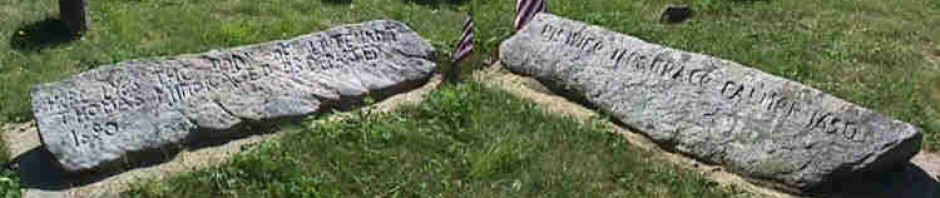
Robert Cross I

Robert CROSS I (1613- 1693 ) was a farmer at Ipswich, Mass. and the first Cross to arrive on US soil.  He was Alex’s  10th Great Grandfather, one of 2,048  in this generation of the Shaw line.
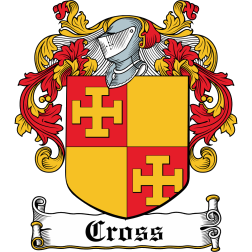
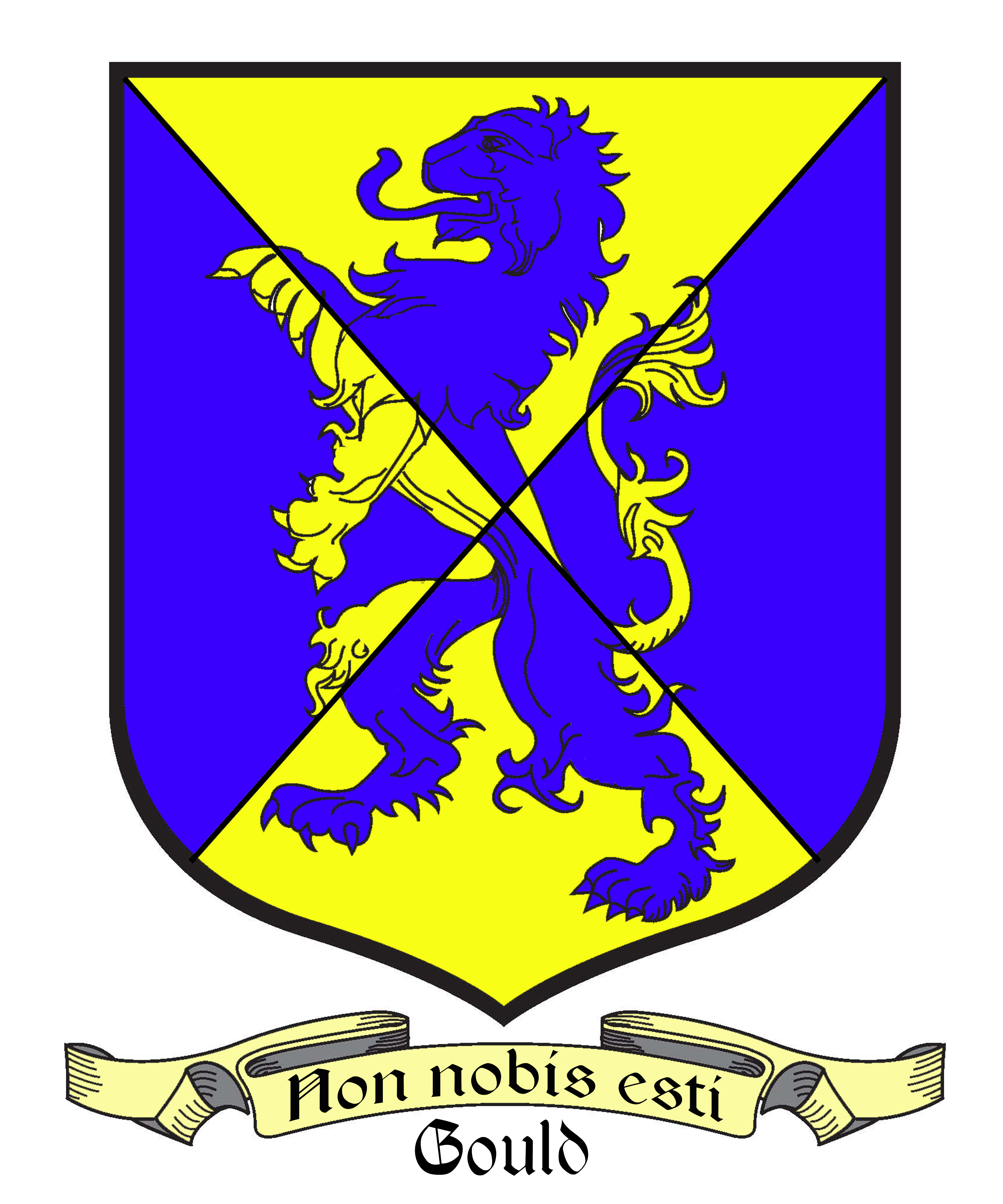
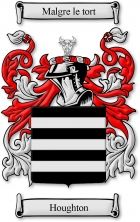
Robert Cross – Coat of Arms

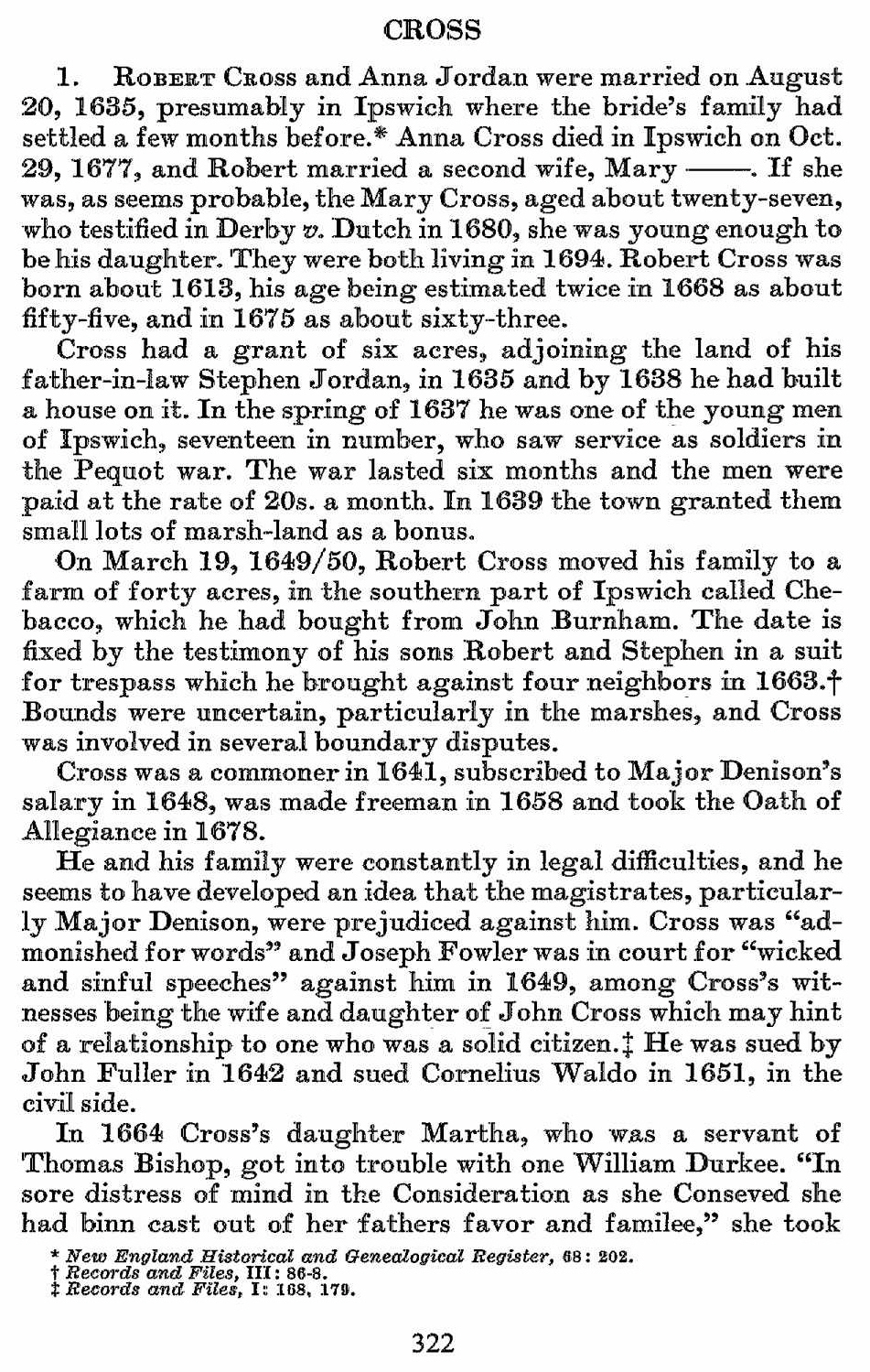
Robert Cross was born in 26 Jun 1613  in Charlinch, Somerset, England   His parents were Thomas CROSS and Rachel DISLING.  He sailed from Ipswich, England to Ipswich, Massachusetts on the “John & Mary” in 1634.  He married Anna JORDAN on 20 Aug 1635 presumably in Ipswich where the bride’s family had settled a few months before.  After Anna died, he married a second wife, Mary [____].  If she was, as seems probable, the Mary Cross, aged about twenty-seven, who testified in Derby v. Dutch in 1680, she was young enough to be his daughter.   Robert died 8 Feb 1692/93  in Ipswich, Mass.

Anna Jordan was born in 1617 in Wherstead, Suffolk, England.  Her parents were Stephen JORDAN and Susannah  WOLTERTON.  Anna died 29 October 1669 in Ipswich, Essex, Mass.

Children of Robert and Anna:

Name Born Married Departed
1. Mary Cross 14 Jun 1640 Ipswich Ephraim Herrick
3 Jul 1661
Beverly, Essex, Mass.
2. Robert Cross Jr. Abt,1642 Ipswich Martha Treadwell
19 Feb 1663/64 Ipswich, Mass.
29 Oct 1710 Ipswich
3. Martha Cross 15 Mar 1642/43 Ipswich William Durkee
20 Dec 1664 Ipswich
11 Jan 1726/27 Windham, CT
4. Stephen CROSS 1647-48
Newbury, Mass
Elizabeth CHENEY
1665
Ipswich
1714 Newbury, Mass
5. Elizabeth Cross 3 Mar 1650
Ipswich, Essex, Mass
Seth Story (son of William STORY)
1684
Ipswich, Mass
12 Mar 1736
Ipswich, Essex, Mass
6. Ann Cross Abt. 1651 Ipswich Thomas Marshall
Mar 1671 in Ipswich, Essex, Mass
.
Ephraim Fellows
30 Dec 1670
Ipswich
Dec 1734 Ipswich
7. Peter Cross 1653 Ipswich Mary Wade
1678 Norwich, New London, CT
9 Apr 1737 Mansfield, Tolland, CT
8. George Cross Abt. 1654 Ipswich Martha Bonfield
1687
Ipswich
28 Oct 1714 Stamford, Fairfield, CT
9. Sarah Cross 1656 Ipswich William Butler
1675
Ipswich
1711
10. Ralph Cross 15 Feb 1657/58 Ipswich Mary Graves
6 Nov 1705
Ipswich
1711 Ipswich

History of Bristol, New Hampshire, pg 120

The Crosses of Bristol trace their ancestry to Charlenge, now Charlinch, Somersetshire, England. The name appears in the Domesday Book of William the Conqueror, also in the wars of the Crusades. Sir Robert Cross, of Charlenge, was knighted by Queen Elizabeth, in 1602, or heroism, as admiral, against the Spanish Armada and at Cadiz. He died without issue. His coat of arms was brought to this country by Gen. Ralph Cross, of Revolutionary fame. From it, it may be seen that the family sprang from Norman stock and belonged to the landed gentry of England. Closely related to Sir Robert were Robert and John who, in 1637 sailed from Ipswich, England, to Ipswich, Massachusetts. Robert settled in in Newburyport, Mass. John settled in Methuen, Mass., where eight generations have lived in a house still standing.

CROSS LINEAGE FROM CHARLINGE, ENGLAND

  1. Sir Renulf Cotgreave, Lord of Hargrave Tarvin and Hattenhall in Country of Palatine and Chester, in reign of Henry IV and Henry V (1399-1422) m. Elinor, daughter of Francis Jamville de Mollington.
  2. Elinor Cotgreave, m Sir William Crosse de Charlinge, County of Somerset and Sutton, Cheshire.
  3. William Crosse, Esq. de Charlinge and Sutton; m. Isabelle, daughter of Robert de Holme. Lord de Franmure in County of Palatine and Chester.
  4. John Crosse, Esq. of Charlinge, and Sutton; m Constance, daughter of William Botelar or Butler, Esq. of Warrington in Country of Lancaster.
  5. John Crosse, Esq. de Charlinge and Sutton; m. Angard, daughter of Matthew-Ellis de Vrierleigh near Chester.

Robert’s father Thomas Cross was born 25 Jul 1580.  He married Rachel Disling on 29 Jun 1603 in Durham England.  Rachel was born around 1584 in England.

Robert Cross may have been the nephew and it is very probable that he was a near relative of John Cross, of Ipswich, who was born in England about 1580 and came to New England with his wife Anne in the ship “Elizabeth” of Ipswich, sailing April 30, 1634.  John  left only one child, a daughter Hannah, wife of Thomas Hammond. (Note: Thomas Hammond was the son of our ancestor William HAMMOND)

1635 – Robert had a grant of six acres, adjoining the land of his father-in-law Stephen Jordan

By 1638 – Robert had built a house on it.

Spring 1637- Robert was one of the young men of Ipswich, seventeen in number, who saw service as soldiers in the Pequot war. The war lasted six months and the men were paid at the rate of 20s. a month.

1639 – The town granted them small lots of marsh-land as a bonus.

19 Mar 1649/50, Robert moved his family to a farm of forty acres, in the southern part of Ipswich called Chebacco, which he had bought from John Burnham. The date is fixed by the testimony of his sons Robert and Stephen in a suit for trespass which he brought against four neighbors in 1663.  Bounds were uncertain, particularly in the marshes, and Cross was involved in several boundary disputes.

1648 – Robert subscribed to Major Denison’s salary

1658 – Robert made freeman in 1658 and took the Oath of Allegiance in 1678.

Robert and his family were constantly in legal difficulties, and he seems to have developed an idea that the magistrates, particularly Major Denison, were prejudiced against him.

1642 – He was sued by John Fuller

1649 – Robert was “admonished for words” and Joseph Fowler was in court for “wicked and sinful speeches” against him, among Robert’s witnesses being the wife and daughter of John Cross which may hint of a relationship to one who was a solid citizen.

1651 – Robert sued Cornelius Waldo, in civil court.

Cross had two servants, Nicholar Vauden and Lawrence Clinton. Vauden ran away in 1666, 1668 and 1670, when he added to his offense by stealing seven pounds belonging to his master. Each time he was pursued with hue and cry, captured and brought back, and in 1670 the miserable fellow was fined £40, which presumably could only be paid by work, branded with an “R” on the forehead and forced to wear an iron collar.

Lawrence Clinton was a gay young blade who claimed to have rich and prominent connections in England. He courted Rachel Halfield, an aging Ipswich spinster, who bought him off his time (three and a half years) from Cross for £21 and married him. Rachel’s family sued Cross, accusing him of conniving with Clinton to secure the Halfield money, and won the case, which Cross appealed to the Court of Assistants. Cross won when the case was reviewed. Clinton soon deserted Rachel and departed for fresh pastures in Rhode Island and Connecticut. Rachel divorced him and ended her days as a poor old woman in a hut on an Ipswich island.

By 1663 Robert Cross was saying that he could get no justice while the major (Denison) was on the bench, and, after his sons Robert and Stephen were in jail and in the stocks for their training-day misbehavior, he was more embittered.

1668 – Robert tried to convince Thomas Wells that the magistrates personally kept the court fines, and Wells testified that Cross said that Major Denison was not respected in the court at Boston, that there were more appeals from Ipswich court than from any court in the country and that “his sons were set in stocks and punished for nothing”. Cross came back by quoting Wells as saying that the Ipswich court was all one with the Inquisition in Spain and that “old Bradstreet was a worse usurer than Godfrey.” Everybody was fined and bound to good behavior. Cross gained one point when he sued Wells for slander for saying that Cross was a “cheating knave,” the court forcing Wells to make a public acknowledgment to clear Cross’s good name.

17 Mar 1685/86 – Robert Cross conveyed the Chebacco farm to his sons Robert and Stephen, who were to pay his debts and funeral expenses. Apparently he was to continue to live on the farm for the rest of his life.)

Children

1. Mary Cross

Mary’s husband Ephraim Herrick was born 11 Feb 1638 in Salem, Essex, Mass. His parents were Henry Herrick and Editha Laskin. Ephraim died 18 Sep 1693 in Beverly, Essex, Mass.

Ephraim’s father had come to Salem, Massachusetts, in about 1629 with a large group of English settlers, probably including Francis Higginson, minister of the Salem Church in 1629-1630. Ephraim’s father was a landowner and a farmer; it is assumed that Ephraim did the same thing. Ephraim took the Oath of a Freeman in 1668, at the age of 30.

The Herrick family was destined to become a significant part of the Salem Witch Trials of 1692. At the time, Ephraim was 54 years old and Mary was 52. Their children ranged in age from twenty-years-old to nine. Their oldest son, John, was married to Bethia Solart, whose sister, Sarah Solart Poole Good, became one of the accused witches. Having Bethia’s sister accused of being a witch must have sent chills through all of the Herricks. Though not blood related to Sarah, she was an in-law, and they must have been concerned and possibly frightened: Who would be next?

Ephraim’s brothers were also heavily involved in the trials. His older brother, Zachariah, had refused to give aid to Sarah when she was down-and-out and in need of a home and food for her children. Another brother, Henry, was a member of the jury and would eventually sign the apology for their decisions. Finally, Ephraim’s brother, Joseph, was the local constable and arrested most of the people charged with witchcraft.

Four years after the last of the trials, the jury finally realized that they had been had. The following is the text of their signed “Confession of Error” (January 14, 1696), published after Ephraim’s death so he never knew of his brother’s apology.

Deacon William FISKE (1643 – 1728), Joseph BATCHELLER’s son John (1638 – 1698) and Daniel WARNER’s son-in-law John Dane (1645 – 1707) were also on the Jury during the witchcraft cases in Salem. See my post Witch Trials – Jury for the text of the apology.

Ephraim Herrick died on 18 Sep 1693 in Beverly, Essex, Massachusetts. He was 55 years old and he and Mary had been married for 32 years. The cause of his death is unknown, but one can certainly speculate that the stresses of the trials may have placed a heavy burden on Ephraim’s heart. Shortly after his death, his son, John, and daughter-in-law, Bethia, would leave the area and try to start a new life in New York.

Mary lived for another seventeen years, apparently never leaving the area, and dying in Salem at the age of 70 in the year 1710.

2. Robert Cross Jr.

Robert’s wife Martha Treadwell was born 16 Mar 1641/42 Essex, Mass. Her parents were Thomas Treadwell and Mary Taylor. Martha died 3 Mar 1737/38 at the age of 95.

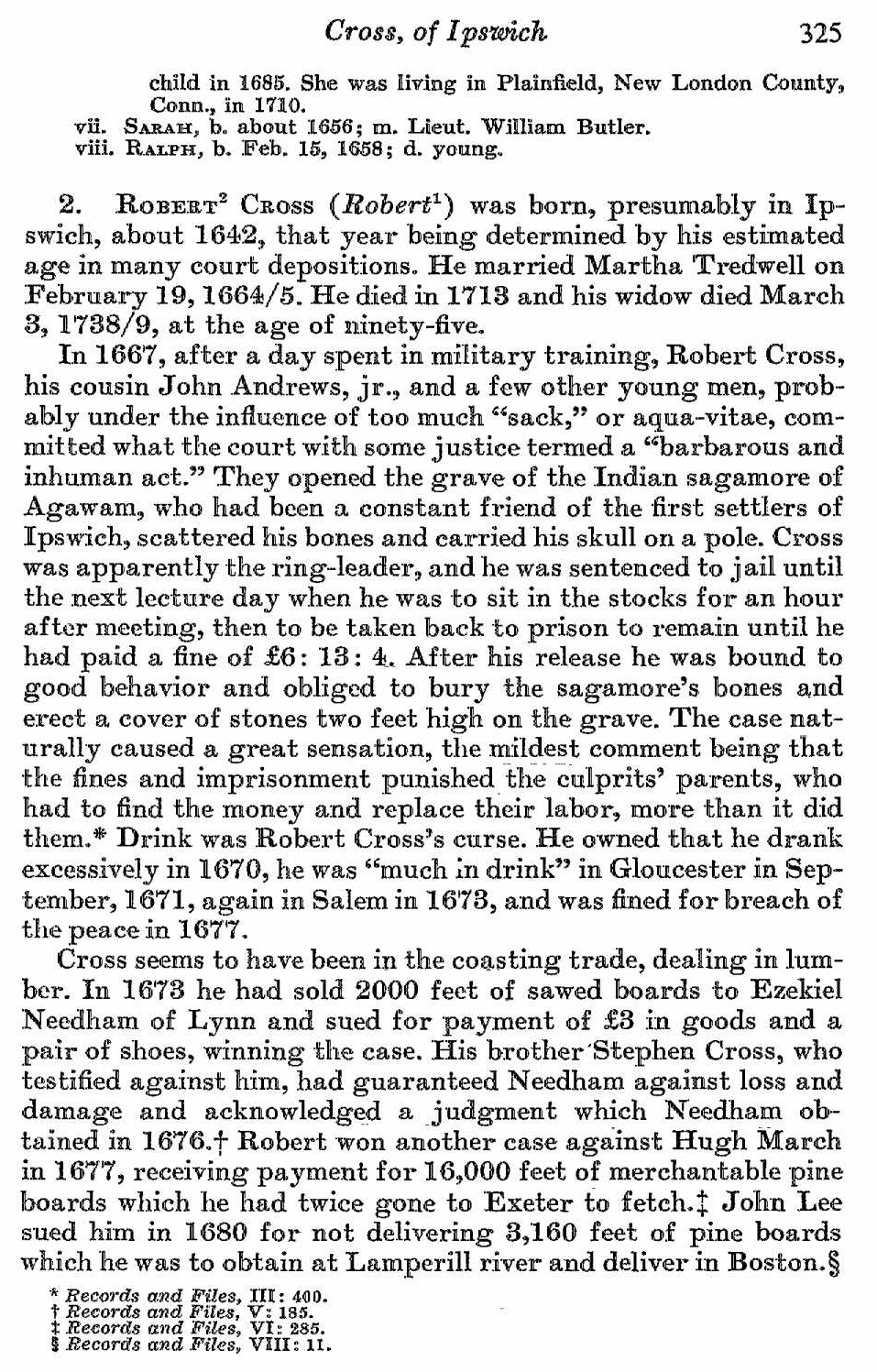
In 1667, after a day spent in military training, Robert Cross Jr, his cousin John Andrews, jr., and a few other young men, probably under the influence of too much “sack,” or aqua-vitae, committed what the court with some justice termed a “barbarous and inhuman act.” They opened the grave of the Indian Sagamore of Agawam, who had been a constant friend of the first settlers of Ipswich, scattered his bones and carried his skull on a pole. Cross was apparently the ring-leader, and he was sentenced to jail until the next lecture day when he was to sit in the stocks for an hour after meeting, then to be taken back to prison to remain until he had paid a fine of L6: 13:4. After his release he was bound to good behavior and obliged to bury the sagamore’s bones and erect a cover of stones two feet high on the grave. The case naturally caused a great sensation, the mildest comment being that the fines and imprisonment punished the culprits’ parents, who had to find the money and replace their labor, more than it did them.  Drink was Robert Cross’s curse. He owned that he drank excessively in 1670, he was “much in drink” in Gloucester in September, 1671, again in Salem in 1673, and was fined for breach of the peace in 1677.

Cross seems to have been in the coasting trade, dealing in lumber. In 1673 he had sold 2000 feet of sawed boards to Ezekiel Needham of Lynn and sued for payment of L3 in goods and a pair of shoes, winning the case. His brother Stephen CROSS, who testified against him, had guaranteed Needham against loss and damage and acknowledged a judgment which Needham obtained in 1676.

Robert won another case against Hugh March in 1677, receiving payment of 16,000 feet of merchantable pine boards which he had twice gone to Exeter to fetch.   John Lee sued him in 1680 for not delivering 3,160 feet of pine boards which he was to obtain at Lamperill river and deliver in Boston.

In 1680 Cross leased land on “the little neck” and engaged in a continuous feud with the fishermen who were accustomed to use the beach there. There also, in 1686, he broke open the hut of an old shepherd, Capt. John Ayres, who kept the flock on the neck, and brutally assaulted him.

29 Aug 1694 – He released to his brother Stephen all of his interest in the paternal farm at Chebacco, Stephen promising to acquit him of all obligations toward their father. (Essex Deeds, 10:49)

3 Jun 1707 – Robert Cross deeded his son Ralph Cross all his housing on “the little neck,” on the south side of Jeffrey’s neck where the grantor was then living, Ralph to enjoy two-thirds and to pay the grantor’s son Nathaniel Cross one-third. (Essex Deeds, 19:172
Administration on the estate of Robert Cross of Ipswich was granted to Martha Cross, his widow, and Nathaniel Cross, his only son, Abraham Foster and James Foster being their sureties, on June 27, 1713. The small property was valued at L79 by Simon Wood and Thomas Hodgkins on July 3, 1713. (Essex Probate, No.6644.

3. Martha Cross

Martha’s husband William Durkee (Durgy) was born in 1630 in Meath, Ireland, William died in 1704 in Ipswich, Essex, Mass

William arrived on Nov 9, 1663 as the indentured servant of Thomas Bishop, having been in the Barbadoes, probably as a slave of Cromwells. Martha was probably employed in the household of Thomas Bishop.

They married in Ipswich, Mass. on Dec. 20, 1664 after Robert Cross sued William for abusing his daughter and William countersued Robert for withdrawing his consent to marriage after giving it. Two weeks later, their first child John was born. Son Thomas was born in 1666, daughter Martha in 1668, and son William in 1672. Elizabeth born about 1670, Mercy, Anna born about 1680, Mary, Jane, and Henry? were also probably children of William and Martha. Since William would not renounce his Catholicism, he could not own land.

Almost all Durkees in the United States and Canada are descended from the three sons: John, Thomas, and William. One exception are a small group in Wisconsin descended from Herman and William Durkey who arrived there about 1870 from Germany. Another exception spell their name Durgy and descend from John Durgy who married Hannah (Conger) in 1784 in New Fairfield, Conn.

1664 – Martha got into trouble with one William Durkee. “In sore distress of mind in the Consideration as she Conseved she had binn cast out of her fathers favor and familee,” she took refuge with her sister Elizabeth Nelson. Elizabeth consulted Goodman Story, saying ” I dayer not goe to speack a word in her behalfe”, and Story, literally a good man, offered to go with her to see her parents. “We found them,” said Story, “in a sad and sorrowful condition, very much harried in spirit, not knowing which way to turn or what to say.” Goodman Story advised marriage, and “that was the way then that we thought to be the best.” Cross, however, could not let the situation end with this simple solution and sued Durkee for abusing his daughter. Durkee replied by suing Cross for withdrawing his consent to the marriage after giving it. Soon afterward, however, William and Martha were duly married.

4. Stephen CROSS (See his page)

5. Elizabeth Cross

Elizabeth’s husband Deacon Seth Story was born in 1645 in Ipswich, Mass.  His parents were William STORY and Sarah FOSTER.  Seth died  9 Oct 1732 in Ipswich.

Seth became a deacon and was quite prominent in Ipswich Senior Deacon, 2nd Church of Chebacco. Chebacco was incorporated as Essex in 1819. The name Chebacco is Agawam in origin and refers to a large lake whose waters extend into neighboring Hamilton.

Seth fought in Narragansett winter fort under Capt. Samuel Brocklebank of Rowley during ‘King Phillip’s War with the rank of sergeant.

“Here Lyes Ye Body of Mrs Elizabeth Story Wife of Dea’n Seth Story Who Died March 12, 1736, Aged About 85 years”

6. Ann Cross

Ann’s first husband Thomas Marshall was born 15 Apr 1650 in Ipswich, Essex, Mass. His parents were Thomas Marshall and Johanna [__?__]. Thomas died 10 Apr 1682 in Ipswich, Essex, Mass

Ann’s second husband Ephraim Fellows was born Mar 1641 in Ipswich, Essex, Mass. His parents were William Fellows and Mary Ayer. His aunt was Sarah AYRES wife of William LAMSON. Ephraim died 1713 in Plainfield, Windham, CT.

7. Peter Cross

Peter’s wife Mary Wade was born 3 Jun 1659 in Norwich, New London, CT. Her parents were Robert Wade
and Susanna Birchard.Mary died 8 Jan 1739 in Mansfield City, Tolland, CT.

Peter Cross was born in Ipswich, MA and is given credit for being one of the pioneer settlers in Windham, CT where some of his children were born.

In 1693, it was decided that the dividing line between the settlers of Hartford and Norwich should be the Willimantic River, the Norwich people holding on the east of it and the Hartford people  holding on the West of it.  A highway was ordered through Peter Cross’s division, extending from the pond to the Willimantic river near the falls.  Peter was given 12 acres below the falls in compensation for the land taken up by the highway.

In Oct. 1696, Jonathan Gennings and Peter Cross, administrators to the state of Robert Wade (their brother-in-law) of Norwich, informed the courts that Robert Wade died in a lot of debt leaving his family in want.  They said it would be necessary to sell some of Robert’s land to pay off his debts and to relieve his family.  Power was granted them to sell the land with the consent of Lt John Fitch and Ens Jonathan Crane (the overseers)..

8. George Cross

George’s wife Martha Bonfield was born about 1660 in Essex, Mass. Her parents were George Bonfield and Rebecca Bradstreet.

9. Sarah Cross

Sarah’s husband Lt. William Butler was born 1653 in Essex, Mass.  His parents were William Butler and Sarah [__?__]. William died 2 Aug 1730 in Ipswich, Essex, Mass.

William Butler, Jan. 29, 1711, gives to his son Ralph “one half of the house I now live in—that is, the northwest end, the old end that father Cross lived in–with two acres of tillage, etc. This farm was in Chebacco (the part of Ipswich now Essex) and had been bought by William Butler in 195 and 199 of Capt. Stephen Cross and Robert Cross, Jr., sons of Robert Cross, Sr. (Essex Deeds, Vol. 10, p. 163; vol. 12, p. 53).  It is in the deed of Capt. Stephen Cross, June 15, 199, that is found the first mention of William Butler as lieutenant; in other deeds he is called “senior,” “farmer” and “yeoman,”  William’s wife Sarah died before July 21, 1703, when he married Mary Ingalls, and he married again (int. pub. Oct. 3, 1713) Abigail Metcalf.  She survived him, marrying, June 1, 1731, Lieut. Simon Wood, and dying Oct. 1, 1732, aged 67 years, which makes her date of birth 1665.

10. Ralph Cross

Ralph’s wife Mary Graves was born 18 Feb 1685 in Ipswich, Essex, Mass. Her parents were Samuel GRAVES III  and Joanna PEARCE.  Mary died in 1711

When they married in 1705, Ralph was 47 years old and Mary was 20.  Ralph’s nephew Robert CROSS II married Mary’s youngest sister Elizabeth GRAVES 26 Sep 1719.

Sources
From Phoebe Tilton,  by Walter Goodwin Davis 1947

http://www.worldfamilies.net/forum/index.php?topic=2978.0

http://www.genealogyofnewengland.com/b_c.htm

http://users.rcn.com/lmerrell/crossvinton.html

http://familytreemaker.genealogy.com/users/w/e/i/Irene-Weinmann/BOOK-0001/0036-0003.html

MY CHILDREN’S ANCESTORS, by Roselle T. Cross Denham England Parish Register Hammett, p. 66. New England Reg., Vol 60, p49 Merrill Memorial Woodcock Genealogy, pg 1861, New England Family Gen. Memorial, 3 Series, Vol 14 Max L. Draper Gen., Fam. TreeMaker Genealogical Site

http://durkee.org/history.htm

Posted in 12th Generation, Be Fruitful and Multiply, Immigrant - England, Line - Shaw, Veteran | Tagged , | 8 Comments

Capt. Stephen Cross

Capt. Stephen CROSS (1646 – 1704)  was a mariner, owned and lived on Cross Island (an island, just off the Massachusetts coast from Ipswich).  He was Alex’s  9th Great Grandfather, one of 1,024 in this generation of the Shaw line,

Stephen Cross was born about 1646 in Newbury,  Mass.  His parents were Robert CROSS I and Anna JORDAN . He married Elizabeth CHENEY about 1665.  After this marriage questions arose respecting property, and John Perkins gave testimony (in 1672) that he was present when the “widow Cheney” and Robert Cross, senior, made a “treaty, when Robert’s son Steven was a suitor to Elizabeth, daughter of the widow.” Stephen died in 1704  in Cross Island, Essex, Massachusetts (See Google Satellite View)

Stephen purchased the twenty ton sloop Adventure in 1672

Elizabeth Cheney was born 12 Jan 1643/44 with her twin brother Nathaniel  in Newbury, Mass.  Her parents were John CHENEY and Martha PARRATT.  In her father’s 1666 will, Elizabeth received “three cows, one called “Spark” with her calf, one whitefaced and a third called “Col”, two yearling heifers and £15.”  Elizabeth died in 1714.

Children of Stephen and Elizabeth:

Name Born Married Departed
1. Robert CROSS 29 Nov 1667 Ipswich, MA Elizabeth GRAVES
26 Sep 1719 Ipswich, Mass.
6 Jun 1738 Ipswich, Mass
2. Sarah Cross ABT 1680 Ipswich Benjamin Dutch
7 JAN 1701/02
31 Jul 1748
Ipswich, Mass.
3. Stephen Cross 1682
Ipswich
Sarah Jackson
22 Jun 1708
12 Feb 1713
Boston, Mass
4. Nathaniel Cross 2 Apr 1686
Ipswich
25 Apr 1686
Ipswich
5. John Cross 1687 Ipswich After 1705
6. Anna Cross c. 1690 Joseph Hart
23 Jul 1714
5 Jan 1715

1664 – When Stephen was seventeen, he testified for his father who was being sued by Gov. Bradstreet for the loss of some sheep which had been entrusted to him. Stephen and his elder brother Robert suggested that the sheep might have been killed by an enormous bear–“wee did Cill the bayer: which for bignes was the biggest that ever was seen by aney of the.”

1667 – The evening of “training day” was often a riotous one for young colonials, and when he was twenty, Stephen Cross and his friends got themselves into serious trouble by wrecking the town’s bridges near the wind-mill. They were jailed, sentenced to sit in the stocks, pay L3 each in fines and be bound to good behavior.

1668 – Stephen was characterized as “a turbulent fellow but (one who) never spoke ill of authority,” the former being obvious and the latter dubious as on this occasion he had been charged with “reproachful speeches against the worshipful magistrates,” saying that they sat at dinner drinking burnt sack and when they came into court they looked red as though they were flustered and acted as though they were “fodeeled.” Again he was bound to good behavior.

1670 – Stephen and Thomas Deblanchet got into a fist fight in the meeting-house at sermon time, and, being summoned to court and not appearing, he was fined for contempt.

1672 – Robert Cross, sr., his son Stephen, widow Cheney of Newbury and her daughter Elizabeth met at the house of Quartermaster John PERKINS in Ipswich. Robert Cross desired the widow to give her daughter Elizabeth to his son Stephen in marriage, but the widow would not consent unless Stephen was given some land to settle on by his father. Cross told the widow that he had an island in Chebacco river which he did intend for Stephen and that he valued it at about L200. This was staisfactory to goodwife Cheney and she consented to the match. Immediately thereupon Robert Cross drew a deed of gift to his son Stephen of the said island and subscribed to it, Perkins and John Kendrick acting as witnesses, and the young people “in some convenient time after were joined together in matrymony.” John Kendrick swore to these facts on March 31, 1685.

Chebacco Lake

Possibly Cross’ marriage to Elizabeth Cheney of Newbury at an unknown date was a restraining influence, for his court appearances for violent acts ceased for a time, at least. He bought half an acre of land on Water street in Ipswich from John Kendrick and build a house. Thomas Dennis, the talented Ipswich furniture maker, made him a table and chair in 1675.

1672 – Stephen purchased the sloop Adventure.  Samuel Cogswell of Ipswich owning a share, and was supposedly made fit to go to sea by Moses Chadwell of Lynn, who did a slow and poor job and lost in the resulting suit in 1676. His business as the captain of a coasting vessel, the sloop Adventure of twenty tons, took him as far afield as Wethersfield in Connecticut and the towns on the Exeter and Piscataqua rivers, the voyages frequently resulting in lawsuits for payment of freight which Cross usually won.
Later John Lee owned a share in the sloop. The business was apparently prosperous and Capt. Cross became a personage entitled to the title “Mr.” in the records.

1682 – Stephen had a negro slave in his crew who was “very well known a wicked person.”

1684 – Capt. Cross sold his Water Street house to Job Bishop and bought the Richard Saltonstall place from Bishop, the property consisting of fourteen acres of land on both sides of Saltonstall brook, an orchard and the house. Here he opened an inn, called “The Orange Tree” and began again to be summoned to court, for illegal sales of spirits and for impairing the morals of Ipswich youth, including his future son-in-law, Benjamin Dutch, by providing a “shovelboard.”

The original English ancestor of most of the games involving shoving discs of some sort on a table was called Shove-board and later Shovel-board.  Popular in Tudor times, Shovelboard was played by the English upper classes on enormous narrow tables as long as 30 feet. Players shoved metal weights down the tables, attempting to get them as near to the other end of the table without falling off.  Presumably, the game is a formalized version of a pastime played on the long dining tables of the upper classes after dinner.  One of the earliest references is from the Royal Privy Expenses of 1532 which show that Henry VIII lost £9 to Lord William at Shovelboard.  Meanwhile, the subjects of this great King were banned from playing this and most other recreational games – an even earlier reference purportedly of 1522 says “None of the society shall play at the game called Shoffe boorde or Slypgrote”

Summer of 1689 – The last heard of the Adventure is when Capt. Cross’s sloop, laden with a cargo of deal boards, was off Cape Cod and was captured by the pirate Thomas Pound, who kept the sloop and put her crew into the ketch from which he was operating at the moment and “sent them away”–good treatment from a pirate?

1690 – Capt. Stephen Cross was a commander of the ketch Lark in the  BATTLE OF QUEBEC.  The Lark was a Salem vessel and Cross brought her back to her home port on March 18, 1690/91, and the arms on board were placed in Mr. Derby’s warehouse.

1691 – Stephen was in financial difficulties. John Harris, the marshal, and his deputy, Thomas Low, came to serve an attachment on his property and later described his reception: “Capt. Cross tooke his nacked sword and he ran to ye said Low who was to assist me and told him he would run him through.” Having ejected Low, the captain clapped the point of his rapier to the marshal’s breast and bid him get out of the house. He saved his house and land by deeding them to his two minor sons, Stephen and John, who were to take possession when the reached their majorities and divide the property evenly, on May 9, 1691.

1693 – Capt. Stephen Cross, using his father as nominal plaintiff, sued John Burnham, jr., their Chebacco neighbor, in 1693 to recover a lot of marsh, the title to which was in dispute. Cross won a verdict but Burnham appealed the case successfully. There are forty-one papers on file in this appeal, some of the evidence going back to 1663. In one paper Robert Cross entered the date of his marriage and birthdays of his daughters Elizabeth Nelson, Mary Herrick and Martha Dirkye, all of whom testified. The appeal was heard May 21, 1695. (Supreme Judicial Court, No.3138) Robert and Mary Cross were both living in 1694 when they consented to a sale by Stephen Cross of one-half of the marsh called “Daffeedowndille” on the Chebacco river to Thomas Choate for £40.

1694 – Stephen began disposing of parts of the paternal farm at Chebacco, although his father was still living on it, selling one-half of “Daffeedowndille” marsh to Thomas Choate for £40 on July 24, and fourteen acres of marsh to John Appleton, jr., on August 10. His brother-in-law, the steady Lieut. William Butler, bought for £100 all of Stephen’s right, title and interest in the estate of Robert Cross, sr., as he disposed of it by deed or gift to his sons Robert Cross, jr., and Stephen Cross, on June 3, 1695. If the old man was still alive, he was safe in Butler’s hands.

29 Aug 1694 – Robert Jr. released to his brother Stephen all of his interest in the paternal farm at Chebacco, Stephen promising to acquit him of all obligations toward their father.

4 Dec 1710 – Both Stephen and Anna were presumably dead by Dec 4, 1710, when Stephen Herrick of Beverly, attorney for Mary Herrick of Preston and Ephraim Fellows and Anna, his wife, of Plainfield, both places in New London county, Connecticut, and both women daughters of Robert Cross, late of Ipswich, conveyed all their interest in his estate to William Butler of Ipswich. (Essex Deeds; 8:98) ”

There are no probate records for Stephen Cross. His wife Elizabeth was living in 1694 as she released her dower in the Appleton deed. Cross was certainly dead in 1704/05 when his son John named Benjamin Dutch his guardian. (Note: A Stephen Cross, unplaced, was married to Mary Lawrence in Boston January 3, 1692/3, by Rev. Cotton Mather and on 12 Feb. 1713 – Sarah Cross, widow, was appointed administrator of the estate of her husband Stephen Cross, late of Boston, mariner, Joseph Jackson, cooper, and Elizabeth Jackson, spinster, being her sureties. This may well have been the Ipswich man.

Children

1. Robert CROSS (See his page)

2. Sarah Cross

Sarah’s husband Benjamin Dutch was born 9 Aug 1680 in Ipswich, Mass. His parents were John Dutch and Elizabeth Roper.  After Sarah died, he married 25 Dec 1749 to widow Mary Brown. Benjamin died 13 Nov 1760.

Sarah Cross Dutch Gravestone -- Highland Cemetery, Ipswich, Essex, Mass.

Massachusetts and Maine Families in the Ancestry of Walter Goodwin Davis. Vol. I. -- Phoebe Tilton, by Walter Goodwin Davis 1947

3. Stephen Cross

Stephen’s wife Sarah Jackson was born about 1684 – Essex, Mass. Sarah died 7 Aug 1748 – Ipswich, Essex, Mass.

8 Sep 1706 – Stephen Cross Jr of Ipswich, mariner, for £65 paid by his brother-in-law Benjamin Dutch, sadler, released all claims to the house Dutch dwelt in, by virtue of a deed of gift from his father Stephen Cross, last of Ipswich, bearing date of May 13, 1691.

12 Feb 1713 – Sarah Cross, widow, was appointed administrator of the estate of her husband Stephen Cross, late of Boston, mariner, Joseph Jackson, cooper, and Elizabeth Jackson, spinster, being her sureties. This may well have been the Ipswich man.

5. John Cross

22 Jan 1705/06 – John Cross, a minor seventeen yeas of age, son of Capt. Stephen Cross, late of Ipswich, had his beloved brother-in-law Benjamin Dutch, sadler, appointed his guardian.

6. Anna Cross

Anna’s husband Joseph Hart was born about 1686 in Essex, Mass. They had a son Stephen Hart.

Sources:

Massachusetts and Maine Families in the Ancestry of Walter Goodwin Davis. Vol. I. -- Phoebe Tilton, by Walter Goodwin Davis 1947
http://www.worldfamilies.net/forum/index.php?topic=2978.0

http://www.genealogyofnewengland.com/b_c.htm

http://familytreemaker.genealogy.com/users/w/e/i/Prudy-A-Weil-1/BOOK-0001/0073-0004.html

http://familytreemaker.genealogy.com/users/w/e/i/Prudy-A-Weil-1/BOOK-0001/0073-0005.html#CHILD8

http://trees.ancestry.com/owt/person.aspx?pid=4857232

Posted in 11th Generation, Line - Shaw, Place Names, Sea Captain, Tavern Keeper, Veteran | Tagged , , , , , , | 15 Comments

Robert Cross II

Robert CROSS II (1695 – 1738) was Alex’s  8th Great Grandfather, one of 512 in this generation of the Shaw line.

Robert Cross was born in 1695 in Ipswich Mass.  His parents were Stephen CROSS and Elizabeth CHENEY. He married Elizabeth GRAVES in 26 Sep 1719 in Ipswich Mass.  Robert died on 6 Jun 1738 in Ipswich, Mass.

Elizabeth Graves was born in 1690 in Ipswich, Mass.  Her parents were Samuel GRAVES and Joanna PEARCE.  After Robert’s death, Elizabeth married Abraham Fitts, on 18 Nov 1739.
.
Children of Robert and [__?__]

Name Born Married Departed
1. Noah CROSS ? c. 1710
Barrington, NH
Lydia CROMWELL
1730 in Durham, New Hampshire
1793
Vassalboro, Maine

.
Children of Robert and Elizabeth:

Name Born Married Departed
2. Robert Cross 29 Oct 1721
Ipswich, Mass
Anstiss (Anstace) Ellery
23 Oct 1744
Gloucester, Mass
29 JUN 1804
Sanbornton, Belknap, NH
3. Moses Cross 30 Apr 1727 5 Jun 1729
4. Samuel Cross 8 Nov 1724
Ipswich
6 Apr 1728
5. Moses Cross 9 Nov 1729
Ipswich
Ann Goss
17 Jul 1753
Newbury
8 Oct 1818
Sanbornton, NH

1719 – Robert bought a house in Ipswich from Edward Webber.

1735 – Robert was granted a lot in the town of Winchendon , because of his father’s service in the Canada expedition.

23 May 1738 – Robert Cross of Ipswich made his will.  He left all his estate, both real and person, to his wife Elizabeth who was to dispose of it at her death to their two sons Robert and Moses, and named her executrix. Witnesses: John Appleton, jr., Benjamin Waits, Elizabeth Waite. (from Exxex Probate, 322:294-5).

Children

1. Noah CROSS (See his page)

Many genealogies say Noah was Robert and Elizabeth’s son, but they married in 1719, nine years after Noah is said to be born. Noah’s first child William was born about 1738 so there is a little wiggle room for a later date of birth.

Genealogists feel Noah grew up in Barrington, New Hampshire, 50 miles north of Ipswich, Mass where Robert lived, but I don’t see any evidence Robert went to New Hampshire. On the other hand, Noah’s supposed brother Robert Jr moved to Newmarket, New Hampshire which is only 15 miles south of Barrington.

Both Robert Jr and Moses later moved to Sandbornton, NH, another 50 miles northwest. Not the same direction as Noah who moved to Vassalboro, Maine, but the same pioneering spirit.

Noah named one of his children Moses, and Samuel is a common name among his descendants, but I don’t see any Roberts. Moses’ son Moses Jr (1755-1820) moved to Vassalboro too. He named his children Lydia, Caleb, Mercy, and Sarah common names among Noah’s descendants.

Noah was not named in Robert’s will.

My conclusion is Noah was related to Robert Cross, but probably was not his son.

Noah’s father probably was either  Richard, John, Benjamin, or William CROSS who were original proprietors of Barrington, New Hampshire and  drew lots at the first meeting of the Barrington Proprietors held in Portsmouth May 28, 1722.  Jay Cross thinks their parents were Richard CROSS and Jane PUDEATER, who married 24 Sep 1670 in Salem, Mass

2. Robert Cross

Robert’s wife Anstiss (Anstace) Ellery was born 18 Oct 1726 in Gloucester, Essex, Mass. Her parents were William Ellery and Sarah Warner. Anstiss died 9 Aug 1808 in Sanbornton, Belknap, New Hampshire.

Robert and Anstiss moved to Sanbornton, Belknap County, New Hampshire. Located in the fork of the Pemigewasset and Winnipesaukee rivers, the town was first called Crotchtown. It was granted by Colonial Governor Benning Wentworth in 1748 to his friend John Sanborn of Hampton, along with 59 others from Hampton, Exeter and Stratham. Twelve of the grantees were named Sanborn, therefore the community was named Sanborntown. Among the other settlers were members of the Leavitt family, related to the Sanborns. But ongoing hostilities during the French and Indian War delayed permanent settlement until 1764. It would be incorporated by Governor John Wentworth in 1770.

Sandbornton, Belknap, NH

Children of Robert and Anstiss:

i. Elizabeth Cross b. 12 Jan 1745/46 Ipswich, Essex, Mass

ii. Nathaniel Cross b. 27 Sep 1747 in Newmarket, Rockingham, New Hampshire; d. 1800 Exeter, Rockingham, New Hampshire; m. 1769 Newmarket to Martha Woodman (b. 1751 in Exeter, Rockingham, New Hampshire – d. 9 Oct 1840 North Belmont, Waldo, Maine)  Martha’s parents were Joshua Woodman (1703 – 1778) and Eunice Sawyer (1719 – 1755).  Nathaniel and Martha had twelve children born between 1770 and 1795.

Cross, Nathaniel, Ipswich. Private, Capt. Thomas Burnham’s co., which marched on the alarm of April 19, 1775; service, 3 days.

ii. Samuel Cross b. 25 Feb 1748/49 in Ipswich, Essex, Mass

5. Moses Cross

Moses’ wife Ann Goss was born 12 Oct 1732 in Bradford, Essex, Mass. Her parents were John Goss and Mehitable Bailey. Ann died 30 Mar 1779 in Newbury, Essex, Mass.

Children of Moses and Ann:

i.  Elizabeth Cross b. 17 Nov 1753 in Newbury, Essex, Mass

ii. Moses Cross b. 27 Nov 1755 in Newbury, Essex, Mass; d. 1820 in Belgrade, Kennebeck, Maine; m. 1778 to Mary [__?__]

Sources:

http://www.worldfamilies.net/forum/index.php?topic=2978.0

http://familytreemaker.genealogy.com/users/w/e/i/Prudy-A-Weil-1/BOOK-0001/0073-0005.html#CHILD8

http://trees.ancestry.com/tree/18766631/person/708869160?ssrc=

Posted in 10th Generation, Line - Shaw | Tagged | 5 Comments

Noah Cross

Noah CROSS (1710 – 1793) was Alex’s  7th Great Grandfather, one of 256 in this generation of the Shaw line.

Noah Cross was born about 1710 in Barrington, New Hampshire.  His parents were probably not Robert Cross  and Elizabeth Graves.  It is more likely  that Noah’s father probably was either  RichardJohnBenjamin, or William CROSS who were original proprietors of Barrington, New Hampshire and  drew lots at the first meeting of the Barrington Proprietors held in Portsmouth May 28, 1722.  Jay Cross thinks their parents were Richard CROSS and Jane PUDEATER, who married 24 Sep 1670 in Salem, Mass.  (See the discussion on Robert’s page for more details)

Noah married Lydia CROMWELL.  After Lydia died, he married Abygail Hammock 20 Aug 1767 in Wiscasset, Lincoln, Maine.  Noah died before 1793 in Vassalboro, Kennebec Co., Maine.

Noah was born in Barrington, New Hampshire

Lydia Cromwell was baptized 31 Oct 1736 in South Berwick, Maine. Her parents were Joshua CROMWELL and Lydia [__?__]. Lydia died before 1767.

I can’t find a record of Abygail (Abagail) Hammock other than the 1767 marriage By Jno. Murray, V. D. M.. Thomas, John and Elizabeth Hammock were baptized into the Rochester Strafford, New Hampshire Church at the same time as Noah.

Children of Noah and Lydia:

Name Born Married Departed
1. William CROSS 1738
New Hampshire
[__?__]
1764 Vassalboro, Maine
19 Aug 1817 Vassalboro, Kennebec, Maine.
2. John Cross 28 Feb 1739/40 New Hampshire Sarah Smith
24 May 1768 Woolwich, Sagadahoc, Maine
10 Mar 1784 Woolwich, Sagadahoc, Maine
3. Josiah (Joshua) Cross 1746
New Hampshire
Mary Day
1768 – Boothbay, Maine
24 Aug 1819 Waldo, Lincoln, Maine
4. Moses Cross 1748
Barrington, New Hampshire
Mary Kelley
1777
Boothbay, Maine
1809
Maine
5. Noah Cross 1752
New Hampshire
Mary Fall
1773 Maine
1777
6. Caleb Cross 1753 Somersworth NH Judith Hooper
14 Aug 1784
Vassalboro, Kennebec, Maine
.
Mercy Wentworth
2 May 1809
Vassalboro
1843
Vassalboro, Kennebec, Maine
7. Benjamin Cross 1755 New Hampshire Sarah Lampson
14 Aug 1785 Hallowell, Maine
8. James Cross Hannah Varney
14 Apr 1796 Vassalboro

Noah’s Possible Parents

Many genealogies say Noah was the son of Robert Cross and Elizabeth Graves, but they married in 1719, nine years after Noah is said to be born. Noah’s first child William was born about 1738 so there is a little wiggle room for a later date of birth.

Some genealogists feel Noah grew up in Barrington, New Hampshire, 50 miles north of Ipswich, Mass where Robert lived, but I don’t see any evidence Robert went to New Hampshire. On the other hand, Noah’s supposed brother Robert Jr moved to Newmarket, New Hampshire which is only 15 miles south of Barrington.

Both Robert Jr and Moses later moved to Sandbornton, NH, another 50 miles northwest. Not the same direction as Noah who moved to Vassalboro, Maine, but the same pioneering spirit.

Noah named one of his children Moses, and Samuel is a common name among his descendants, but I don’t see any Roberts. Moses’ son Moses Jr (1755-1820) moved to Vassalboro too. He named his children Lydia, Caleb, Mercy, and Sarah common names among Noah’s descendants.

Noah was not named in Robert’s will.

My conclusion is Noah was related to Robert Cross, but probably was not his son.

Noah’s father probably was either  Richard, John, Benjamin, or William CROSS or one of their sons who were original proprietors of Barrington, New Hampshire and drew lots at the first meeting of the Barrington Proprietors held in Portsmouth May 28, 1722.  Jay Cross thinks their parents were Richard CROSS and Jane PUDEATER, who married 24 Sep 1670 in Salem, Mass

Barrington was incorporated in 1722 and named for Samuel Shute of Barrington Hall, colonial governor of Massachusetts and New Hampshire. His brother was John Shute Barrington, 1st Viscount Barrington.

The town was made up of two grants, the first containing all of Strafford and present-day Barrington except for a parcel two miles wide called New Portsmouth, or the Two Mile Streak. This second grant had been set aside to provide fuel and home sites for imported workers at the Lamprey RiverIron Works, chartered in 1719 by the Massachusetts General Court to encourage industrial development in the province.

History of Barrington NH

A HISTORY OF BARRINGTON NH by Morton Wiggin. Transcribed by Karen Penman genwebnut@aol.com) July 2000 Chapter 3:  Incorporation and Early Settlement 1722-1744

Barrington was quickly surveyed and divided into lots in proportion to the tax levied on each person in Portsmouth for the cost repairs of the H.M.S. “Barrington”.  The lots were numbered up to 277, the number of taxpayers.  They drew their numbers on the first range of lots on the east side of the town at the Rochester line and so continued until the ranges of a mile wide were laid off into lots and the land taken up, with the exception of the lots of the Two Mile Streak, which were reserved to Portsmouth expressly to pay the expense of starting the foundry of the Lamphrey Iron Works.

In laying off the lots, when they came to a pond, as Ayers Pond in the first range of lots, they numbered the acres of water and led the lot in course beyond.

Between lot 11 of James Libby and lot 12 of Samuel Allcock there was 280 acres of Round Pond which was not included in the area allotted to each proprietor.  Bow Lake and commons numbered 960 acres and was not included in the lot distribution.  A man by the name of Thomas Parker drew lot 149 containing 648 acres, which happened to fall on the top of a mountain.  Hence the name of Parker Mountain.

John Foss, one of the original settlers sold Bow Lake to John Caverly and the Caverly family sold it to the Cocheco Manufacturing Company of Dover.  It has never been figured out how Foss got it in the first place, since bodies of water were excluded from the grants to proprietors.

The survey created ranges of lots one mile wide, commencing at the Rochester line.  In between the ranges there were five range roads each four rods wide.  There was a half mile left over next to the Nottingham line which was not laid out in lots.  A cross range road was laid out not far from the center of the township.  It was on the north side of the range road, in the fourth range of lots between lot No. 156, Joshua Perce’s 720 acres and the Parsonage lot on the northwest and No. 157 John Hoker’s 96 acres on the southeast.

The first meeting of the Barrington Proprietors was held in Portsmouth May 28, 1722, with Richard Wibert as moderator and Clement Hughes as clerk.  They drew lots for selecting the place where they would take up their number of acres.  In Vol. IX of the Provincial Papers, page 41 is found the following:

“A list of the original Proprietors of the Town of Barrington with the Rate which each man Paid & by which the Quantity of Acres each man had is ascertained at the rate of two Pence pr acre & also the number of Each Lot as the Same was drawn by each Propr or his Constituent.”

49. Richd Cross 120 Acres
76. Wm Cross 72 Acres
243. Jno Cross 30 Acres
244. Benja Cross 210 Acres
111. Ed Pendexter 96 Acres (Corrupted spelling of Pudeater?)

John Cross was born 1660 – Rockingham, New Hampshire. His parents were Robert Craw and Ellen [__?_]. He married in 1688 in Rockingham, New Hampshire to Esther Manson Esther(b. abt 1668, Hampton, Rockingham, NH – d. aft. 1736) daughter of Richard and Esther Manson. Esther m. 1st John Cross; m. 2d Alexr. Dennett; m. 3d Anthony Roe. Children 1688-1702: George, Joseph, Joshua, Mary, Lydia, Richard, John. John died 6 Jun 1730 – Portsmouth, Rockingham, New Hampshire.

Children of John and Esther

i.  George Cross (1688 – 1739

ii. Joseph Cross (1691 – 1739

iii. Joshua Cross (1693 –

iv. Mary Cross (1695 – 1774

v. Lydia Cross (1698 –

vi. Richard Cross (1700 – 1726

vii. John Cross Jr. (1702 –

Benjamin Cross married 16 Mar 1721 – Portsmouth, Rockingham, New Hampshire to Elizabeth Treworgy . Benjamin died before 28 Dec 1730.

Benjamin, mariner, mar. in Portsm. 16 Mar. 1720/21 Elizabeth (Treworgy) wid. of John Field. He continued the Field tavern, as did his widow after his death. Will 29 Jan. 1722-3 – 28 Dec. 1730 names only w. Elizabeth, who was living Portsmouth 1740.

Elizabeth Treworgy was born 1655 in Kittery, Maine. Her parents were Samuel Treworgye and Dorcas Walton. She first married Noah Parker ( – d. 8 Feb 1708 in Lisbon, Androscoggin, Maine). She first married 26 Aug 1714 to John Field (b. 1655 – d. 1718 in Portsmouth, Rockingham, New Hampshire). Finally, she married Benjamin Cross. Elizabeth died in 1740.

Jay Cross posts:

I think that that Noah had brothers Robert, Richard, Benjamin, Nathan, Samuel, & John, and were some of the children of Robert CROSS son of Stephen CROSS and Elizabeth CHENEY of Ipswich. The evidence for this is tenuous, and based on apparent but undocumented joint ownership of certain real estate, proximity, and seeming contact with the same other families. I wouldn’t bet any body parts on this.

Jay also posts

A third family poorly documented CROSS family in New Hampshire with a Joseph and a Caleb are from Rockingham County [now Strafford County]. They lived near Dover/Barrington, and are probably descended from Richard who married in Ipswich MA, 1670. This is also near where the older Zachariah witnessed the will.

Jay also posts

I’ve been trying to find the origins of all the CROSSes in NE in the 1790 US Census.

The Vasselborough ME CROSSes are very likely the children of the Barrington NH [and nearby other] CROSSes. There were four CROSSes that had original claims in the fifth range of lots in Barrington, when it split from Portsmouth in 1721 [I haven’t read the history books, I’m just going on what I could glean from the town records.] These lots were 100-200 acres.

Those four CROSSes were Richard, John, Benjamin, and William. Where Richard and Capt. Benjamin were assessed 1 or 2 Pounds each, and John and William were assesed a few Shillings.

By 1731 Richard was dead, and his estate was taxed. By 1736 Benjamin & John were both dead. After 1740, William no longer shows up on the tax rolls. In the 1759-66 time frame, their estates were being subdivided to pay back taxes.

There is a good chance that this family are the children of Richard CROSS who m. Jane PUDEATOR in Salem in 1670. They had children John & Elizabeth before moving probably to Cape Porpus Maine, and then later to Portsmouth NH. There is an Edward PENDEXTOR listed in the early tax rolls, and that is what some say the name PUDEATOR became.

There is a Caleb GRAFTON in town [the only Caleb]. Do any of you GRAFTON searchers have info about a CROSS marriage that could have produced Caleb CROSS, Rev War Vet in 1753?

I’d be interested in hearing any evidence that supports or refutes these ideas.

-Jay

Richard Cross married Jane Pudeater, (which may be an tranliterated French name like Jeanne Pu d’Ater)  24 Sep 1670 – Salem, Mass.  Savage was they had Elizabeth August 17 following and John April 12 1673.

Maybe Jacob Pudeater is Jane’s brother — Genealogical Dictionary of New England Settlers Volume 3 page 492

Jacob Pudeater, Salem, m. 28 Oct. 1666, Isabel Mosier, wh. d. 3 Mar. 1677, and took sec. w. Nothing is mentioned of him, except that his widow. Ann Pudater (wiki), was one of those innocents charged. with the preposter. offence of witchery. in May 1692, shut up in Boston gaol, at the same time with Philip English and his w. tried in Sept. and with seven others executed on 22. See Felt II. 477-80; Essex Inst.II. 187, 8; and Hutch. II. 58.

Events in Noah’s Life

19 May 1743 – Noah signed the petition for the incorporation of  Somersworth, a city in Strafford County, New Hampshire.  The population was 11,766 at the 2010 census. Somersworth has the smallest area and third-lowest population of New Hampshire’s 13 cities. It originally called Sligo after Sligo in Ireland, was settled before 1700 as a part of Dover. It was organized in 1729 as the parish of Summersworth, meaning summer town, because during that season the ministers would preach here. It was set off and incorporated in 1754 by Colonial Governor Benning Wentworth, and until 1849 included Rollinsford. A clerical error at incorporation contracted the name to Somersworth.

27 Apr 1749 –  Noah Cross was one of the original purchasers of land in Middleton, NH [a bit North of Rochester]. He drew eighth and chose a lot numbered 95.

Middleton, Stafford, New Hampshre

Granted by the Masonian Proprietors in 1749, the town was named after Sir Charles Middleton, 1st Baron Barham, who was in charge of convoy service between Barbados and the colonies. The land was first settled shortly before the Revolutionary War by settlers from Lee and Rochester. Although the soil is rocky and unsuited for cultivation, cider was made in considerable quantities, and maple syrup to some extent.

Middleton was situated on the road between Exeter and Wolfeboro, the location of Colonial Governor John Wentworth’s summer home, Kingswood. Neglect of the road caused the governor to bill the proprietors for repairs he had to make for safe travel to Kingswood, built in 1771. Middleton was incorporated on March 4, 1778, and originally included Brookfield, which was split off in December of 1794

17 Sep 1749 – Noah Cross Renewed his Baptismal Covenant with the Church in Rochester, New Hampshire. Rochester is 7 miles northwest of Summerworth.

8 Dec 1766 – Noah recorded a survey for 100 acres at Salt Marsh Cove in what is now East Edgecomb. This record (Lincoln County Records, Book 5, pg 129) also mentions his son William.

The Kitzi Colby Wildlife Preserve is a 12-acre parcel on Salt Marsh Cove on the Damariscotta River. This cove was the site of saltworks, iceworks, a brickyard, ferry landing, sawmills, and gristmills. Now in its natural state, the Salt Marsh Cove is of environmental importance to the health of the Damariscotta River. Follow the old road 0.3 of a mile to Salt Marsh Cove, and a loop trail of about 0.6 mile.
[View Trail Guide]

The family was in Boothbay for a time before moving to Vassalboro. Lydia died abt. 1766 either in NH or in Wiscasset.

In the 1767 Maine census, Noah was living in Freetown, Lincoln County. Freetownn is now called Edgecomb.

1769 – Noah’s property in Middletown NH [bought in 1749] was sold to Silas Varney.

Children

The 1790 Vasalboro Census shows:
Cabot [Caleb] Cross, 1-0-7
Moses Cross, 1-1-3
James Cross, 1-0-0
William CROSS, 4-2-3
Benjamin Cross, 2-3-5

1. William CROSS (See his page)

2. John Cross

John’s wife Sarah Smith was born 1 Nov 1743 in Georgetown, Sagadahoc, Maine. Her parents were Ebenezer Smith and Hannah [__?__]. Sarah died 17 Feb 1823 in Woolwich, Maine.

Woolwich is a town in Sagadahoc County, Maine. The population was 2,810 at the 2000 census. It is part of the Portland–South Portland–Biddeford, Maine metropolitan statistical area. Located beside Merrymeeting Bay, Woolwich is a suburb of the city of Bath. It was attacked repeatedly in King Philip’s and King William’s Wars and was assailed again in 1723 during Dummer’s War, when the Norridgewocks and their 250 Indian allies from Canada, incited by the French missionary Sebastien Rale, burned dwellings and killed cattle. Following Governor William Dummer’s peace treaty of 1725, resettlement would be slow until the 1759 Fall of Quebec. Nequasset had become a district of Georgetown, but on October 20, 1759, the plantation was set off and incorporated by the Massachusetts General Court, named after Woolwich, England.

Children of John and Sarah:

i. John Cross b. 5 Jun 1769 in Woolwich, Sagadahoc, Maine; d. 25 Jun 1841 in Woolwich

ii. Daniel Cross b. 6 Jun 1771 in Woolwich, Sagadahoc, Maine

iii. Damaris Cross b. 12 Mar 1772 in Woolwich, Sagadahoc, Maine; d. 21 Nov 1834 in Woolwich

iv. Betty Cross (twin) b. 26 Apr 1773 in Woolwich, Sagadahoc, Maine

v. Rachael Cross (twin) b. 26 Apr 1773 in Woolwich, Sagadahoc, Maine

vi. Susan Cross b. 01 Nov 1774 in Portland, Cumberland County, Maine; d. 28 Oct 1851 in Camden, Knox County, Maine; m. 19 Mar 1792 Camden, Knox County, Maine to James Simonton Jr. (b. 10 Dec 1767 in Camden, Knox County, Maine – d. 02 Dec 1839 in Camden) James’ parents were James Simonton Sr. (1734 – 1813) and Anne Lane (1738 – 1832) Susan and James had ten children born between 1793 and 1815.

vii. Ebenezer Cross b. 16 Mar 1781 in Woolwich, Sagadahoc, Maine; d. 23 Aug 1805

viii. Lydia Cross b. 16 Mar 1781 in Woolwich, Sagadahoc, Maine; d. 15 Aug 1816 in Woolwich

ix. James Cross b. 25 Jul 1783 in Woolwich, Sagadahoc, Maine; d. 11 Jul 1861 in Kingfield, Franklin, Maine; m. 20 Jul 1807 Woolwich to Mary Snell (b. 15 Jan 1787 in Woolwich, Maine – d.20 Jan 1849 in Kingfield, Franklin, Maine)

3. Josiah (Joshua) Cross

Josiah’s wife Mary Day was born about 1748 in Boothbay, Maine.

Joshua stayed in Woolwich while his father and brothers moved to Vassalboro.

4. Moses Cross

Moses’ wife Mary Kelley was born in 1760 in Dover, Strafford, New Hampshire. Her parents were Samuel Kelley and Olive Leighton.

In Vboro, there are records for Moses & Mary having the following children:
01 Jan 1780, Lydia Cross
21 Feb 1781, Caleb Cross
18 Aug 1783, Mary Cross
18 Aug 1785, Sarah Cross

Moses is shown in the 1800 census as living in Belgrade township, Kennebec

In order to be aware of possible confusion, it is worth noting that there was a Moses Cross who married a Mary Emerson, Jan 24, 1745 in Methuen MA. They moved to NH, and had children that moved to Maine.

Children of Moses and Mary

i. Moses Cross b. 1778 in Waterville, Maine; d. 1 Nov 1847 in Sebec, Piscataquis, Maine; m1. 30 Sep 1798 in Vassalboro, Kennebec, Maine to Mary Gray (b. Clinton, Maine); m2. 13 Jun 1803 in Vassalboro, Kennebec, Maine to Sally Sands

ii. Lydia Cross b. 16 Mar 1781 – Sagadahoc, Maine; d. 15 Aug 1816 – Woolwich, Sagadahoc, Maine; m.
20 Apr 1805 – Georgetown, Sagadahoc, Maine to John Preble (b. 16 Jul 1770 in Georgetown, Sagadahoc, Maine – d. 5 Aug 1839 in Georgetown) John’s parents were Joseph Preble (1729 – 1808) and Mary Hodgkinson (1735 – 1822). Lydia and John had seven children born between 1805 and 1813. After Lydia died, John married 11 Nov 1815 Age: 45 Phippsburg, Lincoln, Maine to Rachel Clark (b. 7 Mar 1778 in Phippsburg, Lincoln, Maine) John and Rachel had two more children in 1817 and 1820.

iii. Caleb Cross b. 21 Feb 1782 in Kennebec, Maine. d. Bef. 1840 census ; m. 9 Jul 1807 Age: 25 Vassalboro, Kennebec, Maine to Rhoda Ann Townsend (b. 08 Mar 1783 in Kennebec Maine – Aft. 1850 in Sheffield, Bureau, Illinois) Caleb and Rhoda had seven children born between 1807 and 1822.

In the 1840 census, Rhoda Cross was living alone in Bureau, Illinois.

Caleb’s son, Lorenzo Dow Cross was born in 24 Oct 1822 in Stark County, Ohio and crossed the Oregon Trail in 1852 . He settled in what is now Canby, Clackamas, Oregon. Lorenzo’s donation land claim is now downtown Canby.

iv. Mercy Cross b. 24 Sep 1783 in Vassalboro, Kennebec, Maine

iv. Sarah Cross b. 18 Aug 1785 in Vassalboro, Kennebec, Maine

v. Noah Cross b. 23 Apr 1789 in Belgrade, Maine; m. 1811 in Sebec, Piscataquis, Maine to Hannah Bean (b. 13 Jul 1787 in Readfield, Kennebec, Maine,) Noah and Hannah had twelve children born between 1812 and 1833.

vi. James Cross d. 1801

5. Noah Cross

Noah’s married Mary Fall when she was 13 years old. One source has given Mary Fall as the daughter of Zebedee Fall who was a son of John Fall of Berwick, Maine. I find nothing on Zebedee Fall accept his mention in his father’s will. Mary Fall married (1st) Noah Cross (of either the same locale as she or from Vassalboro) in 1773 at the age of 13. She later married Francis Wyman in 1793 as his second wife. I assume that its believed that her father was Zebedee Fall since she named a child Zebedee Wyman.

Since Walpole Plantation generally referred to the area around Damariscotta Lake in Nobleboro, I’m trying to figure out whether or not this Fall family lived at Damariscotta Lake.

6. Caleb Cross

Caleb’s first wife Judith Hooper was born 1765 in Vassalboro, Kennebec, Maine. Judith died before 1809 in Vassalboro, Kennebec, Maine,

I can’t find any record of Caleb’s second wife Mercy Wentworth

Caleb was a Revolutionary War Veteran.

Cross, Caleb, Edgecomb, Maine. List dated Pownalborough, Aug. 20, 1778, of men raised in Lincoln Co. to march to Providence to reinforce Col. Wade’s and Col. Jacobs’s regts., as returned by Brig. Charles Cushing; residence, Edgecomb; enlisted from Col. Jones’s (3d Lincoln Co.) regt.;

also, Private, Capt. Timothy Foster’s co., Maj. William Lithgo’s detachment of militia; enlisted Sept. 1, 1779; discharged Nov. 1, 1779; service, 2 mos., defending frontiers of Lincoln Co.

Children of Caleb and Judith

i. Elizabeth Cross b. 14 Dec 1785 in Vassalboro, Kennebec, Maine;

ii. Suzannah Cross b. 11 Aug 1787 in Vassalboro, Kennebec, Maine; m. 24 Sep 1804 in Vassalboro to Benjamin Randall (b. 1783) Benjamin’s parents were Samuel Randall and Margaret Horn.

iii. Mary Cross b. 23 Dec 1788 in Vassalboro, Kennebec, Maine; m1. Andrew Randall; m2. Daniel Robbins

iv. Judith Cross b. 6 Apr 1793 in Vassalboro, Kennebec, Maine; m. 1 Jul 1816 in Vassalboro to James Cain

v. Caleb Cross b. 18 Dec 1797 in Vassalboro, Kennebec, Maine;

vi. Isaac Cross b. 1 Apr 1799 in Vassalboro, Kennebec, Maine;

7. Benjamin Cross

The only record about Benjamin Cross and Sarah Lampson that I can find is that they were married 14 Aug 1785 in Hallowell, Maine. The groom could have been this Benjamin, age 30 or his nephew of the same name age 19.

Some genealogies show Lawson, but the marriage record in Hallowell (Solemnized by Rev. Seth Noble:) shows Lamson.

There was a Lampson family living in Kennebec and Olive Lampson married Benjamin’s brother Jonathan Cross  Mar 1792 – Vassalboro, Kennebec, Maine.

At the summit of Mudgett hill is the Lampson homestead. About 1824 Benjamin Hussey, whose father, Isaac, had lived and died in Freedom, Me., came to Vassalboro and settled on the farm now owned by Benjamin G. Hussey, his grandson. Here James Cross had built a house on a two-acre clearing which his father, Benjamin Cross, had made, when this locality was known as Mudgett Hill, and was connected with the settlement at Cross Hill by only a foot path.

8. James Cross

There are many contradictory genealogies about Hannah Varney’s marriage to a Cross 26 Mar or 14 Apr 1796 in Vassalboro Maine. Some say he married this James and in 1801 had a son James Jr who married 28 Oct 1827 in Vassalboro to Love Brown and died 8 Feb 1877 in Vassalboro. Noah CROSS’s property in Middletown NH [bought in 1749] was sold to Silas Varney in 1769.

Other genealogies say Hannah married James’ nephew Josiah Cross and in 1812 had a son Peleg Cross. This version conflicts with Josiah’s marriage to Patience Cushman 9 Nov 1806 Belfast, Waldo, Maine.

Still others say Hannah married Josiah’s brother Jonathan Cross which conflicts with Jonathan’s marriages to Olive Lampson Mar 1792 and Lois Herd (Hird)

There was a Hannah Varney who was born in 16 Apr 1783 in Dover, Strafford, New Hampshire near the Crosses. Her parents were John Varney and Miriam Hanson. She married her cousin Festus Varney 1 Oct 1800 in Farmington, New Hampshire and died 14 Apr 1853 inDover, Strafford, New Hampshire.

Child of James and Hannah

i. James Cross b. 1801 in Vassalboro, Kennebec, Maine; d. 8 Feb 1877 Vassalboro; m. 28 Oct 1827 in Kennebec, Maine to Love Brown (b. 1798 in Vassalboro, Kennebec, Maine – d. 24 Feb 1865 in Vassalboro, Kennebec, Maine)

Sources:

http://www.worldfamilies.net/forum/index.php?topic=2978.0

http://www.kindredkonnections.com/ancestry/Maine/Born-1736/Cr/Cromwell-family/Lydia-Cromwell-cr001483-95.html

http://trees.ancestry.com/owt/person.aspx?pid=4893274&st=1

http://genforum.genealogy.com/cgi-bin/pageload.cgi?Vassalboro::cross::1578.html

http://boards.ancestry.com/surnames.cross/1717/mb.ashx

http://trees.ancestry.com/owt/person.aspx?pid=4893274

http://genforum.genealogy.com/me/messages/26384.html

http://boards.ancestrylibrary.com/thread.aspx?o=0&m=2019.3.2.1.1&p=surnames.cross

Posted in -9th Generation, Line - Shaw, Missing Parents, Pioneer | Tagged , , , | 12 Comments

William Cross

William CROSS (1738 – 1817) was Alex’s 6th Great Grandfather, one of 128 in this generation of the Shaw line.

William Cross was born in 1738 in Barrington, Strafford, New Hampshire.  His parents were Noah CROSS and Lydia CROMWELL. He married  [__?__] in 1764 in Vassalboro, Kennebec, Maine.  William died 19 Aug 1817 in Vassalboro, Kennebec Co., Maine.

Judith [__?__] was born about 1740 in Strafford, County New Hampshire.

Children of William and Judith.

  Name Born Married Departed
1. Benjamin Cross ca. 1766
Vassalboro
Sarah Lamson
30 Jun 1785 Vassalboro
or 14 Aug 1785
Hallowell, Maine
 
2. Mary CROSS ca. 1768
Vassalboro
Joseph COLEMAN
21 Aug 1790 Vassalboro
1843
3. William Cross Jr. 1770
Boothbay Maine
Judith [_?_]
11 Jun 1793
or 6 Nov 1793
Vassalboro
19 Aug 1849 Vassalboro
4. James Cross 1772
Vassalboro
Ellen Dearborn
15 Nov 1792 Vassalboro
18 Dec 1792 Hallowell, Maine
 
5. Josiah Cross 20 Nov 1775 Vassalboro Hannah Varney
26 Mar 1796 Vassalboro
.
Patience Cushman
9 Nov 1806 Belfast, Waldo, Maine
4 Sep 1862 in Detroit, Somerset, Maine.
6. Samuel Cross 25 Dec 1777 Vassalboro Bethiah (Polly) Davis
15 Feb 1798 China, Kennebec, Maine
28 Mar 1851
Vassalboro
7. Jonathan Cross 1778
Boothbay, Maine
Olive Lampson
Mar 1792
.
Lois Herd (Hird)
1 Jul 1793 Vassalboro
19 Aug 1849 – Vassalboro, Kennebec, Maine

William is found in Vassalborough, Lincoln, ME  in the 1790 census and in 1810 Vassalboro, Kennebec, ME census.

Illustrated History of Vassalboro 1892 

The Cross Hill Cemetery, as originally laid out, contained but one-fourth of an acre. Here, in 1849, was buried William Cross, aged 79 years; and in 1853 Zebedee Cross, aged 48 years. These two slabs are the only authentic record in the community of the prominent old family, now extinct here, which gave name to the locality. Among the first burials in this ground was Mary Coleman Dyer, in 1813, aged 27 years. Other headstones here tell of Joel Gardner, who died in 1875, aged 97 years; John Palmer, in 1834, aged 84; Samuel Randall, 1838, aged 81; John Gaslin, in 1857, aged 90, and Mary, his wife, in 1837, aged 68; Seth Richardson, 1856, aged 78; Owen Coleman, 1834, aged 74; Daniel and wife Martha Whitehouse, 1835 and 1837, aged
respectively 80 and 92; Benjamin Runnells, 1834, aged 68; his wife, Rebecca, 1833, at the age of 67; Gideon Wing, 1842, aged 65; and Dr. Oliver Prescott, 1853, aged 62.

Children

1. Benjamin Cross

The only record about Benjamin Cross and Sarah Lampson that I can find is that they were married 14 Aug 1785 in Hallowell, Maine. The groom could have been this Benjamin, age 19 or his uncle of the same name age 30.

Some genealogies show Lawson, but the marriage record in Hallowell (Solemnized by Rev. Seth Noble:) shows Mrs. Sarah Lampson.

There was a Lampson family living in Kennebec and Olive Lampson married Benjamin’s brother Jonathan Cross  Mar 1792 – Vassalboro, Kennebec, Maine.

At the summit of Mudgett hill is the Lampson homestead. About 1824 Benjamin Hussey, whose father, Isaac, had lived and died in Freedom, Me., came to Vassalboro and settled on the farm now owned by Benjamin G. Hussey, his grandson. Here James Cross had built a house on a two-acre clearing which his father, Benjamin Cross, had made, when this locality was known as Mudgett Hill, and was connected with the settlement at Cross Hill by only a foot path.

In the 1800 census, a Benjamin Cross of the right age was living in Vassalboro, Maine with his wife (26-44 years old) a young man (16 thru 25) a boy (10 thru 15) and two girls under ten years old.

2. Mary CROSS (See Joseph COLEMAN‘s page)

3. William Cross Jr.

William’s wife Judith [_?_] was born 1776 in Vassalboro, Kennebec, Maine. Judith died 18 Aug 1843 in Vassalboro, Kennebec, Maine and was buried at the Cross Hill Cemetery, Vassalboro, Kennebec County, Maine.

Judith Cross – Headstone

Illustrated history of Kennebec County, Maine; 1625-1799-1892;. (page 1121)

The Cross Hill Cemetery, as originally laid out, contained but one-fourth of an acre. Here, in 1849, was buried William Cross, aged 79 years; and in 1853 Zebedee Cross, aged 48 years. These two slabs are the only authentic record in the community of the prominent old family, now extinct here, which gave name to the locality. Among the first burials in this ground was Mary Coleman Dyer, in 1813, aged 27 years. Other headstones here tell of Joel Gardner, who died in 1875, aged 97 years; John Palmer, in 1834, aged 84; Samuel Randall, 1838, aged 81; John Gaslin, in 1857, aged 90, and Mary, his wife, in 1837, aged 68; Seth Richardson, 1856, aged 78; Owen Coleman, 1834, aged 74; Daniel and wife Martha Whitehouse, 1835 and 1837, aged respectively 80 and 92; Benjamin Runnells, 1834, aged 68; his wife, Rebecca, 1833, at the age of 67; Gideon Wing, 1842, aged 65; and Dr. Oliver Prescott, 1853, aged 62.

South of this was an early burying ground where scores of the pioneers found resting places. This ground was within what was later known as the Warren Percival farm, and for twenty-five years now the graves have been obliterated, and only a cultivated field marks the spot.

William Cross Gravestone — Cross Hill Cemetery, Vassalboro, Kennebec, Maine

Children of William and Judith

i. William Cross b. 1795 in Vassalboro, Kennebec, Maine; m1. 21 Oct 1823 in Palermo, Kennebec, Maine to Abigail Lewis (b. 1805 in Vassalboro, Kennebec, Maine – d. 10 Mar 1851 in Vassalboro, Kennebec, Maine); m2. Mrs. Clarissa Foster (b. 1816 Maine – d. Aft 1880 census)

William is in Vassalboro for each census 1830-1860, then moves to Augusta for the 1870 & 1880 censuses. Known children 1st marriage: William L. (1825), Sophia (1827), Caroline (1828), George H. (1829), Lorinda (1832), John Wesley (1835-1904), Sewell B. (1837), Eliabeth Ann (1839), Melissa D. (1844), Emily P. (1848). Known children 2nd marriage: Abby J. (1851), Alonzo B. (1855).

In the 1850 census, William and Abigail were farming in Vassalboro, Maine with six children at home ages 2 to 17.

In the 1880 census, William and Clara were living in Augusta, Maine with their son Alonzo Cross (b. 1855 Maine) and Clara’s daughter from a previous marriage Lizzie Foster (b. 1840 Maine)

ii. Zebedee Cross b. Apr 1810 Vassalboro, Kennebec, Maine; d. 10 Nov 1858 – Vassalboro, Kennebec, Maine; Burial Cross Hill Cemetery; m. Judith Keen (b. Jul 1821 in Maine – d. 11 Oct 1863 in Vassalboro) Zebedee and Judith had four children born between 1841 and 1858.

In the 1850 census, Zebedee and Judith were farming in Vassalboro.

Zebedee Cross Gravestone — Cross Hill Cemetery, Vassalboro

4. James Cross

James’ wife Ellen Dearborn was born about 1772.  Her parents were Simon Dearborn and Margaret [__?__].

5. Josiah Cross

There are many contradictory genealogies about Hannah Varney’s marriage to a Cross 26 Mar or 14 Apr 1796 in Vassalboro Maine.  Noah CROSS’s property in Middletown NH [bought in 1749] was sold to Silas Varney in 1769.

Some say he married Josiah’s uncle James and in 1801 had a son James Jr who married 28 Oct 1827 in Vassalboro to Love Brown and died 8 Feb 1877 in Vassalboro.

Other genealogies say Hannah married this Josiah Cross and in 1812 had a son Peleg Cross. This version conflicts with Josiah’s marriage to Patience Cushman 9 Nov 1806 Belfast, Waldo, Maine.

Stil others say Hannah married Josiah’s brother Jonathan Cross which conflicts with Jonathan’s marriages to Olive Lampson Mar 1792 and Lois Herd (Hird)

There was a Hannah Varney who was born in 16 Apr 1783 in Dover, Strafford, New Hampshire near the Crosses. Her parents were John Varney and Miriam Hanson. She married her cousin Festus Varney 1 Oct 1800 in Farmington, New Hampshire and died 14 Apr 1853 inDover, Strafford, New Hampshire.

Josiah’s second wife Patience Cushman was born 1774 in Vassalboro, Kennebec, Maine. Her parents were Josiah Cushman and Patience Perkins. Our ancestor Thomas CUSHMAN was her 2nd great grandfather. Patience died in 1845,

In the 1840 census, Josiah was living in Chandlerville, Somerset, Maine.

In the 1850 census, Josiah was living with his daughter-in-law in Detroit, Somerset, Maine.  Detroit is 35 miles northeast of Vassalboro via I95 today.

Child of Josiah and Patience:

i. Peleg Cross b. 1812 in Somerset, Maine; d. 6 Apr 1891 in Detroit, Somerset, Maine; m. Margaret Randall (1806 in Maine – d. 1906 in Detroit, Somerset, Maine) In the 1860 , 1870 and 1880 censuses Peleg and Margaret were farming in Detroit, Somerset, Maine.

6. Samuel Cross

Samuel’s wife Bethiah (Polly) Davis was born 28 Dec 1775 in Vassalboro, Kennebec, Maine. Her parents were  Rev. War Vet Joshua Davis and Elizabeth Parker. Bethiah died 24 Mar 1845 in Vassalboro, Kennebec, Maine.

Samuel had 17 children. Males were John, Simeon, Samuel, David & William

In the 1850 census, Samuel was living with his son David and daughter-in-law Omenia Ames  in Vassalboro, Maine.

Samuel Cross Gravestone — Cross Hill Cemetery, Vassalboro, Kennebec, Maine,

Children of Samuel and Polly:

i. John Cross b. 11 Jul 1798; d. bef. 1803

ii. Annie Cross b. 8 Oct 1799 in Kennebec, Maine;

iii. Olive Cross b. 11 Aug 1801 in Vassalboro, Kennebec, Maine Olive’s first cousin of the same name was born 7 Aug 1801 (See below) so I may have them mixed up; d. 26 Oct 1867 China, Kennebec, Maine Burial: Pleasant Ridge Cemetery; m. 9 Oct 1825 – Vassalboro, Kennebec, Maine to Caleb Thurston (b. 03 Sep 1797 in Windsor, Kennebec, Maine – d. 06 Feb 1875 in China, Kennebec, Maine; Burial: Pleasant Ridge Cemetery)

In the 1850 census, Caleb and Olive were farming in China, Kennebec, Maine with eight children at home ages 3 to 19.

iv. John Cross b. 26 Feb 1803 in Kennebec, Maine, (some genealogies say ); d. Aft 1870 census; m. Elizabeth (Betsy) Cote (b. 1806 Maine) In the 1860 census, John was farming in Augusta, Kennebec, Maine.

v. Silva Cross b. 13 Jun 1804 in Kennebec, Maine;

vi. Bethiah Cross b. 16 Dec 1807 in Kennebec, Maine; d. 9 Jul 1849 Palermo, Waldo County, Maine; m. 31 May 1831 in Augusta, Maine to Clifford S Worthing (b. 11 Apr 1806 in Palermo, Maine – d.30 Dec 1878 Palermo, Maine) In the 1860 census, Clifford had remarried (Mary [__?__] b. 1813 Maine) and was farming in Palermo, Maie.

vii. Polly Cross b. 18 Mar 1809 in Kennebec, Maine;

viii. Samuel Cross b. 6 Mar 1811 in Kennebec, Maine; d. 10 Sep 1838 Vassalboro, Kennebec, Maine

ix. Simeon Cross b. 29 Mar 1813 in Kennebec, Maine; d. 14 May 1893; m. Mary J. [__?__] (b. 1824 Maine – d. Aft 1880 census) In the 1850 census, Simeon was farming in Windsor, Kennebec, Maine.

x. David Cross b. 22 Sep 1814 in Kennebec, Maine; d. 22 Jan 1879 – Skowhegan, Somerset, Maine m. 11 Jan 1843 – Maine to Omenia Ames (b. 4 Jan 1820 in Skowhegan, Somerset, Maine – d. 21 Jan 1906 Waterville, Kennebec, Maine). Her parents were Isaac F Ames (1794 – 1876) and Lydia Webb (1794 – 1870)

In the 1850 census, David was farming in Vassalboro, his parents Samuel and Mary were living with his family.

xi. Hannah Cross b. 11 Sep 1816 in Kennebec, Maine;

xii. William Cross b. 1 Jan 1819 in Kennebec, Maine;

xiii. Salome Cross b. 16 Dec 1819 in Kennebec, Maine; d. 1855; m. 4 Jan 1843 in Vassalboro, Kennebec, Maine to Joseph Smiley (b. 16 May 1814 in Sidney, Kennebec, Maine – d. 19 Mar 1891 in Pasadena, Los Angeles, California) His parents were Hugh Smiley and Mary McDonald/McDaniels.

In the 1850 census, Joseph and Salome were farming in Skowhegan, Somerset, Maine with daughters Emma (b. 1844) and Mary S. (b. 1849). By the 1860 census, Joseph had remarried to Sarah F. [__?__] (b. 1830 Maine – Aft 1900 census Washington DC) After Joseph and Sarah divorced, Joseph married Mary Elizabeth Dillingham/Billingham (b. 1830 Maine – d. 16 Jan 1894) In the 1880 census, Joseph and Mary E were farming in Skowhegan, Somerset, Maine i

xiv.. Elizabeth J Cross b. 19 Nov 1822 in Kennebec, Maine; m. 1840 to George White

xv. Emeline P Cross b. 19 Nov 1824 in Kennebec, Maine;

7. Jonathan Cross

Jonathan’s first wife Olive Lampson was born

Jonathan’s second wife Lois Herd (Hird) was born 1780 New Hampshire

Children of Jonathan and Lois:

i. Cynthia Cross b. 1795 in Vassalboro, Kennebec, Maine; d. 1874 in Vassalboro, Kennebec, Maine; m. 6 Dec 1812 – Vassalboro, Kennebec, Maine to Thomas Jefferson Withehouse (b. 1793 Maine). In the 1850 census, Thomas and Cynthia were farming in Vassalboro, Kennebec, Maine.

ii. Samuel Cross b. 4 May 1797 in Vassalboro, Kennebec, Maine; d. 1884 in Vassalboro, Kennebec, Maine; m. 3 Dec 1818 in Vassalboro to Temperance Hawes (b. 27 Jul 1798 in Vassalboro – d. 1 Aug 1880 in Vassalboro) Her parents were our ancestors Isaac HAWES and Tamzin WING. In the 1850 census, Samuel was a miller in Norridgewock, Somerset, Maine.

iii. Olive Cross b. 3 Aug 1801 in Vassalboro, Kennebec, Maine Olive’s first cousin of the same name was born 11 Aug 1801 (see above) so I may have them mixed up; d. 26 Oct 1867 China, Kennebec, Maine; m. 9 Oct 1825 Vassalboro to Caleb Thurston (b. 3 Sep 1797 in Exeter, Rockingham, New Hampshire – d. 6 Feb 1875 in China, Kennebec, Maine) In the 1850 census, Caleb and Olive were farming in China, Kennebec, Maine with eight children at home.

iv. Jonathan Cross b. 1802 Vassalboro, Kennebec, Maine; d. Aft 1880 Census Vassalboro; m1. 12 Jun 1823 in Vassalboro to Abigail Fuller (b. 1804 in Vassalboro – d. Aft 1880 Census); m2. 19 Mar 1829 in Vassalboro, Kennebec, Maine, to Mary Lampson (b. 1805 in Maine) In the 1850 census, Jonathan and Mary were farming in Vassalboro with eight children at home. In the 1880 census, Jonathan (79) and Mary (78) were living with their son Howard

v. Lucinda Cross b. 1804 in Vassalboro, Kennebec, Maine; d. 1853; m. 25 Jul 1824 in Vassalboro to William Moody Ewer (b. 1799 Maine) In the 1850 census, William and Lucinda were farming in Orneville, Piscataquis, Maine with eight children at home. By the 1860 census, William had remarried to Mary D [__?__] b. 1809 Maine)

vi. Hezekiah Cross b. 1807 in Vassalboro, Kennebec, Maine

vii. Elmira Elevina Cross b. 22 Jul 1808 in Vassalboro, Kennebec, Maine; d. 27 Sep 1888 China, Kennebec, Maine; m. 29 Feb 1824 Bradford, Penobscot, Maine to Walter Pinkham Gardner (12 Nov 1801 – 16 Mar 1876 China) In the 1860 census, Walter and Elmira were farming in Palermo, Waldo, Maine.

viii. Gershom R. Cross b. c. 1807 in Vassalboro, Kennebec, Maine; d. 28 Apr 1878 – Lowell, Mass.; m. 1829 in Vassalboro to Mary (Polly) Smart (b. 1809 Maine). In the 1850 census, Gershom was a farmer in Augusta, Kennebec, Maine.

ix. Joseph Cross b. 1810 in Vassalboro, Kennebec, Maine; m. Sep 1844 to Eliza Field (b. 1821 in Quincy, Norfolk, Mass.)

x. Rebecca Cross b. 1812 in Vassalboro, Kennebec, Maine; d. Aft 1870 census when she was living with her son-in-law and daughter Paulinus and Esther Williams in Lewiston Ward 5, Androscoggin, Maine; m. 1836 to John Gardner (b. 1813 Maine) In the 1860 census, John E and Rebecca were farming in Vassalboro, Kennebec, Maine with eight children ages 5 to 23 at home plus John’s father Joel Garnder (b. 1780) and John and Mary Brown (b. 1820)

Sources

:

http://trees.ancestry.com/owt/person.aspx?pid=4871502

Findagrave – Cross Hill Cemetery, Vassalboro, Maine

http://genforum.genealogy.com/me/kennebec/messages/626.html

http://network.mainegenealogy.net/forum/topics/cross-family-of-kennebec-county?id=3637058%3ATopic%3A58112&page=1#comments

Posted in -8th Generation, Line - Shaw, Missing Parents | Tagged | 5 Comments

John Gould

John GOULD (1611 – 1691) was Alex’s 11th Great Grandfather, one of 4,096  in this generation in the Shaw line.

John Gould - Coat of Arms

John Gould was born 7 Jul 1611 in Sarratt, Hertfordshire, England. His parents were John GOULD Sr. and Judith LANGLEY.   He came to America on the “Defence” in 1635 from Towcester,, Northamptonshire, England, arriving at Boston October 8. He is listed as “25, of Towcester, county Northants”, bound for Charlestown. With him is Mrs. Grace Gould, also 25.  Apparently, Grace died soon after arrival because he married Mary [__?__] in 1636 in Charlestown, Suffolk, Mass.  He was admitted Freeman in Charlestown on 2 May 1638.   Mary died too and he finally married Joanna [__?__] in 1643 in Charlestown, Mass.    John died 21 Mar 1690/91 in Charlestown, Mass.

Grace [__?__] was born 1610 in Towcester, Northamptonshire, England. Grace died in 1636 in Charlestown, Suffolk, Mass.

Mary [__?__] was born about 1615 in England.  Mary died  28 Sep 1642 in Ten Hills Farm, Charlestown, Suffolk, Massachusetts.

Joanna [__?__] was born about 1608 in England. Joanna died 27 Aug 1697 in Charlestown, Mass.

Children of John Gould and Mary Unknown are:

Name Born Married Departed
1. Mary Gould 1635 Charlestown, Suffolk, Mass 14 May 1679
2. Sarah GOULD 15 Dec 1637 Charlestown John BERBEAN
16 Apr 1660 Woburn, Middlesex, Mass
14 May 1670 Woburn
3. Elizabeth Gould 17 Feb 1640 Charlestown, Mass 1689
4. Abigail Gould 26 Feb 1641 Charlestown, Mass William Rodgers
1 Apr 1669 Charlestown, Mass
.
John Rodgers 1688 Charlestown, Mass
3 Jan 1689

.
Children of John and Joanna [__?__] Children of John Gould and Mary Unknown are:

Name Born Married Departed
5. Hannah Gould 26 Oct 1644 Charlestown Thomas Elliott
10 Jun 1675
6. John Gould Aug 1648 Charlestown, Mass Martha Redington 1689 Mass. 24 Jan 1712 Stoneham, Mass
7. Daniel Gould 1655 Charlestown, Mass

John’s brother Nathaniel also immigrated.    John’s grandparents were Richard GOULD (1553 – 1597) and Mary COLDER (1555 – 1589)   Two of their sons , and John’s uncles, Zaccheus  and Jeremy also immigrated.

John was an official inhabitant of Charlestown, Mass.  by 1635.   Once here, he also changed his profession from Husbandman to Carpenter. He was still taxed in Charlestown in 1658. He lived in the section of Charlestown that became Stoneham. He had a double lot there in 1636. . He fought in King Phillip’s War and was in the militia until he was 72.

By 1636, John Gould owned 6 lots in Charlestown: his own house-lot was north of Mill Hill and he had title to 1 cow common. In addition, he owned 4 acres in Linefield; 1.5 acres in the Mystic marshes; 10 acres in the Mystic woods and 25 acres in the Waterfield That same year, he also acquired 1/2 of hay-lot number 3. His house was at the west end of what is  now Gould Street, Wakefield, Mass.

22 Sep 1636 – He was also given leave to build by Mr.Bunker’s new house in order to keep double rails to low water.

25 Mar 1638  (25d:1m) – John was admitted to the Church at Charlestown, Mass. He must have made Freeman (since he was allowed to serve in the militia), but I’ve not yet found record of it.

1648/49 –  He sold two acres of land in Charlestown to R. Hale. In 1649, he bought 1/2 of a cow common from Abraham Hill. That same year, he sold his house & lot to W. Edmands and sold 6 acres on Molton Point, Charlestown, Suffolk co., MA — “not desc.” — to Major Solomon Phipps, with £7 to be paid by Phipps by 29d:7m (September):1649/50. This latter deed was officially recorded in 1685 .

1650 – John and his wife Jane sold 9 acres of land in Charlestown. This deed was officially recorded in 1664.

1654 – They sold 8 acres to H. Dunster.

1682 – When he was 73 years old, John was excused from training with the militia. .

1687 – John & his wife Hannah [a.k.a. Johanna] gave or sold a lot of land to their son Daniel. The deed was officially recorded in 1697, with John Gould, Jr. as witness .

Finally, in 1689/90, they made a gift of deed to their grandson Thomas Gould, Jr., son of John’s now-deceased oldest son, Thomas Gould, Sr.

His will was proved June 19, 1691 with his son, Daniel, and N. Cowdry as executors. His estate consisted of six lots: a house north of Mill Hill; one cow common,; 4 acres at Linefield; one and a half acres at Mystic marshes; ten acres, Mystic woods, adjacent to John Harvard’s property and twenty-five acres at Wakefield. He made bequests to his sons Daniel, John and John Birben (Berbean) and to a grandson Thomas.

Stevens describes him as one of the founders of Stoneham:

“It is impossible to state with absolute certainty the name of the earliest inhabitant or the exact year of his settlement but, in March 1678, the inhabitants were Thomas Gery, John Gould Sr., John Gould Jr., William Rogers, Thomas Cutler and Matthew Smith. These were the fathers of the town.”

“Of the colony of 1678 the oldest inhabitant was John Gould Sr. and very probably he was the first pioneer who established himself at Charlestown End. (sic: the first name of Stoneham). At this time he was sixty-eight years of age.  He was an extensive land-holder and his farm was in the extreme northeastern section of the town, most of it being embraced in what is now Wakefield and, including the land of his son John, extended as far west as the land of Thomas Cutler (later of Mrs. Doyle).

He is supposed to have come from Towcester, in Northamptonshire, and to have embarked for America in the “Defence”, from London, July 7, 1635. Originally he was described as a carpenter and, later in life, as a planter.

It would seem that he was one of the most substantial men of the town, for in the allotment of 1658 there were only nineteen who were rated as high or higher than he, while there were one hundred and eighty-two rated lower. For many years he lived in Charlestown, before he moved to the north end of town.

He joined the church in 1638, but later in life seems to have been subjected to church discipline, probably because he lived so remote from the house of public worship.

Military service in the early days must have been very exacting, for it appears that he was excused from training in 1682, when he was seventy-three years old.

He conveyed his house and about ninety acres of land to his son Daniel in 1687, and this farm remained in the family of Daniel Gould until a few years since, when it was owned by the late Dr. Daniel Gould, of Malden, who was the son of Daniel Gould, Esquire, or “Squire Gould” as he was called.

The name Daniel seems to have been attached to the land for two hundred years, having descended from father to son. In 1690, John Gould conveyed to his grandson Thomas a tract of land bound on the east by Smith’s Pond. Dying in 1691, he left numerous offspring. This family for one hundred and fifty years was perhaps the most influential one of the town. The names of Deacon Daniel Gould, Lieutenant Daniel Gould, Captain Abraham Gould, Squire Gould and Colonel J. Parker Gould, from generation to generation have represented men of the best type that Stoneham has ever produced.

Children

2. Sarah GOULD (See John BERBEAN‘s page)

4. Abigail Gould

Abigail’s first husband William Rodgers was born 1630 in England. William died 1687 in Reading, Mass.

Abigail’s second husband John Rodgers

5. Hannah Gould

Hannah’s husband Thomas Elliott origins are unknown.

6. John Gould

John’s wife Martha Redington was born 7 Apr 1655 in Topsfield, Essex, Mass. Martha was John’s cousin. Her parents were John Redington and Mary Gould. Martha died 7 Aug 1731 in Topsfield, Mass.

Sources:

http://trees.ancestry.com/tree/13450766/person/41776648?ssrc=

http://familytreemaker.genealogy.com/users/s/p/o/Russell-E-Spooner/BOOK-0001/0002-0038.html

http://trees.ancestry.com/owt/person.aspx?pid=17382886&st=1

Posted in 13th Generation, Immigrant - England, Line - Shaw, Pioneer, Place Names | Tagged , | 8 Comments

John Burbeen

John BURBEEN (1628 – 1714) was Alex’s 10th Great Grandfather, one of 2,048  in this generation in the Shaw line

John Burbeen was born about 1628 in Saint Thomas, Scotland.   He married Sarah GOULD on  16 Apr 1660 in Woburn, Middlesex, Massachusetts. John died 8 Jan 1713/14 in Woburn, Middlesex, Massachusetts.

John Burbeen Headstone: Inscribed date of Death Jan 8 1713

Sarah Gould was born 15 Dec 1637 in Charlestown, Suffolk, Massachusetts.  Her parents were John GOULD and Mary [__?__].  Sarah died 14 May 1670 in Woburn, Middlesex, Massachusetts.

Children of John and Sarah:

Name Born Married Departed
1. Mary BURBEEN 2 Jul 1661 Woburn, Mass Jonas HOUGHTON
15 Feb 1680/81
Woburn, Mass
31 Dec 1720 in Lancaster Mass.
2. John Burbeen 9 Aug 1663
Woburn
Slain by the Indians near Dunstable
5 Sep 1724
3. James Burbeen 15 May 1668 Woburn Mary Lowden
1 May 1693 Charlestown, Mass
4 Sep 1729
Woburn, Mass

The surname Burbeen has been spelled in various ways. In an old deed, bearing date 1696, of John Burbeen to his son James, it appears as “Berbeene” it is found elsewhere as “Berbeane ” in the probate records of Middlesex county of 1730 as “Burbeen” — and by most members of the family this last spelling has been adopted.

Joseph Burbeen Walker wrote in 1892 “The whole number of persons in this country who have borne the surname of Burbeen has been, so far as I have been able to discover, only nineteen. In about one hundred and forty years from the time of its introduction it had become extinct.”

John’s name is included on a list of men impressed in several towns where Capt. Davenport’s company was raised will serve to identify many of the names.  John is listed under Woburn where he lived.   Of course, many impressed were either excused for disability or escaped from the service in some other manner. The returns were dated from Nov. 25 t0 Dec. 3, 1675.  Davenport’s company took part in the Great Swamp Fight on Dec 19, 1675.

John was a proprietor of the township, possessed some property, was a tailor by occupation, and seems to have been a devout man. He owned three slaves.

Charcoal drawing of John Burbeen home in Worsham, MA

Children

1. Mary BURBEEN (See Jonas HOUGHTON‘s page)

2. John Burbeen

John Jr. was said to be one of eight men  slain by the Indians at Thorton’s Ferry 5 Sep 1724 near Dunstable, Mass. (Fox’s Hist., p. 108)  Lt. Ebenezer French was also killed at Naticook.  14 men were in pursuit of a party of Indians who had captured two men the night before

Alternatively, in his will dated 15 Nov 1701, John says of his son – “John Burbeene has gone to sea and I am satisfied he is lost.  If he returns again alive or if any that represent him my executor shall pay him or them £50.”

3. James Burbeen

James’ wife Mary Lowden was born 21 Jan 1670 in Suffolk, Mass. Her parents were John Lowden and Sarah Stevenson. Mary died 14 Oct 1724 in Woburn, Middlesex, Mass

James was a business man of much enterprise.  He engaged in shipping as appears by charter parties still in existence in 1892.  His estate included 16 different parcels of land, in six different towns. He was engaged more or less in shipping.  His estate was appraised at £2,038-16-5, ten times the typical estate of the time.

Sources:

http://www.yeoldewoburn.net/Burbeen.htm

An Account of John Burbeen Who Came From Scotland and Settled at Woburn, Massachusetts, about 1660 By Joseph Burbeen Walker 1892

http://familytreemaker.genealogy.com/users/s/p/o/Russell-E-Spooner/BOOK-0001/0002-0023.html

http://trees.ancestry.com/owt/person.aspx?pid=15461175&st=1

Posted in 12th Generation, Historical Monument, Immigrant - Scot-Irish, Line - Shaw, Violent Death | Tagged , | 9 Comments

John Houghton

John HOUGHTON (1630 – 1684) was a founder of the town of Lancaster, Mass. He was Alex’s 10th Great Grandfather, one of 2,048 in this generation in the Shaw line

John Houghton – Coat of Arms

John  Houghton was born on 24 Dec 1630 in Eaton Bray, Bedfordshire, England.  His parents were John HOUGHTON and Damarius BUCKMASTER.   He married Beatrix WALKER on 24 Feb 1647/48  in Elland, Yorkshire, England.  John or his father may have paid a visit to New England when he was a young boy as early as 1635, in the ship “Abigail,” from London, but returned later to his native England.  John Houghton again arrived in New England in 1651 or 1652, with his wife Beatrix; his son John; and his cousin Ralph; and settled on a large landed estate in Lancaster, west of Boston, where he died 29 Apr 1684.

John Houghton – Headstone – Old Settlers Burial Yard  LancasterWorcester, Massachusetts

Beatrix Walker was born about 1623 in Elland, Yorkshire, England. Her parents were William WALKER and [__?__].   After her husband’s death she married Benjamin Bosworth, The graves of both are to be found in the burying ground at Lancaster and the inscriptions on the head stones are still  legible.  Beatrix died on 8 Jan 1711/12 in Lancaster, aged eighty-nine.

Children of John and Beatrix:

Name Born Married Departed
1. John Houghton Jr. 1649
Eaton Bray, Bedford, England
Mary Farrar
22 Jan 1671
Dedham
.
Hannah Atherton
27 Jan 1725 Lancaster
3 Feb 1737
Lancaster, Worchester, Mass.
2. Robert Houghton 28 Jan 1659
Dedham
Esther Leppingwell
1680
Lancaster
7 Nov 1723
Lancaster
3. Mary Houghton 22 Mar 1660
Lancaster
Thomas Wilder
25 Jun 1668
Lancaster
.
John Harris
23 Jun 1688 Lancaster
1740
Lancaster
4. Jonas HOUGHTON 1 Apr 1663 Lancaster, Mass Mary BURBEEN
15 Feb 1680/81
20 Sep 1723  Lancaster, Mass.
5. Beatrix Houghton 3 Dec 1665
Lancaster
John Pope
30 Sep 1683 Lancaster
1711
6. Benjamin Houghton 25 May 1668
Lancaster
Jerthema Moore
20 Jul 1720 Lancaster
20 July 1721 Lancaster, Mass
7. Sarah Houghton 30 May 1672
Lancaster
Daniel Goble
23 Jun 1698 Lancaster
Between 1717 and 1723 in Morristown, NJ

John’s father, John HOUGHTON was baptized on 19 May 1593 in Eaton Bray, Bedford, England and had ten children.  His father was also John HOUGHTON (c. 1553 – 28 Apr 1618 Eaton Bray, England)

He may have been a passenger on the ship Abigail, Heckwell, Master, fron London to New England in 1635. Maybe the age 4 was a misprint and it should have said age 40.  He did not stay in New England, but returned to his family in England. In 1629 and 1630, he was warden of St. Mary’s church, Eaton Bray, Bedfordshire, England. During his wardenship of the church, which was built in 1205, the tower was repaired under Bishop Ely and Vicar Mr. Sutton. The ancestry of John gives Houghton Conquest, about 15 miles from Eaton Bray as his ancestrial residency.

The name of the village Houghton Conquest originated from the Conquest family who held a manor and lands in the area from the 13th century to the 18th century.   The church of All Saints was constructed in the village during the 14th Century, and is today the largest parish church in Bedfordshire.

Church of St Mary the Virgin, Eaton Bray

John’s mother, Damarius BUCKMASTER was christened on 8 March 1593 in Eaton Bray, Bedford, England.  Her parents were Andrew BUCKMASTER and Mary ROBERDS.

Children of John and Damaris:

i. John  HOUGHTON, b. 24 Dec 1624, Eaton Bray, Bedford County, England; d. 29 Apr 1684, Lancaster,Ma..

ii. Damaris Houghton, b. 1627, Eaton Bray,Bedford County England.

iii. Mary Houghton, b. 1629, Eaton Bray,Bedford County England; d. 1638, Eaton Bray,Bedford County England.

iv. Daniel Houghton, b. 1632, Eaton Bray,Bedford County England; d. 1648, Eaton Bray,Bedford County England.

v. Deborah Houghton, b. 1634, Eaton Bray, Bedford County England.

vi. Thomas Houghton, b. 1640, Eaton Bray,Bedford County England; d. 1640, Eaton Bray,Bedford County England.

vii. Jonathan Houghton, b. 1644, Eaton Bray, Bedford County England.

viii. Richard Houghton, b. 1646, Eaton Bray, Bedford County England.

There are a couple alternate traditional stories of John’s arrival in America. These are fun,  but can’t be verified, so I think it’s most likely that William and Beatrix married in England and came together.

Story 1 – John immigrated as child with father John and mother in 1635 , in the ship “Abigail,” from London, but returned later to his native land.  John Houghton  again arrived in New England in 1651 or 1652, with his wife Beatrix; his son John; and his cousin Ralph; and settled on a large landed estate in Lancaster, west of Boston, where he died April 29, 1684..

Story 2– John traveled with the family of Ralph Shepherd on the ship “Abigail” from Plymouth England to Boston, arriving about 8 Oct 1635 and infected with smallpox. There was a John’s age was listed as 4, “of Eaton Bray, county Bedford”, bound for Dedham.  Sworn June 20, 1635 at Eaton Bray, Bedfordshire, Houghton Jo. 4, #25

Ralph Shepard b. 1603 -1606 in Stepney, London, England. d. 11 Sep 1693 m. Thank ye the Lord 21 May 1632 in Towcester, England. (daughter of Dr. Thomas Lord and Dorothy Bird)

I can’t find any mention of John Houghton in Ralph’s story. With the exception of two or three facts, we know little about Ralph before his departure for America. He was a tailor, and probably an officer in the Draper’s (tailor) Guild. The first Lord Mayor of London was a draper. For citizenship of London it was required by Edward II that it must be obtained through Craft. So, due to Ralph being a member of the Drapers’ guild we can supose that he was also a citizen of London.

24 Apr 1634 – When Archbishop Laud was persecuting the non-conformists, Ralph was summoned before the Court of High commissions. This was an “ecclesiastical court” of very extensive jurisdiction. The sentence pronounced against “Ralph Shepard of Limehouse, Midd,” it is not given what his offense was, but it is most probable that he left England on account of the sentence of the court.

30 Jun 1635 – Ralph Shepard age 29, with his wife Thanklord aged 23 and his daughter Sarah, aged 2 came to America from Stepney Parish, London, England. on the ship “Abigail” (and the captain was Robert Hackwell.), He was furnished with a certificate from the minister of Stepney Perish. (note grave stone may indicate he was 32). After living for a short time in Dedham, Waymouth and Rehoboth, settled in Malden, MA.

Ralph was the 8th signer of the petition to have the town named Dedham. He was one of twenty who instituted a government of nine men, in founding of Rehoboth. Ralph was admitted a “Freeman” at Malden, MA in 1651.

Houghton Chest

Robert Trent and Robert St. George, to records that identified the makers of the pulpit as John Houghton (1624-84) and his master, John Thurston (1607-85), who had come to the new world from County Suffolk, in Old England. Thurston brought with him knowledge of woodworking skills known as joinery, framing, and carving – all of which he passed on to his apprentice, John Houghton, of Dedham, MA, who had come to New England at age eleven and not having trained as a woodworker abroad. The works of these two joiners were subsequently identified with a group of furniture made in Dedham and Medfield by both men (see St. George, Winterthur Portfolio 13 (1979), pp. 1-46). While the identification of carvings by these men was taking place, the Museum of Fine Arts, Boston was able to acquire chests made by each man. Works by Thurston, not surprisingly, produced crisply carved ornament with much assurance based on his experiences abroad as a master woodworker. By contrast, the chest made by his apprentice, Houghton, was more tentatively carved. Comparing these two pieces side by side and under good light gives the viewer a sense of the subtle drift that took place between generations of craftsmen. This is not to say that Houghton’s work was not as good as his master’s. Houghton’s work was simply different. .

Thoughts on the Eve of the Homecoming of a Carved Oak and Pine Chest, Original to the Old Fairbanks Homestead. By Jonathan L. Fairbanks, an eleventh generation descendant of the original Jonathan FAIRBANKS of Dedham

On Wednesday, June 18, 2003, Lynn Fairbank, the President of our Association and I, together with the famous dealer, Leigh Keno, were seated in the auction room of Christie’s, at 20 Rockefeller Plaza, New York. We wer e awaiting the bidding that was to take place for a chest made in Dedham, Massachusetts, by John Houghton (1624-84).

Fairbanks Chest

This chest was once a part of the original furnishings of the Old Fairbanks Homestead. The catalogue for this auction listed the chest with its venerable history on page 69, fig. 133 — illustrated in full color, with an estimate for its purchase price to range from $6,000 to $9,000. Knowing that this was a low estimate, I had discussed matters with the members of the board of the family Association, and was given permission by Lynn to seek donors who would help achieve the funding necessary to return the chest to the family Homestead.

The chest was probably sold by the last family resident, Rebecca, at or around the time of the sale of the house and land– and its subsequent purchase by the Family Association from Mrs. J. Amory Codman and her daughter, Martha C. Codman.

This month of June, a hundred years later, the chest, once lost, was about to be redeemed and returned. Lynn and I were confident that we would be able to meet the challenge of the auction. By numerous phone calls and letter-writing, I’d managed to obtain funds beyond the high estimate listed in the catalogue. I’d also obtained a list of pledges from both family members and friends that would sustain a potential bid to $50,000.. Also, just in case of a runaway auction, I had in my pocket names of persons who had promised to help in such an emergency. Yet little did we realize that two eager buyers lurked anonymously on phone lines. The first one dropped out when the bidding passed the mid $50K mark. The second bidder held on firmly until the final count that brought the gavel down (with buyer’s premium) to $71,700.

Thurston/Houghton Chest Detail

The family relic that had vanished into the antiques world a hundred years ago was redeemed at a dear ransom. For the two weeks after the auction, it has been an honor and joy for me to experience the positive response of those who care about history and who, with open-handed generosity, have mailed in donations to make this acquisition possible –not just for the Homestead and its history, but also for Dedham, the Historical Society of this Town, and all who seek to learn about America’s ear ly past. This week, the Fairbanks Family Association in America will send to Christie’s a check for the purchase and delivery of the chest to the Homestead. This is made possible by more than fifty generous donors, many of whom wish to remain anonymous. Every board member made either a pledge or donation. Later this summer, those donors who wish to be honored and listed as special friends will be made public.What makes this acquisition so expensive?

What makes this acquisition so expensive? Also, how do we know that this chest was actually owned by the family homestead? Firstly, all surviving examples of American furniture made in seventeenth century New England are r are and precious. That reason alone justifies a high auction price. But this work is extra special because it was pictured as part of the furnishings of the Fairbanks House in a precise drawing illustrated in plate 26 and published by the American Architect & Building News Company of 1898, part I.

This publication, entitled “The Georgian Period” being Measured Drawings of Colonial Work [the book itself is on sale for $5,000], was the first significant architectural publication to record measured dr awings of early historic homes in America. That the Old Fairbanks House of Dedham was selected for this publication is no accident, for this old house had been the focus of antiquarian attention since the mid nineteenth century. But we are especially fortunate that the artist also decided to illustrate the “Oak Chest In Store Room 2d Story” as part of his measured drawings. That drawing is what identifies this chest specifically to the family homestead. The image and the chest itself are unmistakably one and the same. By the 1890’s the chest was no longer a useful, functioning part of the home’s furnishings. But still appreciated for whatever reasons, it was tucked away in storage.

How the chest is attributed to having been made by John Houghton of Dedham is a much more complex piece of detective work. That story leads back in time to 1980 when, at the Museum of Fine Arts, I was curator of a developing exhibition: New England Begins, The Seventeenth Century. It was my great good fortune to be working with a team of brilliant scholars, including Dr. Abbott Lowell Cummings, who had already published much of his extensive research on the architecture of the Fairbanks House. In the Medfield Historical Society I discovered two foliate carvings made of oak that were identified as fragments of the pulpit of the First Church of Medfield of 1655. These fragments led scholars Robert Trent and Robert St. George to records that identified the pulpit with both John Houghton and his master, John Thurston (1607-1685) who had come to the New World from County Suffolk, in Old England. He brought with him knowledge of woodworking skills known as joinery, framing and carving — all of which he passed on to his apprentice John Houghton who had come to New England at age eleven– not having trained as a woodworker abroad. The pulpit carvings are clearly related to furniture owned by the Dedham Historical Society. The workmanship is so distinctive that an attribution to Houghton is without question.

Several other works are related. A chest remarkably similar to the Fairbanks house example was acquir ed by the Museum of Fine Arts in preparation for the exhibition, and illustrated in its catalogue: New England Begins: The Seventeenth Century (Museum of Fine Arts, Boston, 1982), 3 vols, Vol. 3, pp. 534-536. Subsequent research by Dr. St. George led to his publication “Style and Structure in the Joinery of Dedham and Medfield, Massachusetts, 1635-1685,” in Winterthur Porfolio 13 (1979), pp. 1-46. The Fairbanks chest was spotted by Robert St. George while touring the collections of the executive offices of the Seagram & Sons Corporate headquarters in downtown Manhattan, New York. It is from this remarkable building famous for its design by Ludwig Mies van der Rohe in the 1950’s that the chest migrated to auction at Christie’s, despite my previous attempts to obtain the chest as a gift to the House. A paper label within the chest records the famous firm of Ginsburg & Levy, Inc./Antiques/ 815 Madison Ave./ New York as the source from which the chest was probably acquired by the firm of Seagram. Further research is needed to track the ownership of the chest backward in time to the early years of the last century.

Much has yet to be learned about our remarkable survivor, the Fairbanks chest, which comes to us containing potential stories yet untold. This brief report is but the beginning. Yet this moment highlights the fact that what was lost is now redeemed and returned. As Lynn and I left the auction one perceptive and admir ing writer observed, that “such a return of a seventeenth century object back to its original site could only happen in New England.” It should be added that this could not have happened without the many donors who generously gave to this need and opportunity to bring the chest back home.

Lancaster

John  removed to Lancaster, where he became a prominent citizen. He had aleady signed the town and church Covenant, 24  Sep 1653, and was therefore a freeman. He possessed a large estate for the time in the present towns of Lancaster, Bolton, Clinton, and Berlin. Lancaster, Bolton and Milton were names of the villages around Hoghton Tower in England.

Lancaster, Mass. Lots John Houghton’s lot is in the lower portion of this map.

  • 5 Feb 1659 – John received the 18th lot in the second division of meadow.
  • On 1 (12) 1663 John Houghton, who had been given one and a half home lots, was given permission to lay down another half.
  • On 30 (12) 1666 John was given the right to take timber from the commons for his trade use.
  • On 7/8 (12) 1670 John was granted 20 acres of second division land to lay down a highway.

    John Houghton – Signature

His first home was between Clinton and South Lancaster on Dean’s Brook; after the massacre he. settled on theold Common south of the road, nearly opposite the present reform school. He had a very large landed estate, situated in Berlin, Clinton and Bolton, as the territory of old Lancaster is now divided. After the Indian massacre in 1676 he removed with his cousin’s family to Woburn, where he remained some years.

His estate extended  from near Clamshell Pond to William Fife’s land, thence to and including Baker Hill. Houghton chose as names for his property such titles as “Houghton’s Park,” “Rosemary Meadows,” – “Cranberry Meadow,” “Three Fountain Meadow,”  “Little Meadow Plain,” “Job’s Conveniency.” “Three Fountain Meadow” was in the region of the N. M. Allen place.  Cranberry Meadow was the northwest corner of the Allen Sawyer farm.  Little Meadow included the meadow and upland near the Bolton railroad station.  The Beaver Dams mentioned in his deeds have been recognizable to a recent date. .

Ralph Houghton was also a founder of Lancaster, Mass.  It is tempting to think John and Ralph were cousins, but the exact relationship has not been proven.  Ralph’s relationship with Hoghton Tower and the Hoghton Baronets is clearer than John’s. For example, John’s family originated in Houghton Conquest Bedfordshire,  while Ralph’s orginated in Lancashire.

Ralph Houghton  was born 1 May 1623 in Lancaster, Lancaster, England and died 15 Apr 1705 in Milton, Hampshire, Mass. His parents may have been De Sir Richard Houghton and Catherine Gerard.  Sir Richard and Catherine had 12 children between 1590 and 1613.  Ralph would have been the 13th child born ten year later in 1623 when Catherine was around 50 years old.

Ralph married Jane Stowe in 1653.  Ralph Houghton came to America because of his religious and political opinions. Ralph Houghton fought under Cromwell against King Charles I of England. He landed at Charlestown, MA sometime between the years 1645 and 1647 and was briefly at Watertown, near Boston. He took oath of fidelity in 1652.  Later with John Houghton and eight others, purchased land from the Indians and founded the town of Lancaster, Massachusetts in 1653.  Being the best penman of the pioneers, he was made Town Clerk and held that position until the massacre.

De Sir Richard Houghton was born Sep 1570 in Hoghton Towers, Lancashire, England and died 12 Nov 1630 in England. His parents were Thomas de Houghton and Anne Keighley. Sir Richard Houghton, baronet, of Houghton Towers, Lancashire, England,  was a progenitor of the Houghton family, of Worchester county. Sir Richard fought against King Charles, although the rest of the family fought for the king. The Houghton ancestors are traced to Roger de Bushi, one of the followers of William the Conqueror, and according to to the National Biography published in London, England, in 1898, he was descended from Adam de Houghton, Bishop of St. David and Chancellor of England, who died in 1389.

Thomas de Houghton was born 1541 or 1549 in  Hoghton Tower,  Lancaster, England, and died 21 Nov 1589 in Lea Hall, Preston Parish, Lancashire, England.  His father was Richard de Houghton.  He built Hoghton Tower during the reign of Queen Elizabeth I.

Hoghton Tower

Hoghton Tower is fortified manor house near the village of Hoghton in the Borough of Chorley to the east of Preston in Lancashire, England. It has been the ancestral home of the De Hoghton family since the time of William the Conqueror. It features a mile long driveway to the main gates. The original driveway extended far further and the cost of lining it with red carpet for the arrival of King James I of England nearly bankrupted the family.

The Hoghton family has been at Hoghton since the 12th century, but the dramatic manor house that you can see today is primarily a product of the mid-Tudor period. The house is built in an elongated figure-8, encompassing two inner courtyards entered through a fiercely castellated gatehouse.

The house was completed by Thomas Hoghton in 1565, but Thomas, a Catholic, stayed in it only four years before fleeing to the Low Countries, where he died.

There are several romantic tales about the Hoghtons.   In the 1500s, the Catholic Houghtons of Lancashire England were underground supporters of Catholicism. These were the days when the Catholic Faith was outlawed.  They formed a secret underground society called The Gunpowder Plot. William Shakespeare, Thomas Houghton his brother Alexander Houghton, their cousin Richard Houghton his brother in law Barthotomew Hesketh John Cottom’s, Cottom’s cousin, Thomas Jenkins, Father Edmund Compain , John Finch, Debdale, Hunt, Robert Catesby were some the recruited members of this secret society of gunpowder plotters who’s base was Houghton Tower. Many were Lancastrians. All roads lead to Houghton Tower.

In his book Shakespeare: The “lost years”, Ernst Honigmann revealed to the public a theory – first proposed in 1937. That the dramatist William Shakespeare spent some early years in Lancashire, as a servant in a chain of Catholic households; and that he is identifiable with William Shakeshafte, a player kept by the Hoghton family of Hoghton Tower near Preston. The theory now appears to be substantiated by the discovery that John Cottom, Stratford schoolmaster from 1579 to 1581, who was William’s teacher, belonged to the secret Lancashire gentry who were relatives and clients of the Hoghtons.

However,

Thomas’ nephew Richard enjoyed rather more politically correct views, and earned the favour of James I, who made him a Baronet in 1611 (see de Hoghton Baronets) and visited Hoghton in 1617. Sir Richard, who was hoping to convince the king to relieve him of money-losing alum mines, laid out the red carpet for James’ visit – literally. Red carpeting was laid for the entire length of the half mile avenue leading to the house. The king must have been impressed by the lavish welcome, and the feasting which followed, for he did buy the mines.

An amusing but unsubstantiated tale has it that at the feast in the banqueting hall given in James’ honour the king was so moved by the excellent loin of beef he was served that he took his sword and knighted it “Sir Loin”, giving us the term ‘sirloin’ (now also the name of a local pub). Richard’s good fortune did not last long; only a few years later he was imprisoned in Fleet Prison for debt.

Richard’s son, Sir Gilbert, fought for Charles I in the Civil War, though Gilbert’s own son (named Richard, like his grandfather), chose the Roundhead cause, and Hoghton Tower was besieged by Parliamentary troops in 1643. Eventually the defenders capitulated, but when the Roundheads entered the house the powder magazine in the tower between the two courtyards exploded with terrifying force, killing over 100 Parliamentary men. The tower was never rebuilt.

Following in Richard Hoghton’s footsteps, succeeding generations of Hoghtons were fervent Presbyterian Dissenters, and the banqueting hall was often used as a Dissenting chapel (quite a change from the gaiety of entertaining the royal court).

Richard de Houghton was born 1473 in Hoghton Tower, Lancaster, England, and died 1558 in Hoghton, Lancashire, England. His parents were William de Houghton and Mary Southworth.

Location of Lancaster in Massachusetts

Lancaster is the oldest town in Worcester County, and was the original “mother town” for much of north central Massachusetts, including what are now Leominster, Sterling, Harvard, Bolton, Clinton, Berlin, Boylston and West Boylston. The first early settlers came to what is now Lancaster in 1642, and the town was officially incorporated in 1653 with nine families including the Houghtons.

John Houghton Memorial

John removed to Lancaster, where he became a prominent citizen. He had aleady signed the town and chruch Covenant, Sept. 24, 1653, and was therefore a freeman. He possessed a large estate for the time in the present towns of Lancaster, Bolton, Clinton, and Berlin

Deed from Indians to John Houghton

On 9 Aug 1675,  the Native Americans attacked at Lancaster The New England Confederation officially declared war on the Native Americans on 9 Sep 1675.  Of all the towns affected by King Philip’s War, Lancaster probably fared the worst. Being on the western edge of the English settlements, with a huge gap between Lancaster and the Connecticut River settlements, the town was easy prey for the Indians.

The first attack occurred on Aug 22, 1675, when eight persons were killed. In six months, on Feb 10, 1675/6, came the massacre. There were about 50 families living in Lancaster at this time,with five garrison houses. The Indians attacked three of the garrisons, with the worst outcome at the house of the minister, Mr. Rowlandson, where 42 people fled. After two hours of attack in the early morning, the Indians found a way to set fire to the rear of the house.

Only one person escaped; the rest either died or were taken prisoners. In the entire town, 50-55 people were slain. The survivors congregated in two of the remaining garrison houses, and included John Houghton’s family. A petition was immediately sent to Boston requesting carts to remove them all to a place of safety. Every white person left, and when they did, the Indians finished the job and burned all of the remaining houses except for the meeting house and one dwelling. Later that spring, most of the captives including Mrs. Rowlandson were ransomed. But the town of Lancaster was gone, completely empty for a year or two. The return of settlers happened slowly, until 17 or 18 families had returned by 1681. Lancaster was attacked by Indians one more time in its history, during Queen Anne’s War in 1704. Four men were killed in that raid.

10  Feb 1676, a Wampanoag party attacked Mary Rowlandson’s town, Lancaster, Massachusetts (30 miles west of Boston). As a result, Mary was taken captive

At sunrise on 10 Feb 1676, during King Philip’s War, Lancaster came under attack by Narragansett, Wampanoag, and Nashaway/Nipmuc Indians and was destroyed. Both John and John Jr. were members of the garrison on the east side of the North river.  Mary Rowlandson and her three children, Joseph, Mary, and Sarah, were among the hostages taken. For more than eleven weeks and five days,she and her children were forced to accompany the Indians as they fled through the wilderness to elude the colonial militia.She later recounted how severe the conditions during her time of captivity were for all parties. On May 2, 1676, Rowlandson was ransomed for £20 raised by the women of Boston in a public subscription.

After her return, Rowlandson wrote a narrative of her captivity recounting the stages of her odyssey in twenty distinct “Removes” or journeys. She witnessed the murder of friends, the death of her youngest child Sarah, and suffered starvation and depression, until she was finally reunited with her husband. During her captivity, Rowlandson sought her guidance from the Bible; the text of her narrative is replete with verses and references describing conditions similar to her own. She saw her trial as a test of faith and considered the “Indians” to be “instruments of Satan”. Her final escape, she tells us, taught her “the more to acknowledge His hand and to see that our help is always in Him.”

Rowlandson’s book became one of the era’s best-sellers, going through four editions in one year. The tensions between colonists and Native Americans, particularly in the aftermath of King Philip’s War, was a source of anxiety. People feared losing their connection to their own society. They had great curiosity about the experience of one who had been “over the line”, as a captive of American Indians, and returned to colonial society.

Her book earned Rowlandson an important place in the history of American literature. A Narrative of the Captivity and Restoration of Mrs. Mary Rowlandson is a frequently cited example of a captivity narrative, an important American literary genre used by James Fenimore Cooper, Ann Bleecker, John Williams, and James Seaver. Because of Rowlandson’s close encounter with her Indian captors, her book is interesting for its treatment of cultural contact. Finally, in its use of autobiography, Biblical typology, and homage to the “Jeremiad“, Rowlandson’s book helps the reader understand the Puritan mind.

After the massacre, John Houghton fled to Charleston, along with others of the fleeing and homeless settlers, under escort, for a time to secure the safety of his family. The Houghtons returned to Lancaster soon after and settled east of the Nashua River on Bridecake Plain, now the Old Common, opposite the present (1908) Girls’ Reform School, where he died. John’s estate was situated in what are now the towns of Lancaster, Bolton, Milton and Clinton.

John’s  gravestone has the oldest engraved deathdate in the cemetery. (Source: Anna Burr and Thomas Gage, “Some Descendants of John Houghton of Lancaster, Massachusetts”, NEHG Register, Oct. 1925, pp. 392-400.)

Children

1. John Houghton Jr.

John’s first Mary Farrar was born 1648 in Halifax, Lancashire, England. Her parents were Jacob Farrar and Hannah Smith.  Mary died 7 Apr 1724 in Lancaster, Worcester, Mass.

Mary Farrar Houghton Footstone

Inscription:

Here Lies Buried

ye Body of

Mrs. Mary Houghton

ye Wife of John Houghton Esq’r.

Who Died Apriel ye 7th Ano DM, 1724,

& In ye 76 Year of Her Age.

John’s second wife Hannah Atherton was born 10 Feb 1658 in Lancaster, Worcester, Mass. Her parents were James Atherton and Hannah Hudson. She first married 17 Jul 1672 in Lancaster, Worcester, Mass to John Wilder (b. 1646 in Charlestown, Suffolk, Mass. – d. 9 Jan 1681 in Lancaster, Worcester, Mass.) Hannah died 4 Jan 1738 in Lancaster, Worcester, Mass

After the massacre of 1675 at Lancaster, John’s son John Jr. fled to Woburn. There, he was appointed to and served the General Court for fourteen years, between 1693-1724 and was often referred to as Justice Houghton.

John Houghton Jr – Headstone  – Here Lies Buried Ye Body of John Houghton, Esquir, As You Are So Ware We. As We Are So you Will be. Who Died February ye 3d Anno Domini – 1736/7 and in ye 87th Year of his Age. Burial: Old Common Burial Ground, Lancaster, Worcester County, Massachusetts

2. Robert Houghton

Robert’s wife Esther Leppingwell was born 16 May 1657 in Woburn, Middlesex, Mass. Her parents were Michael Leapenwell and Isabel Cox. Esther died 13 Jan 1740 in Lancaster, Worcester, Mass

Robert Houghton is buried at the Old Common Burial Ground, Lancaster, Worcester,  Massachusetts

Robert Houghton – Headstone Here Lies Buried Ye Body of Mr. Robart Houghton Who Dec’d November ye 7th A.D. 1723 In ye 65 Year of His Age.

3. Mary Houghton

Mary’s first wife Thomas Wilder was born 28 Jan 1658 in Dedham, Mass.  His parents were Thomas Wilder and Martha Eames Higgs. Thomas died 28 Oct 1690 or in  1717.

Mary’s second wife John Harris was born August 1658 in Boston, Mass. John died 16 May 1739 at Lancaster, Worcester, Mass.

4. Jonas HOUGHTON (See his page)

5. Beatrix Houghton

Beatrix’s husband John Pope was born 30 Jul 1635 in Chew Magna, Somerset, England. Our ancestor Thomas MINER was also born in Chew Magna. His parents were John Pope and Jane Clapp. John died 18 Oct 1686 in Suffolk, Mass

6. Benjamin Houghton

Benjamin’s wife Jerthema Moore was born in 1670.

7. Sarah Houghton

Sarah’s husband Daniel Goble was born 21 May 1669 in Concord, Middlesex, Mass. His parents were Daniel Goble and Hannah Brewer. Daniel died 1733 in Morristown, Morris, New Jersey

Sources:

http://familytreemaker.genealogy.com/users/s/p/o/Russell-E-Spooner/BOOK-0001/0002-0023.html

http://www.theharmons.us/harmon_t/surnames.htm#-H-

Genealogical and Family History of the State of Maine – Google Books

http://dunhamwilcox.net/me/me_bio_houghton.htm

http://familytreemaker.genealogy.com/users/h/o/w/Gary-E-Howell-MA/GENE1-0002.html

http://people.albion.edu/rhoughto/Family/Houghton/The_Houghton_Genealogy_New.pdf

Posted in 12th Generation, Historical Church, Historical Monument, Historical Site, Immigrant - England, Line - Shaw | Tagged , , , | 13 Comments

Jonas Houghton

beaJonas HOUGHTON (1663 – 1723) was Alex’s 9th Great Grandfather, one of 1,024 in this generation in the Shaw line

Jonas was born 1 Apr 1663 in Dedham, Mass.  His parents were John HOUGHTON and Beatrix WALKER. He married Mary BURBEEN on 15 Feb 1681 in Woburn, Mass.  The history of this man is meager, owing to the destruction of the Lancaster town records during the war with the Indians.  Jonas died 20 Sep 1723 in Lancaster, Mass .

Jonas Houghton Headstone : Here Lyes ye Body of Mr. Jonas Houghton Who died Sept 20 1723, Aged 60 Years & 5 mos.

Mary Burbeen was born 2 Jul 1661 in Woburn, Mass.  Her parents were John BERBEANEand Sarah GOULD. Mary died 31 Dec 1720 in Lancaster Mass and is buried at Old Common Burial Ground in Lancaster.

Mary Burbeen Houghton Headstone: Here Lyes the Body of Mrs. Mary Houghton, Wife to Mr. Jonas Houghton, Sen'r. Deceased December 31st 1720 in ye 60th Year of her Age.

Children of Jonas and Mary

Name Born Married Departed
1. Capt. Jonas Houghton 2 JUL 1682 Lancaster, Mass. Mary Brigham
30 JUL 1710
Marlboro, Mass
15 AUG 1739
Bolton, Mass.
2. John Houghton 24 JAN 1682/83 Lancaster Mehitable Willson
19 Nov 1718
17 JAN 1718/19
Lancaster
3. Mary Houghton 29 Feb 1684
Lancaster
Gamaliel Thornton Beaman
1710
Lancaster, Worcester, Mass.
1746
Lancaster
4. Sarah HOUGHTON c. 1686 Lancaster Francis RICHARDSON
7 Jul 1708 Charleston, MA.
17 Jan 1770 Attleborough MA.
5. Benjamin Houghton JUN 1690 Lancaster Zerviah Moore
28 JUL 1720 Lancaster
28 FEB 1764 Lancaster
6. Daniel Houghton ca. 1693 Lancaster Lydia Bruce
1712
25 JUN 1764 Bolton, Mass.
7. Eunice Houghton 1 MAR 1695/96 Lancaster Ephraim Sawyer
4 MAR 1719/20 Concord, Mass.
24 JUN 1748 Lancaster
8. Josiah Houghton 2 JUL 1698
Lancaster
Mehitable Warner
1721
Lancaster
.
Grace Whitney
6 Jan 1756
29 SEP 1723 Lancaster
9. James Houghton ca. 1700 Lancaster Mary Jones
8 OCT 1725 Concord, Mass.
9 AUG 1770 Lancaster
10. Ruth Houghton ca. 1700 Lancaster, Mass. [__?__] Wilds
2 Mar 1722 Lancaster
11. Dorcas Houghton ca. 1706 Lancaster, Mass. Ebenezer Polley
2 JAN 1725 in Lancaster, Worcester, Massachusetts
12. Jemima Houghton 3 AUG 1708 Lancaster Samuel Carter
14 FEB 1724/25 Lancaster, Mass
13 SEP 1779 Lancaster
13. Silas Houghton 26 Oct 1713
Lancaster, Mass.

At sunrise on February 10, 1676, during King Philip’s War, Lancaster came under attack by Narragansett, Wampanoag, and Nashaway/Nipmuc Indians.   Jonas was thirteen and after the massacre, he fled with his family to Charleston.  (See John Houghton‘s page for details).  Jonas and Mary were married while staying in Woburn, Massachusetts due to Indian hostilities. After his father’s death, he settled on his father’s lands in Bolton, Massachusetts on Vaughan’s Hill. (See Google Map Satellite View) He was a farmer and surveyor. He was in the garrison at Lancaster and was a proprietor of the additional grant. He served in the Queen Anne’s War. He was admitted into the first Church of Christ in Lancaster April 9, 1721.

The list of damages in the town due to the the Indian attack on Lancaster in 1704. includes the item: “Jonas Houghton, one ox”.  Jonas and his brother John signed a petition requesting that Lancaster be exempt from taxes due to the Indian attack.  Jonas is mentioned a few times after that in the records for property descriptions or for fixing property boundary lines. In 1708 he signed the Lancaster Church Covenant; in 1720 he was granted 6 or 7 acres on the top of the southern-most Vans Hill as payment for nine days work in building a bridge; and in 1722 a receipt calls him Constable. He died in 1723, and is buried in the Old Common Burying Ground.

Children

1. Capt. Jonas Houghton

Jonas’ wife Mary Brigham was born 26 Oct 1687 in Marlborough, Middlesex, Mass. Her parents were Thomas Brigham and Mary Rice. Mary died in 1744

Jonas Houghton Jr. was the oldest son, born in 1682. We know nothing about him until his marriage with Mary Brigham of Marlborough in 1710. They had nine children born in Lancaster including Betty in 1715/16. On March 2, 1718/19 Jonas was chosen to be a Selectman, and later he also served as Moderator and as Treasurer. He was at one point called “the Lancaster surveyor”, and is listed for several surveying tasks, including to reconstruct a road along the north side of Wachusett.

Jonas was a founder of Bolton, Worcester, Mass

The town of Bolton was carved out of Lancaster and incorporated in 1738, and Capt. Jonas Houghton was chosen as one of the five selectmen, along with two of his Houghton relatives. Since the new town clerk was also a Houghton, it is fair to say that the Houghton family controlled the town of Bolton when it incorporated.

159 Golden Run Road is the oldest known of the many farmhouses in the north part of town that once belonged to members of the Houghton family, original settlers of Lancaster. A large tract of land on Golden Run, Harvard, and Bare Hill Roads stretching north into Harvard had been owned by Houghtons since the early days of the town of Lancaster. When petitions were presented to set off new towns in the 1720’s and 1730’s, many of the most active proponents were the farmers in this north part of what ultimately became Bolton. At least four of the five members of the first Bolton Board of Selectmen in 1738 lived in this section of town, and three of them were Houghtons.

Bolton’s first Town Clerk, Jacob Houghton, lived nearby in a house long-since demolished, and other Houghtons once ran an inn or tavern at the intersection of Golden Run and Harvard Roads that lasted for generations. The inn, in fact, which looked out over a green where musical entertainments often took place, gave the longtime name of “Fiddler’s Green”, or simply “the Green”, to Golden Run and the east section of Green Roads.

In 1760 his son, also named Capt. Jonas Houghton, built a house that is still standing at 96 Green Rd, on the land of his father. This house is on the edge of the southern-most Vaughn’s Hills, and is on land originally owned by JOHN, then JONAS Sr., and Capt. Jonas Jr.

Like many of Bolton’s former farm properties, this one has been drastically reduced in size in the last several years. While the property still covered 63 acres in 1992, the house now sits on less than two acres in an area now completely subdivided, with modern houses standing just to the east and across the road. The land to the rear and west is still wooded. Since 1992 the porch that spanned the main facade has been removed, and vinyl siding installed on some of the exterior. The facade and east ell end, however, are clapboarded.

This is one of several eighteenth-century Cape Cod cottages in Bolton. It is a “three-quarter” house, four bays across the facade, and two- and three-bays on the gable ends, reflecting the two-room-deep plan. Two massive chimneys are located just behind the roof ridge. A complex of ells and additions includes a one-story rear ell that extends back from the northeast corner, to the end of which are attached a former shed extending east, and another ell extending west.

The windows of the house are small 6-over-6-sash, in flat, unadorned surrounds. The door is a modern steel 6-panel, but a leaded-light transom remains above it. An entry in the rear bay of the east end also has a modern 6-panel door, with a four-light transom retained. The facade of the northeast former shed(s) is fenestrated with two 6-over-6-sash windows, a modern door in an infill wall recessed under a former wagon opening, and a modern multi-light picture window in the east portion of the wall.

The large New England barn that formerly stood northeast of the house was knocked down in the hurricane of 1938.

Formerly called the Helen Woodbury House, recent research has led to a name change to the Capt. Jonas Houghton House. Capt. Jonas Houghton (1728-1801), believed to have inherited this house from his father, Jonas Houghton, was a Deacon in the Bolton church as well as a farmer and a soldier in the Revolution, and probably also in the French and Indian War. He and his first wife, Rebeckah, were married in about 1753. If Esther Whitcomb’s estimate of a construction date of ca. 1760 is correct, then the senior Jonas Houghton would have built the house several years after his son’s marriage. Capt. Jonas had at least nine children, and like many of Bolton’s eighteenth-century farmers, he left his homestead, not to one of his older sons ( 271 Vaughn Hill Road), but to his younger offspring. Eleazer (1776-1814) and Silas Houghton (b. 1777), children of Capt. Jonas and his second wife, Lucy, who had died in 1794, inherited this property upon their father’s death in 1801.

Eleazer soon obtained his brother’s half, as well, and thus owned the whole house and farm until his untimely death in 1814. He had married Rebecca Barrett in 1804, and after he died the homestead was sold for the benefit of their children. It is not known who the purchaser was, but by 1831 the farm was owned by Town Treasurer Paul Whitcomb, (b. 1802). By 1837, however, he had moved to 50 Bare Hill Road (see Form 154). He had two wives, Sophia Nurse (Nourse) of Nourse Road, who died in 1830 at the age of 24, apparently from complications of childbirth, and Mary Mead of Harvard, whom he married the following year. In all, Paul Whitcomb had thirteen children.

The next owner may have been James Pierce, (1801-1872), who is shown as the owner in 1857. He and his wife had at least two children, James W. and Martha, who married Charles W. Nourse, whose father, Warren, had grown up on the nearby Nourse farm on Nourse Road. James Pierce’s son, James W. Pierce (1839-1902), apparently took possession of the house after his father’s death. In 1877 he sold part of his property to the town for the site of the new District #5 Schoolhouse, which was built just east of the house, at the corner of Vaughn Hill Road. (That schoolhouse was one of the three that were moved to the town center in the 1890’s when the schools were consolidated). In the fashion of the turn of the century, Mr. Pierce gave the farm a name, “Brookdale Farm.” Everett Rowe purchased the farm a few years after James W. Pierce died.

Capt Jonas Houghton Jr. Headstone -- Old Common Burial Ground , Lancaster, Worcester County, Mass

Inscription:
Here Lies Buried ye Body of
Capt. Jonas Houghton
Who Departed this Life
August ye 15th A.D. 1739
In ye 57th Year of His Age.

Jonas Houghton Jr Footstone

We don’t know when Mary died, but Capt. Jonas died on 15 Aug 1739, just one year after Bolton was incorporated. He is buried near his father in the Old Common Burying Ground

2. John Houghton

John’s wife Mehitable Willson was born about 1700 in Lancaster, Worcester, Mass. Her parents were Jeremiah Willson and Hannah Beaman. Mehitable died 24 Jan 1767 in Shrewsbury, Worcester, Mass.

3. Mary Houghton

Mary’s husband Gamaliel Thornton Beaman was born 29 Feb 1684 in Lancaster, Worcester, Mass. His parents were John Clark Beaman and Priscilla Thorton. Gamaliel died 26 Oct 1745 in Sterling, Worcester, Mass

In 1721, Gamaliel was one of the fist settlers of Chocksett, later Sterling, Massachusetts. Sterling was first settled by Europeans in 1720 and was officially incorporated in 1781. After Jonas Stoughton’s death in 1723, Gamaliel and Mary sold her share of her father’s estate to her brother Stephen. He was called “irrepressible” for his persistence in calling for a church there, which was obtained in 1742.

Sterling, Worcester, Mass.

Previous to its incorporation it was “the Second Parish of Lancaster,” and was commonly called by a portion of its Indian name, Chocksett. The original Indian name of the area being Woonsechocksett. The land encompassing the Chocksett region was not originally included in the first land sold by the great Indian Chief Sholan to the settlers of the Lancaster grant. However, Sholan’s nephew Tahanto would eventually sell the Chocksett land to inhabitants of Lancaster in 1713.

Site of Gamaliel Beaman Home Princeton, Mass.

The first white settlers arrived in Chocksett seven years later in 1720, formerly inhabitants of Lancaster proper. Among these first settlers were families such as Beman, Sawyer, Houghton, and Osgood; names reflected to this day in the names of Sterling’s oldest roads.

The Beaman Oak was the largest white oak tree in the Commonwealth of Massachusetts, standing in the front yard of a colonial era three-story house in the town of Lancaster. It was so named because Gamaliel Beaman had originally settled the spot in 1659.
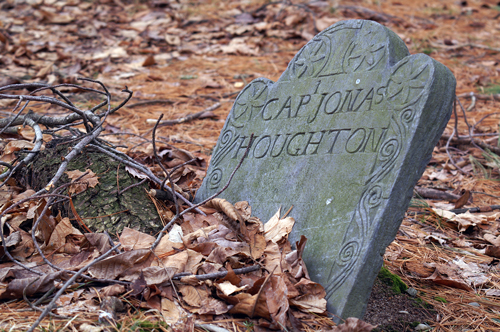
Beaman Oak

As of 1970, the Beaman Oak had a circumference at its base of 31 feet, a circumference five feet above the base of 19 feet, a height of 75 feet, and a spread of 75 feet.

The Beaman Oak, whose huge trunk was already partially hollow, was cut down after severe storm damage in 1989..

A short time after settlement, in 1733, the residents of the Chocksett area requested its own incorporation, separate from Lancaster, due to the “great inconvenience” of a long distance to the church in Lancaster’s center. This request was denied. However, by 1780 the population of Chocksett was so numerous as to constitute a majority, and so the voters of the area voted out the existing Lancaster town officers and began to conduct town business and meetings in Chocksett. This was enough to convince the rest of Lancaster that it was now time for Chocksett, the Second Parish of Lancaster, to go its own way.

Gamaliel Beaman was the first person to be buried in Sterling Centre.

Here Lies buried the Body of Mr. Gamaliel Beaman who died October 26th, 1745; in ye 61st Year of his Age.

In 1781, Chocksett was incorporated as its own town: Sterling. The town derives its name from General William “Lord Stirling” Alexander, a Scottish expatriate, who served valiantly under Gen. George Washington in the New York and other campaigns. His portrait hangs in the town hall, and the town commemorated Alexander with a medallion during its bicentennial celebration in 1976.

4. Sarah HOUGHTON (See Francis RICHARDSON‘s page)

5. Benjamin Houghton

Benjamin’s wife Zerviah Moore was born 1700 in Bolton, Worcester, Mass. Her parents were John Moore and Hannah Sawyer. Zerviah died in 28 Feb 1764 – Sterling, Worcester, Mass.

Benjamin is buried at  Chocksett Burial Ground  in Sterling, Worcester County, Massachusetts. Plot: Section S

Benjamin Houghton - Headstone

Hear (sic) Lies Buried the Body of Mr. Benjamin Houghton who Departed this

Life February ye 28, 1764 in Ye 74th Year of His Age.

“When death unto you calls, Your soul Resine you must,

To God that judgeth all, Both Wicked and the just.

Death is a debt to Nature due, Which I have paid and so must you.”

This, the oldest cemetery in Sterling, was set aside ca 1736 as the burial ground for the

“Second Precinct of Lancaster,” or “Chocksett” as the Town was called before incorporation in 1781. It lies between Clinton Road (route 62) and Maple Street, almost in the center of the Town.

The first five settlers to Chocksett in 1720 are buried here: Gamaliel Beaman; Benjamin Houghton; Samuel Sawyer; the brothers David and Jonathan Osgood, as well as many of their descendants; and Colonel Asa Whitcomb, a Revolutionary War leader. Sadly, many of the graves are for very young children, often more than one of the same family, who died during epidemics which took many lives in the 1700’s.

6. Daniel Houghton

Daniel’s wife Lydia Bruce was born in 1694 or 13 OCT 1702 Framingham, Mass. Her parents were John Bruce and Elizabeth Furbush. Lydia died 22 Oct 1752 – Lancaster, Worcester, Mass.

7. Eunice Houghton

Eunice’s husband Capt. Ephraim Sawyer was born 1694 in Lancaster, Worcester, Mass. His parents were Nathaniel Sawyer and Mary Wilder (or Carter). Ephraim died 8 May 1759 in Lancaster, Worcester, Mass

8. Josiah Houghton

Josiah’s first wife Mehitable Warner was born 1699 in Lancaster, Worcester, Mass. Her parents were John Warner and Sarah [__?__]. Mehitable died in 1725.

Josiah’s second wife Grace Whitney was born in 1709. Grace died 6 Jun 1763.

9. James Houghton

James’ wife Mary Jones was born 8 Mar 1700 in Concord, Middlesex, Mass. Her parents were Nathaniel Jones and Mary Reddit. Mary died 17 Jan 1749 in Worcester, Mass

10. Ruth Houghton

Ruth’s husband Richard Wilds was born about 1697 in Lancaster, Mass.

11. Dorcas Houghton

Dorcas’ husband Ebenzer Polley was born 20 Oct 1693 in Woburn, Middlesex, Massachusetts.  His parents were George Polley and Mary Knight.  His grandparents were our ancestors George POLLEY and Elizabeth WINN.

Although Lancaster had been incorporated originally on 18 May 1653, it was practically destroyed during King Philip’s War (1675-76) and virtually abandoned for a number of years. Negotiations with the Indians resulted in a new deed of purchase in 1701. Resettlement got underway over the ensuing decade, with town meetings, etc. being recorded as early as 1711 indicating a viable community was developing.

In 1725 a number of Lancaster residents ventured a few miles farther north and began to build houses in what is now the town of Leominster. One of those settlers of Leominster is documented as Ebenezer Polley. Leominster was formally incorporated on 23 June 1740. At the first town meeting in the newly created town of Leominster, on 9 July 1740, N.S., Ebenezer Polley was chosen as one of the Assessors and was also selected as one of the deer reeves.

At the second town meeting, Ebenezer Polley was chosen to be the moderator. The major item of business at this particular meeting was the vote to build a bridge (The Great Bridge) across the Nashua River. This second meeting occurred on 1 September 1740 at the home of one Benjamin Whitcomb.

During his residence in Lancaster the following anecdote is recorded regarding Ebenezer Polley:

Edward Smith, a minor and bound apprentice to Ebenezer Polley, both of Lancaster, was accused of stealing from his master in the night time.  He confessed his guilt, but as Polley had reclaimed all the stolen property except the value of 3 pounds, 3 shillings, he insisted only on restitution to that amount. Smith was sentenced to pay the King £3 or be whipped ten stripes, and pay costs and fees, 5 pounds, 5 shillings, 6 pence.  Moreover he was to pay his master 9 pounds, 9 shillings, or triple the loss. Being unable to pay, but “humblly desiring of his master to pay the same”, it was ordered that he should serve his master two years after coming of age, or his heirs or assigns. Polley was, besides his board, to find him in needful  clothes.

As the people of Leominster were organizing, one of the principal tasks was to organize a church. This included finding a place of worship, procuring a minister to serve their needs and establishment of a covenant (similar to a set of by-laws). The First Parish or First Church was established in 1742. The Rev. Mr. John Rogers was installed by a council of neighboring churches and ministers on 14 Sep 1743,  as its pastor. On the same day a group of sixteen male members signed the covenant formally establishing the church. Ebenezer Polly, Sr. was one of the signatories. The church was later known as the

First Congregational (Unitarian) Parish.

Children of Dorcas and Ebenezer:

i. Joseph Polly b. 3 Sep 1728 in Lancaster, Worcester, Massachusetts; d.  28 Feb 1806, in Fitchburg, Worcester, Massachusetts.; m. Dorcas Coburn 1 Mar 1748, in Leominster, Worcester County, Massachusetts.

Joseph Polley moved with his family to a newly developing part of town in 1733. This section was to be eventually incorporated as the town of Leominster on 23 June 1740  It was here in Leominster that Joseph married Dorcas Colburn on 1 March 1748/49 and raised a family of at least eight children between 1749 and 1766.

Before his marriage, Joseph is recorded as participating in at least one event of the French and Indian War. In Hurd’s History of Worcester County, 1889, page 1236, it is indicated that Leominster’s quota of troops was 36 and among them was Joseph Polly. It further quotes from a certain muster roll as follows:

A muster Roll of a foot Company, commanded by Thomas Wilder, of Leominster, detached out of Col. Oliver Wilder’s regiment, that marched on the Alarm for the relief of Fort William Henry as far as Springfield. Gone 14 days.

Captain Thomas Wilder, Lieutenant Samuel Nourse, Ensign Josiah Bayley,Sergeant Nathaniel Page, …, Joseph Polley, (et al). Sworn to at Worcester, January 8th, 1758 by then Capt. Thomas Wilder.

It is interesting to note that Joseph Polley is listed in the Index of Revolutionary War Patriots published by the Daughters of the American Revolution (D.A.R.) on p. 539. He is shown as a fifer from Massachusetts. On examination of the actual application, it was noted that the statement of the patriot’s military activity in support of the Revolution was a verbatim copy of the above quote regarding the march of Wilder’s Company to Fort William Henry, an action clearly in support of the French and Indian War.

However, on examination of actual Revolutionary War records in the name of Joseph Polley, one finds that there are two short, overlapping periods of time when Joseph Polley was either in two places at once or there were two different Joseph Polleys. Since the former case is not reasonable, if the records are accurate, one must conclude the latter case is fact. The most likely men are Joseph Polley and his second son Joseph. Joseph’s sons Ebenezer and John served during the Revolution as well.

The date, place and circumstances of Joseph’s death are not well documented. The war records for Joseph and his son Joseph, taken in conjunction with those for Ebenezer and John, suggest that the senior Polley died in early 1776. The D.A.R. application based on Joseph Polley, Sr., states that he died in 1776 at “Number 4 New H.” A town history from Gilsum, New Hampshire, speaking about Jacob Polley, son of Peter Polley and grandson of Joseph, Sr., states, “His father [referring to Peter] died in Charlestown No. 4 of wounds received from the Indians.” No date is given. Charlestown is in Sullivan County, NH, close to Acworth, where Peter is supposed to have moved in 1816.

It is unlikely that the death of Joseph, Sr. resulted from the French and Indian War. With respect to the Fort William Henry episode, although it fell to Montcalm (9 August 1757) and many were massacred by the Indian allies of the French, the foot company from Leominster all returned according to testimony of the former captain, Thomas Wilder. (This is recorded in D.H. Hurd’s History of Worcester Co., 1889, pp. 1236-1237.) It is known that certain Indians fought for the British during the Revolution, although the Gilsum history in no way implies that the death of Joseph, Sr. was in any way related to the Revolution.

The fact that Joseph Polley, Sr. is said to have died in New Hampshire has given rise to a misstatement of the facts concerning his Revolutionary War service since there was another Joseph Polley who did indeed fight in New Hampshire. The misstatement is recorded in the 3 February 1944 issue of the Watertown (NY) Daily Times, p. 12, in a story regarding the death of Charles Sheldon Polley, a great-great-grandson of Joseph, Sr. The badly written story, besides citing the wrong father for Charles Sheldon, describes certain New Hampshire service for Joseph, Sr., giving as the patriot’s date of birth the birth date of his son, Joseph, Jr., instead. The dates of service and the cited officers are identical to those cited in Widow’s Pension file W4759, BLWT 3758-160-55. This particular Joseph Polley was first married to a Mary Johnson and then to a Rebecca (Canfield) Crawford. He died at Bridgeport, CT on 11 July 1843 at age 88. Clearly this was not Joseph Polley, the father of John, Joseph, Ebenezer, Peter, Elnathan, et al.

In Vol I of the Revolutionary War Rolls for New Hampshire, p. 605, it is indicated that a Joseph Polley mustered in to Captain Ebenezer Frye’s Company in February 1777 and was paid $14 for travel to Charlestown No. 4. The significance of the place name is given in the book “History of Charlestown, NH,

The Old No. 4.” In 1738 four townships were laid out along what is now the border with Vermont. They were named and numbered from 1 to 4, running from South to North: Chesterfield, Westmoreland, Walpole, and Charlestown. The first three are in what is today Cheshire County, NH. Charlestown is in Sullivan County. In Vol II, p. 715, of the Revolutionary War Rolls for New Hampshire, it is indicated further that a Joseph Polley, a drummer, was with the First New Hampshire Regiment, commanded by Col. Joseph Cilley, prior to 1 January 1780 and then having some additional service in the year 1780. The latter reference further documents this service by quoting a Windham (Rockingham Co.), NH bounty payment to a Joseph Polley on 30 April 1777, to wit:

Rockingham County, Windham, April 1777. We the subscribers do acknowledge to have recd of the selectmen thirty pounds each as a bounty from this town for three years service in the Contl Army for the term of three years.

We say rec’d by us. s/ James Gilmore

s/ James Wilson

s/ James Brown

s/ Joseph Polly

Sworn to March 3, 1780 before James Belton (ed.)

These certify the selectmen of Windham gave a note for thirty pounds to the within Joseph Polly for his enlisting in the Contl Army and that they paid the note to me.

s/ Timothy Ladd

The Joseph Polley whose service is cited above and who is often confused with Joseph Polley, Sr. of Fitchburg, MA, is believed to be the son of John Polley and Jemima Nichols, born 20 August 1756, in Medford, MA.

It would appear that the previously cited D.A.R. application, dated 28 Mar 1910, got its information about Charlestown No. 4 from the “History of Gilsum, New Hampshire,” published in 1881, and both are erroneous with regard to the place and circumstances of the death of Joseph Polley, Sr.

The Index to Worcester, MA wills for 12 Jul 1731 to 1 Jul 1888 (LDS microfilm No. 0850169) indicates a will being probated for a Joseph Polley in Fitchburg, MA in 1777 (Item #47266) and another being probated in Fitchburg in 1806 (Item #47267). These are most likely the wills of Joseph, Sr. and his son Joseph.

Worcester Probate Records, Series A, Vol 39, 1809-1811 (LDS microfilm No. 0856321), shed additional light on the demise of both Josephs. At pages 229 and 310 respectively, one finds the dower for Dorcas and Eunice Polley (widows of Joseph, Sr. and Joseph, Jr.) being set off and documented by a court appointed commission. The first is done for Dorcas, at the behest of Eunice. It is signed off as approved on 20 Sep 1810 by the guardian to Dorcas Polley, William Kendall. Then immediately after, during October 1810, the dower for Eunice is set off and documented. Both documents cite wills for the two Joseph Polleys.

A third action on the last cited microfilm, from Worcester Probate Records, Series A, Vol 38, 1809-1811, on page 503, is the inventory of the estate of Dorcas Polley dated 12 October 1810. The three documents paint a picture that the lands of the two Josephs were continually occupied following their respective deaths by their widows and whoever they had working the land. Dorcas had apparently taken ill, gone feeble or was in some way incapacitated, requiring a guardian. The estates of the two Josephs apparently had not yet been settled, at least not totally. Eunice probably realized she would save a lot of legal trouble if she settled the estates before Dorcas died. It appears she accomplished her task in the nick of time! The fact that Dorcas appears to have died in 1810 casts doubt on the Fitchburg town record, p.303, that says she died in 1812. However, it would not be the first time a town record was mis-transcribed.

The foregoing discussion also fixes an initial time when Eunice Polley may have gone off to Massena, NY, sometime after 1810. A widow, having sold off her land, going off to live with one of her children, is a very plausible scenario.

12. Jemima Houghton

Jemima’s husband Samuel Carter was born 1703 in Lancaster, Worcester, Mass. His parents were Rev. Samuel Carter and Dorothy Wilder. Samuel died 20 May 1761 in Lancaster, Worcester, Mass

Sources:

http://trees.ancestry.com/owt/person.aspx?pid=5280410

http://www.craw.us/crawfords/massachusetts/WelchLancaster.html

http://newenglandgenealogy.pcplayground.com/b_h.htm

http://www.theharmons.us/harmon_t/surnames.htm#-H-

http://familytreemaker.genealogy.com/users/s/p/o/Russell-E-Spooner/BOOK-0001/0002-0016.html#CHILD134414595

http://genforum.genealogy.com/polly/messages/100.html

Posted in 11th Generation, Be Fruitful and Multiply, Historical Monument, Line - Shaw, Pioneer, Veteran | Tagged | 8 Comments

Enos Hunt

Enos HUNT (1605 – 1677) was Alex’s 11th Great Grandfather, He is one of4,096in this generation of the Shaw line and one of 2,048 in the Miller line.  (See his grandson Thomas BROWNE for details of the double ancestors)

Enos Hunt - Coat of Arms

Enos Hunt was born 27 Jan 1605 in Halifax, Yorkshire, England. Also know as William Hunt.  His parents were  Robert HUNT  and Jaine FYSHER.   His brother was William Hunt. He married  [__?__] around 1629 in England.   Enos died in Oct 1677 in Marlboro, Mass.

The name of Enos’ wife is not known.

Children of Enos and [__?__]:

Name Born Married Departed
1. Mary Hunt c. 1630
England
John Grant (Son of Thomas GRANT)
1652 – Ipswich, Essex, Mass
16 Feb 1697 – Rowley, Essex, Mass
2. Susanna Hunt 1632 in Bradford, Yorkshire, England 1637 in Rowley, Essex, Massachusetts
3. Ann HUNT 17 May 1635
Ipswich Mass.
Thomas WOOD
7 Jun 1654 or
30 Aug 1651
Rowley, Mass
29 Dec 1714 in Rowley
4. Susannah Hunt c. 1635
Ipswich, Mass
John Todd
1650 in Rowley, Essex, MA.
18 Nov 1710 in Rowley, Essex, Mass

x

Children

1. Mary Hunt

Mary’s husband John Grant was born 5 Mar 1627/28 in Cottingham, Yorkshire, England. His parents were Thomas GRANT and Jane HABURNE. John died 18 Mar 1695/96 Rowley, Mass.

3. Ann HUNT (See Thomas WOOD‘s page)

It’s not certain that Thomas’ wife Ann was the daughter of Enos Hunt. Because Thomas Wood in a deposition called John Todd “brother”, some have assumed that Ann was Ann Todd. The will of Mary Grant, widow of John Grant of Rowley, dated 2 Feb., proved 16 Feb 1697/98, discloses that Ann, wife of Thomas Wood, and Susanna, wife of John Todd, were sisters of the testator.

Richard William Cutter, states that John Grant married Mary Hunt but does not cite authority for the statement. It is probable that there is a relationship with the Hunt family of Concord and Billerica. When Mary Grant was granted administration on the estate of her husband, Samuel Hunt of Billerica and John Todd were the sureties on her bond; in her will Ann Todd “is to have one feather bed that Jeremiah lyes on. Jeremiah is probably Jeremiah Hunt.

4. Susannah Hunt

Susannah’s husband John Todd was born in 1627 in Ipswich, Suffolk, England. His parents were John Todd (Tidd) and Margaret Greenleaf. John died 14 Feb 1689 – Lexington, Middlesex, Mass.

John was elected as a representative from Rowley to the General Court.

Some sources say that John Todd’s wife Susanna Hunt was born at Bradford, York, England in 1621.

Sources:

http://www.wikitree.com/wiki/Hunt-80

http://familytreemaker.genealogy.com/users/f/r/e/Stuart-C-Freeman/GENE21-0059.html

http://search.ancestry.com/cgi-bin/sse.dll?db=greatmigrationindex&f3=jumptoJOSEPHREDDING

Posted in 13th Generation, Immigrant - England, Line - Miller, Line - Shaw | Tagged | 9 Comments