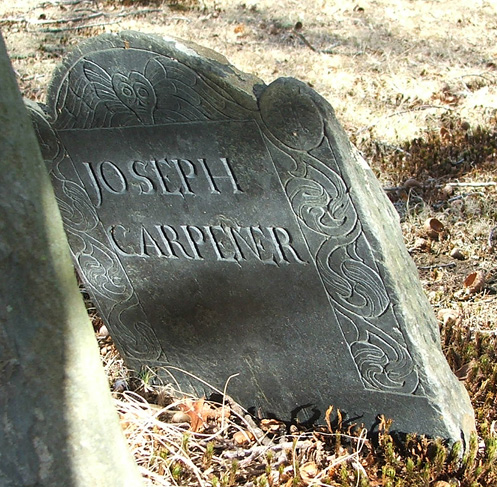
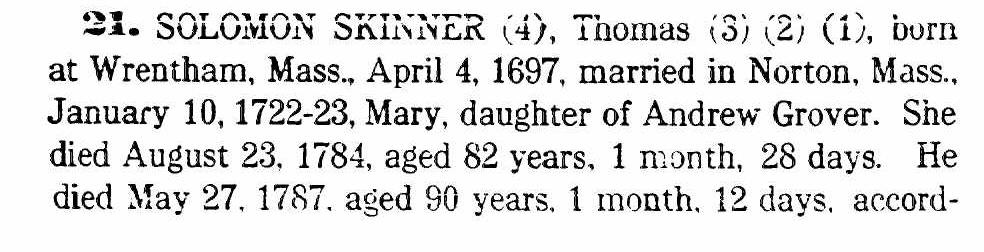
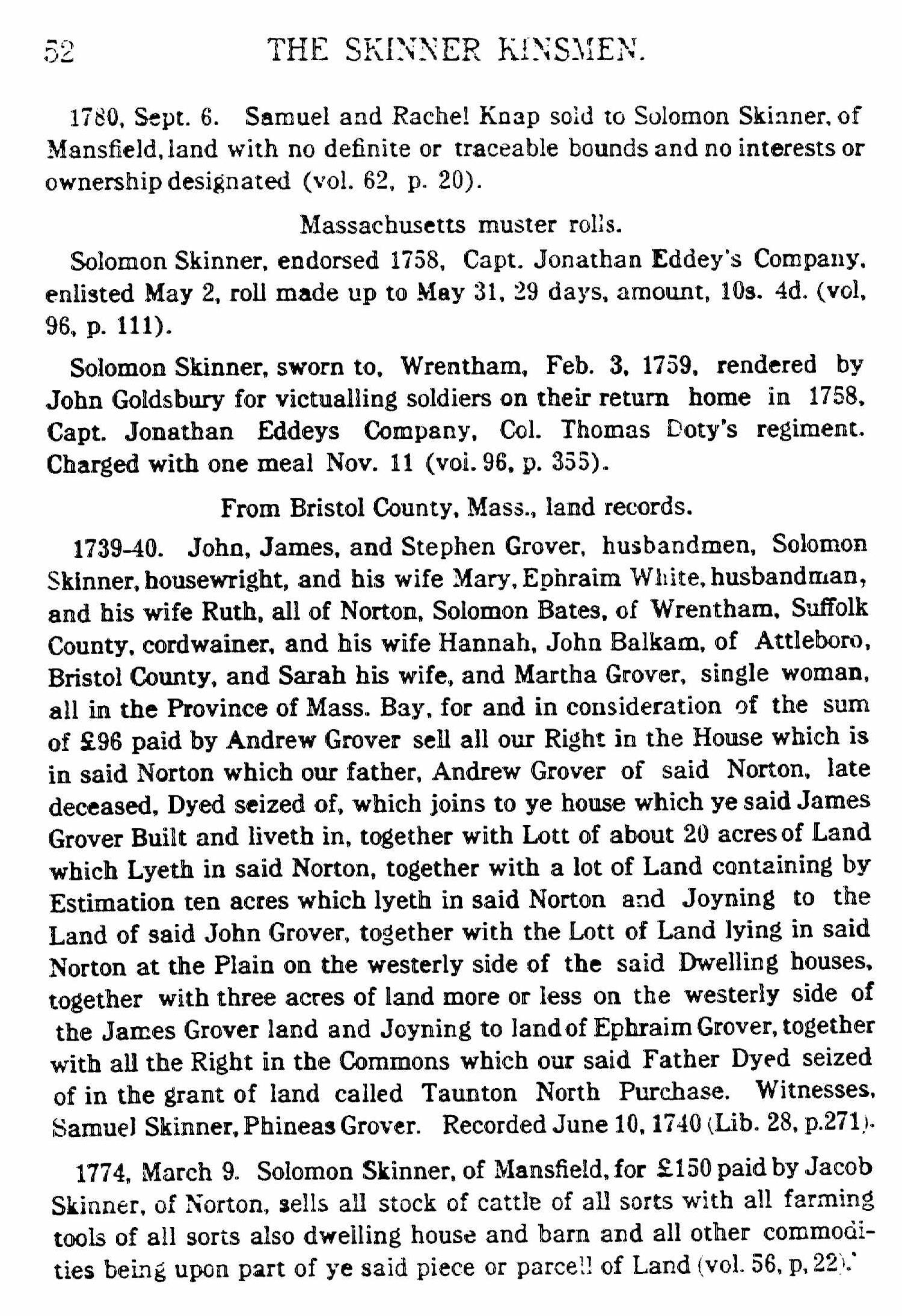
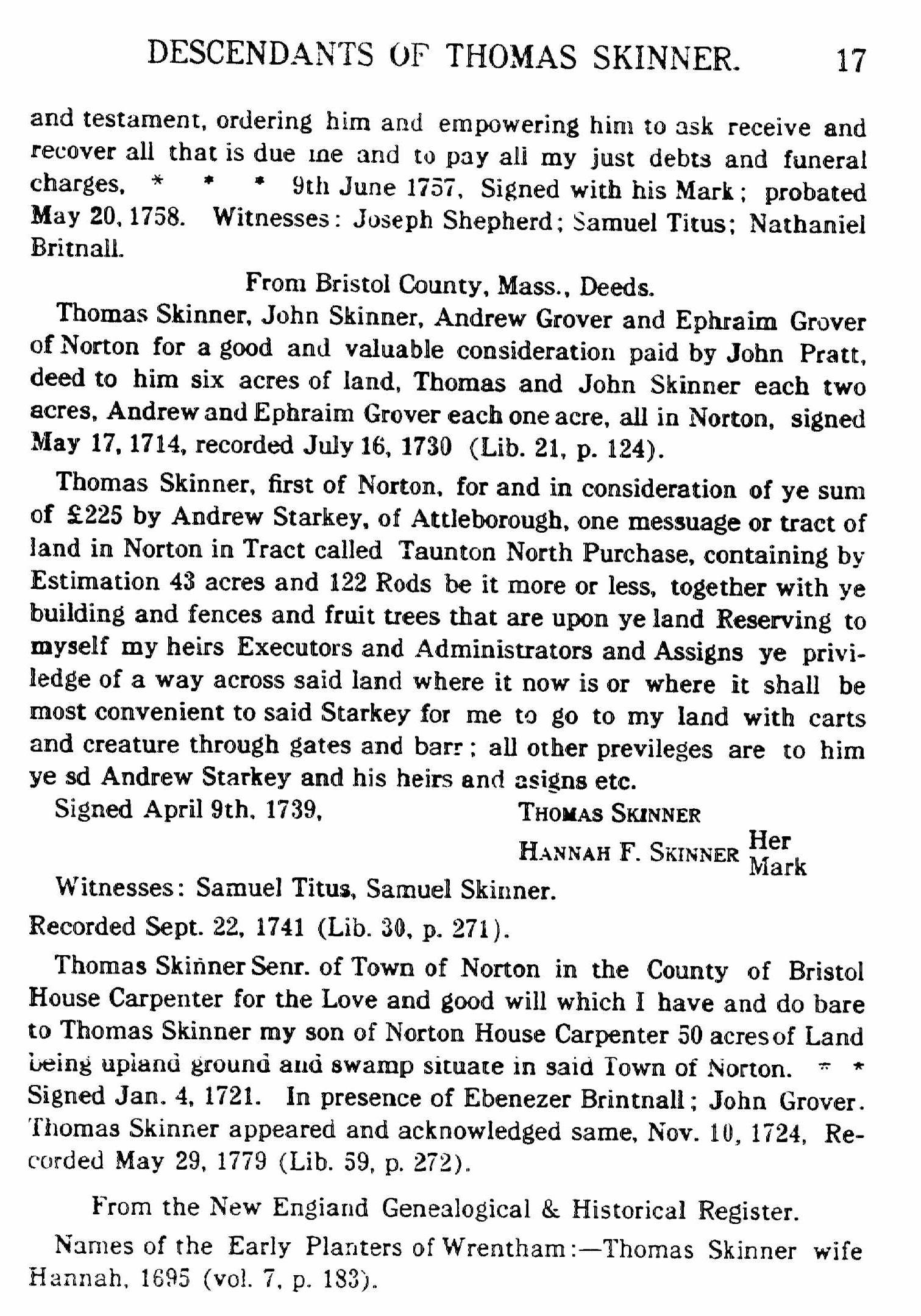
Thomas Skinner I

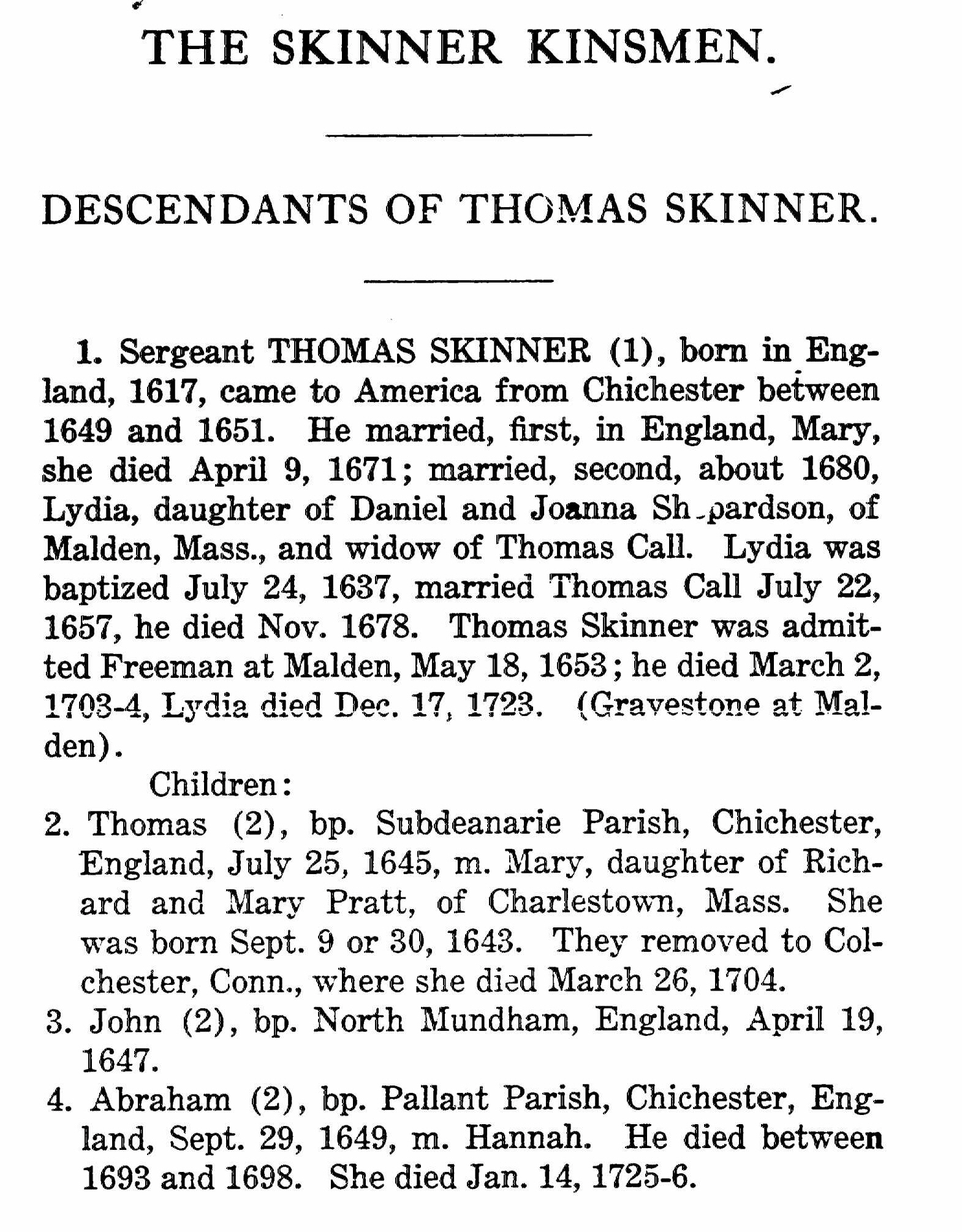
Thomas SKINNER I (1617 – 1704) was Alex’s 11th Great Grandfather, one of 4,096  in this generation of the Shaw line.

Thomas Skinner was born 1617 in Chichester, Sussex, England, He married (1)  Mary GODDEN in England.  He emigrated between 1649 and 1651, bringing his family with him and settled in Malden Mass. He married (2) Lydia Shepardson about 1680. Thomas died 2 Mar 1703/04 in Malden, Massachusetts.

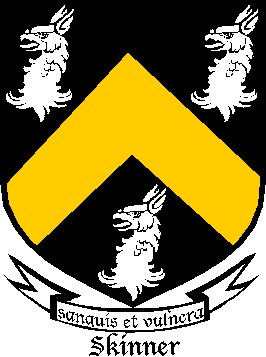
Thomas Skinner – Coat of Arms

Mary Godden was born 1621 in Chichester, Sussex County, England.  Her parents were William GODDEN and [__?__].  Mary died 09 Apr 1671 in Malden, Massachusetts.

Lydia Shepardson was born in 1619 in England.  Her parents were Daniel Shepardson and Joanna [__?__].   She first married Thomas Call Jr. [our ancestor  Thomas CALL’s   son]  on 22 July 1657 in Malden.  Lydia died 17 Dec 1723 in Malden, Massachusetts.

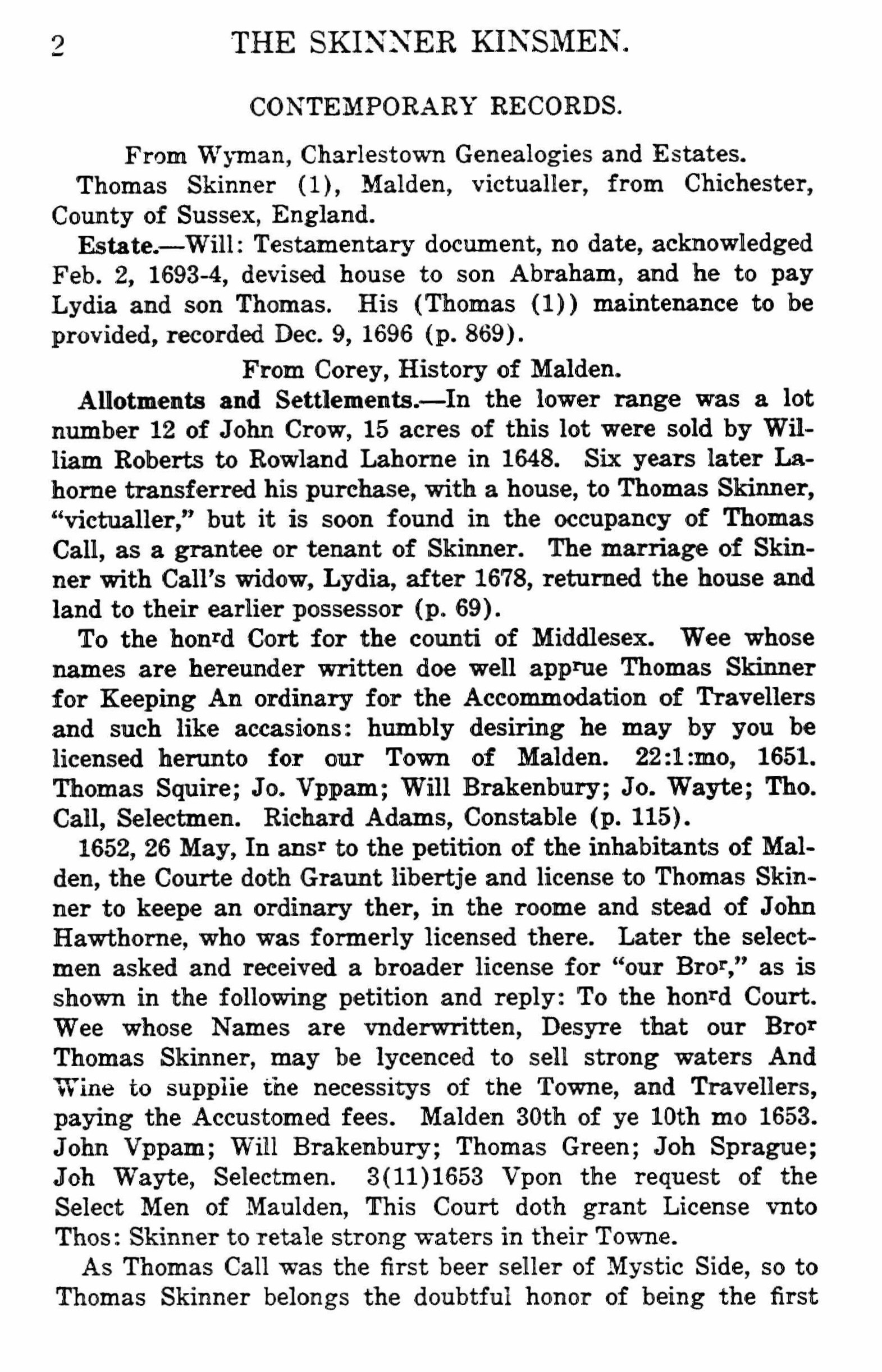
In 1651, Thomas received a license to maintain an inn and sell provisions in Malden. One of the selectmen voting on the license was Thomas Call, who sold beer in the Mystic side of Malden (but probably not far Thomas Skinner’s Inn).    Apparently, Thomas Skinner and Thomas Call were friends–Thomas Call rented a house from Thomas Skinner. Thomas Call died in 1678 at the age of 43. Thomas Skinner’s wife Mary died in 1671 and Thomas Skinner subsequently married Thomas Call’s widow, Lydia.

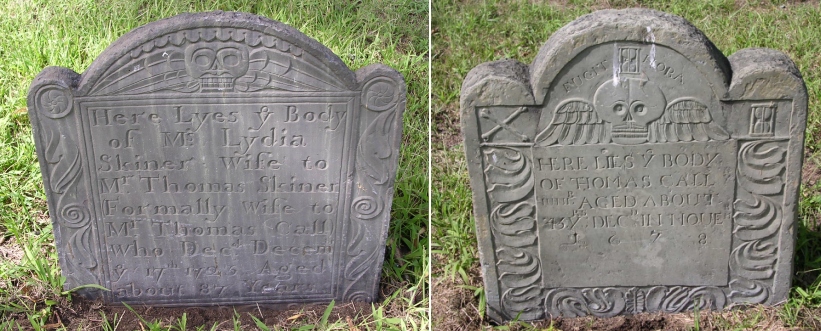
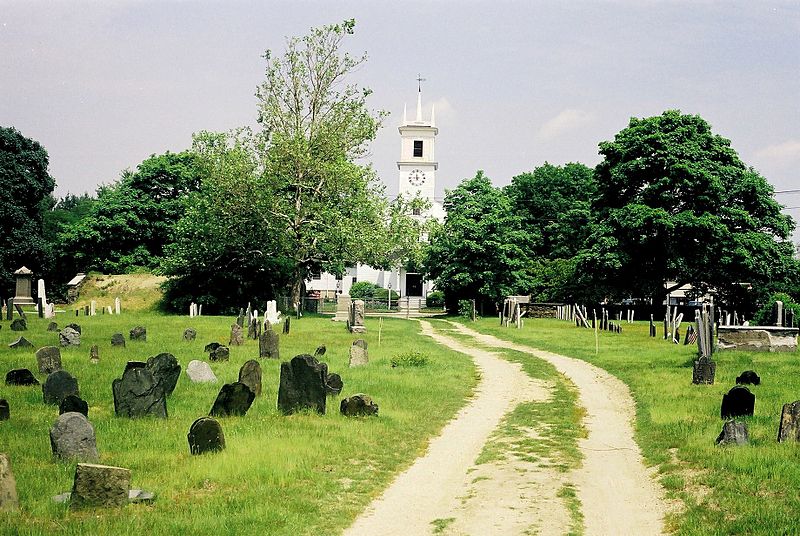
Lydia Skinner-Thomas Call graves – Bell Rock Cemetery Malden, Mass

Children of Thomas and Mary:

Name Born Married Departed
1. Thomas SKINNER II 15 Jul 1645 Subdeanerie Parish, Chichester, England Mary PRATT
1665/1666, Charlestown, Mass
26 MAR 1722/1723, Colchester,New London, CT
2. John Skinner 19 Apr 1647
North Mundham, England
8 Apr 1754
Colchester, CT
3. Abraham Skinner 29 Sep 1649
Pallant Parish, Chichester, England
Hannah Lewis
6 Mar 1680 in Malden, Mass
14 Jan 1726
Malden, Mass

Thomas is said to have been baptized at the Subdeanery parish, Chichester. Subdeanery Parish is a parish within Chichester Cathedral itself circa 1538 – Chichester St. Peter the Great (alias Subdeanery) (1558). The only proof that Thomas was ever living in Chichester is the record of his son John’s baptism at North Mudham in 1647.

Thomas had been a victualler (English innkeeper) in Chichester and was, on May 31, 1652, licensed to keep an ordinary in Malden.  He was admitted a freeman in Malden, May 18, 1653.

To the hon’d Cort for the counti of Midlesex – Wee whose names are herunder written doe well App’ue Thomas Skinner for Keeping An ordinary for the Accomodation of Travellers & such like accasions : humbly desiring he may by you be licenced herunto for our Town of Maldon [January 22, 1651/52] Selectmen Thomas Squire, Jo. Vppam, Will Brakenbury, Jo. Wayte. May 26, 1652: in ansr to the petition of the inhabitants of Maiden, the Courte doth graunt libertje and licence to Thomas Skinner to keepe an ordinary there, in the roome and stead of John Hawthorne,” who was formerly licensed there. Later the selectmen asked and received a broader license for “our Bro’,” as is shown in the following petition and reply: ‘Malden, 30th of ye 10th mo 1653. To the hon’d Court Wee whose Names are vnderwritten, Desyre that our Bror Thomas Skinner, may be lycenced to sell Strong waters And Wine to Supplie the necessitys of the Towne, and Travellers, paying the Accustomed fees.’ Selectmen John Vppam, Will Brakebury, Thos. Green, Job Sprague, Joh. Wayte. 3. (11) 1653. Vpon the request of the Select Men of Mauldon, This Court doth grant Licence vnto Tho: Skinner to retale strong waters in there Towne.”

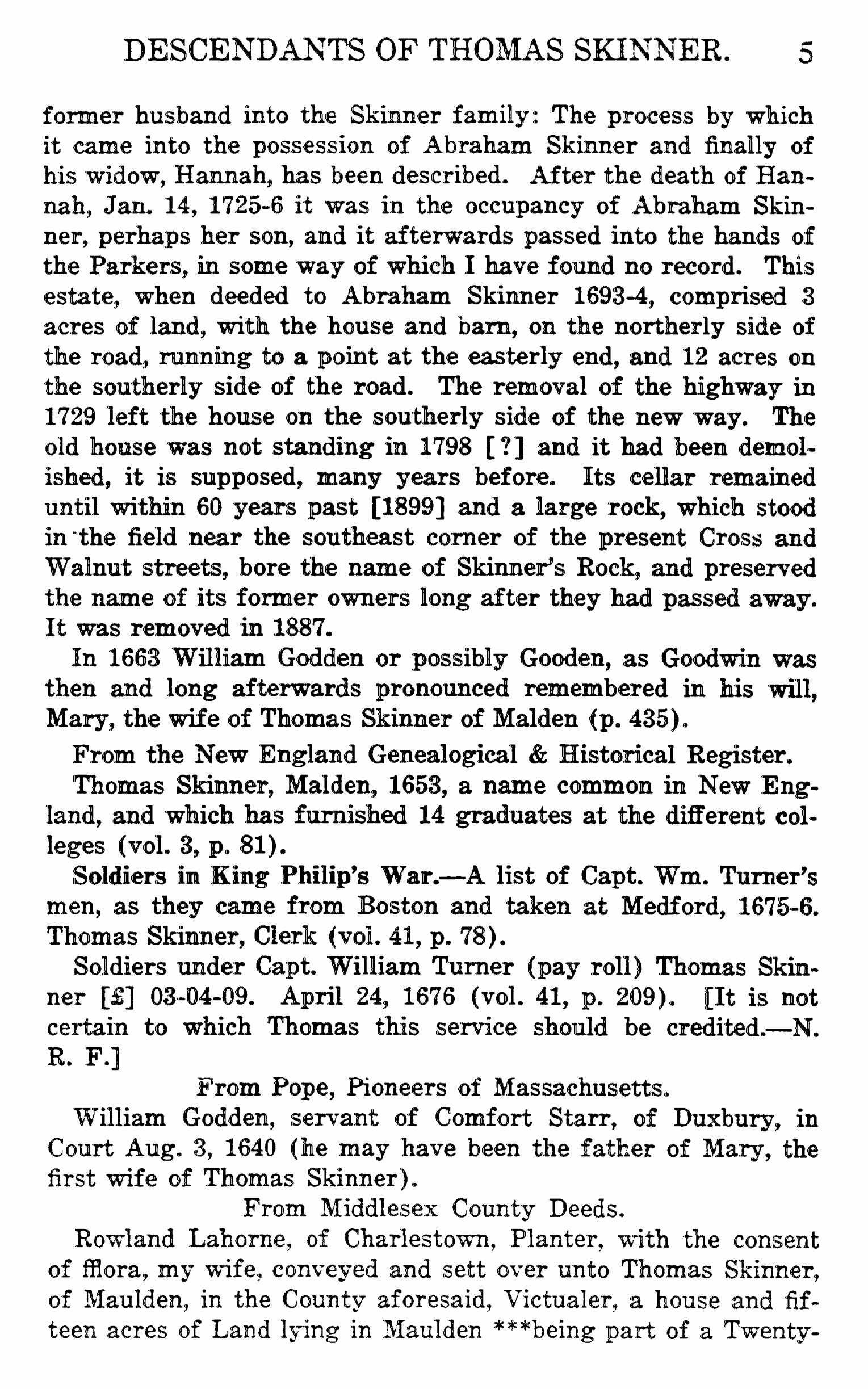
On May 26, 1652, Thomas received a license to operate an inn formerly licensed to a John Hawthorne, who had been convicted of forgery in neighboring Lynn, MA. It is unclear whether Thomas operated both inns or if he sold or abandoned his original venture. In 1654, a Malden property was transferred from a Roland Lathorne to Thomas Skinner who, in turn, rented it to Thomas Call. It was located near the corner of Cross and Walnut Street [Google Street View], about 5 blocks from Joseph Hills’ homestead. By 1657, Thomas Skinner retired from his inn-keeping occupation and the license to operate the inn and tavern was transferred to his eldest son, Abraham, on April 16, 1657. There are indications the Inn/tavern owned by Abraham was called the ‘Surf and Turf’.

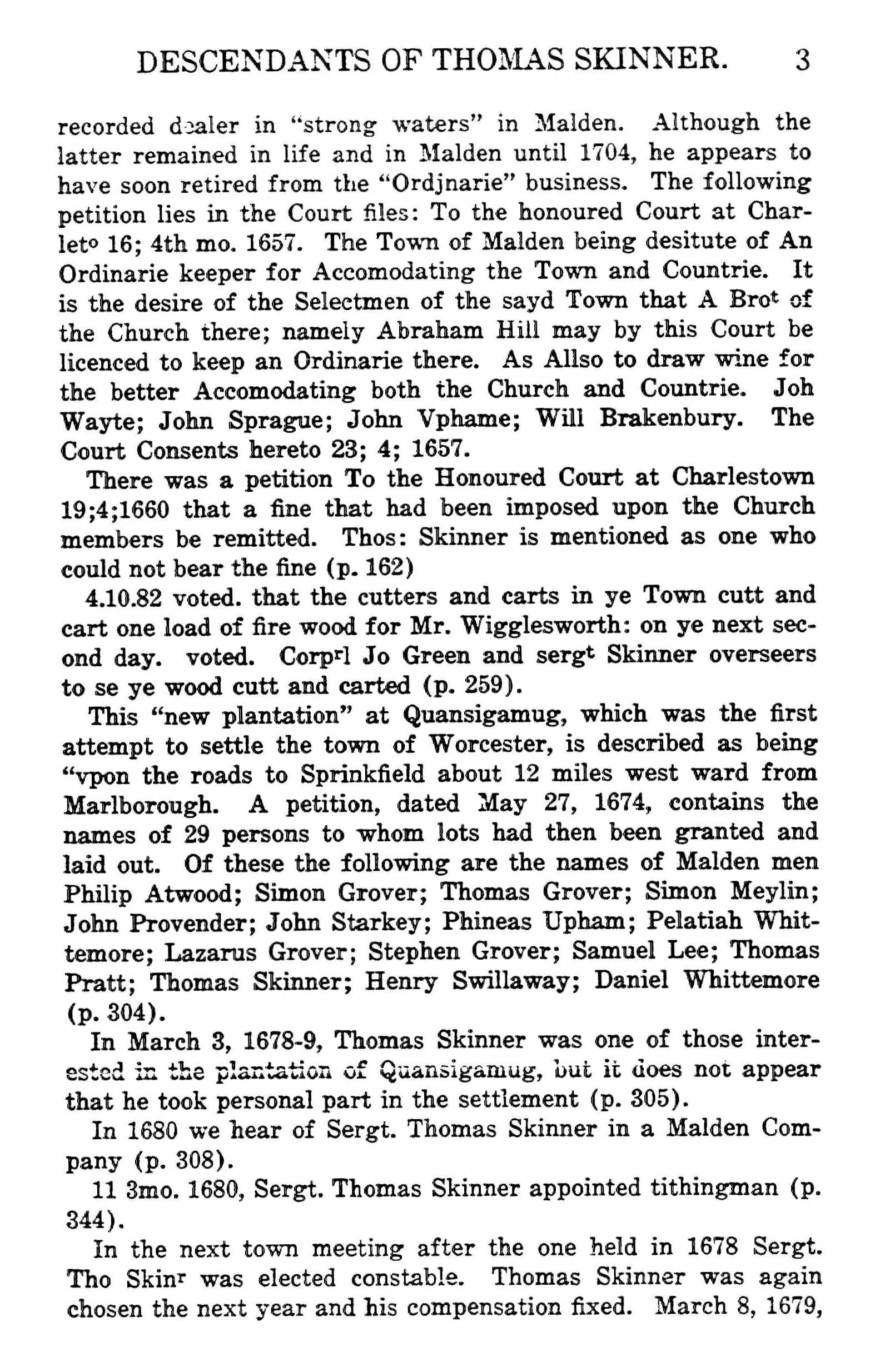
Although the Thomas remained in Malden until 1704, he appears to have soon retired from the “Ordjnarie” business. The following petition is in the Court files:

“To the honoured Court at Charlet. 16 4th mo. 1657: The Town of Maldon being destitute of An Ordinane keeper for Accomodating the Town and Countrie. Jt is the desire of the Selectmen of the sayd Town: that A Bro? of the Church there: namely Abraham Hill may by this Court be licenced to keep an Ordinarie there. As Aliso to draw wine for the better Accomodating both the Church and Countrie.”

In 1660 there is a record that Thomas was fined for not paying his church dues. He also did not have the money to pay the fine.

During the colonial period, the town functioned with only one constable, although two were chosen in 1678, Thomas Skinner served alone in 1679 and 1680. He was a selectman of Malden in 1680 and the same year was made a Sergeant of the Malden Company in the First Regiment of Major Gookin. The Middlesex Regiment, consisting of sixteen companies, was under the command of Major Daniel Gookin of Cambridge, who was commissioned May 5, 1676; but in 1680 it was divided, and Malden, with neighboring towns, formed the First Regiment under Major Gookin, while the western towns of the county were transferred to a new regiment under Major Peter Bulkley of Concord. In 1680 Sergeant Thomas Skinner was listed in the Malden company. Listed as Clerk, he served under Captain Wm. Turner 1675-76 during King Philip’s War. According to the payroll on April 24, 1676, Thomas Skinner, soldier under Capt. Turner was paid ₤3 4s. 9d. It is not certain which Thomas this was.

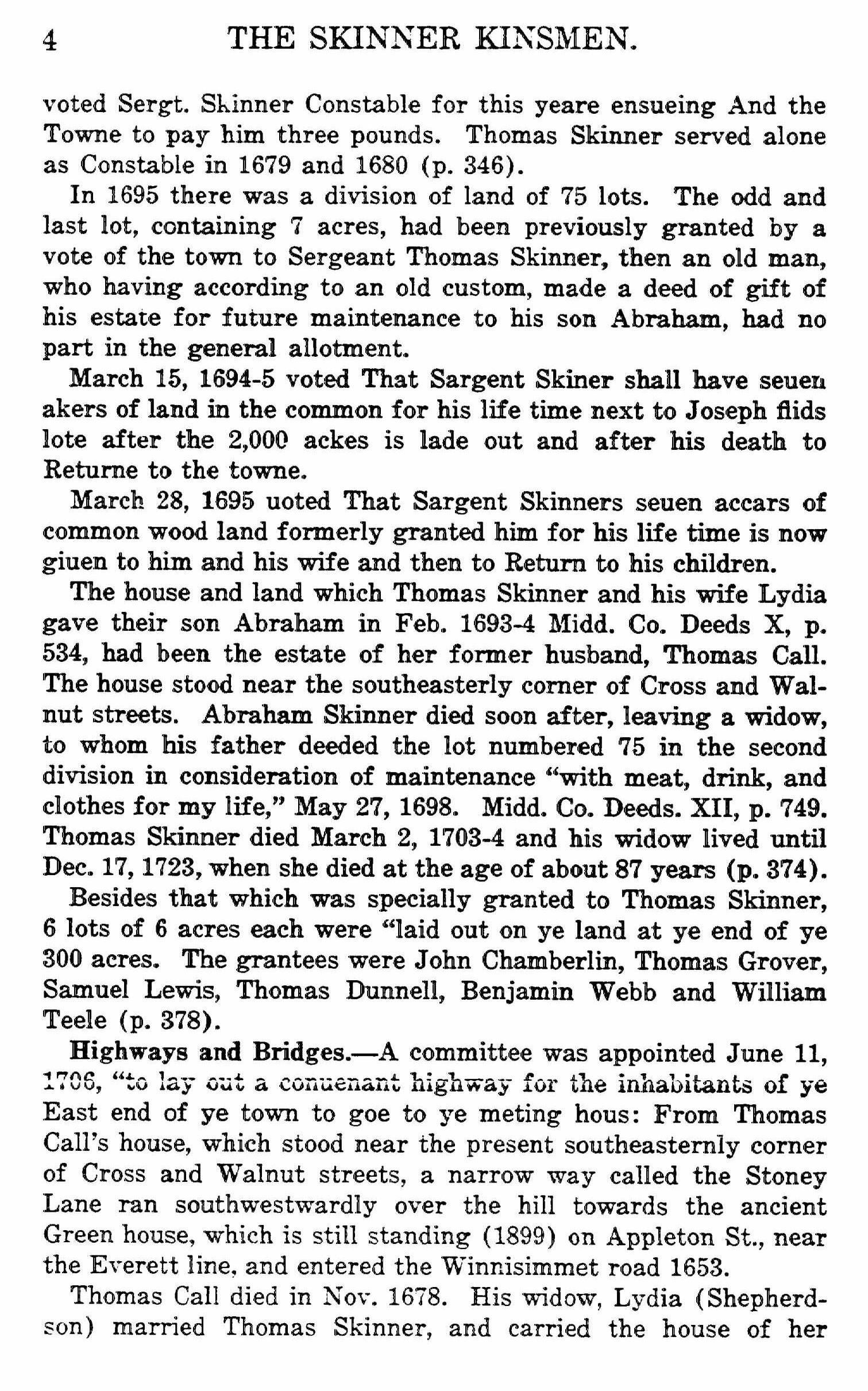
His house in Malden was situated at the southeast corner of Cross and Walnut Streets. It was given to his son Abraham on March 15, 1694/95. In March 1678/79 he was one of those signing as interested in settling Quansigamug but there is no proof that he ever lived there. Twenty-nine people were granted lots in Quansigamug, the first attempt to settle the town of Worcester.

On May 27, 1674, Thomas Skinner is one of a number of petitioners for a grant of land in an area called Quasigamug (now Worcester, MA). It does not appear that he ever moved to the new land grant, although on March 3, 1678, he appeared in the General Court of Massachusetts with 7 others concerning the December 2, 1675 burning of vacant houses located in the new land grant. As a result of the fires, the Worcester land grant was abandoned and was not resettled until 1684.

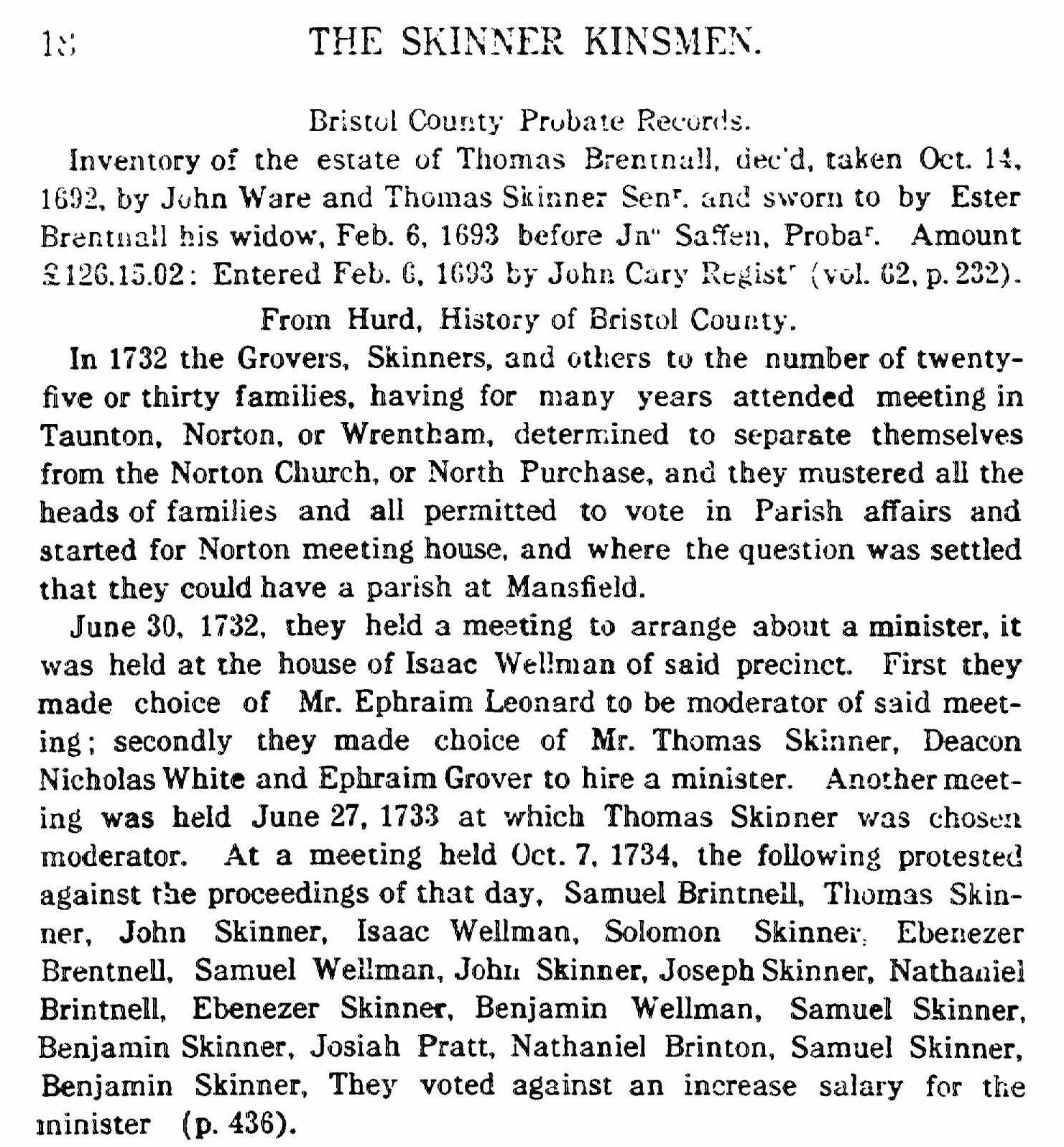
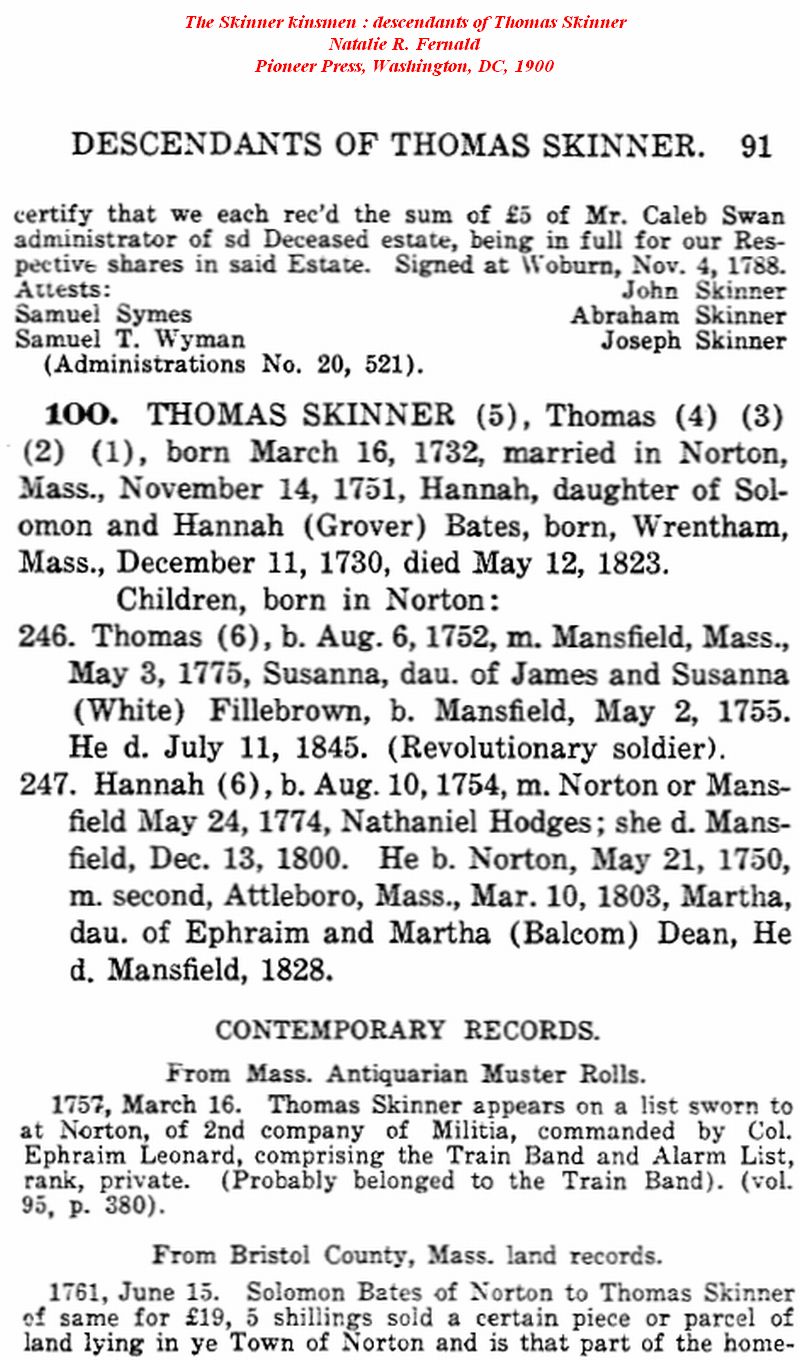
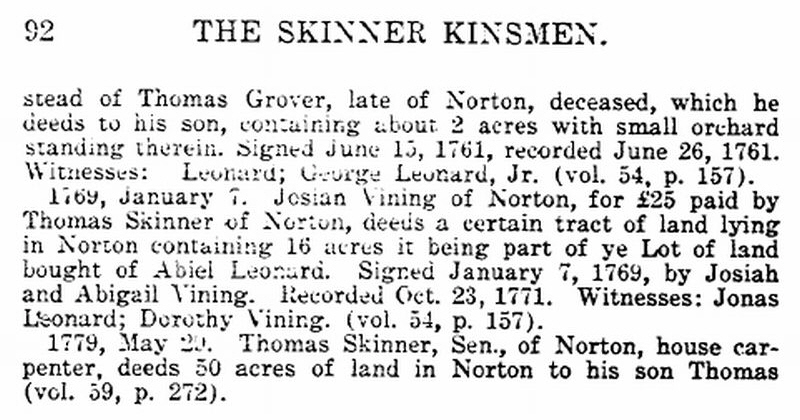
The Skinner Kinsmen states that Thomas sold his land and house to Thomas Call. When Call died, Thomas married his widow, Lydia Shepardson Call  and again owned the property. In Mar 1678/79 he was in Malden and was appointed tithingman. In 1678 he was appointed constable, pay three pounds. He also served in 1679/80. On Oct 4, 1682 the town voted that the “cutters and carts in ye Town cutt and cart one load of fire wood for Mr. Wigglesworth: on ye next second day. Corp’rl Jo Green and serg’t Skinner overseers to se ye wood cutt and carted.”

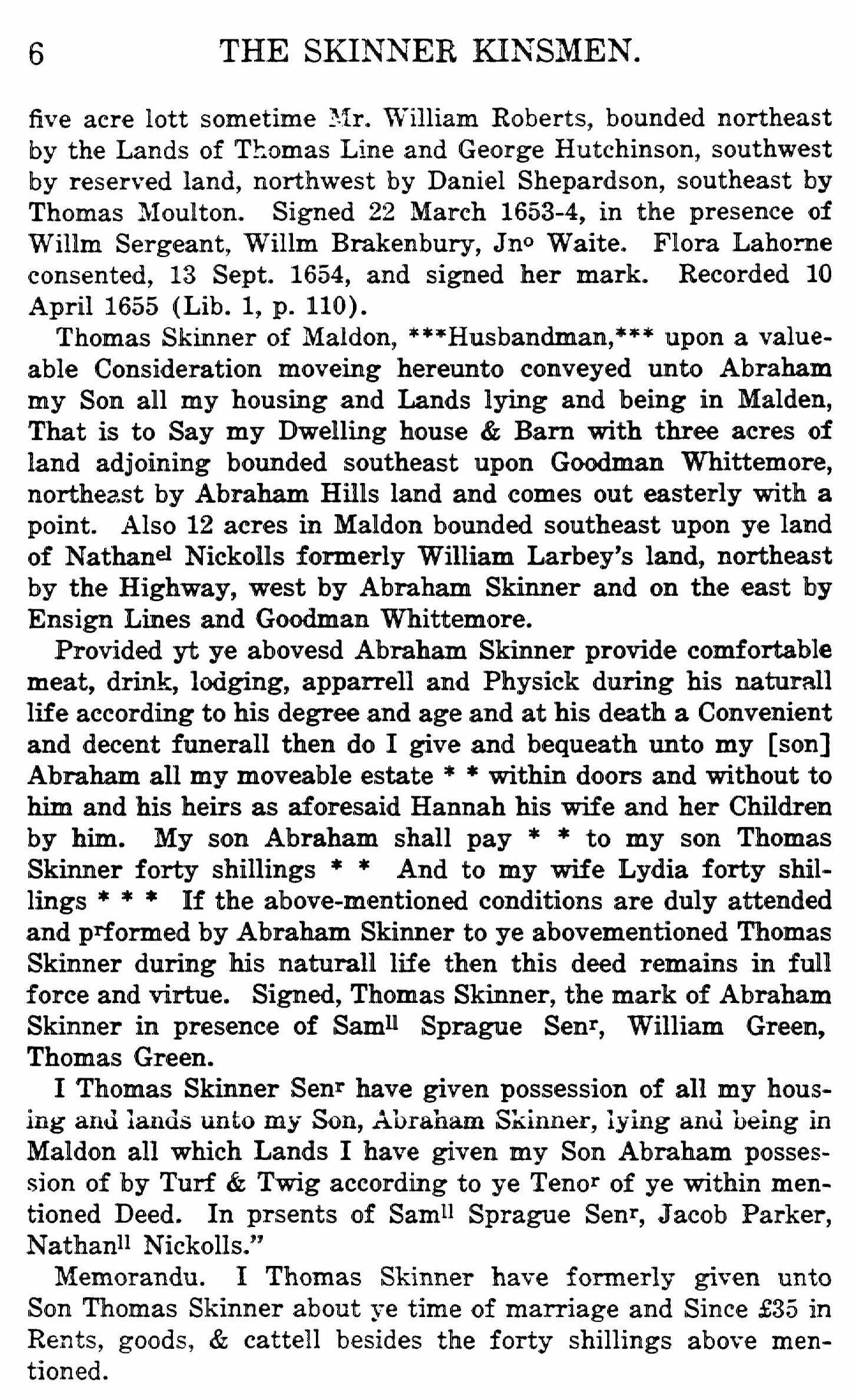
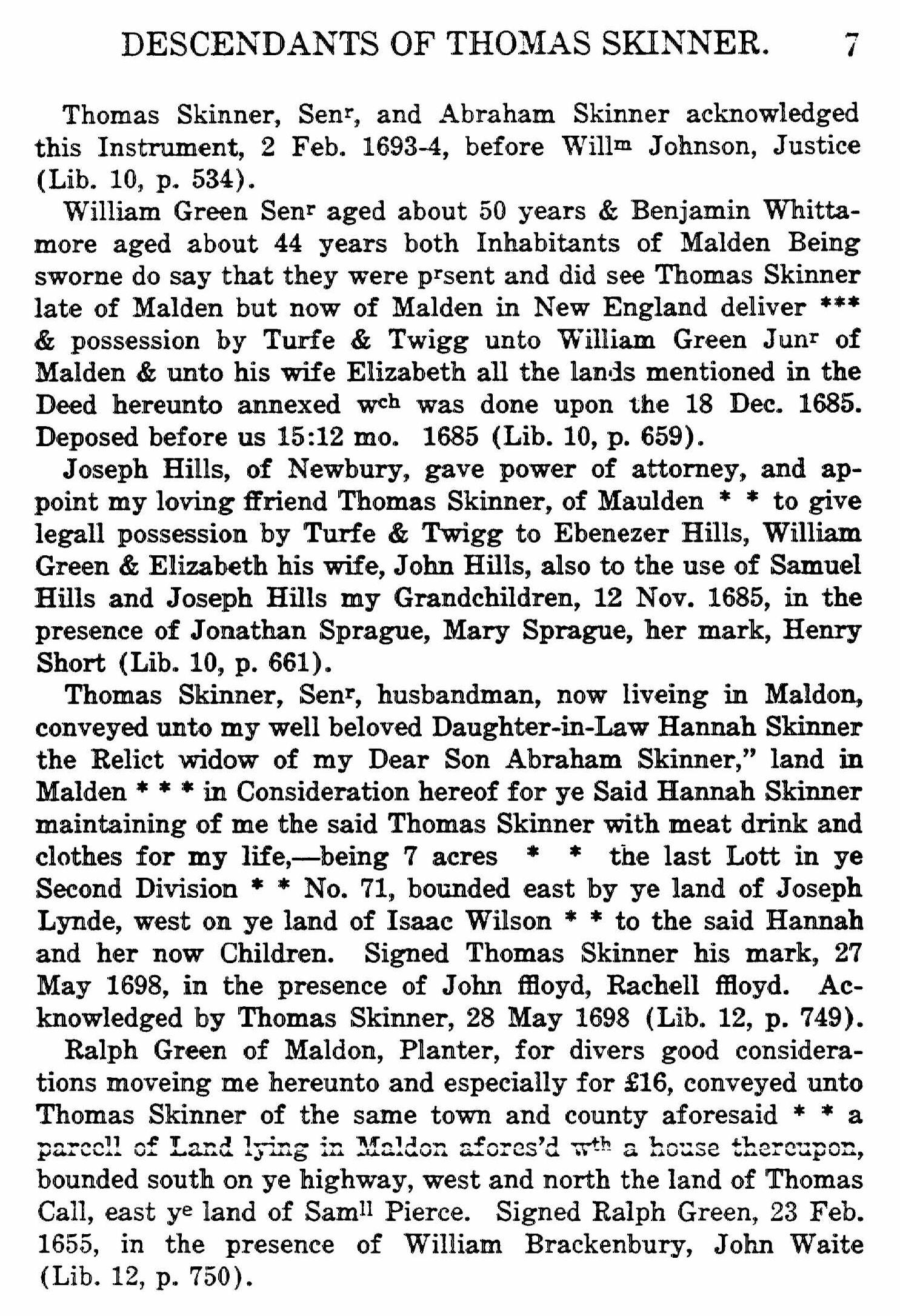
On Mar 15, 1694/95, the town of Malden gave Thomas, now an old man, a 7 acre allotment of land it had owned.  The town stipulated this allotment could be used by Thomas until his death, at which point ownership would revert back to the town of Malden.  It voted that “Sargent Skiner shall have seuen akers of land in the common for his life time next to Joseph flids lote after the 2,000 ackes is lade out and after his death to Returne to the towne.” On Mar  28, 1695, the town voted “That Sargent Skinners seuen accars of common wood land formerly granted him for his life time is now giuen to him and his wife and then to Return to his children.” This is the land which in 1695 Thomas, then an old man, gave to his son, Abraham, for future maintenance. Thomas’ will, undated, was acknowledged on Feb 2, 1693/94. He devised his house to his son Abraham, and he [Abraham] to pay Lydia and his son Thomas. His [Thomas] maintenance to be provided for. Recorded on Dec 9, 1696. The house and land that Thomas and Lydia gave their son Abraham in Feb 1693/94 had been the estate of Lydia’s former husband, Thomas Call. The house stood near the southeasterly corner of Cross and Walnut streets. Abraham Skinner died soon after, leaving a widow, to whom his father, Thomas, deeded the lot numbered 75 in the second division, granted in consideration of maintenace “with meat, drink, and clothes for my life,” May 27, 1698. .

Children

Of Thomas Skinner’s sons, only Deacon Thomas Skinner left Malden. He moved from Malden, MA to Colchester, CTat about the age of 53. Deacon Thomas was one of the original proprietors (settlers) of Colchester. Thomas’ two brothers, John and Abraham, lived in Malden until they died.

1. Thomas SKINNER II (See his page)

3. Abraham Skinner

Abraham’s wife Hannah Lewis was born 1655 in Chichester, Sussex, England. Hannah died 14 Jan 1726 in Malden, Middlesex, Mass.

Abraham  served with Capt. Prentice in the first Mount Hope Campaign, Sep 21, 1675, during King Philip’s War.  His son Abraham was his representative among the grantees of Narragansett No. 2 in 1732 that eventually became Westminster, MA.  Neither the father or son (or any other members of the family) moved to the new settlement..

Abraham married Hannah Lewis on March 6, 1680 and they had three sons and one daughter. The conventions used for naming children at that time indicate that Hannah’s last name was likely the source of three subsequent Skinner relatives with first names Lewis, including Lewis Bailey Skinner. Abraham and Hannah had three sons and one daughter.

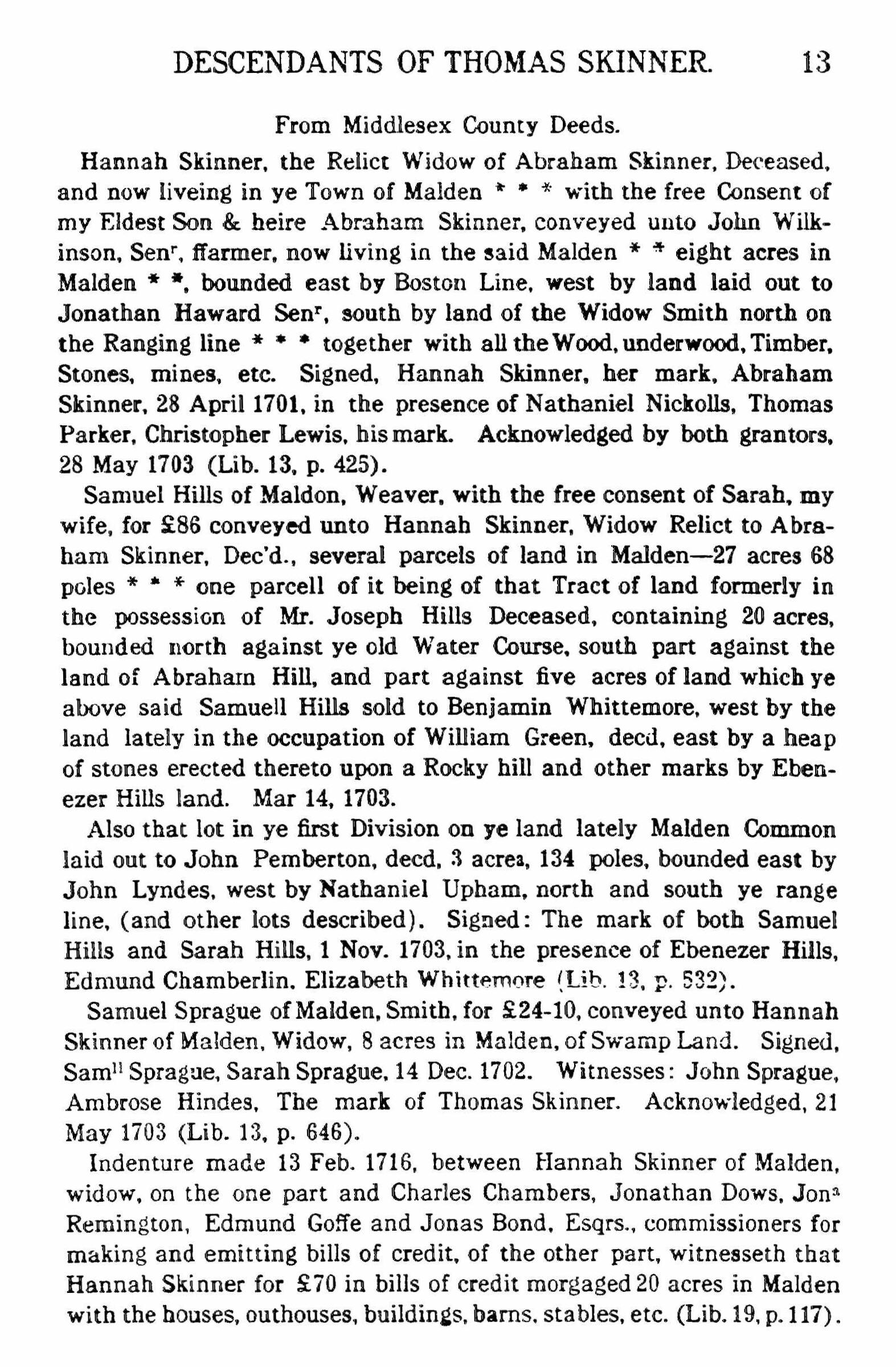
Indenture made 13 Feb. 1716, between Hannah Skinner of Malden, widow, on the one part and Charles Chambers, Jonathan Dows, Jon’a Remington, Edmund Goffe and Jonas Bond, Esqrs., commissioners for making and emitting bills of credit, of the other part, witnesseth that Hannah Skinner for £70 in bills of credit morgaged 20 acres in Maiden with the houses, outhouses, buildings, barns, stables, etc..

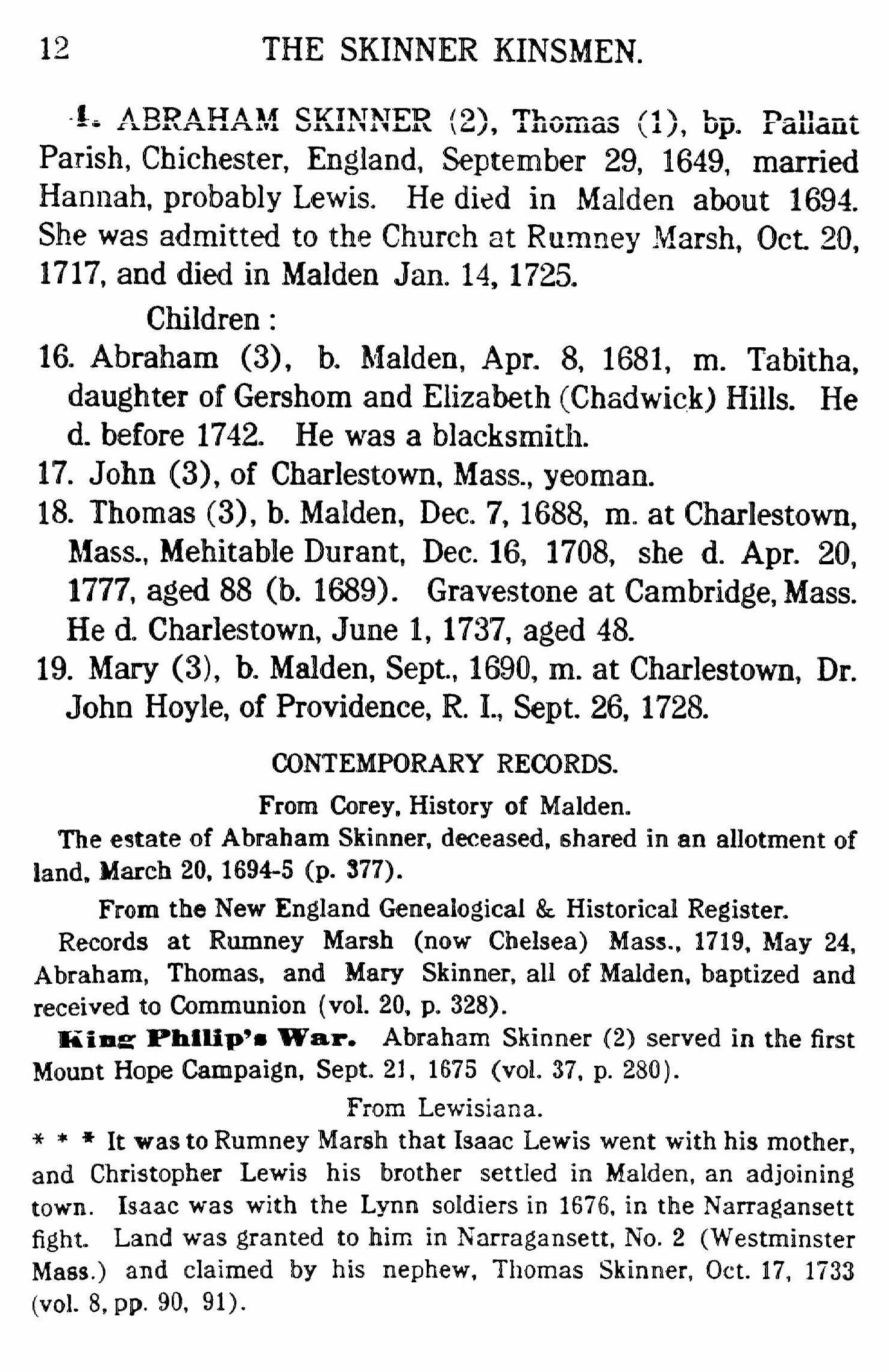
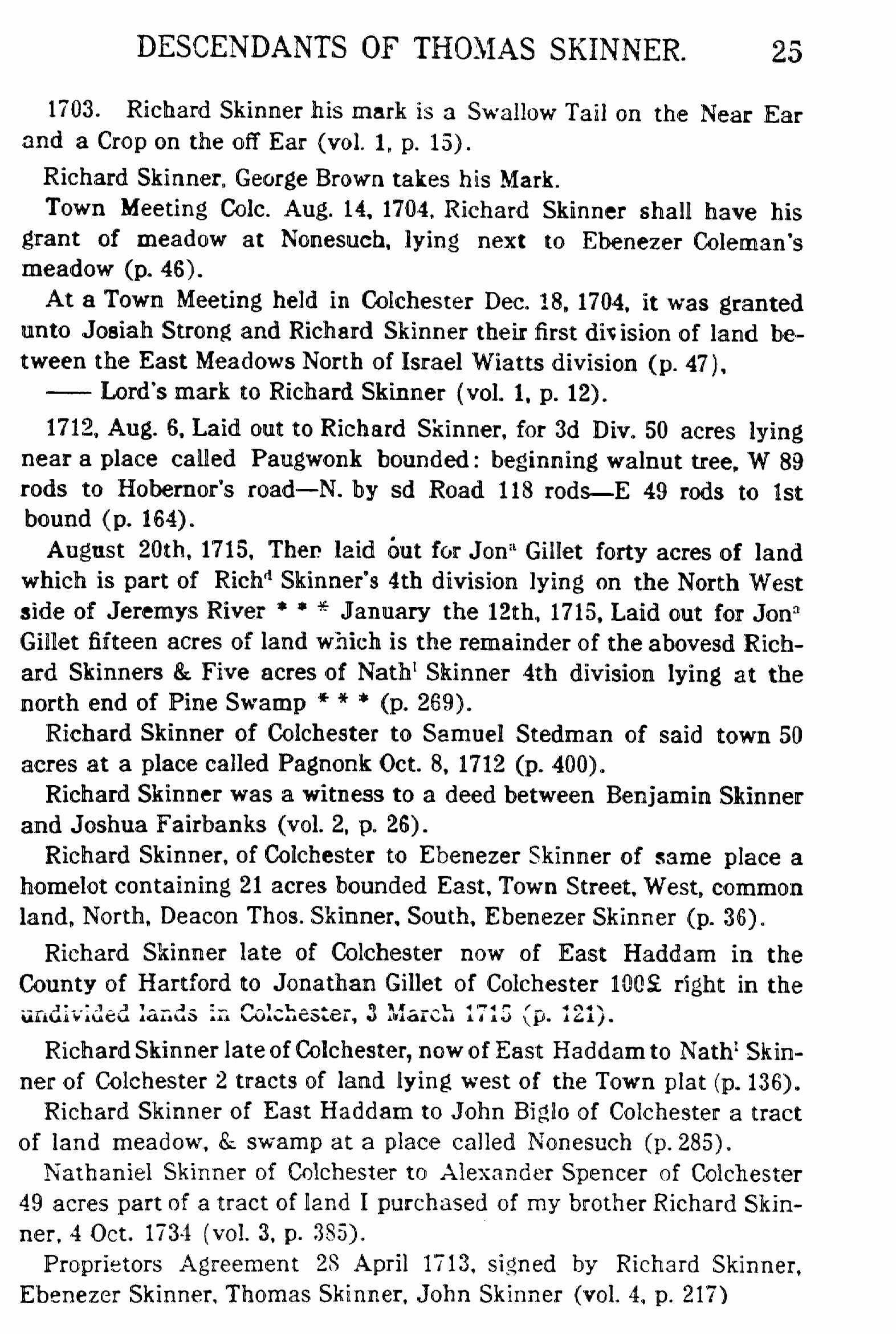
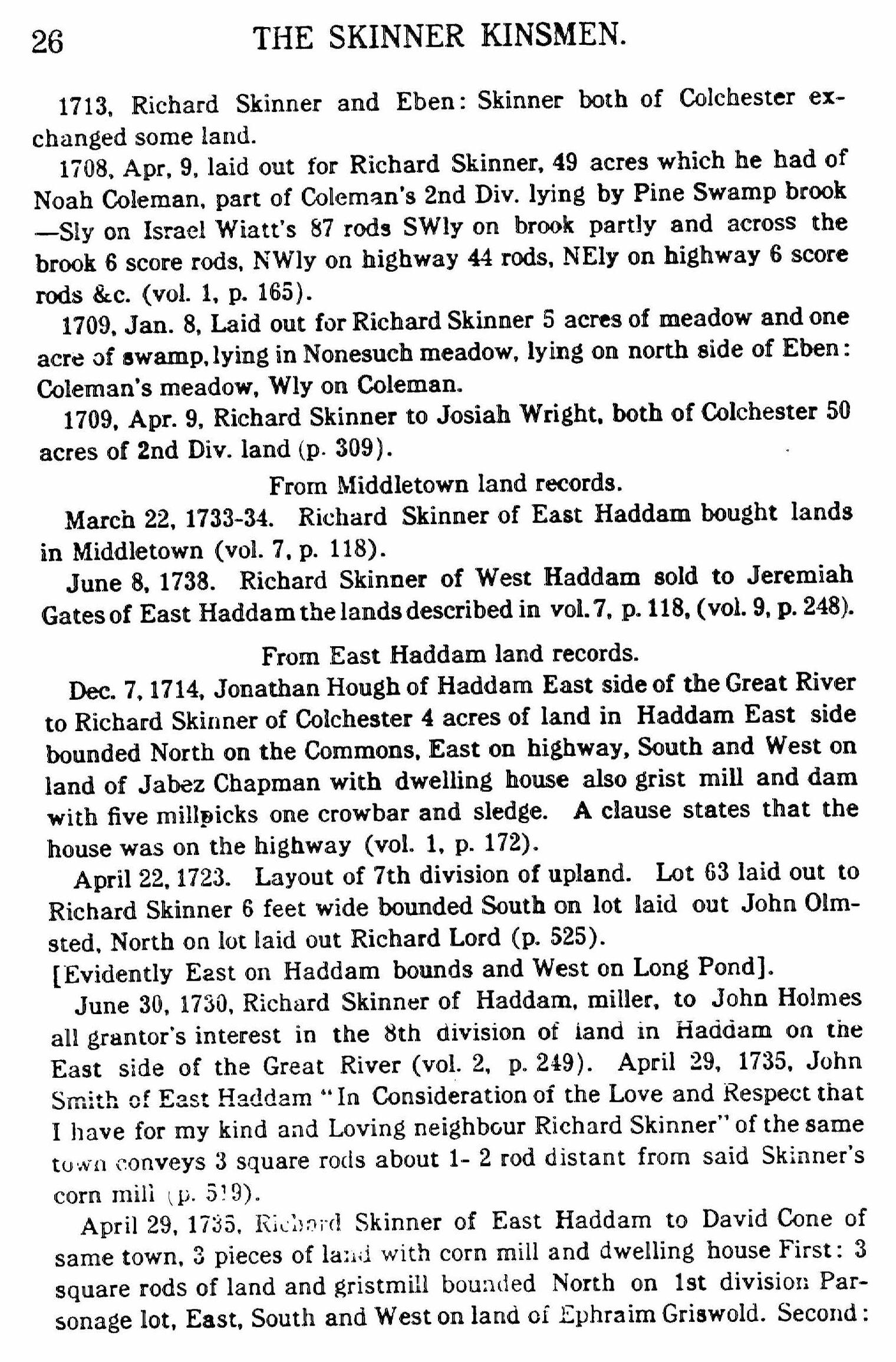
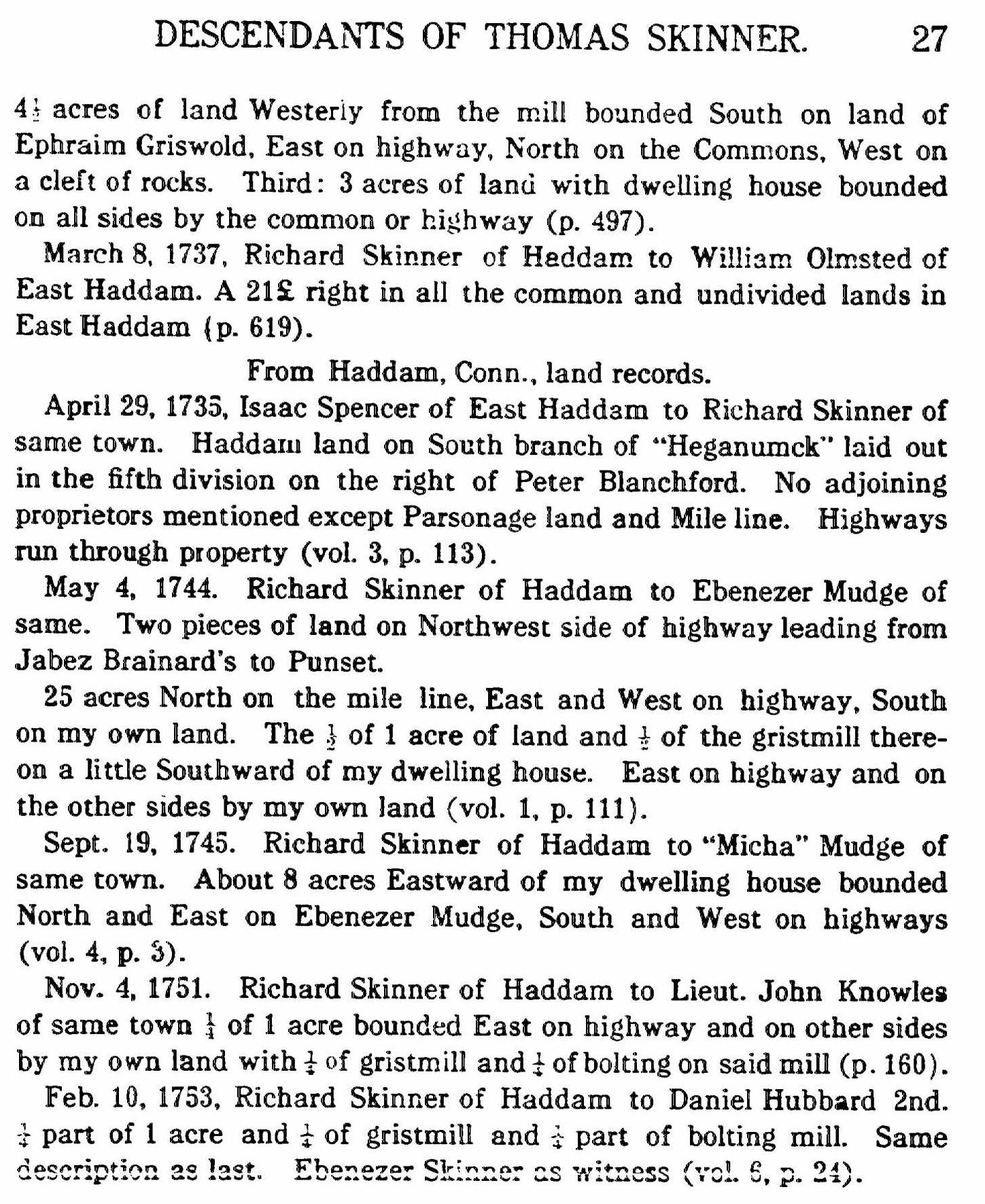
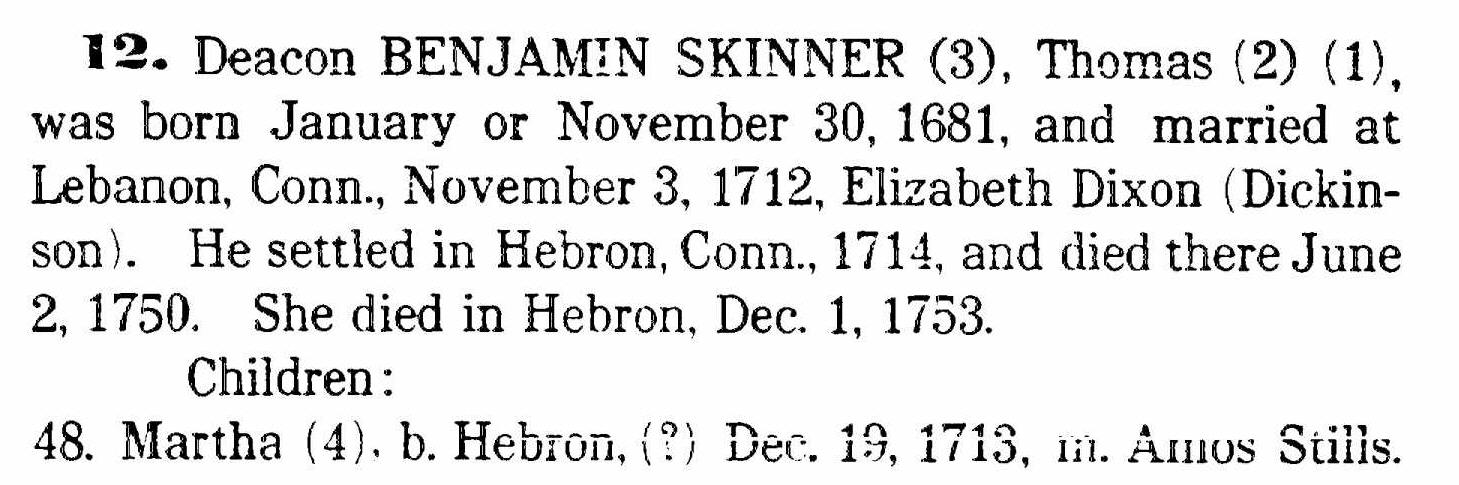
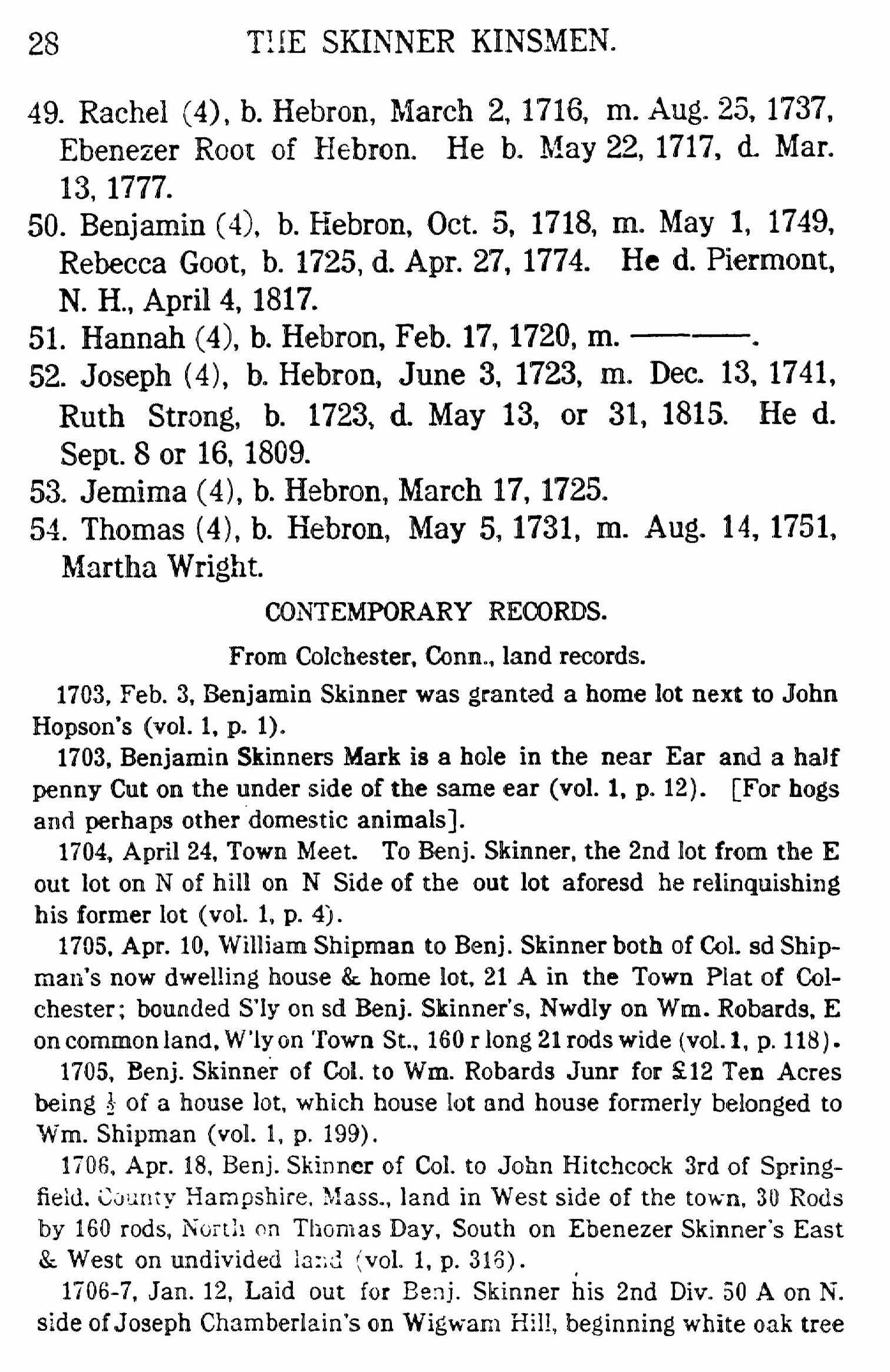
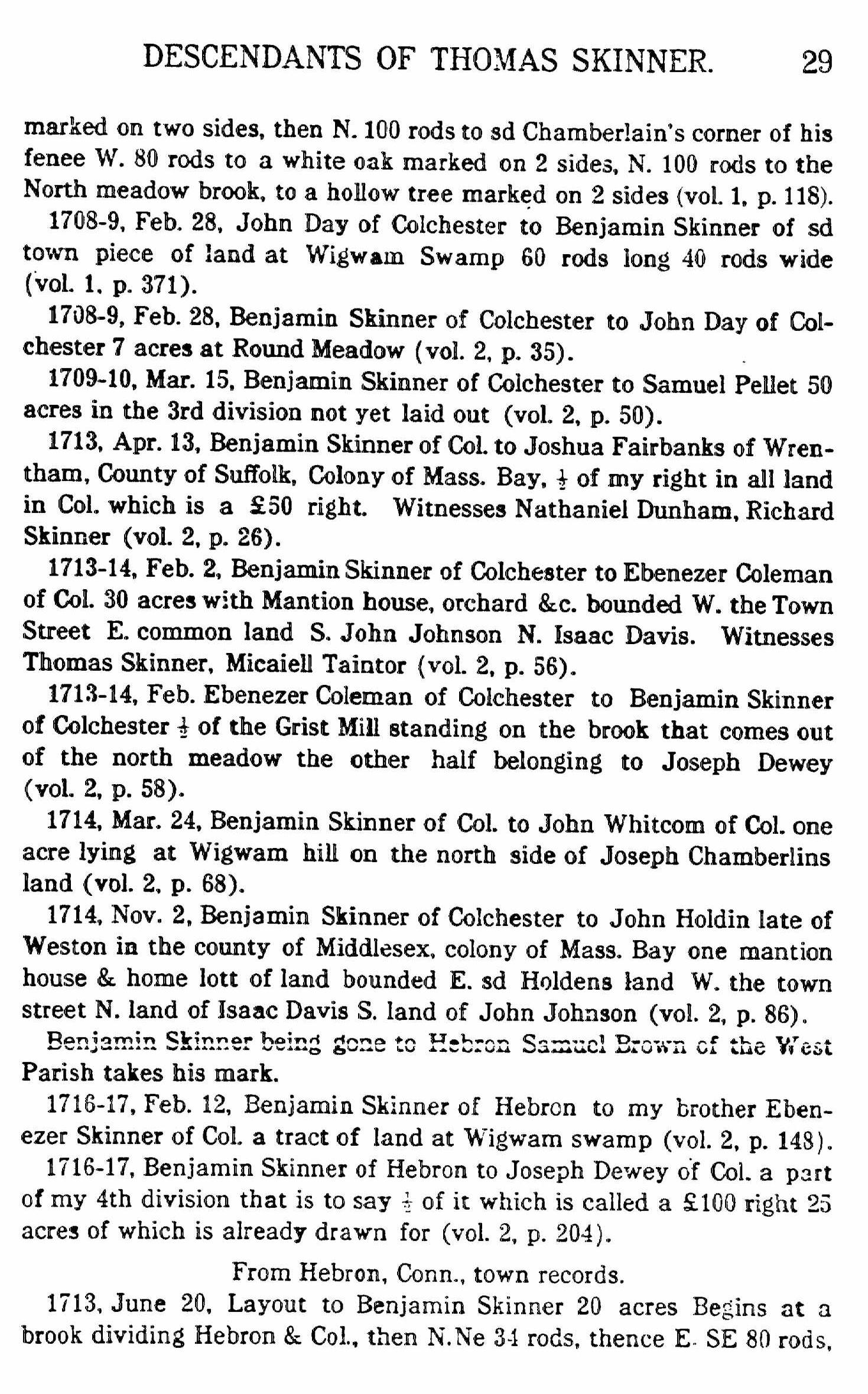
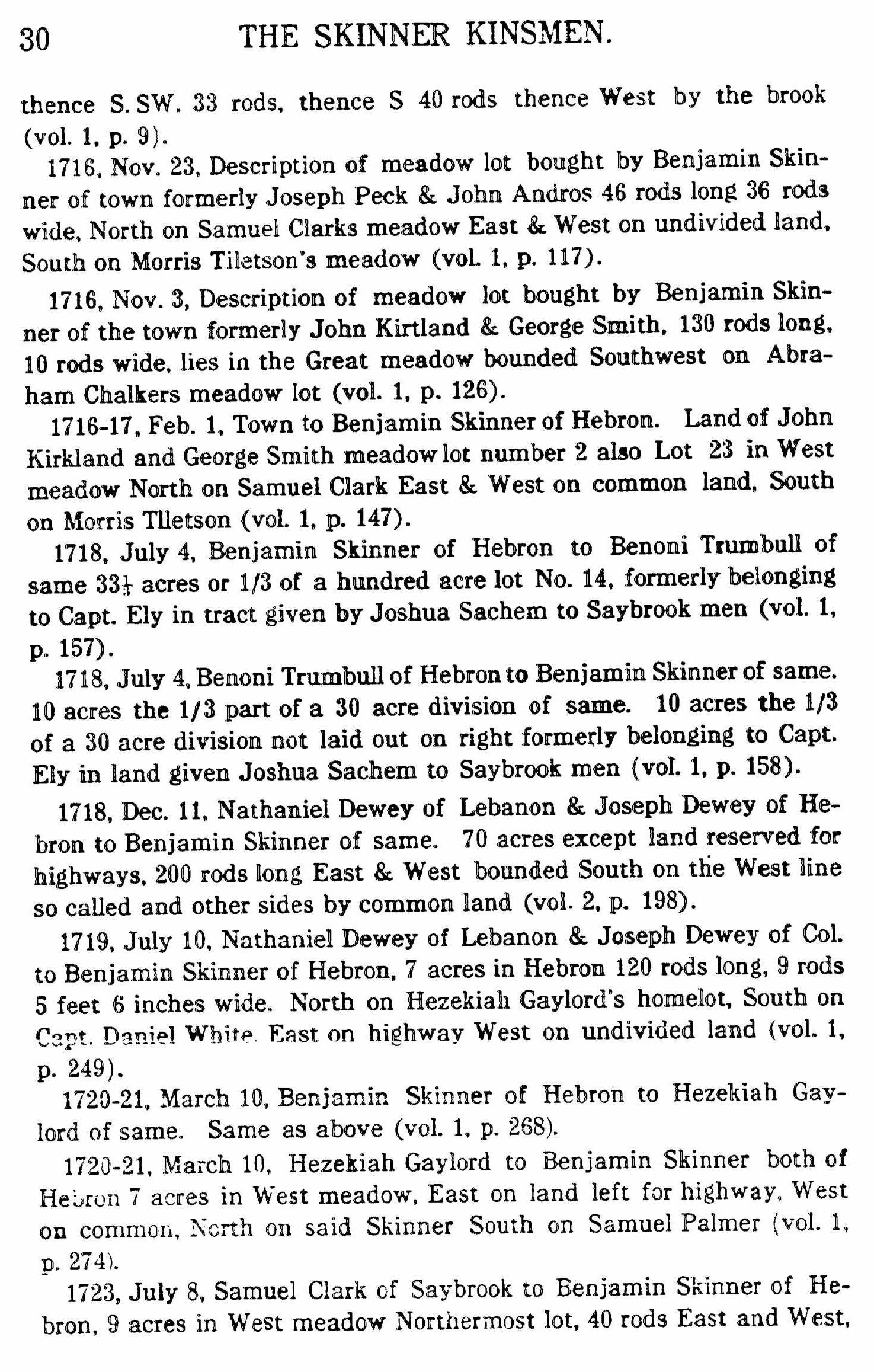
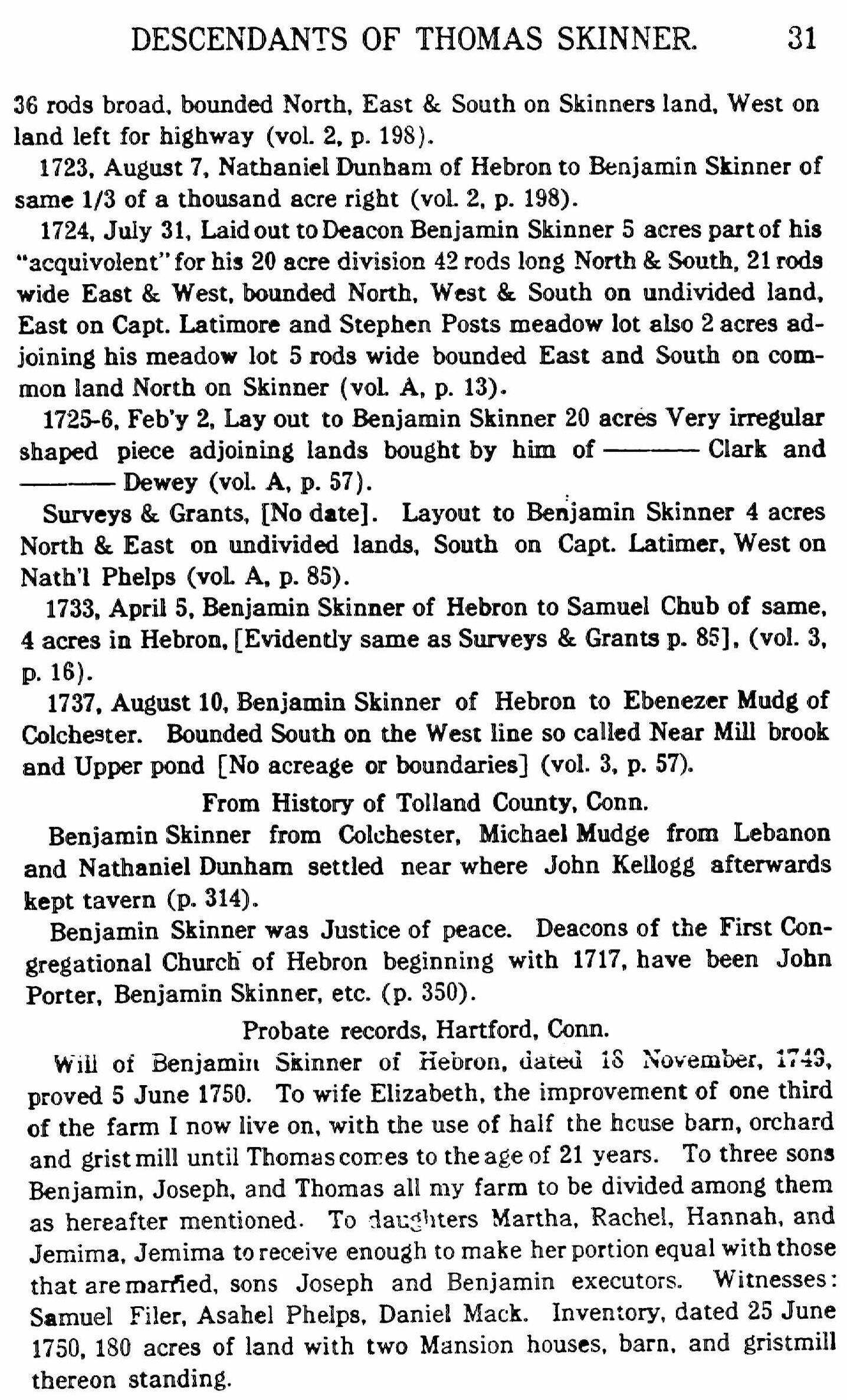
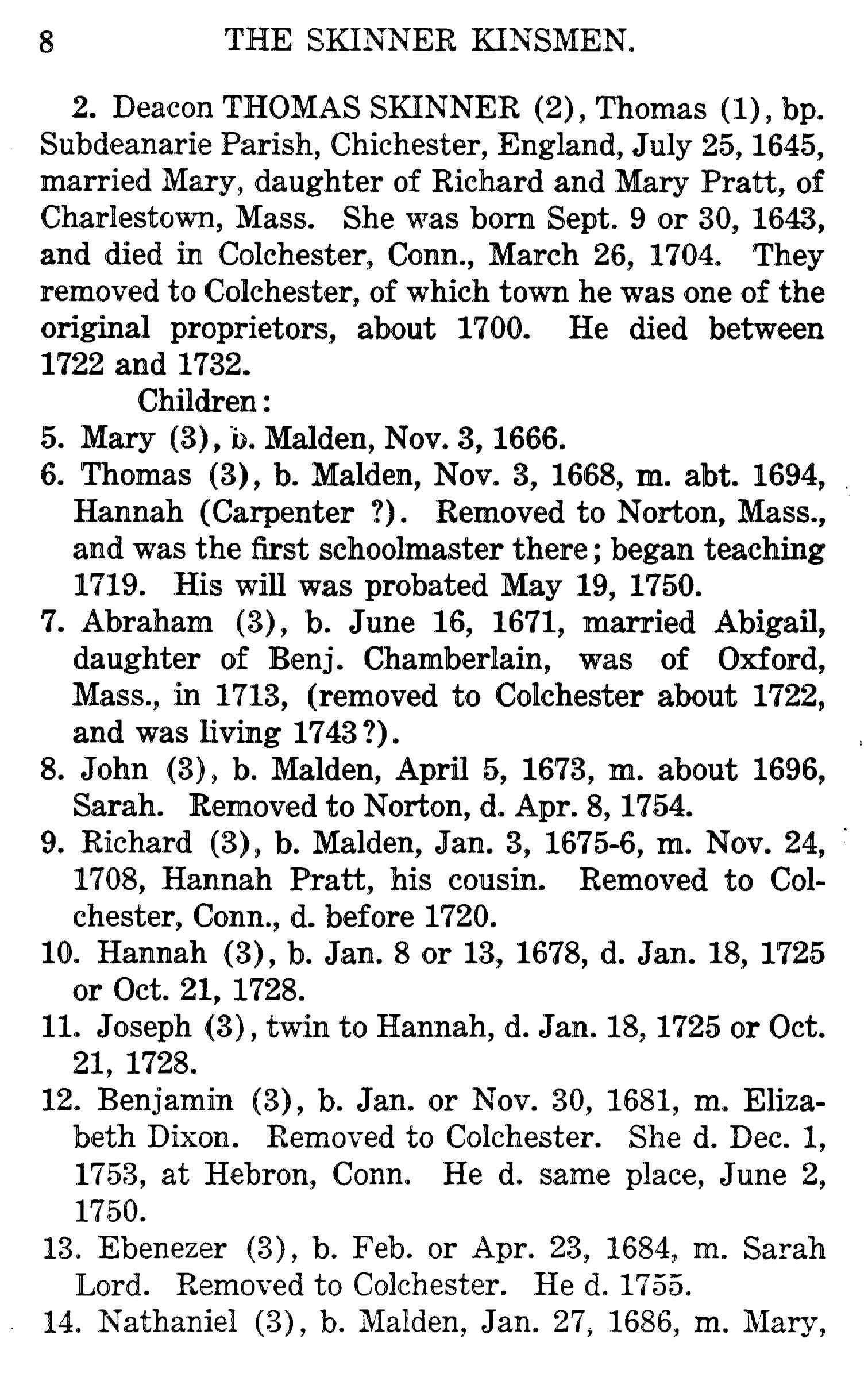
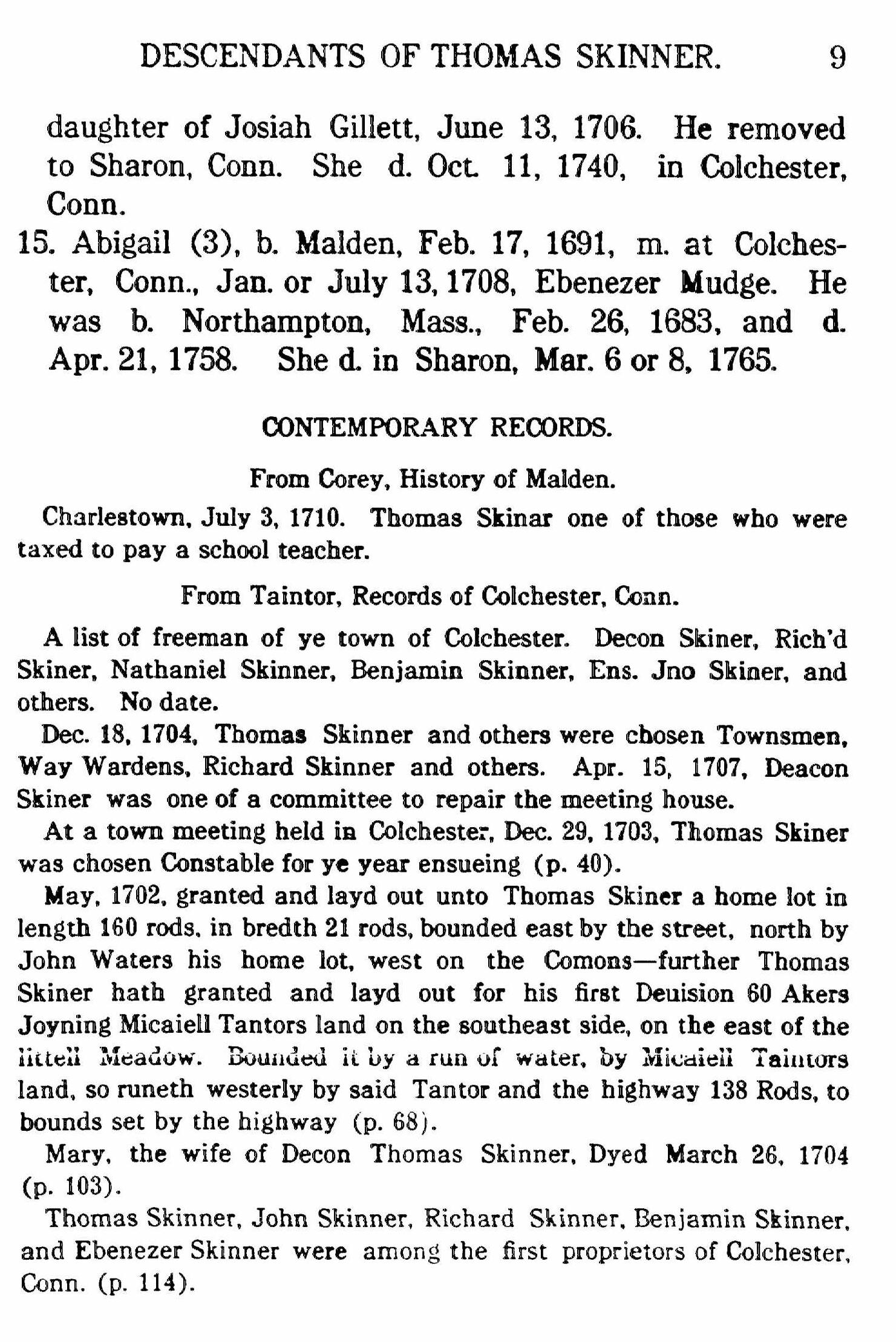
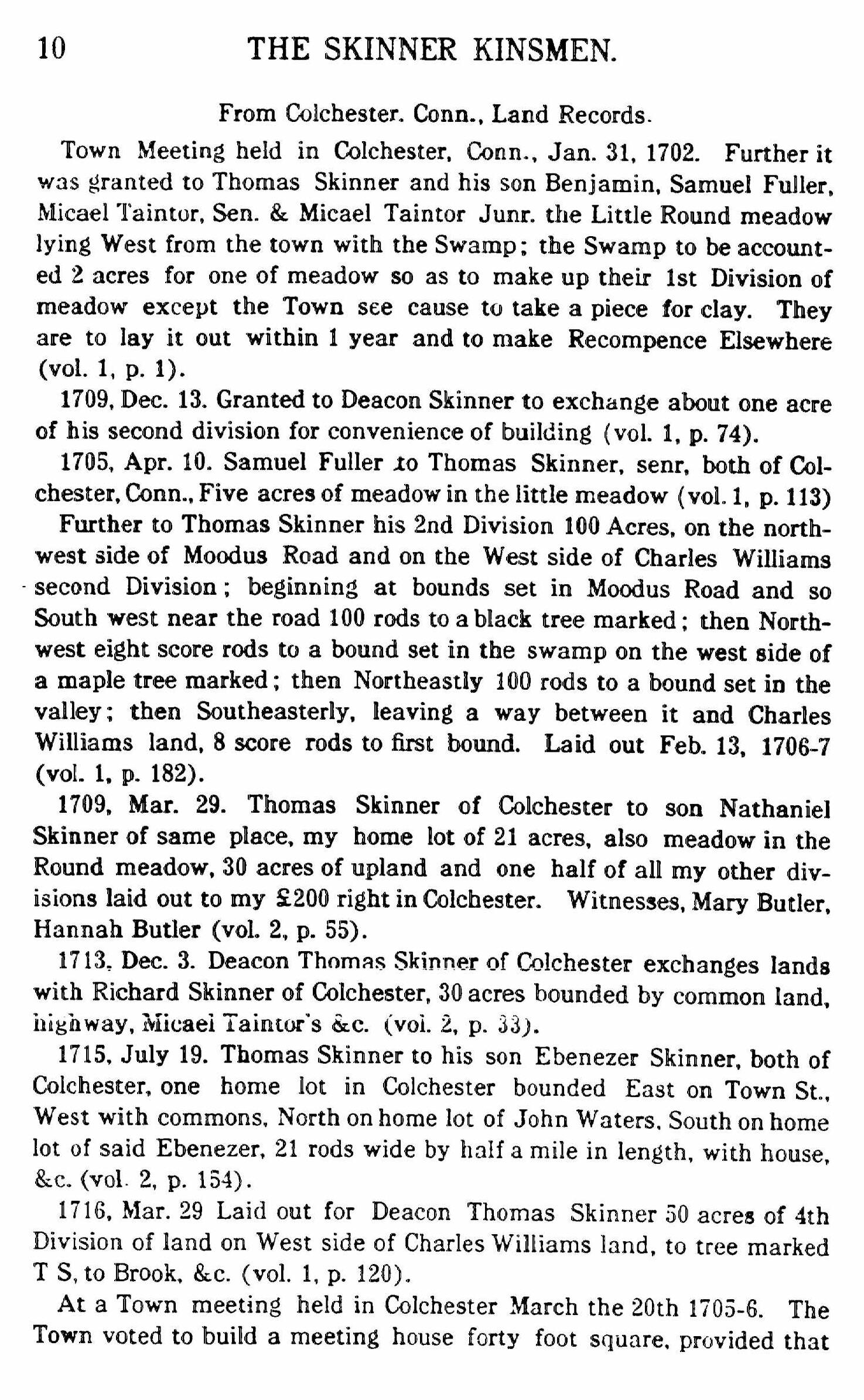
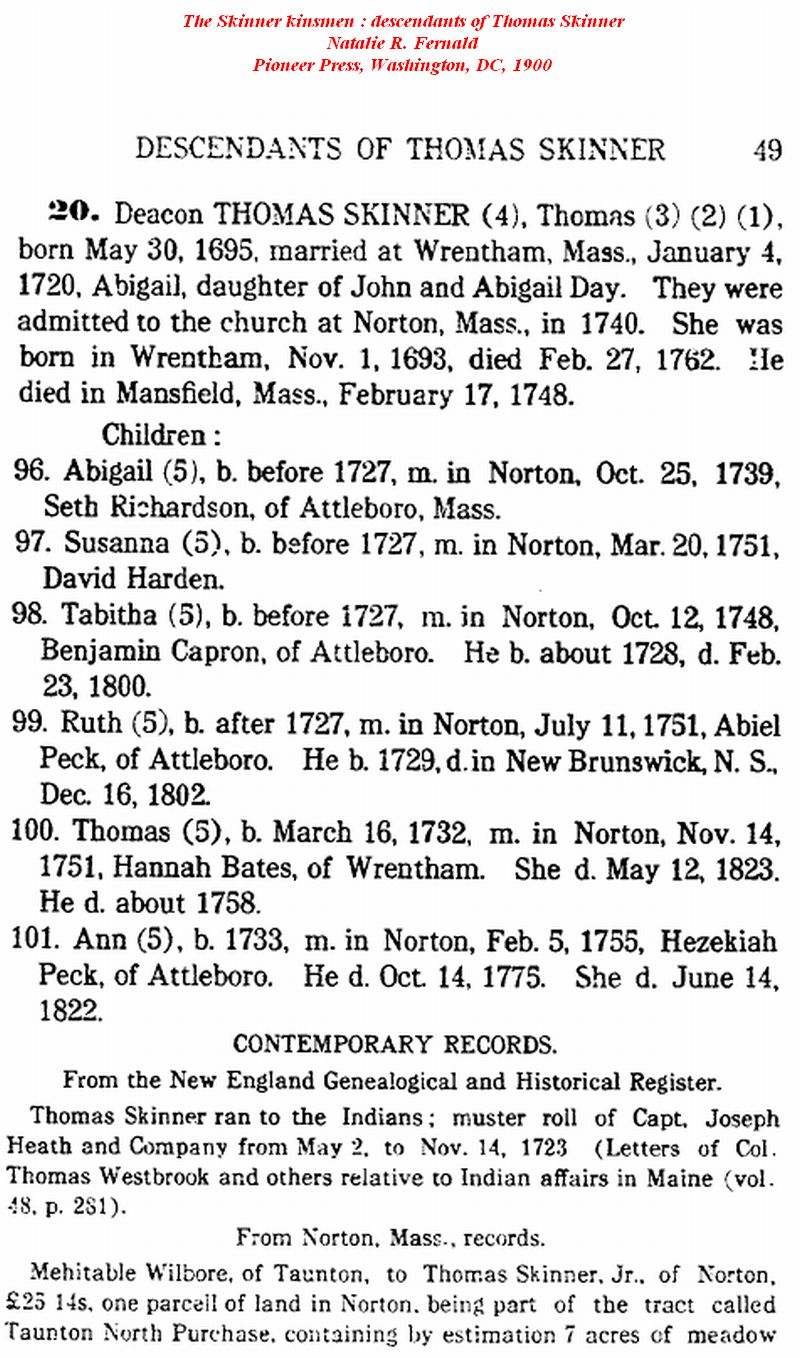
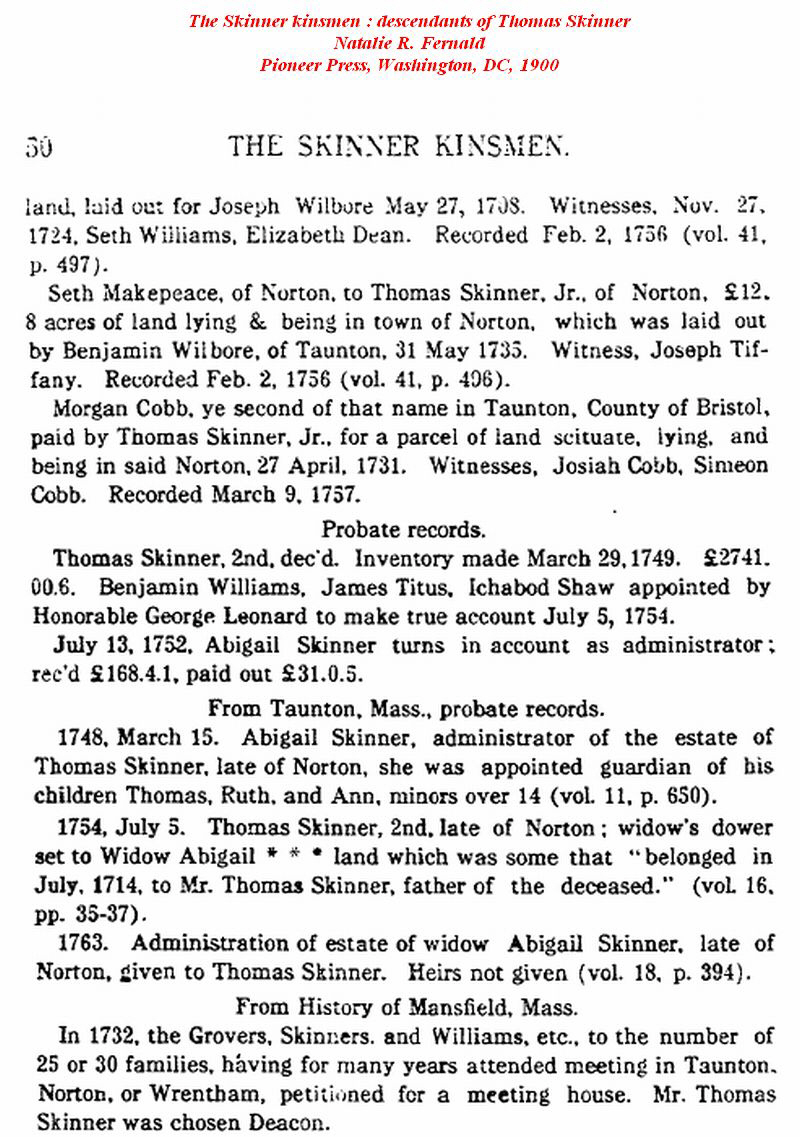
Skinner Kinsmen the descendants of Thomas Skinner of Malden, Mass by Natalie R. Fernald

Sources:

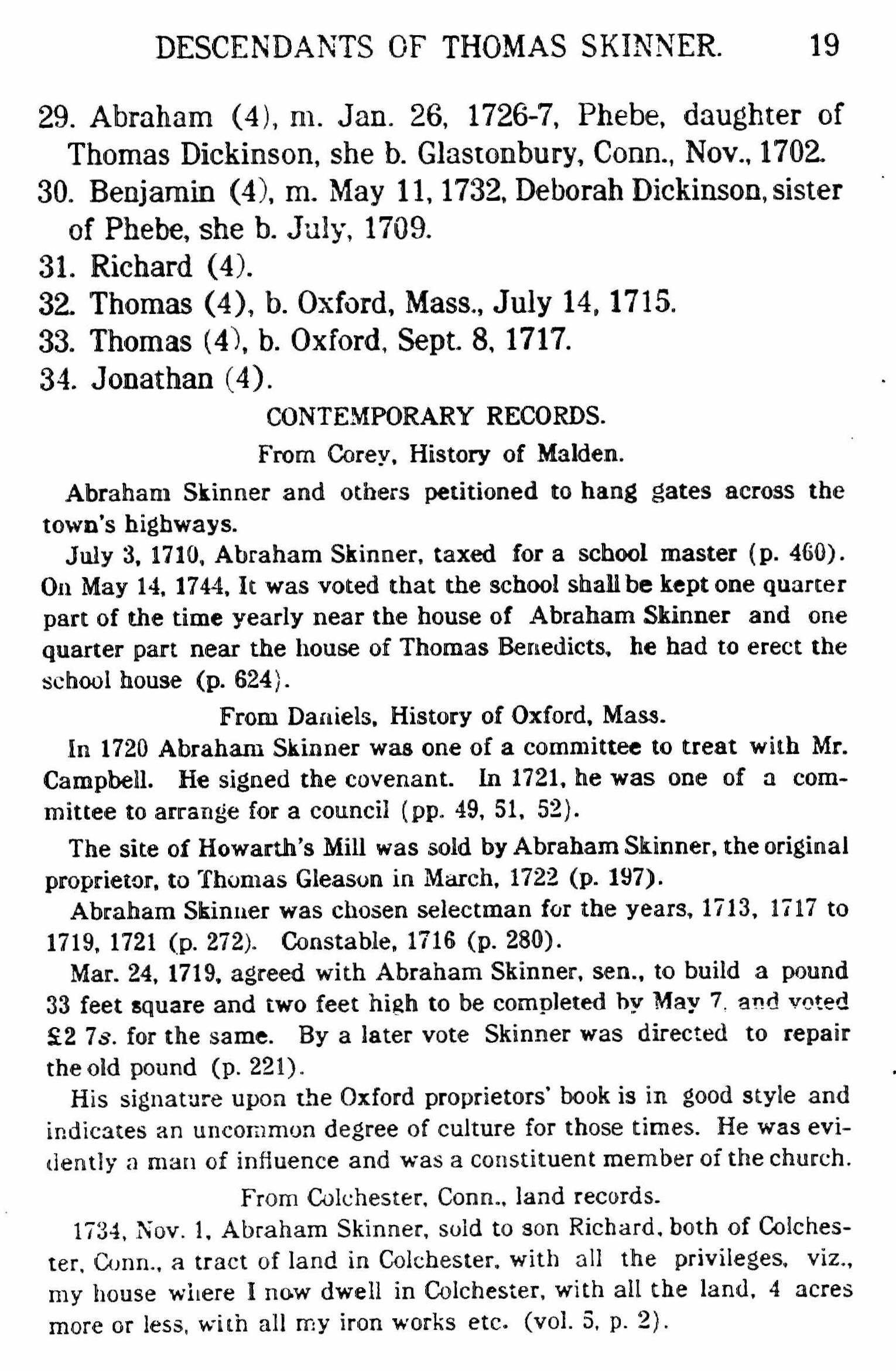
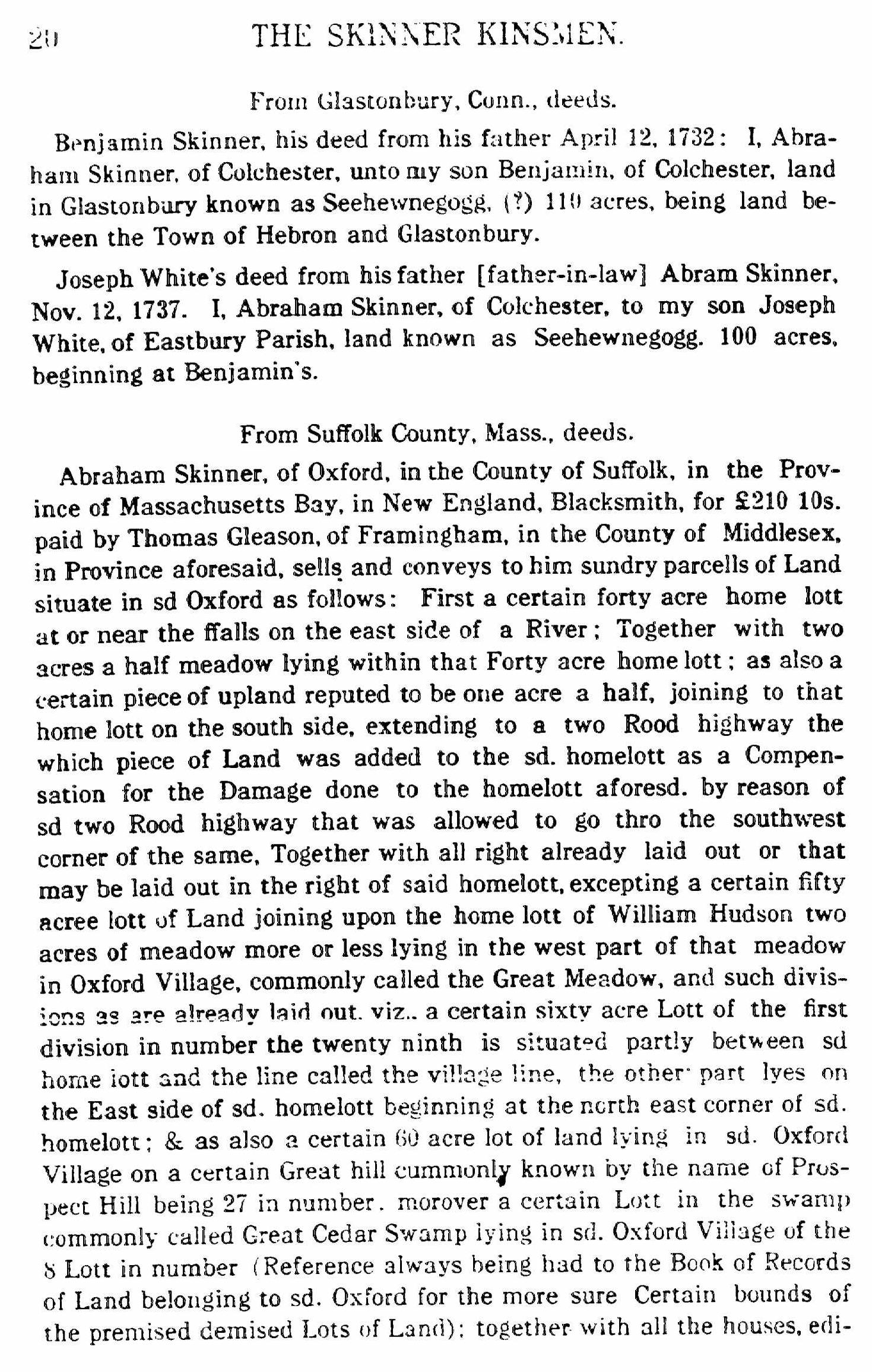
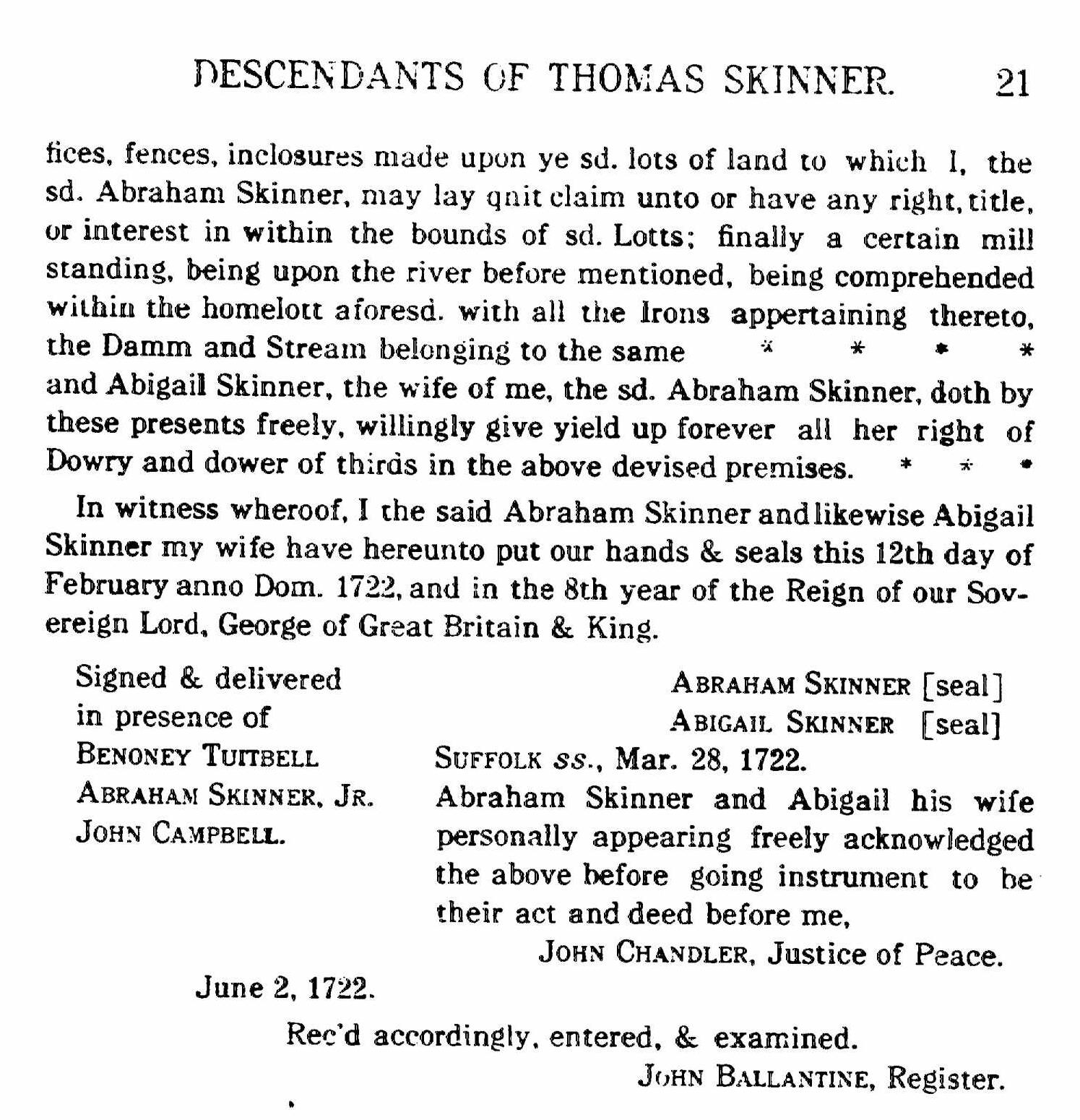
Skinner Kinsmen the descendants of Thomas Skinner of Malden, Mass by Natalie R. Fernald

http://familytreemaker.genealogy.com/users/s/a/x/Stephanie-A-Saxon/GENE34-0002.html

http://familytreemaker.genealogy.com/users/s/k/i/Richard-A-Skinner-NY/GENE1-0003.html

http://www.genealogyofnewengland.com/b-_s.htm

http://skn.skinnerwebb.com/

http://freepages.genealogy.rootsweb.ancestry.com/~hutch/EGGLESTON/Skinner.htm

The Skinner kinsmen, the descendants of Thomas Skinner of Malden, Mass By Natalie R. Fernald The Pioneer Press Washington, DC 1900

http://trees.ancestry.com/owt/person.aspx?pid=6924501&st=1

http://freepages.genealogy.rootsweb.ancestry.com/~hutch/EGGLESTON/Skinner.htm

Posted in 13th Generation, Historical Monument, Immigrant - England, Line - Shaw, Public Office, Tavern Keeper, Veteran | Tagged | 5 Comments

Deacon Thomas Skinner II

Thomas SKINNER II (1645 – 1723) was Alex’s 10th Great Grandfather, one of 2,048  in this generation of the Shaw line.

Deacon Thomas Skinner II was baptized 15 Jul 1645 in Subdeanerie Parish, Chichester, Sussex, England. His parents were Thomas SKINNER I and Mary GODDEN. He married  Mary PRATT in 1665/66 at Charlestown, Massachusetts.  After Mary died, he married Joanna [__?__].  Thomas died between  26 Mar 1722/23 in Colchester, Connecticut.

Mary Pratt was born 30 Sep 1643 in Charlestown, Massachusetts.  Her parents were Richard PRATT and  Mary [__?__]. Mary died 26 Mar 1704 in Colchester, New London, Connecticut.  Alternatively, Mary died  9 Apr 1671 at Malden, Mass and Joanna was the mother of the younger children.

Children of Thomas and Mary:

Name Born Married Departed
1. Mary Skinner 3 Nov 1666, Malden, Mass Joseph Russell
1687
Boston
28 Mar 1716, Boston
2. Thomas SKINNER III 3 Nov 1668 Malden, Mass Hannah CARPENTER
16 May 1694 Swansea, Mass.
9 Jun 1757 Norton, Mass.
3. Abraham Skinner 16 Jun 1671, Malden Abigail Chamberlain
24  Nov 1708 Colchester, CT
1737
Colchester, CT
4. John Skinner 5 Apr 1673, Malden Sarah Porter
ca. 1696 Colchester, New London, CT
8 Apr 1754, Waltham, Mass.
5. Richard Skinner 3 Jan 1675/76, Malden Hannah Pratt
24 Nov 1708
Colchester
Feb 1758, East Haddam, CT
6. Hannah Skinner Jan 1677/78
Malden
John Grover
20 Sep 1722 – Mass
21 Aug 1728
Colchester, CT
7. Joseph Skinner Jan 1677/78
Malden
18 Jan 1725
Malden, Mass
8. Dec. Benjamin Skinner 30 Jan 1681
Malden
Elizabeth Dixon
3 Nov 1712 Lebanon, CT
.
Elizabeth Wright (Daughter of our ancestor Abel WRIGHT)
1731
Springfield
2 Jun 1750, Hebron, CT
9. Ebenezer Skinner 1684, Malden Sarah Lord
28 Jul 1702
East Haddam, CT
Nov 1755, Bolton, CT
10. Nathaniel Skinner 27 Jan 1685/86, Malden Mary Gillett
13 Jun 1706
Sharon, CT
.
Content Fuller
Sep 1721
Sharon, CT
11. Abigail Skinner 17 Feb 1690/91, Malden Ebenezer Mudge
13 Jul 1708
Malden, Mass
Mar 1765, New Lebanon, CT

Thomas was one of the original proprietors of Colchester, Connecticut, moving there about 1700.

According to The Skinner Kinsmen, Thomas and Mary moved from Malden, Massachusetts to Colchester, Connecticut circa 1700, where Thomas was one of the original proprietors of Colchester, a constable, a Way Warden (surveyor), and built a meeting house. His sons, Abraham and John, had moved to Taunton, Massachusetts. Richard, Benjamin, Ebenezer, Nathaniel and Abigail went to Colchester with their parents. Thomas held various town offices and served on important committees during his residence in Colchester. He and his son Benjamin were granted lots on January 21, 1702, and in May 1702, he drew his house lot. The diary of this Thomas is said to have been preserved and gives many interesting details of family history (not located).

From Colchester, Connecticut, Land Records: (45)

Town Meeting held in Colchester, Conn., January 31, 1702. Further it was granted to Thomas Skinner and his son Benjamin, Samuel Fuller, Micael Taintor, Sen. & Micael Taintor Junr. the Little Round meadow lying West from the town with the Swamp; the Swamp to be accounted 2 acres for one of meadow so as to make up their 1st Division of meadow except the Town see cause to take a piece for clay. They are to lay it out within 1 year and to make Recompence Elsewhere.

13 Dec 1709 –  Granted to Deacon Skinner to exchange about one acre of his second division for convenience of building.

10 Apr 1705 – Samuel Fuller lo Thomas Skinner, senr, both of Colchester, Conn., Five acres of meadow in the little meadow.

Further to Thomas Skinner his 2nd Division 100 Acres, on the north­west side of Moodus Road and on the West side of Charles Williams second Division; beginning at bounds set in Moodus Road and so South west near the road 100 rods to a black tree marked; then North­west eight score rods to a bound set in the swamp on the west side of a maple tree marked; then Northeastly 100 rods to a bound set in the valley; then Southeasterly, leaving a way between it and Charles Williams land, 8 score rods to first bound. Laid out February 13, 1706/07.

29 Mar 1709 – Thomas Skinner of Colchester to son Nathaniel Skinner of same place, my home lot of 21 acres, also meadow in the Round meadow, 30 acres of upland and one half of all my other div­isions laid out to my £200 right in Colchester. Witnesses, Mary Butler, Hannah Butler.

3 Dec 1713 – Deacon Thomas Skinner of Colchester exchanges lands with Richard Skinner of Colchester, 30 acres bounded by common land, highway, Micaei Taintor’s &c.

29 Mar 1716 – Laid out for Deacon Thomas Skinner 50 acres of 4th Division of land on West side of Charles Williams land, to tree marked T S, to Brook, &c.

At a Town meeting held in Colchester March the 20th 1705/06. The Town voted to build a meeting house forty foot square, provided that there be money given enough to procure the nails and glass further the Town choose a committee to carry on the building the said House; Namely Sergt. Rowlee, Deacon Skinner, John Skinner, Joseph Chamberlain, Thomas Brown.

15 Jan 1710 – Further the Town chose Lieut. Wells, Samuel Northam, Samuel Loomis, John Skinner, and Deacon Skinner to lay out highways where they are wanting in all parts of the town as also to inspect those that are already laid out that they may not be intruded into and make return to the Town.

Children

1. Mary Skinner

Mary’s husband Joseph Russell was born 15 Jan 1663 in Woburn, Middlesex, Mass. His parents were John Russell and Sarah Champney. Joseph died 13 Mar 1713 in Boston, Suffolk, Mass

2. Thomas SKINNER III (See his page)

3. Abraham Skinner

Abraham’s wife Abigail Chamberlain was born 10 Apr 1683 in Malden, Mass.  Her parents were Benjamin Chamberlain and Sarah Ball. Abigail died 14 Jan 1726 in Oxford, Middlesex, Mass

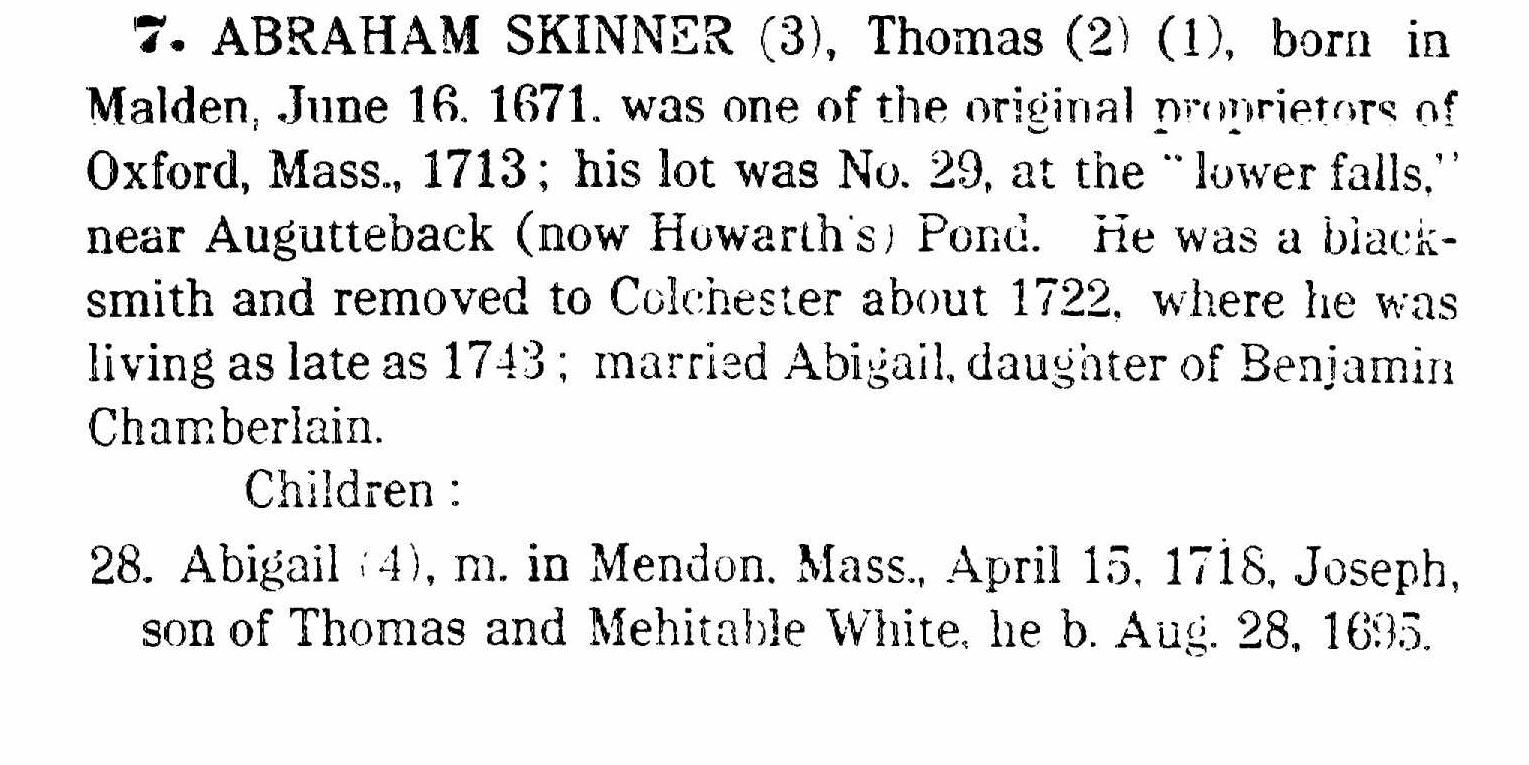
Abraham was a blacksmith and one of the original proprietors of Oxford, Mass.; lot No. 29 near (now) Howarth’s Pond, moving there in 1713.

4. John Skinner

John’s wife Sarah Porter was born 4 Jan 1677 in Windsor, Hartford, CT. Her parents were John Porter and Joanna Gaylord. Sarah died 22 Feb 1748 in Norton, Bristol, Mass.

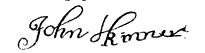
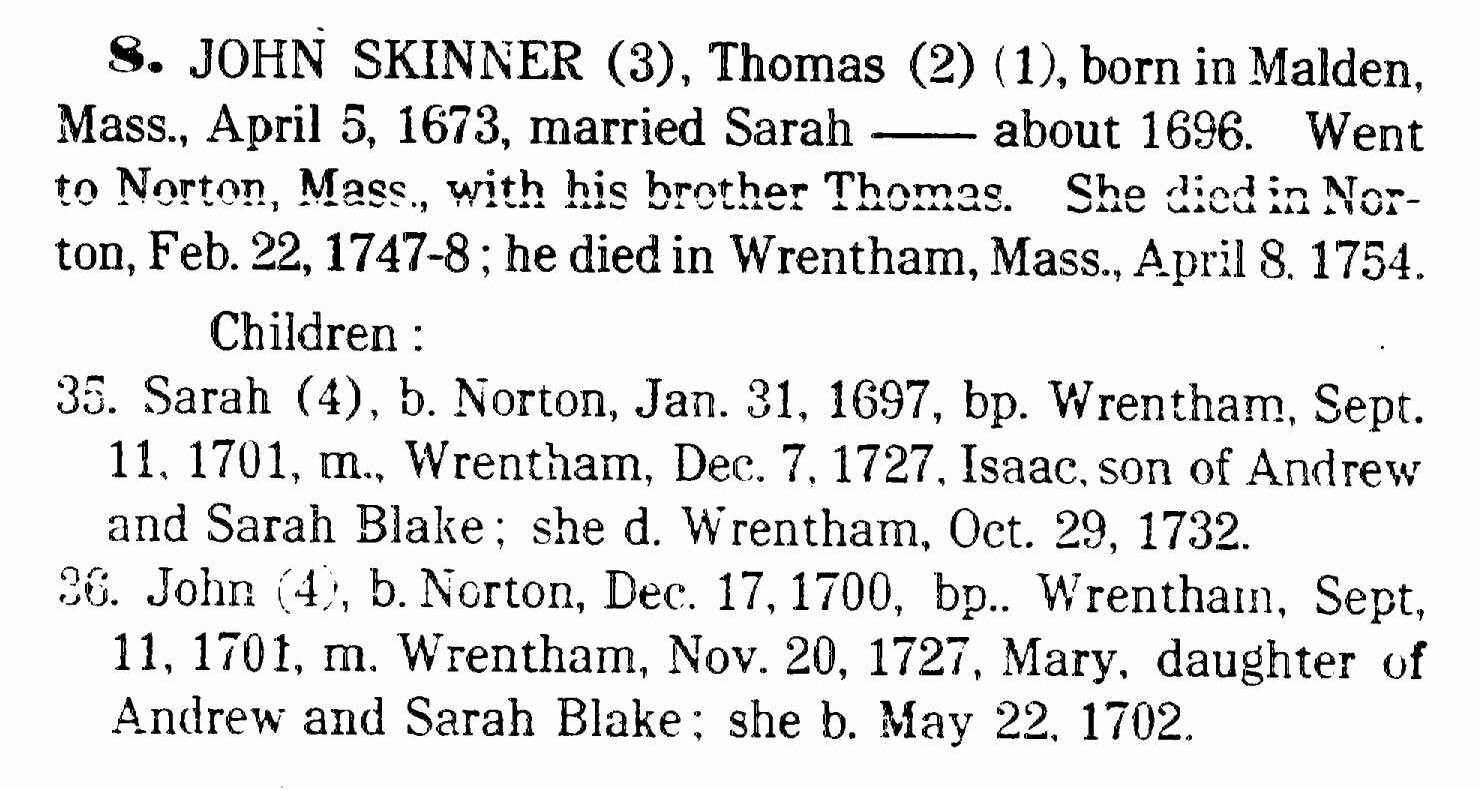
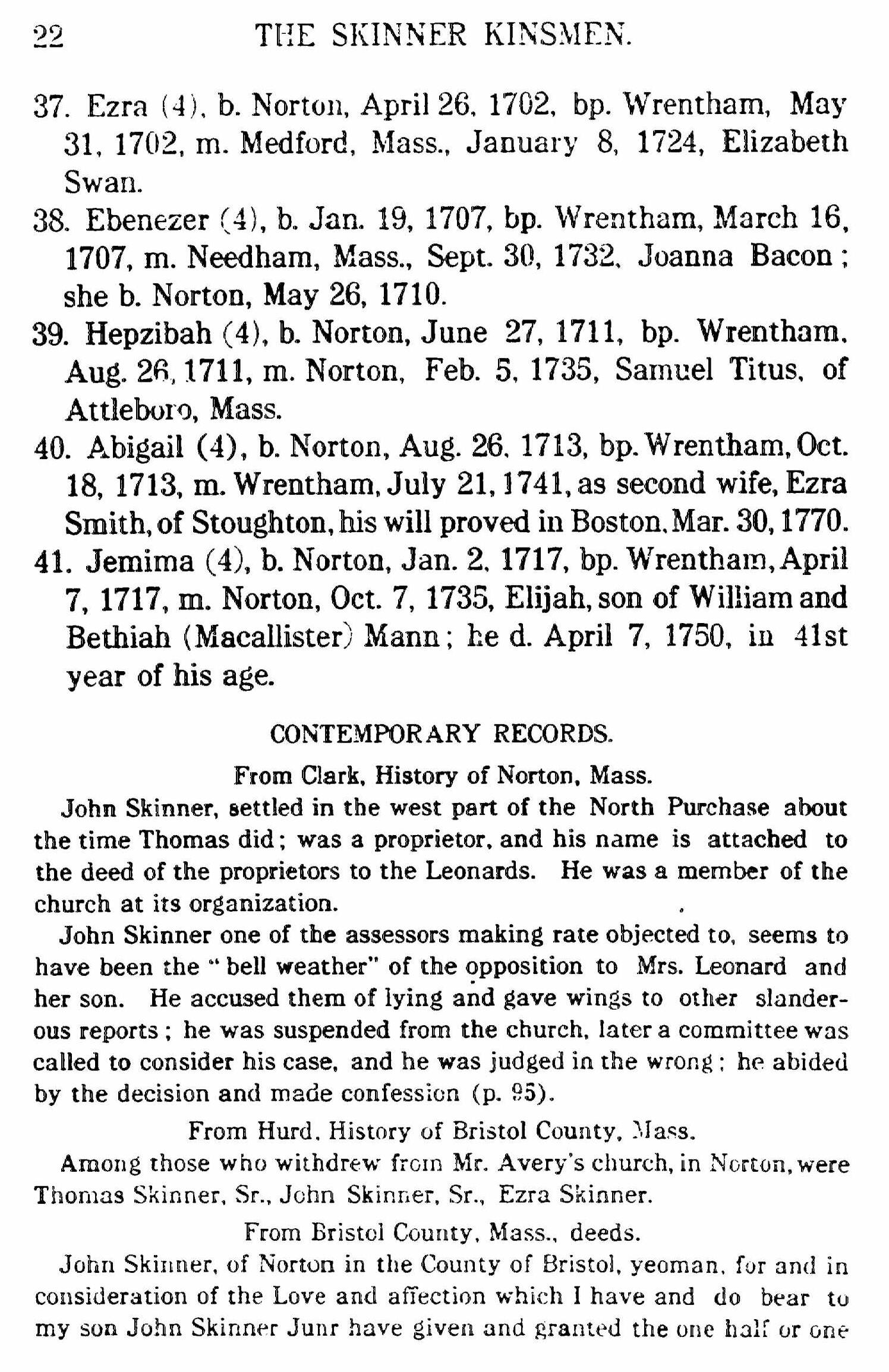
John Skinner was a brother, or perhaps only half brother, of Thomas: for Mary,  the wife of Thomas Skinner, died at Malden, April 9,1671; and John was born April, 1673. He settled in the west part of the North Purchase about the time Thomas did; was a proprietor, and his name is attached to the deed of the proprietors to the Leonards. He was a member of the Norton church at its organization. His wife’s name was Sarah , married about 1696; and they had seven children. He was living in 1738; but when he died is uncertain. There was a John Skinner who died at Wrentham, April 8, 1754; and he might have been the man. His autograph was written in 1695.

John Skinner Signature

5. Richard Skinner

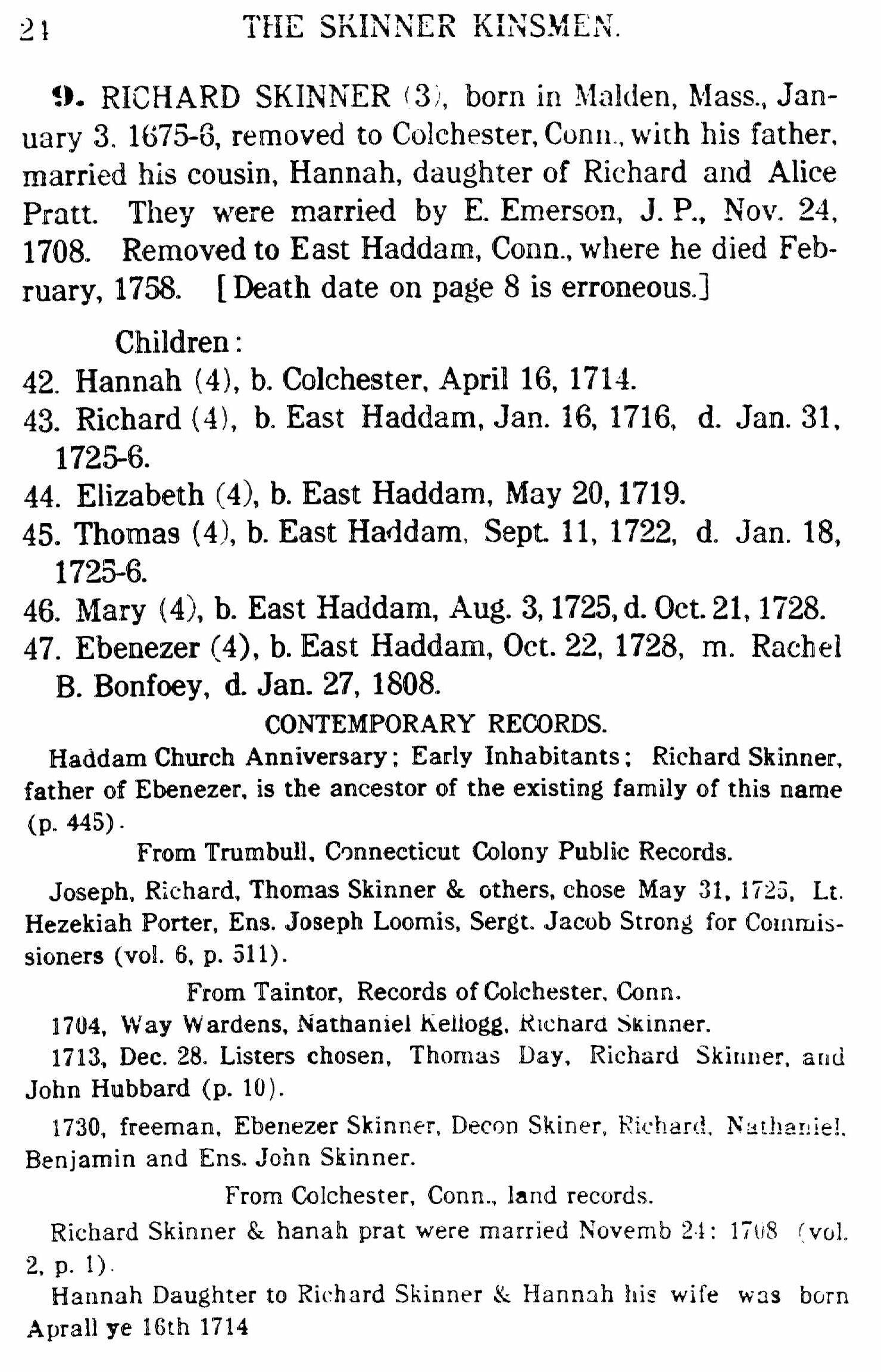
Richard’s wife Hannah Pratt was born 1677 in Malden, Midd, Mass. She was Richard’s cousin.  Her parents were Thomas Pratt and Alice [__?__]. Her grandparents were Richard PRATT and  Mary [__?__]. Hannah died in 1772 in East Haddam, CT.

6. Hannah Skinner

Hannah’s husband John Grover was born 12 Mar 1697 in Malden, Middlesex, Mass. His parents were Andrew Grover and Mary [__?__]. John died 27 Mar 1785 in Malden, Middlesex, Mass.

8. Deacon Benjamin Skinner

Benjamin’s first wife Elizabeth Dixon was born 1685 in Hebron, Tolland, CT. Genealogies say Elizabeth died 1 Dec 1753 in Hebron, Tolland, CT which conflicts with Benjamin’s second marriage.

Benjamin’s second wife Elizabeth Wright 22 Aug 1687 in Springfield, Hampden, Mass.  Her parents were Abel WRIGHT  and Martha KITCHEREL.  She first married 8 Nov 1709 to  Ebenezer Dewey (b. 20 Feb 1673 or 31 Aug 1679 in Springfield, Hampden, Mass. – d. Dec 1711 in Lebanon, New London, CT.)

9. Ebenezer Skinner

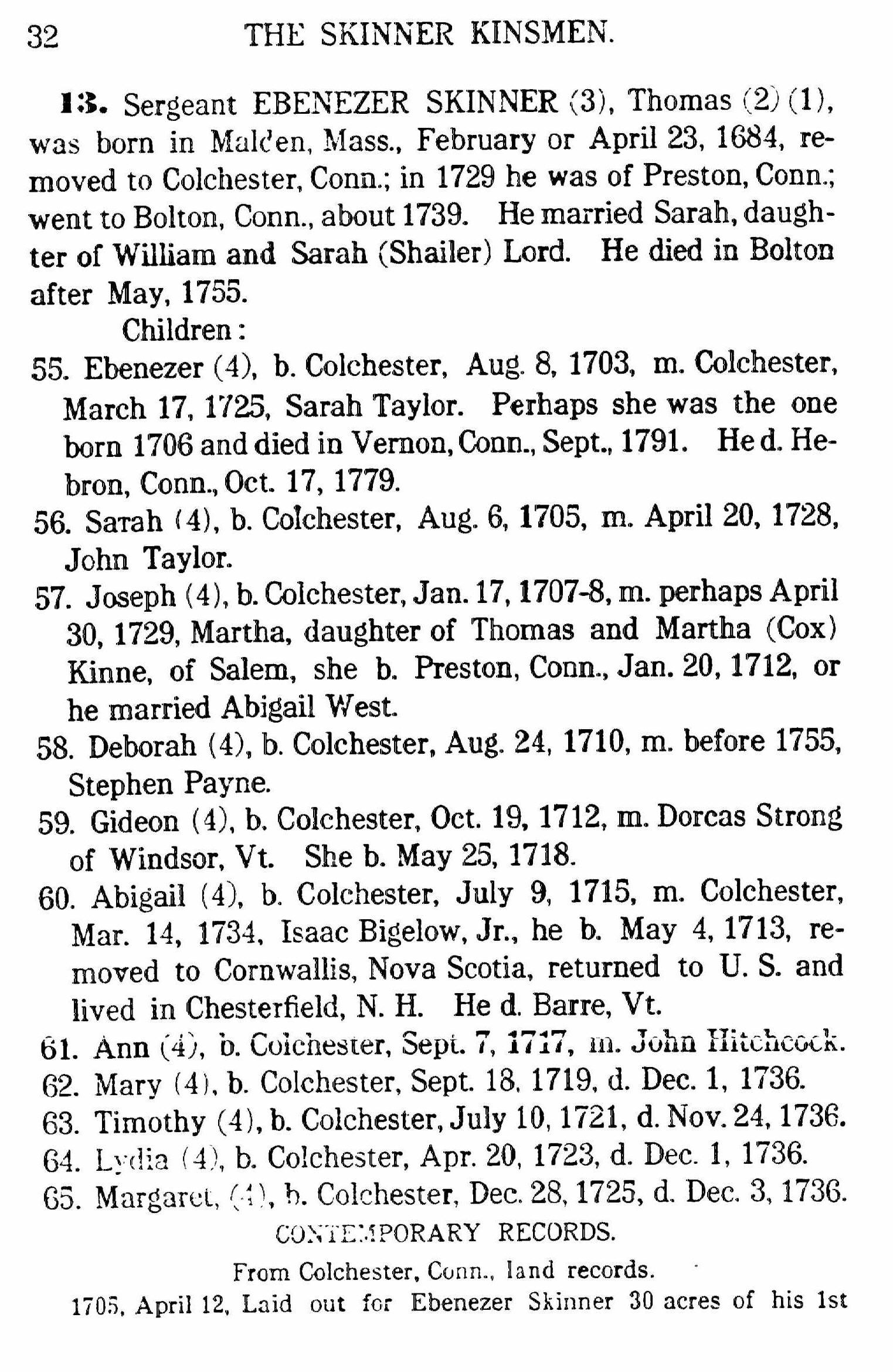
Ebenezer’s wife Sarah Lord was born 1682 in East Haddam, Middlesex, CT. Her parents were William Lord and Sarah Brooks. Sarah died Nov 1775 in Bolton, Tolland, CT.

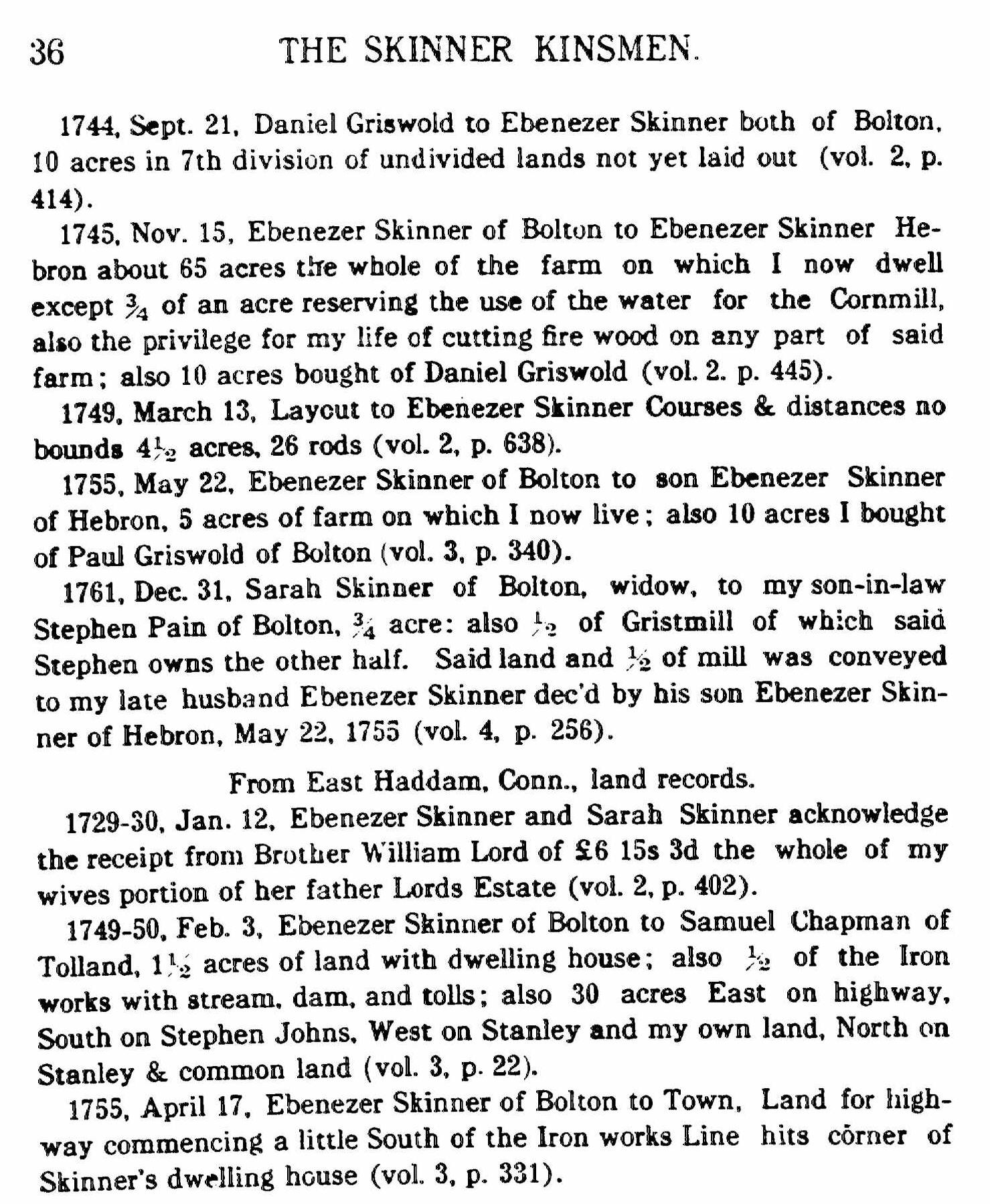
Ebenezer accompanied his father and family when they removed from Malden, Mass., to Colchester, Conn., and for many years he was a prominent man in that town.

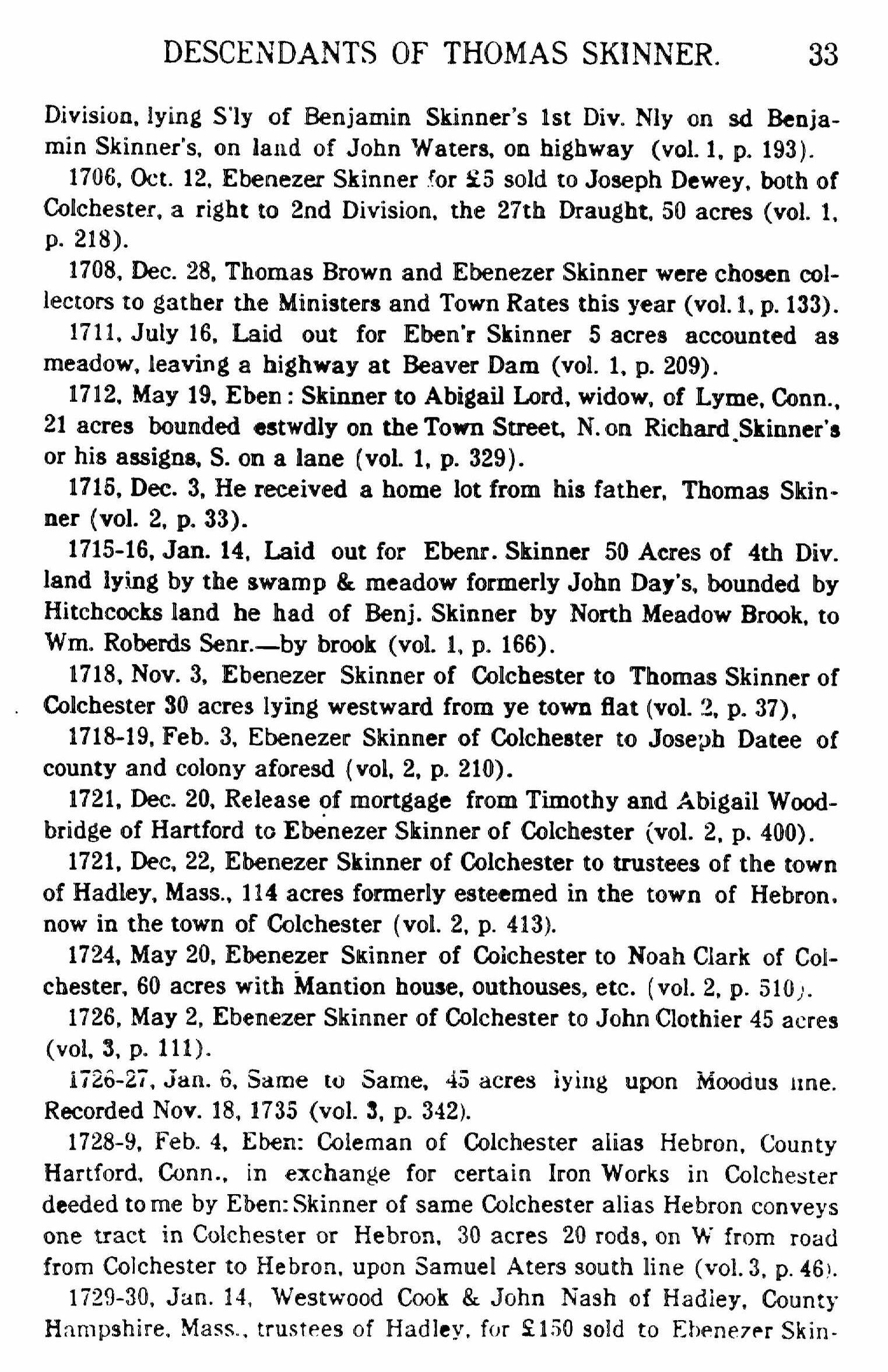
19 Jul 1715 – Thomas Skinner to his son Ebenezer Skinner, both of Colchester, one home lot in Colchester bounded East on Town St., West with commons. North on home lot of John Waters. South on home lot of said Ebenezer, 21 rods wide by half a mile in length, with house, &c.

In 1729 he was of Preston, Conn., – at one time he lived in Hebron, Conn., where, during one week, Nov. 27th to Dec. 3rd, 1736, Ebenezer’s four youngest children died of putrid sore throat, then so prevalent throughout the colonies. The family went to Bolton, Conn., about 1739 and it is thought that Ebenezer died there, although there is no record of his death.

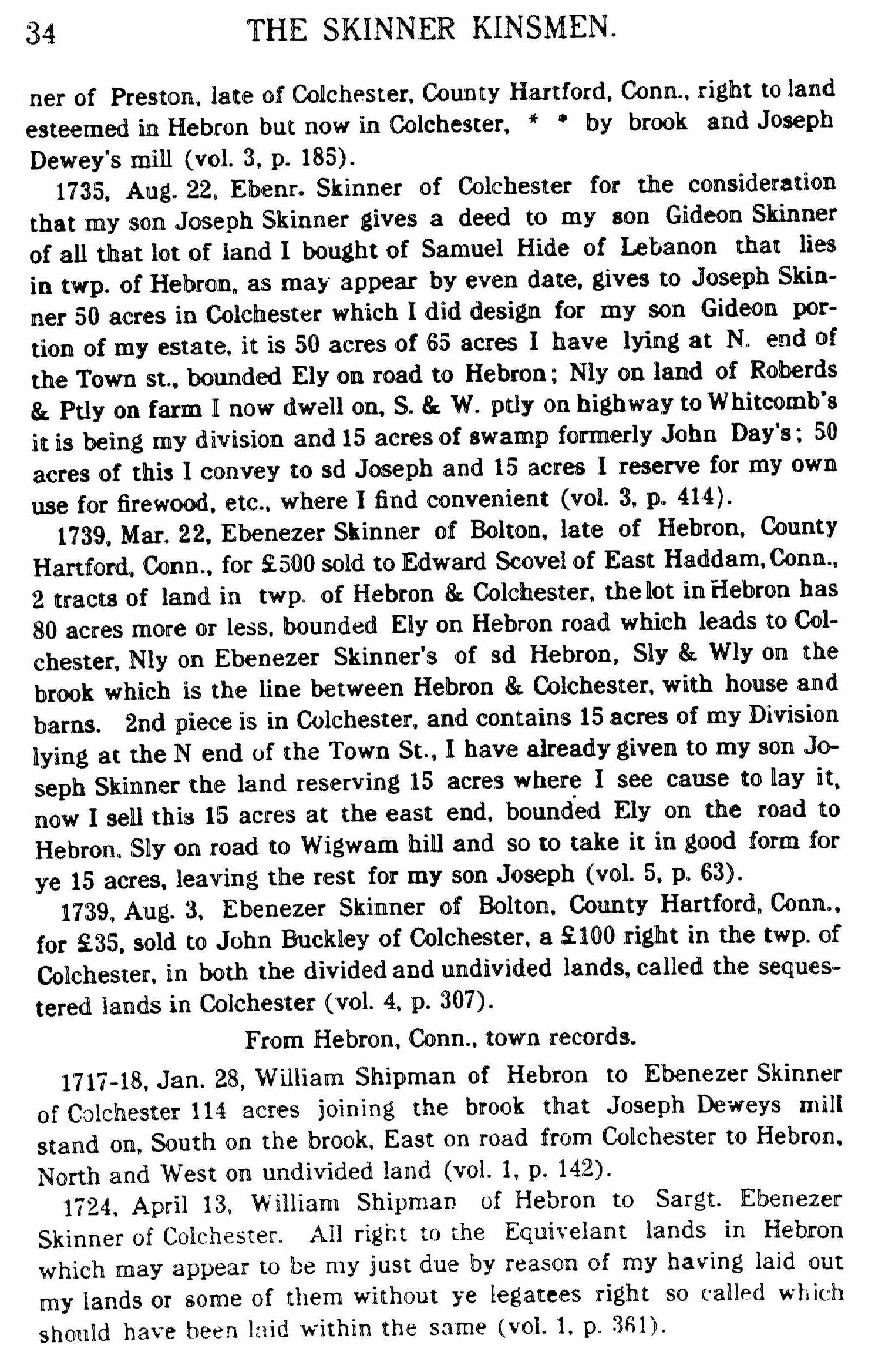
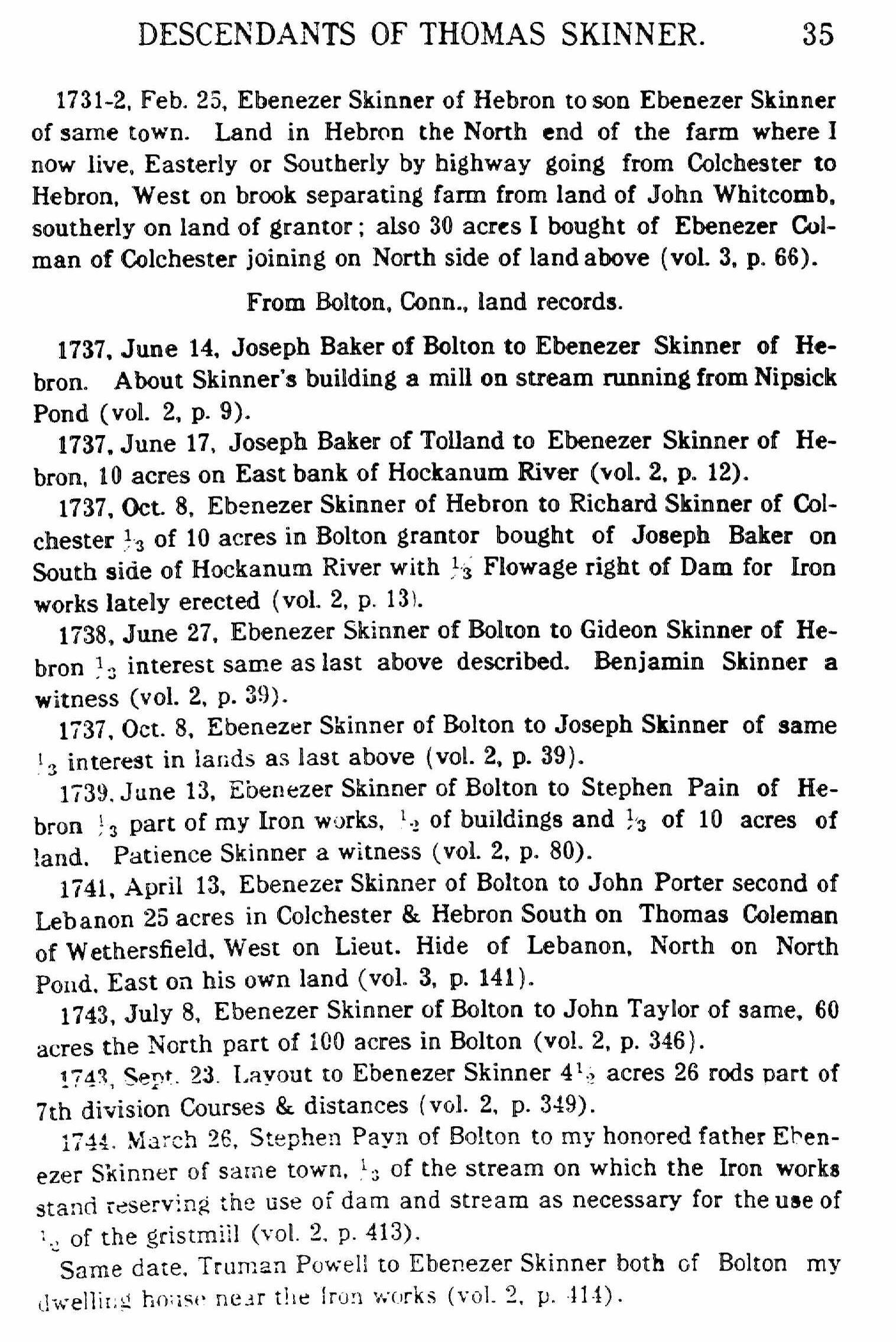
Her father, William Lord, of Saybrook and Lynn, was born in England in 1623, and came with his father, Thomas Lord, in the ‘Elizabeth and Ann’ in 1635. Sergt. Ebenezer Skinner accompanied his father to Colchester, where for many years he was a prominent man. On Dec 14, 1724, the town meeting granted to Ebenezer Skinner ‘the liberty of getting wood to make Cole in the sequestred Cornons to maintain Iron works so long as he shall maintain and keep up the Iron works.’ Apr 27, 1725, the town meeting granted to Capt. Joseph Wright, Ebenezer Skinner, Joseph Dewey and Josiah Gillett Jr. ‘ye liberty of ye stream on Jeremiahs Reuer to set up Iron works & also the preueleg of fine or six acers of land if it be thare to be for a pastuer whare a Conuenient place is: thay to haue the priueleg of it so long as they shall maintain Ironworks or other mills thare & no longer, the place lying about 40: or fifty Rods Down the reuer from James Roberdses souwest Corner of his home lot.’ On Feb 4, 1728, Ebenezer Coleman of Hebron deeded lands, etc., to Ebenezer Skinner of Colchester, in consideration of part of certain iron works in Colchester. About this time Sergt. Skinner removed to Hebron with his family of eleven children. Here, during one week, Nov 27 to Dec 31, 1736, his four youngest children died of putrid sore throat, then so prevalent throughout the colony.”.

10. Nathaniel Skinner

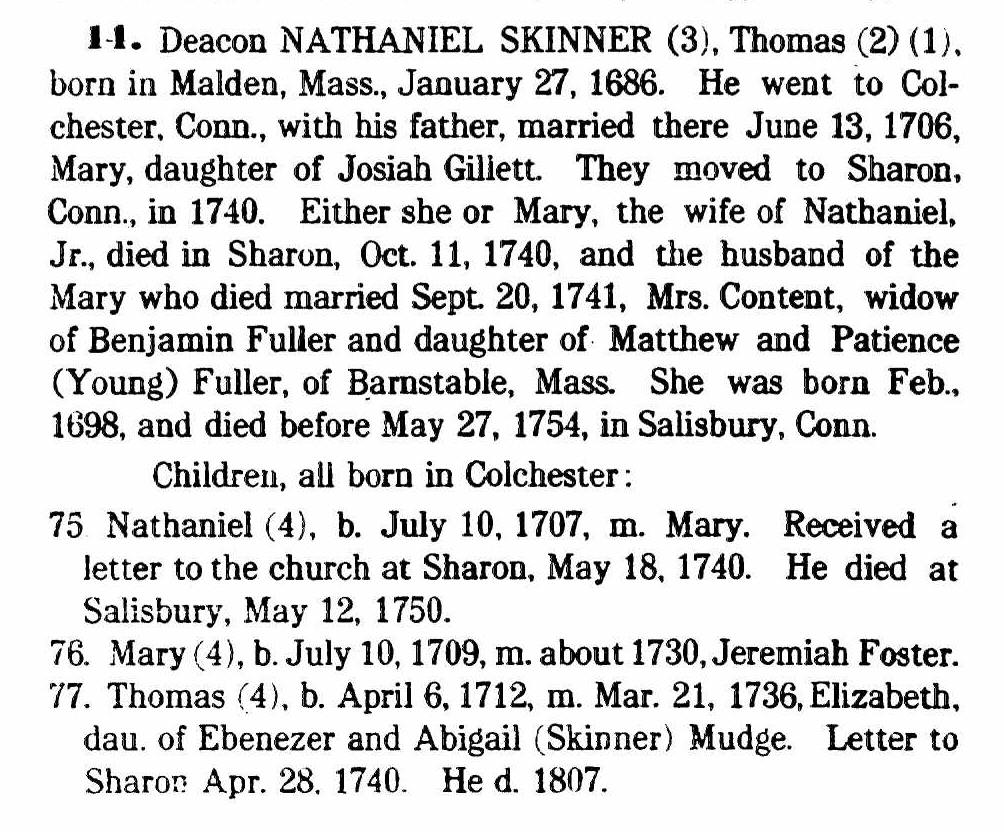
Nathaniel’s first wife Mary Gillett was born 8 Mar 1687 in Windsor, Hartford, CT. Her parents were Josiah Gillett and Joanna Taintor. Mary died 20 Sep 1741 in Colchester, New London, CT.

Nathaniel’s second wife Content Fuller was born 19 Feb 1699 in Barnstable, Barnstable, Mass  Her parents were Matthew Fuller and Patience Young.  great granddaughter of Samuel Fuller, Mayflower pilgrim.  She first married her half-cousin Benjamin Fuller.  Content died before 27 May 1754 in Sharon, Litchfield, CT.

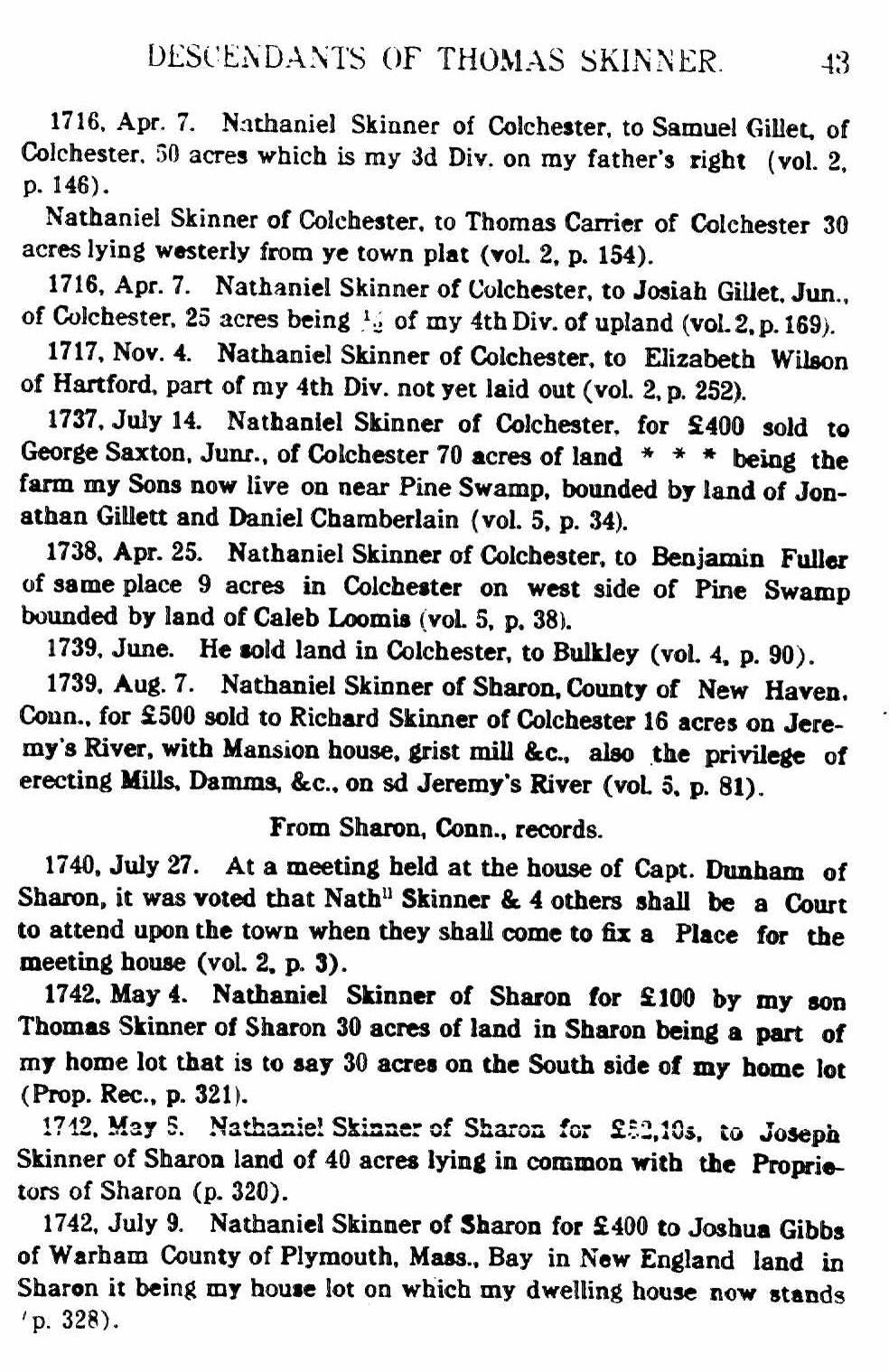
Nathaniel was the owner of the water right in Colchester in 1725: “One of the oldest water rights in the State of Connecticut is located on the small but beautiful tributary of the Salmon River which has long been known as Jeremy’s Stream. . . . The power produced by this ancient water right has run some mill continuously through the years . . . The first owners of the water right were Andrew Carrier and Nathaniel Skinner and the grant was made to them by the Town Meeting of Colchester on Dec 13, 1725. The power was used to run one of those old-time feed mills . . .”

Nathaniel and his sons, as well as Mary Gillett’s brothers, were among the first purchasers of land at Sharon, Connecticut:  “At the session of the Assembly in May, 1738, it was ordered that the township should be sold at public auction at New Haven on the second Wednesday of the following October. Samuel Eels, Esq., Joseph Whiting, and Capt. Isaac Dickerman were appointed a committee for that purpose. It was divided into fifty-three rights, or shares, as they were called, one of which was given to the first minister, one was reserved for the use of the ministry in the town, and one for the support of schools, and the debts accruing from the sale were secured by the bonds of the purchasers, and when collected the avails were divided among the other towns in the colony for the support of schools therein. The following is, a list of the original purchasers of the town: . . . Nathaniel Skinner, Thomas Skinner, Nathaniel Skinner, Jr., Joseph Skinner, Samuel Gillet, Joseph Skinner, and Josiah Gillet, Jr. . . . These purchasers formed a legal corporation, whose designation was and is, The proprietors of the Common and Undivided Land in the Township of Sharon. The clerks of the corporation have been Nathaniel Skinner . . .

“The corporation had power to set out to each proprietor in severalty his share of the lands, and at different times they have been thus deeded, and each right has furnished to its owner nearly seven hundred acres of land. The average price of each right was about one thousand dollars, and each deed to the purchaser contained the following condition, which would ensure the speedy occupancy of the lands: ‘Always provided, and these presents, are upon this condition, that if the said ______, shall by himself or his agent, within the space of two full years next after the date hereof, enter upon the said granted premises, build and finish an house thereon not less than eighteen feet square, and seven feet stud, subdue, clear, and fence six acres of said land, and continue thereon for the space of three successive years, commencing after the two years aforesaid, (unless prevented by death or inevitable Providences,) and do perform all duties and orders, pay all taxes that shall be granted, then the aforesaid deed shall remain in full force and virtue.’ . . . Of the original proprietors these became inhabitants of the town: Nathaniel Skinner, Nathaniel Skinner, Jr., Joseph Skinner . . .

“The first division was into lots of about eighty acres each, which was to furnish the Home lot or residence of the proprietor. A Committee was appointed to lay out a lot of eighty acres, which was called the Standard lot, and all the other lots were made to conform to this in value, the quantity to be more or less according to the quality. . . . The settlers principally located on the main street leading from Jackson’s Patent, now Hitchcock’s Corner, to Salisbury. Some, however, settled on the mountain and some in the valley, and in the course of a year or two nearly the whole territory of the first society was occupied. A large proportion of the first inhabitants of Sharon were from Lebanon and Colchester, in the county of Windham . . .”

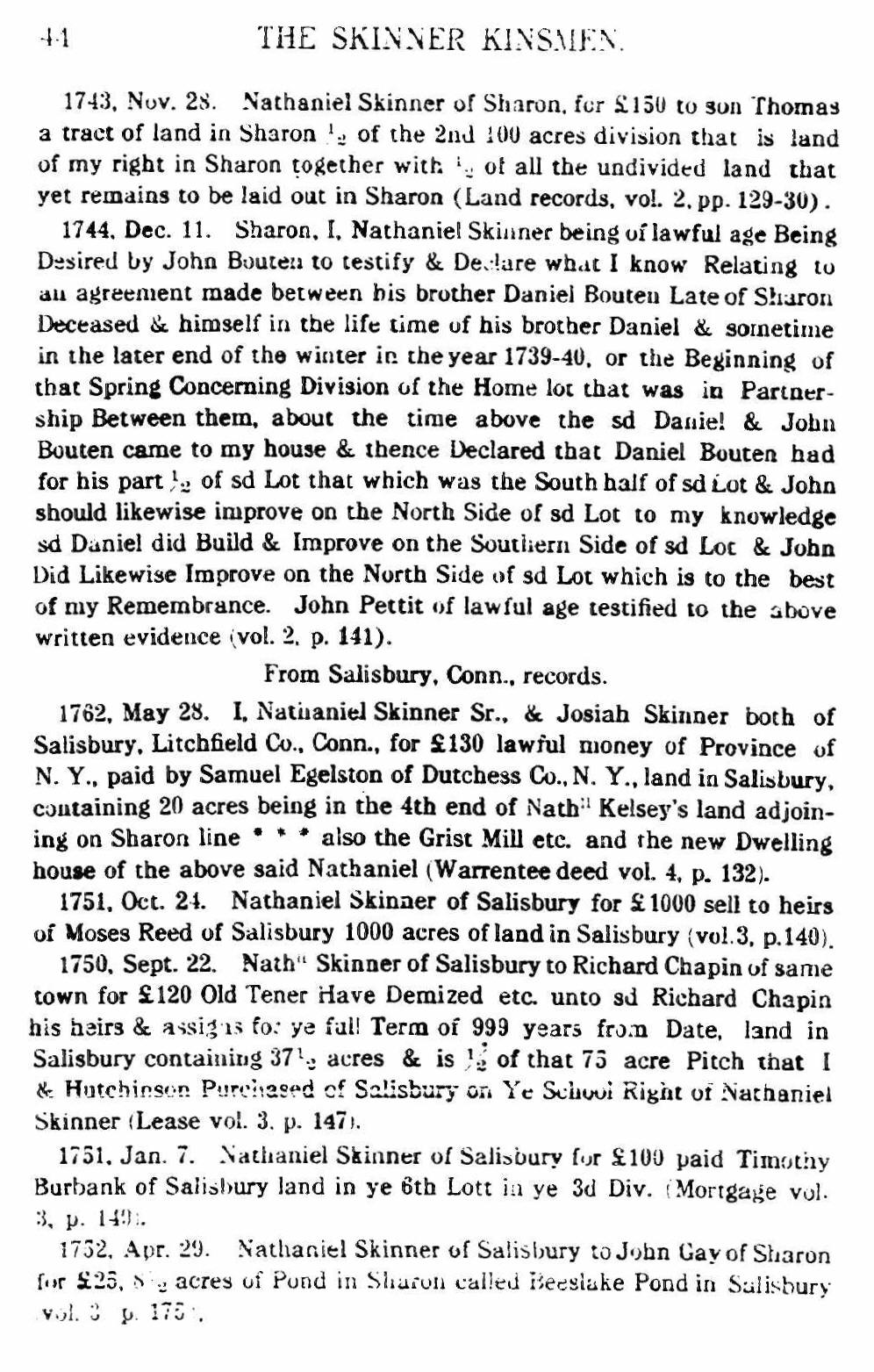
The history of Sharon, Connecticut includes more information on Nathaniel (some of the information may be about Nathaniel Jr.): (108) “During the process of locating and settling the township, the inhabitants enjoyed no corporate privileges, nor had the town received any other name than that given it by the committee who laid it out in 1733. After so many inhabitants had removed into the town as came in the Spring and Summer of 1739, it became important that they should be invested with the usual privileges of Towns, and they should receive a corporate name. A meeting was accordingly holden, and Captain Jonathan Dunham was appointed agent to make application to the assembly for a charter, with the usual privileges of Towns. The character, principles and expectations of the settlers are forcibly illustrated in their petition to the Assembly for an Act of Incorporation . . .

“The Inhabitance of Sharon aplying Themselves to the Genral assembly in October Last Past for Town Priviledges Cap Dunham was mad Choice of to Represent the Town to the Assembly, and having obtained the Desiar of the town he being ordered by the Assembly to Warn the Inhabitance in order To Chuse town officers which Being Dune the Inhabitance being met on the 11 day of December In ye yeare 1739 at the house of Nathll. Skinner In Sharon And then opened the meeting as the Law Dricts . . . Nath Skinner Was Chosen town Clark [clerk] . . . Nathi Skinner Jun Was Chosen Leather Sealer. Nathi. Skinner Jonathan Dunham and John Sprague Was Chosen a Com’tt. to go after a Minister. Nathi. Skinner and Lew. Jabez Creppen chosen a Com’tt. to Lay out a Beuring Place. It was further voted that a Note or Warning In writing set up at The house of John Sprague and Nathi. Skinner and at Garrit winegars mill Six Days before a town meeting Given Reasons of Said Meeting, Shall be a Lawful Warning for a town meeting. . . .

The records of the Congregational Church in Sharon for the first fifteen years are lost. The exact date of the organization of the Church cannot, therefore, be determined. One record names Nathaniel and his sons – at a meeting of the Church in Westchester, a parish of Colchester, Conn., on the 28th day of April, 1740, Nathaniel Skinner (deacon), Jonathan Dunham, Jabez Crippen, Benjamin Fuller, Nathaniel Skinner, Jr., Thomas Skinner, David Skinner, Jonathan Skinner, Jabez Crippen, Jr., Samuel Mudge, Micah Mudge, Cornelius Hamlin, Alexander Spencer and Josiah Skinner “received letters of recommendation, in order to be embodied into a Church at Sharon, where they have for some time resided.

“At a meeting of the same Church, on May 18, 1740, (about three weeks after the former meeting) Jeremiah Foster, Mary Foster, Mary Skinner, Content Fuller, Elizabeth Skinner, Abigail Mudge, Mary Hampton, Mary Dunham, Mary Skinner, Jr., Eunice Mudge, Elizabeth Dunham, Lydia Crippen, Deborah Crippen, Thankful Crippen, Waitstill Heath, Abigail Skinner, Patience Fuller, Hannah Dunham and Martha Mudge received a letter of recommendation “to the Church in Sharon,” which indicates that this Church was organized between the meetings of the Church in Westchester. . . . Nathaniel Skinner was elected to the office of deacon in the church in 1739..

11. Abigail Skinner

Abigail’s husband Ebenezer Mudge was born 26 Feb 1683 in Northampton, Hampshire, Mass. His parents were Micah Mudge and Mary Alexander. Ebenezer died 21 Apr 1758 in Sharon, Litchfield, CT.

They raised a numerous family, six sons and six daughters, all of whom were married and living when Ebenezer died. They were very prolific, he left twenty-five adults and some eighty grandchildren to mourn his death. Ebenezer’s family moved to Lebanon, Conn. about 1697, he farmed, bought and sold land there and in Hebron and Colchester till 1737. He apparently sold all his holdings at that time and with his wife and family and Nathaniel Skinner (his wife’s brother) and his family moved west to the new townsite of Sharon, Conn. In 1738 Ebenezer drew the twenty-fifth home lot lying on both sides of the Town Street (now The Green) and embracing properties later occupied by Capt. Lines, Baldwin Reed, Major Gould and Skinners. In 1740 he sold the lot to Cornelius Hamlin and Mary (Mudge) Hamlin, a daughter and they built a house on the property. The Sharon Historical Society now stands on the same piece of property.

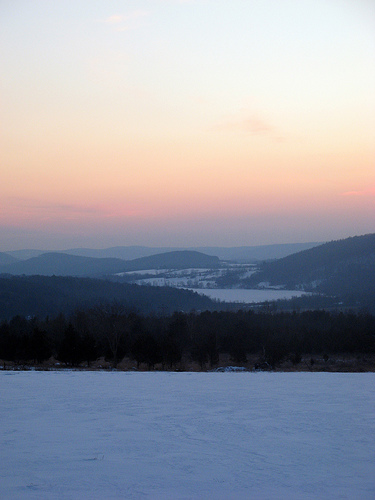
Winter sky over Mudge Pond

In 1743 Ebenezer settled on the western border of “Mudge Pond” a beautiful small lake on the outskirts of Sharon. A section of Sharon was called Mudge Town. He served in various town offices and with his sons built and owned the first sawmill, gristmill and ironworks in Sharon. When he died in 1758 his widow, six sons, six daughters and six sons-in-law signed an agreement, as heirs, to settle the estate without administration..

Sources:

Skinner Kinsmen the descendants of Thomas Skinner of Malden, Mass by Natalie R. Fernald

George Faber Clark, A History of the Town of Norton, Bristol County, Massachusetts, from 1669 to 1859 – Archive.org 1859

http://familytreemaker.genealogy.com/users/s/a/x/Stephanie-A-Saxon/GENE34-0002.html

http://familytreemaker.genealogy.com/users/s/k/i/Richard-A-Skinner-NY/GENE1-0003.html

http://www.genealogyofnewengland.com/b-_s.htm

The Skinner kinsmen, the descendants of Thomas Skinner of Malden, Mass By Natalie R. Fernald The Pioneer Press Washington, DC 1900

http://trees.ancestry.com/owt/person.aspx?pid=6925457&st=1

Posted in 12th Generation, Be Fruitful and Multiply, Immigrant - England, Line - Shaw, Pioneer, Public Office, Twins | Tagged | 4 Comments

William Carpenter Sr

William CARPENTER Sr. (1575 – 1638 ) was Alex’s 12th Great Grandfather, one of 8,192 in this generation of the Shaw line.

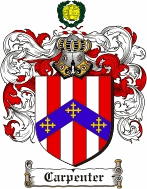
William Carpenter – Coat of Arms

William Carpenter was born about 1575 in England. He was of Newtown, Shalbourne Parish, Wiltshire, England, by 1608, when he became a copyholder (semipermanent leaseholder) at Westcourt Manor.  He,  with son William and the latter’s family, embarked at Southampton, Hampshire, on the Bevis. The preamble to the ship’s passenger list indicates that by 2 May 1638 “they had been some Dayes gone to sea”. They landed  at Boston in June or July 1638.  Nothing more is known of the father, William, in Massachusetts and he is presumed to have perished either in passage or shortly after arriving in the new world.

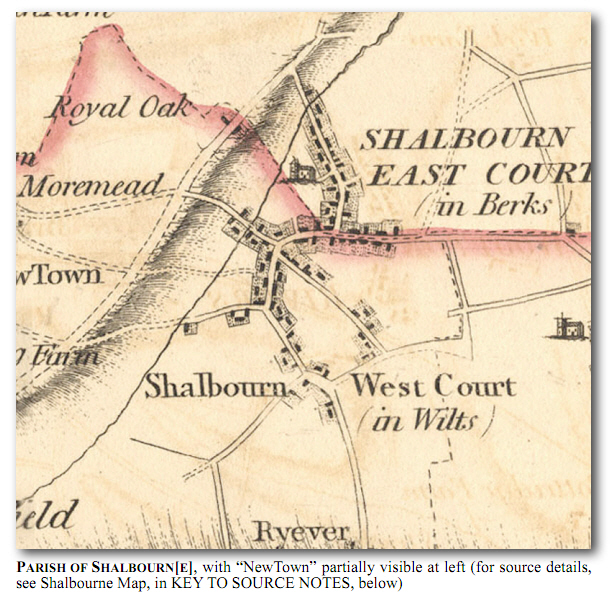
Shalbourne, completely in Wiltshire since 1895, previously straddled the line separating Wiltshire and Berkshire, with Westcourt comprising the Wiltshire part of the parish (Shalbourne Map); the Hampshire border was/is about four miles away. It is
likely that William was born in one of these three counties.

Shalbourne Parish

BIRTH
The record of William’s renewal of his Westcourt tenancy on 22 June 1614 gives his age as 40 (Westcourt Recs 7). The passenger list of the Bevis, the ship on which he left England, is dated 2 May 1638 and states William’s age as 62  From these facts is calculated a birth year of about 1575.

A William Carpenter was baptized in the parish of Great Coxwell, Berkshire (now in Oxfordshire), on 5 May 1576, son of Henry Carpenter (GCPaR). Evidence that this is more than coincidence has not been found. But since Great Coxwell is only twenty map miles due north of Shalbourne, further research in the vicinity of the former place is
warranted.

DEATH: The latest known record of William1 is the aforementioned Bevis passenger-list
entry of 2 May 1638. His namesake son, William  CARPENTER, settled at Weymouth probably in 1638 and certainly before 13 May 1640, when he was admitted a freeman there.  That William was not made a freeman at the same time was perhaps because he had died.

MARRIAGE: Despite claims to the contrary, the identity of William1’s wife (or wives) is uncertain. His having emigrated only three months after the death of Alice Carpenter, who was buried at Shalbourne on 25 January 1637[/8], suggests that she had been his wife (though not necessarily William2’s mother); it is possible, however, that she was an unmarried sister or daughter .

A William Carpenter married at St. Thomas the Martyr, Salisbury, Wiltshire, 18 April
1605, Mary Bath . Christopher Batt, a tanner of [New] Sarum (i.e., Salisbury), Wiltshire, was one of the Carpenters’ fellow passengers on the Bevis. Records of the Batt family of Salisbury, however, indicate that he and a Mary Batt of appropriate age (baptized at St. Thomas 7 Aug. 1584, daughter of Richard and Agnes (Danyell) Batt) “would be no more than distant cousins” . It has not been established that William1 Carpenter was the man of that name who married Mary Bath.

Children of William and Alice:

Name Born Married Departed
1. William Carpenter Jr. ca. 1605
Wiltshire or Berkshire, England
Abigail BRIANT
on 28 Apr 1625 at St. Michael and All Angels Church in Shalbourne Parish, Berkshire, England.
7 Feb 1658/59
Rehoboth, Plymouth Colony (that part now Rumford, East Providence, RI)

OCCUPATION: The Bevis passenger list describes William Sr.  as a carpenter . That his copyhold included not only a messuage (house and adjoining land) with a garden but also a small number of acres in nearby common fields indicates that he was
also a husbandman (subsistence farmer)

EDUCATION/OFFICES: William “Crpentr,” church warden, signed with his mark a glebe terrier (describing lands belonging to the Shalbourne vicarage) dated 6 June 1628 (SVGT). William2’s obvious literacy excludes him from consideration as the subscriber

CHILDREN: The only known child of William Sr.  Carpenter is the son named with him in his record of tenancy at Shalbourne Westcourt and with whom he emigrated: the eventual William Jr.  Carpenter of Rehoboth. The Carpenters’ Encyclopedia of Carpenters 2009 main database’s attribution to William Sr.  of additional children, through alleged wife Mary “Batt”  is unsubstantiated. .

COMMENTS: The will of Robert Carpenter of Marden, Wiltshire, dated 12 January
1606[/7?] and proved 21 May 1607, names (among others) adult sons William and Richard. It has been claimed that these brothers were William Sr. Carpenter  and RichardA Carpenter of Amesbury, Wiltshire (father of William1 of Providence, R.I.). While it is not impossible that William Sr. of Shalbourne was the son of Robert of Marden, evidence of it has not been found; it is unlikely that Richard of Amesbury was Robert’s son. Genetic testing of agnate descendants of William of Shalbourne and Richard of Amesbury has established with a high degree of probability that the two were in fact related but far more remotely than generally believed.

Sources:

http://carpentercousins.com/carplink.htm

http://en.wikipedia.org/wiki/Rehoboth_Carpenter_Family

Posted in 14th Generation, Immigrant - England, Line - Shaw, Wikipedia Famous | Tagged , | 4 Comments

William Carpenter Jr.

William CARPENTER (1605 – 1659) was Alex’s 11th Great Grandfather two ways through his daughter Abigail and through his son Joseph.  He was two of 4,096 in this generation of the Shaw line.
St. Michael and All Angels Church Shalbourne Parish, Berkshire, England

William Carpenter was born in Wiltshire or Berkshire, England about 1605. His parents were William CARPENTER Sr. and  Alice [__?__].   He married Abigail BRIANT on 28 Apr 1625 at St. Michael and All Angels Church in Shalbourne Parish, Berkshire, England.

William and Abigail were married in St. Michael and All Angels, Shalbourne

William died at Rehoboth, Plymouth Colony (that part now Rumford, East Providence, RI), on 7 Feb 1658/59.
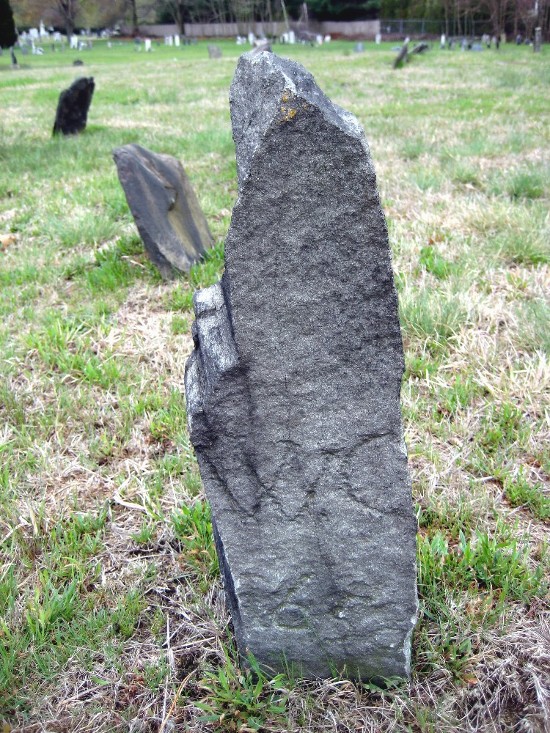
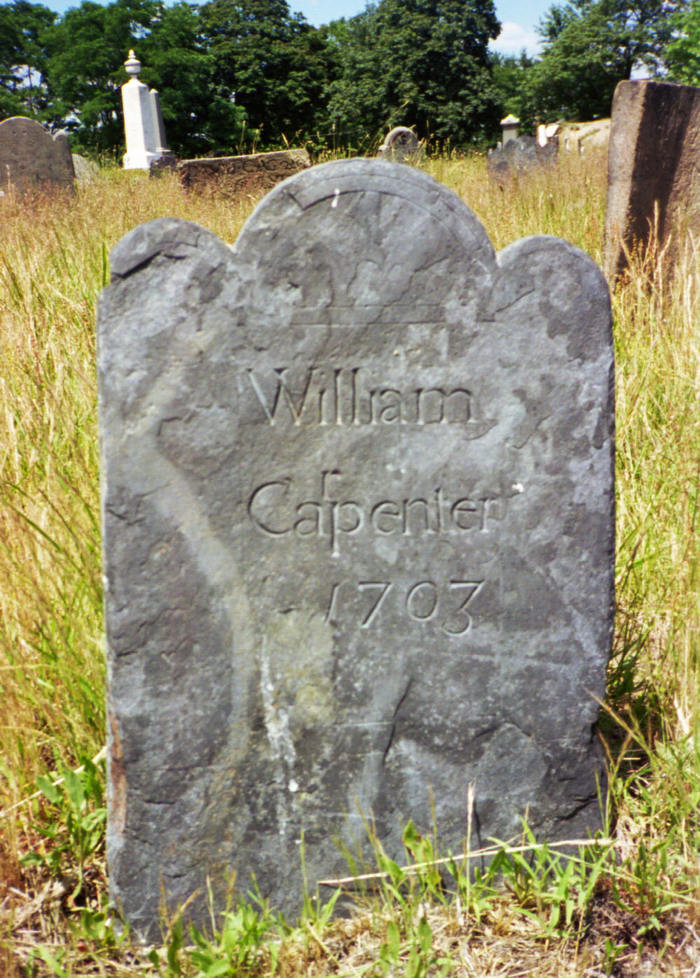
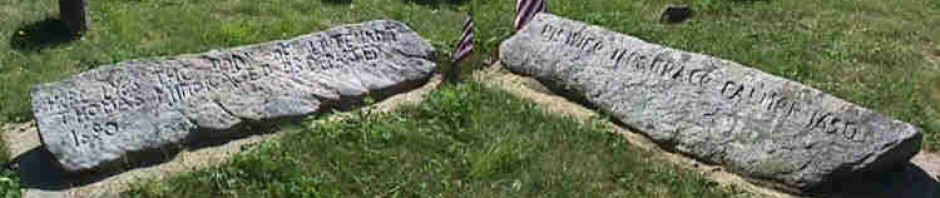
William Carpenter Headstone — Newman Cemetery East Providence Providence, Rhode Island

Abigail Briant was, baptized on 27 May 1604 in at St.Michael’s and All Angels Church Shalbourne Parish, Berkshire, England.  Her parents were John BRIANT and Alice [__?__]. Some older sources give wife Abigail’s maiden name as Bennett or Searles. The first represents unwarranted linkage to a Bennett family of Sway, Co.Hampshire, and the second is the wife of another William Carpenter also born in 1605.  Abigail was buried at Rehoboth on 22 Feb 1686/87 at the Old Rehoboth (Newman) Cemetery

Ancestor File and others have show John’s wife to be Abigail Searles with the same date of death.  Recent article cited on Carpenter message boards and in other reports say she is proven as Briant. Eugene Cole Zubrinsky, “William1 Carpenter of Newtown, Shalbourne, Wiltshire (Bevis, 1638)” (2008) provides a detailed explanation.

BIRTH: The earliest known record of William and his family of origin is that of their
tenancy at Westcourt Manor, at Newtown in the Wiltshire part of Shalbourne Parish, beginning in 1608. The line separating Wiltshire and Berkshire bisected the parish, and the Hampshire border is only about four miles distant; it is therefore likely that he was born in one of these three counties. William’s approximate birth year is calculated from his age, 33, as reported a few days before 2 May 1638 and recorded on that date in the passenger list of the Bevis, on which ship he and his family sailed to Massachusetts

DEATH: Original Rehoboth vital records give Willliam’s date of death as 7 Feb 1658. In May of that year, however, William Carpenter Sr. was chosen Rehoboth waywarden, and on 22 Jun 1658, he was one of forty-nine proprietors (also including William Jr.) who drew lots for meadows lying on the north side of the town  His year of death is therefore presented in the first paragraph as 1658/59,

IMMIGRATION: William, his wife, four children, and father embarked at Southampton,
Hampshire, on the Bevis. The preamble to the ship’s passenger list, dated 2 May
1638, indicates that “they had been some Dayes gone to sea” They landed probably at Boston in June or July 1638.
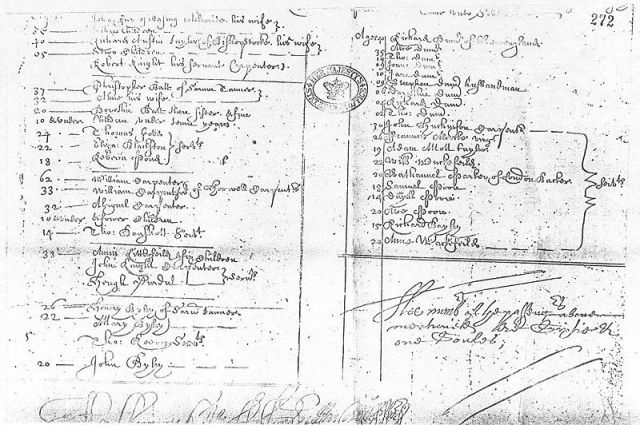
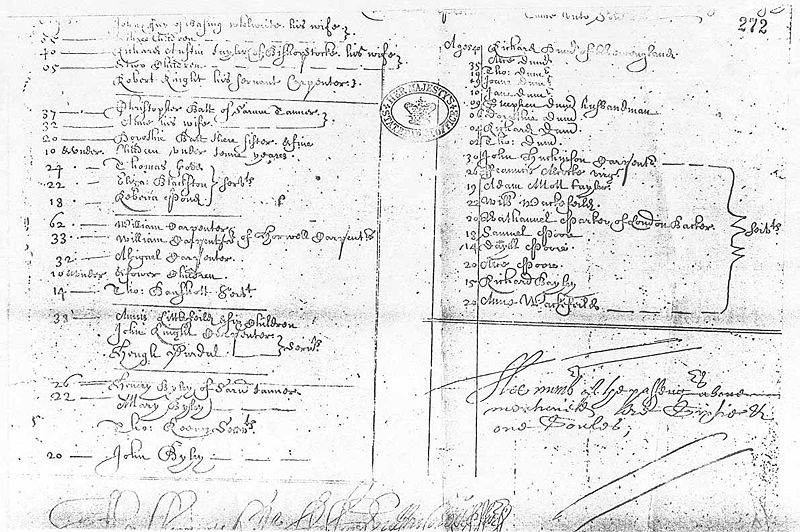
William Carpenter, the father, William Carpenter, the son, and the son’s family on the passenger list of the sailing ship Bevis from 1638.

The Bevis passenger list describes William and his father as “of Horwell,” that is, Whorwell (now Wherwell), in Horwell Hundred, Hampshire, about 15 map miles south-southeast of Shalbourne. Whorwell/Wherwell, which had a tradition of religious dissent—at least two of its vicars,  Stephen BACHILER [our ancestor] (1587–1605) and probable brother-in-law John Bate (1605–1633), were nonconformists—lies on a straight line from Shalbourne to the Bevis’s port of departure, at Southampton. (Another Bevis passenger in 1638 was Richard Dummer, who, with kinsman Bachiler, had been a partner in the Plough Company, which had recruited dissenters for migration to New England in 1631 and 1632.) It is clear from the chronology of Carpenter records at Shalbourne that the family was at Wherwell for a few months at most. It is indeed possible that they paused there only long enough to obtain from sympathetic authorities the certificates of conformity (one for each man) that customs officials would require for the Carpenters to leave England and from which the residence recorded for them on the passenger list was probably copied

Children of William and Abigail:

Name Born Married Departed
1. John Carpenter 8 Oct 1626
Shalbourne, Berkshire, England
Hannah Smith|bef 1655 btw 10 Nov 1694 (will) and 23 May 1695 (probate) Jamaica, Long Island, NY
2. Abigail CARPENTER baptized
31 May 1629
Shalbourne, England
John TITUS
Rehoboth, Mass
.
Jonah PALMER Sr.
(as his second wife)
5 Mar 1710 Rehoboth, Mass
3. William Carpenter Baptized 22 Nov 1631
Shalbourne, England
Priscilla Bennett
5 Oct 1651 Rehoboth, MA
.
Miriam Sale
10 Feb 1663/64 Rehoboth, MA
26 Jan 1703 Rehoboth Mass
4. Joseph CARPENTER baptized 6 Apr 1634 at Shalbourne, England. Margaret SUTTON
25 Nov 1655 in Rehoboth, Plymouth Colon
6 May 1675
Swansea, Plymouth Colony.
5. Samuel Carpenter 1 March 1636/37
Shalbourne, England
20 April 1637
Shalbourne
6. Samuel Carpenter ca. 1638
Weymouth, Mass.
Sarah Redway
25 May 1660 in Rehoboth,
20 Feb 1682/83 Rehoboth
7. Hannah Carpenter 3 Apr 1640
Weymouth, Mass.
Joseph Carpenter (son of William Carpenter of Providence)
21 Apr 1659 Rehoboth
1673
Oyster Bay, Nassau, NY
8. Abiah Carpenter 9 Apr 1643
Weymouth, Mass.
Mary Redway
25 May 1660 Rehoboth
1688
Pawtuxet (now Warwick) Rhode Island

William  Carpenter’s admission as a Massachusetts Bay Colony freeman from Weymouth in 1640 required church membership. The minister at Weymouth was Rev. Samuel Newman, most of whose congregation accompanied him to Rehoboth, where he was also the minister. William Carpenter was one of Rehoboth’s fifty-eight original proprietors and he and much of his family is buried in Old Rehoboth (Newman Church) Cemetery. (While records of the time provide no direct evidence as to the religious affiliation of William (Gen. 2) Carpenter of Rehoboth, he was certainly not a Baptist, even though other Carpenters in New England were. In this regard, he is sometimes confused with William Carpenter (Rhode Island) of Providence and others.
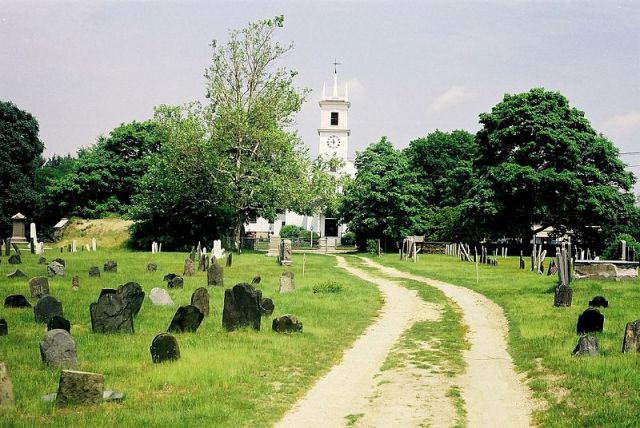
Newman Congregational Church  (Present Church built 1810– 100 Newman Avenue in East Providence, Rhode Island and Carpenter Graves

Timeline

13 May 1640 – Freeman Weymouth

10 Mar 1644 – William was among fifty-eight original Rehoboth proprietors who
drew lots for the first division “in the Neck”

4 Jun 1645 – Freeman Rehoboth

OCCUPATION: House-carpenter/joiner and planter. The Bevis passenger list describes
him as a carpenter, and his estate inventory contains many house-carpenter’s tools

EDUCATION: William’s will mentions many books, including “technical religious works
of the time, Latin classics, Greek and Hebrew grammars, biblical concordances and
some legal works”. Perhaps he was tutored by a local clergyman.

OFFICES: Weymouth: deputy to Massachusetts Bay Colony General Court, 1641, 1643;
constable, 1641. Rehoboth: deputy to Plymouth Colony General Court, 1645, 1656;
townsman (councilman/selectman), 1645, 1647, 1648, 1653, 1655[/6]; one of six to hear
land-allotment grievances, 1645; grand juror, 1646; fence-viewer, 1646, 1647; surveying
activity for the town, 1649 (perhaps other years); constable, 1654; surveyor (overseer) of
highways (way warden) 1654, 1658

Perhaps the most repeated assertion as to the offices occupied by William Carpenter is
that he was Rehoboth’s first proprietors’ and town clerk. Amos Carpenter [1898] states that “at a proprietors’ meeting held in Weymouth before the emigration to Rehoboth, the latter part of the year 1643, William Carpenter was chosen Proprietors’ clerk. . . . He served as Proprietors’ and Town Clerk from 1643 until 1649” . At the bottom of the same page, author Carpenter presents a mistake-ridden transcription of a 1644 Rehoboth town order establishing wage rates for common labor. Following this (on a new line and near the right margin) is the phrase “WILLIAM CARPENTER, clerk.” It thus appears that William identified himself as the one who, as town clerk, had entered the record in the town book. The original record, however, is followed by no such indication of the clerk’s identity. Nothing but a blank space separates it from the next, unrelated record. Neither does William Carpenter’s name appear in the records of the proprietors’ meetings held at Weymouth in late 1643, nor does it appear thereafter in connection with a clerkship of any kind.

Less often repeated but nevertheless persistent is the claim by Amos Carpenter [1898] that William was commissioned a captain by the authorities at Boston “about 1642”  The date’s lack of precision is consistent with the fact that evidence of such an appointment is not found in the records of either Massachusetts Bay Colony or the Essex Quarterly Court (the latter lacked the authority for such an act). If a William Carpenter were to have been made a captain about this time, it probably would have been William1 of Pawtuxet, Rhode Island (d. 1685). (Pawtuxet— not to be confused with Pawtucket—was then part of Providence Plantation and is now in Cranston.

WILL/ESTATE: William’s will is dated “the 10th month [December] the 10th day of
the month” (year not given—perhaps as early as 1656, no later than 1658) and was
proved on 21 April 1659 . His estate inventory, taken on 21 February 1658/59, values his Rehoboth and Pawtuxet lands at £180 and £60, respectively.

(The Pawtuxet property was in northern Warwick, R.I., across the Pawtuxet River
from the Providence section of the same name.   His personal estate contained many carpenter’s implements, including a lathe and turning tools; various types and sizes of saws and planes; jointers, spokeshaves, drawing knives, chisels, adzes, gouges, a vise, and glue. The value of his entire estate totals to £644 19s. 10d.

Too Many Carpenters

There were several Carpenter families in early New England.   There were even several William Carpenters born in 1605 who immigrated to America

Our William CARPENTER b. 23 May 1605 – England Parents William CARPENTER and Alice [__?__] m. Abigail BRIANT d. 7 Feb 1659 – Rehoboth, Bristol, Mass

William Carpenter b. 23 May 1605 – Amesbury, Wiltshire, England m. Abigail Sears 28 Apr 1625 England d.7 Sep 1685 – Rehoboth, Bristol, Mass.

William Carpenter b. 23 May 1605 – Somerset, England; d. 26 May 1667 – Pawtucket, Providence, Rhode Island

William Carpenter b. May 1605 – Amesbury, England; m. Elizabeth Arnold Apr 1625; d. Sep 1685 – Bristol, Mass.

It’s hard to know for sure, but it doesn’t seem they were closely related.  William Carpenter (Rhode Island), son of Richard Carpenter of Amesbury was a reportedly a first cousin of William Carpenter of Rehoboth, son of William Carpenter of Shalbourne, England. In addition he supposedly was closely related to Alexander CARPENTER of Wrington, Somersetshire, and Leiden, Netherlands, of whom his four married daughters were in the Plymouth Colony in the early 1620s. This derives from Amos B. Carpenter’s [1898] unsupported claim that Richard of William of Shalbourne, and Alexander Carpenter were brothers. No genealogical evidence has been found even hinting at a link between the Wrington Carpenters, on the one hand, and either of the other two afore-mentioned families, on the other; a connection is highly improbable. Traditional genealogical research methods provide good reasons to doubt also that Providence William and Rehoboth William were closely related.

Results of recent genetic (Y-DNA) testing coordinated by the Carpenter Cousins Y-DNA Project support this conclusion: Based on a number of 67-marker tests, “we can state with 95% confidence that the most recent common ancestor of the two groups [descendants of the Providence and Rehoboth Carpenters, respectively] was more than 2 generations before the immigrants and less than about 20. Therefore, the DNA testing has very nearly ruled out the often-repeated claim that the Williams were first cousins. The most likely estimate is about 7 generations, but that is a very rough estimate, and the 95% confidence interval is a more reasonable description of what the DNA is telling us” (Carpenter Cousins)

Children

1. John Carpenter

John’s wife Hannah Smith was born about 1635 Her parents were William Smith and Magdalen [__?__] of Weymouth, Massachusetts; Rehoboth; and Huntington and Jamaica, Long Island. Hannah was living in 1704 (sold dower rights to son William).

RESIDENCES: Shalbourne; Weymouth (probably 1638); Rehoboth (1644); Long Island
(mid-1650s). John may have departed Rehoboth as early as 1653, for on 28 June of that year his name fails to appear among those of forty-one signatories, including his father and brother William Jr., who on that date authorized four others to settle a land-rights issue with a group of Plymouth men.. He is also omitted from a December 1657 rate list naming his brothers William Jr. and Joseph among fifty-five Rehoboth men and from a list of those, including William Jr., who drew meadow lots on Rehoboth’s north side in June 1658.. Undated Rehoboth proprietors’ records (ca. 1662) indicate that he had sold his land holdings there to James Redway, father-in-law of John’s brothers Samuel and Abiah and of their brother William’s son John

Dated 7 Dec 1660, the deed by which he purchased a dwelling house, home lot, and eleven acres of meadow at then Dutch-controlled Hempstead, Long Island, calls him “John Carpendar of Hontinton [colony not stated]” . Amos B. Carpenter assumes (as, initially, does Herbert Seversmith) that this was the southwestern Connecticut town of Huntington (now Shelton) that town was not established until 1789.. The Huntington to which the deed refers, although under Connecticut authority from 1660 to 1664, was separated from Hempstead only by the town of Oyster Bay, on Long Island; it was first settled in the early 1650s. Confirming that John Carpenter had been living at Huntington, Long Island, is his having witnessed on 25 Sep 1660 Ann Crocker’s sale of her Oyster Bay house and land to Richard Lattin of “hunting Towne”. On 14 Feb 1663/64, a meadow lot was laid out to him at Jamaica, Long Island . He was nevertheless living at Hempstead on 12 May 1664, and when on 8 Nov 1665 he bought a dwelling house and home lot at Jamaica, he was still “of Hempstead” He clearly did not settle at Jamaica until after this purchase.

OCCUPATION: Carpenter and planter. John left “my carpenter shop tools” to his sons . He is said to have been an itinerant carpenter as a young man. The itinerancy, however, appears to be an assumption based on dubious claims of his presence in Connecticut in the mid-1640s and the mistaken notion that he had migrated there from Rehoboth in the mid-1650s

FREEMAN: He was one of fifteen Hempstead men accepted as freemen by the Connecticut General Court on 12 May 1664

EDUCATION: He signed his will (and various other documents) and left “my books to be equally divided amongst all my children”

OFFICES: Hempstead: selectman, 1663/34 . Jamaica: captain of fusilier company by 1670 ; overseer of poor, 1670; committee to settle minister, 1676; delegate to choose county treasurer, 1683[/4]; in delegation to meet with governor, 1685; commissioner, 1686; delegate to choose county representatives to Provincial Assembly, 1689/90
.
A New York history names John Carpenter eleventh on a list of twelve Rutsdorp (Jamaica) magistrates for the period 1659–1673, suggesting that he held the office toward thevend of that period

WILL/ESTATE: The will of John Carpenter, dated 10 November 1694 and proved 23
May 1695, names sons John (eldest), Hope (second), Samuel (third), and William (coexecutor); daughter Ruth Ludlam; grandchildren Hannah and Abigail Rhodes and [John4’s son] Solomon Carpenter; wife Hannah (co-executor); and overseers Joseph and Nehemiah Smith. Real estate, in addition to parcels of specified size totaling 171 acres, includes several of unspecified area: home lot and adjoining pasture; “addition” of fresh meadow; and “lotted land within fence and without.” Son John had previously received property “out of my stock and estate as a part of his portion.” Household goods include items of pewter and brass

2. Abigail CARPENTER (See John TITUS‘s page and  Jonah PALMER Sr. page)

3. William Carpenter

William’s wife Priscilla Bennett was  born xxx. She was probably the daughter of Edward Bennett and Elizabeth Edgington. (There is a marriage of an Edward Bennett and Elizabeth Edington at Weymouth, Co.Dorset on 27 Oct 1622) Priscilla died  20 Oct 1663 in Rehoboth, Mass.

Edward Bennett came to New England with his wife Elizabeth and four children, and settled in Weymouth,MA in 1636 where land was given to him. He was made a Freeman at General Court held in Boston, May 26, 1636. He resided in Weymouth seven years, when he joined the Rev. Newman’s Company, and became one of the original proprietors of that part of Rehoboth, MA called Seekonk, moving there with his family in 1643. He died there in 1645/46.

William’s second wife Miriam Sale was born about 1644.  Though Edward’s first wife Margaret ____ Searle/Sale could have been the mother of several children, her banishment for adultery makes it unlikely, and it is more likely that Edward’s second wife Rebecca, who died in 1664, was the mother of most children, including Miriam. See Great Migration, Volume 6, pp.142-3.  Miriam died 1 May 1722, Rehoboth, Bristol, Mass and is buried in Newman Cemetery , East Providence, Providence, Rhode Island

RESIDENCES: Shalbourne; Weymouth (probably 1638); and Rehoboth (1644).

OCCUPATION: Planter. He owned a “long Cross cutt saw” (willed to house-carpenter son
John) and other, unspecified tools, suggesting some carpentry skills

FREEMAN: Propounded 6 June 1660 but not admitted until 1 June 1663

EDUCATION: He was for almost thirty-five years Rehoboth town clerk. His will mentions several volumes (mainly theological), and his estate inventory includes an item for unspecified books valued at £3 10s.

OFFICES: Surveying activity for the town, 1659, 1660, 1663, 1663/4, 1666, 1679, 1684, 1685 (probably other years); way warden (surveyor [overseer] of highways), 1659, 1675; constable, 1663; town clerk, 1668–1692, 1694–1702/3; coroner’s jury, 1668, 1679; committee to settle bounds between Rehoboth North Purchase and Taunton, 1670; chosen North Purchase “clerk of the community,” 1682; rater/assessor, 1679–1686, 1690–1691, 1694, 1696, 1700; juryman at Plymouth, 1682/3; committee to seat the meeting-house, 1683; townsman, 1683–1686, and selectman, 1687–1689, 1691–1693, 1695–1701; town treasurer, 1694, 1697–1699; “juror for trials,” 1694; pound keeper, 1694; committee to engage schoolmaster, 1700
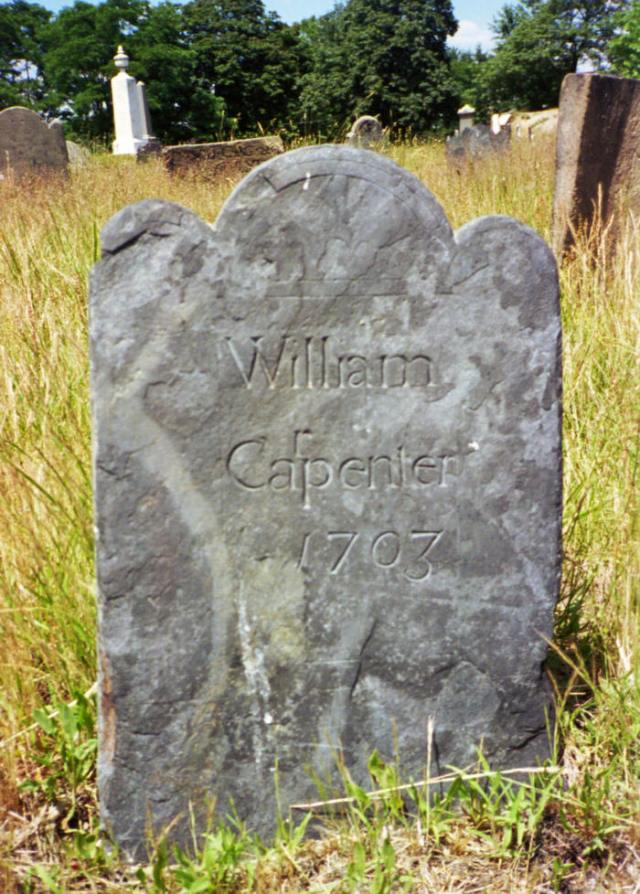
William Carpenter Headstone — Newman Cemetery, East Providence Providence, Rhode Island

4. Joseph CARPENTER (See his page)

6. Samuel Carpenter

Samuel’s wife Sarah Redway (Redway, Reedaway, Readaway, Reedeway, Reedaway, Reddaway, and Reddeway) was born about 1642 in Hingham, Plymouth, Mass. Her parents were James Redway and Mary Whipple.  Sarah married, second, 18 Jan 1687/88 in Rehoboth to Gilbert Brooks.  Sarah died 15 Jul 1717 (not 8 Jan 1717/18 or 29 APR 1712) Rehoboth, Bristol, Mass.

RESIDENCES: Weymouth (probably from birth, ca. 1638); Rehoboth (1644).

OCCUPATION: Cooper and planter

FREEMAN: Though there is no known record of Samuel’s having been propounded for or admitted to freemanship, he appears on the Plymouth Colony list of freemen dated 29 May 1670

EDUCATION: Samuel’s estate inventory includes an item for four books, and his signature as a witness appears on several deeds

OFFICES: Grand juror (Plymouth Colony Grand Enquest), 1661; surveying activity for the town, 1663, 1663/4; way warden (surveyor [overseer] of highways), 1664, 1680; constable, 1666, 1677; coroner’s jury, 1668, 1673/4

ESTATE: Samuel’s estate inventory was taken on 27 Feb 1682/83, and widow Sarah swore to its accuracy on 1 March 168[2/]3 . The inventory contains ample evidence in land, implements, and animals of his having been a farmer; it also lists many tools and materials pertaining to the cooper’s trade. His estate (land included) was valued at £436 10s. 6d. The inventory identifies tracts of specified area totaling 220 acres and several other parcels of unspecified size, including his home lot, described elsewhere as comprising twelve acres Samuel died intestate. On 6 March 1682/3, the Plymouth Colony Governor and Court of  Assistants granted letters of administration on Samuel’s estate to his brother William, son Samuel Jr., and relict Sarah. His estate was settled the same day, with Sarah to receive a widow’s one-third, dower share and £26 “for and toward the bringing vp of four smale children, and the remainder to be deuided into eleuen p[ar]tes, the eldest to haue a double p[ar]te, and the rest to be deuided amongst the children equally and in a like proportions, viz., the children of Mr Samuell Carpenter, late deceased
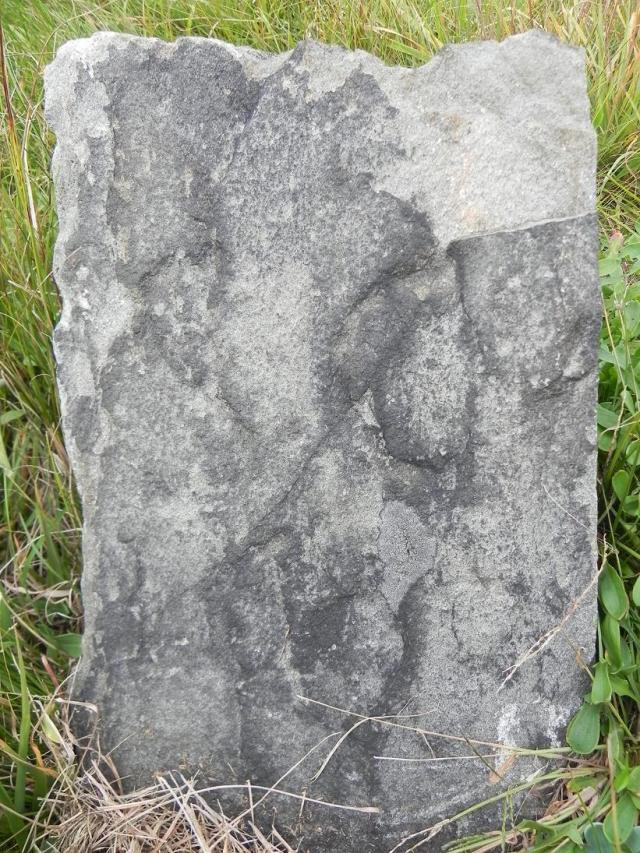
Samuel Carpenter Headstone — There is a very fait inscription of “SC” the date at the bottom is all but worn away but you can make out a very faint “16–” — Newman Cemetery East Providence Providence, Rhode Island

Children of Samuel and Sarah:

i. Samuel Carpenter b. 15 SEP 1661 Rehoboth, Bristol, Mass.; d. 17 JAN 1735/36 Rehoboth, Bristol, Mass.; m. 8 JAN 1682/83 Rehoboth, Mass. to Patience Ide.

ii. Sarah Carpenter b. 11 JAN 1662/63 Rehoboth, Bristol, Mass.; d. 5 JAN 1747/48 Rehoboth, Bristol, Mass.; m. 17 MAY 1683 Rehoboth, Mass. to Nathaniel Perry. His parents were our ancestors Anthony PERRY and Elizabeth [__?__]

iii. Abiah Carpenter b. 10 FEB 1664/65 Rehoboth, Bristol, Mass.
d. 28 APR 1732 Rehoboth, Bristol, Mass.; m. 30 MAY 1690 Rehoboth, Mass. to Mehitable Read

iv. James Carpenter b. 12 APR 1668 Rehoboth, Bristol, Mass.; d. 27 APR 1738 Rehoboth, Bristol, Mass.; m. 26 JUN 1690 Rehoboth, Bristol, Mass. to Dorothy Bliss  Her parents were Jonathan Bliss and Miriam Harmon and her grandparents were Thomas BLISS and Dorothy WHEATLEY.

v. Jacob Carpenter b. 5 SEP 1670 Rehoboth, Bristol, Mass; d. 1690 Canada

vi. Jonathan Carpenter b. 11 DEC 1672 Rehoboth, Bristol, Mass.
d. 23 AUG 1716 Rehoboth, Bristol, Mass.; m. 13 MAR 1698/99 Rehoboth, Mass. to Hannah French b. 19 OCT 1679 Rehoboth, Mass. d. 13 FEB 1746/47 Rehoboth, Mass. Her parents were John FRENCH, and Hannah PALMER.

vii. David Carpenter b. 17 APR 1675 Rehoboth, Bristol, Mass.
d. 26 JUL 1701 Rehoboth, Bristol, Mass.; m. 22 NOV 1697 Rehoboth, Mass to Rebecca Hunt

viii. Solomon Carpenter b. 23 DEC 1677 Rehoboth, Bristol, Mass.; d. ABT 1750 South Kingston, Washington, RI; m. Elizabeth Tefft

ix. Zachariah Carpenter b. 1 JUL 1680 Rehoboth, Bristol, Mass.; d. 8 APR 1718 Rehoboth, Bristol, Mass.; m. 8 NOV 1705 Rehoboth, Bristol, Mass. to Martha Ide

x. Abraham Carpenter b. 20 SEP 1682 Rehoboth, Bristol, Mass.
d. 22 APR 1758 Rehoboth, Bristol, Mass.; m. 1 MAY 1705 Rehoboth, Bristol, Mass. to Abigail Bullard

7. Hannah Carpenter

Hannah’s husband Joseph Carpenter was born about 1638 in Providence Plantations.  His parents were William Carpenter of Providence and Elizabeth Arnold (Wiki).  Joseph died at Musketa Cove, Oyster Bay Township, Long Island, NY (now Glen Cove) after Feb 15,1682/83 and before Mar 15,1683/84.

He married, first, about 1658, Hannah Carpenter. (The date of Apr 21,1659 recorded in early sources is questionable because it is the same date as the day on which Hannah’s father’s will was proved.)  He married, second, before 2 Sep 1674, Ann Weeks/Wickes.

RESIDENCES: Providence Plantation; Warwick (Pawtuxet section), Colony of Rhode Island and Providence Plantations (ca. 1658); Musketa Cove (probably late 1668: Joseph was of Pawtuxet on 7 November and of Musketa Cove on 30 November). It was presumably when Joseph married Hannah Carpenter that they left the homes of their respective families of origin—his at Providence (Pawtuxet section), hers at Rehoboth—and settled on the southern, Warwick side of the Pawtuxet River, which at its mouth bisects the village that is its namesake

OCCUPATION: Miller and planter. D. H. Carpenter states that Joseph had a corn mill at Warwick when he was an inhabitant there.. In fact, the mill—in which he sold his half-interest to his uncle Stephen Arnold in 1674, with complications ensuing—was on the north side of Pawtuxet Falls, in the township of Providence; John Sweet had the corn mill at Warwick. At Musketa Cove, “Carpenter and his friends . . . constructed a saw mill and a gristmill across what is now known as Glen Cove Creek. The harbor was ideal for shipping lumber to New York City and the creek was dammed to provide power for the mills. Their goal was [to] furnish New York City with lumber for the construction of housing. The site for the saw mill had many congenial conditions—a fine stream, opportunity for a short dam, and easy access to navigable water at high tide. The lumber produced by the saw mill found a ready market in New York City. By 1679, two years after Carpenter’s purchase from the Indians was officially ratified by the colonial New York government, the mill was producing nine different thickness[es] of boards and timber, as well as tile laths, shingle laths, wainscot, ‘feather-edged’ boards for paneling, and custom-cut walnut for cabinet-making”.

FREEMAN: Although there is no record of Joseph’s having been admitted a freeman in either Rhode Island or New York, that status (comparatively easily achieved in Rhode Island) was a prerequisite to his being chosen for public office at Warwick. It is therefore virtually certain that he had been admitted a freeman of the Colony of Rhode Island and Providence Plantations by 1662

EDUCATION: He signed his deeds and other documents

8. Abiah Carpenter

Abiah’s wife Mary Redway was born 27 May 1646 in Reboboth. Her parent sere James Redway and [__?__]. Mary died probably at Pawtuxet (Warwick) after 1669 and certainly before 7 Mar 1676/77.

Abiah settled in Pawtuxet (now Warwick) between Jul 1, 1661 and Jul 12, 1663. He died there after 14 Dec 1687, and probably before 26 Dec 1689, and certainly before 22 Mar 1698/99.

According to NEHGR, Vol 159, pp.55-64, it is likely that Abiah remarried after Mary’s death, but evidence has not yet been found. It has been said that he married a sister, Abigail, of Ann Wickes/Weeks, possibly at Musketa Cove, Long Island during a brief residence there in 1670, but no concrete evidence exists.

MARRIAGE(S): At Warwick on 14 Sep 1667, William and Mary Baker bound out their seven-year-old daughter, Mary, to Abiah Carpenter, so that he and his wife (not
named) “may . . . educat & instruct [her] in all things that perteyneth to  houswifery” . That Abiah’s wife at that time was Mary Redway is deduced from her father James Redway’s will, dated 26 July 1677 and proved 4 June  1684, which instructs that“Rebeckah Carpenter the daughter of Abiah Carpenter” receive twenty acres from the next land division . Redway’s will names three others, known to be another daughter’s child and two sons-in-law, in the same fashion as it does Rebecca and Abiah; that is, the relationship of each to the testator or any of his daughters is unspecified. With James Redway’s other daughters’ husbands accounted for, Abiah’s wife could only have been Mary.

RESIDENCES: Weymouth; Rehoboth (1644); Pawtuxet (Warwick) (ca. 1662). The area
called Pawtuxet is on both sides of the Pawtuxet River, one part in northern Warwick and
the other in Cranston (formerly southern Providence). Abiah was still of Rehoboth on 1 July 1661, when Kekettowicket, chief sachem of Pawtuxet, relinquished to him and three Pawtuxet (Warwick) men his interest in a parcel of land at the latter place. On 13 July 1663, however, Abiah Carpenter, [brother-in-law] Joseph Carpenter, Benjamin Smith, and Mr. Henry Reddock were all of “Pautuxett in Warwicke” when they asked that the Warwick Court of Trials transfer their prosecution “concerning a Riot” to the General Court of Trials to be held at Portsmouth. Abiah’s father had bequeathed him a home lot, meadow, and other land at Pawtuxet and instructed Abiah’s mother and brother Samuel to “healp him to build an house” there .

Notwithstanding Amos Carpenter’s claim that Abiah resided at Musketa Cove for a few
years beginning in 1668 , Abiah was of Pawtuxet on 30 Nov of that year, when his brother-in-law Joseph Carpenter deeded him twenty acres and “a fifth parte of three Square Miles [all at Musketa Cove] . . . provided [he] shall cum within three Yeares after, ye date beneith written, & possess ye said Lands with his ffamely” . He was also of Pawtuxet on 14 June 1669, when he quitclaimed back to Joseph “my hole, right and titell of Land, at Musketow Cove” ; the witnesses to this deed, however, were Oyster Bay men . Evidently in the week following the expiration of his term as Warwick constable (1 June 1668 to 7 June 1669), Abiah visited Musketa Cove and decided against settling there . He almost certainly returned soon thereafter to Pawtuxet, where Warwick records locate him in mid-January 1669/70.  A 1670 entry in Musketa Cove merchant Moses Mudge’s account book shows
Abiah Carpenter as indebted to him for a half-pint of rum (NYGBR 109:204; NEHGR
159:57n9). Mudge, however, “was in Warwick, R.I., in the period 1668–70 [marriage and
birth of son Jarvis], but returned to Long Island by Aug. 1674” (TAG 81:24; NEHGR
161:300). It is therefore likely that the account-book entry refers to a transaction at Warwick rather than Musketa Cove. Warwick townsmen made Abiah a juryman at least annually from April 1670 to November 1673 (on the latter date for the following February)

OCCUPATION: Amos Carpenter calls him a mariner, but the extent of Abiah’s land
holdings and the nature and frequency of his public service point to his having been a
planter. Not a single seafaring reference is found in records pertaining to Abiah3. The mariner label probably reflects confusion with Abiah Carpenter (Oliver), Abiah who died in 1729, apparently in the West Indies, and whose death record calls him captain and  mariner

FREEMAN: There is no record of Abiah’s having been admitted a freeman, but we may
be certain that he was. Freemanship was a prerequisite not only to his 1682 election as
Warwick deputy to the General Assembly but also to his being named, first in 1665, a
juror at the General Court of Trials. At the General Assembly convened at Newport on or about 13 May 1665, the governor presented a list of five “pertickelares” reflecting “his Majestyes will & pleasure.” Item two was “[t]hat all men of competante estates and of civill conversation, who acknowledge and are obediante to the civill magistrate, though of differing judgements, may be admitted to be freemen, and have liberty to choose and be choosen [sic] officers both civill and [military]” . As this implies, Rhode Island freemanship requirements were considerably less restrictive than those of the other New England colonies at this time. An “Extract from the Report of the King’s Commissioners concerning the New England  Colonies, made December, 1665” states that in Rhode Island “[t]hey admitt all to be freemen who desire it”. On 2 May 1666, the General Assembly considered a list of Warwick men propounded by the town to be freemen: “soe many of them who are not alredy admitted, are now admitted freemen of the Collony” . In the spring of 1669, the General Court of Trials fined the town of Warwick for choosing Abiah Carpenter and Job Almy as grand jurors when neither was eligible—Carpenter because he was already serving as constable and Almy because he was not a freeman. In light of the above, it is probable that Abiah was a freeman by 1665.

EDUCATION: Abiah signed his name as a party to a 1667 agreement and a 1669 deed
and as witness to a 1677 deed. His father left him two books: “Ursinus Chatichisme and hellens history of the world” (MD 14:233). (Zacharias Ursinus was the primary author of the Heidelberg Catechism [1563; rev. 1619].)

OFFICES: Juror, General Court of Trials, 1665, 1667, 1669 (did not serve ), 1670–1672, 1674, 1675 (fined for nonattendance), 1676–1677, 1678–1679 (fined for nonattendance), 1681, 1687; constable, 1668; juror, Warwick Court of Trials, 1671/2; deputy to General Assembly, 1682

Sources:

http://carpentercousins.com/

http://en.wikipedia.org/wiki/Rehoboth_Carpenter_Family

http://carpentercousins.com/Joseph3_Rehoboth&Swansea.pdf

http://carpentercousins.com/Wm2_Rehoboth.pdf
Posted in 13th Generation, Double Ancestors, Historical Church, Historical Monument, Immigrant - England, Line - Shaw, Public Office, Wikipedia Famous | Tagged , | 18 Comments

Joseph Carpenter

Joseph CARPENTER (1633 – 1675) was Alex’s 10th Great Grandfather, one of 2,048 in this generation of the Shaw line.

[ See  Eugene Cole Zubrinsky’s,  article JOSEPH3 CARPENTER (WILLIAM2–1) OF REHOBOTH AND SWANSEA, MASSACHUSETTS  – Last revised 18 October 2011 – Much of this information is from Gene and his scholarship far exceeds my own.]

Joseph Carpenter was baptized 6 Apr 1634 at Shalbourne, Berkshire, England. His parents were William CARPENTER Jr.and Abigail BRIANT. He was the youngest of four children that accompanied their parents on the Bevis in 1638 to Massachusetts.  He married Margaret SUTTON on 25 Nov 1655 in Rehoboth, Plymouth Colony.  Joseph died 6 May 1675 in  Swansea, Plymouth Colony. He is said to have been buried near the “100-acre cove,” in that part of Swansea now Barrington, Rhode Island, about 10 miles southeast of downtown Providence.

Joseph was buried near Hundred Acre Cove

Margaret Sutton was born about 1634. The 1635 birth year often attributed to her stems from Amos Carpenter’s identification of another woman’s gravestone inscription as hers. Her parents were John SUTTON and Julian ADCOCKE. She came to Massachusetts from Attleborough, Norfolk, England with her parents and sibblings on the Diligent in 1638. Margaret died about 1677 in Swansea, Mass. only about 18 months after her husband.

Children of Joseph and Margaret:

Name Born Married Departed
1. Joseph Carpenter 15 Aug 1656
Rehoboth, Mass
Mary Tillinghast
23 Feb 1681/82
Swansea
26 Feb  1717/18
Swansea
2. Benjamin Carpenter 15 Jan. 1657/58 Renew Weeks
1 Jul 1683 Dorchester, Mass
.
Martha Bliss
(Widow of Nathaniel Toogood)
27 Nov 1706
Swansea
22 May 1727
Swansea
3. Abigail Carpenter 15 Mar 1658/59 Rehoboth 1 Feb 1683
Swansea
4. Esther Carpenter 10 Mar 1660/61 Rehoboth Samuel Brentnall
19 Mar 1687
Swansea
1 Feb 1683
Norton, Mass
5. Martha Carpenter?  (See Note) 1662 Rehoboth 22 Mar 1735
Swansea
6. John Carpenter c. 1666
Rehoboth
Mary Coleson
4 Jun 1700 Boston
.
Elizabeth Grinnell
c. 1722
.
Abigail
Day
After 1726
25 Aug. 1753
East Greenwich, RI
7. Hannah CARPENTER 21 Jan 1671
(or 21 1st mo.) 1671
Rehoboth
Thomas SKINNER III
25 Nov 1655 in Rehoboth, Mass
After Jul 1757
8. Solomon Carpenter 27 Apr 1673 Rehoboth 25 Oct 1674
Swansea
9. Margaret Carpener 4 May 1675 Thomas Chaffee
4 Jun 1695
Swansea
6 May
1751
Rehoboth

Joseph Carpenter was one of seven founding members of the Swansea Baptist Church. Formed at Rehoboth in the fall of 1666.  The church at Swansea was the fourth Baptist church in America.  It was relocated to neighboring Swansea about a year later, when the latter town was established.

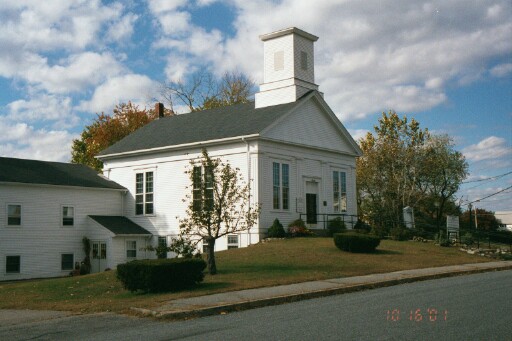
Swansea Baptist Church – 1848 Meeting House

RESIDENCES: Shalbourne; Weymouth (probably 1638); Rehoboth (1644); and Swansea
(by 22 February 1669/70). Amos Carpenter has Joseph removing to Swansea in 1661
or 1662, but the town was not established until fall of 1667, and Joseph was still living at
Rehoboth on 2 April 1669

OCCUPATION: House-carpenter/joiner. Joseph’s estate inventory contains an extensive list of house-carpenter’s tools

EDUCATION: He signed his will, and his estate inventory includes several Bibles and
other books

OFFICES: Rehoboth: coroner’s jury, 1662. Swansea: way warden (surveyor [overseer] of highways), 1671; grand juror (Plymouth Colony Grand Enquest), 1673; appointed to preserve the town’s timber and wood, 1673

WILL/ESTATE: Joseph Carpenter’s will, dated 3 May 1675 (three days before his burial),
mentions sons Joseph (eldest), Benjamin, and John, “my five daughters” (names not
given), “my beloved wife” (executrix), and his brothers William and Samuel Carpenter
(overseers). (William and Samuel probably became guardians of the children.) The will
also acknowledges the impending birth of another child: “if hee be a son; that now my
wife is with child withall; hee shall have his p[or]t[io]n . . .”  The day after the will was written, Joseph’s sixth surviving daughter, Margaret, was born. Only four daughters have been identified.

Joseph’s estate (movable goods only), inventoried on 20 May 1675 and exhibited on 2
November 1676, was valued at £137  10s. 6d.

Widow Margaret’s estate—the inventory was taken less than a year and a half after her
husband’s —amounted to £87 1s. 6d. While only £23 13s. remained after payment of debts, expenses for the children, etc., £38 8s. was nevertheless divided among eight children (a daughter had apparently died) on an unspecified date (probably in 1681 or 1682) Since Margaret died as a young widow, the inventory of her estate gives us a picture of the household items a typical family might have in 1675.

The Inventory of Margaret Carpenter – An Inventory of the estate of Margarett Carpentor wife of Ioseph Carpentor deceased exhibited to the Court held att Plymouth the 2cond of Nouember 1676 on the oath of Willan Carpentor apprised by Mr Nicholas Tanner and Iohn Butterworth this 4th of October 1676.

Impr: her wearing apparrell
Item 4 petticoates 02 05 00
Item 3 wastcoates 01 05 00
Item 4 aprons 00 15 00
Item 2 hatts 00 12 00
Item 1 paire of shooes 1 paire of stockens 1 paire of bodies 00 10 00
Item a yard of Cloth 00 06 00
Item a shift and smale linnine 00 15 00
Item thrid and pins 00 02 00
Item 7 yards and 3 quarters of Cloth 01 00 00
Item 3 yards of Carsey 00 15 00
Item a shift and smale linnine 00 15 00
[items crossed out but value stands]
Item 2 yards and a quarter 00 10 00
Item 26 yards of Cloth att the weauers

Item 1 box locke 01 01 00
item in mony 02 05 00
Item a box with a drawer and a few smale thinges in it 00 15 00
Item an Inkhorn 00 01 00
Item a gun 02 00 00
Item a rapier 00 12 00
Item an old Rapier 00 03 00
Item a belt 00 02 06
Item a Chest & old box 00 09 00
Item a Cradle 00 05 00
Item 4 Chaires 00 08 00
Item 9 pound of woollen yern 01 02 06
a paire of andirons 01 08 00
Item 2 fier shouells and pare of tonggs 00 12 06
Item 2 smoothing Irons 00 05 00
Item 2 pothangers 00 10 00
Item a warming pan 00 05 00
Item a lookeing glasse and Grater 00 02 00
Item a frying pan 00 04 00
Item a spitt 00 05 00
Item 2 paire of shooes 00 02 06
Item 9 trayes 00 05 00
Item a pistoll 00 08 00
Item eleuen trenchers 00 01 06
Item 3 bibles 00 15 00
a Great bible [written in margin] 00 15 00
Item a Psalm book & a Psalter 00 02 06
Item 3 bookes 00 15 00
Item kniues & sissers 00 01 03
Item 2 pond and an half of Flax 00 03 00
Item 8 spoons 00 0[?]
Item a Flaggon 00 18 00
Item a Cupp 00 04 00
Item 6 porrengors 00 10 00
Item 6 platters 02 00 00
Item 4 peeces of pewter 00 07 00
Item 4 pound of Cotton yerne 00 14 00
Item Course yerne for blanketts 01 00 00
Item 6 pound of woole 00 04 00
Item 3 paire of Cards 00 06 00
Item a paire of flocke Cards 00 08 00
Item a Gridiron 00 04 00
Item 2 seiues 00 02 00
Item two brasse lockes 00 02 00
Item 9 [trew?]ell & lines 00 02 00
Item 7 pound of Flax 00 08 00
Item 2 Iron kettles & 2 potts pothookes and skillett 02 08 00
Item a Great brasse kettl 01 15 00
Item a blankett a sheet a bolster and pillow 01 15 00
Item a paire of New blanketts 01 15 00
Item 2 wheeles 00 08 00
Item 3 pailes 1 tubb 00 05 00
Item 3 Glasse bottles 00 03 00
Item 1 Iugge 00 01 06
Item an houre Glasse 00 01 00
Item a Couerlid and blankett 01 15 00
Item 6 dishes a pipkin and a Can 00 03 00
Item a paire of scales 00 02 06
Item a pillian 00 03 00
Item a blankett a Green Rugg & a pillow 01 10 00
Item 2 blanketts 01 00 00
Item 2 bedds and a bolster 01 10 00
Item 1 new Chairre 00 03 00
Item 2 bedsteeds 01 00 00
Item 5 Glasse bottles 00 10 00
a table Cloth* 00 10 00
2 pillowbeer* 00 06 00
5 sheets* 02 10 00
a Green Rugg sad somethings else* 01 10 00
Item 13 hundred of Nailes 00 13 00
Item a kneading trough and a halfe bushell 00 04 00
Item Indian Corn 00 04 00
Item 2 baggs 00 06 00
Itemn old saddle & bridl 00 04 00
Item 2 pound and halfe of Cotton woole 00 01 06
Item Cart wheels yoak Copps 01 10 00
Item a Chain 01 05 00
Item horse Chaines 00 15 00
Item plow Irons & Copps 00 10 00
Item 2 oxen 08 00 00
Item 2 Cowes 06 00 00
Item 2 two yeer olds 04 00 00
Item 2 yeerlings 03 [MS smudged]
Item half a horse 00 10 00
Item Corn on the Ground 01 00 00
Item an hoe and axe 00 04 00
Item halfe a steele trapp 00 16 00
Item a meale trough and bushells & other lumber 00 07 00
Item a sett of harrow teeth 00 12 00
Item a paire of bodyes 00 08 00
Item a debt 05 0[MS torn]

Margaret Sutton (1635-1700) married Joseph Carpenter (1633-1675) son of William and Abigail Bennett Carpenter on 25 May 1655 in Rehoboth, MA. They moved to Swansea, MA about 1661 after the death of Joseph’s father, William. In 1666 Joseph Carpenter became one of the seven founders of the first Baptist Church in Swansea, Massachusetts. The church at Swansea was the fourth Baptist church in America. It was originally formed in the fall of 1666 at Rehoboth and was relocated to Swansea about a year later. Joseph may have actually helped build the church physically since he was by occupation a carpenter/joiner and yeoman (yeoman = farmer). In addition to his church work, Joseph was active in civic affairs. He served on a coroner’s jury in Rehoboth in 1662. In Swansea in 1671 he was a way warden (or overseer of highways). In Plymouth Colony he served as a grand juror in 1673 and was appointed to preserve the town’s timber and wood. Joseph was probably fairly well educated for the time because he signed his will rather than using a mark, and several books are mentioned in his estate inventory. Joseph and Margaret had nine children: Joseph, Jr., Abigail, Benjamin, Esther, Martha, John, Hannah, Solomon, and Margaret. Some sources say that after Joseph’s death in 1675, Margaret Sutton Carpenter moved to East Providence, RI. However, she herself died shortly after Joseph because she presented her husband’s inventory for probate on 21 March 1675, and her own inventory was presented on 4 Oct 1676, so she, too is probably buried in Rehoboth. (Info about the widowhood of Margaret in Providence and her sister-in-law Elizabeth in Rye, NY, may actually be about one of the other Sutton families.)

Project Mercury astronaut and argonaut M. Scott Carpenter (b. May 1, 1925) descends from Joseph Carpenter, the fourth son of William Carpenter (Gen. 2).

Children

1. Joseph Carpenter

Joseph’s wife Mary Tillinghast was born 1 Oct 1659. Her parents were Pardon Tillinghast (1622 – 1718) and Sarah Butterworth (1623 – 1661) Mary died 1 Mar 1718.   She was buried in  Kickemuit Cemetery, Swansea (that part now Warren, R.I.)  Some sources say her maiden name was Mason.

Find A Grave Memorial# 21736519 says Joseph is on record as having married a “Mrs. Mary Carpenter” on 23 Feb 1681. This type of reference usually implies marriage to a widow. The only other Carpenter interred in this cemetery is Mary Tillinghast Carpenter, wife of Benjamin Carpenter. It is possible that she is also 2nd wife to Joseph. To add to the confusion, the death date given in most records for Benjamin Carpenter is the same as Mary. If Mary Tillinghast is the wife of Joseph, Benjamin must have died before 1681. The Children listed above are those of Joseph and “Mrs. Mary Carpenter”. Mary Tillinghast Carpenter’s children with Benjamin are listed with her memorial. .

Mary Carpenter Headstone — Kickemuit Cemetery Warren Bristol County Rhode Island

Corrections (to Carpenter [1898] 73–74, 122) concerning Joseph4’s son Joseph5, b. Swansea 20 June 1688: Rather than declaring marriage intentions at Bristol, Mass. (now in R.I.), on 16 Feb 1723, he married there (Rev. John Usher presiding) on 16 Feb 1723/24, Abigail Newton, sister of John Newton of Bristol. Joseph5 did not die in Surinam on 4 Feb 1745 but drowned with three others in passage from Hog Island to Bristol on 21 Dec  1728, when their canoe “sunk under them.” His widow, Abigail—not his sister of that name, who died at Swansea 1 Feb  1683 (not 1783)—married second, at Bristol on 29 (int. 16) February 1735/36, Obadiah Papill(i)on. Abigail Papillon, “widow, of Rehoboth,” where she had moved between 1763 and 1769, was buried at Providence, R.I., 16 February 1776. Joseph5 and Abigail (Newton) Carpenter had two (not three) children: 1. Sarah6, b. Bristol 3 Feb. 1724/25, d. probably Bristol 22 Feb. 174[7/]8; 2. Joseph, b. Bristol  Oct. 1726, d. Surinam (rec. Bristol) 4  Feb 1745, aged 19

Joseph Carpenter 1718 Headstone — Kickemuit Cemetery Warren, Bristol, Rhode Island,

2. Benjamin Carpenter

Benjamin’s first wife Renew Weeks was born 12 Aug 1660 Dorchester, Mass. Her parents were  William Weeks   and  Elizabeth Weeks Mather. Renew died 29 Jul 1703 Swansea, Mass and is buried in Knockum Hill Cemetery. There were 100 graves here with Renew being the oldest marked grave still in existence.  The entrance is at telephone pole #33 on Warren Avenue in Swansea, MA. You go down a grass road (blocked off so you have to walk) 3000′. It overlooks 100 Acre Cove.

Renew Weeks Carpenter Headstone — Knockum Hill Cemetery Barrington, Bristol, Rhode Island

Benjamin;’s second wife Martha Bliss was born Apr 1663 in Rehoboth.  Her parents were Jonathan Bliss and Rachel Puffer (not Miriam Harmon/ Wilmarth). She was the widow of Nathaniel Toogood.  Martha died  22 Mar 1735, in Rehoboth.

4. Esther Carpenter

Esther’s husband Samuel Brentnall was born 2 Dec 1665 in Boston.  His parents were Thomas Brentnall and Esther [__?__] of Boston, Norton, and Taunton, Mass.  After Esther died, he married Elizabeth Candage (Widow of Jonathan Blake) 23 May 1734 Wrentham, Mass.  Samuel died in Norton, Mass.  between 19 Nov 1735 (will, in 70th yr.) and 16 Dec. 1735 (est. inv.).

5. Martha Carpenter

The daughter born between 1662 and 1671; (place in birth order uncertain) is often said to be Martha Carpenter who was born ca. 1663 and died at Swansea 22 March 1735, in her 73rd yr..  However,  according to Carpenters’ Encyclopedia of Carpenters 2008 Update , Martha was in fact their daughter-in-law Martha (Bliss) (Toogood) Carpenter, 2nd wife of their son Benjamin (2. above) (NEHGR 159:361–62; see also WILL/ESTATE, above). Her proper identification eliminates the sole basis for the assertion that Joseph and Margaret had a daughter Martha. This source also identifies another daughter born between 1662 and 1671; place in birth order uncertain.

6. John Carpenter

Amos Carpenter mistakenly presents John and his sister Hannah as twins, born on 21 Jan. [sic] 1671/2. John’s birth is not recorded, however, and his age at death makes him about five years her senior (NEHGR 159:43–47 [also includes vital-event data about John’s children—Martha, Mary, Sarah, Diadema, Prudence, Cornel, Dinah, and Joseph—
seven of whom Amos Carpenter mistakenly attributes (as he does two of John’s wives) to another John Carpenter, son of Oliver4 Carpenter (Abiah3) of Warwick and North Kingstown, R.I. (see Carpenter [1898] 75, 128–29)]; EGPR 2:67–73, at 67;
see also Carpenter [1898] 58

John’s first wife Mary Coleson was born xx.

Johns’s second wife Elizabeth Grinnell was born 29 Jul 1691 .  Her parents were Matthew Grinnell and [__?__].   She died before  1727.

John’s third wife Abigail Day was born 29 Mar 1695 in Dedham, Suffolk, Mass.   Her parents were Ralph Day Jr. (1657 – 1677) and Sarah Fuller (1659 – 1736). Her grandparents were Ralph DAY and Susan FAIRBANKS. She first married 16 May 1721 in Boston, Mass to Michael Bacon.

7. Hannah CARPENTER (See Thomas SKINNER III‘s page)

9. Margaret Carpenter

Margaret’s husband Thomas Chaffee was born 19 Oct 1672 Swansea, Mass. His parents were Nathaniel Chaffee and Experience Bliss. Thomas died 21 Feb 1754 Rehoboth, Mass.

At the time of his marriage Thomas Chaffee lived in Rehoboth, where he “is called “yeoman.”

9 Nov 1703 – He sold to his brother, Nathaniel of Rehoboth, twelve acres of land in that town. In the record of this transaction he is called “weaver” and Nathaniel “blacksmith.”

1 Jul 1706 – Thomas Chaffee was chosen to serve on the Jury of Trials at Bristol, Mass., “on the second Tuesday of July inst.”

17 Oct 1711 – Petition was presented to the General Court asking that the town of Rehoboth be divided into two precincts for the support of the ministry, as some of the petitioners were living from four to seven miles from meeting. Among the names signed are those of Thomas Chaffee and his brother Jonathan.

10 Jan 1718 – Thomas bought for ₤15 of Joseph Russ of Ashford, Conn. one hundred acres of land in the western part of town. At that time and in all other records he is spoken of as “of Rehoboth”; apparently he never lived in Ashford, nor, so far as is known did any of his children.

29 Mar 1721 – At a town meeting held in Rehoboth in the West Meeting House he was chosen Surveyor of the Highway and on March 25, 1723, Constable.

4 May 1730 -He sold for ₤30, a few acres of land in Barrington, Mass. (formerly Swansea) to Joseph Chaffee, Sr., his cousin who lived there.

9 Jan 1731 – Thomas Chaffee was baptized in the First Congregational Church in Rehoboth, prior to becoming a church member, March 5, 1732.

17 Aug 1736 – He administered the estate of his brother Noah

28 May 1737 – “Thomas Chaffee yeoman of Rehoboth” for “love, goodwill and affection” sold (or rather gave)  sixteen acres of land in Rehoboth, “being part of the Grantor’s Homelot,” to the heirs of his son Amos, “Freelove, Lilis, and Unis Chaffee.” For the same reason he “sold” to his son Thomas, Jr., of Rehoboth, May 39, 1737, forty acres in that town, being also part of the home lot.

Sources:

http://www.genealogyofnewengland.com/b_c.htm#carpenter

http://carpentercousins.com/Joseph3_Rehoboth&Swansea.pdf– JOSEPH3 CARPENTER (WILLIAM2–1) OF REHOBOTH AND SWANSEA, MASSACHUSETTS
by Eugene Cole Zubrinsky, FASG Ojai, California, 2008 Last revised 18 October 2011 Prepared for Carpenters’ Encyclopedia of Carpenters 2008 Update.

http://carpentercousins.com/carplink.htm

http://huskey-ogle-family.tripod.com/ancestorarchives/id46.html

http://www.histarch.uiuc.edu/plymouth/P278.htm

http://trees.ancestry.com/owt/person.aspx?pid=119741569&st=1

Posted in 12th Generation, Dissenter, Historical Church, Immigrant - England, Line - Shaw, Pioneer, Public Office, Wikipedia Famous | Tagged , | 7 Comments

Thomas Skinner III

Thomas SKINNER III (1668 – 1757) was Alex’s 9th Great Grandfather, one of 1,024 in this generation of the Shaw line.

Thomas Skinner was born 3 Nov 1668 in Malden, Mass.  His parents were Thomas SKINNER II and Mary PRATT.   He married Hannah CARPENTER No record has been found of Thomas Skinner and Hannah Carpenter’s marriage or intentions, at Malden or elsewhere. The 16 May 1694 marriage date appears occasionally online but is never accompanied by a source citation or any kind of support. The most responsible approximation is “by 1695,” based on the birth date, 30 May 1695, of their first child, Thomas.  Thomas died 9 Jun 1757 in Norton, Mass.

Thomas Skinner III – Signature written in 1722

Hannah Carpenter was born 21 Mar (1st mo.) 1671 in Rehoboth (or Swansea), Mass.  Her parents were Joseph CARPENTER and Margaret SUTTON.  Hannah died in 1750 in Norton, Mass

Children of Thomas and Hannah:

Name Born Married Departed
1. Thomas SKINNER IV 30 May 1695 in Wrentham, Mass Abigail DAY5 Jan 1719/20 Wrentham, Mass 17 Feb 1748/49 in Mansfield, Bristol, Mass.
2. Solomon Skinner 4 APR 1697 Wrentham Mary Grover10 Jan 1722/23

Norton, Mass

27 May 1787Mansfield
3. Joseph Skinner 27 OCT 1699 Wrentham Phebe Grover10 Mar 1736/37

Lyme, CT

20 Apr 1794
4. Hannah Skinner 9 or 19 MAY 1702 Wrentham John Grover20 Dec 1722

Norton

17 Jun 1757
5. Esther Skinner Baptized19 Feb 1704/05, Wrentham Ebenezer Brintnall16 Dec 1728

Norton

9 Jun 1757
6. Mary Skinner 10 OCT 1706Wrentham Benjamin Hall23 Apr 1744

Norton

7. Samuel Skinner 17 APR 1709 Norton, Mass. Elizabeth Grover10 Mar 1736/37 Norton, Mass Before 1757
8. Benjamin Skinner 14 MAY 1710 Norton Abigail Wild24 AUG 1731 Norton 31 JUL 1784 Mansfield(Gravestone says 1782)

Some genealogists think that Thomas first settled at Wrentham because the births of his first children were recorded there, but others think that he just attended meetings at Wrentham because it was closer than Taunton to his homestead in Norton, later Mansfield.  Today there is a Premium Outlet in Wrentham.

1719 – Thomas was a  teacher in Norton, Massachusetts and was first schoolmaster there.  In elementary school, students were told the story of the “Devil’s Foot Print,” where James Wetherall sold his soul to the devil. The devil’s foot print can be seen at the JCS elementary school. Every 26 years, the JCS unburies a time capsule, the last of which was buried in 1999. The Sun Chronicle describes:

So it was in December 1997, when a traffic light was installed at the intersection of routes 123 and 140 in Norton. It was the town’s first full traffic light and, in a manner of speaking, it declared “Norton isn’t Mayberry anymore.”

Norton, Bristol, Mass

Norton was first settled in 1669. Then called North Taunton for its location on the northern border of Taunton, Massachusetts, the town’s name was shortened to Norton upon its official establishment on March 17, 1710. Parts of Norton were originally established as Easton on December 21, 1725, and as Mansfield on April 26, 1770.

Metacomet, the Wampanoag Indian sachem also known as “King Phillip”, is said to have hidden in a cave in Norton near the end of King Philip’s War before meeting his death in Hockomock Swamp. According to one source, “Every Norton school child has been entertained with the legend of King Phillip’s Cave.”

The part of Norton Thomas settled in is now Mansfield.  The first settlers came in to Mansfield, Mass in 1685; Thomas Brintnell to the northeast corner, near the Foxboro line, and John Caswell to the east part.   A history of Norton singles out Thomas Skinner “Were that a longer treatise each settler might well have at least a paragraph devoted to him. As it is we will mention especially, only three, Nicholas White, the local statesman, Thomas Skinner, the first schoolmaster, and Ephraim Leonard, the capitalist.”

1 Jun 1719 – According to the History of Norton, Mass., “The town made choise of Thomas Skinner, sen, to Be thare Scoolmaster, and to beginn at ye first day of June, 1719, and to continue one quarter, and his salary not to Excead two pounds for said quarter. He settled in the westerly part of the North Purchase, now Mansfield, as early as 1695, for his name appears as one of the proprietors of the North Purchase on a deed of land to Thomas and James Leonard. He is believed by some to have settled first in Wrentham, because some of his children’s births are recorded there. He doubtless attended meeting at Wrentham, because it was much nearer than Taunton. He was one of the original members of our church, and the first schoolmaster of Norton.

28 Apr 1719, ” The town [of Norton] made chois of Thomas Skinner, Sen., to Be thare Scoolmaster, and to beginn at ye first day of June, 1719, and to continu one quarter; and his salary not to Excead two pounds for said quarter. [first lesson – Spelling!]

6 Oct 1725 — Town of Norton “Voted to Raise five shillings more in said Rate to Pay to Thomas Skinner, Sen., for a wild-cat’s head which he ciled.” [killed]

28 Mar 1726. — Norton” Voted, that they would not Pay for Killing of wild-cats the year ensueing, nor for the wild-cats which have been Killed sence ye act about said cats was out.”

On the other hand, a law was enacted as early as 1698, forbidding any person to kill wild deer between the last day of December and the first day of August following, under a penalty of two pounds for the first offence, three pounds for the second, five pounds for the third ; and so on in that ratio for every succeeding offence. A similar law was probably re-enacted about

1738 ; for, on the 25th of October of that year, ” The Inhabitance made Choice of Eleazer Eddy, the first, and Thomas Skinner, the Second, according to the Late act Relating [to] the Preservation of the Deare : ” and for several years thereafter, at the annual March meeting, two persons were chosen for that purpose.

The story of the founding of the church at Norton Mass from George Faber Clark, A History of the Town of Norton, Bristol County, Massachusetts, from 1669 to 1859 – Archive.org 1859

On the 16th of August, 1731, George Leonard, justice of the peace, issued a warrant, directed to Josiah Pratt, one of the inhabitants of the North Precinct of Norton, authorizing him to notify the inhabitants of the precinct to meet at the house of Isaac Wellman, “on Tuesday, the 31st of August,” to choose precinct officers. At this meeting, Nicholas White was chosen moderator; Benjamin Williams, clerk; John Skinner [Thomas’ brother]., Josiah Pratt, and Ephraim Leonard, assessors; Joseph Elliot, treasurer; Thomas Skinner, Nicholas White, and Ephrain Grover, prudential committee.

At this time, the North Precinct “contained 30 or 35 families. They soon made preparations for a place of public worship. A small frame was put up, a little south of the present central Congregational meetinghouse, on the common.” Efforts were then made for establishing public worship. Sept. 4, 1731, the precinct “vote to cover and enclose the meeting-house already put up,” —” to put in window-frames, lay the floor,” &c., and appropriate forty pounds (old tenor) to defray the expense. Sept. 28, Thomas Skinner, Samuel Bailey, and Ephraim Grover, were chosen “a committee to inspect the work done on the meetinghouse.”

Ephraim Leonard and Josiah Pratt are empowered “to obtain a minister to preach 3 months,” and twenty pounds were raised ” to support the minister.” Dec. 13, “voted to hire a minister to preach the gospel in the precinct until the first of March.”

During the winter of 1831-2, it is supposed, the precinct had stated preaching, in accordance with the vote passed Dec. 13. March 27, 1732, at a legal meeting of the precinct, it was “voted to give Rev. Mr. Ephraim Little, of Scituate, a call to settle with them in the work of the Gospel ministry;” aud they agreed to give him a yearly salary of a hundred pounds, old tenor, during his ministry in the precinct, and offer him, as a settlement, two hundred pounds, to be paid in annual instalments of fifty pounds.

These proceedings were “without a negative vote.” Mr. Little, however, gave a “negative” auswer; no doubt, much to the disappointment of the precinct.

We had prepared a full ecclesiastical history of the North Frecinct; but our crowded pages and other good reasons oblige us to omit most of it.

Oct. 7, 1734, Abiel Howard, of Bridgewater, was unanimously chosen pastor. “He could not see his way clear to accept the call;” and hence the precinct try again. May 20, 1735, they unanimously gave a call to Atherton Wales, of Braintree; but he declined it. With commendable perseverance, the precinct, Dec. 20, 1735, unanimously invited Samuel Toby, of Sandwich, to settle. His answer was “No.” Again they look about for a candidate. One is procured. He is acceptable to the people, who, Sept. 7, 1736, ask Ebenczer White, of Brookline, to be their “gospel minister;” and, after about four weeks’ deliberation, he accepted the invitation.

The ordination took place, Feb. 23, 1737; but who took part in the interesting services of consecrating him to tlie work of the gospel ministry is unknown, as no records are to be found. It is uncertain on what particular day tlie church was embodied. No record of the organization of the church, or the names of those who composed it, are extant among the church or parish papers; but Rev. Mr. Avery fortunately made in his church-records the following entry, which throws some light upon the matter. We therefore transcribe it.

“Jan. 2nd, 1736-7. — Dismissed (at yr request), in order to ye gathering a Chh., Nicholas White,* John Hall,” Thomas Skinner,* Sen., John Skinner, Sen.,* Ephraim Grover, Sen.,* Benja. Williams, Seth Dorman,* Josiah Pratt, Thomas Fillebrown, Joshua Atherton, Stephen Blancher, Wm. Pain, Benj. Lane, Willm. Dean, Jonathan Pratt, Joshua Williams, Andrew Grover, Thomas Grover, Sen.,* Ezra Skinner, — members of ye Chh. in Norton, Living in ye North precinct.”

Those marked with a star were original members of the church from which they were dismissed; so that just half— reckoning the pastor among the number — of those who were embodied, Oct. 28, 1714, as the first church of Norton, were among the original members of the North-Precinct Church. They parted from their old associates and pastor in the goodly fellowship of the gospel and in the spirit of Jesus. They parted because they thought the interests of religion demanded a settled ministry in the northerly part of the town. One proof of the fraternal feeling existing between the parent and the child is the following vote, copied from Mr. Avery’s records : —

“July 1st, 1737.—Att a chh.-meeting before ye sacrament, ye chh., by vote, gave two bacars they bought with yr own money, and also ye bacar given by Mrs. Hannah Briggs, ye wife of Benj. Briggs, Sen., of Taunton, with her Consent, to ye 2nd Chh. in Norton, for yr. use and improvement.”

Mr. White’s ministry was not of the most peaceful character. He was probably too liberal in his views to satisfy many of the “stricter sort” of his parish. He was of a feeble constitution, and hence frequently was unable to attend to the duties of his office. Just as negotiations for his withdrawal from the ministry were completed, and a successor had been chosen, or on the 18th of January, 1761, he left the troubles of earth for the peaceful realms of the spirit-world.

Thomas’ will was made June 9, 1757, in his 89th year and was probated May 19, 1758, so that he was in the 90th year of his age when he died.” From Bristol County, Massachusetts Wills:

“Thomas Skinner, of Norton: To my well beloved wife, Hannah Skinner, a comfortable maintenance and support in every respect both in sickness and in health during her natural life, as by this will I shall order my son Benjamin to do and perform, and what I do by this will and testament give to my said wife & I do give it to her in Lieu of her dower or third of my estate.

2nd. Son Solomon Skinner and to his heirs and assigns for ever the land where he hath built a dwelling house and barn upon in said Norton where he now dwelleth, and all the land that I have adjoining together at that Place, and two other tracts of Land in said Norton, one of the tracts of Land lyeth adjoining southwardly easterly and westerly to the Land of Seth Briggs and northwardly by the Common or undivided Land, it being all the Land that I own at that place, and the other said tract of land lyeth adjoining on the southwardly part of Seth Briggs Land and adjoining the land of John Pratt and to the Land that was formerly owned by Capt. Morgan, both being all the Land that I own at that Place. I also give to him one half of my cider that now is harding and Lying in my cider swamp that is adjoining to my homestead place, I also give to him one quarter of a Right in the Taunton North Purchase called and all the Land that is Due upon it which is not yet laid out and it is my will that my said son Solomon pay to my grandchildren, viz. Samuel Skinner, Amos Skinner, and Elizabeth Skinner, the children of my son Samuel Skinner deceased ten shillings lawful money to each of them as they shall arrive at the age of 21 years.

3rdly I give and bequeath to my son Joseph Skinner twenty shillings lawful money to be paid to him by my son Benjamin Skinner within two years after my decease, and the reason that I do not give my son Joseph any more by this will is because I have heretofore gave to him with what I do now give to him by this will full as much as I think he ought to have of my estate.

4th, I give and bequeath unto my son Benjamin Skinner and to his heirs and assigns forever my dwelling House and Barn and all my Land in said Norton where I am living, and all the Land that I have adjoining to it, and two acres of Meadow in said Norton be it more or Less adjoining southwardly upon Wading River and southerly upon land that is owned by the Heirs of John Brintnall, Deceased, and westwardly on the Common and undivided Land, and Northwardly on the Land that does belong to the heirs of John Watson Esq., Deceased, and about nine or ten acres of land in said Norton be the same more or less adjoining Northwardly in the Old Colony line, so called, and bounded westerly on the Land of Nathaniel Brintnall, and southwardly by the Land of David Hardon, and easterly partly on the land of said Hardon and partly on the Land of Deacon William Dean. I also give to my son Benjamin one quarter right in Taunton North Purchase, so called, and all the Land that is Due upon it that has not been laid out, my son Solomon to have one half of the cider that is now Harding and lying in my Cider Swamp adjoining to my place, as I have above mentioned, and I do give my son Benjamin all my cattle, and sheep, and live stock, and one feather Bed, and my meal troff, and my cider mill tubb, and it is my will and I do hereby order my said son Benjamin and his heirs to provide patent maintenance and support for my said wife in every Respect both in time of sickness and in health during her natural life, and it is my will and I do hereby order my son Benjamin to pay to my son Joseph twenty shillings in Lawful money within two years after my decease as I have above mentioned.

5thly, I give and bequeath to my three grandchildren above named, viz. Samuel, Amos, and Elizabeth the children of my son Samuel Skinner, deceased, 10 shillings each, why I don’t give more is because I gave to their father in life time all he ought to have.

6th. I give and bequeath to my two daughters, one Hannah Grover the wife of John Grover of said Norton, and Esther Brintnall, the widow of Ebenezer Brintnall late of Norton, deceased, all my household goods except what by this will I have already mentioned. Reason I do not give anything to children and heirs of my son Thomas, deceased, is because I gave to my son Thomas in his lifetime by a deed of gift the Land where he built and settled on, which I think is the full of what he ought to have of my estate, and I do give to my son Benjamin all that justly due to me from any person or persons, and I do order him to pay all my just debts, and I do hereby constitute and appoint my son Benjamin Skinner to be my sole executor to this my last will and testament, ordering him and empowering him to ask receive and recover all that is due me and to pay all my just debts and funeral charges. 9th June 1757, Signed with his Mark; probated May 20,1758. Witnesses: Joseph Shepherd; Samuel Titus; Nathaniel Britnall.

From the Bristol County, Massachusetts Deeds: “Thomas Skinner, John Skinner, Andrew Grover and Ephraim Grover of Norton for a good and valuable consideration paid by John Pratt, deed to him six acres of land, Thomas and John Skinner each two acres, Andrew and Ephraim Grover each one acre, all in Norton, signed May 17,1714, recorded July 16, 1730.” (51)

“ Thomas Skinner, first of Norton, for and in consideration of ye sum of £225 by Andrew Starkey, of Attleborough, one messuage or tract of land in Norton in Tract called Taunton North Purchase, containing by Estimation 43 acres and 122 Rods be it more or less, together with ye building and fences and fruit trees that are upon ye land Reserving to myself my heirs Executors and Administrators and Assigns ye priviledge of a way across said land where it now is or where it shall be most convenient to said Starkey for me to go to my land with carts and creature through gates and barr; all other previleges are to him ye sd Andrew Starkey and his heirs and asigns etc. Signed April 9th. 1739, Thomas Skinner, Hannah F. Skinner, Her Mark. Witnesses: Samuel Titus, Samuel Skinner. Recorded Sept. 22, 1741.” (52)

“ Thomas Skinner Senr. of Town of Norton in the County of Bristol House Carpenter for the Love and good will which I have and do bare to Thomas Skinner my son of Norton House Carpenter 50 acres of Land being upland ground and swamp situate in said Town of Norton. Signed Jan. 4, 1721. In presence of Ebenezer Brintnall; John Grover. Thomas Skinner appeared and acknowledged same, Nov. 10, 1724, Recorded May 29, 1779.

George Faber Clark, A History of the Town of Norton, Bristol County, Massachusetts, from 1669 to 1859 –

Thomas Skinner, the son of Thomas and Mary (?) Skinner, and grandson of Thomas, who came from Chichester, England, about 1650, and settled in Maiden, was born November, 1668. He settled in the westerly part of the North Purchase, now Mansfield, as early as 1695; for his name appears as one of the proprietors of the North Purchase on a deed of land to Thomas and James Leonard, already mentioned. He is believed by some to have settled first in Wrentham, because some of his children’s births are recorded there. He doubtless attended meeting at Wrentham, because it was much nearer than Taunton? but I am confident that he did not reside there. He was one of the original members of our church, and the first schoolmaster of Norton. He married Hannah Carpenter (?) about 1694, and had eight children. His will was made June 9, 1757, in his eighty-ninth year; and was probated May 19, 1750: so that he was in the ninetieth year of his age when he died. We here give his autograph, written in 1722.

John Skinner was a brother, or perhaps only halfbrother, of Thomas: for Mary, the wife of Thomas Skinner, died at Malden, April 9,1671; and John was born April, 1673. He settled in the west part of the North Purchase about the time Thomas did; was a proprietor, and his name is attached to the deed of the proprietors to the Leonards. He was a member of our church at its organization. His wife’s name was Sarah , married about 1696; and they had seven children. He was living in 1738; but when he died is uncertain. There was a John Skinner who died at Wrentham, April 8, 1754; and he might have been the man. His autograph was written in 1695.

Children

1. Thomas SKINNER IV (See his page)

2. Solomon Skinner

Solomon’s wife Mary Grover was born 26 Sep 1701 in Malden, Middlesex, Mass. Her parents were Andrew Grover and Mary Freety. Mary died 23 Aug 1784 in Mansfield, Bristol, Mass.

Andrew Grover, the brother of Thomas, was born October, 1673. His wife’s name was Mary , married about 1697 ; and they had three children born at Maiden, before removing to Norton, and seven afterwards. He is supposed to have died about 1751.

3. Joseph Skinner

Joseph’s wife Phebe Grover was born 10 Mar 1710 in Wrenthan, Mass. Her parents were Thomas Grover and Mary Cox. Phebe died 30 Dec 1807.

Thomas Grover was the son of Thomas and Sarah Chadwick of Maiden, and was born, according to records, March, 1668 (1669 ?). He settled near what is now West Mansfield. He and his brothers, Andrew and Ephraim, bought land in company, Nov. 14, 1702 ; and built their houses some forty or fifty rods apart, forming a sort of equilateral triangle. Thomas’s house was where John T. Tobit now lives, on the road leading to the Christian Chapel. Andrew’s house was where Rev. N. S. Chadwick now lives, on the road leading to Mansfield Centre ; and Ephraim’s house was on the road now leading to the Depot, at West Mansfield. Thomas married, July 29, 1697, Mary Cox ; and had three children born at Maiden, and three others at Norton.

4. Hannah Skinner

Hannah’s husband John Grover was born 12 Mar 1697 – Middlesex, Mass. His parents were Andrew Grover and Mary Freety. John died 27 Mar 1785 in Malden, Middlesex, Mass.

5. Esther Skinner

Esther’s husband Ebenezer Brintnall was born 1700 in Wrentham, Norfolk, Mass. His parents were Captain Samuel Brintnall and Esther Carpenter. Ebenezer died 9 Jun 1757.

6. Mary Skinner

Mary’s husband Benjamin Hall was born 1 Oct 1700 in Wrentham, Norfolk, Mass

7. Samuel Skinner

Samuel’s wife Elizabeth Grover was born 31 Oct 1708 in Wrenham, Norfork, Mass. Her parents were Thomas Grover and Mary Cox.

8. Benjamin Skinner

Benjamin’s wife Abigail Wild was born 21 Feb 1716 in Norton, Bristol, Mass. Her parents were John Wild and Abigail Bass. Abigail died 31 Jul 1780 in Mansfield, Bristol, Mass.

Sources:

Skinner Kinsmen the descendants of Thomas Skinner of Malden, Mass by Natalie R. Fernald

George Faber Clark, A History of the Town of Norton, Bristol County, Massachusetts, from 1669 to 1859 – Archive.org

http://www.genealogyofnewengland.com/b-_s.htm

http://familytreemaker.genealogy.com/users/s/a/x/Stephanie-A-Saxon/GENE34-0003.html

http://familytreemaker.genealogy.com/users/s/k/i/Richard-A-Skinner-NY/GENE1-0003.html

http://carpentercousins.com/Joseph3_Rehoboth&Swansea.pdf
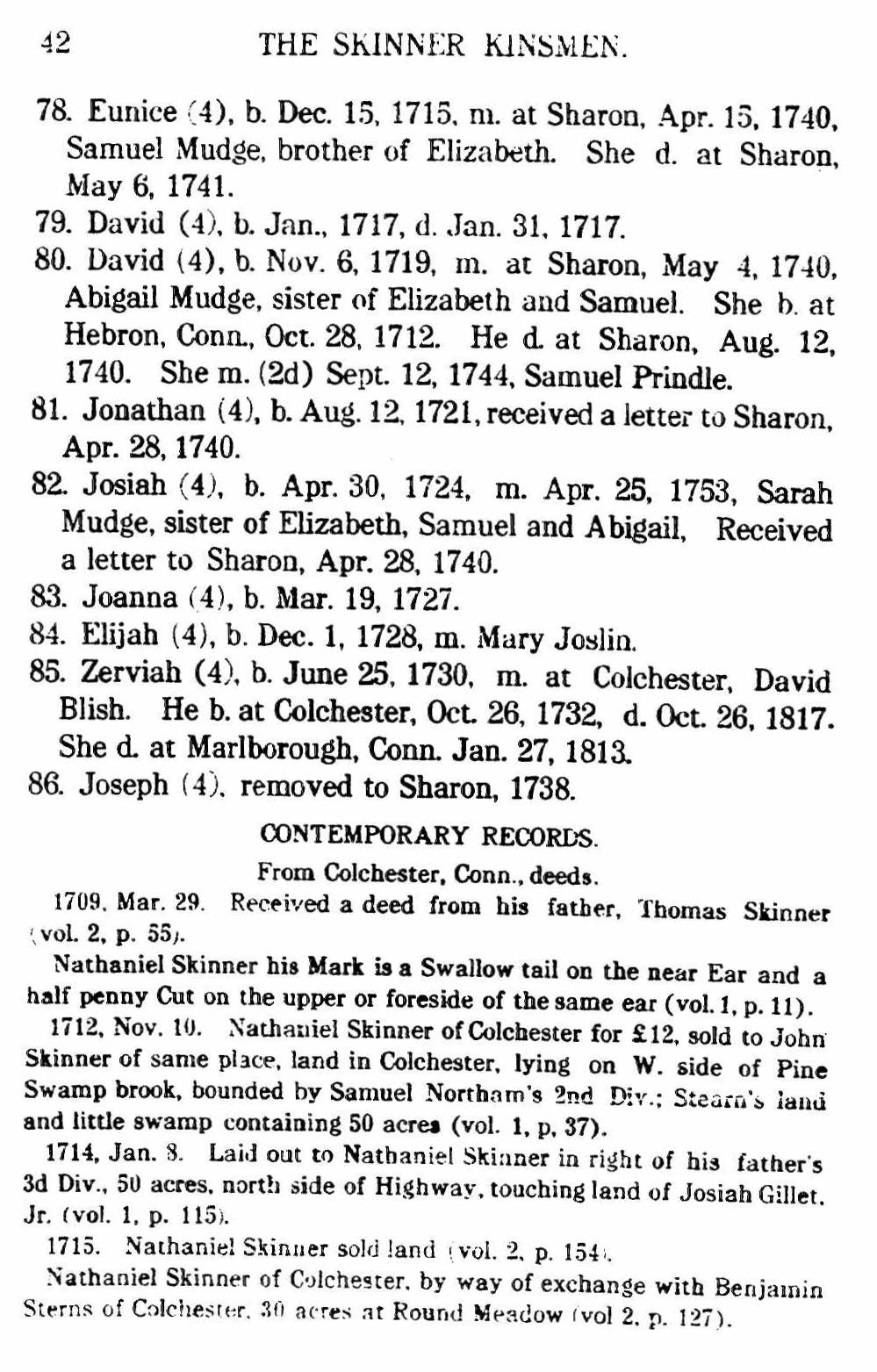
http://trees.ancestry.com/owt/person.aspx?pid=6925461&st=1

http://skinnerkinsmen.org/malden_0707/D0011/I341.html

The Skinner kinsmen, the descendants of Thomas Skinner of Malden, Mass By Natalie R. Fernald The Pioneer Press Washington, DC 1900
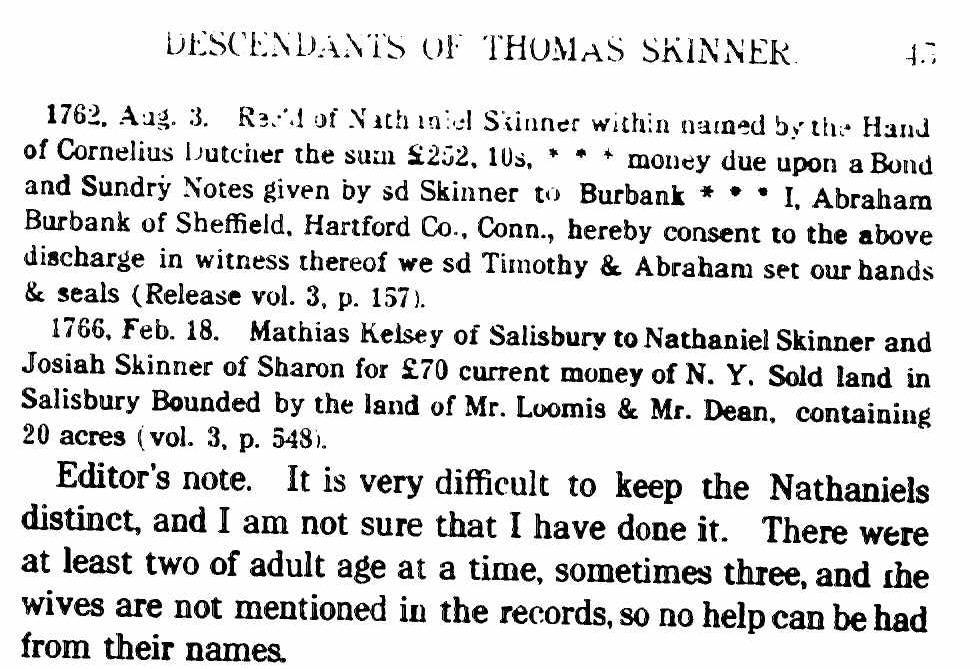
Posted in 11th Generation, 90+, Line - Shaw | Tagged , | 6 Comments

Thomas Skinner IV

Thomas SKINNER IV (1695 – 1749) was Alex’s 8th Great Grandfather, one of 512 in this generation of the Shaw line.

Deacon Thomas Skinner was born 30 May 1695 in Wrentham, Mass.  His parents were Thomas SKINNER III and Hannah CARPENTER.  He married Abigail DAY on 5 Jan 1719/20 in Wrentham, Mass. Thomas died 17 Feb 1748/49 in Mansfield, Bristol, Mass.

Abigail Day was born on 1 Nov 1693 in Wrentham, Mass.  Her parents were John DAY and Abigail POND.  Abigail died on 27 Feb 1762 in Mansfield, Mass.

Children of Thomas and Abigail:

Name Born Married Departed
1. Abigail SKINNER ~ 1720 in Norton, Bristol, MA. Seth RICHARDSON I
25 Oct 1739
Attleboro, Bristol Mass.
26 Apr 1811 Attleboro, Bristol Mass.
2. Tabitha Skinner ~ 1723 Bristol Co., Mass. Benjamin Capron
12 Oct 1748
Attleboro
25 Jan 1807 
Attleboro
3. Ruth Skinner ~ 1727
Attleboro, Bristol, Mass
Abiel Peck
11 Jul 1751
Attleboro
4. Susanna Skinner ~ 1727
Norton, Bristol, Mass
David Harden
20 Mar 1751  Norton
25 Jun 1821, Mansfield, Bristol, Mass
5. Thomas Skinner 16 Mar 1731/32 Bristol Co., Mass. Hannah Bates
14 Nov 1751 at Norton, MA.
~ 1758
6. Ann Skinner ~ 1733 Mansfield, Mass Hezekiah Peck
5 Feb 1755 Norton, Mass.
14 Jun 1822 Attleboro, Mass.

Thomas was one of the founders of Mansfield, Mass.  Mansfield was first settled in 1658 and was officially incorporated in 1775. It was named for William Murray, 1st Earl of Mansfield, a pro-colonial member of the House of Lords. Mansfield is largely known for being the home of the Comcast Center (formerly Great Woods, Tweeter Center) concert venue, one of the most popular in Massachusetts.

Mansfield, Bristol County, Massachusetts

From the History of Bristol County.  Thomas IV was 47 in 1732 while his father Thomas III was 64 years old.  This passage could refer to either one.

“In 1732 the Grovers, Skinners, and others to the number of twenty-five or thirty families, having for many years attended meeting in Taunton, Norton, or Wrentham, determined to separate themselves from the Norton Church, or North Purchase, and they mustered all the heads of families and all permitted to vote in Parish affairs and started for Norton meeting house, and where the question was settled that they could have a parish at Mansfield.

June 30, 1732, they held a meeting to arrange about a minister, it was held at the house of Isaac Wellman of said precinct. First they made choice of Mr. Ephraim Leonard to be moderator of said meeting; secondly they made choice of Mr. Thomas SKINNER, Deacon Nicholas White and Ephraim Grover to hire a minister.

Another meeting was held June 27, 1733 at which Thomas SKINNER  was chosen moderator.

At a meeting held Oct. 7, 1734, the following protested against the proceedings of that day, Samuel Brintnell, Thomas SKINNER, John Skinner, Isaac Wellman, Solomon Skinner, Ebenezer Brentnell, Samuel Wellman, John Skinner, Joseph Skinner, Nathaniel Brintnell, Ebenezer Skinner, Benjamin Wellman, Samuel Skinner, Benjamin Skinner, Josiah Pratt, Nathaniel Brinton, Samuel Skinner, Benjamin Skinner, They voted against an increase salary for the minister.”

1740 – Thomas and Abigail admitted to the church at Norton, Bristol, Mass

Thomas Skinner ran to the Indians: muster roll of Capt. Joseph Heath and Company from May 2, to 14 Nov 1723.  I’m not sure what this means.  It is from Letters of Col Thomas Westbrook and others relative to Indian affairs in Maine (vol 48, p 281).

27 Nov 1724 – Mehitable Wilbore, of Taunton, to Thomas Skinner, Jr, of Norton, £25 14s, one parcell of land in Norton, being part of the tract called Taunton North Purchase, containing by estimation 7 acres of meadow land, laid out for Joseph Wilbore May 27, 1708. Witnesses, Seth Williams, Elizabeth Dean.  Recorded 2 Feb 1756

27 Apr 1731 – Morgan Cobb, ye second of that name in Taunton, County of Bristol, paid by Thomas Skinner, Jr, for a parcel of land scituate, lying, and being in said Norton, Witnesses, Josiah Cobb, Simon Cobb. Recorded March 9, 1757.

15 Mar 1748/49 –  Abigail Skinner, administrator of the estate of Thomas Skinner, late of Norton, she was appointed guardian of his children, Thomas, Ruth and Ann, minors over 14

29 Mar 1749 – Inventory made  £2741.00.

13 Jul 1752, Abigail Skinner turns in account as administrator: rec’d £168.4.1, paid out £31.0.5. From Taunton, Mass, probate records:

5 Jul 1754 – Benjamin Williams, James Titus, Ichabod Shaw appointed by Honorable George Leonard to make true account

5 Jul 1754 – Thomas Skinner, 2nd, late of Norton; widow’s dower set to Widow Abigail land which was some that “belonged in July, 1714, to Mr. Thomas Skinner, father of the deceased.”

1763 – Administration of estate of widow Abigail Skinner, late of Norton, given to Thomas Skinner. Heirs not given

Children

1. Abigail SKINNER (See Seth RICHARDSON I ‘s page)

2. Tabitha Skinner

Tabitha’s husband Benjamin Capron was born  3 May 1728 in Attleboro, Bristol, Mass. His parents were Jonathan Capron (1705 – 1772) and Rebecca Morse (1706 – 1772). Benjamin died 23 Feb 1800 in Attleboro, Bristol, Mass,.

Tabatha Skinner Gravestone Old Kirk Yard , Attleboro  Find A Grave Memorial# 30174912

Tabatha Skinner Gravestone Old Kirk Yard , Attleboro Find A Grave Memorial# 30174912

Children of Tabitha and Benjamin:

i. Elona Capron b. 23 Dec 1749 Attleboro, Bristol, Mass.; d. 8 July 1773 Attleboro at age 23 during the birth of her first child Eleona; m. 3 Dec 1772 in Attleboro to James Pullen (b. 16 Jul 1749 in Attleboro – d. 1 Feb 1829 in Waterville, Maine; Burial: Old Cemetery, Oakland, Kennebec, Maine Inscription: Aged 79 yrs, Revolutionary Soldier)  His parents were James Pullen (b. 1720 – 1785) and Lydia Woodcock (1722 – 1805).

After Elona died James married 16 Mar 1775 in Attleboro to Phebe Stanley (b. 20 Oct 1756 in Attleboro – d. 22 Sep 1821 in Waterville, Maine) James and Phebe had nine more children between 1785 and 1797.

Pullen, James.Corporal, Capt. Jacob Ide’s (Attleborough) co., Col. Dagget’s regt.; service, 7 days; company marched to Rhode Island on the alarm of Dec. 8, 1776; also, Private, Capt. Alexander Foster’s co., Col. Thomas Carpenter’s regt.; entered service July 27, 1780; discharged July 31, 1780; service, 7 (also given 5) days, on an alarm; company marched to Tiverton, R. I., July 27, 1780, to serve for 6 days; roll sworn to at Attleborough.

ii. Benjamin Capron b. 3 Jun 1752 Attleboro, Bristol, Mass.; d. 3 Feb 1815 Attleboro; m. 30 Sep 1773 in Attleboro to his cousin Sarah Capron (b. 14 Feb 1757 in Attleboro – d. 23 Nov 1828 in Attleboro) Sarah’s parents were Joseph Capron ( – 1784) and Sarah Robinson (1722 – 1761).   Benjamin and Sarah had ten children born between 1774 and 1799.

Benjamin was a  Private, in Capt. Stephen Richardson’s Attleboro co. of Minute-men, which marched on the alarm of April 19, 1775; service, 6 days; reported enlisted into the army May 15, 1775.

Benjamin was an Ensign, in Capt. Moses Knap’s Attleboro co., Col. Joseph Read’s regt.; list of officers dated Camp at Roxbury, May 18, 1775; also, 2d Lieutenant, same co. and regt.; company return dated Roxbury, Sept. 25, 1775; also, Lieutenant; list of men in Capt. Richardson’s co. of No. 12 Attleborough who served in the 1st campaign, known as the 8 months campaign.

Capron, Benjamin, Jr., Attleborough. Order for wages, etc., on Ephraim Newell, Town Treasurer of Attleborough, dated July 5, 1776, for service on the alarm caused by the battle of Bunker Hill; also, list of men in Capt. Richardson’s co. of No. 12 Attleborough serving in the 9th campaign, known as the quot;quarter-draft” or three months campaign, begun in Dec., 1776; also, Capt. Stephen Richardson’s 4th (2d Attleborough) co., Col. Daggett’s regt.; list of men serving in the 10th campaign, known as the “quarter” or three months campaign at Howland’s Ferry in 1776 and 1777.

iii. George Capron b. 2 Nov 1754 Attleboro, Bristol, Mass.; d. 26 Feb 1806; m. 24 Mar 1789 in Norfolk, Virginia to Elizabeth Sylvester (b. Norfolk, Virignia) At their wedding she was listed as the orphan of Richard Silvester.. George and Elizabeth had at least two children John (b. 1790) and Richard (b. 1791).

A George Capron was a member of Ethan Allen’s Green Mountain Boys.  Was he ours?  A Jonathan Capron was  Allen’s Quartermaster

1791 – George Capron appears on a list of people who signed a letter to ‘The Honorable President and Director of the Bank of the United States of America’ asking for a bank to be opened in Norfolk.

iv. Elizabeth Capron b. 8 Feb 1757 Attleboro, Bristol, Mass.d. 20 Jul 1827 Kennebec, Maine; m.  15 Jun 1775 in Attleboro  to John Woodcock (b. 15 Jun 1744 in Attleboro – d.   22 Mar 1822 at age 77  in Sidney, Kennebec, Maine)  His parents were Benjamin Woodcock (1707 – 1791) and Margaret White (1715 – 1801).  Some source say Elizabeth  instead married to Jonathan Woodcock (b. 28 Apr 1753 in Attleboro – d. 24 Oct 1819 in Attleboro) on this same date.  Elizabeth and John had ten children born between 1776 and 1797.

John responded to the Lexington Alarm in Captain Stephen Richardson’s company, and subsequently served as corporal and sergeant.  He is a proven Revolutionary War Patriot accepted by the Daughters of the American Revolution. Ancestor #: A128411.

Woodcock, John, Attleborough.Private, Capt. Stephen Richardson’s (Attleboro) co. of Minute-men, which marched probably on the alarm of April 19, 1775; service, 9 days; also, copy of an order on Ephraim Newell, Town Treasurer of Attleborough, dated July 5, 1776, for wages due said Woodcock and others for service on the alarm caused by the battle of Bunker Hill; also, Capt. Stephen Richardson’s 4th (2d Attleborough, also given Attleborough No. 12) co., Col. Daggett’s regt.; list of men who served on the 5 months campaign at York in 1776, known as the 6th campaign; also, list of men belonging to Capt. Stephen Richardson’s co. of No. 12 Attleborough who hired for the “Grand Campaign of all” for 3 years or during the war; said Woodcock, Corporal, with others, hired Samuel Bentley; also, Corporal, Capt. Moses Willmarth’s  co., Col. Thomas Carpenter’s regt.; service from Aug. 17, 1778, to Sept. 9, 1778, 24 days, on expedition to Rhode Island; also, Sergeant, Capt. Alexander Foster’s co., Col. Isaac Dean’s regt.; marched July 31, 1780; discharged Aug. 8, 1780; service, 10 days, including 2 days (36 miles) travel home; company marched to Tiverton, R. I., on the alarm of July 31, 1780.

v. Tabitha Capron b. 8 Jul 1759 Attleboro, Bristol, Mass.; d. 1825; m. 24 Apr 1777 in Attleboro to Lemuel Macomber (b. 1754 in Berkley, Mass – d. 1843 in Rehoboth, Bristol, Mass.)  Lemuel’s parents were Samuel Macomber (1721 – 1774) and Zipporah Crane (1728 – 1814).  At least one child Lemuel (b. 1780)

Macomber,Lemuel.Capt. John Pain’s co.; list of men stationed at Winter Hill and Dorchester for about 2 months and dismissed April 1, 1776.

Macomber, Lemuel.List of men mustered by Nathaniel Barber, Muster Master for Suffolk Co., dated Boston, July 7, 1777; Col. Crane’s regt.; also, Matross, Capt. Callender’s co., Col. John Crane’s (Artillery) regt.; Continental Army pay accounts for service from Mar 3, 1777, to Dec 31, 1779; credited to town of Middleborough; also, Capt. William Perkins’s co., Col. Crane’s regt.; pay rolls for Sept.-Dec 1777; reported on command at Red Bank in Oct 1777, on command at Trenton in Nov 1777; also, Capt. Lieut. John Callender’s co., Col. Crane’s regt.; return for gratuity allowed by resolve of Feb. 9, 1779; engaged for town of Taunton; also, same co. and regt.; muster rolls for Nov. and Dec., 1778, and April, 1779, dated Providence; enlisted May 3, 1777; enlistment, 3 years; reported on command at Tiverton in April, 1779; also, descriptive list dated Jan. 11, 1781; Capt. John Slueman’s co., 3d Artillery regt.; rank, Matross; age, 24 yrs.; stature, 5 ft. 9 in.; complexion, fair; engaged for town of Middleborough; engaged March 3, 1777, by Capt. Cook; reported discharged March 3, 1780.

Lemuel received a pension of eight dollars per month commencing on April 16, 1818 for his three years of service in the Massachusetts line. See Lemuel’s survivor’s pension file

Lemuel Macomber Pension Application

Lemuel Macomber Pension Application

3. Ruth Skinner

Ruth’s husband Abiel Peck was born 19 May 1730 in Attleboro, Bristol, Mass. His parents were Hezekiah Peck and Rebecca Richardson. He was Seth RICHARDSON‘s cousin.  His grandparents were Stephen RICHARDSON and Abigail WYMAN. Abiel died 16 Dec 1802 in Hopewell, Westmorland, New Brunswick, Canada.

Abiel Peck and Ruth Skinner: came to New Brunswick in 1783 as Loyalists and settled in Hopewell Parish, Albert County:

Mar 27 1893  Saint John, Saint John
Newspaper: The Daily Sun
Hopewell (Albert Co.) Sketch of Old Shepody –

The Peck grant was taken up by Abiel Peck, great-great grandson of Joseph PECK who emigrated from England to Attleboro, Mass. in the year 1636. Abiel Peck was born in 1730 and married Ruth Skinner of Attleboro. He came to Cumberland at the time of the Revolution and shortly after to Shepody where he obtained a large tract of land from the government said to contain 6,000 acres. The most of this land is still owned by the Peck family.

A tombstone in the old Peck burying ground bears this inscription ‘Here lies interred the body of Abiel Peck, a native of Boston, and one of the first settlers of this place, who, on the 16th of Dec., 1802, unfortunately perished in a boat, in the 73rd year of his age, leaving upwards of three score descendants to lament his melancholy fate.’ During his life the country was a comaparitive wilderness with no roads nor means of communication with the different settlements along the shore, except by water. It was upon one of these occasions, while attempting to cross the Bay from Dorchester to his own place in an open boat, that he lost his life. The boat was picked up in a cove near the Joggin, now known as Peck’s Cove. The elder Peck had eleven children.

One of these, Rachel Peck, married Thomas Calhoun, grandfather of George Calhoun, now Registrar of Deeds for Albert Co. The grant was for the most part divided among his immediate family, the last side of the grant, when he had first settled himself, being given to his son Abiel. The next lot, the only one that went outside of the family, was sold to David Hoar from Colchester, N.S. The next farms were occupied by his sons Elisha Peck and Thomas Peck and his sons-in-law, Nicholas Pearson, John Edgett, Oliver Stiles and Joel Edgett.

Abiel Peck – Probate
Date of inventory 1803-04-28
Date administration granted 1802-12-28
Parish of Hopewell, Westmorland County, New Brunswick – Intestate. Administration granted 28 December 1802 to his sons Abiel Peck and Elisha Peck of Hopewell. Fellow bondsman Pickering SNOWDON of Sackville. Inventory, filed 28 April 1803, valued at £996 by the administrators. Statement of distribution of the estate by Duncan REED, David AKERLY and Bradbery ROBINSON named, in addition to the widow of the deceased, Lois Edgett wife of Joel Edgett, Rebeckah Stiles wife of Oliver Stiles, Rachel Dickson deceased wife of Robert Dickson Esq., Nancy Pearson wife of Nicholas Pearson, Rhodia Edgett wife of John Edgett, Capt. Abiel Peck , Thomas Peck , Elisha Peck and Louis Edgett.

Abiel Peck Bio 1

Children of Ruth and Abiel:

i.  Ezra Peck b. 12 Jan 1752 Attleboro, Bristol, Mass; d. 13 Jan 1752 Attleboro

ii. Abiel Peck b. 1 Jan 1753 in Attleboro, Bristol, Mass; d. 8 Dec 1754 in Attleboro

iii. Rachel Peck b. 6 May 1754 Cumberland, Nova Scotia; d. 5 Nov 1803 Lower Cape, Albert, New Brunswick; m1. 7 Nov 1768 in Riverside, Albert, New Brunswick to Thomas Calhoun (b. 1730 in Manchester, York, Pennsylvania – d. 1772 Redbank, Queens, New Brunswick) Rachel and Thomas had two children: John (b. 1770) and Thomas (b. 1772 ); m2. Robert Dickinson.  Rachel and Robert had two more sons and eight more daughters.

Thomas Calhoun and his brother William along with a Peck brother-in-law were harvesting grindstone in the Bay of Fundy when their boat capsized and they were all drowned.  William was unmarried and Thomas’s wife remarried Thomas Dixon and had a large family.

iv.  Abiel Peck b. 15 May 1756 Attleboro, Bristol, Mass.; d. 28 Oct 1814 Hopewell, Albert, New Brunswick; m. Lois Esterbrooks (b. 1752) Abiel and Lois had eleven children born between 1781 and 1806.

Abiel  settled on a portion of the extensive tract in Hopewell owned by his father.  He held a captaincy in the militia and was always alluded to by the old settlers as Capt. Peck.

v. Rebecca Peck b. 7 Aug 1758  Attleboro, Bristol, Mass; d. 1850 Hopewell, Albert, New Brunswick; m. 1776 to Oliver Stiles (b. 1757 in Hebron, Tolland, CT – d.  23 Feb 1833 in Hopewell, Westmorland, New Brunswick)  Oliver’s parents were Nathan Stiles (1728 – 1808) and Kesiah Kilborn.  Rebecca and Oliver had eight (three listed here) children born between 1779 and 1796. Reuben Stiles, for many years a member of the Provincial New Brunswick Parliament is a grandson.

vi. Ruth Peck b. 14 Feb 1761 Attleboro, Bristol, Mass.; d. 1781 Hopewell, Westmorland, New Brunswick; unmarried

vii. Lois Peck b. 1762 Cumberland, Nova Scotia, Canada; d. 1826 Hopewell Parish, West Albert, New Brunswick; m.1783 in Hcp Parish to Joel Edgett (b. 17 Apr 1761 in North Castle, Westchester, New York – d. 11 Feb 1841 in Hillsbough, Albert, New Brunswick) Joel’s brother John married Lois’ sister Rhoda.  Their parents were Joel Edgett (1740 – 1841) and Esther Mann (b. 1741). Lois and Joel had four children born between 1793 and 1807.

Joel Edgett came to New Brunswick in 1783 as a Loyalist and settled in Hopewell Parish, Albert County.

viii. Elisha Peck b. 1764 Sackville, Cumberland, Nova Scotia; d. 29 Dec 1846 Hopewell, Albert, New Brunswick; m. 1786 in Hopewell, Westmorland, New Brunswick to Sarah Akerley (b. 12 Jan 1765 in New York – d. 9 Jan 1835 in Hopewell, Westmorland, New Brunswick, Canada) Elisha and Sarah had eleven children born between 1787 and 1805.

Elisha resided in Shebody, hence Hopewell, Albert, New Brunswick on a portion of the lands owned by his father.

ix. Thomas Peck b. 1766 in Cumberland, Nova Scotia, Canada.; d. 16 Oct 1825 Hopewell, Albert, New Brunswick; m. Anna Brewster;  Thomas and Anna had  eight children born between 1796 and 1810.

Thomas along with his brothers settled in Hopewell Parish, Albert, New Brunswick upon lands given him by his father, where he lived a died a wealthy farmer.

http://en.wikipedia.org/wiki/Hopewell_Parish,_New_Brunswick.  Hopewell Parish is is bordered to the north by Hillsborough Parish, to the east by Petitcodiac River and south by Harvey Parish, and to the west by the Elgin Parish.

Albert County, New Brunswick — Hopewell Paris, pip 2011 of 643,  is bordered to the north by Hillsborough Parish, to the east by Petitcodiac River and south by Harvey Parish, and to the west by the Elgin Parish.

x. Rhoda Peck b. Jun 1769 Cumberland, Nova Scotia, Canada; d. 1857; m. 1794 in Hopewell, Albert, New Brunswick, Canada to John Edgett (b. 1763 in North Castle, Westchester, New York – d. Oct 1835 in Hopewell, Albert, New Brunswick) John’s brother Joel married Rhoda’s sister Lois.  Their parents were Joel Edgett (1740 – 1841) and Esther Mann (b. 1741). Rhoda and John had nine children born between 1795 and 1816 in Hopewell.

John Edgett came to New Brunswick in 1783 as a Loyalist and settled in Hopewell Parish, Albert County.

ix. Nancy Peck b. 1772 Cumberland, Nova Scotia, Canada; d. Hopewell, Albert, New Brunswick; m. Nicholas Pearson Jr. Nicholas’ father was Nicholas Pearson Sr. and Esther Angus. Nancy and Nicholas had seven children born between 1797 and 1819.

4. Susanna Skinner

Susannah’s husband David Harden (Harding) was born 1723 in Norton, Bristol, Mass.

5. Thomas Skinner

Thomas’ wife Hannah Bates was born 11 Dec 1730 – Bristol, Mass. Her parents were Solomon Bates and Hannah Grover.  Hannah died 12 May 1823 – Mansfield, Bristol, Mass.

Thomas was a house carpenter.

16 Mar 1757 – Thomas Skinner appears on as a private on a list sworn to at Norton of 2nd company of Militia, commanded by Col. Ephraim Leonard, comprising the Train Band and Alarm list

Children of Thomas and Hannah:

i. Thomas Skinner b. 6 Aug 1752 Mansfield, Bristol, Mass; d. 11 Jul 1845; m. 3 May 1775 Mansfield to Susanna Fillebrown (b. 2 May 1755 in Bristol, Mass).  Susanna’s parents were James Fillebrown (1728 – 1797) and Susanna White (1728 – 1764).

Thomas was a Revolutionary Soldier

ii. Hannah Skinner b. 10 Aug 1754 Mansfield, Bristol, Mass; d. 13 Dec 1800 Mansfield; m. Norton or Mansfield to Nathaniel Hodges (b. 21 May 1750 – d. 1828) Mansfield)  After Hannah died, he married 10 Mar 1803 in Attleboro to Martha Dean, daughter of Ephraim Dean and Martha Balcom.

Nathaniel was a private in Captain Isaac Hodges company, Col John Daggett’s regiment service 25 days in December 1776 and January 1777.

6. Ann Skinner

Ann’s husband Hezekiah Peck was born 7 May 1732 Attleboro, Bristol, Mass. His parents were Hezekiah Peck (1696 – 1753) and Elizabeth Carder (1703 – 1789). Hezekiah died 14 Oct 1775 Attleboro.

Hezekiah Peck Gravestone — Old Kirk Yard , Attleboro, Bristol, Mass

Anne Skinner Peck Headstone — Old Kirk Yard , Attleboro, Bristol, Mass

Children of Ann and Hezekiah:

i.  Hezekiah Peck b. 22 May 1755 in Norton, Bristol, Mass; d. 1812 Newport, New Hampshire; m. Hepsibah Dryer of Rehoboth  Hezekiah and Hepsibah had at least one child, Esther who married David Nettleson

Peck, Hezekiah, Attleborough.Private, Capt. Caleb Richardson’s co., Col. Timothy Walker’s regt.; muster roll dated Aug  1, 1775; enlisted May 1, 1775; service, 3 mos. 8 days; also, company return dated Oct. 6, 1775;also, order for bounty coat or its equivalent in money dated Roxbury Camp, Nov  20, 1775; also, Capt. Stephen Richardson’s 4th (2d Attleborough, also given Attleborough No. 12) co., Col. Dagget’s regt.; list of men who were in the 8 months service at Roxbury in 1775, known as the 1st campaign; also, same co. and regt.; list of men who served in the 5 months campaign at York in 1776, known as the 6th campaign; also, Capt. Stephen Richardson’s co.; service, 25 days; company comprised one-fourth of the militia of the town of Attleborough, marched to Rhode Island April 21, 1777, to hold the Lines until men could be raised for that purpose for 2 months, and served until May 15, 1777; also, Sergeant, Capt. Moses Willmarth’s co., Col. John Daggett’s regt.; service, 2 mos. 25 days; regiment raised to serve at Rhode Island for 3 months from Jan. 1, 1778; roll sworn to at Taunton; also, Capt. Caleb Richardson’s co., Col. John Hathaway’s regt.; entered service March 25, 1779; service, 21 days, at Rhode Island.

1 May 1779  – Hezekiah and his brother Henry purchased lands in Newport, New Hampshire from Phineas Wilcox.

ii. Henry Peck b. 10 Dec 1756 Attleboro, Bristol, Mass; d. 11 Jun 1838 Lowville, Lewis, New York; m. 18 Jan 1781 in Attleboro to his first cousin Anna Richardson (b. 1 Apr 1760 in Attleborough – d. 26 Aug 1840 in Harrisburg, Lewis, New York) Anna’s parents were Seth RICHARDSON I  and Abigail SKINNER.  Henry and Ann had ten children born between 1781 and 1803.

Henry Peck claimes for services as a substitute for his father Hezekiah Peck, under Capt. Caleb Richardson, in 1775. The roll of Capt. Caleb Richardson’s Company, from April 24th to August 1st, 1775, is found in this office, and the name of Hezekiah Peck is borne thereon, and is allowed for services and travel three months and eight days.

Henry Peck came to Newport, Sullivan, New Hampshire about 1779 with his brother Hezekiah,  He lived in the east part of the town and had charge of the Giles mill then standing on the site of the Granite Mills.  From there he moved to Lowville, Lewis, New York

iii. Anna Peck b. 7 Dec 1761 Attleboro, Bristol, Mass; m. Manassah Short of Rehoboth where they lived and died.  Anna and Manassah had  six children

iv. Jonathan Peck b. 29 Jul 1769 Attleboro, Bristol, Mass; d. 9 Feb 1850 Attleboro; m. 1796 in Attleboro to Sabra Capron (b. 30 Dec 1772 in Attleboro – d. 2 Nov 1853 in Attleboro)  Sabra’s parents were Joseph Capron (1722 – 1784) and Sarah Foster ( – 1820).  Jonathan and Sabra had at least three children born between 1797 and 1815.

Sources:

http://www.genealogyofnewengland.com/b_s.htm

http://familytreemaker.genealogy.com/users/s/a/x/Stephanie-A-Saxon/GENE34-0005.html

http://trees.ancestry.com/owt/person.aspx?pid=6925463

http://freepages.genealogy.rootsweb.ancestry.com/~bucknum/2008/P652Dd05.htm

The Skinner kinsmen, the descendants of Thomas Skinner of Malden, Mass By Natalie R. Fernald
The Pioneer Press Washington, DC 1900

http://skinnerkinsmen.org/malden_0707/D0024/I605.html

Thomas Skinner of Malden, Descendants. p47-48. by Copley, Genevieve

http://freepages.genealogy.rootsweb.ancestry.com/~hwbradley/aqwg2730.htm#61772

Posted in 10th Generation, Line - Shaw, Pioneer | Tagged , , | 5 Comments

John Tuttle

John TUTTLE (1618 – 1663) was Alex’s 10th Great Grandfather, one of 2,048  in this generation of the Shaw line. His farm, Tuttle’s Red Barn, is the oldest continually operating family farm in the United States, having passed down through 11 generations.

Tuttle’s Red Barn 2007 Choice ‘Publisher’s Weekly’ Children’s Picture Book

Since July 25, 2010, the Tuttle Farm and Tuttles Red Barn have been listed for sale.  Will Tuttle, the Tuttle Farm’s current owner, cites exhaustion, his age (he is currently in his sixties) and the lack of a younger generation of Tuttle showing interest in taking over the Tuttle Farm as his reasons for offering the farm for sale.

John Tuttle was born 1618,  in Devon England. His parents were Richard TOTHILL and Elizabeth ATTWELL.  He sailed from Bristol, England in the Angel Gabriel in 1635.   The day after John and his fellow passengers disembarked, it  was caught at anchor and destroyed  by the Great Colonial Hurricane of 1635.   The ship sank along with all of the passengers’ worldly goods, and taking the lives of several crew members who were attempting to save the vessel.  John first came to Ipswich, Massachusetts, and by 1640, to Dover, New Hampshire.  He married  Dorothy ERNST on 1641 in Dover, NH.   John died Jun 1663 in Dover, Strafford, New Hampshire.

John Tuttle was shipwrecked off the coast of Pemaquid, Maine. Photo is a diorama depicting examples of early structures excavated along the coastline of Pemaquid, ME displayed at Colonial Pemaquid State Park.

Dorothy Ernst  was born 1620 in England. She died after 30 Jun 1663.

Children of John and Dorothy:

Name Born Married Departed
1. Elizabeth Tuttle 1642 in Dover, NH Capt. Phillip CROMWELL
before 1633
Dover, NH
1670 in Dover, NH
2. Thomas Tuttle 1644
Dover, NH
Accidentally killed when a young lad by falling from a tree.
5 Mar 1654
Dover, NH
3. Judge John Tuttle 1646 Mary [__?__]
1668 Dover, NH
Jun 1720
Dover, NH
4. Dorothy Tuttle 1648
Dover NH
Samuel Tibbets
1 Sep 1686
Dover, NH
9 Dec 1738
Dover, NH

The English spelling is Tuthill and Tothill, but in this line the American families since the first few generations have spelt the surname Tuttle.

The Angel Gabrielwas a 240 ton English passenger galleon. She was commissioned for Sir Walter Raleigh’s last expedition to America in 1617. She sank in a storm off Pemaquid Point, near the newly established town of Bristol, Maine, on August 15, 1635. The sinking occurred during the middle of the Great Migration.

The Angel Gabriel anchored at the village of Pemaquid. Most of the passengers and crew got off the ship before nightfall to rest on land as guests of the villagers. That night, August 14-15, a storm later known as “The Great Colonial Hurricane” struck the area and the Angel Gabriel was torn from her anchors and destroyed.

In the mid 1970s efforts were made to locate the wreck in Pemaquid Harbor with divers and a magnatometer and sideccan sonar but no artifacts form the ship were ever located.  The Angel Gabriel was very similar to the Mayflower but eighteen feet longer and bearing four more gun ports per side.

Pemaquid Point Maine

The ship was initially built as the Starre in 1615 and renamed the Jason by Sir Walter Raleigh for use in his second expedition to Guiana (then under control of the Spanish) in 1617. Following Raleigh’s return it was seized and became a merchant ship, renamed the Angel Gabriel.

A stout ship designed and built to cope with combat, even as a merchant ship the Angel Gabriel was involved in many further skirmishes between 1618 and 1635, including a notable engagement in 1627 off Cales where it was boarded several times but was able to clear its decks each time and eventually beat off three Spanish ships. This was possible because the defenders were able to retreat into the forecastle and sterncastle which had reinforced bulkheads fitted with gunports for small cannon and shoulder weapons.

A plaque commemorating the shipwreck was placed at Colonial Pemaquid in 2010.

1635 voyage

From England to Massachusetts in a fleet of five ships, the Angel Gabriel, our ancestor Capt. Robert ANDREWS, Master, joined the James, the Elizabeth (Bess), the Mary and the Diligence. As they approached New England, an unusually powerful early season hurricane struck, known as the “Great Colonial Hurricane of 1635“, and the James and the Angel Gabriel were forced to ride it out just off the coast of modern day Hampton, New Hampshire. According to the ship’s log and the journal of Increase Mather whose father Richard Mather and family was on the James, the following was recorded;

“At this moment,… their lives were given up for lost; but then, in an instant of time, God turned the wind about, which carried them from the rocks of death before their eyes. …her (James) sails rent in sunder, and split in pieces, as if they had been rotten ragges…”

They tried to stand down during the storm just outside the Isles of Shoals, but the James lost all three anchors, as no canvas or rope would hold, but on Aug 13, 1635, torn to pieces, and not one death, all one hundred plus passengers aboard the James managed to make it to Boston Harbor two days later.

The Angel Gabriel was wrecked off the coast of Maine, but the smaller, faster ships, the Mary, the Bess, and the Diligence outran the storm, and landed in Newfoundland on August 15, 1635

A plaque commemorating the loss was dedicated August 8, 1965 at Pemaquid Point, Maine. Some of the passengers survived the sinking.

John, Richard and William Tuttle, with their families, all came in the ship “Planter,” in 1635, to New England. William settled in New Haven, Richard in Boston, and John in Ipswich. What connection these three brothers were to John Tuttle of Dover, New Hampshire, who came over probably a few years earlier, is unknown.

John Tuttle signed the protest of 1640 against uniting the little republic at Dover with the Massachusetts Bay Colony. His home was then on the east side of Dover Neck, the river on the east, the lot of Thomas Bearde on the south, and the Great High street on the west. It was about forty rods south-southeast of the First Church

The Tuttle Farm of Dover, New Hampshire, is the oldest continually operating family farm in the United States, having passed down through 11 generations from father to son since the 1630’s when John Tuttle arrived in the New World bearing a land grant from King Charles II.

John eventually made his way from Pemaquid to Dover Point, and joined the settlement there.  His land grant was several miles north of the settlement, so he and the other settlers would walk north along the “High Road” (Dover Point Road) to clear the land and begin to tame the soil until it was suitable for growing crops and  sustaining livestock, returning each night to the settlement for community and safety.  The first two generations of Tuttles lived this way until a log cabin was eventually built for the third generation Tuttle on the actual land grant.

Several generations lived in this cabin until the 1780’s, when the present farmhouse was built to accommodate the growing number of family members.  During these years, Tuttles grew or hunted and fished for whatever they needed to sustain themselves, bartering and trading with neighbors, and selling any surplus to “townsfolk”.  It has been said that the only food they had to buy was salt.  Everything else came from the land, their animals, or from the abundance of wildlife in the surrounding area.  Lobsters, clams, and oysters were used to fertilize the fields, and manure was “locally produced” by their own animals.

Family Business Struggles With Passing the Torch
By RACHEL EMMA SILVERMAN
Staff Reporter of The Wall Street Journal.
From The Wall Street Journal Online

DOVER, N.H. — Here along Dover Point Road, where housing developments and strip malls line this two-lane highway, sits a survivor. It’s the 240-acre Tuttle Farm, which has a gourmet food store housed in an oversize red barn, buffered by fields of corn and pumpkins.

The Tuttle Farm is one of the oldest businesses in America, stretching back more than 350 years and 11 generations of Tuttles. Today it faces a question about its future: Will anyone from the 12th generation want to inherit the farm and run it?

The Tuttles have lived on the very same plot of land for more than three centuries, and over time they have managed to change not just with the times but ahead of them — accurately predicting America’s changing tastes for food. Back in the mid-19th century, William Penn Tuttle built the first greenhouse in the area, growing tomatoes and flowers to sell to neighbors.

In the 1950s, the era of meat-and-potatoes America, Hugh Tuttle, now 78 years old, started pushing asparagus. His battle cry: “I’m going to make salad eaters out of those Yankees.” In the 1970s, when European cheeses were found only in urbane specialty stores, the Tuttles were hawking fine fromage to rural New Englanders.

“It’s lasted as long as it has because each generation has been able to put its own mark on it and accommodate interests,” says 54-year-old Lucy Tuttle, who encouraged her family to sell gourmet goods after she returned from Paris, where she lived for seven years. Today, she and her 52-year-old brother, Will, run the business.

Dates and real-estate records this old are sketchy, but Tuttle Farm may have been founded between 1635 and 1638. There are few other contenders for the oldest continuing business in America. One is the Shirley Plantation, located along the James River in Charles City, Va., and believed to have started up between 1622 and 1638. It grows wheat, corn, cotton and soybeans on 275 acres, although most of the family’s income comes from tourists who visit the mansion and its grounds.

“The two oldest continuous businesses in the United States happen to be family businesses,” says William O’Hara, executive director of the Institute for Family Enterprise at Bryant College in Smithfield, R.I. “They are probably Tuttle and Shirley.”

The Tuttles have a long streak of risk-taking and survival. In 1632, Welshman John Tuttle wanted to escape the dead-end job of apprentice barrel maker. So he received a land grant from Britain’s King Charles I, who was trying to populate his American colonies. Off to America Mr. Tuttle went.

The trip wasn’t smooth. The Angel Gabriel, the boat carrying John Tuttle, along with his wife, Dorothy, and their four-year-old daughter, was shipwrecked off the coast of Maine — “burst in pieces and cast away in this storm,” wrote eyewitness Richard Mather in 1635. So the family, all their possessions lost in the wreck, walked all the way to what is now New Hampshire and carved out 30 acres amid virgin forest.

They and a handful of other settlers lived off the land, learning from the Penacook tribes how to grow corn and squash, fertilizing the ground with dead fish. There was no mill in the area until the early 1700s, so the first generations of Tuttles ground their grain by hand, using a mortar and pestle.

Getting along with the neighbors was crucial then. “You didn’t need money,” says Hugh Tuttle, a wiry, deeply tanned man. “It was all barter system. It sure made for being neighborly.” Fellow farmers traded food and services, like blacksmithing for barrel making. The barter economy lasted through the 19th century, when Hugh Tuttle’s grandfather lived.

“If you needed a pair of shoes, you waited until the traveling shoemaker came along,” says Hugh Tuttle, of life in his grandfather’s time. “He’d live with you for a week, and make the shoes out of the hides from the family’s cows.”

In the early years, as many as 10 Tuttles lived in a one-room log cabin. Then, in 1780, Elijah Tuttle built the sprawling wooden farmhouse Will Tuttle lives in today, among pewter dishes and candlesticks that have been in the family for seven generations.

The farmhouse hasn’t sheltered just Tuttles. As devout Quakers and abolitionists, they let their home serve as a stop on the Underground Railroad, housing slaves making their way up to Canada. A trap door off the master-bedroom closet hid freedom seekers.

Some Tuttles were entrepreneurs, trying to buck the barter economy. In the mid-19th century, William Tuttle built the region’s first greenhouse, where he grew flowers to sell to neighbors. He also created a cranberry bog, a vineyard and a cider factory on the farm. But there turned out to be little demand for grapes, cranberries, cider or flowers, and all four experiments failed. Lucky for the thrice-married William, his wives’ wealthy families bailed him out.

By the early 20th century, the Tuttles had better luck selling their vegetables to local grocers, hauling produce to town in a horse and buggy. In 1915, as one of the first driving families in Dover, they switched to a hand-cranked truck.

By the 1950s, with the development of agribusiness, supermarkets began shunning the local, seasonal farmer in favor of giants in California and Florida that could provide year-round produce. “Uniform mediocrity at the lowest possible price,” scoffs Hugh Tuttle. “So we said, ‘To heck with you guys, we’ll go into competition with them.’ ” The Tuttles converted one of their old dairy barns into a farmstand, selling their own squash, beans, peas and other produce.

“When I was growing up,” remembers Hugh Tuttle, “my father would say that the only thing on our dinner table not produced on the farm is the salt and the pepper. We ate our own meat, milk, butter and vegetables that we’d can or freeze in winter. He’d even drink his own hard cider bottled out of a barrel in our cellar.”

All that has changed. During Will and Lucy Tuttle’s lifetime, the tiny farmstand has grown into a 9,000-square-foot enterprise and adjacent nursery that sells gourmet foods, exotic plants and gift items like painted picture frames and scented candles. On average, 1,000 customers a day shop at Tuttle Farm, filling the asphalt parking lot with a sea of New England license plates.

“It’s kind of a hike,” says Carol Robinson, a teacher from Rye, N.H., a half-hour away. “But I come here for the quality. I have a friend who refers to it as Trump Farm. It’s expensive. It has everything.”

Indeed, the retail business now eclipses the farming operation. Less than 10% of what they sell in the store is their own produce — seasonal corn, string beans, lettuce and pumpkins. Like a farmer, Will Tuttle still rises at 2:30 a.m., but does so to drive an hour or so to a wholesale produce market in Massachusetts, where he buys other farmers’ fruits and vegetables to sell at his store.

“We couldn’t be here without the retail,” says Will Tuttle. “The farm is not big enough to be the only thing.” Now the Tuttles’ main competitors are large supermarket chains like Shaws and Shop ‘n Save that are setting up specialty food sections, usually with lower prices than those at Tuttle.

The Tuttles are diversifying further, selling harried customers more prepared foods, like roasted chicken or pasta dishes, and even launching mail-order and online catalogs. Their newest venture is an in-store wine shop, managed by a longtime customer with a passion for wine.

As with other farms in the area, the Tuttles have had offers to sell their property, but so far they’ve resisted. “We shoo them all away,” says Will Tuttle. “It’s not something I’d consider unless we couldn’t possibly say no. I can’t imagine what it would do to our collective psyche if we sold the farm.”

By Tuttle family tradition, the farm goes to the youngest son, who has the best chance to live longer and support older generations. But of those in the 12th generation, only Lucy Tuttle’s son, 20-year-old Evan, has expressed interest. His cousins prefer computer science and acting to agriculture.

The Tuttles aren’t holding out for the next generation. “Eleven generations of Tuttles occupied the same position of dirt, but it doesn’t mean there has to be a 12th,” says Will Tuttle. “It’s totally their decision.” All he wants, he says, is to leave behind a thriving business for his children — if they want it. And if they don’t? “It’s not something that keeps me staring at the ceiling at night,” he says.

Lucy Tuttle says she won’t force her son to work in the family enterprise, and she notes there has been a tradition of Tuttles leaving the farm only to come back. She went to Paris and taught English, and her brother went to Campbell Soup Co., working for a time as a sales representative. Even their father, Hugh, left to study biology at Harvard. After three years, he returned home, finishing off his degree at the University of New Hampshire. “I was farmsick,” he explains.

“I’m really torn,” says Evan Hourihan. “I’m in college, and there are so many opportunities. But I feel such a strong connection to this place. I would never want to see the tradition pass out of the family.”

The Wall Street Journal Online

Copyright © 2005 Dow Jones & Company, Inc. All Rights Reserved
By using this site, you agree to our Terms of Use and Privacy Policy.

Children 

1. Elizabeth Tuttle (See Capt. Phillip CROMWELL‘s page)

2. Thomas Tuttle

Accidentally killed when a young lad by falling from a tree.

3. Judge John Tuttle

John’s wife Mary [__?__] was born 1648 in York, York, Maine. Mary died 12 Jul 1720 in Dover, Strafford, New Hampshire.

Judge John Tuttle  was appointed in 1695 judge of their Majesties court of common pleas under the administration of Lieutenant Governor Usher. He was selectman of Dover 1686, 1687 and 1688; town clerk 1694 to 1717 inclusive; town treasurer 1705 and many other years; member of the provincial assembly 1698, 1699, 1705, 1706, and 1707; one of the six commissioners sent from Dover to the convention of 1689 to meet the commissioners of other towns in the province “to confer about and resolve upon a method of Government within this province.” He was also a leader in the Dover church. He was at the head of the military forces of the town in 1689, and later and for ten years was almost constantly scouting and hunting for Indians, performing “highly dangerous and very arduous” military duties.

On December 28, 1717 Judge John Tuttle wrote his will.
“Item I will Demise and Bequeth all my Personal Estate that is my House hold Goods & Chattels Bills Bonds Debts Dues which are to be Demaned after the Deceace of my well Beloved wife and not Before to My Three Daughters Equally to be Divided Between Them.” He also directed his son, Ebenezer Tuttle to pay “to his Sister Mary Wallingford the Sum of five Pounds.”

Following John Wallingford’s marriage to the daughter of Judge John Tuttle of Dover, N.H. they lived at Bradford, Mass. In 1702 Colonel Paul Wentworth and Judge John Tuttle became partners in a lumber business on the Salmon Falls River in Dover. Judge Tuttle invited his son-in-law John Wallingford to come to Salmon Falls to help with the operation of the saw mill and lumber business. The family moved to that area later on.

According to the ” History of Dover, N.H. by John Scales, 1923:
John Tuttle ” owned much land, had sawmills, built ships and sent them to foreign ports. He held many offices and was one of the most noted and influential citizens of Dover. He was selectman 1686-87, 88; Representative in 1698; Town Clerk from 1686-1717; Representative in the convention of 1689; Judge of the Court of Common Pleas from 1695-1700. He died in 1720.”

Children of John and Mary:

i. Elizabeth Tuttle b. at Dover Neck, NH; m1. 1695 Dover Neck NH to Samuel Edgerly, son of Thomas Edgerly and Rebecca Ault; m2. John Ambler on 2 July 1725

John Ambler first married Hannah, widow of Robert Watson. Dr. Quint said she was daughter of Thomas Beard, but Hannah is not mentioned in Beard’s will, and in the inventory of Robert Watson’s estate she alludes to “brother Kent.” She was probably daughter of Oliver Kent. Robert Watson, born 1641, was slain in the massacre of 1694, and his wife and son, Joseph, were carried to Canada. Mrs. Hannah (Watson) Ambler died 8 April 1706, as Pike’s Journal says.

John Ambler next married 6 Nov. 1706, Elizabeth Trickey of Newington. He married third 20 July 1725, Elizabeth, widow of Samuel Edgerly and daughter of Capt. John Tuttle. John Ambler lived on a point of land near Ambler’s Islands, on the present farm of Hon. Jeremiah Langley. He was constable in 1708, selectman in 1716, deacon in 1718, and elder in 1721. He was living in Durham 10 June 1739, and is mentioned as deceased 20 Dec. 1748.

4. Dorothy Tuttle

Dorothy’s husband Samuel Tibbets was born 1633 – England. His parents were Henry Tibbets and Elizabeth Austin. Samuel died 9 Dec 1738 – Dover, Strafford, New Hampshire.

Sources:

http://www.jedh.com/src/genealogy/Full07a-p/p59.htm

http://www.werelate.org/wiki/Person:John_Tuttle_(12)

ccidentally killed when a young lad by falling from a tree.http://freepages.genealogy.rootsweb.ancestry.com/~hwbradley/aqwg142.htm#2534

Historic homes and places and genealogical and personal memoirs …, Volume 4 edited by William Richard Cutter Page 1542 – 1546

http://trees.ancestry.com/owt/person.aspx?pid=30370366

Posted in 12th Generation, Artistic Representation, Historical Monument, Historical Site, Immigrant - England, Line - Shaw, Storied | Tagged , , , | 14 Comments

Great Migration

The origins of the Great Puritan Migration come from the time when King James I of England (1603-1625), who was a Roman Catholic, determined to oppose the growing Puritan population of England. The Puritans opposed the practices of the Anglican Church, viewing the traditions as retaining too much of its Roman Catholic roots. James viewed this as little less than treason, and made the lives of the Puritans miserable.

King Charles I of England (1625-1649) succeeded his father in 1625 and exacerbated this conflict. By this point, Puritans controlled Parliament and posed a serious threat to the King’s authority. In 1629, Charles dissolved Parliament entirely, in an ill-fated attempt to neutralize his enemies. This decision made the religious and political climate so hostile to the Puritans that many wished to leave the country, and they did.

Generation Families Missing Parents Canada/Mexico Migrants Europe Migrants
1 1 0 1
2 1 0
3 2 0
4 4 0
5 8 0 2
6 13 0 3 2
7 16 5 4 4
8 26 3 6 4
9 36 6 1 1
10 59 6 4
11 101 9 1 40
12 144 6 135
13 89 6 87
14 16 0 15
Total 516 40 18 291


From “Vexed and Troubled Englishmen 1590 – 1642”, by Carl Bridenbaugh (1968)

In the countryside, large numbers of people had been deprived of their ancient rural security; they had no land to cultivate; unemployment threatened the agricultural laborer and village artisan most of the time; at best their housing was inadequate; in cold or wet weather, fuel was scarce, costly, and often unobtainable. Undernourishment and unbalanced diets sapped the strength of thousands of the lower orders, and many fell victims to disease, notably tuberculosis. Periodically the plague decimated whole country villages. In the hearts and minds of respectable, if impoverished men, the payment of ship money, impressment, billeting, and similar demands by government during the years of personal rule aroused bitterness and alienated not a few from the Stuart King. For human and often trivial offenses, the ecclesiastical courts meted out harsh punishments, but in spite of laws and sermons, people solaced themselves with drink, and, among the idle, bastards increased markedly. Approximately half of the peasantry lived in extreme poverty, and depressed conditions affected townsmen and city people everywhere from 1620 to 1642.

Helpless in the midst of the bewildering changes of an economy that never provided work for every man, beset by both private miseries and seemingly insurmountable public problems, the common folk had no ways for redressing matters because they did not rule. Looking upward and outward from their stations at the bottom of society, the invisible poor slowly began to realize that even with the vigorous enforcement of the poor laws by King Charles’s ministers, the future held forth very little for them.

Between 1620 and 1642, close to 80,000, or 2 per cent of all Englishmen, left Britain.”

About 198 ships made the journey to New England with about 100 passengers in each. There were perhaps 21,000 in all. The vast majority of immigrants were from the English middle class – yeomen, husbandmen, artisans, craftsmen, merchants and traders. Less than 25% were servants. Three quarters of male immigrants could sign their names; the average at the time in England was one third.

Once the King was forced to call Parliament in 1640 and the Puritan revolution began, immigration to New England came to a near-complete halt and did not resume on a large scale until the Irish in the 1840s. In 1652 Scottish prisoners were sent to Boston, in 1685 the Huguenots (Rene Rezeau, John Perlier Jr. and Jean Perlier Sr.) came to New York and Masschusetts), and in 1719 the Irish Presbyterians went to Londonderry, NH area. Even so, in 1800 New England was still 98% English.

Posted in Fun Stuff | Leave a comment

Wikipedia Famous

44 Ancestors with a Wikipedia Entry + all the ones leading to Edward I and Charlemagne!

CHARLEMAGNE (c. 742 – 28 Jan 814) (Charles I), King of Franks and Roman Emporer.  Ancestor of Robert ABELL43rd Generation

EDWARD I of England (1239 – 1307), also known as Edward Longshanks and the Hammer of the Scots, was King of England from 1272 to 1307  and Eleanor of Castile We descend from Edward through two immigrant lines šPercival LOWELL, Massachusetts Colonist (1570-1664), 24th Generation and through Katherine MARBURY SCOTT (1610-1687)

Sir William PARR first Baron Parr of Kendal (1434 – c. 1483) was an English courtier and soldier. Parr left a daughter Anne, who married Sir Thomas Cheney of Irthlingborough, Northamptonshire, great great grandfather of John CHENEY.

Sir Ralph WARREN (c.1486 – 1553)  twice Lord Mayor of London, for the first time in 1536 and the second in 1543.   His great grandson, Giles CROMWELL emigrated to Newbury, Mass.

Sir Henry (Williams)  CROMWELL (1524 – 1604) (Wikipedia) was a grandfather of Oliver Cromwell.  He was the eldest son and heir of Sir Richard Williams, was highly esteemed by Queen Elizabeth I, who knighted him in 1563, and did him the honor of sleeping at his seat of Hinchinbrook, on 18 August 1564, upon her return from visiting the University of Cambridge.  His grandson Giles CROMWELL emigrated to Newbury, Mass.

Sir Thomas BROMLEY (1530 – 1587) (Wikipedia) was an English lord chancellor. His daughter Elizabeth inherited his entire estate and married our Sir Oliver CROMWELL   In 1566 he was appointed recorder of London, and in 1569 he became solicitor-general. .  His first considerable case was in 1571, when he was of counsel for the crown on the trial of the Duke of Norfolk for high treason, on which occasion he had the conduct of that part of the case which rested on Ridolfi’s message  On the death of Sir Nicholas Bacon in 1579 he was appointed lord chancellor. He presided over the commission which tried Mary, Queen of Scots, in 1586, but the strain of the trial and the responsibility of ordering the execution of a monarch proved too much for his strength, and he died soon after. He was buried in Westminster Abbey.

Sir Erasmus Dryden 1st Baronet (1553-1632) (Wikipedia) Son of John DRYDEN Two of John’s descendants were literary stars of the 17th and 18th Centuries.  He was great grandfather of John Dryden (1631 – 1700) and the 2nd great grandfather of Jonathan Swift (1667 – 1745).

Alexander CARPENTER (1546/1551 – 1612) was the father of four daughters who came to the Plymouth Colony early in its history.  The wikipedia article about The Carpenter sisters has been deleted, though you can still view it here on this wikipedia user page It looks like the topic of this article did meet Wikipedia’s general notability guidelines. The 31 footnotes and extensive external links were not enough for our dear Carpenters to make the grade. However, I am the sole arbiter for the definitions on this site and I declare they are approved for Wikipedia Famous!

The Carpenter Sisters of Leiden, Netherlands and Plymouth Colony provided a unique genetic impact and moral influence to the colonization of the Plymouth Colony in America in the early 1620s. Juliana Carpenter MORTON (1584– 1665 Plymouth), Agnes (1585– 1615/1616 Leyden), Alice (1590– 1670 Plymouth), Mary (1595 – 1687 Plymouth), and Priscilla Carpenter COOPER (1597 – 1689 Plymouth) became their family matriarchs that settled the hearths, maintained Pilgrim Fathers family life under difficult religious times and many gave birth to the next generation under harsh physical conditions in the difficult early years.

Francis MARBURY  (1555–1611) (wikipedia)  was a Cambridge-Educated, English clergyman, school master, and Puritan reformer now remembered as a playwright and father of Anne Hutchinson and Katherine Scott husband of Richard SCOTT (1605 – 1680)

Elder William BREWSTER (c. 1560 or 1566 – 1644) (Wikipedia ) was a Pilgrim colonist leader and preacher born in Doncaster, England , who reached what became the Plymouth Colony in the Mayflower in 1620.  When the Mayflower colonists landed at Plymouth, Brewster became the senior elder of the colony, serving as its religious leader and as an adviser to Governor William Bradford. As the only university educated member of the colony, Brewster took the part of the colony’s religious leader until a pastor, Ralph Smith, arrived in 1629.

Rev. Stephen BACHILER (c. 1561 – 1656) (Wikipedia) was an English clergyman who was an early proponent of the separation of church and state in America.

John TILLEY (1571 – 1620 or 1621) (Wikipedia) was one of the settlers who traveled from England to North America on the Mayflower and signed the Mayflower Compact. Tilley died shortly after arrival in New England.  John was Alex’s 12th Great Grandfather; one of 8,192 in this generation of the Shaw line.

Percival LOWELL (1571 – 1665)  determined at the age of 68 that the future was in the New World. and the Lowell clan settled on the North Shore at Newbury after they arrived in Boston 23 June 1639. (See wikipedia article)

William CARPENTER Sr. (1575 -1638 ) , William CARPENTER Jr (1605 – 1659) and Joseph CARPENTER (1628 – 1675) The Rehoboth Carpenter family, an American family that helped settle the town of Rehoboth, Massachusetts in 1644.

James CARVER’s son John Carver (wiki) (ca. 1576 – April 5, 1621) was a Pilgrim leader. He was the first governor of Plymouth Colony and his is the first signature on the Mayflower Compact

Thomas WEST 3rd Baron de la Warr (1577 – 1618)  (Wikipedia)  was the Englishman after whom the bay, the river, and, consequently, an American Indian people and U.S. state, all later called “Delaware“, were named.  He was in Virginia for less than a year, but he had great timing.    On June 7, 1610, both groups of starving survivors from Jamestown and Bermuda boarded the Deliverance and Patience , and they all set sail down the James River toward the Chesapeake Bay, the Atlantic Ocean and home.  On June 9, 1610, Lord De La Warr and his party arrived on the James River. Intercepting the fleeing colonists about 10 miles  downstream from Jamestown near Mulberry Island, the new governor forced the remaining 90 settlers to return, thwarting their plans to abandon the colony.

Robert CUSHMAN (1578 – 1625)  was a Pilgrim leader and made arrangements for the Leiden congregation to immigrate to North America. He preached the first recorded sermon in the New World. (Wikipedia)  Robert was excommunicated for not recognizing the official church and as a consequence spent time in a cell of Canterbury’s West Gate Towers. In 1611 he was one of a group of Pilgrims who fled to Holland because of differences with the official church over their practise of religion.  In 1620 he returned to Canterbury and at 59 Palace Street arranged the leasing of the Mayflower for the Pilgrims to use on their voyage to America.

Robert did not complete the initial trip to the New World with the other Pilgrims on board the Mayflower, as the ship he was travelling on, the Speedwell, developed leaks and had to return to England. He instead took a different ship to the New World.

Robert sailed to Plymouth, Massachusetts in the fall of 1621 aboard the Fortune, but returned shortly thereafter to England to promote the colony’s interests. There, he published an essay concerning the Lawfulness of Plantations, which was appended to Mourt’s Relation. This document is of interest to modern scholars because of its treatment of the economic reasons for emigration.

Unfortunately, before he could return to the New World, he succumbed to an outbreak of plague in London, in the spring of 1625; as a result, the site of his grave is unknown. The book Saints and Strangers by George F. Willison recounts his story.

Stephen HOPKINS (1580 – 1644) (Wikipedia) The only Mayflower passenger who had previously been to the New World.  His adventures  included surviving a the  Sea Venture’s  1609 shipwreck in Bermuda  and working from 1610–14 in Jamestown as well as knowing the legendary Pocahontas, who married John Rolfe, a fellow Bermuda castaway.  Some Shakespearean scholars believe he was the model for the rogue Stephano in the Tempest.

Franics COOKE  (c.1583 -1663) (Wikipedia) was one of the 102 passengers on the Mayflower. This early settler is one of the twenty-six male Pilgrims known to have descendants.

Rev. John LATHROP (1584 – 1653) (Wikipedia)  was an English Anglican clergyman, who became a Congregationalist minister and emigrant to New England. He was the founder of Barnstable, Massachusetts.John was Alex’s 10th Great Grandfather; one of 2,048 in this generation in the Shaw line.

Walter PALMER (1585 – 1661) (Wikipedia) was an early Separatist Puritan settler in the Massachusetts Bay Colony who helped found Charlestown and Rehoboth, Massachusetts and New London, Connecticut.

George MORTON (George Mourt) (c. 1585 – 1624) was an English Puritan Separatist. (Wikipedia)  He published and wrote the introduction to the first account in Great Britain of the founding of Plymouth Colony, called Mourt’s Relation.

Isaac ALLERTON (1586 – 1659) was one of the original Pilgrim fathers who came on the Mayflower to settle the Plymouth Colony in 1620. (Wikipedia)   He was one of the more active and prominent members of early Plymouth.  He was elected as Governor Bradford’s assistant in 1621, and continued as an assistant into the 1630s.  In 1627, he was sent to negotiate the Plymouth Colony’s buyout of the Merchant Adventurers, the investors who had originally funded (and had hoped to profit from) the Colony.

John HOWLAND (c. 1591 – 1673) (Wikipedia ) was one of the Pilgrims who travelled  on the Mayflower, signed theMayflower Compact, and helped found Plymouth Colony.

Rev. Thomas STOUGHTON’s son John Stoughton (1593?-1639)  (Wikipedia) was an English clergyman, of influential millennial views. His step-son Ralph Cudworth (1617 – 26 June 1688) was an English philosopher, the leader of the Cambridge Platonists.

Jonathan FAIRBANKS (1594 – 1668)  (Wikipedia) was an American colonist who in 1637 built the  Fairbanks House in Dedham, Massachusetts which is today the oldest surviving wood framed house in North America.  He was Alex’s 9th Great Grandfather, one of 1,024 in this generation of the Shaw line.

Edmund FREEMAN (1596 – 1682) (Wikipedia) was one of the founders of Sandwich, Massachusetts and an Assistant Governor of Plymouth Colony under Governor William Bradford.

Gov. Thomas PRENCE (1599 – 1673)  (Wikipedia) was a co-founder of Eastham, Massachusetts, a political leader in both the Plymouth and Massachusetts Bay colonies, and governor of Plymouth (1634, 1638, and 1657 – 1673).

Maj. John MASON (1600 – 1672) was the commanding officer in the Pequot War.   At the time, he was a victorious hero who later became  Deputy Governor of Connecticut and founded Norwich, Connecticut.  Now, he is viewed by some as a war criminal due to his responsible for the Mystic Massacre.

Rev. Thomas STOUGHTON’s son Israel Stoughton (1603?-1644) (Wikipedia) was an early English colonist in Massachusetts, and later a Parliamentarian officer in the First English Civil War. His son William Stoughton, was best known as the chief magistrate of the Salem witch trials.   His step-sister (and sister-in-law) Ursula Knight was the mother of Elihu Yale  a Welsh merchant and philanthropist, governor of the East India Company, and a benefactor of the Collegiate School of Connecticut, which in 1718 was named Yale College in his honor.  His daughter Rebecca Stoughton, married William Tailer and was the mother of William Tailer, Jr., also a colonial governor of Massachusetts, and of Elizabeth Tailer, wife of fur trader John Nelson, an immigrant of royal descent and a nephew of Acadian governor Sir Thomas Temple, 1st Bt.

Robert ABELL (c. 1605 – 1663) (Wikipedia) was descendant from CHARLESMAGNE and a from a long line of English, Norman and French aristocrats and royalty.  His maternal grandfather, “Rt. Hon. Sir George Cotton,” was “Vice-Chamberlain of the Household to the Prince of Wales, (later King Edward VI) . . . a Privy Counsellor . . . [and] Esquire of the Body to King Henry VIII.”Henry knighted him before or in 1542.

His father, George Abell, at the age of 17 enrolled in Oxford University’s Brasenose College (8 Dec 1578). By Nov of 1580, he had become a barrister and a member of the Inner Temple. Before June 1630, he arranged an apprenticeship in London for his son, but Robert decided to try his luck in the New World, instead. This was a move that his father disapproved of, but, nevertheless, financed.

In his will, dated 8 Sep 1630, George Abell states (original spelling retained), “I bequeath unto my second sonne Robert Abell onelie a Twentie shilling peece for his childs parte in regard of ye charges I have beene at in placeing him in a good trade in London wch hee hath made noe use of and since in furnishing him for newe England where I hope he now is.”

Fear BREWSTER (1605 – 1634 ) (Wikipedia)  She was the third daughter of Mayflower pilgrim Elder William BREWSTER  Wikipedia  his wife Mary.  Fear married about 1625 to Isaac ALLERTON (Wikipedia)as his second wife

Constance HOPKINS (1606 – 1677)   (Wikipedia) The second daughter of Stephen Hopkins, by his first wife, Mary.   Constance, at the age of fourteen, along with her father and his second wife Elizabeth (Fisher), accompanied by brother Giles, half-sister Damaris as well as two servants   Edward Doty and Edward Lester were passengers on the Mayflower .  Constance married Nicholas SNOW, shortly before the 1627 division of cattle.  Constance Hopkins is the central character in Patricia Clapp’s young adult novel Constance: A Story of Early Plymouth.  It must be a popular book as I found three different cover portraits.

Thomas MINER (1608 – 1690) (Wikipedia) was a founder of New London and Stonington, Connecticut, and an early New England diarist.

Rebecca Towne Nurse (1621 – 1692) daughter of William TOWNE who was executed for witchcraft in the Salem witch trials.

Susanna North Martin (1621 – 1692) (Wikipedia)  was executed for witchcraft on 19 Jul 1692 in Salem, Essex, Mass.

Christopher Holder (ca. 1631 – ?) son-in-law of Richard SCOTT was an Anglo-American Quaker minister who was persecuted in the Massachusetts Bay Colony for his beliefs.

John Proctor Jr. (1632 – 1692),   son of John PROCTOR, was executed for witchcraft on 19 Jul 1692 in Salem, Essex, Mass.  The Crucible by Arthur Miller, a fictionalized version of the trials casts John Proctor as one of the main characters in the play.  In the 1996 film based on the play, Proctor was played by Daniel Day-Lewis.

Mary  ESTEY (1634 – 1692), wife of Isaac ESTEY was a victim of the Salem witch trials of 1692.  Mary’s petition is quite moving. The Salem Witchcraft Papers, Verbatim Transcriptions of the Court Records. Retrieved 2007-12-10.

Sarah Towne Cloyce (1642 – ) daughter of William TOWNE . Sarah was accused of witchcraft, in 1692 [at age 53], and put into prison, and later released. She pressed charges for her unlawful arrest and the killing of her sisters. She received three gold sovereigns for each of them. The  1985 PBS American Playhouse movie, Three Sovereigns For Sister Sarah is about this event.  Vanessa Redgrave plays Sarah. Kim Hunter plays Mary Estey.

Johann Conrad WEISER Sr. (1662 – 1746) (Wikipedia) was a German soldier, baker, and farmer who fled his homeland with thousands of other German Palatines and settled in New York. Weiser became a leader in the Palatine community and was founder of their settlement of Weiser’s Dorf, now known as Middleburgh, New York. When the Germans were in dispute with their English landlords and the colonial government of New York, he was among the representatives chosen to go to London and seek help from the British government. This contributed to the downfall of the governorship of Robert Hunter.

Edward WANTON’s sons Capt. William Wanton (1670 – 1691) (wiki) and John Wanton (1672  –  1740) (wiki) were the 20th and 21st governors of Rhode Island.

John Conrad Weiser Jr (Wikipedia) (1696 – 1760) son of Johann Conrad WEISER Sr.  was a Pennsylvania Dutch pioneer, interpreter and diplomat between the Pennsylvania Colony and Native Americans. He was a farmer, soldier, monk, tanner, and judge as well. He contributed as an emissary in councils between Native Americans and the colonies, especially Pennsylvania, during the French and Indian War.  Weiser was able to maintain fairly stable relations between the Pennsylvania government and the Iroquois Nation during the 1730’s and 1740’s.

Posted in Fun Stuff | 6 Comments