Nathaniel Pease III

Nathaniel PEASE III (1753- ?) was Alex’s 6th Great Grandfather;  one of 128 in this generation of the Miner line.

Nathaniel Pease III was born 28 DEC 1753 Enfield, CT.  His parents were Nathaniel PEASE II and Sophia NICHOLS.  

The name of his wife is not not known.

Children of Nathaniel Pease and [__?__]

Name Born Married Departed
1. Sally PEASE 9 NOV 1781
Enfield, CT
Selden MINER
29 Nov 1810 in  Hartford, Connecticut
6 Jan 1871 in Ohio

Sally, daughter of Nathaniel (Nathaniel, Nathaniel, Robert, Robert, Robert) Pease; b. Sep 01, 1782 probably in Enfield, CT; d. Jan 06, 1871 at the home of her son Selden Miner; bur. near Mayfield Center in OH; m. Nov 29, 1810, Selden Miner or Minor; b. Mar 12, 1780 in East Haddam, CT; d. Sep 08, 1842; bur. in Marlboro, CT. He was the son of Elihu Miner; b. Sep 02, 1745, and Mary Dean, a widow with two children. Elihu enlisted in the Revolutionary War May 12, 1775 in the 1st Company, Colonel Joseph Spencer’s 2nd Regiment. He served at Bunker Hill and with Arnold’s expedition to Quebec. Mary belonged to the Hadlyme Congregation Church, and Elihu was confirmed in St. Stephen’s Episcopal Church, East Haddam.

Sources:

Ancestry.com

Posted by: Richard Bart (ID *****5394) Rick in Taunton, MA

http://www.genealogyofnewengland.com/b_p.htm

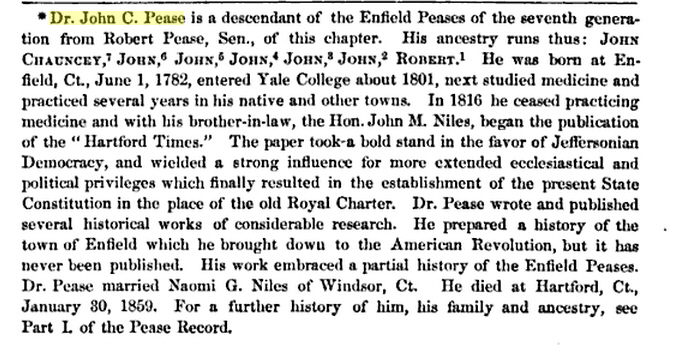
A genealogical and historical record of the descendants of John Pease, Senior  by Rev. David Pease and Austin Pease 1869 (This book includes the story of Nathaniel Pease II dying at sea and includes Nathaniel Pease III b. at Enfiield December 28, 1753 History unknown. The footnote for this information refers to Dr. John C. Pease.

Dr. John C. Pease – Bio

Posted in -8th Generation, Line - Miner, Missing Parents | Tagged | 3 Comments

Josiah Harvey Foster

Josiah Harvey FOSTER (1808 – After 1860 Census) was Alex’s 4th Grandfather; one of 32 in this generation of the Shaw line.

Josiah Harvey Foster was born in 18 Sep 1808 in Northumberland, Saratoga, New York.  His parents were Eliphalet FOSTER and Prudence PERKINS. He married Mary Ann TURK 28 Apr 1831.  Alternatively Mary’s maiden name could have been Merritt or LaTouche.  Josiah died in Wisconsin.

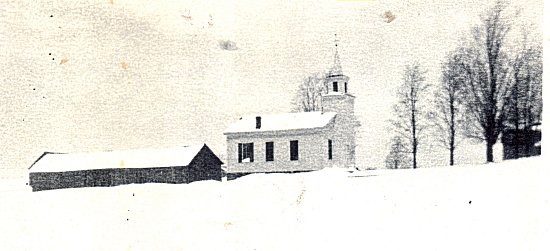
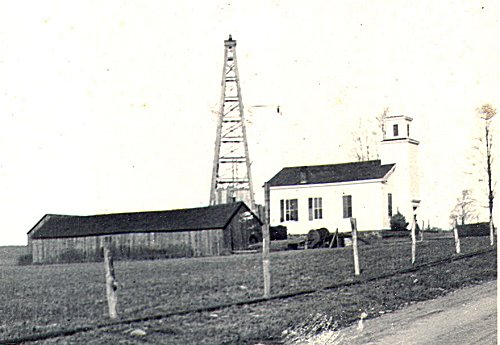
Farmington Presbyterian Church – Josiah H. Foster and his wife took letters of dismissal 4 Feb 1854, from this church in Tioga County PA  to a Presbyterian Church in Wisconsin.

Mary Ann Turk was born in 25 Sep 1811 in New York.  Her parents were  Cornelius TURK and Mary DeLONG.  Mary Turk’s brother Henry Benjamin Turk also lived in the small community of Farmington, Tioga, Pennsylvania in the 1840, 1850 and 1860 census. Mary died after the 1860 census. In the 1870 census, there was a widow M. A. Foster living in Barton, Washington, Wisconsin, about 67 miles east of Arlington who was born about the right time in New York. Could she be our Mary? She was living with two other widows Anna Cofflin (age 26) and Prudence Bock (age 78)

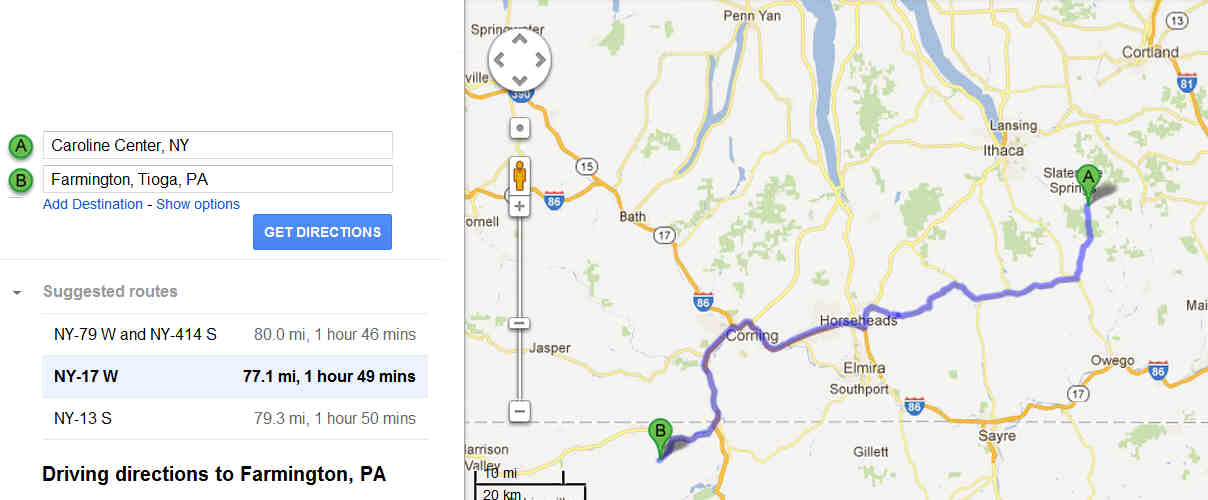
Directions to Farmington from Caroline NY where Mary grew up.  Her brother Henry B. Turk also made the move  Source: Google Maps

One source said that  Madame De Long was born in France.  A family legend says that Ruth was also a descendent of the Marquis De Longe who was guillotined in the French Revolution and his wife and daughter escaped the country and his daughter married an American.

Other sources say Mary Ann’s maiden name was LaTouche or that her brother was Hiram Merritt. She has also been called Margaret.    So far, I have not found any details behind these alternatives or the guillotined Marquis legend.

Family legend also says Mary Ann’s mother may have beeen related toGen Nathanial GREENE of the Revolution. My grandmother’s second cousin Lydia Townsend remembered seeing a family silver tray that had belonged to him.  She didn’t know what had become of it.  I have worked Nathanial Greene’s family tree up to grandparents and down to grandchildren without any connection so far.

Children of Josiah and Mary Ann:

Name Born Married Departed
1. Jeanette C. Foster 14 Apr 1832 New York Charles Bradley 15 Oct 1856 After 1880  Census Red Bluff, Montana
2. Robert Harvey Foster 14 Oct 1833 New York Thrize Eggleston 20 May 1857 Before 1880 Census, Dane, Wisconsin
3. Caroline Foster 21 Oct 1835 Saratoga County, NY Augustus Phineas Smith 21 Sep 1854 Lodi, Columbia, Wisconsin 19 Jul 1930 Clarion, Iowa
4. Sarah Ann Foster 26 Aug 1837 New York Jeremiah K Rossman 1 Jan 1856 Fayette County, Iowa 23 May 1870 Vienna, Dane, Wisconsin
5. Christina E. (Christiana) Foster 7 Jun 1839 baptized
14 Jun 1840 First Presbyterian Church, Elkland, Tioga, Pennsylvania
John Dunning
3 Jul 1856
.
William Perry Morton
1 Jan 1860
Jul 1869 or Jul 1870
6. John H. Foster 1 Dec 1841 Pennsylvania 15 Sep 1864
Little Rock National Cemetery?
7. Ruth Agnes FOSTER 1844
Pennsylvania
William SHAW
27 Jul 1861 or
3 Aug 1861 Columbia County, Wisconsin
c. 1896
Bozeman, Montana
8. Mary Catherine Foster 3 Mar 1845 (bapt. 31 Oct 1852)
Pennsylvania
Nathan Cook Peirson
1 Jan 1866
2 Aug 1869
Childbirth
Big Sandy, Jefferson, Nebraska
9. William Thomas Foster 28 Nov 1846 New York?
(bapt. Jan 1847)
Pennsylvania
Ann Hageman
23 Jun 1869 Iowa
.
Mattie E Miles
bet. 1888-90
21 Oct 1921
Los Molinos, Tehama, California
10. Jane Maria Foster 30 Aug 1848 Pennsylvania 15 Sept 1852 Farmington Township, Tioga, PA
11. Adella (Adelah) Foster 1850 (bapt. 31 Oct 1852)
Pennsylvania
Lewis Henry Smith
Oct 1867
12 Dec 1910
12. Lydia Foster 1852 (bapt. 31 Oct 1852)
Pennsylvania
After 1860 Census

Josiah and Mary Ann in Farmington, Tioga, Pennsylvania

In 1828 there were but four log cabins in Farmington township, Tioga, PA and that in 1830, when the first election was held, there were but eleven voters. If this be true, the township must have grown rapidly during the next year, inasmuch as the assessment list of 1831 shows sixty-five persons, who were assessed as owners of seated lands and personal property within its boundaries. Among the more prominent of these, in addition to those already named, were Ives Chamberlain, Zebediah Clark, James Works, John and Daniel Crippen, Jacob Lichenthaler, David Cummings, Job Herrick, Lockwood G. Hoyt, Freeman Place, Alva Cummings, John C. Robb, Samuel P. Babcock, Jonathan Sobres, Nathan Bottom, Charles Carr, Randall Drake, George Stanley, William Perrigo, Johnson Butts, Henry B. Turk, Harvey Foster, Hiram Merritt, Samuel and Daniel Buckbee, and Abner Webster.

Josiah Foster was included in the 1840 Farmington census

Male   Female
Under 5       0               3 (Christina 1, Ann 3, Caroline 5)
5 -10            1               1  (Robert 6 and Jeannette 8)
30-40          1                1 (Josiah 32 and Mary Ann)
60-70                            1  (Prudence 64)

It appears that Harvey’s father had died by 1840 as his mother was already living with them. A Harvey Foster was named an elder when the Farmington church was formed in 1844.  Josiah’s middle name was Harvey so they must have been related.

10 Feb 1844 –   Mrs. Prudence Foster, Josiah Harvey Foster and his wife, Mary Ann Foster were charter members of the Presbyterian Church of Farmington. They had previously been members of the Presbyterian Church in Ekland, PA.   They  lived at the head of a stream in the hollow to the east of the hill where the Grange Hall is located, the stream being known as Foster Brook, near the present natural gas pumps, and near the home of Mr. And Mrs. Lucien Palmer, who celebrated their 65th wedding anniversary July 4, 1944.

Farmington Presbyterian Church ca 1932

The Fosters went west, selling their farm to James Beebe, who sold to Shipman, who sold to W. E. Close, and it is now [1944] owned by Rhodes Butler.

Mrs. Prudence Foster, (“Granny Foster”) died March 24, 1856. Mary Ann, wife of Josiah Harvey Foster, was a sister of Hiram Merritt, grandfather of Myra Merritt, first wife of William E. Close of Tioga.

Josiah H. Foster and his wife took letters of dismissal February 4, 1854, to a Presbyterian Church in Wisconsin. They had a son baptized, William Thomas, in January, 1847, and three daughters October 31, 1852; Mary Catherine, Adelah, and Lydia.

In the 1850 census, Josiah Foster and his family were living in Farmington Township, Tioga County, Pennsylvania.  The township population was 636 at the 2000 census. Josiah was a farmer and his farm was recorded at $1000.  J H’s wife was recorded as Margaret born about 1811 in New York.  Prudence Foster, age 75 was recorded as living with the family.

Farmington Township, Tioga County, Pennsylvania

Tioga County, Pennsylvania

Josiah H. Foster and his wife took letters of dismissal 4 Feb 1854, from the Farmington Presbyterian Church in Tioga County PA  to a Presbyterian Church in Wisconsin.

In the 1860 census, Josiah H Foster and his family were living in Arlington, Columbia County.  Wisconsin.  Josiah’s farm was recorded at $4,150 and his personal estate at $600. Josiah’s  wife was recorded as Mary born about 1812 in New York.     All the children older than 18 had left home.

J H Foster 51
Mary A Foster 48
John H Foster 18
Ruth Foster 16
Mary C Foster 15
W J Foster 13
Alela P Foster 10
Lydia M Foster 8

Columbia County is now part of the Madison metro area. Vienna Township, Dane County where William Shaw had his Cherry Orchard is one township to the south. Arlingtonis a Townshp in on the southern border of  Columbia County, The population was 484 at the 2000 census.

Arlington Township, Columbia County, Wisconsin

Columbia County, Wisconsin

Map of Wisconsin highlighting Columbia County

Columbia County, Wisconsin

Josiah’s or Mary Ann’s mother may have been related to Gen Nathanial Greene of the Revolution. Ruth’s  cousin Lydia Townsend remembered seeing a family silver tray that had belonged to him.

The Presbyterian Church of Farmington (Tioga County, PA) 1844 – 1944 by Victor Detty

The Presbyterian Congregation of Farmington was organized February 10, 1844, at the house of Johnson Butts near Farmington Hill. The constituent members were Johnson and Lucy Butts, John C. Robb, Miss Prudence Crippen, Mrs. Prudence Foster, and Josiah H. and Mary Ann Foster. The elders have been Johnson Butts, Peter M. Close, John C. Robb, Harvey Foster, P. L. Butts, O. H. Blanchard and D. P. Close. Rev. S. J. McCullough, who organized the church, was its pastor till 1848. His successors have been Revs. Thomas E. Woodcock, J. Gordon Carnahan, F. Rand, 1859; Fred Graves, 1866; S. A. Rawson, 1873; Benjamin Russell, 1880; C. B. Gillette, 1881; R. G. Williams, 1885; S. P. Gates, 1889; J. L. Campbell, 1890; John H. Elliott, 1892, and W. C. McCormack, who took charge in January, 1896. He is also the pastor of the church at Tioga. A church edifice was erected in 1851 at a cost of $1,200, and has been repaired as needed. The congregation is a strong one. Services have been held with but occasional interruption since the society was organized and a good Sunday-school maintained. The society was incorporated February 14, 1853, upon the petition of John Harrower, Peter M. Close, Isaiah H. Foster, Johnson Butts, John C. Robb and Leverett L. Wilson.

Several persons, members of different Presbyterian Churches, residing in the Town of Farmington, Tioga County, Pa., having united in a petition to the Presbytery of Chemung for the organization of a Church in said Town, the Presbytery appointed a committee to organize a Church as requested by the petitioners. By agreement of the Committee the Rev. S. J. McCullough, one of the members proceeded to Farmington and met the persons wishing to constitute the Church at the house of Johnson Butts on Saturday the 10th of February 1844

Letters of dismission and recommendation were presented as follows, viz., Johnson Butts and Lucy, his wife, from the Presbyterian Church of Lawrenceville, Pa.; John C. Robb, from the same; Miss Prudence Crippen from the Presbyterian Church of Painted Post; Mrs. Prudence Foster, Josiah H. Foster and Mary Ann his wife from the Presbyterian Church of Elkland. The letters being found in order, the persons presenting them were asked if it was their wish now to be organized into a church on the principles of the Presbyterian Church in the United States. The question having been answered in the affirmative they were declared to be a Church of Christ, and directed to proceed to the election of a Ruling Elder or Elders. They resolved to elect but one Elder at the present time, and Mr. Johnson Butts who had held the office of ruling Elder in the Church of Lawrenceville was elected to the same office in this Church. It was also resolved that this Church be called the Presbyterian Church of Farmington. Mr. McCullough then preached a sermon from John 5:1, preparatory to the Lord’s Supper.

Mrs. Prudence Foster, Josiah Harvey Foster and his wife, Mary Ann Foster were charter members who lived at the head of a stream in the hollow to the east of the hill where the Grange Hall is located, the stream being known as Foster Brook, near the present natural gas pumps, and near the home of Mr. And Mrs. Lucien Palmer, who celebrated their 65th wedding anniversary July 4, 1944.

The Fosters went west, selling their farm to James Beebe, who sold to Shipman, who sold to W. E. Close, and it is now owned by Rhodes Butler.

Mrs. Prudence Foster, (“Granny Foster”) died March 24, 1856. Mary Ann, wife of Josiah Harvey Foster, was a sister of Hiram Merritt, grandfather of Myra Merritt, first wife of William E. Close of Tioga.

Josiah H. Foster and his wife took letters of dismissal February 4, 1854, to a Presbyterian Church in Wisconsin. They had a son baptized, William Thomas, in January, 1847, and three daughters October 31, 1852; Mary Catherine, Adelah, and Lydia.

A child of Josiah H. and Mary Ann  Foster is buried in the old and abandoned cemetery located in a pasture about 100 yards north of the Farmington Methodist Church. The marble stone, found lying flat, has this inscription – “Jane Maria, daughter of Josiah and Mary Ann Foster, died Sept. 15, 1852, aged 4 years, and 17 days.” This land, now owned by Fred Ackert, was once possessed by Hiram Merritt, four of whose children’s names are on stones found there. Hiram Merritt married Mary Ann Foster, according to their niece, Mrs. Mary Merritt Hall of Osceola, Pa.

Children and Grandchildren

1. Jeanette C. Foster

Jeanette’s husband Charles Bradley was born about 1822 in Vermont. He married Jeanette 15 Oct 1856.

In the 1860 census, Jeanette and Charles were farming in Arlington, Columbia, Wisconsin.

They moved to Montana Territory where their  son John J. Bradley was born about 1866. In the 1870 census, Charles and Jeanette were farming near Virginia City, Montana.

In 1863, the area around Virginia City was part of the Dakota Territory until March, when it became part of the newly formed Idaho Territory. On May 26, 1864, the Territory of Montana was formed, with Bannack briefly becoming the territorial capital, Virginia City would quickly take that title from Bannack.

In May 1863, a group of prospectors were headed towards the Yellowstone River and instead came upon a party of the Crow tribe and were forced to return to Bannack. Gold was discovered on the retreat trip when Bill Fairweather stuck a pick near Alder Creek joking he might find something to fund some tobacco.

The prospectors could not keep the site a secret. They were followed on their return to the gold bearing site and set up the town in order to formulate rules about individual gold claims. On June 16, 1863 under the name of “Verina” the township was formed a mile south of the gold fields. The name was meant to honor Varina Howell Davis, first and only First Lady of the Confederate States of America during the American Civil War. Verina, although in Union territory, was founded by men whose loyalties were thoroughly Confederate. Upon registration of the name, a Connecticut judge, G. G. Bissell, objected to their choice and recorded it as Virginia City.

Within weeks Virginia City was a veritable boomtown of thousands in the midst of a gold rush with no law enforcement whatsoever, except for vigilantism. Most of Montana became under the rule of a Vigilance committee, the infamous Montana Vigilantes, which operated on both sides of the law. Their secret motto, 3-7-77 is still on the badges, patches, and car door insignia of the Montana Highway Patrol.

In 1864, the Montana Territory was carved out of Idaho Territory. Virginia City, claiming 10,000 citizens, was made the capital of the new territory in 1865. The first public school was built in 1866, but already the most easily accessible gold from placer mining had been exploited and development and population in the territory was moving towards Helena.

In the 1880 census, Jeanette was widowed and keeping a hotel in Red Bluff, Madison, Montana. (About 30 miles north of Virginia City and 30 miles south of Bozeman on Montana State Route 84.

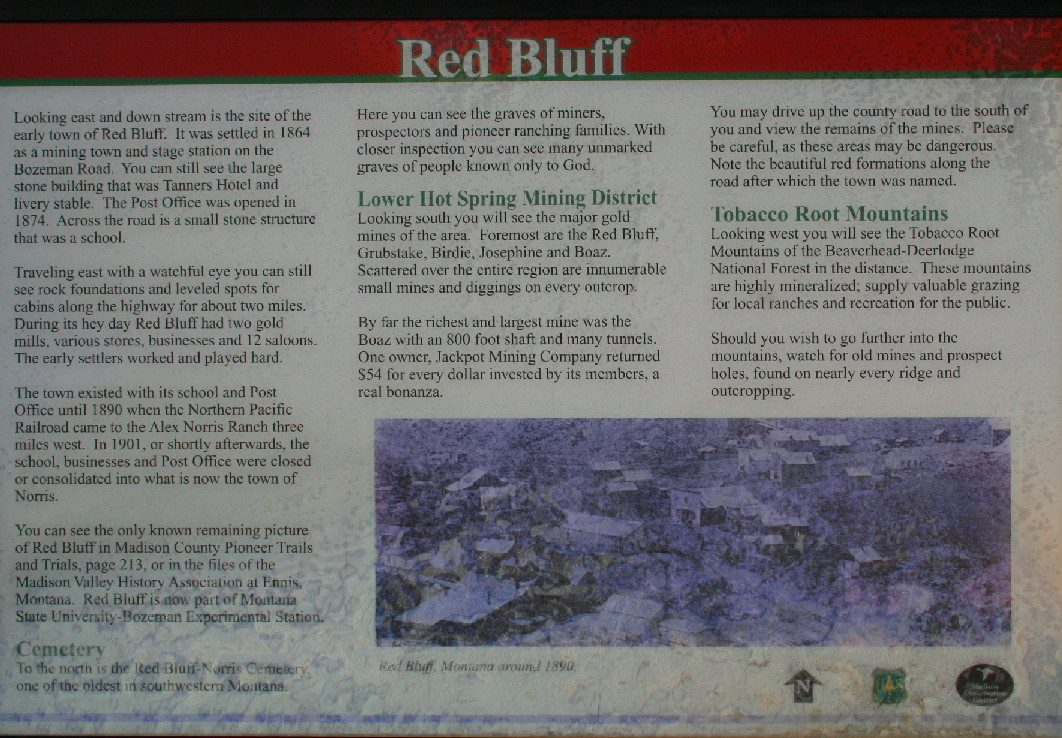
Red Bluff was settled in 1864 as a mining town and stage stop on the Bozeman road.  During it’s hey day, Red Bluff had two gold mills, various stores, businesses and 12 saloons. The town existed with it’s school and post office until 1890 when the railroad came to the Alex Norris Ranch three miles to the west.

Red Bluff Montana Historic Sign

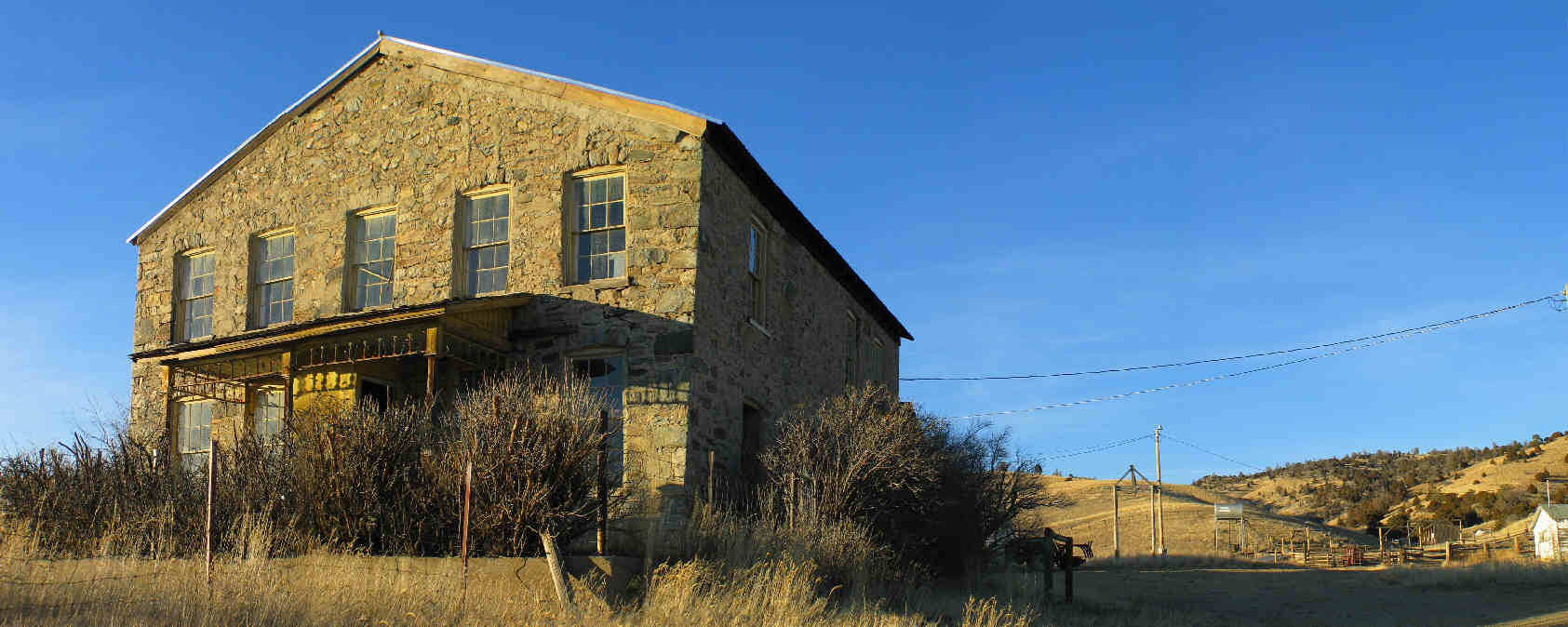
Red Bluff Tanners Hotel & Livery stable

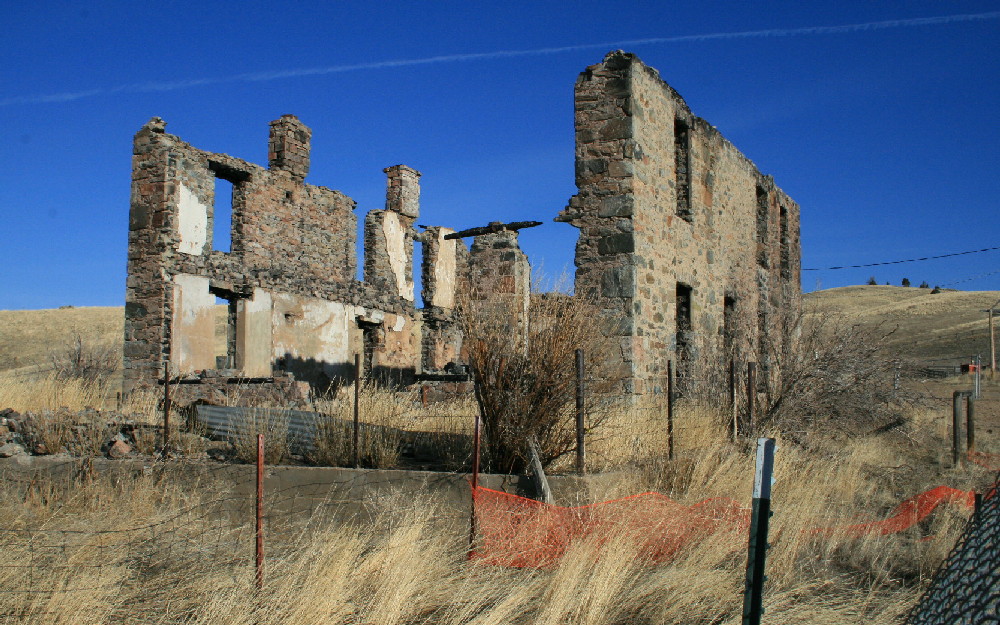
Could this have been Jeannette’s hotel?  I haven’t found out, but a clue is  Bradley Creek Road is the main highway running south from Red Bluff. The  Tanner brother initials were A.W. and C.E.

The Red Bluff Tanners Hotel & Livery stable was destroyed by Fire in 2006

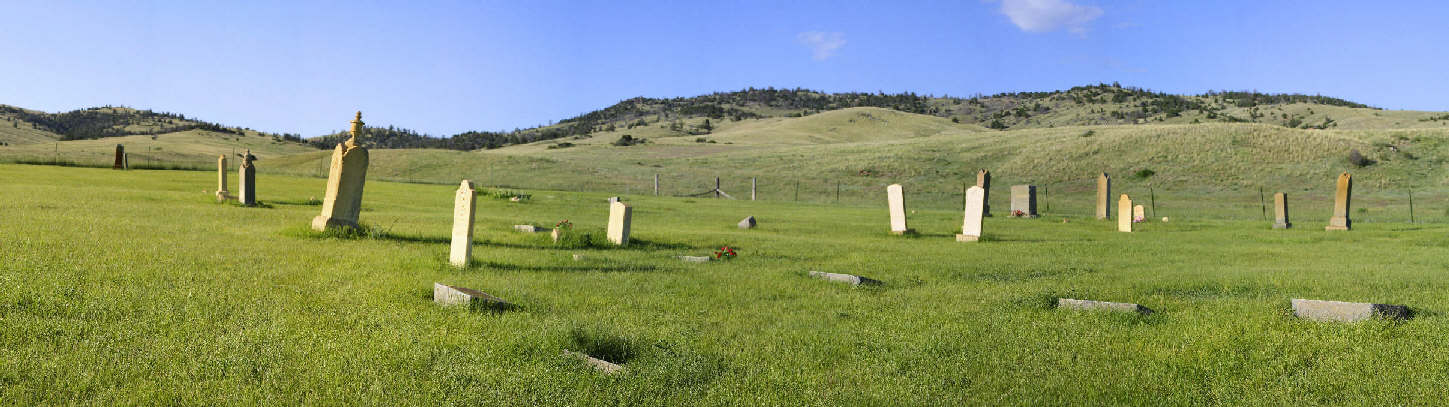
Red Bluff Cemetery – Notice the “green” countryside of May & June compared to the “yellow-wheat” color of the other ten months of the year.

Today Red Bluff is a Montana State University Research Ranch located near Norris in Madison County, Montana, along the west side of the Madison River. The operation comprises 13,750 acres of land, 10,000 deeded and 3,750 leased. Most of this land is rangeland, with limited hay meadows along the valley bottoms. Elevations range from 4,600 feet to 6,200 feet above the Madison River canyon. The ranch occupies most of the once thriving late 19th-early 20th century gold mining community in the Hot Springs Mining District which was second only in gold production to Alder Gulch. At its peak of activity, there may have been a population of approximately 3,000. The ranch nearly surrounds the town of Norris. The founder of Norris, Alexander Norris may have owned much or all of the Red Bluff Ranch at one time.

The Red Bluff Research Ranch (previously known as the Rowe Brothers Ranch) was purchased for $164,000 ($16.83 per acre). The total acreage was 9,746. Two U. S. Forest Service Grazing Permits (Muddy Greek, Cache Creek) in the Gallatin National Forest came with the Rowe property. Some small additional land exchanges and purchases have taken place over the last 45 years. The grazing permits were returned to the Forest Service in 1976. A new lambing facility and mixing barn at the ranch was constructed in about 1990. This made lambing much easier. There are currently about 170 head of cattle and 900 head of sheep maintained on a year round basis at the research ranch. These livestock along with the range areas are used for both teaching and research.

Children of Jeanette and Charles

i. Darwin J. Bradley (1859 Wisconsin – Before 1920 census Oregon); m. Kate B. [__?__] (b. 1879 Kansas) Kate first married 1898 in Oregon to Frank Linn (b. May 1873 Oregon) and had two children including Forrest Linn b Jul 1899.

In the 1910 census, Darwin and his family were living with his sister Mary’s family in Abernathy, Clackamas, Oregon and Darwin was working as a photographer.  By the 1920 census, Kate Bradley was widowed and still living with Mary and Bion Commons in Portland, Oregon. In 1930, Kate was gone, but Forest was still living with Mary and Bion in Portland, now with his bride Edna.

ii. John J. Bradley (abt 1866 Montana Territory – Aft 1880 Census)

iii. Mary O. Bradley (abt. 1872 Montana Territory – Aft. 1880 Census)

iv. Mary E. Dunning (abt 1857 Wisconsin – 15 Jun 1931 Portland, Oregon ) Daughter of Jeanette’s sister Christina. Adopted by Jeanette m. about 1887 to Bion L. Commons (abt 1862 Illinois – 30 Jan 1941 Clackamas, Oregon)

In the 1910 census, Bion was a farm laborer in Lents, Multnomah, Oregon.

In 1914, Bion was a carpenter living at 7915 SE Foster Road, Portland, Oregon.

.

2. Robert Harvey Foster.

Robert’s wife Thrize Eggleston was born in 1834 New York. Her parents were Richmond Eggleston (2 Feb 1811 Mass – 6 Jun 1889) and Sarah [__?__]. She married Robert on 20 May 1857. Thrize died after 1910 census in Wisconsin.

In the 1860 census, Robert’s father-in-law, Richmond Eggleston , mother-in-law, Sarah Eggleston (1812 Connectictut – ) and younger sister Catherine lived with the young couple in Vienna, Dane, Wisconsin. In the 1880 census, Thirza was a widow and living with her father Richmond Eggleston in Vienna, Dane, Wisconsin.

Children of Robert and Thrize “Thirra”

i. Annie Foster (abt 1872 Wisconsin – Aft. 1930 census ) Annie was adopted. Her parents were born in Norway. m. Hans Igard (b. 1867 Norway – d. Bef. 1930 census).

In 1900 Hans was married to his first wife, Carrie Igard, who he divorced prior to 1910, leaving Carrie with 5 young children to raise on her own. In the 1910 census, Thirza was living with Annie and Hans in Vienna, Dane, Wisconsin.

In the 1930 census, Anne was a widowed servant living with the William Higgins family in Westport, Dane, Wisconsin.

3. Caroline Foster

Caroline’s husband Augustus Phineas Smith was born 30 Mar 1805 in Connecticut. His parents were Peter W. Smith (? – 1850) and Sally [__?__] (1777 – 1870). He first married Eliza Ann Hanchett in 1833. Eliza was born in 1809 in New York and died Mar 1854 in Arlington, Columbia Wisconsin. Augustus died 7 Jan 1870 in Dekorra, Columbia, Wisconsin.

In the 1850 census, Augustus and Eliza were living in Kossuth, Columbia, Wisconsin.

Children of Augustus and Eliza:

i. Lewis Henry Smith b. 7 Jun 1834 in Burnt Hills, NY, d. 21 Jan 1901 m. Adella P. Foster Caroline’s younger sister See Adella’s section for their children and other details.

ii. James Edward Smith b. 27 Feb 1836 in New York d. 14 May 1919 m. Phebe Look (1841 Massachusetts – 21 Dec 1926 Marion, Oregon) children Arthur, Edgar (1860), Jane “Jennie” (1865), Lewis E (1862) and Arthur (1878).

In the 1870 census, James and Phebe were farming in Arlington, Columbia, Wisconsin. In the 1900 census, James was a furniture dealer in Wheatland, Vernon, Wisconsin. In the 1910 census, James and Phebe were living in Santa Cruz, California.

iii. Harriet Smith b. 1842

iii. Sarah Jane Smith b. Oct 1844 in New York d. 19 Jul 1925, Ellensburg, Kittitas County, Washington; m. 1 Nov 1871 to William Perry Morton (b. 8 May 1833 in Leverett, Franklin, Mass. – d. 27 Sep 1902 in Retreat, Vernon, Wisconsin) He first married Sarah Jane’s aunt Christine Foster (b. 1840 in Pennsylvania – d. Jul 1869) and had one child Delmer Franklin Morton (1866 – 1951) (See below)

Three children Lovina, Edward and Sadie; In the 1870 census, Sarah was living with her brother James and teaching in Arlington, Columbia, Wisconsin.

In the 1910 census, Jane S was living with her widowed daughter Vina Seymour in Sterling, Vernon, Wisconsin.

In the 1920 census, Vina and Sarah were living in North Ellensburg, Kittitas, Washington.

iv. Frances C Smith b. May 1847 in New York

Children of Augustus and Caroline

v. Harvey Smith d. 1914

vi. Minnie Smith

vii. Louella Smith (23 Jan 1855 – 23 Jan 1946) m. 6 Aug 1873 to Marcellus H. Austin Three children Jessie, Mabel (1879 Iowa – ), Rowell. On 18 Feb 1903 Mabel married her half cousin once removed William Foster Smith (16 Jul 1878 – 5 Feb 1944);

These marriages between relations are confusing, here’s a chart to help explain. Lewis Henry Smith married his step aunt (unrelated by blood and still 16 years younger than himself.  .

1.  Josiah Harvey Foster (1808 – ) m. Mary Ann Turk (1811 – )

2. Caroline Foster (1830 -1930) m. (his 2nd) Augustus Smith (1805-1870) 

2. Adella Foster [Caroline’s sister] (1850 – 1910) m. Lewis Henry Smith [Augustus’ son] (1834 – 1901)

3. Louella Smith (1855-1946) m. Marcellus Austin

4. Mabel Austin m. William Foster Smith (1878 – 1944)

1. Augustus Smith (1805-1870) m1. Eliza Hanchett (1809-1854)

2. Lewis Henry Smith (1834-1901) m. Adella Foster (1850 – 1910)

3. William Foster Smith (1878 – 1944) m.  Mabel Austin 

.

4. Sarah Ann Foster

Sarah Ann’s husband Jeremiah K Rossman was born about 1832 New York. He married Sarah Ann 1 Jan 1856 in Fayette County, Iowa.

In the 1860 census, Jermiah, Sarah and Charles were living in Vienna Dane Wisconsin. Jermiah’s farm was immediately following Sarah’s brother Robert Harvey Foster’s in this census. In the 1870 census, a single Sarah Rossman born about 1840 in Pennsylvania was keeping house in Vienna, Dane Wisconsin.

Children of Sarah Ann and Jermiah

i. Charles C. Rossman (abt 1858 Wisconsin – 16 Oct 1926, Lane Co, Oregon); m. 1886 to Lydia J. Wickham (25 Jul 1857, Hawkeye, Fayette Co, IA –  Aft 1930 census Leeburg, Lane, OR)

In the 1880 census, Charles was married to Sina [__?__]  (b. 1862 Iowa) and had a three month old daughter Viola in Turkey Creek, Mitchell, Kansas In the 1900 census, Charles was farming in McKenzie, Lane, Oregon. They had a large family.

.

5. Christina E Foster

Christina married first John G.  Dunning 3 Jul 1856 when she was just 17.

Child of Christina and John:

i. Mary E. Dunning (abt 1857 Wisconsin – 15 Jun 1931 Portland, Oregon ) Adopted by Christina’s sister Jeanette m. Brian Commons m. about 1887 to Bion L. Commons (abt 1862 Illinois – 30 Jan 1941 Clackamas, Oregon)

In the 1910 census, Bion was a farm laborer in Lents, Multnomah, Oregon.

In 1914, Bion was a carpenter living at 7915 SE Foster Road, Portland, Oregon.

Christina married second 1 Jan 1860 to  William Perry Morton.  He was born 8 May 1833 in Leverett, Franklin, Mass. His parents were Chauncey Morton ( 1799 – 1879) and Betsy Pike (1800 – 1864)  After Christina died he married 1 Nov 1871 to Christina’s niece Sarah Jane Smith (See above) and had three more children. William died 27 Sep 1902 in Retreat, Vernon, Wisconsin. It’s curious he didn’t want to adopt his step-daughter, but felt fine marrying his dead wife’s niece.

Christina died of Hydrothroax/Dropsy (a condition that results from serous fluid accumulating in the pleural cavity.) in May 1870 in Big Sandy, Jefferson, Nebraska

Children of Christina and William

ii. Delmer Franklin Morton (16 Oct 1866 in Lodi, Columbia, Wisconsin – 27 Jan 1951 in Mountview Cemetery, Billings, Yellowstone County Montana); m. 15 Nov 1892 Retreat, Vernon, Wisconsin to Hattie Adelia Mellen (b. 9 Jun 1865 in Hingham, Sheboygan, Wisconsin – d. 23 Nov 1943 in Broadview, Yellowstone, Montana)

In the 1920 census, Delmer and Hattie were farming in Progressive, Yellowstone, Montana

Nine children: Bessie Hattie Morton b. 1894; Everett Delmer Morton (1896 – 1959); Dwight Foster Morton b. 1898; Homer A. Morton (1900 – 1986); Mark Wesley Morton b. 1901; Alvaro Stebbins Morton b 1904; Esther Lydia Morton b. 1906; Elain Morton (1908 – 1908); Carl Joy Morton b. 1910

.

6. John H Foster

A Union Army Private John C. Foster was interred Sep. 16, 1864, Little Rock National Cemetery, Little Rock, Pulaski County Arkansas, Plot: 7, 4639 just one day after the death date we have.

7. Ruth FOSTER (See William SHAW’s page)

.

8. Mary Catherine Foster

Mary Catherine’s husband Nathan Cook Peirson was born 27 June 1835 in Indiana. His parents were Solomon Peirson (1810 – 1879) and Martha Cook (1813 – 1838)  He was a private in 8th Regiment, Ohio Cavalry.  After Mary died of childbirth 2 Aug 1869, he married  25 Sep 1869 in Jefferson County, Nebraska to Priscilla Puckett (b. 1852 in Indiana – ) and had at least two more children Mary E. Pearson (1877 – ) and Charley Pearson (1879 – ). Nathan died 24 Dec 1903 in Fairbury, Nebraska.

In 1870, “Perriscilla” was “keeping house” for Nathan, but by 1880 they were married.

Children of Mary Catherine and Nathan:

i. Alice Lillian Peirson b. 2 Oct 1863 in Richland, Wisconsin, d. 4 May 1957 in Lincoln, Nebraska m. William Elias Schell (1861 Indiana – 1935)

In the 1910 census, William was the president of a college in York Ward 1, York, Nebraska. In the 1920 census, William was general secretary of [illegible] in Dayton, Ohio. In the 1930 census, William was a United Brethren Minister in Kansas City, Kansas.

Three children: Lena Schell Caldwell (1882 – 1973), Louis Irving Schell (1886 – 1951), Ruth Alice Schell b. 1893 .

ii. Howard Sylvester Peirson (7 June 1866 in Wisconsin – 29 July 1946 Napa California); m. c. 1888 Emma Ellen Beatley (26 Sep 1867 Illinois – 22 Nov 1942 Butte, California)

In the 1900 census, Howard was a farmer in Tobias, Saline, Nebraska. In the 1910 census, Howard was a farmer in Paradise, Rooks, Kansas. In the 1920 census, Howard was a farmer in Albion, Boone, Nebraska. In the 1930 census, Howard was a laborer in Kimshew, Butte, California

.

9. William Thomas Foster

William’s first wife Ann (Amelia) Hageman was born in 1853 in Wright, Luzerne, Pennsylvania. Ann died 18 Jan 1888 in Sheds Bridge, Gallatin, Montana.

William’s second wife Mattie E Miles (Myles) was born 23 Jun 1863 in Tennessee. Her parents were [__?__] Myles and [__?__] Oaks. She first married [__?__] Holden.  Mattie died 10 Jun 1946 San Bernardino, California)

In the 1880 census, William and Amelia were farming in West Gallatin Valley, Gallatin,Montana.

In the 1910 census, William and Mattie were livng in Riverside Ward 5, Riverside, California and William was working as a carpenter. In the 1920 census, Mattie was keeping an apartment house in Long Beach, California, she is listed as married, but William was not in the household. William died in 1921 in Los Molinos California where his daughter Caroline Stryker lived. In the 1930 census, Mattie was managing an apartment house in Los Angeles..

Children of William and Amelia:

i. John Harlan Foster (21 Apr 1872 in Iowa – 1 Aug 1933 in Washington); m1. Martha [__?__] (1882 Montana – )

In the 1910 census, John was a farmer in School District 38, Gallatin, Montana. By the 1920 census, Martha was out of the picture.

m2. Alzada “Zada” Fawsett (2 Jun 1862 Utah – 4 May 1942 St Anthony, Fremont, Idaho) Zada  first married 31 Jan 1878 in Ruby Valley, Nevada to  Samuel Thompson (b. 1847 North Carolina)

In the 1930 census, John was a mail carrier in Bozeman, Montana.

ii. Oliver E Foster b. 1876 Iowa; m. Adele J. [__?__] (b. 1879 Montana)

In the 1910 census, Oliver and Adele were farming in School District 5, Gallatin, Montan.Adele had been previously married and had two daughters  Addie B. Shay (b. 1900) and Ester B. Shay (b. 1903)

In the 1920 census, Oliver was a widowed farmer in Jacoby, Clark, Idaho living with his 11 year old daughter Mabel.

iii. Caroline “Carrie” Angeline Foster b. 5 May 1878 Bozeman, MT m. 10 Oct 1901 Red Bluff, Calif to Charles Fremont Stryker (abt 1857 Wisconsin – After 1930 census Los Molinos, Tehama, California)

Charles was 21 years older than Caroline, their youngest son David was born when he was 61 years old. In the 1880 census, he was a hired hand at his brother Daniel’s farm in Grants Pass, Jackson, Oregon. In the 1900 census, he was a widowed farmer in Belgrade, Gallatin, Montana and living with his mother-in-law. Emeline P Stiles (79.) In the 1910 census, Charles was a farmer in Mountain, Siskiyou, California. In the 1920 and 1930 census, Charles was a farmer in Los Molinos, Tehama, California.

iv. Cyrus Franklin Foster (4 Jan 1884 near Bozeman, MT – 9 Oct 1965 Los Angeles)

In the 1920 census, Cyrus was a widowed fireman at the St Vincent Academy in Walla Walla Ward 2, Walla Walla, Washington. His daughter Jessie May was a 14 year old student there. St. Vincent Academy was established by the Sisters of Providence of Vancouver in 1864. St. Patrick’s School for Boys was established in 1865 by the Christian Brothers. St. Patrick’s was renamed LaSalle Institute in 1899. The two schools merged in 1930. The school moved to its current campus in 1959 and was renamed DeSales Catholic school In the 1930 census, Cyrus was a lodger in Pasadena, California working as a forestry laborer.

v. Sherman Foster (28 May 1887 near Bozeman, Montana – Apr 1976 Pomona, California); m1. [__?__] Bridgewater (b. Missouri);  m2. Ann Eliza Crandell (18 Oct 1895 Sanborn, Barnes, North Dakota – 20 Sep 1985 Los Angeles)

In the 1920 census Sherman was a widower with three young children 6, 7, and 9 farming in Manhattan, Gallatin, Montana. His wife was still alive in June 1917 when he filled in his draft registration. In the 1930 census, Sherman was remarried to Anna Eliza Crandell  and working as a county road laborer in Norwalk, Los Angeles, California

Children of William and Mattie

vi. Ruth I. Foster (23 May 1891 Montana – 21 Nov 1961 San Bernardino, California); m. Elmer Hoover (b. 1886 Missouri – d. Aft 1940 census Fresno.)

In the 1920 census Ruth and Elmer were living in Long Beach California with an infant daughter Mary and Elmer was working as a house carpenter. In the 1930 census, Ruth was living with her mother and sister Mary and working at a rental costume company.

vii. Mary Foster b. 9 Jul 1894 near Bozeman

In the 1910 census, Mary was living at home in Riverside California and packing oranges. In the 1920 census, Mary was living with her mother in Long Beach and working as a clerk in a drug store. She was divorced from Lawrence Meyer and had a 4 year old son Lawrence Meyer Jr. In the 1930 census, Mary was living with her mother and sister Ruth. This time, her married name is shown as Moore instead of Meyer and her children are now Francis Moore 17, Imogene Moore 14, Eugenio Moore 13, and Mary Cena Moore 10.

viii. Robert Foster b. 1895 near Bozeman – Before 1910 Census

ix. Grace Foster (8 Oct 1897 Bozeman, Montana- 19 Jan 1965 Camarillo, Ventura, California);  m1. Anthony Gillespe (c. 1891 Merced, California – 14 Mar 1955 Los Angeles)  His parents were Marcus Gillespie and Mary Moreno. m2. [__?__] Hawkins .

In the 1920 census, Grace was married to Anthony Gillespie, had a young son Eldon and was living in Gardena, California,  Anthony was working as an oil well driller. By the 1930 census, Anthony had remarried to Helen Philips and was living in Huntington Beach, California. Eldon Felix Gillespie (19 Aug 1916 in Kern, California – 6 Feb 1988 in Wesminster, Orange, California ); m. 26 Nov 1938 Long Beach, California to Irene Terry.

In 1935, Grace was living in San Bernardino.  In the 1940 census, Grace Hawkins was divorced living alone in Camarillo and working as a hospital attendant.

http://boards.ancestry.com/surnames.gillespie/545.612.621/mb.ashx

x. Florence Foster b. 1899 Bozeman, MT – Before 1910 Census

.

11. Adella Foster

Adella’s husband Lewis Henry Smith was born in 1834 in New York His parents were Augustus Phineas Smith and Eliza Ann Hanchett. Lewis died in 1901.

Lewis was Adella’s step-nephew through her sister Caroline’s husband Augustus! You would think that only one couple would have robbed the cradle in a single family, but actually, both Lewis Henry and Augustus did.  Here’s the math: Adela married Lewis Henry when she was 17 and he was 33. There was a 15 year difference between Caroline and Adela.  Augustus married Caroline as his second wife when he was 49 and she was 18. In the 1880 census and 1900 census Lewis Henry was a farmer in Arlington, Columbia, Wisconsin.

Children of Adella and Lewis Henry:

i. Lydia Frances Smith (17 Apr 1869 Wisconsin- 16 Apr 1946 Los Angeles); m. 3 Jun 1903 to Hubert Isaac Townsend  (b. 18 Apr 1878 in Lowville, Columbia Co, Wisconsin – d. 20 Sep 1960  Arcadia, Los Angeles, California)

Lydia  was the second cousin once removed Lydia Townsend who remembered seeing a family silver tray that had belonged to General Nathaniael Greene of the revolution.  Hubert’s parents were Joseph Townsend (1846 – 1920) and Abbie Jane Sargent (1846 – 1897)  They had one son Joseph Townsend (19 Feb 1910 – 22 Dec 1922) In the 1910, 1920 and 1930 censuses, Herbert was an electrician for the phone company in Los Angeles. By 1930 he was an electric engineer.

Lydia Smith – Popa’s Cousin 27th Wedding Anniversary  – 1930

ii. Lewis H. Smith b. 7 Jun 1871 Wisconsin d. 15 Mar 1882

iii. James E. Smith b. 30 May 1874 d. 17 Mar 1882

iv. William Foster Smith (16 Jul 1878 Arlington, Columbia, Wisconsin – 5 Feb 1944); m.18 Feb 1903 to his cousin Mabel Austin (1879 Iowa – Aft 1940 Census Clarion, Iowa)

Mabel was the daughter of Marcellus H Austin and Louella Smith. In the 1910, 1920 and 1930 census, William was a theatre proprietor in Clarion, Wright, Iowa, (movie theatre by 1930)

v. Winifred Ruth Smith (2 Mar 1888 Wisconsin – Oct 1975 Fort Bragg, Mendocino, California); m. 20 Dec 1919 to Ralph M Bellows (abt 1884 Missouri -19 Apr 1971 Mendocino, California )

In the 1920 census, Ralph was a poultry farmer in El Cajon, California. In the 1930 census, Ralph was a real estate broker in Alhambra, California. Winifred and Ralph did not have any children.

vi. Lester Hanchett Smith (7 Jun 1891 Arlington, Wisconsin – 8 Apr 1956 Mendocino, California); m. 6 Nov 1919 to Katherine A Smalley (abt 1899 Arizona – )

In the 1930 Lester was a salesman at an electric company in Oceanside, California. In his 1942 World War II registration, Albion was a rancher in Albion, Mendocino, California.

Sources:

http://trees.ancestry.com/tree/5232622/person/795197337

http://fr.wikipedia.org/wiki/Jean-Marie-Jérôme_Fleuriot_de_Langle

http://fr.wikipedia.org/wiki/Paul_Fleuriot_de_Langle

Ancestry.com census records

http://search.ancestry.com/browse/view.aspx?dbid=7667&iid=4298896_00113&pid=36025645&ssrc=&fn=Ruth&ln=Foster&st=g

http://search.ancestry.com/iexec/?htx=View&r=an&dbid=8054&iid=4205393_00254&fn=Ruth&ln=Foster&st=r&ssrc=&pid=5383605

http://www.joycetice.com/church/farmpres.htm

http://www.familysearch.org/eng/search/IGI/individual_record.asp?recid=100033615744&lds=1&region=11&frompage=99

http://trees.ancestry.com/tree/12015509/person/-351294942

http://trees.ancestry.com/tree/664320/person/-2063321931?ssrc=

http://trees.ancestry.com/tree/664320/person/-2063322066

http://trees.ancestry.com/tree/12015509/person/-351294942

http://www.montanapictures.net/red_bluff_montana.htm

Posted in -6th Generation, Line - Shaw | Tagged , , , | 13 Comments

John Morton

John MORTON (bef. 1755  – 1806) was Alex’s 6th Great Grandfather, one of 128 in this generation of the Miner line.

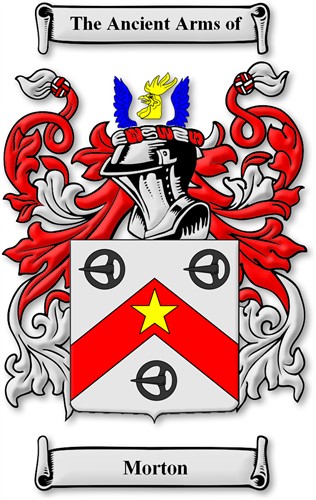
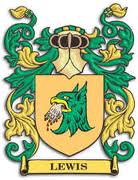
John Morton Coat of Arms

John Morton was Scots-Irish born in Northern Ireland.  John was born before 1755 as he was over forty-five in the 1800 census.   He married Elizabeth [__?__] in Ireland.

Reverend William Martin led over 500 families, members of his congregation(s) of Kellswater, Ireland to South Carolina between mid summer 1772 to mid January 1773 aboard five ships: Lord Dunluce, Hopewell, Pennsylvania Farmer, Free Mason, and the Snow – James & Mary subsequently obtaining land grants in areas of  Newberry, Abbeville, and Chester Counties, South Carolina John Morton sailed on the Lord Dunluce that left Larne, County Antrim, Northern Ireland on  4 Oct 1772 and arrived in Charleston, South Carolina on 20 Dec 1772.  John died in 1806 in Chester County, South Carolina and his will was probated 2 May 1806.

Child of John and Elizabeth:

Name Born Married Departed
1. Martha MORTON James McCAW
bef. 1789
Chester, South Carolina
Chester County, SC
2. Jenny
His grand daughter
After 1806 Will

In 1750 Presbyterians from Octoraro, Virginia, and North Carolina, came to South Carolina and settled at Rocky Creek, Chester County. By 1755 Irish immigrants, many of them Covenanters, began arriving. Various groups (Associate, Covenanter, Burgher, Anti-Burgher, Seceders) formed the “Catholic” (meaning a union of various groups of Presbyterians) church on Rocky Mount Road, 15 miles southeast of Chester. In 1770 Covenanters began holding society meetings and wrote to Ireland for a minister. Reverend William Martin answered the call in 1772.

Several Presbyterian pastors led their congregations in emigrations from Ulster to American in the decade following Doctor Clark’s emigration from Ballybay in 1764. Nearly 500 Scotch-Irish families arrived in South Carolina on the eve of the Revolutionary War.

The impetus for the colonization was the combination of exorbitant land rents in Northern Ireland, sometimes provoking violent resistance, and the offer of free land and inexpensive tools and provisions tendered by the colonial government of South Carolina. For instance, each Scottish Covenanter was entitled to 100 acres for himself and 50 acres for his spouse, and an additional 50 acres for each child brought to South Carolina.

The most notable of these was the emigration of Covenanter Presbyterians in 1772 from the area of Kellswater in central county Antrim.   Faced with this crisis and opportunity, Reverend William Martin persuaded his parishioners that they had nothing to lose by leaving Ulster, and before long he was in charge of a small fleet of vessels bound for South Carolina.  The Reverend Martin settled in the general area of Abbeville, South Carolina (Rocky Creek in Chester County).  After his church was burned by the British in 1780, he took refuge in Mecklenburg County, North Carolina.

On Friday June 29,  2007 a large crowd gathered at the Shanaghy and Vow Road junction to mark the 250th anniversary of the ordination of Rev William Martin. Rev Martin was the first Covenanter (Reformed Presbyterian) clergyman to be ordained anywhere in Ireland and this was not the only significant mark he made in history.

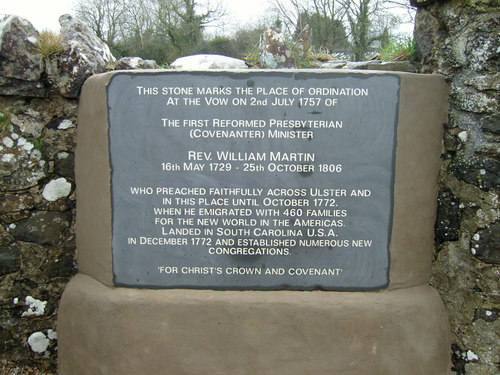
Rev. William Martin Memorial 250th Anniversary of Ordination Jun 27, 2007 At The Vow, near Movanagher, on the banks of the River Bann south of Ballymoney

William Martin was born near Ballykelly but finished his education in Dumfries, Scotland. On 2nd July 1757, he was ordained a Covenanter minister in an open air service held at The Vow, between Ballymoney and Kilrea. As the only Covenanter minister in Antrim and Down, the two counties became his parish, so to speak, and Rev Martin, though resident at Kellswater, had supervisory responsibility for Covenanter groups at Ballymoney, Dervock, Cloughmills, Leighmore and Cullybackey.  (See Google Maps Driving Directions

Rev William Martin was no shrinking violet. On top of his mammoth preaching and pastoral duties, he was vocal in his opposition to the High Church (Anglican) authorities who openly discriminated against those whom Martin represented. The oppressed Presbyterians were subjected to excessive rent demands and when payment could not be found to cover them, the tenants were evicted. After much prayerful deliberation, Rev Martin recieved a call to Rocky Creek, a small settlement in South Carolina.

In 1772, around a thousand Covenanters and others, including Roman Catholics, left Ulster under the leadership of Rev Martin. It took 5 ships to ferry the emigrates to the New Country, namely the James and Mary, Lord Dunluce, Pennsylvania Farmer, The Hopewell and The Freemason. Most of those on board the ships came from Ballymoney, Kilraughts, Derrykeighan, Ballyrashane, The Vow and Kellswater. It was a tremendous feat at that time to lead so many people so far in such vessels yet this only goes to illustrate the determination of Rev William Martin.

Although, due to the excessive numbers involved, the large group was scattered throughout the New Country, the majority settled in and around Rocky Creek. In 1774, Rev Martin’s congregation opened their own meetinghouse and he began a prosperous ministry. When the War of Independence broke out, he supported the Patriots (Americans) against the British and openly urged others to do so too.  James Anderson was but one Ballymoney native to heed the call and die at the hands of the British in that war. Rev Martin had his meetinghouse burned down in 1780 and was himself imprisoned for his patriotism.

The emigrants led by Reverend Martin traveled to Charleston, South Carolina, in five ships from Belfast, Larne, and Newry, and settled throughout western South Carolina, many in the Abbeville area.

Rev. William Martin  was born the oldest son of David Martin of Londonderry. The Rev. Martin was the only Covenanter minister in counties Down and Antrim at the time. In 1760 he resided at Kellswater. He had oversight responsibility for societies at Cullybackey, Laymore, Cloughmills, and Dervock. He preached also in Londonderry and Donegal. The Presbytery was founded in 1743 and Kellswater became the center in 1760.

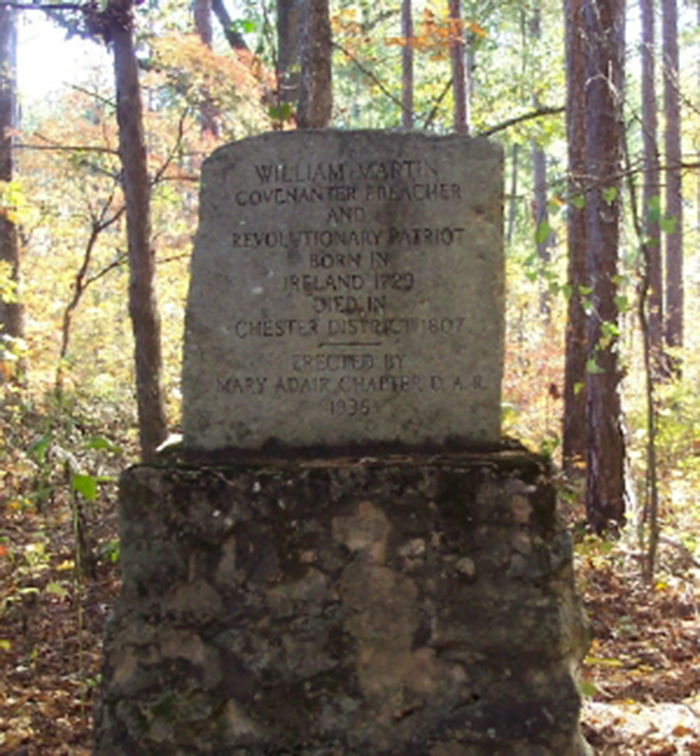
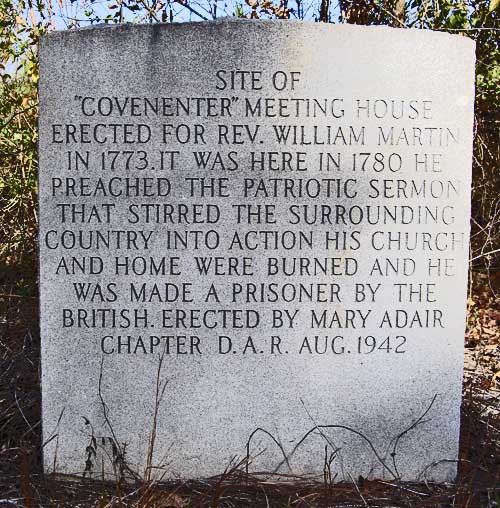
Rev William Martin Marker near Chester, SC

When the Revolutionary war broke out, Rev. Martin was a strong supporter of the patriots. In 1780 he preached another of his fiery sermons, reminding the congregation of the hardships that their fathers had suffered, that they had been forced out of Scotland and again out of Ireland, had come to America where they were free men and where they had built their homes and church. Now the British were coming and would once again drive them from their homes. He told them that there is a time to pray and a time to fight and the time to fight had come. Immediately after the sermon, two companies were formed under command of Ben Land and Captain Barbour. The next day they joined the American forces fighting the British. For his efforts, the British burned the church and took Rev. Martin prisoner.

Covenanter Church marker Rocky Creek, South Carolina, courtesy of Jack Parker

John MORTON sailed on the Lord Dunluce that left Larne on  4 Oct 1772 and arrived in Charleston on 20 Dec 1772. This is the only ship that listed “Rev. Wm. Martin (Kellswater)” as an agent. The original sailing date was to have been August 15. The sailing was delayed until August 20, and then rescheduled for September 22. On August 28, the ship announced that passengers must give earnest money by September 5 since a greater number had offered to go than could be taken. On September 15, the ship advertised that, since some families had drawn back, two hundred more passengers could be accommodated.  Reverend Martin was on this ship when it finally sailed on October 4. One man and several children died of smallpox on the trip.

Will of John Morton, of Chester County, South Carolina

“In the Name of God Amen I John Morton of Chester County & State of South Carolina being weak in body but of Sound Memory (blessed be God) Do this twenty fifth day of May in the year of our Lord one thousand Seven hundred & Ninety Nine & in the twenty third year of American Independence Make & publish this My Last will & testament in the following Manner Viz,

first I allow all My Just Debts ^ & Necessary Expences ^ to be paid Next

I give & bequeath unto Elisabeth Morton My beloved wife dureing her widowhood but if she Marries an other Man I do not allow her to have any thing but hir body Cloths & hir wheel & her Chest but if She remains a widow till her Death I allow her to devide her part as she think proper among My Daughter Marthas Children but I Do Not allow any other pirson to get any part of My Estate.

Next I give & bequeath to My grandson John Morton McCaw one hundred acres of Land on which I Now Live with it appurtenances & all the benifits arriseing from it after My Death and I also allow him to git My pocket bible My Silver Sho Buckels & Stock Clasps & two guineys to be paid for hir schooling.

Next I give & bequeath unto My granddaughter Tenney [Jenney?] one hundred acres of Land, which I Surveyed Joining the plantation on which I Now Live. I also allow her to git my Large Bible psalm book and Rutherfords Lettters, and a gown of her own Choosing.

Next I give & bequeath unto My Soninlaw James McCaw all My body Cloths & I allow all My grandchildren Boys & girls Each of them a pocket bible

Next I allow all My property that is not Specified in this will to be Sold by publick Vendue & what remain after the above artickels unprovided among My four youngest grand Children &

I Do Make and ordain James Wylie & William Kenney of this My Last Will in trust to have the Same preformed according to my true Intent & meaning—-

In witness whereof I the said John Morton have to this My Last will & Testament Set My hand & Seal the Day year & Month above written

Signed Sealed acknowledge & pronounced

In the presenced of usJohn Morton (L.S.), Edward McDaniel, Samuel McCaw William McCaw

Another John Morton (1738 – 1775) immigrated with Rev. Martin. This John had a son John Morton Jr (1765 Antrim, Ireland – 14 Dec 1841 SC) I wonder if they were relate, there were about 1,000 in the five ships, so they were probably several Mortons.

This other John Morton married Jane Peden who  was one of two women from South Carolina to receive a bronze plaque on her grave for service in the Revolutionary War.  Jane and her sister would pick up wounded soldiers from the battlefield near their home in South Carolina, take them to their home and treat the soldiers’ wounds.  Jane Peden is buried in Morgan County, Alabama, near Somerville in the Morrow Cemetery.

John Peden was born June 1709 in Ireland. Margaret McDill was born August 1715 in Ireland to John McDill and Janet LESLIE. She was called Peggy by her family. John and Peggy were married in 1730 at Ballymena Parish, Ireland. The family lived in the County of Atrium, Ireland.

They were the parents of::

  • 1. Mary, born 1731, Ireland; married James ALEXANDER
  • 2. James, born 1734, Ireland; married Mary – Member of the SC Provincial Congress in 1775/76 – Revolutionary War
  • 3. Jane, born 1738, Ireland; died AL; married 1. John MORTON SR, 2. 1774 Chester Co., SC, Robert MORROW, born 1734, MD
  • 4. Thomas, born 1743, Ireland; died 6 Mar 1825, SC; buried Nazareth Church Cemetery, SC; marriedElizabeth WHITE, daughter of Moses WHITE and Mary McCONNELL – Revolutionary War
  • 5. William, born 1749, Ireland; died 23 Dec 1817; married Mary ARCHER – Revolutionary War
  • 6. Elizabeth, born 24 Dec 1750, Ireland; died 19 Dec 1821, SC, buried Fairview Cemetery, Greenville Dist, SC; married William GASTON
  • 7. John, Jr, born in Ireland; married Ginny – Revolutionary War
  • 8. Samuel, born 1754, Ireland; died 26 Dec 1835, Kemper Co, MS, buried Smyrna Cemetery, Kemper Co, MS; married 1. Katherine (Katie) WHITE, daughter of Moses WHITE and Mary McCONNELL, 2. Margaret – Revolutionary War
  • 9. Alexander, born 1756, Ireland; died 21 Jan 1841, Greenville Dist, SC, buried Fairview Cemetery, Greenville Co, SC; married Rebecca MARTIN – Revolutionary War
  • 10. David, born 1 Nov 1760, Ireland; died 6 Oct 1823; married 1. Eleanor GOODGION, 2. Margaret HUGHES – Revolutionary War

John Peden served as a Ruling Elder in his native country from his youth and was a decided advocate of the Presbyterian system of worship. He and his family were very disturbed over the persecution of the Church in Ireland and joined Reverend William Martin who lead a group of Scotch-Irish immigrants to the back country of South Carolina. They were given grants by the government to settle this wilderness area.

The first of the Pedens to come to South Carolina were John and Peggy’s son Thomas and their daugher Jane and her husband John MORTON who came in 1768 on the Snow Mary and James. They arrived from Larne, Ireland in Charleston and were administered the oath on 12 January 1768.  Five years later the rest of the family arrived in October of 1772 on the same ship the Snow Mary and James. [Our John Morton came in this fleet of five ships]  They were forbidden to land because some of the people aboard had Small Pox. They were quarantined on the vessel for several week and a house on Sullivan’s Island was provided for the sick. On 1 December 1772, an entry was made in the Council Journal that contains the names of those we know arrived on the Mary and James. As was the custom a letter was written to Ireland stating that the ship had safely arrived and thanking the Captain Workman for his good delivery. This was published in the Belfast New Letter, 21 December 1772. John Peddan, James Peddan, and Thomas Madill signed the letter .

The first land described in the Plat Folder 1482, Pre-Revolutionary plats, was recorded 11 Dec 1772 to John Peden; in Craven Co. on a branch called Ferguson Creek, waters of Tiger River, adjoining land owned by James Pedan and Thomas Peden. This land was surveyed on 18 January 1773. This land later bacame Spartanburg County, South Carolina.

Most of the children settled around Fairview Presbyterian Church, on the waters of the Reedy River in the Greenville District although some had original grants in Fairfield or Chester Counties. During the Revolution, John, Peggy and some of their children went to Rocky Creek area of Chester County near Catholic Presbyterian Church where Rev. Martin was located

Source:

South Carolina Department of Archives and History. 8301 Parklane Road. Columbia, SC. 29223. Tele: 803.896.6100; Fax 803.896.6198. www.http://scdah.sc.gov/

S108093: South Carolina Will Transcripts (Microcopy No 9) MORTON, John of Chester County. Will Typescript (MSS Will: Estate Record Book D, Page 50; Estate Packet: Apr 5`, Pkg 812) (2 Frames).

http://www.archivesindex.sc.gov/onlinearchives/RecordDetail.aspx?RecordId=296954

Ancestry.com

The story  of Rev Willliam Martin’s Five ship migration to Chester County SC is told in Scotch-Irish Migration to South Carolina, 1772: Reverend William Martin And His Five Shiploads of Settlersby Jean Stephenson (Shenandoah Publishing House 1970).

Scotch-Irish Migration to South Carolina, 1772 (Rev. William Martin and His Five Shiploads of Settlers) Jean Stephenson

http://files.usgwarchives.net/sc/chester/wills/morton51wl.txt

http://genforum.genealogy.com/martin/messages/27682.html

http://homepages.rootsweb.ancestry.com/~marylove/Peden/Peden.html

http://www.pennywind.com/Genealogy/Migration/Co%20Atrim%20emigration_led_by_reverend_william%20Martin.htm

Posted in -8th Generation, Immigrant - Scot-Irish, Line - Miner | Tagged | 3 Comments

William McCaw Sr.

William McCAW Sr. (1740 – 1796) was Alex’s 6th Great Grandfather, one of 128 in this generation of the Miner line.

William McCaw was born about 1740 in  County Antrim, Northern Ireland.  According to some family traditions, the McCaws were from Ballymoney, Antrim where a Presbyterian Conventer Church was located.  He married Ann [WATSON? or MARLAND?]. William and his family emigrated between 1762 when Elizabeth was born in County Antrim, Ireland and 1765 when Martha was born in Chester County, SC. Two ships sailed from Belfast to Charleston in that time period.  The Falls in 1763 and the Prince of Wales in 1764.  William died in 1796 in Chester, South Carolina.

Ann [Watson?] was born about 1740.  Ann died in 1800.

Children of William and Ann:

Name Born Married Departed
1. John McCaw 8 Feb 1753 or 8 Oct 1758 County Antrim, Northern Ireland Mary Johnston the widow of Henry Gordon
1781
York, South Carolina
13 Aug 1825 Virginia Burial Beersheba Presbyterian Church Cemetery, Clover York County, South Carolina
2. James McCAW 1762 County Antrim, Northern Ireland Martha MORTON
.
Sarah McWilliams
24 Jul 1803
5 Mar 1840 Chester County, South Carolina.
3. Elizabeth McCaw 1762 County Antrim, Northern Ireland Edward Lawrence McDaniel
13 Feb 1781 Chester County, SC
24 August 1845
Hopewell Cemetery, Chester County, SC
4. Martha McCaw c. 1765 Chester County, SC After father’s 1796 will
5. Ann McCaw c. 1768 Chester County, SC Charles Christopher Miller
c. 1784
Chester, SC
After father’s 1796 will & Before  1808 when Miller remarried
6. Samuel McCaw c. 1770 Chester County, SC 1865 Chester, South Carolina
7. Jane McCaw c. 1770 Chester County, SC William Brannen After father’s 1796 will
8. William McCaw 1775 After 1804 land sale

The McCaw name is Scottish in origin meaning “son of Adam”. The McCaw’s did not have a clan of their own but were affiliated with the clan “Stewart” of Bute.

In 1750 Presbyterians from Octoraro, Virginia, and North Carolina, came to South Carolina and settled at Rocky Creek, Chester County. By 1755 Irish immigrants, many of them Covenanters, began arriving. Various groups (Associate, Covenanter, Burgher, Anti-Burgher, Seceders) formed the “Catholic” (meaning a union of various groups of Presbyterians) church on Rocky Mount Road, 15 miles southeast of Chester SC.

Map highlighting County Antrim

County Antrim, Northern Ireland

The impetus for the colonization was the combination of exorbitant land rents in Northern Ireland, sometimes provoking violent resistance, and the offer of free land and inexpensive tools and provisions tendered by the colonial government of South Carolina. For instance, each Scottish Covenanter was entitled to 100 acres for himself and 50 acres for his spouse, and an additional 50 acres for each child brought to South Carolina.

Chester County, South Carolina
Map of South Carolina highlighting Chester CountyLocation in the state of South Carolina

Chester County – (581 sq. miles; 2000 pop. 34,068) Named for Chester County, Pennsylvania, it was settled by Scots-Irish from Pennsylvania and Virginia.  Chester was one of seven counties created in 1785 from the old Camden Judicial District. Situated in the rolling hills of South Carolina’s eastern Piedmont, Chester is bounded on the east by the Catawba River and on the west by the Broad River. Unlike other counties established at the same time, Chester’s dimensions have never been altered, and its distinct rectangular shape is unique among South Carolina counties. The county seat of Chesterville (later Chester) was created in 1791.

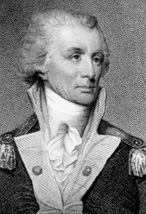
During the Revolutionary War, American forces under General Thomas Sumter were defeated in Chester County at the Battle of Fishing Creek in August 1780; the Americans were victorious at the Battle of Fishdam Ford in November of the same year.

The Chester, SC records are confusing because the names in the Deed Index are listed as McCaw/McCaa/McCaully/McCalla, etc.   Chas Miller bought 150 ac on Bull Run from Wm McCaw, Jr. in 1804. Per the Will of Wm McCaw, Sr, Wm Jr was the son of Wm McCaw, Sr and James McCaw was his son [i.e. brother of Wm Jr] who lived on adjacent land. In the Deed Index, this 1804 transaction is listed as Wm McCaully, Jr to Charles Miller, but the actual deed gives the name as McCaw. In census records, the name is given as Wm McCaa, later McKee, McKey, etc. There were no standardized name spellings prior to about 1900 and many court clerks couldn’t even spell right. Nevertheless, McCaw seems to be the accepted name and spelling.

There were other McCaws in Chester and York Counties.  John McCaw of York County, north of Chester County  came from Antrim to Pennsylvania, then to York. John McCaw was the first clerk of court in York (Rev. War period). The McCaws who came into the Hopewell Covenanter congregation in Chester  (Rocky Creek and Bull Run areas) appear to be a different group. Rev. William Martin’s daughter, Nancy Stinson Martin  married a John McCaw, but died soon after before her father’s death in 1807.

“His only daughter, who married John McCAW of York Co., predeased him, leaving issue.” Sketch of Covenanters on Rocky Creek” from Chester (S.C.) Report, in the Reformed Presbyterian and Covenanter, Vol. X1V (1876) PP:171-177.

“McCaw later moved with his family to Randolph Co., Illinois.” Rev. D. S. Faris. “Reminiscences of the Reformed Presbyterian Church in South Carolina”, The Reformed Presbyterian and Covenanter, Vol. XIV (1876) P:52;

Will of William McCAW, Chester Co, SC w/s 27 Apr 1796 h/o Ann [Watson?] Milisia Hanlin

In The Name of God Amen I William McCaw of Chester County and State of South Carolina and State of South Carolina Being Weak in Body But of Sound Memory (Blessed be God) Do this Twentyseventh day of April in the year of our Lord one thousand Seven Hundred and Ninty-Six Make and publish this my Last will and Testament in the Following Manner (Viz) First I alow all my just debts to be paid, Next, I give and Bequeath unto my Son James McCaw one Hundred acres of Land to  be Laid off my tract, along John Morton’s Line But if any of my Clear or Cultivated Land Should fall to his Divide I do not alow him any Benefit of it for ten years after my Death,

Next I give and Bequeath unto my Son William McCaw all the Remainder of my Lands Houses and Improvements Excepting my Loom House which I alow for my Daughter Jane as Long as She Sees Cause to Live in it, I Likewise alow her to have ten acres of Land five of James’s divide and five of William to be Laid off at the Discresion of my Executors as Long as She Lives to Enjoy the Benefit of it and then to Belong to the Sd. James and William as Before and Nest.

[Next] I give and Bequeath unto my Best Beloved wife Ann McCaw one Cow & Calf and her Bed & bedcloathe her wheel & Reel and I alow her the Benifit of my Dwelling house and all my house hold furniture as Long as She Sees Cause to Live in it and to my three Sons to whom I have Left my Lands (Vig) James Samuel & William to give Each of them five Bushels of Corn to their mother yearly & every year after my Death During her Life; and I alow my Son William to have all my Plantation tools and Crook & tongs & pot & pot hooks and my Bible / and the half of all my pewter / and four hogs / and my Saddle, and I alow him to give his Saddle to William Brannen I also give & bequeath unto William Brannen my Loom and tacklings belonging to her, I also alow my Daughter jane to have half of all my pewter & a pot & pot hooks and all the Remainder of my Property I alow to be Sold at public Vandue and I alow every grand Son that is…”

Named for me to have a Bible at the Discresion of my Executers, when I Vandue money is collected, and after the Expenses of my Burial is paid, I alow all the Remainder to be Equally Divided Between my four daughters Jane & Martha Elisabeth & Ann And I do make and ordain my Eldest Son John McCaw and Edward McDaniel Sole Executors of this my Last will in trust for the Intent and purposes in this my will contained to have the Same preformed according to my true Intent & meaning, In Witness whereof, I the Said William McCaw have Set to my hand & Seal the day and year above written and in the Twentieth year of American Indepense

Signed Sealed and delivered in the presence of us

William ^ his mark ^ McCaw L.S.
Vance Hamitton
Gauels [sic?] Fren
Francis ^ his mark ^ Wylie

Probated March 1, 1797
Recorded in Book A Page 306
Apartment No. 40.
Package No. 624.”

Children

1. John McCaw

John’s wife Mary Johnston was born about 1757 in York County, South Carolina. Her parents were Robert Johnston, Sr. (1730 – 1794) and Sarah [__?__] (1730 – ).  She first married to James Henry Gordon. Soon after Gordon was killed 7 Oct 1780 at the Battle of Kings Mountain, she married John McCaw. Mary died 07 Dec 1829 in York County, SC,

Mary Johnson McCaw Gravestone — Burial:
Beersheba Presbyterian Church Cemetery, Clover, York County South Carolina.

“John McCaw, son of the Immigrant and the founder of the York County branch of the SC McCaws, first appears in South Carolina in militia records.  In 1781, his name appears in a York County deed book when he buys 300 acres on Crowder’s creek from David Neel.  He continued to buy famrland until 1809.  In 1787, he bouth a lot in York, on which he built a log building to house his mercantile setablishment and his family.  His wife, “the Widow Gordon,” was born Mary Johnston, a daughter of Robert Johjnston Sr., and his wife Mary, as was the widow of Henry Gordon, who is said to have died at the Battle of Kings Mountain.  The John McCaw household also included Mary Johnston Gordon’s child, Mary Gordon”.

Child of Mary Johnston and Henry Gordon

i.  Mary “Polly” Gordon b. 25 Dec 1779 in York, York, South Carolina; d. 19 Jul 1867 in York, York, South Carolina; m. 27 Aug 1795 – York, York, South Carolina to David “Davie” Byers (b. 3 Oct 1774 in York, South Carolina – d. 16 Aug 1862 in York, South Carolina) In the 1860 census, David (age 86) and Mary (age 81) were living with their son Edward Byers near Sharon, York, SC.

“John McCaw, son of the Immigrant and the founder of the York County branch of the SC McCaws, first appears in South Carolina in militia records.  In 1781, his name appears in a york County deed book when he buys 300 acres on Crowder’s creek from David Neel.  He continued to buy farmland until 1809.  In 1787, he bouth a lot in York, on which he built a log building to house his mercantile setablishment and his family.  His wife, “the Widow Gordon,” was born Mary Johnston, a daughter of Robert Johnston Sr., and his wife Mary, as was the widow of Henry Gordon, who is said to have died at the Battle of Kings Mountain.  The John McCaw household also included Mary Johnston Gordon’s child, Mary Gordon”. – Quoted from “The McCaws of South Carolina 1737-2004, by Sarah Pelham Webster and Genevieve Anderson McCawy

The Battle of Kings Mountain was a decisive battle in the Southern campaign of the Revolutionary War. The battle took place on 7 October 1780 nine miles south of the present-day town of Kings Mountain, North Carolina in rural York County, South Carolina, where the Patriot militia defeated the Loyalist forces commanded by British Major Patrick Ferguson of the 71st Foot.

Ferguson had arrived in North Carolina in early September 1780 with the purpose of recruiting for the Loyalist militia and protecting the flank of Lord Cornwallis’ main force. Ferguson issued a challenge to the rebel militias to lay down their arms or suffer the consequences; in response, the Patriot militias rallied for an attack on Ferguson.

After receiving intelligence on the oncoming attack, Ferguson elected to retreat to the safety of Lord Cornwallis’ host; however, the Patriots caught up with the Loyalists at Kings Mountain on the border with South Carolina. Having achieved surprise, the Patriots attacked and surrounded the Loyalists, inflicting heavy casualties. After an hour of battle, Ferguson was shot dead while trying to break the rebel ring, after which the Loyalists surrendered.

The battle was a pivotal moment in the Southern campaign; the surprising victory over the Loyalist American militia came after a string of rebel defeats at the hands of Lord Cornwallis, and greatly raised morale among the Patriots. With Ferguson dead and his militia destroyed, Cornwallis was forced to abandon plans to invade North Carolina and retreated into South Carolina.

“Will of John [II] McCAW, of [Yorkville], York District, South Carolina

State of South Carolina

In the name of God Amen.

I John McCaw Sen. Being of perfect mind but weak in body calling to mind that is appointed for all men once to die, do hereby make and ordain this to be my last Will and testament Viz,

I give and bequeath to my beloved wife Mary McCaw if she should survive me, the use, during her life of the property of which I may died possessed.

To my three sons Robert, William and John I give and bequeath one Dollar to each.

I give and bequeath to Mary Byers wife of David Byers a negro woman Rose and her increase, to her and her heirs ans assigns forever-

I give and bequeath to An Smith wife of Robert Smith my Negroes Peggy, Will and Melitia with her increase to her and her heirs ans assignes forever-

I give and bequeath to Robert McCaw and John McCaw Jr., for the use of Elizabeth Meek, Pamela Gunning and Sarah Sims all the money which shall remain at my death, or the death of Mary McCaw aforesaid, to be equally divided between them.

I hereby nominate and appoint Robert McCaw and Robt Smith John McCaw Jr my Executors.

In testimony whereof I have hereto set my hand and seal this 10th day of March 1821

John McCaw Sr. (LS)
Alemeth Byers
Samuel McCullough
James Smith Jr.

Probated November 17, 1825

Children of John and Mary

i. Ann McCaw b. 3 Mar 1782 in York, South Carolina; d. 23 Oct 1826 in York, South Carolina; m. Nov 1800 York, South Carolina to Robert Smith (b. 3 Oct 1778 in York, South Carolina – d. 3 May 1854 in York, South Carolina Burial: Beersheba Presbyterian Church Cemetery, Clover, York County, South Carolina) His parents were James Smith and Mary Henry.

ii. Robert McCaw b. 1784 in York County, South Carolina; d. 1823 in York County, South Carolina; m. bef. 1810 to Nancy Agnes Bratton (b. 23 May 1782 in York County, South Carolina – d. 19 Jan 1847 in York County, South Carolina) Their son Col. Robert Gadsden McCaw (b. 28 Dec 1821 – d. 24 Nov 1870 Rose Hill Cemetery, York, York County, South Carolina) of the Grove, The Bricks, and his Turkey Creek Plantation was the largest planter in York County in 1860. In the 1860 census Robert Gadsden McCaw was the only planter in York County who had more than 100 slaves. He was a Confederate era Lt. Governor of South Carolina (Dec 18, 1864 to May 25, 1865) and married Belle Bratton of another august York County family whose plantation seat was Brattonsville on the old stagecoach road between York and Chester

Robert Gadsden McCaw Source: York and Western York County: The Story of a Southern Eden By J. Edward Lee, Jerry L. West 2001

iii. William Henry McCaw b. 1785 in York County, SC; d. 13 Dec 1832 in Columbia, Richland Co., SC; m. 14 Nov 1814 to Frances Elizabeth Hunt Todd (b. 19 Oct 1796 in Near Charleston, SC – d. 29 Mar 1860 in Abbeville, SC); Feb 1811; Graduation, Pennsylvania Medical College in Philadelphia; In 1812 He was commissioned a surgeon’s mate in the US Army. He was stationed in James Island, near Charleston and was demobilized in 1814. William and Frances owned property on James Island, near Charleston, and William had a mortgage on a house in Bedon’s Alley in Charleston. Those properties were eventually sold, as were one or more of his slaves, perhaps to finance land purchases in Abbeville County.

Before October 1816, William moved his family to grow cotton near Abbeville, SC, in a settlement called Church Hill. The Abbeville County census of 1830 records three free and 49 slave members of his household. In 1824 he was appointed Postmaster of Church Hill. He is buried in the Ladson Plot, First Presbyterian Churchyard, Columbia, SC.

In the 1860 Abbeville census, Elizabeth owned ten slaves:

Age/Sex
60 Male
18 Female
12 Female
12 Female
11 Male
7 Male
5 Female
10 Female
26 Female
25 Male

iv. Elizabeth McCaw b. 1789 South Carolina; d. 1842 – Tallahatchie, Mississippi, m. Mar 1809 – York, South Carolina to James Meek (b. 1789 in York, South Carolina – d. 1844 in Tallahatchie, Mississippi) His parents were Adam Meek and Nancy Agnes Byers.

James and Elizabeth moved from York County, SC, to Yalobusha County, Mississippi. Several other McCaw siblings moved to this area of Mississippi, and are buried there.

v. John McCaw  b. 22 May 1791 in York County, SC; d. 29 Mar 1880 in Lexington, Fayette, Kentucky m. 19 Sep 1822 in South Carolina to Cicely De Graffenried (b. 10 July 1806 in Chester, South Carolina – d. 15 Jan 1874 in Lexington, Fayette, Kentucky) Her parents were Allen de Graffenried [1764–1821] and Sarah Thomas

In the 1860 census, John’s real estate in Lexington, Kentucky was evaluated at $10,000 and his personal property at $167,500.  In the 1870 census, his real estate was $16,000 and personal property $120,000.

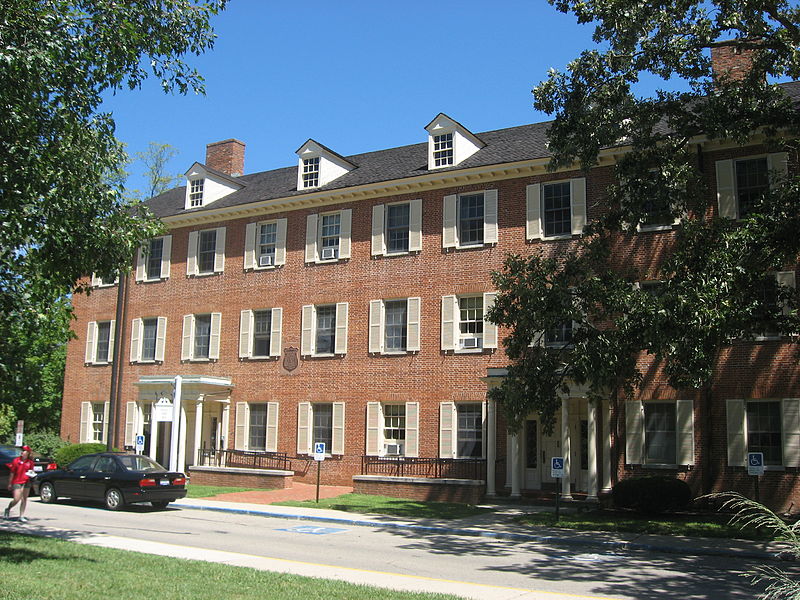
WOOD – MCCAW HOUSE

St. Peter’s School, 125 Barr St. , Lexington, Fayette County, Kentucky Built 1838

Benj. C. Wood bought Lot No. 16 of the Robt. Barr sub-division, stating “90 feet on a new street,” October 3, 1838, from Simon and Hyman Gratz of Philadelphia, Pa.

Wood and his wife, Susan Ann, sold “a certain house and lot with the outhouses and premises” May 12, 1842, to Judge Thos. M. Hickey, for $6,150. Judge Hickey died here, apparently, as he had sold “Coolavin” to James R. Sloan, and his widow reserved this fine home after giving to her heirs the various houses Judge Hickey owned elsewhere.

Catherine A. Hickey, the widow, sold this house “devised to her by Thos. M. Hickey,” to John McCaw in May, 1852.

John McCaw presented the property to his daughter, Emma McCaw, in 1880.

This distinguished old home of some of Lexington’s most prominent families is today serving as St. Peter’s School.

  1. Mary Allen McCaw b. 20 Nov 1823 in Kentucky; d. 28 Sep 1825 in Kentucky
  2. Sarah Allen McCaw b. 29 Jan 1827 in Chester, Chester, South Carolina;  m. James Lane Allen, in 1856; d. 24 Feb 1864.
  3. John McCaw b. 9 Dec 1830; d. 26 Mar 1844
  4. Frances McCaw  b.  21 Dec 1828,; m. 28 Jan 1851, to William H. Brand; d. 1907
  5. Mary Johnstone McCaw b. 24 Nov 1832 in Kentucky; d. 27 Dec 1881 in Kentucky; m. 14 Sep 1852 to R B Kendall in Kentucky. Twins of above unnamed, died at birth.
  6. Carolina McCaw F 1 Mar 1835; m. 22 Nov  1859 to George B. Pickett, d. 16 Jan  1860
  7. Thomas de Graffenried McCaw, b. 21 Sep 1837 in Tennessee; m. 6 Oct 1867 to Juliet Atkinson, d. 13 Jan 1871. Residence 1870 Winchester, Frederick, Virginia; m. Juliet Atkinson 6 Oct 1867
  8. Emma McCaw, b. 7 Sep  1839; d. 20 Sep 1924.
  9. Cicely McCaw, b. 30 Sep 1841; d. 2 Oct 1842
  10. Lucy McCaw,  b. 22 Mar 1844 Georgetown, Kentucky; m 1 Jun 1870 to Frank Woolley; d. 15 Mar, 1905
  11. William Robert McCaw, b. 6 May 1846 Georgetown, Kentucky; m. 8 Nov 1870, to Eloise Chesley Hance; d. 19 Aug 1916 Fayette, Kentucky
  12. Nina McCaw, b. 13 May, 1849 Lexington, Kentucky; m. 16 Apr 1872, to Edward Coleman, d. 4 Mar 1879.
  13. Pauline McCaw, v. 12 Dec 1852 Lexington; d. 9 Oct 1876

vi. Pamela McCaw b. 19 Nov 1797 in York County, SC; d. 02 Feb 1850 in Union County, SC; m. John E. Gunning. There was a John E Gunning in the 1820 census in Chester, Chester, South Carolina with a household of 12, six family member and six slaves.

vii. Sarah McCaw 1801 – 1882 m. William A. Sims (b. 24 Aug 1799 to . – d. 5 Nov 1883 in Santuc, Union, South Carolina) His parents were William Sims and Elizabeth Shelton.

In the 1860 census, William and Sarah Simes were farming near Unionville, Union, South Carolina with seven children at home ages 15 to 26. William’s real estate is listed at $5,000 and personal estate at $100,000. His grandfather Charles Sims was a Captain in the Virginia troops.

3. Elizabeth McCaw

Elizabeth died, at her residence, in Chester District, S. C. On the 24th of August, 1845, in the 83rd year of her age

Elizabeth’s husband Edward “Ned” McDaniel  was born 6 Mar 1756 in Pennsylvania after his father’s death. according to family tradition in Braddock’s Defeat. His parents were Edward McDaniel (1733 – 1755) and Mary [__?__] (1739 – 1827). Ned died 12 Mar 1824 in Hopewell Cemetery, Chester County, SC

Braddock’s Defeat was a failed British military expedition which attempted to capture the French Fort Duquesne (modern-day downtown Pittsburgh) in the summer of 1755 during the French and Indian War. It was defeated at the Battle of the Monongahela on July 9, and the survivors retreated. The expedition takes its name from General Edward Braddock, who led the British forces and died in the effort. Braddock’s defeat was a major setback for the British in the early stages of the war with France and has been described as one of the most disastrous defeats for the British in the 18th century.

Ned grew up in Pennsylvania. He probably came with others who were coming to Chester in the 1770’s.  Edward served 303 days in the South Carolina Militia. Military record is on page 14 of his pension application.  During the  Revolution, he served as private and horseman in Captain Thompson’s and Capt. Benjamin Garrison’s regiments Cols. Lacey, Bratton, and Gen. Marion.  During the service, he was in several engagements, he was wounded in the battle of Rocky Mount, and was wounded in the shoulder in the battle of Hanging Rock. He was also at Briar Creek and at the battle where Capt. Nixon was killed. .He was pensioned by the State of South Carolina on account of wounds received in the War.” “unfit to persue [sic] any severe manual employment”

Edward McDaniel Revolutionary Service from his pension application

Elizabeth was born County Antrim, Ireland, but emigrated to this Country in the 7th year of her age. She was married in the heat of that fearful war which Great Britain waged against the “thirteen colonies.” She became the Mother of her first child whilst the devouring [?] cannon was still roaring in the mortal [?] ships and had to struggle through a long life only partially assisted by her husband, whose wound in his country’s cause rendered him unfit to pursue any service [?]manual employment; Yet God who feeds his children fed her abundantly, and enabled her to rear a large and respectable family.

William McDaniel was a public surveyor in Chester County.

Edward McDaniel Revolutionary Service

.

Edward served as an elder in Old Purity Presbyterian Church in Chester District until about 1807 when he went to Hopewell ARPC to serve as an elder there. Edward died 12 Mar 1824 – Chester, South Carolina Purity records show that Elder Edward McDaniel was installed as an elder at Purity before 1800, but no date was given of his dismissal to Hopewell ARP Church.

From the book Purity and Its People, A History of Purity Presbyterian Church Chester, South Carolina 1787 – 1987. By Edward Hood Dawson

Again Purity was left without a regular minister. Concord Presbytery, under whose jurisdiction Purity stood from 1810 until 1824, was diligent in sending supply minsters. The Reverend Francis H. Porter came as resident minister from 1814 to 1816, but left because of unpleasant strife in the church. The major issue seemed to be psalms, although there were other thological differences. Prior to 1820 several families left Purity over the psalm controversy. According to reminiscenses made in old age by Mrs. Sallie Knox Wallace: Sallie and Betsy and Robert Knox were members at Purity before the exodus. Hymns were introduced during Rev. Walker’s pastorate. The Boyds and McDaniels left at that time and joined Hopewell. Old Mr. McDaniel was an elder. He kept the church book. (interview made by W.D. Knox with Mrs. Sallie Knox Wallace, June 7, 1891. R.B. Walker was one of the supply ministers between 1811 and 1822.)

Purity records show that Elder Edward McDaniel was installed as an elder at Purity before 1800, but no date was given of his dismissal to Hopewell ARP Church.

Elizabeth  and Edward had eleven children.

i. Daniel William McDaniel, b. 13 Dec 1781 in Chester County, South Carolina – d. 26 May 1830 in Chester, South Carolina; m. Jane Strong (b. 1797)

Daniel William was a Public Surveyer. Jane lived with her sister-in-law Annie McDaniel in the 1850, 1860 and 1870 censuses.

ii. John McDaniel b. 12 Aug 1783 Chester, South Carolina; d. bef. 1847 – Charleston, Dorchester, South Carolina. (Edward McDaniel Revolutionary War Pension Application)

iii. Abigail McDaniel b. 27 Feb 1786; d. 28 Nov 1850 Blackstock, Chester, South Carolina; Burial: Hopewell ARP Church, Blackstock, Chester, SC;  m. Robert Mills (b. 1783 in Blackstock, Chester, South Carolina – d. 22 May 1870 in Blackstock, Chester, South Carolina) In the 1850 census, Robert and Abigail were farming in Chester, South Carolina.

iv. Anne “Annie” McDaniel b. 19 Dec 1787; d. 1877 Hopewell Reformed Presbyterian Church Cemetery, Blackstock, Chester County, South Carolina; Did not marry, Annie lived with her sister Jane  in the 1850, 1860 and 1870 censuses.

v. Elizabeth Ama McDaniel b. 31 Mar 1790 South Carolina; d. bef. 1847 (Edward McDaniel Revolutionary War Pension Application)

vi. Edward McDaniel b. 12 Jan 1792; d. 16 Aug 1835; Buried Hopewell ARP Church, Blackstock, Chester, SC; m. Mary [__?__]

vii. Jane McDaniel b. 18 Oct 1794 South Carolina; d. 1 Nov 1872 – Hopewell Reformed Presbyterian Church Cemetery, Blackstock, Chester, South Carolina; Unmarried; , Jane lived with her sister Annie in the 1850, 1860 and 1870 censuses.

viii. Mary McDaniel b. 24 May 1796 South Carolina; d. 14 Aug 1881 – Marshall, Mississippi; Buried at Mt. Carmel Cemetery, Cayce, Marshall, MS; m. Aug 1825 to William Boyd (b. 21 Jul 1798 in Chester Co., South Carolina – d. 29 May 1876 in Marshall County, Mississippi) In the 1850 census, Mary and William were farming in Northern Division, Marshall, Mississippi with eight children at home. Marshall County is part of the Memphis, TN–MS–AR Metropolitan Statistical Area. In the 1880 census, Mary was living with daughter Martha and son-in-law M. Braddy in Bainsville, Marshall, MS.

Their son Charles J. Boyd enlisted 19 Sep 1861 in Iuka, MS for 12 months. Charles J. Boyd, Pvt, Company A (Walkers Reserves) , 1st Mississippi ((Johnston’s Regiment) was captured at Fort Donelson on 16 Feb 1862. Appears on a Roll of Prisoners of War at Camp Morton, Indianapolis, IN, on 24 Aug 1862. Reenlisted Jackson, MS on 24 Sep 1862 for two years. Corpl, Company A, 1st Regiment Mississippi Volunteers captured at Port Hudson, LA on 9 July 1863 and paroled at Port Hudson on 12 and 13 July 1863. Got sick while in the army and died at home March 27, 1864. Cayce, Marshall, MS, Buried Mt. Carmel Cemetery, Cayce, Marshall, MS,

Muster Roll, not dated: Charles J. Boyd, Private, Capt. Geo M. Moseley’s Company (Walker Reserves), 1 Regiment Mississippi Volunteers (subsequently Company A, 1st Mississippi).

ix. Martha McDaniel b. 22 Feb 1801; d. bef. 1847

x. Col. James Hemphill McDaniel b. 14 Dec 1802 Chester, SC; d. 19 Mar 1863 – Hopewell Reformed Presbyterian Church Cemetery, Blackstock, Chester, South Carolina; m. Jennet Ann Martin (b. Sep 1808 in South Carolina – d. 9 Aug 1887 in South Carolina)

In the 1860 census, Col J and Jannet were farming near Torbet’s Store, Chester, South Carolina with six children at home ages 12 to 29.

Their son Private E. Jackson McDaniel, age 27, enlisted at Chester, 11 April 1861 in Company F (Capt McLure’s Company), 6th SC Inf. Wounded (gunshot left leg- thigh broken) 30 September 1864. Died of wounds at home in Chester 1 Feb 1865 Burial: Hopewell Reformed Presbyterian Church Cemetery, Blackstock, Chester County, South Carolina,

Their son William L died 5 Jun 1862 in Richmond, Virginia at the age of 24. He was mortally wounded in the battle of Seven Pines on the 31st of May, 1862. and was buried in Hopewell Reformed Presbyterian Church Cemetery, Blackstock

Their son Joseph P. McDaniel enlisted at Chester 21 Jul 1862, Company F, 6th SC Volunteers
Wounded at Fort Harrison 30 Sep 1864 , Gunshot wound in right forearm, amputated (used Choloform. Died of wounds 19 Oct 1864 at Jackson Hospital, Richmond, VA and buried Hopewell Reformed Presbyterian Church Cemetery, Blackstock, Chester County, South Carolina.

Not all their sons died in the war. Their son John Hemphill McDaniel (1835 – 1918) survived and had a successful career. Sargent J. H. McDaniel. age 24. enlisted at Chester on 11 April 1861. Company G (Capt J. M. Moore-Pickens Guard), 6th South Carolina Volenteers. Promoted to 2nd Lt, Company F, 8 January 1864. He was as on a roll of POWs at Appomattox Court House, VA, USA, 9 April 1865. He lived in Pleasant Grove, Chester County. Served 4 years in the State Legislature, and 8 years as State Senator and 5 years as Probate Judge of Chester County. Was Chairman of the Senate Committee in Agriculture.

xi. Samuel McDaniel b. 9 Dec, 1804; m. Elizabeth Reedy (b. 1807 SC) In the 1850 census, Samuel was farming in Chester, South Carolina. ; He moved before 1857 to Clear Creek, Drew, Arkansas when two of his children died of typhoid fever there. There was a Samuel McDaniel, a Private in Company H 3rd Arkansas Infantry Regiment who served almost the entire war as a shoemaker. The Samuel McDaniel that was buried 15 Feb 1864 US Army, Nashville National Cemetery Tennessee was a private in the Illinois 79th Infantry

5. Ann McCaw

Ann’s husband Charles Christopher Miller Sr was born 5 May 1757  in Antrim, Ireland. His parents were Josias M Miller (1732 – 1785) and Elizabeth Hindman (1732 – 1799). He may have married Ann about 1784.  Between 1806 and 1810 in Chester, South Carolina he married Jennet (Jenny) McBride (b. Birth 1771 in Ireland – d. 1821 in Chester County, South Carolina). Finally, in 1821 in Chester, SC he married Agnes Nancy Cameron (b. 1780 in Ireland or South Carolina – d. 31 Dec 1841 in Henry County, Georgia) Charles died before 01 May 1837 in Henry, Georgia.

30 Jul 1796 Deed Vol. R pp133-134; buys 150 ac of Josias’ grant on Rocky Creek from Thos Miller

25 Apr 1801 Deed Vol. H pp296-299; buys 165 ac on Sandy River from Jas Hayle

1 Nov 1803 Deed Vol. M pp269-271; buys 165 ac on Sandy River from Jas Hayle

27 Jan 1804 Deed Vol. K pp136-138;  Charles Christopher Miller Sr. buys 150 acres on Bull Run from Wm McCaw Jr.

7 Sep 1805 Deed Vol. M pp5-7; Charles Christopher Miller Sr. buys 110 acres on Bull Run from Saml McCaw

Children of Ann and Charles:

i. William Miller b. 1790 Chester, SC

ii. Elizabeth Miller b. Bef. Apr 1791 in Chester, South Carolina – d. 1841 in Montgomery, Tennessee; m c. 1810 to William Johnston (Johnson) (b. ca. 1789 – d. Aft. 1842 in prob Georgia)

iii. Charles Miller Jr b. Feb 1792 in Chester, South Carolina; d. 03 Feb 1838 in St Johns, Florida Buried St Augustine Cemetery; Charles was a blacksmith.

iv. Robert C Miller b. 10 Oct 1792 in Chester, South Carolina; d. 15 Jun 1849 in Newton, Georgia of typhoid fever; m. 1815 Chester, SC to Ann Wilson (b. 1796 in Antrim, Ireland – d. 27 Feb 1868 in De Kalb, Georgia)

In 1825 Robert and Ann removed from Chester, South Carolina to Newton County, Georgia (today a suburb of Atlanta) and were among the founders of the Associate Reformed church, called Hopewell, near the Snapping Shoals on South River. This Church is still an active church today; Hopewell ARP Church, 155 Hopewell Church Rd, Covington GA 30016-5077 (Google Satellite View)

Associate Reformed Presbyterian Death & Marriage Notices Volume II: 1866-1888 Compiled by Lowry Ware Scmar Columbia, South Carolina 1998Died in DeKalb County, Ga., February 27th, 1868, Mrs. Ann Miller, in the 71st year of her age, of cancer on her face…. was born in County Antrim, Ireland in 1796, emigrated to America with her parents, John and Margaret Wilson, in 1801. The ship in which she and her parents sailed was partially wrecked out at sea and was driven into the cove or harbor at Cork, where two of her sisters died of small pox. After the repair of the vessel, with a favoring Providence, she and her parents landed at Charleston in May, 1801, and settled in Lancaster District in the Waxhaw settlement under the pastoral care of Rev. Dickson, then removed with her mother and stepfather, J. Harmon, until after the War of 1812. In 1815, she and Mr. Robert Miller were united in the bonds of marriage, shortly afterwards connected themselves with the Presbyterian church at Catholic, then under the pastoral care of Rev. Robert McCullough. In 1825 she with her husband removed to Newton Co., Ga., and were among the founders of the Associate Reformed church, called Hopewell, near the Snapping Shoals on South River. In 1852, after the death of her husband, she removed with her children, seven sons, up into DeKalb Co., Ga., and connected with Prosperity church by letter, in which church she remained a worthy member.

v. Nancy Agnes Miller b. 1794 in Chester, South Carolina – d. 1875 in Clay, Alabama; m. 1812 to Andrew Jackson Swann (b. 1791 in Fairfield, South Carolina – d. 1865 in Bluff Springs, Clay, Alabama) In the 1850 census, Andrew and Nancy were farming in Beat 13, Randolph County, Alabama.

Children of Charles and Jennett McBride

vi. John McCary (JMC) Miller Sr b. Btw. Oct 1810 and Jun 1811 in Chester, South Carolina – d. bef 1880 in Coosa, Alabama; m. 10 Feb 1833 Henry, Georgia to Martha Ann Gibson (b. 1818 in Laurens, South Carolina – d. 1883 in Coosa, Alabama) In the 1850 census, John and Martha were farming in Hatchet Creek, Coosa, Alabama

vii. Sarah Miller b. Btw. 1811 and 1813 in Chester, South Carolina; m . Isaac Thomas Carter (1790 – 1850)

viii. Henry Miller b. 14 Jan 1814 in Chester, South Carolina; d. 21 Jun 1894 in Coosa, Alabama; m. 17 Aug 1843 Cherokee, Georgia to Martha S F Bell (b. 18 Dec 1823 in Cherokee, Georgia – d. 22 Oct 1907 in Coosa, Alabama) In the 1880 census, Henry and Martha were farming in Rockford, Coosa, Alabama.

ix. James Miller b. 14 Jan 1814 in Chester, South Carolina; d. Btw. 1860 and 1870 in Coosa, Alabama; m. 1834 to Mary (Polly) Gibson (b. May 1819 in Laurens, South Carolina; d. 1900 in Coosa, Alabama) In the 1860 census, James and Mary were farming in Subdivision 2, Coosa, Alabama with eight children at home.

7. Jane McCaw

Jane’s husband William Brannen was born about 1770.

8. William McCaw Jr.

In the 1800 census, William was living in Chester, South Carolina

Free White Males Under 10: 2
Free White Males 26 to 44: 1
Free White Females 16 to 25 : 1
Free White Females 26 to 44 : 1
Number of Household Members Under 16 : 2
Number of Household Members Over 25 : 2
Number of Household Members: 5

27 Jan 1804 Deed Vol. K pp136-138; William’s brother-in-law Charles Christopher Miller Sr. buys 150 acres on Bull Run from Wm McCaw Jr.

Sources:

Ancestry.com

http://files.usgwarchives.net/sc/chester/wills/mccaw52wl.txt (Will of William McCaw)

http://genforum.genealogy.com/mccaw/messages/201.html Researching family of this William McCaw, of Chester District, South Carolina; interested in his siblings, migration, marriage to Ann [WATSON?] and children. Would like to correspond further with other researchers of this / these families. Interested in substantiating who were his parents–was he William McCaw, the son of immigrant John McCaw, first in Colleton County by the late 1730’s, formerly of eastern Pennsylvania and a Deputy Surveyor, who [John McCaw] later died in Yorkville, York District, South Carolina? Or was he immigrant William McCaw associated with the Hopewell Presbyterian Community of Chester District, South Carolina….

http://archiver.rootsweb.ancestry.com/th/read/MCCAW/2009-06/1246102814

The McCaw’s in South Carolina, 1737-2004, by Sarah Pelham Webster and Genevieve Anderson McCaw

http://trees.ancestry.com/tree/750953/person/109114444

http://boydroots.net/familytree/getperson.php?personID=I6241&tree=main

Will of William McCaw

Heritage History of Chester County, South Carolina By Anne Pickens Collins, Louise Gill Knox Chester County Heritage Committee, 1982 – 499 pages

Posted in -8th Generation, Immigrant - Scot-Irish, Line - Miner, Storied | Tagged , , , , , | 11 Comments

James McCaw

James McCAW (1762 – 1840) was Alex’s 5th Great Grandfather, one of 64 in this generation of the Miner line.

James McCaw was born in 1762 in County Antrim, Northern Ireland.  His parents were William McCAW Sr. and Ann WATSON. He married Martha MORTON. After Martha died, he married Sarah McWilliams on 24 Jul 1803.  James died 5 Mar 1840 in Chester County, South Carolina.

He served eight tours between 1775 and 1781 in all at least two years and two months.   It’s interesting how in the Revolution, troops served for a while, went home to work the crops and returned to serve again.

He served much of the time under General Thomas Sumter. The University of South Carolina’s 19 varsity sports teams are known as the “Gamecocks”. The unique moniker is held in honor of Sumter, a South Carolina war hero who was given the name “The Carolina Gamecock” during the American Revolution for his fierce fighting tactics, regardless of his physical stature or the size of his regiment. A British General commented that Sumter “fought like a gamecock.  Sumter and his actions served as one of the sources for the fictional character of Benjamin Martin in The Patriot, a motion picture released in 2000.

Note James served between about the ages of about 14  to 20.  He would definitely would have been the Heath Ledger character in the movie.

In his 1833 pension application he declared that he had to apply to history for the periods of the war but can well recollect his fighting and can pretty well recollect his service.

Martha Morton was born in South Carolina.  Her parents were John MORTON and Elizabeth [__?__]. Martha died in Chester County, South Carolina.

Some sources say Sarah McWilliams was born in 1771 or  1774 in Chester County, South Carolina, but when she gave her age as 72 when was living with her youngest son Edward Alexander in the 1850 census making her birth year 1778.  Her parents were  John/Jonathan McWilliams (1750 – ?) and Jane/Janet Cherry? (1750 – ?).  She died  25 Mar 1852 in  Obion, Tennessee.  She was either the niece of  the Mary McWilliams named in her will, and daughter of Mary McWilliams’ brother, Jonathan ‘John’ McWilliams and his wife, Jane / Janet / Jennety Cherry, of Chester County, South Carolina, or the sister of Mary McWilliams also named in her will, of Chester County, South Carolina.  Sarah signed her will 29 Oct 1847 which was probated 6 Dec 1847.  (See Below)

Children of James and Martha:

Name Born Married Departed
1. John Morton McCAW 1789 in South Carolina Anna [_?_]
19 Sep 1822
9 Feb 1865 Americus, Lyon County, Kansas
2. Ann McCaw 20 Jun 1791  Never Married 17 Nov 1873
Her body was interred in November 1873 at Chester Co., South Carolina, at Hopewell ARP Cemetery
3. William McCaw c. 1795
South Carolina
 Mary [__?__] Bef. 1850
Preble, Ohio
4. James McCaw 2 Jun 1796
South Carolina
Jane L. Hemphill 25 Dec 1832
South Carolina
5. Samuel McCaw 5 May 1799
Chester Co., South Carolina
Elizabeth Nelson
March 1832
9 Nov 1874 South Carolina

Children of James and Sarah McWilliams:

Name Born Married Departed
6. Rev. David McCaw 16 Mar 1816
Chester, South Carolina
Jane Dicky Torbit
Apr 1839
Chester, South Carolina
.
Alzira J. Cross
27 Oct 1859
21 Jul 1906
Maury, TN
7. Edward Alexander McCaw 11 Jul 1820
Chester, SC
Mary Moffatt
1843
11 Jan 1884
Troy, Obion, Tennessee

Additional Children may have been:  William McCaw and Jennet McCaw

His father bequeathed unto his Son James McCaw  “one Hundred acres of Land to  be Laid off my tract, along John Morton’s Line But if any of my Clear or Cultivated Land Should fall to his Divide I do not alow him any Benefit of it for ten years after my Death.”

Sarah’s parents John and Jane/Janet McWilliams (natives of Ireland) settled in Chester Co. before 1790.They had six children – Alexander (b.bef.1784), John (b.bef.1784), David (1784-1858), Sarah, Mary (d.1847), Jane (d.1854).

i. Alexander married Margaret ? and had four children – David C., Sara, John and Nancy O.

ii. John – no record of marriage

iii. David married Margaret McCreight and had twelve children – David Jr, Nancy, William B., James, Martha A., Mary Jane, Elander, Margaret, John, Robert and Sarah.

iv. Sarah married James McCaw.

Pension application of James McCaw S18117 fn14SC Transcribed by Will Graves rev’d 3/8/09 [Methodology: Spelling, punctuation and/or grammar have been corrected in some instances for ease of reading and to facilitate searches of the database. Also, the handwriting of the original scribes often lends itself to varying interpretations.  Blanks appearing in the transcripts reflect blanks in the original.]

State of South Carolina, Chester District

On this 21st day of September 1833 personally appeared in open Court before me Peter Wylie Judge of the Court of Ordinary of said District now sitting James McCaw a resident of State and District aforesaid aged 71 years who being first duly sworn according to law doth on his oath make the following declaration in order to obtain the benefit of the act of Congress passed June 7th 1832.

That he entered the Service of the United States as a [tour No. 1] Volunteer in Col. Lacy’s [sic, Lacey’s] Regiment in Captain Dixon’s Company and served in what was called the Snowy Campaign in the year 1775 (to the best of his recollection) took some Tories whilst in the service served three months and was dismissed.

Tour No. 2 volunteered again in the year 1776 under the command of Colonel Lacey Captain Dixon’s Company marched to Charleston was in hearing of the Battle at Fort Moultrie on the 28th of June served three months and was dismissed

Tour No. 3 volunteered again under his former officers in the year 1779 marched to Charleston at the Time the British drove General Moultrie to Charleston Served three months when dismissed.

Tour No. 4 Volunteered again under the same officers marched to Orangeburg served three months when dismissed.

Tour No. 5 Volunteered under the same officers marched to Black Swamp Served three months when dismissed these last two tours were before the fall of Charleston in the year 1780.

Tour No. 6  After the fall of Charleston in the year 1780, volunteered in Captain Pagan’s Company Colonel Lacey Regiment under General Sumpter [sic,Thomas Sumter] was at the Skirmish at Williamson’s Plantation where Captain Huck was killed, was at the Battle of Rocky-Mount,   Battle of Hanging-rock and at the skirmish at Fish dam Ford on Broad River Served six months when dismissed.
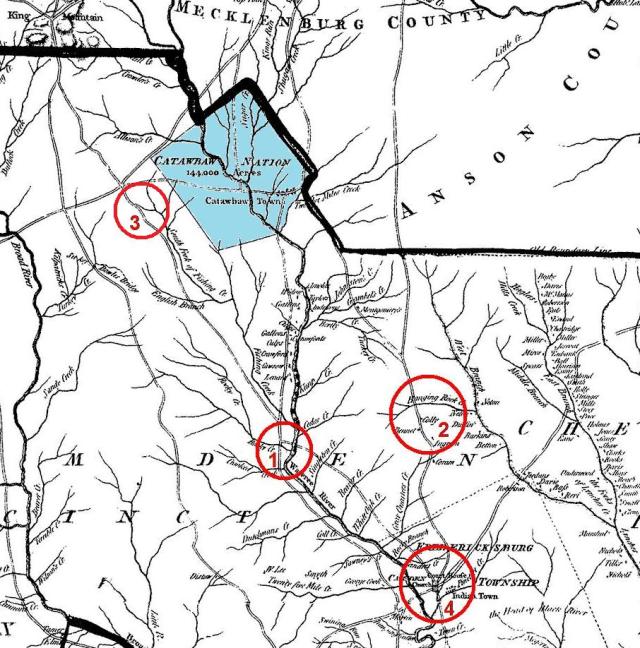
Rocky Mount Campaign Map , July, 1780  1) British post at Rocky Mount, 2) British post at Hanging Rock Creek, 3) site of the battle of Williamson’s Plantation, 4) British post at Camden. Shaded area is the Catawba Nation. The dark line at the top of the map is part of the border between North and South Carolina.

Tour No. 7 volunteered with General Sumter in the year 1781 as a Commissioner  to value property that might fall into the hands of the Army went with Sumter on what was called Sumter’s Rounds in State of South Carolina was at the Siege of Friday’s fort or Congaree fort, marched from thence to Thompson’s fort at Buckhead served two months when dismissed

General Thomas Sumter

Tour No. 8 volunteered in the year 1781 under Captain Fair and Colonel Pickens Regiment marched to Georgia had two Skirmishes with the Indians and made some prisoners then fought with the British at Governor Wright’s plantation in Georgia.   Colonel Twigs [sic, John Twiggs] commanded  Georgians served at this two three months when dismissed having served in all at least two years and two months; He further declares that he had to apply to history for the periods of the war but can well recollect his fighting and can pretty well recollect his service.

He hereby relinquishes every claim whatever to a pension or annuity except the present and declares that his name is not on the pension roll of the Agency of any State except that he now is on the roll of State pensioners of State of South Carolina.

Answer to Interrogatory 1: I was born as I am informed in the kingdom of Ireland in the [year] 1762

Answer to 2 Int: I have no record of my age

Ans to Int 3: I was living in Craven County Camden District in the same part I now live and only as his name is now called Chester District when called into service and have lived there where I now live

Ans to Int 4: I always served as a volunteer

Ans to Int 5: I have seen General Lincoln in Charleston when in Charleston as to other officers and circumstances I have mentioned them in the fore part of my declaration

Ans to Int 6: I never received any discharge but was dismissed

Ans to Int 7: I will name some to whom reference may be had of my veracity Viz William Walker, John Douglas Esq., John Rosborough, Clerk of the Court Chester District, John McCreary (late a member of Congress), John McKee

Sworn to & subscribed the day and year aforesaid in Open Court S/ James McCaw S/ Peter Wylie, JCOCD South Carolina, Chester District Personally came into open court before me Peter Wylie Judge of the court of ordinary of Chester District Joseph Gaston.  Personally came into open Court before me Peter Wylie Judge of the court of ordinary of said District George Weir Esq. (a Soldier of the Revolution) who upon being duly sworn saith upon oath that he is well acquainted with James McCaw and has been well acquainted with said McCaw during the Revolutionary War and saith that said McCaw was one of those veterans who turned out in defense of his country when the State of South Carolina was in possession of the British and Tories and further saith that he this deponent was with said McCaw at the Battle of Rocky-Mount & hanging-rock and further saith that he this deponent has sufficient information of said McCaw’s Services in the State of Georgia as this deponent had two or three Brothers in said service in Georgia with said McCaw and this deponent further saith that he fully believes all the statements set forth in said McCaw’s declaration to be true as he believes said McCaw to be a man of truth & veracity.S/ Joseph Gaston

Sworn to & signed this 17 day of October 1833 in open Court S/ Peter Wylie, JCOCD South Carolina, Chester District (a Soldier of the Revolution) who being duly sworn saith upon oath that he fully believes the whole of the above affidavit to be true & further saith that he has been in service with James McCall above named in the revolutionary War and knew him to be true to his country. Sworn to and subscribed this 17th day of October in open Court. S/ Peter Wylie, JCOCD S/ Geo. Weir

James took part in the Battle of Williamson’s Plantation, also called Huck’s Defeat. Captain Christian Huck, a Philadelphia Loyalist, came south as a part of Tarleton’s legion. He commanded a cavalry unit of about 100 Loyalists and was given marching orders to “push the rebels as far as you deem convenient.”
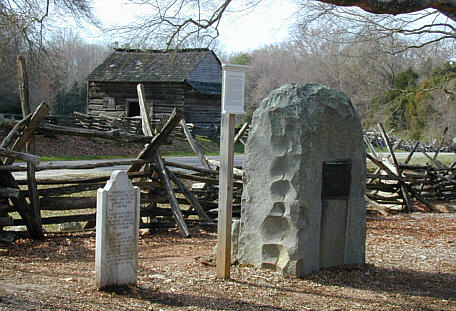
Battle of Williamson’s Plantation

On his list of “rebels” to “push,” was Colonel William Bratton. Huck and his cavalry arrived at Bratton’s home on July 11, 1780. After attempting to gain the captain’s whereabouts from his wife Martha, Huck set-up camp just west of Bratton’s home at Williamson’s Plantation.

Martha sent word to her husband’s camp and at dawn on July 12th, Colonels William Bratton, Andrew Neel, William Hill and Edward Lacey and a force of about 100 men surrounded Huck’s camp and ambushed the waking Loyalists early in the morning at reveille. Huck attempted to rally his men but was killed almost immediately with a wound to the head. After the smoke cleared, only about two dozen of the Loyalists managed to escape the ambush. On the American side, there was only one Patriot death.

The battle of Williamson’s Plantation was a disaster for the British, not because of the British losses that were incurred, but rather because it cooled Loyalist ardor, greatly encouraged the Americans, and put to an end the previously-effective Provincial/Loyalist raids from Rocky Mount.

James took part in the Battle of Rocky Mount. The Battle took place on 1 Aug 1780 as part of the American War of Independence. Loyalists commanded by Lieutenant Colonel George Turnbull occupying an outpost in northern South Carolina withstood an attack by 600 American Patriots led by Colonel Thomas Sumter.

Throughout 1779 and early 1780, the British “southern strategy” to regain control of its rebellious provinces in the American Revolutionary War went well, with successful amphibious operations against Savannah, Georgia and Charleston, South Carolina, and a routing of the few remaining Continental Army troops in South Carolina in the May 29, 1780 Battle of Waxhaws. The British, in complete control of both South Carolina and Georgia, established outposts in the interior of both states to recruit Loyalists and to suppress Patriot dissent.

One of these outposts was established at Rocky Mount, near the confluence of Rocky Creek and the Catawba River, south of present-day Great Falls, South Carolina. This outpost was garrisoned by a regiment of New York Volunteers under the command of Lieutenant Colonel George Turnbull.

In the absence of Continental Army command structure to organize resistance to the British following the disaster at Waxhaws, companies began to grow around Patriot militia leaders who had either survived it, or were not present at the battle. One militia colonel, Thomas Sumter, began in June 1780 to accumulate a militia force near Salisbury with financial assistance from North Carolina officials. While his force was too small to effectively oppose large-scale British and Loyalist activity for a time, enlistments rose following the Patriot victory known as Huck’s Defeat on July 12. By late July he had several hundred men and decided it was time to take action.

Battle of Rocky Mount – Attacking the Abatis. A party of militia (one of whom is carrying a torch), rush the abatis under covering fire from riflemen in the woods. According to William Clark, the abatis consisted of “fixed huge timbers pointing outwards.”

His primary target to attack was the British outpost at Rocky Mount. Sumter had learned on July 20 from a spy that the defenses might be susceptible to small arms fire, a clear benefit since Sumter lacked any sort of field artillery. (To Sumter’s detriment, the spy was probably a double agent, and Turnbull shortly thereafter began strengthening Rocky Mount’s defenses until they were proof against musketry.)

On July 28, Sumter broke camp and moved his company, numbering about 600 men, down to Land’s Ford, a major crossing point of the Catawba. There he met Major William Davie, who was leading a company of dragoons, and additional smaller militia companies. They decided that Davie would lead a diversionary attack against another outpost while Sumter would assault Rocky Mount.

The action began early on July 30.   Davie and his dragoons rode to the British outpost at Hanging Rock (south of present-day Heath Springs, South Carolina), where they surprised a company of Loyalists camped outside the fortifications, inflicting casualties and seizing 60 horses. The action happened so quickly that the British forces inside the fortifications were unable to respond.

Sumter’s attack went less well. Turnbull’s work on the defenses at Rocky Mount paid off, and Sumter’s men were unable to penetrate the defenses. After several hours of fruitless battle, they tried setting fire to the works, but this was frustrated by a torrential downpour that ended the battle.  Sumter’s forces suffered relatively modest casualties, and Sumter went on to successfully attack Hanging Rock a few days later.

James also took part in the Battle of Hanging Rock on 6 Aug  1780.  The battle was in present-day Lancaster county south of Heath Springs, South Carolina, about a mile and a half from a place known as Hanging Rock.  A British garrison was located just south of Heath Springs. It was well fortified with more than 1400 British troops, including the 500-man Prince of Wales Regiment of the regular army, led by Major John Carden of the British Army.  The Americans were under Gen. Thomas Sumter, commanding troops made up of Maj. Richard Winn’s Fairfield regiment, Col. Edward Lacey’s Chester regiment, Col. William Hill’s York regiment and Maj. William Richardson Davie of the Waxhaws of Lancaster county with Col. Robert Irwin’s cavalry of Mecklenburg county, North Carolina.

The Liberty Boys at Hanging Rock; or The Carolina Game Cock by Harry Moore July 28, 1916.

Sumter decided on a plan of attack of assaulting the camp in three mounted detachments. The initial assault was made early in the morning where Winn’s and Davie’s men completely routed Bryan’s corps. Capt. McCulloch’s company of the British Legion, after presenting a volley, was also routed by Sumter’s riflemen. The Prince of Wales Regt. also came under heavy fire and suffered very severe losses, including Carden who was badly wounded. The King’s Carolina Rangers then came up, and having cleverly deployed themselves in some woods, checked the rebel assault with a surprise crossfire. This allowed the British to drew up on a hollow square in the center of the cleared ground, and to further protect themselves with a three-pounder which had been left by some of Rugeley’s Camden militia.

Then, in the heat of the battle, Major Carden of the British Command lost his nerve and surrendered his command to one of his junior officers. This was a major turning point for the Americans. At one point, Capt. Rousselet of the Legion infantry, led a charge and forced many Sumter’s men back. Lack of ammunition made it impossible for Sumter to completely knock out the British. The battled raged for 3 hours without pause, causing many men to faint from the heat and thirst.

At the end, the British had lost 192 soldiers; the Americans lost 12 killed and 41 wounded. It should have been a total American victory but the American militia was untrained and suffered from extreme thirst. A small group of Americans came across a storage of rum in the British camp and became so drunk that it became necessary to prematurely start the march back to the base camp at Waxhaw. Thus, the intoxicated Americans were in no condition to take prisoners and let the remainder of the British army retreat to Camden.

James also took part in the Battle of Fishdam Ford, an attempted surprise attack by British forces under the command of Major James Wemyss against an encampment of Patriot militia under the command of local Brigadier General Thomas Sumter around 1 am on the morning of 9 Nov 1780, late in the Revolutionary War. Wemyss was wounded and captured in the attack, which failed because of heightened security in Sumter’s camp and because Wemyss did not wait until dawn to begin the attack.
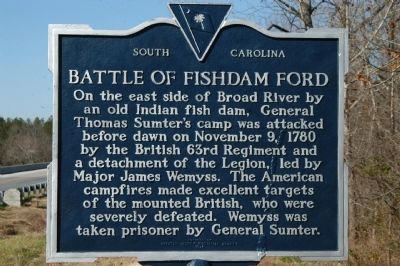
Battle of Fish Dam Ford  – Marker is near Leeds, South Carolina, in Chester County. Marker is on State Highway 215 ½ mile west of Store Road

In mid-September General Cornwallis moved north to Charlotte, North Carolina, where he was virtually surrounded by active North Carolina militia and Continental Army units. Following the important defeat of gathering Loyalists at Kings Mountain, Cornwallis retreated back to Winnsboro, South Carolina, where he engaged in attempts to suppress the Patriot militia that were harassing his supply and communication lines.

Two troublesome militia commanders in South Carolina were Thomas Sumter and Francis Marion. Marion caused trouble for Cornwallis in the northeastern part of the state, east of the Santee River. His activities were successful enough that Cornwallis sent Lieutenant Colonel Banastre Tarleton in November to hunt the wily Marion down. Sumter made similar troubles in the backcountry, where Cornwallis sent Major James Wemyss with the 63rd Regiment and some Loyalist dragoons to find him.

Wemyss learned on November 8 from local Loyalists that Sumter was encamped near Fishdam Ford. His intelligence about Sumter’s camp was sufficiently detailed that some men were specifically designated to attack Sumter’s tent. Moving quickly, Wemyss arrived near Sumter’s camp early on November 9. Fearing they would be discovered by Sumter’s patrols, Wemyss opted to attack immediately rather than waiting for dawn.

Sumter’s men had been wary to the possibility of surprise attacks, which were a popular British tactic. His officers had ordered their men to lie on their arms, to keep their fires burning, and had specific instructions about how to form up in case of attack. When Wemyss led the British attack against Sumter’s sentries, he was hit twice by musket fire and went down. His dragoons continued the charge into the camp, where the campfires illuminated them, providing easy targets for Sumter’s men, who had lined up in the woods just outside the camp. Their first volley took the British lead company by surprise, killing and wounding several men. They retreated, and Wemyss infantry then advanced into the camp, where they also came under fire from the woods. The British attempted a bayonet charge, but it was confounded by a fence between the two lines in the darkness. After twenty minutes of battle, the British retreated, leaving their wounded, including Major Wemyss, on the field.

Sumter played virtually no role in the battle, escaping from his tent to the riverbank early in the action.  Following the British failure, Lord Cornwallis recalled Tarleton to instead go after Sumter, who he believed was preparing an attack on Ninety Six. Tarleton and Sumter met at Blackstock’s Farm, in which Sumter very nearly revenged himself for Tarleton’s near-capture of him at Fishing Creek in August.

“Will of Sarah’s sister Mary McWilliams of Chester District, South Carolina

In the name of god Amen I Mary McWilliams of Chester District and State of South Carolina being weak in body but of sound and disposing mind and memory do make and publish this my last will & Testament in manner and form following

That is to Say first I allow my just debts and funeral expenses to be paid out of the first money which may come into my Executors hands its / my / property mostly consists in my wndevided third part of the lands which my brother and sister Jane now lives on

it is my desire that at my death my third part of the lands & property shall fall into my executor David C. McWilliams hands th moneys of said lands & property to be devided as follows

2nd I bequeath to my brother David McWilliams my fifty dollars

3rd I bequeath to my sister Sarah Mclaw [transcriber’s note: spelling? McCAW?] twenty dollars

4th I bequeath to my brother John McWilliams five dollars

5th I bequeath to my sister Jane McWilliams five dollars

6th I bequeath to my niece Sarah McWilliams fifty dollars &

7th I bequeath to my nephew John McWilliams twenty Dollars

8th I bequeath to my neice nancy Sprowle twenty dollars

9th I bequeath to my nephew Alexander McWilliams Decd his minor Children one Dollar each

10th I bequeath the remaing part of my property to my nephew David C. McWilliams and I wish David C. McWill to pay all these Different amounts and live on the place with John McWilliams and Jane and not m?lay? them but to have and hold my thir part of evry thing

11th I allow the Negro man tom in which brother John & Sister Jane has an equel Shair to be taken [by] my executor when parties are agreed and emancipate him in the State of Indiana

Lastly I appoint and constitute my nephew David C. McWilliams Sole executor of this my Last will & Testament

In witness whereof I have hereunto set my hand and affixed my seal this 29 day of October 1847

Signed Sealed published and declared as the last will & Testament of the above named Mary McWilliams being first duely read to her and witnessed by us at her request in her presence and the presence of each other the day and year above written

Mary ^ her mark ^ McWilliams SL
Joseph Johnson
James B. Wylie
Joseph Disney [Disnoy? / Dishney?]
Probated December 6, 1847

Children:

1. John Morton McCAW (See his page)

3. William McCaw

 Several genealogies show a William McCaw as a son of James, but without details.  A William McCaw was an early elder of the Hopewell and Fairhaven Churches in Preble County, Ohio and a widow Mary McCaw gave her farm to her nephew [our ancestor William A. McCAW] in exchange for agreeing to take care of her.

Our ancestor William A. McCAW was too young to be the Elder William McCaw below who helped found the Fairhaven Church,. History of Preble County, Ohio

In October, 1877, Rev. J. C. Campbell, the present pastor, began his labors among the people of Hopewell. The church, at present, is in a flourishing condition. The records show that since the establishment of the church there have been eight hundred and sixty-four baptisms and one hundred and forty-two deaths in the Hopewell church proper. There have been fifty ruling elders, as follows: Alexander Hamilton, William Mc. Gaw, John Pressly, John Patterson, Ebenezer Elliott, James Boyse, David McQuiston, Nathaniel Brown, John Foster, Andrew McQuiston, John Pinkerton, John Giles, William Gilmore, John Douglas, Samuel McDill, James Brown, sr., John Caldwell, Thomas Pinkerton, David Robertson, William McCaw, Archibald McDill, James Brown, jr., Hugh McDill, David McDill, John Ramsey, George Ramsey, Andrew Hamilton, John McDill, John Buck, Robert Marshall, Robert Simpson, Richard Sloan, Hugh McQuiston, James McCracken, James Davidson, John Simpson, Hugh Elliott, Thomas Buck, Samuel B. McQuiston, William Caskey, Hugh Ramsey, James A. Brown, William Bell, and A. B. Rock. The Sabbath school has about one hundred scholars, with James A. Brown superintendent.

THE FAIR HAVEN CHURCH.

As soon as that portion of the Hopewell congregati0n living in the vicinity of Fair Haven had been stricken off, the petition to moderate a call had been granted by presbytery, a call was made out and moderated by Rev. Alexander Porter, and accepted by Rev. Jeremiah Morrow, son of ex-Governor Morrow. He was installed in the following spring. The congregation consisted of about fifty families, and the new church immediately commenced its career of prosperity. The following were the first elders of the church:

John and Thomas Pinkerton, John Foster, William MaGaw, and William McCaw. The present elders are William MaGaw, Morton Gordon, William A. Pinkerton, David Ramsey, William Simpson, and Robert Beckett. Mr. Morrow preached seven or eight years, and was obliged to resign on account of failing health. He died soon afterwards in Chillicothe.

In the spring of 1845 Rev. John Reynolds became pastor, but he died in about a year, and was the first person buried in the Fair Haven cemetery.

June 20, 1847, Rev. John Y. Schouller, a graduate of the Alleghany Theological seminary, took charge of the church, and still continues in this his first and only pastorate.
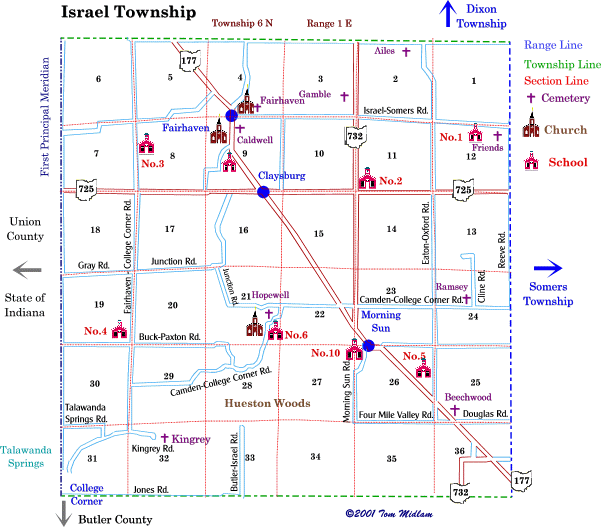
Israel Township, Preble County, Ohio

In the 1850 census, Mary McCaw was living on a farm with William Paul  in Dixon, Preble, Ohio.  Household Members:  William Paull 27, his wife  Eliza J Paull 26 (William A McCAW”s sister-in-law), William M Paull 1, Mary Mccaw 55, and Patrick O Connell 17   William Paul was born in South Carolina in 1821 or 1823 and married Eliza Jane Smith in 1848 in Ohio.

16 Jul 1856 – Mary McCaw gave her farm in Preble County to her nephew William McCAW in exchange for William agreeing to take care of her.  Mary was about 61 years old.  In exchange for the farm, William agreed

1. To pay one half the expense of building Mary a house  to stand near the present dwelling

Furnish Mary with all the necessaries of life except clothing including her Physician, medicines and nursing etc in the case of sickness

3 & 4. Keep and care in a proper manner one horse and one cow for Mary

5.  Furnish Mary anny other little necessaries or comforts of life suited to her condition in life and not above enumerated

6. Pay Mary for charitable, religious and other purposes fifty dollars a pear to be paid on the first of January

7. Pay all taxes and assessments and keep farm in good condition

8. If William died or otherwise failed to complete the contract, the farm would revert to Mary

9. Wukkuan agreed to live on the farm with his own family in the present dwelling house and not to rent the house to any other persons during Mary’s natural life.

William A McCAW was still living on the farm in the 1860 census, but I can’t find any further record of Mary.  William sold the farm April 10, 1869 and moved to Missouri.

.

4. James McCaw

James McCaw died on Christmas Day 1832  in Chester, SC.  His wife Jane L Hemphill immigrated with John MORTON McCAW and his family to Bloomington, Monroe, Indiana and On the fourth Saturday of May, 1835, the following were received on certificate into the Presbyterian.  Many of them had been under the pastoral care of the Rev. John Hemphill, a notable minister of long service among these people in Carolina.

James’ wife  L. Jane Hemphill  was born 3 Apr 1807 in South Carolina.   Her parents were both born in South Carolina.   After James died, on 24 Nov 1841 she married Alexander Henry (1804 Ireland – After 1880 Census Perry, Indiana).  Jane died 4 Sep 1892 in Bloomington Twp., Monroe County, Indiana.

Prior to being married to L. Jane Hemphill, widow of James McCaw, Alexander Henry was married to perhaps Mary Ann Millen, whose mother was a Chesnut, but I have not been able to figure out how this Mary Ann Millen was. This Mary Ann Millen apparently died in South Carolina before o Alexander moved to Indiana. And this Mary Ann Millen is likely the mother of all of Alexander’s children. Jane died 4 Sep 1892 in Bloomington, Monroe, Indiana. Jane and Alexander farmed in Perry Township, Monroe, Indiana in 1850,  1860, 1870 and 1880.

Perry Township, Monroe, Indiana where L. Jane and Alexander farmed includes the southern half of Bloomington home of Indiana University

James and Jane had the following children:

i. Jane McCaw. (Aug 1828 South Carolina, – 13 Sep 1913 in Perry Township, Monroe County, Indiana); m. Robert Henry, (8 Apr 1826 in South Carolina – 20 Nov 1894 Perry, Monroe, Indiana) son of Alexander Henry born in Ireland,  and her step-brother on 22 Feb 1848. They had seven children, but only one or two lived past childhood.

In the 1880 census, Robert and Jane were farming in Perry, Monroe, Indiana.

ii. Martha McCaw (1831 South Carolina – After 1880) Martha was living with her mother Jane and step-father Alexander in the 1880 census in Perry, Monroe, Indiana.

iii. Mary Isabella Hemphill McCaw (1833 South Carolina – After 1860 when she was still living with her mother and step-father)

There are some interesting deeds showing sale of property in Chester, South Carolina before the move to Indiana.

March 5, 1834 – Chester Dist. Jennet, John (Jane McCaw), and Robert Hemphill of Chester Co., ….to be paid by Andrew McQuiston of Fairfield Dist. to Andrew McQuiston where we now live 317 acres more or less on Little Rocky Creek and branches that bound at present Samuel Mills, Mary Hemphill , John Millsetc.
signed by Jennet Hemphill , John R. Hemphill , Jane L. McCaw and Robert Hemphill on Aug. 13, 1834. Witnessed by Geo. McNall and Wm. McQuiston .

Another entry dated Feb. 23, 1836 to Andrew McQuiston of Fairfield Dist. in the state of SC all right title and interest and claim to a certain Plantation or tract of land containing 317 acres more or less sitated on the waters of Little Rocky Creek in Chester Dist. in the state of SC bounded at this time east on Samuel WYLIE, S. E. on Samuel Mills, …. S. W. on Mary Hemphill , N. W. on John Mills being the plantation whereon my Father William Hemphill deceased and formerly lived. William McQuiston Hemphill of St. Clair Co., Illinois, sworn before James S. Robinson, Justice of the Peace on Feb. 23, 1836. Witnesses were James Wilson Sr. and James Wilson, Jr.
[NOTE – Interesting that the William Hemphill’s middle name was ‘McQuiston ‘].

One last Deed entry … Dec. 24, 1839, Andrew McQuiston of Tipton Co., TN by his Attorney William McQuiston to David Hemphill and Robert W. Hemphill, Plantation of 317 acres SC, Chester dist. on Little Rocky Creek ….bounded at present – S.W. (south west) on Mary Hemphill , N. W. by John Mills and John Torbet.
Andrew McQuiston by Wm. McQuiston his lawful attorney, Sworn Feb. 22, 1840 by H. WILLIAMS, Justice of the Peach and Witnessed by Wm. CALDWELL and Robert BRICE.

5. Samuel McCaw

Samuel’s wife Elizabeth Nelson was born in 1815 South Carolina. Her father was born in South Carolina and her mother in Ireland. Eliza was a widow in Hazlewood, Chester, South Carolina in the 1880 census.

Elizabeth’s sister Margaret (Nelson) Wilson was living with the family  in 1850 and 1860. Samuel stayed in Chester, South Carolina farming there in 18401850, 1860, 1870

Children of Samuel and Elizabeth:

i. J F McCaw (1833 South Carolina – After 1850 census)

ii. Robert N. McCaw (1835 South Carolina – Before 1880 census); m. 11 Nov 1857 in South Carolina to Narcissa J. Blain (1840 –  After 1920 census when she was living with her daughter Effie Graves in Jack, Texas) In the 1870 census, Robert and Lais were living in Franklin, Drew, Arkansas. In 1880 Narcissa was widowed and teaching school in Selma, Drew, Arkansas.

iii. Sarah E. McCaw (1837 South Carolina – After 1870 census) Living with parents in 1870

iv. William McCaw (1839 South Carolina – )

v. John C. McCaw (1843 South Carolina – )

vi. S P McCaw (1848 South Carolina – Before 1860)

vii.  Edward Brice McCaw (7 Aug 1852 – 10 Dec 1886 at age 34);   His body was interred in December 1886 at Chester Co., South Carolina, at Hopewell ARP Cemetery.  m.  Martha Fannie Brice at Due West, Abbeville Co., South Carolina, on 12 Jan 1882.

6. Rev. David McCaw

David’s first wife Jane D. Torbit was born 16 Oct 1818 in Chester, South Carolina.  Her parents were John Torbit and Mary Hare.  Jane died 10 June 1858 in Maury County, Tennessee.

David’s second wife  Alzira J. Cross was born 18 Sept 1821 in Jackson, Tennessee.  Her parents  were born in Virginia.  She was first married 3 Dec 1845 in Columbia, Maury, Tennessee to Frank Butler (4 Mar 1812 – 22 Mar 1856 Maury, Tennessee). Alzira died 20 Jul 1898 in Maury, Tennessee.

David McCaw owned a farm of 156 acres , of which 60 acres was under cultivation in 1906.  David came to Maury County Tennessee in  1851.

The centennial history of the Associate Reformed Presbyterian Church: 1803-1903 (Google eBook)

McCaw, David.—Son of James and Sarah McWilliams was born in Chester, S. C, March 16. 1816. His educational advantages in early life were limited to the old field schools of his day, but being anxious to secure a collegiate education, he entered Miami University, and graduated from that institution August 5, 1838.
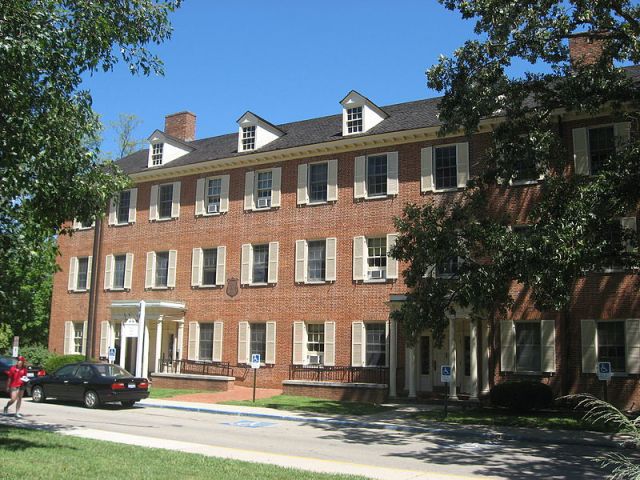
David McCaw might have lived in Elliott Hall which was built in 1828 and is still in use as a dormitory at Miami University.

[The foundations for Miami University were first laid by an Act of Congress signed by President George Washington, stating that an academy should be located Northwest of the Ohio River in the Miami Valley.  At its opening on 1 Nov 1824, there were twenty students and two faculty members in addition to the College President. The curriculum included Greek, Latin, Algebra, Geography, and Roman history.  An “English Scientific Department” was begun in 1825 which studied modern languages, applied mathematics, and political economy as training for more practical professions.   In 1839  Old Miami reached its enrollment peak, with 250 students from 13 states; only Harvard, Yale, and Dartmouth were larger.  By 1873, enrollment had fallen to 87 students and the board of trustees closed the school and leased the campus for a grammar school.   The period prior to its closing is referred to as “Old Miami”. The university re-opened in 1885, having paid all of its debts and repaired many of its buildings.]

He joined the Church at Hopewell, Ohio, under the pastorate of the Rev. Joseph Claybaugh. In the fall of 1841 he was received as a student of theology by the First Presbytery, A. R. P. Church, in Mecklenburg Co., N. C, and studied theology in Erskine Theological Seminary at Due West, S. C He was licensed and ordained in 1842 by the First Presbytery. During 1841 and 1842 he was tutor in Erskine College, and in the fall of 1842 was elected a professor in the College, in which capacity he was retained until the fall of 1848, when he resigned. He is the author of the Motto of Erskine College, “Scientia cum moribus conjuncta.” [Knowledge United with Morals]

[Erskine College still exists as a small four year, Christian liberal arts college located in Due West, South Carolina.  It is highly ranked for academic quality.  Erskin was established by the Associate Reformed Synod of the South as an academy for men, Erskine College became the first four year, church-related college in South Carolina in 1839. It was named for Ebenezer Erskine, one of the founders of the Associate Reformed Presbyterian Church and a pastor. Erskine had led a group of separatists from the Church of Scotland to found a separate Associate Presbytery. While the college has always employed a Professor of Divinity, its theological branch became a distinct but affiliated school, the Erskine Theological Seminary.

The Associate Reformed Presbyterian Churchis a small denomination, which was formed from the merger of the Associate (Seceder) and most of the Reformed Presbyterian (Covenanter) churches in Philadelphia in 1782. It is a theologically and socially conservative denomination and one of the oldest in the United States.  

In 1739, Presbyterian pastor Ebenezer Erskine led a group of Christians in leaving the Church of Scotland and forming a separate Associate Presbytery. Other similar offshoots had formed the Reformed Presbytery. These emigrated to Ireland, and later to the United States, establishing congregations from around 1750 to 1770, mostly in the back country of Pennsylvania, New York, Ohio, North Carolina, South Carolina and Georgia.

Some churches of the two movements came together officially in Philadelphia, Pennsylvania in 1782. Another synod was formed of churches in South Carolina and Georgia in 1803 and still another in Texas. The northern Synod merged with the Associate Presbyterians in 1858 to form the United Presbyterian Church of North America.  The modern ARP Church descends from the southern Synod.  In 2004, the ARPC had 41,019 members in 256 churches. The denominational office is located in Greenville, South Carolina.]

In April, 1839, David was married by Rev. Warren Flenniken in Chester, S. C, to Jane Dickey Torbit, a daughter of John and Mary Hare Torbit. She was born in Chester, S. C, Oct. 16, 1818. Three children were born to them, two daughters still living, and a son who died in 1876. She died June 10, 1858. She was a good woman greatly beloved by all who knew her. He was married a second time to a daughter of Hon. John B. Cross of Jackson, Tenn. She was born in 1821 and died July 20, 1898. She was beloved and mourned by all.

Century review, 1805-1905, Maury county, Tennessee… By David Peter Robbins

Trustees – Prior to the middle of the 19th century the magistrate made the assessments and the sheriff was collector. David McCaw, [now 1906] in his ninetieth year, who resides with his renter on Bear Creek, 3 1-2 miles northeast of Columbia, was made assessor under a special Act for 1856-7, after which the assessing again reverted to the magistrate. The collectorship was separated from the sheriff’s duties about the war time, Wm. C. Allen having been chosen in 1864; W. B. Kannon, 66; W. L. Connor, 68; J. H. Akin, 70; D. A. Craig, 72; A. A. Lipscomb, 74; W. T. Edwards, 76—at which time the duties of collector were added to those of the Trustee’s office. J. C. McCaw and others served as Trustees during the seventies;

Schools.—Among early teachers here -were C. F. Collins, Geo. and Edward Gantt, David McCaw, and others. Academies and various private schools -were maintained until the present public-school law became effective. A. C. Allen is now in charge of the school.

David wrote an article in Dec 22, 1897 issue Associate Reformed Presbyterian newspaper, Erskine College, Due West, South Carolina.  Census records show him to be a successful farmer.  In the 1850 census, David and his first wife Jane D. Torbit were living in District 48, Jefferson, Georgia.

David and Alzira had one child, Angeline Pocahontus Butler (1846 – 1848). By 1860 census, David and  Alzira were living in Maury, Tennessee.  David was quite wealth with real estate worth $17,000 and  personal property worth $13,000. By 1870 his farm was worth $20,000.

Map of Tennessee highlighting Maury County

Map of Tennessee highlighting Maury County

David buried his second wife Alzira J. Cross at Rose Hill Cemetery, Columbia, Maury County Tennessee

McCAW, A. J. Cross, b. Jackson, Tenn. 28 Sep 1821 -20 Jul 1898. ‘David McCaw, a native of S.C., erected this shaft in his 84th year A.D. 1900, in fond memory of his second wife. He intends to sleep by her side.” Block “M”

McCAW, no inscription on this shaft stone for the birth and death date of David McCaw, if he is buried here there is only the inscription that “He intends to sleep by her side” referring to A.J. Cross his 2nd wife. Block “M” 3165

McCAW, Jane D. Torbit, no dates. “His 1st wife Jane D. Torbit. of Chester, S.C. is buried at Zion.” (On side of the same shaft as A.J. Cross McCaw.) Block “M” 3166

McCAW, Susan Wilson Jacobs, Jan 1866 – May 1953. Blcok “M” 3137

McCAW, W. C., “His son W.C. McCaw of Wheeler’s Cavalry Sleeps at Lonoke Ark.” Block “M” 3164

Children of David and Jane Torbit:

i. Mary A. McCaw b. 1840 South Carolina; d. ca. 1865

ii. William Chambers McCaw b. 1846 in Due West, Abbeville, South Carolina; d. ca 1885 in Lonoke, Lonoke, Arkansas; Of Wheeler’s Cavalry buried at Lonoke, Arkansas

iii. Jane A McCaw (c. 1850 Georgia – Before 1920 census); m. Eudoxus  V McCullum (1849 Georgia – After 1920 census)  In the 1880 census E.V. was a buggy maker in Alpharetta, Milton, Georgia.  In 1910 Jane and E V were living in Marietta Ward 5, Cobb, Georgia with their son Robert.

iv. Julia A. McCaw (16 Oct 16 1850 in Augusta, Georgia – 11 May 1934 in Columbia, Tennessee); m. 12 Jul 1871 in Maury, Tennessee to William Bradshaw Wilson (31 Dec 1821 in Tennessee – 24 Mar 1906 in Columbia, Tennessee)  William first married Izora C. Hamilton 14 Aug 1851 in Columbia, Tennessee. Izora died just two years later in 1853.   He was elected mayor of Columbia in 1854.  He married again to Louisa B Wilkins 8 May 1862 in Columbia, Maury, Tennessee.  Louisa died in 1866.  William was elected Maury County Clerk in 1866.

William Bradshaw Wilson Portrait – At the time of his marriage to Izora C. Hamilton in 1851 Source: Colonial Dames’ Tennessee Portrait Project site

Children: Julia D Wilson (1873 – ) wife of R. Butler, of Nashville; Allee Wilson (1876 – 1882); Nick Wilson (1878 – 1928) mar. Elmo Gray, and farmed the home place in 1906; Gertrude, (1880 – 1891)  D avid E. Wilson (1882 – ) Railroad telegraph operator; Jane Wilson (1885 – 1977) m. Allen Burnside Gallaher;  Janie and Paul C. (1887 – ) were home in 1906.

In the 1880 census, William was a Deputy Clerk in Maury, Tennessee. William was 29 years older than Julia and in 1880 had three children living at home from a previous marriage.
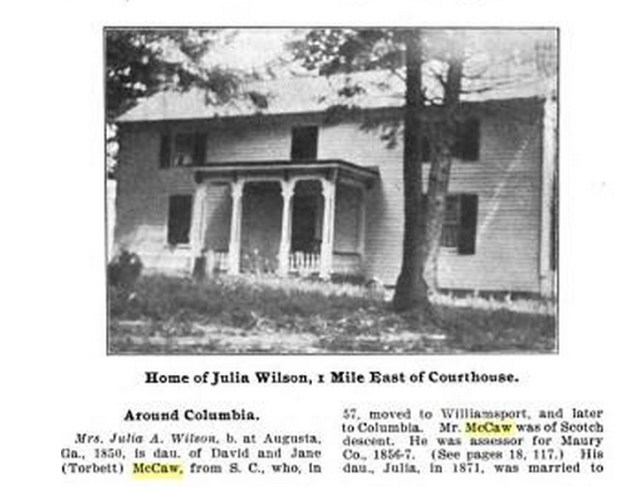
Home of Julia McCaw Wilson  Source: Century review, 1805-1905, Maury county, Tennessee. The homestead of 127 acres, 1 m. E. of Columbia, is sightly located and the home fronted by a fine park of ancient oaks

By the 1900 census, William and Julia were divorced and William was living with his daughter Julia Butler and listed as a “capitalist.” I can’t find Julia in the 1900 census, but by 1910 she was living alone on her own farm in Maury, Tennessee.

Century review, 1805-1905, Maury county, Tennessee… By David Peter Robbins  (David McCaw and family

Hon. W. B. Wilson, whose fertile memory has assisted the compiler in establishing facts and dates, was born, Dec. 31, 1821, came to Columbia to clerk in boyhood, was elected constable, 1846, engaged in merchandising as firm of Wilson & Porter, 49, was mayor of Columbia, 54, deputy sheriff several times, clerk of chancery, circuit, and county courts, and twice elected to the State Legislature

[Julia and William’s son] D. E. Wilson, born in Columbia, Sept. 28, 1882. He commenced telegraphy at age of 14, and 6 months later became operator at Mt. Pleasant. After the charge of this office for 2 • years, he became assistant in the dispatcher’s office at Nashville, later served 2 yrs. in the north yards of Columbia, then voluntarily changed to the St. L. and Iron Mt. R. R., at Little Rock, Ark., serving 2 years, when he returned to Harriman Junction, Tenn., where, after 18 months with the Q. & C., he became agent for L. & N. at Calender’s Sta., and, 1906, was transferred to Godwin.

Children of David and Alzira:

v. Susan  McCaw?  (Jan 1866 – May 1953) m1. [__?__] Wilson m2. [__?__] Jacobs,

.

7. Edward Alexander McCaw

Edward’s wife Mary Ann Moffatt was born 14 Jul 1827 in Chester, Chester, South Carolina. Her parents were William F. Moffatt and Jane McDill. Mary Ann died 11 Feb 1896 in Troy, Obion, Tennessee.

E. A. and Mary Ann moved from Chester South Carolina  to Obion County, Tennessee between 1849 and 1853.

Family is connected w/ the Reformed Presbyterian folks on Fishing Creek & environs including McDills, Millens, McDaniels, McMillans, et al In the 1830s some went to OH.IN,IL, others to GA.MS.TN.AR depending on their views on slaveholding.

Edward was listed as the head of a family on the 1850 Census at Chester Co., South Carolina. 1850 South Carolina, Chester Co. lists the following family: E.A. McCaw, age 29, born in South Carolina; Mary McCaw, age 25, born in South Carolina; Sarah J. McCaw, age 5, born in South Carolina; William M. McCaw, age 3, born in South Carolina; Sarah McCaw, age 79, born in South Carolina; Eli Chestnut, age 10, negro.

Edward was listed as the head of a family on the 1860 Census at Chester Co., South Carolina. 1860 South Carolina, Chester Co. lists the following family: E.A. McCaw, age 48, born in South Carolina; M. McCaw, age 36, female, born in South Carolina; S.J. McCaw, age 15, female, born in South Carolina; W. McCaw, age 13, male, born in South Carolina; M.M. McCaw, age 10, female, born in Tennessee; J.H. McCaw, age 7, male, born in Tennessee; J.C. McCaw, age 4, male, born in Tennessee. Edward died on 11 January 1884 at Troy, Obion Co., Tennessee, at age 63.

The centennial history of the Associate Reformed Presbyterian Church: 1803-1903 (Google eBook)

Pleasant Hill, Obion Co., Tenn.—Located six miles east of Troy, and two miles west of Rives, has been a place of preaching from an early day in the history of this country. A union church was built here, and for many years a monthly appointment was filled by the pastor of the Associate Reformed church at Troy.

The organization of an Associate Reformed Presbyterian church was formed there by Rev. T. P. Pressly, November 18th, 1882, with 13 members. Edward. A. McCaw T. B. Moffatt and James. H. McCaw were elected Elders. Regular services were continued at this place until the congregation decided to build at Rives, and to move the organization to that place. This was consummated, the church at Rives being dedicated in January, 1888, and services discontinued at Pleasant Hill.

Children of Edward Alexander McCaw and Mary Moffatt

i. Sarah Jane “Sallie” McCaw (1844 Chester Co., South Carolina – 21 Dec 1916 in Troy, Obion Co., Tennessee, at 72 years of age.) Her body was interred  in Troy, Obion Co., Tennessee, Troy Cemetery. m1. S. F. Maxey 1869; m2. Augustus Paden Moffatt 1880. Augustus was born in Chester Co., South Carolina 30 March 1830. One source gives birthplace as Troy, Tennessee. Augustus was the son of James Strong Moffett and Martha Moffatt.

ii. William M. McCaw (1846 Chester Co, SC – 1927)

iii. Martha Mary McCaw (Jan 1849 South Carolina – 1932);  m. 1868 at Troy, Obion Co., Tennessee to David “Dock” Marshall (1845 – Before 1910 Census) In the 1900 census, Martha and David were still farming in Troy, Obion, Tennessee in the northwest corner of the state.  Martha had twelve children, seven of whom were still living in 1900.

iv. James H. McCaw (1854 – May 1924  Union City, Obion, Tennessee); m.  23 Nov 1882 Obion, Tennessee to Elizabeth Purdida Callicott (Feb 1860 Tennessee – 27 Feb 1949, Obion, Tennessee)  In the 1910 census, James and Purdida were farming in Obion, Tennessee.

v. John C. McCaw (1856  Obion County, Tennessee – May 1924 Union City, Obion, Tennessee,) In the 1910 census, John was single and working as a furniture salesman in Rives, Obion, Tennessee.

Map of Tennessee highlighting Obion County

Map of Tennessee highlighting Obion County


Sources:

Ancestry.com

http://genforum.genealogy.com/cgi-bin/pageload.cgi?John,McCaw,South,Carolina::mccaw::205.html

http://southerncampaign.org/pen/s18117.pdf

http://genforum.genealogy.com/mcdill/messages/20.html

http://freepages.genealogy.rootsweb.ancestry.com/~thorodin/familly-p/p3754.htm#i25133

Century review, 1805-1905, Maury county, Tennessee… By David Peter Robbins  (David McCaw and family)

The centennial history of the Associate Reformed Presbyterian Church: 1803-1903 (Google eBook) (Rev. David McCaw)

http://trees.ancestry.com/tree/11117369/person/-409144509?ssrc=
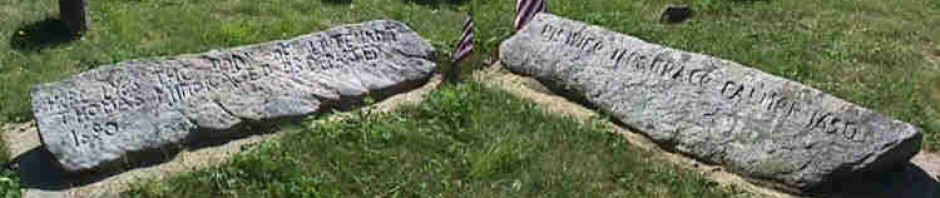
Posted in -7th Generation, College Graduate, Immigrant - Scot-Irish, Line - Miner, Storied, Veteran | Tagged , , , , , , , , | 21 Comments

John Morton McCaw

John Morton McCAW (1789 – 1865) was Alex’s 4th Great Grandfather, one of 32 in this generation of the Miner line.

John Morton McCaw and his family had arrived in Americus, Lyon County,  Kansas by 1858. Two sons had come to Kansas earlier..Americus Days 2010 – Americus, Kansas

John Morton McCaw was born in 1789 in South Carolina.  His parents were James McCAW and Martha MORTON.  He married Anna [__?__].  John’s cousin of the same name, John McCaw married Cicely Degraffenried  on 19 Sep 1822 in Chester County, South Carolina, so this probably is not the correct marriage date for John and Anna.    John died 9 Feb 1865 in Americus, Lyon County, Kansas.

John Morton McCaw Headstone Americus Cemetery , Americus, Lyon County, Kansas.

Anna (Annie) [__?__] was born 26 Nov 1804 in South Carolina.  Anna (Annie) died on 7 Apr 1894 in Americus, Lyon County, Kansas.

Annie McCaw Gravestone Americus Cemetery
Americus, Lyon County, Kansas

Children of John and Anna:

Name Born Married Departed
1. Martha McCaw May 1824
South Carolina
Unmarried (Living with brother James in Americus KS in 1880 as Martha McCaw) 18 Feb 1904
Americus, Lyon, KS
2. William A McCAW 1825
Chester, South Carolina
Margaret Ann SMITH
22 Jan 1851 Preble County, Ohio
12 Nov 1895 Chetopa Kansas
3. James McCaw 1829
South Carolina
5 Feb 1899
Americus, KS
4. Sarah McCaw 1831
South Carolina
28 Aug 1867
Americus, KS
5. Samuel Porter McCaw 24 Mar 1833
Chester, SC
Angie Cornella Clawson, of Lawrence, KS
23 Apr 1867
13 Aug 1907
Americus, KS
6. David Alexander McCaw 22 Oct 1835
Bloomington, Monroe County, Indiana
Unmarried (Living with brother James in Americus KS in 1880) 12 Sep 1916
Americus, KS
7. Elizabeth J. McCaw 6 Mar 1837
Monroe, Indiana
Unmarried (Living with brother James in Americus KS in 1880 as Elizabeth McCaw) 1921
8. John Addison McCaw 7 Sep 1840
Bloomington, Monroe, Indiana
Emma Elizabeth Taylor
1 May 1877
Evans, Weld Colorado
4 Aug 1928
Glendale, AZ
9. Permilla Anne (Millie) McCaw 1 Jul 1843
Bloomington, Indiana
Thomas Anderson
21 Aug 1862
Americus, KS
29 Jan 1930
Americus, KS
10. Robert Tressler McCaw 18 Sep 1846
Bloomington, IN
Anna Elizabeth Floyd
18 May 1876
Americus, KS
14 Feb 1910
Americus, KS

In 1833 the family moved from South Carolina to Preble County, Ohio.  After a residence of one year, they removed to Monroe County, Indiana.

THE ASSOCIATE REFORMED PRESBYTERIANS OF MONROE COUNTY, INDIANA.

The principal arm of the present United Presbyterian Church was the Union congregation of the Associate Reformed Church. The congregation was named “Union” after the Union congregation in Chester District, South Carolina, in which many of its members had been baptized, and from which they had come to Monroe county. Many of them had been under the pastoral care of the Rev. John Hemphill, a notable minister of long service among these people in Carolina.

In the Session Record Book of the Associate Reformed Church of Bloomington, the first entry is for September 7, 1833, and is as follows:

“The congregation was organized by the Rev. John Reynolds. The session was organized by Mr. Reynolds as moderator, aided by Mr. Henry from Decatur county, Indiana.

“Mr. William Fee, being elected, was ordained as elder and took his seat as a member of the court.

“The following persons were received as members of the church at this time on certificate:

“William Fee and his wife, Elizabeth; David Cherry and Sarah his wife; Martha Cherry and her daughter, Molly Cherry; James Millen and Hannah, his wife; Widow Harrow.

“The following were received on personal examination: William Curry, George Johnston, Rachel and Margaret Fee, Ebenezer V. Elliot.”

This made fourteen in all, to constitute the first organization. Mr. Fee was the first and for a while the only elder of the congregation, and has been called the “Father of the United Presbyterian Church” in this community. He was born in County Antrim, Ireland, in 1786, but when he was four years old his father, Robert Fee, migrated with his family to Chester county, South Carolina. Here in 1810 William Fee married Elizabeth Ferguson Orr, a native of Chester county, of the ScotchIrish stock.

In 1830 William Fee sold his land in Chester county and with his father and brother-in-law, William Tate, left for the Northwest. When they left South Carolina they had not decided whether they would seek new homes in the Illinois country, or in the Indiana, and when the party came to the parting of the ways they left the matter for decision to one of the horses, which turned into the road leading to Indiana. They arrived in Bloomington on December 31, 1830—in the dead of winter— and for their first night they were taken into the home of Mr. Dorrance B. Woodburn, who had come from South Carolina but a few months before. The whole company that night, counting Mr. Woodburn’s family of twelve, numbered forty adults and children. Presumably they must have slept twelve or fourteen in a room, and mostly on the floor. People lived the simple life in those days, and their hospitality was simplicity itself. Guests did not have their dinners in courses nor their bedrooms in suites; they lived in log cabins, and they climbed by a common ladder to the lofts, sleeping in small bedrooms whose furniture consisted chiefly of beds.

On May 10, 1834, Andrew Bonar (or Bonner) was added to the session. At the same time the following were received into the church on certificate: William Millen and Elizabeth, his wife; John Wier and his wife; William Bonner and his daughter, Margaret; John C. Harbison and wife, Samuel Wier and wife, William M. Millen and wife, Archibald Wilson and wife, S. C. Millen, Margaret Millen and John Millen. John Fee and Eli Millen were received on examination.

On the fourth Saturday of May, 1835, the following were received on certificate: James Richey, Mathew Harbison and his wife, Jane Harbison; James Douglas and wife; Jennet Hemphill and Robert and Andrew, her sons; Mary Moffett, Jane McCaw [John’s sister-in-law] , John McCaw and wife, Samuel Strong and wife, Samuel Harbison and wife, Barbara Millen, Robert Harbison and wife, Jennet Strong, Thomas Bonner and wife and Sarah McCaw.

On examination, Mrs. Westbrook; Polly, Sarah and Nancy Cherry; Elizabeth Curry, William Millen, Jr., and Robert Strong were admitted. This made thirty accessions at this spring communion (1835), showing that another colony had arrived in the fall of 1834 from South Carolina.

I haven’t been able to find the family connection between  John Morton’s sister-in-law, Jane Hemphill McCaw and Rev. John Hemphill, the leader of their migration from South Carolina to Indiana, but I’m sure there was one.

John Morton ‘s  youngest brother Edward Alexander McCaw married Mary Moffatt in 1843.  They moved from Chester SC, to Troy, Obion, Tennessee.

I’m not sure who Sarah McCaw was.  Sarah was born about 1776 in South Carolina.  Her daughter Sarah was born about 1808, perhaps 11 Feb 1807,  per the 1850 and 1860 census in Tennessee.  There were Sarah McCaws head of household in Chester, South Carolina in the 1820,  1820 and 1840 censuses, so maybe she was widowed early.  Robert Service, who married Sarah McCaw in Monroe County, Indiana on March 8, 1837.  In the 1850 census, Sarah  was living with her daughter and son-in-law Robert Service in Perry, Monroe, Indiana.  By the 1870 census, Robert Service was a widower and had moved to Fremont, Lyon, Kansas near the John Morton McCaw’s family.

 Jane L. Hemphill was born circa 1804 at South Carolina. She married John Morton McCaw’s half-brother  James McCaw, son of James McCaw and Sarah McWilliams. After James died, L. Jane Hemphill married Alexander Henry on 24 Nov 1841; Prior to being married to L. Jane Hemphill, Alexander Henry was married to perhaps Mary Ann Millen, whose mother was a Chesnut, but I have not been able to figure out how this Mary Ann Millen was. This Mary Ann Millen apparently died in South Carolina prior to Alexander moving to Indiana. And this Mary Ann Millen is likely the mother of all of Alexander’s children. Jane died 4 Sep 1892 in Bloomington, Monroe, Indiana.

On examination, Mrs. Westbrook; Polly, Sarah and Nancy Cherry; Elizabeth Curry, William Millen, Jr., and Robert Strong were admitted. This made thirty accessions at this spring communion (1835), showing that another colony had arrived in the fall of 1834 from South Carolina.

In the fall of 1835 the session was “constituted” (called to order and presided over) by the Rev. Hugh Parks, and on December 1, 1835, the Rev. William Turner was settled as pastor over Union congregation, being ordained and installed in said congregation on June 16, 1836. The migration from South Carolina was still going on as is indicated by the fact that in the spring of 1836 Mr. Turner and the session received into the communion of the church the following members:

On examination: Jane Strong, John Glenn, Samuel.  These three men were received as ruling elders, having been ordained elsewhere.

Millen, Jonathan Archer (by baptism) and Elizabeth Fee. .

On certificate: Robert Harbison and wife, Jane; Rosanna Harbison, Esther Harbison, Samuel Harbison, Jr., Maxwell Wilson and Martha, his wife; James Glenn and Agnes, his wife; Elizabeth, Margaret and Mary Ann Glenn; James Miller and Letitia, his wife; Jennet Brown, widow; John, Margaret and Thomas Brown; Julia Ann Turner, Alexander Henry and Jenny, his wife; Daniel T. Shaw, David Meek and Nancy, his wife.

There were, thus, thirty-one accessions at this time; the moving from the South was pretty steady.

On the same date (June, 1836) it is recorded that

David appeared before session and “confessed himself to have been guilty of the sin of intoxication, pledged himself to abstain from the use of ardent spirits; was rebuked before the session, and it was ordered that the proceeding be published to the congregation.”

The following are the principal families in this branch of the Scotch-Irish Presbyterians—the Associate Reformed body: Archers, Aliens, Alexanders, Baxters, Bonners, Browns, Calhouns, Campbells, Cathcarts, Cherrys, Cirgins, Collins, Crabbs, Craigs, Creas, Currys, Dicksons, Douglass’s, Farringtons, Fees, Fullertons, Galloways, Gettys, Gibsons, Gillespys, Gordans, Glenns, Grahams, Harbisons, Hemphills, Henrys, Hendersons, Hunters, Jamisons, Johnstons, Junkins, Kerrs, Meeks, Millens, Millers, Moffatts, McCaws, McKissocks, McMichaels, Orrs, Reeds, Rocks, Semples, Smiths, Strongs, Swearingens, Turners, Weirs, Westbrooks and Wilsons.

John and Ann had the following real estate transactions in Monroe County, Indiana.

4 Oct 1830 – State of Indiana granted to John McCaw Book I Page 406

22 Jan 1839 – John M and & Ann McCaw sold to David Faris – Book G Page 361

1 Nov 1842 – John M & Ann McCaw sold to John W Allen Book I Page 407

25 Apr 1856 – State of Indiana sold to John M McCaw Record 2395 Book R Page 380

15 Apr 1858 – John M McCaw sold to William Wylie Record 3227 Book R Page 380 [and removed to Americus Kansas]

Other Early McCaw Transactions in Monroe County, Indiana

25 Mar 1846 – Jane McCaw sold to John Tate Book K Page 016

26 May 1849 – James & Jane Craig sold to Jane McCaw Book L Page 529

5 Feb 1851 William and Elizabeth Millen sold to David McCaw Book N Page 050

3 Oct 1851 – Sarah Logan sold to Henry McCaw Book N Page 310

31 Jan 1853 – Sarah Smith sold to Henry McCaw Record 3828 Book O Page 168

1 Mar 1855 – David McCaw sold to Andrew Helton Record 3155 Book P Page 516

28 Mar 1857 – James McCaw sold to Patrick Monahon Record 3205 Book R Page 38

17 May 1858 – James McCaw sold to David Barron Record 3238 Book R Page 412

In 1850, the McCaw family was living in Perry, Monroe County, Indiana, though our ancestor, William was living and working on a farm in Israel Township, Preble County, Ohio.   The family had arrived in Americus, Lyon County,  Kansas by 1858. Two sons had come to Kansas earlier.

In the fall of 1857, a company known as the Americus Town Company, was formed for the purpose of locating a town, destined to be the future county-seat. The company was composed of the following members, none of whom are living in Americus today: T. C. Hill, G. H. Rees, E. Yeakley, J. Moser, E. Columbia, William Grimsley, E. M. Sewell, B. Wright, N. B. Swister, A. I. Baker, J. W. Voak, J. Voak, W. Thompson, D. Swim, F. Barrett and E. Goddard. The first officers were: A. I. Baker, Pres.; T. C. Hill, Treas.; D. Swim, Sec’y. A town site of 640 acres was laid off, and improvements made. The first building was a one-story structure, built of native lumber by E. Yeakley, and was occupied as a dwelling. The next building was erected by W. Thompson, and is a two story frame. It was opened as the “Americus” House, July 4, 1858, with a grand  ball. The building is still standing and is now known as the Sulton House. About the time the hotel was completed, G. H. Page built a small building near the site of the present depot and opened a store. In the summer of 1858, a log building, built by subscription, was completed and in it was held the first school. In 1859, a church building was built by popular subscription and used by all denominations until other edifices were built.

In 1858, the place by a vote of the people was made the county-seat of Breckinridge County, and held it until late in 1860.

The first number of the Americus Sentinel, an Independent paper, was issued August 30, 1859, by T. C. Hill, who subsequently transferred it to S. L. Kenyon. After an existence of one year it suspended.

In the fall of 1858, the postoffice was established, E. Yeakley being appointed Postmaster. He was succeeded by Enock Hoag. Under Hoag’s administration, the name of the office was changed to Sheridan. Hoag held the office three or four years, and was succeeded by John McDill, who caused the name of the office to be changed back to its original appellation. McDill was succeeded in the order mentioned by W. W. Kitts, S. Bruner, John Gibson, D. A. Stahl, J. W. Loy, T. A. Wright. Mr. Wright was succeeded in 1874, by the present incumbent, Mrs. T. C. Hill. During the same year it was made a money order office.

The log building built in the summer of 1858, and used for school purposes, was used in that capacity until School District No. 2, was organized in 1859, when a frame structure was built.

Lyon County, Kansas 1883 from William G. Cutler’s History of the State of Kansas

Twenty years later (1879), son William moved to Chetopa, Kansas  which is 165 miles downstream from Americus on the Neosho River.

Map of Ohio highlighting Preble County

Preble County, Ohio

Map of Indiana highlighting Monroe County

Monroe County, Indiana

Map of Kansas highlighting Lyon County

Lyon County, Kansas

The McCaw family had arrived in Americus, Lyon County, Kansas by 1858

Children

2. William A McCAW (see his page)

3, 5, 6, 8. John’s sons James,  Samuel, David, and John were all in the 11th Kansas Regiment during the Civil War.  The 11th Kansas Infantry ceased to exist at the end of April 1863 when it was mounted and changed to the 11th Kansas Cavalry.  John and Samuel enlisted in Company E on 24 Aug 1862 in Emporia, KS and were mustered out 7 Aug 1865 at Fort Riley, KS.  David and James enlisted 24 Feb 1864 and were mustered out 1 Sep 1865.   John was wounded in his right arm in action,  7 Dec 1662 at the Battle of Prairie Grove, Arkansas. He later received a pension of eight dollars per month.

John McCaw was wounded at the Battle of Prarie Grove “…The Bayonet or Retreat” by Andy Thomas

Prairie Grove Reenactment Dec 2005

The Eleventh Kansas Cavalry stayed fairly close to home during the Civil War. Part of the Eleventh engaged in the pursuit of William Quantrill following his devastating raid on Lawrence, Kansas, in 1863.

The Eleventh later participated in the Price Raid battles around Kansas City, and skirmishes around Mound City, in October of 1864. The latter actions made it the closest unit among all Kansas regiments to the Battle of Mine Creek, the only full-fledged Civil War battle in the state

11th Kansas Regimental Flag

Before the Eleventh was released from its duties, several companies–including Company A–were sent into what is now Wyoming to fight American Indians. This was not a popular decision among soldiers ready to go home after the defeat of the Confederacy. Until they were mustered out, though, they were still in the Federal army and could be deployed as needed.

11th Regiment Actions include Old Fort Wayne or Beattie’s Prairie, near Maysville, 22 Oct 1862. Cane Hill, Boston Mountains, 28 Nov 1862. Boston Mountains 4-6 Dec 1862. Reed’s Mountain 6 Dec 1862. Battle of Prairie Grove 7 Dec 1862. Expedition over Boston Mountains to Van Buren 27-31 Dec 1862. Moved to Springfield, Mo., Jan 1863, and duty there until 17 Feb 1863. Moved to Forsyth, Mo., thence to Fort Scott, Kan. On furlough March. Moved from Fort Scott to Salem, Mo., thence to Kansas City, Mo., 6-20 Apr 1863. The regiment lost a total of 173 men during service; 61 enlisted men killed or mortally wounded, 2 officers and 110 enlisted men died of disease.

3.  James McCaw

James never married, but he became head of household for his mother and several brothers and sisters.  In the 1870 census,  James’ (age 41) house hold included.

Anna McCaw 65 (His mother)
Jane McCaw 61 (Born in Tennessee about 1809, John’s two youngest brothers moved to Tennessee in the 1840’s and 50’s,  but I haven’t found out who this is)
Martha McCaw 46 (His sister)
David McCaw 34 (His brother)
John A McCaw 29 (His brother)
Robert P McCaw 23 (His brother)

In the 1880 Census several siblings were living with James McCaw in Americus, Lyon, KS.

James McCaw 51 (Single and Head of Household)
Anna McCaw 75 (His Mother)
Martha McCaw 56 (His Sister)
David A. McCaw 44  (His Brother)
Elizabeth J. McCaw 42  (Another Sister)

5. Samuel P. McCaw

Samuel’s wife Angie Cornella Clawson was born Jul 1846 Pennsylvania. Her father James Clawson ( – 1850) was born in Germany and her mother Maria Morton (1805 – 1849) was born in Pennsylvania. Angie died 01 Mar 1910 Americus, Lyon, Kansas.

Samuel was a farmer, Section 10, Township, 18, P. O. Americus, Kansas and was born in Chester District, SC, 24 Mar 1833. When he was five months old, his parents removed to Preble County, Ohio, whence, after a residence of one year, they removed to Monroe County, Indiana where John was raised on a farm, and remained with his father until 1856, when he went back to Ohio and remained two years with an older brother. In the spring of 1858 he came to Kansas, locating in Lyon County. In the spring of 1860, in connection with his brother, he purchased the saw-mill at Americus, and operated it until 23 Aug 1862, when he enlisted in Company E, Eleventh Regiment Kansas Volunteers.

The first saw-mill was built in the fall of 1859, by J. Kuhns. Steam power was used, and the mill was run by Kuhns until 1861, when he sold it to McCaw & Bruner. Early in 1860 T. C. Hill built a saw-mill and “corn-mill,” near the rival structure. In August of the same year it was destroyed by fire. Hill then purchased the other mill of McCaw & Bruner, and run it until the spring of 1864, when he sold his interest to J. McDill. McDill ran it until 1867, when he sold it to its present [1883] owner, N. Wise. The mill has a capacity of 3,000 feet per day.

Samuel P McCaw Enlistment

He participated in all the engagements in which his company took part. Was mustered out as a Sgt. at Fort Riley, August 10, 1865, and returned to Americus, where he engaged in general merchandising, as a member of the firm of Kitts & McCaw, which continued in business about two years. They then sold out the business, and engaged in farming, in which he has since continued.  He has a farm [In 1883] of 170 acres on the Neosho, two miles west of Americus, upon which he has built a commodious brick dwelling, barn, granary and other farm buildings. He is [again 1883] a member of the United Presbyterian Church of Americus. Has been a member of the Board of Education many years. He married Miss Angie Cornella Clawson, of Lawrence, Kas., April 23, 1867, by whom he has had six children, including  Annie M., George W., and Mary B. (William G. Cutler’s History of Kansas ~ Transcribed by Lori DeWinkler)

In the 1880 census, Samuel was living in Americus, Kansas, S. P. Mccaw 47, Cora A. Mccaw 33, John M. Mccaw 11, Anna M. Mccaw 4, Joseph Madill 17

In the 1900 census, Samuel was living in Americus, Kansas , S* P Mccaw 67, Cornelia Mccaw 53, Anna M Mccaw 24, G Walker Mccaw 22, Mary I Mccaw 18, Margaret E Mccaw 15

Children of Samuel and Cornelia:

i. John M. McCaw (1868 Kansas – Aft 1885 census)

ii.  James Collins McCaw (1871 – 1874)

iii. William Clausen McCaw (1873 – 1874)

iv. Anna Maria McCaw (15 Jun 1875 in Lyons, Rice, Kansas – 30 Apr 1947 in Boise, Ada, Idaho) m. Fred Eugene Edmiston (b. 30 Apr 1875 Americus, Lyon, Kansas – d. 15 Oct 1920 Nampa, Canyon County, Idaho) His parents were William Hugh Edmiston (1844 – 1929) and Margaret L. Boyd (1846 – 1936)

Fred and Anna were farming  in Lone Tree, Canyon, Idaho in the 1920 census.

v.  George Walker McCaw (5 Feb 1878 in Kansas – 1923) m. Mabel A. Hoskins (b. Sep 1886 Colorado – d. 15 Oct 1976 Long Beach, California)

George was a journeyman carpenter in Emporia, Kansas in the 1920 census.

In the 1940 census, Mabel was a widowed music teacher living at 321 West 15th Street Long Beach, California

vi. Mary Isabel McCaw b. 2 May 1882 Kansas; d. 20 Oct 1947 Ada County, Idaho; m. 31 Mar 1915 Roswell, Caldwell Co., Idaho to Bert Sloan (b. 1874 Michigan – Aft. 1940 Census, Parma, Canyon, Idaho)

Bert was a janitor in the Presbyterian Church in Parma, Canyon, Idaho in the 1930 census.

vii.  Margaret Elizabeth McCaw b. Apr 1885 in Nortonville, Jefferson, Kansas; d. 08 Oct 1924 in Brookfield, Linn, Missouri) m. 29 Aug 1911 in Americus Kansas to Thomas Curry Oyler  (b. 1886 Kansas – d. Aug 1966 Brookfield, Linn, Missouri)

In the 1920 census, Thomas was a chiropractor in Brookfield Ward 2, Linn, Missouri,

By the 1930 census, Thomas had remarried to Teresa Babb (b. 1900 Kansas)

.

8. John Addison McCaw

John’s wife Emma Elizabeth Taylor was born in 9 May 1847 in Iowa. Her father Henry Taylor was born in Tennessee and her mother [__?__] Blair in South Carolina.  Emma died a couple of years before John on 2 Sep 1926 in Glendale, Arizona.

John Addison McCaw enlisted as a private on 23 Aug 1862 in E. Co 11th Cavalry Regiment, KS in Emporia, KS;

John McCaw Enlistment

Mustered out on 7 Aug 1865 at Fort Riley, KS.  He was wounded in his right arm in action, 7 Dec 1662 at the Battle of Prairie Grove, Arkansas and was in hospital in Fayetteville, AR.  His commanding officers were Tom Yewing and Winfield Scott.  His Company Captain in the battle was Edmund G. Ross who swore to John’s injuries on 2 Jun 1866.  He was treated for his old gunshot wound (abcesses mainly) in 1863, 1864 and 1865.  His medical examination from 1898 states that the ball entered on exterior surface 2 inches in front of elbow joint when arm was bent in act of capping his gun.  Ball passed up humerus and out at front 6 inches above elbow joint.  However, he says ball was split and half was cut out at bend of elbow and other half 6 inches upward in front of humerous.  Both pieces were cut out on front of xxx.  His arm is weak and his motion in arm is only about a quarter of natural motion and it is almost an equivalent to loss of use of right arm.  We rate gun shot wound to right arm at Seventeen -Eighteenths.  We think the rhuematism is traumatic as it is mainly in right arm and hand and shoulders.

He received a pension of four dollars a month starting in 1865.  The pension was increased eight dollars per month  starting in 1871, $12 per month in 1890, $14 in 1904, $15 in 1910, $24 in 1912 and $30 in 1915.  There is extensive correspondence petitioning the bureau of pensions to increase John’s benefit.  For example, his Representative, J. N. Tincher, 7th District Kansas wrote a letter in 1921 which resulted in his pension being increased to $72 per month.  His pension was increased  to $90 per month commencing January 16, 1928, which he enjoyed for only seven months before he died.

John and Emma were married in 1877 in  Evans, Colorado.  Evans was established in 1867 and was Weld County’s seat of government twice before Greeley finally captured the honor. Legend in Evans is that the county records were stolen by night-riders from Greeley, who also supposedly burned the courthouse. Today, Evans, like other towns along the South Platte River, is home to a rapidly-growing Hispanic population.

Between 1877 and 1878, the family moved to Oregon. Their first daughter, Myrtie Edna was born in Oregon, she wrote in Webb, but I can’t find a record of an Oregon location by that name. It looks like the family soon returned to Kansas.

In the 1880’s, John and Emma lived in Chetopa, Kansas, near his brother and our ancestor William.

In the 1900 Census,  John and Emma were living in Welda Township, Anderson, Kansas.

In 1915, John was living in Stafford, Kansas where he requested his Civil War pension be increased to $30 because he was turning 75.

Children of John and Emma

i. Myrtie Edna McCaw  (25 Jun 1878 Webb, Oregon – Feb 1956 Burley, Idaho) As an adult, she went by Edna.  m1. Solomon Yonally 1921;  m2. [__?__] Moon.

While living in Burley, Idaho in 1947, made a Civil War pension request as John’s daughter.

Edna McCaw

In the 1930 census, Solomon was a farm laborer in Glendale, Maricopa, Arizona.

ii. Alice Lulu McCaw (26 Feb 1880 Kansas – Oct 1975, Colorado Springs, El Paso, Colorado); m. Henry Alvan Ball (b. 1881 Indiana – d. bef. 1940 census)

Henry was a grocery merchant in Stafford, Stafford, Kansas in the 1920 census.

In the 1930 census, Alvan was a general merchandise salesman in Monte Vista, Rio Grande, Colorado.

iii. Clyde Taylor McCaw  (26 Jan 1883 Kansas – 10 Aug 1883 of Cholera Infastium aged 6 months, 10 days) buried Oak Hill Cemetery, Chetopa, Kansas

iv. May Pearl McCaw (19 Dec 1883 – 7 Aug 1884)

v. Maud Beatrice McCaw b. 12 Jun 1885 Kansas; d. 1 Jan 1968 Sylmar, Los Angeles; Never married.

In 1910 Maud and her sister Edna were living at 216 East 3rd Avenue, Hutchinson, KS.  They were students at Salt City Business College which closed in 1980 after 101 years of operation.

Salt City Business School — In the late 1800’s, Hutchinson was thought to become a future large center of commerce with its close proximity to the railroad. A business college to prepare residents for this foreseen economic boom was built downtown, originally located on the corner of A and Main. J.D. Conard and Oscar S. Johnston bought the college in 1910 and helped it grow from 68 students to almost 600 students by 1912.

vi. Grant Taylor (Tailor) McCaw b. 2 Oct 1887 Welda, Kansas; d. Dec 1974, Sentinel, Washita, Oklahoma; m. Myrtle Gordon (b. 1893 Oklahoma)

Grant was a laborer in Sentinel, OK in the 1930 census. In 1910 he had been a share tenant

Anderson, Kansas

In 1947, Edna Moon of Burley, Idaho filed a claim for a Civil War death pension for her father John A. McCaw.  The claim was disallowed because she had married and therefore could not be considered as the child of a Civil War veteran.

9. Permilla Anne (Millie) McCaw

Millie’s husband Thomas Anderson, farmer, Section 34, Township 17, Range 10, P. O. Americus in 1883 was born in Cockburnspath, a village in the Scottish Borders, Berwickshire, Scotland 30 Nov 1839. His parents were  John Anderson (1816 – 1901) and Margaret Davidson  (1817 – 1877). Thomas died 21 Jul 1917 in Americus, Lyon, Kansas.

When he was nine years old, came to the United States with his parents, who first located at Cincinnati, Ohio, but after a residence of one year removed to Galena, Ill.  Here they resided three years, then removed to Jones County, Iowa, where they remained until the spring of 1859 when they came to Kansas, locating near Americus in Breckinridge (now Lyon) County.   Thomas engaged in farming, married Millie in 1862 and in Feb 1864 enlisted as a private in the same unit as Millie’s brothers  James,  Samuel, David, and John , Company E, 11th Regiment Kansas Cavalry.    He participated in all the engagements in which his company took part from that time until his discharge, September 1, 1865.

He then returned to Americus and engaged in farming, upon eighty acres of trust land situated about two miles northwest of town, which he had purchased just before he entered the service. This farm he improved by the erection of a dwelling, barn and other farm buildings, and has operated it continually since. He has since purchased twenty acres of timber land situated on the Neosho River and 160 acres of land northwest of the home farm. About 120 acres of these land are under cultivation, the remainder being used for grazing and hay. His principal crop is corn. He also raises cattle and hogs, and is engaged in dairy business. He is [1883] a member of the United Presbyterian Church. Has held the office of Township Clerk one term, and has been a member of the Americus School Board continuously for over sixteen years.

He married Miss Millie A. McCaw, of Americus, August 21, 1862, by which marriage he has had ten children, of whom Emma M. A., Loucella M., Grant W., Ella M., Grace E., George D., William A., Stella L. and Henry C. were living in 1883.  Thomas died  21 Jul 1917 in Americus, Kansas.

Permilla (Millie) McCaw Anderson gravestone Americus Cemetery, Americus, Lyon County, Kansas,

Thomas and Millie had twelve children.

The 1880 Census record shows eight of those children: Thos. Anderson 41, Milla Anderson 36, Emma Anderson 16, Lucella Anderson 13, Grant Anderson 12, Ella Anderson 10, Grace Anderson 8, George Anderson 6, William Anderson 4, Stella Anderson 1, George Walf hired hand 20 with Henry, Harvey and Pearl yet to come.

In the 1910 census, Thomas and Millie were retired in Denver, Colorado with their son Harry (a teamster) and grandchildren Harold and Violet Campbell.

i. Emma Margaret Anderson b. 28 Nov 1863 in Americus, KS; d. 4 Jul 1950 in Naches, Yakima, WA; m. 2 Jan 1882 Emporia, Kansas to William Asa Prescott (b. 15 Mar 1854 in Victor, Illinois – d. 4 Oct 1940 in Yakima, Washington)

In the 1900 census, Emma M. A.  and William A. were farming in Ohio, Morris, Kansas.

ii. Lucella (Louie) Mary Anderson b. 30 Jun 1866 in Americus, KS; d. 3 Feb 1944 in Los Angeles, CA) m. 1894 to Edward Andrew Munsey (b. 4 Sep 1866 in Taunton, Mass. – d. 30 Jun 1932 in Ogden, Utah)

Edward owned a news stand in Odgen Utah in the 1910 and 1920 censuses.

In the 1940 census, Louie lived at 6026 Mesa Avenue Los Angeles, California near Highland Park with her son Harry.

iii. Grant Wilson Anderson (15 Jan 1868 in Americus, KS – 21 Apr 1926 in Denver, CO) m. 19 Apr 1901, Denver, Colorado to Hilma J. Anderson (b. 1880 in Kansas – Aft. 1920 Census) Helma’s parents were both born in Sweden.

Grant was a carpenter in the Garfield, Cardiff, Colorado railyard in the 1910 census.

iv. Ella Mae Anderson (20 May 1870 in Americus, KS – 23 Apr 1950 in Burlington, KS)

Ella was living with her brother Harvey in Americus in the 1910 census.

In the 1920 census, Ella was living with her mother Millie, aunt Elizabeth, nephew Carl Campbell and niece Violet Campbell in Americus, Lyon, Kansas,

v. Grace Elizabeth Anderson (25 Jan 1872 in Americus, KS – 18 Jul 1958 in San Francisco, CA) m. [__?__] Basset tbetween 1900 when she was single and 1920 when she was a widow. I can’t locate her 1910 census record.

In the 1920 census, Grace was a widow and a live-in nurse at the Relief Home (now Laguna Honda) in San Francisco. Grace was living alone and managing an apartment house in SF in the 1930 census

In the 1940 census, Grace was retired and living at 1008 Larkin Street, San Francisco, CA.

vi. George Morton Anderson b. 23 Dec 1873 in Americus, KS; d. 15 Jun 1950 in Emporia, KS; m. 22 Nov 1909 Americus, Kansas to Mary Ella McNabney (b.20 Jan 1884 in Kansas – d. 6 Jun 1962 in Emporia, Kansas).  

In the 1920 census, George and Ella were farming in Americus, Lyon, Kansas.

vii. William Addison Anderson (13 Dec 1876 in Americus, KS – 21 Feb 1917 in Americus, KS)

viii. Alice Minnie Anderson (16 Nov 1878 in Americus, KS – 1878 in Americus, Kansas)

ix. Estella Lillian Anderson (16 Nov 1878 in Americus, KS – 9 Sep 1909 in Arvada, Colorado, Burial Americus Cemetery, Americus, Kansas.) m. 18 Oct 1899 Denver, Colorado to John Henry Campbell (b. 1862 in Vancouver, Canada – d. 1 June 1941 in Seattle, Washington)

In the 1910 census, their children Harold and Violet Campbell were living with their retired grandparents Thomas and Millie in Denver, Colorado.

In the same 1910 census, their son Carl was living with his Uncle (xi.) Harvey Anderson and Aunt Ella (iv.) in Americus, Kansas

x. Harry C. Anderson (2 Dec 1882 in Americus, KS – 3 Jan 1959 in Americus, KS) m. 26 Jun 1919 Americus, Kansas to Hazel Etta Finney (b. Jun 1895 Plum Creek, Pawnee, Nebraska – d. 1945 Americus Cemetery
Americus, Lyon County, Kansas)

In the 1910 census, Harry was a teamster living in Denver, Colorado with his retired parents Thomas and Millie.

In the 1940 census, Harry and Hazel were farming in Americus, Lyon, Kansas.

xi. Harvey Raleigh Anderson b. 20 Jun 1885 in Americus, KS; d. 15 Oct 1969 in Edmonds, Snohomish, WA; m1. 4 May 1916 Ossette, Montana to Minnie Hicks (b. 1893 Missouri); m2. Edith (Edyth) B. [__?__] (b. 1906 North Dakota) Edith’s parents were born in Norway.

In the 1920 census, Harvey and Minnie were farming in West Fork, Valley, Montana.

In the 1930 census, Harvey was married to Edith and he was a mail clerk for a steam railway in Williston, Williams, North Dakota. They had a daughter Shirely, age two and a daughter June age 1 month.

By the 1940 census, Harvey and Edith had moved to 308 18th Street, Spokane, Washington where he was still working for the railroad mail service.

xii. Pearl Edith Anderson (23 Sep 1885 in Americus, KS – 26 Jun 1887 in Americus, KS)

10. Robert McCaw 

Robert’s wife  Elizabeth Anna Floyd  was born in Aug 1855 in McDonald, Jasper, Missouri. Her father Jawes W Floyd was born in 1831 in North Carolina and her mother Lucinda Terrell in 1837 in Indiana. Annie died after the 1910 census in Americus, Lyon, Kansas.

In the 1900 Census,  Robert was farming in Americus, Lyon, Kansas with his wife Anna and three daughters Mina, Millie and Myrtle.

Children of Robert and Anna:

i. John W McCaw (Mar 1878 in Kansas – After 1900 Census) 

John was living with William and Stella Myers as their farming business partner in Fremont, Lyon, Kansas in the 1900 census.

ii. William P McCaw (Jan 1880 in Americus, Kansas – After 1885 Kansas Census )

iii. Mina M. McCaw (Jul 1882 in Kansas – After 1900 Census)

iv. Mildred E. McCaw (Jun 1890 Kansas –  After 1930 Census) m.  06 Nov 1912 in Americus, Kansas to John J Greenlee (b. 1891 Iowa – d. Aft. 1930 Census)

John was a teacher in Americus in the 1920 census and a high school superintendent in Elwood, Doniphan, Kansas in the 1930 Census.  They didn’t have children

v. Myrtle A Mccaw (Jun 1890  Kansas –  After 1930 Census)  Teaching high school and living with sister Mildred and brother-in-law in Americus Kansas in the  1920 census and in Elwood, Doniphan, Kansas  1930 Census

John Morton McCaw Family Census Records

In the 1850 Census, the family was living in Perry Township, Monroe County, Indiana:

John Mccaw 61
Anna Mccaw 45
Martha Mccaw 26
James Mccaw 21
Sarah Mccaw 19
Samuel P Mccaw 17
David Mccaw 14
Eliza J Mccaw 14
John A Mccaw 10
Permelia A Mccaw 7
Robert F Mccaw 4

1860 Census Americus Kansas

John Mccarr 71
Ann Mccarr 55 (South Carolina)
Martha Mccarr 36
David Mccarr 24
John A Mccarr 20
Robert P Mccarr 13

In a 2 Aug 1865 Kansas Census, Anna was head of household in Americus, KS with five children still living at home. James, David and John were listed in the 11th Kansas Regiment, Company E.

Anna Mccaw 60
Martha Mccaw 41
James Mccaw 36
David A Mccaw 27
John A Mccaw 24
R P Mccaw 18

In the 1900 Census several siblings were still living together in Americus, KS

David A Mccaw 65 (Single and Head of Household)
Martha M Mccaw 76
Lizzie J Mccaw 62

Sources:

Ancestry.com

The Scotch-Irish Presbyterians in Monroe county, Indiana, a paper read before the Monroe County Historical Society 1908 . By James Albert Woodburn

http://members.cox.net/kbailey3/aqwg124.htm

http://www.rootsweb.ancestry.com/~ksfhgslc/funeralhm.html

http://skyways.lib.ks.us/genweb/archives/statewide/military/civilwar/1865d.htm

http://www.legendsofamerica.com/ar-prairiegrove.html

http://www.ozarkmerchants.com/prairie_grove_2005_cwr.html

http://www.ozarkscivilwar.org/archives/342

http://trees.ancestry.com/tree/6731622/person/1146895451

Posted in -6th Generation, Line - Miner, Missing Parents, Storied | Tagged , | 16 Comments

John Lewis

John LEWIS (1610 – 1647) was Alex’s 10th Great Grandfather; one of 2,048 in this generation of the Shaw line.

John Lewis – Coat of Arms

John Lewis was born in 1610 in England or Wales.  He was in Roxbury, Massachusetts as early as 1640. He married Elizabeth [__?__].  John died 16 Nov 1647 in Roxbury, Suffolk, Mass.  A John Lewis is mentioned in a deed in 1662 so maybe he lived until 1667.

Children of John and Elizabeth:

Name Born Married Departed
1. Peter LEWIS 11 Sep 1644
Roxbury, Mass
Grace DIAMOND
c. 1667
4 Apr 1716 in the Isle of Shoals, Maine
2. Andrew Lewis 11 Sep 1644
Roxbury, Mass
3. Elizabeth Lewis Israel Phillips
After 1681
.
[__?__] Eburne
4. Mary Lewis Thomas Cobbett
1652
.
John Hinks
Bef.
4 Aug 1707
5. John Lewis Jr. Eleanor Redding 1677 Killed by Indians?

It looks like there may have been two John Lewises in early Maine, one with sons Peter, Andrew and John and the other with daughters Elizabeth and Mary.  Here’s the Genealogical Dictionary of Maine and New Hampshire record for the other John,

John Lewis, Newcastle, cooper, ±50 in 1667, receipted to Edward Colcord for 1600 staves in 1653. Grand Jury 1664, 1673, 1682-3, 1693, 1695 (foreman); Tr. j. 1682, 1684, 1685, 1694; sergt. 1678. Henry Fletcher and Arthur Wharf were his apprentices Culler of pipestaves 1692-7. Lists 49, 52, 55a, 57, 65, 330a, 91, 312acefh. 313abdef, 315abc, 317, 319, 326c, 330a, 331ab, 356L. Will 22 Jan. 1700/01 – 27 May 1701 names w. Elizabeth exec. and directs that, if his 3 daus. d. s. p., his estate shall go to Theodore Atkinson. Ch: Elizabeth, m. 1st Israel Phillips, 2d after 1681, one Eburne. Mary, m. 1st Thomas Cobbett, 2d John Hinckes. Hannah, m. 11 May 1702 Joseph Simpson. (GDMNH pg. 429)

John had twin sons, Andrew and Peter, born September 11, 1644.

Most of the Lewis families were of Welsh origin, though many of the early immigrants came from England to the colonies. The name is particularly difficult to trace, both on account of the great number of immigrants of this surname and of a marked tendency to frequent changes of places of residence. From the first they appear to have been exceptionally venturesome and enterprising. In the Maine families the difficulty is greatly increased by a lack of records.

Children

1. Peter LEWIS (See his page)

3. Elizabeth Lewis

Elizabeth’s first husband Israel Phillips After 1681

Elizabeth’s second husband Sameul Eburne died between 27 Sep 1738 and 1741

Genealogical Dictionary of Maine & New Hampshire pg 214

Elizabeth (Lewis) Phillips, b. ab. 1669, wid. of Israel, dau. of John Lewis, whom he m. aft. 1681, she a dry goods dealer in Portsm. 1698. List 330d. In a N. H. jury list, 6 June 1695, occurs the name Samuel Ebourn, crossed out. In 1702 she acknowledged judgment to Mr. Samuel Eborne, presum. (2). Liv. 27 Sep. 1738, but deceased 1741. Richard, who may have been a son, m. 13 Aug. 1702 Mary (Morse) Sanders, widow of Richard, daughter of Obadiah Morse, he living 1712, she 1724.

Rev. Samuel Eburne, minister at Isl. of Shoals in 1702, presum. the same who was min. at Brookhaven, L. I., from ab. 1685-88, and in 1690 in Virginia. List 309.

4. Mary Lewis

Mary’s first husband Thomas Cobbett was born about 1651. Thomas died before 1707 when Mary married John Hinckes.

Genealogical Dictionary of Maine & New Hampshire pg 153

Cobbett, *Thomas,Newcastle, ±21 in 1672-3, ±27 in 1681, ±30 in 1682. An apprentice of Mr. Nathaniel Fryer, he often accompanied his master’s ship James on trading voyages. Jury 1686, master of the sloop -Fellowship- 1693, Assemblyman 1695, Com.t.e. s.c. 1694. Lists 51, 52, 56, 57, 58, 66, 98, 315abc, 319. He m. Mary Lewis (John), and d. bef. 1707 when she had m. John Hinckes, Esq. See Hubbard for narrative of his Indian captivity.

Ketch Richard Great Island May 16, 1685 (GDMNH pg 41)

Thomas Cobbet, master
Saml. Snell. mate
Jo: Jackson
Beriah Higgins
Joshua Jackson
Jeremy Holmes
Richard Archer
Saml. Belcher.

Mary’s second husband John Hinckes was born about 1650 in London England. John died between 1725 and 1734. Death: Living 15 Jun 1725. Called deceased Apr 1734.

Mary’s second husband, John Hinckes (1650-1725/1734) prospered during the reign of Edmund Andros.  Brother of Samuel Hinckes of London. About age 21 in 1671 [b. about 1650]. Marriage to Elizabeth Fryer by 1686. I’m not sure this story is right because other sources state that Elizabeth lived until 1720.  Marriage to Mary Lewis:  Widow of Thomas Cobbett  before 4 Aug 1707.

Appeared in Sagadahoc before Philips’ War.
1671: Age about 21.
1672: In Pemaquid.
Escaped to Piscataqua.
1682: Robert Elliot “brothered” him, and all gave their support to the government hostile to local interested. His promotion was rapid.
1683 – 1686, May: Councilor for NH and Assistant in Court of Chancery.
1686, May: Councilor under President Dudley. He occupied the position until Andros’ overthrow in 1689.
1686: Chief Justice of Court of Pleas and General Sessions, NH. Occupied the position until Andros’ overthrow in 1689.
1686: Captain of the Fort and Train Band, Great Island. Occupied the position until Andros’ overthrow in 1689.
1692: Councilor (President) again under William III.
1696: Captain, Fort William and Mary.
1699: Chief Justice of the Superior Court, NH.
ca. 1702: He had “left the country,” as far as Kittery, but soon came back.
1704/5, 10 Feb: Nathanell Ffrayer siner inhabitant of the townes shipe of New Castle, NH, New England, made his will. Gave to daughter Sarah Elliot and to her disposal all that land that lyeth between my house and Robt. Elliot house home to Mr. John Hinckes “ware house alowing A foot way for said Hinckes to goe to his back house” which I gave to my daughter Elliot 1698. Constitute my sons in law Robt. Elliot and John Hinks Esq. to be overseers.

His later years find him principal in various suits, usually as defendant.
Apr 1708: Formerly of Newcastle, his great new home was attached.
1722: Of Newcastle. Sold there.
1723: Taxed at Grafford’s Lane, Portsmouth.
1724: Of Kittery. Sued by Lawrence Ellis for shaving him 1716-1719.
1725, May: Of Kittery. He sued the town of Newcastle for disbursement in building the meeting house in 1704, and for his negro ringing the bell 3 years.
1725, 15 Jun: Last found.

5. John Lewis Jr.

John’s wife Eleanor Redding  was killed by Indians in 1677.  Her parents were Thomas Redding and Eleanor Pennoyer.

Thomas Redding, in 1637 a soldier ag. the Pequots from Plymouth, where he m. 20 July 1639 Eleanor (Ellen) Pennoyer, ±55 in 1678, sister of Mr. William Pennoyer, cit. and cloth-worker of London, who remembered her and her ch. in his will in 1670. Of Scituate in 1644 but rem. only a year or less. First recorded in Saco 1653 (subm. to Mass. and took O. A.), but may have arrived, earlier, Kittery gr. 1653. In 1654 he sold his homestead of 52 acres. on E. side of Saco river to Wm. Carkeet and bought 3 islands at Cape Porpus, living on the ‘great island’ (±50 a.) and managing a fishing trade. One of his sons disappeared in 1655, but, after he had accused Thomas Warrener of murder, the boy was found. Soon departed for Casco Bay where he owned 200 acres at No. Yarmouth (Redding’s creek and Wescustogo river). He also lived for a time at Mere Pt. under Mr. Purchase, and may poss. have owned lands there and on Jewell’s Island.

His wife was admonished for slandering her neighbor Anne Lane in 1666.   He died about 1673, when the widow sold to James Andrews. When Philip’s war broke out wid. Redding’s house was attacked and burned and two of her sons murdered. She fled to Salem and in 1677 petitioned the General Court for aid, asking, quite naturally, that her brother’s legacy for ‘instructing these Heathen’ who had killed her sons be diverted to her.

She and her daughter Rebecca were convicted of ‘being abroad at night’ in 1680 and Rebecca was advised to seek some good service. She raised money by mortgaging the North Yarm. property to Mrs. Mary Higginson in 1680. By 1682 she was in Boston where she was receiving aid as late as 1686.

Ch: a son, age 5 when he was left at Scituate in 1645 by his fa. who was charged with it in ct. Appren. to Gowen White. Joseph. Inv. 30 June 1673 taken at Falm. by John Munjoy, personal prop. in hands of John Ingersoll.   Ruth, m. Joseph Donnell(3). The Portsm. conveyancer who wrote deeds for her ch. in 1745, doubtless being familiar with Thaddeus Riddan and his Portsm. desc., called Mrs. Donnell’s fa. -Thaddeus- Redding in error. Rebecca, m. John Taylor, Boston ship-carpenter, by 1681 (ct.). John, fisherman, ±30 in 1683, ±60 in 1713-4, prob. he who m. at Sandwich 22 Oct. 1676 Mary Basset and had dau. Eleanor b. there 22 Feb. 1677. Of Weymouth, 1678. Of Wells by 1689-90 when he appr. Philip Hatch’s est. and was sued by Robert Stewart. Gave bonds to keep peace with Wm. Hilton, 1691. Mov. to Ipswich by 1698, when he had a 2d w. Jane, and finally to Gloucester, where he d. 17 Nov. 1716, ag. 62. The wid. m. 14 Oct. 1718 Richard Babson. He q.c. the Cape Porpus islands and the No. Yarm. prop. in 1715 and 1716. Ch. Elias?, debtor to est. of George Munjoy in 1685, prob. error for -Ellen-, the wid. of (1). Robert, Casco Bay wit. 1674-5, 1675, prob. one of the two sons k. by Ind. in 1677. The other son. And a plausible guess would be that Eleanor, wife of John Lewis(8), killed by Ind. in 1677, was a daughter. (GDMNH pg. 578/9)

John Lewis, Casco Bay, had land adjacent to his father in 1657, and a later grant of 100 acres.  Licensed to keep public house in 1674.  Probably not the J. L. who sold 700 acres at Mere Point to John Lane in 1673. Last mentioned as a soldier under Scottow at Black Pt. in 1677, he and w. Eleanor (List 86) may have been victims of the Indians. His land, sold to Nathaniel Wallis, 27 Feb. 1674, was claimed by Azor Gale 13 Sept. 1679 and by Phineas Jones in 1732.

Prob. ch: Mary, of Casco Bay when she m. in Portsmouth 2 Jan. 1704/05 William Haines(13). 9 ch., the last 3, b. 1719-1724, being named Eleanor, John and George Lewis.

John, who was at Great Island, Maine, in 1662. John Jr. had a daughter Hannah, who married, May 1, 1702 to Joseph Simpson, and died June 26, 1712, according to records of Newcastle, New Hampshire. See “Old Kittery Families”  Hannah is often listed as the daughter of John Sr, but her 1702 marriage was too late to make this arrangement a likely one.

Sebascodegan Island or Great Island is an island at the eastern edge of Casco Bay on the Gulf of Maine. It is separated from the mainland by a narrow inlet. [Google Map] It is a part of the town of Harpswell with the mainland portion of Harpswell to its west and Orr’s Island and Bailey Island to its south. The town of Brunswick occupies the mainland to the north, and the towns of West Bath and Phippsburg occupy the mainland to the east, across the New Meadows River.

21 May 1667 – John granted 1 acre on Great Island.

John served several coroner’s juries.  I don’t think fishing was a safe occupation in the 17th Century.

John Lewis Coroner’s Jury

John was a witness to two Great Island Court cases in 1672/73

John Lewis and Ellener Lewis (perhaps his wife?) testified in this 1672 court case.

John Lewis Court Case — Genealogical Dictionary of Maine & New Hampshire pg 15

John Lewis, his future brother-in-laws Mr. [John] Hincks and Thomas Cobbet were included on this 1684 Great Island Tax List

Great Island Tax List 1684 — Source Genealogical Dictionary of Maine & New Hampshire

.

Henry Horrell ,b. ab. 1662-3, appr. to John Lewis, Great Isl. 1682-4. (GDMNH pg. 350)

Henry,boy seaman under John Lewis, drowned at Salis. 17 Apr. 1657; Robt. Quimby indicted for thrusting him into the water.

Simon Hinkson, ±19 in Dec. 1672, his master John Lewis of Great Island.  Scarborough. soldier 1676. Poss. he spent the next few yrs. in Newcastle, marrying there Rebecca, wid. of Wm. Davie (4), Scarb. 1681-88; grants 1682, 1686.  If he surv. the 2d War, likely he was in Newc. or Lynn, unnoticed. From Lynn in 1719 his widow wrote to her s. Jacob Clark (14), Great Isl., sending love to s. and dau. Graffam and sister Clark. Ch: Rebecca, m. Caleb Graffam (Stephen). And likely the foll. m. in Lynn: Naomi or Amy (poss. sister), m. 26 Dec. 1700 Jas. Mills. Peter, m. 16 Sept. 1714 Elizabeth Jeffords (Jeffrey 5). 7 ch. rec. incl. Naomi and Rebecca. Hannah, m. 8 Aug. 1717 David Edmonds. (GDMNH pg. 339)

John Jenkins, blacksmith, Portsm. His age, ±44 in 1660, ±50 in Oct. 1665, would permit him to be the J. J. ag. 20, who came in the ‘Susan and Ellen‘  to Boston 1635. At Portsmouth early with w. Ann; both dep. in 1660 ab. Wm. Clifton’s land and the talk at their ho. in 1637. In May 1647 he was in charge of Wannerton’s ho. Gr. j. 1655. O.F. 11 July 1659.  Besides his trade, he cleaned the meeting house. and rang the bell, but liked to idle, and was censured in 1663. Will 2–17 Sep. 1667 names as exec. w. Ann, who soon m. John Moses, and ch: Francis. Mary, m. James Drew(5). Nathaniel, not found later. James. John. In 1673 one John, ±20, was servant of John Lewis, Great Island., who sued Dr. Francis Morgan for not curing him. Poss. the same taxed 1681. (GDMNH pg. 387)

Sources:

Genealogical and family history of the state of Maine, Volume 4

http://helenesgenes.com/Lewis.html#pet

Genealogical Dictionary of Maine & New Hampshire (GDMNH)– pp.428ff

Old Kittery And Her Families (1903) By: Stackpole, Everett Schermerhorn, 1850-1927 -p.581

http://mainegenie.cwahi.net/LEWIS.htm

http://trees.ancestry.com/owt/person.aspx?pid=28417624&st=1

Posted in 12th Generation, Immigrant - England, Line - Shaw, Twins | Tagged | 3 Comments

Peter Lewis

Peter LEWIS (1644 – 1716) was Alex’s 9th Great Grandfather; one of  1,024 in this generation of the Shaw line.

Map of Lower Kittery Lots – Peter Lewis’ land is underlined in red From  from Stackpole’s Old Kittery And Her Families

Peter Lewis was born 11 Sep 1644 in Roxbury, Mass.  He had a twin Andrew, though nothing more is known about him.  His parents were John LEWIS and [__?__].  He married Grace DIAMOND 29 Sep 1663.  Alternatively, he married about 1667.  Peter died in 4 Apr 1716 in the Isle of Shoals, Maine.

Peter lived on the Isles of Shoals, which is shared by the states of New Hampshire and Maine.

Grace Diamond was born about 1645 or 1646 probably in Kittery, Maine.  Her parents were John DIAMOND and Grace SAMMON.  Grace was listed as being a midwife in 1720.

Children of Peter and Grace:  An alternate birth order is Anne, Peter, Andrew, William, John, Grace, Morgan, Rebecca, Elizabeth, Sarah.

Name Born Married Departed
1. Peter Lewis 1669 Lucy Chadbourne Hicks
After 1688
.
Elizabeth [__?__]
After 1703
bet. 17 May and 21 Jun 1739
2. Mary Lewis 1671 (1664?) David Hutchins
c. 1702
3. Ann Lewis 1673 (1669, 1670?)
Kittery, Maine
John Tapley
1693
Kittery, ME
4. John Lewis 1674 or 1675 Mrs. Martha Brooking Wakehan
Jun 1699
Portsmouth, NH
1708
Portsmouth, Maine
5. Andrew LEWIS bet. 1672 – 1673. Mary HUTCHINS
29 Nov 1701
Kittery, York, Maine
bet.
27 Jul 1758 – 31 Mar 1760
Kittery, ME
6. Elizabeth Lewis 1679 1716 Alive and unmarried when her father wrote his will
7. Morgan Lewis 1681 Abigail Ingersoll
Jan 1705/06
Bef.
3 Feb 1712/13
8. William Lewis 1683 Mary [__?__]
bef. 29 Dec 1709
.
Sarah Low
17 Dec 1719
9. Rebecca Lewis 1685 Philip Pike
10. Sarah Lewis 1687 Peter Mow (of Rochelle, France)
10 Sep 1717
11. Grace Lewis 1676 seduced by Philip Follett in 1698; had an illegitimate child in Oct. 1701; unmarried in 1713.

Peter Lewis, Isles of Shoals, ±29 in Sept. 1673, m. Grace Diamond(3), bought home, stage etc. on Smuttinose from Matthew Giles 30 Nov. 1668. Bought at Spruce Creek from John Phoenix in 1675, and sold at Shoals in 1683. Culler of fish, Shoals, 1680. Grand Jury Maine 1668-9, 1695, 1696, 1701, 1702; (N. H.) 1673.

Will 3 Feb 1712/13–4 Apr. 1716. The widow was a midwife in 1720. Ch: Peter, b. ab. 1670. Andrew. William. John. Grace, seduced by Philip Follett in 1698; had illegit. ch. in Oct. 1701; unm. in 1713. Morgan, m. (ct. Jan. 1705/06) Abigail Ingersoll, who m. 2d Joseph Judkins and 3d Ebenezer Blaisdell; d. before his father leaving a son Nathaniel of York (Lists 279, 298) who m. Sarah Gray (Robert), int. 22 Feb. 1726/27, and had 8 ch. Mary, m. David Hutchins(1). Ann, m. bef. 1712 John Tapley. Rebecca, m. bef. 1713 Philip Pike. Elizabeth, unm. in 1715. Sarah, prob. m. in Portsm. 10 Sept. 1718 Peter Mow from Rochelle, France. (GDMNH pg. 429)

Peter Lewis was at Smuttynose Island in 1668, and sold his land there in 1683.

When he was 24, Peter bought a house and fishing stages on Smuttinose Island from Matthew Giles on 30 Nov. 1668.  He then bought land on Spruce Creek, Kittery, Maine from John Phoenix in 1675 and sold his property at the shoals in 1683. He was listed as a culler of fish at the shoals in 1680. Peter was on the grand jury in Maine in 1668-9, 1695, 1696, 1701 and 1702. He was on the Grand Jury in NH in 1673. Grace was listed as being a midwife in 1720.

Peter Lewis is listed in the York County Court Index in the following cases: 1695, def. for Nonapperance; 1695 Fine Remitted; 1715 Def. cause unlisted.

13 Apr 1708 – Peter Lewis, laborer, of Kittery, and wife Grace, sister to Adam Diamant (Diamond) late of Ipswich, deceased, for £30 quit claim to Theophilas Cotton and wife, Elizabeth, possessors to Estate of said Andrew Diamant, all our rights in 2 certain messuages now in their occupation. No. 1 containing 1+ acres garden, etc; also a lot of salt marsh at Plumb Island, said Diamant bought of Benjamin Newman, also all the house hold stuff, money, plate, goods, and wares of whatever nature, that said Andrew died seized of. Signed April 13, 1708. Witnessed by Peter Lewis Jr. and Elizabeth Dill.

Smuttynose Island (formerly “Smutty-nose”) is one of the Isles of Shoals, located six miles off the coast of New Hampshire, but actually in the state of Maine. It was named by fishermen, seeing the island at sea level and noticing how the profuse seaweed at one end looked like the “smutty nose” of some vast sea animal.

About 1670 he bought land of John Phoenix, at Spruce Creek. His will was made in 1712 and proved 1716.

Peter Lewis is listed in the York County Court Index in the following cases: 1695, def. for Nonapperance; 1695 Fine Remitted; 1715 Def. cause unlisted. Morgan Lewis Def. 1706 for Fornication. Andrew Lewis Def. 1715 cause not listed; Plt 1739 Debt; PLT 1741 Debt.

Isles of Shoals Map

There was a neck of land on the north side called the “burned neck.” John Fennick sold this lot to Peter Lewis 13 March 1670. A lot bordering this on the north, measuring forty-five rods on the water side by eighty rods into the woods was sold by Withers to John ffenicke, 10 April 1675, and the latter sold this also to Peter Lewis, 12 April 1675. Lewis bought of Withers a strip “behind his lot,” twenty by sixty-nine rods, 25 Nov. 1685. Fennick, or Phoenix, had a town grant of twenty acres, 18 Aug. 1679, which was laid out to him in parcels at several times. This land seems to have been southeast of the land sold to Peter Lewis at about the head of Martin’s Cove and on the southeast side of the Cove. It bordered on land of Nicholas Weeks, on the parsonage land which included Pine Point, and on land of Enoch Hutchins.

Will of Peter Lewis Probated and recorded 4 April 1716. Inventory returned 9 April 1716 at £82:3:0, by George Frink, James Breeden, and William Godsoe, appraisers

In the name of God Amen The third day of February in the year of our Lord one Thousand Seven Hundred & twelve thirteen I Peter Lewis of Kittery in the County of Yorke in the Province of the MasachuSets Bay in New England yeoman, being weak in body but of perfect mind & memory thanks be given unto God therefore Calling unto mind the Mortality of my body, & knowing that it is appointed for all men once to die, do make & ordain this my Last Will and Testament : that is to say; principally & first of all I give & recommend my Soul into the hand of God that gave it; & for my body I commend to the Earth to be buried in a Christian like and decent manner at the discretion of my Executrix nothing doubting but at the General Resurrection I Shall receive the Same again by the mighty power of God, and as touching Such worldly Estate wherewith it hath pleased God to bless me in this life I give devise & dospose of the Same in the following manner & form.

First I will that all those debts & duties as I do owe in right or Conscience to any manner of person or persons whatsoever Shall be well & Truly contented & paid or ordained to be paid in convenient time after my decease by my Executrix hereafter nomed.

Item I give unto my Well beloved Son Peter Lewis by these presents a Confermation of all the Land which I have heretofore given him by deeds one bearing date ye 13 day of September Anno Domini 1706 the other bearing date the 29th of January 1712/13, and also after mine & my wives decease I give to him his Heirs & assigns Eight acres of wood land which Lyes at the head of Roberd Easmans Land & Andrew Haleys Land forever to enjoy it after my wives decease<

Item I give unto my well beloved Son Andrew Lewis a Confirmation of the Lands whereon he now dwells & possesses for which I have heretofore given him a deed of gift which is in full of that portion which intend to give him.

Item I give unto my well beloved Son William Lewis his Heirs & assigns the moiety or one halfe part of that tract of Land which I have in the woods Lying & being in the Town Ship of Kittery Containing in the whole fifty acres be it more or Less forever:

Item I give unto my well beloved Grandson Nathaniel Lewis Son of my Son Morgan Lewis Deceased the moiety or one halfe part of that tract of Land which I have in the Woods Lying & being in Kittery TownShip Containing in the whole fifty acres be it more or Less the whole to be Equally divided betwene my Son William Lewis & my Said Grandson Nathaniel Lewis.

Item I give unto my well beloved Grand children Benjamin Lewis Grace Lewis Elizabeth Lewis Mehetabel Lewis the Children of my Son John Lewis deceased five Shilling apeace to be levied & raised out of my Estate and paid to them by my Executrix after my decease.

Item I give unto my well beloved daughters Grace Lewis one Cow four Ewe sheep on bed & furniture belonging to it forever and her dwelling in the Lentoe of my now dwelling house So long as She Shall Continue unmarried.

Item I give unto my well beloved daughters Mary Hutchins Grace Lewis Anne Tapley Rebecca Pike Elizabeth Lewis Sarah Lewis after the decease of my wife all the household Stuff & other moveables or personall Estate that Shall then be found belonging to my Estate to be Equally divided among them.

Item I give & bequeath unto Grace my dearly beloved wife the vse & Improvement of my whole Estate real & personal during her naturall life for her comfertable Subsistance but if it Should So happen that the Income of my Estate will not maintain her Comfertably that then She hath hereby power & leave to dispose of So much of the moveables as Shall be necessary to Support her.

I do likewise Constitute make & ordain my above said wife Gr[a]ce to be my onely & Sole Executrix of this my Last Will & Testament and I do hereby utterly dissalow revoke & dissanull all & every other former Testaments & Will by me in any ways before this time Willed and Bequeathed Ratifying & Confirming this & no other to be my Last Will & Testament In Witness whereof I have hereunto Sett my hand & Seal the day & year above written.

Signed Sealed pronounced & Declared by the Said Peter Lewis as his last Will & Testament in the preSents of us the Subscribers.

Samuell X Hutchins          his marke
Jonathn X Hutchins         his mark
Jno Newmarch Peter Lewis (Seal)

Children:

1. Peter Lewis

Peter’s first wife Lucy Chadbourne was born 1659 in Kittery, York, Maine. Her parents were Humphrey Chadbourne and Lucy Treworgye. She first married 1681 in Berwick, Maine to [__?__] Landall, second, 1688 in Kittery, York, Maine to Michael Hicks (b. 1620 in England – d. 1688 in Maine) of Barbados (will 19 May-12 June 1688) and third Peter. Lucy died about 1702 in Kittery, Maine.

Peter was a shipwright and he and his wife Elizabeth were admitted to the church in Kittery in 1731. He was listed as a culler of fish in Kittery in 1692-3. He was on the grand jury in 1714.

Peter Lewis, Kittery, ±42 in 1712-3, ±59 in 1728-9, shipwright, m. 1st after 1688 Lucy (Chadbourne 1), wid. of Michael Hicks(4), 2d, after 1703, one Elizabeth, who was adm. to Kittery Church with him in 1731. His father’s deed to William Mitchell, dated 1683, must have been witnessed. by Peter jr. and his w. Lucy in 1702, when it was acknowledgedCuller of fish (Kitttery,) 1692-3. Grand Jurly 1714.   Of the ch. listed in his will, 17 May–21 June 1739, the first 4 can reasonably be assigned to his 1st wife, but doubt increases with each of those following: Lucy, m. 1st in Portsm. 16 Apr. 1719 Samuel Briard, 2d 25 June 1724 Sylvanus Tripe, jr. 4 ch. mentioned by her father Peter, Kit., husbandman, m. 29 Dec. 1726 Elizabeth Haley(2); will, 1772, ment. w., sons Peter and William, daus. Elizabeth Haley, Lucy Fernald, Sarah Fernald, Mary Young and Miriam Fernald. Mary, unm. 1739, but wife of Thomas Pillow, cordwainer, in 1753. Catherine, bp. with next two 1 July 1722,   acc. John Haley, late of Kit., now of Falmouth in 1733, m. John Phoenix bef. 1739. Sarah, unm. in 1739. Abigail, m. int. 5 Aug. 1738 Thaddeus Trafton. Eunice, bp. 16 July 1727. One E. L. m. Thomas Fernald 23 Feb. 1758.  (GDMNH pg. 429)

2. Mary Lewis

Mary’s husband David Hutchins was born about 1660 in Somerset, England.  He was killed by 19 Sep 1708 in Kittery, York, Maine.  A party of Abenaki ambush settlers in Kittery, ME. Two settlers were killed.

David of Spruce Creek, Kittery, owed estate of Enoch Hutchins, in 1694 held part of grant made to Rowland Williams who was closely connected. with Enoch, and m. bef. 13 Sept. 1706 a neighbor of Enoch, Mary Lewis, who deposed in Oct. 1709, ±50*, liv. 34 yrs. ago at Turkey Pt. where Joseph Weeks now lives

3. Ann Lewis

Ann’s husband John Tapley was born 7 APR 1669 in Salem Massachusetts.  His parents were John Tapley (1638 – ) and Elizabeth Pride (1642 – ) Tapley was taxed in Salem in 1691 and removed afterward to Portsmouth, New Hampshire. He sold his homestead lots in Kittery in 1740-44-59. John died 1745 in St Michaels Parish, Talbot, Maryland.

4. John Lewis

John’s wife Martha Brookings was born 1669 in Portsmouth, Rockingham, New Hampshire. Her parents were William Brookings and Mary Walford. She first married John Wakeham.  After John died, marriage intentions were published 17 Oct. 1709 for Martha to marry in Portsmouth, Rockingham, New Hampshire to Joseph Rendle, a Frenchman.

GDMNH pg 112 – William Brooking, husbandman and fisherman, Portsm., where he had gr. 1652. Gr.j. 1655, 1660, 1667-8, coroner’s jury 1657. In 1667 he sold land at Great Island and dep. there in 1680, ag. ±51. Several times drunk. Lists 325, 330ab, 323, 312c, 313a, 326ac, 329, 331b, 52. Adm. 26 Nov. 1694 to wid. Mary (Walford), who m. 2d Wm. Walker; liv. 20 Jan. 1702-3, when heirs agreed to div. Lists 92, 315a. Ch: Rebecca, mar. 1st by 1679 Thomas Pomeroy, 2d Clement Rummerill, 3d Thos. Rouse, 4th George Alston. Sarah, m. Jacob Brown(11). Martha, b. ab. 1669, m. 1st John Wakeham, 2d John Lewis, 3d Joseph Randall. Mary, m. Thomas Lucy. Grace, m. 1695 John Lang..

Joseph Randall was born 1684 in Providence, Providence, Rhode Island. He first married 26 Jul 1716 in Providence, Providence, Rhode Island to Amey Esten (b. 1 Jun 1685 in Providence, Providence, Rhode Island – d. 8 Feb 1764 in Providence Village, Rhode Island). Joseph died 30 Mar 1760 in Providence, Rhode Island.

John Lewis Portsmouth, weaver, ±25 in 1699, m. Martha (Brookings 5), (Ct. June 1699), ±30 in 1699, wid. of John Wakeham, who m. 3d, contract 17 Oct. 1709, Joseph Rendle, a Frenchman. Bought a house lot in 1701. D. 1708. Ch. ment. in their grandfather’s  will: Benjamin, Portsmouth, shipwright, m. 14 Sept. 1727 Lydia Canney (Samuel 4) of Dover; living in 1747. Grace, m. 1st 28 Oct. 1718 John Bly, 2d 23 May 1723 Nathaniel Boulter(1), 3d Henry Dresser. Elizabeth, m. Joseph Gunnison(1). Mehitable, d. s. p. 1736. (GDMNH pg. 429)

5. Andrew LEWIS (See his  page)

7. Morgan Lewis

Morgan’s wife Abigail Ingersoll was born 1680 in Falmouth, Cumberland, Maine. Her parents were John Ingersoll and Deborah Gunnison. Abigail died 28 April 1755 in Kittery, York, Maine.

John Ingersoll, bought large tract from George Munjoy at Capisie in Falmouth in 1675 before the war caused his flight to Salem, whence he returned to Falmouth in 1680 by way of Kittery (1676). Had a grant of 60 acres at Fort Loyal, but lived on his farm, operating the mill with his brother until 1690, when his house, a garrison commanded by Sergt. Richard Hicks, was abandoned and he, his w. Deborah (±83 in 1728) and his ch. retired to Kittery, where he became a carpenter.

His will, 27 Sep. 1714–4 Apr. 1716, names the ch: Deborah, b. ±1668 (64 in July 1732), m. 1 Dec. 1686 at Falm. Capt. Benjamin Larrabee(1). Elisha. Nathaniel. John. Ephraim, d. s.p. Abigail, m. 1st Morgan Lewis(14), 2d Joseph Junkins and 3d, bef. 1714, Ebenezer Blaisdell. Rachel, m. 10 Mar. 1710 John Chapman(4). A dau., m. John Brown(23). Mary, m. 1st Daniel Low(1) (ct. Oct. 1707), 2d, int. 25 [p.369] Apr. 1724, Andrew Lewis(2). (GDMH pg. 369)

Morgan Lewis Def. 1706 for Fornication.  He married Abigail Ingersoll about that same time.

After Morgan died, his wife Abigail Ingersoll married a second time to Joseph Judkins (Dudkiss), she married a third time 13 Feb 1713 in York Maine to Ebenezer Blaisdell (1686 – 1764).

Joseph Judkins received a town grant in 1701; leased John Frost’s home and land at Scotland.   M. Abigail (Ingersoll), wid. of Morgan Lewis (14). The Newsletter, Apr. 9, 1711, detailed his death: On Tuesday before, Apr. 6,  Daniel Dill and Joseph Jenkins were killed by five Indians near Scotland garrison.  Jenkins. was stripped, scalped and left for dead, but arose and walked to garrison, gave an account and lived 2 hrs. The widow and her third  husband Ebenezer Blaisdell gave bond to adm. 6 Jan. 1712/13; her acct. filed Jan. 1728/29. Ch: Joseph, 9 mos. old in Apr. 1711; d. bef. Jan. 1728/29, app. bef. he was 14. John, b. 21 Sept. 1711; adm. 1748 to half-brother Nathaniel Lewis; left widow Margaret, 3 ch. (GDMNH pg. 394)

Morgan’s  son Nathaniel settled in York, Maine, married Sarah Gray, daughter of Robert, and had eight children, of whom the seventh was Major Morgan, born 9 Mar 1742/43, moved from the north parish of York to Alfred, Maine, in 1772, lieutenant of a company when the revolution broke out, promoted captain, then major, a prominent citizen in civil as well as military life.

8. William Lewis

William’s first wife Mary [__?__] died after 1716.  He married again 17 Dec 1719 to Sarah Evans.

Sarah Evans was born 9 Nov 1685 in Dover, Strafford, New Hampshire. Her parents were Robert Evans and Ann Thompson. She first married 17 Dec 1719 in Portsmouth, New Hampshire to Jacob Low. Sarah died in 1728.

William was a ship-carpenter, he had a Kittery  grant in 1703, of Spruce Creek when he bought in Portsmouth in 1706. At Fort William and Mary in 1708. Bef. 1709, when they signed a deed, he m. one Mary, who d. aft July 1716 when they were adm. to No. Ch.; 2d 17 Dec. 1719, Sarah (Evans) Low, wid. of Jacob Low. With her brother Jonathan Evans they deeded in 1728 to Daniel Horn of Dover 1/9 of 60 acres to be laid out in Barbadoes Woods. Taxed 1732-3. Only known child: William.

9. Rebecca Lewis

Rebecca’s husband, Philip Pike was born in Lancashire, England.

Philip sued Roger Kelly for portlege and share of fish in 1700. Tailor of Kittery, he bought in Portsmouth in 1705; taxed there 1707-13.  Pike Fam. Rec. (1905) names s. Philip. ‘James P. of Hollis always told his ch. and gr.ch. that his fa. Philip of Kittery came to this country from Manchester, England.’ Apparently, it was the son Philip, cordwainer, who bought in York in 1734. Other children may have included: Thomas and John.

In 1705 Philip purchased land in Portsmouth, N. H., and afterwards served July 8th to the 19th, 1708 with the military at fort William and Mary at New Castle.

10. Sarah Lewis

Sarah’s husband Peter Mow was born in 1665 in Rochelle, Charente-Maritime, France. He first married married Mollie [__?__]; children: Eleanor, Sarah, James.

11. Grace Lewis

Grace, seduced by Philip Follett in 1698; had an illegitimate child in Oct. 1701; unmarried in 1713.

The Grace Lewis who married John Bly 28 Oct 1718 in Portsmouth, NH was her niece, daughter of her brother John.

Sources:

http://familytreemaker.genealogy.com/users/c/r/o/Robert-A-Cropley/GENE5-0008.html

http://familytreemaker.genealogy.com/users/a/s/h/William-Ashbey/GENE5-0035.html

http://fam.eastmill.com/i402.htm

http://www.oocities.com/helenehaw/Diamond.html

New England Marriages Prior to 1700

Genealogical and family history of the state of Maine, Volume 4

Old Kittery and her families By Everett Schermerhorn Stackpole

http://helenesgenes.com/Lewis.html#pet

http://mainegenie.cwahi.net/LEWIS.htm

http://trees.ancestry.com/owt/person.aspx?pid=28414643&st=1

http://freepages.genealogy.rootsweb.ancestry.com/~pattyrose/engel/gen/fg08/fg08_418.htm

Genealogical Dictionary of Maine & New Hampshire (GDMNH)

Posted in 11th Generation, Be Fruitful and Multiply, Line - Shaw, Public Office, Twins, Violent Death | Tagged , , | 4 Comments

Edmund Littlefield

Edmund LITTLEFIELD (1592 – 1661) was Alex’s 10th Great Grandfather; one of 2,048 in this generation of the Shaw line.

Edmund Littlefield – Coat of Arms

Edmund Littlefield was baptized on 27 Jun 1592 in Titchfield, Hampshire, England.   His parents were Francis LITTLEFIELD and Mary E. FRENCH.  He married Annis (Anne or Agnes) AUSTIN on 16 Oct 1614 in Titchfield, England.  He emigrated in 1637 with his oldest son still living Francis and, settled at Exeter, NH and later was one of the first settlers in Wells, Maine. His wife Annis and six other children came a year later.  Edmund died 12 Dec 1677 in Wells, Maine.

Edmund Littlefield, the founder of Wells, Maine, established a saw mill at Webhannet River Falls as early as 1641.

Annis (Anne or Agness) Austin was born 1 Feb 1595/96 in Exeter, Devon, England.  Her parents were Richard AUSTIN and Ann [__?__]. Annis Littlefield came from Titchfield to Boston in 1638 aboard the ship “Bevis” commanded by Capt. Townes. She came with two servants, Hugh Durdal and John Knight and six children. Edmund and his oldest son Francis had come to America the year before. Anne died 12 Dec 1677 in Wells, York, Maine.

Mrs. Anges Littlefield…38..from ?…to Wells, Maine
John-14; Elizabeth-11; Mary-8; Thomas-5; Anne-5; Francis-2
John Knight…carpenter, servant
Hugh Durdal…servant

Children of Edmund and Annis:

Name Born Married Departed
1. Anne Littlefield 11 Feb 1615/16
Titchfield, Hampshire, England
2 Jan 1616/17
Titchfield, England
2. Edward Littlefield bapt,
17 Feb 1617/18
Titchfield, England
13 Jun 1635
England
3. Francis “The Elder” Littlefield bapt.
17 Jun 1619
Titchfield, England
Jane Hill
20 Dec 1626?
.
Rebecca Rust
27 Apr 1648
Woburn, Mass
.
Mary Wade
1688
Ipswich, Mass.
15 Jan 1712
Wells, Maine
4. Anthony Littlefield bapt.
7 Oct 1621
Titchfield, England
Mary Page
1648
11 Dec 1661
Wells, Maine
5. John LITTLEFIELD baptized on 1 Nov 1624
Titchfield, England
Mary Mere?
1650
.
Patience WAKEFIELD
1660
Wells, Maine
9 Feb 1696/97 Wells, Maine
6. Elizabeth (Annis/Anna) Litlefield bapt.
22 Jul 1627
Titchfield, England
John Wakefield (Patience’s brother & son of JOHN WAKEFIELD)
1637
Wells, York, Maine
 1676
Wells, York, Maine
7. Mary Littlefield c 1630
Titchfield, England
John Barrett
.
Thomas Page
1703 Wells, York, ME.
7. Thomas Littlefield bapt.
10 Aug 1633
Titchfield, England
Ruth [__?__]
c. 1667
.
Sarah [__?__]
drowned before
5 May 1689
9. Hannah (Anne) Littlefield 10 Jul 1633
bapt.
10 Aug 1633
Titchfield, England
Peter  Cloyes
c. 1663
1699
Wells, Maine
10. Francis “The Younger” Littlefield bapt.
24 Mar 1635/36
Titchfield, England
Meribah Wardwell
c. 1658
5 Feb 1674
Wells, Maine

Edmund Littlefield  the father of Wells Maine, established a permanent home, sawmill and gristmill as early as 1640-41 at the falls of the Webhannet River.

Parents

Edmund’s father Francis LITTLEFIELD was born about 1565. His place of birth is, as yet, unresolved. He may have come from Exeter or could be a local Hampshire lad.

Francis married twice. First to Mary in about 1591 at St Peters Church, Titchfield and then when Mary died in 1605 he married again this time to Annis Wigg on 5 July 1606. He was buried in Titchfield on 11 October 1618. His first wife Mary was born in Exeter.

Francis and Mary were married in St Peters Church, Titchfield first built in 680 [and no, i didn’t leave off a “1”

Francis was a successful cloth maker and merchant. He owned a fulling mill. The only fulling mill known on this stretch of the Meon was Little Funtley Mill about 2 miles upstream from Titchfield village and just south of the Longwater Bridge.  Fulling is a step in woolen clothmaking which involves the cleansing of cloth (particularly wool) to eliminate oils, dirt, and other impurities, and making it thicker. From the medieval period, the fulling of cloth often was undertaken in a water mill, known as a fulling mill. The cloth was beaten with wooden hammers, known as fulling stocks or fulling hammers the machinery was operated by cams on the shaft of a waterwheel which lifted the hammer.

The mill itself can no longer be seen on the ground, but some outline is said to be visible in aerial photographs. The mill’s head-leat, which lies imediately north of the bridge, still exists.  There still remains part of the sluice gate which allowed water to bypass the mill pond.

Francis must have been a wealthy man as his will shows.  The original copy of the Will is held in the Winchester, Hampshire, UK Public Records Office although it is slightly illegible.

” I make my wife Anne and son James my executors and if at any time they disagree then by consent of my overseers, division shall be made equally of such goods as do remain betwixt them, and my wife to have the dwelling house next adjoining to my fulling mill with the apurtenances thereto belonging, holden by lease of John Hauksford of Bishop’s Waltham, and my son James to have the fulling mill with the appurtenances thereto belonging. Overseers: Thomas Knight Senclares in the parish of Drexford, my brother James Litlefield of the same parish and Nicholas Waller of Swanswicke in the parish of Titchfield and for their pains I giave each 5s.

(signed) Frances Littlefield his mark

Witnesses: John Wither Robert Poulet Frances Waller

Debts owing by me: To Nicholas Waller £12. Johne Ossment £8, Robard Wedge £5 and Elizabeth Wedge £20. Proved November 21, 1618 by Anne Littlefield, widow and relict of the deceased, and James Littlefield, sone of the deceased, the executors named. Bords: Said Anne, James Littlefield of the same, clothworker, Edward Hardwell of same, yeoman, and John Witherd of Eckeham, husbandman”

Francis had seven children, the eldest, Edmund was born in 1591 but strangely back in Exeter.  We can at least be sure he was back in Titchfield in 1614 because at the age of 23 he married Annis Austin on the 16 October. Annis was from Exeter. He lived in the centre of the village in the cottages now known as Barry’s Cottages.

From manuscript Joseph Austin of Dover, NH and Matthew Austin of ME p 123-4, by Edith Austin Moore:

“Edmond Littlefield came from Titchfield, ENG in 1637, settled at Exeter, NH and later moved to Wells, ME. He was one of the original settlers at Wells and probably built the first house there. In 1641 he built a saw and grist mill on the Webhannet River. He was agent of Thomas Gorges to give possession of house lots to settlers, and was one of the committee for settling the boundary between Wells and Cape Porpoise, and a commissioner to try small causes from 1654 to 1661. On Dec. 11, 1661, he made his will at Wells, ME. He named his wife, Annis and sons Thomas and Francis extrs. HE HAD TWO SONS NAMED FRANCIS, BOTH LIVING. Francis and Anthony came with their father in 1637.”

From MAINE WILLS by Sargent p. 4: “Will of Edmond Littlefield of Wells, ME. Names wife Annas, sons Francis, Thomas and John, daughters Mary Barrett, and Hannah. Will recorded Jul. 16, 1662.”

From THE BURGESS FAMILY TREE by Paul Burgess p. 514:

“Edmund came from Titchfield to Boston in 1637 with Rev. John Wheelwright and they became the first settlers of Wells, ME in 1641. Edmund was listed as living in Boston in 1638. Annis Littlefield came from Titchfield to Boston in 1638 aboard the ship “Bevis” commanded by Capt. Townes. She came with two servants, Hugh Durdal and John Knight and six children. Edmund and his oldest son Francis came to America about 1637.

From PIONEERS OF MAINE AND NEW HAMPSHIRE 1623 – 1660 by POPE page 128-129:

LITTLEFIELD, LITTLEFEILD, LETLEFEILD, Edmund, Exeter, signed the combination 5 (4) 1639. His wife Annis, ae, 38, with 6 children, and servants John Knight, and Hugh Durdal, came in theBevis in May 1638. It may be presumed that he either came at that time, (though not named on the passenger list) or had come before. He rem. to Wells, Me; had a grant of land from Thomas Gorges 14 July 1643. Took oath of allegiance to Mass. govt. 5 July 1653, as did his sons Francis Senior, Anthony, Francis Junior, and Thomas.

He made will Dec. 11, 1661, beq. his estate to wife Annis, sons Francis, Anthony, Thomas, Francis Jr., and John, to daughters Elizabeth Wakefield, Mary Barrett, and Hannah Littlefield. Inventory rendered 24 (10) 1661. The widow and sons Thomas and the two Francises made an agreement concering the estate 17 Dec.

The widow made will 12 Dec. 1677, giving estate to her daughters Elizabeth Wakefield, Mary Barrett, Hannah Cloyce and Meribah; to sons Peter Cloyce and John and Thomas Littlefield; to grandchild Katherine W.

Maine Wills 1640-1760 by Wm M. Sargent; page 76: The Last Will and Testament of Annis (Austin) Littlefield

12th December 1677: In the name of God Amen/The last Will & testament of Annis Littlefield/

1: first I bequeath my soule into the hands of the Almighty God, my maker, my body to be buried in Christean buriall, at ye discretion of my executor hereafter mentioned/

1: I do give unto my daughter Hannah Cloyce my bed & bowlster, & Katterine Wakefeild to deliver It to her/

2: I give unto my three daughters, Elizabeth Wakefield, Mary Barrett, & Hannah Clyce, all my lining & Wollen New & ould to bee equally divided amougst them/

I give unto my sonn John Littlefield my Cow Gentle & five burlls of Corne/

I give unto my daughter Merribah foure buslls of Wheate due from ye Mills/

I give to my Grandchild Katterine Wakefeild my Rugg & eight bulls of Corne/

I give to sonn Peter Cloyce too Acres of marsh bee it more or less, yt lyeth on the South West side of Mr. Whelewrights Necke of Land/

I give unto my sonn Thomas Littlefield, who hath taken a great deale of care of mee, all the rest of my household goods Corne & Chattles, & I do make my sd sonn Thomas Littlefield, my whoole & soole executor, & to receive all debts comeing to mee, & to pay all If any thing there bee that I do ow, & to take all the remaindr to him selfe & to see my will fullfilled/ Signed, & Delivered, Annis Littlefield her marke (x) In ye presence of us, Joseph Bolls/William Symonds/ (Sworn to by attesting witnesses & recorded 2 April 1678; Inventory returned at 36 lbs:15:0, by Samuel Austine and Joseph Bolls, appraisers, 7 March 1677/8.)

History of Wells, Maine

The town of Wells, Maine, a seacoast town in the southern most county of York, was named for the cathedral city of Wells, in Somerset, England.  From Drakes Island to Moody the marine shoreline sweeps in a crescent, bordering the Atlantic Ocean with sandy beaches and rocky promontories.  Behind the dunes a tidal river flows through the green and gold marshes and is met by many smaller streams, which originate inland among the forests and distant hills.  Everywhere is found evidence of the last glacial age; in the stone walls of the pastures, the great boulders in the fields and forests, the bare scoured ledges and in the rocks along the shore.

Wells is located in the section of Maine awarded to Sir Ferdinando Gorges on 10 Aug 1622 by the Plymouth Company in England.  Gorges was named the Lord Proprietor of Maine with almost regal powers over the province.  Unable to come here himself, he sent his young cousin, Thomas, to act as his deputy and agent.  Thus it was Thomas Gorges who granted the lands from Northeast of the Ogunquit River to the Southwest of the Kennebunk River to agents from Exeter, New Hampshire on 27 Sep 1641 for the purpose of settling the plantation of Wells.  The original settlers of Wells paid annual fees to lease the land.  After the death of Sir Ferdinando Gorges and with the political upheaval in England, the Massachusetts Bay Colony took advantage of the situation and laid claim to all of Maine.  On July 4th & 5th in 1653 Wells submitted to the control of the MBC with their laws and Puritan beliefs.  Although Wells residents were reluctant to submit, the town was now incorporated and as free men each was now the owner of his own lands.

Edmund Littlefield First Laying Out of Wells

The original land grants to the first settlers in Wells stretched two and a half miles inland from the upper edge of the marsh.  The farmsteads and gardens were followed by orchards, pasture land, hay fields and inland wood lots.  The inland boundaries were where the Ridge and Branch Roads are today.  On early deeds this was called the Upper Post Road and was parallel to Lower Post Road (Route One).

When attempting to best describe Wells, one must consider its geographical content and size.  Now approximately 60 square miles in size, its original boundaries included the towns of Kennebunk and Ogunquit.  The number of rivers and brooks in the area was one of the enticements to early mill owners.  Clusters of farms were concentrated near rivers and brooks, where the mills operated.  Usually evident in these areas of concentrated population were a blacksmith shop, a store and eventually a post office.  A local one-room school and a church provided the educational, social and cultural opportunities for each area.  These early settlement patterns comprise the various sections of Wells today; Coles Corner, Wells Corner, Eldridge Corner, Moody, Tatnic, Merriland Ridge, Highpine (formerly Wells Deport) and Wells Branch derive their names from  earlier times.

Long before Wells incorporation in 1653, as the third town in Maine, temporary residences were built on the beaches by traders and fishermen.  Edmund LITTLEFIELD, the father of Wells, established a permanent home, sawmill and gristmill as early as 1640-41 at the falls of the Webhannet River.   Reverend John Wheelwright soon followed and by 1642 was attempting to provide religious freedom here for himself and his followers.  He established the first church and claimed several tracts of land for himself.  During his brief three or four year stay, he also served as one of the agents appointed to survey and allot lands of Gorges grant to Wells settlers.

The Indian Wars, from 1675 until the mid-1700s, made existence in Wells almost beyond human endurance.  The men and women who remained were forced to withstand many terrors and adversities.  They were murdered, their homes and mills burned, and their farms laid waste.  The Indians devastated all the territory northeast of Wells, leaving Wells the frontier town.  The inhabitants were compelled to breast the full fury of the French and Indian forces.  One of the most significant battles took place in 1692 at the site of Storers Garrison on Post Road.  This three day battle fulfilled an earlier prophesy: Berwick, Kittery, York shall fall, Wells shall stand to see it all.  Academic historians now agree, that because Wells did withstand that particular battle, the English foothold in the northeast was insured.

The settlers rebuilt again and again.  Having survived poverty and disease as well, they were again called to fight.  During the Revolutionary War Wells contributed extensively to the army.  At one time at least one-third of all able-bodied men served.  No other town in York County contributed a greater number of officers.  Following this conflict Wells prospered, with shipping and trade extending to the West Indies and Europe.  The area was set back briefly by the War of 1812, but the glorious Age of Sail soon followed with shipbuilding and commerce by the coastal schooners flourishing.

Wells vs. Kennebunk from The history of Wells and Kennebunk

George Buckland, William Stmonds, and Daniel Pierce were in possession of lands within the limits of Kennebunk when the Indians conveyed the whole territory of the town to John Wadleigh in 1649. This is manifest from their deed ; but we have no evidence that any of them resided on their lots. George Buckland soon after lived in Ogunquit ; William Symonds on the western side of Little river, near the sea. In 1658, he bought of Anthony Littlefield the Great Hill farm of about 230 acres, embracing tillage, pasture, and upland, bounded by the Cape Porpoise river and by the first great creek, and thence by the sea, extending eastward far enough to em-brace the number of acres. He may have built the house which soon after stood on Great Hill. If Daniel Pierce occupied his tract as a home lot, he lived near where the Wentworths or Boothbys have since lived; but we have no satisfactory evidence that either of them dwelt on this territory.

These are the only persons residing in the eastern end of the town previously to the year 1660. It is a remarkable fact, though so many years had elapsed since its incorporation, that there never had been any definite settlement of its entire boundaries. The act by which it was made a town simply says that ” Wells shall be a township by itself.” No boundaries are stated, and no allusion is made to its limits in any direction. Grants had been made of its lands by two different proprietors ; but Massachusetts claimed the whole territory from Piscataqua, far east of Wells, and ordered a settlement of the line, commissioners being appointed by the general court for the purpose, who in May, 1659, made the report which we have before stated, upon the line between Wells, York, and Kittery.

But the principal difficulty in adjusting the boundaries arose from the uncertainty of the line on the northeastern side of the town. Which was the Kennebunk river seems to have been an unsettled question. The inhabitants of Cape Porpoise insisted that the river then called the Cape Porpoise was the Kennebunk; that the town derived its name from the river passing through it, and that it would have been absurd that a river two miles from it should be called the Cape Porpoise, when navigators would be thereby so much deceived as to enter a harbor which was not the one to which they were bound. One would have supposed that the Indians, who were then living on the territory, could have settled this matter beyond controversy. Kennebunk is an Indian name, and they surely knew to which stream it belonged. They had lived on the banks of the most westerly for centuries. Cape Porpoise was an English name of recent application. But the people of those days were not remarkable for quickness and accuracy of perception, or for sound reasoning; and as the territory was not very valuable at this period, there being but two or three inhabitants on it, neither party, we think, took very great pains to ascertain the truth in regard to the matter in controversy. But sufficient excitement had been awakened by the dispute to render it necessary that the question should be settled, and committees of the two towns were appointed for the purpose ; Edmund Littlefield and William Hammond on the part of Wells, and Morgan Howell and William Scadlock on the part of Cape Porpoise.

They met at the house at the mouth of Kennebunk river, which was afterwards occupied by Harding. It may have been at this time occupied by William Reynolds, the ferryman. The ferrymen were generally licensed for the sale of liquors and the accommodation of man and beast with the necessaries of life. Littlefield and Hammond were men of integrity. We are not particularly acquainted with Howell and Scadlock, but their characters were such as to commend them to their townsmen, though we have sufficient knowledge of the latter to wonder that to him should be committed a public trust of any importance whatever. Towns, as well as individuals, must expect to reap the fruits of their own action. The commissioners entered upon the examination of the business with which they were entrusted. It was then the custom to introduce all such consultations and prepare for the work by stimulating the vital energies, and awakening every faculty to the discharge of its appropriate duty. Scadlock was an old hand in this mode of action.

What progress they made in the duties of their commission, from day to day, has not come down to us; but on the first day of their meeting a violent storm arose, so that they were confined to the house. As they were not educated men, instructed in argumentation, they did not spend much time in discussion, and thus time passed very tediously, so that they felt the need of frequent inspiration to maintain their equanimity. The bottle, of course, was the resort to refresh the inner man. The storm continued three days, and the expenses reached a magnitude rather startling. Cape Porpoise was poor, and the thought came over the commissioners from that town, that there would be some complaint
among the people about the costs of this proceeding. They had made no progress in the settlement of the question submitted to them, and fearing that the bill, if they continued there longer, would
be more than the town would pay, and having become sufficiently elevated by their liberal potations, they made to the Wells committee the proposition that, if they would pay all the bills, they would
agree on Kennebunk river as the boundary of the towns. The committee from Wells at once assenting, they sat down and made this return :

” We whose names are here underwritten, being chosen by the towns of Cape Porpoise and Wells for the laying out of the dividing line of said towns, do mutually agree that the river Kennebunk shall be the bounds of Cape Porpoise and Wells, to the utmost extent of both the towns, being eight miles up into the country. Witness our hands the tenth day of May, 1660.
Edmund Littlefield,
Morgan Howell,
The Court allows and approves of this Wm. Hamans, return, as attest, Edward Rawson. Wm. Scadlock.

Thus was the boundary between the two towns permanently settled. Our impression is that the evidence preponderated in favor of the claim of Cape Porpoise ; but we do not think it expedient here to enter on any discussion of the subject. The result affords a striking illustration of the evil of committing important interests to the hands of men who are in the habit of indulging in the free use of intoxicating liquors. The most valuable portion of the town of Kennebunk, it is very probable, was the just property of Kennebunkport. But the folly of the people of that town, in entrusting their rights to the care of intemperate men, had its due reward in the loss which they thereby suffered. The towns, situated along each side of the river, might have constituted a convenient and influential corporation, now numbering a population of six or seven thousand souls.

One of the arguments in favor of the claim of Cape Porpoise was, that Rigby, whose patent extended to Kennebunk river, made grants of territory bounded on the river furthest west, which grants had
not been interfered with by the proprietors of the Wells plantation. In 1641, under this authority, what is now termed the Great Hill farm was granted to John WAKEFIELD and John LITTLEFIELD.

The hill at that time extended much farther into the sea than it now does ; and with the projecting land at the eastern end was called the Great Neck. The features of this interesting locality have undergone a wonderful modification since that period. Within the memory of many now on the stage of life, the sea has swallowed up a large part of the soil. Not many years since the point was connected with the hill by a broad surface of land, which was always kept in a state of cultivation by the occupant, whose house stood on the small part of it still remaining. The sea, by its inroads, disconnected it with the shore, and from that time it has been rapidly disappearing. Between Great Hill and the Mousam river there was nothing but a pine swamp. Wakefield and Littlefield did not take possession and occupy under this grant. If the eastern river was the Cape Porpoise, then the Lygonia patent did not include this territory. Perhaps this uncertainty as to the title was the reason why possession was not taken. Wakefield afterwards lived on Drake’s Island, and Littlefield in Ogunquit.

The history of Wells and Kennebunk from the earliest settlement to the year 1820, at which time Kennebunk was set off, and incorporated (1875) By: Bourne, Edward Emerson, 1797-1873; Bourne, Edward Emerson, 1831-

Edmund Littlefield, the great progenitor, probably came here in 1641 from Exeter. We suppose he came over to this country, from Southampton, about the same time with Rev. John Wheelright. He was one of his church at Exeter in 1630, and one of the combination, having twenty-one acres of land assigned to him. This church was founded by those whose theology was denounced by the Massachusetts church, and who could find no resting place under that government. As Littlefield’s name does not appear in the list of those who were driven from that colony, we infer that he may have arrived at Boston in 1637, a little while before the expulsion took place. Pormotte, who was with him at Exeter and Wells, and adhered, with him, to the church, and, we suppose, a special friend, came over in 1634; but, as Littlefield was never of the Boston church, we think he did not arrive until his friends were involved in the trouble with the ruling hierarchy in Boston, and thence took care not to become one of the subjects upon whom its wrath was to be vented.

He had eight children, five sons and three daughters : Francis, Anthony, Elizabeth, John, Thomas, Mary, Hannah, and Francis, junior. Anthony came over with the father, all the rest of the family remaining in England. Having determined to abide in the country, he sent for them to come, and his wife, Annas Littlefield, and her six children left their home and took passage for Boston, in the Bevis, of Hampton, Capt. Tounes, in May, 1638.

Littlefield and his sons were millmen and farmers, principally of the latter class. Such, also, has been the occupation of nearly all their descendants. They have been, generally, industrious, hardy, and respectable agriculturists. Devoting themselves to the cultivation of the soil, and invigorated by the salubrious and strengthening air of a New England climate, they have sent forth their branches all around. Possessing physical constitutions unimpaired by the luxuries and indigencies which enervate so many of the race, they have wonderfully carried out the injunction given to our first parents. In looking over the various family records, so far as we have had opportunity, we cannot b,ut wonder at the large families with which so many of them have been blessed. The Littlefields have been favored with more twins than all the rest of the inhabitants.

The ancestor of this family was a man of respectable standing, of fearless enterprise, and sound moral principle. Though we have no reliable evidence that any particular person established himself here before him, yet there are many facts which justify the supposition that he was not the first settler. Others must have preceded him on the plantation. He had built a saw-mill and grist-mill on Webhannet river in 1641. This fact would seem to indicate that he could not have been alone in the wilderness. A grist-mill would have been a very unprofitable establishment where there were no customers. It would seem very unlikely that he would have gone into the manufacture of meal, at a large expense, unless to supply others besides his own family. The fishermen on the coast might, perhaps, have availed themselves of the opportunity of obtaining flour or meal for their own use ; but most of them were engaged in their business at the eastward, and would not be very likely to come to Wells for such supplies. In addition to this, without producers, where would the corn come from? At this time there were no coasters here, and it would be highly improbable that vessels would have been chartered to bring corn to Wells for grinding and then carry back the flour to Boston or some other mart.

The argument in regard to the saw-mill is of a similar character, though not so conclusive, as here the material for the manufacture of lumber was very abundant; but still no reasonable man, at that period, when lumber was so easily and cheaply obtained, would have thought of building a saw-mill, remote from any settlement, for the purpose of its manufacture, where no aid was to be had, and where there was no such intercourse with any other mart as to furnish opportunity for sale.

Littlefield was, without doubt, fully satisfied that numbers must be speedily added to his neighborhood. His surroundings were of such a character as to captivate the attention of men seeking for a location fitted for the acquisition of a comfortable support. Here every facility was offered for that purpose, and his anticipations were soon realized in the acquisition of Wheelright and his company of persevering adherents. Probably the work done by Littlefield, introductory to clearing the wilderness and subjecting the territory to the uses of civilization, and the aid which his mills would give in providing for their families, did much toward inducing their emigration to this place, and on this account we think he is entitled to be regarded as the father of Wells. With the aid of his large family, lie here prepared the way for the habitation of man.

He have before stated that, on account of his firm moral character, he was appointed by the governor of Massachusetts agent for the sale of ardent spirits in Wells, it being then of the utmost importance that great discretion should be used in the sale of liquor to the Indians. He was also one of the committee for settling the boundary between Wells and Cape Porpoise, and a commissioner to try small causes, elected by the people for the years 1654, 1655, 1658, 1660, and 1661. He was also agent of Gorges to give possession of lots to settlers. He is called, in some instruments, ” Old Edmund Littlefield,” not on account of his age, but because one of the sons of Francis, the elder, had been given the same name. All his family survived him. His eldest daughter, Elizabeth, married John Wakefield ; Mary married John Barret and Thomas Page, of Saco ; Hannah married Peter Cloyes.

Children

3. Francis Littlefield Elder

Francis’ first wife Jane Hill was born 1621 in England. Her parents were Ralph Hill and Elizabeth Parker. Jane died 20 Dec 1646 in Woburn, Middlesex, Mass.

Francis’ second wife Rebecca Rust was born 31 Jan 1630 in England. Rebecca died Mar 1683 in Wells, York, Maine

Francis’ third wife Mary Wade was born 2 Oct 1633 in Charlestown, Suffolk, Mass. Her parents were Jonathan Wade and Susanna Prence. She first married William Symonds in 1669. Mary died in 1693 in Ipswich, Essex, Mass.

The history of Wells and Kennebunk (1876)  has a romantic 19th Century version of the story of the prodigal son.

The oft-told story of his separation from his family was the imagining of some one trying to account for two brothers of the same name, and not unlikely he accompanied his father here, but moved around before settling in Wells, where (he was) granted 50 acres by orges in 1643.-Francis Sr. was married three times the first in Mass. Francis Sr moved often he was granted 50 acres in Wells in 1643 but was taxed in Woban MA in 1646; Dover NH in 1648; was back in Wells but bought a house in Charlestown MA in 1653.

Was Representative from York, and Wells through 1660’s. Served on Grand Jury and was county treasurer during same period. Innholder at Ipswich MA May 1670. Licenced at Wells 1700-1702. Wife Rebecca was living when he deeded homestead to sonDependence, except what he already given to sons James and Daniel. Inventory of estate of Francis Sr. 1712/3 administered by son Dependence, who’s bill called Francis lately deseased billed for two years of diet and attendance and transporting mydear father twice from the westward to Wells.

Francis, the oldest son, has a peculiar history. It will be seen that there were two of the children of this name. The circumstances connected with this singular fact have been variously stated; but from a defect of knowledge in regard to the ages of the children, and of certain other facts which appear of record, the tradition has gathered to itself some material errors. Francis, the elder, was born in 1619. From some cause, of which we have no explanation, in early childhood he disppeared from his father’s house. He could not then have been more than six or seven years old. Francis, junior, was born about twelve years after. This is manifest from the fact that he was required to sign the submission to Massachusetts in 1653, which he would not have done had he then been a minor. The absence of Francis, senior, must have been voluntary. He could not have been abducted. If he had been, he would, at some subsequent time, surely, have notified his parents of that fact. It is strange that a young child like him should conceive the idea of abandoning the scene of all his comforts and all his support. The roving impulse, sometimes manifesting itself in boys, may have been strong within him and have led him to London or some of the great cities of the kingdom.

We are very confident he did not then come to New England. No vessel would have taken an unknown boy of that age. But when he approached manhood it is very probable that the spirit of adventure may have taken hold of him. Great numbers were then flocking to these western shores. Ship after ship was leaving England, laden with passengers seeking their fortunes beyond the waters. Vessels were returning, bringing cargoes of fish, furs, and other articles, the product of their voyages to the western world. All were talking of this wonderful country, abounding in gold, silver, precious stones, and other commodities, and the heart of the young man was touched by the fascinations which allured so many of maturer age. He could not resist the temptations which came over him, in the general excitement, somehow or other, to follow the multitude in the rush to the new world. He contrived to secure a passage, perhaps as a cabin boy, or as a servant to some one who was leaving his country for a home in the far-off Eldorado. He had left his parents, weeping at his departure, and now, under some assumed name, without sending to them the cheering word that he was still in the land of the living, he joins the multitude for the new world. He seems to have been one of those, found here and there, whose thoughts are more absorbed in their immediate surroundings than in the remembrance or happiness of the dear ones at home. Years passed away and no tidings came from him. The hearts of his parents were filled with sadness. Though the professed followers of Christ, the faith which comes by him is not always sufficient to sustain the soul. Weak and imperfect humanity will sometimes give way, even under temporary bereavements. The heart, for a time, will be bowed down by such family separations. Thoughts of the lost one will intrude, despite of all our self-control and all our Christian trust. No light beamed in upon them as to his fate. At last, all hope of seeing him again died within them, and they were obliged to come to the conclusion that he was dead. But Providence has many ways of compensation for these saddening incidents of our human condition. The bereaved parents had a new object of interest and affection presented by their Creator to cheer their wounded hearts. Another son was born to them, and they couldgive him no other name than Francis.

The parents were not satisfied with their condition in England. Though arrived at middle age, the fever for adventure took hold of them. Littlefield was a man of energy and resolution, and while so many of the young about him were crowding the passenger ships for the new land of freedom and imagined wealth, he could not keep aloof from the enterprise, but took passage and came to New England. From Boston he went to Exeter with Wheelright and his associates. His son, Anthony, was already with him, and he was soon joined by his wife and the children who came with her. This change, from the midst of civilized life to an entire wilderness, rauot have been appalling indeed to his large family. The night bowlings of the wolves, then so abundant, must have come to their ears with fearful power, and the deprivations which they began to experience have filled their souls with longings for the peace and comforts of the old homestead in England.

The precise year when the meeting with Francis took place does not appear from any surviving record. He was not living at the time, as has been said in some histories, on a farm in Wells. In 1639, he was, without doubt, at Exeter. He was then twenty years old, but was, with his father, so far acknowledged a member of the Wheelright combination as to have a lot of land assigned to him. In the list occurs the name ” Goodman Littlefield, four acres, twenty rods,” and afterwards ” Goodman Littlefield ” occurs again, with an assignment of twenty-one acres. This was for Edmund Littlefield,

his wife, and children, while the former was for Francis, who would soon be of age and could then assume the responsibilities of one of the combination. From Exeter Francis went to Woburn. Here he was married ; but his wife, Jane, died on the 20th of December, 1646, leaving a daughter, Mary, four days old. We suppose this child did not long survive her mother, as the father does not record her name with the family. He left Woburn as soon as his wife died and came to Wells.

The History of Wells and Kennebeck also has an account of how Francis’ teenage son Isaac was killed during King Philip’s War

On the eighteenth of October [1676] they came again to Wells, with great force, under the command of Mugg. The soldiery was altogether insufficient to meet them in the open field, though it required but a small proportion, as to numbers, to put them to flight. Their only protection now was at the garrison, which was at ” the town’s end.”

They had just taken prisoner at the eastward, one Walter Gendall, whom they sent into the fort to demand a surrender, before they made an onset. But the bold commander was not intimidated, and replied to him, ” Never, never shall the gates be opened till every one within is dead.’

Mugg became convinced that there was no hope of success against such determined bravery, and abandoned the attack. They probably did not approach sufficiently near to expose themselves to the fire of the garrison. At some time during the siege they killed Isaac Littlefield, the son of Francis, sen., who was about sixteen years of age. We have no knowledge of the circumstances. They also killed one other man and wounded a third, whose names are unknown, and maimed thirteen cattle, which they left, after taking out their tongues. In regard to Littlefield, they seem to have manifested a different spirit from that which was usual toward those who fell into their hands. They demanded of him to surrender. But he peremptorily declined; and continuing to do so, they shot him.
After this they gave liberty to his friends to take his body, offering it no further inhumanity, and attempting no violence to those who came to take it away.

Francis Littlefield Elder

4. Anthony Littlefield

Anthony’s wife Mary Page was born 1636 in Shatton Island, York, Maine. Her parents were Thomas Page and Elizabeth Felkin. Mary died 13 Mar 1662 in Kennebunk, York, Maine,

Anthony is thought to be the son that traveled with his father from Southampton to New England in 1637. Anthony lived at Wells, Maine all his life.  Anthony died July 1662 a few months after his father Edmund.

History of Wells and Kennebunk (1875) doesn’t have good things to say about Anthony

Anthony Littlefield died in 1662. He was the son of Edmund and one of the first inhabitants. He had a grant of 230 acres of land on the easterly side of Mousam river, which included Great Hill. This lot he sold to Hartakendon Symonds in 1658. He was a man of little energy and made no other investment in real estate. When he died, he had but a hundred dollars in personal property, as the result of twenty years’ labor. We have good reason for the belief that he was not a temperate man. His father, by his will, gave him nothing but his old clothes, or his wearing apparel. He had had no education, and thence would not be likely to have any just appreciation of life and its responsibilities.

Family legend  says Josiah Harvey FOSTER’S wife, Mary Ann Turk (1811 – ?), was  related to General Greene of the Revolution.  My grandmother’s second cousin Lydia Smith Townsend (1869 – 1946)  remembered seeing a family silver tray that had belonged to him.  She didn’t know what had become of it.  While  I’m sure the fact that  Edmund Littlefield was  his wife’s 3rd Great Grandfather isn’t what she was thinking about, here’s our closest  connection to General Nathanael GREENE  that I can find.

Child of Anthony Littlefield and Mary Page: (Edmund Littlefield’s grandson)

i. Caleb Littlefield Sr., b. 4 Sep 1659, Braintree, Suffolk, Mass, d. 1741, Block Island, Rhode Island.; m. Lydia Mott on Abt. 1690 in Braintree, Norfolk, Mass, daughter of Nathaniel Mott and Hanna Shooter. Lydia died in 1705.

Child of Caleb Littlefield Sr. and Lydia Mott  (Edmund Littlefield’s great grandson)

i. Caleb Littlefield Jr. b. Jul 1692 in Braintree, Norfolk, Mass. d. 18 Dec 1769 in New Shoreham, Block Island, Rhode Island; m. Mercy Mott

Child of Caleb Littlefield Jr and Mercy Mott (Edmund Littlefield’s 2nd great grandson)

i. John Littlefield b. 1 Mar 1718 in New Shoreham, Block Island, Rhode Island; d. 13 Jun 1795 in New Shoreham, Newport, Rhode Island; m. Phebe Ray

Child of John Littlefield and Phebe Ray (Edmund Littlefield’s 3rd great granddaughter)

i. Catherine (Caty) Littlefield b. 17 Dec 1753 in Block Island, Newport, Rhode Island. d. 2 Sep 1814 in Cumberland Island, Dungeness, Georgia; m1. Nathanael GREENE (1707 – 1768); m2. Phineas Miller on June 13, 1796 in Philadelphia’s First Presbyterian Church

5. John LITTLEFIELD (See his page)

6. Elizabeth Littlefield

Elizabeth’s husband John Wakefield was born 1615 in Pomfret, Kingston-on-Hull and Seassey, Yorkshire, England.  His parents were  JOHN WAKEFIELD and Mary SAWKIN. John died 15 Feb 1674 in Saco, York, Maine.

Elizabeth married Patience Wakefield’s brother John, some say 1637 others 1661.   He was the progenitor of the Maine family of Wakefields and was born in England.  The first American record we have of him is dated Jan 1, 1637, when at a town meeting held at Salem he was assessed fifteen shillings as an inhabitant of Marblehead, colony of Massachusetts Bay.  He probably did not come over in winter and must have come at least as long before as the summer or fall of 1636.

John Wakefield was a commissioner of Wells in 1648, and afterwards one of the selectmen. He bought Drake’s Island of Stephen Batson in 1652, and occupied it two or three years, when he sold it to Samuel Austin and moved to Scarboro.

26 Dec 1638 – At a town meeting held at Salem   among the several portions of land laid out at Marblehead, on the 14thof the same month, John Wakefield received his first American land grant of four acres “on the Neck,” John Endicott and others signing the grant. (Original Book of Grants of Salem, Essex County Inst., vol. ii. p 74.)

Owing to the unfortunate incompleteness of the early town records of Salem, Marblehead, Wells, Scarboro, and Saco (Biddeford), we are forever deprived of any record of the date of his birth, the marriage to his wife, Elizabeth Littlefield, the place where it was solemnized, and the same of the birth of their children.  In 1657 the house of Joseph Bowles, then town clerk of Wells, Me., was destroyed by fire, and with it the first volume of the town records.  Prior to that, as will be seen, we have practically nothing, and even after that time, while the marriages are quite complete, the births and deaths are very meager.

The Dec 1661 marriage date for John Wakefield and Elizabeth Litchfield is often shown in Watertown, Litchfield, Connecticut.  Could this be someone else?

John Wakefield moved to Wells, Maine before June of 1647 when he appears on a town list there for “appraising the swine for Mrs. Cole.”

He had a grant of land with his brother-in-law John Littlefield in 1641 from John Cleaves at the mouth of the Mousam River, where he made his home.

John and his brother-in-law, John Littlefield, were granted under the authority of the Laconia Patent, (now called) “Great Hill Farm.” This hill extended much farther into the sea in 1647 then it now does and with projecting land at eastern end.

John served as commissioner and selectman 1648, 1654, 1657. He was ‘of Wells’ 2 July, 1657, when he witnessed a grant of John Barrett

In 1652, John Wakefield purchased Drake’s Island of Stephen Batson and moved there where he lived for three years. He sold it to Samuel Austin. In 1661 he removed to Scarborough where he purchased land and resided for several years.

3 Apr 1661 – Moved to Scarborough, Cumberland, Maine. Sold to Mr. John Gooch from his estate in Wells, one track of marsh land lying on the north side of the harbor and abutting upon the sea southeast, upon the Mussell Ridge west, and joining to a tract of upland on the north side— two acres.

Children of John and Elizabeth:

i. Mary Wakefield (1639 – ) married to William Frost.

ii. Henry Wakefield (1641 – ) died unmarried, later than March 39, 1677.

iii. John Jr. Wakefield (1643 – 1692) married Hester Harbor, who married, secondly, William Hayward  Jan 1706/07.

iv. James Wakefield (1645 – 1707) married Rebecca Gibbons; he was drowned October 25. 1707.

v. William Wakefield (1650 – 1707) married March 13, 1698, Rebecca Littlefield; he was drowned October 25, 1707.

vi. Katherine Wakefield (1656 – )  married, between 1677 and 1694, to Robert Nanny.

7. Mary Littlefield

Mary’s first husband John Barrett was born in 1628 in England.  His parents were Humphrey Barrett

(1590 – 1662) and Mary [__?__] (1590 – 1663).  John died in 1662 in Wells, Maine.

Mary’s second husband Thomas Page’s origins are unknown.

History of Wells and Kennebunk

John Barret died in 1662. He married Mary, the daughter of Edmund Littlefield. In 1658 he was appointed ensign of the military company in Wells. He left a respectable property for that period. His only descendant, of whom we have knowledge, was his son, John Barret, jr., who subsequently moved to Cape Porpoise. He was also ensign of the militia, but did not bring much honor to his father. He was deficient in true manliness of character; disregarding his conjugal obligations, and treating his wife with unkindness, and sometimes with great severity. The town lost nothing by his removal beyond its borders.

8. Thomas Littlefield

Baptised on samed day as sister Anne.  Thomas was a constable 1661 and 1664; had a grant of   land in 1665.There was an inquest in 1689 and 1670 into the untimely deaths of Samuel Lord, Robert Houston, and Thomas Littlefield of Wells Maine. They all drowned the same day at Berwick.  Inquest into their untimely death held prior to 5 Mar 1689, consisted of three constables and three coroners.

9. Hannah Littlefield

Hannah’s husband Peter Cloyes was born 27 May 1640 in Watertown, Middlesex, Mass. His parents were John Cloyes and Abigail Mournings. After Hannah died, he married 2 Jan 1704 in Watertown, Middlesex, Mass to Susanna Harrington. Peter died 18 Jul 1708 in Framingham, Middlesex, Mass

10. Francis Littlefield (Younger)

Francis’ wife Meribah Wardwell was born 14 May 1637 in Boston, Mass. Her parents were William Wardwell and Alice Pyce. William was a tavern keeper.

Francis, named for his grandfather, was a house carpenter; had a grant of 200 acres in Wells in 1658. He was called “Ensign”. He executed his will Feb 5, 1674/75; appraisers of his estate gave date of death; inventoryincluded saw and corn mills. Wife Meribah survived him.  Meribah died in Wells, ME, bef 12 Dec 1679; she was 42.

Sources:

Edmund Littlefield Bio

http://helenesgenes.com/Littlefield.html#edl

http://www.genealogyofnewengland.com/b_l.htm

http://www.littlefieldhistory.com/littlefield/lfnl.html

http://www.communigate.co.uk/hants/ths/page20.phtml

http://www.historicalsocietyofwellsandogunquit.org/littlefieldlegacy.html

http://trees.ancestry.com/owt/person.aspx?pid=13637610&st=1

The history of Wells and Kennebunk from the earliest settlement to the year 1820, at which time Kennebunk was set off, and incorporated (1875) By: Bourne, Edward Emerson, 1797-1873; Bourne, Edward Emerson, 1831-

Posted in 12th Generation, Historical Church, Historical Site, Immigrant - England, Line - Shaw, Pioneer, Twins, Violent Death | Tagged , , | 23 Comments

John Littlefield

John LITTLEFIELD (1624 – 1697) was Alex’s 9th Great Grandfather; one of 1,024 in this generation of the Shaw line.

John Littlefield was baptized on 1 Nov 1624 in Titchfield, Hampshire, England.  His parents were Edmund LITTLEFIELD and Annis AUSTIN.  Alternatively, his mother’s first name was Annis or Agnes. He emigrated with his mother to Boston in 1638 aboard the ship “Bevis” commanded by Capt. Townes. She came with two servants, Hugh Durdal and John Knight and six children  John’s family settled at Exeter, NH and were some of the first settlers in Wells, Maine  where John was successively constable, lieutenant (29 May 1668), placed in command at Wells, ME (1675) and captain (1690).    He may have married Mary Mere about 1650. After Mary died, he married Patience WAKEFIELD about 1660 in Wells, Maine.  John died on 9 Feb 1696/97 in Wells, Maine. Alternatively, he married Patience Wakefield about 1655 in Gloucester, Mass.

John Littlefield was one of the first residents of Wells, Maine.  In 1641 he had a grant of land with his brother-in-law John Wakefield  from John Cleaves at the mouth of the Mousam River, where he made his home. Mousam River

Patience Wakefield was about 1630 in Titchfield, Hampshire, England. Her parents may have been John WAKEFIELD and Mary SAWKIN.  See her father’s page for details. Many genealogies say Patience died on 13 Jan 1674/75 in Wrentham, Norfolk, Mass., but other accounts  say she was alive at the time of John’s death in 1697.  Furthermore, daughter Elizabeth was born in 1678.

Partial Passenger List of the Bevis 1638

Mrs. Anges Littlefield…38..from ?…to Wells, Maine,  John-14; Elizabeth-11; Mary-8; Thomas-5; Anne-5; Francis-2 John Knight…carpenter, servant, Hugh Durdal…servant
———————————————–
Richard Dummer….40 of Bishopstoke, Hants..gentleman…to Newbury
Mrs. Alice Dummer…35 Thomas-19; Joan-19; Jane-10; Dorthy-6; Richard-4; Thomas-2
———————————————–
Stephen Dummer…of Bishopstoke, Hants, husbandman…to Newbury and with him came:
John HUTCHINSON…30, servant; carpenter
Francis ALCOCK…26..servant [coincidentally, Francis and John later married and became our ancestors]
Adam Mott…19..servant, tailor
William Wakefield (Wackerfield) .22 servant
Patience’s brother Anne Wakefield (Wackerfield) 20 servant
Patience’s sister-in-law Samuel Poor…18 servant
Daniel Poor…14..servant Alice Poor…20 servant
Nathaniel Parker..20, servant, of London, baker
Richard Bayley..15..servant

In 1657 the house of Joseph Bowles, then town clerk of Wells, Me., was destroyed by fire, and with it the first volume of the town records.  Prior to that, as will be seen, we have practically nothing, and even after that time, while the marriages are quite complete, the births and deaths are very meager.

Children of John and Patience:

Name Born Married Departed
1. Mary Littlefield c. 1659 Wells, York, Maine Matthew Austin
1679 in York, York, Maine
Aft 7 Oct 1701
2. Lt. Josiah Littlefield c. 1661 Wells Lydia Masters 1687 in Wells, York, Maine
.
Elizabeth Hilton
c. 1708 or Apr 1712 York Maine
Killed by Indians
26 Apr 1713 Wells, York, Maine
3. Deborah LITTLEFIELD 1663 Wells, Maine Samuel WEBBER
c. 1680
20 May 1740 York, Maine
4. John Littlefield 15 Oct 1664 Wells Joanna [_?_] bef. Oct. 1701
5. Charity Littlefield 1665 Wells William Webb
1682 Wells, Maine
Dec 1701
6. Lydia Littlefield 1667 Wells Samuel Storer 1689 Charlestown, Mass.
.
Josiah Winn
1701 York
7. Mercy Littlefield 1668 Wells Jacob Luffkin 14 Jul 1702 Wells, York, Maine
.
Richard Stimson
25 Nov 1708 Wells, Maine
8. Eliab Littlefield c. 1669 Wells Rachel Sibley
29 Oct 1695 Manchester, Essex, Mass. .
Lydia Storer
Administration of his estate granted son-in-law Joseph Leach, of Manchester, Apr 16, 1717,
9. Patience Littlefield 1675 Wells James Webber (Samuel’s brother and son of Thomas WEBBER)
c. 1694
After Dec 1701 in Wells, Maine
10. Elizabeth Littlefield c. 1678 Wells Edward Beale
c.  1699 Wells, York, Maine
After 1747 in York, Maine

John Littlefield, his father and  brothers were some of the earliest residents of Wells, Maine. In 1653, Wells was incorporated, the third town in Maine to do so, and named after Wells,  Somerset, England, a small cathedral city.

John Littlefield First Laying Out of Wells – Source:  Genealogical Dictionary of Maine and New Hampshire  pg 28

John had a grant of land with his brother-in-law John Wakefield in 1641 from John Cleaves at the mouth of the Mousam River, where he made his home.  He deeded to Francis Littlefield Sr., his brother, half the timber and mill at Ogunquit Upper Falls, Dec 23, 1669; also land to Josiah Littlefield, Aug 8, 1690.  He died in Wells, Feb 9, 1696/97, and his widow Patience administered the estate.

Captain John Littlefield took the oath of allegiance in 1680 and lived in Wells.

Capt. John also was embroiled in a civil suit over his interest in the lands of the Gorges family in the Moody section of Wells. As litigation (and family squabbles) continued for many years there is much material available on this branch of the family.

1641 – He had a grant of land with his brother-in-law John Wakefield  from John Cleaves at the mouth of the Mousam River, where he made his home.

23 Dec 1669 – He deeded to Francis Littlefield Sr., his brother, half the timber and mill at Ogunquit Upper Falls,

1675 King Philip’s War from The history of Wells and Kennebunk (1875)

[At the start of King Philip’s War, the Maine Indians began by attacking] Presumpscot, Saco, and Scarboro. Twenty-seven houses were burnt at the latter place. At Saco, where Squando was familiar with the inhabitants, they burnt all the houses and mills, and killed thirteen of the inhabitants. After this they proceeded to Winter Harbor, where they had a skirmish. Thence they started for Piscataqua, which embraced the settlements on both sides of the river, now Portsmouth and Kittery.

On the 18th of July, [1675] Brian Pendleton wrote to Major Waldron at Piscataqua, giving an account of the burning of these houses and mills at Saco, and expressing his apprehension that all would be destroyed. This letter was opened on its passage by Lieut. John LITTLEFIELD, and he immediately wrote to Waldron as follows:

“Wells ye 19th Sept 75 at 9 of the clocke at night.
Major Waldron, Sir. You will see by ye above what a great strait ye are in at Sacoe, and we look hourerly for an assalt here. Soe that you can n t expect any assistance from us, we being too weak to defend our selves, y r fore ye earnest request to you is that you will rase ann army from Paseataqua with all possible speed for the preservation of our lives and estates; otherwise we cannot expect in an ordinary way long to hold out. The Lord direct you and us all. We convaid Mr. George Broughton and company safe to the Cape. With out speedy supply you must expect no more posts from us. The enemy snapt twice or thrice at this post coming from Saco, but mist fire as God would
have it.
Yours to command, John Littlefield.”

” At a Council held at Boston the 9th of December, 1675.
The Court taking into consideration the present state of the town of Wells in respect to the unsettled frame of the inhabitants there in this time of danger; that there might be some remedy for the future and a better management of affairs there, in order to the safety of the place. Ordered that Lieut. John LITTLEFIELD do effectually apply himself, that all who are capable of bearing arms in the town, and put them in their best manner for their mutual safety, and must consult with Samuel Wheelright and William Symonds. Said committee is empowered to impress all persons, ammunition, provisions — no one should desert the place on pain of forfeiting his estate.”

8 Aug 1690 – He deeded land to Josiah Littlefield.

9 Feb 1696/97 – John died in Wells and his widow Patience administered the estate. He was called “Sen.” in 1669 and afterward.

Maine Probate Abstracts, Vol. 1, 1637-1775; Picton Press, Camden, ME 1991, page 64: CAPT. JOHN LITTLEFIELD, of Wells. Est. div (2.2/73). F11828. Agreement of & Oct. 1701 bet Patience Littlefield, wid, of Capt. John Littlefield of Wells, decd

int, Josiah Littlefield, Eliab Littlefield, for himself & as atty for Lidden (Lydia) Stover, daughter of Capt. John Littlefield,
Samuel Webber,  for Himself & his wife Deborah, another daughter ,
Matthew Austin, for himself & his wife Mary,  another daughter
William Webb, for himself & his wife Charity,another daughter,
Josiah Winn, for himself and & his wife Liddia [sic],
a granddaughter & only child of John Littlefield, decd, eldest son of Capt. John Littlefield,
Edward Beale, for himself and his wife Elizabeth, another daughter,
Joanna Litttlefield, widow, and d-in-l of Capt. John Littlefield,
Mercy Lufkin, widow, another daughter,
& James Webber, for himself and his wife Patience, another daughter,
divinging the est of Capt. John Littlefield [a detailed div followed]; allowed, 7 Oct. 1701. estate div included land & marsh on the house side of the river, dwelling house, saw mill & our houses divided; 1/2 to wid [“our mother”], for life, plus use of west end of dwelling with milk house & garden; other 2/3 equally dividied among chn, with exceptions. Mentions also marsh & thatch on beach side of river, & misc lots of marsh & land


John Littlefield Inventory

A true Invintory of the Estate of Capt John Littlefield deceast who departed this life the ninthe day of february 1696/7 by us whose names are under writen this 4th day of Marche 1686/7: ………………………………………………………………….£ s d
To money………………………………………………….01:10:00
To wearing clothes………………………………………..10:00:00
To Iron bras Puter and other houshold goods at:……….. 04:00:00
To two guns at…………………………………………….01:10:00
To two beds and beding at:……………………………….04:10:00
To two horsis and mare & horse furneture at:…………….05:00:00
To two Cowes at…………………………………………..05:00:00
To five Swine at:…………………………………………..02:05:00
To Coton and woolin yarne at……………………………..01:10:00
To Powder and shot at:……………………………………00:10:00
To two oxen five Cowes thirteene younge calfe and twelve acres of medow all in the possession of Eliab Littelfield by a Lease from his Hononrd ffather John Littlefield Deseast…………………………………………………………….02:10:00
________
£96:10:00

……………………………………………………………….£ s d
To one bed and beding at:…………………..06:00:00
To 4 yards of hommade cloathes…………….00:12:00
To 1 ( ) at…………………………………….00:04:00
To swine at…………………………………..01:10:00

Ms: Pashons Littelfield appered before me this 30th of March 1697 and maid oath that this sd true Inventory of all the Estate of her Late husband Deceased Capt: John Littelfield to the best of her knowing

Children

1. Mary Littlefield

Mary’s husband Matthew Austin was born in 1658 in York, Maine. His parents were Matthew Austin and [__?__] Canney.  Matthew died in 1719 in York, Maine.

Capt. Matthew Austin, innholder, many years juryman, foreman 1711, 1712, prominent in county affairs. Adm. 6 Jan. 1718/19 to James Grant. Wife Mary Littlefield, dau. of Capt. John. Ch. Matthew, “only son,” killed by Indians 11 Aug. 1704. List 96. Mary, taken by Indians bef. 1695; m. 3 Jan. 1710 Etienne Gibau of Montreal, carpenter; d. 4 Oct. 1755. List 99. 9 ch. Patience, m. James Grant of York, gent. Ch. b. 1709-1723. Elizabeth, m. 25 Dec. 1712 Ralph Farnbam. 10 ch. Ichabod, accused by Sarah Moore, dau. of John and Martha (Walford) Moore (her son “Ichabod” b. 12 Aug. 1712, perhaps called himself Benoni, possibly that Ichabod drowned at Gloucester 17 Mar. 1734/35); m. in 1717 Susannah Young, dau. of Matthews and Eleanor (Haines). He d. 19 Sep. 1718 and his widow m. Magnus Redlon. Her. ch. by both husbands were recorded together: Ichabod, b. 29 Mar. 1717-8, four by Redlon. Joseph, had the homestead, m. 19 Apr. 1725 Sarah Grant, dau. of James and Mary (Nason) Grant of Berwick; d. 4 Feb. 1799. List 279. 3 ch. rec. Benjamin, of Berwick, laborer, in 1746. (GDMNH pg 69)

2. Lt. Josiah Littlefield

Josiah’s first wife Lydia Masters was born 1666 in Wells, Maine. Her parents were Nathaniel Masters and Ruth Pickworth. Lydia was killed by Indians 10 Aug 1707 in Wells, Maine.

Josiah’s second wife Elizabeth Hilton was born 1682 in York, York, Maine. After Josiah died, she married 10 Oct 1716 in Wells, York, Maine to Malachi Edwards (b. Born: 1681 in Newbury, Mass.) Elizabeth was killed by Indians in 1738.

Josiah led a life beset by Indians. On their way from Boston to Wells, his wife and Josiah Jr. were killed by Indians on 10 Aug 1707.  He was captured by the Indians Apr 22, 1708 and taken to Canada.  He spent two years in Canada, writing letters arranging for his release, and returned in Apr 1710 to Wells.  On the 18 Apr 1712 (or 26 Apr 1713), he was shot down while working in his cornfield. He is buried in a small private lot on the easterly side of the Boston Post Road (Rt #1).which is now the Willow Tree Restaurant in Wells, Maine.   Samuel and Elizabeth Cole adopted the children of Josiah which were brought for baptism.  There were eight children surviving, three sons and five daughters; the latter married as follows: Anna married Jacob Perkins. Esther married Joseph Credeford.  Sarah married James Clark.  Elizabeth married Zachariah Goodale.  Lydia married ________.  The sons’ names were not given in this account.

Children of Josiah and Lydia

  1.  Josiah Littlefield b: 15 SEP 1688 in Wells, ME c: 28 JUN 1702 in Wells, ME
  2.  John Littlefield b: 7 APR 1695 in Wells, York, ME c: 7 APR 1695 in Wells, York, ME
  3. Nathaniel Littlefield b: 3 JUN 1697 in Wells, ME c: 29 MAY 1698 in Wells, ME
  4. Peter Littlefield b: 1699 in Wells, York Co., ME c: 28 JUN 1702 in Wells, York Co., ME
  5. Anna Littlefield b: 1700 in Wells, York, ME c: 28 JUN 1702 in Wells, York, ME
  6. Esther Littlefield b: 1 FEB 1703 in Wells, York Co., ME
  7. Lydia Littlefield b: 19 MAY 1706 in Wells, York, ME c: 19 MAY 1706 in Wells, York, ME

Marriage 2 Elizabeth Hilton

  • Married: APR 1712, but must have been earlier if Elizabeth disputed custody during Josiah’s internment.

Children

  1. Sarah Littlefield b: SEP 1711 in Wells, York, ME
  2.  Elizabeth Littlefield b: 3 AUG 1712 in Wells, York, ME c: 6 DEC 1712 in Wells, York, ME

Josiah was a man of prominence and activity in town affairs, and his was the first name mentioned in the foundation of the church at Wells in 1701.  At the death of his father in 1696, it was decided that he should take charge of his estate during the lifetime of his widow Patience.

Josiah inherited a lumber mill from his father John, and was considered a “skilled engineer and expert on water courses”.  He married Lydia Masters, and they had eight children.  On 10 Aug 1707, Lydia was traveling from York to Wells, Maine, Massachusetts Colony with a four person escort and $200.  She and her group were set upon, robbed and killed by Indians.

Not long afterward, Josiah marrried Elizabeth Hilton, who was known about the area as wearing the pants in the family.  It was said she had “a strong litigious proclivity which sometimes carried her beyond the bounds of a becoming female modesty”.

April 22, 1708, Lieutenant (in the York militia) Josiah Littlefield and Joseph Winn were beset by Indians.  Josiah was captured and taken to Montreal, where he was allowed to write his family in Wells and Governor Dudley in Boston to petition a hostage swap (he and a white child for two Indians taken captive by the settlers).  He also wrote to his best friend  Joseph [Josiah?] Winn, asking him to take care of his estate and his minor children until Josiah could be rescued or if he died in captivity.  Neither the French nor the Indians were in a hurry to exchange Josiah, for they discovered his “mechanical services” and knowledge of mills and water courses most useful to their own needs.  While in captivity the court ordered that his estate and children be placed in charge of Josiah Winn, who had married his sister Lydia.

In the autumn of 1709, a prisoner swap was finally agreed upon, and Josiah was released into the wilderness to make his own way home.  In poor health, he hadn’t gone far when he was captured by another group of Indians who then sold him to an individual Indian.  This new master nursed Josiah back to health and agreed to help him broker a deal with the English for his release.  (Apparently, Josiah had convinced him his family had the means to buy him back.)  He was taken to the fort near Canso, but the governor had made it a policy not to buy back prisoners.  Thwarted, Josiah tried to go behind the governor’s back, appealing directly to his Wells relatives in hopes they might privately purchase his release…but his letter was intercepted and sent to the governor, thus setting back negotiations.

In the spring of 1710, the Indian surrendered Josiah to the fort in the hopes that Josiah, whom he had come to view as an honorable man, might do the right thing and compensate him after the fact.  Personal letters reveal that he did.

Having returned to Wells, Josiah’s troubles were not over.  Joseph Winn had taken good care of his friend’s estate, providing well for his second wife Elizabeth and his minor children…but Elizabeth was sorely put out that she had not been put in charge and accused Joseph of mismanagement of funds.  She used her marital position to cast seeds of doubt in Josiah’s mind about the fiscal loyalty of his best friend, and the friendship was ruined.  After Josiah’s death–he was killed by Indians as he and a party of men were working their fields–Elizabeth carried on the feud with Joseph by suing him.  She eventually married the lawyer representing her, and their children carried on the suit.  It came to be known as the longest running litigation and family feud in colonial Maine history.

Josiah’s River at Logging Road, Cape Neddick, Maine

The Josias River is a 2.7-mile-long river in southern Maine in the United States. The river enters the Gulf of Maine in the town of Ogunquit where it and the Ogunquit River come together at Perkin’s Cove, a popular artist and tourist area.

Research into the name of the river has revealed that, like many geographical features, it has gone by various names over time. At one time, for example, it was known as Four Mile Brook. The ultimate name arose from the Littlefield family, the first recorded settlers in Wells, which once included Ogunquit. Josiah Littlefield owned considerable property along the river, and he built and operated a saw mill at the falls on the river for several years. This naturally resulted in local residents referring to it as “Josiah’s river”. The river was named in Josiah Littlefield’s memory.

From The history of Wells and Kennebunk: from the earliest settlement to the year 1820, at which time Kennebunk was set off, and incorporated,” pp. 267-274.

The Indians seem now to have abandoned the hope of destroying Wells; still they traveled about in small squads, seeking opportunity to waylay and secure any whom they could find away from the protection of the garrisons. They concealed themselves in the unsettled territory between York and Wells.  … Lieut. Josiah Littlefield and Joseph Winn, two valuable men, were on one of these jaunts to York, on the 22d of April, this year, 1708, when they were suddenly surrounded by a body of Indians. Littlefield was taken prisoner, but Winn, being quick in his motions, succeeded in making his escape. The former was a millman and a very skillful engineer, and his services were now very much needed. The devastations of the freshet required the aid of such men to repair the breaches that had been made. As there are many bearing the name of Littlefield now living in Wells who, we know, will be interested in the account of his captivity, as given by himself, we add here a letter from him, written soon after his capture in 1708 :

Dear and loving children, my kind love remembered to you all, and my kind love to my brother and sister, and my kind love to all my friends att Wells, and to Mr. Emery in particular, dasiaring of him prayers for me and for my children, hoping in God they are in good health as I am att this present writing, blessed be God for it.

Aprel the 23 I was taken by foer Indans, and may the 3 I arrived att nongonuay (Norridgewock), and from thence to caback (Quebec), and arrived at caback may the 26 and from thence to Moriel (Montreal), and arrived at Moriel June the 2, and now I have liberty granted to me to rite to my friends and to the governor, and for my redemtion and for Wheelrite’s child to be redeemed by two Indena prisoners that are with the English now, and I have been with the governor this morning and hee have promised that if our governor will send them that wee shall be redeemed, for the governor have sent a man to redeem Wheelrites child and do lookes for him in now every day with the child to Moriel where I am, and I would pray whilrite to be very brief in the matter, that we may come home before winter, for we must come by Albany, and I have allso aquainted our Gofnear dedly (Dudley) with the same, no more at present but remain yours to command.

JOSIAH LlTTLEFIELD.

Loving cousen. My kind love remember to you and to your wife and children and to all my friends, hoping in god that you and my dear children are all in health as I am att present. O, I dasiare to. bless god for the same, and I would pray you to be very kind, and a father to my dear children while I do come home, and so take the care of them and my estaite to maintain them that they may not sufeare.

I would have you not to pay any deates of mine till I do come home, and I would pray you to rasarve some quantity of money to gather for mee, for I shall be at a great charge in my coming home if please god to spare my life and helth, and what money you can resarve together for me let it be silver money, for I must borre some money, and peaper money would not pass heare, so I would commit the care of all my concearns into your hands while my return. I am in grate hopes that if please god to spare me my life and helth that I may be at home by the midst of winter next ensuing, so I shall dasiare your prayers constant for me, as mine shall be for you all, so I remain yours to command, ever loving onkel til death,

JOSIAH LlTTLEFIELD.

Mary Storrar is well and Rachel Storar and Storer [Josiah’s nieces] is well and Mary Austin of York [Josiah’s sister] is well and dasiares to remember their duty to thear father and mother and their kind love to all thear friends and ralations, hoping in god you are all well. I would pray you Wheelright dear friends to be mindful in the matter consearning our redemsion. I have riten to the governer att boston. Yours to command, JOSIAH LlTTLEFIELD. This for Capt John Whelright and Josiah Winn att Wells, deliver with care.

Littlefield’s mechanical services were highly appreciated by the French, and he was kept at Montreal until the autumn of 1709, when he was released from captivity; but his freedom—there being no mode of transportation—was not a very great boon to him. The following letter gives the sequel to his liberation. His literature does not equal his mechanical skill ; still it is not less interesting on that account.

It may be well to premise that the first notice of his arrival in Maine was communicated in a letter from Samuel Moody, at Canso, two days before the date of Littlefield’s letter, in which he states that three Indians had come in, and hinted that they had him in their possession. The hint was undoubtedly intended to draw out some offer for his surrender. They knew that he was a useful man, and supposed that they should receive a large sum for his ransom. It does not appear where Littlefield’s letter was written; from the fact stated by Moody, we presume that, at the time, he was not far from Canso.

January 29, 1710. I thought it convenient to give to his Excellency an account where I am, and how the case stands with me. I was coming home in the fall, and was taken by a canady Indian which told me that I must go back to Canady again, and I told him I thought I could not by reason of sickness in my journey, and he told me that he would kill me, and was a Indian that longing to Norigway, and I spoke to him to plead for me, that I might remain at Norrigway all winter, and with much persuading he sold me to a Indian belonging to Norrigway, which has nursed me and have recovered me, and have promised him payment for the love he bare to me in that respect, for he has been like a father to me, and now he is very willing that I should come home, if your Excellency would give leave that a sloop may come to Sacaty Hock, and to send Joseph Bane, for they have a desire to come to speak together, and they would have no other man than Joseph Bane to come for they reckons it all one as though your own person was there, if Joseph bane be living, and if not some other good onest man.

So I remain your humble sarvent, hoping that you will take pity on me. Josiah Littlefield. And to send but three men besides Joseph bane in the sloop. And after the arrival of this letter, the sloop to Sacaty Hock in fifteen days.

Littlefield, we suppose, had entered into some agreement with his master, to go with him to Sagadahock, in the confidence that he could there make provision for his ransom. He had had before a hard experience in his endeavors to reach his home through the wilderness. As he states in his letter, after being wearied out, and reduced by disease, he was re-captured and carried to Norridgewock. He might well feel that the same fate would overtake him if he made another similar attempt. The first Indian whom he might meet, would seize upon him, knowing that thereby he should secure a valuable prize; he therefore agreed with his master, and two other Indians, to accompany him to the fort at Canso.

Having arrived in the neighborhood of the fort, and Littlefield being secured, the Indians went forward, under a flag of truce, and after stating to the officer that they had Littlefield in possession, endeavored to enter into some negotiations for his delivery. Moody, who then had charge, was not fully satisfied of the truth of the statement ; but the Indians, having obtained stationery for the purpose, returned to Littlefield, who wrote the letters which are here incorporated ; so that there could be no doubt of their statements. Beside the letter to the governor, he also addressed the following letter to Moody:

Jan. 29, 1709-10. Capt. Samuel Moody, after my love to you, I would pray you to make these Indians very welcome for one is my master, therefore be kind to them and if you can, send to me an old Cot, and a pair of stockins, and a little solt, if it be but a pound or two. No more, but remain, Josiah Littlefield. Yours to command.

He seems to have made large promises for his ransom, as he also sent by the Indians the following letter to his friend in Boston:

Jan. 29, 1709-10. Cozen Barba: After my love to you and all my friends, I have sent a letter to the governor, that a sloop may come to Sacot Hoss, and I would pray you to send me this goods which I two hogshsiss of meat and one hogsiss of corn, ten yards of broadcloth of a sad color, and for a great variety of articles. Josiah Littlefield.

This order was for the purpose of fulfilling his contract with the Indians. Having left some property in Wells, his cousin Barber could well trust him for this purpose. The governor, though anxious for Littlefield’s restoration, was for good reasons, opposed to purchasing the liberty of any of the unfortunate captives. Littlefield well understood this matter; but one will give everything for his life. In the hands of his enemies, who in the event of the disappointment of their expectations might carry him back into captivity, or perhaps, in revenge for his breach of faith, put him to torture or a cruel death, he endeavored to obtain the means for his liberation, without the knowledge of the governor. …  

His home might not have been of the most cheery character, but still it was his home. His wife was not the most gentle of the sex. A strong litigious proclivity sometimes carried her beyond the bounds of a becoming female modesty. But yet she was his wife, and men will love their wives. Though the smiles on her face, like angel’s visits, might be few and far between, yet when they did come, they were so much the more joyful to his heart. They had children also, with whose lives all the fibers of his soul were entwined. How then could he go back into captivity without once again fixing his eyes on his longlost home. But the governor in one of his letters to Moody had said:

I always pity a prisoner in Indian hands, especially when their masters are indigent, in necessity of everything ; but no consideration of that nature has yet altered my resolution never to buy a prisoner of an Indian, lest we make a market for our poor women and children in the frontiers.

Littlefield felt that recaptivity, and perhaps death, would be the consequence of his failure to fulfill his promises, and he may therefore have sent other letters to his cousin Barber, beside that which we have before copied. The letter of the governor enumerates several articles which are not named in Littlefield’s. None of the letters of the latter name the place from whence they were written. We presume he was forbidden by the Indians to make that known. Moody seems to have been aware of the contents of all his letters, and fearing that some difficulties might grow out of these orders for goods, if sent, kept this one to Barber in his own hands, while that to the governor was sent by Bean.

This latter was laid before the legislature, by whom the governor was advised to send Bean to relieve Littlefield and to ascertain “what the indians would say.” But the governor says, in a letter to Moody, that before Bean was ready to sail “we are surprised by a letter from the fort, signed by Robert Pike (son-in-law of Joseph MOYCE), that tells us of other letters from Littlefield, importing the sending of hogsheads of corn, meal, pease, clothes, shoes, &c, of which you gave me no advice.” Bean was therefore sent to Canso to obtain these other letters before adopting any measures for the release of Littlefield. Moody, feeling that he had mistaken his duty, in not sending all their letters to the governor, writes to him Feb. 1709/10:

“I solemnly protest to your Excellency, before God, I lie not, that my design was only to prevent its coming into the hands of private persons, who might have sent these supplies, without their coming to your Excellency’s knowledge.”

Moody enclosed the letters to Dudley, who wrote to him in reply Feb. 11th:

“The business of seeing them at Sagadahock (being entangled with that expectation of a trade with Barker) is perfectly over, and will admit of no further consideration.”

He had written to Moody Feb. 4, that he “must insist on the delivery of Littlefield without any purchase, but that on his delivery to you, if they will, then tell me what they would have me know from them.” And he now repeats “if they are in earnest to release Littlefield, or hope for anything from me, and then you will exactly follow your orders of the 4th of February, to insist on the delivery of Littlefield, and tell you their errand to me, they shall have my answer in twenty days.” Here was a sad fix for Littlefield. His scheme for his redemption was all frustrated, and his hopes of soon being homeward bound, blasted. Red tape, or official punctilio, had no charms for one in the hands of savages, suffering from the unnatural life which he was then living, and yearning for the old blessings and comforts of civilization.

The Indian, his master, had evidently been exceedingly kind in his treatment of him, and Littlefield felt that he was worthy of reward. He had brought him here without the consent of the French, in the expectation of being paid for his fidelity, and this untutored native, apparently somewhat christianized, must have felt that but little reliance could be placed in the word of the white man. In times of war, we are aware, there may be occasion, and thence justification, for extraordinary proceedings, but it seems too much like despotic usurpation, to prohibit one who has been a loyal citizen and a faithful subject from redeeming himself from bondage. The effect of such a ransom, to be sure, might not have been favorable to the general weal.

Such a purchase of one’s liberty might have encouraged the enemy to secure others as prisoners, to profit in he same way; but no civil law, and no other law, human or Divine, can justify the oppression of one honest citizen, because thereby good may come to others.

What course the disappointed Indians took under the circumstances, we have been unable to learn. Littlefield, being cut off from all access to his friends, or to the fort, was unable to do any thing toward the fulfillment of his promises, and we suppose he was carried ack to Norridgewock. But after three or four months more in captivity, they concluded to trust to the governor’s intimation that he would do what was right in twenty days after he was delivered up, and brought him back and surrendered him at the fort.

On the tenth of July, Littlefield’s master and many other Indians came in, and now had no commerce with them, and asked a supply of provisions, agreeably to the governor’s intimation. Littlefield’s captivity was thus ended, and he returned home to the great joy of his friends. But it was only for a little while that his fireside was gladdened by his presence; or that he was permitted to enjoy that liberty for which he had so long sighed. He was an energetic man, and unwilling to be pent up and excluded from the activities of life, he went about his work as before, forgetting the sufferings of his captivity and fearless of again falling into the hands of the enemy.

On the 18th of April, 1712, while teaming with others, he was shot down by the Indians, who still lurked about in the forest. Thus his earthly experiences were ended, to the great sorrow of many hearts. He had been a valuable citizen and an efficient man, on whose aid and counsel the people had placed much reliance. He was elected to municipal offices of trust and responsibility, was selectman several years, town agent, and captain of the militia. His death brought heavy affliction to all.

3. Deborah Littlefield (See Samuel WEBBER‘s page)

4. John Littlefield

John’s wife Joanna [_?_] was born in 1659

5. Charity Littlefield

Charity’s husband William Webb was born in 1660 in Wells, York, Maine. His parents were John Webb and [__?__]. William died in 1701 in Wells, York, Maine.

6. Lydia Littlefield

Lydia’s first husband Capt. Samuel Storer was born 1653 in Dover, Strafford, New Hampshire. His parents were William Storer and Sarah [__?__]. She is not Sarah Starbuck(b. 1639) daughter of Edward STARBUCK and Catherine REYNOLDS. nor is she Sarah “Bosworth”, who is not one of the four documented childred of Edward BOSWORTH.  Samuel died 10 Jun 1700 in Charlestown, Suffolk, Mass.

Lydia’s second husband  Josiah Winn was born 15 Mar 1674 in Woburn, Mass.  His parents were Joseph Winn and Rebecca Read and his grandparents were our ancestors Edward WINN and Joanna SARGENT. After Lydia died, he married Mary Wyman as his second wife on 17 August 1733 in Woburn, Mass. Josiah died before 10 February 1734/35 in Wells, Maine.

22 Apr 1708 – Lieutenant (in the York militia) Josiah Littlefield and Joseph Winn were beset by Indians.  Josiah was captured and taken to Montreal, where he was allowed to write his family in Wells and Governor Dudley in Boston to petition a hostage swap (he and a white child for two Indians taken captive by the settlers).  He also wrote to his best friend  Joseph [Josiah?] Winn, asking him to take care of his estate and his minor children until Josiah could be rescued or if he died in captivity.  Neither the French nor the Indians were in a hurry to exchange Josiah, for they discovered his “mechanical services” and knowledge of mills and water courses most useful to their own needs.  While in captivity the court ordered that his estate and children be placed in charge of Josiah Winn, who had married his sister Lydia. (See Josiah Littlefield’s complete story above) Children of Lydia and Josiah:

Children of Josiah Winn and Lydia Littlefield

7. Mercy Littlefield

Mercy’s first husband Jacob Luffkin was born about 1663. Jacob died in 1702 in Wells, York, Maine Mercy’s second husband Richard Stimson was born 10 Mar 1678 in Ipswich, Essex, Mass. His parents were George Stimson and Alice Phillips. Richard died in Wells, Maine.

8. Eliab Littlefield

Eliab’s wife Rachel Sibley was born 20 Aug 1675 in Manchester, Essex, Mass. Her parents were John Sibley and Rachel Pickworth. Rachel died in Dec 1718 in Wells, York, Maine.

Eliab’s second wife Lydia Storer

Eliab settled in Manchester, Massachusetts, probably on account of the Indian wars. He inherited much property at Wells. He deeded, November 6, 1712, land grant of two hundred acres for building a mill at the falls and the remains of the mill which had been burned to John Cousins. Jonathan Hammon, Samuel Wheelwright and John Bullard were his partners in the mill grant and ownership. He sold land at Wells to Zachariah Goodale, of Wells, June 15, 1715; also land formerly owned by John Wells (his father) to George Jacobs, of York, January 18, 1715-16; also the land on the northeast side of Cape Porpoise known as Barrot’s farm on Millers creek, December 26, 1715, to Thomas Perkins of Topsfield, Massachusetts; also land formerly owned by Henry Scratts, to whom it was granted March 28, 1699, to Willaim Sayer, of Wells, January 19, 1715. Administration granted son-in-law Joseph Leach, of Manchester, April 16, 1717, and the estate was divided December, 1718.

Children, the first five of whom were born at Wells: 1. Eliab, born October 23, 1697, mentioned below. 2. Patience, August 17, 1699, married Joseph Leach. 3. Rachel, January 31, 1700-01, died at Wells, January 3, 1701-02. 4. Deborah, April 25, 1702. 5. Rachel, January 19, 1704-05. 6. Eliza. 7. Abigail. 8. Sibyl. 9. Lovey. The last four shared in the partition of the father’s estate.

9. Patience Littlefield

Patience’s husband James Webber was born 1665 in Wells, York, Maine. His parents were Thomas WEBBER and Mary PARKER. James died 19 Mar 1729 in Medford, Middlesex, Mass.

10. Elizabeth Littlefield

Elizabeth’s husband Edward Beale was born 1677 in York, York, Maine. His parents were Arthur Beale and Agnes Hilton. His grandparents were William HILTON Sr.and his second wife Frances Hayward. Edward died in 1711 in York, York, Maine.

(GDMNH pg. 84) Edward Beale, called ‘my only son’ in 1711; m. 1694 Elizabeth Littlefield. Lists 38, 279. He deeded the homestead to his son Josiah in 1736; widow living 1747.

i. Mannering, b. 1 Jan. 1697/98. m. Sarah Mitchell, d. York 20 Nov. 1781. 4 ch. rec.

ii. Nicholas, b. 30 Apr. 1702, mariner, m. Bethula Young. 1 dau. rec.

iii.  Joanna, b. 19 July 1706, m. 31 Mar. 1726 Johnson Lunt of Newbury, d. 1 Sep. 1791.

iv. Edward, b. 10 July 1708. List 279. Josiah, b. 17 Apr. 1710. List 279. M. 1st (int. 8 Jan. 1736) Esther Sayword; 2d Mercy Webber. Ch.

v. Elizabeth, b. 16 Jan. 1711/12, pub. 1 Mar. 1734/35 to Nathaniel Crediford (forbid by her); m. 30 Nov. 1738 Josiah Littlefield.

vi. Zachariah, b. 17 Jan. 1711/12, m. 11 Mar. 1735/36 Ruth Stickney of Newbury.

vii. Catherine, b. 23 Nov. 1713, m. 5 June 1734 Benjamin Harmon.

ix. Benjamin, b. 11 Jan. 1718/19, m. Mary — Drew, Moore or Jones.

Sources:

http://www.genealogyofnewengland.com/b_l.htm

http://jwebber.tripod.com/pafdata/pafg254.htm

http://helenesgenes.com/Littlefield.html#jol Genealogical and Family History of the State of Maine, Vol. 1; compiled under George Thomas Little.

http://trees.ancestry.com/owt/person.aspx?pid=119537530&st=1 http://www.burdick-sullivanfamilyphotogallery.org/Wakefield/Wakefield%20Family.htm

Genealogical Dictionary of Maine and New Hampshire (GDMNH)

The history of Wells and Kennebunk from the earliest settlement to the year 1820, at which time Kennebunk was set off, and incorporated (1875) By: Bourne, Edward Emerson, 1797-1873; Bourne, Edward Emerson, 1831-

Posted in 11th Generation, Immigrant - England, Line - Shaw, Place Names, Veteran, Violent Death | Tagged , , , , | 9 Comments