Joseph Bosworth

Joseph BOSWORTH (1574 – 1683) was Alex’s 11th Great Grandfather; one of 4,096 in this generation of the Shaw line. He also was Alex’s 12th Great Grandfather; one of 8,192 in this generation of the Miller line.

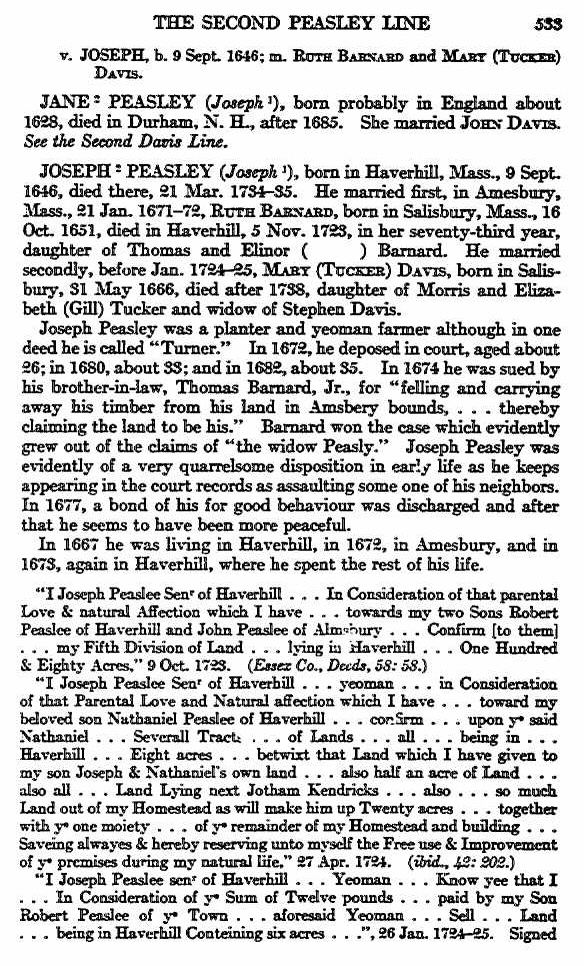
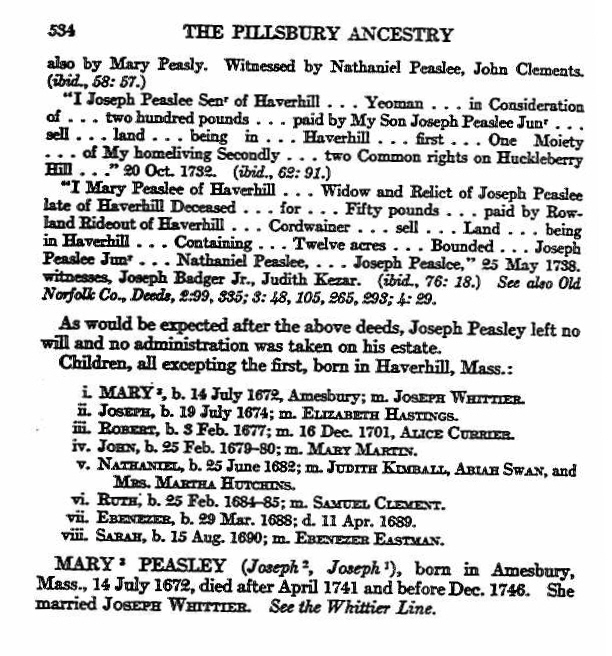
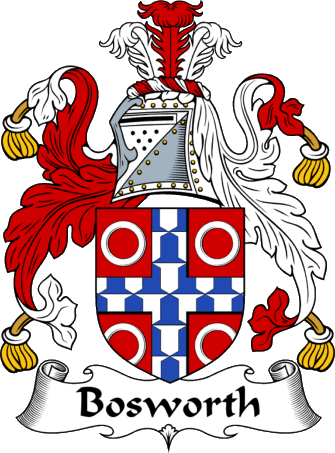
Joseph Bosworth Coat of Arms

Joseph Bosworth was born 1574 in Holgrave, Nottinghamshire, England.  He married  Alice [__?__] 1605 in Southwell, Nottingham, England.

Alice [_?__] was born in 1578 in Southwell, Nottingham, England.

Some genealogies say that Hanniel was Susannah’s father and not her brother and he was born in 1589 in Boston, Lincolnshire, England instead of 1615.  These genealogies move his marriage to Abigail Scott up to  17 Mar 1614 in England instead of 17 Mar 1654.  They also change Abigail’s birth to 5 Mar 1591 in Rattlesden, Suffolk, England.   In both versions Hanniel died 25 Sep 1683 in Ipswich, Essex, Mass. and Abigail died 1684 in Ipswich, Essex County, Mass.

There is no known relationship between this Bosworth lineage and that of another of our immigrant ancestors Edward BOSWORTH who came to New England, with his family, in the spring of 1634 and settled in Hingham, Ma.. An interesting coincidence is that Edward Bosworth came on the ship “Elizabeth and Dorcas”; the name Dorcas is rather unique and this dual usage of the name, i.e., the name of the ship versus our ancestor “Dorcas” Bosworth, does catch your attention.

Children of Joseph and Alice:

Name Born Married Departed
1. Alice Bosworth 1606,
Southwell or Arnold, Nottingham, England
Richard Hutinson
7 Dec 1627
Cotgrave, Nottingham, England
1668 Salem, Mass.
2. Susanna BOSWORTH c. 1609
Boston, Lincoln,  England
Theophilus SHATSWELL
c. 1640
Haverhill, Mass
8 Oct 1672
3. Zaccheus Bosworth? 1614
Stowe, Nine Churches, Northhampton, England
28 Jul 1655
Boston, Mass.
4. Hanniel Bosworth 1615
Boston, Lincoln, England
Abigail Scott
(daughter of our ancestor Thomas SCOTT)
17 Mar 1654
Essex, Mass.
25 Sep 1683
5. Dorcas Bosworth c. 1625
Haverhill, Lincoln, England
Edward Clark
20 Aug 1648 Haverhill, Mass
13 Feb 1680/81
Haverhill, Mass

x

Children

1. Alice Bosworth

Alice’s husband Richard Hutinson was born 1602 in Arnold or Newark, Nottinghamshire, England. His parents were Thomas Hutchinson (1565 – 1618) and Alice [__?__] (1571 – 1618). Richard died 7 Dec 1682 in Salem, Essex, Mass.

Richard’s date of his birth is ascertained from a deposition on file in the office of the Essex County Court, Salem, Mass., where in a case of Cromwell vs. Ruck, 1660, he states his age as being 58 years. He married his wife Alice Bosworth on 7 Dec 1627, in Cotgrave, Nottinghamshire. His first four children, Alice, Elizabeth, Mary and Rebecca, were born in England, all except Rebecca in Nottinghamshire.

He emigrated to America in 1634, with his wife Alice, and four children, and settled in Salem Village, now Danvers, in the vicinity of Whipple and Hathorne’s hill. There is some evidence, however, gleaned from the town records of Salem, that he may have primarily settled in the town proper, from the fact that in July 25, 1689, one Philemon Dickerson was granted four poles of land “neere Richard Hutchinson’s house, to make tan pitts and to dress goates skinnes and hieds.” As tanning was not known to have been carried on in Salem Village at so early a period, much time has been spent in discovering this locality, but without avail; as after this, his name seems to have disappeared from the records of Salem.

He and his wife were members of the First Church, Salem, as early as 1636, on whose records he is first mentioned in connection with the baptism of his daughter Abigail.

The first official notice made of him is in the town records, when it is stated that in recognition of his public spirit, as being the possessor and introducer of the first plow brought into this country, he was granted one hundred and forty acres of land by the town authorities.

In 1636, Mr. Hutchinson received a grant of 60 acres of land from the town, and Apr. 3, following, 20 acres more. In the same year he was appointed on a committee to survey Jeffrey’s Creek (now Manchester), and Mackerell Cove. April 17, 1637, it was voted “that in case Ric’d Huchenson shall sett up plowing within 2 years he may haue 20 acres more to bee added to his pportion.” This appears to be in consequence of the great scarcity of ploughs, there being but thirty-seven in all the settlements. In 1648, at Salem Village, he bought of Elias Stileman, his farm of 150 acres, for £15. He then sold half of it to Nathaniel Putnam in 1651.

After his first wife’s death, he married Oct. 1668, Susanna, widow of Samuel Archard.

The records do not show him to have been officially engaged in many matters of public trust, but he was undoubtedly a man of indomitable perseverance, great vigor of mind and physical endurance, a strict disciplinarian in religious affairs, a thorough agriculturist, and as he had amassed a large landed estate, he had, before the close of his life, divided much of his property among his children.

On the decease of James Standish, Mr. Hutchinson was appointed administrator. Richard later married his widow, Sarah Standish. At his third marriage he must have been at least 79 years of age, and certainly 66 on his second.

His will was signed Jan. 19, 1679, and proved Sept. 28, 1682. He died on 11 Feb. 1681/1682. His widow survived him, and shortly after married for her third husband, Thomas Roots, of Manchester, whose Will was proved Nov. 27, 1683. She was living as late as March 1683-4.

His will stated in part that his wife was to be made comfortable for one of her age by Richard¹s son Joseph; to have what she had when they married if she wished to remove; he bequeathed property to son-in-law Anthony Ashby and daughter Abigail, his wife; son-in-law Daniel Boardman and daughter Hannah, his wife; sons-in-law Nathaniel Putnam, Thomas Hale and James Hadlock; grandchildren Bethia Hutchinson and Sarah Hadlock; servant, Black Peter. His son Joseph was appointed executor.

2. Susanna BOSWORTH (See Theophilus SHATSWELL‘s page)

4. Hanniel Bosworth

Hanniel’s wife Abigail Scott was born 5 Mar 1623/24 in Rattlesden, Suffield, England and died 1684 in Ipswich, Massachusetts. Her parents were Thomas SCOTT and Elizabeth STRUTT .  Abigail died after 1684 in Ipswich, Essex, Mass

Thomas Scott was baptized at Rattlesden, Suffolk, 26 Feb 1594/95, son of Henry Scott. He married in Rattlesden, Suffolk, 20 July 1620 Elizabeth Strutt, baptized at Rattlesden, Suffolk, on 16 May 1594, daughter of Christopher Strutt.   He came from Rattlesden, Suffolk to Massachusetts Bay in 1634 on the “Elizabeth” of Ipswich & settled in Ipswich. Thomas died between 8 Mar 1653/54 (date of will) and 17 Mar 1653/54 (date of inventory).

(On 30 April 1634, “Thomas Skott,” aged 40, “Elizabeth his wife,” aged 40, “Martha Scott,” aged 60, “Elizabeth Scott,” aged 9, “Abigail Scott,” aged 7, and “Thomas Scott,” aged 6, were enrolled at Ipswich as passengers for New England on the Elizabeth).

Hanniel  Bosworth was born ca 1615 in Boston, Lincolnshire area according to his disposition made in 1681.  A lawsuit tried in 1645 in Ipswich, Mass left a record of his immigration.  In 1638 a Mr. John Whittingham of Southerton, Lincs. was contemplating a removal to New England with his mother. Mr. Whittingham negotiated with a number of young men, in the area of Boston, Lincolnshire, to come to New England with him as apprentices. They were to serve ten years in exchange for their passage and resulting living expenses. After arrival in New England, some of the apprentices served their ten years and went on to other endeavors. Hanniel Bosworth was one of these apprentices and remained in the service of John Whittingham and he was a witness to the John Whittingham’s will in 1648. Hanniel was one of only four people, outside the immediate family, to receive a legacy from this will.

5. Dorcas Bosworth

Dorcas’ husband Edward Clark was born 11 March 1622 in England. Edward died 19 Dec. 1710 at Portsmouth, NH at 88 years of age. The name of his parents and the location of his birthplace in England is unknown.

Sources:

http://trees.ancestry.com/owt/person.aspx?pid=409846&st=1

http://trees.ancestry.com/tree/14131284/person/61173098?ssrc=

http://trees.ancestry.com/tree/10669018/person/31596081

Posted in 13th Generation, 14th Generation, Line - Miller, Line - Shaw | Tagged | 5 Comments

Henry Lawrence

Henry LAWRENCE (1586 – 1664) was Alex’s 12th Great Grandfather; one of 8,192 in this generation of the Shaw line.

Lawrence – Coat of Arms – Immigrant Ancestor

Henry Lawrence was baptized 10 Apr 1586 in Wissett, Suffolk, England. His parents were John LAWRENCE and Joan FRUSTENDEN.   He married Mary WEST in 1608 in Wissett, Suffolk, England.   He came to the American Colonies in 1630. Henry and his wife, Mary West were the first Lawrence’s to come over from England.  Henry died 2 Jun 1664 in Charlestown, Suffolk, Mass.

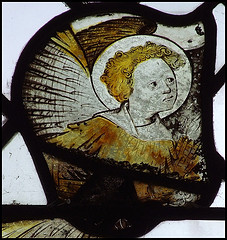
Angel – St Andrew, Wissett, Suffolk, England

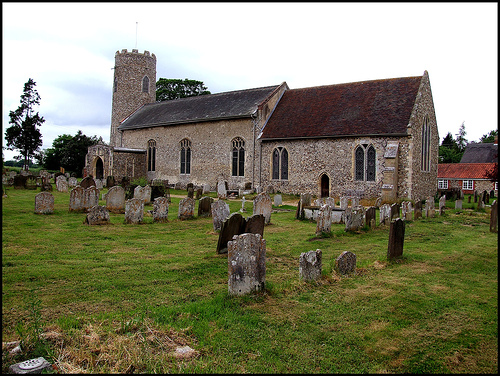
Henry was baptized and married at St Andrew Church, Wissett, Suffolk, England

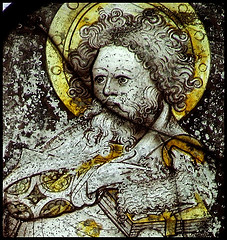
15th C Norwich School Glass, St Andrew, Wissett, Suffolk, England

Mary West was born in 1579 in Wisset, Suffolk, England. Mary died 3 May 1647 in Charlestown, Suffolk, Mass.

Children of Henry and Mary:

Name Born Married Departed
1. John LAWRENCE baptized on 8 Oct 1609 in Wisset, Norwich, Suffolk, England Elizabeth COOKE
1635 Watertown, Mass
.
Susanna Batchelder
2 Nov 1664 Charlestown, Middlesex, Mass
11 Jul 1667 Groton, Mass
2. Robert Lawrence 6 Sep 1612 in Wisset Norwich, Suffolk, England Elizabeth [_?_]
1637 in England
1666
Nansemond, Virginia

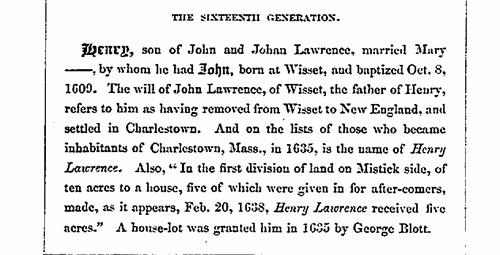
Henry’s father’s will records that he had removed to New England.

Henry is on the lists of those who became inhabitants of Charlestown, Mass in 1635.

In the first division of land on the Mystick side, of ten acres to a house, five of which were given in for after-comers, as it appears 20 Feb 1638, Henry Lawrence received five acres.

Mystick Side, originally part of Charlestown, was renamed Malden.  It is a  hilly woodland area, north of the Mystic River, that was settled by Puritans in 1640 on land purchased in 1629 from the Pawtucket Indians. Malden was incorporated as a separate town in 1649. In 2009 Malden was ranked as the “Best Place to Raise Your Kids” in Massachusetts by Businessweek Magazine

Malden, Middlesex, Mass

A Genealogical Memoir of the Families of Lawrences with a Direct Male Line from Sir Robert Lawrence of Lancashire AD 1190 down to John Lawrence of Watertown AD 1636, Mercy Hale, Boston, 1856, p3:

“His only son, Robert, succeeded to the estates, and left a son John, whose will is dated in 1556, in which year he died, leaving sons Henry, John, William of St James Park, and Richard. John, the second son, died in May, 1590. In his will he speaks of his old age. His eldest son, John, settled at Wisset, where he made his will, and dying in 1607, was succeeded by his eldest son, Henry, alsoof Wisset, who had two sons, John and Robert. John, the eldest, was baptized October 8, 1609, and about the year 1630, came to New England, (probably with his father, ) and settled at Watertown, from whence he removed to Groton, where he died July 11, 1661, aged 58…

Sources:

Henry Lawrence – Bio

http://trees.ancestry.com/owt/person.aspx?pid=11150992&st=1

http://trees.ancestry.com/tree/16240437/person/429567140


Posted in 14th Generation, Historical Church, Immigrant - England, Line - Shaw, Pioneer | Tagged , | 8 Comments

John Lawrence

John LAWRENCE (1609 – 1667) was Alex’s 11th Great Grandfather; one of 4,096 in this generation of the Shaw line.

John Lawrence was baptized on 8 Oct 1609 in Wissett, Norwich, Suffolk, England. His parents were Henry LAWRENCE and Mary WEST. He emigrated to America about 1630. He probably was one of a large party under Governor Winthrop which sailed from England that year.   He married Elizabeth COOKE 1635 in Watertown, Mass. After Elizabeth died, he married Susanna Batchelder 2 Nov 1664 in Charlestown, Middlesex, Mass. John died 11 Jul 1667 in Groton, Mass.

Groton, Mass was officially settled and incorporated in 1655, named for Groton in Suffolk, England  John Lawrence was an original land proprietor and served on the first Board of Selectmen.

Elizabeth Cooke was born in 9 Dec 1610 in Wisset Norwich, Suffolk, England or baptized 8 Sep 1611 in Bridport, Dorset, England.  Her parents were Aaron COOKE and Elizabeth CHARDE.  Alternatively, Elizabeth’s surname was Waters or Kettleborough.  Elizabeth died 29 Aug 1663 in Groton, Mass.

Susanna Batchelder was born in 1642 in Groton, Middlesex, Mass. Her parents were  William Batchelder and Jane Cowper.  Her grandparents were Rev. Stephen BACHILLER and Deborah BATES.  Susanna died 8 Jul 1668 in Groton, Middlesex, Mass.

Children of George and Elizabeth:

Name Born Married Departed
1. George LAWRENCE 1637
Watertown, Middlesex, Mass
Elizabeth CRISPE
29 Sep 1657 Watertown, Mass.
.
Elizabeth Holland
16 Aug 1691 Watertown, Mass.
21 Mar 1708/9 in Watertown, MA.
2. Deacon Nathaniel Lawrence 15 Oct 1639 Watertown Sarah Morse
13 Mar 1661 Sudbury, Mass
.
Sarah Smith
Aft 10 Dec 1717 in Charlestown End, now Stoneham, Middlesex, Mass.
14 Apr 1724
Stoneham, Mass
3. Joseph Lawrence 30 May 1643 Watertown Rebecca Freeman
1671 in Groton, Mass.
14 Nov 1685
Watertown
4. Jonathan Lawrence Apr 1644 Watertown, 6 Apr 1648
Watertown
5. Mary Lawrence 16 Jul 1645 Watertown Inego Potter
25 Aug 1663 Charlestown
10 Feb 1687
6. Peleg Lawrence 10 Jan 1646/47
Watertown, Middlesex, Mass
Elizabeth Morse
22 Dec 1668
Medfield/ Groton, Middlesex, Mass.
14 Feb 1692/93
Groton, Middlesex, MA
7. Enoch Lawrence 5 Mar 1648 Groton, Mass Ruth Whitney
6 Mar 1677 Watertown
28 Sep 1744
Groton
8. Samuel Lawrence 1650
Groton
Rebecca Luen
14 Sep 1682 Watertown
1714
9. Isaac Lawrence 1652
Groton
Abigail Bellows
19 Apr 1682 Watertown
19 Apr 1731
Watertown
10. Elizabeth Lawrence 9 May 1655 Boston Thomas Whitney
29 Jan 1679 Watertown
2 Feb 1742
Bolton, Mass
11. Jonathan Lawrence 1657
Watertown, Middlesex, Mass.
Rebeckah Rutter 19 Sep 1729
Groton, Mass.
12. Zechariah Lawrence 9 Mar 1658 Watertown Apr 1667
Watertown

.

Children of John and Susanna Batchelder:

Name Born Married Departed
13. Abigail Lawrence 9 Jan 1666
Groton, Mass
Feb 1670
Groton, Middlesex, Mass
14. Susanna Lawrence 3 Jul 1667
Groton, Mass.
John Knowles
1686
Hampton, Rockingham, New Hampshire
17 Oct 1745
Hampton, Rockingham, New Hampshire

John Lawrence was a carpenter. He  emigrated in 1630 from England, possibly with Governor Winthrop.

c. 1635 – He moved to Watertown, Massachusetts.

1636 – John Lawrence was a proprietor at Watertown, Massachusetts.

28 Feb 1636 – He received three acres of land, his share of a grant then made to the townsmen, one hundred and six in number.

9 Mar 1636/37 – He became a freeman at Watertown, Massachusetts when about 28 years old.

1639 – He was mentioned in the disposition of Robert Lawrence at England.

1650 – He bought fifteen acres of common land (called King’s Common).

1654 – There is a record of Hug Mason who received of John Lawrence, clerk, £2 17s. 6d. money for town or parish use.

1662 – John Lawrence moved to Groton, Massachusetts.  The sale of his lands and mansion house was made in 1662. In 1662 he moved to Groton where in December of that year he appears by the records of Groton “meet men were found amongst the inhabitants” and where he was an original land proprietor and served on the first Board of Selectmen.


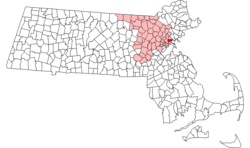
Location of Groton in Middlesex County

Dec 1662 – He served at Groton, Massachusetts, as a Selectman.

2 Nov 1664 – Charlestown, Massachusetts, John married Susanna Batchelor, daughter of William Batchelor.

11 Jul 1667 – John Lawrence died on Monday at Groton, Massachusetts, at age 57 years, 9 months and 3 days.

John evidently was a man of some intelligence and influence, and held a good place in the public esteem. Thought a large land holder for the times, he is said to have carried on the business of a carpenter both in Watertown and Boston.

Children 

1. George LAWRENCE (See his page)

2. Deacon Nathaniel Lawrence

Nathaniel’s first wife Sarah Morse was born 16 Sep 1643 in Dedham, Norfolk, Mass. Her parents were Joseph Morse and Hannah Phillips. Sarah died 29 Aug 1683 in Groton, Middlesex, Mass.

Nathaniel’s second wife Sarah Smith was baptized 4 Aug 1661 in Charlestown, Suffolk Co., Mass.

Appointed ensign of the militia April 1673, and a member of the General Court, 1692.  Lived In Groton, Mass. For 30 years before moving to Charlestown Farms, Charlestown, Mass when  advanced in years.

1st President Calvin Coolidge (1872 – 1933)
2nd John Calvin Coolidge (1845 – 1926)
3rd Calvin Galusha Coolidge (1815 – 1878)
4th Calvin Coolidge (1780 – 1853)
5th Hannah Priest (1751 – 1829)
6th Hannah Lawrence (1721 – 1757)
7th Jonathan Lawrence (1696 – 1763)
8th Nathaniel Lawrence Jr. (1661 – 1737)
9th Nathaniel Lawrence (1639 – 1724)

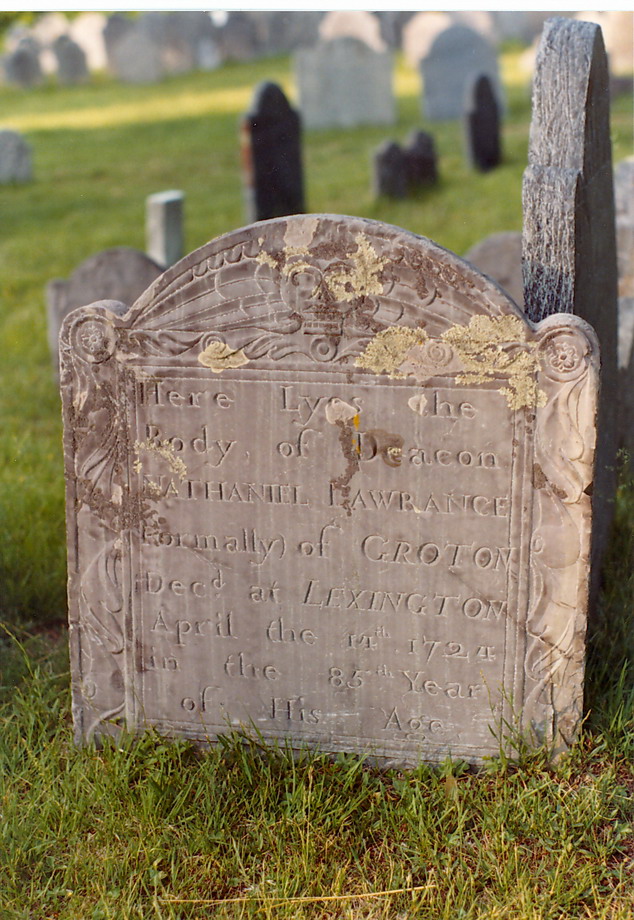
Nathaniel Lawrance Headstone — Old Burying Ground Lexington Middlesex County Massachusetts, Plot: C. 83

Old Burying Ground Lexinton Mass
Grave Stone Inscription:
Here Lyes the
Body of Deacon
Nathaniel Lawrance
Normally of Groton
Dec.d at Lexington
April the 14th 1724
In the 85th Year
of His Age

3. Joseph Lawrence

Joseph’s wife Rebecca Freeman was born 1643 in Groton, Middlesex, Mass. Rebecca died Sep 1731.

5. Mary Lawrence

Mary’s husband Inego Potter was born Jan 1640 or 1645 in Charlestown, Mass. Inego died 1700 in Charlestown, Mass

6. Peleg Lawrence

Peleg’s wife Elizabeth Morse was born 01 Sep 1647. Her parents were Joseph Morse and Hannah Phillips. Elizabeth died 12 Jun 1715.

Early Records of Groton, pg 64;
” in groten 16 June 1681 thar is layed for Palig Loranc and ajoying too and bounding upon the south by swan pond medow Eleuen acers and a half lauing Rome Round his medow acordin too Town order and bounded upon other sids by the Comon

allso 8 ayte ackers and a halfe a litil distant northword and bounded on all sides by comon land the lins being extant by marked trees and stakes

This too parsils of land ware layd by me John fflint
            Recorded by me      John Mors, Clarke
This aboue written of Peleg Lawrances land by Agreement is by Peleg Laurance relinquished & yeild to Mr. Hobart; March 8th 1681/2 in ye presence of ye select men”

Early Records of Groton, pg 183;
THE LANDS OF PELLEG LAWRANCE.
1. Ten acres, more or lesse, lyeing on the north side of Spedteckle Pond, bounded on all poynts by the towne’s comon.

1. Ten acres, more or lesse, lyeing on by the Cowpond Medow, bounded east by the lands of Nathaniel Lawrance, and on all other poynts by the town’s comon.

7. Enoch Lawrence

Enoch’s wife Ruth Whitney was born 15 Apr 1645 in Watertown, Middlesex, Mass. Her parents were John Whitney and Ruth Reynolds.  She married first John Shattuck on June 20, 1664 in Watertown MA.   She married 2nd Enoch Lawrence on March 6, 1677 in Watertown MA.  Ruth died 28 Sep 1744 in Watertown, Middlesex, Mass.

In King Philip’s War, John Shattuck was a sergeant of a military company raised in Watertown to protect the remote settlements in the Connecticut valley. On one of the marches the company was attacked by Indians and more than half of the command were slain. Sergeant Shattuck was deputed to bear the news of the affair to the Governor of the Colony, and on his way, while crossing the ferry between Charlestown and Boston, Sep. 14, 1675 the boat was sunk and he was drowned.

8 May 1709 – Enoch Lawrence, was wounded in an engagement with the Indians and was disabled for life. His step-son, John Shattuck, step-grandson John Shattuck, Jr. the latter a young man about 19 years of age, were shot and killed by the Indians while they were returning from the west side of the Nashua River, near where the Hollingsworth paper mills now [1893] stand.

13 Sep 1692 – John Shattuck’s father-in-law James Blood, was killed by the Indians, as were his wife’s uncle, William Longley , Longley’swife and five children, while three of the children were carried off into captivity. A relative of Mrs. Shattuck, James Parker, Jr. and his wife, were also killed at the time of the Longley massacre, and their children were also taken prisoners, the Indians having learned by that time that if they could bear the hardship and exposure of the march, children had a certain commercial value with the French settlers in Canada.

Soon after his marriage Enoch removed to Groton, and settled in the north part of the town. The exact location of his hose is not now known. He served the town as a surveyor of highways, tithing-man and fence-viewer. He was also chosen a “hog constable” in 1691. In the year 1702 the Provencial authorities granted him immunity from taxation, and a pension of three pounds sterling yearly, on account of physical disability contracted in an encounter with the savages during King William’s war. He lived to extreme old age.

The following description of a portion of his real estate is from the third volume of Groton Land Records: —

“The Lands of ENOSH LAWRENCE: (I) His houslot Ninteen acres mor or Lesse Bonded east upon his own medow and on all other poynts by the highwayes[;] twelve and a half of this land he had of his Brother Zachary and Seavin acres he had of his Brother Joseph Lawrance.”

ENOSH LAWRENCE had also twenty-five acres “near the Silver mine,” ten acres at Babbitasset, and three acres and a half in Half-Moon meadow.

8. Samuel Lawrence

Samuel’s wife Rebecca Luen was born 1653 in Watertown, Middlesex, Mass. Rebecca died in 1720.

9. Isaac Lawrence

Isaac’s wife Abigail Bellows was born 6 May 1661 in Concord, Middlesex, Mass. Her parents were John Bellow and Mary Woods. Abigail died 13 Sep 1726 in Norwich, New London, CT.

10. Elizabeth Lawrence

Elizabeth’s husband Thomas Whitney was born 24 Aug 1656 in Watertown, Middlesex, Mass. His parents were Thomas Whitney and Mary Kendall. Thomas died 12 Apr 1742 in Lancaster, Worcester, Mass.

11. Jonathan Lawrence

Jonathan’s wife Rebeckah Rutter (Butter) died 16 Feb 1724 in Groton, Middlesex, Mass.

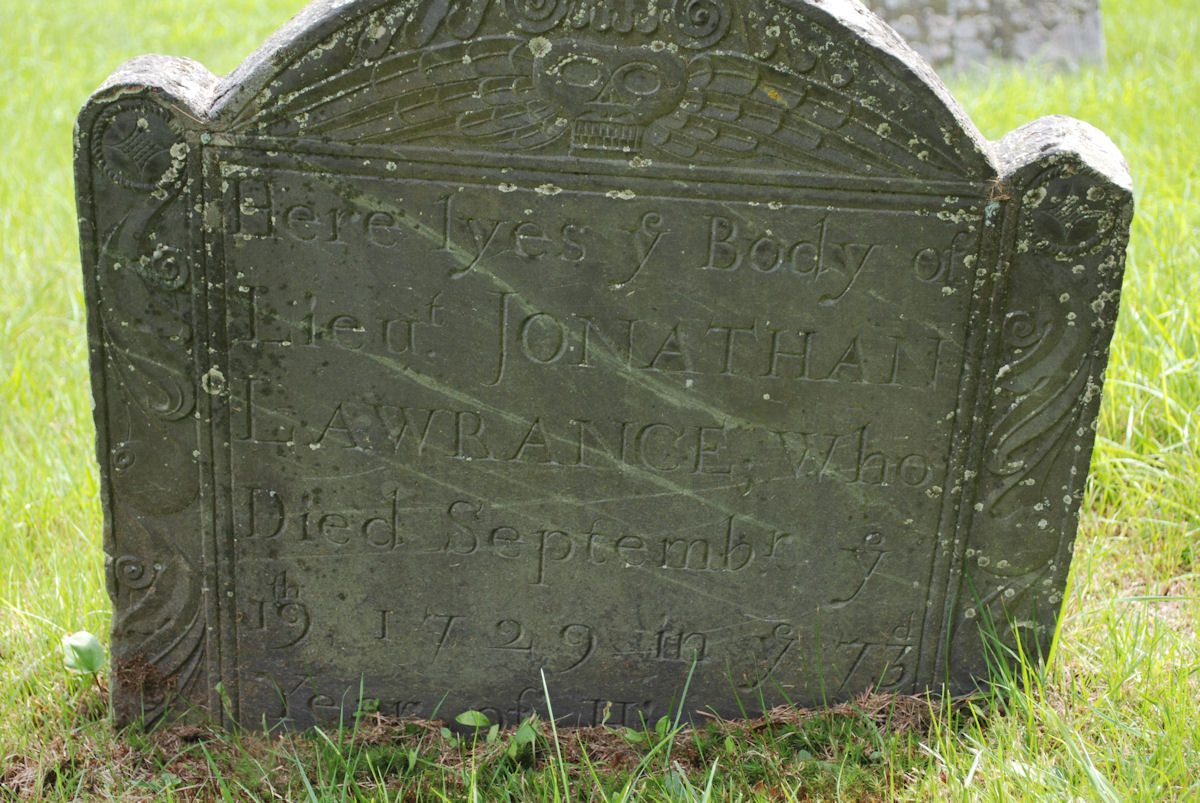
Jonathan Lawrance Headstone — Old Burying Ground Groton Middlesex County Mass.

14. Susannah Lawrence

Susannah’s husband John Knowles was born 6 Feb 1661 in Hampton, Rockingham, New Hampshire. His parents were John Knowles and Jemima Austin. John died 1733 in Hampton, Rockingham, New Hampshire.

Sources:

http://trees.ancestry.com/owt/person.aspx?pid=3870408&st=1

http://rjohara.net/gen/cards/wc01_087.html

http://familytreemaker.genealogy.com/users/l/a/w/James-T-Lawrence/GENE2-0002.html


Posted in 13th Generation, Immigrant - England, Line - Shaw, Pioneer, Public Office, Violent Death | Tagged , | 7 Comments

Edward Harraden

Edward HARRADEN (1624 – 1683)  was Alex’s 10th Great Grandfather; one of 2,048 in this generation of the Miller line.
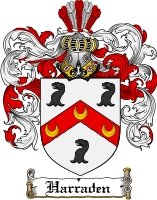
Edward Harraden – Coat of Arms

Edward Harraden was born about 1624 in Edburton, Sussex, England. His parents were Jonathan HARRADEN and [__?__]. A few sources state that Edward’s father died in Salem, Mass. in 1630, but I can’t find evidence to support this assertion.  Edward married Sarah [__?__].    He came to America from either Petworth parish, Storrington parish, or Edburton Parish, all in Sussex, England.  He was one of the first residents of Annisquam, a small waterfront neighborhood located in the City of Gloucester located on the North Shore of Massachusetts.  Edward died on 17 May 1683 in Gloucester, Mass.
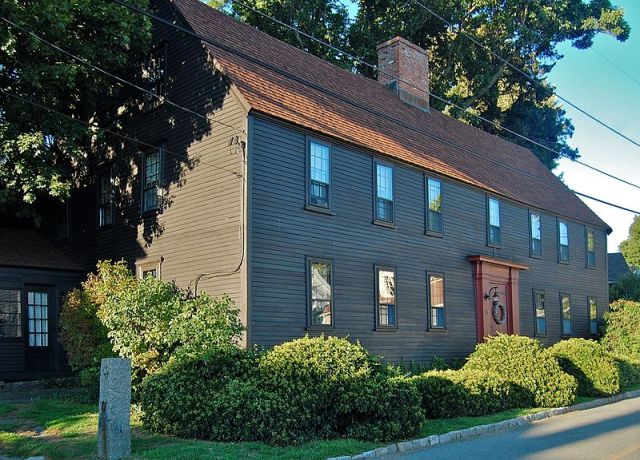
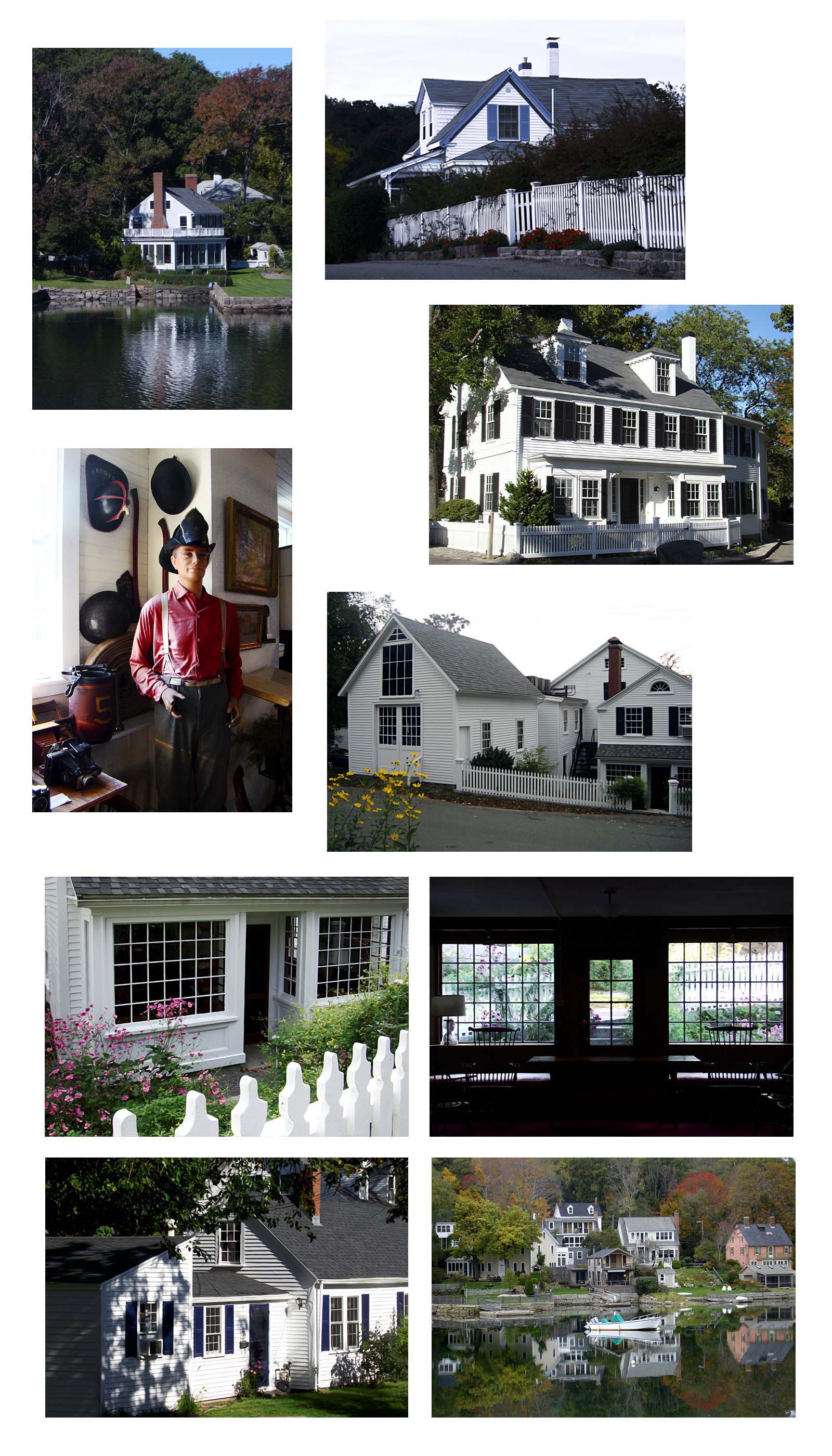
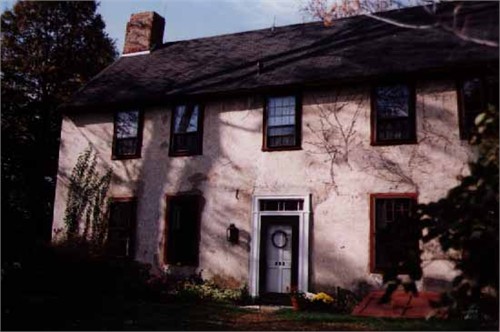
Edward Harraden house at 12-14 Leonard Street, Gloucester, Mass  The house was built in 1660 and added to the National Register of Historic Places in 1990.

Sarah [__?__] was born in 1630 in England.  Sarah died 4 Mar 1691 in Gloucester, Mass.

Children of  Edward and Sarah:

Name Born Married Departed
1. Mary Harrandaine 1649 Gloucester, Essex, Mass Abraham Robinson
7 Jul 1668 Gloucester
28 Sep 1725
Gloucester, Essex, Mass
2. Edward Haraden 1650
Gloucester
Sarah Haskell
5 Feb 1684 Gloucester
.
Hannah York in 1693
1727
Gloucester
3. Elizabeth HARRADEN 1656 Gloucester Thomas PRINCE Jr.
27 Sep 1676 Gloucester, Mass
14 May 1716 Gloucester
4. Andrew Harraden 13 Feb 1658 Gloucester 21 Apr 1688
Gloucester
5. Ann Harraden 1661 Gloucester John Davis
6 Jan 1685 Gloucester
1729
Gloucester
6. John Harraden 7 Aug 1663 Gloucester Sarah Giddlings
7 Feb 1694 Gloucester
11 Nov 1724
Gloucester
7. Thomas Harradaine 8 Sep 1665 Gloucester 26 Apr 1683
Gloucester
8. Joseph Harraden 18 Aug 1668 Gloucester Jane Giddings
26 Nov 1691 Gloucester
.
Hannah Stevens
1 Feb 1700 Gloucester
19 Nov 1716
Gloucester
9. Sarah Harraden 30 Jul 1670 Gloucester 3 Sep 1672
Gloucester
10. Benjamin Harraden 11 Sep 1671 Gloucester Deborah Norwood
15 Jan 1696 Gloucester
3 Feb 1725
Gloucester

It is possible that Edward was originally an O’Hara from Ireland, and changed his name in England.

Edward came to Gloucester from Ipswich and in 1657, he bought a house, barn and all of his land, from Robert Dutch. Part of this property was on Planter’s Neck, where Dutch had a fishing-stage. Haraden added to his possessions at this place by subsequent purchases, and appears to have been the first permanent settler in that section of town. The place of his residence and business was undoubtedly Annisquam Point.

Click Here for a Google Satellite View of the Edward Harraden House on 14 Leonard Street on Annisquam Point, Gloucester, Mass.  Check out all the boats
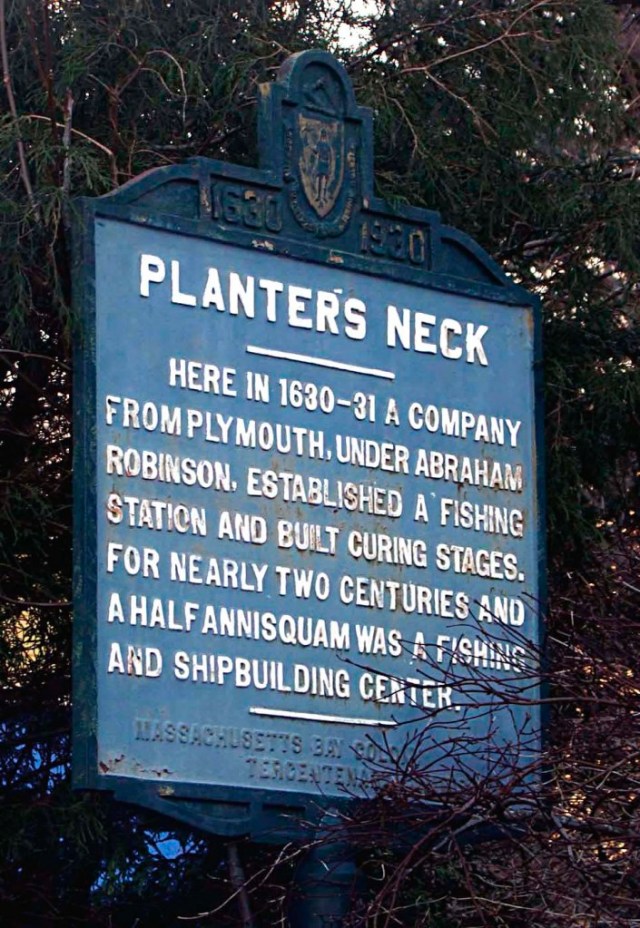
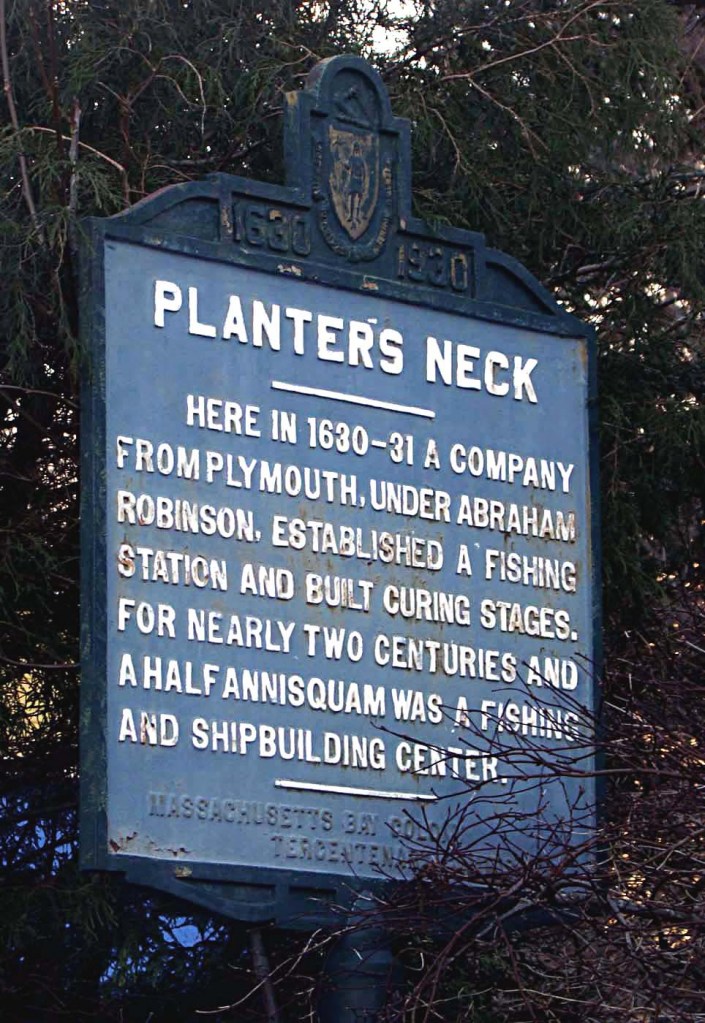
Plaque at Planters Neck, Gloucester, Mass from 1930, acknowledging its tercentennial.

Planters Neck is the peninsula portion of Annisquam, west of Lobster Cove, with convenient access to Mill River (which was impounded in the 17th century to provide the first water power for milling corn), the Annisquam River and Ipswich Bay.  It was divided up into house lots by the early settlers, or planters.  Copeland and Rogers write that:

“One of the generally accepted stories about the early settlement of the Cape is that in 1631 a band of Pilgrims came across Massachusetts Bay and settled at Planters Neck, where they set up a fishing stage.  The leader of that band is said to have been Abraham Robinson, and it also has been generally accepted that he was the son of Reverend John Robinson who had been pastor of the Pilgrims in Holland before they migrated to Plymouth.

Gloucester was founded at Cape Ann by an expedition called the “Dorchester Company” of men from Dorchester(in the county of Dorset, England) chartered by James I in 1623. This date allows Gloucester to boast the first settlement in what would become the Massachusetts Bay Colony, as this town’s first settlement predates bothSalem, Massachusetts in 1626, and Boston in 1630. This first company of pioneers made landing at Half Moon Beach, and settled nearby, setting up fishing stages in a field in what is now Stage Fort Park. This settlement’s existence is proclaimed today by a memorial tablet, affixed to a 50′ boulder in that park.
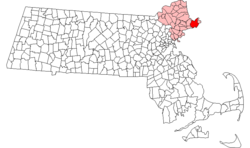
Gloucester, Essex, Mass

Life in this first settlement was harsh and it was short-lived. Around 1626 the place was abandoned, and the people removed themselves to Naumkeag (what is now called Salem, Massachusetts), where more fertile soil for planting was to be found. The meetinghouse was even disassembled and relocated to the new place of settlement. At some point in the following years – though no record exists – the area was slowly resettled. The town was formally incorporated in 1642. It is at this time that the name “Gloucester” first appears on tax rolls, although in various spellings. The town took its name from the city of Gloucester in South-West England, where it is assumed many of its new occupants originated.

The first European settlement in Annisquam was established in 1631, and the name is said to derive from Ann (as in Cape Ann) and squam, meaning harbor. In the late 19th-century, it was home to both granite quarrying and an artist colony, which attracted painters including George Loftus Noyes and Margaret Fitzhugh Browne.
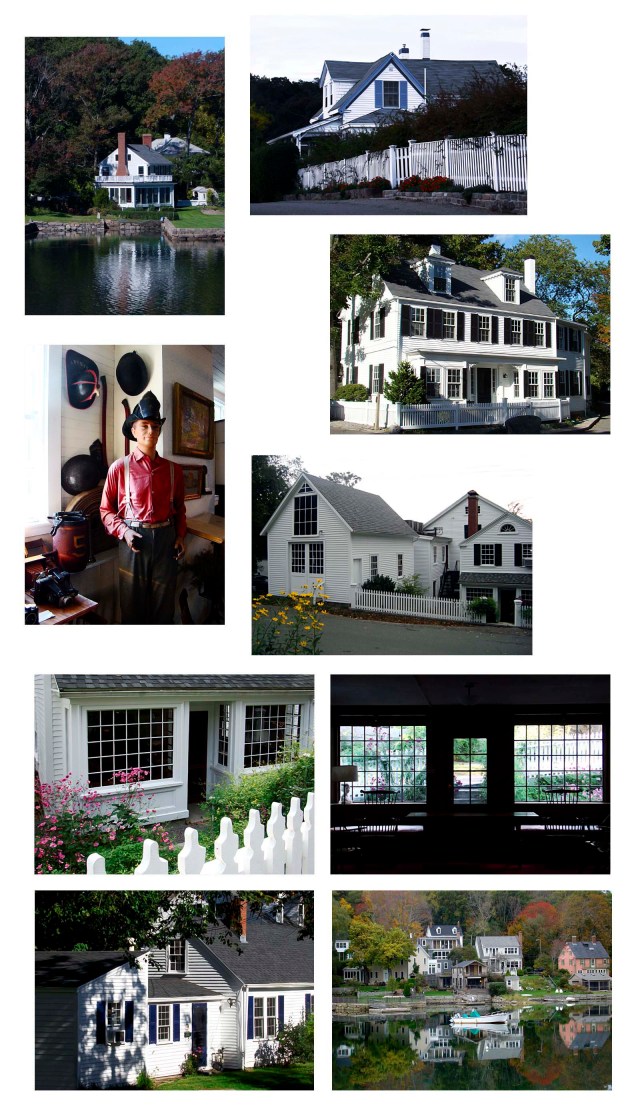
Annisquam Village

A few miles across Cape Ann from downtown Gloucester, Annisquam is primarily a residential neighborhood. Its only businesses include a restaurant and marina, a small hotel, a real estate company, a library and the Annisquam Yacht Club, founded in 1896. Because of its small size, historic architecture and secluded geography, Annisquam remains a popular summer resort.

At the mouth of the Annisquam River on Ipswich Bay is Annisquam Harbor Light, perhaps the village’s most historic edifice. The lighthouse has been in the same spot since 1801, having undergone significant repairs in 1850.

23 Sep 1666 Ipswich Court – Edward Harraden v. James Steevens and Anthony Day. Verdict for plaintiff.*

‘William Hascall, jr., deposed that the constable’s deputy of Cape Ann came to him when at work and charged him with his black staff to assist him in his Majesty’s name. They went to Goodman Harridine’s dock where there were two loads of hay on canoes. Then James Steevens and Anthony Day, the deputy, carried away the hay, etc. Sworn in court.

William Linkhorne deposed. Sworn in court.

Clemant Couldum deposed that he and Thomas Riggs were coming down Annisquam river and saw the deputy with the hay, etc. Also for need of hay Goodman Harridine’s cattle were so poor that they could hardly go in the spring, etc. Sworn in court.

William Linkhorne deposed that Edward Harridine was fain to give his cattle wheat for want of hay, and that one of his cattle and four calves died, etc. Sworn in court.

Children

1. Mary Harrandaine

Mary’s husband Abraham Robinson was born 1644 in Gloucester, Essex, Mass. His parents were Abraham Robinson and Mary [__?__]. Abraham died 28 Dec 1724 in Gloucester, Essex, Mass.  It was a common saying that Abraham lived to be 102.

The Robinsons and their kin folk (1906) by Robinson Family Genealogical and Historical Association argues that Abraham’s grandfather was the famous Rev. John Robinson.  The main argument is since John had two sons Isaac and Jacob, he must have had an Abraham first because the Robinsons liked to name their children in patriarchal order.

John Robinson (1575 – 1625) was the pastor of the “Pilgrim Fathers” before they left on the Mayflower. He became one of the early leaders of the English Separatists, minister of the Pilgrims, and is regarded (along with Robert Browne) as one of the founders of the Congregational Church.

Known children of John Robinson and Bridget White:

  1. Ann, the oldest of the children, born at Norwich, and named in honor of her grandmother in Sturton, married Jan Schetter of Utrecht before 1622, so her name was not listed in the register. She was left a widow by the autumn of 1625.
  2. John, born in Scrooby in 1606, matriculated at the University of Leyden, April 5, 1633.
  3. Bridget, born at Leyden about 1608, married (1) John Greenwood, who studied theology at the University of Leyden in 1629. After his death, she married (2) William Lee of Amsterdam in 1637.
  4. Isaac, born at Leyden in 1610. Arrived in Plymouth Colony on the Lyon in 1631. Married (1) Margaret Handford; (2) Mary Faunce.
  5. Mercy, born at Leyden in 1612, was buried in 1623.
  6. Fear, born at Leyden in 1614, married John Jennings, Jr. in 1648 and lived her life in Leyden. He died in 1664, leaving three children. She died before May 31, 1670.
  7. Jacob, born at Leyden in 1616, married (name unknown). Died in May, 1638, and is buried in St. Peter’s Church.

2. Edward Haraden

Edward’s first wife Sarah Haskell was born 28 Jun 1660 in Gloucester, Essex, Mass. Her parents were William Haskell and Mary Tybott. Sarah died 4 Mar 1691 in Gloucester, Essex, Mass.

Edward’s second wife Hannah York was born  about 1664 in Gloucester, Essex, Mass. Her parents were Samuel York and Hannah [__?__]. Hannah died 4 Sep 1725 in Gloucester, Essex, Mass.

3. Elizabeth HARRADEN (See Thomas PRINCE Jr.‘s page)

5. Ann Harraden

Ann’s husband John Davis was born 10 Mar 1659/60 in Gloucester, Mass. His parents were James Davis and Mehitable [__?__]. John died 16 Mar 1729 in  Gloucester or Amesbury, Mass.

6. Captain John Harraden

John’s wife Sarah Giddlings was born 1672 in Ipswich, Essex, Mass. Her parents were John Giddings and Sarah Alcock. Sarah died 10 Oct 1722 in Gloucester, Essex, Mass.

John was one of the first settlers of Planters Neck, Cape Ann ; engaged, 1709, in service of the Colony ; was master of a sloop fitted out to take a supposed French privateer. In 1711 he was pilot of HMS Montague, (sixty guns, commanded by Sir George Walton) in the disastrous expedition against Canada and received an allowance from the General Court in 1774  [50 years after his death?]

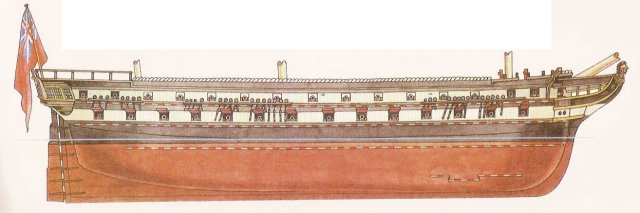
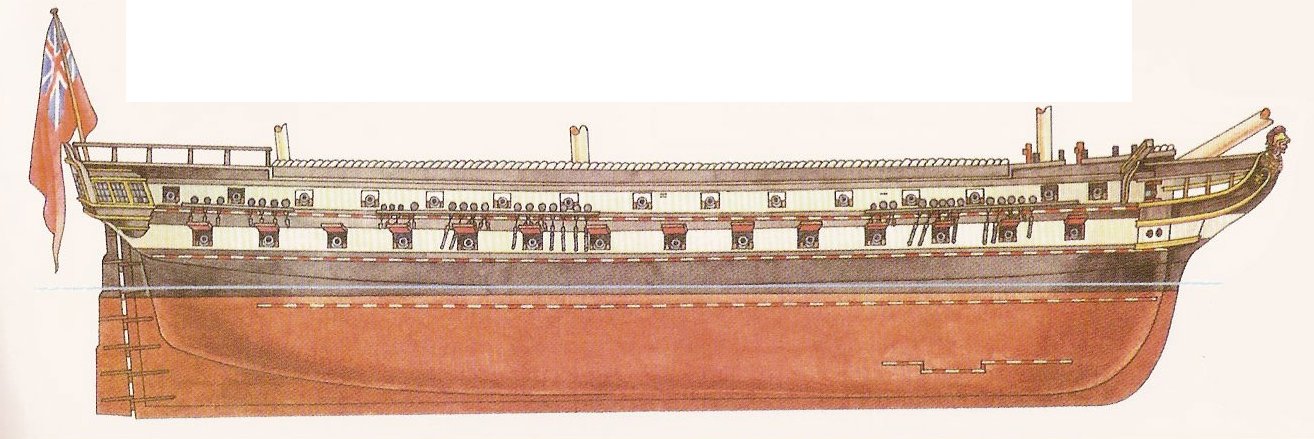
HMS Montague – Launched in 1654 as the Lyme a 52-gun third rate Speaker-class frigate built for the navy of the Commonwealth of England at Portsmouth  After the Restoration in 1660 she was renamed HMS Montague. She was widened in 1675 and underwent her first rebuild in 1698 at Woolwich Dockyard as a 60-gun fourth rate ship of the line. Her second rebuild took place at Portsmouth Dockyard, from where she was relaunched on 26 July 1716 as a 60-gun fourth rate to the 1706 Establishment.  Montague was broken up in 1749.

General characteristics after 1698 rebuild
Class and type: 60-gun fourth rate ship of the line
Tons burthen: 905 long tons
Length: 143 ft 10 in  (gundeck)
Beam: 37 ft 8 in
Depth of hold: 15 ft 4 in
Propulsion: Sails
Sail plan: Full rigged ship
Armament: 60 guns of various weights of shot.

A Fourth Rate, 60 gun Ship of the Line

third rate was a ship of the line which  mounted between 64 and 80 guns, typically built with two gun decks (thus the related term two-decker). Years of experience proved that the third rate ships embodied the best compromise between sailing ability (speed, handling), firepower, and cost. So, while first rates and second rates were both larger and more powerful, the third-rate ships were in a real sense the optimal configuration.

By contrast, Jack Aubrey’s Surprise was a 6th Rate with 28 guns.

During the voyage Walton and the Montagu captured two prizes. After the failure of the expedition, Walton returned to England and was appointed to act as commander-in-chief at Portsmouth in December 1712.

He returned to sea again when he was appointed to command HMS Defiance in early January 1718, followed by a return to his old ship, Canterbury. In the Canterbury he joined the fleet under George Byng and sailed for the Mediterranean. He had a large part in the Battle of Cape Passaro on 31 July 1718 and was given command of a detached five-ship squadron and sent to pursue a division of the Spanish fleet. Walton achieved a substantial victory with his small command, capturing six ships and destroying six more in the Strait of Messina. Modest in victory, he wrote to Byng on 5 August to inform him of his success, a letter described by The Gentleman’s Magazine as ‘remarkable for naval Eloquence’. It read

‘Sir, we have taken and destroyed all the Spanish ships which were upon the coast: the number as per margin’

This resulted in Thomas Corbett pronouncing him fitter to achieve a ‘gallant action’ than to describe one.
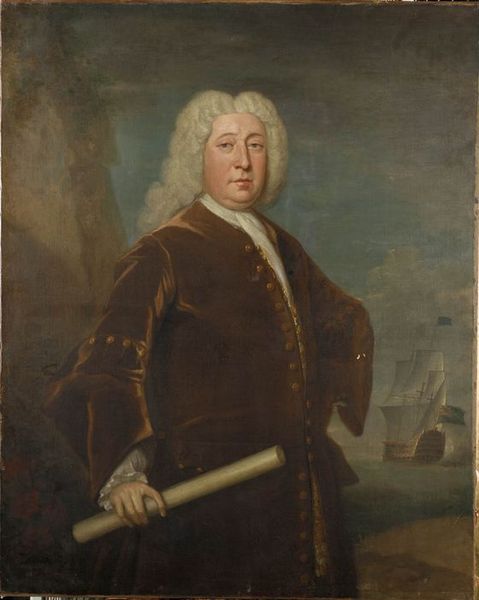
Sir George Walton (1665 – 1734) by Bartholomew Dandridge

The Quebec Expedition, or the Walker Expedition to Quebec, was a British attempt to attack Quebec in 1711 in Queen Anne’s War, the North American theatre of the War of Spanish Succession. It failed because of a shipping disaster on the Saint Lawrence River on 22 August 1711, when seven transports and one storeship were wrecked and some 850 soldiers drowned; the disaster was at the time one of the worst naval disasters in British history.

The expedition was planned by the administration of Robert Harley, and was based on plans originally proposed in 1708. Harley decided to mount the expedition as part of a major shift in British military policy, emphasizing strength at sea. The expedition’s leaders, Admiral Hovenden Walker and Brigadier-General John Hill, were chosen for their politics and connections to the crown, and its plans were kept secret even from the Admiralty. Despite the secrecy, French agents were able to discover British intentions and warn authorities in Quebec.

The expedition expected to be fully provisioned in Boston, but the city was unprepared when it arrived, and Massachusetts authorities had to scramble to provide even three months’ supplies. Admiral Walker also had difficulty acquiring experienced pilots and accurate charts for navigating the waters of the lower Saint Lawrence. The expedition reached the Gulf of Saint Lawrence without incident, but foggy conditions, tricky currents, and strong winds combined to drive the fleet toward the northern shore of the Saint Lawrence near a place now called Pointe-aux-Anglais, where the ships were wrecked. Following the disaster, Walker abandoned the expedition’s objectives and returned to England. Although the expedition was a failure, Harley continued to implement his “blue water” policy.
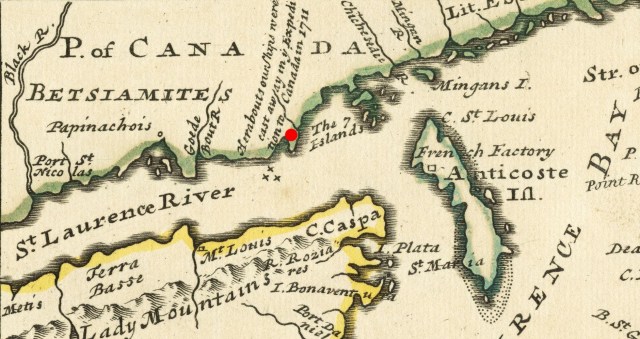
Expedition to Quebec 1711 –  The approximate site where the fleet went aground  is marked in red on this 1733 map detail.

The fleet arrived in Boston on 24 June, and the troops were disembarked onto Noddle’s Island (the present-day location of Logan International Airport). The size of the force was, according to historian Samuel Adams Drake, “the most formidable that had ever crossed the Atlantic under the English flag.” Since the fleet had left with insufficient supplies, its organizers expected it to be fully provisioned in Boston. Since the number of soldiers and sailors outnumbered the population of Boston at the time, this proved a daunting task. Laws were passed to prevent merchants from price-gouging, but sufficient provisions were eventually acquired.  Additional laws were passed penalizing residents found harbouring deserters from the fleet; apparently the attraction of colonial life was sufficient that this was a significant problem during the five weeks the expedition was in Boston.

During the expedition’s sojourn in Boston, Walker attempted to enlist pilots experienced in navigating the Saint Lawrence River. To his dismay, none were forthcoming; even Captain Cyprian Southack, reputed to be one of the colony’s best navigators, claimed he had never been beyond the river’s mouth.  Walker intended to rely principally on a Frenchman he had picked up in Plymouth prior to the fleet’s departure. Samuel Vetch, however, deeply distrusted the Frenchman, writing that he was “not only an ignorant, pretending, idle, drunken Fellow”, but that he “is come upon no good Design”.  Following this report, Walker also bribed a Captain Paradis, the captain of a captured French sloop, to serve as navigator.  The charts Walker accumulated were notably short in details on the area around the mouth the Saint Lawrence, as was the journal Sir William Phips kept of his 1690 expedition to Quebec, which Walker also acquired. Walker interviewed some participants in the Phips expedition, whose vague tales did nothing to relieve his concerns about what he could expect on the river. These concerns prompted him to detach his largest and heaviest ships for cruising duty, and he transferred his flag to the 70-gun Edgar.

On 30 July, the fleet set sail from Boston. It consisted of a mix of British and colonial ships, including nine ships of war, two bomb vessels, and 60 transports and tenders. It carried 7,500 troops and about 6,000 sailors.  By 3 August the fleet reached to coast of Nova Scotia, and Samuel Vetch piloted the fleet around Cape Breton and Cape North and into the Gulf of Saint Lawrence.

On the morning of the 18 August, just as the expedition was about to enter the Saint Lawrence River, the wind began to blow hard from the northwest, and Walker was forced to seek shelter in Gaspé Bay. On the morning of the 20th, the wind veered to the southeast, and he was able to advance slowly past the western extremity of Anticosti Island before it died down and thick fog blanketed both shore and fleet. By the 22nd, the wind had freshened from the southeast, and there were intermittent breaks in the fog, but not sufficient to give sight of land. At this point the fleet was west of Anticosti at a point where the Saint Lawrence was about 70 miles  wide, but it narrowed noticeably at a point where the river’s North Shore made a sharp turn, running nearly north-south.  This area, near what is now called Pointe-aux-Anglais, includes a number of small islands, including Île-aux-Oeufs (Egg Island), and numerous rocky shallows. After consulting his pilots, Walker gave the signal to head the fleet roughly southwest at about 8:00 pm.

Walker had thought he was in mid-stream when he issued the order. In fact, he was about seven leagues (about 20 miles) north of his proper course, and in the grasp of strong currents which steered his ships towards the northwest. Aided by an easterly wind, the fleet was gradually closing on the “North Shore“, which in the vicinity of Île-aux-Oeufs (Egg Island) runs almost north and south.When Captain Paddon reported to Walker that land had been sighted around 10:30 pm, presumably dead ahead, Walker assumed that the fleet was approaching the south shore, and ordered the fleet to wear, and bring-to on the other tack before heading to bed. This maneouvre put the fleet onto a more northerly heading. Some minutes later, an army captain named Goddard roused Walker, claiming to see breakers ahead. Walker dismissed the advice and the man, but Goddard returned, insisting that the admiral “come upon deck myself, or we should certainly be lost”.

Walker came on deck in his dressing gown, and saw that the ship was being driven toward the western lee shore by the east wind. When the French navigator came on deck, he explained to Walker where he was; Walker immediately ordered the anchor cables cut, and beat against the wind to escape the danger. Two of the warships, Montague [John Haraden’s ship] and Windsor, had more difficulty, and ended up anchored for the night in a precarious situation, surrounded by breakers. Throughout the night, Walker heard sounds of distress, and at times when the fog lifted, ships could be seen in the distance being ground against the rocks. One New Englander wrote that he could “hear the shrieks of the sinking, drowning, departing souls.” Around 2:00 am the wind subsided, and then shifted to the northwest, and most of the fleet managed to stand away from the shore.

It took three days to discover the full extent of the disaster, during which the fleet searched for survivors. Seven transports and one supply ship were lost. Walker’s initial report was that 884 soldiers perished; later reports revised this number down to 740, including women attached to some of the units. Historian Gerald Graham estimates that about 150 sailors also perished in the disaster. After rescuing all he could, Walker and Hill held a war council on 25 August. After interviewing a number of the pilots, including Samuel Vetch, the council decided “that by reason of the Ignorance of the Pilots abord the Men of War”, the expedition should be aborted.Vetch openly blamed Walker for the disaster: “The late disaster cannot, in my humble opinion, be anyways imputed to the difficulty of navigation, but to the wrong course we steered, which most unavoidably carried us upon the north shore.”

The fleet sailed down the Gulf of Saint Lawrence and came to anchor at Spanish River (now the harbour of Sydney, Nova Scotia) on 4 September, where a council was held to discuss whether or not to attack the French at Plaisance. Given the lateness of the season, insufficient supplies to overwinter in the area, and rumours of strong defences at Plaisance, the council decided against making the attack, and sailed for England.

Francis Nicholson’s land expedition learned of the naval disaster when it was encamped near Lake George; Nicholson aborted the expedition. He was reported to be so angry that he tore off his wig and threw it to the ground.

The expedition’s fortunes did not improve on the return voyage. Walker had written to New York requesting the HMS Feversham and any available supply ships to join him; unbeknownst to him, the Feversham and three transports (JosephMary, and Neptune) were wrecked on the coast of Cape Breton on 7 October with more than 100 men lost. The fleet returned to Portsmouth on 10 October; Walker’s flagship, the Edgar, blew up several days, possibly due to improper handling of gunpowder.  Walker lost a number of papers as a result, and claimed that the journal of William Phips was lost in the blast.

Despite the magnitude of the expedition’s failure, the political consequences were relatively mild. The failure was an early setback in Robert Harley‘s “blue water” policy, which called for the aggressive use of the navy to keep England’s enemies at bay; however, Harley continued to implement it, withdrawing further resources from European military campaigns.  Since the project had been organized by the current government, it was also not interested in delving deeply into the reasons for its failure. Walker was sympathetically received by the queen, and both he and Hill were given new commands.  Walker eventually wrote a detailed and frank account of the expedition, based on his memory as well as surviving journals and papers; it is reprinted in Graham. Walker was stripped of his rank in 1715 (amid a larger change of power including the accession of King George I), and died in 1728.

Popular sentiment in England tended to fault the colonies for failing to properly support the expedition, citing parsimony and stubbornness as reasons. These sentiments were rejected in the colonies, where Nicholson and Governor Dudley instead blamed Walker.  The relations between the military leadership and the colonial populations was not always cordial during the army’s stay outside Boston, and foreshadowed difficult relations between civilians and military occupiers in the political conflicts that preceded the American Revolutionary War. One of Hill’s officers wrote of the “ill Nature and Sowerness of these People, whose Government, Doctrine, and Manners, whose Hypocracy and canting, are unsupportable”, and further commented that unless they were brought under firmer control, the colonists would “grow more stiff and disobedient every Day.” Colonists noted with some disgust the fact that both Walker and Hill escaped censure for the expedition’s failure.

Children of John and Sarah

i. John Harraden b. 11 Nov 1695 in Gloucester

ii. Sarah Harraden b. 13 May 1698 in Gloucester

iii. Mary Harraden b. 14 Mar 1699 in Gloucester

iv. Andrew Harraden b. 11 Jul 1702 in Gloucester  m.   Mary Davis 17 Sep 1724 in Gloucester, Mass

Mary Davis was born 8 May 1697 in Gloucester, Mass.    Her parents were Jacob Davis and Mary Haskell.

In 1723 and 1724 a gang of pirates and freebooters under command of the notorious John Phillips infested the New England waters. During their first season of marine depredations they had taken 34 vessels, which they looted, killing or maltreating crews. In April, 1724, the sloop Squirrel of Annisquam, commanded by Andrew Haraden, while engaged on a fishing voyage was taken by Phillips. The Squirrel was a fine new craft, therefore Phillips abandoned his own vessel and appropriated the fisherman for his piratical purposes. The vessel had been sent to sea so hastily that the craft had not been finished inside, consequently tools were left aboard to complete the work when the conditions were unfavorable for fishing.
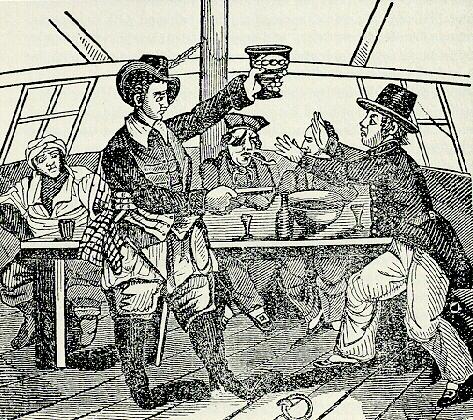
John Phillips forces a captive to drink alcohol. Engraving from The Pirates’ Own Book.

Phillips employed Haraden and the other prisoners in the finishing of the craft. One of the men, Edward Cheeseman planned a recapture. Midnight of the 18th was the time appointed. The vessel was ploughing through the water at a lively rate when Cheeseman seized John Nott, one of the pirate chiefs, who was on deck and threw him overboard. At the same time Haraden despatched Phillips with a blow from an adze, James Sparks the pirates’ gunner suffered the same fate as Nott, while a man named Burrell, the boatswain was killed with a broad axe. Capt. Haraden sailed home to Squam with the heads of Phillips and Burrell fixed at the mast head of the recaptured craft.

A number of prisoners were brought in, but on trial at Boston all but two were acquitted on the charge of piracy, it being held that they were forced men. Four, John Rose Archer, William White, William Phillips and William Taylor were found guilty of piracy and were sentenced to death.

The pirates gave widely reprinted speeches before their executions. Archer blamed drinking but also blamed brutal merchant captains who drove oppressed sailors to seek piracy as a tempting way to escape.

The first two were hung at Charlestown Ferry and White’s body was suspended in irons on Bird Island. The last two were reprieved for a year and a day to be recommended to the King’s mercy. It is said that Hangman’s Island in Annisquam river, now covered by the raiload bed received the name from the fact that two of the bodies of the dead pirates were suspended from gibbets erected in its center.

The General Court granted Haraden, Cheeseman and Philmore £42 each, and £32 each to five others concerned in the recapture and breaking up of this dangerous gang of buccaneers.

More about John Philips

John Phillips (died April 18, 1724) was an English pirate captain. He started his piratical career in 1721 under Thomas Anstis, and stole his own pirate vessel in 1723. He died in a surprise attack by his own prisoners. He is noted for the articles of his ship, the Revenge, one of only four complete sets of pirate articles to survive from the so-called Golden Age of Piracy.

Captain John Phillips’s articles

I. Every Man Shall obey civil Command; the Captain shall have one full Share and a half of all Prizes; the Master, Carpenter, Boatswain and Gunner shall have one Share and quarter.

II. If any Man shall offer to run away, or keep any Secret from the Company, he shall be marooned with one Bottle of Powder, one Bottle of Water, one small Arm, and Shot.  [not followed as you will see below]

III. If any Man shall steal any Thing in the Company, or game, to the Value of a Piece of Eight, he shall be marooned or shot.

IV. If any time we shall meet another Marooner that Man shall sign his Articles without the Consent of our Company, shall suffer such Punishment as the Captain and Company shall think fit.

V. That Man that shall strike another whilst these Articles are in force, shall receive Moses’s Law (that is, 40 Stripes lacking one) on the bare Back.

VI. That Man that shall snap his Arms, or smoke Tobacco in the Hold, without a Cap to his Pipe, or carry a Candle lighted without a Lanthorn, shall suffer the same Punishment as in the former Article.

VII. That Man shall not keep his Arms clean, fit for an Engagement, or neglect his Business, shall be cut off from his Share, and suffer such other Punishment as the Captain and the Company shall think fit.

VIII. If any Man shall lose a Joint in time of an Engagement, shall have 400 Pieces of Eight ; if a Limb, 800.

IX. If at any time you meet with a prudent Woman, that Man that offers to meddle with her, without her Consent, shall suffer present Death.

Phillips was a ship’s carpenter by trade. While voyaging from England to Newfoundland, his ship was captured on April 19, 1721 by Thomas Anstis‘s pirates. Phillips was forced to join the pirates, as skilled artisans often were. Phillips “was soon reconciled to the life of a Pirate,” and served Anstis as carpenter for a year.

In April, 1722, Anstis sent Phillips and some other men ashore on Tobago to careen a captured frigate. A British warship soon arrived, forcing Anstis to flee and abandon Phillips and his comrades. Phillips avoided capture by hiding in the woods, and later returned to Bristol in England with other abandoned shipmates, where they gave up piracy for a time.

Some of Phillips’ pirate comrades were arrested and imprisoned shortly after their arrival in Bristol, prompting Phillips to take ship again for Newfoundland. There, he conspired to steal a ship and return to piracy. On August 29, 1723, with only four companions, Phillips seized a schooner belonging to William Minott from Petty Harbour, renamed her Revenge, and embarked on a new piratical voyage.  Phillips’ crewmen were John Nutt (sailing master), James Sparks (gunner), Thomas Fern (carpenter), and William White (tailor and private crewman). They agreed promptly to a set of articles. Significantly, Phillips’ articles forbade rape under penalty of death; Anstis’s crew had committed a notorious gang rape and murder while Phillips was serving with them.

Phillips set sail for the West Indies, capturing several fishing vessels on the way. Aboard one of these prizes was John Rose Archer, reputed to be a former crewman of Blackbeard; Archer joined Phillips and was elected quartermaster.   On September 5, Phillips captured John Fillmore, great-grandfather of later U.S. president Millard Fillmore, aboard the sloop Dolphin, and forced him into service at White’s suggestion. This increased the Revenge’s total crew to 11.  Proceeding to the Caribbean, Phillips and his men hunted for merchantmen near Barbados. They made no captures for three months, and ran severely short of food and supplies, before finally taking some French and English vessels. They went on to Tobago, where Phillips searched for some of his abandoned comrades from Anstis’s crew, but found only one survivor, a black man named Pedro. Phillips careened the Revenge and took Pedro aboard.

The Revenge captured another vessel after leaving Tobago, and the carpenter Thomas Fern, in charge of the prize crew, attempted to escape with the stolen vessel. The Revenge overtook Fern and captured him, killing one of the prize crew and wounding another. Fern and one of his crewmates tried and failed to escape again later that winter, and Phillips killed them both. Charles Johnson describes this killing as being “pursuant to their Articles,” but as Phillips’ Article II specifies marooning rather than outright execution as the punishment for running away, this may be an error or may reflect the articles being amended at some point.

Somewhere to the north of Tobago, in March 1723, Phillips captured two more ships, killing a ship’s master named Robert Mortimer when the latter attacked the pirates in an attempt to regain his vessel. The pirates continued northward arriving at Cape Sable, Nova Scotia on April 1, 1723. Here Phillips met great success as he raided New England fishing vessels working the fishing banks between Cape Sable and Sable Island.  His men robbed some 13 vessels over the course of a few days.   One vessel they spared was a schooner which belonged to William Minott, the original owner of Revenge as Phillips declared “We have done him enough injury.

The last of these captures near Nova Scotia was a sloop commanded by Andrew Harradine and you know that story already!

Phillips was essentially a small-time criminal as compared to pirates like Roberts; he commanded only a small schooner, and at the time of his death he had just 11 men under his command, as compared to the 276 men captured aboard Roberts’ vessels, or the four-ship flotilla with which Blackbeard blockaded Charleston. Faced with a shortage of manpower, Phillips and his men frequently threatened prisoners to try to induce them to sign their articles, refused to honor promises of release to prisoners like Fillmore, and savagely punished anyone trying to leave the ship.

However Phillips is important to scholars of piracy because his articles have survived, through reprinting in Charles Johnson’s General History of the Pyrates. Only three other complete or near-complete sets of articles appear in the secondary literature (those of Roberts, Gow and a single code shared by Low and Lowther). These few articles underpin much of scholarly insight into life aboard pirate vessels.

The written account by John Fillmore of life aboard Phillips’ schooner Revenge is one of the few surviving primary sources by an eyewitness to piracy during the Golden Age.

Fillmore does not mention Phillips using a Jolly Roger during the capture of the Dolphin.  However, Phillips reportedly used a red flag during his capture of a Martinique vessel toward the end of 1723; at the sight of the flag and Phillips’ threat to show no quarter, the larger and more heavily armed crew of the Martinique vessel surrendered without firing a shot.

Phillips’ flag was turned over to Massachusetts authorities when his victorious prisoners sailed the Revenge into Annisquam. The Boston News-Letter described the flag as follows: “their own dark flag, in the middle of which an anatomy, and at one side of it a dart in the heart, with drops of blood proceeding from it; and on the other side an hour-glass.”

John Phillips Pirate Flag

Phillips is also significant as an example of the short-lived but destructive bands of pirates who branched out from much larger pirate crews led by Anstis and Blackbeard. He ended a line of pirate captains who had successively been captured by other pirates, joined their captors, and ascended to command. Phillips’ captor and mentor, Anstis, had himself been captured by Bartholomew Roberts, who was in turn a former captive of Howell Davis, who had turned to piracy after falling into Edward England‘s hands. This line sprang originally from the pirate den on Nassau, Bahamas, which had served as a base for Davis, England, and many other robber captains. His quartermaster Archer had originally served with Blackbeard, continuing the influence of Blackbeard’s formidable crew long after it was defeated in battle in 1718.

v. Thomas Harraden b. 27 Jun 1704 in Gloucester

vi. Jean Harradan b. 29 Aug 1706 in Gloucester

vii. Job Harraden b. 24 Mar 1708 in Gloucester

viii. Jonathan Harradan b. 28 Sep 1712 in Gloucester

ix. Joseph Harraden b. 3 Nov 1710 in Gloucester d. 1751 in Gloucester, Essex, Mass; m. Joanna Emerson (1710 – 1758). Joseph’s son Jonathan Haraden (11 Nov 1744 – 23 Nov 1803) was a privateer during the American Revolution.

Jonathan joined the Massachusetts State Navy in July 1776 as First Lieutenant of the sloop-of-war Tyrannicide, fourteen guns. On board for two years, he captured many prizes, becoming her commander in 1777.

First Lieutenant Jonathan Haraden was promoted to command Tyrannicide when Captain Fisk assumed command of the brig Massachusetts. The two ships sailed together for the coast of Europe on 24 March 1777. They captured the brig Eagle, the snowSally out of London with a cargo of English goods for Quebec, and then on 2 April Chalkley out of Honduras bound for Bristol with a cargo of mahogany at 41° 30′ N, 45° W. On 8 April Tyrannicide captured the 500-ton barque Lonsdale after a three-hour engagement at 35° W. Massachusetts and Tyrannicide cooperated in the 22 April capture of a brig straggling from a British convoy at 48° N, 16° W.  Tyrannicide captured the 160-ton brig Trepassy on 30 April, but became separated from Massachusetts while being chased by a superior British squadron on 17 May. Tyrannicide escaped to Bilbao, Spain after throwing guns and stores overboard to lighten the ship, and returned to Boston on 30 August 1777.

Tyrannicide sailed with Hazard on 21 November 1777 and captured the 130 ton brig Alexander on 13 December. Alexander was out of Halifax with a cargo of fish, oil, lumber and staves bound for the West Indies. The prize was retaken by HMS Yarmouth on 22 January 1778 off Barbadoes. Tyrannicide captured the schooner Good Intent on 22 December and the brig Polly (both out of Newfoundland with cargoes of fish and hoops) and then the snow Swift with a cargo of flour out of Bristol. Tyrannicide left the West Indies on 30 March 1778 and returned to Boston in May.

In 1778, Haraden began his career as a privateersman, commanding the General Pickering, sloop of fourteen guns. On October 13, 1779, he engaged three British privateers off New Jersey simultaneously and captured a twenty-two gun sloop in the Bay of Biscay. When the larger British privateer, Achilles of forty guns, attempted to recapture the sloop a few days later, Haraden forced it to disengage after three hours’ action at close quarters. In 1781, he was briefly captured by Admiral George Rodney in the West Indies, but escaped. Haraden sailed privateer Julius Caesar in 1782.   After the War of Independence, Haraden’s health deteriorated steadily. He died in Salem, Massachusetts in 1803.

Two destroyers of the United States Navy have been named USS Haraden for him.

8. Joseph Harraden

Joseph’s first wife Jane Giddings was born 1668 in Ipswich, Essex, Mass.  Her parents were John Giddings and Sarah Alcock.  Jane died 6 Sep 1700 in Gloucester, Essex, Mass.

Joseph’s second wife Hannah Stevens was born xx.

10. Benjamin Harraden

Benjamin’s wife Deborah Norwood was born 4 Sep 1677 in Gloucester, Essex, Mass. Her parents were Francis Norwood and Elizabeth Coldham. Deborah died 7 Jan 1762 in Gloucester, Essex, Mass.

Sources:

http://trees.ancestry.com/owt/person.aspx?pid=8729748&st=1

http://www.leavesonatree.org/getperson.php?personID=I12225&tree=Tree1

Topographical Dictionary of 2885 English Emigrants to New England, 1620-1650 – Ancestry.com

http://www.facebook.com/pages/Edward-Harraden-House/104095892959668

http://en.wikipedia.org/wiki/Edward_Harraden_House

The Giddings family: or, The descendants of George Giddings, who came from St. Albans, England, to Ipswich, Mass., in 1635. With a record of others of the name not yet traced. Also a sketch of prominent persons connected with the family (1882) By Giddings, Minot S. (Minot Samuel), b. 1837

History of the town and city of Gloucester, Cape Ann, Massachusetts by James R. (James Robert) Pringle. 1892
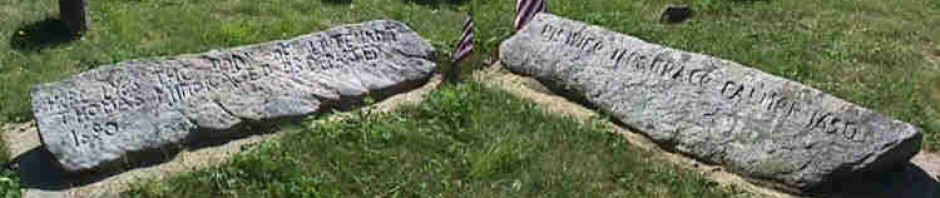
Posted in 12th Generation, Historical Site, Immigrant - England, Line - Miller, Pioneer, Sea Captain, Storied | Tagged , , , , , , | 11 Comments

Thomas Prince Sr.

Thomas PRINCE Sr. (1618 – 1690)  was Alex’s 10th Great Grandfather; one of 2,048 in this generation of the Miller line.

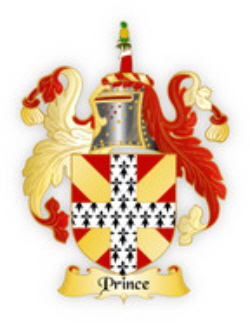
Immigrant Ancestor - Prince Coat of Arms

Immigrant Ancestor – Prince Coat of Arms

Thomas Prince Sr. was born about 1618 in South Pertherton, Somerset, England. His parents were Thomas PRINCE and Mary PATCH. He married Margaret SKILLINGS on 1649 in Gloucester, Essex, Massachusetts.   Thomas died 17 Jan 1690 in Gloucester, Essex, Massachusetts.

Gloucester, Essex, Mass

Margaret Skillings was born 1625 in England. Her parents were [__?__] SKILLINGS and Janet McILWRAITH. Thomas Prince is called brother-in-law of Thomas Skillings so Margaret may have emigrated with her brother Thomas Skilling.   Margaret died 24 Feb 1706 in Gloucester, Essex, Massachusetts.

Children of Thomas and Margaret:

from Salem,

Name Born Married Departed
1. Thomas PRINCE Jr. 24 Dec 1650 Gloucester, Essex, Mass. Elizabeth HARRADEN
27 Sep 1676 in Gloucester, Mass
11 Jan 1705 Gloucester, Essex, Mass.
2. John Prince 12 Nov 1653
Gloucester
before 14 Jan 1689
3. Child Prince 1656 Gloucester 3 Jan 1657 Gloucester
4. Mary Prince 19 Jul 1658 Gloucester Hugh Rowe
16 Sep 1674 Gloucester, Mass.
.
Isaac Elwell
16 Dec 1702
Gloucester, Mass
3 Mar 1723
Gloucester
5. Jeho Prince 1660
Gloucester
after 14 Jan 1689
6. Isaac Prince 7 Nov 1663
Gloucester
before 18 Dec 1717

Ancestors

Margaret’s Relatives

Babson writes Thomas Prince was a brother-in law of Thomas Skillings.  If this is true, then his wife Margaret would be named Skillings, and would have been a sister of Thomas Skilling.  Thomas’ wife Deborah testified on behalf of Margaret Prince in an action against William Browne.

Margaret and husband Thomas brought suit  against William Browne in March 1657, alleging that he had made threatening statements against her, and as a result she lost her child.  The testimony, scribed into the Quarterly Court Records, show a woman who had little relief from everyday life just because she was with child.

Margaret’s brother Thomas Skillings was born in 1614 in Lavenham, Suffolk, England. He married Deborah [Prince?] 1642 in Gloucester, Essex, Mass. Thomas died 2 Oct 1667 in Falmouth, Cumberland, Maine on the shores of Back Cove, Portland, ME.

Thomas immigrated before 1640. He resided in Salem, Mass in 1640 when he was a witness against James Smith Sr. in Salem Court 31:1:1640. He resided in Wenham, Essex, MA in 1644. He resided in Gloucester, Mass. before 1648. Savage says as early as 1642:

Thomas was among the early settlers of Gloucester, Mass. His land was near the ancient burying ground. As early as 1651, he had moved to Falmouth (Portland), but had returned and was living in Gloucester in 1658, and that year came back to Falmouth and died there in 1667. In 1658, he purchased the farm at Back Cove from George Cleeves, which he occupied until his death and which was held in the family for many years. The farm adjoins the Deering farm in Westbrook and is about half a mile from Deering Bridge. His will, dated 14 Nov 1666 and proved 2 Oct 1667, mentioned only two children – Thomas and John. He also had two daughters. His emigrant ancestor was in Salem prior to 1640 and doubtless wrote his name Skellen.

The last Will & testament of Thomas Skelling, being very Weake In body, but in Prfect memory/ I giue to my sun Thomas one Cow, & a young steare & a Calfe / further I giue to my sun John one Cow / & I giue my Towles to bee deuided between them both / further it is my will to make my wife executrix to receiue & pay my debts, and all the goods yt I have to bee at her dispose dureing her Widdows estate, & if shee marry she shall haue but the thirds, & the rest to bee diuided aequally to all my children. Dated the 14th of Novembr 1666 / The Marke of THOMAS SKELLING. Thomas couldn’t write – he made his mark (:T:S).

The inventory of the estate, taken by Phineas Ryder, George Ingersoll, and Nathaniel Willis, was: housing and land 80 pounds; marsh 10 pounds; 4 steers 22 pounds; 5 cows 20 pounds; 3 younger cattle 6 pounds; 2 calves 1 pound 10 shillings; 11 pigs 3 pounds 6 shillings; wheat and peas in the barn 3 pounds 8 shillings; 18 bushels wheat in the house 4 pounds 10 shillings; 6 bushels indian corn 1 pound 4 shillings; 60 lbs cotton wool 3 pounds; household furniture 32 pounds 16 shillings – total 186 pounds 14 shillings.

Deborah [Prince?] was born 1622/23 in Lavenham, Suffolk, England based on her age when she married George Hadley. Thomas Prince is called brother-in-law of Thomas Skillings, so Deborah could be sister of Thomas Prince, though this is less likely than Margaret, wife of Thomas Prince was the sister of Thomas Skillings. After Thomas died, Deborah married George HADLEY 29 Jun 1668 Ipswich, Mass. George was our ancestor with his first wife Mary PROCTOR.

In 1692 Deborah was a witness in support of her neighbor Elizabeth Howe accused in the Salem Witch trials. Elizabeth was found guilty and executed on July 19, 1692.

The deposition of Deborah Hadley, aged about seventy years: This deponent testifieth that and sh. that I have lived near to Elizabeth Howe (ye wife of James Howe Jr of Ipswich) 24 year and have found her a neighborly woman, conscientious in her dealings, faithful in her promise, and Christianlike in her conversation so far as I have observed and further saith not.”

Babson writes that Deborah had “suspicious carriages” with Thomas Patten, for which her husband was required to be bound for her good behavior at court in 1653.

Thomas Prince

Thomas Prince came to Gloucester prior to 1650 and settled  at the Harbour on what became Front Street.  The Front Street Block is a historic block in the West End at 55-71 Main Street in Gloucester, Massachusetts.  The block was built in 1831 and added to the National Register of Historic Places in 1974.

Gloucester was founded at Cape Ann by an expedition called the “Dorchester Company” of men from Dorchester (in the county of Dorset, England) chartered by James I in 1623. This date allows Gloucester to boast the first settlement in what would become the Massachusetts Bay Colony, as this town’s first settlement predates both Salem, Massachusetts in 1626, and Boston in 1630.

At his death, he left an estate of £153.

.

The Accused Witches of Gloucester

Not all of the accused witches of the Salem Witch Trials actually lived in Salem. A number of the accused also came from nearby towns such as Salisbury, Ipswich, Andover, Topsfield and Gloucester.

Gloucester, Essex, Mass

Salem, Essex, Mass

Andover and Gloucester had more accused witches than any other towns outside of Salem. A total of nine Gloucester women were accused of witchcraft during the hysteria of 1692: Esther Elwell, Margaret PRINCE, Elizabeth Dicer, Joan Penney, Phoebe Day, Mary Rowe (Margaret’s daughter), Rachel Vinson, Abigail Rowe (Margaret’s granddaughter) and Rebecca Dike.

Not much is known about these cases since many of the records have been lost, but we do know three of the groups of  Gloucester residents accused of witchcraft in 1692  were closely connected. Much like the accused of Salem, the accused women of Gloucester were also either prominent, wealthy citizens or trouble-makers or relatives of other accused witches.

These accusations all involved people of high social and economic status. The Gloucester accusations involved no singling out of poor, marginal women. All of the recorded estates of these families were valued at more than two hundred pounds. They all had comparatively large holdings of land and held many town offices. The cases seem to have been based on fear and suspicion among the upper class against a backdrop of paranoia throughout the county.

1. Margaret Prince and Elizabeth Dicer were accused of bewitching Eleanor Babson

2. Phoebe Day, Mary Rowe, and Rachel Vinson were accused sometime in the fall of 1692. There is no record of their accusation or examination extant, but their names were on a petition to the governor and council signed by a group of prisoners held at Ipswich jail.

3. Joan Penney

4. A warrant for the arrest of another group of women, Esther Elwell, Abigail Rowe, and Rebecca Dike, was issued on November 3, 1692, for afflicting Mrs. Mary Fitch.

1. Margaret Prince and Elizabeth Dicer

In September of 1692, Gloucester resident Ebenezer Babson asked some of the afflicted Salem village girls to visit his mother, Eleanor, who was complaining of spectral visions of Indians and French soldiers. Upon visiting Eleanor, the girls accused Margaret Prince and Elizabeth Dicer of bewitching her.

Margaret Prince was the grandmother of Abigail Rowe and mother of Mary Prince Rowe. She was known for being troublesome and having a sharp tongue.

Elizabeth Dicer had been fined thirteen times in the past for calling Mary English’s mother a “black-mouthed witch and a thief.”

In the summer of 1692 Ebenezer Babson and his family reported that strange noises, as of persons running about his house, were heard almost every night. Babson, on returning at a late hour also saw two strange men come out of his house and disappear in his cornfield. He stated that he could hear them converse and that one said, “The man of the house is come now, else we might have taken the house.” The entire family, becoming alarmed, retired to the garrison to which place they were followed by two men. On another day Babson, who seems to have experienced a monopoly of these occurrences in the town, saw strangers who appeared like Frenchmen, and at another time the number was increased to six. A party went in pursuit. Babson overtook two and tried to fire at them but, strange to relate, his gun persistently missed fire. A short time afterwards he saw three men, one wearing a white waistcoat. This time his rifle proved trusty. All fell beneath his unerring aim but on his approaching the dead or wounded men arose and ran away, one discharging a gun as he went.

At length one of these spectral marauders was surrounded so that escape was impossible. He was shot by Babson, but this time when Babson approached to take possession of the body it mysteriously disappeared. For quite a time afterwards a company, supposed to be French and Indians, prowled about the garrison and held loud conversations in a swamp near by. Babson, on his way to the harbor to carry the news, was fired upon. The people became greatly excited and appealed to the outside towns for help. Ipswich responded with 60 men to assist in putting these strange intruders to flight. The excitement soon abated, Babson seeming to be the only person to whom these extraordinary manifestations were revealed.

After the hysteria was over, Rev. John Emerson, the clergyman of the town, wrote concerning these occurrences and in defence of his parishioners : “All rational persons will be satisfied that Gloucester was not harmed for a fortnight altogether by real French and Indians, but that the devil and his angels were the cause of all that befel the town.”

2. Mary Prince Row, Phoebe Day and Rachel Vinsion

Around the same time, four more women were accused: Mary Rowe, Phoebe Day and Rachel Vinson, although it is not known who accused them,

Rachel Vinson was the widow of William Vinson who’s first wife had also been accused of witchcraft along with Ruth Dutch.

Phoebe Day’s maiden name was Wilds and she was related to Sarah Wilds, of Topsfield, who was hanged for witchcraft on July 19, 1692 in Salem

Mary Prince Rowe was the mother of Abigail Rowe and daughter of Margaret Prince. She was held at a jail in Ipswich, along with Elizabeth Dicer and Joan Penney. Their names appear on an undated petition asking to be released on bail until their trial.

Petition to release Gloucester women including  Mary Prince Rowe held in Ipswich jail and accused of witchcraft

3. Joan Penney

Joan Penney, who was accused by Zebulon Hill, a former Gloucester resident who had recently moved to Salem town.

Joan Penney had numerous squabbles with neighbors over land and had also been brought to court a number of times for such crimes as wearing a silk scarf and “breach of sabbath” after she carried bushels of corn on her way to church.

4. Rebecca Dike, Esther Elwell and Abigail Rowe.

Shortly after, in October or November, James Stevens, a deacon of the local church and lieutenant in the militia, sent for the afflicted girls of Salem village to name the witch he believed was bewitching his sister Mary Fitch, wife of John Fitch. The girls named Rebecca Dike, Esther Elwell and Abigail Rowe.

Esther Elwell (Elwell’s witchcraft case was featured on an episode of the popular NBC genealogy show Who Do You Think You Are? after actress Sarah Jessica Parker discovered she is descended from Elwell); her maiden name was Dutch and she was from a prominent family that lived at the Harbor in an area known as Dutch’s Slough. She married a wealthy man named Samuel Elwell in 1658 in Gloucester. Her mother, Ruth Dutch, had also once been accused of witchcraft, although it is not known when. A Gloucester woman named Mary Fitch had recently fallen ill with an unexplained sickness. Lieutenant James Stevens sent for the “afflicted girls” of Salem Village to find out who had bewitched her. Soon after, a 17-year-old Elizabeth Hubbard accused Elwell and the other women, or at least their “spectres” of “pressing, squeezing and choking of Mary Fitch.”

After Fitch died, Stevens filed a complaint with the magistrates. A warrant for the three was issued November 5. James Stevens, the complainant, was an important figure in town, a deacon of the church, and a lieutenant in the militia. He married Susannah Eveleth, daughter of Sylvester Eveleth, in 1656.

Rebecca Dike: her maiden name was Dolliver and she married a man named Richard Dike who held a large amount of land in Gloucester. Rebecca was neighbors with the in-laws of the Stevens family, the Eveleths, and had many problems with them.

Abigail Rowe was the 15-year-old daughter of Hugh and Mary Prince Rowe of Little Good Harbor. . The fact that she was only fifteen years old in 1692 shows the peculiarity of her case. While it was certainly not unheard of for children to be accused of witchcraft, they were generally accused along with other family members. Seeing a teenaged girl accused along with two adult women is quite unusual, but she was not the only woman in her family accused of witchcraft. The family had a large amount of land in the Little Good Harbor area. Abigail’s mother and her grandmother, Margaret PRINCE, were also accused

Hugh Rowe and his older brother John received equal portions of their father John’s estate of £205 16s. 10d. Five years later, Hugh and John entered into an agreement witnessed by Robert Elwell, who owned land near theirs. In 1685, Hugh Rowe received three parcels of land from his “father-in-law” William Vinson, likely the father of his first wife, Rachel Langton. Hugh and Rachel Rowe’s daughters married sons of Anthony Day. Another of Anthony Day’s sons, Timothy, married Phoebe Wilds, one of the women mentioned in the Ipswich petition.

Thus Hugh and Mary Rowe lived near Robert Elwell and had a close relationship to William Vinson and the Day family. Mary was also the daughter of Margaret Prince. All of the Gloucester women whose accusations are known only from the Ipswich petition were connected to the Rowe family. This provides clear evidence that there was a connection between their accusations and the accusation against Esther Elwell, Rebecca Dike, and Abigail Rowe. The likely cause of the accusations was animosity between different members of the town elite, which spiraled out of control in the context of the witchcraft panic and other tensions facing Massachusetts at the time.

Resolution

Fortunately for the accused, it appears that these cases never went to trial because the use of spectral evidence was banned in October of 1692, giving prosecutors little evidence to go on, and the special court set up to hear the Salem Witchcraft cases was disbanded. In November, public officials set up the Superior Court of Judicature to hear the remaining witchcraft cases but between January and May of 1693, most of the accused were released due to a lack of evidence or tried and found not guilty.

Children

6 & 2. Thomas’ son Isaac received a soldier’s lot at Kettle Cove in 1679, instead of John.

1. Thomas PRINCE Jr. (See his page)

4. Mary Prince

Mary’s first husband Hugh Rowe was born 1645 in Gloucester, Essex, Mass. His parents were John Rowe and Bridget Jeggles. He first married 10 Jun 1667 in Gloucester, Essex, Mass to Rachel Langton (b. 1650 in Ipswich, Essex, Mass. d. 7 Mar 1674 in Gloucester, Essex, Mass.)Hugh died 11 Dec 1696 in Gloucester, Essex, Mass.

Mary’s second husband Isaac Elwell was born 27 Feb 1641/42 in Salem, Essex County Mass.  His parents were Isaac Elwell and Joanne Dalliber. Isaac died 4 October 1715 in Gloucester, Essex County Mass.

Mary was imprisoned with her daughter Abigail, accused of witchcraft in Gloucester.

Sources:

http://trees.ancestry.com/owt/person.aspx?pid=11072352

http://freepages.genealogy.rootsweb.ancestry.com/~hwbradley/aqwg11.htm#325

http://www.leavesonatree.org/getperson.php?personID=I12218&tree=Tree1

http://www.genealogyofnewengland.com/f_33a.htm#146

http://www.wainwrightfamily.org/pirncefhr.htm

http://freepages.genealogy.rootsweb.ancestry.com/~arlene/Skillings/d0/i0001240.htm

http://www.common-place.org/vol-06/no-02/norton/

History of the town and city of Gloucester, Cape Ann, Massachusetts By James R. (James Robert) Pringle. 1892
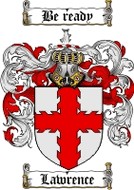
Posted in 12th Generation, Immigrant - England, Line - Miller, Storied, Witch Trials | Tagged | 6 Comments

Thomas Prince Jr.

Thomas PRINCE Jr. (1650 -1705)  was Alex’s 9th Great Grandfather; one of 1,024 in this generation of the Miller line.

Thomas Prince Jr. was born 24 Dec 1650 in Gloucester, Essex, Mass. His parents were Thomas PRINCE Sr. and Margaret SKILLINGS. He married Elizabeth HARRADEN 27 Sep 1676 in Gloucester, Mass. Thomas died 11 Jan 1705 in Gloucester, Essex, Mass.

Gloucester, Essex, Mass

Elizabeth Harraden was born in 1656 in Gloucester, Essex, Mass. Her parents were Edward HARRADEN and Sarah [__?__].  Elizabeth died 14 May 1716 in Gloucester, Essex, Mass.

Children of Thomas and Elizabeth:

Name Born Married Departed
1. Mary Prince 6 Dec 1677 Gloucester, Essex, Mass bef 11 Jan 1705
2. Capt. John Prince 6 Dec 1677 Gloucester Abigail Ellery
1705 Gloucester
.
Mary Wharff
7 Aug 1746 Gloucester
19 Apr 1767
Gloucester, Mass
3. Thomas Prince 18 Dec 1679 Gloucester 29 Jan 1680
Gloucester
4. Edward Prince 5 Jun 1681 Gloucester Sarah [__?__] bef. 18 Dec 1717
5. Isaac Prince 21 Sep 1683
Gloucester
Honor Tarr (widow of John Wise and John Wonson)
10 Dec 1730 Gloucester
1734
Gloucester
6. Margaret Prince 25 Dec 1687 Gloucester bef 11 Jan 1705
7. Elizabeth Prince 17 Oct 1690 Gloucester Samuel Pattee
1712 Haverhill
26 Nov 1727
Haverhill, Mass
8. Sarah Prince 1692 Gloucester John Flanders
12 Feb 1715 Gloucester
15 Apr 1775
South Hampton, Rockingham, NH
9. Abigail PRINCE 12 Feb 1698 Gloucester Samuel STAPLES
4 Dec 1714 Haverhill, Mass
29 Sep 1778 in Haverhill, Essex, Mass.

Children

2. Capt. John Prince

John’s first wife Abigail Ellery was born 29 Mar 1679 in Gloucester, Essex, Mass. Her parents were William Ellery and Mary Coit. Abigail died 4 Dec 1744 in Gloucester, Mass.

John’s second wife Mary Wharff was born Apr 1687 in Gloucester, Essex, Mass. Her parents were Nathaniel Wharff and Anna Riggs. She first married 25 Dec 1705 in Gloucester, Essex, Mass to Ebenezer Davis (b. 26 Mar 1681 in Gloucester; c. 30 Oct 1732 in Gloucester). Next she married 30 Jan 1735 in Gloucester, Essex, Mass to James Sayward (b. 1667 in York, Maine; d. 13 Feb 1737 in Gloucester)

4. Edward Prince

Edward’s wife Sarah [__?__]’s origins are not known.

5. Isaac Prince

Isaac’s wife Honor Tarr was born 20 May 1693 in Gloucester, Essex, Mass. Her parents were Richard Tarr and Elizabeth Dicer.  She first married John Wise 2 Nov 1712 in Gloucester, Essex, Mass. She next married 1720 in Gloucester, Essex, Mass to John Wonson b: 1690.

7. Elizabeth Prince

Elizabeth’s husband Samuel Pattee was born 24 Aug 1687 in Haverhill, Essex, Mass. Her parents were Peter Pattee and Sarah Gill. Samuel died 16 Sep 1749 in Haverhill, Essex, Mass.

8. Sarah Prince

Sarah’s husband John Flanders was born 22 Aug 1691 in Salisbury, Essex, Mass. His parents were John Flanders and Elizabeth Sargent. John died 14 Nov 1782 in South Hampton, Rockingham, New Hampshire.

9. Abigail PRINCE (See Samuel STAPLES‘ page)

Sources:

http://trees.ancestry.com/owt/person.aspx?pid=11072346

http://freepages.genealogy.rootsweb.ancestry.com/~hwbradley/aqwg18.htm#339

http://www.leavesonatree.org/getperson.php?personID=I12063&tree=Tree1

http://www.genealogyofnewengland.com/b_p.htm


Posted in 11th Generation, Line - Miller, Twins | Tagged | 5 Comments

Samuel Staples

Samuel STAPLES (1694 – 1778)  was Alex’s 8th Great Grandfather; one of 512 in this generation of the Miller line.

Samuel Staples was born 24 Feb 1694 in Bradford, Essex, Mass. His parents were Thomas STAPLES and Elizabeth GRIFFIN. He married Abigail PRINCE on 4 Dec 1714 in Haverhill, Mass.  Samuel died in 1778.

Abigail Prince was born 12 Feb 1698 in Gloucester, Essex, Mass. Her parents were Thomas PRINCE Jr. and Elizabeth HARRADEN.    Abigail died 29 Sep 1778 in Haverhill, Essex, Mass.

Children of Samuel and Abigail:

Name Born Married Departed
1. Ann STAPLES 26 Feb 1716 Haverhill, Essex, Mass DAVID HEATH
24 May 1732 Bradford, Essex, Mass.
2 Sep 1778 Haverhill, Essex, Mass.
2. Elizabeth Staples 1718 Haverhill
3. Mary Staples 1720 Haverhill Samuel Jewel (Son of Thomas JEWELL)
20 May 1742
Haverhill, Mass
1751 Massachusetts,
4. Abigail Staples 1721 Haverhill Nathan Lancaster
13 Oct 1743 Haverhill
4 May 1751 Mendon, Mass
5. John Staples 9 Apr 1724 Haverhill 8 Nov 1745
6. Susannah Staples 24 May 1726 Haverhill Nathan Merrill
19 Jul 1744
7. Samuel Staples 14 Aug 1729 Haverhill
8. Prince Staples 7 Mar 1733 Haverhill
9. Ruth Staples 2 Apr 1738 Haverhill Joseph Atwood
9 May 1758 Haverhill
1777
Haverhill

x

Children

1. Ann STAPLES (See DAVID HEATH‘s page)

3. Mary Staples

Mary’s husband Samuel Jewel was born 19 Feb 1687/88 in Amesbury, Essex, Mass. He was baptized 14 Oct 1688 in Salisbury, Essex, Mass. His parents were Thomas JEWELL and Susanna GUILFORD.  He first married Sarah Ring 06 Nov 1712 in Amesbury, Essex, Mass.

Sarah Ring was born 07 Oct 1691 in Amesbury, Essex, Her parents were Robert Ring and Ruth [__?__]. Her grandparents were Robert RING and Elizabeth JARVIS

4. Abigail Staples

Abigail’s husband Nathan Lancaster was born 27 Sep 1717 in Haverhill, Essex, Mass. His parents were Daniel Lancaster and Damaris Gould. Nathan died 13 Oct 1743 in Haverhill, Essex, Mass.

6. Susannah Staples

Susannah’s husband Nathan Merrill was born  15 Apr 1704 Haverhill, Mass. His parents were John Merril and Lucy Webster. He first married 27 Oct 1728 in Newbury, Mass to Mary Goodwin Gordon (1711 – 1739). After Mary died, he married 25 Mar 1742 in Haverhill, Mass to Demaris Lancaster (1724 – 1744).

9. Ruth Staples

Ruth’s husband Joseph Atwood was born 13 Jan 1736/37. His parents were Oliver Atwood and Elizabeth Phelps. After Ruth died, he married Hannah Hadley, widow of Enoch Marble (1729-1774).

Sources:

http://trees.ancestry.com/owt/person.aspx?pid=29336658

http://www.genealogyofnewengland.com/b_s.htm

http://www.leavesonatree.org/getperson.php?personID=I11978&tree=Tree1

http://freepages.genealogy.rootsweb.ancestry.com/~edgecomb/Rackl/f3937.htm

http://rturnblo.tripod.com/d0003/f0000058.html#I16433

http://archiver.rootsweb.ancestry.com/th/read/ATWOOD/2000-06/0959871748

Posted in 10th Generation, Line - Miller | Tagged | 3 Comments

John Williams

John Williams (1600 – 1674)  was Alex’s 10th Great Grandfather; one of 2,048 in this generation of the Miller line.

Immigrant Ancestor

John Williams was born in 1600 in England. He was baptized 7 Dec 1607 in  Newbury, Berkshire, England.  There is a family tradition which asserts that he came originally from Wales.   His parents were John WILLIAMS and Elizabeth PALMER.  He married Jane GOULD.  John died 10 Feb 1674 in Haverhill, Essex, Mass.

Jane Gould was born about 1610 in England.  Jane died 21 Nov 1680 in Haverhill, Essex, Mass.

Children of John and Jane:

Name Born Married Departed
1. Sarah Williams  c. 1628 John Ayres (son of John Ayer)
5 May 1646 Haverhill
25 Jul 1662
Haverhill
2. John Williams 25 Oct 1636 Salisbury, Essex, Mas Rebecca Colby
(Daughter of Anthony COLBY)
9 Sep 1661 in Salisbury, Mass
.
Hester Blakeley (widow of John Bond)
5 May, 1675
Haverhill
30 Apr 1698
Haverhill
3. Mary Williams 20 Sep 1641 Newbury, Essex, Mass Daniel BROADLEY
21 May 1662 in Haverhill, Mass.
6 Oct 1714 in Haverhill, Mass.
4. Lydia Williams 16 Mar 1643 Haverhill Unmarried 1677
Haverhill
5. Joseph Williams 18 Apr 1647 Haverhill Mary Fuller
18 Nov 1674 Barnstable, Mass
4 Jan 1721
Norwich, CT

In his will, dated Dec 9, 1670, proved 1673-4, he mentions his children John, Joseph, Mary and Lydia, and his daughter Sarah’s child, Sarah Eyers. The births of Mary and Lydia were recorded at Newbury, Lydia and Joseph at Haverhill.

The sojourn of John Williams in Newbury was not associated with any event of record until 1640, when he appears as petitioner to found  the new town of Haverhill with the Rev. John Ward, the promoter of the scheme, and others, William White, James DAVIS, John Robinson, Henry Palmer, Samuel Gile, Christopher Hussey, and Richard Littledale, to whom were added four from Ipswich. To do this he must have been a man of some mark and substance, and of character equal to those with whom he was associated. A beautiful site was chosen on the opposite bank of the Merrimac River, some six or seven miles farther up the stream, and almost twelve miles from the sea. This spot they named Haverhill after the English town from which its projector came.

1642 – John Williams was admitted freeman in Haverhill.

In 1643, according to a town vote, the valuation of his property was put at eighty pounds, which compares favorably with the other land owners. Every stockholder who emigrated at his own expense was to receive fifty acres for each member of his family; and every fifty pounds contributed to the company’s stock entitled the stockholder to two hundred acres of land.

In 1667, John Williams received a share in the distribution of some lands belonging to the town, which confirms the statement that he was one of the original proprietors, and to be such he must have been in possession of means brought from the old country. According to the statement in the “Sewell Papers,” which refers to this particular party of emigrants, viz., the settlers of Newbury, Massachusetts, ” Men of means, dissatisfied with the state of affairs in their native England, favored the exodus of their sons to America, and assisted them with money for that purpose.” It is even stated that houses in such towns as Newbury were owned by English proprietors, who received rental therefrom.

He died Feb. 10, 1673. Will dated Dec. 9, 1670; daughters Mary, Lydia and Sarah; grand child Sarah Eyers. Inventory of Widow’s estate was presented by son Joseph 29 March 1681.”

Children

1. Sarah Williams

There were two John Ayres in early Massachusetts.  One married Sarah Williams and Mary Wooddam and the other married Susannah Symonds.  Genealogies show both the Williams and Symonds marriages with a date of 5 May 1646 in Haverhill, but I think the Ayres/Williams connection is correct.

Sarah’s John Ayres was born in 1623 in Lavenham, Suffolk. His parents were John Ayer and Hannah Evered. After Sarah died, her John Ayre married 26 Mar 1663 in Haverhill, Essex, Mass to Mary Wooddam (b. 1634 in Salisbury, Essex, Mass; d. 1694 in Ipswich, Essex, Mass.) This John died between 1694 and 1711 in Ipswich, Essex, Mass.

The other John Ayres was born about 1621 in England. He married 5 May 1646 in Ipswich, Essex, Mass to Susannah Symonds (b. 1617 d. 2 Feb 1682 in Ipswich, Essex, Mass.)  Susannah’s parents were Mark SYMONDS and Joanna [__?__]. This other John was killed by Indians 2 Aug 1675 in Northfield, Franklin, Mass. with seven others, at the fight at Brookfield.. Though he had received large grants of land at Brookfield, some 2,000 acres, his family undoubtedly returned to Ipswich and its vicinity, the settlement having been broken up, and rendered unsafe.  His widow presented an inventory of his estate, now recorded at Salem, on which she wrote, “I have seven sons and one daughter.”

This other John’s parentage is unknown,  but it seems highly probable that he was accompanied to New England by two of his brothers-in-law, William Lamson and William Fellows.   The ground for the conjecture is this. William Lamson died at Ipswich in 1659, leaving eight children. His widow Sarah wished to marry one Thomas Hartshorn, but was opposed by her brothers William Fellows and John Ayres. Now as Ayres married a Symonds, and there is no record of any sisters of his wife who married Lamson and Fellows, it is fair to conclude that their wives were own sisters of John Ayres.

We learn from deeds at Salem, that this other John Ayres lived at Ipswich 1648, and as a tenant on Mr. John Norton’s farm. In Nov 1672, he seems to have sold out all his rights in the town, including those derived from his father-in-law, Mark Symonds,

2. John Williams

John’s first wife Rebecca Colby was born 11 Mar 1643 in Salisbury, Essex, Mass.  Her parents were Anthony COLBY and Susanna WATERMAN.  Rebecca died 10 Jun 1672 in Haverhill, Essex, Mass.

John’s second wife Hester Blakeley was born about 1630.  Her parents were Joseph Blakely and Sarah Williams.  She first married 15 Aug 1649 Newbury, Essex, Mass. to John Bond (1624 – 1674).

3. Mary Williams (See Daniel BROADLEY‘s page)

5. Joseph Williams

Joseph’s wife Mary Fuller was born 16 Jun 1644 in Scituate, Plymouth, Mass. Her parents were Samuel Fuller and Jane Lathrop. Mary died 11 Nov 1720 in Norwich, New London, CT.

Joseph Williams was called deceased in 1720 but executed a deed as late as March 1719, m. Haverhill 18 Nov 1674 Mary Fuller. Last record in Haverhill is birth of Hannah in 1683, added as inhabitant in Norwich in 1702.

Sources:

http://trees.ancestry.com/owt/person.aspx?pid=6935475&st=1

http://freepages.genealogy.rootsweb.ancestry.com/~arlene/Ayers/d0/i0006947.htm

http://freepages.genealogy.rootsweb.ancestry.com/~arlene/

http://www.cholet.us/Families/Ayres/states_2.htm


Posted in 12th Generation, Immigrant - England, Line - Miller, Pioneer | Tagged , | 7 Comments

Daniel Bradley

Daniel Bradley (1613 – 1689)  was Alex’s 9th Great Grandfather; one of 1,024 in this generation of the Miller line.

Danyell Broadley de West Morton - Coat of Arms

The Broadleys were exceptional among our ancestors having a coat of arms at the time of their immigration

Daniel Broadley was born 29 Aug 1613 in Bingley, Yorkshire, England. His parents were Danyell BROADLEY de West Morton and Elsabeth ATKINSON. He immigrated on 8 Apr 1635 to Embarked on the “Elizabeth” of London. He married Mary WILLIAMS on 21 May 1662 in Haverhill, Mass.   Daniel was killed by Indians on 13 Aug 1689 in Haverhill, Mass.  Many of his children and grandchildren were also killed or kidnapped and carried into Canada.

Daniel’s daughter-in-law Hannah Heath Bradly testified in 1739 that about forty years past she with the widow Mary Neff were taken prisoners by the Indians & carried together into captivity, & above penny cook the Deponent was by the Indians forced to travel farther than the rest of the Captives, and the next night but one there came to us one Squaw who said that Hannah Dustan and the aforesaid Mary Neff assisted in killing the Indians of her wigwam except herself and a boy, herself escaping very narrowly, chewing to myself & others seven wounds as she said with a Hatched on her head which wounds were given her when the rest were killed, and further saith not her.

Mary Williams was born 20 Sep 1641 in Newbury, Essex, Mass. Her parents were John WILLIAMS and Jane GOULD.  Mary died on 6 Oct 1714 in Haverhill, Mass.

Children of Daniel and Mary:

Name Born Married Departed
1. Daniel Bradley 14 Feb 1663 Haverhill, Essex, Mass. Hannah Dow (Daughter of Stephen DOW)
5 Jan 1687 Haverhill
Killed with his wife by Indians in the Dustin massacre.
15 Mar 1697
Haverhill, Mass
2. Joseph Bradley 7 Feb 1665 Haverhill Hannah Heath (James’ cousin)
14 Apr 1691 Haverhill
3 Oct 1727
Haverhill
3. Martha Bradley 1667 Haverhill Ephraim Guile (Gile)
5 Jan 1686 Haverhill
1708
West Thompson, Windham, CT
4. Mary Bradley 1 Mar 1670 Haverhill 14 Mar 1669/1670 Haverhill
5. Mary BRADLEY 16 Apr 1671 Haverhill, Bartholomew Heath
(James’ cousin)
3 Jan 1691 Haverhill
.
Lt. James HEATH
1705
Haverhill
3 Sep 1718 Haverhill
Killied by Indians
6. Sarah Bradley 19 Aug 1673 Haverhill Jonathan Robinson
1670
New Hampshire
.
James Bean
3 Dec 1697 Exeter, Rockingham, NH
.
John Davenport
28 Feb 1702/1703 in Haverhill
17 Jul 1738
Kingston, NH
7. Hannah Bradley 28 May 1677 Haverhill Josiah Heath Jr.
(James’ brother)
15 Mar 1697
Killed by Indians
1721
8. Isaac Bradley 25 Feb 1680 Haverhill Elizabeth Clement
16 May 1706 Haverhill
1740
Grafton, Vermont
9. Abraham Bradley 14 Mar 1684 Haverhill Elizabeth Philbrick
18 Oct 1705 Haverhill
1754
Concord, NH

George Wingate Chase, History of Haverhill, 1861, reprint, New England Historical Press, 1983, 136

In July (1681), the town met to see about the “parsonage farm,” and it was finally leased to Daniel Bradley, for twenty-one years. Mr. Ward’s increasing age and feebleness were doubtless the reasons for this action, though none are given.

“On the 13th of the same month[August 1689], a small party made their appear ance in the northerly part of this town, and killed Daniel Bradley. They then went to the field of Nathaniel Singletary, nearby, where he and his oldest son were at work. They approached in their slow and serpent-like manner, until they came within a few rods, when they shot Singletary, who fell and died on the spot; his son attempted to escape, but was quickly overtaken and made prisoner. The Indians then Scalped Singletary, and commenced a hasty retreat ; but their prisoner soon eluded their vigilance, and returned to his home, on the same day, to make glad the hearts of his afflicted relatives. Nathaniel Singletary was a “squatter” on the parsonage lands. The marks of the cellar of his house are still to be seen, on the land now owned by Benjamin Kimball, on the Parsonage Road -a short distance northwest from the gate. Bradley was killed on the “Parsonage Road,” not far from the present Atkinson Depot”

[George Wingate Chase, History of Haverhill, 1861, reprint, New England Historical Press, 1983, 153]

“On the 30th of September, 1690, the following petition of his son, Daniel, was addressed to the Court: “To the honord cortt now siting att ipswige this may signify to your honors that whereas by the prouvdence of God my father Daniel Bradly was slaine by the hand of the heathen and left no will as to the deposing of his outward estatte I request my brother Joseph may be appointed administrator.
DANIEL BRADLEY.”
This request was granted.”

Daniel Bradley’s 1682 Parsonage Lease

Articles of agreement made and concluded this fourteenth of July sixteen hundred eighty and two, between George Browns, Thomas Whittier, Sen., Daniel Ladd, Sen., Robert Ford, and Josiah Gage, as Selectmen of, and in the name and behalf, and by virtue of special order of the Town of Haverhill upon the north of Merrimack River, made April the 4th 1682, on the one part, and Daniel Bradley of the same place, husbandman, on be half of himself and his heirs, and assigns, and successors on the other part, witnesseth.

1st In primis That the said Selectmen have bargained with, and therefore do hereby let, and to farm set unto the said Daniel Bradley and to his heirs and assigns for the full term of twenty-one years beginning and accounting from the twenty ninth of September next after the date hereof till the next ensuing one and twenty years be fully completed and ended: All that upland in Haverhill lying for two hundred acres, be it more or less, adjoining to land in the present possession of the said Daniel Bradley. The said Two hundred acres being commonly known by the name of the “Parsonage Farm,” laid out for the perpetual use and improvement of the Minister or Ministry of the said Town as by their order and Town act dated November 30th 1660 may appear: in the case and condition that now the land is in, as a wilderness and unimproved land: together with twelve acres, or thereabouts of meadow lying in a meadow called the Sawmill Meadow adjoining to the upland, which also by the Town orders and acts is stated to the Ministry, and annexed to the forementioned Parsonage Farm.

2. In consideration of the land and meadow so let, as above said for twenty-one years the said Daniel Bradley doth hereby bind himself, and heirs, and successors, and assigns that may or shall live upon the said farm, or manage and have the improvement of all or part thereof, and every of them jointly and severally to the Selectmen now in being, and so to such as shall be annually chosen Selectmen of the place during the term, on behalf of the Town, or to each person or persons as the Town or Selectmen shall order from time to time, or for one year or for longer time, to pay to him or them the annual rent of five pounds in good and merchantable wheat, rye, bar ley, peas, or Indian corn, at the annual price set for the country rate; or in good barrelled, well picked beef and pork, at price current in said Town at the successive times of pay ment; which is, and shall be annually at or before the first of January; the first payment to be made in January next come twelve months: and the place of the delivery of the pay to be at Lt. George Browne’s or Jno. Johnson, Sen.’s now dwelling places, or some other house that is, or shall be between them in Haverhill; or as near to the present Meeting-house as said Browne’s or Johnson’s, or either of them are.

3. The said Daniel Bradley, for himself, and heirs, and as signs doth covenant and promise as abovesaid, that at his own cost and charge he shall and will within the space of five years next ensuing the twenty-ninth of September next break up, and fence in and plant a good orchard upon the said land, in some convenient place of the full quantity of one acre of ground with a good sort of fruit: in which orchard shall be planted not less than four score good apple trees handsomely placed as is usual in the planting of orchards: and that this orchard shall continually during the time of the lease, and till he resigns up the land to the lessor, be kept sufficient ly and substantially well fenced so as to prevent any damage to be done to all or any of the trees by cattle or any sort of creatures that are wont, and may if not kept out and pre vented, do damage to orchards.

4. That the said Daniel Bradley or his heirs or assigns shall not at any time during the said lease directly or in directly, by himself or themselves or by any other person whatsoever, fall, out down, or make use of any wood or timber, straight or crooked now upon the land or tenement, or that during the term of the lease shall be upon the same, or suffer any other so to do by way of gift, sale, exchange, theft or otherwise if to him or them made known upon the penalty of the Town’s, or their Selectmen’s, or orders reentry forthwith upon the said tenement, and his or their being turned out of the sane and loosing the remainder of the lease, and suffering each other damages as may upon his, or their being prosecuted in law be recovered against him or them: excepting only what wood and timber, he or they, shall have need to improve for their necessary use and improvement upon the farm for building, fencing, and firewood to be improved upon the said land, and in no wise to be carried off without special and particular license from the Town or from the Selectmen from time to time. PROVIDED nevertheless that of what land he clears and doth fence in for corn land, he or they having first made use of what stuff and timber is suitable for fencing in of that piece, and the other improved land, he or they shall have liberty to carry off and dispose of the rest that is fit for posts, staves, or firewood to any other inhabitant in Haverhill to be in the said Town made use of.

5. That the said Daniel Bradley by himself, or his heirs, or assigns shall build a dwelling-house and out-housing upon the said farm at his own cost and charge without any limita tion for dimension and If the building at the expiration or end of this lease shall (by men to be indifferently chosen by both parties, viz., the Town or Selectmen on their order, and Daniel Bradley, or his heirs or assigns) be judged and valued to be then worth more, than ten pounds, then the Town is to pay him or them what the said building or housing shall be apprais ed at more than ten pounds; provided the whole sum of the valuation exceed not twenty pounds. And if they shall be estimated at more than twenty pounds, then the said Daniel Bradley, his heirs, and assigns are to bear the whole charge thereof excepting only one of the ten pounds, or half the twenty above mentioned.

6. That the said Daniel Bradley, or his heirs, or assigns shall constantly during the whole time of the lease, excepting only the three first years, keep and maintain upon the farm by the use and improvement of the said land and meadow what stock of cattle, he or they can by said improvement, that so there may be wherewithall to manure the said land, and keep it in good heart. And therefore to that end the said Daniel Bradley and his heirs and assigns, are hereby strictly obliged and bound, and do covenant with the lessor, that he or they after the first three years of the above mentioned one and twenty years lease, are expired and past, shall not di rectly or indirectly by him or themselves, or any other per son or way or means carry off or suffer to be carried off from the said farm at any time any corn in the straw or husk; or any grass, straw, husk or hay; but that it shall be im proved by maintaining and keeping a stock of cattle on the land: and that he or they shall not carry off therefrom as abovesaid any of the soil or dung that shall arise by the improvement of the said tenement but that all and every part thereof shall duly and truly be laid according to the usual rules of good husbandry upon some part of the tillage land, or improved land of the said farm or tenement for the better ing thereof.

7. That what land of the said farm the said Daniel Bradley or his heirs or assigns shall at any time break up, or im prove with corn, and after some use thereof shall think meet to lay the same open and down again; he or they, the last year of their so improving, of the said land or field, shall sow the same with English grain, and with also such a convenient and sufficient quantity of good English hay seed, as is customary in such cases to be mown, that so the farm in time may be overspread with good English grass for mowing or feeding.

8. The said Daniel Bradley, or his heirs or assigns, or tenant upon the farm, shall, at the expiration of the said lease of twenty-one years, leave all the fences that shall be long to the farm in good repair fit for service. And shall leave at least fifteen acres of kindly land of the farm in good tillage case and condition within a good sufficient fence.

9. That the said Daniel or his assigns notwithstanding the expiration of his lease, or term of twenty-one years upon the twenty-ninth day of September shall have liberty to live upon the farm, and make use of the housing till the tenth of March next following for the spending of his hay and straw, etc. with his stock and for the fitting of his crop for market, and disposing of his corn.
Provided always, that the said Daniel Bradley or his assigns living there shall not hinder any other tenant that may succeed him from coming upon the farm as soon as the lease is out in September, before winter to plough and prepare, or in the winter time to provide as he shall see most for his till age and improvement the next year.

10. The said Daniel, or his heirs or assigns or tenant upon the place, shall, at the end of his said term, (or at the said tenth of March) when he is to go off and leave the farm and buildings, leave three good leads of good hay in the housing for the use and improvement of the next tenant, or improvers of the farm in their spring work with their cattle upon the same.

In witness whereof the Selectmen on behalf on themselves and the Town on the one part, and Daniel. Bradley on behalf of himself, and heirs, and assigns, on the other part, for the confirmation of the ten foregoing articles, as they are jointly or severally concerned therein, do hereto set their hands interchangeably.

George Browne }
Daniel Ladd, Sen. }
Thomas Whittier, Sen. } Selectmen.
Robert Ford }
Josiah Cage }

Signed, and interchange ably
delivered in the presence of,
and owned before Daniel Bradley, Sen.

Daniel Rendrick
John Griffing [our ancestor John GRIFFIN]

13: 10 m: 86. A receipt of £ 20 for four years rent is by the Selectmen this day and by the tenant’s desire is enter ed in this book among records of births, etc. and the origi nal put on file with other returns for bounds.

Children

1. Daniel Bradley Jr

Daniel’s wife Hannah Dow  was born 1 Jul 1668 in Haverhill, Essex, Mass. Her parents were Stephen DOW and Ann STORY. Hannah was killed by Indians 15 Mar 1696 in Haverhill, Essex, Mass.

Daniel Jr. was killed by Indians in the Dustin Massacre.  After the attack on Duston’s house…Twenty-seven persons were slaughtered… The following is a list of the killed: Daniel Bradley, his wife, Hannah, and two children, Mary and Hannah.

Children of Daniel Jr and Hannah:

i. Ruth Bradley was born 15 May 1688 in Haverhill, Mass..  Ruth died 29 Aug 1708 in Haverhill, Mass. killed by Indians. She was buried in Pentucket Cemetery, Haverhill. Ruth married Thomas Johnson son of Lieut. John Johnson , Jr. and Mary Mousall on 13 Nov 1706 in Haverhill, Thomas was born on 4 Dec 1685 in Haverhill. He died on 22 Jul 1754 in Haverhill killed by Indians.

ii Daniel Bradley was born on 28 Oct 1690 in Haverhill.  He died  after 15 Mar 1696/1697 in Haverhill.

iii. Mary Bradley was born on 6 May 1693 in Haverhill. She died on 15 Mar 1696/1697 in Haverhill, killed by Indians.

iv. Martha Bradley was born on 3 Sep 1695 in Haverhill,

v. Hannah Bradley was born on 6 Jun 1696 in Haverhill. She died  on 15 Mar 1696/1697 in Haverhill killed by Indians

15 March 1697 –  After the attack on Duston’s house, the Indians dispersed themselves in small parties, and attacked the houses in the vicinity. Nine houses were plundered and reduced to ashes on that eventful day, and in every case their owners were slain while defending them. Twenty-seven persons were slaughtered, (fifteen of them children) and thirteen captured. The following is a list of the killed:-John Keezar, his father, and son, George; John Kimball and his mother, Hannah ; Sarah Eastman; Thomas Eaton ; Thomas Emerson, his wife, Elizabeth, and two children, Timothy and Sarah; Daniel Bradley, his wife, Hannah, and two children, Mary and Hannah ; Martha Dow, daughter of Stephen Dow; Joseph, Martha, and Sarah Bradley, children of Joseph Bradley ; Thomas and Mehitable Kingsbury ; Thomas Wood and his daughter, Susannah ; John Woodman and his daughter, Susannah; Zechariah White ; and Martha, the infant daughter of Mr. Duston.”

The ordeal of Hannah Dustin (also Duston) is among the most horrific in New England colonial history. According to an early account by Cotton Mather, Dustin was captured on March 15, 1697 by a group of about 20 Indians and pulled from her bed one week after giving birth to her eighth child. Her husband managed to get the others to safety. The infant was killed when a member of the raiding party smashed it against a tree. Dustin and small group of hostages were marched about 60 miles from her home in Haverhill, MA to an island in the Merrimack River near Concord. Enlisting the help of others, including her nurse and an English boy previously captured, the group managed, amazingly, to kill 10 of their captors. Dustin sold the scalps to the local province for 50 pounds in reparation. A monument to Dustin can be seen in Haverhill and the site of her escape with companions Mary Neff (daughter of our ancestor George CORLISS) and Samuel Lennardeen can be seen in Boscowen, NH. The Hannah Dustin Trail in Pennacook leads to another monument on the island on the Contoocook River. John Greenleaf Whittier popularized the incident in poetry.

A symbol or heroism and independence in the 19th century, the Hannah Dustin story has suffered a case of political incorrectness of late. Her name has been used to sell every conceivable product including liquor and horse racing and still remains extremely attractive to people seeking to prove a genealogical connection. Her ordeal during the Indian raids (incited by the French and English) of King Williams war also included the Coccecho Massacre in Dover, the Oyster River Raid in Durham and the Bracket Lane attack in Rye, NH.

Hannah Dustin

2. Joseph Bradley

Joseph’s wife Hannah Heath was born 12 Dec 1688 in Haverhill, Essex, Mass. Her parents were John Heath and Sarah Partridge.  Hannah’s grandfather was [our ancestor] Bartholomew HEATH.  Joseph had a garrison at his home in Haverhill where he  was surprised 8 Feb 1704, when his wife for the second time was taken by the Indians and carried away.  Her infant child was born after her captivity dying of want. Hannah died 2 Nov 1761 in Haverhill, Essex, Mass.

Joseph was a member of a large company of soldiers, under the command of Lieutenant-Colonel Saltonstall, were also kept constantly armed and equipped, and exercised in the town; and, that these soldiers might be the better prepared for every emergency, the General Court (June 19. 1710,) ordered them to be supplied with snow shoes. Snow shoes were also supplied to the whole of the North Regiment of Essex.  Joseph HUTCHINS’ son John, Anthony COLBY II,  Josiah HEATH’s sons Josiah Jr and John, and Stephen DOW’s son Samuel were also members.

Children of Joseph and Hannah:

i. Mehetabel Bradley (24 Nov 1691 – Haverhill – 23 Jan 1692 – Haverhill)

ii. Abraham Bradley (Abt 1691 – Haverhill – )

iii. Joseph Bradley (9 Mar 1692 – Haverhill – 15 Mar 1697 – Haverhill)

iv. Sarah Bradley (Abt 1694 – Haverhill – 15 Mar 1697 – Haverhill)

v. Martha Bradley (3 Sep 1695 – Haverhill – 15 Mar 1697, Haverhill)

vi. Martha Bradley (7 Nov 1699 – Haverhill – Aft 1734 Haverhill) Marr: 1719 – James Mitchell

vii.. Sarah Bradley (26 Jan 1701 – Haverhill –  8 Feb 1704 – Haverhill)

viii.. Issac Bradley (Abt 1703 – Haverhill – 1704)

ix. Joseph Bradley (13 Feb 1706 – Haverhill – 7 Nov 1761 – Haverhill)  Marr: 1735 – Hannah Marsh

x. Daniel Bradley (18 Mar 1708 – Haverhill – 22 Jul 1784 – Haverhill) Narr: 1729 – Elizabeth Ayer

xi. Nehemiah Bradley (25 Dec 1711, Haverhill – 14 Mar 1775, Haverhill) Marr: 1736 – Lydia Emerson

xii. Samuel Bradley (23 May 1714, Haverhill – )

xiii. William Bradley (6 Jul 1717 – Haverhill – 28 Feb 1780 – Haverhill)

Chase, History of Haverhill, 210-212

8 Feb 1705,  about 3 or 4 o’clock in the afternoon, a party of six Indians attacked the garrison of Joseph Bradley, which was unhappily in an unguarded state-even the sentries had left their stations, and the gates were open. The Indians approached cautiously, and were rushing into the open gates, before they were discovered.  Jonathan Johnson, a sentinel, who was standing in the house, shot at and wounded the foremost, and Mrs. Bradley, who had a kettle of boiling soap over the fire, seized her ladle, and filling it with the steaming liquid, discharged it on his tawny pate -a soaporific that almost instantly brought on a sleep, from which he has never since awoke. The rest of the party immediately rushed forward, killed Johnson,; made prisoner of the intrepid woman, and of some others.  Pike in his Journal says four. Three persons escaped from the garrison. The Indians, then fearing lest they should soon be attacked by a stronger party, commenced a hasty retreat, aiming for Canada, which was their place of resort when they had been so successful as to take a number of prisoners.

Mrs. Bradley was in delicate circumstances, and in slender health ; still she received no kindness from her savage conquerors. No situation of woman would ever protect her from their  cruelties. The weather was cold; the wind blew keenly over the hills, and the ground was covered with a deep snow, -yet they obliged her to travel on foot, and carry a heavy burden, too large even for the strength of man. In this manner they proceeded through the wild wilderness ; and Mrs. Bradley informed her family, after she returned, that for many days in succession, she subsisted on nothing but bits of skin, ground-nuts, the bark of trees, wild onions, and lily roots.

While in this situation, with none but savages for her assistants and protectors, and in the midst of a thick forest, she gave birth to a child. The Indians then, as if they were not satisfied with persecuting the mother, extended their cruelties to the innocent and almost friendless babe. For the want of proper attention, it was sickly, and probably troublesome; and when it cried, these remorseless fiends showed their pity, by throwing embers into its mouth. ‘ They told the mother that if she would permit them to baptize it in their manner, they would suffer it to live. Unwilling to deny their request, lest it should enrage their fierce passions, and hoping that the little innocent would receive kindness at their hands, she complied with their request. They took it from her, and baptized it by gashing its forehead with their knives. The feelings of the mother, when the child was returned to her with its smooth and white forehead gashed with the knife, and its warm blood coursing down its cheeks, can be better imagined than described.

Soon as Mrs. Bradley had regained sufficient strength to travel, the Indians again took up their march for Canada. But before they arrived at their place of rendezvous, she had occasion to go a little distance from the party, and when she returned, she beheld a sight shocking to a mother, and to every feeling of humanity. Her child, which was born in sorrow, and nursed in the lap of affliction, and on which she doted with maternal fondness, was piked upon a pole. Its excrutiating agonies were over it could no more feel the tortures of the merciless savages – and its mother could only weep over its memory. Soon after, they proceeded to Canada, where Mrs. Bradley was sold to the French for eighty livres. She informed her friends, after her return, that she was treated kindly by the family in which she lived. It was her custom, morning and evening, when she milked her master’s cow, to take with her a crust of bread, soak it with milk, and eat it; with this, and with the rations allowed her by her master, she eked out a comfortable subsistence.

In March, 1705, her husband, hearing that she was in the possession of the French, started for Canada with the intention of redeeming her. He travelled on foot, accompanied only by a dog that drew a small sled, in which he carried a bag of snuff, as a present from the Governor of this Province to the Governor of Canada. When he arrived, he immediately redeemed her, and set sail from Montreal for Boston, which they reached in safety; and from there returned to Haverhill.

Penhallow mentions this as her second captivity, and Hutchinson says the same ; but Penhallow is, without doubt, his authority. Diligent search has been made to learn the history of her first ; but, thus far it has been unsuccessful. Very accurate traditions of the captivities of the other members of the family, have been transmitted to their descendants, but they have never heard their fathers tell that this person was taken at any other time ; at least, they can give no account of such a fact. We extract the following, from Rev. Abiel Abbot’s MS., taken by him from Judith Whiting:-“Destitute of nurses and necessaries, the child was sickly, and apt to cry, and they would put hot embers in its mouth. Being obliged to leave it a short time, on her return, she found it piked on a pole. “‘ Having been brought home by her husband, she was taken a second time, but not before she had finished and wounded an In dian, by pouring boiling soap into his mouth.” From this, it appears that she was twice captivated; but of the truth of the statement, in this par ticular, we will not undertake to judge. It certainly does not agree with Penhallow’s, and if we rely on one, we must throw up the other, at least, in part.”

Mrs. Bradley’s deposition,  is conclusive evidence that the above was her second captivity. As we have it from one of her descendants, Mrs. Bradley was engaged in boiling soap, when she was startled by the appearance of Indians at her very door, one of whom exclaimed, exultingly, -” Now, Hannah, me got you.” Instead, however, of quietly allowing herself to be captured a second time, Hannah saluted the savage with such vigorous applications of “soft soap,” that he quickly gave up the ghost. After a desperate resistance, she was at last made a prisoner. Revenge for the death of their comrade, was doubtless the principal cause of the subsequent tortures of the child by the savages. Their extreme barbarity, in this particular instance, can only be accounted for upon some such supposition.
On the 29th of the same month in which the attack was made on the garrison of Mr. Bradley, Hertel de Rouville, with two hundred French, and one hundred and forty-two Indians, fell upon the town of Deerfield, Mass., killed forty-seven, and made prisoners of one hundred and twelve of its inhabitants” [including John FRENCH’s son Thomas and his entire family]

Chase, History of Haverhill, pg. 216

Summer 1707 – “Sometime in the summer of this year, a small party of Indians again visited the garrison of Joseph Bradley; and it is said that he, his wife and children, and a hired man, were the only persons in it at the time. It was in the night, the moon shone brightly, and they could be easily seen, silently and cautiously approaching. Mr. Bradley armed himself, his wife and man, each with a gun, and such of his children as could shoulder one. Mrs. Bradley, supposing that they had come purposely for her, told her husband that she had rather be killed than be again taken. The Indians rushed upon the garrison, and endeavored to beat down the door. They succeeded in pushing it partly open, and when one of the Indians began to crowd himself through the opening, Mrs. Bradley fired her gun and shot him dead. The rest of the party, seeing their companion fall, desisted from their purpose, and hastily retreated.”

“Among the things which call far mention in our history for 1738, is the petition of Hannah Bradley, of this town, to the General Court, asking for a grant of land, in consideration of her former sufferings among the Indians, and ” present low circumstances.” In answer to her petition, that honorable body granted her two hundred and fifty acres of land, which was laid out May 29, 1739, by Richard Hazzen, Surveyor. (Son of our ancestor Edward HAZEN Sr.)  It was located in Methuen, in two lots, -the first, containing one hundred and sixty acres, bordering on the west line of Haverhill ; the other, containing ninety acres, bordering on the east line of Dracut

Mrs. Bradley’s good success in appealing to the generosity of the General Court, seems to have stimulated Joseph Neff, a son of Mary Neff, to make a similar request. He shortly after petitioned that body for a grant of land, in consideration of his mother’s services in assisting Hannah Duston in killing “divers Indians.” Neff declares in his petition, that his mother was ” kept a prisoner for a considerable time,” and ” in their return home past thro the utmost hazard of their lives and Suffered distressing want being almost Starved before they Could Return to their dwellings.”

Accompanying Neff’s petition, was the following deposition of Hannah Bradley, which well deserves a place in our pages, for its historical interest. The document proves that Mrs. Bradley was taken prisoner at the same time with Mrs. Duston, and travelled with her as far as Pennacook:

Deposition was sworn to before Joshua Bayley, of Haverhill, June 28th, 1739.”

” The deposition of the Widow Hannah Bradly of Haverhill of full age who testifieth & saith that about forty years past the said Hannah together with the widow Mary Neff were taken prisoners by the Indians & carried together into captivity, & above penny cook the Deponent was by the Indians forced to travel farther than the rest of the Captives, and the next night but one there came to us one Squaw who said that Hannah Dustan and the aforesaid Mary Neff assisted in killing the Indians of her wigwam except herself and a boy, herself escaping very narrowly, chewing to myself & others seven wounds as she said with a Hatched on her head which wounds were given her when the rest were killed, and further saith not.
her
Hannah X Bradly.”
mark

Hannah Heath Bradley’s (Joseph Bradley’s wife) desposition is a little confusing because she was taken captive in 1707 and Mary Neff was taken captive ten years earlier in 1697.  Either Hannah was taken captive twice or she used poetic license in her deposition connecting herself with the more famous Dustin case. Two other Hannah Bradleys were killed in the 1697 attack, Daniel Bradley Jr’s wife and daughter.

3. Martha Bradley

Martha’s husband Ephraim Guile (Gile) was born 21 Mar 1662 in Haverhill, Essex, Mass. His parents were Samuel Guile and Judith Davis. His grandparents were James DAVIS and Cicely THAYER. Ephraim died 2 Jul 1785 in Haverhill, Essex, Mass

5. Mary BRADLEY (See Lt. James HEATH‘s page)

6. Sarah Bradley

Sarah’s first husband Jonathan Robinson was born 16 May 1645 in Haverhill, Mass. His parents were John Robinson and Elizabeth Trickley. Jonathan died in Sep 1727 in Exeter, Rockingham, New Hampshire.

Sarah’s second husband James Bean was born 17 Dec 1672 in Exeter, Rockingham, New Hampshire. His parents were John Bean and Margaret [__?__]. James died 6 Jan 1753 in Kingston, Rockingham, New Hampshire

Sarah’s third husband John Davenport was born xx.

7. Hannah Bradley

Hannah’s husband Josiah Heath Jr. was born 4 Mar 1674 in Haverhill, Essex, Mass. His parents were Josiah HEATH and Mary DAVIS.  Josiah died 21 Apr 1721 in Haverhill, Essex, Mass

8. Isaac Bradley

Isaac’s wife Elizabeth Clement was born 9 Apr 1684 in Haverhill, Essex, Mass. Her parents were John Clements and Elizabeth Ayer. Elizabeth died in 1740 in Haverhill, Essex, Mass

Isaac was taken prisoner by Indians.  On 4 Sep 1695 a party of Indians appeared in the northern part of Haverhill and made prisioners of Isaac, age 15, and Joseph Whitaker, age 11, who were at work near Joseph Bradley’s house. Isaac was small and wiry but Joseph was large, overgrown and clumsy.

George Wingate Chase, History of Haverhill, 1861, reprint, New England Historical Press, 1983, 179

They were taken to Lake Winnepisogee (Lake Winnipesaukee, NH) and placed with an Indian family. They understood enough of the language to learn that they were to be taken to Canada in the Spring. In April Isaac planed his escape without informing Joseph. He finally told him that he was afraid he would not wake up. On the appointed night, all were asleep and snoring, including Joseph. After Isaac had stolen fire making material and some moose meet and bread, he tried to wake up Joseph. Joseph turned over and said out loud, “What do you want?” Isaac laid down quickly pretending to sleep. He later left without Joseph but he had awakened and followed him. At daybreak, they hid in a hollow log as the knew the Indians would pursue them. Their dogs discovered them in the log, but the dogs recognized Joseph and Isaac and they were given the moose meat. By that ruse, they escaped and survived several days living on roots and berries. At one point they happened upon an Indian camp but were not discovered. Isaac had to leave Joseph at one time but returned for him later. He ended up carrying Joseph part of the way. They arrived in desperate condition at Fort Saco, Maine.”

Children of Isaac and Elizabeth

i.  Lydia Bradley b. 31 May 1707, Haverhill, Essex, Mass; m. m. 3 Sep 1728, Haverhill to John Heath ( b. 11 Jun 1700, Haverhill, Essex, Mass;)  John’s parents were John Heath and Frances Hutchins.  His maternal grandparents were Joseph HUTCHINS and Joanna CORLISS.

ii Sgt. John Bradley b. 10 Apr 1709 in Haverhill, Mass; m1. 9 Jan 1733/34 in Haverhill to Sarah Eaton ( – d.  Feb 1759 in Plainstow, New Hampshire)  John and Sarah had nine children born between 1735 and 1751.  m2. 20 Jun 1759 in Kingston, New Hampshire to Susannah Folsom (b. 10 May 1718 in Exeter, New Hampshire) Her parents were John Folsom and Mary Sewall.  John and Sarah had three more children born in 1760, 1762 and 1764.

Military Service in the French and Indian War:

Jan 1757 – Expedition to Crown Point
14 Apr 1757 – Maj. Richard Saltonstall Co.
1758 – Drummer, Capt. Edmund Moors’ Co. for the reduction of Canada
1760 – Sergeant

iii Mehetable Bradley b. 10 Dec 1711 in Haverhill, Mass; m. 3 Dec 1735 in Haverhill to Jeremiah Dresser (b. 3 Jul 1709 in Rowley, Mass).  His parents were Joseph Dresser and Elizabeth Kilburne

iv Ruth Bradley b. 26 May 1713 in Haverhill, Mass; d. ~ 1729.

v Abigail Bradley b. 20 May 1714 in Haverhill, Mass.

vi  Elizabeth Bradley b. 10 Jan 1716/17 in Haverhill, Mass; m. 12 Oct 1738 in Haverhill to Robert Calef (b. Chester, New Hampshire)

vii Isaac Bradley b. 10 Jan 1718/19  Haverhill, Mass; d. 18 Jan 1802 Haverhill; m1. 10 Nov 1741 in Haverhill to Lydia Kimball (b. 20 Oct 1724 Haverhill – d. 23 May 1762 Haverhill) Her parents were Benjamin Kimball and Mary Emerson Isaac and Lydia had eleven children born between 1742 and 1762.

m2. 23 Nov 1762 in Haverhill to Rachel Farnham (b. 13 Feb 1726/27 in Haverhill – d. Feb 1805 in Haverhill) Isaac and Rachel had two more children born  1763 and 1764.

viii Nathaniel Bradley b. 10 Feb 1720/21  Haverhill, Mass; d. 4 Oct 1737  Haverhill,

ix Meriam Bradley b. 18 Jan 1723/24  Haverhill, Mass; d. 3 Apr 1724  Haverhill

x. Moses Bradley b. 18 Jan 1723/24  Haverhill, Mass; d. 29 Mar 1724  Haverhill

9. Abraham Bradley

Abraham’s wife Elizabeth Philbrick was born 17 Oct 1686 in Hampton, Rockingham, New Hampshire. Her parents were Thomas Philbrick and Mehitable Ayers. Elizabeth died in 1727 in Concord, New Hampshire.

Sources:

http://trees.ancestry.com/owt/person.aspx?pid=30479428&st=1

http://www.bradleyfoundation.org/genealogies/Bingley/tobg02.htm

http://www.seacoastnh.com/Famous_People/Link_Free_or_Die/Hannah_Dustin/

Raid on Deerfield: The Many Stories of 1704
Presents the perspectives of the Kanienkehaka, Wobanakiak, Wendats, French and English. Along with these five viewpoints, come different versions of the “facts,” different meanings that have been made out of the experience, and different stories that have been, and continue to be told. There is no “one truth” on this website; rather, it is for the visitor to determine his or her own truth and meaning about this event, the crosscurrents and forces that led up to it, and its powerful legacies.

http://www.bradleyfoundation.org/genealogies/Bingley/tobg04.htm#256

Posted in 11th Generation, Immigrant - England, Immigrant Coat of Arms, Line - Miller, Storied, Violent Death | Tagged , | 16 Comments

Joseph Peaslee

Joseph PEASLEE (c. 1600 – 1660)  was Alex’s 11th Great Grandfather; one of 4,096 in this generation of the Miller line.

Joseph Peaslee was born about 1600 in Bristol, England.  It is frequently claimed on the internet that his parents were William PEASLEY and Anne CALVERT.   This claim has been disproved. The  dates do not match up. Also, the New England Peaslees were Protestant and the Virginia Peaslees were Catholic.

Given the big gap in his children’s births, he probably had a first wife.  He married Mary JOHNSON. The tradition in the family is that he was born and lived in the western part of England, near the river Severn, adjoining Wales. With his wife and two or three children he emigrated, about 1635, and came to Newbury, Massachusetts, in 1642.   Joseph died 3 Dec 1660 in Salisbury, Essex, Mass.

Joseph Peaslee – Coat of Arms

Mary Johnson was born about 1604 in Wales.  By tradition Mary was the daughter of a Welch  farmer of comfortable worldly estate.   Her parents may have been  John JOHNSON and Hannah THROCKMORTEN. Mary was possibly a blood relative (presumably sister) of Edmund Johnson who sailed from Southampton on the James in 1635. There was certainly a close tie between this Edmund Johnson and the Peaslee settlers, for there is a record of Joseph’s daughter Mary going to stay with the widow of Edmund Johnson when he died (<1660).   Mary died 27 Sep 1694 in Haverhill, Essex, Mass.

Alternatively, Mary was born 1622 in Trevor Issa, Denbighshire, North Wales and Jane and Mary Peaslee were from a different family.

Mary’s illustrious brother, John Ap John, was the associate of George Fox in establishing the Society of Friends in Wales. Swarthmore College Library, Swarthmore, PA, depository of Quaker records in America, furnished copies of writings alluding to John Ap John. An account by Dr. James J. Levick, probably around 1900, contains  seven paragraphs about John Ap John, and why he stayed in Wales instead of coming to America. ” John Ap John’s residence was at Trevor, in the parish of Llangollen, in Denbighshire, Wales, much nearer to Ruabon than to Wrexham. The house…. Persmission to examine the records of the registers of the parish of Llangollen, was obtained by Alfred N. Palmer, the most careful of local historians. The entries are brief, and the name is common. Recorded are:

The baptism of John Ap John de trevor Issa, and of MARIA, veh John Ap John (sic). Another reads: Anne, veh John Ap John de Trevor, baptizata est secundo die —, 1632. It may be assumed that these entries are related to our friend and to his two sisters; the abbreviated term veh implying verch, or daughter, the name of the father being the same as that of the son. It appears probable that John Ap John was born between 1625 and 1630 at Trevor Issa. … The absense of information which surrounds the particulars of his birth, also extends to the marriage of John Ap John.

From the foregoing, it would seem that the “Maria” mentioned in the parish records is the Mary Johnson who married Jospeh Peaslee.

All in all, not a lot of “proof” but some seemingly reasonable assumptions that the Johnson family that intermingled with the Joseph Peaslee family was probably related to the original Edmund Johnson.

Children of Joseph and Mary:

Name Born Married Departed
1. Jane PEASELY 1627
England
Ens. John DAVIS
10 Dec 1646 Haverhill, Mass
12 Jan 1684  Dover, Norfolk, Mass.
2. Mary Peaslee 1629 Henry Sayward
1654 in Salisbury, Essex, Mass
22 Dec 1689
Gloucester, Essex, Mass.
3. Elizabeth Peaslee 1632 in England John Collins?
.
Nathan Gould?
.
Peter Brewer?
1660
Salisbury, Mass
4. Sarah Peasley 20 Sep 1642 Haverhill Thomas Barnard
12 Apr 1664 in Amesbury, Mass
14 Sep 1736
Amesbury, Mass
5. Dr. Joseph Peaslee 9 Sep 1646 Haverhill Ruth Barnard
2 Jan 1672 Salisbury, Mass
.
Mary Tucker (widow of Stephen Davis)
21 Mar 1735
Haverhill

The name Peaslee is claimed by some to have sprung from Peter, from which we have Peers, Pearse and Pears. Others assume it was an offshoot from peas, a legum. Peas were grown in the east from time immemorial and were introduced into Europe in the Middle Ages. Shakespeare spoke of peasblossom. Lee is from lea, a pasture. The man who was the son of Mr. Peas perhaps lived on the lea, and to distinguish him from the other Mr. Peas he was called Peas-at-lea, and finally Peaslee.

Joseph was a lay preacher and minister.

1642 – Joseph became a freeman in 1642 in Newberry, Mass

14 Mar 1645 – He received a grant of land in Haverhill, Massachusetts  and his name appears in the first list of landholders of Haverhill in 1645. He settled in the easterly part of the town near “Reaks Bridge,” over the Merrimac river, and received grants of land from 1645 to 1656, when divisions of land were made by vote of the town of Haverhill,

1649, 50-53 – He was of the commissioners for the settlements of claims, and selectman of Haverhill

17 Jul 1656 – He was made a “townsman” of Salisbury “Newtown” (now Amesbury, Massachusetts)

1656-57-58 –  Granted “twenty acres of upland, bought of Thomas Macy, and ten acres of meadow, for which the town agreed to pay six pounds to Thomas Macy.” In divisions of land in Salisbury “Newtown” Joseph Peaslee received liberal shares. It was the custom in the new settlement to give lands, to induce persons having a trade such as a mason, blacksmith, etc., to settle in the new towns. Joseph was a lay preacher as well as a farmer, and was reputed to have some skill in the practice of medicine. In the recognition of these natural gifts, he was, undoubtedly, made a citizen of Salisbury “Newtown.”

Later this gift of preaching made trouble in the new settlement and history for Joseph.  Soon after he removed to “Newtown,” the inhabitants neglected to attend the meetings for worship in the old town and did not contribute to the support of the minister. They held meetings for worship at private houses, and in the absence of a minister, Joseph Peaslee and Thomas Macy officiated. The general court, which had jurisdiction over territory from Salem, Massachusetts, to Portsmouth, New Hampshire (was called Norfolk county), soon fined the inhabitants of “Newtown” five shillings each for every neglect of attending meetings in the old town and an additional fine of five shillings each to Joseph and Macy if they exhorted the people in the absence of a minister. This decree was not heeded. Meetings were held and Joseph and his friend continued to preach. The general court made additional decrees and fines, which also were not heeded. Macy fled from persecution in Massachusetts and settled in Nantucket, Rhode Island in 1659.

George MARTIN was one of the fifteen “humble immortals” who, in 1653, stoutly and successfully maintained for the first time the right of petition for the subjects of the English crown.  Lt. Robert Pike (son-in-law of Joseph MOYCE), of Salisbury, an influential citizen, had denounced a law passed by the General Court, for which he was convicted, fined and disfranchised by the General Court.  Lt. Pike, a prominent town official and later a member of the General Court, denounced the law forbidding to preach if not Ordained. Which law was aimed at Joseph PEASLEE and Thomas Macy, believers in the Baptist Doctrine, with Quaker tendencies. The autocratic General Court resented this and Lieutenant Pike was fined over thirteen pounds and bound to good behavior.   This punishment caused many citizens of Salisbury and the surrounding towns to petition for a revocation of the sentence.  This offended the Court still more, and the signers were called upon to give “a reason for their unjust request”.  Out of the seventy-five who signed, the above mentioned fifteen alone refused to recede or apologize, and they were required to give bonds and to “answer for their offense before the County Court”.  Their cases were never called to trial, and they thus, by their firm stand, laid the foundation for these rights, which are now granted in all the civilized world.  Ironically, after George died, his wife Susanna was executed for witchcraft on 19 Jul 1692 in Salem, Essex, Mass.

Joseph Peaslee was a Puritan, a reformed Episcopalian. The creed was to abandon everything that could boast of no other authority than tradition, or the will of man, and to follow as far as possible the “pure word of God.” The Puritans came to the wilderness of America to escape persecution in England and to enjoy their own religious liberty, but not to allow religious freedom to any who’ differed from them. Nowhere did the spirit of Puritanism, in its evil as well as its good, more thoroughly express itself than in Massachusetts. The persecution of Joseph was of short duration, as he died at Salisbury “Newtown,” December 3, 1660. He made his will November 11, 1660, proved February 9, 1661; Mary Peaslee, executrix. In 1662 the widow, Mary Peaslee, was granted one hundred and eight acres of land in Salisbury. The administration of her estate was granted September 27, 1694, to her son Joseph.

Joseph’s  son Joseph Jr. received “children’s land” in 1660 and a “Township” in 1660, being a tract of land, conferring the right to vote and take part in town meetings when of age. He resided in Salisbury “Newtown” until after his marriage and birth of his eldest child, Mary, when he removed to Haverhill, Massachusetts. He was a physician and farmer; owned saw and grist mills, a large landholder by grants, inheritance and purchases, and had large tracts of land beyond the Spicket river, now Salem, New Hampshire, inherited from his father. He took the oath of allegiance and fidelity at Haverhill in 1677; built a brick garrison house with bricks imported from England about 1673. This house is in East Haverhill on the highway now called the “River Road,” and is still [in 1909] standing in good repair, one of the landmarks of the Merrimac valley.

Joseph Peasley Jr. – House; abt 1675

Joseph held many town offices, was much in public life, and a member of the Society of Friends. For many years there was an established meeting of that denomination at his house. He died at Haverhill, Massachusetts, March 21, 1735, and his widow was living in 1741. From the records he evidently distributed his estate by deeds to his heirs, with this closing clause, “Saving always and hereby reserving unto myself the free use and Improvement of ye premises During my natural life.” Children by first wife: Mary, married an ancestor of John Greenleaf Whittier; Joseph, Robert, John, Nathaniel. Ruth, Ebenezer and Sarah.

The Last Will and Testament of Joseph Peasly – Essex Co MA Registry of Probate File #21069 9 Apr 1661

The last will and testament of Josef Pesly is that my deats shall bee paid out of estate and the remainner of my estat wich is left my deats being paid I doe give and dooe beequeaf the on have vnto Mery my wiff during her life and I doo give to my dafter Sera all my hous and lands that I have at Salsbery and I doo give vnto Josef my Sonne all my land that I have upon the plain at Haverell and doo all so vnto Josef my Sonn all medo lying in the East medo at Haverell and doo give vnto Josef my Sonn all my right in the oxespaster at Haverell and doo giue vnto Josef my Sonn five of of the common rites that doo be long to the plain doo give vnto my dafter Eleesebeth my forty fouer eakers of vpland lying west word of Haverell and doo giue vnto my dafter Elesebeth fouer Eakers and a have of medo liing in the west medo at Haverell and doo all so give to my dafter Elesebeth fouer of the common rits that doo belong to the plain and doo give vnto my daffter Jean tenn shillen and to my dafter mary ten Shellens I doo give vnto Sarea Saier my grandchild my vpland and medo liing at Speaket reuer and doo give vnto my sunn Josef all the re mainer of my land at Haverell wich is not heare disposed of this is my last will and testement being in my right mind and memere wittnes my hand the 11 of nouember 1660

Josef pesle

witness Phill Challis Thomas Barnard Richard Vurrier

I doo all so make mary my wiffe my Soull exseceter and doo allso leave Josef my Sunn and the esteat that I haue giueen him to my wiffes desposen tell Josef my Sonn be twenty yeares of aige

This was attested vpon oath by Phillip Challis & Tho Barnett to bee ye last will & testament of Joseph Peasly ? at Salisbury ? Tho Bradbury

JOSEPH PEASLEY INVENTORY

Essex Co MA Registry of Probate #21069
A inventory of the goods and lands of Josef Peasly taken by Richard Currier and Thomas Barnard & William Barence

1 grinding stone and crink & bittell rings 00 12 00
1 smothing iron 5 wedges and on Iron bar 01 05 00
one pare of and Irons and 2 spits 4 axes & 2 saws 02 06 00
one crane 2 tramels gred Iron & brand Iron and fire slice on par of cob Irons & tongs 01 14 00
on tow Combe parsel 00 10 00
on Iron pot and skelet pot hokes and flesh hoke and friing pan 01 04 00
5 howes 1 Chaine & other Iron work 01 00 00
puter and bras 05 00 00
2 guns and on sword 02 00 00
all his waring apperell woling and lining 08 00 00
Cloth & sarge and tamie 07 13 00
beds and beding 10 18 00
yarn woll flax and hempe 05 10 00
Chests barells spining wheles and other lumber 03 00 00
sixty bushels of Indian Corn 09 00 00
three Cows two heffers & on calfe 19 00 00
swine 03 00 00
hous and land and meddow 50 00 00
2 bibels and other bukes 01 15 00
This is a ? ? to our ? total £143 05 00

Whareas we James Senr Davice and Theophiles Sachell war asked by the widdow peasly and ? ?

first 12 acors more or les within the plaune fenced as it is bounded in the records and so for the rest in record for this 12 acors 50 00 00
# for 18 acors without the fence 40 00 00
# 44 acors of the 2 deuision over the litel rever westward is bounded 35 00 00
# 4 scor and 4 of the 3 devision on spicet hill as it is bound 35 00 00
# a 4th devision of upland yet not perfeted all though granted by the towne 5 00 00
# 6 acars of meddow at the east meddow as bound 20 00 00
# 4 acars & a halfe of meddow at the west meddow bounded 08 00 00
# 6 acars of 2 devision of meddow at Spicket 09 00 00
# 4 acors of 3 devision of medow bounded in the new found medow 05 00 00
# 4 ox commonds & others cow commonds 16 00 00

£223 00 00

by Mary Peasly Executor to be a true inventory
Theophiles Sachell? James Davis Senr
?? Tho Bradbury
SALISBURY QUARTERLY COURT RECORDS 14 2 1663

Capt Rob Pike Lt Philip Challis Mr Tho Bradbury impowered to divide the estate of Joseph Peasly & make return next Hampton court 1:12

John ap John

A view of Cefn Mawr, by David Hart17th century religious pioneer, originally from Cefn Mawr, who was jailed several times for his beliefs.
Born: 1625 Died: 1697
Place of Birth: Cefn Mawr
Famous For: First person to become a Quaker in Wales. Biography:  Local historian Howard Paddock writes about the religious pioneer from Cefn. It is generally accepted that John ap John was born about 1625 at a freehold property called Pen y Cefn in the county of Denbighshire. The son of a yeoman farmer, he became one of the country’s leading dissenters. It was John ap John who first brought Quakerism into Wales and because of this he is commonly called ‘The First Apostle of Welsh Quakerism.’
The very first Quaker Meeting in Wales was held at his home in Cefn Mawr, an area which was then known as Cristionydd Kenrick, a township within the Parish of Ruabon. John ap John was educated at Wrexham where he possibly came under the influence of Walter Craddock, a leading Puritan preacher. During the Civil War it is thought that John ap John served as a Chaplain with the Parliamentarian Army at Beaumaris, Anglesey.
After the war, he joined Morgan Llwyd’s Church at Wrexham, where he soon became a leading member and travelling preacher. It was through Morgan Llwyd that he met George Fox, the founder Of the Society of Friends. In 1653, John ap John stayed at Fox’s headquarters in Swarthmore, Lancashire where he learned about the philosophy of ‘The Inner Light’ and the teachings of George Fox. When John ap John was convinced of the truth he became the very first Welsh Quaker.
To say simply that he spent the greater part of his life tramping through Wales preaching the Quaker message would be to ignore the bravery of this man. For these were the days of religious intolerance, when heretics were condemned to death and the Law Courts threatened to burn Quakers. He spent a life-time being persecuted and was incarcerated because of his beliefs in the jails of Cardiff, Usk, Tenby, Swansea, Welshpool and possibly Carmarthen. He was gaoled for such offences as refusing to remove his hat in the presence of a social superior and fined for holding religious services inside his own home.
In 1681, John ap John met William Penn in London and was instrumental in persuading Penn to allocate 30,000 acres of his American land to Welsh Quakers.
John ap John died in 1697 at the home of son in law, John Mellor of Ipstones, Staffordshire, and was buried in nearby Basford. He lies in an unmarked grave in what today simply looks like a field.

David Larsson from Philadelphia

Dear Howard, Thanks for your response. There is a 1919 article from _Cymru_ by Rev. Thomas Shankland, written in Welsh, that bears review. I am, alas, very limited to my command of that ancient and formidable language, but Rev. Shankland seems to (a) criticize some of Mr. Palmer’s conclusions, and (b) suggest 3 separate places in which John ap John lived: namely, Trevor; Rhyddallt; and the house in Cefn Mawr on the Newbridge Road that’s next to the old (but not quite so old) baptist chapel – when I visited a few years ago, this last building was being used as a stable. I have the article and am happy to share it with you; I’m not hard to track down, there aren’t very many “ss” Larssons practicing law in Philadelphia. My particular interest is that I’m trying to find out from whence John ap John sprang.

There are 19th century sources in the USA (see, e.g., History of Ware, NH) that speculate that John ap John was originally from Monmouthshire, and that his father (unsurprisingly named “John”) was the sole surviving son of an Edmund/Edmond (and his other sons) who drowned “in the river at Ponty Pool” in 1600. [As an aside, I imagine that, if such an accident actually occurred, it could have been in January 1606-07, when the Severn’s springtime tidal bore, combined with what some people think was a major storm and other think might have been a tsunami, touched off a flood that killed thousands of people and destroyed paper records throughout Gloucestershire, Somersetshire, Devonshire, Monmouthshire, Glamorganshire, and the Gower Peninsula].

As the story goes, this surviving “John” had two (and, in other versions of the story, three) children: John, who stayed in Wales and adopted the Welsh patronymic; Edmund/Edmond, who emigrated to America (from London) in 1635 on the ship “James” and became a founding settler of Hampton, New Hampshire (and, in other versions of this story, a daughter, Mary, who wedded Joseph Peaslee of Gloucestershire, and became founding settlers of Newbury and Amesbury, Massachusetts, and, ultimately, Newton, New Hampshire).

Mary and Joseph were direct ancestors of the Quaker poet John Greenleaf Whittier. The Johnson family of Danvers, Massachusetts, with whom Whittier spent most of his time during his years of declining health, are one of the main sources (perhaps the only source) of this family story. So, I’ve been trying to prove — or disprove — this theory since 1996, to no avail. I thought for a while that story might have confused the pioneering Welsh Quaker “John ap John” with the pioneering “John ap John” of Aberystruth parish, who is mentioned by “The Prophet” Edmond Jones, in his history of that parish, as “a very holy man” who was a founder of the independent congregation at Gelli’r Grug, but there are details in that book that lead me to believe that this is not the same person. In all events, it has been great fun to chase after this little puzzle, and it has afforded me two wonderful opportunities to visit the Vale of Llangollen and enjoy your beautiful land. Cheers, Dave Larsson
Wed Apr 25 08:56:44 2007

Howard Paddock

Dear David. I thank you for your response to my article and would wish to say that I am mindful that there is a strong indication that John ap John and his wife Kathryn may have lived at the property you describe and which A N Palmer called ‘Plas Ifa’ or ‘Plas Evan’. However, there is other evidence which suggests that after their marriage in 1663 and until the marriage of Richard Davies to Ann Barnes, of Warrington, in 1681 that John ap John and his wife, Kathryn Edwards, and her son, Richard Davies, probably lived together at a property known as Tyddyn y Rhyddallt (also called Rhyddallt Issa).

This is partly substantiated by A N Palmer for on page 30 of his book ‘ A History of the Parish of Ruabon’ he writes: ‘ In 1663, Kathryn Edwards of Trevor was presented as a Quaker by the grand jury of County Denbigh, and her son maintained ‘a meeting’ at his house in Rhyddallt.’ On page 100 of his autobiography, Richard Davies of Welshpool (not to be confused with Richard Davies of Rhyddallt) writes in 1675: ‘From thence we went to John ap John’s near Wrexham, in Denbighshire, and visited friends there ‘ This description fits ‘Tyddyn y Rhyddallt’ better than ‘Plas Ifa’ as the latter would probably have been described as ‘near Llangollen’. The opening statement of a document held at the Denbighshire Records Office (reference DD/DM/1096) reads: ‘Article of Agreement hath made and sustained upon this 29th day of December 1679, between John ap John of Rhyddallt in the Parish of Ruabon and county of Denbigh, yeoman, Kathryn, his wife, and Richard Davies, son and heir apparent of the said Kathryn, of the one part……………………’ This document is signed: John ap John Ka. Edds Richard Davies Kindest regards Howard Paddock
Thu Nov 9 16:54:01 2006

David Larsson from Philadelphia

I have seen the deed from William Penn to John ap John and Thomas Wynne that granted to them thousands of acres in what is now suburban Philadelphia (e.g., Merion, Haverford, Bryn Mawr, Bala Cynwyd, Tredyffrin Township). I visited Cefn Mawr a few years ago, and saw the stable building — that A. Palmer believed to be John ap John’s home — still standing, along with the house of his wife, Catherine, on the hillside near the Trevor Sun Tavern. Thanks for this entry.
Thu Nov 9 09:20:16 2006

Children

1. Jane PEASELY (See Ensign John DAVIS‘s page)

2. Mary Peaslee

Mary’s first husband Henry Sayward was born 1627 in Farnham, Essex, England. His parents were John Sayward and Anne [__?__]. Henry died 1679 in York, York, Maine.

Mary’s second husband Joseph Whittier was born 1637 in Newbury, Essex, Massachusetts.

5. Elizabeth Peaslee

Estimates of Elizabeth’s birth are wide ranging from 1627 to 1648. Elizabeth’s husband John Collins was a Quaker.

Elizabeth’s husband Nathan Gould was born about 1614 in England and died between 12 Dec 1692 and 27 Sep 1693 in Amesbury, Essex Co., Mass.

4 Sarah Peasley

Sarah’s husband Thomas Barnard was born 10 May 1641 in Salisbury, Essex, Mass. His parents were Thomas Barnard and Helen Eleanor Morse. Thomas died 5 Dec 1715 in Amesbury, Essex, Mass.

After Joseph Peasley’s death, his widow evidently continued to cling to the property, the will being rather obscure as to her rights vs. her daughter Sarah’s, although it is evident that he meant to divide the property between them.  After Sarah married, her husband sued the widow.

Thomas Barnard Jr. vs. Mary Peaslee For refusing and neglecting to make good to him a certain legacy of house and lands given to Sarah Peasley who is now said Bernard’s wife by said Joseph in his will. The widow won this suit which was evidently for the entire property and it was

“Ordered that Captain Pike, Mr. Thomas Bradbury, and Lt. Phillip Challis make a division of lands between widow Peasley and Sarah Peasley, now wife of Thomas Bernard and of the housing according to the will of Joseph Peasly  as soon as they can conveniently, April 1664

5. Dr. Joseph Peaslee

Joseph’s first wife Ruth Barnard was born 16 Oct 1651 in Salisbury, Mass.

Joseph’s second wife Mary Tucker was born 31 May 1666 in Salisbury, Essex, Mass. Her parents were Morris Tucker and Elizabeth Gill. She first married 23 Dec 1685 in Haverhill, Essex, Mass to Stephen Davis (b. 15 Jul 1663 in Haverhill, Mass – d. 5 May 1719 in Haverhill) Mary died 1724 in Haverhill, Essex, Massachusetts, .

See Joseph’s bio below.

Joseph’s daughter Mary married Joseph Whittier on  24 Jul 1694 Haverhill.  The poet John  Greenleaf Whittier was her great grandson.

Mary’s son Joseph Whittier (1717 Haverhill – 1796 Haverhill) married Sarah Greenleaf (1721 Newbury – 1807 Haverhill)

Mary’s grandson John Whittier (1760 Haverhill – 1830 Haverhiull) married Abigail Hussey (1779 Somersworth, New Hampshire – 1857 Haverhill)

John Greenleaf Whittier was born to John Whittier and Abigail Hussey  at their rural homestead near Haverhill, Massachusetts, on December 17, 1807. He grew up on the farm in a household with his parents, a brother and two sisters, a maternal aunt and paternal uncle, and a constant flow of visitors and hired hands for the farm. Their farm was not very profitable. There was only enough money to get by. Whittier himself was not cut out for hard farm labor and suffered from bad health and physical frailty his whole life. Although he received little formal education, he was an avid reader who studied his father’s six books on Quakerism until their teachings became the foundation of his ideology. Whittier was heavily influenced by the doctrines of his religion, particularly its stress on humanitarianism, compassion, and social responsibility

John Greenleaf Whittier (December 17, 1807 – September 7, 1892) was an influential American Quaker poet and ardent advocate of the abolition of slavery in the United States. He is usually listed as one of the Fireside Poets. Whittier was strongly influenced by the Scottish poet, Robert Burns. Highly regarded in his lifetime and for a period thereafter, he is now remembered for his poem Snow-Bound, and the words of the hymn Dear Lord and Father of Mankind, from his poem The Brewing of Soma, sung to music by Hubert Parry.

During the 1830s, Whittier became interested in politics, but after losing a Congressional election in 1832, he suffered a nervous breakdown and returned home at age twenty-five. The year 1833 was a turning point for Whittier; he resurrected his correspondence with Garrison, and the passionate abolitionist began to encourage the young Quaker to join his cause.

Broadside publication of Whittier’s Our Countrymen in Chains

In 1833, Whittier published the antislavery pamphlet Justice and Expediency, and from there dedicated the next twenty years of his life to the abolitionist cause. The controversial pamphlet destroyed all of his political hopes—as his demand for immediate emancipation alienated both northern businessmen and southern slaveholders—but it also sealed his commitment to a cause that he deemed morally correct and socially necessary. He was a founding member of the American Anti-Slavery Society and signed the Anti-Slavery Declaration of 1833, which he often considered the most significant action of his life.

Whittier’s political skill made him useful as a lobbyist, and his willingness to badger anti-slavery congressional leaders into joining the abolitionist cause was invaluable. From 1835 to 1838, he traveled widely in the North, attending conventions, securing votes, speaking to the public, and lobbying politicians. As he did so, Whittier received his fair share of violent responses, being several times mobbed, stoned, and run out of town. From 1838 to 1840, he was editor of The Pennsylvania Freeman in Philadelphia,  one of the leading antislavery papers in the North.  In May 1838, the publication moved its offices to the newly-opened Pennsylvania Hall on North Sixth Street, which was shortly after burned by a pro-slavery mob.  Whittier also continued to write poetry and nearly all of his poems in this period dealt with the problem of slavery.

The passage of the Thirteenth Amendment in 1865 ended both slavery and his public cause, so Whittier turned to other forms of poetry for the remainder of his life.

Sources:

Joseph Peasley 1 — Source: Ancestry of Charles Stinson Pillsbury and John Sargent Pillsbury (1938)

Joseph Peasley 2

Joseph Peasley 3

Joseph Peasley 4

http://trees.ancestry.com/owt/person.aspx?pid=10660142&st=1

http://genforum.genealogy.com/peaslee/messages/169.html

http://freepages.genealogy.rootsweb.ancestry.com/~cbbagby/pafg99.htm

Genealogical and family history of the state of Maine, Volume 3 By Henry Sweetser Burrage, Albert Roscoe Stubbs

http://genforum.genealogy.com/peaslee/messages/169.html

http://www.bbc.co.uk/wales/northeast/guides/halloffame/historical/john.shtml

Ancestry of Charles Stinson Pillsbury and John Sargent Pillsbury (1938) By Holman, Mary Lovering, 1868-1947; Pillsbury, Helen Pendleton Winston, 1878-1957

http://genforum.genealogy.com/peaslee/messages/172.html

http://www.nj.searchroots.com/EG/peaslee.htm

Posted in 13th Generation, Dissenter, Immigrant - England, Immigrant - Scot-Irish, Line - Miller | Tagged , , | 10 Comments