Thomas French – Immigrant

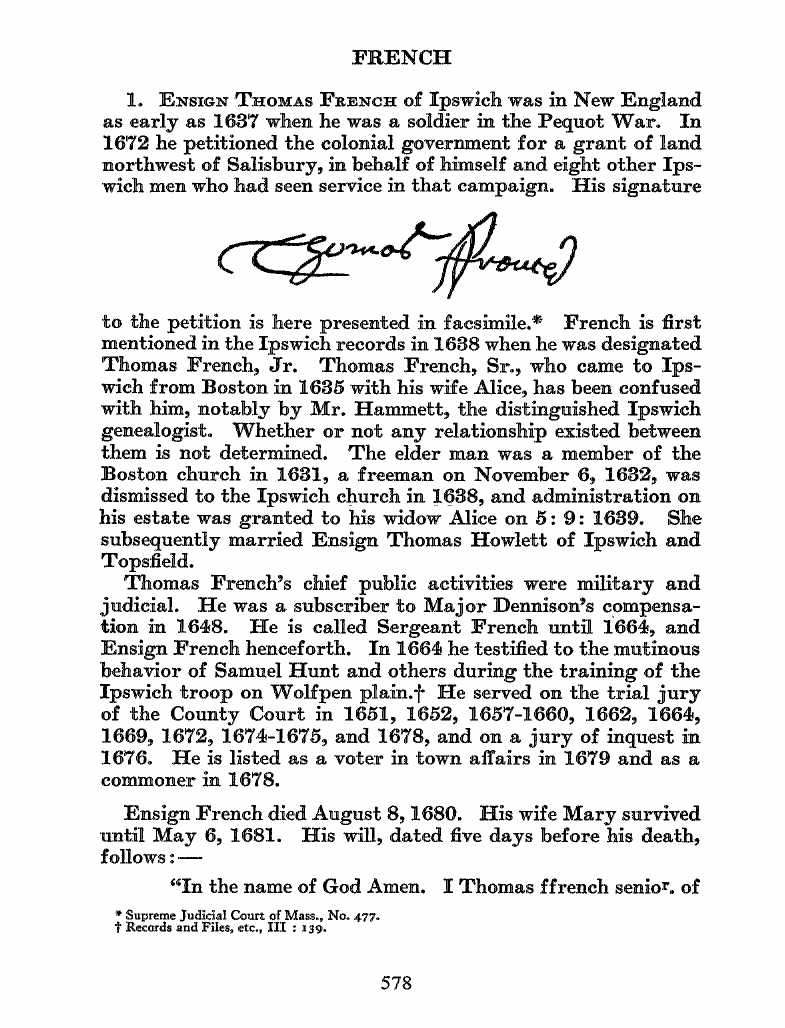
Thomas FRENCH (1584 – 1639) was Alex’s 11th Great Grandfather, one of 4,096 in this generation of the Shaw line.

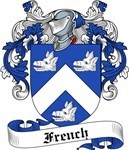
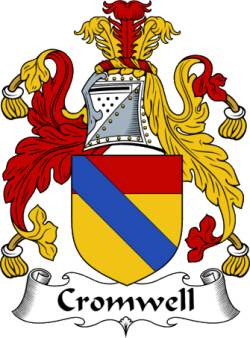
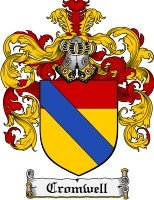
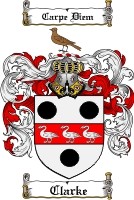
Thomas French - Coat of Arms

Thomas French was baptized 11 Oct 1584 in Bures St. Mary Parish, Suffolk, England.   His parents were Jacob FRENCH and Susan WARREN.  He married Susan RIDDLESDALE on 5 Sep 1608 in Assington, Suffolk, England.  His son Thomas Jr. first came  to New England with the Winthrop Fleet in 1630.  About 1637, Thomas Sr. and Susan and their remaining children joined him at Ipswich. Three daughters had crossed over to New England earlier.

The Rev. Nathaniel Rogers, vicar of Assington, came to New England 17 Nov. 1636, and was pastor at Ipswich until his death in 1665. Four other Assington families came with him, including that of Robinson (N. E. Reg. XLI : 183; XLIV : 400).  It would be natural for Thomas French, the elder, to have come over soon after the departure of his noted pastor.  Thomas died before 5 Nov 1639 in Ipswich, Essex, Mass. when his estate was administered.

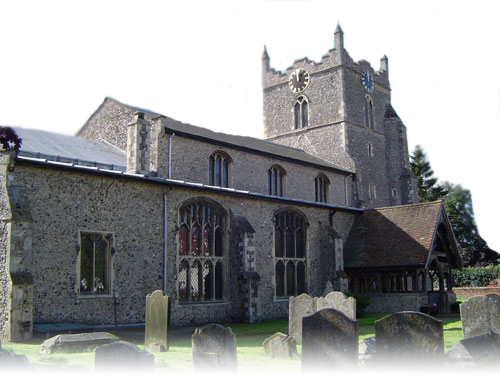
Thomas was baptized in St Mary's Church, a 14th century building in the centre of the village of Bures.

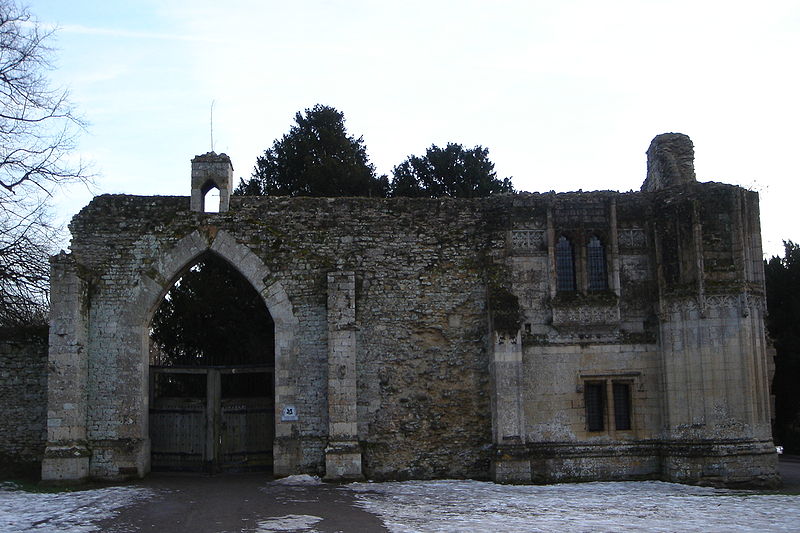
Bures is located on the border between South Suffolk and North Essex, in the heart of picturesque `Constable` country and in an Area of Outstanding Natural Beauty (AONB)  One of the oldest buildings is St Stephens Chapel which dates back to 1218 when it was dedicated by the Archbishop of Canterbury. It predates St Mary’s Church in the village centre, by some 150 years. Even further back than that, history tells us on Christmas Day 855, Bishop Humbert of Elmham anointed a 14-year-old boy as King of the East Angles. The boy was Edmund, the chosen heir of King Offa, and his coronation was documented at `Burva`. The chronicler Galfridus de Fontibus also described the coronation as having taken place at “Bures”, which is an ancient royal hill. It is the general belief that this was the lonely hilltop, where St Stephen’s Chapel now stands.

Bures St Mary - Chapel of St Stephen.jpg

Bures St Mary - Chapel of St Stephen 1218

Susan Riddlesdale was baptized 20 Apr 1584 in Boxford, Suffolk, England. Her parents were John RIDDLESDALE and Dorcas [__?__].  A ” widdow French ” was Commoner of Ipswich in 1641.  Dorcas Riddlesdale was a witness in a case in Ipswich Cournt in March 1647.  Perhaps Dorcas was a niece as Susan'[s sister Dorcas was buried on 15 Dec 1610 in Assington,  Suffolk, England.  Susan died in Aug 1658 in Ipswich, Essex, MA [Ipswich Town Clerk Records, film #0777636]

Children of Thomas and Susan:

Name Born Married Departed
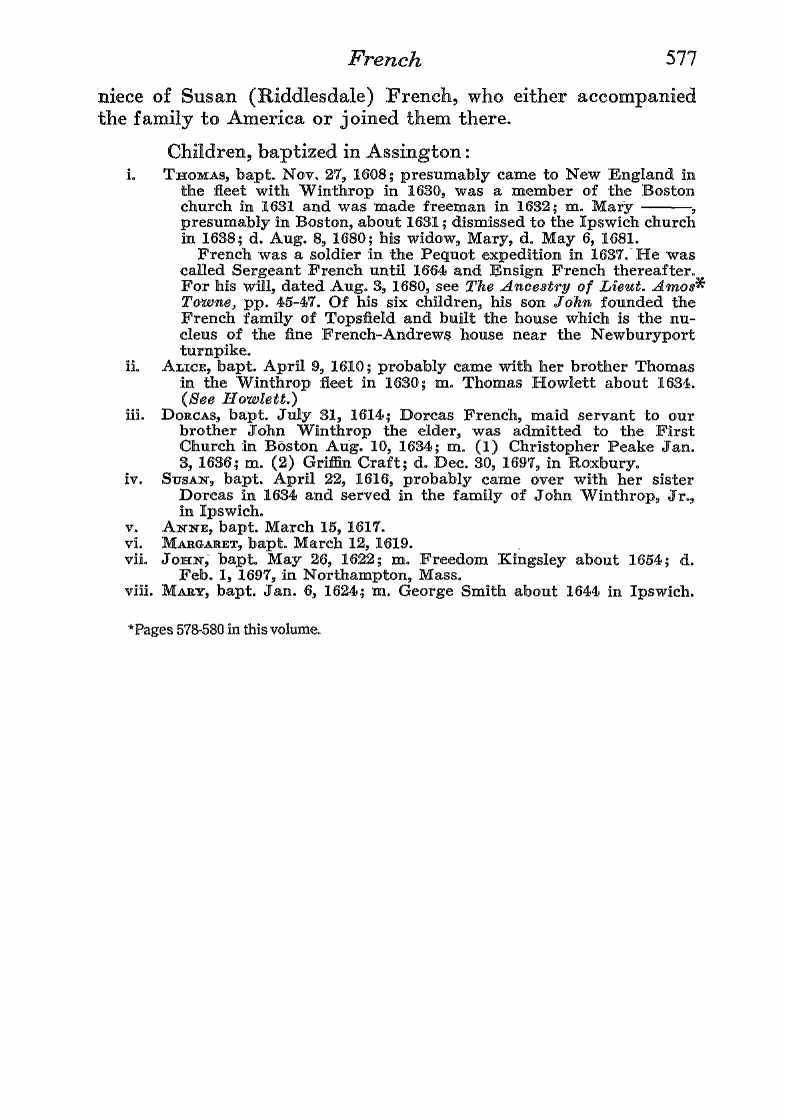
1. Thomas French Jr. bapt.
27 Nov 1608
Assington, Suffolk, England [Parish Record]
Mary  Scudamore
c.1631
8 Aug 1680 Ipswich, Essex, Mass
2. Alice French bapt.
9 Apr 1610
Assington
Thomas Howlett
1634
Ipswich, Essex, MA
26 Jun 1666
Topsfield, Mass.
3. Dorcas French bapt.
31 Jul 1614
Assington
Christopher Peake
3 Jan 1637
Roxbury, Suffolk, Mass.
.
Griffin Craft
1676
Roxbury, Suffolk, Mass.
30 Dec 1697
Roxbury, Suffolk, Mass
4. Susan French bapt.
22 Apr 1616
Assington
After 1633
Prob. Mass.
5. Anne French bapt.
15 Mar 1617
Assington
6. Margaret French bapt.
12 Mar 1620
25 Nov 1635
Assington, Suffolk, England [St. Edmund’s Parish Record]
7. John FRENCH Sr.  bapt.
26 May 1622
St. Edmund’s,  Assignton
Freedom KINGSLEY
c.  
1654.
1 Feb 1697 Northampton, Mass
8. Mary French bapt.
6 Jan 1624
Assington
George Smith
1644 in Ipswich, Mass.
1 FEB 1697
Ipswich, Mass.

Parents

Thomas’ father, Jacob French, was born about 1553 in Assington, Suffolk, England and died 11 Nov 1615 in Assington, Suffolk, England.   Bures in on the border of Essex and Suffolk along the River Stour. Jacob moved to the northern, Assington part of the area about 1585. Bury was mostly owned by the Gurdon family and Thomas lived on a farm in Assington called Garlands which was owned by John Gurdon.  Thomas’ mother, Susan Warren, was born in 1555 in Assington, Suffolk, England.

Susan’s father John Riddledale was baptized 27 Sep 1557 in Boxford, England. He was buried 4 Jun 1629 in Assington.  Her mother Dorcas was buried 24 Sep 1624 in Assington, Suffolk, England.

On 3 January 1613/14, John & Dorcas Riddlesdale, sold a ten acre close, two others of five acres and one of two acres to John Gryme the elder of Assington and his wife Faith for £120. All were pasture and lying in Assington. On the same day, Dorcas Riddlesdale released her interest in land leased in June 1555 by John and Robert Gurdon for 500 years to John Vigorus the younger, clothier of Langham, Essex, England. Perhaps John Vigorus was Dorcas’ grandfather.  John Riddlesdales burial record at Assington states that he was of Bures. He may have, and probably was, living with one of his children at his death; But he was buried next to his wife at Assignton.

Thomas French – Immigrant

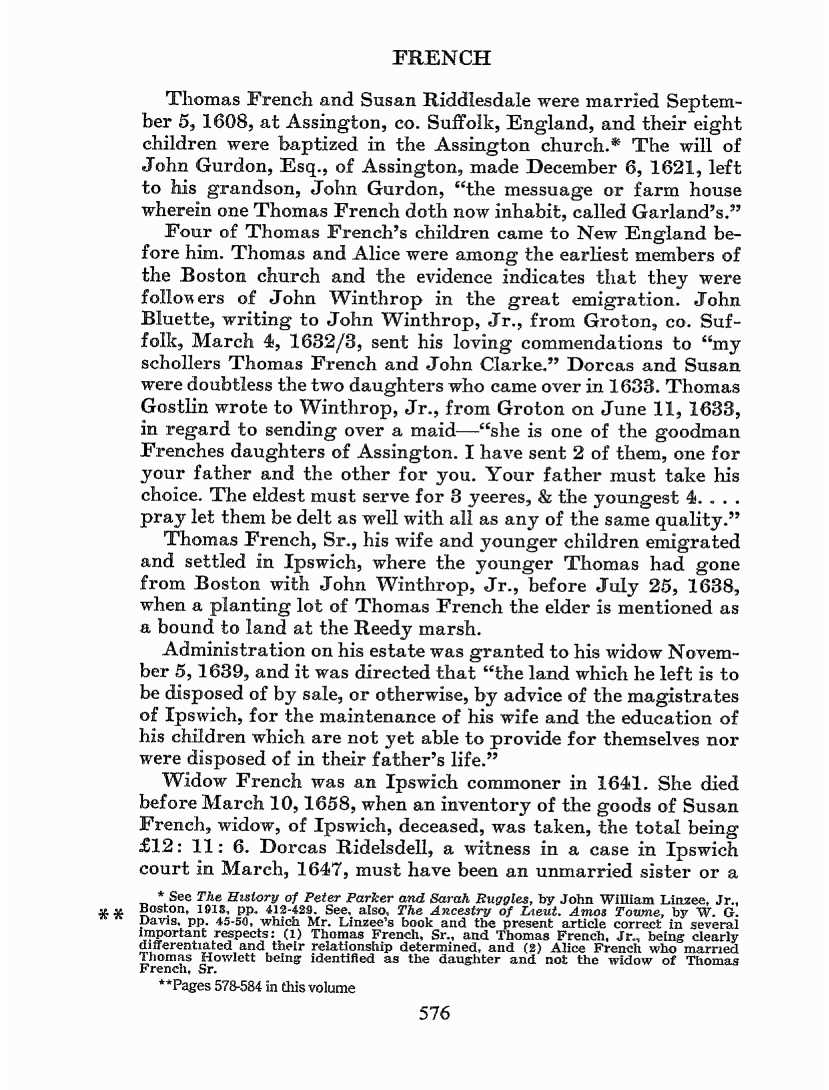
In John Gurdon’s will dated Assington, 6 Dec. 1621, mention is made to “the messuage or farm house wherein one Thomas French doth now inhabit, called Garland’s.”

After his arrival Thomas moved to Ipswich, where his son Thomas Jr. had already relocated. He is recorded for the first time in New England as owning land at Reedy Marsh in 1638 and 1639–in the deeds he is called Thomas French the elder. However, he died there before 5 Nov 1639 when it is recorded that “the administration of the goods of Thomas French deceased is committed to his wife and the land which he left is to be disposed for sale or otherwise by the advice of the Magistrates of Ipswich for the maintenance of his wife and education of his children, which are not yet able to provide for themselves nor were disposed of in their Father’s life.”

5 Nov. 1639 — Administration of French Estate

The administration of the goods of Thomas French, deceased, is comited to his wife, the land w** hee left is to bee disposed of by sale, or otherwise, by advise of the Magistrats of Ipswich, for the maintenance of his wife & education of his children, w°h are not yet able to pvide for themselves, nor were disposed of in their fathers life.

His administration indicates that he had children over the age of 21 years in 1639, and also children who were minors, and under the care of their mother.

Essex No. 10189

Inventory of the goods of Susan ffrench widdow of Ipswh deceased taken 10th of March 1658. (No land mentioned).

Aprissed the day yeare aboue written by vs

Robert Lord  (his mark)
Phillip ffowler (his marke)

This Inventory reed in court held at Ipswich the 29 of March 1659 . . ., amount £12.11.6.

The wrapper of this old paper has ” Susan French . . . widow of Joseph ” but there is no mention of his name on the original paper. This writing is in another hand.

It is possible that the expression “Susan French . . . widow of Joseph” arose from a careless reading of the abbreviated name “Ipswh ” as Joseph; no Susan French widow of Joseph was found in Essex Co. Mass. as early as 1658 or even later; but Joseph French, Son of Edward and Ann French of Ipswich and Salisbury, married Susanna Stacye about 1653, dau. of Simon and Elizabeth ( ) Stacye, she died 16 Feb. 1687-8, and he died 6 June 1710; therefor,   she was never a widow, she cannot be the Susan French widdow who died in 1658, neither does there appear to be any error in the death record of the younger Susan French.

Children

1. Thomas French

Thomas’ wife Mary Scudamore was born 1612 in Gloucestershire, England. Her parents were William Scudamore and Frances Lechmere. Mary died 6 May 1681 in Ipswich, Essex, Mass.

Thomas came to New England with the Winthrop Fleet of eleven ships carrying about 700 colonists, which sailed from Yarmouth, Isle of Wight, in April and May, 1630, and which arrived in June and July following. The first of these ships landed at Salem on 13 June. Thomas French first settled in Boston and presumably was married there about the next year, 1631. He was member #128 of the First Church of Boston.  His wife is identified only as Mary, though she may have been  Mary Morton who appears on the list of original members of the First Church of Boston, as was Thomas French, and then is heard of no more.

Thomas French was made a freeman of the colony on 6 Nov. 1632. John Bluette wrote to John Winthrop Jr. from Groton, Suffolk, 4 Mar. 1632/3 and sent his loving commendations to “my schollers Thomas French and John Clarke.”   About 1634 he moved to Ipswich and appears there on record first in 1635 in the following land records.
20 April 1635 – There was Granted to Thomas Scott…Likewise an hous lott in Mill Streete havinge Thomas French on the Southeast.
20 April 1635 – There was Granted to Robert Mussey…likewise an hous lott in Mill Streete lyinge betweene Thomas French and Richard Jacob.
20 Feb. 1636/37 – There was granted to Serg. French ten acres of upland at the hither end of a Neck lying beyond Reedy marsh, to be laid out by the lott layers. Granted to Serjent French, a parcell of upland and medow containing about three acres on the South side of th River, adjoyning his planting lott.

From these we know that his house was on Bridge Street just off Mill Street.

About 1637 his parents and his younger brother and sisters joined him at Ipswich. Three sisters had crossed over to New England earlier.

Thomas French fought in the Pequot War in 1637.  Proposed for Lieutenant, 25 Mar 1639 (but apparently not confirmed; in a letter of that date Daniel Dennison writes to John Winthrop “Our company wanting some officers, have according to their liberty, made choice of some, whom they desired me to propound to the Court or Council. They were willing to express their love and liking to Sergeant French and Sergeant Howlett proposing the former for Lieutenant, the other for Ensign”). On 18 May 1664 “Sergt. Thomas French deposed that being ordered by Major Genll. Denison to carry two soldiers who were stubborn off the field to prison, he went to them and persuaded them to submit themselves, promising to mediate for them.”  Appointed Ensign at Ipswich 18 May 1664 In 1672, he petioned the colonial government for a grant of land northeast of Salisbury in behalf of himself and eight other Ipswich men who had been of service in that campaign.”

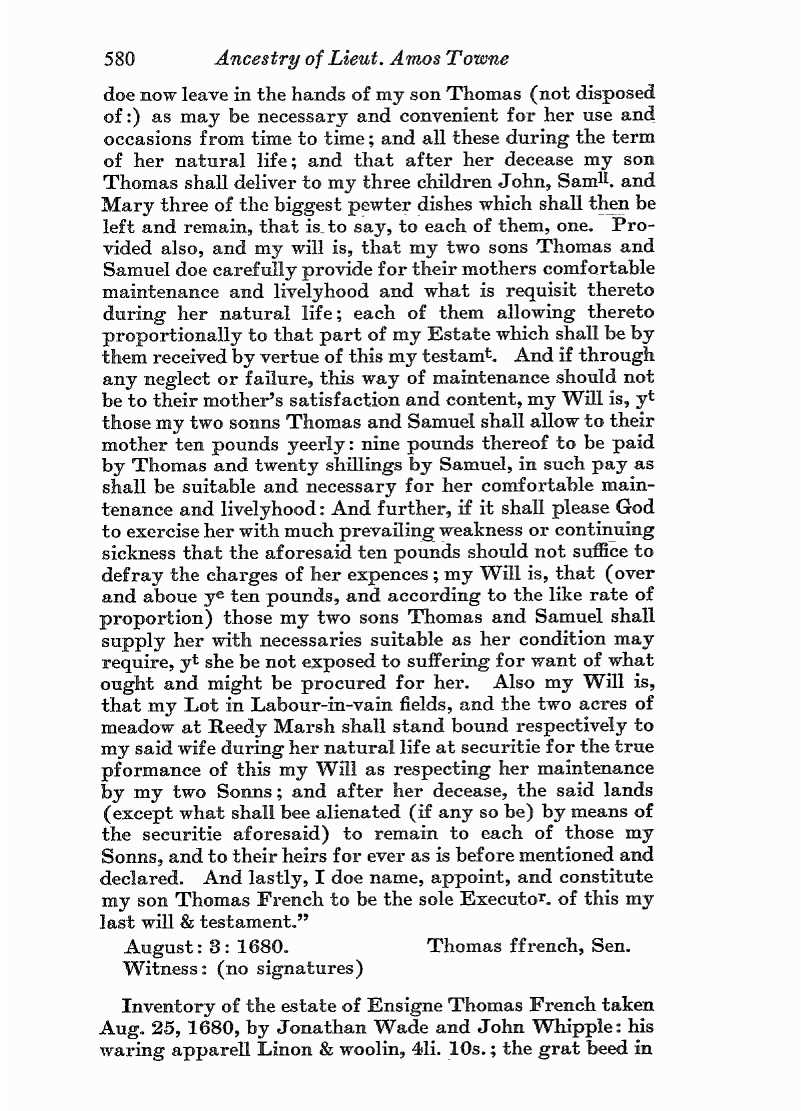
Will of Thomas French Jr, dated 3 Aug 1680 and proved 28 Sep 1680 (Essex File No. 10190)

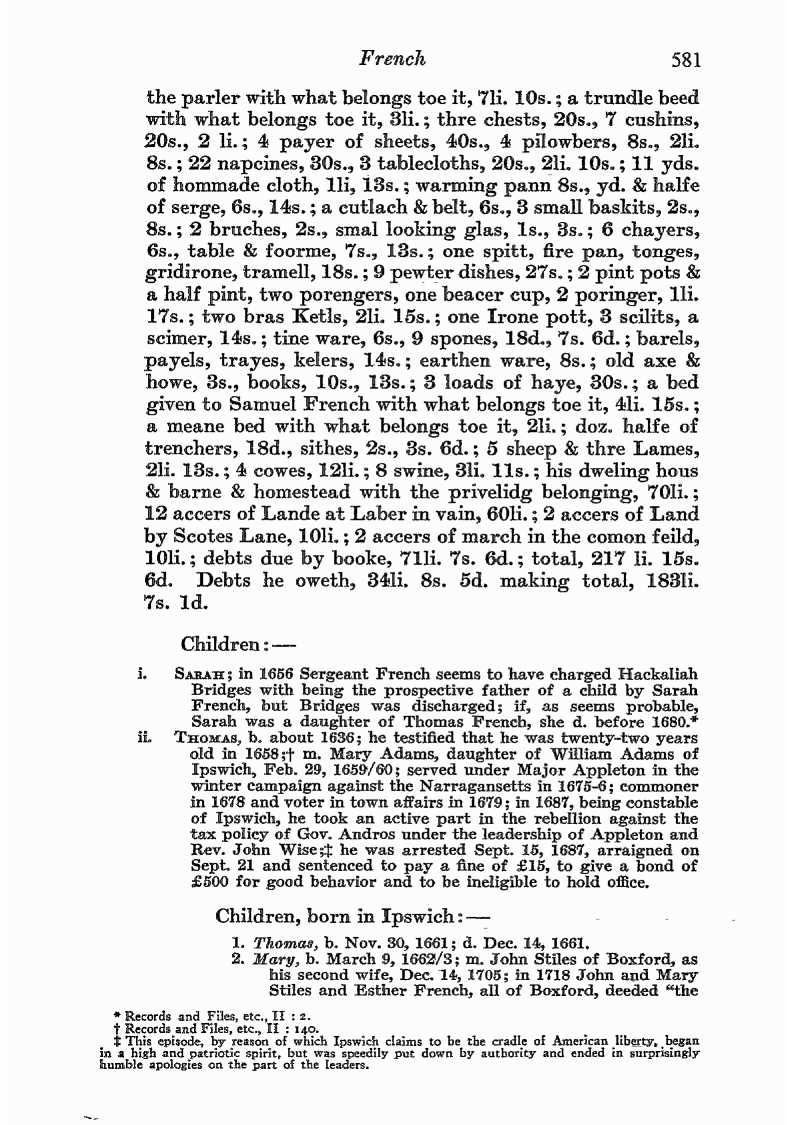
..Thomas French Senior of Ipswich … being weak of body” bequeathed to “Mary my beloved wife the bed whereon I used to lie, with all the appurtenances and furniture belonging thereto”; to “my son Thomas French” clothing; to “my son John French” one cow “to make up the full sum of £30 which I formerly promised him for his portion”; to “my daughter Mary Smith” one cow; to “my son Samuel French” a bed and bedding; “my sons Thomas and Samuel French” in consideration of £20 paid to “my son Ephraim French” as the remaining part of his portion, “my two sons Thomas and Samuel” shall receive the Pequod lands and division lot of marsh to be equally divided betwixt them; to “my son Thomas French” my dwelling house and homestead, also my lot in Labour-in-vain fields of twelve acres, also the rest of my cattle, stock, and moveable goods; to “my son Samuel” two acres of upland and two acres of meadow at Reedy marsh; “my son Thomas French” to give free liberty to “Mary my wife his mother” to dwell in the said house and to make use of any room or rooms thereof for her convenient accommodation … likewise … any such moveables as I do now leave in the hands of my son Thomas”; after her [Mary’s] decease, “my son Thomas” shall deliver to “my three children John, Samuel and Mary” three of the biggest pewter dishes; “my two sons Thomas and Samuel” to provide for “their mother’s” comfortable maintenance, and if she is not satisfied, they to allow her £9 paid by Thomas and 20s. paid by Samuel annually; and if she suffers sickness and the aforesaid £10 does not suffice, “my two sons Thomas and Samuel” shall supply her with necessaries and my lot in Labour-in-vain fields and two acres of meadow at Reedy Marsh shall stand bound respectively to my said wife during her natural life as security for the true performance of this my will as respecting her maintenance by my two sons; “my son Thomas French” sole executor

The inventory of Ensign Thomas French was taken 25 August 1680 and totalled £217 15s. 6d. including £150 in real estate: “his dwelling house & barn & homestead with the privilege belonging,” £70; “twelve acres of land at Labor in vain,” £60; “two acres of land by Scotes Lane,” £10; and “two acres of marsh in the common field,” £10

This proved in court held at Ipswich 28 of Sept. 1680 to be the last will … of Ens: Tho: ffrench by the oath of Mary Frenchand Samuell ffrench . . . Dated Agust 3: 1680.

2. Alice French

Alice’s husband Thomas Howlett was born 1605 in England. His parents were William Howlett and [_?__]. Thomas died 22 Dec 1677 in Topsfield, Essex, Mass

Alice probably emigrated to America with brother Thomas.  She was member #142 of the First Church of Boston, admitted in 1632.  Alice was dismissed from the Boston church to Ipswich Jun. 16, 1644.

3. Dorcas French

Dorcas’ first husband Christopher Peake was born in 1605 in Thorpe Achurch, Northamptonshire, England. His parents were Boniface Peake and Joan Clarke. Christopher died 22 May 1666 in Roxbury, Suffolk, Mass.

Dorcas’ second husband Griffin Craft was born 21 May 1600 in England. He first married 1628 in England to Alice [__?__] (b. 1600 England d. 26 Mar 1673 in Roxbury, Suffolk, Mass.) Griffin died 4 Oct 1689 in Roxbury, Suffolk, Mass.

Dorcas came to New England in 1633 on three year service as maidservant to Elder John Winthrop.   She was admitted to First Church in Boston, 10 Aug 1634.  Dorcas ended her apprenticeship in 1636, the exact date that she married Christopher Peake in Roxbury.

4. Susan French

Susan immigrated in 1633 to serve as a maid to the Younger John Winthrop for 4 years. No more known.

(Mass. Hist. Soc. 5th Series, I :200-1) Letter of Thomas Gostlin to John Winthrop Jr.

Loving Cosen . . . but for carpenters I could get none, nor husbandmen, such as weare fit for you, but as for maydes and a girle I could haue sent you enoug yf my brother Downing would haue payed for the passage, therefore I haue sent you but one, because at this time I am shortned for mony, and Mr. Peerse would be payed downe, & would haue no lesse than fiue pound a passenger besydes 2s 6d for the surgion, which I left with your vncle Downinge for him. She is one of the goodman Frenches daughters of Assington. I haue sent 2 of them, one for your father, and the other for you. Your father must take his choyse. The eldest must serve for 3 yeeres, the youngest 4 … I praye let them be delt as well with all as any of the same quallity. Groton this 11 June 1633.

7. John FRENCH Sr. (See his page)

8. Mary French

Mary’s husband George Smith was born in 1620 in England. George died 30 Mar 1675 in Ipswich, Essex, Mass.

Mary and George’s daughter Sarah Smith was born 1645 in Ipswich, Essex, Mass. She married 9 Nov 1664 Ipswich, Mass to John Newman, son of Thomas NEWMAN Sr and Alice MADDOX.

Sources:

From Dudley Wildes 1959 by Walter Goodwin Davis

From Amos Towne 1927 by Walter Goodwin Davis

http://trees.ancestry.com/owt/person.aspx?pid=26653124

http://www.frenchfamilyassoc.com/FFA/CHARTS/Chart001/

http://wc.rootsweb.ancestry.com/cgi-bin/igm.cgi?op=GET&db=jacob11&id=I11634

The history of Peter Parker and Sarah Ruggles of Roxbury, Mass. and their ancestors and descendants … By John William Linzee 1918

http://mainegenie.cwahi.net/FRENCH.htm

http://freepages.genealogy.rootsweb.ancestry.com/~cetowne/Towne_Bowditch/p408.htm

Posted in 13th Generation, Historical Church, Immigrant - England, Line - Shaw | Tagged | 8 Comments

17th Century Houses

A surprisingly large proportion of the oldest New England houses still in existence were built by our ancestors.

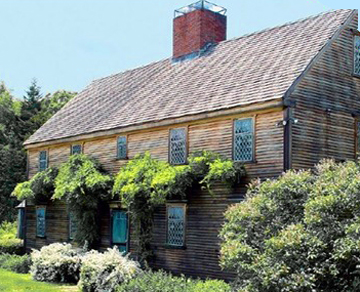
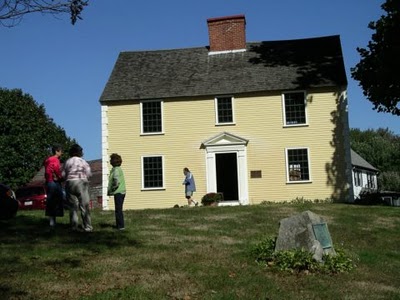
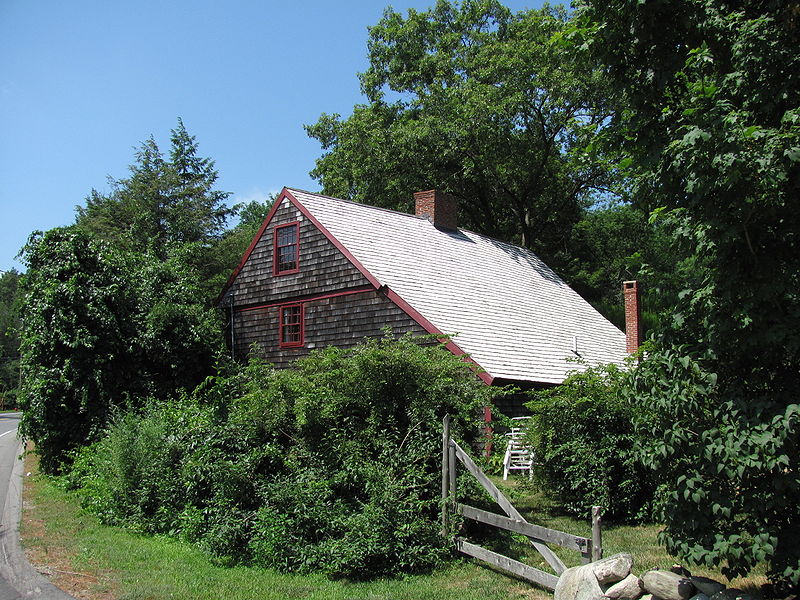
Stephen HOPKINS House

Stephen Hopkins Reenactor

Stephen Hopkins Reenactor

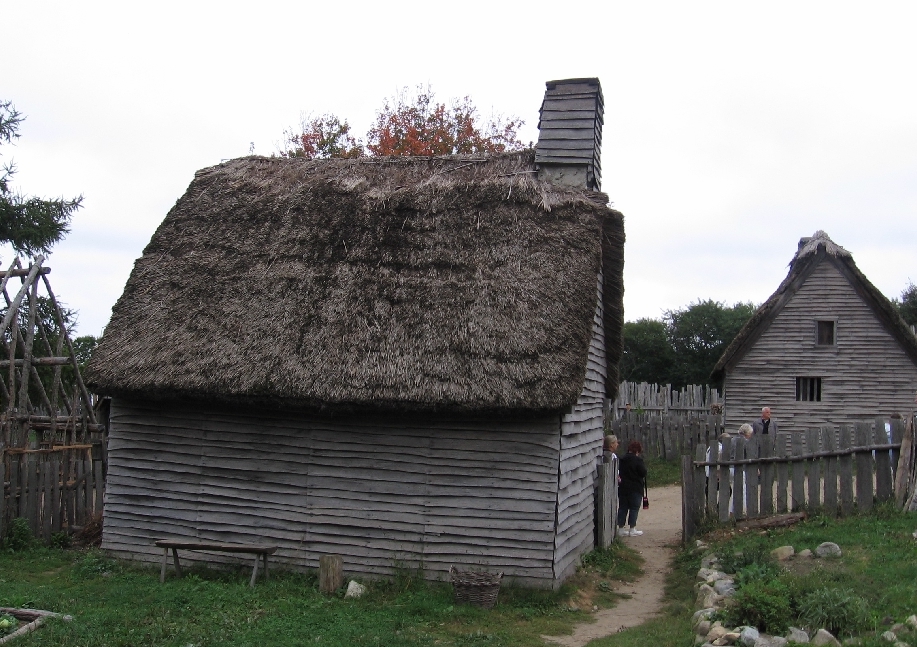
Plimoth Plantation c.1627 Re- creation .

The 17th-Century English Village is a re-creation of the small farming and maritime community built by the Pilgrims* along the shore of Plymouth Harbor. In the Village, the year is 1627, just seven years after the arrival of the Mayflower. The Museum selected this year for re-creation because it is well-documented in the historical sources and shows the plantation (a word that was used interchangeably with the word “colony” in the 1600s) just before the colonists began to disperse beyond the walled town and into other parts of what would become southeastern Massachusetts.
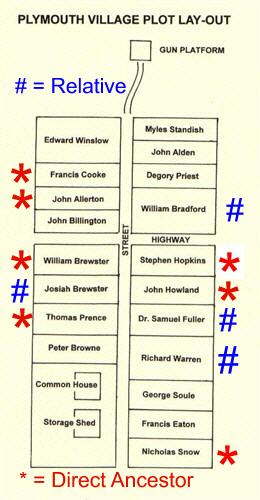
Our ancestors or their close relatives had almost half the lots in early Plymouth – (George Soule was the grandfather of John TOMSON’s son-in-law, not close enough to get a #)
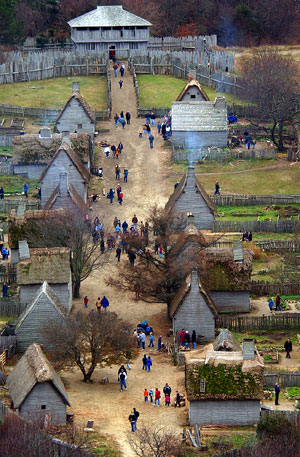
Our ancestors or their close relatives had almost half the lots in early Plymouth – (George Soule was the grandfather of John TOMSON’s son-in-law, not close enough to get a #)

Plimoth Plantation 1627 Village

Plimoth Plantation 1627 Village

The Rear of Stephen Hopkins Plymouth Home as seen from the goat enclosure fence

The Rear of Stephen Hopkins Plymouth Home as seen from the goat enclosure fence

1. Fairbanks House

Jonathan Fairbanks Home

Dedham, Mass c.1637 Oldest wood-frame house in America, dated using dendochronology, and the oldest house in Massachusetts.

Jonathan FAIRBANKS (1594 – 1668) (wikipedia) was an American colonist who in 1637 built the Fairbanks House in Dedham, Massachusetts which is today the oldest surviving wood framed house in North America. Through Mary and Susan, he was Alex’s 9th Great Grandfather twice, two of 1,024 in this generation of the Shaw line.

The Fairbanks family remained in Boston about three years, before settling in Dedham, as one of the earliest settler families. Jonathan Fairbanks signed the Covenant when the town was founded and named.

Fairbanks House
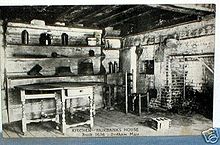
The house was built in several stages; the center portion of the present house is oldest, with a gable-roofed portion at the center. It was once a lobby-entry, hall-parlor house of two stories with a center chimney bay. The lean-to was added later, contrary to the note on the first floor plan (see image). The oak lintel over its parlor fireplace has been dated by dendrochronology to 1637. Since timber was not seasoned before use in the 17th century, this provides a plausible date for the house’s initial construction. Other houses claiming to be older have yet to be scientifically dated
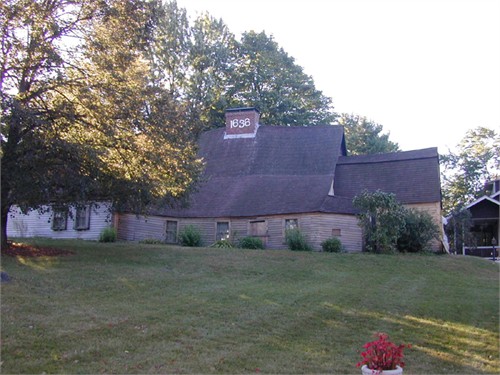
Exterior walls were covered with wide oak clapboards at the front, narrower oak on the west gable end, and narrow cedar on the rear. Its front door was originally located to the west side of the chimney-bay, while the rear door is still located at the west end of the north wall. Original front windows included wide banks on each floor and small windows lighting the chimney bay. A well-preserved four-light window survives in the east gable end, but the north and east ends of the house apparently had no windows.

A lean-to was later added at the back of the house and, perhaps in 1641, a wing on the east side. The west wing was added around 1654. The east wing was probably added circa late 1700s, assembled from two earlier buildings elsewhere. A chimney was then built for it; later its roof rafters were raised and reused in a new gambrel roof. The next major change was the expansion of the parlor to the east, under a hip roof, and the addition of the small entry to this expanded space, probably around 1800. A new wing was added to the west side of the house, including two rooms. The last addition to the house, completed by 1881, was a privy added behind the west wing.
It has been claimed that this house was built in 1636. This claim has been the subject of considerable discussion among historians, and is disputed on historical grounds. One, at least, expresses the belief that it was not built until about the year 1640. The chief reason assigned for his belief is that the old house is a framed building of massive oak timber, and that there is no historical evidence that any framed dwelling houses were erected in the town as early as 1636. Against this alleged fact is the tradition that the frame of the main part of the house, together with the bricks and tiles and windows, was imported from England, and remained in Boston for several months before it was carried to Dedham.

The truth is that the house was not built as it stands at one time, or in one year; and it is certain that Jonathan owned a house situated probably on the same lot in 1648. Subsequently, perhaps as late as 1654, a large addition was made to the original building, which was called the new house, which is said to have been built for the occupation of his son John after his marriage.

The house was occupied by Fairbanks descendant and passed down to succeeding generations of the family until the early twentieth century. In all, eight generations of the Fairbanks Family lived in the house and the Fairbanks family still owns the property. Over the years, the original portion was extended with additions as the family’s needs and as the fashions of the times dictated including the east and west wings added in the early nineteenth century.

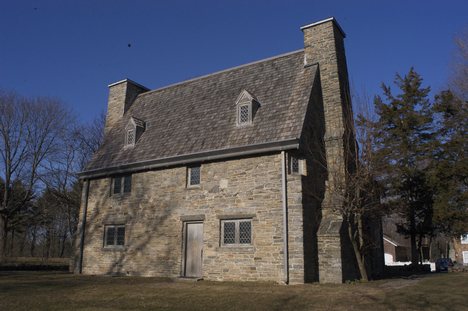
2. Rev Henry Whitfield House

Whitfield House

Guildford, CT 1639 Oldest Stone House in New England

Rev. Henry Whitfield (1597 – 1657) was the father of Rev. James FITCH‘s first wife Abigail. While he is not one of our direct ancestors, I thought his story would be interesting to include.  Guilford is considered by some to have the third largest collection of historic homes in New England, with important buildings from the 17th, 18th, and 19th centuries There are five historic house museums, including the Henry Whitfield House (1639), the oldest dwelling house in Connecticut and the oldest stone house in North America.  If this house was actually begun in 1639, it would be the oldest extant New England Colonial building, but there is no original interior wood, so the tree-ring method of dating (dendrochronology) cannot be used.  According to tradition, the stone of which it is built was brought by Indians on hand-barrows across a swamp from Griswold’s lodge, about eighty rods distant. The walls are three feet thick. The house was kept in its original form till 1868, when it underwent considerable renovation.
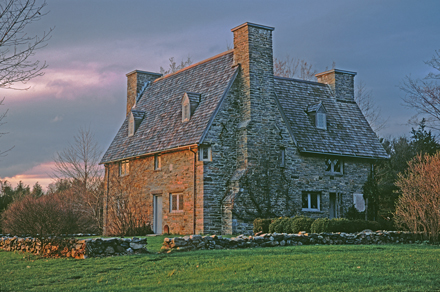
Whitfield House

The Henry Whitfield House is a historic house located at 248 Old Whitfield Street in Guilford, Connecticut. This house dates from 1639, having been built just before the town of Guilford was settled. The house, with its massive stone walls, also served as a fort.  It was one of four stone houses that served to protect the community. Henry Whitfield was a Puritan minister who had come from England to flee religious persecution.
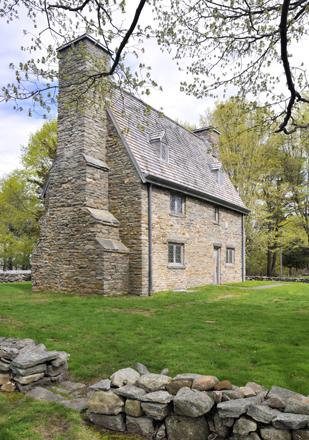
Whitfield House

The house was remodeled in 1868 and opened to the public in 1899 as a museum of the State of Connecticut, the Henry Whitfield State Museum. The house was restored in 1902-04 and in the 1930s and was declared a National Historic Landmark in 1997.  It is the oldest house in Connecticut and the oldest stone house in New England. It was named a State Archeological Preserve in 2006.

Henry Whitfield House

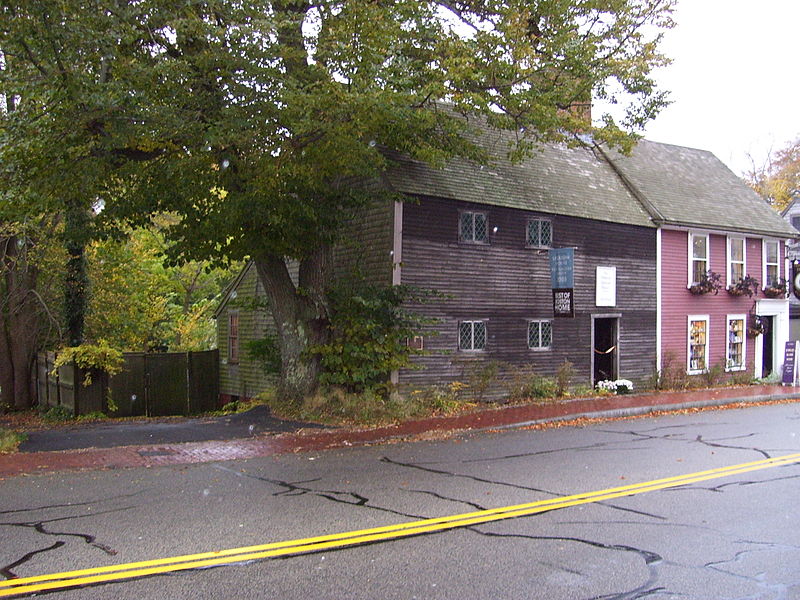
3. Richard Sparrow House Plymouth, Massachusetts 1640 Oldest house in Plymouth.

Richard SPARROW was born in 1605 in Kent England. He was married to Pandora BANGS in 1629. He immigrated in 1632 from England. Richard died on Jan 8 1660/61 in Eastham, Barnstable, Mass. Burial in Cove Burying Ground. Our ancestor Capt. Jonathan SPARROW was his only child.
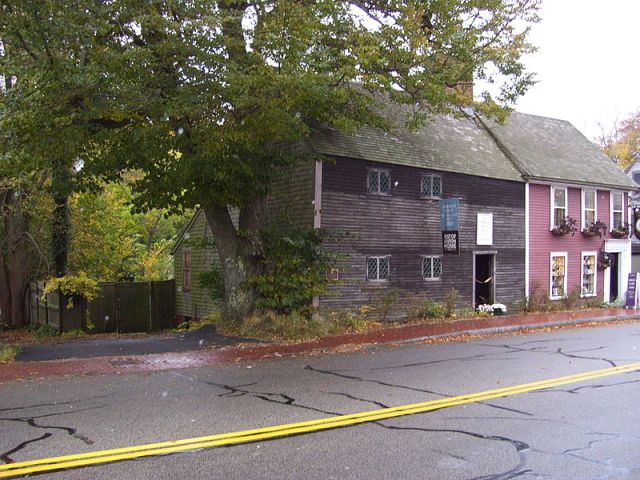
Richard Sparrow House one of the oldest houses remaining in Plymouth – open as a museum

4. Wing Fort House

Wing Fort House

East Sandwich, Massachusetts 1641

John WINGE was baptized on 1 Sep 1611 at Strood, Kent, England . His parents were Rev. John WINGE and Deborah BACHILER. In 1632, shortly after the death of his father, he emigrated from England to New England with his three brothers, his mother, her father, Stephen Bachiler and her mother Helena Mason Bachiler. They came to New England on the ship William & Francis with her father and his wife. He married Elizabeth DILLINGHAM at Sandwich, Plymouth Colony, around 1645. After Elizabeth died, he married Miriam Deane on 31 Jan 1692/93 . John’s will is dated 13 Apr 1696 and he died at Harwich, Barnstable, MA, around Apr 1699.

In 1637, ten influential citizens from Saugus had petitioned the General Court of Plymouth Colony to found a new settlement on Cape Cod. Whether their decision to settle in that area was influenced by Rev. Stephen Bachiler’s attempt to found a settlement at Mattacheese (now Yarmouth) is not known. It is known that The Wings were among the “three score” [about 60] families who moved to the new settlement shortly after it was granted. Even at this early date, Massachusetts Bay Colony was fast outstripping the older Plymouth Colony, both in population and political clout. The Bay colony could well afford to lose some colonist to its neighbor, and the relationship between the two colonies were always amicable. It is unknown how it was decided to name the new settlement Sandwich, Mass. It was clearly named after the city of Sandwich in Kent County, England as it bears some physical resemblance to the old Cinque Port city. The Wings were the only family in the new town who are known to have lived in its namesake town in England.

When Sandwich was first settled, John was the only Wing brother to be of legal age. Given the fact he (and not mother Deborah) was credited as selling their home in Lynn to William Tilton, it is likely the original homestead was likewise granted to him. When he moved to Yarmouth about 10 years later, the property probably reverted back to the Town of Sandwich. It is believed by many that the house they lived in was called The Orchard House. In Jun 1640 his brother Daniel purchased the homestead of Andrew Hallett and moved there. His brother Stephen was granted (or purchased) the “Fort House” on Spring Hill circa 1645.

Wing Fort House is a historic house at Spring Hill Road in East Sandwich, Massachusetts.
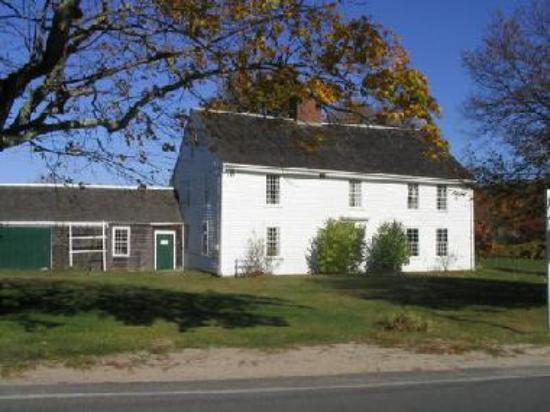
Wing Fort House

The house was built in 1641 and added to the National Register of Historic Places in 1976.

The Wing Fort House is recognized as the oldest home in New England continuously owned by the same family. John Wing’s brother Stephen either purchased the homestead from the town of Sandwich, or the town granted him the property, around the time of his first marriage in 1646. His descendants continued to live in the home until 1942, when the last resident (Miss Cora M. Wing) sold the home to the Wing Family of America, Inc.

Tradition states the home was at one time a fort to protect the earliest settlers from the Native Americans. The exterior of the “Old Fort” Room (which is the oldest part of the current structure) is composed of a double wall, which may have been filled in at one time. As the Cape Indians were found to be friendly, the town did not need any fort for protection.

The Fort House is now a museum, privately operated by the Wing Family of America, Inc. It is located at 69 Spring Hill Road (off of Route 6a), East Sandwich, Massachusetts. The museum is open Tuesday through Saturday from June 15 to September 30 from 10:00 a.m. to 4:00 p.m. and by appointment during the remainder of the year.

5. Sturgis Library

Sturgis Library constructed in 1644 for the Reverend John Lothrop, founder of Barnstable

Barnstable, Mass 1644 One of John Lothrop’s original homes and meeting houses, and is now also the oldest building housing a public library in America.

Rev. John LATHROP (1584 – 1653) was an English Anglican clergyman, who became a Congregationalist minister and emigrant to New England. He was the founder of Barnstable, Massachusetts. John was Alex’s 10th Great Grandfather; one of 2,048 in this generation in the Shaw line through his son Barnabas. He was also Alex’s 9th Great Grandfather; one of 1,024 in this generation of the Miller line through his son Samuel.

Lothrop began construction on a larger sturdier meeting house by Coggin’s (or Cooper’s) Pond, which was completed in 1644. This building, now part of the Sturgis Library in Barnstable, Massachusetts is one of John Lothrop’s original homes and meeting houses, and is now also the oldest building housing a public library in America. Since Reverend Lothrop used the front room of the house for public worship, the library is also the oldest structure still standing in America where religious services were regularly held. This room, now called “The Lothrop Room,” with its beamed ceiling and pumpkin-colored wide-board floors, retains the quintessential early character of authentic Cape Cod houses.
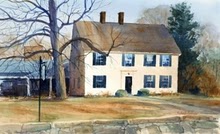
Sturgis Library constructed in 1644 for the Reverend John Lothrop, founder of Barnstable

xx

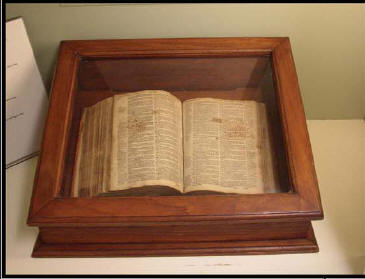
Rev. John Lothropp’s bible brought to America by Rev. John Lothropp onboard the Griffin in 1634. Rev. John Lothropp was a religious leader in Plymouth Plantation where he founded three churches which are still in existence.

6. Dillingham House B&B

Edward Dillingham Home

1650 Generally viewed as being haunted.

Edward DILLINGHAM was baptized on 6 Dec 1595 at Cotesbach, Leicester, England.    He married Ursula CARTER at Cotesbach, Leicester, England, on 14 Feb 1614/15.  Edward’s younger brother John immigrated in 1630.  Edward with his wife, Ursula, and three of their children came to Boston in 1632, settled in Lynn, and later in Sandwich, Massachusetts. Three daughters of Edward and Ursula remained in England  Edward died between 1 May 1666 when he wrote his will and 5 June 1667 when it was proven in Sandwich, Plymouth Colony.

In 1637 Edward Dillingham with a land grant from Myles Standish was one of the founding fathers of the town of Sandwich. It is believed that Edward’s son, Simeon, built the Dillingham House in 1650. For the next 270 years the house was occupied by Dillinghams.

The Dillingham House is located on Old Main Street, very close to the village of Sandwich and its many attractions, including beaches, museums and the scenic historic village.  Convenient to many places and centrally located, Sandwich, Massachusetts is the perfect base from which to visit Cape Cod, the Islands, Newport, Plymouth or Boston.
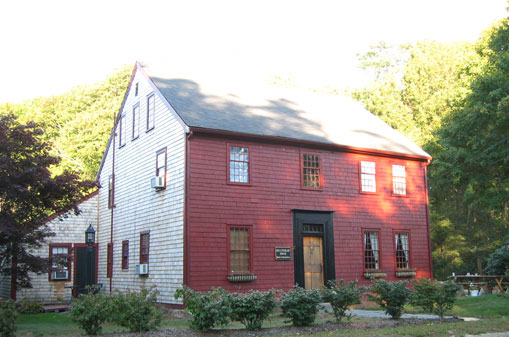
Edward Dillingham House in Sandwich dates back to “1650” –

Ryan Griffin now owns the Dillingham House and operates a four bedroom B & B there.  The house has gone from being the  home of one of the distinguished founders of Sandwich, MA, Edward Dillingham to being a rundown boarding house during the 1930s and 40s and then was vacant for much of the 1970s.  It is now once again restored to a lovely house for guests to Cape Cod.  Throughout all these incarnations, however, it has been generally viewed as being haunted.  Many people think the ghost is Branch Dillingham who committed suicide in 1813.  Others think it is several of his many children, or both. During the 1970s the local police responded many times to alarms from the house, only to find no cause. during their investigations doors that would not budge would suddenly open easily and lights that did not work would be on upon their return to that room.  The police reports noted that over the years activity seemed to increase in October. Ms Griffin has also noticed this pattern. One guest briefly saw a man in Victorian clothing, and her sister claimed that when she woke up she saw a young girl sitting at the end of the bed. Other guests have reported unexplained footsteps when no one is around. The Dillingham House is at 71 Main St., Sandwich MA  508-833-0065. email  info@dillinghamhouse.com

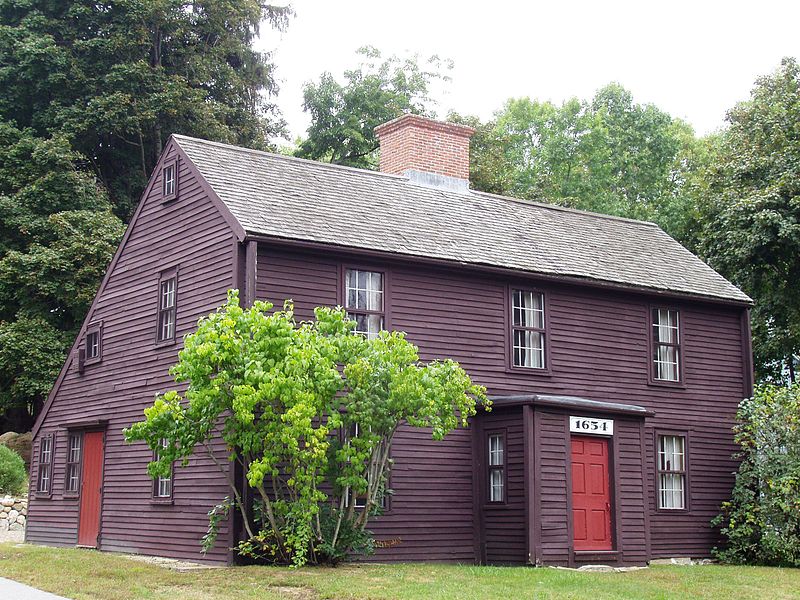
7. Macy-Colby House Amesbury, Massachusetts 1654

Anthony COLBY was born 8 Sep 1605 in Horbling, Lincolnshire, England. His parents were Thomas COLBY and Anna JACKSON. Some claim he was the son of Thomas and Beatrice (Fenton) Colby and therefore connected to English royalty. This has not been proved. He arrived in America on the Arabella in 1630 with the Winthrop Fleet. He married Susanna WATERMAN 1632 in Boston, Mass. Anthony died 11 Feb 1661 in Salisbury, Essex, Mass.
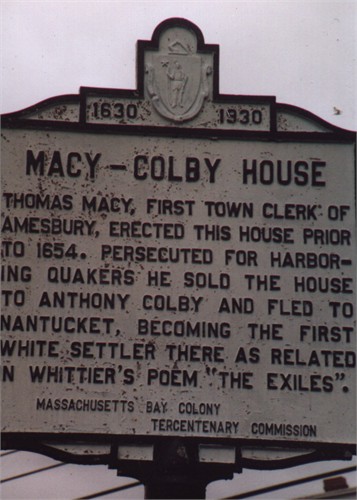
Macy – Colby House

Macy-Colby House Amesbury, Mass
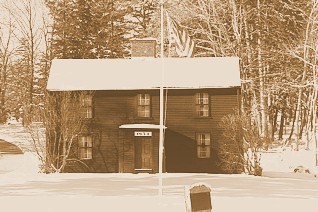
259 Main Street, Amesbury, MA The Macy-Colby house is open on Saturdays from 10:00 am to 4:00 pm during the summer. Other times are available by appointment. To arrange an appointment contact: Kathy Colby 978-388-3054 colbykathleen@verizon.net

x

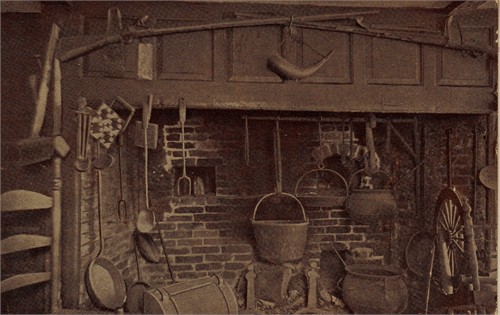
Hearth of the Colby House from an old postcard “Macy Colby House Fireplace, Amesbury, Massachusetts”

The year after Anthony Colby’s death, his widow, Susannah sold 60 acres near Haverhill, MA to her son Isaac to pay for her board. From the public divisions she received land in 1662 and 1664. In the latter year she married William Whitridge, a carpenter from Gloucester, and he died in 1669. In the meantime, Susannah had to defend her homestead against the claim of Thomas Macy from whom it had been purchased. At about the time of the sale, Macy had fled to Nantucket to escape the penalty of sheltering two Quakers during a thunderstorm, but later he denied the sale and tried to expel the widow and her family by legal process. He was unsuccessful and the premises were in the possession of Susannah’s descendants as late as 1895. In 1678, the son of Thomas Macy was deeded half of all the lands remaining in consideration of services rendered to the widow, and in 1682 the homestead was deeded to Susannah’s son, Samuel Colby, who cared for her during the infirmities of old age.

7a. John Proctor House

John Proctor House

Peabody, Mass Bef. 1656 Owned by two separate ancestors’ sons

Emanuel Downing [son of our ancestor George DOWNING] returned to England in 1656 and leased his farm, in Peabody near Salem, to John Proctor(famous witch trial victim and son of our ancestor John PROCTORwho ran a tavern out of the same house in Peabody MA . (348 Lowell St. Peabody, Mass..) as had Mr. Downing.
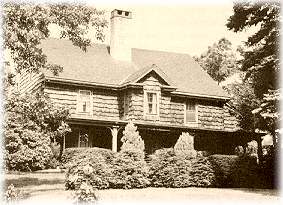
John Proctor House

John Proctor, an early opponent of the witch hunt, lived in this house in 1692. One of the afflicted girls, Mary Warren, was a maidservant in his household. Proctor had cured her fits with a good whipping and maintained that the others could be cured with similar treatment.  The stream which runs behind the house is known to this day as Proctor Brook. The Proctor house is privately owned.

The grant for this farm was originally given to Robert Cole in 1635 by the selectmen of Salem. He sold it to Emanuel Downing in 1638. In 1700 Charles Downing, the son of Sir George, sold the farm to Thorndike Proctor. He was the son of the murdered John Proctor. It remained in the Proctor family until 1851.

Then for years it was known as the Roome farm. The Downing/Proctor house still stands at 348 Lowell St. in Peabody. The Saccone family occupied the Downing/Procter house/tavern for twenty years and found early 1700 clay earthenware in the attic.

Vincent and Marion Raponi, who bought the house from the Saccone’s, have owned the property for some twenty-odd years now and report having found two British coins dating back to 1740 and 1755. When they started remodeling the house they found three fireplaces and the original wall and ceiling beams which were held in place by wooden pegs.

8. Philip Call House

Philip Call House

Ipswich, Mass 1659 Notes

Phillip CALL was born  in 1627, in Faversham, Hernhill, Kent, England.   His uncle Thomas CALL. arrived in America with his aunt and uncle in 1637 on “Hercules” and first lived in Charlestown, Mass near the ferry in Charlestown, on the Mystic side. Philip’s arrival is not known, though he may have moved to Malden in 1649 when he was 22 years old.  He married Mary SMITH 1659 in Ipswich, Essex, Mass.  Philip died in 1662 in Ipswich, Mass.

Philip was a tilemaker, a baker or a cordwainer.

Cordwainer Philip Call House in Ipswich, Mass

This important First Period house was built by cordwainer Philip Call about 1659. The evolution of this property to its current twelve rooms is an outstanding example of careful adaption of various periods over four generations. Appearing as an old Victorian when purchased by the current owners in 1967, its careful restoration uncovered such important elements as an outstanding chamfered 17th century summer beam, that defines the original 2 112 story house, first enlarged around 1725. Restoration also discovered 17th century field paneling behind new walls, and one of the last remaining three hole privies in Ipswich. The contemporary kitchen overlooks a formal boxwood garden.

The town of Ipswich has more existing 17th C houses than any other, including Philip Call’s.  Philip Call owned a house on this lot in 1659, and, by the deed of Woodam to Brown of the adjoining lot, in 1663, he was still in possession. Brown’s deed of the abutting lot to Paine, gives the owner of this lot as Philip Call’s widow, Mary, then the wife of Henry Bennet. Nathaniel Lord sold this lot to his son-in-law, Joseph Bolles, March 29, 1710. Bolles also bought of Joseph Fowler, owner of the abutting lot, a house and an acre of land, March 5, 1722. Charles Bolles sold his grandson, John Manning 3d, surgeon, an acre and house, bounded by Nathaniel Lord east, and Capt. Ebenezer Lord west, the estate of his deceased father, Jan. 16, 1786. Dr. Manning sold the western part of the lot with ahouse,that he probably built, to Daniel Lord 3d, April 23, 1798, and the heirs of Lord sold to Abraham Caldwell, whose heirs still own the property. Dr. Manning sold the eastern part and house to Ammi R. Smith, April 25, 1798. Smith bought a small pieceof Nathaniel Lord 3d on the east of his lot, Dec. 9, 1820 (225: 219). Abby H. Smith, the executor of Samuel R. Smith sold this estate to John G. Caldwell, being the same conveyed to him by Zenas Cushing in 1850, July 25, 1876 (958: 194). The Caldwell heirs still owned in 1905.
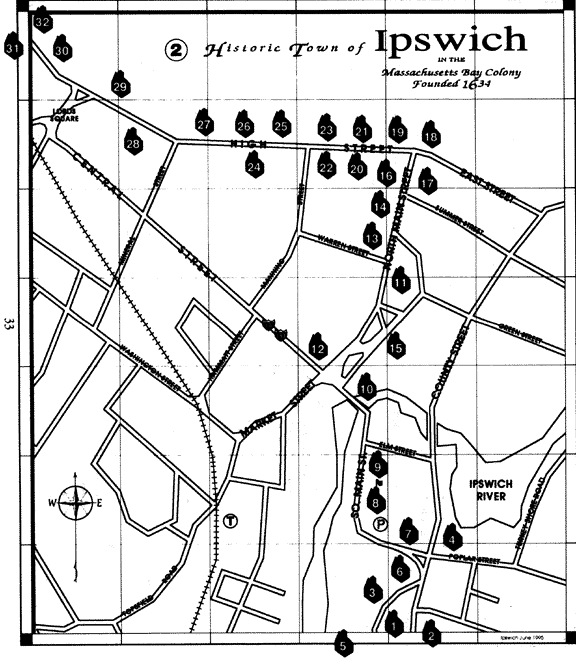
Historic Ipswich – Philip Call’s house is #24 on High Street

Ipswich in the Massachusetts Bay Colony … By Thomas Franklin Waters, Sarah Goodhue, John Wise, Ipswich Historical Society 1927
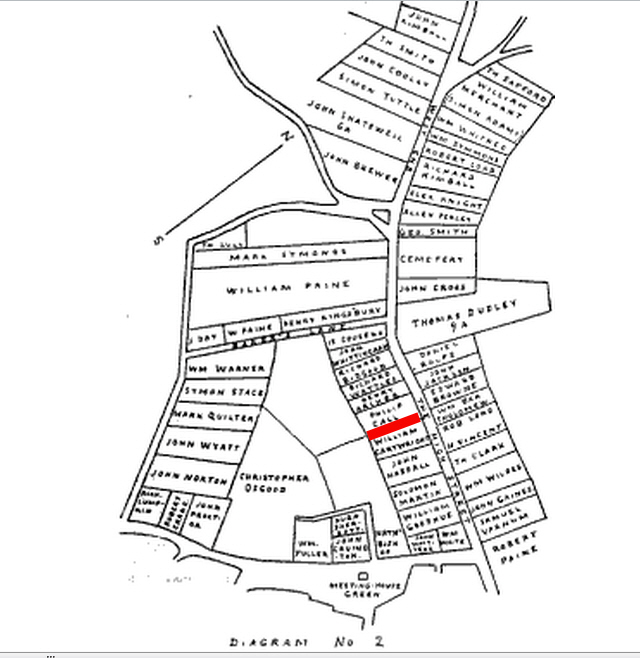
Philip Call’s Ipswich Lot

Philip Call owned a house on this lot in 1659, and, by the deed of Woodam to Brown of the adjoining lot, in 1663, he was still in possession. Brown’s deed of the abutting lot to Paine, gives the owner of this lot as Philip Call’s widow, Mary, then the wife of Henry Bennet. Nathaniel Lord sold this lot to his son-in-law, Joseph Bolles, March 29,1710 (26:176). Bolles also bought of Joseph Fowler, owner of the abutting lot, a house and an acre of land, March 5,1722 (42: 79). Charles Bolles sold his grandson, John Manning 3d, surgeon, an acre and house, bounded by Nathaniel Lord east, and Capt. Ebenezer Lord west, the estate of his deceased father, Jan. 16, 1786 (161: 55). Dr. Manning sold the western part of the lot with a house,that he probably built, to Daniel Lord 3d, April 23,1798 (163: 117), and the heirs of Lord sold to Abraham Caldwell, whose heirs still own the property. Dr. Manning sold the eastern part and house to Ammi R. Smith, April 25, 1798 (163: 117). Smith bought a small pieceof Nathaniel Lord 3d on the east of his lot, Dec. 9, 1820 (225: 219). Abby H. Smith, the executor of Samuel R. Smith sold this estate to John G. Caldwell, being the same conveyed to him by Zenas Cushing in 1850, July 25, 1876 (958: 194). The Caldwell heirs still own.

9. Edward Harraden House

Edward Harraden house at 14 Leonard Street, Gloucester, Mass

Gloucester, Mass 1660 Added to the National Register of Historic Places in 1990.

Edward HARRADEN was born about 1624 in Edburton, Sussex, England A few sources state that Edward’s father died in Salem, Mass. in 1630, but I can’t find evidence to support this assertion.  Edward married Sarah [__?__].    He came to America from either Petworth parish, Storrington parish, or Edburton Parish, all in Sussex, England.  He was one of the first residents of Annisquam, a small waterfront neighborhood located in the City of Gloucester located on the North Shore of Massachusetts.  Edward died on 17 May 1683 in Gloucester, Mass.
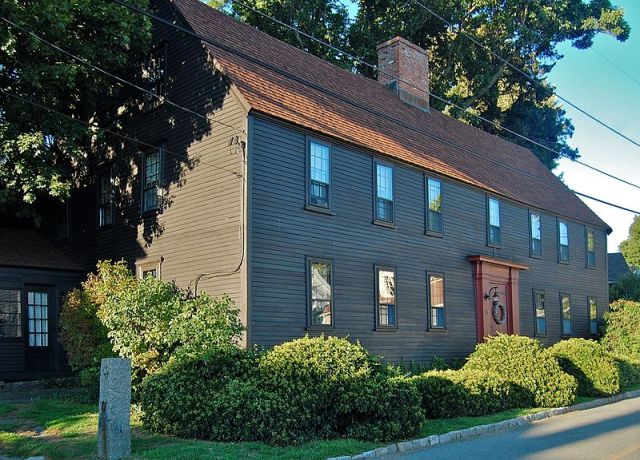
Edward Harraden house at 14 Leonard Street, Gloucester, Mass

Click Here for a Google Satellite View of the Edward Harraden House on 14 Leonard Street on Annisquam Point, Gloucester, Mass.  Check out all the boats

10. Jabez Howland House

Jabez Howland House Plymouth

Jabez Howland House Plymouth

Plymouth, Mass. 1667 Only extant house in Plymouth occupied by Pilgrims.

John HOWLAND and his wife, Elizabeth TILLEY who both came over on the Mayflower, spent their winters here with their son, Jabez, one of their 10 children.

John HOWLAND (c. 1591 – 1673) was one of the Pilgrims who travelled on the Mayflower, signed the Mayflower Compact, and helped found Plymouth Colony. John was Alex’s 11th Great Grandfather; one of 4,096 in this generation of the Shaw line.

1670 – Jabez Howland bought the house at Plymouth. John and Elizabeth winter there.
1672/3 – John Howland died in the Plymouth home of his son.
ca. 1675 – The Rocky Nook Farm house burned to the ground. Elizabeth makes her home with Jabez’ family.
1680/1 – Jabez sells the Plymouth house. Elizabeth signed the deed and moved to Swansea to live with her daughter, Lydia Brown.
1687 – Elizabeth Tilley Howland died and was buried in the Brown Family plot.

Jabez Howland House is an historic house at 33 Sandwich Street in Plymouth, Massachusetts.

The house was built in 1667 and purchased by Jabez Howland, son of Mayflower passengers John Howland and Elizabeth Tilley Howland, two of the original Pilgrims. John and Elizabeth Howland lived in Jabez Howland’s home after their own house burned. John Howland died in 1674 and Elizabeth lived there until the house was sold in 1680 and Jabez Howland moved to Rhode Island. Elizabeth moved to the home of her daughter, Lydia Browne, in Swansea, where she died in 1687. The Jabez Howland House was owned as a private residence until 1915. Extensive renovations took place in the 1940s. The house was added to the National Register of Historic Places in 1974.

John Howland House in Plymouth. Built in 1666 and photographed in 1921

tmay26.jpg (4311 bytes) 1. EXTERIOR VIEW The Howland House is the only house left standing in Plymouth where Pilgrims actually lived. The original 17th century two story timber framed house consisted of the porch, hall and hall chamber. In order to attend church during the winter months both John & Elizabeth Tilley Howland spent part of the season here. During this time Jabez raised the roof and added a back bedroom providing space for his parents. After John’s death in 1673 (Age 8O) and the fire that destroyed their Rocky Nook Farm, Elizabeth lived here until 1680 with her son Jabez and his family. The house was expanded with several lean-tos which made it into a large house by 1750.tmay27.jpg (5419 bytes)2. 1667 LIVING ROOM You will find that as you tour the house there is a fire place in almost every room. The open fire place was a hazard to colonial women as many were badly hurt or died from burns. This due to the long dresses they wore and attempting to get to the kettles or pots being warmed by the fire. The living room would be one of the main areas for reading by the fire.tmay28.jpg (5681 bytes)3. THE OLDE KITCHEN – Note the various bowls on the table. Also the many plates and utensils hung above the fireplace. Readily accessible for use while cooking meals. Trammels were used to hold cooking pots. The swing arm or crane made cooking safer for women as they were not required to step into the fireplace to take the pot off the fire.tmay29.jpg (4633 bytes)4. THE JOHN HOWLAND BEDROOM – This bedroom was used by John Howland when he and wife Elizabeth stayed here during the winter months before John’s death and Elizabeth remained until son Jabez sold the house in 1680. At this time Elizabeth moved to Swansea, Rhode Island to live with her daughter Lydia Brown. She died there in 1687(age 80) and is buried outside the Brown family plot. The cradle, spinning wheel, chair and chest at the end of the bed add to the ambiance of the period.tmay30.jpg (4353 bytes)5. 1750 BEDROOM The first thing you notice is the ceiling of 1750 is plastered where the earlier rooms showed the beams. Like beds of the period they were canopied. This field bed can be fitted with heavy drapes for warmth and privacy. The curly birch dresser is American Chippendale(1750-1780). Beds were framed with rope strings. In damp weather the ropes had to be loosened and in dry weather tightened in order to keep a firm support for the mattresses. Mattresses were stuffed with whatever was comfortable(i.e. straw, cornhusks). Feathers would have been the best. Often the husband would leave his best feather bed to his eldest son and the second best to his wife.
11. Isaac Goodale House

Robert built this home for his son Isaac

Built in Salem,
moved to Ipswich, MA in 1928.
ca. 1668 On the National Register of Historic Places.

Robert GOODALE was born 16 Aug 1601 in of Ipswich, Suffolk, England. He was christened on 16 Aug 1601 in Dennington, Suffolk, England. His parents were Robert GOODELL and Joan ARTYS. He married Catherine KILHAM about 1629 at Easterham Suffolk England. He immigrated in April 1637 sailing on the “Elizabeth” from Ipswich. He married Margaret Lazenby on 30 Aug 1669. Robert died in 4 Apr 1683 at Salem or Danvers Mass.
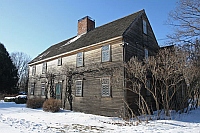
Robert built a home for his son Isaac which is still standing

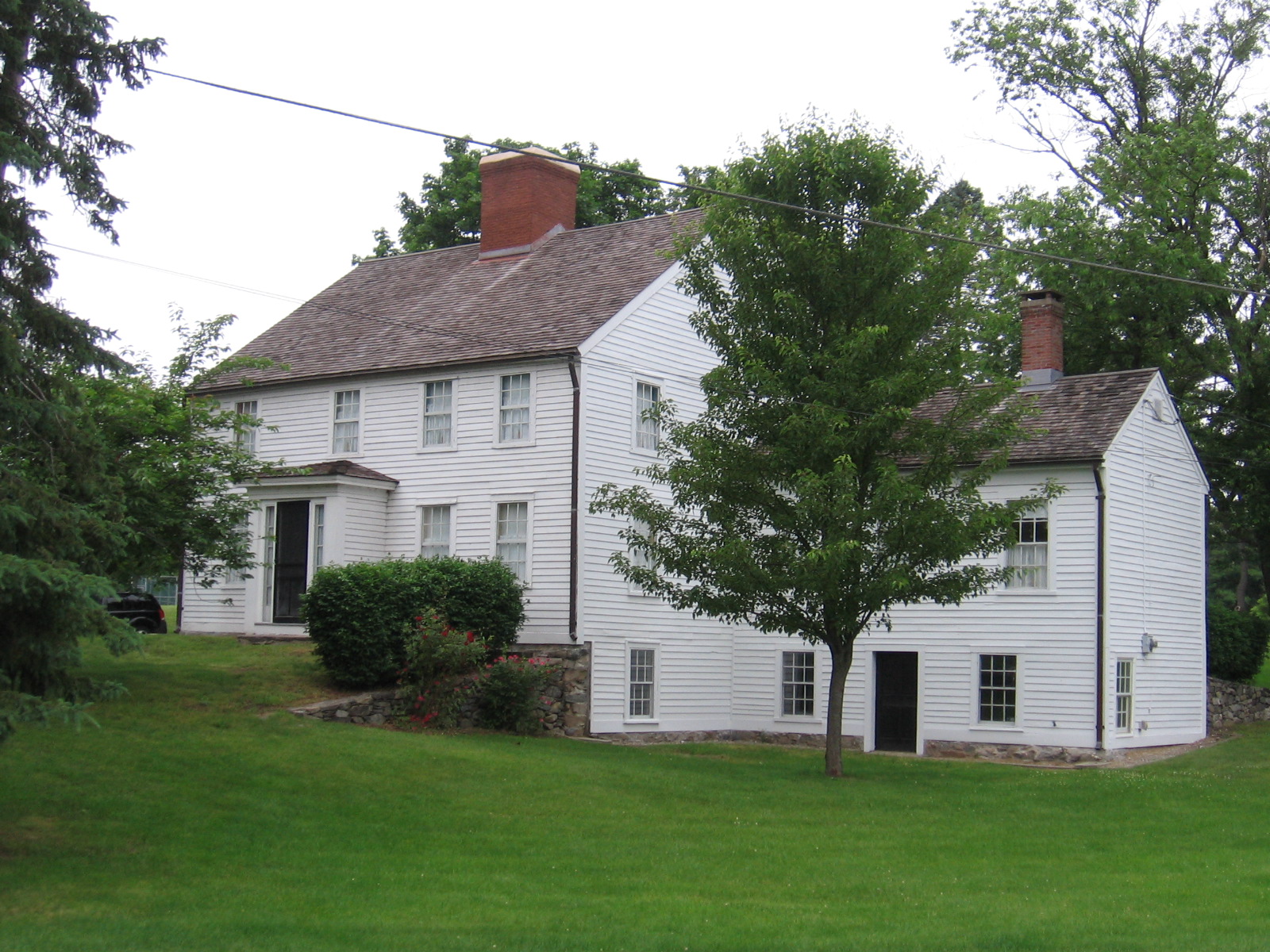
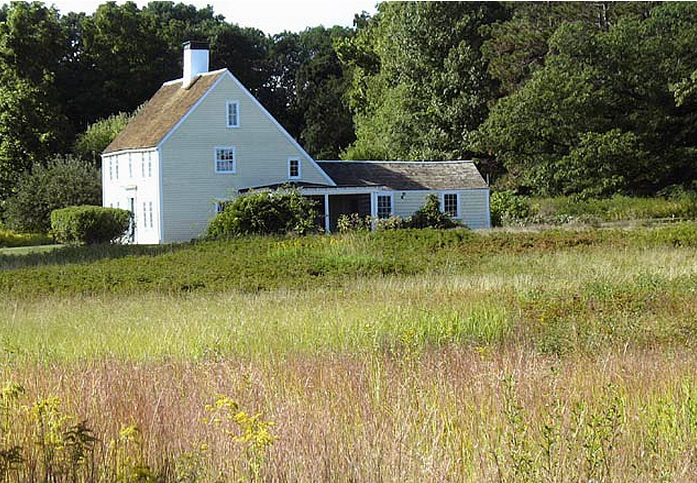
In 1668, Robert built a house for his son Isaac. Save for a decade or so in the early 1900s, the Goodale family has lived in this house since it was built. The timber frame saltbox is one of the best preserved examples of a first-period house in New England, and is listed on the National Register of Historic Places.

Isaac Goodale Home

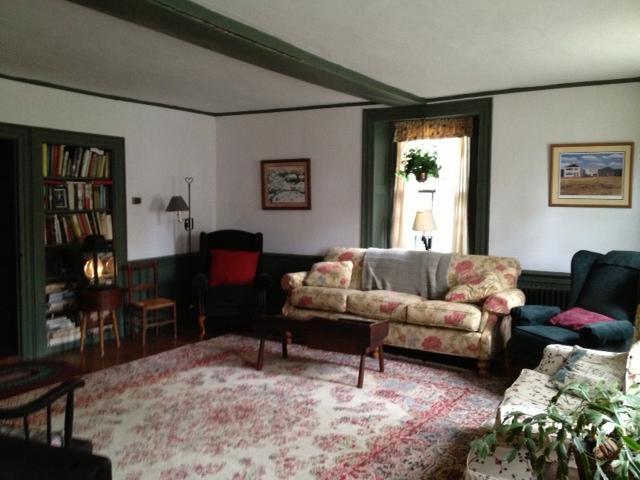
But after nearly 340 years of ownership, the Goodale family put the place on the market in 2009 for $1.39 million, hoping to attract a buyer who will respect the storied structure’s origins. In 2010 it was still on the market. Equally exquisite is the 41-acre property near Ipswich the house sits on, with rolling meadows bordered by woods that sweep down to Great Marsh – the largest salt marsh in New England – with a view of Hog or Choate Island beyond.

This is not the home’s original location. It was built in Salem, by Robert Goodale for his son Isaac. The Goodales had sailed from England to Salem in 1634, just 14 years after the Pilgrims dropped anchor in Plymouth Harbor. Robert purchased more than 500 acres in Salem and gave land to his children upon their marriages. Sometimes, he built houses for them, as he did for Isaac, a farmer who lived in the house for just over a decade before he died in 1679.

Isaac Goodale Home 151 Argilla Road, Ipswich

Isaac’s descendants remained in the house until 1915, when it was sold, for reasons unknown. Three different owners occupied the house over the next several years, and it was put up for sale again in 1928.
Robert built this home for his son Isaac

Dr. Robert Goodale, a Boston physician and a direct descendent of Isaac’s brother Zachariah, learned from a newspaper article that the house was for sale. “He went right out to look at the house, bringing a building inspector with him,” said Maisie Crowther, 72, the youngest child of Robert Goodale, who now lives in Brattleboro, Vt. “He and my mother decided to buy it then and there. They wanted to bring it back into the family. They wanted to preserve it.

The sale price was $5,000, a hefty sum for the era. Goodale’s plan was to have the house moved from Salem to Ipswich where it would be a summer haven for the couple and their four children. Robert Goodale’s father, Joseph, owned a commercial orchard on Argilla Road and gave him 41 acres at the end the narrow dirt lane.

The original plan was to move the house intact, on rollers, along Route 1 to Ipswich, but Crowther said the family was unable to do that. “So they had to dismantle the house piece by piece to transport it. It was rebuilt exactly to the original specs and with the same materials.”

Before the house was transported, the Goodales discovered a few of the home’s original 17th-century narrow casement windows with diamond-shaped leaded panes in the basement. They restored the windows and had replicas commissioned for the rest of the house. During reassembly, they also exposed the original raised paneling and returned the openings of the home’s four massive fireplaces to their original size – nearly 6-feet long and 4-feet high.

Isaac Goodale Home

12. Francis Wyman House

56 Francis Wyman Rd, Burlington, Mass

Woburn, Mass now Burlington 1668 The house was named as one of the 1,000 places to visit in Massachusetts by the Great Places in Massachusetts Commission

Francis WYMAN (1619 – 1699) was Alex’s 10th Great Grandfather, one of 2,048 in this generation of the Shaw line. Francis Wyman’s name survives in a portion of Route 62 in Burlington west of Cambridge Street known as the Francis Wyman Road and Francis Wyman School , Burlington, MA. It also lives on in the ancient Francis Wyman House, a colonial landmark on Francis Wyman Road. Furthermore, it survives in the name of the Francis Wyman Association, created about 1900 to restore the house and preserve the early family history of all American Wymans.

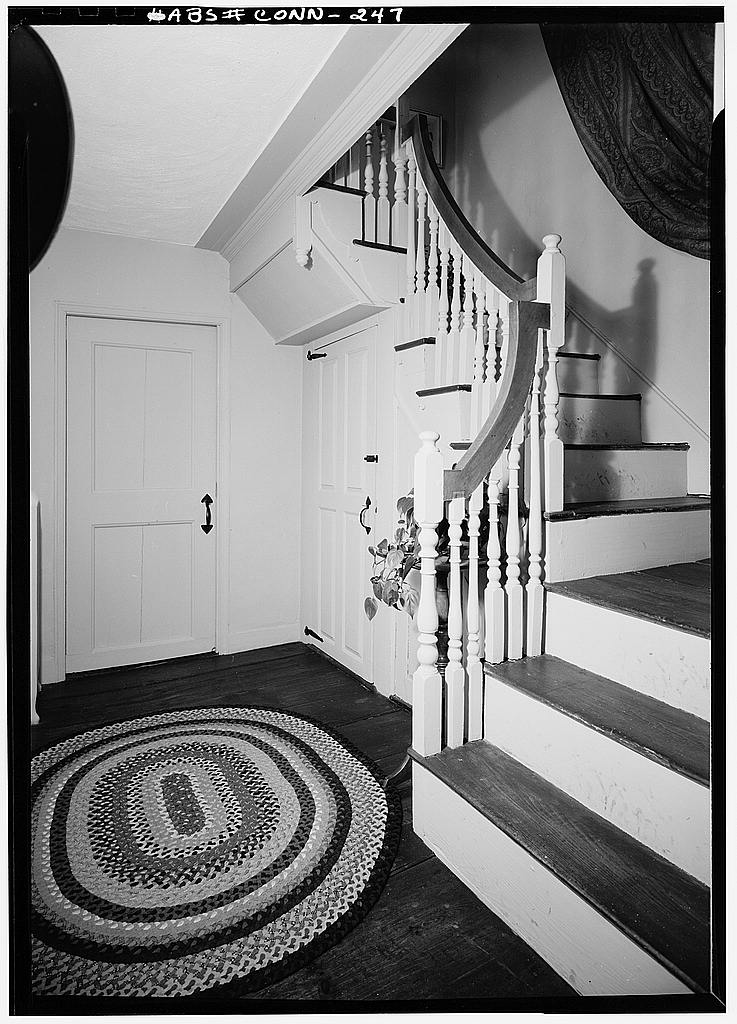
The country house of Francis, built sometime before 1666, stood on the site now owned by the FWA. The present structure is an eight room, two story, center-chimney house with attic and half-cellar, that is listed on the National Register of Historic Buildings. While some believe the house to date to 1666, few vestiges of that era remain, and the replacement house dates more nearly to 1710-1730.

Francis and his brother John were among the largest landholders in Woburn, Massachusetts. A genealogy book about the history of the Wyman and Trask families indicates that John and Francis Wyman “were with one exception the largest landholders in Woburn.” Here’s link to Google Maps Street View of Francis Wyman Road in Burlington, Mass.

56 Francis Wyman Rd, Burlington, Mass

He built his house about 1666 on the outskirts of Woburn, now part of Burlington. It was still standing in the 20th century.

Every fall for over 100 years, the Wyman Family Association hosts a gathering of the clan at the Francis Wyman house in Burlington, Massachusetts. The homestead still stands at 56 Francis Wyman Road, built in 1666, and is one of the three oldest houses in Massachusetts. Unlike most old, historical homes, the Wyman house is owned by the family association, not a museum or historical society. The house was originally built as a garrison, where families could flee in case of war or Indian attacks. It was used as a prison for captured British soldiers in 1775, and it is listed on the National Register of Historic Places.

The house has suffered through fire and damage over the years, but the family association has taken on the burden of insuring, restoring and displaying the house to the public. A fire in 1996 caused major damage to the interior of the house. They are reconstructing an old Burlington barn on the property for rental purposes, to help fund the completion of the restoration.

Exterior of Francis Wyman house with Mr. [Joshua

Originally thought to have been built ca. 1665-1666, new evidence puts the build date ca. 1730. The ownership chronology developed as follows:

ca. 1666: Francis Wyman built earlier house nearby. FW was a tanner from Westmill, Hertfordshire, England)

ca. 1730: William Wyman credited with building surviving house

April 1775: House sees some action, outbreak of the Revolutionary War. Massachusetts Colony was a hotbed of sedition in the spring of 1775. Preparations for conflict with the Royal authority had been underway throughout the winter with the production of arms and munitions, the training of militia (including the minutemen), and the organization of defenses.In April, General Thomas Gage, military governor of Massachusetts decided to counter these moves by sending a force out of Boston to confiscate weapons stored in the village of Concord and capture patriot leaders Samuel Adams and John Hancock reported to be staying in the village of Lexington.

17 April 1775 – Nearby in Billerica, just beyond the property line of the Francis Wyman house, is the cellar hole of the Amos Wyman house, originally John’s farm. Samuel Adams and John Hancock, two of America’s forefathers, fled to this home from Lexington, ahead of the British troops. Elizabeth (Pierce) Wyman, wife of Amos, is said to have fed her visitors boiled potatoes, pork and bread instead of the salmon which her guests had planned to eat at the Lexington parsonage. , and Hancock is reported to have sent a cow to his hostess at a later date in appreciation of her hospitality.

18 Apr 1775 – The lantern’s alarm sent Revere, William Dawes and other riders on the road to spread the news. The messengers cried out the alarm, awakening every house, warning of the British column making its way towards Lexington.

ca. 1823-1899: Mr. and Mrs. Joshua Reed occupy the house

ca. 1944: Harold Bennett and family are caretakers

Nov. 1996: Last Wymans live in house (Peter Wyman et al)

Interior of Francis Wyman house 1936

The house was restored by the Francis Wyman Association, a private association of Wyman family descendents, between 1899 and 1916. In 1916–the 250th anniversary of the house built in the wilderness–the Association opened the house as a tourist attration. It was again shown publicly ruding the 1930 Massachusetts Tercentenary clebration and in 1966, upon the 300th anniversary of 1666.

In November 1996, a fire tore through the house, triggered by a curtain being ignited by an electric space heater. The Francis Wyman Association and the town of Burlington organized new efforts to better study and to restore the house.

By 1997, Historic Preservation & Design’s team was selected to lead the new restoration. This was mostly a Salem-based undertaking with architects John Goff and Staley McDermet both hailing from our Witch City, supported by structural engineer John Wathne of Structures North, Inc.

The SPNEA (Society for the Preservation of New England Antiquities) was engaged and it dispatched a team to help identify historically sensitive areas in the house. Warwick Carpenters of Gill, MA proceeded with a Restoration Phase I (structural work and exterior restoration) that was completed in 1999. Historic Preservation Associates of Wales, Mass., later advanced a Restoration Phase II (which focused mostly on the house interior) that was just completed in June 2011.

Following a fire in November 1996, the property was extensively researched and the house was more accurately restored to show its ca. 1730 appearance (John Goff’s Historic Resources Survey form for 56 Wyman Rd.) Portions of the surviving Francis Wyman House (including basement walls and chimney base) may survive from ca. 1666, although most visible parts of the house are from a later ca. 1730 Georgian Period.

The Massachusetts Historical Association has approved a matching grant request for $50,000 for the restoration of the 1666 Francis Wyman House in Burlington, Massachusetts. The Wyman Family Association is raising the matching funds. According to their website athttp://www.wyman.org/

“Please, open your genealogical hearts and generous pockets, and send your tax-deductible contributions so we can take advantage of every dollar that can be matched. Large, or small, we welcome any and all amounts, as they will be available for the matching grant.”

This Phase II Interior Restoration Plan will restore the fire damage done to the 1666 home and create a first floor Francis Wyman House Historic Museum. It will complete the work for the first floor rooms and stairway, and make the building handicap accessible.

The family association was established in 1899 for descendants of Francis Wyman to maintain the homestead as an educational resource and historic landmark. The Francis Wyman House is the oldest landmark in Burlington (originally part of Woburn, Massachusetts) and is listed on the National Register of Historic Places.

13. Chaplin-Clarke House

Chaplin-Clarke House

109 Haverhill St., Rowley, Mass 1671 Rowley’s oldest building

Joseph CHAPLIN and his wife Elizabeth lived in the house built on the 1 1/2 acres granted originally to his father, Hugh CHAPLIN.

The Rowley Company under Rev. Ezekiel Rogers purchased additional land at the expense of about £800. Those who were able contributed the purchase money, and in the layout of the house lots, the amount given determined the size of the lot granted. Hugh Chaplin received the following, “To Hugh Chaplin, one lotte containginge an acre, and halfe, bounded on the south side by John Dresser’s house lott, part of it lyinge on the west side, and part of it on the ease side of the street.”   Although the first mention of the new plantation was in March of 1638, it was not incorporated until September of 1639.

This house is still in existence on State road (95). The house was in the possession of the Society for the Preservation of New England Antiquities.

Chaplin-Clarke House is a historic house at 109 Haverhill Street in Rowley, Massachusetts. The house was built in 1670 and added to the National Register of Historic Places in 1979.

Private residence. Listed on the National Register of Historic Places.  Built in 1671, is Rowley’s oldest dwelling. This building has a central chimney built on a stone foundation. There is a slight overhang on both the first and second stories on the east end, but none in front. The building also has a lean-to, a very early addition, and the house is the only one in Rowley that has both an overhang and a lean-to. Richard Clarke and one of his children died of smallpox in 1730, and their unmarked graves lie west of the house by the stonewall.

You can see by comparing the original Rowley settler map with this view of 109 Haverhill Street from Google Maps that the house is in the same place as the original grant.

NR. LHD. PR. 2 burial lots of smallpox victims on property of First Period house which was preserved by Mrs. Pauline Fenno who lived on estate at old Ox Pasture Hill Farm. Gave house to  Society for the Preservation of New England Antiquities, which sold into private ownership with PR.   The Chaplin-Clarke House is protected by a preservation restriction, drawn up in accordance with MGL Chapter 183, Sections 31-33. A preservation restriction runs with the deed and is one of the strongest preservation strategies available.
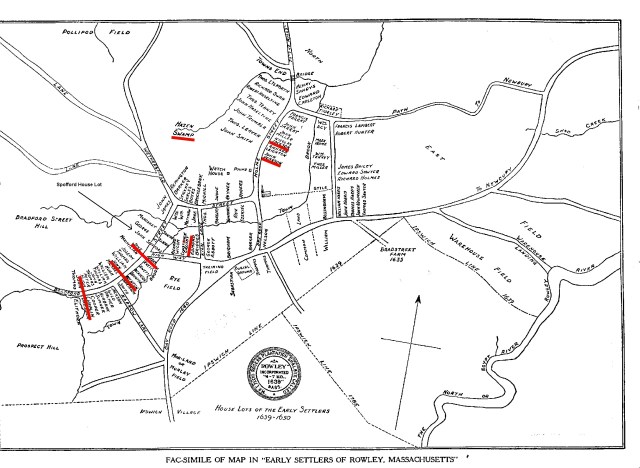
Map of Rowley Ancestor Plots Click to View Seven of our ancestor families helped found Rowley including Hugh Chaplin whose lot was located in the lower left hand corner

14. John Kimball House

John Kimball House

77 High St. Ipswich 1680 1st period 2 story, timber frame, transom-lit entry.

John KIMBALL was born about 1621 in Rattlesden, Suffolk, England. His parents were Richard KIMBALL and Ursula SCOTT. When John was 3 years old, he sailed for America on 30 Apr, 1634 on the ship Elizabeth of Ipwich with his parents, brothers and sisters, grandmother, uncle and cousins. The crossing took almost three months and they landed in Bostson. He first married Dollie Hoyt in 1653 in Ipswich, Mass. After Dollie died, he married Mary BRADSTREET on 6 May 1655 in Ipswich Mass. He came over on the same ship with her and her father and mother. John died 6 May 1698 in Ipswich Mass.

15.
Thomas
TABER

House

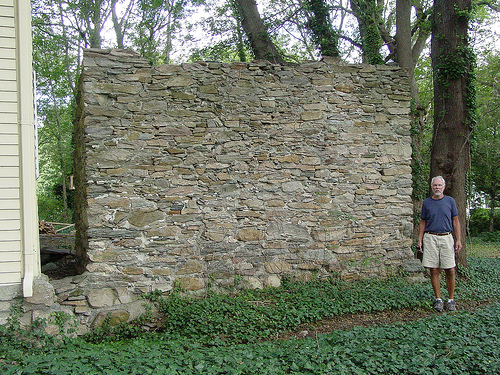
A stone wall of Thoms Taber House ibuilt in 1680 are still standing

191 Main Street.
Acushnet  Mass.
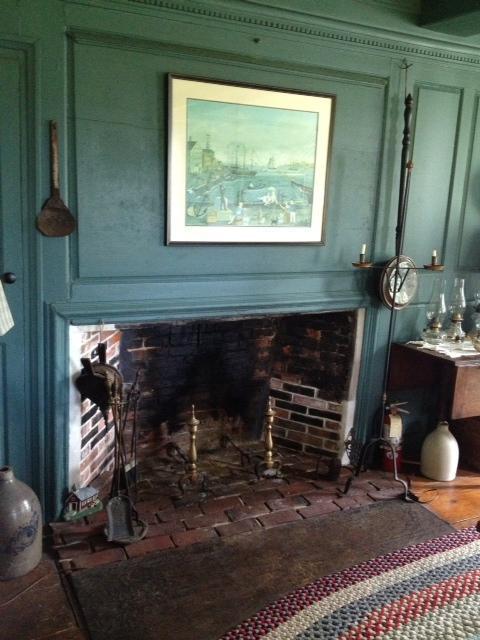
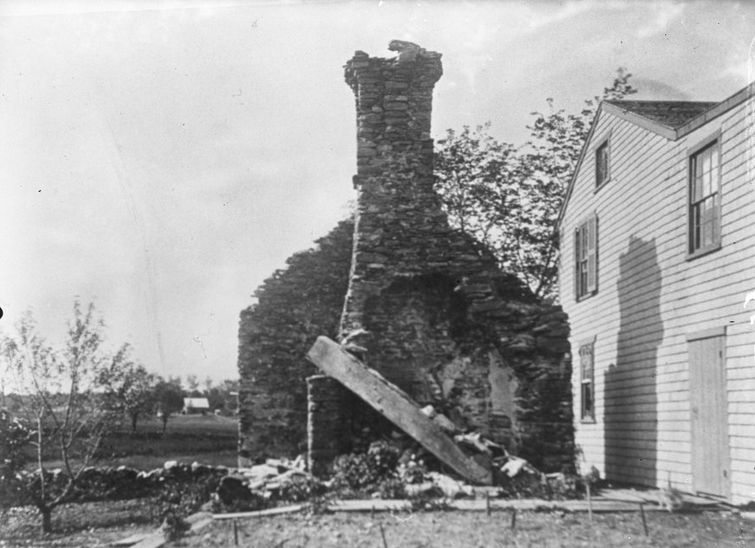
All that remains today is a large fireplace.

A stone wall of Thoms Taber House built in 1680 are still standing

STARTED IN 1676—The cottage, built along the lines prevelent in Rhode Island during the period, was started in 1676. The house was last occupied in 1851 by an Indian woman known as “Black” Annis Sharper. All that remains today is a large fireplace. It stands behind the residence of Mr. and Mrs. Hugh B. Darden, Jr. at 191 Main Street.

The house had a ten foot ceiling, while the ridge rose twenty feet and the chimney rose to 24 feet 4 inches. Philip F. Purrington, Curator of the Old Dartmouth Historical Society, estimated the house to have been 16 feet 10 inches wide, and about 22 feet long, running north to south. The chimney centered on the ridge and the fireplace was offset to the west. Taber built added strength into his chimney by allowing the stonework to round the corner into the west wall. Once knowing the house’s dimensions, it is hard to imagine Thomas Taber raising a family there and retaining his sanity.

Thomas Taber – House 1800’s

His wife Ester bore him three children before she died in 1671. Taber then married Mary Thompson, a neice of John Cooke. She bore him 11 children. Hence, Taber’s problem was living in a house measuring 16 ft x 22 ft, with a wife and 14 children. In 1680, Taber built a new two-story house in Acushnet for his sons, Joseph and John. One was born in 1679 and the other in 1681. It appears the whole family moved to this new abode—a Rhode Island design, with an overhang at the second story.

The house was destroyed by fire in 1869, but the foundation remains at the end of Manchester Street in Acushiret, about one-quarter mile west of Plainville Road. The Oxford property was left to Thomas’ son, Philip, who left the area in 1730 and sold the property to William Wood. The property sold in 1794 and not officially recorded until 1910 to Robert Bennett. The Bennett family was “relieved” of the property during a business failure, but in 1918 Cpt. Thomas Bennett allowed Annis Sharper to live on the property before she moved to Fairhaven Almshouse in 1851.

Clara Bennett, daughter of Thomas Bennett,Jr. gave the property to the Old Dartmouth Historical Society.

Here are present day driving Google Maps driving directions between the two homestead sites now in Acushnet, Mass

16. Daggett House (Wiki)

Daggett House Musuem Slater Park Pawtucket Rhode Island

Slater ParkPawtucket, Rhode Island 1685 Oldest surviving house in Pawtucket

Jonah PALMER’s daughter married Dr. Joseph Doggett  14 Feb 1687/88 in Rehoboth, Mass.    Joseph inherited The Daggett House in 1707.  It is an historic house in Slater Park in Pawtucket, Rhode Island. The house is the oldest house in Pawtucket, and one of the oldest surviving buildings in the state.
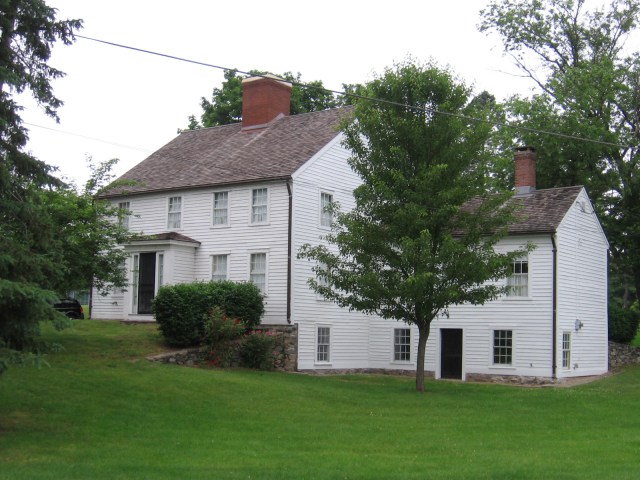
The large farmhouse was built around 1685 for John Dagget, Jr. on the site of an earlier 1643 house which was burned by Native Americans during King Phillip’s War. According to his diary, George Washington allegedly stopped at Daggett House while travelling between Newport and Boston.

The house is supposed to have passed by inheritance in 1707 from its original owner to his eldest surviving son, Joseph Daggett, a doctor of medicine, a wheelwright, and a miller. The farm was presumably inherited by Joseph’s son Israel, a cooper, in 1727.

Upon Israel Daggett’s death in 1777, the homestead is thought to have passed to the eldest surviving son, William; from William it passed to his three eldest sons William, John and Abel. The three sons partitioned the estate in 1830, John and Abel taking the house and the land immediately surrounding. John’s portion was sold at auction to his sister Amey after his death in 1842; Abel willed her his share one year later.

Amey Daggett shared the farm with her niece Hannah and Hannah’s family, willing it to Hannah in 1855. Hannah’s husband Jefferson Daggett and his eldest son, Edwin O. Daggett, continued to farm the property at least until 1870, when Jefferson died.

The house opened as a museum in 1905. Furnished with unusual period antiques, including Colonial pewter used in Revolutionary War and china owned by Gen. and Mrs.Nathanael GREENE and the Daggett Family. Outstanding needlework and furniture. Also, many Civil War articles including several uniforms, and pieces of the Monitor and the Merrimac. Built 1685. House may be rented for small parties.

17. Shatswell House

John Shatswell House – Ipswich, Mass

Ipswich, Mass 1685

John SHATSWELL was born in 1574 in Ipswich, Suffolk, England.  He was baptised (infant) in Bitteswell, Leicestershire, England. He married Judith DILLINGHAM in 1599 in Suffolk England.  He immigrated in 1633.  John died on 11 Feb 1645/6 in Ipswich, Essex, Massachusetts.
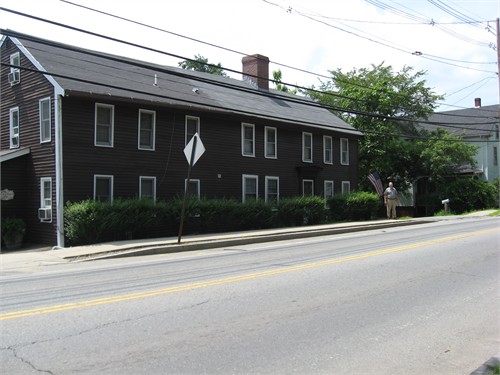
John Shatswell House – A current owner of the house, touching an original beam in the cellar.

John Shatswell was one of the earliest grantees, and under date, April 20, 1635, he is mentioned as owning six acres of ground, where his house is built, between Mr. Wade’s house lot east and Mr. Firman’s on the west, Goodman Webster’s lot, northeast. I cannot identify this with the present Shatswelllocation. This early grant was on the north side of the highway wherever it was, and if another house lot bounded it on the northeast it could not be located on High St. as the lots on the other side of the highway are on the hill side, On the 21 May, 1685, John Uay bought one and a half acres and the line was laid, “from said Dave’s fence corner by his brick house,” near Mr. Tuttle’s and Richard Shatswell’s. The Day lot, which still shows the refuse bricks of an ancient brickyard, is probably included in the western part of Mr. John Cogswell’s pasture on the Linebrook road. It touched on the land of Shatswell and Tuttle.Shatswell may have been in possession many years at this time. The estate was divided between the sons John and Rit-hard in 1695, and it was bounded by Brewer’s land east and Mrs. Turtle’s west (24: 40). Its later history is given under that of the adjoining lot.
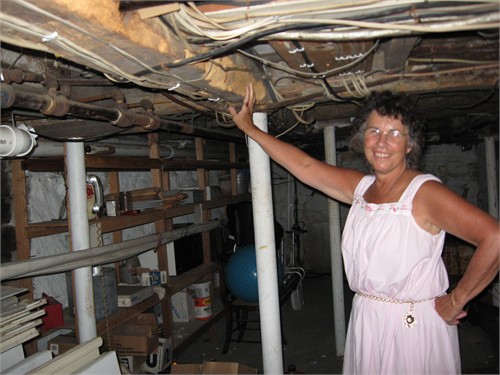
Bradford Huntington House
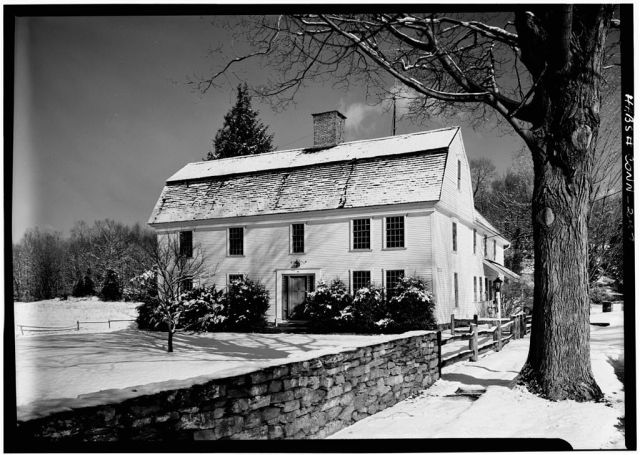
18.Bradford
Huntington House

Bradford Huntington House – 16 Huntington Ln, Norwich, New London, Connecticut 06360

Norwich,CT 1691-1719 xx

Sarah Town Cloyes House

The Bradford-Huntington House was built by John Bradford and his wife Martha Bourne.  Martha’s father was Thomas BOURNE.   John’s father was Governor William Bradford (wiki) (1590 – 1657)

The Bradford-Huntington House is a home built during 1691-1719 in the Norwichtown section of Norwich, Connecticut. Its 3-acre (1.2 ha) property was listed on the National Register of Historic Places in 1970, and it is also a contributing property in the Norwichtown Historic District (which was listed on the National Register in 1973).

The house is a timber house on a stone foundation, with a large brick fireplace and chimney in the middle of each of two gambrel-roofed wings
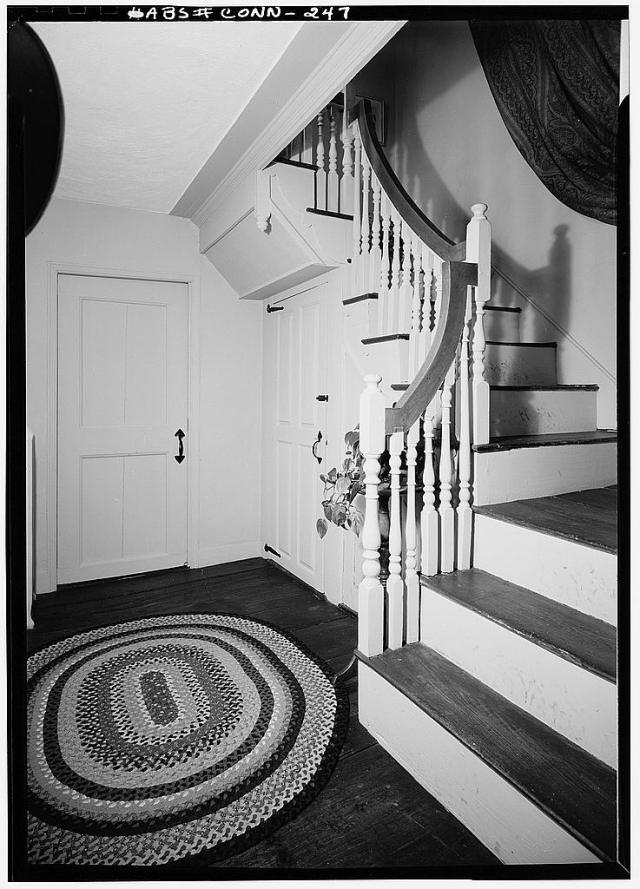


19.
Sarah Cloyce House

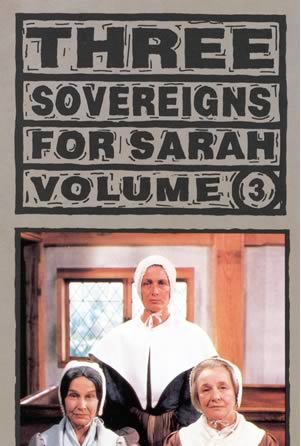
Three Sovereigns for Sarah

Framingham, Massachusetts 1693 Refuge from Salem Witch Trails

Fleeing from the Salem Witch Trials, Sarah Cloyce (younger sister of Rebecca Nurse and Mary Easty) and her husband Peter fled to a portion of Thomas Danforth‘s estate via the Old Connecticut Path. After surviving the winter in nearby caves, they built their home in what would become Framingham, Mass.

William TOWNE (1599 -1673) was Alex’s 10th Great Grandfather; one of 2,048 in this generation of the Miller line. Three of his daughters were accused of witchcraft in the Salem witch trials. Rebecca Nurse, a central character in Arthur Miller’s play The Crucible as well as many other dramatic treatments of the Salem Witch Trials, Mary ESTEY whose case gives insight into the workings of the trials, and her eloquent and legally astute petitions have been said to help bring them to an end, and Sarah Cloyes

In 1692 [at age 53] Sarah was imprisoned and accused of witchcraft after listening to a sermon by Rev Parris in which he maligned her sisters. She left in a huff and slammed the church door (or some say the wind took it and slammed it) She was spirited out of prison in the fall of 1692 by friends who visited her in prison. She was hidden by friends in Topsfield until the spring of 1693 when she joined her family in hiding in Framingham MA. The family lived in caves in Framingham for several months until local officials agreed not to punish them.

She pressed charges for her unlawful arrest and the killing of her sisters. She received three gold sovereigns for each of them. The 1985 PBS American Playhouse movie, Three Sovereigns For Sister Sarah is about this event. Vanessa Redgrave plays Sarah. Kim Hunter plays Mary ESTEY.
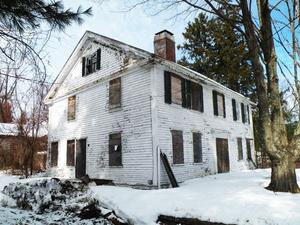
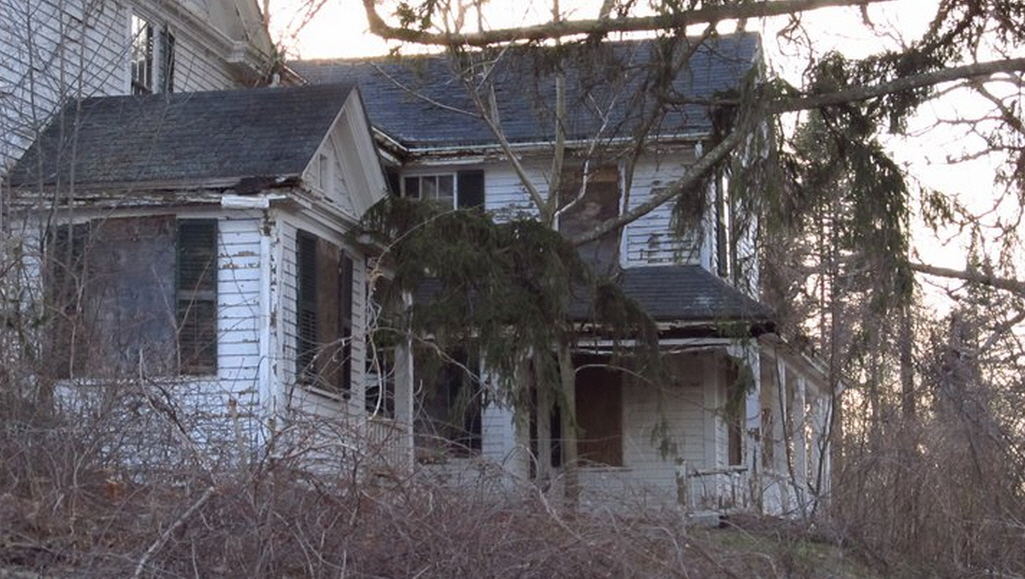
The Sarah Clayes House is in disrepair

The house Sarah and her husband built in Framingham a year later remains, but it is damaged and deteriorating, and has an unknown future. Its windows are boarded up, there are holes in the wall and water is seeping in. Ownership belongs to a bank.

“It’s in deplorable shape. But it’s salvageable,” said Annie Murphy, director of the Framingham History Center which held a history roundtable at Edgell Memorial Library in January 2010. The roundtable topic, the Sarah Clayes House, drew about 40 people – from this area to as far away as Connecticut – to discuss the house’s significance and the story of its earliest inhabitants.

“It’s here in Framingham where the healing began,” said Glenn Mairo, trustee and educator of the Danvers Historical Society. Mairo was drawn to the roundtable because of the Clayes’ story, (they changed their name from Cloyce after leaving Salem Village), which begins in his town and ends at the house in Framingham, at 657 Salem End Road.

Today water is infiltrating the historic structure, now the property of a bank. “When I first saw it and walked through it, it was in bad shape, but it’s in really bad shape now,” says Janice Thompson, who lives in nearby Ashland, Mass., and attended the Jan. 14 meeting. “It’s not only the weather but it’s vandalism. … It’s just a crime to let the house go.”

With the help of a lawyer, Thompson and others plan to approach the bank and perhaps form a nonprofit. They hope to raise $2 million to buy and restore the Clayes House, and then raise another $2 million to establish an endowment that would support a house museum.

Saving the Clayes House has been a challenge because it was previously owned by a couple who divorced. “Unclear title chain makes purchase and restoration extremely difficult,” says Erin Kelly, assistant director of Preservation Massachusetts, which placed the Clayes House on its 2006 list of the state’s most endangered historic places. “The unique history and wonderful architecture of this property are an incredible local resource.”
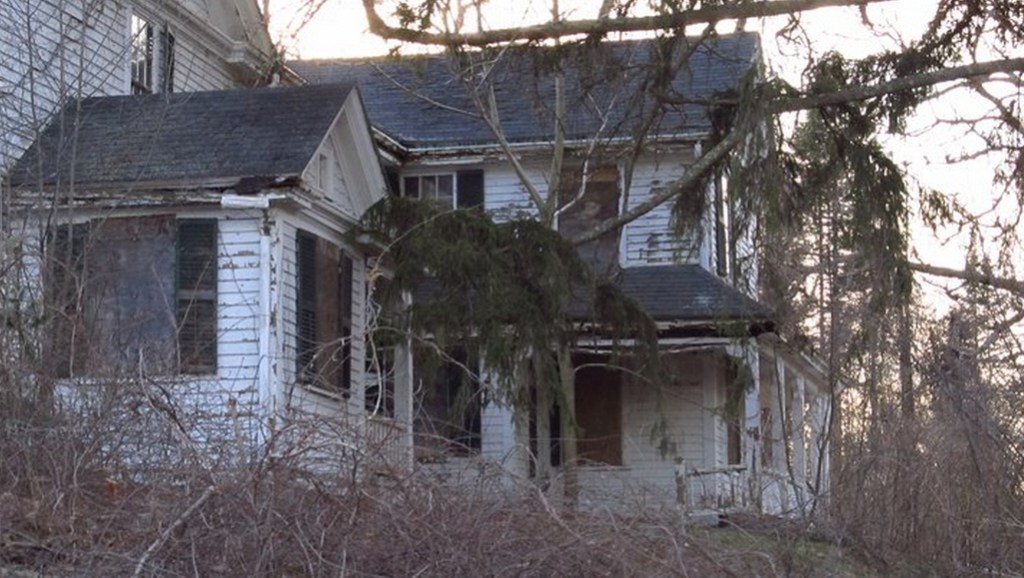
Sarah Cloyes House

Click here for the Sarah Cloyes House Facebook Page

20.
Melatiah Bourne House
Melatiah Bourne House Sandwich Mass 1693 On the
market Sept 2013 – MSL#
21305774

John CHIPMAN’s son-in-law Melatiah Bourne, oldest son of Shearjashub Bourne, Esq., inherited his father’s lands in Falmouth, but he settled in Sandwich. He was a distinguished man, held many responsible offices, and during the last years of his life was Judge of Probate for the County of Barnstable.

Melatiah’s house is yet remaining in Sandwich in 1888 ; it was most substantially built. The clapboards on the walls were shaved from cedar about an inch inthickness, and nailed with wrought nails. At that time they were tight and as good as new.

In September, 2013, The Melatiah Bourne House was on the market for $929,000.

Melatiah Bourne House

138 Main St, Sandwich,  02563 — In the heart of Sandwich Village the Melatiah Bourne House overlooks Town Hall Square. This beautiful historic Saltbox and Post & Beam Barn has Business Limited Zoning. Sure to delight the purist this home retains original details including indian shutters, wide board floors, 5 fireplaces, beautiful paneling, window seats, cluster chimney and bee hive oven. A great home for entertaining with excellent flow, 4 bedrooms, keeping room, dining room, living room, den and much more. Post & Beam Barn built in 1993 ideal for shop and/or home office.
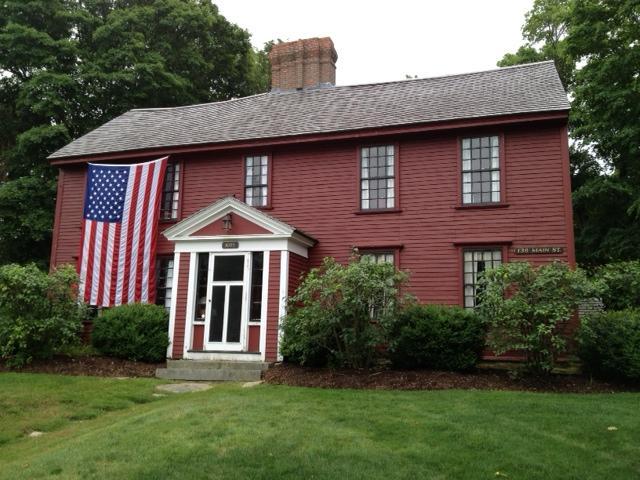
Melatiah Bourne House 2

Melatiah Bourne House 2

Melatiah Bourne House 3

Melatiah Bourne House 3

Melatiah Bourne House 4

Melatiah Bourne House 5

Melatiah Bourne House 5

Melatiah Bourne House 6

Melatiah Bourne House 6

Melatiah Bourne House 7

Melatiah Bourne House 7

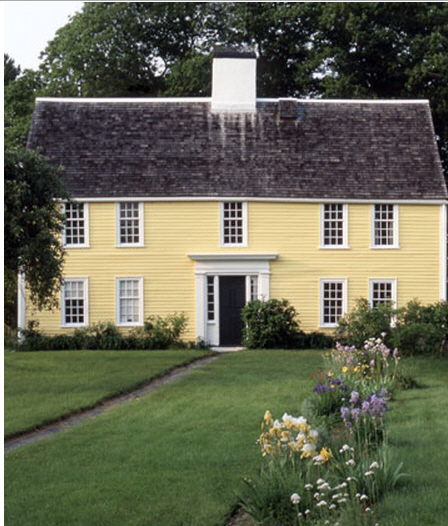
21. Payne House Payne House Jeffery’s Neck Ipswich, Mass 1694 Greenwood Farm is open for tours

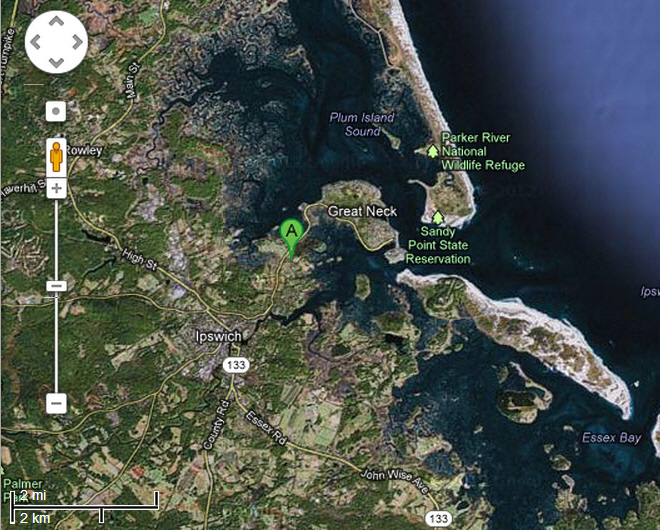
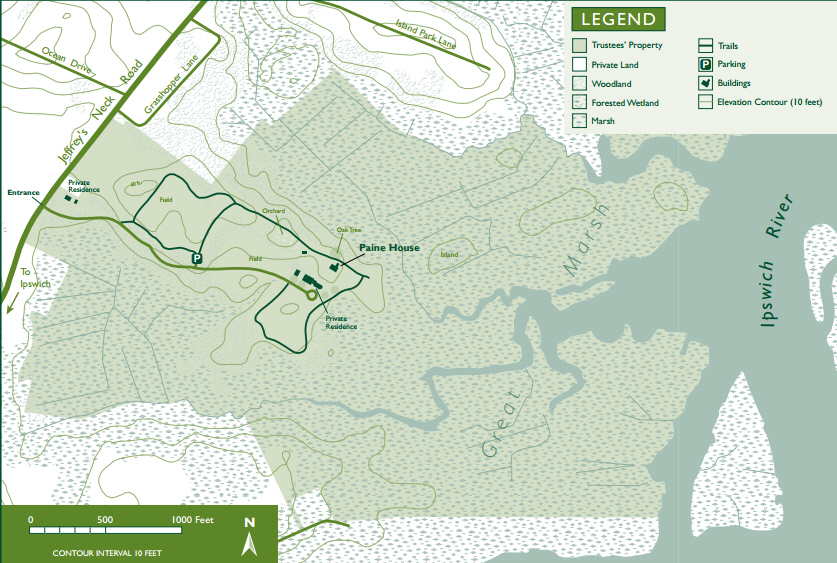
Greenwood Farm – an historic property and nature reserve located in Ipswich, Massachusetts, is owned by The Trustees of Reservations and features the Paine House, a First Period farmhouse constructed in 1694 by Robert Payne Jr.   The Paine House is an integral lean-to, with the rear room and sloping saltbox roof part of the original construction.

In 1640,  William PAYNE‘s son Robert Paine Sr.  arrived in America and received a grant of land along the salt marshes at Jeffrey’s Neck, near Ipswich, Mass.  He was one of six siblings who immigrated to America.
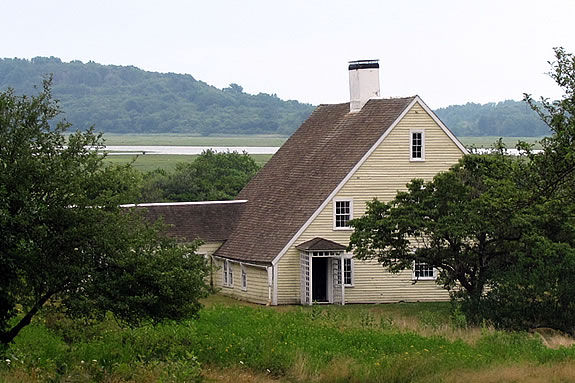
Payne House

Payne House

In 1642, Richard Smith arrived in America and obtained farm land adjacent to that of Robert Paine. In 1694, Robert Paine Jr. had a salt-box style house constructed on his property, not far from the Ipswich River. Robert was foreman of the Grand Jury that returned the Salem Witch Trial indictments.  For his story, see his grandfather William PAYNE’s page.
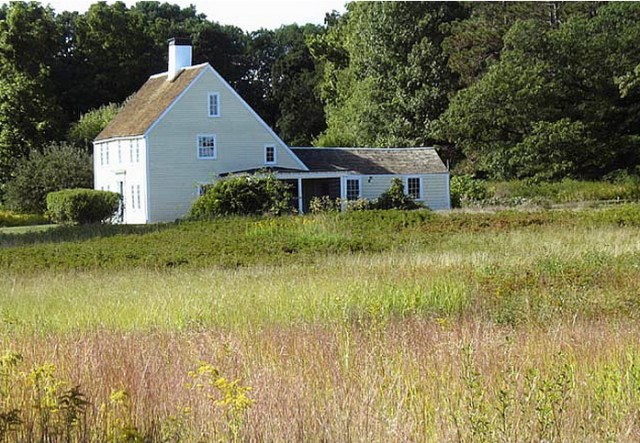
Payne House 2

In 1702, Daniel Smith, grandson of Richard Smith, and son of Richard Smith II married his neighbor, Elizabeth Paine, granddaughter of Robert Paine, and daughter of Robert Paine Jr.   Partly as a dower, and partly in consideration of Daniel’s promise to provide lifelong care for Robert Paine ‘Jr.s infirm son (John Paine), Robert deeded the salt-box house and much of the Paine farmland to Daniel Smith, effective in 1703.  Ownership of the Paine house thereby passed to the Smith family, and the deeded land expanded the land the Smiths already owned. Elizabeth Paine died in 1717. In 1722 Daniel Smith married Deborah Willcomb.

The Smith land and the land and house that had once belonged to the Paines remained in the possession of the Smith/Willcomb descendants for five generations.
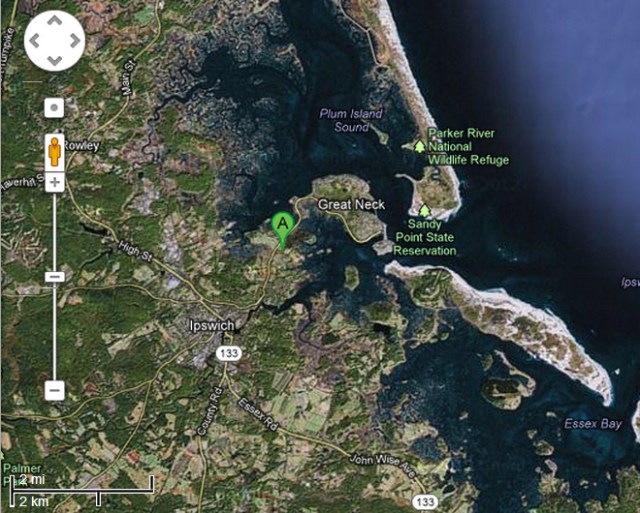
Payne House Map

Payne House  –  49 Jeffreys Neck

Click here for Google Map  of Greenwood Farm

Greenwood Trail Map

Greenwood Trail Map

The property includes several islands on the salt marsh, the three largest being Diamond Stage, Homestead, and Widow’s Island. The islands are drumlins created by the Wisconsin glacier more than 10,000 years ago. Access to the islands is prohibited to protect the salt marsh.

The channels through the marsh lead to the Ipswich River, which begins its journey to the sea 35 miles west in Burlington. In this area, flooded twice daily by the tides, blue mussels (Mytilus edulis) attach to rocks and soft-shelled clams (Mya arenaria) burrow in the mudflats. At low tide, green crabs (Carcinus maenus) e

Payne House 3

For more info on how to visit Click here for the Greenwood Farm  Site
Posted in Fun Stuff | 22 Comments

William Grimshaw

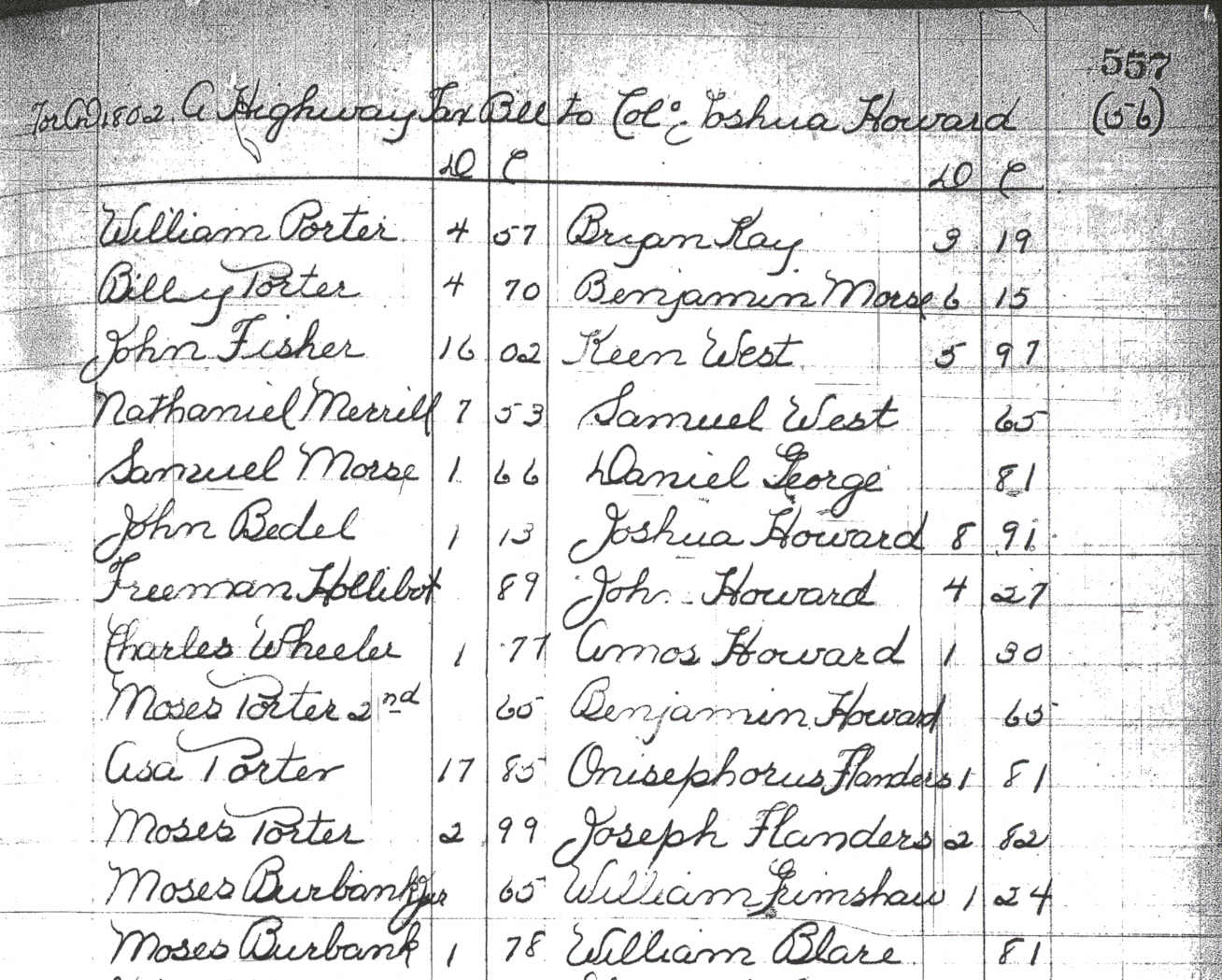
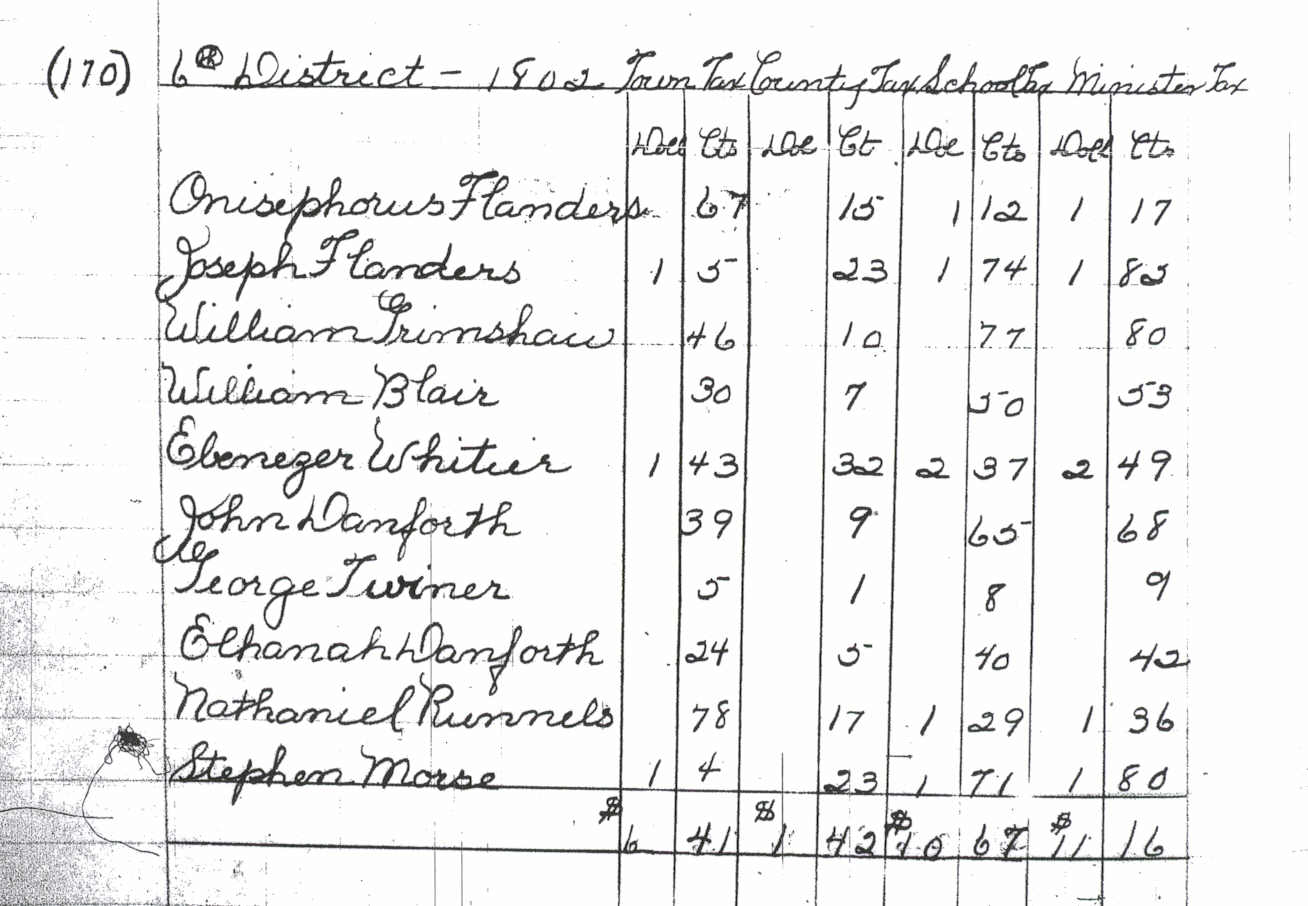
Willliam GRIMSHAW (bef. 1765-  aft. 1825) was likely William BLAIR’s first father-in-law.

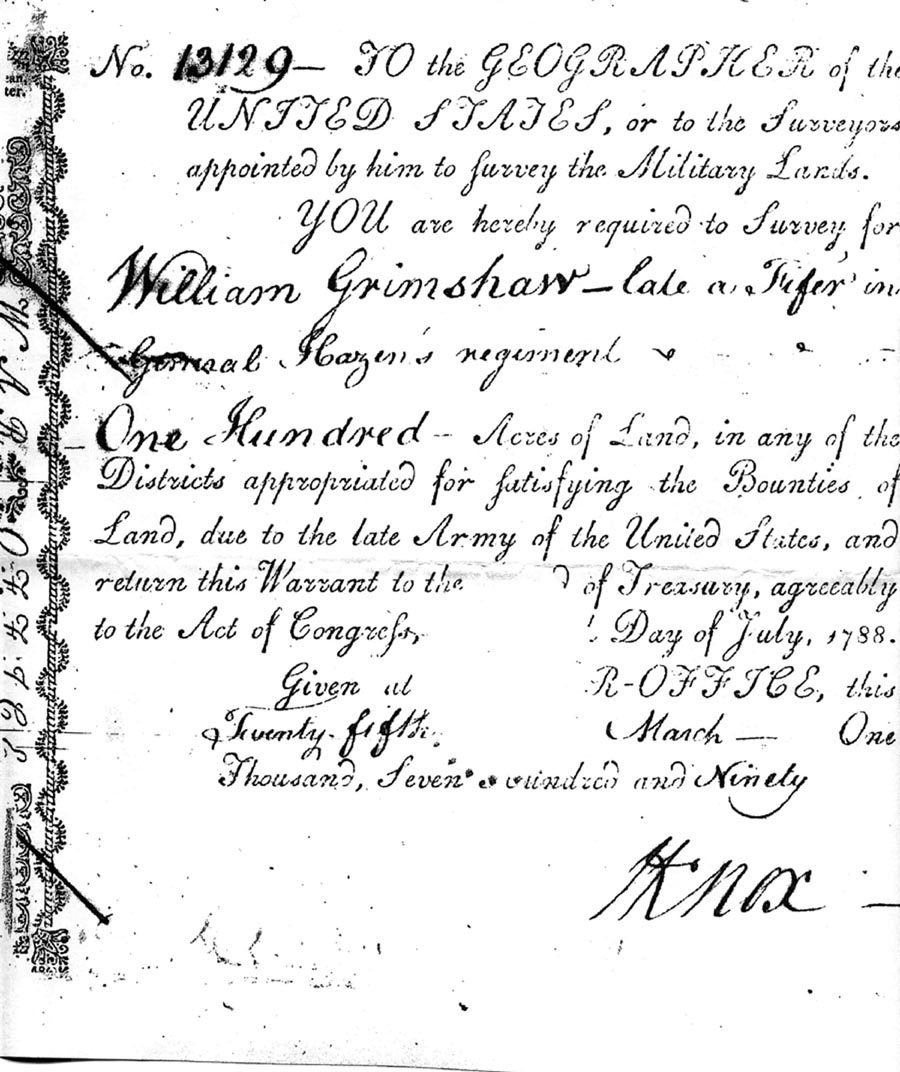
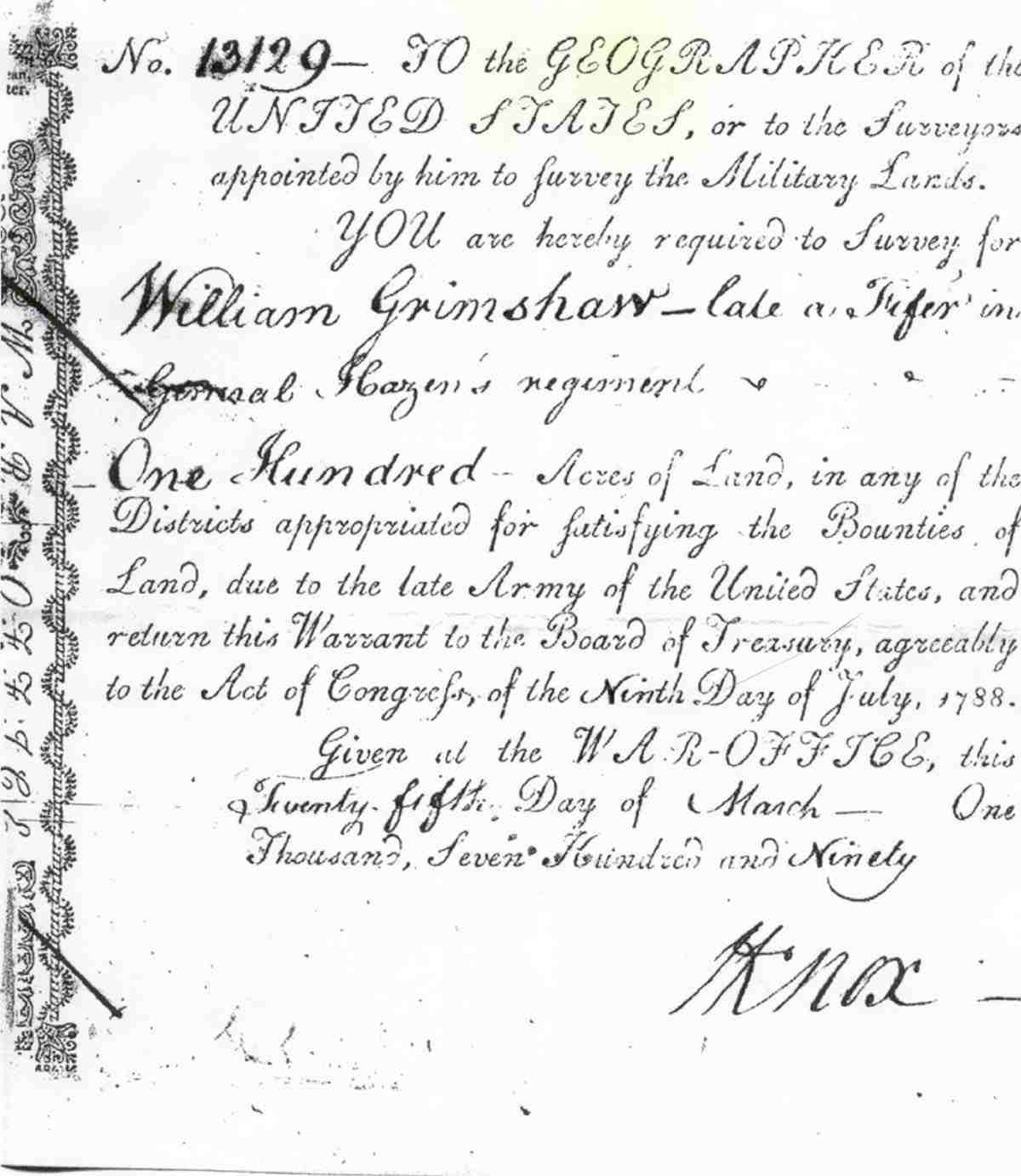
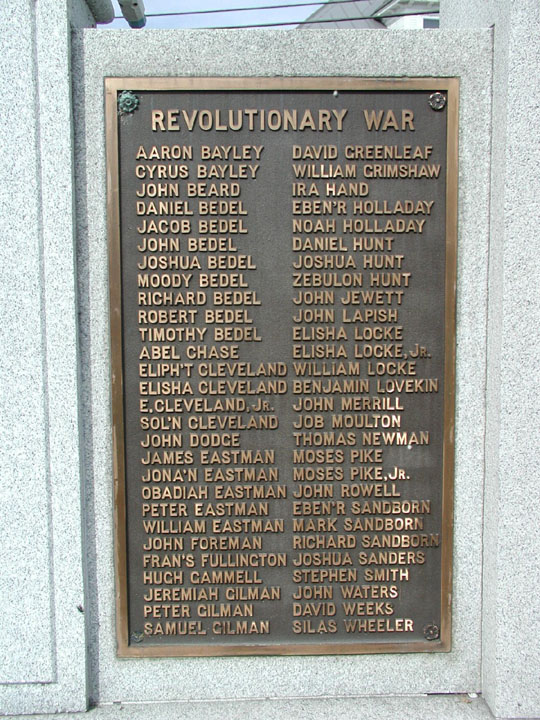
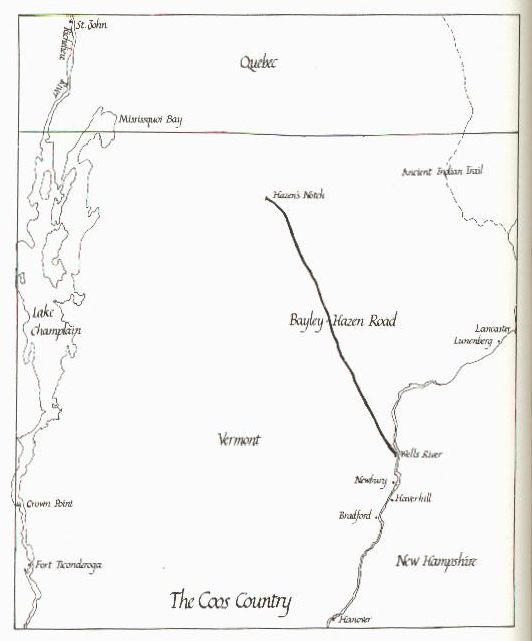
William Grimshaw  is probably descended from a family of Grimshaws with roots in Lancashire, England, but nothing is known of his ancestors or whether he was born in North America or in England.  He fought in the American Revolutionary War on the side of the Colonials. He was a member of Hazen’s Regiment, which was initiated in Canada by Moses Hazen near the beginning of the conflict.   After the war, William settled in New Hampshire for nearly 25 years (1788 to 1812) and then probably moved on to Vermont, New York and Canada.  He married Elizabeth Lepninah. Census records for New Hampshire indicate that was living in Grafton County in 1790, 1800 and 1810. His date of death and place of burial have not yet been determined, but he probably died in Upper Canada after migrating there from New Hampshire.

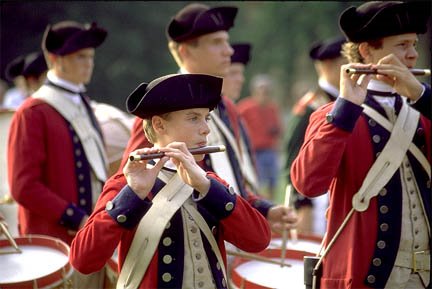
William Grimshaw was a teenage fifer in Hazen's Regiment during the American Revolution

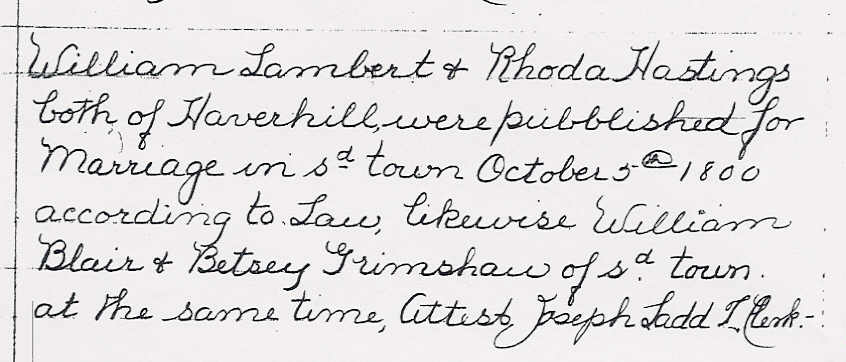
William Blair was 42 when he married Mary HUESTON, 49 when he immigrated and 62 when his last child was born so it is logical to assume he was previously married.  According to Sher Leetooze, William first married William Grimshaw’s daughter Betsey Grimshaw 5 Oct 1800 in Haverhill, New Hampshire.  Members of both Blair and Grimshaw families kept moving back and forth across the border between Quebec and New York all down through the years that followed.   Sher thinks William Blair went home to Ireland after Betsy died and theorizes he had already been on the land at an early date, then gave it to his brother when he went back to Ireland.   The lot that Thomas Blair settled on with his young family was one lot over from William Blair’s father-in-law! William eventually returned with a new wife and five children, but not until the 1830’s.

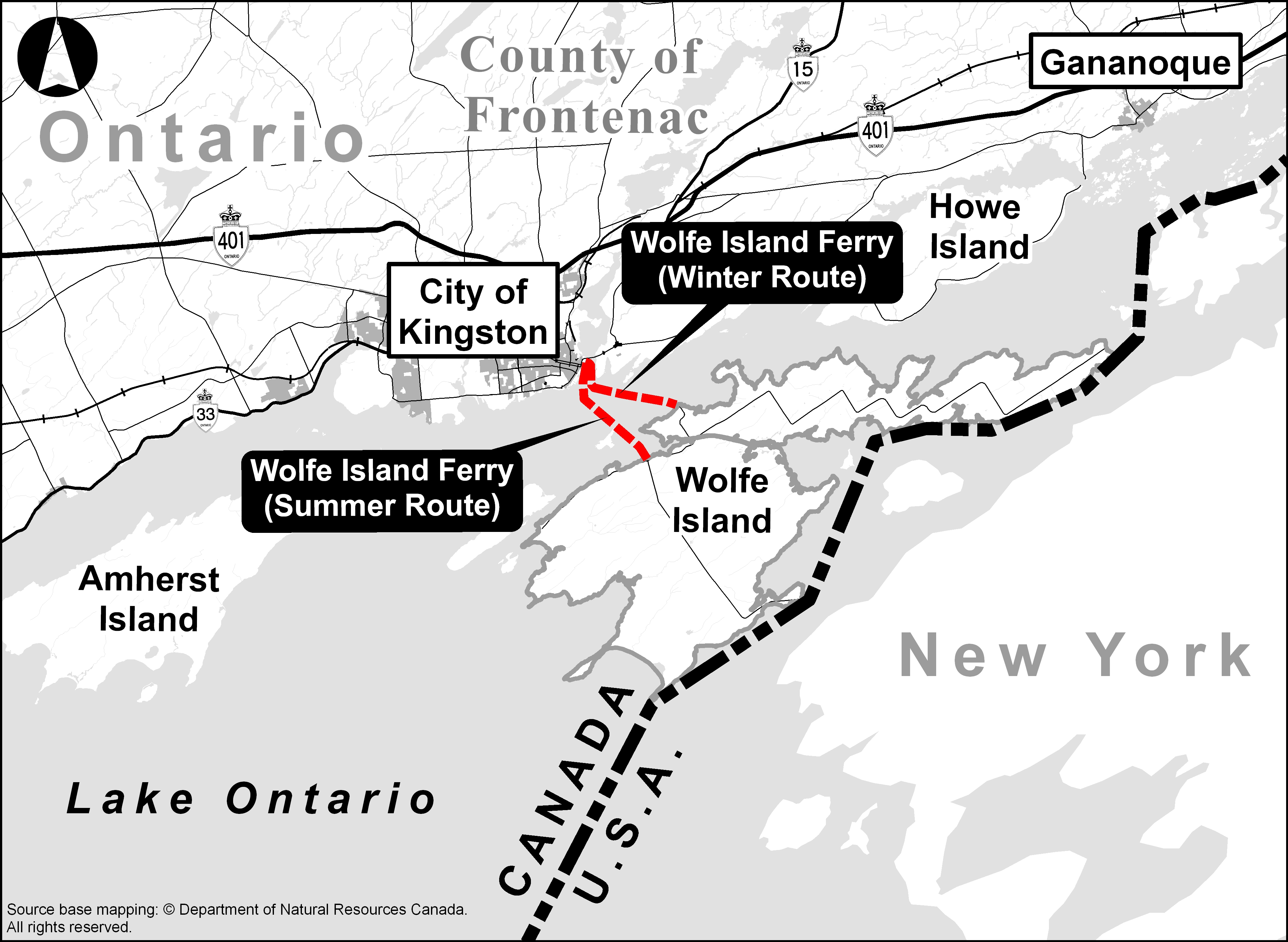
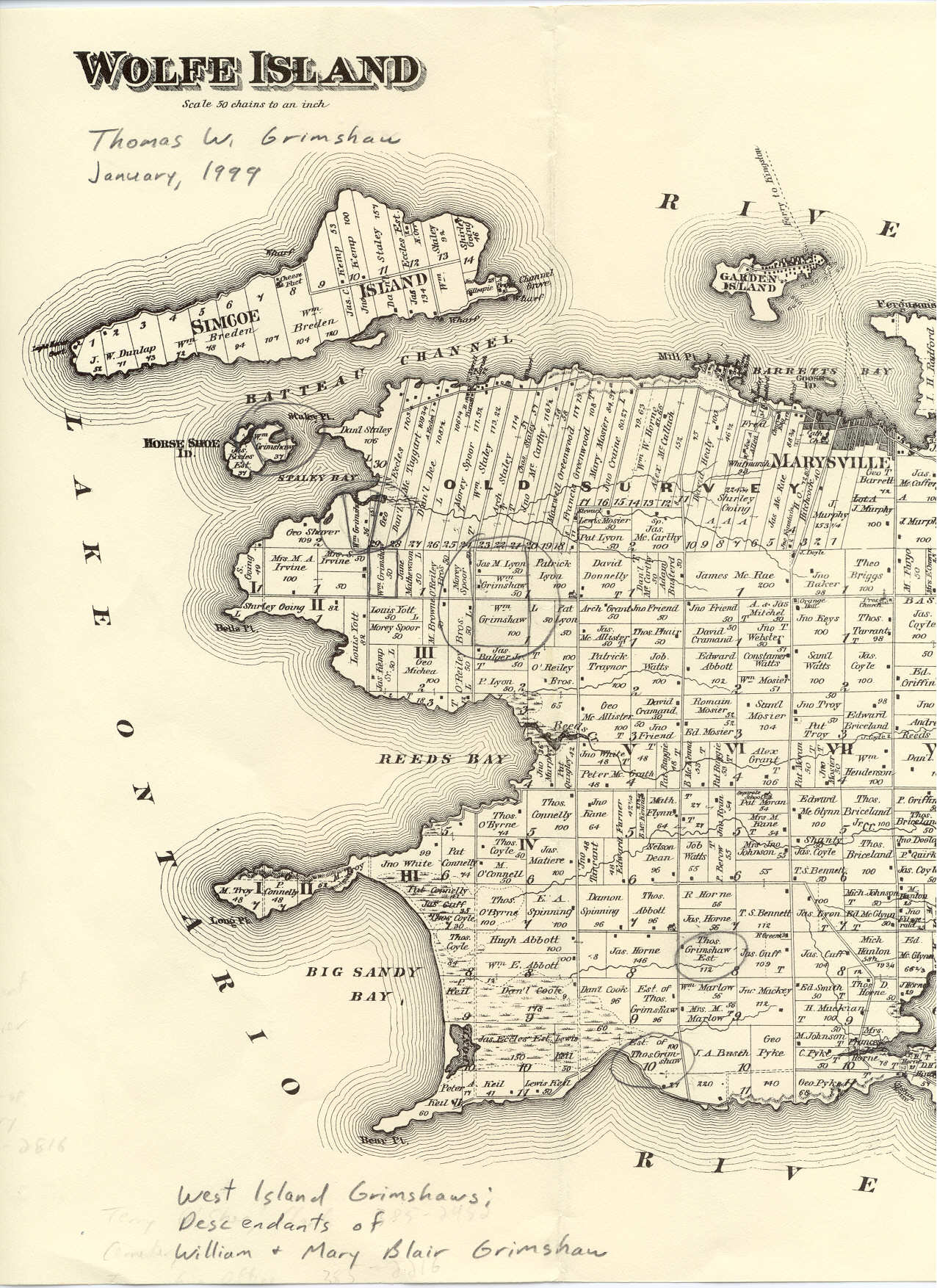
William’s nephew and niece married grandchildren of William Grimshaw.  In addition, William’s son James Blair married one of William Grimshaw’s great grand daughters, Samantha Ann Grimshaw, and went to live near the Grimshaw clan on Wolfe Island, an island located at the entrance to the Saint Lawrence River in Lake Ontario near Kingston, Ontario.

Elizabeth Lepninah’s surname is a mystery. It was apparently a clerical error, as there are no other “Lepninah’s” to be found anywere. There are obvious similarities to Zephaniah’s first name.  The Welsh used an ancient Patronymic naming system whereby the children of a marriage took their fathers forename as their surname.

Children of  William and Elizabeth:

Name Born Married Departed
1. Betsy Grimshaw 1784 William BLAIR
05 Oct 1800, Haverhill, NH
2. Zephaniah Grimshaw 1790 in New Hampshire Jerusha Hunter
15 Feb 1811 in Haverhill, Grafton, New Hampshire
.
Roxie [__?__]
1815
Mooers, Clinton, NY
.
Asenath Noakes
22 Sep 1847 Russelltown, Huntingdon, Quebec
.
Ellen Sheahan
1859
.
Adeline Covey
aft. 1860
25 Mar 1872 in Churubusco, Clinton, New York
3. George Grimshaw 1794 New Hamphsire Charlotte Menard
09 Sep 1817 in St-Luc Quebec
Aft. 1885
4.  [Son] Grimsahw  1796, Possibly New Hampshire
5. Levi Grimshaw
c. 1797, New Hampshire or Vermont 27 July 1875
Canton, St. Lawrence, NY
6. [Daughter] Grimshaw  c. 1800, Possibly New Hampshire
7. [Daughter] Grimshaw c. 1803, Possibly New Hampshire
8. [Daughter] Grimshaw c. 1805, Possibly New Hampshire
9. [Daughter] Grimshaw c. 1807, Possibly New Hampshire

William Grimshaw fought in the American Revolutionary War on the side of the Colonials. He was a member of Hazen’s Regiment, which was initiated in Canada by Moses Hazen near the beginning of the conflict.  William’s service began in January 1782 and continued until the regiment was disbanded  in June 1783, a period of about 18 months.  William was a fifer and that he served in Captain (Clement or Louis) Gosselin’s Company. He caused a casualty in February 1782 – a man named Musick or Musiak. After the war he received bounty land for his service, receiving Bounty Land Warrant No. 13129, dated March 25, 1790.

Copy of Bounty Land Record for William Grimshaw

This version of the Bounty Land Warrant is similar to the one pictured above, except that the "hole" in the lower center has been filled in. Many thanks to Barbara Bonner for making arrangements to have this restoration done.

There are two records at the National Archives for William Grimshaw’s Bounty Land Warrant.  The first is a copy of a card indicating the warrant, Number 13129. The original document was reported lost in a fire on November 9, 1800. However, Bill O’Halloran found this copy of the record in National Archives M829. One sources says this Bounty Land Warrant was for land in Ohio.  He must have sold or traded it because he had already bought 50 acres of land in Lyman, Grafton, New Hampshire for 20 pounds in 1789, which he sold in 1793 for 50 pounds.

England’s defeat of France in the French and Indian War, which ended in 1763, resulted in the cession of Canada to England, A large part of the French Canadian population remained disaffected with England, and when hostilities began that led to the American Revolution, many of them (particularly near the border) sympathized with the Colonials. Many migrated to the U.S. (an under-recognized counter movement to that of the Loyalists who left the American colonies for Canada), and they provided a source of troops for the American side in the Revolution. It was from this population that Moses Hazen successfully raised his regiment, which fought through the entire course of the war.

An excellent description of Moses Hazen and his 2nd Canadian Regiment is provided in a book by Allan S. Everest:

Foreword by John H. G. Pell, Chairman, New York State American Revolution Bicentennial Commission

When thirteen of Great Britain’s mainland colonies declared for independence in 1776, the newest British colony in North America – Canada – decided against joining the revolt. But some Canadians refused to accept the decision of the majority in Canada to stay out of the fight for American independence. A large group of these people left their homes and crossed the border to be organized into military units by Moses Hazen. Led by Hazen, who was commissioned a general in the Continental army, these Canadian soldiers fought in many engagements throughout the war. After independence was achieved, Hazen led his followers to the northern reaches of New York to settle on land grants near the border of the country they had left years before. The story of these Canadians who came south to support the cause of American independence thus belongs both to New York and to the people of the United States at large….

Preface by Allan S. Everest, Plattsburgh, New York, Spring 1976

This book is an attempt to offer belated recognition of those residents of Quebec and Nova Scotia who, for a variety of reasons, became refugees in the United States during the American Revolution. Whether motivated by the expectation of profit and adventure, anticipation of life in a freer society, or the desire to help drive the British out of Canada, hundreds of them chose what they thought was temporary exile from their homeland.

The refugees from Quebec were largely French, but they were joined by a significant number of Americans who had gone north to seek, and often to make, their fortunes after the conquest of 1763 – Moses Hazen, Edward Antill, James Livingston, Udny Hay, Thomas Walker, and others. From Nova Scotia the refugees were drawn from those transplanted New Englanders who migrated during the 1750s and 1760s but who subsequently caught some of the revolutionary fever that infected Boston in the 1770s. Whoever they were and wherever they came from, they left behind them their property and livelihood, their friends and, for many, their religion.

Most of the men joined the American army, while their families led a long, destitute existence, chiefly in the refugee camps of New York State. The great majority hoped that when the British were driven from Canada they could return to their own country, and they were the most enthusiastic and sometimes troublesome advocates of every new project for an invasion northward.

Although many of the refugees drifted back to Quebec or Nova Scotia after the war and picked up the threads of their prewar life, many more chose to remain permanently in exile. Displaced persons usually present a tragic aspect, and those of the American Revolution are no exception. Many sustained battle wounds or suffered physical breakdowns and the collapse of their prewar standards of living as a result of their war and postwar experiences. A notable example is Moses Hazen, an American who had established thriving enterprises in Canada.

The career of Moses Hazen was so intertwined with the lives and fortunes of the refugees that it is impossible to tell their story without including his. And so this book becomes partly a biography of Hazen and his close associates, from which emerges a stormy and fascinating character. These pages also give rise to a renewed admiration for the patience and integrity of George Washington in his dealings with the refugees and their quarrelsome champion, Moses Hazen.

The fact that there were refugees into the United States is usually forgotten because the focus of attention has been upon the American Loyalists who fled the country during and after the Revolution. The American refugees have always received a great deal of attention, traditionally portrayed as traitors to a great cause. Only recently have they begun to receive the sympathetic study they deserve. Instead of being branded as traitors, they are being appreciated for the idealism of their convictions. Canadians are likewise beginning to display more pride than was formerly the case in the lives of their exiles. In numbers the Canadians were much fewer than the American refugees, which is one reason why the Canadians have been generally overlooked. Another is the fact that the peace treaty at the end of the Revolution made no mention of them although it considerately tried to make possible the return of the American refugees to their native country. Forgotten or otherwise, the refugees created a two-way street, and this study deals with the incoming group…

In November 1782, the 2nd Canadian Regiment was moved to Pompton, New Jersey for winter quarters. Its duties during this time included the interdiction of trade between the countryside and the British in New York City. In June 1783, with the peace nearly finalized, much of the regiment was furloughed. At the same time it was transferred to the Highland Department. Pursuant to a Resolution of Congress of May 26, 1783, 300 soldiers were discharged on June 9. However, members of the regiment refused to depart, whether on furlough or discharge, until they received their pay. Members of the regiment that remained were ordered to march to Washington’s cantonment near New Windsor. The regiment was reorganized into two companies on June 30 and was completely disbanded on November 15, 1783, at West Point, New York.

Because the Canadians in the regiment were unable to return to their homes, many of them settled in camps near Albany and Fishkill, where they subsisted on handouts from Congress. General Hazen appealed to Congress to give them land grants, but this effort failed. The state of New York eventually granted Hazen and a number of his men land in the northern part of the state near Lake Champlain.

The contributions of Moses Hazen and the members of his 2nd Canadian Regiment in the Revolutionary War did not result in very substantial rewards and, in many cases, brought personal and financial hardship instead. Being assigned directly to Congress (which was chronically impoverished) rather than to one of the states, did not bring enhanced status, recognition or reward, but was a strong disadvantage in most respects.

After the war Hazen fought a running battle with Congress for compensation for his losses in Canada, for his disbursements to recruit and maintain his regiment, and for loss of his British half pay. His estate had been pillaged by both armies, and during the retreat of 1776 his manor had been razed to deny it to the British. In 1783 the Saint John River Society’s lands, including Hazen’s share, were escheated. The following year Gabriel Christie won a suit against him in the Court of Common Pleas at Montreal, obtaining judgement for £1,900 sterling. He had Hazen arrested twice at New York for debt and in August 1785 had his Richelieu valley holdings seized for sale at sheriff’s auction. Hazen won on appeal but saw the decision reversed by the British Privy Council. In 1790, at a sheriff’s auction, Christie acquired Bleury-Sud and some of Hazen’s other lots around Fort St Johns.

In spite of his debts and set-backs Hazen had extensive plans for land speculation and colonization in the United States; all came to naught, particularly after a stroke in 1786 disabled him for life. In 1787 he settled at New York, but then moved to Troy. In the years following the war he enjoyed cordial business relations with James Bell in Canada. By 1790, however, after unsuccessfully petitioning Congress for years to reimburse $6,000 of personal funds advanced for the American cause, Bell sued Hazen for $826 of advances that Hazen had guaranteed. Having won his suit, in 1794 Bell had attached part of Hazen’s lands in Clinton County, N.Y., including 1,000 acres in the Refugee Tract and a model farm, which Hazen had been developing on the shores of Lake Champlain. In the last 20 years of his life Hazen was arrested 14 times for debt, and he instituted as many suits against others. A court adjudged him of unsound mind in 1802; nevertheless, he was arrested twice for debt only weeks before his death on 5 Feb. 1803. On paper he died a wealthy man, but his widow was unable to collect claims totalling $42,000 against Congress and individuals before her death in 1827; the executor of Hazen’s estate ultimately obtained payment from Congress of some of the claims.
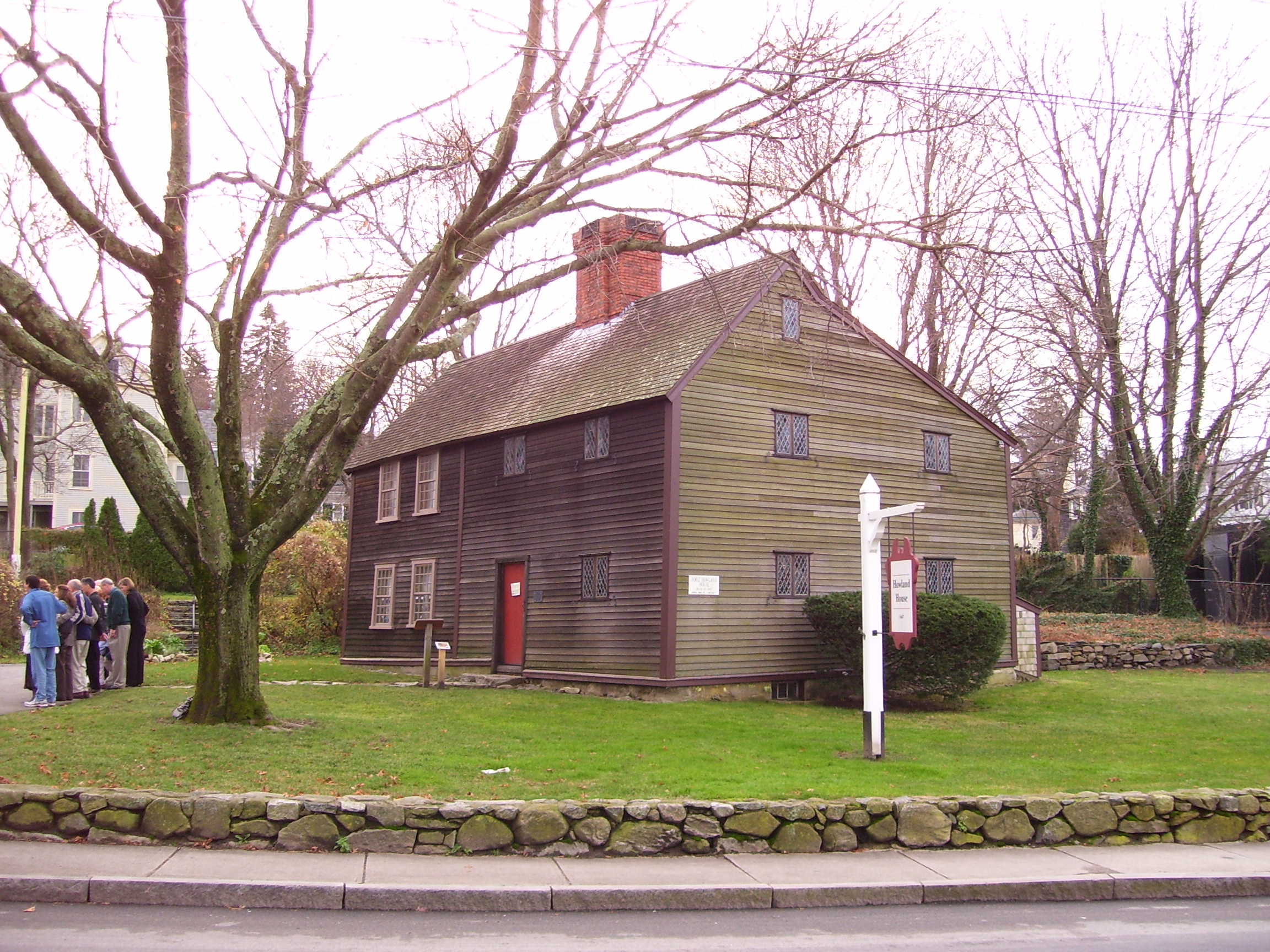
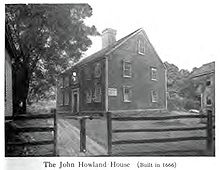
As a soldier Moses Hazen displayed extraordinary leadership qualities. A combative man, he was happiest in action. Courageous and impetuous, he was also throughout his life restless, frustrated by obstacles, stubborn, and hypersensitive about his honour; in 1790 Secretary of War Henry Knox referred to him as “the unfortunate Hazen . . . , nature has marked him with as obstinate a temper as ever afflicted humanity.” A driving man, Hazen was even more a man driven by the need to be in motion, but he never established a sense of direction.

Canadian and Nova Scotia Refugee Tract – Clinton County, NY Members of Hazen’s Regiment finally obtained land in and around the Beekman, Bell and Douglas Patents - Everest, p. 131).

General Benjamin Mooers (April 1, 1758 – February 20, 1838) was born in Haverhill, Massachusetts. He was the nephew of Gen. Moses Hazen and was ultimately responsible for untangling many of Hazen’s affairs. He was a lieutenant in the New York militia and the 2nd Canadian Regiment during the American Revolutionary War. In 1783 he settled in the vicinity of Plattsburgh, New York, a frontier settlement at the time. Gen. Mooers commanded the New York Militia at the Battle of Plattsburgh, September 11, 1814, and later served as a member of the New York legislature. William Grimshaw’s name appears near the bottom of the second to last page on a list of members of Hazen’s Regiment, prepared by Benjamin Mooers and dated June 15th, 1800 along with the date of termination of his service on June 30, 1783.

Impatient with all the delays, a few of the refugees began to gravitate toward northern New York immediately after the war. In the summer of 1783, eleven of them accompanied Lieutenant Benjamin Mooers to Point au Roche in the Beekman Patent. Here they made a small settlement, sometimes known as Hazenburgh after its sponsor, Moses Hazen, for whom Mooers served as agent. Among their number were Jean La Framboise and two Montys, eager to reclaim the farms they had established before the Revolution and had to abandon in 1776. Over the next two years others squatted on sites along the shore north from Point au Roche, mostly on Dean’s Patent, so as to be nearby when their own lands were available, and perhaps to exchange them for their squatters’ claims.

Many of the veterans and others who obtained bounty land warrants sold them at a discount to land speculators rather than receiving their land, in many cases because of the long delays. It is unknown whether William Grimshaw received land, cash or other value for his warrant. It is known from census records, however, that he lived for many years (until at least 1810) in New Hampshire rather than New York.

The town of Mooers in Clinton County, New York, United States is named after Benjamin Mooers, an early settler. The population was 3,592 at the 2010 census. Several later generations of Blairs lived in Mooers.

The community of Bath, Grafton , New Hampshire, erected a monument in 1929 to honor its citizens who had given military service in wars up to that time. William Grimshaw’s name is included on a plaque for those who served in the Revolutionary War

Following his Revolutionary War service, William apparently settled in Grafton County, New Hampshire and remained there at least through 1810. The records of his presence in that state are presented on this webpage. Census records exist for William for the 1790, 1800 and 1810 Censuses. The 1790 Census indicates that William and his family were living in Lyman Town and the family included five persons:

1 free white male of 16 years and upward, including heads of families
1 free white male under 16 years
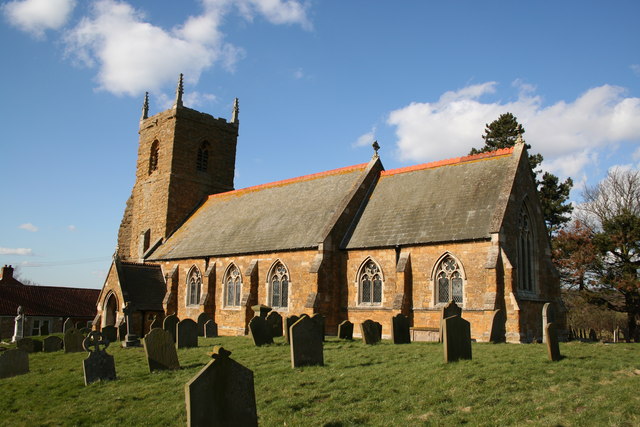
2 free white females, including heads of families

The Census of 1800 indicates that the Grimshaw family was in Coventry Township of Grafton County and included the following seven persons:

3 free white males under 10 (years of age)
1 free white male of 10 and under 16
1 free white male of 26 and under 45, including heads of families
1 free white female of 10 and under 16
1 free white female of 26 and under 45, including heads of families

The index to the 1810 Census  indicates that William was living in the town Haverhill, Grafton County.  By the time of this census, William was over 45 (verifying that he was born no later than 1765), but his wife was still under 45. The older daughter, and three of the four sons, counted in the 1800 census, were not present for the 1810 census (two of the boys were thus still teenagers when they apparently left home.) And four young daughters have been added to the family, for an apparent total of nine children in the family – 5 daughters and 4 sons.  The following seven persons are listed:

1 male of 10 and under 16
1 male of 45 or over
4 females under 10
1 female of 26 and under 45

The last Revolutionary War record for William is that of his discharge from Hazen’s Regiment in June, 1783. The next known record for William is in January 1788, almost five years later, when he is recorded in land transaction and other records in Lyman Town, New Hampshire. Nearly all of the subsequent records of William’s life are from New Hampshire, where he apparently settled and lived from 1789 until at least 1811.

The area around Haverhill and Bath was frequented by Hazen’s Regiment during the Revolutionary War. For example, Hazen’s Road was built in 1779 by the Regiment from Wells River, Vermont, just across the Connecticut River from Bath Town, to Hazen’s Notch in the Green Mountains. (William’s service began about 2-1/2 years later, in January 1782.) The route of Hazen’s Road1 is shown in Figure 1. Several prominent members of the Regiment settled in the Bath and Haverhill area after the war. It therefore seems likely that William’s decision to settle in New Hampshire was in some way connected to his service in Hazen’s Regiment.

Map of northern Vermont showing the route of Hazen’s Road built by Hazen’s Regiment in preparation for a second invasion of Canada, which never occurred. Evidence indicates that General George Washington used the maneuver as a feint for the British and never intended to follow through with the second invasion. Note the location of Wells River and Haverhill

The fact that William served as a fifer in the War may indicate that he was quite young (say, age 16 to 18) when he served from January 1782 to June 1783. If so, he would have been born about 1765, and thus was about age 22 when his presence in New Hampshire was first recorded in 1789. If he left the state in 1813, he would have then been about 48 years old.

During his more than 20 years in New Hampshire, William lived with his family in the Town of Bath and the surrounding Towns of Lyman (to the north), Coventry-Benton (southeast), and Haverhill (south). This area is in western New Hampshire, near the Connecticut River.   The records demonstrating his presence there include land purchases and sales, censuses, and miscellaneous Town records, such as inventory and tax records.uring his New Hampshire life, at least 20 direct (and 2 indirect) records of his presence were created, including land transactions, census tallies, road petitions, inventory and tax, and other records. The records discovered so far  cover William’s life in New Hampshire from about 1789 to around 1811.

Lyman Town, 1789-1792

Land Purchase in Lyman Town,  1789
Census Record in Lyman Town, 1790
Bounty Land Warrant, 1790
William Grimshaw Voted as “Tithing Man,” 1791
School District Established, Lyman Town, 1791
Land Sale in Lyman Town, 1792
William Grimshaw Voted as “Saxon” and Takes Oath of Office, 1792

Bath Town, 1792-1796

Bath, Grafton, New Hampshire

Inventory and Tax Records, Bath Town, 1794 to 1796

Coventry (Benton) Town, 1800

Benton, Grafton, New Hampshire

Census Record in Coventry (Benton) Town, 1800

Haverhill Town, 1800-1811

Haverhill, Grafton, New Hampshire

Published Marriage Intention of William Blair and Betsey Grimshaw, 1800
Inventory Record, Haverhill Town, 1801
Highway Tax Record, Haverhill Town, 1801
County, Minister, School and Town Tax, Haverhill Town, 1801
Highway Tax Record, Haverhill Town, 1802
Town, County, School and Minister Tax, Haverhill Town, 1802
Promissory Note, Samuel Chase to William Grimshaw, and Subsequent Judgment, August 1802
Land Purchase in Haverhill Town, 1803 – This land purchase again showed William as a cordwainer (shoemaker.)
Petition to be Excused from Support of Minister John Smith, 1805
Land Sale in Haverhill Town, 1806
Census Record in Haverhill, 1810
Zephaniah Grimshaw and Jerusha Hunter Marriage Record, Haverhill Town, 1811 – the last known record of William and his family in New Hampshire consisted of the announcements, on consecutive days (February 14 and 15, 1811) of the betrothal and marriage of Zephaniah Grimshaw and Jerusha Hunter.

In 1802, William was taxed $1.24 for highways. Note that his probable son-in-law ("William Blare") is shown in the adjacent record entry taxed for 81 cents.

.2

Town, County, School and Minister Tax, Haverhill Town, 1802 - Again William is listed next to his son-in-law William Blair

Calvin Lamb’s research indicates that William was probably with his son, Zephaniah, and family in Hinchinbrooke Township, Huntingdon County, Quebec in 1825.  The 1842 census indicates that Zephaniah had been in Canada for 20 years. That would make his arrival in Canada 1822.

Children 

1. Betsy Grimshaw  and William BLAIR

The town records of Haverhill Town (p. 464) include a record of publishment, dated October 5, 1800, for marriage of William’s (presumed) daughter, Betsey, to William Blair, both of Haverhill

There is no William Blair listed in Grafton County in 1800.  However, there are two Blairs listed in Grafton County, and they both lived near William Grimshaw’s future homestead in Haverhill.   Page 400 lists Elizabeth Blair (no males, one female 10-16, two females 26-45, and one female 45 and over) and Samuel Blair (one male under 10, one male 26-45, and one female 26-45). Although close by, neither of these Blair families seems to contain an eligible bachelor for Betsey Grimshaw. In 1802, William Blair is listed as living next door to William Grimshaw in the 6th District of Haverhill (he is not listed as a property owner in previous years). The only other Blair listed in Haverhill town records is James, who is on the 2nd District 1802 tax rolls. The Grafton Co. deed records show a Wm. Blair as grantee in 1783, and as grantor in 1795 and 1803.

AS WRITTEN BY: CLARA A. BLAIR HANNA (William’s grand daughter 1861 – 1937)

William Blair and Mary Hueston were married September 1822. He was born in 1781 and died July 31, 1875. Mary Hueston Blair was born in April 1796 and died October 6, 1887. They left their native land, Armagh Co. Ireland, with their small children, have heard the fourth child, Mary was born on their way out to this country. They left the old land very early in the year and after a hard trip of a number of weeks, ( I think 10), arrived in Montreal, Canada in the Spring of 1830.

After a short visit with relatives (his brother and 3 children, I think, who lived in what is called now Hinchinbrook), he moved his family to Frontier, N.Y. just across the border.

He was a weaver by trade in his homeland and of the Quaker belief, also was left-handed.

In Spring of 1837, they moved to Russelltown, Township, now known as Franklin Township, Huntingdon County, Quebec. He got a farm of 200 acres, most of it well timbered, cleared a piece of ground and built a home for themselves.

The early pioneers had a great many hardships that we of our day know nothing about. He made a success of farming and spent the rest of his life on the farm, and died in his ninety-fifth year.

2. Zephaniah Grimshaw

Zephaniah’s daughter Samantha Lucretia Grimshaw married William’s nephew John Blair, and his son married William’s niece Mary Ann see below)

Zephaniah was born in New Hampshire after the US Revolutionary War. He probably lived at home until his marriage in Haverhill, NH in 1811, even though he doesn’t appear in William’s household in the 1810 census.

Zephaniah first married 15 Feb 1811 in Haverhill, Grafton, New Hampshire to Jerusha Hunter (1779 New Hampshire – 1815 in Vermont)  After marrying Jerusha, he may have moved first to Vermont (where son William was born). According to Lamb&Frier Family Tree, Jerusha died & was buried in Vermont.

In about 1815, he moved to Clinton Co., NY. While there he met Roxie [__?__]. However, Hurd’s History of Clinton Co. says that Zephaniah “came from Rhode Island and located at an early day on lot 87” in the Town of Clinton! Supported by Bev’s search from the Clinton County GenForum – “John Nelson Grimshaw was born 1817, Clinton, Oneida, NY (probably in error, confusing the two Clintons in NY) to Zephaniah Grimshaw & Roxie”.  The similarity in names – Village of Clinton, Clinton Township, & Clinton County – has caused some confusion. I no longer believe that Zeph ever went to Oneida County. I believe it was Mooers, Clinton County that he came to in 1815.

Clinton County, New York

Soon after, there were wife problems again with Roxie & she left Zeph or she died and was buried at Mooers.  He was living in Mooers, Clinton County, NY by 1820, where he became romantically involved with his neightbor & brother-in-law’s wife, Asenath Noakes (c. 1792 in Champlain, NY – 1863 in Grey Co, Ontario). Her parents were Morris Nokes and Azubah Knapp. He spirited Asenath  away from her husband, James Hunter, when finally, he headed north to Canada in 1822 and settled in the Russeltown Corners area on the north edge of present day Havelock Township, Huntingdon County, Province of Quebec.

Havelock, Le Haut-Saint-Laurent Regional County Municipality, Quebec

Le Haut-Saint-Laurent Regional County Municipality, Quebec

According to Eunice (Covey) Tucker, “Zephinire Junior Grisham came along and fell in love with Senith and chased Grandpa Hunter away.” He appears in the 1820 census with one son under 10 and two daughters under 10. By 1822, he and Sentha had moved to Huntingdon Co., PQ, where he lived for the next 45+ years. Zephaniah and Sentha proceeded to have eleven more children together over the next 20+ years, without benefit of clergy. Zephaniah and Sentha finally married 22 Sep 1847 in Russelltown, Huntingdon, Quebec. None of their children were baptized until after their marriage.

Tired of the low flat country of the Russeltown Area always flooding, Zeph moved again. This move was to his most lasting residence as he took possession of the east half of Lot 47 (47b) on the first concession of Hinchinbrooke Township, Huntingdon County, Quebec in time for the Canadian Census of 1825. Note that this farm was transferred to Franklin Township, Hinchinbrooke Region, when it was formed in 1857 from pieces of Hemmingford & Hinchinbrooke Townships along with part of Russeltown & Jamestown Regions of the Seigniory of Beauharnois. Presently the road past the property is known as Blackwood Road. From the CVHS Annual, 1982, “Sometime in the 1840’s, it appears that the Craiks built a gristmill on the Mitchell Brook, a little north of the road, on the present Henry Wilson farm, just over the Hinchinbrooke line. It was overhauled to an overshot mill in 1862, but seems to have faded from the scene shortly afterwards, being replaced by more convenient and superior grist mills.” That mill was just west of Zeph’s farm on the opposite or north side of the road. His nearest post office was at Frontier, NY, just one farm east of the south edge of his farm. This post office served both Canadians & Americans. Apparently, Frontier, NY had both a tannery & a brewery. The brewery, no doubt, motivated Zeph to grow a large crop of hops. Zephaniah and Asenath together had 11 children but were not married at that time. Finally, Zephaniah and Asenath experienced a religious union in 1847 as shown by the marriage certificate below although it appears James Hunter, Asenath’s first husband, was still alive.

Hinchinbrooke, Quebec

Asenath became disillusioned with Zeph, possibly because of Mary, a woman, that was staying with them at the time. As a result, Asenath took Zephaniah Jr., Esther Mary & Harriet to Mount Forest, Egremont Township, Grey County, Ontario in 1855.

Grey County, Ontario was formed in 1852 and was named for Earl Grey

Lonely Zeph met Ellen Sheahan (c. 1838 in Ireland – 18 August 1860 in Quebec) but she died from consumption in 1860 at the tender age of 22 or 23.   From old Roman Catholic Cemetery in Hinchinbrook – “Ellen, wife of Zephinah Grimshaw died Aug. 18, 1860, ae 22 years”.

Zephaniah seemed to surround himself with women. In the 1861 census, Adeline Covey (12 June 1832 in Quebec – 5 Jan 1881 in Churubusco, Clinton County, NY)   (single with a 3 year old child), along with another woman, Mary, lived in his house, as had the the recently departed “Ann” (Ellen?). In 1850, Adeline, age 17, lived in Mooers, NY with Erastus Hall and his family. It’s interesting that Zeph’s next child, with Adeline Covey, was born a mere seven months after Ellen’s untimely demise!  Zeph and Adeline had five children together. It appears that Zeph sold his farm in Hinchinbrooke Region, Franklin Township maybe upon hearing of Asenath’s death in 1863 & the closing of the grist mill up & across the road. He moved with Adeline & their children to Clinton Township, Clinton County, N. Y. His last property was located at the north-west corner of Clinton Mills Road & Bull Run Road, Ellenburg Depot. NY. A school was located right across the road on the north-east corner, making it easy for the young children to get to school.

Unfortunately, a year before his death in 1872, it appears that Zeph & Adeline ran into great difficulites. Some if not all of their children were placed with other families. This was family break-up big time with the children separated from both parents simultaneously.  Zephaniah supposedly died in 1872 in Churubusco, Clinton County, NY (per Grimshawv14t1260.FTW). Unknown where he was buried. Searches of cemeteries and burial records to date have turned up nothing. Ten years later, Adeline met an early death. She was not even 48 years old.

Were James Hunter and Jerusha Hunter brother & sister? What relation was Joseph Grimshaw to Zeph? Who was Roxie? When & did Zeph marry her? When did Zeph meet Ellen Sheahan and who was she? When did they marry? Who was Mary and what happened to her? It is unknown where or if Zephaniah & Adeline were married. Maybe they just lived common law. Where are the graves of Zeph, James, Jerusha, Roxie, & Adeline? If you had one child named Elizabeth, why would you name another child by the same name 8 years later, especially if the first Elizabeth was still alive? What is the story on Adeline’s first husband, Mr. Spearman? Is Ellen Sheahan & Ann the same person? The Hunter Family shown on the family chart is very speculative!

Children of Zephaniah and Jerusha:

Children of Zephaniah Grimshaw and Jerusha Hunter are:

i. William Grimshaw, (Abt. 1812, Vermont – 7 Dec 1897, Wolfe Island, Ontario) He married in 1830 in Quebec, Canada when she was just 18 to Mary Ann Blair (1812 in Ireland – )  Her parents were Thomas and Grace Blair.  Thomas was probably William BLAIR’s brother. Members of both Blair and Grimshaw families kept moving back and forth across the border between Quebec and New York all down through the years that followed. It seems our William Blair (the one I am looking for) went home to Ireland. I am wondering if he had already been on the land at an early date, then gave it to his brother when he went back to Ireland? The lot that Thomas Blair settled on with his young family was one lot over from William Blair’s father-in-law! I think William’s wife died and he went back to Ireland. He did eventually return with a new wife and five children, but not until the 1830’s.

The first Grimshaws to settle on Wolfe Island, Ontario, which is located near Kingston at the head of the St. Lawrence River at Lake Ontario were William and Mary Ann (Blair) Grimshaw, who acquired several parcels of land in the western half of the island. William and MaryAnn were the progenitors of one of the most important Grimshaw lines in North America.

Wolfe Island Map

Mary Ann and William had twelve children.   William’s son James married one of these twelve – Samantha Ann Grimshaw. and went to live near the Grimshaw clan on Wolfe Island, an island located at the entrance to the Saint Lawrence River in Lake Ontario near Kingston, Ontario.  Mary Anne died  6 Nov 1883 in Wolfe Island, Frontenac, Ontario, Canada.

Map of Wolfe Island, Ontario, Circling Locations of Land Owned by William and Mary Ann (Blair) Grimshaw

Grave of William and Mary Ann Blair Grimshaw on Wolfe Island.

Home place of William and Mary Ann (Blair) Grimshaw on Wolfe Island

Children of William and Mary Ann:

i. Thomas Grimshaw ( 06 May 1831, QC, (Lower Canada) – 01 Sep 1876, Wolfe Island, Frontenac Co., ON.)

ii. Melissa Grimshaw (06 March 1835, Wolfe Island – Aft. 1907, Probably St. Joseph Twp., Algoma, Ontario)

iii. Almira Grimshaw (02 April 1837, Wolfe Island – 28 April 1919, Kingston, Ontario)

iv. Samantha Ann Grimshaw (29 Oct 1839, Wolfe Island – 26 Apr 1883, Pittsburg Twsp., Frontenac Co., Ontario). SheJames married 27 Sep 1863 in Cape Vincent, Jefferson Co., NY, St. John’s Episcopal Church to James Blair xx Samantha was probably James 2nd cousin, see above.

Cape Vincent Protestant Episcopal Church – 1863

That Arni Merchant Lewis, on the 27th day of September, 1863, in the State of New York, county of Jefferson, township of Cape Vincent, joined together, in the Holy Estate of Matrimony, James Blair & S. Ann Grimshw according to the custom of the Protestant Episcopal Church, in the United States of America.
Rev. A. M. Lewis,
-Minister of St. John’s Parish, Cape Vincent, Jeff Co., N. Rf.
Dated, Cape Vincent, Sept. 27, 1863.

Thomas Grimshaw —} Witnesses.
William Grimshaw —}

Children of James and Samantha:
i. Helen Mary Blair (25 Nov 1864, Wolfe Island, Frontenac, ON – 16 May 1905 Kingston, Frontenac, ON); m. 13 May 1886 in Kingston, Frontenac, Ontario to John Francis Reynolds (07 Dec 1864 Kingston, Ontario – 02 Aug 1935 Kingston, Ontario) His parents were Samuel Reynolds and Ann Clayton.

ii. William John Blair (20 Nov 1866 , Wolfe Island, Frontenac, ON – 07 Feb 1952 Toronto); m. 07 May 1889 in Kingston, Frontenac Co., ON to Mary “Minnie” Waddingham (30 Jul 1873 in Kingston, Ontario – 19 April 1925 in Oshawa, Durham. Ontario) Her parents were Thomas Waddingham and Elizabeth Reynolds.

iii. Ida Jane Blair (14 Apr 1869 , Wolfe Island, Frontenac, ON – 14 May 1956, Groton, New London, CT); m1. 24 Nov 1886 in Kingston St. Andrew’s Presby Ch. to Neil Fletcher (23 Nov 1860 Scotland- 30 Sep 1921 Connecticut); m2. 03 Dec 1923 to George Henry Vassar (16 Dec 1862 – )

iv. Jerusha Anna Blair (16 Aug 1876, Wolfe Island, Frontenac, ON – 19 Oct 1954, Belleville, Hastings, ON.); m. 22 Feb 1913 at Kingston, Ontario to James Augustus Robinson (1876 in Glasgow, Scotland – 26 Feb 1954 in Belleville, Hastings, Ontario) James Augustus Robinson , 37, labourer, Glassco (Glasgow?) Scotland, Kingston, s/o Henry Robinson & UNKNOWN, married Jerusha Anna BLAIR, 36, Wolf Island, Kingston, d/o James Blair & S Ann Grimshaw , wit Thomas H LLOYD of 214 Earl St Kingston & Eva Grimshaw of 17 Ellis St Kingston

v. William W. Grimshaw (28 Feb 1842, Wolfe Island – 27 May 1918, Wolfe Island) (Frontenac Co): William Grimshaw , 46, widower, farmer, Wolfe Island, same, s/o William Grimshaw & Mary Ann BLAIR, married Jane MICHEA, 29, Wolfe Island, Marysville, d/o George MICHEA & Mary Ann McCLURE, witn: Agnes MICHEA of Marysville & D.H. McRAE of Wolfe Island, 25 Jan 1892 at Marysville.

vi. Henry Grimshaw (10 Jul 1844, Wolfe Island – 27 Jun 1925, Kingston, Ontario)

vii. Delos Grimshaw (22 June 1845, Wolfe Island – 12 Feb 1905, Kingston, Ontario)

viii. Hiram Grimshaw (18 Feb 1850, Wolfe Island – 26 Dec 1868, Wolfe Island)

ix. Silas Arthur Grimshaw (11 June 1851, Wolfe Island – 05 Jan 1929, Kingston, Ontario)

x. Robert Grimshaw (02 Nov 1852, Wolfe Island – 06 Sep 1853, Wolfe Island)

xi. James Grimshaw (02 Nov 1852, Wolfe Island – 13 May 1932, Kingston, Ontario)

xii. Mary Ann Grimshaw (c.1858, Wolfe Island – 24 May 1898, Kingston, Ontario)

ii. Samantha Lucretia Grimshaw, (7 Feb 1813, Canada – 25 Jun 1893, Malone, NY) She married 8 Sep 1831 when he was just 19 at the  Presbyterian Church in the Township of Hemmingford to  John H. Blair (10 Oct 1811 in Co. Armagh, Ireland. –  1 Nov 1884) Witnesses were John Blair and his sister Mary Ann Blair. His parents were Thomas and Grace Blair.

John and Samantha Lucretia had ten children.  William Blair was a witness to the baptism of their son Thomas on 9 May 1844.   The 1851 census has John H living with Grace, b. Ireland, widowed, age 72 (mother); and Mary, b. Canada, age 22 (in addition to his 21 yr old daughter, Mary ) John died 1 Nov 1884 of heart disease at Hemmingford, Huntingdon County, Quebec and is buried at Hillside Cemetery, Rennies, Huntingdon Co., Quebec. 11-01-1884.   A native of town and country, Armagh Ireland.

Hemmingford Presbyterian Church – 1847 folio thirteenth

A daughter of Zephaniah Grimshaw of Hinchinbrook, farmer and Jerusha his wife was born on the seventh Day of February in the year of our Lord one thousand eight hundred and thirteen and was married to John Blair on the eighth Day of September in the year of our Lord one thousand eight hundred and thirty-one and was baptized by the name of Lucretia on the twenty-ninth Day of October in the year of our Lord one thousand eight hundred and forty-seven in presence of the unsigned witnesses.

John Merlin, Minister

Children of  John Blair and Samantha Grimshaw:

i. Mary Ann Blair (30 May 1832 Huntingdon Co., PQ – 07 Feb 1893 Rockburn, PQ); m. William Trainer (Abt 1820 – 02 January 1884)

Gleaner 02-07-1893 Mary Ann Blair, wife of the late William Trainor, died at Rockburn PQ, aged 60 years.

ii. Melissa Blair (31 May 1842, PQ – 19 January 1899, Malone, NY); m. 16 Feb 1864, Hinchinbrook, Huntingdon Co., PQWilliam Adams (17 November 1840 – 17 May 1888)

Gleaner  02-16-1864 William Adams, married Melissa Blair, at the residence of the bride’s father, in Hinchinbrook, by the Rev. A Wallace

iii. Jerucia Blair (08 July 1843 – 17 July 1843 Huntingdon Co., PQ)

iv. Samantha Jane Blair (25 Aug 1845, Huntingdon Co. PQ – 12 Jan 1892) Single in the 1881 Canadian Census

v. Elizabeth Blair (02 Jan 1847 Huntingdon Co., PQ – 21 July 1898); m. John L. Rowe

vi. John Blair (02 Sep 1848 Russeltown, Huntingdon Co. PQ – ); m. Margaret Ann Greer

vii. James H Blair b. April 03, 1850;  m. Maria Jackson August 02, 1873 in PQ. She was born September 14, 1849, and died August 23, 1881.  d. April 05, 1887. James was postmaster in Hallerton, PQ from 1873 to 1884. The location (corner Williams Rd and Quest in Huntingdon Co.) is now a private residence.

viii. William Henry Blair (28 Jan 1852, Huntingdon Co., PQ – 28 Jan 1875); m. Ellen Thompson

ix. Lucy Blair, b. February 16, 1856, Huntingdon Co., PQ; d. February 16, 1856, Huntingdon Co., PQ.

x. Thomas Albert Blair (17 June 1857 Huntingdon Co., PQ – 07 Dec 1861 Huntingdon Co., PQ)

iii. Edward Grimshaw, b. Abt. 1815, d. date unknown. m. Hannah Carr, Abt. 1844. They settled in Kingston, Ont. There is a possibility that Edward may not be Zephaniah’s son, since he doesn’t show up in the 1820 census record.

Children of Zephaniah Grimshaw and Roxie [__?__] are:
iv. John Nelson Grimshaw, b. 1817, Huntingdon, Quebec, d. October 1863. Depending on the source, his birthdate was either 1817 or 1821, and his mother was either Roxie or Sentha, the latter being more likely! He married Emeline Wilson March 26, 1839 in Montreal, PQ. They moved from Huntingdon, PQ to Clinton, Clinton Co. NY about 1847. They may have had as many as 13 children. Barbara Bonner is convinced his mother is Sentha, based on baptism records she has seen.

Children of Zephaniah Grimshaw and Sentha Noakes are:
v. Harriet Grimshaw, b. Abt. 1824, d. March 05, 1907, Algoma Co., ON. She married June 01, 1846 in St. Remi Anglican Church, P.Q. to Eli Robert Gay (c. 1825 in England – 12 Feb 1904 in Algoma Co., Ontario) Harriet went with her mother, sister Esther, and brother, Zeph Jr., to Mount Forest, Ont. in 1855.

vi. Charles Wesley Grimshaw (18 Apr 1825, Huntingdon, Quebec – 25 Jan 1898, Franklin Center, Quebec) He married 18 Aug 1846 in Russeltown, Huntingdon Co., PQ to Lucinda M. Covey (01 Jun 1822 in Huntingdon, Quebec – 30 May 1905 in Franklin Center, Quebec) Her parents were ENOS COVEY and SALOME[__?__] Recent evidence from Deb Covey-MacDonald leads to the conclusion (not proven) that Lucinda was the sister of Henry Covey, father of Adeline (Zephaniah Grimshaw’s 3rd wife).

Charles bought about 40 acres of land in Champlain on the west side of Rte 276 from James and Annie Shaw in 1877. He subdivided the land and transferred a 32-acre parcel to his son William, which included the house directly across from the Bullis house. He transferred the remaining 8-acre parcel, which included the old Elias Hamilton house, to his daughter, Susanna. In 1897, he acquired another adjacent 30 acres from Elizabeth H. Maynard, which he also transferred to William.

vii. Timothy Edson Alden Grimshaw, (28 Feb 1827, Huntingdon, Quebec – WFT Est. 1844-1917) m. Agnes Craik

viii. Barzillai Grimshaw (02 Apr 1829, Huntingdon, Quebec – Aft. 1882) He married (1) 13 Oct 1851 in Franklin Center, Huntingdon, Quebec to Louisa Nokes (Oct 1834 – 25 Jul 1877 NY). Her parents were Hiram Nokes an Neoma Lewis. He married (2) aft 1877 to Abigail Towne Kiley (c 1850 – )

1852 Census Hinchinbrooke, Beauharnous, Huntingdon Co., Que: With Zephaniah and Seneth, Grimshaw, Barsella, Farmer, age 22, Married, (Knox), Louisa age 17, Married. They moved to Clinton, Clinton Co., NY circa 1853, and were still living there in 1870 with eight children. From the booklet, “Town of Clinton” and Hurd’s Hisory of Clinton Co., B. Grimshaw was elected constable of Clinton in 1879. From Barbara Bonner’s “Other Grimshaw” file: “In a reference to Lucinda Grimshaw it states she is a sister of Bailey Grimshaw of Clinton, NY. Is there a possibility that Bailey is a derivative of Barzillai and therefore the same person? Bailey Grimshaw – Residing Clinton, Clinton Co., NY in 1882 is a brother of Lucinda E. Grimshaw who married Ezra Isham. Brazilla did take after his father, Zeph, because he had 6 more children with Abigail after 8 children with Louisa.

ix. Elizabeth Grimshaw, (5 Dec 1832, Huntingdon, PQ – 6 Dec 1892, Huntingdon, PQ) She married 18 Jun 1849 to Nicholas Middlemiss (8 Jul 1825 in Scotland – 1915) His father was James Middlemiss.

x. Esther Mary Grimshaw (Abt. 1834 24 July 1908) She married (1) Herman Miller. She married (2) in 1858 to Emmanuel William Wilson (1823 – 1886) His parents were John Wilson and Sarah [__?__]. . She married (3) Samuel Rivers (Nov 1836 – ) Esther Mary arrived in 1855 in Mount Forest, Ontario. Burial was in Sandusky, OH.

xi. Zephania Grimshaw, Jr. (5 Aug 1836, Huntingdon Co., PQ – 22 Jan 1902)

xii. Lucinda E. Grimshaw, (c. 1835 – ) She married (1) 19 Dec 1857 in Williston, VT to Ezra Isham (4 Jun 1803 – 7 Aug 1877). She married (2) to Benjamin Covey. Susanna Odell commented on her shock that Ben would marry someone as old as Lucinda in a Dec. 1882 letter to her mother and Euphemia. Interestingly, her marriage certificate lists her mother’s name as Catharine. Ben may be the son of Henry Covey, b. 1840, but need more proof before connecting the trees.

xiii. Samantha Ann Grimshaw (1838, Huntingdon, Quebec – )

xiv. Elizabeth ? Grimshaw, (c. 1844 – ) It’s odd that there would be two Elizabeths, daughters of Zeph, both living!

Children of Zephaniah Grimshaw and Adeline Covey are:
xv. Barbara Grimshaw, (7 Mar 1861, Canada – ) In the 1871 census of Franklin Centre, she was living with the family of Joseph and Deborah Longway.

xvi. Orison Grimshaw (22 Oct 1863 – ) In the 1871 census of Franklin Centre, Orison was living with the family of William and Eliza Jane Brooks.

xvii. Henry Grimshaw, (2 Jul 1866, Canada – )

xviii. Samuel Grimshaw, (c. 1868, Canada – )

xix. Daniel Grimshaw, (19 Aug 1870 – 08 Feb 1947, Ogdensburg, NY) He married about 1897 to Margaret Ann Edford (2 Feb 1875 – 3 Nov 1940 in Malone, NY)

xx. Robert Grimshaw.

3. George Grimshaw

George married Charlotte Menard (c. 1796 in Lower Canada – ) George and his family settled on Wolfe Island, Ontario.

Children of GEORGE GRIMSHAW and CHARLOTTE MENARD are:
i.Francis Thomas Grimshaw, b. May 27, 1824. His Godparents were Michael Hawkins and Mary Duffin

ii. Christiana Grimshaw b. December 25, 1825; d. Unknown; m. John Egner. Her Godparents were Daniel MacCann and Mary MacConnell. She settled on Wolfe Island, Ont.

iii. Marcelina Grimshaw b. Abt. 1828.

iv. Alexander Eli Grimshaw b. Abt. 1829; d. Unknown; m. Sarah Pepper. Lived on Wolfe Island, Ont.

v. John James Grimshaw, b. August 01, 1831; d. March 19, 1907. married MARY ANN MAHONEY

vi. Henrietta Grimshaw, b. Abt. 1832.

vii. Charlotte Rosalie Grimshaw b. May 12, 1835.

viii. Eli George Grimshaw b. February 22, 1838.

ix. Levi Grimshaw b. June 22, 1843.

5. Levi Grimshaw

The History of the County of Huntingdon  by Robert Sellar states that ‘south of the village of Chrysostom, on the north side of the English River lived a Levi Grimshaw who came from New England in 1812.

Source:

Here is a search engine for Irish Townlands.  There are over 1,000 townlands in County Armagh alone. http://www.seanruad.com/

http://www.wescotts.org/genealogyBlair.html

http://familytreemaker.genealogy.com/users/o/h/a/William-F-Ohalloran/GENE3-0005.html

http://www.rootsweb.ancestry.com/~qchuntin/gleaner/

http://www.grimshaworigin.org/WmElizGwByBonner.htm

http://www.grimshaworigin.org/WebPages/WilmRev1.htm

http://www.biographi.ca/009004-119.01-e.php?&id_nbr=2455

Moses Hazen and the Canadian Refugees in the American Revolution by Everest, Allan S., Syracuse, NY, Syracuse University Press, 1976

http://familytreemaker.genealogy.com/users/o/h/a/William-F-Ohalloran/GENE3-0001.html

Posted in Immigrant - North America, Line - Blair, Veteran | 3 Comments

Richard Scammon Sr.

Richard SCAMMON Sr. (1577 – ) was Alex’s 12th Great Grandfather; one of 8,192 in this generation of the Shaw line.  He was also Alex’s 13th Great Grandfather; one of 16,384 in this generation of the Miller line.

Richard Scammons was born on 19 Aug 1577 in Nettleton, Lincolnshire, England. He married Prudence WALDRON.  Take this marriage with a grain of salt because Richard’s grandson of the same name also married a Prudence Waldron in 1661 in
Rockingham, New Hampshire.

Some sources say John and Richard’s father was Brian SCAMMON.

Richard Scammon may well have been baptized and married Elizabeth at St. John the Baptist Church in Nettleton, Lincolnshire, England

Prudence Waldron was born in 1578.

Children of Richard and [__?__]:

Name Born Married Departed
1. Dorothy Scammon 1 Aug. 1590
Nettleton, Lincolnshire, England
2. Richard Scammon 21 Sept. 1593
Nettleton, Lincolnshire, England
 [__?__] 1660 in Dover, Strafford, N. H.
3. Elizabeth Scammon 6 Jan. 1595
Nettleton, Lincolnshire, England
4. John SCAMMON 29 Jun 1598
Nettleton, Lincolnshire, England
Elizabeth TAILOR (TALERE)
6 Nov 1623
Nettleton, Lincolnshire, England
1660 Dover, Strafford, N. H.
5. Thomas Scammon 1 Jan. 1599/00
Nettleton, Lincolnshire, England

Several families of the Scammon name are now landed proprietors in Lincolnshire, England.

On Boxing Day, shoemakers  in Nettleton would traditionally “beat the lapstone” at the house of any “water drinkers” (i.e. teetotaller), to mock them. This refers to a story from the 18th century in which a Nettleton resident called Thomas Stickler, who had stayed off alcohol for twenty years, got tipsy after half a pint of ale at his shoemaker’s on Christmas Day. When questioned by his wife, he replied that he was not drunk but had simply fallen “over the lapstone”. Hence, the day after every Christmas, shoemakers would carry out the above practical joke.

Nettleton which is only a few miles from Immingham on the Humber where the Pilgrims set sail for Holland.

Richard and  John Scammons were brothers but most genealogies show they were born about the same date, died in Dover, Strattford, N. H. about the same date.  Most of the children listed for both have the same names and born on the same dates which makes it easy to assume they are are the same person.

Sources:

http://www.one-name.org/profiles/scaman.html

http://freepages.genealogy.rootsweb.ancestry.com/~mainegenie/SCAMMON.htm

Posted in 14th Generation, Line - Miller, Line - Shaw | Tagged , | 7 Comments

Richard Scammon

Richard SCAMMON (1593 – 1660 ) Richard and  John SCAMMON were probably brothers but most genealogies show they were born about the same date, died in Dover, Strattford, N. H. about the same date.  Most of the children listed for both have the same names and born on the same dates which makes it easy to assume they are the same person.

Richard Scammon was baptized 21 Sept. 1593 in Nettleton, Lincolnshire, England. His parents were Richard SCAMMON Sr. and Prudence WALDREN.  His father may have been Capt Edmond Scammon.  He arrived in Boston about 1630. It is believed that he first came to Barbados in the West Indies and later continued onto Boston. He ultimately settled in the area of Portsmouth, New Hampshire about 1640.  He died about 1660 in Dover, Strafford, N. H.

Richard Scammon may have been baptized and married Elizabeth at St. John the Baptist Church in Nettleton, Lincolnshire, England

The name of his wife has not been found – maybe Anne or Elizabeth?

Children of Richard and [__?__]:

Name Born Married Departed
1. Elizabeth Scammon 1625 in Tattershall, Lincolnshire, England Peter Lidgett
1648
Barbados
.
John Saffin
1680
1682
Boston
2. Henry Scammon baptized
11 Feb 1626 Tattershall, England
3. Ann Scammon baptized on 5 Dec 1628 Tattershall, England Maj. Richard Waldron
(Wikipedia)
1644
Dover, NH
7 Feb 1685
Dover, NH
4. Richard Scammon c. 1630 Prudence Waldron
1661
Rockingham, NH
12 Oct 1691 Exeter, Rockingham, NH
5. John Scammon 5 Aug 1632 Tattershall, England
6. Sarah Scammon 22 Mar 1634 Tattershall, England
7. Thomas Scammon 18 Jun 1637 Tattershall, England

According to Farmer’s Genealogical Register Richard was living at Portsmouth, NH in 1640. He later lived in Dover, NH.  He emigrated from England via the Barbadoes Islands and arrived in Boston about 1630.

1637 – Richard’s potential father Captain Edmund Scammon commanded a British war vessel under Admiral Rainsborough.

Several families of the Scammon name are now landed proprietors in Lincolnshire, England.

The story was told by a grandson of Richard the Immigrant that one of Richard’s sons was approached by a man who was well known for his ability to tell anyone’s origins from his speech. The man told Richard’s son that he was from Wales, and Richard’s son told the man he was right, possibly because he had been so informed by his father. The rather rare and curious character of the name betrays a possible Welsh origin, as many names from there are virtually unpronounceable by outsiders.

Copies of Deeds left by Mr. Scammon of and about Shrewsbury Men’s Interest in Quamscott.

Sept. 13, 1642.

To all Christian people to whom this present writing shall come, I Thomas Larkham, Pastor of the church at Northam in Piscataquacke in New England greeting, Whereas I, the said Thomas Larkham with divers others have an adventure or stock in the Patents and plantation of Pascataquacke granted, sold, assigned & sett over by one Obediah Brewer of Cape Anne alias Gloucester in New-England aforesaid, to the propper use of me my executors & administrators and assignes, which was granted, sold, assigned & sett over unto the said Obediah Brewer by Richard Percivall now or heretofore of Shrewsbury in Old England, as by a writing of sale drawne by Richard Percivall above named bearing date the 22nd of October 1635 Annoque regis Caroli undecimo more at large it may & doth appeare, approved by Richard Hunt, Thomas Wingfield, Thomas Knight & other adventurers and partners in the above mentioned Patents & plantations as by a writing bearing date the 4th of May anno Dom. 1640 appeareth. Now know yee that I the sayd Thomas Larkham for & uppon a certaine valluable some of money by me received of William Walderne & for divers good causes & considerations me thereunto moving, Have given, granted, bargained, sold, assigned & sett over & by these presents doe fully grant bargaine, assigne & sett over unto the aforenamed William Waldern to his own propper use & to the use of his executors… all my said adventure or stock by me bought as aforesaid & all the produce & increase by me also bought as aforesaid and all sith hence coming of the said Adventure & stocke… In witness whereof I have put to my hand & seale this thirteenth day of September Anno Dom. 1642

Thom. Larkham

Sealed & delivered in presence of
William Ballew,
Phillip X Cheslin

That this is a true Copy Compared with its original left on file & in its stead left to remayne on file. Attestes.

Edw. Rawson Secretary,
Richard Scamon

A similar document is dated 4 May 1640 and again the “true copy” is attested to by Edward Rawson and Richard Scammon on 11 June 1666.(3) Why Richard was in possession of these documents remains a mystery.

Richard was in Portsmouth, NH in 1642. Either he or his son was taxed in Dover (Cochecho) in 1663 for 0-4-6.

26 July 1665 – Richard signed the petition requesting that the King take New Hampshire under Royal Protection

Praying to be freed from ye Jurisdiction of ye Massachusetts
To the Kings most Excellent Matie

The humble peticon of the inhabitants of Portesmouth and Strawberry Bank Dover: Exiter and Hampton, Humbly sheweth

That yor Maties peticoers were much transported wth joy and hope of settlemt when they heard of the care of yor Matie had of these plantacions in New England and had heard the power wch yor Matie had given yor Commissioer for the appointing of bounds and govrmt amongst us here But yor Maties peticoers find to theire great grief that the Masachusetts Denying that authorytie whch yor Matie gave yor Commissionrs hath hindered us from that good wch were Expected from those Commissionrs.

Wherefore yor Maties peticoers humbly desire that yor Matie would be gratiously pleased to take them into yor Royall pteccon and govrnmt and joyne them to the pvince of Meyne that they may be goved by the knowne lawes of England and enjoy the use of both the sacramts wch they have bin too deprived of. And as in all duty bound, yor peticoers shall dayly pray for the increase of all earthly honor untill you arive at the heavenly kingdome… Richard Scamond…

1677 – Either he or his son (most likely his son) signed an Exeter petition in 1677

We whose names that are under wrytten being the inhabitants and dwellers of the towne of Exeter, doe manifest hereby that it is our humble desire, that if it be thought meete that an addresses should be made to his Majesty for the Continuance of the Present government under which wee have lived many years, that in the same address or petition that among others these our names may be inserted in reference to the present Goverment from Pascataquack to Merimacke river excepting the three miles… Rich: Scamon…

Children

1. Elizabeth Scammon

Elizabeth’s first husband Peter Lidgett was born xx. Peter died 26 Apr 1676 in Boston, Suffolk, Massachusetts,.

Elizabeth’s second husband John Saffin (1632-1710) was born in 1632 in Devonshire, England. He was the eldest son of Simon Saffin of Exeter and Grace Garret of Barnstable, England. Saffin emigrated to America as a youngster and by 1643 he was living in Scituate, Massachusetts. By the age of 21, Saffin was elected to be a selectman in Scituate, which meant that he was a part of the board of town officers chosen annually to manage the community’s local affairs. On 2 December 1658, he married his first wife, Martha Willett of Plymouth, Massachusetts. Martha was the daughter of Thomas Willett, a magistrate of Plymouth and the first mayor of New York. John and Martha were married for twenty years and had eight children, but only one survived past childhood: John (1659-1661), John II (b. 1662), Thomas (1664-1687), Simon (b. 1666), Josiah (b. 1668), Joseph (b. 1670), Benjamin (b. 1672), Joseph II (b. 1676). Martha died in 1678 and John often lamented her loss in his writings.

Following the death of his first wife, Saffin was made a judge of the Supreme Court in Boston and became prominent in the city’s affairs. In 1680, Saffin married Elizabeth (Scammon) Lidgett (d. 1682). This marriage was childless and short lived, since Elizabeth died two years later. In 1686, he was the speaker of the general assembly and also spent time as a deputy for Boston to the general court. Saffin moved to Bristol, R.I. in 1688 and here he met his third wife, Rebecca Lee (fl. 1688), who was the daughter of the first settled minister in the town. Saffin was the first judge of probate in the county of Bristol from 1692-1702. John Saffin died in 1710.

The New England historical and genealogical register, Volume 13 By New England Historic Genealogical Society

Abstract Of Elizabeth Saffin’s Will—Late widow of Mr. Peter Lidgett;—Gives to two children Charles Lidgett & Elizabeth wife of John Usher;—to grandchild Elizabeth Usher;—my present husband John Saffin mercht.;—to brother John Scammond;—to brother Richard Scammond;—to sister Anni Waldron;—to cousin Elizabeth Atkins, brother John Scammond’s daughter;—to cousin Jean Scammond daughter to my brother Richard Scammond;—to cousin Hannah Gerrish. Date 14 Apl. 1682. Cod. 26 Oct. 1687. Proved 30 Dec. 1687. Recorded, Bk. 10, p. 189 to 194.

Dean Vs. Lidget.—Thomas Dean, of Boston, Taylor & Shopkeeper* and Jane, his wife, late Jane Scammond, daughter to Richard Scammond* late of Exeter, in ye Province of New Hampshire in New England, Brother to Elizabeth Saffin, Pllfs.

The Estate of said Elizabeth Saffin decd, late wife of John Saffin of Boston, merchant, now Esqr, and late ye widow and Executrix of Mr. Peter Lidget, of said Boston in New England, deceased, In ye hands & Possession & under ye administration of Mary Lidget, now in Boston aforesaid, widow, Relict & Executrix of the late will & testament of Charles Lidget, formerly of Boston aforesaid, Esq., and late of London in y° Kingdom of England, decd, (which said Charles Lidget was Execr of the last will & Testament of said ElizabethSaffin, with a codicil to said will annexed) Bfdt.

In an action of trespass upon the case in ye Writt bearing date July 23, 1700 is at large set forth, [&c, &c]—Suffolk Court Records

Children of Elizabeth and Peter:

i. Charles Lidgett (29 Mar 1650 – )

ii. Elizabeth Lidgett  (? – 17 Aug 1698); m. 24 Apr 1668 to John Usher (17 Apr 1648 – 5 Sep 1726 in Medford, Mass.) He was a son of Hezekiah & Frances Usher. John bacame Liet. Governor of New Hampshire. 6 children

3. Ann Scammon

Ann’s husband Major Richard Waldron  (wiki) (1615 – 1689) dominated the society and economy of early colonial Dover, New Hampshire and had a substantial presence in greater New Hampshire.  He was the second president of the colonial New Hampshire Royal Council after it was first separated from Massachusetts.

Masonian property dispute: Perhaps because Waldron was a prominent landholder, he was singled out for a lawsuit which was part of a plan seeking to overturn all land titles in colonial New Hampshire in favour of the descendants of John Mason, the adventurer who had named New Hampshire and planted the first British colonists.

Whipping of Quaker Women: Waldron was the local magistrate whose stern Puritan action in 1662 toward three persistent Quaker women proselytizers became the stuff of condemnatory poetry by Whittier. He ordered them to be marched behind a cart through eleven townships and stripped to the waist and whipped in each. When released in the third township they were marched into, the women left for Maine.

Cocheco Massacre: Richard Walderne may be most famous for the way he died. Local native women were allowed into the garrisoned homes of the settlers when they requested to stay the night of June 27 1689 and, after all was still, stealthily opened the doors to waiting armed native warriors. “In one bloody afternoon, a quarter of the colonists in what is now downtown Dover, NH were gone — 23 killed, 29 captured in a revenge attack by native warriors. In one afternoon, 50 years of peaceful co-existence between the Pennacook tribe and European colonists ended. The massacre of 1689 entered the history books ….” The sword-wielding elderly Walderne, once disarmed, was singled out for special torture and mutilation.

Major Waldrons Terrible Fight.jpg
waldron attack.gif (72265 bytes)

The historian Reverend Jeremy Belknap notes that Walderne was placed in a dilemma about 13 years before his death when as leader of the New Hampshire militia he was required to bring some Massachusetts fugitive natives into custody at the end of King Philip’s War. They were sheltered by the peaceful Penacooks, who had recently signed a peace treaty with Walderne. Either Major Walderne and the militia would attack to retrieve the “strange Indians” at some risk to local natives and to the militia members, or would not and would fail to carry out orders from his Boston superiors.

He chose what seemed a third way – invite the natives for a friendly wargame, dupe them into discharging their single-shot weapons, and apprehend the Massachusetts native fugitives at gunpoint. This “sham” or play battle that he envisioned did preserve the local natives and satisfy his Massachusetts masters but, as Belknap tells us, the humiliation and the execution or enslaving of some of the native fugitives once back in Massachusetts also stoked within the local Penacooks an implacable fury and thirst for revenge which culminated in the summer slaughter of 1689.

Children of Anne and Richard Waldron:

i. Anna Waldron (? – 7 Dec 1724); m. 19 Aug 1667 to  Rev. Joseph Gerrish, who was b.Mar. 23, 1649, son of Capt. William & Joanna[Lowle] Gerrish of Newberry. Mass.

ii. Elnathan Waldron  (6 Jul 1659 – 10 Dec 1659)

iii. Esther Waldron (1 Dec 1660 – )

iv. Mary Waldron (14 Sep 1663 – d. young)

v. Eleazor Waldron (1 May 1665 – )

vi. Elizabeth Waldron (18 Oct 1666 – ); m. John Gerrish (12 Feb 1646 – 19 Dec 1714).  He was a son of Capt. William & Joanna Lowle Gerrish of Newbury, Mass.

vii. Maria Waldron (17 Jul 1668 – 1682)

.

4. Richard Scammon

Richard Scammon, eldest son of Richard the immigrant, accompanied his father from England, resided in Portsmouth and Dover until 1665, when he settled on what is known as the Shrewsbury Patent, located on the east bank of Swamscot river, in the southern portion of what is now the town of Stratham, and became sole proprietor of the entire tract. Although his estate was not within the limits of Exeter, he was considered a resident of that town, held public offices, and was one of the largest taxpayers. He died previous to 1697. In 1664 he married Prudence, only daughter of William Waldron, recorder of the court at Dover.

Richard married Prudence Waldron, who d. prior to 1727. She was an only dau. of William Waldron of Dover, NH & a niece of Major Richard Waldron. Richard was a “gunsmith” by trade.

From the Gen. Dic. of ME & NE pg 613:

Richard Scammon Dover, Exeter or Stratham, whose will, 1682, gave £20 each to bos. John and Richard S. and sister Anne Waldron, £40 to John’s daughter Elizabeth Atkins, £60 to Richard’s daughter Jean, and £5 to Hannah Gerrish. He married Prudence Waldron (13), evid away from Dover (where first taxed in Dec 1663). On his pet to the MA Ct as heir by mar to the estate of Wm Waldron, the ct 5/23/1666 allowed him to take over the Shrewsbury patent provided he gave security to respond to the creditors and other partners. Lists 356h(2), 47, 54, 359ab, 383, 386, 49, 52, 57. On 4/24/1691 he deeded to s William “my farm where I now dwelleth” near town of Execter, and stock, reserving for dau Mary the meadow called Jeremies Pocket and meadow by the river next land of Capt. Wm. Moore. Appar dead 10/12/1691 when Richard Talley and w Sarah of Boston and Mary Hale witProdence Scammon’s consent to her dau Jane’s mar in Boston. Unrec ch: Sarah m 12/10/1674 Christian Dolloff. Richard. Thomas, at Stratham in 1680 with fa and br Wm. (see later Marbleh records). Ch. (Prov. rec.) their mo. Prodence: William b 2/29/1664-5. Jane b 7/21/1667 m 1st Thomas Stedman q.v.; m 2d at Boston 10/12/1691 Thomas Deane; see N.E. Reg. 13: 140; 37:288. Prudence b 8/29/1669. Elizabeth b 4/22/1671. Mary b 5/31/1673 m James Sinclair (2).

Children of Richard and Prudence:

i. Richard Scammon. (1662 – 1724) Richard is said by Willis (His. Portland, I. 138) to have been a Quaker. He married Elizabeth, daughter of John Wakely, and grand-dau. of Thomas W., of Falmouth. She was b. abt. 1664, and at the age of 11, in Sept. 1675, was taken captive by the Indians, (her father and mother, grandfather and grandmother, and three of her brothers or sisters, having been killed,) and after a captivity of several months was returned, in June 1676, by Squando, the Saco Sagamore, to Major Waldron, at Dover. Robert Evans made a deposition in relation to her, 15 Feb. 1723, she being then, as per said deposition, about 60 years of age (Folsom Hist. Saco & B. 157)

ii. Thomas Scammon. b. in 1663.
iii. William Scammon (28 Feb 1664 – 28 Sep 1743); m. Rachel Thurber. 5 ch.
iv.  Jane Scammon. (21 Jun  1667 – 9 Oct 1726) [Mentioned in her aunt Elizabeth’s will] mar. Thomas Deane, of Boston, Hampton Falls, and Salisbury
v. Prudence Scammon  (29 Aug 1669 – )
vi. Elizabeth Scammon (27 Apr 1671 – )
vii.  Mary Scammon (31 May 1673 – ); m. James Sinclair. 12 ch.

.

5. John Scammon

Another son of Richard the immigrant was John Scammon, who lived at Kittery, Maine for a while and then returned to Barbados. Given the bitter winter weather in Maine, he made a good choice. Nothing is known of him thereafter but he is presumed to have relaxed in the sun the remainder of his life. Barbados was a sugar-cane growing area at the time and many immigrants to that area eventually went to New England. Good farm land in Barbados was expensive- one source says that in 1657, 45 acres of land in Barbados cost as much as 5000 acres in New Jersey or Pennsylvania.

John Scamon was the father of Mary Scammon. She was the only heiress of his estate. He may have been in Barbados at some time but it is stated in The Early Settlers of Barbados that John Scamon was a Planter and a long time resident of that Island which was Rhode Island and not Barbados. He was around those that signed a compact for Portsmouth but this was not Portsmouth N.H but Portsmouth Rhode Island.

Mary married  Dr. John Rodman who was from Barbados and they moved to Flushing Long Island following religious persecution at the time of the Quakers (Society of Friends) which John Rodman was a member.  John Rodman had a first wife Christiana Gibson who had two children. The daughter of Christiana and John Rodman died at two years old in Rhode Island, the mother Christiana already being dead.  Doctor Rodman was a well-known surgeon and landowner in Block Island.

Dr. John Rodman (John1 Redman) was born in 1653 at Barbadoes. He married Christina Gibson on 15 May 1676 at Barbadoes; 1st wife. He married Mary Scammon after 25 Oct 1682; 2nd wife. He died on 10 Jul 1731 at Flushing, NY.

John was a physician. He was a minister of the Society of Friends. He resided on 22 Dec 1679 at Christ Church Parish, Barbadoes. He immigrated circa 1682 to Newport, RI. He resided circa 1688 at Block Island, RI. He resided between 1691 and 1702 at Flushing, Long Island, NY.  Christina Gibson died circa 1682.

Sources:

http://www.familyorigins.com/users/s/t/g/Bob–Stgelais/FAMO1-0001/d1452.htm#P21061

http://capecodhistory.us/genealogy/wellfleet/i2204.htm#i15253

Historic homes and places and genealogical and personal memoirs …, Volume 1

http://familytreemaker.genealogy.com/users/r/o/j/Heather-W-Rojo/GENE16-0071.html

http://genforum.genealogy.com/scammon/messages/40.html

http://mainegenie.cwahi.net/SCAMMON.htm

http://freepages.genealogy.rootsweb.ancestry.com/~mainegenie/SCAMMON.htm

Posted in Historical Church, Immigrant - England, Line - Miller, Line - Shaw, Violent Death | Tagged , , | 7 Comments

Sir Richard (Williams) Cromwell

Sir Richard (Williams) CROMWELL (1504 – 1544)  (Wikipedia) was Alex’s  13th Great Grandfather, one of  16,384  in this generation of the Shaw line.

Immigrant Ancestor - Cromwell Coat of Arms

Cromwell Coat of Arms

Richard (CROMWELL) WILLIAMS  was born about 1500 in the parish of Llanishen, in the county of Glamorgan, Wales.  His parents were Morgan ap WILLIAMS a wealthy brewer in Putney and Catherine CROMWELL. the elder sister of Thomas Cromwelll.   In 1518, he married Frances MURFYN.   Richard died  20 Oct 1544 and is buried in Great St. Helen’s Church, London.

Frances Murfyn was born in 1499.  Her parents were Sir Thomas MURFYN (Wikipedia) who was that year Lord Mayor of London the year of her marriage and Elizabeth DONNE.  Lady Frances died at Stepney, and was there buried on 20 Feb 1533.

Children of  Richard and Francis:

Name Born Married Departed
1. Sir Henry (Williams) CROMWELL c.  1524 in Hinchingbrook
Huntingdon, England
Joan WARREN about 1559 in Godman, England. He married second, Susan Weeks. 6 Jan 1603/04, Hinchingbrook Huntingdon, England and is buried in All Saints Church.
2. Francis (Williams) Cromwell 1530 in Hinchinbrook Huntingdonshire England Margaret Mannoch 1598

xx

Hinchinbrook House – Sir Richard (Williams) Cromwell purchased to great advantage the land of several dissolved monasteries including those of the nunnery at Hinchinbrooke.

Richard changed his name from Williams to Cromwell  because Henry VIII strongly recommended that the Welsh adopt the English practice in taking family names.  The traditional Welch practice as to add their father’s, and perhaps grandfather’s name to their own Christian one with nap or ap, as Morgan ap William, or Richard ap Morgan ap William; (i. e. Richard the son of Morgan the son of William)  The old system was also  inconvenient in identifying persons in judicial matters. For these reasons, the Welsh, about this time, dropped the ap in many of their names; or, if it could be done with convenience as to pronunciation, left out the a, and joined the p to their father’s Christian name.   Many Christian names were appropriated to families; for the reasons above “we have the Williams’s, Lewis’s, Morgans, and many others, and, by joining the p,  the Pritchards (ap Richard), Powels (ap Howell), and Parrys, (ap Harry) . Thus Mr. Morgan ap William, Sir Richard’s father, seems, from the pedigree, to have taken the family name of Williams; but, as the surname of Williams was of so late standing, Henry VIII  recommended  to Sir Richard, to use that of Cromwell, in honour of his uncle the famous Thomas Cromwell, 1st Earl of Essex, who was one of the strongest advocates of the English Reformation, the English church’s break with the papacy in Rome.  Cromwell helped engineer an annulment of the King’s marriage to Catherine of Aragon, so that the king could marry his mistress, Anne Boleyn.  Our American ancestor, Giles Cromwell was a great-great-grandson of Thomas Cromwell’s sister, Katherine Cromwell.

The former part of Richard’s life unknown: he was brought into the court of King Henry VIII by an alliance with Thomas Cromwell, the great favourite of Henry; whom that monarch raised from an humble situation, to be Earl of Essex, Vicar-General, and Knight of the Garter.

Richard was introduced to King Henry VIII, by Thomas Cromwell, and soon was enjoying the royal bounty, which Henry lavished upon all who were his favorites. It is certain that Richard stood so high in that monarch’s esteem, that he was entrusted with some considerable appointment very early in Thomas Cromwell’s administration.   By a letter he wrote to lord Cromwell, it appears that he was very active, and probably instrumental, in suppressing the Pilgrimage of Grace,a popular uprising in York during 1536, in protest against Henry VIII’s break with the Roman Catholic Church and the Dissolution of the Monasteries, as well as other political, social and economic grievances.

During the Dissolution of the Monasteries, Sir Richard was appointed one of the Visitors of the religious houses;  his zeal in the cause of both the sovereign and the minister, met with an ample reward.   Perhaps Thomas finding himself in a precarious situation as the favourite of the most fickle of princes, was happy to raise up one of his family to assist and support him.

8 March 1537/38 – Thomas Cromwell had the grant of the nunnery of Hinchinbrook, in Huntingdonshire, for only £19. 9s. 2d. as stated in the deed.  Obviously, this monastery to was very much undervalued.  The grant states the lands and premises given to Sir Richard as lying in the several parishes and hamlets of Hinchinbrook, Huntingdon, Stewkley-Magna, Stewkley-Parva, Turkington, Houghton, Esington, Auconbury, Paxton-Magna, Paxton-Parva, Hale-Weston, Warensley, or Wiresley and Bawynhoo, all in the county of Huntingdon; Eltisley, Botesham, and Boxworth, in Cambridgeshire; Staplewe, and Bewlow, in Bedfordshire; Hamildon-Parva, in Rutlandshire; and Stoke-doyle and Okeley, in Northamptonshire.

The same year Richard had also a royal grant of the monastery of Saltry-Judith, in the county of Huntingdon, valued £199 11s. 1d

9 April 1539 – Richard received for the trifling sum of £1 0s. 5d. a grant of certain premises, lying in Eynsbury, Eton, and Little-Paxton in Huntingdonshire, belonging to the late dissolved chantry of Swasey, in the county of Cambridge.  Chantry is the English term for a fund established to pay for a priest to celebrate sung Masses for a specified purpose, generally for the soul of the deceased donor. Chantries were endowed with lands given by donors, the income from which maintained the chantry priest.  These were very considerable places but in the same year he had a grant from the crown of the abbey of the Grey-Friars, in Yarmouth, in Norfok.

Ruins of Grey-Friars, Yarmouth granted to Sir Richard. Inside this ruined 13th Century Franciscan Friary are two stone-vaulted cloisters, two tomb recesses and some 14th-century wall paintings discovered in the 1960s.

4 March 1540 – Also the site of the rich Abbey of Ramsey in Huntingdonshire, with the several meers or lakes belonging to it, in the same parish; it is expressed in the grant, that it passed in consideration of his good service, and the payment of £4963 4s. 2d. to be held in capite by knights service.  Considerable as this sum then was, it was trifling in comparison of the prodigious value of that abbey and the annual revenue amounted to £1987. 15s. 3d.

Ramsey Abbey house – the former 17th century home of Sir Henry Cromwell, is currently used  for Abbey College,  a Secondary Academy School, providing education to 11 to 18 year old students,  it has a population of 1300 students and over 200 staff dedicated to providing students with high quality education at all academic levels.   Photo Credit: http://abbeycollege.cambs.sch.uk/

Ramsey Abbey is a former Benedictine abbey located in Ramsey, Cambridgeshire, England, southeast of Peterborough and north of Huntingdon, UK.   Ramsey Abbey was founded in 969 by Saint Oswald, Bishop of Worcester through the gift of a local magnate, Æthelwine. The foundation was part of the mid-10th century monastic revival (when Ely and Peterborough were also refounded). It paid 4000 eels yearly in Lent to Peterborough Abbey for access to its quarries of Barnack limestone.  (Sounds just like the Ken Follett book and Showtime Series Pillars of the Earth)

A Prior and twelve monks formed the original foundation. The Abbey itself was then situated on a peninsula of gravel, known as Bodsey Island, with the impassable fen to three sides. The chapel was replaced by a large, stone-built church over the next five years and thus remained until the Norman Abbot created a much grander project in the 12th century. It was thought to have been founded by Earl Ailwyn (Æthelwine), an effigy of whom is thought to be within the Abbey dating from 1230.

Considerable damage was inflicted upon the Abbey by Geoffrey de Mandeville in 1143; he expelled the monks and used the buildings as a fortress.

At the time of the Dissolution in 1539 there were still 34 monks. In the order of precedence for abbots in Parliament, Ramsey was third after Glastonbury and St Alban’s. The abbey prospered until the Dissolution of the Monasteries. Stone from the abbey was used to build Gonville and Caius College, Cambridge, King’s College, Cambridge and Trinity College, Cambridge. The Abbey lands were sold to Sir Richard Williams (alias CROMWELL).

Ramsey Abbey Gatehouse

The Abbey Gatehouse (a National Trust property), the Almshouses, and the parish church can still be seen.  Part of the gatehouse was removed by the son and heir of Sir Richard, Sir Henry (Williams) Cromwell  to form the main gateway to Hinchingbrooke House in Huntingdon, his newly build winter residence.

The other grants, though many of them were not wholly free, were probably upon easy conditions. The dissolved religious houses were disposed of, for almost nothing; and Richard, we may presume, from his alliance with his uncle Thomas Cromwell (who had the disposal of these properties) had great favour shown him; especially, as he was beloved by the sovereign, and was a Visitor. (In 1534 Henry had Parliament authorise Thomas Cromwell to “visit” all the monasteries, including those like the Cistercians previously exempted by Papal dispensation, to purify them in their religious life, and to instruct them in their duty to obey the King and reject Papal authority. Cromwell delegated his visitation authority to hand-picked commissioners;including Richard ; for the purposes of ascertaining the quality of religious life being maintained in religious houses; of assessing the prevalence of ‘superstitious’ religious observances such as the veneration of relics; and for inquiring into evidence of moral laxity (especially sexual).

The houses identified for suppression were then visited by a further set of commissioners charged with effecting the arrangements for closure, and empowered to obtain prompt co-operation from monastic superiors by the offer of pensions and cash gratuities. The property of the dissolved smaller houses reverted to the Crown and Cromwell established a new government agency, the Court of Augmentations to manage it; while the ordinary monks and nuns were given the choice of secularization (with a cash gratuity but no pension), or of transfer to a continuing larger house of the same order.

Although it had been promised that King’s enhanced wealth would enable the founding or enhanced endowment of religious, charitable and educational institutions, in practice only about 15% of the total monastic wealth was reused for these purposes.  About a third of total monastic income was required to maintain pension payments to former monks and nuns, and hence remained with the Court of Augmentations. This left just over half to be available to be sold at market rates   Very little property was given away by Henry to favoured servants, and any that was tended to revert to the Crown once their recipients fell out of favour, and were indicted for treason  so Sir Richard (Williams) Cromwell appears to be one of the few who became very rich.

Sir Richard at Court and at Joust

Also in 1537, Richard  distinguished himself by his military skill and gallantry. This is a scene right out of Showtime’s The Tudors where Henry’s best friend is knighted after success in a jousting match

On May day was a great triumph of jousting at Westminster, which jousts had been proclaimed in France, Flanders, Scotland, and Spain, for all comers that would, against the challengers of England, which were Sir John Dudly, Sir T. Seymour, Sir T. Poynings, Sir George Carew, knights; Anthony Kingston, and Richard Cromwell, esquires; which said challengers came into the lists that day, richly apparelled, and their horses trapped all in white velvet, with certain knights, and gentlemen riding afore them, apparelled all with velvet and white sarsnet, and all their servants in white doublets, and hosen cut all in the Burgonion fashion, and there came to joust against them, the said day, of defendants  the earl of Surrey being the foremost; Lord Williame Howard, Lord Clinton, and Lord Cromwell, son and heir to T. Cromwell, earl of Essex, and chamberlain of England, with other, which were all richly apparelled:

and that day sir John Dudley was overthrown in the field by mischance of his horse, by one Andrew Breme; nevertheless, he brake divers spears valiantly after that; and after the said jousts done, the said challengers rode to Durham-place, where they kept open household, and feasted the king and queen, with their ladies, and all the court.

The 2nd of May, Anthony Kingstone, and Richard Cromwell, were made knights of the same place.

The 3rd of May, the said challengers did Tourney on horseback, with swords; against them came 29 defendants: Sir John Dudley and the earl of Surrey running first, which the first course lost their gauntlets, and that day Sir Richard Cromwell overthrew M. Palmer in the field off his horse, to the great honour of the challengers.

The 5th of May, the said challengers fought on foot, at the barriers, and against them came 30 defendants which fought valiantly, but Sir Richard Cromwell overthrew that day, at the barriers, M. Culpepper in the field;

and the 6th of May the said challengers brake up their household. In the which time of their house-keeping, they had not only feasted the king, queen, ladies, and the whole court, as was aforesaid, but on the Tuesday in the rogation week, they feasted all the knights and burgesses of the common house in the parliament; and on the morrow after they had the mayor of London, the aldermen, and all their wives to dinner: and on the Friday they brake it up as is aforesaid.

Sir Richard and the five challengers, had each of them, as a reward of their valour, 100 marks annually, with a house to live in, to them and their heirs for ever, granted out of the monastery of the friary of St. Francis, in Stamford, which was dissolved, 8 October 1538, which his majesty was the better enabled to do, as sir Will. Weston, the last prior, who had an annuity out of the monastery, died two days after the jousts. We may form a proper idea of the gallantry of our knight, and the esteem that the king had for him on that account, from the following anecdote: when Henry saw sir Richard’s prowess, he was so enraptured, that he exclaimed,

“Formerly thou wast my Dick, but hereafter thou shalt be my diamond”

and thereupon dropped a diamond ring from his finger, which sir Richard taking up, his majesty presented it to him, bidding him ever afterwards bear such a one in the fore gamb of the demy lion in his crest.

The fall and execution of Sir Richard’s uncle Thomas Cromwell, 1st Earl of Essex, in July 1540,  did not (as might have been supposed) adversely affect his social standing, or private fortune.

In 1541, Richard was appointed High Sheriff of Cambridgeshire and Huntingdonshire   he was also returned a member for Huntingdonshire, in the parliament which began 16 January 1542.  In this year Henry VIII likewise gave him a grant of the monastery of St. Mary’s, in the town of Huntingdon, and St. Neots,  whose yearly values were £232 7s. and £256 1s. 3d.

In 1543 Sir Richard was made one of the gentlemen of the privy-chamber,  or, as he is styled in some grants, gentleman buisher, or usher of the chamber.  A war breaking out with France in this year, he was sent over to that kingdom, as general of the infantry: all the officers for this expedition were selected, they being “all right hardie and valiant knights, esquires, and gentlemen”. 

This force, which amounted to 6,000 men, having crossed the sea, marched out of Calais, to join the Emperor Charles V on 22 July in an attempt to retake Landrecy, which had lately been wrested from that monarch by the French. King Francis I of France, anxious to save the place, appeared before it; and the allies, with the Emperor at their head, as boldly opposed them; but, when both parties thought a battle inevitable, and the allies had drawn out their army, the French King took that opportunity to relieve the garrison and having resupplied the place with men, ammunition, and provisions; and marched away. The allies, to revenge themselves, attacked the Dauphin, who was left with the rearguard; but, being too eager, they fell into an ambush, and many of the English were taken prisoners: amongst them were Sir George Carew, Sir Thomas Palmer, and Sir Edward Bellingham. However, the English amply retorted upon the French, killing and taking great numbers prisoner. In the following year 1544, Henry appointed Richard constable of Berkley castle

Sir Richard besides the grants mentioned already, had given him the office of steward of the lordship of Urchenfeld, with the constableship of the castle of Goderyche in the Welsh Marches, and the power of appointing the master serjeant and porter belonging to those offices, during the nonage of the earl of Shrewsbury.  He had also grants of the priory of St. Helen, in Bishopsgate street, in London; the castles, lordships, and manors of Manerbere or Maverbere, and Pennalle, both in the county of Pembroke, of the value of £100 to him and his heirs-male by knights’ service; and also by exchange for other lands, the abbey of Neth in Glamorganshire; which last he probably procured, because it lay so near his own birthplace..

Sir Richard made his will so early as 25 June 1545, in which he stiles himself Sir Richard Williams, otherwise called Sir Richard Cromwell, knt. and of his majesty’s privy chamber; he directed that his body should be buried in the place where he should die; and devises his estates in the counties of Cambridge, Huntingdon, Lincoln, and Bedford, to his eldest son Henry, with the sum of £500 to purchase him necessary furniture, when he should come of age: his estates in Glamorganshire he devises to his son Francis and bequeathed £300 to each of his nieces, Joan, and Ann, daughters of his brother, Walter Cromwell; and directed, that if Thomas Wingfield; then Sir Richard’s ward, should chose to marry either of them, he should have his wardship remitted to him, therwise the same should be sold.

He also left three of his best great horses to the king, and one other great horse to Lord Cromwell, after the king had chosen: legacies were also left to Sir John Williams, knight. and sir Edward North, knight. chancellor of the court of augmentation; and to several other persons, who seem to have been servants: Gab. Donne, clerk, Andrew Judde, William Coke, Philip Lentall, and Richard Servington, were appointed executors. The will was proved 28 Nov 1546.

The Cromwell biographer, Mark Noble (1787) observes, that Sir Richard must have left a prodigious fortune to his family, by what he possessed by descent, grants and purchases of church-lands, and from the sums he must have acquired by filling very lucrative employments, with the liberal donations of his sovereign, Henry VIII. This is evident from his possessions in Huntingdonshire, the annual amount of which, at an easy rent, were worth at least £3,000 per annum. These estates only, in Fuller’s time were,  he says, valued by some at £20,000 and by others as £30,000 annually, and upwards; and from what these estates now let for, in and near Ramsey and Huntingdon (which are only a part of them) Noble presumes that Sir Richard’s estates, in that county only, would in 1787 bring in as large a revenue as any peer at that time enjoyed; and yet it is evident that Sir Richard had considerable property in several other counties as well. [As a point of reference our typical immigrant ancestors at that time left estates beteen £100 and £200 in total, not annually]

Sir Richard’s father and Alex’s 14th great grandfather was Morgan WILLIAMS was born about 1469 at Glamorganshire, Wales . His parents were William WILLIAMS  and Joan TUDOR. He married Catherine CROMWELL, daughter of Walter CROMWELL about 1494 in  Putney Vale, Surrey, England.  I remember Catherine was a sympathetic older sister in and Walter was an abusive father in Hillary Mantel’s novel Wolf Hall.  The family was far from rich.  Morgan Williams was an ale brewer and innkeeper at Putney, Surrey, England.   Putney is a district in south-west London, England, located in the London Borough of Wandsworth. It is situated 5.1 miles (8.2 km) south-west of Charing Cross.

Children

2. Francis Williams, alias Cromwell, esq.

Francis  was one of the Knights of the Shire for the county of Huntingdon, in the 15th year of the reign of Queen Elizabeth I, and for the counties of Huntingdon and Cambridge, in the 29th year the same reign; at which time, according to Fuller, he resided at Hinchinbrook;  but his usual place of residence was at Hinchinford, in Huntingdonshire. He married Margaret the daughter of Henry Mannock, of that place, and died 4 August 1598.   Francis was knighted, served as MP for the county of Huntingdon in 1573 and was in turn High Sheriff of Hunts and Cambs.  Francis’ son Henry entered Queens’ in 1580 at the age of 15. Little is known of this Henry Cromwell, except that he was a moderately wealthy country gentleman and fathered a son Richard who went up to Jesus College in 1619.

Sources:

http://familytreemaker.genealogy.com/users/f/r/e/Helen-M-Freeman-CT/WEBSITE-0001/UHP-0564.html

Memoirs of the protectorate-house of Cromwell : deduced from an early period, and continued down to the present time : collected chiefly from original papers and records, with proofs and illustrations : together with an appendix, and embellished with elegant engravings / by Mark Noble …1784

http://freepages.genealogy.rootsweb.ancestry.com/~hwbradley/aqwg2705.htm#60561

http://www.archive.org/stream/completepeerageo03coka/completepeerageo03coka_djvu.txthttp://www.tudorplace.com.ar/CROMWELL.htmhttp://www.thepeerage.com/p13112.htm#i131119

Posted in Artistic Representation, Historical Site, Line - Shaw, Storied, Tavern Keeper, Wikipedia Famous | 17 Comments

Sir Henry Cromwell

Sir Henry (Williams) CROMWELL (1524 – 1604) (Wikipedia) was Alex’s  12th Great Grandfather, one of  8,192 in this generation of the Shaw line. He was a Knight of the Shire for Huntingdonshire and a grandfather of the famous Oliver Cromwell.

Sir Henry Cromwell - Coat of Arms

Sir Henry (Williams) CROMWELL was born about 1524 in Hinchingbrooke, Huntingdon, England.  His parents were Sir Richard (Williams) CROMWELL and Frances MURFYN.  He married first Joan WARREN about 1559 in Godman, England. He married second, Susan Weeks.  Sir Henry died 6 Jan 1603/04, in Hinchingbrooke, Huntingdon, England and is buried in All Saints Church.

Joan WARREN was born about  1540.  She was daughter and heir of Sir Ralph WARREN, (Wikipedia) Alderman and Lord Mayor of London.  Joan died 22 Aug 1584.

Children of  Henry and Joan:

Name Born Married Departed
1. Joan Cromwell 1561 Hinchinbrook Hunts., England Sir Francis  Barrington, 1st Bt Will probated
14 Dec 1641
2. Sir Oliver CROMWELL 25 Apr 1563
Hinchenbrook House, England.
Elizabeth Bromley
.
Anne HOOFTMAN
7 Jul 1601.
28 Aug 1655
Ramsey, Essex, England
3. Robert Cromwell 1565
Hinchinbrook
Elizabeth Steward
1591 in Huntingdon, Hunts., England
24 Jun 1617
All Saints, Huntingdon, Hunts, England
4. Frances Cromwell 1567 Hinchinbrook
Hunts., England
Richard Whaley
c. 1585
5. Henry Cromwell 1569
Hinchinbrook
Margaret Wynde
1602
Upwood, Hunts., England
Oct 1630
Upwood, Hunts., England.
6. Richard Cromwell 1571 in Hinchinbrook 29 Oct 1628
Upwood, Hunts, England
7. Elizabeth  Cromwell 1573 in Hinchinbrook Hunts., England. William Hampden
1593
Great Hampden, Buckinghamshire, England. 
21 Feb 1665
Great Hampden, Buckinghamshire, England
8. Ralph Cromwell 1577
Hinchinbrook
9. Sir Philip Cromwell 1575 Hinchinbrook  Edith Haire 27 Dec 1639, Malmsbury, Wiltshire, England
10. Mary Cromwell 1579 in Hinchinbrook Hunts., England Sir William Dunch
(Wikipedia)
19 Feb 1599
St. Margaret, Westminster, Middlesex, England
26 May 1617
Little Wittenham, Berkshire, England

Sir William Dunch from his memorial at St Peter’s Church, Little Wittenham, Oxfordshir
11. Dorothy Cromwell 1582
Hinchinbrook
Sir Thomas Fleming (Knight) 1600
North Stoneham, Hampshire, England.
 .

xx

Sir Henry Cromwell extensively remodeled Hinchenbrooke House

Sir Henry was known as the Golden Knight. He inherited wealth, but due to carrying out extensive building projects, e.g. a summer retreat at Ramsey, and a remodelling of Hinchingbrooke House, combined with the cost of his lavish entertaining, all bringing work and wealth to the neighbourhood, earned him his nickname, but also depleted the family coffers. He served as Sheriff of Huntingdonshire four times, and represented the county in parliament on one occasion, (from the creation of the Parliament of England  in medieval times until 1826 each county of England and Wales sent two Knights of the Shire as members of Parliament to represent the interests of the county) But he was not considered a figure of national importance at the time, although well thought of by the locals.

In 1590, Susan Weekes, Lady Cromwell, visited the Throckmortons of Warboys and had an exchange of words with Alice Samuel in which Alice uttered the fatal words “I never did you any harm as yet”.  Soon after, Lady Cromwell fell ill and died. Alice was tried on 5 Apr 1593 for the murder by witchcraft of Lady Cromwell. They were found guilty and hanged. Their property was confiscated by Lady Cromwell’s husband, Sir Henry, who used the proceeds to pay for an annual sermon against witchcraft to be preached in Huntingdon in perpetuity.

Alice Samuel’s maiden name is unknown. She was the wife of John Samuel of Warboys, Huntingdonshire and had a daughter named Agnes. In Nov 1589, ten-year-old Jane Throckmorton, daughter of Robert Throckmorton of Warboys, who may have been an epileptic, accused Alice Samuel of being a witch. Within two months, Jane’s four sisters, ranging in age from nine to fifteen, and seven of the family’s servants, began to imitate Jane’s symptoms in order to share the attention she was getting. They forced Alice to move in with the family as a servant. In 1590, Susan Weeks, Lady Cromwell, visited the Throckmortons and had an exchange of words with Alice in which Alice uttered the fatal words.   Soon after, Lady Cromwell fell ill.  She died in Jul 1592. At Christmas that year, when Alice, at last fed up, ordered the Thockmorton girls to stop their erratic behavior, they surprised her by obeying. All this led the local pastor, Dr. Dorrington, to convince Alice that she should confess to witchcraft. She did so, but retracted her confession the next day. The retraction did her no good. She was taken before William Wickham, Bishop of Lincoln, where, once again, she was coerced into confessing. This time she admitted to having three familiars—chickens named Pluck, Catch, and White. With her husband and daughter, now also accused by the Throckmorton girls, Alice was tried on 5 Apr 1593 for the murder by witchcraft of Lady Cromwell. They were found guilty and hanged. Their property was confiscated by Lady Cromwell’s husband, Sir Henry, who used the proceeds to pay for an annual sermon against witchcraft to be preached in Huntingdon in perpetuity.  This annual sermon was still being preached almost two hundred years later as late as 1787. A pamphlet (The Most Strange and Admirable Discovery of the Three Witches of Warboys) published in 1593 memorialized the trial.

Joan’s father and Alex’s 14th great grandfather was  Sir Ralph WARREN (c. 1486 – 11 July 1553) (Wikipedia)    Sir Ralph was son of Sir Thomas WARREN, a fuller in, and sheriff of London, in 1528; and grandson of William WARREN, of Fering, in Essex.  Sir Ralph was a mercer and alderman of London, and Lord Mayor in the years 1536, and 1543; he was knighted in the first year of his mayoralty by King Henry VIII. He was buried in the chancel of St. Osythe’s, (also known as St Benet Sherehog) under a fair marble tomb, with this inscription, “Here lyeth buried the right worshipful Sir Ralph Warren, knight, alderman, and twice lord mayor of London, mercer, merchant of the staple at Callis, with his two wives, dame Christian and dame Joan”, and “Sir Ralph departed this life the 11th day of July, 1553”.

Ralph Warren Lord Mayor

The Right Honourable Lord Mayor of London is the legal title for the Mayor of (and head of) the City of London Corporation The Lord Mayor’s main role is, as it has been for centuries, to represent, support and promote the businesses and the people of the City of London, . Today, these businesses are mainly in the financial sector and the Lord Mayor is seen as the champion of the entire UK-based financial sector The office was instituted in 1189. .  The mayor of the City of London has been elected by the City, rather than appointed by the Sovereign, since a Royal Charter providing for the same was issued by King John in 1215.  Lord Mayors are elected for one-year terms; by custom, they do not now serve more than one consecutive term. Numerous individuals have served multiple terms in office, including Sir Ralph.

The Lord Mayor is elected by Common Hall, all Liverymen of the City’s Livery Companies. Common Hall is summoned by the sitting Lord Mayor; it meets at Guildhall on  Michaelmas Day (29 September) or on the closest weekday. Voting is by show of hands; if, however, any liveryman so demands, balloting is held a fortnight later.

Since 1385, prior service as Sheriff has been mandatory for election to the Lord Mayoralty. Two Sheriffs are selected annually by Common Hall, which meets on Midsummer’s Day for the purpose. By an ordinance of 1435, the Lord Mayor must be chosen from amongst the Aldermen of the City of London. The people of each of the city’s 25 wards select one alderman, who formerly held office for life or until resignation.

The Lord Mayor is then sworn in November, on the day before the Lord Mayor’s Show (see below). The ceremony is known as the “Silent Ceremony” because, aside from a short declaration by the incoming Lord Mayor, no speeches are made. At Guildhall, the outgoing Lord Mayor transfers the mayoral insignia—the Seal, the Purse, the Sword and the Mace—to the incoming Lord Mayor.

Joan,  survived Sir Ralph, and re-married to Sir Thomas White, knight  and died at her son-in-law Sir Henry CROMWELL’s seat, at Hinchinbrook, 8 Oct, and was buried 4 Nov 1573, in the church of St. Swyth.

Children

2. Sir Henry’s second son Robert was Oliver Cromwell’s father.  The social status of Oliver Cromwell’s family at his birth was relatively low within the gentry class. Robert was a younger son, and one of 10 siblings who survived into adulthood. As a result, Robert’s inheritance was limited to a house at Huntingdon and a small amount of land. This land would have generated an income of up to £300 a year, near the bottom of the range of gentry incomes.  Cromwell himself, much later in 1654, said “I was by birth a gentleman, living neither in considerable height, nor yet in obscurity”

The Lord Protector’s father, Robert Cromwell, younger brother of Sir Oliver and fellow Queensman, settled in the town of Huntingdon. Though a JP and briefly MP for the Borough, he preferred the private life. He was one of the signatories of a certificate to the Privy Council that the draining of the Fens was feasible and “might be performed without peril to any haven or county”. He died in 1617, leaving his wife Elizabeth to bring up their young family – one son, the great Oliver, and six surviving daughters. Elizabeth ran a brewing business to help the family finances and was always close to her son. She died in 1654 in her apartments in the Palace of Whitehall.

5. Henry, went to St John’s College, Oxford, where he became a Fellow. He served as MP for Huntingdonshire and was one of the gentlemen adventurers who financed the colonisation and planting of Virginia.

6.  Richard, was also an MP during the reign of Elizabeth I.

9. Philip Cromwell, followed Henry to St John’s, Oxford, and was knighted by James I. The fate of his sons, all first cousins of the Protector, illustrates the terrible divisions in families caused by the Civil War. The eldest surviving son, Philip Cromwell, was a Major in the Parliamentary Army. He died of wounds sustained in the storming of Bristol. The next son, Thomas, was a Colonel in the opposing Royalist Army. The third son, Oliver, was an MP and also a Colonel in the Parliamentary Army. Sir Philip’s youngest son Richard wisely kept out of the military and at the Restoration rapidly changed his name back to Williams.

10. It is believed that the variant name for the rounded hills Wittenham Clumps (Mother Dunch’s Buttocks) near the Dunch’s family seat at Little Wittenham is associated with Mary Cromwell Dunch.

Sources:

http://familytreemaker.genealogy.com/users/f/r/e/Helen-M-Freeman-CT/WEBSITE-0001/UHP-0564.html

Memoirs of the protectorate-house of Cromwell : deduced from an early period, and continued down to the present time : collected chiefly from original papers and records, with proofs and illustrations : together with an appendix, and embellished with elegant engravings / by Mark Noble …1784

http://freepages.genealogy.rootsweb.ancestry.com/~hwbradley/aqwg2705.htm#60561

http://www.archive.org/stream/completepeerageo03coka/completepeerageo03coka_djvu.txthttp://www.tudorplace.com.ar/CROMWELL.htmhttp://www.thepeerage.com/p13112.htm#i131119

Posted in Artistic Representation, Historical Church, Historical Monument, Historical Site, Line - Shaw, Place Names, Public Office, Veteran, Wikipedia Famous, Witch Trials | 8 Comments

Sir Oliver Cromwell

Sir Oliver CROMWELL (1563 – 1658) was uncle and godfather to the famous Oliver Cromwell, known for his involvement in making England into a republican Commonwealth and for his later role as Lord Protector of England and Scotland. However, Sir Oliver lost all his wealth supporting the Royalist side.  Sir Oliver was Alex’s  11th Great Grandfather, one of 4,196 in this generation of the Shaw line.

Sir Oliver Cromwell Coat of Arms - "Arms of the Protectorate (1653–1659)" by Sodacan            This vector image was created with Inkscape. - Own work. Licensed under CC BY-SA 3.0 via Commons - https://commons.wikimedia.org/wiki/File:Arms_of_the_Protectorate_(1653%E2%80%931659).svg#/media/File:Arms_of_the_Protectorate_(1653%E2%80%931659).svg

Sir Oliver Cromwell Coat of Arms – “Arms of the Protectorate (1653–1659)” by Sodacan https://commons.wikimedia.org

Sir Oliver was born 25 Apr 1563 in Hinchenbrook House, England. His parents were Sir Henry CROMWELL   (Wikipedia) and  Joan WARREN.   He married first Elizabeth Bromley. He married second Anne HOOFTMAN on 7 Jul 1601. He was sheriff for county Hampshire and Cambridge. Oliver was knighted by Queen Elizabeth 1598.  He was uncle and godfather to famed Oliver, Lord Protector.  He received vast wealth from his uncle Richard Warren, but dissipated the money supporting the Royalist side and sold his estates to pay his debts.

 Sir Oliver Cromwell of Hinchinbrook (1562-  1655)

Elizabeth Bromley was born in 1564 in Holt Castle.   Her parents were Sir Thomas BROMLEY, Lord Chancellor, (Wikipedia) and  Elizabeth FORTESCUE.   Sir Thomas presided over the commission which tried Mary, Queen of Scots, in 1586, but the strain of the trial and the responsibility of ordering the execution of a monarch proved too much for his strength, and he died soon after. He was buried in Westminster Abbey.  Elizabeth died before 1601.

Anne HOOFTMAN was born in 1565 in England.   Her father, Egidius HOOFTMAN, was from from Antwerp, Belgium.  She was the widow of  Sir Horatio Palavicino an Italian diplomat, financier and spy.  Anne died 28 Apr 1624 in Hinchenbrook, England

Children of Oliver and Joan:

Name Born Married Departed
1. Col. Henry Cromwell 25 Aug 1586
St. John’s Baptist, Hants, England
Battina Palavincino  (dau. of Sir Horatio Palavicino and Anne HOOFTMAN)
1606
.
Anne Carr
18 Jul 1657
Baltimore, Maryland?
2. Captain Thomas Cromwell  1588
Hinchingbrooke, Huntingdonshire, England
1635
Newbury, Essex, MA
3. Col. John Cromwell 14 May 1589,
Ramsey, Huntingdonshire, England
 Abigail Clere 1646
Boston, Mass
or
27 Dec 1637
Chippenham, Wiltshire, England
4. Col. William Cromwell 1593
Malmesbury, Wiltshire, England
Edith or Rebecca Geessan 1665
Baltimore, MD?
5. Elizabeth Cromwell 1595
Hinchingbrooke, Huntingdonshire,
Richard Ingoldsby
1613 Hinchinbrooke
2 May 1666
England
6. Catherine Cromwell 15 May 1594
Hinchinbrooke, Huntingdonshire, England
Henry Palavicino (son of Sir Horatio Palavicino and Anne HOOFTMAN)
1619 Hinchinbrooke
17 Feb 1613
Buried: All Saints, Hants., England
7. Joan Cromwell 1598
Hinchinbrooke,
William Baker
1620 Hinchinbrooke
8. Jane Cromwell 1595
Malmesbury, Wiltshire, England
Tobias Palavicini
(son of Sir Horatio Palavicino and Anne HOOFTMAN)
9. Oliver Cromwell  c. 1598
Malmesbury, Wiltshire, England
Fell from a Building
1628
Rome, Latium (Italy)

Married 2: Anne HOOFTMAN (1565 – d. 28 Apr 1624, Hinchenbrook, England) (daughter. of Egidius Hooftman) (w. of Sir Horatio Palavicino) 07 Jul 1601

Children of Oliver and Anne

Name Born Married Departed
10. Giles CROMWELL c.  1603 Salisbury, Wiltshire, England. Alice WICKES
20 Feb 1629/30
Erling, Hampshire, England
.
Alice Wiseman
10 Sep 1648
Newbury, Mass
25 Jun 1673
Newbury, Mass.
11. Anna Cromwell  1603 13 Apr 1663, Great Staughton, Huntingdonshire, England
12. Mary Cromwell

Cambridge University Alumni, 1261-1900

Name:Oliver Cromwell College:QUEENS’ Entered:Lent, 1578 Born:1562 Died:1655 More Information:Matric. Fell.-Com. from QUEENS’, Lent, 1578-9. Of Huntingdonshire. 1st s. of Sir Henry (1540), of Hinchinbrook. B. 1562. Adm. at Lincoln’s Inn, May 12, 1582. Uncle of the Protector. Of Hinchinbrook, Esq., where he entertained King James, in 1603. Knighted, 1603. A strong royalist. M.P. for Hunts. in seven Parliaments. Died 1655. Buried at Ramsey, Aug. 28. Father of Henry (1600), John (1604), Thomas (1604), William (1604) and brother of Robert (1578-9).

Sir Oliver Cromwell was born in Hinchenbrooke House 

Sir Oliver Cromwell, the famous Oliver’s uncle, was also his godfather. He was a long-serving MP for Huntingdonshire in the reigns of Elizabeth I, James I and Charles I over at least 36 years and inevitably Sheriff of Hunts and Cambs.

He is best remembered for his extraordinarily lavish entertainment of James I at Hinchinbrook House on the King’s progress south from Scotland on his accession to the English throne in 1603. He was rewarded with a gold cup, some choice horses, hounds and hawks and a Knighthood of the Bath. It was to Hinchinbrook that the representatives of Cambridge University came to pay their respects to the new King. James I returned to stay with Sir Oliver on at least three more occasions, as probably did Charles I. The King stayed many times at his home in 1603, 05, 16, 17 and possibly many others on his way north to hunt.

We have some account of this visit in Stowe’s “Annales”:-

“There attended at Master Oliver Cromwell’s house,” he says, “the Head of the University of Cambridge, all clad in scarlet gowns and corner caps, who having presence of his Majestie, there was made a learned and eloquent oration in Latine, welcomming his Majestie, as also entreating the confirmation of their privileges, which his highness most willingly granted. Master Cromwell presented his Majestie with many rich and valuable presents, as a very great and faire-wrought standing cup of gold, goodlie horses, deepemouthed hounds, divers hawks of excellent wing, and at the remove gave fifty pounds amongst his Majestie’s officers. The 29th of April his Majestie tooke leave of Master Oliver Cromwell and his lady.”

The king was greatly pleased at this reception, and at his coronation created Master Cromwell a Knight of the Bath.

Sir Oliver was briefly Attorney to Queen Anne of Denmark, a Commissioner for draining the Fens and also subscribed to the Virginia venture. However, his extravagance was his undoing.   His loyal devotion to Charles and extreme liberality toward one and all exhausted his resources, and he was obliged to sell Hinchinbrook in 1627 to Sir Sydney Montagu (since Viscounts of Hinchinbrook and Earls of Sandwich) and Newport and Easton to Henry Maynard an ancestor of the Countess of Warwick.  Oliver withdrew from public service and retired to Ramsey.

At the outbreak of the Civil War he supported the Royalist cause with all the resources at his disposal. He raised men, gave money, obliged his sons to take up arms and incurred the ire of Parliament.

In 1642 Parliament sent his nephew, Oliver, with a troop of horse to remonstrate. Oliver disarmed the old knight, seized his plate, but also asked for his godfatherly blessing. Cromwell had a very remarkable interview with his uncle, of which sir Philip Warwick had an account from the old gentleman himself.

“Visiting old sir Oliver Cromwell, his uncle and godfather, at his house at Ramsey, he told me this story of his successful nephew and godson, that he visited him with a good strong party of horse, and that he asked him his blessing; and that the few hours he was there, he would not keep on his hat in his presence; but at the same time that he not only disarmed, but plundered him, for he took away all his plate.”

Nevertheless, old Sir Oliver persisted in his support of the Royalists, even as their cause waned. This time, the younger Oliver threatened to burn down Ramsey. He parleyed with his uncle on the town bridge and extracted a fine of £1,000 and 40 saddle horses. Sir Oliver was unrepentant, supporting the Royalist cause to the end. Parliament voted to sequester all his estates, but, through the intervention of his nephew, by now Lieutenant-General of Ireland, the order was reversed. The old man made no attempt to court favour with the Protector and insisted that the flags taken by his sons from Parliamentary forces remain hanging in Ramsey church. He died oppressed with his debts in August 1655 aged 92. He was remembered for his prodigious hospitality, his loyalty to the Crown, his upright dealings and his vivacity, but also for dissipating his property and impoverishing his family.

Sir Oliver, now a poor man, retired to Ramsay Abbey, where, heartbroken at his royal master’s troubles and his own, he died on 28 Aug 1655 his ninety-third year.  The fines of the Republican party completed the ruin of Sir Oliver and his sons, so that the whole of their estates had gone from them when in 1675 Ramsey was purchased by a Colonel Titus.

Sir Oliver Cromwell died in Ramsey Abbey house.  It seems he did not lose quite all his money – The house  is currently used as a school

Elizabeth Bromley’s father Sir Thomas Bromley (1530 – 11 April 1587) (Wikipedia) was a English lord chancellor during the turbulent reign of Elizabeth I and prosecuted famous cases against the Duke of Norfolk and Mary Queen of Scots.  He married Elizabeth, daughter of Sir Adrian Fortescue, K.B., and by her had four sons and  four daughters.

Thomas Bromley, Lord Chancellor (1530 -1587)

Thomas Bromley was born in 1530. He was educated at Oxford, where he took his B.C.L. degree 21 May 1560, entered the Inner Temple, and became reader in the autumn of 1566. He was studious and regular in his conduct, and probably owed something to family influence and to the patronage of Lord-keeper Bacon.

Through family influence as well as the patronage of Sir Nicholas Bacon, (the father of the the father of the philosopher and statesman Sir Francis Bacon) lord keeper, he quickly made progress in his profession.  In 1566 Thomas was appointed recorder of London, and in 1569 he became solicitor-general. He sat in parliament successively for BridgnorthWigan and Guildford.

His first considerable case was in 1571, when he was of counsel for the crown on the trial of the Duke of Norfolk for high treason, on which occasion he had the conduct of that part of the case which rested on Ridolfi’s message. The other counsel for the crown were Gerrard, attorney-general, Barham, queen’s Serjeant, and Wilbraham, attorney-general of the court of wards. The Earl of Shrewsbury presided, with twenty-six peers as triers and all the common-law judges as assessors. Bromley’s speech came third, and certainly the mode in which the evidence was handled and the prosecution conducted throughout reflects little credit on the fairness of those who represented the crown. Yet Bromley has the reputation of having been an honourable man in his profession, and Lloyd says of him that he was scrupulous in undertaking a case unless satisfied of its justice, ‘not admitting all causes promiscuously. . . but never failing in any cause.

The Duke of Norfolk, a cousin to the Queen and the wealthiest landowner in the country, had been proposed as a possible husband for Mary since her imprisonment in 1568. This suited Norfolk, who had ambitions and felt Elizabeth persistently undervalued him.  In pursuit of his goals, he agreed to support the Northern Rebellion, though he quickly lost his nerve and tried to call it off. As the rebellion was not under his control, it progressed, with the Northern earls trying to foment rebellion among their Catholic subjects to prepare for a Catholic Spanish invasion by the Duke of Alba, governor of the Netherlands.

After the rebellion failed, the leaders were executed and a purge of Catholic sympathisers in the priesthood carried out. Norfolk was imprisoned in the Tower of London for nine months and only freed under house arrest when he confessed all and begged for mercy.

Roberto Ridolfi, a Florentine banker and ardent Catholic, had been involved in the planning of the Northern rebellion, and had been plotting to overthrow Elizabeth as early as 1569  with the failure of the rebellion, he concluded that foreign intervention was needed to restore Catholicism and bring Mary to the English throne, and began to contact potential conspirators. Mary’s advisor, John Lesley, the Bishop of Ross, gave his assent to the plot as the way to free Mary. The plan was to have the Duke of Alba invade from the Netherlands with 10,000 men, foment a rebellion of the northern English nobility, murder Elizabeth, and marry Mary to Thomas Howard, 4th Duke of Norfolk.  Norfolk gave verbal assurances to Ridolfi that he was Catholic, though as a pupil of John Foxe, he remained a Protestant all his life.  Both Mary and Norfolk, desperate to remedy their respective situations, agreed to the plot. With their blessing, Ridolfi set off to the Continent to gain Alba, Pius V and King Philip II’s support.

In 1571, Elizabeth’s intelligence network was sending her information about a plot against her life. By gaining the confidence of Spain’s ambassador to England, John Hawkins learned the details of the conspiracy and notified the government so to arrest the plotters. She was also sent a private warning by the Grand Duke of Tuscany, who had learned of the plot against her. Charles Baillie, Ridolfi’s messenger, was arrested at Dover for carrying compromising letters, and under torture revealed the plot.  These letters were Thomas Bromley’s part of the case.  The Duke of Norfolk was arrested on September 7, 1571 and sent to the Tower.

The duke was found guilty by a unanimous vote of the court; but so much dissatisfaction did the trial create that the execution was deferred for several months. Mary Queen of Scots, however, was much disheartened at the result, and hopes were entertained of favourable negotiations with her. Bromley was accordingly sent, fruitlessly, as it proved, to endeavour to induce her to abandon her title to the Scotch crown, and to transfer to her son all her rights to the thrones of England and Scotland.

The Ridolfi Plot was covered in Mary Queen of Scots (1971), starring Vanessa Redgrave as Mary and Glenda Jackson as Elizabeth.  An altered and fictionalized version of the Ridolfi Plot was featured in the 1998 film Elizabeth, starring Cate Blanchett as Elizabeth. The film portrayed Thomas Howard, Duke of Norfolk, as the chief conspirator and omitted the involvement of Ridolfi.

In 1574 Thomas was treasurer of the Inner Temple.  For some years it was he, rather than Gerrard, the attorney-general, who was consulted on matters of state, and at last, in 1579, he received his reward. On the death of Lord-keeper Bacon there was for some time great doubt as to the appointment of a successor.  The queen’s position was difficult. She was resolute not to appoint an ecclesiastic; it would be a scandal to make a mere politician lord chancellor, and Gerrard, long as he had been attorney-general, was, though learned, awkward and unpopular. Bromley was a politician and a man of the world, and at this juncture, by dint of intrigue, succeeded in obtaining promotion over his superior in the profession and in learning. Gerrard was afterwards consoled with the mastership of the rolls in 1581 and on 26 April 1579 Bromley received the great seal and became lord chancellor.

Though his own practice had been chiefly in the queen’s bench, his duties as solicitor-general frequently took him into chancery, and hence, though not a great founder of equity, he proved a good equity judge, and there were no complaints of his decisions; and having the good sense to pay great respect to the then very able common-law judges, and to consult them on new points, he was able to avoid conflicts between law and equity.

Thomas’ rule in Shelley’s Case is a landmark in the history of English real property law. The rule existed in English common law long before this case was brought to the court, but Shelley’s case gave the law its most famous application.   When an owner of land in fee simple died, the lord of the fee was entitled to “incidents of tenure” deriving from the descent to the heir (analogous to the modern day estate tax). Large landowners who desired the life tenant (who was perhaps the landowner himself, conveying through a straw party) to avoid the estate tax attempted to create a future interest in the form of a remainder in the heirs of that life tenant. It was the intention of the landowner or testator to allow the heirs of the life tenant, once ascertained at the natural expiration of his life estate, to take as purchasers by way of the original executed conveyance, and not by descent, avoiding the tax.

Thus, in a basic conveyance, “O grants Blackacre to B for life, then to B’s heirs,” absent the rule there was a life estate in B, and a contingent remainder in B’s heirs. The Rule converted the contingent remainder in B’s heirs into a vested remainder in B.

Thus, in Shelley’s case, the queen, hearing of the long argument in the queen’s bench, ‘of her gracious disposition,’ and to end the litigation, directed Bromley, ‘who was of great and profound knowledge and judgment in the law,’ to assemble all the judges, and in Easter term 23 Eliz. they met at his house, York House, afterwards Serjeants’ Inn, to hear the case, and his judgment has ever since remained a leading authority in real property law.

Knyvett’s case is one which shows Thomas’ fair administration of law. Knyvett, a groom of the privy chamber, had slain a man, and, the jury on the inquiry having found that it was done se defendendo, applied to Bromley for a special commission to clear him by privy session in the vacation. Bromley refused. Knyvett complained to the queen, who expressed her displeasure through Sir Christopher Hatton; whereon the chancellor, in a written statement, so completely justified himself that she afterwards expressed commendation of his conduct.

Upon the project of the Alençon marriage, ‘Bromley, who with Bacon’s office had inherited his freedom of speech’, offered a strong opposition, and pointed out to the queen that if she married a catholic parliament would expect her to settle the succession to the throne, and this argument seems to have prevailed with her.

When Drake returned from his second voyage in 1581, Bromley was one of those whose favour he hastened to secure with a present of wrought-gold plate, part of his Spanish spoil, of the value of eight hundred dollars.

Bromley took his seat in the House of Lords on 16 Jan 1582. The first business before the house being a petition of the commons for advice in choosing a speaker, the chancellor, the choice having fallen on Popham, the new solicitor-general, admonished him by the queen’s orders ‘that the House of Commons should not deal or intermeddle with any matters touching her majesty’s person or estate, or with church government.’ To this admonition the commons paid no attention, and accordingly, as soon as a subsidy had been voted, the session was closed, the chancellor excluding from the queen’s thanks ‘such members of the commons as had dealt more rashly in some matters than was fit for them to do.’ Shortly afterwards this parliament was dissolved, having lasted eleven years. Bromley continued in favour, and on 26 Nov. of the same year was consulted by the queen upon the proposals made by the French ambassador.

On 21 June 1585 the Earl of Northumberland, then a prisoner in the Tower, was found dead in his cell. Three days afterwards a full meeting of peers was held in the Star-chamber, and the chancellor briefly announced that the earl had been engaged in traitorous designs, and had laid violent hands on himself. A new parliament assembled on 23 Nov 1585, and was opened with a speech from Bromley, announcing that it was summoned to consider a bill for the trial of Mary Queen of Scots. The bill soon passed. Bromley was at this time active in the prosecution of Babington.

The Babington Plot was the event which most directly led to the execution of Mary, Queen of Scots. This was a second major plot against Elizabeth I of England after the Ridolfi plot. It was named after the chief conspirator Sir Anthony Babington (1561–1586), a young Catholic nobleman from Derbyshire. The story of the Babington Plot is dramatised in the novel Conies in the Hay by Jane Lane. and also features prominently in Anthony Burgess’s A Dead Man in Deptford.   Episode Four of the television series  Elizabeth R (titled “Horrible Conspiracies”) is devoted to the Babington Plot, and the movie Elizabeth: The Golden Age deals substantially with the Plot as well.

Mary was put on trial for treason by a court of about 40 noblemen including Catholics, after being implicated in the Babington Plot by her own letters, which Sir Francis Walsingham had arranged to come straight to his hands. From these letters it was clear that Mary had sanctioned the attempted assassination of Elizabeth. Mary denied this and was spirited in her defence. One of her more memorable comments from her trial was: “Look to your consciences and remember that the theater of the whole world is wider than the kingdom of England”.  She drew attention to the fact that she was denied the opportunity to review the evidence or her papers that had been removed from her,  that she had been denied access to legal counsel and that she had never been an English subject and thus could not be convicted of treason. The extent to which the plot was fabricated by Sir Francis Walsingham and the English Secret Services remains open to conjecture.

The court sat at Fotheringhay Castle, Northamptonshire, where Mary was imprisoned with Bromley presiding.  Bromley arrived on 11 Oct. 1586, having dissolved parliament on 14 Sept. at Westminster as a commissioner, with the Archbishop of Canterbury and others. The court sat, and Mary at once placed a difficulty in the way of the prosecution by refusing to plead, ‘she being a queen, and not amenable to any foreign jurisdiction.’ There was then a conference between the queen and the chancellor, but at first her firmness baffled him. ‘I will never submit myself,’ she said,’to the late law mentioned in the commission.’ She yielded to his urgency at length, and the trial proceeded.

On 14 Oct. a sitting was held in the presence chamber, the lord chancellor, as president, sitting on the right of a vacant throne, and the commissioners on benches at the sides. Mary’s defence was so vigorous that Burghley, in alarm, set aside Bromley and Gawdy, the queen’s Serjeant, who was chief prosecutor, and himself replied. At the end of the second day the court was adjourned to 25 Oct., at the Star-chamber, Westminster, when, the chancellor presiding, the whole court—except Lord Zouch, who acquitted her on the charge of assassination—found Mary guilty. On the 29th parliament met, and the chancellor announced that they were called together to advise the queen on this verdict. The commons did not long deliberate. On 5 Nov., after electing a speaker, they agreed with the lords upon an address to the queen, to be presented by the lord chancellor, praying for Mary’s execution. For some time Elizabeth hesitated, but on 1 Feb. 1587 she was induced to sign the warrant. Bromley at once affixed the great seal to it, and informed Burghley that it was now perfected. The privy council was hastily summoned, and decided to execute the warrant, the queen having done all that was required of her by law.

Bromley, as head of the law, took on himself the chief burden of the responsibility; but probably he expected to shelter himself behind the authority of Burghley. It is certain that he was very anxious during the trial, and was a party to the execution of the warrant only with great apprehension. The strain proved too much for his strength. Parliament met on 15 Feb., but adjourned, owing to the chancellor’s illness; and, as it continued, Sir Edmund Coke, chief justice of the common pleas, dissolved parliament on 23 March, acting for the chancellor by commission from the queen.

Bromley never rallied. He died on 12 April, at three a.m., in his fifty-eighth year, and was buried with great pomp in Westminster Abbey, where a splendid tomb was erected by his eldest son. . In spite of the temper of the age, he was free from religious bigotry, and, as a letter of his (1 July 1582) to the Bishop of Chester, pleading for Lady Egerton of Ridley, shows, he endeavoured to soften the law as to the execution of heretics.

Thomas Bromley;s Tomb Chapel of St Paul Westminster Cathedral

This large monument, incorporating his alabaster effigy dressed in an embroidered robe. Carved figures of his eight children kneel at the base of the structure. The Latin inscription can be translated:

“Thomas Bromley, knight, remarkable for his wisdom, piety and knowledge of the Law, Privy Counsellor to Queen Elizabeth, and Lord Chancellor; when he had for eight years delivered equity with singular integrity and temper of mind, being snatched hastily away, to the grief of all good men, was here buried. He lived 57 years, and died the 12th of April, anno 1587. He left by his Lady Elizabeth, of the family of Fortescues, eight children, Henry his son has to the best of fathers erected this monument”

At the feet of his effigy is a cock pheasant, the family crest. His coat of arms appears at the top of the monument: “per fess indented gules and or” (ie. four quarters alternating in red and gold, either side of a horizontal serrated line).

Effigy of Sir Thomas Bromley, Westminster Abbey

Anne HOOFTMAN’s first husband, Horatio Palavicino, Financier and diplomat, was born at Genoa about 1540, the son of Tobias Palavicino, a member of the wealthy, aristocratic banking family in Northern Italy, which was closely connected with most of the powerful Italian banking firms. The family business was based on handling the Papal monopoly in alum, a commodity greatly in demand in the Netherlands and England for the cloth trade. When his family crossed financial swords with the Papacy, and his brother was captured and tortured, Horatio became a declared Protestant.

Horatio Palavicino – (1540 – c 1601)

In 1578 Horatio sold the family stocks of alum at Antwerp to the Dutch rebels in return for an import monopoly which excluded all future farmers of the Papal alum monopoly (used in dying and processing wool and tanning). The Dutch did not par cash: Queen Elizabeth of England underwrote the loan in arder to keep the Dutch revolt against Spain alive. In other words, she borrowed from Palavicino £29,000.

In 1579 Sir Thomas Gresham, the English government’s chief financial agent, died.  It was necessary to find a successor, a man who had intimate knowledge of international high finance, who was an expert in currency exchange, who could handle the transfer of large sums of money from one financial centre to another, to Ambassadors and secret agents, who could find the ready cash for subsidies to allies, who was ready and able to turn Ambassador (or spy) himself, and whose reputation created confidence and credit. Only Horatio Palavicino fulfilled all these.

He became one of England’s noted shipping magnates. Through his frequent travels, contacts and placement of agents in French and Spanish ports, he naturally gravitated to the role of secret agent, spy-master, and English Ambassador to the German Protestant lands.

Even though his money was the principal means of building the English navy, his commoner status denied him command of a ship against the Armada. He served without distinction as a gentleman volunteer aboard one of his own vessels. Crossing the Queen in an attempt to gain a monopoly on maize from the new world, he was banished from court and retired to Babraham Hall in Cambridgeshire.

His morals were most un-Puritan like, having been referred to as a scalawag, reprobate, philanderer, letch, debauchee, rapscallion, sycophant, and a practitioner of the fetish of deflowering virgins.

He had children by his wife Anne Hooftman, who as widow married the Royalist, Sir Oliver Cromwell (died 1626). Several of Cromwell’s children by his first wife, Elizabeth Bromley, married Palavicino’s children. Sir Horatio lived in the notable parish, St Dunstan’s, Tower Ward.

Children

Four of the Royalist Sir Oliver’s sons followed him to Queens’ College – Henry in 1600, Thomas, John and William in 1604

1. Colonel Henry Cromwell, inherited the little left of their great fortune (He received the estate of his uncle Henry in 1630.) but having also taken an active part on the king’s side in the civil war, his estates were sequestrated; but the sequestration was afterwards removed at the intercession of his kinsman, Oliver, then Lord Lieutenant of Ireland. Colonel Cromwell died in 1657. His son Henry – perhaps influenced by the Protector’s former kindness – went over to the side of the Roundheads, and entered Parliament. He died in 1673, leaving no children; and the Huntingdon line – one of the wealthiest families in the kingdom, till the civil war – became extinct.

Henry Cromwell was a Colonel in the Royalist Army but was taken prisoner in the Battle of Rowton Heath. He was fined for his ‘delinquency’ and his estates sequestered, but again his cousin intervened and “at the request of the Lord Lieutenant and out of the favour of this House” the fines were remitted and the sequestration reversed by Parliament. Henry lived privately till his death, though he was plagued by debts. His cousin tried to court his friendship when Lord Protector and appointed him an Assessor for Huntingdonshire in 1657 but he died that same year.

One story claims that Henry came to Virginia in 1620 and returned to England to marry. Took an active part on the Royalist side in the Great Rebellion.  Henry may have died in Baltimore, Maryland.

Authorities disagree with respect to the origin of the Cromwell family of Maryland. The favorite hypothesis traces this family back to Sir Oliver’s son, Henry Cromwell  who  had issue: William, John, Richard, and Edith Cromwell, the immigrants to Maryland.

According to a well researched article in the Maryland Historical Magazine, there is no evidence to support this claim, neither is there evidence tending to substantiate a claim that the Maryland Cromwells were related in any degree, immediately or remote, to the family of the illustrious Oliver whose ancestral surname was originally Williams. It is interesting to note that the given Henry is missing among the earlier Maryland Cromwells.  It is fair to state, however, that Thomas Cromwell (1680-1723) of Maryland, a son of William  Cromwell, the immigrant, gave the name Oliver to one of his sons.

There were other Cromwell families in England, as acceptable as any of the Hinchinbrook line, albeit less renowned, among which we may, perhaps, discover the progenitor of the Cromwells of Maryland.  One possibility is a Cromwell family residing in Wiltshire during the seventeenth century that duplicates several certain given names found in the Maryland Cromwell family.

The latter settled in Maryland prior to 1670. At least, two members of this family, William and John Cromwell, were in Maryland before that year, it is certain. The other two members, Richard and Edith Cromwell, arrived a few years later, perhaps. At any rate, the earliest mention of them in the provincial records is of a later date. We know that William, John, and Richard were brothers, and Edith was their sister.

2. Thomas also served in the Royalist Army. He was fined for his ‘delinquency’ and died soon afterwards.  Possibly he was a partner of Samuel Scullard, grantee of Hampton and Newbury, 1642.  A Thomas Cromwell was a ship captain in Barbados and Boston, but this is probably another person.

24 Feb., 1638 – Thomas Cromwell, with Samuel Scullard, John and Robert Pike (son-in-law of Joseph MOYCE), and Nicholas Holt, was fined for non-attendance at Newbury town meeting.

6 Aug., 1638 – Thomas Cromwell is mentioned on Newbury town records.29 In the division of the New bury ox-common, 12 March, 1641-2, the name of Thomas Cromwell appears, followed by those of Samuel Scullard and Richard Kent, senior.

7 Dec 1642 – Thomas Cromwell appears among the proprietors of Newbury.

Thomas probably died at Newbury in 1645. On 29 Sept., 1646 the will of “Thomas Croomwell” was brought in to the Ipswich court to be proved. “Giles Croomwell” objected to it, and the court ordered  Mr. John Lowle [our ancestor John LOWELL]and Mr. Edw: Woodman [also our ancestor Edward WOODMAN] to take an inventory of the estate.

6 Aug., 1647, the Salem court addressed Mr. Woodman, saying “that the Ipswich court ordered Mr. John Lowle and himself to take into custody the goods of Thomas Cromlom of Newbury deceased that were in the hands of Samuel Scullard, deceased”. Not having done so they are now ordered to answer next court.

29 Sept 1646 – Giles objected to his brother’s will.

The will of “Thomas Croomwell” was brought in to the Ipswich court to be proved. “Giles Croomwell” objected to it, and the court ordered Mr. John Lowle and Mr. Edw: Woodman to take an inventory of the estate. 6 Aug., 1647, the Salem court addressed Mr. Woodman, saying “that the Ipswich court ordered Mr. John Lowle and himself to take into custody the goods of Thomas Cromlom of Newbury deceased that were in the hands of Samuel Scullard, deceased”. Not having done so they are now ordered to answer next court.

3.   John married Abigail Steward about 1616 in Hinchingbrooke, Huntingdon, Huntingdonshire, England.  Abigail’s parents were Thomas Steward,  High Sheriff of Cambridge and Bridget Poole. He died on 24 Feb 1673 in Newbury, Essex, Massachusetts.

John, was a military man who served in James I’s army in the Palatinate in 1624. He then entered the service of the Netherlands and was Colonel of an English Regiment serving in Holland. Late in 1648 when news of the condemnation to death of Charles I was received, he was sent by the Prince of Orange to his cousin Oliver to plead for the King’s life. Having with difficulty gained admittance, he argued vehemently that the execution would be seen on the Continent as an indelible stain on England and even threatened Oliver that the entire family would change their name back to Williams out of shame if the execution went ahead. The mission was, of course, unsuccessful, and John Cromwell returned to Holland. He saw the conduct of his cousin as criminal, though that didn’t stop him applying to the Lord Protector for redress over a case involving his estranged wife who had, he claimed, reduced him to penury.

Another story was that John was a Colonel in the army, and sent to the colonies. He was a rich buccaneer. Valiant officer, well known for his braveries in West Indies.

4. William was also a Lieutenant Colonel in the Dutch service. He was apprehended in England involved in treasonable correspondence with Royalists, but the Lord Protector overlooked the offence and even persuaded him to undertake a secret embassy to Denmark. Later William was implicated in a plot to assassinate his cousin, but again Oliver got the case dropped. After the Restoration he became Carver to the Queen of Bohemia. On a visit to Ramsey in February 1666 he died of the plague. It was said the disease had come in a coat he had ordered from London.  400 citizens of the town also died

Another story is that he immigrated to Baltimore, Maryland and his son William Cromwell was a member of Lord Baltimore’s Council in 1684. He surveyed a tract of land called “Cromwell on the Eastern Shore” in Aug 1659.   Cromwell, who patented land, 1670 “Cromwell’s Adventure”, Anne Arundel County, north side of Curtis Creek. The aggregate acreage of the Cromwell Plantations were 6000 acres. William Cromwell was a member of Lord Baltimore’s Council, 1680. Richard was appointed to settle the boundary of Anne Arundel County and Baltimore County by the Maryland Assembly, 1698. Capt John Cromwell was Colonel of Militia, Prince George’s County. Captain John Cromwell married Hannah Rathberry, died 1733.

9. Oliver was educated in Italy, student at Padna in 1618. Oliver never returned to England. He died from a fall from a public building in Rome

Sources:

Maryland historical magazine, Volume 13 By Maryland Historical Society

http://thecityobserver.org/cromwell/b26518.htm

http://www.westminster-abbey.org/our-history/people/sir-thomas-bromley

http://www.tudorplace.com.ar/Bios/ThomasBromley.htm

http://www.luminarium.org/encyclopedia/bromley.htm

http://trees.ancestry.com/owt/person.aspx?pid=40703947

http://www.tudorplace.com.ar/CROMWELL.htm#Oliver CROMWELL (Sir Knight)1

Posted in 13th Generation, 90+, Artistic Representation, College Graduate, Historical Church, Historical Monument, Historical Site, Line - Shaw, Public Office, Storied, Veteran, Wikipedia Famous | 26 Comments

Witch Trials

Our ancestors, noted below by Bold CAPITALS, played every role in the 17th Century Witch Trials: Accused, Accuser, Witness, Neighbor, Jury and the Law.  Seeing all their stories together, shows that the witch trials weren’t an isolated incident.  Since all the players were family, the message I get is that everyone in their society was responsible for what happened.

1. Victims
2. Accusers
3. Witnesses
4. Supporters and Neighbors
5. Constabulary
6. Jury

[This post was getting too long for a single page. I have broken the story up into the six roles above.]

It is generally accepted that the Salem trials were one of the defining moments that changed American jurisprudence from the English system of “guilty, ’til proven innocent” to the current American system of “innocent until proven guilty”. In addition, the jury pool in trials was changed from “church-members only” to “all those who have property” in an act which was passed by the General Court on 25 Nov 1692. Finally, these cases caused Americans to take their first steps away from what we now know as “cruel & unusual punishment” when trying to get someone to confess. It had been a staple of the English legal system, but after 1692 even Cotton Mather urged judges to use “Crosse and Swift Questions” rather than physical torture to gain the truth. These were three significant changes to the nascent American legal system. In May of 1693, Governor Phips pardoned the remaining accused of witchcraft.

Posted in History, Storied | 17 Comments

John Clark

John CLARK (1575 – 1623) was Alex’s 11th Great Grandfather; one of 4,096 in this generation in the Shaw line.  He was the pilot of the Mayflower and while the Pilgrims were exploring Cape Cod and Plymouth Harbor in their shallop, he brought them safely ashore at an Island, which is to this day known as Clark’s Island.  There the Pilgrims celebrated their first Sabbath.  Click for Google Map’s Satellite View of Clark’s Island  

We have more unrelated Clark families in our tree than any other surname.  In addition to John CLARK (Plymouth)  our Clark family founders are: John CLARK (Hingham) (1560 – 1615), Arthur CLARK (Boston) (1620 – 1665) and Lt. William CLARKE (Northampton) (1610 – 1690)

In a strange coincidence, another ancestor, John PARKER Sr., was also pilot for the Plymouth Company.   He was a mate on the 1607 voyage to found the Popham Colony, a short-lived English colonial settlement in North America loccated in the present-day town of Phippsburg, Maine, making him our first ancestor to arrive in North America.   For a long time historians believed John Parker came over to New England as mate on the Mayflower. But here one of our earliest historians was guilty of a false assumption that has been so often repeated by later writers that it has assumed the quality of being factual. He based this on a deposition found in the Mass. Superior Court files. It was sworn to by John Phillips 3rd of Charlestown on Nov. 20, 1750 stating that John Parker, his father’s uncle “was mate of the first ship that came from England with Plymouth people. “That historian concluded that “Plymouth People” were the Pilgrims and the first ship was the Mayflower. But it actually was referring to the town of Plymouth in England and the Plymouth Company ships in 1607.

John Clark - Coat of Arms

John Clark was born 26 Mar 1575 in Redriffe (Rotherhithe) Surrey, England.  His parents were William CLARKE (1553 – 1624) and Margaret WALKER (1553 – 1601). He married Mary MORTON on 19 Feb 1599 in Stepney, Middlesex, England.  John died in 1623 in Jamestown, Virginia.

After Mary died, he may have married Sybil Farrar on 18 Apr 1610 in St. Mary Morton, Stepney Parish, London, England.  My feeling is that a different John Clark married Sybil.

Rotherhithe (pronounced /ˈrɔðəhaɪð/) is a residential district in inner southeast London, England and part of the London Borough of Southwark. It is located on a peninsula on the south bank of the Thames, facing Wapping and the Isle of Dogs on the north bank, and is a part of the Docklands area.

Rotherhithe was a port from the 12th century or earlier until the 20th century, and has been a shipyard since Elizabethan times. With the arrival of the Jubilee line in 1999, the area is now rapidly gentrifying.

Mary Morton (Woton) was born in 1577 in St. Elins, London, England. Mary died in 1603 in of Westhorpe or St Dunstons, Stephney Parish, Suffolk, England.

Sybil Farrar (Ferron or Farr) was born Abt 1575 in Thriploe, Cambridge, England.

Children of John and Mary:

Name Born Married Departed
1. Deacon Thomas CLARK 8 Mar 1599/1600 in St. Dunstan’s, Stepney, London , England Susanna RING, before Jul 1631 in Plymouth Colony
.
Alice Hallet Nichols
of Boston
Prenuptial agreement signed 20 Jan 1664.
24 Mar 1697
His gravestone, one of the oldest extant on Burial Hill in Plymouth

John had a number of children, Susannah, Edward, Katherine, Thomas and George, but records about them are spotty.

John Clark’s son, Edward Clark, 1590-1630 remained in England, and Edward was the father of Michael Clark 1610-1678.   Alternatively, Edward was born about 1603 and was the son of John Clarke and Sybil Farr.  He married Diana Hayward (Haywood) Child of Edward Clarke is  Michael Clark, born Abt. 1625 in England; died October 05, 1678 in Christ Church, Barbadoes, West Indies; married Margaret [__?__] Bef. 1648 in England.

John’s father,William Clark, was born 1553 in Stevenage, Hertsfordshire, England. He is said to be the son of Sir Thomas Clarke. He married Margaret Walker on 22 January 1570 in Foulmere. Children of William Clark and Margaret Walker were:

1. John Clarke (see below)
2. Agnes Clarke
3. Susan Clarke
4. William Clarke
5. Katheryn Clarke
6. Thomas Clarke

John Insley Coddington argued forcefully that Thomas Clark was the son of John Clark, pilot of the Mayflower, and that he was identical with the “Thomas son of John Clarke of Ratliff” who was baptized 8 March 1599/1600 at St. Dunstan’s, Stepney, Middlesex [TAG 42:201-02]. The hypothesis is very attractive, and was accepted by Jacobus [TAG 47:3], but remains underproven.

Glazier, (“John Clarke, Mate of the ‘Mayflower’ in 1620” by Prentiss Glazier, Sr. in Detroit Society for Genealogical Research Magazine, 47:42) however, says the TAG 42 article “erroneously assumed that the Mate had been the John Clarke of Ratcliff who married Mary Morton at St. Dunstan’s in Stepney, Middlesex, in 1599, becoming parents of a son Thomas christened there 8 March 1599/1600, just eight weeks before the Rotherhithe Thomas Clarke. This mistake is understandable, since the churches are within sight of each other, just across the Thames from each other. It should be pointed out, however, that St. Dunstan’s records (Memorials of Stepney Parish p. 199) show that ‘Mr. John Clarke was chosen warden for Ratcliffe in 1627.’ The mate had died in 1623. The error was unintentionally included in the 1973 Thomas Clark Family by Mr. and Mrs. Arthur H. Radasch.”

From Mayflower History.com – Master’s Mate: John Clark

John Clark was perhaps the John Clark baptized on 26 March 1575 in Rotherhithe, Surrey, England.  He first went to Jamestown, Virginia in March 1610 as a ship’s pilot.  There, at Point Comfort, he was captured by the Spanish in June 1611.  He was taken captive to Havana, Cuba, where he was interrogated, and then sent to Seville, Spain, and then on to Madrid in 1613.  He was held as a prisoner until he was exchanged for a Spanish prisoner held by the English in 1616.  He immediately went back to his occupation as a ship’s pilot, and took a shipment of cattle to Jamestown, Virginia in 1619 under some-time pirate Thomas Jones.  In 1620, he was hired to be the master’s mate and pilot of the Mayflower, on its intended voyage to Northern Virginia.  While the Pilgrims were exploring Cape Cod and Plymouth Harbor, the shallop was caught in a storm and Clark brought them safely ashore at an Island, which is to this day known as Clark’s Island.  After returning, John Clark decided to settle in Virginia himself.  He went to Jamestown in 1623 on the ship Providence, with the intention of settling there, but died not too long after his arrival.

Much of John Clarke’s biographical history is known, but his genealogical history is less certain.  He is possibly the John Clarke who was baptized in Redriffe (Rotherhithe), Surrey, England on 26 Mar 1575, and may have been the father of Thomas Clarke, an early Plymouth settler.   A baptism for Thomas Clark, son of John Clark of Rotherhithe is found on 8 Mar 1599/1600 at St. Dunstans, Stepney, Middlesex, England. He may be the John Clarke who married Sibil Farron 18 Apr 1610 in Rotherhithe, or the John Clarke who married Mary Morton on 18 Feb 1598/9 in Stepney, Middlesex–or perhaps he was married twice.

John Clarke had made several trips to Jamestown, Virginia, as well as to New England.  According to his depositions, he began sailing in about 1603 and was a pilot by 1607.  He was in Malaga in 1609 and in March of 1611, made his first voyage to America with Sir Thomas Dale, coming to the English Colony of Jamestown.  He sailed as pilot of a small squadon of merchant ships.  He had visited Virginia only once before, or so he said.  One wonders how he got the job based on that rather slim experience.  But there weren’t many English mariners experienced on the coasts of America, so Clark’s voyage may not have been out of the ordinary.

There were three ships bound for the four year old colony.  THe cargo was 600 barreles of flour, fifty tons of gunpower and a consignment of arquebusses, 17th C handguns.  In addition 100 cows, 200 pigs, 100 goats, 17 mares and 300 soldiers were crowded into the vessels.  In mid June, after an uneventful crossing, the soldiers were off loaded at Fort Algernon on Point Comfort, just inside the Chesapeake Bay and the supplies were taken upriver to Jamestown.

John was in Jamestown for several months when a Spanish ship was caught by the English making observations of the colony.

Tensions between England and Spain were high.  When Don Pedro de Cuniga, the Spanish ambassador in London sent word to Madrid of the Virginia Company’s plan to send 2,000 more setters to Jamestown the Spanish King Philip was alarmed about the threat the English settlers might pose to the Spanish treasure ships.   Tow English Jesuit priests from the Catholic English seminary at Seville, loyal to Spain were dispatched to stake out Jamestown, spy on the fortifications and report back to Madrid.

On Jun 14, 1610, as Jamestown recovered from a winter famine, a new Spanish ambassador in London, Don Alonso de Velasco, reported back to Madrid that the colony was in trouble and “it would be easy to undo it completely by sending a few ships to finish off the survivors.”  Instead, Captain Diego de Molina and his ensign, Marco Antonio de Perez were sent on a spy mission, departing from Lisbon harbor  April 13, 1611 on the caravel La Nuestra Senora del Rosario bound for Havana.

Their cover story was that they were going to recover the artillery of a wrecked ship.  Their real job, however, was to reconnoiter Jamestown.  If there was any diplomatic fallout, the Spanish would deny it and blame their renegade Florida governor for overstepping his authority.  Also aboard the Nuestra was a confidente, an Englishman who was a Spanish spy.  Some mystery still shrouds his identiy, but he was known as James Limry or Limrick.

The story of what happened when the Nuestra sailed into Chesapeake Bay varies depending on whether you read the English or Spanish accounts.   According to the account Clark later gave to his Spanish interrogators, Molina, posing as a sailor, ensign Marco Antonio de Perez and Francisco Lembri, their English pilot-interpreter came ashore at Point Comfort from the ship’s boat and were met in all civility by Clarke, Captain James Davis and English troops.  Later, Clarke says they all sat down for a meal.  The caraval, the boat and the crews remained offshore.

Modern day Fort Monroe on Old Point Comfort is much more imposing than Fort Algernon was in 1611 when Clark was taken prisoner by the Spanish

Old Point Comfort is a point of land located in the city of Hampton. It lies at the extreme tip of the Virginia Peninsula at the mouth of Hampton Roads in the United States. It formed the beginning of the boundary of colonial Virginia.

After eating, Davis suggested the caravel be brought into a safe anchorage for the night and Clark was ordered to help pilot the Nuestra into position.  But when Clark was safely aboard the Spanish vessel, the crew thought he was trying to move the ship into better range of an English attack for seizure.  They refused to budge and Clark became a Spanish prisoner.

In Clark’s report, it was the Spanish who had started it all.  The Nuestra’s captain said that it was the “dirty English” who had double-crossed them by taking Molida, Perez and their interpreter prisoner and that Clark was trying to lure the Spanish ship into danger.  They claimed Clark was made captive by the Spanish crew when they discovered that their leaders were being held by the English.  The captain of the La Nuestra upped anchor and escaped back to Havana, leaving behind the two Spaniards and the English spy as prisoners of the Virginians.

King Philip instructed his ambassador to appeal to King James “to procure the liberty” of the two Spaniards and to insist that the Nuestra had been on a search for a lost vessel, not spying.  All the Spaniards had to show for the mission was John Clark, or Juan Clerg as he is named in the transcripts.  From the record of his interview of July 23, 1611 it is obvious that Clark told the Spanish what they wanted to hear.  He drew charts of the bay showing the fathoms.  He described the fortifications in detail, the placement and sizes of the guns, the number of men and boats.  He explained how the colonists grew corn and gathered walnuts for food and sometimes there was fish and sometimes there was not.

Clark expanded on the truth which might have saved his life.  He said a hundred leagues into the mountains, there was gold in Virginia.  Hearing that his ambassador in London was arranging  atransfer of prisoners, King Philip ordered that Clark be shipped from Cuba and “brought henceforth to the prison of the Casa de la Contratacion in Madrid,” and treated well.    He was then taken to Seville, Spain, and then to Madrid where there exists a record of his  18 Feb 1613 examination.  Little changed in his account, except that this time he said he was forty years old and a Roman Catholic.

He calls himself 35 years old in his 1611 deposition, and calls himself 40 years old in 1613, giving his residence as London. He was released to the English in 1616, in a prisoner exchange between England and Spain.  Alternatively, he was ransomed by King James I of England.

The records of the Virginia Company allege a Spanish effort to “turn” John Clark into a double agent.  They say

he was carried to Spayne and there deteyned fower years thinkinge to have made him an instrument to betray the Plantacion

Clark was still in Madrid under house arrest in 1616, four years after his arrival.  The Council of War saw to it that his keepers maintained him “in good custody and guard, givng him good entertainment and comforts” and paid the prison charges as well as his food and lodging.

Finally, the spy-swap deal was done.  For the release of John Clark in Madrid, Captain Molina was the only prisoner handed over to the Spanish ambassador in London.  Ensign Perez died in captivity and it was reported that the traitorous English spy was hanged by Sr Thomas Dale, Virginia’s governor.

John Clarke is mentioned in a letter written by [our ancestor and the Pilgrim’s business agent] Robert CUSHMAN on 11 Jun 1620:

“We have hired another pilot here, one Mr. Clarke, who went last year to Virginia with a ship of kine.”

This 1619 trip was to deliver another cargo of cattle to Virginia with Captain Thomas Jones of the Falcon, a some-time pirate.

John piloted a Shallop like this one during the Pilgrim early explorations

John was the Masters Mate and pilot of the Mayflower, although he did not sign the Mayflower Compact.  He accompanied the Pilgrims on many of the exploring parties, piloting the shallop.  Clarks Island in Duxbury Bay is named after him, because he miraculously brought the shallop ashore during a strong storm on one of these expeditions.

While the Pilgrims were exploring Cape Cod and Plymouth Harbor, the shallop was caught in a storm and Clark brought them safely ashore at an Island, which is to this day known as Clark’s Island.

John Clarke was hired to be the Masters Mate on the Mayflower by the Virginia Company and the Merchant Adventurers because he had been to the American coast on several prior occasions.

The Mayflower was used primarily as a cargo ship, involved in active trade of goods (often wine) between England and other European countries, (principally France, but also Norway, Germany, and Spain). Like many ships of the time, the Mayflower was most likely a carrack with three masts, square-rigged on the foremast and mainmast but lateen-rigged on the mizzenmast. At least between 1609 and 1622, it was mastered by Christopher Jones, who would command the ship on the famous transatlantic voyage, and based in John Clarks hometown, Rotherhithe, London, England.Details of the ships dimensions are unknown, but estimates based on its load weight and the typical size of 180 ton merchant ships of its day suggest an estimated length of 90–110 feet and a width of about 25 feet.  The ship had a crew of twenty-five to thirty,  along with other hired personnel; however, the names of only five are known.

Mayflower Timeline

August 15, 1620   Sailed from Southampton, England.
September 16.   Sailed from Plymouth, England.
November 16.   William Butten died at sea.
Nov 19.   First sighted Cape Cod.
Nov 21.   Signed “The Compact.” Anchored in Cape Cod Harbor and went ashore.
Nov 23.   Took the shallop ashore for repairs.
Nov 25.   First exploring party set out by land.
Nov 26.   Discovered Truro Springs, Pamet River, Cornhill
December 7.   Second exploring party set out with the shallop.

First Encounter Monument - ON THIS SPOT HOSTILE INDIANS HAD THEIR FIRST ENCOUNTER DECEMBER 8, 1620 old style WITH MYLES STANDISH JOHN CARVER WILLIAM BRADFORD JOHN TILLEY EDWARD WINSLOW JOHN HOWLAND EDWARD TILLEY RICHARD WARREN STEPHEN HOPKINS EDWARD DOTEY JOHN ALLERTON THOMAS ENGLISH MASTER MATE CLARK MASTER GUNNER COPIN AND THREE SAILORS OF THE MAYFLOWER COMPANY PROVINCETOWN TERCENTENARY1620 COMMISSION 1920 John F Paramino Sculp. 1922 Boston, Ma.

The new First Encounter Monument reads: NEAR THIS SITE
THE NAUSET TRIBE OF THE WAMPANOAG NATION SEEKING TO PROTECT THEMSELVES AND THEIR CULTURE HAD THEIR FIRST ENCOUNTER
8 DECEMBER 1620
WITH
MYLES STANDISH, JOHN CARVER, WILLIAM BRADFORD, EDWARD WINSLOW, JOHN TILLEY, EDWARD TILLEY, JOHN HOWLAND, RICHARD WARREN,
STEPHEN HOPKINS, EDWARD DOTEY, JOHN ALLERTON, THOMAS ENGLISH, MASTER MATE CLARK, MASTER GUNNER COPIN
AND THREE SAILORS OF THE MAYFLOWER COMPANY.

THIS TABLET IS PLACED IN 2001 BY THE SOCIETY OF COLONIAL WARS
IN THE COMMONWEALTH OF MASSACHUSETTS.

Dec 12.   Found the wigwams, graves, etc.
Dec 14.   Edward Thomson died. The first death after reaching Cape Cod.
December 16.   Third exploring party set out with the shallop. Jasper More died.
Dec 17.   Dorothy (May) Bradford died.
Dec 18.   James Chilton died. First encounter with the Indians. Reached Clarks Island at night.    [Due to our ancestors extraordinary piloting skills!
Sat. Dec. 19   Spent on Clark’s Island
Dec 20.   Third exploring party spent the Sabbath on Clark’s Island.
Dec 21.    FOREFATHERS DAY.Third exploring party landed on Plymouth Rock, and explored the coast.
Dec 25.  The Mayflower set sail from Cape Cod for Plymouth, but was driven back by a change in the wind.
Dec 26.   The Mayflower arrived at Plymouth Harbor.

First Sabbath Service of the Pilgrims - 20 Dec 1620 "The next day, the Sabbath, the men returned to an immense rock at the center of Clarks Island and gave God thanks for his mercies in their manifold deliverances."

During the winter the passengers remained on board the Mayflower, suffering an outbreak of a contagious disease described as a mixture of scurvy, pneumonia and tuberculosis. When it ended, there were only 53 passengers, just more than half, still alive. Likewise, half of the crew died as well.  On March 21/31, 1621, all surviving passengers, who had inhabited the ship during the winter, moved ashore at Plymouth, and on April 5/15, the Mayflower, a privately commissioned vessel, returned to England.

On 13 February 1622, the Virginia Company records state:

Mr. Deputy acquainted the court, that one Mr. John Clarke beinge taken from Virginia long since by a Spanish ship that came to discover that plantation; that forasmuch as he hath since that time done the companie good service in many voyages to Virginia, and of late went into Ireland for transportation of cattle to Virginia, he was an humble suitor to this court, that he might be admitted a free brother of the companie, and have some shares of land bestowed upon him.

John was given two shares in the Virginia Company for his service. He sailed to Virginia on 10 April 1623 in Daniel Gookin’s ship, the Providence, and died shortly after he arrived.

According to The First Republic in America: An Account of the Origin of this Nation, by Alexander Brown, the colonists Clarke brought over were among the men who fell at the Indian Massacre of 1622 in Jamestown. The massacre was orchestrated by the Powhatan Confederacy as a warning to other settlers. John Smith wrote that the Powhatan “came unarmed into our houses with deer, turkeys, fish, fruits, and other provisions to sell us.” It was absolutely ruthless – all men, women and children were killed and their crops burned to the ground

A day or so after [14 Apr 1622] Mr. Gookin’s ship, the Providence, with John Clarke as pilot, arrived at New Port Newce with forty men for him and thirty passengers besides. Which ship had also been long out and suffered extremely in her passage.

“Of all Mr Gookin’s men which he sent out the last year we found but seven — the rest being all killed by the Indians, and his plantation ready to fall to decay.” After the arrival of these ships the colonists appealed ” to God to send us some ships with provisions”

Sources:

Massachuetts Historical Society Proceedings, 3d series, 54 (1920):61-77, “John Clark of the Mayflower”. 

American Historical Review 25:448-479, “Spanish Policy toward Virginia, 1606-1612; Jamestown, Ecija, and John Clark of the Mayflower”. 

The American Genealogist 42:201-202, 47:3-16 

Of Plymouth Plantation, by William Bradford, written 1630-1654 

The Genesis of the United States, by Alexander Brown, 1964, pages 854-855. 

Records of the Virginia Company

http://www-personal.umich.edu/~bobwolfe/gen/pn/p6684.htm

http://trees.ancestry.com/tree/18204929/person/901005070/story/0efaddf3-3f38-4907-83ba-d69c1322d583?src=search

http://www.mayflowerhistory.com/Genealogy/crew.php

http://royalmutts.blogspot.com/2009/12/john-clarke-pilot-of-mayflower.html

Posted in 13th Generation, First Comer, Historical Monument, Immigrant - England, Line - Shaw, Place Names, Sea Captain, Storied | Tagged , , , | 16 Comments