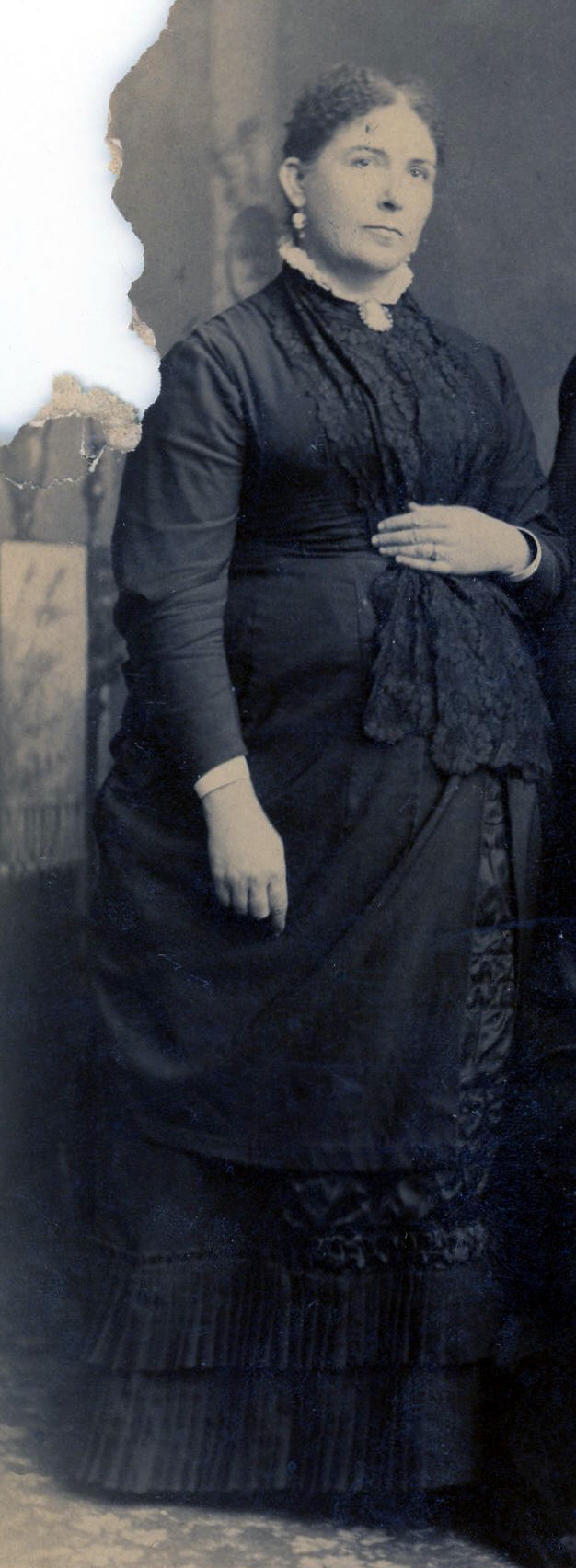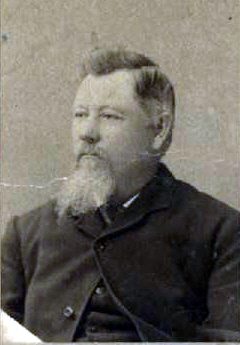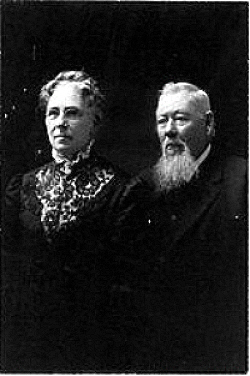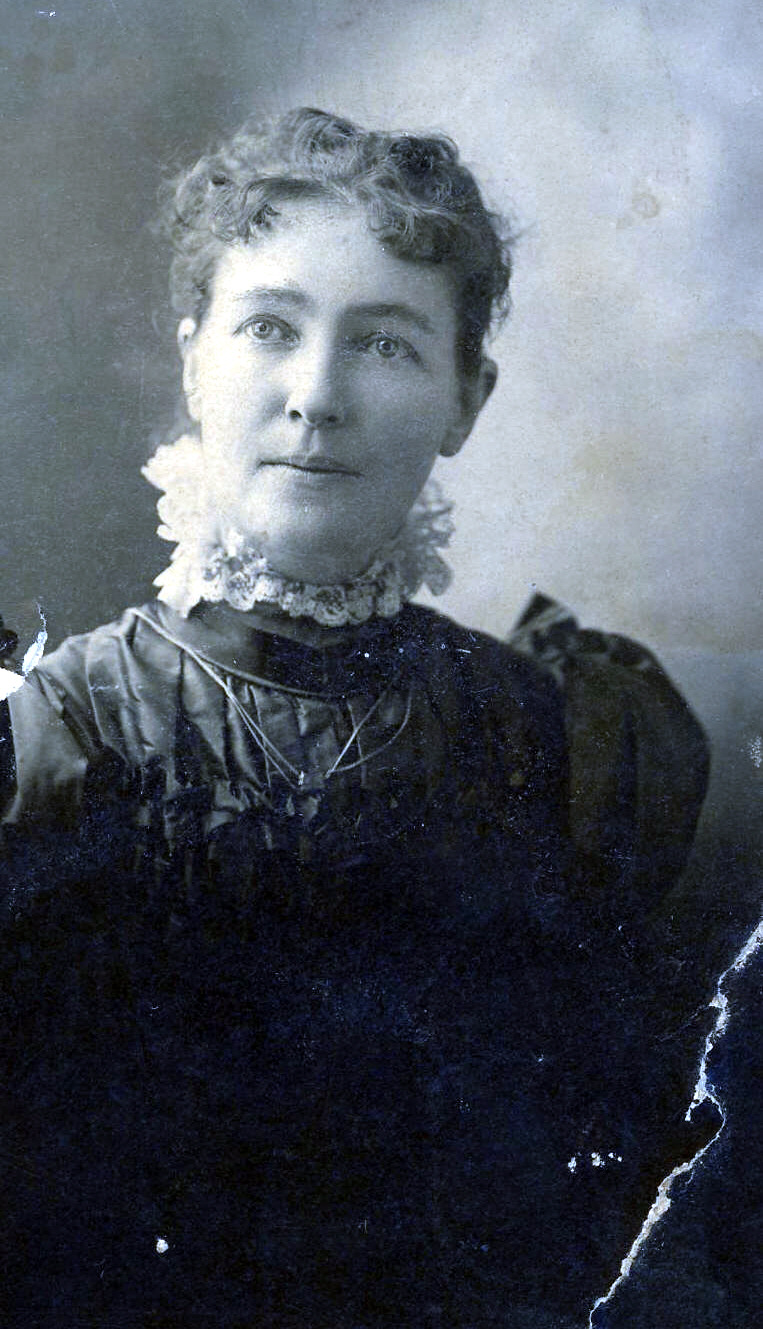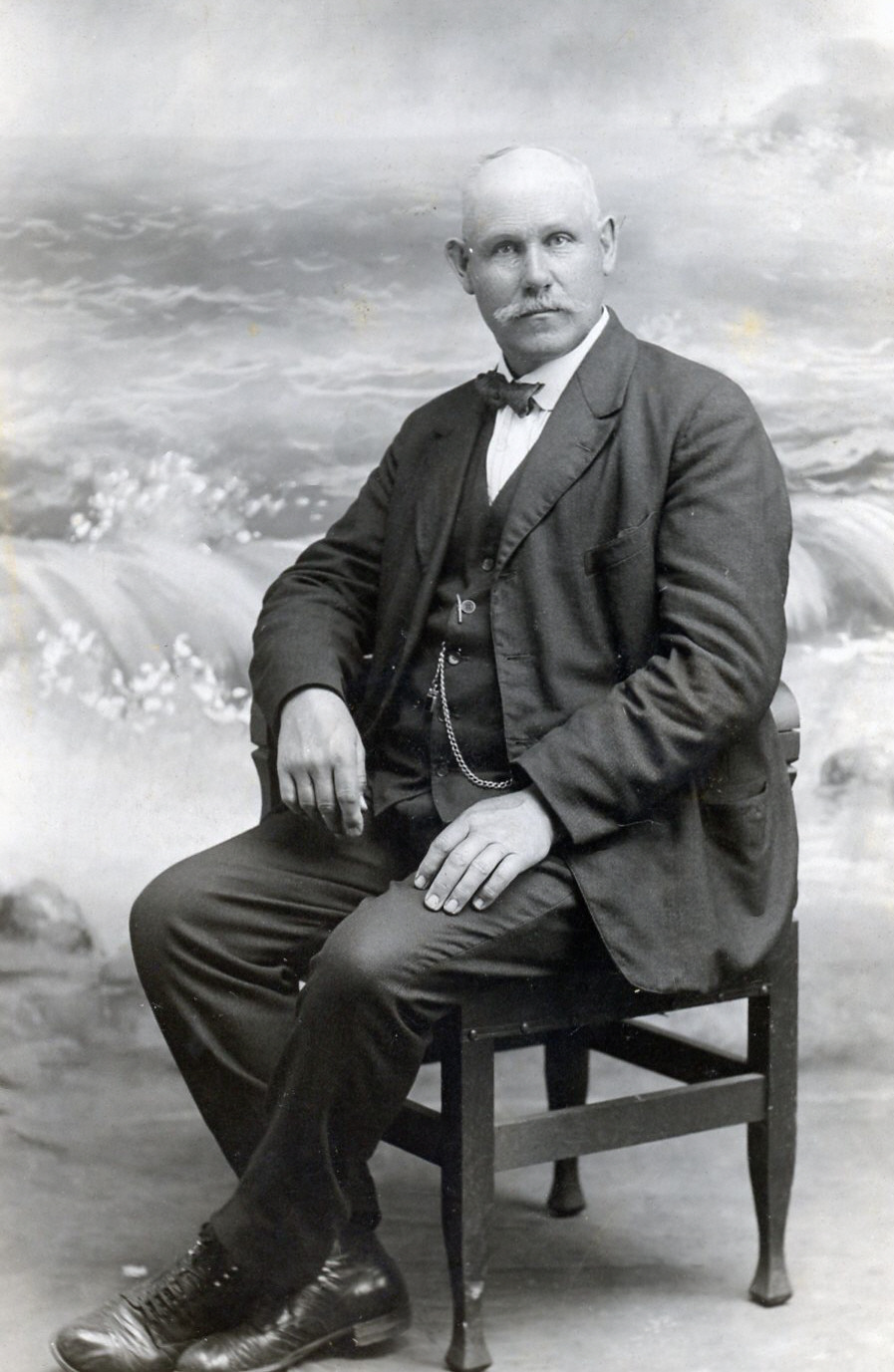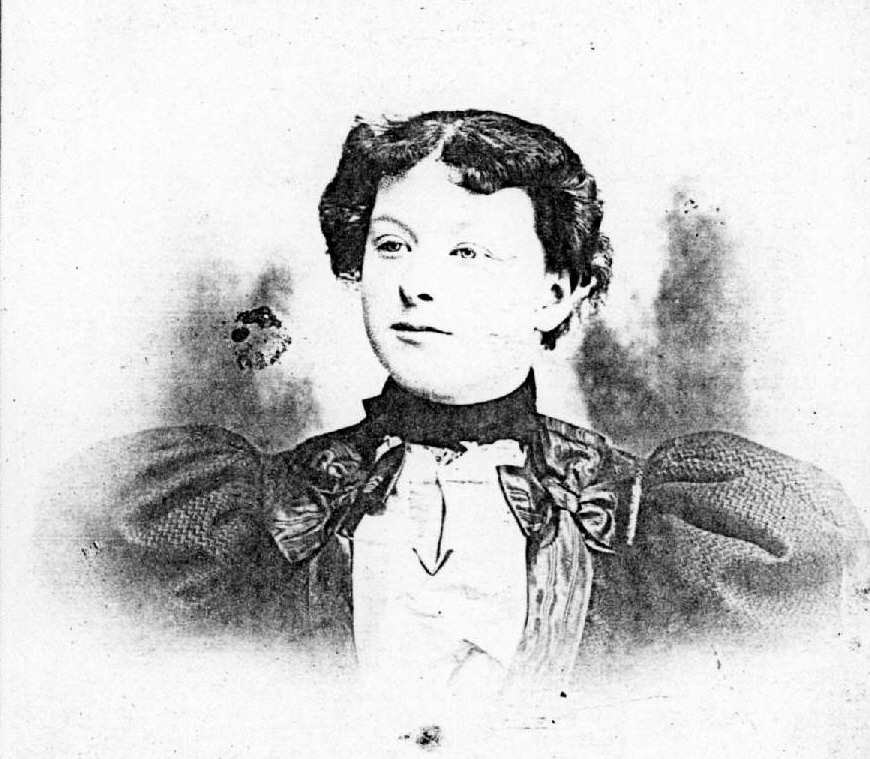
Joseph Coleman

Joseph COLEMAN (1765 – 1858) was Alex’s  5th Great Grandfather, one of 64 in this generation of the Shaw line.

Joseph Coleman was born 8 Aug 1765  or 8 Aug 1769 in Newbury, Essex MA.  His parents were John COLEMAN and Lois DANFORTH. He married Mercy CROSS on 21 Aug 1790 in Vassalboro Maine.  After Mercy died, he married Dorcas Sherman on 39 Sep 1845 in Augusta, Maine. Joseph died at the home of his daughter Lois Danforth Sturgis in 1858 in Lewiston Maine aged 92 years.

Mercy (Mary) Cross was born around  1768 in Vassalboro, Maine.  Her parents were William CROSS and [__?__]. Mercy died 19 Dec 1843.

Doras Sherman was born in 1829 in Edgecomb, Lincoln, Maine.

Children of Joseph and Mercy:

Name Born Married Departed
1. John Coleman 1791 Vassalboro, Maine Sarah [__?__]
.
Betsy Matthews
1821
Aft. 1870
Windsor, Kennebec, Maine
2. Sarah Coleman 1793 Vassalboro Josiah Carr
1814

18 Jan 1876
Palermo, Waldo, Maine
3. Mehitable Coleman 1795 Vassalboro Jonathan Dow
1818
20 Jan 1874 Postville, Allamakee, Iowa
4. Maria Coleman 1797 Vassalboro Edward Eastman
28 Oct 1819 Vassalboro
1888
Hallowell, Maine
5. Lois Danforth Coleman 26 Apr 1800 Vassalboro Samuel Sturgis
6 Mar 1829
3 Sep 1883 Lewiston, Maine
6. Charles Milton Coleman 11 Jul 1803 Vassalboro Mary “Polly)” Crooker Bryant1825 Vassalboro, Maine 14 Jan 1898 Vassalboro, ME
7. Dudley COLEMAN 17 Nov 1805 Vassalboro ME Cynthia RICHARDSONc. 1833 in Vassalboro ME 25 Sep 1865 Vassalboro, Maine,
8. Jeremiah Coleman 1808Leeds, Androscoggin Maine Sarah Buswell31 Oct 1831
.
Mercy C. Doe
1835 Vassalboro
.
Sarah Smiley Downs
10 May 1846 Vassalboro
7 Jul 1882 Newport, Penobcost, Maine
9. Martin Coleman Feb 1812 Vassalboro Rebecca Doe
8 Aug 1838 Vassalboro
14 Mar 1900 Vassalboro
10. Eliza H. Coleman 1815
Vassalboro
William Henry Fossett
1835
31 Jan 1899 Cherryville, ME

The Battle of Bunker Hill cannon could be heard in Newbury. Joseph, 9 yrs old, was awakened the night before  by the sound of his father and other men “running bullets and making cartridges for use in the anticipated battle.”

When he was a boy, Joseph emigrated with his parents from Byfield, Massachusetts to Vassalboro, Maine behind a yoke of oxen. Today, you can make the 144 mile trip by car, cruising up I95 in two and a half hours. I wonder how long it took at oxen pace.

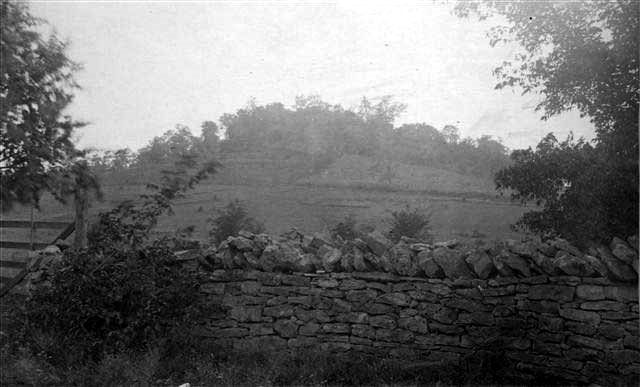
Joseph and his father John were among the earliest settlers of Vassalboro, Maine coming in the later part of the 1700’s. They settled in the vicinity of Webber Pond where Joseph reared a large family.

In 1814, the family moved to the west side of Webber pond. Joseph bought and tore down a house on the east side of the pond, moved it across the pond on a raft and reconstructed it on the west side. The new homestead was so near the woods that trees could have been felled on the roof from either side. At this time, there were no roads leading to and from the house, except for logging roads.

Joseph was a whig.

Joseph had 72 grandchildren and died at the home of his daughter Mrs. Lois Danforth Sturges in Lewiston, Maine in 1858, aged 92 years.

In the 1820 census and the 1840 census, Joseph was living in Vassalboro, Maine.

Children

Joseph and Mercy had 72 grandchildren.

1. John Coleman

John’s first wife Sarah [__?__] died before 1821 in Vassalboro, Kennebec, Maine.

John’s second wife Betsy Matthews was born Sep 1790 in Maine. Betsey died 31 Jan 1864 in Windsor, Kennebec, Maine.

In the 1850 census, John Colman was farming in Windsor, Kennebec, Maine.

Children of John and Betsey:

i. Mary Ann Coleman b. 12 Oct 1823 in Windsor, Kennebec, Maine; d. 20 Dec 1916 in Maine; m1. 24 Dec 1846 Maine to Daniel C Gardner (1825 Maine – 22 Aug 1868 Cross Hill Cemetery, Vassalboro, Kennebec County, Maine); m2. 20 Oct 1881 to Charles Brown

In the 1850 census, Daniel and Mary Ann living in Augusta, Kennebec, Maine where Daniel was a trader. In the 1860 census, Daniel was a grocer in Jersey City.

ii. Lovina H. Colman b. 30 May 1825 in Windsor, Kennebec, Maine; d. 20 Dec 1898 in Malden, Middlesex, Mass; m. Dana Clark Hanson (26 Feb 1812 – 13 Jan 1895) Dana’s parents were James Hanson and Deborah Clark. Lovina and Dana had five children between 1846 and 1859.

In the 1870 census, Dana was a clerk for the Horse Railroad in Boston, Mass

iii. John Eldridge Coleman b. Aug 1829 in Windsor, Kennebec, Maine; d. 16 Aug 1902 in Vassalboro, Kennebec, Maine of heart disease; m. 19 Dec 1852 Vassalboro to his first cousin Nancy H. Eastman (b. 9 Sep 1825 in Vassalboro – d. 9 Dec 1885) Her parents were Maria (Mariah) Coleman and Edward Eastman (see below).

In the Civil War, John served in Company B 1st Regiment, Maine Heavy Artillery For the story of the regiment, see my post Maine Volunteers.

In the 1870 census, John and Nancy were farming in Windsor, Kennebec, Maine with John’s 79 year old father living with the family.

iv. Lucy Coleman b. 1830 in Windsor, Kennebec, Maine; d. After 1850 census A Lucy Coleman (b. 28 Oct 1830 in Maine) married 1 Jan 1856 to George Washington Sargent (b. 27 Apr 1833 in Norwich, Windsor, Vermont – d. 13 Nov 1914 in Malden, Middlesex, Mass)

George enlisted in Company H, Massachusetts 12th Infantry Regiment on 20 Aug 1862. Mustered out on 08 Jul 1864 at Boston, MA.

v. Joseph H Coleman b. 9 Oct 1832 in Cape Elizabeth, Cumberland, Maine; d. Aft 1920 census in Keene, Cheshire, New Hampshire; m. 24 Nov 1858 to Martha J. Foster (b. Mar 1837 in Augusta, Kennebec, Maine – d. 1 Mar 1913 in Keene, Cheshire, New Hampshire) Martha’s parents were Willis Foster and Mary [__?__] (b.1815)

In the 1880 census, Joseph and Martha were living in Augusta, Kennebec, Maine where Joseph was a grocer.

2. Sarah Coleman

Sarah’s husband Josiah Carr was born 8 Oct 1790 in Palermo, Waldo, Maine. His parents were Benjamin Carr and Abigail Prescott. Josiah died 28 Jul 1858 in Palermo, Waldo, Maine.

In the 1850 census, Josiah was farming in Palermo, Waldo, Maine.

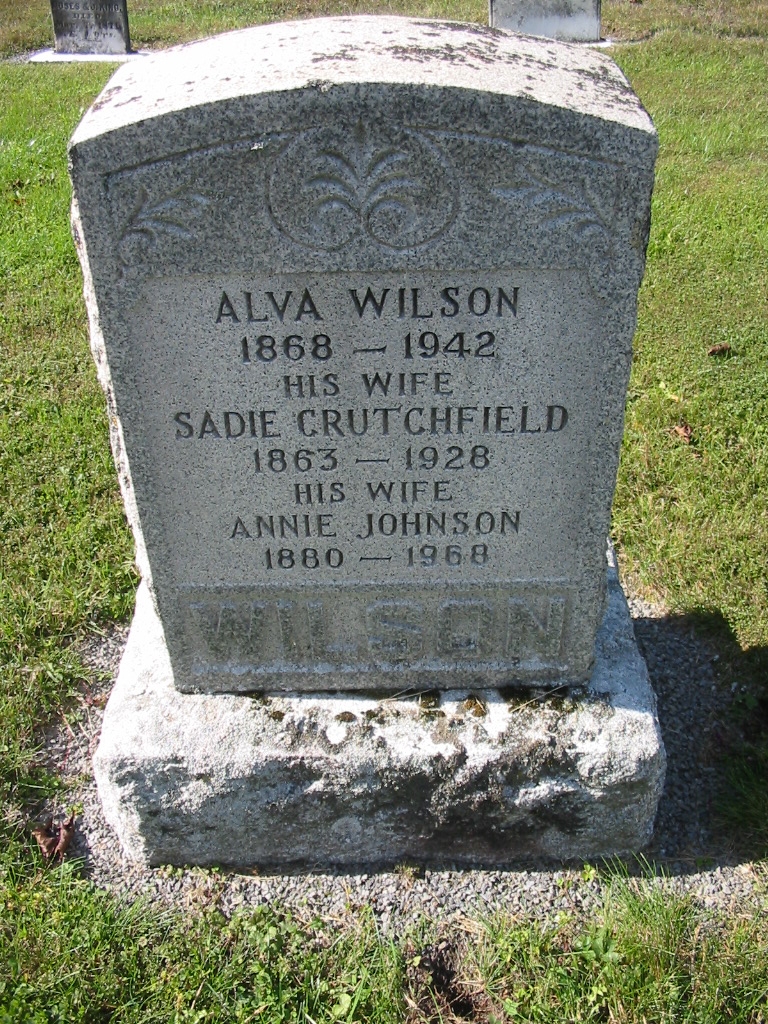
Sarah Coleman Carr Headstone — Smith Cemetery
Palermo, Waldo County, Maine

Children of Sarah and Josiah:

i. William C Carr b. 1815 in Palmero, Waldo, Maine; d. 18 Nov 1854 in Palermo, Waldo, Maine; m1. Sarah [__?__] (b. 1820 – d. 22 May 1846, Inscription on stone reads, Also an infant son, in Palermo, Waldo, Maine); m2. 31 Dec 1849 Albion, Maine to Ruth H Marden (b. 1822 – )

ii. Thomas J. Carr b. 1820 in Palermo, Waldo, Maine; d. 5 Aug 1898 in Freedom, Waldo, Maine; m. 1844 to Sarah Jane Bailey (b. Oct 1823 in Augusta, Kennebec, Maine – d. 1 Jun 1908 in Freedom, Waldo, Maine) Sarah’s parents were Joseph Bailey and Mary Robinson. Thomaws and Sarah had eight children born between 1845 and 1870.

In the 1870 census, Thomas and Sarah J were farming in Freedom, Waldo, Maine.

iii. George E Carr b. 1824 in Palermo, Waldo, Maine; d. 8 Aug 1825 in Palermo, Waldo, Maine. Buried Smith Cemetery.

iv. Elder Jeremiah Carr b. Aug 1826 in Palermo, Waldo, Maine; d. 9 Jan 1885 in Albion, Kennebec, Maine, buried Smith Cemetery, Palermo, Waldo, Maine; m. 28 Sep 1848 Albion, Maine to Isabell B Wing (b. 24 Mar 1833 in Albion, Kennebec, Maine – d. 19 May 1907 in China, Kennebec, Maine) Isabell’s parents were William Wing (1813 – 1891) and Rosetta Clark (1813 – 1898) After Jeremiah died, Isabell married 10 Jun 1887 Age: 54 Kennebec, Maine to George A Jackson (b. 28 Dec 1825 in Vassalboro, Kennebec, Maine – d. 10 Apr 1916 in China, Kennebec, Maine)

In the 1860 census, Jeremiah was a shoemaker in Albion, Kennebec, Maine. In the 1880 census, he is listed as a clergyman.

v. Hannah P Carr (twin) b. 1838 in Palermo, Waldo, Maine; d. Aft 1850 census

vi. Juliana H A Carr (twin) b. 1838 in Palermo, Waldo, Maine; d. Aft 1850 census

vii. Sarah Carr b. Palmero, Waldo, Maine

3. Mehitable Coleman

Mehitable’s husband Jonathan Kennedy Dow was born about 1797 in Harlem, Kennebec, Maine. His parents were Peter Richard Dow and Mary “Polly” Kennedy. His “Book of Dow” designation is “John Dow adgcagc” Jonathan died Mar 1872 in Calais, Washington, Maine.

In the 1850 census, John was farming in China, Kennebec, Maine.

Jonathan and Mehitable did not leave Kennebec, Maine for Iowa until after the 1860 census when they were already in their 60’s.

Mehitable Coleman Dow Headstone — Postville, Allamakee, Iowa

Children of Mehitable and Jonathan :

i. Abrah V Dow b. 1822 Maine; m. 8 Sep 1842 Pittston, Kennebec, Maine to Leonard Mooers (b. 2 Sep 1818 in Maine – d. 2 Feb 1890 in Minnesota)

Leonard enlisted in Company D, Minnesota 10th Infantry Regiment on 21 Aug 1862. Company D, Captain W.W. Phelps; Company D, under Captain Phelps was stationed at Henderson MN;

Company D Casualties at the Battle of Nashville Private G.L. Lunsden, killed; Private Frank Griffen, killed; Private James Ryan, killed; Sergt. D. Wightman, wounded in leg; Corporal Isaac G. Hasbrook, wounded in face, slight; Private George Reeves, wounded in chest, severe; Private Ole Nelson, wounded in body; Private W.S. Barns, wounded in head, arm and hand.

The Battle of Nashville was a two-day battle that represented the end of large-scale fighting in the Western Theater of the Civil War. It was fought at Nashville, Tennessee, on December 15–16, 1864, between the Confederate Army of Tennessee under Lt. Gen. John Bell Hood and Federal forces under Maj. Gen. George H. Thomas. In one of the largest victories achieved by the Union Army during the war, Thomas attacked and routed Hood’s army, largely destroying it as an effective fighting force.

Battle of Nashville Charge

After the Battle, Union troops trailed the Confederates for almost 10 days. By the time the Southerners had re-crossed the Tennessee River, the Army of Tennessee had disintegrated, as men were dying from cold or famine or taking off for shelter in different directions. This disarray ensured that the weakened Southern forces could not invade the North. A few weeks later, Hood resigned his command.

The 10th Minnesota was in  Col William L. McMillen‘s 1st Brigade,    BG John McArthur‘s  First Division,  MG Andrew J. Smith‘s  Detachment, Army of the Tennessee

Sunset  on December 16 was rapidly approaching, and if no attack was made before then  Confederate Army of Tennessee . Gen. John Bell Hood would be in a position to either strengthen his position overnight or safely retreat south.

Leonard’s Division Commander John McArthur,  was aware of this. He also saw that the Confederate lines were being badly battered by Federal artillery which was firing on them from nearly every direction.  At about 3:30 pm he sent a message to Smith and Maj. Gen.George H. Thomas.that unless he heard to contrary in the next five minutes his division was going to attack Shy’s Hill and the Confederate line immediately to its east.

Leonard Charged the Enemy at Shy’s Hill. Here’s how it looked in the 1880’s

The three brigade attack began on McArthur’s timetable. Leonard’s brigade went up and over Shy’s Hill; because of the misplacement of the Confederate trenches only the regiment on the east (Leonard’s 10th Minneota) sustained significant casualties from Confederates, who were firing from the plain to its left.

“Two field officers, six line officers, wounded, and some sixty enlisted men, attest the fiery ordeal through which this regiment passed; and the fact that it reached the rebel works in its front as quickly as the regiments on its right, which were less exposed, is ample evidence of the courage and daring of both officers and men. Lieut. Col. Jennison, the commanding officer, was conspicuous for his high daring, and set a noble example to his officers and men. He fell, severely wounded, on the enemy’s works.”

Shy’s Hill Trail Head

Leonard’s 10th Minnesota maneuvered until about 2 o’clock P.M., when it took position in front of the left centre of the enemy’s line, and remained in this position a few minutes, when it participated in a successful charge against the enemy, who was strongly intrenched on a commanding eminence, which resulted to him in the loss of four cannon and many prisoners.

“After pausing a few minutes for rest, the regiment, in connection with other regiments of the brigade, moved about a half mile to the right and again charged the enemy, who was surrounded by heavy earthworks upon a high hill, and after a severe struggle had the honor of first planting its colors upon the works and capturing two cannon and over one hundred prisoners.  (see Narrative of the Tenth Regiment, Minnesota Infantry July 14, 2012 By Gen. J.H. Baker)

McArthur’s second brigade hit these Confederates while they were so distracted.  The third brigade, attacking to the east of Granny White Pike caught a large body of Confederate skirmishers outside of their lines and went into the Confederate lines with them.

Slope of Shy’s Hill

The Confederate left flank suddenly disintegrated. The Confederate line was rolled up west to east with the Confederates retreating to the south via Granny White Pike and Franklin Pike. A part of Lee’s Corps maintained good order and covered the retreat on Franklin Pike.  Rucker’s Confederate cavalry brigade performed the same service in a nighttime melee in the rain on Granny White Pike.

Mustered out on 21 Mar 1865 at Keokuk, IA.

In the 1860 census, Leonard Abrah and their daughter Nancy were living with Abrah’s brother Joseph’s family in Township 112 Range 13, Goodhue, Minnesota. In 1870, Leonard and Abrah were farming in Wythe, Hancock, Illinois.

ii. Joseph C. Dow b. 12 Aug 1823 in China, Kennebec, Maine; d. 28 May 1899 in Swift, Minnesota; m. Eliza A Durgin (1829 – 1910)

In the 1870 census, Joseph was a wagonmaker in Post, Allamakee, Iowa. His wife and parents were living with him.

Joseph C. Dow Obit

iii. Elijah S Dow b. Oct 1825 in China, Kennebec, Maine; d. 1 Dec 1911 in Newport, Washington, Minnesota; m1. Calista [__?__] (b. ~1837 in Michigan – d. 1875 in Minnesota); m2. Jane [__?__] (1836 – )

In the 1880 census, Elijah was working as a cooper in Red Wing home of Red Wing Shoes, Goodhue, Minnesota. In 1870 he and his family were livinng next to his brother Dudley and his family in Zumbrota, Goodhue, Minnesota,.

iv. Dudley Coleman Dow b. 28 May 1831 in China, Kennebec, Maine; d. 7 Apr 1907 in Appleton, Swift, Minnesota; m. 19 Aug 1855 Kennebec, Maine to Elizabeth R Parmenter (b. Feb 1839 in China, Kennebec, Maine – d. 24 Nov 1927 in Appleton, Swift, Minnesota) Dudley’s sister Harriet married Elizabeth’s brother Riley. Their parents were Danford Parmeter (1805 – 1879) and Sally Creasy (1805 – 1872). Their grandparents were Joseph Parmenter and Roxanna “Roxey” Richardson. Their great grandparents were our ancestors Seth RICHARDSON II and Sarah FRENCH.  Dudley and Elizabeth had eight children born between 1856 and 1880.

Dudley Coleman Dow Obit

Elizabeth Parmenter Dow obit

Between 1860 and 1863, Dudley remmoved to Zumbrota, Goodhue, Minnesota. In the 1870 census, he was living next to his brother Elijah. Zumbrota was claimed as a town in 1856 by Joseph Bailey and D.B. Goddard. It is along the North Fork of the Zumbro River and promotes itself as “the only Zumbrota in the world.”

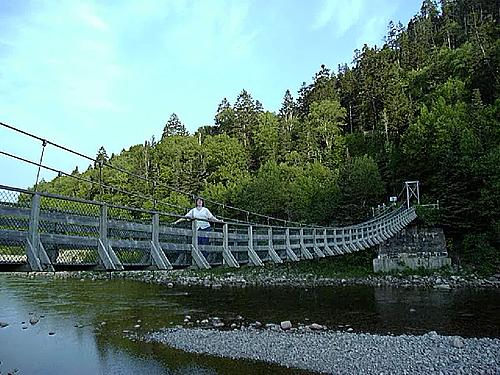
The Zumbrota Covered Bridge is Minnesota’s last remaining covered bridge. It completed in November 1869 as a replacement for Zumbrota’s original bridge which was destroyed by the spring flood of that year. The covered portion of the bridge was added in 1871.

I don’t normally include 2nd Cousins, but this photo of Dudley’s daughter Edna Angeline Dow (b. 20 Jan 1877 in Appleton, Swift, Minnesota – d. 3 Aug 1976 in Chippewa, Minnesota) and Harold Blum was intriguing.

v. Harriet Lizzie Dow b. 30 Apr 1837 in China, Kennebec, Maine; d. 21 Sep 1891 in Palermo, Waldo, Maine; m. 25 Mar 1855 China, Kennebec, Maine to Riley Wellington Parmenter (22 Jul 1832 Monticello, Aroostook County, Maine – 5 Jun 1906, Palermo, Waldo County, Maine) Harriet’s brother Dudley married Riley’s sister Elizabeth. Their parents were Danford Parmeter (1805 – 1879) and Sally Creasy (1805 – 1872).   Their grandparents were Joseph Parmenter and Roxanna “Roxey” Richardson. Their great grandparents were our ancestors Seth RICHARDSON II and Sarah FRENCH.  Harriet and Riley had fifteen children born between 1857 and 1883!

In 1835 Riley returned with his parents to Parmenter Hill where the family lived on three different Parmenter farms. At the age of 16 he “bought” his time to age 21 for $300 and started farming for himself. He later moved to new land in Palermo where he cleared a fine farm. Here he prepared a cemetery with stones “well laid up” and moved the bodies of his deceased children from the farm in China to the new cemetery, still in good condition.

In the 1870 census, Riley and Harriet were farming in Palermo, Waldo, Maine

vi. Jonathan Dow ?.

vii. Mercy Maria Dow ?

4. Maria (Mariah) Coleman

Maria’s husband Edward Eastman was born 1 Jun 1793 in Kennebec, Maine. His parents were Thomas Sleeper Eastman and Sarah Cummings. Edward died 25 Aug 1869 in Hallowell, Kennebec, Maine of lung congestion.

In the 1850 census, Edward was farming in Vassalboro, Kennebec, Maine next to his brother-in-law Jeremiah Coleman.

Children of Maria and Edward:

i. Octavia Caroline Eastman b. 19 Sep 1820 in Palmero, Lincoln, Maine; d. 29 Apr 1907 in Fairfield, Somerset, Maine; m. 17 Oct 1844 Vassalboro, Kennebec, Maine to James E. Wyman (b. 1817 in Canaan, Maine – d. 11 Jan 1887 in Fairfield, Somerset, Maine)

In the 1860 census Octavia and James were living in Fairfield, Somerset, Maine (Kendalls Mills post office) where James was a millman (working in a saw mill).

ii. Nancy H. Eastman b. 9 Sep 1825 in Vassalboro, Kennebec, Maine; d. 9 Dec 1885; m. 19 Dec 1852 Vassalboro, Kennebec, Maine to her first cousin John Eldridge Coleman (b. Aug 1829 in Windsor, Kennebec, Maine – d. 16 Aug 1902 in Vassalboro, Kennebec, Maine) (See above)

John served in Company B 1st Regiment, Maine Heavy Artillery

In the 1870 census, John and Nancy were farming in Windsor, Kennebec, Maine with John’s 79 year old father John Sr. living with the family.

iii. Violet Eastman b. 7 Dec 1827 in Vassalboro, Kennebec, Maine; d. 15 Apr 1904 in 1722 Colby Street, Everett, Snohomish, Washington; m. 5 Jan 1846 Age: 18 Vassalboro, Kennebec, Maine to Jesse T. Stevens (1822 – 1880) After her husband died, Violet moved west to Minneapolis (1880) and Seattle (1900) and lived with her son Clinton.

Violet Eastman (1827 – 1904)

In the 1870 census, Violet and Jesse lived in Lewiston Ward 7, Androscoggin, Maine where Jesse worked as a carpenter.

iv. Cordelia Eastman b. 23 Jan 1829 in Vassalboro, Kennebec, Maine; d. 14 Nov 1875; buried Lakewood Cemetery, Minneapolis, Minnesota; m. 12 Dec 1853 Age: 24 Lewiston, Androscoggin, Maine to William T. Dingley (b. 30 Jan 1830 in Maine – d. 22 Sep 1899 in Minnesota) Cordelia and William had four children born between 1857 and 1872. After Cordelia died, William married Catherine L. [__?__] (b. 1841 in New Jersey – d. 11 Dec 1922 in Hennepin, Minnesota) and had another child.

In the 1870 census, Corelia and William were living in Harpswell, Cumberland, Maine where William worked as a carpenter.

v. George Eastman b. 11 Mar 1832 in Vassalboro, Kennebec, Maine; d. Aft 1870 census; m. Mary E. Huff (b. 1831 in Wilton, Franklin, Maine – d. Wilton, Franklin, Maine) Mary’s parents were Preston Huff (1805 – ) and Cynthia [__?__]

In the 1860 census, George and Mary were living with Mary’s parents in Wilton, Maine and they were still with her parents 10 years later.

vi. Eliza R. Eastman b. 12 Jul 1835 in Vassalboro, Kennebec, Maine; m. 13 Jul 1854 to Willard Henry Wilson (1815 Maine – 11 Jan 1899 Fairfield, Somerset, Maine) Willard’s parents were Isaac Wilson and Mehitable [__?__].

In the 1870 census, Willard and Eliza were living in Hallowell, Kennebec, Maine.

vii. Harriet Eastman b. 10 Jul 1839 in Vassalboro, Kennebec, Maine; d. 23 Dec 1899 in 37 Winter St Portland, Cumberland, Maine; m. 21 Jun 1857 Androscoggin, Maine to Jacob M. Mace (b. Jun 1833 in Maine – d. 11 Dec 1900 in Lynn, Essex, Mass) Jacob’s parents were Reuben Mace and Lucinda Merrifield. Harriet and Jacob had four children born between 1859 and 1869.

In the 1870 census, Harriet and Jacob were living in Lewiston Ward 7, Androscoggin, Maine where Jacob was a pattern maker.

viii. Thomas Augustus Eastman b. 15 Mar 1842 in Vassalboro, Kennebec, Maine; d. 2 Apr 1919 in Mass; m1. 3 Oct 1863 Age: 21 Hallowell, Maine to Melissa Dexter Cross (Jun 1844 Maine – 4 Feb 1903 Maine); m2. 13 Nov 1907 Age: 65 Providence, Rhode Island to Annie Powers Cross (1840 – 1923) Annie’s parents were William Cross and Abbie Lewis.

Thomas enlisted in Company C, Maine 10th Infantry Regiment on 05 Oct 1861. Mustered out on 07 May 1863.

In the 1900 census, Thomas and Melissa were farming in Bowdoinham, Sagadahoc, Maine

5. Lois Danforth Coleman

Lois’ husband Samuel Sturgis was born 2 Jun 1807 in Vassalboro, Kennebec. His parents were James Sturgis (b. 1776 – d. 5 Nov 1840 in Vassalboro) and Hannah Faught (b. 13 Apr 1780 – d. 16 May 1811). His grandparents were our ancestors Edward STURGIS and Mary BASSETT.  Samuel died 12 Apr 1843 in Vassalboro, Kennebec, Maine.

After Samuel died, Lois raised a large family as a single mother. In the 1850 census, seven years after Samuel had died, she had six children ages 8 to 19 at home.

In the 1850 census, Lois was a widow with six children in Augusta, Kennebec, Maine. All six of her children were still at home ten years later in 1860.

Children of Lois and Samuel:

i. Mercy Ann Sturges b. 6 Sep 1830 in Vassalboro, Kennebec, Maine; d. 1 Jan 1904 in Lewiston, Androscoggin, Maine; m. 18 Jul 1888 Age: 57 Madelia, Watonwan, Minnesota to Manoah Delling (1819 Madelia, Minnesota – 5 Nov 1892) He first married Hester Eliza Vought (b. ~1818 in New York – d. 1886 in Madelia, Watonwan, Minnesota)

Manoah Delling and his first wife Hester ca 1870

In the 1880 census, Mercy was living with her mother Lois in Lewiston, Androscoggin, Maine. Mercy was 58 years old when she first got married.

ii. Hannah Jennie Sturges b. 2 Nov 1832 in Vassalboro, Kennebec, Maine; d. 22 Dec 1909 in Augusta, Kennebec, Maine; m. 22 Dec 1869 Age: 37 Androscoggin, Maine to Harrison Pullen Gilbert (b. 10 Jun 1816 in Kingfield, Somerset, Maine – d. 21 Jun 1898 in Madelia, Watonwan, Minnesota) Harrison’s parents were Spencer Gilbert (1789 – 1860) and Nancy Dudley (1790 – 1859).

In the 1880 census, Hannah J and Harrison were farming in Madelia, Watonwan, Minnesota.

iii. Almon Packard Sturges b. 4 Mar 1835 in Vassalboro, Kennebec, Maine; d. 19 Jan 1920 in New Bedford, Bristol, Mass; m. 7 May 1874 Falmouth, Barnstable, Massachusetts Age: 39 to Rebecca Gifford Hamlin (b. 30 Aug 1843 Maine – d. 15 Aug 1924 New Bedford) Rebecca’s parents were Simeon Hamlin and Eliza Gifford

In the 1880 census, Almon was an engineer in Falmouth, Barnstable, Mass

iv. Albert Henry Sturgis b. 2 May 1837 in Vassalboro, Kennebec, Maine; d. Auburn, Androscoggin, Maine; m. 22 May 1859 to Ruth Ellen Thomas (b. 31 Oct 1840 in Strong, Maine – d. 4 Aug 1898, Auburn, Androscoggin, Maine)

In the 1880 census, Albert was working in a cotton mill in Lewiston, Androscoggin, Maine.

v. Perley Franklin Sturges b. 31 Oct 1839 in Vassalboro, Kennebec, Maine; d. 12 Jan 1915 in Melrose, Middlesex, Mass; m. 30 Apr 1872 Age: 32 to Emma Maria Healey (b. Nov 1845 in Maine – d. Melrose, Middlesex, Mass) Perly and Emma had four children born between 1873 and 1883.

In the 1880 census, Perley was a Produce Dealer in Melrose, Middlesex, Mass.

vi. Alonzo Walton Sturgis b. 16 Jun 1842 in Vassalboro, Kennebec, Maine; d. 12 Aug 1907 in Old Orchard, Cumberland, Maine; m. 4 Apr 1867 Age: 24 to Frances Ann Murray (11 Aug 1841 in Greene, Maine – d. Aft. 1930 census, Queens, NY)

Frances Ann Murray Sturgis Portrait — Frances Ann was a Dressmaker in the 1860 census

In the 1880 census, Alonzo was a printer in Lewiston, Androscoggin, Maine.
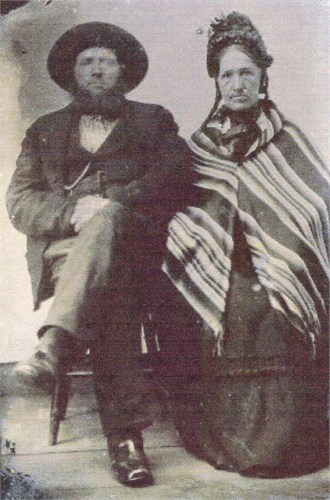
6. Charles Milton Coleman

Charles’ wife Mary (Polly) Crooker Bryant was born Feb 1805 in Pembroke, Plymouth, Mass. Her parents were Nathaniel Bryant (1777 – 1850) and Mary Crooker (1778 – 1874). Polly died 4 Oct 1889 in Vassalboro, Kennebec, Maine.
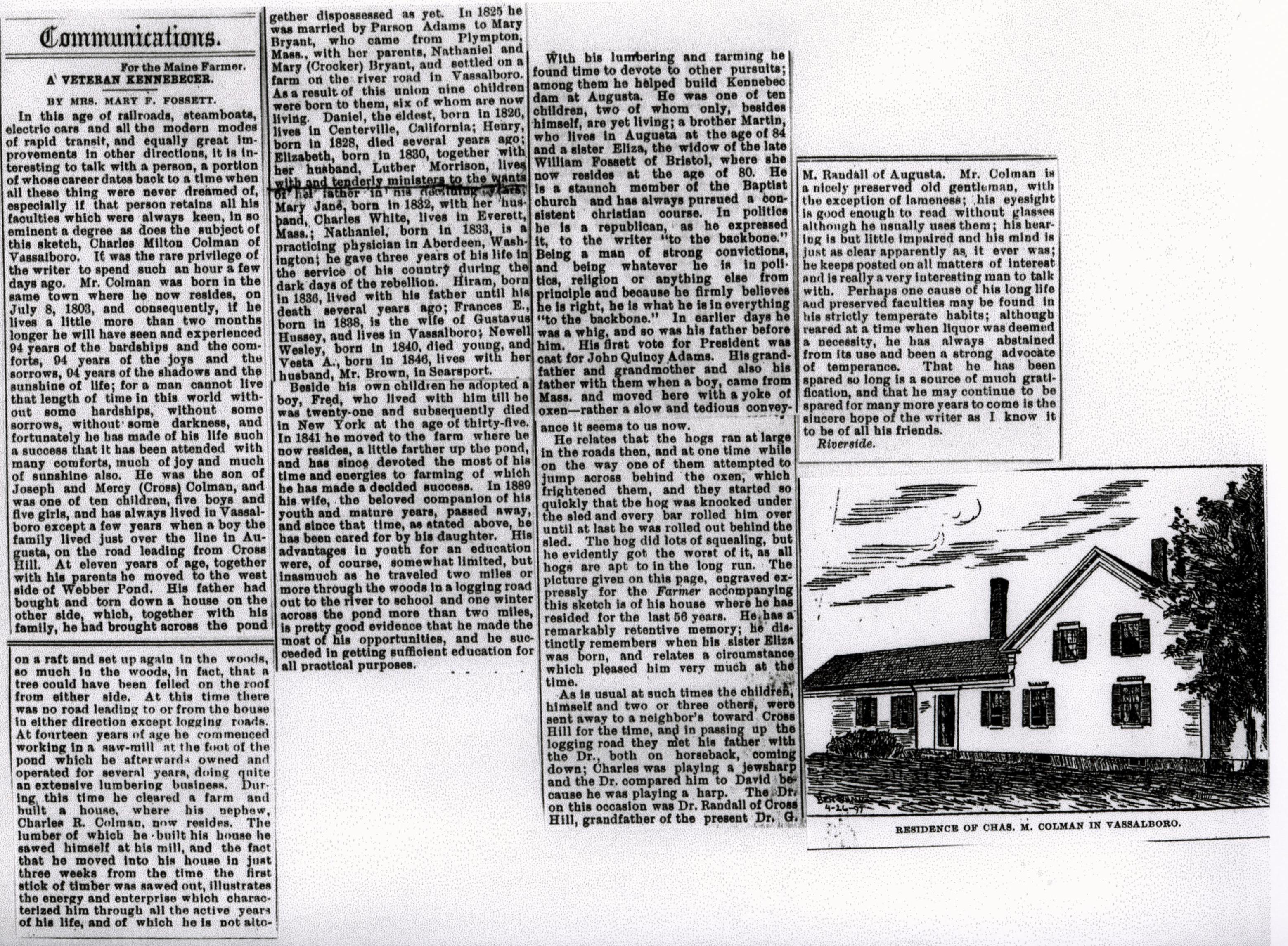
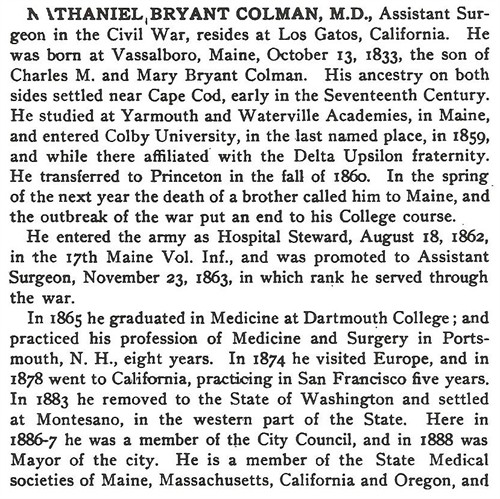
Charles M Coleman Bio

Milton started working at a saw mill at the foot Webber Pond when he was just fourteen years old. Later, he owned the mill and did an extensive lumbering business.

In the 1850 census, Charles was farming in Vassalboro, Maine,

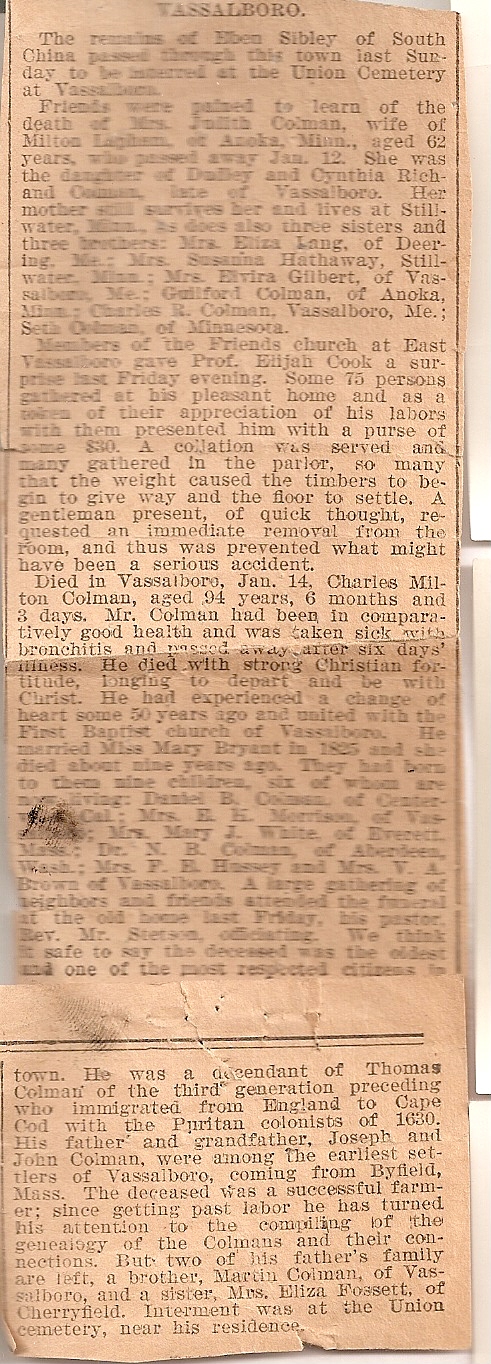
Charles Milton Coleman Obt

My Life’s Review of Ninety Years

By Charles M. Colman 1893

On times swift wing – Oe’r sun tethered earth

Through space has sped—reveling,

Circling, with ever changing scene,

Of life, and light—these ninety years,

Since first my name was called

To battle with the world.

Ninety summers heat have clothed the earth in green

And ninety winters frost

Has changed the green to white

And here I am today holding my life’s review.

How thinned the veteran ranks

How brave and bright the new recruits

How changed is all about

How changed in home and life

In thought and feeling, how changed am I,

Though still the same in name and life.

Hail and welcome dear ones all,

Who send or bring life’s greeting,

Alas, that all could not be here

And join as once in choral song

And make the old home ring.

But so it many not be,

Yet that happy day will come,

In Gods good time, when all the

Dear ones, now sadly missed

Our eager waiting hands will grasp

Today is one of Gods good times

As all is good with him,

So in his light will see light,

And thank him for this day.

The longest human life is short,

And passes like the dream,

The hopes we plant reach the sky

Where we must gather bye and bye, the fruits,

So let be—for to our

Father thus it seemth best.

How changed my life

Since my boyhoods home,

When those I called Father, Mother,

Brother, sister, as we do now

We read our years with joy

On times brief calendar,

As took as natal gifts

Strokes counted for years upon our backs

Quickly then, as now, time flew,

Our youthful home was changed

For new ones of our own.

Charles M Coleman House

At loves behest the bridal knot was tied,

And now twigs grew on the family tree,

And we called our father “grandpa”

As you now do today to me.

In those new homes, fresh planted on these shores

Art was unknown, so I may not show

The likenesses of those dear ones

In life’s last grand review was continued

Yet each dear face and form in memory album

Is fresh and plump and fair.

I cannot name them all

Here once, they mere, in strength

Fighting life’s battle as we do now

How brief the time since John, Sally,

Hetty, and Lois, Jeremiah, Dudley,

And Martin, Maria, Eliza and I

From Fathers table went

To sit at new ones of our own.

What rapid changes followed,

Forests fell, new homes arose,

Schools and churches filled

While sturdy teams uptore the stumps

And drew the furrowing plow.

Strong hands built house and barn,

And mowed the grass and grain,

Fed and clothed the little ones,

And paid the honest debt.

.
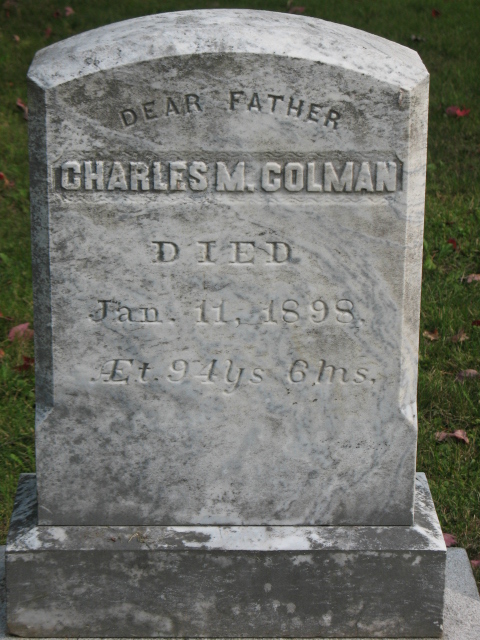
Charles Milton Coleman Headstone — Vassalboro, Maine

Some of Charles’ children lost their “e” and spelled their name Colman.

Children of Charles and Polly:

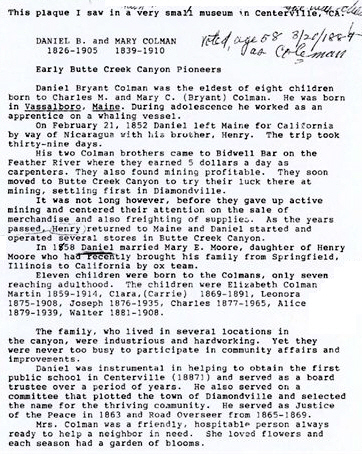
i. Daniel Bryant Coleman b. Jan 1826 in Vassalboro, Kennebec, Maine; d. 1905 in Kimshew, Butte, California (Near Chico); m. 1858 Butte County, Calif to Mary Elizabeth Moore (b. 22 Sep 1839 in Springfield, Sangamon, Illinois – d. 14 Jul 1910 in Kimshew, Butte, California) Daniel and Mary had seven children born between 1858 and 1881.

Daniel and his brother Henry came to the California Gold fields in 1852. Henry returned to Maine, but Daniel stayed.

In 1976, Lois Colman, granddaughter of D.B. Colman, canyon pioneer, realized her dream of preserving the history of Butte Creek Canyon came true, with the opening of the Colman Memorial Community Museum. The museum was financed with the profits of her book “Tailings of Butte Creek Canyon“. (Not cheap collectible editions $172 – $200 at Amazon.)

Interesting things to see at the Museum at 13548 Centerville Road, Chico, CA:

  • Civil War Memorabilia
  • Gold Mining Equipment
  • Indian Basket Collection
  • Antique Tools
  • Old School Material
  • 1800’s Clothing
  • Chinese Artifacts
  • Antique Cooking Utensils
  • New Maidu Exhibit
  • Bridges of Butte Creek Canyon Exhibit
  • Museum Collection Index

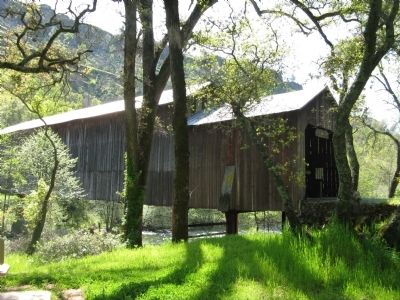
Charles’ oldest sons Daniel and Henry came to California in the Gold Rush

The Honey Run Covered Bridge crosses Butte Creek and intersects with Centerville Road in Butte County, California leading to Butte Canyon where Daniel’s family lived. It is located about halfway in between Chico and Paradise in northern California. It is one of the few covered bridges left in California and is the only tri-span bridge in the United States.

ii. Henry Coleman b. 1828 in Vassalboro, Kennebec, Maine; d. 1 May 1861 in Vassalboro, Kennebec, Maine

Henry and his brother Danie came to the California Gold fields in 1852. Henry returned to Maine, but Daniel stayed.

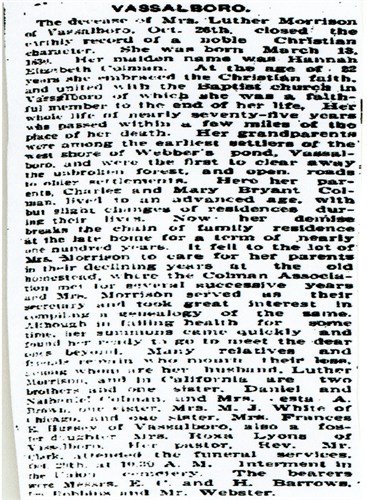
iii. Elizabeth Hannah Coleman b. 13 Mar 1830 in Vassalboro, Kennebec, Maine; d. 26 Oct 1904 in Vassalboro, Kennebec, Maine; m. 10 Apr 1855 Age: 25 Vassalboro, Kennebec, Maine to Luther Morrison (29 Apr 1828 Albion, Kennebec, Maine – 11 Jun 1905 Vassalboro, Kennebec, Maine)

Elizabeth Coleman Morrison Obit

In the 1880 census, Luther and Hannah were farming in Vassalboro, Kennebec, Maine and living with Hannah’s parents.

iv. Mary Jane Coleman b. 1832 in Vassalboro, Kennebec, Maine; d. Chicago, Cook, Illinois; m1. c. 1861 to Edward Small (1831 – 1911); m2. 23 Nov 1866 Age: 34 Vassalboro, Kennebec, Maine to Charles W White (b. 1827 New Brunswick – )

In the 1870 census, Charles and Mary J were farming in Vassalboro, Kennebec, Maine.

v. Nathaniel Bryant Coleman b. 13 Oct 1833 in Vassalboro, Kennebec, Maine; d. 3 Mar 1927 in Redwood Township (Los Gatos), Santa Clara, California; m. 1866 to Leonora Wilson (b. Sep 1837 in Gorham, Cumberland, Maine – d. aft 1920 census in Redwood, Santa Clara, California) Leonora’s parents were Hubbard Wilson (b. 1809) and Elizabeth [__?__].

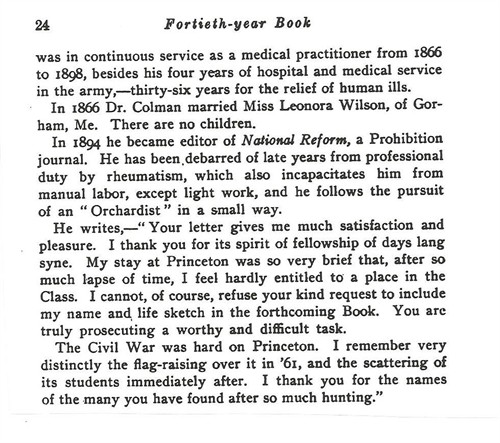
Nathaniel enrolled in Colby College in 1859 and in 1860 transferred to Princeton. The death of a brother called him back to Maine and the outbreak of war put an end to his college course. He enlisted as a Hospital Steward on 15 Aug 1862 in Company S, 17th Infantry Regiment Maine on 15 Aug 1862. Promoted to Full Assistant Surgeon on 22 Nov 1863. Mustered Out Company S, 17th Infantry Regiment Maine on 4 Jun 1865 at Washington, DC.

In 1865 he graduated in medicine from Dartmouth and practiced medicine and surgery in New Hampshire, California and Washington. (See his bio from Princeton’s Fortieth-year Book)

In the 1880 census, Nathaniel was a physician in San Francisco.

Charles Milton Coleaman’s son Nathaniel was a doctor and Civil War surgeon.

Nathaniel Coleman Bio 2

vi. Hiram Oliver Coleman b. 24 Feb 1836 in Vassalboro, Kennebec, Maine; d. 1 Aug 1891 in Union Cemetery, Vassalboro, Kennebec, Maine; m. 12 Jan 1865 Vassalboro, Kennebec, Maine Age: 28 to Carrie O. Small (b. 1844 in Vassalboro, Kennebec, Maine – d. 10 Nov 1889 in Vassalboro) Carrie’s parents were Timothy Small (1807 – 1880) and Olive [__?__] ( – 1856). Hiram and Carrie had five children born between 1867 and 1880.

In the 1880 census, Hiram and Carrie were farming in Vassalboro, Kennebec, Maine.

vii. Frances Ellen Coleman b. Jul 1838 in Vassalboro, Kennebec, Maine; d. 19 Feb 1914 in Vassalboro, Kennebec, Maine; m. 29 Nov 1860 Vassalboro, Kennebec, Maine Age: 22 to Gustavas Hussey (b. 1833 Maine – d. 17 Feb 1908 Vassalboro, Maine) Gustavas’ parents were George Hussey (1803 – 1875) and Susannah Dunham (1803 – 1892). Frances and Gustavas had nine children born between 1862 and 1879.

In the 1880 census, Frances and Gustavus were farming in Vassalboro, Maine, they had nine children.

viii. Newell Wesley Coleman b. 1842 in Vassalboro, Kennebec, Maine; d. 26 Nov 1843 in Vassalboro, Kennebec, Maine

ix. Vesta A. Coleman b. 1847 in Vassalboro, Kennebec, Maine; d. 1905 in Vassalboro, Kennebec, Maine; m. 24 Dec 1873 Vassalboro, Kennebec, Maine Age: 23 to Josiah I. Brown (1828 Maine – 1897). Josiah divorced Esther Crie in August 1873 and married Vesta a few months later. Must be a story there.

In the 1870 census, Vesta was living at home with her parents. In the 1880 census, J. I. and Vesta Ann were living in Athens, Somerset, Maine where Josiah was a physician and surgeon with a 14 year old servant and two boarders, a lawyer and another physician and surgeon

x. Frederick H. Coleman b. 1853 in Vassalboro, Kennebec, Maine’ d. After 1880 census when he was still living at home,
7. Dudley COLEMAN (See his page)

8. Jeremiah Coleman

Jeremiah’s first wife Sarah Buswell’s origins are not known.

Jeremiah’s second wife Mercy C. Doe was born 1804. Mercy died 19 Dec 1845 in Vassalboro, Kennebec, Maine.

Mercy Cross – Gravestone

Jeremiah’s third wife Sarah Smiley Downs was born 3 May 1827 in Harmony, Maine. Her parents were Eben Downs and Bethiah [__?__]. Sarah died 2 Jul 1889 in Newport, Maine.

In the 1850 census, Jeremiah was farming in Vassalboro, Maine next to his brother-in-law Edward Eastman.

Some of Jeremiah’s children lost their “e” and spelled their name Colman.

Children of Jeremiah and Mercy:

i. Watson Edwin Coleman b. 19 Apr 1837 in Vassalboro, Kennebec, Maine; d. 27 Aug 1911 in Broomfield, Colorado, Killed by a bull; m. 20 Mar 1861 Vassalboro, Kennebec, Maine Age: 23 to Julia Ann Sanford (b. Mar 1838 in Maine – d. 23 Feb 1919 in Colorado)

In the 1900 census, Watson was farming in Semper, Jefferson, Colorado

ii. Sarah Helen Coleman b. 1839 in Vassalboro, Kennebec, Maine; d. after 1850 census

iii. Harriet Frances Coleman b. 1841 in Vassalboro, Kennebec, Maine; d. After 1860 census

iv. Martha B. Coleman b. Mar 1843 in Vassalboro, Kennebec, Maine; d. 17 Jul 1845 in Vassalboro, Kennebec, Maine

Children of Jeremiah and Sarah Smiley Downs:

v. Homer (Omar) Monroe Coleman b. 8 Dec 1846 in Vassalboro, Kennebec, Maine; d. 9 Oct 1907 in Golden, Jefferson, Colorado; m1. 1870 to Georgia [__?__] 1846 – 1880; m2. Amelia Charlotte (1844 – 1896); m3. 20 Aug 1899 Golden, Jefferson, Colorado Age: 52 to Mary Broad (b. 23 Jul 1865 in Superior, Michigan – d. 24 Feb 1947 Golden Cemetery, Golden, Colorado)

In the 1880 census, Omar was a widower and expressman in Golden, Jefferson, Colorado.

Mary Broad had first married 18 Jul 1885 in Eagle Rock, Bingham, Idaho to Owbridge Ostrander. In the 1900 census Omar and Mary were living in Golden, Jefferson, Colorado with Mary’s five children from her previous marriage.

vi. Ozias T. Coleman b. Jul 1848 in Vassalboro, Kennebec, Maine; d. 26 Aug 1926 in Manchester, Hillsborough, New Hampshire; m. 8 Aug 1873 Portland, Cumberland, Maine Age: 25 to Caro E Ford (1855 Rockland, Knox, Maine – 1932 Manchester, Hillsborough, New Hampshire)

In the 1880 census, Ozias was a carriage maker in Newport, Penobscot, Maine

vii. Obed H. Coleman b. 1849 in Vassalboro, Kennebec, Maine; m. 10 Apr 1894 Newport, Penobscot, Maine Age: 45 to Emma May White (Varney) (1869 – )

In the 1880 census, Obed was a confectioner in Newport, Penobscot, Maine, still living with his parents.

Storekeeper, Newport ME, 1889.

viii. Rose Ella Coleman b. Mar 1853 in Athens, Somerset, Maine; d. 15 Jan 1901 in Tewksbury, Middlesex, Mass; m. 1876 to Charles Kimball French (Sep 1852 Mass. – 1926)

In the 1900 census, Rose E and Charles K were farming in Tewksbury, Middlesex, Mass.

ix. Greenlief (Greenleaf) C. Coleman b. Mar 1854 in Newport, Penobscot, Maine; d. 5 Feb 1937 Merrill Cemetery, Manchester, Hillsborough County, New Hampshire; m. 16 Sep 1873 Billerica, Mass. Age: 19 to Mary Ann Isles (1851 – 1940 Manchester, NH)

In the 1900 census, Greenleaf and Mary were farming in Manchester Ward 10, Hillsborough, New Hampshire.

x. Jeremiah F. Coleman b. Nov 1858 in Athens, Somerset, Maine; d. 31 Mar 1929 in Portland, Cumberland, Maine; m. 1883 to Etta F. [__?__] (b. Feb 1860 in Maine – d. 24 Nov 1933 in Portland, Cumberland, Maine)

Machine works//Machine works foreman, Portland ME, 1889.

In the 1900 census, Jeremiah was a machinist in Portland, Cumberland, Maine

xi. Lelia M. Coleman b. Feb 1860 in Athens, Somerset, Maine; d. aft 1920 census; m. 1885 to  Rev. Walter Franklin Prince (b. 22 Apr 1863 Detroit, Somerset, Maine – d. 7 Aug 1934 Boston, Suffolk, Mass.) His parents were Walter Marshall Prince and Elmira Jane Pray.

In the 1920 census, Walter and Lelia were living in Montclair, NJ where Walter was a clergyman and psychologist.

Walter Franklin Prince (wiki) (1863-1934) was Investigating Officer of  the Boston Society for Psychical Research in Boston during the years Harry Houdini served as an agent of the organization while investigating reportedly corrupt spiritualist mediums. Prince was an Episcopal minister, earning his two B.D.’s from Yale in 1896 and Drew Theological Seminary in 1900. He earned a PhD from Yale in 1899. Prince authored several works on the study of human psychic abilities, among them The Psychic in the House (Boston 1926), The Case of Patience Worth (Boston 1927), The Enchanted Boundary (Boston 1930). Prince was an associate of violinist Florizel von Reuter who was considered a medium. He was fiercely critical of the claims of the physical medium Margery Mina Crandon.

Member: American Association for the Advancement of Science

Famous Paranormal Researcher & Author.

Among his writings are the books:

– “The Doris Case of Multiple Personality”, 1916

– “The Psychic in the House“, c 1926

– “The Case of Patience Worth“, 1927

– “Noted Witnesses for Psychic Occurrences“, c 1928

– “Enchanted Boundary“, 1930 This book embodies the first attempt to appraise on a large scale writings hostile to psychic research. It seeks to deal fairly with persons who, through the course of more than a century, have expressed their disbelief in any facts “psychic” or “supernormal,” according to the understood meaning of these terms. It proposes to ascertain with what degree of knowledge these persons are equipped to deal with the subject, to see whether the logic they employ is such as is employed in other types of investigation or is of a sort deemed good enough only for this, and generally to analyze and set forth their polemical methodology. All of these persons are respectable, and some of them illustrious, representatives of the classes to which they belong, physical scientists, psychologists, university and college instructors, physicians, clergymen, magicians and what-not. There are more than one hundred of these to be heard in this book.

Editor, 1920 – 1925: “Journal and Proceedings” of the American Society for Psychical Research

xii. Wesley J. Coleman b. Dec 1862 in Athens, Somerset, Maine; d. 1945; m. 22 Jan 1888 Maine Age: 25 to Cora E. Peavey (Jul 1861 Maine – 1937)

In the 1900 census, Wesley and Cora were farming in Garland, Penobscot, Maine.

xiii. Nellie E. Coleman b. Dec 1864 in Athens, Somerset, Maine; d. Aft. 1930 census Chester, Rockingham, New Hampshire; m. 22 Sep 1886 Augusta, Kennebec, Maine Age: 21 to William F. Witham (1859 Maine – Aft 1930 census)

In the 1910 census, William and Nellie were farming in Manchester Ward 10, Hillsborough, New Hampshire.

xiv. Cora Belle Coleman b. 17 Nov 1865 in Athens, Somerset, Maine; d. 15 May 1943 in Carmel, Penobscot, Maine; m. 26 Nov 1885 Penobscot CO, Maine Age: 20 to Ernest Bartlett Harvey (1863 Maine – 1930)

In the 1910 census, Ernest and Cora were living in Carmel, Penobscot, Maine where Ernest was a tinsmith.

9. Martin Coleman

Martin’s wife Rebecca Doe was born 1812 in Maine. Rebecca died 13 Nov 1868 in Augusta, Kennebec, Maine.

In the 1850 census, Martin was a carpenter in Augusta, Kennebec, Maine.

Children of Martin and Rebecca:

i. Emma Sturges Coleman b. 10 Sep 1839 in Vassalboro, Kennebec, Maine; d.7 Apr 1910 in Augusta, Kennebec, Maine; m. 9 Jul 1881 Age: 41 to Joseph Warren Quimby (29 Dec 1831 – 2 Mar 1899 Lewiston, Androscoggin, Maine) His parents were Michael Quimby and Abigail Gibson.

He first married 29 Nov 1855 Claremont, Sullivan, New Hampshire Age: 23 to Elvira Bean Hurd (1835 – 1863). He married second 15 May 1864 Ashby, Middlesex, Mass. Age: 32 to Francena Osborne (1838 – 1867). He married third 20 Jun 1868 Hampstead, Rockingham, NH Age: 36 to Martha Hodge Sanborn (1830 – 1878) He married Emma fourth.

ii. Nellie Rebecca Coleman b. Sep 1842 in Augusta, Kennebec, Maine; d. 1928 in Augusta, Kennebec, Maine; m. 10 Sep 1866 Augusta, Kennebec, Maine Age: 24 to Willard R. Stone (b. Jun 1834 in Maine – d. 1912 in Augusta, Kennebec, Maine)

In the 1880 census, Willard was a shoemaker in Augusta, Kennebec, Maine

iii. Belle Celissa Coleman b. 1844 in Vassalboro, Kennebec, Maine; d. 26 Dec 1876 in Augusta, Kennebec, Maine

iv. Henry M. Colman b. Jun 1846 in Augusta, Kennebec, Maine; d. Bef. 1932 in Maine; m. 25 Dec 1872 Augusta, Kennebec, Maine Age: 26 to Helen J. Clark (1851 Maine – bef. 1889); m2. 13 Aug 1889 Vassalboro, Kennebec, Maine Age: 43 to Emily F. Dyson (1855 Mass. – Aft. 1920 census Augusta, Maine)

In the 1910 census, Henry and Emily were living in Augusta Ward 7, Kennebec, Maine where Henry was a teamster for a tea company.

v. George Asbury Colman b. 1848 in Augusta, Kennebec, Maine; d. 1924 in Waterville, Kennebec, Maine; m1. 24 Jan 1877 Augusta, Kennebec, Maine Age: 29 to Emma Frances Ballard (b. 6 Oct 1856 in Vassalboro – d. 29 Jun 1900 in Fairfield, Somerset, Maine); m2. 9 May 1903 Waterville, Kennebec, Maine Age: 55 to Minnie A. Welch (1861 Maine – 1939)

In the 1900 census, George and Emma were living in Fairfield, Somerset, Maine where George was a house carpenter.

10. Eliza H. Coleman

Eliza’s husband William Henry Fossett was born 1813 in Maine. His parents were Henry Fossett and Betsy [__?__]. William died 23 Mar 1888 in Bristol, Lincoln, Maine.

In the 1850 census, William was a blacksmith in Bristol, Lincoln, Maine

Children of Eliza and William:

i. Helen E Fossett b. Aug 1838 in Bristol, Lincoln, Maine; d. aft 1920 in Malden, Middlesex, Mass; m. 1860 Allen Lewis (1837 Maine – 1892)

In the 1880 census, Alan and Helen were living in Bristol, Lincoln, Maine where Alan was a junk dealer.

ii. Evelyn (Eveline) Fossett b. Dec 1842 in Bristol, Lincoln, Maine; d. 3 Jun 1907 in Bristol, Lincoln, Maine; m. 1880 to William Shelden Fuller (b. Dec 1849 in Maine – d. Bristol, Lincoln, Maine )

In the 1900 census, William and Eveline were living in Bristol, Lincoln, Maine where William was a merchant.

iii. Augustus Fossett b. 5 Jan 1844 in Bristol, Lincoln, Maine; d. 21 Feb 1922 in Bristol, Lincoln, Maine; m. 25 Jun 1871 Vassalboro, Kennebec, Maine Age: 27 to Cyrene Doe (1848 – 12 Jan 1906 New Harbor, Lincoln County, Maine,)

In the 1900 census, Augustus and Cyrene were farming i n Bristol, Lincoln, Maine.

iv. Abbie Fossett b. 16 Dec 1845 Pemaquid, Lincoln, Maine; d. 6 Jun 1931 China, Kennebec, Maine; m. 1866 to George A. Doe (1840 – 2 Jul 1901 Methodist Church Cemetery

East Vassalboro, Kennebec, Maine) His parents were Hiram Doe (1812 – 1888) and Lydia Pierce Doe (1811 – 1900)

In the 1900 census, George and Abbie were living in Vassalboro, Kennebec, Maine where George was a pattern maker and their son Alva was a blacksmith.

v. Elizabeth Fossett b. 1848 in Bristol, Lincoln, Maine’ d. Aft 1870 census

vi. Arad Fossett b. Feb 1851 in Bristol, Lincoln, Maine; d. 2 Nov 1910 Bristol, Lincoln, Maine; m. Nettie Leeman (1853 Maine – 1918)

In the 1910 census, Arad was a blacksmith with his own shop in Bristol, Lincoln, Maine.

Sources:

http://familytreemaker.genealogy.com/users/k/i/n/William-M-Kinney-sr/WEBSITE-0001/UHP-1025.html

http://familytreemaker.genealogy.com/users/c/r/o/Kendal-Cross-TN/GENE2-0018.html

http://trees.ancestry.com/owt/person.aspx?pid=87718033

http://trees.ancestry.com/tree/4105122/person/-1651159283?ssrc=

http://trees.ancestry.com/owt/person.aspx?pid=118212926&st=1
Posted in -7th Generation, 90+, Be Fruitful and Multiply, Historical Monument, Line - Shaw | Tagged , | 12 Comments

Dudley Coleman

Dudley COLEMAN(1805 – 1865) was Alex’s 4th Great Grandfather, one of 32 in this generation of the Shaw line.

For more pictures of Dudley’s children and grandchildren see my post Dudley Coleman Extra Pix  Many of these pictures are from the family homestead, thought lost forever and recently rediscovered.

Dudley Coleman was born 17 Nov 1805 in  Vassalboro Maine. His parents were Joseph COLEMAN and  Mary CROSS. Dudley married Cynthia Maria RICHARSON 29 Oct 1829 in China, Kennebec, Maine.  Dudley was a New England farmer, of about 160 acres near Vassalboro, Maine.  Dudley died 25 Sep 1865 in Vassalboro, Maine.

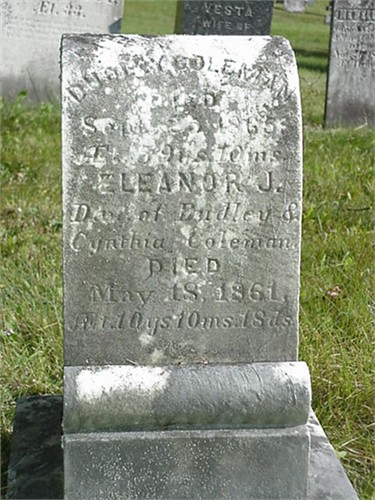
Dudley Coleman & Daughter Eleanor – Gravestone

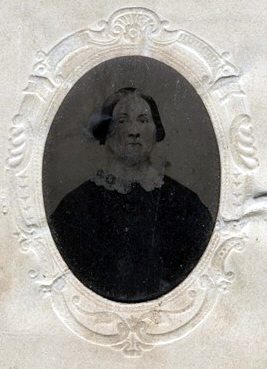
Cynthia Maria Richardson was born 18 May 1811 in Vassalboro, Maine.  Her parents were Seth RICHARDSON  III and Susanna A. BALCOM.  Cynthia was living in Stillwater, MN when Judith passed away.  Cynthia died 9 Mar 1899 at the residence of her daughter Susannah  Hathaway in  Stillwater, Washington, Minnesota and is buried in Fairview Cemetery in Stillwater.

Cynthia Richardson Coleman (1811-1899)
Photo Credit: Margaret Gilbert Peterson

Children of Dudley Coleman and Cynthia Richardson:

Name Born Married Departed
1. Cynthia Maria Eastman Coleman 8 Aug 1830 Vassalboro Daniel Foster
1 Dec 1857 Augusta, Maine
20 Mar 1897 Augusta, Kennebec, Maine
2. Guilford Dudley COLEMAN 22 Feb 1832 Vassalboro Maine Ellen Celeste WEBBER (twin of Emma)
9 Oct 1855 Vassalboro Maine
.
Mary J. Woods (Aunt Molly)
7 Feb 1884
at the age of 46 in Anoka Minnesota.
30 Nov 1903 Anoka Minnesota
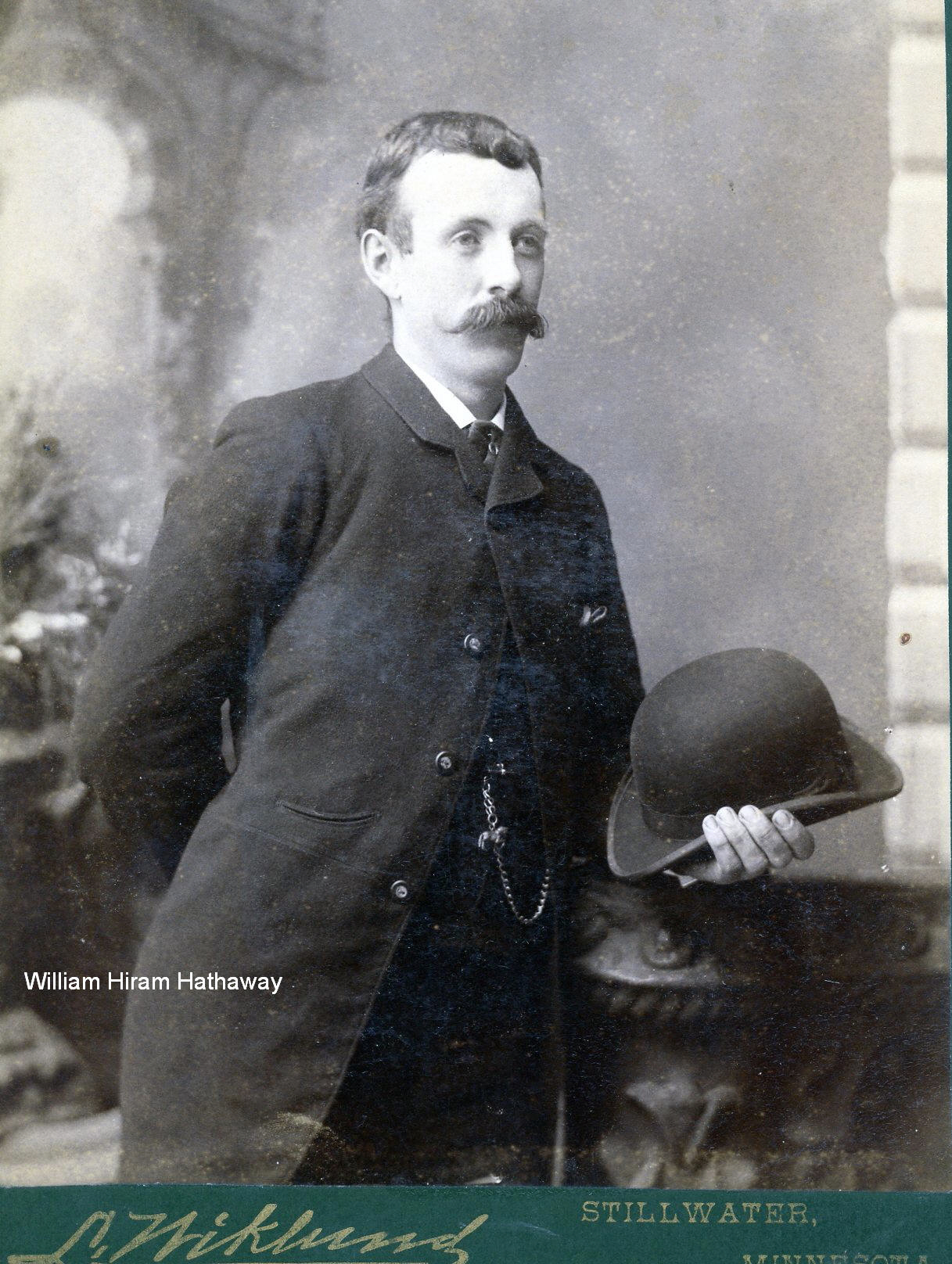
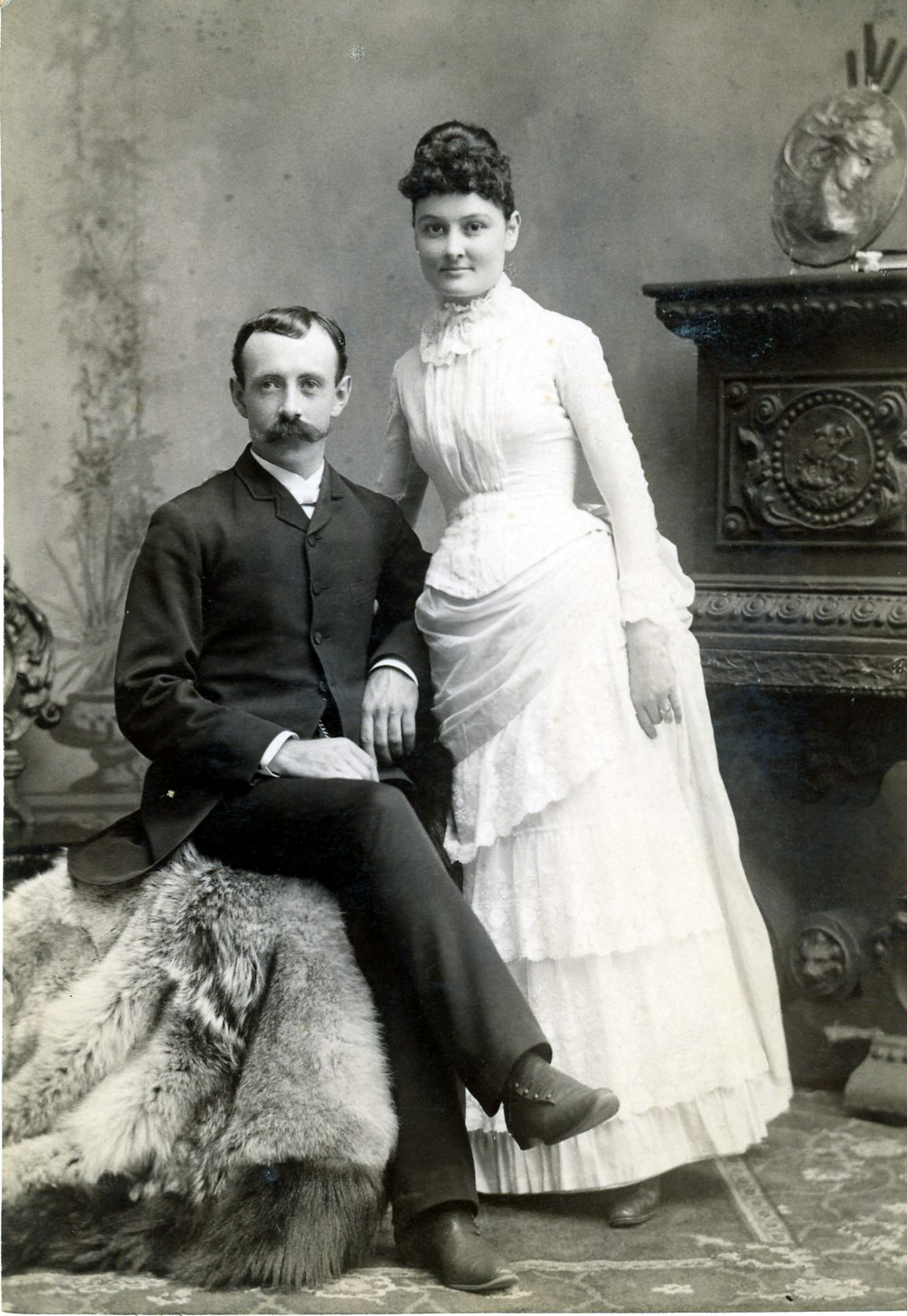
3. Susannah Richardson Coleman 2 Dec 1834 Vassalboro Calvin Hathaway
23 Jun 1852 Vassalboro, ME
16 Feb 1916 Stillwater, Washington, MN
4. Roxanna “Roxie” Parmenter Coleman 24 Feb 1835 Vassalboro Augustus Plummer
20 Apr 1854
.
Charles R. Church
5 Sep 1863
Kennebec, ME
.
Marcellus Lovejoy
22 Aug 1869
30 Nov 1926 Vassalboro
5. Judith Coleman 3 Dec 1836 Vassalboro Milton Lapham
bef. 1863
12 Jan 1898
aged 62
Anoka, MN
6. Eliza Ann Coleman 8 Jul 1837 Vassalboro Edward Lang
1858
Aft. 1930
Portland, ME
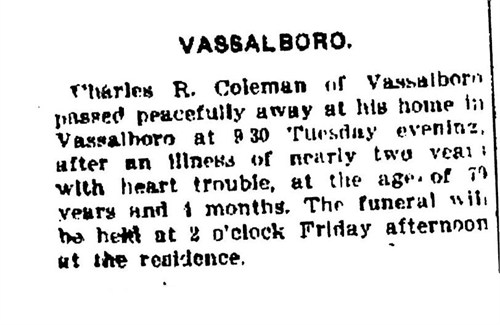
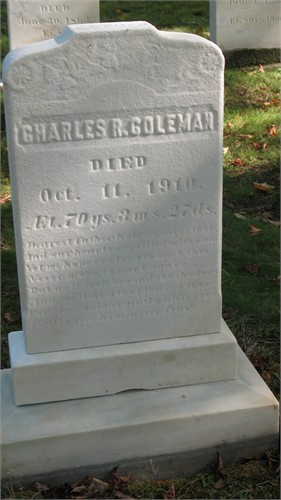
7. Charles Richardson Coleman 14 Jun 1841 Vassalboro Mary E. Gardiner
25 Nov 1865 Vassalboro
.
Abbie Augusta Stewart
12 Jun 1904 Vassalboro
11 Oct 1910 Vassalboro
8. Elvira Brown (Alvira, Vi) Coleman 25  Mar 1845 Maine William Wallace Gilbert
25 Nov 1865 Vassalboro
22 Jan 1930 Vassalboro, Maine
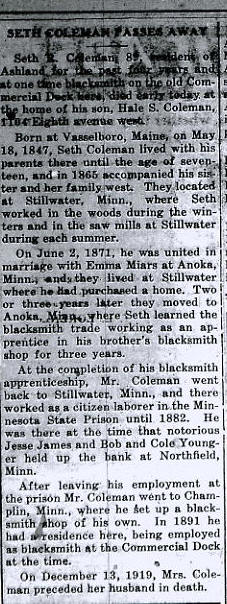
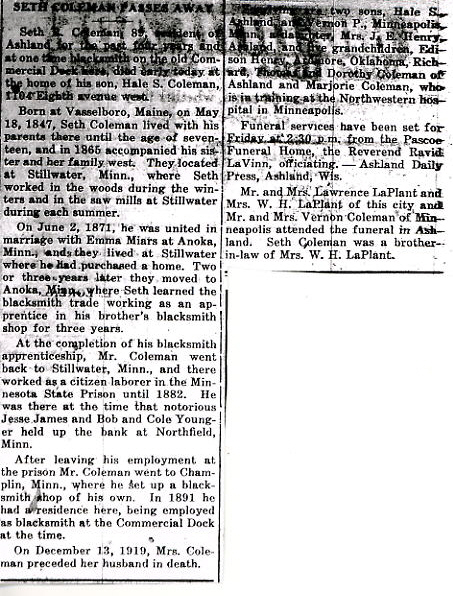
9. Seth Richardson Coleman 18 May 1847 Vassalboro Emma Theresa Miars
2 Jun  1871 Cedar, MN
17 Jun  1936 Ashland, WI
10. Eleanor Coleman 1 Jul 1850 Vassalboro 18 May 1861 Vassalboro
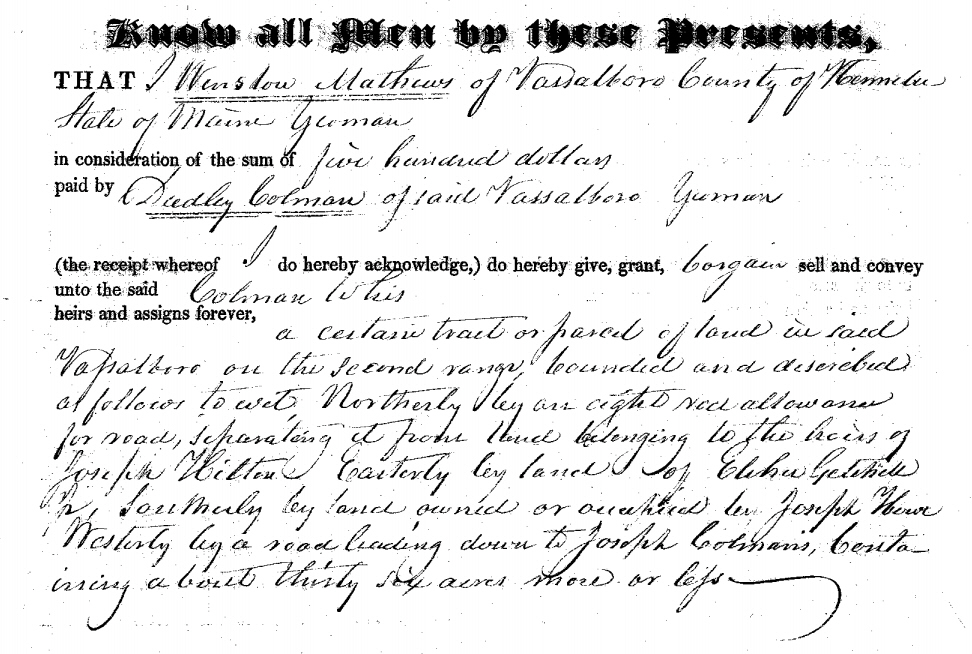
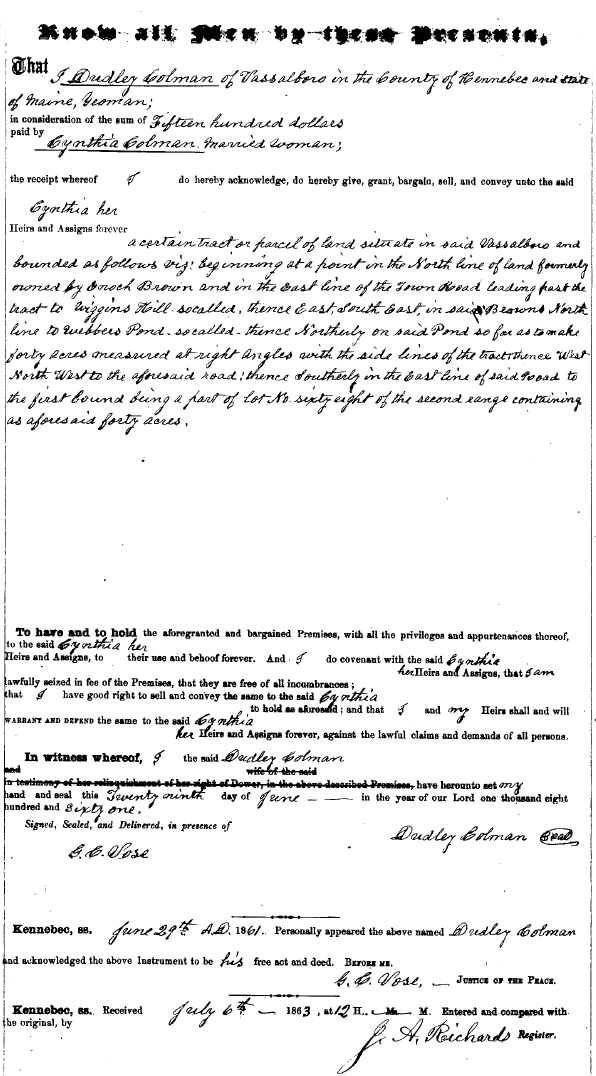
1826 Dudley Coleman Land Purchase Vassalboro, Maine

1826 Dudley Coleman Land Purchase Vassalboro, Maine

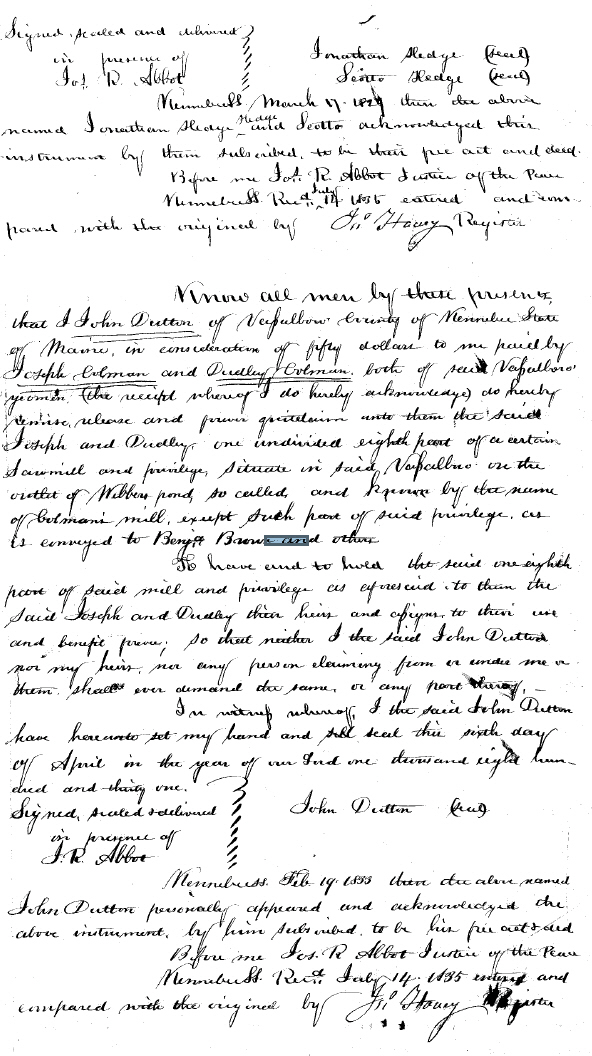
1833 Dudley and his brother Joseph Colman sells Saw Mill

1833 Dudley and his brother Joseph Colman sells Saw Mill

Dudley and his family were living in Vassalboro, Maine in the 1850 census, very close to the Oliver Webbers.

Dudley was still living in Vassalboro in the 1860 census.  The 1860 census records that Charles was 20 years old inferring he was born in 1840 while the 1850 census states he was 4 years old inferring he was born in 1846.

1861 - Dudley Colman to Cynthia Colman

1861 – Dudley Colman to Cynthia Colman

Dudley was a blacksmith.

Children of Dudley and Cynthia:

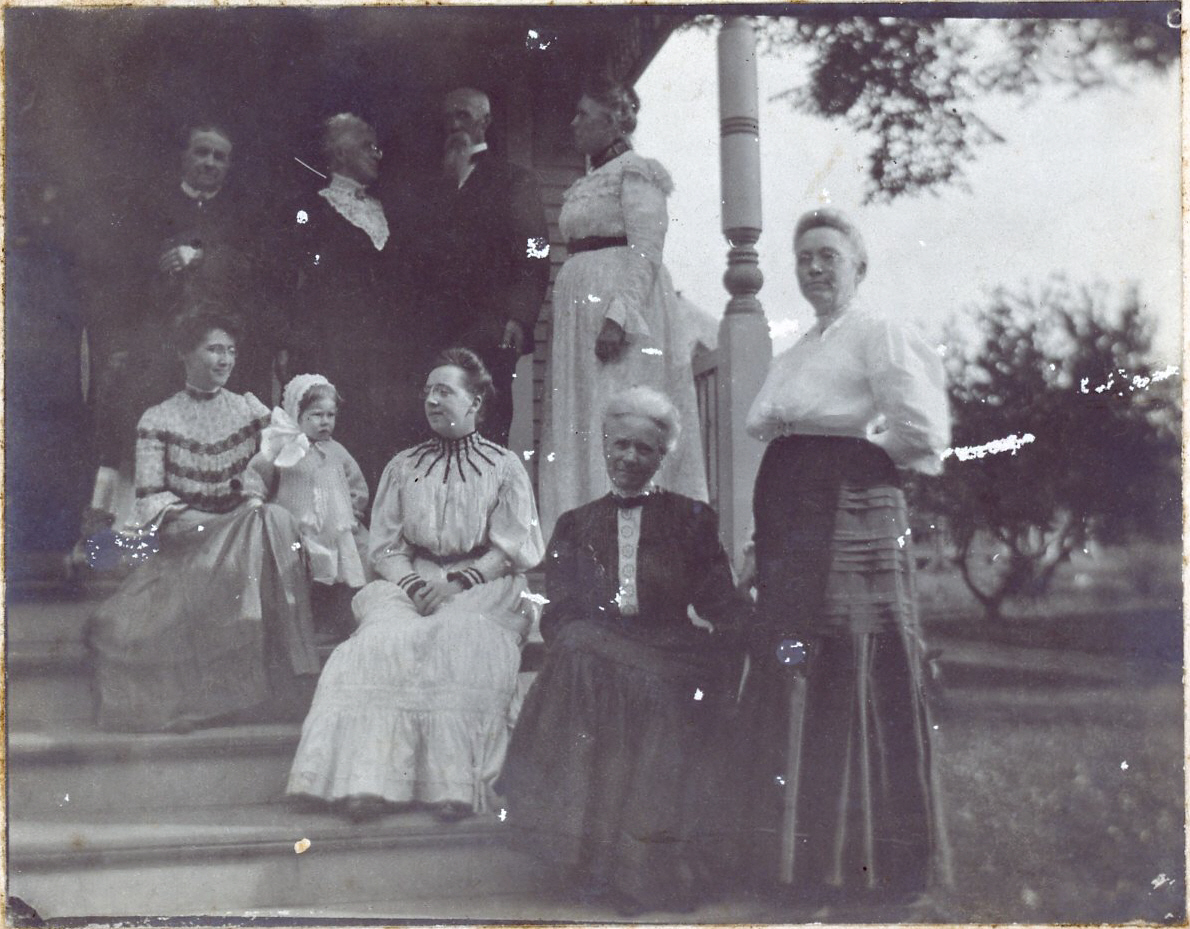
9. Seth Coleman standing, 4. Roxanna Coleman Lovejoy , 6.  Eliza Coleman, 8. Elvira Gilbert, on step Belle and Eleanor Lill Sholes, Emma Coleman and Etta
Photo Credit: Margaret Gilbert Peterson

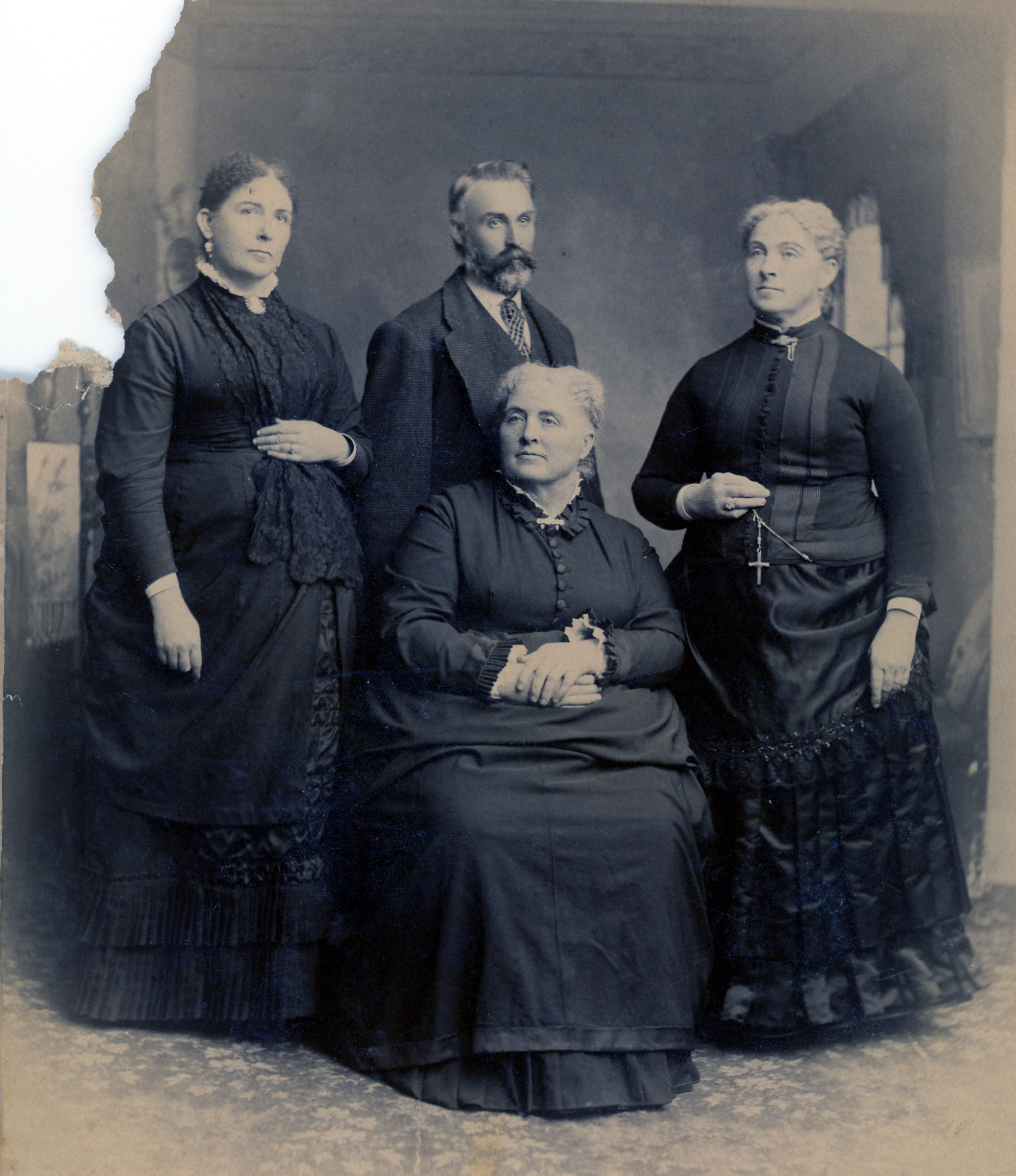
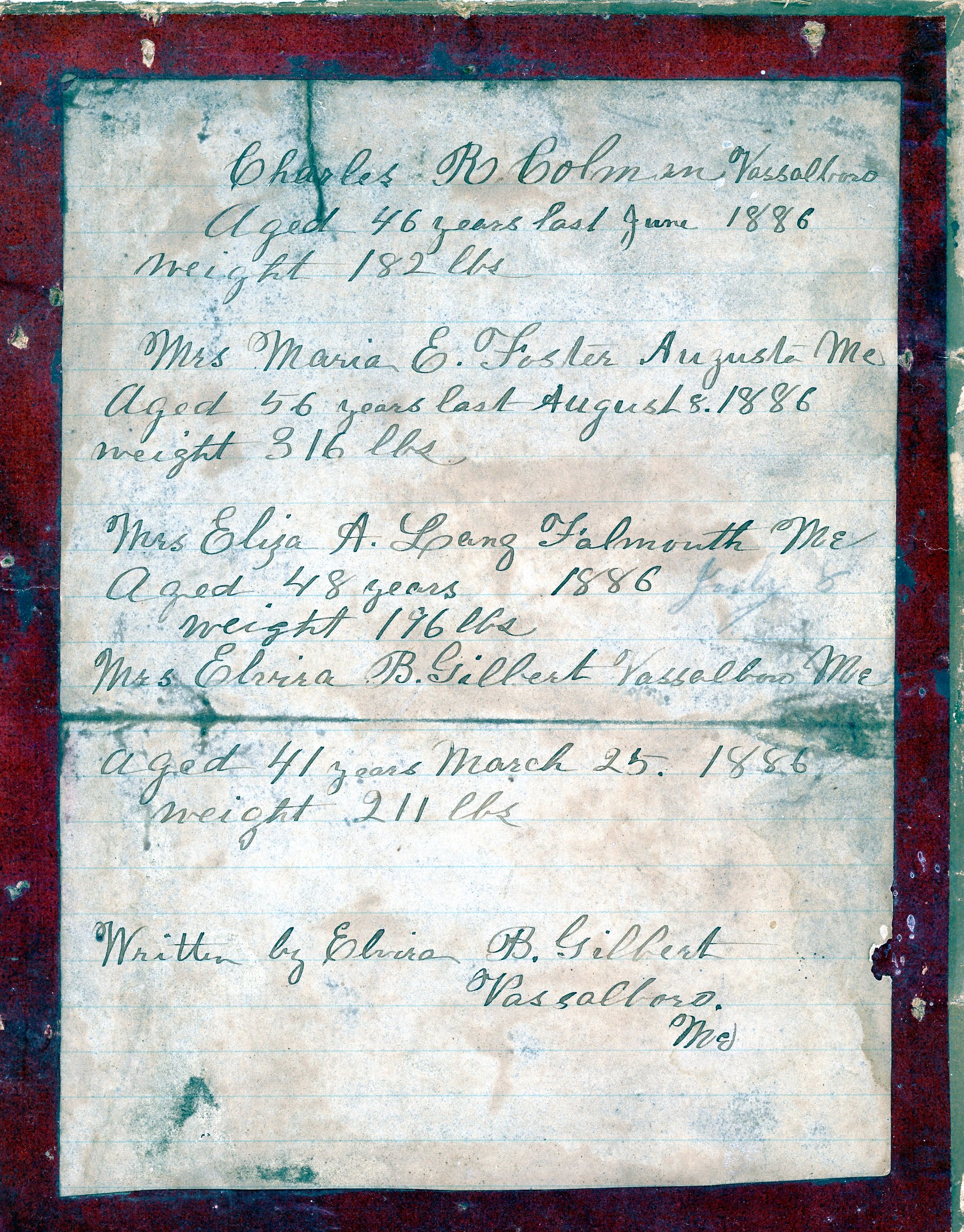
8. Elvira, 7.  Charles,  6. Eliza and sitting  1.  Cynthia Maria Coleman
Photo Credit: Margaret Gilbert Peterson

1. Cynthia Maria Eastman Coleman

Dudley’s daughter Cynthia was so big, they had to take the casket through a window.  She was a jolly woman and a favorite aunt.

Did you think they were exaggerating?

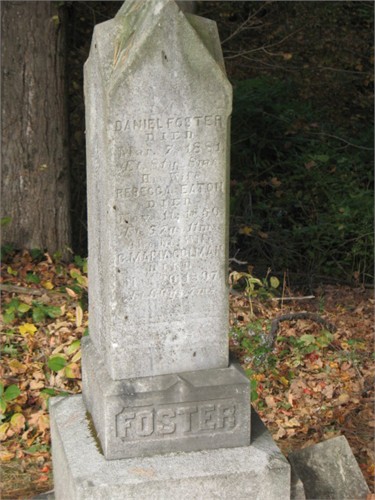
Cynthia’s husband Daniel Foster was born 5 Jul 1799 in Augusta, Kennebec, Maine,  His parents were Daniel Foster and Philena Pettingill.    He was 31 years older than Cynthia. He first married thirty years earlier 7 Jan 1822 in Augusta, Maine to Rebecca Eaton (1799 – 1856).  Daniel died 7 Mar 1881 in Augusta, Kennebec, Maine.

In the 1870 census, Cynthia and Daniel were farming in Augusta, Kennebec, Maine.

Daniel Foster and Cynthia Maria Eastman Colman gravestone Wall Cemetery Augusta Maine

Child of Cynthia and Daniel:

i. Annie Rebecca Foster b. 16 Jan 1859 in Augusta, Kennebec, Maine; d. 28 Nov 1921 in Augusta, Kennebec, Maine); m. 16 Aug 1875 Augusta, Maine to William Amos E. Cunningham (Sep 1853 in Augusta, Kennebec, Maine – 1925 in Augusta, Kennebec, Maine)  His parents were Richard Warren Cunningham (1825 – 1882) and Maria H Howe Cunningham Shaw (1831 – 1922). Annie and Amos had seven children born between 1875 and 1900.

In the 1910 census, Amos was a general contractor in Augusta, Maine.

.

2. Guilford Dudley COLEMAN (See his page)

.

3. Susannah Richardson Coleman

Susannah’s husband Calvin Morey Hathaway was born 27 Oct 1828 in Bucksfield, Maine. His parents were Hiram Hathaway (1789 – 1876) and Hannah Hussely ( – 1844).  Calvin died Jun 1894 in Stillwater, Minnesota.

When the Civil War broke out, Calvin and his family returned to Massachusetts and Calvin  enlisted as a private in the 4th Regiment, Massachusetts Heavy Artillery.  When discharged, the family returned to Stillwater, Minnesota.  In the 1880 census, Calvin was a blacksmith in Stillwater.

Several of Sussanah and Calvin’s children lived their whole lives in Stillwater. Stillwater is part of the Twin Cities metro area in Washington County, Minnesota, directly across the St. Croix River from the state of Wisconsin. The population was 18,225 at the 2010 census. The town was founded by settlers drawn by the area’s then-abundant lumber and river traffic, making it one of Minnesota’s oldest towns, predating Minneapolis by several years. Stillwater was officially incorporated as a city March 4, 1854 (the same day as St. Paul).

Stillwater is often referred to as the birthplace of Minnesota. In 1848, a territorial convention that began the process of establishing Minnesota as a state was held in Stillwater at the corner of Myrtle and Main Streets. Minnesota officially became a territory in 1849 and became a state in 1858.

As more evidence of Stillwater’s importance at the time, the convention selected three leading Minnesota cities as locations for three important public institutions: Minneapolis got the University of Minnesota, Saint Paul became the capital, and Stillwater was chosen as the site of the territory’s first prison. The Minnesota Territorial Prison was opened in 1853.

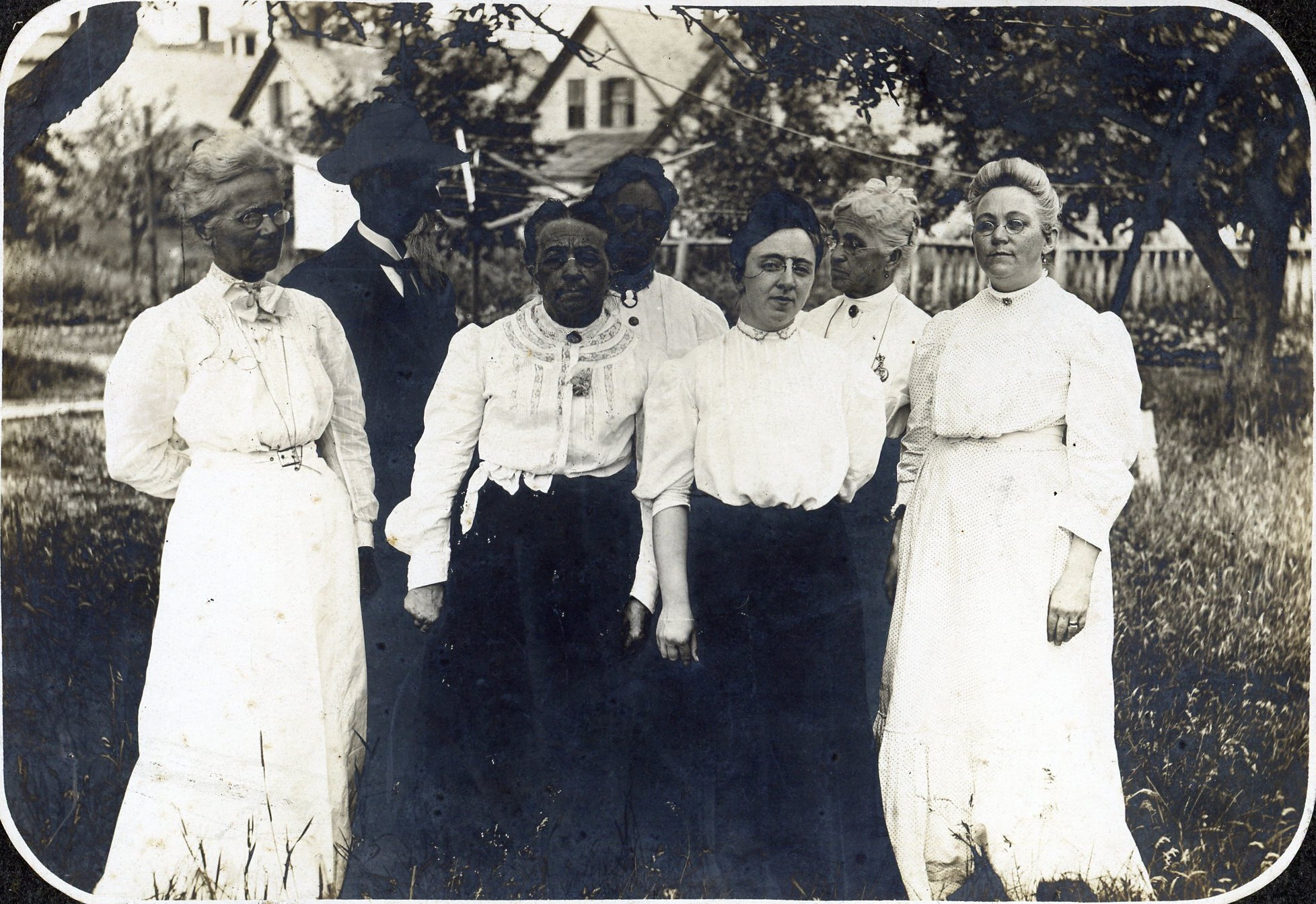
Eliza Coleman Lang, Susannanh Coleman Hathaway, Calvin Hathaway and 2 children
Photo Credit: Margaret Gilbert Peterson

Mr and Mrs Calvin M Hathaway age 54 and 49 — 1882 Stillwater. MN
Photo Credit: Margaret Gilbert Peterson

Children of Susannah and Calvin:

iii. Wills, iv. Effie and v. Addie Hathaway in 1870
Photo Credit: Margaret Gilbert Peterson

i. Elbridge C. Hathaway b. 22 May 1853 in Augusta, Kennebec, Maine; d. bef. 1860 in Stillwater, Washington, Minnesota)

ii. Alice H. Hathaway b. 2 Dec 1854 in Vassalboro, Kennebec, Maine; d. 2 Mar 1856 in Vassalboro, Kennebec, Maine

iii. Willis Hiram Hathaway b. 7 Apr 1859 in Stillwater, Washington, Minnesota; d. 25 Dec 1929 in Portland, Multnomah, Oregon; m. Mary Josephine Woods (14 Dec 1865 in Ohio – 1945 in Portland, Multnomah, Oregon ) Mary’s parents were Benjamin F. Woods (1815 – ) and Caroline Hunt (1839 – ). Willis and Mary had five children born between 1893 and 1901.

Willis Hiram Hathaway
Photo Credit: Margaret Gilbert Peterson

In the 1900 census, Willis and Mary Josephine lived in Giltedge, Montana where Willis was a blacksmith. My grandmother was born in Giltedge that same year.

Mr. and Mrs. Willis Hathaway
Photo Credit: Margaret Gilbert Peterson

iv. Elizabeth B. “Effie” Hathaway b. 21 May 1863 in Stillwater, Washington, Minnesota; d.  9 Nov 1917 in Stillwater, Minnesota; m. 6 Jan 1890 Stillwater, Minnesota to John Burnham Northey (21 Dec 1852 in Brookfield, Orange, Vermont – 16 Feb 1914 in Stillwater, Washington, Minnesota; Died at the Hospital following Gall Bladder surgery on Feb 12, 1914)  John’s parents were Edward C. Northey (1827 – 1907) and Elizabeth Burnham (1824 – 1913). He first married 3 May 1882

Age: 29 in Stillwater to Harriet E. “Hattie” Booth (b. 3 May 1860 in Diamond Bluff, Pierce, Wisconsin – d. 9 Jun 1889 in Stillwater) and had three children. Effie and John had another three children between 1893 and 1905.

Effie Hathaway age 19 years May21, 1882
Photo Credit: Margaret Gilbert Peterson

In 1900, John was a building contractor in Stillwater.

v. Adalide “Addie” Eastman Hathaway b. 15 Apr 1866 in Stillwater, Minnesota; d. 4 Jun 1921 in Stillwater, Minnesota.  Adalide didn’t married and lived her whole life in Stillwater. Here’s a google maps picture of the house on 210 Walnut Street East where she died.

Addie E. Hathaway
Photo Credit: Margaret Gilbert Peterson

In the 1910 census, Annie was living in Stillwater Ward 1, Washington, Minnesota with her mother Susanna.

vi. Harry Lincoln Hathaway b. 20 Oct 1869 in Stillwater, Minnesota; d.  5 Aug 1935 in Stillwater, Minnesota; m.7 Nov 1893 Minnesota to Emma Herrn (6 May 1871 in Minnesota – 14 May 1961 in Stillwater, Minnesota) Emma’s parents were from Germany.

In the 1920 census, Harry had his own blacksmith shop in Stillwater just like his uncle Guilford had in Anoka.

Harry Lincoln Hathaway – Stillwater, MN
Photo Credit: Margaret Gilbert Peterson

vii. Calvin Hathaway b. Jul 1871 in Stillwater, Minnesota; d. Bef. 1880 in Stillwater

viii. Annie Shakespere Hathaway b. 27 Apr 1874 in Stillwater, Minnesota; d. 12 Nov 1882 in Stillwater

Annie S Hathaway seven years old 27 Apr 1881 Stillwater, MN
Photo Credit: Margaret Gilbert Peterson

.

4. Roxanna “Roxie” Parmenter Coleman

Roxanna Parmenter Coleman
Photo Credit: Margaret Gilbert Peterson

Roxanna’s first husband Augustus Plummer was born about 1833 in Maine and died in the Civil War.

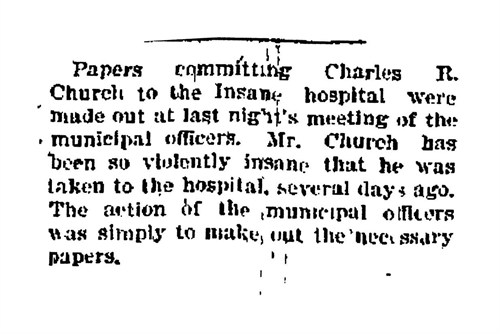
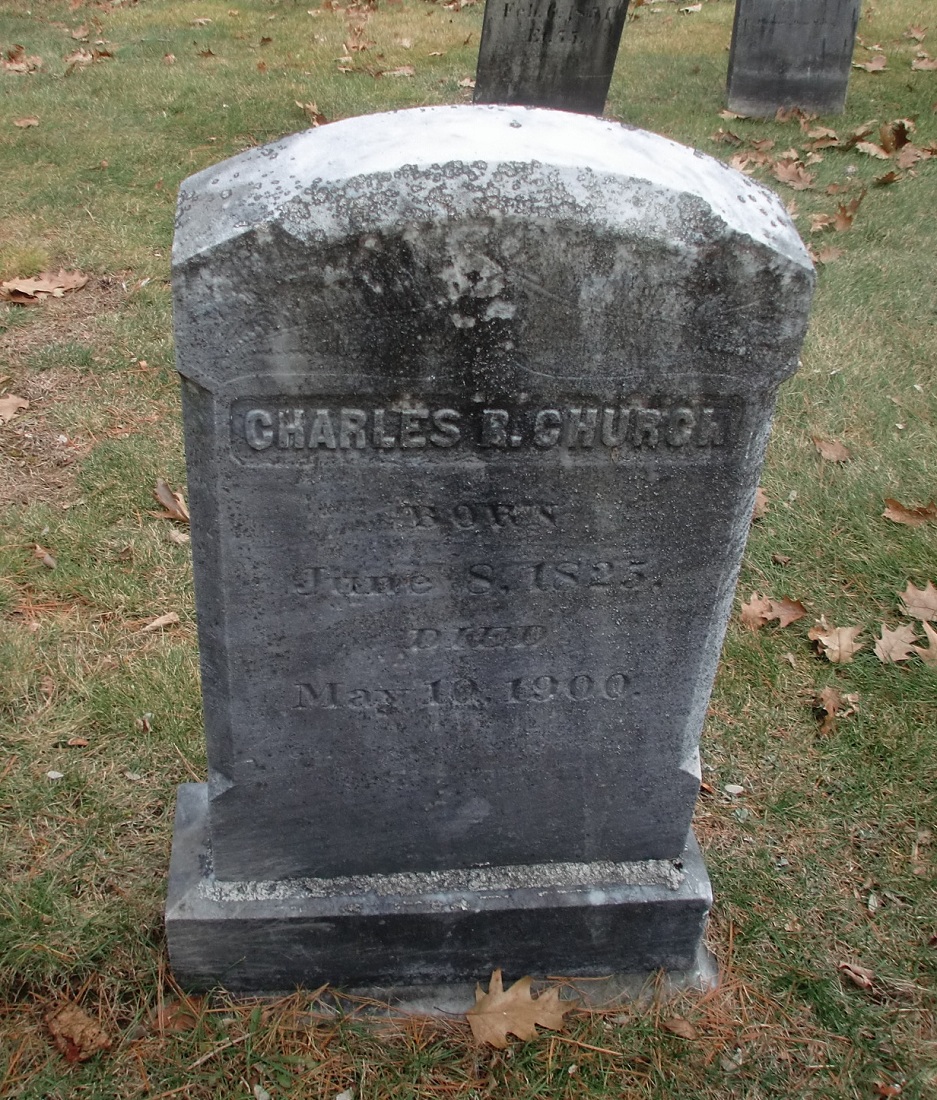
Roxanna’s second husband Charles R. Church was born 8 Jun 1825 in Maine. His parents were Isaac Church and Nancy [__?__].  Roxanna and Charles were divorced before 1868. He was a farmer.

In the 1870 census, Charles was a house carpenter, living with his sisters Harriet and Lucinda in Augusta, Kennebec, Maine.

In the 1880 census, Charles was a truckman boarding in a large establishment in Lewiston, Androscoggin, Maine.   Most of the other boarders were also working in different jobs, so maybe he wasn’t institutionalized yet or maybe the asylum wasn’t locked down.

Charles R Church Insanity — Daily Kennebec Journal — Mar 9, 1900

Charles died 10 May 1900 in Augusta, Maine of senile insanity and heart disease.

Charles R Church Gravestone — Wall Cemetery, Kennebec County, Maine,

Roxanna’s third husband Marcellus C. Lovejoy was born 31 Mar 1844 in Old Town, Penobscot, Maine, His parents were Collins Lovejoy  (b. 1810 – ) and Thankful Nichols (b. 1816 – ). Marcellus died 24 Feb 1913 in Vassalboro, Maine.

In the 1860 census, Augustus was working as a laborer and Roxanna as a domestic in Richmond, Virginia.

On 31 Jan 1862 Augustus enlisted in Company D, 15th Infantry Regiment Maine. He was promoted to Full Musician in 1862. Company D, 15th Maine Volunteer Infantry Regiment mustered out on 5 Jul 1866, but think Augustus had died before then.

On 5 Sep 1863, Mrs. Roxannah Plummer married Charles R. Church. Roxannah and Charles didn’t last because she married a third time on 22 Aug 1869 to Marcellus C. Lovejoy.   Marcellus was a machinist. In the 1870 census “Borannah” and “Marselous” Lovejoy lived with her sister Susannah Hathaway’s family in Stillwater, Minnesota with Marcellus working as a saw filler in the mill. Roxanna’s youngest brother Seth Coleman was also living with them and working in the saw mill. Marcellus was recorded in the 1870 census twice, also living with his parents in Old Town, Penobscot, Maine while working at a saw mill.

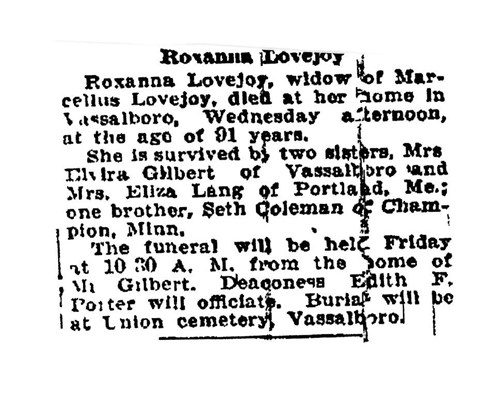
In the 1910 Roxanna and Marcellus were living in Portland, Maine and by 1920 Roxanna was widowed and living with her nephew Jesse Gilbert’s family. In 1919, Roxanna sold her household goods including 6 cords of wood, tools and furniture to Jesse for the consideration of one dollar.

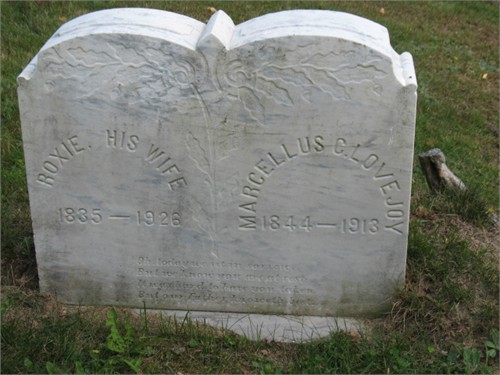
Roxanna Coleman and Marcellus Lovejoy grave

Here’s the story of the Fifteenth Infantry. I wonder when Charles Plummer dropped out of the picture.  Another relative, this time from my mom’s side of the family, Jonathan PARKS‘ son George also served in the 15th and died of disease  6 Aug 1864 in Washington, Dc while serving in the Maine 15th .  You can see an account of the Red River Campaign on Jonathan’s page.

Cols., John McCluskey, Isaac Dyer; Lieut.-Cols., Isaac Dyer, Benjamin B. Murray, Jr., Pembroke; Majs., Benjamin Hawes, Franklin M. Drew, James H. Whitmore, John R. Coates. This regiment was raised principally in Aroostock county, and was organized at Augusta, Me., from Dec. 6 to 31, 1861, to serve for three years. It was mustered into the U. S. service on Jan. 23, 1862,[one week before Augustus’ enlistment] and embarked from Portland March 6 for Ship island, Miss., at which date it numbered 962 men, rank and file. The regiment remained encamped at Carrollton, La., from May 19 to Sept. 18, during which time it suffered much from malarial diseases. In September it went to Pensacola, Fla., where it remained until June 21, 1863. Here the health of the men so improved that the number in hospital was reduced to less than one-quarter. During the first year of its service the 15th lost by desertion, discharge and death 329 men, although it had never been in battle. On its return to New Orleans in June, 1863, it joined Gen. Banks’ expedition to Texas and rendered conspicuous service in the capture of Fort Esperanza, in Matagorda bay.

While at Matagorda peninsula, from Jan. 17 to Feb. 28, 1864, three-fourths of the original members of the regiment reenlisted for another term of three years. Returning to New Orleans in March, the regiment formed a part of Gen. Banks’ Red River expedition, during which it marched more than 700 miles in two months, and participated in the battles of Sabine cross-roads, Pleasant Hill, Monett’s Ferry and Mansura plains. In June, 1864, it was ordered to New Orleans, and on July 5 embarked on transports for Fortress Monroe, Va., where it arrived on the 17th. Six companies were then ordered to Bermuda Hundred, and the remaining companies participated in the campaign up the valley in pursuit of Early’s army. The command was reunited at Monocacy Junction, Md., Aug. 4, when the veterans of the regiment who had reenlisted received a 35 days’ furlough, returning to the field Sept. 27. In October it went to Martinsburg, where it remained until Jan. 7, 1865.

The original members of the regiment who had not reenlisted were mustered out on Jan. 18, 1865, but the reenlisted men, recruits, volunteers, drafted men and substitutes forwarded from Camp Berry, Portland, were sufficient to reorganize the regiment, which was ordered to Washington in April, and went to Savannah, Ga., on June 4. On the 13th, it embarked on transports for Georgetown, S. C., where it was assigned to the 3d separate brigade, Department of South Carolina, and remained here until the date of muster out, July 5, 1866, whence the men went to New York, where they were finally paid and discharged.
.

5. Judith Coleman

1898 Obit

Judith’s husband Milton David Lapham was born in 1827 in Minot, Cumberland, Maine, His parents were Abial Lapham (b. 1789 – )  and Abigail Emery (1800 – ).  Milton first married Elizabeth M. Whitehouse (1830 in Minot, Cumberland, Maine – Bef. 1862 in Grow Township, Anoka, Minnesota) with whom he had two children.   Elizabeth’s parents were Ebenezer Whitehouse and

Elizabeth [__?__].  Milton and Elizabeth moved from Maine to Anoka in 1856.

Milton enlisted as a Sargent in Company C, 1st Minnesota Volunteer Cavalry Regiment  the “Mounted Rangers” on 17 Oct 1862.  He mustered out on 31 Oct 1863.

First Cavalry.–Col., Samuel McPhaill; Lieut.-Col., William Pfaender; Majs., John H. Parker, Solomon S. Buell, Orrin T. Hayes. This regiment was made up of twelve companies, organized in the fall of 1862 and was composed largely of men who had lost their wives, children or relatives in the Sioux massacre the previous August and September.

The first battalion of three companies was sent out as soon as organized for guard and patrol duty. In the spring of 1863 nine companies under Col. McPhaill assembled at Camp Pope for the campaign of the Missouri, the other three companies remaining for patrol duty. The regiment was in the Battle of Big Mound., where the 1st battalion led the attack. It fought its way up the steep hill, put the Indians to flight and followed them for 15 miles. The regiment was in the Battle of Dead Buffalo Lake, and was at Stony lake, when the Indians attacked in great force. It reached the Missouri July 29, and returned to Fort Abercrombie. Col. McPhaill, with several companies of cavalry, was sent to Fort Ridgely, which place he reached Sept. 1. The 1st battalion was sent to Fort Ripley and the various companies of the 1st cavalry were mustered out during the fall and winter of 1863-64.

Milton and Judith’s farm was on the Rum River, three miles north of Anoka. Today’s Rum River Nature Preserve is also about 3 miles north of Anoka. Maybe Milton’s farm is part of the reserve.  Milton died Dec 1899 in Anoka, Minnesota

Rum River Nature Preserve

In the 1880 census, Milton and Judie were farming in Grow, Anoka, Minnesota.

Children of Judith and Milton:

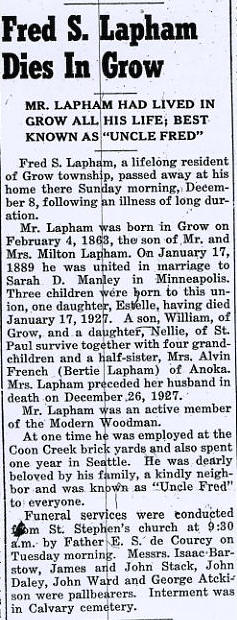
Fred S Lapham Obit Anoka Herald Dec 11 1940

Fred S Lapham Obit Anoka Herald Dec 11 1940

i. Fred Stanton Lapham b. 4 Feb 1863 in Grow, Anoka, Minnesota; d.  8 Dec 1940 in Grow, Anoka, Minnesota; m. 25 Sep 1889 Minneapolis, Minnesota to Sarah D. Manley (Apr 1866 in Grow, Anoka, Minnesota – 26 Dec 1927 in Anoka, Minnesota) Sarah’s parents were Patrick Manley (1828 – 1913) and Bridget McNally (1835 – 1910) Fred and Sarah had three children born between 1890 and 1895.

In  the 1900 census,  he was a farmer in Anoka. He was known as “Uncle Fred” to everybody.

ii. Victor Mandel Lapham b. 16 Mar 1869 in Grow, Anoka, Minnesota; d.  8 Jun 1935 in Cathlamet, Wahkiakum, Washington (on Columbia River halfway between Longview and Astoria; m1. 1893 to Edith Florence (Feb 1868 in Iowa – 1 Mar 1939 in Minnesota)

1914 Victor Lapham Postcard — “Dearest Aunt, the baby you used to hold in your arms and his 21 year wife
Photo Credit: Margaret Gilbert Peterson

Victor M. Lapham
Photo Credit: Margaret Gilbert Peterson

In the 1910 census, Victor was living with Edith in St Paul and working as a telegraph operator for the railroad. After Victor and Edith divorced, he married Anna Olene (1881 in Wisconsin – After 1935) In the 1920 census, Victor and Edith were still living in St Paul and Victor was still an operator for the railway. Victor moved from Minnesota to Washington in 1925. In 1930, Victor was living with Anna in Cathlamet, Wahkiakum, Washington and working as a carpenter with his own shop. For several months prior to his death he worked for the CCC in the tool room.

iii. Elbertina “Bertie” Lapham b. 23 Jan 1874 in Grow, Anoka, Minnesota; d. 19 Dec 1964 in Portland, Oregon; m. 12 Apr 1894 to Alvah (Asa) L. French (27 Jul 1872 in Northfield, Dakota, Minnesota – 21 May 1949 in Anoka, Minnesota) Alvah’s parents were James French (1836 – ) and Adaline [__?__] (1844 – ) Bertie and Alvah had four children born between 1897 and 1911.

Shortly after they married, Alvah gave up work as an interior decorator and took up farming in Grow, Anoka, Minnesota from which he retired in 1935.

In the 1920 census, Alvah and Bertie were farming in Grow, Anoka, Minnesota.

.

6. Eliza Ann Coleman

Eliza Coleman Lang (1837 – Aft, 1930)
Photo Credit: Margaret Gilbert Peterson

Eliza’s husband Edward M. Lang was born 20 Nov 1835 in Deering, Cumberland, Maine. His parents were Samuel Wells Lang and Sarah Carleton. Edward died 9 Oct 1901 in Falmouth, Cumberland, Maine.

According to her niece Bertie, Eliza loved to write poetry.

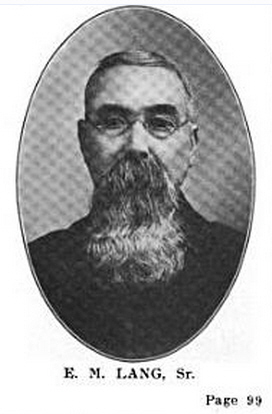
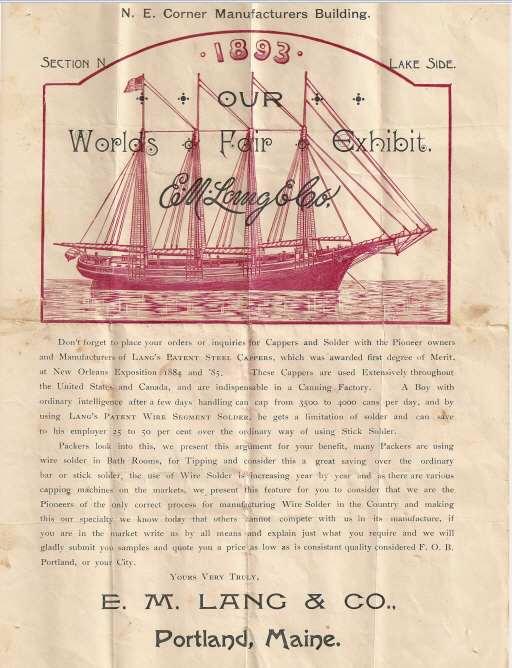
EM Lang Sr.from “A History of the canning industry”

Edward invented a process for making solder for cans and owned E. M Lang Solder. Can Manufacturers Institute Timeline – 1866 – E. M. Lang of Maine was granted a patent for sealing tin cans by casting or dropping bar solder in measured drops on can ends. That same year, J. Osterhoudt patented the tin can with a key opener.

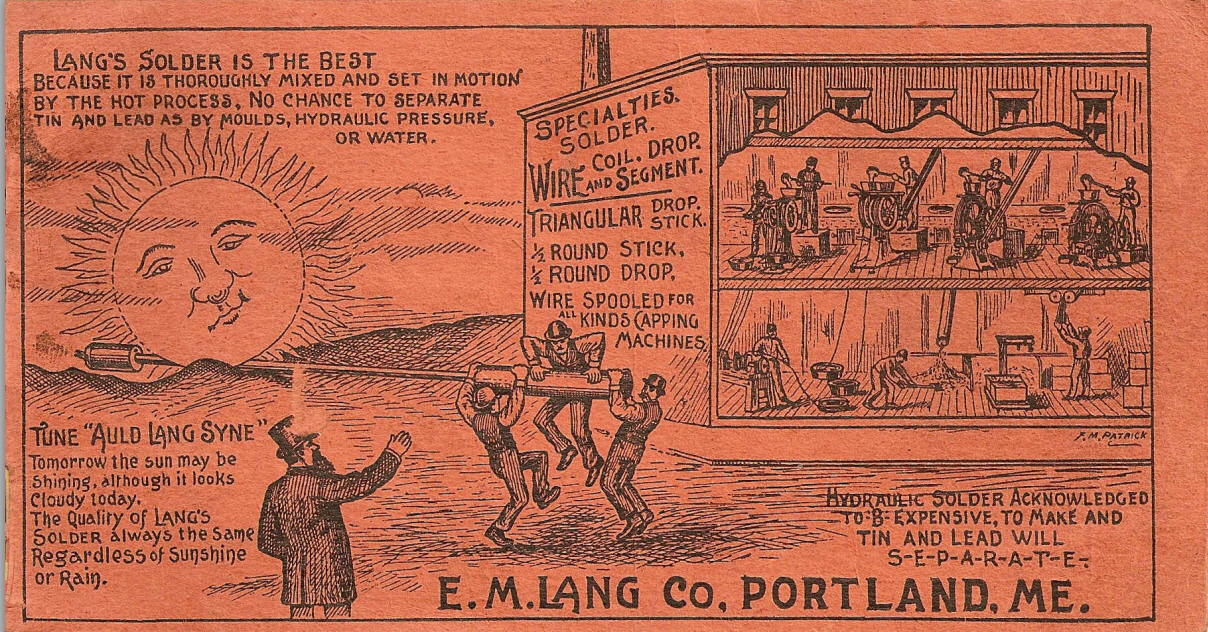
Lang’s Solder

A History of the canning industry edited by Arthur Ignatius Judge

The Evolution of Solder Making by E M Lang Jr.

We hardly know how to speak of the rise and progress of the solder business in the United States without a personal reference to our own business. The late E. M. Lang, the founder of this company, and the pioneer of the business, as we claim, began business for himself in 1859 with one small lathe to repair and manufacture dies for canners. In 1860 he began a series of costly experiments perfecting machinery for the manufacture of canners’ solder, and at last succeeded. In company with Mr. George Burnham, Jr., a silent partner, he organized the firm of E. M. Lang Co. In 1869 they had branch works in Baltimore and continued in business as manufacturers there until 1873, after which the firm had a salesroom there for several years.

Mr. Lang, a pioneer in the movement, was compelled to invent at once his machinery and his process. Of course, at the present time there are very many solder manufacturers in the country, but we claim for the late head of this firm the honor of being a pioneer. The letters patent granted to Mr. Lang covered practically the entire range of the business. October 9th. 1866, Mr. Lang was granted a patent for an improved method of casting solder for canners. This patent covered the casting of solder in continuous bars or separate drops, and his process secured the mathematical correctness of the amount required, and thus obtained a limitation not known before.

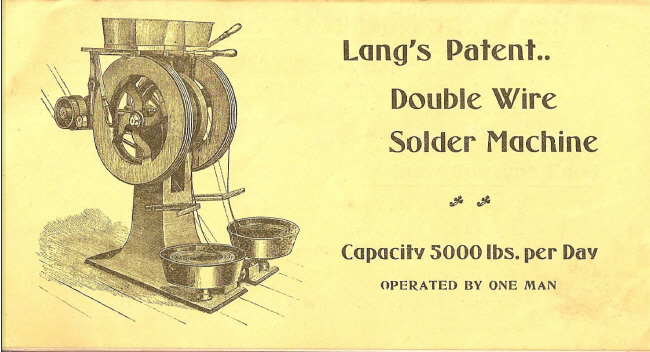
February 21st. 1871. he received a patent for the improvement in casting solder wire, in which reference was made to the fact that he was alrcadv the grantee of letters patent for a machine for casting solder in drops or sticks. This was an improvement upon the old form of forcing the solder through holes in a metal plate. It was claimed that the flat wire produced bv this patent could be applied at a great saving of time and material in the soldering of covers and studs of cans for the preservation of fruit.

Lang’s Patented Solder Machine

In this claim Mr. Lang said: “The great superiority of my method lies in the rapiditv of the operation, while the old process entailed waste of solder, more frequent heating of irons and the less neat appearance of the can.”

EM Lang received the highest award, medal and diploma on wire drop and stick solders at the 1893 Chicago World’s Fair

It would not have been possible for the canning business to have developed to its present enormous proportions without the machines invented by Mr. Lang and others. As in the case of the Lang drop solder machine, capable of producing 10,000 pounds of drop solder per day with one man. It is with pardonable pride, as we believe, that we look backwards to the past and find that our founder, the late Mr. Lang, supplied exactly the article the growing industry needed

Eliza Coleman Lang, Susannanh Coleman Hathaway and Calvin Hathaway and 2 children
Photo Credit: Margaret Gilbert Peterson

In the 1900 census, Edward and Eliza were living in Falmouth, Cumberland, Maine where Edward was a solder and dye maker. In 1903 they lived at 24 Lincoln Street, Portland, Maine

Children of Eliza and Edward:

i. Rosetta Hotten Lang b. 21 Oct 1859 in Portland, Cumberland, Maine ; d. aft 1920 in Maine; m1. 14 Nov 1877 to John F. Dunham (Oct 1856 in Westbrook, Cumberland, Maine – aft 1905 in Portland, Cumberland, Maine) John’s parents were John Dunham (1819 – 1880) and Frances E (1820 – 1887) Rosetta and John had two children: Edward F. (b. 1879) and Lilla May (b. 1882)

After her divorce from John, Rosetta married 20 Nov 1897 to Oscar Franklin Skillings (23 Mar 1857 Portland, Maine – 27 Jul 1904 Portland, Maine) Oscar’s parents were Andrew Skillings and Nancy R Noyes (1825 – ) Oscar was a blacksmith.

Etta Dunham on right end

Etta Dunham on right end
Photo Credit: Margaret Gilbert Peterson

In the 1900 census, Oscar was working as a  carriage blacksmith in Porland, Maine. The house where Oscar died of Phthisis (tuberculosis) in 1904, 34 Alba Street, portland, maine, was being painted in 2009.

m3. 20 Mar 1920 in Westbrook, Main to her cousin (see below) Seth Elison Gilbert (23 Aug 1869 in Anoka, Anoka, Minnesota – 10 Mar 1939 in Vassalboro, Kennebec, Maine) In 1920, Rosetta was working as a private family nurse and Seth as a painter.

In 1930, Seth was living with his brother Jesse in Vassalboro and working as a painter.  His marital status was listed as “married”, but Rosetta was not part of the household.

Rosetta Hotten Lang

ii. Edward M. Lang  b. 25 Jun 1865 in Cumberland, Maine; d. 9 Dec 1932 in Portland, Cumberland, Maine; m. 1888 to Ella M. Freeman (Mar 1868 in Maine – Prior to 1930 census) Edward and Ella had two children: Robert Hanson (b. 1890) and Ernest Freeman (b. 1893)

In 1903, Edward lived at 249 Forest Ave, Portland, Maine.. [Under the I295 interchange today]..

In the 1910 census, Edward was the propriator of his father’s solder factory in Portland, Maine.

EM Lang Jr.from his article in A History of the canning industry

iii. Charles Elden Lang b. 9 Sep 1872 in Deering, Cumberland, Maine; d.  17 Jul 1961 in Portland, Cumberland, Maine; m. 12 Sep 1894 to Ruth E. Merrill (Apr 1875 in Deering, Cumberland, Maine – After 1940 census) Ruth’s parents were Charles Merrill and Susan [__?__].

Charles and Emma Lang</br> Photo Credit: Margaret Gilbert Peterson

Charles and Emma Lang
Photo Credit: Margaret Gilbert Peterson

In the 1930 census, Charles was living with his father-in-law in Portland, Maine and working as a machinist for the steam railroad. His daughter Ruth (1896 – 1955) also lived with the family and owned a beauty salon.

In the 1940 census, Charles, Ruth and Ruth all lived at 51 Inverness Street, Portland, Maine.

iv. George Burnham Lang  b. 7 Nov 1873 in Deering, Cumberland, Maine; d. 13 Dec 1970 in Pepperell, Middlesex, Massachusetts; m. 3 Jun 1896 to Fannie Foster Cobb (7 Jan 1875 in Maine – 28 Nov 1971 in Pepperell, Middlesex, Massachusetts ) George and Fannie had one daughter Beatrice (1903 – 1978).

Fanny and George Lang

Fanny and George Lang
Photo Credit: Margaret Gilbert Peterson

In the 1910 census, George worked at an automobile shop in Portland, Maine. Interestingly he went by Burnham instead of Lang. By 1920, he was back to using “Lang”.

In the 1940 census, George and Fannie were living at 21 Mechanic Street, Portland, Maine.

v. Eliza Belle Lang b. 24 Oct 1876 in Deering, Cumberland, Maine; d.  aft 1960 in Portland, Cumberland, Maine; m. 16 Sep 1896 Alton Irving Cropley (28 May 1875 in Maine – 25 Apr 1953 in Portland, Cumberland, Maine) Alton’s parents were Henry T Cropley and Lucy [__?__] Eliza and Alton had one child Eleanor Belle (1905 – 1984).

Belle Lang Cropley
Photo Credit: Margaret Gilbert Peterson

In the 1920 census, Alton owned a shoe store in Portland, Maine.

.

7. Charles Richardson Coleman

Charles’ first wife Mary E. Gardner was born 28 Oct 1835 in Vassalboro, Kennebec, Maine. Her parents were Alexander Gardner (1797 Nantucket – ) and Mary Pinkham (Sydney Maine – ).  Mary died 15 Apr 1900 in Vassalboro, Maine of cirrhosis of the liver and heart disease.

Mary E. Gardner (Mrs Charles R Coleman)
Photo Courtesy of Margaret Gilbert Peterson

Charles’ second wife  Abbie Augusta Stewart  was born 12 Jun 1844 in Monson, Maine. Her parents were Elijah Wyman Stewart and Sarah Fisher Springer. Abbie first married 14 Mar 1871 to Marshall Harvey Culver (9 Jan 1816 in Norwich, Vermont – 29 Aug 1895 in Medford, Mass.) Abbie died 15 Nov 1920 in Corona, Riverside, California.

Charles Coleman
Photo Courtesy of Margaret Gilbert Peterson

In the 1880 census, Charles and Mary were farming in Vassalboro, Kennebec, Maine. Charles mother Cynthia was living with the family.

Charles died of Mycorditus (inflammation of the heart muscle)

Charles Richardson Coleman Headstone — Union Cemetery Kennebec County Maine,

Children of Charles and Mary:

George Coleman and sisters Lillian and Effie

(iii) George Coleman and sisters (ii) Lillian and (i) Effie
Photo Courtesy of Margaret Gilbert Peterson

i. Effie Hathaway Coleman b. 24 Dec 1866 in Vassalboro, Kennebec, Maine; d.  27 Jan 1937 in Vassalboro, Maine; m. 8 Jan 1887 in Augusta Maine to Duncan Christopher Walker (27 Apr 1860 in New York – 28 May 1912 in Newton, Middlesex, Massachusetts) Duncan’s parents were Duncan H Walker (1827 – 1860) and Anna [__?__] (1831 – )

Effie Walker and children: left to right  Nellie Edna Walker, Ralph Waldo Walker and Elsie May Walker  May 12, 1917 Newton, Mass.
Photo Courtesy of Margaret Gilbert Peterson

In the 1910 census, Duncan was a plumber in Newton Ward 1, Middlesex, Massachusetts.

ii Lillian May Coleman b. 30 Aug 1869 in Vassalboro, Kennebec, Maine; d. 1946 in Vassalboro, Kennebec, Maine; m. 21 Sep 1889 to Charles F. Connor (Aug 1866 in Windsor, Kennebec, Maine – 24 Aug 1936 in Vassalboro, Kennebec, Maine)  His parents were Jonathan M Connor (1825 – 1899) and Mary J. Rogers(1827 – 1894)

Lillian and Charles had one child Nellie Alleen Connor (1892 – 1985)

Lillian and Charles F Connor and their daughter Aline – June 1906
Photo Courtesy of Margaret Gilbert Peterson

In the 1920 census, Charles was a salesman in Augusta, Maine.

iii. George Weston Coleman b. 23 Oct 1876 in Vassalboro, Maine; d.  20 Mar 1923 in Vassalboro, Maine

George Weston Coleman 21 yr 1 mo 29 days taken Dec 21 1897
Photo Courtesy of Margaret Gilbert Peterson

In the 1910 census, George W was living with his parents in Vassalboro and working as a paper hanger. In the 1920 census, George was farming in Vasalboro.

iv. Harvey Alexander Coleman b. 28 Apr 1879 in Vassalboro, Maine; d. 14 Sep 1880 in Augusta, Kennebec, Maine

.

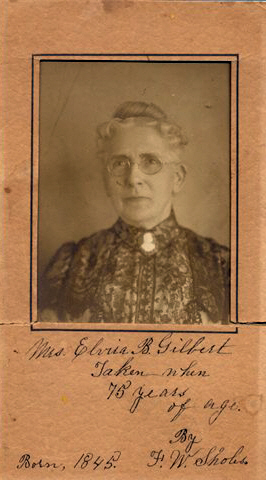
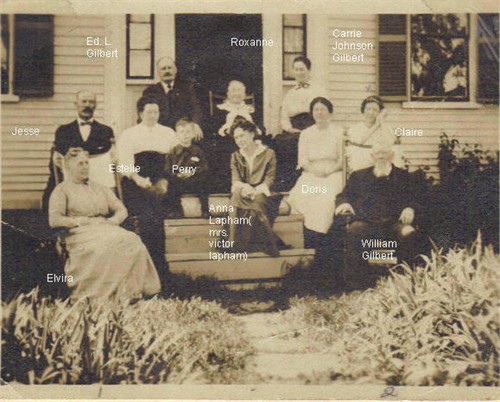
8. Elvira Brown Coleman 

Elvira Brown Coleman

Elvira Brown Coleman
Photo Courtesy of Margaret Gilbert Peterson

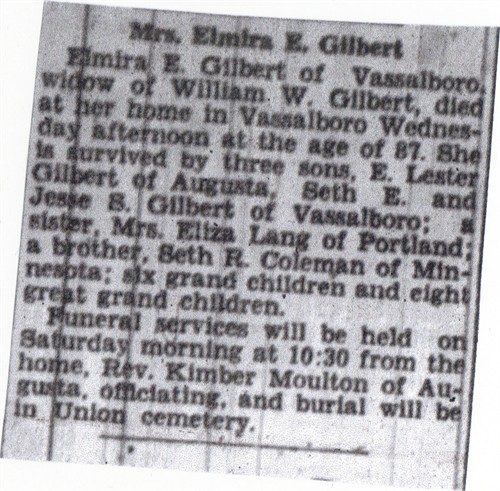
Elvira’s husband  William Wallace Gilbert was born 3 Jun 1839 in Leeds, Kennebec, Maine.   His parents were Edward Jones Gilbert (1815 – 1899) and Deborah Turner (1818 –  1897).  He first married 10 Aug 1862 to Mahala B. Bumpus (1841 in Leeds, Androscoggin, Maine – 18 May 1863 in Belgrade, Kennebec, Maine) who died in childbirth.  William died 21 Apr 1916 in Vassalboro, Maine.

William Wallace Gilbert age 52 in 1891
Photo Courtesy of Margaret Gilbert Peterson

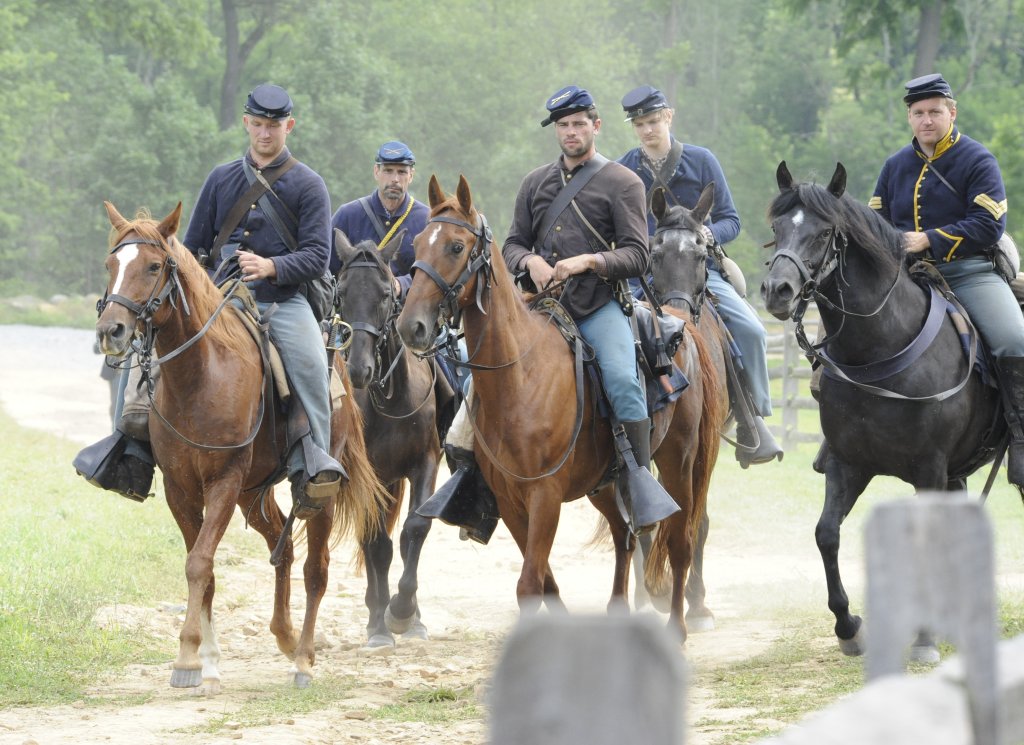
In the Civil War, William was a private in 1st Maine Volunteer Cavalry Regiment.   He enlisted 30 Jan 1864 and transferred to Company G, Maine 1st Cavalry Regiment on 19 Feb 1864. Mustered out on 01 Aug 1865 at Petersburg, VA.

1st Maine Cavalry Reenactors —  mainecav.org/

Three hundred selected men from the 1st Regiment participated in the daring raid of Gen. Kilpatrick to the vicinity of Richmond, Feb. 27 to March 12, 1864, the loss of the 1st in this famous raid being 93 men killed, wounded or missing and over 200 horses. It also moved with the cavalry corps on Gen. Sheridan’s first raid, May 9, 1864, until within 3 miles of Richmond. In the engagement at Trevilian Station, June 24, 1864, its loss was 10 officers and 58 enlisted men.

During August of this year its loss in killed, wounded and missing was 49 men and 75 horses, and the total casualties during 1864 amounted to 295 officers and enlisted men. In Aug., 1864, seven companies of the 1st D. C. cavalry were transferred and assigned to the several companies of this regiment by a special order of the war department. The original members of the regiment whose term of service expired Nov. 4, 1864, were mustered out at Augusta, Me., on the 25th, while the regiment, now composed of veterans recruits and members of the 1st D. C. cavalry whose term had not expired, participated in the closing battles of the war; was mustered out of the U. S. service at Petersburg, Va., Aug., 1, 1865, and arrived in Augusta, Me., on the 9th.

William and Elvira Gilbert
Photo Courtesy of Margaret Gilbert Peterson

In the 1870 census, Gilbert and Elivra were living in Anoka, Minnesota where Gilbert was a painter.

Elvira Coleman Gilbert

Elvira Coleman Gilbert – 1920

In the 1880 census, Gilbert was an attendant and Elvira was a cook living and working at a large institution in Augusta, Maine.

Elvira Coleman – Obit

Children of Elvira and William:

Gilbert Family 1915
Photo Courtesy of Margaret Gilbert Peterson

i. Infant son Gilbert

ii. Flora M. Gilbert b. 21 Oct 1866 in Anoka, Anoka, Minnesota; d.  17 Aug 1867 in Anoka, Anoka, Minnesota of Canker of the Bowels  Oakwood Cemetery, Anoka, Anoka County, Minnesota, Plot: Blk 5, Lot 1)

iii. Edward Leslie Gilbert b. 21 Jan 1868 in Anoka, Anoka, Minnesota; d. 24 Jan 1939 in Augusta, Kennebec, Maine); m. 2 Aug 1899 in Sidney, Kennebec, Maine to Carrie Viola Johnson (25 Sep 1857 in Augusta, Maine – 12 Dec 1946 in Augusta, Maine) Carrie’s parents were Lewis P. Johnson (1827 – ) and Lydia C. Norton (1831 – )

Edward Leslie Gilbert

Edward Leslie Gilbert
Photo Courtesy of Margaret Gilbert Peterson

Carrie Viola Johnson

Carrie Viola Johnson
Photo Courtesy of Margaret Gilbert Peterson

In the 1910 census, Edward was the proprietor of a boarding house in Augusta, Maine.

iv. Seth Elison Gilbert b. 23 Aug 1869 in Anoka, Anoka, Minnesota; d. 10 Mar 1939 in Vassalboro, Kennebec, Maine; m1. 5 Dec 1892 in Portland, Maine to Elizabeth (Lizzie) M. Jones (Oct 1866 in Cliff Island, Cumberland, Maine – ) Elizabeth’s parents were Charles D Jones and

Hattie Griffin

After he divorced Elizabeth in Oct 1905, he married 16 Jul 1909 to Lottie Mary Cash (Aug 1870 in Portland, Cumberland, Maine – ) Lottie’s parents were Arthur Cash (1824 – ) and Dorcas Ann Mason (1829 – ) Lottie previously married in 1893 to Frank C Ramsdell (1861 – 1907) and had two children Fred Arthur(b. 1893) and Ray Newell (b. 1899)

Seth was a motorman and Lottie was a waitress.

On 20 Mar 1920 Lottie M Cash of Portland Maine married Leo A Borden of Pawtucket, Rhode Island. Leo was born in 1882 in Chicago, Illinois making him 14 years younger than Lottie.

The same day, 20 Mar 1920, Seth married his cousin Rosetta Hotten Lang (See above) I wonder what was the story of the divorce and double marriage.

Rosetta Hotten Lang b. 21 Oct 1859 in Portland, Cumberland, Maine ; d. aft 1930 in Maine; m1. 14 Nov 1877 to John F. Dunham (Oct 1856 in Westbrook, Cumberland, Maine – aft 1905 in Portland, Cumberland, Maine) After her divorce from John, Rosetta married Oscar Franklin Skillings (23 Mar 1857 Portland, Maine – 27 Jul 1904 Portland, Maine)

In the 1900 census, Oscar was working as a  carriage blacksmith in Porland, Maine. The house where Oscar died of Phthisis (tuberculosis) in 1904, 34 Alba Street, portland, maine, was being painted in 2009.

In 1920, Rosetta was working as a private family nurse and Seth as a painter.

In 1930, Seth was living with his brother Jesse in Vassalboro and working as a painter.  His marital status was listed as “married”, but Rosetta was not part of the household.

Seth Gilbert

Seth Gilbert
Photo Courtesy of Margaret Gilbert Peterson

v. Jesse Stevens Gilbert b. 17 Sep 1872 in Anoka, Anoka, Minnesota; d.  7 Sep 1940 in Vassalboro, Kennebec, Maine; m. 15 Dec 1897 in Vassalboro to Estella Blanche Sherman (23 Jan 1879 in Vassalboro, Maine – 20 Jun 1931 in Vassalboro, Maine) Estella’s parents were Clarence Austin Sherman (1853 – 1937) and Nellie Lavina Dailey (1851 – 1885) Jesse and Estella had five childrern born between 1900 and 1920.

Jesse Stevens Gilbert – Augusta, Maine
Photo Courtesy of Margaret Gilbert Peterson

Estella Blanche Sherman

Estella Blanche Sherman
Photo Courtesy of Margaret Gilbert Peterson

Four Generations:  Jesse Gilbert with his grandson Minard Lyman Gray   1918 - 2002 , daughter Gladys Claire Gilbert   1900 - 1987  and mother Elvira Brown Coleman   1845 - 1930

Four Generations: Jesse Gilbert with his grandson Minard Lyman Gray
(1918 – 2002), daughter Gladys Claire Gilbert
(1900 – 1987) and mother Elvira Brown Coleman
(1845 – 1930)

In the 1930 census, Jesse was living in Vassalboro and working as a painter with his brother Seth,

.

9. Seth Coleman

Seth’s wife Emma Theresa Miars was born 14 Sep 1853 in Chester, Penobscot, Maine. Her parents were George W Miars and Cyrena Pratt.   Emma came to Minnesota when she was two years old.  Emma died 13 Dec 1919 in Ashland, Ashland, Wisconsin.

Emma Theresa Miars — Mrs Seth Coleman
Photo Courtesy of Margaret Gilbert Peterson

Seth spent his early years on the family farm in Vassalboro, Maine, but in 1865, at age 17, he traveled West with his sister Susan and her husband Calvin Hathaway. The Hathaways and Seth settled in Stillwater, Minnesota. Seth found work as a lumberjack during the winter, a log driver in spring, and as a sawmill worker through the summer months. He worked in the woods for seven years, up until the time of his marriage in 1871.

Seth Coleman, standing left. His brother, Guilford D. Coleman, standing right. Their cousin, Dr. Nathan Coleman MD, seated. Photo taken in Anoka, MN late 1880′s
Photo Courtesy of Margaret Gilbert Peterson

At that point in time, he became an apprentice blacksmith in a shop owned by his brother, Gilford D. COLEMAN, located in Anoka, Minnesota and lived across the Mississippi River in Champlin.  According to his niece, he was quite a character.  He was a happy-go-lucky guy, good natured and really lazy.  His wife, Emma, was a nagger.  His niece wrote she could still hear her “SETH” when she was yelling at him,  He didn’t earn enough to satisfy her and she’d scold all the time about how shiftless, lazy and dirty he was.  But Seth took it all in stride and laughed in spite of it all.  He was very comical, had many tales to tell, always wore his hat at a crazy angle.

After completing his apprenticeship, Seth moved to Stillwater, Minnesota, where he opened his own blacksmith shop.  However, in 1891, Seth moved his family to northern Wisconsin, after securing a job as a blacksmith for the Ohio Coal Co., in Ashland. He remained with the company until it closed in 1894. Seth, his wife Emma, and his youngest son, Vernon, returned to Champlin.

In the 1900 census, Seth, Emma and Vernon lived in Champlin, Hennepin, Minnesota where Seth was a blacksmith.

In 1918, Seth and Emma came back to Ashland to live with their son, Hale and children, after Hale’s wife, Isabelle, died. He was so proud of Hale who was Superintendent of Mails in Ashland.

Seth R. Coleman, 87 years old, by bridge over Rum River, Anoka, MN 1934. Born in North Vassalboro, ME 1847. Youngest brother of Guilford D. Coleman,

Emma died in 1919 but Seth remained with Hale until 1921 and then returned to Champlin. In 1931, at age 84, Seth came back to Ashland and lived with his son Hale until the time of his death in 1936, at the age of 89.

Seth Coleman obit

Seth R Coleman obit Anoka Union July 1 1936

Children of Seth and Emma:

i. Lula May Coleman b. 6 Sep 1873 in Anoka, Minnesota; d. 2 Feb 1952 in Ashland, Ashland, Wisconsin; m. 19 Jan 1893 to James Edward Henry (24 May 1870 in Collins Center, New York – 22 Oct 1949 in Ashland, Ashland, Wisconsin) James’ parents were John Newton Henry and Diana Merchant. Lulu and James had three children.

In the 1910 census, James was chief engineer at a water works in Ashland, Wisconsin

Seth’s daughter Lulu May Coleman and her husband and James Henry Aug 1921
Photo Courtesy of Margaret Gilbert Peterson

ii. Hale Sylvester Coleman b. 1 Jan 1875 in Champlin, Hennepin, Minnesota; d. 21 Apr 1955 in Clearwater, Florida; m1. Isabella Armstrong (27 Sep 1874 in St Joseph, Berrien, Michigan – 29 Jan 1918 in Ashland, Wisconsin)  Isabella’s parents were

Samuel Armstrong (1842 – ) and Alice Robinson (1854 – ) Hale and Isabella had four children born between 1909 and 1915.

m2. Edith Hagen (1875 – 1941 Manatee, Florida); m3. Mary Houtte (24 Jan 1882 in Chippewa Falls, Wisconsin – 29 Jul 1968 in St Petersburg, Florida)

Hale was married three times. Mary (Huotte) Sharp was his last wife, and she survived Hale.

Hale Coleman age 18 Feb 26 1893 Ashland, Wisconsin
Photo Courtesy of Margaret Gilbert Peterson

Hale was 16 years old in 1891 when the Seth Coleman family moved from Champlin, Minnesota, to Ashland, Wisconsin. At age 19 he was employed as a coal derrick operator for the Wisconsin Central Railroad Company, until the end of the navigation season in 1894. Hale, his father, mother, and younger brother Vernon, moved back to Champlin in 1894.

Hale worked as a farm hand in the Champlin area until 1898, when he secured a job as a fireman on the tug, “Arthur,” that was operating out of the Keystone Lumber Company, in Ashland. At the end of the navigation season he was hired as a janitor by the Ashland Public School System where he was employed until May of 1899. from that point on, Hale worked in the machine shop and round house for the Chicago and Northwestern Railroad, and then for the Jones and Adams Coal Company, as a derrick operator.

In 1901, he was called into the U.S. Postal Service as a substitute mail carrier. He served in that capacity until 1903, when a postal clerk job opened. Hale worked as a postal clerk until he was promoted to the position of Superintendent of Mails in 1917. In 1929, he was again promoted to the position of Assistant Postmaster. Hale retired form the U.S. Postal Service in 1933, at age 58.

In the 1920 census, Hale was widowed with four small children [Richard, Thomas, Dorothy and Margery]  and working as a Postal Superintendent in Ashland, Wisconsin. In the 1930 census, Hale was still a single widow, this time with four teenagers.

Marjory Coleman age 7 years 1922
Photo Courtesy of Margaret Gilbert Peterson

iii. Vernon Pratt Coleman b. 16 Oct 1888 in Champlin, Hennepin, Minnesota; d. 12 Dec 1946 in Minneapolis, Minnesota; m.16 Aug 1922 Minnesota to Alice Christine Gagnelius (15 Mar 1898 in Minneapolis, Minnesota – 12 Feb 1988 in Minneapolis, Minnesota). Alice’s parents’ were Olaf Gagnelius (3 Jul 1873 Sweden – 18 Sep 1952) and Christine Lindstrom (14 Feb 1871 Sweden – 14 Nov 1928)

Vernon served in the U.S. Army during the First World War, and fought in three major battles (one was in the Argonne Forest.) He became a very successful commercial artist and was employed by the Minneapolis Color Photo and Engraving Company, as a greeting card illustrator.

In the 1940 census, Vernon and Alice lived at 3911 York Ave North,  Robbinsdale, Hennepin, Minnesota where Vernon was a commercial artist at a photo and engraving company.

Vernon Pratt Coleman Taken in Boys Brigade suit 23 Nov 1900, Anoka, Minnesota
Photo Courtesy of Margaret Gilbert Peterson

Sources:

http://familytreemaker.genealogy.com/users/k/i/n/William-M-Kinney-sr/WEBSITE-0001/UHP-0027.html

http://www.familysearch.org/eng/search/frameset_search.asp – Cynthia RICHARDSON (AFN: 830G-B4)

http://www.geni.com/people/Dudley-Coleman/6000000007634427909

http://fam.eastmill.com/i1126.htm#i21041

http://trees.ancestry.com/tree/4105122/person/-1651159478

Posted in -6th Generation, Historical Monument, Line - Shaw | Tagged | 13 Comments

Samuel Crutchfield Sr.

Samuel CRUTCHFIELD Sr. (1796 -1876) was Alex’s 4th Great Grandfather; one of 32 in this generation of the Blair line.

Samuel Crutchfield Sr

Samuel Crutchfield  was born on 20 Nov 1796 in Nottinghamshire, England.  He immigrated to Canada in 1823.   On 11 Dec 1826 he received concession to lot 18.  The concession was along the southeast side of the Châteauguay River from Bryson  to the Village of Ormstown.

View Google Satelite Map of Chateauguay River between Ormstown and Bryson

He was a farmer residing in the seigneury of Annfield.  He married Mary WOOLEY.  He lived in Jamestown Quebec, near Durham in the segniory of Beauharnois, it is actually the old name of Ormstown.  Samuel  died 11 Nov 1876 in Jamestown, near Durham Village, after a brief illness, Aged 80 years

Mary Wooley (Wooly) was  born on 14  Feb 1796 in Nottinghamshire England.   Her parents were John WOOLLEY and Elisabeth HENSEN.  She emigrated to Canada in 1823 and shortly afterwards with her husband settled on the farm on which she resided until her death. Mary died at Jamestown on 4 Feb 1880 at the age of 84 years.

Children of Samuel and Mary

Name Born Married Departed
1. Mary Crutchfield 1822
Notthingham England
Francis Martin
(20 years older than Mary)
c. 1842
25 Jan 1887
Jamestown, PQ
2. Samuel CRUTCHFIELD Jr 1824 Martha FENNELL 31 Jan 1874 Hinchinbrook, Quebec
3. John Crutchfield (Blacksmith) 1 Aug 1826
Jamestown, Quebec Canada
Juliann Carson
2 Mar 1853
South Georgetown, Quebec
12 Sep 1914
Howick, Quebec
4. William Crutchfield 22 May 1829
Chateauguay or Ormstown, Quebec
Anne Ironside (from Canada too)
26 Jan 1865
Douglas County, Kansas
21 Mar 1917
Lawrence KS
5. Annie Crutchfield 1 Apr 1831 James Biggar
2 Jan 1868 in Jamestown, Quebec
13 Oct 1905 Huntingdon, Quebec
6. Sarah (Sadie?) Crutchfield 5 Jan 1835 Ormstown Quebec John Fennell
(Martha’s brother)
12 Sep 1854
Wesleyan Methodist Congregation in the Huntingdon Circuit
25 Jun 1927
Huntington, Quebec
7. Elizabeth Crutchfield 9 Apr 1839
Ormstown
David Sandeland
2 Jan 1862
Wesleyan Methodist Congregation in the Circuit of Ormstown
.
Samuel Baird (Widower)
14 Jun 1905
St. Paul’s Presbyterian Church (in communication with the Church of Scotland), Durham Village, Ormstown
29 Dec 1912
Athelstan PQ
8. Margaret Crutchfield 17 Jun  1842
Jamestown in the Seigniory of Beauharnois, PQ
Wiiliam Freeland
19 Mar 1862
Wesleyan Methodist Congregation in the Circuit of Huntingdon
.
James Reeves

Michel Chartier* de Lotbinière the original owner the Seigniory [feudal estate] of Villechauve where  Samuel Crutchfield would eventually receive his concession retained his unproductive purchase, commonly known as Beauharnois, until the 30th July, 1795, when he sold it to Alexander Ellice, a member of a great commercial house in London, for 36,000 Spanish dollars [£9,000].  The seigneury measured 324 square miles.

The deed states that Mr Ellice was present at its execution, and that, as he could not speak French nor the notary English, Mr Richardson acted as interpreter. One clause bound Mr Ellice to grant deeds to those who had squatted on the seigniory, and whose number is given as about 60. The price seems excessive, and may be accounted for by supposing that the seigniory was either taken in payment of a bad debt, or that there was at the time a speculative demand for wild lands. In support of the latter supposition, it. may be stated that Mr Ellice seems to have had a craze

*What the cause was for the second deed, which is simply a re-grant, I have been unable to ascertain. There may have been some dispute between the heirs of the original grantees. for land, and through his agent in Montreal, Mr Richardson of the firm of Richardson, Forsythe & Co., hardware merchants, was a large buyer of the land scrip offered by militiamen and others. Francis Winter, an American, was engaged to act as local agent, and William Waller to make a general survey of the seigniory and lay out in lots a portion of the lands bordering the St Lawrence and the Chateaugay, and this task he seems to have fulfilled in the summer of 1800.

In laying out the seigniory he divided it into sections, giving them the names they still bear—Catherinestown, Helenstown, Marystown, Annstown, North and South Georgetown, Ormstown, Jamestown, Williamstown, Edwardstown, and Russeltown, being the Christian names of Mr Ellice’s children. The seigniory itself was named Annfield, after Mrs Ellice, and the chef lieu Annstown (now the town of Beauharnois), which had been selected on account of its being the only bay between Chateaugay Basin and the foot of the rapids, and the only place having water-power, which, even at that date, was utilized, for there was a small sawmill at the mouth of the St Louis, which apparently as early as 1780 began changing the noble pine-trees that overhung its waters into boards, which were sold to the habitants on the north shore and rafted to the city. Beyond surveying it, Mr Ellice did nothing towards settling his great estate. From several old deeds, it appears he intended each of his children should inherit the portions to which he gave their names.

Alexander Ellice died in 1805  leaving an estate worth in excess of £450,000. It included nearly 350,000 acres of land in New York and the Canadas, as well as property in Prince Edward Island, Britain, and elsewhere, shares in the London and Montreal companies, ships, stock holdings, and mortgages. The estate was divided fairly equally among his widow and ten surviving children, some of whom had been born in Canada since Ann had often accompanied her husband on business trips. The diverse and generally successful careers pursued by the brood, including the army, the navy, the church, business, and landowning, were typical routes to prosperity followed by the sons of the rising upper middle class; none of Ellice’s inheritors, however, benefited more from his father’s work, or managed his heritage with greater astuteness, than Edward, who became the true successor to the Ellice empire..

11 Dec 1826 – Samuel Crutchfield received lot #185 in the First Châteauguay River Concession The concession was along the southeast side of the Châteauguay River from Brysonville Sideroad to the Village of Ormstown. At the time of the grant, Samuel residing in the seigneury of Annfield (That area of the Seigniory of Beauharnois bounded by the St-Louis River on the north, the Seigniory of Châteauguay on the east, the Châteauguay River on the south and North Georgetown on the west. (Center approx 45.27N/73.86W about 30 kilometers northwest of Ormstown Village) Named after Alexander Ellice’s daughter Ann. Sometimes written as two words.

Here is a Google Map of the 6.5 kilometers along the Châteauguay River from Bryson to Ormstown Village. The fields in the satellite view look long and skinny so maybe all the lots had a small river front.

22 May 1829 – Witnesses to William Crutchfield’s birth, The (x) probably means that his parents were illiterate and signed with a mark.   Crutchfield, Samuel(x); Woolly, Mary(x); Armour, Robert; Tait,

1838 – Samuel was a private in the second company, (Jamestown Chateauguay River Concession under Captain Andrew Strachan and Lt Col Lawrence G Brown) militia volunteers in the Beauharnois Battalion of Militia for the County of Beauharnois during the rebellion of 1838.  Privates got 1 shilling per day.

The Lower Canada Rebellion, commonly referred to as the Patriots’ War,  is the armed conflict between the rebels of Lower Canada (now Quebec) and the British colonial power of that province. Together with the simultaneous Upper Canada Rebellion in the neighbouring colony of Upper Canada (now Ontario), it formed the Rebellions of 1837

In Upper Canada, insurrections resulted from, among other things, dissatisfaction with the Family Compact. In Lower Canada, a battle was being waged between the Assembly controlled by the Patriot Party, led by Louis-Joseph Papineau, and the British minority that controlled the Executive Council and the Legislative Council. In the autumn of 1837, trouble broke out in the two colonies. The insurrection of Upper Canada, led by William Lyon MacKenzie, was quickly overturned. In Lower Canada, the rebellions were more widespread in 1837, but the patriots there were equally defeated by John Colborne‘s troops. In response, Great Britain sent Lord Durham with the mandate of finding a solution. He offered to grant responsible government and unite the two colonies to assimilate the French Canadians.

By 1838, the rebellions had intensified. In the two colonies, rebels launched numerous cross-border raids from the United States. In both cases, the insurrections were quelled by British troops and volunteers who had remained loyal to British authorities.  In Upper Canada Rebels launched several cross-border raids from the United States. Greatly influenced by the Americans, Mackenzie proclaimed the republic of Upper Canada on December 13, 1837.

Robert Nelson did the same for Lower Canada on February 28, 1838. The failure of these insurrections discredited the violence-advocating radicals in the eyes of the general public, who shifted their support to the moderates. The union of Upper and Lower Canada would eventually be proclaimed in 1840, but citizens would have to wait until 1848 for the British Government to grant them responsible government.

10 Nov 1838 – Samuel surely fought on the British side in the Battle of Beauharnois between Great Britain and Canadian rebels. The city rose up following a series of raids by rebel leaders who had escaped into the United States. François-Marie-Thomas Chevalier de Lorimier commanded the ranks of the Patriote rebels. The British were victorious.

11 Nov 1876 – Samuel Crutchfield, died at Jamestown, near Durham Village, after a brief illness, Aged 80 years. Deceased immigrated to this country 53 years ago from England.

4 Feb 1880 – Mary Wooly, Relict of the late Samuel Crutchfield, died at Jamestown, Aged 84 years. Deceased was a native of Nottinghamshire, England.

Children

1. Mary Crutchfield

Mary’s husband Francis Martin was born about 1802 in Ireland.  He was 20 years older than Mary, though the 1850 census says he was even older.  Francis died 20 Feb 1895 Jamestown, County of Chateauguay Aged: 93 years, cause of death: senility.  Francis was a farmer.

1852 Census Canada East / Beauharnois (county) / 16 St. Malachy parish / p. 60d, 61a, (121)29 
Martin, Wm Weaver Ireland Presbyterian 1781
30 Johnson, Jennett Ireland Presbyterian 1779
31 Martin, John Ireland Presbyterian 1811
32 Martin, Francis Farmer Ireland Presbyterian 1785?
33 Crutchfield, Mary England Presbyterian 1820
34 Martin, Mary Canada Presbyterian 1842
35 Martin, James Canada Presbyterian 1844
36 Martin, Sarah Canada Presbyterian 1846
37 Martin, Saml Canada Presbyterian 1850.

Children of Mary and Francis Martin (1785 or 1802 –

i. Mary Anne Martin b. 21 Mar 1843 Beauharnois Protestant Episcopal Church at Chateauguay, Beauharnois, Ormstown, and Parts Adjacent

ii. James Martin b. 10 Feb 1845 Beauharnois Episcopal congregation of Ormstown and Chateauguay; d. 13 Jan 1875 In the 30th year of his age. Native of Canada. Buried In the Presbyterian churchyard, South Georgetown

iii. Sarah Martin b. 5 Jan 1847 Beauharnois Episcopal Congregations of Durham, Ormstown; d. 20 Dec 1897 Hinchinbrooke); m. James Johnston

iv. Jane Martin b. 21 May 1849 Beauharnois United Church of England and Ireland at Durham, Ormstown; d. Before 1852 Census)

v. Samuel Martin b. 3 Jun 1851; d. 8 Dec 1870 Jamestown, County of Chateauguay Aged: 19 years. died from a gunshot wound accidentally acquired in the arm

vi. Elizabeth Martin b. 28 Jul 1853 Beauharnois

vii. Margaret Crutchfield Martin b. 20 Mar 1861; bapt. 19 May 1861 United Church of England and Ireland at Ormstown and Parts Adjacent.; d. 4 Aug 1863

vii. William Francis Martin b. 5 Dec 1864 Beauharnois; d.  10 Sep 1924 Aged 58 years; Cause of death: angina pectoris St. Paul’s Presbyterian church, Ormstown

.

2. Samuel CRUTCHFIELD Jr (See his page)
.

3. John Crutchfield

John’s wife Julia Carson was born about 1828 in Chateauguay, Quebec. Her parents were William Carson and Elizabeth Taylor.   Julia died 8 Mar 1895 in Howick, Tres St. Sacramen, Quebec aged 67

John was a blacksmith.

8 Mar 1895 – Julia Carson, wife of John Crutchfield, died at Howick PQ, aged 67 years.

Children of John and Julia Carson:

i. Elizabeth Crutchfield b. 15 Nov 1854  Howick Village, County of Beauharnois

ii. Mary Woolley Crutchfield b. 25 Feb 1857  Howick, County of Chateauguay; d. 10 Jul  1941  Riverfield, Quebec; m.  13 Feb 1884 to James Templeton (b. 16 Mar 1855 Williamstown, County of Beauharnois )

James Templeton of Scotch concession, parish of St. Martine, married Mary W. Crutchfield, eldest daughter of John Crutchfield, of Howick Quebec. At the residence of the bride’s father, by Rev. J. A. F. McBain.

iii. Samuel Crutchfield b. 3 Mar  1859  Howick Village, County of Chateauguay; d. 28 Sep 1860

iv. Susan Crutchfield b. 15 Jul 1861  Howick Village, County of Chateauguay; d. 22 Feb 1939 at her late home, in Howick Québec; m. 17 Aug 1884 to William Brown

She leaves to mourn, her husband, and two daughters, Mrs. Albert McFarlane, and Mrs. John J. Peddie, both of Howick Québec, also three sisters, Mrs. James McClenaghan of Chicago IL, Mrs. G. McKeracher of Calgary AB, and Mrs. James Templeton of Howick Québec, 5 grandchildren and three great-grandchildren. One daughter, Mrs. Edwin Knox predeceased her two years ago. Funeral service was conducted by the Rev. Dr. Gray and was held in the United Church, in Howick Québec. Interred in the Georgetown Cemetery. ) 17 Aug 1884 William Brown, Farmer, son of Alexander Craig Brown, of South Georgtown, married Susan Crutchfield , daughter of John Crutchfield, of the village of Howick Quebec. At the residence of the bride’s father, by Rev. J.A. F. McBain.

v. Sarah Jane Crutchfield b. 31 Aug 1863  Howick Village, County of Chateauguay ;  m. 25 Dec 1889 Presbyterian Congregation of North and South Georgetown and Circuit in connection with the Presbyterian church in Canada to James McClenaghan  (b. 23 Jul 1874 Parish of Ste. Martine, County of Chateauguay, Province of Quebec )

vi. William Crutchfield b. 10 Jul 1866   South Georgetown, County of Chateauguay

vii.  Margaret Agnes (Jilia Ann) Crutchfield b. 26 Jan 1870 Howick, County of Chateauguay, P. of Quebec; m. 5 Jul 1893 to Donald Grant Mackeracher (b. 18 Nov 1866 English River, County of Chateauguay, Province of Quebec )

Donald Grant Mackeracher married Margaret Agnes Crutchfield, youngest daughter of John Crutchfield, Esq., all of Howick PQ. At the residence of the bride’s father, by Rev. G. Whillans, assisted by Rev. CM Mackeracher.
.

4. William Crutchfield

William’s wife Anne Ironside was born in March 1839 in Canada. Her parents were Robert Ironside (1801 – ) and Margaret [__?__] (1808 – ). Ann was still living in the 1910 census in Wakarusa, Douglas, Kansas.

William settled in Lawrence, Kansas 8 Mar 1856.   Lawrence, Kansas was founded in 1854 for the New England Emigrant Aid Company by Charles Robinson.  The New England Emigrant Aid Company was a transportation company created to transport immigrants to the Kansas Territory to shift the balance of power so that Kansas would enter the United States as a free state rather than a slave state. Created by Eli Thayer in the wake of the Kansas-Nebraska Act, which allowed the population of Kansas Territory to choose whether slavery would be legal, the Company is noted less for its direct impact than for the psychological impact it had on proslavery and antislavery elements.  The exact number of people who left for Kansas is unknown. James Rawley puts the numbers somewhere around 2000, of whom about a third returned home, while The Kansas Historical Society puts the number around 900 who left for Kansas in 1855 alone.

Leigh Richmond Webber, son of Oliver WEBBER, removed from Maine to Lawrence in  Apr 1858 and engaged for three years in teaching and farming.

In the Bleeding Kansas era, Lawrence was a center of anti-slavery sentiment. On May 21, 1856, a pro-slavery posse led by Sheriff Samuel J. Jones burned the Free-State Hotel, destroyed the equipment of two anti-slavery newspapers, and looted several other businesses in an attack known as the sack of Lawrence; one man was killed, struck dead by a stone falling from the burning hotel. Abolitionist John Brown‘s nearby Pottawatomie Massacre is believed to have been a reaction to this event. On August 21, 1863, during the American Civil War, Confederate guerrillas led by William Quantrill burned most of the houses and commercial buildings in Lawrence and killed 150 to 200 of the men they found in the Lawrence Massacre.

03-21-1917 William Crutchfield, died at his home in Lawrence Kansas, aged 88 years. Born at Ormstown PQ, and a veteran of the American Civil War. (born 1829) Home in 1880: Wakarusa, Douglas, Kansas.  Willliam was a farmer.  He and Anne didn’t have any children. Wakarusa Township covers an area of 47 square miles surrounding the county seat of Lawrence.
.

5. Annie Crutchfield

Annie’s husband James Biggar was born in 1826. His parents were William Biggar and Elizabeth Adams. James may have died 22 Nov 1872, though it may have been a different James Biggar who married Mary Brown on 16 Mar 1854 – Huntingdon, Quebec who died on that date.

02 Jan 1868 James Biggar, of Godmanchester, married Annie Crutchfield, Jamestown Quebec, by Rev. J. W. Wilson.

Children of James and Annie:

i. Margaret Mary “Maggie” Biggar b. 14 Jan 1869 Godmanchester Wesleyan Methodist Church in Canada at Huntingdon and parts adjacent ; m. Samuel Davis on 6 Mar 1906 in Montreal, Quebec (205 Manse St).

ii. Agnes Biggar b. 26 Apr 1872 Godmanchester Wesleyan Methodist Church in Canada at Huntingdon and parts adjacent; d. After 1947; m. William Henry Hamilton Goodfellow on 16 Jan 1894 in Huntingdon, Quebec.
.

6. Sarah Crutchfield

Sarah’s husband John Fennell was born 19 Mar 1826 in Wicklow County, Ireland.  He was Martha’s brother and his parents were Gerrard FENNELL.  and [__?__].  John died 21 Jun 1876 in Hinchinbrook, Quebec.

25 Jun 1927 Sarah Crutchfield, Widow of the late John Fennell, died at her home on the Gore, Hinchinbrook PQ, aged 92 years 05 months 20 days.

Children of Sarah and John Fennell

i. Susanna Fennell b. 29 Oct 1855; bapt. 9 Mar 1856 Witnesses:Robert Brown and John Fennell Wesleyan Methodist Congregation In the Huntingdon Circuit; m. 3 Nov 1875 Thomas Purse

Thomas Purse of Athelstan,Que, married Susanna Fennell, daughter of John Fennell, Esq., Hinchinbrook, at the residence of the bride’s father, by Rev. J. W. Chipsham. Wesleyan Methodist Congregation in the Russelltown Circuit; Franklin Methodist Witnesses: William Shearer, Matilda Crutchfield

ii. William Fennell b. 4 Aug 1857 Hinchinbrooke Wesleyan Methodist Congregation In the Circuit of Beauharnois; d.  8 Oct 1905 Methodist Church at Ormstown);  m. 7 Sep 1882 Methodist Church of Canada at Franklin Centre to  Eleanor (Ellen) Jane McHardy, (b. 25 Aug 1858 Hinchinbrook – 19 Aug 1902 )

Ellen J. McHardy, relic of the late William Fennell, died at Huntingdon PQ,19 Aug 1902 age 44 years, funeral today, Thursday, at 1 p.m., to Rennie’s graveyard.

28 Jul 1902 – William Fennell, late of the Gore, Hinchinbrook PQ, died at Huntingdon PQ, age 45 years

iii. Robert John Fennell b. 17 Aug 1859 Hinchinbrooke Wesleyan Methodist Congregation In the Circuit of Beauharnois; d. 3 Mar 1937 died of pneumonia, formerly of the Gore, Hinchinbrooke Québec, died at Rosebank Manitoba, age 78 years

07-12-1896 The wife of Robert Fennell, at Ormstown PQ, twin sons, one died same day.

iv. Sarah Ann Fennell b. 18 Aug 1861 Franklin; m. Thomas Dickenson, of Franklin Center, Que., 28 Jun 1882 at the residence of the bride’s mother,Hinchinbrook Que., by Rev. J Carr. Methodist Church of Canada at Franklin Centre Witnesses: Thomas Dickenson, Sarah A. Fennell, John C. McHardy, Susie W. Crutchfield

12-26-1944 William Dickenson, eldest son of the late Thomas Dickenson and his wife, Sarah Fennell, died suddenly at R? Manitoba, in his 61st year.

v. Mary Emma Fennell b. 18 Feb 1864 Hinchinbrooke, County of Huntingdon and Province of Canada East; m. James McCracken 21 Feb 1883 at Methodist Church of Canada at Huntingdon. Witnesses: James McCracken, Emma Fennell, Samuel Edward Fennell, Sarah Jane Crutchfield; d.  8 Mar 1921 Witnesses: J. Alva Wilson, William A. Crutchfield. Aged in her 58th year; Buried in Rennie Cemetery Methodist Church at Franklin Centre)

03-08-1921 Mary Emma Fennell, beloved wife of James McCracken, died at Rosebank, Brooklet PQ, aged 57 years.

vi. Samuel Edward Fennell b. 6 Apr 1866 Hinchinbrooke; m. Levina Margaret Kelly at Huntingdon Quebec, on November 4th, 1866

20 Mar 1951 – Levina Kelly, beloved wife of S. E. Fennell, died at the Carmen Memorial Hospital in Rowland MB, in her 85th year. .She married Mr. S. E. Fennell, of Rowland and went to Manitoba in 1910 that same year. She is survived by one stepdaughter, Mrs. Nelson Langtry, of Homewood, three stepsons, Ernest L., William F., of Winnebago, and L. Raymond of Fort Garry, also 9 grandchildren. A twin brother, Levi Kelly, predeceased her earlier this month in Huntingdon. Funeral services from the United Church, service conducted by the Rev. George Hambly.Interment at Rowland MB

vii. Martha Margaret Lily Fennell b. 20 Apr 1869 Hinchinbrooke in the County of Huntingdon, P. Q; d. 19 Jan 1903 Chateaugay New York; m. 26 Feb 1890 William Lavery; d. 19 Jan 1903 Chateaugay, New York

William Lavery of Chateaugay New York, married Lillie Fennell, of Hinchinbrook Quebec. At the residence of the brides mother, by Rev. George Cooper Poyser. Witnesses: William Lavery, Lillie Fennell, Thomas Dickinson, John Crutchfield

01-19-1903 Lillie M. Fennell, wife of William Lavery, died suddenly near Chateaugay New York, of acute Cellulitis, aged 33 years. Also on January 31, William Lavery, died of pneumonia,aged 39 years.

7. Elizabeth Crutchfield

Elizabeth’s husband David Sandeland was born in 1830 in Scotland.

Children of Elizabeth and David Sandeland:

i. Mary Louisa Sandeland b. 6 Feb 1863 Hinchinbrook Canada Presbyterian Church of Huntingdon and Athelstan; d. 1 May 1867

ii. Catherine Baillie Sandeland b. 8 Nov 1866 Hinchinbrook Canada Presbyterian Church of Huntingdon and Athelstan; d. 7 Jan 1934 Lachute, Quebec, Canada ; m. 8 Jul 1885 to Robert Goodfellow

Family of Robert Goodfellow and Catherine Baillie Sandilands

Robert Goodfellow of the township of Chateauguay, County Chateauguay, at the residence of the bride’s father, by Rev. A Rowat. The Family of Robert Goodfellow (1859-1933 & Catherine Baillie Sandilands (1867-1934) Robert seated on left, Catherine on the right. The children are: David Andrew Wesley Goodfellow (1886-1964), Robert Gordon Goodfellow (1891-1971), George Edward Goodfellow (1893 – ?), William Sandilands Goodfellow (1896-1974), Annie Goodfellow (1905-1994), Alexander Bruce Goodfellow (1903-1985) One child is missing from this picture.

iii. Euphemia Sandeland b, 20 Jan 1869 Hinchinbrook –
.

8. Margaret Crutchfield

Margaret’s first husband William Freeland was born xx. His parents were James Freeland and xx. James died 27 Feb 1868 near Durham Village, Quebec,

02-27-1868 William Freeland, son of James Freeland of Godmanchester, died near Durham Village, on Thursday morning, caused by the fall of a tree while working in the woods.

Margaret’s second husband James Reeves was born in Jun 1844. His parents were Benjamin Reeves and Janet Miller. After Margaret died, he married in 1920 to Mary H. Cowan. James died 25 Jul 1934 in Ormstown, Quebec.

08-21-1936 Isabella E. Reeves,( nee Mary E Cowan) wife of Stanley E. Frier, died at Carthage New York, age 46 years. In 1920 she married James Reeves, who passed away in 1934. She leaves one brother, David Cowan and family.

07-25-1934 James Reeves, beloved husband of Mary H. Cowan, died at Ormstown PQ, aged 90 years 01 month. He was the son of Benjamin Reeves and his wife, Janet Miller. He was a member of the Fenian Raid. His first wife, Mrs. Margaret Crutchfield Freeland predeceased him, leaving three children, Mrs. James Meikle, (Mennie) deceased, of Saskatchewan, Lottie, Mrs. Duncan Meikle of Saskatchewan, and William of Hamilton Ont.. He is survived by his widow, Mrs. Mary H. Cowan, the funeral took place from his residence, and service was conducted by Rev. Mr. Ross. Interred in the family plot in the Union Cemetery.

Between 1866 and 1871, the Fenian raids of the Fenian Brotherhood, who were based in the United States, on British army forts, customs posts and other targets in Canada, were fought to bring pressure on Britain to withdraw from Ireland. They divided many Catholic Irish-Canadians, many of whom were torn between loyalty to their new home and sympathy for the aims of the Fenians. The Protestant Irish were generally loyal to Britain and fought with the Orange Order against the Fenians. While the U.S. authorities arrested the men and confiscated their arms afterwards, there is speculation that many in the U.S. government had turned a blind eye to the preparations for the invasion, angered at actions that could be construed as British assistance to the Confederacy during the American Civil War.

Children of Margaret and James Reeves:

i. William A. Reeves b. 1877; d. 27 Feb 1951  at his late residence, 52 Dunduen Street South, Hamilton ON, in his 74th year. Interred at the Woodland Cemetery); m. Annie Bollman;   Living in Hamilton, Ontario in 1934.

ii. Mary Janet “Minnie” Reeves b. 1881; d. 16 Feb 1923 died at Nokomis, of heart failure) m. 8 Apr 1903 to James Ernest Miekle (1878 – 15 Mar 1928 Nokomis, Saskatchewan) at the residence of the bride’s father, Ormstown PQ, by Rev. H. E. Warren. Lived in of Saskatchewan

iii. Lottie Reeves b. 1884; d. 1955; m. Duncan Meikle (1879 -1972) of Nokomia Saskatchewan

iv. Nettie Reeves m. 19 Oct 1915 William McCaig,

William McCaig of St Louis de Gonzague PQ, married Nettie Annie Reeves, youngest daughter of James Reeves, of Rockburn PQ. At the American Presbyterian Church, Montreal PQ, by Rev. Dr. Johnston

v. Isabella Biggar Reeves b. 12 Feb 1888; m. 30 Aug 1911 to Stanley Edward Frier; d. 21 Aug 1936 Carthage, New York.

02-12-1888 The wife of James Reeves, at Rockburn Quebec, a daughter

08-30-1911 Isabella Biggar Reeves, daughter of James Reeves, married Stanley Edward Frier, of Franklin PQ. At the home of the brides parents, in Rockburn PQ, by Rev. Allen B. Reid, B D.

Sources:

http://www.rootsweb.ancestry.com/~qchuntin/gleaner/

http://www.rootsweb.ancestry.com/~qcchatea/1838pay.htm

http://www.rootsweb.ancestry.com/~qcchatea/sarault/jamestwn.htm

http://www.swquebec.ca/results.asp?ID=11496

http://www.histori.ca/peace/page.do?pageID=341

http://www.swquebec.ca/search.asp

Posted in -6th Generation, Immigrant - England, Immigrant - North America, Line - Blair, Pioneer, Veteran | Tagged , , | 7 Comments

Samuel Crutchfield Jr

Samuel CRUTCHFIELD Jr. (1824 – 1874) was Alex’s 3rd Great Grandfather; one of 16 in this generation of the Blair line.

Samuel Crutchfield  was born about 1824.  His daughter’s 1910 census record states he was born in England.  His parents emigrated about 1823 from Nottinghamshire, England to Jamestown Quebec, near Durham in the Eastern Townships.  However, the first recorded Quebec birth was Samuel’s brother John 1 Aug 1826.  His parents were Samuel CRUTCHFIELD Sr. and Mary WOOLEY. He married Martha FENNELL on 20 Mar 1849 at the Episcopal Church in Huntingdon, Quebec, Canada.  Witnesses were Gerrld Fennell, Samuel Crutchfield Sr., and Robert Brown.  Samuel died on 31 Jan 1874 at Hinchinbrook, Quebec,  aged 50 years 06 month.

Samuel and Martha (Fennell) Crutchfield

Martha Fennell was born in Mar 1821 in Wicklow County, Ireland.   Wicklow is near Dublin.  Her parents were  Gerrard FENNELL and Susan WINTER.  Martha died 16 Jul 1897 at the Gore, Hinchinbrook PQ, age 76 years 04 months.

Martha Fennell Crutchfield

Children of Samuel and Martha:

Name Born Married Departed
1. John Crutchfield 11 Jun 1850
Jamestown, Quebec, Canada
Catherine Adella Lavey
6 Jun 1877
Wesleyan Methodist Church of Canada at Franklin
30 Apr 1913
Hinchinbrook, Quebec
2. Susannah Crutchfield 6 Jun 1851
Beauharnois
21 Aug 1852
3 Mary Crutchfield 10 Apr 1853
Jamestown
Robert Law
5  Feb 1873
Hinchinbrook, at the residence of the bride’s father, by Rev. T. G. Williams.
5 Jul 1925
Athelstan, PQ
4. Samuel Crutchfield III 27 Feb 1855
Jamestown
Sarah Jane Kelly
8 Mar 1888
Huntingdon, Quebec
25 Oct 1924
Boyd Settlement, Hinchinbrook
5. Martha Matilda Crutchfield 5 Feb 1858
Jamestown, County of Chateauguay
Robert Rennie (Widower)
23 May 1876
Wesleyan Methodist Congregation in the Russelltown Circuit; Franklin Methodist
.
George Henry Broder
9 Apr 1879
6 Aug 1882
Franklin Center,  PQ
6. Susan Wilhelmina CRUTCHFIELD 21 Nov 1860
Jamestown, Quebec
William L. BLAIR
6 Mar 1889
at the residence of Mr. Robert Law, Gore Hinchinbrook
5 Jul 1920 in Napa, California
7. Sadie (Sarah) Crutchfield 1863
Jamestown, Quebec
J Alva Wilson
25 Jun 1886
Wesleyan Methodist Church at Lacolle
1 Apr 1928 Athelstan Quebec

Samuel’s daughter Mary was the eldest daughter and she assumed the cares of the home when quite young.   Samuel was an invalid for years and his wife Martha had to help the boys with farm work until they were old enough to do it themselves.

01-31-1874 Samuel Crutchfield Sr., died at Hinchinbrook, Aged 50 years 06 months.

Samuel Crutchfield Jr  & Martha Fennell Gravestone — Hillside Cemetery Hinchinbrooke Township on Route 202 across the road from Rennie’s United Church.

Children

1. John Crutchfield

John’s wife Catherine Adella Lavery was born 15 Feb 1856 in Quebec, Canada. Her parents were Thomas Lavery and Ann Maither.  Catherine died 12 Apr 1944 in Huntingdon, Quebec.

06-06-1877 Albert P. Mason, of Powerscourt, married Mary A Lavery, and John Crutchfield, of the Gore Hinchinbrook, married Catherine A Lavery, both daughters of Mr. Thomas Lavery, of Hinchinbrook, at the residence of the bride’s father, by Rev. J. W. Clipsham.

04-30-1913 John Crutchfield, died suddenly, at Anderson’s Corners, Hinchinbrook PQ, age 63 years.(b. 1850)

04-12-1944 Catherine Adella Lavery, wife of the late John Crutchfield, died at the residents of her son, William A Crutchfield, in Huntingdon Quebec, in her 89th year. She was the second daughter of the late Thomas Lavery and his wife, Ann Maither. In 1877 she was united in marriage to John Crutchfield and made their home on the Gore Road, Hinchinbrooke Quebec. The mother of two daughters and three sons, she was bereaved by the sudden passing inside of three years of her husband and Neely, (Ella) Mrs. James E. MacLaren. Surviving are her three sons, William A of Huntingdon, Harvey S., of Trowbridge CA, and J. Kenneth, of Edmonton AB. Seven grandchildren and two great-grandchildren, also her three sisters, Mrs. Ellen Traverse of Ottawa Ontario, Mrs. Helena MacLaren, of New Milford CT, Mrs. Emma Gamble of Herdman Quebec. Daughters (Carrie) Mrs. John. Funeral was held in the Huntingdon United Church, service conducted by her pastor, the Rev. Thomas Knowles. Interment was made in the family lot at Hillside Cemetery.

John Crutchfield Catherine Lavery Headstone – Hillside Cemetery

Children of John and Catherine:

i. Carrie Edith Crutchfield b. 7 Aug 1878 [The minister inserted, between lines, “born Aug 7th 1878” in a double baptism involving another family. It is not clear the date belongs to Carrie Edith.]; d.  5 Nov 1915 Anderson’s Corners PQ, aged 37 years 04 months.); m. John Neely

John Neely, died 14 Jan 1931 at the Gore Hinchinbrook PQ. Mr. Neely was the eldest son of the late Robert and Mrs. Neely, born June 15, 1875. Two wives predeceased him, Caroline Edith Crutchfield, and Elsie Maude Fitzsimmonds, one son was born to his first union, John Allister Neely, with three brothers and three sisters survive him, Kerr of the Gore, Duncan at home, Warren of Regina, Mrs. William Cameron of the Gore, Mrs. Daniel Walker of Huntingdon, and Miss Ella at home. Interred in the Gore Cemetery Hinchinbrook PQ.

ii.  William Archibald Crutchfield  b. 15 Aug 1880  Hinchinbrook, County of Huntingdon, Quebec;  m. 29 Jan 1913 to  Margaret Mabel Wood,(b. 10 Jun 1885 – d. 6 Apr 1958) eldest daughter of Mr. John Wood. At Renfrew Brae, the residence of the brides parents, in St Chrysostome PQ, by Rev. J. R. McAllister. d. 6  Nov 1955 buried Hillside Cemetery

iii. Ella Georgina Crutchfield  b. 28 Mar 1884 Anderson’s Corners, Hinchinbrook PQ; m. 19 Feb 1908 to James E. McClaren, of Alix, Alberta at the residence of the brides parents, by Rev. RC McConneil

iv. Harvey Samuel Crutchfield b. 15 Apr 1887 Hinchinbrook, County of Huntingdon, Province of Quebec; d. 30 Jul 1957 Yuba, California; m. Alma M. Kiel (b. 23 Apr 1894 Washington – d. 13 Oct 1961 Sutter, California) Her parents were born in Germany.

Harvey immigrated in 1925. In the 1930 census, Harvey and Alma were living in Grants Pass, Josephine, Oregon where Harvey was a clerk and Alma was a practical nurse in a private home. Their two children were born in Canada, Harvey Ward in 1917 and Carrie in 1920. By 1935, the family had moved to Yreka City, Siskiyou, California where Harvey was a clerk in a feed seed store and Harvey Jr was a gold miner. Living in Trowbridge, Sutter, California, in 1944.

v.  John Kenneth Crutchfield b. 15 Jul 1890  Hinchinbrook, County of Huntingdon, Quebec; J. Kenneth lived in Edmonton Alberta in 1944
.

3. Mary Crutchfield

Mary’s husband Robert Law was born about 1848. Robert died 7 Jul 1928 – Hinchinbrooke, Quebec, Canada.

07-05-1925 Mary Crutchfield, beloved wife of Robert Law, died at her home in Athelstan PQ, age 72 years.

Children of Mary and Robert Law

i. Edith Miriam Law b. 23 Jul 1880  Presbyterian Church in Canada at Rockburn and Places Adjacent in the Township of Hinchinbrooke

ii. Robert Burdon Law b. 15 Aug 1882 Beauharnois

iii. Lulu Sadie b. 1 Jan 1892
.

4. Samuel Crutchfield III

Samuel’s wife Sara Jane Kelly was born 1 May 1867 in Huntingdon, Quebec. Her parents were Nelson Kelly and [_?__].  Sarah died 21 Jan 1942 Huntingdon Québec.

 10-25-1924 Samuel Crutchfield, died at his late residence, Boyd Settlement, Hinchinbrook PQ, age 69 years.

Sarah was a lifelong resident of Boyd Settlement, she was the only daughter of the late Mr. and Mrs. Nelson Kelly of Hinchinbrooke Québec. She was educated at Boyd Settlement and at Huntingdon Academy. She was married to the late Mr. Samuel Crutchfield in March, 1882, to which union four children were born. Besides her son, Allen, with whom she lived, she leaves one daughter, Mrs. German Seely, of Picton Ontario, two sons, Charels, of Shawinigan,Falls, and Howard of East Angus, two granddaughters, two grandsons and four great-grandchildren. Funeral service held at the Huntingdon United Church, service conducted by the Rev. Thomas Knowles.

Children of Samuel and Sarah Jane:

i. Charles Nelson Crutchfield b. 18 Jul 1883; Living in Shawinigan Falls in 1942

ii.  Ernest Samuel Crutchfield b. 4 Jul 1885 Hinchinbrook; d.  1 Feb 1914 died at his father’s residence , in Boyd Settlement, Hinchinbrook PQ, age 28 years.

iii. Alice Matilda Crutchfield b. 14 Sep 1887 Hinchinbrook; m. German Seely, of Wallbridge, Ont., married Alice Matilda Crutchfield, eldest daughter of Samuel Crutchfield, of Boyd Settlement, Hinchinbrook PQ. At the residence of the brides parents, by Rev. Robert Smith. 01-26-1912

iv. Howard Crutchfield b. 4 Feb 1891 Hinchinbrook; Living in East Angus in 1942

v. Alan Herman Crutchfield b. 12 Nov 1892 Boyd Settlement Hinchinbrook; m. 29 Jan 1919 to Mildred N. Parham, daughter of Mrs. Nelson C. Parham at Huntingdon PQ, by Rev. J. B. MacLean.

vi. Lizzie Martha Crutchfield b. 29 Dec 1894  Hinchinbrook; m. 18 Sep 1918 to Robert Wells Lumsden, of Athelstan PQ. At Boyd Settlement, Hinchinbrook PQ, at the residence of her father, by Rev. I Nelson)

vii. Stella Mary Crutchfield (26 Mar 1900  Hinchinbrook  – 14 Feb 1946 died at the home of her brother, Allan Crutchfield in Huntingdon Quebec.)
.

5. Martha Crutchfield

(Only married 3 years before she died)

6. Susan Wilhelmina CRUTCHFIELD (See William Lewis BLAIR‘s page)
.

7. Sadie A. Crutchfield

 Sadie’s husband James Alva Wilson was born in 04 Apr 1868  in Quebec.  His parents were Joseph Whitehead Wilson, and Mary Jane Blair. After Sadie died, he married 26 Sep 1929  in Elgin, Québec to Annie F. Johnson.  James died 26 Oct 1942 in Athelston, Quebec,

1 Apr 1928 Sadie A Crutchfield, beloved wife of James Alva Wilson, died at Athelstan PQ, aged 65 years. (b. 1863)

Sadie Crutchfield Headstone – Hillside Cemetery

Sources:

http://www.rootsweb.ancestry.com/~qchuntin/gleaner/

http://www.swquebec.ca/results.asp?ID=11515

http://www.rootsweb.ancestry.com/~qchuntin/cemetery/hillside/pix/index.htm

Posted in -5th Generation, Line - Blair | Tagged | 6 Comments

Rene Rezeau

Rene REZEAU (1645 – 1720) was Alex’s 9th Great Grandfather; one of 1,024 in this generation of the Miller line.

Rene Rezeau was born c. 1645  in  St. Martin, Isle of Re, Maritime, France.  His parents were Jacques REZEAU and Elizabeth NEAU.  He lived on the Isle of Re, situated almost opposite the City of La Rochelle.  Rene married Anne COURSIER 22 Jun 1670 in Ste. Marie De Re, Charente Maritime, France.  The population was almost all Protestant, many fishermen had come here from neighboring provinces, planning to migrate to the New World. Included amoung these Huguenots were Rene Rezeau and his wife Anne Coursier. They fled the island in 1685, eventually, they arrived in New York City. Here they joined the French Church, finally, they moved permanetly in Staten Island. Rene died 2 Oct 1720 in  Fish Kill, Staten Island, Richmond, New York.

Ste. Marie De Re

Ann Coursier was born c. 1649 in France.  Her parents were Jehan COURSIER and Anne PERROTEAU Her parents both died in 1663 when Ann was only 14 and her sister Marie 3 years old.  Both girls found their way to America. Ann died 18 Feb 1719 in Elizabethtown, Union, NJ.

Sainte Marie de Re - occupies the south-east of Ile de Re. This rural village on the coast is classified as protected wilderness resort, since on 25/02/2009 and Green Holiday Station since 2002. Between land and sea, it is the first agricultural town of Ile de Re. The vine is a big place. Its beaches and wild coastline attracts surfers.

Children of Rene and Ann

Name Born Married Departed
1. Rene Rezeau 9 Aug 1671 in Ste. Marie De Re, Charente Maritim, France Madeleine Genou?
.
Marie Anne Guichard?
 Attended sister Suzanne’s wedding in 1697
2. Abraham Rezeau 6 Nov 1672 Ste. Marie De Re Attended sister Suzanne’s wedding in 1697
3. Suzanne Rezeau 14 Oct 1674 Ste. Marie De Re John Blanchard 23 Oct 1697 in French Church NY 1730 Elizabethtown, Passaic, New Jersey
4. Pierre Rezeau 2 Oct 1676 Ste. Marie De Re Dorcas Guilburt 1701 Richmond, Richmond, New York
.
Marie Contesse 10 Mar 1704
New York
8 Oct 1723 Richmond County, NY
5. Anne REZEAU 2 Oct 1678 Ste. Marie De Re Jean PERLIER II 25 Oct 1696 in New York at l’Eglise Francoise a la Nouvelle York 28 Oct 1723 New York City
6. Marie Rezeau 1 Jan 1688/89 in New York City Pierre Traverrier, Jr. (Jean PERLIER II’s half brother)
7. Esther Rezeau 22 Dec 1688 baptized 1 Jan 1688/89 New York City Peter Billiou 1701 18 Feb 1719 Staten Island, NY
8. Jean Rezeau c. 1690 New York City
9. Isaac Rezeau c. 1692 New York City
10. Elizabeth Rezeau c. 1694 New York City
11. Marianne Rezeau c. 1696 New York City

Rene Rezeau earned his livelihood as a mason, and while in New York had a daughter baptized, Anne Rezeau, who married Jean Perlier. They also had a daughter named Marie, who married Pierre Traverrier, Jr.

Anne’s sister Marie also escaped Huguenot persecution, see Jehan COURSIER ‘s page for the story of her family.

These French Church New York City baptisms show a close connection between the two couple Anne & Rene and Marie & Daniel in the early 1690’s.

1691 Nov 01; To Daniel Jouet and Marie Courcier, Jean; Witnessed by Rene Rezeau and Suzanne Ratier wife of ??? Doucinet

1693 Feb 05;  To Daniel Jouet and Marie Coursier; Elisabeth; Witnessed by Pierre Filleux and Suzanne Rezeau (Rene and Anne’s daughter?)

1695 May 05; To Daniel Jouet and Marie Coursier; Anne; Witnessed by Rene Rezeau and Anne Reseau

The Huguenot congregation was formally established in 1628 as L’Église française à la Nouvelle-Amsterdam. This parish continues today as L’Eglise du Saint-Esprit, part of the Episcopal (Anglican) communion still welcoming Francophone New Yorkers from all over the world. Services are still conducted in French for a Francophone parish community, and members of the Huguenot Society of America. There was Huguenot settlement on the south shore of Staten Island, New York in 1692. The present-day neighborhood of Huguenot was named for those early settlers.

Children

1. Rene Rezeau

Rene’s wife Madeleine Genou? . Marie Anne Guichard?

This New York French Church baptism records are clues that  Rene’s wife  may have been Madeleine Genou or  Marie Anne Guichard

1699 Feb 26; To Jean Melot and Marie Bellamain; Madeleine; Witnessed by Rene Rezeau and Madeleine Genou.

Baptism- Today Sunday 26th of February 1698/99 after the prayer of the eving for baptism in this church by Mr Peiret minister Madeline daughter of Jean Melot and Marie Bellamain born the 14th of the month presented for Holy pabtism by Rene Rezeau and Madelain Genou godfather and godmother.”

The lack of further references could indicate that the girl did not survive much longer than her baptism. The mother apparently did not, as Marie Bellemain Mellott died by the end of the year.

As to logistics, the information from the Mellott-Eastman family tree suggests that the birth of the girl and death of the mother took place in Piscataway Township in Middlesex County, New Jersey. The distance between Piscataway and Staten Island, where the baptism took place is about 19 miles by boat, a 4-5 hour rowing trip in a period rowboat (3-4 knots speed). As an aside, Perth Amboy is about halfway between the two. (Her parents had moved from Staten Island to Perth Amboy at some point, and then by the time of her mother’s death to Piscataway.)

1706 Mar 06; To David Wilson and Susanne Vincent; Rene; Witnessed by Rene Rezeau and Marie Anne Guichard

3. Suzanne Rezeau

Suzanne witnessed the 31 Jan 1697 baptism  of  Francois Carrilier and Marie Morisset’s son Francois; Witnessed by Alexander Maurisset and Susanne Rezeau

1699 Nov 05; To Jean Blanchard and Susanne Rezeau; Jean; Witnessed by Rene Rezeau and Anne Courcier

Suzanne’s husband John (Jean) Blanchard was born 1655 in St Michel, Rouen, Normandy. John died 6 Apr 1730 in Elizabethtown, New Jersey

Susanne Rezeau Marriage

4. Pierre Rezeau  

Pierre’s first wife Dorcas Guilburt was born in 1680 in France. Dorcas died in Staten Island, Richmond, New York.

Pierre’s second wife Marie Contesse was born in 1680 in St Martin En Re, Charente-Maritime, Poitou-Charentes, France.  Her parents were Nicolas Contesse and Marie Hue.

Pierre had several godparent partners.

1700 Jan 28; Isaac Quintard; Pierre; Witnessed by Pierre Rezeau and Elisabeth Vincent

1701 Apr 16; Daniel Bernardeau and Marianne Monier; Daniel; Witnessed by Pierre Rezeau and Marie Roubineau

1702 Mar 15; Pierre Galhaut and Susane Boisson; Anne; Witnessed Pierre Rezeau, Janne Odarts

1705 Mar 18; Jean Vesien and Anne Rezeau; Jacques; Witnessed by Jacques [Pierre] Rezeau and Marie Rezeau.     Our Marie was already married to Jean PERLIER.

1706 Jan 08; Jacques [Pierre] Rezeau and Marie Contes; Marie; Witnessed by Jean Moyse Contes and Susanne Contes

6. Marie Rezeau

Marie and her brother Pierre witnessed the 19 Sep 1703 baptism of their nephew Jean.  To Jean Perlier and Anne Rezeau; Jean; Witnessed by Pierre Rezeau and Marie Rezeau .

Marie married Jean PERLIER II’s half brother Pierre Traverrier on 20 Dec 1743 – Somerset, New Jersey.  Pierre was born  6 Jan 1689; Pierre was apprenticed to Peter Chaigneau, cooper, by his mother, who at that time was referred to as a widow, October 21, 1701.   Marie and Pierre had only one child, a daughter, Mary Traverrier.

7. Ester Rezeau

Ester Rezeau Baptism

The witness to Ester’s 01 Jan 1689  baptism  at the New York City French Church  was Luy Rezeau Esther’s husband Peter Billiou died 1716 in Staten Island, Richmond, New York

8. Jean Rezeau

The witnesses to Jean’s 01 Nov 1691 baptism were  Rene’s brother-in-law Daniel Jouet and Suzanne Ratier wife of [__?__] Doucinet

Other Early Rezeau Baptisms from the French Church at New York City

1710 Sep 03; Jean Vezien and Anne Rezeau; Anne; Witnessed by Josue Soullice and Anne Valleau

1714 Jan 17; Jacques Bergeron and Judith Peletant; Anne;  Witnessed by father and Anne Rezeau wife of Jean Vezien

1735 Aug 27; Roelof Kiersted and Anne Vincent; Christophle; Witnessed by Father and Anne Rezeau Vincent

1741 Apr 15; Roelof Kiersted and Anne [Vincent] Vezien; Anne; Witnessed by Jean [Vincent] Vezien jr and Anne Rezeau [Vincent] Vezien for Sara Kiersted

Sources:

http://www.barney.org/family/wga45.html#I8104

http://www.barney.org/family/wga47.html#I8600

http://trees.ancestry.com/owt/person.aspx?pid=9079305&st=1
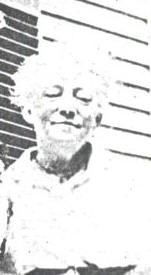
http://homepages.rootsweb.ancestry.com/~rbillard/french_baptisms.htm

http://genealogy.danahuff.net/?p=152

Registers of the Births, Marriages, and Deaths of the Eglise Francoise a LA Nouvelle York: French Church of New York, from 1688 to 1804

Posted in 11th Generation, Huguenot, Immigrant - Continent, Line - Miller | Tagged , | 7 Comments

Jean Perlier I

Jean PERLIER I (1648 – 1688?) was Alex’s 9th Great Grandfather; one of 1,024 in this generation of the Miller line.

Jean Perlier was born about 1648 in La Treamblade, Charante, on the western coast of France. He came from a maritime family and grew up to be a Pilotte de Navire, a title that literally translated means a naval pilot. Back then that meant not only a navigator but the person who actually created the charts. He worked for ship owner Andre Arnaud and married his daughter Marie ARNAUD on 27 Nov 1667 in Temple of La Tremblade, Perche, France.

La Tremblade

During this time there was a great turmoil in France and the Huguenots (French Protestants) were under tremendous pressure. Children were taken from their parents and put into Catholic homes,  parents were persecuted and  frequently put to death.  The Edict of Nantes, decreed by French King Henry IV in 1598 guaranteed full civil rights, freedom of conscience and public worship to the country’s minority Protestants. Gradually, these rights were stripped away until in 1685, Louis XIV revoked the Edict altogether.  It was open season on Protestants including the Perliers.  When the slaughter and persecution began, the Perlier family was ripped apart.  Possibly Jean was at sea, for he managed to flee north to Holland.  He never saw his family again and for many years believed then dead.

La Tremblade

Marie Arnaud was born 24 Nov 1650 in Arvert, Charente Maritim, France. Her parents were Andre ARNAUD (1624-) and Marie GALIHAUT (c. 1628 – )  Andre Arnaud smuggled daughter Marie, Marie’s children, sister Jael and cousin Andre out of the country hidden in wine casks  aboard one of his ships.  It has been told that they hid in hogsheads which had holes bored in them and were stored with the freight in the bottom of the ship until they were out of reach of the inspectors. The first known record of Marie Arnaud in the United States is in 1687 when she appears as a widow on a list of the French Church at Narragansett, Rhode Island.

On the ship Marie met the captain, Pierre Traverrier.  Marie and Pierre were married 4 Jan 1688  in the church at Frenchtown, Narragansett, Rhode Island.  Their marriage was recorded on 20 Apr 1688, in the registers of the old French Church in New York City. Confirmatory evidence in the form of the original marriage-contract in French, existed among the family papers possessed in 1911 by descendants in Vevay, Indiana.   Marie and Pierre had two more children and they lived in Naragansett, Rhode Island, Boston, Massachusetts, and New York City.

From The Magazine of history with notes and queries, Volume 14 July – Dec 1911

The traditions of this family are well preserved, and tell of landed estates in France which were confiscated during the period of religious persecution. It is stated that when the family (? Traverrier) then residing in Bordeaux, decided to seek refuge in another land, they prepared their table set with the family-plate, as for a banquet, with servants at work, and all as usual on such an occasion, whereupon the family going out ostensibly for a drive, forsook everything and boarded a ship in the harbor. The captain (? Traverrier himself) befriended them and hid them in hogsheads or large barrels having some holes in the side for air. The next we hear of them is in America, where their temporary means of support seems to have been a recipe for making perfumery, but the family soon reasserted itself and in a new and more hospitable land than their mother country as then ruled, commenced to work out a new destiny.

Meanwhile with a clear conscience,  thinking that Marie and the boys had died in France, Jean married a Dutch girl and reared another family. The name Perlee as it was pronounced in Holland survives today.

Children of Jean and Marie

Name Born Married Departed
1. Jean (John) PERLIER II 3 Nov 1669
La Tremblade, Charente Maritim, France
Anne REZEAU
25 Oct 1696 in New York at l’Eglise Francoise a la Nouvelle York
14 Sep 1723
Fresh Kill, Staten Island, NY
2. Andre (Andrew) Perlier 27 OCT 1670
La Tremblade, France
1734 – New Rochelle, New York

.
Children of Marie and Pierre Traverrier:

Name Born Married Departed
3. Pierre Traverrier (Twin?) bapt.
6 Jan 1689
French Church in Narragansett, Rhode Island
Mary Rezeau (Anne REZEAU‘s sister and Daughter of Rene REZEAU )
4. Marie Magdelene Traverrier (Twin?) bapt.
6 Jan 1689
French Church in Narragansett, Rhode Island

The “widow” Perlier is on the list of church members on March 27, 1687 at Frenchtown, Narragansett, Rhode Island.. The following is Pierre and Marie’s marriage contract: ”

Today the 4th of January, 1688, we Pierre Traverrier, ship captain, and Marie Arnaud, widow of Jean (John) Perlier, promise to take each other as husband and wife, the laws of our church being previously observed, we agree to live together in common as husband and wife the rest of our days, and in the case one of us should die, the one remaining shall enjoy in his own right all the wealth the two parties may possess, to dispose of as he may see fit to sell, assign, rent, etc., according as he may judge proper; and in case both of us should die without children from this marriage, we declare the children of the first marriage, who are Andre (Andrew) Perlier and Jean (John) Perlier, our legitimate heirs. Furthermore: I, Pierre Traverrier, give to Marie Arnaud the enjoyment of all my property and pretensions in France, in case the state of affairs should change and the liberty of the Protestant religion should be reestablished, giving her in general all that may belong to me. To all of these articles we have agreed in the presence of Mr. Carre, our minister, depository of this document, and of the witnesses below names. Signed: Pierre Traverrier and Marie Arnaud. On the other side the witnesses: Minister Carre, Jacques Many, Andre Arnaud, and Abraham Dumas.”

20 Apr 1688 – Pierre Traverrier and Marie Arnand received the nuptial benediction from Mr. Carre our minister, the three publications having been previously made according to the form of our church; in witness whereof we have signed. Carre minister, Pierre Traverrier, Marie Arnand, Jacques Many elder, Pierre Bonyot, elder, and secretary, Moise Brun elder.

NOTE BY Mr. E. R. Detraz. — This affidavit seems to be written in a different hand and bears a seal in red wax. The two additional items given below seem to be written in the same hand as the first article above given; that is, in the same hand as the marriage contract, but with a different pen and at a different time, as the date, January 6th, 1690, will show. All these articles are written in the French, on one and the same sheet.

Andre Arnaud was Marie’s cousin and was also a member of the French Church in Narragansett, Rhode Island.

Huguenots were barred from settling in New France, so many Huguenots setted instead in the Dutch colony of New Netherland (later incorporated into New York and New Jersey),  A number of New Amsterdam’s families were of Huguenot origin, often having emigrated to the Netherlands in the previous century. The Huguenot congregation was formally established in 1628 as L’Église française à la Nouvelle-Amsterdam. This parish continues today as L’Eglise du Saint-Esprit, part of the Episcopal (Anglican) communion still welcoming Francophone New Yorkers from all over the world. Services are still conducted in French for a Francophone parish community, and members of the Huguenot Society of America.

Children

2. Peter Perlee

Andre’s descendant Peter Perlee spied for the British. After the war his land in Pennsylvania was confiscated. The Loyalist Peter took his family and moved to Canada, founding the Canadian branch of the family.  Our Parlee ancestors also come from a Loyalist family who were relocated to Canada after the Revolution. (See Nathaniel PARKS)

3. Pierre Traverrier

On the 6th day of January 1689 were baptized by Mr. Carre our minister, Pierre and Marie Magdelenne Traverrier children of Pierre Traverrier and Marie Arnand, presented to baptism to wit, Pierre by Pierre Traverrier his father and Jeanne Drommeau, and Marie Magdelenne by Jacques Many and Magdelenne Filleul, godfathers and godmothers; who declare the said children to be born the last of the year 1688.

Signed Carre minister, Pierre Traverrier, P. Bonyot, elder. Extracted by me the 5th of January, 1690.

Pierre was apprenticed to Peter Chaigneau, cooper, by his mother, who at that time was referred to as a widow, October 21, 1701.

Pierre and Marie had only one child, a daughter, Mary Traverrier who married Henrick Dumont 20 Dec 1743 in Somerset, New Jersey.

The Magazine of history with notes and queries, Volume 14 July – Dec 1911

Wallerand Dumont, a French Huguenot, who was born at Coomen, then in Flanders (now Commines, Department du Nord, France, eight miles north of Lille). He was a cadet (“adelborst “) in a company of soldiers sent by the Dutch West India Company, to Director-General Stuyvesant, in New Amsterdam, in 1657. Wallerand Dumont settled in Kingston, Ulster County, New York, rose to a position of influence, and married Grietje (Margaret) Hendricks, January 13, 1664, by whom he had, among other children, Peter Dumont, who was baptised April 20, 1679, at Kingston, and married, thirdly, November 16, 1711, Jannetje Vechten or Vechte (now Veghte).

Of this union, one child was named Henry or Hendrick Dumont, born March 22, 1717. His will is dated November 4th, 1760. His first wife, to whom he was married December 20, 1743, was Mary (Marie) Traverrier, of Monmouth, called ” the younger,” to distinguish her from her mother, Mrs. Marie Traverrier ” the elder,” wife of Peter Traverrier, junior, and daughter of Renier Rezeau of the Island of Re, near La Rochelle, France, who, as a Huguenot, fled to America, about 1700.

His daughter, Marie Rezeau (later Mrs. Peter Traverrier, jun.), had a French Testament which is still in the possession of some of her descendants near Cincinnati;

Peter Traverrier, junior, was a son of Pierre Traverrier (or Traversier) senior, a ship-captain of “Masha,” probably intended for Matha, located east of the village of La Tremblade and north of Bordeaux. We find the official record of the marriage of this Pierre Traverrier, senior, and Marie ARNAUD, widow of Jean PARLIER of La Tremblade, 20 April, 1688, in the registers of the old French Church in New York City. Confirmatory evidence in the form of the original marriage-contract in French, exists among the family papers still possessed by descendants in Vevay, Indiana. The traditions of this family are well preserved, and tell of landed estates in France which were confiscated during the period of religious persecution. It is stated that when the family (? Traverrier) then residing in Bordeaux, decided to seek refuge in another land, they prepared their table set with the family-plate, as for a banquet, with servants at work, and all as usual on such an occasion, whereupon the family going out ostensibly for a drive, forsook everything and boarded a ship in the harbor. The captain (? Traverrier himself) befriended them and hid them in hogsheads or large barrels having some holes in the side for air. The next we hear of them is in America, where their temporary means of support seems to have been a recipe for making perfumery, but the family soon reasserted itself and in a new and more hospitable land than their mother country as then ruled, commenced to work out a new destiny.

But let us return to our subject: “les Dumont.” Henry or Hendrick Dumont and Mary Traverrier, “the younger,” his first wife, had a son, Peter Dumont, who was born on Staten Island, New York, October 1, 1744, and died in Vevay, Indiana, in 1821. This Peter Dumont married, October 25, 1770, Mary Lowe, daughter of Cornelius Lowe, son of Albert Lowe, of Dutch descent. Peter Dumont is seemingly identical with Peter Dumont, Captain, Second Battalion, Somerset County, New Jersey. Tradition says he was called from the field by Washington and made a Commissary in charge of military stores at Van Ness’ mills. A descendant possesses his original Commissary’s book of munitions supplied “by order of General Washington.” He (as Peter H. Dumont) was designated by the New Jersey Congress in 1777, to act as one of the Committee of Safety. Tradition says that Washington frequently conferred with him, and that owing to his devotion to the cause of his country, by night work at Van Ness’ mills, he lost his sight. During the last twenty-five years of his life, his faithful wife read to him. The middle initial “H.,” above mentioned, represents his father’s name Henry, there being several Peter Dumonts coexisting in the same vicinity at that period and this was the customary way of distinguishing between them.

The late Senator F. T. Frelinghuysen’s mother, Mrs. Jane Frelinghuysen, made a family record based on information given her orally by her father, Peter J. B. Dumont (born circa 1760, died May 19, 1846), to the effect that Hendrick Dumont’s son, Peter, had a sister “Mary who married a Staats at Albany.” There is, indeed, an official record at Albany of the marriage of one Mary Dumond to Henry Staats, November 15, 1770. The Staats family descended from Abraham Staats, who came from Holland to Albany in 1642. The writer received a genealogical inquiry not so long ago from Mr. P. D. Staats, 210 North Seventh Street, Newark, N. J., whose initials are suggestive of a Dumont family relationship.

Peter Dumont (born 1744) and Mary, his wife, had several children, among them Lydia, born at South Branch of Raritan River, N. J., August 30, 1773, died in Cincinnati, October 29, 1822, having married, June 28, 1792, Captain Moses Guest, of New Brunswick, N. J. They had issue of which further mention will be made in the chapter on the Guest family.

The Dumont family gave some notable characters to the United States. From that same stock were descended Senator Frederick T. Frelinghuysen, his brother Dumont Frelinghuysen, and Governor Peter Dumont Vroom all of New Jersey, Senator Samuel Beekman Dumont of Iowa, and Colonel John Dumont of Indiana whose wife, Mrs. Julia L. Dumont, was an early author and schoolmistress of our new West. One of her pupils, none other than the late Edward Eggleston, contributed a glowing tribute to her character, in Scribner’s Monthly, for March, 1879. General Ebenezer Dumont, son of Colonel John and Julia, his wife, was born in Vevay, Indiana, November 23, 1814; participated in the Mexican War and served in the war of the Rebellion, being engaged in several battles. He organized and led the celebrated pursuit of John Morgan. He was a member of Congress for four years, 1862-1866, and died, April 16, 1871, at his home south of Indianapolis, having just been appointed Governor of the then Territory of Idaho, which office he did not live to assume.

Sources:

http://www.barney.org/family/wga45.html#I8103

http://www.barney.org/family/wga47.html#I8600

http://www.gamblinfamily.org/parlee.html

The Magazine of history with notes and queries, Volume 14 July – Dec 1911

Tales of our forefathers and biographical annals of families allied to those of McPike, Guest and Dumont (1898)

Posted in 11th Generation, Huguenot, Immigrant - Continent, Line - Miller, Sea Captain, Twins | Tagged , , | 17 Comments

Jean Perlier II

Jean PERLIER II (1669 – 1723) was Alex’s 8th Great Grandfather; one of 512 in this generation of the Miller line.

Jean Perlier II was born 3 Nov 1669 in La Treamblade, Charante, France.  He was a Huguenot and immgrated with his parents Jean PERLIER I and Marie ARNAUD and brother Andre.  He married Anne REZAEU on 25 Oct 1696 in New York at l’Eglise Francoise a la Nouvelle York, by the minister Monsieur Payret (Peiret). 

Jean Perlier Marriage

Jean died in Fresh Kill,  Staten Island, New York,  14 Sep 1723.

Anne Rezeau was born 2 Oct 1678 in Ste. Marie De RE, Charente, France. Her parents were Rene REZEAU and Ann COUSIER.  Rezeau is a Huguenot family from a region known as Isle de Re in France. Anne died after 1723 in New York

Children of Jean and Anne:

Name Born Married Departed
1. Marie (Mary) Perlier 2 Feb 1698/99
New York City
bapitized in the Hugenot Church
James Perrine
12 Jun 1739 New York, NY
2. Anne Perlier 11 Sep 1701
New York City
bapitized in the Hugenot Church
Charles Petit
c. 1722
New York
1764
3. Jean PERLIER III 5 Sep 1703
New York City
bapitized in the Hugenot Church
Abagail JONES
13 Jun 1734 in Edison, Bergen, New Jersey
1771 Davidson’s Creek/ Abbott’s Creek North Carolina
4. Esther Perlier c. 1707 Staten Island, NY
5. Elizabeth PERLIER c. 1712 Jonah PARKE
c. 1737
1754
6. Susannah Perlier c. 1707 Staten Island, NY Henry La Tourette before 1764
7. Pierre (Peter) Perlee 1713
Staten Island, NY
Martha Dubois
1738
Staten Island, NY
1748
Staten Island, NY
8. Abraham Perlier 10 Jan 1715/16
Staten Island
Mary Sleght
14 Feb 1742/43
2 Nov 1760
Staten Island, Richmond County, NY
9. Martha Perlier 1717
Staten Island
Joseph Perrine
14 Feb 1743 Perth Amboy, Middlesex, New Jersey

Jean made a freeman of New York City on December 16, 1695. He was a ship carpenter by trade.

12 Jan 1701 – Jean Perlier and Marie Naudin were godparents to Pierre Galeau and Susanne Boisons’ daughter  Marie.

The Huguenot congregation was formally established in 1628 as L’Église française à la Nouvelle-Amsterdam. This parish continues today as L’Eglise du Saint-Esprit, part of the Episcopal (Anglican) communion still welcoming Francophone New Yorkers from all over the world. Services are still conducted in French for a Francophone parish community, and members of the Huguenot Society of America.

Huguenot Church New York City – “Saint-Esprit”, the French Reformed Church on Pine Street, New York,

There was Huguenot settlement on the south shore of Staten Island, New York in 1692. The present-day neighborhood of Huguenot was named for those early settlers.  By 1695 the population on the Island was divided evenly amongst the French-speaking people, the English and the Dutch. . By 1698 the population of the entire Island was 727, including about 70 slaves, growing steadily to 1,279 (1712), then 2,073 (1746) to reach 3,000 at the time of the American Revolution.

Fresh Kills Staten Island

Fresh Kills Staten Island

However, I think the Perliers lived in the Fresh Kills section of Staten Island on the west side of the island.

Fresh Kills (from the Middle Dutch word kille, meaning “riverbed” or “water channel”) is a stream and freshwater estuary in the western portion of the of Staten Island. It is the site of the Fresh Kills Landfill, formerly New York City’s principal landfill.

The watershed of the Fresh Kills drains much of the wet lowlands of the western portion of the island and flows into the Arthur Kill around the Isle of Meadows. The channel around the north end of the Isle of Meadows is sometimes called Little Fresh Kill and the southern channel is called Great Fresh Kill.

The stream has two major branches. The north branch is Main Creek. The south branch is Richmond Creek, which drains much of the central part of the island, with its headwaters near Historic Richmond Town  Currently, the New York City Department of Parks and Recreation is in the process of planning a new park on the former landfill site..

An unrecorded will, dated Oct. 28, 1723, stated I, John Perle, of Staten Island, being very sick, etc. I leave to my sons, Joh, Peter and Abraham, all my lands and plantation. I leave all my movable estate to my six daughters, Ann, Elizabeth, Mary, Sarah, Esther and Martha.

Charlotte Megill Hix’s 1993 book of abstracts of wills from Staten Island. On page 130 is
the unrecorded, never probated will of one John Perle of Staten Island who wrote his will on 28 Oct 1723 because he was “very sick”. He leaves his estate to his wife (whom he doesn’t give by name). Then he names 3 sons — John, Peter, and Abraham. He then names his six daughters — Ann, Elizabeth, Mary, Sarah, Esther, and Martha. He made his wife and his beloved friend — John Le Counte — executors. Witnesses were Margaret LeCounte, Catherine Jandine, and William Tillyer

Occupation was that of a carpenter. It has been told that he once owned the land that the Woolworth building now stands on in New York City.

Jean served in the French and Indian War in 1711 and in the South Company of the local militia in 1715.

His will was probated October 28 1723.

“In the name of God, Amen. I, Jean Perlier, of Staten Island, being very sick. I leave to my wife all my estate, real and personal, during her widowhood. I leave to my son John all my carpenter tools. If it is necessary to pay debts, my wife shall sell the salt meado that I bought of Jerome Deslin. I leave to my sons, John, Peter, and Abraham, all my lands and Plantation. I leave all my movable estate to my six daughters, Ann, Elizabeth, Mary, Sarah, Esther, and Martha. My sons shall pay to their sisters, 100 pounds sterling. I make my wife and my beloved friend, John LeCounte executors. ” Jean Perlier 11 Witnesses: Margaret LeCounte Catherine Jandine William Hillyer

Children

1. Marie Perlier

Marie was baptized 25 Feb 1700; Witnessed by her grandparents Rene Rezeau and Anne Coursier.  This was a year later than the date traditionally given for her birth, 2 Feb 1698/99, so maybe there was a problem with interpreting the double dates.

Marie’s husband James Perrine was baptized 25 Aug 1705 in Staten Island, New York. His parents were Peter V. Perrine (1706 – 1783) and Margaret (Mary) Dey (1712 – 1797) James died bef. 1780 – Perrineville, Monmouth County, New Jersey

Children of Marie and James:

i. Nancy Perrine b. 1741; d. 19 Aug 1806; m. 1761 to Joseph Holman (1741 – 11 Jun 1808)

2. Anne Perlier

 Anne was baptized 21 Sep 1701 witnessed by Jacob Ratier and Marie Arneau

Anne’s husband Charles Petit was born in 1697 in New York.

3. Jean PERLIER III (See his page)

5. Elizabeth Perlier (See Jonah PARKE‘s page)

6. Susannah Perlier

Susannah’s husband Henry La Tourette was born 1708 Fresh Kills, Staten Island, Richmond, New York. His parents were Jean La Tourette (1651 Osse, France, – 1725) and Marie Mercereau (Mersereau) (1670 – 1733). After Susannah died, Henry married 28 Sep 1764 Staten Island to Sarah Lane (b. ~ 1729 – d. 1806 in Bound Brook, Middlesex, New Jersey). Sarah first married Stephen Wood. Henry died 30 Dec 1794 Fresh Kills, Staten Island, Richmond, New York.

Henry’s parents lived in a castle in France in the Pyrenees in Osse (Oise-en-Bearn). The castle was located at the top of a mountain overlooking the town. Only a portion of the building remains.  The LaTourettes were people of wealth and position which made them that much more vulnerable.  When the Edict of Nantes was revoked by King Louis XV, Jean and Marie knew their days were numbered. They gave a large party and, while the guests were having a good time, they slipped away with only the clothes they were wearing; the family bible and jewels. Preparations had been made ahead of time to engage passage on a ship sailing to the New World.  Perhaps they shipped some of their personal belongings to the seaport some time in advance of sailing.    Members of Marie’s family, the Mercereaus were also on board.

Not long after their arrival, there is an entry in the records of the French Church in New York City that Jean and Marie were married (July 16, 1693) and, shortly after, their daughter Mary (Marie) was baptized (Dec. 6, 1693). It is believed Jean and Marie were married in France but the Edict of Nantes expressly declared that all marriages and baptisms of Huguenot preachers were null and void. Authorities also destroyed all the records in the Huguenot churches. Therefore, Jean and Marie married under English law when they arrived and also, thereby, gained citizenship in this nation. They bought property on Staten Island and very soon became involved in local affairs. The original house became a part of the LaTourette golf course, which is still in existence. There is also a LaTourette Museum on Staten Island.

Henry LaTourette was a weaver by profession, a coroner for Staten Island Warden for St. Andrews, loaned on mortgages in Staten Island, and New Jersy, and accumulated considerable property which he left his children. He was twice married. The mother of his children was Susanne Parlier, the names of his children compared to those of the Parlier Family; In 1760, Henry LaTourette records a satisfaction of a mortgage on Peter Parlier land dated 1745 about the date of Henry’s first marriage; he records all of his land on Fresh Kills; since no consideration is given in the Parlier mortgage, it is possible this property came to Henry LaTourette as a dowery with his first wife Susanne Parlier. Henry was probably buried at St. Andrews were he was warden and custodian of the records through the period of the War of the Revolution.

Henry the Weaver appears frequently as executor of wills and as witness; as mortgages, grantee. A series of deeds recorded in 1760 indicated that he acquired from his brothers all the original estates left by their father on Fresh Kills; he purchased from neighbors plots adjoining his farm. On Jan. 24, 1737, there is a joint will signed by Henry and his brother James; it is probated in 1738 after the death of James and provides that his property should go to the survivor of the two brothers. Evidently James was not in good health and the will was made to protect their joint weaver business, their mills and lands. Henry LaTourette adds to these lands in 1739 adjoining land of James Egbert, miller; he buys another plot from James Egbert in 1744; he adds the Parker lot in 1743; his brothers-in-law Samuel Broom and Jan Van Pelt deed their portions to him. He made a violin now in the hands of the LaTourette in Covington, Indiana (1935). It has the date carved 1770. In 1771, Henry LaTourette writes to the governor asking to be relieved of the post of coroner; the records show many fees paid him as coroner from 1763 till 1784.

Children of Susannah and Henry:

i. Susannah La Tourette b. 23 Mar 1743 in Staten Island, Richmond, New York; d. 1811 in Bergen Point, Bergen, New Jersey, m. 1764 to Peter Cole and named her oldest child Susanne Parlier Cole.

ii. Henry LaTourette b. 8 Sep 1745 in Freshkills, Steuben, New York; d. Lebanon, Burlington, New Jersey; m. Rebecca Demott (b. 1747) Henry and Rebecca had one child Susanna (b. 1777)

iii. John G La Tourette b. 3 May 1749 in Staten Island, Richmond, New York; d. 22 Feb 1813 in Staten Island, Richmond, New York; m1. 1777 to Elizabeth Bond (b. 1755 in Manchester, England – d. 8 Jul 1798 Staten Island, Richmond, New York) Elizabeth’s parents were William Bond and [__?__]. John and Elizabeth had ten children born between 1775 and 1795.

m2. 1800 to Ruth Blackford (b. 1753 in Piscataway, Middlesex, New Jersey – d. 10 Feb 1820 in Piscataway, Middlesex, New Jersey)

iv. Ann LaTourette bapt. 28 Jan 1751 Fresh Kills, Staten Island, Richmond, New York; d. 25 May 1843 Monmouth, New Jersey; m1. 05 Oct 1777 at Trinity Church, New York City to Abraham Canon (b. 1751); Ann and Abraham did not have children.

m2. 30 Dec 1780 to William De Groot (b. Jul 1751 at Raritan, Somerset, New Jersey – d. 29 Aug 1840 at Bound Brook, Somerset, New Jersey)  William’s parents were Johannes De Groot (1724 – ) and Aeltje Olden (1721 – ). Ann and William had three children.

v. Peter LaTourette b. 17 Jul 1754 in Staten Island, Richmond, New York; d. 23 Jan 1831 in Vestal, Broome, New York; m. 1782 Wayne, Pennsylvania to Elizabeth Androvette (b. 14 Mar 1760 in Staten Island, Richmond, New York – d. 25 May 1838 in Vestal, Broome, New York) Elizabeth’s parents were Peter Androvette (1731 – 1802) and Catharine Nichols (1735 – 1797) Peter and Elizabeth had ten children born between 1783 and 1799.

Called Pete La Tourette, “Terrett” and an infernal fiend

Aided General George Washington

Spy with cousin Jean Mercereau

1776 – fled to NJ when the Biritish occupied Staten Island NY

23 Jun 1779 Age: 24 – Captured Colonel Christopher Billop and put him in jail. Christopher Billopp (1738 – 1827) was a British loyalist who commanded a Tory detachment during the war, earning him the sobriquet, “Tory Colonel”. After the American Revolution he emigrated to New Brunswick, Canada along with other United Empire Loyalists and represented Saint John in the 1st New Brunswick Legislative Assembly.

LaTourette captured Billopp when he rowed across the Arthur Kill from Perth AmboyNew Jersey.   Billopp was held as a P.O.W. in the Burlington County, New Jersey jail, where he was chained down to the floor and fed a diet of bread and water by order of Elias Boudinot, appointed by Congress as Commissary General of Prisoners. He was informed that his harsh treatment was in retaliation for the suffering of John Leshler and Captain Nathaniel Fitz Randolph of Woodbridge, New Jersey, being held by the British. Fitz Randolph would later be killed in the Battle of Springfield.

To the Keeper of the Common Jail for the county of Burlington. Greeting.

“You are hereby commanded to receive into your custody, the body of Col. Christopher Billop, prisoner of war, herewith delivered to you, and having put irons on his hands and feet, you are to chain him down to the floor in a close room, in the said jail; and there so detain him, giving him bread and water only for his food, until you receive further orders from me, or the commissary of Prisoners for the State of New Jersey, for the time being. Given under my hand at Elizabeth Town, this 6th day of Nov. 1779.

“ELIAS BOUDINOT, Com. Pris. New Jersey.”

“Sir, Sorry I am that I have been put under the disagreeable necessity of a treatment towards your person that will prove so irksome to you; but retaliation is directed, and it will, I most sincerely hope, be in your power to relieve yourself from the situation by writing to New York, to procure the relaxation of the sufferings of John Leshler, and Capt. Nathaniel Randolph. It seems, nothing short of retaliation will teach Britons to act like men of humanity.

“I am, sir, your most humble servant, “ELIAS BOUDINOT, Com. S. Pris.

“Elizabeth Town, Nov. 6, 1779.

Another prisoner being held in the Burlington jail at the same time was John Graves Simcoe of the Queen’s Rangers, who led the massacre of patriots in the Wiliam Hancock house in Salem, New Jersey, and embarked on a raid into New Jersey, dubbed “Simcoes Raid”, from “Billop’s point”, as Christopher Billop’s land was known. It was upon this raid he was captured and imprisoned with Billop.

Portion of letter to George Washington from John Simcoe;

I was allowed my parole, was taken from it the 9th, and have ever since been confined a close prisoner in Burlington gaol, with Col. Billop, who is in irons and chained to the floor, to retaliate for F. Randolph and Leshier, the latter of whom is (said to be) confined in the same manner in New-York: my mittimus hath not expressed what I am imprisoned for; but, by the tenor of Governor Livingston’s letters, I suppose it is to retaliate for the former of those citizens, whom he allows to be a private soldier, and who is simply confined as such.

It was not until after Christmas that Billopp was released in a prisoner exchange

After his last release from patriot imprisonment Billop went back to his manor house and confronted his servants. He was convinced that a 15-year-old servant girl had signalled his presence on the day of his kidnapping by holding a candle by a window on the second floor. This could be seen by the patriots perched in the steeple of St. Peter’s Church in rebel controlled Perth Amboy.

According to legend he threw her down a flight of stairs and killed her. His ghost and that of the girl are said to haunt the Conference House, reenacting their deadly struggle.

Conference House Staten Island

Conference House Staten Island

Colonel Christopher Billop‘s home the Conference House is situated on the southernmost point of New York State, this point of land, jutting out into Raritan Bay was known as “Billop’s Point” during the 18th century  On Sep 11, 1776, Lord Howe, commander in chief of British forces in America, brokered a meeting with representatives of the Continental Congress in a peace conference aimed at halting the American Revolution. Benjamin FranklinJohn Adams, and Edward Rutledge rowed over from patriot-held Perth Amboy, New Jersey. The meeting lasted for three hours and ended with the Americans politely declining Howe’s offer, leading to another seven years of conflict.

7. Pierre Perlier

Pierre’s wife Martha DuBois was born in 1717 in Staten Island. Her parents were Lewis DuBois and Martha [__?__]. Martha died 8 Nov 1789 – Woodbridge, Middlesex, New Jersey.

They moved to New Jersey under the name Perlee.

Child of Pierre and Martha:

i. Peter Parlier bapt. 20 Jan  1740 Staten Island;d. 18 Apr 1781 – Harlingen, Somerset, New Jersey;  m. Rebecca Ilsley (b.  1740 Elizabethtown, New Jersey – d.  May 1820) Rebecca’s parents were Benjamin Ilslee (1718 – 1756) and Jannetje Halenbek (1721 – 1756) Peter and Rebecca had eight children born between 1762 and 1780.

Peter became a Revolutionary hero.  Private in Captain Peter D. Vroom’s Company Col. Abram Quick’s Second Battalion Somerset  County New Jersey Militia

8. Abraham Perlier

Abraham’s wife Mary Sleght was born in 1722. Her parents were Hendrick Barentsen Sleight and Catryntje Winans (Winnen).

-In the name of God, Amen, November 2, 1760. I, ABRAHAM PARLIER, of Richmond County, being very sick. All debts to be paid. I leave to my wife Mary the use of all my estate during her widowhood. If she marry, she is to have the use of one-third, and she is to bring up my children and give them schooling suitable for them, and when of suitable age they are to be put to trades. The rest of my estate I leave to all my children, Abraham, John, Catharine, Jacob, Henry, Barent and Peter, my executors to sell land at discretion. I make my son Abraham and my friend John Bedell executors.

Children of Abraham and Mary:

i. Abraham Perlier

ii. John Perlier

iii. Catharine Perlier

iv. Jacob Perlier

v. Henry Perlier

vi. Barent Perlier b. 3 Dec 1754

vii. Peter Perlier b.  30 Nov 1757

9. Martha Perlier

Martha’s husband  Joseph Perrine was baptized 25 Aug 1705 in Staten Island, Richmond Co, NY. His parents were Daniel Perrine (1672 – 1745) and Mary Martin (1678 – 1765). Joseph died after 1743.

Sources:

http://www.barney.org/family/wga45.html#I8104

http://www.barney.org/family/wga47.html#I8600

http://familytreemaker.genealogy.com/users/m/o/o/Dennis-J-Moore/BOOK-0001/0008-0001.html

http://familytreemaker.genealogy.com/users/m/o/o/Dennis-J-Moore/BOOK-0001/0004-0002.html

http://trees.ancestry.com/owt/person.aspx?pid=6479065&st=1
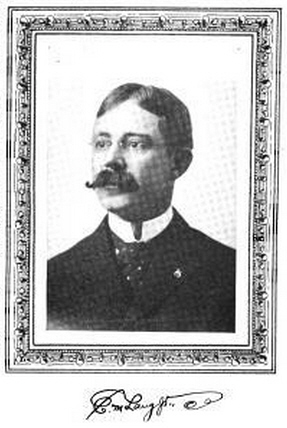
History of Richmond County (Staten Island), New York from its discovery to the present time. Richard Mather Bayles.  1883

http://homepages.rootsweb.ancestry.com/~rbillard/french_baptisms.htm

Registers of the Births, Marriages, and Deaths of the Eglise Francoise a LA Nouvelle York: French Church of New York, from 1688 to 1804

http://freepages.genealogy.rootsweb.ancestry.com/~rclarke/page1/latouret.htm

http://latourette.blogspot.com/

Posted in 10th Generation, Double Ancestors, Huguenot, Immigrant - Continent, Line - Miller, Sea Captain, Storied, Veteran | Tagged , | 8 Comments

Jean Perlier III

Jean PERLIER III (1703 – 1771) was Alex’s 7th Great Grandfather; one of 256 in this generation of the Miller line.

Jean Perlier III was born 5 Sep 1703 in Staten Island, New York.  His baptism in the French (Huguenot) Church in New York City on 19 Sep 1703 was witnessed by his aunt and uncle Pierre Rezeau and Marie Rezeau. His parents were Jean PERLIER II and Anne REZEAU. He married Abagail JONES on 13 Jun 1734 in Edison, Bergen, New Jersey.  He moved to the Jersey settlement in North Carolina between 1750 and 1760 and became John Purlear.  Possibly, he married Ann [__?__] and had seven more children.  John died in 1771 in Davidson North Carolina.
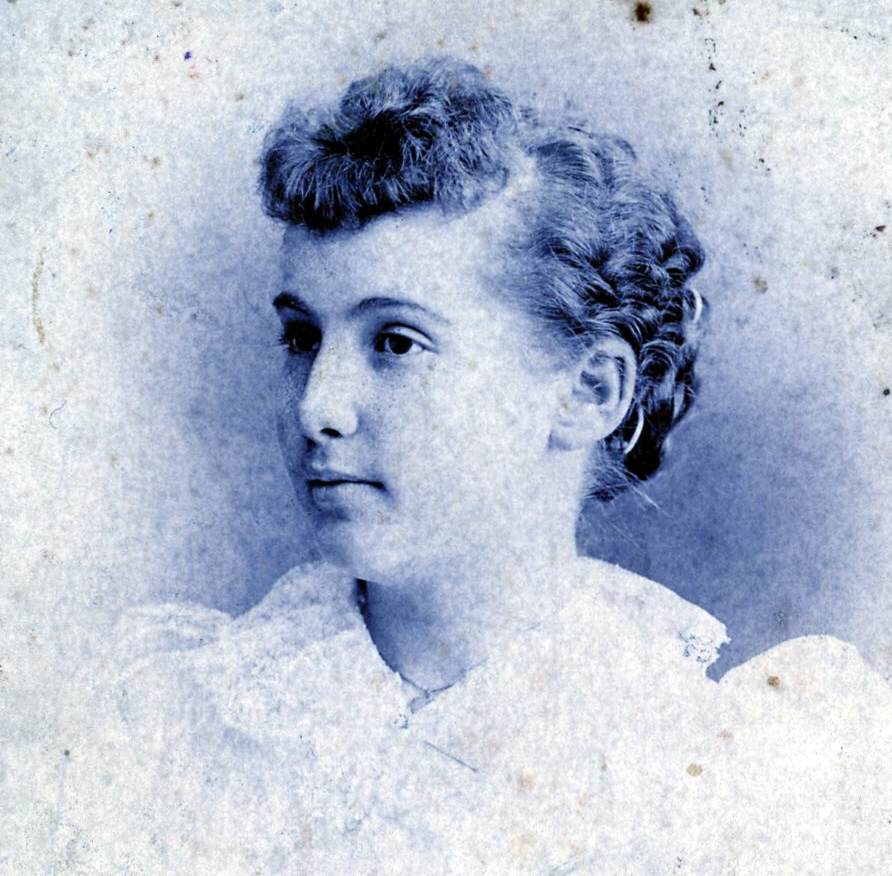
Huguenot Church New York City – “Saint-Esprit”, the French Reformed Church on Pine Street, New York,

Abigail Jones was baptized on 22 Apr 1702 in Staten Island, NY.  Her parents were likely Edward JONES and Catharine DECKER, but her origins are a bit of a mystery.   The baptism records of two of Abigail and Jean’s children appear in the Port Richmond (Staten Island) RDC bp 1696-1790:

Jun 3, 1734; Jean Parlie, Abigail Jones; Eduard; Nicolas Laselier, Esther Lakerman
Jun 13, 1736; Jean Parliez, Abigail Jones; Pieter; Pieter Parliez, Marie Parliez
It has been suggested that she was this Abigail baptized Apr 22, 1722; Parents Eduard Jones and Catharina Dekkers; Godparents Nicolas Lazilier and  Esther Lakeman

Nicolas Laselier and Esther Lakerman were the witnesses for both.   It seems reasonable because Abigail’s baptism and the baptism of Abigail’s son Eduard 12 years later so it’s clear the families were related. Obviously Abigail didn’t have a child when she was 12 years old so maybe she wasn’t baptized right away.

The Port Richmond baptism records of children of Eduard Jones & Catharina Dekkers’s other children fit more closely with a 1721 sibling than a 1702 one. Maybe our Abigail Jones had different parents.
1718 Jul 20 (Eduard)
1719 Nov 8 (Matteus)
1726 Aug 14 (Eduard)

Some sources show Abigail marrying second Samuel De Hart.  Maybe the 1721 baptized Abigail was a different woman.  On the other hand, it is possible John moved south and she stayed behind.  The graves or the record of the deaths of Jean or Abigail have not been found.

Children of Jean and Abigail:

Name Born Married Departed
1. Eduard Parlee (Parlie) 16 Jun 1734
Port Richmond Church Staten Island, NY
Elizabeth [__?__] 17 Dec 1816 in Amwell, Hunterdon, New Jersey
2. Peter Parlee Sr. (Pieter Parliez) Baptized
13 Jun 1736
St. Andrews Church, Fresh Kill, Staten Island, NY
Unknown Spouse
.
Lydia Robbins
c. 1770
Amwell, Hunterdon, NJ
1821 in Sussexvale, Kings Co., New Brunswick, Canada
3. Ezekiel Parlee 1738
4. Elizabeth PARLEE 1740
Hunterdon, NJ
Nathaniel PARKS
1760
Canaan, Connecticut
1815 – Saint Martins, New Brunswick, Canada

.
Children of John Parlier (possibly our Jean) and Ann [__?__]:

Name Born Married Departed
5. Isaac Newton Parlier 1745
Abbotts Creek Davidson County, NC
 [__?__]
bef. 1775
Wilkes County, NC
.
Mary Soots
2 Aug 1799
Wilkes County, NC
1835
Wilkes County, NC
6. Nancy Purlee ca. 1749
Abbotts Creeks, NC
John Cole
26 Aug 1769
Rowan County, NC
7. Jacob Parlier 1751
Abbotts Creek, NC
Rachel  [__?__] 11 May 1791 – Iredell, North Carolina
8. Charles Parlier ca. 1751
Abbotts Creek, NC
Sarah Grant
22 Sep 1779
Rowan County, NC
9. William Pariler (Perly) ca. 1759
Abbotts Creek, NC
Elizabeth Buttram
28 Jan 1778
Davie County/ Abbotts Creek
ca. 1778 Abbotts Creek, NC
10. Frederick Pelur
11. Richard Parlier

.
An Abigail Jones was baptized 1721 in Staten Island, New York, and died April 24, 1804. She married on 28 Sep 28, 1748 in Staten Island, New York to Samuel De Hart (12 Aug 1717, Staten Island – 17 May 1798, Port Ricmond, Staten Island)  son of Daniel De Hart and Catalyntje “Catherine” Jans Van Pelt. Burial: Port Richmond Reformed Church, Staten Island, New York.

DE HART. Of the ancestors of this family on the island, there is but little to be learned from the local records. What we have been able to glean is as follows : Daniel had a son Daniel, baptized October 22, 1707 ; a daughter, April 17, 1711 ; a son Matthias, baptized in 1715 ; a son Samuel, baptized in 1717, died May 17, 1798. Baltns and Mary Phillipse had daughter Catalyn, baptized 1746-‘7. Matthias, born August 21, 1749, died October 20, 1840. Edward had a son Jacob, baptized October 24, 1790. Stephen married Margaret Ryers in September, 1792

Will of Samuel DeHart of Staten Island in Richmond County, N.Y. I leave to my wife Abigail the one half of my farm which I live on and to Samuel, my oldest son, all my waring apparel. The remaining part of my estate to be sold and equally divided between all my children, Samuel, Edward, Catherine, Matthias, Daniel and Moses, except my daughter Catherine’s share shall remain with the executors during the life of her husband, Garret Post. I appoint my five sons Samuel, Edward, Matthias, Daniel and Moses my executors.
Witnesses Nehimiah Tunis, Jeffery Baldwin and Aaron Van Name.
Dated Aug. 11, 1785. Proven Jun 1, 1798

Children of Abigail Jones (possibly our Abigail) and Samuel De Hart

Name Born Married Departed
12. Samuel De Hart 20 May 1750
Staten, Island, NY
Eleanor Van Tine
1750
Dec 1819
Staten Island, NY
13. Edward De Hart 1753
Staten, Island, NY
Catherin Barkelow
1778
26 Dec 1791
14. Catherine De Hart 14 Mar 1756
Elizabethtown NJ
Garret Post
abt. 1774
3 May 1813
Staten Island, NY
15. Mathias De Hart 1 Sep 1758
Staten Island, NY
Elizabeth Decker
1789
Elizabethtown NJ
29 Oct 1849
Staten Island
16. Daniel De Hart 26 Aug 1760
Staten Island, NY
Elizabeth Von Busen
1779
Staten Island, NY
29 Jan 1842
Staten Island, NY
17. Moses De Hart 16 Jul 1763
Staten Island, NY
Sophia [__?__]
1783
 13 Aug 1833


The Perlier family were from Staten Island, but, after Jean Perlier II’s  death in 1723, the family, like many of their neighborns removed to New Jersey. They came by way of Perth Amboy, the Raritan and Millstone Rivers, and thence the branches of said rivers into Hunterdon Co. The Perliers were found in Amwell Township, and we believe this is where Nathaniel met and married Elizabeth Perlier.

Westerners like me think of Staten Island as part of New York City,  as you can see from this map, it’s not far from Staten Island to Hunterdon in New Western Jersey

It is possible that Jean and Abigail went with a group of residents of Hunterdon County New Jersey to the Abbots Creek area of Rowan County NC (Davie County). The settlement was called the Jersey Settlement. The move probably took place between 1750 and 1760. We find the Vannoy and Green families in this group that came from Hunterdon County New Jersey. Later they are in Wilkes County NC along with Isaac Parlier, the son of a John Parlier (Rowan County). The Jersey Settlement Church, a colony of Baptist, moved from Hunterdon County New Jersey between 1747-1755.”

The first settlers of the Jersey Settlement were Hopewell citizens who migrated after being swindled by Proprietors and royal Governors, especially Dr. Daniel Coxe and his son Col. Daniel Coxe, two powerful and greedily villainous Proprietors, in “The Coxe Affair.” (The story of the Coxe affair is covered in Roger PARKE’S profile) They were founding this settlement so that they (and groups that followed) could recoup losses suffered when New Jersey’s Supreme Court invalidated deeds to thousands of acres in Hopewell, land their fathers had purchased as wilderness.

Minutes of The Court of Pleas – Rowan County – Jan. 8 1765 Will of Nicholas Feazor proved by : John Purlear and Jacob Cress. Spurgeon

Tax List of 1768 – Rowan County NC – Abbott Creek John Purlear and son Isaac Superior Court – Rowan County –

August 10, 1769 ” John Purlear a poor sick infirm old man, 66 years of age recommended to the General Assembly of this Province to be exempted from paying taxes and other public dues ”

Records of the Moravians in North Carolina – Volume 2 – Page 798 ” Old Peter Kuhn is mentioned in the Abbotts Creek neighborhood; also the widow Parloer, an elderly woman, a neighbor of Jacob Wagner. Her husband whose first name is not given, had died in 1717.” Rowan County Tax List of 1770 – Abbotts Creek Isaac Perlaire Jacob Perlaire Rowan County

Tax List of 1773 – Abbotts Creek Isaac Purlear Ann Purlear for son Jacob Purlear this John Parlier may be the same as the Jean Perlier of Staten Island and Hunterdon County New Jersey. The age is the same and the number of families that surrounded him in the Jersey Settlement were from Hunterdon County New Jersey. Also note the family names such as Isaac that appear in both families. However there has not been found to date any proof that this John Parlier is indeed the same as the one from Hunterdon County. If this is the same John, then it appears that Abigal may have died and John has married a woman by the name of Ann ?.

Children

1. Edward Parlier

Edward’s wife Elizabeth [__?__] died in 1817 in Amwell, New Jersey. Elizabeth first married [__?__] Holcomb.

Edward signed his will 29 August 1812 in Amwell Township, Hunterdon County, New Jersey, and it was proved 17 December 1816..

Edward Parlee Will 1

1812, Aug. 29. Parlier [Parlee], Edward*, of Amwell Township., Hunterdon Co.; will of.

Wife, Elizabeth, and granddaughter, Elizabeth Parlier, the house and lot where I live; also 11 acres woodland and swamp; moveable estate as she chooses, for life and until marriage of granddaughter, at which time wife is to decide whether said granddaughter shall live any longer in the home; also bed and bedding.

Granddaughter, a spinning wheel. Five acre lot in the Swamp bought of Lem. Pearson and other moveable estate to be sold. At death of wife residue to be sold. To aforesaid granddaughter, $1,600. To 5 children of my daughter, Abigail Tracksler [unnamed], $266.67. Daughter, Sarah Riarson, $3. To Samuel Holcombe (son of my wife), $266.67. Residue to daughter, Ann Paxon.
Executors — friends, Asher Stout, William Bishop.
Witnesses — Henry Runkle, William Hoff, Gitty Hoff.
Proved Jan. 2, 1817.

1816, Dec. 17. Inventory [not totaled]; made by Gideon Ewing,
Peter Vanfleet. File 2892 J.

* Signed by mark.

Children of Edward and Elizabeth:

i. Abigail Parlee; m. [__?__] Tracksler

ii. Anne Parlee  b. ~1765; m. to William Paxson (b. 25 Dec 1765 Hunterdon County, NJ – d. Mar 1820 or 1829) William’s parents were William Paxson and Rachel Johnson. William had first married 9 Aug 1792 Kingwood, Huntingdon, NJ to Elizabeth Paxson and had a daughter. Elizabeth and William had five children born between 1798 and 1809..

iii. Elizabeth Parlee

iv. Sarah Parlee m. [__?__] Riarson

2. Peter Sur Perlier

Peter’s second wife Lydia Robbins was born in 1735 in Amwell, Hunterdon, New Jersey.
Her parents were John Robbins and Eleanor [__?__]. Lydia died 21 Mar 1820 in Sussex Vale, Kings, New Brunswick, Canada

Parlee Brook Ice Falls near Sussex, New Brunswick.  —  Peter left dozens of grandchildren in the area.  Parlee Brook is named for the family.

Peter had five boys and at least 45 Parlee grandchildren, so they were able to found the hamlet of Parlee Brook all on their own.

Parlee Brook is one of the ice climbing meccas in New Brunswick. Nestled in a hidden canyon, lies several (12) ice lines ranging from WI 2 to 4+. The ice begins to form around mid December.  More pictures of ice climbing at Parlee Brook.

Directions: Make your way to Sussex, then to Waterford (follow the blue signs to the Poley Mountain ski area). Before you reach the ski hill, turn right onto the Parlee Brook Road. The road is paved but becomes dirt. Once you see “The Abbey” take the road before it called Arnold’s Hollow Road. The province maintains this road but it can get pretty rough or washed-out near the bottom. Head up the hill, then down the hill and park opposite the camp. Walk for about 5 minutes until you come to an area on the left that has been logged. Go past a very “burly” spruce tree on your left (see pics) and look for a very small stream that crosses the road. Turn left up this stream; it will lead you into the amphitheatre.

John Robbins’ farm was an original land grant to the Robbins family from the descendants of William Penn. It is now know as “Robbins’ Nest Farm.” John and Eleanor’s children were: John Jr., Cornelius, Job, Anna, Mary, Elizabeth, Hannah, Jane, Rachel, Lydia and Catherene.

Peter  met and married Lydia Robbins in Amwell Township, Hunterdon, New Jersey, the same place Elizabeth met Nathaniel PARKS, as the Robbins family lived there also.  He is located in Durham Township, Bucks Co., PA before the American Revolution. His name also appears on several Muster Rolls for the 2nd New Jersey Volunteers, an Artillery Battalion. At the close of the War, his land was confiscated and he resettled in Sussex, New Brunswick, after being captured by American forces at least twice. Peter was married twice, but his first wife’s name is not known. His second marriage was to Lydia Robbins (married between 1764 and 1774).

Peter was a British Loyalist.  By 1740, Pennsylvania had become the nation’s first melting pot.  The 1775 tax records show Peter owned a large farm of 164 acres in Durham Township, Bucks County, Pennsylvania, which was directly across the Delaware River from Kingwood Township, Hunterdon County New Jersey, where his sister Elizabeth lived with her husband, another Loyalist who relocated to New Brunswick Nathaniel PARKS. Nathaniel owned land in both Hunterdon County NJ and in Bucks County, Pennsylvania.

One of the most informative documents is Peter’s claim for losses submitted to the British authorities in 1786″

” Peter Parlier, late of Bucks County in the province of Pennsylvania,  but now of York County in the Province of New Brunswick, begs leave humbly to represent, that at the commencement of the unhappy dissensions he was possessed of a real estate for which he had honestly paid and expended in improvements the sum of three hundred pounds Pennsylvania currency. And that he also possessed various other property as enumerated in the annexed schedule.

That your Memorialist in consequence of his loyalty to his Sovereign and attachment to the British Goverment, has suffered a loss of all the said property by its being taken and destroyed or confiscated and sold by the Americans.

That your Memorialist joined the British Army in April 1777 after suffering grevious persecutions and abuses. He immediately enlisted as a private solider in the 2nd Battalion of the New Jersey Volunteers commanded by Lieut. Col. Allen, in which batttalion he continued to serve until the same was disbanded.

That in April 1779 he was employed in the recruiting service and was taken prisoner and robbed of forty pounds.

That in 1781 he was taken prisoner again and confined three months and was at the expense of at least thirty pounds. That your Memorialist exerted himself to the best of his ability in the King’s service and was frequently employed in dangerous and arduous services, as he can make appear.

That he is now with a wife and five children reduced to poverty. He therefore humbly hopes that the Commissioners will take his case into consideration allow him to produce evidences of the facts herein set forth when they shall arrive in the Providence of New Brunswick and otherwise relieve him. And as in duty bound, Peter Parlee. ”

The attached summary of his losses provides the following information:
” Schedule of property belonging to Peter Parlier, taken from him in December 1776 and destroyed to prevent the British Army from crossing the river Delaware. [Peter lived just a few miles from Washington’s crossing of the Delaware River, which occurred on the night of December 25–26, 1776]

3 Durham Boats
1 Skiff, a chain and crowbar
16 setting pole irons
8 pair of oars, pots, axes, chest etc.

Witnesses:
Captain Thatcher, Daniel Shannon, Joseph Parks, Thomas Simmons

Durham boat used in a reenactment of Washington’s crossing of the Delaware River

The Durham boat was a large wooden boat first produced by the Durham Boat Company of Durham, Pennsylvania, starting in 1750. They were designed by company owner Robert Durham to navigate the Delaware River and thus transport the products produced by the Durham Forges and Durham Mills to Trenton, New Jersey and Philadelphia, Pennsylvania.  From about 1803 – 1820, a larger version of the Durham boat was crucial to operations on the waterway connecting the Hudson River to Lake Ontario via the Mohawk River.

They were flatbottomed boats – provided with keels – with high vertical side which ran parallel to each other up to a point 12 to 14 feet  from the boat’s ends, where they then tapered. The boats were constructed of 1.25-inch   thick planks and measured up to 60 feet  long by 8 feet  wide by 42 inches   deep. They displaced a draft of 3.5 inches when light and 28 inches when fully loaded. Since both ends were tapered, either end could serve as the bow of the boat since the heavy steering gear, called a “sweep.” could be shifted to either end. As a result, the boat could go in either direction depending on the placement of the steering sweep and the movement of the poles or oars.

They were designed to be able to carry a maximum load of 17 tons while traveling downstream and two tons while traveling upstream. Thus they could carry 150 barrels  of flour or 600 bushels of corn. It took three or four men, plus a steersman, to operate the boats. Moving downstream they used 12-foot  to 18-foot  long “setting poles” mainly for steering and when moving upstream they used these poles to push the boats upriver. The crew walked back and forth on “walking boards” built into the sides of the boats. Some were later fitted for the use of oars.

From 1803-1820, Durham boats were the watercraft of choice on the waterway for traffic between the Hudson River and Lake Ontario via the Mohawk River. The eastern terminus of this waterway was in Schenectady, New York, and the Durham boats were also known as Schenectady boats in this region.  The waterway was the major one connecting the eastern seaboard of the United States to the continental interior. The improvements to it that made the use of Durham boats practicable were an important prelude to the construction of the Erie Canal. Durham boats aren’t designed as canal boats, and their era on the waterway along the Mohawk largely ended with the canal’s opening in 182

Washington Crossing the Delaware by Emanue Leutze 1851

Back to the list of Pete Parlier’s losses:

February 1778
Taken for fines levied for not turning out against the King’s Army
2 Cows
1 Horse
Witnesses:
Cornelius Parlier and Peter Parlier Jr.

Taken by James Morgan from the wife of Peter Parlier by order of Congress – November 1779
25 Bushels Buckwheat
30 Bushels Rye
5 Stocks Bees

Witnesses:
Cornelius Parlier and Peter Parlier Jr.

Peter stated that he was on actual service with the King’s Army until October 24 1783 and after that he resided in the Province of New Brunswick. Records show that his property in Bucks County Pa. was sold at public auction the 28th day of June 1780, for the sum of 6600 pounds.

The New Jersey 2nd Battalion served as artillery men. The inception of the corps can be traced to its commander, Lieutenant Colonel John Morris , joining the refugees from Monmouth County on the first arrival of the British fleet off New York in late June of 1776.

Morris, a half-pay lieutenant of the 47th Regiment of Foot who had previous military service, convinced Brigadier General Cortlandt Skinner and the British that he could raise a battalion, and therefore declined serving under Elisha Lawrence. With the British entry into New Jersey in late November of 1776, his plans commenced.

Morris competed directly with Elisha Lawrence in seeking recruits from his home area of Monmouth County. As quickly as he raised men they were thrown into action. On 2 January 1777 four of his men were killed in battle and as many as thirty others captured near Monmouth Court House in Freehold.

The next month they worked in conjunction with the British 26th Regiment of Foot in surprising a large body of militia between New Brunswick and Perth Amboy. In addition to the troops at New Brunswick, there was a detachment in garrison at Sandy Hook, providing a guard for the important light house there.

This would be the sum of their operations while in garrison at New Brunswick until 30 April 1777 when they were ordered to New York to commence immediate service with the Royal Artillery Regiment.

Attaching the 2nd battalion to the Royal Artillery was a stop-gap measure designed to make up for a shortfall in regular artillery men from England. It was suggested that Sir William Howe, the British Commander in Chief, might raise a new Provincial regiment of 300 men to fill this need. Needing the men for immediate service though, Howe could not wait for the amount of time it would take to recruit that many men.

General Sir William Howe made the 2nd New Jersey an Artillery Battalion

The 2nd battalion, roughly the number of 300 men, was therefore chosen as a mark of honor for their service to that point. They would have to learn the trade of artillery on the job, as the bulk of the battalion set sail in July of 1777 with Howe and thousands of British, German and Provincial soldiers to do battle with Washington and capture Philadelphia.

The Philadelphia Campaign was a successful one, both for the British and the 2nd battalion. While losing perhaps only one man total through the bloody battles of Brandywine and Germantown, they were swarmed with new recruits, many of them deserters from the Continental Artillery at Valley Forge.

Others were Loyalists from the lower counties of New Jersey on the Delaware, while a whole company under Captain Donald Campbell was added from Major William Stark’s corps of New Hampshire Volunteers. Despite the name, this company had been raised in Philadelphia, being added to the NJV in January of 1778.

The men enjoyed their stay in comfortable quarters in Philadelphia. Their main duties, when not being instructed in the artillery exercise, involved gathering and stacking firewood, sometimes forming detachments to make incursions for this purpose in the countryside.

They formed a part of the army under Lt. Colonel Charles Mawhood that located and destroyed two militia outposts at Quintin’s and Hancock’s Bridges in South Jersey. Some of the men were given to the different British brigades to help serve the battalion guns attached to them. They were augmented later in the spring by the rest of the battalion from New York, minus Lieut. Colonel Morris who was in ill health.

With the evacuation of Philadelphia, the battalion marched with the Royal Artillery back to New York. Before reaching Sandy Hook, their point of embarkation to the city, they fought in the largest encounter of the war, the Battle of Monmouth.

The past year’s training came into great use, as the artillery was engaged heavily throughout the contest. An indication of the fierceness of the fighting and their forward role in it is their loss of four men killed serving the guns while the Royal Artillery lost none. The Battle of Monmouth would prove the last time they would fight with the entire battalion present.

Once returned to New York, the men were divided up among every outpost on the lines and every brigade in the army. While the men did their duty, it proved of little service to the officers. Since the men were doled out in fives and sixes, these detachments were too few in number to be commanded by a commissioned officer.

With no other duties to attend to, the officers’ chief function was to sit on whatever court martial might present itself, an unglamourous duty indeed and hardly one for which they would have signed on.

The duty with the artillery would continue through 1779 and lead to a bizarre incident involving Brigadier General Skinner and Lt. Col. Morris. Skinner had lost touch with the battalion while in Philadelphia and had exerted little control over them after their return.

Wishing to correct that, he asked for bi-monthly states of the battalion which Morris refused, claiming he was not under Skinner’s command. Morris was eventually placed under arrest and tried for disobedience of orders, found guilty and sentenced to minor punishment. Even this, though, was remitted by Sir Henry Clinton, who had replaced Howe as Commander in Chief.

The 2nd battalion was finally given its freedom from the artillery in November of 1779 and was once again allowed to consolidate and act as a battalion of infantry.

To their dismay, the many months of artillery service had bled them of manpower. Virtually no recruiting had been done since Philadelphia, and there were no men to replace the many desertions, deaths and discharges that had occurred since.

When they made their way to their various posts on Long Island (Jericho, Jerusalem and finally Lloyd’s Neck), they barely numbered 150 officers and men. Thankfully for them, they were able to recruit a goodly number of Rebel deserters (and possibly a few prisoners of war) to help bolster the ranks.

While at Lloyd’s Neck the battalion saw little or no action. Their main duties there were to provide guards for the various woodcutting parties and shipping. For the latter duty they served as marines on board various armed brigs and sloops of the Quarter Master General’s Department, a task performed by NJV from almost every battalion at some point during the war.

For more action there was always the post at Sandy Hook, where a detachment from the 2nd battalion did duty after June of 1780. Often going out in small parties with armed refugees into Monmouth County, they proved a great nuisance to the countryside, occasionally capturing prisoners, the most notable of whom was Captain Joshua Huddy.

Taken by a party commanded by Lieutenant Josiah Parker, Huddy would be exchanged, only to be captured again and hanged in 1782 by Captain Richard Lippencott of the Associated Loyalists, formerly an officer in the 1st Battalion, New Jersey Volunteers who had several kin in the 2nd battalion.

The post at Lloyd’s Neck was due to be turned over to the Associated Loyalists in June of 1781. With no further need of Provincial forces there, the 2nd battalion commenced its march to Brooklyn, where they would be ferried across to Staten Island. Once there, their career as a battalion was finished, and they were drafted into the 1st and late 4th battalions, one company to the former and three to the latter.

Lieut. Colonel Morris would finish the war uneventfully upon half pay, not having really commanded the battalion since 1777 due to the artillery duty and his later illness. Some of his fellow officers would join him on half pay, while Samuel Richard Wilson , disgraced by a court martial in 1780, found a home in the Royal Garrison Battalion, and Ensign LeGrange joined the 60th (Royal American) Regiment of Foot.

After the war the bulk of the 2nd New Jersey Volunteers arrived at Saint John, Canada on the ship ” Duke of Richmond “. The soldiers received grants of land in a block along the St John River when the regiment was disbanded for their service of the King. Peter settled near Long Creek, Queens County, New Brunswick, Canada on July 29 1785. Later Peter Parlier received a grant from the British Government for land in Sussex Township, Kings County, New Brunswick, Canada on the north bank of the Big Salmon River.

Footbridge over Big Salmon River

Children of Peter and [__?__]

i. Isaac Parlee b. 28 May 1762 Jersey City, Hudson, New Jersey; d. 11 Nov 1831 Studholm Millstream, Kings County, New Brunswick; Buried in the Old Berwick Cemetery; m. 5 Jul 1789 Sussex Vale, Kings, New Brunswick to Mary “Polly” Cacy “Casey” (b. 14 Oct 1771 in Dublin, Ireland – d. 7 Sep 1848 in Millstream, Kings, New Brunswick) Her father was John Cacy (b. 1750 in Ireland – d. 1783 in New York) Isaac and Polly had thirteen children (ten girls) born between 1790 and 1816.

Isaac Parlee was residing in Bucks County Pa. before relocating to St. John River, Canada. Isaac and Polly were married at Sussex Vale, Kings County, New Brunswick, Canada by Rev. James Scovil on July 5 1789. By 1790 they lived in Kings County again. In 1832 his will was intestate with administration of such being granted to Mary on March 6, 1832.

ii. Peter Parlee b. 21 Aug 1764 in Bucks, Pennsylvania; d. 29 Jan 1832; m. 8 Dec 1789 to Keziah Harned (b. 19 Apr 1773 in Sussex, New Jersey – d. 07 Feb 1832 in Studholm, Kings County, New Brunswick). Keziah’s father was Benjamin Harned (b. ~1726 in Locktown, Hunterdon, New Jersey – d. Sussex, Kings, New Brunswick) Peter and Keziah also had thirteen children born between 1792 and 1817, but this time only 7 girls.

iii. Cornelius Parlee b. 19 Oct 1767 in Mount Bethel, Northampton, Pennsylvania; d. 3 May 1847 Sussex Vale, Kings, New Brunswick; m. Barbara Snyder

Children of Peter and Lydia Robbins

iv. Edward Parlee b. ~1772 New Jersey; d. ~1824 Sussex Vale, Kings, New Brunswick; m. Sarah Wilcox (b. ~ 1774 Dutchess, NY – d. 2 Feb 1844 in Sussex, Kings, New Brunswick) Her parents were Loyalists Robert Wilcox and Diana Bush of Dutchess County, NY. Robert and Diana were among the Loyalist pioneers of Sussex parish, Kings County, New Brunswick. They settled on Lots 9 & 10 at the mouth of the Smith’s Creek.

Alternatively, Sarah’s maiden name was Sarah Bosch (b. 9 Jun 1775 in Poughkeepsie, Dutchess, New York).

Edward and Sarah had eight children born between 1795 and 1814. After Edward died, Sarah may have married again to John Pollock.

v. Abraham Parlee b. ~1773 Durham, Bucks, Pennsylvania; d. 3 Oct 1861 Head of Millstream Union Baptist Cemetery, Millstream, New Brunswick; m. Lydia Waddington (b. 1775 in Pennsylvania – d. 5 May 1848 in Head of Millstream, Kings, New Brunswick; Burial Head of Millstream Union Baptist Cemetery); Abraham and Lydia had eleven children born between 1794 and 1815.

4. Elizabeth PARLEE (See Nathaniel PARKS‘ page)

5.  Isaac Newton Parlier

Isaac’s second wife Mary Soots was born ~ 1750 Davidson, North Carolina. Her parents may have been Johann Jacob Soots and Mary [__?__]. Johann changed his name to John after arriving in America. Mary died in 1803 or 1835 in Wilkes, NC . The family usually spelled their last name as “Suits”. They were in the Wilkes County and Rowan County area at the same time as the Parliers.

Mary Soots remains a mystery, as very little information has been found on her. We know that she was not the mother of the children of Isaac Parlier Sr., as all the children where born prior to her marriage to Isaac Parlier Sr.. The 1790 census shows a family of nine children, 6 daughters and 3 sons. Under the notes for Isaac Parlier Sr. The Marriage bond for Mary Soots and Isaac Parlier Sr. clearly spells the last name “Soots”.

Isaac was a constable in Capt. Judd’s Dist. ” between 1783 and 1797

27 Oct 1785  – ” Isaac Parlier appointed Collector of County and District taxes

We Isaac Parlier and Jeremiah Crisel acknowledge ourselves indebted unto William A. Davis Esq. Governor in the full sum of 500 pounds to be paid to the said governor or his successor in office to be void on indication that there be no just cause to obstruct said Isaac Parlier intermarriage with Mary Soot but if it be in every respect lawful then the above obligation to be void or else to remain in full force and virtue witness our hand and seal the 2 of August A.D. 1799

Children of Isaac and [__?__]

i. John O. Parlier b. 1774-1784 Davidson County/Irdell County, NC. d. Perry County, Illinois?; m. Charity [__?__] (b. 1778 North Carolina – d. Aft 1850)

August 20 1810 – Wilkes County Deed Book G-H – #142
” Between John Parlier of Wayne County Kentucky and Monfort Stokes of Salisbury, Rowan County NC, 50 pounds – 173 acres on North side of Yadkin River on big branch of Luke Lee’s Creek, called Mill Creek….path going from Crains to Suttons…Miller’s line…..original grant to Benjamin Glover; from Glover to Isaac Parlier and John Parlier. ”
Witness:
Benjamin Bruce Signed: John Perlier
Enoch Brookshire

1810 Wayne County Kentucky Census
John Purlee
1 – Male 26 – 45
2 – Male 10 – 16
3 – Male 0 – 10
1 – Female 26 – 45

” In 1816 John Parlier recieved a land warrant in Cumberland County Kentucky ”

1840 Perry County Illinois Census
John Perlier
1 – Male 70 – 80
1 – Male 40 – 50
1 – Male 30 – 40

In the 1850 census, Charity Parlear was living with her son Abraham’s family in Sangamon, Illinois

ii. Unknown Male Parlier b. bet. 1774-1784

iii. Unknown Female Parlier b. bef. 1779

iv. Unknown Female Parlier b. bef. 1779

v. Unknown Female Parlier b. bef. 1779

vi. Margaret Parlier b. ~1779 Wilkes County, NC; d. Aft 1833 White County Illinois; Buried Ebenezer Cemetery, Norris City ; m. 22 May 1813 Wilkes County, NC to Robert Bruce (b. ~1764 Culpepper County, Virginia – d. ~1833 White County, IL; Buried Buried Ebenezer Cemetery) Robert’s parents were John Bruce (1740 Edinburgh, Scotland – 1816 Wilkes, North Carolina) and Mary Smith (1745 – 1818). Robert first married 1784 to Salley Banton (b. 1765 in Wilkes, North Carolina – d. 1813 in Sumner, Tennessee) and had children Polly, John, Robert, Benjamin, and Nancy.

There is no proof that Margaret is the daughter of Isaac Parlier Sr.. However the husband of Margaret was closely aligned with the Crysel family of Wilkes County NC. Jeremiah Crysel married the sister of Robert Bruce, and Robert’s brother Benjamin married Jeremiah’s sister Mary. Jeremiah Crysel was the bondsman for Isaac Parlier Sr.’s second marriage and was a neighbor of Isaac. The Bruce family was also neighbors of Isaac Parlier Sr.. Her age and proximity to Isaac leads us to assume that she was his daughter.

Shortly after marrying 22 May 1813 – Wilkes, North Carolina in Wilkes County, Robert and Margaret moved to Sumner County Tenn. Their first child was born there in 1814. By 1817 they have moved to White County Illinois. Robert and Margaret are listed on the 1820 census of White County Illinois. They had three children, Benjamin, William and Isaac born between 1812 and 1815.

In a will dated 17 Dec. 1832 Robert appointed Henry Trusty (believed to be his son-in-law) to be executor, and named William Matison, Bruce and Isaac Jones Bruce his lawful heirs; he gave all his personal property to them to maintain their mother, but directed that out of his property should also be paid the following: Polly Banton 25 cents, John Bruce 25 cents, Robert Bruce 25 cents, Nancy Martin 25 cents and Benjamin Bruce 26 cents. The will is witnessed by John Bruce and John C. Forrester, probated 18 Mar. 1833.

The five children receiving 25 cents each are presumed to be Robert’s living children by his first wife. He is listed in the 1790 census of Wilkes Co. NC with his wife, one son under age 16, and one daughter. In the 1800 Wilkes census, Robert and his wife are between 26-45 years, and they had one son and one daughter 10-16 yrs., plus three sons and one daughter under 10. There were three slaves in the household.

The move out of Wilkes County apparently was occasioned by the death of his first wife. The date is uncertain and the Sumner Co. TN records are quite confusing because of the presence of another Robert Bruce who moved there ca 1801; this later Robert, wife Tabitha Cochran, most likely was unrelated and a son of Robert Bruce, Sr. of Caswell County , NC “Our” Robert lived in Sumner County until 1817 when he moved to White County, Illinois, but he is believed to have left his son, Robert, in Sumner since two Robert Bruce families still are listed there in 1820. Settling near Norris City, White Co. NC, Robert and Margaret are listed in the 1820 census as parents over age 45 yrs., with two boys 16-26 and two boys under 10. The two older apparently are sons of his brother, Benjamin, a conclusion reached by a statement of one of the boys (John) in his application for bounty land for service in the War of 1812; he said that he left Wilkes Co. right after his discharge and left his papers with his father to collect his pay; he stated further that his father died and that the papers were lost. Mary Crysel Bruce collected money from his estate at that time.

vii. Rachel Parlier b. ~1779 Wilkes County, NC; d. Blount, Tennessee; m. 24 Aug 1799 Wilkes County, NC to William Grigsby.

All that is known of this family is the Marriage that took place in Wilkes County NC in 1799. There is nothing to link Rachel to Isaac Parlier Sr.. It is possible that she was the daughter of Isaac’s brother William Parlier of Rowan County who left an heir by the name of Rachel who was living in Wilkes County at the time. T

No records of this family in North Carolina after their marriage in 1799 have been found. There are no land records or tax records, and they do not appear on the 1800 census of North Carolina. It is evident that they left North Carolina before 1800, possibly going to Tenn., Virginia, or Kentucky as William Grigsby’s are found in each of these areas in 1800. Much more research needs to be done on this family.

viii. Elizabeth Parlier b. ~1785 Wilkes County, NC; Lived in Ashe County, NC in 1840 census; m. 18 May 1811 Wilkes County, NC to Isaac Tinsley (b. 1780 Essex, Virginia – d. Aft. 1840 census Ashe County) Isaac’s parents were Isaac Tinsley Sr. (1720 – 1802) and Susannah Chiles (b. 1720).

Very little information is available on this family. From early land records and census records, it is apparent that after their marriage in 1811, that they lived in close proximity to Isaac Parlier Sr.. There is no proof that she was the daughter of Isaac Parlier Sr., but the age range along with the fact that they were neighbors would lead us to assume that she is a daughter of Isaac. In the 1810 census of Wilkes County, Isaac has 2 daughters between the age of 16 and 26. By the 1820 census, both daughters are absent from the Isaac Parlier Sr. household.

1840 Ashe County NC Census
Isaac Tinsley
1 – Male – Age 50 – 60
1 – Male – Age 15 – 20
1 – Female – Age 50 – 60
2 – Female – Age 15 – 20

ix. Isaac Parlier Jr. b. ~1790 Wilkes County, NC; d. Aft 1880 Wilkes County, NC; m. Martha [__?__] (b. ~1790 Wilkes County – d. Aft. 1880 Wilkes, NC)

There is no proof that this Isaac Parlier Jr. is the son Isaac Parlier Sr. but we have to assume that since he was a junior and lived in the same area as Isaac Sr. with no other Isaac Parliers present, then he must be his son. It appears that their was not any children from this union, as no children ever appear on any of the census records. He doesn’t show up until the 1820 census of Wilkes County.

Isaac and Martha were recorded in Upper Division, Wilkes, North Carolina in the 1850 and the 1860 census, though the two records show different birthdates.

6. Nancy Purlee

Nancy’s husband John Cole was born in 1750 or 1754 Rowan, North Carolina. His parents were William Cole and Mary Huland. John died 1810 – Alabama.

I have no proof that Nancy was the daughter of John Parlier, except that John appeared to be the only Parlier in his age group in the area at the time and all the other Parliers that are found in Rowan County apparently are connected to him. The date of her marriage to John Cole in 1769 indicates that she was the daughter of John and the sister of other Parliers in the Rowan County area.

Rowan County Marriages
Nancy Purlee – John Cole
August 26 1769 – Adam Harmon bondsman – Thomas Frohock witness
both Nancy and John were living in the Abbotts Creek area of Rowan County NC

Child of Nancy and John:

i. Isaiah Hosea Cole b. ~ 1780 in South Carolina or Maryland; d. 1860 in Graham, Randolph, Alabama; buried Bethlehem Campground United Methodist Church Cemetery; m. 1807 to Nancy Green (b. ~ 1785 in South Carolina – d. Randolph County, Alabama; buried Bethlehem Campground United Methodist Church Cemetery) Isaiah and Nancy had twelve children born between 1807 and 1830.

They lived in Marlborough Co., SC in 1800, 1810, 1820. He is listed in Marion Co. in 1811-1814. Moved to Georgia in 1825? He lived in Fayette and Henry Cos. He probably lived in Heard Co., GA. Moved to Randolph Co., Alabama by 1839.

In the 1860 census, Isaiah H and Nancy were living in Northern Division, Randolph, Alabama

Isaiah was a private in Berthea’s Company of SC Militia in the War of 1812. See this article for details about his pension.

The records of the former General Land Office in the National Archives show that Military Bounty Land Warrant No. 55360, 40 acres, Act of September 28, 1850, was issued to “Hosea Cole, Private, Captain Bethea’s Company, South Carolina Militia, War of 1812.” Hosea Cole of Randolph County, Alabama, used this Warrant to locate the SE quarter of NE quarter of Section 2, Township 19 South, Range 12 East, Huntsville Meridian, in Randolph County, Ala. The land acquired with this warrant, consisting of 40 acres, was patented to him on May 3, 1853.

One record states “3 Auditors Office, April 26/52. Hosea Cole served in Capt. Berthea’s Co from 24th Sept. to 3rd Dec. 1814, (not readable) 40 acres. Name in signature not readable but below it is word ‘Slade’ then J.W.(?) Aud. Below that is the signature, E.M. Burgess, Randolph Co. Ala. Wt. 55,360 May 6/52 R.W.B. Then on the other Muster Roll (if it can be called that) 67980 April 14/55, Hosea Cole, Private (over line cross margin) Catp. Bethea, 130259
Col. Gaskew. S. Car. Mil. Enl’d Aug. 1814, War 1812. (not readable) 55360 40 acres. This is also signed by E.M. Burgess under which is Robert S. Heflin, Wedowee, Randolph Co. Ala.

In his statement given on eighth day of March 1851, Hosea Cole states he was mustered into service at Marion County court house, Marion Co. S.C., some time in August 1814. He had forgotten the date. He states that he is 66 years of age (1850 census of Randolph Co. Ala. shows him to have been 70 years old in 1850.)

One thing is noticeable, he remembered his Captain. There is a change in spelling of Berthea and Bethea. ‘Bethea’ is correct. That is why the write-up by Sellers in his History of Marion County, S.C. is given on another page. It explains how much one would expect a Captain’s men to love him and that his memory would stay alive even in their old age, as it had in the heart and mind of Hosea Cole. He signed in for 6 months, but the job was finished in 3 months, and he, among others, was discharged after serving 3 months. He served on Cat Island, about 12 miles below Georgetown, S.C. This statement was made and sworn to before Wm P. Dobson, J.P. 21 March 1855. There are statements by Joseph Benton, Judge of Probate, saying Wm P. Dobson was authorized to prepare official papers.

Today, knowing the price of government land at the time Hosea Cole was working so hard to receive 40 acres as a bounty gift for Military service in South Carolina, we wonder why he did not just enter the land and build his home, as he did after receiving title to the land. The compiler of this book saw this land in 1922. It was hilly, clay field and seemed of very little value even as a gift.

7. Jacob Parlier

Jacob’s wife Rachel [__?__] ( – d. ~1799 in Iredell County, NC)

Rowan County Tax List of 1770 – Abbotts Creek
” Jacob Perlaire and Isaac Perlaire listed in same household ”

Jacob does not appear on the earlier 1769 Rowan County Tax List with Isaac Purlear and John Purlear, which indicates that he was under 16 years of age at the time, since there is no pole listed for him.

Children of Jacob and Rachel

i. John P. Parlier b. 1780 Rowan County, NC; d. Wilkes County, NC; m. 27 Jun 1800 Wilkes County, NC to Betsy Gaines (b. ~1775 Culpepper County, VA – d. bef. 1850 Wilkes County, NC) Betsey’s parents were Henry Gaines and [__?__].  Alternatively, Betsey’s maiden name was Bullis.  John and Betsey had five children born between 1801 and 1815.

In the 1850 census, John was farming in Wilkes, NC with five children ages 24 to 34 at home.  He was in Kilbys District Wilkes, Co in 1840.

ii. Jacob Parlier b. ~1780

The occurance of the same name so many times in the same generation but in different families make it difficult to keep them straight but the references below refer to a Jacob Parlier that evidently is a young man or at least old enough to witness land records. The reference to him as a heir of Jacob Parlier indicates that he was at least 16 years of age in the year 1800.

May 20 1800
” Edward Griffith, John Smith, John Stevenson, James Scott, and Joseph Sharpe to serve as commissioners to make partition of the lands of Jacob Pulier among his Heirs to witness, John Pulier, Jonathan Pulier, and Jacob Pulier. ”

iii. Margaret Parlier b. ~1782 Davidson County/ Iredell County, NC; d. possibly Cumberland county, Kentucky; m. John Keaton (b. Iredell County – d. possibly Cumberland county, Kentucky)

iv. Jonathan Parleir b. ~1785 Wilkes County, NC; d. 21 Jul 1845 Wilkes County, NC; burried Parlier Family Cemetery, Pores Knob; m. 12 Feb 1811 Wilkes County, NC to Rebecca Shin (b. ~1792 Wilkes County, NC – d. 27 Apr 1872 Wilkes County; buried Jonathan Parlier Family Cemetery Pores Knob) Rebecca’s parents were Levi Shinn and Hannah Deboard.

” Know all men by those present that we Jonathan Parlier and Hugh Campbell in the afore said state are held and firmly bound unto the govenor of this state for the time being and his sucessors in office in the sum of five hundred pounds current money of the said state to which payment will be trully made, we bind ourselves with our seal this date 12th Feb. 1811.
The condition of the above obligation is such were as Jonathan Parlier hath made application for a licence for a marriage to be celebrated between him and Becky Shin. Now if there should not appear any lawful cause to obstruct said marriage than the above obligtion to remain in full force by our signature and seal delivered. ” Jonathan (X) Parlier
Hugh Campbell

1839 Wilkes County Tax List
Jonathan Parlier
5 – Horses
16 – Cattle
10 – Sheep
30 – Swine
100 – Gallons of Liqour Made (Distilery)

Estate Papers of Jonathan Parlier – Filed By Noah B. Parlier – January 14 1873
” When Jonathan Parlier died July 21 1845, he left his wife, Rebecca and the following children: ”
1. Jacob Benjamin
2. Sarah
3. William R.
4. Noah B.
5. Jonathan Wesley
6. John F.
7. James Wesley – murdered by Radford Barton Queen, his sister Nancy C Parlier’s husband..
8. George Wesley
9. Rebecca Emily
10. Elbert A. d. 1 Aug 1864 in CSA 37th NC Infantry Petersburg Va. of typhiod fever
11. Nancy C.

Seated- 7. Jacob Wesley Parlier and his wife Pheobe Cook. The first lady, standing, is Mary Elizabeth Parlier.Lady with no hand(lost in a cane mill accident) is Mary Ellen Cook and two of their daughters, probably Victoria and Ora

8.  Charles Parlier

Charles’ wife Sarah Grant was born about 1759

I have no proof that Charles was the son of John Parlier, except that John appeared to be the only Parlier in his age group in the area at the time and all the other Parliers that are found in Rowan County apparently are connected to him.

Rowan County Marriages
“Charles Perlee – Sarah Grant
September 22 1779 – Henry Winkler bondsman – Adam Osborn witness ”

North Carolina Militia Paroles – 1781
” Charles Perlee of Rowan County NC ”

9. William Parlier (Perly)

William’s wife Elizabeth Buttram was born Abt. 1759 in Davidson County/Abbots Creek. Her parents were  William Buttram and Margaret Willis. Elizabeth died 10 Nov 1853 in Sparta, White, Tennessee.

2 Oct 1778 – Rowan County NC Land Entries – #1621

” William Purlee 100 acres on a branch of Rich Fork of Abbotts Creek adjoining Obediah Ledford and Earhart Simmerman, including his own improvement. “

The phrase including his own improvement indicates that he had occupied the above property for at least 7 years prior to 1778. The Land Office of North Carolina was closed for many years prior to 1778 so a lot of people simply homesteaded a piece of property and when the Land Office reopened in 1778, they rushed to enter their lands legally. If we go back 7 years then we know William was living on the piece of property as early as 1771. He would have been about 12 years of age at this time which indicates that this is the same property that his father John Parleir had occupied along with wife Ann, and sons Isaac and Jacob. John Parlier had died circa 1771 and since Isaac and Jacob were out on their own by 1778, he was left to claim the land. Ann may have continued to live there with William after he married Elizabeth. ”

2 Dec  1778 – Rowan County NC Land Entries – #2643 ( replaces Land Entry #1621 )

” For and in consideration of the sum of Twenty-Five pounds, assigned over to Jacob Perlee all my right to the within mentioned warrant as witnessed my hand the 21st day of February 1786. ”
Witness: Henry Lewis Elizabeth Perlee

The date entered was 12/2/1778 but the issue date was not until May 11, 1789. William evidently died between October 2 1778 ( when he entered the land originally ) and December 2 1778 ( when it comes into the possession of Jacob Perlee ). The delay in offically entering the transaction was because they had to wait until the estate was settled. The above assignment was just a hand written note on the back of the original land entry of the property to William Perlee.

Child of William and Elizabeth

i. Rachel Parlier b. ~1776 Davidson County/ Abbotts Creek NC.

Children of Abigail and Samuel

12. Samuel De Hart

Witnesses to Samuel’s baptism were John [__?__] and Catarina [__?__]

Samuel’s wife Eleanor Van Tine was born Abt. 1757 in Staten Island, New York, and died Aft. 1819.

Will of Samuel DeHart of Northfield, Richmond County, New York. To my wife all my lands, goods, chattels and property for and during her widowhood. After her decease, estate to be divided into three equal shares, one for my son William, one for my son Matthias and one for my son John and their heirs, with provision that they pay unto my son Samuel DeHart’s children $250 in six months after my wife’s death. I leave $2.25 to my daughter Eleanor, $1.00 with my wearing apparel to my son Jacob, $250 to my daughter Catherine and the like sum to each of my daughters Magdalene and Abigail. I appoint my wife sole executrix and my son-in-law William Degroot and son Matthias Dehart acting executors.
Witnesses Matthias Dehart, Nicholas VanName and Abraham Pierson.
Dated Sept 24, 1811. Proven Dec 21, 1819.

13. Edward De Hart

Edward’s wife Catherine Barkelow was born 29 Oct 1754.  Catherine died 3 May 1813.

14. Catherine De Hart

Catherine’s husband Garret Post was born 7 Aug 1754, Staten Island, Richmond, NY. His parents were Garrett Post and Sarah Ellis. Garett died 7 Jun 1788, Northfield, Richmond, NY

15.  Mathias De Hart

Mathias’ wife Elizabeth Decker was born in 1772 in Staten Island.  Her father was Matthew Decker (b. 1749 – ). Matthew’s parents may have been Mattheus Decker and Elstye Merrill, but that Mattheus was supposed to have married Miriam Bedell.

16. Daniel De Hart

Daniel’s wife  Elizabeth Von Busen was born 6 Jan 1760 in Germany.  Elizabeth died 11 Jun 1850 in Whitby, Ontario, Canada.

The Will of Daniel Dehart:

“I, Daniel Dehart of the Township of Whitby in the County of York, Home District and Provience of Canada do make and publish this, my last will and testament in manner following. It is my will and I do hereby order and direct my Executors hereinafter named to pay my just debts with my funeral charges and the expenses of settling my estate.

Item: I give and bequeath unto my beloved wife Elizabeth Dehart all the residue and remainder of my personal estate after my Debts are paid, to be it her own disposal and also the use of all my real estate for her support during the term of her natural life.
Item: I give and bequeath unto my sons John Dehart, Daniel Dehart, Jr. and Jacob Dehart and my daughter Sophia Cook, the sum of five Shillings Currency each; I having heretofore given each of them fifty acres of land.
Item: I give and bequeath unto the heirs of Lucinda Mulloy the sum of five Shillings Currency. She also having had fifty acres of my land.
Item: I give and divise unto my other children Elizabeth Coolidge, Polly Saunders and Thomas Dehart their heirs and assigns the farm I now live on, being composed of the South East part of Lot No. thirty five in the broken front of the Township of Whitby aforesaid containing by admeasurement fifty acres of land be the same more or less to be divided equally between them. Share and share alike to be divided immediately after the death of my widow.
Lastly, I hereby nominate, constitute and appoint my son Jacob Dehart and Nicholas Austin both of the Township of Pickering in the County,
District andd Province aforesaid farmers as Executors of this my last will and testament, hereby revoking all former wills by me made.
In withness whereof I do hereunto set my hand and seal this fourteenth day of January in the year of our Lord one thousand eight hundred and forty two.
Signed, sealed, published and declared by the above named Daniel Dehart to be his last will and testament in presence of us who have subscribed our names as withnesses thereof in the presence of the testator.

Signed: Nicholas Dehart Signed: Daniel Dehart
Richard Collins
Nicholas Dehart, Jun.”

17. Moses De Hart

Moses’ wife Sophia [__?__] was born 8 Jul 1765 .  Sophia died 8 Apr 1831 in Morristown, Morris, NJ.

Sources:

http://www.barney.org/family/wga44.html#I7977

http://familytreemaker.genealogy.com/users/m/o/o/Dennis-J-Moore/BOOK-0001/0010-0001.html

http://familytreemaker.genealogy.com/users/m/o/o/Dennis-J-Moore/BOOK-0001/0004-0003.html

http://familytreemaker.genealogy.com/users/m/o/o/Dennis-J-Moore/BOOK-0001/0004-0005.html

http://homepages.rootsweb.ancestry.com/~rbillard/french_baptisms.htm

http://listsearches.rootsweb.com/th/read/Dutch-Colonies/2004-11/1101820177

History of Richmond County (Staten Island), New York from its discovery to the present time. Richard Mather Bayles.  1883

http://www.ebooksread.com/authors-eng/new-jersey-historical-society/documents-relating-to-the-colonial-revolutionary-and-post-revolutionary-history-jwe/page-41-documents-relating-to-the-colonial-revolutionary-and-post-revolutionary-history-jwe.shtml

http://familytreemaker.genealogy.com/users/d/u/r/Donald-Allen-Durrua/BOOK-0001/0008-0004.html

http://www.nbgs.ca/firstfamilies/FAMILY-P-2006.pdf


Posted in -9th Generation, Huguenot, Line - Miller | Tagged | 5 Comments

Dr. Roger Parke Sr.

Roger PARKE Sr. (1648 – 1738)  was Alex’s 9th Great Grandfather; one of 1,024 in this generation of the Miller line.,  He was the first white settler in Hopewell, New Jersey, the township where Washington crossed the Delaware.

Washington Crossing the Delaware by Emanuel Leutze, 1851

Roger Parke Sr. ws born  in 1648 in Hexham, Northumberland, England.   He was baptized at Cartmel Priory Church, Lancashire, England  on 25 Jun 1648, along with brothers, George, Thomas, James and sister, Ann.  His parents were Allan PARKE (1606 – 1667) and Elizabeth [__?__] of Cartmel Parish, Lancashire, England.   His grandfather was Sir John Parke (b. 1575).  He married Ann PATTISON in 10 Apr 1676, in Taylorbourne, Allendale, Northumberland, England (Quaker Records – Marriage license: recorded in the Holme Monthly Meetings, Book 355, page 268 and filed in the Cumbria Records Office).  

Roger was baptized in Cartmel Priory  Cumbria (formerly in Lancashire). . Because his family were Quakers and his siblings were all baptized at the same time it is likely this was done as a political requirement.

No passenger list has ever been found for a Roger Parke or for the Patisons, who also made the voyage to Crosswicks, Burlingon Co., New Jersey in 1682. However, it is possible that they arrived on the ship “Greyhound” which went aground in the Delaware River in the fall of 1682, and was reported to have carried over 350 passengers.  Alternatively, Doctor Parke, came in “The Shield” in 1678, and was among the first European emigrants to be landed at Burlington, as no vessel had previously ventured so far up the Delaware.

In 1690 he lived in a Quaker settlement on Crosswick’s Creek near Trenton, but he traveled so often to Wissamonson [Woodbridge near Elizabeth, a 44 mile trek to the northeast] to study medicine under old Indian squaws and medicine men that his path was called “Roger’s Road.” About 1700 he moved his family to Hopewell as its first white settlers.  By the way, Washington crossed the Delaware Roger died in 1731, in Hopewell Township, Hunterdon County [now Mercer County], NJ.

Census Bureau map of Hopewell Township, Mercer County, NJ

In the late 1600’s two families came into New Jersey, with names so nearly alike, that some researchers have combined them as one family. Ours is Roger Parke, of Hexham, County of Northumberland, England. The second is Roger Parkes with an “S” who was born 1638 in Carlisle, Cumbria, England, and died Jun 1690 in Hopewell, Hunterdon, NJ.

Ann Patison was born 1658 in Allendale, Northumberland, England.  Her parents were John PATISON and Margaret [__?__]. Ann died  in 1731, Hopewell Township, Hunterdon County. NJ

Due to a scandal known as “the Coxe Affair”  ownership of the Parke’s homestead and many other pioneer families was invalidated.  Many of Roger and Ann’s descendants, including their son, John Parke, migrated from Hopewell, NJ to Frederick Co., VA  later Hampshire Co., WV and to the Jersey Settlement in Rowan County, North Carolina.

In 1691, Dr. Daniel Coxe, purportedly sold a vast 30,000-acre  tract in western New Jersey to a new group of Proprietors called the West Jersey Society, who heavily promoted it to settlers in Long Island and New England.  Although Dr. Coxe never left England, he served nominally as Governor of New Jersey by purchase of land, and bought other large tracts of land throughout America.

Dr. Daniel Coxe

But in 1731, Dr. Coxe’s son Col. Daniel Coxe suddenly showed up, claiming that he possessed superior title via a superseding deed that his father had recorded years earlier. To the dismay of the settlers, the courts agreed with Col. Coxe’s claim. Hundreds of families were forced to repurchase their own property from Col. Coxe or be forcibly evicted. The ensuing scandal was one of many injustices that inflamed American anger against the British during the years leading up the Revolutionary War. There were lawsuits; there were riots; Col. Coxe was burned in efigy; but to no avail.

As a result, many Hopewell residents left New Jersey, either unable to pay Col. Coxe or disgusted with the colony’s rampant political corruption. One group of Hopewell expatriates settled on the Yadkin River in what was then Rowan County, NC. This community, the Jersey Settlement, continued to attract new settlers from the Hopewell area for several decades.

Roger managed to keep his home and a small acreage, but practically all the rest of the family had to search for a new home.””Some of them went north into northern West Jersey, but others went into Pennsylvania and Virginia. Other names appearing on the ejection suit include his son John Parke Sr and grandsons John Parke Jr, Joseph Park and Andrew Park.  John Sr & Jr and Andrew were in Hampshire County Virginia by 1750.

Children of Roger and Ann:   Baptism dates are not a good proxy for birth in the Parke family.  The Parkes were Quakers and they baptized their children in the Anglican Church due to political necessity.  

Name Born Married Departed
1. John Parke 1674, Northumberland Co., England
.
baptized as an Anglican (See Story)
28 Feb 1703 St.Mary’s Church, Burlington, NJ
Sarah  Smith
1699
Crosswicks Creek, Hopewell Township, Hunterdon, NJ
1757, Hampshire Co., VA (now WV)
2. Anne Parke 1676
Northumberland Co., England
William Morrell
1697
Monmouth, New Jersey.
ca. 1728
3. Roger PARKE Jr. 1683 Burlington County NJ. [__?__] Probably not Susannah ROBINSON
1698
Crosswicks Creek New Jersey
.
Hannah [_?_]
Before 1704
1755
Hunterdon County, NJ.

Hopewell Township, Mercer County, New Jersey

10 Oct 1687 – On the “10th of the 8th month” the ship Shield, Daniel Towes, Captain, was the first to sail this far up the Delaware river. After mooring to a tree, passengers landed on the Jersey side, including George Parks [perhaps Roger’s brother]  George must have died soon after arriving since he disappears from all records but we do not have any proof of their kinship.

The next confirmation on Roger Parke’s arrival in America is found in the “Letter of Removal”, given to him before he left Enland for West Jersey. The date on the Certificate was June 11, 1682, which indicated that he probably left England on the next available ship. His deed was dated 24th or 25th of May, 1682, so he had purchased the 200 acres from Edward Bylinge, while still in England.

Another record was found in the “Account Book of William Penn, Quaker,” in 1685, indicating that he had paid Roger Parke, 9 pounds …shillings, to “cure” a negro. Source: PA. Mag. of History & Biography, Vol. 35, 1911, p. 201. This seems to substantiate why he was called “doctor”. A road to Trenton was named “Rogers Road” because Roger was said to have traveled it so much. He possibly had many friends and perhaps relatives still around the Trenton area where he had lived before.

Roger Parke, who was popularly known among the pioneers as “Old Doctor Parks,” studied the Indian practice of medicine with the old squaws and medicine men, and the early settlers came to him
for many miles around, his treatment being much the same as that practiced by Dr. Jacob Tidd in later years, who, it is said had many of the recipes of Doctor Parke.

The first white man in Hopewell was Jonathan Stout who in 1685 explored the wilderness from his parent’s home in Middletown, lived several years at Wissamonson with the Indians, then returned home.

On March 30, 1688, Adlord Bowle, agent for “Daniell Coxe, Esqr., Governor & Cheife Proprietor” of West Jersey, met with eleven Indian Chiefs who sold their rights to a huge tract of land that included Hopewell, Ewing and north Trenton for hatchets, knives, needles, tobacco, rum, beer, kettles, 30 guns, shot and lead.  With land sales now legal, Dr. Coxe directed his agents to subdivide and sell to settlers.

This first agreement excepted the Hopewell tract, but between 1692 and 1694 Coxe made a second agreement transferring it to the West Jersey Society — which failed to execute a deed. The Society and Agent Revel continued selling land and developing the area. The West Jersey Society distributed fliers on the north-east seaboard advertising “Fertile Land for Sale Cheap,” offering to residents in New England and in older New Jersey communities cheap land “lying above ye ffals of ye Delaware” (Hopewell) with inducements to buy farms by cash or mortgages.

1690 –  Roger Parke, an English immigrant, lived in a Quaker settlement on Crosswick’s Creek, but he traveled so often to Wissamonson to study medicine under old Indian squaws and medicine men that his path was called “Roger’s Road.” About 1700 he moved his family to Hopewell as its first white settlers.

1684 – John Patison and son-in-law Roger Parke are listed as plantation land holders in or near Trenton, New Jersey

1696 – Moved to Hopewell, New Jersey about 16 miles North East of Trenton.

Apr 1697 – Roger Parke of “Cross wicks Creek, formerly of Nottingham, England,” purchased 400 acres of land of Thomas Revel, agent for the New Jersey Society. The survey is described by Mr. Revel as beginning at a white oak tree on the north side of Stony Brook at Wissamenson. and at the same time another tract of 100 acres adjoining Thomas Tindal, for his daughter, Annie Parke. In 1905 this tract included the D. P. Voorhees farm, the railroad quarry farm, and also Amos Sked’s, C. E. Voorhees’, the Samuel Ege farm, and portions of W. W. Kirkendall’s, W. C. Velit’s and E. S. Titus’.

In 1698 he was a Judge of the Court of Common Pleas.

He became Episcopal in 1700, and Baptist in 1703/04. Roger, his neighbor and future brother-in-law Andrew Smith, and several others joined the Church of England in Burlington. This may have been due to political reasons as church membership was often a requirement to own property/

21 Aug 1703 – A Commission of the Peace for the County of Burlington was issued and Roger Parke (among others) was appointed to the office of justices of the peace.

About 1700/01, a fateful marriage occurred when John Parke married Thomas Smith’s sister Sarah. (These two brothers-in-law, Smith and Parke, later acted together in open rebellion during “The Coxe Affair”, fled together, and both families would be early pioneers of Jersey Settlement.)  In 1701 Dr. Daniel Coxe, as physician to the Royal Household, learned that New York (and New Jersey) was about to become a Royal Colony — and that the West Jersey Society had not registered his transfer of the Hopewell tract to them.  Using this inside information, in 1702 Dr. Coxe gave Hopewell to his son: “Dr. Daniel Coxe of London Doctor in Phisiq” (conveyed his… tracts and proprietary rights to) “Daniel Coxe of London, Gentleman Son and heir apparent of the said Daniell Coxe Doctor in Phisiq.”

In 1702 the political event that Dr. Coxe anticipated occurred: the Jersey Proprietors relinquished their rights of government to the Crown, Queen Amne was on the throne, Dr. Coxe was her private physician — and the new Governor coming from London was the Queen’s first cousin, Dr. Coxe’s good friend, Edward Hyde, Lord Cornbury — accompanied to America by Dr. Coxe’s son, Col. Daniel Coxe.  Together they composed the Cornbury Ring, which quickly became infamous for abusing government authority for personal profit. Both the Ring and the Proprietors fought to control land sales because whoever did also controlled the government — and had a handsome income. As governor, Lord Cornbury changed the political climate, being allied with the Coxes against the West Jersey Society over ownership of large tracts of land, one of which included Hopewell Township.  In 1706, Lord Cornbury and his Council (the upper House of Legislature, of which Col. Daniel Coxe was a member) launched an attack on the proprietary faction, challenging their authority over the land system. They also alleged that the West Jersey Society lacked any title, that being Col. Coxe’s position, taking advantage of the Society’s failure to register his transfer (for a consideration) to them of the Hopewell tract c1692/3.

With New York a Royal Colony, the Anglican church became (as in England) entwined with all aspects of the civil government, with authority over many aspects of daily life, e. g., the only legal marriages were performed by Anglican ministers, with children from marriages performed by other clergymen considered illegitimate. An Episcopal priest was sent to Burlington County to establish- “Hopewell Chappel Church” (St. Mary ‘s Episcopal, Ewing.) A year before the cornerstone was laid (March 25, 1703) some Hopewell residents who were Quakers and Baptists rushed down to Ewing to have their adult children baptized as Anglicans to protect their inheritance rights. Baptized February 28,1702 by Rev. Mr. John Talbot:

John and Roger Parke, ye children of Rogr. Parke.

A band of Lenni Lenape Indians occupied the vacant tract next to Anne Parke’s land and their wagons could be seen for many years but they were on friendly terms with the Parke family. Eventually they left never to return. Anne and her husband lived on the 100 acre farm her father purchased for her in 1698.

Taken from the Hopewell Herald, Wed April 12, 1905
Pioneers of Hopewell by Ralph Ege

In several of our previous articles, reference has been made to Doctor Roger Parke, who so far as known was he first white settler within the present limits of Hopewell township.

There is a singular fascination about every scrap of tradition concerning this old pioneer, who settled on the farm now occupied by Mr. C.F. Voorhees, two miles west of Hopewell borough, his farm two hundred years ago including several of those now adjoining Mr. Voorhees.

It is an old tradition that when he first settled there, the Red men of the forest still had their wigwams,  and  held their Powwows, on the banks of Stony Brook at that point; and that the dusky maidens admired their beauty as reflected in the crystal waters of the stream.  While the young braves reclined on its green banks, under the grand old trees which were still standing within the memory of the writer, and in his boyhood it was one of the traditions of the place that old Indian medicine men had taught Doctor Parke their mysterious arts of healing, and that the herbs and plants which flourished in such great variety all about the place, had, many of them, been planted by him and their leaves, blossoms, barks and roots, used in his practice.

Occasional reference to Doctor Parke, made by the old people of the neighborhood, awakened an intense desire to know more of this traditional old doctor, of whom the  “oldest inhabitant” seemed to know so little, and who had his residence there, years before the birth of the writer’s great, great grandfather.

To my youthful imagination, the man who had the courage to live among a barbarous and savage race, whose cruelty and treachery were proverbial, was an immortal hero, and deserved a more imposing monument than the rough sandstone in the old family graveyard, which bore the simple and very vague inscription, “R.P, 1755.

On of my earliest recollections was of the old garden, which occupied a part of the same spot as the present, a considerable space of which was, at that ????  devoted to beds of herbs, both annual and perennial, some of which bore large showy flowers, while others were very insignificant, proving that they had been planted for use, rather than beauty.

The dilapidated old fences were overgrown with a thicket of vines and shrubbery, which also had their uses in the old doctor’s time; but in the writer’s boyhood, was a favorite summer resort for the robins and catbirds, whose happy voices blended very harmoniously in the early morning, but created a frightful discord later in the day, as they spitefully snarled and scolded over the right of possession to the old garden.

Some of the herbs in this garden were not native to this locality, but had been brought from other states and transplanted, on account of their valuable medicinal properties and the old Larison family., who were descended from Dr. Parke, and succeeded him on the homestead were familiar with their uses, and had carefully guarded them while they remained on the farm.

A few years after the old farm came in to the possession of the father of the writer the old house which had sheltered Doctor Parke and at least three generations of his descendants in the Parke-Larison line, was taken down, and a new house erected near the site.

The old garden was not spared in the march of improvement, for while it was in keeping with the old house and its surroundings it was strangely out of harmony with the new order of things, and was “Cleared Out.”

While some of the herbs were transplanted to the new garden, most of them which were called by the old people, “old Doctor Parke’s Yarbs”  were consigned to the brush pile, but not to oblivion, as many of the same varieties are still found on the shelves of every up-to-date drug store in the country.

After the lapse of two centuries a few still survive on the farm, to recall the memory of the famous old doctor, who had here stewed and brewed the bitter concoctions, which won for him the distinction of being the pioneer physician of old Hopewell.

So far as known he was the only physician in this region for many years, and rode on horseback over these hills and mountains, when very few houses stood between the Delaware and the Millstone, and all the country to the north was still the home of the Lenni??????

On these long lonely rides his saddlebags were well supplied with an assortment of remedies for both external and internal treatments.

It was not a prescription age, and as no drug store existed nearer than New York or Philadelphia, he carried an apothecary shop with him.

He had his care-cloth, salves, ointments, washes (or liniments). Plasters and poultices for external application; and besides these, his pills and powders, which were used on all occasions.

These latter, the old doctors called their “pukes and purges,”  but in the more polite usage of our times, would be termed emetics and cathartics.

His constant companions were the lancer and horn cup for bleeding and cupping, which were considered indispensable to the outfit of every doctor and chirugeon of “ye olden time.”

It is not known whether Dr. Parke had received any medical education before emigrating to this country, (this is doubtful because it is said he emigrated as a teenager, he may had been an apprentice,  not from JJ.)  but the fact that his name is not found in any of the biographies of early physicians in this state, is no proof.  It is a well known fact that some of the pioneer physicians, who had a very extensive practice before the revolution, and served as surgeons in the army for a time, are not mentioned in any of the histories hereto fore published.  His home was a mecca for the afflicted, who made long pilgrimages to be treated for cancers, ulcers, cataract, rheumatism and other diseases, not too severe to admit of the patient making the journey on foot or on horseback, as we must not lose sight of the fact that in Dr. Parke’s day there were no wagon roads.

One of popular modes of treatment practiced by the Indian “medicine men” , and doubtless by Dr. Parke also was the “sweating and plunging” remedy, which was invariably resorted to in obstinate cases, which refused to yield to ordinary treatment.

It was heroic treatment and in some instances, where the patient was low in vitality or the diagnosis of the “medicine man” was at fault, it was attended with lethal results.  Yet it was said that they performed some wonderful cures, which seemed little less than miraculous.

The mode of treatment was to heat a large stone red hot, and then cover it with a heavy tent of skins, tightly sewed together (such as were used by them in winter) then place the patient inside in a perfectly nude condition. The stone was then frequently wet with water until it caused the perspiration to “stand out like beads”, and in this condition the patient would be hurried to the near-by brook and plunged in, only for a moment, when he was taken back in the tent or hut, and covered with skins or blankets, until the perspiration was more profuse than before, if possible.

That Dr. Parke was a man of considerable prominence two hundred years ago, is obvious from the fact that soon after the year 1700, the old “Indian path to Wissomency,” (as it was called in the earliest deeds) began to be designated in the deeds from Trenton to Stony Brook as “Rogers Road.”

The origin of the name was a puzzle to the writer, until in an old book of court records in Flemington, he found the record of the original survey of the road from Ringoes to Marshall’s Corner, dated March 30, 1722. We will republish the last course given in said survey, retaining the capitalization and spelling. “Thence along a line of Marked trees as aforesaid to a Hickory tree standing near Samuel furmans Corner, by the side of Roger Parks his road.”

“Furman’s Corner” is now known as Marshall’s Corner, and this settled the vexed question as to who the road had been named for, and now the question arose, why should it have been named for Roger Parke ? There seems to be but one plausible solution, and that is, that he was the pioneer who opened up this road to the white settlers and caused the name to be changed from the “path” of the red man, to the “road” of the pioneer.

Roger Parke resided near “Crosswicks* Creek,” a few miles east of Trenton in 1690, and about that time commenced his study of the Indian practice of medicine with the Indians at Wissamenson. To
do this, he probably made frequent pilgrimages over this path until it began to be known as “Rogers Road. ‘

A few years later when Doctor Parke made his home at Wissamenson, many of his Quaker neighbors of Cross wicks and the “Falls” (now Trenton) doubtless followed him for treatment, as they had been associated with him in the Friends meeting at Crosswicks and Chesterfield, before he settled” away up in the woods,” on the banks of Stony Brook. It is a well known custom of the Friends to which they still religiously adhere, to call people by their Christian names, consequently it was not “Mr. Parkes road,” but in speaking of it they would say, “this is Roger’s road,” or “the road to Roger’s.”

Doctor Parke was an influential member of the Society of Friends, and may have been a relative of the noted author and zealous Quaker preacher, Jas. Parke, who was born on the border of Wales in 1636, and was cotemporary with George Fox, the distinguished founder of the Society. The following record copied by the writer from an old record book of the “Friends meeting,” is in proof of his prominence in the church.

“2d 8th mo. 1684. Thos. Gilderthorpe, Roger Parke and Robert Wilson agreed that a week day meeting be held at the ffalls upon a fifth day of every week, (except that week the monthly meeting is at Francis Davenports) one day at Mahlon Stacy’s, one day at Thomas Lamberts and one day at Thos. Sykes.”

Pioneers of Old Hopewell – Number 32

In Liber B., Part i, Book of Deeds, on file in the office of the Secretary of State at Trenton, is found the record of a deed dated May 24-25, 1682, from Edward Bylinge to ” Roger Parke of Hexham, county of Northumberland, England, yeoman,” for 200 acres of land, to be laid out in “West Jersey.* ‘ On Nov 11, 1686, ” Roger Parke, late of Hexham, now of Crosswicks Creek,” sold the above tract to John Watkins, of Middlehook.

In 1875, the writer found in the possession of Misses Susan and Sarah Sexton, who were descendants of Doctor Parke, the original parchment deed from Anthony Woodhouse to Roger Parke of Crosswicks, dated the thirteenth day of the eleventh month, called January (old style) 1685, for “one two thirtieth of a Proprietary in the first ten Proprietaries, ,, the consideration being the sum of six pounds, sixteen shillings, current money of said Province. If this deed is still in possession of either of the above named sisters, it is the oldest known document of the kind in existence. The writer had a synopsis of this deed published in the Trenton State Gazette, in July, 1875.

In 1687, Roger Parke owned 200 acres near Crosswicks Creek, and served on the grand jury from that locality in 1688, and again in 1690, and was foreman of the grand jury in 1692, and in 1698 was one of the Judges of the Court of Common Pleas.

In Reveirs Book of Surveys, Liber A., Page 14, “Reversed side,” is found a record of the original survey of the Parke tract on Stony Brook, at Hopewell. It is dated April, 1697, and commences as follows, “Surveyed then for Roger Parke 400 acres on the north side of Stony Brook at Wissamenson.” This survey began at a white oak tree at the bend of the brook, a half mile north of the ford (now Moore’s mill at Glen Moore), from thence it ran west through the swamp, to a point north of the present location of the iron bridge, near C. E. Voorhees*. From this point the brook had a well defined channel, which was followed “up ye several courses thereof” to an elm tree standing on the north side of the brook above the slate quarry, on the farm of W. W. Kirkendall. Thence north to a point near the late residence ofWm. S. Stout, deceased, thence east to the northeast corner of the farm now owned by Amos Sked, thence south following his line and that of the E. S. Wells farm (formerly Samuel Ege’s) to the Stony Brook road near the old baryta mines, and thence to the place of beginning, * ‘containing 400 acres, besides allowance for ways.”

In May, 1697, Roger Parke had 100 acres surveyed for his daughter, Anne Parke, adjoining his tract on the east, which is fully described with a history of its subsequent owners, in number 17, and several of the succeeding articles of this series. On June 12, 1698, Roger Parke received his deed, and on August 9, 1698, Anne Parke hers, for the above tracts, and by subsequent and more accurate surveys, they were found to contain about 650 acres. On June 16; 1699, “John Parke of Parkesberry,” in the County of Burlington, purchased of Thomas Revell, agent for the West Jersey Society, 300 acres adjoining his father on the north. If his tract exceeded the number of acres specified in his deed as much in proportion as the tracts surveyed for his father and sister, the Parke family had fully 1000 acres lying in one body, between Stony Brook and the mountain (or “Rocks,” as the mountain was then known) bounded on the east by the road leading from the Stony Brook road at the mines, by way of Mr. Montag’s north to the old 30,000 acre line, near the southern boundary of the farm now owned by Zephaniah Hixson, and thence west to the road leading from Stony Brook to Runyan’s saw mill.

This north line of the 30,000 acre tract of Col. Daniel Coxe was subsequently changed, and all the deeds conformed to it, calling it Doctor Coxes’ s “true line,” and on and near this line was located the old driftway known for many years as the old “Bungtown road” leading to Coryell’s ferry — now Lambertville — which was in use until the old turnpike was opened up in 1820-21.

After the Parke family had located their lands, their next thought was to provide homes for their families, and in this it was the custom for the pioneers to assist each other. It seldom required more than two or three days to get a log cabin enclosed. As there were no saw mills, they selected a straight grained red, or black oak tree, from which they split boards and plank for roof, door and floor. The hinges and latches were all made of wood and the doors pinned together with wooden pins, not a handful of nails being used in building a house in those days. The windows were made of oiled paper or deer skin, dressed thin enough to admit the light. The fire-places were without jambs and stretched all the way across one side of the cabin and were made deep enough so that large logs could be piled in, and the family could all be accommodated with a seat at the fire.

Having built their houses and made a table, a bedstead and some benches for each, the pioneers next turned their attention to clearing a field large enough to raise some buckwheat, beans and potatoes. The largest trees were left standing and girdled by cutting a deep notch all around them, which stopped the flow of sap and killed them the first year, after which crops could be raised without the trouble and expense of removing them. Where the trees were very large and scattering the land could soon be made tillable in this manner, as there were no small trees or bushes near them, and in clearing the land of the smaller trees, they were cut down, dragged together and burned.

A portion of this land was devoted to raising flax, which the pioneer would need for garments by the time it could be grown and manufactured, as it all had to be spun, woven and made up on the farm. No wool could be produced by the pioneers for many years after their settlement, on account of the depredations of wolves, which were very numerous and troublesome. Wool for underwear, stockings and blankets Was brought on horseback from the older settled portion of the country, where wolves were less numerous or had been exterminated. The outer garments of the pioneer were principally from the flax grown on his farm, first spun and then dyed, with the barks of the trees grown on the farm, to any color desired, after which it was woven and made up by the mother and daughters of the household.

Next to flax, the most important crop the first year was buckwheat, as it could be quickly and easily grown and served as a substitute for bread, as well as feed for the few animals kept on the farm. The pioneer scratched over the ground the best he could with a knotty log, and harrowed in his buckwheat with a heavy brush, as the wooden tooth harrow could not be used until the roots and stumps had decayed.

His buckwheat was cut with the sickle as scythes were not in use until 1750, and when it was ready to thresh, a piece of ground was cleared off, a post placed in the centre, around which a team of horses were driven, until the ground was tramped very solid, when the grain was thrown on and repeatedly shaken up until the horses had threshed it. Fanning mills were not in use until about 1750 and the grain and chaff were heaped up and left until there was a good stiff beeeze, when it would be tossed up until cleaned, when it would be put in a bin built of rails and thatched over with straw. Here it would be left until needed, when it would be ready to be crushed with the ‘ ‘plumper* ‘ as described in Number 22, or loaded on the backs of his horses, and a trip made to mill, which in the case of the Parkes, was through the forest to the log mill of Mahlon Stacy, which stood on the bank of the Assanpink where it is now crossed by Broad Street, Trenton.

To scores of others, “going to mill” involved a journey of from fifty to one hundred miles or more and then the grain was only ground, not bolted, and the good wife was obliged to bolt it through a cloth of homespun before it was ready for the griddle. The first mills were erected on the small streams, on which dams could be built with small expense, and they were a great curiosity, being constructed by the pioneer. The wheels were all of wood, pinned together with wooden pins and some of these mills ground only five to ten bushels per day and were often unable to run on account of ice in winter and droughts in summer.

Very little corn was planted the first few years, as it could not be cultivated with the wooden plows then in use, on account of the stumps and roots, and cultivation with the hoe was very tedious and laborious work. Very little grain was grown for market for many years after the first settlement of the country, as the demand was very limited, the price very low and transporting it to a navigable stream, on the backs of pack horses, attended with great difficulty.

In later years, when corn became one of the staple products it was often all shelled by hand, before the big fireplace in the kitchen on the long winter evenings, with no other light than that from the blazing logs. The contrivance used for shelling was not patented and consisted of a wash tub (with the long handled frying pan run through the handles of the tub and held firmly in place with corn cobs. Two good men, one on each side of this “machine,” would keep a third man hustling to carry the corn in from the crib as fast as they could shell it. Thousands of bushels of corn were shelled in this manner, not only by the pioneers, but by the three or four generations succeeding them, for one hundred and forty years after the settlement of the country.

Within the writer’s memory a favorite method was to run the bayonet of an old musket through the top of a box, and it seems almost incredible that they were used in this manner until the middle of the steel bayonet was nearly or quite worn away in the service. The scriptural injunction of ancient times “beat your swords into plow shares and your spears into pruning hooks,” was exemplified in the peaceful triumph of the bayonet of modern times. Corn was also shelled off with horses or flails, within the memory of the writer, before the pigeon hole shelters came into general use or the larger shellers were invented.

The scriptural injunction to “beat the swords into plowshares” was not obeyed literally by our forefathers of colonial days, as their plows were very rude affairs constructed wholly of wood, the mold board being cut from a tough cross-grained white oak knot and often not a pound of iron used in its construction. In later years a small plate of iron was nailed to the point, to be used especially in stony land.

It must be remembered that no farmer at that time sowed a pint of grass seed, and never plowed a field that was in sod, consequently the wooden plows served a fair purpose to stir up the loose soil. The first wrought iron plow share was introduced in 1776, and long after that time the mold boards were plated with strips of iron, made from old horse shoes, hammered out very thin and nailed on. The proper shape for the mold board of a plow was suggested by Thomas Jefferson and the first cast iron plows were invented by a New Jersey farmer named Newbold, but their use did not become general until about the beginning of the last century on account of a prejudice existing against them.

Harvesting until after the revolution, was all done with the sickle, and when the grain cradle came in use farmers were as much delighted, as their grandchildren were with the self binding harvester.

At the time of Doctor Parke’s settlement on Stony Brook fruit growing was not yet in its infancy. Improved varieties of peaches, plums, pears and grapes were unknown, the only supply of grapes being those found growing wild in the woods and along fences and waste lands. Vegetables were abundant, but not in as great variety as at present. Tomatoes, sweet corn, lettuce, egg plant and celery were unknown, which in our day are considered almost inpensable. Farmers’ tables were bountifully supplied with ham, bacon and smoked meats, but fresh meats were rarely seen except during the winter season. Game was plentiful but the industrious farmer who had his farm to clear spent very little time in the chase.

While the Indians remained they were very serviceable in supplying the settlers with game, fish, skins and furs, which they disposed of in exchange for salt, tobacco, gunpowder and other articles, which all the first settlers kept on hand for barter. The skins and furs which were purchased for a trifle, often bringing them quite a revenue in the markets of New York or Philadelphia, a small bundle of furs that they could carry on horseback often bringing more ready cash than a crop of corn.

The first wagons of the settlers were constructed wholly of wood. The wheels were made with very heavy rims, all pinned together with wooden pins, the wooden tires being fastened on in the same manner. To build a wagon of the rudest description required time and skill, and as sleds were very simple in their construction, they were used extensively about the farm in summer as well as winter, as they were loaded lightly and the hauls were short. All the crops were either hauled together on the sled or carried. They were made entirely of wood, not a pound of iron being used, the shoes being pinned on with wooden pins and as they were made from hickory saplings split in half, they were hard and smooth and a considerable load could be hauled on the bare ground.

Surrounded as we are with the comforts, luxuries and conveniences of our twentieth century civilization, it is difficult to realize anything of the severe hardships and privations our colonial ancestors endured to establish a home in a wilderness, which they by their fortitude and indomitable courage, conquered, and left as a precious legacy to their descendants, who now occupy this beautiful valley.

Origins of the Jersey Settlement of Rowan County, North Carolina First Families of Jersey Settlement By Ethel Stroup

New Jersey historians wrote of Hopewell and Carolina historians wrote of Jersey Settlement. Nobody wrote about how, when and why North Carolina’s Jersey Settlement grew out of (and interacted with) its parent community, Hopewell, New Jersey, nor why so many of old Hopewell’s solid citizens fled to North Carolina.  To satisfy her curiosity, the author mined facts with the help of librarians, genealogical societies in both places, and other descendants. Eventually, a story emerged of the Settlement’s origins: it was older than expected, and its first settlers were Hopewell citizens who migrated after being swindled by Proprietors and royal Governors, especially Dr. Daniel Coxe and his son Col. Daniel Coxe, two powerful and greedily villainous Proprietors, in “The Coxe Affair.”

Dr. Daniel Coxe

What these Jersey men endured in Hopewell directly affected the Yadkin’s Revolutionary generation, explaining why Jersey Settlement had reacted so violently against N.C.’s corrupt Gov. William Tryon’s sticky-fingered royal officials, John Frohock, Rowan Court Clerk and Edmund Fanning, King’s Attorney, whose thievery and injustices caused the 1771 Regulator War (considered by historians the first true battle of the American Revolution), and caused Charles Lord Cornwallis to call central North Carolina “a hornet’s nest of rebellion.”

[The most heavily affected areas were said to be that of Rowan, Anson, Orange, Granville, and Cumberland counties. It was a struggle between mostly lower class citizens, who made up the majority of the population of North Carolina, and the wealthy ruling class, who comprised about 5% of the population, yet maintained almost total control of the government.

The primary aim of the Regulators was to form an honest government and reduce taxation. The wealthy businessmen/ politicians that ruled North Carolina at this point, saw this as a grave threat to their power. Ultimately they brought in militia to crush the rebellion, and then hanged their leaders. ]

The earliest families of Jersey Settlement came from Hopewell Township, Hunterdon County, New Jersey, where some had been members of Pennington’s Presbyterian Church, and others were Quakers and Baptists who baptized their children in St. Mary’s Episcopal Church for practical, political reasons.  The earliest families identified in Jersey Settlement c.1745 were those of Jonathan Hunt, Thomas and Rebecca (Anderson) Smith, Robert Heaton, and John Titus.  Others from Hopewell, e.g., Cornelius Anderson, came in this first party or soon followed.    They were founding this settlement so that they, and groups that followed, could recoup losses suffered when New Jersey’s Supreme Court invalidated deeds to thousands of acres in Hopewell, land their fathers had purchased as wilderness. To understand this amazing story of invalidated land titles, one must “begin at the beginning” with the founding of West Jersey’s Hopewell Township, followed by a slow build up to the surprising events that preceded this migration.

Hopewell’s first inhabitants were Lenapes, an Algonquin tribe who welcomed Europeans because they needed protection from other Indians. Their Hopewell villages were Wissamonson [Woodbridge] and Minnepenasson [Stoutsburg].  New Jersey’s first Europeans were Swedes and Dutch from New York and Pennsylvania.

In 1655 Peter Stuyvesant brought it under Dutch control with landowners called Proprietors, but the Dutch governed inhabitants. In March, 1664 England’s King Charles II — who did not own New Netherlands — gave it to his brother, James, Duke of York, and sent a fleet that easily seized it.   The Duke of York then gave half of New Jersey to George, Lord Carteret, including the right to govern inhabitants on lands held. Thereafter, any wealthy man could be a Proprietor and govern residents, a land power system predestined for abuse of power for personal gain and disputes over land ownership.  The colony developed as a Proprietary System, like a corporation, and London speculators dealt in “percentages of Proprietary Shares.”

In 1664, the British seized New Jersey, but, to avoid the expense of Indian wars, decreed that land be purchased before settlement, buying West Jersey for wampum, trinkets, a few bolts of cloth and two kettles. The Lenapes lived among  Europeans on Stony Brook from the 1680’s to 1725, then moved west, declaring: “Not a drop of our blood have you shed in battle—not an acre of our land have you taken without our consent.”

In 1673 Lord Berkeley sold his shares to John Fenwicke and Edward Byllynge who planned a Quaker Refuge like Pennsylvania. In July 1676 the “Province Line” divided East and West Jersey, giving control to the Quakers who owned five-eighths. William Penn drafted a constitution. In 1677 ships brought 230 Quakers from Yorkshire and London who founded a settlement at Burlington. In late summer 1677, the Flie-Boate Martha of Burlington, Yorkshire, sailed from Hull bringing 114 passengers, including two heads of families, Thomas Schooley and Thomas Hooten, future residents of Hopewell.

On the “10th of the 8th month” (10 October 1678) the ship Shield, Daniel Towes, Captain, was the first to sail this far up the Delaware river. After mooring to a tree, passengers landed on the Jersey side, including George Parks [immigrant George Parks was perhaps brother to Hopewell’s Quaker Roger Parke, and perhaps related the later George Parks who arrived c1760 in Jersey Settlement], Peter and John Fretwell, Thomas Revell and wife, Robert Schooley, wife and children, and Thomas Potts, wife and children. [“Burlington Baptist Church was constituted in 1689 with eleven members. Thomas Potts (Sr., a tanner, & lot wife Mary; 2nd wife Anne) and a few others had been Baptists in England, and others converted after their arrival in America. It appears that some may have been Quakers who were influenced to become Baptists.”

Thomas Revell, “Gentleman”, a first Justice of the Peace, was appointed by a group of Proprietors as “Agent for the Honorable West Jersey Society in England” to survey and sell land and issue deeds.  In November 1680, a Delaware river survey for John Hooten on NW side of Crosswick’s Creek (near Trenton). On January 20, 1681, Revel surveyed for Peter Fretwell “above the ffals of Dellaware” (Hopewell), and 200 acres for Andrew Smith “at the ffalls (Trenton).”   Burlington County was divided into “Tenths”. 1682 officers: Thomas Revel, Provincial Clerk-Recorder; Daniel Leeds, Surveyor; Robert Schooley & John Pancoast, Constables, Yorkshire Tenth; Thomas Sharp, Constable, Third Tenth.

In 1685 a large shareholder, Dr. Daniel Coxe , “Ciregeon (surgeon) of London and Doctor in phisick,” entered the New Jersey action without leaving London. His political power was from being physician to the royal court, while his great wealth enabled him to buy extensive land shares. A ruthless, “bottom-line” speculator, Dr. Coxe aimed to maximize his power and profits by any conceivable method. He began a series of acquisitions and manipulations, writing the Council of Proprietors: “It would be for your good — to contrive any method thereby the government might legally … be involved with the Proprietors.”

Gov. Daniel Coxe’s 30,000-acre (1707) Hopewell Patent – The map is dated 1706. That seems a bit early for me since so little is shown of the area north of Trenton. The map seems to date to about 1690. Whatever the date, it is interesting for the way it shows the location of Dr. Daniel Coxe’s holdings in West Jersey. The map shows a large designated for Doctor Coxe south of Trenton, along the River. It also includes a large tract with the jagged boundary immediately recognizable as the northern boundary of Hopewell Township. The tract runs south to the “Road from York to Delaware Falls,” from the Delaware River to the Millstone River. This tract is indicated on the Hammond Map as “Gov. Daniel Coxe’s 30,000-acre

By 1685, as largest share-holder, he declared, “The government of West Jersey is legally in me as full as Pennsylvania is in Penn … I therefore assume the title of Governor, and lay claim to the powers and authority therein annexed…” For several years he governed from London.

The first white man in Hopewell was Jonathan Stout who in 1685 explored the wilderness from his parent’s home in Middletown, lived several years at Wissamonson with the Indians, then returned home.

On March 30, 1688, Adlord Bowle, agent for “Daniell Coxe, Esqr., Governor & Cheife Proprietor” of West Jersey, met with eleven Indian Chiefs who sold their rights to a huge tract of land that included Hopewell, Ewing and north Trenton for hatchets, knives, needles, tobacco, rum, beer, kettles, 30 guns, shot and lead.  With land sales now legal, Dr. Coxe directed his agents to subdivide and sell to settlers. In May 1688 Andrew Smith, Sr., “yeoman,” bought 200 acres, but not from Coxe’s agents, but from Cornelius Empson of Pa., “in what is called Hopewell,” a tract later occupied by his son Thomas Smith (a pioneer of Jersey Settlement).

In 1688 the Council of Proprietors accepted the plan of Dr. Coxe, an Anglican, to disenfranchise the Quakers whose rights came from a deceased Proprietor: “All the deeds granted Edward Byllinge … shall be adjudged and esteemed insufficient for the commission to grant warrants upon.” The Council left land records in the hands of Thomas Revel. (At this point, Coxe and Revel were not at odds.)

On December 4, 1689, Hopewell was surveyed for Dr. Daniel Coxe who bought it estimated as “28,000 acres of wilderness inhabited by wild beasts and Indians.” Then, apparently  temporarily short of cash, in 1691 he sold part of his holdings: For a valuable consideration Dr. Daniel Coxe of London, Esquire, Governor and Cheife Proprietor of the Province of West Jersey transfers the right of government and some of his land holdings in the Colony— (to a company of businessmen)… the West Jersey Society of England. This first agreement excepted the Hopewell tract, but between 1692 and 1694 Coxe made a second agreement transferring it to the West Jersey Society — which failed to execute a deed. The Society and Agent Revel continued selling land and developing the area. The West Jersey Society distributed fliers on the north-east seaboard advertising “Fertile Land for Sale Cheap,” offering to residents in New England and in older New Jersey communities cheap land “lying above ye ffals of ye Delaware” (Hopewell) with inducements to buy farms by cash or mortgages.

In 1690 Roger Parke, an English immigrant, lived in a Quaker settlement on Crosswick’s Creek, but he traveled so often to Wissamonson to study medicine under old Indian squaws and medicine men that his path was called “Roger’s Road.” About 1700 he moved his family to Hopewell as its first white settlers.

Surveys preceded settlement, and Hopewell’s first farm was surveyed on February 27, 1696 by Revell for Thomas Tindall, but not occupied until c. 1706 by his son-in-law John Pullen, of Huguenot ancestry.

Some of Roger Parke’s Quaker neighbors from Crosswick’s settled south of him in Hopewell. [Land records: 1686: Jonathan Eldridge; 1688: Dr. John Houghton of Gloucester, 1693: John Wilsford; 1694: Widow Mary Stanisland; 1695: John Bryerley, Capt. Moses Petit & Benjamin Clark. A 1696 survey showed that Parke’s Stony Brook tract adjoined land owned by John Moore, George Hutchinson, Sam Bunting and Marmaduke Houseman. Surveys, 1696: Edward Hunt 200 acres in the Society’s 30,000 acre tract; 1697: Andrew Smith for Thomas Smith, next to Roger Parke 1698: John Gilbert, weaver, James Melvin near Thomas Stevenson, Nathaniel Pope, Edward Burroughs and George Woolsey].

The February 1699 Burlington County Court received a “Petition of some inhabitants above the ffalls for a new township to be called Hopewell, as also a new road and boundaries of Said town…” The Township’s location was described c. 1770: Hopewell is situated 40 miles S.W. of Philadelphia, bounded on the East by the Province line, West by the Delaware River, on the North by Amwell Twp., and on the South by Assunpink Creek, and included the Indian village of Wissamensen at the head of Stony Brook, some miles north of the falls of the Delaware.

Location of Disputed Property in 18th Century New Jersey

About 1700/01, a fateful marriage occurred when John Parke [Roger’s son] married Thomas Smith’s sister Sarah. (These two brothers-in-law, Smith and Parke, later acted together in open rebellion during “The Coxe Affair”, fled together, and both families would be early pioneers of Jersey Settlement.)

In 1701 Dr. Daniel Coxe, as physician to the Royal Household, learned that New York (and New Jersey) was about to become a Royal Colony — and that the West Jersey Society had not registered his transfer of the Hopewell tract to them.  Using this inside information, in 1702 Dr. Coxe gave Hopewell to his son: “Dr. Daniel Coxe of London Doctor in Phisiq” (conveyed his… tracts and proprietary rights to) “Daniel Coxe of London, Gentleman Son and heir apparent of the said Daniell Coxe  Doctor in Phisics.

Many new settlers came to Hopewell between 1686 and 1710.

In 1702 the political event that Dr. Coxe anticipated occurred: the Jersey Proprietors relinquished their rights of government to the Crown, Queen Anne was on the throne, Dr. Coxe was her private physician — and the new Governor coming from London was the Queen’s first cousin, Dr. Coxe’s good friend, Edward Hyde, Lord Cornbury — accompanied to America by Dr. Coxe’s son, Col. Daniel Coxe.  Together they composed the Cornbury Ring, which quickly became infamous for abusing government authority for personal profit. Both the Ring and the Proprietors fought to control land sales because whoever did also controlled the government — and had a handsome income. As governor, Lord Cornbury changed the political climate, being allied with the Coxes against the West Jersey Society over ownership of large tracts of land, one of which included Hopewell Township.

In 1706, Lord Cornbury and his Council (the upper House of Legislature, of which Col. Daniel Coxe was a member) launched an attack on the proprietary faction, challenging their authority over the land system. They also alleged that the West Jersey Society lacked any title, that being Col. Coxe’s position, taking advantage of the Society’s failure to register his transfer (for a consideration) to them of the Hopewell tract c. 1692/3.

Like so many of the early British governors in the colonies, Lord Cornbury, of New York and New Jersey, was notorious for his greed and incompetence. But Cornbury had an added claim to fame. (Lord Cornbury’s) great insanity was dressing himself as a woman. Lord Orford says that when Governor in America (Cornbury) opened the Assembly dressed in that fashion. When some of those about him remonstrated, his reply was, “You are very stupid not to see the propriety of it. In this place and particularly on this occasion, I represent a woman (Queen Anne) and ought in all respects to represent her as faithfully as I can.” Mr. William says his father has told him that he had done business with him (Lord Cornbury) in woman’s clothes. He used to sit at the open window so dressed, to the great amusement of the neighbors. He employed always the most fashionable milliner, shoemaker, stay maker, etc. Mr. Williams has seen a picture of him at Herbert Packington’s in Worcester, in a gown, stays, tucker, long ruffles, cap, etc. He was a large man, wore a hoop and a headdress, and with a fan in his hand was seen frequently at night upon the ramparts….  [Richard Zachs, History Laid Bare, (Harper Collins, 1994), p 209].

This first cousin to Queen Anne, Governor of New York and New Jersey from 1702 to 1708, had his portrait painted wearing a ball gown and five o’clock shadow. (It now hangs in the New York Historical Society). [Newsweek magazine, issue of May 23, 1994;

Lord Cornbury – was Governor of New York and New Jersey between 1701 and 1708, and is perhaps best known for the claims of him cross-dressing while in office.

With New York a Royal Colony, the Anglican church became (as in England) entwined with all aspects of the civil government, with authority over many aspects of daily life, e. g., the only legal marriages were performed by Anglican ministers, with children from marriages performed by other clergymen considered illegitimate. An Episcopal priest was sent to Burlington County to establish- “Hopewell Chappel Church” (St. Mary ‘s Episcopal, Ewing.) A year before the cornerstone was laid (March 25, 1703) some Hopewell residents who were Quakers and Baptists rushed down to Ewing to have their adult children baptized as Anglicans to protect their inheritance rights.

Baptized February 28, 1702 by Rev. Mr. John Talbot: John and Roger Parke, ye children of Rogr. Parke.Thomas, Andrew, Elizabeth, Mary and Hannah Smith, the children of Andrew Smith. William Scholey (son) of Robt. Scholey. By now, settlers had cleared land, built cabins and barns, widened paths, and established a ferry to connect with the Philadelphia road where many went to shop or to church so that the Jersey wilderness was becoming a productive, English style, rural community of isolated farms joined by lanes and a few wagon roads. In 1707 Col. Coxe acted to reclaim the Hopewell tract he had conveyed to the West Jersey Society by persuading the Cornbury Ring to make a new survey of the Hopewell tract in his name. Then, in 1708 the Coxes had a major setback: the Crown removed Lord Cornbury as Governor because of the turmoil caused by his obvious corruption.

The new Governor supported the Proprietors, Col. Coxe was removed from Council and Assembly, and soon found the political climate so hostile that he returned to England. With him in disfavor, the West Jersey Society maintained its claim to the Hopewell tract without dispute. About 1708, the area around Penny Town received an influx of Presbyterians from Newton

In 1713 Hopewell Township was removed from old Burlington County, and became part of newly formed Hunterdon County. In 1714 John Reading and William Greene were first assessors. Deeds were issued c1709/10 for other parts of Hopewell Township. In its north area, Baptists and Quakers from Burlington had farms around Stoutsburg and Columbia (a village today called “Hopewell“).

With marriages performed by Baptist and Quaker clergy still not legal whenever the government favored Royalists, parents with nonconformist tenets continued having their offspring baptized as Anglicans to insure their inheritance rights.  For example The era being Royalist, baptized May 11, 1712 at St. Mary’s Episcopal: Margaret daughter of William Merrail); George son of John Park.

In 1715 Dr. Coxe and Thomas Revel both died. Thomas Revel’s Book of Deeds passed to son and heir, Col. Daniel Coxe. The West Jersey Society assigned a new agent to make sales, collect mortgage payments, and keep land records. In 1719 Trenton Township was formed from old south Hopewell. By now, the political climate having swung far enough back to the Royalists for Col. Daniel Coxe to return from his self imposed exile in England, a wealthy and powerfully connected man who built a mansion in Trenton.

When a 1720’s land boom increased profits, he tried to reclaim ownership of huge tracts, including Hopewell. In this period, both Coxe and the West Jersey Society sold land in the township. In 1720 the Presbyterians built a stone school at Pennington. In 1721 the Township had enough freemen to begin its first Book of Records, listing Cornelius Anderson’s mill on Jacob’s Creek .

The 1722 Hopewell Tax List listed Robert Eaton as keeper of a general store near the “Old Quaker Church” on Stony Brook just west of Princeton. In 1722 a Hunterdon County Tax Roll was made for five Townships, including Hopewell, and nearby areas such as Ewing, Lawrence and Trenton.

About 1723 the Presbyterians build a cedar shingled meetinghouse near their school at Pennington crossroads. In 1725 Enoch Armitage, now a successful blacksmith, ruling elder and lay minister at Pennington’s Presbyterian church, wrote home to Yorkshire: The produce we raise is Wheat and Rhye, Oats, Indian Corn & Flax … some Hemp … Tobacco only for our own use. The land nigh the brook affords as good Meadow I think as ever I saw in England …. we can mow twice a year without tillage and have good crops … there is a Mill built on the next Plantation, and we are going to build a Chapell about a mile off….

In 1731, calamity befell these honest and hard working settlers when “Col. Coxe and other heirs of the late Dr. Coxe” declared that most of Hopewell belonged to them, a claim without an honest basis, e.g., improper surveys or failure to pay — but the West Jersey Society lacked a court record proving Dr. Coxe’s transfer to them. His heir, Col. Coxe, had enough political clout to induce Hunterdon’s Supreme Court to order High Sheriff Bennett Bard to serve perhaps a hundred or more Hopewell residents with Writs ordering them to “Pay” for their land a second time or “Quit.” Those who failed to repurchase their own farms then received “Writs of Ejectment” which called them “Tenants” and “Tresspassers” on Coxe’s land!

On April 22, 1731, in an impressive show of unity, fifty of the earliest settlers of Hopewell entered into a written agreement and solemn compact to stand by each other and test the validity of Col. Coxe’s claim. They hired an attorney, Mr. Kinsey, and filed a counter suit naming Col. Daniel Coxe as sole defendant. The Township had more people, but some were not affected, having purchased from Coxe. Others considered it useless to fight a man as powerful as Col. Coxe , so did not join in the law suit.

The August 1732 term of the New Jersey Supreme Court issued Writs of Trespass & Ejectment against each settler who had not repurchased. The fifty men who sued were identified from their individual records  The Coxe Trials, 1733, Fifty Men’s Compact Bartholomew Anderson Elnathan Baldwin Robt. Blackwell John Blair Nehemiah Bonham Wm. Cornell William Crickfield Thom. Curtis Benjamin Drake Thomas Evans John Everitt John Fidler John Field Jonathan Furmar Daniel Gano Francis Gano John Hendrickson Isaac Herrin Tom Hinder John Hixon John Houghton Jos. Houghton Tom Houghton John Hunt Ralph Hunt Jacob Knowles David Larue James Melvin Benjamin Merrell John Merrill Andrew Mershon Nathaniel Moore Henry Oxley Andrew Parke, John Parke, Jr. Joseph Parke Roger PARKE, Sr. Roger PARKE, Jr. John Parks Joseph Price John Reed Thomas Reed Ralph Smith Richard Smith Thomas Smith Jonathan Stout Joseph Stout Ephraim Titus John Titus George Woolsey

Hopewell was not the only tract affected. A group of citizens in Gloucester County hired a lawyer, Mr. Evans, and also filed a counter-suit. Unaffected communities were distressed that the Royal government abetted deed revocations, anxieties that encouraged later migrations from Hunterdon, Gloucester and Essex Counties.

Still, the most violent reaction came in Hopewell where citizens actively resented the political maneuverings behind Col. Coxe’s claims to ownership. After a long and tedious trial at Burlington by Judge Hooper and a panel of twelve Quaker jurors, the verdict was against the West Jersey Society and the Fifty Mens Compact.

Mr. Kinsey then appealed to New Jersey’s leading judicial officer, Chancellor William Cosby, who in December 1734 issued a judgment upholding the decision against the Society and Compact.  Unfortunately, Mr. Cosby’s ruling was based less on the legal strength of Col. Coxe’s claim than on personal hatred of his arch-enemy, Lewis Morris, who after the death of Thomas Revel became primary Agent of the West Jersey Society.

No higher appeal was possible because Col. Coxe was Justice of the New Jersey Supreme Court, a post he held till his death five years later.

The settlers had three choices: pay, remove, or resist. Historian Ralph Ege (born in Hopewell in 1837) wrote about the great dilemma: This verdict caused the most distressing state of affairs in this township that was ever experienced in any community. Some moved away immediately, but the majority stayed, at least initially, and assumed the financial burden. Cattle and personal possessions were sold, and a great struggle began which impoverished many families for years to come.

Then came the great excitement incident to ejecting the settlers from the farms which they, or their fathers had purchased, and on which they had built dwellings, barns and fences. Their lands had cost them only fifty cents per acre, it is true, but they had purchased them in good faith and spent the best years of their lives in clearing them. Many had mortgaged them to pay for the expense of improvement consequently not being able to incur the additional expense, they were compelled to leave their homes and seek new homes elsewhere, risking for the second, and for some of them the third time, the perils of the wilderness. Many, including most of the Parke family, refused to pay for the same lands twice and left the area in the early stages of a great out-migration, generally moving westward where new lands were being opened on the Virginia frontier. Some who were unable or unwilling to repurchase, stubbornly refused to vacate their homes — and were charged rent as “Tenants” — rent they could or would not pay, and rent defaults created still more debts.

The various resistance efforts would fill the colony’s court dockets for years to come.

At the August 1735 term of Hunterdon County’s Superior Court, Mr. Murray, Attorney for the Coxe heirs, reported: Several persons of Hopewell had, in a riotous and outrageous and violent manner, and by night assaulted ye persons who by virtue of his Majesties’ writ, were by the Sheriff of Hunterdon County put into possession of the several houses and plantations of the persons named in the complaint.

In 1738 Sheriff Bard was ordered to take George Woolsey into custody to insure his court appearance. In the next few years, some stayed in Hopewell, but others followed Smith and Parke west after selling their improvements to newcomers from Long Island and elsewhere for barely enough to make a new start.

Between 1731 and 1760 about half of the families of Hopewell’s “Fifty Men’s Compact” moved where land was cheaper and the government more trustworthy. A popular destination was the upper Shenandoah Valley where the first settlement was started in 1730 when guide Morgan Bryan led a group of Quakers walking from Pennsylvania to the upper Potomac. He settled his own family on Opequon Creek, an area that in 1738 become Frederick County, Virginia.

About 1732 another guide, Jost Hite, opened the first wagon road as far as Winchester, settling his group of Pennsylvania Germans on a different stretch of Opequon Creek.  Comparison of records for early settlers in the upper Valley shows many with surnames identical to those in New Jersey’s “Coxe Affair” including the two opportunistic yeoman, Duncan O’Quillon and John Collier, who after being beaten, tarred and feathered, realized they were not welcome in Hopewell. The greatest concentration of New Jersey migrants was along Back Creek (the next creek west of Opequon) in a small, mountain community where a peak was fortuitously named by its early settlers “Jersey Mountain.”

By May 1741, Bladen County issued deeds on the Great Peedee (Yadkin). It was no accident that the Hopewell group chose its north bank to found their “Jersey Settlement,” an area described as: “Ten square miles of the best wheat land in the south, located in (modern) Davidson County, near Linwood. It was composed of many people from New Jersey who had sent an agent there to locate and enter the best land still open to settlement.”

A great attraction for these victims of political corruption was that in 1745 North Carolina was exceptionally well governed.  Gov. Gabriel Johnston was an honest, capable Scottish physician and professor who on arrival found the colony in pitiable condition, and tried earnestly to better its welfare. About 1745, the New Jersey group (perhaps a dozen or more families) left Back Creek in a wagon train bound for the Yadkin.

Based on events after arrival, their leaders were probably  Jonathan Hunt and Thomas Smith, but they were almost surely guided by the famous “Waggoneer” and explorer, Morgan Bryan who guided other groups to this general area, and in 1748 brought his own family from the Opequon to form Morgan’s Settlement on the south bank of Deep Creek, four miles above the “Shallow Ford” of the Yadkin.

So began the River Settlements, best reached from the north via an old Indian warpath, widened and renamed The Yading Path. About 1745/6 Thomas Smith received land on Swearing Creek, but his Bladen deed is missing.  At age 71, on September 29, 1748, Smith was at Newburn with men from other western communities, petitioning the North Carolina Assembly to form Anson County, because they had to travel over a hundred miles to Bladen court house. The next day, September 30, 1748, he was appointed Justice of the Peace for Bladen,  –and under Colonial N.C. law, only landowners could be Justices of the Peace.

On November 5, 1748, a survey was made on Swearing Creek for Robert Heaton adjoining Thomas Smith; chain bearers: John Titus and Jonathan Hunt. These men are the first four landowners identified in Jersey Settlement. More than four men were needed in a frontier settlement, so it’s likely others came in this first group, young men from Back Creek (not necessarily Hopewell) who were unable to buy land at first, but, being needed, lived with friends or kinsmen. Perhaps some did buy land on arrival, their Bladen deeds missing, like Smith’s. John Titus, Jr. (1748 Swearing Creek chain bearer for Heaton), after losing his Hopewell land, joined his wife’s uncle, Thomas Smith, on Back Creek before moving with him to the Yadkin.

Rowan County NC

In 1753, 348 persons signed a new petition, this one being to separate from Anson County, resulting in the formation of Rowan, of which Henry Reeves wrote: At the time of the formation of Rowan County in 1753, two of the Yadkin settlers, Col. George Smith and Jonathan Hunt, were important enough that the Assembly would not approve the bill for the formation of Rowan County until the names of George Smith Col., and Jonathan Hunt, Capt. were re-inserted.  Their names had been in the original bill for formation, but had been deleted and other names substituted by his Majesty’s Council. Early Jersey Church served Episcopalians, Baptists and Presbyterians, with later sermons, marriages and baptisms performed by visiting preachers, including Moravians, and catechism lessons by Lutheran Rev. David Henkel.

Rowan Map – The Jersey Settlement was around presentLinwood, which is south of Lexington and north of Salisbury, near theYadkin river and it’s tributaries of Potts Creek, Swearing Creek, BeaverCreek, and others.

Comparison of Settlements Hopewell, New Jersey Fifty Men’s Pact 1734 Jersey Settlement Rowan Co., NC Anderson, Bartholomew Anderson, Cornelius (nephew) 1749 J. P., Anson Co. Baldwin, Elnathan Baldwin, John & Wm. 1753 Rowan deeds. Blair, John Blair, John, d. 1746 Mulberry Run, Frederick, Va leaving orphan John. Blair, John (Jr.) 1765 Rowan sale Drake, Benj. Drake, Benj. 1753 Rowan deed, stockmark.  Evans, Thomas Evans, Thomas 1747 Rowan Trading Ford Everitt, John Everitt, John 1778 Rowan poll  Gano, Daniel & Francis Gano, Rev. John (s/o Daniel), 1770 deed.  Hendrickson, John Hendrickson, John 1786 Rowan witness  Houghton, John Houghton, Henry 1753 Rowan deed  Hunt, John Hunt, Jonathan s/o John, 1748 chain bearer  Hunt, Ralph Hunt, Wm. & Thos. 1759 Rowan Tax List   Mayberry, Thomas Mabery, Francis 1768 Rowan Tax List Mr. Mayberry, 1771 Regulator Merrill, Benjamin Merrill, John Benjamin Merrill (son of Wm., Jr. nephew of older Benj. & John) 1771 Regulator Moore, Nathaniel Moore, Nathaniel 1778 Rowan Tax List Palmer, John Palmer, J. 1755 Rowan deed witness  Palmer, Thos. Palmer, Francis Parke [1753 Rowan deed] , Andrew P—-, John Parke [1759 Rowan Tax List] , John Parke, George & Noah Parke [1759 Rowan Tax], Joseph Parke, Joseph  Parke  ,[ s/o Hugh, 1781 Rowan will.] Roger Smith, Ralph Smith, Ralph 1761 Rowan Smith, Richard Smith, Richard 1763 Rowan deed Smith, Thomas Smith, Thomas 1748 deed  Stout, Joseph  Stout, William b. ca 1790 Stout, Jonathan 1822 Rowan  Titus, John Titus, John 1748 chain bearer. Note: Identical names in two locations do not prove they are the same individuals. Thomas Evans of the Fifty Mens’ Compact, may be same man as (or father of) Thomas Evans of Rowan’s Trading Ford.

Thomas Smith who rebelled so strongly in Hopewell that he became fugitive, died at his home on Swearing Creek. His widow, Rebecca, many years his junior, lived to see more wagon trains arrive, some with neighbors and kin from Hopewell, including the Baptist Stouts, Eatons and Merrells.  She was there c1752 when a huge wagon train brought several hundred people, including most of the congregation of Scotch Plains Baptist Church from Essex County, New Jersey.

In 1755, a wagon train arrived with Quakers from Pennsylvania, followed in the 1760’s by many Germans from Pennsylvania and west Maryland. As a widow, Rebecca (Anderson) Smith, lived with a married daughter, dying at age 86, August 13, 1785, and was buried at Eaton’s Baptist Church.  The first pioneers kept in touch with New Jersey, e.g., death in Rowan was entered in a Hopewell Bible, and they invited others from Hopewell and Back Creek to join them in the beautiful valley of the Yadkin, an invitation many accepted. Some who had not sued in the Fifty Mens’ Compact lost their land, and came to rebuild their fortunes. At least 22 of the 50 families who lost both lawsuit and land in the infamous “Coxe Affair ” eventually moved to Jersey Settlement.

Children

1. John Parke

John’s first wife Sarah Smith was born 28 Nov 1675 in Burton Bank, Monk Bretton, West Riding, Yorkshire, England. Her parents were Andrew Smith (1650 – 1704) and Sarah Foster (1653 – 1689). She may have been the daughter of Andrew’s second wife Olive Pitt who was the mother of all Andrew’s other children. Sarah died before Nov 1756 in Hampshire Co., Virginia Colony [estab. 1754]

Andrew Smith is listed in 1688, the year in which he first bought land in Huntingdon  as “a professional surveyor” He had undoubtedly surveyed the large Parke tract of land at Hopewell, which is said to have been given that name by Andrew.

The Parke family and Andrew Smith, Senior, were both Quakers, but there being no church of their faith nearer than Stony Brook, near Princeton, they all contributed toward the support of the Presbyterian church at Pennington. John Parke was one of the first constables of Hopewell Township in 1705, and served as juror in 1706. In 1721 he served on the Grand Jury with his brother, Roger Parke, Jr., James Stout of Amwell, and David and Freegift Stout of Hopewell.

In 1733, John and his  brothers-in-law Thomas Smith  acted together in open rebellion during “The Coxe Affair”, fled together, and both families would be early pioneers of Jersey Settlement in Rowan County, North Carolina.

John is believed to have died in 1757 at about the same time as his sons, John Jr and George.” This was “during the French & Indian War that ravaged the pioneer western settlements. Some say he was killed by Indians and his body propped up on a post for all to see. He was certainly deceased before 1762 when his grandson, John son of John Jr. tried unsuccessfully to inherit the 400 acre grant of John Park Sr. assigned to his son George.”

1733 – John Park Sr & Jr appear on the list of 50 names of settlers there who were protesting the election notices served on them by Daniel Cox, who had been granted 30,000 acres in that area. After more than 30 years spent improving their land and building homes, they were forcibly ejected and their land resold by Daniel Cox.

John and his brother-in-law Thomas Smith were community leaders, aged 58 and 60, perhaps able to repurchase had they wished, but they (and others) were so angry they no longer wished to live where the government was so corrupt that its Assembly and Supreme Court had aided and abetted Col.  Coxe in what they considered to be a monstrous land swindle against honest citizens whose families were the earliest settlers of the Township.

Not only did Parke and Smith  refuse to pay for their land a second time, they refused to vacate until forcibly evicted by Sheriff Bennett Bard — who then rented their homesteads to two yeoman named O’Guillon and Collier. This so enraged Parke and Smith  that in July 1735 they took their revenge, in the traditional manner of the citizens of Old England who over the centuries had developed ways to express contempt whenever there was no legal recourse: a dishonest official was “Hanged in Effigy,” and a man whose actions the community considered despicable was “Tarred and Feathered.”

Since the perpetrators of this “land grab,” Col. Daniel Coxe, Judge Hooper, Sheriff Bard, Gov. William Cosby and lawyer Murray, were out of their victims reach, Thomas Smith and John Parke made a different plan — but before taking action, sent their families to safety, probably across the river to Bucks County, Pa. In the dead of a July night, Smith and Parke and ten or more friends, slipped into the woods behind the homes where they had grown up, prepared a vat of melted tar and a barrel of chicken and turkey feathers, then broke into their former homes and took a “Tar and Feather” revenge on the interlopers who occupied them!

These acts were considerably more than mere personal revenge: “Tar and Feathers” showed utter contempt for Coxe’s dishonest officials. Tar was almost impossible to remove, so it publicly shamed the two who sought to gain from injustice, while burning their former homes and barns reduced profits to Col. Coxe.  Their rebellion finished, Parke and Smith escaped across the Delaware, and their “ten or more friends” went back to their Hopewell homes, perhaps to toast the night’s lively events in good English ale. Public sympathy was surely with these rebels because, in spite of great desperation in the community for money and common knowledge of the identities of the dozen or more perpetrators, nobody ever came forward to claim the large reward. These rebellious acts generated the expected response from the royal officials they had very deliberately insulted.

William Crosby (1690–1736) served as the British royal governor of New York from 1732 to 1736. During his short term as governor, Cosby was portrayed as one of the most oppressive royal placeholders in British Colonial America.

A proclamation by William Crosby, Captain General and Governour in Chief of the Provinces of New-Jersey, New York and Territories thereon Depending, in America….&c., was published in The American Weekly Mercury, Aug. 21- 28,1735:

Whereas I have received information upon Oath that one Duncan O’Guillon and one John Collier were, on the second day of July past, severally put into the Possession of Dwelling houses and Plantations lately in the Possession of John Parks and Thomas Smith, late of Hopewell in the County of Hunterdon, by Daniel Coxe, Esqr., who then had possession of the said dwelling Houses and Plantations, delivered unto him by Bennet Bard Esq., High Sheriff of the said Court of Huntington by Virtue of a Writ of Possession to the Sheriff, directed and issueing out of the Supream [sic] Court of this Province of New Jersey.

And that in the night between the Thursday and Friday following, divers Persons unknown, to the number of Twelve or more, being all disguised, having their Faces besmear’d with Blacking and armed with Clubs and Sticks in their Hands Did in an Insolent, Violent and Riotous Manner break into and enter the respective Dwelling Houses and did Assault, Beat and Wound the said Duncan OGuillon and John Collier and other Persons then in the said several Dwelling Houses; and then did with Force & Arms violently move and turn out of possession, Cursing, Swearing and threatening in the most outrageous manner, that they would Kill and Murder the said Daniel Coxe, Esq. in Defiance of all Law and Government.

To the End thereof that the said audacious Offenders may be brought to condign Punishment. I Have thought fit by and with the Advice of his Majesty’s Council, to issue this Proclamation, hereby promising his Majesty’s most Gracious Pardon, to any one of the said Offenders who shall discover one or more of their Accomplices so that he or they may be brought to condign Punishment.

And as a further Encouragement to and all of the said Offenders any one who shall discover one or more of their Accomplices … so that he or they may be brought to condign Punishment one who shall detect so unparallel’d and insolent an Outrage, I do hereby promise to Pay to the Discovered the Sum of Thirty Pounds Proclamation Money within one Month after any or either of the said Offenders shall by his Means by convicted of the said Offence.

Given under my Hand and Seal at Arms, at Perth – Amboy, the Twenty Second day of August, in the Ninth Year of his Majesty’s Reign. Annoque Domini, 1735. By his Excellency’s Command, Lawr. Smyth, D. Secr. W. Cosby  GOD SAVE THE KING

Smith and Parke did not wait for High Sheriff Bennet Bard to pursue nor for Governor Cosby to declare them outlaws. Before dawn, they had crossed the Delaware river, and were safely beyond the reach of New Jersey’s royal officials. Two years after receiving eviction notices, some in Hopewell who had not paid for their land a second time nor paid “rent” on their own homes, fled to avoid being thrown into Debtor’s Prison and having their personal property seized.

ESCAPED FOR DEBT:  Thomas Palmer, William Hixon, James Tatham, Benjamin Merrill, John Palmer, Ralph Parke, Jr., James Gould, Joseph Parke, Albert Opdyke, Hezekiah Bonham, Thomas Mayberry.

John fled Hopewell NJ in 1735 after the “Coxe incident” along with his brother-in-law Thomas Smith and Bartholemew Anderson to Frederick Co. VA which later became Hampshire Co. VA then WV. His family went with him including his son John Parke II – it was the children of John II including George Parke who were the Parkes who wound up in the Jersey Settlement in Rowan Co. (now Davidson Co. ) NC about 1757 and later.

Since John Parke and Thomas Smith had fled from Hopewell in 1735 without benefit of land sales, carrying only their personal possessions, it’s unlikely either was able to buy land on arrival in the Shenandoah Valley. Unfortunately, the same high elevation and steep slopes that made this mountain area a safe haven for refugees beyond the reach of royal law, also made farming difficult, beyond a mere subsistence level. After living several years in these beautiful mountains, many ambitious men began looking elsewhere. Furthermore, the upper Valley was no longer a safe haven. Indian raids and war threats necessitated the construction of frontier forts and the conscription of militia. Parke and Smith were now elderly, their kinsmen middle aged, and, in view of their New Jersey experiences, they were not interested in a new migration that made them “squatters,” their reasons for another move being to find a peaceful area with fertile soil, moderate climate, good government and secure land titles.

John Parke (who fled Hopewell with Thomas Smith) is believed to be the John Park who died in the upper Valley and father of George Parks who had deeds on Back Creek and Rowan. April 13, 1751, Thomas Sharp to George Parks 143 acres on Back Creek, Frederick Co., Va.  Dec. 20, 1760, “George Park of Rowan County, N.C.” 143 acres on Back Creek to Thomas Sharp of Frederick Co.

John’s son Andrew Parke b 11 Nov 1709 Hopewell,NJ; d 15 Apr 1750 Hampshire Co.,VA; m Rachel Moseley b.

John’s son John Park, Jr. was born 11 Feb 1711 in Hopewell Twp, Burlington Co., New Jersey Colony. John Jr died 14 Sep 1758 in the Battle of Fort Duquesne. Fort Duquesne, Alle-Kiski Valley, Pennsylvania Province. Also called Grant’s Hill. The next year, near the Ohio Valley ruins of Ft. Duquesne, Fort Pitt was built, named for the supportive Prime Minister William Pitt, and the nearby settlement was named ‘Pittsburg’.

2. Anne Parke

Anne’s husband William Morrell was born in 1686 in Middletown, New Jersey. William’s brother Joseph married Anne’s niece Anne  (See Roger PARKE Jr’s page) Their parents were William Merrill (1650 – 1723) and Grace Stout.    After Ann died around 1728, he married in 1729 in Hopewell to Penelope Stout (1700 – 1776). She was the grand-daughter of Richard Stout and Penelope Van Princes. Her first marriage was to Thomas Jewell, who died in 1727.   William died 25 Jun 1739 in Hopewell after being struck by lightning at Sheriff Hunlake’s door at Burlington.

William Merrill, Jr. was by trade a cooper. He and Anne settled on the tract purchased for her by her father in 1697. In 1722 he paid taxes for 130 acres, and in the survey of the road from Stoutsburg to Marshall’s Corner in 1723, the line passes his farm before it reaches Stony Brook.

A small band of the Lenni Lenape, occupied the 100 acre tract Roger it at intervals and whenever it suited their convenience to do so, for several years after the Parke family occupied the tracts on the west and north. Their wigwams occupied the vacant land not included in the Annie Parke purchase, and they lived on the most friendly terms with the Parke family.

William died intestate (as he was not expecting to be hit be lightning)  His wife Penelope was apparently not thrilled with the financial state of his affairs. She refused to  administer his will, stating:

” I am informed by my brother Benj’n Stout that you desire me to take an inventory of ye estate of Will’m Merrill deceased – which I do refuse to do or concern myself about that Estate which will only be a profitless trouble for me which I am not able to undergo…”.

She married for the third time to Isaac Herrin, who left her a three-time widow in 1756. She lived on in Hopewell until she died at age 74 on July 11, 1776.

Court Minutes — William Merrill Struck by Lightning

Anne and William had four children named William Merrill (1700), Ann Merrill (1707), Margaret (1711) and Rachel (1715). Ann married David Stout and Rachel married John Stout.

William and Penelope had five children: William (1729), Benjamin (1730), Thomas (1732), Penelope Rachel (1734), and Ann (1735). William and Benjamin would relocate to North Carolina as part of the land controversy explained above, while the other children remained in New Jersey.

3. Roger PARKE Jr. (See his page)

Sources:

http://www.parke.org/

http://www.barney.org/family/wga44.html#I7897

http://www.parkfamilyreunion.net/RogerParke.htm

http://www.tamu.edu/ccbn/dewitt/mckstmerjersey.htm

http://birkey.org/wc01/wc01_428.html

http://familytreemaker.genealogy.com/users/j/e/f/Charlotte-W-Jeffers/GENE23-0001.html

http://thomaspaulmerrill.com/Benweb/Hopewell.htm

http://griffin-lanning.com/lanning/Lanning8.pdf Origins of the Jersey Settlement of Rowan County, North CarolinaFirst Families of Jersey Settlement By Ethel Stroupe

http://trees.ancestry.com/tree/8920724/person/-875117959/media/4?pgnum=1&pg=0&pgpl=pid%7cpgNum

http://www.tamu.edu/faculty/ccbn/dewitt/mckstmerjersey.htm 1996 (Reprinted by permission of the author from vol. 11, no. 1, February 1996, Rowan County Register, PO Box 1948, Salisbury, NC 28145))Ms. Ethel Stroupe,

http://birkey.org/wc01/wc01_326.html

http://familytreemaker.genealogy.com/users/m/c/b/Grant-mcbride-B-Mcbride/WEBSITE-0001/UHP-0143.html

http://www.geni.com/people/Dr-Roger-Parke/6000000004853218687

Posted in 11th Generation, Dissenter, Immigrant - England, Line - Miller, Pioneer | Tagged , , | 20 Comments

Roger Parke Jr

Roger PARKE Jr. (1683- 1745) was Alex’s 8th Great Grandfather; one of 512 in this generation in the Miller line.

Roger Parke Jr. was born in 1683 Burlington County NJ. His parents were  Roger PARKE Sr. and Ann PATTISON.  He did NOT marry Susannah ROBINSON about 1698  in Crosswicks Creek New Jersey.. The name of his wife is unknown. Some mistaken information having to do with a will of a Thomas Robinson got this started but it has no basis in truth, having been researched extensively by many Parke family researchers.  It has also been speculated that his wife was Jane Stout or a woman named Hannah before 1704, but this also is just speculation – so his wife’s name is unknown.  Roger died in 1755 in Hunterdon County, NJ.

In the late 1600’s two families came into New Jersey, with names so nearly alike, that some researchers have combined them as one family. One is Roger Parke, of Hexham,  Northumberland, England. The second , Roger Parkes with an “S”.  Interestingly, Roger grandson Jonathan Parks had gained an “s” and lost an “e”.

The other Roger Parkes was Appointed Justice on June 5, 1705. The Justices were members of the Quarter Sessions: Special, Common Pleas and General Courts, Court of Errors, and at a later date, The Supreme Court. (Combury establishment, 1704). Proof Roger Parkes was a very prominent citizen: He was made Judge of the Supreme Bourt, he married into a prominent family (the Strout family), he was a good friend of Dr. Daniel Cox. His property was NOT included in the Cox Property suit.

Burlington County, NJ

Tradition reports that in the early settlement of the colony of New Jersey, two men of the name of Stout immigrated into this part of the province, one settled on the south side of the rocky ridge, lying between this and Princeton. The other, on the north side, in what is now a part of the Amwell Valley. They often met each other as friends. The uniform salutation was, ‘I hope you’re well,’ and the response was as uniform and oft times repeated, ‘I am well – I am well.’ In the process of time one became designated as ‘Hopewell Stout’, and the other as ‘Amwell Stout.’ Hence the names of the two townships formally of Hunterdon County

Susannah Robinson was born 1668 in Hexam, Northumberland, England.  Her parents were Thomas ROBINSON and [___?___] Susannah died in 1731 in Hopewell, Hunterdon, NJ.

Children of Roger and [__?__]  Baptism dates are not a good proxy for birth in the Parke family.  The Parkes were Quakers and they baptized their children in the Anglican Church due to political necessity

Name Born Married Departed
1. Anne Parke 1700
Hopewell Township, Hunterdon, NJ
Joseph Merrill
ca. 1720 Hunterdon
1768
Bethlehem, Hunterdon, NJ
2. Roger Parke III 8 Sep 1704 Burlington, Burlington, NJ 1745 – Hunterdon, New Jersey,
or 1754 Hampshire, Virginia
3. John Parke 1705 Hunterdon [__?__]
.
Mary Heath
1735
Burlington, NJ
1761
Burlington, NJ
4. Thomas Parke 1707
Hunterdon
Sarah [__?__] 1767
Cumberland, NJ
5. Joseph Parke 1710
Hunterdon
Sarah Margaret Woodbridge 1754
Warren County NJ
or 1753
Greenwich Township, Morris, NJ
6. William Parke 17 May 1711 Hopewell, Mercer Co, NJ Sarah Jewell
1738
1764
Hopewell, NJ
7. Keziah Parke 1713
Hunterdon, NJ
James Larison
1734
Mercer, New Jersey
1788
Hunterdon, NJ
8. Jonah PARKE 1716
Hunterdon, NJ
Elizabeth PARLEE
c. 1738
1778/79 Kingwood Township,  Hunterdon, New Jeresey
9. Nathan Parke 1717/18
Hunterdon, NJ
Mary Walton 2 Feb 1785 Rowan County, NC
10. Robert Parke 1719
Hunterdon
11. Grace Parke 1721
Amwell, Hunterdon NJ
Jacob Stout
ca. 1745 Stoutsburg, Mercer County, NJ
1783
Stoutsburg Cemetery Hopewell, Mercer, New Jersey

Due to a scandal known as “the Coxe Affair”  ownership of the Parke’s homestead and many other pioneer families was invalidated.  Many of Roger’s relatives including their son, Roger Parke, migrated from Hopewell, NJ to Frederick Co., VA  later Hampshire Co., WV and to the Jersey Settlement in Rowan County, North Carolina.

In 1691, Dr. Daniel Coxe, , purportedly sold a vast 30,000-acre  tract in western New Jersey to a new group of Proprietors called the West Jersey Society, who heavily promoted it to settlers in Long Island and New England.  Although Dr. Coxe never left England, he served nominally as Governor of New Jersey by purchase of land, and bought other large tracts of land throughout America.

Dr. Daniel Coxe

But in 1731, Dr. Coxe’s son Col. Daniel Coxe suddenly showed up, claiming that he possessed superior title via a superseding deed that his father had recorded years earlier. To the dismay of the settlers, the courts agreed with Col. Coxe’s claim. Hundreds of families were forced to repurchase their own property from Col. Coxe or be forcibly evicted. The ensuing scandal was one of many injustices that inflamed American anger against the British during the years leading up the Revolutionary War. There were lawsuits; there were riots; Col. Coxe was burned in efigy; but to no avail.

As a result, many Hopewell residents left New Jersey, either unable to pay Col. Coxe or disgusted with the colony’s rampant political corruption. One group of Hopewell expatriates settled on the Yadkin River in what was then Rowan County, NC. This community, the Jersey Settlement, continued to attract new settlers from the Hopewell area for several decades.

1707 – Hopewell was set off from Burlington. Govenor Cox’s 30,000 acre Patent, Hopewell.

1708 – Old Amwell Township formed by Royal Charter, June 1708.

1728 Previous to setting off Bethleham Township, Amwell formed ‘the northernmost and uttermost’ bounds of Hunterdon Co. It included what later became Kingwood, Alexander and Union. We believe the Parkes family moved up to Amwell, the Stout family lived there.

1733 – Roger signed the Fifty Men’s Compact protesting Daniel Coxe’s land grab.  See his grandfather Roger PARKE Sr’s page for details..

1749 – Yet further up the Delaware River adventures settlers pressed, selecting tracts in Kingwood, Franklin and Alexander Townships, check only by the frowning hills of the Scholery Mountain Range.

Kingwood Township formed, exact date is uncertain.

The Coxe Trials, 1733, Fifty Men’s Compact Including:

Andrew Parke
John Parke, Jr.
Joseph Parke
Roger PARKE, Sr.
Roger PARKE, Jr.
John Parks

The most violent reaction came in Hopewell where citizens actively resented the political maneuverings behind Col. Coxe’s claims to ownership. After a long and tedious trail at Burlington by Judge Hooper and a panel of twelve Quaker jurors, the verdict was against the West Jersey Society and the Fifty Mens Compact. Mr. Kinsey then appealed to New Jersey’s leading judicial officer, Chancellor William Cosby, who in Dec 1734 issued a judgment upholding the decision against the Society and Compact.  Unfortunately, Mr. Cosby’s ruling was based less on the legal strength of Col. Coxe’s claim than on personal hatred of his arch-enemy, Lewis Morris, who after the death of Thomas Revel became primary Agent of the West Jersey Society. No higher appeal was possible because Col. Coxe was Justice of the New Jersey Supreme Court, a post he held till his death five years later. The settlers had three choices: pay, remove, or resist. Historian Ralph Ege (born in Hopewell in 1837) wrote about the great dilemma:

This verdict caused the most distressing state of affairs in this township that was ever experienced in any community. Some moved away immediately, but the majority stayed, at least initially, and assumed the financial burden. Cattle and personal possessions were sold, and a great struggle began which impoverished many families for years to come. Then came the great excitement incident to ejecting the settlers from the farms which they, or their fathers had purchased, and on which they had built dwellings, barns and fences. Their lands had cost them only fifty cents per acre, it is true, but they had purchased them in good faith and spent the best years of their lives in clearing them. Many had mortgaged them to pay for the expense of improvement consequently not being able to incur the additional expense, they were compelled to leave their homes and seek new homes elsewhere, risking for the second, and for some of them the third time, the perils of the wilderness.

Many, including most of the Parke family, refused to pay for the same lands twice and left the area in the early stages of a great out-migration, generally moving westward where new lands were being opened on the Virginia frontier. Some who were unable or unwilling to repurchase, stubbornly refused to vacate their homes — and were charged rent as “Tenants” — rent they could or would not pay, and rent defaults created still more debts. The various resistance efforts would fill the colony’s court dockets for years to come.  Two of the dispossessed, Thomas Smith and John Parke, were brothers-in-law and community leaders, aged 58 and 60, perhaps able to repurchase had they wished, but they (and others) were so angry they no longer wished to live where the government was so corrupt that its Assembly and Supreme Court had aided and abetted Col. Coxe in what they considered to be a monstrous land swindle against honest citizens whose families were the earliest settlers of the Township.

Not only did Smith and Parke refuse to pay for their land a second time, they refused to vacate until forcibly evicted by Sheriff Bennett Bard — who then rented their homesteads to two yeoman named O’Guillon and Collier. This so enraged Smith and Parke that in July 1735 they took their revenge, in the traditional manner of the citizens of Old England who over the centuries had developed ways to express contempt whenever there was no legal recourse: a dishonest official was “Hanged in Effigy,” and a man whose actions the community considered despicable was “Tarred and Feathered.”

Since the perpetrators of this “land grab,” Col. Daniel Coxe, Judge Hooper, Sheriff Bard, Gov. William Cosby and lawyer Murray, were out of their victims reach, Thomas Smith and John Parke made a different plan — but before taking action, sent their families to safety, probably across the river to Bucks County, Pa. In the dead of a July night, Smith and Parke and ten or more friends, slipped into the woods behind the homes where they had grown up, prepared a vat of melted tar and a barrel of chicken and turkey feathers, then broke into their former homes and took a “Tar and Feather” revenge on the interlopers who occupied them! These acts were considerably more than mere personal revenge: “Tar and Feathers” showed utter contempt for Coxe’s dishonest officials. Tar was almost impossible to remove, so it publicly shamed the two who sought to gain from injustice, while burning their former homes and barns reduced profits to Col. Coxe.  Their rebellion finished, Smith and Parke escaped across the Delaware, and their “ten or more friends” went back to their Hopewell homes, perhaps to toast the night’s lively events in good English ale. Public sympathy was surely with these rebels because, in spite of great desperation in the community for money and common knowledge of the identities of the dozen or more perpetrators, nobody ever came forward to claim the large reward. These rebellious acts generated the expected response from the royal officials they had very deliberately insulted. At the August 1735 term of Hunterdon County’s Superior Court, Mr. Murray, Attorney for the Coxe heirs, reported:

Several persons of Hopewell had, in a riotous and outrageous and violent manner, and by night assaulted ye persons who by virtue of his Majesties’ writ, were by the Sheriff of Hunterdon County put into possession of the several houses and plantations of the persons named in the complaint.

Children

1. Anne Parke

Anne’s husband Joseph Merrill was born 1695 or 1704 in Hopewell, New Jersey. Joseph’s older brother William married Anne’s aunt Anne in 1697 (See Roger PARKE Sr’s page). Their parents were William Merrill (1650 – 1723) and Grace Stout. Joseph died 1768 in Kingwood, New Jersey.

2. Roger Parke III

Roger may have been one of those who immigrated to Hampshire County Virginia after the Coxe Affair invalidated title to his homestead.

1733 – Roger signed the Fifty Men’s Compact protesting Daniel Coxe’s land grab.  See his grandfather Roger PARKE Sr’s page for details.

3. John Parke

John’s first wife died before 1735.

John’s second wife Mary Heath was born about 1705. Mary died 1746 – Burlington, Burlington, New Jersey.

1733 – John  signed the Fifty Men’s Compact protesting Daniel Coxe’s land grab.  See his grandfather Roger PARKE Sr’s page for details.

Child of John and Mary

i. John Parke b. 1739 in Hopewell, Hunterdon, New Jersey; d. 12 Mar 1798 in Warren County, New Jersey; m. 1767 Freehold, Monmouth, New Jersey to Mary Gordon (b. 9 Sep 1750 in Freehold, Monmouth, New Jersey – d. 1800 in Warren, Warren, New Jersey) Mary’s parents were Peter Gordon (1703 – 1770) and Mary Craig (1706 – 1770)

4. Thomas Parke

Thomas’ wife Sarah [__?__] was born about 1711.

Child of Thomas and Sarah:

i. Martha Parke b. 1736 in Burlington, Burlington, New Jersey; d. 1771 in Northampton, Burlington, New Jersey; m. 1752 to William Woolston (b. 18 Apr 1721 in Burlington, Burlington, New Jersey – d. 30 Aug 1788 in Northampton, Burlington, New Jersey) William’s parents were Samuel Woolston (1684 – 1727) and Susannah Budd (1685 – 1715).

Martha and William had nine children born between 1753 and 1769. After Martha died, William married Hannah Eayre, on 11 Feb 1771 in Burlington Co., NJ.

5. Joseph Parke

Joseph’s wife Sarah Margaret Woodbridge was born 11 Aug 1698. Her parents were Joseph Woodbridge (1663 – ) and Martha Rogers (Robarts) (1667 – )

Alternative, Joseph’s wife was Margaret Davidson (1715 – 1754) One more idea is that Joseph’s wife was Margaret Merrill (b. 1712 in New Jersey – d. 1754 in Warren, Warren, New Jersey)

1733 – Joseph signed the Fifty Men’s Compact protesting Daniel Coxe’s land grab.  See his grandfather Roger PARKE Sr’s page for details

Jonah PARKE has been established as the brother of Joseph Parke (Will 1752, Greenwich Township, Morris Co., NJ) who died in 1754, Sussex Co., NJ. Jonah was named executor of the Will. The Will was witnessed by two of Joseph’s friends, the Lanning brothers formerly from Hopewell, Hunterdon Co., NJ.

Joseph had lived in the Amwell, Hunterdon County area until he purchased land in Greenwich Township, Morries County, NJ, some time after 1739.This area became a part of Mansfield Woodhouse Township, Sussex Countyin 1735 and later became Warren County… so while Joseph might have owned land in Morris County, his property actually was located in two counties… Morris and Sussex. The land was divided up between his two sons as they were the oldest. However, since Jonah Parke, a brother to Joseph, was named as the executor of his estate, Jonah most likely kept control of the property until the other children were of age.

Joseph evidently left 30 acres of land, a house, to his son JosephJr. Joseph Jr., then aquired other acreage, eventually owning several parcels of land, including land with a large house which became a tavern with eating and sleeping accommodations.

Children of Joseph and Sarah Margaret:

i. David Parke b. ~1733 in Hunterdon County, New Jersey; d. ~1774 in Northumberland County, Pennsylvania; m. Sarah [__?__] David and Sarah had seven children born between 1756 and 1769.

ii. Joseph Parke ~1734 in Hunterdon County, New Jersey; d. ~1815 in Harrison County, West Virginia; m1. 1759 to Sarah Crawford (b. 1738 in Pennsylvania – d. bef. Oct 1777 in New Germantown, Hunterdon, New Jersey) Joseph and Sarah had eight children born between 1760 and 1774.

m2. 5 Oct 1777 to Mercy Beemer (b. 1736 in New Jersey – d. 4 May 1811 in Asbury, Sussex, New Jersey) Joseph and Mercy had one child Elijiah (b. 1778)

iii. Mary Parke b. ~1738 in Hunterdon County, New Jersey; d. 1814?

iv. Timothy Parke b. 18 Apr 1740  Hunterdon County, New Jersey; d. 21 Sep 1832  Madison County, Kentucky; m. 19 Feb 1773 Rowan County, North Carolina to Esther Shipton (b. 5 Apr 1753 – d. 6 Jan 1843 in Richmond, Madison, Kentucky) Timonthy and Esther had twelve children born between 1773 and 1802.

In the 1790 census, Timothy had a household of 10 in Rowan, North Carolina.

In the 1810 census, Timothy had a household of nine including one slave in Madison, Kentucky

v. Elizabeth Parke b. ~1742 in Hunterdon County, New Jersey;

vi. Ann Parke b. ~1744 Hunterdon County, New Jersey;

vii. Sarah Parke b. ~1746 Hunterdon County, New Jersey; d. 1822 Fayette County, Pennsylvania; m. Joshua Hunt (b. 1745 in Hunterdon County, New Jersey – d. Dec 1810 in Dunkard, Greene, Pennsylvania) Joshua’s parents were John Hunt (1688 – 1740) and Sarah Ely (1697 – ) Sarah and Joshua had five children born between 1765 and 1785.

Likeness of Joshua Hunt printed when he was 74 years of age.

Likeness of Joshua Hunt printed when he was 74 years of age.

Joshua and Sarah removed from Alexandria Twp., Hunterdon, NJ in 1795 for Fayette and Greene Co. Pennsylvania where they farmed till death.

Sarah’s father Roger appears in the Revolutionary War Census for Alexandria Twp., Hunterdon Co., NJ(c1779) living near her & husband, Joshua Hunt. Also nearby are other Park relatives: Jonas (Sr & Jr), David, & William.

Sarah’s brother David appears as a witness in Joshua s 1810 Green Co., PA Will and was probably the same David Park(s) who was living in Franklin Twp., Fayette Co., PA in 1800-20.

viii. Abner Parke b. ~1747 Hunterdon County, New Jersey; d. Aug 1837 Warren County, New Jersey; m. Patience [__?__] Abner and Patience had five children.

ix. Jacob Parke b. ~1748 Hunterdon County, New Jersey; d. 9 Feb 1826 i Deptford Township, Gloucester County, New Jersey; m. Rosannah [__?__] (b ~1751 New Jersey) Jacob and Rosannah had seven children born between 1769 and 1793.

x. William Parke b. ~1750 Hunterdon County, New Jersey; d. 8 May 1803 in Washington Township, Warren County, New Jersey; m. 1778 Hunterdon to Mary Bolby (b. 1762 in Warren, New Jersey – d. 24 Jan 1834 Washington, Warren, New Jersey) Her parents were Richard Bowlby (1719 – 1818) and Mary Drake (1718 – 1784) William and Mary had six children born between 1779 and 1801.

William served in the Revolutionary War.

William’s son John B Parke was murdered May 1 1843 in the “Changewater Murders”, a “crime of the century” of a different time and place. Apparently the wrong people were caught and hung for the crime and by the time authorities figured out who really committed the murders, they were long gone. The NJ town where it all happened is listed on all Ghost hunting sites as (reportedly documented) haunted as a result of these murders. The story has been published in the Changewater Murders by by Robert and Sharon Meeker. 1998.

Joseph Carter (ca. 1813- 22 Aug 1845 and Peter Weller Parke (1813- 22 Aug 1845), were hanged for murder in Belvidere, NJ. They are buried side by side at the Murderers’ Crossroads Burial Site Changewater, Warren, New Jersey. It remains doubtful if either he or Peter W. Parke committed the bloody acts.

Four individuals were murdered the evening of May 1 1843:

John B. Parke (b. 1782) : …the brother of Mary Castner. He owned the home where the murders occurred.
John Castner (b. 1807?): …was lured from the house and murdered about 100 yards from the residence.
Mary (Parke) Castner: … the wife of John Castner
Maria Castner: …their daughter
All four victims are buried side by side in the Mansfield Cemetery located a few miles west of the murder site. It is formally known as the Mansfield-Woodhouse Presbyterian Church Cemetery.
They all have memorials on the Find-A-Grave site.

Thousands attended the execution which was staged in front of the Warren County Courthouse in Belvidere, NJ. Reporters from New York City traveled daily by way of stagecoach line to cover the trial. It was the first “Trial of the Century” in the State of New Jersey.

In those days, anyone convicted of and executed for murder was generally not permitted burial in a cemetery. A crossroads burial site close to the murder scene was usually chosen for supernatural reasons. The murders occurred about 1 mile south of the crossroads.

A book entitled: “The Protest of Peter W. Parke, who was Executed on Friday, Aug. 22d, 1845, in which He Declares His Innocence to the Last Moment of His Life, Also His Opinion Concerning the Changewater Murder, with a Brief Examination of the Character and Testimony of Some of the Principal Witnesses for the State,” was written during the time of of Peter W. Parke’s incarceration and was published for “the Benefit of His Widow and Three Orphan Children” in 1845.

Peter W. Parke was the nephew of murder victim John B. Parke.
Peter W. Parke also was the nephew of Rebekkah Parke Hulshizer, the husband of William Hulshizer, who was a person of interest during the murder investigations.
John B. Parke wrote that William Hulshizer, his brother-in-law, was his “…mortal enemy.”

Ironically, William and Rebekkah Parke Hulshizer are buried just a few feet from the Changewater Massacre victims in the Mansfield-Woodhouse Cemetery along the same row of graves.
Peter W. Parke had a blacksmith shop on Washington Ave. in Washington, NJ. Benjamin B. Hutchings; Find-A-Grave #4217989, who worked at the shop, testified during the Changewater Murder Trials.

6. William Parke

William’s wife Sarah Jewell was born 20 May 1720. Her parents were William Jewell (1694 – ) and Penelope Stout (1702 – 1776). Her maternal grandparents were James Stout (1648-1741) and Eizabeth Traux (1675-1770).  Sarah died in 1764 in Baptistown, Hunterdon Co. NJ.

William was the only one of the name who made a permanent settlement at Hopewell. The records show that in 1755 he owned the farm where Mr. Robert Brophy now [1905]lives, north of the Borough. Mr. Parke died in 1764, aged 52, and his widow, Sarah Parke, was granted letters of administration on his personal estate on March 2, 1764. The rough stone in the old Parke-Larison family plot on the farm of Mr. C. E. Voorhees with inscription “W. P. 1764. A. 52.” without doubt marks his grave, as it is in the Parke row.

The old family bible of his son Benjamin is now in possession of his great grandson William W. Kirkendall, who is the only descendant of Dr. Parke now living on the original tract on Stony Brook. This bible contains the following entry in the bold, plain hand of Benjamin Parke. “This book I give to my wife Anna, during her life, and at her decease to belong to my daughter, Anna Kirkendall.” Signed, Benjamin Parke.

Children of  William and Sarah

i. Penelope Elizabeth Parke (twin) b. 28 Oct 1738 in Hopewell, Mercer, New Jersey; d. 1780 in Hopewell, Hunterdon, New Jersey; m. 1764 Hopewell to Richard Stout (b. 1734 in Hopewell – d. 22 Dec 1796 in Hopewell) Richard’s parents were John Stout (1706 – 1761) and Catherine Stout (1705 – 1749) Penelople and Richard of near Stoutsburg, had six sons and three daughters, viz :John, William, Jehu, Richard, Elhahan, Nathan, Rachel, Penelope, and Sarah. John, the eldest son, was a very prominent citizen of the adjoining County of Somerset, living near Skillman Station. He was known as “Esq. John,” and was a justice from 1810-25, and one of the judges of the Court of Common Pleas, 1820-25.

ii. Elizabeth Parke (twin) b. 28 Oct 1738 New Jersey; d. ~1814 Somerset, New Jersey; m. Thomas Roberts ( b. ~1735 New Jersey – d. ~1783) Thomas’ father Thomas came from Long Island to Hopewell in 1727 or earlier. Elizabeth and Thomas had six children.

iii. Rachael Parke b. 30 Nov 1740 in Hopewell, Hunterdon, New Jersey; d. 4 Sep 1825 in Pennsylvania; m. George Nixon (b. 25 Feb 1730 in Bucks County, Pennsylvania – d. 1793 in Hampshire County, West Virginia) Rachel and George had three children born between 1789 and 1791.

Rachel, married John Sexton, and had four children, William Parke, born January 7, 1800 ; Joseph Rue, born 1806 ; Ruth, who married John L. Phillips, son of Thomas, of Hopewell, and Catharine, who became the second wife of Mr. Phillips.

iv. Benjamin Parke b. 8 Jan 1743 in Hopewell, Hunterdon, New Jersey; d. 1778 in Hunterdon, New Jersey; d. 1778 – Hunterdon; m1. Lucy [__?__] (b. 20 May 1736) m2. 1788 to his cousin Anne Larison (b. 11 Feb 1743 – d. Feb 1836) Anne’s parents were James Larison and Kesiah Parke. Anne first married Judge Jared Sexton (1737 Hunterdon, NJ – 28 May 1785 – Hunterdon, NJ)

“Pioneers of Old Hopewell” by Ralph Ege (page 203-204) 1905 – The old family bible of his son Benjamin is now in possession of his great grandson William W. Kirkendall, who is the only descendant of Dr. Parke (Roger Parke) now living on the original tract on Stony Brook. This bible contains the following entry in the bold, plain hand of Benjamin Parke. “This book I give to my wife Anna, during her life, and at her decease to belong to my daughter, Anna Kirkendall.” Signed, Benjamin Parke.

It has been a popular belief, shared in at one time by the writer, that Benjamin Parke had children by both marriages, but the family record in the hand writing of Mr. Parke explodes this theory, as he mentions but two children, Rachel, born March 17, 1767, and Anna, born August 3, 1778.

v. William Parke b. 25 Sep 1746 in Hopewell, Hunterdon, New Jersey; d. 24 Sep 1794 in Hunterdon, New Jersey; m, Rachel Rowland (b. 1742 – d. 15 Aug 1794) Rachel’s father was Rev. John Rowland a noted Presbyterian minister who was a native of Wales, and came to this country in early life with his parents who settled in Pennsylvania near the line between Bucks and Montgomery Counties, north of Philadelphia. He received his education at the famous Log College at Hartsville, Pa., which was the foundation of the College of New Jersey at Princeton. He was licensed to preach by the Presbytery of New Brunswick, September 7, 1738, and the same day application was made for his services by the churches of Maidenhead (now Lawrence) and Hopewell (now Pennington.) He accepted the invitation and a great revival of religion attended his labors.

On the organization of Captain Houghton’s Company in 1776, Ralph Guild, son of Rev. John Guild, pastor of the Presbyterian Church of Pennington, was chosen First, and William Parke, Second Lieutenant. On May 3, 1777, when Capt. Houghton was promoted to Lieut. Col. of the First Regiment, Hunterdon County, Lieut. Guild was made Captain and Lieut. Parke First Lieutenant.

In 1784, the year following the close of the revolution, Lieut. Parke was one of the trustees of the Baptist Church in Hopewell

vi. Sarah Lee Parke b. 25 Jan 1749 in Hopewell, Mercer, New Jersey; d. 1805 in Lexington, Mason, Kentucky; m. David Stout (b. 25 Jan 1748 in Hopewell, Hunterdon, New Jersey – d. 27 Dec 1827 in Taylors Mill, Mason, Kentucky) David’s parents were Jonathan Stout and Mary Leigh, of Hopewell. Sarah and David had eleven children born between 1769 and 1793.

Sarah and David settled at Lexington, Kentucky, and reared a large family. After the death of his first wife David Stout married the widow of Nathan Drake of Hopewell. Mrs. Drake’s first husband was Sarah’s cousin David Larison of Hopewell (see below).

vii. Naomi Parke b. 20 May 1751 in Hopewell, Hunterdon, New Jersey; d. 1797 in Wythe, Grayson, Virginia; m. 1767 Grayson, Virginia to Joseph Bonham (b. 1751 in Chester, Pennsylvania – d. 1804 in Wythe, Virginia) Joseph’s parents were Jacob Bonham (1726 – 1798) and Polly Warford (1730 – 1795)

viii. Anna Parke b. 20 May 1754 in Hopewell, Hunterdon, New Jersey; d. 12 Nov 1779 in Amwell, Hunterdon, New Jersey m 6 Mar 1771 to Col. William Chamberlin (b. 23 Sep 1736 in Ringoes, Hunterdon, New Jersey – d. 21 Aug 1817 in Buffalo Valley, Union County, Pennsylvania) William’s parents were Judge Lewis Chamberlain (1710 – 1772) and Lucretia Woolsey (1709 – 1812)

Anna became the second wife of Col. William Chamberlin of revolutionary fame. At the time of the revolution he owned the farm and mills on the Neshanic Creek, near Wertsville, since known as Nevius* Mills. A few years ago the writer made some extracts from a sketch of the remarkable family of Col. Chamberlin which he found in the Pennsylvania State Library at Harrisburg.

Col. Chamberlin was married four times, was the father of twenty-three children, the youngest of which, Moses, born Nov 8, 1812, was still living in 1900. The period of time over which his life and that of his father extended was one hundred and sixty-four years. Col. Chamberlin was 76 years old when Moses was born and in 1900 his descendants numbered about one thousand souls scattered in every part of the United States.

His first wife was Elizabeth Tenbrook, born August 23, 1740, and died April 29, 1770.

The Four Wives of Col. William Chamberlin

  1. Elizabeth TenBroeck Chamberlain (b. 23 Aug 1740 in Harlingen, Somerset, New Jersey – d. 29 Apr 1770 in Hopewell Twp, Hunterdon, New Jersey) William and Elizabeth had six children born between 1759 to 1770.
  2. Anna Parke Anna and William had five children born between 1772 and 1779.
  3. Margaret Parke Anna’s sister (See below) (b. 17 Dec 1762 in Hopewell, Hunterdon, New Jersey – d. 29 Apr 1791 in Hopewell, Sussex, New Jersey) Margaret and William had four children born between 1783 and 1789
  4. Ann Mary Kimble (b. 28 Nov 1769 in New York – d. 4 Mar 1859 in Shamokin, Union, Pennsylvania) William and Ann Mary had nine children born between 1795 to 1812.
Ann Mary Kimble

Ann Mary Kimble

Col. Chamberlin rendered valuable service to the country during the revolutionary struggle, being Lieut. Col. of the Second Regiment, Hunterdon County, was in a number of battles and skirmishes, and at the battle of Germantown on October 3-4, 1777, he had a most distressing experience. His oldest son Lewis, then 18 years of age, had occasion to visit his father on some business or family affair, and learning that a battle was pending decided to remain with his father, and although a civilian took a position in his father’s regiment and went into the action with it. During the engagement he was struck on the knee by a spent cannon ball and for the want of prompt surgical attention he died on the field.

The next month after the battle, when a brave man was needed for the hazardous undertaking of escorting the notorious Tories Ex-Gov. John Penn and Ex-Chief Justice Benjamin Chew of Pennsylvania from Union, now High Bridge, where they had been confined, to Worcester, Massachusetts, for greater safety, the Governor and Council of safety detailed Col. Chamberlin for that service.

The following is a copy of their official action :

Princeton, N. J., Monday, November 24, 1777.
“The Council met at Princeton. Agreed that the officer who is to conduct John Penn and Benjamin Chew to Worcester be directed to purchase 20,000 flints in some of the New England states for use in this state.”

“Wednesday, 26 of November, 1777.
“The Council met at Princeton . Agreed that there be advanced to Col. Chamberlin for purchasing 20,000 flints in New England and for defraying his expenses to Worcester in the Massachusetts Bay, whither he is to conduct Messrs. Penn and Chew, the sum of 200 pounds.”

That Col. Chamberlin made the purchase of the flints as directed is shown by the following extracts from the minutes of the Council.

March 17, 1778.
“The Council met at Trenton. Agreed that Col. Hathaway receive from Mr. Ogden at Boontown the 20,000 flints, sent or to be sent into this state by Mr. Archibald Mercer from Boston (first paying Ogden at Boontown for the cartage) and to be accountable for them when properly called upon.”

Col. Chamberlin’s mill near Clover Hill was burned by a foraging party of the British in 1776, and they pressed his colored man and a team into the service to drive a wagon loaded with ammunition. The man pretended that he could not manage his team and told the officers that the horses were not accustomed to being driven behind other teams, but if they were put in the lead they would be more manageable. The officers then placed him in front and coming to a long hill soon after he whipped his horses into a run and succeeded in taking the load into the American lines which were not far distant, although the bullets fell thick and fast around him as long as he was within range.

In 1791, Col. Chamberlin removed from New Jersey to the Shamokin settlements in Buffalo valley, Union County, Pennsylvania, where he purchased 600 acres of land. He died August 21,

1817, aged 81. A marble shaft marks his resting place in the cemetery at Lewisburg, Pa., overlooking the Susquehanna.

ix. Zebulon Parke b. 25 Jan 1757 in Hopewell, Hunterdon, New Jersey; d. 4 Jul 1845 or 7 Apr 1846 in Lignier, Westmoreland, Pennsylvania; m. Jane Burriss (b. 10 Apr 1759 in Elizabethtown, Union, New Jersey – d. 18 Oct 1826 in Fort Ligonier, Westmoreland, Pennsylvania). Jane’s parents were Edward Burroughs (Burrows) (1708 – 1799) and Jane Muirhead (1710 – ). Zebulon and Jane had eleven children born between 1779 and 1805.

Zebulon Parke enlisted in the Revolutionary War October 26, 1776 and re-enlisted February 4, 1777, for the war. He was discharged February 1780 with the rank of Sergeant. He had been a member of the 3rd New Jersey Regiment.. He engaged in the battles of Short Hills, Brandywine, Germantown, Crosswicks Bridge and Monmouth. He was at Chemung against the Six Nations in 1779 and at Valley Forge in the winter of 1777-1778.

He was allowed a pension on his application for Veteran’s Benefit application executed on August 24, 1832, at which time he resided in Donegal Twp., Westmoreland County, Pennsylvania. Zebulon Parke had moved there from Hopewell Township three or four years after the Revolutionary War.  A pension certificate No. 4206 was issued to him the 14th of January 1833 at the rate of $102.41 per annum commencing the 4th of March 1831, Pittsburgh Agency.

Zebulon Parke died in Donegal Twp., Westmoreland County, Pennsylvanai July 4, 1845 being the owner of some property.  His administrators disposed of his property, filed an account and distribution was made in Westmoreland County, Pennsylvania Orphan’s Court at No. 63, August term 1865.  He named seven children and the children of four deceased children.  Among those living were: William Parke, Margaret (Parke) Grove, John Parke, Ann Simpson, Benjamin Parke and Elizabeth Horton.  His deceased children were: Mary (Parke) Moore, Rachel (Parke) Curry, Sarah (Parke) Cairns and Ellen (Parke) Kooser. His daughter, Ellen (Parke) Kooser is buried about 30 feet from her father.

His military record on file in the State of New Jersey, Office of Adjutant General, Trenton, New Jersey indicates he was on the muster roll at Camp Ticonderoga from October 26, 1776 to December 1776. He was promoted to Corporal, November 1, 1776. He re-enlisted February 4, 1777 and was promoted to Sergeant. He was discharged May 27, 1780 at the age of 23.

Having marched through western Pennsylvania on the army’s way to the Chemung River area of New York where they would be engaged in the Six Nations Battle, Zebulon may have been attracted to the bounty and fertility of the countryside. One can imagine General Washington regaling his troops with stories about his experiences building the Forbes Road and describing what the Pittsburgh area had to offer. Washington himself had several claims in the area of Ligonier and Pittsburgh. Because money was in short supply during the war years in the burgeoning new republic soldiers often received donation grants instead of salary. Some chose to sell their grants for cash at the end of the war while others, like Zebulon, chose to prove their claims and moved into the new lands to start anew.

The 3rd New Jersey Regiment was raised on January 1, 1776 at Elizabethtown, New Jersey for service with the Continental Army. One of the captains of this regiment was Jonathan Dayton, the youngest signer of the Constitution. The regiment would see action at the Battle of Valcour IslandNew York CampaignBattle of Brandywine,  Battle of GermantownBattle of Monmouth,  Sullivan Expedition, and the Battle of Springfield. The regiment was disbanded on January 1, 1781 at Pompton, New Jersey.

x. John Parke b. 31 Dec 1759 in Hopewell, Hunterdon, New Jersey; d. Apr 1801 in New York; m. Charity Stout (b. 5 May 1766 in Hopewell, Hunterdon, New Jersey – d. 13 Jan 1848)  Charity’s parents were John Stout (1730 – 1798) and Mabel Sexton (1730 – 1830). John and Charity had four children born between 1787 to 1796.

John and Charity removed about 1792 with his wife’s father, her uncle Charles Sexton, his brother-in-law Col. William Chamberlin, and a number of Hopewell families to Shimoken, Pa., at the time of the great migration to that region.

xi. Margaret Parke b. 17 Dec 1762 in Hopewell, Hunterdon, New Jersey; d. 29 Apr 1791 in Hopewell; m. 8 Apr 1782 Hunterdon, NJ to Col. William Chamberlain (1736 – 1817) Margaret and William had four children born between 1783 and 1789 (William had four wives and 23 children including Margaret’s older sister Anna, – See above)

7. Keziah Parke

Keziah’s husband James Larison was born 1695 in Middlesex, New Jersey. His parents were William Larison (1672 – 1749) and Anna Pashuns Radolff (1673 – 1749) . James died in 1792 in Hunterdon, New Jersey.

James, the oldest son of William and grandson of John the Dane, was born in 1695, doubtless on Long Island and died at Hopewell in 1792, aged 97 years. He was buried in the Parke- Larison family plot on the farm where the writer spent sixty years of his life, and his grave, marked by a rough unlettered sand stone, was often pointed out to him by his grandfather, and was carefully protected for 60 years.

There is a tradition in the family that Kesia’s father Roger Parke found a nugget of silver on the farm while digging a post hole, had it examined and pronounced genuine silver ore. He was very desirous that James Larison should purchase the farm and would not reveal his secret to any one else, and as Mr. Larison did not secure his title of the heirs of Dr. Coxe until after the death of Roger Parke, his secret died with him.

The old fence was taken up and a trench some six feet in width and several hundred feet in length was dug in order to discover the treasure, and this trench is well remembered by the writer. Along this trench a shaft was sunk and when a depth of ninety feet was reached caved in while the men were at dinner, burying all their tools. They were so discouraged at what they were pleased to consider this ill omen that it was never reopened. Several other shafts were sunk on different portions of the farm, some of them to a considerable depth, but were abandoned on account of the vast accumulation of water which had to be kept out by hand power and necessitated working day and night. James Larison sunk a comfortable fortune in his mining enterprises without realizing any profit whatever on the investment.

There is a tradition in the family that the old log schoolhouse that stood on a part of James Larison’s north tract, and at the cross roads near Wm. F. Golden’s, was built by James Larison, and that he was the first teacher. It is quite probable that he taught there when a young man, but it doubtless stood there many years before he purchased the Parke tract, and was no doubt built by Doctor Roger Parke, or his son John, who resided on that part of the tract.

James Larison, the father of this large family, was the executor of his own will, which he made in the form of a deed to his two youngest sons, Elijah and David. The old patriarch was then 94 years of age, and his four eldest sons were well advanced in life. He had doubtless given them their portion many years before, and they were well established in business. It only remained for him to deed the homestead farm of 243 acres to the two youngest, and make some provision for the three remaining daughters who had doubtless been given a start in life at the time of their marriage many years before.

This deed is dated February 14, 1791, and is a very lengthy document. It states that in consideration of his natural love and affection for his two sons, Elijah and David, and also for and in consideration of the sum of two hundred and thirteen pounds to be paid by the said Elijah and David Larison unto his daughters and their children, and names them in their order as given above, not forgetting the young grandson, John Humphrey, Jr., son of his deceased daughter Achsah. The boundaries of the tract are then given in detail, commencing in the middle of Stony Brook, and bounded by lands of Charles Sexton, deceased, on the west and north, James Hunt on the east, and lands of Ralph Hunt and the several courses of Stony Brook on the southeast and south.

After the death of James Larison, Elijah and David divided the tract as equally as possible and each gave to the other a quit claim deed. All these deeds and also a map of the tract as divided, made by Wilson Stout December 7, 1796, are in possession of the writer.

After the death of James’ youngest son David Larison the administrators sold their tract to Samuel Ege, who divided it between two of his sons, John and George.

Children of Kesiah and James:

i. John Larison b. 1737 Hunterdon, New Jersey; d. 8 May 1805 Monmouth, New Jersey; m. Mary Pelton (b. 1724 in Huntington, Suffolk, New York – d. 1780 in Hopewell, Cumberland, New Jersey) Mary’s parents were Benjamin Pelton (1698 – 1775) and Keziah Hopewell (1700 – 1780). Benjamin Pelton of Long Island about 1740 purchased the farm now [1905] owned by John L. Burroughs, between Woodsville and Marshall’s Corner. John Larison settled there and kept a hotel for many years. They had no children.

Benjamin Pelton bequeathed the farm to Mary Larison, and in the event of her death without heirs to descend to her nephew, John Pelton, son of her brother Samuel. John inherited the farm and sold it soon after to Moses Quick and joined the great migration to New York State about 1792.

John Larison’s will, dated May 8, 1805, proved Nov 13, 1805, bequeaths his property, including a tract of land in Cayuga County, New York, to his namesake, John Sexton, son of his sister Catharine, who married Benjamin Sexton and resided at Belvidere; to John and Nellie McGee and to Elizabeth Larison, daughter of Catharine Manley of Somerset County. He appointed “Miller” Peter Snook and Jacob Stout his executors and the witnesses are his neighbors, Andrew, George and Anna Smith.

ii. Andrew Larison b. 2 Feb 1739 Hunterdon, New Jersey; d. 1800 Hunterdon, New Jersey; m1. A Miss Green who died soon after, and he married second Lavina Severns (b. 17 Feb 1741 – d. 1821) of a very wealthy, educated and prominent family, who resided near Sandy Ridge, Hunterdon County. Lavina’s parents were
Benjamin Severns (1710 – 1792) and Sarah Green (1714 – 1780).

His wife inherited a large farm and upon this they settled. Both being well educated they opened a school near their dwelling and taught the higher branches and several young men were here prepared for college and entered the professions, others receiving a good education fitting them for business pursuits. Andrew and Lavina had five children born between 1761 and 1778.

iii. William Larison b. 24 Jan 1741 Hunterdon, New Jersey; d. 21 Oct 1816 m. 1777 to Francina Anderson (b. 06 Apr 1743 in Hopewell, Hunterdon, NJ – d. 30 Nov 1811 in Stony Brook, Mercer County NJ aged 64). Francina’s parents were Cornelius Anderson (1696 – 1768) and Catherine Runyon (1700 – 1768)

William settled on the farm on the opposite side of the brook from his father and spent his whole life there. William Larison was also a soldier of the revolution in Capt. Henry Phillips’ Company, Hunterdon County. William and Francina had two children: Cornelius (b. 1767) and Pamelia

iv. Anne Larison b. 11 Feb 1743 Hunterdon, New Jersey; d. 1835; m1. 28 Mar 1768 to Judge Jared Sexton (b. 1737 Long Island, New York – d. 28 May 1785 – Hunterdon, NJ) who resided on an adjoining farm. Jared’s parents were Charles Sexton (1680 – 1752) and Sarah Jamison/Whitman (1688 – 1751). Anna and Jared had seven children: (1) John, (2) Sarah, (3) Achsah, (4) Margaret, (5) William, (6) Elijah, and (7) Anna.

m2. 1788 to her cousin Benjamin Parke (b. 8 Jan 1743 in Hopewell, Hunterdon, New Jersey; d. 1778 in Hunterdon) His parents were William Parke and Sarah Jewell (See above) He first married Lucy [__?__] (b. 20 May 1736)

Anne lived to the age of 92, and retained her faculties of mind and memory to a remarkable degree. She was eminently social, an entertaining conversationalist and as she was on terms of intimacy with the wives of many of the leading men of the revolutionary period she was considered authority on reminiscences of the war for fifty years after its close.

Judge Sexton was one of the most conspicious public men in this part of Old Hunterdon County. He was soon after elected a Justice of the Peace, and in 1777, or earlier, was elected Surrogate of Hunterdon County.

The first member of the Legislature from this part of Hunterdon County, 1776 to 1779, was Hon. John Hart, and a few days after his death, which occurred on May 11, 1779, a notice was given in the Trenton Gazette of a special election for the purpose of filling the vacancy.

The following is the notice in full:

“May 27, 1779.
“To the Electors of Hunterdon County.

“Being duly authorized I do appoint the twenty-first day of June next for the election of a fit and qualified person to represent said county in the room and place of John Hart, deceased.
“Election to be held at Henry Mershon’s in Amwell. Ringo’s Old Tavern.
“Signed, Josbph Insusb, Sheriff.”

At this election Jared Sexton was elected as the successor of of Hon. John Hart and at the expiration of the term was appointed Judge of the Court of Common Pleas, which he continued to fill until his death in 1785.*

In 1777 Jared Sexton, Esq., and Joseph Chamberlin were appointed to procure clothing for the revolutionary soldiers of Hunterdon County, and also served as one of the committee appointed to report to the committee of safety all persons in the County who were disaffected toward the government or disloyal to the patriot cause. He also served as one of the commissioners appointed by the Governor to sell the confiscated lands of the Tories. On August 8, 1778, a meeting was held by the committee, consisting of Jared Sexton, chairman, Nathaniel Hunt and Peter Bruere, and notice was given that Inquisitions be found against a large number of the citizens of Hunterdon County.

A very large number of those whose names are given in the list were members of the Society of Friends who were conscientiously opposed to the shedding of human blood, many of them living in the vicinity of Quaker Churches at Princeton and Quakertown. Not all were Quakers, however, as some had “gone over and joined the army of the King of Great Britain.” It may be added that many of the sons of these old Quakers were not so conscientious on the war question as their fathers and were fighting as privates in Washington’s Army, and while not accepting commissions, were among the most ardent patriots.

In the Trenton Gazette of November, 1778, is also found the following notice:

“On Thursday, November 12, 1778, a Court of Appeal, consisting of two magistrates and one field officer, viz.: Rensalear Williams and Jared Sexton, Esq’s., and Col. Joab Houghton will set at the house of Thomas Bullman in Pennington to determine the appeals for excessive fines for delinquents belonging to the First New Jersey Regiment.”

When the American Army lay at Morristown in the winter of 1779-80, and when the Continental Currency had so depreciated that the pay of the soldiers was insufficient to supply them with the barest necessities, the ladies of New Jersey came to the rescue and organized a committee, “for the purpose of promoting subscriptions for the relief of the brave men in the Continental Army who, stimulated by example, and regardless of danger have so repeatedly suffered, fought and bled in the cause of virtue and their oppressed Country.” Among the prominent ladies from this portion of the State who were appointed to solicit subscriptions is found Mrs. Vice President Stevens, wife of the Vice President of the Legislative Council, Mrs. Attorney General Paterson, Mrs. Robert Stockton, Mrs. Jared Sexton and Mrs. Benj. Van Cleve.

v. Roger Larison b. 1745; d. 4 May 1812 – Bethlehem, New Jersey,; m. Lenah (Lenor) [__?__]) ( – 1819) Roger and Lenah had eight children who married and settled in Hunterdon and Warren Counties in New Jersey and the Lake Country of New York State.

Roger was a revolutionary soldier in Capt. Henry Phillips’ Co., 1777, and married and settled near Perryville, Hunterdon County.

vi. Elizabeth Larison b. 1747 Hunterdon, New Jersey; d. Rush, Northumberland, Pennsylvania; m. Aaron Runyan (b. 1742 in Hopewell, Hunterdon, NJ – d. ~1806 Northumberland, Pennsylvania) Aaron’s parents were Aaron Runyon (1709 – 1791) and Sarah Stout (1716 – ). Elizabeth and Aaron had four children, born between 1770 and 1776: Andrew, John, Aaron and Achsah, and as nothing is known of this family it is presumed that they went west with others of the family.

vii. Catharine Larison b. 1750 Hunterdon, New Jersey; m. 24 Nov 1779 to Benjamin Sexton (b. 03 Jan 1755 in Long Island, NY – d. 12 May 1806 in Belevidere, Warren, NY) Benjamin’s parents were Joseph Sexton (1730 – 1804) and Phoebe Campbell (1734 – 1830)

Benjaminwas a carpenter. They removed to Belvidere, N. J., and had at least two children mentioned in the division of the property of James Larison. Benjamin Sexton died while his children were small, and in his will proved May 14, 1806, directs his wife, to whom he leaves all his property, to put his children to trades when they arrive at a suitable age.

viii. Achsah Larison b. 1752 Hunterdon, New Jersey; d. 11 Apr 1777; m. John Humphrey as his second wife

John’s father Stephen Humphrey came to the vicinity of Woodsville about 1740 with Benjamin Pelton, Charles Sexton, and other Long Island families. He settled on the farm now [1905] owned by Peter Titus and known as his back farm. This family of Humphrey was high spirited, aristocratic, and like other Long Island families of that period bred and trained race horses, and attended the races near their old homes on Long Island, which was at that time the most popular resort for the sporting fraternity between New England and Virginia. The Humphrey family lived on a farm adjoining that where the writer’s grandfather was born and reared, and the varied experiences of the Humphreys in that line were frequently rehearsed in his presence.

John Humphrey had three wives, his first being Pamelia, daughter of Rev. Isaac Eaton, pastor of the Hopewell church, and his last Rachel, daughter of Nicholas Stilwell Esq., of Woodsville. They are buried on the farm of Mr. A. L. Holcombe near the Borough.

John Humphrey and Achsah Larison had one son, born about April 10, 1777, who was named John Humphrey, Jr. Achsah Humphrey died within a few hours after the birth of her son, and is buried in the Larison plot on the farm of C. E. Voorhees. Tradition says that the stone which marks her grave was taken from the Humphrey farm and the inscription engraved by James Larison when about 80 years of age. The inscription is quite lengthy, giving the date of her death as April 11, 1777, and her age 24 years, to which is added the familiar verse, “Hark! from the tombs the doleful sound,” etc.

ix. Elijah Larison b. 1754 Stony Brook, Mercer, New Jersey; d. 26 Oct 1827 in Stony Brook; m. Eleanor Stout (b. 1749 in Amwell, Hunterdon, New Jersey – d. 30 Dec 1828 in Stony Brook) Eleanor’s parents were James Stout (1715 – 1754) and Jemima Reeder (1719 – ) of Amwell. Her grandfather was James Stout the pioneer of the name in Amwell.

Elijah Larison settled on the homestead of his father on Stony Brook, and tradition says that while engaged in the mining operations referred to in previous articles he received an injury which incapacitated him from managing his farm. His young wife proved herself equal to the emergency with industry and good management. With her own hands she planted and grafted with the best varieties one of the largest orchards in the county, which was the pride and admiration of the horticulturists of the whole region. This orchard was planted about 1780 or earlier, and some of the varieties grew to be immense trees attaining a diameter of thirty to thirty-six inches, and rounded out a century of usefulness, a few still bearing fruit in 1900.

x. David Larison b. 8 Mar 1757 Hunterdon, New Jersey; d. 25 Nov 1800 Hunterdon, New Jersey aged 43; m. 15 Sep 1780 Hopewell, Hunterdon, NJ to Jerusah Smith (b. 1760 Huntedon) . Jerusha’s parents were Ethan Smith and [__?__]. Her sister Temperance married Hart Olden, and became the mother of Charles Smith Olden, afterward governor of New Jersey (1860 – 1863). She also had a brother Dr. Charles Smith, a wealthy and prominent citizen of New Brunswick. David and Jerusha had four children borrn between 1781 and 1796. After David died, Jerusha married second, Nathan Drake and removed to Lexington, Ky., where he died, and Jerusha married third, David Stout, son of Jonathan Stout and Mary Leigh, of Hopewell. David Stout’s first wife was David’s cousin Sarah, daughter of William Parke and Sarah Jewell (See above).

David Larison settled on the farm adjoining the James Larison tract on the north, now [1905] the property of Mr. E. S. Titus of the Borough.

In the Genealogical Magazine of New Jersey, Vol. IX, 1933-1934, page 57, David’s name appears on a list of Militia enrolled in Hopewell Township as of Nov 1792.

The will of David Larison, dated Nov 19, 1800, bequeaths the homestead farm to his widow and four sons, directing that his son Jonathan work the farm, and the children, all of whom are under age, be kept together. One item reads as follows : “At the expiration of my wife’s widowhood the farm is to be sold, and the proceeds divided between my four sons, Jonathan, Amos, Charles and Enoch/ ‘ He appoints his wife Jerusha, and his neighbor John Sexton, executors.

After the death of David Larison the family continued to reside on the old farm described in our last, until the marriage of Mrs. Larison with Nathan Drake, when the farm was sold to Mr. Drake, the deed bearing date May 15, 1807. The same spring Jonathan, the oldest son of David, removed to Ohio, settling in Hamilton County, twelve miles north of Cincinnati, which was then about the present size of the Borough of Hopewell. Here Mr. Larison cleared and improved a fine farm on which he resided for a period of fifty years, and being within a few hours drive of the most rapidly growing town in the country at that time, he found a ready market for his products and became very prosperous.

In 1814 Nathan Drake sold the undivided tract of the David Larison farm to Benjamin Blackwell of Hopewell for the sum of six hundred and fifty pounds, the deed stating explicitly that it was “equal to one thousand seven hundred and thirty-three dollars and thirty-three cents. ‘

8. Jonah PARKE (See his page)

9. Nathan Parke

Nathan’s wife Mary Walton was born in 1720 in Roxbury, Morris, New Jersey. Mary died 14 Oct 1808 in Bethlehem, Hunterdon, New Jersey

Nathan followed his sons Joseph and Richard to Rowan County, NC

Will of Nathan Parke

Will of Nathan Parke

Children of Nathan and Mary:

i. Charles Parke b. 1741 in Bethlehem, Hunterdon, New Jersey; d. 20 Oct 1820 in Madison, Kentucky; m. 1768 Hunterdon, NJ to Catherine E Pew (b. 1749 in Roxbury, Morris, New Jersey – d. May 1831 in Otter Creek, Madison, Kentucky) Catherine’s parents were William Pew (1728 – 1769) and Margaret [__?__] (1727 – 1761) Charles and Catherine had seven children born between 1768 and 1780.

Charles and his family moved to North Carolina between 1773 when Martha was born in Huntingdon and 1776 when Charles was born in Rowan.

ii. Sarah Parke b. 1742; d. Aft her father’s 1784 will; m. [__?__] Smith

iii. Richard Parke b. 1744 Hunterdon. NJ; d. Aft her father’s 1784 will

iv. Joseph Parke b. 1747 in Hunterdon, New Jersey; d. 6 Jan 1824 Salisbury, Rowan, North Carolina Murdered by James Lowe, Jr.; m. 4 Apr 1789 Rowan Co, North Carolina Age: 42 to Rachel Wilson (b. 1773 – ) Joseph and Rachel had three children born between 1789 and 1810.

James Lowe Jr was committed to jail in Salisbury Rowan Co NC per Carolina Watchman Newspaper, Jan 6 1824 for an alleged murder perpetrated on Joseph Parks an industrious and respectable citizen of that county.

11. Grace Parke

Grace’s husband Jacob Stout was born 1721 in Hopewell, Mercer County, New Jersey. His parents were  James Stout (1694 – 1727) and   Catherine Simpson (1692 – 1749) . His grandparents were David Stout (1667-1732); and Rebecca Ashton (1672 – 1725) .   Jacob died 20 Sep 1785 in Hopewell, Mercer County, New Jersey.

Mr. Stout had a neighbor who, as far as known, had been in robust health until he received notice that his country needed his services, and that he had been drafted. On receiving this intelligence, he went to bed at once, and was so ill that the family had to take his meals to his room. Mr. Stout and one or two of his neighbors called on him, and after satisfying themselves that he was feigning illness, decided to try the cold water cure, and took him out to a corner of the house where there was a large cask filled with rain water. It was frozen over, but to break the ice and plunge him in was but the work of a moment, and the helpless man was completely cured of his infirmity and suddenly made as active and agile as a boy. It is needless to add that he climbed out of that cask without help and lost no time in getting back in the house, not even stopping to thank his kind neighbors for performing such a miraculous cure. Tradition does not state that after his ducking he obeyed the call of his country, but it doubtless caused him at least to have a more wholesome respect for his patriotic neighbors.

Children of Grace and Jacob:

i. Aaron Stout b. 1752 Stoutsberg, Hunterdon, New Jersey; d. 1811 – Somerset, Somerset, Pennsylvania; m. 1775 – Amwell, Hunterdon, NJ to Mary Drake (b. 8 Aug 1745 in Hopewell, Hunterdon County, NJ – d. 1827 in Somerset, Pennsylvania) Mary’s brother Enoch married Aaron’s sister Catharine. Their parents were Their parents were Thomas Drake (1714 – 1792) and Dorothy Van Kirk (1734 – 1791) Aaron and Mary had children, Andrew (b. 1777) and Daniel (b. 1776) , who owned the farms south of Hopewell, afterward owned by Deacon Benjamin Drake, and Charles and Noah Stout, distillers.

ii.   Samuel Stout b. 1755 – 1831); m.  Hannah Drake (1749 – 1830) Samuel and Hannah had children, Nathan, John, Elizabeth and Sarah.

iii. William Stout b. 1757 Hunterdon, NJ; d. 31 Aug. 1833; m. 27 Dec 1780 – Hunterdon, New Jersey to Hannah Hutchinson (b. 9 Aug 1759 New Jersey) Hannah’s parents were William Hutchinson (1724 – 1818) Mary Catherine Vohn Garrison (1731 – 1823) William and Hannah had two children. Hannah married secon [__?__] Holmes. Hannah was living in 1809 as she was mentioned in her father’s will.

iv. John Stout b. 1759 in Amwell, Hunterdon, New Jersey; d. Oct 1816 in St. Clair, Illinois; m. 7 Dec 1782 Hunterdon NJ to Kesiah Brush (b. 1762). Kesiah’s parents were Timothy Brush and [__?__] John and Kesiah had one child, Sarah, who married Amos Hoagland, the father of John Stout Hoagland and grandfather of our townsman, Simpson Hoagland, Esq.

v. Elizabeth Stout b. ~1761 in Amwell, Hunterdon, New Jersey; m. John Van Kirk (b. 20 Apr 1751 in Hunterdon, New Jersey – d. 18 Sep 1834), and had three children, Jacob, Henry and Sarah.

vi. Annie Stout b. ~1763 in Amwell, Hunterdon, New Jersey; m?. her father’s cousin, Benjamin Stout, and had three children, Abner, Aaron and Grace.

vii. Sarah Stout b. 1760 in Amwell, Hunterdon, New Jersey; d. 21 Apr 1828 New Jersey; m. 20 Jun 1779 – Hunterdon, New Jersey to Azariah Higgins (b. 27 May 1728 in Amwell, Hunterdon, New Jersey – d. 28 Apr 1794 in Fayetteville, Kentucky). Azarah’s parents were Joseph Higgins (1702 – 1781) and Sarah [__?__] (1700 – 1777) He was 32 years older than Sarah. Sarah and Azariah had nine children born between 1780 and 1794.

viii. Catharine Stout b. 1761 Hunderdon, New Jersey; d. 25 Aug 1841 – Mercer, New Jersey; Burial: First Baptist Church Cemetery, Hopewell, Mercer County, New Jersey, m. Enoch Drake (b. 15 Feb 1761 in Hopewell, Mercer, New Jersey – d. 19 Oct 1822 in Hopewell, Hunterdon, New Jersey), Enoch’s sister Mary married Catharine’s eldest brother Aaron. Their parents were Thomas Drake (1714 – 1792) and Dorothy Van Kirk (1734 – 1791) Catharine and Enoch had five children born between 1787 and 1797: John, Benjamin, William, Anna, wife of Jeremiah Van Dyke, Esq., of Hopewell, and Peter V., who married Rachel Savidge, and had Benjamin, Robert and Alfred.

Sources:

http://www.barney.org/family/wga44.html#I7898

http://www.angelfire.com/ny/chickened/stoutfamily.html

http://thomaspaulmerrill.com/Benweb/Hopewell.htm

http://familytreemaker.genealogy.com/users/p/a/r/David-P-Parker/ODT3-0001.html

http://www.parke.org/

http://newsarch.rootsweb.com/th/read/NJHUNTER/2005-02/1109137909

http://www.rootsweb.ancestry.com/~njhunter/Registry/regP.htm

Pioneers of old Hopewell; with sketches of her revolutionary heroes (1908) By Ralph Ege 1837-1905 Ralph Ege, was born November 23, 1837, in a house erected about 17 15, by Dr. Roger Parke, “on the north side of Stony Brook at Wissamenson.” A part of the 400 acre tract was purchased by Samuel Ege, Ralph’s great grandfather

http://wc.rootsweb.ancestry.com/cgi-bin/igm.cgi?op=GET&db=donevanell&id=I53259

Posted in 10th Generation, Line - Miller, Missing Parents, Public Office | Tagged , | 25 Comments