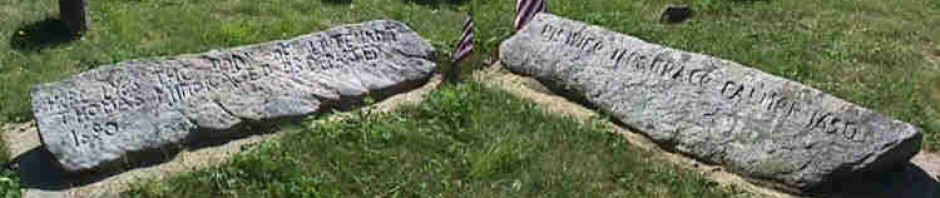
Joseph Hutchins

Joseph HUTCHINS (1641 – 1689) was Alex’s 8th Great Grandfather; one of 512 in this generation of the Miller line.

Joseph Hutchins was born 10 Oct 1641 in Newbury, Essex, Mass. His parents were John HUTCHINS and Francis ALCOCK.  He married Joanna CORLISS on 29 Dec 1669 in Haverhill, Mass.  Joseph died 19 Apr 1689 in Haverhill, Mass.

Joanna Corliss was born 28 Apr 1650 in Haverhill, Essex, Mass.  Her parents were George CORLISS and Joanna DAVIS. After Joseph died, Joanna married Steven DOW I on 7 Feb 1715/16 in Haverhill.  Joanna was Stephen Jr’s mother-in-law and then she became his step mother.  Joanna died 29 Oct 1734 in Haverhill. Mass.

Children of Joseph and Joanna:

Name Born Married Departed
1. John Hutchins 5 May 1671 Haverhill Sarah Page
11 Nov 1695 Haverhill
23 Jan 1737/38 Boston
2. Johannah Hutchins 27 Sep 1673
Haverhill
5 Feb 1677
Haverhill
3. Frances Hutchins 7 Jun 1676 Haverhill John Heath
12 Jan 1696/97 Haverhill
1 Jan 1713
Hampstead, New Hampshire
4. Mary HUTCHINS 9 Mar 1679 Haverhill Stephen DOW II
14 Dec 1697
Haverhill
29 Oct 1734
Haverhill, Mass
5. Andrew Hutchins 22 May 1681
Haverhill
3 Jun 1681
Haverhill
6. Samuel Hutchins 22 Aug 1682 Haverhill Hannah Merrill
4 Jan 1715/16 Haverhill
ca.  1742 Kennebunkport York, ME
7. Joseph Hutchins 29 May 1689 Haverhill Zermiah Page 1759
Haverhill

Joseph was on the muster roll of Capt. John Osgood’s company 29 Mar 1659 and in the company of Capt. Edmund Moore 2 Nov 1659/60.

Joseph’s mother Francis Hutchins registered this deed in 1686:

“To all christian people to whom these presents may come, on the north side of Merrimack in the county of Essex sendeth greetings”:

“Know ye that I above said Francis Huthcins as well for and in consideration of the natural love that I do owe and bear to my beloved son Joseph HUTCHINS of Haverhill abovesaid as also in consideration of divers articles hereafter mentioned to be done and truly performed unto me during my natural life, etc.” – confirms to Joseph “all my land that is lying between the land of Thomas Ayers of Haverhill and a creek commonly known by the name of Merries Creek with all my houseing barn and outhouseing except 20 acres already laid out to my son Benjamin excepting also about three acres given to my son Samuel by the Rivers side adjoining to said Creek” reserves ten acres for her own use the east side of the dwelling house and the cellar under it and the chamber over it, also the benefit of the orchard.

She gives him the Spickett meadow and three acres in Policy meadow – – is to receive ten pounds per annum, in the first week in December, in wheat rye and Indian corn, one third each, and firewood winter and summer.

Dated 21st november 1686 in the 2nd year of the reign of our Sovereign Lord, James ye second.

Signed Francis Huthcins
mark & seal
Witnesses
Robert Ford
Mary Ford

Francis Hutchins deeded 10 acres to Johannah (Corliss) Hutchins on 25 Dec 1686, she died on 5 April 1694.

Children

1.John Hutchins

John’s wife Sarah Page was born 7 Jul 1680 in Haverhill. Her parents were John Page (1641-1714) and Sarah Davis (~1640- >1714).  Sarah was the daughter of our ancestors James DAVIS and Cicely THAYER.  Sarah died 19 Mar 1737, Andover, Essex, Massachusetts.

John was a member of a large company of soldiers, under the command of Lieutenant-Colonel Saltonstall, were also kept constantly armed and equipped, and exercised in the town; and, that these soldiers might be the better prepared for every emergency, the General Court (June 19. 1710,) ordered them to be supplied with snow shoes. Snow shoes were also supplied to the whole of the North Regiment of Essex.  Daniel BRADLEY’s son Joseph,  Anthony COLBY II,  Josiah HEATH’s sons Josiah Jr and John, and Stephen DOW’s son Samuel were also members.

Children of John and Sarah:

i. John Hutchins b. 14 Jul 1699 in Haverhill, Essex, Mass; d. 1700 or after 1714 according to Old Families of Salisbury and Amesbury Massachusetts” by David W. Hoyt : Providence:1897

ii. Sarah Hutchins b. 20 Jun 1701 in Haverhill, Essex, Mass.; m. 15 Feb 1725/26 in Haverhill to Timothy Corliss (b. 13 Dec 1693 Haverhill – d. 1783 Weare, Hillsborough, New Hampshire)  His parents were John Corliss and Mary Wilford.  His grandparents were George CORLISS and Joanna DAVIS. Sarah and Timothy had seven children born between 1740 and 1756.

iii. Richard Hutchins b. 21 Nov  1703 in Haverhill, Essex, Mass; d. 4 Apr 1742 – Haverhill or 15 May 1778 in Norwich, New London, CT; m. 2 Oct 1727 – Haverhill to Martha Greeley   Martha’s sister Ruth married Richard’s brother James. Their parents were Joseph Greeley (1651-1744) and Martha Wilford (1669-1757)  Richard and Martha had six children born between 1728 and 1749.

iv. James Hutchins b.  Feb 1705/06 in Haverhill; d.  16 Apr 1760 in Haverhill; m. 12 Nov 1729 – Haverhill to Ruth Greeley (b.1708, Haverhill – d. 24 Mar 1739/40, Haverhill) Ruth’s sister Martha married James’ brother Richard.  Their parents were Joseph Greeley (1651-1744) and Martha Wilford (1669-1757) James and Ruth had five children born between 1730 and 1739.

v. Jeremiah Hutchins b. 19 Jan 1707/08 in Haverhill; d. 15 Apr 1737 Haverhill

vi. David Hutchins b. 30 Apr 1710 in Haverhill, ; d.  4 Aug 1749 in Haverhillp;  m. 15 May 1740 in Haverhill to Elizabeth Stevens (b. 31 Oct – d. 12 May 1799) Her parents were Aaron Stevens (1685-) and Mary Walter Harris(1689-1746)

vii. Mary Hutchins b. 2 Sep 1712 in Haverhill; m.  19 Dec 1745 in Haverhill to Jonathan Marble (b. 3 Dec 1702 Haverhill – ) His parents were Samuel Marble and Rebecca Williams.  Mary and Jonathan had two children born in 1749 and 1751.

m2.  Obediah Belknap (b. ~1715 – )  He first married 27 Oct 1742 to Sarah Mitchell

viii. Jonathan Hutchins b. 26 Jul 1715 in Haverhill; d.  27 Nov 1803 in Fryeburg, York Maine; m. 29 May 1740 in Fryeburg, Maine to Mary Emery  (b. 1720 in Haverhill – d. 10 Sep 1803 in Fryeburg, Maine) Jonathan and Mary had eight children born between 1740 and 1758.

Jonathan was one of 48 (along with Joseph Frye, the founder of Fryeburg) residents to sign the petition for the incorporation of Fryeburg on Nov 22, 1776.

ix. Nathaniel Hutchins b. 25 Sep 1718 in Nashua, Hillsborough, New Hampshire. – d.   18 Dec 1726 – Haverhill

x. Elizabeth Hutchins b. 25 Sep 1721 in Haverhill; d.  12 Jul 1750 in Haverhill; m.  13 Nov 1741 in Haverhill to James Haseltine (b. 28 Mar 1721 in Haverhill  – d. bef. 1780).  His parents were Philip Haseltine (1685 – 1739) and Judith Webster (1694 – 1782)

After Elizabeth died, Philip married 5 Nov 1751 Haverhill to Ruth Ladd (b. 11 May 1712 in Haverhill – d. 1760)

In 1757 James was Ccornet in Maj. Richard Saltonstall’s Second Foot Company in French and Indian war.

When clothing was being collected at Haverhill for the Revolutionary soldiers in the winter of 1779/80, Ruth Haseltine, who gave two blankets and nine shirts, was called a widow

3. Frances Hutchins

Frances’ husband John Heath was born 4 Mar 1674/75 .  His parents were John Heath and Sarah Partridge.  His grandparents were our ancestors Bartholomew HEATH and Hannah MOYCE.    Some time after their marriage Frances and John removed to New Hampshire, where they  settled in Hampstead, and died.  Frances survived her husband.

Children of Frances and John :

i. Samuel Heath b. 25 Apr 1698 in Haverhill, Essex, Mass;Burial: Pentucket Cemetery, Haverhill;  m. 17 Mar 1725 in Haverhill to Elizabeth Emerson (b. 27 Jun 1699 in Haverhill)  Her parents were Stephen Emerson (1674 – 1758) and Elizabeth Dustin (1680 – 1746).  Her grandparents were Thomas Dustin and Hannah Webster Emerson, the famous woman that was captured by the Indians and managed to escape.  See my post Hannah Dustin – Heroine or Cold Blooded Killer.  Samuel and Elizabeth had ten children born between 1725 and 1743.

ii. John Heath b. 11 Jun 1700, Haverhill, Essex, Mass; m. 3 Sep 1728, Haverhill to Lydia Bradley. (b. 31 May 1707, Haverhill) Her parents were Isaac Bradley (1680 – ) and Elizabeth Clements (1684 – >1740)  Her grandparents were Daniel BRADLEY and Mary WILLIAMS.   Daniel was killed by Indians on 13 Aug 1689 in Haverhill and Isaac was taken prisoner 4 Sep 1695, but escaped.  See Daniel’s page for details.

Children born Haverhill 1731-38: Ruth, Anna, Lydia, Isaac; and possibly these children bap 1742-47: Betty, Mehitable, Jacob

iii. William Heath b. 19 Jan 1702 in Haverhill, Essex, Mass; d. 1781 Craven, North Carolina; m. 1726 in Haverhill to Elizabeth Dow (Book of Dow ref – bcdd) (b. 29 Feb 1704 in Haverhill – d. 18 Jun 1730)  Her parents were Stephen DOW II and Mary HUTCHINS. William and Hannah had eight children born between 1727 and 1741.

William Heath and his brothers Caleb , Benjamin and Nathaniel purchased land in Hampstead, Rockingham, NH (then part of Haverhill) in 1730 from Robert Ford, Sr.

iv. Caleb Heath b. 30 Jun 1704 in Haverhill, Essex, Mass.; d. 25 Apr 1753 Hampstead, Rockingham, New Hampshire; m1. 26 Mar 1730 in Haverhill to Susanna Emerson (b. 19 Jun 1711 in Haverhill – d.  25 Apr 1753)  Her parents were Benjamin Emerson (1679 – 1734) and Sarah Silver (1682 – ).  Caleb and Susanna had eight children born between 1733 and 1748; m2. 1756 to Mary Kezer (b.12 Jun 1736 in Hampstead, Rockingham, New Hampshire)

Caleb Heath and his brothers William, Benjamin and Nathaniel purchased land in Hampstead, Rockingham, NH (then part of Haverhill) in 1730 from Robert Ford, Sr.

v. Joanna Heath b. 13 Feb 1707 in Haverhill, Essex, Mass; d. 12 Jan 1789 Plaistow, Rockingham, New Hampshire; m. 1726 in Haverhill to Daniel Gile (Gill, Gild) (b. 10 Dec 1697 in Haverhill – d. 1797 in Plaistow)  His parents were Ephraim Guile (1662 – ) and Martha Bradley (1667 – 1689).  Joanna and Daniel had fourteen children born between 1726 and 1752.

Daniel was a farmer at the foot of Sweet Hill in Plaistow, NH and died there, aged nearly one hundred years.

vi. Bartholomew Heath  b. 1 Apr 1709 in Haverhill,  Essex, Mass; d. 20 Apr 1784 Sanbornton, Belknap, New Hampshire; m. 3 Jun 1736 in Haverhill, Essex, Mass to Mary Pike (b. 6 Apr 1716 in Haverhill – d. 11 Oct 1803 in Sanbornton, Belknap, New Hampshire)  Her parents were Hugh Pike (1686 -1747) and Hannah Emerson (1691 – ). Bartholomew and Mary had nine children born between 1736 and 1752.

They moved from Haverhill, Essex, Mass. to Plaistow, Rockingham, NH. to Sanbornton, Belknap, NH  where he was one of the pioneer settlers of Hampstead, and served in the French and Indian wars.

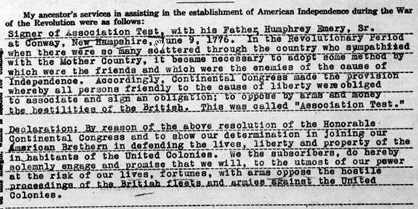
vii. Sarah Heath b. 5 Sep 1711 in Haverhill, Essex, Mass; d. 15 Jul 1828 Sanbornton, Belknap, New Hampshire; m. 14 Mar 1738 in Haverhill to Humphrey Emery (b. 15 Apr 1715 in Newbury, Essex, Mass. – ) His parents were Jonathan Emery (1680 – ) and Ruth Richardson (1683 – 1749).   Sarah and Humphrey had seven children born between 1739 and 1753 in Plaistow, Rockingham, New Hampshire.

Humphrey Emery Assosiation Test

Humphrey Emery Assosiation Test

viii. Benjamin Heath b. 4 Apr 1713 in Haverhill, Essex, Mass; m.  1744, though another record says 24 Jun 1746 in Haverhill to Sarah Eastman (b. 16 Feb 1714 in Haverhill)  Her parents were Jonathan Eastman (1680 – ) and Hannah Green (1677- 1761).   Sarah first married 24 Jun 1735 in Haverhill to Robert Emerson (b. 6 Oct 1713 in Haverhill – d. 1746 in Haverhill).  Benjamin and Sarah had two children born in 1746 and 1747.

Benjamin Heath and his brothers William, Caleb and Nathaniel purchased land in Hampstead, Rockingham, NH (then part of Haverhill) in 1730 from Robert Ford, Sr., who was one of the largest landowners in the southwestern part of Timberlane parish in Hampstead. They took immediate possession. Benjamin paid a poll tax in Haverhill, Mass. in 1741 and he is listed as living alone in the “1742 Census of Haverhill Taken in the Fall.” When the Mass./New Hampshire State line was finalized in 1741, the part of Haverhill, Mass. where all the Heaths lived became “Haverhill District” New Hampshire, and later Hampstead, New Hampshire, which was sometimes called Plaistow, New Hampshire.

On 5 Dec 1745 Benjamin Heath purchased eight acres of land in the Haverhill District of Plaistow, Rockingham County, New Hampshire from Richard Heath. He also sold 4 acres of land to Richard Heath the next day. The town was incorporated as Hampstead on 19 Jan 1749 but did not begin keeping official town records until 1753. Thus the Heaths did not physically move; the town and state names of their residences changed.

Benjamin was among those who signed the petition for incorporation of Hampstead on 29 Jul 1746. Benjamin bought more land in the Hampstead area from James and Sarah White on 15 Sep 1754. Between 1755 and 1758 he signed as a witness to three wills in Hampstead.

Serving in Samuel Watts’ Company, Col. Nathaniel Meserve’s Regiment in the Crown Point Expedition in May of 1756, Benjamin was discharged in December of the same year. Benjamin may be the New Hampshire soldier listed in the “Bill for Victualing Soldiers at Sudbury in 1757” upon “their return from Fort William Henery after it was in the frenches Possession in August 1757.”

He was listed in the “Assessment of Rates” done about 1764. There is a curious listing of Benjamin Heath as one of 66 land grantees in the original charter of Cavendish, Vermont dated 12 Oct 1761. Current day Cavendish, Windsor, Vermont is 117 miles NW of Hampstead. According to the Cavendish Historical Society, after the British defeated the French at Fort Crown Point on Lake Champlain in 1759, Gov. Wentworth of New Hampshire granted 26,000 acres in Cavendish to 66 proprietors. This land was in disputed territory with New York. The grant was re-issued by the State of New York on 1 June 16, 1772. The first permanent settler arrived in 1769. Thus it is possible that Benjamin received this land and never set foot in Cavendish.

Benjamin Heath of Hampstead was involved in a court case 7 Sept 1762, which was finally resolved in 1771. The 1771 document refers back to the 1764 case but states that Benjamin was “of Canterbury.” Benjamin apparently lived near his son Robert in Perrystown, also called Parrystown, and later Sutton, New Hampshire, between at least 1779 and 1788. On 1 June 1788 Benjamin Heath purchased 30 acres of land in Sutton. However he is not listed on the tax rolls for that year, even though his son Robert is listed. Benjamin must have moved back to Hampstead because he is listed in the 1790 census in Hampstead. Credit to Betty Gillespie Pollack and her detailed research

ix Nehemiah Heath b. 23 Feb 1718 in Haverhill, Essex, Mass; m. 6 Feb 1745 in Kingston, Rockingham, New Hampshire to Mary Eaton ( – d. Aug 1754) Nehemiah and Mary had four children born between 1745 and 1754.

x. Rachel Heath b. 20 Apr 1720 in Haverhill, Essex, Mass; d. Plaistow, New Hampshire; m. 27 Nov 1739 in Haverhill to Moses Jackman (b. 1719 in Newbury, Essex, Mass. – d. Plaistow, New Hampshire)  His parents were Samuel Jackman (1690 – 1728) and Miriam Plummer (1690 – 1730).  Rachel and Moses had at least three children born between 1742 and 1762.
4. Mary HUTCHINS (See Stephen DOW II‘s page)

6. Samuel Hutchins

Samuel’s wife Hannah Merrill was born 1698. Her parents were John Merrill and Lucy Webster.  Hannah died 9 Jun 1744 in Haverhill, Essex, Mass.

There is considerable confusion between the lineage of this Samuel Hutchins and Samuel Hutchins of Kittery. Both men have a claimed birth date of Aug. 20 1682, and both were supposedly married to a Hannah Merrill, and lived within 50 miles of each other. Both men also have some of the same claimed descendants. However, these appear to be two separate men, with separate sets of siblings. The two Samuels should not be merged, pending the sorting out of their proper descendant lines.

As chance has it, the other Samuel Hutchins was the son of our ancestors Enoch HUTCHINS  and Mary STEVENSON and probably instead married  4 Jan 1716 in York, Maine to Sarah March

Children of Samuel and Hannah:

i.  Rev. Samuel Hutchins b. 17 Sep 1716 in Haverhill, Essex, Mass; d. 12 Dec 1796 Lee, Strafford, New Hampshire; m. 13 Dec 1739 in Methuen, Essex, Mass. to Mary Richardson (b. 29 Dec 1721 in Newbury, Essex, Mass)  Her parents were Thomas Richardson (1697 – 1761) and Hannah Pottle (1697 – ).  Samuel and Mary had nine children born between 1741 and 1761.

ii. Hannah Hutchins b. 1 May 1717 in Haverhill, Essex, Mass; d. 14 Apr 1785 Tolland, Tolland, CT; m 29 Aug 1738 in Haverhill to Richard Carlton (b. 8 Jan 1713 Haverhill – d. 30 Oct 1758 Tolland, Tolland, CT)  His parents were Edward Carleton (1691 – ) and Hannah Kimball (1692 – 1741).  Hannah and Richard had eight children born between 1741 and 1758.

iii. Nathan Hutchins b. 1 Apr 1722 in Haverhill, Essex, Mass; d. 26 Sep 1811 North Hero, Grand Isle, Vermont; m.2 May 1747 in Haverhill to Mary Whittier (b. 1 May 1727 in Methuen, Essex, Mass. – d. 8 Jul 1798 in North Hero, Vermont)  Her parents were William Whittier (1688 – 1729) and Rachel Mitchell (1700 – 1745).  Nathan and Mary had eight children born between 1748 and 1769 in Norwich, CT.

iv. Abigail Hutchins b. 1 Jun 1724 in Haverhill, Essex, Mass; d. 8 Feb 1805 Amhert, Nova Scotia, Canada; m. 2 May 1747 in Haverhill to Atwood Fails (b. 10 Mar 1723 in Bradford, Mass. – d. 8 Feb 1805 in Amherst, Nova Scotia, Canada) His parents were Nathaniel Fales ( – 1737) and Elizabeth Atwood (1700 – 1782).  Abigail and Atwood had at least two children born in 1748 and 1749.

Atwood Fails. Private, Capt. Benjamin Lemont’s co., Col. John Allen’s regt.; enlisted Oct. 8, 1777; discharged Nov. 25, 1777; service, 1 mo. 29 days, travel included; regiment raised for defence of Machias.

7. Joseph Hutchins

Joseph’s wife Zerviah Page was born 28 Mar 1701 in Haverhill. Her parents were Jeremiah Page (1667-1749) and Deborah Hendrick (1666->1749).  Zerviah died 1753 in Haverhill, Essex, Mass.

Children of Joseph and Zerviah:

i.  Infant Hutchins b. 9 Sep 1731 in Haverhill, Essex, Mass; d. 9 Sep 1731 in Haverhill

ii. Timothy Hutchins b. 29 Sep 1732 in Haverhill, Essex, Mass; d. 6 Mar 1737 Haverhill

iii. William Hutchins . 12 Oct 1734 in Haverhill, Essex, Mass; d, 29 Mar 1737 Haverhill

iv. Jeremiah Hutchins b. 15 Jan 1736 in Haverhill, Mass; d. 11 Nov 1816 Bath, New Hampshire; m. 30 May 1759 in Salem, New Hampshire to Mehitable Corliss (b. 1 Aug 1741 in Haverhill – d. 28 Oct 1783 in Bath, Grafton, New Hampshire)  Mehitable’s sister Martha married Jeremiah’s brother Joseph.  Their  parents were John Corliss (1715 – 1753) and Abigail Mitchell (1720 – 1753).  Jeremiah and Mehitable had fourteen children born between 1761 and 1779.; m2. 14 Sep 1785 in Haverhill, New Hampshire to Elizabeth Oliver (b. Jun 1743 in France – d. 25 Nov 1817 in Bath, New Hampshire)

Family moved to Bath in about 1759. Jeremiah built the large white house at the Upper Village and bequeathed it to his son Samuel.  Both were Innkeepers, Storekeepers and farmers on a large scale. In Bath, N.H., he was granted a license to own and operate a tavern/inn, the tavern is on the National Historical Site list.

Jeremiah Hutchins Tavern Bath NH 1799

Jeremiah Hutchins Tavern Bath NH 1799

The Hutchins seem to have been a well to do family, and Jeremiah, known as Capt. Jeremiah Hutchins became immediately on his arrival in Bath, a man of local prominence. The first town meeting of that town was held in 1784, the town having been previously governed by the proprietors, and he appears as one of the Selectman they elected. He was several times a member of the state legislature and his sons were also at different times chosen as representatives in that body.

v. Ruth Hutchins b. 29 Mar 1741 in Haverhill, Essex, Mass; d. 8 Jul 1817 Haverhill, Grafton, New Hampshire; m. 1760 in Haverhill to Ezekiel Ladd (b. 10 Apr 1738 in Haverhill, Essex, Mass – d. 12 Jul 1818  Haverhill, Grafton, New Hampshire)  His parents were Daniel Ladd (1710 – 1768) and Mehitable Roberts (1717 – ).  Ruth and Ezekiel had eight children born between 1761 and 1782.

Ezekiel was a judge and is called Honorable Ezekiel Ladd on his gravestone.

vi. Joseph Hutchins b. 31 May 1743 in Haverhill, Essex, Mass; d.  12 Nov 1814 Middlesex, Washington, Vermont; m1.9 Jun 1763 in Haverhill to Martha Corliss (b. 28 Jun 1745 in Haverhill – d. 27 Sep 1790 in Haverhill)  Martha’s sister Mehitable married Joseph’s brother Jeremiah.  Their parents were John Corliss (1715 – 1753) and Abigail Mitchell (1720 – 1753).  Joseph and Martha had twelve children born between 1764 and 1787.

m2. 1 May 1796 in Haverhill to Hannah Green (b. 22 Feb 1746 Haverhill – d. 8 Apr 1846)

Sources:

http://www.genealogyofnewengland.com/b_h.htm

http://www.ourfamilystories.com/ourfamily/pafg10.htm

http://familytreemaker.genealogy.com/users/r/i/c/Stanton-G-Richards/FAMO2-0001/d109.htm#P3597

The history of Haverhill, Massachusetts: from its first settlement, in 1640 … By George Wingate Chase

http://www.schenectadyhistory.org/families/hmgfm/heath.html

http://freepages.genealogy.rootsweb.ancestry.com/~pattyrose/engel/gen/fg13/fg13_045.htm
http://trees.ancestry.com/owt/person.aspx?pid=33311183

Posted in 10th Generation, Line - Miller, Veteran | Tagged | 16 Comments

Edward Starbuck

Edward STARBUCK (1604 -1690) was Alex’s 10th Great Grandfather; one of 2,048 in this generation of the Miller line.

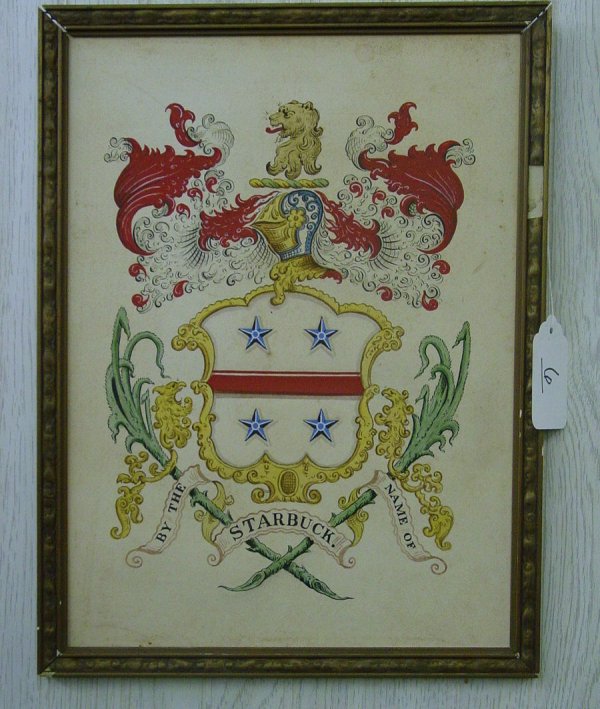
Edward Starbuck - Coat of Arms

Edward Starbuck was born about 1604 in Draycot, Derbyshire, England. His father was also Edward STARBUCK.  He married Katherine REYNOLDS about 1630 in Derbyshire, England.  He migrated to America about 1635, settling at Dover NH.  Edward died  4 Dec 1690, at Nantucket Island, MA age 86.

Nantucket Settlers Monument

Katherine Reynolds was born about 1609 in Wales.   Her parents may have been William  REYNOLDS and Esther RUTH.  After Edward died, she may have married Joseph Austin.   Some sources state that Katherine died 4 Feb 1690/91, Dover, Stafford, New Hampshire.  There is no record of Katherine’s death. Some sources assume that she died in Dover prior to the move to Nantucket, however, Noyes, Libbey and Davis state that she was living 19 June 1678 (without citing a source for this date). It is probable that she had died by 1685 when Edward alone deeded to son Nathaniel.

Katherine Starbuck is known through her signing with her husband on two deeds. She signed with him in May or July 1653 when they sold land to their son-in-law Peter Coffin. Later in 1659, Edward and Katherine deeded land to Mr. Broughton, which excepted the house and land on the Newichawannock River which belonged to “Goodwife Starbuck” as “being formerly given her…in wife’s right…”

Children of Edward and Katherine:

Name Born Married Departed
1. Sarah STARBUCK c. 1630
Derbyshire, England
William STORY
ca. 1647
.
Joseph Austin
1649
Nantucket
.
Humphrey Varney
JAN 1663/64
Ipswich, Mass
6 Jun 1719
Dover, NH
2. Nathaniel Starbuck 20 FEB 1633/34
Dover, NH
Mary Coffin
1663
Nantucket, Mass
6 JUN 1719
Nantucket, Mass.
3. Dorcas Starbuck 1639
Dover, NH
William Gayer  17 OCT 1672 Nantucket, Mass OCT 1696 Nantucket, Mass.
4. Abigail Starbuck 1641
Dover, NH
Peter Coffin
15 Aug 1682 Dover, Norfolk, Mass
20 Oct 1657
Nantucket, Mass
5. Shuah Starbuck 1648 Nantucket, Mass Ensign James Heard
1661
Kittery, York, ME
.
Richard Otis
bef. 3 JUL 1729
Kittery, York, Maine
6. Esther Starbuck 1650
Dover, NH
William Furber
1676
Portsmouth, Rockingham, NH.
bef. AUG 1694 Dover, NH
7. Jethro Starbuck 27 MAY 1651
Dover, NH
Run over by a cart
27 MAY 1663
Nantucket, Mass

Starbuck Ancestors

The name Starbuck is Scandinavian and signifies a person of imposing appearance, great or grand bearing…..bokki meaning “vis grandis corpore et animo. Ferguson gives it Starbocki, from Star, great “vir imperiosus.” It is not improbable that the family was of Danish origin and settled in England in the days of what is historically known as the Danish Invasion. Patronymica Brittannica says in “O. Norse bokki; means “vir grandis, corpose et animo.” Hence Starbocki from Stor, great.

Famous Starbucks

The name Starbuck is evocative of  swashbuckling adventure with a  contemplative, intellectual side.  I wonder which sides were in the original Edward Starbuck.

  • In Moby Dick, Starbuck is  the young chief mate of the Pequod, is a thoughtful and intellectual Quaker from Nantucket.

    Ethan Hawke Stars as Starbuck

  • Kara Thrace (call sign “Starbuck“) is a fictional character in the reimagined Battlestar Galactica franchise. Played by Katee Sackhoff, she is a revised version of Lieutenant Starbuck from the 1978 Battlestar Galactica series.

    Kara Thrace

  • Dana Scully, a character in the TV series The X-Files, given the nickname “Starbuck” by her father, after the Moby Dick character.

    Dana Scully

  • The multinational coffee chain Starbucks was named after Starbuck, not due to any affinity for coffee, but because the name “Pequod” was first rejected by one of the co-founders.

    Starbucks Logo

Starbuck Descendants

Nantucket Flag

Starbuck was an important Quaker family name on Nantucket Island, and there were several actual whalemen of this period named “Starbuck,” as evidenced by the name of Starbuck Island in the South Pacific whaling grounds.

Valentine Starbuck was born on May, 22 1791 in Nantucket, Massachusetts.  He commanded various whalers in the Pacific. In 1823, while captaining the British whaleship Aigle, he was chartered by Hawaiian King Kamehameha II for a trip to Britain on a state visit. The passengers included Queen Kamāmalu and a few other nobles. The Hawaiian King and Queen died of measles while at London, and Valentine was sued by his employers for not completing his whaling voyage.

Prior to his journey to London, Valentine had sighted an island in the Pacific, known as Starbuck or Volunteer Island. When Royal Navy captain George Anson Byron came across this island when returning the bodies of the Hawaiian king and Queen to their homeland on the HMS Blonde (1819), he named the island “Starbuck” in Valentine’s honour. However, his cousin Obed Starbuck had sighted the island previously.

Obed Starbuck (1797 -1882) whaled  in the Pacific for many years, Obed made a number of significant voyages. Sailing on the Hero 1822-1824, which returned to Nantucket with 2173 barrels of sperm oil, he discovered an island on 5 Sep 1823, located at 5°32′ S, 155°5′ W, since known as Starbuck Island (also called “Hero Island”).  From 1824-1826, Obed captained the Loper, in which vessel he was the first European to visit an outlying island in the Phoenix groupwhich he named “New Nantucket” which, when re-discovered in 1835 by Michael Baker, was renamed Baker Island.  Obed named “Loper Island” (Niutao) which was sighted by Francisco Antonio Mourelle on May 5, 1781.  who named Niutao, El Gran Cocal (‘The Great Coconut Plantation’). Obed also named “Tracy Island” (Vaitupu), and various other now-unidentified islands. Based on reported locations, these might include Birnie Island and Sydney Island, previously discovered by Capt. Emmett in 1820, although it is hard to be precise due to the bearings given.  On this journey, Obed also completed the mapping of Tuvalu, which had been begun by Captain George Barrett of the Nantucket whaler Independence II..

Nantucket Founders

Our ancestors and their close relatives participated in half of the original 10 partnerships of Nantucket Island.  Many were Quakers, Baptists and other dissents looking to escape harsh Puritan rule in New England.  See my story Nantucket Founders for details.

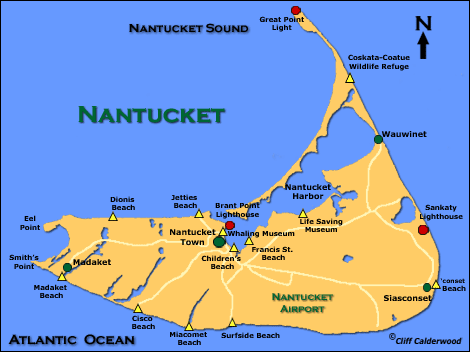
Nantucket Map

The First Purchasers of Nantucket included ten men.   The ten needed to raise additional capital, and in 1659 at a meeting at Salisbury, Massachusetts it was agreed that each of the ten could invite in a partner.  It was agreed at the meeting that Major Pike would keep the Salisbury records of the First Purchasers and that Thomas Macy would keep the Nantucket records.

Edward Starbuck was the partner of Thomas Macy who deeded his Amesbury house to Anthony COLBY when he fled to Nantucket.

Edward’s son Nathaniel Starbuck was the partner of Tristram Coffin Sr., the son of Peter COFFIN.  Nathaniel later bought out the share of Stephen Greenleaf, son of Edmund GREENLEAF.

In the ” Macy Genealogy” it is related that ” in 1659 Thomas Macy embarked at Salisburv in a small boat with his wife and children and such household goods as he could conveniently carry, and in company with Thomas COLEMANs son Isaac Coleman age 12 and Edward STARBUCK age 55 set sail for Nantucket. Isaac later drowned when he was 22 on 6 Jun 1669 with John Barnard and Bethiah (Folger) Barnard out of a large freight canoe between Martha’s Vinyard and Nantucket while returning from a supply trip. Bethia’a older brother Eleazer Folger survived by clinging to the drifting canoe. It is assumed that the Nantucket Indians who were crewing the large canoe also drowned. Bethiah was Benjamin Franklin’s aunt.

Reynolds Family Association

Edward Starbuck and his wife Katherine came to New England about 1635, and settled in Dover, NH. Although there is no documented evidence to date, Edward’s wife is traditionally known as Katherine Reynolds. As early as 1862, James Savage, in A Genealogical Dictionary of the First Settlers of New England, wrote that Edward Starbuck “m. Eunice or Catherine Reynolds, said to be from Wales.” Early Settlers of Nantucket, compiled by Lydia S. Hinchman and published is 1901, states that Edward’s wife was “Katharine (Reynolds), of Wales.” A footnote states “Some authorities give Eunice.”

George Edward McConnell and David Ross McConnell, in Our Family’s Starbuck Ancestry, published 1963, state “his wife, Katherine Reynolds, daughter of Robert, is thought to have been Welch.”

This Reynolds connection was also acknowledged in the Genealogical Dictionary of Maine and New Hampshire, by Sybil Noyes, Charles Thornton Libbey and Walter Goodwin Davis in 1939. They stated that “his wife Katherine is repeatedly called Katherine Reynolds, but no documented evidence of the ‘Reynolds’ has been seen.” Such long-standing tradition should not be taken lightly, despite the current lack of extant evidence, and until research proves otherwise, we will consider that Katherine and her descendants constitute a branch of the Reynolds family in America.

It has been written in the above stated sources that Edward was from Derbyshire, England. The Starbuck genealogy adds that he was from Derbyshire or from Attenborough, Nottinghamshire. Noyes, Libbey and Davis state that Edward was of Draycut, Co. Derby and Attenboro, Co. Notts. There has apparently been no success to date with research in English records for the ancestry of either Edward or Katherine, though further study has been started by the RFA.

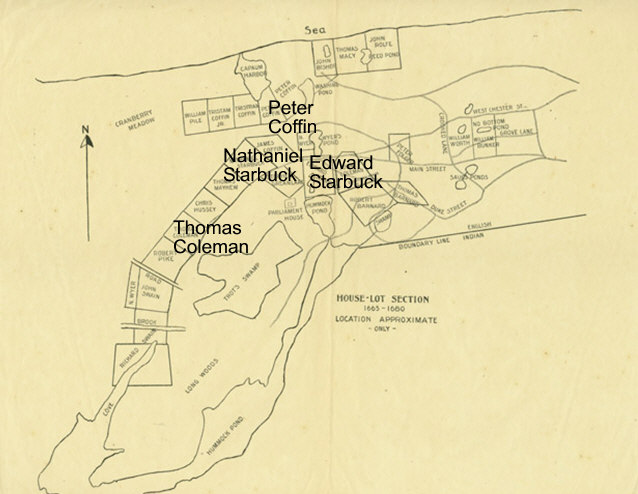
Nantucket House Lots

Here is a link to a Google Maps Satellite View of the present day location of Edward Starbuck’s Nantucket homestead.  It’s a couple miles west of the town of Nantucket near Madaket Road.

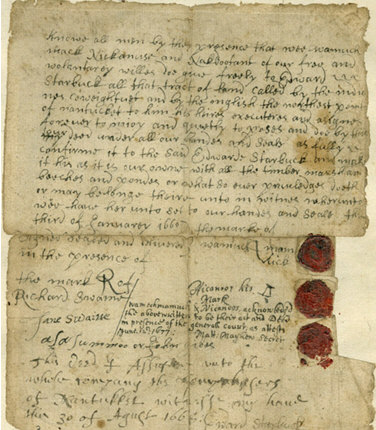
Edward was representative in the General Court in 1643 and 1646, was an Elder in the church and in other ways enjoyed the respect and esteem of his fellow citizens. His influence over the Indians was so great that if at any time a suspicion or alarm arose among the early settlers, he was always in requisition to explain the apparent cause thereof, and to suggest a palliation for their rude and inexplicable action, which served to allay the fears of the more timid. There is a tradition that at one time an uprising among the Indians seemed imminent. They appeared to be gathering in hostile groups and as they greatly outnumbered the whites, it was a very serious affair. In this juncture, Edward Starbuck went unhesitatingly among them and soon succeeded in quieting them. The deed of Coatue to him by the Sachems as a “free and voluntary” gift shows their esteem for him. Tradition says that Edward Starbuck was a man of commanding presence.

1665 Indian deed transfering Coatue land to Edward Starbuck. Includes "mark" of Nickanoose, Wampanoag sachem

In the 20th, 2 mo. 1644 it was ordered that Mr. Edward Starbuck, Richard Walderne & Wm. Furber be wearesmen for Cotcheco fall & river during their lives or so long as inhabitants. Various other grants were made to him, two of those being one of the Mill privilege at Cutchechoe 2nd Falls and one of timber to ‘accomodate’ in 1650. In “Landmarks in Ancient Dover” mention is made of Starbuck’s Brook in 1701 as a boundary of property which Peter Coffin (Edward’s son-in-law) conveyed to John Ham.

Starbuck’s Marsh was granted to Edward August 30, 1643, and Starbuck’s Point and Marsh, now called Fabyan’s Point, were granted to Edward in 1643. He is recorded several times as called on to be one of the “lot-layers.” He was Representative in the General Court in 1643 and 1646, was an Elder in the church and in other ways enjoyed the respect and esteem of his fellow-citizens. In 1640, Edward was an agent for Mr. Valentine Hill and Partner with Richard Waldron in lumbering on the Me. side in 1648. In 1653 he sold 1/2 his sawmill gr. To Peter Coffin, in 1657 sold to Thomas Broughton 1/4 the mill above Capt. Waldron’s mill at Cochecho.

In 1644 an act was passed by the General Court of Massachusetts Bay banishing from the Colony all who should either openly or privately oppose the baptism of infants. While the punishment meted out to some of the offenders was severe, banishment was not always inflicted. Edward Starbuck was one of those who subscribed to the proscribed doctrine and the record of the General Court, under the date of 18 October 1648, says:

“This Court, being informed of great misdemener committed by Edward Starbucke, of Douer, with p’fession of Anabaptisme, for which he is to be p’ceeded agaynst at the next Court of Assistants, if evidence can be p’pared by that time, & it beinge very farre for wittnesses to travill to Boston at that season of the yeare, it is therefore ordered by this Court that the secritary shall give commission to Capt. Thomas Wiggan & Mr. Edw. Smith to send for such p’rsons as they shall haue notice of which are able to testifie in the s’d cause & to take theire testimonie uppon oath & certifie the same to the secritary so soone as may be, that further p’ceedings may be therein if the cause shall so require.”

There seems to be no indication from the record that the complaint was prosecuted, notwithstanding the severe penalty contemplated by the law. The action of the Court did not seem to affect his standing in his community for he continued to be called upon to lay out land.

Some time during his stay in Dover, Edward came under the influence of the Anabaptists. On 18 Oct 1648, he was charged with refusing to join with the established church in the rite of baptism. There is some question if these religious differences played a part over the next few years in Edward’s decision to move his family from Dover. Whatever the reason, Edward gave all his property in Dover to his son-in-law, Peter Coffin on 9 Mar 1659/60, and moved himself and his family, except for Abigail and Sarah who had already married, to Nantucket.

He accompanied Tristram Coffin on his voyage of discovery and Thomas Macy on his voyage of settlement. He deeded his Cochecho house, goods, cattle, etc. to his son-in-law Coffin on 9 Mar. 1659/60 and moved to Nantucket where he died. Dover lost a good citizen and Nantucket gained a much respected one; He was a leading man on the Island and at one time a Magistrate. He is described as courageous and persevering. When he came to the Island he occupied a house which he built at Madeket. His house lot as laid out was about 1000 feet square, extending northward from the head of Hummock Pond to Macy’s Pond.

His name appears there on the earliest Indian deed in 1660, and on many other deeds and documents in the succeeding years. He served as a selectman in 1673. On 18 March 1685, Edward deeded all his property and good to his son Nathaniel..

Children

1. Sarah STARBUCK (See William STORY‘s page)

2. Nathaniel Starbuck

Nathaniel’s wife Mary Coffin was born 20 Feb 1645. Her parents were Tristram Coffin and Dionis Stevens.

At the time of his death, Nathaniel was doubtless one of the wealthiest, if not individually the wealthiest men on the island. He owned three full shares of land, having purchased a share of Stephen Greenleaf.

His wife, Mary Coffin, was one of the ablest women who ever lived on Nantucket, and her advice and influence were noteworthy factors in the conduct of affairs. She was the leading spirit in the organization of the Society of Friends on the Island. Mary was known on the island as “The Great Mary”, she converted practically everyone there to Quakers. The first Quaker meeting was held in her home in 1702.

Nathaniel was a man of marked ability and his wife was a woman of such excellent judgment that as Thomas Story noted in his Journal, she was “a wise and discreet woman, well read in Scripture and not attached to any sect, but in great reputation throughout the Island for her knowledge in matters of religion and an Oracle among them on that account, insomuch that they would not do anything without her advice and consent therein.” ,

4. Abigail Starbuck

Abigail’s husband Captain Peter Coffin was born in 1631 in Brixton, Devon, England. His parents were Tristram Coffin and Dionis Stevens. His grandparents were Peter COFFIN and Joane KEMBER. James died 21 March 1714/15, Exeter, Rockingham, New Hampshire, but most of his life was passed at Dover.

Peter was one of the original purchasers of Nantucket, and tradition says the wealthiest of them, owning large mill property. He was a merchant at Dover before the purchase, and subsequently lived at Nantucket, but only for a short time to be considered as domiciled there. He was made freeman in 1666, at Dover; a Lieutenant in 1675, on service in King Philip’s Indian war; a Representative in the Legislative branch in 1672/73 and again in 1679. In 1690 he removed to Exeter, N.H. From 1692 to 1714 he was at different times associate justice and chief justice of the Supreme Court of New Hampshire, and a member of the Governon’s Council.

He was elected as one of the magistrates of Nantucket. The early records of Nantucket are frequently devoted to transactions of Peter Coffin, in the purchase and sale of land, and of gifts and grants to his children The lumber for his son, Jethro’s house, now (1881) the oldest house standing on Nantucket, was the product of one of his mills.

The Half-Share Revolt

The first settlers had bought their rights to Nantucket with the intent of using the land for their own benefit. But, as more and more people came to Nantucket to live and work in the late seventeenth century, the newcomers began to resent their limited power and representation in the island’s government.

Led by ambitious newcomer John Gardner, many of the “half-share men” staged a peaceful revolt against the proprietary government led by Tristram Coffin. Through several appeals to the provincial government in New York, the half-share men eventually succeeded in having the original proprietary transformed in favor of a more democratic, town-meeting-based government, where all men who held property had equal voting rights.

At first Tristram Coffin was the leading spirit politically and little was done without his approval and sanction. And he also had the backing of the Mayhews who still retain their interest. After John Gardner arrived in 1672, who was also of strong and forceful personality, there was trouble. He soon became prominent in the affairs of the Island and was appointed Captain of the Fort Company by Governor Lovelace. Tristnam and John Gardner soon locked horns. Here are the two sides:

 Full Share Men  Half Share Men
Tristram COFFIN John Gardiner
Thomas Mayhew Peter Folger
John Swain Thomas Macy
Christopher Hussey William Worth
STARBUCKS COLEMANS
Richard Swain Bunkers
Meyers and Others

In 1673 the freeholders were required to name two men for Chief Magistrate and Edward Starbuck and Richard Gardner were submitted The governor chose the latter and named his brother Jim for Captain of the military company. This did not please the Coffins as it made their rivals hold two of the principal offices and so began the long fight whenever there was a meeting held.

It was noted on the records, Mr. Tristram Coffin enters his dissent whereupon all the other members of his party followed suit but Tristram has been well called the great dissenter. The Coffins believed that the whole share men should have two votes and the half -share men one vote while the Gardners stood firm for equal power.

Each faction were soon appealing to the authorities in New York and the first round was won by the Coffins. In 1674 the Gardner faction still being in control fined Stephen Hussey for contempt for telling Captain John to “meddle with his own business”.

In 1676 Thomas Macy, then Chief Magistrate and William Worth sided with the Coffins and they regained control of affairs. William Worth was chosen clerk and Gardner and Folger were arbitrarily disfranchised and refused any participation in the affairs of the town.

On Feb 10, 1677, Peter Folger was arrested for contempt of His Majesty’s authority. He was bound over for 20 pounds to appear in Court and in default was committed to jail where he remained in “durance vile coery vile” according to Peter for the greater part of a year. Tobias COLEMAN,and Eleazer Folger and his wife Sarah..(Richard Gardner’s daughter) were arrested and fined for criticizing the Court.

Peter Folger refused to deliver up the Courts books. So things went on till August 1677 when Governor Andros took a hand and ordered a suspension of all further proceedings and later decided that Gardner and Folger’s disfranchisement was null and void.

Mayhew and Coffin were furious but Captain Gardner had won and the hatchet was soon after buried.

Finally, in June of 1678, everyone gets tired of the in-fighting and a settlement is reached. The Full-Share men will allow other parts of the island to be bought from the Natives and developed while the half-share men agree that it will all involve the town. Coffin and Gardner still hate each other, but everyone else is willing to live and let live.

Then, in September of that year, Tristram Coffin finds himself in very hot water. A French ship wrecked itself on the shoals and Coffin had supervised the salvage operation. After all the gear was grabbed from the boat, it needed to be stored and guarded. Coffin botched the job and was brought before the Admiralty Court. Faced with possible jail time and a steep fine, Coffin appealed to John Gardner to help him. Gardner weighed in on the Coffin side and Tristram was set free. One year later, Tristram died.

Without Coffin, the compromise began in earnest. The half-share and full-share men began talking and working again. Moreover, the Natives were granted grazing rights for their own horses and all three parties were at peace.

The final symbolic closure came in 1686 when Peter Coffin’s son Jethro married John Gardner’s daughter, Mary. John Gardner gave the new couple land for a new house and Peter Coffin supplied the lumber. They built, atop Sunset Hill, a house now known as the oldest house on Nantucket.

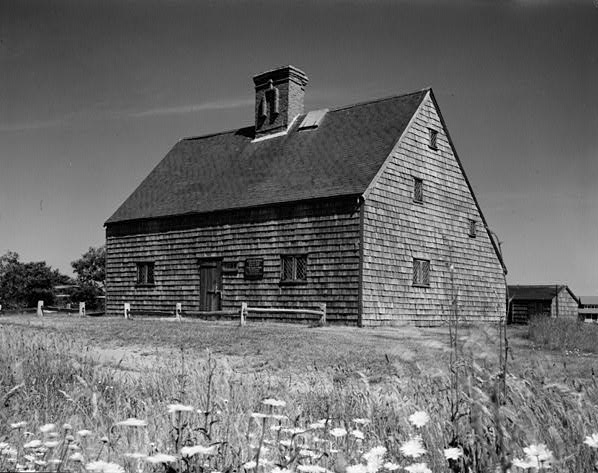
Jethro Coffin House

Jethro Coffin House,  also know as the Oldest House,  is the oldest house on Nantucket in its original location and is the only surviving structure from the island’s 17th Century English settlement. It is a U.S. National Historic Landmark. Because of the brick design on its chimney, it is also called the Horseshoe Housd

7. Shuah Starbuck

Shuah is named only by Noyes, Libbey and Davis; other sources do not name her as a child of Edward.

Sources:

English Immigrant Edward Starbuck

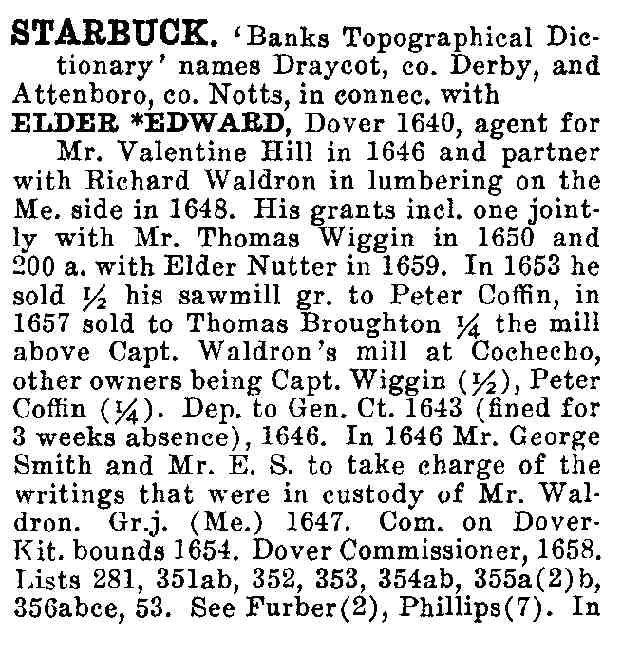
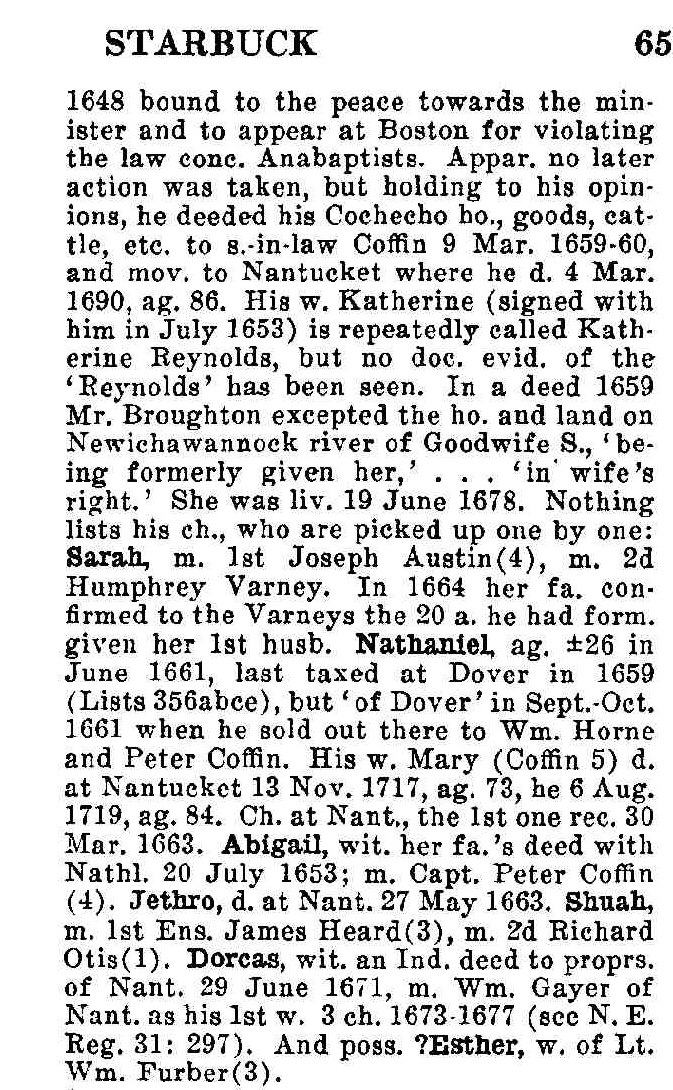
Edward Starbuck Bio 1 - Genealogical Dictionary of Maine and New Hampshire

Edward Starbuck Bio - Genealogical Dictionary of Maine and New Hampshire

http://www.genealogyofnewengland.com/b_s.htm
http://freepages.genealogy.rootsweb.ancestry.com/~parisho/s/starbuck.html

http://www.reynoldsfamily.org/line24/index.html

Posted in 12th Generation, Artistic Representation, Dissenter, Historical Site, Immigrant - England, Line - Miller, Pioneer, Place Names | Tagged | 34 Comments

William Story

William STORY (1614 –  1702) was Alex’s 9th Great Grandfather; one of 1,024 in this generation of the Miller line.

Immigrant Ancestor - Story Coat of Arms

Immigrant Ancestor – Story Coat of Arms

Our William Story’s  history is uncertain.  There are two options.

Option 1 is that he was an unknown William Story who married   Sarah STARBUCK about 1646 when Sarah was only about sixteen years old.   William must have died unmentioned before Oct 1649 when Sarah at the age of 19 married Joseph Austin, leaving Ann as an orphan unmentioned in the records of Sarah and Joseph.

Option 2 is that he is the William Story who married Sarah Foster in 1640 and Ann Story’s birth records are missing from the Ipswich records that we know have some holes.  Ipswich is the town of Ann’s birth.  Ipswich is very close to Haverhill where Stephen Dow and Ann Story were married.

Option 2 sounds more likely to me, let’s go with that.

William Storey was born 1614 in Norwich, Norfolk, England. His father was Robert (not Augustine) STOREY (1588-) The first mention of William in England is found in the following:

Norwich, England:      An Index of Indentures of Norwich Apprentices Enrolled with the Norwich Assembly; Henry VII – George II, page 157:       Story, William, son of Robert dec.; apprenticed to  John Coats of Norwich, carpenter, 1634 for 7 years.

He  left Norwich and arrived in Boston 8 June 1637 from Yarmouth in one of two ships:  either the Rose (William Andrews, Jr. master) or the John and Dorothy (William Andrews, master).  In the combined passenger list, there is a Samuel Dix with wife, two daughters, and two servants.  One of these is William Storey b. 1614.  As Dix was a joiner, presumably Story was an apprentice in that trade.  The Dix family has not been located.  William married Sarah FOSTER on 1640 in Ipswich, Essex, Mass.  William  died 20 Jan 1702 in Chebacco Parish, Ipswich, Essex, Mass.

Sarah Forster was born 15 Oct 1620 in Exeter, Dervonshire, England, England and was christened 15 Oct 1620 in Theydon Garnon, Essex, England. Her parents were Reginald FOSTER and Judith WIGNOL.  Sarah  died in 1681 in Ipswich, Essex, Mass.

Sarah Starbuck was born about 1630 in Dover, New Hampshire.  Her parents were Edward STARBUCK and Catherine REYNOLDS.  Sarah married Joseph Austin in 1649 in Nantucket MA.   Sarah married a third time to Humphrey Varney on 2 Jan 1663/64 in Ipwich, Mass.  Humphrey was the widower of Sarah’s sister.  The Book of Dow speculates that Sarah married William Story  late in life after Humphrey died, but Humphrey was born about  1642 Barbados and died after William  2 Jun 1714 Dover, NH.  Sarah died on 6 Jun 1719 in Dover Strafford County, NH..

Children of Wiliam and Sarah Foster:

Name Born Married Departed
1. Seth Story 1645
Ipswich
Elizabeth Cross (daughter of our ancestor Robert CROSS)
1684
Ipswich, Mass
 9 Oct 1732
Ipswich
2. Sarah Story 13 Dec 1645 Richard Walker
29 Oct 1661 in Ipswich
29 May 1723
3. Ann STORY ca. 1646 Ipswich. Stephen DOW I
16 Sep 1663 the Haverhill First Church
3 Feb 1714/15
Haverhill Mass.
4. Samuel Story  c. 1647
Ipswich
Elizabeth Burnham
1678
 29 Oct 1727
Norwich, CT
5. William Story  c. 1650
Ipswich
Susannah Fuller
25 Oct 1671 Ipswich
20 Jul 1721
Brookline, Norfolk, Mass
6. Abigail Story 1654
Ipswich
After 1669
7. Hannah Story 19 Aug 1662
Ipswich
William Swan
3 Dec 1683
Rowley, Mass.
.
Thomas Jewett (Son of Ezekiel JEWETT)
18 May 1692
 1772?
8. Susanna STORY  4 Mar 1664 John Clark
13 Jul 1681 Lynn, Mass
.
Cornelius BROWN Jr.
1688 in Lynn, Essex, Mass.
9 Jan 1734
Boxford, Essex, Mass.
9. Mary Story  c. 1666
Ipswich

Children of Sarah Starbuck and Joseph Austin

i. Nathaniel Austin (c. 1650 -)
ii. Deborah Austin (c. 1650 – )
ii. Benjamin Austin (c. 1652 -)
iv. Deborah Austin (c. 1651 – 4 Feb 1718 Nantucket) m. 1668 John Coffin
v. Mary Austin (c. 1655 – 1 Jun 1721 Nantucket) m. 1674 Richard Gardner
vi. Thomas Austin (c. 1656 – >1698) m. abt. 1677 Ann Otis

Joseph Austin is said to have come to Dover about 1647 from Hampton, NH, where there was a Joseph Austin in 1642. He was taxed in Dover in 1646. In 1649, he purchased of Richard Waldron one-fourth part of the “old mill” at Cocheco, Lower Falls for “accomodation” of which he received the wood of three acres. In 1658, he exchanged with Elder William Wentworth “Emery’s Farm” for other land. Joseph lived in Cocheco.

“Joseph, planter, Dover, had case in court in 1647; taxed Oct. 19, 1548. Bought one quarter of a sawmill of Richard Waldron 20 Set. 1649. He deposed 27 June, 1661, ae. about 45 years [P. Files.] His will dated 25 Jan. 1662, was probated July 1, 1663, by widow Sarah; beq. to wife and children; son Thomas to have a double portion; brother Peter Coffin one of the overseers.”

He owned and operated a mill with his father-in-law, Edmund Starbuck and William Furber, buying/ his share from Richard Waldron. He was a constable in 1656-57. In 1658 he exchanged the “Emerson Farm” for other land. When he died, his will left a double portion to his son, Thomas, who remained in Dover. His wife and the other children returned to Nantucket to live with Grandfather Starbuck. His wife married Humphrey Varney.

Children of Sarah and Humphrey Varney
vii. Ebenezer Varney b. 5 SEP 1664 Dover, NH
viii. John Varney  b. 5 SEP 1664 Dover, NH. d. 14 AUG 1666 Dover, NH.
ix. Peter Varney  b. 29 MAR 1666 Dover, NH.
x. Joseph Varney  b. 8 OCT 1667 Dover, NH. d. 1668
xi. Abigail Varney  b. 10 Jul 1669  Dover, NH.
xii. John Varney  b. 1671 Dover, NH

William Story’s American Career

William Story was a carpenter of Ipswich and Dover, NH.  The children of William Story are not all known because Ipswich has no records until 1648.  So there might have been an Ann among them.   William moved to Dover in 1648, but Dover records are as defective as Ipswich.  He appears there is a deed as William Storer.   According to The Book of Dow, he married second when both were too old for children, Sarah Starbuck.   Incidently, it may be noted that Ann’s oldest daughter married a Dover man.

Dover was settled in 1623. It’s citizens…early adopted a form of town and provincial government of their own. Dover was annexed to Massachusetts, by vote of its citizens, 9 Oct  1641. The early town and provincial books were destroyed soon after the annexation to Mass. Dover’s oldest town book now in existence was begun Dec. 27, 1647; it has the following town rate which is the earliest tax rate of Dover now on record.” Amongst the many on this list were: # s. d. # s. d. William STORY – Rated £78: 04: 00 and to pay 4d p# is 0001: 02: 01 Joseph Austin – ” 0091: 10: 00 ” ” 0001: 11: 02 Edward Starbuck – ” 0045: 10: 00 ” ” 0000: 15: 04 Francis Littlefield – ” 0060: 15: 00 ” ” 0001: 00: 03

William was a subscriber to Major Denison in 1648. He had a share and one half in Plum Island, 1664. He was a Surveyor of Highways, 1662. He possessed lands in Chebacco (Essex) Nov. 10 1652. On May 8,1649 he purchased from Henry Archer and his wife, a farm of ninety acres, beyond Chebacco Falls. In 1671 he had permission to have a Mill on the Chebacco River.

In the town records of Ipswich for the year 1648 there is a list of one hundred and sixty one persons who subscribed the sums severally set against their names as an annual contribution to a fund for expenses of military instruction to be paid to Major Dennison 1 so long as he shall be their leader Eight of this number were at that time undoubtedly residents of Chebacco viz John Burnbam 4s Thomas Burnham 3 William Cogswell 4s John Choate 5s Robert Crosse 4 William Goodhue 8 Thomas Low 2 t William Story 2s Probably the following in the same list were also inhabitants of this place at that time John Andrews Jr 3s John Perkins Jr 5

William signed the petition in support of John Proctor oldest son of our ancestor John PROCTOR  and his wife Elizabeth Proctor at the Salem Witch trials.

William left a will recorded 10 Oct 1691 and proven 20 Jan 1703.  However he had dispursed much of his property before that time….Administration was granted for William’s estate on 20 January 1702/3 to his oldest son, Seth.

From EARLY INHABITANTS, IPSWICH MA:

William Story was a subscriber to Major Denison 1648.  Had a share and a half in Plum Island, 1664.  In 1679 he was a voter in Town affairs, with the addition of “senior.”  Mary Story, his daughter, joined the Church by taking the Covenant, April 12, 1674.

He sold a lot of land to William Knowlton, previous to February 12, 1643.  He purchased of William Symonds, Gent. and John West, yeoman, two lots of land, adjoining other land which he had bought of Robert Kinsman, seven acres of which was granted by the town of Ipswich to John Wedgewood.

He was surveyor of Highways, 1662.  He then had the addition of “carpenter.”  He possessed lands in Chebacco, Nov. 10, 1642, adjoining on the northwest, land of John Webster.  He purchased, May 8, 1649, of Henry Archer and Elisabeth his wife, a farm of ninety acres, granted unto Archer by the Town of Ipswich, beyond Chebacco Falls.  He had permission to have a Mill, 1671, Chebacco river.  in February, 1672, Abr’hm Perkins complained against ” William Story, sen’r, for taking of a load of green timber about Dec’r last; oke timber, which he drew over my farme of the south side Chebacco river; either off the commons or my farme.”

One source says a brother named Seth and a sister named Emily came to Mass. with William.  Letter 1944 to ABSB from Conn. State Library says William settled in Ipswich, proprietor early as 1642, owned much land.    His wife Sarah deposed in 1668 that she was about 48 years old.  Essex County Deeds p 596 says William Story had seven children:  Sarah, Seth, William Jr., Abegail, Samuel, Hannah, and Susanna;  BUT there was a Ruth Story.  One Ruth Story “daughter of William” is mentioned in a document dated 1693, recorded in the office of the Clerk of Courts, Town of Salem MA.  This is a Deed of Gift in the will of Grandfather Story in April 1693.  Deed 1 April 1693 given by Mr. William Story Sr. of Ipswich MA 1693 to his son Seth Story and son William Story Jr. (LC Folio 596)

Children

1. Seth Story

Seth’s wife Elizabeth Cross was born 3 Mar 1649/50. Her parents were Robert CROSS and Anna JORDAN.  Elizabeth died 12 Mar 1735/36 in Ipswich, Essex, Mass.

Seth became a deacon and was quite prominent in Ipswich Senior Deacon, 2nd Church of Chebacco. Chebacco was incorporated as Essex in 1819. The name Chebacco is Agawam in origin and refers to a large lake whose waters extend into neighboring Hamilton.  Early on, Chebacco Parish lobbied for status as an independent town, asking for permission to build a meeting house. In colonial times, the existence of a meeting house in a settlement conferred de facto autonomy, so Chebacco Parish was denied permission to build such a structure. Popular history tells that one written dictate was issued stating that “no man shall raise a meeting house”, so the residents of the settlement interpreted it as to mean that women would be allowed to do so. It is reported that a local woman, Madam Varney, assembled the town’s women and construction of a meeting house was carried out by them while the men looked on.

Seth fought in Narragansett winter fort under Capt. Samuel Brocklebank of Rowley during ‘King Phillip’s War with the rank of sergeant.

“Here lyes ye body of Deacon Seth Storey aged 87 years decd Octr ye 9th anno domini 1732”      .Old Graveyard Essex, Essex County, Mass

“Here Lyes Ye Body of Mrs Elizabeth Story Wife of Dea’n Seth Story Who Died March 12, 1736, Aged About 85 years”      Old Graveyard , Essex, Essex County Mass

2. Sarah Story

Sarah’s husband Richard Walker  was born 1637 in Lynn, Middlesex, Massachusetts. His parents were Richard Walker and  Jane Talmage.  He died 1721 in Lynn, Middlesex, Massachusetts and was buried 1721

5. William Story

William’s wife Susannah Fuller was born 4 Aug 1650 and died 4 Jun 1707 in Boston, Mass.  Her parents were John Fuller and Elizabeth Emerson.  They moved to Concord, then to Charlestown, Roxbury, and Brookline, Mass.

6. Abigail Story

Most sources state that Abigail died in 1658, but an Abigail Story, age 15 was serving Thomas LOW’s wife in Ipswich in 1669.

7. Hannah Story

Hannah’s first husband William Swan was born 24 Feb 1660 in Haverhill and died: 14 Apr 1682 in Cape May, NJ.  His parents were Robert Swan and Elizabeth Acy.

Hannah’s second husband Thomas Jewett was born  20 Sep 1666 in Rowley and died: 6 May 1731 in Boxford, Essex,  Mass.  His parents were Ezekiel JEWETT and Faith PARRAT.  After Hannah died, he married Faith [__?__].  Thomas died 6 May 1731 in Boxford, Essex, Mass..

Source:

http://www.genealogyofnewengland.com/b_s.htm
http://freepages.genealogy.rootsweb.ancestry.com/~parisho/s/starbuck.html

http://homepage.mac.com/billwalker1/data11/ps03/ps03_374.htm

The Book of Dow, Genealogical Memoirs of the Descendants of Henry Dow 1637, Thomas Dow 1639 and Others of the Name, Immigrants to America During Colonial Times. by Robert Percy Dow 1929

http://freepages.genealogy.rootsweb.ancestry.com/~smithhouse/andergen/hardyfam/aqwg278.htm

http://homepage.mac.com/billwalker1/data11/ps03/ps03_374.htm

The Descendants of William Story  by Robert Pratt, pub. 2000 pp 1 – 4 detail all that is known about William Story

http://trees.ancestry.com/owt/person.aspx?pid=7824164

25 NOV 1731 Boxford, Essex, Mass.
Spouse: LAKEMAN, William 
b. 1710 Ipswich, Essex, Mass.
d. 14 MAR 1780 Boxford, Essex, Mass.

Posted in 11th Generation, Double Ancestors, Historical Monument, Immigrant - England, Line - Miller, Twins, Witch Trials | Tagged | 18 Comments

Thomas Dow

Thomas DOW – (b) – (ca. 1615 – 1654) was Alex’s 9th Great Grandfather; one of 1,024 in this generation of the Miller line.

Thomas Dow - Coat of Arms

The coat of arms indicates that Thomas was an original immigrant from England. as Robert Percy Dow puts it in his Book of Dow: “No Dow in America has any right whatever to any arms and the whole idea is repugnant to our sturdy original yeomanry.  We are yeomen, neither noble or peasants, never Saxon serfs.  To say, as was said in a genealogical weekly newspaper, that the Dow arms are: Sable a fesse dancette crimine between three doves argent, is a lie, i.e., deliberately intended to deceive.  A number of families of Dow have received arms from the College of Heraldry, and the basis of all is the dove crest, the tree doves generally in a sable star, and the ribbon, generally with the word “patiens.”  A Scotch creest, figured in Fairbanks, is a pegasus rampant.  Those who have received Dow arms are of three classes, – have paid cash, had some mayoralty or petty preferment, or been polite to the King’s mistress.  There was no grant of arms to a Norfolk Dow, although some of them did enter the gentry by marriage to some heiress.”

Thomas Dow’s origins are not known.  The information that he was born  in 1613 at Runham, Yarmouth, Norfolk, England and was the son of  Henry Dow and Elizabeth March is wishful thinking based on a possible connection with a Henry Dow that emigrated in 1637 and lived near Newberry.  That Henry Dow had a brother Thomas, but that Thomas was 14 years too old and died in Runham.

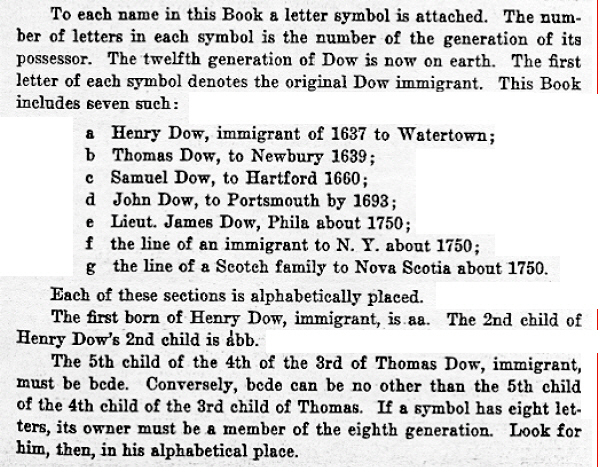
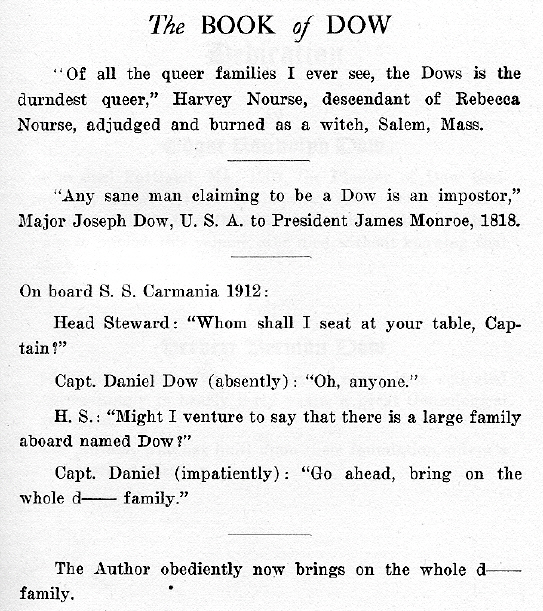
The Book of Dow, Genealogical Memoirs of the Descendants of Henry Dow 1637, Thomas Dow 1639 and Others of the Name, Immigrants to America During Colonial Times.is the Bible of Dow researchers and Charles Percy Dow's alpha system for recording Dows is important to know

Thomas Dow first appears in  a list of the original grantees of Newbury, Mass in 1639 with his wife, Phebe LATLY, and at least one child.   The name Latly comes from Thomas’ will.  Most genealogies say Latly was her surname, but I think it is much more likely that it was  Phebe lately wife of Thomas.    Thomas died 31 May 1654 in Haverhill Mass.

Phebe Latly may have been born 1612, in Norfolk,  England.   After Thomas died, she married John Eaton on 20 Nov 1661 in Haverhill Mass. Phebe died on 3 Nov 1672 in  Saslisbury, Essex, Mass.

John Eaton  was born 1595 Hatton, Warwickshire,  England   His parents were Richard Eaton and Jane Hussey or William Eaton (1570–1600) and Elizabeth Sheapheard (1569–1636).  He married 26 Dec 1621 Age: 26 to Ann Crossman in Stratford, Warwickshire, England; 1640 Age: 45 to Mary Paine in Newport, Rhode Island; 26 Nov 1653 Age: 58 to Dorcas Greene in Reading, Middlesex, Mass; 20 Nov 1661 Age: 66 to Phebe Dow in Haverhill, Essex, Mass.   John died 29 Oct 1668.

John was witness to Thomas’ will. He was a cooper of Salisbury, who came to Haverhill 1646, was selectman 1648, thrice married, with 7 children, 6 surviving to become step children of Phebe Dow. They returned to Salisbury, where he died 29 Oct 1668  Salisbury, Essex, Mass, she 3 Nov  1672.

Children of Thomas and Phebe:

Name Born Married Departed
1.
ba.
John Dow after 1633, not improbably 1638 Mary Page
23 OCT 1665 Haverhill
26 NOV 1672 Haverhill
2.
bb.
Thomas Dow ca. 1640
Newbury, Mass
Dorcas Kimball 17 DEC 1668 21 JUN 1676 Haverhill
3.
bc.
Stephen DOW I 29 Mar 1642 in Newbury Ann STORY
16 Sep 1663
Haverhill
3 Jul 1717
Haverhill
4.
bd.
Mary Dow 16 APR 1644 Newbury, Mass Gilbert Wilford
1665
Haverhill
1685 Bradford, Mass.
5.
be.
Martha Dow 1 JUN 1648 Newbury Joseph Heath
(Son of Bartholomew HEATH)
27 JUN 1672 Haverhill
.
Joseph Page
2 Dec 1673
.
Joseph Parker
19 Mar 1688
1707 – Haverhill, Essex, Mass

Thomas was poorer than most of his neighors for his whole estate was appraised at less than £96.  He lived 14 years in Newbury, during which time his children did not have sufficient nourishment.

1639 –  Thomas Dow first appears in  a list of the original grantees of Newbury, Mass.  There is a vague tradition that Thomas Dow came in 1637, but this seems error arising from the fact that Henry Dow came in 1637.  His house was in what is now called Newburyport, on the southerly side of Greenleaf’s Lane (now State Street) leading to Watt’s Cellar   Click to See Google Maps State Street Today

Looking Down State Street Newburyport in the future from a 1910 perspective

1639 –  Thomas was in Newbury  with wife Phebe and at least one child. His house was in what is now called Newburyport, on the southerly side of Greenleaf’s Lane (now State St) leading to Watt’s Cellar.

Newbury Plantation was settled and incorporated in 1635. The Rev. Thomas Parker and cousin Rev. James Noyes along with his brother Nicholas Noyes led a group of approximately 100 pioneers from Wiltshire, England. They sailed from the River Thames aboard the ship Mary and John, first landing in Agawam (now Ipswich) in 1634. They arrived the next spring at the Quascacunquen River, now the Parker River.  As of the  2000 census the population was 6,717.

22 Jun 1642 – Admitted as a freeman by the General Court by reason of the original grant of his Newbury homestead

After 1648 -Lived at Haverhill, Essex, MA. The town was founded in 1640 by settlers from Newbury, and was originally known as Pentucket, which is the native American word for “place of the winding river.” The town was renamed for the city of Haverhill, England, where many of the original settlers’ families were from.  As of the  2000 censusthe population was 58,969.

10 Nov 1653 – Thomas Dow bought a house and houselot of 9 acres in Haverhill.

Richard Ormsby of Haverhill to Thomas Dow of Newbury, house and house lot cont 4 a more or less, with all appurtenances and 5 accommodations for two and fifty pounds, tenn shilling to be paid as appears by a bill of sale which the aforesaid Thomas Dow has given me under his hand.

The Dow family lived in the North Parish area of Haverhill, now called Plaistow. they may have been buried in the North Parish cemetery that lies partly in Haverhill and partly in Plaistow…sometimes called State Line Cemetery.

29 May 1654 – He left a will Widow Phebe & 5 ch. mentioned. He was poorer than most of his neighbors, for his whole estate was appraised at less than 96 pounds. He lived 14 years in Newbury, during which time  his children had not sufficient nourishment.

31 May 1654 – Thomas Dow died at age 39 yrs. and his son, John Dow, inherited the family homestead.

29 May 1660- Thomas’ Newbury house was conveyed to John Bartlett (book 3, pg 177, Ipswich Series).  Thomas was dead by this time so that the date must be of a belated recording

Thomas’ will is nuncupative, made two days before his death:

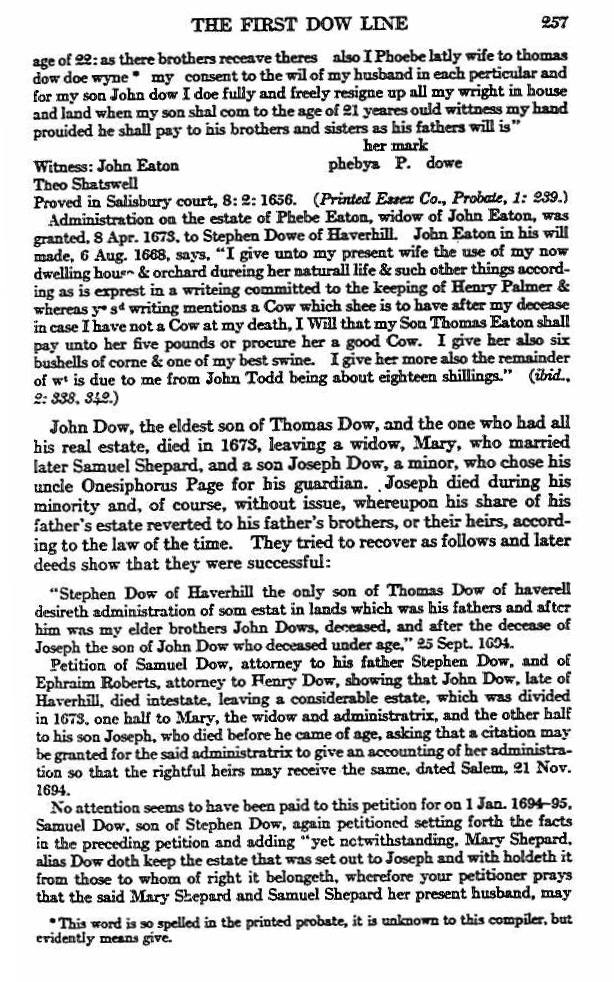
“The last will and testament of Thomas Dowe as it was delevered or expressed by him on the 29th day of May being in ye yeare 1654. I, Thomas Dow, although weake in body yet of perfect memory i doe desire to submit my will, to God’s will and to dispose of my estate to my wife and children as followeth, leaving my wife to be the sole executor at present of all my vesable and personall estate. First I do give unto my loving wiffe Pheby my tow oxen that are now hers and mine and three young beastes beinge now one yeaxe and upwards ould and on cow and two swine and all my houseold goods to be at her disposinge for ever. Also my will is that my oldest son John Dowe at the age of twenty and one yeare ould shall ingioy as his inheritance al the land and housinge that I have bought in Haverhill and to pay in to his other brothers thomas and Stephen and to his 2 sisters mary and martha as I shall apoynt the house and land being thought to be worth three score pounds; my second son Thomas shal reseave at his age of 21 ten pounds or 5 pounds at his age and 5 pounds when he is 22 yeares and for my son Steven he shall reseave at his age of 21: or 5 pounds at 21 and 5 pounds at 22; as to my will is that John my son shal pay to his sister Mary and. his, sister Martha at theyre age of 21 ten pounds or 5 pounds apeace at 21 and 5 pounds apece at ther age of 22; as there brothers reseave theres.

Also I Pheby latly wife to Thomas Dow doe joyne my consent to this will of my husband in each perticular and for my son John Dow I doe fully and freely resigne up al my wright in the house and land when my son shall come to the age of 21 yeares ould. wittness my hand Prouided he shall pay to his brothers and sisters as his fathers will is. in witness hearof
The marke of John Eaton (P) Phebya (F) Dowe Theo: Shatswell This will was testified upon oath by ye witnesses in ye court held at Salisbury the (8) th off ye (2d) Mo: 1656.

John Eaton’s mark resembles a P and that of Phehe an F, both showing unfamiliarity with the exact shape of the letters. Nevertheless, an effort was made to claim that this mark indicated her name was Fenn. The actual writing was done by Shatswell, of whom it may be said that he frequently spells a word twice the same way. It is quite clear that the first two paragraphs were composed by him and written down in advance as sure to meet the requirements. One can imagine the unction with which he put in the word vesable; it had a good sound, looked erudite, almost a legal term, and would add dignity to any will. The rest, which does not parse, was surely put down word by word as spoken laboredly by the dying Thomas. The last paragraph may have been dictated by Thomas, his wife assenting by a nod from time to time but the final “prouided” is surely her own.

Hers was not a vast dowry, the cattle and household goods worth less than £10.  She had a home with her son John for seven years and that John made all the payments required in the will. After that, she married John Eaton, witness to the will. He was a cooper of Salisbury, who came to Haverhill 1646, was selectman 1648, thrice married, with 7 children, 6 surviving to become step children of Phebe Dow. They returned to Salisbury, where he died 29 Oct 1668 or 1 Nov 1682 – Salisbury, Essex, Mass, she 3 Nov  1672.

Research into Thomas’s Origins
The antecedents of Henry Dow, immigrant of 1637, being known, the searchers began by assuming that the two were brothers or near relatives. This gave them a pleasant outing in Norfolk Co with salary and expenses paid. They even failed to hit upon the item in Runham parish register showing that Henry Dow had a brother Thomas 14 years too old to fit the Newbury and that this Thomas had a family and died on his inherited property in Runham. Moreover, they ignored the obvious fact that, while Henry Dow had more than average education, Thomas Dow could not read; that for five years Henry and Thomas lived in adjoining towns and for ten years thereafter they were but 15 miles apart, without the slightest evidence that one knew of the existence of the other.

The investigators next turned to Wiltshire, because one Francis Dow had come from there and returned there; but he had an only child, Peter. This made no difference; they searched for some kinsman Thomas, disregarding as before that our Thomas could not read and Francis was of the landed gentry and mayor of a city. To Stratford they next went, because a Thomas Dow of Stratford had a wife Phoebe. They did not hurry to weigh the patent evidence. Simon Fenn, clothier of Dedham, Essex, bequeathed money Jan 16, 1609, to his dau Phoebe, wife of Thomas Dowe of Stratford. Jan 10, 1615, Phoebe got another legacy from a kinswoman, being then called Phoebe Dow, wid. This Thomas Dow is about 40 years too old to fit and some curious searcher has since located all his family in Stratford. The investigators were then compelled to turn to a general search, published probate records being the most accessible field. They prepared lists of wills, over 200 of them, from every county in England, of Dow, Doue, Dove or any other similar spelling. Results wholly negative. They scanned every legatee, in hope that they might find from some parish rec that such had a son Thomas. They found of about right age a Robert Dowe of London, Bridget Dowe, wid of Thomas, legatees of their sister, Ann Colston, wid of Bristol 1620. They canvassed William Dowe and Mary, his wife, of 1620, she the dau of John Cossie of Baudsey, Suffolk. James Deowe is a new spelling; he was an appraiser May 1620 in Beamister, Dorset. Robert Dowe was a legatee in Exeter 1620. Thomas Dow, witness to a will in Newburye, Berks, 1620, raised their hopes from coincidence in name of place, altho presumptive age forbade. The number of Dow in Ireland can be imagined from the circumstance that 12 Thomas Dows were buried in Dublin in a single year. In Scotland during the 50 years preceding 1639 the number of recorded Thomas Dows could not be confined to a page.

One can only turn to evidence drawn from Thomas and Phebe themselves. There is nothing in the religion of either to afford a clue, for there was but one church in Haverhill, and Newbury. Thomas Dow was as religious as his neighbors, but this proves nothing except that he was a Puritan in Massachusetts. Could he be a Scotchman? The Scotch Dow were never an independent family; many of them were in Clan Buchanan, but there were some in almost every clan, indicating that the name was assumed by individuals without any concert whatever. The investigators did not look up any Scotch records; hunting would be like seeking a needle in a haystack. There was a Thomas Dow of Berriehell of Tullibagles, Methven Parish, near Perth, who made a will Aug 19, 1609, but he had no son Thomas; and there were a score of Thomas Dow within a few miles. There was no Scotch migration to America for many years after this, but this does not preclude the possibility of some individual getting from Scotland to England and joining a party to America. Moreover, any Scotchman joining a party of emigrants would be a marked man, living socially more or less apart.

An idea that our Thomas Dow of Newbury possessed a distinctive plaid or tartan is based wholly. on a misunderstanding. Over 20 years ago a lady of Dow descent while visiting Edinburg was shown a Dow plaid and bought a quantity, distributing samples to such Dows as she knew or subsequently met. Some one who knew of the interest taken in the identity of Thomas Dow suggested that this might be his plaid and so the story grew. There are now some who assert positively that this plaid was worn by Thomas Dow of Newbury. This is absolutely untrue. It is well known that the canny Scotch manufacturers keep lines of plaid labelled to suit any name ever known in Scotland. There are plenty of retailers who will supply a plaid for any name and will swear the Schmidts or O’Flahertys have worn it for a thousand years. The patterns are generally chosen with some care, so this particular plaid is a variant of the Buchanan. A few years ago experts looked at it once again. None admitted knowing it. Only a few were bold enough to call it a fake. One said plainly that it was a fabrication, not a true tartan, and was designed recently as resembling and varying from the Buchanan.

Whatever presumptive evidence there may be (and there may not be any) comes from the will of Thomas or the attached words of Phebe his wife. Here and there a phrase faintly suggests the language or national canniness. Phebe’s name was either Latly or Latty. The exact wording in the will seems to be “I, Phoebe Latly wife of Thomas.” A photographic copy proves that latly begins with a small l. It also shows the cross bar of the t prolonged, as tho the writer began to write latty when his ink failed. One author believes her name was Latty, because that is a name, while Latly is not. Perhaps this couple came from that part of the Highlands where Thrums might be, perhaps truth is stranger than fiction, perhaps Sir James Barrie is unwittingly a better genealogist than we, and Rob Dow, literary sawyer of Thrums and Aaron Latta, weaver of Thrums, are the true kin of this Newbury and Haverhill couple. This entails an unwelcome suggestion, as there was at the time no Scotch migration. Thomas, gillie, might have married Phebe, dairy maid, and had a son John; not liking his outlook, might have crossed the border and joined a Puritan party to America. In those days a runaway gillie was hauled back as ignominiously as a negro in 1850. If there was a runaway of this kind, it would be likely that the man would take a new name for concealment; if so, Dow was a common and general name, not attributable to any one clan or locality.

Children

 i. John Dow – ba

John’s wife Mary Page was born 3 May 1646, 4th child of John Page and Mary Marsh of Hingham, later of Haverhill.   John died intestate 3 Apr 1673, widow Mary swore to the inventory of his estate (£174-1-0). On 14 Jul 1673 she married again to Samuel Shepard.  Mary had 7 children by Samuel Shepard of whom the youngest married Samuel Dow (adk).

John was a cooper of Haverhill; freeman in 1666; on muster roll of Ensign Moses Higgins, assigned to sixth garrison.  The sons of Thomas Dow were not strong, possibly early privations worked against the,.  John prospered moderately, for he made all payments charged to him in hs father’s will, kept his own land was able to buy the allotment made in the fifth division to one Coffin.  He and his brother Thomas appear as signers of the petition for the pardon of Major Robert Pike (son-in-law of Joseph MOYCE), a high minded man always in trouble with the authorities for denouncing the witchcraft persecution and supporting the right of free speech by lay preachers in the absence of regular preachers.

Children of John and Mary:

i. Mary Dow – baa – b. and d. Haverhill Apr 1663

ii. Joseph Dow – bab – (20 Sep 1669 – 16 Mar 1688/89) Unmarried.  Joseph chose his uncle Onesiphorus Page as his guardian in 1686.  Apparently Joseph was entitled to some overlook property, for seven years after his death, 4 May 1696, Samuel Shepard and Mary, his wife formally refused to administer Joseph’s estate.  After considerable delay it was administered by his cousin Samuel Dow (bcb) and the property was divided among his surviving aunts  and uncles.  This argules that John Dow (bac) was not living and had no heirs.

iii. John Dow – bac – (6 Nov 1672 – ) Not mentioned in Hoyt’s Old Families

2. Thomas Dow – bb

Like this brother John, Thomas also died when a young man.  He was only 36 years old when he died 21 Jun 1676, his will was probated 14 Nov.  He started towards prosperity; was able to buy land in 1662.  It does not appear he was admitted a freeman.

Thomas’ wife Dorcas Kimball was born in 1649.  Her parents were Henry Kimball and Mary Wyatt.  Her grandparents were Richard KIMBALL who married second Margaret Cole (widow of Henry Dow (a))  Dorcas survived Thomas by eight years.  Apparently, she did not serve as executrix, for the estate was administered by Henry Kimball, another brother, and receipts for all legacies were made to him.

Thomas Dow Jr - 1 Source: Ancestry of Charles Stinson Pillsbury and John Sargent Pillsbury (1938)

Thomas Dow Jr. - 2

Children of Thomas and Dorcas:

i. Thomas Dow – bba – b. 23 Oct, d. 4 Nov 1669

ii. Henry Dow – bbb – b. 5 Mar 1670/71.  In his will his father gave this child to Joan, wife of John Haseltine.  this step must have had the consent of Dorcas.  From Henry comes a large posterity, roughly one tenth of all the (b) Dow family.

iii. Dorcas Dow – bbc – b. 27 Feb 1672; d. 3 Apr 1673

iv. Phoebe Dow – bbd – b. 20 Sep 1674; m. 16 Jan 1695 to Samuel Smith (Topsfield record) Seven children.

3. Stephen DOW I – bc –  (See his page)

4. Mary Dow – bd –

Mary’s first husband Gilbert Wilford was born about 1640 in England. He was originally of Bradford and later moved to Haverhill. Gilbert died 28 Apr 1676 in Haverhill, Mass.

Martha’s second husband Matthew Clarke was born about 1652 in Haverhill, Mass. He married Martha 2 Apr 1679 in Haverhill to Matthew Clarke.  A statement in a genealogical periodical that Matthew was son of Elder James Clarke of Londonderry is not correct. Matthew died 6 Jun 1715 in Haverhill, Mass.

Mary Dow was presumably stepmother of the Londonderry pioneer, and James Clarke  b. before 1679 was probably grandfather of Elder James.

Children of Mary and Gilbert:

i. Mary Wilford – bda – b. 18 Nov 1667 in Bradford; m. 17 Dec 1684 in Haverhill to John Corliss, son of George CORLISS and Joanna DAVIS ; m2, 23 Jan 1702/03 in Haverhill to William Whittaker.

John served in King Philip’s War, under Lieutenant Benjamin Swett, June 1676, also August 1676 . He owned at least one slave, Celia. In 1798 John’s house was valued at $350. He inherited the farm from his father, George Corliss and lived there all his life.

John Corliss fought in King Philip’s War under Lt. Benjamin Swett in June & August, 1676; took the oath of allegiance, November 28, 1677. From the Essex County Quarterly Courts Records, 4:193: “John Corliss deposed that he heard Joseph Davis send to Pecker to raise the flood gates when the sawmill at Haverhill was lost in the 1668 flood and Ensign James Pecker was charged with responsibility.

ii. Martha Wilford – bdb – b. 18 Jan 1669; m. 7 Feb 1694/95 to Joseph Greely.

iii. Ruth Wilford -bdc – b. 5 May 1672; m. 12 Jun 1694 in Haverhill to Thomas Ayer.  He and daughter Ruth killed by Indians.

iv. Nathaniel Wilford – bdd – b. 20 May 1675; d. 1706; Unmarried

5. Martha Dow – be –

Martha’s first husband Joseph Heath was born about c. 1645 in Newbury. His parents were Bartholomew HEATH) and Hannah MOYCE. Joseph died 1 Dec 1672, Killed by Indians on the Andover road.

Martha’s second husband Joseph Page was born about 1647.  His parents were John Page and Mary Marsh. Joseph died Feb 1683.

Martha’s third husband Joseph Parker was born 14 Oct 1659 in Andover, Essex, Mass. His parents were Joseph Parker and Mary Stevens. He married Martha 19 Mar 1689 was killed a year later by Indians while in his hay field 3 Aug 1690 in East Parish, Haverhill

Whose posterity rejoined the line two generations later (Phoebe Heath beaa m. Richard Dow bcde) surely endured vicissitudes tending to create a race of brave men. m. 27 Jun 1672 to Joseph Heath.  While she was carrying an unborn son, her husband was ambushed and killed by Indians on the Andover road 1 Dec 1672.  Martha married again 2 Dec 1673 to Joseph Page  Martha married a third time 19 Mar 1688 to Joseph Parker.   Thus Martha was widow thrice before she was 43. many years later Joseph Heath in his will gave to his son Samuel land “set aside to my mother Parker as her right of dower in Jospeh Page’s estate.”  Martha had one by first, rest by 2nd.

i. Joseph Heath – bea –  b. 23 Mar 1673 Salem, Rockingham, NH, four months after his father was killed; d. 11 Jun 1714 – Haverhill, Essex, Mass  Some sources say he married Hannah Bradley, but I think Hannah married Josiah Heath, son of Josiah HEATH and Mary DAVIS.

ii. Phebe Page – beb – b. 17 Nov 1674 in Haverhill; marriage intentions published 14 Oct 1685 to Joseph Tucker, son of Morris Tucker

iii. Joseph Page – bec – b. 23 Nov 1676; killed by Indians 4 Aug 1704; no children

iv. Hannah Page – bed – b. 5 or 12 Feb 1678; m. 27 Nov 1696 to John Dow (adb)

v. Martha Page – bee – b. 14 Feb 1680; m. 19 Dec 1700 in Haverhill to Matthew Herriman

vi. Thomas Page – bef – b. 12 Apr 1683; d. 5 Jun 1683 in Haverhill

vii. Ebenezer Page – beg – b. 9 May 1684; soldier in Salisbury; killed by Indians 24 Jun 1707

Sources:

http://www.genealogyofnewengland.com/b_d.htm

http://members.fortunecity.com/dickcoveney/p52.htm#i2849

http://www.dowlink.net/first_generation.htm

The Book of Dow, Genealogical Memoirs of the Descendants of Henry Dow 1637, Thomas Dow 1639 and Others of the Name, Immigrants to America During Colonial Times. by Robert Percy Dow 1929

Dedicated to all Dows Everywhere

Ancestry of Charles Stinson Pillsbury and John Sargent Pillsbury (1938) By Holman, Mary Lovering, 1868-1947; Pillsbury, Helen Pendleton Winston, 1878-1957

Thomas Dow 1: Source: Ancestry of Charles Stinson Pillsbury and John Sargent Pillsbury (1938)

Thomas Dow 2

Thomas Dow 3

Thomas Dow 4

Posted in 11th Generation, Immigrant - England, Line - Miller, Pioneer | Tagged | 5 Comments

Famous Cousins

This one is pure trivia fun.

Presidents and First Ladies

Michael Metcalf Jr
Michael’s Great Great Grandson Samuel Huntington (1731-1796) signed the Articles of Confederation as a member of the Continental Congress. Later he signed the Declaration of Independence as Governor of Connecticut and served as President of the Continental Congress from 1779 to 1781.

Because Huntington was the President of the Continental Congress when the Articles of Confederation were ratified, some amateur historians and civic groups in Connecticut have claimed that Huntington was actually the first President of the United States.

Samuel Huntington 18th Governor of Connecticut and "1st" President of the United States

Peter Montague
George Washington (See the discussion on Peter’s page, Was George Washington’s grandmother a Montague?)

Edward Sturges and George Downing
John Quincy Adams

Peter Winne
Martin Van Buren

3rd Great Grandfather = Cornelis Maessen Van Buren had come to the New World in 1631 from the small city of Buren, Gelderland, Dutch Republic.

2nd Great Grandfather = Marten Cornelise Van Buren (1638-1703) m1. Marytjie Quackenbosch  m2. Peter Winne’s widow Tannatje Adams Winne

Great Grandfather = Pieter Martense Van Buren (1670-1740) m. Judikje Barentse Meinderts

Grandfather = Marten Pieterse Van Buren (1701-1740) m. Dirkje Van Alstyne

Father = Abraham Van Buren (1737-1817) m. Maria Hoes.  He was a farmer, the owner of six slaves, and a tavern-keeper in Kinderhook, NY

8th U.S. President  – Martin Van Buren (1782-1862) m. Hannah Hoes

Elder William Brewster
Zachary Taylor

John Pearson
Franklin Pierce

John Lathrop and John Millard Sr.
Millard Fillmore

Edmund Hobart
Abraham Lincoln (Abe is not a direct ancestor, but Edmund did adopt the children of his second wife including  Martha Lyford (1628 – 1693) who married Abe’s immigrant ancestor  Samuel Lincoln (wiki)

John LathropWalter Palmer and Thomas Miner
Ulysses Simpson Grant

John Lathrop and Joseph CARPENTER
James Garfield

James DavisSamuel HADLEY Jr.’s son, Samuel Hadley III b.1707 whose two daughters Hepzibah b.1744 and Sarah b.1736 were Chester’s great grandmothers on his mother’s side…
Chester Alan Arthur

George Polley
Grover Cleveland

John Gorham and William Hedge
Theodore Roosevelt

John Howland
Edith Roosevelt
Barbara Bush

Jonathan Fairbanks and Ralph Tompkins
William Howard Taft

Ralph Tompkins
Calvin Coolidge

Edward Shepard and George Polley
Herbert Hoover

John Lathrop, and John Howland, Francis Cooke
Franklin D. Roosevelt

Percival Lowell
Lyndon Johnson

Arthur Howland and Rev. Stephen Bachiler
Richard Nixon

Arthur Howland, Rev. Stephen Bachiler  and James Davis
Gerald Ford

Lawrence Towneley (William Chase Sr’s Great Grandfather)
Bill Clinton

John Lathrop, John Howland, Francis Cooke and Jonathan Fairbanks
George H. W. Bush
George W. Bush

Joseph Holloway
Barack Obama


Government and Politicians

Sir Lawrence CHENEY’s (Ancestor of  John Cheney) Anne and Jane were second cousins because his daughter Elizabeth was great grandmother to both.
Anne Boleyn – 2nd wife of  Henry VIII
Jane Seymour – 3rd wife of Henry VIII

Sir Henry Cromwell (Grandfather of) and Giles Cromwell (Nephew of)
Oliver Cromwell

George Downing   Sir George was almost “Wikipedia Famous, but our George was Sir. George’s grandfather it has to be self or child to qualify.
Sir. George Downing 1st Baronet   (Wikipedia)  He was an Anglo-Irish soldier, spy, statesman, and diplomat. Downing Street in London is named after him.

Hugh Sargent ( John Polley’s 3rd Great Grandfather)
Samuel Adams – helped to organize the Boston Tea Party. From the beginning he was a loud voice for independenc

Henry Howland
Winston Churchill

John Lathrop
Thomas E. Dewey
Oliver Wendell Holmes, Sr.and Jr.
Mitt Romney
George W. Romney
Adlai Stevenson

Jonh Lathrop and John Howland
Jeb Bush

John Lathrop, John Howland, Elder William Brewster and Gov. Thomas Prence
Sarah Palin

John Lathrop and Elder William Brewster
John Foster Dulles
Allen Welsh Dulles

John Howland
Nathaniel Gorham (Continental Congress president)

Elder William Brewster
Howard Dean III
Bill Richardson III ( Governor of New Mexico)
Cokie Roberts
Jay Rockefeller IV
Nelson Rockefeller
David Souter
Adlai Ewing Stevenson

Rev. Stephen Bachiler
Daniel Webster

Thomas Miner
William T. Minor – 39th Governor of Connecticut.

Jonathan Fairbanks
Vice President Charles W. Fairbanks (Theodore Roosevelt)

Percival Lowell
William Whipple, signer of the Declaration of Independence
McGeorge Bundy – National Security Advisor to JFK
Elliot Richardson, US Attorney General

William Hedge
Queen Elizabeth II

Conrad Weiser
Great Grandson – Peter Muhlenberg served as a Major General in the Continental Army and saw service at Valley Forge,the Battles of BrandywineGermantown, and Monmouth and the Battle of Yorktown,  A Lutheran minister, he served as Lt Governor of Pennsylvania and later in the US House and US Senate from Pennsylvania.

Great Grandson – Frederick Muhlenberg the first Speaker of the United States House of Representatives. According to legend, Muhlenberg suggested that the title of the President of the United States should be “Mr. President” instead of “His High Mightiness” or “His Elected Majesty”, as John Adams had suggested

Soldiers, Lawmen, Outlaws and Explorers

John Lathrop
Benedict Arnold
Wild Bill Hickock

 Edmond Perry,  Gov. Thomas Prence and Elder William Brewster
Commodore Oliver Hazard Perry ( “Hero of Lake Erie”)
Matthew Calbraith Perry (Opened Japan)

Elder William Brewster, Alexander Carpenter 
Gen. George B. McClellan (Lincoln’s  Democratic opponent in the 1864 election)

Walter Palmer
Nathaniel Brown Palmer (Explorer after whom Palmer Land, part of the Antarctic Peninsula, is named)

Joseph Carpenter
M. Scott Carpenter (Project Mercury Astronaut)

Edmund Freeman
Lizzie Borden

Percival Lowell
Percival Lowell – fueled speculation that there were canals on Mars and formed the effort leading to the discovery of Pluto

Samuel Lathrop
Child  – Samuel Lathrop m.  Hannah Adgate
Grandchild  – Elizabeth Lathorp m. John Waterman.
Great Grandchild – Hannah Waterman (wiki) m. Benedict Arnold III
Great Great Grandchild – the famous patriot and traitor Benedict Arnold V

Conrad Weiser
2nd Great-grandson Peter M. Weiser (born 1781) was a member of the Corps of Discovery on the Lewis and Clark Expedition in 1804-1806. The town of WeiserIdaho, and the nearby Weiser River are named for him.

Entertainers

John Lathrop and Alexander Carpenter
Clint Eastwood

John Lathrop
Brooke Shields
Shirley Temple

John Howland
Humphrey Bogart
Chevy Chase
Anthony Perkins

Gov. Thomas Prence and Elder William Brewster
Bing Crosby

Elder William Brewster
Ted” Danson
Katharine Hepburn
Seth MacFarlane ( Family Guy)

Elder William Brewster  and Alexander Carpenter
John Lithgow

James Davis
Bette Davis

Elder William Brewster and Francis Cooke
Richard Gere

Rev. Stephen Bachiler
James Dean

John Williams
Gregory Peck

Jonathan Fairbanks
Emily Dickinson
Matthew Modine

Percival Lowell
Tuesday Weld

Francis Cooke
(George) Orson Wells
Dick Van Dyke
Brian,  Dennis  and Carl  Wilson (Beach Boys)

Religious Leaders

John Lathrop and John Howland
Joseph Smith – Mormon Prophet

John Howland
Brigham Young

Arts and Letters

John Lathrop and Thomas Prince Jr.
Laura Ingalls Wilder

John Lathrop,  and Elder William Brewster
Kingman Brewster, Jr..

John Lathrop,  Elder William Brewster, John Howland and Maj John Foster (Foster was 3rd Great-Grandfather of the author.  Maj. John -1, Timothy-2, Stuart-3, Isaac-4, Eveline Foster-5 – Eveline married George Adams Longfellow-5)
Henry Wadsworth Longfellow

John Pickard Jr,
Nathaniel Hawthorne

John Howland
Ralph Waldo Emerson

Arthur Howland
John Steinbeck

Elder William Brewster
Julia Child
Thomas Ruggles Pynchon, Jr. (Gravity’s Rainbow)

John Williams
Robert Frost

Rev. Stephen Bachiler
Louis L’Amour

Thomas Miner
William Chester Minor – An American army surgeon who made many scholarly contributions to the Oxford English Dictionary while confined to a lunatic asylum.  The  book “The Professor and the Madman: chronicles Minor’s later life and the creation of the Oxford English Dictionary

Jonathan Fairbanks
Margaret Mead

Percival Lowell
Herman Melville
Tennessee Williams
T. S. Eliot

Francis Cooke
Anna Mary Robinson “Grandma Moses”

Science and Medicine

John Lathrop
Benjamin Spock
Eli Whitney

Gov. Thomas Prence
Orville and Wilbur Wright

Elder William Brewster
Robert Noyce (inventor of the integrated circuit or microchip.)

James Davis 
Linus Pauling

Simon Newcomb
3rd Great Grandson Simon Newcomb (1835 – 1909) a Canadian-American astronomer and mathematician. Though he had little conventional schooling, he made important contributions to timekeeping as well as writing on economics and statistics and authoring a science fiction novel.  He was famously quoted in 1888 ““We are probably nearing the limit of all we can know about astronomy.”

Business

John Lathrop
John Pierpont Morgan
Marjorie Merriweather Post

Stephen Bachiler
L.L. Bean

Thomas Miner
John D. Rockefeller

Gov. Thomas Prence
Orville and Wilbur Wright

Posted in Fun Stuff, Storied | 5 Comments

William Hammond

William HAMMOND (1575 – 1662) was  Alex’s 11th Great Grandfather; one of  4,096 in this generation in the Shaw line.

 Hammond – Coat of Arms

William Hammond was born on 30 Oct 1575 in Lavenham, Suffolk, England. His parents were Thomas HAMMOND and Rose TRIPPE.   He was left an orphan by the death of his father in 1589.   He was married to Elizabeth PAYNE  on 9 Jun 1605 in Lavenham.  William, along with his older children, came to America before his wife and younger children, though the exact year is not known. Elizabeth, aged 47 years, with children Elizabeth, aged 15, Sarah, aged 10 and John, aged 7 years embarked at Ipswich, England, in the ship, “Francis,” [our ancestor] John CUTTING, Master, in April, 1634, and joined her husband in New England. William returned to England and died on 8 Oct 1662 in London England.

Elizabeth Payne was born 11 Sep 1586 in Nowton Parish, Lavenham, Suffolk, England. Her parents were William PAYNE and Agnes NEVES.  Elizabeth died 14 Sep 1670 in Watertown, Mass.

Children of William and Elizabeth:

Name Born Married Departed
1. William Hammond Sep 1607 Lavenham, England Elizabeth [__?__] 1637
Lynn, Mass.
2. Ann Hammond Nov 1609 Lavenham, England 1615
Lavenham, England
3. John Hammond Dec 1611 Lavenham, England 16 Aug 1620 England
4.. Anna HAMMOND Jul 1616 Lavenham, England Rev. John LATHROP
ca. 1635
Boston, Mass.
Sep 1 1685 Barnstable, Mass.
5. Thomas Hammond Sep 1618 Lavenham, England Hannah Cross
ca. 1654
10 Dec 1655 Watertown, Mass
6. Elizabeth Hammond 1619 Lavenham, England Samuel Howse (Son of Rev. John HOWSE)
ca. 1636
1 Jul 1662 Scituate, Plymouth, Mass.
7. Benjamin Hammond 1621 London, England Mary Vincent (daughter of John VINCENT)
1650 Sandwich, Mass.
1703
8. Sarah Hammond Oct 1623 Lavenham, England
9. Lt. John Hammond Jul 1626 Lavenham, England Abigail Salter
ca. 1652
Watertown, Middlesex, Mass
.
Sarah Nichols
2 Mar 1664
Charlestown, Suffolk, Mas
1709 Watertown, Mass.

William Hammond was admitted freeman in Watertown, May 25, 1636, and was grantee of seven lots and purchaser of three lots before 1644. His homestead of 40 acres was situated on the west of Common Street. It was bounded on the east and north by lands of his brother-in-law, Dr. Simon Eire, on the west by John Simson, Isaac Sterne and John Warren, and on the south by Thomas Boyden. Bond’s Hist. of Watertown (p. 1088) says,

“It is probable that William Hammond settled first on the Cambridge Road, very near the Cambridge line. Whether this was a grant to him the records do not show. He sold it early and settled on his 40-acre homestall, situated east of Pequusset meadow. He also owned three small lots in Pequusset meadow, one of these granted to him and the other two purchased. This homestall passed to his son (grandson) Thomas.”

10 Mar 1642 – In the division of lands, he was granted lot No. 76, in the 4th Division, containing 165 acres, and this, with his other holdings, made him one of the largest land owners in the town of Watertown.

The records do not show that he was often an office holder in the town and this may have been due to his independence in religious matters, which may have made him unpopular with his more puritanical neighbors, although he does not appear to have been so unpopular as some of his most intimate friends. His near neighbor and most intimate friend appears to have been John Warren, who came from the same locality in Suffolk County, England, and between whose family and his own there appears to have been considerable intimacy for several generations prior to the settlement in America.

On occasion there were fines “for an offense against the laws concerning baptism,” and “for neglect of publick worship” 14 Sabbaths at 5 shillings each. Warnings were given “for not attending publick worship”.

27 May 1661 – The houses of “old Warren and goodman Hammond” were ordered to be searched for Quakers, for whom they were known to have considerable sympathy. Considerable independence in religious matters, great love of liberty and sympathy for all who are persecuted for conscience sake seem to have been inherent family traits for generations past. It is probable that William Hammond and his intimate friend, Warren, were both inclined toward the religious teaching of Roger Williams, but were too conservative to subject themselves to the persecution that his more radical followers were compelled to endure. This view is supported by the fact that many of their descendants were rigid adherents of the Baptist Church. The tendency, however, in this family has been toward great liberty of thought in religious matters and many of the descendants have been connected with the Unitarian and Universalist denominations, while many in the later generations have held membership in no church.

The will of William Hammond is on file at East Cambridge, Mass., (Middlesex Probate No. 7167), dated July 1662; proved Dec. 16, 1672.

He leaves to wife Elizabeth his whole estate during her life. To son, John, all lands, & after her death. To Thomas Hamond, “sonne of my sonne, Thomas Hamond, deceased,” œ40 at the age of 21 years. “If said Thomas, or any for him, oppose this will,” then he is not have the £40. “Unto daughter (Hannah) Barnes, £30, the same to remain unto her children.” “In case she again become a widow” she to have wood from his lands during her widowhood. To four children of my daughter, Elizabeth House, deceased, various sums of money. “To Adam Smith, son of daughter, Sarah, if he behave obediently to my wife after my decease, one mare, colt and £20.” To daughter, Sarah Smith, £5. Appoints widow, Elizabeth and John executors. Witnesses– Matthew Bridge and Thomas Longhorne.

Inventory by Hugh Mason and Thomas Hastings, Dec. 16, 1662; £457-16-9. Contains the following list of real estate:

25 acres of fallow land
15 acres of broken land,
15 acres of meadow,
60 acres of meadow, &c.,
16 acres of land in low of ye town right,
40 acres in great dividend, 160 acres in a farm. Total, 331 acres.

Children

1. William Hammond

William’s wife Elizabeth [__?__] was born 1609 in Lavenham, Suffolk, England. Elizabeth died 1638 in Lynn, Essex, Mass.

4. Anna HAMMOND (See Rev. John LATHROP‘s page)

5. Thomas Hammond

Thomas’ wife Hannah Cross was born Apr 1636 in Ipswich, Essex, Mass. Her parents were John Cross and Hannah [__?__]. Hannah died 24 Mar 1657 in Watertown, Middlesex, Mass.

6. Elizabeth Hammond

Elizabeth’s husband Samuel House (Howse) was born 10 Jun 1610 in Eastwell, Kent, England. His sister was Hannah HOWSE, first wife of Rev. John LOTHROP.  His parents were John HOWSE and Alice LLOYD. Samuel died 1661 in Scituate, Plymouth, Mass.

Children of Elizabeth and Samuel:

i. Elizabeth House b. 23 Oct 1636 Scituate, Plymouth, Mass.; d. 1679 Scituate, Plymouth, Mass; m. 1 Jan 1661 in Scituate to John Sutton (b. 1642 in Scituate, Plymouth, Mass. – d. 12 Nov 1691 in Scituate, Plymouth, Mass.) John’s parents were George Sutton (b. 12 Apr 1613 Sandwich, Kent, England – d. 12 Apr 1669 Perquimans, North Carolina) and Sarah Tilden (b. 13 Jun 1613 in Tenderden, Kent, England – d. 20 Mar 1677 in Perquimans, Perquimans, North Carolina) Elizabeth and John had four children born between 1662 and 1679.

ii. Samuel House b. 1636 Scituate, Plymouth, Mass.; d 15 Jul 1702 Scituate, Plymouth, Mass; m. 15 Mar 1664 in Scituate to Rebecca Nichols (b. 1641 in Hingham, Plymouth, Mass. – d. 1709) Her parents were Thomas Nichols (b. 1616 in England – d. 8 Nov 1696 in Hingham, Mass.) and Rebecca Josselyn (b. 1617 in Lancaster, Lancasterhire, England – d. 22 Sep 1675 in Hingham). Samuel and Rebecca had eight children born between 1665 and 1685.

iii. Sarah House b. 1 Aug 1641 Barnstable, Barnstable, Mass.

7. Benjamin Hammond

Benjamin’s wife Mary Vincent was born 1633 in England.  Her parents were John VINCENT and Hannah SMITH.  Mary died 5 Aug 1706 in Rochester, Plymouth, Mass.

Nothing is known as to Benjamin’s whereabouts from his arrival in Boston, in 1634, to his marriage to Mary Vincent in 1650, except that he was at Yarmouth in 1643.

There is some mention n Otis book (on Barnstable): Vol 2, p 67: ‘

It is reported that he [Benjamin Hammond – also not of Barnstable] married in 1650 Mary, daughter of Mr. John Vincent of Sandwich. This date is uncertain, for there was a Mary Hammon in Yarmouth in 1648. As there was only one family in town, I thence infer that she was the wife of Benjamin…. list of children: Samuel, who married Mary Hathaway of Dartmouth… John born Nov. 22, 1663, and his wife Mary Arnold… Nathan who married a Dexter, Benjamin. He had also three daughters, two died young, and one named Rose…This list of his children is imperfect. The William named in the following extract from the Boston Journal, was perhaps his oldest son… William Hamilton, born in Scotland…settled on Cape Cod…RI…died in CT in 1746…’

Children of Benjamin and Mary:

i. Mary Hammond, b. Sandwich, Barnstable, Mass; d. young.

ii. Samuel Hammond, b. in 1655 Sandwich, Barnstable, Mass; d. m. Mary Hathaway of Darthmouth

iii. John Hammond , b. Nov. 30, 1663 Sandwich, Barnstable, Mass; d. Apr. 19, 1749, O. S.; m. Mary Arnold

iv. Nathan Hammond b. in 1670 Sandwich, Barnstable, Mass; d. m. [__?__] Dexter

v. Benjamin Hammond, b. Nov. 1673.Sandwich, Barnstable, Mass; d. 29 Mar 1747.

vi. Rose Hammond, b. Sandwich, Barnstable, Mass;d. 20 Nov 1676.

9. John Hammond

John’s first wife Abigail Salter was born 9 Nov 1623 in Rattlesden, Suffolk, England. Her parents were George Salter and Elizabeth Munning. Abigail died 1663 in Watertown, Middlesex, Mass.

John’s second wife Sarah Nichols was born 1643 in Charlestown, Suffolk, Mass. Sarah died 14 Jan 1689 in Charlestown, Suffolk, Mass.
Sources:

William Hammond – Bio – Source: A Genealogical Dictionary of The First Settlers of New England, Vol. 2, by James Savage.

http://www.genealogyofnewengland.com/b_h.htm

http://freepages.genealogy.rootsweb.ancestry.com/~lcowen/HUDSON/william_hammond.htm


Posted in 13th Generation, Dissenter, Immigrant - England, Line - Shaw | Tagged , , | 16 Comments

Rev. John Lathrop

Immigrant Ancestor

Rev. John  LATHROP (1584 – 1653) was an English Anglican clergyman, who became a Congregationalist minister and emigrant to New England.  He was the founder of Barnstable, Massachusetts. John was Alex’s 10th Great Grandfather; one of 2,048 in this generation in the Shaw line through his son Barnabas.  He was also Alex’s 9th Great Grandfather; one of 1,024 in this generation of the Miller line through his son Samuel.

John Lathrop Memorial

Rev. John Lothrop (also spelled Lothropp and Lathrop)  was born Dec 1584 in  Etton, East Riding Yorkshire, England.   His parents were Thomas LOTHROPP and Mary HOWELL.  He married Hannah HOUSE in England, on 10 Oct 1610.  On 22 Apr 1632, he was arrested in London, prosecuted for failure to take the oath of loyalty to the established church  and  jailed in The Clink prison.  While he was in prison, Hannah  became ill and died.  The Bishop of London ultimately released him on bond in May of 1634 with the understanding that he would immediately remove to the New World.  With his group, John sailed on the Griffin and arrived in Boston on 18 Sep 1634. He married Anna HAMMOND shortly after his arrival.   John died 8 Nov 1653 in Barnstable, Mass.

Rev. John Lothrop – Portrait – Etching of John Lathropp, from book, “A Genealogical Memoir of the Lo-Lathrop Family in this country”  — The image is John Lathrop (1740-1816), a congregationalist minister in Boston, Massachusetts, during the revolutionary and early republic periods

John Lathrop (1740-1816), a congregationalist minister in Boston, Massachusetts, during the revolutionary and early republic periods

Hannah Howse was born in 1594 in Ashford, Kent, England. Her parents were Rev. John HOWSE and Alice LLOYD. Hannah died 16 Feb 1633 in London, England.

Anna Hammond was born on Jul 4 1616 in Lavenham, Suffolk, England.  Her parents were William HAMMON and Elizabeth PAYNE,.  Anna died on 1 Sep 1685 in Barnstable, Mass.

John and Hannah had eight children:

Name Born Married Departed
1. Thomas Lothropp baptized
21 Feb 1612 Eastwell, Kent, England, by his grandfather Rev. John Howse.
Sarah Learned
11 Dec 1639 Boston,  Mass
1707
Barnstable, Mass
2. Jane Lothropp
29 Sep 1614 in Egerton, Kent, England Samuel Fuller
(Mayflower passenger)
8 Apr 1635 Scituate, Mass
1658
Barnstable
3. Anne Lothropp 12 May 1616 Egerton, England 30 Apr 1617
Egerton, England
4. John Lothropp Feb 1617/18 Egerton, England Mary Heily
18 Jan 1638 All Saints Wandsworth, Surrey, England
.
Hannah Fuller
1640
All Saints Wandsworth, Surrey, England
Certainly before the birth of the second John  1644/45
England
5. Barbara Lothropp 31 Oct 1619 Egerton, England John Emerson
19 Jul 1638 Duxbury, Bymiles Standish, Mass
19 Jul 1638 or
10 Aug 1653
6. Samuel LATHROPP 1622
Egerton, England
Elizabeth SCUDDER
28 Nov 1644 Barnstable, Mass
29 Feb 1700
Norwich, New London, Connecticut.
7. Captain Joseph Lothropp Apr 1624
Eastwell, Kent, England
Mary Ansell
11 Dec 1650 Barnstable
9 Apr 1702
Barnstable, Mass
8. Benjamin Lothropp Dec 1626
Eastwell, England
Martha [_?_]
11 Dec 1650 Barnstable, Mass
3 Jul 1691
Charlestown, Mass

.
Children of John and Anna

Name Born Married Departed
9. Elizabeth Lothrop Scituate MA
10. Barnabas LOTHROP Jun 1636
Scituate, MA
Susanna CLARK
1 Dec 1658 Plymouth, Plymouth Colony
26 Oct 1715 Barnstable buried in Lothrop Hill Cemetery
11. Abigail Lothrop 2 Nov 1639
Barnstable Mass.
James Clark
(Susanna’s brother and son of Thomas CLARKE)
7 OCT 1657
12. Bathsheba Lothrop Feb 1640/41
Barnstable
Benjamin Beal ca. 1668 8 Jan 1722/23
13. Capt. John Lothrop 9 Feb 1643/44
Barnstable
Mary Cole (Cobb)
3 Jun 1671 Plymouth
.
Hanah Morton Fuller
9 Dec 1695
18 Sep 1727
Lothrop Hill Cemetery
Barnstable
Barnstable
Mass

Lowthorp is a surname derived from the small parish of Lowthorpe in the wapentake of Dickering in the East Riding of YorkshireEngland. Rev John Lothropp, the first immigrant of this surname to the New World arrived in 1634 on the ship Griffin. He is considered the founder of Barnstable, Massachusetts. Mark Lothrop ofBridgewater, Massachusetts immigrated before 1643 and was probably Rev John’s cousin. Lowthorp family history has been traced back as far as the 13th century.

Variations in spelling and pronunciation include but are not limited to

  • Lowthorpe
  • Lothorp
  • Lothrop
  • Lothropp
  • Lothroppe
  • Lathroppe
  • Lathrop
  • Lathrope

The most common modern spellings are Lathrop and Lothrop.

John was one of the first in our family to go to college, attending Queens’ College, Cambridge, where he matriculated in 1601, graduated with a BA in 1605, and with an MA in 1609.

Minister in England

John Lothrop soon located in Egerton, 48 miles southeast from London, in the Lower Half hundred of Calehill, Lathe of Scray, county Kent, as curate of the parish there. To this living he was appointed about 1611 by the Dean and Chapter of St. Paul. It was probably his first and only parish charge as a minister of the English Church. Here Mr. Lothrop labored faithfully as long as his judgement could approve the ritual and government of the Church. But when he could no longer do this, we find him conscientiously renouncing his orders and asserting the right of still fulfilling a ministry to which his heart and his conscience had called him.

In 1623 he renounced his orders and joined the cause of the Independents. Lothropp gained prominence in 1624, when he was called to replace Reverend Henry Jacob as the pastor of the First Independent Church in London, a congregation of sixty members which met at Southwark. Church historians sometimes call this church the Jacob-Lathrop-Jessey Church, named for its first three pastors, Henry Jacob, John Lothropp and Henry Jessey.

They were forced to meet in private to avoid the scrutiny of Bishop of London William Laud. Following the group’s discovery on April 22, 1632 by officers of the king, forty two of Lothropp’s Independents were arrested. Only eighteen escaped capture. They were prosecuted for failure to take the oath of loyalty to the established church.

Court of the High Commission

In 1632, Rev. John LOTHROP was arrested in the house of one of his congregants along with 42 of his congregation including  his wife and two of her siblings three of , Samuel Hawse and  Perninnah Hawse.   They were  brought before the Court of the High Commission and were charged with sedition and holding conventicles. The political nature of the charge of sedition  , and the antique language of “conventicle’ [ a private meeting to hear illegal preaching] renders the charges unclear to modern ears. The charges were, however, deadly serious and the court proceedings unimaginable. The accused had none of the rights of modern citizens. The court was an inquisition, where the accused were forced to testify against themselves, with our counsel. The process was so intimidating that many people were driven to flee. It was one of the driving forces in the Great Migration to New England.  It was no dispute over prayer books and vestments. It was about life, death, and salvation.

First, what was the Court of the High Commission? It, along with the Court of the Star  Chamber, was a Royal Prerogative Court [King’s Rights], originally created in the time of Henry VII [1485-1509]. These courts were separate from the Civil Courts, or Common Law Courts, which operated on the basis of precedent, and the rights of English people under the Common Law. Originally, these courts were established under the King’s right to protect individuals from abuse in Common Law Courts.

Under the Elizabeth I and the Stuart Kings [James I and Charles I], these courts were used by the Church of England to suppress those who sought to reform the church, or to seek a different path to salvation, using court rules that were in clear violation with the Common Law. They came down, with extreme severity, on Separatists in particular. Because of their covenant relationship, Separatists believed that every congregation could be a church unto itself, and could elect it’s own Ministers, by vote of it’s elders, based upon the model of the early Christian church [pre-Constantine]. To do so meant they had no need of the Church of England, and did not accept the authority of the Bishops. This was unacceptable to the Crown. As famously said by King James I, “ No Bishop, no King”. Since the King was the head of the Church of England, and appointed the Archbishop, he wanted one church with order and conformity. To the King, the Separatists position implied anarchy and chaos, and must be stopped. As James I said further, “ I will harry them out of the land”.

Under Charles I and his Archbishop, William Laud, the screws were tightened much more.  Laud was the Chief Judge of the High Commission. In his zeal to suppress nonconformists, he scrapped several principles of English Common Law, including:

  1. protection against self-incrimination,
  2. the right to confront one’s accusers,
  3. the right to produce witnesses in one’s own defense,
  4. the right to a prompt hearing in court, so one did not languish in a dangerous jail without a trial, and
  5. protection from cruel and unusual punishments.

All of these rights were suspended for those, such as the members of Rev. Lothrops congregation, who were brought before the Court of the High Commission in May 1632.

The Ministers and there flock faced brutal treatment. For the high crime of publishing  tracts critical of the Bishops many ministers had their ears cut off, their faces branded and were confined to prison for life, which meant death within a few months or a few years at most. When one was brought before the court, the requirement was to sign an oath of Allegiance to the Church of England, to forswear any contrary belief or practice and to answer any question posed by the judges,consisting of Laud and five other Bishops. To do so meant to abandon their right to choose their own Minister, to hear preaching and to attend Bible study with a Minister of their choice. They believed their own souls to be at stake. They were not allowed any of the basics of a fair trial, and certainly faced cruel punishment. So what did they do? They refused to swear the oath and were jailed. Some died in prison, some were released and fled to America, and some fought for Parliament in the English Civil War.

(c) Henley Town Council; Supplied by The Public Catalogue Foundation

William Laud (1573–1645), Archbishop of Canterbury by Anthony van Dyck — Laud imprisoned members of the Lathrop and the Hawse families for their separatist faith

Now, hear the voices of Archbishop Laud, of Rev. John Lothrop and of the Howse and their friends [from the Proceedings of the Court of the High Commission]:

“ 5 May, 1632. This day were brought to the court out of prison diverse persons whixh were taken on Sunday last at a conventicler met at the House of Barnet, a brewer’s clerk, dwelling in the precinct of Black Friars: By name, John Lothrop, their Minister, Humphrey Barnard, Henry  Dod, Samuel Eaton, William Granger, Sara Jones, Sara Jacob, Peninah Howes, Sara Barbon, Susan  Wilson and diverse others”—

Statement by the Archbishop— “ You show your selves to be unthankful to God, to the King and to the Church of England, that when, God be praised, through his Majesties care and  ours that you have preaching in every church, and men have liberty to join in prayer and  participation in the sacrements and have catechizing to enlighten you, you in an unthankful  manner cast off all this yoke, and in private unlawfully assemble yourselves together making rents  and divisions in the church.—You are unlearned men that seek to make up a  religion of your own heads!”—“you are desperately heretical”

“Then came in Mr. Lothrop, who is asked by what authority he had to preach and keep  this conventicler.”

Laud,–“How many women sat cross legged upon the bed, while you sat on one side and preached and prayed most devoutly?”

Lothrop. “I keep no such evil company”

Laud,– “Will you lay  your hand upon the book and take your oath?’

Lothrop. “I refuse the oath.”

Peninah Howse “ I dare not swear this oath till I am better  informed of it, for which I desire  time”;;;”I will give an answer of my faith, if I be demanded, but not willingly forswear myself”

Sara Barbon “ I dare not swear, I do not understand it. I will tell the truth without  swearing”

Then they were then all taken to the New Prison.

“8 May, 1632. Laud to Sara Jones—“ This you are commanded to do of God who says you must obey your superiors.”

Sara Jones “That which is of God is according to God’s Word and the Lord will not hold him guiltless that takes His name in vain”

‘Lothrop. I do not know that that I have done anything which might cause me justly to be brought before the judgement seat of man, and for this oath, I do not know the nature of it”

Laud  – “You are accused of Schism”

Laud To Samuel Howse ‘Will you take your oath?’

Howse I am a young man and do not know  what this oath is”

Peninah Howse is then asked to take the oath, but she refused.

Laud  – “Will you trust Mr  Lothrop and believe him rather than the Church of England?

Samuel Howse – “I have served the King both by sea & by land, and I had been at sea if this restraint had not been made upon me. My conversation I thank God none can tax.”

They were jailed in The Clink prison. All were released on bail by the spring of 1634 except Lothropp, who was deemed too dangerous to be set at liberty. While he was in prison, his wife Hannah House became ill and died. His six surviving children were according to tradition left to fend for themselves begging for bread on the streets of London. Friends being unable to care for his children brought them to the Bishop who had charge of Lothropp. The bishop ultimately released him on bond in May of 1634 with the understanding that he would immediately remove to the New World.

Emigration

Lothrop was told that he would be pardoned upon acceptance of terms to leave England permanently with his family along with as many of his congregation members as he could take who would not accept the authority of the Church of England.

The State Papers in the new Record Office, Fetter Lane, London, have preserved some of the Star Chamber records of John Lothropp’s imprisoned days. The last record probably was the order of the court which opened the way for his escape to America. The record found on page 71 of Governor Winthrop’s Journal, quotes John Lothropp, a freeman, rejoicing in finding a “church without a bishop,” . . . “and a state without a king.”

Lathrop accepted the terms of the offer and left for Plymouth, Massachusetts. With his group, he sailed on the Griffin and arrived in Boston on September 18, 1634. He married Anna Hammond (1616-1687) shortly after his arrival.

Lothrop did not stay in Boston long. Within days, he and his group relocated to Scituate where they “joyned in covenaunt together” along with nine others who preceded them to form the “church of Christ collected att Scituate.” The Congregation at Scituate was not a success. Dissent on the issue of baptism as well as other unspecified grievances and the lack of good grazing land and fodder for their cattle caused the church in Scituate to split in 1638.

Lothrop petitioned Gov. Thomas Prence (Our Ancestor) in Plymouth for a “place for the transplanting of us, to the end that God might have more glory and wee more comfort.” Mr. Lothrop and a large company arrived in Barnstable, October 11, 1639  bringing with them the crops which they had raised in Scituate.  There, within three years they had built homes for all the families.

After the determination of the congregation to “set down at Mattacheese,” on the 26th of June a fast was held at Scituate, where this colony were residing, “that the Lord in his presence” go with them to this new land. Rev. John Lothrop, the beloved pastor of the church there, by his letters, found among Governor Winslow’s papers, has furnished many facts concerning the trials of himself and associates as to where the settlement should be. Some historians assert that Joseph Hull, Thomas Dimock and their few associates had settled here during the summer, or in advance of Mr. Lothrop and his associates; and there are circumstances that substantiate that. On June 4, 1639 (June 14, N. S.), the colony court granted permission to Messrs. Hull, Dimock and others “to erect a plantation or town at or about a place called by the Indians Mattacheese;” and Rev. Mr. Lothrop, in his diary, said, that upon their arrival at Mattacheese, “After praise to God in public was ended, we divided into three companies to feast together—some at Mr. Hull’s, some at Mr. Mayo’s, and some at Br. Lumbard’s Sr.” Prior to this—sometime in 1638—Rev. Stephen Bachilor and a few associates made a fruitless attempt to settle in what is now the northeastern portion of Barnstable. The location was for a time considered as a part of Yarmouth; hence some writers make Rev. Bachilor a settler of Yarmouth.

There is no other record of the settlement of Barnstable until the arrival of Rev. John Lothrop and his associates on the 21st of October, 1639 (N. S.). The greater part of Mr. Lothrop’s church accompanied him to Barnstable, leaving the remaining few “in a broken condition.” Besides Joseph Hull and Thomas Dimock and their associates as mentioned in the grant, we find here in the autumn of 1639, John Lothrop, the pastor, Mr. Mayo, Mr. Lumbard, sr., Isaac Wells, Samuel Hinckley, Samuel Fuller, Robert Shelley, Edward Fitzrandal, Henry Ewell, Henry Rowley, James Cudworth, William Crocker, John Cooper, Henry Cobb, George Lewis, Robert Linnell, William Parker, Edward Caseley, William Caseley, Henry Bourne, Anthony Annable, and Isaac Robinson.

The town was incorporated September 3, 1639, and on the first Tuesday of December, the same year, its deputies took their seats in the general court.

Lothrop began construction on a larger sturdier meeting house by Coggin’s (or Cooper’s) Pond, which was completed in 1644. This building, now part of the Sturgis Library in Barnstable, Massachusetts is one of John Lothrop’s original homes and meeting houses, and is now also the oldest building housing a public library in America.  Since Reverend Lothrop used the front room of the house for public worship,  the library is also the oldest structure still standing in America where religious services were regularly held. This room, now called “The Lothrop Room,” with its beamed ceiling and pumpkin-colored wide-board floors, retains the quintessential early character of authentic Cape Cod houses.

Sturgis Library constructed in 1644 for the Reverend John Lothrop, founder of Barnstable

Rev. John Lothropp’s bible brought to America by Rev. John Lothropp onboard the Griffin in 1634. Rev. John Lothropp was a religious leader in Plymouth Plantation where he founded three churches which are still in existence.

John brought The Lothrop Bible with him aboard the “Griffin”  on his trip to America in 1634. During the voyage, while at evening devotions, he spilled hot candle wax on the open book which burned through several pages, causing holes about the size of a shilling. Before landing, he carefully repaired most of the damaged paper and filled in the missing text from memory. A few of the holes in the pages remain.

Lothrop Bible

Barnstable

Barnstable is named after Barnstaple, Devon, England. The area was first explored by Bartholomew Gosnold in 1602. It was one of the first towns to be settled, in 1638, and was incorporated in 1639, as were the other Cape towns of Sandwich and Yarmouth. The early settlers were farmers, but soon fishing and salt works became major industries in town.

Barnstable is the largest community, both in land area and population, on Cape Cod.  The Town of Barnstable contains seven villages:

Children

1. Thomas Lothropp

Thomas’ wife Sarah Learned was born 30 Sep 1604 in Bermondsey, Surrey, England. Her parents were Wiliiam Learned and Judith Gillman. She first married Thomas Ewer. Sarah died in 1652 in Barnstable, Barnstable, Mass.

Thomas was probably in Egerton, about 1621, as we infer from his own deposition, taken April 4, 1701, in which he states that he is “about 80 years of age.” The will of his father designates him as his eldest son, which is proof that the John who was baptized in 1617-18 was not living.

The probability is that his birth succeeded the withdrawal of his father from the curacy of the parish church in Egerton, Kent, where the older children were recorded. At least this is certain, that the baptism of his older sister is the last baptism at Egerton found on the copy of the baptisms which the father made.

At the age of about thirteen he came with his father to Scituate, at which place we find this first record regarding him in this country : “My sonn Thomas Lothropp joined May 4, 1637. “This was his admission to the church in Scituate, from which he removed with his father to Barnstable, in 1639, where he soon gained distinction among the pioneers of the new town,

The second record we find is in Barnstable, as follows: ” My sonn Thomas and brother Larnett’s daughter, widow Ewer, were married in the Bay (Boston) Dec. 11, 1639.” The ” daughter ” above referred to, was Sarah, daughter, of William Larned and widow of Thomas Ewer. Elizabeth, a daughter of this Sarah Ewer by her former husband, was baptized April 9, 1641, and was married, as we learn from a third record from the same hand as the above, to Thomas Blossom, June 18, 1645, “at my sonn Thomas his house,” the Thomas Blossom above having been born in Leyden about 1620,

In 1641 Thomas Lothrop is reported as land surveyor at Barnstable, and in 1643 was one liable to bear arms.

He became quite a large landholder and an enterprising business man. He was enrolled as freeman June 3, 1656, He served the town in several offices, indicating his standing as in honor among his fellow townsmen, His death took place in 1707.

2. Jane Lothropp

Jane’s husband Samuel Fuller was born 1608 in Redenhall, Norfolk, England. His parents were Edward Fuller and Ann [__?__]. Samuel died 31 Oct 1683 in Barnstable, Barnstable, Mas. Mayflower passenger.

Samuel Fuller came on the Mayflower at the age of 12, with his father Edward Fuller.  (He should not be confused with Doctor Samuel Fuller, his uncle, who also came on the Mayflower).  Both brothers, Edward and Samuel, signed the Mayflower Compact. Samuel’s parents both died the first winter at Plymouth.  Samuel was apparently raised by his uncle, and became a freeman of Plymouth in 1634.  He married in Scituate the next year to Jane Lothrop.  He and wife Jane would raise their family initially at Scituate, before moving sometime shortly before 1641 to Barnstable.  He would live out the next forty years of his life in Barnstable.  His probate records of 1683-1684 indicate that his wife predeceased him.  He also bequeathed an Indian named Joel to his son John. He
died Oct. 31, 1683, one of the last survivors of the Mayflower.

Jane was  baptized in her father’s church in Egerton, County of Kent, Sept. 29, 1614. She came with her father to America in 1634, and was married in Scituate, April 8, 1635, “ye 4th day of the weeke,” by Capt. Miles Standish, of Plymouth, to Samuel Fuller. This marriage was solemnized at the house of Mr. James Cudworth.

4. John Lothropp

John’s first wife Mary Heily was born 1619 in All Saints Wandsworth, Surrey, England. Mary died 1641 in England

John’s second wife Hannah Fuller was born 1615 in All Saints Wandsworth, Surrey, England. Hannah died 1637 in England

5. Barbara Lothropp

Barbara’s husband John Emerson was born 26 Feb 1625 in Bishops Staffordshire, Hertfordshire, England. His parents were Thomas Emerson and Elizabeth Brewster. After Barbara died, he married 1660 in Salem, Essex, Mass to Ruth Symonds (b. 1640 in Salem, Mass. – d. 23 Feb 1702 in 1Glouchester, Essex, Mass.) John died 2 Dec 1700 in Glouchester, Essex, Mass.

Her father’s record of this marriage is: ” My sonn Emmersonn & and my daughter Barbarah marryed at Duxberry by Captain Standige.”

That they settled at least for a time in Scituate is shown in this record in Mr. Lothropp’s own hand: ” One Linkes slaine by a bow of a tree in ye cutting down of the tree, March 6, and buryed in the way by John Emmersonn’s house near Goodman Stockbridge, March 10, 1637,”

Mr. Savage supposes this John Emerson may have been of Ipswich, Massachusetts, and that John, who came over in the ship Abigail, 1635. He is entered on the ship list as a baker, age 20, and as Mr. Coffin supposed, the son also of a John Emerson.

6. Samuel LATHROPP (See his page)

7. Captain Joseph Lothropp

Joseph’s wife Mary Ansell was born 1629 in Barnstable, Barnstable, Mass. Her parents were John Ansell and [__?__]. Mary died 23 May 1713 in Barnstable, Barnstable, Mass.

Joseph Lothop was the Eastham clerk .

Joseph Lothropp and Mary Ansell marryed alsoe by him (Brother Thomas Hinckley) Dec.11, 1650.” He settled and lived in Barnstable, where his name on the local records show him to have been an enterprising and honored man. He was a deputy for the town in the general court of the State for fifteen years, and for twenty-one years served as one of the selectmen of the town. On the organization of the county he was appointed the register of the probate court, and recorded in 1666 the first deed put on record in the county. The court had appointed him in 1653 to keep the ordinary of the town. He was admitted freeman, June 8, 1655. In 1664 we find him an acting constable, and in 1667 a receiver of excise. That he was also in the military line is shown in the titles of lieutenant and captain which successively mark his name. Mr. Freeman, in his history of Cape Cod County, speaks of him, as a “conspicuous member of the Council of War in 1676.” He also reports Lieut. Joseph Laythorpe and his brother Barnabas Laythorpe as commissioned to hold select courts in Barnstable in 1679: and names both of these brothers among the agents for the settlement of Sippecan.

His standing is still further shown in a letter front Capt. William Basset written from Casco, in September, 1689, to Gov. Thomas Hinckley, reporting his skirmishes with the Eastern Indians. At the close of this report the captain presents his own and his lieutenants service to the Governor, Esq. Lothrop, and Mr. Russill. We know enough of that day to be assured that none but a prominent and public man would be thus complimented.

Mr. Lothrop probably had no collegiate education, yet he must have been a well educated man-probably with a legal education. In the inventory of his estate are reported 27 volumes of law books, and 43
volumes of classics and sermon books, the inventory amounting to £8,216. One other item of the inventory-” three negroes, “-shows that it belonged to an age past now beyond recall.

8. Benjamin Lothropp

Benjamin’s wife Martha [_?_] was born

Benjamin settled in Charlestown, Mass., where he was a man of note, holding the office of first selectman in 1683. Goodwife Martha Lathrop was admitted to the church in Charlestown in 1660.

10. Barnabas LOTHROP (See his page)

11. Abigail Lothrop

Abigail’s husband James Clark was born about 1636.  His parents were Thomas CLARKE  and Susanna RING.  James died 29 Feb 1711/12 Stratford, CT.

James brought suit  in 1668 for defamation against Sarah Barlow and Mary Bartlett for reporting’that they saw him kisse his mayd on the Lord’s day.’ They were fined ten shillings each. ”

“In 1671, he was one of the chosen to assess damages for injury done to the Indians by the horses and hogs of the English.”

12. Bathsheba Lothrop

Bathsheba’s husband Benjamin Beal was born 1634 in Crewkerne, Somerset, England. His parents were Benjamin Beal and Elizabeth Patten. Benjamin died in 1680 in Boston, Suffolk, Mass

13. Capt. John Lothrop

John’s first wife Mary Cole was born 3 Dec 1653 in Scituate, Plymouth, Mass. Her parents were James Cole and Mary Tilson. Mary died 3 Dec 1706 in Barnstable, Barnstable, Mass

John’s second wife Hanah Fuller was born 1645 in Barnstable, Barnstable, Mass. Her parents were John Morton and Lettice Hanford. She first married 1686 in Boston, Suffolk, Mass to John Fuller (b. 1640 in Plymouth – d. 20 Oct 1692 in Barnstable). Hannah died Oct 1738.

John Lothrop Gravestone — Lothrop Hill Cemetery 
Barnstable, Mass.

HERE LYES BURIED Ye
BODY OF Mr JOHN
LOTHROP WHO DEC’D
SEPT Ye 18th
1727 IN
THE 85th YEAR
OF HIS AGE

Sources:

http://www.genealogyofnewengland.com/b_l.htm

http://capecodhistory.us/genealogy/wellfleet/Names237.htm#LATHROP

Lothropp Family Foundation: The Foundation’s purpose is to preserve and memorialize the historical events in the lives of Rev. John Lothropp and Mark Lothrop and their descendants.

The principal source for genealogical information on the Lo-Lathrop family is “A Genealogical Memoir of the Lo-Lathrop Family in this country embracing as far as known the descendants of The Rev. John Lothropp of Scituate and Barnstable, Mass., and Mark Lothrop of Salem and Bridgewater, Mass. the first generation of descendants of other names.” by Rev E. B. Huntington, AM; Ridgefield Ct. 1884. A searchable online version of this book is available on this website.

A description of the village of Lowthorpe on the local government website.

http://trees.ancestry.com/owt/person.aspx?pid=139829&st=1

Posted in 11th Generation, 12th Generation, Artistic Representation, Be Fruitful and Multiply, College Graduate, Dissenter, Double Ancestors, Historical Monument, Historical Site, Immigrant - England, Line - Shaw, Pioneer, Public Office, Storied, Wikipedia Famous | Tagged , , , | 43 Comments

Barnabas Lothrop Esq.

Barnabas LOTHROP (1636 – 1715) was Alex’s 9th Great Grandfather; one of 1,024 in this generation in the Shaw line.

Barnabas Lothrop was baptized 6 Jun 1636, in Scituate Mass.  His parents were Rev. John LOTHROP and Anna HAMMOND. He married Susanna CLARK on 1 Dec 1658 in Plymouth, Plymouth Colony.   After Susanna died, he married the widow Abigail Button in 1698 in Barnstable Mass.   Barnabas died 26 Oct 1715 in Barnstable and is buried in Lothrop Hill Cemetery.

Barnabas Lothrop – Headstone – Lothrop Hill Cemetery, Barnstable,Mass

Susanna Clark was born ca. 1638 in Plymouth, Mass.  Her parents were Thomas CLARK and Susanna RING.   Susanna died 28 Sep 1697 in Barnstable, Mass.  She is also buried in Lothrop Hill.

Susannah Clark Lothrop – Headstone

Abigail Button was born in 1643 and died 21 Dec 1715 in Boston.

Children of Barnabas and Susanna

Name Born Married Departed
1. John Lothrop 7 Oct 1659 Barnstable Apr 1666
2. Abigail Lothrop 18 Dec 1660 Barnstable Thomas Sturges (son of our ancestor Edward STURGIS)
15 May 1679 Barnstable
Oct 1723
Barnstable
3. Barnabas Lothrop 22 Mar 1662/63 Barnstable Elizabeth Hedge
(John’s sister and son of Elisha HEDGE)
14 Nov 1687
.
Bethiah Fuller
20 Feb 1706 Barnstable
.
Hannah Chipman
25 Dec 1718 Barnstable
11 Oct1732
4. Susanna Lothrop 28 Feb 1664/65 Barnstable William Shurtleff
Oct 1683
9 Aug 1726
Plymouth,  Mass
5. John Lothrop 1667 Barnstable Elizabeth Green
13 Mar 1687 Barnstable
23 Oct 1695
Barnstable, Mass
6. Nathaniel Lothrop 23 Nov 1669 Barnstable Bethia Green
15 Nov 1688 Barnstable
1700
Barnstable
7. Bathsheba (aka Bashua, or Bershuaha) Lothrop 25 Jun 1671 Barnstable Samuel Smith
26 May 1690 Eastham, Mass
.
Capt Samuel Freeman
1693
Eastham
13 Dec 1742 Eastham
8. Anna Lothrop 10 Aug 1673 Barnstable Ebenezer Lewis
Apr 1691 Barnstable
26 Dec 1715
Barnstable
9. Mercy Lothrop 27 Jun 1676 Barnstable 3 Jul 1677
10. Thankful LOTHROP Sep 1683
Barnstable
John HEDGE
25 Jan 1699/1700
2 Jun 1752 Barnstable
11. Sarah Lothrop Abt. 1677 Barnstable Stephen Skiffe
15 May 1698 Barnstable
.
Elisha Hedge
(John’s brother and son of Elisha HEDGE)
1 Sep 1702
Barnstable, Mass.
14 May 1749
Sandwich, Mass
12. James Lothrop Mar 1683/84 Barnstable 8 Jun 1713
13. Samuel Lothrop Jun 1685 Barnstable 7 Nov 1754

Barnabas was deputy to General Court, judge of Common Pleas, and councilor with Governor Hinckley and Governor Bradford.

Barnabas Lothrop was appointed by the General Court in Plymouth in 1675 to the council of war representing the town of Barnstable. It was the duty of the council of war to ready a defense against Indian uprisings.

He was a deputy to the Colonial Court in 1675, and served until 1685,

He was also an assistant from 1681 to 1686, and on of the council under Sir William Phipps.”

1679 – Joseph and Barnabas Lothrop, of Barnstable; Kenelm Winslow of Marshfield; and William Clarke [his brother-in-law] of Plymouth, as the agents of thirty partners, purchased for the sum of 200 pounds, the remainder of the lands not already granted, between Dartmouth on the West, Plymouth Purchase on the East and Middleboro’ and Plymouth on the North, ‘to be settled in four years with an Orthodox ministry’, these grants include present towns of Rochester and Marion —-Baylie’s History.”**

Rochester, Plymouth, Mass

Rochester was settled in 1679 on the lands called “Sippican” by the local Wampanoags, along the coast of Buzzards Bay. (“Sippican” was the name of the local tribe.) It originally included the lands of Mattapoisett, Marion and parts of Wareham (which was lost when Wareham was founded in 1739). The town was officially incorporated on June 4, 1686 as Rochester, and was renamed for Rochester, England, from which early settlers to the town came. The town originally thrived with the early shipbuilding and whaling trade in Mattapoisett Harbor. However, in 1852 and 1853 the towns of Marion and Mattapoisett, respectively, were separated and incorporated as separate towns, thus landlocking the town. Since that time, the town has become mostly rural-residential, with some farms located in town

He was  one of he first counsellors of Massachusetts after its union with Plymouth under the charter of William and Mary 1692

Barnabas was appointed associate judge of the Barnstable county Court of Common Pleas in 1692, and served until 1714 or 1745.

He was the Judge of probate at Barnstable in 1693. He was judge of probate for Barnstable county from 1702 to 1714. For example,

“John Gibbs made oath” to the inventory, at Barnstable, 14 April 1693, before Barnabas Lothrop, Esq., Judge of the Prerogative Court, and it was recorded 15 April, 1693, by Joseph Lothrop, Register

On 14 April 1693, Barnababas Lothrop, Esq., of Barnstable, Judge of Probate appointed as adminstrator “John Gibbs of Sandwich … Eldest Son of Thomas Gibbs Late of Sandwich aforesd deceased .

Children

2. Abigail Lothrop

Abigail’s husband Thomas Sturges was born Dec 1659 in Sandwich, Mass. His parents were Edward STURGIS and Elizabeth HINCKLEY. Thomas died 30 Jun 1708 Barnstable.

In 1697 John Thacher, Thomas Sturgis, and William Hedge were granted leave to set up a windmill on the commons, to use one acre of land, for the site, the mill not to be rated.

In 1702, a gratuity of £6 was granted to Thomas Sturgis and others, the owners of the windmill, for repairs, they agreeing to grind for a toll of two quarts per bushel, for the term of three years.

1698 – Difficulty was experienced in getting the proper persons to take the office of Representative to the General Court. Mr. Thomas STURGIS, Sergeant Rider, Mr. John Howes and Mr. Jeremiah Howes, were each chosen and declined. The meetings were so thinly attended that it was found necessary to impose a fine of 1s. on every legal voter absent.

Children of Abigail and Thomas:

i. Susanna Sturgis b. 1683 Yarmouth, Barnstable, Mass.; d. 13 Oct 1768 in Bristol, Rhode Island; m. 20 May 1701 to Seth Taylor (b. 5 Sep 1677 in Barnstable – d. 17 Dec 1721 in Yarmouth) Seth’s parents were Jasper TAYLOR and Hannah FITZ RANDOLF.

ii. Edward Sturgis b. 10 Dec 1684 Yarmouth, Barnstable, Mass.

iii. Thomas Sturgis b. 4 Apr 1686 Yarmouth, Barnstable, Mass.

iv. Hannah Sturgis b. 18 Sep 1687 Yarmouth, Barnstable, Mass.

v. John Sturgis b. 2 Dec 1690 Yarmouth, Barnstable, Mass.

vi. Elizabeth Sturgis b. 25 Dec 1692 Yarmouth, Barnstable, Mass.

vii. Abigail Sturgis b. 28 Oct 1694 Yarmouth, Barnstable, Mass.

viii. Thankful Sturgis b. 18 Mar 1697 Yarmouth, Barnstable, Mass.

ix. Jacob Sturgis b. 14 Jan 1700 Yarmouth, Barnstable, Mass.

3. Barnabas Lothrop

Barnabas’ first wife Elizabeth Hedge was born 1663 in Yarmouth, Mass.  She was John’s sister and her parents were  and our ancestors Elisha HEDGE and  Mary STURGIS. Elizabeth died 18 SEP 1747.

Barnabas’ second and third marriages are incompatible with Elizabeth’s 1747 date of death.  More research is needed.

Barnabas’ second wife Bethiah Fuller was born 10 Dec 1687 – Barnstable, Plymouth Colony.  Her parents were John Fuller (After 1640-Between 1691/1692) and Hannah Morton (1659-1738) Berthiah died 26 Dec 1714– Barnstable, Mass. and is buried in Lothrop Hill Cemetery, Barnstable.

Bethier Lothrop Headstone

BETHIER LOTHROP
WIFE TO BARNABAS
LOTHROP AGED
ABOUT 28 YEARS
DEPARTED THIS LIFE
OCTOBER THE 26
1714

Betheir Lothrop Detail

“It is unusual to find an early gravestone with an image other than a winged skull. This gravestone displays an urn with wilted flowers, … carved in the style of John Noyes of Boston, who also was a silversmith.

Barnabas’ third wife Hannah Chipman was born 24 Sep 1699 – Barnstable, Mass. Her parents were Samuel Chipman (1661-1723) and Sarah Cobb (1663- ) Hannah died 11 Jun 1768 – Barnstable, Mass

4. Susanna Lothrop

Susanna’s husband William Shurtleff was born 1657 in Plymouth, Plymouth, Mass. His parents were Thomas Shurtleff (Est 1630- ) and Elizabeth Lettice (Cir 1637-1693). William died 4 Feb 1730 in Plymouth, Plymouth, Mass

5. John Lothrop

John’s wife Elizabeth Green was born 11 Nov 1662 in Boston, Suffolk, Mass. Her parents were James Green (Est 1635-1731) and Rebecca Jones (1641- ) Elizabeth died 1 Aug 1752 in Hingham, Plymouth, Mass.

6. Nathaniel Lothrop

Nathaniel’s wife Bethia Green was born 1671 in Barnstable, Barnstable, Mass. After Nathaniel died in 1700, she married 6 Nov 1701 in Barnstable, Barnstable, Mass to Robert Claghorn (b. 27 Oct 1661 in Barnstable, Mass – d. Aug 1723 in Barnstable). Bethia died Oct 1731 in Barnstable, Barnstable, Mass

7. Bathsheba (aka Bashua, or Bershuaha) Lothrop

Bathsheba’s first husband Samuel Smith was born 26 May 1668 in Eastham, Barnstable, Mass. His parents were Samuel Smith and Mary Hopkins.  His grandparents were our ancestors Ralph SMYTH and Elizabeth HOBART. Samuel died 22 Sep 1692 in Eastham, Barnstable, Mass.

Bathsheba’s second husband Capt Samuel Freeman was born 26 Mar 1662 in Eastham, Barnstable, Mass. His parents were Samuel Freeman and Mercy Southworth. He first married 5 May 1684 in Eastham, Barnstable, Mass to Elizabeth Sparrow (b. 1663 in Eastham, Barnstable, Mass. – d. 31 Aug 1688 in Cape Cod, Mass,), daughter of Jonathan SPARROW. Samuel died 30 Jan 1743 in Eastham, Barnstable, Mass

8. Anna Lothrop

Anna’s husband Ebenezer Lewis was born 20 Dec 1666 in Barnstable, Barnstable, Mass. His parents were James Lewis and Sarah Lane. Ebenezer died 9 Jan 1759 in Barnstable, Barnstable, Mass.

10. Thankful LOTHROP (See John HEDGE‘s page)

11. Sarah Lothrop

Sarah’s husband Stephen Skiffe  was born 4 Feb 1684/85 in Sandwich, Barnstable, Mass.  His parents were Capt. Steven Skiffee and Lydia Snow.   He first married 15 May 1698 in Barnstable, Barnstable, Mass to Sarah Lothrop (b. 1678 in Barnstable, Mass – d. 14 May 1749 in Sandwich, Mass)  After Sarah died in 14 May 1749 in Sandwich, Mass., he married Thankful GORHAM 27 Jul 1749 in Yarmouth, Barnstable, Mass.  Thankful was our ancestor through her first marriage to Thomas HAWES (1701 –  1747).  Steven died 4 Oct 1758 in Sandwich, Mass.

Sarah’s husband Elisha Hedge was born in Mar 1670/71 Yarmouth.  He was John’s brother and his parents were  and our ancestors Elisha HEDGE and  Mary STURGIS.  He married Sarah 1 Sep 1702 Barnstable, Mass . Elisha died 27 Jun 1709.

Many sources show Sarah, daughter of Barnabas Lathrop marrying either Elisha or Stephen, but these two sets of marriage facts are incompatible. Sarah couldn’t have been married to Stephen and Elisha at the same time.  Sarah’s death and Stephen’s remarriage in 1749 fits.   The 1702 marriage of Elisha Hedge and Mary Sturgis was recorded in Barnstable records and their siblings Thankful LOTHROP and John HEDGE married in 25 Jan 1699/1700.  I haven’t found children from either of these two marriages.

ONE guess is Sarah married Stephen after 1709 when Elisha died, not 1698 as is usually reported.  ANOTHER guess is Stephen married a first cousin also named Sarah Lathrop.  Stephen’s Sarah was born in 1681, not 1678 as is most usually ascribed to Barnabas’ Sarah.  Sarah’s gravestone reads: Buried in Old Burying Ground, Sandwich, Barnstable, MA. Her gravestone reads: “Here lies the body of Mrs. SARAH SKEFF wife to Stephen Skeff, Esq. who departed this life May ye 14th 1749 in the 69th year of her age.”.

Sarah Skeff Headstone –Wife to Stephen Skeff Esq In the 69th year of her age — Old Town Cemetery Sandwich, Barnstable County Mass

Sources:

http://trees.ancestry.com/owt/person.aspx?pid=136320&st=1

http://www.genealogyofnewengland.com/b_l.htm

http://capecodhistory.us/genealogy/wellfleet/i2054.htm#i35317

http://capecodhistory.us/genealogy/family/f312.html#f7704

http://sciway3.net/clark/clark/thomasclarkeplymouth.html

http://www.findagrave.com/cgi-bin/fg.cgi?page=gr&GRid=8156770

Posted in 11th Generation, Historical Monument, Line - Shaw, Public Office | Tagged | 15 Comments

Edward Sturgis

Edward STURGIS (1613 – 1695) was Alex’s 10th Great Grandfather two times over, once through his son Edward and his daughter Mary;  he was two of  2,048 in this generation of the Shaw line.

Edward Sturgis was christened 30 Jan 1613 in Woodnesborough (a village two miles west of Sandwich),  Kent, England. Alternatively, he was born in Hannington, Northampshire, England.  His parents were John STURGIS and Margaret AUSTIN.   He married Elizabeth HINCKLEY in 1637 in Faxton Northampton, England.  Faxton was abandoned when the last villager left in 1960.   Alternatively, they were married in 1639 in Watertown, Massachusetts Bay Colony.  Edward died on 16 Oct 1695 in Sandwich, Barnstable, Mass.  and  was buried in Oct 1695 in Yarmouth, Barnstable, MA.

The lost village of Faxton, all that remains is the font and a few headstones. hidden away on farmland.

Faxton is an abandoned village and chapelry in the county of Northamptonshire in England. The last villager left in 1960 after the demolition of the parish church of St Denis. There is now just one house standing on this remote hilltop location, overlooking the rolling farmland.  Faxton no longer exists today was due to dwindling population but, prior to this, the village was a victim of the plague that decimated the tiny population. It is reputed that in an attempt to escape the Black Death in London, a family  relocated to Faxton with their servants. However, one of the servants was carrying the fatal disease which quickly spread and almost wiped out the village

Elizabeth Hinckley was born on 20 Sep 1617 and christened 28 Sep 1617 in Harrietsham, Kent, England.  Her parents were Thomas HINKLEY and Anna (Katherine) [__?__] Elizabeth  died on 14 Feb 1691 in Sandwich, Barnstable, Mass.

Children of Edward and Elizabeth:

Name Born Married Departed
1. Samuel Sturgis ca. 1640 Mary Hedge
(Elisha’s sister and daughter of William HEDGE)
1667
3 Nov 1674
The inventory of his will is an interesting slice of life
2. Edward STURGIS II 10 May 1642
Yarmouth, Mass
Temperance GORHAM
1 Mar 1663
Yarmouth
08 Dec 1678 Yarmouth
3. Mary STURGIS 20 Apr 1648
Sandwich, Mass
Elisha HEDGE
1660 in Yarmouth Mass
5 Mar 1712/13
in Yarmouth, Mass
4. Elizabeth Sturgis 20 Apr 1648
Sandwich
William Hedge Jr.
1669
(Elisha’s brother and son of  William Hedge)
5. Joseph Sturgis 06 Apr 1650
Sandwich
16 Apr 1650
Sandwich
6. Hannah Sturgis 22 Dec 1654 – Barnstable or Yarmouth Plymouth Colony John Gray
1672 Barnstable, Mass
.
Jabez Gorham
(Son of our ancestor John GORHAM)
1677
17 Oct 1736 – Harwich, Massachusetts
Burial: in Old Burying Ground, Brewster
7 Sarah Sturgis 1656
Sandwich MA
Joseph Gorham
(Son of our ancestor John GORHAM)
1678
Barnstable, Mass
Before
3 Feb 1738 Yarmouth, MA
8. Thomas Sturgis Dec 1659 Abigail Lothrop
ca.  1681
(daughter of our ancestor Barnabas LOTHROP)
30 Jun 1708 Barnstable

Edward’s father John STURGIS was baptized on 27 Apr 1578 in Worth, Kent, England, a small village near Sandwich.  C.S. Forester’s fictional naval hero Horatio Hornblower was born in the village of Worth, He married Margaret AUSTIN on 28 Nov 1608 in Tilmanstone, Kent, England. John was buried on 23 Jan 1624/25 in Sturry, Kent, England, Great Britain.

Edward’s mother  Margaret AUSTIN was born about 1576 in , Kent, England, Great Britain. She died in 1622 in Eastry, Kent, England. She was buried on 3 Apr 1622 in Eastry, Kent, England, Great Britain.

Elizabeth’s father Thomas HINCKLEYwas christened on 28 Dec 1562 in Harrietsham, Kent, England. He married Anne (Katherine) in England. The marriage ended in divorce.

Elizabeth’s mother Anne (Katherine) was born about 1584 in Of Harrietsham, Kent, England.

Map of Old Yarmouth 1644 – Our Ancestors 13 Thomas Howes, Edmund Hawes, 10 Edward Sturges and 9 William Hedges were pioneers in Yarmouh, Mass on Cape Cod. Unfortunately, I can’t quite make out the numbers on this map. Do you have better eyes?

The pioneers of the town were soon joined by others, and before the close of 1640 not far from twenty-five families were established here. The region around ” Stony Cove,” now the ” Mill Pond,” was occupied by Andrew Hallet, Thomas Starr, William CHASE, Gyles Hopkins, Robert Dennis and Joshua Barnes. A little farther on, to the eastward, were the lands of Nicholas Simpkins and Anthony Thacher. Still farther east was the meeting-house and the lands of the Rev. Marmaduke Matthews and Edward STURGES.

The family of Mr. Sturges is believed to have been a distinguished one in England, from whence Edward, of Yarmouth, came somewhere about the year 1634, when he was in Charlestown, and was in Yarmouth in 1641, in which year he was a Constable. He also served four years as Deputy to the Colony Court, and also on various committees of the town. He kept an ordinary, at which large quantities of liquors were sold, the accounts of which, officially published, throw much light on the drinking habits of our ancestors. His residence was not far from the old meeting-house. It was said that he had more plate in his house than all the rest of Yarmouth. He died in Sandwich, in 1695, leaving an estate appraised at ;^963. For so prominent a family as his, the account of Mr. Sturges’s descendants is unusually obscure and unsatisfactory

Among his descendants are the late President Quincy of Harvard college, John Quincy Adams, and other distinguished personages. The origin of this connection, together with a glimpse of the social status of this family, as well as of the usages of the times, was given by the late

Josiah Quincy, in a speech delivered at a meeting of the Cape Cod Association, held in Yarmouth, August 2, 1854. Some of the speakers had remarked that they regretted not to have descended from the fathers of Cape Cod. Mr. Quincy said : ” Neither am I ; but I am proud to say that I am what is a great deal better — descended from the mothers of Cape Cod. His honor the Chief Justice has raised a point of law. I have a decision of the Supreme Court — not of Massachusetts, but of the Province of Massachusetts Bay — given a hundred and thirty years ago, which proves my right to be here.

It so happened that the gentleman who held the office of Chief Justice was my great-great-grand-father. Whether he was a judge of law I know not, but he was a judge of ladies. Being Chief Justice he came down to this part of the world, and having no criminal business to do he looked after the young ladies. The result was, that when he got home to Braintree — Quincy that now is, — he called his son Josiah to him and advised him to go straightway down to Yarmouth, and to inquire for the house of one John Sturges, and to make himself as agreeable as he could to Miss Hannah Sturges, who was there. Well, my ancestor was like his descendants, a very dutiful son, particularly when his father told him to go and see the girls. So down he came to Yarmouth. Whether he succeeded in the object of his mission or not, I will not say ; but — I have the honor of addressing you at this time !”

Letters which are still preserved, show the intimacy which was preserved between the Sturges and Quincy families for several generations.

Edward Sturgis Timeline

2 Mar 1640/41  and 3 Jun 1662 -Elected as constable on 2 Mar 1640/41 in Yarmouth

7 Mar 1642/43 – He asked to be admitted as a freeman  in Yarmouth

2 Jun 1646 – A surveyor of highways in Yarmouth

7 Jul 1646 -Granted a license “to keep an ordinary and draw wyne” in Yarmouth

Bef. 14 May 1648 – Gabriel WHELDON  sold his property in Yarmouth to Edward STURGIS.  Probably about this time Gabriel moved to Malden, Massachusetts

4 Jun 1650 – Created a member of the Grand Inquest on 4 Jun 1650 in Yarmouth

8 Jun 1651 –  Admitted a freeman and created as surveyor of highways  in Yarmouth (Why the late date for freeman?)

8 Jun 1655 -Appointed as a member of the Grand Inquest  in Yarmouth

4 Oct 1655 – Edward’s servant,  David O’KELLY [Also our ancestor] was implicated in charges of fornication with his future wife Jane Powell, of Sandwich, a Welsh servant of one William Swift.

And att this Court, Jane Powell, seruant to William Swift, of Sandwidge, appeered, haueing been presented for fornication, whoe, being examined, saith that it was committed with one David Ogillior, and Irish man, seruant to Edward Sturgis; shee saith shee was alured thervnto by him goeing for water one euening, hopeing to haue married him, beeing shee was in a sadd and miserable condition by hard seruice, wanting clothes and liuing discontentedly; and expressing great sorrow for her euell, shee was cleared for the present, and ordered to goe home againe

5 Jun 1658 –  Appointed to represent in a dispute with the Indians in Yarmouth

An invoice of liquors brought into town during the year 1663, will give some idea of the extent of the drinking habits of the times :

” A Note of the particulars of the Liquors that have been brought into the town of Yarmouth, since May 1663, and envoiced.

Item, Mr. HEDGE a quarter cask of liquors.
Item, Samuel Sturgis 10 gallons.
Item, Edward STURGIS, Sr. 10 gallons.
Item, Edward STURGIS , Jr. 10 gallons.
Item, Elisha HEDGE, 10 gallons.
Item, Mr. Hedge, 10 gallons and 5 cases.
Item, Mr. Thacher, 3 cases.
Mr. Hedge, Edw. Sturgis, Sr. and Sam’l Sturgis, 17 gallons.
Nathaniel Covell, 10 gallons.
Teague Jones, 10 gallons envoiced, and one case forfeit to the country.
Richard Michell, 10 gallons.

Anthony Thacher,
Robert Dennis.”

Messrs. Thacher and Dennis were also inspectors of anchors, lead, powder and shot, as well as liquors. At the next term of the court [1663/64], it was voted that, “in regard of much abuse of liquors in the town of Yarmouth, this court doth call in any license formerly given to Edward Sturgis, Sr., and do require that he forbear to draw wines or liquors for the future, without further orders from the court.”

Liquor legislation was a disturbing element in Yarmouth. The court in 1663 fined Edward Sturgis for bringing liquor into town without giving seasonable notice to those appointed to invoice it, and in the 1664 Elisha Hedge, for breaking bulk before giving notice what liquors he had brought into town, was adjudged to have forfeited 16 gallons thereof

8 Jun 1664, 1666, 1667 and 1672 – Elected as a Deputy to the General Court in Yarmouth

1667 and 1670 – Selectman of Yarmouth by appointment in Yarmouth

By the burning of the house of the town clerk, Edmund HAWES, the public records up to 1674 were destroyed.  The first town-meeting of which any record is extant was held May 30, 1677.  At that meeting the license of Edward Sturgis to keep an ordinary, was recalled by the court. The growing abuse of spirituous liquors this year attracted the attention of the Court, which took measures to restrain the evil. The former regulations relating to ordinaries and ordinary keepers were reaffirmed and were accurately defined, and John HAWES  and Anthony Fray were appointed for this town to enforce the laws on the subject.

1679 – Yarmouth appointed a committee, consisting of Edward STURGIS, Joseph Howes, and John Hall, Jr., “to collect the residue of Mr. Thornton’s salary, so that he may not remain unpaid of his due, to the blemish of the town.” The disposition on the part of some of the people in all the towns to neglect the duty of supporting the ministry, was a prevailing complaint of the times, to which the judicial and legislative records bear witness. Mr. Thornton’s salary was £6o per year, payable, partly in money and partly in products of the soil. The next year the town voted, “that half the stipend be paid in species; the other part in Indian corn at 3s. per bushel., and rye the same;” or “in any other species  at the price our merchants do take at.”

Children

1. Samuel Sturgis

Samuel’s wife Mary Hedge was born 24  Feb 1648/49 in Yarmouth.  Her parents were Capt. William HEDGE  and [__?__].  After Samuel died, she married John Coggeshall Oct 1679 (As his third wife).  Mary died 22 Aug 1731 in Newport Rhode Island in her 83rd year..

The following escapade contributed to Samuel’s father losing his liquor license.  Early in the 1663 a party of residents of Yarmouth n indulged in an escapade quite in conflict with the customs of the times, and their names subsequently appeared in the court records, which inform posterity that “Josias Hallet and Thomas Starr of Yarmouth went to the house of John Doane, Jr., at Eastham, and finding no one at home, behaved themselves uncivilly therein, ransacking the house for liquors, and drinking thereof, and writing and setting up in the house a libellous and scandalous paper of verses and leaving them there. Elisha HEDGE and Samuel Sturgis were also deemed guilty, in some degree, though not so deeply as the former.” The two first were ordered to find sureties, for their good behavior until the next court and pay each a fine of fifty shillings ; the two latter to find sureties and pav each a fine of thirty shillings.  

In 1703, John Thacher, Jeremiah HOWES, Samuel Sturgis, Joseph Hall and Peter Thacher were appointed a committee to “seat persons in the meeting-house,” a matter which seemed frequently to require rectification and re-adjustment.

Will of son Samuel Sturgis – 13 Jan 1674 in Yarmouth, Plymouth Colony.  Our ancestors Edmond HAWES Mary STURGIS and John FREEMAN witnessed the will.  L100 meaning £100. Shillings are written as 10s = 10 shillings, and pence as 11d = eleven pence.     11 15 00 means 11 pounds, 15 shillings and no pence.  There are twelve pence to a shilling, twenty shillings to a pound.

THE INVENTORY OF SAMUEL STURGIS
An Inventory of the Goods Chattles and lands of Samuell Sturgis deceased the third day of Nouember 1674; exhibited to the Court held att Plymouth in October 1674 and ordered to be Recorded
To 5 Cowes 11 15 00
To 6 hoggs 06 10 00
To 6 shootes 6s a peece 01 16 00
To 3 thousand of shingle nailes 10s feathers 3s 00 13 00
To a spining wheel 4s to old Caske 5s 00 09 00
To two beds and one bolster 8li 1 Grosse of Pipes 08 04 00
To his wearing apparrell and Cash 36li 36 00 00
To a horse bridle saddle scarffe Cutlas bookes horse peece pistollsholsters Brest Gert 10 00 00
To eight paire of sheets and one odd sheet 10 11 00
To two boulsters a bed and bolster and 1 paire of sheets 6 150
To an Iron Kettle halfe a bushell of Rye and a Caske 11 14 06
To an Iron pott pothookes and a skillett 00 10 00
To a Great Brasse Kettle 28s and another Kettle 02 02 0
To a brasse skillett and a brasse Candlesticke 5s 00 05 00
To a seifting trough 2s a belmettle skillet 6s 00 08 00
To Tubbs and barrel 8s a frying pan 2s a spitt 3s 00 13 00Toa paire of Tonggs and fier shouell 4s and a warming pan 00 14 00
To 4 Chairs 9s a Cradle 2s 6d a little Table 4s 6d 00 16 00
To a Great Table 15s and 2 Cedar Chests 13s 6d 01 08 06
To two trunkes att 8s a peece and a lookeing Glasse 01 02 00
To two bookes 6s a deske 1s 6d a Cushen 1s 00 08 6
To a smoothing Iron 3s 6d and 2 basketts 1 6d 00 04 06
To a Cubbert 2 pound and a Chest 30s 03 10 0
To andjrons Gridjron and pothangers 01 02 0
To a diaper Table Cloth 12 napkins & a towell 01 15 00
To ten homade Napkins 19s and fiue Napkins 8s 01 13 00
To a pillowbeer 7s 6d by 3 fine pillow beers 15s 01 02 06
To Cradle pillowes 8s and to pillow Cases 4s 00 12 00
To a Table Cloth 3s 6d to a Rugg 15 00 18 06
To a paire of New Bilbo blanetts 01 03 00
To a blankett 9s Curtains bedsted and a Coard 4li 16s 05 0500
To a blankett and Rugg 33s bedsted and Cord 22s 02 15 00
To a paire of Curtaines 2 sheep 7s a peece 01 09 00
To pewter and tining ware 02 00 06
To two meale seiues 2s 10 trenchers 16d 00 03 4
To a trundle bedsted and Cord 5s 00 05 00
To earthen ware 1s to an axe 3 00 04 00
To a new Rugg 24s and eight yards of dowlis 03 10 00
To 2 felt hatts 13s 6d 13 06
To silke Gallone and Ribbanding 18s 00 18 00
To Cheese 10s To a Chest locke 1s 8d 00 11 06
To 3 pound of stocken yearne 6s 00 06 00
To a New bridle 4s to parte of a boate 11li 11 04 00
To about 350 posts and Railes 03 12 00
To 2324 foote of deale board 06 19 00
To housing vpland and meddow 110 00 00
To 10lb of linnine yearne 18d per pound 00 15 00
To 6 pound of Cotton yearne 18d per pound 00 09 00
_______________
265 10 03
_______________
To a pillion 5s To a sea Chest 7s 00 12 0
To 16 pound of butter att 6d per pound 00 08 00
To 19 bushells of Barly att 3s per bushell 02 17 00
To 19 yards of homade Cloth att 3s 6d per yard 03 03 06
To parte of a paire of stilliyards & Scales 00 08 00To 100 acrees of land and meddow land belonging to it beyond the herring [riuer?] 11 00 00
To Creditt to him on booke and bills 126 06 11
Creditt to him by Indian debts 18 15 07
To an heiffer and 3 sheep 02 11 00
_______________
166 05 1
_______________
wee find Samuell Sturgis Indebted att Boston 04 12 03

Taken by vs
Edmond HAWES
Iudah Thacher Mary Sturgis made oath to the truth of this Inventory the 30th of the 3th month 1675 before mee Iohn FREEMAN Assistant;
Plymouth Colony Wills, vol. III, p. 16

2. Edward Sturgis II (See his page)

3. Mary STURGIS (See Elisha HEDGE‘s page)

4. Elizabeth Sturgis

Elizabeth’s husband William Hedge Jr. was born about 1651.  His parents were Her parents were Capt. William HEDGE  and [__?__]. William died 15 Sep 1734
Bristol, Bristol, Rhode Island.

In 1697 John Thacher, Thomas Sturgis, and William Hedge were granted leave to set up  a windmill on the commons, to use one acre of land, for the site, the mill not to be rated.

6. Hannah Sturgis

Hannah’s first husband John Gray was born1646 at: Yarmouth, Barnstable, Mass. His parents were John Gray and Hannah Lumpkin. John died 10 Feb 1674 Yarmouth, Barnstable, Mass.

Hannah’s second husband Jabez Gorham was born 3 Aug 1656, Barnstable.  His parents were  John GORHAM and Desire HOWLAND.   Jabez died 16 Mar 1724/25, Bristol, RI.

Jabez was wounded in King Philip’s War.  His name is on a list of townsmen in Yarmouth in 1679. In 1680 he was a constable and in 1683 he took the freeman’s oath and served on the Grand Inquest of Massachusetts Colony in 1683.

The family removed from Barnstable to Bristol, Rhode Island. He was present at the first town meeting in Bristol where he was voted as an inhabitant, can be found in the 1689 Bristol Census, and on July 6, 1696, he became a member of the Congregational Church of Bristol.

At about this time Jabez settled at Papasquash Neck on one hundred acres of land granted to the estate of his father, Capt. John Gorham, for his service in King Philip’s War. The land seems to have belonged to his brother, Shubael Gorham, who sold it to Nathaiel Byfield of Bristol, Feb. 7, 1689/90 for £62. Jabez registered his earmark for cattle and swine in Bristol, June 30, 1683. He was living in Bristol in August 1691 where he was called a carpenter when he bought land.

Was on the  and probably moved to Bristol, Massachusetts soon after. He was a cordwainer by trade. He is mentioned in the Inventory of his father’s estate. Census mentions Jabez Gorham, of Bristol, in the County of Bristol, in the Province of Mass, Bay, Yeoman

Jabez Gorham’s will was dated Mar 16, 1724/25. Mentions wife, Hannah, oldest son, Jabez, of Yarmouth, sons Isaac, Joseph and Benjamin, dau. Elizabeth, wife of Shubael Baxter, and grandsons, Edward, William, and Samuel Downs. Widow Hannah and son, Benjamin were made Executors of the will. (See Bristol Probate). Son Isaac, of New Haven. Connecticut filed a receipt for his share of his father’s estate, May 18, 1725 and son Joseph, of Fairfield, Fairfield Co. Colony of Connecticut of New England, filed a similar receipt June 16, 1725.

After the death of Jabez, Hannah returned to Cape Cod and on September 12, 1723, the following deed was recorded in the Bristol Co. District Land Records, Vol 21, p. 262, “Hannah Gorham of Yarmouth, in the county of Barnstable, seamstress, quitclaimed to Benjamin Gorham [her son] of Bristol, tanner, all her interest in five acres of land in Bristol”.

Hannah Sturgis Gorham Headstone — Old Burying Ground Brewster, Barnstable, Mass — HERE LIES BURIEDTHE BODY OF MRsHANNAH GORHAM WIFETO MR JABEZ GORHAMDEC’D

7. Sarah Sturgis

Sarah’s husband Joseph Gorham was born 16 FEB 1652/53 in Yarmouth, Mass.  His parents were John GORHAM and Desire HOWLAND.  Joseph died 9 Jul 1726
Yarmouth.

Joseph was a shoemaker in Yarmouth. In the division of his father’s estate in 1675, he was given forty acres of land and 4 acres of meadow next to land owned by his brother-in-law, Joseph Hallet. Edward Sturgis, in his verbal will probated at Plymouth, MA 3 June 1679, gave Joseph 5 pounds in silver. Joseph was one of the witnesses to the will.

Joseph served as an ensign in the militia before 1682. In Mar 1683/84, after his mother’s death, Joseph and his brothers and sisters agreed that the children of his deceased sister, Elizabeth Hallett, ‘should have an equal part that did belong to their mother.’ In his will dated 27 July 1723, proved 20 July 1726, Joseph Gorham named his wife Sarah, his sons Joseph and Josiah Gorham, his daughter Desire Baxter, his granddaughter Sarah Sears, daughter of his deceased daughter Sarah Howe, and Sarah’s other children, Thomas, Ebenezer and Elizabeth Howes. His wife Sarah and son Josiah were named executors. Witneses were Peter Thacher, Thankful Thacher and Ann Lothrop.

Joseph Gorham Headstone — — Ancient Cemetery , Yarmouth Port, Barnstable , Mass

8. Thomas Sturgis

Thomas’ wife Abigail Lothrop was born 18 Dec 1660 Barnstable, Mass.  Her parents were Barnabas LOTHROP and Susanna CLARK.  Abigail died Oct 1723 in Barnstable.

In 1697 John Thacher, Thomas Sturgis, and William Hedge were granted leave to set up a windmill on the commons, to use one acre of land, for the site, the mill not to be rated.

In 1702, a gratuity of £6 was granted to Thomas Sturgis and others, the owners of the windmill, for repairs, they agreeing to grind for a toll of two quarts per bushel, for the term of three years.

1698 – Difficulty was experienced in getting the proper persons to take the office of Representative to the General Court. Mr. Thomas STURGIS, Sergeant Rider, Mr. John Howes and Mr. Jeremiah Howes, were each chosen and declined. The meetings were so thinly attended that it was found necessary to impose a fine of 1s. on every legal voter absent.

Children of Thomas and Abigail:

i. Susanna Sturgis b. 1683 Yarmouth, Barnstable, Mass.; d. 13 Oct 1768 in Bristol, Rhode Island; m. 20 May 1701 to Seth Taylor (b. 5 Sep 1677 in Barnstable – d. 17 Dec 1721 in Yarmouth) Seth’s parents were Jasper TAYLOR and Hannah FITZ RANDOLF.

ii. Edward Sturgis b. 10 Dec 1684 Yarmouth, Barnstable, Mass.

iii. Thomas Sturgis b. 4 Apr 1686 Yarmouth, Barnstable, Mass.

iv. Hannah Sturgis b. 18 Sep 1687 Yarmouth, Barnstable, Mass.

v. John Sturgis b. 2 Dec 1690 Yarmouth, Barnstable, Mass.

vi. Elizabeth Sturgis b. 25 Dec 1692 Yarmouth, Barnstable, Mass.

vii. Abigail Sturgis b. 28 Oct 1694 Yarmouth, Barnstable, Mass.

viii. Thankful Sturgis b. 18 Mar 1697 Yarmouth, Barnstable, Mass.

ix. Jacob Sturgis b. 14 Jan 1700 Yarmouth, Barnstable, Mass.

Sources:

http://capecodhistory.us/genealogy/wellfleet/Names389.htm#STURGIS

http://donahoe.org/donahoege/donahoege/pafg43.htm#4445

History of old Yarmouth. Comprising the present towns of Yarmouth and Dennis. From the settlement to the division in 1794 with the history of both towns to these times (1884) Author: Swift, Charles Francis

http://trees.ancestry.com/owt/person.aspx?pid=7818580&st=1

Posted in 12th Generation, Double Ancestors, Immigrant - England, Line - Shaw, Public Office, Tavern Keeper | Tagged , | 30 Comments

Capt. William Hedge

William HEDGE (1602 or 1612 – 1670) was Alex’s 10th Great Grandfather; one of 2,048  in this generation of the Shaw line.

William Hedge - Coat of Arms

William Hedge may have been born 27 Mar 1602 in Northampton, England.  However if Elisha and Ann are indeed his parents it is more likely he was born born about 1612, probably in  Middleton Cheney, Northamptonshire, England.  His father, Elisha HEDGE Sr. was born ca. 1585 in Adston, Northamptonshire, England.  His mother, Ann WARD, was born ca.  1590 in Middleton Cheney, Northamptonshire, England.   William’s first wife is unknown. William emigrated in 1633 and was a resident of Lynn, Massachusetts Bay by 1634.   He married his second wife, Blanche Hull, widow of Tristam Hull.   According to his will, his wife Blanch “had dealt falsely with him in the covenant of marriage, and departed from him.” William died 11 Aug 1670 in Yarmouth, Plymouth Colony.

Blanche Hull was born between 1605 and 1614 in Northleigh, Devon, England.  She first married Tristam Hull.  Blanche died after 1670 in Yarmouth, Barnstable, Mass.

Children with first wife:

Name Born Married Departed
1. Tristham Hedge
(Probably  the son of Blanche from her first marriage)
7 May 1635
Lynn Mass.
Anne Nickerson
20 Oct 1657
Boston
After 28 Mar 1710
2. Abraham Hedge ca. 1640 Apr 1735
3. Elisha HEDGE ca. 1642 Mary STURGES
1660
in Yarmouth Mass.
17 May  1712/13 in Yarmouth
4. Sarah Hedge ca. 1645 James Mathews
ca. 1668
16 Jan 1670
Yarmouth, Barnstable, Mas
5. Elizabeth Hedge 24 Feb 1648/49 Jonathan Barnes
4 Jan 1665/66
Plymouth
15 Dec 1731 – Plymouth, Mass
6. Mary Hedge 24  Feb 1648/49
Yarmouth
Samuel Sturges
(Mary’s brother and son of Edward STURGIS)
ca. 1667
.
John Coggeshall
Oct 1679
(As his third wife)
22 Aug 1731
Newport RI
in her 83rd year.
7. William Hedge ca. 1651 Elizabeth Sturgis
(Mary’s sister and daughter of Edward STURGIS)
by 1682/83
 15 Sep 1734
Bristol, Bristol, Rhode Island
8. John Hedge ca. 1653 Thankful [__?__] Apr 1679
Yarmouth, Mass
9. Elemuel Hedge ca. 1655 After his father’s will of 1670
10. Mercy Hedge ca. 1658 Capt. Elkanah Watson
Bet. 1676-1677
.
John Freeman (son of Maj. John FREEMAN)
Bef. Jul 1698
27 Sep 1721
Harwich, MA

Abraham, John and Lemuel are mentioned in their father’s will, but there is no further record.

The Maternal Ancestry of Capt. William Hedge, Pioneer Settler of Lynn, Sandwich and Yarmouth, Mass. by John G. Hunt, Arlington, Va., NEHGR, 1957, Vol. 111, pg 319:

The Register, Vol 53, shows that Capt. William Hedge’s father, Elisha, was a son of Thomas Hedge of Adston, Northants, and London, whose will dated 1621 was proved 1623. The will of Captain Hedge’s uncle, Richard Ward, of Canons Ashby, Northants, mentions his (Richard’s mother, Frances Ward of Middleton Cheney, Northants.

The rare monograph* “Notes to Accompany a Pedigree of the Family of Ward of Middleton Cheney, etc., Northants” by J. T. H. du Boulay, 1890″ indicates that Wm. Hedge, supra was a son of Ann Ward and her husband Elisha Hedge, whom she married 12 July 1610 in Middleton Cheney. Ann had died by 1633.
Elisha Hedge, supra, had a brother Abraham. It is significant that Captain Hedge of New England had sons Abraham and Elisha.

Du Boulay shows that Ann Ward’s mother Frances’s will dated 1633 and proved in 1635. Frances was the widow of Thomas Ward, baptized in Middleton Cheney in 1561, buried in 1613, “Thomas Ward, gent.” Thomas was the son of Richard Ward, buried in Middleton Cheney in 1585 by his wife Agnes. Richard was the son of Thomas Ward (will dated 1564, proved 1566) by his wife Emma.

*This monograph is not at the Bodleian or at the British Museum. Mr. J. B. Whitmore, continuator of Marshall’s “Index to British Pedigrees”, kindly furnished a copy, which is now preserved at the Library of the New England Historic Genealogical Society, together with copies of the wills of the widow Frances Ward, and of the earliest Thomas Ward, supra. A copy of the pedigree is now at the Library of Congress.

ASSOCIATIONS:

Sister Brooks, mentioned in his will, is not otherwise named in Yarmouth records, but may be the “Rebecca Hedge, daughter of the said Elisha,” named in the will of Elisha’s father, Thomas Hedge, citizen and merchant tailor of London

TIME LINE:
William Hedge  is favorably mentioned by a soldier in the Pequot War (1634 – 1638), who served with him, as a gentleman, of Northamptonshire, England. He was several times captain of the military company in Yarmouth , a member of the grand inquest, and of the council of war. He lived near the old church in this town, now the post office.

14 May 1634 – Freeman at Lynn, Mass.

26 May 1637 -Participated in the Mystic Massacre. During the Pequot War, English settlers under Captain John Mason, and Narragansett and Mohegan allies set fire to a fortified Pequot village near the Mystic River. They shot any people who tried to escape the wooden palisade fortress and killed the entire village, consisting mostly of women and children, in retaliation for previous Pequot attacks. The only Pequot survivors were warriors who had been with their sachem Sassacus in a raiding party outside the village.

The Pequot were the dominant Native American tribe in central to eastern Connecticut. They had long competed with the neighboring Mohegan and Narragansett. The Pequot eventually allied with the Dutch, while the Mohegan and others allied with the British. European population growth led to greater land demands, leading to eventual conflict with indigenous populations.

The tensions erupted into the Pequot War when a trader named John Oldham was killed and his trading ship looted by natives suspected to be Pequot. Some retaliation raids by settlers and natives alike ensued, and Pequots responded in kin.

The Connecticut towns raised a militia commanded by Captain John Mason consisting of 90 men, plus 70 Mohegan under sachems Uncas and Wequash. Twenty more men, including William Hedge, under Captain John Underhill joined him at Fort Saybrook.

Mystic Village

The Pequot sachem Sassacus, meanwhile, gathered a few hundred warriors and set out to make another raid on Hartford, Connecticut.

A woodcut of the Mystic Massacre in 1637, commissioned by John Underhill, the co-commander of the English forces. Photo courtesy of the Mashantucket Pequot Musuem & Research Center

At the same time, Captain Mason recruited more than 200 Narragansett and Niantic warriors to join his attack force. On the night of May 26, 1637, the forces of English and Native American attackers arrived outside the palisade-surrounded Pequot village near the Mystic River, which had only two entrances/exits. The English attempted to attack the villagers by surprise, yet met with stiff Pequot resistance. Underhill gave the order to set the village on fire and block off the exits. The Pequot were trapped inside. Those who tried climbing over the palisade were shot; anyone who succeeded in getting over was killed by the Narrangasett forces.

Mystic Massacre in Pequot War

A Brief History of the Pequot War Page 9 –
The Fire was kindled on the North East Side to windward; which did swiftly over-run the Fort, to the extream Amazement of the Enemy, and great Rejoycing of our selves. Some of them climbing to the Top of the Palizado; others of them running into the very Flames; many of them gathering to windward, lay pelting at us with their Arrows; and we repayed them with our small Shot: Others of the Stoutest issued forth, as we did guess, to the Number of Forty, who perished by the Sword.

In reference to Captain Underhill and his Parties acting in this Assault, I can only intimate as we were informed by some of themselves immediately after the Fight, Thus They Marching up to the Entrance on the South West Side, there made some Pause; a valiant, resolute Gentleman, one Mr. HEDGE, stepping towards the Gate, saying, If we may not Enter, wherefore came we hear; and immediately endeavoured to Enter; but was opposed by a sturdy Indian which did impede his Entrance: but the Indian being slain by himself and Serjeant Davis, Mr. Hedge Entred the Fort with some others; but the Fort being on Fire, the Smoak and Flames were so violent that they were constrained to desert the Fort.

28 Mar 1637 – In  Essex Quarter Court, “Wm. Hedg” had a suit against Ensign Walker and Mr. Edward Tomlins, both of the latter being early settlers of Lynn. Savage includes this note in his account of William Hedge: “A soldier in the Pequot war, with this surname, whose name of baptism is not found, either in Vincent, Underhill, or Mason, the narrators, who served with him, is very well mentioned and the first writer (who probably spoke with confidence), calls him a gentleman of Northamptonshire]. All the particulars of this description fit William Hedges of Lynn, Sandwich and Yarmouth.

1638 and Later – Styled gentleman and Mr. in the records

5 Nov 1638  – “William Edge, gent.,” assigned to Thomas Prence ” for 12 pounds sterling all his right and interest in the service of Robert Wickson due him in an indenture.

4 Dec 1638  – “Mr. Hedge” was one of eleven Sandwich men presented at Plymouth court “for keeping swine unringed”. Sandwich was settled in 1637  by a group from Saugus with the permission of the Plymouth Colony. It was named for the seaport of Sandwich, Kent, England. It is the oldest town on Cape Cod.

Sandwich was the site of an early Quaker settlement. However, the settlement was not well-received, as their beliefs clashed with those of the Puritans who founded the town. Many Quakers left the town, either for further settlements along the Cape, or elsewhere. Early industry revolved around agriculture, with fishing and trading also providing for the town.

16 Apr 1640 – Received 14 acres of meadow in Sandwich

Map of Old Yarmouth 1644 - Our Ancestors 13 Thomas Howes, 5 Edmund Hawes, 10 Edward Sturges and 9 William Hedge were pioneers in Yarmouh, Mass on Cape Cod. Unfortunately, I can't quite make out the numbers on this map. Do you have better eyes?

3 May 1642 – Among those between 16 and 60 able to bear arms in Yarmouth.

1643 – Had a controversy with Richard Hore of Yarmouth about 6 acres formerly given to the Church.  It was decided that the Church was to hold the land and Hedge might sue him or them that sold him the same.

6 Mar 1648/49  – “Mr. William Hedge, of the town of Yarmouth,” was presented for “letting an Indian have a gun, and powder, and shot,” and “the wife of Mr. Hedge, of Yarmouth,” was presented “for receiving of stolen goods”

6 Mar 1649/50  – “Mr. William Hedge, of Yarmouth,” successfully sued Robert Nash of Boston  over cattle.  Awarded 8 pounds.

1650 – Constable in Yarmouth

9 Jun 1650 – With Robert Dennis, he was on a bond for the appearance of John Besthope and they were given until the next court to produce him.

2 Oct 1650 – On of the plaintiffs in a suit against William Nickerson (Father-in-law of his daughter Ann)

5 Oct 1652 – “William Hedge, of Yarmouth,” was presented “for selling wine and strong waters without license”.

21 Feb 1652/53 – Sworn as one of the jurors to lay lout a way from Sandwich to Plymouth and on the 27th he signed their report.

9 Jun 1653 – Approved as Ensign Bearer of the military company of Yarmouth.

7 Aug 1655 – Ordered to exercise the military company.

2 Oct 1658 – Appointed to Council of War

2 Oct 1658  – “Mr. William Hedge being presented for threatening to have the blood of Edward Sturgis, upon some small difference betwixt them, the Court do censure him to pay to the country’s use the sum of ten shillings”

2 Aug 1659 – Approved as Captain of the military company of Yarmouth.

9 Aug 1662 – “Mr. Hedge” brought into Yarmouth “about fifteen gallons of liquors, ten pounds of powder, and half an hundred of lead,” and on 19 September he brought in another ten gallons of liquor. He imported more liquor and ammunition in 16

An invoice of liquors brought into Yarmouth during the year 1663, will give some idea of the extent of the drinking habits of the times :

” A Note of the particulars of the Liquors that have been brought into the town of Yarmouth, since May 1663, and envoiced.

Item, Mr. HEDGE a quarter cask of liquors.
Item, Samuel Sturgis 10 gallons.
Item, Edward STURGIS, Sr. 10 gallons.
Item, Edward Sturgis, Jr. 10 gallons.
Item, Elisha HEDGE, 10 gallons.
Item, Mr. Hedge, 10 gallons and 5 cases.
Item, Mr. Thacher, 3 cases.
Mr. Hedge, Edw. Sturgis, Sr. and Sam’l Sturgis, 17 gallons.
Nathaniel Covell, 10 gallons.
Teague Jones, 10 gallons envoiced, and one case forfeit to the country.
Richard Michell, 10 gallons.

Anthony Thacher,
Robert Dennis.”

6 Apr 1674 – “Quachattasett, sachem of Manomett [Chatham],” sold to “Will Hedge or Webaquequan of Koomasabunkawitt” land at Breakheart Hill ; the grantee may have assumed the name of Mr. William Hedge of Yarmouth.

Abstract of The Earliest Wills in the Probate Office, Plymouth as communicated by Mr. Justin Winsor, NEHGR, 1853, Vol 7, pg 235:WM HEDGE, (Yarmouth)

Will. To sons Abraham, Elisha, William, John, Elemuel; to daughters Sarah Matthews, Elizabeth Barnes, Mary Sturgis, and Mercy Hedge; to sister and brother Brooks. His wife Blanch “had dealt falsely with him in the covenant of marriage, and departed from him.” He gave her 12d. 30 June 1670 Witnesses: Mathew Fuller, John Gray, John Davis. Inventory 487 pounds 16. 0.

In his will, dated 30 June 1670 and proved 11 August 1670,

“William Hedge Senior in Yarmouth … being weak of body” bequeathed to “my beloved son Abraham Hedge this now my dwelling house with all the household stuff … and all my land that belongeth to my dwelling house, and also all my lands, both upland and meadow that I have in the Prime Field”;

to “my beloved son Elisha Hedge my neck of land and meadows belonging thereunto provided that he pay his brother, my son William, £5″;

to “my beloved son William £40 in debts and my best suit of clothes and my best hat”;

to “my beloved son John £50 and my next suit of clothes and my brass musket and my rapier and belt and two mares and two colts”;

to “my beloved son Elemuell £50 and two mares and two colts”;

to “my beloved daughter Sarah Mathews” £5;

to “my beloved daughter Elizabeth Barnes” £5;

to “my beloved daughter Mary Sturgis” £40;

to “my beloved daughter Marcye” £50;

“to my beloved sister Brookes £30 that is of mine in Virginia that is due to me from Brother Brookes, deceased, likewise it is my mind and will that my sister Brookes shall have her livelihood amongst my children so long as she continues a widow”;

“my beloved son Elisha” sole executor; “my beloved friends Mr. Thomas Thornton, Mr. Edmond Hawes and Richard Tayler” overseers; “whereas Blanch, my wife, hath dealt falsely with me in the covenant of marriage in departing from me, therefore I do in this my last will … give her 12d. and also what I have received of hers my will is shall be returned to her again” [ MD 18:252, citing PCPR 3:20].

Administration on the estate of “Captain Will[i]am Hedge lately deceased” was granted to Elisha Hedge on 11 August 1670 [PCR 5:47]. The inventory of the estate of “Captain William Hedge of Yarmouth late deceased” was taken 15 July 1670 and totalled £487 16s., including no real estate

Yarmouth July 15, 1670 Plymouth Colony Wills 3:21 #P183

A true Inventory of the estate of the deceased Capt: William hedge of yarmouth Late deceased; as it was apprised this 15th day of Iuly Anno: 1670) and exhibited to the Court (or meeting of the Magestrates of this Jurisdiction held att Plymouth for that purpose; the 11th day of August 1670) as followeth;

Impr: his wearing Clothes 18 06 00
Item a Rapior and belt 1li 15s a brasse muskett 3li 10s 05 05 00
Item in Cash 06 00 00

[in the margin] in the Parlour
Item furniture in the Parlour bedsteed Curtains and beding 19 05 00
Item the Great Table and ten formes 2li 10s: 1 Chaire & Cushen 8s 00 18 00
Item 4 yards of Course linnin stuffe: linine yarne 1 firken and sugar and one paire of stilliyards 00 16 00
Item 5 sheets 2li 9s 1 Tablecloth 10s Tablelinnine 1li 3s pillowbears 5s and one paire of bootes 05 12 00
Item 4 old Caske 8s: 2 sythes: Ringe and wedge: 5s 3lb of feathers 00 16 00
Item in the kitchen: 1 paire of pothangers 5s 1 Iron kettle & hooke 8s 00 13 00
Item 1 paire of andjrons & a gridjron 18s 1 skumer: 3s 1 Iarr: 1s 1 shouell and pitchforke 5s 01 07 00
Item pewter 4li 16s 06d tining ware 5s one brasse skillett 7s 1 warming pan 11s 05 01 00

[in the margin:] In the Leantoo
Item 1 spitt: 1 frying pan: 6s 8 traies: 4s 1 sickle: 1 hammar; a morter & pestell 00 12 04
Item 2 brasse kettles 3li 4s 1 Iron kettle 13s barrells & tubbs & Cherne 05 01 00

[in the margin] In the kitchen Chamber
Item 1 bed: 2 bolsters 3 blanketts 1 old Rugge 00 14 00
Item 1 seifting trough 3s 1 linnine wheel: 4s 6d 00 07 06
Item in Rye and Indian Corne on the Ground 06 00 00
Item 6 barrells of salt 3li Cart & wheeles & plow and yeake & pine & Copps 05 00 00
Item 2 hoes 2 axes 1 Chaine 00 17 00
Item 2 oxen 10li 3 Cowes & 1 Calfe 8li 2 heiffers 1 steer 5li 10s 13 10 00
Item 4 mare & 4 Colts 18 00 00
Item in debts due to the Captaine 288 04 00
Item in desparate debts 040 00 00
———-
suma totalis 487 16 00
———-

Elisha hedge Conceiueth; there is a barrell of Porke more due to the estate in the hands of Joseph hollott Shoomaker And a bill of ten shillings due from William Griffith;

Item the Captaine is debtor (as we find) to the sume of 16 00 00

By vs Thomas howes John Thacher;

Children

Several of the marriages of the children of William Hedges are difficult to substantiate, and this is in part a consequence of the connections with the Sturgis family, which is very poorly documented. In his will William Hedges named a daughter Mary Sturgis, and she is identified as wife of Samuel Sturgis principally because there is no other available Sturgis with wife Mary; in addition, Mr. Elisha HEDGE is one of those who was supposed to assist the widow Mary Sturgis in settling the estate of Samuel Sturgis [PCR 5:160]. Most sources claim that Elisha and William Hedges married Mary and Elizabeth Sturgis, but there is no direct evidence for this, and the known marriage of Mary Sturgis to one of the sons of Edward Sturgis is sufficient to explain other associations between the two families

1. Tristam Hedge

Tristham was probably the son of Blanche from her first marriage to Tristham Hull.

Tristham’s wife Anne Nickerson was born 7 May 1635 – Norwich, Norfolk, England and was baptized at St. Peters Permontergate, Norfolk, England. Her parents were William Nickerson and Ann Busby. Anne died 26 Nov 1680 – Monomoit (Chatham), Plymouth colony

The marriage at Boston on 20 December 1657 of Tristram Hedges and Anne Nickerson is an intriguing one.   William Hedges did not have a son Tristram, but his second wife was widow of Tristram Hull. Although the marriage took place in Boston, Anne Nickerson was daughter of William Nickerson of Chatham, and therefore a near neighbor of William Hedges on Cape Cod. This conjunction of names may be mere coincidence, but deserves further investigation.

2. Abraham Hedge

Abraham was sued by Francis Baker, 27 October 1680, no further record

3. Elisha HEDGE (See his page)

4. Sarah Hedge

Sarah’s husband James Mathews was born 1620 in Pby Tewksbury, Gloucestershire, England. James died 1668 in Yarmouth, Barnstable, Mas

5. Elizabeth Hedge

Elizabeth’s husband Jonathan Barnes was born 3 Jun 1643 in Plymouth, Plymouth, Mass. His parents were John Barnes and Mary Plummer. Jonathan died 20 Aug 1714 in Plymouth, Plymouth, Mass.

6. Mary Hedge

Mary’s first husband Samuel Sturges was born about 1640.  Her parents were Edward STURGIS and Elizabeth HINCKLEY.   Samuel died 3 Nov 1674  The inventory of his will is an interesting slice of life.

Mary’s second husband John Coggeshall was born 1618 in Halstead, Essex, England. He first married 17 Jun 1647 in Newport, Portsmouth, Rhode Island to Elizabeth Baulstone (b. Aug 1629 in Portsmouth – d. 1 Oct 1700 in Portsmouth). Second he married Dec 1655 in Newport, Newport, Rhode Island to Patience Throckmorton (b. 1640 in Monmouth, New Jersey – d. 7 Sep 1676 in Newport). Third he married 1 Oct 1679 in Portsmouth, Newport, Rhode Island to Mary Hedge. John died 1 Oct 1708

The following escapade contributed to Samuel’s father losing his liquor license.  Early in the 1663 a party of residents of Yarmouth n indulged in an escapade quite in conflict with the customs of the times, and their names subsequently appeared in the court records, which inform posterity that “Josias Hallet and Thomas Starr of Yarmouth went to the house of John Doane, Jr., at Eastham, and finding no one at home, behaved themselves uncivilly therein, ransacking the house for liquors, and drinking thereof, and writing and setting up in the house a libellous and scandalous paper of verses and leaving them there. Elisha HEDGE and Samuel Sturgis were also deemed guilty, in some degree, though not so deeply as the former.” The two first were ordered to find sureties, for their good behavior until the next court and pay each a fine of fifty shillings ; the two latter to find sureties and pav each a fine of thirty shillings.

In 1703, John Thacher, Jeremiah HOWES, Samuel Sturgis, Joseph Hall and Peter Thacher were appointed a committee to “seat persons in the meeting-house,” a matter which seemed frequently to require rectification and re-adjustment.

Will of son Samuel Sturgis – 13 Jan 1674 in Yarmouth, Plymouth Colony.  Our ancestorsEdmond HAWES Mary STURGIS and John FREEMAN witnessed the will.  L100 meaning £100. Shillings are written as 10s = 10 shillings, and pence as 11d = eleven pence.     11 15 00 means 11 pounds, 15 shillings and no pence.  There are twelve pence to a shilling, twenty shillings to a pound.

THE INVENTORY OF SAMUEL STURGIS
An Inventory of the Goods Chattles and lands of Samuell Sturgis deceased the third day of Nouember 1674; exhibited to the Court held att Plymouth in October 1674 and ordered to be Recorded
To 5 Cowes 11 15 00
To 6 hoggs 06 10 00
To 6 shootes 6s a peece 01 16 00
To 3 thousand of shingle nailes 10s feathers 3s 00 13 00
To a spining wheel 4s to old Caske 5s 00 09 00
To two beds and one bolster 8li 1 Grosse of Pipes 08 04 00
To his wearing apparrell and Cash 36li 36 00 00
To a horse bridle saddle scarffe Cutlas bookes horse peece pistollsholsters Brest Gert 10 00 00
To eight paire of sheets and one odd sheet 10 11 00
To two boulsters a bed and bolster and 1 paire of sheets 6 150
To an Iron Kettle halfe a bushell of Rye and a Caske 11 14 06
To an Iron pott pothookes and a skillett 00 10 00
To a Great Brasse Kettle 28s and another Kettle 02 02 0
To a brasse skillett and a brasse Candlesticke 5s 00 05 00
To a seifting trough 2s a belmettle skillet 6s 00 08 00
To Tubbs and barrel 8s a frying pan 2s a spitt 3s 00 13 00Toa paire of Tonggs and fier shouell 4s and a warming pan 00 14 00
To 4 Chairs 9s a Cradle 2s 6d a little Table 4s 6d 00 16 00
To a Great Table 15s and 2 Cedar Chests 13s 6d 01 08 06
To two trunkes att 8s a peece and a lookeing Glasse 01 02 00
To two bookes 6s a deske 1s 6d a Cushen 1s 00 08 6
To a smoothing Iron 3s 6d and 2 basketts 1 6d 00 04 06
To a Cubbert 2 pound and a Chest 30s 03 10 0
To andjrons Gridjron and pothangers 01 02 0
To a diaper Table Cloth 12 napkins & a towell 01 15 00
To ten homade Napkins 19s and fiue Napkins 8s 01 13 00
To a pillowbeer 7s 6d by 3 fine pillow beers 15s 01 02 06
To Cradle pillowes 8s and to pillow Cases 4s 00 12 00
To a Table Cloth 3s 6d to a Rugg 15 00 18 06
To a paire of New Bilbo blanetts 01 03 00
To a blankett 9s Curtains bedsted and a Coard 4li 16s 05 0500
To a blankett and Rugg 33s bedsted and Cord 22s 02 15 00
To a paire of Curtaines 2 sheep 7s a peece 01 09 00
To pewter and tining ware 02 00 06
To two meale seiues 2s 10 trenchers 16d 00 03 4
To a trundle bedsted and Cord 5s 00 05 00
To earthen ware 1s to an axe 3 00 04 00
To a new Rugg 24s and eight yards of dowlis 03 10 00
To 2 felt hatts 13s 6d 13 06
To silke Gallone and Ribbanding 18s 00 18 00
To Cheese 10s To a Chest locke 1s 8d 00 11 06
To 3 pound of stocken yearne 6s 00 06 00
To a New bridle 4s to parte of a boate 11li 11 04 00
To about 350 posts and Railes 03 12 00
To 2324 foote of deale board 06 19 00
To housing vpland and meddow 110 00 00
To 10lb of linnine yearne 18d per pound 00 15 00
To 6 pound of Cotton yearne 18d per pound 00 09 00
_______________
265 10 03
_______________
To a pillion 5s To a sea Chest 7s 00 12 0
To 16 pound of butter att 6d per pound 00 08 00
To 19 bushells of Barly att 3s per bushell 02 17 00
To 19 yards of homade Cloth att 3s 6d per yard 03 03 06
To parte of a paire of stilliyards & Scales 00 08 00To 100 acrees of land and meddow land belonging to it beyond the herring [riuer?] 11 00 00
To Creditt to him on booke and bills 126 06 11
Creditt to him by Indian debts 18 15 07
To an heiffer and 3 sheep 02 11 00
_______________
166 05 1
_______________
wee find Samuell Sturgis Indebted att Boston 04 12 03

Taken by vs
Edmond HAWES
Iudah Thacher Mary Sturgis made oath to the truth of this Inventory the 30th of the 3th month 1675 before mee Iohn FREEMAN Assistant;
Plymouth Colony Wills, vol. III, p. 16

7. William Hedge Jr.

William’s wife Elizabeth Sturgis was born 20 Apr 1648 in Sandwich, Mass. Her parents were Edward STURGIS and Elizabeth HINCKLEY.  Elizabeth died xx.

In 1697 John Thacher, Thomas Sturgis, and William Hedge were granted leave to set up  a windmill on the commons, to use one acre of land, for the site, the mill not to be rated.

8. John Hedge

John was including in his father’s will of 1670. His wife’s name was Thankful.
9. Elemuel Hedge

After his father’s will of 1670

10. Mercy Hedge

Mercy’s parents died when she was still under age and in On 4 July 1673 the court at Plymouth Colony; authorized Lt. Thomas Howes of Yarmouth, son of our ancestor Thomas HOWES as Guardian of “Marcye Hedge” [Mercy Hedges].

Mercy’s first husband Elkanah Watson was born 25 FEB 1655/56 Plymouth, Mass. His parents were George Watson and Phebe Hicks.  Elkanah died in a shipwreck off the shore of Boston on Feb 8, 1690. According to Savage, he was drowned in company with the second Edward Doty and his son John, by shipwreck. on the Gurnet’s Nose, in a passage from his Boston home.

Mercy’s second husband John Freeman was born 2 DEC 1651 Eastham, Mass. His parents were Maj. John FREEMAN and Mercy PRENCE. John died 21 JUL 1721 Harwich, Barnstable, Mass.

Mercy Hedge Watson Freeman Headstone

HERE LYES Ye BODY
OF Mrs MARCY
FREEMAN WIFE TO
Mr JOHN FREEMAN
DEC’D SEPT Ye 27th
1721 IN Ye 63D
YEAR OF HER AGE

Sources:

http://capecodhistory.us/genealogy/wellfleet/Names179.htm#HEDGE

http://familytreemaker.genealogy.com/users/k/a/h/John-B-Kaherl/BOOK-0001/0004-0169.html

Sturgis – http://jwebber.tripod.com/pafdata/pafg148.htm#2778

A Brief History of the Pequot War (1736) (PDF – Digital Commons)

Captain William Hedge of Yarmouth – By James W Hawes 1911 – Google Books

http://familytreemaker.genealogy.com/users/k/a/h/John-B-Kaherl/BOOK-0001/0004-0188.html

History of old Yarmouth. Comprising the present towns of Yarmouth and Dennis. From the settlement to the division in 1794 with the history of both towns to these times (1884) Author: Swift, Charles Francis

http://capecodhistory.us/genealogy/wellfleet/Names179.htm#HEDGE


Posted in 12th Generation, Immigrant - England, Line - Shaw, Pioneer, Public Office, Storied, Veteran | Tagged , , , | 20 Comments