Capt. John Fitch

John FITCH (1615 – 1698) was Alex’s 10th Great Grandfather, one of 2,048  in this generation of the Shaw line.

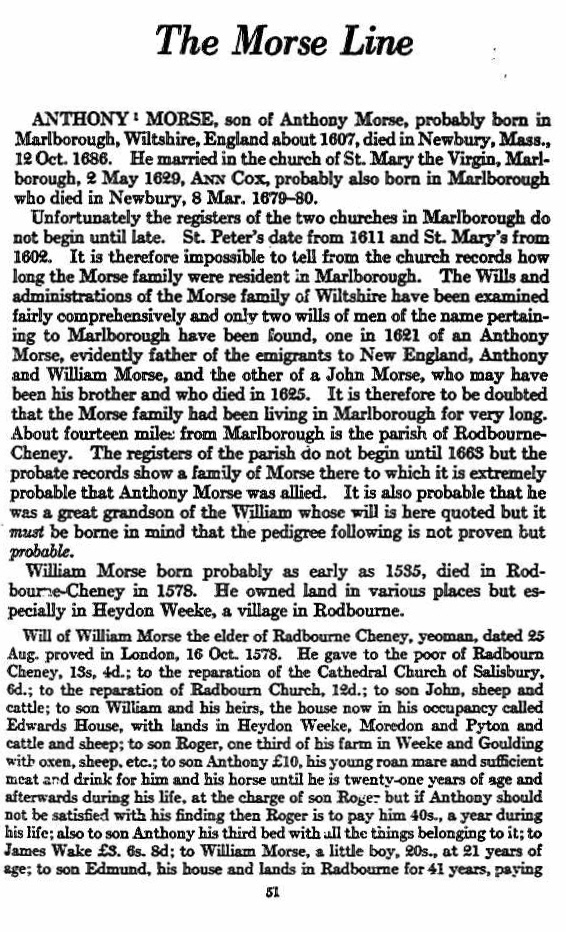
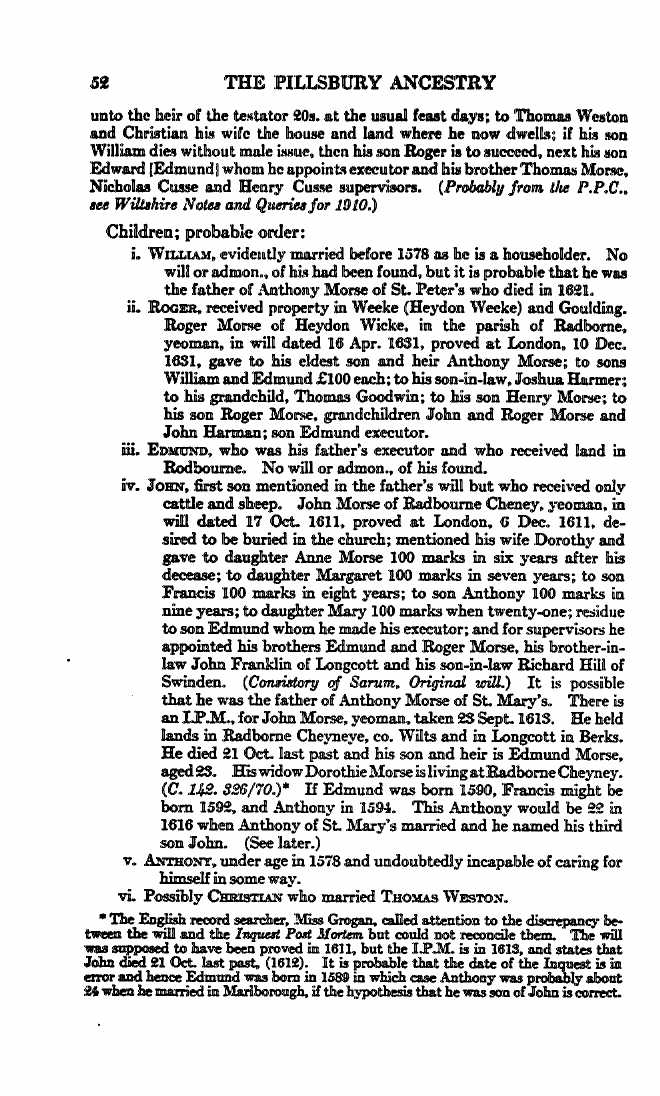
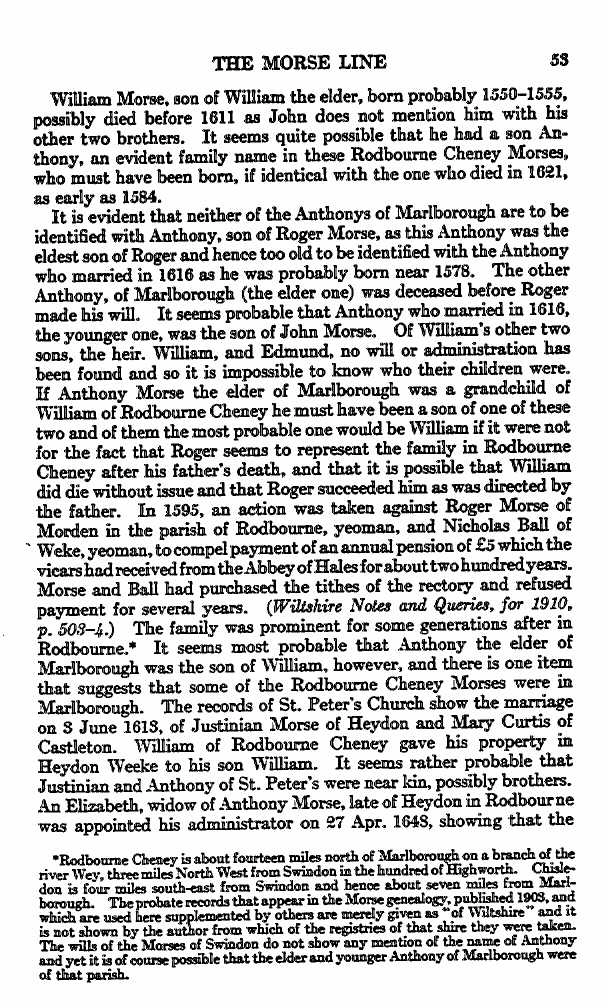
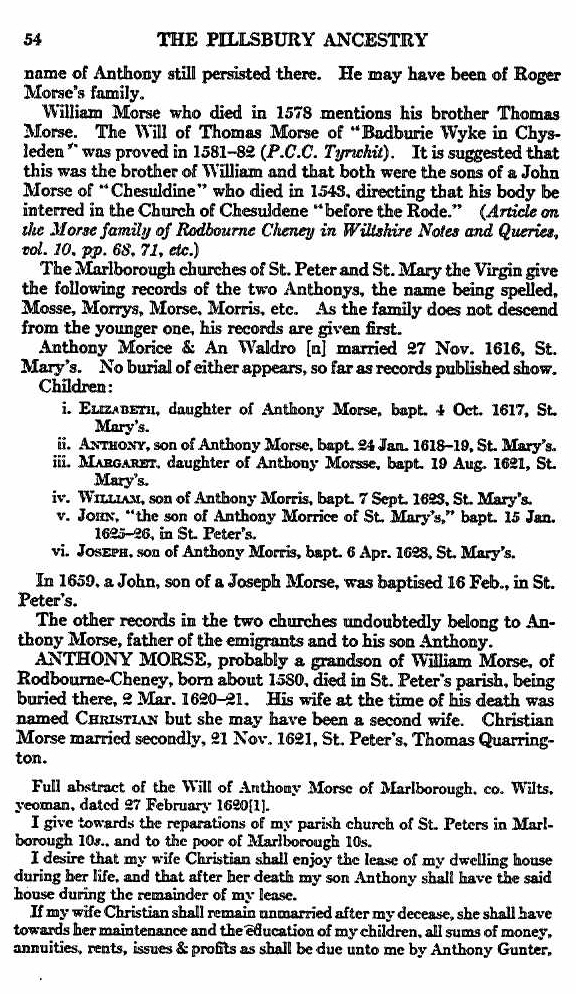
Capt. John Fitch was born 16 Jul 1615 in Bocking, Essex, England.  His parents were Thomas FITCH and Anna REEVE.  John’s brother, Rev. James FITCH is also our ancestor. John married his first wife Ann Hillier in England. He married Mary SUTTON in Massachusetts around 1645.   One theory is that John died 10 Mar 1676 in Rehoboth.  Another is that he died in the Plague in Braintree.  Alternatively, John made his will June 30, 1693 and died 21 Jan 1697/98 in Rehoboth.

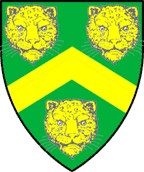
John Fitch - Coat of Arms

Mary Sutton was born about 1626 in Attleborough, Norfolk, England.  Her parents were John SUTTON and Julian LITTLE.  Mary died 4 Nov 1703 in Rehoboth, Mass.

Children of  John and Mary

Name Born Married Departed
1. Mary Fitch ca. 1650 Rehoboth, Mass. Thomas Ormsby (son of our ancestor Richard ORMSBY)
11 MAY 1667 Rehoboth, Mass.
Aft. 1716 in Rehoboth, Bristol, Mass.
2. Sarah Fitch ca. 1658 Rehoboth, Mass. Noah Mason
6 DEC 1677 Rehoboth
16 MAR 1718/19
3. Rebecca Fitch 4 Jun 1656 or
20 Sep1662
Rehoboth
Capt. Moses Read
6 Dec 1677 Rehoboth, Mass
28 JAN 1723/24 Rehoboth
4. Hannah FITCH ca.  1662 in Plymouth, Plymouth Colony Joseph BROWN Sr.
10 Nov 1680
Attleborough, Mass.
14 Oct 1739 in Attleborough, Mass.
5. Jeremiah Fitch 1666
Plymouth, Plymouth Colony
15 Oct 1676 Rehoboth

“Fitch” derives from the Old French “fiche” meaning “an iron point”, which itself comes from “ficher” “to fix” or “to plant”; hence, fitch is “an iron pointed implement”

John’s father Thomas Fitch was a cloth manufacturer in Bocking, Essex, England. (Some say John’s parents were Zacharie and Mary Fitch of St. Albans, Hertfordshire, England.

John Fitch was a clothier in Braintree.  He was also a Captain in the Civil War against the King.  It is believed he died in the Plague in Braintree.

Captain Fitch may have received his rank as a soldier in the English Civil Wars [1642-1646 and 1648] or in the colonial militia. One of his brothers was also a Captain and another was a minister.

Children

1. Mary Fitch

Mary’s husband Thomas Ormsby was born 11 Nov 1645 in Salisbury, Mass.  His parents were our ancestors Richard ORMSBY and Sarah UPHAM.  Thomas Ormsby was on a list of those eligible for a lot in the North Purchase, as were his two brothers, John and Jacob. In 1689 his name was one of those listed on a quit claim deed, which was given to the citizens of Rehoboth by William Bradford. His will was dated March 23, 1715 and probated in Bristol County on December 10, 1716.   His will mentions his wife, Mary, and 9 children.

Children of Thomas Ormsby and Mary Fitch are:

i. Thomas Ormsby, b. 23 Feb  1667/68; m1. 14 Nov 1698 to Rebecca Whitaker (Rebeckah Whittaker), Rehoboth, MA
m2. 26 Apr  1722, Mary Whitaker, Rehoboth, MA; d. Sept 14/17, 1724.  Mary Whittaker married first Francis Mason, 10  May 1701, Rehoboth, Birstol, MA

ii. Mary Ormsby, b. 30 Mar  1670 Taunton; m. 27 Jun 1705 to  William Salisbury, Jr.; William first married Ann (Hannah) Cole, 30 Jul 1684, Swansea, Bristol, Mass,

iii. Rebecca Ormsby, b. 26 May 1672; d. Nov 1707; m. 30 May 1706 to William Hammond, Swansea, MA.  William Hammond, housewright and yoeman, was born about 1675, probably at Swansea, and he died at Rehoboth in Jan 1729/30. He married, first at Swansea, 10 Jan1695, Elizabeth Cole, who died at Rehoboth in November 1705, probable daughter of John  Cole Sr. and Elizabeth Ryder. He married, second, at Swansea,30 May 1706 (int at Rehoboth, 25 April 1706), Rebecka Olmsbery, who was born at Taunton 26 May 1672, and died at Rehoboth in November 1707, daughter of Thomas Sr. and Mary (Fitch) Ormsbee. He married, third at Rehoboth, 16 August 1711 (int 17 December 1709), Martha Red(a)way, who was born there 26 July 1687, daughter of John Redaway and Mary Ide (Fuller). Martha married, second, at Rehoboth 20 Jan 1743/43, Jonathan Ormsbee Sr., who was born there 20 Aug 1678, son of John and Grace (Martin) Ormsbee and widower of Mercy (Fitch) Ormsbee, his wife of nearly 40 years, who had died the previous year.

iv. Jeremiah Ormsby, b. 25 Nov  1672 in Rehoboth, Bristol, Mass; d. Mar 1754; m1. 3 Nov 1705 to Mahitable Willmarth;  Her parents were Thomas Willmarth  and Mary Robinson and her grandparents were our ancestors Sgt. Thomas WILMARTH and Elizabeth BLISS.  m2. about 1740 to Persis (Perces) [__?__]. Jeremiah must have died prior to 1757, for in Attleboro, Mass. vital records is recorded; married Persis (Perces) Ormsbee, widow, to Daniel Chaffee, Oct. 15, 1757.

v. Judith Ormsby, b. 08 Jan  1672/73; d. 27 Aug 1715 Rehoboth, Mass.; m. 14 Oct 1714 to, John Garnzey, Rehoboth, MA .

Judith was John’s second wife, from his first he had 12 children. His child with Judith, Beriah, was his 13th. After Judith died he married a third time.  His first wife was Elizabeth Titus and his third was Sarah Miller Millard. In most references the name is spelled Garnsey

vi. Hannah Ormsbee, b. 23 Sep 1678; d. 1724; m. Feb. 23, 1713, John Thompson, Rehoboth, Bristol, MA

vii. Jacob Ormsbee, b. 13 Sep  1680; m. 24 Jan 1705/06, (Dec. 22, 1705) to Hopestill Eddy, Swansea, MA

viii. Bethia Ormsbee, b. 15 Apr 1682; d. aft. 1732; m. 115 Apr 1701 to Thomas Shaw, Rehoboth, MA

ix. Ester Ormsbee, b. 02 May , 1684; d. Bef. 12 Jan 1726; m. 30 Jul 1713 in Rehoboth, MA. to Preserved Redaway (1683 – 1724/25)

Ester (Ormsbee) Redaway probably died before Jan 12, 1726, when her brother-in-law, James Redaway, was appointed guardian of her two children.

Preserved’s sister Martha married William Hammond (his third wife) on August 16, 1711. This William Hammond’s second wife was Rebecca Ormsbee, Ester’s sister. Martha Redaway married, second, at Rehoboth 20 Jan 1743/43, Jonathan Ormsbee Sr., who was born there 20 Aug 1678, son of John and Grace (Martin) Ormsbee and widower of Mercy (Fitch) Ormsbee.

x. Ezra Ormsbee, b. 15 Aug  1686; d. 18 Jan 1763 Barrington, RI; m. 5 Dec 1713 Swansea, MA to Mary Salisbury.

Ezra was Shipwright and Captain; resided Rehoboth, Mass; Barrington in 1730; Warren, R.I. 1752; and died 18 Jan. 1763; estate administered by widow Mary, 7 Mar. 1763.” The value of his estate was  1616 pounds, 2 shillings, 2 pence

History of Rehoboth, Mass. by Tilton (1918)
“In a list of Capt. Hunt’s Co. of Rehoboth militia, dated Nov. 24, 1710 is Ezra Ormsbee along with his brothers, Jacob; Jeremiah; Thomas; and his brother-in-law Preserved Redway.

xi. Daniel Ormsbee, buried 8 May 1689

xii. Daniel Ormsbee b. 02 Mar, 1689/90; d. 1766  Swansea, Bristol, MA; m. 11 Apr 1718 Swansea, MA  to  Ruth Ripply,

2. Sarah Fitch

Sarah’s husband Noah Mason was born 26 OCT 1651 in Dorchester, Suffolk Co., Mass. His parents were Sampson Mason and Mary Butterworth.  Noah’s first wife was Martha [__?__].  Noah served under Major Bradford in expedition against the Narragansetts – King Phillips’s War.  Noah died 6 FEB 1675 Rehoboth. d 2 MAR 1700 in Rehoboth, Bristol. Mass.

Children of Sarah and Noah

i. Noah Mason b. 17 DEC 1678 Rehoboth, Bristol, Mass.; m.16 OCT 1708 to Mary Sweeting; d.29 AUG 1744 Rehoboth, Bristol, Mass.

ii. John Mason b. 28 NOV 1680 Rehoboth; d. 27 AUG 1716 Rehoboth

iii. Mary Mason b. 12 DEC 1682 Rehoboth; m1. 26 NOV 1723 Rehoboth to John House; m2. 17 OCT 1728 Providence, RI to  John Dexter; d.4 FEB 1754 Providence, Providence, RI

iv. Daniel Mason b. 8 JUL 1685 Rehoboth; m. AFT 13 JAN 1728 at: Rehoboth to Susannah Cooper; d. 1750

v. Timothy Mason b. 17 MAR 1687 Rehoboth m. 11 NOV 1721 to Sybil Hunt; d. 9 DEC 1742 Rehoboth

vi. Sarah Mason b.1 FEB 1688 Swansea, Bristol Co., Mass; m. 27 DEC 1711 Daniel Brown; d. 9 JUN 1746 Providence, RI

vii. Hannah Mason b. 2 DEC 1690 Rehoboth; d. 14 JAN 1716

viii. Martha Mason b. 16 JUN 1693 Rehoboth; m. 29 SEP 1715 Rehoboth to George Barstow; d. 22 NOV 1747 Rehoboth

3. Rebecca Fitch

Rebecca’s husband Capt. Moses Read was born in October 1650 at Rehoboth, Massachusetts. His parents were John Read of Dorchester and Sarah Lessie. Moses died in 1716 in Rehoboth.

Children of Rebecca and Moses

i. Moses Read (1677 –

ii. Zachariah Read (1677 –

iii. Rebeckah Read b. 14 Sep 1683 in Rehoboth, Bristol, Mass. d.  19 April 1728 in Rehoboth, m. 23 Mar 1708 in Rehoboth to Samuel Mason (1683 – 1772)

iv. Ezekiel Read b. 23 Jan 1685 in Rehoboth;  d.  9 Mar 1764 in Rehoboth; m. 1713 to Mary Ide

v. Mary Read 24 Dec 1688 in Rehoboth; d. 5 Sep 1712 in Rehoboth.

4. Hannah FITCH (See Joseph BROWN Sr. page)

Sources:

http://www.genealogyofnewengland.com/f_752.htm#49

http://huskey-ogle-family.tripod.com/ancestorarchives/id46.html

http://vesterfamily.org/pafg09.htm

http://www.ormsby.org/genie/Thomas_1645.html#anchor31141970

http://freepages.genealogy.rootsweb.ancestry.com/~chap7061/pafg02.htm#43

Posted in 12th Generation, Immigrant - England, Line - Shaw, Veteran | Tagged , | 10 Comments

John Browne Sr. (Swansea)

John BROWNE Sr. (Swansea) (1583 – 1662) was Alex’s 11th Great Grandfather, one of 4,096 in this generation of the Shaw line.  John was a friend and associate of the leaders of Plymouth Colony and it is said in his honor that he was the first magistrate to raise his voice against the coercive support of the ministry, taking the stand that all church support should be voluntary.
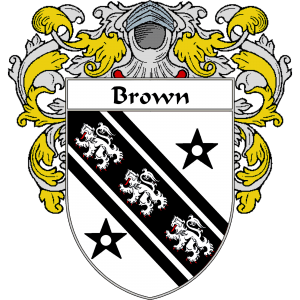
Browne Coat of Arms

We have five separate Brown lines and seven different Brown immigrant ancestors, by far the most of any surname.  When the surname is of English origin it is derived from a nickname concerning the complexion of an individual, or the colour of their hair. Brown is derived from the Old English brunbrūn; Middle English brunbroun; or Old French brun.

1. John BROWNE Sr. (Swansea). (1583 Hawkedon, Suffolk  – 1662 Swansea, Mass)
John BROWN Jr.  (1620 -1662 Rehoboth, Mass)

2. John BROWN (Hampton) (1589 London – 1677 Salem, Mass)

3.  Nicholas BROWN (1601 Inkberrow, Worcester – 1694 Reading, Mass)

4. James BROWNE (1605 Southhampton, Hampshire  -1676 Salem, Mass.)

5. Thomas BROWNE (1607 Christian Malford, Wiltshire – 1687 Newbury, Mass.)
Francis BROWN I (1633  Christian Malford, Wiltshire – 1691  Newbury, Mass.)

John Browne was born on 29 June 1600 in Swan Hall, Hawkedon, Suffolk, England.  His parents were  William BROWNE and Margaret GOODRICH. 

John clearly moved in important circles in England  For example,  in 1655 he stayed with the Wray family at Belleau, the Lincolnshire home of Sir Harry Vane  son of Sir Henry Vane the Elder) not far from Boston, where Roger Williams had also stayed. While Mr. Browne was at Belleau in 1657 George Fox [Founder of the Society of Friends] came for a visit, and mentioned in his diary meeting a “New England magistrate”.  John was friends with Rev. John Robinson, pastor of the Pilgrims in Leiden.  However, his English origins aren’t entirely clear.  See this detailed article Brown of Plymouth and Wannamoisett for more.
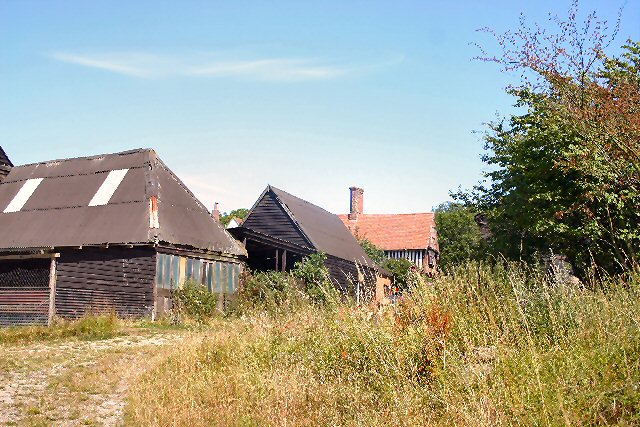
Swan Hall, Hawkedon, Suffolk, England 

Swan Hall is  fine C16 timber-framed house with exposed timber-framing and plaster infil.  Click Here for Google Maps Satellite View. The east end of the house has brick nogging on the north side and east gable end. 2 storeys and attics. At the west end there is a timber-framed and plastered cross wing,which may be of earlier date. The windows generally are casements with leaded lights, some are mullioned and transomed. There are a number of original windows (blocked), with mullions. The east gable end is double jettied with a carved bressumer and old mullioned and transomed windows with carved heads and sills on brackets. The jettied gable has drop finials. One window head has the initials “W” and “A” with a merchants mark of, apparently a ship carved between. Roof tiled with a tall 3 shafted red brick chimney stack on a rectangular base, with octagonal shafts and spur caps

John married Dorothy BEAUCHAMP in 22 Dec 1611 St James, Clerkenwell, London.  Alternatively, they were married  Sep 1613 in Kent, England. He knew the refugees in Leyden, when in his younger days he traveling on the Continent, he became acquainted with Rev. John Robinson, pastor of the Pilgrims, and through him met many of his people in the same way that Governor Winslow and Captain Miles Standish came to join the Pilgrims.  He sailed from London, 22 Jun 1632, on the Lyon (4), William Pierce – Master, “bound for Watertown with his wife Dorothy, and children Mary, John and James and William”, who were probably named in the order of their birth. The ship arrived in Boston on 16 Sep 1632, twelve weeks from London and eight weeks from Land’s End and John settled in Duxbury. On the same ship was Isaac Robinson, son of Leyden pastor John Robinson and another ancestor of ours, John BENJAMIN.

Some romantic tales say that he was brother of  Peter Browne (1594 – 1633),  the Mayflower’s carpenter and a signer of the Mayflower Compact, but this has been disproved.  I had to delete my fun stories about Peter Browne.  ;(

John was prominent in the Plymouth colony.  He was living in Duxbury in 1636; in Taunton in 1643 but soon moved to Swansea. He was Assistant for seventeen years; served as one of the Commissioners of the United Colonies for twelve years, and sat on the Council of War for three years. He was one of the lessees of Kennebec trade in 1649.
He made a will on 7 April 1662.  John died on 10 Apr 1662 in Swansea, Mass.  He died less than two weeks after his son John Jr. who had made his father guardian of five children and executor of his estate.
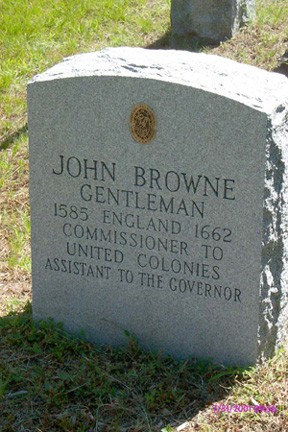
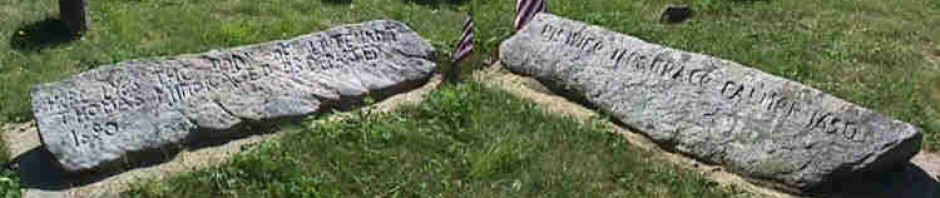
John Browne (1584-1662) Memorial Ancient Little Neck Burying Ground, Riverside, East Providence, Rhode Island

Dorothy Beauchamp was born about 1583 in Northamptonshire, England.  Dorothy died 27 Jan 1673/74 in Swansea, Bristol, Mass.

John Browne was associated with Edmund FREEMAN of Sandwich, and Edmund’s brother-in-law in England, John Beauchamp who was a native of Cosgrove, Northamptonshire, son of Dorothy Clarke of Roade, Northants. John Beauchamp went to London. He was married to Alice Freeman, who might have been a cousin of that Alice (Freeman) (Thom[p]son) Parke who was daughter of Henry and Margaret (Edwards) Freeman.. According to French, Alice(Freeman) Thompson’s daughter Martha married John2 Browne. Martha’s sister Bridget Thompson was said by French to have married George Denison, whose daughter by his second wife was the Margaret Denison who married James3 Brown.

Children of John and Dorothy:

Name Born Married Departed
1. Mary Brown 1614
Glencairn, Dumfrieshire, Scotland
Capt. Thomas Willett
6 Jul 1636
Plymouth
8 Jan 1669/70
Little Neck RI
2. Edward Brown 19 Jul 1620
St. James’, Clerkenwell, London, England

Before 1632? Not on Lyon’s manifest
3. Rebecca Brown 30 May 1622
St. James’, Clerkenwell, London, England
Bef. 1632? Not on Lyon’s manifest
4. William Brown Only on Lyon’s manifest
5. John BROWN c. 1620
England
Anne Dennis
1646
Rehoboth
.
Martha THOMPSON
1652
Taunton, Mass
.
Lydia Buckland
5 Nov 1659
Rehoboth, Mass
31 Mar 1662 Rehoboth, Mass
6. James Brown 1623
Watertown, Middlesex, Mass.
Lydia Howland, (Daughter of John HOWLAND)
1654
Rehoboth
29 October 1710
Swansea Mass

Shortly after his arrival in Plymouth, Mr. John Browne was chosen as an Assistant to the Governor of Plymouth Colony in Jan 1635/36, the same day he was admitted as freeman, and was elected again each year for nineteen years with the exception of 1646. He was treated with deference and respect by John Winthrop, John Winthrop,Jr., Roger Williams, William Coddington, Samuel Gorton, Edward Winslow, Miles Standish, Timothy Hatherly and Edmund FREEMAN.
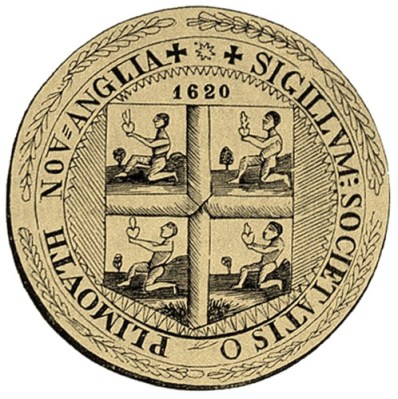
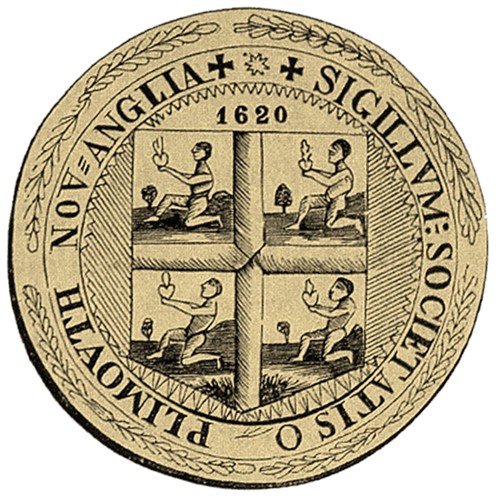
Plymouth Seal – John was assistant to Governor Bradford for 17 years

The elected leadership of Plymouth Colony at first consisted of a governor and an assistant governor. The assistant governor for the first three years of the colony’s history was Isaac ALLERTON. In 1624, the structure was changed to a governor and five assistants who were referred to as the “court of assistants,” “magistrates,” or the “governor’s council.” These men advised the governor and had the right to vote on important matters of governance, helping Bradford in guiding the evolution of the colony and its improvised government.  Assistants during the early years of the colony included Thomas PRENCEStephen HOPKINS, John Alden, and John HOWLAND.

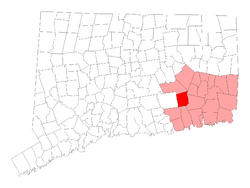
In 1637 he and Capt. Miles Standish laid out Cohannet, and by 1639 he had moved there with Standish and others He was a proprietor there when it was incorporated as the town of Taunton. Taunton once included many surrounding towns, including NortonEastonMansfieldDightonRaynham, and Berkley.

In 1641 he and Standish laid out Barnstable and Yarmouth.

Later he was a partner with John Winthrop, Jr., in Stonington, Connecticut.  Thomas MINER,  Walter PALMERWilliam Chesebroughand Thomas Stanton were the founders of Stonington in 1648.
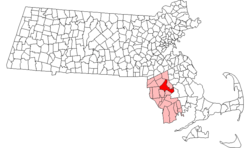
John Brown laid out Cohannet, later Taunton, Bristol, Mass
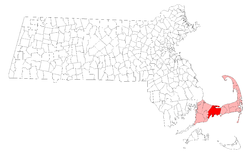
In 1641 John Brown and Miles Standish laid out Barnstable, Barnstable, Mass
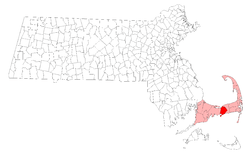
In 1641 John Brown and Miles Standish laid out Yarmouth, Barnstable, Mass
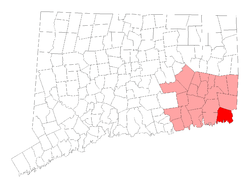
Stonington, New London, CT

In 1641 he and Edward Winslow purchased Rehoboth (including the present towns of Seekonk, East Providence and Pawtucket), extending Plymouth Colony into the Wampanoag lands by purchase rather than expropriation. He became a friend of Massasoit, the chief of the Wampanoag Indians, and as a result the life of his son James was spared during King Philip’s War in the 1670s by Massasoit’s heir. He wrote to Governor Winthrop of Massachusetts Bay as “Loving Friend,”and was on good terms also with leading men in Rhode Island. By 1644 he lived in Rehoboth, where he was a neighbor of Roger Williams at the time the latter got his charter in 1644 with the help of the Earl of Northumberland.

As well as serving with the colonial leaders as an Assistant, he was a member of the Council of War in 1642, 1646 and 1653, and Commissioner of the United Colonies of New England from 1644 to 1656, serving longer than any other. Thus he was useful to Plymouth Colony in negotiations with the others. In 1643 he was an incorporator of the town of Rehoboth, and he served there as Townsman in 1645-1646 and 1650-1651. He was one of the wealthier men in town, was a landed proprietor in Maine, Rhode Island and Connecticut, and had extensive interests in the New Netherlands as well. In 1644 John Winthrop, Jr., was conducting business in England for him. In 1645 he helped preserve Plymouth Colony’s jurisdiction in his area from an encroachment attempted by the Massachusetts Bay Colony with the support of one Richard Wright of the town.

On 29 Oct. 1645 the town meeting voted that he should undertake to buy Wannamoisett (now East Providence and Barrington, R.I.) from the Indians for £15 worth of commodities with the provision that the Indians would move from the land and John Browne would retain title to it. He settled there permanently.

He represented Plymouth Colony’s opposition to placing Roger Williams’ charter in effect in Rhode Island while on a trip to Providence, and then went to Shawomet to support the followers of Samuel Gorton against interference from twenty Massachusetts Bay families. In 1651 he and Timothy Hatherly boldly resisted the claim of Massachusetts Bay to Samuel Gorton‘s area going before the Commissioners of the United Colonies, saying of Plymouth, “not an inch of her soil could be alienated except by the whole body of freemen in General Court assembled” . Hatherly had visited at Kennebec and Penobscot in 1631 while John Browne and Thomas Willett were there, and become a close associate of Browne at Plymouth. While Hatherly lost his seat as a Assistant because of his opposition to intolerance, Browne did not.

He was a liberal concerning religion; in 1645 he supported William Vassall’s petition and a motion to grant “full and free tolerance of religion to all men that will preserve the civil peace and submit unto the government,” with “no limitation or exception against Turk, Jew, Papist, Arian, Socinian, Nicolaitan, Familist, or any other”. The motion failed on a tie vote. His was the first magistrate’s voice to offer the opinion that support of the church should not come from taxes.

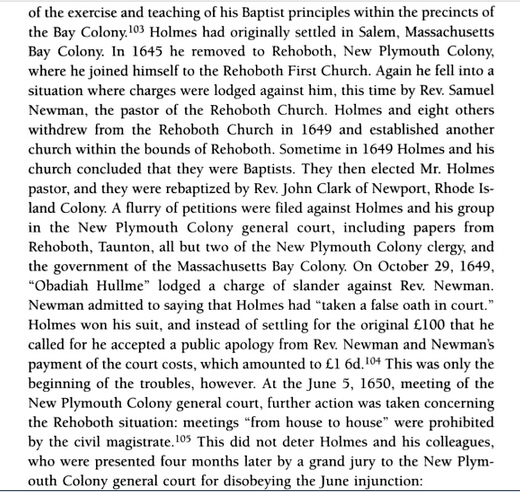
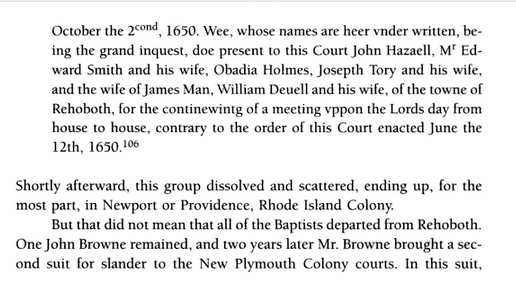
In 1665 he pledged his own property as a bond that the church could be supported from voluntary contributions. Yet he “persecuted” his son James for becoming a Baptist, and sued the Reverend Mr. Samuel Newman of the Church of Christ as a result of slander, for which he was awarded the handsome sum of £100, which he remitted at once. It is to be noted that the content of the defamation has been suppressed.

Samuel Newman (1602 –  1663) was a clergyman in colonial Massachusetts whose Concordance of the Bible, published first in London in 1643,  just before Newman’s removal from Weymouth to Rehoboth, far surpassed both of the previous two works of its kind.  Newman  graduated from Trinity College, Oxford in 1620, took orders in the Church of England. He was prosecuted for nonconformity and emigrated to Massachusetts Bay Colony, probably in 1636.  After preaching nearly two years at Dorchester, he became pastor of the church at Weymouth, where he remained until 1643. The following year he removed with part of his church to Seconet, in Plymouth Colony. There they founded the town of Rehoboth, which then embraced what is now Seekonk, Massachusetts and Pawtucket, Rhode Island.   The second edition was published at Cambridge in 1662 and the concordance was usually known after that as the Cambridge Concordance. The concordance was reprinted at least as late as 1889, almost 250 years after it was first published. Samuel died in Rehoboth on July 5, 1663.
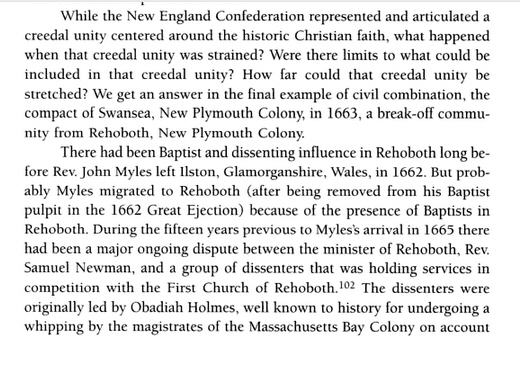
Early New England: a covenanted society – By David Weir 2005
x

Various records mention John’s shipyard, which was probably in Bullock’s Cove, RI, and numerous dealings in land. He was a member of the highest class, and his son-in-law, Mr. Thomas Willett, who had come to New England also on the Lyon in 1631, became in 1664 the first English Mayor of the City of New York.

The Clarendon Papers at the Bodleian Library, Oxford University, reveal that the reason he left public service in Plymouth Colony was that he had returned to England in 1655, in the service of the Vane family as executor of the estate of the senior Sir Henry Vane, including Raby Castle in Durham, while Sir Henry Vane (born 1589, died 1655 [one of the chief officers of King James I], who had been in America from 6 Oct 1635 to 3 Aug 1637, and had served as Governor of Massachusetts Bay) was imprisoned by Cromwell, the dictator of England.

In 1655 John Browne  stayed with the Wray family at Belleau, the Lincolnshire home of Sir Harry Vane (born 1613, died 1662, son of Sir Henry Vane the Elder) not far from Boston, where Roger Williams had also stayed. While Mr. Browne was at Belleau in 1657 George Fox [Founder of the Society of Friends] came for a visit, and mentioned in his diary meeting a “New England magistrate”. Upon the Restoration in 1660, when Charles II returned to the throne, Mr. Browne sailed to his home in Wannamoisett. Sir Harry Vane’s wife Frances was a daughter of Sir Christopher Wray.

In 1627 Sir John Wray had been in Gatehouse Prison for failure to collect the ship loan of Charles I. John Browne of Sutterton, a village just south of Boston in Lincolnshire, was among those failing to pay the tax. William Coddington, who also resisted the tax, came to America with the Rev. John Cotton of St. Botolph’s church in Boston, was for a time of St. James’ Clerkenwell, and a relative of Edmund FREEMAN of Sandwich.

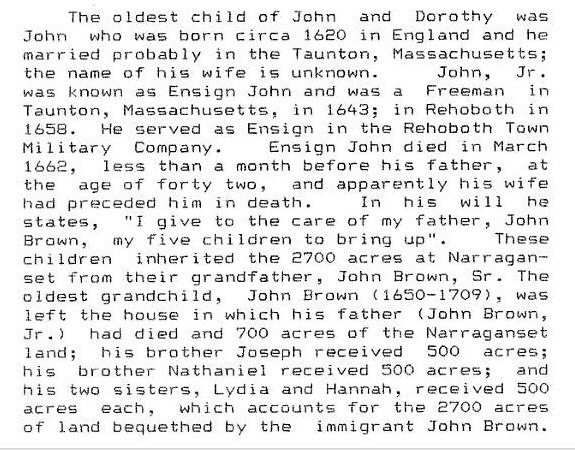
When John died of fever he was buried in Little Neck Cemetery at the head of Bullock’s Cove in Wannamoisett. In his will he left 1,700 acres of Narragansett lands to the children of his son John, who had died ten days before he did, and he was able to leave a large estate valued in the inventory of 19 April 1662 at £665.1s.2d, but including only £6  in cash! He left his daughter Mary Willett only 12d “to bee payed att the end of every yeare During her life for a memoriall unto her; and it shalbee in full of all filiall portion which shee or any in her behalfe shall Claime”.

Timeline

28 Dec 1611 – John Browne licensed to marry at St. James Clerkenwell, London, Dorothy Beauchamp.  His wife Dorothy died in Swansea 27 Jan 1673/74, aged 90 years [Shurtleff’s Plymouth Records, 8:48].

Two children of John and Dorothy (Beauchamp) Browne were baptized at St. James’, Clerkenwell, London namely Edward on 19 July 1620, and Rebecca on 30 May 1622.

John’s son William was possibly his nephew or brother. He was a passenger on the Lyon, in 1632, lived Duxbury in 1643, probably returned to England in 1655 lived in Plymouth 1663, in Sandwich in 1667, and was a sea captain.

1633 – Chosen as an assistant to Governor Bradford and held that office seventeen years.  He was also chosen assistant for the years 1636 and 1649.

3 Sep 1634 – John was a freeman in Plymouth

1643 – John Brown and his sons, John and James, were residents of Taunton, but next year they settled at Rehoboth, Massachusetts. There John Browne, Sr., and John Brown, Jr., stayed and were among the first settlers,

1644-48 and 50-51   He was chosen commissioner from Plymouth Colony as the commissioner of the United Colonies of New England

4 Jun 1652 – In the governor’s court he won a notable suit for damages for defamation against Samuel Newman, the judgment being for one hundred pounds and costs. Mr. Browne waived the judgment, however, and let Newman off on payment of the costs.

c. 1660 – He laid the foundation for the establishment of Swansea, but it was his son-in-law Capt. Thomas Willett, Plymouth Colony Magistrate and the first English mayor of the city of New York, who was the actual founder and who completed the work after the death of John Brown.   It was the fight between the Baptists and the Congregationalists in the Church of Christ at Rehoboth that finally resulted in the founding of the Baptist township of Swansea under the spiritual leadership of Mr. John Myles.   The town of Swansea was founded on the basis of a class division of inhabitants that existed nowhere else in New England. On 5 Mar. 1667/8 the Plymouth Colony Court appointed “Capt Thomas Willett, Mr. Stephen Paine, Sr, Mr. John Browne, John Allen and John Butterworth” (all Rehoboth men) to have charge of the admittance of inhabitants; to dispose of the lands; and to have the control of the affairs of the new township “att Wannamoisett and places adjacent” later to be named Swansea.
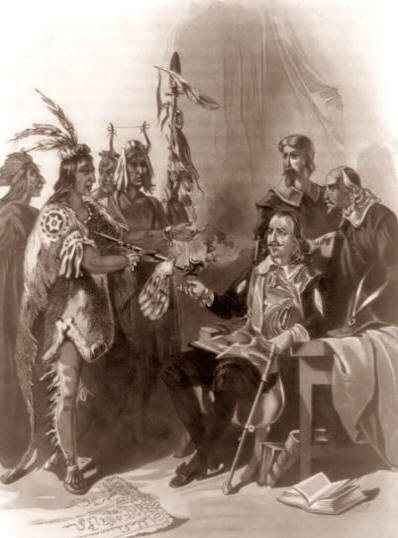
Massasoit and Governor John Carver

John was a friend of Massasoit, and the proof of their friendship was shown when the life of his son James was spared by King Philip, son of Massasoit, when he came on a mission from the governor to the Indians. Colonel Church in his narrative says:

“that the Indians would have killed Mr. Browne, who with Mr. Samuel Gorton and two other men bore the letter, but Philip prevented them, saying that his father had charged him to show kindness to Mr. Browne.”

Excerpt from: Historic homes and institutions and genealogical and personal memoirs of Worcester County, Massachusetts Vol.1 edited by: Ellery Bicknell Crane, Worcester Historical Museum

While he was travelling in his youth he became acquainted with Rev. John Robinson, pastor of the Pilgrims, and through him met many of his people in the same way that Governor Winslow and Captain Miles Standish came to join the Pilgrims. He did not come in the “Mayflower,” however. It was not until March, 1629, that he reached New England. He landed at Salem. Two years earlier, however, March 19, 1627, the council for New England approved a patent for trade soil and planting on which a Royal charter was obtained March 4, 1628, to certain patentees and their associates, among whom were John Browne, John Saltonstall, and others who became well known in the colonies. He was elected to Governor John Endicott’s council, April 3, 1629, with Francis Higginson, Samuel Skelton, Francis Bright, Samuel Browne, Thomas Graves and Samuel Sharp. He went from Salem to Plymouth and later to Taunton with his son, James. In 1643 John Brown and his sons, John and James, were residents of Taunton, but next year they settled at Rehoboth,Massachusetts. There John Browne, Sr., and John Brown, Jr., stayed and were among the first settlers, but James Browne being a Baptist was forced to leave town in 1663 and with others of his sect founded the town of Swansey, Massachusetts. The designation Mr. given him in the records always shows that he was counted among the gentry. His sons and grandsons were leaders in civic, judicial and military affairs. John Brown was appointed one of the townsmen (an office) in Rehoboth, March 16, 1645, and again in 1650-51. He served the town on important commissions. He was on the prudential committee. He was for seventeen years from 1636 to 1653 0ne of the governor’s assistants or magistrates. In 1638 the following were the governor’s assistants: William Bradford, Edward Winslow, Captain Miles Standish, John Alden, John Jenny and John Browne. He was one of the commissioners of the United Colonies of New England (which foreshadowed the later confederation) from 1644 to 1655. In the governor’s court June 4, 1652, he won a notable suit for damages for defamation against Samuel Newman, the judgment being for one hundred pounds and costs. Mr. Browne waived the judgment, however, and let Newman off on payment of the costs. Mr. Browne was a friend of Massasoit, and the proof of their friendship was shown when the life of his son James was spared by King Philip, son of Massasoit, when he came on a mission from the governor to the Indians. Colonel Church in his narrative says: “that the Indians would have killed Mr. Browne, who with Mr. Samuel Gorton and two other men bore the letter, but Philip prevented them, saying that his father had charged him to show kindness to Mr. Browne.” It is said in his honor that he was the first magistrate to raise his voice against the coercive support of the ministry, taking the stand that all church support should be voluntary and backed his precepts by liberal example. He was a man of abilities, intellect, piety and patriotism, and was buried with civic and military honors in 1662. His wife Dorothy died in 1674. His eldest son died the same year as he (1662). His other son, James, was afterwards in the magistracy.

His grandson, John Browne, became useful and eminent. In 1685 John Browne was one of the first associate justices of the court of common pleas in the county of Bristol. In 1688, during the administration of Lord Bellamont, he was again appointed a justice.

John Browne, Sr., was born in 1595 and died April 10, 1662. His wife died at Swansey, Massachusetts, January 27, 1673. The children of John Browne (I) were: Ensign John, Jr., born in England, died last of March, 1662; (settled in Rehoboth and had these children: John, born last Friday in September, 1650; Lydia, August 5 or 6, 1656; Annah, January 29, 1657; Joseph, April 9, 1658; Nathaniel, June 9, 1661;

Major James, of Swansey, born in England 1623, died 1710; Mary, born in England, married, July 6, 1636, Captain Thomas Willett, of Plymouth, the first English mayor of New York city, who was twice elected to that office. William, resided in Salem, not mentioned in will and not proved to be son of John Browne (I).

New England families, genealogical and memorial: a record of the Achievements of Her People in the Making of Commonwealths and the Founding of a Nation, Volume 4 By William Richard Cutter Edition3 PublisherLewis Historical Pub. Co., 1915 –

“John Brown had acquaintance with the Pilgrims of Leyden, which “induced him upon his coming over to New England, to seat himself in the jurisdiction of New Plymouth.”  The exact date of his arrival is not known, but the Plymouth Colony Records (vol. viii. p. 173) are authority that he was chosen as an assistant to Governor Bradford in 1633, and held that office seventeen years.  He was also chosen assistant for the years 1636 and 1649.  He was also chosen commissioner from Plymouth Colony as the commissioner of the United Colonies of New England for the years 1644-48 and 50-51.  Mr. Brown purchased large interests in Rehoboth and at Wannamoisett in Swansea, Massachusetts, and moved to Wannamoisett with his family prior to 1645.  He died April 10, 1662, and was buried in what is known as “The Viall Burial Ground,” on Little Neck, at the head of Bullock’s Cove. His widow, Dorothy, died at Swansea, January 27, 1674, at the age of ninety years.  They had three children: Mary, married Thomas Willett; John Jr.; James

According to French,

John Browne was successively a Puritan, Catholic, and Jesuit, and then associated with Separatists, Baptists and Quakers, and was perhaps close enough to the Lord Chancellor and the Lord Chief Justice of Queen Elizabeth, as well as to the 1st Earl of Warwick and the Dowager Countess, and perhaps Viscount Wimbledon (the father of Albinia Cecil and grandfather of Frances [Wray] Vane), to finance his own settlement in America. His mother and wife may have been from those prominent families in the area of Lincolnshire, Nottinghamshire or Northamptonshire who were involved in the settlement of New England.  While fun, my analysis shows this relates to  a different John Browne.

Children

1. Mary Brown

Mary’s husband Capt. Thomas Willett was born 29 Aug 1605 in Barley, Hertfordshire, England.  His parents were Andrew Willett and Jacobina Goad. After Mary’s death, he married the widow of a clergyman named John Pruden.  Thomas died 4 Aug 1674 in Swansea, Mass.

Thomas, formerly of Leyden, succeeded Miles Standish as military captain at Plymouth and was the first English mayor of New York.  In 1633, after he had become a successful trader with the Native Americans, he was admitted to the freedom of the colony, and married a daughter of Major John Brown, a leading citizen. He shortly afterwards became a large shipowner, trading with New Amsterdam. He was elected one of the assistant governors of the Plymouth colony, and acted as arbitrator in disputes between the English and Dutch colonies; he also became captain of a military company. Early in 1660 he left Plymouth and became the founder of the town of Swansea Mass.  Accompanying the English commander  Richard Nicolls, he contributed to the peaceable surrender of New Amsterdam to the English on 7 September 1664; and when the colony received the name of New York, Willett was appointed the first mayor (12 June 1665) and a commissioner of admiralty on August 23, with the approval of English and Dutch alike. The next year he was elected alderman, and became mayor a second time in 1667. Shortly after he withdrew to Swansey. He was a member of the New York governor’s executive council from 1665 to 1672.  He retired in 1673, and died in 1674, at the age of sixty-nine.

Capt. Thomas Willett came to Plymouth, Mass., from Leyden, in Spring 1630, at age of 20. Was a  magistrate at Plymouth 1651-1664, assistant to Gov. William Bradford. In 1664, he accompanied  Col. Nicholson in the reduction of New York, of which city he was the first English Mayor. He was  Mayor of New York from June 12, 1665, to June 12, 1666, and also from July, 1667, to August,  1668. In 1673, the Dutch having taken New York, Mr. Willett retired to Barrington, Rhode Island, and died there the next year

6. James Browne

James’ wife Lydia Howland was born Feb 1634/35 in Plymouth. Her parents were John HOWLAND and Elizabeth TILLEY . Lydia died 11 Jan 1709/10 in Swansea, Bristol, Mass.

James Brown, was one of the most prominent of the early settlers in Swansea. He was a leader in the war against Philip, serving as a major. He also was one of the original members of the Swansea church and was fined five pounds for setting up a Baptist church in Rehoboth. He tried his best to bring peace to Plymouth Colony and went twice to see the Indian leader but found Philip “very high and not p’suadable to peace.”

James was in England in 1659 when James Cudworth wrote to him there.  Possibly he went to visit his father, although the circumstances are not known.      In 1665 he succeeded his brother-in-law, Thomas Willett, who was then Mayor of New York City, as Assistant in Plymouth Colony, which post he held also in 1666 and 1673-1683. He was chosen Deputy from Rehoboth in 1666, and from Swansea in 1669, 1671 and 1683.
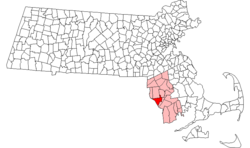
James was a founder of Swansea, Bristol, Mass.

James Browne being a Baptist was forced to leave Rehoboth in 1663 and with others of his sect founded the town of Swansea, Massachusetts.  For some time he was in the center of the controversy over control of the church in Rehoboth, which raged between Congregationists and Baptists. On 2 July 1667 he and John Myles, the Baptist minister,  were each fined £5 for setting up a public meeting without permission of the General Court, while a Mr. [Nicholas] Tanner was fined 20/-. On 30 Oct 1667 the Baptists were given permission to organize the town of Swansea, with a Baptist church under Mr. Myles, the church being the first of that denomination in Massachusetts. Thus while James Browne served, with John Allen and Stephen Payne, Sr., as a Selectman for Rehoboth in 1666-1667, he was next to serve Swansea as grand enquest in 1668. The records of the two towns were mixed for years afterwards.

As Plymouth Colony Assistant and Lieutenant of the Swansea Military Company, James Browne played an important role in King Philip’s War. On 14 June 1675 he went to King Philip, then chief of the Wampanoags, with a friendly letter from Governor Winslow, and, finding the Indians hostile, warned the colony of impending war. A member of the tribe, Petonowowett, later said Mr. Browne would have been killed that day had not Philip intervened personally. When the war actually began on Sunday, 20 June 1675, it was son James Jr.  who took the word to Plymouth. On “Fasting Day,” the following Thursday, nine settlers were killed while on their way home from church, and on 18 July fifteen were killed in an ambush. That month Mr. Browne, who was one of five (out of seven) Assistants taking the field during the war, led twelve men from Swansea in pursuit of the Indians across the Seekonk plain, with help from the Mohegans and eleven men from the Mt. Hope garrison under Lt. Nathaniel Thomas. During the war James Browne went to Philip twice but found him “very high and not p’swadable to peace.”

On June 20, 1675, the first Indian attack of King Philip’s War had all 70 settlers confined to their stockade. By June 25 the entire town had been burned, although a handful of the colonists escaped to Taunton. When the active war ended in 1676, the town was soon rebuilt.

It has been said that on 19 May 1668 James  used an armorial seal on a deed, “A lion rampant debruised by a bend, chequy, in sinister chief point a crescent,” similar to the arms of the Browns of Cheshire, England. His will, dated 25 Oct. 1694, was proved 11 Jan. 1711.

Dorothy’s will, dated 17 Dec. 1668 and proved 29 March 1674, mentions daughter Mary Willett and her children, Sarah Elliott, daughter of Sarah Elliott deceased, son James Brown, grandson John Browne and his brothers Nathaniel and Joseph, granddaughter Dorothy Browne, daughter-in-law Dorothy Browne, daughter-in-law Lydia BROWNE, and granddaughters Lydia and Anna Browne.
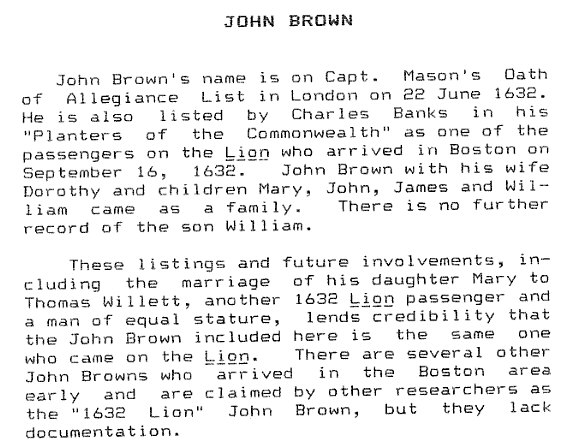
John Brown Bio 1
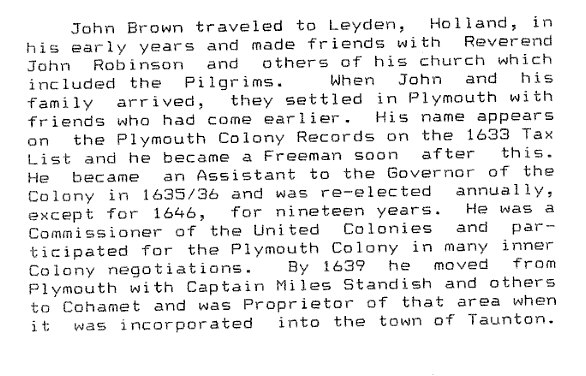
John Brown Bio 2
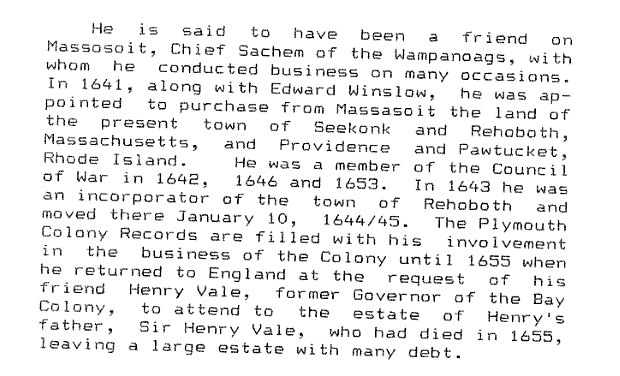
John Brown Bio 3
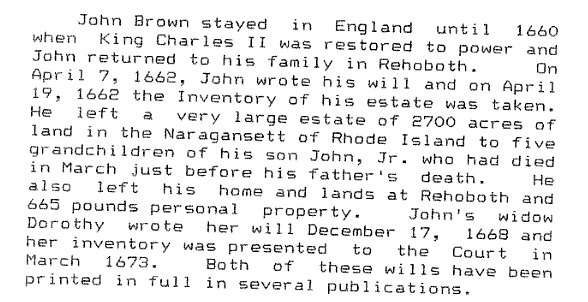
John Brown Bio 4
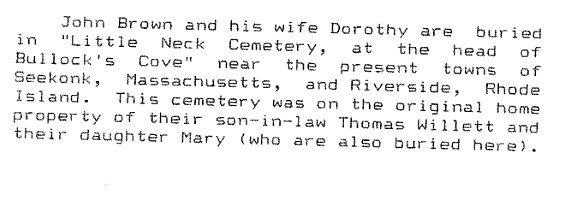
John Brown Bio 5
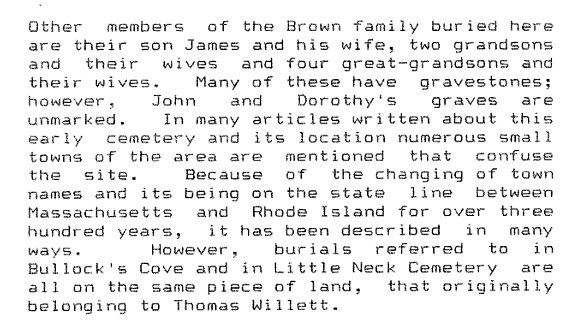
John Brown Bio 6

Sources:

http://familytreemaker.genealogy.com/users/j/o/n/Frances-J-Joneslory/GENE4-0031.html

http://newsgroups.derkeiler.com/Archive/Soc/soc.genealogy.medieval/2006-02/msg00017.html

http://www.sewellgenealogy.com/p53.htm#i7642

http://colonial-america.suite101.com/article.cfm/mayflower_pilgrim_peter_browne

http://www.mayflowerhistory.com/Passengers/PeterBrowne.php

http://en.wikipedia.org/wiki/Peter_Browne_(Mayflower_Pilgrim)
Robert L. French’s article, “John Browne of Plymouth Colony, Obstructionist and Libertarian,” MQ, 49 (1983):109, 161, and 50 (1984):5, 57, noted in Eugene Aubrey Stratton’s Plymouth Colony, Its History and People, 1620-1691 (Salt Lake City: Ancestry, Inc., 1986), 253-254

http://familytreemaker.genealogy.com/users/o/l/s/Joan-E-Olsson/GENE6-0072.html

http://newsgroups.derkeiler.com/Archive/Soc/soc.genealogy.medieval/2006-02/msg00017.html

Early New England: A Covenanted Society. By DAVID A. WEIR. Emory University Studies in Law and Religion. Grand Rapids, Mich.: William B. Eerdmans Publishing Company, 2005 (Review)

.
Posted in 13th Generation, 90+, Dissenter, Historical Monument, Historical Site, Immigrant - England, Line - Shaw, Storied | Tagged , , , , | 40 Comments

Edward Bosworth

Edward BOSWORTH (1589 – 1634) was Alex’s 12th Great Grandfather, one of 8,192 in this generation of the Shaw line.

Edward Bosworth - Coat of Arms

Edward Bosworth was born 1589 in Market Bosworth, Leicestershire, England. His father was Edward BOSWORTH Sr. (1565 – ?).    He married Mary [__?__] 1610 in Market, Bosworth, Leicestershire, England.   Edward Bosworth, who with his wife Mary….had with them their sons…a daughter Mary, and her husband William BUCKLAND… came to the New World in the ship Elizabeth Dorcas.  The ship was detained at Gravesend, Eng., from 22 Feb 1634, until early spring, while it was ascertained that all passengers had secured the necessary paper work for immigration.  The Elizabeth Dorcas lost sixty passengers and many animals before docking. Many of the bodies were buried at sea.   Edward survived the trip, but he died in Boston Harbor on arrival. From the Diary of Samuel Sewall (Vol. 3, page 396):

Edward Bosworth, the Father, being ready to dye ask’d to be carried upon Deck, that he might see Canaan. When he had seen the Land he resigned his Soul and dyed: was carried ashoar and buried at Boston.

Mary [__?__] was born 1591 in Market Bosworth, Leicestershire, England.  Mary died on 18 May 1648 in Hingham, Mass

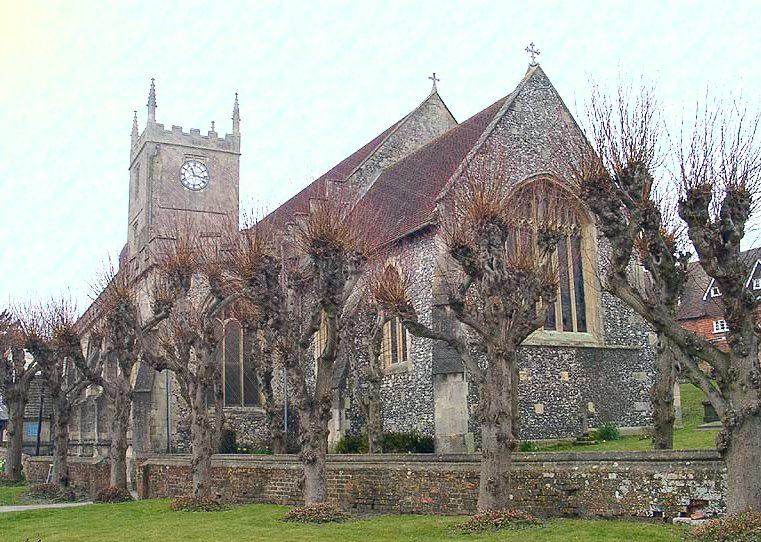
Market Bosworth Church Interior

Children:

Name Born Married Departed
1. Mary BOSWORTH ca. 1611 William BUCKLAND
1632
England
29 Jul 1687 Rehoboth. Mass.
2. Jonathan Bosworth 1613
England
Elizabeth [__?__]
1631
Hingham
3 JAN 1687/88 Rehoboth, Mass.
3. Benjamin Bosworth 1615
England
Mehitable [_?_]
1645
.
Beatrice Hampson 16 Nov 1671 Lancaster, Worcester, MA,
NOV 1700 Boston, Mass.
4. Nathaniel Bosworth 4 SEP 1617
England
Bridget Bellamy
1645
Hull, Mass.
5. Alice Bosworth 1621
Market Bosworth, Leicestershire,
England
5 Oct 1700
Salem, Mass

Son Jonathan had already immigrated a few years prior and was living in Cambridge, MA. Edward never made it onto land.  He had borrowed money from Henry Sewall to pay the passage over to New England for his family. His wife was left penniless and was helped by the town.  The money was a loan and the amount was about 100 pounds. The debts were assumed by the three sons and the son-in-law, William BUCKLAND, who had married Mary Bosworth. Jonathan, 22, Benjamin, 20, and Nathaniel, not quite 18 years old, each paid about 20 pounds of the debt..

7 Jul 1634, At Plymouth Court, Edward’s sons Jonathan, Nathaniel and Benjamin, together with William BUCKLAND, were ordered to pay back a a loan to one Henry Sewall, who had loaned money to the Bosworth family for the passage to the New World

In “consideration of money disbursed by Mr. Henry Seawell for the transportation of Edward Bosworth & his family, it is ordered that Jonathan Bosworth shall pay to Mr. Seawall the sum of £5 upon the 29th of September next; Will[ia]m Buckland £5 on the said 29th of September; Nathanaell Bosworth 50s. at the said day, & 50s. more that day twelve month’ & Benjamyn Bosworth 30s. on the said 29th of September, and £3 10s. at midsummer next; all these sums to be paid to the said Mr. Seawall” .

5 Aug 1634 – It was “ordered that such monies shall be laid out for the maintenance of Widow Bosworth & her family, shall be paid again by the Treasurer.

Children

1. Mary BOSWORTH (See William BUCKLAND‘s page)

2. Jonathan Bosworth

Jonathan’s wife Elizabeth [__?__] was born 1619 in Market Bosworth, Leicestershire, England. Elizabeth died 15 Jun 1705 in Swansea, Bristol, Mass.

3. Benjamin Bosworth

Benajmin’s first wife Mehitable [_?_] was born 1622 in Market Bosworth, Leicestershire, England. Mehitable died 16 Nov 1671.

Benjamin’s second wife Beatrice (Beatrix) Hampson was born 15 Jul 1623 in London, England. Her parents were Phillip Hampson and Anne [__?__]. She first married Abraham Joslin. It is interesting to note that while Abraham was the son of Thomas Joslin, who helped settle Rhode Island, he did not emigrate with his parents. When they left England in 1635, he was 16 years old and went off to become a mariner. Abraham at various times did live in Scarborough and Hinham, Maine and Boston and Lancaster, Massachusetts. Abraham died July 9, 1670 at sea off the coast of Virginia on the ship Good Fame of New York. The ship Good Fame of New York was owned by Francis Lovelace (in partnership with others) and was described as “a very stronge and handsome vessel, but costly” referring to both materials and labor. Built in 1669, it was generally sent to Virginia and often brought tobacco to New York, afterward to Europe. Francis Lovelace was the second governor of New York and he promoted shipbuilding. When war broke out with the Dutch, the Good Fame of New York and 3 other vessels were seized in Holland. John de Forest was “entertained as cuirugion” on board the Good Fame of New York during 1670, so he is likely the doctor that would have tended Abraham when he was ill. After Abraham’s passing, the widowed Beatrix re-married on September 16, 1671 to Benjamin Bosworth. They then moved to Hull, Massachusetts. Beatrix died January 11, 1712.

Beatrix’ son Abraham Hampson Jr. was killed at Rowlandson Garrison in Lancaster Mass Lancaster in Philip’s War: The Early Records of Lancaster, Massachusetts 1643 – 1725. Edited by Henry S. Nourse, A.M. Lancaster, 1884

“Early in the morning of the 10th of February, 1675/6, Lancaster was surprised by a large number of Indians, who made their attack in five disctinct bodies and as many places, burning the houses in their way, and destroying the people found inside them. Some of the inhabitants, to the number of forty-two, being mostly women and children, among whom were Abraham Josselyn Jr. and his family, took shelter in the fortified house of Rev. Joseph Rowlandson. This they defended upwards of two hours, during which time several of them were killed by the bullets showered upon them. At length the house was set on fire, and the people within were reduced to the sad necessity of either perishing in the flames or resigning themselves to the savages. In their attempts to escape, all the men, save one, were slain; many of the women and children perished on the spot; and the rest, about twenty in number, were seized by the Indians and carried into captivity. Thus perished Abraham Josselyn, as we are assured by Mr. Harrington. Mary Rowlandson, who was one of the captives, met Mrs. Josselyn [Abraham Jr’s wife was Ann (Hudson) Joslin, m. 1672.] , about the 23rd of February, in the hands of the Indians, at a place called Wenimesset, now New Braintree. She found her in great distress having in her arms her little daughter, Beatrice, then nearly two years old. In the course of her captivity, Mrs. Rowlandson heard that this unfortunate woman and her child were stripped by the Indians, knocked upon the head, and cast into a fire, where they miserably perished. Some captive children, who were present, declared to Mrs. Rowlandson, that Mrs. Joslin shed not a tear, but continued in prayer till death put an end to her suffering.”

Source:

4. Nathaniel Bosworth

Nathaniel’s wife Bridget Bellamy was born 1621 in England. Her parents were Jermiah Bellamy and [_?__].. Bridget died in 20 Nov 1690 in Bristol, Bristol, Rhode Island.

Nathaniel resided about 1635 in Hingham, Plymouth. Mass.7 He resided in 1652 in Hull, Suffolk, Mass. Hull “is celebrated for its beautiful beach four miles in length, and for its shellfish and seafood. The town lies between two hills of fine land, near Point Alderton, opposite Boston light-house. It is nine miles…from Boston by water, and twenty-one by land, via. Hingham.”

He was Deacon to the Church of Christ before 1675 in Hull, Suffolk Co, Mass. He was elected as Deputy at the Court on May 11 1681 in Hull, Suffolk Co, Mass. This election allowed the administering of oaths and to marry at Hull He resided about 1682 in Bristol, Bristol, RI.

When Nathaniel first came to Bristol he built a home now 814 Hope Street on the banks of Silver Creek, which was the first frame house built in the town. The Bosworth house was still standing in 1926 and is not only a very old house, but highly interesting in every respect. The place has never been sold, but has been inherited by one generation after another, and in this line of succession was at one time the property of Judge Bourn, who was a member of the first Continental Congress, meeting in Philadelphia. The chairs, used on that occasion, were afterwards sold, and two of them were purchased by Judge Bourn. These chairs still stand in the parlor of Nathaniel Bosworth’s old home “Silver Creek.” Later the place came into the possession of Mrs. James Perry, whose son, the late Rev. Calbraith Bourn Perry, D.D., published a book entitled, “The Perrys of Rhode Island, and Tales of Silver Creek: The Bosworth-Bourn-Perry Homestead.”

Among Bristol’s colonial architecture, one of the oldest and best known is on the east side of Hope Street, just north of the bridge. This is known as “Silver Creek” and was built…by Deacon Nathaniel Bosworth. From its completion to the present day it has never failed to shelter some of his descendants. It was added to from time to tome until it attained its present proportions. In the south-west part – the original house – was held the first meeting for religious worship in Bristol. During the bombardment of the town by Gen. Wallace in 1775, grape shot pierced its walls and lodged between the ceilings, where it was found years later when repairs were being made. In this building, where was organized the Congregational Church Society, was also opened the first school. This was taught by Miss Mary Bosworth, the owner’s daughter.

He appeared on the census on Feb 11 1686 in Bristol, Bristol, RI.7 A census of “All the families in New Bristol” gives…

Nathaniel Bosworth, wife, two children,
Tommy and Edward, grandchildren, no servants
[N.E. Hist. Register, Vol. 34, pg. 404] (per Mary Bosworth Clarke) He was Cong. Church on May 3 1687 in Bristol, Bristol, RI. He was one of the founders of the first church of Bristol, first known as the “Church of Christ,” and afterward called the “Catholic Congregational Church.” He was the first deacon of this church and was known as “Deacon Bosworth” for the remainder of his life. The first religious services in town were held in his house, and he assisted in erecting the first house of worship built there. When the old church was abandoned and a new one built, the baptismal font from the old church was presented to the descendants of Nathaniel who were living in the old home, and it also has a place in the parlor at “Silver Creek.”

Sources:

http://www.genealogyofnewengland.com/b_b.htm

http://www.bucklindata.net/b4.htm

http://www.angelfire.com/or/Shulmire/Bosworth.html

http://www.kates-family.com/p119.htm

http://trees.ancestry.com/owt/person.aspx?pid=408554&st=1

http://www.newerindustries.com/Jim/genealogy/Brooks/Joslin-Abraham.htm

http://www.geni.com/people/Nathaniel-Bosworth/6000000003937957570

Posted in 14th Generation, Historical Church, Immigrant - England, Line - Shaw | Tagged , , , | 6 Comments

William Buckland

William BUCKLAND (1606 – 1683) was Alex’s 11th Great Grandfather, one of 4,096 in this generation of the Shaw line.

Immigrant Ancestor

William Buckland was christened 23 Nov 1606 in Branscombe, Devon, England. His parents were John BUCKLIN and Katherine KERSLAK.  He married Mary BOSWORTH in 1632 in England.

Edward was baptized at St Winifred’s Church, Branscombe , Devon

Saint Winifred’s Church is a Church of England church in Branscombe in Devon, England. The church is dedicated to Saint Winifred, a Welsh saint. It is among the oldest and most architecturally significant parish churches of Devon. It probably dates back as far as about 995, but extant records on the vicars only go back to the thirteenth century.

There is some archaeological evidence to suggest an earlier Saxon church may have occupied the site.[citation needed] The building has a traditional west-east alignment. It is built on a levelled area that can not be seen from the coast. The choice of location may have been for protection of the original Saxon church from Viking raiders. Alternatively, the church may have been placed on an earlier pre-Christian holy site. Occupying such a pagan site would have allowed the Church to both challenge paganism and benefit from any positive religious feelings associated with the site.

The church building is partly Norman and partly later medieval. The tower is central and the transepts which are later stand unusually to the west of the tower. The nave is Norman, the transepts perhaps mid 13th century. The chancel is probably 14th century, though the east window was replaced in the time of Bishop Neville (1458–64). Interesting features include the font which is 15th century and the pulpit which is a three-decker pulpit and as such almost unique in Devon. Other woodwork includes the Jacobean screen and west gallery and the altar rails of ca. 1700.

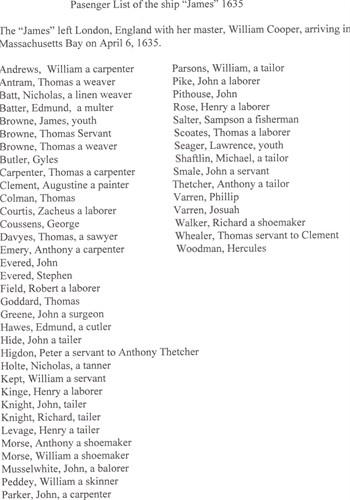
William emigrated to Hingham Mass in 1634 with his father-in-law’s family  “Edward Bosworth, who with his wife Mary….had with them their sons…a daughter Mary, and her husband William Buckland….  They sailed on the shipElizabeth Dorcas, which was detained at Gravesend, Eng., from 22 Feb 1634, until early spring, while it was ascertained that all passengers had secured the necessary paper work for immigration. The ship had many deaths, both among the passengers and animals. One of those who survived the trip was Edward, but he died in Boston Harbor on arrival.” William died 1 Sep 1683 in Rehoboth, Mass

Mary Bosworth was born 1611/1617 Market Bosworth, Leicester, England .  Her parents were Edward BOSWORTH and Mary [__?__].  Mary died in 29 Jul 1687 in Rehoboth.

Children of William and Mary:

Name Born Married Departed
1. Lydia BUCKLAND c. 1632 England John BROWN
5 Nov 1659 Rehoboth, Mass
.
William Lord
3 Jun 1664 Conn.
.
Thomas Dunk
Aft 1678
.
Abraham Post
Saybrook, Middlesex, CT.
2. Joseph Buckland 26 JUN 1633 England Deborah Allen (grand daughter of George ALLEN)
5 Nov 1659 Rehoboth
28 MAR 1718 Rehoboth
3. Benjamin Buckland ca. 1640 Hingham, Mass. Rachel Wheatland (or Wheatley)
Rehoboth
Killed at Nine Men’s Misery
26 MAR 1676
Hingham, Mass
4. John Buckland ca. 1642
Mass.
Deborah [__?__] 20 Jun 1677
5. William Buckland ca. 1644 Elizabeth [__?__] 13 May 1691
Windsor, CT

William’s last name was spelled Bucklin, Bocklands, Buckline and Buckland

Holmes, in his Directory of Ancestral Heads of New England Families (xxxv) says that William Buckland came from Weymouth, England. Pope says the Bosworth family, into which he had married, was probably from Conventry. (Boston Transcript, 24 October 1923.) Much of the early history of many of these first trail-blazers seems veiled in impenetrable obscurity, and we are only left to conjecture what it may have been.

7 July 1635 – The court ordered that William Buckland should together with the three sons of Edward Bosworth, pay to Henry Sewall the sum of £20 advanced by the latter to pay the expenses of the Bosworth family on the voyage to America

1635 Land Obtained in Hingham, MA.

“Wm. Buckland had land granted to him as follows: 4 acres …Wearyall Hill; a house lot of 5 acres near present …West Hingham; 2 acres at Great Plain; 2 acres at Layford… Meadow; and 3/4 acres of salt meadow at Cohasset. He also owned 1 lot at Broad Cove.”

ca. 1643, Rehoboth, MA. The land of William referred to in the following two items, below, was immediately north of the original 1643 purchase of the Rev. Samuel Newman‘s congregation, when they they moved from Weymouth MA to Rehoboth. William’s purchase most likely was before the arrival of Rev. Newman’s congregation, because from the start of Rehoboth there was discussion on exactly where was the boundary between the Newman group and Bucklin’s land; Bucklin was recognized as having a prior right to the land which blocked the Newman group from immediate and easy access to the Seconk River, and that Bucklin had the right to the land at the falls..

“At the same time the way to William Bocklands house is agreed on by those partyes which it doth conform.”

In 1650 and afterwards, he owned land at Broad Cove, near Hingham (Hingham Genealogies, Lincoln, 2:96.)

In 1652 William Buckland’s name is recorded in connection with the inventory of an estate in Hingham, but it is likely that he removed within a few years thereafter to Rehoboth, where on 19 May 1656 he was chosen “grandjuryman.”

1656 – Old Proprietary Records of Rehoboth,  show that at the town meeting Bucklin formally recorded his land as being:

“600 acres of land wch John Hasels wch I bought of Edward Smith bounded on Pawtucket River on the west & unto a Run yours truly, somes from the cedar swamp on the east upon the south with lands yours truly, was John Reads and upon the north the common as we go to Mr. Blaxtons.”

22 Feb 1657/58, Freeman of Rehoboth

3 Jun 1656, Rehoboth, MA – Appointed Grand Juryman.

It is recorded there, that on 17 Mar 1657 he was engaged “to enlarge the meeting house the bredth of 3 seats throughout & to find boards,” etc. From this entry we gather he was a carpenter, though the contract seem to have been canceled, indicated by lines drawn through the record

The following year he is listed among those who had taken the “oath of Fidelitie” in Rehoboth , and in a drawing of lots in the north meadow there on 22 June 1658, he drew number 46. On the Old Proprietary Records of Rehoboth (Book 2:81) is listed the land which he owned in that locality, totaling well over seven hundred acres.

3 Jun 1657, Rehoboth, MA – Appointed Constable

1 Sep 1659 – He signed  a contract by which he conveys considerable property to his son Joseph, then purposing to enter into a marriage contract with “Deborah Allin of the same plantation.” (Plymouth Colony Records 2: 2: 66.) In 6164, on 18 April, he makes a liberal conveyance of land and possessions to his “son Benjamine,” which document was “Signed sealed and delivered in the presence of William Lord, Lydia Browne.” (Ibid. 3:117.)

22 Jun 1658, Rehoboth, MA. – At a town meeting lawfully warned, lots were drawn for the meadows that lie on the north side of the town, in order as followeth….46. Will. Bucklin….”

30 Jan 1658/59, Rehoboth, MA – Newman Church. “enlarge the meeting-house the breadth of three seats throughout, to find boards and to finish it complete and answerable to the rest, with seats, the town finding nails.”

09 Dec 1659, Rehoboth, MA – Shingle Newman Church.

“It was agreed upon that the town of Rehoboth and Lieutenant Hunt and William Bucklin that the said Lieutenant Hunt and William Bucklin is to shingle the new end of the meeting-house, and to be done as sufficiently as the new end of Goodman Payne’s house; and they are to furnish nails, and to be done my May-day next ensuing, provided that the frame be ready in season; in consideration whereof they are to have L8 to be paid in good, merchantable wampum, when their work is done.”

25 May 1661, Hingham, MA. – “He sold land in Hingham

18 Apr 1666, – Boundary Negotiations Bucklin North Boundary Rehoboth, MA – Fence Erected.  , Disputes about the exact line of the North Purchase and Bucklin’s land lead to a committee chosen to decide and “there shall be a three railed fence set up and maintained, between the late purchased land on the north side of the towne, ..from Goodman Buckland’s lands to the Mill river….”

26 May 1668, Attleboro, MA. – William drew lot 58; his son Joseph participated and drew lot 74; and William’s son Benjamin drew lot 17.

20 Feb 1671/72, Rehoboth, MA., “lots for the Second devision”. William had lot 20; Joseph 9; Benjamin 45.

10 Mar 1673/74, Rehoboth, MA. The common lands of Rehoboth were leased out to various persons, including the Bucklins. William and Joseph and Benjamin were paying substantial amounts for the fencing of the lands of which they had the lease use. The number of rods (feet) of fencing they were to provide indicates they were the largest landowners or husbandmen involved in the Commons.

1676 – Contributed for  King Phillip’s War.

20 Feb 1677/78, Wachmoket Neck. –  William Buckland of the town of Rehoboth government of New Plymouth in New England, deeds to Jonathan Bosworth, Senior of Rehoboth, a lot of upland in Wachamoket Neck…twelve acres.

22 Oct 1680, Rehoboth, MA -Bucklin’s south land boundaries and that of the original Newman group was still in dispute . On this date a committee of six distinguished men were appointed to personally do the survey . At the same time this committee was given power to agree with the Bucklins for a highway to be used by the cattle of the rest of the town residents to go down to the salt river area

Land was laid out to William Bucklen, and a Comitte was Impowered by the Town to agree with Buicklens Respectting a highway to the Sal water for the Cattle to go to Drink. [copied form Proprietors of Rehoboth–Meetings, at Taunton.].

9 Apr 1680, Rehoboth, MA. –  Again, William and his son Joseph participate in the lots drawn for the division of new lands.

“October ye 22d 1680 Land was laid out to William Bucklen, and a Comitte was Impowered by the Town to agree with Bucklens Respecting a highway to the Salt water for the Cattle to go to Drink — Proprietors of Rehoboth Meetings, at Taunton.

Other records are frequent showing his hand in various transactions not only in Rehoboth, but in Attleboro (Original Records of the Town of Attleboro ,1) and in New Bristol, at which latter place he witnessed a deed 1 May 1682. (Bosworth Genealogy, Clarke, Part I; 58.) This disproves the statement made by Savage (Genealogical Dictionary 1:285) and others, that he died and was buried 1 Sep 1679. Mrs. Mary Bosworth Clarke, in Bosworth Genealogy (part I; 59), points out that the error was made through some undated records in Rehoboth. An entry in the records of the meetings of the proprietors of Rehoboth, at Taunton, also shows he was living after this date.

1684 – Plymouth, MA. Bond of 100 pounds given by Joseph Bucklin to administer estate of William Buckland, of Rehoboth, late deceased, given 28th of Oct 1684.

He seems to have lived in East Hartford for a brief period at some time, his residence there, according to some writers (Massachusetts Genealogies, Cutter and Adams, 3: 1998), being on the present site of the Buckland homestead on Meadow Hill, at the corner of Mill and Prosp0ect streets. Under the east front room was a secret cellar, entered by a trap door from above; its common cellar was on the west side.” Mrs. Clarke, compilerk of Bosworth Genealgoy (part I;51) says: “There was a William Buckland in Boston in 1631, but I cannot find that he had any connections with this one, whom I believe came to this country in 1634, as stated. The former may have been the one, or related to the one, whom Savage says went to Hartford, Connectyicut, and died there 13 May 1691.” Mrs. Clarke does not include a son William among the children of our immigrant, although the writer of New England Genealogies (Cutter, 3:1304) does, identifying him as the one mentioned whose death occurred in May, 1691, and states that his wife was Elizabeth Hills. Two genealogists in tracing this line have come to the conclusion that the male line of Thomas Buckland, an early settler of Hartford and who is thought to have been a brother of William, died out, and that the later members of the Buckland family in Windsor were descendants of William, the early settler of Hingham. (Ibid. 3:1304.)

William Buckland’s name is on a list of those who gave money for the Colonists in King Philip’s War.  The money cost was sestimated at one million dollars, and most of the settlements contributed portions to that expense.

William Buckland died in Rehoboth, and was there buried 1 September 1683, his wife following him on 29 July 1687. In November 1684 Joseph Buckland was granted rights of administration on his father’s estate, he giving bond in the sum of £100 for the just discharge of his responsibility.

Children

1. Lydia BUCKLAND (See John BROWN‘s page)

2. Joseph Buckland

Joseph’s wife Deborah Allen was born 10 Nov 1645 in Hingham, Plymouth, Mass.  Her parents were John Allen and Christian [__?__]. Her grandparents were George ALLEN and Katherine WATTS. Deborah died 26 Mar 1718 in Rehoboth, Bristol, Mas

3. Benjamin Buckland

Benjamin’s wife Rachel Wheatland (or Wheatley) was born 1643 in Hull, Plymouth, Mass. Her parents were John Wheatley and Leah Sanders. Rachel died 20 Sep 1713 in Hull, Plymouth, Mass

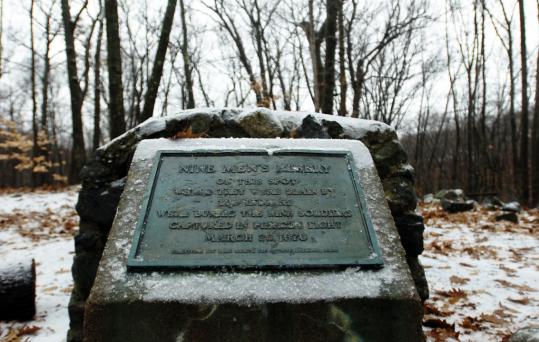
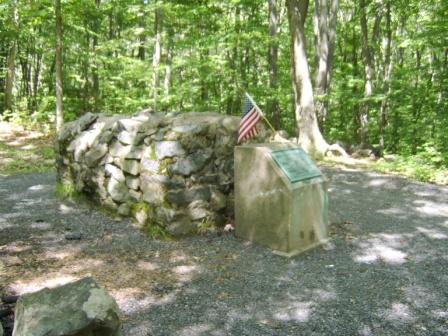
The Buckland family not only gave money, but the son Benjamin, with eight other pioneers, was slain on 26 March 1676 in Pierce’s fight with the Indians, at a place afterwards called “Nine Men’s Misery.

Benjamin died at Nine Men’s Misery.  On March 26, 1676 during King Philip’s War, Captain Michael Pierce led approximately 60 Plymouth Colony colonial troops and 20 Wampanoag Christian Indians in pursuit of Narragansett Indians who had burned several Rhode Island towns and attacked Plymouth, Mass. as part of King Philip’s War. Pierce’s troops caught up with the Narragansett Indians, Wampanoag, Nashaway, Nipmuck, Podunk but were ambushed in what is now Central Falls, Rhode Island. Pierce’s troops fought the Narragansetts for several hours, but were surrounded by a larger force of Narragansetts. The battle was one of the biggest defeats of colonial troops during King Philip’s War with nearly all killed in the battle, including Captain Pierce and the Christian Indians (“Praying Indians“) (exact numbers vary by account somewhat). The Narragansetts lost only a handful of warriors.

Nine of the colonists who were among the dead were first taken prisoner (along with a tenth man who survived). These men were purportedly tortured to death by the Narragansetts at a site in Cumberland, Rhode Island, currently on the Cumberland Monastery and Library property. The nine dead colonists were buried by English soldiers who found the corpses and buried them in 1676. The soldiers created a pile of stones to memorialize the colonists. This pile is believed to be the oldest veterans’ memorial in the United States, and a cairn of stones has continuously marked the site since 1676.

The “Nine Men’s Misery” site was disturbed in 1790 by medical students led by one Dr. Bowen looking for the body of one of the dead colonists, Benjamin Bucklin, who was said to be unusually large with a double row of teeth. They were stopped by outraged locals. The site was desecrated several more times until 1928 when the monks who then owned the cemetery cemented the  stone cairn above the site. The cairn and site can still be visited on the Monastery grounds.

This picture shows the Nine Men’s Misery Original Carin better

Pierce’s Fight was followed by the burning of Providence three days later, and then the capture and execution of Canonchet, the chief sachem of the Narragansetts. The war was winding down even at the time that Pierce’s party was destroyed, and in August, King Philip himself was killed.  Our ancestors John LOW and John Millard  son of John MILLARD also died in the battle.

The site is located on the grounds of the former Trappist monastery of Our Lady of the Valley, now the Cumberland public library, and is an approximately 15 minute walk behind the main building on a rise in the woods.

Directions:  Follow the road to the right past the main building, you will come to a low white building on your left and at that point should see a break in the chain link fence that is on your right. There is a low metal guardrail in the break, step over and you should be on a walking path. Turn right and not far up the path will divid, take the left path, it will bring you through a field. In the field, it again branches out – take the left again and keep walking out of the field through the trees. From leaving the field to reaching the monument is about the same distance that you walked to get out of the field from the start. Coming down over a small rise, there is a path to the right that brings you to the elevated area that the monument occupies – you can see the monument from the rise when on the path.

4. John Buckland

John’s wife Deborah [__?__] was born 1646 in Melksham, Wiltshire, England

5. William Buckland

William’s wife Elizabeth [__?__]

Sources:

http://www.genealogyofnewengland.com/b_b.htm

http://www.bucklinsociety.net/Wm1_Story_docs.htm

http://www.telusplanet.net/public/jcushman/gen/buckland.html

Ancestry and Posterity of Joseph Smith and Emma Hale, (Anderson 1928) pp 496

http://trees.ancestry.com/owt/person.aspx?pid=31501805

Posted in 13th Generation, Historical Church, Immigrant - England, Pioneer, Public Office | Tagged , | 14 Comments

Ensign John Brown (Rehoboth)

Ensign John BROWN (Rehoboth) (1620 – 1662) was Alex’s 10th Great Grandfather, one of 2,048 in this generation of the Shaw line.

John Brown Coat of Arms

We have five separate Brown lines and seven different Brown immigrant ancestors, by far the most of any surname.  When the surname is of English origin it is derived from a nickname concerning the complexion of an individual, or the colour of their hair. Brown is derived from the Old English brunbrūn; Middle English brunbroun; or Old French brun.

1. John BROWNE Sr. (Swansea). (1583 Hawkedon, Suffolk  – 1662 Swansea, Mass)

John BROWN Jr.  (1620 -1662 Rehoboth, Mass)

2. John BROWN (Hampton) (1589 London – 1677 Salem, Mass)

3.  Nicholas BROWN (1601 Inkberrow, Worcester – 1694 Reading, Mass)

4. James BROWNE (1605 Southhampton, Hampshire  -1676 Salem, Mass.)

5. Thomas BROWNE (1607 Christian Malford, Wiltshire – 1687 Newbury, Mass.)

Francis BROWN I (1633  Christian Malford, Wiltshire – 1691  Newbury, Mass.)

John Brown was born about 1620 in  England, though estimates of the date are all over the map.

11 Oct 1608 5 User-submitted trees in ancestry.com One World
1616 8 trees
1620 19 trees
1620 9 trees
1623 20 trees
1630 60  trees
1633 13 trees
1633 5 trees
8 Sep 1634 5 trees

His parents were John BROWNE Sr. and Dorothy BEAUCHAMP .  He emigrated with his parents, brothers William and James and sister Mary sailing from London, 22 June 1632, on the Lyon, William Pierce, Master.  The ship arrived in Boston on 16 Sep 1632, twelve weeks from London and eight weeks from Land’s End.   John married Anne Dennis in 1646 or 1649 in Taunton, Bristol, Massachusetts.  This marriage has not been proven as far as far as I know.  After Anne died, he married Martha THOMPSON about 1650.  He then married Lydia Buckland on 5 Nov 1659 in Rehoboth, Mass.  John, Jr’s will is dated “the last day of March 1662” and was presented to the Plymouth Colony Court on April 19, 1662. So he died between those two dates.

John’s father John Sr. died ten days after his son John Jr.   In his will, John Sr left will 1,700 acres of Narragansett lands to the children of his son John Jr., and he was able to leave a large estate valued in the inventory of 19 April 1662 at £665.1s.2d, but including only £6  in cash!  He left his daughter Mary Willett only 12d “to bee payed att the end of every yeare During her life for a memoriall unto her; and it shalbee in full of all filiall portion which shee or any in her behalfe shall Claime”..

Anne Dennis was born about 1629 in Suffolk, England. Her parents were William Dennis and Jane Scarlet. Anne died in 1650 or 1652 in Rehoboth, Bristol, Mass.

Martha Thompson was baptizd 17 Dec 1626 in Preston, Northamptonshire, England. She was a sister of the first wife of George Denison of Roxbury, whose daughter Margaret [by his second wife] m. James3 Browne, Jr. [French, MQ, 50:8]; a Martha Browne d. 14 Feb. 1660. However, Gary Boyd Roberts identifies the Rev. William Thompson [the missionary to the Pequots, who later dropped the “h” in his name]’s known dau. Mary [dau. of as Alice (Freeman)(Tompson) Parke] having m. in Roxbury Joseph Wise), Martha died 14 FEB 1660 in Wannamoisett, Mass.

Phebe Harding did not marry either of the Rehoboth John Brown(e)s, Jr, or Sr. She married the John Brown(e) of Duxbury, brother to Peter Browne, of the Mayflower on 26 Mar 1634 in East Bridgewater, Plymouth. This information has been published in various articles in the NEHGR and Mayflower Descendant.

Lydia Buckland was born about 1632 in England.  Her parents were William Buckland and Mary Bosworth.  When John died, Lydia married Lt. William Lord on 3 Jun 1664 in Rehoboth Mass and had eight more children.  She married Thomas Dunk in 1679 in Saybrook, Middlesex, CT.   Finally, Lydia married Lt. Abraham Post in Mar 1684 in Saybrook where she died on 24 Sep 1700.

William Lord was born 1623 at England. He came in the Elizabeth and Ann, 1635 with his father Thomas Lord at age 12 and lived in Hartford, CT. He first married about 1642, possibly Hattie Nickerson and settled in Saybrook, CT, about 1645. He was there at the division of lands in 1648 and became a large landowner in Saybrook and also in Lyme. he bought a large tract from the Indians in Lyme which land was subsequently exchanged with the town for various other parcels by his sons Thomas and Richard. He obtained for the town of Lyme the tract of land that afterwards made the town of Salem, CT: in April 1669, Chapeto, a kinsman of Uncas, gave to William Lord of Lyme, eight miles square; subsequently known as the Paugwonk lands, and appears to have included all or nearly all of the present township of Salem; this deed was confirmed to his sons in 1681. William died 17 May 1678 at Saybrook, CT.

In 1669, William Lord purchased the tract of land that became Salem, New London, CT

Lydia’s third husband Thomas Dunk was born in 1629 in England. Thomas died 9 Aug 1683 – Lyme, New London, CT

Lydia’s fourth husband Abraham Post was born 1627 in Otham, Kent, England. His parents were Lt. Stephen Post and Eleanore Langley. He came to America with his parents in the ship “Griffin” arriving in Boston on Sep 4, 1633. His father Stephen was a carpenter and a follower and adjerent of the Rev. Thomas Hooker. His name appears on the monument as one of the founders of Hartford, CT. Abraham first married in 1649 in Lyme, CT to Eleanor [__?__].  He next married in 1663 in Saybrook CT to Mary Jordan (1644 – 1683).  Finally, he married Lydia Buckland in 1684. Abraham died 15 JAN 1714 in Saybrook, Middlesex, CT.

Hooker arrived in Boston and settled in Newtown (later renamed Cambridge), where he became the pastor of the First Parish Church. His parish became known as “Mr. Hooker’s Company”.  Voting in Massachusetts was limited to freemen, individuals who had been formally admitted to their church after a detailed interrogation of their religious views and experiences. Hooker disagreed with this limitation of suffrage, putting him at odds with the influential pastor John Cotton. Owing to his conflict with Cotton and discontented with the suppression of Puritan suffrage and at odds with the colony leadership, Hooker and the Rev. Samuel Stone led a group of about 100, including the Posts who, in 1636, founded the settlement of Hartford, named for Stone’s place of birth: Hertford, in England.

Child of John and Anne Dennis

Name Born Married Departed
1. John Brown 30 SEP 1650 Swansea, Mass Ann Mason
(daughter of our ancestor John MASON)
8 NOV 1672 Swansea
24 NOV 1709 Swansea

Children of John and Martha Thompson:

Name Born Married Departed
2. Lydia Brown 5 Aug 1655 Rehoboth William Parker
6 Sep 1676
Saybrook, CT
11 Jun 1728 Saybrook
3. Hannah Brown 29 Jan 1656/57 Rehoboth Hezekiah Willett
7 Jan 1675/76
Swansea, Mass
4. Joseph BROWN 9 Apr 1658 Rehoboth Hannah FITCH
10 Nov 1680 Attleborough, Mass.
5 May 1731 Attleborough, Bristol, Mass

.

Child of John and Lydia Buckland

Name Born Married Departed
5. Nathaniel Brown 9 Jun 1661, Rehoboth, Mass Sarah Jenckes 1680 Pawtucket, RI 13 Nov 1739 Providence, RI

Children of Lydia Buckland and William Lord

i. Abigail Lord

ii. Benjamin Lord b. 30 MAR 1666 Rehoboth

iii. James Lord b. 2 APR 1668 Saybrook, Middlesex, CT.

iv. Samuel Lord  b. ca. 1669 Saybrook, CT.

v. Dorothy Lord  b. ca. 1670 Saybrook, Middlesex, CT

vi. Daniel Lord b. ca. 1671 Saybrook, CT.

vii. Hannah Lord b. ca. 1675 Saybrook, CT.

viii. Elizabeth Lord b. ca. 1676 Saybrook, CT.

John was married more than once. This fact is established by a statement of his brother James Browne in which he refers to John’s oldest child, “as my loving nephew, John Brown” ‘eldest son of my brother John by his first wife”

The name of the first wife is not known for certain, nor the date of his marriage to her, nor the date of her death. For his second wife he married Lydia Buckland, daughter of William Buckland. The date of his second marriage is not definitely known. Land was granted to William Buckland by the town of Hingham in 1636. William Buckland was buried in Bingham September 1, 1679

In the little book previously mentioned, reference is made to a deed in which the following language appears in reference to John Browne Jr., ”John Jr. had 2 sons by

his first wife of which John was the eldest.” John Browne Jr.’s second son was Joseph; he was born April 9, 1658. Therefore his marriage to his second wife, Lydia Buckiand, must have occurred subsequent to April 9, 1658.John Browne Jr., in his will, made last

It is highly probable that if the marriage portion was to be paid in 1660, the marriage was celebrated not long before that time.

It is certain that the eldest child John Browne [III] was by the first wife. John Browne, Jr., was first appointed Ensign March 20, 1653, and was again appointed in 1654

John Brown Bio

James Browne mentioned “my loving nephew John Brown, grandson and eldest son of my brother John Brown by his first wife, one half of all the lands my father had given her which was the real intent of my father’s last will.”

WILL: 31 MAR 1662 Rehoboth, Plymouth Colony

Know all men that I John Browne of Wannamoisett in the Jurisdiction of Plymouth being sicke but in  pfect memory Doe leave this my last Will and Testament in manner and forme as followeth; wheras  my fatherinlaw William Buckland standeth engaged unto mee in the sume of three score pounds  which was to bee for the portion hee was to give mee in marriage with my wife and was to bee  payed mee in the yeare 1660: this sume which is now in my fatherinlaw his hand I Doe give unto my wife for her better preferment Desiring that my fatherinlaw would bee Carfull to pay it;

and morover I Doe give unto my wife; the like sume of threescore pounds to bee payed unto her by my Exequitor  out of my estate and I Doe give unto my eldest son John Browne my little mare that is now great with  foale as alsoe yearling Coult shee brought forth the last yeare; and one yeoke of oxen; and such Iron  or Iron takeling as is ptable betwixt my brother James and my selfe I Doe give my pte unto my son  John Browne;

and Conserning all my five Children I Doe wholly leave them all to the ordering and  Dispseing of my owne father Mr John Brown for him to bring them up not once questioning but that  his love and Care for them wilbee as it hath bine for my selfe; and for all the rest of my estate I Doe wholly leave unto him to Dispose amongst them as in his Descretion hee shall see meet; and I Doe  leave my said father mr John Browne sole executor of this my last Will; In Wines wherof I have sett to my hand and seale this last Day of march in the yeare 1662

Signed Sealed and Delivered John Browne
in the prsence of and a seale
Thomas Willett
John Allin;

John Browne, Jr., died 31 March 1662, in his will leaving the care of his family to his father, John’ Browne, the prominent magistrate of Rehoboth.

That father, however, survived the son but a few days, dying on 10 April the same year, and John’s brother James assumed the guardianship of the children. In the will of John Browne, jr., he left to his wife the money which his “father-in-law William BUCKLAND standeth engaged to me in the sum of three score pounds, which, was to be for the portion he was to give me on marriage with my wife, and was to be paid to me in the year 1660.” Some infer from this that Lydia Buckland married John Browne about 1660, but it is to be noted her father only pledged her marriage portion at the time of her marriage, to be paid in 1660. This was evidently not paid before John Browne, Jr.’s will was written, but was receipted for on 26 June 1663; “I Lidia Brown the late wife of Mr. John Brown Junr. lately deceased, do acknowledge that I have received of my Brother James Brown the sum of Three score pounds to my satisfaction which was left me by my husband. The mark of Lidia M Brown.”

Children 

1. John Brown

John’s wife Ann Mason was born Jun 1650 Saybrook, CT.  Her parents were John MASON and Ann PECK.  Ann died 1709 Swansea, Bristol, Mass.

2. Lydia Brown

Lydia’s husband William Parker was born 1645 in Hartford, Hartford, CT. His parents were William Parker and Margaret Pritchard. William died 20 Aug 1725 in Wallingford, New Haven, CT.

3. Hannah Brown

Hannah’s husband Hezekiah Willett was born 17 Nov 1651 – Plymouth, Mass. His parents were Capt Thomas Willett and Mary Brown. Hezekiah died 1 Jul 1676 – Swansea, Bristol, Mass, just six months after his marriage.

4. Joseph BROWN (See his page)

5. Nathaniel Brown

Nathaniel’s wife Sarah Jenckes was born 1660 in Pawtucket, Providence, Rhode Island. Her parents were Joseph Jenckes and Esther Ballard. Sarah died 1708 in Rehoboth, Bristol, Mass.

Sources:

Excerpt from: Historic homes and institutions and genealogical and personal memoirs of Worcester County, Massachusetts Vol.1 edited by: Ellery Bicknell Crane, Worcester Historical Museum

Ensign John, Jr., born in England, died last of March, 1662; (settled in Rehoboth and had these children: John, born last Friday in September, 1650; Lydia, August 5 or 6, 1656; Annah, January 29, 1657; Joseph, April 9, 1658; Nathaniel, June 9, 1661

http://aleph0.clarku.edu/~djoyce/gen/report/rr_idx/idx031.html#BROWN

http://www.genealogyofnewengland.com/b_b.htm

http://www.bucklindata.net/b7.htm#P378

http://newsgroups.derkeiler.com/Archive/Soc/soc.genealogy.medieval/2006-02/msg00017.html

http://freepages.genealogy.rootsweb.ancestry.com/~hwbradley/aqwg33.htm

Ancestry and Posterity of Joseph Smith and Emma Hale, (Anderson 1928) pp 496

Passengers on the “Lion” From England to Boston, 1632, and five generations … By Sandra Sutphin Olney

http://freepages.genealogy.rootsweb.ancestry.com/~batemanp/pilgrims/test0012.htm

John Browne, gentleman, of Plymouth, (and one branch of descendants to the 12th generation) assistant, commissioner, magistrate, pioneer in New England colonial life .. (1919) Author: Brown, George Tilden, b. 1848

Posted in 12th Generation, Immigrant - England, Line - Shaw | Tagged , | 13 Comments

Joseph Brown Sr.

Joseph BROWN (1658 – 1731) was Alex’s 9th Great Grandfather, one of 1,024 in this generation of the Shaw line.

Joseph Brown was born 9 Apr 1658 in Rehoboth, Mass.  His parents were John BROWN (Rehoboth) and Lydia BUCKLAND. He married Hannah FITCH on 10 Nov 1680 in Attleborough, Mass.  Joseph died 5 May 1731 in Attleborough, Bristol, Mass.  Both Joseph and Hannah were buried in what is now known as Knowles Cemetery and that a stone is there erected to their memory.

Hannah Fitch was born in 1662 in Plymouth, Mass.  Her parents were John FITCH and Mary SUTTON. Hannah died 14 Oct 1739 in Attleborough, Mass.

Two of their children, Joseph and Mary are both our ancestors.

Children of Joseph and Hannah

Name Born Married Departed
1. Hannah Brown 21 NOV 1681 Rehoboth, Mass Bryant Ledoight
ca. 1706 Rehoboth
2. Joseph Brown 21 NOV 1681 Rehoboth 18 NOV 1685 Rehoboth
3. Jabesh Brown 25 DEC 1683 Rehoboth Mary Whipple
18 NOV 1718 Rehoboth
9 SEP 1724 Attleborough, Bristol, Mass
4. John Brown 13 MAR 1684/85 Rehoboth Elizabeth Capron
1711 Rehoboth
13 JUN 1727
5. Joseph BROWN 28 Aug 1688 in Rehoboth Abigail PEARSON
11 Nov 1714
Newbury, Mass.
12 Aug 1728 Newbury, Mass.
6. Lydia Brown 5 DEC 1691 Rehoboth John Ledoight
10 OCT 1724
Rehoboth
7. Benjamin Brown 13 APR 1694 Rehoboth Sarah Freeman
13 AUG 1719
7 SEP 1742 Attleborough
8. Mary BROWN 28 JUN 1696 Rehoboth Thomas FRENCH Sr.
5 JAN 1719/20 Attleborough
21 Nov 1783
Attleborough
9. Christopher Brown 17 JUN 1699 Rehoboth Waitstill Ormsby
10 MAY 1726 Rehoboth
10 May 1726
10. Jeremiah Brown 7 OCT 1702 Rehoboth Hannah Freeman 6 MAR 1725/26
11. Noah Brown 1704 Rehoboth

Joseph’s grandfather John BROWNE Sr. died 10 Apr 1662 in Swansea, Mass. ten days after his son John Jr.   In his will, John Sr left will 1,700 acres of Narragansett lands to the children of his son John Jr., and he was able to leave a large estate valued in the inventory of 19 April 1662 at £665.1s.2d, but including only £6  in cash!  He left his daughter Mary Willett only 12d “to bee payed att the end of every yeare During her life for a memoriall unto her; and it shalbee in full of all filiall portion which shee or any in her behalfe shall Claime”…

Joseph Browne, second son of John Browne, Jr., removed to Attleboro in 1699, became prominent in town affairs, was captain of the Attleboro Military Company, was elected Representative to the General Court several years, was moderator and selectman several years.  Attleboro was incorporated from part of Rehoboth in 1694 as the Town of Attleborough.

In the old proprietor’s records of the town of Attleboro, in an exchange of lands between Joseph Brown and William Carpenter, Jr., under date of March 13, 1698, Joseph in describing the boundary mentions, “Ten acres purchased of my brother Nathaniel Brown.” This record is in the City Clerk’s office of the City of Attleboro.

Capt. Joseph Brown is said to have been Representative in the years 1712, 1726,
1727, 1728. In a root-note it is stated that Capt. Joseph Brown was “son of Mr. John
Browne of Rehobot.., well known in the history of Plymouth colony”. Some dates
given iil that foot-note are manifestly wrong.

Children

1. Hannah Brown

Hannah’s husband Bryant Ledoight was born 1685 in Rehoboth, Bristol, Mass. Bryant died before 1739

3. Jabesh (Jabez) Brown

Jabesh’s wife Mary Whipple was born 3 Nov 1699 in Attleboro, Bristol, Mass. Her parents were Israel Whipple and Mary Wilmarth. Mary died in 1758

4. John Brown

John’s wife Elizabeth Capron was born 22 Oct 1684 in Rehoboth, Bristol, Mass. Her parents were Banfield Capron and Elizabeth Callender. Elizabeth died 11 Jul 1765 in Cumberland, Providence, Rhode Island

5. Joseph BROWN (See his page)

6. Lydia Brown

Lydia’s husband John Ledoight was born 1687 in Rehoboth, Bristol, Mass

7. Benjamin Brown

Benjamin’s wife Sarah Freeman was born 6 May 1700 in Dedham, Norfolk, Mass. Her parents were Ralph Freeman and Sarah Day. Sarah died in 1755 in Cumberland, Providence, Rhode Island,

8. Mary BROWN (See Thomas FRENCH Sr.‘s page)

9. Christopher Brown

Christopher’s wife Waitstill Ormsby was born 2 Jul 1707 in Rehoboth, Bristol, Mass. Her parents were Jacob Ormsby and Hopestill Eddy. Waitstill died 1 Sep 1728 in Rehoboth, Bristol, Mass.

10. Jeremiah Brown

Jeremiah’s wife Hannah Freeman was born in 1697. Her parents were Ralph Freeman and Sarah Day.

Sources:

http://www.genealogyofnewengland.com/b_b.htm

http://www.bucklindata.net/b7.htm#P378

http://books.google.com/books?id=l-NM0IyRpREC&pg=PA102&lpg=PA102&dq=Joseph+Brown+was+born+28+Aug+1688+in+Rehoboth,+Mass&source=bl&ots=MdbzPPO89E&sig=hmSdDMlGE1kkjNCaWahPYQiZW2Y&hl=en&ei=Wu0LTI_LKYi4NrPzvLUE&sa=X&oi=book_result&ct=result&resnum=4&ved=0CCMQ6AEwAw#v=onepage&q=1688&f=false

http://trees.ancestry.com/owt/person.aspx?pid=40455069

Posted in 11th Generation, Double Ancestors, Line - Shaw, Public Office, Veteran | Tagged , | 8 Comments

Richard Thurlow

Richard THURLOW (1606 – 1685) was Alex’s 11th Great Grandfather, one of 4,096 in this generation of the Shaw line.

Richard Thurlow – Coat of Arms

Richard was born ca.1606 in Holme-Upon-Spaulding-Moor, East Riding Yorkshire, England.  His parents were Francis THURLEY and [__?__].  He married Jane [__?__] before 1636. From all indications Richard Thurlow and his wife Jane sailed in 1638 from Hull, Yorkshire to Boston on the ship, “John of London.” He was one of a group consisting of about 60 families led by the Rev. Ezekiel ROGERS, most of whom had been residents of the Yorkshire village of Rowley and it’s surrounding area.   He was a planter and settled first in Rowley Mass, owning land there in 1640.  He removed to  Newbury, Mass., 1651,  Richard died 10 Nov 1685 in Newbury, Mass.

Jane was born about 1610 in England.    She died 19 Mar 1684 in Newbury, Mass.

Children of Richard and Jane:

Name Born Married Departed
1. John Thorley 21 Aug 1628
Holme-Upon-Spalding-Moor
Before 1639
2. Francis THORLEY 7 Feb 1629/30 Holme-Upon-Spalding-Moor, York, England Ann MORSE
5 Feb 1654/55
Newbury, Mass.
26 Nov 1703
Newbury, Essex
3. Thomas Thurlow 1 Jan 1633
Holme-Upon-Spalding-Moor
Judith March
13 Apr 1670
Newbury, Mass
23 Jun 1732
Newbury, Mass
4. Mary Tharly (Thorley) ca. 1636
Holme-Upon-Spalding-Moor
John Woolcutt
20 Nov 1653
Newbury
24 Oct 1661
5. Lidea Thurlley (Thorley) 1 Feb 1640
Rowley, Mass.
Nathaniel Wells
29 Oct 1661
Ipswich
.
Nathaniel Emerson
6 Aug 1694
Ipswich
13 Aug 1716
Ipswich, Mass
6. John Thorley 19 May 1644
Rowley
4 Jul 1659
Newbury, Mass
7. Martha Thurley (Thorla) 1646
Rowley
John Dresser 29 Jan 1700
Rowley, Mass.

Unfortunately, there is little directly related historical information about the ship — “John of London“, let alone about the specific voyage in 1638 that carried this group to their new home in New England. Undoubtedly, Rev. Rogers kept records and a log during the voyage, but these, along with most of his belongings, were lost in the fire that destroyed his dwelling in Rowley, Mass. a few years after he and many of the group settled there.

Until shortly before the group left Yorkshire, the Rev. Rogers was vicar of St. Peter’s church in Rowley for many years. Following the voyage to New England, he and many others in the group founded (in 1639) and settled in the village of Rowley, Mass., named after his previous English residence. In 1994 the people of Rowley, Mass. gave to the church of St. Peter’s in Rowley Yks. a stained glass window to honor the memory of their founder. This window depicts Rev. Rogers, several of the settlers and the ship upon which they sailed.

George Lamberton took the settlers over to Boston where I believe he already had a house. There was some sort of dispute between him and the Rev. Ezekial Rogers. Lamberton, a seafarer trading down the eastern seaboard, wanted to join Davenport and go to New Haven (group of rich merchants, from London) He is listed on one of the best plots on the map of nine squares of New Haven. Just looking at the map, Rowley is slightly inland and would not have suited a sea captain.

Edward Atwater in his History of the Colony of New Haven, mentions a minister of high standing in Yorkshire named Ezekiel Rogers who, having embarked at Hull on the Humber, with a company that personally knew him and desired to enjoy his ministry arrived in Boston late in the summer (in 1638). Rogers originally planned to join the colonists at Quinnipiac (New Haven) but something was not to his satisfaction (I don’t know what) and he remained in Massachusetts Bay Colony. He established himself and his group at a place in Massachusetts that he called Rowley.

Rogers frequently corresponded with Winthrop, the governor of Massachusetts Bay Colony. In one of his letters, he speaks of the New Haven planters as follows: “Sir: Mr. Lamberton did us much wrong. I expected his coming to the Bay: but it seems he sits down at Quinnipiac : yet he hath a house in Boston: I would humbly crave your advice to Mr. Will Bellingham about it, whether we might not enter an action against him and upon proof get help by that house.” Atwater says, “This evidently refers to Rogers’ disappointment in not receiving back those of his flock who staid in New Haven, and reads as if Lamberton were to be counted among them.”

On the “tenth of the eleventh Anno Dni 1643, Thomas Nelson, Edward Carlton, Humphrey Reynon & Francis Parrot made a survey of the town and a register of the several house lots of from 1 1/2 to 6 acres then laid out to the settlers.

10 of our ancestor families (underlined in red) had plots in Rowley in this 1642 map.  Richard THORLEY’s lot is in the northeast corner of this map.

Here is today’s approximate location of Richard’s lot on Google Maps..

3 May 1654 – The General Court noted that Richard Thorley, having built a bridge over Newbury (Parker) River at his own expense was at liberty to collect toll for cattle, but passengers to go free. This was the first bridge erected over navigable waters within the limits of Old Newbury, and over navigable waters within the limits of Newbury, and comes third in the list of bridges that have been in continuous use in New England for two centuries and a half. It had been rebuilt and repaired several times but the location remained the same and it stands on the same site it occupied 350 yrs ago.

Old Chain-Bridge Newburyport, Mass

27 Jan 1669 – Richard gave part of his farm to his son Thomas wich was to pass to his son Franics in case of Thomas’ death.  His wife Jane joined in the deed.

29 May 1671 – Richard was fined four nobles [a noble was six shillings and eight-pence so Richard fine was a little more than a pound] for his part in the Parker-Woodman War.

Parker- Woodman War

For many years the church in Newbury had been divided, almost equally, between the original pastor, Reverend Thomas Parker, and Mr. Edward WOODMAN, of whom the noted historian Joshua Coffin wrote: “He was a man of influence, decision and energy, and opposed with great zeal the attempt made by the Rev. Thomas Parker to change the mode of Church government from Congregationalism to something like Presbytarianism.” This divison of the town was not due to a great difference of theology, but of church governemt.

As early as 1645 the Rev. Parker and his party maintained the church should be governed by the pastor, his assistants, and a ruling elder. Mr. Woodman’s party believed it was the right of the members of the church, and government should be by the congretation. In a letter to the church council, Mr. Edward stated, “As for our controversy it is whether God hath placed the power in the elder, or in the whole church, to judge between truth and error, right and wrong, brother and brother, and all things of church concernment.” These ecclesiastical problems, which grew more violent and partisan each year, plagued the town for over 25 yearsand became known throughout New England as the “Parker-Woodmam War.”

By 1669 difference of opinion had grown to such proportions that an appeal was made to the civil authorities. the court proceedings began March 13th at Ipswich and continued on and off for over two years. The decision of the court, on May 29, 1671, found in favor of Rev. Parker’s part and levied fines against the members of Mr. Woodman’s party. Edward Woodman was fined 20 nobles. [ A noble is six shillings and eight-pence so Edward’s fine was a little more than 13 pounds]

Mr. Richard Dummer , Richard THORLAY (THURLOW), Stephen Greenleaf [son of Edmund GREENLEAF], Richard Bartlet and William Titcomg, fined 4 nobles each. Francis Plummer, John Emery, Sr., John Emery, Jr., John Merrill and Thomas Browne, a Mark each. [A mark is thirteen shillings and fourpence. ]

All others Nicholas Batt, Anthony MORSE Sr, Abraham Toppan, William Sawyer, Edward Woodman junior, William Pilsbury, Caleb Moody, John Poor Sr, John Poor Jr, John Webster, John Bartlet Sr., John Bartlet Jr, Joseph Plumer, Edward Richardson, Thomas Hale Jr., Edmund Moores, Benjamin LOWLE (LOWELL), Job Pilsbury, John Wells, William Ilsley, James Ordway, Francis THORLA (THORLAY), Abraham Merrill, John Bailey, Benjamin Rolf, Steven Swett, and Samuel Plumer, a noble each.   However, the judgement of the court did not bring an end to the controversy, and the conflict continued for several years. Note: For a complete chronology, see pages 72-112 of Joshua Coffin’s History of Newbury.

11 Jun 1680 – The General Court orders  Thurlow’s bridge  made free.”

Ref: Coffins History of Newbury: “Richard Thorla was one of the party in the church that was against the Rev. Mr. Parker, their minister. For a number of years there were differences among the members and it was not settled even after the court found them guilty. Richard Thurlow, being of Mr. Woodman’s party (the losing one) was fined four nobles (a noble is 6 shillings, 8 pence). His was one of the leaders. His eldest son, Francis, one noble.”

Children

2. Francis THORLEY (See his page)

3. Thomas Thurlow

Thomas’ wife Judith March was born 3 Jan 1653 in Newbury, Essex, Mass. Her parents were Hugh March and Judith Knight. Judith died 11 Jul 1689 in Newbury, Essex, Mass

4. Mary Tharly (Thorley)

Mary’s husband John Woolcutt was born 1632 in Newbury, Essex, Mass. His parents were William Walcott and Alice Ingersoll. John died 30 Sep 1690 in Springfield, Hampden, Mass.

John’s father William Walcott, b. c.1610, was granted 30 acres of land at Jeffrey’s Creek near Salem Mass. in 1636. He must have returned to England, however, as he is listed as leaving England for America in 1638: “William Walcot for Capt. Butler, passenger for Providence Island by the Swallow”. William held land at Salem for a family of 4 people in 1640. He married Alice Ingersoll, daughter of Richard Ingersoll of Salem. Richard Ingersoll’s daughter, Alice Walcott, was mentioned in his will to receive “my house at town with 10 acres upland & meadow after my wifes decease.”

William Walcott was one of several residents of Salem, including the founder of Rhode Island, Roger Williams, who were censured in a letter from the Salem church to the Dorchester Church, dated 1639:

“William Walcott for refusing to bring his child to the ordinance, neglecting willingly family duties, etc.”

This probably means that he did not have his child baptized, and may indicate he was a follower of Roger Williams who advocated adult baptism. The Quarterly Court at Salem ordered in 1642 that William Walcott be whipped for idleness. Essex Co. Quarterly Court records state:

“Willia. Walcotts wife children & estate committed to Richard Inkersell hs father in law 27:10:1643 to be disposed of according to God and the said Wm. Walcott to bee & Remaine as his servant.”

William is thought to have left Salem about 1644, leaving his family behind. In that year a law was passed saying that all who opposed infant baptism were subject to banishment from the colony. In 1651 he or another William Walcott was a shoals witness in Maine. In 1652 the Salem records show that “means were taken by the court to preserve his estate.” This probably included selling his land, because in 1652, Robert Goodell of Salem owned land at Salem which included 30 acres that had formerly been granted to William Walcott.

5. Lidea Thurlow

Lidea’s firsst husband Nathaniel Wells was born 1636 in Salisbury, Essex, Mass.  His parents were Deacon Thomas Wells and Abigail Warner.   Deacon Thomas was the son of our ancestor Thomas WELLS (Colchester) (1566 – 1620),  Abigail Warner was the daughter of our ancestor William WARNER.

Lidea’s second husband Nathaniel Emerson was born 18 Jul 1630 in Bishops Staffordshire, Hertfordshire, England. His parents were Thomas Emerson and Elizabeth Brewster. He first married 1653 in Ipswich, Essex, Mass. to Sarah [__?__] (b. 1634 in Ipswich, Mass – d. 3 Aug 1670 in Ipswich). Nathaniel died 29 Dec 1712 in Ipswich, Essex, Mass.

Children of Lidea and Nathaniel

  1. Martha Wells, b. 13 Jan 1664, Ipswich, Essex County, Massachusetts Find all individuals with events at this location, d. 12 Feb 1664, Ipswich, Mass  (Age 0 years)
  2. Sarah Wells, b. 10 Mar 1665, Ipswich, Mass d. 15 Jan 1670, Ipswich, Mass (Age 4 years)
  3. Lydia Wells, b. 5 Apr 1668, Ipswich, Mass d. 27 Nov 1751, Ipswich, Mass Age 83 years)
  4. Nathaniel Wells, b. 27 Jan 1669, Ipswich, Mass
  5.  Sarah Wells, b. 24 May 1671, Ipswich, Mass
  6. Thomas Wells, b. 19 Jun 1673, Ipswich, Mass
  7. Elizabeth Wells, b. 7 Jan 1676, Ipswich, Mass
  8. Hannah Wells, b. 7 Jan 1676, Ipswich, Mass

7. Martha Thurley (Thorla)

Martha’s husband John Dresser was born 1640 in Rowley, Essex, Mass. His parents were John Dresser and Mary [_?__]. John died 14 Mar 1724 in Rowley, Essex, Mass.

Sources:

http://helenesgenes.com/Thurlow.html

http://www.genealogyofnewengland.com/b_t.htm

Danforth Genealogy – Nicholas Danforth of Framington England (1539 – 1648) and Cambrige NE  and William Danforth of Newbury Mass (1640 – 1721_ and their descendents – Google Books 1902

http://freepages.genealogy.rootsweb.ancestry.com/~weston/thurlow/d0001/f0000133.html

http://www.hull.ac.uk/mhsc/FarHorizons/Documents/EzekielRogers.pdf

http://trees.ancestry.com/owt/person.aspx?pid=33338597&st=1

http://www.wolcottfamily.com/salem.html

Posted in 13th Generation, Historical Site, Immigrant - England, Line - Shaw, Pioneer | Tagged , , | 20 Comments

Joseph Brown

Joseph BROWN (1688 – 1728) was Alex’s 8th Great Grandfather, one of 512 in this generation of the Shaw line.

Joseph Brown was born 28 Aug 1688 in Rehoboth, Mass.  His parents were Joseph BROWN Sr. and Hannah FITCH. He married Abigail PEARSON on 11 Nov 1714 in Newbury, Mass.  Joseph died 12 Aug 1728 – Newbury, Mass.

Abigail Pearson was born 1 Mar 1687/88 in Newbury, Mass. Her parents were Benjamin PEARSON and Hannah THURSTON When Abigail was 41, she remarried to John Wheeler in Rowley, Mass on 26 Dec 1730.. Abigail died 11 Nov 1763.

John Wheeler was born 28 May 1679 in Essex, Mass. His parents were John Wheeler and Mary Giles.

Children:

Name Born Married Departed
1.. Mehitable BROWN 1715 Samuel DANFORTH
13 Jan 1737
1794

Sources:

http://www.genealogyofnewengland.com/b_b.htm

http://aleph0.clarku.edu/~djoyce/gen/report/rr_idx/idx031.html#BROWN

Danforth Genealogy – Nicholas Danforth of Framington England (1539 – 1648) and Cambrige NE  and William Danforth of Newbury Mass (1640 – 1721_ and their descendents – Google Books 1902

Posted in 10th Generation, Line - Shaw | Tagged , | 8 Comments

Anthony Morse

Anthony MORSE (1607 – 1686) was Alex’s 10th Great Grandfather, one of 2,048 in this generation of the Shaw line through his daughter Anne.   He was also Alex’s 11th Great Grandfather, one of 4,096 in that generation of the Shaw line through his daughter Hannah.

Anthony Morse – Coat of Arms

His brother was a key figure in the only recorded case of supposed witchcraft in Newbury that was ever subjected to a full legal investigation.

Anthony and Ann were married at St Mary’s Marlborough, Wiltshire

Anthony Morse was born 6 May 1607, at Marlborough, Wiltshire, England. His parents were Anthony MORSE Sr.  and Christian [__?__].  He married Ann COX on 2 May 1629 at St Mary the Virgin, Marlborough, Wiltshire, England.

James Passenger List

The family sailed to the Massachusetts colony aboard the ship James from London in April 5, 1635.   Anthony’s brother William was also aboard and also listed as a shoemaker.   Anthony died on 12 Oct 1686 at Newbury, Essex., Mass.

Anthony Morse – Gravemarker

Ann Cox born about 1607 in Marlborough, Wiltshire, England. Her parents were Ambrose COX and Alice HEALE.  Ann died 8 Mar 1680 in Newberry, Mass.

Some genealogies say Anthony second married Eliabeth Waldron (Waldro). This is a confusion of a cousin of the same name Anthony Morice who married An Waldro 27 Nov 1616 in St Mary’s, Marlborough, Wiltshire.  They had six children between 1617 and 1628, all baptized at St Mary’s, Marlborough: Elizabeth,. Anthony, Margaret, William, John and Joseph.  No burial of either appears so far as records published show.

Children of Anthony and Ann :

Name Born Married Departed
1. Robert Morse 27 Dec 1629 Marlborough Wiltshire, England Anne Lewis
20 Oct 1654
Newbury
3 Feb 1700/01
Elizabethtown, NJ
2. Esther Morse 4 Dec 1630
Marlborough
3. Anthony Morse 29 Jan 1631/32
Marlborough
Elizabeth Knight
8 MAY 1660
Newbury, Mass.
.
Mary Barnard
10 Nov 1669 in Newberry, Essex, Mass
25 Feb 1677/78
Newbury
4. Anne MORSE baptized
6 Feb 1633/34
Marlborough
Francis THURLOW
5 Feb 1654/55
Newbury
a 1681/82
5. Richard Morse 6 Dec 1635
6. Peter Morse c 1636/37
Newbury
26 Oct 1701
7. Joseph Morse c 1637/38
Newbury
Mary Woodhouse
1667 in Newbury, Essex, Mass
15 Jan 1678/79
Newbury
8. Benjamin Morse 28 Mar 1640
Newbury
Ruth Sawyer
27 Aug 1667
Newbury
22 Jun 1714
Newbury
9. Sarah Morse 1 May 1641
Newbury
Amos Stickney
24 Jun 1663 Newbury
.
Stephen Ackerman
17 Dec 1684
Newbury
7 Dec 1711
Newbury
10. Hannah MORSE c 1644/45
Newbury
Thomas NEWMAN
8 Jun 1665
Ipswich, Mass.
b 1679/80
11. Lydia Morse 7 Oct 1647
Newbury
19 May 1648
Newbury
12. Mary Morse 9 Apr 1649
Newbury
14 Jun 1662
Newbury
13. Esther Morse 3 May 1651
Newbury
Robert Holmes
26 Feb 1668/69 Newbury
.
Thomas Smith
25 Oct 1675 in Ipswich, Essex, Mass
~ 1689/90
14. Joshua Morse 24 Jul 1653
Newbury
Joanna Kimball
1680
Newbury
Aft. Mar 1720/21 Newbury

Anthony Morse is included on the Newbury Settlers Monument

Anthony Morse Jr. settled in Newbury, Massachusetts in 1635, and registered as a shoemaker.  He built a house about a half mile south of the old cemetery in what is now called Newbury old town.  He was admitted as a Freeman May 25, 1636.  On a slight eminence in a field which was later owned by Michael Little, and which is still called Morse’s field; traces of his house are still visible a few rods from the road.

He and his wife were members of the Newbury, Mass, church in 1674. It states in one of the town records that Anthony Morse, Senior, is to keep the meeting house and ring the bell and “see that the house be cleane swept, and the glasse of the windows to be carefully look’t unto, if any should happen to be loosed with the wind, to be nailed close again.”

Map of Upper Green Newbury, Mass showing Anthony Morse and Anthony’s son Robert’s  homesteads

Mar 1649 – Anthony Morse was presented for digging a pit and not filling it up seasonably.’ In this pit Thomas Smith was drowned.

25 Dec 1665 – Anthony Morse was chosen to keep the Newbury meeting-house and ring the bell. Anthony Morse, senior, is to keep the meeting house and ring the bell, ‘ see that the house be cleane swept, and the glasse of the windows to be carefully look’t unto, if any should happen to be loosed with the wind, to be nailed close again.’

18 Aug 1680 – ‘ The selectmen ordered that Anthony Morse should every sabbath day go or send his boy to Mr. Richardson and tell him when he is going to ring the last bell every meeting
and for that service is to have ten shillings a year added to his former annuity.’ *

Parker- Woodman War

8 Apr 1646 – ‘ Mr. Henry Sewall, Mr. Edward WOODMAN, Henry Lunt, and Archelaus Woodman, were fyned twelve pence apiece, and Steven Kent for their absence from the generall towne meeting, to be gathered within ten dayes. In case the constable bring it not by that time, Anthony MORSE is appointed to distreyne on him for all the fynes.’

29 May 1671 – Anthony was fined one noble [six shillings and eight-pence] for his part in the Parker-Woodman War.

For many years the church in Newbury had been divided, almost equally, between the original pastor, Reverend Thomas Parker, and Mr. Edward WOODMAN, of whom the noted historian Joshua Coffin wrote: “He was a man of influence, decision and energy, and opposed with great zeal the attempt made by the Rev. Thomas Parker to change the mode of Church government from Congregationalism to something like Presbytarianism.” This divison of the town was not due to a great difference of theology, but of church governemt.

As early as 1645 the Rev. Parker and his party maintained the church should be governed by the pastor, his assistants, and a ruling elder. Mr. Woodman’s party believed it was the right of the members of the church, and government should be by the congretation. In a letter to the church council, Mr. Edward stated, “As for our controversy it is whether God hath placed the power in the elder, or in the whole church, to judge between truth and error, right and wrong, brother and brother, and all things of church concernment.” These ecclesiastical problems, which grew more violent and partisan each year, plagued the town for over 25 yearsand became known throughout New England as the “Parker-Woodmam War.”

By 1669 difference of opinion had grown to such proportions that an appeal was made to the civil authorities. the court proceedings began March 13th at Ipswich and continued on and off for over two years. The decision of the court, on May 29, 1671, found in favor of Rev. Parker’s part and levied fines against the members of Mr. Woodman’s party. Edward Woodman was fined 20 nobles. [ A noble is six shillings and eight-pence so Edward’s fine was a little more than 13 pounds]

Mr. Richard Dummer , Richard THORLAY (THURLOW), Stephen Greenleaf [son of Edmund GREENLEAF], Richard Bartlet and William Titcomg, fined 4 nobles each. Francis Plummer, John Emery, Sr., John Emery, Jr., John Merrill and Thomas Browne, a Mark each. [A mark is thirteen shillings and fourpence. ]

All others Nicholas Batt, Anthony MORSE Sr, Abraham Toppan, William Sawyer, Edward Woodman junior, William Pilsbury, Caleb Moody, John Poor Sr, John Poor Jr, John Webster, John Bartlet Sr., John Bartlet Jr, Joseph Plumer, Edward Richardson, Thomas Hale Jr., Edmund Moores, Benjamin LOWLE (LOWELL), Job Pilsbury, John Wells, William Ilsley, James Ordway, Francis THORLA (THORLAY), Abraham Merrill, John Bailey, Benjamin Rolf, Steven Swett, and Samuel Plumer, a noble each.   However, the judgement of the court did not bring an end to the controversy, and the conflict continued for several years. Note: For a complete chronology, see pages 72-112 of Joshua Coffin’s History of Newbury.

Newbury Witch Trial

Anthony’s brother William Morse [1614-1683] was a key figure in the only recorded case of supposed witchcraft in Newbury that was ever subjected to a full legal investigation. The principal sufferer was William’s wife Elizabeth who resided with him in a house at the head of Market St. [later actually in Newburyport] across from St. Paul’s Church for which William had received in the lot in 1645.

William was then 65 years of age, a very worthy, but credulous and unsuspecting man who consequently was very easy prey to the taunting antics of a very roguish grandson who lived with them. Not suspecting any deception, the good man readily attributed all his troubles and strange afflictions to the supernatural instead of carefully analyzing the actions of those around him. With a belief in witchcraft almost universal at the time, it afforded a ready solution to anything strange and mysterious.

The only person to have suspected the boy as the author of the mischief was a seaman Caleb Powell who visited the house frequently enough to suspect that the Morse’s troubles had human, rather than supernatural, origins. Caleb informed Goodman Morse that he believed he could readily find and the source of the trouble and solve it. To add credibility to his claims, he hinted that in his many travels he had gained an extensive knowledge of astrology and astronomy. That claim, however innocently intended, led to Caleb being accused of dealing in the black arts himself–he was tried and narrowly escaped with his own life.   Anthony Morse gave the following testimony about the strange goings-on at his brother’s house on Dec 8, 1679:

“I Anthony Mors ocationlly being att my brother Morse’s hous, my brother showed me a pece of a brick which had several tims come down the chimne. I sitting in the cornar towck the pece of brik in my hand. Within a littel spas of tiem the pece of brik was gon from me I know not by what meanes. Quickly aftar, the pece of brik came down the chimne. Also in the chimny corar I saw a hamar on the ground. Their being no person near the hamar it was soddenly gone; by what means I know not, but within a littel spas after, the hamar came down the chimny and within a littell spas of tiem aftar that, came a pece of woud, about a fute loung, and within a littell after that came down a fiar brand, the fiar being out.”

William Morse was also asked to give testimony on the same day and reported instances of being in bed and hearing stones and sticks being thrown against the roof or house with great violence, finding a large hog in the house after midnight, and many strange objects being dropped down the chimney. Items in the barn were mysteriously overturned or out-of-place, shoes unexpectedly seemed to fly through the air as if thrown, and doors unexpectedly would open or close.

The handwritten testimony concludes with the telling statement:

“A mate of of a ship coming often to me [ie: Caleb Powell] said he much grefed for me and said the boye [William’s grandson] was the cause of all my truble and my wife was much Ronged, and was no wich, and if I would let him have the boye but one day, he would warrant me no more truble. I being persuaded to it, he Com the nex day at the brek of day, and the boy was with him untel night and I had not any truble since.” When Caleb was finally acquitted, the judges looked for some other person guilty “of being instigated by the devil” for accomplishing such pranks, and for some reason selected Elizabeth Morse , William’s wife, as the culprit. [Elizabeth often served as a town midwife, and perhaps had incurred some male or professional’ jealousies?]

At a Court of Assistants held at Boston on May 20, 1680, Elizabeth Morse was indicted as “having familiarity with the Divil contrary to the peace of our sovereign lord the King” and the laws of God. In spite of her protesting her complete innocense, she was found guilty and sentenced by the governor on May 27th as follows:

“Elizabeth MORSE, you are to goe from hence to the place from when you came and thence to the place of execution and there to be hanged by the neck, till you be dead, and the Lord have mercy on your soul.”

Then, for an unexplained reason, Elizabeth was granted a reprieve on June 1, 1680 by Governor Bradstreet. The deputies of the local court did not agree with the decision, however, and complained in Nov 1680 to have the case reopened. Testimony was again heard in the general court through May 1681.

William sent several petitions pleading his wife’s innocence and attempting to answer the hysterical allegations of 17 Newbury residents who submitted testimony in writing offering their reasons why they had concluded that Goody Morse must be a witch and should be hung according to old Mosaic law. Reading the list of “reasons” today quickly strikes the 20th century mind as a dredging up of every petty annoyance, every grudge or neighborhood misunderstanding the townspeople could think of from sick cows to being snubbed in public.

It was owing to the firmness of Gov. Bradstreet in his initial decision that the life of Elizabeth Morse was saved and the town of Newbury prevented from offering the first victim in Essex County to the witchcraft hysteria. Later town records and other contemporary sources fail to record what happened to the “vile and roguish” grandson whose attempts to torment his elderly grandparents nearly resulted in his grandmother’s untimely death.

“This last Will and Testament of Anthony Morse of Newbury, Mass.

I anthony Morse of Newbury in the name of god amen i being sensible of my own frality and mortality being of parfit memory due make this as my last Will and testament cominding my sole to god that gaue it and my body to the dust in hope of a joyful rasurixtion and as for my wourly goods I dispose of as foloieth,

“I gue and bequeth to my son Joshua Morse making him my lawful eaire all lmy housing and lands both upland and meddow alweais provided that if the town of Newbury dou fivifr any part of the common lands that then the on half part of that land which belongeth to me which cometh by uartu of my freehould shall be the lawful inheritance of my son benieman morse all so I geue to my son Joshua morse all my carte wheles dung pot plow harrow youkes chains houes forkes shovel spad grin stone yt as allso on father bed which he lieth on with a boulster and pillo and a pair of blinkets and courlitt and tou pair of shetes a bed sted and mat a pot and a brass cetell the best of tou cettels and a belmetell scillet and tou platars and a paringer and a drinking pot and tou spoons and the water pails and barils and tobes all these about named I geue to my son Joshua and his eaires of his own body begoten lawfully than then all aboue geuen to my son Joshua shall Return to the Rest of my children upon the peayment on good peay to my sons widow besides what estates she att any time brought to her husband she the said widdo shall injoy the houl estate one half year before she shall surrender—–

also I geue to my son Robert Norse Eighteen pounds or his children to my son Peter morse or children £3. to my son Anthony morse children I geue £3 to my son Joseph morses children I geue £12 to my son Benieman Morse or children I geue £12 to my dafter Thorlo or children £12 to my dafter Stickney or children I geue £12 to my dafter Newman children I geue £12 to my dafter Smith or children I gieu £12. to my grand son Richard Thorlo I geue an sheep to my grandson Robard Homs I gieu Fieu pounds allso I geue the Remainder of my housall which is not in partikelar geuen to my son Joshua in the former part of this my will to all my children equally to be devided between them and my grand children hous parents are dead, namely anthonys children. Josephs children hanahs children, allso I dou by this my last will allow and geue loberty to my son Joshua morse hou is my Eaire to make sail and dispose of that land by the pine swamp which I had of Benieman lacon of that pece of land by John Akisons hous if he see Resan so to do. allso I du by this will apoynt my son Joshus morse to be my sole executor to peay all debtes and legacies by this will geuen and to Receue all debtes allso I dou apoynt my louing and crisian friends Cap danil Pears and Tristram Coffin and thomas noyes to be oversers of this my last Will Allso I dou apoynt my Exicutor to peay my son Robard and son peter within on yeare after my death on the other to be peaid within three years the plas of peayment to be newbury my will is that my son beieman shal haue the on half of all common lands when devided as aboue said in witness therof I anthony morse have hearunto set my hand and seall this 28 Aprell, 1680.

ANTHONY MORSE (seal)

Children

1. Robert Morse

Robert’s first wife Elizabeth was born in England, Elizabeth died in 1644 in Newbury, Essex, Mass, just a year after their marriage.

Robert’s second wife Anne Lewis was born 1631 in Newbury, Essex, Mass. Her parents were Robert Lewis and Elizabeth [__?__]. Anne died 1686 in Elizabethtown, Essex, Mass

3. Anthony Morse

Anthony’s wife Elizabeth Knight was born 8 May 1639 in Newbury, Essex, Mass. Her parents were Richard Knight and Agnes Coffley. Elizabeth died 29 Jul 1667 in Newbury, Essex, Mass

Anthony’s second wife Mary Barnard was born 22 Sep 1645 in Sailsbury, Essex, Mass. After Anthony died she married 22 Aug 1678 in Haverhill, Essex, Mass to Philip Eastman (b. 20 Oct 1644 in Salisbury, Mass – d. 20 Oct 1714 in Woodstock, Windham, CT). Mary died 11 Jun 1724 in Woodstock, Windham, CT.

4. Anne MORSE (See Francis THURLOW‘s page)

7. Joseph Morse

Joseph’s wife Mary Woodhouse was born on 14 Jan 1638/39 in Boston, Suffolk, Mass. Her parents were Richard Woodhouse and Mary [__?__]. She first married in 1659 to George Pierce.  After George died, she married in 1667 in Newbury, Essex Co, MA to Joseph Morse   Finally, she married Francis BROWN I on 31 Dec 1678 in Newbury, Essex, Mass.  Mary died 30 Sep 1679 in Boston at the age of 40.

Joseph was a blacksmith with shops at Newbury, Mass and Piscataqua New Hampshire.  He was constable in Portsmouth, NH.  1666/67 Chosen for Trial Jury, 1670/71 and 1675/76  Elected as Surveyor of Highways, 1674/75  – Elected to Grand Jur

8. Benjamin Morse

Benjamin’s wife Ruth Sawyer was born 16 Sep 1648 in Newbury, Essex, Mass. Her parents were William Sawyer and Ruth Bitfield. Ruth died 22 Nov 1707 in Newbury, Essex, Mass

Anthony Morse 10
Anthony Morse 11
Anthony Morse 12
,

9. Sarah Morse

Sarah’s first husband Amos Stickney was born 1635 in Cottingham, Yorkshire, England. His parents were William Stickney and Elizabeth Dawson. Amos died 29 Aug 1678 in Newbury, Essex, Mass

Sarah’s second husband Stephen Ackerman was born 1635 in Newbury, Essex, Mass. Stephen died in 1692 in Newbury, Mass

10. Hannah MORSE (See Thomas NEWMAN‘s page)

13. Esther Morse

Esther’s first husband Robert Holmes was born in 26 Feb 1647/48 in Newbury, Essex, Mass. Robert died 18 Sep 1673 in Newbury, Essex, Mass.

Esther’s second husband Thomas Smith was born 1656 in Ipswich, Essex, Mass. His parents were Robert Smith and Mary French. Thomas died 25 Feb 1725 in Ipswich, Essex, Mass.

14. Joshua Morse

Joshua’s wife Joanna Kimball was born 27 Jan 1661 in Ipswich, Essex, Mass. Her parents were Henry Kimball and [__?__]. Joanna died 10 Apr 1691 in Newbury, Essex, Mas

Anthony Morse 1 Source: Ancestry of Charles Stinson Pillsbury and John Sargent Pillsbury (1938)

Anthony Morse 2

Anthony Morse 3

Anthony Morse 4

Anthony Morse 5

Anthony Morse 6

Anthony Morse 7

Anthony Morse 9a

Sources:

http://www.kljordan.org/SecSite/i5.htm#s396

http://www.genealogyofnewengland.com/b_m.htm

http://nortvoods.net/morse.html

http://newbury.essexcountyma.net/morse.htm

Ancestry of Charles Stinson Pillsbury and John Sargent Pillsbury (1938) By Holman, Mary Lovering, 1868-1947; Pillsbury, Helen Pendleton Winston, 1878-1957

http://trees.ancestry.com/owt/person.aspx?pid=8640620

A sketch of the history of Newbury, Newburyport, and West Newbury, from 1635 to 1845 (1845) By Coffin, Joshua, 1792-1864; Bartlett, Joseph, 1686-1754

Posted in 12th Generation, Double Ancestors, Historical Monument, Immigrant - England, Line - Shaw, Storied, Witch Trials | Tagged , , | 16 Comments

Francis Thurlow

Francis THURLOW (Thorley) (1630 – 1703) was Alex’s 10th Great Grandfather, one of 2,048 in this generation of the Shaw line.

Francis Thurlow was born 7 Feb 1629/30 in Holme-Upon-Spalding-Moor, Yorkshire,  England. His parents were Richard THURLOW and Jane [__?__]   Francis sailed with his parents, brother Thomas and sister Mary in  1638 from Hull, Yorkshire to Boston on the ship, “John of London.” His family was one of a group consisting of about 60 families led by the Rev. Ezekiel ROGERS, most of whom had been residents of the Yorkshire village of Rowley and it’s surrounding area.”His father owned land in Rowley about 1640 so Francis emigrated with his parents as a young boy.  Francis married Ann MORSE 5 Feb 1654/55 in Newbury, Essex, Mass.  Francis died 26 Nov 1703 in Newbury, Essex, Mass.

Ann Morse was baptized 6 February 1633/34 at Marlborough, Wiltshire, England.  Her parents were Anthony MORSE and Mary COX. Ann emigrated with her parents on 5 Apr 1635 in the ship James.  They settled in Newbury, Mass. Ann died after 1682.

Children of Francis and Ann

Name Born Married Departed
1. Elizabeth Thurlow 3 JUN 1656 Newbury
2. Mary Thurlow 14 MAY 1658 Newbury 26 Aug 1659
Newbury, Mass.
3. John Thurlow 25 MAR 1660 Newbury Sarah Howe
2 MAR 1683/84 Newbury
SEP 1743 Newbury
4. Jonathan Thurlow 14 MAR 1660/61 Newbury Mary Merrill
22 Dec 1685 in Newbury
22 SEP 1703 Newbury,
5. Sarah THURLOW 20 Jul 1663 Newbury William DANFORTH
1669
Newbury
6. Richard Thurlow 25 NOV 1665 Newbury
7. Francis Thurlow 20 APR 1669 Newbury Died Young
8. Thomas Thurlow 20 APR 1669 Newbury Died Young

11 May 1670 – Francis was admitted Freeman of the colony.

29 May 1671 – Francis was fined one noble [six shillings and eight-pence] for his part in the Parker-Woodman War.

Parker- Woodman War

For many years the church in Newbury had been divided, almost equally, between the original pastor, Reverend Thomas Parker, and Mr. Edward WOODMAN, of whom the noted historian Joshua Coffin wrote: “He was a man of influence, decision and energy, and opposed with great zeal the attempt made by the Rev. Thomas Parker to change the mode of Church government from Congregationalism to something like Presbytarianism.” This divison of the town was not due to a great difference of theology, but of church governemt.

As early as 1645 the Rev. Parker and his party maintained the church should be governed by the pastor, his assistants, and a ruling elder. Mr. Woodman’s party believed it was the right of the members of the church, and government should be by the congretation. In a letter to the church council, Mr. Edward stated, “As for our controversy it is whether God hath placed the power in the elder, or in the whole church, to judge between truth and error, right and wrong, brother and brother, and all things of church concernment.” These ecclesiastical problems, which grew more violent and partisan each year, plagued the town for over 25 yearsand became known throughout New England as the “Parker-Woodmam War.”

By 1669 difference of opinion had grown to such proportions that an appeal was made to the civil authorities. the court proceedings began March 13th at Ipswich and continued on and off for over two years. The decision of the court, on May 29, 1671, found in favor of Rev. Parker’s part and levied fines against the members of Mr. Woodman’s party. Edward Woodman was fined 20 nobles. [ A noble is six shillings and eight-pence so Edward’s fine was a little more than 13 pounds]

Mr. Richard Dummer , Richard THORLAY (THURLOW), Stephen Greenleaf [son of Edmund GREENLEAF], Richard Bartlet and William Titcomg, fined 4 nobles each. Francis Plummer, John Emery, Sr., John Emery, Jr., John Merrill and Thomas Browne, a Mark each. [A mark is thirteen shillings and fourpence. ]

All others Nicholas Batt, Anthony MORSE Sr, Abraham Toppan, William Sawyer, Edward Woodman junior, William Pilsbury, Caleb Moody, John Poor Sr, John Poor Jr, John Webster, John Bartlet Sr., John Bartlet Jr, Joseph Plumer, Edward Richardson, Thomas Hale Jr., Edmund Moores, Benjamin LOWLE (LOWELL), Job Pilsbury, John Wells, William Ilsley, James Ordway, Francis THORLA (THORLAY), Abraham Merrill, John Bailey, Benjamin Rolf, Steven Swett, and Samuel Plumer, a noble each.   However, the judgement of the court did not bring an end to the controversy, and the conflict continued for several years. Note: For a complete chronology, see pages 72-112 of Joshua Coffin’s History of Newbury.

9 Jun  1677 – Samuel Ladd,  son-in-law of George CORLISS  “was fined for misdemeanors.”  See George’s page for more of his nefarious misadventures.

Frances Thurla, aged about forty-five years, and Ane Thurla, his wife, testified that in the evening after Mr. Longfelow’s vessel was launched, about nine or ten o’clock, and after he and his family were in bed, having shut the door and bolted it, Sameull Lad of Haverhill and Thomas Thurla’s man, Edward Baghott, came to their house. One or both of them went into the leanto where their daughter Sarah lay, and having awakened her urged her to rise and go to her aunt’s, telling her that she was very sick. Whereupon deponent arose and seeing one at the door reproved him for being there, and mistrusting that there was one with his daughter, as he went to light a candle, Samuell Lad leaped out of the house. Sworn in court.”

For this Samuel Ladd was found guilty of a misdemeanor. What was he doing at Frances Thurla’s house after all had retired to bed? Why had he tried to get Sarah to leave the house and go to her aunt’s? And if her aunt were, in fact, sick, why did he not tell Sarah’s parents, as the aunt presumably would have been sister to one of them? Was Samuel Ladd bent upon the seduction of young [age 14 at the time] Sarah Thurla ? At the time of the incident Samuel had been married for three years.  Sarah THURLOW  would later William DANFORTH.

1 Jan 1696 – Francis deeded land to his daughter Sarah and son in law William  which francis had received from his father Richard.

Ref: Coffins History of Newbury: “Richard Thorla  [Francis’ father] was one of the party in the church that was against the Rev. Mr. Parker, their minister. For a number of years there were differences among the members and it was not settled even after the court found them guilty. Richard Thurlow, being of Mr. Woodman’s party (the losing one) was fined four nobles (a noble is 6 shillings, 8 pence). His was one of the leaders. His eldest son, Francis, one noble.”

Children

3. John Thurlow

John’s wife Sarah Howe was born in 1665 in Newbury, Essex, Mass. Her parents were John Howe and Mary Cooper. Sarah died 30 Sep 1748 – Newbury, Essex, Mass.

4. Jonathan Thurlow

Jonathan’s wife Mary Merrill was born 5 Jul 1667 in Newbury, Essex, Mass. Her parents were Abraham Merrill and Abigail Webster. Mary died 11 Oct 1703 in Newbury, Essex, Mass.

5. Sarah THURLOW (See William DANFORTH‘s page)

Sources:

http://www.genealogyofnewengland.com/b_t.htm

http://www.kljordan.org/SecSite/i8.htm#s575

Danforth Genealogy – Nicholas Danforth of Framington England (1539 – 1648) and Cambrige NE  and William Danforth of Newbury Mass (1640 – 1721_ and their descendents – Google Books 1902

http://freepages.genealogy.rootsweb.ancestry.com/~weston/thurlow/d0001/f0000146.html#I09353

From Savage – Genealogical Dictionary of New England Settlers

Thurlo, Thurla, Thurrell, or Thorley, Francis, Newbury, eldest s. of Richard, b. in Eng. a. 1630, m. 5 Feb. 1655, Ann Morse, perhaps d. of Anthony, had
Eliz. b. 3 June 1656;
Mary, 14 May 1658, d. next yr.;
John, 25 Mar. 1660;
Jonathan, 14 Mar. 1662;
s. and d. tw. 20 July 1664, both prob. d. very soon;
Richard, 25 Nov. 1665;
Thomas and Francis, tw. 20 Apr. 1669.
He came prob. with his f. was freem. 1670, and d. 26 Nov. 1703.

GEORGE, Newbury, eldest ch. of Thomas, by w. Mary had Judith, b. 6 Sept. 1666; and Mary, 11 Apr. 1699.

JOHN, Newbury, s. of Francis, m. 2 Mar. 1685, Sarah Howe, had Mary, b. 10 Feb. 1687; Sarah, 3 Oct. 1689; Ann, 29 Feb. 1692, d. young; Lydia, 20 Aug. 1695; Bethia, 3 Mar. 1698; and Hannah, 9 Sept. 1701.

JONATHAN, Newbury, br. of the preced. m. 22 Dec. 1685, Mary, d. prob. of Abraham Merrill, had Eliz. b. 20 Nov. 1686; Abraham, 20 Oct. 1688; Francis, 20 Apr. 1692; Richard, 20 June 1694; Abigail, 10 Feb. 1696; Mary, 1 July 1698; Jonathan, 29 Aug. 1699; Prudence, 4 Sept. 1701; and Joh, 4 Mar. 1703. He d. 22 Sept. foll. and his wid. d. 19 days aft. 4

RICHARD, Rowley 1643, among early sett. but it is not known if he were with the first, nor whether he came, as most of the others, from Yorksh. nor whether he brot. w. or other ch. than Francis, b. 1630; and Thomas, 1632; but his w. Jane, wh. d. 19 Mar. 1684, may have accomp. him. In 1651 he rem. to Newbury; in 1653 he had a gr. of ld. by the Col. and next yr. a toll for his bridge built over Newbury (i. e. Parker) riv. and d. 10 Nov. 1685.

THOMAS Newbury, younger s. of the preced. m. 1670, Judith, d. prob. of Hugh March, had George, b. 12 Mar. 1671; Simon, 20 Feb. 1673, d. at 17 yrs. a d. 13 Dec. 1675, wh. perhaps d. soon; Judith, 29 July 1677, d. soon; Judith, again, 12 Nov. 1679, prob. d. young; Mary, 1 May 1682; and [p.296] Judith, again, 14 Apr. 1685. His w. d. 11 July 1689; and he d. 23 June 1713. He was, says the Diary of Sewall, one of two troopers impress. on the first outbreak of Philip’s war late in June 1675.

“They Die in Youth And Their Life is Among the Unclean” The Life and Death of Elizabeth Emerson By Peg Goggin Kearney May 6, 1994 University of Southern Maine  (Story of Samuel Ladd)

http://trees.ancestry.com/owt/person.aspx?pid=12189831

Posted in 12th Generation, Immigrant - England, Line - Shaw, Twins | Tagged , | 11 Comments