Capt. Joseph Sexton

Capt. Joseph SEXTON (1666 – 1742) was Alex’s 10th Great Grandfather;  one of 2,048  in this generation of the Miner line

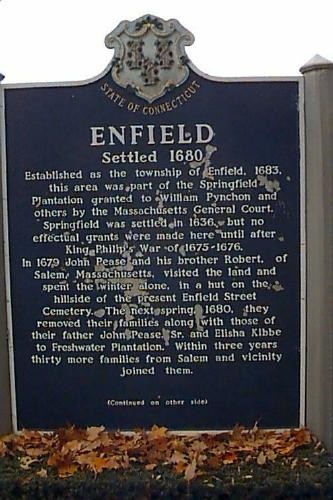
Joseph Sexton was born  3 Feb 1665/66 in Windsor, CT.   His parents were George SEXTON and Katherine COWING.  He married Hannah WRIGHT on 20 Nov 1690 in Enfield or Lebanon, CT.  Joseph died 3 May 1742 in Enfield, CT.

Hannah Wright was born 28 Jul 1669 in Springfield, Mass. Her parents were Abel WRIGHT and Martha KITCHEREL.  Hannah died 26 Nov 1742 in Enfield, CT.

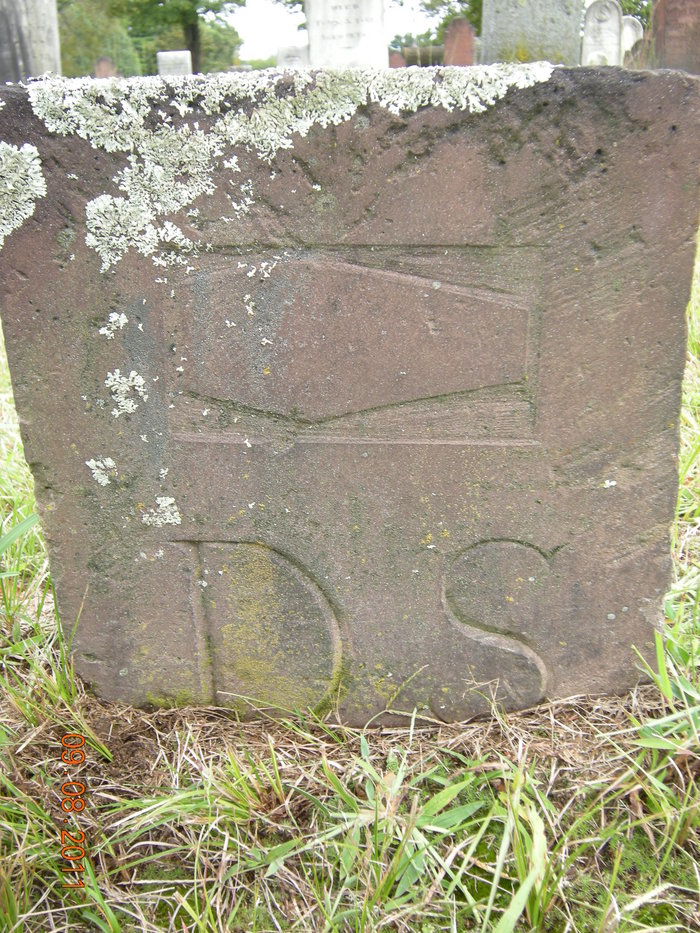
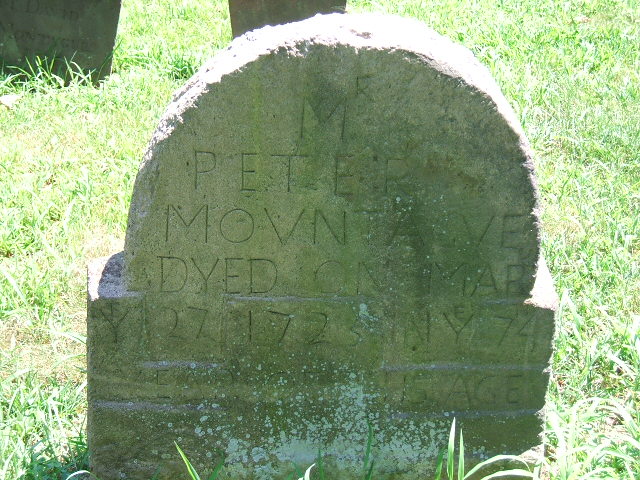
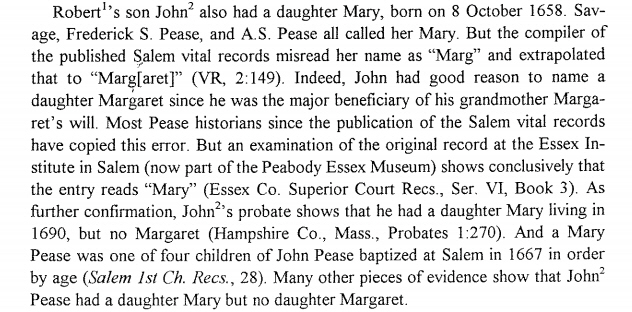
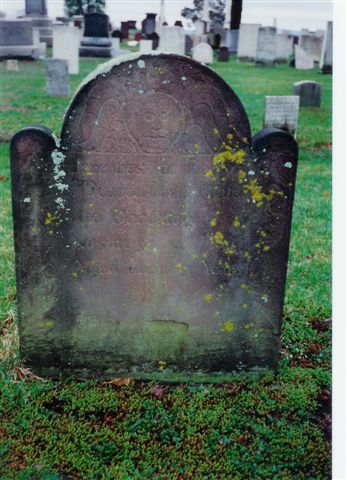
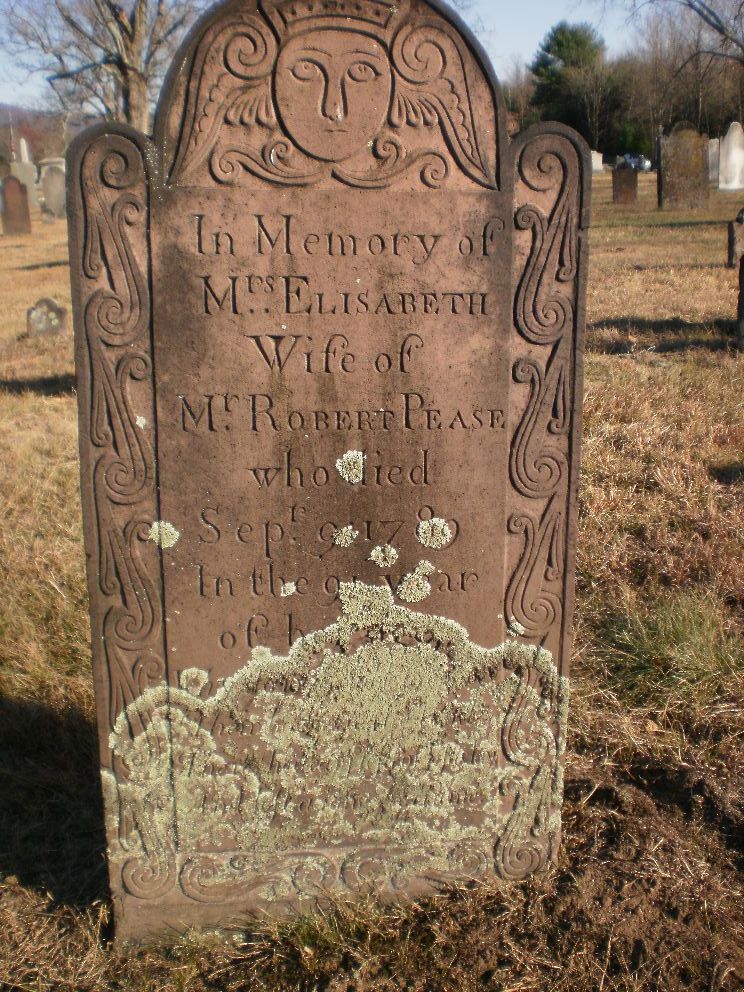
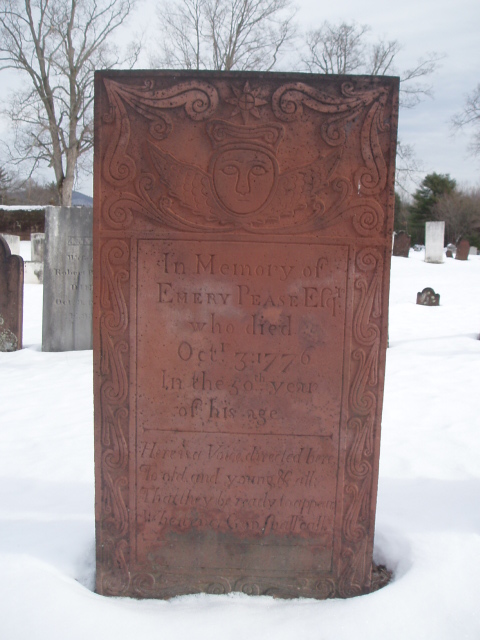
Joseph and Hannah Sexton Headstones, Enfield Street Cemetery – “Here lies, The Body of Capt., Joseph Sexton who, Died illegible ay The, Illegible, aged 76 years.”      Here lies ye Body, of Mrs Hannah, Sexton Relief of, Capt Joseph, Sexton who died(Rest of stone beneath ground)”      Stone Location:Sec. B Row 7 Lot 14 Grave 5 Lot shared with Ebenezer Pease

Child of Joseph and Hannah:

Name Born Married Departed
1. Gershom Sexton 1691 in Enfield, Hartford, CT Hannah Pease Miller
(Robert’s sister)
1 Jun 1716
Enfield, CT
03 May 1742
Enfield, Ct
2. Hannah SEXTON 18 May 1692
Westfield, Mass.
Robert PEASE Jr.
15  Feb 1710
Enfield, CT
8 Nov 1711
Enfield, CT
3. Ensign Joseph Sexton 2 Oct 1694
Enfield, CT
Sarah Parsons
16 Oct 1723
Enfield, CT
10 Sep 1790
Somers, Tolland, CT
4. Mindwell Sexton c. 1697
Enfield, CT
Ebenezer Pease (Robert’s brother)
20 Nov 1717
Enfield, CT
24 May 1754
Enfield, CT
5. Daniel Sexton 26 Nov 1700 Westfield, Mass Mary Douglas
4 Aug 1734 New London, CT
8 OCT 1792 Somers, CT
in his 91st year of age
6. Ezekiel Sexton 28 Oct 1704 Enfield, CT Grace Caulkins?
23 Nov 1731
c. 1774
Westfield, Mass
7. Charles Sexton 7 Jan 1707/08 Enfield, CT Bathsheba Geer
7 Jan 1735/36 Enfield, CT
16 Sep 1762 At sea on the expedition to the Battle of Havana
8. Amos Sexton?
25 Oct 1709 Enfield, Hartford, CT
Elizabeth Morris
bef. 1732

Joseph was a Captain during Col. wars. Somers, CT (then Enfield, pt of Westfield)

The Sextons and the Peases were very close.  Joseph and Hannah share a grave lot with Ebenezer Pease.   Three of Joseph’s children married children of Robert PEASE Sr. Gershom and Hannah, HANNAH and ROBERT,  and Mindwell and Ebenezer.

Children

1. Gershom Sexton

Some sources say that Gershom born in 1685 and was the son of  Joseph’s brother George Sexton and Hannah Spencer.  This view is bolstered by the record that a Gershom Sexton took the inventory of  Samuel Andrews’ estate in Hartford, CT on 29 Jan 1711/12. Inventory  £414-07-00  by Garrard Spencer, Sen., and Gershom Sexton. Witnesses to Samuel Andrews will were Garrard Spencer and George Sexton.

Other sources say that Gershom first married 20 Jan 1708/09 Hartford, Hartford, CT to Abigail King and had three children before he married Hannah.  The sources agree that Gershom married Hannah 1 Jun 1716 Enfield, Hartford, CT and died 3 May 1742 Enfield, Hartford, CT.

Gershom’s wife Hannah Pease was born 12 Jun 1694 Enfield, CT.  She was Robert’s sister and her parents were Robert PEASE Sr. and Abigail RANDALL  She first married David Miller.  Hannah died  26 Nov 1742 Enfield, Hartford, CT.

Gershom Sexton Petition 1722 – The public records of the colony of Connecticut

Children of Hannah and Gershom:

i. Gershom Sexton b. 11 Oct 1717 Enfield, Hartford, CT; m. 4 Nov 1736 Enfield, CT to Abigail Gerry

ii. Mary Sexton b. 25 Sep 1719 Enfield, Hartford, CT; d. 1814; m. 13 Jan 1741/42 Wallingford, CT to Joseph Bartholomew

iii. Ebenezer Sexton b. Abt 1721 Enfield, Hartford, CT; d. 1794 Waterbury, CT; m. 7 Sep 1742 Wallingford, CT to Eunice Benham

iv. David Sexton b. 12 Aug 1725 Enfield, Hartford, CT.

v. Jonathan Sexton b. 12 Aug 1725 Enfield, Hartford, CT.

vi. Hannah Sexton b. 31 Aug 1727 Enfield, Hartford, CT.

vii. Asahel Sexton b. 29 Aug 1732 Enfield, Hartford, CT; m. 10 SEP 1755 Somers, Tolland, CT to Patience Farrington

viii. Penelope Sexton b. 1 Sep 1735 Enfield, Hartford, CT; d. 26 Mar 1814 Enfield, Hartford, CT; m. Ebenezer McGregory

ix. Tabitha Sexton 9 Apr 1729 Enfield, Hartford, CT; m. 31 Oct 1752 Wallingford, New Haven, CT to Joseph Atkins

2. Hannah SEXTON (See Robert PEASE Jr.‘s page)

3. Ensign Joseph Sexton

Joseph’s wife Sarah Parsons was born 10 Nov 1704 in Enfield, Hartford, CT. Her parents were Samuel Parsons and Hannah Hitchcock. Sarah died 25 Aug 1747 in Somers, Tolland, CT.

4. Mindwell Sexton

Mindwell’s husband Ebenzer Pease was born 7 Mar 1697/98 Enfield, CT. He was Robert’s brother and his parents were Robert PEASE Sr. and Abigail RANDALL. Ebenezer died 21 Oct 1743 Enfield, Hartford, CT.

Children of Ebenezer and Mindwell:

i. Hannah Pease 11 Mar 1717/18 Enfield, Hartford, CT; m. 20 Nov 1737 Enfield, Hartford, CT to Shubael Geer

ii. Susanna Pease b. 11 Mar 1717/18 Enfield, Hartford, CT; m. 31 Mar 1740 to George Cooley

iii. Ebenezer Pease b. 25 Sep 1719 Enfield, Hartford, CT; d. 11 Jan 1784 Enfield, Hartford, CT; m. 29 NOV 1739 Enfield, Hartford, CT to Mary Terry

iv. Mindwell Pease b. 10 Jun 1722 Enfield, Hartford, CT.

v. James Pease b. 14 Oct 1724 Enfield, Hartford, CT d. 1746 Cape Breton

vi. Abigail Pease 15 Apr 1727 Enfield, Hartford, CT; m. Benjamin Hall

vii. Catherine Pease b. 1729 Enfield, Hartford, CT.

viii. Martha Pease b. 25 Nov 1732 Enfield, Hartford, CT;
d. 4 Dec 1816; m. 24 Jan 1750/51 to Caleb Bush

5. Daniel Sexton

Daniel’s wife Mary Douglas was born 1710 in New London, CT. Her parents were Thomas Douglas and Hannah Sperry. Mary died 27 Apr 1806 in Somers, Tolland, CT.

Daniel Sexton Headstone — West Cemetery Somers Tolland County Connecticut, — Age 90 years. Burial location: Tier 7, Ft.Sec. 85 (West-Orig)

Daniel Sexton Headstone — Reverse

6. Ezekiel Sexton

Ezekiel’s wife Grace Caulkins was born 23 Jun 1711 in New London, CT. Her parents were Jonathan Calkins and Sarah Turner.

7. Charles Sexton

Charles’ wife Bathsheba Geer was born 16 Jan 1714 in Enfield, Hartford, CT. Her parents were Shubael Geer and Sarah Abbe. Bathsheba died 28 Jan 1763 in Somers, CT.

Charles died  at sea 16 Sep 1762 on the expedition from Somers to “the Havannah” in 1762.  His son Charles Jr appears to have died on the expedition a week later 25 Sep 1762.

The Battle of Havana had by far the most America deaths of any battle up until that time, especially for Connecticut, but until I found family casualties in this genealogy project, I had never heard of it.  See my page Battle of Havana – 1762.

8. Amos Sexton

The Barbour Collection says that Amos born in Hartford and was the son of Gershom Sexton and Abigail King.

Amos’ wife Elizabeth Morris was born 25 Dec 1706 in Woodstock, Litchfield, CT. Her parents were Ebenezer Morris and Sarah Davis/

Sources:

http://trees.ancestry.com/owt/person.aspx?pid=44003307

http://www.genealogyofnewengland.com/b_s.htm

Posted in 12th Generation, 90+, Historical Monument, Line - Miner, Veteran, Violent Death | Tagged , | 11 Comments

Rev. Joseph Downing

Rev. Joseph DOWNING (1589 – 1656) was Alex’s 12th Great Grandfather;  one of 8,192 in this generation of the Miner line.

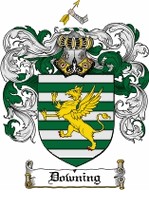
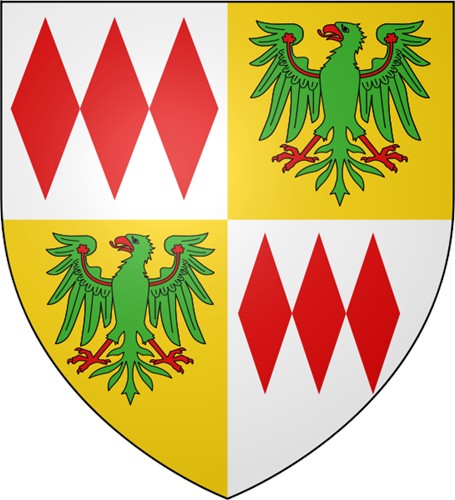
The Downings were exceptional among our ancestors having a coat of arms at the time of their immigration

Rev. Joseph Downing was born circa 1589 at St. Nicholas, Ipswich, Suffolk, England. His parents were George DOWNING and Dorcas BELLAMY. He and Jane ROSE obtained a marriage license on 6 Nov 1616 at Suffolk, England. Rev. Joseph Downing was Rector of St. Stephen’s Church, Ipswich, Suffolk, England, in 1626.   In 1628 he was residing at Layer Marney, Essex, England.  Joseph died in Aug 1656 in Salem, Mass.

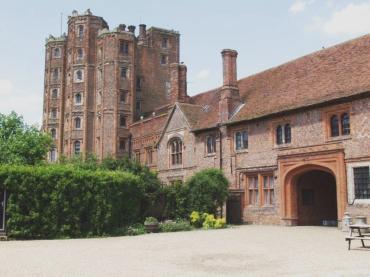
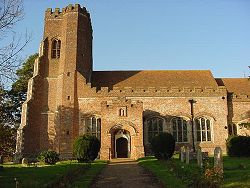
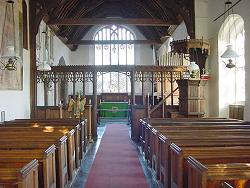
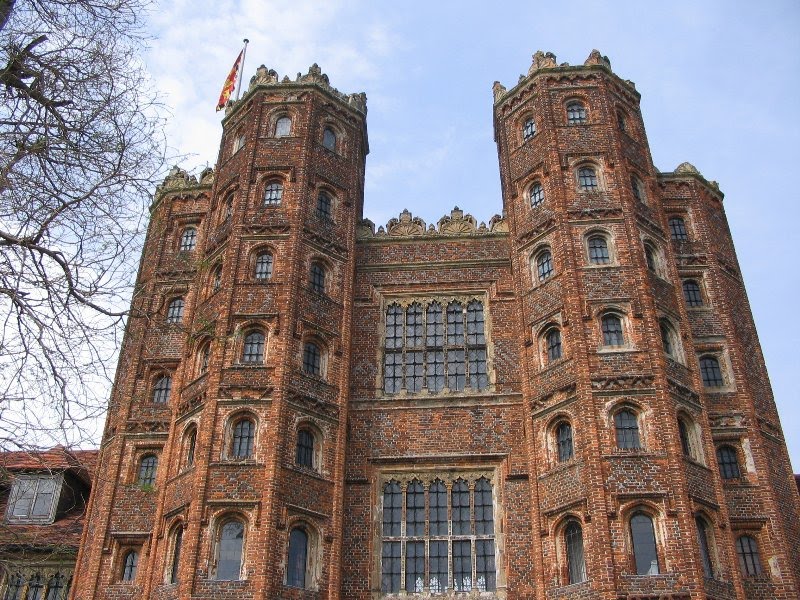
Joseph was Rector of Layer Marney, Essex, 1628-46.  The ancient and beautiful church of St Mary the Virgin is next door to the famous historic house of Layer Marney Tower

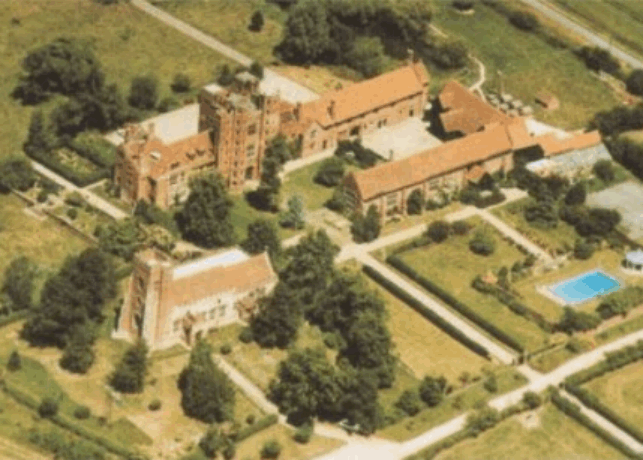
Layer Marney from the Air

St Mary the Virgin, Layer Marney Church Exterior

St Mary the Virgin, Layer Marney Church Interior

Layer Marney Tower is a Tudor palace, composed of buildings, gardens and parkland, dating from 1520.  Constructed in the first half of Henry VIII’s reign, Layer Marney Tower is in many ways the apotheosis of the Tudor Gatehouse.

Jane Rose was born about 1593 and was of Akenham, Suffolk, England when she married. Probably Jane died while her children were still growing up, date unknown, and Joseph married a second wife. This is learned from a surviving Bishops’ Transcript of Layer Marney of March 1639 – March 1640. In this period, “Joseph Downing, an infant, the sonne of Joseph Downing Clarke” was buried. Jane may have been too old to be the mother of this infant. On the other hand, this may have been her last child, after several others born in Layer Marney, as suggested above.

Children of Joseph and Jane:

Name Born Married Departed
1. Abigail DOWNING baptized on 5 Oct 1617 St. Lawrence Church, Ipswich, Suffolk, Richard MONTAGUE
c. 1640, probably in Wells, Maine
8 Nov 1694 Hadley, Hampshire, Mass.
2. Samuel Downing baptized 30 Mar 1620
St. Lawrence, Ipswich, England.
3. Rebecca Downing 15 Jan 1623/24 28 Jul 1625 St. Lawrence, Ipswich, Suffolk,
4. Dorcas Downing 11 Jun 1626

Joseph Downing is the youngest brother of Emanuel Downing, the immigrant ancestor of the American Downing Family who participated in the formation of the Massachusetts Bay Company. This information collaborates with the letter written by Emanuel Downing to his brother-in-law John Winthrop, in which he names Abigail Montague as his cousin (niece).

To the Honourable his verie loving brother John Winthrop, Governor of the Massachusetts in New England,

Good Brother:

. . . Its noe small comfort to me that I haue hope ere long to enioy your Companie. I purpose God willinge to sett forth hence in the begynning of Aprill at furthest and to take your sonne hence with me.

I follow your councell in coming to the bay before I resolue where to pitche. I pray helpe me to hire or buy some house (so as I may sell yl againe if I shall remove) in some plantacion about the Bay. Thus for present I take leave and rest leaving you and your affayres to ye blessed protection of ye Almighty.

Your assured and loving brother,

Em. Downinge. 21 9ber 1637

Joseph was attending Cambridge University when his parents both passed away. The town of Ipswich paid £5 to help with his schooling. He received his Bachelor of Arts at Trimity College, Cambridge, 1610-11, and his Master of Arts at Queens’ College in 1614. The Cambridge alumni records state that he was Rector of St. Stephen’s, Ipswich, in 1626 and Rector of Layer Marney, Essex, 1628-46. In 1616 Joseph’s brother Nathaniel died, and in his will he gave Joseph £20.

The 1616 marriage place of Joseph Downing and Jane Rose has not been found. The license for their nuptials states that he was of Ipswich, single, that she was of Akenham, single, and that they planned to be wed at Claydon. Claydon registers do not have the entry, nor has it been found at Akenham or elsewhere. Only the license appears in Boyd’s Suffolk Marriage Index.

The registers of St. Stephen, Ipswich, have the following: “Master Downing M.A. anno 1613 (one of the Sonnes of Mr. D., Schoole master of the Free Schoole here in Ipswich) was chosen to be preacher of this parish in May 1623 by the consent of the whole parish, Mr. Warner being verie old and not able to preach.

In 1626 John Osborne appointed his brother-in-law “Joseph Downing of Ipswich Clarke” an executor to his will.

Apparently in 1628 the family moved to Layer Marney, Essex, where Joseph again served as Rector. Joseph and Jane could have had more children after the move, their four known ones having been born in Ipswich in 1617, 1620, 1624, and 1626. The Layer Marney parish registers are extant only after 1742.

In the Winthrop Papers at the Massachusetts Historical Society, Boston, is a letter from Joseph Downing, written 28 Feb 1633/34, from Layer Marney. The letter reveals that he cultivated extensive garden and orchard space. He had sent “quodlin” plants to John Winthrop in New England, and if “you have no roses there, I will send you over some damaske, red, white and p’vince rose plants…I wish you had 100 of my best peare trees in my nourcerie.” Francis Kirby, Joseph’s brother-in-law, in a letter from London to John Winthrop Jr., dated 26 Feb 1633/34, mentioned shipping “the twigs of quodlin tree” that “my brother Joseph Downinge” had provided.

Joseph’s nephew was the famous Sir George Downing, 1st Baronet (1623 – July 1684) (Wikipedia)  an Anglo-Irish soldier, statesman, and diplomat. Downing Street in London is named after him. (See George DOWNING’s page for details)

Sources:

http://trees.ancestry.com/owt/person.aspx?pid=24388230

http://www.pamsgenealogy.net/SS/p45.htm#i1116

http://www.shon.150m.com/aqwg1778.htm

http://murielc.tripod.com/ransom/fam00191.htm

Posted in 14th Generation, College Graduate, Immigrant - England, Immigrant Coat of Arms, Line - Miner, Storied | Tagged , , , , | 10 Comments

Richard Montague

Richard MONTAGUE (1614 – 1681) was Alex’s 11th Great Grandfather;  one of 4,096 in this generation of the Miner line.

The Montagues may have been exceptional among our ancestors having a coat of arms at the time of their immigration  or perhaps they were just members of  Buckinghamshire’s yeomanry

Robert Montague writes:

Although the heraldic visitation (census) of 1634, conducted by Richard St. George, Clarenceux Herold, shows the emblazon of a coat of arms for a “Montague Family of Boveney,” I have reservations whether Richard Montague I, or his immediate descendents, in North America, ever used a coat-of-arms, viz: A. 3 lozenges cojoined in pale, G. inter 3 roundles S, or, in modern English, on a field of silver, three red (gules) lozenges cojoined in pale (in a straight line), between three black (sable) roundles (or pellets).

The blazon which you provide above contains certain elements of traditional Montague coats-of-arms, cf., (1) the three lozenges co-joined in a straight line on a silver field and (2) the traditional griffon, a heraldic winged monster with an eagle-like head and the body of a lion.

Many Montagues in the Virginia Line, i.e., descendents of Peter I, Richard I’s elder brother, have over the years advanced the proposition that the American Montague Family is of English noble descent. This is a very large topic indeed and beyond that that I can go into here. It is possible that the Boveney/Warfield Branch of the Family (from the lower Thames River region may be distant cadet descendents of one of the English Earls of Salisbury. But this contention is, in my view, very “iffy”.

Richard Montague was in fact not born in BoveneyBurnham Parish,  Buckinghamshire as has traditionally been assumed, but across the Thames in the hamlet of Warfield in County Berks, England. Credit for this recent discovery goes to Roger Blackman, an English genealogist, who first published this information in the spring 1986 issue of Magazine of the Berkshire Family History Society.

Richard’s date of birth, according to these newly discovered records, is May 29, 1614. The source for Richard’s having been born in Berkshire is newly discovered baptism records (“Bishop’s Transcripts for Warfield Parish”) in the “Wiltshire Records Office, Throwbridge” which provide data for the children of Peter and Ellen Mountague. The reference to the “Wiltshire Records Office, Throwbridge” means, today, the Wiltshire and Swindon History Center, Cocklebury Road, Chippenham, Wiltsire SN153QN, in the United Kingdom

His parents were Peter MONTAGUE and Ellen ALLEN.

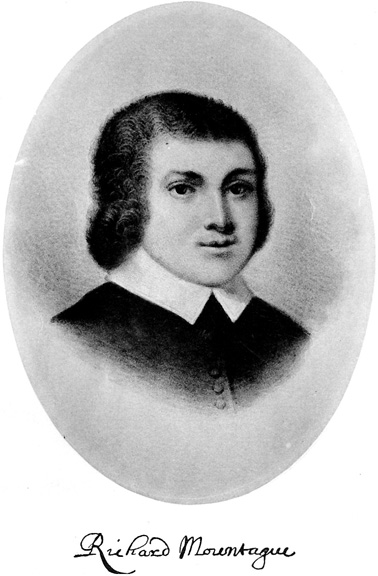
Richard Montague in his 20’s — The date when the miniature cameo portrait (on copper plate) was first made has not been established nor is has it been established that the cameo portrait was made in England before Richard I’s departure to New England.  It if could be located today, the cameo would be the oldest survivingMontague Family artefact in the United States.  It is last recorded in Boston in the early 1900s. —  The reproduction of Richard I’s signature is a copy of the signature which appears on his last will and testament, reproduced in HGMFA (History and Genealogy of the Montague Family of America)

Robert Montague adds:

Charles K. Bolton’s The Founders: Portraits of Persons Born Abroad who Came to the Colonies in North American Before 1701, The Boston Athenaeum, Boston, 1919.

According to Bolton’s account in The Founders, (Pages 427-428) the “Richard Miniature” miniature is portrait painted on a copper plate, one and eleven-sixteenths high by one and seven-sixteenths inches wide, owned (as of 1919) by a Henry W. Montague, Esq. of Boston. The frontispiece of the Meeting of the Montague Family (1882), which reproduces the “miniature” is, per Bolton, a copy of the earlier “original pen and ink sketch,” which itself is a copy of the copperplate original, apparently made sometime after 1789 when Major Richard Montague acquired the original copper portrait from the Montague homestead in Hadley. There is a considerable difference between the original miniature reproduced in Bolton’s work and the pen-and-ink sketch which was reproduced in the 1882 work Meeting of the Montague Family.

Richard came to America about 1634, perhaps sailing on the “Speedwell”,  though I haven’t seen proof of this hypothesis, locating first in the Boston.   He married Abigail DOWNING about 1640, probably in Wells, Maine.  Richard died on 14 Dec 1681 at Hadley, Hampshire, Mass.

Richard’s current memorial was erected by George and Charles Montague in 1881.  Richard and Abigail’s oldest son Peter’s stone is the smaller one on the right.

ERECTED TO THE MEMORY OF
RICHARD MONTAGUE
A pioneer of New England
and one of the first settlers of Hadley.
Born about 1614. he married
ABIGAIL DOWNING of NORWICH, ENG.
and emigrated to Wells Maine
from Bourney in parish of Burnham Eng.
In 1646 he removed to Boston and thence in
1651 to settle Wethersfield town. In 1659 or
1660 he settled in Hadley where He died Dec 14 1684
To Perpetuate the memory of the
founder of — a—— Far England. This stone
is erected here by his descendents in Oct 1881
GEORGE Wm. MONTAGUE
and
CHARLES C. MONTAGUE.

The first three or four generations of “Hadley” Montagues spelled their surname M o u n t a g u e on wills and gravestones. Josiah Montague (1727-1810), the great- grandson of Richard, appears to be the first to use the spelling M o n t a g u e instead of M o u n t a g u e

Abigail Downing was baptized on 5 Oct 1617 at St. Lawrence Church, Ipswich, Suffolk, England.  Her parents were Rev. Joseph DOWNING and Jane ROSE.  Abigail died 8 Nov 1694 in Hadley, Hampshire, Mass.

Children of Richard and Abigail:

Name Born Married Departed
1. Mary MONTAGUE c. 1642
Wells, Maine
Joseph WARRINER
25 Nov 1668
Hadley, Hampshire, Mass
2 Jul 1689
Enfield, CT
2. Sarah Montague 15 Jun 1646
Boston, Mass.
19 Jun 1646
Boston, Mass.
3. Martha Monatague 16 Jun 1647
Boston
Isaac Harrison
1 Dec 1671 Hadley, Mass.
.
Henry White
3 Apr 1677
3 Nov 1691 Deerfield, Mass.
4. Peter Montague 8 Jul 1651
Wethersfield, CT
Mary Partridge
Sep 1679
.
Mary Crow
16 Sep 1680
.
Mary Smith
22 Apr 1721
27 Mar 1725 Hadley, Mass.
5. John Montague c. 1654/55 Wethersfield, CT Hannah Smith
23 Mar 1680/81 Hadley
c. 1732
Hadley
6. Abigail Montague 1652 Wethersfield, CT Mark Warner
8 Dec 1671 Hadley
6 Feb 1704/05 Northampton Mass.

Much of the info on this post is based on the work of Robert Montague III, He has just completed a 13 year comprehensive research effort and published a new two-volume, 3200 page, “History and Genealogy of Peter Montague of Jamestowne Virginia (1607-2007), Quadricentennial Edition. The new HGPM will be released by Christmas 2012. Prepaid orders made by 15 Dec get a 10% discount from the retail $295. 312 of 1,000 copies are already reserved. If interested, email him, at houseofmontague@bellsouth.net.

The following story was adapted from an address, “On the Montagues in America,” made by the Rev Richard Montague at a Meeting of the Montague Family held at Hadley, Massachusetts on 2 Aug 1882.  The purpose of the meeting was to honor their first American ancestor Richard Montague of Hadley and to provide an opportunity for family members to gather and become acquainted with each other and their family history in America.

The first thirty years of Richard Montague’s life are clouded in some obscurity.  He came to Wethersfield, Connecticut with his wife and two daughters in 1651, and brought from Emanuel Downing of Salem, Massachusetts, –a relative of his wife, –a letter to Gov Winthrop of Connecticut.  Whether he had ever resided in Salem, cannot be said, though this might seem probable because his wife was a member of the Salem church.  He had certainly lived in Boston, for there two of his daughters were born, and baptized by Rev John Wilson of the First Church, of which Mrs. Montague was a member.  But hardly had the good pastor consecrated the first of these children, little Sarah, when the parents were called to part with their babe, as yet only four days old.  When Richard married, I cannot learn.  Their first child a daughter was said to be born about 1642.  Richard and his wife removed from Wells, Maine to Boston about 1646.  Mrs. Montague was received into the First Church, Boston, by a letter of dismission from Wells, Maine.  The accounts of this are somewhat confusing and contradictory.

There are several traditions concerning Richard and wife.  There were in Boveney, parish of Burnham, Buckinghamshire, England, three brothers, according to the Heralds’ College, viz, William, Peter and Richard Montague.  A romantic mind may well hesitate before choosing between the varying traditions.  Shall we believe that Peter and Richard sailed the same year, 1634, from England, — the one in a vessel that landed him in Virginia, the other in a craft which brought him to New England, that Richard left his sweetheart, fair Abigail, behind, and with her precious miniature which is still preserved, that somewhat later the oldest brother, William, came to America, but, not liking the country returned to England, carrying with him Richard’s message to Abigail, ‘that all things were now ready, her youth was a man, let her come and make with him a home’?  Or shall we give credence to that other more romantic tradition that when Abigail Downing’s father, who was a doctor of divinity, learned or her betrothal to Richard, he was ill-pleased with the match, and to escape his ire the ardent lover, Romeo-like, stole to his lady’s chamber-window, and then in the stillness of the night took his fair prized, and unbeknown to the objecting parents ran away with her to America.  You may take your choice of traditions but bear in mind that it seems well credited that Richard came from Boveney, was brother to William and Peter, and married Abigail Downing, the daughter of the Rev. Dr. Downing or Norwich, England, and the two, so far as records go, are first found in Boston in 1646 having removed from Wells, Maine.

Between 1640 and 1646 Richard Montague was residing at Wells, York County, Maine.

Circa 1646  – Richard Montague was residing in Boston, Mass.  He was a miller and baker there between 1646 and 1660.

In 1651 Richard Montague was residing at Wethersfield, Hartford County, Connecticut.

On 18 April 1659 he was one of 59 citizens of Hartford and Wethersfield who signed an agreement at Goodman Ward’s house in Hartford to go to Hadley, Massachusetts. This move was caused by a division in the church at Hartford and Wethersfield.

Hadley, Hampshire, Massachusetts

Hadley was first settled in 1659 and was officially incorporated in 1661. Its settlers were primarily a discontented group of families from the puritan colonies of Hartford and Wethersfield, Connecticut, who petitioned to start a new colony up north after some controversy over doctrine in the local church. At the time, Hadley encompassed a wide radius of land on both sides of the Connecticut River, but mostly on the eastern shore. In the following century, these were broken off into precincts and eventually the separate towns of HatfieldAmherstSouth Hadley,Granby and Belchertown. The early histories of these towns are, as a result, filed under the history of Hadley.

Edward Whalley and General William Goffe, two Puritan generals hunted for their role in the execution (or “regicide“) of Charles I of England, were hidden in the home of the town’s minister, John Russell. During King Philip’s War, an attack by Native Americans was, by some accounts, thwarted with the aid of General Goffe. This event, compounded by the reluctance of the townsfolk to betray Goffe’s location, developed into the legend of the Angel of Hadley, which came to be included in the historical manuscript “History of Hadley” by Sylvester Judd.

Circa 1660 Richard Montague was residing at Hadley, Hampshire County, Massachusetts. He was a miller, baker and farmer between 1660 and 1681 at Hadley, Hampshire County, Massachusetts.

Richard was granted land in 1661 at Hadley, Mass. The grant was for “that parcell of land in the greate medowe judged about four acres more or less (bounded on the south by Mr. Goodwins moeing lott on the North by Nathaniell Ward ffronting uppon the highway which runneth by the side of Samuell Smith his land) for and in consideration of his allottments in Amphonsett meddowes.”

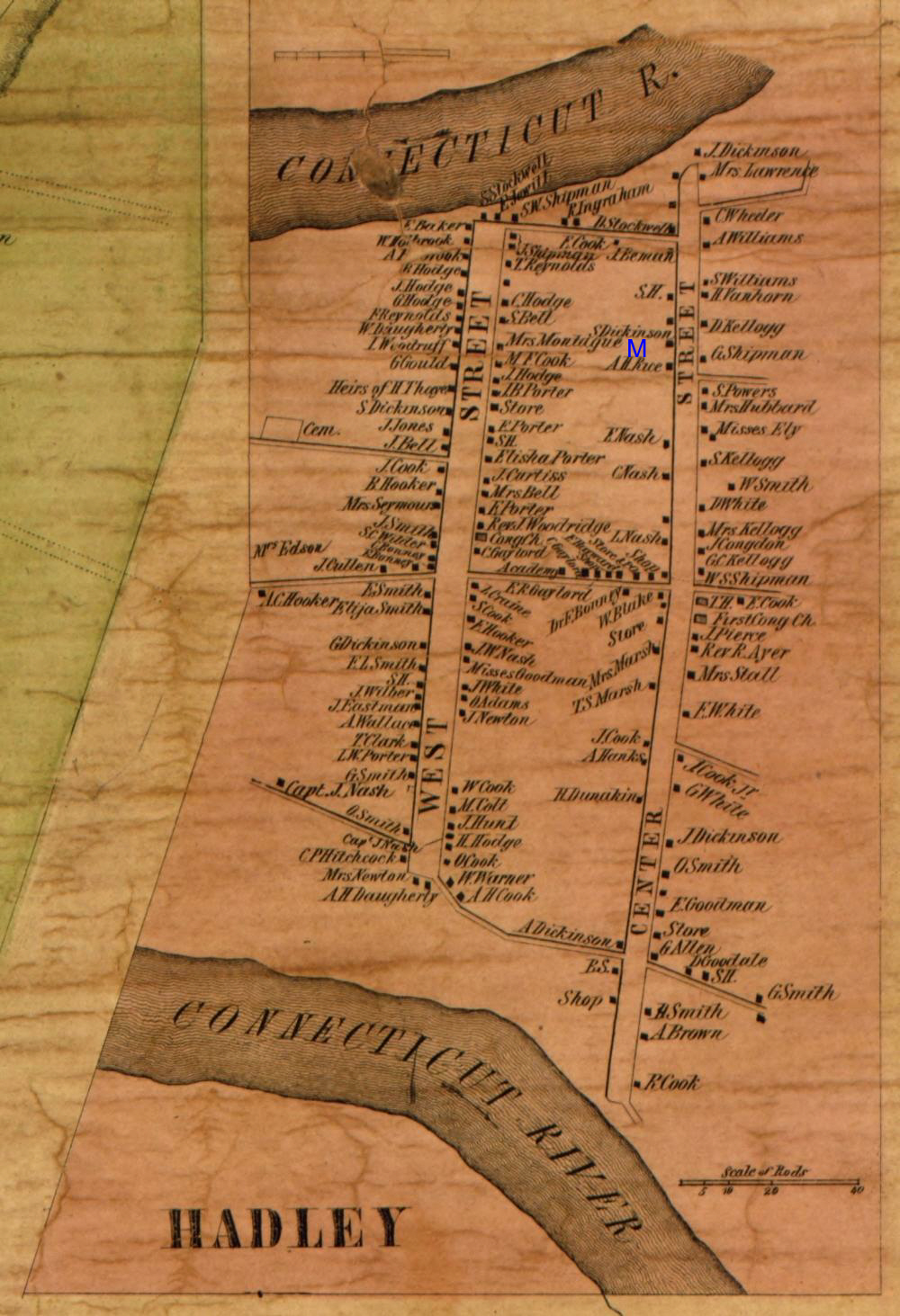
Hadley Map

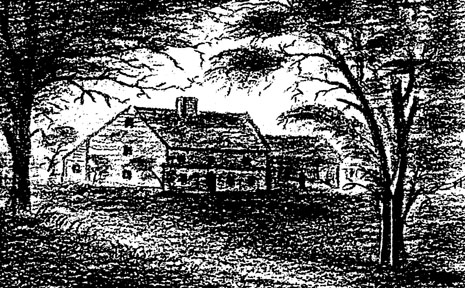
The home-lot of eight acres has been assigned to Richard.  It is on the east side of long, wide street.  At first a log cabin met the necessities of the early days, but soon a substantial house, forty by twenty-four feet, of two stories, with a lean-to added at a later date, is needed.  It is built with its end toward the street and has it principal entrance on the south side.  The panes of glass are very small, six by eight inches; the chimney, of course is very large. This house stood for more than one hundred and fifty years, and when it was taken down in 1831  it was found that while the front part was lined with clay mortar, the rear half was lined with brick, the supposition being that was to render the rear bullet-proof in case of Indian attacks.

Richard Montague Home Hadley

In 1661 and 1662, he was chosen hay-ward, or field driver, and 1663 it was voted that “Richard Montague should have four shillings for every grave he makes for a grown person, and two shillings for the grave of a child under ten years.”

Richard was a selectman in 1671 at Hadley, Hampshire County, Massachusetts and again in 1677.   He was a Clerk of the Writs in March 1681 at Hadley, Mass.

Richard’s chief occupation was farming.  By trade he was a baker, but there was little call for this skill except during the French and Indian Wars, when he baked for the soldiers.  And yet that skill is by tradition said to have been so great that “he could stand by the oven door, and throw his loaves, filling the oven neatly and completely.”  In that early period flour was bolted by hand, and in 1680 Richard Montague’s bolting-mill was valued at eighty shillings and Widow Montague sometimes bolted flour for others by the barrel.

There is no evidence that Richard was of gentle birth.  His descent, if it can be traced to a noble line at all, is from the extinct Earls of Salisbury rather than from the Earl of Sandwich.  He was simply a humble man, of good intelligence and fair parts, of deep religion and virtue, but perhaps of less prominence and force of character than his two sons, Peter and John.  Nor does he seem to have been of among the wealthy men of Hadley.  He may have left property in Wethersfield, but, while many of the Hadley settlers were assigned meadow-lands on the basis of two hundred or one hundred pounds valuation, Montague was among the two who were rated at eighty pounds or less; yet at his death his property was inventoried at two hundred and seventy-seven pounds.

Richard Montague left a will on 8 Jul 1681 at Hadley, Mass. He named his wife, Abigail, and son, John, as executors. It was witnessed by Joseph Smith and Pett Sitton.  He died on 14 Dec 1681 at Hadley, Hampshire County, Massachusetts.  The inventory of his estate was taken on 3 Jan 1682 at Hadley, Mass; The total value of the estate was £277 17 00, “Debts due from the estate £22 13 05” and “Debts due to the estate £11 02 02”. The inventory was taken by Lieut. Philip Smith, Samuel Porter, Sr., and Samuel Partridge.

The transcript of the baptism registers shows Abigail as being a daughter of John Downing. However, upon examination of the original records, the father’s name was definitely Joseph.  She was the daughter of Rev. Joseph Downing and Jane Rose.  On 26 April 1646 she was admitted to the First Church at Boston, Mass. The record says she was admitted the 26th day of the 2nd month. Assuming it is the old-style calendar which begins the year in March, the 2nd month would be April (or possibly May). Otherwise it would be February 6.  Abigail Downing was removed from the First Church of Salem to Wethersfield on 31 March 1647.   On 25 May 1651 she was given letters of dismissal from at The First Church, Boston, Suffolk County, Massachusetts, to the church in Wethersfield.   She died on 8 November 1694 at Hadley, Hampshire County, Massachusetts, at age 77.  The inventory of her estate was taken on on 21 Nov 1694 at Hadley, Mass. by Samuel Partridge and Samuel Smith.

Children

1. Mary MONTAGUE (See Joseph WARRINER‘s page)

3. Martha Monatague

Martha’s first husband Isaac Harrison was born about 1646. Isaac was killed 19 May 1676 in Hadley, Hampshire, Mass.

Falls Fight Memorial

Isaac Harrison  served in King Philip’s War and was killed by Indians in the Turner’s Falls Fight (See my posting), while serving under Captain William Turner. After his death his family brought suit in court against John Belcher, a surviving soldier of the fight, claiming that Belcher failed to render aid to Harrison and left him to die. However, the court took no action against Belcher.

History of Hadley : including the early history of Hatfield, South Hadley, Amherst and Granby, Massachusetts pg 165. (1905)

The complaint of Martha Harrison, which was substantiated by testimony before the Commissioners of Hadley, June 22, 1676, exhibits some incidents of this disorderly flight. Martha Harrison of Hadley, widow, makes complaint against John Belcher of Braintree, a soldier in Capt. Turner’s company, for being the culpable occasion of the death of her husband, Isaac Harrison, a wounded man, riding upon his own horse, who fell from his horse, being faint, and this John Belcher, who was behind him, rode from him with Harrison’s horse, though he entreated him not to leave him, but for God’s sake to let him ride with him.

Stephen Belden of Hatfield, testified that he, riding behind Jonathan Wells, saw Isaac Harrison on the ground rising up, and heard him call to the man on his horse, 3 or 4 rods before, to take him up, saying he could ride now; the man rode away, and both Jonathan Wells and I called him to go back, and he would not. This was when we were returning from the fight at the falls.

There is no record of Belcher’s being punished. — Many had lost their horses. — Mather says the soldiers were more numerous than the Indians that pursued them.

Martha’s second husband Henry White was born 1647 in Deefield, Mass.

4. Peter Montague

Peter’s first wife Mary Partridge was born 1638 in Hadley, Hampshire, Mass. Her parents were William Partridge and Mary Smith. She first married John Smith (b. 1638 in Wethersfield, Hartford, CT; d. 30 May 1676 in Wethersfield, Hartford, CT.)  Mary died 20 May 1683 in Hadley, Hampshire, Mass.

Peter’s second wife Mary Crow was born 27 Dec 1656 in Hadley, Hampshire, Mass. Her parents were John Crow and Elizabeth Goodwin.  She first married Noah Coleman.  Mary died 12 Oct 1720 in Hadley, Hampshire, Mass.

Peter’s third wife Mary Smith was born 16 Aug 1681, Hadley, Hampshire, Mass. Mary Smith’s sister, Hannah Smith, married Peter Mountague’s younger brother, John Mountague. Their parents were Chileab Smith and Hannah Hitchcock .  The gravestones of her parents are of interest.  They read:  “Ens. Chileab Smith died 7 Mar 1731, aged 96 years, and Hannah his wife died 31 Aug 1733, aged 88 years.  It is a worthy memorial that they lived in marriage state for 70 years.”  She first married 15 Dec 1697 to  Preserved Smith.

Although, Peter married three times, he no children by any of these three marriages.

Peter became one of the three wealthiest men of the village. He was one of the committee for building the new meeting-house. He was elected a selectman; and for four years he was deemed by his fellow-citizens their worthy representative to the General Court at Boston. He died without issue, in 1725.

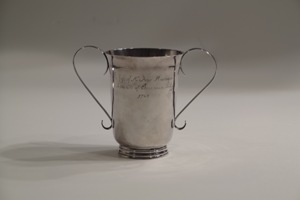
Peter Mountague  Communion Cup

Peter Mountague Communion Cup – given to the Church of Christ in Hadley, Massachusetts in 1723 by Peter Mountague. This piece of Colonial period silver hollowware, the work of John Dixwell, an early Boston-based silversmith, in now on permanent loan to the Museum of Fine Arts, Boston. Photograph by Richard W. Montague, May 30, 2012.

About two years before his death in March 1725, Peter donated this impressive silver hollowware communion cup to the Hadley Church (now the First Congregational Church). The cup is the work of John Dixwell (1680-1725), an early English silver smith working in Colonial Boston. It is probably that Peter Mountague dealt directly with Dixwell as a result of Peter’s frequent visits to Boston to serve on the General Court. It is likely that Peter furnished the silver required, in the form of English silver coins, for Dixwell to fashion the cup. The melting down of specie was the customary Colonial practice to provide metal for the manufacture of silver items, as there were no silver mines, at the time, in the Massachusetts Bay Colony. Since 1939, the cup has been on permanent loan to the Museum of Fine Arts in Boston.

Peter Montague Headstone — Old Hadley Cemetery Hadley Hampshire County Mass.

5. John Montague

John’s wife Hannah Smith was born 7 Jul 1662 in Hadley, Hampshire, Mass. Her parents were Chileab Smith and Hannah Hitchcock. The gravestones of her parents are of interest.  They read:  “Ens. Chileab Smith died 7 Mar 1731, aged 96 years, and Hannah his wife died 31 Aug 1733, aged 88 years.  It is a worthy memorial that they lived in marriage state for 70 years.” Hannah died 1719 in Hadley, Hampshire, Mass

John was less active in town affairs than his brother. He had married but a few months before his father’s death, and it was with him that his widowed mother found a home on the old homestead till her death. She was soon permitted to rejoice in grandchildren. Six were born before she followed her husband and fell on sleep, and within the ten years subsequent to her death four more were added. Three of these ten children were daughters. Each was named Hannah for her mother; but, as the first two died in infancy.

Meanwhile the Montagues had not forgotten their Wethersfield origin. John’s son Richard had returned to his grandfather Richard’s Connecticut home; and from him are descended the Montagues who have ever since been found in Wethersfield.

And there too Hannah went as Josiah Williard’s bride. A surviving tradition concerning her brings vividly to mind that delusion which so disgraced some parts of Massachusetts, but from which Hadley was so largely free. It was sometimes thought that Hannah was “possessed,” that she was indeed a witch. Perhaps she feigned her action in sport, or it may be she was the subject of some nervous disorder. But the story goes that when afflicted she would call on her brother Samuel for help. He would at once arm himself with a great broadsword, enter the room where Hannah was, and when his sister had pointed out the locality of the tormenting spirits, — to him invisible, — would cut and slash for very life. And then Hannah, — the wicked tease, — noting her brother’s troubled air, would say, “No, not there, but there! there! ah, there they are in that corner, grinning and chattering at your blunder!

6. Abigail Montague

Abigail’s husband Mark Warner was born 25 Sep 1646 in Ipswich, Essex, Mass.  His parents were John Warner and Priscilla Symonds.  His grandparents were William WARNER and Abigail BAKER.  Mark died 3 May 1738 in Northampton, Hampshire, Mass

Sources:

http://trees.ancestry.com/owt/person.aspx?pid=2537995

http://www.pamsgenealogy.net/SS/p25.htm#i614

http://www.genealogyofnewengland.com/f_1b5.htm#26

http://www.montaguemillennium.com/monttowns/dick/text/richard.htm

http://www.montaguemillennium.com/reunions/mahadley1882/index.html

HGMFA  – History and genealogy of the Montague family of America, descended from Richard Montague of Hadley, Mass., and Peter Montague of Lancaster Co., Va. with genealogical notes of other families by name of Montague (1886) By Montague, George Wm. (George William), b. 1836; Montague, W. L. (William Lewis), 1831-1908, ed

http://www.houseofmontague.com/BIZyCart.asp?ACTION=Home&CLIENT=Montague

History of Hadley : including the early history of Hatfield, South Hadley, Amherst and Granby, Massachusetts (1905) By Judd, Sylvester, 1789-1860; Boltwood, Lucius M. (Lucius Manlius), 1825-1905 —    [“Montague” appears in the book 175 times]

Montague Family Association has just published the first issue of a new series of newsletters.   The contact is:

Montague Family Association
P. O. Box 243
Hill City, KS 67642
http://www.montaguefamilyassociation.com/membership/

Posted in 13th Generation, Artistic Representation, Immigrant - England, Immigrant Coat of Arms, Line - Miner, Public Office | Tagged , , , | 17 Comments

Joseph Warriner

Joseph WARRINER (1645 – 1697) was Alex’s 10th Great Grandfather;  one of 2,048 in this generation of the Miner line.

Joseph Warriner was born 6 Feb 1644/45, in Springfield, Hampden, Mass. His parents were William WARRINER and Joanna SEARLE (Scant). He married Mary MONTAGUE. 25 Nov 1668 in Hadley, Hampshire, Mass.  After Mary died, he married Sarah Tibbals on 15 Jul 1691.  Joseph died 21 April 1697, in Enfield, Hartford, CT.

Mary Montague was born about 1642 in Wells, Maine. Her parents were Richard MONTAGUE and Abigail DOWNING. Mary died 22 July 1689, in Enfield, Hartford, Connecticut.

Sarah Tibbals was born about 1647 in Massachusetts.   Her parents were Thomas Tibbals and [__?__].  She was the widow of Daniel Collins.  After Joseph died, she married a third time to Obadiah Abbe.

Obadiah Abbey was born between 1647 and 1652 in Wenham, Mass.  His father was John Abbey.  Obadiah died 28 Oct 1732 in Enfield, CT.

From the inventory of his father’s estate we learn that Obadiah was apprenticed to Richard Goldsmith to learn his trade of shoemaker, and that he served Goldsmith three years from his eighteenth year. As Goldsmith died in 1673, this places the date of Obadiah’s birth approximately. He was an early settler of Enfield on the eighth lot from the south corner, east side, one of the original proprietors in 1682. He seems to have been a prominent and influential man of the community, was constable between 1682 and 1717, surveyor of highways in 1692, assessor in 1702. In 1685 he was engaged in a law suit with Isaac Meacham. At Northampton is the will of Obadiah Abbey, dated Sep 22, 1732; probated Nov 14, 1732. He names as legatees his wife, Sarah, to whom is given maintenance, all household goods and moveables; his cousin (nephew) Thomas, son of his brother Thomas, to whom is given his Scantic lot, and to the former Thomas’ son, Obadiah, house and land, with reversion to his youngest son, Thomas, if the said Obadiah should die; to the last-named Thomas, he gives farm lands at the Mountains; his wife’s daughter, Phebe Heal; his cousin John Abbey’s oldest son, John. His cousin, Thomas Abbey, and Elizabeth Warriner are made executors. This Elizabeth Warriner was presumably the step-daughter of his wife, who was born in 1686.

Obadiah Abbe’s holdings in Enfield are described in the Enfield records: Home lot of 12 acres; 23 acres in the South Field, eastern division; 7 acres upon Schantuck River, 5 acres of it upland and 2, meadow; 2 acres of meadow upon a small brook easterly from the “grate meadow”; 4 acres of meadow by grant of March 5, 1700; and on November
17, 171[ ], a farm lying west of Schantuck grate meadow” consisting of 68 acres, some of the boundaries of which were designated as Òwht Oak Tree marked with the letters O A” and a “Pine Tree marked with the letters O A.”

Children of Joseph and Mary:

Name Born Married Departed
1. Mary Warriner 17 Nov 1669
Hadley, Hampshire, Mass
Zachariah Booth
15 Jul 1681
Enfield, Hartford, CT
12 Apr 1692
Enfield, CT
2. Joseph Warriner 16 Jan 1671
Hadley, Mass.
1 Nov 1672
Hadley, Mass.
3. Joseph Warriner 6 Jan 1673
Hadley, Mass.
Hannah Bliss
c. 1714
Bef. 1758
4. Hannah WARRINER 10 Sep 1674
Hadley, Mass
Robert PEASE – The Later
Dec 1691
Enfield, CT
30 Dec 1774
Enfield, CT which would make her a centurian.
5. Ebenezer Warriner 16 Jan 1676
Hadley
Elizabeth Harmon
22 Apr 1703
.
Mary Field
24 Sep 1725
Hadley
1736 in Enfield, Hartford, CT
6. Dorcas Warriner 27 Jun 1678
Hadley
7. Abigail Warriner 23 Aug 1680
Hadley
21 Jul 1689
Enfield, CT
8. Joanna Warriner 8 Nov 1682
Hadley
Thomas Colton
14 APR 1708
Springfield, Mass.
20 Jan 1755
Springfield, Mass
9. Elizabeth Warriner 30 Sep 1686
Hadley
Samuel Pease
(Son of Robert PEASE Sr. and Robert’s cousin)
22 NOV 1709
.
Samuel Bliss
4 Dec 1713
Springfield, Mass.
13 Nov 1713
Enfield, CT

.
Children of Joseph and Sarah Tibbals:

Name Born Married Departed
10. Abigail Warriner 4 May 1692
Enfield, CT
11. Mary Warriner 4 May 1692
Enfield, CT
Daniel Weld
26 Sep 1711
Enfield, CT
 After 1732
Enfield, CT
12. Phebe Warriner 5 Sep 1694
Enfield, CT
Joseph Hale
24 Jun 1725, Hadley, Hampshire, Mass
29 Sep 1779
Enfield, Hartford, CT

History of Nortbfield.

The troops left Hatfield, marched up the west side of the river, crossed the Deerfield and Green rivers, and halted about half a mile from the head of the falls. Leaving their horses a little to the west of Fall river, under a small guard, they climbed an abrupt hill and came upon the back of the camp about daybreak.”They found the Indians secure, yea all asleep without having any scouts abroad ; so that our soldiers came and put their guns into their wigwams,before the Indians were aware of them, and made a great and notable slaughter. Some got out of the wigwams and fought, and killed one of the English ; others did enter the river to swim over from the English, but many were shot dead in the waters, others wounded were therein drowned, many got into canoes to paddle away, but the paddlers being shot, the canoes over set with all therein ; and the stream beingviolent and swift near the falls, most that fell overboard were carriedupon the falls. Others of them creeping for shelter under the banksof the great River, were espied by our men and killed with their swords ; Capt. Holyoke killing five, young and old, with his own hands.'”The victory seemed complete. But just as our troops were about to retire to their horses, a report was started that Philip with a thousand Indians was approaching ; and “a panic terror fell upon many of them, and they hastened homewards in a confused route.” Capt. Turner and 37 of his men were slain — all but one after they left the falls. The loss of the Indians was much greater. Menowniet testified that 40 Norwottucks (meaning River Indians) and Quaboags,and 10 Narragansetts were slain at the falls. This included only warriors, and was probably 10 below the actual loss. The number of women and children, shot in the wigwams, and destroyed in the attempt to cross the river was estimated as high as 150. Mr. Judd, who carefully analyzed the facts, concludes that “180 Indians, old and young, perished at the falls that morning.” It was their heaviest loss in any action during the war, in these parts : and one from which they never recovered.

Of the men, directly connected with Northfield history, in this fight, were Nathaniel Alexander, James Bennett, Philip Mattoon, Joseph Kellogg, Samuel Boltwood, Stephen Belding, William CLARKE, John Lyman, Cornelius Merry, and  Joseph WARRINER.

In 1736, the General court granted to the survivors of this fight, and their descendants, a township,which in commemoration of the event was named Fall-town, since incorporated under the name of Bernardston.  Bernardston was first settled in 1738 as a part of “Fall Town,” which also included Colrain and Leyden.

Benardston,  Franklin, Mass

Children:

1. Mary Warriner

Mary’s husband Zachariah Booth was born 1666 in Saco, York, Maine. His parents were Simeon Booth and Rebecca Frost. Mary died in child birth of her only son Robert Booth on 12 Apr 1692 in Enfield.  Zachariah married before 1697 to Mary Harmon b. 23 Oct 1671 in Springfield, Mass. d. 12 Oct 1742 in Enfield, CT and had eight more children. Zachariah died 28 May 1741 in Enfield, Hartford, CT.

3. Joseph Warriner

Joseph’s wife Hannah Bliss was born 1 May 1680 in Springfield, Hampden, Mass. Her parents were Samuel Bliss (1662 – 1733) and Hannah Stiles (1665 – 1704). Hannah died 21 Sep 1758 in Enfield, Mass.

4. Hannah WARRINER (See Robert PEASE – The Latter‘s page)

5. Ebenezer Warriner

Ebenezer’s first wife Elizabeth Harmon was born 18 Aug 1680 in Suffield, Hartford, CT. Her parents were Joseph Harmon and Hannah Filley. Elizabeth died 6 Jun 1724 in Enfield, Hartford, CT

Ebenezer’s second wife Mary Field was born 1676 in Hadley, Hampshire, Mass.

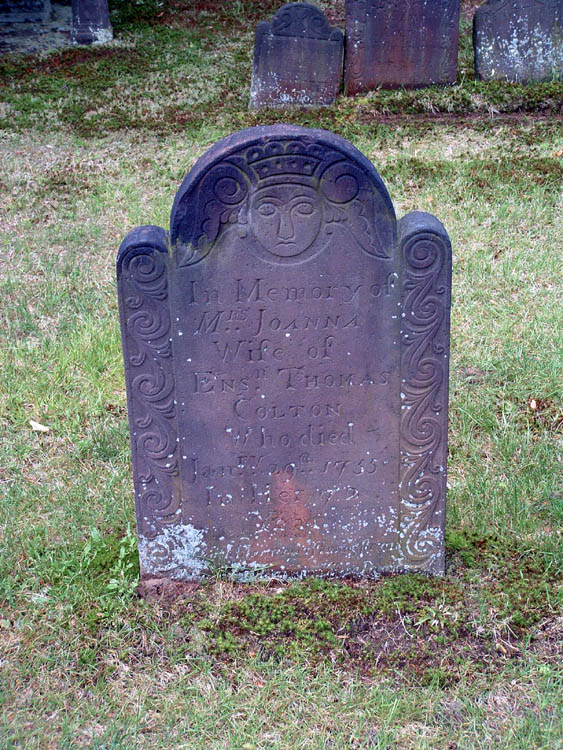
8. Joanna Warriner

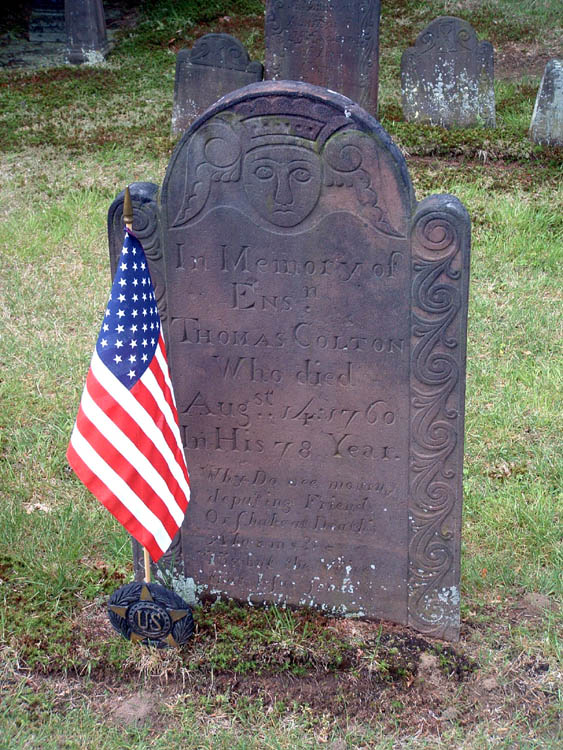
Joanna’s husband Thomas Colton was born 27 Mar 1683 in Longmeadow, Hampden, Mass. His parents were Thomas Colton and Sarah [__?__]. Thomas died 4 Aug 1760 in Hampden, Mass.

Thomas Colton Gravestone — Longmeadow Cemetery, Longmeadow, Hampden County, Mass

Joanna Warriner Colton Headstone — Longmeadow Cemetery, Longmeadow, Hampden County, Massachusetts

9. Elizabeth Warriner

Elizabeth’s first husband Samuel Pease was born 30 Dec 1686 in Enfield, Hartford, CT.  He was Robert’s first cousin and his parents were His parents were Robert PEASE Sr. and Abigail RANDALL. Samuel died 8 Sep 1770 in Enfield, Hartford, CT.

Elizabeth’s second husband Samuel Bliss 25 Apr 1694 in Springfield, Hampden, Mass. His parents were Samuel Bliss and Sarah Stebbins.  Samuel died 21 Dec 1724 in Springfield, Hampden, Mass.

Some sources say that Elizabeth’s parents were instead Nathaniel Warner (c. 1652 Ipswich, Essex, Mass. – 14 Jan 1712/13 Hadley, Hampshire, Mass.) and Joannah Gardiner (1661 Hadley, Hampshire, Mass. – 18 Mar 1728/29 Hadley, Mass.) married 3 Feb 1680/81 Hadley, Hampshire, Mass.

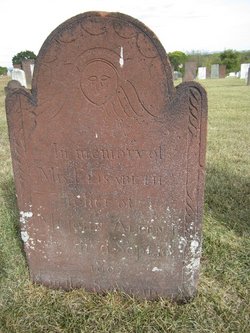
Elizabeth Warner Pease 1683-1783 Enfield Street Cemetery – In Memory of Mrs Elizabeth, Relict of Mr Samuel Pease who departed this life Nov 28th 1783 in the 100th year of her age. AS in the fair morn the richest flowers bloom. So virtue smiles beyond the silent tomb. If virtue now deserves a passing tear Then find a kind traveler and drop it here.

xx

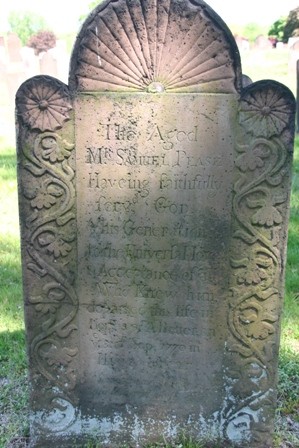
Samuel Pease Headstone – Enfield Street cemetery – The aged Mr SAMUEL PEASE Having faithfully server God & his generation to the universal love & acceptance of all who knew him departed this life in hopes of a better one ye 8 of SEPt 1770 in his 84 year

Children of Samuel and Elizabeth:

i. Mehitable Pease b. 1712 Enfield, CT; d. 22 May 1790; m. 17 Jul 1740 to James Gaines

ii. Samuel Pease b. 1715 Enfield, CT; d. Bef. 1718 Enfield, CT.

iii. Elizabeth Pease b. 1716 Enfield, CT; d. 10 SEP 1802; m. 4 Jul 1737 to John Allen

Elizabeth Pease Allen – Enfield Street Cemetery – In memory of Mrs Elizabeth relict of Mr. John Allen 1st in her 87 year

iv. Samuel Pease b. 10 Mar 1717/18 Enfield, CT; d. 10 Jun 1772 Enfield, CT; m. 21 May 1743 to Zermiah Chapin

v. Capt. Ephraim Pease b. 1719 Enfield, CT; d. 1801 Enfield, CT; m. 29 May 1740 Enfield, CT to Tabitha Abbe

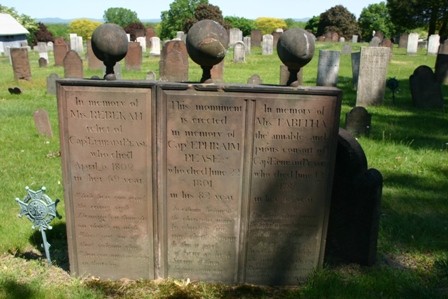
Ephraim Pease – Enfield Street Cemetery – This monument is erected in memory of Capt. Ephraim Pease who died June 22 1801 in his 82 year

vi. Joanna Pease b. 1722 Enfield, CT; m. Benjamin Root

vii. Mary Pease b. 1723 Enfield, CT.

viii. Aaron Pease b. 4 May 1726 Enfield, CT; d. Enfield, CT; m. 10 Oct 1751 Enfield, CT to Ann Geer

ix. Nathaniel Pease b. 29 Sep 1728 Enfield, CT; d. 28 Mar 1818 Norfolk, CT; m. 24 Apr 1755 to Eunice Allen

10. Abigail Warriner

The Abigail Warriner that married Samuel Ely 1722 in Springfield, Hampden, Mass. was  our Abigail’s cousin once removed, the daughter of Samuel Warriner and Abigail Day.

11. Mary Warriner

Mary’s husband Daniel Weld was born in 1680 in Medfield, Norfolk, Mass. His parents were Daniel Weld and Mary Hinsdale.  Daniel died after 1739.

12. Phebe Warriner

Phebe’s husband Joseph Hale was born 1691 in Hadley, Hampshire, Mass. His parents were Thomas Hale and Priscilla Markham. Joseph died in 1773 in Enfield, CT.

Sources:

http://trees.ancestry.com/owt/person.aspx?pid=7395416

http://www.our-genealogy.com/Wyman-Virdell-Taylor/ancestry-warriner/joseph-wrrriner.html#JWCHLD1

http://familytreemaker.genealogy.com/users/p/o/p/Sandra-Popiel/BOOK-0001/0304-0003.html

http://www.genealogyofnewengland.com/b_w.htm

http://wc.rootsweb.ancestry.com/cgi-bin/igm.cgi?op=GET&db=haruspex&id=I004430

Posted in 12th Generation, 90+, Historical Monument, Line - Miner | Tagged , | 8 Comments

Robert Carver

Robert CARVER (1594 – 1680)  was probably not Alex’s 12th Great Grandfather;  one of 8,192 in this generation of the Miner line.  See note from Bev Anderson below.   The town of Carver, Massachusetts, that is called the cranberry capitol of the world is named for Robert’s uncle John  Carver, the first governor of Plymouth Colony.

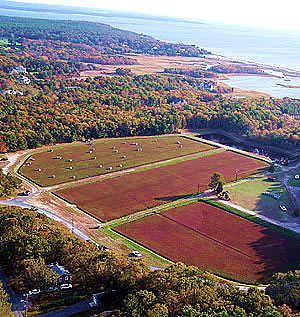
Carver, Mass Cranberry Bogs

Robert Carver was born in 1594 in Boston, Lincolnshire, England. . His parents were Isaac CARVER and Catherine [__?__]. He married Christian TURNER on 4 Aug 1617 in Lydiard District, Wiltshire, England.  He was the cousin of  John Carver, governor of the Mayflower and  the first governor of Plymouth Colony.  Robert came to the Plymouth colony later, and settled at Marshfield before 1638 having been granted 20 acres of land at Greene’s Harbor.  Robert died in Apr 1680 in Boston when he was 86 yrs old and is buried in Marshfield Mass.

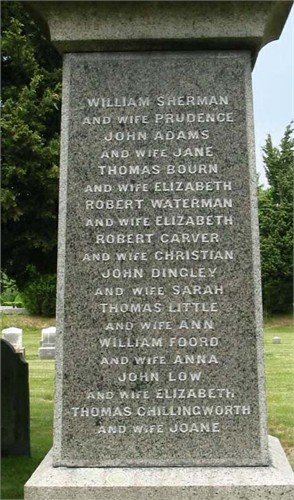
Robert and Christian Carver – Founders Monument Marshfield, Mass

Christian Turner was born 1596 in England. Christian died 23 Jul 1658 in Marshfield, Plymouth Colony.

Children of   Robert and Christian:

Name Born Married Departed
1. Elizabeth CARVER? c. 1632
England
William RANDALL
2 Oct 1649
c. 1660
Enfield, CT
2. John Carver 23 Jun 1637
Marshfield, Plymouth Colony
Millicent Ford
4 Nov 1658
Marshfield
23 Jun 1679
Marshfield

John Carver, first governor of Plymouth Colony, was “sonne of James Carver, Lincolnshire, yeoman” and it has been the commonly accepted tradition that Robert Carver, the emigrant, was his brother, which tradition was supposed to have been established as fact by the historian of Marshfield, Mass., who received information from a Carver descendant whose grandfather had lived 21 years with his grandfather Robert, the emigrant. But it is now known that Robert was a son of Isaac, a brother of Governor Carver and consequently the Governor’s nephew.”

The Carver Family of New England, Clifford Nickels Carver, p.23:

“In Leyden the Carvers [John & Catherine] lived first on Widdleberg, and, after 1617, on Middelgracet. And here it appears that the nephew Robert Carver, joined John Carver, for in one of the Leyden records, Robert Carver is referred to as the grandson of Katharine Carver (the wife of James Carver and mother of Isaac and John).

The town of Carver, Plymouth, Mass was named for Robert’s uncle John, first Governor of Plymouth Colony.

Robert was a proprietor in Marshfield, Mass. 3 Sep 1638, and his name is on the list of those able to bear arms in 1643. He was admitted a freeman 7 Jun 1648; was a juryman and held verious town offices. He had a son John. (New England Families & Memorial:Third Series, Vol. IV)

From The Carver Family of New England, Robert Carver of Marshfield & His Descendants, p. 23:

It appears that in middle life, John Carver … in Leyden, the Carver’s lived first on Widdlebert, and after 1617 on Middlegracet. And here it appears that the nephew, Robert Carver, joined John Carver, for in one of the Leyden records, Robert Carver is referred to as the grandson of Katharine Carver (the wife of James Carver and mother of Isaac & John).

In “The Genealogical & Family History of the State of Maine, (comp. by Little) the statement is made that Isaac Carver, father of Robert and brother of John died in Leyden, which leads to believe that he too had followed his brother there.

Robert lived in Duxbury for a while, but moved back to Marshfield. He served on the grand jury in 1643. Robert made an arrangement with Millicent Ford Carver (surviving wife of son John) to live with her after John’s death, with half the estate going to John & Millicent’s oldest son, William, during Robert’s lifetime, and the other half going to William after the death of Millicent.

No good record has been found of his birth or parentage beyond the records listed above.  It is thought that he was in Leyden, Holland before the Pilgrims left there, but no proof of his residence has been found.        It is not known when Robert and Christian Carver came to America.  Their names have not been located on any ships passenger lists.  There was a large immigration in 1635 and this is when Robert might have come over.

Timeline

3 Sep 1638 – Robert Carver definitely appears in the Plymouth Colony  when at a Court of Assistants held at New Plymouth “Robert Carver is granted 20 acres of land lying on the northwest side Greenes Harbor River and a garden place upon Stoney River.”  This land was in the town of Dusbury, which was founded in 1637.  Duxbury was the first town to be founded in Plymouth Colony after New Plymouth.

8 Oct 1639 – The records of the Court of Assistants show “Capt. Miles Standish, Mr. Alden, and Mr. Ed Winslow are appointed to lay forth the land and meadow granted to Job Cole and also to land granted to Francis Godfrey and Robert Carver.”

10 Sep 1641 – Robert was living in Duxbury when Edmund HAWES of Duxburrow agreed to exchange 10 acres of upland lying across Green River for 2,000 feet of sawn boards that sawyer Robert was to deliver.

“The Xth of September 1641. Memorand. That Edmond Hawes of Duxborrow doth acknowledge that for and in consideration of the sum of two thousand foote of Sawne boards to be delived and payed him by Robert Carver all those his Ten acres of upland lyinge crosse Green’s Harbor payth with all his labors in & aboute the same with all and singueler the apprtencs thereunto belonging and all his Right Title an interest of and into the said prmisss. To have and to hold the said Tenn acres of upland & wth all and singuler the apprtenences thereunto belonging unto the said Robte Carver his heirs and assignes for ever and to the onely per use and behoofe of him the said Robert Carver his heires and assignes forever.”

Soon after this Robert moved to Marshfield when on 7 Mar 1643 he was appointed grand juryman.  Marshfield was organized at Greens Harbor as a town in 1640.

1643 –  Robert’s name appears as non-commissioned officer on a list of males in Marshfield between the ages of 16-60 who were able to bear arms.

Aug 1645 – At Marshfield’s town meeting the following entry appears in the town minutes: “On motion being made for one to teach school, we, whose names are underwritten, are willing to pay yearly, besides paying for our children we shall send, viz: Edward Winslow 20 shilling, Thomas BOURNE 10 shilling, John Bourne 10 shilling, Robert Carver 10 shilling, Thomas Chillingsworth 10 shilling. This was the first recorded movement towards a public school in New England.

7 Jun 1648 – Robert Carver was made a Freeman of Plymouth Colony.  Being a Freeman gave Robert the right to vote and to hold office.

7 Jun 1651 – Robert acquired more land when he and John Russell of Marshfield, planter, bought from Thomas Chillingsworth about 40 acres of land in Marshfield for £15, 15 shilling to be paid in corn and cattle.

1653 – Robert was chosen a surveyor of highways.  He often served on juries.

27 Jun 1679 – Robert left no will, but after the death of John, his only known son, he made an agreement with John’s widow Millicent.   Robert was to live with her the remainder of his life.  In return her children were to have improvements of his whole estate until her eldest son, William, became 21.  At age 21 William received half of the estate.  At his mother’s death he was to receive the other half.  Millicent remarried a couple of years later. This land still belonged to Carvers as late as 1909.

Children

1. Elizabeth CARVER? (See William RANDALL‘s page)

2. John Carver

John’s wife Millicent Ford was born between 1636-38, Duxbury, Plymouth, Mass. Her parents were Deacon William Ford and Anna (Hannah) Eames.  William Ford came to Plymouth in the Fortune in 1621.  After John died, she married 9 Mar 1681 in Marshfield, Mass to Thomas Drake.  Millicent died before 4 May 1696, Massachusetts.

Thomas Drake was born 13 Sep 1635 in Colyton, Devon, England. His parents were William Drake and Margaret Westover. He first married Jane Holbrook, daughter of Thomas HOLBROOK on 9 Mar 1655 Weymouth, Mass.  On 14 Dec. 1663 the town of Weymouth granted him six acres in the First Division and eighteen acres in the Second Division. (Weymouth Land Grants, 283.)    Elizabeth Drake, who married in Boston, 8 Jun 1654 to Ezekiel Hamlin, and Joane, the wife of Thomas Randall of Weymouth, were his sisters. Thomas died Weymouth MA 23 Sep 1692, estate settled in 1692.

Sources:

Ancestry.com

http://familytreemaker.genealogy.com/users/c/o/o/K-b-Cook-MN/BOOK-0001/0009-0043.html

Posted in 14th Generation, Historical Monument, Immigrant - England, Line - Miner, Pioneer, Public Office, Veteran | Tagged | 16 Comments

William Randall

William RANDALL (1634 – 1690) was Alex’s 11th Great Grandfather;  one of 4,096 in this generation of the Miner line.

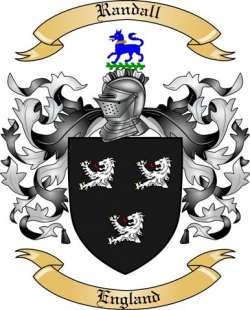
Randall - Coat of Arms

William Randall was born about 1634.  Genealogies show he was born in  Salem, Mass., but I cannot find any appropriate emigrating parents.  It is more likely that he emigrated from England.  His parents were NOT William Randall and Elizabeth Carver (sometimes called Barstow).   He married  Elizabeth CARVER on 2 Oct 1649.   Alternatively, he married Elizabeth Kibby.  William  died in 1690 in Enfield, Hartford, CT.

Elizabeth Carver was born about 1632 in England. Her parents were Robert CARVER and Christian TURNER.  She emigrated with her parents about 1638. Elizabeth died about 1660 in Enfield, CT.

Many genealogies have connected our William with William Randall (1609 – 1693) and Elizabeth Barlow.  It looks to me that these are unrelated families. These other Randalls lived in Scituate, near Rhode Island on the opposite side of Massachusetts from Salem,  The elder William had a different son William Jr. (1647 – 1712) who would have been too young to be our Abigail’s father, much less her older siblings.

Although in Randall and Allied Families it is stated that William Randall’s wife was Elizabeth Barstow, sister of Michael, George and William Barstow and daughter of of Matthew Barstow, it is more likely that this was Elizabeth Carver.   Elizabeth Carver was Richard Carver’s daughter by his first marriage to Margaret Skurrie. Matthew Barstow married as his third wife Grace (Walker) Carver, Richard Carver’s third wife.

Elizabeth Barstow was born in 1619, too old to be our William’s wife.  Parents: Matthew BARSTOW and Isabell HILL.

Children of  William and Elizabeth:

Name Born Married Departed
1. Elizabeth Randall 13 May 1650
Newbury, Mass
2. William Randall 2 Mar 1652/53 Newbury Rebecca [__?__]
1676 in Newbury Village Massachusetts Bay
.
Mary [__?__]
1728
Enfield, CT
3. John Randall 5 Mar 1654 Newbury, 1655
4. Mary Randall 26 Mar 1656 Newberry, Essex, Mass. Jonathan Tainter
15 MAR 1701/02
Watertown (Plymouth) Mass
5. Hannah Randall 7 Jan 1657/58
Newbury, Essex, Mass
David Turner 1714
Scituate, Mass
6. Abigail RANDALL 1660 in Salem, Mass Robert PEASE Sr.
16 Dec 1678 in Salem, Mass.
16 Dec 1678
Enfield, CT

It’s very strange that there were two Elizabeth Carvers who married two different William Randalls in 17th Century New England, but as far as I can tell the two sets of families are not related.  Our Elizabeth’s father was Robert CARVER born in 1594 in Boston, Lincolnshire, England.  Robert died in Apr 1680 in Boston when he was 86 yrs old and is buried in Marshfield Mass. The other Elizabeth’s father was Richard Carver born  1577 in England and married 14 Nov 1614 in Filby, Norfolk, England. Richard died in 1638/41 in Watertown, Mass.

The Other 17th Century William Randalls

1. William Randall was born 16 Mar 1598/99 in Grantham, Lincolnshire, England or 1609 England. His parents were Simon Randall (ca 1574-) and Jane Stephens. William died 13 Oct 1693 in Scituate, Plymouth, Mass.

There is some doubt whether he married Elizabeth Carver or Elizabeth Barstow. Although in Randall and Allied Families it is stated that William Randall’s wife was Elizabeth Barstow, sister of Michael, George and William Barstow and daughter of Matthew Barstow, it is more likely that this was Elizabeth Carver. See Robert Charles Anderson’s article“The wifes of Michael Barstow and Richard Carver of Watertown, Massachusetts and the identity of the wives of William Randall of Scituate and William Perry of Marshfield.”

Elizabeth Carver was baptized 15 Oct 1618 in Filby, Norfolk, England. Her parents were Richard Carver (ca 1577-1638/41 in Watertown, Mass.) and his first wife Margaret Skurrie. Richard and Margaret were married 14 Nov 1614 in Filby, Norfolk, England. Margaret was burried 16 Nov 1618 in Filby.

From the combined passenger list of two ships which sailed from Yarmouth in Norfolk in 1637 (John C. Hotten, The Original Lists of Persons of Quality … [1874; repr. ed., Baltimore, 1986] the following family was examined on 11 Apr 1637: “Richard Carvear of Skratby in the County of Norf[olk] husbandman ageed 60 yeares, and Grace his wife, ageed 40 years, with 2 children. Elizabeth ageed 18 yeares and Susanna aged 18 years, being twynes.”13 Also three servants: Isaac Hart aged 22, Thomas Flegg 21, and Marabel Underwood 20

The will of Richard Carver of Watertown, yeoman, testified before Gov. Winthrop 9 Sep 1641 mentions wife Grace and daughters Elizabeth and Susanna.

Children of William and Elizabeth:

i. Marie Carver baptized 21 Dec 1615 in Filby, Norfolk, England. There is not further record of Marie after her baptism, and problably died before 1637, althought she would have been old enough to marry in England before the rest of her family sailed for New England.

ii. Elizabeth Carver (Twin) (ca 1618-) Elizabeth married William Randall

iii. Susanna Carver (Twin) baptized 15 Oct 1618 in Filby, Norfolk, England. Susanna died aft 23 Jun 1674. She married William Perry, son of our ancestor Edmund PERRY, about 1640. William died ca 1695.

Richard second married Elizabeth [Carver]. Buried on 1 Dec 1622 in Filby, Norfolk, Eng. On 7 Jul 1623 Richard third married Grace Walker in St Stephen’s, Norwich. Grace died on 21 Jul 1671 in Watertown, MA.

Elizabeth Barstow was born about in 1620 Yorkshire, England and died after 1693 in Scituate, Mass. Matthew Barstow married as his third wife Grace (Walker) Carver, Richard Carver’s third wife.

This William Randall seems to have been a bit of a rogue.

[The other] William Randall came to Rhode Island as a prisoner aboard the ship “Expectation” and on April 24, 1635 he landed in Providence, Rhode Island and therein took the oath of allegiance. In 1637 he removed to Marshfield, Massachusetts and in 1640 settled in Scituate, Massachusetts where he owned a farm on Dwelly’s Creek. He was also listed as a cordwainer.
“Original Lists of Persons of Quality 1600-1700”, by John Camden Hotton; p. 69; New York City, New York; 1880 (929.3, ORI) (E187.5 .H83 1968 CSL)

“William Randall came into Scituate before 1640. His farm was on the brook that falls into Till’s or Dwelly’s creek: His house was in the valley, twenty rods north of the brook on the west side of the way, where stands [1831] the mansion of Elisha Foster, sen. late deceased. There is no record of his marriage here: he probably married at Rhode Island, where we find some traces of him as early as 1636; or in Marshfield, where he seems to have been 1637. He was an enterprising and useful man in many respects; but unfortunately for himself, appears to have been litigious. There are several disputes on the Colony records, which he prosecuted with his neighbors about bounds of lands, and when the causes were decided against him, he seems not to have submitted very quietly. He was fined 1660, ‘for striking Edward WANTON,’ in one of these disputes: and in 1664, ‘for breaking the King’s peace by poakeing Jeremiah Hatch with a ho-pole, was fined 3s. 4d.’ Colony Records. He, with his wife were of the party that gained much strength from 1650 to 1670, which held it unlawful to pay religious teachers. His goods were occasionally taken by the constable. On one of these occasions, ‘1654 William Randall’s wife fined for abusing the Constable, Walter Hatch.’ Colony Records. After these troubles, they both settled down to quiet members of Mr Witherell’s church.”

(From Frank A. Randall’s Randall and Allied Families:160) “William Randall, the founder. Born Eng., 1609, died Scituate (now Norwell), Mass., Oct. 13, 1693. Regarding him Savage says: ‘William Randall of Scituate, Mass., came fvrom the port of London in the ship Expectacon the 24th of April, 1635, to the Island of Providence (R.I.) He was twenty-six years of age and took the oath of Supremacy and Allegiance as then required of every person leaving England.’ He removed to Marshfield, Mass., 1637, where he tarried three eyars, then removed to Scituate, which adjoins Marshfield to north, the North River separating them. At Scituate he occupied a respectable position; a man of strong opinions and always ready to maintanin his rights; hence he developed a ‘litigious’ reputation, spending some time in courst as a defendant. Many of the plaintiffs were related to him by marriage, or to some member of his family. In some of the causes that he lost, William Randall paid the damages in ‘shooes’, notable in the case of Joanna Kemton from which circumstance we are led to believe that William followed the occupation of ‘cordwainer’ or shoemaker. This opinion is strengthened by reference in Plymouth Colonty Probate Court records to paymetns made to William Randall, Sr., ‘for shooes’ in the settlement of the ‘Estate of John James’ in 1679/80. At various times William was Constable, Surveyor-of-Highways, a freeman and on lists of those ‘able to bear arms’. See Old Scitaute and Its Pioneer Families for details.”

Children of William and Elizabeth

i. Sarah Randall (ca 1640-aft 1693)

ii. Joseph Randall (Mar 1642 – 21 Feb 1722/3)

iii. Hannah Randall (Mar 1644 – 23 Aug 1714)

(2) iv. William Randall (Dec 1647 – 11 Apr 1712)

v. John Randall (Apr 1650 – bef 28 Jul 1728)

vi. Elizabeth Randall (Oct 1652 – 3 Nov 1693)

vii. Job Randall (8 Feb 1654/55 – 19 Sep 1727)

viii. Benjamin Randall (8 Nov 1656 -)

ix. Isaac Randall (ca 1658 – 10 Jul 1759)

2. William Randall was born Dec 1647 Scituate, Plymouth, Mass. He was baptized in the Second Church of Scituate, on 2 Jan 1648. His parents were William Randall and Elizabeth Barstow. He married in 1674 in Providence, RI to Rebecca Fowler (c. 1656 Providence, RI – 23 Mar 1729/30 Scituate, Mass) Her father was Henry Fowler William died 11 APR 1712 in Providence, RI.

This William was a miller. He removed in 1674 to Providence, RI. He owned 200 acres of land in the vicinity of old Fenner ledge and what became Knightsville, Cranston, RI. He ran a grist mill and a small saw mill on the west side of Pochasset River near the road and opposite Cranston Print Works. He resided in Providence, now Cranston, RI.

3. William Randall b. 10 SEP 1675 Cranston, RI. His parents were William Randall and Rebecca Fowler. He married Abiah Wight 8 Oct 1693 in Providence, RI. William died 8 JUL 1742.

Children

2. William Randall

William’s wife Rebecca [__?__] died 18 Feb 1677 in Newbury Village Massachusetts Bay.

Children of William and Mary

i. John Randall b. 17 JUN 1682 Westfield, Mass.

ii. Abigail Randall b. 26 JUL 1684 Westfield, Mass. d. 24 JAN 1761 Somers, CT. m. 4 DEC 1713 Enfield, CT. to Samuel Parsons

iii. Hannah Randall b. 23 NOV 1686 Westfield, Mass. d. 16 APR 1715 Enfield, CT. m. 14 DEC 1711 to William Simons

iv. Elizabeth Randall b. 18 APR 1689 Westfield, Mass. d. 11 AUG 1690

4. Mary Randall

Mary’s husband Jonathan Tainter was born 10 Jul 1654 in Watertown (Middlesex) Mass. Jonathan died in 1712 Watertown (Middlesex) Masss.

5. Hannah Randall

It looks more likely that the Hannah who married Dav was the daughter of the other William Randal Hannah’s husband David Turner was born xx.  His parents were Humphrey Turner and Lydia Gamer.

6. Abigail RANDALL (See Robert PEASE Sr.‘s page)

Sources:

http://trees.ancestry.com/owt/person.aspx?pid=30340917

http://www.genealogyofnewengland.com/b_r.htm

http://www.angelfire.com/journal2/n_woodhead/gp75.html#head2

http://trees.ancestry.com/tree/14566987/person/126321360

http://freepages.genealogy.rootsweb.ancestry.com/~randall/html/fam00839.html

http://trees.ancestry.com/owt/person.aspx?pid=30340917

http://aleph0.clarku.edu/~djoyce/gen/report/rr_idx/idx170.html#RANDALL

Robert PEASE Sr.

Posted in 13th Generation, Immigrant - England, Line - Miner | Tagged | 7 Comments

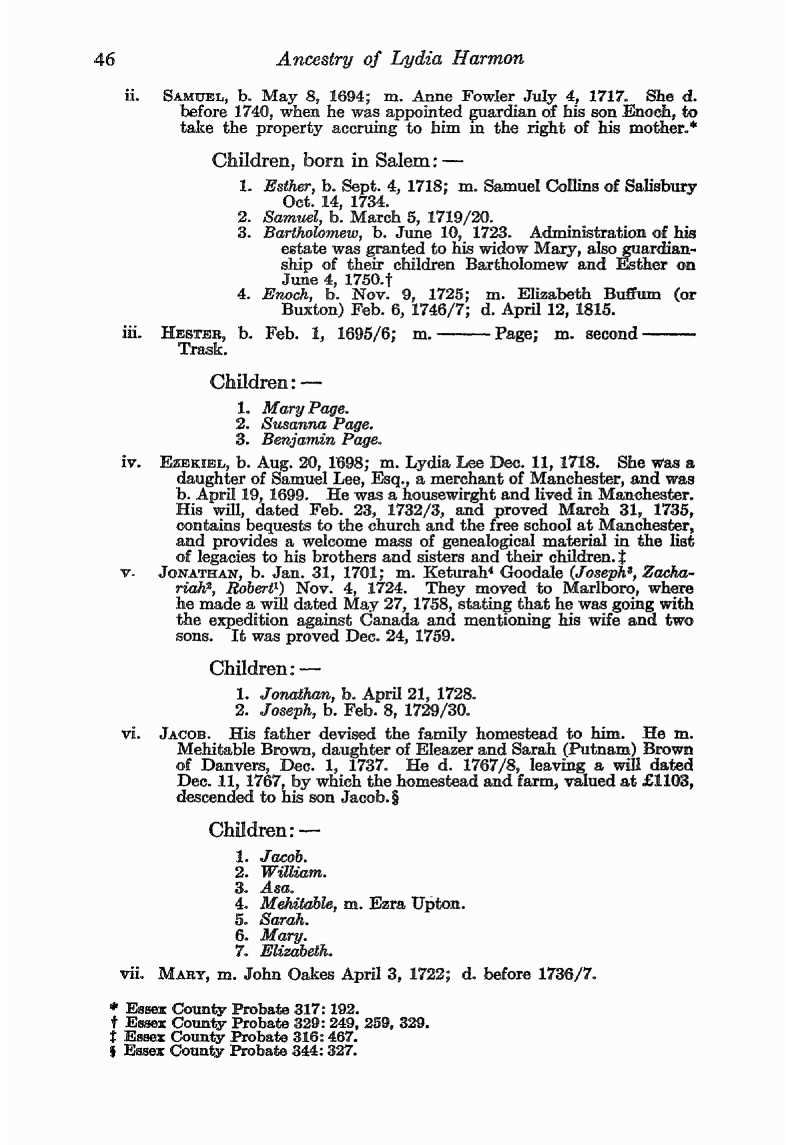
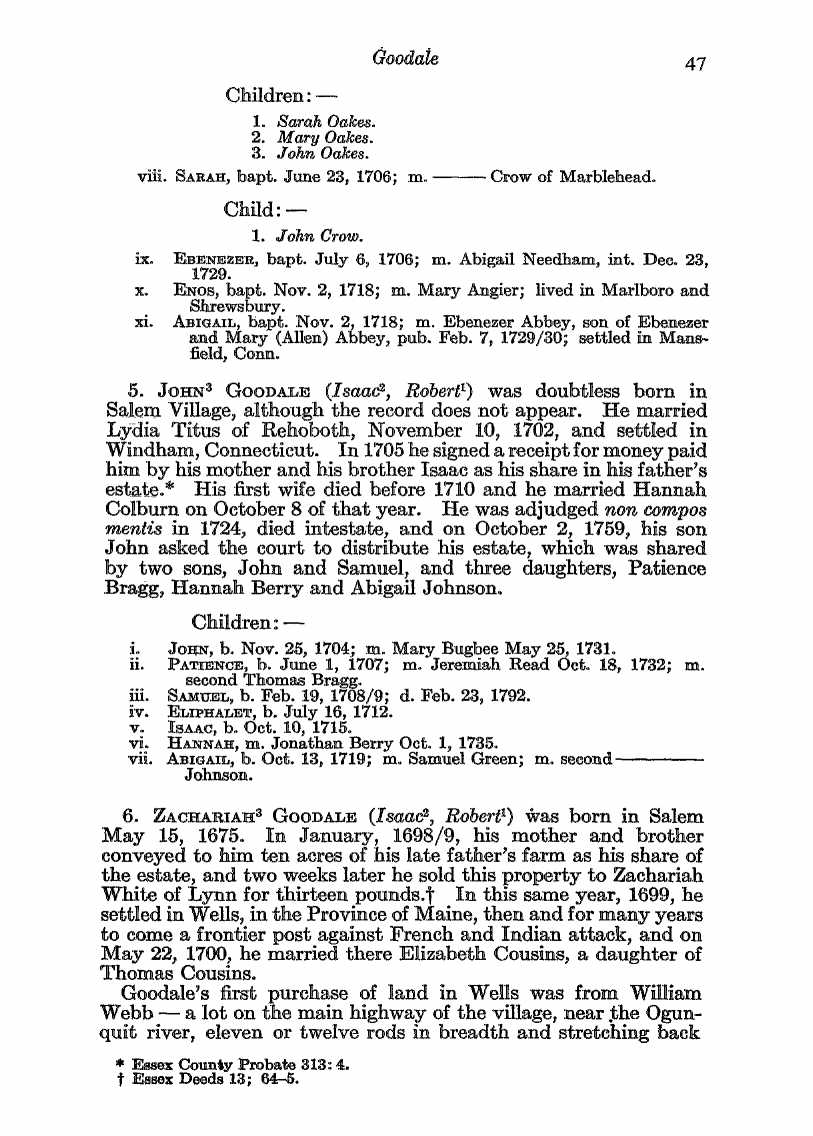
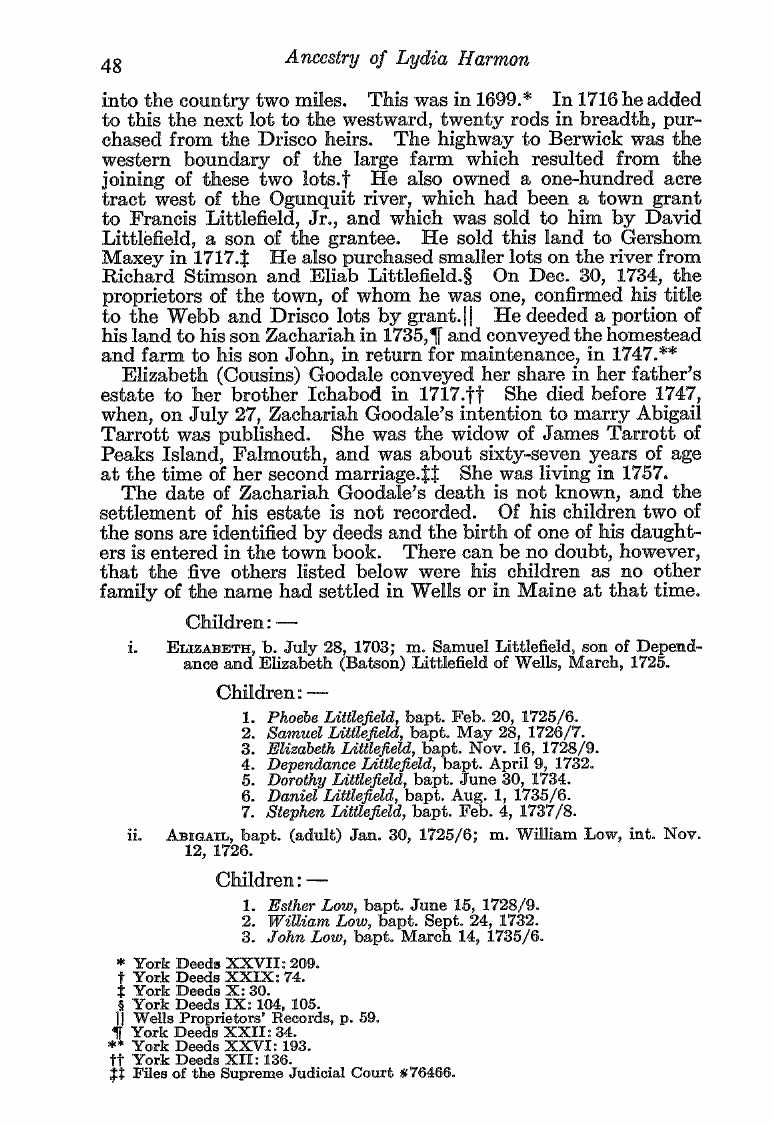
Robert Goodale

Robert GOODALE (1601 – 1683 ) was Alex’s 12th Great Grandfather;  one of 8,192 in this generation of the Miner line.

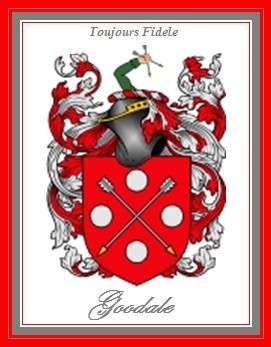
Robert Goodale – Coat of Arm

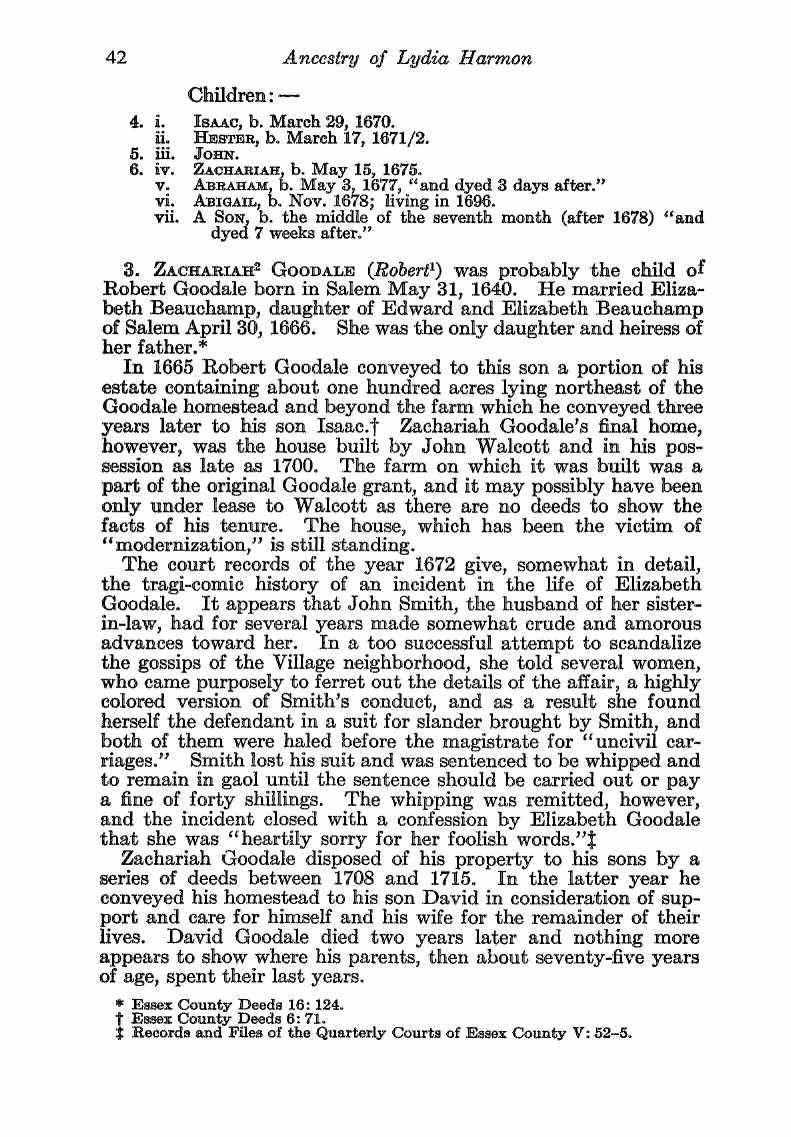
Robert Goodale (Goodell) was born in Aug 1601 in of Ipswich, Suffolk, England.  He was  christened on 16 Aug 1601 in Dennington, Suffolk, England. His parents were Robert GOODELL and Joan ARTYS.  He married Catherine [KILHAM?] about 1629 at Easterham Suffolk England.   They immigrated in April 1634 sailing  on the “Elizabeth” from Ipswich.

“Robert Goodall”, aged 30, and “Kathern, his wife,” aged 28, were enrolled at for passage to New England on the Elizabeth[Hotten 280];on 30 April 1634, “Mary Goodale”, aged 4, “Abraham Goodale”, aged 2, and “Isaacke Goodale”, aged “half a year,” children of “Rob[er]t Goodale”, were enrolled at as passengers for New England on the Elizabeth[Hotten 282].

After Catherine died, he married Margaret Lazenby on 30 Aug 1669.  Robert died 4  Apr 1683 at Salem or Danvers Mass.

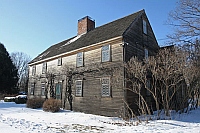
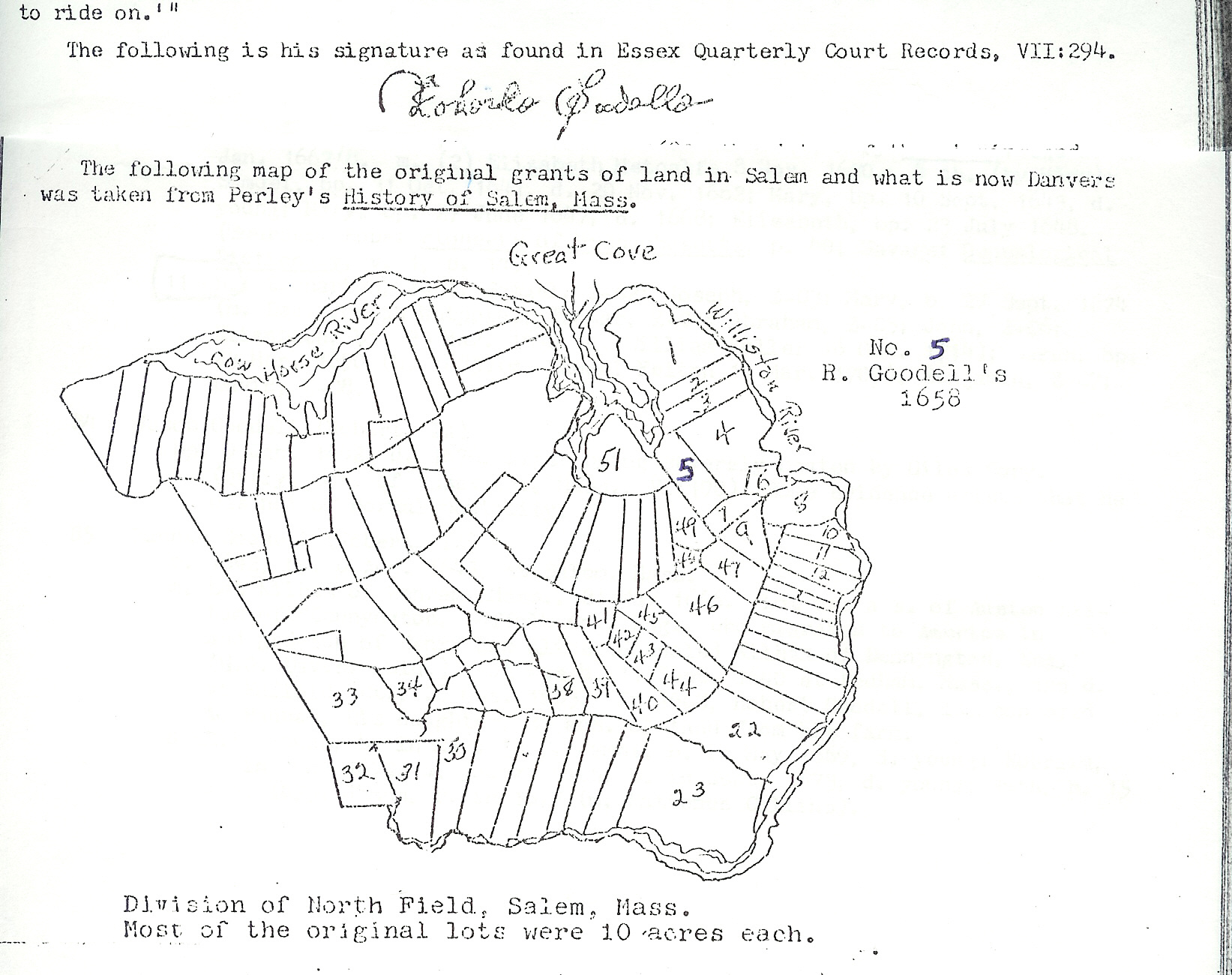
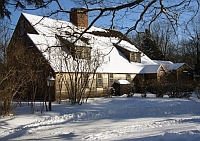
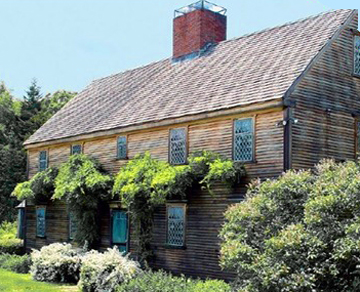
Robert built a home for his son Isaac which is still standing

Catherine Kilham was born in 1606 in Dennington, Suffolk, England and christened on 20 Mar 1606 in Ropsley, Lincoln, England.  Some sites say her parents were Henry KILLHAM and Alice GOODALE. Others believe that the Catherine Kellam baptized in Ropsley, Lincolnshire 20 or 21 Mar 1606, father was Rafe not Henry

In her will of 1 March 1601/02, “Elizabeth Goodale” of , mentioned three sons, including Robert, and “Henry Kilham and Alice his wife, my daughter”[Waters 2:1403, citing Archdeaconry of Suffolk 38:478]. This latter couple were the parents of Austin KILHAM and this may be what led George E. Williams to claim that the first wife of Robert Goodale was “Catherine Kilham”. While there is little evidence for this identification, the fact that one of the daughters of Robert Goodale married a son of Austin Killam suggests that there may be some relationship. Catherine died 10 Sep 1666 in Salem, Essex, Mass.

Margaret was born xx.  Robert entered into an agreement with Margaret to settle on twelve acres of her land and build a house there. He also promised two cows and a riding horse for the property. His son, Jacob, was to inherit this property after Margaret’s death. Margaret was mentioned in Robert’s will of 1682. She received support from the town from 1683 to 1689, and on 25 March 1689 the town paid “for digging of graves” for four people, including “Goody Goodall”

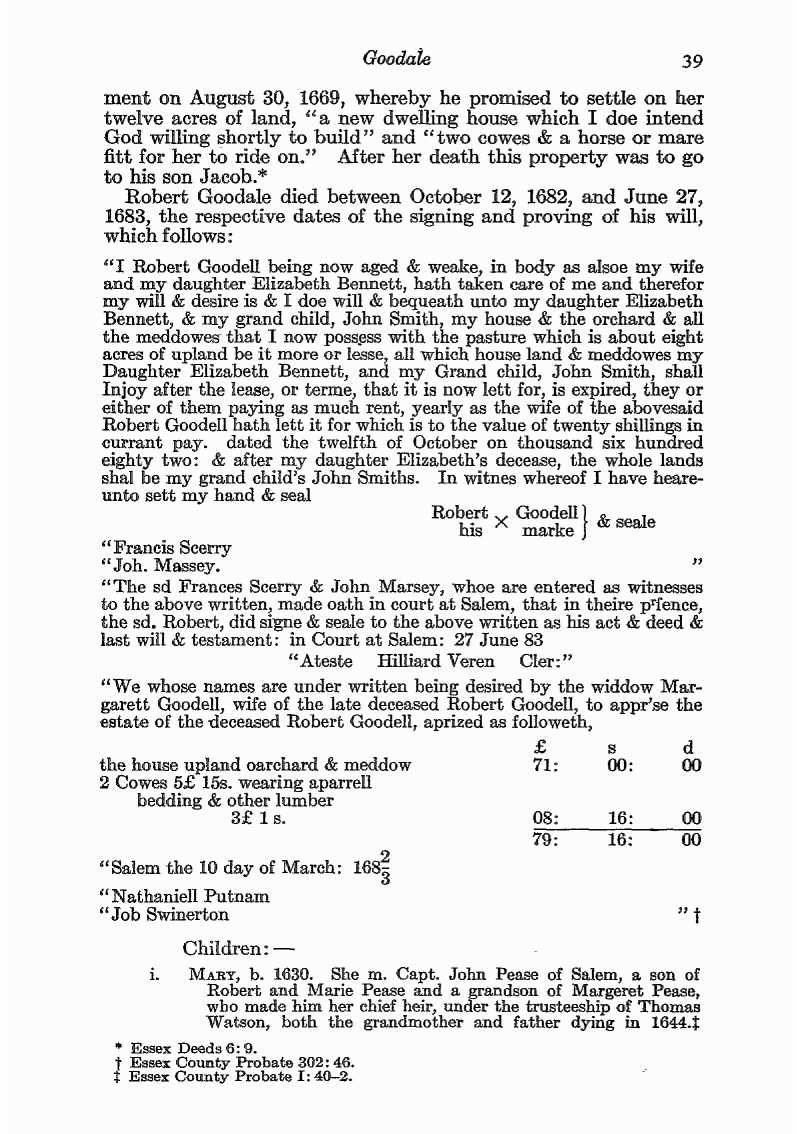
30 August 1669 – “Robert Goodell have made choice of & by God’s permission do fully intend to take to my wife Margaret Lazenby, late of Exeter in New England (& the which being done), I the said Robert do hereby covenant & promise to & with the said Margaret, that in case she outlives me, to give & bequeath unto her for her comfortable maintenance … a new dwelling house which I do intend God willing shortly to build, with what household stuff therein God shall please to continue unto me until my death; item: two cows & a horse or mare fit for her to ride on, also my whole orchard upon my farm near my dwelling house at Bald Hill, with six acres of the planting ground upon which the said orchard stands, the best of the said ground & four acres of meadow ground near to my said orchard with a pasture plot of about two acres fenced in near to my said house & orchard & also that she shall have a competency of fire wood & timber for her use … & after her decease … shall fall to my son Jacob Goodell … [and] in case she outlive my said son Jacob that then she shall have & enjoy for her use & benefit that part of my estate which I shall & do intend to leave unto my said son Jacob, during her life”.

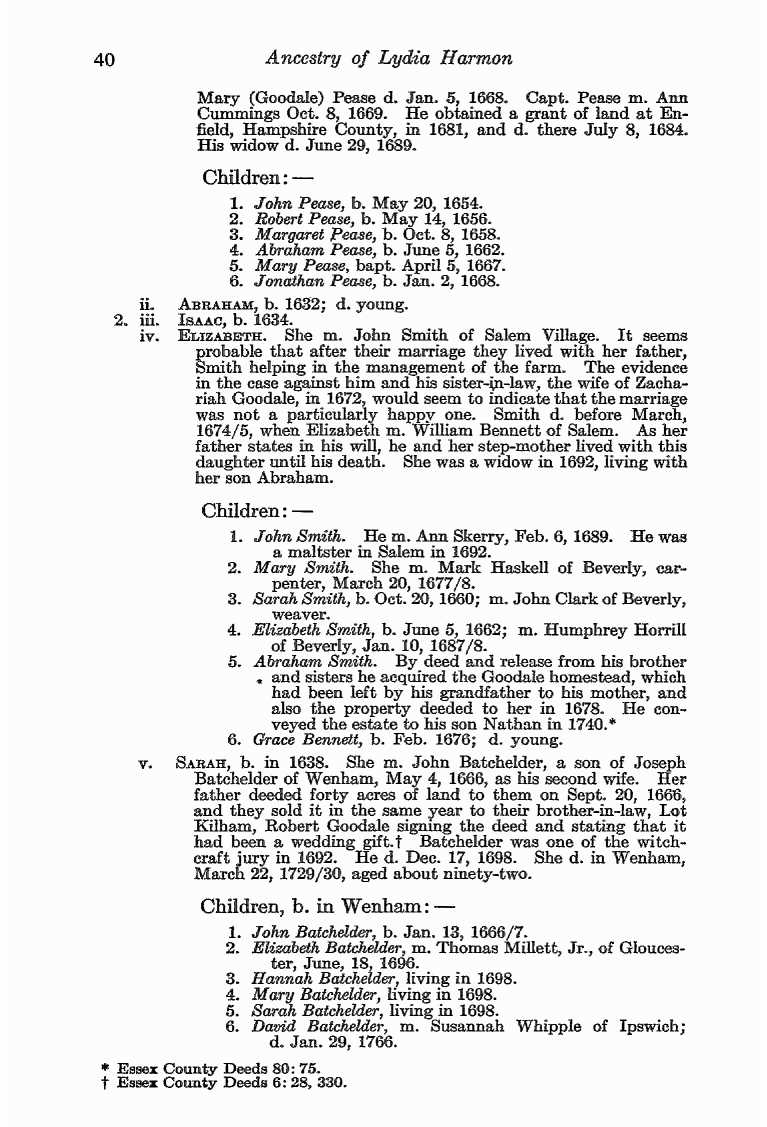
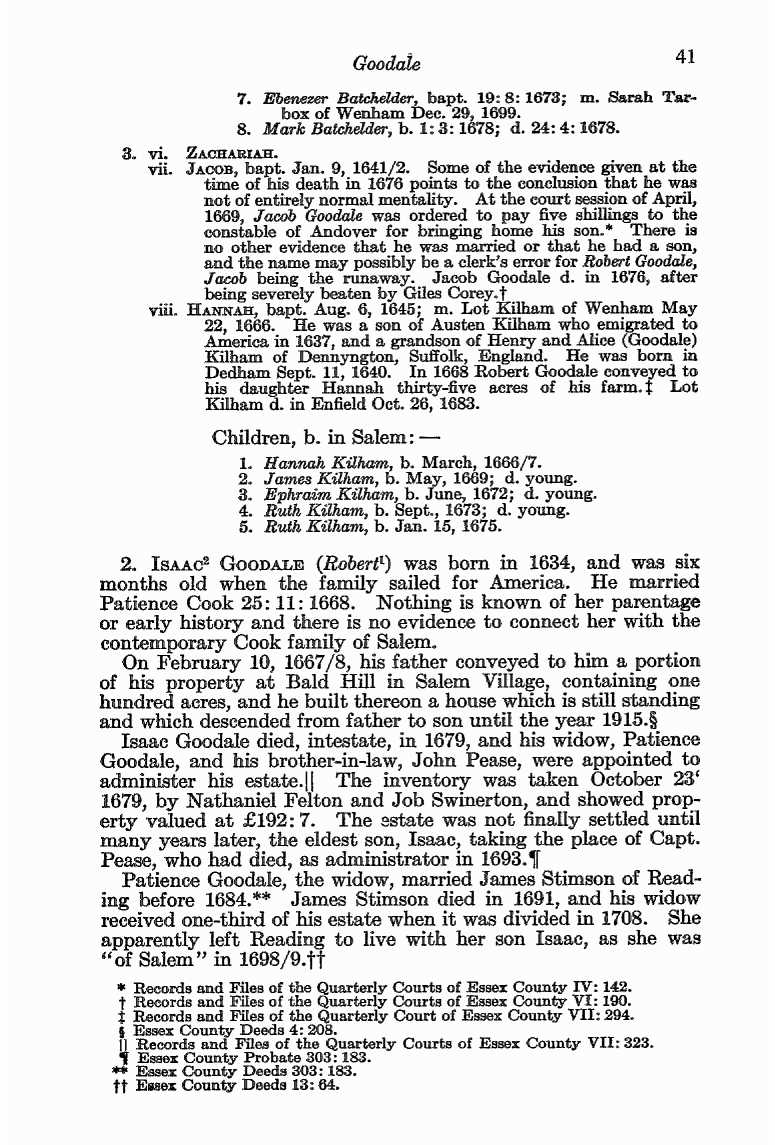
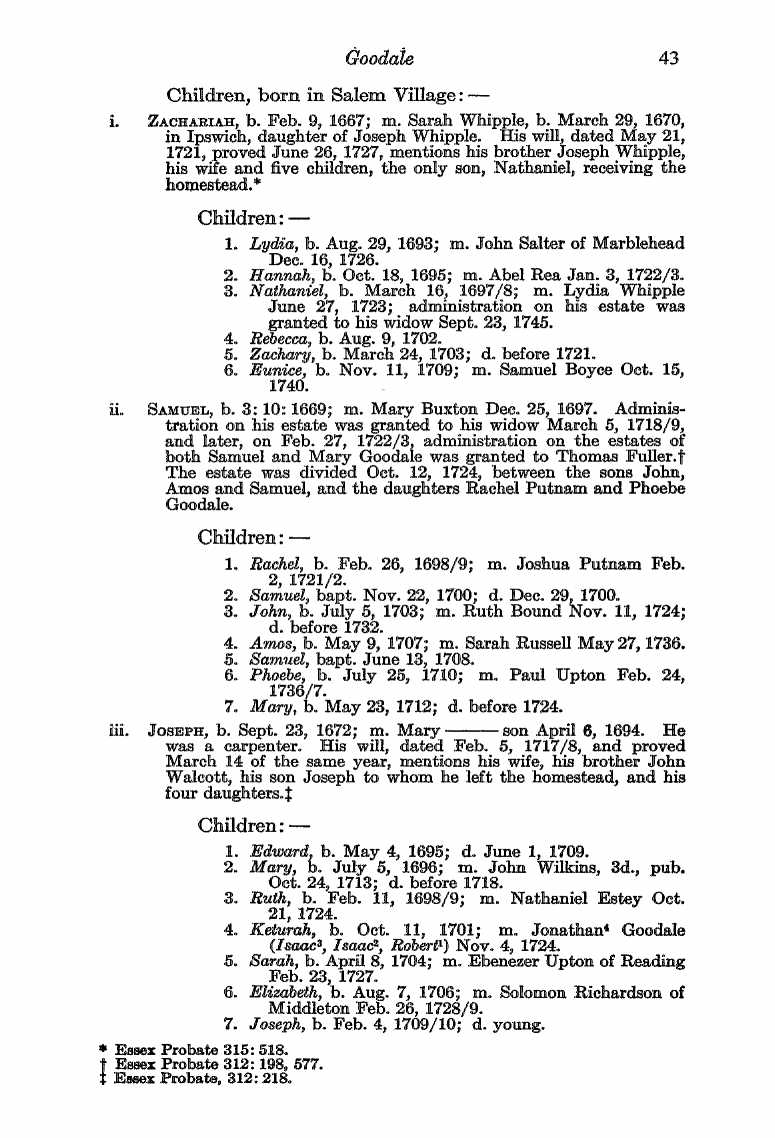
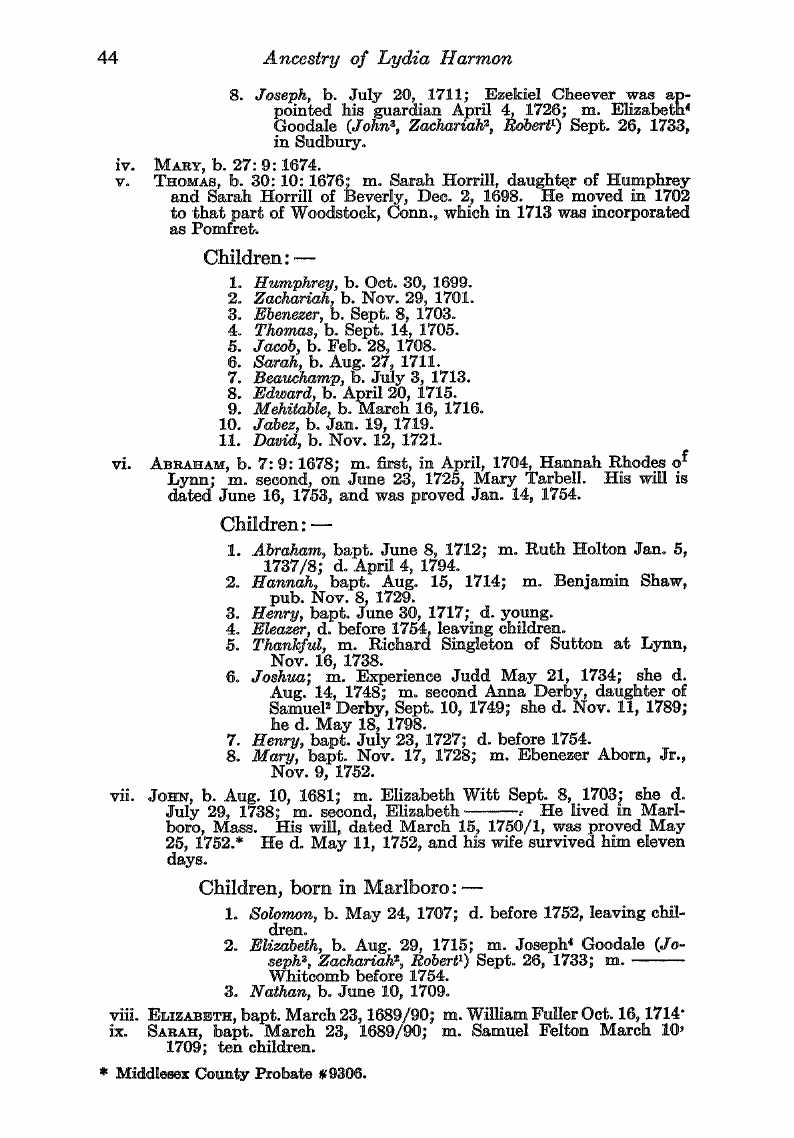
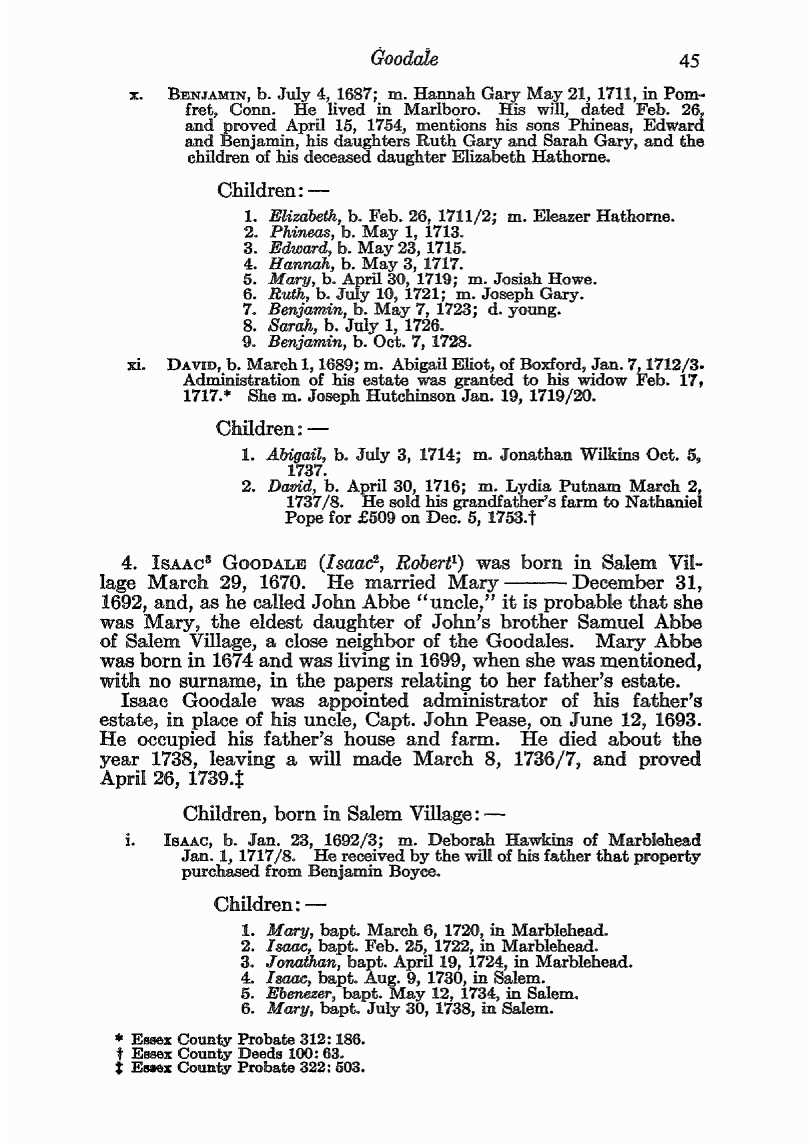
Children of Robert and Catherine:

Name Born Married Departed
1. Mary GOODALE 1630 in England Capt. John PEASE
1653
Salem, Mass
5 Jan 1667/68 Enfield, CT
2. Abraham Goodale c. 1632
England
Died Young
3. Isaac Goodale 1633 England Patience Cook
25 Nov 1668
1679
4. Nehemiah Goodell 30 May 1636 Salem Hannah Haven
30 Jul 1673 Lynn,, Mass
Dec 1726 in Framingham MA
5. Elizabeth Goodale Oct 1638
Salem Village, Mass.
John Smith
c. 1658
.
William Bennett
6 Mar 1673/74
1692
Salem, Essex, Mass.
6. Zachariah Goodale 31 May 1640
Salem, Mass.
Elizabeth Beauchamp
30 Apr 1666
Salem, Mass.
1715
7. Sarah Goodale 31 May 1640
Salem Village, Mass.
John Batchelder (son of our ancestor Joseph BATCHELLER)
4 MAY 1666
22 Mar 1729/30
Wenham, Mass.
8. Jacob Goodale 9 Jan 1641/42 Unmarried 1676
“Jacob was employed by Giles Corey, and in a quarrel with the latter was so badly beaten that he died *
9. Hannah Goodale 6 Aug 1645
Salem Village, Mass.
Lot Killam
(son of our ancestor Austin KILHAM)
22 May 1666
Salem, Mass.
1677 in Salem, Essex, Mass

Robert’s son is featured as a ghost in Longfellow’s play “The New England Tragedies”  (See 8. Jacob Goodale below for details.)

Robert seems to have devoted his life to the development of his large grant for the benefit of his sons and daughters to whom, as they married, he gave generous acreages as wedding gifts, thus creating a family settlement about his own homestead.

His firm, clear handwriting would indicate a good education, but he took no part in governmental affairs and his name seldom appears in the records in any capacity except as plaintiff or defendant in suits based on the ownership of his land and stock.

On August 30, 1669, he made a settlement on his second wife, Margaret: “12 acres of land, a new dwelling house, two cowes and a horse or mare fitt for her to ride on.” He died and his will was proved June 27, 1683—he left his estate to his daughter Elizabeth and his grandson, John Smith. Wife Margaret was mentioned as having already been provided for, as were his other children.

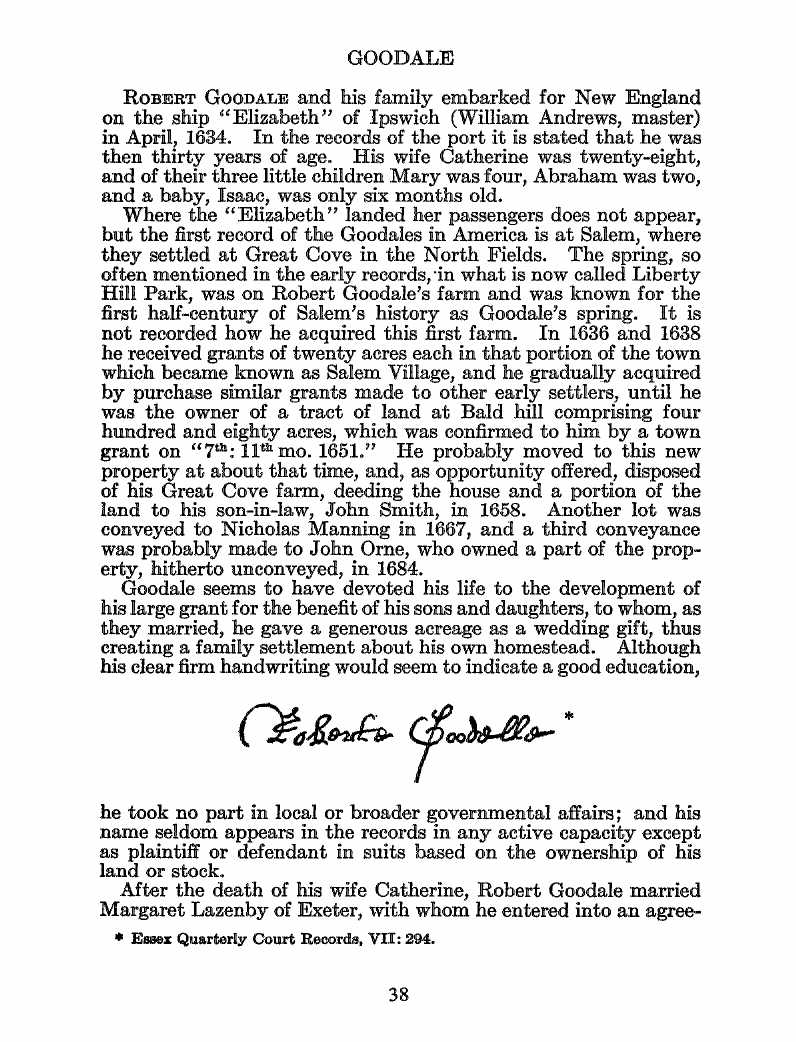
Robert was recorded as age 30 by the Customs House when he came to this country in 1634 which would make his birth 1604 instead of 1601. There has been much speculation as to who Robert’s parents were, but their identity has not been proven. One current theory, as suggested by George E. Williams in his book, A Genealogy of the Descendants of Robert Goodale/ Goodell of Salem, Massachusetts, states that Robert Goodell was the son of Robert Goodell and Joan Artys, who was born in 1601 and was baptized 16 Aug 1601 in Dennyngton, Suffolk Co., England. There are other families with sons named Robert of his generation, but in no case do the few known facts go together correctly.

Robert, his wife Katherine and three children, sailed from the port of Ipswich, Suffolk Co., England on 30 Apr 1634 on the ship “Elizabeth” in charge of Captain, Mr. Andrews. They took the oath of allegiance and supremacy at his Majesties Customs House on 12 Nov 1634 at Ipswich MA. Sailing on the same ship was Margerie Washburn, the wife of John Washburn and their two sons, John and Philip. They were the ancestors of the Putney, Vermont Washburns who married into the Goodell family in the 9th generation. Also, on board were John and Anne Crosse, who were probably the ancestors of Hannah Cross, who married John Munroe. John Munroe was the great grandfather of Minnie Jane (Monroe) Scott, and three of her children married into the Goodell family.

According to Bowen’s account and the History of Salem, they made their home at Salem,”in the field northeasterly of Cold Spring in North Salem,” where he was granted a house lot and an acre of land in 1636. He obtained another 20 acres in 1639 and 1652. By 1651, he had 480 acres of land in Salem.

1658 Lot #5, 1663, Lot #55   -The Division of the North Fields was laid out before the Salem town records were begun. Most of the original lots consisted of ten acres each. See the above link for the location of Robert’s land and his many real estate transactions.

Throughout his half century of residence in Salem, Robert pursued a single goal with great determination. So far as we can tell he was never a church member, never a freeman and never an officeholder. The vast majority of the records in which he appears, even his few minor criminal transgressions, involve his dealing with land. He devoted much effort to the amassing of land, and the provision of estates for his children.

(Click here for today’s Goodale Street)

On 15 Mar 1660, he sold 50 acres to Giles Corey called the “Corey Farm.” He gave generous acreages of land to his sons and daughters as wedding gifts. George E. Williams gives the following account of his land:

…the first record of the Goodells in America [at Salem], indicated that they settled at Great Cove in the North Fields. This Spring, so often mentioned in the early records in what was later called Liberty Hill Park [Liberty Hill Avenue Google Maps], was on Robert Goodell’s farm and was known for the first half century of Salem’s history as Goodell’s Spring. It is not recorded how he acquired this first farm. However, in 1636 and in 1638 he received grants of twenty acres each in that portion of the town which became known as Salem Village, and he gradually acquired by purchase similar grants made to other early settlers, until by 1651, he was the owner of a tract of land at Bald Hill comprising four hundred and eighty acres, which was confirmed to him by a town grant on November 7, 1651. He probably moved to this new property at about that time, and, as opportunity offered, disposed of his Great Cove farm, deeding the house and a portion of the land to his son-in-law, John Smith in 1658. Another lot was conveyed to Nicholas Manning in 1667, and a third conveyance was probably made to John Orne, who owned a part of the property, hitherto unconveyed in 1684.

Robert Goodale Salem Land Map

Robert was a farmer. “He was a man of piety, of education, of considerable wealth, of great strength of character, a helper in all important matters — such was our ancestor, Robert Goodell” (Versailles). In 1670, the people of Salem petitioned for a church of their own and Robert Goodell’s signature is on that document. Robert does not appear to have taken part in govenment affairs.

27 Dec 1642 – “Robert Goodell” was one of twelve men “presented for breach of order of court, keeping their cattle in the common corn fields” and fined for this infraction[EQC 1:49].

26 Dec 1643 – “Robert Goodell” was one of eleven men “fined for putting their cattle into the north corn fields”[EQC 1:56].

27 Aug 1644 – “Robert Goodell [was] fined for suffering his goat to go in his neighbor’s cornfield”[EQC 1:69].

18 Feb1645/46 – “Robert Goodell was accused by Myghel Sollis (also Sallow) of stealing four goats. Sollis had lost one old and three young goats and finding such, with his mark on them, in custody of Goodall, the latter promised to return them. When Sollis went for them, Goodall said that he had killed one and the rest were lost. Quit for lack of testimony”[EQC 1:91].

11 July 1644 – “Robert Goodell complained of Ruben Guppy for rent and burning fence”[EQC 1:68].

27 June 1671 – “Rob[er]t Goodell” sued “Gartrid Pope for withholding or molesting, mowing and carrying away the hay on a parcel of meadow. Withdrawn”[EQC 4:384].

In 1668, Robert built a house for his son Isaac.  Save for a decade or so in the early 1900s, the Goodale family has lived in this house since it was built.  The timber frame saltbox is one of the best preserved examples of a first-period house in New England, and is listed on the National Register of Historic Places.

Isaac Goodale Home

But after nearly 340 years of ownership, the Goodale family put the place on the market in 2009  for $1.39 million, hoping to attract a buyer who will respect the storied structure’s origins.  In 2010 it was still on the market.   Equally exquisite is the 41-acre property  near Ipswich the house sits on, with rolling meadows bordered by woods that sweep down to Great Marsh – the largest salt marsh in New England – with a view of Hog or Choate Island beyond.

This is not the home’s original location. It was built in Salem, by Robert Goodale for his son Isaac. The Goodales had sailed from England to Salem in 1634, just 14 years after the Pilgrims dropped anchor in Plymouth Harbor. Robert purchased more than 500 acres in Salem and gave land to his children upon their marriages. Sometimes, he built houses for them, as he did for Isaac, a farmer who lived in the house for just over a decade before he died in 1679.

Isaac Goodale Home 151 Argilla Road, Ipswich

Isaac’s descendants remained in the house until 1915, when it was sold, for reasons unknown. Three different owners occupied the house over the next several years, and it was put up for sale again in 1928.

Dr. Robert Goodale, a Boston physician and a direct descendent of Isaac’s brother Zachariah, learned from a newspaper article that the house was for sale. “He went right out to look at the house, bringing a building inspector with him,” said Maisie Crowther, 72, the youngest child of Robert Goodale, who now lives in Brattleboro, Vt. “He and my mother decided to buy it then and there. They wanted to bring it back into the family. They wanted to preserve it.


Isaac Goodale Home

The sale price was $5,000, a hefty sum for the era. Goodale’s plan was to have the house moved from Salem to Ipswich where it would be a summer haven for the couple and their four children. Robert Goodale’s father, Joseph, owned a commercial orchard on Argilla Road and gave him 41 acres at the end the narrow dirt lane.

The original plan was to move the house intact, on rollers, along Route 1 to Ipswich, but Crowther said the family was unable to do that. “So they had to dismantle the house piece by piece to transport it. It was rebuilt exactly to the original specs and with the same materials.”

Before the house was transported, the Goodales discovered a few of the home’s original 17th-century narrow casement windows with diamond-shaped leaded panes in the basement. They restored the windows and had replicas commissioned for the rest of the house. During reassembly, they also exposed the original raised paneling and returned the openings of the home’s four massive fireplaces to their original size – nearly 6-feet long and 4-feet high.

Isaac Goodale Home

Robert Goodale died in 1683 in Salem, Essex Co., MA (LDS/AF, 4 Apr 1683) (Versailles). The will of Robert Goodell was dated 12 Oct 1682 and was probated 24 Jun 1683 in Salem, Essex Co., MA. His will reads as follows:

I Robert Goodell being now aged & weake, in body as alsoe my wife and my daughter Elizabeth Bennett, hath taken care of me and therefor my will & desire is & I doe will & bequeath unto my daughter Elizabeth Bennet & my grand child, John Smith, my house & the orchard & all the meadowes that I now posess with the pasture which is about eight acres of upland be more or lesse, all which house land & meadowes my daughter Elizabeth Bennett, and my grand child John Smith, shall enjoy after the lease, or terme, that it is now let for, is expired, they or either of them paying as much rent, yearly which is to the value of twenty shillings in currant pay, dated the twelfth of October one thousand six hundred eighty two; & after my daughter Elizabeth’s decease, the whole lands shall be my grand child’s John Smith. In witness whereof I have hereunto set my hand & seal

Children

1. Mary GOODALE (See Capt. John PEASE‘s page)

3. Isaac Goodale

Isaac’s wife Patience Cook was born in 1635.  Her parents were John Cook and Mary Roote. After Isaac died, she married 1683 – Reading, Middlesex, Mass. to James StimsonPatience died in 1699 in Salem, Mass.

In 1668, Robert built a house for his son Isaac.  Save for a decade or so in the early 1900s, the Goodale family has lived in this house since it was built.  The timber frame saltbox is one of the best preserved examples of a first-period house in New England, and is listed on the National Register of Historic Places. (See above for details)

4. Nehemiah Goodell

Nehemiah’s wife Hannah Haven was born 22 Feb 1646 – Lynn, Essex, Mass.  Her parents were Richard Haven and Susanna Newhall.  Hannah died 01 Jan 1727 in Framingham, Mass.

5. Elizabeth Goodale

Elizabeth’s first husband John Smith was born about 1645 – Edgartown, Dukes, Mass.  His parents were Richard Smith and Mary Weed.  John died 6 May 1672 – Salem, Essex, Mass.

John Smith was involved in a scandal with his sister-in-law.  See Zachariah Goodale’s section for details.

Elizabeth’s second husband William Bennett was born about 1635. His parents were Peter Bennett and Elizabeth Fielder.  William died in 1692 in Salem, Mass.

6. Zachariah Goodale 

Zachariah’s wife Elizabeth Beauchamp was born 23 Jul 1646 – Salem, Essex, Mass.  Her parents were Edward Beauchamp and Mary Metcalf. Elizabeth died 1682 – Salem, Essex, Mass.

Elizabeth (Beacham) Goodale, wife of Zachariah Goodale, accused her brother-in-law John Smith of sexual assault; this case brought forth many illuminating depositions from family members and neighbors. Elizabeth let slip to a few of her friends that brother John had made some inappropriate advances to her and, then as now, apparently, a secret has no value unless shared! When brother John learned through the grapevine that his sister-in-law was saying less than complimentary things about him, he sued her for slander in the Salem Quarterly Court of 1672. One of the Goodell’s defenses was that slandering brother John wouldn’t be easy! From the looks of the court records, the whole neighborhood got involved and Smith was found guilty of a countercharge filed by Elizabeth Goodell. He was fined and sentenced to be whipped, though this latter punishment was remitted when his friends promised to pay his fines. Synopsis of the court records follow:

June: John Smith v. Zachariah Goodell and Elizabeth, his wife. Slander. The defendant allowed costs.

Writ, dated June 10, 1672, signed by Hilliard Veren, for the court, and no return made. Bond of Zachariah (his mark) Goodell and Elzabeth (her mark) Goodel.
Bill of cost, 7s, 6d.

Plaintiff’s plea: that he objects to defendant saying that she kept the abuses, which he was alleged to have committed, private for years and would never have revealed them but to save herself from damage against her in court.

“Now if a woman might singly alone be so surcomstansed noe man can scap from suffering: but if I might be sufred to sware in my owne case I can safly sware that her charg and accusation is fals but let the considaration of the testamony the Nayborhowd that will say that thay neuer saw any hurt by me in that respect but do raly thinke that I am wronged and I hope that I neuer shall be left to Committ shuch wickedness pray haue soe much charity towards me as to credit me in what I say: now I hop that no man can according to law be condemned without it be by the mouth of tow or thre wittnissis and in this case wher ther is noe surcomstanc in the Case to Joyne with her complynt thus hoping to confidently believe as raly I dow that my grettest hapynes lyeth in that your worships are holly wiss and just and charitable.”

Defendant’s plea: the court was asked to judge of the legality of the attachment, for the law provides six days for the defendant to prepare his answer and testimony; the attachment was for slander but mentions no time nor place nor word of slander; defendant had said many things concerning plaintiff for many years upon many occasions and if common fame my be credited “it is not a very easy matter to slander the plaintiff.” Summons appearing not to be legal, defendant requested a nonsuit.

John Smith and Elizabeth, wife of Zachariah Goodell, being bound over to this court to answer to several abusive and uncivil carriages between them, with which said Elizabeth charged said Smith, the latter desired to be tried by a jury, who found him guilty. Court ordered him to be whipped on the next lecture day in Salem and to remain in prison until the sentence be executed unless he pay 40s. Upon supplication of Anthony Needham and Giles Coree, who engaged to pay the fine and gaol charges within two months, his sentence of being whipped was remitted.

Summons to constable, John Suthwick of Salem, for the apprehension of John Smith, and Elizabeth, wife of Zachery Goodell, and to bring them to Mr. John Gardner’s, dated 11: 4: 1672 (4 Jun 1672). Summons also for witness, Gould and his wife, Tho. Flynt’s wife, Coree’s wife, Carrill’s wife, Anne Needham and Kelam’s wife, dated 15:4:1672 (15 Jun 1672), and signed by Wm. Hathorne, assistant.

Lot Killum and Zacheriah Goodell deposed that John Smith, being at said Goodell’s house, the latter’s wife being present, said that he was sorry for what he had done to Goodell’s wife and prayed God to give him repentance, hoping he should do so no more. Zacheriah replied that he wished God would give him repentance.

Edward Beachum and Zachariah Goodell were bound for the latter’s wife Elizabeth’s appearance. Thomas Flint, Giles Coree, John Rubton and John Smith were bound for Smith’s appearance.

John Tomkins, sr., John Small and his wife, John Foster and his wife, John PEASE, George Jacobs and his wife, Eliz. Symonds, sr., James Symonds and his wife and john Tompkins, jr., certified that they “being nere neighbores unto Elizabeth Goodel, the daughter of Edw Beachom and having had acquaintance with her from her childhood to her marriage Do testify yt according to our best observation and judgment shee hath been of an honist civill conversation & one yt would not wrong the truth in her speches.”

Mary Corey, aged about forty-three years, and Mary Carrill, aged about thirty-five years, testified that Elizabeth Goodell told them that one time as John Smith, her brother-in-law, was working in a swamp near her house, he called to her for fire, so she carried it to him and laid it on the side of the brook, he being on the other side. He asked her to tarry and smoke, and she told him she had already smoked, so she ran away up the hill and he ran after her, etc. Also at another time he assaulted her when he fetched her from her house to help his wife when she lay in, so that she jumped from the horse on which they rode. Also when he was at Lott Keellam’s digging a well, and once on a Lord’s day while her husband was at meeting, etc. She said he was an ugly rogue and threatened to tell her husband, and that he had been uncivil to her ever since her son Zachery was a little boy, but she feared that if she told her husband, said Smith would kill her or her children or hurt her creatures. She told deponents that these things were true and that she would swear to them before the best magistrate in New England.

Hannah Flint, aged about twenty-two years, deposed that she was at John Smith’s house at the time of his wife’s lying in, and Elizabeth, wife of Zachary Goodell was there also, etc. Deponent heard said Elizabeth tell of lascivious language used by both herself and Smith, and also heard Patience, wife of Isacke Goodell, affirm to her sister’s face, etc.

Patience Goodell and Hanah Kellum testified that the foolish words that their sister Elizabeth Goodell spoke to them about Smith were said in a jesting way.

Zachary Goodel declared to the court on his wife’s behalf that “he hath not found his wives affections in ye least alienated from him, but she doth love and respect his as well if not better since these things between John Smith & her have bin reported, from ye time of ye first therof unto this time as ever she did before.”

Geyles Corey, aged about fifty-five years, deposed that Elizabeth, wife of Zackary Goodell, related to him that on a morning after she and his wife had been at the house of Nathaniel Carrell, coming into deponent’s house, John Smith being there, said Elizabeth had been affronted by said Smith. Deponent asked her where he and his wife and daughters were. Her answer was that she was in the house and went up the ladder into the chamber and that his wife was near some bushes at the door taking in linen. He said if there had been anything amiss, she should have told him then, but when he came down he saw nothing but laughing and smoking. Elizabeth said that she was like to have broken her brother Smith’s head with the ladle and his wife said if she had, there would have been but six pence or a groat to pay. Later Elizabeth told deponent that she knew he was in the house, etc.

Lott Killum deposed that his wife being lame from a fall that she received upon a rock, John Smith offered her abuse, and she told him of it at night. Whereupon deponent dealt with said Smith privately about it.

An Needham deposed that she and her husband were in Elizabeth Goodell’s house, with the wife of Thomas Flint, when deponent’s husband told said Elizabeth that she was foolish to have reported such stories, and she said that they would not have gotten out if she could have helped it. Also that deponent heard Nethanel Carall say that Elizabeth had said several times in his house this winter that she wished that the old folks were gone, etc. Also that the wife of Robbert Goodell told Hanna Flinte that in the winter time she told her old man that Smith and Betty were together very much.

John Harrod and his wife testified to the same.

The answer of Elizabeth, wife of Zach. Goodell: that the stories had been grossly exaggerated; that she had told what had happened to her husband and her sister Hannah Killum in private, but it had “come to the mouths of such talkers as have pverted the truth and made the matter appere far worse then euer it was to my great Scandall and reproach. Mary Gory & Mary Carril hearing of it came to enquire of me how it was, and I foolishly told my ptended friends what before I had told my Sister Killum; “That the reason she did not complain to the authority was because she was afraid Smith would do her harm, as she was often alone with her children and remote from neighbors; that if she had complained and he had been punished, “what a sad life should I have had with my Husbands relations, Again I hoped he would reforme & being a relation I thought a privet healing might make it up, and I was some advised when it was known, not to complaine against him because it would as they thought ruin his family, he being desperate some times, I was resolved to complaine against him as Mary Gory & Mary Carril do witness I told John Smith I would & to that end did go downe the towne to acquaint Majr Hathorne with it but was discouraged by others and being foolish & not acquainted with the Law did forbear untill the Major was to go to the Generl Court and when he came home againe I pceiued that it was so spread abrode through indiscretion” etc. that she was heartily sorry for her foolish words and “I desire to be humbled that I sould any way be an occasion of filling the mouths of any with pfane and sinful words to ye Dishonor of the Great God and the scandal of the Gospell … And I desire it may be warning to mee & to us all never more to jest or speake foolishly vainly or slitely of such matters as should be cloathed with gravity & modesty, and I do acknowledge tis a dishonor to ye Sect of women … but this I can truly say … I love my husband as dearly as ever I did and no man else with such a love and I thinke he will say that he neuer saw cause from mee to thinke the contrary … I desire that the truth should not be wronged nor yet that John Smith should suffer more then he heth deserved … I thinke my neighbours amongst whome I have lived in the north field can testifie that they never saw any uncivill cariage by mee from my Childhood untill I was married. The language John Smith used to me and the Actions were such as most tend to ye way of his calling in dealing wth Cattel and not so like unlawfull dalliances tending to uncleanness.”

7. Sarah Goodale

Sarah’s huband John Batchelder was baptized in the First Church at Salem
20 Jan 1638.  His parents were Joseph BATCHELLER and Elizabeth DICKENSON.  He first married Mary Dennis 12 Jul 1661.   John died 17 Nov 1698.

8. Jacob Goodale

Jacob was killed at age 34 by Giles Cory, for whom he worked.  He was beaten and died soon afterwards.  The coroner’s jury said “The man was bruised to death, having clusters of blood about the heart.” Giles Cory was fined for the offense.  Some of the evidence given at the time his death points to the conclusion that he was not entirely of normal mentality.   At the Court session of April 1669, Robert Goodale was ordered to pay five shillings to the constable for bringing home his son.

Longfellow wrote a poem about the death and trail but used the name “Robert” instead of “Jacob” the son.  Giles Cory was pressed to death at age 80 in Salem Mass., a victim of the witchcraft trails of 1692.

When Corey was accused of witchcraft with five other men years later, the murder of Jacob came back to haunt him during his trial. Refusing to plead, Corey was crushed to death when the tribunal ordered heavy stones be laid on his body.

Legend has it that the ghost of Jacob Goodale appeared to Corey from time to time, crying out about his murder. In his play “The New-England Tragedies,” Henry Wadsworth Longfellow refers to the lore: “Look! Look! It is the ghost of Jacob Goodale . . . Whom fifteen years ago this man did murder, By stomping on his body! In his shroud. . . . He comes here to bear witness to this crime.”

HATHORNE.
That is enough; we need not question further.

What answer do you make to this, Giles Corey ?

MARY.
See there ! See there !

HATHORNE
What is it ? I see nothing.

MARY.
Look ! Look ! It is the ghost of Robert Goodell,
Whom fifteen years ago this man did murder
By stamping on his body ! In his shroud
He comes here to bear witness to the crime !

The crowd shrinks back from Corey in horror.

HATHORNE.
Ghosts of the dead and voices of the living
Bear witness to your guilt, and you must die !
It might have been an easier death. Your doom
Will be on your own head, and not on ours.
Twice more will you be questioned of these things;
Twice more have room to plead or to confess.
If you are contumacious to the Court,
And if, when questioned, you refuse to answer,
Then by the Statute you will be condemned
To the peine forte et dure! To have your body
Pressed by great weights until you shall be dead !
And may the Lord have mercy on your soul!

END OF ACT IV.

9. Hannah Goodale

Hannah’s husband Lot Kilham was born 11 July 1641  Salem, Essex, Mass.  His parents were Austin KILHAM and Alice GORBALL. Lot died 26 October 1683 in Enfield, Hartford, MA .

In September 1684, John PEASE was appointed administrator of the estate of Lot Kilham a townsman of his while in Salem and one of the first persons it is said to have died in the new settlement of Enfield, Connecticut.

Sources:

From Lydia Harmon 1924 by Walter Goodwin Davis

x

http://www.genealogyofnewengland.com/b_g.htm

http://freepages.genealogy.rootsweb.ancestry.com/~lougene/p6.htm#i291

http://www.ida.net/users/lamar/WEB/smithc/pafg35.htm#12310

http://www.usgennet.org/usa/vt/town/westminster/goodell.html

http://www.boston.com/realestate/news/articles/2009/02/01/passing_along_a_family_legacy/?page=2

http://familytreemaker.genealogy.com/users/c/h/a/Carol-A-Chadwick/WEBSITE-0001/UHP-0589.html

http://www.anamericanfamilyhistory.com/Kilham%20Family/KilhamLot1640.html#RobertGoodall

Posted in 14th Generation, Artistic Representation, Immigrant - England, Place Names, Storied, Twins, Violent Death | Tagged , , , , | 13 Comments

John Pease

John PEASE (1631 – 1684) was Alex’s 11th Great Grandfather;  one of 4,096 in this generation of the Miner line.

John Pease - Coat of Arms

John Pease was born Feb 1631 in Great Baddow, Essex, England.   His parents were Robert PEASE Jr. – Great Baddow and Lydia WEST.   His father came to New England in the ship FrancisJohn CUTTING [our ancestor], master, sailing from Ipswich, England the last of Apr 1634. The ship landed at Boston, MA without the loss of a single passenger. Robert was accompanied by his brother John, his eldest son Robert PEASE – The Former, a Miss Clark, aged fifteen, who was the daughter of a fellow passenger, and a Miss Greene, aged fifteen, perhaps a servant.  His wife Marie and other family members including John probably came on a later ship.      He married Mary GOODALE in 1653 in Salem, Mass.  After Mary died, he married Ann Cummings on 8 Oct 1669.  John died 8 Jul 1684 in Enfield, CT.  John, his wife Ann and daughter Abigail all died of the same illness.

File:EnfieldCTflag.PNG

John Pease, with his sons John Jr and Robert, was a founder of Enfield, Connecticut

Mary Goodale was born in 1630 in England.  Her parents were Robert GOODALE and Catherine [__?__].  She immigrated with her parents in April 1634 sailing  on the “Elizabeth” from Ipswich.

“Robert Goodall”, aged 30, and “Kathern, his wife,” aged 28, were enrolled at for passage to New England on the Elizabeth [Hotten 280];on 30 April 1634, “Mary Goodale”, aged 4, “Abraham Goodale”, aged 2, and “Isaacke Goodale”, aged “half a year,” children of “Rob[er]t Goodale”, were enrolled at as passengers for New England on the Elizabeth [Hotten 282].

Mary died 5 Jan 1667/68 in Enfield, CT three days after the birth of her fifth child.

Ann Cummings was born about 1639 in Ipswich, Mass.  Her parents were Isaac Cummings and Margaret or Anne [__?__].  Ann died 29 Jun 1689 in Enfield, CT.

Children of John and Mary:

Name Born Married Departed
1. John Pease 20 MAY 1654
Salem Village, Mass.
Margaret Adams
bef. 1678
Salem, Mass.
1734
Enfield, CT
2. Robert PEASE Sr. 14 May 1656
Salem, Mass
Abigail RANDALL
16 Dec 1678
Salem, Mass
21 Jul 1744
Enfield, CT
3. Mary
(often mistaken for Margaret) Pease
8 Oct 1658
Salem Village, Mass.
Hugh Pasco
16 Dec 1678
Salem, Mass
29 May 1737
Enfield, CT
4. Abraham Pease 5 JUN 1662
Salem Village, Mass
Jane Mentor
1686
Salem, Mass.
1735 Enfield, CT
5. Jonathan Pease 2 JAN 1667/68
Salem, Mass.
Elizabeth Booth
11 OCT 1692
Enfield, CT
1721 Enfield, CT

.

Children of John and Ann Cummings:

Name Born Married Departed
6. James Pease 23 Dec 1670
Salem, Mass
Hannah Harmon
18 Oct 1695
Enfield, CT
1748
Enfield, CT
7. Deacon Isaac Pease 15 Jul 1672
Salem, Mass
Mindwell Osborne
9 Jun 1692
Enfield, CT
9 Jul 1731
Enfield, CT
8. Abigail Pease 15 Dec 1675
Salem, Mass
9 Jul 1689
Enfield, CT

John was grandson of Margaret PEASE who made him chief heir under the trusteeship of Thomas Watson with both the grandmother and the father dying in 1644.

He received by will from his grandmother, Margaret Pease, the most of her property and she placed him in the care of Thomas Watson, of Salem, to “dispose of him as his own child.”

Margaret Pease Will 1644 - 1

Margaret Pease Will 1644 - 2

Margaret Pease Will 1644 - 3

Margaret Pease Will 1644 - 4

29 Apr 1668 – John was a freeman in Salem. He settled in that part of Salem called Northfields.

1680  Lot #68  -The Division of the North Fields was laid out before the Salem town records were begun. Most of the original lots consisted of ten acres each. See the above link for the location of John’s land.

“On Sacrament Day, 6 October 1681, John Pease and wife, had a letter of recommendation granted to the church at Springfield, MA. He and his two oldest sons (John and Robert) families and munerous neighbors removed to Fresh Water Brook, then a part of Springfield, it became Enfield, CT in 1682.

Enfield’s first settlers, John Pease, Jr. and Robert Pease, arrived in 1679 from Salem, Massachusetts, and spent their first winter camping in a shelter dug into the side of a hill.  He obtained a grant of land in Enfield, Hampshire, Connecticut in 1681 and died there 8 Jul 1684.

Enfield Settlement Monument Erected 1976

Enfield was originally inhabited by the Pocomtuc tribe, and contained their two villages of Scitico and Nameroke. Enfield was settled in 1679 by settlers from Salem, Massachusetts. Enfield was incorporated in Massachusetts in 1683. In 1749, following the settlement of a lawsuit in which it was determined that a surveyor’s error placed a section of present-day Hartford County (including Enfield) within the boundaries of Massachusetts, the town seceded and became part of Connecticut.

Enfield, Hartford, CT

In 1741 Jonathan Edwards preached his famous sermon, “Sinners in the Hands of an Angry God” in Enfield. This sermon is one of the most famous sermons ever scripted. It was part of the Great Awakening Revival that struck New England in the mid-18th century and spread throughout Western civilization.

Children

John’s first five children were baptized 3 May 1667 in Salem

1. John Pease

John’s wife Margaret Adams was born 1654 in Marshfield, Plymouth, Mass. Her parents were James Adams and Frances Vassall. Margaret died 2 Jan 1737 in Enfield, CT.

John was apprenticed in Salem to John Symond, a carpenter and joiner.  Symonds died soon after.  In his will he assigned his apprentice to his son James,  during the time of the indenture paying £10 per year and £40 in total.  It seems probable he continued in the occupation of his apprenticeship until he removed from Salem as evidenced by the sale of his house, land and shop.  He and his brother Robert are said to have removed to Enfield in 1679 two years before they removed their families there and lived the first winter there in an excavation in the side of a hill about 40 rods from where the first meeting house stood.   In 1685 they received an extra allocation of land because they were “first cummers.”

He was appointed “land measurer” of Enfield, was one of the first selectmen and was captain of the first Enfield militia.

2. Robert PEASE Sr.. (See his page)

3. Mary (Margaret) Pease

Mary not Margaret Pease -- Source: The Three Mary Peases of Salem, Massachusetts” by Ian Watson

Margaret’s husband Hugh Pasco was born 1640 in St. Ewe, Cornwall, England.   His parents were Lawrence Pascoe (1589 – 1641) and Mary Verco (1598 – 1642). He first married 20 Apr 1670 to Sara Wooland. Sarah died 3 Jun 1676 in Salem, Essex, Mass and he married Margaret in 1678. Hugh died 29 Aug 1706 in Enfield, CT.

Hugh’s parents were married in St. Ewe Parish Cornwall. The church is dedicated to St Ewe of whom very little is knownThe church was originally a Norman cruciform building: the tower and spire were added in the 14th century and the south aisle in the 15th. There is a Norman font and a fine 15th century rood screen.

The following is a typewritten copy of a hand-written report dated Oct 27, 1986 by David H. Thomas , searchroom assistant at the Cornwall County Council, County Record Office and Diocesan Record Office, County Hall, Trury, Cornwall, England.

I searched the St. Ewe Parish Baptism Register from 1625-1637 inclusive (p62/1/1), for the baptism of Hugh Pasco, but without success. I then decided to search further on in the Register, searching on to the year 1646 (when there is a gap in the register until 1653) and I found as follows:

“Hugh, the sonne of Lawrence Paschoe was baptized the 15th day of December, 1646.”

I then checked the St. Ewe Parrish Marriage Register from 1646 backwards for the marriage of Lawrence Paschoe above, and found as follows-(p62/1/1):

“18 July 1631 Lawrence Pascowe and Mary Verco (Venco? RAP) married.”

Searching again the St. Ewe Parish Baptism Register from 1631 – 1646 inclusive for other children of Lawrence and Mary Pascoe and found as follows:-

“Lewes Pascoe, son of Lawrence Pascoe, baptized 20th January 1632. Roger, son of Lawrance Paschow by Mary his wife, baptized 31st July 1636. William son of Lawrence Pascoe by Mary his wife baptized 12th May, 1639. Mary, daughter of Lawrence Pascoe by Mary his wife baptized 2nd January, 1641.”

I next checked the St. Ewe Baptism Register from 1615 back to 1585 inclusive (p62/1/1), for the baptism of Lawrance Pascoe, father of Hugh, but without success. It does not appear that he was born in St. Ewe. He could well have come from one of the surrounding parishes, such as St. Mewan, St. Austell, St. Dennis or St. Stephen-in-Brannel where there were Pascos living at that time, as evidenced by our seventeenth century will indices.

In a will proved in May 1628 of a Hugh Pascoe of St. Ewe (p567), this person leaves 10 shillings to his mother but the rest of his “good chattels, debts and apparrell” were to go to a John Rundle whom he makes his sole Executor. I am wondering whether this person could be a relative of your hugh (born 1646).

We have no records of emigration from Cornwall in the 1670’s, indeed there were no central records of emigration from the County kept until 1895 so we cannot tell you when Hugh Pasco sailed to Salem or on what ship. Such records were not kept.

Finally I must apologize for the delay in dealing with your enquiry, owing to a very heavy demand upon our enquiry service this year and a consequential backlog.

Yours sincerrely, David H. Thomas, Cornwall Record Office

1682  Lot #66  – The Division of the North Fields was laid out before the Salem town records were begun. Most of the original lots consisted of ten acres each. See the above link for the location of Hugh’s land.

4. Abraham Pease

Abraham’s wife Jane Mentor was born about 1666 in Salem, Mass. Jane died in 1735  in Enfield, CT.

Abraham and Jane had no children. He was one of three administrators of his father’s will.

5. Jonathan Pease

Jonathan’s wife Elizabeth Booth was born 1668 in Saco, York, Maine. Her parents were Simeon Booth and Rebecca Frost. Elizabeth died 8 Jan 1723 in Enfield, CT.

6. James Pease

James’ wife Hannah Harmon was born 23 Feb 1674/75 Springfield, Hampden, Mass. Her parents were Joseph Harmon and Hannah Filley. Hannah died 9 Dec 1746 Enfield, Hartford, CT.

7. Deacon Isaac Pease

Isaac was baptized 16 Sep 1672 in the First Church of Salem.

Isaac’s wife Mindwell Osborne was born  2 Jan 1674 in Enfield, Hartford, CT. Her parents were Sgt. John Osborn (1646 – 1706) and Abigail Eggleston (1648 – 1689). Mindwell died 19 Aug 1731 in Enfield, CT.

Isaac Pease was an extensive landowner and one of the first to hold the title of Deacon in the Congregational Church of Enfield.

Isaac Pease Headstone -- Enfield Street Cemetery, Enfield, Hartford , Connecticut,

Sources:

Ancestry.com

http://trees.ancestry.com/owt/person.aspx?pid=9292967

http://www.genealogyofnewengland.com/b_p.htm

A genealogical and historical record of the descendants of John Pease, Senior  by Rev. David Pease and Austin Pease 1869

http://peasesawyer.com/Pease/peaseeliz.htm

http://genforum.genealogy.com/pascoe/messages/328.html

http://www.ianwatson.org/three_mary_peases.pdf

Genealogical and Family History of the State of Connecticut: A Record of the Achievements of Her People in the Making of a Commonwealth and the Founding of a Nation. by Cutter, William Richard.   New York, NY, USA: Lewis Publishing Company, 1911.

Posted in 13th Generation, Immigrant - England, Line - Miner, Pioneer | Tagged , | 10 Comments

Robert Pease Jr.

Robert PEASE Jr. (1683 – 1766) was Alex’s 9th Great Grandfather;  one of 1,024 in this generation of the Miner line.

Robert was a founder of Somers, Connecticut

Robert Pease Jr. was born 2 Feb 1683 in Enfield, Hartford, CT. His parents were Robert PEASE Sr. and Abigail RANDALL.  He first married  Hannah SEXTON on 15  Feb 1710 in Enfield, CT.   After Hannah died, he married Rachel [__?__] after Nov 1711 in Enfield, CT.  He married (3) Elizabeth Emery 28 Feb 1716  in Andover, Mass.   Robert died 17 Nov 1766 in Somers, Tolland, CT.

Robert Pease Headstone — West Cemetery Somers Tolland County Connecticut,

Inscription:
In Memory of Mr Robert Pease / Who died / Novr 17 1766 / In his 82nd Year

Why do we mourn departing friends,
Or Shake at Deaths Alarms?
‘Tis But the Voice that Jesus Sends
To Call them to his Arms

Hannah Sexton was born 18 May 1692 in Westfield, Mass.  Her parents were Joseph SEXTON and Hannah WRIGHT.  Hannah died 8 Nov 1711 in Enfield, CT a few days after the birth of their daughter Miriam.

Rachel [__?__] was born about 1684 in Enfield, CT and died before Feb 1715.

Elizabeth Emery was born 28 Sep 1698 in Andover, Mass.  Her parents were Joseph Emery and Elizabeth Merrill. Elizabeth died 9 Sep 1789 in Enfield, Hartford, CT.

Elizabeth Emery Pease Headstone — West Cemetery Somers, Tolland County, Connecticut

Inscription:
In Memory of / Mrs Elizabeth / Wife of / Mr Robert Pease / who died / Sepr 9, 1789 / In the 91 year / of her age.

Why do we tremble to convey
Their bodies to the tomb,
There the dear flesh of Jesus lay,
And left a long perfume.

Child of Robert and Hannah:

Name Born Married Departed
1. Miriam PEASE 27 Oct 1711
Enfield, CT
Nathaniel PEASE I
24 Dec 1730
Enfield, CT
1765

.

Children of Robert and Elizabeth Emery

Name Born Married Departed
2. Elizabeth Pease 1718
Enfield, CT
Daniel Read
1 Dec 1743
Enfield, CT
 1768
3. Abigail Pease 21 Sep 1722
Enfield, CT
4. Lt. Robert Pease 19 Dec 1724
Enfield, CT
Hannah Sexton
4 Sep 1746
Somers, CT
.
Submit Davis
2 Nov 1805
Somers, CT
5. Emery Pease 17 May 1727
Enfield, CT
Mary Horton
9 Jan 1755
Somers, CT
3 Oct, 1776
Somers, CT
6. Jane Pease 1729
Enfield, CT
Thomas Buck
1 Jun 1749
Hebron, CT
18 May 1815
7. Hannah Pease 1730
8. Bathsheba Pease  27 Apr 1732
Enfield, CT
Joseph Hunt
18 Dec 1750
Somers, CT
1 Dec 1797
Somers, CT
9. Mary Pease 3 Jul 1734
Somers, CT
20 May 1778
Somers, Tolland, CT
10. Col. Abiel Pease 24 Jan 1736
Somers, CT
Esther Cooley
12 May 1757
Somers, CT
9 May 1806
Somers, CT
11. Capt. Noah Pease 28 Jun 1739
Somers, CT
Mary Ward
23 Mar 1762
Somers, CT
.
Dorcas Hubbard
20 Jul 1818
Somers, CT

Robert was a founder of Somers, Connecticut.

Somers is a town in Tolland CountyConnecticut. The population was 10,417 at the 2000 census. The town center is listed by the U.S. Census Bureau as a census-designated place (CDP). In 2007, Money Magazine named Somers, Connecticut 53rd on its list of 100 Best Places to Live, based on “economic opportunity, good schools, safe streets, things to do and a real sense of community.”

Somers, Tolland, Connecticut

Bordering Massachusetts, Somers, Connecticut is considered part of the City of Springfield, Massachusetts NECTA. Somers is only 9 miles from the City of Springfield, Massachusetts, and considered more oriented toward it than the City of Hartford, Connecticut which lies 16 miles to the south.

In 1734, Somers received its name from Lord John Somers of England. The first town meeting was held on  October 14, 1734. The following items were voted upon:

  •  The first tithing men were appointed *
  • Swine were at liberty to run at large this year
  • Samuel Billings was elected constable
  • A school was to be constructed
  • A team of horses was to be allowed equal wages as a man

At all meetings and gatherings, rum and liquor was voted upon for the occasion usually by the gallon or barrel full and always recorded in the town records. Cider brandy was $.25 per gallon and American gin $.40 per gallon.

In 1749, Somers became part of Connecticut, and the town sent its first representative, Capt. Samuel Dwight, to  the capitol in New Haven. The first recorded birth was Benjamin Thomas in 1725 who was said to have made the first apple cider in Somers. From 1785 to 1818, everyone residing in Somers had to pay taxes for the support of the  Congregational Church unless they filed a certificate signed by the minister stating they belonged to another church and supported it. They were freed of this by the Constitution in 1818

Children

1. Miriam PEASE (See Nathaniel PEASE I‘s page)

2. Elizabeth Pease

Elizabeth’s husband Daniel Read was born 1714 in Norwich Connecticut.  His parents were William Read and Anna Stark.  Daniel died in 1814.

4. Robert Pease

Robert’s wife Hannah Sexton was born 9 May 1730 in Enfield, CT. Her parents were Joseph Sexton and Sarah Parsons. Hannah died 22 Aug 1795 in Enfield, Hartford, CT.

Robert was a revolutionary soldier, enlisting July 6, 1775, in Eighth Regiment, discharged December 16, 1777;

He removed to Blandford, Mass about 1780 and lived there a short time where he lost most of his wealth by the depreciation of “continental money.”   He returned to Somers where he died in 1805.

Lt Robert Pease Headstone — West Cemetery Somers, Tolland County, Connecticut

Inscription:
In Memory of / Lieut / Robert Pease / who Died Novem / 2nd 1805 in the 81st / year of his Age

All you advanc’d in years,
You healthy and robust,
You’r tott’ring round the grave,
And soon must turn to dust.

Children of Robert and Hannah:

i. Robert Pease (1749 – 1827)

ii.  Abiah Pease Pease (1753 – 1786)

iii.  Erastus Pease (1760 – 1790)

iv.  Alpheus Pease (1762 – 1816)

v.  Charles Pease (1764 – 1839)

vi.  Sarah Pease (1766 – 1778)

5. Emery Pease

Emery’s wife Mary Horton was born 15 Jan 1736 in Somers, Tolland, CT.  Mary died 16 Jul 1812 in Somers, Tolland County, Connecticut.

Emery was a man held in high esteem.  He was a Justice of the Peace, and was one of the first to rally at the call of his country to defend its liberties.  He marched to Boston at the first alarm in the Revolution and was more or less engaged as a Captain of a Militia company during the Revolutionary struggle.

His tenth child, born 27 Aug 1776 in Somers, CT was named Independence.

Emery Pease Headstone — West Cemetery Somers, Tolland County, Connecticut

Inscription:
In Memory of / Emery Pease Esq. / who died / Oct. 3, 1776 / In the 50th year of his age.

Here is a voice directed here,
To old and young & all,
That they be ready to appear,
Whenever God shall call.

Children of Emery and Mary

i. Sylvenas Pease (1761 – 1817)

ii.  Gaius Pease (1768 – 1846)

6. Jane Pease

Jane’s husband Thomas Buck was born 6 Sep 1712 in Middletown, Middlesex, CT. His parents were Thomas Buck and Sarah Judd. Thomas died in Bedford, Pennsylvania.

8. Bathsheba Pease

Bathsheba’s husband Joseph Hunt was born  27 Apr 1729 in Somers, Tolland, CT. His parents were Joseph Hunt (1704 – ) and Ann Wood (1713 – 1783) Joseph died inDec 1814 in Somers, Tolland, CT.

Bathsheba Pease Headstone — North Cemetery Somers, Tolland County, Connecticut

Inscription:
Wife of Joseph

10. Abiel Pease

Abiel’s wife Esther Cooley was born 15 Oct 1729 in Springfield, Hampden, Mass. Her parents were Eliakim Cooley and Griswold Beckwith. Her maternal grandparents were Mathew BECKWITH and Elizabeth GRISWALD. Esther died 31 May 1790 in Somers, Tolland, CT.

Abial was an officer in the Revolution, probably in the Connecticut Militia.

He had but one child, a daughter named Esther.

Col. Abial Pease Headstone — West Cemetery , Somers, Tolland CountyConnecticut

Inscription:
In Memory of Colnl Abial Pease / who Departed this / Life May 9th 1806 / Aged 69 years

This dark abode proclaims the truth,
To bending age and blooming youth,
You must your active powers resign,
And be a mouldering corps like mine.

11. Capt. Noah Pease

Noah’s first wife Mary Ward was born 16 Sep 1737 in Ashford, Windham, CT. Her parents were Jacob Ward and Hannah Jackson. Mary died 3 Nov 1807 in Somers, Tolland, CT.

Noah’s second wife Dorcas Hubbard was born 5 Apr 1756 in Ellington, Tolland, CT. Her parents were John Hubbard and [__?__].  She first married  Samuel Arnold (1745 – 1797)
, next  Peter Kibbe (1731 – 1808) and finally Noah.  Dorcas died 24 Nov 1824 in Somers, Tolland, CT.

Noah was a Corporal in the Connecticut Militia in the Revolutionary War. He was a respectable farmer living in the center of the town of Somers.

Noah Pease Headstone — West Cemetery , Somers, Tolland County, Connecticut

Inscription:
In / Memory of / Capt. Noah Pease / who died / July 20, 1818 / AEt. 78

Sources:

Ancestry.com

http://trees.ancestry.com/owt/person.aspx?pid=9341160

http://www.genealogyofnewengland.com/f_13b.htm#42

http://familytreemaker.genealogy.com/users/s/w/i/Mary-A-Swinehart/GENE7-0008.html

http://familytreemaker.genealogy.com/users/p/o/p/Sandra-Popiel/BOOK-0001/0304-0005.html

A genealogical and historical record of the descendants of John Pease, Senior  by Rev. David Pease and Austin Pease 1869

Posted in 11th Generation, Line - Miner | Tagged | 6 Comments

Robert Pease Sr. – Great Baddow

Robert PEASE Sr.– Great Baddow (1565 – 1623)  was Alex’s 12th Great Grandfather;  one of 8,192 in this generation of the Miner line.
Robert Pease – Coat of Arms

Robert Pease was born in 1565 in Great Baddow, Essex, England,.  His parents were John PEASE “The Clothier” and Margaret HYCHES.  He married Margaret KING in 1586 in Great Baddow, Essex, England.  Robert died in 1623 in Great Baddow, Essex, England and was buried on 16 Apr 1623.

Margaret King was born in 1573-1574 in Great Baddow, Essex, England.  Her parents were  Francis KING and [__?__].The widow Margaret continued to live in Great Baddow for ten years.  She immigrated to America in the years just prior to her death.  Margaret died on 1 Sep 1644 in Salem, Essex, MA at age 70.

Children of Robert and Margaret:

Name Born Married Departed
1. Daughter Pease bapt.
10 Dec 1587 in Great Baddow, Essex, England
Died Young
2. Robert PEASE Jr. (Great Baddow) bapt.
28 Oct 1589 in Great Baddow, England
Lydia WEST England.
.
Marie [French?]
England.
7 Oct 1644 Salem, Mass.
3. William Pease bapt.
26 Sep 1591
Great Baddow
20 Jul 1623 in Great Baddow
4. John Pease bapt.
24 May 1593  Great Baddow
1600 in Great Baddow
5. Mary Pease bapt.
10 Jan 1600 in Great Baddow
6. Elizabeth Pease bapt.
Sep 1602 Great Baddow
Abraham Page
7. Susan Pease bapt.
18 Jun 1606 in Great Baddow
8. Richard Pease bapt.
4 Apr 1607 in Great Baddow
Apr 1607  Great Baddow
9. John Pease bapt.
20 Nov 1608 in Great Baddow
Lucy Weston c. 1630 3 Jun 1689 Portsmouth, NH?

English Ancestors

Generation 1.

Robert PEASE was born Abt. 1485 in Great Baddow, Essex, England and died 1547 in Great Baddow. He married Joan [__?__] Abt. 1508 in Great Baddow. She was born Abt. 1490 in England, and died February 25, 1551/52 in Great Baddow. Robert was called “The Smythe”.

Children of Robert PEASE and Joan [__?__] :

i. John (-3) PEASE, b. 1510, Great Baddow; d. 1591, Great Baddow

ii. Joan (-3) Pease, b. Abt. 1512, Great Baddow; d. April 05, 1540, Great Baddow

iii. Margaret (-3) Pease, b. Abt. 1515, Great Baddow; d. Jan 09, 1544/45, Great Baddow.

Generation No. 2

2. John (-3) PEASE was born 1510 in Great Baddow, and died 1591 in Great Baddow. He married Ann [__?__] Abt. 1533 in Great Baddow. She was born Abt. 1515 in England, and died October 13, 1556 in Great Baddow. John was called “The Smythe”.

Children of John PEASE and Ann [__?__] :

i. Margaret (-2) Pease, b. Abt. 1534, Great Baddow; m. John Byekinir, January 23, 1563/64, Great Baddow.

ii. Robert (-2) Pease, b. Abt. 1536, Great Baddow; d. April 26, 1552, Buried – Great Baddow.

iii. Lettis (-2) Pease, b. Abt. 1538, Great Baddow; d. June 11, 1567, Great Baddow.

iv. John (-2) PEASE, b. 1540, Great Baddow; d. November 1612, Great Baddow.

v. Edward (-2) Pease, b. Abt. 1542, Great Baddow ; d. July 28, 1580, Great Baddow.

vi. Alice (-2) Pease, b. Abt. 1544, Great Baddow; m. John Taft, June 09, 1560, Great Baddow.

Generation No. 3

3. John (-2) PEASE was born 1540 in Great Baddow, and died November 1612 in Great Baddow. He married Margaret HYCKES June 23, 1560 in Great Baddow, daughter of Richard HYCKES. She was born Abt. 1540 in England, and died October 25, 1612 in Great Baddow. John was called “The Clothier”.

Children of John PEASE and Margaret HYCKES are:

i. Richard (-1) Pease, b. Abt. 1562, Great Baddow; m1. [__?__] Prott, February 04, 1590/91, Great Baddow; d. February 10, 1603/04, Great Baddow; m2. Susan Wither, November 12, 1604, Great Baddow.

ii. Robert (-1) PEASE, b. 1565, Great Baddow; d. April 1623, Great Baddow.

iii. Mary (-1) Pease, b. Abt. 1568, Great Baddow; m. Benjamin Carter, 1586, Great Baddow.

iv. Thomas (-1) Pease, b. Abt. 1575, Great Baddow; m. SARA, Abt. 1609, Great Baddow.

v. Joan (-1) Pease, b. Abt. 1580, Great Baddow.

vi. Alice (-1) Pease, b. Abt. 1585, Great Baddow; m. John Clarke, April 16, 1627, Great Baddow. Perhaps their daughter was the Miss Clarke age 15 who accompanied Robert PEASE Jr. –  on the Francis in 1634.

vii. John (-1) Pease, b. Abt. 1590, Great Baddow; d. October 05, 1615, Great Baddow.

Generation 4.

Robert PEASE

Extracts from the parish registers at Great Raddow, in Essex count), show: “Robert Pease, County of Essex, locksmith, will dated May 10, 1623 mentions his wife, Margaret, their sons, Robert and John, daughter Elizabeth, son-in-law Abraham Page, and brother-in-law Francis King; will proved June 12, 1623.”

From a long list of baptisms, marriages and burials dating from 1540 to 1623, the following are useful in this connection: ”

John, son of Robert Pease, baptised May 24, 1593.
John infant son of Robert Pease, buried January 10, 1599.
John, son of Robert Pease, baptised November 20, 1608.”

As there is no record of the birth of Robert the other son mentioned in the will, it is believed that he was baptized in some other parish.

Great Baddow is in what is called the Hundred of Chelmsford, about thirty miles northeast from London, on the thoorughfare to Ipswich, the most convenient point of embarkation from that neighborhood and old Norfolk and Essex, in this country were settled chiefly by people from counties of the same name in England.
Map of Great Baddow, County Essex, England where the Pease Manor is still located.You will notice that they only own 5 acres of the original 100 acres.

Great Baddow is an urban village in the Chelmsford borough of Essex, England. It is close to the county townChelmsford and, with a population of over 13,000, is one of the largest villages in the country.

Great Baddow (Baddow meaning ‘bad water’) was named after the River Baddow (now known as the River Chelmer)  which runs a mile or so east of the village. The centre of Great Baddow is now a Conservation Area and contains over 30 listed buildings.

In Saxon times the Manor of Great Baddow was held by the Earls of Mercia, and in the 13th century by Robert de Brus, 5th Lord of Annandale whose widow launched a legal challenge over its ownership on his death in March 1295. After passing to the Crown, Henry VIII later granted it to Catherine of Aragon. During the reign of Edward VI it was held by the Paschals, before being sold to J.A. Houblon in 1736.

According to information in the local church of St Mary, the rebel leader Jack Straw led an ill-fated crowd (the “men of Essex”) from the churchyard to London, in one of the risings in the 1381 Peasants’ Revolt.
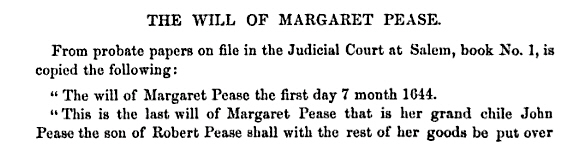
Margaret Pease Will 1644 – 1 From: A genealogical and historical record of the descendants of John Pease, Senior  by Rev. David Pease and Austin Pease 1869
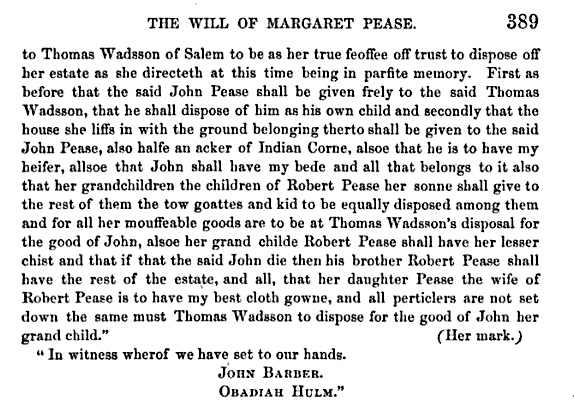
Margaret Pease Will 1644 – 2
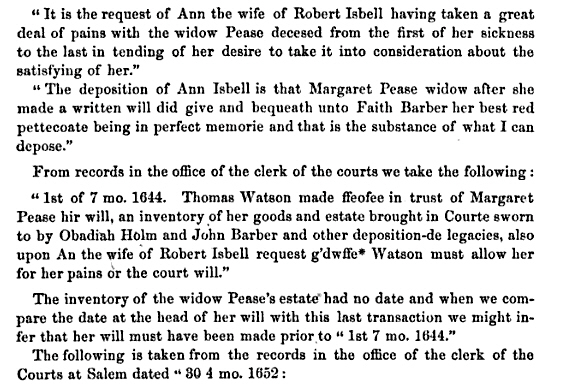
Margaret Pease Will 1644 – 3
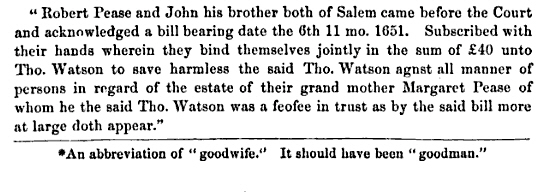
Margaret Pease Will 1644 – 4

Children

6. Elizabeth Pease

Elizabeth’s husband Abraham Page was born 1590 in Great Baddow, Essex, England.   His parents were Isaac Page and Sarah Vincent.  Abraham died in 1628 in Chelmsford, Essex, England

A son of Elizabeth and Abraham came to Salem, Massachusetts.

9. John Pease

John’s first wife Lucy Weston  was born 1610 in England.  She was the daughter of Margaret, and step daughter of Margaret’s second husband, Francis Weston, who d. Jun 05, 1645 in Dorchester, MA.  Lucy died Oct 1643 in Salem, Essex, Mass..

John’s second wife Mary Browning was born in 1625 in England. Her parents were Malachi Browning (1600 – 1653) and Mary Collier (1604 – 1672). Malachai was the owner of a large book shop in Boston.  After John died, she married Jun 03, 1689, as his second wife, Thomas Creber; d. 1695. On the day of her marriage, Mary disposed of her interests in the estate of John Pease, and moved to Portsmouth, New Hampshire. Thomas was master of the ketch John and Mary, engaged in the coastwise trade. Mary died in 1695 in Portsmouth, Rockingham, New Hampshire.

Francis Weston was an early leader of the colony that came to America with the Winthrop fleet.  Francis Weston was in Plymouth only a short time before he moved to Salem.  He became a freeman of Salem on November 5, 1633. He was a deputy of the court, and owned 125 acres of land “in the direction of West Peabody.”

Weston’s religious beliefs along with Roger Williams, had them banished from Salem to Rhode Island on Mar 12, 1638. He was a proprietor of Providence, Rhode Island, in 1638, and removed to Warwick, Rhode Island, in 1642.

On Mar 03, 1643, Francis was brought back, and confined to a jail in Dorchester for heresy. Weston was a follower of religious radical Samuel Gorton, and in 1643 was held in Dorchester,“to be set on work, & wear such bolts or irons as may hinder his escape.” He died there after being confined for two years.

Samuel Gorton (1593–1677), was an early settler and civic leader of the Colony of Rhode Island and Providence Plantations and President of the towns of Providence and Warwick for one term. Having strong religious beliefs that were contrary to the established Puritan dogma and being very outspoken, he was frequently in trouble with the civil and church authorities in the New England colonies.

Gorton was a man of intense individualism who, according to Bicknell, recognized three pillars of power: “God, the Supreme One; the King, his vicegerent, and himself, the individual man. Between these he recognized no medium of interposition. The freedom of the individual was only limited by the express will of God or the King.”  In this context, his actions can be better understood. He was never punished for anything other than his opinions.  He and his followers held that “by union with Christ believers partook of the perfection of God, that Christ is both human and divine, and that Heaven and Hell exist only in the mind.”

Groton emigrated from England, settling first in Plymouth Colony where he was soon ousted for his religious opinions and his demeanor towards the magistrates and ministers. Settling next in Portsmouth, Rhode Island, he met with a similar fate, being whipped for his insubordination towards the magistrates. He next went to Providence, where he once again met with adverse circumstances until he and a group of others purchased land of the Indians, settling south of the Pawtuxet River in an area they called Shawomet, later named Warwick. Refusing to answer a summons following the complaints of two Indian sachems about being unfairly treated in a land transaction, Gorton and several of his followers were forcefully taken away to Massachusetts. Being tried for his beliefs and writings, rather than the original supposed infraction, Gorton was sentenced to prison in Charlestown, though all but three of the presideing magistrates voted to give him a death sentence.

The turbulence of his earlier history was the result of a disregard for existing law, because it was not based upon what he held to be the only legitimate source of power–the assent of the supreme authority in England. He denied the right of a people to self-government, and contended for his views with the vigor of an unrivalled intellect and the strength of an ungoverned passion.

He soon had differences of opinion on religion with his landlord, and in December 1638 he was summoned to court based on the latter’s complaints. In court Gorton “carried himself so mutinously and seditiously” towards both magistrates and ministers that he was sentenced to find sureties for his good behavior during the remainder of his tenure in Plymouth, and given 14 days to be gone from the colony. He left Plymouth shortly, and was in Portsmouth on Aquidneck Island (later named Rhode Island) where on the last day of April 1639 he and 28 others signed a compact calling themselves subjects of King Charles and forming a “civil body politick.”

Things did not go any better for Gorton in Portsmouth than they had in Plymouth. In 1640 his servant maid assaulted a woman whose cow had trespassed on his land, and this servant was ordered to court. Gorton refused to allow her to appear, and he went in her place. With his hostile attitude towards the judges, he was indicted on 14 counts, some of which were calling the magistrates “Just Asses,” calling a freeman in open court “saucy boy and Jack-an-Apes,” and when Governor Coddington said, “all you that own the King take away Gorton and carry him to prison” Gorton replied, “all you that own the King take away Coddington and carry him to prison.” Since he had previously been imprisoned, he was sentenced to be whipped, and soon left Portsmouth for Providence.

File:Samuel Gorton trial.jpg

19th century depiction of Samuel Gorton on trial in Portsmouth., Rhode Island

After a few months Gorton was released from confinement, but banished from Massachusetts and his home settlement of Shawomet, which was claimed by Massachusetts. He and several of his followers soon sailed to England where he spent four years, writing and publishing a book about his Shawomet experience, but more importantly obtaining an official order of protection for his colony from the Earl of Warwick. Once back in New England, with his settlement of Shawomet (now called Warwick) secure, Gorton became a part of the civil authority that he had previously rejected, serving as assistant to the president, commissioner, deputy, and president of the two towns of Providence and Warwick. He served in civic roles over a period of 20 years until he was in his late 70s.

Mrs. Margaret Weston, in Jun 1637, was sued with her husband by William Pester for defamation. She accused the pastors of the church of hypocrisy, and was in turn accused of disorderly carriage by the church. On Jun 05, 1638, she was sentenced by the General Court to be set in the bilboes, two hours in Boston, and two hours in Salem upon a lecture day. She was also a follower of Samuel Gorton, whose religious beliefs differed with those of the authorities, and was also banished to Rhode Island. She later became “of hopelessly unsound mind.”

John lived a troubled life. Emmigrating to Salem at the age of 27, he married into the Weston family, which was embroiled with the local authorities over theology. His father in law was banished and later died in prison for his heretical teachings. His mother in law went mad and his wife, faced with arrest, was forced to recant shortly before she died.

In 1644, the year his father-in-law was banished, his mother and brother died and John Pease sold his property in Salem and ‘fled’ to Martha’s Vineyard, becoming one of the original settlers. There he remarried and peaceably raised a second family until he joined in the rebellion against the autocratic rule of Governor Thomas Mayhew in 1673.

When the Dutch temporarily recaptured New York in 1673, open rebellion broke out and lasted until the English re-won New York and restored the authority of the Mayhews on the island. The old patriarch died in 1682 at eight-nine. Nine years later the political rule of the family ended when Martha’s Vineyard was annexed by Massachusetts after the Glorious Revolution in England, but the problem of manorial tenancy remained. Some of the Mayhews clung to the “pleasant fiction” of their manorial rights almost until the American Revolution and received token quit rents as late as 1732. Feudalism lingered on Martha’s Vineyard much longer than the rest of the colonies.

In the wake of reprisals by the Governor following his reestablishment of authority, John Pease left Martha’s Vineyard for the mainland, probably for Portsmouth, NH, although it is not known for sure when or where he died.

There is a traditional story with variations of John Pease as follows: About seven to ten years before the 1641 purchase of the islands of Martha’s Vineyard and Nantucket by Thomas Mayhew of Watertown, MA, a vessel from England on the way to Carolina landed on the island. (Another account was that the boat was headed for Port Penn in the Delaware). The boat anchored at what is now known as Starbuck’s Neck near the present site of Edgartown. John Pease, a passenger of the vessel, was in the British Military, and was wearing his uniform which consisted of the traditional red coat. A band of Indians greeted the landing party, and Pease, as a sign of peace, offered the Chief, his coat. The Sachem was so grateful, he offered the new arrivals, a large section of land which now includes Edgartown. While the rest of the passengers continued south, John Pease, William Vinson, Thomas Trapp and Malachi Browning decided to settle on Martha’s Vineyard, and built caves for the first winter in a place called Green Hollow. As the settlement grew, and more settlers arrived, John Pease kept all transactions, including the original gift of the land in a book, known as the “Black Book” because of the color of it’s cover. When John died, two men went into his house, and stole the book, never to be seen again. The present day town records of Edgartown in preserved books contain dates before the record keeper transcribed them. It is supposed that some of these events were copied from the “Black Book” before it was destroyed. Without the records in the book, the Pease family lost the titles to their land. In 1853, George Cleveland, a farmer was tilling his land, and came upon the ruins of three separate underground rooms that were large enough for living quarters. The ruins were a short distance from the center of Edgartown, and near a road which is now called Pease’s Point Way. These sites were supposedly the caves that those mentioned above spent the first winter in.

The legend can almost certainly be proven not true because of the dates of the “landing party”. Port Penn did not come into existence until after 1682; the early Pease family did not dispute any land claims with any other settler of the island; John Pease himself was in Salem from 1634 until at least 1644, although he may have visited the island after settling in Salem; and there is no evidence that he was in the British military. The earliest settlers of most areas probably did spend at least their first few months in caves or crude shelters, as building lumber was not an available commodity. There were pageants on Martha’s Vineyard with scenes of early settler stories put on display by contemporary actors. The “Red Coat” story was one of more popular acts.

Timeline

3 Nov 1635, Salem court record: “Ordered that John Pease shalbe whipt and bound to his good behaviour for strikeing his mother [in law] Mrs. Weston & deryding of her & for dyvers other misdemeanors & other evell carriages” (Mass. Col. Records, I, 155) Weston’s fanatic beliefs, and carrying on must have been too much for her son-in-law, as it appears he took matters into his own hands

1637, Salem: mentioned as having land in the early Salem Town Record. “Robert Pease and his brother”

23 April 1638, Salem: granted “five acres of land next adjoining to Samuell Cominge neer unto the watermill”

18 June 1644, Salem: sold his house and 75 acres of land to his neighbor, Richard Ingersoll. //His father in law being arrested in 1643, his wife arrested and/or recanting her ‘heretical views’, his mother and brother dying in 1644, all make his removal to Martha’s Vineyard in 1645 understandable

23 March 1646/47 –  Edgartown: sold ten acres of land at Mattakeeset to John Bland. On Martha’s Vineyard, John owned a house lot of ten acres of upland and two acres of meadow at the north end of the town of Great Harbor. When the home lots were distributed, he drew the first in present day Edgartown at a place now known as Pease’s Point, and a street to the south of this land is Pease Point Way.

After the sale of his Mattakeeset property in 1647 to John Bland, he moved to Norwich, CT, where he purchased land that he retained until his death, bequeathing it to John Junior. His home lot was bequeathed to son Thomas.  John was one of the founders of Norwich.
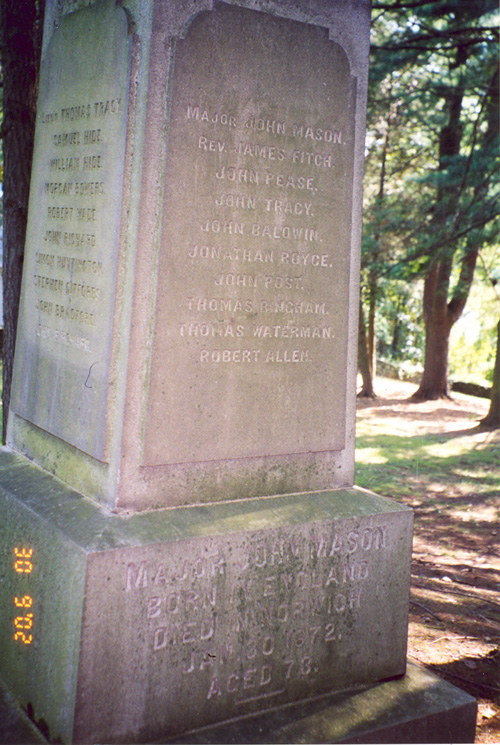
Founder’s Stone Norwich CT

NORWICH, MASSACHUSETTS
Norwich was settled in 1660. Most of these original proprietors of Norwich came from Saybrook, and East Saybrook (now Lyme). The 35 original proprietors of that town were:

Reverend James FITCH, the first minister
Major John MASON, afterwards Lieut. Gov. of Connecticut
Lieut. Thomas Leflingwell
Lieut. Thomas Tracy and
his eldest son John Tracy
Deacon Thomas Adgate
Christopher Huntington and
his brother, Deacon Simon Huntington
Ensign Thomas Waterman
William Hyde and
his son Samuel Hyde, and
his son-in-law John Post
Thomas Post
Lieut. William Backus and
his brother Stephen Backus
Deacon Hugh Calkins (from New London, CT, and
his son John Calkins (from New London, CT) and
his son-in-law Jonathan Royce (from New London, CT)
John REYNOLDS
Thomas Bliss
Francis Griswold
John Birchard
Robert Wade
Morgan Bowers
John Gager (from New London, CT)
Thomas Howard
Dr. John Olmstead
Nehemiah SMITH (from New London, CT)
Richard Edgerton
John Elderkin
John Bradford (from Marshfield, MA)
Thomas Bingham
Robert Allen (from New London, CT)
John Baldwin
John Pease (Son of  Robert PEASE Sr.) (from New London, CT and Edgartown)
Thomas Smith (from Marshfield, MA)

1650, New London, CT – Evidently involved in land transactions here. Probable that in these years he was involved in some land transactions in Connecticut before returning to the Vineyard.  John Senior returned to the island before Mar 05, 1653 when he was involved in a land suit. On Nov 07, 1653, he was elected constable, and served on a jury Sep 25, 1677.  Little record of him in the next twenty years, although he acquired a good deal of land and scattered lots on the Vineyard. Evidently lived first at Mattakeeset and then on the first lot of the Five and Twenty, situated at the north end of town at the place ever since known as Pease’s Point (land which eventually was sold to Hannah Mayhew Daggett in 1692)

4 March 1674: will (Dukes Deeds, I, 340) Evidently left the island following the dispute with Governor Mayhew. Not known when or where he died, but it is highly likely it was at Portsmouth, NH, as that is where his widow remarried. He died sometime between Sept. 1677 and June 3, 1689, when his widow disposed of her interests in his estate.

His will is dated Mar 04, 1674. Excerpts: “…me John Peas, husbandman and inhabitant uppon Martins Vineyard…being now in some measure in good health…am stricken in years and Crasy in respect of what formerly … give to my Eldest Son James Peas twelve pence…my second son John Peas…all that was given to me at Mohegin, with that frame of a house…(to the rest of the children)…all my landes and houseing that I have upon this land Martins Vineyard to be either equally devided or valued or sold or exchanged and the price thereof Equally devided to everyone of them…my now living wife Mary shall see meet whome I make my full and whole Executrix… and I give unto Mary Peas my wife all my cattle of every sort with all my household goodes whatsoever… in witness hereunto my hand and seal. ” The will was witnessed by Thomas Birchard, Kathrin Birchard, and Thomas Trappe.

Sources: Ancestry.com http://www.spicerweb.org/genealogy/pease/peaseregisterlegacy.aspx#c6002 Genealogical and family history of southern New York and the Hudson River Valley : a record of the achievements of her people in the making of a commonwealth and the building of a nation (1914) By: Reynolds, Cuyler, 1866-1934

A genealogical and historical record of the descendants of John Pease, Senior  by Rev. David Pease and Austin Pease 1869

http://peasesawyer.com/Pease/PeaseDescendants.html

http://history.vineyard.net/pease.htm
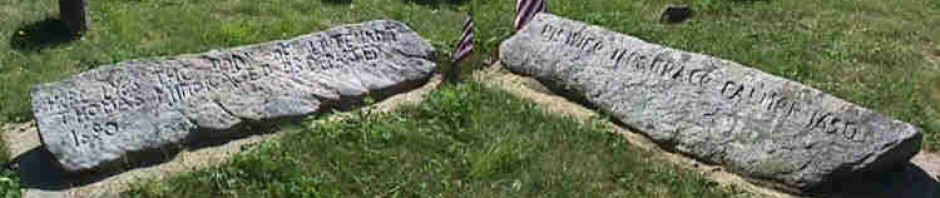
Posted in 14th Generation, Dissenter, Immigrant - England, Line - Miner, Place Names | Tagged , , , | 9 Comments