James Davis

James DAVIS (1583 – 1679)  was Alex’s 11th Great Grandfather; one of 4,096 in this generation of the Miller line.

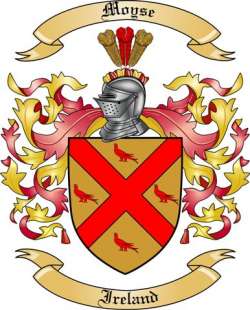
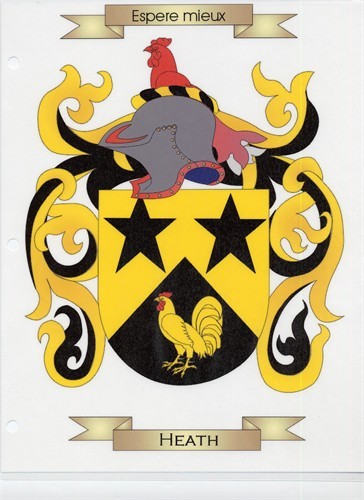
James Davis - Coat of Arms

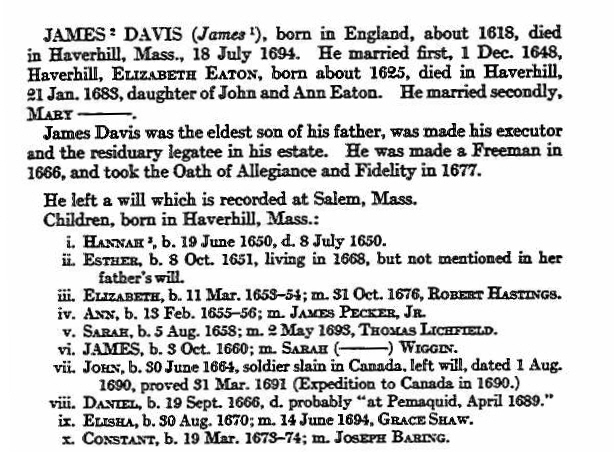
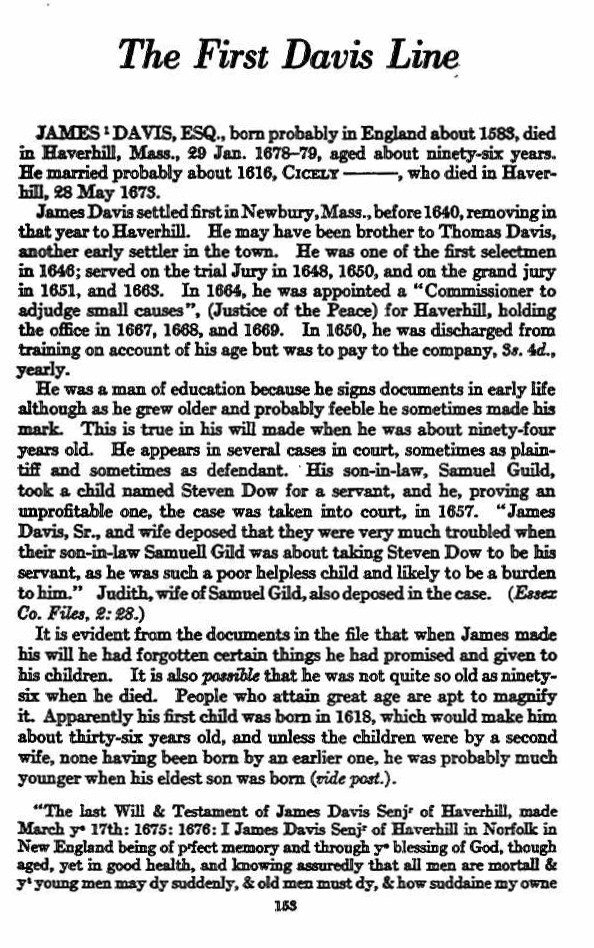
James Davis was born in 1583 in Marlborough, Wiltshire, England. His parents were John DAVYS and Agnes SAMON. He married Cicely THAYER 11 Jun 1618 in Thornbury, Gloucestershire, England. The marriage is recorded in the records of St. Mary Parish, “James Davisse to Sysley Tayer, at Gloucester.”  James died 29 Jan 1679 in Haverhill, Essex, Mass.

James brother Thomas Davis also immigrated,  He was born in 1585 in Marlborough, Wiltshire, England and died 27 Jul 1683 in Essex, Mass

Cicely Thayer was born 1 May 1600 in Thornbury, Gloucestershire, England.   The genealogical research on Cicely was in error for many years because her name was misread as “Evelyn” in the will of her father. Her name was actually spelled “Cicelye” in her father’s will and was spelled “Sicely Tayer” on the baptismal records in England.  Her parents were Edward THAYER and Joan LAWRENCE. Cicely died 28 May 1673 in Haverhill, Essex, Mass.

Children of James and Cicely:

Name Born Married Departed
1. James Davis 4 Jul 1619
Marlborough, England
Elizabeth Eaton
1 Dec 1648
1685
2. John DAVIS 28 Jan 1621
Thornbury,  Gloucestershire, England.
Jane PEASLEE
10 Dec 1646
Haverhill, Mass
18 Jul 1694 Haverhill, Essex, Mass.
3. Sarah Davis 23 Dec 1623 Died Young
4. Judith Davis 1625 Samuel Gile
1 Sep 1647
Haverhill 
May 1667
5. Samuel Davis 26 Nov 1640
Haverhill, Mass
Deborah Barnes (Daughter of our ancestor William BARNES)
17 Dec 1663 Haverhill
10 Sep 1696
Haverhill
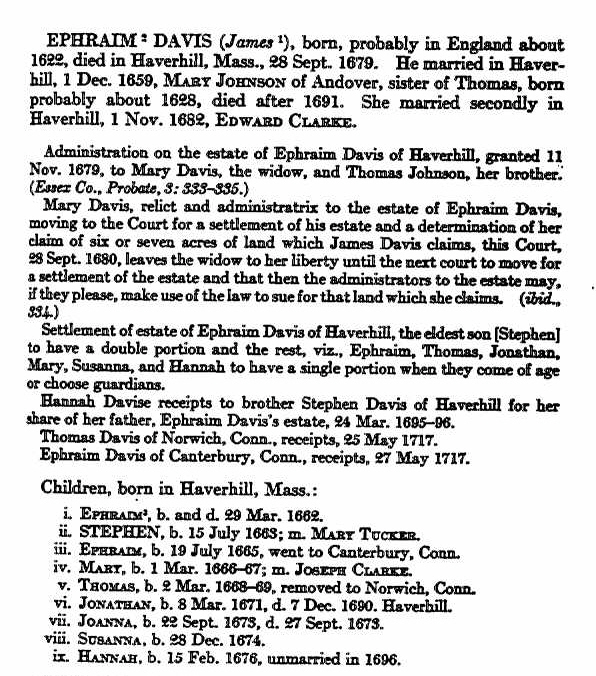
6. Ephraim Davis c. 1641 Mary Johnson
31 Dec 1659 Haverhill
28 Sep 1679
Haverhill
7. Sarah Davis 1643
Haverhill
John Page
18 Jun 1663 Haverhill
7 Jun 1714
Haverhill

James came to New England as early as 1634 and was one of the original settlers of Hampton, 1638. Removed to Haverhill, 1646, being one of the twelve who petitioned the General Court for authority to settle at Pentucket where they founded the present city of Haverhill, Mass.

James was made a freeman in Newbury, Essex, MA, 4 Mar 1634/35 and lived in Hampton, Rockingham, NH, in 1639, before settling in Haverhill, Essex, MA, in 1640. He was one of the original 12 settlers. James, along with his brother, Thomas, was one of the first five selectmen, chosen in 1646. He was awarded 20 acres of “accommodation” land in 1667, as was his son, James Davis Jr. His will was dated Mar. 17, 1675/76, with a codicil dated July 22, 1678.

Oct 1638 – The reverend Stephen BACHILER and his company, who had received permission from the general court when united together by church covenant, commenced a settlement at Winicowett. He was at this time residing in Newbury. On Mr. Rawson’s request, the place was called Hampton. The following persons, residents of Newbury, went with Mr. Bachiler. John Berry, Thomas COLEMAN, Thomas Cromwell [Giles CROMWELL‘s brother], James DAVIS, William Easton, William Fifield, Maurice Hobbs, Mr. Christopher Hussey [BACHILER’s son-in-law], Thomas Jones, Thomas Marston, William Marston, Robert Marston, John Moulton, Thomas Moulton, William Palmer, William SARGENT, and Thomas Smith. Smith, however, soon returned to Newbury. A few went to Salisbury.

First called the Plantation of Winnacunnet, Hampton was one of four original New Hampshire townships chartered by the General Court of Massachusetts, which then held authority over the colony. “Winnacunnet” is an Algonquian Abenaki word meaning “pleasant pines” and is the name of the town’s high school.

In March 1635, Richard Dummer and John Spencer of the Byfield section in Newbury, came round in their shallop, came ashore at the landing and were much impressed by the location. Dummer, who was a member of the General Court, got that body to lay its claim to the section and plan a plantation here. The Massachusetts General Court of March 3, 1636 ordered that Dummer and Spencer be given power to “To presse men to build there a Bound house”.

The town was settled in 1638 by a group of parishioners led by Reverend Stephen Bachiler, who had formerly preached at the settlement’s namesake:Hampton, England.  Incorporated in 1639, the township once included SeabrookKensingtonDanvilleKingstonEast KingstonSandownNorth Hampton and Hampton Falls.

James with twelve others, under the lead of Rev. John Ward, secured a grant from the government and settled what is now Haverhill ; they went there in 1640. Samuel Gile, who seven years later became his son-in-law, was among the twelve. They went about clearing the woods off and making a settlement. In 1642 they bought out the rights of the Indians to the land, and Thomas Davis, a brother of James, was one of the witnesses to the deed. This Thomas was a sawyer and came from Marlborough, England, soon after James did. James must have been a man of considerable wealth for those times, for in 1643 he was one of three in the settlement that were worth over £200*, and in 1646 James Davis paid the largest tax. When the town elected its first selectmen in 1646 they were: James Davis, Thomas Davis, Thomas Hale, Henry Palmer and William White. In 1645 there were thirty-two land-holders in the town, and James Davis, James Davis Jr. and John Davis were among them; also John Eaton and Joseph Peasley, whose daughters married James Jr. and John Davis. The first meeting house was built in 1646, and “Thomas Davis was given £2, to ground-pin and daub it. He to provide the stone and clay.

* In 1650 a law was passed that forbid any person whose estate did not exceed £200 from wearing any gold or silver lace or buttons, silk hoods, ribbons or scarfs, under penalty of 10 shillings.

In the second division of land, made in 1652, James Davis had 10 acres, James Davis Jr. 10 acres, John Davis 6 acres, Thomas Davis 8 acres, John Eaton 10 acres.His wife was Cicely or Sissilla . His wife and three of the children must have come over with him, for James, John and Judith were born before his arrival in this country. He died 29 Jan., 1678/79, and left a will which was proven in 1680. His wife died 28 May 1673, at Haverhill.

Witch Trials

James Davis Sr. and his son Ephraim signed a paper presented to Ipswich Court, February, 1658, against John Godfrey, accusing him of witchcraft.  In 1658 when the subject of witchcraft first came to his attention, he came down decidedly against the concept. When John Godfrey was charged with injuring the wife of Job Tyler by “Satanic acts,” Francis Dane judged against the probability

John Godfrey Was Tried 3 Times For Witchcraft – 1658, 1665 & 1669, Each time he was acquitted.   Prior to the Salem witchcraft trials, only five executions on the charge of witchcraft are known to have occurred in Massachusetts.  Such trials were held periodically, but the outcomes generally favored the accused.   A bad reputation in the community combined with the accusation of witchcraft did not necessarily insure conviction.  The case against John Godfrey of Andover, a notorious character consistently involved in litigation, was dismissed.  In fact, soon after the proceedings, Godfrey sued his accusers for defamation and slander and won the case.

Yet another accusation of witchcraft surfaced in 1680, this time involving John  but focusing on a Rachel Fuller , their neighbor in Hampton, New Hampshire who was accused of killing John’s infant son by witchcraft.

John Godfrey arrived in New England in 1634 and from then on, was a transient resident of several Essex County towns, including Haverhill, Newbury, Andover, Ipswich and Salem. He had a local reputation for his feats of strength, boastfulness, sleight of hand and claims of occult powers. He was first tried as a witch in June, 1659, in Andover, when Haverhill and Andover residents claimed they had suffered “losses in their persons and estates, which came not from natural causes but from ill-disposed person, who they affirmed was John Godfrey”. He was acquitted.

From 1658 to his death, John Godfrey was in court at least once a year and in some years many times. As suit and counter-suit piled on top of each other, his record of legal actions became extraordinary, even by the standards of a highly litigious society.  I don’t think the depositions of James DAVIS and son Ephraim still survive , but here is the gist of the 1658 case.

The Tyler Family and The Salem Witchcraft Trials By Bruce M. Tyler Ph.D. October 1997

John Godfrey was not a nice man. He apparently was a roving herdsman who demanded jobs and threatened people when he did not get them. He also caused accidents to happen to these animals, but was never caught doing it. He was also accused of arson, suborning witnesses and theft.

He did not limit his activities to extra legal and illegal acts. He also liked to sue people. He usually won, but that did not stop other people from suing him.

While most of these suits involved property, in the spring of 1658 Godfrey sued Abraham Whitaker of Haverhill for debt. In the next few months a number of interrelated cases began that included other people in Haverhill and Job Tyler. In 1659 the court decided the cases in favor of Godfrey. Immediately he was accused of witchcraft.

“The deposition of Job Tyler aged about 40 years, Mary his wife, Moses Tyler his son aged between 17 and 18 years and Mary Tyler about 15 years old. These deponents witness, that they saw a thing like a bird to come in at the door of their house, with John Godfrey, in the night, about the bigness of a blackbird, or rather bigger, to wit, as big as a pigeon and did fly about, John Godfrey laboring to catch it and the bird vanished as they conceived through the chink of a jointed board, and being asked by the man of the house wherefore it came, he answered it came to suck your wife.” All of that implied that John Godfrey was a witch since witches were (according to Massachusetts Bay law) usually accompanied by “familiars,” birds or animals that traditionally liked to suck on people.

We can only wonder why Godfrey was not able to control his familiar if he was indeed a witch. Perhaps when the door opened and the bird flew in, Godfrey tried to catch it. The bird, realizing the jam it was in, was able to get out through a hole in the wall .

The various depositions seemed to work. Godfrey was apparently indicted and tried for witchcraft. He seems to have been acquitted, though he did spend some time in Ipswich jail. When he got out he countersued for slander

In 1661 John Godfrey sued Job Tyler for debt. He said that Job owed him for 27 days labor on Tyler’s farm, along with running errands and for back loans. Job countersued, saying that there were debts on Godfrey’s side as well.

Moses Tyler’s deposition spells it out: “Moses Tyler deposed that his mother dressed John Godfrey and washed his clothes about twenty weeks in one year, and that his father found Godfrey’s diet for eleven weeks, which was never satisfied” . The Tylers lost their suit and all their property in Andover. Part of that loss, though, was the result of Job’s house burning down (Essex County, 4:404, June 1662). Did John Godfrey play a role in that?

From this it looks as if John Godfrey had worked for Job Tyler and had even lived on the Tyler farm after 1659. So it seems that Job and his family had hired and provided board for someone they had accused of being a witch. And they would accuse him again. In 1665 they again introduced their 1659 deposition as part of a witchcraft accusation that Job and John Remington made. The jury acquitted Godfrey reluctantly, saying “We find him not to have the fear of God in his heart. He has made himself suspiciously guilty of witchcraft, but not legally guilty according to law and evidence we received” .

Considering the fact that witchcraft was a capital crime, people in general and Job Tyler in particular, were distinctly casual in their use of that accusation. People accused of witchcraft sometimes countersued for slander or defamation, civil actions.   If accusations of witchcraft regularly made their way to the court system, how many even more casual accusations never made it that far? People in Essex County evidently had a number of reasons for believing others to be witches or for actually accusing them of being witches.

Motives seem to be far ranging, as the various historical theories suggest. Those motives seem to be distinctly personal as well. It looks as if Job was using the accusation of witchcraft to get back from John Godfrey what Job had lost to him in the various civil actions. And Godfrey felt the same way. As part of the 1665 trial Nathan Parker told the court that “John Godfrey came into my house and discussing Job Tyler.   Godfrey said that he could afford to blow on Tyler and not leave him worth a groat.” (A groat is a coin of little value.)

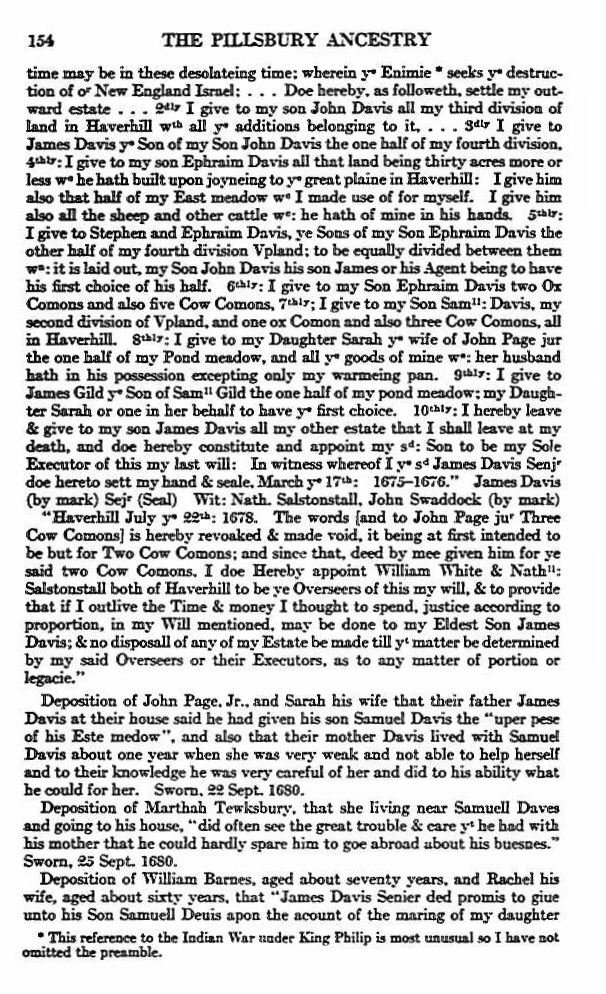
Will

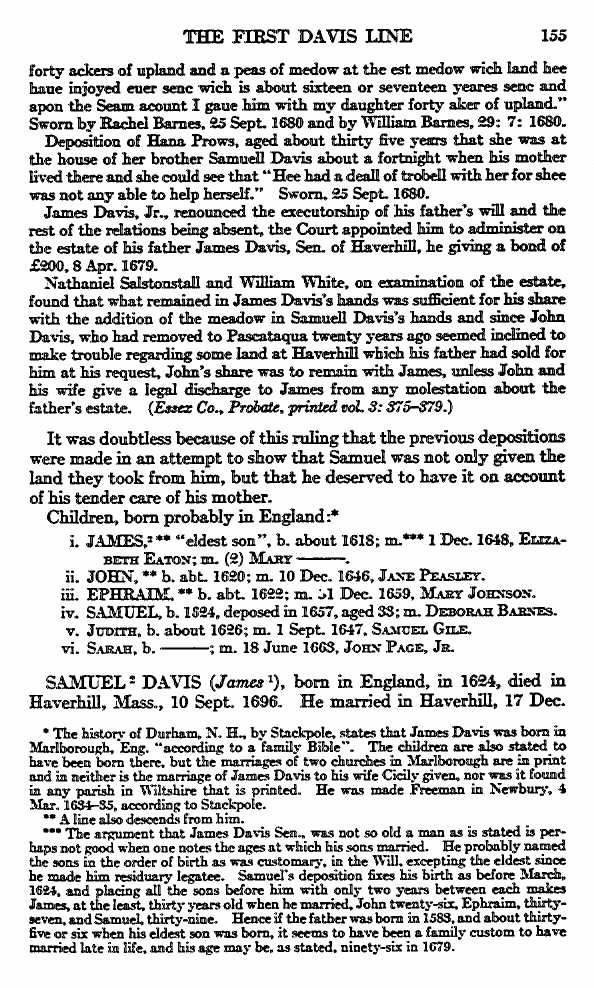
James made his will 17 Mar 1675/76, and it was proved 5 Nov 1680. He gave to son John “my third division of land in Haverhill.”  To James Davis “son of my son John,” one half of “my fourth division of upland in Haverhill.” To son Ephraim Davis thirty acres which “he hath built upon joyneing to ye great plaine in Haverhill;” also the east meadow; also such sheep and cattle as were then in his hands; “two Ox Commons and also five Cow Commons.”  To Stephen and Ephraim, sons of son Ephraim, half of fourth division of upland.  To son Samuel “my second division of upland and one Ox Comon and also three cow Comons all in Haverhill. To daughter Sarah, wife of John Page Jr., one half of my Pond meadow,” and all his goods in possesion of her husband, “excepting only my warmeing pan.”  To Janmes Gild, son of Samuel Gild, one half of pond meadow.  To son James (executor) all other estate.  In a codicil added 22 July 1678, he made Wm. White and Nathaniel Saltonstall both of Haverhill “overseer of this my will” with a special injunction that “If I outlive the — among (you) I thought ot spend, justice, according to proportion in my Will mentioned may be done to my eldest son James before any legacies are paid [The old gentleman’s apparent expectations of the need of interposition were not unrealized. The children pretty generally wanted each a thicker slice of the estate.  Accompanying papers show that John (who is said to have removed “to Pascataqua above twenty years since” had some altercation regarding land of his own which he had once authorized somebody to sell–that a variety of others claimed land which their father, they knew, always intended to give them, and that one claimed handsome share for taking care of his feeble old mother; these little things however, were settled by a peremptory decision against John, a denial of all “intended” gifts except one to Samuel which was proved clearly enough, and by an inherited rebuke to the son who manifested such filial affection to his mother, the affairs were settled in 1680.]

Children

1. James Davis

James’ wife Elizabeth Eaton was born 1625 in Stratford. Warwickshire, England. Her parents were John Eaton and Ann Crossman. Elizabeth died 21 Jan 1683 in Haverhill, Essex, Mass.

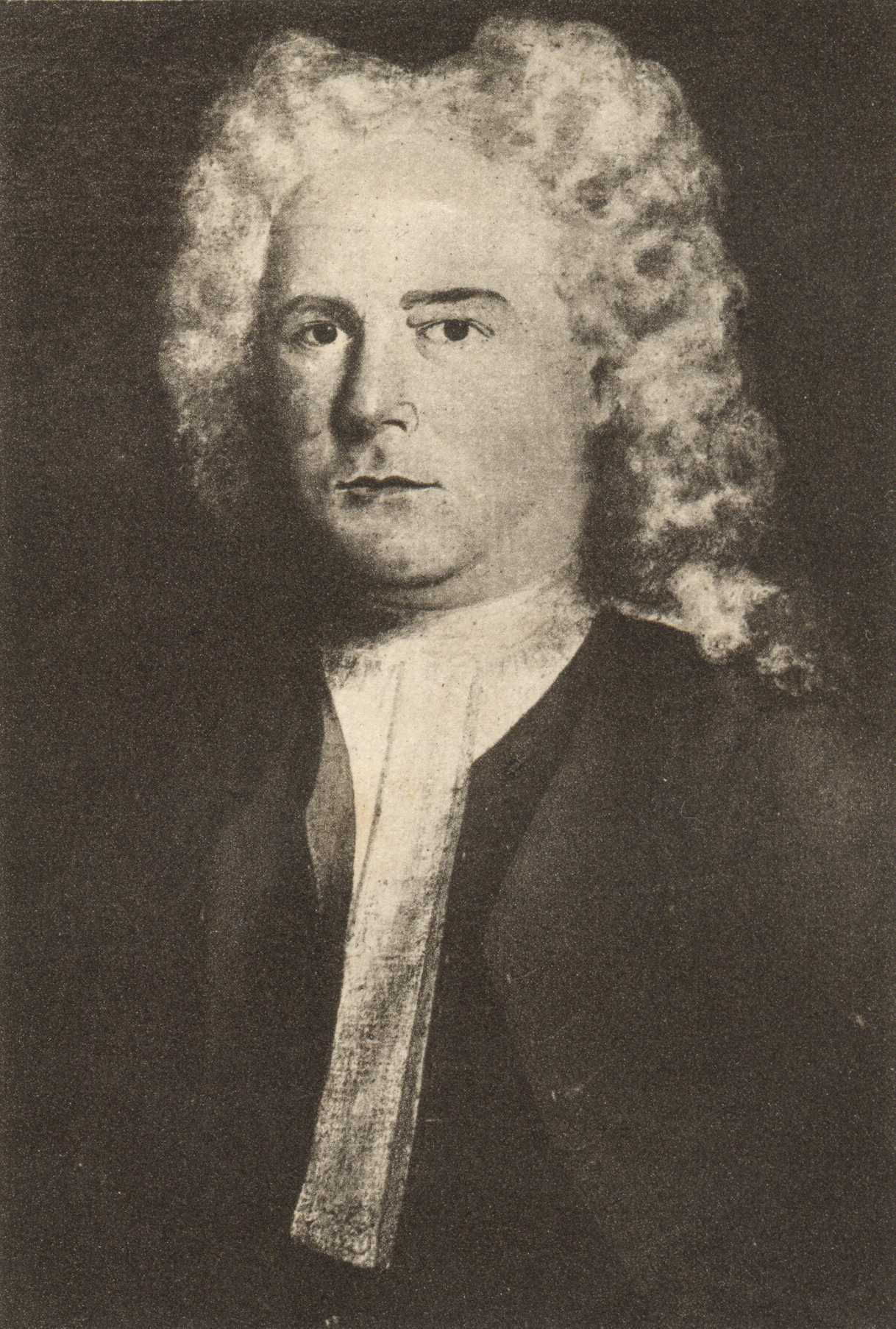
James Davis Jr. -- Source: Ancestry of Charles Stinson Pillsbury and John Sargent Pillsbury (1938)

2. John DAVIS (See his page)

4. Judith Davis

Judith’s husband Samuel Gile (Guile) was born 1620 in England. His parents were [__?__] Guild and Margery Jordan.  Samuel died 21 Feb 1683 in Haverhill, Essex, Mass.

5. Samuel Davis

Samuel’s wife Deborah Barnes was born 1 Apr 1646 in Salisbury, Essex, Mass. Her parents were William BARNES and Rachel LORD. Deborah died 14 Jan 1719 in Haverhill, Essex, Mass.

6. Ephraim Davis

Ephraim’s wife Mary Johnson was born 1638 in Andover, Essex, Mass. Her parents were John Johnson and Susannah [__?__]. Mary died 4 Apr 1679 in Newbury, Essex, Mass.

Ephraim Davis Source: Ancestry of Charles Stinson Pillsbury and John Sargent Pillsbury (1938)

7. Sarah Davis

Sarah’s husband John Page was born 11 Jul 1641 in Hingham, Plymouth, Mass. His parents were John Page and Mary Marsh. John died 27 Jun 1714 in Haverhill, Essex, Mass.

Sources:

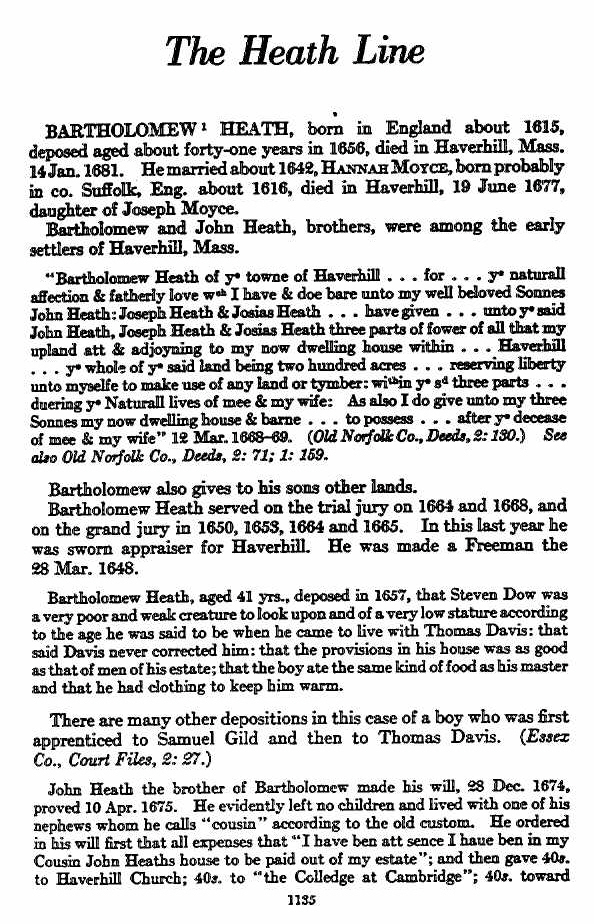
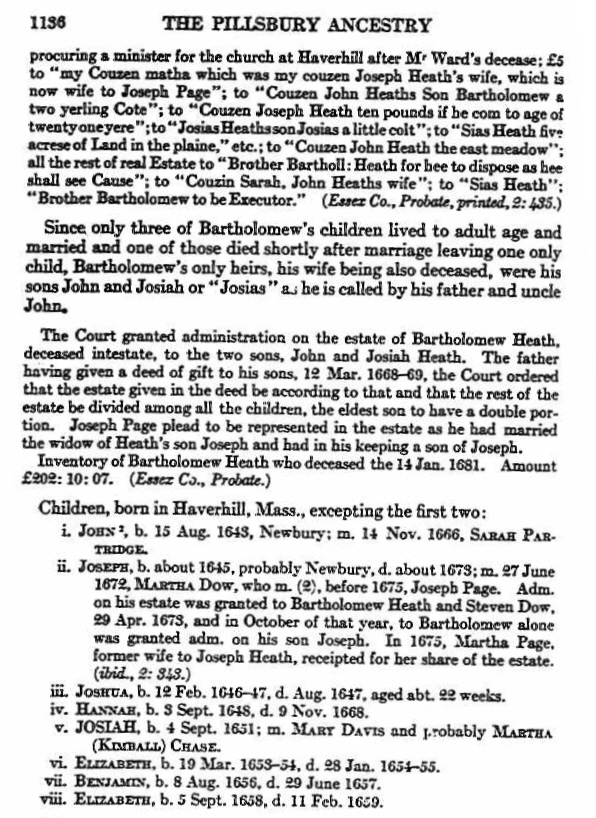
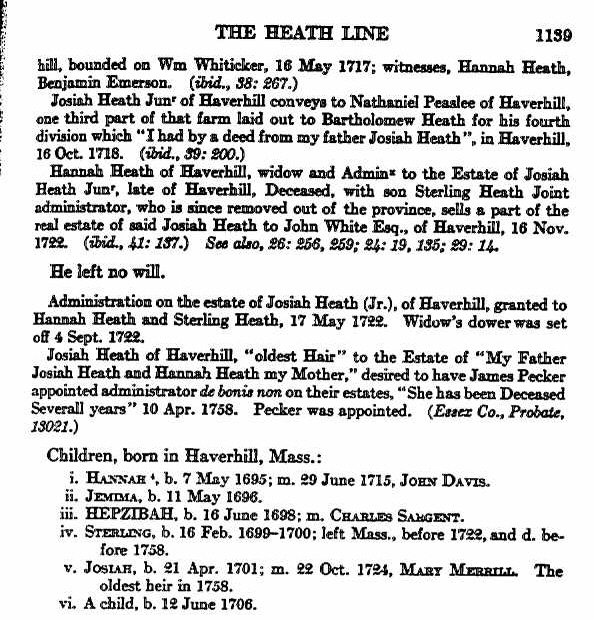
James Davis 1 Source: Ancestry of Charles Stinson Pillsbury and John Sargent Pillsbury (1938)

James Davis 2

James Davis 3

http://trees.ancestry.com/owt/person.aspx?pid=2441864&st=1

http://members.fortunecity.com/dickcoveney/p52.htm#i2857

http://www.accessgenealogy.com/scripts/data/database.cgi?file=Data&report=SingleArticle&ArticleID=0000482

http://jfredpeterson.com/tree/g12davi.htm 

Entertaining Satan: witchcraft and the culture of early New England pg 38 – 56  By John Putnam Demos 1982

Ancestry of Charles Stinson Pillsbury and John Sargent Pillsbury (1938) By Holman, Mary Lovering, 1868-1947; Pillsbury, Helen Pendleton Winston, 1878-1957

Posted in 90+, Immigrant - England, Line - Miller, Pioneer, Public Office, Witch Trials | Tagged , , , | 18 Comments

Ensign John Davis

Ensign John James DAVIS (1621 – 1686)  was Alex’s 10th Great Grandfather; one of 2,048 in this generation of the Miller line.

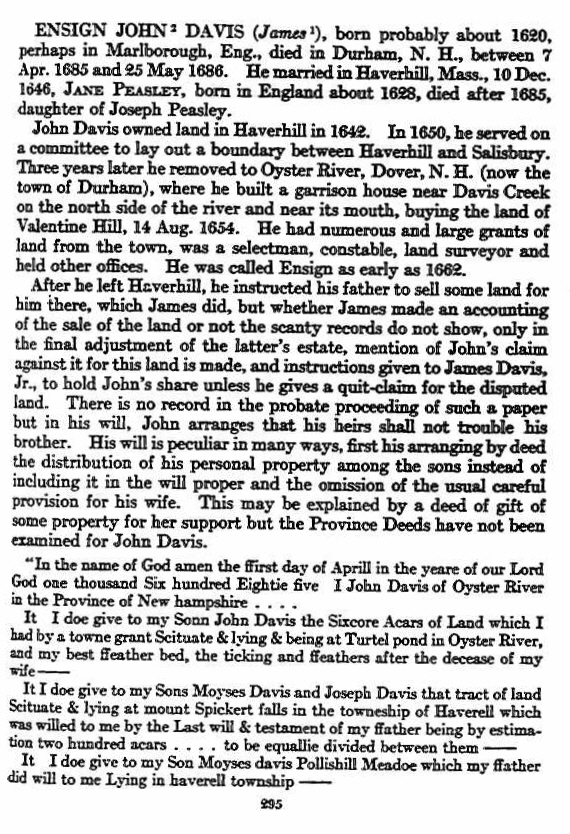
Ensign John James Davis  was born 28 Jan 1621 in Thornbury, Gloucestershire, England. His parents were James DAVIS and Cicely THAYER. He married Jane PEASLEE on 10 Dec 1646 in Haverhill, Mass. Many genealogies say James was killed n 18 Jul 1694, in  Raid on Oyster River Massacre.  John actual died a few years earlier in 1686.  His will was dated 1 Apr 1685 and proved 25 May 1686.

The actual toll to his family is bad enough; daughter Sarah, son John Jr, daughter-in-law Elizabeth, grandson James and grandson Samuel all killed, two to four grandchildren carried off to Canada, one to live for fifty years as a French nun. Another son and grandson were killed by Indians in 1720 and 1724.  For the full story of the raid from French, Indian, English and family persectives, see my post Oyster River Massacre – 1694.

Jane Peasley was born in 1627 in the western part of England, near the river Severn, adjoining Wales.  Her parents were Joseph PEASLEE and Mary JOHNSON. Jane died 12 Jan 1684 in Dover, Norfolk, Mass.

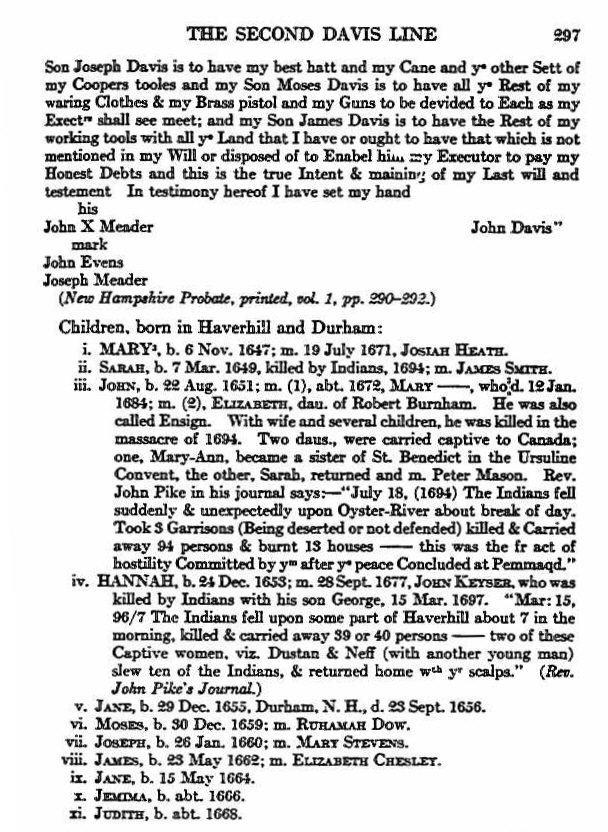
Children of James and Jane:

Name Born Married Departed
1. Mary DAVIS 6 Nov 1647 Barnstable, Barnstable, Mass. Josiah HEATH
19 Jul 1671 Haverhill, Mass
9 Dec 1691
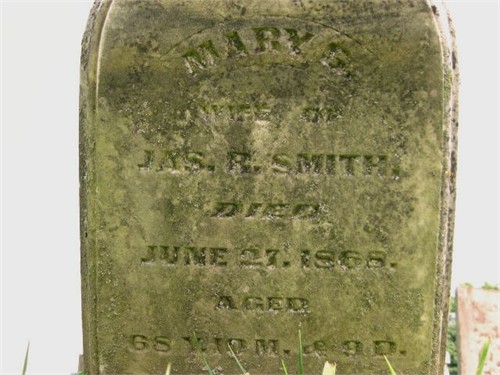
2. Sarah Davis 7 Mar 1649 Haverhill, Essex, Mass James Smith
1672
Haverhill
Killed by Indians
18 Jul 1694 Durham, Stratford, NH
3. John Davis 22 Aug 1651 Haverhill Mary Cilly
1672
.
Elizabeth Burnham
18 Jul 1684 Oyster River, Strafford, NH
Killed by Indians
18 Jul 1694 Haverhill
4. Hannah Davis 24 Dec 1653 Dover, Norfolk, Mass John Keyzar
28 Sep 1677 Haverhill
1719
Haverhill
5. Jane Davis 29 Dec 1655 Dover 23 Sep 1656 Dover
6. Moses Davis 30 Dec 1657 Dover Reuhamah (Ruhamah) Dow
(Daughter of Stephen DOW)
16 Jan 1681 Haverhill
Killed by Indians
10 Jun 1724 Dover, NH
7. Joseph Davis 26 Jan 1660 Dover Mary Stevens
1693
Haverhill
1748
Durham, NH
8. Col. James Davis 23 May 1662 Dover Elizabeth Chesley
1 Oct 1683 Amesbury, Mass
18 Oct 1748 Dover, NH
9 Jemima Davis 1666
Dover
John Barber
1682
.
James Small
Apr 1685
Haverhill
10. Judith Davis 1668
Dover
Samuel Emerson
14 Dec 1687 Haverhill
1743
Durham, NH

Ancestry.com WorldTree shows James Davis, but books published in the 1800’s and 1900’s show John Davis.

In 1650 he was on a committee to lay out a boundary between Haverhill and Salisbury. About 1653 he went to Oyster River,  which later became Durham, NH, where he built his garrison house near Davis Creek, on the north side of the river and near its mouth, on land bought of Valentine Hill, 14 Aug. 1654.  Had numerous grants of land, was selectman seven times, constable, surveyor of lands. Called ensign as early as 1662.

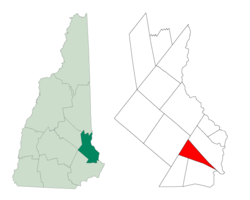
Situated beside Great Bay at the mouth of the Oyster River, Durham was originally called Oyster River Plantation. It was settled in 1635 as a part of Dover

Durham, Stratford, New Hampshire

The town is named after Durham, England, from whence one of its earliest settlers, William HILTON and Edward Hilton. They were two of four sons. Their father had lent Charles of England money and he knew he would never get it back, so he offered to forgive the debt if Charles granted two of his sons land in the New World.

During King William’s War, on July 18, 1694, the English settlement was attacked in the Raid on Oyster River by French career soldier Claude-Sébastien de Villieu with about 250 Abenaki Indians from Norridgewock under command of their sagamore, Bomazeen (or Bomoseen). In all, 45 inhabitants were killed and 49 taken captive, with half the dwellings, including 5 garrisons, burned to the ground.

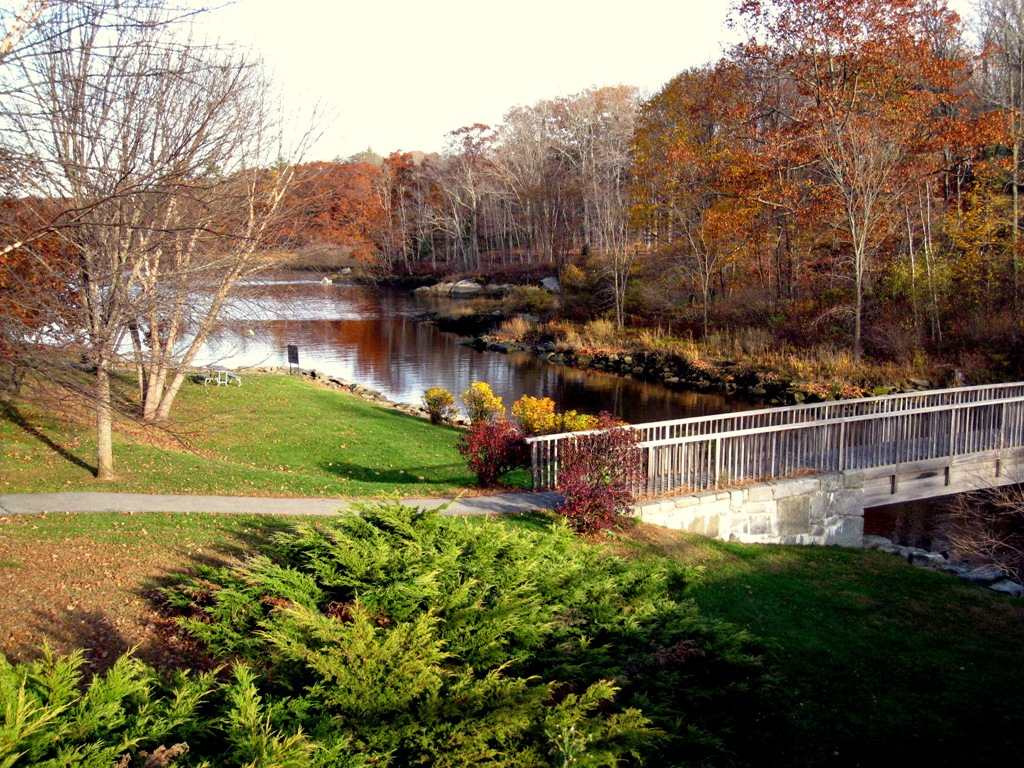
Site of Oyster River Massacre

The community would rebuild, however, and by 1716 Durham was a separate parish. Incorporated in 1732, Durham once included portions of the present-day towns of MadburyLee and Newmarket.  Because of its arable land, the town would develop as a farming community

Dr. Belknap has the details.

The towns of Dover and Exeter being more exposed than Portsmouth or Hampton, suffered the greatest share in the common calamity.

The engagements made by the Indians in the treaty of Pemaquid, might have been performed if they had been left to their own choice. But the French missionaries had been for some years very assiduous in propagating their tenets among them, one of which was ‘’that to break faith with heretics was no sin.’ The Sieur de Villieu, who had distinguished himself in the defence of Quebec when Phips was before it, and had contracted a strong antipathy to the New-Englanders, being then in command at Penobscot, he with M. Thury, the missionary, diverted Madokawando and the other Sachems from complying with their engagements; so that pretences were found for detaining the English captives, who were more in number, and of more consequence than the hostages whom the Indians had given.

The settlement at Oyster river, within the town of Dover, was pitched upon as the most likely place; and it is said that the design of surprising it was publicly talked of at Quebec two months before it was put in execution.

Rumors of Indians lurking in the woods thereabout made some of the people apprehend danger; but no mischief being attempted, they imagined them to be hunting parties, and returned to their security. At length, the necessary preparations being made, Villieu, with a body of two hundred and fifty Indians, collected from the tribes of St. John, Penobscot and Norridgewog, attended by a French Priest, marched for the devoted place.

The enemy approached the place undiscovered, and halted near the falls on Tuesday evening, the seventeenth of July. Here they formed two divisions, one of which was to go on each side of the river and plant themselves in ambush, in small parties, near every house, so as to be ready for the attack at the rising of the sun; and the first gun was to be the signal.

John Dean, whose house stood by the saw-mill at the falls, intending to go from home very early, arose before the dawn of day, and was shot as he came out of his door. This firing, in part, disconcerted their plan; several parties who had some distance to go, had not then arrived at their stations; the people in general were immediately alarmed, some of them had time to make their escape, and others to prepare for their defence. The signal being given, the attack began in all parts where the enemy was ready.

Of the twelve garrisoned houses five were destroyed, viz. Adams’s, Drew’s, Edgerly’s Medar’s and Beard’s. They entered Adams’s without resistance, where they killed fourteen persons ; one of them, being a woman with child, they ripped open. The grave is still to be seen in which they were all buried. Drew surrendered his garrison on the promise of security, but was murdered when he fell into their hands. One of his children, a boy of nine years old, was made to run through a lane of Indians as a mark for them to throw their hatchets at, till they had dispatched him. Edgerly’s was evacuated. The people took to their boat, and one of them was mortally wounded before they got out of reach of the enemy’s shot. Beard’s and Medar’s were also evacuated and the people escaped.

The defenceless houses were nearly all set on fire, the inhabitants being either lulled or taken in them, or else in endeavoring to fly to the garrisons. Some escaped by hiding in the bushes and other secret places. Thomas Edgerly, by concealing himself in his cellar, preserved his house, though twice set on fire. The house of John Buss, the minister, was destroyed, with a valuable library. He was absent; his wife and family fled to the woods and escaped. The wife of John Dean, at whom the first gun was fired, was taken with her daughter, and carried about two miles up the river, where they were left under the care of an old Indian, while the others returned to their bloody work. The Indian complained of a pain in his head, and asked the woman what would be a proper remedy : she answered, occapee, which is the Indian word for rum, of which she knew he had taken a bottle from her house. The remedy being agreeable, he took a large dose and fell asleep ; and she took that opportunity to make her escape, with her child, into the woods, and kept herself concealed till they were gone.

The other seven garrisons, viz. Burnham’s, Bickford’s, Smith’s, Bunker’s, Davis’s, Jones’s and Woodman’s were resolutely and successfully defended. At Burnham’s, the gate was left open : The Indians, ten in number, who were appointed to surprise it, were asleep under the bank of the river, at the time that the alarm was given. A man within, who had been kept awake by the toothache, hearing the first gun, roused the people and secured the gate, just as the Indians, who were awakened by the same noise, were entering. Finding themselves disappointed, they ran to Pitman’s defenceless house, and forced the door at the moment, that he had burst a way through that end of the house which was next to the garrison, to which he with his family, taking advantage of the shade of some trees, it being moonlight, happily escaped.

Still defeated, they attacked the house of John Davis, which after some resistance, he surrendered on terms; but the terms were violated, and the whole family was either killed or made captives. Thomas Bickford preserved his house in a singular manner. It was situated near the river, and surrounded with a palisade. Being alarmed before the enemy had reached the house, he sent off his family in a boat, and then shutting his gate, betook himself alone to the defence of his fortress. Despising alike the promises and threats by which the Indians would have persuaded him to surrender, he kept up a constant fire at them, changing his dress as often as he could, shewing himself with a different cap, hat or coat, and sometimes without either, and giving directions aloud as if he had a number of men with him. Finding their attempt vain, the enemy withdrew, and left him sole master of the house, which he had defended with such admirable address.

Smith’s, Bunker’s and Davis’s garrisons, being seasonably apprised of the danger, were resolutely defended. One Indian was supposed to be killed and another wounded by a shot from Davis’s. Jones’s garrison was beset before day; Captain Jones hearing his dogs bark, and imagining wolves might be near, went out to secure some swine and returned unmolested. He then went up into the flankart and sat on the wall. Discerning the flash of a gun, he dropped backward; the ball entered the place from whence he had withdrawn his legs. The enemy from behind a rock kept firing on the house for some time, and then quitted it. During these transactions, the French priest took possession of the meeting-house, and employed himself in writing on the pulpit with chalk; but the house received no damage.

Those parties of the enemy who were on the south side of the river having completed their destructive work, collected in a field adjoining to Burnham’s garrison, where they insultingly showed their prisoners, and derided the people, thinking themselves out of reach of their shot. A young man from the sentry-box fired at one who was making some indecent signs of defiance, and wounded him in the heel: Him they placed on a horse and carried away. Both divisions then met at the falls, where they had parted the evening before, and proceeded together to Capt. Woodman’s garrison. The ground being uneven, they approached without danger, and from behind a hill kept up a long and severe fire at the hats and caps which the people within held up on sticks above the walls, without any other damage than galling the roof of the house.

At length, apprehending it was time for the people in the neighboring settlements to be collected in pursuit of them, they finally withdrew; having killed and captivated between ninety and an hundred persons, and burned about twenty houses, of which five were garrisons. The main body of them retreated over Winnipiseogee lake, where they divided their prisoners…

John Davis

In 1654 John bought a tract of land on the upper shore of Oyster river, near the mouth, where he erected a garrison and established his family. It is a pleasant spot between two creeks, with Oyster river in front, deep enough in that place to float a man-of-war at high tide—as was proved in the war of 1812—and in full sight of the mouth, where the river pours into the broad Piscataqua. Ensign John Davis was admitted freeman in Boston not long after, and was from 1662 to 1667 one of the “selectmen” of Dover, to which Oyster River then belonged.

He died before May 25, 1686, leaving his homestead to his son James, his youngest son. To his oldest son he makes the following bequest in his will:

” I do give to my son John Davis six score acres of land which I had by a town grant, situate and lying and being at Turtle Pond in Oister river, * and my best feather bed, the ticking and feathers, after the decease of my wife.” He also gives said John his corslet and best cloak, and one-fourth part of his guns.

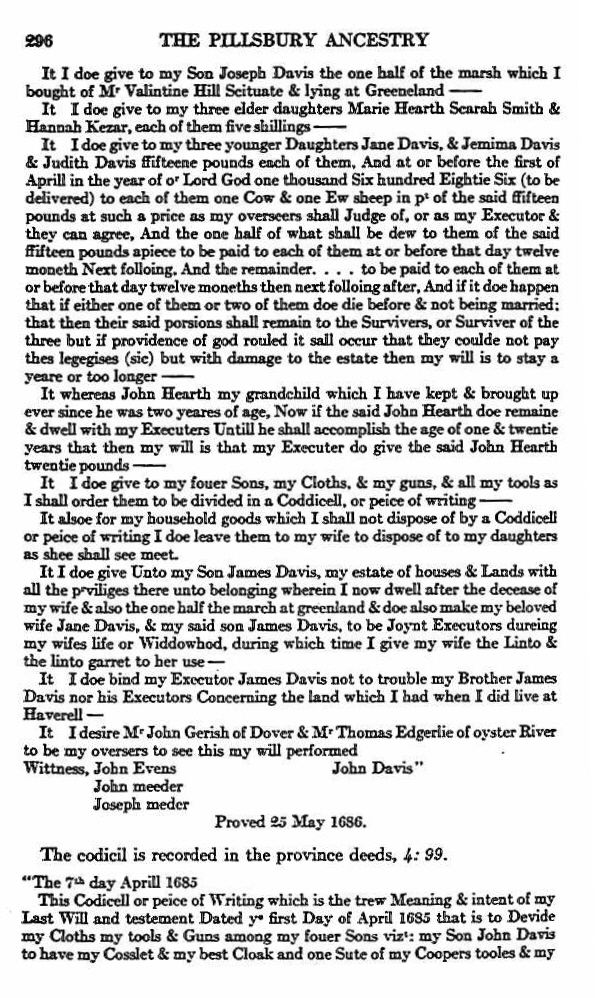
His will was dated 1 April 1685, proved 25 May 1686. He gave property to his child. John, Joseph, Moses, James, Mary (Heath), Sarah (Smith), Hannah (Kezan), Jane, Jemima, Judith; to grandchild John Heath, whom he had kept “from two years.” John Gerrish, Thomas Edgerly, Exeutors. His will states:

“In the name of God, Amen. The first day of April in ye year of our Lord God. One thousand Six hundred Eighty-five, I, John Davis of Oyster River, in the Province of New Hampshire, being of perfect memory (blessed be the Lord for it) and calling to mind the frailty of my nature and the certainty of death, & how soon it shall please God to call me hence, I know not, I do here make my last Will & Testament, revoking & annulling all & every Will or Wills, Testament or Testaments heretofore made, or done either by word or Writing, and this to be taken for my Last will and Testament.  Imprimis, I commit my soul to God who gave it, and my body to ye earth from whence it was taken, & to be decently buried in some covenient place where my Executors hereafter named shall appoint.  And as for my temporal Estate which it hath pleased God to bestow upon me, I do order and dispose of it in manner as followeth.  It my Will is, That all such Debts as I do in reason & conscience ow to any person or persons, be honestly and justly paid in some convenient time after my decease; Then my debts being paid & my funeral charged defraid, what shall remain I do dispose of to wit:

It. I do give to my son John Davis, the Six Score acres of Land which I had by a Town grant, Situate & lying & being at Turtle pond in Oister river; and my best ffeather bed, the Ticking and feathers after the decease of my wife.

It. I do give to my sons Moses Davis & Joseph Davis that Tract of Land situate and lying at Mouth Spcket ffails in the Township of Haverhill, which was while willed to me by the Last Will & Testament of my ffather being by estimation Two hundred acres, be it more or less, to be equally divided between them.

It. I do give my son Moses Davis Policio meadow, which my father did will to me, lying in Haverhill Township.

It. I do give to my son Joseph Davis, the one half of the Marsh which I bought of Mr. Valentine Bill, situate and lying at Greenland.

It. I do give to my three elder Daughters, Mary Heath, Sarah Smith, and Hanra Kezar, each of them ffive shillings.

It. I do give to my three younger daughters Jane Davis & Jemima Davis, and Judith Davis, fifteen pounds each of them, and at or before the first day of April in the year of our Lord God one thousand Six Hundred Eighty Six; to be delivered to each of them one Cow and one Ewe Sheep in part of the said fifteen pounds at such a prcie as my overseers shall judge of; or as my Executors and they can agree; and the one half of what shall be due to them of the said fifteen pounds a peace, to be paid to each of them at or before that day Twelve months next following; and the remainder of the said fifteen pounds to be paid to each of them at or before that day Twelve month the next following after, and if it do happen that if either one of them, or two of them do dye before, & not being married, that then their said Porceons shall remain to ye Survivors, or Survivor of ye three. But if Providence of God should so fall out that they could — damage to ye Estate, then my Will is, to stay a year or two longer.

It. Whereas I John Heart my Grandchild, which I have kept and brought up ever since he was two years of age, now if ye said John Hearth do remain and dwell with my Executors until he shall accomplish ye age of One and twenty years, that then my Will is that my Executor do give the said John Hearth Twenty pounds.

It. I do give to my ffour Sons, my Clothes, & my Guns, & all my Tools, as I shall order them to be divided in a Codicil, or a peace of writing.

It. Also for my Household Goods which I shall not dispose of by a Codicil or a peace of writing, I do leave them to my wife to dispose of to my Daughters, as she shall see meet.

It. I do give my son James Davis my Estate of Houses & lands with all ye privileges thereunto belonging, wherein I now dwell, after the decease of my wife; and also ye one half of ye Marsh at Greenland; & do also make my beloved wife Jane Davis & my sd son James Davis to be joint Executors during my Wife’s life or widowhood; during which time I give my wife the Leanto & yet Leanto Garret to her use.

[etc] Witnesses, John Evans, John Davis, John Meader, Joseph Meader. [Note: in his codicils he distributed his guns, tools and clothing to his various sons]

Children

1. Mary DAVIS (See Josiah HEATH‘s page)

2. Sarah Davis3. John Davis, and 10. Judith Davis

John’s daughter Sarah,  John’s son John Jr., John Jr.’s wife  and two other members of his family were killed by Indians in the Oyster  River Massacre  18 Jul 1694 in Haverhill, Mass.  Two of Sarah’s sons, Two of Sarah’s daughters and two of John Jr.’s daughters were carried as captives to Canada.   Another sister, Judith Davis, wife of Captain Samuel Emerson, was also taken by the Indians and remained in captivity five years.  One of John Jr’s girls, Mary Anne,  became a nun at the Hotel Dieu, Quebec, in 1710, under the name of Sister St. Cecilia. She was taken to Canada by the Rev. Father Vincent Bigot, S.J., who had ransomed her from the Indians at St. Francis. She is mentioned as leading ” a holy life ” for more than fifty years in the religious state. She died in 1761, at the age of seventy-three.

David Davis, who had a garrison at Lubberland (a part of the Oyster River settlement), was killed August 27, 1696.

Davis-Smith Garrison

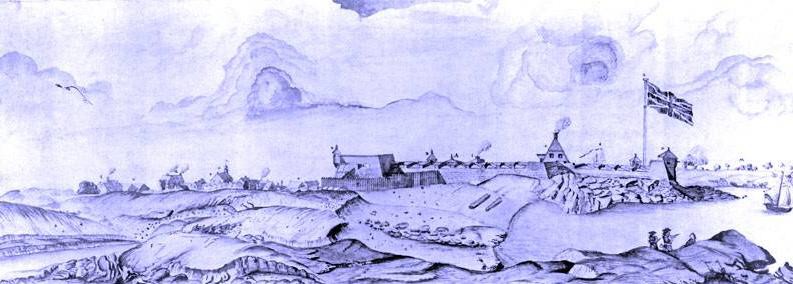
Davis-Smith Garrison –  The drawing of the Davis-Smith garrison in what today is Newmarket is shown in its latter days just before being torn down in 1880. Probably built ca. 1694 by David Davis, it was taken over (and perhaps rebuilt) by John Smith around 1701, after Davis had been killed by Indians.

Strong log houses guarded against Indians whom the settlers mistrusted, but settlers also wanted protection from the French. As early as 1632, New Hampshire began fortifying a point on New Castle against French invasion by sea.

During King William’s War, on July 18, 1694 “Oyster River” was attacked in the Oyster River Massacre by French career soldier Sebastien de Villieu with about 250 Abenaki Indians under command of their sagamore, Bomazeen.  In all, 45 inhabitants were killed and 49 taken captive, with half the dwellings, including 5 garrisons, burned to the ground. Crops were destroyed and livestock killed, causing famine and destitution for survivors. The community would rebuild, and by 1716 Durham was a separate parish, named after Durham, England.

2. Sarah Davis

Sarah’s husband James Smith was born 22 Aug 1651 in Haverhill, Mass. His parents were George Smith and Temperance [__?__].  Sarah and James were killed in King William’s War, James 6 Jul 1690 and Sarah in the Oyster  River Massacre  18 Jul 1694 in Haverhill, Mass. (See above)

Two of Sarah’s sons and two of her daughters were carried as captives to Canada.

Children of Sarah and James:

i. John Smith b. 1676 in Durham, Strafford, New Hampshire; d. ~ 1729; m. Elizabeth Buss. John and Elizabeth had seven children born between 1706 and 1718.

ii. Sarah Smith b. 31 Oct 1679 in Durham, Strafford, New Hampshire; d. 1729; m. 26 Jun 1702 in Eastham, Barnstable, Mass. to Joshua Harding (b. 15 Feb 1675 in Eastham – d. 1711 in Eastham) Joshua’s parents were Joseph Harding (1624 – 1682) and Bethia Cooke (1640 – 1673). Sarah and Joshua had three children born between 1705 and 1711.

iii.  James Smith b. 1681 Durham, Strafford, New Hampshire; d. 18 Jul 1694 Oyster River Massacre, Strafford, New Hampshire

iv. Samuel Smith b. 1683 Durham, Strafford, New Hampshire; d. 18 Jul 1694 Oyster River, Strafford, New Hampshire,

v. Mary Smith b.  24 May 1685 in Brewster, Barnstable, Mass She married 13 Nov 1707 Eastham, Barnstable, Mass to Thomas Freeman Jr. (b. 12 Oct 1676 Harwich, Barnstable, Mass – d. 22 Mar 1715/16 Orleans, Barnstable, Mass) His parents were our ancestors Thomas FREEMAN and Rebecca SPARROW.  Thomas had married first Bathsheba Mayo, but she died four months after their marriage.  After Thomas died, Mary married again aft. Mar 1717 in Eastham, Barnstable, Mass. to Hezekiah Doane (1672 – 1752) Mary died in  1732 in Eastham, Barnstable, Mass.

The proof that Mary Smith who married Thomas Freeman/Hezekiah Doane is the daughter of James and Sarah Smith exists in a quitclaim deed. On 27 May 1729 Hezekiah Doane and wife Mary of Provincetown, MA, sold to John Smith of Dover New Hampshire right in the estate of James and Sarah Smith of Dover, father and mother of said Mary Doane. The same day Joshua and Sarah Harding of Eastham, MA, quitclaimed to John Smith right in the estate of Sarah’s honored father and mother, James and Sarah Smith of Dover..

3. John Davis

John’s first wife Mary Cilly was born 1651 in Haverhill, Mass. Mary died 12 Jan 1684 in Oyster River, Strafford, New Hampshire.

John’s second wife Elizabeth Burnham was born 27 Aug 1651 in Boston, Suffolk, Mass.  Her parents were Robert Burnham and Frances Hill. Elizabeth died 18 Jul 1694 in Durham, Strafford, New Hampshire.

At Burnham’s garrison, the gate was left open : The Indians, ten in number, who were appointed to surprise it, were asleep under the bank of the river, at the time that the alarm was given. A man within, who had been kept awake by the toothache, hearing the first gun, roused the people and secured the gate, just as the Indians, who were awakened by the same noise, were entering.

Those parties of the enemy who were on the south side of the river having completed their destructive work, collected in a field adjoining to Burnham’s garrison, where they insultingly showed their prisoners, and derided the people, thinking themselves out of reach of their shot. A young man from the sentry-box fired at one who was making some indecent signs of defiance, and wounded him in the heel: Him they placed on a horse and carried away.

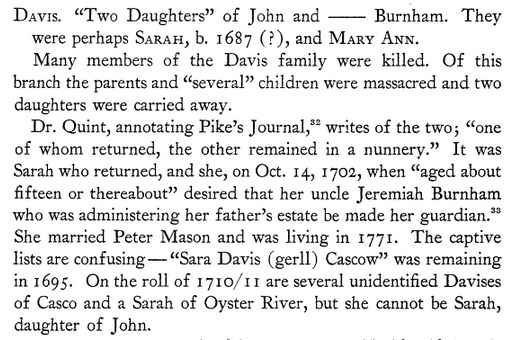
Though John Davis was killed in 1694 no attempt was made to administer on his estate till after his daughter Mary Anne’s religious profession and decision to remain in Canada, Sep 25, 1701, when all hope of her return home was renounced.  His daughter Sarah was redeemed from Canada, and was living at Oyster River Oct 16, 1702, on which day her maternal uncle, Jeremiah Burnham, was appointed her guardian and the administrator of her father’s estate.

Children of John and Elizabeth:

i. Mary Ann Davis b. 1687 in Haverhill, Mass.; d. 2 Mar 1749 Quebec, Canada

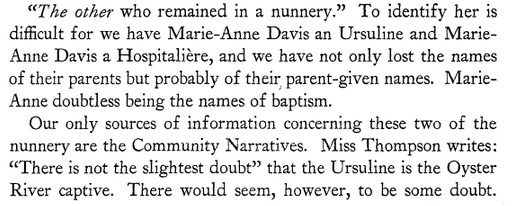
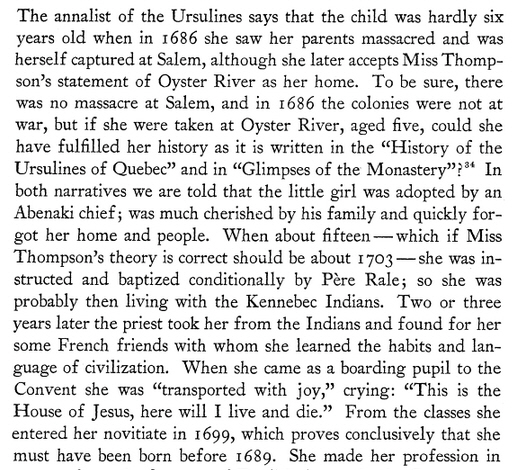
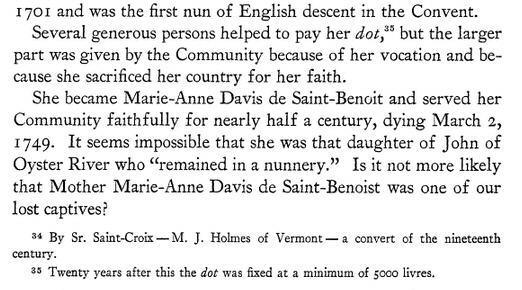
Mary Ann was the most interesting of the captives taken at Oyster River, July 18, 1694. According to a constant tradition in Durham, she became a nun in Canada and refused to return home at the redemption of captives in 1699. This was Sister St. Benedict, of the Ursuline convent, Quebec, the first native of New Hampshire, if not of New England, to embrace the conventional life.

Mary Anne Davis was seven years old when the Indians, on the above-mentioned day, burnt her father’s house and killed him and his wife and several children, as well as his widowed sister and two of her sons. They spared, however, his two young daughters Mary Ann and Sarah,- whom they carried into captivity, but who, unfortunately, were separated.

Though John Davis was killed in 1694 no attempt was made to administer on his estate till after his daughter Mary Anne’s religious profession, September 25, 1701, when all hope of her return home was renounced.

Mary Anne was carried away by the Abenaki Indians, but was rescued not long after by Father Rale, who instructed and baptized her and conveyed her to Canada. In 1698 she entered the boarding-school at the Ursuline convent, Quebec. At her entrance into this “Maison des Vierges” of which she had heard among the Abenakis, she was transported with joy. “This is the house of the Lord,” she cried; “it is here I will henceforth live; it is here I will die.” She entered the novitiate of that house on St. Joseph’s day, March 19, 1699; and received the religious habit and white veil, with the name of Sister St. Benedict, the fourteenth of September following—the feast of the Exaltation of the Holy Cross. She took the black veil and made her vows September 25, 1701. Mademoiselle de Varennes, whose father was governor of Trois Rivieres for twenty-two years, took the white veil with her and made her vows at the same time. The latter was only fourteen years of age when she entered the novitiate.

Sister St. Benedict is said not to have known her own age, but was supposed to be a few years older. The trials she had undergone, however, must have given her an air of maturity beyond her years The Durham tradition does not mention her age, but speaks of her as “young” when taken captive. She died March 2, 1749. Her death is entered in the convent records as follows:

“The Lord has just taken from us our dear Mother Marie Anne Davis de St. Benoit after five months’ illness, during which she manifested great patience. She was of English origin and carried away by a band of savages, who killed her father before her very eyes. Fortunately she fell into the hands of the chief of a village who was a good Christian, and did not allow her to be treated as a slave, according to the usual practice of the savages towards their captives. She was about fifteen years old when redeemed by the French, and lived in several good families successively in order to acquire the habits of civilized life and the use of the French language. She everywhere manifested excellent traits of character, and appreciated so fully the gift of Faith that she would never listen to any proposal of returning to her own country, and constantly refused the solicitations of the English commissioners, who at different times came to treat for the exchange of prisoners. Her desire to enter our boarding-school in order to be more fully instructed in our holy religion was granted, and she soon formed the resolution to consecrate herself wholly to Him who had so mercifully led her out of the darkness of heresy. Several charitable persons aided in paying the expenses of her entrance, but the greater part of her dowry was given by the community [i.e., by the Ursulines themselves] in view of her decided vocation and the sacrifice she made of her country in order to preserve her faith.

Her monastic obligations she perfectly fulfilled, and she acquitted herself with exactness of the employments assigned her by holy obedience. Her zeal for the decoration of the altar made her particularly partial to the office of sacristan. Her love of industry, her ability, her spirit of order and economy, rendered her still very useful to the community, though she was at least seventy years of age.

“She had great devotion to the Blessed Virgin and daily said the rosary. Her confidence in St. Joseph made her desire his special protection at the hour of death—a desire that was granted, for she died on the second of March of this year 1749, after receiving the sacraments with great fervor, in the fiftieth year of her religious life.”

Sarah Davis 1

New England Captives Carried to Canada Between 1677 and 1760 During the …
By Emma Lewis Coleman 1926

Sarah Davis 2
Sarah Davis 3
Sarah Davis 4

There was another Mary Ann Davis who became a nun in Canada in early times. She was, likewise, a captive from New England. She became a nun at the Hotel Dieu, Quebec, in 1710, under the name of Sister St. Cecilia. She was taken to Canada by the Rev. Father Vincent Bigot, S.J., who had ransomed her from the Indians at St. Francis. She is mentioned as leading ” a holy life” for more than fifty years in the religious state. She died in 1761, at the age of seventy-three. There is no record of her birthplace or parentage. She may have been the daughter mentioned by the Rev. John Pike, of Dover, N. H., in his journal:

“August 9, 1704, The wife, son, and daughter of John Davis, of Jemaico, taken by ye Indians in yr house or in yr field.” [Jemaico was part of Scarborough, Maine.]

ii. Sarah Davis b. 1687 Oyster River, NH; d. Aft 1771; m ~1706 to Peter Mason ( – bef. 1747)

Sarah was captured at the Oyster River Massacre of 18 Jul 1694 and was afterwards redeemed, and was living at Oyster River Oct 16, 1702, on which day her maternal uncle, Jeremiah Burnham, was appointed her guardian and the administrator of her father’s estate. She afterwards married Peter Mason, but was left a widow before 1747.  Sarah inherited her father’s land at Turtle Pond and also his homestead on the south side of the Oyster River.  With true Davis tenacity to life she was still living in 1771, when she sold part of her homestead lands to John Sullivan (afterwards General  in the Revolutionary army, delegate in the Continental Congress, Federal judge,  and Governor of New Hampshire).. How much longer she lived does not appear. She left one daughter, at least, whose descendants can still be traced.

4. Hannah Davis

Hannah’s husband John Keyzar was born 1648 in Lynn, Essex, Mass. His parents were George Keyser and Elizabeth Holyoke.  John died 15 Mar 1697 in Haverhill, Essex, Mass.

Children of Hannah and John:

i. John Keyser b. 6 Jul 1678 Haverhill, Essex, Mass; d. 1761 Hampstead, Rockingham, New Hampshire; m1. 1710 in Haverhill, Essex, Mass to his second cousin Judith Davis (b. 23 Jul 1687 in Haverhill – d. 1 Sep 1775 in Hampstead) Judith’s parents were Stephen Davis (1663- 1719) and Mary Tucker (1666 – 1724), her grandparents were Ephraim Davis and Mary Johnson, and her great grandparents were James DAVIS and Cicely THAYER John and Judith Davis had three children born between 1710 and 1722.

m2. 23 Sep 1730 in Haverhill to his first cousin Judith Heath (b. 9 Dec 1691 in Haverhill – d. Oct 1756 Hampstead, Rockingham, New Hampshire) Judith’s parents were Josiah HEATH and Mary DAVIS

ii. Timothy Keysar b. 23 Nov 1683 Haverhill, Essex, Mass; d.17 Feb 1726 Chester, New Hampshire; m. 10 Dec 1710 in Ipswich, Essex, Mass to Sarah Hodgkins (b. 1 Feb 1690 in Ipswich – d. Rowley, Mass.) Sarah’s parents were John Hodgkins (1662 -1690) and Elizabeth [__?__] Timothy and Sarah had six children born between 1711 and 1722.

iii. Sarah Keyser b. 5 Oct 1686 Haverhill, Essex, Mass; d. Hampton, Rockingham, New Hampshire; m1. 26 Apr 1705 in Hampton to Nathan Moulton (b. 1677 in Hampton – d. 1712 in Hampton); Nathan’s parents were John Moulton (1638 – 1706) and Lydia Taylor ( 1646 -)

m2. 1712 in Haverhill, Essex, Mass to John Silver (b. 24 Feb 1688 in Haverhill) John’s parents were Thomas Silver (1658 – 1695) and Mary Williams (1663 – 1695) Sarah and John had five children born between 1712 and 1726.

iv. Mary Keyser b. 27 Apr 1689 Haverhill, Essex, Mass; m. Nicholas George

v. Eleazer Keyzar b. 9 Aug 1692 Haverhill, Essex, Mass; d. 1729 Essex, Mass; m. [__?__] Eleazer had two children

vi. Samuel Keyser b. 30 Dec 1694 Haverhill, Essex, Mass; d. 1719

vii. George Keyser b. 22 Apr 1697 Haverhill, Essex, Mass; m. Elizabeth Adams

6. Moses Davis

Moses’ wife Reuhamah (Ruhamah) Dow was born 24 Jan 1663/64 Haverhill, Mass.  Her parents were Stephen DOW and  Phebe LATLY.  Ruhamah died Aft. 1717.

John’s son Moses was another Indian attack victim. He escaped the massacre of 1694 and accompanied his brother James in some of the expeditions to Maine and Port Royal. He lived in a clearing of the forest about a mile from Oyster river falls, where, 10 Jun 1724, he and his son Moses Jr. were killed by a party of Indians, who lay in ambush to attack the settlement. He was then sixty-seven years of age. A negro slave of his avenged their murder by pursuing the Indians and shooting one of the leaders.

Love Davis, daughter of Moses, in view of the fidelity of this slave, gave orders that at his death he should be buried at her feet. This was done, and their graves are still pointed out at a short distance from Durham village.

The Indian thus slain by the servant of Moses Davis is now generally supposed to have been a son of the Baron de St. Castin, who had married the daughter of an Indian sagamore of Maine. Dr. Belknap, whose account of the affair was derived from the Rev. Hugh Adams * —a man of extreme malevolence— His equipment, moreover, proves that he held the rank of a chief. Dr. Belknap thus describes him : ” The slain Indian was a person of distinction, and wore a kind of coronet of scarlet-dyed fur, with an appendage of four small bells, by the sound of which the others might follow him through the thickets. His hair was remarkably soft and fine, and he had about him a devotional book and a muster-roll of one hundred and eighty Indians.”  The scalp of this young chief was presented to the New Hampshire General Assembly at Portsmouth June 12, 1724, by Robert Burnham, son of Jeremiah before-mentioned, and a bounty of one hundred pounds was ordered to be paid to the slayer.

A few weeks later Father Rale himself, the deliverer of Mary Anne Davis from the Indians, was slain at the foot of his mission-cross in the attack on Norridgewock by the Massachusetts forces, August 12, 1724, and his chapel pillaged and burnt to the ground.

Love Davis may be considered an important link in the chain of  Davis  traditions, for she did not die till 1805, when she was about one hundred years ot age. Her nephew, Jabez Davis, furnished Dr. Belknap, the New Hampshire historian, with considerable information concerning his native town.

Children of Moses and Ruhamah

i. John Davis b. 4 Jan 1682 Haverhill, Essex, Mass.; d. Nov 1749 Durham, Strafford, New Hampshire; m. 1703 in Haverhill, Mass to Abigail Meader (b. 1681 in Oyster River, Strafford, New Hampshire – d. 1736 in Dover, Strafford, New Hampshire) Abigail’s parents were John Meader (1660 – 1736) and Sarah Follett ( – 1725) John and Abigail had four children born between 1697 and 1716.

ii. Moses Davis b. 2 Nov 1684 Haverhill, Essex, Mass.; d. 10 Jun 1724 Haverhill; m. 1710 in Strafford, New Hampshire to Deliverance Rice (b. 1676 in Kittery, York, Maine – d. 1765 in Durham, Strafford, New Hampshire) Deliverance first married 1699 in Oyster River, Strafford, Maine to George Chesley (b 1671 in Durham, Strafford, New Hampshire – d. 8 Jun 1710 in Indians in Oyster River) and had two children.

iii. James Davis b. 1687 Haverhill, Essex, Mass; d. 1728 Haverhill; m1. 19 May 1719 in Dover, Strafford, New Hampshire to Mary Stevenson (b. 21 Sep 1681 in Haverhill – d. Jan 1723 in Oyster River); m2. 4 Oct 1728 in Dover to Elizabeth Dunn (b. 1689 in Oyster River)

iv. Joshua Davis b. 1693 Dover, Strafford, New Hampshire; d. 29 Nov 1752 Rochester, Strafford, New Hampshire; m. 29 Jul 1717 in Dover to Esther Bunker (b. Apr 1693 in Dover – d. 8 Nov 1749 Rochester) Esther’s parents were John Bunker (1667 – 1707) and Mary [__?__] (1664 – 1738)

v. Solomon Davis b. 1695 Oyster River, Strafford, New Hampshire; d. 7 May 1755 Durham, Androscoggin, Maine; m. 4 Feb 1724 in Oyster River to his niece Elizabeth Davis (b. 1706 in Oyster River – ) Elizabeth’s parents were John Davis and Abigail Meader. Uncles don’t marry nieces, either John or Solomon was not the son of Moses. Solomon and Elizabeth had two children in 1726 and 1728.

vi. Joseph Davis b. 8 Mar 1696 Haverhill, Essex, Mass.; m. 4 Oct 1728 in Oyster River to Elizabeth Dunn? or was she James’ second wife?

vii. Jabez Davis b. 1701 Dover, Norfolk, Mass; d. 1736 Haverhill, Essex, Mass; A Jabez Davis was born 24 Feb 1701 in Haverhill, Essex, Mass to Stephen Davis(1663 – 1719) and Mary Tucker (1666 – 1724) That Jabez married in 1723 – Dunstable, Middlesex, Mass. to Ruth Blanchard and died about 1746.

viii. Ebenezer Davis b. 10 Jun 1702 in Dover, Norfolk, Mass.; d, 7 May 1755 Durham, Strafford, New Hampshire; m. Susanna [__?__]

ix. Abigail Davis b. 1703 in Oyster River, Strafford, New Hampshire

x. Samuel Davis b. 1705 Haverhill, Essex, Mass.; d. 1752 Strafford, New Hampshire

xi. Jeremiah Davis b. 1708 in Dover, Norfolk, Mass; d. 1767 Durham, Strafford, New Hampshire; m. 1734 to Sarah Jenkins (b. 1700 in Reading, Middlesex, Mass. – d. 1744 in Durham, Strafford, New Hampshire)

7. Joseph Davis

Joseph’s wife Mary Stevens was born in 1660 in Hampton, Rockingham, New Hampshire. Mary died 10 Feb 1716 in Oyster River, Strafford, New Hampshire.

Joseph was Lieutenant in 1712 and was a constable in 1714.

Children of Joseph and Mary:

i. Mary Davis b. ~1695 Hampton, Rockingham, New Hampshire; d. 1757 Chester, Rockingham, New Hampshire; m. 1712 in Hampton to James Basford (b. 1685 in Hampton – d. 16 Dec 1745 in Chester) James’ parents were Jacob Basford (1655 – 1735) and Elizabeth Clifford ( – 1708) Mary and James had five children born between 1715 and 1721.

ii David Davis b. ~1695 Oyster River, Strafford, New Hampshire; m. 28 Jun 1717 Oyster River to Elizabeth Thomas

iii. Joseph Davis b. ~1697 Hampton, Rockingham, New Hampshire; d. 3 Feb 1753; m. 1718 to Elizabeth Chesley (b. 1699)

iv. Judith Davis b. ~1699 Hampton, Rockingham, New Hampshire; d. 1775 Madbury, Strafford, New Hampshire; m. 3 Apr 1718 in Durham, Strafford, New Hampshire to John Tasker (b. 1688 in Dover, New Hampshire – d. 1761 in Madbury) Judith and John had nine children born between 1721 and 1736.

Madbury, Strafford, New Hampshire

Madbury, Strafford, New Hampshire

The name “Modbury” was later corrupted to “Madberry” and “Madburry,” finally becoming “Madbury.” Madbury became an entity in 1735, when John and Judah Tasker gave an acre of land to the inhabitants on which to build a meeting house.

Madbury was once the farm of Sir Francis Champernowne of Greenland, and named after his ancient family’s mansion at Modbury in Devon, England. The name Madbury Parish was first recorded in a 1755 grant made by Colonial Governor Benning Wentworth, with full town privileges granted in 1768 by his successor, Governor John Wentworth. A lumbering and farming community, Madbury was incorporated in 1775.

v. Jane Davis b. ~1700 Durham, Strafford, New Hampshire; d. 1742 Harwich, Barnstable, Mass; m. 31 Mar 1720 in Durham to Lt. Zachariah Small (b. 1698 in Chatham, Barnstable, Mass. – d. 24 Apr 1778 in Harwich, Barnstable, Mass.) Zachariah’s parents were Edward Small (1652 – ) and Mary Woodman (1660 – 1742) Jane and Zachariah had six children born between 1726 and 1741. After Jane died, Zachariah married 22 May 1742 in Harwich to Hannah Hopkins (b. 25 Mar 1700 in Eastham, Barnstable, Mass. – 24 Oct 1793 in Harwich) and had one more child.

vi. Benjamin Davis b. 1704 Hampton, Rockingham, New Hampshirel m. 5 Jan 1727 in Durham, Strafford, New Hampshire to Miriam Roberts (b. 4 Jan 1709 in Dover Neck, Strafford, New Hampshire,) Miriam’s parents were Nathaniel Roberts (1668 -1753) and Elizabeth Mason (1677 -1746)

vii. Elizabeth Davis b. Hampton, Rockingham, New Hampshire

8. Colonel James Davis

James wife Elizabeth Chesley was born 1675 in Oyster River, Strafford, New Hampshire. Elizabeth died in 1748 in Oyster River, Strafford, New Hampshire.

James was at once a soldier, judge, and deacon.  He received a lieutenant’s commission from the Massachusetts government in 1790, at which time New Hampshire was again united with that province. At an early age he organized scouting parties against the Indians, and was the companion-in-arms of Colonel Hilton, as related in Belknap’s history, and took part in various expeditions to Maine and Port Royal (Annapolis, N. S.) Belknap calls him ” captain ” in 1703. He was appointed member of the council of war by the New Hampshire provincial government 18 Oct 1707, and was finally made colonel. He was likewise a member of the New Hampshire General Assembly for more than twenty years, and in 1717 was appointed judge of the Court of Common Pleas, which office he held the remainder of his life.

It was Colonel James Davis who inherited his father’s garrison, which he successfully defended at the Indian attack of 18 Jul 1694, after taking the precaution to send his family off by water, to insure their safety. To his civil and military functions he added the office of deacon in the Oyster River church, and it is still related how the veteran officer and able magistrate used at times to lay aside his weapons and convene religious meetings in his garrison, in which he took a prominent part in prayer and exhortation, showing himself, as Butler says in Hudibras :

” Most fit t’ hold forth the Word,
And wield the one and t’ other sword.

James accompanied Colonel Hilton to Norridgewock in the winter of 1704-5, when the snow was four feet deep, and the party of two hundred and seventy men were obliged to march through the wilderness on snow-shoes. There being no prohibition laws in Maine in those Puritan times, they were cheered and fortified for their work by a fresh supply of rum from the commissary at Casco Bay, to the amount of £4 7s. 6d* Arriving at Norridgewock they found the place deserted, the Indians having received notice of their approach, and they had to content themselves with burning the chapel and wigwams. The Indians afterwards took vengeance on most of the leaders for these and other provocations. Lieutenant Chesley, one of the party, with his brother and others was slain by them at Oyster River in 1707. Colonel Hilton, who was specially obnoxious to them, continued his raids some years longer, but at last, 23 Jun 1710, while cutting down trees in the forest with his brother, a band of Indians fell suddenly upon them, clove asunder his brains with a tomahawk, and stabbed him to the heart with a lance, which they left therein. His brother was carried away and never heard of again.

Col. James died in 1749, leaving nine children, whose ages at their death averaged eighty-seven years—the Davis family being remarkable for longevity. The cellar of his garrison can still be traced, and not far off is his grave, with its headstone of unhewn granite, gray and shaggy with moss.

Children of James and Elizabeth:

i. James Davis b. 10 Jul 1689 Dover, Strafford, New Hampshire; d. 28 Apr 1782 Madbury, Strafford, New Hampshire; m. 14 Apr 1743 in Dover to Elizabeth Payne (b. 1720 in York, York, Maine – d. 1754) James and Elizabeth had five children born between 1744 and 1754.

ii. Thomas Davis b. 20 Oct 1690 Oyster River, Strafford, New Hampshire; d. 1778

iii. Samuel Davis b. 26 Sep 1692 Oyster River, Strafford, New Hampshire; d. 26 Feb 1789 Madbury, Strafford, New Hampshire; m. 1713 in Dover, Strafford, New Hampshire to Martha Chesley (b. 1695 in Oyster River – d. 1791 in Madbury) Martha’s parents were Thomas Chesley (4 Jun 1664 – 1700) and Ann Huntress (1676 – 1704). Samuel and Martha had six children born between 1720 and 1732.

iv. Daniel Davis b. 29 Jan 1695 Oyster River, Strafford, New Hampshire; d. Jan 1759 Durham, Strafford, New Hampshire; m. ~1740 to Elizabeth Cotton (b. Jun 1720 in Portsmouth, Rockingham, New Hampshire – d. Sep 1764 in Portsmouth) Elizabeth’s parents were John Cotton (1690 – 1723) and Elizabeth Davis no close relation (1696 – 1761). Daniel and Elizabeth had nine children born between 1640 and 1658. (pretty darn busy for such a late start)

v. Sarah Davis b. 3 Mar 1697 Oyster River, Strafford, New Hampshire; d. 20 Jan 1788 Hix Hill, Madbury, Strafford, New Hampshire; m. 1720 in Oyster River to Joseph Hicks (b., 1693 in New Hampshire – d. 1770 in Hix Hill) Joseph’s brother John married Sarah’s sister Elizabeeth. Their parents were Dennis Hicks (1650 – 1725) and Sarah Deering (1657 – 1750). Sarah and Joseph had six children born between 1721 and 1731.

vi. Hannah Davis b. 28 Mar 1699 Oyster River, Strafford, New Hampshire; d. Mar 1775 New Hampshire; m. 23 Mar 1727 in Durham to Clement Deering (b. 7 Feb 1703 in Kittery, York, Maine – d. 1775 in Rochester, Strafford, New Hampshire) Clement’s parents were Clement Deering (1680 – 1742) and Elizabeth Fernald (1674 – 1745)

vii. Elizabeth Davis b. 13 Jul 1701 Dover, Strafford, New Hampshire; d. 1780 Barrington, New Hampshire; m. 13 Nov 1723 in Kittery, York, Maine to John Hicks (b. 1690 in Kittery Point, Maine – d. : 1753 in Braveboat Harbor, York, Maine) John’s brother Joseph married Elizabeth’s sister Sarah. Their parents were parents were Dennis Hicks (1650 – 1725) and Sarah Deering (1657 – 1750).

viii. Ephraim Davis b. 30 Apr 1704 Oyster River, Strafford, New Hampshire; d. Apr 1791 Durham, Rockingham, New Hampshire; m. 7 Dec 1731 in Dover, Portsmouth, New Hampshire to Ruth [__?__] (b. 1710)

ix. Phebe Davis b. 19 Apr 1706 Oyster River, Strafford, New Hampshire; d. 1791; m. 1725 to Abraham Mathews (b. 1702 in Oyster River – d. ~ 1762 in est Durham) Abraham’s parents were Francis Matthews (1670 – 1755) and Ruth Bennett (1670 – 1749)

x. Eleazer Davis b. 5 Oct 1709 Oyster River, Strafford, New Hampshire; d. 1748

9 Jemima Davis

Jemima’s first husband John Barber was born 1664 in Dover, Norfolk, Mass.

Jemima’s second husband James Small was born 1718 in Dover, Norfolk, Massachusetts,

10. Judith Davis

Judith’s husband Samuel Emerson was born 2 Feb 1663 in Haverhill, Essex, Mass. His parents were Michael Emerson and Hannah Webster. Samuel died 13 Mar 1739 in Haverhill, Essex, Mass.

Samuel  was apprenticed to a John Simmons. Simmons was brought to court by another of his servants, Thomas Bettis, in March of 1681. Bettis claimed in his deposition that his “master haith this mani yeares beaten me upon small and frivelouse ocasion.” Bettis claimed that Simmons had “brocke my hed twice, strucke me on the hed with a great stick…tied me to a beds foott [and] a table foott” and a long list of other injuries and insults suffered at his master’s hand. He begged the court to be allowed to leave his master. A number of community members deposed that Bettis had, indeed, been beaten excessively and had not been clothed properly. But Samuel Emerson took his masters side in the suit saying, “that he had lived with his master Simmons about four years and Bettis was very rude in the family whenever the master was away, etc.”

Perhaps Samuel’s deposition was a form of self defense.  After all, he still had to live with Simmons after the suit was over. But maybe Samuel really did think that Bettis deserved the beatings and that they were not excessive given the situation. If the latter is true, it could indicate that this type of violence was by no means foreign to Samuel Emerson’s upbringing. In any event, Bettis was told to return to his master’s house, and there the record ends.

Samuel had two famous siblings.

 Hannah Emerson Duston (1657 – 1736) was a colonial Massachusetts Puritan woman who escaped Native American captivity by leading her fellow captives in scalping their captors at night. Duston is the first woman honored in the United States with a statue. (See my post Hannah Dustin – Heroine or Cold Blooded Killer)

Elizabeth Emerson (1665 – 1693) was hanged in the Boston Commons after having been convicted of killing her twins born out of wedlock.   Although convicted in Sep 1691 Elizabeth was not hanged until June 8, 1693. In the interim she came under the care and guidance of the Reverend Cotton Mather. How he found time to minister to Elizabeth while at the same time actively pursuing the Salem Witch Trials is unknown.

Although convicted in Sep 1691 Elizabeth was not hanged until June 8, 1693. In the interim she came under the care and guidance of the Reverend Cotton Mather. How he found time to minister to Elizabeth while at the same time actively pursuing the Salem Witch Trials is unknown.

Elizabeth’s execution,  Cotton Mather delivered a sermon before a large crowd in Boston. Mather exhorted the crowd, delivering what he unabashedly referred to as one of his greatest sermons ever.  Whether Elizabeth sat penintently looking downwards or definantly staring into Mather’s eyes we can only imagine. That the sermon was delivered for her benefit is undoubted. The lecture was based upon Job 36:14, “They die in youth and their life is among the unclean.”

(See my posts 17th Century  Premarital Sex and George CORLISS’ page for the story in depth)

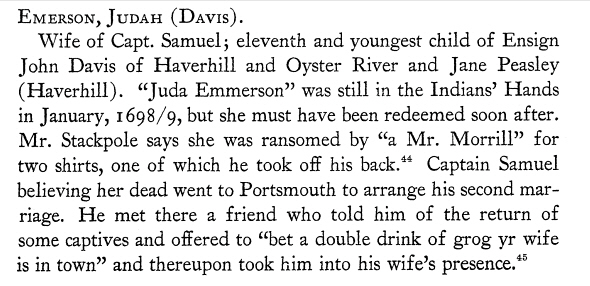
Judith was also taken by the Indians in 1694 and remained in captivity five years. Note the ten year gap between Hannah (b. 1691) and Micah (b. 1701)

Judah Emerson -- From - New England Captives Carried to Canada Between 1677 and 1760  By Emma Lewis Coleman

Judah Emerson — From – New England Captives Carried to Canada Between 1677 and 1760
By Emma Lewis Coleman

Children of Samuel and Judith:

i. Samuel Emerson b. 21 Aug 1688 Haverhill, Essex, Mass.; d. at sea; m. Rebecca? [__?__] (b. Bradford, Essex, Mass. – d. 6 Jul 1776 in Pownalborough, Kennebec, Maine)

ii. Hannah Emerson b. 22 Dec 1691 Haverhill, Essex, Mass.; d. 1736 Haverhill; m. 24 Nov 1715 in Newberry, Essex, Mass to Hugh Pike (b. 28 May 1686 in Newberry – d. 1747 in Haverhill) Hugh’s parents were Hugh Pike Sr. (1657 – ) and Sarah Brown (1663 – 1691). Hugh first married 30 Jun 1714 in Newbury, to Hannah Kelley (b. 17 Nov 1686 in Newbury – d. 31 Mar 1715 in Newbury). Hannah and Hugh had ten children born between 1715 and 1734.

iii. Micah Emerson b. 4 Jan 1701 Dover, Strafford, New Hampshire; d. 1734 Dover, Strafford, New Hampshire; m. 5 Feb 1725 in Dover to Sarah Huckins (b. 5 Feb 1707 in Dover – d. 13 Feb 1777 in Rochester, Strafford, New Hampshire) Sarah’s parents were Robert Huckins (1672 – 1720) and Welthen Thomas ( – 1729), Micah and Sarah had three children born between 1726 and 1731. After Micah died, Sarah married 1735 in Neck, Strafford, New Hampshire to Joseph Tibbetts (b. 14 Oct 1702 in Dover Neck, Strafford, New Hampshire – d. 20 Jan 1776 in Rochester) Sarah and Joseph had five more children between 1736 and 1752.

iv. Abigail Emerson b. 27 Sep 1704 Dover, Strafford, New Hampshire; d. 1757 Durham, New Hampshire; m. 1723 in Durham to Robert Thompson (b. 1700 in Oyster River – d. 1752 in Durham) Robert’s parents were John Thompson (1659 – ) and Sarah Woodman (1663 – 1734). Abigail and Robert had five children born between 1724 and 1747.

v. Timothy Emerson b. 1706 Dover, Strafford, New Hampshire; d. 1754 Durham; m. 1732 in Dover, Portsmouth, New Hampshire to Mary Smith (b. Aug 1714 in Durham – d. 1745) Mary’s sister Elizabeth married Timothy’s brother Solomon. Their parents were Samuel Smith (1686 – 1760) and Hannah Burnham (1690 – 1750) Timothy and Mary had seven children born between 1733 to 1747

vi. Solomon Emerson b. 1709 Dover, Strafford, New Hampshire; d. Oct 1800 Madbury, Strafford, New Hampshire; m. 1735 in Dover to Elizabeth Smith (b. 29 Apr 1712 in Durham, Strafford, New Hampshire) Elizabeth’s sister Mary married Solomon’s brother Timothy. Their parents were Samuel Smith(1686 – 1760) and Hannah Burnham (1690 – 1750). Solomon and Elizabeth had nine children born between 1737 and 1754.

Sources:

John Davis 1 — Source: Ancestry of Charles Stinson Pillsbury and John Sargent Pillsbury (1938)

John Davis 2

John Davis 3

http://trees.ancestry.com/owt/person.aspx?pid=2441716&st=1

http://members.fortunecity.com/dickcoveney/p49.htm#i2685

Catholic world, Volume 52 By Paulist Fathers 1891

http://mikenh.wordpress.com/2009/12/01/marker-50-oyster-river-massacre/

Ancestry of Charles Stinson Pillsbury and John Sargent Pillsbury (1938) By Holman, Mary Lovering, 1868-1947; Pillsbury, Helen Pendleton Winston, 1878-1957

http://massandmoregenealogy.blogspot.com/2011/08/mary-smith-freeman-1685-1766-oyster.html

Posted in 12th Generation, Immigrant - England, Line - Miller, Public Office, Veteran, Violent Death | Tagged , , , | 17 Comments

Joseph Moyce

Joseph MOYCE (1597 – 1655)  was Alex’s 11th Great Grandfather; one of 4,096 in this generation of the Miller line.

This probably isn’t Joseph Moyce’s, but Coats of Arms are my symbol for immigrant ancestor.

Joseph Moyce was born in 1597 at Dennington, Suffolk, England. He married Hannah FOLCORD before 1618 in Salisbury, England.  Joseph died in 1655 at Haverhill, Essex, Mass.  Alternatively, he died after 1669.

Hannah Folcord was born in 1601 in Dennington, Suffolk, England.  She may be related to Nicholas Stanton of Ipswich, Suffolk, England because  Joseph and Hannah Moyse, living in New England were mentioned in Nicholas Stanton’s will in 1648.  Alternatively, Hannah was a daughter of Nicholas Stanton.  Hannah died in 1655 in Salisbury, Essex, Massachusetts.

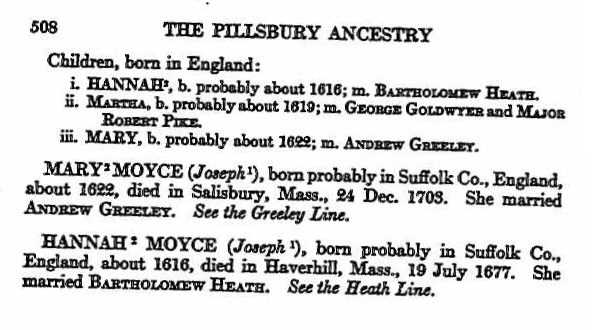
Children of Joseph and Hannah:

Name Born Married Departed
1. Hannah MOYCE 16 Sep 1618 Dennington, Suffolk, England Bartholomew HEATH
c. 1640 Newbury, Mass
19 Jul 1678 Haverhill, Mass
2. Martha Moyce c. 1622
Dennington, Suffolk, England
George Goidwyer
1674/75
.
Maj. Robert Pike
30 Oct 1684 Salisbury, Essex, Mass
16 Feb 1713
3. Mary Moyce c. 1622 Andrew Greeley
1643
Salisbury, Essex, Mass
24 Dec 1703
Salisbury, Mass

Joseph Moyce was resident in 1640 at Newbury, Mass.   He lived in 1649 at Haverhill, Essex, Mass.

Hannah Folcord may be related to Nicholas Stanton of Ipswich, County Suffolk, England. Joseph Moyse and his wife, living in New England were mentioned in the will of Nicholas Stanton of Ipswich, County Suffolk, England in 1648.

The surname Moyce or Moyse, originally spelled Moyses, is a baptismal origin, meaning ‘the son of Moses’. Hasting Moyse of County Suffolk and William Moyse of County Essex are named in the Hundred Rolls of 1273.

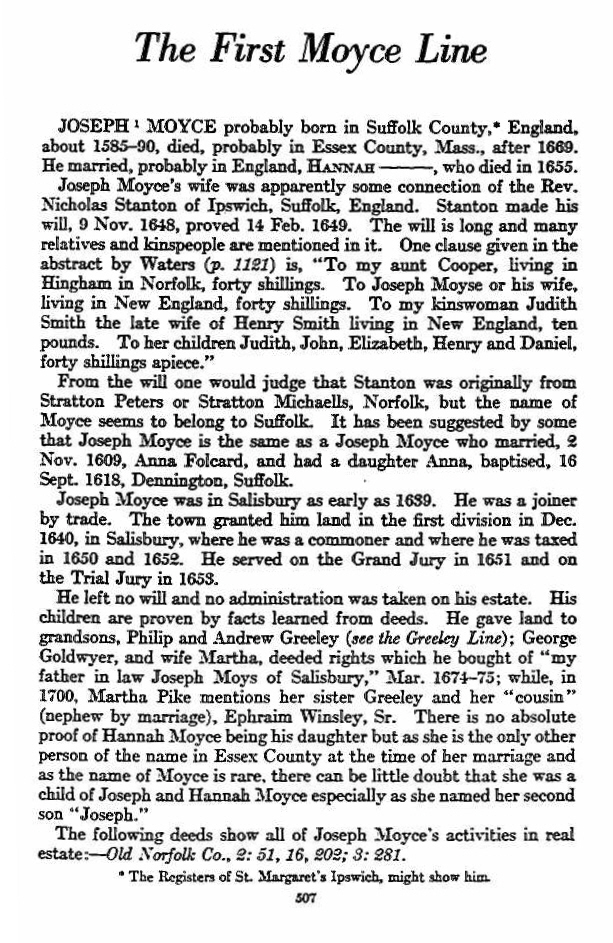
Joseph Moyce, first of his family of which record has been found, is mentioned as receiving land in Salisbury, Massachusetts in 1640 and 1641. Listed as a joiner, he appears on the list of commoners and taxpayers of 1650 and 1652 and was granted land in 1654. His name appears on a petition in 1658.

Salisbury, Essex, Mass.

Salisbury was once territory of the Pentucket tribe of Pennacook Indians. It was settled by the English in 1638 as Merrimac, after the river, and incorporated in 1639 as Salisbury, after Salisbury in Wiltshire, England.

The original roads at the center of the town formed a compact semicircle, which allowed the residents to quickly reach the garrison house in case of attack. Those roads still exist, though the shape today is triangular, being bounded by Elm Street, School Street and Bridge Road. One of the two greatest fears at the time was the Naumkeag tribe of Indians, thus the men of the town took turns standing watch against a surprise attack, especially at night. The Naumkeags, however, had been decimated by plague, and the threat was not what it once might have been. The second threat came from wolves, which were plentiful, and which killed the livestock and dug in the graveyard.

The original residents were given one small house lot near the center of town, and one larger planting lot just outside the center for farming. Families also owned large sections of “sweepage lots” near the beach, where apparently they harvested the salt marsh hay. At the time, the area was almost entirely unbroken virgin forest, which had to be cleared for the construction of houses and the planting of fields

No will or probate records have been found for Joseph Moyce. Information on land deeds for Joseph Moyce can be found in Old Norfolk County.

Children

1. Hannah MOYCE (See Bartholomew HEATH‘s page)

2. Martha Moyce

Martha’s first husband George Goidwyer (Goldwire) was born about 1620. George died 12 Apr 1684, Salisbury, Essex, Mass. He was of Haverhill in 1648, when he bought house and land in Salisbury of Samuel Dudley. It is said that he was of Dover in 1658, but he was of Salisbury in 1657 and ’64.

Martha’s second husband Maj. Robert Pike was born 16 Mar 1615/16, Langford, Wiltshire, England. His parents were John Pike and Dorothy Day.  He married first 3 Apr 1641, Salisbury, Essex, Mass. to Sarah Saunders (b. 20 Aug 1615, Weeks, Downton parish, Wiltshire, England; d. 1 Nov 1679, Salisbury, Essex, Mass.)  Robert died 12 Dec 1706, Salisbury, Essex, Mass.

Major Robert Pike

17 May 1637 – Admitted Freeman.  Robert Pike we learn from the historian, Coffin, took great interest in Governor Winthrop’s campaign for the governorship against Sir Harry Vane, as the close of the latter’s term drew near. So Mr. Pike, with nine others including John CHENEY,  Thomas COLEMAN, Henry Sewall Jr, Nicholas Noyes [Cheney’s future father-in-law],  Archelaus Woodman [Edward WOODMAN‘s half-brother], Thomas Smith, James BROWNE, Nicholas Holt [future son-in-law of Humphrey BRADSTREET, and John Bartlett, .walked forty miles from Newbury to Cambridge on foot to take the “freeman’s oath” and qualify themselves to vote in the election which was soon to take place.  It was by such prompt movements that Winthrop was elected and the conservative party triumphed.

Vane lost his position to the elder John Winthrop  in the 1637 election.  The contentious election was marked by a sharp disagreement over the treatment of John Wheelwright, a supporter of Anne Hutchinson [daughter of our ancestor Francis MARBURY  (1555–1611) (wikipedia)] Winthrop won in part because the location of the vote was moved to Cambridge, reducing the power of Vane’s Boston support.  In the aftermath of the election Anne Hutchinson was put on trial, and eventually banished from the colony.

Many of her followers seriously considered leaving after the election. At the urging of  Roger Williams, some of these people, including Hutchinson, founded the settlement of Portsmouth on Aquidneck Island in the Narragansett Bay (later named Rhode Island and joined to Providence to form the Colony of Rhode Island and Providence Plantations).

Vane decided to return to England, apparently with the notion that he would acquire a royal governorship to trump the colonial administration.  Before his departure, he published A Brief Answer to a Certain Declaration, a response to Winthrop’s defense of the Act of Exclusion; this act was passed after the election to restrict the immigration of people with views not conforming to the colony’s religious orthodoxy.

rep. 1648 and several years following; Assistant 1682 down to 1692; member of the Council many years down to 1696, and justice of the peace many more.

He was very decided in his opinions, which were liberal in advance of his time, and had difficulties with other members of the Salisbury Church. as early as 1675 and as late as 1700. He has been called “the moral and fearless hero of New England.;” “the first and strongest representative of the right of petition;” the “power which squelched the witchcraft delusion,” etc.?

His son, Rev. John, Pike in his “Journal,” states that his father “was always very temperate in reference to meats and drinks.” In 1653 he denounced the law passed by the General Court designed to restrain Peasley and Macy of Ames. from preaching in the absence of a minister. He declared “that those members who had voted for it had violated their oaths as freemen; that their act was against the liberty of the country, both civil and ecclesiastical, and that he stood ready to make his declaration good.” For this he was tried, convicted, fined, and disfranchised, by the General Court. The punishment inflicted on Lieut. Pike caused petitions to be signed by many persons in the surrounding towns, asking that the sentence be revoked. This offended the Court still more, and the signers were called upon to give “a reason of their unjust request.” In Oct., 1654, out of the whole number of signers, about one-fifth, or fifteen persons, only, were reported “who have not given satisfaction,” and therefore insisted upon the right of petition. Robert Pike’s fine was paid, and in Oct., 1657, his disfranchisement was removed. In 1858 he was again elected to the General Court. In 1675 Robert Pike resisted the authority assumed by his pastor, Rev. John Wheelwright, and was excommunicated from the S. chh.; but was reinstated the next year. In 1692 he appeared in the third great controversy of his life, in opposition to the witchcraft delusion.

At the age of thirty-two he was chosen a member of the General Court, and had a much longer service in that capacity and as councilor and assistant, than any of his contemporaries. He had a good education and wrote a fine, flowing hand. He was an easy, eloquent and forceful speaker. He was engaged in at least three conspicuous controversies during his life. The first was his arraignment by the General Court in 1653, for his hostility to the persecution of the Quakers. The second was his resistance of the dogmatic authority of some of the clergy, in the person of his pastor, Rev. John Wheelwright. The third was his bitter opposition to the witchcraft prosecutions in 1692. In all these controversies, Robert Pike stood practically alone. He was a century in advance of his time, and a century has more than vindicated his advanced positions. The historian of the Salem witchcraft delusion says that “not a voice comes down to us of deliberate and effective hostility to the movement, except that of Robert Pike in his cool, close and powerful argumentative appeals to the judges who were trying the witchcraft cases. It stands out against the deep blackness of those proceedings like a pillar of light upon a starless Midnight sky.” Confronting the judges stood this sturdy old man, his head whitened with the frosts of seventy-six winters and protested that there was no legal way of convicting a witch, even according to the laws and beliefs of those times. It required no small amount of courage for him to take the stand he did against the opinions of the highest judicial tribunal in the province when no one was safe from the charge of having ddealings with the evil one, and he himself might be the very next one accused of being a witch! But having the courage of his convictions he rose to the demands of the situation and proclaimed his opposition by a formal and thorough exposition: The great merit of this position, so far as it has come down to us, belongs entirely to him, and no man of his time is entitled to greater honor. It is a marvel how he breasted the storm when any resistance to the popular demamd was deemed evidence of complicity with the witches, imps and all the powers of darkness, to overthrow the true church on earth. He defended and plead the cause of several of the accused, among whom were Mrs. Mary Bradbury (daughter of John PERKINS), who was condemned but not executed, and Susanna Martin (wife of George MARTIN), whose memory is perpetuated by John Greenleaf Whittier, the poet.

[Whittier wrote: “From all that I have read, and from the traditions of the valley of the Merrimac, I have been accustomed to regard Robert Pike as one of the wisest and worthiest of the early settlers of that region. . . . He was by all odds the most remarkable personage of the place and time.”]

In 1690 he was commissioned with the following instructions:

“Major Robert Pike–in pursuance of your commission, given you by the Governor and General Court, to be commander-in-chief of all the forces detached or to be detached out of the militia belonging to this colony of the Massachusetts, posted in the provinces of New Hampshire and Maine and such others as shall be put under your command. . . . You are diligently to intend the defence and preservation of the lives and estates of their Majesties’ subjects, and to repel the force of the enemy.

“You are to take all care to inform yourself of the seat, state and number of the enemy, and to improve your soldiers to pursue, prosecute, kill, and destroy them as you shall have opportunity, wheresoever they may be found.” . . . (signed) SIMON BRADSTREET, Governor.

May 1, 1691, he was at Wells, Me., and at the old garrison house of Lt. Joseph Storer made treaty with the Indian chiefs, Jonathan Remington, Wesombonet, William Partridge, Nonunkte, Tentomegan, Samson Hegan, Kenowonit, Rob Dony, Old Dony, and Sabadis.

He was on the Governor’s Council many years ending his public career in 1696, when he resigned and devoted the last ten years of his life to disposing of his valuable property among his children.

The Humble Immortals and Lt. Robert Pike

1653 – George MARTIN and Theophilus SHATSWELL were two of the fifteen “humble immortals” who, in 1653, stoutly and successfully maintained for the first time the right of petition for the subjects of the English crown.  Lt. Robert Pike, of Salisbury, an influential citizen, had denounced a law passed by the General Court, for which he was convicted, fined and disfranchised by the General Court.  Lt. Pike, a prominent town official and later a member of the General Court, denounced the law forbidding to preach if not Ordained. Which law was aimed at Joseph PEASLEE and Thomas Macy, believers in the Baptist Doctrine, with Quaker tendencies. The autocratic General Court resented this and Lieutenant Pike was fined over thirteen pounds and bound to good behavior.   This punishment caused many citizens of Salisbury and the surrounding towns to petition for a revocation of the sentence.  This offended the Court still more, and the signers were called upon to give “a reason for their unjust request”.  Out of the seventy-five who signed, the above mentioned fifteen alone refused to recede or apologize, and they were required to give bonds and to “answer for their offense before the County Court”.  Their cases were never called to trial, and they thus, by their firm stand, laid the foundation for these rights, which are now granted in all the civilized world.

Joseph PEASLEE  was a lay preacher as well as a farmer, and was reputed to have some skill in the practice of medicine. In the recognition of these natural gifts, he was, undoubtedly, made a citizen of Salisbury “Newtown.”

Later this gift of preaching made trouble in the new settlement and history for Joseph.  Soon after he removed to “Newtown,” the inhabitants neglected to attend the meetings for worship in the old town and did not contribute to the support of the minister. They held meetings for-worship at private houses, and in the absence of a minister, Joseph Peaslee and Thomas Macy officiated.The general court, which had jurisdiction over territory from Salem, Massachusetts, to Portsmouth, New Hampshire (was called Norfolk county), soon fined the inhabitants of “Newtown” five shillings each for every neglect of attending meetings in the old town and an additional fine of five shillings each to Joseph and Macy if they exhorted the people in the absence of a minister. This decree was not heeded. Meetings were held and Joseph and his friend continued to preach. The general court made additional decrees and fines, which also were not heeded.

3. Mary Moyce

Mary’s husband Andrew Greeley was born about 1620 in England.  Andrew died 30 Jun 1697, Salisbury, Essex, Mass.

Andrew’s name appears on the Salisbury records first in 1640, but he was probably settled there some time before that date. He was a miller and settled in the part which is now included in Seabrook, New Hampshire and built his mill on Kane’s river, to grind corn. About 1650 he added a saw mill, and soon after the completion of the mill he moved to Haverhill, Massachusetts. He was constable of Salisbury in 1653, and was a member of the planting and prudential committee. He was often on committes to lay out land and settle boundary lines, and was appointed to seal leather in 1677. In 1655 he entered into an agreement with Bartholomew Heath to maintain a corn mill for the inhabitants of Haverhill. In 1669 he was chosen to keep the ferry at Haverhill. He went bonds for his son Benjamin who died and left his debts unpaid, and the father was obliged to sell his house and property in Haverhill in order to pay them, returning to Salisbury, where he lived with his son Andrew on the old homestead until his death.

Sources:

Joseph Moyce 1 Source: Ancestry of Charles Stinson Pillsbury and John Sargent Pillsbury (1938)

Joseph Moyce 2


http://trees.ancestry.com/owt/person.aspx?pid=11379792&st=1

http://members.fortunecity.com/dickcoveney/p63.htm#i3403

http://freepages.genealogy.rootsweb.ancestry.com/~pattyrose/engel/gen/fg17/fg17_223.htm

Ancestry of Charles Stinson Pillsbury and John Sargent Pillsbury (1938) By Holman, Mary Lovering, 1868-1947; Pillsbury, Helen Pendleton Winston, 1878-1957

Posted in 13th Generation, Immigrant - England, Line - Miller | Tagged | 29 Comments

Bartholomew Heath

Bartholomew HEATH (1615 – 1681)  was Alex’s 10th Great Grandfather; one of 2,048 in this generation of the Miller line.

Heath Family Coat of Arms

Bartholomew Heath was born in 1615 in Nazeing, Essex, England.  Alternatively, he was born in Salisbury St Martins, Wiltshire, England as were his father and brother.  His parents were John HEATH  and Alis BARTHOLOMEW. He may have came to America at age 17  years in the ship Lyon that sailed from London 22 June 1632 along with his uncle, William, of Roxbury, William’s wife Mary and their five children.   He married Hannah MOYCE about 1640 in Newbury, Mass.   Bartholomew died 15 Jan 1681 in Haverhill, Essex, Mass.

Hannah Moyce was born 16 Sep 1618 in Dennington, Suffolk, England. Her parents were Joseph MOYCE and Hannah FOLCORD. Hannah immigrated with her parents prior to 1640.   Hannah died 19 Jul 1678 in Haverhill, Mass.

Children of Bartholomew and Hannah:

Name Born Married Departed
1. John Heath 15 Aug 1643
Newbury, Mass
Sarah Partridge
14 Nov 1666
Haverhill
21 Sep 1706
Hampton, Mass
2. Joseph Heath c. 1645
Newbury
Martha Dow
(Daughter of Thomas DOW)
27 Jun 1672, Haverhill
1 Dec 1672, Killed by Indians on the Andover road
3. Joshua Heath 12 Feb 1646/[47?]
Haverhill, Essex, Mass.
Aug 1647
Haverhill, Mass
4. Hannah Heath 3 Sep 1648 Haverhill 9 Nov 1668
Haverhill
5. Josiah HEATH 4 Sep 1651 Newbury, Essex, Mass Mary DAVIS
19 Jul 1671 in Haverhill, Mass.
.
Martha Kimball
1713
24 Apr 1731  Hampton, Rockingham, New Hampshire
6. Benjamin Heath 8 Aug 1656 Haverhill 29 Jun 1657
Haverhill
7. Elizabeth Heath 5 Sep 1658 Haverhill 11 Feb 1659
Haverhill

According to Hudson-Mohawk Genealogical and Family Memoirs, edited by Cuyler Reynolds, 1911, there is no definite record of the date of Bartholomew’s arrival or the place from which he came. He most likely arrived in America with other members of the family and was temporarily located in some of the smallest settlements, where there were no early records kept until 1645, when he appears in Haverhill. Elder Isaac Heath, of Roxbury, came in the ship “Hopewell,” 1635.  William, of Roxbury, came from London in the ship “Lion,” 1632, with wife Mary and five children. There is no documentation that he was related to these men, but the probability is that he was.

What we know for sure is that Bartholomew’s brother John Heath,  left bequests to Bartholomew’s children, but named in his will no family of his own. He was also of Haverhill.

Soon after their arrival in America, Bartholomew and his uncle William took up residence in the small village of Roxbury, Massachusetts, (now a district of Boston.)  Within a few years Bartholomew moved from Roxbury to Newbury, Massachusetts, and remained there until sometime after 1640.

After their wedding Bartholomew and Hannah Moyce Heath resided in Newbury, Massachusetts, where their first child was born. They moved to Haverhill, Massachusetts as early as 1642, where he was an innkeeper. Haverhill was a new village, founded in 1640, and then considered to be in the wilderness and controlled by Indians. Bartholomew and Hannah were some it’s first inhabitants.  Bartholomew was appointed  Constable and Selectman there.

Our branch of the family migrated to New Hampshire, where they are of frequent mention. In the town of Hampstead, they were both numerous and prominent. The revolutionary rolls of New Hampshire bear the names of twenty-three Heaths who served in the continental army, and they are particularly noticed as being present at noted battles.

Timeline

28 March 1648 – Freeman in Haverhill, Essex, MA.

1668 – Appointed appraisor for Matthias Button cattle in Godfrey suit. He lived at Haverhill, Essex, MA;

He contributed 4 pounds of pork to the town, to support Hugh Sherratt, this was notable enough to be entered in the town records. [CI:105:72:CI].

Haverhill,  Essex. Mass

The town of Haverhill was founded in 1640 by settlers from Newbury, and was originally known as Pentucket, which is the native American word for “place of the winding river.” The town was renamed for the city of Haverhill, England, where many of the original settlers’ families were from. The original Haverhill settlement was located around the corner of Water Street and Mill Street, near the Linwood Cemetery and Burying Ground. The home of the city’s father, William White, still stands, although it has been expanded and renovated in the 17th and 18th centuries.  Haverhill was for many years a frontier town, and was subjected to Indian raids, which were sometimes accompanied by French colonial troops

17 Jan 1675 – Bartholomew’s brother, John Heath, left bequests to Bartholomew’s children, but named in his will no family of his own. He also lived in Haverhill. No ship records could be found where John Heath was a passenger to New England, but he left a Will, dated December 28, 1674, proved April 10, 1675.  John Heath apparently left no children of his own, and at this time lived with a nephew whom he calls “Cousin” as was the old tradition. John Heath willed that first, all expenses (In the language of that time)

“I have ben att sence I have ben in my Cousin John Heath’s house to be paid out of my  estate,”  and then gave 40 shillings  to Haverhill Church; 40 s. to “the College at Cambridge”; 40s. toward procuring a minister for the Church at  Haverhill after Mr. Ward’s decease; 5 pounds to “my couzen Matha which was my couzen Joseph Heath’s wife, which is now wife to Joseph Page;  Couzen  John Heath’s Son Bartholomew a two yerling Cote”; to “Couzen Joseph Heath ten pounds if he come to age of twenty one yere”; to “Josias Heath’s son Josias a little colt”; to “Sias Heath, five acrese of Land in the plaine,”  etc. to “Couzen John Heath the east meadow, all the rest of real Estate to Brother Bartholl Heath for hee to dispose as he shall see Cause”; to “Couzen Sarah, John Heath’s wife”, to “sias Heath” “Brother Barolomew to be Executor.” (Essex County, Probate Records, 2: 43).

Children

1.  John Heath

John’s wife Sarah Partridge was born 24 Aug 1647, Salisbury, Essex, Mass. Her parents were William Partridge and Ann Spicer. Sarah died Jul 1718, Hampton, Rockingham, New Hampshire.

Children of John and Sarah:

i. Bartholomew Heath Jr.  was born 3 Sep 1667, Haverhill, Essex, Mass. He was killed by Indians, 4 Aug  1704; He married Mary Bradley 23 Jan 1690/91.  Mary Bradley was born 16 Apr 1671 in Haverhill, Essex, Mass. and died before 1731 in Haverhill, Essex, Mass. Her parents were [our ancestors were Daniel BROADLEY  and Mary WILLIAMS.  After Bartholomew died, Mary married [our ancestor] Lt. James HEATH 1705 in Haverhill.

ii. Sarah,  (26 Mar 1669, Haverhill – 2 Apr 1669, Haverhill) died in infancy.

iii. Elizabeth Heath , (1 Mar 1669/70, Haverhill – 9 Dec 1683, Haverhill) died at age of thirteen.

iv. Hannah Heath , (3 May 1673, Haverhill – 2 Nov 1761, Haverhill) Marriage 14 Apr 1691, Haverhill, Essex, Massachusetts to Joseph Bradley.  (son of Daniel BRADLEY)

v. John Heath  was born 4 Mar  1674/75. . He married 12 Jan 1696/97, at Haverhill to Frances Hutchins (daughter of our ancestor Joseph HUTCHINS (1641 – 1689)),  Some time after his marriage he removed to New Hampshire, where he settled in Hampstead, and died. His widow survived him

vi. Martha Heath , born 30 Nov 1677.

vii. Nehemiah, (11 May 1680, Haverhill – 14 Jan 1717/18, Hampton Falls, Rockingham, New Hampshire) He married Mary Gove  14 Oct 1705 in Hampton, Rockingham, New Hampshire.  He married second Joanna Dow (daughter of Henry Dow and Mary Mussey) 16 Mar 1716/17, Salisbury, Essex, Mass.  Nehemiah was a sea captain;

viii. Rachel,   (23 Jul 1682, Haverhill – aft 1751, Hampstead, Rockingham, New Hampshire) Rachel married Samuel Stevens 16 Sep 1704, Amesbury, Essex, Massachusetts

ix. Ann. born 30 Jun 1684. (30 Jun 1684, Haverhill – 7 Aug 1765, Kensington, Rockingham, New Hampshire) Ann married William Brown 9 Jun 1701, Hampton, Rockingham, New Hampshire.

x. Sarah, born 22 Apr 1688.

2. Joseph Heath 

Joseph’s wife Martha Dow was born 1 JUN 1648 Newbury.  Her parents were Thomas DOW and Phebe LATLY. After Joseph died, she married Joseph Page 2 Dec 1673 and then Joseph Parker 19 Mar 1688.

While she was carrying an unborn son,  Joseph was ambushed and killed by Indians on the Andover road 1 Dec 1672.  Martha married again 2 Dec 1673 to Joseph Page (1647-5 Feb 1683)  His parents were John Page and Mary Marsh.  Martha married a third time 19 Mar 1688 to Joseph Parker.  He lived in East Parish, Haverhill and was killed by Indians while in his hay field 3 Aug 1690.  Thus Martha was widow thrice before she was 43.  Nany years later Joseph Heath in his will gave to his son Samuel land “set aside to my mother Parker as her right of dower in Jospeh Page’s estate.”  Martha had one by first, rest by 2nd.

Children of Joseph and Martha

 i. Joseph Heath   b. 23 Mar 1673 Salem, Rockingham, NH, four months after his father was killed; d. 11 Jun 1714 – Haverhill, Essex, Mass  Some sources say he married Hannah Bradley, but I think Hannah married Josiah Heath, son of Josiah HEATH and Mary DAVIS.

5. Josiah HEATH (See his page)

Sources:

Bartholomew Heath 1 — Source: Ancestry of Charles Stinson Pillsbury and John Sargent Pillsbury (1938)

Bartholomew Heath 2

http://trees.ancestry.com/owt/person.aspx?pid=11388885&st=1

Hudson-Mohawk genealogical and family memoirs:  Volume 2 By Cuyler Reynolds 1911

http://members.fortunecity.com/dickcoveney/p48.htm#i2650

http://pagesofourlives.com/heath-pg-18.htm

BARTHOLOMEW HEATH OF HAVERHILL, MASSACHUSETTS and Some of His Descendants is a book about Bartholomew Heath born ca 1615, England and came to America at age 17 years in the ship Lyon that sailed from London 22 June 1632. He settled in Haverhill, Massachusetts about 1642. Bartholomew married Hannah Moyce, daughter of Joseph and Hannah (Folcord) Moyce. This numbered genealogy traces the known descendants of this family for 13 generations in America. Many female lines are carried down to the present. The early generations are focused in New England before spreading westward throughout the US. The book is hard bound book 6″ x 9″ with smyth sewn binding containing 567 pages consisting of 13 generations of Bartholomew’s descendants. Published 1994. The book is fully indexed with over 10,000 names. Many female lines have been carried to present.

Charles Henry Pope in “The Pioneers of Massachusetts” states:
Heath, Bartholomew, Newbury. Removed to Haverhill; proprietor 1646; town officer. He deposed in 1657, age about 41 years. Deeded land 12 Mar 1668/9 to his sons John, Joseph and Josias Heath. He married Hannah Moyce; children born at Newbury: John born 15 Aug 1643; at Haverhill: Joshua born and died 1647; Hannah born 7 May 1648, died 9 Nov 1668;
Josiah, born 4 Sep 1651; Elizabeth, born 1658, died 1659. Wife Hannah died 19 Jul 1677. He died 15 Jan 1681. Inventory 28 Mar 1682.

Ancestry of Charles Stinson Pillsbury and John Sargent Pillsbury (1938) By Holman, Mary Lovering, 1868-1947; Pillsbury, Helen Pendleton Winston, 1878-1957

Posted in 12th Generation, Immigrant - England, Line - Miller, Public Office, Tavern Keeper | Tagged , | 20 Comments

Josiah Heath

Josiah HEATH (1651 – 1672)  was Alex’s 9th Great Grandfather; one of 1,024 in this generation of the Miller line.

Josiah Heath was born 4 Sep 1651 in Newbury, Essex, Massachusetts. His parents were Bartholomew HEATH and Hannah MOYCE. He married Mary DAVIS on 19 Jul 1671 in Haverhill, Mass.  After Mary died, he married Martha Kimball in 1713.   Josiah died 24 Apr 1731  in Hampton, Rockingham, New Hampshire.

Mary Davis was born 6 Nov 1647 in Barnstable, Barnstable, Mass. Her parents were John DAVIS and Jane PEASLEE. Mary died 9 Dec 1691.

Martha Kimball was born 18 Aug 1664, Wrentham, Norfolk, Mass, Her parents were Henry Kiimball (1615 – ca 1676) and Mary Riddledale-Wyatt (~1621 – 1672).  She first married 25 Aug 1683 in Newbury, Essex, Mass to Daniel Chase (b. 9 Dec 1661, Newbury.; d. 8 Feb 1707, Newbury) Martha died 27 Dec 1728.

Children of Josiah and Mary:

Name Born Married Departed
1. Mary Heath 8 May 1672 Haverhill, Essex, Mass Aaron Copp
30 Dec 1698
Haverhill, Mass.
Jan 1730
Haverhill, Mass
2. Josiah Heath 4 Mar 1674 Haverhill Hannah Bradley
(Mary and Joseph’s sister)
1697 in Haverhill
or
Hannah Starling
5 Apr 1694 Haverhill, Essex, Mass
1721
3. John Heath 29 Mar 1676 Haverhill Hannah Haines (Haines)
16 Dec 1697 Haverhill
1713
Norwich, New London, CT
4. Jane Heath 9 May 1678 Haverhill Joseph Kelly
23 Dec 1706 Newbury, Essex, Mass
1761
Haverhill
5. Deborah  (Deliverance) Heath 26 Dec 1680 Haverhill Samuel Worthen
17 Nov 1701
Amesbury
10 Jul 1714
Amesbury, Mass
6. Lt. James HEATH 25 Mar 1683 Haverhill, Essex, Mass Mary BRADLEY
(Hannah and Joseph sister)
1705
Haverhill, Mass.
.
Dinah Davis 1730
Haverhill, Mass
1744
Salem, New Hampshire
7. Sarah Heath 17 Jun 1685 Haverhill John Simmons
4 Nov 1707 Haverhill
10 Feb 1763
Haverhill
8. Hannah Heath 12 Dec 1688 Haverhill Joseph Bradley
(Mary’s brother)
14 Apr 1691
or
William Miles
25 Mar 1719, Durham, Strafford, NH
2 Nov 1761
Haverhill
9. Judith Heath 9 Dec 1691 Haverhill John Keyser
23 Sep 1730 Haverhill
Oct 1756 Hampstead, Rockingham, New Hampshire

Josiah Heath took oath of allegiance in 1677 at Norfolk, MA

Oath al. and fid. May, 1669; also Nov., 1677

Children

1. Mary Heath

Mary’s husband Aaron Copp was born 1675 in Haverhill, Essex, Mass. His parents were Jonathan Copp and Margaret [__?_]. Aaron died 1729 in Haverhill, Mass.

Mary was admitted to the Haverhill church April, 1723.

Aaron served in the army in 1725 under Captain Joseph Heath; also in 1755-8 under Captain John Hazzan, of Haverhill. When the line was fixed between Massachusetts in 1741, that part of Haverhill in which he lived fell in Atkinson, New Hampshire.

Children of Mary and Aaron recorded at Haverhill:

i. Jonathan Copp , born 7 Oct  1699.

ii. Josiah Copp b. 3 Jan 1701/02.  Josiah settled in Haverhill, where he was a taxpayer in 1742; had son John, born February 18, 1732-3.”

iii. David Copp 9 Mar 1703/04.

iv. Moses Copp, 31 Mar 1706.

2. Josiah Heath

Josiah’s wife Hannah Bradley was Mary and Joseph’s sister. She was born 28 May 1677 in Haverhill, Mass. Her parents were Daniel BROADLEY and Mary WILLIAMS.  Hannah was killed by Indians 1721.

Alternatively, Josiah married 5 Apr 1694, Haverhill, Essex, Mass to Hannah Starling. Hannah was born 14 Feb 1667, Bradford, Essex, Mass. Her parents were William Starling and Elizabeth Sawtelle.

Josiah & his brother John were members of a large company of soldiers, under the command of Lieutenant-Colonel Saltonstall, were also kept constantly armed and equipped, and exercised in the town; and, that these soldiers might be the better prepared for every emergency, the General Court (June 19 1710) ordered them to be supplied with snow shoes. Snow shoes were also supplied to the whole of the North Regiment of Essex.Daniel BRADLEY’s son Joseph, Joseph HUTCHINS’ son John, Anthony COLBY II, and Stephen DOW’s son Samuel were also members.

Josiah Heath Jr 1 — Source: Ancestry of Charles Stinson Pillsbury and John Sargent Pillsbury (1938)

Josiah Heath Jrr – 2

3. John Heath

John’s wife Hannah Haines was born 19 Jul 1677 in Newberry, Essex, Mass. Her parents were Jonathan Haynes and Sarah Moulton. Hannah died 19 Apr 1693 in Norwich, New London, Connecticut.

Thank you for a heads up from D. Fory  There has been a confusion perpetuated by papers from researcher, Valerie Dyer Giorgio. She has mixed up 2 cousins. The John born 29 March 1676 to Josiah Heath and Mary Davis did marry Hannah Haynes or Haines 16 December 1697. He did not have Rachel Heath b. 20 April 1720. Rachel’s father John Heath was born 14 Mar 1674/75 to John Heath Sr. (b. 15 Aug 1643) who married Sarah Partridge and is the correct line. {This data is backed up by the book: Northern New York Genealogical and family history by William Richard Cutter published 1910. This book is owned by Pam Reitsch and is part of the Mardos Memorial Library}. This John did marry Frances Hutchins or Hutchens 12 Jan 1696/97 and had 10 children, Rachel being their last born 20 April 1720 and marrying Moses Jackman.   One wife belongs with Josiah’s son,John, (Haines) and one wife belongs with John Sr.’s son, John, Frances Hutchins b. 7 June 1676 in Haverhill and died 1713 in Haverhill. Divorce wasn’t accepted back then. The marriage dates were suspicious as well being within a year of each other or a month of each other depending upon which date you accepted for Hutchins 96 or 97.

4. Jane Heath

Jane’s husband Joseph Kelly was born 1 Dec 1683 in Newbury, Essex, Mass. His parents were John Kelly and Sarah Knight. Joseph died 1761 in Haverhill, Mass

5. Deborah Heath

Deborah is often recorded as Deliverance Heath.

Deborah’s husband Samuel Worthen was born 1676 in Amesbury, Essex, Mass. His parents were Ezekiel Worthen and Hannah Martin. Samuel died Apr 1760 in Haverhill, Mass.

6. Lt. James HEATH (See his page)

7. Sarah Heath

Sarah’s husband John Simmons (Jonathan Simons) was born 8 May 1678 in Haverhill, Essex, Mass. His parents were Samuel Simmons and Elizabeth Webster. John died 8 Apr 1764 in Haverhill, Essex, Mass.

Probably the Jonathan Simonds found on the list (June 19, 1710) being supplied snow shoes by the General Court, as a soldier under the command of Lieutenant Colonel Saltonstall (French & Indian Wars). On list of taxpayers of Haverhill MA 10 December 1741 as “Jonathan Simons.”

8. Hannah Heath

Hannah’s first husband Joseph Bradley was born 7 Feb 1665 Haverhill, Mass. He was Mary’s brother and his parents were also Daniel BROADLEY and Mary WILLIAMS. Hannah died in 3 Oct 1727 in Haverhill, Mass. Joseph died 3 Oct 1727 Haverhill Mass.

I believe Timothy Colby married Hannah’s niece of the same name Hannah Heath, born 9 Mar 1696/1697 in Haverhill, Mass daughter of Bartholomew Heath and Mary Bradley.

Alternatively, Hannah married 25 Mar 1719, Durham, Strafford, New Hampshire to William Miles. William was born 2 May 1682, Dedham, Norfolk, Mass.  His parents were Benjamin Miles and Mary Thorne. William died 8 Jan 1761, Dedham, Norfolk, Mass.

9. Judith Heath

Judith’s husband John Keyser was born 6 Jul 1678 in Haverhill, Essex, Mass.  He was Judith’s first cousin.  His parents were  John Keyzar (1648 – 1697) and Hannah Davis (1653 – 1719).  His grandparents were  John DAVIS  and Jane PEASLEE.  John died in 1761 Hampstead, Rockingham, New Hampshire

John first married  1710 in Haverhill, Essex, Mass to his second cousin Judith Davis (b. 23 Jul 1687 in Haverhill – d. 1 Sep 1775 in Hampstead) Judith’s parents were Stephen Davis (1663- 1719) and Mary Tucker (1666 – 1724), her grandparents were Ephraim Davis and Mary Johnson, and her great grandparents were James DAVIS and Cicely THAYER John and Judith Davis had three children born between 1710 and 1722.

Sources:

Josiah Heath 1 — Source: Ancestry of Charles Stinson Pillsbury and John Sargent Pillsbury (1938)

Josiah Heath 2

Josiah Heath 3

http://trees.ancestry.com/owt/person.aspx?pid=16096094&st=1

http://freepages.genealogy.rootsweb.ancestry.com/~pattyrose/engel/gen/fg15/fg15_473.htm

http://members.fortunecity.com/dickcoveney/p48.htm#i2653

http://freepages.genealogy.rootsweb.ancestry.com/~pattyrose/engel/gen/fg17/fg17_177.htm

The history of Haverhill, Massachusetts: from its first settlement, in 1640 … By George Wingate Chase

Genealogical and family history of the state of New Hampshire: a record of the achievements of her people in the making of a commonwealth and the founding of a nation, Volume 3 (Google eBook)

Historic homes and places and genealogical and personal memoirs …, Volume 4, edited by William Richard Cuttler

Ancestry of Charles Stinson Pillsbury and John Sargent Pillsbury (1938) By Holman, Mary Lovering, 1868-1947; Pillsbury, Helen Pendleton Winston, 1878-1957

Posted in 11th Generation, Line - Miller | Tagged | 12 Comments

Lt. James Heath

Lt. James HEATH (1683 – 1744)  was Alex’s 8th Great Grandfather; one of 512 in this generation of the Miller line.

Lt. James Heath was born 25 Mar 1683 in Haverhill, Essex, Mass. His parents were Josiah HEATH and Mary DAVIS. He married Mary BRADLEY in 1705 in Haverhill, Mass. After Mary died, he married Dinah Davis about 1730 in Haverhill, Mass. James died in 1744 in Salem, New Hampshire.

Mary Bradley was born 16 Apr 1671 in Haverhill, Essex, Mass. Her parents were Daniel BROADLEY and Mary WILLIAMS.   She first married Bartholomew Heath son of John Heath and Sarah Partridge on 23 Jan 1691 in Haverhill, Mass.   Mary was killed by Indians on  3 Sep 1718 in Haverhill, Mass.

Dinah Davis was born on 24 Mar 1707 in Haverhill, Mass. Her parents were Stephen Davis and Mary Tucker. She married her first husband, William Mudgett (Muel is probably a transposition error of Muelt), in 1726 in Haverhill and had two children by him.  Some genealogies say that James married a differnt woman Dinah Muel about 1720, but Dinah is an unusual name and Muel is similar to Mudget.  Dinah died 16 Mar 1768

Bartholomew Heath was James’ cousin.  He was born on 3 Sep 1667 in Haverhill, Essex County, Massachusetts. His parents were John Heath and Sarah Partridge and his grandparents were our ancestors Bartholomew HEATH and Hannah MOYCE. He died on 4 Aug 1704 at Haverhill, Essex County, Massachusetts. killed by indians.  The Haverhill chapter of C. F. Jewett’s 1878 “History of Essex County, Massachusetts”

“On the 4th of August, in the same year [1704, the year Mrs. Joseph Bradley was captured], another attack was made by the Indians, but the details of the struggle were never recorded, except that Joseph Page and Bartholomew Heath were killed, and a young lad in company with them narrowly escaped the same fate.”

Children of Mary and Bartholomew Heath:

Name Born Married Departed
a. Elizabeth Heath 20 Nov 1691
Haverhill, Mass
James Ordway
b. Martha Heath May 1694
Haverhill, Mass
1698
Haverhill, Essex, Mass
c. Hannah Heath 9 Mar 1696/1697
Haverhill, Mass
Timothy Colby
4 Jul 1718 in Amesbury, Mass
.
Isaac Colby
Apr 1757
d. Nehemiah Heath 8 Jun 1699
Haverhill, Mass.
Elizabeth Sargent
1719
18 Dec 1734
Amesbury, Essex, Mass
e. Richard Heath 27 Dec 1701
Haverhill, Mass
Miriam Hoyt
9 Apr 1730
Haverhill, Mass
1767

.

Children of James and Mary:

Name Born Married Departed
1. David HEATH 14 Apr 1706 Haverhill, Essex, Mass. Ann STAPLES
24 May 1732 Bradford, Essex, Mass.
16 Apr 1770 Haverhill, Mass
2. Nathaniel Heath 12 Jan 1708 in Haverhill, Sarah Stevens
10 Dec 1730 Amesbury, Essex, Mass
22 Jan 1786
Hampstead, NH
3. Judith Heath 25 Aug 1709 in Haverhill John Keyser (Kezar)
23 Sep 1730 Haverhill
Oct 1756
Hampstead, NH
4. James Heath 28 Mar 1711 in Haverhill
5. Mary Heath 30 Mar 1713 in Haverhill Died Young

.
Children of James and Dinah Davis:

Name Born Married Departed
6a. Joshua Heath (Maybe a twin, but probably alias for Elijah) 12 Jan 1731
Haverhill, Mass.
Hannah Dearborn Sep 1778
Chester, New Hampshire
6b. Elijah Heat (Maybe a twin, but probably alias for Elijah) 12 Jan 1731
Haverhill, Mass.
7. Mary Heath 27 Jan 1734
Hamstead, NH
25 May 1748
8. Merriam Heath  7 Apr 1736
Rockingham, NH
John Pell
13 Nov 1754
Haverhill, MA
9. Susanna Heath 27 Jul 1738
Rockingham, NH
Simeon Goodwin
10. Asa Heath 29 Jan 1740
Hampstead, NH
11. Enoch Heath 7 Feb 1744
Hampstead, NH

James and Dinah moved to Hampstead, New Hampshire.

Hampstead, Rockingham, New Hampshire

Once part of Haverhill and Amesbury,Massachusetts settled in 1640, Hampstead, New Hampshire was formed as a result of the 1739 change in boundary lines between Massachusetts and the new province of New Hampshire. It was originally known as “Timberlane Parish” because of the heavy growth of native trees. The town would be incorporated in 1749 by Colonial Governor Benning Wentworth, who renamed it after Hampstead, England, the residence of William Pitt, a close friend. Hampstead’s Main Street is lined with antique homes. The town was a popular summer camp location.

Children

a. Elizabeth Heath

Elizabeth’s husband James Ordway was born 12 Oct 1691 in Newbury, Essex, Mass. His parents were James Ordway and Tirzah Titcomb. James died 11 Aug 1751 in Amesbury, Mass.

At a meeting in Amesbury of the proprietors of the township No. 1, June 23, 1738, the committee appointed to make some surveys for settlements, &c. reported, that they had laid out sixty-three house lots, containing about five acres each. These lots were laid out in the vicinity of Gen. Aquila Davis’ mills. James Ordway was one of the recipients.

c. Hannah Heath

Hannah’s huband Timothy Colby was born was born on 19 Apr 1698 in Amesbury, Mass. His parents were Thomas Colby and Mary Rowell. Timothy died before 31 May 1756 in Amesbury, Mass.

d. Nehemiah Heath

Nehemiah’s wife Elizabeth Sargent was born 26 Jun 1696 in Amesbury, Essex, Mass, Her parents were Charles Sargent and Hannah Foote. Elizabeth died 2 Jun 1754 in Amesbury, Essex, Mass.

e. Richard Heath

Richard’s wife Miriam Hoyt was born 31 Oct 1710 in Amesbury, Essex, Mass. Her parents were William Hoyt and Dorothy Colby. Miriam died 1760 in Methuen, Mass.

1. David HEATH (See his page)

2. Nathaniel Heath

Nathaniel’s wife Sarah Stevens was born 21 Feb 1710 in Haverhill, Essex, Mass. Her parents were Aaron Stevens and Mary Walter Harris. Sarah died 8 Apr 1791 in Hampstead, Rockingham, New Hampshire.

Nathaniel was received from the North Parish Church June 3, 1752, and removed to Hampstead about 1735. Resided near “Copp’s Corner,” where he purchased land from Robert Ford, sen. He served as selectman in 1753, and was prominent in town aud church affairs. He died in Hampstead, and was buried in the village cemetery.

Ebenezer Gile, Jonathan Hutchens, Moses Hale, Samuel Worthen, and James Graves had been chosen a committee to ” seat the meeting house ” and the selectmen, Benjamin Emerson, Benjamin Philbrick, and Nathaniel Heath were to seat the committee and their families in the Hampstead Church.

Nathaniel Heath and his relatives would give thanks to the Lord for relief from the dreaded throat distemper in his family

3. Judith Heath

Judith’s husband John Keyser (Kezar) was born 1 Jul 1710 in Haverhill, Mass. His parents were John Keyser and Judith Davis. After Judith died, he married Ruth Terrill. John died 14 May 1771 in Haverhill, Essex, Mass.

6. Joshua (Elijah) Heath

(Maybe a twin, but probably an alias for Elijah.)

Joshua’s wife Hannah Dearborn was born 13 Oct 1731 in Chester, Rockingham, New Hampshire. Her parents were Ebenezer Dearborn and Huldah Nason.

All eight of Joshua’s children were under fourteen years old in 1779 when he died. Elijah Heath and wife owned the covenant, in town of Hamstead, New Hampshire, Dec, 1755.

8. Merriam Heath

Merriam’s husband John Pell was born 15 Oct 1728 in Boston, Mass. His parents were William Pell and Susannah [__?__].  John died before Nov 1779

9. Susanna Heat

Susanna’s husband Simeon Goodwin 14 Nov 1742 in Haverhill, Mass. His parents were John Goodwin and Judith Merril. Simeon died 17 Aug 1823.

She was admitted a member of the Hampstead NH church Aug. 6, 1752.

11. Enoch Heath

It was voted to communie with Dea. Benj. Kimball not to officiate any longer as a deacon on accound of an irreg-ularity in his accounts as guardian of Enoch Heath.” {Church records.*)

Sources:

http://trees.ancestry.com/owt/person.aspx?pid=16152188

http://www.bradleyfoundation.org/genealogies/Bingley/tobg03.htm

A memorial of the town of Hampstead, New Hampshire : historic and genealogic sketches. Proceedings of the centennial celebration, July 4th, 1849. Proceedings of the 150th anniversary of the town’s incorporation, July 4th, 1899 (1903)

http://genforum.genealogy.com/heath/messages/769.html

Posted in 10th Generation, Line - Miller, Veteran, Violent Death | Tagged , , , | 6 Comments

David Heath

David HEATH (1706 – 1770)  was Alex’s 7th Great Grandfather; one of 256 in this generation of the Miller line.

David Heath was born 14 Apr 1706 in Haverhill, Essex, Mass. His parents were James HEATH and Mary BRADLEY. He married Ann STAPLES 24 May 1732 in Bradford, Essex, Mass. David died 16 Apr 1770 in Haverhill, Mass.

The name Bradford currently refers to the area on the south side of the Merrimack River in Haverhill, Massachusetts that was once Bradford.

Ann Staples was born 26 Feb 1716 in Haverhill, Essex, Mass. Her parents were Samuel STAPLES and Abigail PRINCE.   Ann died 2 Sep 1778 in Haverhill, Essex, Mass.

Children of David and Ann:

Name Born Married Departed
1. Joshua Heat 16 Sep 1733 Haverhill 7 Nov 1737
Haverhill, Mass
2. Abigail Heath 19 Feb 1735 Haverhill, Essex, Mass Ralph Cross
28 Nov 1754
15 Oct 1808 Merrimack, NH
3. Joshua Heath 16 Mar 1738 Haverhill Dorothy (Dolly) Austin
8 Jan 1760 Salem, Rockingham, NH
7 Nov 1770 Haverhill
4. Mary HEATH 16 Jan 1739 Haverhill John BRADLEY
21 Mar 1760 Haverhill, Mass.
bef. 1824 New Brunswick
5. Anne “Nanne” Heath 18 Jul 1742
Haverhill
Joseph Haynes
4 Feb 1762 Second Parish Church, Salem, Rockingham, NH
 bef. 1775
6. David Heath 15 Nov 1744
Haverhill
Died Young?
7. Sarah Heath 12 Jan 1748 Salem, New Hampshire
8. Susannah Heath 20 Mar 1750
Salem, NH
Daniel Merrill
8 Aug 1770
1775
New Hampshire
9. Judith Heath 5 Jan 1754 Salem, NH Peter Merrill
12 Apr 1770
Aft. 1778
10. James Heath 12 Jun 1755 Salem, NH Aft 7 Aug 1832
11. Elizabeth Heath 24 Sep 1756 Salem, NH James Barry
21 Nov 1775
12. Thomas Heath 12 Jun 1761 Salem, NH

David and his family moved with his father from Haverhill, Mass to Salem, New Hampshire about 1744. While a different state, Salem is only about seven miles away from Haverhill.   As early as 1736, Salem was the “North Parish” of Methuen, Massachusetts, or “Methuen District.” In 1741, when the boundary line between Massachusetts and New Hampshire was re-established, the “North Parish” became part of New Hampshire, and was given the name “Salem,” taken from nearby Salem, Massachusetts. It was incorporated in 1750 by Colonial Governor Benning Wentworth.

Children

2. Abigail Heath

Abigail’s husband Ralph Cross was baptized 7 Apr 1736 in Ipswich, Essex, Mass. His parents were Thomas Cross (1689 – 1772) and Sarah Boardman (1691 – 1772). Ralph died 30 Oct 1810 Hopkington, Merrimack, New Hampshire.

Ralph moved to Bow, Merrimack, NH about 1768. Was the Pound Keeper in 1769. He was also an Inn Keeper, His Inn his where several provincial courts were held. He was listed as a shipwright in Bow, 7 Dec 1772 when his father’s will was proved.

Incorporated in 1727, the town of Bow was one of several formed to ease population pressures on the Seacoast. The town’s name comes from its establishment along a bend, or “bow”, in the Merrimack River. The first census, taken in 1790, reported 568 residents.

Children of Abigail and Ralph:

i. Abigail Cross b. 1 Mar 1756 Salem, Rockingham, New Hampshire; d. Aft 13 Jul 1837; m. 22 Sep 1772 Bow, New Hampshire to Lt. Hubbard Carter (b. 1753 in Fryeburg, Oxford, Maine – d. 22 Sep 1804 Burial: West Fryeburg Cemetery, Oxford, Maine, Plot: Lot 274) Hubbard’s parents were Ezra Carter and Ruth Eastman.

Hubbard enlisted in Warner, NH. Ballard’s pension states he was Capt. Isaac Frye’s Ensign. Hubbard was promoted from Ensign to Lieutenant of the 1st New Hampshire Regiment on Mar 24 1780, replacing Lt. Dustin. Hubbard served under Col. Joseph Cillcy.

The 1st New Hampshire Regiment was an infantry unit that came into existence on May 22 1775 at the beginning of the Revolutionary War. John Stark was the regiment’s first commander. The unit fought at Chelsea Creek and Bunker Hill in 1775. On Jan 1 1776, while engaged in the Siege of Boston, the unit was renamed the 5th Continental Regiment. In the spring it was sent to Canada where the New Hampshire soldiers fought at Trois-Rivières and later helped defend the area around Lake Champlain. Late in the year, the 5th Continental Regiment was transferred south to George Washington’s main army where it fought at Trenton.

On Jan 1 1777 the unit was renamed the 1st New Hampshire Regiment and it saw action at Princeton before being sent back to the Northern Department. The regiment fought at Saratoga in the fall of 1777. That winter it was transferred to Washington’s army and fought at Monmouth in the summer of 1778. The troops participated in Sullivan’s Expedition in the summer of 1779. The unit stayed with the main army until Aug 1781 when it was left to defend the Hudson Highlands. The regiment rejoined the main army in late 1782 and was renamed the New Hampshire Regiment in early 1783. After first being reduced to a battalion, the unit was disbanded on Jan 1 1784.

1st Connecticut Reenactors

1st Connecticut Reenactors

The First New Hampshire Regiment is a recreation of one of the three regiments of “regulars” from New Hampshire to serve in the Continental Army under Gen. Washington during the American Revolution. The current regiment is composed of a company of Line, or battalion troops, a Fife and Drum Music Company, camp followers, and most recently, a reactivated Artillery Company manning a reproduction 3 lb. field cannon.

Abigail Andrews applied for a Revolutionary War pension and received a Maine Land Grant.

Carter, Hubbard. Me. Ensign. 25 Jun. 1838. 200 acres to widow Abigail (Cross) Andrews. Lovell

m2. Capt. Abraham Andrews (b. 6 Sep 1747 in Ipswich, Essex, Mass.) Abraham’s parents were Solomon Andrews (1699 – 1778) and Elizabeth Ingalls (1705 – ) He first married Esther Stearn (1749 – 1799)

ii. Moses Cross b. 14 Jul 1758 Salem, Rockingham, New Hampshire;

[said to have died young, supposedly not the Moses in Hopkinton NH considering that two of his sisters were married in Hopkinton, I’m curious to know what links the Moses from Methuen to Hopkinton]

iii. Ralph Cross Jr. b. 14 Nov 1760 Salem, Rockingham, New Hampshire ; d. 30 Nov 1776 as a Rev War Casualty in Greenwich CT after which his father deserted, and was later honorably discharged

iv. Anna Cross b. 14 Dec 1762 Salem, Rockingham, New Hampshire;m1. 31 Dec 1778 Salem, New Hampshire to William Bradford (b. 1754) ; m2. 3 Feb 1783 John Ash [a soldier from Andover NH]

v. Sarah Cross b. 14 Jul 1765 Salem, Rockingham, New Hampshire; m. 12 Oct 1783 in Warner NH to John Eastman; m2. 18 Aug 1808 New Hampshire to Ezekiel Willey (b. 1750 in Dover NH – d. 1832) Ezekiel’s parents were Ezekiel Willey Sr. (1701 – 1762) and Mary Row (1723 – 1786).

vi. Susannah Cross b. 26 Sep 1767 Salem, Rockingham, New Hampshire; m1. 16 Mar 1786 Hopkinton NH to George McAlpine.

m2. 2 Sep 1796 in Warner NH to Isaac Putney

vii. Hannah Cross b. 25 Sep 1769 in Bow, Merrimack, New Hampshire; d. 2 Jun 1809; m. 5 Jul 1785 Age: 15 to John Ordway (b. 15 Feb 1764 in Goffstown, New Hampshire – d. 1813 in Hopkington, Merrimack, New Hampshire) John’s parents were John Ordway (1734 – 1826) and Mehitable Holmes (1736 – 1820) Hannah and John had eight children born between 1786 and 1804.

viii. Esther Cross b. ~ 1771; m1. 7 Aug 1788 in Warner NH to Keys Bradley
m2. Nathaniel Hutchins in Fryeberg ME]

3. Joshua Heath

Joshua’s wife Dorothy “Dolly” Austin was born 29 May 1740 in Salem, Rockingham, New Hampshire.  Her parents were Abiel (Thomas) Austin (1703 – 1790) and Sarah Moulton (1706 – ).  Dorothy died in 1830.

It is said Dolly’s father Abiel was living in 1790age 80, but he must have been about 5 years older. He and his brother Zebadiah served in Capt. Lovewell’s fight May 1725 at what is now Fryeburg, Maine. He was one of the first settlers and town officers of Salem, NH, living in the section that was set off from Methuen, MA, formerly Haverhill. He lived in that part of Haverhill which became the town of Methuen, MA, being one of the petitioners for the setting off of Methuen, MA, Jan 28, 1750. On Mar 3 1759, he was one of the inhabitants petitioning for the title of lands they claimed in Salem, NH. His cattle mark was registered in 1753 and he was taxed for the minister in 1754.

Children of Joshua and Dolly:

i. John Heath, b. 21 Jun 1760, Salem, Rockingham, New Hampshire; m. 31 Jul 1788 Salem, NH to Joanna Asten. John and Joanna had six children born between 1788 and 1805 in Salem.

ii. Moses Heath, b. 20 Jul 1762, Salem, Rockingham, New Hampshire; d. 1784 – Dunbarton, Merrimack, New Hampshire; m. Deborah Hamlet or Hamblet (b. 4 Dec 1764 in Chelmsford, Middlesex, Mass) Deborah’s parents were Reuben Hamblet (1732 – 1778) and Deborah Austin (1737 – ) Moses and Deborah had one child, Nancy. After Moses died, Deborah married 12 Dec 1785 Goffstown, Hillsborough, New Hampshire Age: 21 to Asa Putney (b. 1766 – 1833) and had seven more children born between 1786 and 1808.

iii. Abiel Heath, b. 12 Aug 1764, Salem, Rockingham, New Hampshire; d. 29 Jan 1842 Methuen, Essex, Mass; m. 18 Aug 1785 Salem, NH to Nancy “Betty” Bayley. Abiel and Nancy had at least one child, Jesse (b. ~1787) John Bailey (1720 – 1787) and Elizabeth Corliss (1719 – 1787) had seven children in Salem, NH, but Betty is not listed among them.

iv. Daniel Heath, b. 29 Aug 1767, Salem, Rockingham, New Hampshire; d. Aft 23 Sep 1850 Stockholm, Saint Lawrence, New York; m. 16 Oct 1791 Salem, NH to Martha Merrill (b. 21 Jul 1770, Salem – d. 19 Sep 1829, Haverhill, Essex , Mass.) Martha’s parents were John Merrill (1723 – 1792) and Deborah Williams. Daniel and Martha had three children born between 1792 and 1803.

Daniel moved to Oswegatchie, Saint Lawrence, New York before the 1810 census when he had a household of three.

In the 1850 census, Daniel was living with his son Jehiel in Stockholm, Saint Lawrence, New York, though this census record shows his birthplace as Vermont.

The town of Oswegatchie was founded in 1802 upon the formation of Saint Lawrence county. After the end of the French and Indian War, the British renamed the former French community of La Gallette as Oswegatchie, the name of the local native tribe. After the end of the Revolution, the community became Ogdensburg, named for Samuel Ogden, who was a member of a group of land speculators and developers who purchased a large tract of land in the region. During the War of 1812 Ogdensburg and much of the town was captured by British forces.

Stockholm was erected from part of the Town of Massena by a legislative act passed Feb 21 1806. It received its name by the surveyors from Stockholm, Sweden. During the War of 1812 some residents left the town and a lesser number returned.

v. David Heath, b. 25 Jun 1770, Salem, Rockingham, New Hampshire

vi. Elizabeth Heath, b. 4 Mar 1772, Salem, Rockingham, New Hampshire

vii. Lydia Heath, b. 20 Jan 1774, Salem, Rockingham, New Hampshire

viii. Joshua Heath, b. 9 Nov 1776, Salem, Rockingham, New Hampshire

ix. Benjamin Heath, b. 2 Jul 1778, Salem, Rockingham, New Hampshire

x. James Heath, b. 10 Sep 1780, Salem, Rockingham, New Hampshire

xi. Sarah “Sally” Heath, b. 22 Sep 1782, Salem, Rockingham, New Hampshire; d. 1870 in McCameron, Martin, Indiana; m. 14 Mar 1805 Age: 22 Pelham, Hillsborough, New Hampshire to Richard Barker Webster (b. 1 Mar 1782 in Pelham, Hillsborough, New Hampshire – d. 1822 in Wash, Indiana) Richard’s parents were Jonathan Webster (1747 – 1771) and Hannah Barker (1750 – ) Sally and Richard had seven children born between 1806 and 1819.

The pieces fit together, except 1850, 1860 and 1870 census records say this Sarah was born in 1786 or 1787 NH. Perhaps her parents really were Samuel Heath (1756 – 1833) and Sarah Webster (1762 – 1839).

In the 1820 census, Richard B Webster was living in Washington, Indiana with a household of 8 including 6 children.

After Richard died, Sally married 15 Nov 1825 Age: 42 Washington Co., Indiana to Isaac Hammersley (b. 1762 in Northumberland, Pennsylvania – d. 1851 in Martin Co., Indiana). Isaac’s parents were Jacob Hammersley (1735 – ) and Martha Van Brugh (1741 – 1768). Isaac first married 1794 in Northumberland, Penns to Mary Wyrick (1768 – 1825) and had eight children between 1795 and 1825. Sally and Isaac had one more child, Jacob (b. 1828).

In the 1850 census, Isaac and Sarah were living in Mitcheltree, Martin, Indiana

In the 1870 census, Sarah was living in Bogard, Daviess, Indiana with her son Jacob and his family.

4. Mary HEATH (See John BRADLEY‘s page)

5. Anne “Nanne” Heath

Nanne’s husband Lt. Joseph Haynes was born 1 on 25 Mar 1743 in Haverhill, Mass. His parents were Joseph Haynes (1715 – 1801) and Elizabeth Clements (1717 – 1756). After Nanne died, he married second about 1775 to Meriam Remsen Van Beck Joseph and Meriam had at least two children Judson Haynes (1780 – 1843) and William Haynes (1790 – 1840).  Joseph died on 10 Jun 1810 in Stillwater, Ulster, NY.

Joseph was 1st Lieut. in Capt. Timothy Burrows’s Company, Col. Timothy Bedell‘s Regiment, N.H., 1778, 1779, stationed on the frontier and adjoining to Connecticut River. His son Joseph served as his waiter.

Lt. Jospeh Haynes and Lt. Moses Chamberlin were on the payroll of Capt. Timothy Barron’s Company, Col. Bedel’s New Hampshire Regiment, 1778-79

Bedel’s Regiment was first raised as a single company of rangers in Coos, New Hampshire on May 26, 1775 under the command of Timothy Bedel for the protection of northern New Hampshire during the early days of the American Revolutionary War. Between July 1775 and January 1776 eight more companies of rangers were recruited from the frontiermen of northern New Hampshire as the regiment joined the Continental Army and took part in the Siege of Fort St. Jean and the Battle of The Cedars during the Invasion of Canada. Most of the regiment was captured at The Cedars but were exchanged for British soldiers captured during the Canadian campaign eight days later. With the ending of the enlistments of the soldiers the regiment was disbanded on January 1, 1777 at Coos, New Hampshire.

Bedel subsequently recruited a series of ranger regiments for New Hampshire. Part of his command became part of the Green Mountain Boys at the Battle of Quebec.

Bedel served as a 1st Lieutenant in a militia regiment at the Battle of Bennington under general John Stark, became a staff officer for generals Philip Schuyler and Horatio Gates at Saratoga concerning Indian affairs, and was restored to regimental command. On Dec 11, 1779, General George Washington ordered Colonel Bedel to raise another regiment at Coos to help Colonel Moses Hazen (great grandson of our ancestor Edward HAZEN Sr.) and general Jacob Bayley in the construction of a possible invasion route to Canada and to conduct an investigation of misconduct and fraud against the Continental Army Quartermaster at Coos, New Hampshire. After the war, Bedel worked unsuccessfully to have lands in northern New Hampshire and Vermont granted to Abenakis who had sided with the United States during the war.

Children of Nanne and Joseph:

i. Elizabeth Haynes b. 14 May 1766 in Bradford, Essex, Mass; d. 16 Sep 1811 Hamilton, Ohio; m. 12 Nov 1785 in Haverhill, Mass. to John Haseltine (b. 4 Jan 1756 in Bradford, Mass. – d. 22 Jul 1832 in Eaton, Lorian, Ohio) John’s parents were Robert Haseltine (1730 – 1778) and Sarah Colby (1734 – 1777) Elizabeth and Joseph had fourteen children born between 1786 and 1810.

In 1775, John was in Capt. Timothy Bedle’s company. John’s father-in-law would later serve in Col. Timothy Bedle’s Regiment, see the story above.

John enlisted Dec 23, 1776 at Haverhill and served three years. He was a private in Capt. Amasa Soper’s Company, also, Capt. Christ Marshall’s Company, 10th Massachusetts Regiments.

Raised in Massachusetts and the province of Maine during the winter of 1776/1777, the Tenth Massachusetts Regiment was one of 16 new regiments authorized by Congress in October 1776 to bolster General Washington’s hard-pressed Continental Army.

Known originally by the name of its first commander, Col. Thomas Marshall of Boston, Marshall’s Regiment first distinguished itself during the Saratoga campaign, shivered through the winter at Valley Forge and sweltered in the heat at the Battle of Monmouth.

Re-designated the Tenth Massachusetts in 1779, the regiment spent the balance of the war with the army in the Hudson Highlands, besieging British forces in New York.

John’s company of the regiment, originally commanded by Captain Amasa Soper of Dartmouth, Mass., was eventually designated as the Light Infantry Company and saw considerable detached service, participating in the assault and capture of British positions at Stony Point, NY in 1779, and at the Siege of Yorktown in 1781.

ii. John Clark Haynes b. 12 Apr 1769 Stillwater, Grafton, New Hampshire – d. 12 Sep 1854 Pittsburg, Coos, New Hampshire; Burial: Hollow Cemetery, Pittsburg; m. 14 Apr 1794 Age: 25 Lisbon, Grafton, New Hampshire to Dorothy Jewett (b. 27 Jan 1776 Lisbon – d, 17 Dec 1845 Pittsburg) Dorothy’s parents were John Jewett (1730 – 1801) and his cousin Hannah Jewett (1735 – 1805). John and Dorothy had nine children born between 1794 and 1817.

iii. David Haynes b. 9 Jun 1771 in Lisbon, New Hampshire; d. 26 May 1844 in Van Buren, New York; m. Martha Wilson (b. 18 Oct 1777 in Salem, New York – d. 30 Jan 1852 in Van Buren, New York) Martha’s parents were Joseph Wilson (1755 – 1810) and [__?__]. David and Martha had nine children born between 1799 and 1817.

Thaddeous Haynes  (1808 - 1887)

David and Martha’s son Thaddeous Haynes (1808 – 1887)

iv. Joseph Haynes

v. Child

vi. Child

vii. Child

Children of
8. Susannah Heath

Susannah’s husband Daniel Merrill was born 30 Jul 1749 Salem, Rockingham, New Hampshire. Daniel’s brother Peter married Susannah’s sister Judith. Their parents were John Merrill (1723 – 1792) and Deborah Williams (1725 – 1792).

Children of Susannah and Daniel:

i. Daniel Williams Merrill, bapt. 31 Mar 1771 Salem, Rockingham, New Hampshire

ii. John Merrill, bapt. 10 Jan 1773 Salem, Rockingham, New Hampshire

iii. James Merrill, bapt. 3 Oct 1774 Salem, Rockingham, New Hampshire; d. 7 Sep 1849 Newburyport, Essex,. Mass.; m. 27 Dec 1809 Age: 35 Newburyport to Hannah Coffin (b. 2 Dec 1784 in Newbury, Essex, Mass. – d. 21 Mar 1859 in Newburyport) Hannah’s parents were Tristram Coffin (1733 – 1806) and Anne Davis (1739 – 1823) James and Hannah had five children born between 1810 and 1820.

In the 1850 census, Hannah was living with her children Hannah and John in Newburyport.

iv. Moody Morse Merrill, bapt. 17 Nov 1776 Salem, Rockingham, New Hampshire

v. Nancy “Nanny” Johnson Merrill, bapt. 14 Jun 1778 Salem, Rockingham, New Hampshire

9. Judith Heath

Judith’s husband Peter Merrill was born 17 Jul 1748 in Salem, Rockingham, New Hampshire.  Peter’s brother Daniel married Judith’s sister Susannah. Their parents were John Merrill (1723 – 1792) and Deborah Williams (1725 – 1792). Peter died 23 Sep 1823 – Penobscot, Maine.

Children of Judith and Peter:

i. David Heath Merrill, bapt. 30 Jun 1771 Salem, Rockingham, New Hampshire

ii. Jesse Merrill, bapt. 7 Jun 1772 Salem, Rockingham, New Hampshire

iii. Susanna Merrill, bapt. 17 Jul 1774 Salem, Rockingham, New Hampshire

iv. Mehitable Merrill, bapt. 1 Sep 1776 Salem, Rockingham, New Hampshire

v. Asa Merrill, bapt. 19 Jul 1778 Salem, Rockingham, New Hampshire

11. Elizabeth Heath

Elizabeth’s husband James Barry’s origins are not known

Sources:

http://trees.ancestry.com/owt/person.aspx?pid=16141789&st=1

http://www.familyrecord.net/familygroup.php?familyID=F3662&tree=CorlissOrdway

http://www.familyrecord.net/familygroup.php?familyID=F1072&tree=CorlissOrdway

http://archiver.rootsweb.ancestry.com/th/read/CROSS/2000-10/0972266146

Posted in -9th Generation, Line - Miller | Tagged | 5 Comments

Vassalboro

ILLUSTRATED HISTORY OF KENNEBEC COUNTY MAINE 
Vassalboro Map

THIS fertile, farming town, next north of Augusta, has the Kennebec river for its western boundary, China for its eastern and Winslow for its northern. Settlements here commenced as early as 1760; but for eight years only ten families had become residents, including all in the present town of Sidney, which was incorporated within Vassalboro’s first limits. April 26, 1771, it was first recognized as a corporate body, and 30 Jan 1792, Sidney, the part west of the river, was incorporated a town by itself, leaving the present Vassalboro. The three ranges of lots between the river and the gore were surveyed and numbered by Nathan Winslow in 1761. The lots east of it, shown on the map, page 1096, were surveyed and plotted by John Jones in 1774, and designated as the fourth and fifth ranges. These numbers are still generally referred to in deeds. East of the third range Jones established a new line for the western boundary of the fourth range, leaving a strip of land of unequal and irregular width extending across through the town, and referred to in deeds as the Gore. The principal inlet to Webber pond is in this gore, which extends over Cross hill to the southward. Northeast of the town house it is included in the farms of Z. Goddard, Elijah and James Pope and Frank H. Lewis.

The records of the town from 1771 to the present are in four leather-bound books, well preserved and beautifully written. The first half of the first volume records that on May 17, 1771, James Howard, justice of the peace by the power in him vested, issued his warrant to Matthew Hastings to summon the freeholders to meet at James Bacon’s inn to chose the first officers of the new town. The town meetings were held for years at inns on either side of the river, and not until 1795 was it voted to build a Vassalboro town house. In February of that year one was decided upon, to be thirty by forty feet, and to be placed near Peter Tallman’s, the site, according to tradition, being on the river road, about half way between Vassalboro Corner and Riverside, on the farm now Stephen Freeman’s then Samuel Redington’s. The present town house is the same building, having been removed after a vote of September, 1828, ” to the land of John Dutton near the corner made by the intersection of roads leading by Capt. Ballard’s and by Israel Goddard’s.” Samuel Redington was appointed to remove the house to its present site, where it was repaired. August 11, 1771, it was voted to build two pounds, to be completed by the following June — one on David Spencer’s lot, the other on James Burnes’ the inhabitants to meet December, 1771, to build them, and every absent settler was to pay 2s. 6d. lawful money.

In the present century a town pound was built of stone, which is still to be seen in a dilapidated condition. In the beginning of the present century the increase of settlers was marked. In the census of 1800 the population was 1,188, and in 1810 it had reached 2,063. Lumbering and farming were the principal occupations of the residents, and up to this time no provision had been made for the care of the town poor. In 1811 a small sum was voted for this purpose, and in 1812 a house was rented for their use. In 1813 it was voted to buy of John Roberts a house and two acres of land for a poor house, which was sold in 1827. In March, 1831, the annual town meeting voted to purchase a poor farm, now one of the best farms in town, on the north shore of Webber pond. In 1815 the keeping of the poor for the year was bid off at seventy-four cents each per week According to the custom of those early days a bounty of twenty cents each was voted for crows’ heads in the year 1806, which was raised to twenty-five cents in the year 1807. The people had the herring industry then to supply them with fish, which swarmed up the river to Seven-mile brook, and on to the pond. In 1806 the privilege of the. catch was bid off, reserving to each freeholder what he might want, if he went in the season and paid fifty cents per barrel. Nathaniel Lovejoy purchased the monopoly of Seven-mile brook in 1811 for $185.

Civil Lists Throughout the town records it appears that the officers were selected for their ability, and to their discretion was entrusted the most important affairs of the town. ” Voted to refer the subject to the selectmen with full authority,” is a common entry.

The moderator of the annual meeting was usually the one deemed the leading man in town. The moderators before 1800 were : Matthew Hastings, who served first in 1771; Remington Hobby, 1774; Dennis Getchell, 1775; Doctor Stephen Barton, 1777; Captain Abial Lovejoy, 1782; Doctor Obadiah Williams, 1788; Ebenezer Moore, 1791, and Reuben Fairfield, 1794. The selectmen and their years of service, if more than one, are given in the following list: 1771, Dennis Getchell, 8, Matthew Hastings, 10, Eevi Powers; 1772, Ebenezer Farwell, 2; 1773, Charles Webber, 2; 1774, Daniel Fairfield, 4; 1775, Ebenezer Pattie, 3, Samuel Devens; 1776, Isaac Farwell, jun., 2: 1777, Remington Hobby; 1778, Stephen Barton, 2, Joseph Webber; 1779, Nehemiah Getchell, Abial Lovejoy, 6; 1780, Flint Barton, 3; 1781, Hugh Smiley, 2; 1784, Captain Samuel Grant, 3; 1785, Thomas Smiley, 4; 1786, Benjamin Dyer; 1787, Obadiah Williams, 2; 1788, Lieutenant Ebenezer Moore, 6; 1791, Charles Webber, 4; 1792, Reuben Fairfield, 15; 1793, Ebenezer Farwell; 1795, Daniel McFadden, 2; 1797, Isaiah Crowell,9, John Getchell, 4; 1798, Samuel Redington, 3; 1801, Jonathan Carlton, 3; 1802, Berriah Packard; 1806, Abial Getchell, 12, Moses Starkey, 2, Nathaniel Percival; 1807, John Roberts; 1808, Philip Colby, 2, Joseph R.Abbott, 10; ]810, Isaac Roberts, 5; 1812, Francis M. Rollins, 3; 1814, John O. Webster; 1815, Jeremiah Webber, 2; 1817, Joseph Southwick, Ebenezer Meiggs, 2; 1818, Dean Bangs, jun.; 1819, Prince Hawes, Holman Johnson, 9; 1820, John Roberts, 6; 1821, John Hussey; 1824, Jacob Southwick, 2; 1826, Elijah Robinson, 5, William Percival, 7; 1828, Philip Leach; 1829, Amos Stickney, 10; 1833, Isaac Fairfield, 18, Moses Taber, 5; 1835, John G. Sturgis, 2; 1837, Otis C. Adams, 2, William Taber; 1838, Oliver Prescott, 4; 1840, Oliver Webber; 1841, Oliver A. Webber, 3; 1842, William A. Hawes, 2; 1843, Jonathan A. Smith, 2, Joseph H. Cole; 1844, Joseph E. Wing, David G. Robinson, 5; 1845, John Homans, 9; 1849, John Marble, 2; 1850, Hiram Pishon; 1851, John Goff Hall, 5; 1854, William Merrill, Warren Percival, 5, Howard G. Abbott; 1857, Jacob Prescott, 2, John R. Whitehouse, 10; 1859, Joseph B. Low, 6; 1862, Orrick Hawes, 7; 1864, Edward S. Weeks; 1865, William H. Gates. 7; 1868, J. E. Mills, 2; 1870, Joseph H. Allen, 5; 1871, Edward W. Bush, 4; 1872, Henry H. Robbins,4; 1875, Warren Percival, 2; Isaiah Gilford, 6; 1876, George Howell; 1877, Benjamin McDonald, Howard Wentworth, 2; 1878, George Reynolds, 3; 1880, Ezekiel Small; 1881, Greenlief Lowe, 6, Benjamin J. Rackliff, Albert M. Bradley; 1882, B. C. Nichols, Hartwell Getchell; 1883, W. A. Evans, 2 years and continuously since 1887; 1884, Joel W. Taylor, 2; 1885, Peter Williams; 1886, Gustavus Hussey, 3; Alexander Hall since 1887; 1888, Harry T. Drummond, 3; 1892, Reuel C. Burgess.

The Town Clerks, each serving until his successor’s election, have been: John Rogers, who was elected in 1771; Samuel Devens, in 1775; Charles Webber, 1776; Dr. Stephen Barton, 1777; Jedediah Barton, 1781; Matthew Hastings. 1782; Stephen Barton, 1784; Flint Barton, 1787; Asa Redington, 1790; Jer. Fairfield, 1792; Jonathan Fairfield, 1799; Jonathan Carlton, 1802; Benjamin Brown, jun., 1803; TOWN OF VASSALBORO. 1099 Jonathan Fairfield, 1806; Joseph R. Abbott, 1809; Abial Getchell, 1817; Joseph R. Abbott, 1824; AmosStickney, 1830; Obed Durrell, 1838; James Rowe, 1846; William H. Gates, 1865; Edward W. Bush, 1873; E. Frank Lincoln, 1874; William S. Bradley, 1881; Orrick Hawes, appointed in 1883 to fill vacancy; William S. Bradley, 1884; A. S. Bradley made deputy January, 1887; Seth B. Richardson, since March, 1887.

The first Treasurer of the town was Charles Webber, in 1771, who also served in 1776. The succession of treasurers, with years of election follows: John Rogers, 1773; Samuel Devens, 1775; Dr. Stephen Barton, 1777; Benjamin Hobby, 1778; Captain Abial Lovejoy, 1780; Captain Samuel Grant, 1781; Ebenezer Farwell, 1782; Samuel Grant, 1783; Nehemiah Getchell, 1785; Flint Barton, 1790; Nehemiah Getchell, 1792; Jer. Fairfield, 1795; Samuel Redington, 1798; Reuben Fairfield, 1801; Jonathan Carlton, sen., 1802; Samuel Redington, 1803; Benjamin Brown, 1813; Samuel Redington, 1815; Joseph R. Abbott, 1819; Samuel Redington, 1821; Joseph Southwick, 1822; Philip Leach, 1828; Albert G. Brown, 1829; Elijah Robinson, 1830; John Collins, 1832; Thomas Carlton, 1833; Amos Stickney, 1834; Moses Purinton, 1835; William Percival, appointed November, 1836, to complete the year; Thomas Carlton, 1837; Amos Stickney, 1838; Obed Durrell, 1839; John Romans, 1846; Joseph H. Cole, 1850; James Rowe, 1851; Joseph H. Cole, 1854; William P. Whitehouse, 1855; James Rowe, 1856; Joseph H. Cole, 1857; William Merrill, 1859; William S. B. Runnells, 1863; William H. Gates, 1864; Warren Percival, 1866; Z. Butterfield, 1867; J. S. Butterfield, 1877; Charles F. Crowell, 1887; George H. Gates, since March, 1891.

Schools ” The first record of anything pertaining to this important element of civilization was made in annual meeting of March, 1790, when the town east of the river was divided into districts, and an earnest support of the public schools commenced. The nine districts of 1790 were located and numbered thus:
1. Beginning at the north line of said town on the river, extending southwardly as far as the north line of Jacob Taber, jun.’s, lot, including the first and second mile.
2. Beginning at north line of Jacob Taber, jun.’s, lot, thence southerly as far as the north line of Jonathan Low’s lot, including the first and second mile, likewise the third mile from the north line of the town southwardly as far as the south line of Jacob Taber’s lot.
3. Beginning at the last mentioned bounds, extending southwardly as far as the south line of John Williams’ lot, including 1st, 2d and 3d mile.
4. Beginning at John Williams’ .south line, extending southwardly as far as Jethro Gardner’s north line, including the 1st and 2d mile.
5. From Jethro Gardner’s north line to the south line of said town, including the 1st and 2d mile.
6. Beginning at the north line of said town, extending southwardly as far as David Dickey’s south line, including 4th and 5th mile.
7. From David Dickey’s south line extending southwardly as far the south line of Bunker Farwell’s lot, including the 4th and 5th mile.
8. From Bunker Farwell’s south line southerly as far as the line . between lots No. 7 and 8 on the 4th mile, including the 3d, 4th and 5th miles.
9. From the line between lots 7 and 8 on the 4th mile southwardly as far as the south line of said town, including the 3d, 4th and 5th mile.

The committee making the division into districts was composed of Reuben Fairfield, Charles Webber, Nehemiah Getchell, Daniel McFadden, Joseph Fellows and John Taber. Teachers were hired and the schools of the town commenced. Alterations were made in the bounds of districts as the convenience of the inhabitants demanded, and in 1795 another district was formed in the south part. This year a committee was chosen in open town meeting to obtain teachers for all districts and pay out the moneys according to the number of pupils in each. The school interests were closely watched, and in 1797 the number of schools was reduced to seven, and the $700 raised by the town was disbursed by the selectmen, who also engaged the teachers. In 1798 another division into districts was made, and a year later $1,000 was raised to build ten school houses. In 1809 districts nine and thirteen were joined, but were to continue two schools by female teachers, one of whom was to be selected by the Friends. In 1816 the seventeen schools were visited by a committee appointed by the town, which custom prevailed several years with beneficial results. The districts were again changed and rebounded in 1828, but not until 1839 was the division of the town made into the twenty-two districts which are now substantially the same. Some fifty years ago an academy was established at Getchell’s Corners and flourished a score of years as the Vassalboro Academy. The building was used for religious as well as secular instruction; but in 1868 it was sold to the Methodist society and remodelled into the present Methodist church. From a town committee to hire teachers and visit schools the town voted a proper person in each district to do the duties for his district. Later years a town superintendent has been elected, who visits and cares for the schools. Uniform text books of standard editions are now the property of the town, and a yearly appropriation for .such books is made. The districts number twenty-two, and the houses and schools are in good condition. The superintendent of 1890, F. A. Vinal, was succeeded in 1891 by Seth B. Richardson. The best school building in the town is at North Vassalboro. It was built about 1872, contains three departments, and a large public hall on the second floor. In 1873 an appropriation of $500 was made for a high school at East TOWN OF VASSALBORO. 1101 Vassalboro, but the continued success of Oak Grove vSeminary has superseded the necessity for the high school.

Villages
The manufacturing and mercantile enterprises of the town have so generally been known in connection with the post villages near which they have flourished that their history may well be grouped with those communities. There are six post hamlets in the town, known as Vassalboro, North Vassalboro, East Vassalboro, Riverside, Cross Hill and South Vassalboro, besides which are five prominent localities, known as Priest Hill, Taber Hill, Quaker Lane, Mudgett Hill and Seward’s Mills. Vassalboro.— The early coming and the business prominence of John Getchell, sen., gave the name of Getchell’s Corners, to the post hamlet now known as Vassalboro, sometimes called Vassalboro Corners. Of the settlers of this part of the town, John Getchell, with his several sons, was first. He purchased the lands where the stores stand, and his sons were scattered above and below, along the river road. Among the settlers who felled the huge forest trees at and near the corners were : Stephen Hanson, who was the first blacksmith of the hamlet and who settled where his son, Henry Hanson, resides; Abial Getchell, son of John, settled the next lot south, and made his first clearing and house where the widow Getchell resides, on the street opposite from Philip Hanson’s; John Getchell, jun., settled where Marshall F. Higgins resides, on the east bank of Southwick brook, just back of the residence of Isaiah Gifford; Joseph Robinson settled a portion of Isaiah Gifford’s farm, a short distance south of the Southwick brook, and Levi Robinson next south, where Augustus Rollins now resides; Samuel Redington, so prominent in the early growth of the town, settled the Stephen Freeman farm, and the next farm south was the first home of Thomas Carlton. John Getchell, sen., kept the first store here on the road east of the Yates mansion. The present corner store was built early in the century as a double store, Joseph R. Abbott selling goods in one and Daniel Marshall in the other. Samuel Foster succeeded Abbott, while Jacob Southwick and Prince Hopkins succeeded Marshall. Nichols & Prescott succeeded Southwick & Hopkins, and made the two stores into one, and were succeeded by Josiah and E. W. Prescott and Isaiah Gifford. D. Washburn & Son then kept the store until G. W. Ward became proprietor, who was joined later by his brother, Frank, in the firm of Ward Brothers, who were succeeded in 1892 by Orrett J. Hussey & Dodge. There is the evidence of a dam in the brook back of Isaiah Gifford’s residence and garden, tradition telling of an ancient pail factory there; also an ashery, both of which were the property of Jacob Southwick. The same man had a plaster mill lower down on the stream, on the east side of the river road. The large tannery at the mouth of this brook near the river, is well remembered by the older citizens. It was built about 1816 and stood near where an early saw mill of John Getchell had gone into decay. Prince Hopkins became partner with Mr. Southwick in the tannery as well as store, and the business was successfully run till Mr. Southwick’s death in 18^5. Thomas Frye had a small tannery near Philip Hanson’s barn, in the rear of the hotel, and Thomas or Ebenezer Frye had a tannery where George S. Smiley lives — the house being the old currier’s shop. John Dennett, or Swan & Dennett, had an ancient hat shop in a building that stood near Masonic Hall, and John Hawks had another hatter’s shop in a building that stood between Mrs Day’s present dwelling and George Smiley’s. There was a small building next south of the present post office building, in which Oliver Brackett made clocks. After a number of years Thomas Frye sold goods in the same building.

The Vassalboro post office was established April 1, 1796, with Jeremiah Fairfield as postmaster. His successors have been: Thomas Odiorne, October 1, 1798; Lathrop Chase, April 1, 181B; Abial Getchell, March 25, 1818; Philip Leach, January 14, 1826; Daniel Marshall, October 16, 1832; Thomas Frye, April 7, 1842; Goodloe H. Getchell, September 23, 1845; James W. Sylvester, March 2, 1852; Thomas Frye, March 15, 1852; Jonathan Snow, March 81, 1854; Hiram Pishon, February 25, 1863; Edward W. Bush, April 26, 1869; Mary A. Hanson, June 15, 1885, and Annie W. Gilbert, April 19, 1889. J.

The most important industry of the hamlet at present is a canning factory, built in 1882 by the Portland Canning Company. The canning of corn and apples is the special feature. The daily capacity is 30,000 cans, and an average of 25,000 cans are put up daily during the canning season. In 1890 over 6,000 one-gallon cans of apples were put up here. The early importance of the little village — then the first above Augusta — called for a hotel, and the first one in the town was established here. The present hotel, George Gibson, proprietor, was opened to the public as a tavern soon after the war of 1812 by Daniel Marshall, succeeded by John Hussey, Francis Day, John W. Thomas, Jonathan Snow, Charles Simpson, Roscoe Gilbert and the late Samuel Gibson. This hotel was of much central interest during the stage days, when daily lines between Augusta and Bangor — both ways — made their halt and change of horses here. Tradition tells us of an inn kept by Mr. Leonard in the old house opposite from Henry Hanson’s, and which was burned in 1830. This was probably the house in which John Getchell had the first store of the place. Years ago the boot and shoe industry was prominent here. About 1835 Franklin D. Dunham began the manufacture of boots in a building that stood in front of his present dwelling, and which was burned some years after; he removed his business to the building that now stands next south of the post office, where he continued till 1879 or 1880, a period of forty-five years. He employed sometimes one hundred hands in his manufactory. He turned the business into the manufacture of brogans prior to and during the civil war. Joseph Estes had a shoe factory in the building now Grange Hall, where fifty hands were employed. He carried on business while the Dunham factory was running. Caleb Nichols opened a shoe factory over his store, which he ran for several years; and William Tarbell had a factory in a building that stood on the green next north of the Congregational chapel, and which is now doing service elsewhere as a stable. These factories, with the large amount of other business, induced the Southwicks to organize and operate a bank here, called Negeumkeag bank. The capital was $50,000, and the state reports of January 1, 1829, showed its bills in circulation to be $50,615. It was wound up about 1840. Dr. Edward Southwick was the president and Amos Stickney cashier. Its location was in the building now the residence of Mrs. Day, and after its close the queer old strap, wrought iron .safe was removed to Burnham, Me., where the Southwicks owned a large tannery. Less than thirty years ago there was a steam saw mill, built as a water mill first, on the river .shore on what was then the Lang farm, now Hall C. Burleigh’s. John D. Lang erected the mill for cutting the logs of the farm, but after a few years it was abandoned.

After the removal of Vassalboro Lodge, No. 54, to North Vassalboro a second Lodge of Free Masons was established at Getchell’s Corners January 25, 1872, under a dispensation, with Warren Colby as master. The charter was granted and the first meeting under it was June 20, 1872, with William Tarbell, W. M. The masters have been: Caleb F. Graves, George W. Reynolds, Arioch Wentworth, Daniel Rollins, Charles A. Stillson, Charles W. Jones, William S. Dutton and Charles L. Gifford. Daniel Rollins has been the secretary since 1881. Negeumkeag Lodge, No. 166, as it is designated, owns its hall and numbers forty-six members. December 21, 1889, Kennebec Lodge, No. 121, 1. 0. 0. F., commenced work in Masonic Hall with five charter members, and now has thirty- one. The noble grands have been: H. M. Coleman, Jabez Dunn, and E. S. Colbath from January, 1891. Oak Grove Grange, No. 167, P. of H., which was instituted at North Vassalboro May 11, 1875, was removed to this village a few years ago. The masters have been: George Taylor, M. B. F. Carter, M. G. Hussey, E. B. Merrill, Gustavus Hussey (to fill vacancy), and E. H. Cook in 1881. In April, 1883, a reorganization was made, and O. W. Jones was elected presiding officer; he was succeeded by Charles W. Jones, Gustavus Hussey, Nathan F. Hall, Seth B. Richardson, Everard L. Priest, Merton A. Robbins and F. C. Drummond. The society meet in their hall a few rods south of the Congregational chapel, where the Grange opened a store November, 1889, of which Isaiah Gifford is manager. As the outgrowth of a strong temperance feeling a Lodge of Good Templars is sustained, meeting at Grange Hall.

North Vassalboro.
Of the several post villages within the limits of the town. North Vassalboro is the most important. The large woolen mills located here are the principal factors to the business of the village. In the broad valley through which the outlet of China lake hastens to join the waters of the Sebasticook this beautiful village nestles among the noble elms that line its streets. It was early an important point for settlement, and here the indomitable John Getchell had a square mile of land, which did not long after furnish game for the Indians. He had come from Cape Cod, and with his brother, Dennison Getchell, became the chief man in the north part of the town. The coming of Dr. Edward South wick from Danvers, Mass., to North Vassalboro, was an important event. He purchased of John Getchell the water privilege here, and within the first two decades of this century had established here what was, in 1820, the largest tannery in New England. This he successfully managed while his brother, Jacob, had another at Getchell’s Corners. Later, Doctor Southwick secured the assistance of Prince Hopkins, and seems to have planned to control the tanning business of the state, and did it to a remarkable degree for that day. His business was the life of North Vassalboro. West of Jonathan Nowell’s house he had more than an acre covered with sheds for his tan bark, which he bought from the surrounding towns. While Friend Southwick was at the zenith of his transitory prosperity John D. Lang, from Providence, R. I. — a man, probably, worth $100,000 — came to the town. His brothers-in-law, Alton Pope and Peter Morrill Stackpole, had a wool carding and cloth dressing mill on the dam here, and Friend Lang furnished some needed capital, and Lang, Stackpole & Pope began the woolen manufacture, which has, from that day to this, been the chief industrial pursuit here. Their woolen mill was in successful operation in 1836, on the dam. About 1850 John D. Lang bought the tannery property, and in 1851 the brick woolen mill was erected. A brick kiln was built, and after the brick were burned the walls of the mill were built around it. Samples of cassimere from this mill took the first prize — a gold medal — at the World’s Fair, London, 1851. After the erection of the brick mill the old mill on the dam was moved a few rods to the street, where it has since done duty as a dry house and later as a boarding house. It is now a dwelling and a hall. Soon after the brick mill was erected Boston parties took shares, and the North Vassalboro Woolen Manufacturing Company was organized before 1856. Mr. Lang was president and his son, Thomas, was agent. In 1861 the company erected the new mill, 47 by 200 feet, making the plant, as it still is, the largest woolen mill in New England. These two mills — practically one— are on the site of the old tannery. The last of the tannery buildings were burned after the 1851 part was built. vSince the beginning of the brick mills Lang and Pope were the only Vassalboro people owning shares in it, and it is now owned wholly by Boston people. Several residents here have been prominent in the operation of the mills. Albert Cook, Joseph White, Warren A. Evans, Dennis Coughlin, William Reddick and J. C. Evans have been successively superintendents. Jonathan Nowell has been boss of the dyeing works forty years, and John C. Mullen for twenty-eight years has had charge of the wool sorting, succeeding his father, Richard. Ebenezer Gould was boss carder thirty years. J. C. Evans, the present super- intendent, was boss weaver when promoted in August, 1890, and his brother-in-law, Mark R. Shorey, who began as apprentice in 1868, has been boss weaver since. Levi Webber was for thirty-nine years master mechanic for the mills. Just above the old tannery site, easterly and adjoining the street, is a factory where boxes and cases for shipping goods are made for the mills, and operated by the same management, with the waste water from the dam. On this site stood the old grist mill, and adjoining it was a small woolen mill owned by John D. Lang. These were destroyed by fire. Across the stream from the grist mill stood the old North Vassalboro saw mill. This was owned by John D. Lang, Peter Morrill Stackpole and Alton Pope when it was burned in 1848. They immediately began rebuilding, and while raising the frame Mr. Stackpole was killed, November 12, 1848. This new mill which Lang & Pope completed, was destroyed by fire in 1862.

A house of entertainment was needed in the place when the influx of strangers was so great, and Prince Hopkins erected the building now occupied by William Murray as a hotel, and there a Mr. Wilson kept an inn, succeeded by Prince Hopkins until November, 1866, when he sold to the present proprietor.

Twenty-two postmasters, beginning with Joses Southwick, March 22, 1828, have been commissioned for North Vassalboro. Elijah Robinson and Joseph Southwick preceded John C. Taber, who was appointed March 22, 1837. He served six years. His successors have been: George Pillsbury, jun., January 14, 1843; Henry Weeks, May 1, 1844; Howard C. Keith, May 17, 1848; Henry Weeks, June 8, 1849; Charles A. Priest, July 1, 1853; Thomas Stackpole, February 10, • 1855; Seth Nickerson, March 11, 1856; Thomas Stackpole, August 21, 1856; Edward S. Stackpole, March 10, 1857; Henry C. Wing, September 22, 1S59; Timothy Rowell, July 2, 1861; James A. Varney, February 1, 1868; George H. Ramsell, December 5, 1877; Josiah P. Burgess, June 15, 1885; William Murray, October 1, 1887; Charles E. Crowell, April 12, 1889, and Samuel S. Lightbody, December 26, 1890. The first store here that tradition mentions was one by John C. Taber prior to 1831, in what is now called the Daguerrean building. The next was the tannery store, known as the ” old yellow store,” on the present woolen mill property, in the grove. Prior to about 1850 this was the only store here, the tannery owners having operated it until it passed into the hands of the woolen mill people. Thomas Snell was running this store in 1837. Hiram Simpson ran it during the war. The old building — more brown than yellow with the lapse of years — is now on the opposite side of the street, occupied as a millinery store. Howard G. Abbott kept a store from 1849 to 1888, in a building since burned, opposite the Burgess store. The store of R. C. Burgess on the corner was built by Levi Gardner in 1859. In this store the same year Benjamin McDonald and Orrick Hawes were partners with Mr. Gardner a short time, then sold to him. In 1866 R. C. and his brother, H. R. Burgess, nephews and clerks of Mr. Gardner, became partners with him. This relation continued eleven years, when these brothers became sole proprietors under the firm name of Burgess Brothers until the death of H. R. Burgess in March, 1886, since when R. C. Burgess has continued the business. In 1877, after the sale to his nephews, Mr. Gardner opened a grocery store in the company building on the other corner east. I. P. Burgess, his clerk, succeeded in this store at the death of Mr. Gardner in 1880, and closed the business out in a short time. Since then the store has only been used for short periods until in 1890, when J. E. Bessey opened a grocery business, which he continues. Henry A. Priest was in a general trade for years where John Dougherty is. Mr. Dougherty began business in 1882, in the corner store where Michael Herbert’s daughter has a variety store. He succeeded John M. Cook, who had kept a shoe store there several years. Mr. Doughei’ty removed to his present place in December, 1890. Benjamin Homans in 1860 built the corner store where W. E. Hall is. Homans kept it a time and sold to Wellington & Crowell, who were succeeded by Mr. Hall in 1891. A little building in rear of and south of the store of Mr. Bessey was in use as a store for twenty years by Mrs. Western, and was closed at her death m the spring of 1891. The first exclusively hardware business was opened in 1880 by George S. Hawes, on the south side of the street opposite the mill grove. The drug trade of the place has been in the hands of Samuel S. Lightbody since the fall of 1888, when he succeeded Freeman A. Libby. Earlier than 1870 J. Roberts was the druggist and was succeeded by Frederick H. Wilson. Charles Nowell, whose father, Jonathan, owns the building, was the village druggist before Mr. Libby. Hiram Simpson built, in 1862, the store his son, Albert, now runs.

In March, 1870, Vassalboro Lodge, No. 54, F. &. A. M., which had met at Getchell’s Corners since June, 1827, changed its place of meeting to North Vassalboro by a vote of forty-five to eighteen. Holman Johnson was the first master and Daniel Marshall the next, under whose administration the members ceased to regularly meet during the Morgan excitement. In the ‘forties the Lodge work declined with the interest of the members, and the charter was lost, but in 1853 Abial Getchell and others petitioned for and received a copy of the original charter and resumed work in June. William Redington was elected master, the missing charter was found, and the Lodge in July, 1857, joined with Samuel Gibson in the erection of a building of which the second floor was to be Masonic Hall, and which was dedicated February 23, 1858. This hall is the Masonic Hall now in use at Getachell’s Corners, by the fraternity there. In 1870 a suitable hall was secured at North Vassalboro, in which stated communications are held. The successive masters prior to the removal were: E. Small, John Homans, Joseph E. Wing, William Tarbell, A. M. Bragg, Charles Blanchard and Peter Williams. Since the removal to North Vassalboro the masters have been: B. J. Rackliff, W. A. Evans, J. C. Evans in 1880 and again in 1890; Henry Ewer, E. C. Coombs, R. C. Burgess and F. A. Libby. The Good Templars, organized in 1866 in this village, still retain their charter but have done little or no work since 1887, when an order of the Sons of Temperance, now numbering fifty, was organized with thirty-two members. The worthy patriarchs have been: Samuel Lee, Dr. Charles Mabray and Samuel McWellyn. Kennebec Lodge, A. O. U. W., No. 22, was here organized February 4, 1884, with fourteen charter members, and now numbers forty-one. The master workmen have been: R. C. Burgess, F. A. Vinal, S. S. Lightbodyand Daniel Clark. Charles E. Crowell has been secretary since the organization.

East Vassalboro.
The location of this pretty post village is suggested by its name. The outlet of China lake furnishes here a valuable water power, and around the nucleus of the mills and manufactories upon it, the village has gradually grown, surrounded by a good farming country. The proprietors understood the value of this stream as the outlet of so large a body of water, and probably were instrumental in the erection of the first saw mill here, a few rods below the village bridge, before this portion of their territory was settled. This saw mill, or its successor, was subsequently owned by John Getchell, and in it was cut material for the settlers’ first houses, and immense quantities to raft down the Kennebec. Moses Breed had some relation to the business of this old mill. The site of this mill is a historic spot where, after the mill had served its day, Moses Dow built a tannery; here, grinding the bark by horse power, he became a thrifty tanner and added hat making to his business. A water-wheel succeeded the old horse at the grinding, and Franklin Dow succeeded his father, Moses, as the owner. Tanning became profitable and steam power superseded the water-wheel, and after its destruction by fire the plant was rebuilt by Franklin Dow before his death in 1848. That year Caleb Nichols and William H. Gates purchased the business. James C. Pierce became a partner with Mr. Gates in 1854 and they continued until 1873, tanning some 1,500 hides per annum. Above the village bridge is the reservoir dam controlling the supply of water for the mills below. On the east end of the dam John Mower once had a bark mill, while his father, Nathan, had a tannery on the place where John now resides. On the hill to the eastward Thomas Sewall also had a tannery. Across the stream fi’om the bark mill stood Thomas Greenlow’s shop, with its four forges and trip- hammers run by water. After John Getchell’s time, a saw mill appears on a site below the original one. This was owned by Jacob Butterfield, then by his son, Henry R. The North Vassalboro Woolen Gompany purchased it, and in 1890 it passed through S. Williams, of Boston, to Warren Seward, who had leased it since 1866. The grist mill here was erected before 1810. Its lower story, of stone, was built by Jabez Dow. The early owners were some retired ship captains — Gaptains Alley, Macy, Jerry Growell and others. Zachariah Butterfield was the miller several years from 1812. Still further down the outlet, but within East Vassalboro, is another grist mill. Northwest of Seward’s saw mill stood the old-time carding mill, three stories high. In 1816, after Jeremiah Hacker had owned it, Thomas Pinkham was engaged here in cloth dressing and wool carding. The building was enlarged, and, after John Gollins, Jesse Dorman made satinet here with six looms. The North Vassalboro Woolen Gompany bought the mill before it was torn down in 1870. Zachariah Butterfield, the old miller, had a potash works near the mill, which he ran, and up stream by the lake his son, Zachariah, and Peter Rollins had two other asheries. On the site of one, in 1876, Jeremiah S. and Andrew G. Butterfield, by transforming their brother’s old ashery, established their present steam saw mill, adding a planer, shingle and lath machines. Tradition says of some of the old residences, that Moses Dow, in 1798, built the house now owned by Benjamin Bryant; the house now occupied by Richard Bennett was built in 1801 by Amos Stiles; William Getchell built the house opposite the Revere House on the corner — known now as the Bradley House — and here kept an early Store. South of this a house, burned nearly a score of years ago, was built in 1801 by Nathan Breed. The house opposite the last was built in 1827 by Francis M. Rollins, who in 1804 had built the house now occupied by William H. Gates. Doctor Moody the same year built the house opposite. Nathan Mower came here in 1799 to attend the store of Nathan Breed, on the corner now occupied by the Revere House. Webster & Colby kept a store on the corner opposite the Revere House in 1802. Captain William’s house was erected by William Getchell in 1803, and Isaac Hussey settled where Charles E. Collins lives. This point was a fitting place for the inn keeper, and prior to 1814 John Brackett built one of the best frame buildings then in the town and opened an inn, which was popular for many years. It stood north of David M. Wyer’s present residence on land he now owns. Prior to 1824 John Soule kept tavern in the house that stood where the Re- vere House is. In 1828 Jacob Butterfield added to the size and changed the shape of the Getchell store and he there ran an inn till about 1848; then John O. Page succeeded him. In 1858 Albert M. Bradley erected the Revere House, which has been the hotel since.

The government established the East Vassalboro post office March 26, 1827, with Amos Stickney in charge. After one year John Col- lins was appointed, and he was succeeded in January, 1841, by John Hatch, and six months later by Jacob Butterfield. Since then Addison Stinchfield was appointed April 11, 1845: Jeremiah S. Butterfield, October 7, 1847; Benjamin F. Homans, April 27, 1854; Joseph Bowman, May 27. 1854; Benjamin F. Homans, September 27. 1855; Jeremiah S. Butterfield, April 22, 1861; Charles W. Mower, December 7, 1885; and in April, 1889, Levi C. Barker. The store of the village is now kept by George H. Gates. The principal branch is on the northeast of the four corners of the village. The building was erected about 1824 by David Hamlen; it was sold to Zachariah Butterfield, jun., in 1845, who fitted it for and opened it as a store. He sold to Isaac Robinson, he to William H. and Charles B. Gates, they to Mark L. Simington, he to W. S. B. Runnells and James E. Gates, they to Webster Lewis and George H. Gates. Then William H. Gates purchased the interest of Lewis and the firm name was George H. Gates & Go. Now George H. Gates is sole proprietor and owns also the store where the post office is. This post office corner was burned May 6, 1848, and, after several temporary buildings on the site, was rebuilt in its present shape in 1867, by Zachariah Butterfield. William A. and Augustus Taber opened a store in what was called the Union store, now the residence of E. W. Bragg. They sold to Pope & Sibley, who also bought out Z. Butterfield, jun., where the post office now is, and continued a few years, removing into the old Methodist church building to close out their stock by bankrupt sale. Early in the century John Greenlowe, then living where John Murphy does, obtained letters patent on iron plows, which he manufactured in the shop on the reservoir dam. David Doe made patterns for Greenlowe and succeeded to the business. Mr. Greenlowe is well remembered by the citizens of East Vassalboro, not only from the revolution in the merit of the plow, but from the fact that he set out the most of the trees that so beautifully shade the streets of the village. North of Butterfield’s steam mill is an enclosure called the Baptist burying ground; but not a headstone nor mound gives an outward indication of the fact. Adjacent to this burial place stood the ancient Baptist church, which was sold for $43 to Ezekiel Small in 1832, and was allowed to decay. The burial ground was neglected and its use discontinued after the removal of the church edifice, except that the portion next to the mill has been used by the colored people. In the absence of headstones the grand old elms stand sentinel over the sleepers. For several years prior to 1860 a Union Store Company — some thirty or forty persons — did a large share of the general trade. William Taber and his brother bought the business, and about 1865 sold it to George H. Pope and his brother-in-law, E. R. Sibley.

Riverside.
This poetical name applies to the southwest portion of the town, embracing one of the prettiest farming districts of the county. In allusion to Benjamin Brown, the first postmaster and a prominent citizen, the community and post office was long known as Brown’s Corners. The early settlers on the river front lots from the Augusta line to Isaiah Hawes’ present residence were: William Brown, Jeremiah and William Farwell, Charles Webber (who came in 1765 and whose daughter, Sarah, was the first white child born in town), Benjamin Brown, Jacob Faught, Thaddeus and William Snell, Mr. Fallonsbee, James, Jonathan and Heman Sturgis and their father, Edward, from Barnstable, Mass., about 1780; James Thatcher, from Cape Cod, and Isaiah Hawes, also from the Cape. These people lived on the river road and from south to north in substantially this order, beginning with William Brown on lot 51 of the first range, where Wallace Weeks now lives. I. S. Weeks now owns part of the Farwell place, where stands the old house erected by Captain Eben Farwell, son of the pioneer. In the little cemetery opposite lie nearly all the Farwells.

Benjamin Brown kept the tavern in the old house now occupied by D. C. Ellis, north of Grange Hall, and at the river landing below he, with a Mr. Gardner, built several small vessels and acquired a very large estate, which he left for those who proved unable to preserve it. He was twenty-five years master— from January 18, 1817— in the little post office which in 1826 did a total business of $33.25. His successors were: Josiah B. Wentworth, appointed August 31, 1842; William Webber, April 8, 1848; George Shaw, March 31′, 1854; Eben Ayers, September 10, 1856. At this time the office was removed from Brown’s store — now Grange Hall — to its present location. July 17, 1862, George L. Randall was appointed, and in January, 1866, the name was changed to Riverside. The railway station near by takes the same name. N. H. Fassett was made postmaster in May, 1892. Seven-mile brook, in this section of the town, the outlet of Webber pond, has been from the first a useful water power. James T. Bowdoin built a grist mill west of the road, and in 1812 sold it to Joseph Stuart. Thomas Carlton was the next owner, succeeded by Hiram Lovejoy, who sold it in 1827 to Ephraim Jones, at which time wood carving was also done here. At this time, and for years before, this was the principal mill between Augustaand Waterville, it having three runs of stones, and often running day and night. Abiel P. Fallonsbee owned it for nine years after 1829, when George W. Hall purchased a one-fourth share, and Augusta parties secured the balance. Subsequently Thaddeus Snell purchased it. The stream now flows unhindered through its ruins. Down the stream was the old Sturgis grist mill, silent and dismantled long ago. Two paper mills have been operated on this stream. George Cox and Mr. Talpy built one near the mouth. It was burned in 1841, and on the site Bridge & Sturgis erected the present three-story machine shop, where sash, blinds and doors were made for a time, until they were succeeded by Charles Webber. After the fire Cox & Talpy went up the stream and purchased of James Robbins and others an old saw mill and converted it into a paper mill, the ruins of which remain. It was operated by George Tower and Daniel Stanwood until abandoned about 1870. This saw mill had been in use by James and George A. Robbins some dozen years or more. The mill was built by Benjamin Brown, Captain William Farwell and John Homans, the latter sawing here several years before it was sold to the Robbins brothers. The John Gardner tannery of 1830 was near this, and still further up the stream and near Webber pond was the Coleman saw mill, later known as the Foster mill. The saw mill now at the mouth of the brook was built by A. S. Bigelow and others about 1871, and in 1887 E. L. Baker purchased the controlling interest. It was the only mill on the stream in operation in 1892.

The following remarkable petition relating to this mill site was dated October 20, 1766: ” To the Honorable Committee of the Kennebec Company in Boston. The most of us are able to raise a great part of our bread and expect soon to raise it all, but we greatly need a grist mill, there being none nearer than Cobbossecontee, which costs us toti shillings a bushel. Grant us a grist mill on seven mile brook by building the same or granting the lot to some settlers or the inhabitants will build the mill themselves, if in your great wisdom and goodness be meet to grant us the Privilege. ‘ Signed— Matthew Hastings, Moses Hastings, John Taylor, John Marsh, James Hill, Aaron Healy, James Bacon, Jonathan Dyer, David Spencer, Bennett Woods, John Stone, Beriar Door, Isaac Spencer, Richard Burke, Nat. Mary, John Huston, Moses Spencer, Noah Kidder, Denes Getchell, John Getchell, Nemier Getchell, James Hutchinson, Thomas Clark, Joseph Clark, Daniel Bragg, John Sympson, David Strandley, Josiah Butterfield, Samuel Getchell, Charles Brann, Lewis Fairbrother, Manuell Smith, Philip Foot, Frederick Foot, Antony Foot, Isaac Farewell, Bunker Farewell, Isaac Farewell, Jr., Ebenezer Farewell, Nathan Moor, Collins Moor, Uriah Clark, David Clark, David Hancock, James Clark, Samuel Bradock, Charles Webber. Joseph Carter, James Huston, Seth Greele, Ezekiel Pattee, John White, Charles Jackson, Moses Bickford, and Daniel Townsend.” The flourishing Grange, Cushnoc, No. 204, P. of H., was organized January 13, 1876, with thirty-nine charter members. Members of the society built in 1879 a hall at Riverside, called Liberty Hall, where they met and prospered; but it was burned to the ground in May, 1885. The loss was considerable, although an insurance of $1,500 was carried. In the autumn of 1885 the society purchased the old Benjamin Brown store, added to it, and fitted it for their use. In August, 1886, a store was started by the Grange, occupying the first floor, and of this store Oliver P. Robbins has the superintendency. The members number 115. The masters have been: George W. Reynolds, Clifford Church, Howard H. Snell, Oliver P. Robbins, J. R. Gardner, J. A. Eugley, Charles O. Robbins, O. H. Brown, E. C. Getchell, Ira J. Robbins and W. S. Weeks. Mrs. O. P. Robbins has been secretary since 1890. Between Vassalboro and Riverside is the little broom factory of Edgar S. Forrest. Beginning in 1870, this, until recently, was a regular business, employing from three to ten people; and from 1872 to 1876 — its palmiest days— produced 3,000 dozens yearly. Seward’s Mills and Cross Hill.— In the south part of the town, east and south of Webber pond, is a thrifty community, including Seward’s Mills and Cross Hill. Here is the stream connecting Three- mile and Webber ponds, and furnishing a water power which Giles Seward first used for mill purposes. Here was the center of a small business, including a store, saw mill, grist mill and mechanics’ shops. Here Orrison Warren’s blacksmith shop stands as the rearguard of the retreating column of industries. South of Seward’s Mills rises Cross Hill, with its substantial residences and fertile farms. About 1790 Isaac Robbins bought a farm here and married Rebecca Adams, a cousin of John Quincy Adams. He built west of the road and south of the cemetery a house, which later became, on another site, part of the present residence of Smith Robbins, his grandson. Robert Austin came in 1808, married Desire, daughter of William Wing, an early Methodist, and settled the farm where his grandson, Henry H. Austin, resides. Robert and his brother, Thomas Austin, came from New Hampshire. Jethro Gardner came from Nantucket about 1800, and settled where his great-grandson, Sheldon H. Gardner, now lives. In the first years of this century William Buswell, of East Kingston, N. H., came with his wife, and settled the farm where his grandson, George H. Bussell, now resides. His deed, dated March 9, 1811, was given by “William Smith, Yeoman, and Mehitable, his wife.’ Philip Leach, of Getchell’s Corner’s, drew the deed. Levi Smart and John Percival witnessed it, and John Getchell was the acknowledging justice. Nymphas Tobey, whose descendant occupies the place, owned the farm south of William Buswell. James Roberts erected a building in which his brother-in-law, Samuel Bailey, kept a store on the corner near the Methodist church. James Randall bought it and removed it to near his present residence, then sold it to Eldridge Austin. After continuing it as a country store for thirty years Mr. Austin in December, 1885, sold it to George S. Perkins, who removed it still further north, added to it, and occupies it now with a thrifty mercantile business — the only one here. Mr. Perkins’ father, William, came from New Hampshire about 1856. A post office at Mudgett’s Hill supplied this community at first; but May 3, 1860, Samuel F. Bailey was appointed to a new office, called Cross Hill. Eldridge Austin succeeded him in April, 1863, in the little store already mentioned. Mrs. Mary A. Randall, as postmistress or as deputy for Sheldon H. Gardner, has since had the care of the office. Seward’s Mills post office was established in October, 1853. Benjamin Wing was appointed on the sixth and was succeeded March 6, 1856, by James Rowe. The office was discontinued and Cross Hill supplied the community until May 3, 1881, when Charles S. Perkins was commissioned and a new office established as Seaward, Me. October 22, 1883, Elmer E. Randall took the office, and four years later was succeeded by Flavins J. Ames. The office was discontinued October 30, 1889. The Seward’s Mill store was erected in 1872 by Edward Whiting, who had sold goods there for a few years previous. Samuel Dearborn succeeded Whiting, and in 1880 sold to Perkins & Perley. Charles S. Perkins followed, until 1884, when he sold to E. E. Randall. South Vassalboro. — In the southeastern corner of the town, where the outlet of Three-mile pond enters Vassalboro, is a rural community including some good farms near the China and Augusta lines. North of the outlet is the C. F. Cobb stock farm, where the Hawes family were once large land owners, and in a little cemetery on 1114 HISTORY OF KENNEBEC COUNTY. the farm some of them were buried. North of this, on a gentle elevation, is the M. F. Davis farm — the Clark homestead — and A. W. Pinkham’s place; all good farms in a pleasant locality. South of the outlet, where Charles E. Pierce lives, is the birthplace of Judge William Penn Whitehouse, and within a handsome iron enclosure, near by, is a little marble slab marked John R. Whitehouse, where the judge’s father sleeps. The Whitehouse family were early settlers here. Daniel came from Berwick with three sons, Edmund, Daniel, jun., Thomas and two daughters, Hannah and Comfort. Edmund had three sons: John R., William and Edmund, jun., the latter being the father of E. W. Whitehouse, of Augusta. Daniel, jun., lived and died where Jonathan Stone now lives, at Mudgett Hill. He was the father of Seth C. Whitehouse, of Augusta. Benjamin Webber settled where Hiram P. Taylor lives. The Taylor family are descended from Samuel Taylor, whose four sons were Asa, Samuel, jun., Amasa and Charles. Amasa’s descendants are chiefly in the town of China. Southwest of the outlet, on a fertile elevation, a family settled from which that locality has since been designated as Mudgett Hill. Their house was on the farm where Albert G. Hawes resides. Thomas Clark came to Mudgett Hill about 1811, married Sarah Smart and raised eight children. Their only surviving son, Andrew H. Clark, occupies the farm, and the residence which was built in 1813. At the summit of Mudgett hill is the Lampson homestead. About 1824 Benjamin Hussey, whose father, Isaac, had lived and died in Freedom, Me., came to Vassalboro and settled on the farm now owned by Benjamin G. Hussey, his grandson. Here James Cross had built a house on a two-acre clearing which his father, Benjamin Cross, had made, when this locality was known as Mudgett Hill, and was connected with the settlement at Cross Hill by only a foot path. Here, in 1830, Jeremy M. Hussey was born and still resides. His wife is Mercy, daughter of Enoch Merrill, of Augusta. Their children are: Ella (Mrs. Hiram Pierce), of Windsor; Emma (Mrs. Frank Pierce), of Augusta; Ida (Mrs. Lott Jones); Orrett J., of Vassalboro; Benjamin G., Edgar A., bookkeeper with S. S. Brooks, of Augusta, and Ethel I. The accompanying illustration of the Hussey homestead shows the present substantial farm buildings in a view looking toward the northwest. A Baptist society here, under Rev. Mr. Trask, was once flourishing.

Pelatiah Pierce came to Mudgett Hill about 1820, married Hannah Whitehouse, and became the first postmaster here, February 2, 1827, keeping the office at the four corners south of the outlet. John Whitehouse next had the office, March 21, 1859 — then called South Vassalboro; John R. Whitehouse was commissioned October 11, 1851; John Whitehouse, December 15, 1882, and Eliza Whitehouse, June 28, 1886, and keeps the office at the corner near its original location. Early Settlers. — In referring to the landmarks in the preceding locality histories we have already noticed a large number of the pioneers of Vassalboro, and stated with more or less precision the sites of their homes. The list of those who held the chief official stations in the early days of the town supplies additional names of early settlers, and at the same time indicates that they were leading men in public affairs. The location of other settlers not noticed in the villages, and more at large, along in the first range will be recognized. Ebenezer Hall settled lot 73, first range — now occupied by his grandson, Alexander Hall. South of Mr. Hall was Barnabas Hedge, of Cape Cod, an early settler. He had two sons — Jonathan and Scotto. The latter settled where Henry M. Sawtelle lives, and Jonathan was where E. Lincoln Brown lives, on the east side of the road. South of the Hedges, Nathaniel Lovejoy made his settlement, and south of him were Isaiah Crowell and Aaron Gaslin. North of Ebenezer Hall were Edward Hoyt and Thomas Carlton. The Greenlief Low farm, north of Getchell’s Corners, was settled by a man named Blanchard, from whom Mr. Low’s grandfather purchased. Next north the lot was settled by Remington Hobby, who was very prominent in civil affairs in the first days of the incorporation of the town. The seminary is located on a portion of the Hobby purchase. Hall C. Burleigh’s farm was settled by Jacob Taber and was subsequently owned by John and Elijah Pope, who married two of Friend Taber’s daughters. The northern part of the town was settled after Getchell’s Corners, John Getchell himself owning the land where North Vassalboro now stands. Jonas Priest was the first to cut his way from the river to Priest hill, and there started his homestead where his grandson, Theodore W. Priest, now resides. He came from Groton , Mass., in 1775 and in 1792 received a grant of two hundred acres from the proprietors. His first hut was on the stream which flows through the homestead farm which he obtained under such conditions as are noticed at page 77. James Johnson soon settled west of Priest, where Miss Johnson now resides. Enoch Palmer settled where Mrs. Handy, his daughter, lives. South, up the outlet, Joseph Brann settled, and a man named Lord settled the place where Hutton lives. William Brann, brother to Joseph, settled where Jefferson Plummer resides. Between North Vassalboro and the river, where Charles Robbins resides, Paul Taber made his settlement in the woods; and across the road, where Thomas H. Starkey lives, was the first settlement of Moses Sleeper. William Weeks pitched his tent where Parker C. Gifford lives, and Peltiah Varney settled where Albert Cook lives, up the lane. Where Gideon Hobby settled now belongs to the Daniel Ayer estate, and near here Tobias Varney lived. The highway extending over the hill northeasterly from the town house was early known as Quaker lane, in allusion to the numerous families of Friends who made the earliest settlements upon it. Ebenezer Pope, whose brothers, John and Elijah, have already been mentioned, built a house in 1806, where his son, Elijah Pope, now lives. He owned also the present James Pope farm, next north. One of Ebenezer’s sisters married John Cook, and they settled the Frank H. Lewis farm, still further north. Another sister married John Cartland, a Friend minister, and they settled between Ebenezer Pope’s and John Cook’s.

South of Ebenezer Pope’s was the early settlement of the old Goddard family. The reader should already understand how generally the first settlers of this town came here from Cape Cod; but about 1827 several whale captains of Nantucket packed their household goods and came with their families to Vassalboro, settling along the eastern side of the town. Among them were: Reuben Weeks, David Wyer, Shubael Cottle, John G. Fitch, Shubael Hussey, Henry Cottle, Joseph Barney, James Alley, Seth and Daniel Coffin, and Captain Albert Clark. Between the north village and Priest hill Colonel John Dearborn settled. His house was west of George Nowell’s farm, while east of him and north of Mr. Priest, Peter Pray had an early home, where George Taggart lives. South of Priest’s Abner Taylor settled, where some of his descendants reside. We have noticed the early coming and usefulness of John Getchell. Undoubtedly he was with the first, and certainly, was the leading spirit among them. He was a successful hunter — skilled in forest lore — and went a few miles up the valley with Arnold, in the fall of 1775, which small investment of fact has yielded a handsome return of fiction in the hands of sensational and superficial writers. Churches. — The First Baptist Church of Vassalboro was organized at East Vassalboro June 3, 1788, and until 1801 had a good degree of prosperity. A second church was organized at Cross Hill in 1808, with thirty-seven members. Rev. Coker Marble was pastor, but the church probably held no church property. In 1811 twenty members were added to the First church, but from 1813 to 1824 the church became nearly extinct, having in 1820 only forty-three members. The first meeting house, on Elm street. East Vassalboro, which was sold about 1832 to Ezeziel Small for $43, stood north of the old grave yard and south of the outlet landing. The site is now John Warren Butterfield’s garden.

In 1825 a revival took place and twenty members were added, probably under the pastorate of Rev. Jesse Martin, who remained with the church until May, 1829, and for a few years the church was supplied part of the time with preaching by different ones. October 12, 1839, the two churches met and voted to unite and build a meeting house near Seward’s Mills, which house is now standing. Thirty-three members from the Second church joined the First, making in all about seventy members. The new meeting house was dedicated October 22, 1840, and in it was had preaching for a while by Revs. Ellis and Henry Kendall, followed in 1841 by Rev. E. W. Cressy, who served the church over two years with good results, the church numbering then about 156 members. In 1845 Rev. T. J. Swett was called as pastor, and left in 1847, after very serious difficulties with the church, which were settled after many disputes. In 1874 the meeting house underwent repairs, inside and out, at the expense of $600 to the several pew owners, under the supervision of John Richardson, J. C. P’erley, Deacons Thomas Clark and S. L. Marden. The following ministers have supplied the pulpit since 1845: S. Fogg, Enos Trask, H. Chipman, F. Merriam, Fred Bicknell, R. Bowler, E. S. Dore, M. J. Kelly, S. K. Smith, L. B. Gurney, Frederick A. Vinal and W. P. Palmer. The North Vassalboro Baptist Society was organized November, 1870, and an edifice erected during the years 1872-3. The pastors have been: Reverends John Dore, Nathaniel Butler, Samuel Bell, L. P. Gurney, F. A. Vinal and W. P. Palmer. Congregationalism was established in Vassalboro soon after 1820, through the efforts of the Maine Missionary Society. In 1816 a house of worship was erected near the center of the river front of Vassalboro, on the west side of the river road. In 1818 Thomas Adams, who was appointed by the missionary society, organized the church July 23, and in August was ordained and settled as the pastor. He labored here many years, and buried his wife in the first grave made in the cemetery south of the church. Deacons Thatcher, Prince Hawes and Fallonsbee were among the active officers. The society waned, and the citizens not members of the Congregational society assisted in repairing the building, which was known thereafter as the Union church. The parsonage, which stood north of the church, is now the residence of Wallace W. Gilbert, but since 1889 the old church has done duty, on another site, as the barn of Henry M. Sawtelle. During the decadence of the old Congregational society, and two years after the retirement of Rev. Thomas Adams, the Congregational element at Riverside erected there, in 1836, another edifice, which was consumed by fire February 12, 1885. The edifice now in use at Riverside was erected in 1887 on the same site. During a few years this society gave the use of the church to other societies, and the Methodists held preaching services there until the settlement of Rev. Fred Chutter in 1880, when the Congregationalists again occupied it. Rev. Henry Harding became pastor in 1883. He was succeeded by Rev. David E. French from 1884 to 1888. Rev. James E. Aikens was pastor until the spring of 1891, when Rev. ^Ir. Woodrowe assumed the pastorate for the summer. Reverend Adams returned to the town in 1SG6 and labored for four years where in 1829 he had organized the first temperance society. When the grandchildren of the old Congregationalists who had listened to the revered old pastor were building the pretty little church at Vassalboro they signified their affection for father Adams by naming it Adams’ Memorial Chapel. Regular services are held here by the pastors who fill the pulpit at Riverside. This younger society has the communion service which Rev. Mr. Adams used during his first pastorate in the town.

There are four Methodist churches in the town. Their records are very deficient in their early histories, but from conference reports and tradition of aged members something has been gleaned. It seems from a pastoral record of ministers that prior to the organization of the East Maine Conference in 1848, ministers were appointed to travel in Maine as missionaries, and every town of Kennebec county was early more or less blessed by the pioneer Jesse Lee, succeeded by other earnest men for four decades; but no ministers were stationed in this town until about 1850. Sullivan Bray was pastor at East Vassalboro in 1852, and his charge embraced the society at North Vassalboro; Otis F. Jenkins was in the same field in 1855, succeeding Cyrus Phenix, who was pastor through 1853 and 1854. Daniel Clark was at the same post in 1856, and moved to North Vassalboro in 1857. The next pastor for these charges was Benjamin B. Byrne, settled at the North for 1863. Leonard H. Bean was appointed to East Vassalbora for 1864 and 1866. The society at North Vassalboro used the Union church until 1875, when they secured an unfinished church building in Winslow, and removing it, made their present Methodist church. From the erection of the East Vassalboro church the pastors werei William J. Clifford, 1875; Daniel vSmith, 1877; Josiah Bean, 1878; John R. Clifford, 1879; E. H. Tunnicliff, 1881. After the formation of another Congregational society the Methodists again had settled pastors. William Wood was pastor in 1886; E. H. Hadlock, 1887, until autumn, when W. Wiggin came to fill the year; W. F. Prince in 1888. In 1890 the North Vassalboro and Getchell’s Corners societies were joined, W. J. Kelley, pastor, and the East Vassalboro was joined with China. The Getchell’s Corners society purchased and repaired the old academy building in 1868, which they had occupied for several years before the transformation. The East Vassalboro Methodists erected their first edifice near the cemetery. It was removed to the site of the present church, where it stood some years before it was again moved and converted into a store. The Methodists in the southern portion of the town organized classes at Riverside, South Vassalboro and Cross Hill, and about 1813 erected the church now standing at Cross Hill. Among the active Methodists of that period were John Roberts, William and John Percival. Robert Austin, David Hawes, Isaac Robbins, John Stevens, Richard Turner and Hartwell Gardner. Tradition names among the early ministers Elder Benjamin Jones, Albert Church in 1839, Charles Munger, Daniel Fuller in 1842, Barnett M. Mitchell, Ephraim Bryant and George Pratt. Cyrus Phenix succeeded Sullivan Bray in 1858, and began the only church records extant.* These records, showing baptisms and marriages by some of the pastors, furnish incidentally the only and, no doubt, imperfect list of pastors. It appears that Cyrus Phenix remained three years, succeeded by Lewis Wentworth in 1857; Jesse Harriman, 1858; S. Freeman Chase, 1860; F. A. Soule, 1861; James Hartford, 1868; Ephraim Bryant, 1864; Levi L. Shaw and Eliot B. Fletcher, 1865; Ephraim Bryant, 1870; Theodore Hill, 1871; Charles E. Springer and E. B. Fletcher, 1872; Abram Plummer, 1873; Samuel Bickmore, 1875; William J. Clifford, 1876; Charles H. Bray, son of Sullivan, 1877; Wilbur F. Chase, 1880. The marriage records name three other officiating clergymen: L. B. Gates, 1859; M. W. Newbert, 1861; and Thomas Pentacost. In May, 1860, records of dismissals begin, showing that within a year twenty-two members were transferred from this church to Weeks’ Mills, in China. The Catholic church of North Vassalboro is a mission church supplied from Waterville, and Father Charland has for several years filled the pulpit. A very neat edifice for worship was erected in 1871. A Union church was erected at North Vassalboro in May, 1851, at an expense of $800. Beriah Weeks, Timothy Rowell and Levi Webber were the building committee. It was then the only church edifice there. In 1880, having been several years closed, it was sold for the benefit of the chief contributors, and is now four tenements. One other place and kind of worship will not be forgotten so long as the links of tradition can touch each other — the church and teachings of Charles Webber, who resided on the river road near Riverside, in the house now occupied by Wallace W. Gilbert. Across the road, on what is known as the James S. Emery place, Mr. Webber erected a small edifice in the last few years of the last century. Here he had preaching of his own, and constituted himself the pastor. What was more conspicuous in this arrangement was the fact that said Webber could not read, and depended upon his wife for that important attribute. He could readily grasp the scripture reading of his wife and give wholesome explanation thereon; and only once was his knowledge clouded, when his wife read “log” for “lodge” in the wilderness. His manner of announcing a text was: ” If Polly tells me aright you will find my text, etc.” He urged sinners to repent, often saying that it was as impossible for one to enter heaven as it was for a shad to climb a tree. His eccentricities and goodness survive him, as does the old church, which, on another site, is the residence of Freeman Sturgis.

Cemeteries.

There are several public burial places in the town East Vassalboro has two —  one, the Friends’, near their meeting house, is ancient in use and appearance; the other is near the Methodist church, and contains several beautiful, costly monuments. Jabez Lewis rests here, having died in 1843, aged 68 years. David Hamlen’s monument tells of his death in 1862, aged 73 years. Among other inscriptions are: Stephen Homan, 1846, aged 82 years; Nathaniel Robbins, 1841, aged 61; and John Fairfield, 1847, aged 75. At Riverside is a well-kept cemetery, managed by an incorporation of citizens. On the west side of the river road, where the old Congregational church stood, is an old town burying ground north of the present residence of Daniel Rollins. The Friends have a large burial place in rear of their church, near the seminary, and this society has considerably used the burying ground called the Nichols Cemetery, on the farm owned by John Clifford, on the road to North Vassalboro. Caleb Nichols opened these grounds many years ago. At North Vassalboro is a large cemetery, to which lots are being added by the owner of adjoining land. Much care is bestowed upon the lots and graves here by the living, and there are some fine monuments. Here, among other aged residents, rest Enoch Plummer, born 1794, died 1885; Amos Childs, born 1760, died 1847; and Joseph H. Brann, died 1867, aged 85 years. A neglected spot for burial at North Vassalboro is the Bragg ground, in the rear of S. S. Lightbody’s drug store. It is upon a corner of a triangular piece of land which is said to have been the unsold portion of the square-mile of land owned by John Getchell. The visitor will find here in the reeds the headstone of Joab Bragg, a revolutionary patriot, who died April 9, 1832, aged 75 years.

The Priest burying ground contains some of the oldest graves in
the northeastern part of the town. Many plain field stones, without
inscriptions, seem to have strayed from the surrounding wall to mark
the resting places of the early pioneers; and the lilac, the first flower
of those early days, planted here by loving hands, now grows untrimmed above them. The oldest dated headstone is to Martha Priest,
who died 1812, aged 83. Jonas Priest died 1831, aged 87; Jonas, jun.,

TOWN OF VASSALBORO. 1121

died 1856, aged 85; Elisha Burgess died 1886, aged 72, and Mary A.
Burgess in 1875, aged 52; John Dearborn, jun., died 1880, aged 82.

The Cross Hill Cemetery, as originally laid out, contained but one-fourth of an acre. Here, in 1849, was buried William Cross, aged 79
years; and in 1853 Zebedee Cross, aged 48 years. These two slabs
are the only authentic record in the community of the prominent old
family, now extinct here, which gave name to the locality. Among
the first burials in this ground was Mary Coleman Dyer, in 1813, aged
27 years. Other headstones here tell of Joel Gardner, who died in
1875, aged 97 years; John Palmer, in 1834, aged 84; Samuel Randall,
1838, aged 81; John Gaslin, in 1857, aged 90, and Mary, his wife, in
1837, aged 68; Seth Richardson, 1856, aged 78; Owen Coleman, 1834,
aged 74; Daniel and wife Martha Whitehouse, 1835 and 1837, aged
respectively 80 and 92; Benjamin Runnells, 1834, aged 68; his wife,
Rebecca, 1833, at the age of 67; Gideon Wing, 1842, aged 65; and Dr.
Oliver Prescott, 1853, aged 62.

South of this was an early burying ground where scores of the
pioneers found resting places. This ground was within what was
later known as the Warren Percival farm, and for twenty-five years
now the graves have been obliterated, and only a cultivated field
marks the spot.

There are private grounds upon many of the early settled lots,
which are still used by the successors of the patriarch whose dust is
venerated. Some private cemeteries are upon lands now out of the
family; but the grounds are generally inviolate. Standing at the railroad station, Riverside, and looking south you see Mt. Tom, as the
hill is denominated, on whose apex a hundred years ago was an old
building which tradition claims was a missionary post. At the south
of this hill, on the Sturgis farm, sloping to the brook, was an Indian
burial ground, where bones and Indian relics are plentiful.

PERSONAL PARAGRAPHS.

Oscar A. Abbott, son of William and grandson of George Abbott,
was born in Winslow in 1848. His mother, Harriet, was a daughter
of George and granddaughter of Major Ebenezer Nowell. Mr. Abbott was fifteen years in the employ of the Maine Central, including
eight years as agent at Brunswick, prior to 1887, when he purchased,
on Taber hill, a handsome farm, where the ancestors of the Taber
family settled. Mrs. Abbott is Rose B. Toothaker, of Brunswick,
Me. They have one daughter. Ruby.

The Austin family of this town are descended from Robert Austin, who, with his brother Thomas, came from New Hampshire. Robert settled at Cross Hill, married Desiar Wing, daughter of William
Wing, an early Methodist there, and raised five sons: Gideon, Jonathan, William, Robert, jun., and Eldridge, of whom the second only survives. Henry H. Austin, born 1839, the only surviving son of Gideon (1810-1889) and Lucinda (Pinkham) Austin, and grandson of Robert Austin, married Emeline R. Jones, of Vermont. They have four children: Carrie (Mrs. Flavins J. Ames), William A., and twins, Albert H. and Herbert S. He follows his father, Gideon, at the homestead. Cross Hill, where Robert, in 1808, made the first clearing.

William Alvah Austin, son of William and grandson of Robert, was born in 1846, married Helen F. Clark, and has three children: Ada L. (Mrs. Arthur H. Rice), Willis G. and Frank H. William Alvah enlisted September 10, 1862, in Company D, 21st Maine, reenlisted as a veteran in Company G, 2d Maine Cavalry, December 5, 1863, and was honorably discharged June 28, 1865. He has the best manuscript record of the Vassalboro soldiers which exists in the town.

Henry D. B. Ayer, born in 1857, married Susan E. Clark, of Vassalboro. Her father, Emery, was a son of Jonathan and grandson of
Jonathan Clark. Their children are Russell G. and Elton B. Mr.
Ayer was three years supervisor of schools prior to 1877, and has
taught for fifteen years. He is secretary of the board of health.

Edward C. Ballard, born 1849, is the son of John and grandson of
Rufus Ballard. John Ballard purchased of Elisha Gifford the place
which his father, Joseph Gifford, had settled, and where Edward C.
Ballard now resides. Rufus was the son of Jonathan Ballard, who, in
1775, came from Oxford, Mass., to Vassalboro, where he was killed by
a falling tree in 1778. Ephraim Ballard, the surveyor, who came to
Winslow in 1775, and subsequently lived at Augusta, was a brother of
Jonathan.

Caleb Barrows came to Vassalboro from Camden, Me., in the spring
of 1880, and purchased the farm now owned by his oldest child, Hanson
G. Barrows, on the pond road. His other children were: Mary A. (Mrs.
J. C. Chadbourn), deceased; Alonzo M., deceased; Julia D., who died
in infancy, and Edwin C. Caleb’s father, Peter Barrows (1755-1841),
who was in the revolutionary war seven years, was the son of Ichabod
Barrows (1724-1783), and grandson of Beniah Barrows, who lived at
Rehoboth, Mass., in 1707, where his oldest son, John, was born.

Edwin C. Barrows, born in 1842, the youngest of the five children
of Caleb Barrows, was educated at Waterville and Bowdoin Colleges,
and in 1863 enlisted, November 19th, in Company B, 2d Maine Cavalry. In June, 1865, he was transferred to the 86th U. S. C. T., with
commission of second lieutenant, but acted as adjutant of the regiment until his discharge, April 10, 1866. In September following he
entered the Albany Law School, graduated in June, 1867, was admitted
to the bar, and located in Nebraska City. Practicing there until 1871,
he returned to Vassalboro in 1872, with his wife, Laura Alden. He
was supervisor of schools in 1882, 1888, and has since been selectman excepting one year, being chairman since 1887. In 1883 he was elected representative.

Dea. Gideon Barton, a son of Dea. Gideon (1786-1878), and a grandson of Dr. Stephen Barton, was born in Windsor in 1818. He was one of a family of thirteen children, and as he tells it, they wore out two log houses in Windsor. When he was nineteen years old he took his “white bundle ” and with a few venturesome ” green Kennebecers,” started for the Penobscot, where he worked ten years. He then hauled lumber for several years, and was foreman for several years for Ira D. Sturgis and the Kennebec Land and LumlDer Company. In 1885 he bought and located on one of the good farms of North Vassalboro, where he still lives. His wife, Harriet E., is a daughter of William Percival, of Cape Cod. Their children are:
Russell S., a farmer, on the old homestead in Windsor; Isabel, in Boston; Alice (Mrs. R. S. Hamilton); Evelyn (Mrs. C. vS. Farnham), Hobart, in California; Hattie (Mrs. Charles E. Crowell); Carrie (Mrs. James Cavanaugh), and Edith Barton.

John S. Briggs, born in 1848, is the son of George U., and grandson of William Briggs, of Augusta. He married Lizzie J., daughter
of Ira and granddaughter of Levi .Smart, and has three children: Ora
L., Delmont S. and Gladys Lefa. Mr. Briggs’ farm at Cross Hill was
formerly occupied by Aaron White. Levi Smart was born in 1780, in
New Hampshire, and came to Monmouth, Me., with his father, Robert, who settled on Smart’s hill, on the stage road between Winthrop
and Lewiston, whence Levi removed to Vassalboro, where he died in
1853.

Josiah Brown, born 1829, was the son of George, and grandson of
John Brown, who lived and died east of Cross Hill. George Brown
married Hannah Clark; Josiah Brown married Mary A. C, daughter
of George and Rebecca (Stimpson) Shaw, who in 1853 came from
Gouldsboro to Vassalboro, where he died in 1880. Josiah Brown’s
residence, formerly owned by George Tower, was erected by Jerry
Horn and rebuilt by Albert Brown.

Burgess.
The Burgess family of Vassalboro are descended from Benjamin and Rebecca (Parker) Burgess, who probably came to Vassalboro about 1760, although in the Burgess genealogy [E. Burgess, Dedham, 1865], the birth of their oldest child, Eliza, is noticed as in Vassalboro in 1756. They subsequently lived in China, where David,
the fifth of their seven children, was born in 1769, and where he lived
and died. David’s son, Moody C. Burgess (1810-1887), married a sister of Levi Gardner. Their son, born 1840, is Reuel C. Burgess, of North Vassalboro. I. P. Burgess, of North Vassalboro, born in 1850, is a son of Isaiah, born in China in 1802, and grandson of David.

John Bush, born in Danvers, Mass., in 1826, came in 1831 to Vasalsalboro with his father, Dr. John Bush, and in 1861, after working at
his trade in other places, located as a tailor at North Vassalboro,
where he built his present shop in I860. Some farming, with what
remains of the tailoring business, constitutes his employment. He
married Harriet M. Noyes, of Bangor, and raised four children. J.
Frank is at Lisbon Falls; Lizzie married William Dinsmore, a shoe
dealer of Waterville, and George S. is employed in the mills at Shoddy
Hollow. -The oldest child, Lillian W., who resides with her father, is
Mrs. Henry F. Rice, and has six children: May and Maud, Gracie,
Leslie, Lulu and Evelina.

The Bussell Family.
Early in the present century, William
Buswell (as the name was then spelled) and Ploomy, his wife, came
to Vassalboro from East Kingston, N. H., and settled on Cross Hill.
He bought a farm, deeded to him March 9, 1811, by ” William Smith,
Yeoman, and Mehitable, his wife.” William and Ploomy raised seven
children: Betsey L., Ploomy D., John, William, jun., Mary A., Abegail and Celia. All but Betsey died with consumption.

John, the last survivor, whose portrait appears herewith, was born
October 8, 1816, on the old homestead, where he spent the whole of
his life, and where he died, November 27, 1883. He had an active
mind, was well informed and possessed a substantial education. He
economized all his time and talents, farming summers and teaching
school winters — his services in the latter calling being in active
demand for years. June 4, 1846, he was married to Mary J., daughter
of Ambrose White, whose father, John White, was an old resident of
Winthrop, Me. They had four children: George H., John E., Mary
A. and Nellie M. The coincidence of the sudden termination of the
lives of two of these children was striking and sad. John E. fell
dead in the field, October 31, 1878, and Mary A. dropped dead in the
road while on her way to church, March 6, 1881. Nellie M. holds a
responsible position as bookkeeper in Nashua, N. H.

With the exception of teaching school winters, Mr. Bussell was
always a farmer. He loved and followed it with great industry and
good judgment, and by it made and saved a handsome competence.
His son, George H. Bussell, was born on the place settled by his grandfather over eighty years ago, where his father spent the whole of his
life and where his mother is still spared to him, remarkably bright
and vigorous at the age of seventy-two. Like his father he has been
a school teacher. Three terms at Oak Grove Seminary and a full course at Dirigo Business College in Augusta, from which he graduated in 1875, constituted his preparation for teaching, in addition to the advantages of a district school. At the age of twenty he taught, in Whitefield, Lincoln county, Me., his first term, and his last term
was in Montville, Waldo county. Me., in the winter of 1879-80.

f /C/cy^^^

TOWN OF VASSALBORO. 1125

In Harlem Lodge, No. 39, A. O. U. W., at South China, he holds
the responsible office of financier. He is also a member of Cushnoc
Grange, No. 204, P. of H., and of Lake View Lodge of Good Templars. He belongs to the First Baptist church of A’assalboro, and has
always been a republican in politics. He married in March, 1886,
Marietta C. Page, of China, Me. Their children are John H. and
William T.

The White family are descendants of Peregrin White, who was
born on board the Mayflower, the first child born of English parents
after the Pilgrims reached the coast of New England.

Andrew C. Butterfield, born in 1825, a son of Zachariah and
Jemima (Shaw) Butterfield, and grandson of John Butterfield, a Scotchman who came to GofEstown, N. H., married Zylphia Bryant, and has
two children: Fred Z. and Lizzie. Zachariah Butterfield and his wife,
only daughter of Jacob and MoUie Shaw, of Albion, came to East
Vassalboro about 1810, and he ‘tended the grist mill at East Vassalboro for John Getchell, who built the mill, also the saw mill.

Jeremiah S. Butterfield, born in 1825, married Eliza F., daughter
of Beriah Weeks, of North Vassalboro, and has three sons: George,
Elmer and Harry. He was postmaster at East Vassalboro for forty-two years, and with his twin brother, Andrew C, made shovel handles for Jacob Butterfield and his son, Henry R. Butterfield, and afterward at Freedom, Waterville and Farmington.

William H. Gates, born in December, 1823, is one of the five children
of Edmund and Anna Gates, who came to East Vassalboro from Gorham, Me. The others are: Dr. Charles B. Gates and Mary A., deceased;
Eliza P. (Mrs. James C. Pierce) and James E. Gates. William H. married Etta S., daughter of John Mower. Their children are: George H., Abbie W., William Willis, in Idaho; John M., Arnold R., deceased,
and Fred L., of Waterville. Mr. Gates has been selectman seven
years, town clerk seven years, and was representative in 1862.

Andrew Home Clark, born in 1821, is a son of Thomas Clark and
grandson of William Clark. He married Saloma Robinson, of Sidney,
and has two children: Adella (Mrs. Horatio G. Dickey), of Boston, and
James S. Clark. Mrs. Dickey has one son, Ralph C. Dickey.

James S. Clark, a substantial young farmer, was born in 1856. His
father, Andrew H. Clark, was the son of Thomas H. Clark, formerly
of South Vassalboro. Mrs. James S. Clark is Carrie, daughter of
Daniel S. Lampson, of Windsor. They have two children: Maude B.
and Scott Lee. The farm, which has one of the finest barns in town,
is east of Riverside.

Chandler F. Cobb, born in Leeds, Me., July 17, 1845, is a son of
Ebenezer, and grandson of Joseph Cobb. His wife, Mary E. Gordon,
born in Leeds, July 6, 1852, is a daughter of William C. Gordon.
Their children, excepting the youngest, were born in Leeds — Bertha

1126 HISTORY OF KENNEBEC COUNTY.

S., April 11, 1874; Mary L, July 20, 1875; Blanche G., February 28,
1877; Arthur L., September 6, 1878; Lorania F., February 16, 1880;
Clarence C, born in Vassalboro, March 18, 1889. Mr. Cobb was
deputy sheriff in Androscoggin county, from July, 1873, to January,
1887; and was constable and collector three years.

Charles E. Collins, born in 1834, is a son of John, who was the eldest of the fifteen children of Benjamin and Rebecca (Fairfield) Collins.
Benjamin was a soldier in the revolutionary war, and later came to
East Vassalboro, where he taught school and ‘tended grist mills.
Charles E. married Ruth H., a daughter of Franklin Dunbar, of Winslow. He served as non-commissioned officer in Company D, 21st
Maine, from September, 1862, to April, 1863. His home was bought
by John Collins in 1831, of Paul Hussey, whose father, Isaac, settled
here.

Albert Cook, son of Elijah and grandson of John and Mary (Pope)
Cook, married Eliza F., daughter of Briggs Thomas, and their children
are: Ella (Mrs. Charles W. Waldron) and Annabell. Albert Cook’s
farm was purchased by Elijah Cook & Sons in 1857. It was settled by
Peltiah Varney, a Quaker, whose son, Remington Varney, succeeded
him.

Edward H. Cook, brother of Albert, born in 1844, married Annie
L. Hamblin, a daughter of Captain Zenas Hamblin, of Falmouth,
Mass. Their four children are: Edward C, Hattie H., Edith M. and
Annie E. Mr. Cook was graduated from Haverford College in 1868,
and from 1869 to 1878 was principal of Oak Grove Seminary. He was
also supervisor of schools in Vassalboro one year. John M. Cook, of
A^assalboro, born 1834; Elijah, jun., 1832, and George D., 1841, are also
brothers of Albert.

Marcellus F. Davis, born in 1835, is a son of Columbus and Chloe
(Abbott) Davis, and grandson of William Davis, who died in Jackson,
Me. In 1853 Columbus and his family came to South Vassalboro,
where he bought the Joseph Wing farm. Marcellus married Ella S.
Pullen, of Anson, Me., and has one son, Omar P. Davis.

J. C. Evans, born in 1850, a son of Cyrenus K. Evans, late of
China, married Nancy A., daughter of Daniel Priest. Their children
are: Blanche and Maude Evans.

Robert Gardner, a son of William (1774-1855), and grandson of
Jethro Gardner, was born in 1813. He married Melintha, daughter of
Lemuel Stevens, of Hartford, Me., and lived in the house built by his
father about 1816. His two sons were Edward E. and Albert M., of
Boston. Robert Gardner, his wife, and their son, Edward E., died in
February, 1892.

Sheldon H. Gardner, a farmer at Cross Hill, born in 1848, is a son
of Jethro and grandson of William, whose father, Jethro Gardner,
came early from Nantucket to Cross Hill, and built the house where

TOWN OF VASSALBORO. 1127

Sheldon H. now lives. He was in California in 1863-4; in Montana,
1869-83.

Isaiah Gifford was born in the eastern part of Albion, in 1831. His
father, William (1802-1874), a farmer and blacksmith, married in 1827
Rachel, daughter of Micajah Meader. William’s father, Isaiah, also
a blacksmith at Vassalboro and later at ” Quaker Hill ” in Albion,
married Hannah Hussey, of Albion. The family — always Quakers
until the present generation — came to Maine from Sandwich, Mass.
Mr. Gifford learned the tanner’s and currier’s trade and worked at it
for Pishon & Ayer at Vassalboro until 1854; then went with them to
their new tannery at East Benton. In 1858 he bought a half interest
in the Vassalboro tannery, where he had learned his trade, and operated it three years. As merchant, selectman, representative and
deputy sheriff he is probably as widely known as any present resident
of Vassalboro. His wife, Cynthia W. Turner, deceased, left two children: Herbert C, born 1857, and Bertha E. (1863-1885). His present wife, Hattie, is a daughter of Franklin Blackwell, whose parents came to Winslow from Sandwich, Mass. Herbert C. Gifford married Hattie
Whiting, and has one son, Clinton B., born in 1892.

Alexander Hall, born in 1820, is a son of John Goff, and grandson
of Ebenezer Hall, who came to Vassalboro in 1808 from New Castle,
Me., and bought seventy-three acres of land of Asa Webber, which is
included in Mr. Hall’s present farm. Mr. Hall, always a democrat in
politics, has been selectman since March, 1887. His wife, Mary E.,
daughter of George Cox, died, leaving one son, William A. Hall.

Lsaiah Hawes, born in 1827, is the only son in a family of twelve
children of Isaiah and Desire (Collins) Hawes. Isaiah, sen. (1777-
1852), was the son of Eben Hawes, of Yarmouth, Mass., and came to
Vassalboro in 1809. His brother. Prince Hawes, father of Rev.’ Josiah
T. Hawes, of Litchfield, came from Yarmouth, Cape Cod, in 1802. The
present Isaiah Hawes married Lucy T. Hatch and has five children:
Edwin A., Delia C, William I. (now in California), Harry P. and Alice
M. Their residence was built by Dea. James Thacher, on the farm
where the original Charles Webber first settled.

Sumner Hunt, who came to Vassalboro in 1888 and purchased the
Moses Taber place, was born in Thorndike, Me., in 1829, where lived
his father Ichabod (1790-1883). His grandfather was Ichabod Hunt,
of Gorham, Me., and his great-grandfather was William Hunt, of England. Mr. Hunt is largely interested in the nursery business, having
nurseries in the towns of Benton, Winslow, Pittsfield, Unity and Freedom. On his farm is the building — then the house — in which General
Arnold was entertained in 1775, while his soldiers were repairing the
broken bateaux on the Sidney shore.

Orrett J. Hussey, born in 1861, is a son of Jeremy Hussey. He married Mabel, a daughter of Melvin C. and Roxanna (Merrill) Appleton, and granddaughter of Joseph Appleton, who was born in Vermont in 1780, and came from Belgrade to Vassalboro about 1815, settling on O. J. Hussey’s present farm. They have three children: Harold O., Anna May and Lenora M. The general view in the accompanying plate is. from the elevation northwest of the buildings and overlooking Webber pond and the hills to the eastward. In the left background may be seen also the roofs of the
town farm buildings. Mr. Hussey has been engaged in pressing and shipping hay for several years and in the fall of 1892 purchased with his cousin, S. E. Dodge, the mercantile business of the Ward Brothers at Vassalboro.

Charles H. Jepson, of North Vassalboro, one of the proprietors of
the shoddy inills at South Winslow, was born in China, Me., in 1833,
and four years later came with his Quaker father, Jedediah Jepson, to
Vassalboro, where he subsequently learned the carding business in
the old woolen mill, where he began work in 1844. In 1871 he went
to Lisbon Falls, and for eight years was overseer of the card rooms
of the Worumbo Mills. He married Lucy Clark, of China. Their
only daughter, Emma E., is Mrs. Samuel S. Lightbody.

Stephen Lawton, born in 1821, married Mary R. Seward, daughter of John and granddaughter of Giles Seward, of Seward’s Mills,
and has one daughter — Lizzie E. Mrs. Lawton ‘s onlybrother is John
Seward, of Wheatland, Cal. Mr. Lawton is the son of Jonathan, who
was born in Dartmouth, Mass., and in 1813, while on his way to Readfield with goods to pay for a farm, was captured with the vessel by
British privateers; he was put into a boat with his wife and two children and made his way up the Kennebec, settling in Windsor, where
he became a public man, and where Stephen was born.

Alfred Lee, a dairy farmer, born in 1827, came to Vassalboro with
his father, John (born in Phippsburg), from Edgecomb. He is the
only survivor of a family of seven children, six of whom came with
the parents in 1837. His grandfather, John Lee, came when a lad to
Phippsburg with his father, from England. Mrs. Alfred Lee is Nancy
J. Goodwin, a daughter of Major Benjamin Goodwin, of Dresden.
Their children are: Ada M. (Mrs. Rev. R. M. Peacock); George A.,
who married Immogene Estes, and at his death left one child, Marion
P. Lee; Belle I. (Mrs. C. C. Langley) Clarence, Carrie C. (deceased),
and Herbert H. (deceased).

Frank H. Lewis, born in 1840, is a son of Captain William Lewis
and grandson of Jabez Lewis, of Yarmouth, Mass. The captain went
to sea at fourteen years of age, was master at twenty-two. was in Texas
during the Mexican war, and about 1860 retired to the farm where
his son, Frank H., now lives. The residence was built about 1808 by
John Cook, the settler. Frank H. Lewis was a carpenter and builder
some twenty y^ars prior to 1881, when he succeeded his father on the homestead farm. His wife is Jennie Ives. They have .six children: William W., Frank H.,jun., Charles A., Edna C.Linwood P. and Jesse.

Greenleif Low, born in 1817, is a son of Stephen and Anna (Stackpole) Low, and grandson of Captain Jonathan Low. He married Ann R., daughter of the late Asa Smiley, of Sidney, and has two sons: Asa S. and George G. Captain Jonathan Low came from Marshfield, Mass., and about 1783 married Blanchard, whose father had settled south of Remington Hobby’s place. Greenlief has been six years first selectman, and several years school supervisor.

William E. Lowell, son of William, jun., and Jemima (Maxim)
Lowell, of Wayne, and grandson of William Lowell, of Bath, was
born at North Monmouth in 1825. His grandfather, William, removed
from Bath, in 1812, to Winthrop, where he lived and died. William
E., after forty years’ residence in Augusta, where he wrought as a
stone-cutter, came in 1885 to Vassalboro, purchasing the farm where
Benjamin Farnham first settled. He was married in 1854, to Mary
H. Cogswell. She died in 1881, and in 1885 he was married to Abbie
R. Leighton, of Augusta. His three children are: Hannah (Mrs.
Charles Bailey), Frank L. and Mary (Mrs. Ellsworth Dow).

Charles J. Marden, who was born in Bangor in 1847, and died
in Vassalboro in 1888, was a soldier in Company F, 14th Maine,
from February 22, to August 28, 1865. His widow, Sarah H., is a
daughter of Harrison and granddaughter of Abner Taylor, from
Cape Cod, who made an early settlement at Priest hill, where Mrs.
Marden was born. Her present brick residence, in the central part
of Vassalboro, was built by the Button family. Mr. Marden left two
daughters: Rose B. and Olive S.

Alvin Marshall, a son of Daniel Marshall, was born in 1808 and
died in 1868. He married Sarah J., daughter of Thomas Sherburne,
of Readfield. They had six daughters, three of whom are living:
Mary E. (Mrs. Nathan Hall, of Waterville), Blanche R. and Alvinna
E. (Mrs. Herbert H. Butterfield). Mr. Marshall was a farmer and very
active in church work as a Methodist class leader.

Alonzo Moores, a son of James and Olive, and grandson of David Moores, was born in Pittston in 1817. His father’s father came from New Bedford to Pittston. His mother was a daughter of Ansel Taylor, of Yarmouth, Mass. His wife is Sarah N. Chadbourne, of North Berwick, Me. Their children are: Lewis M. (a clerk in a government department at Washington), Hannah L., Augusta S., J. Aubert, Nellie
M. and William H.

William Murray, the hotel man at North Vassalboro, is a native of Montville, Me. His father, Jonathan Murray, who raised eleven children, was a house carpenter — a man of great physical force, an ardent Baptist and Bible student. He was born in 1771 and died instantly
at the age of ninety-five. William Murray has been trial justice

1130 HISTORY OF KENNEBEC COUNTY.

since January 7, 1880, and held the postmastership at North Vassalboro under President Cleveland. He married Sarah J. McLaughlin,
of Freedom, and has two^’children — Charles E. and Emma B.

Charles C. Nash, house-carpenter and farmer, who was born in
Sidney in 1816, came to Vassalboro in 1847, and now owns on the
river road a part of the place where Nathaniel Doe first settled. He
married Julia A., daughter of Nathan Taylor, of Winslow. Their
adopted daughter, Nettie H., who graduated at Oak Grove Seminary
in 1878, is Mrs. Ora A. Meader.

T. B. Nichols. — A widely respected citizen, and a prominent and
influential member of the Society of Friends was Thomas B., son of
Stephen Nichols, of Vassalboro. He was born on his father’s farm in
East Vassalboro, in January, 1813. He received a sound education,
and taught school at intervals for several years in different parts of
Maine and Massachusetts. When a young man, he went to Lynn,
Mass., where he met and married, in 1841, Rachel B., daughter of
David Holder, of Bolton, Mass. The year previous to his marriage
he purchased the farm adjoining his father’s, and built the house in
which he lived until his death.

His only son, David H., born in 1842, was a promising young man who graduated from Haverford College in 1865, and the same year entered Harvard University, but who, a few weeks after his matriculation, was cut off by a brief fever, in the flower of his young manhood.

Ruthanna H., the only daughter of Thomas B. and Rachel B. Nichols, married in 1889, John Franklin Washburn, of Worcester, Mass., the only child of John N. Washburn, of China. They, with his daughters, Alice W. and Nettie G., now occupy the old homestead with her mother.

Thomas B. Nichols began mercantile life in 1843 as a dealer in country produce, making eggs a specialty. His business flourished, and he employed a number of men and teams in collecting the produce which he bought and shipped to Boston, Providence and other New England markets. He was distinguished as an honest, upright man in all his dealings, punctual to his promises, just in the payment of his debts, and always unselfishly considerate of others in his business transactions. He shone more in private than in public life, however, and was more widely known as a consistent Christian character than as a merchant. He was a pillar of strength in the Society of Friends, and his widow, who survives him, still carries on the good
work he began. Their home meeting was at East Vassalboro in the building shown in the illustration at page 276; and for forty years he
was a minister and earnest, devoted gospel worker, both within and
without his own church. Though a very humble man, he had the
courage of his convictions. He traveled much in New England as a

<y%.irr7^ia^ j3AtcA<^

TOWN OF VASSALBORO. 1131

minister, visiting not only his own people, but penal institutions and
the sick and afflicted in all places. In 1866, accompanied by his wife,
he traveled in gospel work in New York, Ohio and Indiana; and in
1868 they labored in Maryland and North Carolina. He also traveled
in Nova Scotia and Cape Breton Island, accompanied by Hartwell A.
Jenkins, of China. He was an earnest Sabbath school worker from
early life, having organized and conducted, in 1844, the first Sabbath
school in this vicinity, at the Hobbie school house in Winslow. He
was also a frequent contributor to the papers of his own denomination
as long as his failing strength permitted. The last years of his life
were passed quietly about home. The months of invalidism, in which
health and disease alternated, were calmly spent, with no anxiety for
the future, knowing that the Lord whom he had served with a zeal
according to knowledge ” doeth all things well.” He entered into
rest December 30, 1889.

His wife, Rachel B. Holder, who still survives him, was born of
Quaker parents, and is a direct descendant from Christopher Holder.
During all her life in this county, she has lifted willing hands and an
earnest voice to promote the best interests of humanity, holding im-
portant positions in the church, and for many years has been an ac-
knowledged minister of the vSociety of Friends.

George Nowell, born in 1818, is a son of George (1777-1868), and
grandson of Major Ebenezer Nowell, who lost an arm in the revolutionary war, and is buried at Berwick, Me. George Nowell, sen., married Winifred Parker in 1800, and in 1806 came to Vassalboro. He later moved to Winslow, where he was a farmer, and where he died.
Of his family of ten children but four survive: George and Jonathan,
and two daughters. George married Mary J., a daughter of Francis
Wyman, in 1849, and settled the same year where he now lives, on
the farm settled by Peter Pray. He was constable and collector many
years, and also served as selectman. Jonathan Nowell, born in 1820,
married Mary J. Wilson, of Topsham, Me., and has one daughter, Lizzie, now Mrs. George Homans.

William H. Pearson, born in 1813, is a son of Captain William
Pearson, who came from New Hampshire to Waterville in 1816. The
captain’s father was Major Edmund Pearson, of Exeter, N. H. After
a business career at Waterville, William H. came to Vassalboro in
1861. His wife, Hannah P., is a daughter of Edmund Pearson, jun.
Their children are: Ella S., Henrietta M., Mary E. (Mrs. George L.
Bailey), William C. and James H. Pearson. Mr. Pearson has served
the public in various minor offices and is a well known contributor to
agricultural journals.

J. Frank Perkins, born in Dresden in 1847, is the only son of Edwin (born in 1815) and Helen (Meservey) Perkins, and grandson of Zebediah Perkins, of Dresden. Edwin came to Vassalboro in 1860, settling east of Homan Corner, where he was a farmer, and where he
died in 1882. One of his four daughters (all dead), Clara, married
Artemas S. Atherton, and at her death left two sons, D. Frank and
Shirley Atherton.

William Perkins, son of Daniel, and grandson of Jonathan Perkins,
was born at Strafford, N. H., and married Sarah, daughter of Dea.
James Johnson, of South Berwick, Me. In 1856 they came to Vassalboro, where William’s two sons— Charles S. and George S.— reside. Charles S. Perkins was born in 1856, married Laura, sister of Seth B. Richardson, and has one daughter, Grace.

John C. Perley, born in 1821, is a son of Israel Perley, of Winthrop,
who settled at Seward’s Mills in 1830. Israel was born in Roxbury,
Mass., where his father, Amos, and grandfather, Francis, lived. Francis was the grandson of Thomas Perley, the first of the family in America. Mrs. John C. Perley was Eunice Meiggs. Their children are: Charles I., Anna M. (Mrs. Dana B. Marden), Carrie (deceased), and
Alice M. (Mrs. Elmer Randall). Charles I. married Clara Richardson
and has four children: Edith C, George A., Fred B. and Anson M.
Perley.

Charles E. Pierce, son of Benjamin, grandson of George, and great-
grandson of Pelatiah Pierce, was born in 1859. He married Minnie
Warren, daughter of Ambrose, and granddaughter of Jared Warren,
and has one son, Benjamin S. Pierce. His farm is the birthplace of
Judge Whitehouse.

James C. Pierce, born in 1819, is a son of Luther (1784-1861), and
grandson of Samuel Pierce, who came from Dedham to Augusta and
later, in 1801, removed to Windsor. Mrs. Pierce is a daughter of Edmund Gates. They have one child, Annie May (Mrs. Henry A. Priest). Mr. Pierce was engaged in a lumber business, and from 1854 to 1873 was in the tannery with William H. Gates, Vassalboro.

The Pope family here descended from Ebenezer Pope (1780-1834),
son of Elijah Pope, a blacksmith, of Windham, Me. Ebenezer married Sarah Chase, of Unity, in 1804, settled in Vassalboro, and raised
seven children: Hezekiah, James, Bethiah (Mrs. Benjamin Goddard),
Hephzibeth (Mrs. Jacob Taber), Phebe (Mrs. Jeremiah Jones, of China),
Esther B. (Mrs. George Taber) and Elijah Pope. Of these, James,
born May 17, 1808, married first, Phebe, daughter of Adam Wing, of
Sidney, and second. Content, daughter of Josiah Winslow, of Westbrook, Me. She left one son, Edward W. Pope, who married Edith M., daughter of Clarkson Jones, of China, and has one son, Frederick
J. Elijah Pope, born 1825, married Susan Maddocks (deceased). Her
children are: Albert H., Etta and Frank T. Elijah’s second wife,
Kate M., daughter of Hallett Crowell, has one son, Ralph M. Pope.

William B. Priest, born in 1816, is a son of Josiah and grandson of
Jonas Priest. He married Hannah, daughter of Amasa, and granddaughter of Samuel Taylor, who settled where Albert J. Priest now lives. Their children are: Hiram T. (killed at Gettysburg), Gusta, Alonzo W., Belle and Edward E. Jonas Priest came from Groton, Mass., and built the first house near Priest hill, by a stream west of Theodore W. Priest’s present residence.

Daniel H. Priest, born in 1816, married Emeline E. Brown, of Wilton, Me. Their children are: Emma L. (Mrs. Alonzo Hamlin), Everett W., Ida S. (Mrs. Mark R. Shorey), Nancy A. (Mrs. J. C. Evans), Effie E. (Mrs. Frank H. Upham) and Charles E. Mr. Priest is one of the
four sons of Josiah Priest.

Daniel C. Purinton, a son of Daniel C, came to Vassalboro when
a boy, in 1825, where he lived with his uncle, Joseph Howland, an
early settler. He married Mary Whittum. Their two sons are:
Charles L., born in 1854, who married Zellar Hamlin, and now lives
on the old Pratt place; and Henry W., born in 1855, who married
Minnie M. Pai-ks, of Richmond, N. B., and has one daughter, Jessie.

George M. Richardson’, born in 1825, is a descendant from Samuel
Richardson’, born in England in 1610, came to Woburn, Mass., about
1635, was leading citizen there until his death in 1658. His sixth
child, Stephen”, was born in 1649. Francis’ (1680-1755) bought in Attle-
boro in 1714; Seth’ (1716-1785) had a son, Seth’ (1756-1784), whose son,
Silas” (1791-1877), settled in Winslow about 1822. His wife was Ruth
Cutting, of Attleboro. Their son, George M., married Achsah D.,
daughter of Richard, and granddaughter of Richard Handy, who
came to Albion from Wareham, Mass. Their children are: Clara J.,
Ruth C. (Mrs. C. H. Morse, of Randolph), Lester, George D. and
Everett.

Seth B. Richardson, born in 1856, is a son of John Richardson
(1813-1884), and grandson of Seth Richardson, who came to Vassalboro from Attleboro, Mass., about 1799, with his wife, Susanna Balcom, and here built the first house on the Richardson farm, the fram of which was a part of Mr. Richardson’s residence until it was burned
in June, 1891. Seth and Susanna Richardson had a large family of children. He died in 1856, aged seventy-eight. John succeeded to the homestead and married Hannah Sanborn, deceased. His second
wife was Cynthia Cross. Seth B. married Eliza C. Mosher, daughter of the late Elisha Mosher, of China. Their children are: A. Gertrude, Guy M. and James Corey Richardson.

He.man Robbins and his Descendants. — The Robbins family was
well known on Cape Cod for more than a hundred years preceding
the revolutionary war. There Heman Robbins belonged to the host
of seafaring men — a characteristic avocation of the inhabitants of
that stout arm of Massachusetts from that day to this. For several
years before the war many representative families left the Cape and
settled in the Kennebec valley, among whom came Heman and his

1134

HISTORY OF KENNEBEC COUNTY.

family — living a short time in what is now Dresden, but settling permanently in Vassalboro, on lot 53. of the second range, in 1777, where
he built a log house the same year. He had four sons — Thomas,
Nathan, Isaac and Heman, jun., the latter born in 1776, in Dresden —
and three daughters.

Heman Robbins, jun., married Desire, daughther of James Mathews,
an old revolutionary soldier who served in the navy. They settled
on the old homestead, where they had six children: Stillman, who
lived to be only six years old; George A., James, Isaiah, and two
daughters, Elmira and Rebecca.

George A. Robbins, the eldest survivor of this family, whose portrait appears on another page, was born in 1812. On arriving at mature years he advised his father to make ample provision for the girls.
This he did by giving them the old homestead, where Elmira still
lives, also Rebecca’s husband, James A. Eugley. She died some years
ago. To his three sons the old gentleman gave $20 each. In 1840
George A. Robbins bought his present farm of eighty acres, lot 59, in
the second range, on which he erected the same year the comfortable
house still his home. The land was entirely wild, but his industry
and good management soon made it productive and profitable, adding
buildings and modern improvements.

October 26, 1834, Mr. Robbins married a girl of his own age, Ro-
setta, daughter of Andrew Bonney, of China, who came from Win-
throp to Parmenter hill, before Rosetta was born. He was a soldier

r ^. ^. //.-

v^y^

TOWN OF VASSALBORO. 1135

under General Jackson and in the war of 1812. Their married life,
although not blessed with children, has been a long and happy one.
The completion of its fiftieth year was celebrated by a golden wedding. Among their many guests were several from Augusta, including Dr. H. H. Hill, Ira D. Sturgis, Nelson Leighton and Rev. Mr. Gledhill and his wife.

Heman Robbins and his wife were both Methodists, and in politics
he was a whig, and later a republican. The son cast his first presidential vote for General Harrison in 1840, and has been a republican ever
since that party has existed. He was town collector of taxes for three
years, and has settled some estates. He has often been solicited to
take local offices, but has always declined.

The cut on the opposite page shows Mr. Robbins’ attractive home,
where this worthy couple, in serene and happy old age, are enjoying
the rewards of well spent and useful lives.

James Robbins, born in 1813, is a son of Heman Robbins, jun.,
whose father settled on the estate now owned by James A. Eugley.
James married Martha Turner, of Whitefield, Me. She died leaving
one child, now Mrs. Hartwell Getchell. In 1844 he married Harriet
Turner, sister of his first wife. Their children are: Julia D., George,
Albert and Ira J.

Oliver P. Robbins, born in 1838, is a son of Howes Robbins (1812-
1889), and grandson of Thomas Robbins, the oldest son of Heman
Robbins, sen. Mrs. O. P. Robbins is Martha T., daughter of Isaiah
Pierce, of Windsor. They have seven children: Fred E., Mabel E.,
Frank A., Alice M., Lena P., Ethel M. and E. Payson Robbins. Mr.
Robbins is a farmer and prominently identified with the order of P.
of H.

Smith Robbins, born in 1846, is a son of Charles, whose father,
Isaac, was a son of Heman Robbins, from Cape Cod. Smith had one
brother, Sumner, who was born in 1844 and died in California in 1878.
Charles Robbins went to California in 1849 and ten years later removed his family there. They all returned in 1862, to Vassalboro,
where Mr. Robbins died in 1884, aged seventy-four. Smith Robbins
married Florence, a daughter of Captain David, son of Captain Elijah
and grandson of Eli Hawes, a farmer, who settled the farm at Cross
Hill, where Mr. W. Alvah Austin now lives. Mr. Robbins had two
sons: Arthur, and Charles S., deceased.

Samuel Robinson came from Lewiston to Vassalboro in 1798 or 1799. David, the third of his fifteen children, lived at East Vassalboro.

Mark R. Shorey, boss weaver since 1890, was born in 1850, in
Albion. He is a son of Sidney (born 1813), and grandson of Daniel
Shorey, who with his brothers, Luther and Phineas, were among the
first settlers in Albion. Mark R. came to North Vassalboro in 1868,

1136 HISTORY OF KENNEBEC COUNTY.

as apprentice in loom repairing for the woolen company. He then
learned weaving- and was two years at Rock Bottom, Mass. His wife,
Ida S., is a daughter of Daniel Priest. Their children are Alton and
Adin.

J. Warren Starkey, born in 1825, died in Vassalboro in 1891. His
parents were Moses Starkey, and his second wife, Janette, daughter
of George Warren. Of their four sons, J. Warren was the youngest.
He married Charity Carr. Their four children were: Thomas H.,
Georgia, Howard and Sarah (Mrs. Carleton Shorey). Thomas H. Starkey, born in 1854, married Agnes Cross, and has two children: Glenn W. and Howard A. Moses Starkey was a Friend minister from Attleboro, Mass. He bought the home of John Taber, whose daughter, Eunice, was Moses’ first wife, agreeing that he would keep the house open to all Friend ministers, as John Taber had done.

John Stevens, of Cross Hill, who died in 1876, was born in 1795,
about the time his parents, Jacob and Elizabeth (Hillard) Stevens,
came to Vassalboro from Gilmanton, N. H. They settled on the east
side of the Cross Hill road, opposite the Jethro Gardner place, where
Jacob died in 1843, aged sixty-eight. John Stevens taught public
schools and was superintendent in the Methodist Sunday school. His
widow is Rhoda C. Hilt, from Camden, Me. Of her five children
three — Jacob M., Adella C. and R. Rufina — survive. Denman P. (deceased) left four children. George W. died in 1855.

Greenleaf W. (page 757) and Frank M. Ward are sons of Franklin
and Betsey (Spratt) Ward, grandsons of Abijah, and great-grandsons
of Abijah Ward, who was born in 1758 and was an early settler at
Ward’s Hill in China. Frank M. had been more than twenty years in
Nevada prior to 1890, owning large sheep ranches there, when he returned to Vassalboro and joined his brother in a mercantile business. His deceased wife was Louise, daughter of William White-
house. She left three children: David, Lulu and Humboldt N. His
present wife was Jennie Anderson.

Orrison Warren, a blacksmith at Seward’s Mills, born in 1836, is
a sou of Jared, and grandson of Richard Warren, who was seven years
a soldier in the revolution, and afterward settled in Vassalboro, where
Chandler F. Cobb lives. Mr. Warren enlisted in 1861 with Company
L 3d Maine. He was in California and Oregon from 1864 to 1868.
On his return he was married to Belle Nagel, of Pennsylvania. Their
children are : Fred F., Nettie M. and Carl Blaine Warren.

Israel Simpson Weeks, born in 1824, is a son of Daniel H. and Margaret (Simpson) Weeks, of Brunswick, and grandson of Winthrop Weeks, son of John, of Jefferson, Me. His father came to Vassalboro in 1849 with a family of three sons and seven daughters. He was a hydraulic-cement mason, and his son, Israel S., succeeded him at the same trade, being now well known as an expert and successful “builder of cisterns and large reservoirs. He accurately locates subterranean water courses, and has completed some of the best hydraulic works in the county.

Reuben Weeks was born in 1818 at Nantucket. In 1827 he came
with his father, Captain Reuben Weeks, to Vassalboro. His wife,
Octavia, is a daughter of Moses Bassett, who came from Cape Cod and
settled in Harlem (now China). Their children are: Hattie E., Abbie
B. (Mrs. Albert R. Ward, of China), Ella L. and Frank G. Weeks,
who died, leaving one daughter, Lottie. Captain Reuben Weeks,
in 1813, was captured by privateers and robbed of his ship and cargo
of whale oil.

Daniel Whitehouse, a descendant of Thomas Whitehouse, of Dover, N. H. (1658), came from Berwick to South Vassalboro when an old man. His children, some of whom had come previously, were: Ed mund, Daniel, jun., Thomas, Hannah and Comfort. Edmund had
children: John R., William, Edmund, jun., Benjamin, Maria, Phebe and Martha. Daniel, jun., had sons: David S., Seth C, Owen, Paul and Daniel. Thomas had sons: John and Thomas, jun.

John R. Whitehouse, son of Edmund, and grandson of Daniel
Whitehouse, married Hannah Percival, of Cape Cod, and they lived
and died at South Vassalboro in the homestead shown on this page.
Their children were: Helen Maria (Mrs. Wellman, deceased); Dulcia
Maria, (Mrs. Dr. Meigs) of West Virginia; Hildanus R., of Clinton,
Iowa; John P., of Augusta, Me.; Melissa R., (Mrs. Joseph Cloud) of
Baltimore; Oliver P., deceased, and Judge William Penn Whitehouse,
of Augusta.

1138 HISTORY OF KENNEBEC COUNTY.

David M. Wyer, born in 1831, is a son of Shubael, and grandson of
Captain David Wyer, a whaler, of Nantucket, who came to East Vassalboro about 1810. He bought the farm where David now lives of John Brackett, and died at Taber hill. Shubael married Sally, a daughter of Captain John G. Fitch, a Nantucket whaleman, who came to East Vassalboro in 1827. David M. married Mary C, daughter of George G. Clark, whose father, Captain Albert Clark, came from Nantucket to Vassalboro about 1820. Mrs Wyer, at her death, left five children: Benjamin F., a druggist in Boston; Annie M. (Mrs. John F. Fletcher), Clara Belle, James C. and Hattie M. The present Mrs. Wyer is Josephine, a daughter of Jonathan Cross, of Cross Hill.

William A, Yates, born in 1852, is a son of Alexander and Lois E. (Thompson) Yates, of Bristol, Me., and grandson of William Yates. He married Ida F., a daughter of B. F. and Lydia C. (Tripp) Brightman, and granddaughter of Leonard and Phebe Brightman. They have two sons: Frank Brightman and Samuel Alexander Yates. Mr. Yates came in 1815 from Bristol to Vassalboro, where he built his present elegant residence in 1890.
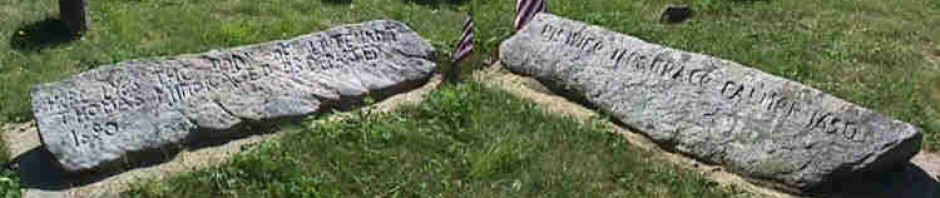
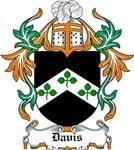
Posted in Research | 8 Comments

Samuel Rankin

Samuel RANKIN (c. 1743 – 1818)  is Alex’s 7th Great Grandfather, one of 256 in this generation of the Miner line.

Samuel Rankin was born in 1743 in Tauboyne Parish Near St. Johnston, County Donegal, Ireland. Alternatively he was born in Aughboyne, Ireland. His parents were J RANKIN and Rachel [__?__]. He married Jennie EDMONSTON about 1760 in Ireland.   After Jennie died, he married Katherine Madeville. They emigrated in Sep 1796 to Washington County, Pennsylvania. Samuel died 14 Dec 1818 in Cannonsburg, Washington, Pennsylvania and is buried in Oak Spring Cemetery.

centerMap highlighting Taughboyne

County Donegal, Ireland

Map of Pennsylvania highlighting Washington County

Washington County is now part of the Pittsburgh Metro Area.

Canonsburg was home to singers Perry Como and Bobby Vinton, NFL head coach Marty Schottenheimer, New York Giants’ superstar Doug Kotar, Olympic gold medalist Kurt Angle, Bill Schmidt, Olympian bronze medalist in the javelin throw in Munich, 1972,

Jennie Edmonston was born in 1743 in Ireland and died in Ireland in 1774 before emigrating.

Catherine Madeville was born in 1745 in County Tyrone, Northern Ireland.  Catherine died 6 Nov 1810 in Canonsburg, Washington, Pennsylvania.

County Tyrone, Ireland

Samuel and Catherine Rankin Headstones

Samuel and Catherine Rankin Headstones

Children of Samuel and Jennie:

Name Born Married Departed
1. William S. Rankin 1753 or 1763
Hastrough, Donegal, Ireland
Jane Cowan 1835
Penn Line, Crawford Co., PA
2. James Rankin? 1767 Ireland Crawford County PA
3. Elizabeth RANKIN 1765
Hastrough, Donegal County, Ireland
William L LATTA
c. 1784 in Ireland.
23 May 1846 in Crawford County PA from a fractured thigh

.

Children of Samuel and Katherine Madeville:  Most of Samuel and Katherine’s children moved to Crawfordsville, Washington, Iowa.  The first private meeting of what would become the Republican Party came when Whig Party defectors met privately in Crawfordsville in February, 1854. The meeting was to lay the groundwork for the creation of a new political party. The first public meeting was held in Ripon, Wisconsin one month later.

Name Born Married Departed
4. Mary Rankin 1778
Ireland
 Unmarried 10 Nov 1846 Crawfordsville, Washington, Iowa
5. Rachel Rankin 1779
Ireland
Unmarried 16 Feb 1860 Crawfordsville, Washington, Iowa
6. Catherine Elizabeth Rankin 1783
Ireland
Unmarried or William Smith? 19 Apr 1856 Washington, Iowa
7. Nancy Ann Rankin  1785
Ireland
Unmarried 7 Aug 1853 Crawfordsville, Washington, Iowa
8. John Andrew Rankin 1787
Ireland
Elizabeth Grizella Walker
24 Jun 1824 Somerset, Pennsylvania
11 Feb 1866 Crawfordsville, Washington, Iowa
9. Samuel Rankin 1789
Ireland
Penn Line, Crawford, Pennsylvania
10. Thomas Rankin 1790
Ireland
Penn Line, Crawford, Pennsylvania

Samuel  said he had been a member of the Seceder Congregation of Ta’ Boyne (probably Taughboyne) near St. Johnston, Ireland,   Note: St. Johnstown, Ireland is located just across the border from the county of Londonderry (which also contains the city of Londonderry), and appears to be in the county of Donegal.

Buried with him at the Oak Spring Cemetery is his wife, Catherine Madeville Rankin and a Hugh Rankin. His will is dated 20 Jan 1818.  The cemetery in which he is buried is apparently a Seceder Cemetery in Washington Co., PA.

“One source states he said he left Ireland 5 Sep 1796 and arrived Washington Co., PA later that year.

The following were tax-paying residents of the Conneaut township in Crawford County Pennsylvania in  1810: Alexander JOHNSTONWilliam LATTA and Samuel LATTA, Robert Martin, John Parr, Samuel Potter, William and Samuel RANKIN [maybe Samuel Sr.’s sons] Samuel Brooks, Thomas Crockett [son-in-law], Henry Frey, Obed Garwood, William Hill, Thomas McGuire and Rebecca Paden [daughter-in-law.] Alexander Johnston was a native of Ireland, and settled on Tract 687, in the northeast comer of the township, where he remained till death, leaving five children: William, John, Mary (Lopeman), Jane (McDowell) and Esther (Crockett). William Latta, also a native of the Emerald Isle, was a hatter, settled near Penn Line and after a few years removed from the township. His brothers, Samuel, John and Thomas, were also here, and made improvements, then departed. Robert Martin, an Irishman. settled near Steamburg, and resided there till his earthly labors were ended by death. John Parr afterward removed from the township. Samuel Potter settled in the northern part about 1799. He came from Elizabethtown, NJ, with an ox-team, part of his journey lying through the woods, with only blazed trees as a guide. He put out crops, reared a cabin, then at the end of the season returned to New Jersey, and the following spring came again to his new home, where he remained till his death, at the age of ninety-three years. William and Samuel Rankin hailed from Ireland. The former located at Penn Line, where he cleared a large farm and remained till death.

Children

1. William Rankin

William’s wife Jane Cowan’s origins are not known.

William Came to Crawford County, PA from Washington County, PA about 1800. He came with Samuel Rankin who could have been either his half-brother or his son. Samuel left the county before 1830 but William stayed until his death in 1835 (from will and probate data).  See history of Crawford County, Pennsylvania for details.

Children of William and Jane:

i. William Rankin Jr. b. ~1800-1810 Pennsylvania; d. 1841 Crawford, Pennsylvania; m. 15 Mar 1835 – Ashtabula Co., OH to Jane A. Fuller (b. 05 Jul 1818 in Maine or Vermont – d. 18 Apr 1893 Kanwaka, Douglas, Kansas; Burial Clinton Cemetery, Clinton, Douglas, Kansas). William and Jane had two children 1. Minerva Jane (b. 1837) and William Stanton (b. 1840). After William died, Jane married Samuel Kennedy (1800 Virginia – ) and had two more children Marcus Lafayette Kennedy (b. 1844) and George W Kennedy (b. 1846).

William had a residence before 1841 in North Shenango, PA

In the 1850 census, Samuel, Jane and the four children of the blended family were farming in Pine, Crawford, Pennsylvania.

ii. Mary Ann “Molly” Rankin b. 20 Sep 1798 Washington Co., PA; d. 1872 – Jamestown, Mercer, PA; m. 11 Feb 1818 Conneaut Township, Crawford Co, PA to John W. Snodgrass (b. 12 May 1781 – Northern Ireland – d. 27 Aug 1868 or 27 Oct 1865 – West Shenango, Crawford, PA). John’s father was Benjamin Snodgrass (b. ~ 1755 in Ireland – d. 27 Oct 1828 Crawford, Pennsylvania). Molly and John had twelve children born between 1820 and 1842.

In the 1850 census, John and Mary Ann were farming in South Shenango, Crawford, Pennsylvania with eight children at home ages 10 to 23.

iii. Thomas Rankin d. aft 1842

iv. Eliza Jane Rankin b. 1810; d. : 8 May 1866 Crawfordsville, Washington, Iowa ; m. 3 Dec 1831 Pennsylvania to John McCutcheon (b. 1800 – d. Eliza and John had seven children born between 1832 and 1848.

In the 1860 census, Eliza Mccutcheon was a widow farming in Crawford, Washington, Iowa with six children ages 11 to 24. John and Elizabeth Stewart’s family has the same census number, though the number is repeated for Eliza indicating she was a head of household. I don’t know if it was a typo or if the families were living together. John was a Sawyer (or a Lawyer) and Elizabeth and her daughter Martha were teachers.

v. Catherine Rankin

vi. James Rankin d. 1834 Crawford, Pennsylvania; m. Rebecca Paden

vii. Samuel Rankin

viii. John Rankin

3. Elizabeth RANKIN (See William L LATTA‘s page)

4. Mary Rankin

Mary Rankin Gravestone — Crawfordsville Cemetery, Crawfordsville, Washington County, Iowa Source: Findagrave

5. Rachel Rankin

Rachel  lived in Crawford, Washington, Iowa in 1856.  In the 1860 census, Rachel (age 80) was living with her younger brother John and his wife Elizabeth in Crawford, Washington, Iowa.

Rachel Rankin Headstone — Crawfordsville Cemetery, Crawfordsville, Washington County, Iowa Source: Findagrave #51074062

6. Katherine Rankin

Katherine may have been single or may have married William Smith. William was born in 1780 in Wales.

A letter from Katherine’s nephew Thomas Latta to another brother Moses Latta telling of the death of their mother on 23 May 1846 implies she was unmarried. In addition, her gravestone is inscribed Rankin.

Aunt Catherine went to Iowa this spring.  It appears by a letter I received from there lately that she is very much pleased with that country.  Talked of selling out at Washington and purchasing there. [Ironically, the family moved from Washington County, PA to Washingtong County, Iowa] Uncle John and family were well, and well pleased with the country.

Possible child of Katherine and William

i. Mathew Rankin Smith, b. 4 Oct 1809, Washington Co., Pennsylvania.; m. Esther Carter in 1832, Muskingum Co., OH.  d. 1 Dec 1883 Winchester, Franklin Co., TN.

Mathew migrated from Delaware Co., Indiana to Richland Co., Wisconsin and Franklin Co., Tennessee.

Catherine Elizabeth Rankin Headstone – Crawfordsville Cemetery, Crawfordsville, Washington County, Iowa — Source: Findagrave

7. Nancy Ann Rankin

Nancy Ann Rankin Gravestone — Crawfordsville Cemetery, Crawfordsville, Washington County, Iowa Source: Findagrave

8. John Andrew Rankin

John’s wife Elizabeth Grizella Walker was born 27 Sep 1792 in Pennsylvania. Her parents were John Hoge Walker (1754 – 1828) and Isabella McCormick (1758 – 1823). Elizabeth died 21 May 1871 in Washington, Iowa.

[Note, John’s brother has almost the same name and dates of birth and death. Jonathan Hoge Walker (1756 – 1824) married Lucretia Duncan and was appointed US District Judge for Western Pennsylvania in 1818. Sometimes, the two men are mixed up.]

Elizabeth’s father, John Hoge Walker was an American Revolutionary Soldier that served with General George Washington as his wagon master and later his quartermaster at the famous Crossing of the Delaware 1776 and was with the Continental Army at Valley Forge.  After our independence was gained, the Governor of Pennsylvania commissioned him a Major of the Pennsylvania Milita. John’s father and two brothers also served in the Revolutionary War, William II, William III and David Walker.  John Hoge Walker grew to be 6′ 7 3/4″ in Height. One of his brothers was 6’6 3/4″.

Elizabeth’s mother, Isabella McCormick was of the McCormick family that founded the McCormick’s Fort located along the banks of the Conococheague Creek, Cumberland County, Pennsylvania. A settlers’ stockaded blockhouse. Indians attacked nearby in 1757. The house was originally built in 1754, and lasted until torn down in 1905. The exact location is unrecorded. John’s grandfather, William Walker, a Sergeant on the frontier during the French and Indian War was killed by Indians,

Elizabeth lived with her husband most of her life in Crawfordsville, Iowa until her death at age of 78.

John Rankin Gravestone — Crawfordsville Cemetery, Crawfordsville, Washington County, Iowa — Source: Findagrave

Children of John and Elizabeth

 Siblings Mary Walker (1830-1920, John Walker Rankin (1835- ), and Catherine Walker (1832-1925)

John and Elizabeth’s children Mary Walker (1830-1920), John Walker Rankin (1835- Aft. 1905), and Catherine Walker (1832-1925)

i. Isabella “Belle” Walker Rankin b. 27 Apr 1824 – Washington, Washington, Pennsylvania; d. 22 Jan 1858 Crawfordsville, Washington, Iowa. Burial: in Old Cemetery, Crawfordsville

ii. Samuel Edmundson Rankin b. 14 Apr 1827 – Washington, Washington, Pennsylvania; d. 29 Sep 1881 – Garnett, Anderson Co., Kansas; m. 1 Jan 1849 – Washington, Iowa to Nancy Maria Crawford (b. 17 Jul 1830 – d. 1894). Nancy’s parents were Dr. Isaac Crawford (1796 – 1846) and Nancy Frazier. Samuel and Nancy had ten children born between 1851 and 1874.

Nancy's grandfather James Crawford (1751 - 1838) Revolutionary service was dramatic  Source: His great grandson's Sons of the American Revolution Membership Application

Nancy’s grandfather James Crawford (1751 – 1838) Revolutionary service was dramatic Source: His 2nd great grandson Jame H Rankin’s Sons of the American Revolution Membership Application

Samuel was born in Washington County, Pennsylvania. At age 18 (1845) he moved with his father to Crawfordsville, Washington, Iowa.

The first private meeting of what would become the Republican Party came when Whig Party defectors met privately in Crawfordsville in Feb 1854. The meeting was to lay the groundwork for the creation of a new political party. The first public meeting was held in Ripon, Wisconsin one month later

In 1857 Samuel was elected to the legislature.

In July 1861, he was chosen first lieutenant of Company C, 8th Iowa Infantry, and became part of Fremont’s Command in the campaign against Price. Engagements included Battle of Shiloh, Siege of Corinth, Siege of Vicksburg and Red River Campaign.

The 8th Iowa participated in the battle of Shiloh, fighting 10 hours on the first day, repelling attack after attack, and, with the battery which it was supporting, inflicting terrible punishment upon the enemy. It was the last to leave the advanced line of the army, being surrounded as it attempted to withdraw and compelled to surrender. Out of 650 men engaged, it lost 64 killed, 100 wounded, and 47 missing. The 8th, 12th and 14th Ia. formed four-fifths of the little force that held back ten times its numbers at the close of the first day at Shiloh, giving Buell time to bring up his forces and snatch victory from defeat. Entirely cut off, they fought until they could fight no longer, and threw down their arms only to see many of their number shot down in cold blood after they had surrendered as prisoners of war. The officers above the rank of lieutenant were sent to Selma, thence to Talladega, returned to Selma soon afterward, three months later to Atlanta, thence to Madison until Nov. 7, when they were sent to Libby prison, Richmond, and were paroled a week later at Aiken’s landing. The lieutenants and enlisted men were sent to various prisons in Alabama and suffered the miseries and privations so common to southern prisons. A few of the 8th who escaped capture went into the “Union Brigade,” a consolidated regiment rather than a brigade, and took part in the Tennessee and Mississippi campaigns, distinguishing itself at Corinth.

No word on whether Samuel was captured.

The regiment was reorganized at St. Louis early in 1863 and made an expedition to Rolla, after which it joined Grant’s movement upon Vicksburg. It took part in the battle of Jackson, participated in the assault at Vicksburg on May 22 and also in the siege. It accompanied the army to Jackson, and after the evacuation there engaged in the pursuit of the enemy. It then went into camp at Vicksburg where Lieut. -Col. Ferguson died of disease. A short march to Brownsville was the only movement of interest until early in November, when the regiment moved to Memphis, thence to Lagrange and Pocahontas, where it remained until ordered to Vicksburg to take part in the Meridian raid. Soon after that event most of the command reenlisted and visited Iowa on veteran furlough. Returning to Memphis, it performed provost guard duty during 1864 and the early part of 1865, its most notable work being the repulse of Forrest, who made an attack on the city Aug. 21, 1864, the regiment being assisted by the “Gray-beard” regiment from Iowa. Early in March, 1865, the regiment moved to New Orleans and proceeded to Mobile bay, where it took part in the assault upon Spanish Fort and captured several hundred prisoners. This assault was made by a brigade commanded by Col. Geddes. Maj.- Gen. Steele, the former colonel of the 8th, won high praise for the manner in which he conducted his part of the siege of Mobile, and Geddes’ assault on Spanish Fort was conceded to be the most brilliant performance of that campaign. The regiment moved to Montgomery shortly after and served until mustered out.

Samuel Edmondson Rankin Service History
Commissioned an officer in Company C, Iowa 8th Infantry Regiment on 31 Aug 1861.
Promoted to Full 1st Lieutenant & Adj on 28 Nov 1861.
Promoted to Full Captain on 24 Jun 1863.
Promoted to Full Major on 01 Jul 1865.
Mustered out on 20 Apr 1866 at Selma, AL.

Total enrollment of the 8th Iowa was 1589. The regiment lost 4 officers and 98 enlisted men who were killed in action or who died of their wounds and 4 officers and 170 enlisted men who died of disease, for a total of 276 fatalities. 228 were wounded. Samuel mustered out in June, 1866.

That same month he was nominated for treasurer.

About 1872 he went to Kansas. He was for some years a resident of Rich township, Anderson, Kansas. Shortly before his death he moved to Greeley, Anderson, Kansas and started a newspaper, the News. Anderson County remained dry until 1996.

In the 1870 census, SE and Nancy were living in Des Moines Ward 6, Polk, Iowa where SE was the State Treasurer. His real estate was valued at $20,000

Isaac Crawford Bio

Isaac Crawford Bio

Isaac Crawford Bio 2

iii. Mary Ann Rankin b. 26 Oct 1830 Washington, Washington, Pennsylvania; d. 1 Apr 1920 – Blue Mound, Kansas; m. 1 Mar 1851 Crawfordsville, Washington, IA to her cousin John Hoge Walker (b. 7 Mar 1828 in Butler, Pennsylvania – d. 04 Oct 1903 in Crawfordsville, Washington, Iowa). John’s parents were Jonathan Walker (1797 – 1879) and Rebecca Christiana Meeks (1810 – 1871). Mary Ann and John had seven children born between 1851 and 1873.

Mary Ann Rankin Walker moved to Washington Co. IA with her parents in 1845.  A woman of genuine christian character. A member of the Associate (Now United) Presbyterian Church of Crawfordsville IA She instilled into her children the principles of Evangelical Christianity. was a power for good not only in her family but in the community a Mother in Israel.” Mary Ann Rankin Walker died at the home of her sister Katherine Madeville Rankin Walker and was brought back to Crawfordsville IA and buried by her husband in ‘New Cemetery’ She Died at Blue Mound KS.

John Hoge Walker was born and raised in Butler Co. PA received a common school education as given in the country public schools of the period. Improved his oppoutunities and in winter of 1847/8 was teacher of his home district. Moved to Washington Co. Iowa in 1850.

In the 1880 census, John H. and Mary A. were farming in Crawford, Washington, Iowa.

iv. Katherine Madeville Rankin b. 25 Oct 1832 – Washington, Washington, Pennsylvania; d. 4 Apr 1925 – Blue Mound, Linn, Kansas; Burial: Burial: Pleasant View Cemetery, Blue Mound; m. 15 Nov 1853 – Crawfordsville, Washington, Iowa to her first cousin once removed John David Walker (b. 28 Apr 1828 in Butler, Butler, Pennsylvania – d. 24 Dec 1865 in Crawfordsville, Washington, Iowa) John’s parents were David Oliver Walker (1802 – 1841) and Maria Morton (1805 – 1849). His grandparents were John Walker (1754 – 1825) Isabella McCormick (1759 – 1823). [who were Katherine’s great grandparents See above] Catherine and John David had seven children born between 1854 and 1866.

John David and Catherine had 7 children including two sets of twins.
1. Elizabeth Grizella Walker 1854-1933.
2. David Oliver Walker 1856-1918.
3. Isabella Walker 1859-1859.
4. John Walker 1859-1859.
(Twins, John and Isabella died just after birth due to drought and lack of food) (They were buried on the family farm at Americus, Lyon, Kansas) [Their cousin and our ancestor John Morton McCAW (1789 – 1865) also lived in Americus at this time]
5. Maria Isabell “Bell” Walker 1861-1963
6. John Rankin Walker 1866-1938
7. William Morton Walker 1866-1949

In 1860, John moved his family from the family farm in Lyon County, Kansas to Washington County, Iowa. John then returned to Emporia, Lyon County, Kansas where he joined the Union Army. John spent the winter of 1861-62 in the Quarter Master Department of the Union Army, then served as 1st Sergt, E company 11th Kansas Volunteers and soon was promoted to Captain of Company “E” Cavalry Battery Company of “E” Kansas Regiment.

Captain John David Walker returned to the family farm in Crawfordsville, Washington County, Iowa after his discharge on Aug 7 1865. John was killed just a few months later, on Dec 24 1865 by being kicked in the head by one of his colts. He lived a few hours after receiving the fatal wound. According to the family memoirs, John was buried on the family farm but there is a possibility of John being buried in the Crawfordsville Cemetery.

Catherine was about three months pregnant with their twin boys, John and William (Find A Grave Memorial# 21175000). The twin boys were born 22 July 1866, Crawfordsville, Washington, Iowa.

v. John Walker Rankin b. 4 Apr 1835 – Washington, Washington, Pennsylvania; d. Aft 1905 Census Yates Center, Woodson, Kansas; m. 30 Mar 1859 – Crawford Township, Washington, Iowa to Harriet Harper(b. Mar 1835 in Ohio – Aft 1920 census, Chanute Ward 4, Neosho, Kansas);  Harriet’s father was born in Scotland and her mother in Ohio. John and Harriet had seven children born between 1861 and 1875.

In the 1880 census, John W. and Harriet were farming in Crawford, Washington, Iowa with six children at home ages 5 to 18.

John and Harriet were still farming in Yates Center, Woodson, Kansas in the 1905 census.

Sources:

http://trees.ancestry.com/tree/12435295/person/483533754

http://freepages.genealogy.rootsweb.ancestry.com/~ronnadumas/i2237.html

http://trees.ancestry.com/owt/person.aspx?pid=118838681&st=1

http://freepages.genealogy.rootsweb.ancestry.com/~ronnadumas/i2237.html#i14094

Posted in -9th Generation, Immigrant - Scot-Irish, Line - Miner | Tagged | 10 Comments

James Smith

James SMITH (1769 – 1852 ) was Alex’s 5rd Great Grandfather, one of 64 in this generation of the Miner line.

James Smith was born in Sep 1769 probably in Pensylvania.  He married Anna SMITH. He settled in Somers Township, Preble County Ohio around 1802.  James died 14 Aug 1852 in Preble County, Ohio and is buried in Hopewell Cemetery.

James Smith Headstone — Hopewell Cemetery Morning Sun Preble County Ohio, USA Plot: Row 19

Anna Smith was born 17 Mar 1770 or 18 Mar 1768 according to headstone and date calculator in Montgomery, Franklin, Pennsylvania. Her parents were Robert SMITH Sr. and Catherine WALLACE.  Ann died  13 Jan 1844 in Preble, Ohio.

Ann Smith Headstone 1

Ann Smith Headstone 2 – Hopewell Cemetery Morning SunPreble CountyOhio Plot: Row 19

Inscription:
Ann wife of James, Sr.
died Jan. 13, 1844
75 yrs. 9mos. 26d.

Note: Stone is broken and in pieces

Children of James and Anna:

Name Born Married Departed
1. Mary Smith 2 Sep 1791 Simeon Rogers
28 Apr 1812
Preble OH
1845 in Adams, Indiana
2. Catherine Smith 2 Sep 1793 Pensylvania Samuel Senton Patterson III (Mary’s brother)
27 Jul 1813
Preble County, OH
19 Feb 1863
(Katherine Patterson departed this life February 19th, 1863 aged 69 years, 4 months, and 24 days)
3. Robert SMITH 16 Nov 1795 Jessamine County, Kentucky Mary PATTERSON
(cousin of Martha McGaw)
12 Aug 1815
Preble County, Ohio.
10 Nov 1879
Preble, Ohio
buried
19 Nov 1879
Fair Haven Cemetery, Israel Township, Preble, Ohio.
4. Samuel Smith 24 Oct 1797
Kentucky
Martha McGaw (cousin of Mary Patterson)
23 Oct 1817
Preble, Ohio by John Pinkerton
1881
5. Isaac Smith 1 Nov 1800
Kentucky
Martha Burke (30 Mar 1793 Virginia – 3 Oct 1857)
19 Oct 1826 by Thomas Madill
Preble, OH
12 Jul 1883
Berrien, MI or
1 Mar 1883
Riverside Cemetery Dowagiac
Cass County
Michigan
6. James R. Smith 28 Feb 1803
Kentucky
Polly G Paxton 12 Jun 1823 Preble, OH by Alex Porter VDM, the pastor of Hopewell Church. 22 Sep 1850  age 47y 6mo.) Preble OH
7. John P. Smith 18 Feb 1808 Jane Davenport?
30 Jan 1825
Preble OH
.
Mary M. Burk
23 Sep 1840
Preble, OH
1892
Preble, Ohio, USA
8. Elizabeth Smith 7 Feb 1810 Christian F White?
13 Mar 1831 Preble, OH
9. William Smith 20 Oct 1812 Margaret Wiley? (William H Smith)
24 Jul 1845 Preble, OH
.
Lucinda Brown
23 Jan 1850
Preble, Ohio by L H McCracken

In the 1850 census, James was living by himself near his son James Jr in  Union Township, Union County, Indiana.  Note that Union Township, Indiana is right next to Preble County, Ohio.

Map of Indiana highlighting Union County
Union County, Indiana

A  John P. Smith moved to the same Somers Township, Preble County in 1816.  A  Samuel P. Smith move to the same township in 1820. While Smith is a common name, perhaps these were James’ brothers.

Somers Township, Preble County, Ohio

It appears that James had moved across the border to Union, Indiana by the 1830 census:

Free White Persons – Males – 15 thru 19: 1
Free White Persons – Males – 50 thru 59: 1
Free White Persons – Females – 60 thru 69: 1
Free White Persons – Under 20: 1
Total Free White Persons: 3

Mrs. McDonnell located a Smith/Patterson family bible during the summer of 1963. The Bible was published in 1828 by Daniel D. Smith.  The  Bible from which the below entries were extracted originally belonged to the Smith family and was brought into the Patterson line by marriage of Catherine Smith (1793-1863) to Samuel Patterson, Jr. (1792-1872) as the first two entries obviously refer to Catherine’s parents and the remaining Smith entries to their children. The Bible then passed to Catherine’s son Jame B. Patterson (1819 – ?) who, in turn, passed it to his daughter Eliza Ellen Patterson (1846 – 1924). From her it must have gone to her daughter Laura, the wife of Forrest Hege, and finally to Dorothy Hege (1898 – ?). The Bible entries as copied by Mrs. McDonnell are:
James Smith – born the year 1769 September
Anna Smith – born the year 1770 March 17th
Mary Smith – born the year 1791 September 2
Catherine Smith – born in the year 1793 September 2
Robert Smith born in the year 1795 November the 16th (married Mary Patterson a sister of Samuel Patterson, Jr.)
Samuel Smith – born in the year 1797 October 24
Isaac Smith – born in the year 1800 November 1
James Smith – born in the year 1803 February the 28th
John Smith – born in the year 1808 February the 18th
Elizabeth Smith – born in the year 1810 February 7th
William Smith – born in the year 1812 October the 20th

Kentucky Presbytery 1800 – 1815

James removed from Kentucky to Preble Ohio and joined the Presbyterian Church.  Perhaps clues to his origins can be found in the history of the Ketucky Presytery.

THE HOPEWELL CHURCH. In the years 1806 and 1807 several families, members of the Associate Reformed church, emigrated from the States of Kentucky and South Carolina, and settled in Israel Township in the midst of the Beech Woods. Rev. Risk, a minister of the Associate Reformed church, preached to them soon after their settlement. In the fall of 1808, at the house of William McCreary, in section thirty-six, they formed themselves into a society, and in conjunction with the people of Concord petitioned the presbytery of Kentucky for supplies.  Among those who occasionally supplied them were, Revs. McCord, McGill, Samuel Crothers and Brahman Craig.

[Samuel Caruthers b. 29 Apr 1770 in Abbeville, Abbeville, SC; m. Sarah Vaughn d. 21 Aug 1847 in Clark, Arkansas]

Before the close of the 1700’s, Transylvania Presbytery had become so extended as to call for a division. With the consent of the Synod of Virginia, it was broken up (March 27, 1799) into three Presbyteries,—Transylvania, West Lexington, and Washington.

The first of these, bounded northeast by the Kentucky River, north and northwest by the Ohio River,  and comprehending on the south the settlements on the Cumberland and its tributaries, comprised ten ministers:—David Rice, whose pastorate of the congregations of Concord at Danville, Cane Run, and Dick’s River (1784-97) had closed, and who had removed to Green county; Thomas B. C’raighead, subsequently (1805-08) pastor of Shiloh congregation, though he had been long in the field; Terah Templin, a faithful evangelist, supplying destitute congregations (Road’s Run near Springfield, and Hardin’s Creek, now Lebanon) in Washington county; James McGready, pastor of the congregations of Gaspar River, Red River, and Muddy River (1796-1814); Archibald Cameron at Simpson’s Creek, Bullskin, and Achor congregations (1796-1803), and subsequently in charge of Shelbyville and Mulberry Churches (1804-36); Samuel Finley at Stanford (1797-1807); Matthew Houston, successor of Carey H. Allen as pastor of Paint Lick and Silver Creek Churches (1797-1802); William McGee, pastor of Beech Church; and John Howe, settled (1798) over Beaver Creek and Little Barren.

West Lexington Presbytery, bounded south and southwest by Kentucky River, north and northwest by the Ohio, and north and northeast by the Main Licking, comprised nine ministers:—James Crawford, till his death pastor of Walnut Hill Church (17851803), gathered by his own labors; Samuel Shannon at Bethel and Sinking Spring (1789-93), and subsequently (1794-1806) atWoodford; Isaac Tull at Green Creek and Pleasant Point (1796-98); Robert Marshall at Bethel (1793-1833) and Blue Spring (1793-1803?); James Blythe at Clear Creek and Pisgah (1793-95?), of the last of which he was staged supply for over forty years; Joseph P. Howe at Mt. Sterling and Springfield (1795-1830); James Welch at Lexington and Georgetown (1796-1804), and subsequently at Dayton, Ohio; Samuel Rannels at Paris and Stonermouth (1796-1817); and William Robinson at Mt. Pleasant and Indian Creek (1796-1802).

Washington Presbytery, extending across the Ohio and comprising the remaining portion of Kentucky northeast of the Main Licking, consisted of seven ministers,—Peter Wilson, James Kemper, John P. Campbell, John E. Finley, William Speer, John Dunlavy, and Riichard McNemar.

In 1802, the three Presbyteries were constituted the Synod of Kentucky, and their aggregate membership had risen from twenty-six to thirty-seven. In 1810, the Presbytery of Muhlenberg was erected from that of Transylvania; and in 1814, the three Presbyteries, Transylvania, West Lexington, and Muhlenberg, covering most of the State, reported an aggregate of thirty ministers and sixty-five congregations. At this time several new laborers, worthy of special mention, had entered the field. Among these were Thomas Cleland, of Union (1804-16), Now Providence, and Cane Run (1813-52) congregations, Samuel K. Nelson (1809-27), of Danville, S. B. Robertson (1801-13), of Cane Run and New Providence, Nathan H. Hall, R. M. Cunningham, and others to whom reference will hereafter be made.

Among the ministers to whom, at the commencement of the century, the charge of the churches in Kentucky was committed, there were a few of devoted piety and a high order of talent. Rice and Marshall have already been mentioned. Crawford had studied at Princeton, and was a man of industry, zeal, and usefulness. Campbell was a genius, and at the same time a close student and a well-read theologian. He was a graceful speaker, an elegant writer, and a powerful controversialist. Dr. Alexander, who knew him well while he was studying with Graham and Hoge in Virginia, pronounced his talents fit for any station. Lyle was moderately gifted, but studious, cautious, and discreet. Rannels was pious and indefatigable, but unequal in his efforts, and by no means eminent. Stuart was unassuming, prudent, and considerate, but fearless in the discharge of duty. Cameron was a countryman of John Knox, whom in many respects he resembled. Robertson was much admired as a preacher, and was warm and ardent in his devotions.1 Blythe was at once scholarly and practical, conservative and decided, commanding in person and magisterial in manner,—a man of little pliancy, but great decision. Many of the others, however, were either weak in intellect or inefficient as pastors. Howe (J. P.), though he could sing and pray well, was a tedious preacher. Houston, Dunlavy, and McNernar became New-Lights or Stoneites, and finally Shakers. Bowman (1810) was suspended for refusing to appear and answer charges against him. Mahon was deposed for drunkenness. Tull was a good but weak man, and an indifferent preacher. Taking the whole body together,2 ” a dull formality seems to have been their general characteristic.” With two or three shining exceptions, the majority were of barely respectable abilities, a few hardly above mediocrity, and not a few, though sound in principle, ” deficient in the spirit of the gospel.” At one time or other, nearly half the preachers had been under ecclesiastical censure. Several were cut off for heresy or schism, two were deposed for intemperance, and several were rebuked for wrangling or improprieties.

With such facts as these established beyond question, we are not surprised at the statements of the historian of the Cumberland Presbyterians. “The ministry,” he says, ” aimed at little else than to enlighten the understanding.” Craighead for fifteen years was never heard to speak ” in favor of the new birth, evangelical repentance, or saving faith;” and his course was scarcely exceptional. The ministers spoke of the elect, the predestinated,the preordained, but little of individual accountability or spiritual regeneration. A stiff technical theology or a dry speculative orthodoxy left the heart and conscience unmoved. Members were received to the churches without professing a change of heart or being aware of its necessity.

Yet it was in these circumstances that the great Kentucky Revival of 1800—one of the memorable events in the history of the Church in this country— commenced. It was characterized, as it progressed, by great extravagances and indiscretions. Some of its results, indirectly at least, were deplorable. Yet it exerted a powerful and permanent influence, and wrought a marked change in the aspect and condition of society.1 The most incredulous repeatedly became its subjects.

In January, 1799, the Rev. James McGready took charge of three congregations—Red River, Gaspar River, and Muddy River—in Logan county, Ky. Among the neighboring ministers in sympathy with him were John Rankin, William McGee, and William Hodge,—the latter one of his own converts, from North Carolina. His field was a most unpromising one. Spiritual life seemed almost everywhere extinct. But a few members were found by the pastor ready to unite with him one day in each month, and an hour in each week, in prayer for the conversion of sinners and the revival ofGod’s work. In the course of three or four months there were signs of change. A woman long connected with the church (Gaspar Eiver) renounced her hope as false and delusive. Struck under deep conviction, she at length found peace. Immediately she visited her friends, warning them from house to house, in a most solemn manner, to attend to the interests of their souls. The congregation soon became interested, and some ten persons professed conversion.’

Children

1. Mary Smith 

Mary’s husband Simeon Rogers was born in 1785 in New Jersey. His parents were Simeon Rogers Sr. and Abigail Howard.  Simeon is listed on the 1830 Preble County, OH census with 7 male children and 1 female child.  Simeon died in 1845 or 1854 in Adams, Indiana.

Children of Mary and Simeon

i. Joseph Smith Rogers (20 May 1814 – 30 May 1861) m. 18 Jan 1838 Elizabeth Turner (26 Sep 1820 – 5 Aug 1901) In the 1850 census, Joseph and Elizabeth were living in Blue Creek, Adams, Indiana with four young children. Alice (11), David (7), Hugh (2) and Commodore (newborn).

ii. Hugh S. Rogers  (4 May 1824, Preble, Ohio – 22 Jun 1865)  m. Sarah J. Turner  (11 Sep 1822 – 06 Feb 1898)  Hugh S. was a civil war soldier and died “standing in the sun” in the U.S. Transit Hospital in NY. In the 1850 census, there was a Hugh and Sarah Rogers living in Kirklin, Clinton, Indiana, but the dates of birth are a little different Hugh (1819 Ohio) and Sarah (1824 Iowa). This couple had two children Robert F (4) and Sarah (newborn)

.

2. Catherine Smith

Catherine’s husband Samuel Senton Patterson III was born 26 Jun 1793 in South Carolina.  His parents were Samuel PATTERSON Jr. and Agnes [__?__].   Samuel and Catherine were living in Fall Creek, Hamilton, Indiana with their son James in the 1850 census.   Samuel Patterson  departed this life January 1, 1872 in Hamilton, Fall Creek, Indiana, aged 79 years, 3 months, and 6 days.

1800 – In the 1800 SC Heads of Families census listed in Abbeville Dist.: (Column Headings: Males 45, Females 45 , free persons, slaves) Paterson, Samuel _ p. 32 _ 31010-10010-01 This matches Samuels family exactly; William age 8, Samuel age 7, John < age 1, Samuel Jr age 35, Mary age 5, and Agnes age unknown. It is interesting to see that Samuel Jr. had one slave in his household. This somewhat dispels that theory that the Pattersons and other families who moved from South Carolina to Ohio did so over slavery.

Samuel Patterson III served in the American Army during the War of 1812. Mrs. Mary Jane McDonnell of Indianapolis informed Carroll Ruffin Patterson that he received a pension for that service and that there is a reference to bounty land.

Children of Catherine and Samuel

i.   Samuel J. Patterson (26 Sep 1815, Indiana Territory – 2 Oct 1852 Indiana); m.1 Aug 1839 in Preble, Ohio to Margaret McBurney (23 Aug 1821 in Ireland – 6 Nov 1852 in Indiana) In the 1850 census, Samuel and Margaret were living in Fall Creek, Hamilton, Indiana with five children under 10. One daughter Mariah also died 11 Oct 1852.

In 1852 a cholera epidemic swept through Indiana and other parts of the Ohio Valley and literally Wrecked this family, killing Samuel J. Patterson on 2 Oct 1852, his wife Margaret McBurnet on 6 Nov 1852, their daughter Mariah on 11 Oct 1852 and their son James on 23 Sept 1852. Mary Ann Patterson died 20 Aug 1854 aged 9, of unknown causes. After the death of their parents and siblings, the surviving children went to live with various relatives as follows:
=>Thomas Jefferson Patterson (1844-1914) with his paternal uncle James B. Patterson ( 1819-?). Thomas was a very wealthy man of Hamilton County Indiana and active in the Republican Party of that County, which he served as a county commissioner. During the Civil War he served 3 1/2 years in the Union Army. He was in the lumber business and a gentleman farmer, having about 600 acres under cultivation. After his retirement he made a fortune in natural gas. On his death a large estae passed to his surviving children.
=>Amanda Ella Patterson (1852 – 1924) with her paternal aunt Anna Patterson (1817-1876) and her husband John Wright (1812-1894) in Potomac, Ilinois. Amanda suffered a sun-stroke from which she never completely recovered. Her family removed to Colorado on the assumption that the climate of the high altitudes would benefit her. Such was not the case, however, and she became increasingly worse and subsequently died. Her twin daughters. Elizabeth and Blanche, taught school at Boulder Colorado for many years.
=>Martha Jane Patterson (1841-1924) was reared by persons unknown, undoubtedly relatives in the Ohio-Indiana-Illinois area.

ii.  Anna Patterson  (13 Sep 1817 Blue Grass, IL?- 18 Apr 1876, Potomac, Vermilion Illinois); 8 Feb 1837 Vermilion Illinois to John Burrell Wright (18 Mar 1812 in Maggotte Creek, Franklin, Virgina – 27 Mar 1894 in Potomac, Vermilion, Illinois) son of John Wright and Elizabeth Abshire; Ten children

In 1852 Anna, husband John and their first seven children moved their family and belongings in a covered wagon to Illinois. Family tradition says that, as many others in like circumstances did, they were overloaded and had to abandon many of their possessions in the wilderness. Their two youngest children were born in Illinois.

iii. James B. Patterson  (22 Nov 1819 Fall Creek, Hamilton, Indiana – 11 Oct 1900 in Noblesville, Hamilton, Indiana); m. before 1843 to Nancy Rutherford (10 Feb 1823 Indiana – 20 Jun 1908 Noblesville, Hamilton, Indiana) In the 1850 census, James and Nancy were farming in Fall Creek, Hamilton, Indiana and his parents were living with the. By the 1870 census, James and Nancy had moved to Vernon, Hancock, Indiana. By the 1900 census, James and Nancy were living with their son Nathan in Noblesville, Hamilton, Indiana

iv. Eli Patterson ( ); m. 27 Oct 1853 Hamilton, Indiana to Martha Arnett There were several Eli Pattersons who served in Indiana Regiments in the Civil War, but I haven’t been able to identify if any were this Eli.

v.  John Patterson

vi. Nancy Patterson (10 Feb 1823 – )

.

3. Robert SMITH  (See his page)

.

4. Samuel Smith 

Samuel’s wife Martha McGaw was a cousin of another daughter in law, Mary Patterson.  Martha was born 9 Oct 1795 in Abbeville, SC.  Her parents were William Magaw (1750 – 1836) and Mary Patterson (1757 – 1842). Martha’s brother Samuel Patterson Magaw was a Presbyterian minister. He was pastor of Clear Creek and Mt. Pleasant congregations (Presbyterian) in Ohio. Martha’s maternal grandparents were our ancestors Samuel Senton PATTERSON (1725 – 1792) and Mary CARSON (1730 – 1820) Martha was living with her son Samuel in 1880 in Henderson, Illinois and died in 1881.

In a 1827 census, Samuel was a farmer in Israel Township, Preble, County

In the 1850 census, Samuel and Martha were living in Preble, Ohio with their youngest children Samuel and Martha. Their farms was valued at $3,300.

Children of Samuel and Martha

i. Mary P Smith (5 Aug 1818 Israel Township, Preble, Ohio, –

ii. James Oliver Smith (12 Nov 1820 Israel Township, Preble, Ohio – ); m. Catherine [__?__] (abt 1824 New York – ) In the 1860 census, James and Catherine were farming in Israel, Preble, Ohio. Ten year old Sarah Kill was living with them.

iii. Anne Jean Smith (Jul 1823 Preble, Ohio – 11 Feb 1824 Preble, Ohio)

iv. Elizabeth Smith (5 Jun 1826 in Israel, Preble, Ohio – 17 Jan 1829 in Israel, Preble, Ohio)

v. William Smith (17 Jul 1828 in Israel, Preble, Ohio – 21 Feb 1850 – Preble, Ohio) m. Mary [__?__] William died of consumption

vi. Samuel A Smith (30 Dec 1830 – 13 Nov 1904 Shiloh Cemetery Bloomfiled Township, Mitchell County, Kansas) m. 22 Sep 1868 Henderson County, Illinois to  Nancy Vorona Pace (1 Aug 1846 in Manmouth Warren, Illinois – 1 Apr 1943 Bloomfield, Mitchel, KS) In the 1880 census, Samuel and Nancy were farming in Henderson, Illinois. They had five children, Samuel’s mother Martha and a hired hand living with them. In 1900, Samuel, Nancy and four of their children aged 19 to 26 were farming in Salt Creek, Mitchell, Kansas.

vii. John Smith (29 Nov 1833 in Israel, Preble, Ohio – 21 Sep 1834 Preble, OH)

viii.  Martha Smith b. 1835

.

5. Isaac Smith 

Isaac’s wife Martha Burke was born 30 Mar 1793 in Montgomery County, Virginia. Her parents were John Burke (15 Mar 1763, Virginia – 20 Sep 1838, Indiana) and Margaret Davidson (1766 in Tazewell, Virginia – 21 Nov 1836 in Virginia) Martha died 3 Nov 1857.

In a 1827 census, Isaac was a farmer in Israel Township, Preble, County

Children of Isaac and Martha :

i. James Smith (c. 1829 Ohio – )

ii. Anna Smith (1831 in Berrien, Michigan – 15 Sep 1873 in Santa Clara, Santa Clara, California) m. 26 Dec 1855 in Berrien, Michigan to Isaac Newton Thompson (28 Jul 1823 in Indiana – 05 Aug 1913 in Santa Clara, Santa Clara, California) By the 1860 census, Isaac and Anna were farming in Santa Clara. There oldest daughter Martha was born in California Feb 1857 in Santa Clara so they arrived even earlier. After Anna died, Isaac married in 1874 to another widow Emily Anna Carrie DeFleurey (18 Feb 1839 in Illinois – 18 Mar 1928 in Santa Clara, Santa Clara, California) In the 1880 census, John’s stepson Ellsworth Kaufman (15) was living with the family

.

6. James Smith

James wife Mary (Polly) G. Paxton was born 18 Aug 1799 in Virginia.   Her parents were Jonathan Paxton (1777 – 5 Jan 1852, Hopewell Presbyterian, Preble, OH) and Nancy Agnes Gilmore (1784 – 28 Feb 1852, Hopewell Presbyterian, Preble, OH).  Polly died 27 Jun 1868 in Preble County, Ohio.

Note that our ancestor and James’ nephew  William McCAW was working on Polly’s brother Thomas Paxton’s farm in 1850.  James and Polly’s first child was Nancy after her mother.

Polly Paxton Smith Hopewell Cemetery, Morning Sun, Preble, Ohio (wife of J.R. died June 27 1869 age 68y 10m 9da.)

In the 1850 census, James and Polly (Mary) were living in Union Township, Union County, Indiana. James’ farm has a value listed at $5,000 which is above average.  Her father James SMITH was also living there, next to the farm of a William and Lucinda Smith.  Their remaining children (Catharine, Willliam, James, Sarah and John [Jho]) were all born in Indiana. James must have died shortly thereafter and his body was brought back to Preble, Ohio as his gravestone shows a death of 22 Sep 1850.

James R. Smith was born in Union county, Indiana, in 1810, and died in 1857. His wife was Mary Paxton, who died in 1871. They had ten children, three of whom are still living: Eliza, married and living in Israel township; Mary, married and living in Fair. Haven, and William R., living in Israel township. William R. Smith was born in 1836. In 1857 he married Mary Ann Evans, who was born in 1836. She died in 1874, leaving three children. He married again in the same year, a Miss Grace E. Munns, who was born in Butler county, Ohio. They have had two children. He lives in Fair Haven and owns fifty-four acres of land.

James Smith Jr Headstone Hopewell Cemetery Preble, Ohio

Children of James and Polly:

i. Nancy Smith  – Nancy’s headstone is in Row 18 Hopewell Cemetery , Morning Sun, Preble County, Ohio, but the date is illegible

ii. Ann Smith ( c. 1825 Indiana –  Apr 1860 in Israel, Preble, Ohio) m. 16 Mar 1842 – Union Union County, Indiana to William C. Swan (abt 1824 Pennsylvania – ) By the 1880 census, William was still farming in Somers, Preble, Ohio and before 1870 had married another Ann C. (c. 1824 Ohio – ) whose parents were from Maryland.

iii Eliza Smith (2 Mar 1828, Indiana – 22 Aug 1900  Hopewell Cemetery, Morning Sun, Preble, Ohio) m. 20 Nov 1844 Union County, Indiana to Andrew Brown (15 Nov 1820 Ohio – 8 Jul 1894 ).

As of 1881 they had four living children and Mr. Brown owned one hundred and forty-two acres of land, which is under good cultivation. Andrew’s father Thomas Brown was born in South Carolina, in 1792, and emigrated from that State to Ohio in 1816, and about 1819 settled in Israel township, section twenty- seven. His wife was Elizabeth Hamilton, born 1798, and died in 1847. They have had nine children, one of whom (John) is dead: Jane, Andrew, Samuel, William, Eliza, James H., Israel and Margaret were living in 1881. By 1900, Eliza was widowed and living with her nurse in Isreal, Premble, Ohio.

iv. Mary Smith (7 Feb 1830, Union County, Indiana – 27 Sep 1911, Fairhaven, Preble, Ohio); m. 21 Nov 1849 Union County, Indiana to Daniel Fisher (18 Jul 1818 in Lancaster County, Pennsylvania – 22 Jun 1899 Fairhaven, Preble, Ohio)  Mary and Daniel had six children. In the 1880 census, Daniel was a tinner living in Fair Haven, Premble, Ohio.

v. Catharine Smith (c. 1832 Indiana – Jul 21 1862, Sioux County, Iowa)

vi. William Rankin Smith (21 Apr 1836, Indiana – 1885) In 1857 he married Mary Ann Evans (1836 – 6 Mar 1874  Preble, Ohio) She died in 1874, leaving three children. He married again in the same year, a Miss Grace E. Munns, who was born in Butler county, Ohio and died 22 Aug 1921 in Preble, Ohio.   They have had two children. In 1881 he lived in Fair Haven, Preble, Ohio and owned fifty-four acres of land.

vii. James P. Smith (1838 Indiana – bef. 1880)

viii. Sarah McCracken Smith (13 Dec 1840 Indiana – 23 Sep 1850, Preble County, Ohio)

ix. John A. Smith (12 Feb 1844, Indiana – 24 Apr 1874, Isreal Township, Preble, Ohio); m1 17 Feb 1863  to Lucinda VanDeveer; m2. 5 Apr 1866 Preble, OH to Sarah J. Evans (14 Nov 1846 in Ohio – 14 Mar 1873 in Israel, Preble, Ohio) In the 1870 census, John and Sarah were farming in Israel, Preble, Ohio.

.

7. John Smith

John’s first wife Jane Davenport was born in 1807 in Wayne, Indiana.   Her parents were Jesse Davenport (1 Nov 1775 in Guilford Rowan, North Carolina, – 28 Jun 1826 in Wayne, Indiana) and Rebecca Fouts (15 Mar 1784 Randolph, North Carolina – 20 Apr 1862 Wayne, Indiana)  Jane died in 1839 in Wayne, Indiana.

John’s second wife Mary M. Burk was born xx.

.

9. William Smith

William’s first wife Margaret Wiley

William’s second wife Lucinda Bown  was born in 1828 in Ohio.  Lucinda’s parents were born in South Carolina.  Lucinda died after the 1880 census.

William may have married Margaret Wiley? (William H Smith) 24 Jul 1845 in Preble, OH.  He married  23 Jan 1850  in Preble, Ohio by L H McCracken to Lucinda Brown In the 1850 Census William and Lucinda were living Union, Union, Indiana – living next to his father James and near his brother James.  In the 1860 Census Union, Union, Indiana –  William was living near College Corner Post Office, Butler County.  The value of his farm was $14,000 so he was doing quite well.  By 1870, the value of his farm had reached $25,200.  By 1880, Lucinda was widowed and her son Isaac was head of household.

Children of William and first wife Margaret Wiley?

i. John B.Smith   (1836 Indiana – After 1880 census); m. before 1870 to Adeline E. [__?__] (abt 1835 Maryland or 1837 Ireland – ) Adeline’s father was from France and her mother from Ireland. In the 1860 census, John B was living at home and  was doing OSF (Order of St. Francis) Ministry. In the 1870 census, John was a clergyman in Jefferson, Newton, Indiana. In the 1880 census, John was Minister of the Presbyterian Church in Monticello, White, Indiana

ii. Nancy Smith (1839 Indiana – ) Only 1850 census

iii. Anna Smith (1841 Indiana – ) Only 1860 census

.

Children of William and Lucinda

iv. James B. Smith (1851 Union, Union, Indiana – )

v. Isaac N. Smith (1856 Union, Union, Indiana – After 1920 census); m.  Catherine [__?__] (1858 Ohio –  After 1920 Census)  By 1880, Lucinda was widowed and  Isaac was head of household and married to Catherine.

1849 Union County Retrospect
Based on “Indiana Gazetteer,” published by E. Chamberlain
click and zoom to Our Neighbors MapUnion County, organized in 1821, derived its name from the hope that it would harmonize the difficulties that existed in relation to the county seats in Wayne and Fayette. It is bounded north by Wayne, east by the State of Ohio, south by Franklin, and west by Fayette. Union County is 14 miles from north to south, and 12 wide. The civil townships are Center, Union, Harmony, Liberty, Brownsville, and Harrison. The population in 1830 was 7,957, in 1840 8,027, and at this time [1849] about 8,500. The eastern part of the county is level, the western undulating or hilly, about one-eighth is bottom, the other seven-eights timbered upland, on which beech, sugar-tree, poplar, oak, walnut, ash and hickory were originally the most common forest trees. The soil is uniformly good and well adapted to corn, wheat, oats, grass, etc., and hogs, cattle, sheep and horses are raised on almost every farm beyond the demand for home consumption. The annual value of the surplus exported is estimated at $200,000. There are in the county 16 gristmills, 21 sawmills, two oil mills, four woolen factories, 25 stores, two lawyers, 10 physicians, 11 ministers of the gospel, 10 Methodist churches, three for Presbyterians, tow for Christians, and two for Baptists, two for the Reformers, tow for the Friends, one for the Associate Reformed, and one for Universalists. AT least 40 common schools are kept up six months in the year, at which from 1,200 to 1,500 scholars attend, and the schoolhouses are mostly comfortable buildings.

Sources:

http://trees.ancestry.com/tree/10697422/person/6051211826

http://www.familysearch.org/eng/search/IGI/individual_record.asp?recid=100370921869&lds=1&region=11&regionfriendly=North+America&frompage=99

http://trees.ancestry.com/tree/18752261/person/706818671

http://www.genealogy.com/users/c/r/o/Carl-A-Crowley-iii/FILE/0004page.htm

http://home.comcast.net/~adhopkins/earlyoh.txt

http://wc.rootsweb.ancestry.com/cgi-bin/igm.cgi?op=GET&db=hoosierpatterson&id=I00043