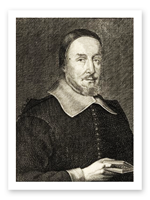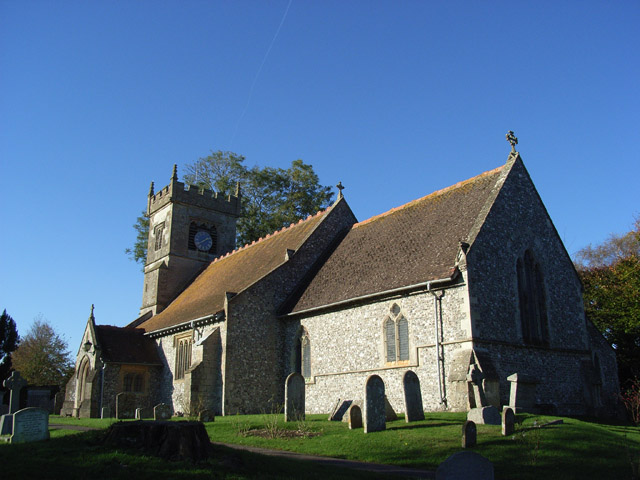
George Woodward

George WOODWARD (1619 – 1676) was Alex’s 11th Grandfather; one of 4,096 in this generation of the Shaw line.  His was also Alex’s 10th Grandfather; one of 2,048 in this generation of the Shaw line.

George Woodward was born in 1619 in Ipswich, Suffolk, England. His parents were Richard WOODWARD and Rose STEWART. He emigrated with his parents and brother John on the Elizabeth in 1634 at the age of 13. He married Mary GIBBSON in 1640 in Watertown, Middlesex, Mass. After Mary died, he married Elizabeth Hammond 17 Aug 1659, Watertown.   George died on 31 May 1676 in Watertown, Middlesex, Massachusetts.
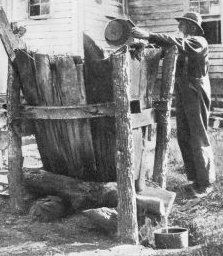
George Woodward was a Soap Boiler

Mary Gibbson was born about 1620 in Ipswich, Suffolk, England. Her parents were Joseph GIBBSON and Rebecca ERRINGTON.  She died in 1658 in Watertown, Middlesex, Massachusetts.

Elizabeth Hammond was born 1633 in Lavenham, Suffolk, England.  Her parents were Thomas Hammond and Elizabeth Case.  Her grandparents were our ancestors Thomas HAMMOND and Rose TRIPPE.  After George died, she married Samuel Truesdale, as his second wife.

Children of George and Mary:

Name Born Married Departed
1. Mary Woodward 12 Aug 1641 in Watertown John Waite
13 Jan 1664
Watertown, Middlesex, Mass
23 Aug 1718
Watertown, Mass
2. Sarah WOODWARD 6 Feb 1641/42
Watertown, Mass
Stephen GATES II
18 Apr 1662
Stow, Mass
21 Oct 1706
Stow, Mass.
3. Amos Woodward 1646 in Watertown, Sarah Patten
1666/1680
Cambridge, Mass.
9 Oct 1674
Cambridge. Mass
4. Rebecca Woodward 30 Dec 1647
Watertown
Thomas Fisher
11 Dec 1666
Dedham, Mass
Watertown
5. John Woodward 28 Mar 1649
Watertown
Rebecca Robbins
1673
Watertown
.
Margaret Lemon
17 Jul 1696.
3 Nov 1732
Newton, Mass
6. Susanna Woodward 30 Sep 1651
Watertown, Mass
19 Dec 1671
Watertown
7. Daniel WOODWARD 11 Jun 1653
Watertown
Elizabeth DANA
14 Jan 1679
Probably, Medford, Mass
31 Jul 1713
Newton, Mass
8. Mercy Woodward 3 Jun 1656
Watertown
Samuel East
c. 1672 in Boston, MA.
.
George Barstow
15 Mar 1677
Roxbury, Mass.
31 Jul 1713

.

Children of George and Elizabeth Hammond

Name Born Married Departed
9.  George Woodward 11 Sep 1660
Watertown, Mass.
Lydia Browne
31 Dec 1686 in Watertown, Middlesex, Mass
 1696
10. Thomas Woodward 15 Sep 1662
Watertown, Mass
 3 Sep 1666
Watertown, Mass
11. Elizabeth Woodward  8 May 1664
Watertown, Mass
Samuel Eddy
7 Dec 1693
Watertown, Mass
12. Nathanael Woodward 28 May 1668
Watertown, Mass
28 May 1668
Watertown, Mass
13. Sarah Woodward  3 Oct 1675
Watertown, Mass
John Eddy
6 Jul 1693
Watertown, Middlesex, Mass
.
Isaiah Whitney
1695
Lexington, Middlesex, Mass
 Aft. 1715

George was a soap boiler.  Soap was produced by boiling wood ash lye and waste fats together.  Potash (especially potassium carbonate) has been used from the dawn of history in bleaching textiles, making glass, and, from about A.D. 500, in making soap. Potash, called pearlashes in colonial times,  was principally obtained by leaching the ashes of land and sea plants.  Soap making was performed as a yearly or semiannual event on the homesteads of the early settlers. As the butchering of animals took place in the fall, soap was made at that time on many homesteads and farms to utilize the large supply of tallow and lard that resulted. On the homes or farms where butchering was not done, soap was generally made in the spring using the ashes from the winter fires and the waste cooking grease, that had accumulated throughout the year.

Potash production provided early settlers in North America a way to obtain badly needed cash and credit as they cleared their wooded land for crops. To make full use of their land, excess wood, including stumps, needed to be disposed. The easiest way to accomplish this was to burn any wood not needed for fuel or construction. Ashes from hardwood trees could then be used to make lye, which could either be used to make soap or boiled down to produce valuable potash. Hardwood could generate ashes at the rate of 60 to 100 bushels per acre  This potassium based soap was the only kind made from the first discovery of soap making until the first half of the 19th century.

George had an Homestall of 6 acres bounded the west w/the highway, the east w/Edward How and Richard Woodward, the north w/Richard Benjamin and the south w/Edmond Blois bought of Edward. He was buried in 1676 at Watertown, Middlesex, Massachusetts.

Boston City records for 12 Jun 1637, contains an entry with the following information: ‘Geroge Woodward, sopeboyler [Soap Boiler], was found a delinquent for an unlawful entry upon some of the town’s ground and for digging holes and annoying the highway with stinking fish to forfeitures of £3-4s-8d.’

It further says he was a resident of Watertown by 1641 and had started a family by that date. He was the ‘homestall’ or proprietor of ten acres on Lexington St, on the east side between Main St and Orchard St, on which land he resided for the remainder of his life and on which land his widow and family would reside for quite some time after his death.

View Google Map Street View
(View Down Lexington Avenue with Main Street at our Back)

Children

1. Mary Woodward

Mary’s husband John Waite was born 6 May 1639 in Watertown, Middlesex, Mass. His parents were Richard Waite and Mary [__?__]. John died 24 Aug 1691 in Watertown, Middlesex, Mass.

2. Sarah WOODWARD (See Stephen GATES II‘s page)

3. Amos Woodward

Amos’ wife Sarah Patten was born 26 Jan 1645 in Cambridge, Middlesex, Mass. Her parents were William Patten and Mary [__?__]. Sarah died 24 Sep 1677 in Cambridge, Middlesex, Mass

4. Rebecca Woodward

Rebecca’s husband Thomas Fisher was born 1643 in Watertown, Middlesex, Mass. His parents were Thomas Fisher and Elizabeth [__?__]. His father  Thomas died 12 Mar 1707 in Watertown, Middlesex, Mass.

The list of Dedham Covenant signers  includes two men both named Thomas Fisher #42 and #125.   Savage has two entries for men named Thomas, as follow.

THOMAS, Cambridge 1634, came, perhaps, from Winton in Eng. But it is not told whether the town were in Westmoreland or Yorkshire and I doubt the spell. may have been Winston, in Co. Suffolk. had Thomas, Samuel, perhaps a d. was freem. 4 Mar. 1635, rem. to Dedham 1637, was engag. to build the meeting-ho. and d. 1638. His wid. Elizabeth d. 21 Jan. 1651.
THOMAS, Dedham, perhaps son  of the preced. m. 5 Dec. 1666, Rebecca, d. of the first George Woodward of the same, freem. 1678. He had six ds. no s. and the same or ano. is in the list of 1678. A Mary F. wid. join. Boston ch. 25 Dec. 1647, and d. 6 Sept. 1653, but I kn. not wh. was her h.

Savage also stated, “Great labor I have found to conciliate these Fishers, and some of it may seem unsuccess[ful].” Savage is admitting that there might be mistakes in what he was reporting.

In Pope’s book there is one entry for a Thomas Fisher of Dedham, as follows:

Thomas, carpenter, Cambridge, propr. Of house and land, 1634; frm. March 4, 1634/35. Rem. To Dedham; adm. Propr. 18 (5) 1637. He d. 10 (6) 1638. The town gave to his widow 40 shillings toward the bargain he had made in building the meeting-house, 25 (1) 1639. She paid to the attorney of Elisha Bridges, 4 (7) 1639, a legacy left by her husband for his dau. Sarah, wife of John Blackston. [L.] She had leave from Gen. Court 13 May, 1640, to admin. Her husband’s est., and to sell half of her lot for the bringing up of her children.”

While Pope does not explicitly state the first name of the widow of Thomas Fisher, he does make reference to a daughter Sarah, wife of John Blackston. For further information see “Note-book kept by Thomas Lechford, esq., lawyer: in Boston, Massachusetts …”, by Thomas Lechford, James Hammond Trumbull. It is available on the internet at

Lechford’s information is also addressed in a work entitled “Transactions and collections of the American Antiquarian Society“, Volume 7, by the American Antiquarian Society,

The Antiquarian Society author first quoted the Lechford notes and then expanded on the information as follows:

“Elisha Bridges releaseth Mary Fisher widdow for 30s legacy given by Thomas Fisher [footnote 1] the testator to John Blackston and Sara his wife daughter of the said Thomas & payd by the said Mary executrix of the said Thomas Fisher unto the said Elisha Attorney for the said John Blackston & Sara his wife dated 4. 7. 1639. before Mr [blank] Hawkins Ed: Michelson & myselfe. [1s. 6d.]

“A Coppy of the said Bridges letter of Attorney. [1s. 6d.]

“[footnote] 1 It is difficult to be sure of identifying this Thomas Fisher and Mary his widow; but I think him the man of that name who came from Winton in England to Cambridge in 1634, and moved, says Savage, from there to Dedham in 1637. Exactly when he died I cannot say. The date here is two years after his removal to Dedham, which would afford him ample time. Some while after, this Widow Fisher, — whom I suppose to be the Mary in the text, — of Dedham, had liberty given her by the General Court to take the administration of her husband’s estate for the benefit of her children (Mass. Col. Rec., i. 292). This Mary Fisher we may reasonably believe to have been the widow who joined the Boston Church in 1647, and died 1653. ‘Great labor,’ says Savage, ‘I have found to conciliate these Fishers; and some of it may seem unsuccess.’ I think, however, this passage in Lechford supplies a link which was wanting in Savage’s train of reasoning.

Therefore, we have evidence, from a primary, historical document (notes of attorney Lechford), that the widow of Thomas Fisher of Dedham in 1639 was named Mary. Savage, however, in his Dictionary, stated, “[Thomas’s] wid. Elizabeth d. 21 Jan. 1651.” In Savage’s entry for the second of the two men named Thomas Fisher (and who married Rebecca Woodward in 1666), he added, “A Mary F[isher] wid[ow] join[ed] Boston ch[urch] 25 Dec. 1647, and d[ied] 6 Sept. 1653, but I kn[ow] not wh[o] was her h[usband].” So apparently Savage was wrong, and this is an instance where his “great labor” was “unsuccessful”.

Let’s return to Elizabeth Fisher, widow of John. Pope said this widow Elizabeth Fisher died January 31, 1651 in Dedham. Compare her to the Elizabeth Fisher, supposedly widow of Thomas, that Savage said died January 21, 1651 in Dedham. Apparently Savage confused Elizabeth, widow of John, with the widow of Thomas (who was actually named Mary). Compare the dates of death: January 21, 1651 and January 31, 1651. It seems too great a coincidence that two widows named Elizabeth Fisher both died in January 1651 in the still-small town of Dedham. Since we know that Savage was in error on the name of Thomas Fisher’s widow (who was Mary, not Elizabeth), it seems that he simply mis-identifed Elizabeth, John’s widow, and then possibly had a clerical (typographical) error in the date of her death.

How much of the other information about Thomas Fisher did Savage confuse? Quite a bit. Let’s take it piece by piece.

BOTH Savage and Pope state that Thomas Fisher had lived in Cambridge, Massacusetts in 1634 (when it was still called Newtowne). BOTH Savage and Pope mention that the leaders of Dedham had engaged him to build the meeting house (and Pope states he was a carpenter). BOTH Savage and Pope state that Thomas Fisher had been admitted as a “freeman” of the Massachusetts Bay Colony on March 4, 1635 (and this was new style, because Pope noted the date as 1634/5). Savage states that Thomas had “perhaps a d[aughter]” while Pope states that Thomas had a daughter Sarah. Savage stated that Thomas Fisher died in 1638 while Pope stated that Thomas Fisher died on 10 (6) 1638 (i.e., August 10, 1638, new style). The Antiquarian Society author wrote, “Exactly when he died I cannot say.”

Pope refers to a primary historical record, stating, “[The widow of Thomas] had leave from Gen. Court 13 May, 1640, to admin. her husband’s est., and to sell half of her lot for the bringing up of her children.” The author of the Antiquarian Society work hedges cautiously, stating, “Some while after, this Widow Fisher, — whom I suppose to be the Mary in the text, — of Dedham, had liberty given her by the General Court to take the administration of her husband’s estate for the benefit of her children (Mass. Col. Rec., i. 292).”

Apparently this record from the General Court only refers to “Widow Fisher”, without explicitly stating her first name. We know from Pope that John Fisher had died July 15, 1637 in Dedham and that his widow Elizabeth was still there in 1640 (when she became a member of the Dedham church) and until 1651 (when she died there). We also know from Savage and Pope that Thomas Fisher had died in 1638 (perhaps August 10) in Dedham and that his widow Mary had at least a daughter Sarah. The 1640 order of the General Court was almost three years after the death of John Fisher, and almost two years after the death of Thomas Fisher, but in all honesty, the Court record could refer to either widow, Elizabeth or Mary.

The “Widow Fisher” referred to in the 1640 Court record had “children” (plural). We know that Thomas and Mary Fisher had at least a daughter Sarah. We do not know if John and Elizabeth Fisher had children. Nonetheless, Savage, without any citation of evidence, baldly stated that Thomas and “Elizabeth” Fisher had sons Thomas and Samuel. Savage was wrong on the wife; was he wrong on the sons?

Many family trees posted on World Connect (www.rootsweb.com) state that the Thomas Fisher who married Rebecca Woodward (daughter of George) in 1666 was likely born between about 1630 and 1638, and died on or about March 12, 1707. Savage wrote that this Thomas was “perhaps” the son of the Thomas who had died in 1638. Many family trees on World Connect also state that there was a Samuel Fisher, likely born between about 1630 and 1638, who married in 1659 Meletiah (or Milcah) Snow (daughter of Thomas) and lived in Wrentham, Massachusetts, where he died about January 5 or 6, 1703/4. Many suggest that he was another son of the Thomas Fisher who died in 1638.

Here is the problem. In 1670, the Reverend John Allen of Dedham wrote his Will and made bequests to (among others) his “near kinsmen” Samuel and Thomas Fisher. I believe that many researchers have GUESSED that this Samuel and Thomas Fisher mentioned in the Will were the same Samuel and Thomas who are listed by Savage as sons of Thomas. People have then GUESSED that John Allen, in using the term “near kinsmen” was calling these two his nephews. People have then taken the erroneous information from Savage about Thomas Fisher having a widow Elizabeth, and have CREATED an Elizabeth Allen, sister of the Reverend John Allen. But this is error, as Elizabeth (maiden name unknown) was the widow of John Fisher, and Thomas Fisher’s widow was named Mary.

Now add one more bit of information to the mix. On a family tree posted by a Doneva Shepard at http://wc.rootsweb.ancestry.com/cgi-bin/igm.cgi?op=GET&db=donevanell&id=I02680, she stated, “On an unknown date, in a list of ‘Gifts bestowed upon the colony since 1634,’ John Winthrop noted that ‘John Allen of Surslingham, minister, in Norfolk, gave £25 to the treasury, sent by Thomas Fisher of Winton’. ‘Surslingham’ is a corruption of Saxlingham-juxta-Mare. ‘Winton’ may represent an earlier residence for Thomas Fisher; no parish of this name exists in Norfolk, but there is a Winston in Suffolk.”

I have not had any success in tracking down the primary source for this list of “Gifts”, but it strikes me as being credible. I believe this record might have been the evidence that Savage relied upon in stating that Thomas Fisher of Dedham (by way of Cambridge) came “perhaps, from Winton in Eng. But it is not told whether the town were in Westmoreland or Yorksh. and I doubt the spell. may have been Winston, in Co. Suffolk.”

I personally believe that it is reasonable to infer that this John Allen, a minister in Saxlingham, Norfolk, England was the same Reverend John Allen who came to Dedham in about 1637. It also seems reasonable to infer that the Samuel and Thomas Fisher who were “near kinsmen” of John Allen (as described in his 1670 Will) are somehow related to this Thomas Fisher of Winton (or Winston). But was the Thomas Fisher residing in England, who gave a generous gift to the Massachusetts Bay Company AFTER 1634 (but presumably before 1637) the carpenter Thomas Fisher living in Cambridge, Massachusetts in 1634? I don’t think so, for several reasons.

First, if the Thomas Fisher who died in Dedham in 1638 was living in Cambridge, MA in 1634, he could not have been living in Winton (or Winston), England after 1634, when the gift was made. Second, Thomas Fisher, a mere carpenter, was very likely too poor to afford a gift of 25 pounds. Twenty-five pounds was a substantial sum in the 1630s, and the Thomas Fisher who made that gift was more likely a merchant or other person of means. Third, there is no evidence about the vital statistics of the donor Thomas Fisher, but I would guesstimate that he was established and comfortable (and so over the age of 30, or even over 40) when he made the gift, so likely born before 1600. Fourth, IF the donor Thomas Fisher was POSSIBLY the father of the Samuel and Thomas Fisher estimated as born 1630-1638, then he was almost certainly born before 1610. But did the donor Thomas Fisher ever migrate?

We now can return to the list of men who signed the Dedham Covenant, and notice that there were TWO men named Thomas Fisher listed, one at number 42 and one at number 125. I believe that Thomas Fisher No. 42 was the carpenter from Cambridge who died in 1638. I believe that Thomas Fisher No. 125 MIGHT be the donor Thomas Fisher, who might have arrived in Dedham about 1637, at the same time as the Reverend John Allen.

5. John Woodward

John’s first wife Rebecca Robbins was born 1652 in Cambridge, Mass. Her parents were Richard Robbins and Rebecca [__?__]. Rebecca died 8 Jan 1696 in Newton, Mass

John’s second wife Margaret Lemon was born 1654 in Watertown, Middlesex, Mass. Margaret died in 1724.

7. Daniel WOODWARD  (See his page)

8. Mercy Woodward

Mercy’s first husband Samuel East was born

Mercy’s second husband George Barstow (Beairsto) was born  about 12 Mar 1652 in Scituate, Plymouth, Mass. George died 6 April 1725 ‎(Age 69)‎ in Rehoboth, Bristol, Mass.

George was a constable in Muddy River (now Brookline) as well as surveyor and tithingman. George moved to Rehoboth.

9. George Woodward

George’s wife Lydia Browne was born 11 Nov 1663 in Watertown, Middlesex, Mass. Lydia died in 1711 in Brookline, Mass.

11. Elizabeth Woodward

Elizabeth’s husband Samuel Eddy was born 4 Jun 1673 in Watertown, Middlesex, Mass. His parents were Zachariah Eddy and Alice Paddock. Samuel died 6 Aug 1746 in Oxford, Worcester, Mass.

13. Sarah Woodward

Sarah’s first husband John Eddy was born in 1666 in Watertown, Middlesex, Mass. His parents were Samuel Eddy and Sarah Meade. John died 26 Jul 1694 in Watertown, Middlesex, Mass.

Sarah’s second husband Isaiah Whitney was born 16 Sep 1671 in Watertown, Middlesex, Mass. His parents were Thomas Whitney and Mary Kendall. Isaiah died 7 Jan 1712 in Cambridge, Middlesex, Mass.

Sources:

http://trees.ancestry.com/owt/person.aspx?pid=3686801

http://freepages.genealogy.rootsweb.ancestry.com/~elessar5/pafg218.htm

http://www.shon.150m.com/aqwg1649.htm
http://azaws.tripod.com/d0000/g0000165.html#I3719

http://www.weymouthtech.com/Genealogy/ps02/ps02_329.htm

Posted in 13th Generation, Double Ancestors, Historical Site, Immigrant - England, Line - Shaw | Tagged , , | 7 Comments

Henry Scudder

Henry SCUDDER (1558 – 1595 ) was Alex’s 10th Great Grandfather; one of 2,048 in this generation of the Miller line.

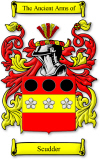
Scudder – Coat of Arms

Simon J Skudder commented on About

Hi Mark, very interesting site, though I would comment that the Scudder Arms, granted to Scudder , probably Henry, of North Cray in 1574, are incorrect, the cinquefoils are in chief not on the fess where the roundels should be, I have previously advised the pedlars of armorial history who disseminated this incorrect information but they are not interested. I would opine that the College of Arms are the most likely to be correct in this. See http://skudders.weebly.com/heraldry–armorial-inscriptions.html.

Henry Scudder was born in 1558 in Groton, Suffolk, England.  Groton, Massachusetts is named after the village, as it was founded by a member of the Winthrop family; John Winthrop was born at Groton Manor in 1587. Henry’s parents were John SCUDDER (1539 – 1584) and Margaret LOWERS (1539 – 1641). He married Elizabeth HALE in 1584 in Kent, England.  After Elizabeth died, he married Sarah Figg 10 Oct 1594 in Groton, Suffolk, England.  Henry died in 1595 in Horton Kirby, Kent, England.

Elizabeth Hale was born in 1565 and died in 1588.

Children of Henry and Elizabeth:

Name Born Married Departed
1. Rev. Henry Scudder 1585 in Darenth, Kent, England Elizabeth Hunt
7 Jun 1608 in Banbury, Oxfordshire, England
.
Jolyce [__?__]
1652
Wiltshire, England
2. John SCUDDER 1590 at Horton Kirby, Kent, England Elizabeth STOUGHTON
1613 in Maldon, Essex, England
1625 in Strood, Kent, England and did not immigrate.
3. Elizabeth Scudder 1588 in Horton Kirby Darenth, Kent, England 1594
Kent, England
4. Thomas Scudder 1587 in Groton, Suffolk, England Elizabeth Lowers
1618 in Groton, Suffolk, England
1657 in Salem, Essex, Mass
5. Bridget Scudder 1591 in Kent, England
6. Martha Scudder 1593 in Kent, England

Henry Scudder of Horton Kirby was a yeoman and carpenter. On the same page as his mother’s will, is his own: His will mentions his daughters, Alice, Martha, and Jane; and his sons, Henry, Thomas, and John Scudder, the youngest. His brother is shown as William Scudder. His wife as Elizabeth.

Henry’s father John SCUDDER was born in 1539, and died sometime before October 18, 1584, in Kent County, England. John’s wife was Margaret [__?__].  She is deeded property at Sutton at Hone and Horton Kirby to her son, Henry Scudder, a carpenter, in her will, and her will was signed by William Scudder in 1585 (Fiske, 291).

According to his will, which he signed 29 Sep 1594, Henry was a Kentish yeoman. This means that he was an independent farmer and landowner. Based on his landholdings, he must have been quite affluent. He identified his wife, Elizabeth, three sons and five daughters. One of the daughters, Jane, may have died between the date of the signing of the will and 5 Nov  1595 when the will was probated, as her name was scratched out at the time of the will’s proving.

His will identified his landholdings as being within the parishes of Horton Kirby and Sutton-at-Hone. He left to his son, the Reverend Henry, “the mansion house where I now dwell,” apparently in Horton Kirby and quite extensive in its lands, houses, and edifices. He also left Henry a house in the Chalkdale.

To his son Thomas, Henry left three houses in Chappell Greene in Horton parish. One house was rented by an unidentified Timothy Skudder, another by Michael Pickwell with an acre of land, and the third rented by Christopher Harris. He left the tenement and lands “purchased of Francis Reeve,” rented by Thomas Adams to his son, John.

Henry provided that his wife, Elizabeth, would retain custody of all the properties until the boys reached the age of 18 years, provided that she brought them up decently and orderly. But if she were to die before the boys became 18, the properties would be in the custody of John Humfrey, the elder, Henry’s brother, William Skudder, and Anthony Comfot [sp].

By comparing the will of the Rev. Henry Scudder of Collingborne-Ducis with this will of Henry Scudder, the similarities of the properties distributed by both wills provides ample evidence that this Henry was the father of Reverend Henry and Thomas of Salem.

Children

1. Rev. Henry Scudder

Henry’s wife Elizabeth Hunt was born around 1590. She was a granddaughter of John Hunt, sentenced to be burned at the stake by Bloody Mary Elizabeth died around 1615, “a little over 20.”

Henry’s second wife Joyce [__?__] was born about 1590 . She first married [__?__] Savage/ Joyce died in 1651.

Rev. Henry Scudder

Henry graduated from Christ’s College, Cambridge, in 1606. He began a life as a Puritan minister. He first served as vicar at Drayton, Oxfordshire. Then in 1633 he became the rector of St. Andrew parish at Collingbourne-Ducis, a village on the River Bourne, near Marlborough, Wiltshire, where he served the remainder of his life. During this time, he wrote a number of devotional works, one of which, “The Christian’s Daily Walke in Holy Securitie and Peace,” was used by churchgoers for close to 200 years.

Henry’s son Henry Jr was rector at St Andrews Church Collingbourne Ducis, Wiltshire, England

In June 1643, Henry was summoned to the Westminster assembly of divines. The following year in October, he preached before the House of Commons on a fast day at St. Margaret’s Westminster. His sermon was printed by request of the Commons. When in June 1645 an order came from the Commons to pray for Oliver Cromwell’s forces, Henry was one of the four preachers assigned to Aldgate. On 9 February 1648, his name was added to the committee for the scriptures.

Henry died before the Restoration and was buried in his church at Collingbourne-Ducis. Later, his tomb was removed. His will, written 12 February 1651 and proved in London 31 May 1652, named his second wife Joyce; daughters Jane, Martha, Bridgett, and a deceased daughter, Elizabeth; a granddaughter, Elizabeth; and a brother, “Thomas Scudder, and all his sonnes and his daughter Elizabeth now in New England.” The will also named “cousins Bridgett Giles and John Scudder and Elizabeth now in New England.

The Rev. Henry Scudder is listed in the Dictionary of National Biography.  He was granted an MA at Christ’s College, Cambridge in 1606.  Then he became Minister at Drayton, Oxfordshire.  He married Elizabeth Hunt 7 Jun 1608 at banbury, Oxfordshire; she was the daughter of George Hunt longtime Rector of Collingbourne Ducis whose father, John Hunt, had been sentenced to be burnt at the stake under Queen Mary but narrowly escaped in 1558 with the accession of Elizabeth I.  Her sister, Martha Hunt married the Rev. William Whately, the “Roaring Boy of Banbury.”  In 1633 Scudder was presented by the King to the living of Collingbourne Ducis, near Marlborough, Wiltshire.  He held Presbyterian views and in June 1643 was summoned to Westminster Assembly of Divines where he preseided by order of the King over meetings attempting to unite the Church of England and the Church of Scotland.  When in June 1645 on an order from the House of Commons to pray for the forces, Henry was one of the four preachers assigned to Aldgate.  On 6 Apr 1647, he ‘made report of the review of the proofs of the Confession of Faith of the 7 first chapters and part of the eighth.’  On 9 Feb 1648 his name was added to the Committee for the Scriptures.

He preached a sermon on 30 Oct 1644 at St. Margaret’s, Westminster, entitled “God’s warning to England by the Voice of HIs Rod” saying:  “be enemies never so powerful and malicious, we need not fear them, it shall not be as they intend, either for the greatness or continuance of the evil which they would bring upon us; but according tot he will of God, who has givne them charge to afflict us…  I have only this main suit unto you, that you would continue resolute for God and his true religion, for the King’s Majesties just rights, for the laws of the Kingdom and the liberties to which we are all born.”  He dilivered this sermon to the House of Commons.  It was printed at their request.  His other popular writings:  “The Christians Daily walk in Holy security and peace” (1627), a devotional work used among Protestants in the US.  The 6th edition was issued in 1635, the 15th in 1813 and the last edition in 1826.  A German translation appeared in 1636.

His will dated 12 Feb 1651, probated 31 may 1652 reads, “I give to my brother Thomas Scudder, and to all his sons and daughter, Elizabeth, now in New England, twenty shillings a peice.” and “I give to my cousin, Bridgett Giles and my cousins, John Scudder and Elizabeth Lathrop, now in New England 20 shillings a piece.”  He was buried in the Church at Colingbourne Ducis; his body ws removed after the Restoration.

2. John SCUDDER (See his page)

4. Thomas Scudder (See his page)

Many genealogies say that Thomas’ daughter Elizabeth married Samuel LATHROP, but our actual ancestor was her cousin Elizabeth.

Sources

http://ntgen.tripod.com/bw/stoughton_index.html

http://www.newenglandancestors.org/research/services/articles_gbr22.asp

http://trees.ancestry.com/owt/person.aspx?pid=19743868


Posted in 12th Generation, Artistic Representation, College Graduate, Immigrant Coat of Arms, Line - Miller | Tagged | 6 Comments

John Scudder

John SCUDDER (1590 – 1625) was Alex’s 9th Great Grandfather; one of 1,024 in this generation of the Miller line..

Scudder – Coat of Arms

Simon J Skudder commented on About

Hi Mark, very interesting site, though I would comment that the Scudder Arms, granted to Scudder , probably Henry, of North Cray in 1574, are incorrect, the cinquefoils are in chief not on the fess where the roundels should be, I have previously advised the pedlars of armorial history who disseminated this incorrect information but they are not interested. I would opine that the College of Arms are the most likely to be correct in this. See http://skudders.weebly.com/heraldry–armorial-inscriptions.html.

John Scudder was born in 1590 at Horton Kirby, Kent, England.  His parents were Henry SCUDDER and Elizabeth HALE.  His immigrant brother Thomas of Salem also had a daughter named Elizabeth who is sometimes confused with her cousin, John’s daughter Elizabeth.  John married Elizabeth STOUGHTON in 1613 in Maldon, Essex, England.  John died in 1625 in Strood, Kent, England and did not immigrate.

Elizabeth Stoughton was born in 1600 Coggeshall, Essex, England.  Her parents were Rev. Thomas STOUGHTON and Katherine MONTPESSON.  After John died, on 30 Apr 1627 she married Robert Chamberlain.   After Robert died, in 1639, as a two time widow, and following her Stoughton brothers and her Scudder kin, she migrated to America about 1640.  She came to New England with her children, Elizabeth Scudder and Samuel and Joanna Chamberlain, following her brothers Thomas and Israel Stoughton and her son John Scudder, all of whom were here by 1635. Some say Elizabeth’s mother-in-law Christian Chamberlain also accompanied the party.  Elizabeth was certainly in New England by 6 Oct 1644, when, as “Mestres Chamberlin,” she joined the Rev. John LATHROP’s church at Barnstable. with her children.

Elizabeth apparently moved to the Bay colony shortly thereafter, for on 14 May 1645, the Massachusetts Bay General Court, calling her “ Mrs Chamberlin, widowe, sister to Mr Israell Stoughton,” directed, ‘[u]pon weighty reasons moveing,” that she be allowed either a cow or £5.40

Elizabeth died intestate, in Ipswich, Massachusetts, before the inventory of her estate was filed on 30 1st month [March] 1647; the court ordered that the estate, which totaled only £32 4s. 5d., be divided: two parts to the son and one part to the daughter.

Two years later, “Richard Betts, who married Joana Chamberlin. [was] allowed : 1 [March]: 1649, as administrator of’ the estate of Samuell Chamberlin, brother to said Joana, who was heir to the estate. ”  Richard and Joanna (Chamberlain) Betts moved to Long Island, where his will, dated 16 March 1711, indicates his continuing associations with the Scudders.  It is unusual that Elizabeth Chamberlain’s Scudder children did not share in her estate. However, in cases when the estate was small and included no land, the courts sometimes exercised considerable leeway.Elizabeth died in 1647.

Robert Chamberlain was born in 1590.  “Mr. Robert Chamberlayne Pastor of the Parrishe of Stroud,” whose first Wife, Joanna, was buried there on 20 Feb 1626/27 Robert Chamberlaine’s son Thomas, schoolmaster, “by Gods providence deprived of his life at Rochester Bridge,” was buried at Strood on 9 October 1630.  Mr. Robert Chamberlaine died at Strood and was buried there on 1 June 1639.

Children of John and Elizabeth:

Name Born Married Departed
1. Elizabeth Scudder 1614
Strood, Kent, England
1616
Strood, Kent, England
2. Thomas Scudder 1617
Strood, Kent, England
1617
Strood, Kent, England
3. John Scudder 1618
Strood, Kent, England
Hannah [__?__]
1645 in Boston, Suffolk, Mass
15 Apr 1690 Barnstable, Barnstable, Mass
4. Thomas Scudder 1620
Strood, Kent, England
5. Elizabeth SCUDDER 31 Jul 1625 – Strood, Kent, England Samuel LATHROP
28 Nov 1644 in Barnstable, Mass.
1 Sep 1682
Norwich, CT

.

Children of Elizabeth and Robert Chamberlain

Name Born Married Departed
6. Samuel Chamberlain 1628
Strood, Kent, England
1649
Mass.
7. Joanna Chamerlain 1630
Strood, England
Richard Betts 1711
Newtown, Long Island, NY
8. Sarah Chamberlain 1632
Strood, England
1635
England

The name Scudder is of both Dutch and English Origin. Scudder means one who fought with a bow and arrow, an archer; or one who constantly shook or trembled from disease

TAG 72:285-300: A New England Immigrant Kinship Network, Jane Fletcher Fiske, F. A. S. G.

“JOHN SCUDDER (HenryA ) was born probably at Horton Kirby, Kent, say 1590, and died, probably at Strood, Kent, in 1625 or 1626. He married at Maldon, Essex, in 1613, ELIZABETH STOUGHTON daughter of the Rev. Thomas Stoughton. As Mrs. Elizabeth Scudder, widow, she married secondly, at Strood, Kent, “the last daye of Aprill 1627, Mr. Robert Chamberlayne Pastor of the Parrishe of Stroud,” whose first Wife, Joanna, was buried there on 20 February 1626/7 Robert Chamberlaine’s son Thomas, schoolmaster, “by Gods providence deprived of his life at Rochester Bridge,” was buried at Strood on 9 October 1630. The record of the marriage states that Elizabeth was the daughter of “the Rev’end Divine that was, Mr Thomas Stoughton.” Thomas Stoughton received his M.A. from Queen’s College, Cambridge, in 1580, and was vicar of Coggeshall, Essex, from 1600 to 1606. He was father also of Thomas1 and Israell1 Stoughton, who came to New England in 1630 and 1633 Robert and Elizabeth (Stoughton) (Scudder) Chamberlain had three children, Samuel, Joanna, and Sarah, baptized at Strood.

Mr. Robert Chamberlaine died at Strood and was buried there on 1 June 1639. (There is a twenty-year gap in the Strood register following his burial.) His widow came to New England with her children, Elizabeth Scudder and Samuel and Joanna Chamberlain, following her brothers Thomas and Israel Stoughton and her son John Scudder, all of whom were here by 1635. She was certainly in New England by 6 October 1644, when, as “Mestres Chamberlin,” she joined the Rev. John Lothrop’s church at Barnstable.  She apparently moved to the Bay colony shortly thereafter, for on 14 May 1645, the Massachusetts Bay General Court, calling her “ Mrs Chamberlin, widowe, sister to Mr Israell Stoughton,” directed, ‘[u]pon weighty reasons moveing,” that she be allowed either a cow or £5.40

The late Lewis D. Cook, FASG, investigated “Mrs. Chamberlin” and her children in Essex County, Massachusetts, without having access to the English records that provide the Scudder and Stoughton connections. Elizabeth (Stoughton) (Scudder) Chamberlain died intestate, apparently in Ipswich, Massachusetts, before the inventory of her estate was filed on 30 1st month [March] 1647; the court ordered that the estate, which totaled only £32 4s. 5d., be divided: two parts to the son and one part to the daughter.   Two years later, “Richard Betts, who married Joana Chamberlin. [was] allowed : 1 [March]: 1649, as administrator of’ the estate of Samuell Chamberlin, brother to said Joana, who was heir to the estate. ”  Richard and Joanna (Chamberlain) Betts moved to Long Island, where his will, dated 16 March 1711, indicates his continuing associations with the Scudders.  It is unusual that Elizabeth Chamberlain’s Scudder children did not share in her estate. However, in cases when the estate was small and included no land, the courts sometimes exercised considerable leeway.

The first child in this Scudder family whose baptismal record was found in the Strood registers was Thomas in 1616/7, but an older child, Elizabeth, was buried there in 1616. While it is tempting to surmise that Bridget, wife of Thomas Verry and Edward Giles, might belong in this family, that placement is impossible unless John was older than calculated and had an earlier wife–Bridget must have been already at least seven or eight years old at the time of his marriage to Elizabeth Stoughton.”

Children

3. John Scudder

John’s wife Hannah [__?__] was born in 1625 in England.  Hannah died 15 Apr 1690 in Mass.

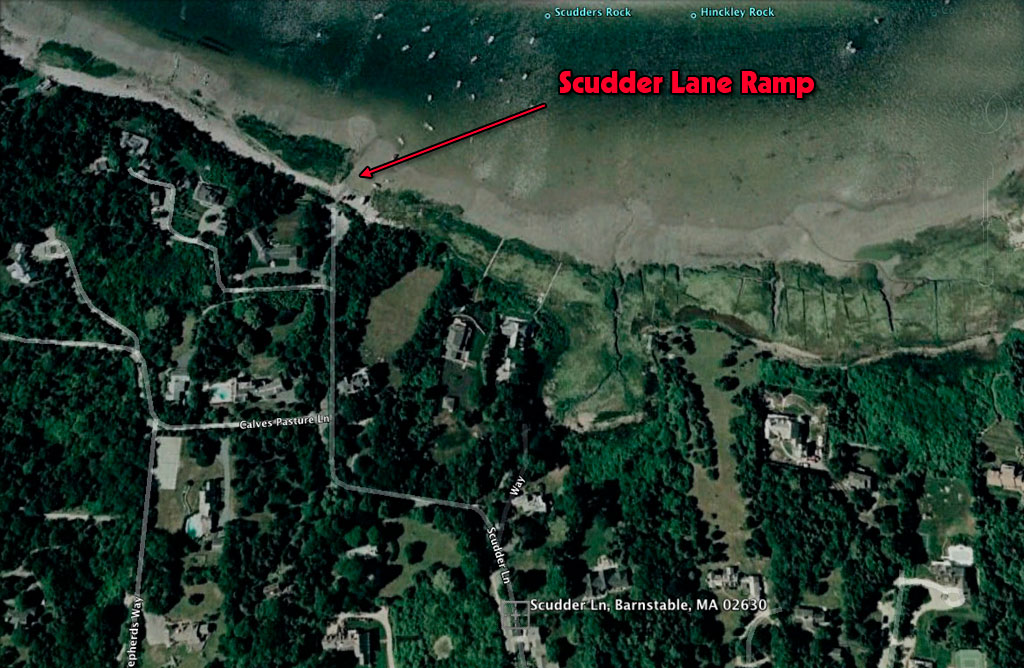
Scudder Lane Ramp Barnstable, Mass

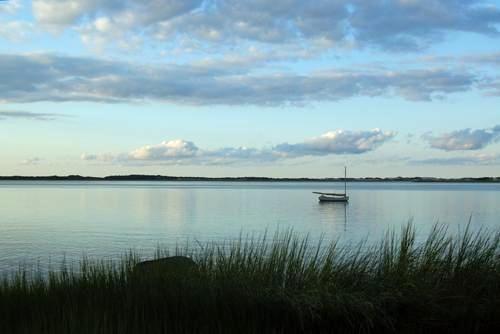
View from the end of Scudder Lane, Barnstable, Mass

7. Joanna Chamberlain

Joanna’s husband Richard Betts was born in 1613 in Hemel, Hemstead, England.  Richard died in 1713 in Newtown, Long Island, New York.

1649 –  “Richard Betts, who married Joana Chamberlin. [was] allowed : 1 [March]: 1649, as administrator of’ the estate of Samuell Chamberlin, brother to said Joana, who was heir to the estate. ”  Richard and Joanna (Chamberlain) Betts moved to Long Island, where his will, dated 16 March 1711, indicates his continuing associations with the Scudders.  It is unusual that Elizabeth Chamberlain’s Scudder children did not share in her estate. However, in cases when the estate was small and included no land, the courts sometimes exercised considerable leeway.

Sources

http://trees.ancestry.com/owt/person.aspx?pid=174860

http://ntgen.tripod.com/bw/stoughton_index.html

http://www.newenglandancestors.org/research/services/articles_gbr22.asp

Posted in 11th Generation, College Graduate, Immigrant - England, Immigrant Coat of Arms, Line - Miller | 6 Comments

John Davys

John DAVYS (1553 – 1626) was Alex’s 11th Great Grandfather; one of 4,096 in this generation of the Miller line.

Immigrant Ancestor

John Davys was born about 1553 in Easton Royal or Marlborough, Wiltshire, England. His parents were James DAVIS and Agnes [__?__].  He married Agnes SAMON (Salmon) 18 OCT 1575 in Marlborough or Eisey, Wiltshire, England.   John died 21 Nov 1626 in Acton-Turville, Gloucestershire,  England.

Agnes Samon was born about 1559 in Eisey, Wiltshire, England. Alternatively, her surname was Chandler  and her parents were Thomas CHANDLER (1500 – 1554) and Agnes TATE (1502 – 1554).  Agnes died between 1622 – 1623 in Acton-Turville, Gloucestershire, England.

Children of  John and Agnes:

Name Born Married Departed
1. Alice Davis 1578 1592
2. James DAVIS 1583 in Marlborough, Wiltshire, England Cicely THAYER
11 Jun 1618 in Thornbury, Gloucestershire, England.
29 Jan 1679 in Haverhill, Essex, Mass.
3. Samuel Davis 1584
4. Ephraim Davis 1585 Elizabeth Knowles
1630
England
 8 Jan 1639
England
5. John Davis 16 Nov 1601
Easton Royal, England
12 Nov 1675 in Newbury, Essex, Mass.
6. Thomas DAVIS 1602 in Marlborough, Wiltshire, England. Christian COFFIN
14 Nov 1622 in Chipping, Gloucester, England.
27 Jul 1683 in Haverhill, Mass.

Here’s a little different twist.  John Davis was born about 1560, Sometime in his life, he probably moved from Acton-Turville to Marlborough, west of London. He married Agnes Chandler and had six children: James, John, Thomas, Samuel, Ephraim, and Alice, not necessarily in that order.   James, John, and Thomas decided to emigrate to the New World.

His father James DAVYS was born about 1535, lived in feudal England and was likely a farmer. He married a woman named Agnes and had three sons: John, Robert, Thomas, and three daughters: Deenes, Dorothee, and Margaret. They maintained the family heritage and were all farmers (or farmers wives!) probably ecking out a meager existence on family lands in Gloucestershire.

The Davis Lineage traces its roots back to Acton-Turville, Gloucestershire, England. The family members are believed to descend from a man with the surname Davys, living in Acton-Turville in the late 15th century. The Military Survey of Gloucestershire, 1522 lists two men with this surname in Acton-Turville: John Davys and Thomas Davys alias Smyth, one of whom was most likely John’ grandfather. He would have been born about 1500 and had at least five children, James, Edmund, John, and Robert, and a daughter whose name is unknown.

Sources:

http://worldconnect.genealogy.rootsweb.ancestry.com/cgi-bin/igm.cgi?op=REG&db=teripopp&id=I01053

http://familytreemaker.genealogy.com/users/e/n/f/Jerry-A-Enfield-Richmond/GENE1-0060.html

http://homepages.rootsweb.ancestry.com/~cdavis2/

http://trees.ancestry.com/tree/3309014/person/983172685?ssrc=

http://trees.ancestry.com/owt/person.aspx?pid=130342277

Posted in 13th Generation, Double Ancestors, Line - Miller | Tagged | 6 Comments

Henry Kilham

Henry KILHAM (1558 – 1631) was Alex’s 11th Great Grandfather; one of 4,096 in this generation of the Miller line through his son Austin.  He was also was Alex’s 13th Great Grandfather;  one of  16,384 in this generation of the Miner line.

Austin Kilham – Coat of Arms

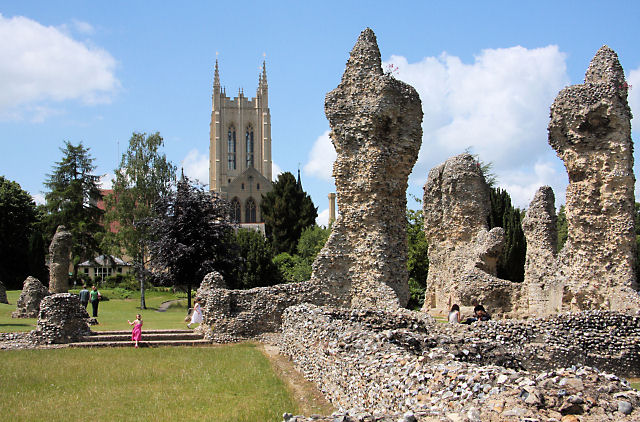
Henry Killham was baptized on 10 Aug 1558 in St James, Bury St. Edmunds, Suffolk, England. This church was largely rebuilt, starting in 1503, with more alterations in the 18th and 19th centuries. When the Diocese of St Edmundsbury and Ipswich was created in 1914, St James Church was made the cathedral. His parents were William KILHAM and  [__?__] CLEMENS.  He married Alice GOODALE on 12 Aug 1582 in Dennington, Suffolk, England. Henry died on 27 May 1631 in Dennington, Suffolk, England.

St Edmundsbury Cathedral and Abbey Ruins

Alice Goodale was born in 1560 in Dennington, Suffolk, England. She was christened on 1 Oct 1566 in Barnham, Suffolk, England.  Her parents were John GOODALE and Elizabeth [__?__].  She died on 14 Jul 1634 in Dennington, Suffolk, England.

Children of Henry and Alice

Name Born Married Departed
1. Mary Kilham 13 Aug 1583 Dennington, Suffolk, England William Thomson
1604
Suffolk, England
2. Alice Kilham 16 JUN 1588 in Tannington, Suffolk, England. [__?__] Cosbie
3. Austin KILHAM c. 1587 in Dennington, Suffolk, England. Alice GORBALL
8 Sep 1619 Wrentham, Suffolk, England.
5 Jun 1667 in Wenham, Mass.
4. Robert Kilham c. 1589 in Dennington bef. 1597
5. Elizabeth Kilham 08 Jan 1591/92
Dennington, Suffolk, England
11 Feb 1618
Dennington, Suffolk, England
6. Robert Kilham 1597 in Dennington after 03 Jun 1631
Based on being the sole executor of his father’s will
7. Henry Kilham 1599 in Dennington 27 May 1631
Dennington, England
8. Catherine KILHAM 20 Mar 1606 in Ropsley, Lincoln, England Robert GOODALE
1629 at Easterham Suffolk England
10 Sep 1666 in Salem, Essex, Mass

The family name can also be spelled Killham, Killam, Killan, Killiam or Kellum.

Will of Elizabeth Goodale, Alice’s mother 1 March 1602, proved 7 March 1601.

Elizabeth Goodale of Dennyngton, widow,  Sons George, John and Robert Goodale. Henry Kilham and Alice his wife, my daughter. William Downing and Margaret his wife my daughter. Grandchildren Alice Kilham and Margaret Downing, the three eldest children of my son William Goodale at ages one and twenty years. Son Thomas Goodale to be executor.

Will of Henry Kilham

Henry Kellam of Dennington, (nuncuptive) proved 3 June 1631. To Mary Kellam my eldest daughter, I give my desk. To Alice Cosbie, my daughter, my featherbed as it stands, and my chest, with the linen that is in it. To my son Austen Kellam all my apparell. To Daniel Kellam, my grandchild, ten shillings or else my biggest kettle. To Willian Tomson, my grandchild, my bible. To Ezechiel Tomson, my grandchild, my new chest. To Alice Kellam, my grandchild, one coffer and two pairs of sheets. To my grandchild Ezechiel Tomson my flock bed. To Henry Kellam, my grandchild, my cupboard table and my coopers’ tools. To Robert Kellam, my son my lease. And I make said Robert my son sole executor of this my will. Witnessed by Elizabeth Booteman, widow, and Joane wife of Thomas Kerrich

Children

1. Mary Kilham

Mary’s husband William Thomson died before 1620.

William Thomson’s will

William Thomson the elder of Saxstead, yoeman, 1 Nov 1619, proved 22 Jan 1619/20. Wife Mary. My children, Tenements &c. in Dennington which I purchased of Robert Kilham and Richard Adams. Sons William and Edward Thomson. Daughter Mary. The executors to be Henry Kilham of Denyngton and Daniel Smith.

2. Alice Kilham

Alice’s husband [__?__] Cosbie

3. Austin KILHAM (See his page)

6. Robert Kilham

Robert died after 03 Jun 1631 based on being the sole executor of his father’s will

8. Catherine KILHAM (See Robert GOODALE‘s page)
Some sites say her parents were Henry KILLHAM and Alice GOODALE. Others believe that the Catherine Kellam baptized in Ropsley, Lincolnshire 20 or 21 Mar 1606, father was Rafe not Henry.

Sources:

http://trees.ancestry.com/owt/person.aspx?pid=30426245

http://freepages.genealogy.rootsweb.ancestry.com/~elessar5/pafg922.htm

http://www.our-genealogy.com/wood/ancestry-kilham/henry-kilham.html

Posted in 13th Generation, Double Ancestors, Historical Church, Line - Miller | Tagged | 2 Comments

Richard Woodward

Richard WOODWARD (1590 – 1665) was Alex’s 12th Grandfather; one of 8,192 in this generation of the Shaw line.

Immigrant Ancestor - Woodward Coat of Arms

Immigrant Ancestor – Woodward Coat of Arms

Richard Woodward was born in 1589/1590 in Ipswich, Suffolk, England. His parents were William WOODWARD and Elizabeth [__?__] He married Rose STEWART on 16 Feb 1614 in Cambridge, Cambridgeshire, England.  He emigrated with his wife and sons George and John on the Elizabeth in 1634.  After Rose died, he married widow Anne Veare (Hill) on 18 April 1663 at Watertown, Richard died on 16 Feb 1664/65 in Cambridge, Mass,

Rose Stewart was born about 1582 in Ipswich, Suffolk, England. Rose died on 6 Oct 1662 in Watertown, Mass.

Ann Veare was born about 1603 in England.  She first married our ancestor Stephen GATES I on 5 May 1628 in Hingham, England.  After Stephen died, Ann married Richard Woodward on 18 April 1663.  Richard was Ann’s daughter-in-law Sarah’s Grandfather.  Stephen GATES II and Sarah WOODWARD were married exactly a year earlier on 18 Apr 1662 in Stow, Mass. so maybe Richard and Ann met at the reception.  Ann died 5 Feb 1682/83 in Stowe, Mass.

Children of Richard and Rose:

Name Born Married Departed
1. George WOODWARD 1619 in Ipswich, Suffolk, England. Mary GIBBSON
1640 in Watertown, Middlesex, Mass.
.
Elizabeth Hammond
1659
31 May 1676 Watertown, Middlesex, Massachusetts.
2. John Woodward 1621
Ipswich, Suffolk, England
Abigail Benjamin (Daughter of John BENJAMIN)
1654/1655 Charlestown, Mass
.
Mary White
17 Feb 1695
Watertown
3. Joshua Woodward 1623
Ipwich, England
4. Richard Woodward 1636 Jane [__?__] 7 Oct 1706

Richard Woodward was admitted as a freeman in Watertown, Mass on 2 Sep 1635, and was listed as among the earliest of the proprietors. By 1642, he had a ‘homestall of twelve acres,’ in addition to being a grantee of nine additional acres. It also says he had, by 1644, a total of 360 acres, which were in what is now Boston. Ten acres were transferred to his son, George. Thirty-nine acres at Little Plain were sold to John Whitney (whose grandson would subsequently marry Richard’s granddaughter.)

On 8 Sep 1648, Richard Woodward, by then in Boston, purchased a Boston mill from a Holbrook family, selling it to William Aspinwall on 26 Dec 1648. Land that he once owned was later to be Lot 42 of Stoney Brook. Watertown, the place of settlement in America for the Woodward’s, is now a suburb to the northwest of Boston

Children

1. George WOODWARD (See his page)

2. John Woodward

John’s first wife Abigail Benjamin  was born 1624 in Heathfield, Sussex, England.  Her parents were John BENJAMIN and Abigail EDDYE.  She first married about 1640 to  Joshua Stubbs.  Abigail died 30 Oct 1704.

Abigail’s first husband Joshua Stubbs was born 1622 in England.  They had three children, and moved to Charlestown in 1654 where Joshua died that same year.

John’s second wife Mary White was born 1620 in Ipswich, Suffolk, England. Mary died 1658 in Watertown, Middlesex, Mass

4. Richard Woodward

Richard’s wife Jane [__?__]

Sources:

http://trees.ancestry.com/owt/person.aspx?pid=3695283

http://www.weymouthtech.com/Genealogy/wc01/wc01_319.htm

http://www.shon.150m.com/aqwg1705.htm#66618

http://freepages.genealogy.rootsweb.ancestry.com/~elessar5/pafg42.htm#32470

Posted in 14th Generation, Immigrant - England, Line - Shaw | Tagged , | 7 Comments

Hildebrand Pietersen

Hildebrand PIETERSEN (1613 – 1639) was Alex’s 12th Grandfather; one of 8,192 in this generation of the Shaw line.

Hildebrand Pietersen was born in 1613 in Amsterdam, Netherlands. He married Femmetje ALBERTSE. Hildebrand died in 1639 in New Amsterdam, NY.

Femmetje Albertse was born in 1615 in Noord-Holland, Netherlands.  Her father was Aldert Van NORDEN (1589 – 1650) and Geertuy DRIES.  Several genealogies say Adert immigrated to New Netherlands, but I can find no evidence.  After Hildebrand died, she married Hendrick Janse Westercamp (Westecamp) before 1641 in Kingston, NY.

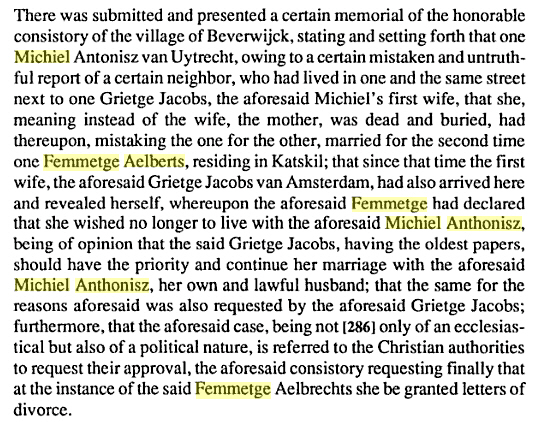
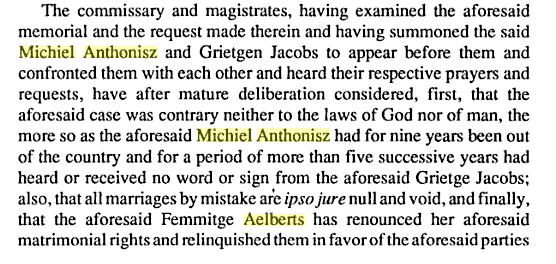
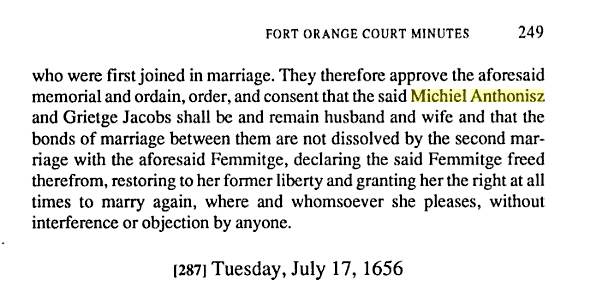
She was probably the Femmetge Aelberts who married Michiel Anthonisz van Uytrecht in 1656. Through an unfortunate mistake, Michiel had been led to believe that his first wife in the Netherlands had died and subsequently married Femmetje, who was then living in Catskill. The first wife, still alive, then arrived in the New World. Femmitje stepped aside and was granted a divorce 4 July 1656.  Femmetje died in 1667 in Kingston, NY.

After her second husband died in 1653, Femmetje ran his Kingston bakery and appears in numerous court disputes in the records of several towns in New Netherland.

Children of Hildebrand and Femmetje

Name Born Married Departed
1. Jannatie (Jannetie) Hildebrand PIETERSEN
1639 in Amsterdam Francois
LeSUEUR

12 Jul 1659 at Dutch Church, New Amsterdam, New York
.
Antoine Tilba
1678
New York
2. Pieter Hillebrants New Amsterdam Aeltje Wygerts (Widow of Lubbert Jansen and Albert Gysbertsen)
3 Apr 1665
Kingston, NY

.

Children of Femmetje and Hendrick Janse Westercamp

Name Born Married Departed
3. Grietjen Hendrick Westercamp (Westecamp) bapt.
19 Oct 1642
DRC New Amsterdam
Pieter Jacobsen
1658
Kingston, NY
.
Jan Gerritsen Decker
23 Mar 1664 in Kingston, Ulster, New York
Jan 1716/17
Port Jervis, Orange, NY
4. Margarieet Westercamp 19 Oct 1642
New Amsterdam

Hendrick Janse Westecamp/ Westercamp was born 1613/15 of Meppel, Drenthe, Netherlands.  Hendrick died before 30 Sep. 1654 Albany, Albany, NY

2 Apr 1648 – Hendrick Jansz Westerkamp(Westercamp); received permission to seek a living in Rensselaerswyck (Albany) by day labor or otherwise and soon seems to have established himself as a baker.

1 Apr 1650 – Hendrick  was granted the garden between the first and second creeks formally occupied by Capitaijn [Willem Juriaensz, the baker].

They were living at Beverwyck near Fort Orange (now Albany, New York) by the summer of 1652. Hendrick died between 1653, when he appeared as witness in a court case, and 1654, when Femmetje appears in court and is called a widow. One of his dying wishes was that his daughter (either Grietjen or another unknown daughter) be released from her indenture. In September of 1654, Femmetje was successful in fulfilling this wish.

Court Minutes of Rensselaerswyck (Albany)

Thursday April 2 1648 –  Hendrick Westercamp is granted permission and consent to support himself in the colony by day-labor or otherwise. He may therefore select a place, whereupon we shall resolve further.

Extraordinary session, March 16 1652 – Hendrick Westerkamp says that at the request of Commissary J. Dyckman he made an affidavit concerning the former brickyard, a little south of the first kill, in which he declared that the same belonged to the company and that they had a small house there.

Extraordinary Session, August 20, 1652 – Jan Labatie, plaintiff, against Hendrick Jansz Westerkamp, defendant, on account of 8 beavers which the defendant owes to Philip Geary, according to a note of the 16th of August of last year.

The court orders the defendant to pay the aforesaid eight beavers in specie to the plaintiff, by virtue of his power of attorney, within the space of ten days, on pain of execution

We don’t know much about Hildebrand and Femmetje, but Jannetie must have found her way to New Amsterdam somehow.

Femmetje was an interesting character who ran her deceased second husband’s bakery and appears in numerous court disputes in the records of several towns in New Netherland.

1656 – She was probably the Femmetge Aelberts who married Michiel Anthonisz van Uytrecht in 1656. Through an unfortunate mistake, Michiel had been led to believe that his first wife in the Netherlands had died and subsequently married Femmetje, who was then living in Catskill. The first wife, still alive, then arrived in the New World. Femmitje stepped aside and was granted a divorce 4 July 1656.

Femmetge Aelberts and Michiel Anthonisz.1

Femmetge Aelberts and Michiel Anthonisz 2

1659 – First Esopus War – Peter Hillebrants is among those kidnapped and later released

1663 – Second Esopus War – Grietjen Hendricks Westercamp’s husband was killed.  Greitjen and her three children were kidnapped and later rescued.

Children

1. Jannetie  Hildebrand PIETERSEN (See Francois
LeSUEUR
‘s page)

2. Pieter Hillebrants

Pieter was kidnapped by Indians during the first Esopus War.

Sep 1659 – The bottle was passed twice, and the Indian said again, “Come, let us go; my heart is full of fears.” He went off and hid his goods in the bushes at a little distance. Coming back once more they heard the bushes crackle as the Dutch came there, without knowing who it was. Then this Indian went away, saying “Come, let us go, for we all shall be killed;” and the rest laid down together, whereupon the Dutch came and all of them fired into the Indians, shooting one in the head and capturing another. One drunken Indian was continually moving about, whereupon the Dutch fired upon him repeatedly, nearly taking his dress from his body.

Ensign Smith knew what the consequences of this outbreak would be, and he sought to ascertain who ordered the firing contrary to his express instructions. The Dutch cast all the blame on the Indians, saying that the latter fired first. The affairs of the colony being in such an unsatisfactory state, and finding the people would not respect his authority, Smith announced his intention of leaving for New Amsterdam next day. Great excitement was manifested when this became known. The people tried to dissuade him from his purpose by representing their exposed condition, and making assurances of future obedience on their part. Smith was intractable, and continued making preparations for his departure; but by an adroit measure of Stohl and Thomas Chambers [husband of Margriet HENDRICKSE] who hired all the boats in the neighborhood, he found himself unable to carry out his resolution. It was deemed expedient, however, to acquaint the Governor of the state of affairs, and accordingly Christopher Davis was dispatched down the river in a canoe for that purpose.

Davis was escorted to the river by a company of eight soldiers and ten citizens, under Sergeant Lawrentsen, Sept. 21st, 1659. On the return of the escort to the village they fell into an ambuscade near where now stands the City Hall; the Sergeant and thirteen men surrendered without firing a shot, the rest making their escape. War now began in earnest. More than five hundred Indians were in the vicinity of the fort, who kept up a constant skirmish with settlers. By means of firebrands they set fire to the House of Jacob Gebers; numbers of barracks, stacks and barns were in like manner destroyed. One day they made a desperate assault on the palisades which came near being successful. Failing in this, the Indians slaughtered all the horses, cattle and hogs they could find outside the defenses. Three weeks was a constant siege kept up so that “none dare go abroad.” Unable to take the town they vented their fury on the unfortunate prisoners.

Jacob Jansen Van Stoutenburgh, Abram Vosburg, a son of Cornelius B. Sleight, and five or six other were compelled to run the gauntlet; they were next tied to stakes, and, after being beaten and cut in the most cruel manner, were burned alive. Thomas Clapboard [Chambers], William the carpenter, Peter Hillebrants and Evert PELS‘ son were among the captives.

These are the only names mentioned in the early records. Clapboard was taken by six warriors down the Esopus kill. At night he removed the cords by which he was bound, and successively knocked five of his captors in the head while they were asleep, killing the sixth before he could fly, and making good his escape. Another prisoner, a soldier, got home safely after a somewhat rough experience. Peter Laurentsen and Peter Hillebrants were ransomed; Hendrick Vosberg Pel, then a mere youth, was adopted into the tribe and married among them. Overtures were afterwards made to the Indians by the friends of the lad for his return; but the Indians answered that he “wished to stay with his squaw and pappoose, and he ought to.”

Pieter’s wife Aeltje Wygerts was born about 1625 in Gelderland, Netherlands.  She first married in the Netherlands to Lubbert Jansen (1624 – 1649) and had two children Aeltje Lubbertsen b. 1647 and Jan Lubbertse b. 1648..  After Lubbert died, she married about 1650 to Albert Gysbertsen (1623 – 1664) and had two more children Lysbet Alberts b. 1651 and Gysbert Albertsen-van Garden b. 1655.

Albert Gysbertsen died on Nov. 18, 1664.  This site has many details about Albert’s life including extensive records of his extensive court dealings.  After Albert died, Tjerck Claesen De Wit filed a suit against Aeltje Wygerts seeking payment for Blackie the horse. The record states:

“Plaintiff shows a bill of sale of a horse bought by her husband, Albert Gysbertsen, during his lifetime from plaintiff for 200 gldrs. in wheat to be paid at such times and in such payments to the vendue-master as he has bought it by Lord’s execution on April 7, 1664. Defendant admits the debt and offers to pay 100 sch. of oats, provisionally, and the balance from the future next year’s [1665] crop, or else to return the horse, and is willing to pay plaintiff for the use of said horse. Plaintiff replies not to be satisfied with aforementioned offer.”

The fact that de Wit sued Albert’s widow so soon after his death suggests that the bad blood that erupted a year earlier was simply lying dormant below the surface, or perhaps he was irked by Albert’s testimony in the lawsuit over the pasturing of cattle.

Exactly a month later, Aeltje was dragged into court concerning the heifer Albert purchased in October. The court record for Dec. 18 states:

“there appeared before us the worthy Aeltje Wygerts, widow of Albert Gysbertsen, deceased, who declares that her husband Albert Gysbertsen, deceased, bought during his lifetime from the estate of Aert Pietersen Tack, a heifer for the amount of 100 aldrs. heavy money, for which amount of 100 gldrs. heavy money the appearer has been referred to and promises to pay to Swerus Teunissen, inhabitant of the colony of Rensselaerswyck.”

To secure the debt, Aeltje mortgaged “the crop of all the corn which, by God’s blessing, shall, in the coming year 1665, be brought in from her land, and further in general her person and further goods, personal and real estate.”

At some point before the spring, Aeltje entered into a relationship with Pieter Hillebrants and the two married. Pieter had probably been a friend of the family because he seems to have been present when de Wit pulled the knife on Albert.   The church record of his marriage notes that he was born in New Amsterdam and that he had not been married before. Court records mention that Pieter was the son of Femmetje Alberts. This was almost certainly the Femmetje Alberts who was the widow Hendrick Jansen Westercamp. If this was the case, Pieter was born to a previous husband, whose first named was obviously Hillebrant.

9 Mar  1665 – Pieter Hillebrants sued Tjerck Claesen De Wit, presumably on Aeltje’s behalf. Roelof Swartwout acted as the attorney in Aeltje’s suit to acquire “20 morgens of arable land sold to the aforesaid widow’s late husband Albert Gysbertsen.” De Wit said he would record the deed once the river had become navigable, probably indicating that it was iced over at the time. De Wit then requested the 100 guilders still outstanding on the purchase of Blackie the horse, plus 14 schepels of wheat for “damage sustained through the attachment of his horse.” The plaintiffs replied that the payment was being withheld until the deed was recorded. De Wit said he was satisfied with that but still wanted his 14 schepels of wheat “for costs.” The court, apparently a bit exasperated with both parties, ordered de Wit to file the deed, Aeltje to pay for the horse and both to split the costs of 14 schepels of wheat because the “parties have been mutually negligent in living up to their contracts.

Interestingly, the March 9, 1665 court record  describes Aeltje as “last widow of Albert Gysbertsen, deceased, and at present wife of the aforesaid Pieter Hillebrants.” However, the Reformed Church records of Kingston state that Pieter Hillerbrantsen married Aeltje Wiggers on April 3, 1665. The marriage record indicates that banns were published on March 22, March 29 and April 3. It seems certain that the two were already seen as a very close couple by March 9.

Before they were actually wed, Aeltje and Pieter signed a prenuptial agreement for the protection of Aeltje’s children. On March 20, the town secretary recorded that Pieter appeared with his mother, Femmetje Alberts, and Aeltje appeared with her son-in-law Roeloff Hendericks, who was the husband of Aeltje Lubberts.

“In the name of the Lord, Amen. Be it known by these, that on March 20, 1665, N. S., appeared before Matfheus Capita, Secretary of  Wildwyck, Pieter Hillebrants, young man, accompanied by his mother, Femmetje Alberts, and Aeltje Wygerts, widow of Albert Gysbertsen, accompanied by Roeloff Hendericks, her son-in-law, who in this manner have stipulated these marriage conditions.
1. The marriage to be concluded in accordance with the canons of the reformed religion.
2. All the property, belonging to either party, to be used in (fcmmon, in accordance with the custom of Holland, with the exception that the bride sets apart for each of her children 50 gilders heavy money, viz. for Aeltje and Jan, children of Lubbert Jansen, and for Lysbet and Gysbert, children of Albert Gysbertsen. — Roeloff Swartwout and Jan Willemse Hoochteylingh to be appointed guardians over said children, who are to be instructed in reading, writing, and, if possible, learn a trade. — In case of death of either party, the property to be divided.”
Signed Pieter Hillebrants, Aeltien Hybersen, Femmetje Alberts (her mark), Roeloff Hendricks, Wilh. Beeckman, Jan Willemsen Hoochteylingh, and RoelofiE Swartwout.

The heifer that Albert purchased from the Tack estate appears in the court records again on Feb. 27, 1666. Pieter Hillebrants agreed to pay 100 guilders in wheat to satisfy the debt before that October.

18 Feb 1672/73 – Aeltje and Pieter apparently hired Willem Montagne to defend them against a lawsuit filed by Cornelis Wynkoop. The plaintiff was demanding payments and interest due on a mortgage given to Albert Gysbertsen on May 1, 1664. Neither Pieter, nor Aeltje, are named but the record mentions that Montagne was acting “by virtue of a power of attorney.” He pointed out that the mortgage was for only four years and that Wynkoop had missed his chance to enforce it. The court decided in favor of the defendants.

8 Mar 1674/75 – Aeltje and the guardians of Albert’s children, Roelof Swartwout and Jan Willemsen, asked to apportion the children’s inheritance, noting “the same have attained their majority except Jan, who is one year short of it.” The court allowed the apportionment. However, the mention of a son named “Jan” should be discussed. It seems almost certain that this is a mistaken reference to Gysbert. The only Jan mentioned in connection with Aeltje is the son of her first husband Lubbert Jansen. Since it had been less than 10 years since Albert’s death, this second “Jan” must have been his youngest child. Since Gysbert is listed as the fourth of Aeltje’s four children in the prenuptial agreement mentioned above, it seems likely that he was the son who was one year short of majority.

Aeltje lived at least until Nov. 1, 1684, when she and Pieter are listed as the sponsors of Pieter, son of Aeltje’s son Gysbert.

3. Grietjen Hendricks Westercamp

Grietjen’s husband Pieter Jacobsen was born about 1628 in Holstein, Germany.  He arrived in New Netherlands in 1659 on the  “de Trouw”  He was a miller in partnership with Pieter Cornelissen. Peter died 7 Jun 1663 in the Indian attack on Esopus. Grietje and three of her children were taken prisoner.  Peer Jan HENDRICKS was a soldier sent to rescue the captives.  See his page for details.

Grietjen was living in Esopus, Kingston, NY in 1662.  She was an early settler of Minisink Valley and captured by Indians in 1663.

Grietjen’s second husband Jan Gerritsen Decker was born 23 Apr 1640 in Husum, Schleswig-Holstein, Germany. Jan died 1717 in Port Jervis, Orange, New York.

Sources:

http://trees.ancestry.com/owt/person.aspx?pid=1385955

http://trees.ancestry.com/tree/6734767/person/632766067

http://www.pcez.com/~bigshoe/dt/Shoe/shoefour.html

Ulster County, N.Y. probate records in the office of the surrogate, and in the county clerk’s office at Kingston, N.Y. : a careful abstract and translation of the Dutch and english wills, letters of administration after intestates, and inventories from 1665, with genealogical and historical notes”

http://mysite.verizon.net/bowers.clan/id17.html

Posted in 14th Generation, Immigrant - Continent, Line - Shaw, Twins, Violent Death | Tagged , , , | 10 Comments

John Parker Sr

John PARKER Sr. (1568 – 1651) was Alex’s 11th Great Grandfather; one of 4,096 in this generation of the Shaw line

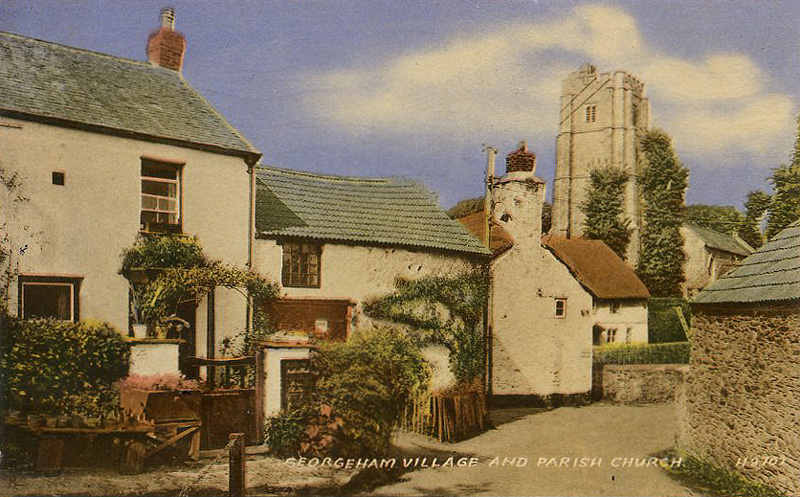
John Parker Sr. was born 25 Sep 1568 in Georgeham, Devon, England.  His father was James PARKER.  His brother William was a privateer and John  accompanied him on Drake’s raid on Cadiz smashing the Spanish Armanda and several privateering adventures in the Caribbean.  He married Katherine Dennis on 25 Aug 1600 in Georgeham, England.  John was a mate on the 1607 voyage to found thePopham Colony, a short-lived English colonial settlement in North America loccated in the present-day town of Phippsburg, Maine, making him our first ancestor to arrive in North America.   John died Oct 1651 in Maine.

Georgeham Village and Parish Church

For a long time historians believed John Parker came over to New England as mate on the Mayflower. But here one of our earliest historians was guilty of a false assumption that has been so often repeated by later writers that it has assumed the quality of being factual. He based this on a deposition found in the Mass. Superior Court files. It was sworn to by John Phillips 3rd of Charlestown on Nov. 20, 1750 stating that John Parker, his father’s uncle “was mate of the first ship that came from England with Plymouth people. “That historian concluded that “Plymouth People” were the Pilgrims and the first ship was the Mayflower. But it actually was referring to the town of Plymouth in England and the Plymouth Company ships in 1607.

Katherine Dennis was born in England.  Her parents were John DENNIS and Katherine RAYLE. Katherine died shortly after the birth of John Jr. in 1601 in Bideford, Devon, England,

Children of John and Mary:
Name Born Married Departed
1. John PARKER Jr. 20 Apr 1601 in Bideford, Devon, England Mary CROCOMBE
16 Nov 1622 in Georgeham Devon, England
1648 or 1661 Sagadahoc, Maine.

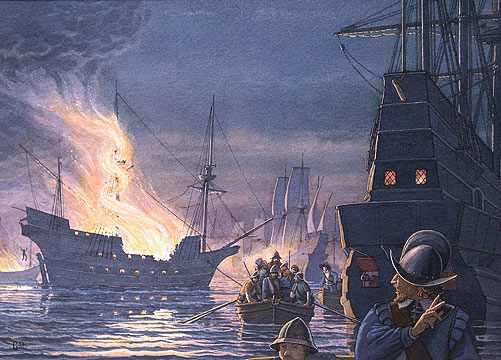
In May 1587 John joined his brother William in Sir Francis Drake’s  military expedition against the Spanish naval forces assembling at Cádiz. Much of the Spanish fleet was destroyed. There followed a series of raiding parties against several forts along the Portuguese coast. A Spanish treasure ship, returning from the Indies, was also captured. The damage caused by the English delayed Spanish plans to invade England by more than a year. This incident, known to the Spanish as Drake’s raid on Cádiz 1587, is known to the English by Drake’s phrase “Singeing the beard of the King of Spain”.

John and William Parker particiated in Sir Francis Drake's Raid on the Inner Harbor of Cadiz, April 20, 1587

Queen Elizabeth put at Drake’s disposal four Royal Naval galleons: the Elizabeth Bonaventure, which was under Drake’s own command; the Golden Lion, captained by William Burroughs; the Rainbow, under captain Bellingham; and the Dreadnought under Captain Thomas Fenner. A further twenty merchantmen and armed pinnaces joined forces with the expedition.  William Parker probably commanded one of the pinnaces.

I’m not sure if John accompanied his brother William on this 1596 adventure, but had to include this swashbuckling fun, fun for Parker but not for Henn of course.  In Nov 1596 William sailed from Plymouth, in command of the ship Prudence of 120 tons, in company with the Adventure of 25 tons, commanded by Richard Heun, and, coming to Jamaica in March 1597, joined Sir Anthony Shirley in an attempt to surprise Truxillo, and, finding that impossible, took and sacked Puerto de Cavallos, but ‘made no booty there which answered their expectations.’ After other unsuccessful attempts they separated, and Parker, going towards Campeche, Mexico landed thirty-six men in a canoe, and surprised the town on the morning of Easter day. At first the Spaniards fled; but, recovering from their panic, they returned in overwhelming numbers and drove out the English, killing six and wounding others, Parker himself among them. The English, however, carried off their dead, and with colours flying marched down to their canoe, placing the prisoners, among whom were the alcade and others of the chief men of the place, in their rear, as a barrier, to receive the Spaniards’ shot, if they had thought fit to continue firing.  In the harbor they captured a ship with 5,000/. in silver on board and “other good commodities,” which they carried off. Afterwards the Spaniards, having fitted out two frigates, captured the Adventure, and hanged Henn and the thirteen men who formed his crew; but Parker, in the Prudence, got off safely, and arrived in Plymouth in the beginning of July

In Nov 1600, a month after getting married, John sailed under his brother William Parker (Privateer), captain of the Prudence,  having on board, besides several gentlemen volunteers, a crew of 130 men, and with him the Pearl of 60 tons and 60 men. Sacking and burning the town of St. Vincent, in the Cape Verd Islands, on the way, they proceeded to the West Indies, and after capturing and ransoming a Portuguese ship, with a cargo of nearly 400 slaves.  He also captured and held for ransom the Cubagua pearl-boats.  He then went to the island of Cabezas, near the mainland. Leaving the ships, they went in boats with 150 men to the Bastimentos, and thence, by night, on 7 Feb. 1601, into the harbor of Porto Bello; there they landed, and after a stubborn fight, in which they lost many men, they made themselves masters of the town. Unfortunately the treasury was nearly empty, 120,000 ducats having been sent to Cartagena only a week before.  Ten thousand ducats was all that remained; but “the spoil of the town, in money, plate, and merchandise, was not inconsiderable.”

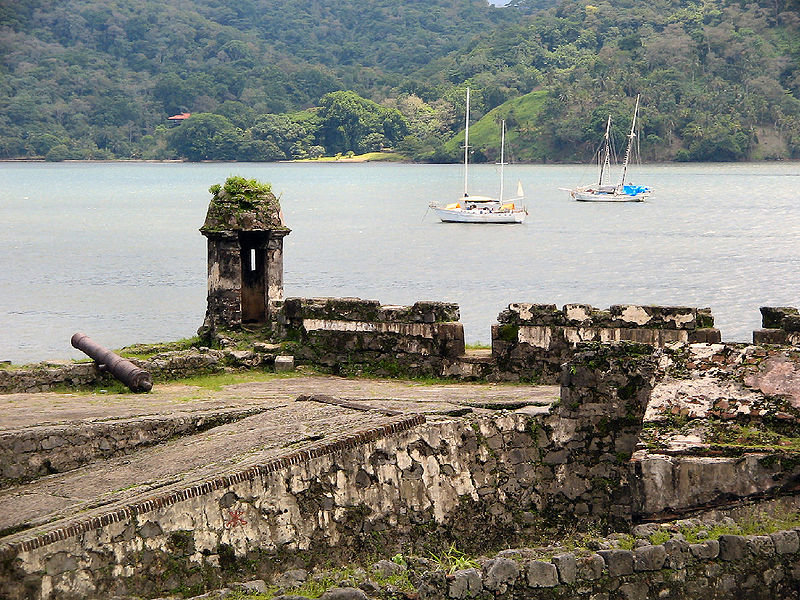
Portobello Runis Today. From the 16th to the 18th centuries, it was a very rich port being the departure point from which Peruvian treasure left for Spain

With this and two frigates, which they found in the harbour and carried off, they retired to their ships, ‘releasing the prisoners, among whom were Governor Pedro Melendez and several persons of quality, without any ransom, satisfied with the honour of having taken, with a handful of men, one of the finest towns the king of Spain had in the West Indies.’ They arrived at Plymouth in May 1601.  John found that he had a newborn son, John Jr, but his wife Katherine died shortly thereafter.  Though he lived fifty more years, he never remarried.

The date of this expedition is given by Purchas, whom all later writers have followed, as 1601-2; but it is quite certain that in the latter part of 1601 and through 1602 Parker was at Plymouth, and the correct date, it may be safely assumed, was a year earlier.  William’s successes secured for him a prominent position in Plymouth, where he was looked upon as a hero of sorts and he became a founding member of the Virginia Company in 1606.  Captain William Parker was made Vice-Admiral and left on an expedition to the East Indies, but died at Java in 1617.

On 7 Jun 1607, John Parker was mate on one of the two ships sent to the colonies by the Plymouth Company representing his brother Williams financial interests in the expedition to found a Colony.    Only one person died during the Popham Colony’s first year making it much more successful in terms of human life than Jamestown or Plymouth, but after the first year was over, the colonists decided to return home.

The Popham Colony (also known as the Sagadahoc Colony) was a short-lived English colonial settlement in North America that was founded in 1607 and located in the present-day town of Phippsburg, Maine near the mouth of the Kennebec River by the proprietary Virginia Company of Plymouth. It was founded a few months later in the same year as its longer lasting rival, the colony at Jamestown, which was established on June 14, 1607 by the Virginia Company of London.

Five years after the settlement attempt at Cuttyhunk in what is now Massachusetts, the Popham Colony was the second English colony in the region that would eventually become known as New England. The colony was abandoned after only one year, apparently more due to family changes in the leadership ranks than lack of success in the New World. The loss of life of the colonists in 1607 and 1608 at Popham was far lower than that experienced at Jamestown.

The first ship built by the English in the New World was completed during the year of the Popham Colony and was sailed back across the Atlantic Ocean to England. The pinnace, named Virginia of Sagadahoc, was apparently quite seaworthy, and crossed the Atlantic again successfully in 1609 as part of Sir Christopher Newport’s nine vessel Third Supply mission to Jamestown. The tiny Virginia survived a massive three day storm en route which was thought to have been a hurricane and which wrecked the mission’s large new flagship Sea Venture on Bermuda.

The exact site of the Popham Colony was lost until its rediscovery in 1994. Much of this historical location is now part of Maine’s Popham Beach State Park.

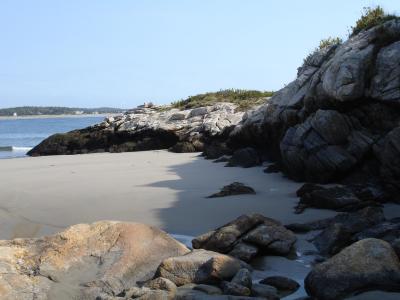
Popham_Beach_State_Park site of the lost Popham Colony

The first Plymouth Company ship, Richard, sailed in August 1606 but the Spanish intercepted and captured it near Florida in November.

The next attempt was more successful. About 120 colonists left Plymouth on May 31, 1607 in two ships. They intended to trade precious metals, spices, furs, and show that the local forests could be used to build English ships. Colony leader George Popham sailed aboard the Gift of God with Raleigh Gilbert as second-in-command. The captain of the Mary and John, Robert Davies, kept a diary that is one of the main contemporary sources of the information about the Popham Colony.  John Parker was Davies’ first mate.

George Popham was the nephew of one of the financial backers of the colony, Sir John Popham, the Lord Chief Justice of England, while Gilbert was son of Sir Humphrey Gilbert and half nephew of Sir Walter Raleigh. Other financiers included Sir Ferdinando Gorges, the military governor of Plymouth; much of the information about the events in the colony comes from his letters and memoirs. Settlers included nine council members and 6 other gentlemen, while the rest were soldiers, artisans, farmers and traders.

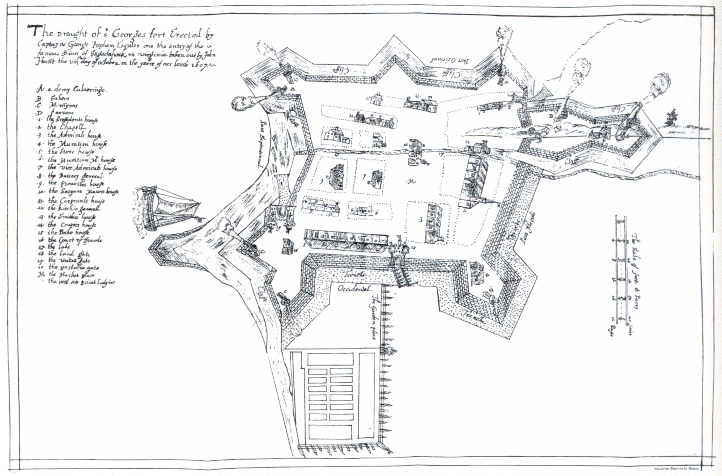
The Gift of God arrived at the mouth of the Kennebec River (then called the Sagadahoc River) on August 13, 1607. The Mary and John arrived three days later. The Popham Colony was settled on the headland of an area named Sabino. The colonists quickly began construction of large star-shaped Fort St. George. Fort St. George included ditches and ramparts and contained nine cannons that ranged in size from demi-culverin to falcon.

Fort St George Popham Colony drawn by John Hunt

On October 8, 1607, colonist John Hunt drew a map of the colony showing 18 buildings including the admiral’s house, a chapel, a storehouse, a cooperage, and a guardhouse. Hunt was listed in the colony register as “draughtsman”. It is not known if all the buildings were completed at the time. Hunt’s map was discovered in 1888 in the Spanish national archives. A spy had sold it to a Spanish ambassador who had sent it to Spain. It might be a copy of the now-lost original map, and is the only known plan of the original layout of any early English colony.

Popham and Gilbert sent survey expeditions up the river and contacted the Abenaki, a tribe of Native Americans/First Nations belonging to the Algonquian peoples of northeastern North America. In a letter to the King, Popham wrote that the natives had told them that the area was full of easily exploitable resources. However, the colony failed to establish cooperation with the tribe; who were suspicious because earlier expeditions had kidnapped natives to show at home.

Late summer arrival meant that there was no time to farm for food. Half of the colonists returned to Great Britain in December 1607 aboard the Gift of God. Others faced a cold winter during which the Kennebec River froze. Fire destroyed at least the storehouse and its provisions. Later excavation has hinted that there might have been other fires.  I don’t know if John Parker returned on the Gift of God or stayed over the winter.

Colonists divided into two factions, one supporting George Popham and the other Raleigh Gilbert. George Popham died on 5 Feb  1608, possibly the only colonist to die – a contrast to Jamestown which lost half its population that year. Raleigh Gilbert became “colony president” on 5 Feb 1608 at age 25.

The colonists completed one major project: the building of a 30-ton ship, a pinnace they named Virginia. It was the first ship built in America by Europeans, and was meant to show that the colony could be used for shipbuilding. They also finally managed to trade with the Abenaki for furs and gather a cargo of wild sarsaparilla.

When a supply ship came in 1608, it brought a message that Sir John Popham had died. Gilbert sent the Mary and John to England with cargo. When the ship returned later in the summer, it brought news that Gilbert’s elder brother John had died. Gilbert was therefore an heir to a title and the estate of Compton Castle in Devon. He decided to return to England. The 45 remaining colonists also left, sailing home in the Mary and John and Virginia. (The Virginia would make at least one more Atlantic crossing, going to Jamestown the next year with the Third Supply, piloted by Captain James Davis).

The colony had lasted almost exactly one year. Later colonists in the area, building on the experience of the original colonists, settled further up the Kennebec River, at the site of present day Bath, Maine, where the winter storms and tides were not as severe.

In 1616, Sir Ferdinando Gorges (1565–1647) sent out Richard Vines, with orders to stay in the country near the failed Popham Colony all winter with his companions, and thus practically test the rigor of the climate.  It is possible that John Parker was a member of that company.   John had been on Gorges vessels in 1607, and possibly in 1608, but there are no clues to what he did following that aborted expedition.

Vines spent the winter of 1616-1617 in the sheltered basin now called Biddeford Pool, from which circumstance it received the name of Winter Harbor.

Biddeford Pool Inlet near Saco Bay Maine was called Winter Harbor when Richard Vines and maybe John Parker wintered there in 11616-1617

Mr. Vines made some sort of settlement here prior to 1623, as is proved by a statement of Gorges. In speaking of the settlement undertaken at Agamenticus that year, he says, “And we found more hope of a happy success of these affairs by reason that not far from that place there had been settled some years before Mr. Richard Vines, a servant, of whose care and diligence he (Gorges) had formerly made much trial in his affairs.”

It is well known that Mr. Vines in repeated voyages subsequent to 1616 made Winter Harbor his chief place of resort. That he erected buildings here, and occupied the place by tenants, more or less permanently, till he obtained a grant of land in the vicinity, is highly probable.

John Parker Sr.  had inherited the 250 acre Gorges fort site in Phippsburg following his brother William’s death in 1618. but he chose to reside on a small island on the eastern side of the river in what is now known as Sagadahoc Bay. Rascohegan Island

In 1622, Gorges received a land patent, along with John Mason, from the Plymouth Council for New England for the Province of Maine, the original boundaries of which were between the Merrimack and Kennebec rivers. In 1629, he and Mason divided the colony, with Mason’s portion south of the Piscataqua River becoming the Province of New Hampshire. Gorges and his nephew established Maine’s first court system

The grant now commonly called the Biddeford patent, coinciding nearly with the present limits of the town, was made by the Council of Plymouth to John Oldham and Richard Vines, February 1, 1630. It extended along the sea coast four miles west from the mouth of the Saco River, and up into the country eight miles. Mr. Vines took legal possession of this grant June 23, 1630, in the presence of (our ancestor)  Isaac ALLERTON, Captain Thomas Wiggin, Thomas Purchase, Captain Nathaniel Waters, Captain John Wright, and Stephen Reekes. The attorneys of the Council for the delivery of possession were Reverend William Blackstone, of Shawmut, now Boston, William Jeffries and Edward Hilton, of Piscataqua.

The names and number of colonists at this time have not been recorded, but it was one of the conditions of the grant that the patentees should transport 50 persons to the colony, “to plant and inhabit there” within seven years. John Parker was probably among these colonists.  We find within that period quite a list of names and something of the occupation and financial standing of the people. There is an agreement bearing the date January 27, 1635, between Peyton Cooke and Richard Williams for the furtherance of clapboard making—an article of export in which the settlers in the neighborhood of the pine forests early engaged. They were then riven out of bolts or logs, instead of sawn, as at a later day.

Now in 1636 John would be 68yrs and living at Sagadahoc, having moved there by 1628, after Gorges agents had become discouraged and returned to England.

Sagadahoc County, Maine

The principal settlers at this early period, and their pecuniary standing, may be learned from a rate-list for the support of the minister, bearing the date September 7, 1636, which gives the names and amounts as follows: Richard Vines, £3; Henry Boade, £2; Thomas Williams, £2; Samuel Adams, £1; William Scadlock, £1, John Wadlow, £2; Robert Sankey, £1 10s.; Theophilus Davis, £1 10s.; George Frost, £1 10s.; John Parker, £1; John Smith, £1, Robert Morgan, 15s.; Richard Hitchcock, 10s.; Thomas Page, £1; Ambrose Berry, £1. These subscriptions were probably for support of a minister a part of the time who was engaged to hold religious services in different settlements, as we find no regularly scheduled minister as early as this at Winter Harbor

ANCIENT SAGADAHOC by E.J.Chandler

Preface II
The only mark the first John Parker made on the World, other than a multitude of offspring, was to have two places in Maine named after him, a neck of land in the mouth of the Saco River and an island in the mouth of the Kennevec River. Both names have since been changed! Much later a fifth generation Parker did have land named after him in Phippsburg that is today’s Parkers Head section.

William & brother John certainly participated in the defeat of the Spanish Armada in 1588. It is difficult to determine the station to which William & John were born; that is, their fathers social rank. Much earlier under fuedalism, this ranking system was quite rigid, and was to become so again in the future. Yet during this transition period there was more flexibility. The common man with ambition and a bit of luck could move up through the class structure and achieve the rank of gentry, or better, of knighthood, the highest rank before nobility. william & John Parker would grow up and enter the merchant fleet. Wiliam was soon master of the ship “Prudence” of 120 tons, and John remained in his employ.

In 1587 the Parkers had joined Sir Francis Drake in the raid on Cadiz.

In Nov. 1600, a month after getting married, John again sailed from Plymouth with his brother William on the ship “Prudence” with a crew of 130, as well as several “gentlemen volunteers”. On their way to Panama they sacked the town of St. Vincent in the Cape Verde Islands, and then captured a Portugese slave ship. Arriving in PortoBello they landed in a surprise attack and captured the town. Hollowing the loading of spoil they returned to Plymouth, arriving in May of 1060. On his return John learned that his wife had apparently died following the christening of their son John Parker II on the 20th of April, less than a month earlier.

John Parker was mate on one of the 2 ships sent to the colonies by the Plymouth Company on June 7, 1607 representing his brother Williams financial interests in the expedition. John’s son JohnII would have been 6 years old when those ships sailed out of Plymouth harbor. the two ships, “Mary & John, and “Gift of God” cleared the lizard on the first of June, 1607. John Parker was a mate on one of those vessels and would represent his brothers financial interest in the expedition. Not long after their departure their endeavor became doomed. Sir John Popham, the key figure in the project had died back home.

Communications being what they were, the colonists didn’t learn of this until the supply ships arrived the following year. For a long time historians believed John Parker came over to New England as mate on the Mayflower. But here one of our earliest historians was guilty of a false assumption that has been so often repeated by later writers that it has assumed the quality of being factual. He based this on a deposition found in the Mass. Superior Court files. It was worn to by John Phillips 3rd of Charlestown on Nov. 20, 1750 stating that John Parker, his father’s uncle “was mate of the first ship that came from England with Plymouth people. “That historian concluded that “Plymouth People” were the Pilgrims and the first ship was the Mayflower. But it actually was referring to the town of Plymouth in England and the Plymouth Company ships in 1607.

John Parker was probably not a Puritan, nor was he necessarily a devout Anglican, but merely a loyal and unquestioning subject of the crown, regardless of who wore it. Whether or not he even thought much about the New World is doubtful, even though he would soon find himself involved in the colonizing of America and would eventually spend the rest of his life there. His one ambition was probably to be an officer in Englands merchant fleet.

In Spring of 1616 [Sir Ferdinando Gorges (1565–1647)]  employed Richard Vines, a Plymouth physician and friend, to take charge and he and his staff accompanied the fishing vessel on it’s annual summer fishing voyage to Maine. it is possible that John Parker was a member of that company. he had been on Gorges vessels in 1607, and possibly in 1608, but there are no clues to what he did following that aborted expedition. But his and his sons, long future involvement would suggest that he had signed onto Gorges ship and was probably beginning a lifelong association with Vines in Maine.

If John Parker was employed as a seaman by Gorges then he would have been making these voyages on Gorges vessel. And since he and his son would be spending the rest of their lives managing fishing stations he would be in good position to learn the business on these fishing voyages to Monhegan. In fact it is quite possible that he was at this time, in 1619, in charge of gorges fishing station on that island. No records have been found of Parker’s activities from 1608 when the Popham Colony failed to the appearance of John PARKER Jr. and his family at Winter harbor (Biddeford) in 1636 and John Parker 1st purchasing Sagosett island in 1648. but it is obvious they were present and involved during this period even though there is no documentation to verify it.

Mark Hill in the early 1800’s wrote “John Parker, a fisherman from Boston or it’s vicinity frequent fishing from Kennevec to Monhegan from 1625 to 1628, and in the winter of the latter year lived on the southerly point of Erascohegan Island now Parkers Island.

John Parker Sr.  had inherited the 250 acre Gorges fort site in Phippsburg following his brother William’s death in 1618. but he chose to reside on a small island on the eastern side of the river in what is now known as Sagadahoc Bay. Rascohegan Island?

In 1636 it had now been 28yrs. since John Parker Sr. was involved with the Popham colonists, and about 12yrs since John Sr. was located at Mass Bay, by the historian H.O. Thayer in establishing Boston.   Now in 1636 he would be 68yrs and living at Sagadahoc, having moved there by 1628, after Gorges agents had become discouraged and returned to England.

In 1648 John Parker acquired a deed for “Sagosett alias Chegoney’ from Robin Hood (Mowhotiwormit). It is safe to say that the elder Parkers involvement with Chegoney had begun long before acquiring that deed to it in 1648.

According to the confirmation secured by Mary Parker in 1661 this was a portion of what is now Georgetown Island; “I Robert W. Hood, Sagamore of Sacatyhock and Kennebeck have formerly sold unto John Parker Sen of Sacatyhock and his heirs a Tract of land on the Easter Side of Sacatyhock being an island commonly called by the mane of Sagosett alias Chegoney by the Indians I say having sold the island with all the Islets Appurtenences and Privleges whatsoever do to thesd Tract of Land belong or anyways appertain and having fiven him a Deed of Sale for the assurance of his right thereto bearing Date One thousand Six hundred Fourty and eight and that the now the said John Parker being decesed I the above said Rober Whood do of my own voluntary will and consent confirm the said Deed.

John Parker Jr. moved his family from Winter Harbor (Biddeford) to Sagadahoc after 1645 and probably before 1651. He purchased a 100 acre tract at Squirrel Point on Arrowsic Island from John Richards. He mad out a will in October 1651, and it appears that both he and his father died between then and 1654.   John Parker york, his land referred to in the bounds of a adjoining tract in 1651. Took oath of allegiance to Mass. govt. Nov. 22, 1652.

Memorial Bolume Papham Celebration Aug. 20, 1862 368pgs. Edited by Rev. Edward Ballard

John Parker’s Ownership
Mohotiwormet, or “RobinHood” (Mss. Indenture, Robin-Hood to parker), the great Sachem June 14th, of Nequasset, in consideration of “one Beaver skin and a yearly rent of one bushel of corn and quart of liquor: to be unto him paid, or to his heirs forever, by John Parker, at or before the 25th day of December, being Christmas day, at the swelling house of the said Parker, “let, set and sold” out to the said John Parker the a foresaid peninsula, including the site of SmallPoint Harbor: but which was then known only as “parker’s Plantation, within the jurisdiction of “Sebenoa”, the ancieny Lord of Sagadahoc. (Strachey quoted in Ancient Dominions of Maine Pg 90).

John Parker of “Kennebecke, aged about fifty years”, testified to the signing of an Indian deed of lands which he had occupied “upwards of 26yrs” and received confirmatory deed July 21, 1684. (York De.IV.) Sold land to Capt. Sylvanus Davis June 1, 1661, his wife Margery joining; confirmed the deed Nov 13, 1684. Sold an adjoining tract in “Kennevecke river” June 3, 1661, to his sister Mary Webber. With wife margery gave land in Kennebeck to William Baker, house carpenter, and his wife Sarah, their daughter.

Varney’s Gazetteer of Maine

John Parker, Jr. bought land of the Indians in 1650, what is now Phipsburg, Me.

THE GREAT FLEET
The fleet arrived at Boston late in 1634. Parker and his contigent from the Mary & John offloaded at Agawam (Ipswich), where they were given land to spend the winter. Quascacunquen Plantation had been surveyed in 1633 along with the Ipswich grants; the land at the mouth of the river was ready for their arrival. They only needed final approval from the Massachusetts General Assembly. By common vote, the name of the plantation was changed to Newbury Plantation while they were still at Agawam (named for Newbury, Berkshire where Parker had once taught school). They also changed Quascacunquen to Parker River, to honor their leader.

Tradidtion says that Parker took his group in open boats, navigating Plum Island Sound to the Parker River. There, on the north bank, Nicholas Noyes was first to step ashore at Parker Landing. In June came the James with two of the cattle ships. Right behind them came the Planter, which family tradition says carried John Poore. 31 ships in all would arrive by the end of July, over 100 by the end of the year. The Dummer stock-raising colony was finally a reality.

More About John Parker:
Baptism: Sep 25, 1568, Shobrook, Devon, Eng..
Burial: 1654
Residence: 1636, Managing fishing station at Winter Harbor.

Georgetown on the Arrowsic:

“John Parker, 1st, lived on Arrowsic near Squirrel Point Light by 1630, the date that Boston was founded by the Puritans.  Parker attached the name of Parker’s Island to Rasthegon. There he lived and was buried after death. In the York Deeds, Book 15, Folio 137 is a map of the division of Parker’s Island to his descendants.”

“The Pilgrims had close associations with the region at the mouth of the Kennebec.  Parker arrived about 1629, taking up about 100 acres of wilderness land near Squirrel Point on Arrowsic Island.  There he remained until he purchased the present island of Georgetown (Maine). John Parker 1st also purchased from Robert Hood, the Sagamore Indian Chief, Stage Island and Salter’s Island which today are still a part of Georgetown, Maine.  Stage Island, then called Sagasset, is at the mouth of the Kennebec across from Popham Beach.  In early pioneer days the water around the island teamed with codfish which was dried in the sun on long tables known as ‘fish stages’ from which the island got its name.”

Parker was soon joined by other settlers from England and the north of Ireland who were attracted by the love of adventure, the promising trade of fish and furs and the lure of new lands for future homes. Roscohegan, the land of the Sagamore Indian Chief Robinhood had truly become Parker’s Island.”

In the History of Bath, Maine John Parker 1st is named as the first permanent settler on the shores of the Sagadahock (later known as the Kennebec River), and had already been making annual visits to the region to fish before becoming a permanent settler.

Sources:

http://familytreemaker.genealogy.com/users/l/l/a/Gina-L-Llamas/WEBSITE-0001/UHP-0451.html

Dictionary of national biography, Volume 43 edited by Sir Leslie Stephen, Sir Sidney Lee

http://www.privateerdragons.com/pirates_famous6.html

http://the-lost-colony.blogspot.com/2010/01/first-indentured-servants-in-new-world.html

Posted in 13th Generation, Immigrant - England, Pioneer, Sea Captain, Storied | Tagged , , , | 24 Comments

John Parker Jr

John PARKER Jr. (1601 – 1661) was Alex’s 10th Great Grandfather; one of 2,048 in this generation of the Shaw line

John Parker Jr. was born 20 Apr 1601 in Bideford, Devon, England. His parents were John PARKER Sr. (1568 – ) and Katherine DENNIS (1579 – 1671). He married Mary CROCOMBE 16 Nov 1622 in Georgeham Devon, England.   All their children were born in England so John moved his family to Winter Harbor between  25 July 1635 when his last child Mary was born and 7 Sep 1636, when John Parker Jr. was head of household in the Winter Harbor book of rates and assessed a tax of 1 pound for support of the minister.  John died between 31 Oct 1651 when he made his will and 20 Nov 1661 when the Deed for Parker’s Island was confirmed to his widow Mary Parker by Robinhood at her house in Sagadahoc, Maine.

John purchased Parker Island (then called Rascohegan and now called Georgetown Island,  Maine) from Sachem Robinhood in 1650.  You can see Atkins Bay, named for our ancestor Thomas Atkins in the lower left hand corner of this map.

Mary Crocombe was born 28 Jan 1600 in Georgeham, Devon, England. Her parents were William CROCOMBE (1575 – 1619) and Marjorie [_?__].  Mary died was still living 28 Jun 1671 in Maine.

Mary was baptized in  St. George Church, Georgeham, Devon

Children of John and Mary:
Name Born Married Departed
1. James Parker 5 Aug 1627
Georgeham Devon, England
1630
Georgeham Devon, England
2. Thomas Parker 1630
Bideford, Devon, England
Mary Shaw (daughter of Roger SHAW)
1649
Parkers Island, York, Maine
13 Nov 1684
Georgetown, Sagadahoc, Maine
3. John Parker 1634
Bideford, Devon, England
Margaret Fairfield
20 Jul 1660
Boston, Suffolk, Mass
Slain by Indians at the taking of the Fort Loyal,
20 May 1690 in Falmouth, Cumberland, Maine
4. Mary PARKER 25 July 1635Bideford, Devon, England Thomas WEBBER
c. 1655 in Charlestown, Mass
1700 in Georgetown, Parker Isle, Maine
5. Hannah Parker? 1638
6. Joseph Parker? 1642
7. Josiah Parker? 1645

In 1650 John Parker established the first permanent homestead on the Island of Georgetown.  He bought the island (then called Rascohegan) from a local Indian named “Robinhood”.  At that point the island became known as Parker’s Georgetown Island.  Georgetown or Georgetown-on-Arrowsic was the name given to a large area surrounding the island that included Woolwich, Phippsburg, Arrowsic and Bath and was incorporated in 1716.  But by 1841 each of these communities had incorporated, leaving Georgetown in sole possession of the name. Georgetown is home to Reid State Park, Josephine Newman Sanctuary (managed by the Maine Audubon Society), and Ledgemere Nature Preserve (managed by the Nature Conservancy)

Josephine Newman Wildlife Sanctuary is on the island that John Parker Jr. purchased from Sachem Robinhood in 1650.

Georgetown is a town in Sagadahoc County, Maine.  The population was 1,020 at the 2000 census. Home to Reid State Park, the town is part of the Portland–South Portland–Biddeford, Maine Metropolitan Statistical Area. Located on an island accessible by car from the mainland, Georgetown includes the villages of Five Islands, Georgetown, Bay Point, Marrtown, West Georgetown and Robinhood. It is a popular tourist destination.

Reid State Park, Georgetown Island, Maine is on land that John Parker Jr. purchased from Sachem Robinhood in 1650.

John Parker Jr., first white settler of Phippsburg Center. In 1659, purchased greater part of the Town of Phippsburg from the Indians. The Indian Sachem Robinhood deeded John Parker Rashegan Island, now known as Georgetown.

Parker also owned the areas around Fort Popham and Parker’s Head. He deeded the Parker’s Head area to his godson, John Verine. Popham was deeded to Thomas Clark and Lake.

Thomas Clark and Roger Spencer bought the island called Robinhood. A blockhouse was built by them and a few settlers built homes nearby. Then Parker purchased everything in Phippsburg from Indian Robinhood except the Atkin’s lands.

Phippsburg was included in the Pejepscot grant to Purchase and Way, and after Wharton’s purchase their lands were confirmed anew to some of the purchasers.  The south part of the town was bought from the Indians by Thomas ATKINS, the remainder by John Parker, Jr. in 1659, and the northern part was assigned to his brother-in-law, Thomas WEBBER, who also obtained an Indian title.  Silvanus Davis, widely known in his day, owned and improved a farm south of Webber’s .  In 1734, Colonel Arthur Noble built a strong garrison on the north side of the peninsula near Fiddler’s Reach.  The first house of worship known in this settlement was erected near this garrison in 1736.

The Massachusetts Colonial Records show John Parker living at Dammerill’s Cove in 1645.  It appears that John II, as district manager was responsible for numerous stations including Damariscove, but according to those deeds had not moved his family to Damariscove.This location is now known as Damariscove Island.  (Google Maps Satellite View)

As early as 1604, the island was settled as a commercial fishing enterprise, with Francis Popham among those sending fishing vessels there on yearly expeditions.  Captain John Smith charted the island as “Damerils Iles” after a visit in 1614, with the name traditionally attributed to Humphrey Damerill. Damerill had been a member of the failed Popham Colony, but moved to Damariscove in 1608 to establish a store to supply the fishing community. By 1622, the island was home to 13 year-round fishermen, with 2 shallops in the winter. and up to 30 sailing ships fishing the waters in the spring. The fishermen had also constructed a fort with a palisade and mounted gun. When the Pilgrims of Plymouth Colony were facing starvation in the spring of 1622, they sent a boat to Damariscove to beg for assistance. The fishermen responded by filling the colonists boat with cod which helped ensure the Pilgrim’s survival.

Damariscove had become a thriving community when in 1671, Massachusetts Bay Colony laid claim to the island, extending their eastern borders. Over the next few years, the Massachusetts General Court established a local government there, and appointed a military officer and constable. The court also granted a license for a house of entertainment, while assessing taxes for the first time.

On August 20, 1676, in the aftermath of King Philip’s War, a massive Native American assault attacked and burned every settlement east of the Kennebec River, including the nearby settlement of Pemaquid.  Approximately 300 Refugees from Pemaquid, Boothbay,Damariscotta and Sheepscot converged on the island seeking shelter. Despite the presence at the time of farms, a fort and a tavern, there were not enough provisions to support this many refugees. When nearby Fisherman’s Island was attacked a few days later, everyone crowded into boats and fled to the better protected Monhegan Island to the east. The residents did not abandon the island for long, as records indicate that a sloop was seized and a man killed in another raid later that year.

Damariscove was also the target of attacks at the start of King William’s War in 1689. Richard Pattishall, who had bought the island in 1685, was slain in the first attack. In another raid that summer, thirteen Abenaki were driven back, and no casualties were reported. Despite additional attacks in 1697 and during Father Rale’s War in 1725, Damariscove Island continued to survive as a fishing station.

20 May 1645 – Massachusetts court records state that Robert Nash, a coastal trader out of Mass Bay on a voyage downest, stopped in to Strattons Island Plantation. He began selling sack, a white wine imported from the south of Europe, to the island fishermen. Nash was himself consuming a large quantity and was, according to depositions, soon very drunk and giving it away. John Parker II also arrived there about this time with a number of fishermen either to or from Damariscove, and his men quickly joined the islanders in lining up for free drinks, as did Nash’s own crew. From all accounts Parker did not join in, but couldn’t deter his men from getting drunk. Testimony of John Parker II:

“John Parkar of Damarills Cove affermeth that Robart nash being with him gaue & sould so much sack to his men that nash himself and parkers men were all so drunk for seuarall dais together that his men could not goe to Sea in the prime tyme of fishing whereby the said parkar & his company lost 40 or 50 pownds by the misdemeanors of said nash”

Georgetown on the Arrowsic:

“In 1650 John Parker, a pioneer from Biddeford, England, bought the island from the Indian sachem who had been given the English name of Robinhood.”

John died before 20 Nov 1661, on which date the Deed for Parker’s Island was confirmed to his widow Mary Parker by Robinhood at her house.  Parker had made his will  31 Oct 1651, giving certain legacies to his children and the Island and other property to his wife Mary, who was still living 28 Jun 1671.  The home where they lived for many years was at the lower part of Parker’s Island facing the sea.

The following is an exact copy of this historical deed for Georgetown, Maine from Chief Robinhood to John Parker as the York Deeds record the purchase:

“Called the yeare of the Lord febuye 27, Know all Men by the presents that I Robert Hood D. sell to John Parker of Sacittihock — fisherman — the Island called Rasthegon lying by Sacittihock Rivers mouth upon consideration of a sum agreed upon.  I Mr. Robert Hood, Sagamoare do acknowledge to have Reseaved satisfaction. I say to the said John Parker and his assigned for Ever hereupon I set my hand and seal.”  Witness: Roger Francis and Roart f.h. Allen

Ancient Sagadahoc by E.J.Chandler “A Story of the Englishmen who welcomed the Pilgrims to the New World”

There is no record of who raised young John Parker. It is more likely he was raised by John and Katherine Dennis, because he would grow up and marry a girl from Georgeham, and because Dennis is another family name that would soon appear along the banks of the Kennebec River in Maine.

On Sept.7th 1636, John Parker II was head of household in the Winter Harbor book of rates and assessed a tax of 1 pound for support of the minister.

John II appears to have remained in Gorges employ and in 1636 is found managing the fishing station at Winter Harbor. It appears that he will become the district manager, taking over his fathers duties for Gorges network of stations along the Maine coast. There is no concrete evidence for all of this, but the clues when pieced togetger would suggest this chronology. The historian Rev. Henry O. Thayer, wrote a biography of John Parker which can be found in one of his scrapbooks. Thayer recognized that there were 2 adult John Parkers in 1636, but was not aware of their relationship as father and son. He places one at Sagadahoc and the other at Winter Harbor correctly. He fails to see the son moving his family to Arrowsic Island to join his father following Vines departure in 1645.

All their children were born in England so John did not move his family to Winter Harbor until after Mary was born in 1635.

Page 103: Today nothing is known of the day to day life at the Winter Harbor Station during Parker’s presence there, or at any of the other stations scattered along the Maine coast, with the one exception of Richmond Island. From the Trelawney Papers we can catch an intimate glimpse into the lives of a family and their employees on the Maine frontier in the early 17th century.

Page 132: The next record of John II reveals that he had a crew of fishermen stationed at Damariscove on the 20th of May 1645, just 6 mos. before Vines would leave. The elder Parker would have then been 77 yrs., so it would seem likely this was his son, age 44. It appears that John II, as district manager was responsible for numerous stations including Damariscove, but according to those deeds had not moved his family to Damariscove.

Page 135: Massachusetts court records involving John II state on 20th of May 1645, Robert Nash, a coastal trader our of Mass Bay on a voyage downest, stopped in to Strattons Island Plantation. He began selling sack, a white wine imported from the sout of Europe, to the island fishermen. Nash was himself consuming a large quantity and was, according to depositions, soon very drink and giving it away. John Parker II also arrived there about this time with a number of fishermen either to or from Damariscove, and his men quickly joined the islanders in lining up for free drinks, as did Nash’s own crew. From all accounts Parker did not join in, but couldn’t deter his men from getting drunk. Testimony of John Parker II “John Parkar of Damarills Cove affermeth that Robart nash being with him gaue & sould so much sack to his men that nash himself and parkers men were all so drunk for seuarall dais together that his men could not goe to Sea in the prime tyme of fishing whereby the said parkar & his company lost 40 or 50 pownds by the misdemeanors of said nash”

Page 145: John Parker II moved his family from Winter Harbor (Biddeford) to Sagadahoc after 1645 and probably before 1651. He purchased a 100 acre tract at Squirrel Point on Arrowsic Island from John Richards. He made out a will in October 1651, and it appears that both he and his father died between then and 1654.

John Parker, Jr., the younger son of John Sr., lived on Arrowsic and was in the fishing trade until Indian raids drove him to the west bank of the Kennebec. He later returned to Stage (Sagadahoc) Island, where others from Parker’s Island found refuge from King Philip’s depredations. The fort there was evacuated in 1689 and no further attempts were made to settle Parker’s Island and Arrowsic until 1710. At Indian Point (then Sagadahoc Point) there had been an Indian raid in 1662. (A 1748 deed transfers ownership of land on Indian Point out of the Parker family line to George Rogers on the site of the Sadie Drake house on what is now Indian Point Road.)

In 1676 the Clark & Lake Fort on Arrowsic was totally destroyed by fire in a major raid.

Children

2. Thomas Parker

Thomas’ wife Mary Shaw was born 29 Jul 1630 in Cambridge, Mass. Her parents were Roger SHAW and Ann SMYTHE. Mary died in 1673 in Reading, Mass.

Lived and died in Georgetown, ME. Had about 1/3 of the island now known as Georgetown facing the sea.

3. John Parker

John’s wife Margaret Fairfield was born in 1643. Her parents were Daniel Fairfield and [__?__].

Thomas transfered the deed to Parker’s Island (present day Georgetown) to Thomas Salter of Boston in 1731

To all People unto whom this present Deed of Sale shall come John Parker of Boston in the County of Suffolk in New England Shipwright Eldest Son of Thomas Parker late of Raskohegan alias Parkers Island so called Husbandman deceased who was the eldest Son of John Parker heretofore of Biddeford in Great Britain Fisherman deceased sendeth Greeting Know ye that I the 2nd John Parker for & in Consideration of the Sum of Sixty Five Pounds to me in Hand paid at & before the Ensealing & Delivery of these psents by Thomas Salter of Boston aforesd Cordwainer the Receipt of which Sum to full content and satisfaction I do hereby acknowledge and for divers good Causes & Considerations me thereunto moving have given granted, bargained, sold, aliened, enfeoffed, conveyed & confirmed & by these psents do give grant bargain sell convey & confirm unto the said Thomas Salter his Heirs and Assigns forever all my Right Title Interest Property Claim & Demand whatsoever which I now have or at any time hereafter can pretend to have or Claim in Right of my Honoured Father the above named Thomas Parker who was Eldest Son and One of the Heirs of my Grandfather the above named John Parker Deceased or otherwise howsoever of in or to the aforesaid Island called Raskohegon alias Parkers Island

situate lying & being by Sagadahoc River Mouth upon the Eastward Side & lyes away North North East towards Sheepsgut River or however otherwise described & bounded or reputed to be bounded Together with all Isletts, Rivers Ponds Trees Woods Under Woods Ways Waters Water Courses buildings Profitts Priviledges & Appurces to the sd granted Premises belonging or in any Ways appertaining and the Reversion & Reversions Remainder & Remainders thereof All which Island was granted & conveyed by Robert Hood Sagamore of Sagadahoc & Kenebeck by a good Deed bearing Date February Twenty Seventh 1650 made & given to my sd Grandfather John Parker who died seized thereof in fee & upon the Decease of Mary his Wife the same descended to & became the Estate & Inheritance of my Honoured Father Thomas Parker the Eldest Son John Parker & Mary Webber the Three Surviving Children and Heirs of the said John Parker Deceased To have and to hold all my aforesaid Right Title Interest Estate Share Proportion Dividend property Claim or Demand of in or to the aforesaid Island Isletts & Premisses before mentioned with the Appurces unto the sd Thomas Salter his Heirs & Assigns forever to his & their only sole & proper Use benefit & behoof from Hence forth & forevermore freely peaceably & absolutely without any manner of Condition Reversion or limitation of Use or Uses whatsoever so that of & from all reelaim Challenge or Demand to be by me the said John Parker my Heirs or Assigns at any time hereafter had made or elaimed of in or to the said granted pmisses in Right of my sd Father Thomas Parker or otherwise howsoever I & they & each of us and them shall and will be debarred & forever exeluded of & from the same by Force & Virtue of these psents In Witness whereof ‘ I the said John Parker have hereunto put my Hand& Seal this Eighth Day of July Anno Domini One Thousand Seven Hundred & Thirty OneJohn Parker (Seal) Signed Sealed & Delivered in psence of us Stephen Green- leaf Senr John MarshallBook xiv 3,SSuffolk ss/Boston July the 20th 1731 Mr John Parker acknowledged this Instrum1 to be his Act & Deed before me Edwd Hutchinson J : PacisKnow all Men by these psents that I Sarah Wife of the within named John Parker in token of my free consent to ye within Deed of Sale & relinquishment of my Right of Dower or Thirds in the Lands therein granted have hereunto put my Hand & Seal this Eighth Day of July 1731Sarah Parker (Seal)Signed Sealed & Delivered in psence of us Stephen Green- leaf Senr John MarshallSuffolk ss/ Boston July 20th 1731 MTM Sarah Parker personally appeared & acknowledged the fore going Instrument by her Signed to be her Act & Deedbefore me Edwd Hutchinson Just P1

A true Copy of the Original Recd October 7. 1731

Death of John Parker

Memorial Bolume Papham Celebration Aug. 20, 1862 368pgs. Edited by Rev. Edward Ballard

But the ruthless savage soon invaded the peaceful homes of these enterprising frontiersmen, and the torch of barbarian hordes, preceded by the horrors of the tomahawk and scalping knife, forced al to flee. John Parker and son James reached “Casco Bay” (Ancient Aucocisco) now Portland, and were there slain at the taking of the Fort Loyal, May 20, 1690 when Dalmouth was sacked by the French and Indians

The Battle of Fort Loyal (May 20, 1690) involved Joseph-François Hertel de la Fresnière leading his troops as well as Mi’kmaq and Maliseet from Fort Meductic in New Brunswick to capture and destroy an English settlement on the Falmouth neck (site of present-day Portland, Maine), then part of the Massachusetts Bay Colony. After two days of siege, the settlement’s fort, called Fort Loyal (sometimes spelled “Loyall”), surrendered. The community’s buildings were burned, including the wooden stockade fort, and its people were either killed or taken prisoner. With the fall of Fort Loyal (Casco), led to the near depopulation of Maine. Native forces were then able to attack New Hampshire frontier without reprisal.

The earliest garrison at Falmouth was Fort Loyal (1678) in what was then the center of town, the foot of India Street. During King William’s War, on Major Benjamin Church’s first expedition into Acadia, on September 21, 1689, he and 250 troops defended a group of English settlers trying to establish themselves at Falmouth, Maine (present-day Portland, Maine). Natives killed 21 of his men, however, he was successful and the natives retreateed.  Church then returned to Boston leaving the small group of English settlers unprotected. Hertel was chosen by Governor Frontenac to lead an expedition in 1690 that successfully raided Salmon Falls on the Maine-New Hampshire border, and then moved on to destroy Fort Loyal on Falmouth Neck (site of present-day Portland, Maine)

In May 1690, four hundred to five hundred French and Indian troops under the command of Joseph-François Hertel de la Fresnière and St. Castin attacked the settlement. Grossly outnumbered, the settlers held out for four days before surrendering. Eventually two hundred were murdered and left in a large heap a few paces from what is now the popular Benkay sushi restaurant. When a fresh Indian war broke out in 1716, authorities decided to demolish the fort and evacuate the city rather than risk another catastrophe.  When Church returned to the village later that summer, he buried the dead.

4. Mary PARKER (See Thomas WEBBER‘s page)

Sources:

http://trees.ancestry.com/tree/6081812/person/901586745

http://genforum.genealogy.com/parker/messages/14628.html

http://familytreemaker.genealogy.com/users/l/l/a/Gina-L-Llamas/WEBSITE-0001/UHP-0449.html

http://www.georgetownhistoricalsociety.org/Georgetown%20History%2010-07.html

http://andreabrand.com/sebasco/history.htm

Posted in 12th Generation, Immigrant - England, Line - Shaw, Place Names, Violent Death | Tagged , , , | 3 Comments

Robert Peck

Robert PECK (1548 – 1593) was Alex’s 12th Great Grandfather two times over, one of 8,192 in this generation of the Shaw line through his son Joseph and one of 8,192 in this generation of the Miner line through his son Robert.  I bet he never imagined his lines would come together 400 years later when I was born!

The Pecks were exceptional among our ancestors having a coat of arms at the time of their immigration
Eric Peck says “The crest is almost correct. I believe the center rose is actually white to represent the house of York. This is on my hand painted crest that I have”

The coat of arms of the Peck family of Beccles, Suffolk, England, and Hingham and Rehoboth, Massachusetts from “A Genealogical History of the Descendants of Joseph Peck: Who Emigrated with His Family to This Country in 1638; and Records of His Father’s and Grandfather’s Families in England and Records of His Father’s and Grandfather’s Families in England with the Pedigree Extending Back from Son to Father for Twenty Generations, with their Coat of Arms and Copies of Wills,” Ira Ballou Peck, Alfred Mudge & Son, Boston, 1868″

Robert Peck was born 28 Nov 1548 in Beccles, Suffolk, England. His parents were Robert PECK and Johun WATERS. He married Helen BABBS on 22 Jul 1573 in Beccles, Suffolk, England. Robert died 1593 in Beccles, Suffolk, England.

Helen Babbs was born Sep 1546 in Guildford, Surrey, England.  Her parents were Nicholas BABBS (1525 – 1550) and Helen PARKHURST ( – 1550)  Helen died 31 Oct 1614 in Beccles, Suffolk, England.

Children of Robert and Helen:

Name Born Married Departed
1. Richard Peck 16 Feb 1574 Beccles, Suffolk, England Bridget [_?_]
1595
Beccles, England
1615
Beccles, England
2. Nicholas Peck 15 Feb 1576 Beccles, England Rachel Yonge
19 Feb 1610 Yarmouth, Norfolk, England
Nov 1648
England
3. Rev. Robert PECK 1580 Beccles, England Anne LAWRENCE
21 May 1603 Hingham, Norfolk, England
.
Mrs. Martha Bacon,
1630
Hingham, Norfolk, England
.
Martha Honeywood Aug 1648
Hingham, Norfolk, England.
10 Aug 1658 in Hingham, Norfolk, England
4. Martha Peck
1584 Beccles, England
5. Joseph PECK 30 Apr 1587 Beccles, England Rebecca CLARK
21 May 1617 Hingham, Norfolk, England.
23 Dec 1663 in Rehoboth, Britsol, Plymouth Colony.
6. Samuel Peck 1589 Beccles, England 1619
Beccles, England
7. Margaret Peck 1589 Beccles, England

View from Beccles Bell Tower

The Peck family (including recent mayors) is long associated with Beccles,  a market town and civil parish in the Waveney District of Suffolk, England, within an area known as The Broads.  The name is conjectured to be derived from Becc-Liss* (Brittonic=Small-court). However, also offered is Bece-laes* (Old English=Meadow by Stream. Once a flourishing Saxon riverport, it lies in the Waveney valley and is a popular boating centre. The town was granted its Charter in 1584 by Elizabeth I.

Beccles Bell Tower

The townscape is dominated by the detached sixteenth-century bell tower (known as the Beccles bell tower) of St Michael’s church. Like the main body of the church, the tower is Perpendicular Gothic in style and is 97 ft tall. The interior of the church was badly damaged by fire in 1586. It has a 13th-century font.  The tower is not attached to the church and at the wrong end of the church as the correct end would be too close to a large cliff.  Local historians believe that the tower was originally intended to have a steeple and spire but after forty years of construction, the Protestant Reformation during the reign of King Henry VIII (and the suppression of Roman Catholic institutions) intervened to bring work to a halt.   It was at this church in 1749 that the mother of Horatio Nelson, Catherine Suckling, married the Reverend Edmund Nelson (a former curate of Beccles).

Robert Peck (1548 – 1593) – Signature

The position which he occupied in society was that known in England as gentleman or gentry entitled to coat-armor, etc., and at that time, before the title of Baronet was given, next to the nobility, or the title honored.

Robert was a man of wealth, consisting of lands, houses, etc. His will was found at Ipswich. It was written with his own hand.

Will of Robert Peck from “A Genealogical History of the Descendants of Joseph Peck pg 21-23” sourced from the original will found at Ipswich, England.

In the name of God Amen The XXIV day of March in the year of o’r Lord God according to the computation of the church of England 1592 and in the XXXVth yere of the Reigne of o’r moste gratious soveraigne Lady Elizabeth by the grace of god of England ffrance and Irelande Quene Defendor of the faith etc. I Robert Peck of Beccles in the countye of Suff hole of mynd and perfect of Remembrance thanks be to the maiestye of god therefore Although sick and weake of body at chemisfforde in the cowntye of Essex at this pr’sente of a pluresye not knowinge whither it will please god to take me awaye here or not, do for the better orderinge and dispocision of such goods cattels chattells plate lands tenements and other heriditaments with the appertences do make and dispose them as followeth ffirst I bequeath my sowle to the Infinite mercye of Almightye Gode trustinge assurealye to be saved by the meritts death and passion of Jesus christ his dere sonne, and my bodye to be buried where it shall please god to call me

Item I give and bequeath to Hellen my welle loved wife (in consideration of the paiment of my debts the bringinge up of my children and the finishinge of the houses w’ch I am now in buildinge) All my houses Lands Tenements medowes pastures fedlings aswell free hold as coppeholde and all other my leases plate goods and cattles whatsoev’r or wheresoev’r ling w’th in the townes of Becces, Barsh”m Ingate or else where to haue and to hold all and singular the p’rmises w’th the apprtens to the said Hellen or her assignes for and duringe her natural life in concinderacion of the things above mentioned and also paienge such legacies unto my children as I shall appointe or otherwise leave it for want of tyme to her godly consideration where in I desire her in gods behalf to provide for the accordinge to her abillitye.

And for the better accomplishinge here of I do give unto her full power and authoritye to sell my woods in Barshm” or my medows in Barsh” or both if neede shall so require And I doe hartelye desire my very good ffriends Mr Bartholomew Stiles and Mr John Talbot to be aidinge and assistinte my said wife w’th there good counsell advice and labo’r about the execution of this my last will and Testament.

Item I give unto Richard Peck my sonne all that my houses where in I dwell in Blibergate street [Blyburgate today] my close at Ingate church, my pightill in the same field to have and to hold to him and to his heres forever And also all the lease lands adioyinge to the said close for and duringe the numbers of yeres y’t to come yf his mother will vouchsafe him such favo’r uppon condicon that he paye such legacies as his mother shall think good to appoint him to doe

Item whereas Thomas Peck my brother deceased by his last will and Tistament did give unto the said Richard my sonne two tennements ine Balligate street [Ballygate today] lately burnt and now againe one of them builded upon the same grownde and the other upon pcell of the said grownede and upon pcell of other free grownde w’ch I purchased of mine uncle Wm Waters I will therefore that the said Richard my sonne w’thin one month after that he shall be of his age of XXVth years shall make over astate in fee simple to such of my sonnes and there heirs as I shall hereafter bequeath the said teenements unto and also surrendo’r. And yf my saide sonne Richard shall not pform these things before assigned him I will that he shall loose the benefit of such houses landes and leases as I have before assigned unto him and the same to be to thoese of my twoe sonnes to whoeme I shall geve the foresaide newe tenments and to there heires and assignes forever

Item I give to Nicholas Peck my sonne my newe tenement ptely builded uppont the Tenement late Wm Waters and my medowes lienge in Barshm (if his mother shall spare the saide medowes) To have and To holde to him the said Nicholas and his heires for ev’r paienge out of the same such somes of money as his mother shall assigne him to doe.

Item I geve unto Samuell Peck my sonne the other newe tenement and little coppiholde yard to have and to holde to him & his heirs foev’r paienge out thereof to such of his brothers and sisters such money as his mother shall assigne him to doe

Item I will yf for the benefit of paienge my debres bringinge up my children findinge my sone Robert at Cambridge and providinge legacies for my twoe daughters and my sone Joseph That if my saide wife shall make a lease of all or any pcell of my sayde landes and Tenements That the same shall continue for so many years as she shall lease the same her saide death or any other legacies what soev’r before given or appointed to the contrary in any wise notw’thstandinge, The Residewe of all my goodes and chattells whatsoever. I give them whoelye to the saide Hellen my wife whoeme I make my sole executrix desiringe her in godes behalf to have care of thoese my children whoese legacies I have lefte to her consideracon.

And also of Joane Babb & Elisabeth Babb and Robert Meriman & my sister Note as she may Item I ordain Mr Bartholomewe Stiles clerk, Mr Roger Peirson and Mr John Talbot supervisoer hartelie desiringe them to Aide my wife w’th there beste helpe counsell and advice aboute the Execution herof Written w’th my owne hande The day and yere above saide By me

Robert Peck
Proved at Beccles 10 Nov 1598

Excerpt from the book “Genealogical History of the Descendants of Joseph Peck by Ira B. Peck 1868”

FOLLOWING INFO TAKEN FROM THE GENEALOGY CHART FOUND IN THE FROUNT OF  BLOOMFIELD’S HISTORY OF NORFOLK

Robert’s grandfather – Issue of John PECK Esq. of Wakefield, England {# 18 on chart} Joan daughter of John Arne of Trickley:
1. Richard Peck m Anne
2. John Peck
3. Thomas Peck
4. Ruth Peck
5. Nicholas Peck
6. Francis Peck
7. Robert PECK {# 19 on chart}
8. Katherine Peck
9. Margaret Peck m John Taylor
10. Anne Peck m Robert Page
11. Dorothy Peck m William Rouke

Rev. Robert’s grandfather – Issue of Robert PECK of Beccles, Norfolk, England {# 19 on chart} his two wives:
12. John Peck died without issue
13. Robert PECK {# 20 on chart}
14. Thomas Peck died without issue
15. Joan Peck m Rihcard Merriman of Beccles,
16. Olive Peck m Richard Nott of Beccles
17. Margaret Peck died without issue
18. Anne Peck died without issue

Rev. Robert’s father – Issue of Robert PECK of Beccles d 1593 age 47 {# 20 on chart} Helen dau of Nicholas BABBS OF GUILFORD
19. Richard Peck d 1615 age 41 no issue
20. Nicholas Peck age 24 in 1600
21. Robert PECK age 20 in 1600
22. Joseph Peck bapt 30 Apr 1587 {#21 chart}
23. Margaret Peck
24. Martha Peck
25. Samuel Peck oft 1619

Issue of Rev. Robert PECK who married 1st Anne of England 2nd Mrs. Martha Bacon widow:
26. Robert Peck bapt 23 July 1607
bur 11 Apr 1648
27. Thomas Peck bapt 6 Sept 1608
28. Joseph Peck bapt 22 Apr 1610
29. Benjamin Peck bapt 29 Sep 1611
30. Samuel Peck bapt 13 Sept 1614
31. Nathanile Peck bapt 13 Sept 1614
32. Samuel Peck bapt 1 Mar 1615/1616
33. Daniel Peck bur 8 June 1616
34. Anne Peck bapt 1 Nov 1619
This chart contains 22 generations from Rev. Robert’s ancestors back to John Peck Esq. of Belton, Yorkshire, England who married the daughter of Melgrave.

1. John PECK was born about 1126 in Belton, Yorkshire, England. He died in Belton, Yorkshire, England. He married Melgrave about 1149 in Belton, Yorkshire, England. [__?__] MELGRAVE was born about 1129 in Yorkshire, England.

2. Thomas PECK was born about 1150 in Belton, Yorkshire, England. He married Middleton about 1170 in Belton, Yorkshire, England.  [__?__] MIDDLETON was born about 1152 in Middleton, Yorkshire, England.

3. Robert PECK Sr was born about 1171 in Belton, Yorkshire, England. He died about 1241 in Belton, Yorkshire, England. He married Tunstall about 1190 in Belton, Yorkshire, England.  [__?__] TUNSTALL was born about 1175 in Belton, Yorkshire, England. She died in 1245 in Belton, Yorkshire, England.

4. Robert PECK Jr was born about 1191 in Belton, Yorkshire, England. He married Musgrave about 1211 in Belton, Yorkshire, England.  [__?__] MUSGRAVE was born about 1195 in Belton, Yorkshire, England.

5. John PECK was born about 1213 in Belton, Yorkshire, England. He married Watford about 1220 in Belton, Yorkshire, England.  [__?__] WATFORD was born about 1217 in Belton, Yorkshire, England.

6.  Thomas PECK Sr was born about 1236 in Belton, Yorkshire, England. He died in 1268. He married Braxton about 1250 in England.  [__?__] BRAXTON was born about 1238 in England.

7. Thomas PECK Jr was born in 1257 in Belton, Yorkshire, England. He died in 1283 in England. He married Littleton about 1278 in England.  [__?__] LITTLETON was born about 1258 in England.

8. John PECK  Sr was born in 1279 in Belton, Yorkshire, England. He died in 1322 in England. He married Carre about 1298 in England.  [__?__] CARRE was born in 1283 in England.

9. John PECK Jr was born about 1299 in Belton, Yorkshire, England. He died in 1372 in England. He married Wemborne about 1313 in England.  [__?__] WEMBORNE was born about 1299 in England.

10. Richard PECK Sr was born about 1313 in Belton, Yorkshire, England. He married Browning about 1327 in England.  [__?__] BROWNING was born about 1313 in England.

11. Richard PECK Jr was born about 1328 in Heselden, Yorkshire, England. He died in 1391 in England. He married Saville about 1342 in England.  [__?__] SAVILLE was born about 1323 in Heselden, Yorkshire, England.

12. Thomas PECK was born in 1343 in Wakefield, Yorkshire, England. He died in 1420. He married Bradley about 1367 in Wakefield, Yorkshire, England.  [__?__] BRADLEY was born about 1377 in England.

13. Richard PECK was born in 1368 in Wakefield, Yorkshire, England. He died in 1443 in England. He married Margaret Haselton about 1388. Margaret HASELTON was born about 1373 in Haselton Hall, Wakefield, Yorkshire, England. She died in 1423 in England.

14. John PECK was born in 1389 in Normanton, Yorkshire, England. He died in 1460 in England. He married Isabel de Lacy about 1409 in England.  Isabel de LACY was born in 1391 in Brombleton, Yorkshire, England.  Her parents were  John de LACY (1365 – ) [Parents] and Emmota [__?__] (1366 – )

15. Richard PECK was born in 1410 in Wakefield, Yorkshire, England. He died in 1507 in England. He married Joan Harrington about 1453 in England.  Joan HARRINGTON was born in 1433 in Doncaster, Yorkshire, England. Her parents were John HARRINGTON (1418 – ) [Parents] and Catherine CULPEPPER (1418 – 1476) Joan died in 1514 in Wakefield, Yorkshire, England.

16. Richard PECK was born in 1454 in Wakefield, Yorkshire, England. He died on 24 Jun 1516 in Wakefield, Yorkshire, England. He married Alice Middleton in 1489 in England.  Alice MIDDLETON was born in 1458 in Wakefield, Yorkshire, England. She died in 1498 in England.

17. John PECK Sr was born in 1490 in Wakefield, Yorkshire, England. He married Joan Aune on 23 Jul 1506 in England.   Joan AUNE was born in 1493 in Frickley, Yorkshire, England.

18. Robert PECK of Beccles, Norfolk, England married Johun WATERS.

19. Robert PECK was born 28 Nov 1548 in Beccles, Suffolk, England. He married Helen BABBS on 22 Jul 1573 in Beccles, Suffolk, England. Robert died 1593 in Beccles, Suffolk, England.  Helen Babbs was born Sep 1546 in Guildford, Surrey, England.  Her parents were Nicholas BABBS (1525 – 1550) and Helen PARKHURST ( – 1550)  Helen died 31 Oct 1614 in Beccles, Suffolk, Englan

20.  Our ancestors Rev. Robert PECK and his brother Joseph PECK

Children

1. Richard Peck

Richard’s wife Bridget [_?_]

Item I give unto Richard Peck my sonne all that my houses where in I dwell in Blibergate street [Blyburgate today] my close at Ingate church, my pightill in the same field to have and to hold to him and to his heres forever And also all the lease lands adioyinge to the said close for and duringe the numbers of yeres y’t to come yf his mother will vouchsafe him such favo’r uppon condicon that he paye such legacies as his mother shall think good to appoint him to doe

Item whereas Thomas Peck my brother deceased by his last will and Tistament did give unto the said Richard my sonne two tennements ine Balligate street [Ballygate today] lately burnt and now againe one of them builded upon the same grownde and the other upon pcell of the said grownede and upon pcell of other free grownde w’ch I purchased of mine uncle Wm Waters I will therefore that the said Richard my sonne w’thin one month after that he shall be of his age of XXVth years shall make over astate in fee simple to such of my sonnes and there heirs as I shall hereafter bequeath the said teenements unto and also surrendo’r. And yf my saide sonne Richard shall not pform these things before assigned him I will that he shall loose the benefit of such houses landes and leases as I have before assigned unto him and the same to be to thoese of my twoe sonnes to whoeme I shall geve the foresaide newe tenments and to there heires and assignes forever

2. Nicholas Peck

Nicholas’ wife Rachel Yonge was born 1590 in Beccles, Suffolk, England.  Rachel died 4 Oct 1618 in Beccles, Suffolk, England

Item I give to Nicholas Peck my sonne my newe tenement ptely builded uppont the Tenement late Wm Waters and my medowes lienge in Barshm (if his mother shall spare the saide medowes) To have and To holde to him the said Nicholas and his heires for ev’r paienge out of the same such somes of money as his mother shall assigne him to doe.

3. Rev. Robert PECK  (See his page)

5. Joseph PECK (See his page)

6. Samuel Peck

Item I geve unto Samuell Peck my sonne the other newe tenement and little coppiholde yard to have and to holde to him & his heirs foev’r paienge out thereof to such of his brothers and sisters such money as his mother shall assigne him to doe

Sources:

http://trees.ancestry.com/owt/person.aspx?pid=3821348&st=1

http://wc.rootsweb.ancestry.com/cgi-bin/igm.cgi?op=GET&db=jhmjr&id=I06433

New England Families Genealogical and Memorial: Third Series, Volume IV By William Richard Cutter; New York, 1915, Page 1693

Posted in 14th Generation, Double Ancestors, Line - Miner, Line - Shaw | Tagged | 10 Comments