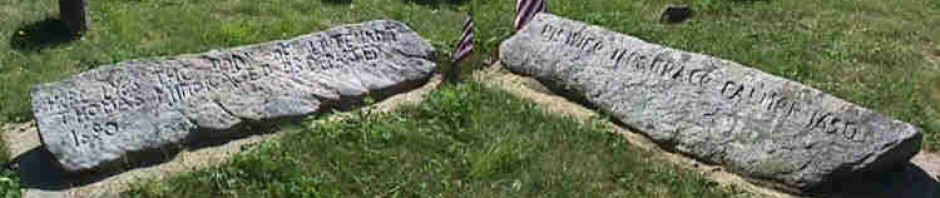
Philip Taber

Philip TABER (1604 – 1672) was Alex’s 9th Great Grandfather; one of 1,024 in this generation of the Miller line.
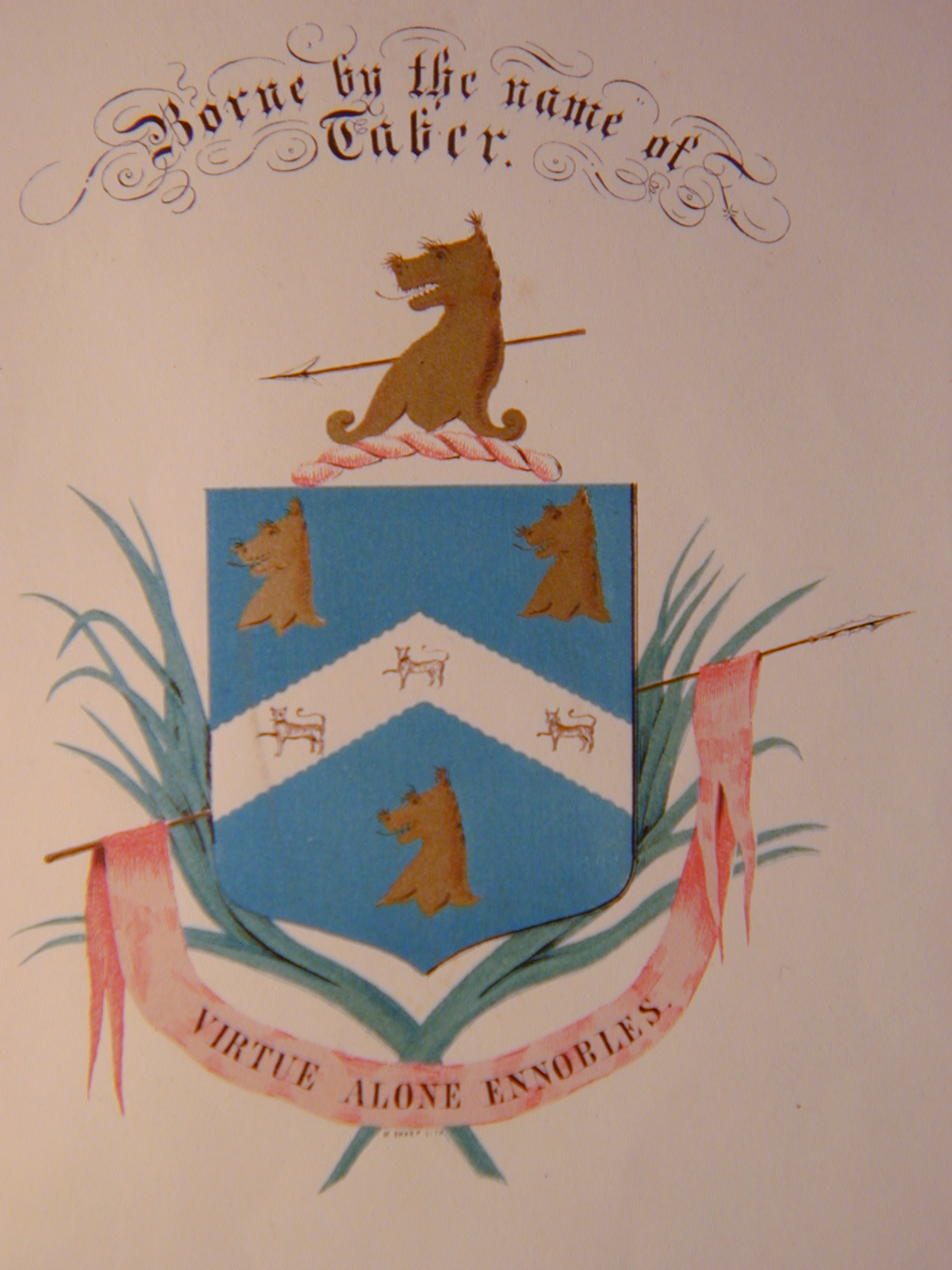
Philip Taber Coat of Arms

Philip Taber was born 1 Sep 1604 at Tiverton, Devonshire, England.  Alternatively, he was born about 1605 in Essex, England. His father was Sir John TABER.   He married Lydia MASTERS on 21 Dec 1639 in Watertown, Mass.  After Lydia died, he married Jane [__?__] about 1650.  Philip died before 24 Feb 1672 at Providence, RI

Philip Taber was an original settler of Edgartown, Martha’s Vineyard in 1642.  He also lived in Watertown, Yarmouth, New London, Portsmouth, Newport and Providence

Lydia Masters was born about 1605 at Tiverton, Devon,  England.  Her parents were John MASTERS and Jane COX .  At what date his wife, Lydia  died does not appear in the colonial records.  We know only that it was some time between the birth of his youngest child (about 1648) and the date of the deposition of Philip and his second wife, Jane, regarding the drowning death of a child (1669).

At Providence, Rhode Island, 10 Jun 1669, in an inquest case related to the drowning death of the widow Ballou’s lad, Philip testified that he was 64 years of age, thus placing the year of his birth in about 1605.  Philip’s second wife, Jane, also testified in the case stating that her age at the time was 64 years, thus placing the year of her birth also in about 1605.  This also fixes 1669 as the date before which Philip’s first wife, Lydia Masters, must have died. In her deposition, Jane also referred to Joseph Tabor as son-in-law.

(False): Philip Taber married second Jane “Latham”, sister of Cary Latham.  In fact, the surname of Philip’s second wife is unknown.  Cary Latham’s wife was also a daughter of John Masters, and it is through this connection that Latham and Taber were described as brothers-in-law.

Children of Philip and Lydia:

Name Born Married Departed
1. John Taber bapt.
8 Nov 1640
Barnstable, Mass
bef
21 Oct 1684 or 1702
2. Capt. Thomas Philip TABER 31 Jan 1645/46 in Yarmouth, Mass Ester Cooke
16 Aug 1667
.
Mary TOMSON

2 Jun 1672
11 Nov 1730 Dartmouth, Mass.
3. Joseph Taber 1646
Yarmouth or Martha’s Vineyard, Mass
Hannah Gray
1680 Dartmouth, Bristol, Mass.
.
Mary Gladden
14 Nov 1733 in New London, CT
20 Jan 1734
or
bef 1669
4. Philip Taber bapt.
8 Feb 1646
Yarmouth
Mary Cooke
28 Jan 1677/78 Plymouth, Mass.
bef. 4 Mar 1692/93
Little Crompton, Newport, RI
5. Esther Taber c. 1647
Barnstable, Mass
6. Lydia Masters Taber c. 1648
Barnstable
Rev. Pardon “Elisha” Tillinghast    (wiki)
16 Apr 1664
Providence, RI
.
Samuel Mason
4 Nov 1718 Providence, RI
27 Jan 1718/19
Providence, RI

Philip was frequently moving from one town to another to engage in business as a carpenter and builder.

Time Line

Oct 1630 Freeman of Mass. Bay Colony
1634 at Watertown
When Yarmouth was first settled he went there and for 2 yrs was Deputy to the General Court of Plymouth Colony 1639-40.
Moved to Martha’a Vineyard and lived at Pease’s Point, Edgartown.
1651 – Helped build the Mill Dam at New London.
1654 – Chosen as 1 of the 4 magistrates to govern Martha’s Vineyard.
1656 – Living at Portsmouth, RI, which he representated for 3 yrs at the General
Court of the Union of the R.I. Colonies.
1664 – Lived in Newport
1667 in Providence
1671 – Appeared in court with Rev. Roger Williams as witnesses

Philip Taber was not a man who settled in one place for long.  He must have come to New England with some capital as well as skill in his trade.  The colonial records show that he frequently moved from town to town to engage in business as a sawyer, a carpenter and a builder.  On 1 Apr 1634, Philip Taber contributed toward the construction of a protective fort for the harbor at Boston, promising two hundred feet of four-inch planks for the project.

We find him next at Yarmouth, on Cape Cod, where he was one of the first settlers, and on 5 Mar 1639, he was appointed to a committee for the equal division of the planting land in first allotment.  In 1639 and 1640 he was chosen a Deputy for Yarmouth in the earliest Assembly of Plymouth Colony.  In 1640, his son John was baptized at Barnstable, Cape Cod (probably still residing at Yarmouth, however), as appears by the church records of Barnstable, the Rev. Mr. Lothrop baptized John, son of Philip Tabor dwelling at Yarmouth, a member of the church at Watertown.  Six years later in 1646, his sons Philip, Thomas and Joseph were baptized.  Philip Taber remained in Yarmouth a few years only and then removed to Great Harbor, later known as Edgartown, on the island of Martha’s Vineyard.  Thomas Mayhew  of Watertown had bought this island in 1641, and many of the earliest settlers of that island came from Watertown.  It is quite probable that Philip Taber and his wife knew some of these people as former neighbors in Watertown, and it is evident that the newly started settlement would have been in need of a builder.  Just when Philip Taber first came to the Vineyard is uncertain, but it must have been was before 1647, when he sold to John Bland his interest in a tract of land lying against Mr. Bland’s house at Mattakeekset.  Philip Taber lived at Pease’s Point.  He was evidently one of the “proprietors” of the island, as he shared in all the divisions of lands as long as he was a resident of the island.  In 1647 Philip witnessed a document relating to Mr. Mayhew’s ward, Thomas Paine, which suggests that he was somewhat closely associated with Thomas Mayhew.

It is evident that Philip left the island occasionally to undertake some new work of construction on the mainland.  In 1651 he was in New London working with his brother-in-law, Nathaniel Masters, on the Mill Dam.  It is possible that after leaving Yarmouth and before going to the Vineyard, he was in New London in 1642, or soon thereafter.  In 1653, Philip Taber was back on the island, when with Thomas Mayhew he was chosen one of the four who acted as town’s committee, or Selectmen.  In May 1653, Thomas Mayhew, Thomas Burchard and Philip Taber were chosen to divide to the inhabitants out of all the Necks so much land as they in the best judgment shall see meet.  To Philip Taber was set off the neck called Ashakomaksett from the bridge that is at the East side of the head of the swampv.  The modern name of this locality is Mahachet.  Philip Taber, in the same year, shared in the division of the planting lands.  During this and the next year or two he made several conveyances of land.

A year or two later, Philip Taber was guilty of certain indiscretions, which made it desirable for him to remove to Portsmouth, Rhode Island.  Under date of 3 Jan 1655, the town records of Portsmouth sayPhilip Tabor is received an inhabitant and taken his ingagement to the State of England and government of this place and bath equal right of commonage with the rest of this towne.  It was probably after his final departure from Edgartown that the following entry was made in that town’s records,

15 May 1655: It is agreed by ye 5 men yt Philip Tabor is proved to be a man that hath been an attempter of women’s chastities in a high degree.  This is proved by Mary Butler and Mary Foulger, as divers more remote testimonies by others, and words testified from his own mouth with an horrible abuse of scripture to accomplish his wicked end.

In August of the same year, Philip Taber conveyed his house and lot at Mahachet, and thereafter he had no further history on the Vineyard.

Evidently Philip‘s indiscretions on the Vineyard in no way prevented him from taking a leading part in the affairs of his new place of residence.  In 1656 he acted on the jury at the Court at Newport.  In 1660, 1661 and 1663, he represented Portsmouth as a commissioner to the General Court of the Union of the Rhode Island Colonies.  In 1663, he was on a committee to devise means of raising money to pay Mr. John Clarke for his services, as the agent of the Colonies in England.  During his residence of about ten years in Portsmouth, he constantly served the town as Rater, Tax Collector, Constable, etc.  On 31 Jan 1664, Philip (calling himself of Newport, at this date) sold a certain house at Portsmouth now or lately in occupation of Alexander Balcom.  In 1665 he sold his house in Portsmouth, which was on the Newport road, to Anthony Shaw for £40 and three hundred good boards.  In 1667 he was living in Providence, where he witnessed certain deeds of real estate to his son-in-law, Pardon Tillinghast, the noted Baptist minister, builder of the first wharf in Providence and founder of a wealthy and noted family of Rhode Island, who in 1664 had married his daughter Lydia. 
It is evident that Philip Taber was a man of some distinction in Providence.  His daughter’s marriage to the leading minister and wealthiest merchant of the town would have accomplished that.

In 1671, at his Majestie’s Court of Justices sitting at Newport for the Colony of Rhode Island and Providence Plantations” Philip Taber and Roger Williams  gave evidence against one William Harris for speaking and writing against his Majestie’s gracious Charter to his Colony, which treasonable conduct was evidently regarded very seriously by the Court.  There is no further record of Philip Taber after that.  He probably died in Providence in about 1672.   The final record of Philip Taber is dated 24 Feb 1672, when his testimony was read before the Assembly.  There is apparently a family tradition to the effect that Philip settled finally at Tiverton, Rhode Island, and there died, but this is not consistent with the fact that Tiverton, Rhode Island was not incorporated by English colonists until 1694 (although there could have been settlers near that location earlier).

The following is from “The Descendants of Thomas, son of Philip Taber”, by George L. Randall, 1924: from the “Genealogy of Francis Weeks, by Dr. Frank Edgar Weeks, Kipton, Ohio: and from “The Tillinghast Family”, by John Gifford Tillinghast, Providence, R.I., 1889.

Philip Taber was born probably in 1605, and came from Essex, England, in 1630 and settled first in Boston, freeman on October 19, 1630. He was a carpenter and builder and one of the original contributors to a floating fort to protect Boston, and offered to give 200 four inch planks. He owned five lots in Watertown which he sold and removed to Yarmouth. He was made freeman of Plymouth Colony on June 4, 1639, Deputy to the General Court in 1639-40.

After a few years at Yarmouth, he moved to Great Harbor, later Edgartown on Martha’s Vineyard before 1647. He was one of the proprietors of the island and shared in all the divisions of land as long as he resided there. He was in New London in 1651, working with his brother in law Nathaniel Masters on the Mill Dam. It is possible he went to New London before going to the Vineyard in 1642: was still there in 1653 and allotted land at Ashakomaksett, now called Machet.

A year or two after he was guilty of certain moral indiscretions which made it desirable for him to remove from the island. On January 3 1655 he was an inhabitant of Portsmouth, R.I. From 1660-1663 he represented Portsmouth as Commissioner to the General Court of the Union of Rhode Island Colonies. He lived there ten years as a rater, tax collector and constable &c. In 1664 he was a resident of Newport and in 1667 of Providence, where he died after 1672.

Children

1. John Taber

In 1702 John’s house and goods were burned and he was given a life lease of 20 acres by the town of Providence, R.I. No children,

2. Capt. Thomas Philip TABER (See his page)

3. Joseph Taber

Joseph’s first wife Hannah Gray was born 26 Jun 1659  in Yarmouth, Mass.  Hannah died in 1707 in Tiverton, Newport, Rhode Island.

Joseph’s second wife Mary Gladden was born 1645 in New London, CT.  Mary died 20 Jan 1734 in New London, New London, CT.

4. Phillip Taber

Phillip’s wife Mary Cooke was born 12 Jan 1652, Plymouth, Mass.  Her parents were John Cooke and Sarah Warren.  Her grandparents were [Mayflower passengers and our ancestors] Francis COOKE and Hester le MAHIEU. Mary died 26 Apr 1708 at Dartmouth.

5. Esther Taber

(False): Philip Taber had a daughter “Esther” who married a man “Mayhew”.  There is no evidence that any member of the Mayhew family in the seventeenth century had a wife Esther, by any surname.

6. Lydia Taber

Lydia’s first husband Rev. Pardon Tillinghast (wiki) was born 16 Mar 1621/22 at Seven Cliffs,, near Beechy Head, Sussex, England  as it states on his grave marker in Providence, Rhode Island.   The name “Pardon” was the surname of his paternal grandmother, Alice Pardon (1580-1624).  In 1625, he was baptized in Streat Parish Church, Streat, East Sussex, England.  He was the leading minister and the wealthiest man in town. In about 1654 he first married[__?__] Butterworth of Reheboth, Mass., and had three children, by her..  In many accounts her name is given as “Sarah”, but there is no evidence to support this (although the oldest child of this couple was named Sarah).  Pardon’s first wife died in 1661.  On 16 Apr 1664, he married second Lydia Taber. Pardon died 29 Jan 1717/18 Providence, RI.
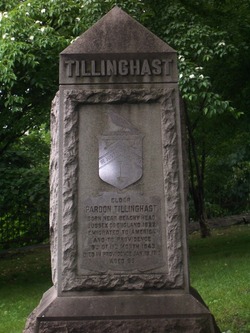
Pardon Tillinghast Monument – Tillinghast Lot Corner of Benefit & Transit Streets, Providence, RI
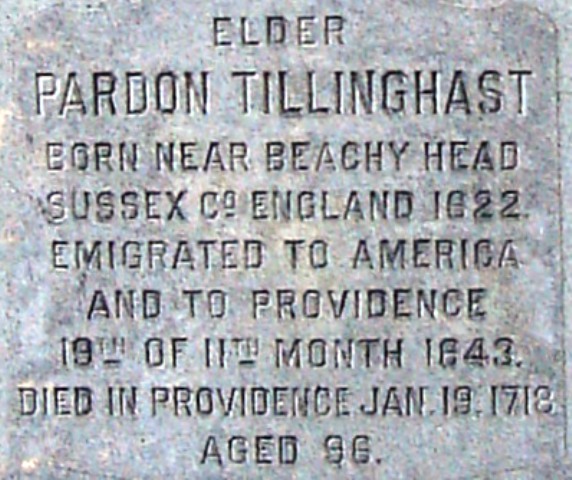
Pardon Tillinghast Inscription

Lydia’s second husband Samuel Mason was born 12 Feb 1656/57 in Rehoboth, Mass. His parents were Sampson Mason and Mary Butterworth. He first married 28 Mar 1682 in Rehoboth, Mass to Elizabeth Millard (Oct 1659 – d. 3 Mar 1718 Rehoboth.) Elizabeth’s parents were John MILLARD Jr. and Elizabeth [__?__]. Samuel died 25 Jan 1743/44 in Swansea, Mass. Both Samuel and Elizabeth are buried in Kickimuit Cemetery, Warren, Rhode Island.
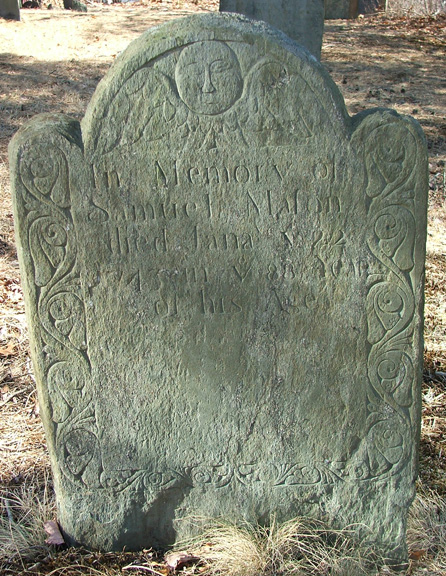
Samuel Mason Gravestone — Death date on stone reads Jan 22 1743 – Kickemuit Cemetery , Warren, Bristol County, Rhode Island

Prior to his emigration to America, some sources report that Pardon Tillinghast served as a soldier under Oliver Cromwell and participated in the battle of Marston Moor.  This cannot be proved one way or the other.  His reason for emigrating from England may have been the religious intolerance at the time of which the civil strife was symptomatic.  Once in New England, he settled in Providence, Rhode Island and on 19 Jan 1645 was admitted a resident and allotted a share as a proprietor.  He probably arrived in New England shortly before that.

Pardon Tillinghast had little estate when he came to New England, and in 1650 he was taxed three shillings and four pence, a fairly low amount compared to other inhabitants.  In 1658 he became a Providence freeman, but the following year he had a deed of land in Newport from Gov. Benedict Arnold and was called an Inhabitant of Newport in the deed.  While living in Newport, he became involved in importing and selling dry goods and appears to have had a brewery, based on a 1684 deed in which he conveys a brewhous to his son John, along with his other Newport properties.  About 1665 he was back in Providence when he received a lot there in a division of lands, and between 1672-1700 he served for six one-year terms as a Deputy to the General Assembly representing Providence.

Pardon Tillinghast was a cooper like both his father and his sons but also was a successful merchant.  In 1680 he was granted 20 square feet for building a storehouse with privilege of a wharf, over against his dwelling house.  In doing this, he had built the first wharf in Providence, and is thus recognized as the founding pioneer of the town’s maritime trade.  Subsequently, trade opened between Providence and other partners, from nearby colonies to as far as the West Indies and Europe.  For the times, Pardon Tillinghast became a fairly wealthy man, and when he died, his estate, excluding real estate, was valued at £1,542.  Putting this into perspective, of 78 Providence inventories between 1716 and 1726, his was the third highest in value.

At some point, Pardon Tillinghast became a Baptist, and in October 1674 he and Stephen Harding were arrested in the Massachusetts Bay Colony, and charged with visiting the Puritan town of Mendon in order to Seduce People to their corrupt opinions.  The two men appeared before the county court, but with no one present to prosecute them, they were admonished and released after being ordered to pay court costs.  In 1681 Pardon Tillinghast became the pastor of the First Baptist Church in Providence.  This church, founded by Roger Williams is still in existence, and it is the oldest Baptist congregation in America.  In 1700 at his own expense, he built the first meeting-house of the First Baptist Church in Providence.  In 1711, he deeded  the building to the church, described as a “rude affair” in the shape of a hay cap with a fireplace in the middle with the smoke escaping from a hole in the roof.  In the deed of conveyance he describes the faith and order of the church by quoting the Epistle to the Hebrews (describing what became known as Six Principle Baptists).  He served as pastor without remuneration from 1681 until his death in 1718, and was the sixth pastor of this congregation, being preceded by Roger Williams,  Chad BrowneThomas OlneyWilliam Wickenden, and Gregory Dexter.

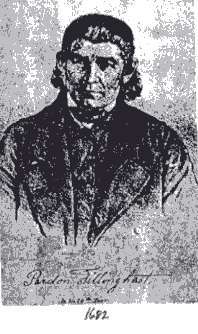
Unconfirmed Portrait of Pardon Tillinghast

He was described by Baptist historian, Morgan Edwards, as being remarkable for his plainness and his piety.

While serving as a clergyman, Pardon Tillinghast continued to be active with civic responsibilities as well and served on the Providence Town Council during most of the years from 1688-1707.  He was also the town Treasurer from 1687-1707.  Well advanced in years, he wrote his will on 15 Dec 1715, and it was proved on 11 February 1718.  He died on 29 January 1718, and he was buried in a family cemetery in Providence that remains extant, though any original markers have been replaced with a single family monument.

In 1689, Pardon Tillinghast was the author of a book of theology entitled Water-Baptism Plainly Proved by Scripture to Be a Gospel Precept.

Among Pardon’s thousands of descendants are many of great prominence, including Continental Congress delegate Samuel WardJulia Ward Howe who wrote the Battle Hymn of the Republic; and Stephen Arnold Douglas who was involved in a series of famed debates with Abraham Lincoln in 1858, prior to a Senate race, and later lost to him in the 1860 presidential election.

Pardon Tillinghast Bio — Genealogical and Personal History of the Allegheny Valley, Volume 1  By John Woolf Jordan 1913

Sources:

http://freepages.genealogy.rootsweb.ancestry.com/~onebigfamily/all/aqwg778.htm#18281

http://freepages.genealogy.rootsweb.ancestry.com/~johnsongenealogy/white/id32.htm

http://www.antonymaitland.com/

http://armidalesoftware.com/issue/full/Thaler_309_main.html

http://trees.ancestry.com/owt/person.aspx?pid=135196128

http://genealogy.damon-family.org/p98.htm

http://hylbom.com/family/paternal-lines/paternal-sh-to-ti/taber-5230/

http://hylbom.com/family/paternal-lines/paternal-sh-to-ti/tillinghast-2614/

Genealogical and Personal History of the Allegheny Valley, Volume 1 (Pardon Tillinghast Bio) By John Woolf Jordan 1913

A little journey to the home of Elder Pardon Tillinghast By John Avery Tillinghast 1908

Posted in 11th Generation, Immigrant - England, Line - Miller, Public Office, Wikipedia Famous | Tagged | 15 Comments

Capt. Thomas Taber

Capt. Thomas TABER (1646 – 1730) was Alex’s 8th Great Grandfather; one of 512 in this generation of the Miller line.

Capt. Thomas Philip Taber was born  31 Jan 1645/46 in Yarmouth, Mass.  His parents were Philip TABER and Lydia MASTERS. He married Ester Cooke on 16 Aug 1667 in Dartmouth, Mass.  After Esther died, he married Mary TOMSON 2 Jun 1672. Thomas died 11 Nov 1730 at Dartmouth, Mass.

A stone wall of Thoms Taber’s house built in 1680 in Acushnet, Mass is still standing

Esther Cooke was baptized 16 Aug 1650 in Plymouth, Mass.  Her parents were Rev. John Cooke, the last survivor of the Mayflower passengers and Sarah Warren.  She was a granddaughter of Francis COOKE Esther died 17- Apr 1671/72.

Mary Tomson was born in 1650 in Dartmouth, Mass.  Her parents were John TOMSON and Mary COOKE, Rev. John Cooke’s brother, so she and Esther were first cousins.  Mary died 3 May 1723 probably at Dartmouth, Mass.

Children of Thomas and Esther Cooke

Name Born Married Departed
1. Thomas Taber 22 Oct 1668. Rebecca Harlow
4 Jul 1700/01
bef.
2 Aug 1722
2 Esther (Hester) Taber 17 Apr 1671
Dartmouth, Mass
Samuel Perry
23 Oct 1689
Sandwich, Mass.
14 Jan 1749/50
Sandwich, Mass.

Children of Thomas and Mary

Name Born Married Departed
3. Lydia Taber 8 Aug 1673
Dartmouth, Mass.
John Kinney
c. 1695
4. Sarah Taber 28 Jan 1673/74
Dartmouth
William Hart
1 Dec 1702
Dartmouth
1735
5. Mary TABER 18 Mar 1676/77 Dartmouth Manasseh MORTON
1703 Dartmouth
c. 1745
6. Joseph Taber 7 Mar 1679
Dartmouth
Elizabeth Spooner
12 Aug 1701/02
Dartmouth
1752
7. John Taber 22 Feb 1680/81 Phebe Spooner
c. 1712
27 Aug 1761 Dartmouth
8. Jacob Taber 26 Jul 1683
Dartmouth
Sarah West
c. 1711
4 Apr 1773
Dartmouth
9. Jonathan Taber 22 Sep 1685 Lois Ward
11 Nov 1727 
bef. 15 Jun 1723
[not in father’s will] Said to have died in the woods, his mind impaired.
10. Bethia Taber 3 Sep 1687
Dartmouth
Caleb Blackwell
bef. 1711
6 Aug 1758
Rochester, Hampshire, MA
11. Philip Taber 7 Feb 1688/89
Dartmouth
Susanah Tucker (Wilcox)
c. 1710
27 Dec 1750
Shrewsbury, Monmouth NJ
12. Abigail Taber 2 May 1693
Dartmouth
Ebenezer Taber
(cousin)
1 Dec 1715
Tiverton, Newport County, RI.
bef. 28 Aug 1752

Thomas was a yeoman farmer

In the 1630’s, Thomas’s father-in-law, John Cooke was a deacon of the Plymouth church.  At some point, during the late 1640s, John Cooke “fell into the error of Anabaptistry”, and was cast out of the Church.  The Plymouth Church records state that ”

This John Cooke although a shallow man became a cause of trouble and dissention in our Church and gave just occasion of their casting him out; so that Solomon’s words proved true in him that one sinner destroyeth much good.”

John Cooke removed from Plymouth and took up residence in Dartmouth, where Thomas married his daughter Esther in 1667.

Thomas’ will was dated Jun. 15, 1723 and  proved Mar. 20, 1732/3

The following is from “The Descendants of Thomas, son of Philip Taber”, by George L. Randall, 1924: from “The Genealogy of Francis Weekes”, by Dr. Frank Edgar Weeks, Kipton, Ohio.

In 1672 Thomas was at Dartmouth, Mass,, village of Fairhaven. He served as selectman, surveyor, town clerk, assessor, and was a captain in the Militia. In 1675 his house burned: he then built a stone house at Oxford in Fairhaven, Mass., then called Dartmouth.

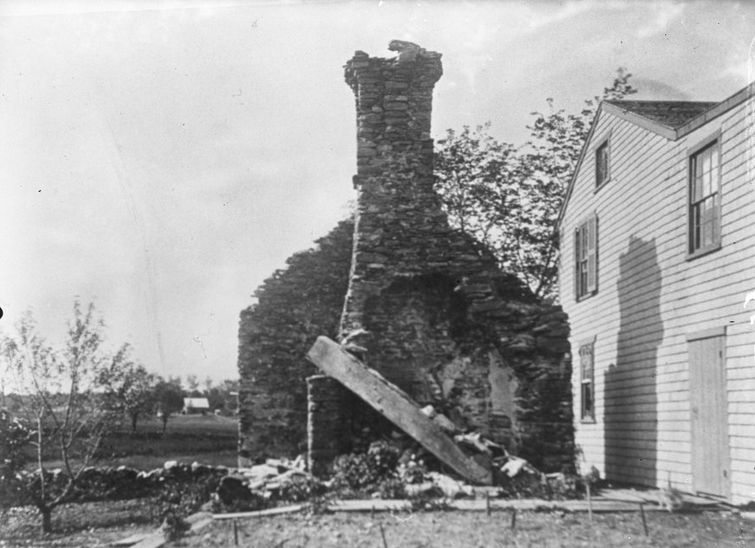
Land given to him in Fairhaven in 1672.  In July of 1675 his house along with 29 others was burned by King Philip.  He then built a stone house, the chimney was still standing as of 1889.

The earliest officers commissioned to command the local militia of the ancient and original town of Dartmouth, were as follows: Captain, Thomas Taber, commissioned May 20, 1689. Lieutenants, John Smith, commissioned March 4, 1674; Seth Pope, June 4, 1686;* Jonathan Delano, May 20, 1689. Ensigns, Jacob Mitchell, commissioned March 4, 1674, slain by the Indians; James Tripp, commissioned May 20, 1689.

By 1675, the time of King Philip’s war, only thirty-seven dwellings were in Old Dartmouth. Almost all were destroyed during the war.

“What is the oldest house in Greater New Bedford?

This question can produce an argrument among any number of home owners and local historical buffs. But these same people would be hard pressed to identify the ruins of the oldest standing structure in the area–perhaps the first built after King Philip’s War. The conflict by…the Indians took a heavy toll in the Old Dartmouth area, but hardly the last warhoop died out when a mason from Rhode Island began erecting a cottage in the Oxford section of Fairhaven. Thomas Taber came into the control of considerable land in the area through his marriage to Ester Cooke, the daughter of John Cooke, who was a large shareholder in the original Dartmouth purchase.

Thomas Taber House late 1800’s

STARTED IN 1676—The cottage, built along the lines prevelent in Rhode Island during the period, was started in 1676. The house was last occupied in 1851 by an Indian woman known as “Black” Annis Sharper. All that remains today is a large fireplace. It stands behind the residence of Mr. and Mrs. Hugh B. Darden, Jr. at 191 Main Street.

The house had a ten foot ceiling, while the ridge rose twenty feet and the chimney rose to 24 feet 4 inches. Philip F. Purrington, Curator of the Old Dartmouth Historical Society, estimated the house to have been 16 feet 10 inches wide, and about 22 feet long, running north to south. The chimney centered on the ridge and the fireplace was offset to the west. Taber built added strength into his chimney by allowing the stonework to round the corner into the west wall. Once knowing the house’s dimensions, it is hard to imagine Thomas Taber raising a family there and retaining his sanity.

His wife Ester bore him three children before she died in 1671. Taber then married Mary Thompson, a neice of John Cooke. She bore him 11 children. Hence, Taber’s problem was living in a house measuring 16 ft x 22 ft, with a wife and 14 children. In 1680, Taber built a new two-story house in Acushnet for his sons, Joseph and John. One was born in 1679 and the other in 1681. It appears the whole family moved to this new abode—a Rhode Island design, with an overhang at the second story.

The house was destroyed by fire in 1869, but the foundation remains at the end of Manchester Street in Acushiret, about one-quarter mile west of Plainville Road. The Oxford property was left to Thomas’ son, Philip, who left the area in 1730 and sold the property to William Wood. The property sold in 1794 and not officially recorded until 1910 to Robert Bennett. The Bennett family was “relieved” of the property during a business failure, but in 1918 Cpt. Thomas Bennett allowed Annis Sharper to live on the property before she moved to Fairhaven Almshouse in 1851.

Clara Bennett, daughter of Thomas Bennett,Jr. gave the property to the Old Dartmouth Historical Society.

Here are present day driving Google Maps driving directions between the two homestead sites now in Acushnet, Mass

Children

1. Thomas Taber

Thomas’ wife  Rebecca Harlow was born 27 Jan 1678/79 Plymouth, Plymouth, Mass. Her parents were Samuel Harlow and Priscilla [__?__].

It is often repeated that Thomas supposedly died young and his parents later had a Thomas Taber b. 22 Feb 1681, but this idea is patently false. The Taber Genealogy published by George Randall in 1924 in New Bedford contains this error, for some inexplicable reason. There is no thorough or authoritative source for Taber genealogy for the colonial period of New England. I have been researching primary sources for 15 years, and within the next 5 years hope to publish my findings. At this time, the closest thing to an authoritative source on your Taber ancestry is Volume 12 of the Mayflower 5 Generation Project, tracing the descendants of Francis Cooke. First published in 1996 and revised in 1999, it has some glaring errors on Taber lines, and scores of oversights. (As an example of a minor oversight, Thomas Taber who married Rebecca Harlow is said to have died “between 2 August and 4 September 1722.” The
Dartmouth town records put the date of death between 2 August and 14 August, as a town meeting was called on 14 August 1722 to elect a selectman to replace Thomas Taber, Junior, deceased.) Also, note that “Captain” Thomas Taber did not have a middle initial “B.” (Middle names were rare among New Englanders of that period.). The “B.” appears to have been copied from a source that listed the children of Philip and Jane (Masters) Taber, and used a capital B. for born, thus it in part read “Thomas B. circa 1644.”

Will of John Cooke
9 November 1694 The Last will and Testament of John Cook of the town of Dartmouth in the County of Bristoll:

I being weake of Body but of sound and Perfect memory, have Disposed of my Estate which God hath been pleased to bestow upon me in manner following: that is to say In the first place I give to my Son in-law Arthur Hathaway & his wife Sarah my Daughter all my land in the point at or Near the Burying place in Dartmouth the which I bought of John Russell to them their heires and Assignes for Ever: And also I give unto my Son in-law Stephen west and his wife Mercey my Daughter one full Third part of a whole Share of lands in the Township of Dartmouth with all my houseing and Orchards “hereunto belonging: with all the priviledges & appur=ces belonging to the same to them their heires & Assignes for ever They to possess the same after the Decease of my wife Sarah Allso I give unto Jonathan Delano. one Third part of a share of meadow Caled the ffreemens Meadow Lyeing within the Township of Rochester to him his heires & assigne for Ever: Allso I give to my Grandson Thomas Taber my little Island Caled & Known by the Name of Ram Island Lying in Cushnat River in Dartmouth with one third part of my Share of Meadow Called the ffreemens Meadow Lyeing in the Township of Rochester. to him his heires & assignee for Ever and I give to my said Grand son my Gun & sword Allso I give to my Grand Daughter Hester Perry One feather Bed & Bolster, All the Rest & Residue of Estate Goods & Chattles of what Sort or Kind so ever I Give & bequeath uto my Loveing wife Sarah to use. & Dispose of the same as she shall see good And I make my said wife Sole Executrix of this my Last will & Testament: In witness whereof I the said John Cooke have hereunto sett my hand & seale this Ninth Day of November 1694 in the presence of

Aaron Savory O his mark
John Cooke (seal) Thomas Taber

2. Esther Taber

Esther’s husband Samuel Perry was born 15 Mar 1666/67 in Sandwich, Mass. His parents were Ezra Perry and Elizabeth Burgess. His grandparents were our ancestors Edmund PERRY and Sarah BETTS. Samuel died 8 Aug 1751 Sandwich, Mass.

Will of Captain Thomas Taber, made June 15, 1723.  Following the preamble are the bequests to his six sons.  Then, “To my daughter Esther Perry and her husband I give my lot of upland and meadow near ye lower end of Sconticut neck, with twenty five acres of land within ye four hundred acre devition both within sd Dartmouth, also one sixteenth part of a share of ye undivided land within sd township after twelve hundred acres to a share is laid out.” Also £9 in money.

Samuel was admitted townsman in Sandwich, 8 Oct 1691, at which time he was styled “Jr.” to distinguish him from his older cousin, Samuel, son of Edward who lived in Kingston Rhode Island.

Samual built his house on the opposite side of and a considerable distance from the Middle Monument Cemetery, in that section, which in 1884 became the town of Bourne.

Samuel kept a tavern. His grandson, Seth, dismantled the building, but in 1929 the cellar was excavated and the relics that were recovered were preserved by the Bourne Historical Society.

By will dated August 2, 1750, Samuel gave personal property to the children of his daughter Mercy, deceased, and to his daughters Mary, Elizabeth, Deborah, all the rest and residue of the estate to be divided between his two sons, Nathan and Ebenezer, whom he made co-executors.

3. Lydia Taber

Lydia’s husband John Kenney was born 15 Jan 1669/70 Milton, Mass.  His parents were John Kenney and Susannah [__?__].  John died in 6 Jul 1728 in Dartmouth, Bristol, Mass

4. Sarah Taber

Sarah’s husband William Hart was born 1676 Portsmouth, RI. His parents were Richard Hart and Hannah Keene. William died 1 Feb 1733 – Dartmouth, Bristol, Mass.

5. Mary Taber (See Manasseh MORTON‘s page)

6. Joseph Taber

Joseph’s wife Elizabeth Spooner was born 19 Jun 1683 Dartmouth, Bristol, Mass. Her parents were John Spooner and Rebecca Peckham.

7. John Taber

John’s wife Phebe Spooner was born 11 May 1687 Dartmouth, Bristol, Mass. Her parents were John Spooner and Rebecca Peckham.  Phebe died 15 Mar 1750 in Mass

8. Jacob Taber  

Jacob’s wife Sarah West was born 1 Aug 1686 Dartmouth, Bristol, Mass. Her parents were Stephen West and Mercy Cook.  Sarah died 5 Dec 1775 in Dartmouth, Mass

9. Jonathan Taber

Jonathan’s wife Lois West was born 12 Apr 1701.  Her parents were Stephen West and Mercy Cooke.

10. Bethia Taber

Bethia’s husband Caleb Blackwell was born about 1685 Sandwich, Mass. His parents were John Blackwell and Sarah Warren. Caleb died 28 NOV 1762 Rochester, Mass.

The will of Capt. Thomas Taber mentions  Bethyah Blackwel and her husband Caleb Blackwel blacksmith

11. Philip Taber

Philip’s wife Susana Tucker was born 9 Jul 1688 in Dartmouth, MA . Her parents were John Tucker, (28 Aug 1656, Sandwich, MA – 2 Sep 1751, Dartmouth, MA) and Ruth Wooley (12 Oct 1664, Newport, RI – 23 Dec 1759, Dartmouth, MA )

12. Abigail Taber

Abigail’s husband was born 2 May 1693 Dartmouth, Bristol, Mass. He was Abigail’s first cousin. His parents were Joseph Taber and Hannah Gray. Ebenezer died 5 OCT 1772 Tiverton, Newport, RI.

Sources:

http://freepages.genealogy.rootsweb.ancestry.com/~onebigfamily/all/aqwg779.htm

http://www.werelate.org/wiki/Person:Philip_Taber_(11)

http://freepages.genealogy.rootsweb.ancestry.com/~johnsongenealogy/white/id32.htm

http://www.antonymaitland.com/hptext/hp0170.txt 

http://genforum.genealogy.com/taber/messages/500.html

http://www.catboat.com/shermangeneology.DARTMOUTH.html

Posted in 10th Generation, Historical Site, Line - Miller, Veteran | Tagged | 8 Comments

Thomas Rawlins

Thomas RAWLINS (1600 – 1660) was Alex’s 10th Great Grandfather; one of 2,048 in this generation of the Miller line.

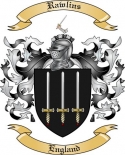
Thomas Rawlins – Coat of Arms

Thomas Rawlins was born about 1600 in Weymouth, Dorsetshire, England.  He married Mary [__?__] in 1624 in Weymouth, Dorsetshire, England.  He  came to Roxbury from England in 1630 in the first company of the Winthrop Fleet with his family.   He was a carpenter and planter and removed to Scituate before 1639. He married second Sarah Maddox on 2 May 1656.   Thomas died 15 Mar 1660 in Boston, Mass.

Mary [__?__] was born in 1592, Weymouth, Dorsetshire, England.  After great suffering, Mary died about 1639 in Scituate, Mass..

Children of Thomas and Mary:

Name Born Married Departed
1. Thomas Rawlins c. 1618
England
Hannah [_?_]
1640
aft 12 Dec 1681
Plymouth, Mass
2. Mary Rawlins c. 1620
England
William Parker
Apr 1639
Aug 1651
Scituate, Mass
3. Joanna RAWLINS c. 1624
England
Ephraim KEMPTON Jr.
28 Jan 1646 Scituate, Plymouth Colony
31 Mar 1656 Scituate, Mass.
4. Nathaniel Rawlins c. 1626
England
Lydia Sylvester
4 Sep 1652
23 Dec 1662
Scituate, Mass
5. John Rawlins c. 1628
England
Judith [__?__]
.
Mary [__?__]
Scituate, Mass
1681
Boston

“Thomas Rawlins came from Weymouth before 1646, in which year he was one of the Conihassett partners in Scituate. He had left Weymouth with Richard Sylvester. He purchased Anthony Annable’s  River lot 1642, and built his house where Deacon Thomas, and Deacon George King afterward resided, (now [1831] Col. Curtis’s.) … The descendants now [1831] write the name Rollin.

Richard Sylvester, who lived in Weymouth about 1640, held doctrines too liberal for the age in which he lived; they were supposed to be similar to those of his minister, Mr. Lenthial, whose doctrine was ‘that all baptized persons should ” be admitted to the church without further Trial. This Mr. Lenthial afterward retracted before the General Court of Massachusetts; but Sylvester refusing, he was disfranchised, and therefore removed into Scituate, then in the Plymouth Colony and out of their jurisdiction. As Thomas RAWLINS, Thomas Clapp, James Torrey and William Holbrook went to Scituate about the same time, perhaps because of holding similar opinions.

Sep 1634 – Anthony Annable had built a “small plain pallizadoe” house at Scituate.

29 Sep 1639 – Anthony Annable of Barnstable, planter, sold to Thomas Rawlins of Scituate “my dwelling house and out house and all my lands thereunto appertaining, viz:” twenty-two acres, on the northeast side of the first herring brook, nine acres of marsh on the same side of the first herring brook, eighty acres of upland on the north side of the North River, and thirteen acres of marsh thereto belonging

Thomas, Sen., carpenter, planter, Roxbury, came with the first company, 1630; he brought 5 children, Thomas, Mary, Joane, Nathaniel and John. He removed to Scituate; his wife Mary, after great suffering, d. there about 1639. [E.] Propr., frm. May 18, 1631. He removed to Boston. Emm, wife of Thomas R. d. at Boston. 27 (10) 1655. He m. 2 (3) 1656, Sarah Maddox. His dau. Joane m. at Sci. Jan. 28, 1645-6, Ephraim Kempton. Mary m. April, 1639, William Parker. Thomas, fisherman, seaman, of Weymouth and Boston, who deposed April 12, 1641, ae. about 33 years, appears to be the son of the above.  He d. 15 March, 1660; will prob. April 4, 1660. Wife Sarah; sons Thomas and Nathaniel. House and land in Bo. and farm at Sci. [Reg. IX, 226.]

There is confusing information about Thomas Rawlins and Ephraim KEMPTON Jr. from the poorly written Cutter reference. Ephraim Kempton Jr. did not marry Sarah Maddox on 2 May 1656 – Thomas Rawlins did – Ephraim Jr. died in 1655 and couldn’t possibly marry anyone in 1656. Thomas Rawlins was the one who was on a grand jury, 1641 etc; surveyor at Scituate 1642 etc; on town committee, etc: admitted freeman, May 18, 1631; returned to Boston where his wife died etc. – not Ephraim Kempton Jr. Ephraim Jr could hardly be a freeman in 1631 since he was in England at the time. Plus Ephraim Jr.’s Joanne died on 31 Mar. 1656 in Scituate – not in Dec 27, 1655 in Boston – Thomas Rawlins second wife did on that date. Ephraim Jr. did not die Mar 15, 1660 – Thomas Rawlins was the one who died on that date in Boston. The statement from Savage is about the wife of Ephraim Kempton IV and not wife of Ephraim Kempton III. See article in NEHGS Reg., vol. 166, p. 188, “When Did Ephraim3 Kempton Marry.”

Children

1. Thomas Rawlins

Thomas, fisherman, seaman, of Weymouth and Boston, who deposed April 12, 1641, ae. about 33 years, appears to be the son of the above

2. MaryRawlins 

Mary’s husband William Parker was born in 1618. His father was William Parker.  William died 28 Dec 1686 in Saybrook, Middlesex, Connecticut.

3. Joanna RAWLINS (See Ephraim KEMPTON Jr.‘s page)

4. Nathaniel Rawlins

Nathaniel’s wife Lydia Sylvester was born 8 Dec 1633 in Scituate, Plymouth, Mass. Her parents were Richard Silvester and Naomi Torrey. After Nathaniel died, she married she married Edward Wright 1664. Lydia died 1700 in Scituate, Mass,

Nathaniel succeeded to his father’s residence 1650. He married Lydiain 1652 The children of Nathaniel, Elizabeth born 1653, Ruth 1655, Patience 1658, Nathaniel 1659, Elizabeth born 1661, (wife of James Torrey, jr. 1679.)Nathaniel, sen. died 1662. Thomas, sen. died in Boston, 1650, and gives in his will, “to wife Sarah, and to son Thomas a house in Boston, if he live there with his mother. To son Nathaniel, my farm inScituate. To son in law William Parker of Scituate, &ic.” The descendants now write the name Rollin.   from History of Scituate, Massachusetts by Samuel Deacon.

Sources:

http://www.famhist.us/getperson.php?personID=I596763&tree=allfam

http://trees.wmgs.org/getperson.php?personID=I5316&tree=Schirado

The Pioneers of Massachusetts: A Descriptive List, Drawn from Records of the … By Charles Henry Pope

http://trees.ancestry.com/owt/person.aspx?pid=24359769&st=1

Posted in 12th Generation, Immigrant - England, Line - Miller | Tagged | 3 Comments

Ephraim Kempton Sr.

Ephraim KEMPTON Sr. (1591 – 1645) was Alex’s 10th Great Grandfather; one of 2,048 in this generation of the Miller line.

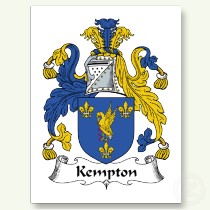
Ephraim Kempton – Coat of Arms

Ephraim Kempton was born 26 Oct 1591 in Berwick-Upon-Tweed, Northumberland, England.  His parents were George KEMPTON and Mary JERSEY.  His brother Manasseh Kempton was also one of the “old-comer” immigrants.  He married Elizabeth WILSON 12 April 1617 in Holy Trinity the Less, London. He came to the Plymouth colony in the winter 1639/40.  His son Ephraim Jr. came with him and was in partnership with him from the time of coming to this country until his death. Ephraim died 5 May 1645 in Scituate, Mass.

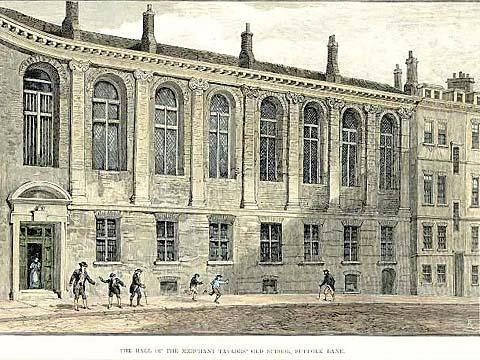
The Merchant Taylors’ Hall, London, c.1810 – Ephraim was apprenticed to the Merchant Taylor’s Company from 1606-1615

Elizabeth Wilson was born about 1596 in Holy Trinity, London, England.  Her father was of the Scottish Wilson sept of the clan Gunn.    Elizabeth died about 1635 in London England and did not emigrate.

Children of Ephraim and Elizabeth The names of the other children are not known. They were probably daughters

Name Born Married Departed
1. John Kempton baptized
22 Nov 1618,
Holy Trinity The Less, London
Did not emigrate
2. Ephraim KEMPTON Jr. 18 Mar 1621, London, England
baptized 24 Jun 1623 at St. John The Baptist, London.
Joanna RAWLINS
28 Jan 1646 at Scituate, Plymouth Colony
.
Did NOT marry
Sarah Maddox
2 May 1656
bef.
2 Jul 1655
or
5 Mar 1660 Plymouth

The direct male lineage as Ephraim Sr. – George – William – Robert – George Kempton/FitzAlan – Thomas FitzAlan Earl of Arundel

Ephraim was a tailor by trade.  Sometime after the death of his father, Ephriam apprenticed himself to Daniel Elsmore of St Sitches Lane in London. He served Elsmore from 1606-1615, when he became free of the Merchant Taylors’ Company.

The Worshipful Company of Merchant Taylors is one of the Livery Companies of the City of London. The Company, originally known as the Guild and Fraternity of St John the Baptist in the City of London, was first incorporated under a Royal Charter in 1327; the charter was confirmed by later charters in 1408, 1503 and 1719. Its seat is the Merchant Taylors’ Hall between Threadneedle Street and Cornhill, a site it has occupied since 1347.

The 108 livery companies are nominally trade associations based in the City of London, almost all of which are known as the “Worshipful Company of” the relevant trade or profession. The medieval livery companies originally developed as guilds and were responsible for the regulation of their trades, controlling, for instance, wages and labour conditions. Until the Reformation, they were closely associated with religious activities, notably in support of chantry chapels and churches and the observance of ceremonies, notably the mystery plays.

Under an order issued by Mayor Robert Billesden in 1484, the Merchant Taylor Company ranks in sixth or seventh place (making it one of the Great Twelve City Livery Companies) in the order of precedence of the Livery Companies, alternating with the Skinners’ Company.

In Ephraim’s time, the association of tailors. By the end of the 17th century, its connection with the tailoring trade had virtually ceased and it became what it is today, a philanthropic and social association. As a result it owns, supports or is associated with several schools, almhouses and other charitable institutions.  It owns Merchant Taylors’ School, Sandy Lodge & St. John’s Preparatory School, Northwood, and is associated with Merchant Taylors’ School, Crosby, Merchant Taylors’ Girls’ School, Crosby, Wolverhampton Grammar School, Foyle and Londonderry College, Wallingford School, and The King’s School, Macclesfield. It is also associated with St John’s College, Oxford, founded by Sir Thomas White (a Master of the Company) in 1555, and with Pembroke College, Cambridge.

Ephraim’s brother Manasseh Kempton came in 1623, probably in the ship “Ann,” is called one of the “old-comers.” sharing in the division of cattle in 1627, was taxed in Plymouth in 1632, admitted freeman in 1633, deputy to the general court in 1639 and for nine years following. He was one of the purchasers of the town of Dartmouth, Massachusetts. He died 14 Jan 1662/63; his widow 19 Feb 1665, in her eightyfirst year. They left no children.

Ephriam Kempton and his son of the same name immigrated to the colonies between 1638 and late 1640, when they settled on a farm of twelve acres in Scituate, which had been purchased by his brother Manassas Kempton from Elder Henry Cobb.

The names of both  Ephraim and Ephraim Jr. appear on the list of 1643 of those able to bear arms, but that of Ephraim Sr. was crossed off afterward, his age doubtless exempting him from service.

7 March 1643, he was brought before the court charged with misdemeanor and use of opprobrious (disgraceful) language to Mr. Hatherly, a magistrate, for which he was fined twenty shillings and placed in the stocks for a few hours.

The inventory of his estate was filed and administration granted October 28, 1645, to his brother Manasseh and son Ephraim. The estate was divided June 4, 1645. Manasseh Kempton, of Scituate, and Thomas RAWLINS. Sr.. of Boston, father-in-law of Ephraim Jr., arranged for the apportionment of the estate to Ephraim and the three other children June 8. 1658.

Children

Ephraim Kempton Sr. never had a child 3, Manasseh; a child 4, Lettice; or a child 5, Annis. For an accurate reference, see the late Dean Crawford Smith’s excellent book, “The Ancestry of Eva Belle Kempton,” Part 1, page 71, about the children of Ephraim Kempton Sr. who were only John and Ephraim Jr. Manasseh and Annis were children of George Kempton and Mary Jersey (Ephraim Kempton Sr. parents) – see Smith.   Lettice never existed – this is an old myth.

1. John Kempton

John enrolled in the Merchant taylor’s School 1630-1634,  in the City of London where the brothers appear as ‘john Kempton ma’ and ‘Ephriam kempton minor,” the time honored way in which English private schools distinguish between two brothers attending the same school, major indicating the elder of the two; not seen thereafter.

The school is celebrating its 450th anniversary in 2011.  It was founded in 1561 by members of the Merchant Taylors’ Company. It was originally located in a manor house called the Manor of the Rose, in the parish of St. Lawrence Pountney in the City of London, where it remained until 1875.

2. Ephraim KEMPTON Jr.  (See his page)

4. Lettice Kempton

There were two woman named Lettice [joy in Latin] in early Plymouth.   Lettice Hanford and Lettice Kempton  are often mixed up with four marriages between them.  There is only one recorded death:  22 Feb 1691.  Here’s my crack at unsorting the tangle.

Lettice Kempton’s first husband John Morton was born in 1616 in Leyden, Holland.  His parents were George MORTON and Juliana CARPENTERJohn died 3 Oct 1673 in Plymouth, Mass.

Lettice Kempton’s second husband Andrew Ring was born in 1618 in Pettistree, Suffolk, England. His parents were William RING and Mary DURRANT.  He first married Deborah Hopkins (1625 Plymouth, Plymouth Colony – Bef. 1674 Plymouth, Plymouth Colony).  Deborah’s  father was Stephen HOPKINS.   Andrew and Deborah had seven children born between 1649 and 1661.  Andrew died 22 Feb 1693 in Plymouth, Massachusetts.

Lettice Hanford was baptized  8 June 1617,at Alverdiscott, Devonshire.  Her parents were Jeffrey Hanford and Eglin Hatherley.   Lettice Hanford clearly preceded her mother & younger sisters to New England.  On 10 Apr 1635, Eglin Hanford,” aged 46, & “2 daughters, Margaret Manford,” aged 16, & “Eliz[abeth] Hanford,” aged 14, along with “Rodolphus Elmes,” aged 15. & “Tho[mas] Stanley,” aged 16, were enrolled at London as passengers for New England on the Defence.)

Lettice Hanford first married  8 Apr 1635 in Scituate, Plymouth, Mass. to Edward Foster (b. 24 Jan 1590 in Frittendon, Kent, England – d. 25 Nov 1643 in Scituate, Plymouth, Mass.)  at Mr. Cudworth’s [Scituate] by Captain Standish. She was admitted to Scituate church (as “Goody Foster”) 25 December 1636. They had 3 children: Timothy, Timothy again, & Elizabeth Hewett Ray.

After Edward died, she married Edward Jenkins (1618  Kent, England – d. 1699 Scituate, Plymouth, Mass)  On 4 March 1634/5, “Edw[ar]d Jeakins,” one of seven servants of Nathaniel Tilden of Tenterden, Kent, was included in the list of passengers of the Hercules of Sandwich.  Lettice and Edward had 3-4 children: Samuel (b. 1645), (probably) Sarah Bacon, Mary Atkinson Cocke, & Thomas.  In the late 1660s and early 1670s Edward Jenkins had to come to the aid of two of his children who experienced a number of problems. On 5 Mar 1666/67, “Dinah Silvester, Sarah Smith, and the daughter of Edward Jenkens, [are] summoned to the next court.

Sources:

http://chrisman.org/pedigree/out41.htm#RIN13781

http://www.famhist.us/getperson.php?personID=I596186&tree=allfam

Genealogical and personal memoirs relating to the families of …, Volume 2 By William Richard Cutter

http://familytreemaker.genealogy.com/users/m/o/o/Janet-Moorhead/GENE5-0021.html

http://trees.ancestry.com/owt/person.aspx?pid=16426683&st=1

Posted in 12th Generation, Immigrant - England, Line - Miller | Tagged , | 23 Comments

Ephraim Kempton Jr

Ephraim KEMPTON Jr. (1621 – 1655) was Alex’s 9th Great Grandfather; one of 1,024 in this generation of the Miller line.

Ephraim Kempton Jr.  was born 18 Mar 1621, London, England.  He was baptized 24 Jun 1623 at St. John The Baptist, London. His parents were Ephraim KEMPTON Sr and Elizabeth WILSON.  He came with his father to Plymouth in the winter 1639/40. He married Joanna RAWLINS on 28 Jan 1646 at Scituate, Plymouth Colony.  Ephraim’s inventory was taken 2 July 1655 and his orphan children were adopted into other households.   Other sources says that Eprhaim died on 15 Mar 1660 Plymouth, but that was actually Thomas RAWLINS , Emprhaim’s father-in-law who died on that date.

Ephraim attended the Merchant Taylor’s School in the City of London

Joanna Rawlins (Rollins) was born about 1630 in Scituate, Mass. Her parents were Thomas RAWLINS and Mary [__?__].   Joanna, and  her sister Mary, and brothers Thomas, Nathaniel and John, all born in England, came with their parents in 1630. Her father came to Roxbury from England in 1630 in the first company was a carpenter and planter; removed to Scituate where his wife Mary died about 1639. Joanna died 31 Mar 1656 in Scituate, Mass.

Children of Ephraim and Joanna:

Name Born Married Departed
1. Joanna Kempton 9 Nov 1645, Scituate Bef Sep 1646, Scituate,
2. Joanna KEMPTON 29 Sep 1645 Plymouth, Mass. Deacon George MORTON
22  Dec 1664
Plymouth
Jun 1728 in Plymouth, Mass.
3. Patience Kempton 2 Oct 1647
Scituate
1 Jul 1648
Scituate, Mass
4. Ephraim Kempton III 1 Oct 1648
Salem, Mass
Mary Reeves
7 Nov 1673
Plymouth
bef 12 Apr 1712
Salem
5. Manasseh Kempton 1 Jan 1651/52  Unmarried 28 Nov 1737
Southampton, Long Island, Suffolk, New York
6. Ruth Kempton 24 Sep 1654
Scituate
Samuel Marshall
c. 1675
16 Oct 1714
Boston

Ephraim attended the Merchant Taylor’s School in the City of London where his brother John enrolled in  1630-1634.  The brothers appear as ‘john Kempton ma’ and ‘Ephriam kempton minor,” the time honored way in which English private schools distinguish between two brothers attending the same school, major indicating the elder of the two; not seen thereafter.

The school is celebrating its 450th anniversary in 2011.  It was founded in 1561 by members of the Merchant Taylors’ Company. It was originally located in a manor house called the Manor of the Rose, in the parish of St. Lawrence Pountney in the City of London, where it remained until 1875.

In 1606 Robert Dow, a member of the Company, instigated the process of “probation” or inspection, whereby the Court would visit the school three times each year and observe the school at work. Dow was concerned that the school was not meeting the challenge of being one of the great schools of the time and needed regular inspection to maintain and raise its standards. The Court appointed a committee to investigate and concluded:

Being situate neere the middest of this honourable and renowned citty is famous throughout all England …First, for number of schollers, it is the greateste schoole included under one roofe. Secondly, the schollers are taught jointly by one master and three ushers. Thirdly it is a schoole for liberty most free, being open especially for poore men’s children, as well of all nations, as for the merchauntailors themselves.

The probation was imposed without consultation with the schoolmasters. During the probation, the headmaster was required to open his copy of Cicero at random and read out a passage to the Sixth form. The boys had to copy the passage from dictation and then translate it, first into English, then into Greek and then into Latin verse. After this, they had to write a passage of Latin and some verses on some topic chosen for the day. This was for the morning; in the afternoon the process was repeated in Greek, based on the Greek Testament, Aesop’s Fables, “or some other very easie Greeke author”. The standard in Greek was not as high as in Latin, but Hebrew was also taught.

This form of inspection was the model for teaching every day, as neither mathematics nor science were included in the curriculum. The pattern of teaching seen in the Probations at MTS was described in a popular work published in 1660, A New Discovery of the Art of Teaching Schoole by Charles Hoole. Hoole described the nature of education at the time:

  • 6.00 a.m. was considered the time for children to start their studies but 7.00 a.m. was more common;
  • Pupils of upper forms were appointed to give lessons to younger ones;
  • Pupils were required to examine each other in pairs; and
  • Children frequently went to ‘Writing-schooles’ at the end of the school day, the purpose of which was to ‘learn a good hand’. Good handwriting was supposed to be a condition of entry to a school like MTS but Hayne for one tended to ignore it and was eventually dismissed for, among other things, low standards of hand writing. In Germany at this time there were Writing Schools too and many citizens attended only these in order to learn sufficient skills for commerce and trade; English businessmen founded schools which encouraged an academic curriculum based on the classics.

The Head Master William Hayne (1599–1624) presided over the new methods of examination, but his success did not save him from dismissal for purported financial misdemeanours. He was said to have sold text books to pupils for profit, and received gifts of money at the end of term and on Shrove Tuesday, when the ‘Victory Penny’ might be presented by pupils.

William Staple (Head Master 1634-1644) fell victim to contemporary politics. In October 1643 Parliament ordered “That the Committee for plundered Ministers shall have power to enquire after malignant School-masters.” In March 1644 Staple was ordered to appear before this committee, but as a royalist, he had no intention of so doing. He was dismissed and the Company had to seek a new headmaster.

Ephriam Kempton and his father of the same name immigrated to the colonies between 1638 and late 1640, when they settled on a farm of twelve acres in Scituate, which had been purchased by his brother Manassas Kempton from Elder Henry Cobb.

Scituate, Plymouth, Mass

The names of both  Ephraim and Ephraim Sr. appear on the list of 1643 of those able to bear arms, but that of Ephraim Sr. was crossed off afterward, his age doubtless exempting him from service.

Ephraim settled in Scituate where his Uncle Manasseh lived. He was on the grand jury, 1641-42-46; surveyor at Scituate 1642-44; on town committee, 1643; deputy to general court, 1642-43; returned to Boston where his wife died December 27,1655.

In 1640, Manasseh Kempton purchased two separate properties in the Town of Old Scituate from Henry Cobb. One was a 12 acre “farm” with a dwelling house on it in the then future village of Scituate. The other purchased property was an undeveloped 80 acre upland lot adjacent to the North River with an attached 12 acre marsh. It was the 80 acre North River property where the Kempton family first settled and is now located in the Town of Norwell not far from the village of Norwell. Ephraim Kempton 3rd of Boston and later of Salem sold a minor portion of this lot in 1672 to John Bryant and then sold the major portion of this property in 1675 to John James of Scituate (NEHGS Register, Vol. 153, page 437-8). Manasseh Kempton probably sold his 12 acre Henry Cobb Scituate village lot to Thomas Rawlins Sr., father-in-law of Ephraim Kempton Jr.  Thomas Rawlins sold the Cobb village lot to Stephen Vinal of Scituate in 1752 (The Mayflower Descendant, Vol. 35, page 143).

1646 – While serving as Constable of Scituate, MA  he and John Hollett failed to collect the proportion of taxes to be bourne by the town for expences of the Governor and assistants in the amount of 4 pounds 10 shilling. The court issued a warrant which required them to be present at the next General Court and give their account “concerning ye officers wages”.

“Ephraim Jr. was left the farm by his father Ephraim Sr. and continued to live there with his wife Joanna. He was a substantial citizen serving as constable, surveyor of highways, and a member of the grand jury. Mr. Kempton’s inventory was taken 2 July 1655 by James Torrey and Thomas King. The only references to real estate are ‘hemp and flax and corn on the ground.’ His widow survived him by less than two years and left four orphaned children, the eldest being about nine years of age and the youngest under three.

Mistaken sources says he married again, May 2, 1656, Sarah Maddox; he died March 15, 1660, bequeathing to wife Sarah and sons Thomas and Nathaniel, leaving a house and land at Boston and a farm at Scituate.  This is from confusing  information about Thomas Rawlins with Ephraim Kempton Jr. from the poorly written Cutter reference. Ephraim Kempton Jr. did not marry Sarah Maddox on 2 May 1656 – Thomas Rawlins did – Ephraim Jr. died in 1655 and couldn’t possibly marry anyone in 1656. Thomas Rawlins was the one who was on a grand jury, 1641 etc; surveyor at Scituate 1642 etc; on town committee, etc: admitted freeman, May 18, 1631; returned to Boston where his wife died etc. – not Ephraim Kempton Jr. Ephraim Jr could hardly be a freeman in 1631 since he was in England at the time. Plus Ephraim Jr.’s Joanne died on 31 Mar. 1656 in Scituate – not in Dec 27, 1655 in Boston – Thomas Rawlins second wife did on that date. Ephraim Jr. did not die Mar 15, 1660 – Thomas Rawlins was the one who died on that date in Boston. The statement from Savage is about the wife of Ephraim Kempton IV and not wife of Ephraim Kempton III. See article in NEHGS Reg., vol. 166, p. 188, “When Did Ephraim3 Kempton Marry.”

Inventory of Ephraim Kempton taken Jul 22, 1655 listed: £64, 13 shilling, 4 pence. The inventory of the widow Kempton on Apr 10, 1657 amounted to £38, 11 shilling, 6 pence. No real estate was mentioned.

However real estate was mentioned in the estate of Ephraim Kempton when Manasseh Kempton and Thomas Rawlings Sr. agreed to joint custody and the division of of the estate….”Mannasses Kempton and Thomas Rawlins aforsaid Doe joyntly argee and Conclude Touching the estate; that the eldest boy Ephraim shall hee is of age have the house and land which William Brookes Dw elleth in and Injoy it for his portion as aforsaid…for the Rest of the estate to bee equally Devided amongst the other three Children…Bee it knowne that I Thomas Rawlins S=senir aforsaid have recieved ten pounds of William Brookes as it will Rise out of the Rent from this time untill it be all paied which is to bee Improved for the bringing up of the two Children above said which the said Thomas Rawlins Doth keepe”

Children

2. Joanna KEMPTON (See Dec. George MORTON‘s page)

Joanna and her brother Manasseh were brought up in the household of Ephraim’s uncle Manasseh Kempton of Plymouth.”

4. Ephraim Kempton

Although there is no documented proof, all signs show that Ephraim III and his sister Ruth were raised in in the household of their grandfather Thomas RAWLINS household in Boston.  His grandfather received the sum of ten pounds from William Brookes as rent from the farm in Scituate to be used for the bringing up of the children. The farm then came to Ephraim when he was of age.

“Ephraim is first noted in Boston on the tax list of 1674 as a master of a family, having married Mary Reeves the year before.

“1 Nov 1676, Ephraim Kempton of Boston, gunsmith, sold his farm in Scituate.

“In a legal document dated 8 December 1677, he is described as ‘of Boston, or now of Salem’ having moved to that city before this date. In 1680 he was sworn as a tything man at Salem and also served on the jury.”

Ephraim’s wife Mary Reeves was born 7 Nov 1653 in Salem, Essex, Mass. Her parents were John Reeves (1616 – 1681) and Jane [__?__] (1620 – 1648). Mary died 1687 in Salem, Essex, Mass.

Ephraim Kempton 3rd of Boston and later of Salem sold a minor portion of this lot in 1672 to John Bryant and then sold the major portion of this property in 1675 to John James of Scituate (NEHGS Register, Vol. 153, page 437-8).

He lived in Boston where he followed his trade of gunsmith, but may have late in life returned to Plymouth. Before 1677 he left Boston to settle in Salem. He was legatee of his uncle, Thomas Rawlins, of Boston, a member of the Artillery Company, in 1642, under his will dated December 12, 1681, and administered the estate jointly with Samuel Marshall.

Savage says of his wife: “The widow is one of the instances well authenticated (as very few are) of much exceeding one hundred years. Her memory was accurate, if not happy, for she saw the head of Philip, the Indian king, upon a pole at Plymouth, where it remained over twenty years from his fall, and she said that a wren used to make her nest in the skull where she hatched her young every year.

When is father-in-law John Reeves grew old, the Kemptons cared for him and as a result received the lion’s share of the aged gentlemens property, including his homestead farm. The other Reeves children. William Reeves and Mrs. Elizabeth Richards, were allotted only a small part. They contested the will but lost. Mr. Kempton also became heir under the will of his bachelor uncle Thomas Rawlins of Boston in 1693, receiving one half of his uncles’ homestead at Milk St. and Mackerel Lane. His sister Mrs. Ruth Marshal receied the other half.

In 1698, Mr. Kempton sold his share to his brother-in-law Samuel Marshall for thirty-three pounds.

In 1712, although he was then only sixty-tree years of age Mr. Kempton deeded his Salem property to his son. John-4 in consideration of care for him in his old age. Subsequently John-4 bought his interests of his brothers and sister in the balance of their fathers estate. The proptery with the homestead on it was passed on by John-4 to his son Joseph-5 in 1743. It remained in Josephs possession until his death and was then sold by his heirs to John Cabot of Salem, 24 Jun 1803. MR. Cabot took down the old house about 1810 and erected a new house upon the same site

Children of Ephraim and Mary:

i. Ephraim Kempton IV, b. 14 Nov 1674, Salem, MA

ii. Stephen Kempton b. 1675, Salem, MA

iii. John Kempton b. 1676, Salem, MA

iv. Samuel Kempton b. 4 Mar 1680/1681, Salem, MA; d. 17 Apr 1766

v. Thomas Kempton b. 1682, Salem, MA

vi. Manasseh Kempton b. 1684, Salem, MA; m1. 4 Feb 1714 Plymouth, Plymouth, Mass. to Mehitable Holmes. Her parents were John Holmes Jr and Patience Faunce.; m2. ~1721 Martha’s Vineyard, Dukes, Mass. to Esther Cottle

vii. Ruth Kempton b. 1686, Salem, MA

viii. Elizabeth Kempton b. 1687, Salem, MA

5. Manasses Kempton

Manasseh and his sister Joanna were brought up in the household of Ephraim’s uncle Manasseh Kempton of Plymouth.”

“VOL. III,  p. 114 (1657) and p. 211 (1658) Plymouth Colony Deeds, carries this: ” ‘administration granted unto Manasses Kemton to adminnester on the estate of Joanna Kemton deceased with liberty left that incase Thomas Rawlins shall think good to joyne with him therein, hee may if he please’.”

p. 211 (1658) Plymouth Colony Deeds has long record dated 8 April 1658 ” Memorandum an Agreement between Manasses Kemton Sen,r of Plymouth and Thomas Rawlins Sen,r of Boston Concerning the ordering of the estate of Ephraim Kempton Deceased and his wife Deceased for the goood of theire four which they have left’ ” and so on.  Gives farm to oldest son when he is old enough, signed by Thomas Rawlins and ” ‘The marke of Mannasses Kemton’ ”

Mannasses never married.  On 31 Aug 1733,  Manasseh, who was was living in Southampton, Long Island NY, gave  full power of full power of attorney over all his lands, etc ‘in the Province of Massachusetts Bay or Elsewhere” to his nephews Ephraim Kempton, shipwright, lived in Plymouth much of his life and his brother Samuel Kempton.  Manasseh deeded to  his nephew Ephraim (son of his brother Ephraim) one half of the lands he owned in Dartmouth. This deed was recorded in Bristol County Court on 5 Sep 1733. On 12 March 1733/34, Ephraim-4 deeded one half of the lands that he had received from Manasseh to his brother Samuel Kempton  shipwright of Plymouth, for the sum of 5 shillings.

6. Ruth Kempton

Although there is no documented proof, all signs show that Ephraim III and his sister Ruth were raised in in the household of their grandfather Thomas RAWLINS household in Boston.

Ruth’s husband Samuel Marshall was born about 1647. Samuel died Feb 1742/1743 in Boston, MA.

Sources:

Savage 3:8 says of Ephraim:

“Ephraim, Scituate, prob. s. of the preced. b. in Eng. m 28 Jan 1646, Joanna Rawlins, d. of Thomas, had Joanna, b. 29 Sept. 1647; Patience, 2 Oct. 1648, d. soon; Ephraim, 1 Oct. 1649; Manasseh, 1 Jan 1652; and d. 1655. His wid. d. 31 Mar. next yr. Deane, 299, is deficient in dates.”

http://chrisman.org/pedigree/out41.htm#RIN13781

http://www.famhist.us/getperson.php?personID=I596188&tree=allfam

Original sources for family records: Scituate Vital Records 1:49,54-59, NEHGR 57(1903):82-5 “Records of the Second Church of Sciutate”.

For an account of Ephraim2, see “The American Genealogist 67(1992):132-4 and the forthcoming Ancestry of Eva Belle Kempton Vol.1.

Info on Ephraim and his family is in “Seeing Double: The Children of Ephraim2 and Joanna (Rawlings) Kempton” by Dean Crawford Smith and Meline Lutz Sanborn, New England Historical and Genealogical Register 148:342-344.

That source gives his father as Ephraim-1, gives marriage, untangles duplicate conflicting records regarding actual children and their birth/baptism dates, etc. It does not elaborate on the birth of either Ephraim or Joanna.

Genealogical and personal memoirs relating to the families of …, Volume 2 By William Richard Cutter

http://trees.ancestry.com/owt/person.aspx?pid=14457293&st=1

Posted in 11th Generation, College Graduate, Immigrant - England, Line - Miller | Tagged , | 10 Comments

George Morton (Pilgrim Father)

George MORTON (George Mourt) (c. 1585 – 1624) was an English Puritan Separatist. (Wikipedia)  He published and wrote the introduction to the first account in Great Britain of the founding of Plymouth Colony, called Mourt’s Relation. George was Alex’s 10th Great Grandfather; one of 2,048 in this generation of the Miller line.

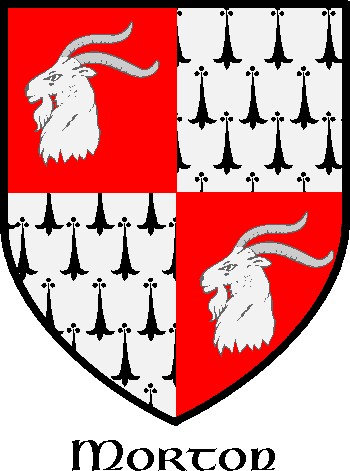
Morton – Coat of Arms

George Morton was born 2 Aug 1585 in Harworth, near Scrooby, Nottingham, England or Bawtry, South Yorkshire, England. His parents were George MORTON and Catherine BOWN (Boun).  His parents may have been Roman Catholic. About 1600 when still very young, he was converted by (our ancestor)  William BREWSTER to Puritanism. He  was a member of the Scrooby Congregation of separatists who eventually became the Mayflower Pilgrims.  He had moved to Leyden, Holland with the congregation and stayed behind as their financial agent when the first settlers left for Plymouth, Massachusetts.

George published “Mourts Relation” (1622) which gives the earliest account of the Pilgrim enterprise.

He married  Juliana CARPENTER on  22 Jul 1612 Leiden, South Holland, Netherlands.  He was possessed of considerable means, was entered in his marriage record  as a merchant from York, was apparently one of the financial mainstays of the Pilgrims at Leyden, and was certainly closely associated with the leaders.  He was one of those who went to London in 1619 to negotiate with the merchants, living probably at Aldgate, where his brother-in-law, Edward Southworth, was already established. Here he changed his name to Mourt, perhaps to escape the displeasure of his Catholic relatives.  After the Mayflower sailed, he was financial agent at London for the Pilgrims and  continued to orchestrate business affairs in Europe and London for their cause, arranging for the 1622 publication of, and perhaps helping write, Mourt’s Relation. In 1623 Morton himself emigrated on the ship Ann to Plymouth Colony with his wife Juliana Carpenter and her sister, Alice Southworth, who was to become the second wife of Governor William Bradford.  George Morton died in 1624, the year after he arrived in Plymouth.  After Morton’s death, Governor Bradford took a keen interest in helping to raise the Morton children, adopting our ancestor Lt. Ephraim MORTON.

Juliana Carpenter was born 7 Mar 1584 in Wrington, Somerset, England. Her parents were Alexander CARPENTER and Priscilla (Druscilla) DILLON. After George died, she married Manasseh Kempton before May 1627.  Juliana died 29 Feb 1665/66.

Manasseh Kempton was baptized on 26 Feb 1589/90 at Berwick-upon-Tweed, Northumberland.  His parents were George KEMPTON and Mary JERSEY.     His younger brother Ephraim KEMPTON came to Plymouth by 1642.  Manasseh died on 14 Jan 1662/63, in Plymouth.

Manasseh (also written Manasses) Manasseh went to Colchester, Essex where he may have become involved with a Separatist congregation. From there, he joined Henry Jacob’s Separatist congregation in London in 1620.   He came over on the Anne as a single man in 1623. He was a freeman of Plymouth in 1633. He served as a deputy to the Plymouth General Court and on a number of juries and committees. He owned land in several towns besides Plymouth, including Eastham and Dartmouth, much of which he gave to his stepchildren.

Children of George and Juliana:

Name Born Married Departed
1. Nathaniel Morton (Wikipedia) 1613
Leiden, Holland
Lydia Cooper (sister of John COOPER)
22 Dec 1635
Plymouth, Mass
.
Hannah Pritchard
29 Apr 1674 Age: 50 Plymouth, Mass
16 Jun 1685
Plymouth, Mass
2. Patience Morton 1615
Leiden
John Faunce
c. 1633
Plymouth
.
Thomas Whitney
aft.  1 Feb 1661
Plymouth
16 Aug 1691Plymouth, Mass
3. John Morton 1616
Holland
Lettice [__?__]
1648 Plymouth, Plymouth Colony
10 Oct 1673 – Plymouth, Mass
4. Sarah Morton 1618 George Bonham (Bonum) 1694
5. Lt. Ephraim MORTON 1623 on the Ann on  the passage to Plymouth Colony Ann COOPER
18 Nov 1644 in Plymouth
.
Mary Shelly Harlow
18 Oct 1692.
7 Sep 1693 Plympton, Mass.

George’s grandfather was Anthony MORTON.   Anthony’s sister Alice married William Bradford (1533-1595) a prosperous Yeoman farmer, was apparently the first Bradford to settle in Austerfield.   George Morton was therefore, a second cousin to Gov. William Bradford.

In 1577 William Bradford had purchased from Anthony Morton; land and houses in Austerfield and Bawtry (in Yorkshire); and land in Mission (in Nottinghamshire). He already owned lands in Tickhill and Bentley from his parents and grandparents. Even before this purchase, in 1575, he and John Hanson were the only taxed inhabitants of Austerfield. Bradford was assessed 20s on his land, whereas John Hanson was assessed 60s on “goods”.  The accepted genealogy has him as the son of Peter Bradfourth (1475-1542).

William Bradford and Alice Morton had a daughter Elizabeth BRADFORD who married another of our ancestors Cuthbert FORSTER (c. 1544 – 1589)

Back to George Morton (Pilgrim Father)

First Known Record of George Morton (in Holland)

“George Morton, merchant from York in England, accompanied by Thomas Morton, his brother, and Roger Wilson, his acquaintance, with Juliana Carpenter, maid from Bath in England, accompanied by Alexander Carpenter, her father, and Alice Carpenter, her sister, and Anna Robinson, her acquaintance.

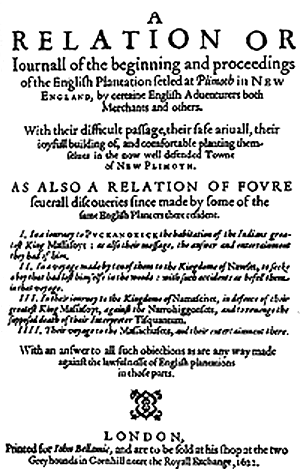
George is listed as the compiler of “Mourt’s Relation” (1622) which gives the earliest account of the Pilgrim enterprise.  He may have wrote the preface and gave the book to the press; the bulk being written by Edward Winslow. It was the first published book about the Colony. It provides the only contemporary report on the voyage of the Mayflower, the first days of Plymouth Colony and a brief account of the first Harvest Celebration (Thanksgiving).  When published in 1622 it was a 76 page collection of misc. documents and letters. The full title is “George Mourt, comp., A Relation or Journall of the Beginnings and Proceedings of the English Plantation Settled at Plimoth in New England, by Certaine English Adventurers Both Merchants and Others.”

He received the writings sent in the Fortune from Plymouth in 1622, and published them under the title: “A Relation or Journall of the beginning and proceedings of the English Plantation setled at Plimoth in New England…London, Printed for John Bellamie” (1622), which is still the only contemporary account of the voyage of the Mayflower and the first months of the colony. Tradition has assigned to him the authorship, and it has always been known as “Mourt’s Relation”. It has been conjectured that Bradford and Winslow were the authors and Morton merely the publisher, but since the narrative Bradford wrote and sent back on the Fortune was retained by the captain of the French privateer which captured the Fortune on its return voyage (Calendar of State Papers, Colonial Series, 1574-1660, 1860, p. 124), it is possible that Morton wrote a narrative from information brought back by those returning on the Mayflower and teh Fortune and published it together with material by Winslow and others not retained by the French captain. The authorship of the book cannot now be definitively established.

The book Mourt’s Relation (full title: A Relation or Journal of the Beginning and Proceedings of the English Plantation Settled at Plimoth in New England) was written primarily by Edward Winslow, although William Bradford appears to have written most of the first section. Written between November 1620 and November 1621, it describes in detail what happened from the landing of the Mayflower Pilgrims inside the fishhook tip of Cape Cod (became Provincetown Harbor), through their exploring and eventual settling of Plymouth Colony; the book describes their relations with the surrounding native Indians, up to the First Thanksgiving and the arrival of the ship Fortune in November 1621. Mourt’s Relation was first published in London in 1622, by George Morton, sometimes called George Mourthence the title “Mourt’s Relation”). The purpose of Mourt’s Relation was clear: to paint the new settlement in the brightest possible hues.

Juliana and Manasseh Kempton

23 Oct 1643 – Peregrine White of Marshfield, the first child born to the Pilgrims in the New World.  sold to “Mannasses Kempton of Plymouth … planter … all those his uplands and meadows lying at the Eel River in Plymouth Township aforesaid lately assigned and confirmed unto the said Peregrine by Mr. Edward Winslow in the public court held at Plymouth the twenty-eight of September Anno Domini 1642”

14 Feb 1659/60- “Mannasses Kempton of Plymouth yeoman do … make over the abovesaid deed unto Ephraim Morton my son-in-law,” reserving some portions of meadow for himself

22 Feb 1650/51 “Mannasses Kemton of Plymouth, planter”, gave to his “son-in-law Ephraim Morton” a parcel of land and a parcel of meadow at Sagaquas and his part and right in the land at Satuket. In case Morton’s brothers wished to settle on the land, Kempton ordered that it be divided equally among them.

22 June 1651 – Edward BANGS of Eastham, yeoman, and Rebecca his wife, sold to “Mannasses Kemton” of Plymouth, yeoman, forty acres of upland in Plymouth

Kempton was one of those having an interest in the lands at Punckateesett near Rhode Island March 1651 and he shared lot #34 with Nathaniel Morton

Manasseh Kempton was one of the Dartmouth Purchasers

On 21 Feb 1660/61 “Mannasses Kemton” of Plymouth, yeoman, deeded to Ephraim Morton of Plymouth “the one half of all that his lot or share of land commonly called the purchase land lying and being at Acushena, Coaksett and places adjacent both upland and meadow”

In a letter dated 6 November 1661 Manasseh Kempton gave to the church of Eastham a parcel of land in that town

Children and Descendants


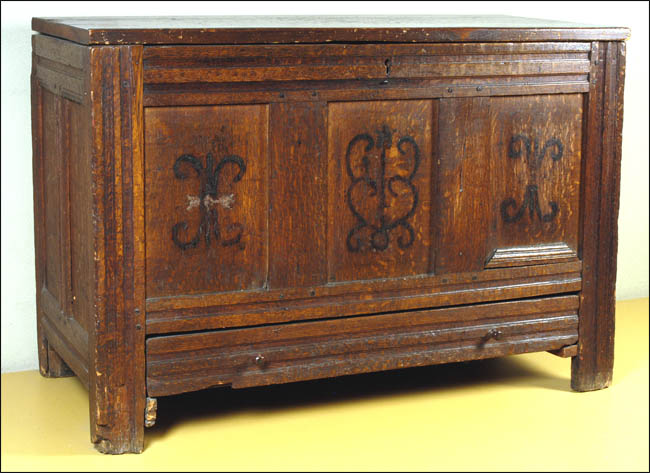
Morton Chest - Pilgrim Hall Museum

Morton Chest  with Drawer Red and white oak
Probably made in Plymouth, 1650-1700
Descended in the Morton family of Plymouth
Pilgrim Hall Museum

Chests of drawers as we know them today became popular almost 300 years ago.
Before that, people in England and America had chests with one drawer at the bottom, like this one, or without drawers.

This chest has remains of the original decoration: a bright red tulip with green leaves, painted in vermilion and verdigris. When the chest was new, the wood was pale and the decoration would have been very dramatic

1. Nathaniel Morton

Nathaniel’s wife Lydia Cooper was born about 1615.  She came to Plymouth Colony with her brother John COOPER about the year 1632.  In 1634 Lydia’s brother John married Nathaniel’s aunt Priscilla Carpenter, widow of William Wright and daughter of Alexander CARPENTER. Lydia & John Cooper also have a sister, Ann Cooper who died 1 Sept 1691 in Massachusetts;  The parents of Lydia, John & Ann Cooper are not known.  However, their grandfather may be Thomas COOPER of Fluton with Silsoe, Bedfordshire, England. This line needs further research;

Nathaniel’s second wife Hannah Pritchard was born about 1624.  Her parents were Richard Pritchard and Anne [__?__].  She was the widow of Richard Templar.  Hannah died 26 Dec 1690 in Charlestown, Suffolk, Mass.

Nathaniel Morton became the clerk of Plymouth Colony, a close adviser to his uncle Governor William Bradford, who raised him after the death of his father, and the author of an influential early history of the Plymouth Colony, “New England’s Memorial.”

In a tradition at The Wall Street Journal, the newspaper has run for four decades a portion of Nathaniel Morton’s book, its observation of the first Thanksgiving, on the Wednesday before the holiday.

Here beginneth the chronicle of those memorable circumstances of the year 1620, as recorded by Nathaniel Morton, keeper of the records of Plymouth Colony, based on the account of William Bradford, sometime governor thereof:

So they left that goodly and pleasant city of Leyden, which had been their resting-place for above eleven years, but they knew that they were pilgrims and strangers here below, and looked not much on these things, but lifted up their eyes to Heaven, their dearest country, where God hath prepared for them a city (Heb. XI, 16), and therein quieted their spirits.
When they came to Delfs-Haven they found the ship and all things ready, and such of their friends as could not come with them followed after them, and sundry came from Amsterdam to see them shipt, and to take their leaves of them. One night was spent with little sleep with the most, but with friendly entertainment and Christian discourse, and other real expressions of true Christian love.
The next day they went on board, and their friends with them, where truly doleful was the sight of that sad and mournful parting, to hear what sighs and sobs and prayers did sound amongst them; what tears did gush from every eye, and pithy speeches pierced each other’s heart, that sundry of the Dutch strangers that stood on the Key as spectators could not refrain from tears. But the tide (which stays for no man) calling them away, that were thus loath to depart, their Reverend Pastor, falling down on his knees, and they all with him, with watery cheeks commended them with the most fervent prayers unto the Lord and His blessing; and then with mutual embraces and many tears they took their leaves one of another, which proved to be the last leave to many of them.
Being now passed the vast ocean, and a sea of troubles before them in expectations, they had now no friends to welcome them, no inns to entertain or refresh them, no houses, or much less towns, to repair unto to seek for succour; and for the season it was winter, and they that know the winters of the country know them to be sharp and violent, subject to cruel and fierce storms, dangerous to travel to known places, much more to search unknown coasts.
Besides, what could they see but a hideous and desolate wilderness, full of wilde beasts and wilde men? and what multitudes of them there were, they then knew not: for which way soever they turned their eyes (save upward to Heaven) they could have but little solace or content in respect of any outward object; for summer being ended, all things stand in appearance with a weatherbeaten face, and the whole country, full of woods and thickets, represented a wild and savage hew.
If they looked behind them, there was a mighty ocean which they had passed, and was now as a main bar or gulph to separate them from all the civil parts of the world.

Nathaniel early became Bradford’s assistant in the management of public affairs, and by annual popular vote was secretary of the colony from 7 Dec., 1647, until his death. Almost all the records of the Plymouth colony are in his handwriting. He read extensively, and took great pains to note down the incidents of the early days of the colony, which he published under the title of “New England’s Memorial, or a Brief Relation of the most Memorable and Remarkable Passages of the Providence of God manifested to the Planters of New England” (Cambridge, Mass., 1669).  This work, compiled at the request of the commissioners of the four united colonies, was chiefly attested as correct by the most eminent survivors of the earlier generations.

New England Memorial by Nathaniel Morton 1669

He also wrote a “Synopsis of the Church History of Plymouth” (1680),  and he was the author of numerous verses in commemoration of the virtues of the Pilgrims.  Plymouth Public Schools named Nathaniel Morton Elementary School after him.

2. Patience Morton

Patience’s first husband John Faunce was born by about 1608, based on estimated date of marriage.  ” John died in Plymouth, 29 November 1653.

John and Patience came to New England aboard the Anne, 1623. They married in 1633. In addition to being a planter, John was a businessman, designated as one of the Purchasers for the colony. John was not a member of the original Scrooby group, but was a “stranger” recruited by the merchant adverturers who financed the colony.

Patience’s second husband Thomas Whitten was born in 1599, England. He died in 1673 in Plymouth, Mass.  A broadweaver who came from Benenden, Kent, to New England in 1635 and settled at Plymouth MA. (On 8 May 1635, “Awdry Whitton,” aged 45, was enrolled at London as a passenger for New England on the Elizabeth & Ann; on 1 May 1635, “Jeremy Whitton,” aged 8, & “bro[ad] weaver Thomas Whitton,” aged 36, with a “certificate from the minister of Bennandin in Kent of their conformity,” were enrolled at London as passengers for New England on the Elizabeth & Ann. He married (1) at St. Mary Magdalene, Canterbury, Kent, 1 Oct 1625, Audrey (Cork) Morecock, widow of Henry Morecock. She died by 1639. He married (2) at Plymouth, 22 Nov 1639, Winifred Harding. “Winnefred Whitney the wife of Thomas Whitney died the 23rd of Jul 1660” at Plymouth. He married (3) after 23 Jul 1660, Patience (Morton) Faunce.

John Faunce came to Plymouth in 1623 of the Anne.   He was the “Purchaser” and on the 1633 Freeman list.    Faunce served on juries and obtained various land grants (PCR, passim).  His house was located in the southern part of Plymouth near the Eel River.   There is a book called The Faunce Family History and Genealogy (Akron, Ohio 1967).

When John died in 1654, his children were left in poverty.   Juliana’s nephew Lieutenant Southworth taking by the hand Thomas, a boy of eight years, led him away to adopt into his  family and, transmitting that which he had received from Gov. Bradford, gave the orphan a good education, secular and religious, for which Thomas Faunce, the last ruling elder known in Plymouth, said that he had “reason to bless God to all eternity.”

Patience and John’s son Thomas was a famed church elder and the originator of the story of Plymouth Rock.  Thomas was born 1647 in Plymouth, Plymouth, Mass and lived until 27 Feb 1746 in Plymouth, Plymouth, Mas.

Deacon Spooner related the story to the Old Colony Club that at the age of 95 Elder Thomas Faunce was driven to town in a open wagon and taken to Plymouth Rock. He told the people gathered there how he had talked to John Howland and his wife, John Alden, Giles Hopkins, George Soule, Francis Cooke and Mrs. Cushman, born Mary Allerton. All of these, he said had told him that upon that rock they stepped ashore. He also said that John Winslow’s wife (Mary Chilton) came there on her 75th birthday and laughed as she stepped on the rock and said she was the first woman to step on it. Finally he admonished them with

“And ye children of my blood, I charge you to remember how, year by year, while God lent me strength, I brought you here on Forefathers Day and set your feet upon the rock, and told you what mighty things the Fathers had done for you… then come ye forward, sons and grandsons and set your feet upon the rock once more in my sight, and never forget this day, you nor your children’s children, to the last generation.”

3. John Morton

There were two woman named Lettice [joy in Latin] in early Plymouth.   Lettice Hanford and Lettice Kempton  are often mixed up with four marriages between them.  There is only one recorded death:  22 Feb 1691.  Here’s my crack at unsorting the tangle.

John’s wife Lettice [__?__] was about 1629 in London.  Her parents were not our ancestors Ephraim KEMPTON and Hannah [__?__].   This is an old myth. The maiden name of John Morton’s wife Lettice has never been established and there is no evidence it was Kempton. For John Morton marriage, reference Robert Charles Anderson, “The Great Migration Begins”, Vol. 3, page 1297, George Morton’s son John married Lettice with no maiden name given; or Clarence Almon Torrey, “New England Marriages Prior to 1700, page 522, John Morton and Lettice ? (no married name given).

After John died, Lettice married Andrew Ring, son of William RING and Mary DURRANT.  Andrew Ring’s first wife was Deborah Hopkins, daughter of our ancestor Stephen HOPKINS.  Lettice died 22 Feb 1691 in Middleboro, Plymouth, Mass.

Lettice Hanford was baptized  8 June 1617,at Alverdiscott, Devonshire.  Her parents were Jeffrey Hanford and Eglin Hatherley.   Lettice Hanford clearly preceded her mother & younger sisters to New England.  On 10 Apr 1635, Eglin Hanford,” aged 46, & “2 daughters, Margaret Manford,” aged 16, & “Eliz[abeth] Hanford,” aged 14, along with “Rodolphus Elmes,” aged 15. & “Tho[mas] Stanley,” aged 16, were enrolled at London as passengers for New England on the Defence.)

Lettice Hanford first married  8 Apr 1635 in Scituate, Plymouth, Mass. to Edward Foster (b. 24 Jan 1590 in Frittendon, Kent, England – d. 25 Nov 1643 in Scituate, Plymouth, Mass.)  at Mr. Cudworth’s [Scituate] by Captain Standish. She was admitted to Scituate church (as “Goody Foster”) 25 December 1636. They had 3 children: Timothy, Timothy again, & Elizabeth Hewett Ray.

After Edward died, she married Edward Jenkins (1618  Kent, England – d. 1699 Scituate, Plymouth, Mass)  On 4 March 1634/5, “Edw[ar]d Jeakins,” one of seven servants of Nathaniel Tilden of Tenterden, Kent, was included in the list of passengers of the Hercules of Sandwich.  Lettice and Edward had 3-4 children: Samuel (b. 1645), (probably) Sarah Bacon, Mary Atkinson Cocke, & Thomas.  In the late 1660s and early 1670s Edward Jenkins had to come to the aid of two of his children who experienced a number of problems. On 5 Mar 1666/67, “Dinah Silvester, Sarah Smith, and the daughter of Edward Jenkens, [are] summoned to the next court.

Hon. John Morton was an admitted freeman of Plymouth Colony, 1648, and one of the original proprietors of Middleboro.

John Morton Bio

4. Sarah Morton

Sarah’s husband George Bonham was born in 1604 in Lexden, Essex, England. His parents were William Bonham and Anne Babbington. George died 28 Apr 1704 – Plymouth, Plymouth, Mass.

Sarah Morton’s Day by Kate Waters

Sarah Morton Bonum was the subject of the children’s book Sarah Morton’s Day by Kate Waters. Text and photographs of Plimouth Plantation follow a pilgrim girl through a typical day as she milks the goats, cooks and serves meals, learns her letters, and adjusts to her new stepfather.

Typical Reader Review:

“This was one of my favorite books as a kid, especially being one of Sarah Morton’s descendants. It was great learning about how my family and others started out in America, and it is very well researched and informative. Now that I work at a preschool, I can’t wait to read this to my kids at Thanksgiving to give them a glimpse of how Pilgrims lived. I would highly recommend this book to teachers, parents, and libraries.”

Picture of Sara Morton taken from book Sara Morton’s Day by Kate Waters

Notable descendants of George Morton:

5. Lt. Ephraim MORTON (See his page)

Sources:

http://en.wikipedia.org/wiki/George_Morton_(pilgrim_father)

http://en.wikisource.org/wiki/Appletons’_Cyclopædia_of_American_Biography/Morton,_George

George Morton of Plymouth Colony and some of his descendants (1908)

Hudson-Mohawk genealogical and family memoirs: a record of …, Volume 2 By Cuyler Reynolds

Representative men and old families of southeastern Massachusetts …, Volume 3

http://www-personal.umich.edu/~bobwolfe/gen/pn/p6751.htm – Detailed Notes for Manasseh Kempton

Posted in 12th Generation, Artistic Representation, First Comer, Immigrant - England, Line - Miller, Storied, Wikipedia Famous | Tagged , , , , , , | 33 Comments

Lt. Ephraim Morton

Lt. Ephraim MORTON (1623 – 1693) was Alex’s 9th Great Grandfather; one of 1,024 in this generation of the Miller line.

Lt.  Ephraim Morton was born in 1623 on the Ann on  the passage to Plymouth Colony.  His parents were George MORTON and Juliana CARPENTER.  Upon the death of his father, he was adopted by his uncle Governor William Bradford and raised at his home. He married his first cousin Ann COOPER on 18 Nov 1644 in Plymouth.  After Ann died, he married widow Mary Shelley Harlow on 18 Oct 1692. Ephraim died 7 Sep 1693 in Plympton, Mass.

Gov William Bradford adopted Ephraim and raised him after his father died

Ephraim was a prominent man, and served in the council of war, was prominent in the militia, appointed lieutenant in 1664, served in King Phillip’s War as Colonel of his regiment; was deputy to the general court for twenty-eight years, from 1657, and again under the new charter in 1692. He was deacon of the First Plymouth Church,

Ann Cooper was born in 1625 in Plymouth Colony.  Many claim that her parents were  John COOPER and Priscilla CARPENTER.  The Kempton Book gives her name as “Lydia Cooper”  Savage says Ann was his cousin and her mother was the latter widow of William Wright and sister of Juliana Carpenter. However, John and Priscilla’s marriage took place in 1634, 10 years before Ann Cooper married Ephraim Morton, which would make Ann an exceedingly young bride. Also John’s will written in 1676 mentions his sister Lydia and Priscilla’s sister Alice Bradford (Julianna) but does not mention any children, although Ann was alive at the point. Ann died on 1 Sep 1691.


Mary Shelley was born 2 Nov 1639 in Barnstable, Barnstable, Mass. Her father was Robert Shelly of Scituate.  She first married William Harlow.  After Ephraim died, she married for a third time to Hugh Cole in 1693.  Mary died 30 Jan 1694 in Plymouth.

Children of Ephraim and Ann:

Name Born Married Departed
1. Deacon George MORTON 1645 Plymouth, Mass. Phoebe was not the first wife of George Morton
.
Joanna KEMPTON

22  Dec 1664
Plymouth
2 Aug 1727 Plymouth
2. Ephraim Morton 27 Jan 1648
Plymouth
Hannah Phinney (Finney)
c. 1666
18 Feb 1731/32
Plymouth
3. Rebecca Morton 15 Mar 1651 Samuel Wood
bef. 1 Jan 1675
10 Feb 1718
Middleboro, Mass
4. Josiah Morton 1653 Susannah Wood
8 Mar 1686 Plymouth
29 May 1694
Plymouth
5. Lt. Nathaniel Morton 1656
Plymouth
Mary Faunce 1709
6. Eleazer Morton 1659
Plymouth
Rebecca Dawes
11 Apr 1692 Boston
1704
Plymouth
7. Mercy Morton 1663
Plymouth
Henry Rickard
22 Apr 1708 Plymouth
10 Jan 1729/30
8. Thomas Morton 1667
Plymouth
Mary Doty
23 Dec 1696 Plymouth
12 Sep 1748
Plymouth
9. Patience Morton 1669 John Nelson
4 May 1693
Plymouth
3 May 1715
Plymouth

Ephraim became a freeman June 7, 1648, and on the same day was chosen by the General Court constable for Plymouth. In 1654 he was one of the grand inquest; in 1657 was elected a representative to the General Court of Plymouth, of which he was a member twenty-eight years.  When, by King William’s charter, in 1691-92, Plymouth Colony was merged into that of Massachusetts, Lieutenant Morton was chosen one of the first representatives to the Massachusetts General Court. For nearly a quarter of a century he was at the head of the board of selectmen of Plymouth, and in 1683 was chosen a magistrate of the Colony. At the time of his death he was a justice of the court of Common Pleas.

In 1664, having previously served as sergeant, he was elected by the General Court lieutenant of the Plymouth Military Company, and in 1671 was chosen a member of the council of war, in which he was of ”much service” many years, including the period of King Philip’s war. In March, 1677, owing to the great distress consequent upon the war, he was appointed one of a committee of three to distribute to the people of Scituate the moneys contributed by divers Christians in Ireland for the relief of those who suffered during the war.

He was prominent also in ecclesiastical matters, holding for many years the deaconship of the Plymouth church, in which he was succeeded by his son George. “The church having not then a Deacon, the Elders called upon them to choose some to that office; Accordingly, after a church-meeting in Private some being Nominated, every brother speaking his mind man by man. On August 1, 1669 Robert Finney & Ephraim Morton were chosen Deacons in the public Assembly on the Sabbath, & then ordained by the Elders.” He served as Deacon served until his death, September 7, 1693.

Plymouth Records: pg: 173: At the Towne meeting held att the meeting house att Plymouth 27 May 1681: The towne have Granted unto Leift: Morton twenty five acres of land on a place called Warrens Wells Plaine; He was also chosen at the same meeting to be a Select Man.

Will of Ephraim Morton, senr. of Plymouth, dated 27 Sep 1693, proved Nov 1693 he being weak of body through sickness

To my wife Mary Morton £10 out of the personal estate; to son Nathaniel £10; to daughter Patience, wife of John Nelson, £5; to daughter Mercy Morton £20; to son George 30 acres given me by the town of Plymouth on the south side of the Eele River, also the best of my wearing apparell; to son Josiah one fourth my lands in Sagaquash; to my two sons Nathaniel and Thomas : all my right to a tract of land in Middleboro; to son Thomas lands; to son Eliezer lands in Middleboro; when the legacies are paid, the rest of my personal estate, whether at Plymouth or elsewhere, shall be equally divided between my three sons, Nathaniel, Thomas and Eliezer, “I having disposed already unto all the Rest of my children such a part to each of them of my estate as I have thought fitt to be their full portion;”
son Nathaniel to be sole executor

This will was witnessed by Ephraim Morton Junr., Thomaa Fannce and Joseph Fannce, who all made oath to said will Nov. 2, 1693.

The inventory of the estate of Lieut. Ephraim Morton, late of Plymouth, taken Nov. 1, 1693, by Eliezer Churchill and Thomas Fannce, was sworn to in court by Nathaniel Morton, Nov 2 1693.

The marriage covenant between Ephraim Morton, of Plymouth, and Mrs. Mary Harlow, widow of Mr. William Harlow, deceased, of said Plymouth, dated Oct. 11 and acknowledged Oct. 19, 1692, provided:
She is to have her right of dower in the estate of her late husband, and is to quitclaim her rights to the estate of said Ephraim Morton if she survive him. Witnessed by Thomas Faunee and Jon Faunce.

Children

1. Deacon George MORTON (See his page)

2. Ephraim Morton

Ephraim’s wife Hannah Finney was born 2 Sep 1657 in Barnstable, Barnstable, Mass. Her parents were John Finney and Elizabeth Bailey. Hannah died 18 Feb 1734 in Plymouth, Plymouth, Mass.

His son Ephraim Morton III married his first cousin Susanna Morton. Their fathers were brothers – Ephraim b. 1648 and Josiah b. 1653.  Ephraim III died of smallpox 29 Dec 1729.

Ephraim Morton Headstone Burial Hill Plymouth, Plymouth,  Mass   “‘Here lyes ye body of Mr. Ephraim Morton who deed Febry ye 18th L731-2 in ye 84th year of his age.”

3. Rebecca Morton

Rebecca’s husband Samuel Wood was born 25 May 1647 in Yarmouth, Barnstable, Mass. His parents were Henry Wood and Abigail Jenney. Samuel died 3 Feb 1718 in Halifax, Plymouth, Mass.

4. Josiah Morton

Josiah’s wife Susanna Wood was born 1661 in Middleboro, Plymouth, Mass. Her parents were Henry Wood and Abigail Jenney. Susannah died 1673 in Plymouth, Plymouth, Mass.

5. Lt. Nathaniel Morton

Nathaniel’s wife Mary Faunce was born 2 Jun 1681 in Plymouth, Plymouth, Mass.  She was Nathaniel’s first cousin once removed. Her parents were Joseph Faunce and Judith Rickard. Her grandparents were  John Faunce and Patience Morton.    John and Patience came to New England aboard the Anne, 1623.  They married in 1633. In addition to being a planter, John was a businessman, designated as one of the Purchasers for the colony. John was not a member of the original Scrooby group, but was a “stranger” recruited by the merchant adverturers who financed the colony. His great grandparents were George MORTON and Juliana CARPENTER.  (George and Juliana were  Nathaniel’s grandparents) Mary died 31 May 1761 in Yarmouth, Barnstable, Mass.

6. Eleazer Morton

Eleazer’s wife Rebecca Dawes was born 25 Feb 1666 in Plymouth, Mass. Her parents were Ambrose Dawes and Mary Bumstead. Rebecca died 6 Nov 1730 in Plymouth, Mass.

Eleazer Morton received from his father by will shown in the Plymouth records, dated September 27- October 6 1693, all his interest in the 16 shilling purchase, so-called, in Middleborough, and one-third of his residual personal estate.

7. Mercy Morton

Mercy’s husband Henry Rickard was born 1666 in Plymouth, Plymouth, Mass. His parents were Giles Rickard and Hannah Dunham. Henry died 17 Sep 1726 in Plymouth, Plymouth, Mass.

8. Thomas Morton

Thomas’ wife Mary Doty was born 9 Jul 1671 in Plymouth, Plymouth, Mass.  She was Thomas’ first cousin once removed. Her parents were Edward Doty and Sarah Faunce. Her grandparents were  John Faunce and Patience Morton.     His great grandparents were George MORTON and Juliana CARPENTER.  (George and Juliana were  Thomas’ grandparents)  Mary died 6 Apr 1742 in Plymouth, Plymouth, Mass.

9. Patience Morton

Patience’s husband John Nelson was born 8 Jun 1647 in Plymouth, Plymouth, Mass. His parents were William Nelson (1615 – 1680) and Martha Ford (1621 – 1683). He first married 28 Nov 1667 Plymouth, Plymouth, Mass to Sarah Wood (1644 – 1675).   John died 29 Apr 1697 in Plymouth, Plymouth, Mass.

Sources:

http://www.werelate.org/wiki/Person:Ephraim_Morton_%281%29

http://chrisman.org/pedigree/out27.htm#RIN9345

http://nefamilies.com/fam/groupsheetI100001506.aspx

Hudson-Mohawk genealogical and family memoirs: a record of …, Volume 2 By Cuyler Reynolds

Representative men and old families of southeastern Massachusetts …, Volume 3

George Morton of Plymouth Colony and some of his descendants (1908)

http://trees.ancestry.com/owt/person.aspx?pid=22506527

Posted in 11th Generation, First Comer, Historical Monument, Immigrant - England, Line - Miller, Public Office, Veteran | Tagged , , | 11 Comments

Deacon George Morton

Deacon George MORTON (1645 – 1727) was Alex’s 8th Great Grandfather; one of 512 in this generation of the Miller line.

Deacon George Morton was born in 1645 in Plymouth, Mass. He was the eldest child of Ephraim MORTON and Ann COOPER.  He married Joanna KEMPTON on 22  Dec 1664 in Plymouth, Mass.  He succeeded his father Ephriam as Deacon of First Plymouth Church, ordained 25 Mar 1694.  George died 2 Aug 1727 in Plymouth,  Mass.

Epitaph – Here lyes ye body of Deacon George Morton who decd Augst ye 2d 1727 in ye 82d year of his age. Deacon George Morton was the son of Ephraim and Ann (Cooper) Morton , born 1645 , and grandson of George Morton who came in the Ann in 1623 , whose wife was Julian Carpenter of Wrentham, England , and married in Leyden in 1612 . Ephraim , the father, was born on the passage to this country and died in 1663 . No stone is said to mark the place of his burial, or that of his brother Nathaniel Morton , who was Secretary of the Colony, and died in 1685 , although he was probably buried near to Deacon Morton ‘s grave

Joanna Kempton was born 29 Sep 1646 in Plymouth, Mass. Her parents were Ephraim KEMPTON Jr. and Joanna RAWLINS.  Joanna’s parents died when she was ten years old and she and her brother Manasseh were adopted into the family of her great uncle Manasseh Kempton.  Joanna died Jun 1728 in Plymouth, Mass.

Joanna Kempton Morton Headstone — Burial Hill Plymouth Plymouth County Mass —

Deacon George Morton did not marry twice and have a first wife named Phebe as so often cited. This error is best found in Torrey’s compilation “New England Marriages” where there are two marriages listed for Deacon George3 (Ephraim2 George1) Morton in Volume 2, page 1065 of most recent edition which lists the citation reference sources. The big advantage of Torrey is that it contains a very large amount of marriage information from a multitude of sources in a single reference. However the big short coming of Torrey is that the all the extracted marriage data was never verified for accuracy against any original historical records and so it contains many errors. Such is the case for George Morton having a first wife named Phebe.

No primary record of a marriage of a Phebe to George Morton or a death of a Phebe Morton, the alleged first wife of Deacon George Morton, can be found in the original records of Plymouth Colony or the Town of Plymouth records. The original erroneous marriage reference can be traced back to John Savage in his 1861 “Genealogical Dictionary” which is well known to contain many published errors. John Savage stated in Volume 3, page 244: “MORTON, GEORGE, Plymouth, perhaps son of the preceding [George] at least, how the record of Plymouth that mentioned death Phebe, wife of George, 22 May 1663, can otherwise be explained.” The true explanation was Savage did not transcribe last names from the original Plymouth Colony record correctly.

The Plymouth Colony record actually stated: “Phebe Watson the wife of Gorge Watson, died the 22nd day of May 1663” (“Records of the Colony of New Plymouth,” Volume 8, page 23 or The Mayflower Descendant, Volume 17, “Plymouth Colony Vital Records,” page 184). Therefore it was Phebe Watson who died on 22 May 1663 and not Phoebe Morton. So the husband of the deceased Phebe was George Watson and not George Morton. Ironically, Savage did correctly publish the 1635 marriage of George Watson to his wife Phebe Hicks and Phebe’s death correctly in his Volume 4, page 437.

Children of George and Joanna:

Name Born Married Departed
1. Hannah Morton 27 Nov 1666
Plymouth, Mass
John Dyer
6 Jun 1694 Boston
7 Oct 1738
Plymouth, Mass
2. Menassah MORTON 3 Feb 1668 Plymouth Mary TABER 1703 Dartmouth, Mass. 3 Nov 1747 Dartmouth, Bristol, Mass.
3. Ephraim Morton 12 Apr 1671
Plymouth
Hannah Faunce
2 Jan 1699
Plymouth
Bef. 20 Mar 1717/18
Plymouth
4. Joanna Morton 27 Jun 1673
Plymouth
Thomas Holmes
6 Jan 1697 Plymouth
12 Mar 1754
5. Ruth Morton 20 Dec 1676
Plymouth
Stephen Barnaby
10 Dec 1696
21 Dec 1709
Plymouth
6. George Morton 16 Jul 1679
Plymouth
Rebecca Churchill
4 Feb 1714
Plymouth
3 Dec 1732
Plymouth
7. Timothy Morton 12 Mar 1681/82 Plymouth Mary Rickard
.
Mercy Ellis
15 Dec 1737 Kingston, Mass
1760
Plymouth
8. Rebecca Morton 18 Jul  1684
Plymouth
Nicholas Drew
19 Apr 1716 Plymouth
Nov 1729
Plymouth
9 Elizabeth Morton 20 Nov 1686
Plymouth
Haviland Torrey
10 Thomas Morton 2 Jul 1690
Plymouth
Abigail Pratt
10 Dec 1722
Plymouth
8 Mar 1738
Plymouth

George was one of the original purchasers of Dartmouth, Massachusetts, in 1652.

Dartmouth was the first settled in 1652 and was officially incorporated in 1664. It was named for the town of Dartmouth, Devon, England, where the Puritans originally intended to leave from for America. The land was purchased with trading goods from the  Wampanoag chiefs Massasoit  and his son Wamsutta by elders of the Plymouth Colony; reportedly thirty yards of cloth, eight moose skins, fifteen axes, fifteen hoes, fifteen pairs of shoes, one iron pot, and ten shillings’ worth of assorted goods . It was sold to the Religious Society of Friends or Quakers, who wished to live outside the stringent religious laws of the Puritans in Plymouth. There are still Quaker meeting houses in town, including the Smith Neck Meeting House, the Allen’s Neck Meeting House  (named for our ancestor Ralph ALLEN) and the Apponegansett Meeting House, which is on the National Register of Historic Places. Its borders were originally named in the charter (and set by King Philip) as the lands of “Acushnea, Ponagansett, and Coaksett.” This includes the land of the towns of Westport, Fairhaven, and Acushnet, and the city of New Bedford.

Clark’s Island, Plymouth, Mass

In 1690, while I haven’t been able to prove he was our George or a cousin,  a George Morton was one of the purchasers of Clark’s Island.  Nathaniel Clark, son of our ancestor Thomas CLARK (1605 – 1697)  was Secretary of the Colony for several years under Governor Andros. As a reward for his services, the governor, in 1687, granted Nathaniel the island in the Plymouth Bay known as Clark’s Island. The people refused to confirm this act, as the land had been set aside for the support of Plymouth’s pastor and the poor of the town. The matter was taken to court and Nathaniel Clark and the governor were sent back to England in 1689 to answer for “high crimes and misdemeanors”. Nathaniel later returned to Plymouth where he later died (George F. Willison, Saints & Strangers, pgs 404-5, and 456-7.”

Footnote to Plymouth Church Records, Vol I p265:
“Acting under a warrantfrom Andros dated February 23, 1688, on March 3, Phillip Wells surveyed and laid out Clark’s island for Nathaniel Clark. On June 22, 1689, the sale of the island was authorized by the town of Plymouth, and in 1690 was sold to Samuel Lucas, Elkanah Watson, and George Morton.”

At the summit of Burial Hill, Plymouth, is a row of four stones of slate marking the graves of Deacon George Morton, his youngest son Thomas, his wife Joanna, and his brother Ephraim.  Deacon George’s marker has been bound in granite to preserve it from the weather and to prevent pieces being chipped off by relic hunters.

Children

1. Hannah Morton

Hannah’s husband John Dyer was born 29 Feb 1672 in Weymouth, Norfolk, Mass. His parents were John Dyer and Mary Bicknell. John died 18 Oct 1741 in Plymouth, Plymouth, Mass.

2. Menassah MORTON (See his page)

3. Ephraim Morton

Ephraim’s wife Hannah Faunce was born 12 Jun 1678 in Plymouth, Plymouth, Mass.  She was his second cousin.  Her parents were Joseph Faunce and Judith Rickard.  Her grandparents were  John Faunce and Patience Morton.    John and Patience came to New England aboard the Anne, 1623.  They married in 1633. In addition to being a planter, John was a businessman, designated as one of the Purchasers for the colony. John was not a member of the original Scrooby group, but was a “stranger” recruited by the merchant adverturers who financed the colony. His great grandparents were George MORTON and Juliana CARPENTER.     Thomas died in 1754..Hannah died 11 Nov 1760 in Kingston, Plymouth, Mass.

4. Joanna Morton

Joanna’s husband Thomas Holmes was born in 1669 in Duxbury, Plymouth, Mass.  He was her second cousin.  His parents were John Holmes and Patience Faunce. His grandparents were  John Faunce and Patience Morton.    His great grandparents were George MORTON and Juliana CARPENTER.     Thomas died in 1754.

5. Ruth Morton

Ruth’s husband Stephen Barnaby was born in 1674 in Plymouth, Plymouth, Mass. His parents were James Barnaby and Lydia Bartlett.  Stephen died 3 Jul 1727 in Provincetown, Barnstable, Mass.

6. George Morton

George’s wife Rebecca Churchill was born 29 Aug 1689 in Plymouth, Mass. Her parents were Sgt. John Churchill and Rebecca Delano. Rebecca died 3 Feb 1758 in Plymouth, Plymouth, Mass.

7.  Timothy Morton

Timothy’s wife Mercy Ellis was born 17 Aug 1685 in Sandwich, Barnstable, Mass. His parents were Matthias Ellis and Mercy Nye. Mercy died 30 Oct 1751 in Sandwich, Barnstable, Mass.

8. Rebecca Morton

Rebecca’s husband Nicholas Drew was born 16 Oct 1684 in Plymouth, Plymouth, Mass. His parents were John Drew and Hannah Churchill. Nicholas died 1 Nov 1988 in Plymouth, Mass.

10. Thomas Morton

Thomas’ wife Abigail Pratt was born 6 Jul 1703 in Plymouth, Mass. Her parents were Benajah Pratt and Mary Allen Lazell. Abigail died 20 Jan 1790 in Plymouth, Plymouth, Mass.

Thomas Morton Headstone Burial Hill Plymouth, Plymouth, Mass

Sources:

http://www.werelate.org/wiki/Person:George_Morton_(30)

Hudson-Mohawk genealogical and family memoirs: a record of …, Volume 2 By Cuyler Reynolds

Representative men and old families of southeastern Massachusetts …, Volume 3

http://trees.ancestry.com/owt/person.aspx?pid=22500451&st=1

Posted in 10th Generation, Be Fruitful and Multiply, Historical Monument, Line - Miller, Public Office | Tagged , | 6 Comments

Manasseh Morton

Manasseh MORTON (1668 – 1747) was Alex’s 7th Great Grandfather; one of 256 in this generation of the Miller line.

Manasseh Morton was born 3 Feb 1668 in Plymouth, Plymouth, Mass. His parents were Deacon George MORTON and Joanna KEMPTON. He married Mary TABER in 1703 in Dartmouth, Mass. Manasseh died 3 Nov 1747 in Dartmouth, Bristol, Mass.

Mary Taber was born on 18 Mar 1676/77 in Dartmouth, Mass.  Her parents were Thomas TABER and Mary TOMSON.  Mary died about 1745.

Children of Manasseh and Mary:

Name Born Married Departed
1. Elizabeth Morton 10 Jul 1704 Plymouth, Mass Thomas Handy
21 Apr 1730 Dartmouth, Mass
16 Aug 1781 Dartmouth, Mass
2. Zephaniah Morton 6 Jan 1707 Plymouth 15 Oct 1745 Plymouth
3. Taber Morton 3 Mar 1709 Dartmouth, Mass Lucy Burgess
2 Feb 1732 – Nantucket, Nantucket, Mass
1 Jan 1775 Nantucket, Mass
4. Ruth Morton 8 Feb 1714 Dartmouth Isaiah Peckham
19 Apr 1736 Dartmouth, Mass
3 Nov 1747 Dartmouth
5. Joanna Morton 1718
Dartmouth
Samuel Mendall
31 Mar 1740
10 Mar 1805 New Bedford, Mass
6. Seth MORTON 20 Jan 1722 Dartmouth, Bristol, Mass Elizabeth ALLEN
4 Dec 1746 in Dartmouth, Mass.
5 Oct 1802 New Bedford, Bristol, Mass.
7. Mary Morton 1725
Dartmouth
William Dexter
9 Jun 1744 North Dartmouth, Bristol, Mass
3 Nov 1747

Manasseh’s father was one of the original purchasers of Dartmouth in 1652.  Manasseh moved there from Plymouth about 1708.

Dartmouth, Mass

Children

1. Elizabeth Morton

Elizabeth’s husband Thomas Handy was born 11 Nov 1706 in Sandwich, Mass. His parents were Richard Handy (1672 – 1729) and Patience Randall (1678 – 1730). Thomas died before 4 Apr 1793 in New Bedford, Mass.

Children of Elizabeth and Thomas:

i. Thomas Handy b. 1731 Dartmouth, Mass.; d. 1810 Rochester Sandwich Harwich; m. 20 Aug 1753 – Dartmouth to Priscilla Hammond (b. 17 Jul 1734 Dartmouth). Priscilla’s parents were Samuel Hammond (1685 – 1764) and Elizabeth or Deliverance Edminster (1710 – 1748) Thomas and Priscilla had two children Gamaliel (b. 1754) and Levi (b. 1756)

ii. Rebecca Handy b. 1736 Dartmouth, Mass; d. 1772 Sandwich, Barnstable, Mass<; m. ~1757 to her cousins Ebenezer Handy (b. 17 Apr 1732 or 25 Oct 1732 in Sandwich, Barnstable, Mass. – d. 1827 in Wayne, Kennebec, Maine) Ebenezer’s parents were Benjamin Handy (1703 – ) and Elizabeth Fish (1705 – ) Ebenezer and Rebecca had nine children born between 1757 and 1772.

After Rebecca died, Ebenezer married Annie Hicks (b. 1736 – d. 1818 in Wayne) In 1775 Ebenezer, Anne and eight children removed to Wayne, Kennebec, Maine.

3. Taber Morton

Taber’s wife Lucy Burgess was born 6 Jan 1710 in Lexington, Middlesex, Mass. Lucy’s parents were William Burgess (1686 – 1715) and Eleanor Monroe (1683 – 1729). Lucy died 30 Sep 1786 in Nantucket, Nantucket, Mass.

Taber left a large estate. Nantucket lands and landowners, Volume 2, Issue 1 By Henry Barnard Worth – December, 1775.

Lucy Morton, widow of Taber Morton, administratrix of his estate, valued at £1,850.

1781 – Division of estate of Tabor Morton made between William, Reuben, Mary and Ruth Morton, Abigail Sinclair. Judith Burnell.

Child of Taber and Lucy:

i. Mary Morton b. 26 Mar 1734 in Nantucket, Nantucket, Mass; d. 15 Dec 1797 in Nantucket; unmarried 1798. Will Mary Morton. Niece, Deborah Morton (b. 25 Sep 1761. She died on 13 Jan 1832 at age 70; D. single at the Asylum.)

ii. William Morton b. 17 Jul 1736 in Nantucket, Nantucket, Mass; d. 4 Sep 1803 in Nantucket, Nantucket, Mass.; m. 31 Dec 1791 to Jemima Coffin (b. 2 Feb 1759 in Nantucket – d. 17 Aug 1842 in Nantucket) Jemima’s parents were David Coffin (1718 – 1804) and Ruth Coleman (1721 – 1763) Jemima’s 3rd great grandfather was our ancestor Thomas COLEMAN. Also see my post Nantucket Founders. William and Jemima had a son William Jr (b. 1793)

After William died, Jemima married 4 Sep 1806 in Nantucket to Prince Gardner(1742 – 1816).

iii. Abigail Morton b. 7 Sep 1738 in Nantucket, Nantucket, Mass.; d. 21 August 1821; m. 30 Dec 1756 Nantucket to Samuel Sinclair

iv. Ruth Morton b. ~1740 in Nantucket, Nantucket, Mass.; d. 3 Jun 1820; unmarried

v. Judith Morton b. ~ 1745 in Nantucket, Nantucket, Mass; d. 22 Oct 1781; m.14 Apr 1766 – Nantucket, Nantucket, Mass. to James Burrell (Burill) ( – d. 11 Oct 1793) Judith and James had a boy Seth (b. 1768)

vi. Reuben Morton Sr. b. 8 Aug 1743 or 1 Aug 1747 Hudson, Columbia, New York; [I don’t know why Reuben would have been born in New York when there isn’t evidence that Taber and Lucy left Nantucket, but that’s what all the genealogies say]d. 27 Dec 1813 Athens, Greene, New York; fell through the ice crossing the Hudson River and drowned; m. 28 Dec 1768 Nantucket, Nantucket, Mass to Mary Worth (b. 4 Dec 1747 Nantucket, Nantucket, Mass – d. 5 Apr 1818 Athens, Greene, New York) Reuben and Lucy had six children born between 1769 and 1792.

4. Ruth Morton

Ruth’s husband Isaiah Peckham was born 14 Sep 1705 in Dartmouth, Bristol, Mass. His parents were Stephen Peckham (1652 – 1724) and Mary Pope (1654 – 1730). Isaiah died 19 Mar 1794 in Dartmouth, Bristol, Mass.

Children of Ruth and Isaiah

i. Isaiah Peckham b. 1737 Dartmouth, Bristol, Mass; m. 18 Nov 1764 in Dartmouth to Elizabeth Kirby (b. 5 Aug 1744 in Dartmouth – d. 11 Mar 1794) Elizabeth’s parents were William Kirby (b. 1711) and Hannah Reed.

ii. Peleg Peckham b. Dartmouth, Bristol, Mass; m. int. 9 Jan. 1775 Dartmouth to Rhoda Briggs Ruth’s parents were Jacob Briggs and Hannah Myrick. Peleg is a Peckham family name. It’s possible that the Peleg that married Ruth was the son of Stephen Peckham (1718 – 1797) and Sarah Boss (1724 – )born 27 Sep 1744 in Dartmouth.

iii. Prince Peckham b. 30 Jan 1746 in Dartmouth, Bristol, Mass; d, 06 Mar 1833 in Middletown, Delaware, NY; m1. 1 Feb 1765 – Dartmouth Mary Jenny (Jenne) ( – 1780); m2. 28 Nov 1780 Chilmark, Dukes, Mass to Sarah Austin (b. ~1756 in Chilmack, Martha’s Vineyard, Mass – d. aft. 15 Mar 1834 in probably Middletown, Delaware Co, NY when she sent a statement to the pension board.) Prince and Sarah had five children between 1783 and 1802.

It’s possible that Prince’s parents were John Peckham (1697 – 1781) and Mary Boston (1702 – 1780)

Prince served in Revolutionary War as a 2d Lieutenant, Capt. Thomas Cranston’s Company of Coast Guard. Engaged July 25, 1775; serving 5 months, 19 days in defense of the seacoast

iv. Lucy Peckham b. Dartmouth, Bristol, Mass

v. Zilpha Peckham b. Dartmouth, Bristol, Mass

5. Joanna Morton

Joanna’s husband Samuel Mendal was born 3 Nov 1714 in Rochester, Plymouth, Mass..  His parents were John Mendall (1688 – 1768) and Prudence Gibbs (1689 – 1732).  Samuel died after 20 Feb 1770 in Rochester, Plymouth, Mass.

Children of Joanna and Samuel

i. Daniel Mendall b. 31 Aug 1741 Dartmouth, Bristol, Mass; d. 1805 Dartmouth Rochester, Plymouth, Mass; m1. 23 Mar 1769 to his cousin Hannah Mendall (b. 5 Aug 1746 in Rochester – d. 1772) Hannah’s parents were Amos Mendall (b. 1722) and Susanna Church (b. 1721) Daniel and Hannah had one son Ebenezer (b. 1768)

Soldiers – Revolutionary War Extracted From Mattapoisett And Old Rochester Massachusetts
Church Mendall.
Daniel Mendall.
Samuel Mendall.
Seth Mendall.

m2. 9 Mar 1775 in Rochester to Thankful Hammond. There were five Thankful Hammonds born in Rochester between 1740 and 1768 so I’m not sure which ones where her parents. Daniel and Thankful eight children born from 1776 to 1791.

ii. Ruth Mendall b. 24 Dec 1748 Dartmouth, Bristol, Mass.; d. 5 Feb 1821 Plymouth, Plymouth, Mass.; Burial: Cedarville Cemetery, Plymouth; m. 5 Apr 1770 in Plymouth, Plymouth, Mass to Barnabas Ellis (b. 9 Dec 1749 in Plymouth, Plymouth, Mass. – d. 18 Nov 1833 in Plymouth, Plymouth, Mass; Burial: Cedarville Cemetery, Plymouth) Barnabas’ parents were Eleazer Ellis (b. 1724) and Deborah Gibbs (1724 1766). Ruth and Barnabas had six children born between 1771 and 1784 in Plymouth.

Barnabas served as a private in the Revolutionary War. Barnabas Ellis: Private, Captain Zaccheus Bartlet’s Company, Colonel Lathrop’s Regiment; service, 10 days. Company marched from South Precinct in Plymouth to Bristol, Rhode Island on 11 Dec 1776 on an alarm.

Seth Freeman, an authorized agent of the General Court sold for 9 lbs. 18 sh., by deed 4 Feb 1785, a tract in the Herring Pond Indian lands to Barnabas Ellis” of Plymouth, yeoman. (today’s Herring Pond Wampanoag Tribe)

Children: Eleazer Ellis, Reuben Ellis, Lois Ellis, Francis Ellis, William Ellis and Jennie Ellis.

iii. Lois Mendall b. 26 Mar 1752 Dartmouth, Bristol, Mass; d. 18 Jul 1821 Rochester, Plymouth, Mass.; m. 30 Nov 1775 in Rochester to Isaac Briggs (b. 4 May 1747 in Rochester – d. 16 Oct 1802 in Plymouth, Plymouth, Mass.) Issac’s parents were John, Jr. Briggs (1711 – 1771) and Mary Benson (1716 – 1792). Lois and Isaac had nine children born between 1776 and 1794.

iv. Seth Mendal b. 1754 Rochester, Plymouth, Mass.; d. 6 Sep 1812 Rochester; m. 16 Nov 1780 in Rochester to Meribah Clifton (b. 28 Oct 1758 in Rochester – d. Dec 1830 in Rochester) Meribah’s parents were Timothy Clifton (1720 – 1776) and Deliverance Bolles ( 1722 – 1778) Seth and Meribah had eight children born between 1781 and 1792 in Rochester.

6. Seth MORTON (See his page)

7. Mary Morton

Mary’s husband William Dexter was born 14 May 1719 in Rochester, Plymouth, Mass. His parents were cousins  Jabez Dexter (1690 – 1773) and Mary Dexter (1692 – 1759). William died 10 Mar 1805 in New Bedford, Bristol, Mass.

Children of Mary and William:

i. Alice Dexter b. 16 Jun 1744 in Dartmouth, Bristol, Mass.

ii. Abigail Dexter b. 9 Jun 1746 in Dartmouth, Bristol, Mass.; d. 1774 in Rochester, Plymouth, Mass; m. 14 Aug 1772 – Dartmouth to Benjamin Bolles (b. 1750 in Rochester – d. 1809 in Rochester) Abigail and Benjamin had one son Rueben (b. 1774)

Bolles, Benjamin. Corporal, Capt. Charles Church’s co., Lieut. Col. White’s (4th Plymouth Co.) regt.; enlisted July 30, 1780; discharged Aug. 8, 1780; service, 9 days, on an alarm at Rhode Island. Roll dated Rochester.

iii. Eunice Dexter b. 14 Oct 1748 in Dartmouth, Bristol, Mass; d. New Bedford, Bristol, Mass.; m. 3 Jun 1773 – Church of Christ, First Congregational Church of Dartmouth (now Acushnet) to Elisha Stephens (b. 5 Mar 1751 in Rochester Plymouth Mass. – d. 15 Oct. 1835 in possibly Illinois) Elisha’s parents were Isaac Stevens (b.1723) and Elizabeth Dexter (b.1725)

Elisha Fought in Revolutionary War – took part in the Boston Tea Party – fought battles including Ticonderoga NY

iv. Luen Dexter b. 21 Aug 1751 in Dartmouth, Bristol, Mass; d. 1 Sep 1838 in Henderson, Jefferson, New York > m. 22 Feb 1778 Rochesster, Plymouth, Mass. to Bathsheba “Vashti” Priscilla Sturtevant (b. 4 Sep 1756 in Rochester -d. 6 Sep 1839 in Plymouth, Plymouth, Mass) Vashti’s parents were Zadock Sturtevant (1724 – 1821) and Priscilla Howes Barstow (b. 1729)

In the 1800 census, Luen was living in Woodstock, Windsor, Vermont with a household of 11

In the 1810 census, Luen had removed to Henderson, Jefferson, New York, and had a household of 9.

Still listed in the 1830 census;

Sources:

http://trees.ancestry.com/tree/10708951/person/215856048

Hudson-Mohawk genealogical and family memoirs: a record of …, Volume 2 By Cuyler Reynolds

Representative men and old families of southeastern Massachusetts …, Volume 3

http://trees.ancestry.com/owt/person.aspx?pid=1146457&st=1

Taber Morton’s children’s marriages – Vital records of Nantucket, Massachusetts to the year 1850 page 4_221

http://www.nantuckethistoricalassociation.net/bgr/BGR-o/p302.htm#i9044

Posted in -9th Generation, Line - Miller | Tagged | 3 Comments

Seth Morton

Seth MORTON (1722 – 1802) was Alex’s 6th Great Grandfather; one of 128 in this generation of the Miller line.

Seth Morton was born 20 Jan 1722 in Dartmouth, Bristol, Mass. His parents were Manasseh MORTON and Mary TABER. He married Elizabeth ALLEN 4 Dec 1746 in Dartmouth, Mass.   Seth died 5 Oct 1802 in New Bedford, Bristol, Mass.

Elizabeth Allen was born 1 Dec 1725 in Dartmouth, Bristol, Mass. Her parents were William ALLEN and Elizabeth [__?__]

Children of Seth and Elizabeth:

Name Born Married Departed
1. Sarah Morton 3 Jul 1748
Dartmouth, Mass
2. Hannah Morton 16 Apr 1750
Dartmouth
3. Ruth MORTON 3 Jun 1752 Freetown, Bristol Mass. Enoch DOW
1770 probably in Majorfield, Sunbury County, New Brunswick, Canada.
Dumfries Parish, York, New Brunswick, Canada.
4. Timothy Morton 3 Mar  1754
Dartmouth
5. Jethro Morton  1756
Dartmouth, Bristol, Mass.
Jemima Eldridge
of Rochester
8 Oct 1787
17 Jan 1842
Connecticut

xx

Children

3. Ruth MORTON (See Enoch DOW‘s page)

5. Jethro Morton

Jethro’s wife Jemima Eldredge was born 8 May 1767, Dartmouth, Bristol, Mass.  Her parents were Elnathan Eldredge and Anne Allen.

Child of Jethro and Jemima:

i. Timothy Morton b. 1790 Fairhaven, Mass.; d. 26 Jan 1882 Dartmouth, Bristol, Mass. m. Charlotte Howard (b. 1790 Mass) In the 1850 census, Timothy and Charlotte were living in Fairhaven, Bristol, Mass.

Sources:

http://freepages.genealogy.rootsweb.ancestry.com/~jacmac/allen.pdf

http://freepages.genealogy.rootsweb.ancestry.com/~hoxieschenck/Genealogy%202007/MyHTMLFiles%202010/f_36c.html#0

http://trees.ancestry.com/tree/10708951/person/215853772

Representative men and old families of southeastern Massachusetts …, Volume 3

Posted in -8th Generation, Line - Miller | Tagged | 4 Comments