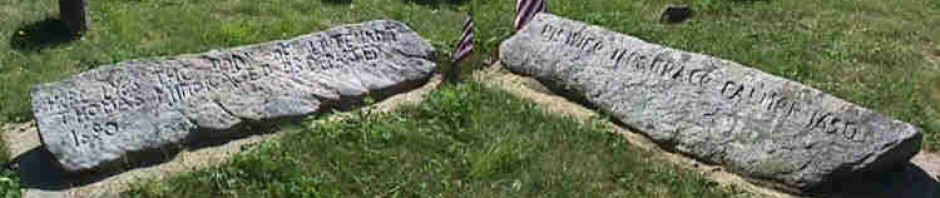
Robert Cushman

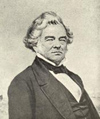
Robert CUSHMAN (1578 – 1625)  was a Pilgrim leader and made arrangements for the Leiden congregation to immigrate to North America. He preached the first recorded sermon in the New World. (Wikipedia) He was Alex’s 11th Grandfather; one of 4,096 in this generation of the Shaw line.

Robert Cushman was born in the village of Rolvenden in Kent, England, and was baptized in the parish church there on 9 Feb 1577/78. His parents were Thomas CUSHMAN and Elinor HUBBARD. He spent part of his early life in Canterbury on Sun Street. In 1620 he returned to Canterbury and at 59 Palace Street arranged the leasing of the Mayflower for the Pilgrims to use on their voyage to America.

Oddly enough for such a religious group, there was no ordained minister among the American Pilgrims at Plymouth Colony Robert Cushman, a deacon, was the nearest thing. To settle the jealousies and animosities among the settlers, he preached a sermon on 9 Dec 1621.

He married Sarah REDER on 31 July 1606 in St. Alphege, Canterbury, Kent, England.  Sarah Reder  lived in the precincts of the Cathedral at Canterbury and died in 1616 in Leiden, Holland and was buried on 11 Oct 1616 in St. Peter’s, Leiden, Holland.

Robert was excommunicated for not recognizing the official church and as a consequence spent time in a cell of Canterbury’s West Gate Towers. In 1611 he was one of a group of Pilgrims who fled to Holland because of differences with the official church over their practise of religion.

After Sarah died, he married Mark Clark on 5 Jun 1617 in Leiden, Holland before Andries Hasperson van Vesanevelt and Jacob Paedts, Sheriggs, Mary Clark is listed on her marriage record as “Mary Shingelton from Sandwich in England, widow of Thomas Shingelton”. Mary died before 1621 in Leiden, Holland. Anderson claims that she was “apparently dead” before this time since there is no evidence that she came to Plymouth with her husband and stepson.

Robert did not complete the initial trip to the New World with the other Pilgrims on board the Mayflower, as the ship he was travelling on, the Speedwell, developed leaks and had to return to England. He instead took a different ship to the New World.

Robert sailed to Plymouth, Massachusetts in the fall of 1621 aboard the Fortune, but returned shortly thereafter to England to promote the colony’s interests. There, he published an essay concerning the Lawfulness of Plantations, which was appended to Mourt’s Relation. This document is of interest to modern scholars because of its treatment of the economic reasons for emigration.

Unfortunately, before he could return to the New World, he succumbed to an outbreak of plague in London, in the spring of 1625; as a result, the site of his grave is unknown. The book Saints and Strangers by George F. Willisonrecounts his story.

Robert Cushman’s last request of William Bradford. “Have a care of my son as of your son ” was generously fulfilled, (and thus we find this son in the Bradford family) and so worthy was the result that Thomas CUSHMAN was chosen as Brewster’s immediate successor as ruling elder of the Plymouth Pilgrims.

Sarah Reder was born in 1585 in Canterbury, Kent, England. Sarah died 11 Oct 1616 in Leyden, Holland.

Cushman’s Memorial on Burial Hill

CUSHMAN MEMORIAL
This is a granite column, twenty-five feet high, and it is by far the most conspicuous monument on the hill. It reads:

ROBERT CUSHMAN,
Fellow exile with the Pilgrims in Holland,
Afterwards their chief agent in England,
Arrived here IX November, MDCXXI,
With Thomas Cushman his son:
Preached IX-. December,
His memorable sermon on “the Danger of self-love
And the sweetness of true friendship:”
Returned to England XIII December,
To vindicate tho enterprise of Christian emigration;
And there remained in the service of the Colony Till MDCXXV,
When, having prepared to make Plymouth His permanent home.

West side: —

He died, lamented by the forefathers
as “their ancient friend, – who was
as their right hand with their friends
the adventurers, and for divers years
had done and agitated all their business
with them to their great advantage.”

“And you, my loving friends, the adventurers
to this plantation, as your care has been first
to settle religion here before either profit
or popularity, so, I play you, go on. —
I rejoice — that you thus honor God
with your riches, and I trust you shall be repaid
again double and treble in this world, yea,
and the memory of this action shall never die.”
DEDICATION OF THE SERMON.

South side: —

THOMAS CUSHMAN.

Son of Robert, died X December, MDCXCI,
Aged neatly LXXXIV years.
For more than XLII years he was
Ruling Elder oú the First Church in Plymouth,
By whom a tablet was placed to mark his grave on this spot,
Now consecrated anew by a more enduring memorial.

MARY,

widow of Elder Cushman, and daughter of Isaac Allerton,
Died XXVIII November, MDCXCIX, aged about XC years,
The last survivor of the first comers in the Mayflower.

East side:

Erected by
The descendants of
Robert Cushman
In memory of their Pilgrim Ancestors,
XVI September, MDCCCLVIII.

His son, Thomas CUSHMAN (ca. 1607/08 – 1691), who accompanied him on the Fortune, was raised in the family of Plymouth Colony Governor William Bradford (1590-1657), and served as Ruling Elder of the Plymouth church from 1649, until his death in 1691. He was buried on New Plymouth Hill. Thomas married Mary ALLERTON who died in 1699. She was the last survivor of the original Mayflower passengers.

Children of Robert and Sarah:

Name Born Married Departed
1. Thomas CUSHMAN Sr. 8 Feb 1607/08, Canterbury, Kent, England Mary ALLERTON 1636 Plymouth, Mass. 10 Dec 1691
Plymouth Colony, Mass.
2. Child Cushman betw. 1611 and 1614 1616 Leiden, Holland
3. Sarah Cushman 1615
Leiden, Holland
William Hoskins
2 Nov 1636 Plymouth, Mass
1638
Plymouth, Mass

During his years in Leiden, Cushman demonstrated unusual organizational skill such that in 1617 Cushman (age 40) and John Carver (age 51), deacons of the Leiden congregation, were chosen to travel to London to make arrangements for the congregation to immigrate to North America.

Initially Carver and Cushman sought a patent from the Virginia Company for a colony on the James River. The company was interested but King James refused to allow the Pilgrims to practice their religion as they wished. Next, Cushman and Carver approached wealthy Puritans in London. Sir Edwin Sandys, member of Parliament and Governor/Treasurer of the Virginia Company, and Thomas Weston a wealthy London ironmonger agreed to contact London colleagues to explore investing in a joint stock company with the Pilgrims to produce goods to sell in London. Eventually about 70 men of varying occupations, religious beliefs and positions in society invested in the company. The London men were called Merchant Adventurers. King James agreed not be persecute Pilgrims providing they behaved quietly and were faithful subjects of the King. Negotiations with the Merchant Adventurers were tedious. In the spring of 1620 a revised agreement with Thomas Weston was negotiated, and Carver and Cushman returned to Leiden to present the agreement to John Robinson and the congregation. Disagreement remained which lead to further negotiation. Eventually a set of 10 articles of agreement emerged. Cushman returned to London to lease of the Mayflower and Carver remained in Holland to purchase the Speedwell. The plan was to retain the Speedwell in America for fishing and coastal trade.

Because the voyage and land clearing would be strenuous, it was decided that only strong men and women and their children would make the voyage. During the summer of 1620, the Merchant Adventurers assembled a pool of money and the Pilgrims who were chosen to sail sold their homes and belongings to pay for the voyage. It has been estimated that the cost of the voyage was approximately 1500 pounds. It became clear that additional people would be needed, and single men, and whole families of women and children were recruited in England. The new members were called “Strangers” while members of the Lieden congregation were called “Saints”. Some Separatists never left England and had no close relationship with members of the Leiden congregation. On the eve of the voyage individuals were asked to sign the 10 articles of agreement. The articles had not changed since they were presented earlier and some displeased individuals withdrew from the voyage. Even though the agreement was unsigned, the remaining Separatists decided to sail and settle the issue at a later time. The Separatists selected a leader, “Governor”, for each ship. To pacify the restive Strangers, one of their members, Christropher Martin was chosen governor of the Mayflower. Martin was an abusive person and disliked by everyone. Robert Cushman was chosen assistant governor to ensure harmony.

Christopher Martin, a Puritan, had been named expedition treasurer. He could not get along with the Leyden agents, Deacons Robert CUSHMAN and John Carver. And they were having trouble getting along with each other. There was little cooperation in buying provisions and, as a result, the Mayflower was stocked with two tons of butter, hardly any guns, and little to use in trade with the Indians.

Thomas Weston, the London adventurer, was denounced as a “bloodsucker” for changing the terms of his agreement and he stomped off to London when the Leyden leaders refused to sign the new agreements. He vowed the Pilgrims would not get another cent from the Merchants and Adventurers. That was a heavy blow because the Speedwell captain refused to sail until the vessel’s rigging was changed and that would cost money.

Pleas for help were sent to Weston but he kept his word and sent the Pilgrims nothing. To clear port they had to sell some of their provisions, including most of their butter, leaving them short of supplies.

On August 15th the Mayflower and Speedwell put to sea with the passengers on the two ships totaling about 120. They sailed rapidly for two days before a stiff wind. Then the Speedwell, its captain said, became “open and leakie as a sieve.” The ships put back to Dartmouth where the Speedwell was dry-docked for nearly three weeks. The passengers on the Mayflower were so unhappy that Christopher Martin, acting as governor on that ship, refused to let anyone ashore for fear they would not return. Toward the end of August, Mayflower and Speedwell put to sea again. They were more than 300 miles out when the Speedwell reported it was leaking and “must bear up or sink at sea.”

This time the ships put in to Plymouth, England, where it was decided to go on without the Speedwell.

During this period Robert Cushman became seriously ill. In a letter to Edward Southworth in August 1620 he thought he was close to death. When it was decided not to sail the Speedwell, Cushman was asked to remain in London to look after its passengers until they could sail the next year. The Mayflower sailed from Southampton alone on September 16, 1620. Cushman recovered and looked after the affairs of the passengers and purchased supplies for the voyage of the Fortune in 1621.

In April 1621 the Mayflower left Plymouth and arrived in England on May 6, 1621. Only then did the London Separatists learn of the arduous voyage, harsh conditions in Plymouth, the deaths of nearly one-half the Mayflower passengers, and that Christopher Martin died and John Carver had been elected Governor. The London Separatists were unaware that Carver had died shortly after the Mayflower left Plymouth.

The Fortune with Cushman and his son Thomas (age 14) sailed for Plymouth on August 9, 1621 with 35 new colonists but very few supplies. The Fortune arrived in Cape Cod harbor on 9 November 1621. The Plymouth colonists were downcast. Their beloved Governor John Carver had died the previous spring. The fall harvest had not been good, and the Fortune brought them only meager supplies. With 35 new mouths to feed, the winter looked bleak.

The compelling task facing Robert Cushman was to secure the colonists’ signatures to the 10 articles of agreement that were not signed the year before. The continued support of the Merchant Adventurers depended on it. On December 9, 1621, the first anniversary Sunday of the Pilgrim landing in Plymouth, Robert Cushman gave a sermon, which along with Robinson’s farewell sermon in Leiden, are quintessential statements of Pilgrim belief. Cushman’s sermon entitled “The Sin and Danger of Self-Love” was based on 1 Corinthians 10:24, Let no man seek his own, but every man another’s wealth. Cushman’s pious prose is verbose by today’s standard but the sermon speaks to us today as powerfully as it must have in the bleak winter of 1621. Cushman’s remarks were a heart-felt plea for the Pilgrims to cooperate unselfishly for common good without regard for personal gain.  It is not an exaggeration to draw a parallel between John F. Kennedy’s inaugural address in 1960 in which he said, “ask not what your country can do for you, but what you can do your country” and Cushman’s sermon. During the previous 12 months the hardships the Pilgrims endured softened the strongly-held opinions they and John Robinson embraced before they sailed for New England. They realized their marginal existence in Plymouth depended on supplies from England and they signed the 10 articles of agreement.

Robert quoted Paul’s words to the quarreling Corinthians as an example for the disgruntled settlers. Let no man seek his own, but every man another’s wealth (1 Corinthians 10:24). “The occasion of these words of the Apostle Paul, was because of the abuses which were in the Church of Corinth. Which abuses arose chiefly through swelling pride, self-love and conceitedness..”

“…it is lawful sometimes for men to gather wealth, and grow rich, even as there was a time for Joseph to store up corn, but a godly and sincere Christian will see when this time is, and will not hoard up when he seeth others of his brethren and associates to want, but then is a time, if he have anything to fetch out and disperse it..”

“…you must seek still the wealth of one another..” he reminded them and pointed out that it was in their self interest to do so, for, “Even as we deal with others, ourselves and others shall be dealt withal.. for it is the merciful that shall obtain mercy..”

The settlers listened to Robert. Not only did they sign the despised articles, but they filled the Fortune with wood and furs. Robert sailed for England. Unfortunately, the ship was seized by French privateers, who stripped it of everything of value. Robert was freed, but the colony would not pay for itself for a while yet.

SERMON Preached at Plymouth, in New England, 1621, BY ROBERT CUSHMAN.

1 CORINTHIANS, 10. 24.

LET NO MAN SEEK HIS OWN: BUT EVERY MAN ANOTHER’S WEALTH.

The occasion of these words of the Apostle Paul, was because of the abuses which were in the Church of Corinth. Which abuses arose chiefly through swelling pride, self-love and conceitedness, for although this church was planted by Paul and watered by Apollos, and much increased by the Lord ; yet the sower of tares was not wanting to stir up evil workers and fleshly minded hypocrites, under a shew of godliness, and with angel-like holiness in appearance, to creep in amongst them to disturb their peace, try their soundness, and prove their constancy.

And this the Apostle complains of very often : as first, in their carnal divisions, chap. 1. then in their extolling their eloquent teachers, and despising Paul, chap. 4. Then in their offensive going to Law, before the heathen judges, chap. 6. Then in eating things offered to idols, to the destroying of the tender consciences of their brethren, chap. 8.

Then in their insatiable love feasts, in the time and place of their church meetings, the rich which could together feed to fulness, despising and contemning the poor, that had not to lay it on as they had, chap. 11. Finally in both the epistles, he very often nippeth them in their pride, and self-love, straitness and censoriousness, so that in the last chapter he willeth them again and again to prove, try and examine themselves, to see whether Christ were in them or not, for howsoever many of them seemeth, as thousands do at this day to soar aloft, and go with full sail to Heaven : yet as men that row in boats, set their faces one way, when yet their whole body goeth apace another way : so there are many which set such a face upon religion, and have their mouth full of great swelling words, as if they would even blow open the doors of heaven, despising all humble minded and broken-hearted people, as weak, simple, sottish, &c. -when yet notwithstanding, these blusterers, which seem to go so fast, and leave all others behind them, if like these glosing Corinthians, they carry affectedly their Own glory with them, and seem thus to stand for the glory of God. What do they else but join flesh to spirit, serving not God for nought, but for wages, and so serving their bellies, whose end will be damnation, except a speedy and sound remedy be thought of, which remedy is even that which our Saviour teacheth the rich young gallant, and which Paul here prescribeth, in willing them not to seek their own, but every man another’s wealth, which physic is as terrible to carnal professors, as abstinence from drink is to a man that hath the dropsy ; and it is a sure note, that a man is sick of this disease of self-love, if this be grievous to him, as appeareth in the man whom Christ bid sell that he had, and he went away very sorrowful, yet surely this vein must be pricked, and this humor let out, else it will spoil all, it will infect both soul and body, yea, and the contagion of it is such (as we shall see anon) as will even hazard the welfare of that society where self seekers and self-lovers are.

As God then did direct this Apostle to lay down this brief direction as a remedy for that evil in Corinth, so you may think it is by God’s special providence that I am now to speak unto you from this text : and say in your hearts, surely something is amiss this way : let us know it and amend it.

The parts of this text are two. 1. A Dehortation. 2. An Exhoxtation. The Dehortation, Let no man seek his own. Thev Exhortation, But every man another’s wealth.

In handling of which, I will first, open the words. Secondly, gather the doctrine. Thirdly, illustrate the doctrine by scriptures, experience and reasons. Fourthly, apply the same, to every one his portion.

The proper drift of the Apostle here is not to tax the Corinthians, for seeking their own evil ends in evil actions, but for aiming at themselves, and their own benefits in actions lawful, and that appeareth in the former verse, where he saith. All things are lawful, tf-c. viz. all such things as now we speak of, to eat any of God’s creatures, offered to idols or not, to feast and be merry together, to shew love and kindness to this or that person, &c. but when by such means we seek ourselves, and have not a charitable, loving and reverent regard of others, then they are unexpedient, unprofitable, yea unlawful, and must be forborne, and he that hath not learned to deny himself even the very use of lawful things, when it tendeth to the contempt, reproach, grief, offence and shame of his other brethren and associates, hatli learned nothing aright, but is, apparently, a man that seeks himself, and against -whom the Apostle here dealeth most properly…..

The writing of Cushman, Bradford and other Pilgrims shows that they had an excellent command of the English language. Except for William BREWSTER, [our ancestor too] few (if any) of the Leiden men were educated formally. Nevertheless all were literate and wrote, and presumably spoke with facility. Since the Pilgrims read and quoted the bible frequently, their command of language is not surprising. The Bible is poetic, eloquent and has a cadence that influenced English-speakers for centuries.

Creating the Undertakers in 1626 began a process that reversed Cushman’s 1621 advice sermon and transformed the colony’s fundamental beliefs. At no time was there a deliberate effort to repudiate Cushman’s advice. Rather, economic conditions altered the Pilgrims concept of community. Ostensibly, creating the Undertakers simply transferred the colony’s debt to familiar hands; inadvertently, the decision set into motion actions that made acceptable the pursuit of private gain.

Thomas Cushman remained in Plymouth under the care of Governor Bradford and his father returned to England on the Fortune on 13 Dec 1621. Carried on the Fortune were beaver pelts and other furs worth approximately 500 pounds obtained from trade with the Indians for corn. The cargo was the first shipment of goods to the Merchant Adventurers and important for their continued support. As luck would have it as the Fortune approached the English coast, French privateers stole its cargo and the passenger’s belongings. Cushman and the crew were imprisoned in France but returned to England in Feb 1622. Luckily the signed articles of agreement and the manuscript of Mourt’s Relation were not lost. Mourt’s Relation [published by our ancestor George MORTON] was written to assure the Merchant Adventurers of the success of the colony and to interest others to emigrate.

After 1621 Robert Cushman was the colony’s London agent arranging the transfer of remaining members of the Leiden congregation to Plymouth. As London agent, Cushman arranged the sale of furs and fish sent by the colonists to the Merchant Adventures purchased supplies for the colonists. When Miles Standish visited London in April 1626 he discovered that Robert Cushman had died (at age 48) during the spring of 1625.

Robert Cushman demonstrated enormous organizational ability. He was the principal person negotiating agreements with the crown and London investors, organizing the logistics to transport over a hundred people across the Atlantic, and lastly managing the finances to provision the colony and sell its products. His keen leadership was most evident when he persuaded the colonists to sign the articles of agreement they had strongly rejected the year before. Sadly he died before he could move to Plymouth and share the remainder of his life with associates who held him in such high esteem.
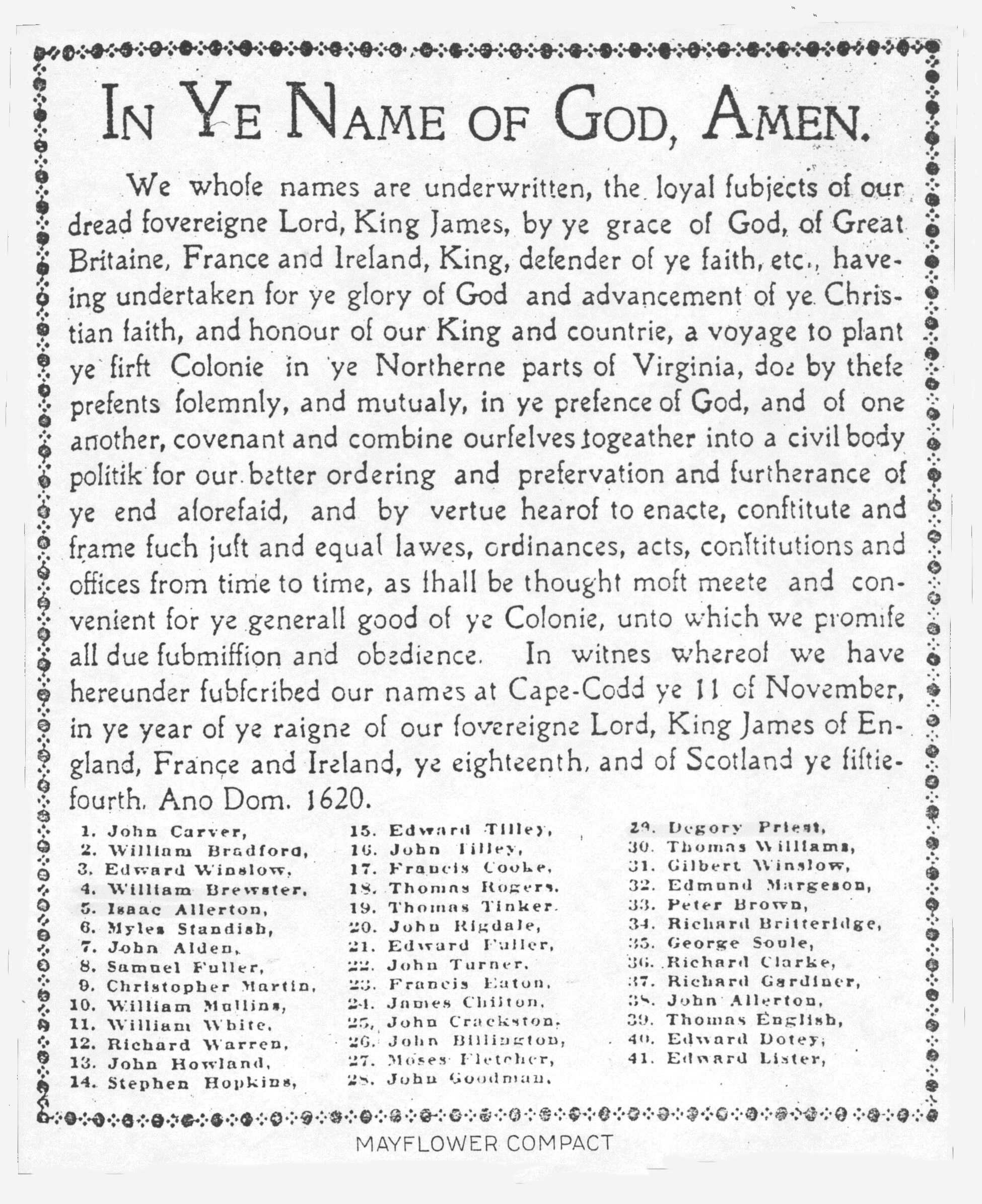
If the Speedwell had been seaworthy, and Robert Cushman not been ill and able to sail on the Mayflower, he would have been one of the first signers of the Compact along with John Carver, William Brewster and William Bradford.

Children

1. Thomas CUSHMAN Sr. (See his page)

2. Child
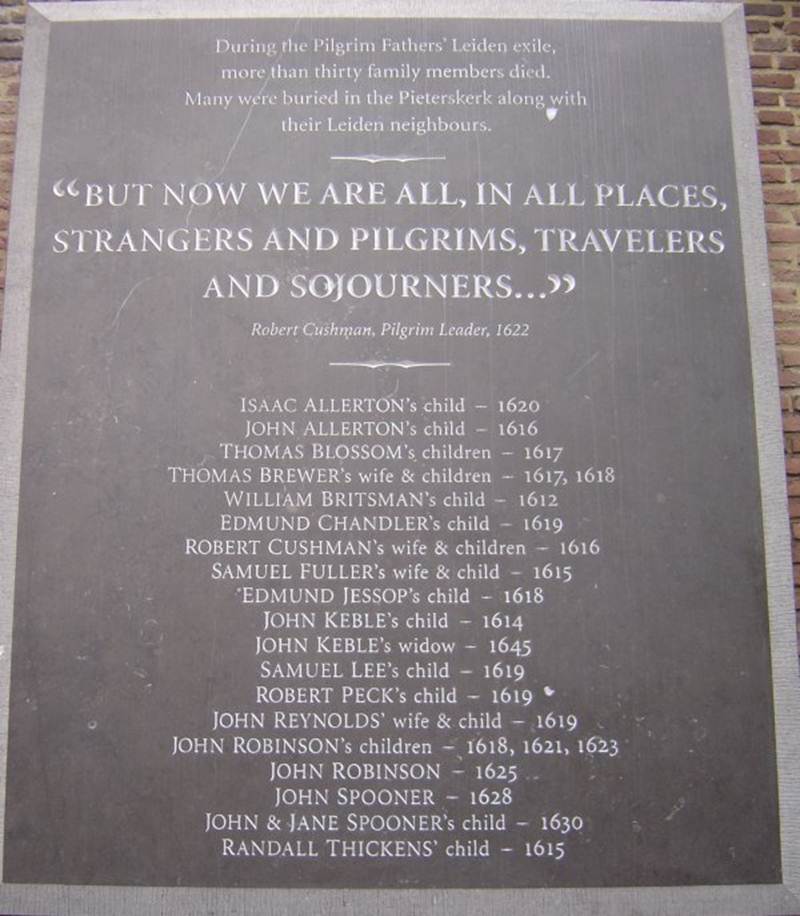
Robert Cushman's child is included in the Leiden Pilgrim Burials

Robert Cushman’s child is included in the Leiden Pilgrim Burials

3. Sarah Cushman

Sarah’s husband William Hoskins was born 1613, Cork, Ireland. After Sarah died, he married 31 Dec 1638, Plymouth, Plymouth, MA, to Ann Hinds. William died 7 Sep 1695, Plymouth, Plymouth, MA

William Hoskins was one of the freeman in 1635. He married Sarah Cushman, and as a second wife, Ann Hynes, or Hinds. There is but little doubt that upon the incorporation of Middleboro as a town, in 1669, he was chosen town clerk, and continued in that office until 1693, although there is no official record of his election before May 24, 1681. At that time he was unanimously chosen to that office. His first election cannot be verified, as all of the town records were destroyed during King Philip’s War. He lived in Middleboro before the War, in the house of William Clark, and kept the original deed and records of the Prince and Coombs Purchase, and probably the records of the town. He is one of the soldiers “from Middleboro” who took part in the war, and was promised a grant of land for his services at Narragansett.

William’s  name is on the list of those who, on June 3, 1662, applied to the General Court at Plymouth in reference to a grant to be made to them as being the first-born children of this government, and for disposing of two several tracts of land lately purchased, the one by Major Winslow and the other by Captain Southworth. He was on the jury with John Tomson and Sergeant Ephraim Tinkham to try an Indian for murder in 1674. February 6, 1665, he was appointed administrator of the estate of Nicholas Hodgis, alias Miller, deceased. He had received a grant of land in Lakenham.

He was one of the men in the Twenty-six Men’s Purchase and also in the Purchade Purchase, but at the breaking out of the war he does not appear to have been an owner in any portion of that land. His name is among the former proprietors of the liberties of Middleboro, but before 1677 his interest therein passed to George Vaughan, Sr. He lived in Scituate, Plymouth, and Taunton, and in 1680 was “grown old and feeble.”
His children were Sarah, born Sep  16, 1636; William, born Nov 30, 1647; Samuel, born Aug  8, 1654.

Sources:

http://www.genealogyofnewengland.com/f_1a5.htm#75

http://en.wikipedia.org/wiki/Robert_Cushman

http://www.sail1620.org/history/35-biographies/105-robert-cushman.html

http://homepages.rootsweb.ancestry.com/~smoore/7456.htm

http://familytreemaker.genealogy.com/users/c/o/r/Jennifer-Corkins/GENE1-0001.html

Cushman, H. W., “Historical and Biographical Genealogy of the Cushmans: Robert Cushman the Puritan From the year 1617 to 1855”, Little, Brown, and Company, Boston, MA, 1855
French E., “Cushman, Genealogical Research in England”, NEHGR, 68:181, 1914
Cushman, M. L., “Pilgrims of the Fruitbelt A Cushman Genealogy”, Heritage Press, Lansing, MI, 1980
Cushman, R. E. and Cole F. P., “Robert Cushman of Kent”, General Society of Mayflower Descendents, Plymouth, MA, 1995
Stratton, E. A., “Plymouth Colony, Its History & People 1620-1691”, Ancestry Publishing, Salt Lake City, UT, 1986

A Historical and biographical genealogy of the Cushmans: the descendants of Robert Cushman, the Puritan, from the year 1617 to 1855 (1855) by Cushman, Henry Wyles, 1805-1863

Posted in 13th Generation, Artistic Representation, Dissenter, First Comer, Immigrant - England, Line - Shaw, Storied, Wikipedia Famous | Tagged , , , , | 16 Comments

Isaac Allerton

Isaac ALLERTON (1586 – 1659) was one of the original Pilgrim fathers who came on the Mayflower to settle the Plymouth Colony in 1620. (Wikipedia) While serving as  Plymouth’s business agent he used the colony’s collateral for his own failed business ventures.  He is the only Mayflower Pilgrim with a house on Broadway (yes, that Broadway). He was Alex’s 11th Grandfather; one of 4,096 in this generation of the Shaw line.

Isaac Allerton Marker

Isaac Allerton Marker

Isaac Allerton was born in 1586 in London, England.  His parents were Edward ALLERTON and Rose DAVIS.   He married Mary NORRIS 4 Nov 1611 in Stadhuis, Leyden, Holland. Accompanying Isaac and Mary on the Mayflower were their three children and a servant boy named John Hooke, who was 14. Allerton’s wife and John Hooke died aboard the Mayflower while it was still anchored in Plymouth Harbor during the first winter, as noted in the death lists. Both were buried in Cole’s Hill.  After Mary died, he married Fear Brewster about 1625.  After Fear died, he married a third time to  Joanna Swinnerton in Marblehead, Mass sometime between 1634 and 17 Feb 1645 when they arrived in New Haven. Isaac died of plague between 1 and 12 Feb 1658/59 in New Haven CT.

Isaac Allerton – Sargent Painting “Landing of the Pilgrims”.

Isaace Allerton – Sargent Painting Detail The artist identified the individuals in his painting.

Mary Norris was born about 1592 in Newbury, Berkshire, England.  Mary died from the effects of childbirth, after giving birth to a stillborn son on February 25, 1621.  Mary was the first woman to give birth in the New England Colonies.

Fear Brewster (Wikipedia) was born in 1606 in Scrooby, Nottinghamshire, England. She was named Fear because at the time of her birth, the Puritans were holding secret meetings and were under constant threat of arrest.   Her parents were William BREWSTER and Mary Love.    Her early years, and indeed her whole life, were full of unrest. In 1608 she moved, along with the other pilgrims, to Amsterdam (and later Leiden).  Fear was only 14 when her parents and two younger brothers, Love and Wrestling, left for America on the Mayflower. She was left in the care of her older siblings, Jonathan (born in 1593) and Patience (born in 1600). Jonathan joined the pilgrims in 1621 on board the Fortune. Fear arrived in America with Patience on board the Anne in July 1623.  Fear died 12 Dec 1634 in Plymouth, Mass.

Joanna Swinnerton’s origins are not known.   There was a  Job Swinnerton, admitted to Salem, near Marblehead,  in 1637, but his wife’s name was Elizabeth.   Job Swinnerton, born about 1601; married Elizabeth, perhaps in Eccleshall, Staffordshire, England, and lived in Salem Village. A private record in the possession of the family states that when he and his wife were aged and infirm their house “took fire on the roof, in the absence of their family, and before they discovered it, all retreat from the door was cut off. Mr. Swinnerton escaped from the window, holding his wife’s hand, but did not succeed in rescuing her from the flames. When the son returned he found his father sitting on a rock, viewing the smoking coals, and on inquiring for his mother, his father replied, she has gone to heaven in a chariot of fire.” Mr. Swinnerton died April 11, 1689. Children: 1. Job, born about 1630; 2. John, born about 1633.

Joanna  was probably the “Mrs. Swinnerton” who received a grant of land at New Haven on 17 March 1640/41 [NHCR 1:50; NEHGR 124:133; MD 42:124]. No children of this marriage.  Joanna died after 19 May 1684 New Haven, New Haven, CT.  In a deed dated Dec 23 1703 Elizabeth Eyre, a granddaughter of Isaace Allerton sold this piece of land that had come to her as a granddaughter of Joanna Swinnteron after Joanna Alderton late of New Haven deceased.  Based on these deeds, it looks like Isaac married Joanna in New Haven.

Children of Isaac and Mary:

Name Born Married Departed
1. Bartholomew Allerton 1612 Leyden, Holland Sarah Fairfax
1645
Rumbough, Suffolk, England
19 Feb 1659
Bramfield, Suffolk, England
2. Remember Allerton 1614 Leyden, Holland Moses Maverick
6 May 1635
12 Sep 1652 Marblehead, Mass.
3. Mary ALLERTON Jun 1616 Leyden, Holland Thomas CUSHMAN Sr.
1636
Plymouth
28 Nov 1699 Plymouth, Mass.
(last Mayflower Survivor)
4. Child 1620
Leiden, Holland

.
`Children of Isaac and Fear Brewster

Name Born Married Departed
5. Sarah Allerton 1627
Plymouth, Mass
John Priest
1650
Mass
 1655
Plymouth, Mass
6. Isaac Allerton (wiki) 1630
Plymouth, Mass
Elizabeth [__?__]
.
Elizabeth Willoughby 1663
Westmoreland, Virginia
1702 Westmoreland, Virginia

Legacy

Some historians use the words “unlucky” and “unscrupulous” to describe Allerton. He used his capacity as Plymouth’s designated negotiator to engage the Colony in a number of unapproved,  and ultimately failed trading schemes.   However, he eventually paid back his debts.  In 1646, Allerton asked Bradford, Brewster, Winslow and Standish to be his agents and sell his lands, goods and cattle to clear all his debts and demands of the undertakers that were uncovered in 1630/31.

I see Allerton as the first “Yankee Trader.”    The historical records of New Amsterdam, New Haven and New Sweden contain no evidence that his trading practices were unscrupulous. Johan Rising, Governor of New Sweden recorded that Allerton drove a “sharp bargain,” but so did all trader merchants of the time. While other men rose to prominence as political leaders, Allerton achieved success in the world of commerce.

He overcame adversity three times in his life and recovered to build four successful careers.

  • After fleeing Suffolk County England, Allerton, Brewster and Priest displayed such enterprise in the Netherlands that they were granted honorary citizenship in Leiden.
  • Allerton survived the Mayflower voyage and the horrific first year in Plymouth and rose to become Assistant Governor and London agent.
  • He left Plymouth in disgrace, began a thriving fishing enterprise in Marblehead only to be expelled because of his freethinking religious views and friendships with  Thomas Morton  and Roger Williams.
  • Beginning anew for the fourth time he became one of New England’s most successful trader-merchants and a prominent citizen of both New Haven and New Amsterdam.

Plymouth

Isaac Allerton was one of the signers of the Mayflower Compact

Isaac Allerton was about 34 years old when he came to Plymouth on the Mayflower in 1620.  He had been a long-time member of the Pilgrims’ church in Leiden, and was recorded as having been a tailor from London.  He married his first wife, Marry Norris, in Leiden, in 1611, and there had children Bartholomew, Remember and Mary, all of whom came on the Mayflower with him.  He and Mary buried a child, not yet named, at St. Peters on 5 Feb 1620.  Isaac Allerton had a sister Sarah in Leiden, who married to Mayflower passenger Degory Priest.  Mayflower passenger John Allerton, also a Leiden resident, most likely was a relative as well, although the exact relation has not been discovered.

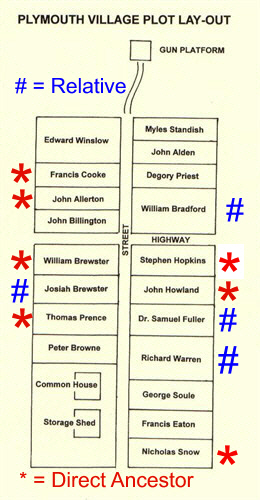
Our ancestors or their close relatives had almost half the lots in early Plymouth – (George Soule was the grandfather of John TOMSON’s son-in-law, not close enough to get a #)

Our ancestors or their close relatives had almost half the lots in early Plymouth – (George Soule was the grandfather of John TOMSON’s son-in-law, not close enough to get a #)

Isaac Allerton was one of the more active and prominent members of early Plymouth.  He was elected as Governor Bradford’s assistant in 1621, and continued as an assistant into the 1630s.  In 1627, he was sent to negotiate the Plymouth Colony’s buyout of the Merchant Adventurers, the investors who had originally funded (and had hoped to profit from) the Colony.  The Colony was about £2500 in debt; a small group of Plymouth’s residents, including Bradford, Brewster, Standish, Fuller, and Allerton, sought to assume the debt themselves in return for the rights to profit from the company.

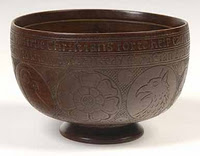
Allerton Cushman Cup, Pilgrim Hall Museum

Allerton Cushman Cup, Pilgrim Hall Museum

Inscription on the Allerton Cushman Cup, which has the year 1608 carved on the bottom:

Lord help thy people that are in Destresse:
teach all true Christians for to help each other:
turne + the hard hart’s that Doth the poore opresse:
teach them to know their needy Christian Brother:
Think on+the ritch mans flourishing estate:
Which cried out in hell+Blessed are the mercyfull+Wh-t was to late.

Allerton was sent to England to negotiate further, and would return to England on several more occasions.  Unfortunately for the others, Allerton began to use his “free” trips to England to engage in some private gains, purchasing goods and selling them in the Massachusetts Bay and Plymouth.  He also used his capacity as Plymouth’s designated negotiator to engage the Colony in a number of unapproved money-making schemes: he went so far as to purchase ships (which he partially used for his own private trading), and to attempt to negotiate grants and patents for trade–all at great cost to the company and none of it approved by the others back at Plymouth.  When his trading schemes failed, the Company found itself in far greater debt than it ever started out with.  However, he eventually paid back his debts.  In 1646, Allerton asked Bradford, Brewster, Winslow and Standish to be his agents and sell his lands, goods and cattle to clear all his debts and demands of the undertakers that were uncovered in 1630/31.

Isaac Allerton – Signature

While serving as the colony’s business agent, Allerton began several business ventures of his own, relying on the colony’s credit for collateral. These ventures failed, thus leaving his colleagues back in Plymouth saddled with a greatly increased debt. Also, Allerton was asked to bring over trade goods to sell to the natives, however, Allerton brought over retail goods to sell to the colonists and fishermen who came over every year. Later on Allerton did not mark which goods were his and which belonged to the colony. When the goods were unloaded, Allerton took the most expensive items leaving the Plymouth colonists with the cheaper goods.

In 1630/31, Bradford dismissed Allerton as Plymouth’s London business agent because he betrayed the colony’s trust by overcharging, mishandling the colony’s finances and increasing the colony’s debt without approval.

Believing his work was misunderstood and unappreciated, Allerton decided to trade for himself. Allerton’s stature in the colony was substantial, and he continued living in Plymouth with his wife and children and was elected Assistant Governor in 1633/34. At this time Allerton was the wealthiest man in Plymouth and the largest taxpayer.

Marblehead

Marblehead, Essex, Mass

Marblehead, Essex, Mass

Jun 1632 – Allerton and James Sherley (an original Merchant Adventurer and Undertaker) formed a trading company and built trading stations on the Kennebec and Penobscot Rivers.

Sep 1632 – Allerton and Moses Maverick ( husband of his oldest daughter, Remember),  sailed the White Angel (leased from James Sherley) into the harbor at Marblehead. Allerton and Maverick purchased fishing vessels, built a warehouse and quarters for fishermen. By 1633 they had five men and eight boats fishing in the harbor. In 1633 they built a second warehouse and fisherman’s quarters at Machias on Maine’s north coast. Maverick and Allerton were among the original settlers of Marblehead.

In 1633/34 Allerton experienced a series of misfortunes. The French and Indians destroyed his fishing facilities in Machias and one of his ships was lost at sea while trading with France. A fierce contest was at this time going on between France and England. Charles de la Tour, the French commander of Acadia, made a descent upon it from his seat at Port Royal, Nova Scotia, killing two of its six defenders, and carrying the others away with their merchandise.  No persistent attempt was again made to hold this point by the English or French for upwards of 120 years.

Machias , Maine

Machias , Maine

In February 1634 the living quarters housing Allerton and his fishermen in Marblehead was destroyed by fire. Plymouth suffered an epidemic and Allerton’s second wife, Fear, daughter of William Brewster, died of fever in Dec 1634. Allerton conveyed his Plymouth property at Rocky Nook (later called Kingston) to his youngest daughter Mary (1616-1699) and her husband Thomas CUSHMAN.  

Allerton angered the Massachusetts Colony General Court by embracing freethinking religious views. He employed as secretary, Thomas Morton of “Merrymount,” whose religious beliefs and unacceptable personal behavior caused him to be involuntarily returned to England in 1629. In addition, Morton and Allerton befriended Roger Williams whose extreme separatist views offended the Puritan ministers. Williams was banished and established a colony in Providence, RI. In March 1635 the civil authorities ordered Allerton to leave Marblehead and in May he conveyed his Marblehead fishing properties to Moses Maverick and moved to New Amsterdam. Moses remained in Marblehead to become a leader in New England’s fishing industry, and one of Marblehead’s leading citizens holding many positions of civic authority throughout his life.

The Great Colonial Hurricane of 1635  damaged much of the area between Providence, Rhode Island and the Piscataqua River ; some damage was still noticeable 50 years later. A letter from Governor William Bradford said that the storm drowned seventeen Native Americans and toppled or destroyed thousands of trees; many houses were also flattened. From an account by Antony Thacher, there were twenty-three people aboard a little bark named the Watch and Wait and owned by a Mr. Isaac Allerton. The boat sank, and Thacher and his wife were the only ones to survive the shipwreck. Thus the island off Cape Ann—where Thacher survived—was named in his honor and is still known as Thacher’s Island.  In Narragansett Bay, the tide was 14 feet  above the ordinary tide and drowned eight Native Americans fleeing from their wigwams. The highest ever such recorded value for a New England Hurricane, a 22-foot  storm tide, was recorded in some areas. A recent study  indicates that this hurricane was very likely the most intense hurricane to ever impact the New England region in recorded history.

26 Sep 1636 – Isaac made a deposition in Boston stating he was aged about 53 yrs.

Isaac was soon commanded by the Massachusetts authorities to leave the colony.

Thomas Morton

In 1629 Allerton brought Thomas Morton (Wikipedia) back to New England, and allowed him to live in his house; this got the Plymouth colonists very upset. This rendered Allerton permanently persona non grata in Plymouth.

Bradford wrote:

“Mr. Allerton played his own game and ran a course not only to the great wrong and determent of the Plantation… but abused them in England also in prejudice against the Plantation,” and later on he wrote “Concerning Mr. Allerton’s accounts. They were so large and intricate as they could not well understand them, much less examine and correct them without a great deal of time and help and his own presence, which was hard to get,” and also “he screwed up his poor father in law’s account”.

Morton spent three months on an exploratory trip to America in 1622, but was back in England by early 1623 complaining of the intolerance of certain elements of the Puritan community. He returned in 1624 as a senior partner in a Crown-sponsored trading venture, onboard the ship the Unity with his associate Captain Wollaston and 30 indentured young men. They settled and began trading for furs on a spit of land given them by the native Algonquian tribes, whose culture Morton is said to have admired as far more ‘civilized and humanitarian’ than that of his ‘intolerant European neighbours’. The Puritans of the New England colony of Plymouth objected to their sales of guns and liquor to the natives in exchange for furs and provisions, which at that time was technically illegal (although almost everyone was doing it). The weapons undoubtedly acquired by the Algonquians were used to defend themselves against raids from the Northern Tribes, however, and not against the fearful colonists. The trading post set up by the two men soon expanded into an agrarian colony which became known as Mount Wollaston (now Quincy, Massachusetts).

Morton fell out with Wollaston after he discovered he had been selling indentured servants into slavery on the Virginian tobacco plantations. Powerless to prevent him, he encouraged the remaining servants to rebel against his harsh rule and organise themselves into a free community. Wollaston fled with his supporters to Virginia in 1626, leaving Morton in sole command of the colony, or its ‘host’ as he preferred to be called, which was renamed Mount Ma-re (a play on ‘merry’ and ‘the sea’) or simply Merrymount. Under Morton’s ‘hostship’ an almost utopian project was embarked upon, in which the colonists were declared free men or ‘consociates’, and a certain degree of integration into the local Algonquian culture was attempted. However, it was Morton’s long-term plan to ‘further civilize’ the native population by converting them to his liberal form of Christianity, and by providing them with free salt for food preservation, thus enabling them to give up hunting and settle permanently. He also considered himself a ‘loyal subject’ of the British monarchy throughout this period, and his agenda remained a colonial one, referring to Book 3 of his New English Canaan memoirs as a manual on ‘how not to colonize’, in reference to the Puritans.

Morton’s ‘Christianity’, however, was strongly condemned by the Puritans of the nearby Plymouth Colony as little more than a thinly disguised heathenism, and they suspected him of essentially ‘going native’. Scandalous rumours were spread of the debauchery at Merrymount, which they claimed included immoral sexual liaisons with native women during what amounted to drunken orgies in honour of Bacchus and Aphrodite. Or as the Puritan Gov. William Bradford wrote with horror in his history Of Plymouth Plantation:

They … set up a May-pole, drinking and dancing about it many days together, inviting the Indian women, for their consorts, dancing and frisking together (like so many fairies, or furies rather) and worse practices. As if they had anew revived & celebrated the feasts of ye Roman Goddess Flora, or ye beastly practices of ye mad Bacchanalians.

Morton had transplanted traditional West Country May Day  customs to the colony, and combined them with fashionable classical myth, couched according to his own libertine  tastes, and fuelled by the enthusiasm of his newly-freed fellow colonists. On a practical level the annual May Day festival was not only a reward for his hardworking colonists but also a joint celebration with the Native Tribes who also marked the day, and a chance for the mostly male colonists to find brides amongst the native population. Puritan ire was no doubt also fueled by the fact that Merrymount was the fastest-growing colony in New England and rapidly becoming the most prosperous, both as an agricultural producer and in the fur trade in which the Plymouth Colony was trying to build a monopoly. The Puritan account of this was very different, regarding the colony as a decadent nest of good-for-nothings that annually attracted “all the scum of the country” to the area. Or as Peter Lamborn Wilson more romantically puts it, ‘a Comus-crew of disaffected fur traders, antinomians, loose women, Indians and bon-vivants’.

But it was the second 1628 Mayday ‘Revels of New Canaan’, inspired by ‘Cupid’s mother’, with its ‘pagan odes’ to Neptune and Triton, as well as Venus and her lustful children, Cupid, Hymen and Priapus, its drinking song, and its erection of a huge 80 ft. Maypole, topped with deer antlers, that proved too much for the ‘Princes of Limbo’, as Morton referred to his Puritan neighbours. The Plymouth Militia under Myles Standish took the town the following June with little resistance, chopped down the Maypole and arrested Morton for ‘supplying guns to the Indians’.  He was put in stocks in Plymouth, given a mock trial and finally marooned on the deserted Isles of Shoals, off the coast of New Hampshire, until an ‘English ship could take him home’, apparently as he was believed too well connected to be imprisoned or executed (as later became the penalty for ‘blasphemy’ in the colony). He was essentially starved on the island, but was supplied with food by friendly natives from the mainland, who were said to be bemused by the events, and he eventually gained enough strength to escape to England under his own volition. The Merry Mount community survived without Morton for another year, but was renamed Mount Dagon by the Puritans, after the ‘evil’ Semitic Sea God, and they pledged to make it a place of woe. During the terrible winter famine of 1629 residents of New Salem under John Endecott raided Mount Dagon’s plentiful corn supplies and destroyed what was left of the Maypole, calling it the ‘Calf of Horeb’ and denouncing it as a pagan idol. Morton returned to the colony soon after and, after finding most of the inhabitants had been scattered, was rearrested, again put on trial and banished from the colonies without legal process. The following year the colony of Mount Dagon was burnt to the ground and Morton shipped back to England.

New Amsterdam

Between 1636 and 1642 Allerton’s activities are not well known. There is not evidence that he had a permanent home in New Amsterdam. He may have traded for himself, or the WIC, or for wealthy Dutch family trading companies in New Amsterdam.

Allerton established good relations with Director-General William Kieft and was granted “burger privileges” as a resident of New Amsterdam. One of the earliest records of Allerton’s trade in New Amsterdam was trading corn with Director-General William Kieft in 1639.

In 1642 Allerton sold his bark, Hope, to New Amsterdam residents Govert Loockermans and Cornelius Leendertsen. Allerton and Loockermans became partners in trading and in 1643 were granted permission to buy land on the east side of Broadway, which they sold shortly thereafter. Loockermans became a wealthy landholder, and influential in the governance of New Amsterdam, both before and after being seized by the English.

Director-General William Kieft was an autocrat and ruled New Amsterdam in an arbitrary fashion, generating animosity throughout the colony. In 1643 a minor altercation with Indians evolved into a serious uprising followed by an ugly slaughter of Weckquaskeek Indians on Manhattan Island. Kieft feared a major Indian assault. Allerton was asked by Kieft to join a Council of eight men to help New Amsterdam.

For more on William Kieft and New Amsterdam politics in the 1640;s , see the page of our ancestor Hendrick Thomasse Van DYKE (1610 – 1688)  Van Dyke commanded an attack in Kieft’s War in 1643 and occupied several high official positions in the colony.  While his unenviable reputation for starting the Peach Tree War (1655-1660) by shooting a Native American woman picking peaches on his property may be an exaggeration of the actual events, he did have a gruff personality and was often involved in controversy both with Director General Stuyvesant  and the Indians.

Because he was English and respected in New Haven, Kieft sent Allerton and another Englishman to New Haven in 1643 to ask for men and materials to help defend New Amsterdam. In addition, the  Council of eight men was asked to propose measures to improve civility and law-and-order in New Amsterdam. New Haven refused to send men to support the Dutch but Kieft entered into an agreement with the Indians in 1645 that settled the dispute.

In 1646 Allerton purchased a narrow, 500-ft strip of waterfront property on the East River a mile north of the tip of Manhattan and constructed a two-story warehouse and dock. The warehouse was managed by George Woolsey from Yarmouth, England. The warehouse at 170 Pearl Street became known as “Allerton’s Building” and was a favorite place where English traders convened when conducting business in New Amsterdam. The northern end of the land was called Peck’s Slip where a ferry provided service across the East River to Brooklyn. In 1654 the house was used as an almshouse for boys and girls from the Netherlands “bound-out” for employment in New Amsterdam. In 1656 Woolsey received permission to sell beer and wine and to operate the house as an inn. After Allerton’s death, George Woolsey lived in the house until 1668. The building survived into the 18th century at a location that today would be between the South Street Seaport and  the Brooklyn Bridge. By 1655 Allerton was recorded to be the sixth wealthiest resident in New Amsterdam.

Because of Kieft’s dictatorial manner, several of the eight men petitioned the States-General to recall Kieft as Director-General and that the people themselves be given more influence in the new government.  They blamed  Kieft for the declining economic condition of the nascent colony, and Keift’s War.    Kieft was dismissed and replace by Peter Stuyvesant who would rule New Netherlands until its defeat by the English in 1664.  The men initiating the recall petition were accused of insurrection and faced punishment.  Allerton was the second signatory of the petition but was not the group’s primary spokesman.  While maintaining ties in New Amsterdam, in 1646, Allerton established a permanent residence in New Haven.

New Sweden

New Sweden and New Netherlands.  New Haven is on the Connecticut River

New Sweden and New Netherlands.

Allerton was unique among all the 17th century New England trader merchants because he was an influential resident in both New Amsterdam and New Haven. As a resident in both colonies, he engaged in trade free of the restraints New Amsterdam imposed on English traders, and New Haven imposed on Dutch traders. Thus Allerton was able to trade in English colonies in North America, Swedish and Dutch settlements on the Delaware River. Trade records show that he also traded in ports in England and the Netherlands, Curacao, the Barbados, Virginia, New Amsterdam, New England and Canada.

During the testy years when New Amsterdam and New Sweden were at sword’s points, Allerton traded in New Sweden while not antagonizing the Dutch and obtained goods that he transported to New Amsterdam for shipment to Europe in Dutch ships. Other English traders were less successful from trading with the Swedish and Dutch on the Delaware.

Ships from Sweden were unable to provide a reliable stream of supplies to the New Sweden settlements and the settlers depended on visits from Dutch trader merchants. Using his sloop, Allerton began trading in New Sweden and remained one of its principal and reliable traders until he retired.

Jan 1644 – Allerton sold goods at Fort Christina.

Jun 1644 – He sold 11,346 pounds of tobacco for 5 stivers per pound (Dutch money, 20 stivers = 1 guilder).

Fall 1645 – He returned to collect his outstanding accounts and sold 14 bushels of barley seed, a pair of millstones and Dutch bushel measures.

Fall 1647 –  Allerton returned to collect 3,800 florin (British money, florin = 2 shillings) on his accounts.

1651 – Allerton was a witness to an agreement in which the Indians granted the Dutch land south of Fort Casimir.

1654 –  Allerton sold 13,519 pounds of Virginian tobacco at 9 stivers per pound and if the Swedes were unable to receive a gross profit of 7 stivers per pound that they expected in Europe, he agreed to reduce his price.

1654/6  – Allerton acted as courier and interpreter for the Governors of New Haven and New Sweden concerning permission for the English to build a settlement on the Delaware based on an agreement the English made with the Indians in 1641. The request was refused.

1655 – Allerton brought food, vinegar, hops to Christina on credit.

1656 – He transported goods from Christina for sale in New Amsterdam.

These trading practices illustrate a way for the Governor of New Sweden ensured steady visits from merchant traders. Using both credit and currency the Governor knew that the trader merchants would return to redeem credit owed them. For their part, Allerton and other trader merchants offered credit to ensure that their return with new supplies would be welcomed.

Owing to the shortage of European currency and manufactured goods in New Sweden, Indian wampum became a common medium of exchange in the fur trade. Wampum were beads Indians made from clam shells and strung on strings, woven into belts or sewn on garments as ornaments. Indians along the Delaware River valued wampum made by New England Indians from clam shells found in the Narragansett Bay and from the shores of Long Island Sound. Making wampum was a time-consuming craft in which the Narrgansetts excelled. Wampum made by the English was inferior and less valuable in trade. Indians with whom New Sweden traded prized New England wampum as the medium of exchange in trade for furs. Allerton acquired New England wampum extensively, he often acted as a courier carrying passengers, important documents, letters of credit between Dutch, English and Swedish colonies.

New Haven

In New Haven he remained an active trader, and did regular business with the Dutch at New Netherland in modern-day New York.  Records of his trading can be found in numerous other colonies as well, including Virginia and Barbados.

17 Feb 1644/45 – Gov. Winthrop recorded “Mr. Allerton coming from New Haven in a ketch, with his wife and divers other persons, were taken in a great storm at northeast with much snow, and cast away at Scituate, but the persons all saved.”

1646 –  Allerton asked Bradford, Brewster, Winslow and Standish to be his agents and sell his lands, goods and cattle to clear all his debts and demands of the undertakers that were uncovered in 1630/31.

1646 – Allerton became a permanent resident of New Haven where he and his wife lived for the remainder of his life except for trading voyages and occasional visits to his warehouse in New Amsterdam.

13 Oct 1646 – Isaac Allerton was called “of Newhaven Merchant” in a letter of attorney.

27 Oct 1646 –  Isacke Allerton of New Amsterdam in the province of New Netherlands, merchant, confirmed to son-in-law Thomas CUSHMAN of New Plymouth a debt of one hundred pounds owed to Isaac by John Coombe.

10 Mar 1646/47 – Isaac and Joanna were assigned seats in the New Haven meeting house. He built a stately home with four porches and many fireplaces on two acres of land on the creek on the northwest corner of Union Street between Cherry Street on the north, and Fair Street on the south. The home was located among the grand homes of Davenport, Eaton and other original New Haven settlers.

He remained an active trader and did regular business with the Dutch at New Amsterdam (modern-day New York), the Finns and Swedes at New Sweden (consisting of parts of present day Delaware, New Jersey and Pennsylvania), Virginia, and Barbados.

5 April 1659 – The inventory of Isaac Allerton taken 12 Feb. 1658/59 was presented in the New Haven court his son Isaac being away at the time. Isaac produced his father’s will on 5 July 1659 and was appointed to settle the estate, but he relinquished the trust. the will is little more than memoranda of debts due him and owed by him, but names his wife and son Isaac Allerton as trustees and they were to receive “what is overpluss.” It mentions “brother Breuster.”

The burgomasters of New Amsterdam appointed Allerton’s son, and his business associates, Loockermans, Leendertsen, George Woolsey, and John Lawrence to be curators of his trading business which included ships, warehouse and real estate in New Amsterdam. In spite of his reputation as one of New England’s wealthiest merchants, Allerton died insolvent with debts to creditors located in many of the ports in which he traded.  Joanna, in 1660. Joanna died in 1682. The home was taken down in 1740.

4 Oct 1660 – Allerton’s son Isaac Jr. purchased his father’s New Haven home from his creditors and deeded it to his stepmother, Mrs. Johanna Allerton   during her life and then to his daughter Elizabeth Allerton and her heirs. The deed was not witnessed, so on 10 March 1682/83 Isaac Allerton confirmed the deed.

1661 – Allerton’s widow, Joanna sheltered Edward Whaley and William Goffe, the Regicide Judges who sentenced Charles I to be beheaded and who were now being pursued by the agents for Charles II to be returned for trial in England.

19 May 1684 – Elizabeth Eyre formerly Allerton, now wife of Simon Eyre deeded  to her husband, her reversion in a house and lot her grandmother Joanna Allerton “lives in.”

Last Will and Testament of Isaac Allerton — At a Court of Magistrates Oct 19  1659

A writeing presented as the last will & Testament of Isaac Alerton, late of Newhaven deceased, wth an account of certaine debts, dew to him; & from him;

An account of Debts at the Duch

first, 700. & odd gilders from Tho: Hall by Arbitration of Captaine Willet, & Augustine Harman; about Captaine Scarlet wch I paid out,

And there is 900 gilders owing by John Peterson the Bore, as by Georg Woolseyes booke will appeare; & severall obligations thereto,

ffrom Richard Cloufe owes, as Georg Woolseyes Booke will make appeare; I thinke 900. gilders, but his Estate being broken. I Desire that what may be gotten may be layd hold on for mee,

Due from william Goulder 270, od gilders, by his Bill appeares;

Due from John Snedecare a shoomaker 150, od gilders as by his acco appeares.

from the widdow of the Hanc Hancson due as by severall Bills & accounts;

Peter Cornelioussen 120. od guilders as by ye account will appeare.

Due from Henry Brasser for rent for 28 moneths, from the first October 1656. to the last of May 58: for three roomes at 3 gilders a week. I am in his Debt for worke of the old acco wch must be Deducted;

there is £20  in George Woolseyes hand, that came fro. mr Tho Maybue for mee

There is 420. oaf. gilders that I owe to Nicholas, the ffrenchman, & a Cooper I owe something to, wch I would have that 201; in Georg Woolseyes hand, & the rest of that in Henry Brassers hand to them two;

And now I leave my son Isaac Allerton and my wife, as Trustees to receive in my debts, & to pay what I owe, as farr as it will goe & what is overpluss I leave to my wife and my sonne Isaac, as far as they receive the Debts to pay what I owe;

In Captaine Willetts hand. a pcell of booke lace 1300 & odd. guilders Wch I left in trust with Captaine Willett to take care of: Seale

My brother Bruster owes mee foure score pounds & odd. as the obligations will appeare.

Besides all my Debts in Delloware Bay & in Virgenia wch in my booke will appeare, & in Barbadoes. what can be gott; Witness. Isaac Allerton Senior John Harriman

Children

1. Bartholomew Allerton

Bartholmew’s wife Sarah Fairfax was born 1612 in Suffolk, England Sarah died in 1678 in Halesworth, Suffolk, England.

He, his parents, and his sisters Remember and Mary came to Plymouth on the Mayflower in 1620.  At some point, Bartholomew returned to England and took up residence in Norfolk and later Bramfield, Suffolk.  A 1657 chancery suit, a couple of letters in the British Library, and his 1658/59 will are the known records of his life in England.  Nobody has successfully documented descent from Bartholomew Allerton, but he probably does have some descendants living in England, if information about his children could be further traced.

Last Will & Testament of Bartholomew Allerton, 1658

Knowe all men by these presents
That I Bartholomew Allerton of Bamfield in the Countye of Suff Clerke, being of perfect disposinge memorie doe make this my last will and Testament Imprimis I will my Bodie to be decentlye buried at the discretion of of my Executrix Hereafter to be named

Item my worldlie goodes I dispose of in manner followinge (that is to say) To each of my children I bequeath five shillings a peece to be paid to every of them imediately after my decease

Item I will all my goodes, chattells, bills, bondes, debts houshold stuffe beddinge and whatsoever is properly mine (except the wearinge lynen of Margarett my late wife) I give and bequeath unto Sarah my wel beloved wife for and towards the payment of my debtes and the educaten of my children And the said Sarah I doe by these presents constitute and appoint the Sole Executrix of this my last will and Testament

Wittnes my hand and seale this fifteenth day of October in the yeare of our Lord one thousand sixe hundred fiftye and eight
Barth Allerton

Sealed and declared to be my last will and Testament in the presence of Beniamin ffairefax Jun, Edmund Watkin, Nath fffairefax

Children of Bartholomew and Sarah

i. Isaac Allerton

ii. Mary Allerton

iii. Dorothy Allerton

iv. John Allerton

2. Remember Allerton

Remember Allerton celebrates the first Thanksgiving

Remember’s husband Moses Maverick was born 1610 in Awliscombe, Devon, , England.  Moses died 28 Jan 1685 in Marblehead, Essex, Mass.

Moses Maverick came to Massachusetts about 1630, perhaps on the ship Mary and John.  Remember and Moses took up residence in Marblehead, and later moved to Salem about 1640. She died sometime after the birth of her last child, Remember, and husband Moses remarried a few years later to widowed Eunice (Cole) Roberts, and had an additional four children (Mary, Moses, Aaron, and Sarah).

Sep 1632 – Moses Maverick  his father-in-law Isaac Allerton,  sailed the White Angel (leased from James Sherley) into the harbor at Marblehead.    Maverick and Allerton purchased fishing vessels, built a warehouse and quarters for fishermen. By 1633 they had five men and eight boats fishing in the harbor. In 1633 they built a second warehouse and fisherman’s quarters at Machias on Maine’s north coast.  Maverick and Allerton were among the original settlers of Marblehead.

In March 1635 the civil authorities ordered Isaac Allerton to leave Marblehead and in May he conveyed his Marblehead fishing properties to Moses Maverick and moved to New Amsterdam. Moses remained in Marblehead to become a leader in New England’s fishing industry, and one of Marblehead’s leading citizens holding many positions of civic authority throughout his life.

3. Mary ALLERTON (last Mayflower Survivor) (See Thomas CUSHMAN Sr.‘s page)

4. Child

Robert Cushman's child is included in the Leiden Pilgrim Burials

Isaac Allerton’s child is included in the Leiden Pilgrim Burials

5. Sarah Allerton

Sarah’a huaband John Priest was born  1616 in Leyden, , South Holland, Netherlands His parents were Mayflower passenger Degory Priest and Sarah Allerton. John died 1704 in Lancaster, Worcester, Mass.

Degory Priest deposed that he was 40 years old in a document signed in Leiden in April 1619; this would place his birth at about 1579 in England.  On 4 November 1611, he was married to Sarah (Allerton) Vincent, the widow of John Vincent, and the sister of Mayflower passenger Isaac Allerton; Isaac Allerton was married to his wife Mary Norris on the same date.

It has been suggested that Degory Priest of the Mayflower may have been the Degorius Prust, baptized 11 August 1582 in Hartland, Devon, England, the son of Peter Prust.  However, given that the baptism appears to be about 3 years too late, and the fact that none of the Leiden Separatists are known to have come from Devonshire, I doubt this baptism belongs to the Mayflower passenger.  Degory Priest was one of the earliest to have arrived in Leiden, so it is more reasonable to suspect he is from the Nottinghamshire/Yorkshire region, the Sandwich/Canterbury region, the London/Middlesex region, or the Norfolk region: all of the early Separatists in Leiden appear to have come from one of these centers.

Degory and wife Sarah had two children, Mary and Sarah.  Degory came alone on the Mayflower, planning to bring wife and children later after the colony was better established.  His death the first winter ended those plans.  His wife remarried to Godbert Godbertson in Leiden, and they had a son Samuel together.  Godbert, his wife Sarah, their son Samuel, and his step-children Mary and Sarah Priest all came on the ship Anne to Plymouth in 1623.

 According to the Mayflower Society, no one has yet proven that Sarah, B: 1627 lived until adulthood. Proof of that would tie up the line to the Mayflower.

6. Isaac Allerton Jr. (Wikipedia)

Isaac’s first wife Elizabeth [__?__]

Isaac’s second wife Elizabeth Willoughby was born 1635 in New Haven, New Haven, Connecticut. Her parents were Capt. Thomas Willoughby and Alice [__?__]. She was widow of Simon Overzee and Major George Colclough. Elizabeth died 1672 in Cople Parish, Westmoreland, Virginia.

Isaac Allerton Jr.   (c. 1630– 30 Dec 1702), the son of Mayflower Pilgrim Isaac Allerton and Fear Brewster, and was a Colonel, Merchant, and trader in Colonial America. He was first in business with his father in New England, and after his father’s death, in Virginia. He was a Burgess for Northumberland County and a Councilor of Virginia.

Isaac, was born to Fear in 1630 and. By 1653 he was active in his father’s trading activities. Following the death of his mother (Fear) in 1633, Isaac (Jr.) was raised by his grandfather William Brewster.

When Isaac’s father removed to New Amsterdam in 1638 he remained at Plymouth with his grandfather Elder William BREWSTER, by whom he was being educated.  Brewster died in 1644 and Isaac Jr.  joined the family of his uncle Love Brewster.  In order to enter Harvard, Isaac Jr. needed to demonstrate a certain level of academic achievement and secondly, the recommendation from a prominent individual(s).  Allerton Sr. had the wealth for his son’s education and it is suspected that William Brewster, who had the largest library in Plymouth, provided the education and recommendation needed to be accepted in Harvard.  Isaac Jr. was among nine men in the seventh class to graduate from Harvard in 1650.  By 1653 he was active in his father’s trading activities.

Because of the general ire of the Plymouth Colony against his father, he had moved to the New Haven Colony.

When his wife Elizabeth died circa 1660, he moved his family to Northumberland County, in Virginia’s Northern Neck. Initially he settled inWicomico at the far eastern end of the county on land adjacent to the Chesapeake Bay and in the vicinity of the plantation of Richard Lee II.

As a tobacco planter-merchant Allerton probably constructed a wharf and warehouse (as his father had done in New Amsterdam) since financial success required both growing and transporting tobacco. Whether Allerton bought land from his neighbor Richard Lee II or acquired it over time is not known. He may have acquired the land from his marriage to Elizabeth, who would have acquired it from her previous marriages or from her parents.

In any event, Allerton’s family became wealthy, with indentured servants, and owned a 2,150-acre  plantation on the south side of the Rappahannock River.

1663 – Allerton was a justice of Northumberland County.

1667 – He was a member of the “Committee of the Association of Northumberland, Westmoreland and Stafford Counties”.

He became a member of the Virginia militia and ultimately rose to the rank of colonel.  As a major in 1667, he served as second in command under Colonel John Washington, the great-grandfather of President George Washington, in order to subdue Susquehannock and Doeg Indians, who were raiding settlements.

Allerton served as justice of the peace and member of the House of Burgesses in 1676-77.

During Bacon’s Rebellion Allerton was a member of the House of Burgesses but remained loyal to the governor. Allerton’s family developed a close relationship with Richard Lee II‘s family. Both Allerton and Lee were senior officers in the Virginia militia and both served as members of the General Court of Virginia. Records of the region indicate that Allerton and Lee participated in commerce, governmental affairs and social activities. In 1691 Allerton, Lee and John Armistead refused to take the oath recognizing William and Mary as England’s rightful rulers

In 1688, he along with Captain George Brent of Stafford County, Virginia (former Governor of Maryland) and Captain Lawrence Washington (younger brother of George Washington’s Great grandfather John Washington) were named by their friend, Colonel Nicholas Spencer to serve as trustees of his estates. Captain Washington, named by Spencer as a trustee, was the younger brother of Lieutenant Colonel John Washington and was born in 1635. The trustees named by Colonel Spencer in his will received forty shillings for mourning rings.

His will was dated October 25, 1702 and recorded in Westmoreland County, Virginia, Book 3, page 115. Proved Dec. 30, 1702.[MD 7:174-5]

Child of Isaac and Elizabeth [__?__]:

i. Elizabeth Allerton b. 27 Sep 1653 New Haven, CT; m. Benjamin Starr (b. Yarmouth, Barnstable, Mass.) the grandson of Doctor Comfort Starr of Boston (who emigrated from Ashford, Kent and founded Cambridge, Massachusetts and Harvard College) and nephew of Hannah Starr, the wife of John Cutt (the first President of the Province of New Hampshire). Following Starr’s early death, Elizabeth married his first cousin Simon Ayers/Eyres/Eyre of New Haven.

ii. Isaac Allerton III  b. 11 Jun 1655 New Haven, CT   He accompanied his father to Virginia when he was a child, but returned to New Haven about 1683 and lived there most of the remainder of his life.

Children of Isaac and Elizabeth Willoughby

iv. Willoughby Allerton b. ~ 1664

v. Frances Allerton b. ~ 1668

vi. Sarah Allerton b. 1671 Virginia; d. 17 May 1731 Ditchley, Northumberland Co, VA.; m. as his second wife Hancock Lee  (1652–1709) , Richard Lee II younger brother

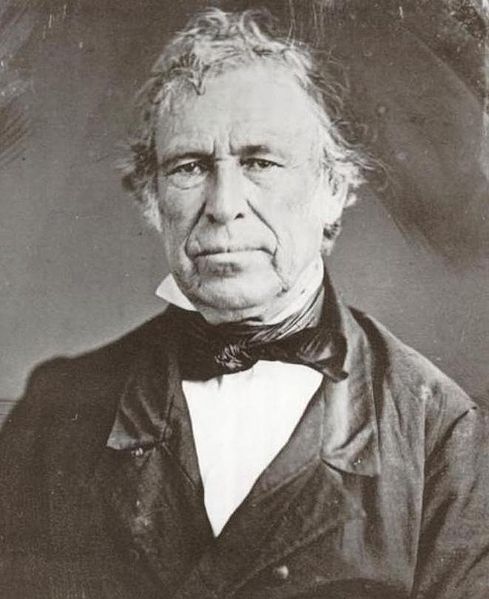
Sarah and Hancock Lee are the great-grandparents of President Zachary Taylor, through their daughter Elizabeth Lee and grandson Colonel Richard Taylor, an officer in the Continental Army.

Zachary Taylor 12th President of the United States was Sarah's great grandson

Zachary Taylor (1784 – 1850) 12th President of the United States was Sarah Allerton Lee’s great grandson

Another great granddaughter was Mary Willis Lee (1757–1798), the daughter of Hancock Lee II (1709-1762) and Mary Willis  (1716–1766). She married Ambrose Madison (1755–1793). He was the son of James Madison, Sr., the owner of a tobacco plantation in Orange County, Virginia; and the brother of President  James Madison

Sources:

http://www.genealogyofnewengland.com/b_a.htm

http://en.wikipedia.org/wiki/Isaac_Allerton

http://www.mayflowerhistory.com/Passengers/IsaacAllerton.php

http://trees.ancestry.com/owt/person.aspx?pid=8273674

http://massandmoregenealogy.blogspot.com/2011/07/mayflower-ancestors-pt-10-isaac.html

http://www.octhouse.com/allertonreport.html

http://www.sail1620.org/history/biographies/101-isaac-allerton.html

Posted in 13th Generation, Artistic Representation, First Comer, Immigrant - England, Line - Shaw, Storied, Wikipedia Famous | Tagged , , , , , , , | 24 Comments

Thomas Cushman Sr.

Thomas CUSHMAN Sr. (1608 – 1691) was Alex’s 10th Grandfather; one of 2,048 in this generation of the Shaw line.

Thomas Cushman Sr. – Coat of Arms

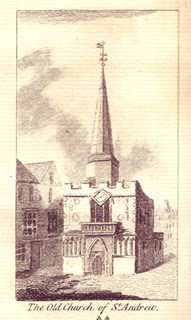
Thomas Cushman Sr. was baptized at St. Andrew Parish, Canterbury, Kent, England, on 8 Feb 1607/08,Canterbury, Kent, England.  His parents were Robert CUSHMAN and Sarah REDER.

Thomas was baptized in St. Andrew’s Church, Canterbury, demolished in 1763

He came to Plymouth in 1621 at the age of thirteen on the ship Fortune with father Robert Cushman, a prominent member of the Pilgrims’ congregation in Leiden.  When his father died of the plague in London in 1625,  he was raised in the family of Plymouth Colony Governor William Bradford.    He married Mary ALLERTON in 1636 in Plymouth, Mass. He succeeded William BREWSTER as Ruling Elder upon Brewster’s death in 1644 and served until his death in 1691.  Thomas died 10 Dec 1691 in Plymouth, Mass.

Cushman’s grave on Burial Hill

Cushman monument Burial Hill

CUSHMAN MEMORIAL
This is a granite column, twenty-five feet high, and it is by far the most conspicuous monument on the hill. It reads:

ROBERT CUSHMAN,
Fellow exile with the Pilgrims in Holland,
Afterwards their chief agent in England,
Arrived here IX November, MDCXXI,
With Thomas Cushman his son:
Preached IX-. December,
His memorable sermon on “the Danger of self-love
And the sweetness of true friendship:”
Returned to England XIII December,
To vindicate tho enterprise of Christian emigration;
And there remained in the service of the Colony Till MDCXXV,
When, having prepared to make Plymouth His permanent home.

West side: —
He died, lamented by the forefathers
as “their ancient friend, – who was
as their right hand with their friends
the adventurers, and for divers years
had done and agitated all their business
with them to their great advantage.”

“And you, my loving friends, the adventurers
to this plantation, as your care has been first
to settle religion here before either profit
or popularity, so, I play you, go on. —
I rejoice — that you thus honor God
with your riches, and I trust you shall be repaid
again double and treble in this world, yea,
and the memory of this action shall never die.”
DEDICATION OF THE SERMON.

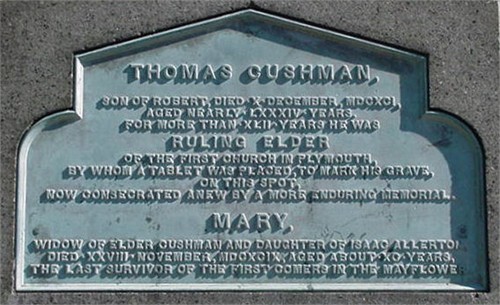
South side: —
THOMAS CUSHMAN.
Son of Robert, died X December, MDCXCI,
Aged neatly LXXXIV years.
For more than XLII years he was
Ruling Elder oú the First Church in Plymouth,
By whom a tablet was placed to mark his grave on this spot,
Now consecrated anew by a more enduring memorial.

MARY,
widow of Elder Cushman, and daughter of Isaac Allerton,
Died XXVIII November, MDCXCIX, aged about XC years,
The last survivor of the first comers in the Mayflower.

East side:
Erected by
The descendants of
Robert Cushman
In memory of their Pilgrim Ancestors,
XVI September, MDCCCLVIII.

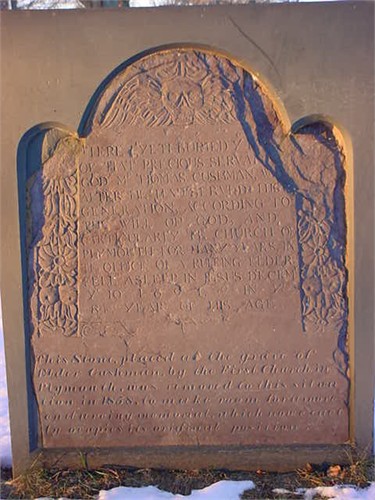
Thomas Cushman – Burial Stone – Inscription: “Here lyeth buried ye body of that precious servant of God, Mr. Thomas Cushman, who after he had served his generation according to the will of God, and particularly the church of Plymouth for many years in the office of a Ruling Elder, fell asleep in Jesus, Decmr. Ye 10. 1691 & ye 84 year of his age.”

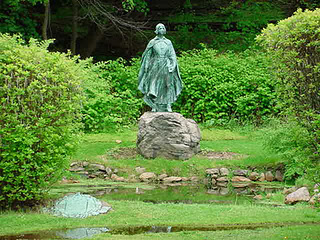
Mary Allerton was born in Jun 1616 in Leyden, Holland.  Her parents were Isaac ALLERTON and Mary NORRIS.  When Mary died on  28 Nov 1699 in Plymouth, Mass, she was the last survivor of the Mayflower. (Wikipedia)  She arrived at Plymouth on the Mayflower when she was about four years old and lived there her entire life; she died aged 83.

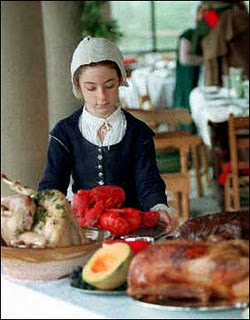
Mary Allerton, Pilgrim Maiden Statue, Plymouth

Thomas and Mary had a surprisingly prosperous family; seven of their eight children survived to adulthood, got married, and provided at least 50 grandchildren. Thomas and Mary both lived to very old age, having never moved from Plymouth. Thomas died in December 1691, reaching nearly 85 years in age. Mary, who gave birth to and raised eight children, lived to the age of 83.  She was buried on Burial Hill in Plymouth, Massachusetts.[3

Children of Thomas and Mary:

Name Born Married Departed
1. Thomas CUSHMAN Jr. 16 Sep 1637 Plymouth, Mass Ruth Howland
17 Nov 1664
(Daughter of  John HOWLAND  John is also our ancestors through Ruth’s sister Desire)

Abigail TITUS Fuller

16 Oct 1679 Rehoboth, Mass.
23 Aug 1726 Scituate, Mass
2. Sarah Cushman c. 1640 Plymouth John Hawkes
11 APR 1661 Lynn, Mass.
.
Daniel Hutchings
7 Nov 1695 in Lynn, Mass
3 Dec 1694
Lynn, Essex, Mass.
3. Martha (Mary) Cushman 1641 Plymouth, Mass. Francis Hutchinson
1676
Lynn, Mass.
22 Oct 1690 Lynn, Essex, Mass.
4. Rev. Isaac Cushman 8 Feb 1647/48 Plymouth Rebecca Harlow
1675
Plymouth
21 Oct 1732 Plymouth,
5. Elkanah Cushman 1 Jun 1651 Plympton, Mass. Elizabeth Cole
16 Feb 1676/77
.
Martha Cook
2 Mar 1682/83 Plymouth
4 Sep 1727 Plympton, Mass.
6. Fear Cushman 20 Jun 1653 Plymouth No Issue Bef. Oct 1690 Plympton
7. Eleazer Cushman 20 Feb 1655/56 Plymouth Elizabeth Coombs
12 Jan 1685/86 Plymouth
14 Oct 1723 Plympton
8. Lydia Cushman c. 1662 Plymouth, Plymouth William Harlow
1679 Plymouth,
11 Feb 1718/19 Plymouth

Taken by father to Leiden, Holland, shortly after baptism; age 10 sailed to Southampton, England, with stepmother on the Speedwell; sailed on Speedwell (with Mayflower), 1620, for New World, with father (stepmother?), but abandoned voyage when vessel put back 3rd time; arrived at Plymouth, MA, on the Fortune in 1621; father returned to England leaving Thomas as ward of Governor Bradford.

Thomas arrived at Plymouth, in good health, in Nov., 1621. In a few days his father returned to England, leaving his only son in the family of his particular friend. Gov. Bradford. And in a subsequent letter, he entreats the Governor

” to have a care of my son, as your own, and I shall be bound unto you.” If it is true, that, “As the twig is bent the tree’s inclined,”

then we have the very best evidence that Gov. Bradford was faithful to the trust imposed in him by his absent friend. In a letter from Gov. B. to Robert Cushman, dated June, 1625, he
says, ” Your son is in good health (blessed be God). He received the things you sent him. I hope God will make him a good man.”

Thomas settled in that part of Plymouth now Kingston.  He was appointed successor to Elder Brewster in 1649, continuing in the office until his death, Dec. 11, 1691.  More than 43 years. … He for several years was assistant to the Governor, and went to London five times in the interest of the Colony.  He spent the latter part of his life in New Haven, where he died.

Thomas Cushman Sr. – Tablet

Timeline

1627 – At a public Court held on the 22d of May, it is considered by the whole company, that the cattle which were the company’s, to Avit, — the cows and the goats should be equally divided by lot to all persons of the same company.” The cattle and goats were, therefore, divided into tAvelve lots, and thirteen persons appointed to each lot. The eleventh lot fell to Gov. Bradford and those with him, among whom was Thomas Cushman, then in the 20th year of his age. ” To this lot fell an heifer of the last year, which was of the great white back cow that was brought over in the Ann, and two she goats.”

Thomas Cushman’s hammer at the Pilgrim Hall Museum

1 Jan 1633 – These following were admitted into the freedom of the society, viz: Mr. William Collins, Thomas Willett, John Cooke and Thomas Cushman.” He was then twenty-five or twenty-six years of age.

Allerton-Cushman Cup, Pilgrim Hall Museum

1 Jul 1634 – “At a generall Court holden before the Governor and Councill, Thomas Cushman plantife agaynst John Combe, Gent, defendant, being cast and adiudged to pay the sayd summe of ten pounds to the plaintife or his Assigns at or before the first of Aug. or else to deliver to him a sufficient cow cafe weaned or weanable.

1635 – Thomas Cushman first served as a Juryman.

1637 – There was granted ” to Thomas Cushman the remaynder of the marsh before the house he liveth in wch Mrs. Fuller doth not vse and the little pcell at the wading place on the otherside Joanes River.” It is supposed that he removed to Jones  River (now Kingston) about this time, “which was not long after he was married, and that there he lived and died.

1645 – He purchased ” Prence’s farm ” at Jones River (now “Rocky Nook,” in Kingston,) by exchanging land at Sowams for it, for £75. It was first owned by his father-in-law, Isaac Allerton.

The exact locality of his house is now pointed out, and a spring of water near it has for many years received the cognomen of” the Elder’s Spring,” from Elder Thomas Cushman, whose house stood near it. It is located in that part of Kingston now called “Rocky Nook,” about fifty rods northerly from the present traveled highway, on the border of the marsh. A description and the boundaries of the land as given in the early Colony Records, show, beyond a doubt, that the tradition respecting that spring and the location of the Elder’s House, must be correct.

6 Apr 1649 – Cushman succeeded William Brewster as Ruling Elder of the Plymouth  Church the position having been vacant since 1644 (Ply. Ch. Recs. 1:165).

29 Mar 1653 – Ousamequin (Massasoit) and his oldest son Wamsitto convey by deed a tract of land in Rehoboth to Thomas Prence, Thomas Cushman and others, for which they pay the sum of thirty-five pounds sterling.

3 Jun 1657 – Gov William Bradford’s will proved.  Elder Cushman, having been raised and educated in the family of Gov. Bradford, was ever his intimate and confidential friend. He was, therefore, the principal witness to his Will. The Governor’s estate was also inventoried by Thomas Cushman.

30 Jun  1669 – Mr. John Cotton, Jr., son of the famous Rev. John Cotton, Pastor of the first Church in Boston, was ordained as Pastor of the first Church in Plymouth. ” Elder Thomas Cushman gave the charge and the aged Mr. John Howland (whose daughter had married his son, Thomas Cushman, Jr.) was appointed by the Church to join in imposition of hands.”

” The Ruling Elder (Cushman) with the new Pastor, made it their first special work to pass through the whole town, from family to family to enquire into the state of souls.”

He had differences with the pastor, John Cotton, as the latter noted in church records in 1683, writing that the elders met with the pastor and decided to put their differences to some other churches for advice, and the Elder (Cushman) moved that the magistrates be invited to meet with and advise them. In succeeding months there are additional intimations of differences in which “the Elder showed discontent” (Ply. Ch. Recs. 1:251, 253-54).

The signatures of Elder Cushman and of his minister. Rev. Mr. Cotton, written in the year 1682.

He became ill in his old age and languished for some eleven weeks before he died on 10 or 11 December 1691, another man whose life was virtually coterminal with that of Plymouth Colony (Ply. Ch. Recs. 1:165-66; George E. Bowman,

“Elder Thomas Cushman’s Will and Inventory, and the Records of His Death,” MD 4:37 ). In his will dated 22 October 1690, sworn 16 March 1691/92, he named his wife Mary, sons Thomas, Isaac, Elkanah, and Eleazer; daughters Sarah Hawks and Lydia Harlow; and the three children of his daughter Mary Hutchinson. He also had a daughter Fear who predeceased him without issue.

Elder Thomas Cushman’s Will

Cofy of Probate Records for the County of Plymouth—Book 1, Commencing with page 120.

” To all People to whom these presents shall come, etc. —
Know ye that I Thomas Cushman, Sen’r, of the town of Pliraouth
in New England, being through God’s mercy and goodness unto
me at this present in some measure of good health of body and of sound understanding and strength of memory, yet considering my frailty and uncertainty of my abiding in this vale of tears, do make this to be my last Will and Testament. And by these presents I do make this to be my last will and testament to remain firm and invincible forever as followeth : Imprimis— I give and bequeath my soul to God that gave it, and my body to ye dust and to be decently buried in hopes of ye grace of God through Jesus Christ to enter into a joyful resurrection. And for my outward estate I dispose of as followeth, viz :

I will and bequeath unto my dear and loving wife Mary Cushman all my house and housing, together Avith all my uplands and meadow lands I am now possessed of in the township of New Plimouth, to be for her use and support during ye time of her natural life, excepting such parcels as I do in this my will give to my children.

Item, — I give unto my son Thomas Cushman two twenty acre lots lying upon ye southerly side of Mr. Joseph Bradford’s land, as also ye enlargeraents of ye head of these lots ; and also twenty acres of upland, more or less, lying upon ye easterly side of Jones River by the bridge, with a skirt of meadow lying by said river ; and also one third of my meadow at Winnatuxet, and also a parcel of salt marsh meadow from our spring unto a cross westerly of a salt hole and so down to ye river, which said parcel of meadow is to be his after our decease. All ye above said parcels of upland and meadow I do by these presents give and bequeath unto my son Thomas Cushman, to him and his heirs forever.

Item, — I give unto my son Isaac Cushman one twenty acre
lot, with ye addition of ye hcad lying on the northerly side of Samuel Flanders land in ye Township of Plimouth, and also the one half of my land lying at Nemasket Pond in ye Township of Middleborough as also ye one half of my right in the sixteen shilling purchase, so called, in Township above sa’d, and also one third part of my meadow at Winnatuxet in Plimouth, all which parcels of upland and meadow last above expressed, I do by these presents give and bequeath unto my son Isaac Cushman, and to him and his heirs for ever, together with all the privileges thereunto belonging.

Item, — I do give unto my son Elkanah Cushman one twenty acre lot with the addition of the head lying on the northerly side of ye land I now improve, but in case my son Thomas’s new dwelling house be upon part of this lot, my will is my son Thomas enjoy ye land his house now standeth on without molestation. As also I give to my son Elkanah Cushman the one half of my land lying at Nemasket Pond, as also ye one half of the sixteen shilling purchase above expressed, as also one third of my meadow at

Winnatuxet. All the above said parcels of lands and meadows
last above expressed, with all the privileges thereunto belonging I do by these presents give unto my son Elkanah Cushman, and to his heirs forever.

Item, — I do give unto my son Eleazer Cushman the rest of
my lands both upland and meadow lands not above deposed of in Plimouth and Duxborough, as also my new dwelling house and out housing, which house and lands I do by these presents give and bequeath unto my son Eleazer Cushman, to him and his heirs forever to enjoy after I and my wife are deceased.

And my will is that my four sons Thomas, Isaac, Elkanah and  Eleazer shall each of them allow twenty to their sisters, that is to say Sarah Hauks and Lidiah Harlow. As also my will is that if any of my sons se cause to make sale of their land I have given them in Plimouth, that they do let their hrothers that do reside in Plimouth have the said lands as they shall be valued by five different men as also my will is, and I do by these presents give and bequeath unto my three grand children in Line the children of my daughter Mary Hutchinson deceased, to each of them twenty shillings to be paid unto them out of my estate soon after my decease.  And I do constitute and appoint my dear and loving wife Mary Cushman to be the sole executrix of this my last Will and Testament, my debts, legacies and funeral charges being first paid my will is that whatever other estate is found of mine in goods, chattels or debts either in Plimouth or elsewhere shall bo for ye support of my wife during her natural life ; and my will is that what remains of my estate at my wife’s decease the one half I do give to my son Eleazur Cushman and the other half unto my two daughters, to Sarah Hauks and Lidiah Harlow to be equally divided between them. And my will is, and I do by these presents appoint my two sons Thomas Cushman and Isaac Cushman and Thomas Faunce to be ye supervisors of this my last will and testament, much confiding in their love and faithfulness to be helpful to my s’d executrix in the acting and disposing of particulars according to the tenore thereof, thus hoping that this my last will and testament will be performed and kept, revoking all other wills, written or verball. I have in witness thereof set to my hand and seal on the 22d of October, 1690.

Signed, sealed and declared to be his last will and testament
in presence of us witnesses.
James Warner, THOMAS CUSHMAN,
Thomas Faunce. And a [ls.]
James Warner and Thomas Faunce, the witnesses

An addition to ye last Will of Thomas Cushman, jSen^r, tvhich
is as followeth:
Whereas in my last Will, which was in sixteen hundred an ninety that I then left out a certain piece of land undisposed of which was one hundred acres of land lying in the Township of Plimouth upon a brook commonly called Colchester Brook/ on both sides of ye said brook, which I reserved to sell for my support, or my wife’s after my decease. My Will is therefore that my son Thomas Cushman and my son Isaac Cushman shall have the above hundred acres of land to be divided equally between them to them and their heirs and assigns forever, provided that they equally shall pay or cause to be paid ten pounds in current silver money to me above said Thomas Cushman, Sen’r, or my wife after my decease, or after decease to be paid equally to my two daughters, Sarah Hauks and Lidia Harlow. Also I the above said Thomas Cushman do will and bequeath to my four sons, Thomas Cushman and Isaac Cushman and Elkanah Cushman and Eleazer Cushman, all my books, equally to be divided among them, only two small books to my daughter, Lidia Harlow, and my best bible to my loving wife Mary Cushman, likewise also I do give and bequeath unto my son Elkanah Cushman one acre of meadow which was granted unto me, lying at Doties meadows.

This addition is to the last will of me Elder Thomas Cushman of
Plimouth being now in perfect understanding, April 1, 1691.
THOMAS CUSHMAN, Sen. [ls.]
Signed, sealed and declared in presence of us witnesses.
Jonathan Shaw, Sen.,
Persis Shaw, Her P mark

Children

1. Thomas CUSHMAN Jr.. (See his page)

2. Sarah Cushman

Sarah’s first husband John Hawkes was born  13 Aug 1633 Charlestown, Mass. His parents were Adam Hawkes and Ann [__?__]. John died 5 Aug 1694 Lynn, Essex, Mass.  He first married 3 Jun 1658 Lynn, Essex, Mass. to Rebecca Maverick b. 7 Aug 1639 Lynn, Essex, Mass.  His name is sometimes erroneously written Hooks.

Within twenty days of 14 Nov 1675, the couple experienced a severe affliction in the loss, by death, of all their daughters, excepting the infant Mary.

Sarah’s second husband Daniel Hutchings was born

3. Martha (Mary) Cushman

Martha’s husband Francis Hutchinson was born 1630 Alford, Lincolnshire, England Francis died 12 Nov 1702 Reading, Mass.

4. Rev. Isaac Cushman

Isaac’s wife Rebecca Harlow was born 12 JUN 1655 Plymouth, Plymouth, Mass. Her parents were William Harlow and Rebecca Bartlett. Rebecca died 3 Sep 1727 Plympton, Plymouth, Mass.

Isaac was a member of the chh. at Plymouth, and obtained a better education than most men of that day. In 1685 he was one of the Selectmen of Plymouth, and in June 1690 he and John Bradford were tbe Deputies from Plymouth to the General Court of tbe Plymouth Colony, and in Aug. the same year another General Court was held and the same Deputies were re-elected.

In June 1691, John Bradford and Isaac Cushman were again elected Deputies to the General Court, from Plymouth, and it was the last one previous to tbe union of tbe Plymouth and Massachusetts Colonies, which took place in 1692. The first General Court of the new Province was held 8 June, 1692His venerable father, Elder Thomas Cushman, having died in 1691, the chh. at Plymouth was without a ” Ruling Elder,” then an office of great importance and responsibility. We may reasonably suppose that the early attention and thoughts of the chh. were directed to the consideration of a successor ; but we find no evidence of any chh. action till 1694. We copy from the first volume of the Plymouth chh. Records, p. 22

” 1694, March 7, was a chh. meeting which the Sabbath before the chh. had notice and were then desired to prepare their thoughts to nominate some brethren to serve in the office of Elders and Deacons. The chh. spoke man by man, and all but two or three of the brethren nominated Deacon Faunce and Bro. Isaac Cushman for Elders.”

He was the first minister of the Church of Plympton (37 years in his ministry).

He was called to the pastorate of the Church in Middleboro, and of the new church established in Plympton… He was more liberal in religious matters than his contemporaries, and secured the adoption of new articles of faith, which have remained to the present day, with little change as the creed of the Congrational Church.”

The following is the inscription on the monument erected in his memory:

HERE LYES ENTERED Ye
BODY OF Ye REVd
Mr. ISAAC CUSHMAN Ye
1st MINISTER OF Ye CHURCH
OF CHRIST IN PLYMPTON
DEC’d OCT’br Ye 21st
1 7 3 2 IN Ye
84th YEAR OF HIS
AGE & IN YE 37th
YEAR OF HIS MINISTRY

Isaac Cushman Headstone — Hillcrest Cemetery Plympton, Plymouth, Mass. Plot: R1-P8-S1

5. Elkanah Cushman

Elkanah’s first wife Elizabeth Cole was the daughter of  James Cole, Jr.  Elizabeth died  4 Jan 1681/82.

Elkanah’s second wife Martha Cook was born  16 Mar 1658/59 Plymouth, Mass. Her parents were Jacob Cook and Damaris Hopkins. Martha died 17 Sep 1722. Plympton, Plymouth, Mass.

He had 8 children, Three by his first and 5 by his second. He was Deacon of the chh. at Plympton (of which his brother Isaac was Pastor) about nine years. In 1723 he was the Representative in the General Court from Plympton, and held the office of Ensign inthe military company in that town, — in those days, an office of considerable distinction. The Plympton Chh. Records say,

“At a chh. meeting in Plympton, December ye 26. 1718, Ensign Elcanah Cushman” (and two others) “were chosen Deacons.”

Elkanah Cushman Headstone — Hillcrest Cemetery Plympton, Plymouth, Mass. Plot: R1 P8 S11

7. Eleazer Cushman

Eleazer’s  wife Elizabeth Coombs was born 30 Nov 1662 Boston, Mass. Her parents were John Coombs and Elizabeth Royal. Elizabeth died in Plympton, Plymouth, Mass.

Eleazer was a church member, and was received during the ministry of his brother, Rev. Isaac Cushman. From `Isaac Allerton of the Mayflower`: Eleazer Cushman held offices in Plymouth as late as 17 March 1710/11, so most of his children were born there. In 1722 (no date) Eleazer Cushman deeded land to son Moses Cushman. On 14 Oct 1723 Eleazer Cushman Sr. of Plympton deeded his homestead in Plympton to son Eleazer Cushman reserving the right to live there during his life as well as his wife as long as she remained his widow. A November 1733 petition mentions Eleazer Cushman. His land was to remain in the old precinct (Plympton). No Plymouth Co. PR for Eleazer Cushman.He had possibly an 8th child, a daughter, Mary.

Children of Eleazer and Elizabeth:
i. Lydia Cushman Waterman (1687 – 1771)
ii. James Cushman (1690 – 1778)
  iii. John Cushman (1695 – 1722)

8. Lydia Cushman

Lydia’s husband William Harlow was born 2 Jun 1657 Plymouth, Plymouth, Mass. His parents were William Harlow and Rebecca Bartlett. William died 28 Jan 1711/12 Plymouth, Plymouth, Mass.

Sources

http://www.genealogyofnewengland.com/b_c.htm

http://familytreemaker.genealogy.com/users/c/o/r/Jennifer-Corkins/GENE1-0002.html

http://en.wikipedia.org/wiki/Mary_Allerton

http://trees.ancestry.com/owt/person.aspx?pid=3820173

A Historical and biographical genealogy of the Cushmans: the descendants of Robert Cushman, the Puritan, from the year 1617 to 1855 (1855) by Cushman, Henry Wyles, 1805-1863

http://massandmoregenealogy.blogspot.com/2011/11/thomas-cushman-ca-1607-to-1691-plymouth.html

Posted in 12th Generation, Artistic Representation, First Comer, Historical Monument, Immigrant - England, Line - Shaw, Public Office | Tagged , | 15 Comments

Thomas Cushman Jr.

Thomas CUSHMAN Jr. (1637 – 1766) was Alex’s 9th Grandfather; one of 1,024 in this generation of the Shaw line.

Thomas Cushman was born 16 Sep 1637 in Plymouth, Mass.  His parents were Thomas CUSHMAN Sr. and Mary ALLERTON.   He first married Ruth Howland on 17 Nov 1664.  After Ruth died, he married Abigail TITUS Fuller on 16 Oct 1679 in Rehoboth, Mass.   Thomas died 23 AUG 1726 in Scituate, Mass.

Thomas Cushman Jr – Headstone – Centre Burying Ground at Plympton, 33 feet NE of the gate on the west side.

Ruth Howland was born 16 Sep 1637 in Scituate, Mass.  Her parents were John HOWLAND and Elizabeth TILLEY.  John and Elizabeth were also our ancestors through their daughter Desire.  Ruth died in 1679 in Rehoboth, Mass.

Abigail Titus was born 18 Feb 1653. Her parents were John TITUS and Abigail CARPENTER.  She first married John Fuller 25 Apr 1673.  John was killed during an Indian attack on Rehoboth during the King Philips War.  Abigail died 31 May 1734 in Attleboro.

Children of Thomas and Ruth Howland:

Name Born Married Departed
1. Robert Cushman 4 Oct 1665,
Mass
Persis Lewis
or
Persis Pratt
1697
.
Prudence Sherman
2 Feb 1743/44
30 Sep 1757
Kingston, Plymouth, Mass
2. Thomas Cushman c.  1670, Northampton, Ma Sarah Strong 1700 9 Jan 1725/26, Lebanon, CT
3. Desire Cushman 9 Feb 1672/73, Plymouth Samuel Kent
17 Dec 1686 – Swansea, Bristol, Mass.
8 Feb 1762, Barrington, RI

Children of Thomas and Abigail:

Name Born Married Departed
4. Job Cushman 1676 Plymouth, Mass. Lydia Brewster
c. 1706
Bef. 21 May 1740
5. Bartholomew Cushman 1683 Plymouth, Mass. 21 Dec 1721 Plympton, Plymouth, Mass.
6. Barnabas Cushman 1684
7. Samuel CUSHMAN 16 Jul 1687 Plymouth, Mass. Fear CORSER
8 Dec 1709 Plympton, Mass.
8. Benjamin Cushman 1 Mar 1690/91 Plymouth, Mass. Sarah Eaton
8 Jan 1711/12 Plympton, Mass.
.
Sarah Bell 14 Mar 1738 Plympton, Plymouth, Mass.
17 Oct 1770 Plympton, Ma

Thomas Cushman, the first son of Plymouth’s Ruling Elder Thomas Cushman and Mary (Allerton) Cushman, a Mayflower passenger. Little is known of his growing years. Some time in the early 1660’s, Thomas Jr. began courting Ruth Howland. Ruth was the youngest daughter of Mayflower passengers John Howland & Elizabeth Tilley and very near neighbors to the Cushman Family. On 7 Mar 1665 Thomas Jr. was fined five pounds by the Court for committing “‘carnal copulation with his now wife before marriage, but after contract.”

The common practice in vogue then of “courting ” by young men and maidens, and the uniform fashion ” of keeping company till the small hours of the night,” was one that did not tend to promote a high degree of virtuous intercourse.

Thomas did not suffer much materially in his reputation by an error which he soon remedied by marriage and was, during a long life, a worthy member of the Congregational Church at Plympton, of which his brother Isaac was the Pastor. However, Thomas Cushman, Jr. squandered the opportunity to be considered to succeed his father as Ruling Elder. In 1694, Thomas’ younger brother Isaac was chosen to succeed his father as Ruling Elder. In 1664 Thomas Jr. and Ruth were married and remained in Plymouth. “. … they lived on the west side of the highway that leads from Plympton meeting house to the north part of the town, and ‘Colehester Brook’ ran through his farm, which contained a large quantity of land.” Ruth died as a young woman sometime after 1672, and Thomas Jr. married Abigail Fuller in 1679.

Thomas’s second wife [and our ancestor] was Abigail Fuller of Rehoboth, and they were members of the Congregational Church at Plympton. They had 4 children: Job, Bartholomew, Samuel & Benjamin. Plympton was divided from Plymouth in 1707 and Thomas’s farm was then in the limits of the new town. His farm was large, with many buildings and with Colchester Brook running through it. It lay west of the highway going north from the Plympton meeting house. For many years Thomas had been a surveyor of highways for the town of Plymouth.

“On 21 May 1721 Thomas Cushman of Plimpton, yeoman, deeded to his son Benjamin the house and land where Benjamin was living. On the same day he deeded to son Samuel the land where Samuel was living. On 25 Dec. 1721 he deeded the land where he, Thomas, was living to sons Benjamin and Samuel.”

Children

1. Robert Cushman

Robert according to church records was born Oct. 4, 1664. For the observant reader, you will note that is about 6 weeks before his parents were married.

Robert’s first wife was either Persis Lewis or Persis Pratt.  Persis Lewis was born 15 Jan 1671 in Swansea, Bristol, Mass. Her parents were Thomas Lewis and Hannah Baker.  Persis Pratt was born 1670 Plymouth, Plymouth, Mass.  Her parents were Benajah Pratt and Persis Dunham.  In either case, Persis died 14 Jan 1742/43 Kingston, Plymouth, Mass.

Persis Cushman Headstone — Ancient Burial Ground Kingston, Plymouth, Mass

Robert married his second wife at the ripe young age of 80.  Prudence Sherman was born 1674 Marshfield, Mass. Her parents were Samuel Sherman and Sarah Daggett.

Robert Cushman Headstone — – Ancient Burying Ground Kingston, Plymouth, Mass – 

2. Thomas Cushman

Thomas’ wife Sarah Strong was born 1674 Northampton, Hampshire, Mass. Her parents were Jedediah Strong and Freedom Woodward. Her grandparents were Elder John STRONG and Abigail FORD. Sarah died 25 DEC 1726 Lebanon, New London, CT.

3. Desire Cushman

Desire’s husband Samuel Kent was born 23 Mar 1668 in Swansea, Bristol, Mass.  His parents were Joseph Kent and Susanna George. Samuel died 15 MAY 1727 in Barrington, Bristol, Rhode Island.

Samuel Kent Headstone — Tyler Point Cemetery , Barrington, Bristol, Rhode Island,

x

Desire Cushman Kent Headstone — Tyler Point Cemetery Barrington Bristol, Rhode Island,

4. Job Cushman

Job’s wife Lydia Brewster was born 11 FEB 1679/80 Duxbury, Plymouth, Mass. Her parents were William Brewster and Lydia Partridge.

Alternatively, Lydia’s maiden name was Arnold.  Job Cushman’s estate was settled by his widow Lydia and her brother Edward Arnold, who were Administrators, 21 May 1740. Widow Lydia Cushman’s will was proved 27 Sept 1746. Her brother Edward and dau. Lydia were Executors. She gave to her eldest dau. Maria Barker, “my book called concordance, and my smallest looking glass

7. Samuel CUSHMAN (See his page)

8. Benjamin Cushman

Benjamin’s first wife Sarah Eaton was born 20 OCT 1695 Plymouth, Mass. Her parents were Benjamin Eaton and Mary Coombs. Sarah died 19 FEB 1736/37 in Plympton, Plymouth, Mass.

Benjamin’s second wife Sarah Bell was born 1693 in Plymouth County, Mass. Sarah died 16 JAN 1783 in Plympton, Plymouth, Mass.

18 Aug 1758 –  Plympton Church Records

A complaint was made to the chh. against Benjamin Cusliman for neglecting the communion, &c. ; and at the same time said Benjamin made a complaint against Dea.Samuel Bryant. The chh. on full consideration voted that Benjamin should confess and thus render christian satisfaction for his offences. But that he refused to do. The chh. voted the same in 1763 ; but he replied to a committee of the chh. that ‘ the Devils in Hell could not treat him Avorse than the chh. had.’ Nov. 20, 1763, he was publicly admonished. Oct. 14, 1770 — seven years after his admonition— he made a confession and was restored to the communion of the chh

Benjamin Cushman Headstone — This cemetery is on Main Street, Plympton, MA. Cemetery also known as Hillcrest Cemetery.

Sources:

http://www.genealogyofnewengland.com/f_5.htm#34

http://familytreemaker.genealogy.com/users/d/e/h/Jeffrey-L-Dehart/GENE13-0003.html

A Historical and biographical genealogy of the Cushmans: the descendants of Robert Cushman, the Puritan, from the year 1617 to 1855 (1855) by Cushman, Henry Wyles, 1805-1863
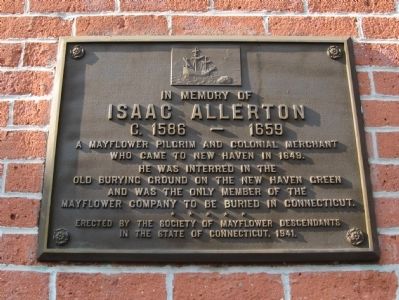
Posted in 11th Generation, Line - Shaw, Public Office, Violent Death | Tagged | 9 Comments

Samuel Cushman

Samuel CUSHMAN (1687 – 1766) was Alex’s 8th Grandfather; one of 512 in this generation of the Shaw line.

Samuel Cushman was born 16 Jul 1687 in Plymouth, Mass.  His parents were Thomas CUSHMAN Jr. and Abigail TITUS Fuller.  He married Fear CORSER on 8 Dec 1709 in Plympton, Mass.  Samuel died 19 Feb 1766 in Attleborough, Mass.

Samuel Cushman Headstone – Newell Burying Ground, Attleboro, Bristol, Mass

Fear Corser was born in 1685. Her parents were John CORSER and Margaret [__?__] Fear died 2 Dec 1767 in Attleborough, Mass.

Fear Cushman Headstone – Newell Burying Ground Attleboro,Bristol, Mass

Children of Samuel and Fear:

Name Born Married Departed
1. Desire CUSHMAN 18 Sep 1710 Plympton, Mass. Ebenezer FOSTER
17 Sep 1730 Attleboro, Mass.
27 Nov 1810
2. Mercy Cushman 8 Feb 1711/12 Plympton Ensign Noah Fuller
1740
11 Jan 1797
Attleboro
3. Samuel Cushman 10 Jul 1715 Plympton 22 Apr 1727 Plympton,
4 Joseph Cushman 7 Jan 1716/17 Plympton 10 May 1727 Plympton
5. Jacob Cushman 20 Mar 1718/19 Plympton Elizabeth Read
1743
.
Hannah Stetson (Widow Cobb)
30 May 1764
Plympton, Mass
24 May 1796
Attleboro, Mass
6. Jemima Cushman 23 Oct 1724 Plympton 2 May 1727
Attleboro
7. Bartholomew Cushman 1727
Attleboro, Mass
26 Aug 1736
Attleboro
8. Jemima Cushman 1729 2 Apr 1736
Plymton, Mass

He was a grandson of Mary Allerton youngest Mayflower passenger and the last survivor.

Children

Cushman Che Walnut, chestnut, pine and brassMade in Massachusetts, possibly in the Taunton River area, 1680-1700  Descended in the family of Desire Cushman

Cushman Chest: Walnut, chestnut, pine and brass
Made in Massachusetts, possibly in the Taunton River area, 1680-1700 Descended in the family of Desire Cushman
Pilgrim Hall Musuem

This chest shows clearly the evolution of a furniture style. Unlike earlier chests that had drawers only in the bottom and were constructed of panels set in a joined framed, this chest is made of solid wood and the drawers occupy the entire case. Also unlike earlier chests with painted decorations, the maple grain is highlighted to serve as the chest’s adornment.

1. Desire CUSHMAN (See Ebenezer FOSTER‘s page)

2. Mercy Cushman

Mercy’s husband Noah Fuller was born 18 Oct 1712 Attleborough, Bristol, Mass. His parents were Noah Fuller and Rachel Pidge. Noah died 10 Aug 1786 Attleborough, Bristol, Mass.

Noah Fuller Headstone — Newell Burying Ground,  Attleboro, Bristol County, Mass

5. Jacob Cushman

Jacob’s first wife Elizabeth Read was born 2 Apr 1721 Attleborough, Mass. Her parents were Daniel Read and Elizabeth Ide. Elizabeth died 26 May 1762 in Attleboro.

Jacob Cushman Revolutionary War Service

Jacob’s second wife Hannah Stetson was born about Jul 1732. Her parents were Joseph Stetson and Abigail Hatdh. She first married 16 Nov 1758 Plympton, Plymouth, Mass. to Rowland Cobb b. Jul 1732

Jacob Cushman Headstone — Newell Burying Ground Attleboro, Bristol County, Mass

7. Bartholomew Cushman

d. Aug. 26, 1736, in his 10th y. G.R. 13.

Bartholomew Cushman Headstone – Newell Burying Ground Attleboro, Bristol, Mass

x

8. Jemima Cushman

She was the second dau. named Jemima, latter b. and d. of record at age 3 at Plympton before the family’s move to Attleboro. Attleboro VRs: Jemima, d. Samuel & Fear, d. Apr. 2, 1736, in her 7th y. G.R. 13.

Jemima Cushman Headstone — Newell Burying Ground Attleboro, Bristol, Mass

Sources:

http://www.genealogyofnewengland.com/b_c.htm

http://familytreemaker.genealogy.com/users/c/o/r/Jennifer-Corkins/GENE1-0004.html

http://trees.ancestry.com/tree/15949789/person/525031421

Posted in 10th Generation, Historical Monument, Line - Shaw | Tagged | 4 Comments

John Foster Sr.

John FOSTER Sr. (1618 – 1687) was Alex’s 10th Grandfather; one of 2,048 in this generation of the Shaw line.

John Foster Sr. – Coat of Arms

John Foster Sr. was born in 1618 in Kingswear, Devon, England.    He came to America with Roger Conant‘s company, and settled in Salem, Massachusetts Bay. He married Mary TOMPKINS about 1649 in Salem, Mass.    After Mary died, John married her sister Martha about 1657.  John died 16 Nov 1687 in Salem, Mass. Some researchers say this was due to an accidental shooting by his friend Joseph Smalls, but actually Smalls shot Aron Read in 1670 and John gave the following deposition

Essex Deed vol iii folio 99: The deposition of John Foster Sr aged about fifty-two years saith that being with Aron Read a little before he died when Samuel Eborne asked him whether Joseph Small and he did not go forth as two brothers and he answered yea. yea.  Samuel Eborne asked him again whether there were at any time any private grudge between Joseph Small and himself, or whether the said Joseph did shoot him willfully or not.  he answered with great affection oh no, no, no  and these were the last words he spoke.  Taken upon oath 11: 9: 70 Signed Wm Hawthorne assistant
John Tompkins Jr ae twenty-five, Samuel Ebourne ae fifty-eight, Robert Pease ae forty-one, Martha Foster ae about forty-three each deposed in the same manner.   Evidently a case of “I didn’t know the gun was loaded.”

I’m perplexed about how John Foster Sr’s wife could have had thirteen children over a thirty year span from about 1647 to 1677.  John’s wife is sometimes called Mary Tompkins and other times Martha Tompkins.  Mary would have been 56 when John’s youngest son Ebenezer was born in 1677.  Martha at 14 or less would have been too young to be  John FOSTER Jr’s   mother (he was born before 1650)   My solution, which I haven’t seen elsewhere, except this chart, is that John Foster Sr. married both Mary and Martha.  Some genealogies say that Mary died in 1656 and there is six year gap between Samuel’s birth Jan 1651/52 and Benjamin’s birth 3 Jul 1658.  I’m not sure this is the right explanation, but it is the only one I can find that fits the facts.

Mary Tompkins was born in 1621 in Edlesborough, Buckinghamshire, England.  Her parents were Ralph TOMPKINS and Katherine FOSTER (or Katherine CARDWELL).  Mary died about 1656.

Martha Tompkins was born about 1636 in Salem, Mass.  Her parents were Ralph TOMPKINS and Hannah Aborne.  After John died, Martha married Richard Adams  who conveyed land to “Martha relict of John Foster deceased, my intended wife” in an Essex deed Vol III, p. 715

 Indenture Richard Adams, yeoman of Salem, and Martha Foster, relict widow of John, lately deceased.  16 Nov  1688, in consideration of a contract and covenant of marriage, etc. gives her his whole estate real personal property, etc providing if she shall have issue by him his estate shall revert to his offspring, otherwise to her children.

Martha’s date of death is often listed as 16 Nov 1688, but that is the date of the above Essex deed.  I wonder if it is coincidence that it is dated exactly one year after John Foster’s will of Nov 16 1687 which was proved Mar 14 1688.

Children of John and Martha:

Name Born Married Departed
1. Mary Foster 24 Mar 1649/50 Salem, Mass Hugh Jones
31 Dec 1672 Salem, Mass.
13 Feb 1711
Salem
2. Samuel Foster c. Jan 1651/52 Salem Sarah Steward
14 May 1676 Salem, Mass.
.
Margery [_?_]
1691
Salem
19 Aug 1728 Walpole, Mass.
3. John FOSTER Jr. bapt.
3 Jun 1655 in 1st Ch Salem, Mass .
Mary STEWART (Stuard)
18 Mar 1672
.
Mary Cowes (Widow Pomerory)
12 Jul 1692 Salem, Mass
14 Jun 1714 Salem, Mass
4. Benjamin Foster 3 Jul 1658
Salem
Not mentioned in father’s will
5. Jonathan Foster 20 Dec 1660
Salem
28 Mar 1662
6. Jonathan Foster 22 Nov 1662
Salem
6 Nov 1667
7. Joseph Foster Oct 1664 Salem, Mass. Ann (Hannah) Trask
21 Nov 1683
1705
Dorchester, Suffolk, Mass
8. David Foster 16 Oct 1665
Salem, Essex, Mass
Hannah Buxton
13 Jan 1687 in Salem, Essex, Mass
18 Sep 1748
Salem, Essex, Mas
9. Elizabeth Foster 22 Nov 1667 1688
10. Jonathan Foster 12 Jun 1670 Living in Boston in 1725
11. Hannah Foster 21 Jul 1672 Not mentioned in father’s will
Aft 1703?
12. Martha Foster 1674
Salem, Mass.
John Rich
25 Oct 1698
13. Ebenezer Foster 5 Aug 1677
Salem, Essex, Mass
Anna Wilkins
19 Dec 1700 Salem, Essex, Mass
23 Mar 1718
Salem, Essex, Massa

Corporal John Foster, immigrant ancestor, was born in England according to his affidavit, dated 1670, stating his age as fifty-two years.

Foster was a farmer, though he built a bridge for the town and may also have been a carpenter or stone mason.

He resided in Salem and was the owner of considerable property in the North Fields, see my post  Division of the North Fields.  Curiously enough, the Land Grants of Salem and the Record of Deeds of Essex County show no lands of which he was the grantee, but by deeds given by him, we learn that he was possessed of upland, swamp and salt marsh on the north side of the North Field, which formerly belonged to Thomas Scudder, Senior -Essex Deeds iv.p.79; also thirty acres “near unto Ipswich River,” within the limits of Salem, formerly granted him by the town – Essex Deeds iii-p.56; also salt marshes at Royal Side and at the East Cover in the North Field – Essex Deeds, ix.p.36.

John Foster was born in England, possibly Buckinghamshire, about 1620.   Some think that he came to Massachusetts on board the Hopewell, of London in 1635, with Thomas Babb as master, it sailed about the middle of September and reached Boston in late November.  Some say John Foster, age 14, was a passenger on this ship and may have been an orphan, as it was a common practice at that time for England to rid her cities of the burden of homeless children by sending them to the colonies. His age, 14, may or may not be correct, as it was necessary for a child to be at least 14 in order to travel alone. Thus, his age may have been incorrectly listed in order to give the appearance of compliance.  However, the ship’s manifest actually shows Forten, Jo. Age 14 not Foster, John.

But, maybe he wasn’t an orphan. Perley’s book, The History of Salem, states that John Foster was the son of Katherine Tompkins, wife of Ralph Tompkins. He states that they all came to Salem to make their home, and indeed a ships record does exist that shows Ralph and Katherine Tompkins came to New England in the fall of 1635 on board the ship Truelove. Many questions persist. Why did they come on board separate ships?

The dates that Perley quotes concerning the marriage of Ralph and Katherine (1608) and John’s birth (1618-1620) seem to be accurate. The marriage of Ralph and Katherine was recorded in England, and John’s age is recorded in ship records, and land records, that verify the approximate date of his birth. John was born after Katherine married Ralph, so it doesn’t seem that John could be the child from an earlier marriage, (there are some records that indicate that Katherine Foster was a widow, when she married Ralph Tompkins.)

Perley does not identify his sources concerning the Tompkins and Foster families. Also, most records indicate that Martha Tompkins, John’s wife was the daughter of Ralph Tompkins and Katherine Foster Tompkins. It was permissable to marry a first cousin, but clearly it was not permissable to marry a half-sister. All of this seems to indicate that Katherine Foster Tompkins was not the mother to John Foster, as Perley thought. Possibly John Foster and Katherine Foster Tompkins were related in some other way. (Aunt & nephew; cousins?) The Foster Genealogy by F.C. Pierce states that Thomas Aborne was the father of Katherine Foster Tompkins. Research needs to be done on English records to try and sort this out. The Privy Council in England gave permission for people to leave England. The records of the Privy Council may prove interesting.

Timeline

1657 – John Foster was paid £8 for work on the bridge. Salem Town Records (II, Essex, 185)

1664 Lot #91, 1675 Lot #82, 1700 Lot # 59,  -The Division of the North Fields was laid out before the Salem town records were begun. Most of the original lots consisted of ten acres each. See the above link for the location of John’s land.

14 Apr 1669 – John Foster to Nathaniel Putnam. Thirty acres of land “formerly granted to me by the town of Salem, to be laid out within the limits of Salem, near to Ipswich River.” Essex Deeds, vol. iii, p. 187:

18 Apr 1672 –  Be it known, etc., that I John Foster, Sr., of Salem, sc., for divers good causes especially the natural affection and fatherly care and love to my son John Foster, a parcel of upland, swamp, and salt marsh, north side of the north field, having the land of Thomas Robbins on the west down to the river, that is on the north side of said field. Martha, wife of John, Sr., yields her dower. Essex Deeds, vol. IV, p. 155:

25 Mar 1678 – John Foster, Sr., husbandman of Salem, to my son, Samuel, three acres in North Field, on north neck, as by some so called, part of land bought of Thomas Scudder, bounded by lands of my son John, upon the western side by Thomas Robbins. Witnesses: John Waters, John Foster, John Foster, Martha Foster, Richard Croad. Essex Deeds, vol. IV, pp. 610-12:

Note:    A husbandman is a class used in England and the early colonies. It means that he owned his own land and was a farmer, but that he was not a freeman and could not vote. It is mentioned in the town records in 1657 that he was paid £8 for work done on the bridge, so it is possible that he also did carpentry, or stonework.

1676 – John was in King Phillip’s War under Capt. William Turner at North Hampton, Ma.

25 Mar 1678 – As requested by English Crown, the Oath of Allegiance to England is to be taken by every male inhabitant over 16 years of age. John Foster, Sr., John Foster, Jr., and Samuel Foster were ordered to appear. – General Court Records

Jun 1680 – Petition to local court requesting that meeting house be enlarged and signed by a large number of the inhabitants of Salem, including John Foster, Sr. and John Foster, Jr.

24 May 1682. – He was Freeman of Ipswich, Mass.

16 Mar 1685 – John Small, aged about sixty-eight years, and John Foster, Sr., aged about sixty-seven years, testified that to their knowledge Deacon John Orne had possessed the lot thirty-five or six years etc. Sworn by John Foster, ” etc. would mean he was born in 1618. They further testified that they had been inhabitants and had dwelt in the North field about thirty-six years and had constantly attended the proprietors annual meetings. [Research of Julie Foster Van Camp, Foster family researcher]
“Salem Quarterly Reports, Records and Files,1685”; p. 439

Dec 1687 or early 1688 – John died due to an accidental shooting by Joseph Small.

John’s will was dated November 16th,1687 and was probated in Boston on March 14th, 1688

Will

Boston Probate Court, Wills 10, p. 266, file 1625: The last will and testament of John Foster, Sr., of Salem; dated Nov. 16, 1687: probated at Boston, Suffolk County, March 14, 1688.

I, John Foster Senior, of Salem, etc., – make this my last will and testament. I give unto my eldest son John Foster ye land where he now dwelleth which formerly I gave him. I give him forty shillings to be paid by my Executor within seven years after my decease. Unto my son Samuel the piece of land which lies before his door containing about an acre and a half bounded with a path on one side a swamp on ye other and (John?) Waters land and said Samuel’s land on ye other two sides. Unto David Foster my son, all that my homestead viz: my dwelling house and about five acres of land more or less. Unto my other three sons, viz: Joseph, Jonathan, and Ebenezer, all ye rest of my land in ye north field and marshes and meadow in ye same with ye marsh at Royal Side after my wife’s decease or after her marriage provided they pay unto their three sisters, Mary, Elizabeth and Martha four pounds in pay a piece in five years after they come to enjoy all above said land which is to be equally divided both as to quantity and quality, all wares excepting ye third of ye two pieces of marsh at ye great cove given my son by his Grandfather which I hereby confirm. To my said three daughters, twenty shillings apiece. To my wife all my movables and stock and what shall remain att her decease shall be equally divided among the children. I appoint my wife and son David Executors.

Signed John Foster Senior
In presence of us, Steph Sewall, James Seymonds, Steven Small.
Who made oath at Ipswich March 14, 1687/88.

Inventory of the estate of John Foster, Sen’r late deceased, taken Jan’y 19, 1687/88 by Isaac Cooke and Steven Small.
Amount, £136: 18: 0. Debts due said estate 12: 11: 2.
This inventory exhibited by Martha Foster ye widdow of ye said John Foster and David Foster his some Executors of his Will ye 4th day of April 1688.

Questionable Children

Many genealogies of John Foster and Martha Tompkins include three early children Thomas, Edward and Bartholomew Foster.   I don’t think they belong. John and Martha married in America. They lived in different towns and are not mentioned in John’s will

I also think 1621 is too early for Martha’s birthday as she would have been 56 years old when Ebenezer was born .

Thomas Foster was born in 1642.  He died in 1685 New London, CT

Edward Foster was born in 1645 Kingswear, Devon, England.  He married Elizabeth Harris 20 JUN 1670 Middletown, CT .  Edward died 14 JUN 1712 Guilford, CT.  Edward’s wife Elizabeth Harris was born  1649 Middletown, CT. Her parents were William Harris and Edith Bly. Elizabeth died 7 OCT 1736 Middletown, CT.

Bartholomew Foster was born 1646 Kingswear, Devon, England He married Hannah Very 9 NOV 1668 5 DEC 1689 Gloucester, Essex, Mass.  Bartolomew’s wife Hannah Very was born 31 MAR 1652 Gloucester, Essex, Mass. Her parents were Thomas Very and Hannah Giles. Thomas was a fisherman of Gloucester, where he appeared before 1650. He and Hannah Gyles were married by Deputy Governor Endicott. Thomas owned several lots of land in Gloucester, and resided at the Harbor.

Children

John and Martha had thirteen children, and at least nine survived until adulthood. Their children were baptized and their births recorded at First Church in Salem, a Puritan Congregational Church. When John Foster, Jr. was baptized, it was written “John, son of Sister Foster”. No mention was made of John, Sr. in the church records, although he was alive at this time. This leads me to believe that John, Sr. may not have been a church member in good standing.

1. John FOSTER Jr. (See his page)

2. Mary Foster

Mary’s husband Hugh Jones was born 1635 in Wincanton, Somerset, England. His parents were Robert Jones and Elizabeth Soane. He first married 26 Jun 1660 in Salem, Essex, Mass to Hannah Tompkins (21 Dec 1641 in Salem – 10 May 1672 in Salem).  He had seven children with Hannah and four more with Mary. Hugh died in 1688 in Salem, Essex, Mass.

Hugh Jones, progenitor of the particular Jones family herein treated, was born about 1635, came to New England about 1650 and settled in Salem, Mass.,where he resided the rest of his life and died about 1688. The following deposition secured presumably to establish a claim to some property in England affords authentic particulars of his origin and emigration: “These Presents are to certifie unto whom it may concerne that wee Thomas Cromwell and John Cromwell whoe have beene long inhabitants here in the towne of salem,in ye countie of Essex, heare in New England, doe testifie that wee have known Hugh Joanes, as one coming from England in ye same ship with us into the contry above thirty yeares agoe. (and as we understood abord Mr. Stratton’s ship) that he came from Wincanton and was servant to Mr. Robert Gutch :and his sister and Elizabeth Due and Margaret White and James Abbott and John Vining as wee understood came from the same place: and the same Hugh Joanes that came along with us into ye contry is now liveing. Taken upon the coroporall oathes of ye sd Thomas and John Cromwell in court at Salem the 27 of June 1682.And also ye sd Hugh Joanes then personally appeared in Court being in health. Attestes Hillard Veren, Clerk” (Essex Co.Deeds,Vol vi,fol 28.)

“An inventory of the estate of Hugh Jones was returned in Dec 1688, with an additional inventory in Nov 1690. (Essex Institute Hist. Coll., vol. iv, p. 44.)”  “The record of the decease of Hugh Jones has not been found, but it may be surmised that he came to a mysterious end, as, during the Salem witchcraft trials in 1692, Elizabeth Booth deposed that the uneasy ghosts of four murdered persons appeared to her; and that ‘the spectre of Hugh Jones assured her that Mrs. Elizabeth Proctor (daughter-in-law of our ancestor John PROCTOR) killed him because he had a poght of syder of her which he had not paid her for.’ (Essex Institute Hist. Coll., vol. ii, p. 198.)”

Elizabeth Booth age 18 or thereabouts testifieth

 that one the 8 of June hugh Joanes Apered unto me & told me that Elesebeth procter Kiled him be Cause he had a poght of sider of her which he had not paid her for

The 8 of June Elesebeth Shaw apeared unto me & told me that Elesebeth proctor & John wilard Kiled Her Because she did not use those doctors she Advised her too

that one the 8 of June the wife of John fulton Apered unto me & told me that Elesebeth proctor Kiled her Because she would not give her Aples when she sent for sum

that one the 8 of June Doc’r Zerubabel Endecot Apered unto me & told me Elesebeth proctor Kiled him because they difered in their judgments a bout thomas veries wife & lickwis the saide Elesebeth proctor would have kiled doct Endecots wife but Cold not But lamed her a Good while

Hugh may have testified twice in the witch trials because we also find this passage in The Salem Witchcraft Papers,Vol 3.  John Willard, was one of the people executed for witchcraft in Salem, Massachusetts, during the Salem witch trials of 1692. He was hanged on Gallows Hill on August 19.

At the time of the first allegations of witchcraft Willard was serving as a constable in the village of Salem and his duties included bringing the accused before the court. Soon, however, he began to doubt the truth of the accusations and in May 1692 he refused to make any more arrests. In retaliation Ann Putnam and others accused him of witchcraft, and of murdering thirteen citizens.

Verbatim Transcripts of the Legal Documents of the Salem Witchcraft Outbreak of 1692…….

 Susannah Sheldon v. John Willard

The 9’th of may 1692 this #[this] Is the first to bee Read the testimony of Susanah Shelton Aged 18’ten yers or there About testifieth And saith the day of the date hereof I sawe at natt Ingersons house the Apparitions of thes 4 persons William Shaws first wife, the widdow Cooke, gooman Jons And his Child [Goodman Hugh Jones and his child] And Among these Came the Apparition of John Willard to whome these 4 said you have murdered us these 4 haveing said thus to willard thay turned As Red As blood And turning About to look on mee they turned As pale as deth these 4 desiered mee to tell Mr. hathorn willard hering them pulled out a knife saying If I did hee would Cut my throate the second to be Read

3. Samuel Foster

Samuel’s first wife Sarah Steward was born 1656 in Salem, Essex, Mass.  Sarah died 1690 in Salem, Essex, Mass.  Samuel and Sarah had seven children.

Samuel’s second Margery [_?_] was born was born 1667 in Salem, Essex, Mass.  Samuel and Margery had ten children.

7. Joseph Foster

Joseph lived in Salem until 1704, when he moved to Dorchester, Massachusetts.  There is confusion whether Joseph married Anne or Hannah Trask.  Hannah Trask was born 7 Jun 1668 in Salem, Essex, Mass. Her parents were William Trask and Ann Putnam.    After Joseph died, she married 15 May 1702 in Salem, Essex, Mass to Isaac Brooks. Hannah died 10 Feb 1728 in Stoneham, Middlesex, Mass.

Anne Trask was born 14 Apr 1654.  Her parents were Henry Trask and Mary Southwick.  She first married Robert Wilson.  After her second husband’s death, she left Dorchester and went to Rhode Island with her children.

8. David Foster

David’s wife Hannah Buxton was born 27 Jan 1666 in Salem, Essex, Mass. Her parents were Anthony Buxton and Elizabeth [__?__]. Hannah died 18 Nov 1732 in Middletown, Connecticut.

1700 Lot #60 -The Division of the North Fields was laid out before the Salem town records were begun. Most of the original lots consisted of ten acres each. See the above link for the location of David’s land.

10. Jonathan Foster

Jonathan was a cordwainer and was living in Boston in 1725.

11. Hannah Foster

Hannah was admitted to church Jan 30, 1703, but not mentioned in her father’s will.

12. Martha Foster

Salem Witch Trial records state that Martha’s husband John De Rich (DeRich, Rich or Derrick) was sixteen when he testified in 1692 meaning that he was born about 1676.  Other records say he was born 25 Jul 1668.  His parents were Micheal De Rich (1645 – 1692) and Mary Bassett (1657 – ).  His maternal grandfather was the Lynn Quaker, William Bassett Sr.  John died in 1711

On 23 May 1692 the conspirators filed a complaint against John’s mother, Mary De Rich, Benjamin Proctor, and Sarah Pease. They accused them of ‘sundry acts of witchcraft by them committed on the bodies of Mary Warren, Abigail Williams, Elizabeth Hubbard, whereby great hurt is done them, therefore craves justice.'”

On May 23, 1692 “Lt. Mathaniell Ingersall and Thomas Rayment both of Salem Village yeoman Complained on behalfe of theire Majest’s, against Benjamin procter the son of John Procter of Salem Farmes, and Mary Derich the wife of Michall Derich and daughter of William Basset of Lyn and _____ Pease the wife of Robert Pease of Salem weaver for Sundry acts of Witchcraft by them Committed on the bodys of Mary Warren Abigaile Williams and Eliz Hubbard &c of Salem Village, whereby great hurt is donne them therefore Craves justice.” On the same day a warrant for arrest was issued. “To the Marshall of Essex or dept or Constables in Salem. You are in theire Majest’s names hereby required to apprehend and forthwith bring before us Benjamin procter the son of John Procter of Salem farmes and Mary Derich the wife of mic’l Derich of Salem farmes husbandman, and Sarah pease the wife of Robert Pease of Salem Weaver who all stand charged of having Committed Sundry acts of Witchcraft on the Bodys of Mary Warren Abigail Williams and Eliz. Hubbert of Salem Village whereby great hurt is donne them In order to theire examination Relating the abovesaid premises and hereof you are not to faile Dated Salem May the 23’d. 1692.” Singed by John Hathorne, Johnathan Corwin. George Herrick, Marshall of Essex, appointed John Putnam to be his deputy to serve this warrant.

A separate arrest warrant was made out the same day for Sarah Pease for acts of witchcraft against Mary Warren. “I heave aprehended the parson mensioned within this warrant and heave broghte hir,” signed by Peter Osgood Constable in Salem May the 23: 1692.

They were questioned the same day, though no notes still survive and several prisoners were ordered transferred to Boston.  Mary ESTEY, Susannah Roots, Sarah Basset, Abigail Somes, Mary DeRich, Benjamin Proctor and Mrs., Elizabeth Cary.  and While Mary was in prison in Boston, John’s father Michael died.  Mary was later transferred to Salem jail.  Some genealogies state that Mary died 19 Aug 1692 – Salem, Essex, Mass, but she doesn’t appear in lists of the victims and other genealogies say she died 10 Feb 1701 – Marblehead, Essex, Mass or after 1712.

That summer with his mother in jail and his father dead, John  accused his aunt  Elizabeth Proctor (Our ancestor John PROCTER’s daughter-in-law) and many other victims of the Salem Witch Trials.   His mother Mary Basset DeRich was Elizabeth Basset Procter’s sister.  John at that time was apparently only about 16 years of age and intimidated, but never a member of the original conspirators. In fact, he may well have been imprisoned himself after his mother, Mary.

John’s Testimony Aug 4 1692 Against Elizabeth Procter, John ProctorGeorge Jacobs, Sarah Pease, Alice Parker, Philip English

John Doritch aged 16 years or thereabouts Testifieth and Saith. That John Small and his wife Anne both deceased and formerly of the Towne of Salem doth both appear to this Deponent and told him that they would tare him to peices if he did not goe and Declare to Mr. Harthorne that George Jacobs senior: Did kill them: and likewise that Mary Warren‘s mother did appeare to this Deponent this day with a white man and told him that goodwife Parker [Alice Parker] and Oliver did kill her: and Likewise Core Procter and his wife: Sarah Procter Joseph Procter and John Procter did all afflict this deponent and do continually every day sense he hath began to be afflicted: and would have him this deponent to sett his hand to a Booke but this deponent told them he would not: Likewise Phillip English and his wife Mary doth appear to this deponent and afflict him and all the aboves’d persons Thretten to tare this Deponent in peices if he doth not Signe to a Booke: Likewise Goodwife Pease and Hobs and her daughter Abigail doth Afflict him and thretten the same: and Likewise a woman appeares to this Deponent who lives at Boston at the Uper end of the Towne whose name is Mary: she goes in black clothes hath: but one Eye: with a Crooked Neck and she saith there is none in Boston like her, she did afflict this deponent but saith she will not any more, nor tell him her name. – Jurat all relating to the prisoner at the Barr.

The testimoney of John derich Agged bout 16 yeares testifieth and saith that somtim in May last paste: Gorge Jacobs sin’r Cam to me and bid me goe to my wife and tell her that she muste send me some money: and he bid me that I should not Eate any of his Cheires: and divers times sence he hath bine in prissone he hath afflicted me several ways by pinching and by sraching and bitting and told me that if I would not Sett mi hand to his boocke he would destroye me and lead me in to the water and would have drowned me and natheinnil Wattere tooke me out of the water and the prisoner Knockt me downe with his stafe: the 3 day of this instant Augst: and while I was writting mi testimoney he told me that he did not Care for that writting and told me that he had bin a wizard this fortie yeares
Jurat in Curia

also Sary pese afliceth me at several times she Came to me af the fast day last at Salam She pinched me then and i have not sene har sencs –

“Trial of George Jacobs August 5, 1692” – By Tompkins Matteson 1855

The painting above was created by Thompkins H. Matteson in 1855, and is based on the accounts of George Jacobs’ granddaughter.  On the left of the painting is William Stoughton, who was the chief magistrate and went on to be a Governor thrice in Massachusetts. George’s principal accuser was his own granddaughter, who was accusing George in order to save her own life. Jacobs’ daughter-in-law is the woman standing who is being held back. She was thought to be mentally ill. The judge who is leading the accusation is thought to be an ancestor of Nathaniel HawthorneJohn Hathorne, who holds a book and points at George’s granddaughter as if challenging her to substantiate her earlier written statements. George is in the front left with his arms outstretched.  In the foreground are a girl and boy who are having fits allegedly caused by Jacobs’ wizardry. The boy may be John DeRich and the girl may be Jacobs’ servant Sarah Churchill or a principal accuser Ann Putnam, Jr.

John Also Testified Against Giles Corey.

DeRich claimed Corey participated in “the sacriment” at a gathering of witches.

“gils Cory…told me that he wanted som platers for he was gowen to afeast…he took the platers and cared them a way being gown a bout half a oure with them…”. A deposition by Elizabeth Booth stated “there appeared to us a grate number of wicthes as neare as we could tell about fifty thirteen of which we knew:who did Receive the sacriment in our right amongst whicth we saw Giles Cory who brought to us bread and wine urging us to pertake thereof: but because we Refused he did most greviously afflect and torment us: and we beleve in our hearts that Giles Cory is a wizzard…”

Essex County Archives, Salem — Witchcraft Vol. 2, Page 43 )  John DeRich v. Giles Corey and Sarah Pease)

The testomeny of John derech Eaged about sixten years testefieth and sayeth that gils Cory also Came to me and aflicted me this 5 of September as wel be fore as after he al so Came a bout the 20 of oges and told me that he wanted som platers for he was gowen to afeast he told me that he had a good mind to ask my dame but he sayd that she wouled not let him have them so he took the platers and cared them a way being gown a bout half a oure with them then he brot them a gaine gowen a way and sayd no thing

Giles Corey (1611 – 19 Sep 1692) was a prosperous farmer and full member of the church in early colonial America who died under judicial torture during the Salem witch trials. Corey refused to enter a plea, and was crushed to death by stone weights in an attempt to force him to do so. According to the law at the time, a person who refused to plead could not be tried. To avoid persons cheating justice, the legal remedy for refusing to plead was “peine forte et dure“. In this process the prisoner is stripped naked, with a heavy board laid on their body. Then rocks or boulders are laid on the plank of wood. This was the process of being pressed.

After two days, Giles was asked three times to plead innocent or guilty to witchcraft. Each time he replied, “More weight.” More and more rocks were piled on him, and the Sheriff from time to time would stand on the boulders staring down at Corey’s bulging eyes.

Three mouthfuls of bread and water were fed to the old man during his many hours of pain. Finally, Giles Corey cried out “More weight!” and died.  Since Corey refused to plead, he died in full possession of his estate, which would otherwise have been forfeited to the government. It passed on to his two sons-in-law, in accordance to his will.

13. Ebenezer Foster

Ebenezer’s wife Anna Wilkins was born 31 Oct 1681 in Salem, Essex, Mass. Her parents were Benjamin Wilkins and Priscilla Baxter. Anna died 5 Jun 1773 in Middleton, Essex, Mass.

Sources:

http://www.genealogyofnewengland.com/f_5f.htm#8

http://www.politicalfamilytree.com/samples%20content/members/PDF%20Content/Tompkins-NY-1.pdf

http://familytreemaker.genealogy.com/users/d/e/w/Donald-Dewey-Reading/ODT8-0001.html

http://familytreemaker.genealogy.com/users/c/o/n/Tom-Martin-TX/GENE4-0035.html

Foster genealogy, Part 2 By Frederick Clifton Pierce

http://salem.lib.virginia.edu/texts/tei/BoySal1R?div_id=n40 – Mary DeRich Original Witch Trial Documents

http://salem.lib.virginia.edu/texts/tei/BoySal1R?div_id=n37 Giles Corey Original Witch Trial Documents

Posted in 12th Generation, Artistic Representation, Immigrant - England, Line - Shaw, Storied, Veteran, Witch Trials | Tagged , , | 13 Comments

John Foster Jr.

John FOSTER Jr. (1655- 1714) was Alex’s 9th Grandfather; one of 1,024 in this generation of the Shaw line.

John Foster Jr. was baptized 3 Jun 1655 in 1st Church, Salem, Mass.  His parents were John FOSTER Sr. and Mary TOMPKINS.  He married Mary STUARD (Stuard) 18 Mar 1672.  After Mary died, he married Mary Cowes 12 Jul 1692 in Salem, Mass.  John died 14 Jun 1714 in Salem, Mass.

Mary Stuard (Stewart or Steward)  was born about 1652.  Her daughter Margaret married a John Stewart in Martha’s Vineyard.  A Sarah Stuard (Steward) married John’s brother on 14 May 1676. Maybe she was Mary’s sister, though I can’t find Sarah’s parents either.  One guess is James Steward , a Scotchman of Salem, 1653, who was a servant to John Gifford.

Essex Antiquarian, XII r.o. 2, 70

At a Court of Assistants held at Boston 3 Mar 1673, James Stewart was “plaintiff on appeale relating to 130 the jury found against him. The jury brought in their virdict, they found for the plaintiff’s reversion of the former judgment.”

This may have been the James of Weymouth, 1669.  James Steward’s name is included 4 Nov 1653, in a list of “35 Scotts belonging to the iron works” in the inventory of William Paine (Essex Quarterly Courts, VIII 102). Mary died in 1690 in Salem, Mass.

Mary Cowes was born in 13 Aug 1724 Salem, Essex, Mass. Her parents were Giles Cowes and Mary Dutch. She had first married John Pomeroy on 22 Jul 1674 in Salem, Essex, Massachusetts. Mary died in 1714 in Salem.

John Pomeroy was born 1650 in England. He died Jun 1691 in Salem, Essex, Massachusetts.

Children: of John and Mary:

Name Born Married Departed
1. Margaret Foster 1672
Edgartown, Mass
John Stewart
c. 1702
Edgartown
1754
Edgartown, Mass.
2. John Foster 27 Jul 1674
Salem, Mass
14 Sep 1680
Salem
3. Mary Foster 12 Sep 1675
Salem
John Harrod
c. 1697 Ipswich, Mass.
4. Anna Foster 30 Apr 1677
Salem
Thomas Patten?
21 Dec 1699 Billerica, Mass
(Anna’s will calls herself spinster)
14 Sep 1753
Boston, Mass
5. Sarah Foster 27 Nov 1678 Salem, Mass. John Symonds
15 Mar 1710
Salem, Mass.
21 Dec 1759
6 Maj. John FOSTER 15 Oct 1680 in Salem, Mass. Margaret WARE
4 Dec 1704 in Roxbury, Mass.
24 Dec 1759 Attleborough, Mass.
7. Hannah Foster 9 Oct 1681
Salem, Essex, Mass
14 Sep 1753
Boston, Suffolk, Mass.
8. Jonathan Foster 14 Jun 1683
Salem
9. Ebenezer Foster 22 Feb 1685
10. Benjamin Foster 11 Mar 1686/87 Salem, Mass. 1708
11. Mercy Foster 15 Jul 1689 Salem, Mass John Guild
11 Jun 1711
3 May 1730 Wretham, Mass.

.
Children of John and Mary Howes Pomeroy

Name Born Married Departed
12. James Foster 14 Apr 1693
Salem, Essex, Mass
Margaret Pratt
15 May 1719 Salem, Essex, Mass
 Before 1724
Salem
13. Ruth Foster 19 Jun 1694 Salem, Essex, Mass. Joseph Very
13 Aug 1724 Salem, Essex, Mass.
23 Feb 1767 Mendon, Worcester, Mass
14. Patience Foster 20 Dec 1696
Salem, Essex, Mass
 Unmarried 1741
Salem
15. Nathan Foster 5 Jul 1702
Salem, Essex, Mass
Margaret Boxer
15 Nov 1728
Salem, Mass.
.
Mary Plaisted 20 Jul 1738
Salem, Essex, Mass
1768
Boston, Mass

John Foster was a blacksmith like his son John and grandson Ebenezer after him

Hon. John Foster was an active, energetic, earnest citizen, frequently serving the town as moderator at town meetings, acting as magistrate under his commission as justice of the peace; representative to the general court, 1723-25-31-32-38-39. He was a blacksmith by trade

24 May 1682 – He was made freeman by the general court. At this time he took the oath of allegiance to the Commonwealth of Massachusetts.

His will is dated 30 Jan 1707. He died in June of 1714 in Salem, and his will was proved in Salem on 1 Jul 1714.

His wife Mary, survived him.

DEEDS, WILLS, COURT, AND PROBATE RECORDS

Essex Deeds, vol.Viii, pp. 18 19: John Foster, of Salem, husbandman, eldest son and heir of John Foster, deceased, late senior, for £12, paid by Martha Foster, widow, and David Foster, husbandman, both of Salem, quit claim two-thirds of an acre of salt marsh at the great cove, in the north field, to said Martha, David, Samuel, Joseph, Jonathan and Ebenezer, excepting sc. (in accordance with my said father’s will, bearing date Nov. 16, 1687).

Essex Deeds, March 8, 1704: The deposition of John Foster, ae. about fifty-nine years . . . testify and say that they well know, and have for about forty years last, been well acquainted with the piece of land . . . in north field in Salem, bounded . . . the marsh meadow and thatch bank of the deponent, John Foster, etc.

Essex Probate: John Fosters will, proved allowed, Salem, deceased:

In the name of God, Amen, I John Foster Senior of Salem in the County of Essex in New England, husbandman, being in good health and of fair mind and memory, calling to mind the uncertainty of my life being stricken in years and for the settlement of my small estate which God hath given me, make this my last will and testament hereby revoking all former wills by me at any time made. First I command my soul to God who gave it and my body to a decent burial at the discretion my Executors hereafter named and after my debts and funeral charges are paid I dispose as followeth
I give unto my eldest son five pounds in money in one year after my decease to be paid in that time in such money as passeth from man to man at the time of payment.
Item I give to my loving wife Mary and my son Benjamin all my personal estate for the payment of my debts and funeral charges and the bringing up of my small children and do constitute and appoint my wife Mary and my son Benjamin my Executors of this my last will and Testament.
Item I give to my aforesaid wife Mary and my son Benjamin, my Executors all my housing and lands either in Salem or elsewhere quietly to possess and enjoy the same for the better enabling them to bring (up) my small children and support of my wife during her natural life or widowhood and in case of absolute necessity, and not otherwise as the major part of my executors that are hereafter named and may be surviving shall judge is necessitious and give under their hands a signification thereof then in such case I hereby empower my said Executors to make sale of any part of my lands or my Real estate for the end aforesaid. What of my real estate may remain at the intermarriage of my widow or at her death I give and bequeath unto all my children equally to be divided amongst them to them and their heirs forever.
Lastly: I nominate and appoint my good friends and neighbors John Gardner, Cornet John Holton and Mr. Nathaniel Love all of Salem to be overseers of this my last will and Testament entreating them to accept the same.
In Witness and in confirmation that this is my last will and Testament I have hereunto set my hand and seal this 30th day of January, 1707.

Signed sealed and delivered. Signed John Foster (seal)
In presence of Samuel Shippen, Susanna Sewell, Steph Sewell.
Essex ss Salem July 1 1714 before the Hon John Appleton Esq. Judge of the probate of Wills, Etc. upon which this will is proved, approved and allowed.
Sworn attest Dan Rogers Reg’r

The executors therein named appeared and accepted said trust and exhibited the following inventory:
To house and barn and land adjoining………….100.00
To 2 ten acre lots and one of salt marsh………110.00
To his invest in Royal side…………………..25.00
To 6 Cows 2 yearlings £20 to 20 sheep £7
horse £3  fowls 5S…………………………..30.50
To 3 feather beds and all furniture belonging…..20.00
To pewter 31s. to 2 pots 2 tramels pair tongs
fire shovel frying pan spitt brass kittle
warming pan and skillet…………………….. 2.10
To jars earthenware 10s looking glass 6s
chest and tables 40s…………………………2.16
To 9 chairs 12s husbandry tools, etc. 52s……….3.40
To gun and cutlash 20s. to 18 yds. new cloth 27s…2.70
To 4 yds of cloth 12s. wooden ware 5s.
to yarn and wool…………………………….2.17
To Provisions £5, to weaving £10………………15.00
To Cash…………………………………….22.50
Samuel Foster, Stephen Jewell, Pricers.
Essex ss Salem July Anno Dom. 1714
Sworn etc. attest Dan Rogers Reg’r
Essex Probate, vol. 323, p. 107. Province of the
Massachusetts Bay.

Children

1. Margaret Foster

Margaret’s husband John Stewart was born about 1670 Edgartown, Dukes, Mass.  His parents were Daniel Stewart and Mary Adams or Mary Vincent.  His grandfather, James Steward, was a passenger on the next ship after the Mayflower, the Fortune in 1621.  John died 1736 Edgartown, Dukes, Mass.

3. Mary Foster

Mary’s husband John Harrod (Harwood?) was born 1675 in Ipswich, Essex, Mass

4. Anna Foster

Anna’s husband Thomas Patten’s origins are not known.

Will dated April 12, 1746, proved Sept 14, 1754  Anna Foster, spinster of Boston to my eldest brother John FOSTER of Attleboro, cousins Benjamin and James Simonds Jr of Salem [cousins often meant nephews in those days] Sarah Pickering, Anna Skerry, Esther Giles, sister Mary Harrod, brother-in-law John Harrod, and his son Benjamin Harrod (Suffolk No. 10551)

5. Sarah Foster

Sarah’s husband John Symonds (Simonds) was born 1678 in Ipswich, Essex, Mass.  His parents were James Symonds (1633 – 1714) and Elizabeth Browning (1640 – 1715).  John died  3 Mar 1729 in Salem, Essex Co., Mass.

6. Maj. John FOSTER (See his page)

10. Mercy Foster

Mercy’s husband John Guild was born 7 Nov 1690 in Wrentham, Mass. His parents were John Guild and Sarah Fisher. John died 28 Jan 1762 in Wrentham, Mass.

Mercy Foster Guild Headstone — Wrentham Center Cemetery Wrentham Norfolk County Massa

In Memory of
Mrs. Marcy Guild
ye Wife of Mr.
John Guild who
Died May ye
3, 1730
in ye 42nd
year of her
age.

11. James Foster

James’ wife Margaret Pratt was born 1 Mar 1694 in Salem, Mass. After James died, she married 2 Feb 1724 to  Captain Samuel Endicott, son of Samuel Endicott and Hannah Felton.  Her parents were John Pratt and Margaret Maverick. James died 1766 in Danvers, Mass

12. Ruth Foster

Ruth’s husband Joseph Very was born 1 Oct 1704 in Salem, Essex, Mass. His parents were Benjamin Very and Jemima Newhall. Joseph died 24 Jan 1742/43 in Salem, Essex, Mass.

14. Patience Foster

1641 – Patience Single woman of Salem for £105 conveys to brother John FOSTER of Attleboro, interest in the estate of her father John Foster  late deceased of Salem (lxxxii 61)

19 Oct 1643 – John and Mary Harrod of Boston, John Guild of Wrentham and Ruth Very of Mendon convey for £150 to Anna Foster of Boston, spinster, lands in the north fields Salem received from the estate of our honored father John Foster late deceased of Salem.

15. Nathan Foster

Nathan’s first wife Margaret Boxer was born 5 Jul 1702 in Salem, Essex, Mass.  Margaret died before 1738.

Nathan’s second wife Mary Plaisted was born  [unknown]

Sources:

http://www.genealogyofnewengland.com/f_3d.htm#458

http://trees.ancestry.com/tree/631475/person/-475705304?ssrc=

http://trees.ancestry.com/owt/person.aspx?pid=12840137&st=1

Posted in 11th Generation, Line - Shaw, Public Office | Tagged | 3 Comments

Maj. John Foster

Maj. John FOSTER (1680 – 1759) was Alex’s 8th Grandfather; one of 512 in this generation of the Shaw line.

Maj John Foster  was born 15 Oct 1680 in Salem, Mass.  His parents were John FOSTER Jr. and Mary STEWART (Stuard).  John married Margaret WARE on 4 Dec 1704 in Roxbury, Mass.  John died 24 Dec 1759 in Attleborough, Mass.

John Foster Esq.  – Headstone – Newell Burying Ground, Attleboro, Mass.

Margaret Ware was born 6 Jun 1685 in Wrentham, Mass.  Her parents were Robert WARE and Sarah METCALF.  Margaret died 4 Nov 1761 in Attleborough, Mass.

Children of John and Margaret:

Name Born Married Departed
1. Lt. John Foster 4 Mar 1705/06 Dorchester, Mass. Hannah Lovett
7 Sep 1727 Attleboro, Mass.
3 Nov 1774 North Providence, RI
2. Robert Foster 26 Oct 1707 Dorchester Bef. Aug 1709
3 Ebenezer FOSTER 20 Aug 1709 Dorchester, Mass. Desire CUSHMAN
17 Sep 1730 Attleboro, Mass
18 Jun 1749 Cumberland, Providence, RI.
4. Robert Foster 20 Aug 1709 Dorchester, Mass Mary [__?__] 1760
5. Margaret Foster 7 Mar 1711/12 Attleborough, Mass. Israel Whitaker
7 Jan 1734/35 Rehoboth, Mass.
1766
6. Benjamin Foster 17 Apr 1714 Attleborough, Mass. Rachel Day
23 Jun 1739 Attleborough, Mass.
6 Jan 1803 Clarendon
Rutland, Vermont
7. Jonathan Foster 8 Jun 1715 Attleborough, Mass Anna Jenks
3 Feb 1738
8 Nov 1781 Rhode Island
8. Sarah Foster 18 Apr 1718 Attleborough, Mass Unmarried in 1754 when her father made his will 1760
9. Capt. Timothy Foster 14 May 1720 Attleborough, Mass. Sybil Freeman
22 Mar 1744/45
3 Apr 1785
10. Nathan Foster 23 Jul 1722 Attleborough, Mass. Miriam Norwood
1 Apr 1743
1806 Bristol, ME.
11. Esther Foster 1723 Wrentham, Mass. 1723
12. Michael Foster 19 Oct 1724
Wrentham
15 Apr 1726
Wrentham
13. Michael Foster 18 Jul 1727 Wrentham, Mass Mary Jackson (Widow Bradford)
24 Oct 1764
1766
14. Mary Foster 19 Nov 1729 Wrentham, Mass. Benjamin Wolcott
3 Mar 1753 Attleboro, Mass.
1820 Cumberland, RI

John Foster was a blacksmith like his father John before him and Ebenezer after him

He removed from Dorchester to Attleborough, Massachusetts, about 1712.

John Foster was an officer in the town militia, and he was frequently referred to as Major John Foster. He was a useful public man, and was chosen moderator at town meetings for many years, was a surveyor of lands, and active Justice of the peace, and a representative to the governor for many years.

John Foster and his family were members of the Second Congregational Church in Attleboro. (Puritan Church)

1741 –  John Foster, blacksmith, of Attleboro, and Margaret, his wife, convey for £150, to Anna Foster, spinster, of Boston, land at Northfields, Salem, which our’honored father, John Foster, of Salem, dec., bought of Samuel Beadle (Essex LXXXIV. 144).

John died on 24 DEC 1759 and was buried in South Attleboro. As late as 1900 his tombstone was still standing. His will was proved in 1760 and mentions his son, Timothy Foster.

Margaret Foster died 4 Nov 1761 in Attleboro. She was buried in South Attleboro. Her will was proved in Bristol County Probate and also mentions her son, Timothy.

Essex Deeds, vol. 61, p. 128: To all Christian people to whom these presents shall come greeting, sc.

Whereas the Selectmen of the town of Salem on the first day of Feb. 1677 for certain considerations did let and set to lease unto John Greene, John Leach, John Batchelder and John Tompkins, Jr., all of Salem. All the said towns, commons on Royal side excepting forty-four acres, to hold for the term of one thousand years and one day, and afterwards, viz.: on the 29th day of the eleventh month 1678/79 the then present selectmen of said town for certain considerations did also let and set to lease unto George Jacobs, Sen’r, John Tompkins, Jr., John Waters, John Foster, Samuel Foster, Lieut. Richard Leach, John Leach, John Green, John Batchelder, Joseph Batchelder and Abraham Warren the forty-four acres of land excepted in the former lease to hold for the term of nine hundred and ninety-nine years. Whereas also the said John Tompkins by his deed dated the 17th of Feb. 1695/96 conveyed to John Waters John Foster and Geo. Jacobs three fourth parts of his fourth of the first mentioned leased land by force whereof the said John Foster became seized of one fourth of a fourth of the lands contained in the first lease and being by the second lease entitled to one eleventh part of the forty-four acres reserved in the first lease by his last will and Testament devised the same to Mary his wife during her life and after her deceased to his children to be equally divided among and whereas the said Mary Foster with others petitioned the town of Salem for allowance to purchase a certain parcel of said lands whereupon the said town at their annual meeting on the 27th of March last appointed the Selectmen and School Committee or the major part of them, a Committee to manage that affair, authorized them to make final and ample release of the same to the petitioners.

Now know ye that we .. (names of committee, etc).. for and in consideration of £63. 10s paid by 1741, John Foster, blacksmith, of Attleboro, and Margaret, his wife, convey for £150, to Anna Foster, spinster, of Boston, land at Northfields, Salem, which our ‘honored father, John Foster, of Salem, dec., bought of Samuel Beadle (Essex LXXXIV. 144). , Gent and Joseph Very of Salem, shoreman, do etc. Quit-claim one 16th of the lands first mentioned and one eleventh of the forty-four acres in the second lease.
In witness whereof sc. Dated 2 JAN 1732

Essex 33: To John Foster of Attleboro in the County of Bristol, Gent. Whereas your father, late of Salem in the County of Essex, sc. Administration. de bonis non – will annexed. Ipswich 31 Dec 1742
Daniel Appleton, Regr Thomas Berry, Judge

Inventory 1 JAN 1742 sworn Jan 3.
To 26 acres of Land At Royal Side at 85s per acre……………………………110.10
To Bendly lot at the head of the great cove 20 acres at £6, 10 per……………………..130.00
To 1/4 acre of marsh on the east side of the cove 50S……………………………. 2.10
To half an acre of marsh on west side of the great cove………………………….. 5.00
To the homestead 8 acres including house and barn.76.00
To 3 common rights at 80s, pr…………………12.00
Sum Total………………………..£336.

Essex Deeds, vol. 84, p. 144: John Foster, of Attleboro, blacksmith, and Margaret, his wife, and John and Mary Harrod, of Boston, for £150, bills of credit by Anna Foster, of Boston, spinster, 3/8 of a twenty acre lot in the north field of Salem which our honored father, John Foster deceased, formerly bought of Samuel Beadle. Also 3/8 of a salt marsh at the great cove. 14 Jan 1741.

Vol. 86, p.92: Same as the above, except that it includes Ruth Very of Mendon, and John Guild of Wrentham, attorney for his children. 19 Octjm 1743

Bristol County Probate, vol. 16, p. 464:

In the name of God, Amen, I John Foster of Attleboro in the County of Bristol in the providence of Mass Bay in New England being of sound mind and memory for which I bless God, and calling to mind the mortality of my body and knowing that it is appointed for all men once to die, do make this my last will and Testament and principally and first of all I recommend my soul into the hands of God who gave it hoping through the merits of Christ my Redeemer to receive the free pardon of all my sins and to inherit eternal life and as touching such worldly state wherewith it has pleased God to bless me in this life, I give and dispose of it in the following manner and form:
IMPR I give unto my beloved wife Margaret all my movable and personal estate of what kind soever and debts owing to me to be at her disposal except what money is due to me from my son Michael which I have in this will otherwise disposed of.
Item: I give to my eldest son John Foster and to his heirs forever one quarter of a share in the undivided lands in Attleboro as an addition to what I have formerly given him by Deed which is to be his full portion of my estate.
Item: I give to the heirs of my son Ebenezer Foster, deceased, one quarter of a share in the undivided lands in Attleboro and to their heirs forever as an addition to what I gave my said son in his lifetime by deed and is to their full portion out of my estate.
Item: I give to my son Benjamin Foster and to his heirs the sum ten pounds lawful money to be paid by my executor hereafter named within two years after my decease and is in addition to what I have formerly given him by deed and is to be his full portion out of my estate.
Item: I give to my son Jonathan … one quarter share of undivided lands. To son Timothy one quarter share , to son Nathan one quarter share and eight pounds in money; to daughter Margaret, wife of Israel Whitaker, three pounds; to daughter Sarah fifty-five pounds and a lot of land in Attleboro two acres and twenty-five rods, to daughter Mary wife of Benjamin Walcut, three pounds I give to my son Michael Foster … on consideration of his paying all my lawful debts and funeral charges and the Legacys which I have in this will given to my children … all of my lands in Attleboro, not before given away in this will with my lands in Cumberland in the Colony of Rhode Island and all my lands and rights in the Narragansette Township number four lying partly in a place called Quabin: – constitutes Michael Executor, and of a bond and note for £255, which he owes to the estate instructs the executor to pay from it the legacy of £55 to his sister Sarah and releases the balance.
Annuls all former Wills.
Signed John Foster (Seal)
Witness Benjamin Ide, Josephine Holmes, Ichabod Ward.
Proved 12 Jan 1760, Administration 12 APR 1760 at Norton.
An inventory is listed that names clothing, bed, linens, 2 “wiggs”, a Bible, a Providence Law book, and other old books, etc. Also listed is one “Bear Barrel”.

Margaret Ware Foster’s Will Bristol Probate: Vo. 17, P. 546:

In the name of God, Amen and 28 of Jan anno domino one thousand and seven and sixty. I Margaret Foster of Attleboro, in the County of Bristol and the Providence of the Mass Bay in New England, widow being weak of body but of a sound disposing mind and memory for which I bless God calling to mind the mortality of my body knowing that it is appointed for all men to die I do make this my last will and Testament. First of all I recommend my soul into the hands of God that gave it and my body to be decently buried at the discretion of my executors hereafter named and as touching my worldly state wherewith it has pleased God to bless me … to my son John five shilling in lawful money. To the heirs of my son Ebenezer deceased five shillings, to sons Benjamin, Jonathan, Timothy and Nathan five shillings each, and to daughter Sarah, Kitchen table and household goods, constitutes son Michael Executor, gives him the family bible, law books, sc. and makes her daughters Margaret and Mary residuary legatees.
Margaret Foster
Witnesses, Ebenezer Lane, James Jillson, Jr. Joseph Carpenter.

The inventory is very long and made up of small items. It includes a “Gould Neck-lace and Grate Bible”.

Children

1. John Foster

John’s wife Hannah Lovett was born 15 Apr 1708 Attleboro, Mass. Her parents were John Lovett and Ursula Woodward.

John moved to Royalston, Mass in 1778 and later moved back to Attleboro.

Children of John and Hannah

i. John Foster 1725 Attleboro, Rehoboth, Mass.

ii. Margaret Foster 1726 –

iii. Esther Foster b. 17 Mar 1728/29 in North Providence, RI; m. William Walcott Jr., (b. 1717 Salem Village MA – d. 24 Sep 1799). William was Benjamin Wolcott’s brother, his parents were also William Walcott and Mary Felt. Benjamin married Esther’s youngest Aunt Mary Foster 3 Mar 1753 in Attleboro, Mass.

William was a member of the First Church of Attleboro MA in 1742, moved to Cumberland RI about 1745 where he was given 50 acres and a house by his father which he sold to his brother, Benjamin, in 1757, moving to Providence RI; in 1774 he was at Smithfield RI, he was given a land grant in VT; m. Esther Foster 1750 Cumberland RI.

iv. Robert Foster b. 7 Sep 1732 in Attleboro, Rehoboth, Mass. – d. 24 May 1791 in Steuben, Wash co, Maine; m. Elizabeth [__?__]
(1740 – 1794) Betw. 1778 and 1781 quartermaster at Machias, Maine; not in DAR book

v. James Foster b. 15 Jan 1734/35 in Attleboro, Rehoboth, MA

vi. Hannah Foster b. 20 Jun 1739 in North Providence, RI

vii. Chloe Foster b. 26 JUL 1741 in Attleboro, Rehoboth, MA or N Providence RI

viii. William Foster b. 1742

ix. Betsey Foster b. 22 May 1743 in North Providence, RI

x. Silas Foster b. 18 Feb 1746/47 – d. 23 Jun 1800 in Royalston, MA?0

3. Ebenezer FOSTER (See his page)

4. Robert Foster

Robert’s wife Mary [__?__]

5. Margaret Foster

Margaret’s husband Israel Whitaker was born 13 Jun 1710 in Rehoboth, Bristol, Mass. His parents were John Whitaker and Mehitabella Peck. He had a brother of the same name (23 Dec 1702 MA, Bristol Co, Rehoboth – 14 May 1707) resulting in many family trees showing his date of death to be before his birth.

6. Benjamin Foster

Benjamin’s wife Rachel Day was born 29 Sep 1725 in Attleboro, Bristol, Mass. Her parents were Benjamin Day and Margaret Robinson.  Rachel died 1820.

Benjamin Foster Headstone — Old Marsh Cemetery Clarendon Rutland County Vermont — In 89th Year

Children of Benjamin and Rachel:

i. Ichabod Foster b. 10 Apr 1740 Attleboro, Bristol, Mass

ii. Rachel Foster b. 21 Apr 1743 Attleboro, Bristol, Mass; d. d. 31 Mar 1815 in Whiting, Addison, Vermont; m.  20 Feb 1762 in Coventry, Kent, Rhode Island to Gideon Walker (b. 20 Nov 1738 Attleboro, Bristol, Mass.; d. 1793 Whiting, Vermont).  His parents were Daniel Walker and Mary Perry.  His grandparents were our ancestors Jasiel PERRY and Rebecca Peck WILLMARTH.  Rachel and Gideon had five children born between 1764 and 1784 in Whiting, Addison, Vermont,.

iii. Whitefield Foster b. 11 Apr 1745 Attleboro, Bristol, Mass

iv. Edward Foster b. 14 May 1749 in Sturbridge, Mass.

v. Benjamin Foster b. 23 Mar 1747 Attleboro, Bristol, Mass

vi. Lydia Foster b. 5 Aug 1749 Attleboro, Bristol, Mass

vii. Flecher Foster b. 16 Aug 1751 in Sturbridge, Mass

viii. Jerusha Foster b. 16 Aug 1751 Attleboro, Bristol, Mass

ix. Mary Stuart Foster b. 22 May 1756 Cumberland, Providence, Rhode Island

x. Joel Foster b. 4 Jun 1758 in Coventry, Kent, Rhode Island

7. Jonathan Foster

Jonathan’s wife Anna Jenks was born 1729 in Providence, Providence, Rhode Island. Her parents were Nathaniel Jenckes and Catherine Scott. Anna died 14 Feb 1796 in Watch Hill, Westerley, Rhode Island.

8. Sarah Foster

Unmarried in 1754 when her father made his will, giving her a generous £55

9. Captain Timothy Foster

Timothy’s wife Sybil Freeman was born 29 Oct 1723 in Attleboro, Bristol, Mass. Her parents were Jeremiah Freeman and Rachel Fuller.. Sybil died 8 Dec 1813 in Winthrop, Kennebec, Maine.

Timothy was born at Attleborough, May 14, 1720. He  was the first pioneer in 1765 in what became Winthrop, Maine. His farm was on the west shore of Cobbossecontee  Lake about two miles from its northerly end. His house was on the north end of a lateral moraine about ten rods from the lake shore. Their home was on the frontier; no settlers had then penetrated further into the forests. He was active in civil and military life. He was a member of the first board of selectmen of the town of Winthrop. During the Revolution he was captain of the Seventh Company, Second Lincoln County Regiment, commissioned July 23, 1776. The regiment saw action at the Battle of Bunker HillNew York CampaignBattle of Trenton,Battle of PrincetonBattle of Saratoga and the Battle of Monmouth. He was captain in a company in Major William Lithgo’s regiment, September to November, 1779, defending Lincoln county. He died April 3, 1785; his widow died December 8, 1813. He married at Attleborough, 1744, Sibler (Sibyl) Freeman, who was born October 29, 1723. Captain Foster’s death was caused by a blow from a falling tree.

Timothy and Sible lived in Attleboro until about 1764. At that time Timothy and family heard about the Plymouth Company’s offers of land grants in the area we now call Maine.

Legend states that a hunter named Scott built his cabin on the west side of the Great Pond (CobosseContee), and collected furs, and that in 1764 he sold the cabin and belongings for thirty pounds to Timothy Foster, and that Foster, failing to take a receipt for the same, was sued by Scott’s creditors for the purchase price, and that this lead to the imprisonment of Foster for six months. (See Thurston’s History of Winthrop, and Benson’s Historical Address at the Centennial Celebration of 1871).

The existing records indicate a basis for this legend. There are land records showing that Samuel Scott was buying and selling land in the Pownalborough area [now Dresden, Maine] in 1763 and 1764. This seems to suggest that Scott was a land speculator rather than trapper, and was probably an agent of the Kennebec Proprietors for the settling of Pond Town. The Court records of Lincoln County, show that Samuel Scott sued Timothy Foster for trespass in 1766, for breaking into Scott’s dwelling on 12 Aug 1765, and for taking possession of quantities of potatoes, turnips, pork, beef, bread, and hay. The court ordered that Foster should pay £48 to Scott, and should pay court costs. The tradition is probably correct that he made a verbal agreement with Scott without taking a receipt or deed. In the lawsuit Scott made no claim to land, house, and clearing, he asked only for compensation for provisions in the house and what was growing in the garden and meadow, about which there may have been a misunderstand of the agreement.

Timothy Foster did obtain the property as is evidenced by the following land grant, and by the warranty deed dated 11 March 1769, that shows that for 26 pounds Samual Scott gave said deed to Timothy Foster for 200 acres, lot #8 “whereon the said Timothy’s Family now and for some time past hath resided”, bounded westerly by wild, undivided lands of the Plymouth Proprietors. (this deed is in the Lincoln County land records, kept at Augusta, Maine)

Timothy Foster was granted by the Plymouth Proprietors “one Lott of land in Ponds Town in the County of Lincoln, one mile long, one hundred poles wide and containing 200 acres and is lott No. 8 as delineated by a plan made by John McKechnie. Dated June 11, 1766, as per record book of grants Folio 254 may appear” – Vol. 2, page 409. The conditions of said grant were “that said Timothy Foster build an house not less that twenty feet square and seven feet stud clear and bring to fit for tillage five acres of land within three years from the date thereof, and actually live on said premises himself during said term, or in case of his death that his heirs or some person under them shall dwell on said premises during said term, and he or they or some person under him or them, shall dwell thereupon for seven years after the expiration of said three years; reserving to this property all mines and minerals whatsoever within the hereby granted premises with liberty of digging and carrying off the same.” signed Boston, June 11, 1766, Benjamin Hallowell, James Bowdin, James Pitts, Sylvester Gardiner; John Hancock.

The foregoing citation from court records makes known the precise day when Timothy and Sible brought their 10 children to be the first settlers in the area, and moved into the lonely cabin on the shore of the Great Pond. (12 August 1765). At that time, settlements in Maine were confined to the coast or the navigable waters, but the Foster family plunged boldly into the Wilderness to found a home.  He was then forty-five years old, robust, energetic and fearless – his wife, three years his junior was a fit helpmeet. When Timothy and Sible established their domicile on the shore of Cobbosseecontee, they found everything around them in a state of nature. [Click here  for today’s lake vacation rentals.] The roving hunter and trapper had traversed the ground and the surveyor had set his compass and marked the lots, but no clearing had been made nor any attempt to fit the soil for cultivation, save a small area around the humble home. The ground, with the exception of the meadows, was completely covered with a heavy growth, while beneath the tree-tops were thickly scattered boulders, largely granite, of various sizes from the smallest pebble to those of many tons in weight.

The site of the Fosters settlement, grew to become the town of Winthrop (it was originally called Pond Town, as there were twelve ponds including the Cobbosseecontee.) Pond Town Plantation was incorporated as the town of Winthrop, on May 26, 1771. Timothy and Sible built the first frame house in the town in 1769.

From a letter written in 1830, by Nathaniel Fairbanks, who settled in 1767 in the area. “….. Captain Timothy Foster moved into Pondtown with his family in 1764 or 1765. He was the first settler and his son Stephen was the first Christian child born in it. In 1767 I came there… there was no road from Pondtown to Kennebec river, nothing but a spotted line to go by. In 1768 a road was cut and the stones for the mill (John Chandler’s) were hauled from the river, which took the whole strength of the place both in men and oxen about a week. Before this time, the people had to go to Cobosse (Gardiner) to get all their grinding done and carry it on their backs, as there was not yet a horse owned in the place. The new settlers underwent at this time great hardships and much privation…..”

It is related of Sible that prior to 1768, when the nearest mill was at Cobbosse, it was necessary to go to the mill. Husband and sons were busy but someone set her across the lake, and returned to work. It was then six long miles through the forest with no guide but “spotted trees”, and six long miles back, all walked while carrying the grain. Whether the water was low, the stones dull, too many grists, or she was so interested in the news of the place, is not known, but she was delayed and when she arrived at the shore on her return, it was so dark she could not find the horn that was kept to call the boatman to take her back, so she was obliged to wait in the woods until daylight.

Timothy was a leader in town affairs and his name appears frequently in the town records. In 1771, Timothy Foster was chosen as a selectman for the town, an office that he held for three years. In 1771, he was chosen Captain of the Town Militia.

The people of Winthrop put themselves on record as early as January 1773 as in sympathy with the movement for independence from England. On that date, at a town meeting a pamphlet written by Samuel Adams, Joseph Warren, and Benjamin Church, and published in England with a preface by Dr. Franklin, was discussed and voted on, and it was proposed and the motion passed that they stood firm and united as stated in said pamphlet. The pamphlet discussed what the rights of the colonists were, and whether the Acts of Parliament and measures of administration were subversive to those rights. Most towns had a Committee of Correspondence and Safety, who purpose was to keep in correspondence with other towns regarding “the grave crisis then pending.” Copies of this pamphlet were apparently being circulated from town to town.

Military officers were chosen by the town 25 Jan 1775. They included Ichabod How as Captain, and Timothy Foster as Ensign. (Timothy later served in the capacity as Captain) On the 17th day of March 1775, a Committee of Correspondence had been chosen. Ichabod How was a member of this three-man committee. The British raid on Lexington and Concord was on April 19, 1775. News traveled slowly in those days. Nine days later a town meeting was called, probably immediately after receipt of the news. A committee of Safety was chosen, and Ichabod How was a member of this three man committee. (Later the Committee of Correspondence and Committee of Safety were merged into one.) The committee was authorized to “consult the public good respecting coming into some way to purchase provisions and ammunition and other necessary stores” and to engage in behalf of the town any sum of money they may think proper for said purposes. Thus the town began their preparations for what was to come.

From a petition that was sent to the General Court in Boston by the town of Winthrop in March of 1777, we have a listing of the men from the town that had enlisted in the Continental Service (the “national” army”). The purpose of the petition was to request that the town be exempt from the draft, the “reason is our being so exposed to the enemy in the summer.” The town hoped that by showing how many had voluntary enlisted, there would be no draft. They felt the town was exposed to Indian threat, and was “a place as much frequented by Indians as any place in these parts” and “we are certain that part of the Indians that used to frequent this place are now on the side of the King of Britain.” They state that they “see no way of keeping this settlement together if our men should be drafted” and that the town was maintaining a Militia of sixteen in addition to the enlistees. This petition was signed by the Selectmen of Winthrop, Ichabod How, Timothy Foster, and Stephen Pullin, and by the Committee of Correspondence and Safety. The men who enlisted in the Spring of 1775 totaled 19 and included Eliphalet Foster. Others who enlisted in 1775 totaled 20 and included David Foster and Billy (Bela) Foster. In 1776, 17 enlisted and included Eliphalet, Thomas and David Foster. The final listing is of men who have not returned and are supposed to have enlisted for three years. This list totals 16, and includes David Foster.

From a letter written in 1830, by Nathaniel Fairbanks, who settled in 1767 in the area. “In the spring of 1775 hearing of the battle of Lexington, I and eighteen other young men from the town of Winthrop repaired to headquarters at Cambridge to defend our beloved country. I will just observe here that at this time there was not that attention to agriculture as would supply the people with bread, and considerable part was purchased with lumber. But on the news of war, such was the exertion of the people in the spring of 1775 to plant and sow, that bread was very plenty the next year; so much that it could hardly be sold at any price…The first military officers were Timothy Foster, Jonathan Whiting, and John Chandler.”

All of Timothy and Sible’s living sons served in the Revolutionary War. Four of them went privateering and were never heard from again. The colonies had no navy to pit against the British, so the federal government gave out a number of Letters of Marque and Reprisal commisssioning American Sailing ships to arm themselves as “privateers.” These were signed by John Hancock, as President of the Congress of the United Colonies. (the term United States was not then in use). These letters were well recognized in international practice and maritime law to distinguish privateers from pirates. \

Timothy came to his death by an accident, being at work in the woods, when he was 64 years old. A limb from a falling tree struck him, fracturing his skull, rendering him unconscious. This was on Thursday 1 APR 1785. Stewart, his son, and two of his neighbors, Daniel Allen and Joseph Rice, went to Brunswick on snow shoes with a hand sled for a surgeon. It is not known why so large a force went, but it is supposed they went prepared to draw the surgeon through on the sled. The surgeon did not come, but sent a trephine [A hole saw used in surgery to remove a circle of tissue or bone] with instructions how to raise the bone, but they returned to find he had died on the Saturday night following the accident. This was April 3, 1785.

His estate was probated, the inventory was returned 13 June 1785. The estate was valued at £565, 18s, 10p. His widow, Sible, was appointed administratrix. Children mentioned in the will include Timothy, David, Stewart, Stephen, Susan, and Sybil, and sons-in-law, Micajah Dudley, and Ephraim Stevens.

After Timothy’s death, a new home was built by her sons for their widowed mother. Sible’s house is still standing in Winthrop, Maine. It is near the pond, and was in wonderful shape, and was occupied, on the author’s visit to the area in 1987. In front of this house is a marker erected by the Daughters of the American Revolution, honoring Timothy Foster as a patriot and first settler of the town of Winthrop.

Sible lived to be 90 years old and died 8 DEC 1813 in Winthrop.

10. Nathan Foster

Nathan’s wife Miriam Norwood was born 14 Feb 1724/25 Gloucester, Essex, Mass. Her parents were Joshua Norwood and Elizabeth Andrews.

13. Michael Foster

Michael’s wife Mary Jackson was born 15 May 1732 in Wrentham Mass.  She first married Perez Bradford.  Mary is buried in the Holland MA cemetery next to her daughter Mary “Polly” (Bradford) (Jacobs) 1729 strong>14. Mary Foster

Mary’s husband Lt. Benjamin William Wolcott was born 16 Oct 1729 in Attleboro, Mass. His parents were William Wolcott and Mary Felt. Benjamin died 2 Jul 1781+ in Arnold Mills, Rhode Island.

Lieut Benjamin (Walcut) Walcott Gravestone — Peck Cemetery, Cumberland, Providence County, Rhode Island,

Children of Mary and Benjamin:

i. Lt Benjamin Stuart Walcott Sr. [1757-1824]; m.  Marcy Dexter [1754-1858]  According to his great grandson Charles Doolittle Walcott’s Sons of American Revolution Membership Application, Benjamin was 2nd Lt in Captain Reuben Ballou’s Company, of Col Fallouous’ Regiment, and 1st Lt in  Col. Archibald Cray’s Battallion.

ii. Capt. John Walcott [1757-1809]; m. Molly Ellis: m. 9 Oct 1778

iii. George Walcott [1759-1826]; m.  Sabra Whipple [1767-1843]

iv. Dr. Michael Walcott [1762-1821]; m. Eunice Pitcher [1766-1826]

v. Sarah Walcott [1762-1825]; m. Joel Ellis [1759-1852]

vi. Ebenezer Walcott [1765-1806]; m. Mary “Molly” Titus [1767-1816]

vii. Mary Walcott  b: 1767

viii. Otis Walcott b: 1768

ix. Fanniah Walcott b: 1771

x. Lucy Walcott  b: 1774.

Sources:

http://www.genealogyofnewengland.com/b_f.htm

http://trees.ancestry.com/tree/14802745/person/584420645/story/2db4217f-75dd-4b83-a7e1-c34f4b199bc1?src=search

http://wc.rootsweb.ancestry.com/cgi-bin/igm.cgi?op=GET&db=jbbullock&id=I40317

Posted in 10th Generation, Line - Shaw, Pioneer, Public Office, Twins, Veteran | Tagged | 8 Comments

Ebenezer Foster

Ebenezer FOSTER (1709 – 1749) was Alex’s 7th Grandfather; one of 256 in this generation of the Shaw line.

Ebenezer Foster was born 20 Aug 1709 in Dorchester, Mass.  He had a twin, Robert of which nothing more is known.  His parents were Maj. John FOSTER and Margaret WARE.  He married Desire CUSHMAN on 17 Sep 1730 in Attleboro, Mass..  Ebenezer died from consumption 18 Jun 1749 in Cumberland, Providence, RI.

Ebenezer Foster was a blacksmith like his father John

Desire Cushman was born 18 Sep 1710 in Plympton, Mass.  Her parents were Samuel CUSHMAN and Fear CORSER.  After Ebenezer died, she married John Allen of Bristol County.  Desire died 27 Nov 1810 in Attleboro, Bristol, Mass when she was a hundred years old! – Over 60 years after Ebenezer had passed.

Desire Cushman Foster Headstone — Gerrould Cemetery, Wrentham, MA

Inscription

“In memory of Mrs. Desire Allen, Relict of Mr. John Allen
(formerly the wife of Mr. Ebenezer Foster), who died November
27, 1810, aged 100 years 1 month and 28 days.
“Blessed are the dead who die in the Lord, for they

rest from their labors and their works do follow them.”

John Allen, wife Christian, was of Swansea and earlier of Rehoboth. He d. May 3, 1690. Will dated Mar 12, 1689, he being in his 80th year, proved May 27, 1690 (See Vol. iii Register) in which he mentions his wife Christian. On p. 230 Vol ii Plymouth Deeds in the Archives Division of the Mass. State House at Boston, there is under date of Sept 1, 1659, an interesting undertaking given by Wm Buckland to give his son Joseph, certain property upon his marriage to Deborah Allen. John Allen’s will recorded on p 19 of the first book of Bristol County, Mass., Probate Records.

Children of Ebenezer and Desire:

Name Born Married Departed
1. Huldah Foster 21 Sep 1731 Attleboro, Mass. Ebenezer Cheever
8 Jan 1755 Wrenham, Norfork, Mass
16 Nov 1811 Wrentham, Norfolk, Mass
2. Mercy Foster 19 Jun 1733 20 Jun 1733
3. Mercy Foster 22 May 1734 Solomon Peck
14 Jun 1756
25 Jul 1806 Wrentham, Mass.
4. Fear Foster 24 Feb 1736 26 Feb 1736
5. Fear Foster 9 Mar 1737 Oliver Peck
22 Apr 1759 Cumberland, Providence, RI
Herkimer, New York
6. Ebenezer Foster 9 Apr 1739 Attleboro 18 Jun 1749 Cumberland, Providence, RI
7. Jemima Foster 6 Jul 1741 Attleboro Benjamin Taylor
ca 1763 Verplanck Point [outside Peekskill], Westchester Co, NY.
Fishkill, Dutchess, New York
8. Samuel FOSTER 14 Jun 1743 Leah EVERY (Avery)
22 Nov 1764 in Fishkill, Dutchess, NY
7 Apr 1825 Livermore, Androscoggin, Maine
9. Desire Foster 10 Jun 1745 Attleboro, Mass. Aug 1745 Attleboro, Mass.
10. Desire Foster 12 Aug 1746 Attleboro, Mass. Nathaniel Metcalf
.
Maj. Abijah Draper
5 Mar 1778 Attleboro, Mass.
23 Oct 1815 Dedham, Mass.
11. Bartholomew Foster Sep 1748 Attleboro, Mass Nov 1748 Attleboro, Mass
12. Bartholomew Foster Sep 1749 Attleboro, Ma Mary [_?_] Oct 1775 Revolutionary, War Siege, Quebec, Canada

Ebenezer lived in Wrentham Mass, Cumberland Rhode Island and Attleboro,  Mass. He was a blacksmith like his father.

In 1747, Ebenezer Foster of Attleboro, and Desire, his wife, conveyed land at Attleboro (Bristol, XXIII. 317).

In the probate records of Valley Falls, Rhode Island is found:

Major John Foster father of Ebenezer Foster appeared before the court regarding the appointment of an administrator upon the estate of said Ebenezer, deceased June 18, 1747 and widow Desire Foster and Benjamin Day of Attleboro were appointed

Children

1. Huldah Foster

Huldah’s husband Ebenezer Cheever was born 3 Mar 1731 in Wrentham, Norfolk, Mass. His parents were James Cheever and Melatiah Metcalfe. Ebenezer died 27 Aug 1815 in Wrentham, Norfolk, Mass

Huldah Foster Cheever Headstone — Gerrould Cemetery Wrentham Norfolk County Mas

x

Ebenezer Cheever Headstone — Gerrould Cemetery Wrentham Norfolk County Massa

Children of Huldah and Ebenezer:

i. Timothy Cheever b. 30 Apr 1756 Wrentham Norfolk, Mass.; d. 8 Sep 1806 Wrentham; Burial: Gerrould Cemetery, Wrentham; m. 6 Nov 1786 – Attleborough to Phebe Guild (b. 24 Apr 1753 Attleboro, Bristol, Mass. – d. 12 Apr 1836 Wrentham; Burial: Gerrould Cemetery, Wrentham). Phebe’s parents were Ebenezer Guild and Phebe Day.

Cheever, Timothy. Private, Capt. Lemuel Kollock’s co., Col. Whe****lock’s regt., which marched from Wrentham to Warwick, R.I., on the alarm of Dec. 8, 1776; service, 11 days.

Cheever, Timothy. Private, Capt. Joseph Lovell’s (Independent) co. drafted from 4th regt; service, 22 days; stationed at Warwick, R. I., Dec. 29, 1776. Roll dated Medway.

ii. Samuel Cheever b. 15 Feb 1758 Wrentham, Norfolk, Mass.; d. 15 Feb 1758 Wrentham.

iii. Chloe Cheever b. 1 Feb 1759 Wrentham, Norfolk, Mass.; d. 30 Jan 1793 Wrentham

iv. Olive Cheever b. 14 Mar 1761 Wrentham, Norfolk, Mass.; d. 30 Jan 1791 Wrentham

v. Oliver Cheever b. 10 Apr 1763 Wrentham, Norfolk, Mass.; d. 5 Mar 1776, Wrentham

vi. Lucy Cheever b. 10 Apr 1765 Wrentham, Norfolk, Mass.; d. 14 Aug 1793 Wrentham

vii. Margaret Cheever b. 16 Jun 1767 Wrentham, Norfolk, Mass.; d. 15 Jul 1829 Wrentham; m. 29 Jun 1794 to William Hopkins

viii. James Cheever b. 2 Nov 1769 Wrentham, Norfolk, Mass.; d. 22 Nov 1853 Wrentham; m. Sarah Ware (b. 12 Jun 1770 Wrentham – d. 19 Apr 1849 Wrentham) Sarah’s parents were Ichabod Ware (1728 – 1810) and Marcy Stearns (1730 – 1805).

In the 1850 census, James was living in Wrentham with Susan Sternes (54) and Sally Sternes (45).

ix. Cynthia Cheever b. 28 Oct 1771 Wrentham, Norfolk, Mass.; d. 24 Apr 1776 Wrentham

x. Cyrus Cheever b. 13 Mar 1775 Wrentham, Mass.; d. 27 Jun 1855 Montrose, Susquehanna, PA; Burial: Montrose Cemetery; m. 2 Dec 1796 in Attleboro, Mass. to Lydia Guild (b. 19 Oct 1777 in Attleboro, Mass. – d. 9 Jul 1868 Montrose) Lydia’s parents were Joseph Guild (b. 1716) and Elizabeth Thayer (b. 1700). Cyrus and Lydia had four children born between 1797 and 1810.

3. Mercy Foster

Mercy’s husband Solomon Peck was born 19 Apr 1733 in Attleboro, Bristol, Mass. His parents were Ichabod Peck (1691 – 1773) and Judith Paine (1695 – 1778). Solomon died 31 Dec 1802 in Wrentham, Norfolk, Mass.

Solomon Peck Military Record

Solomon Peck Military Record from Sons of the American Revolution Membership Applications

Early in life he settled in the southwestern part of Wrentham, Mass. Contemporary records show him to have been a wealthy gentleman farmer, a man of distinction and influence in the community.

Mercy Foster Bio — Source: Foster genealogy, Part 2 By Frederick Clifton Pierce 1899

Marcy Foster Peck Headstone — Peck Cemetery CumberlandProvidence,Rhode Island,

Children of Mercy and Solomon

i. Levi Peck b. 14 Apr 1757 Wrentham, Norfolk, Mass; d. 17 Sep 1835 Westminster, Windham, Vermont; Burial: Old Westminster Cemetery; m. 27 Dec 1785 to Hannah Stodard (b. 1760 in Westminster, Vermont – d. 18 Feb 1842 Burial: Old Westminster Cemetery) Levi and Hannah had four children born between 1798 and 1802.

Levi was a Revolutionary War Patriot. Served in two companies of militia of Westminster, 1780; Sargent-Major Mar 3, 1784; served about 3 years in Massachusetts and Rhode Island before going to Vermont.

ii. Royal Peck b. 13 Jun 1759 Wrentham, Norfork, Mass.; d. 20 Sep 1849 Wrentham, Norfork, Mass; m. Abigail Ballou (b. 7 Sep 1761 in Cumberland, Providence, Rhode Island – d. 6 Jun 1846 in Cumberland) Abigail’s sister Keziah married Royal’s brother Joel. Their parents were Noah Ballou (1728 – 1807) and Abigail Razee (1726 – 1794) Royal and Abigail had four children born between 1781 and 1805.

iii. Joel Peck b. 9 Apr 1761 Cumberland,Providence, Rhode Island; d. 24 Nov 1794 Cumberland, Rhode Island; m. 15 Feb 1784 in Ellington, CT to Keziah Ballou (b. 6 Dec 1757 in Cumberland – d. 18 May 1847 in Cumberland) Keziah’s sister Abigail married Joel’s brother Royal. Their parents were Noah Ballou (1728 – 1807) and Abigail Razee (1726 – 1794)

iv. Mercy Peck b. 28 Apr 1765; d. 4 Sep 1775

v. Lois Peck b. 3 May 1767; d. 11 Apr 1773

vi. Solomon Peck b. 28 Jul 1769; d. 29 Aug 1854 Cumberland, Providence, Rhode Island; Burial: Quaker Cemetery, Cumberland; m. 1790 to Philadelphia Whipple (b. 25 Apr 1776 in Cumberland, Rhode Island – d. 9 Mar 1861 in Cumberland) Philadelphia’s parents were Preserved Whipple and Olive Ballou. Solomon and Philadelphia had eight children born between 1791 and 1810.

In the 1850 census, Solomon and Phila were living in Cumberland, Providence, Rhode Island

vii. Darius Peck b. 22 Mar 1775 Wrentham, Norfolk, Mass; m. Lucy [__?__]

viii. Jesse Foster Peck b. 2 Apr 1777 Wrentham, Mass; d. 26 Nov 1822 Peck Cemetery, Cumberland, Providence, Rhode Island; m1. 1800 to Anna Cole (b. 1781 – d. 1818);

m2. 16 Feb 1820 to Matilda Tingley (b. 15 Jun 1780 in Attleboro, Bristol, Mass – d. 16 Oct 1821 in Pelham, Hampshire, Mass) Matilda’s parents were Samuel Tingley and Rebekah Cushman.

3. Fear Foster

Fear’s husband Oliver Peck was born 5 Feb 1737 Attleborough, Bristol, Mass. His parents were Ichabod Peck (1691 – 1773) and Judith Paine (1695 – 1778). Oliver died Jun 1796 Norway, Herkimer, New York.

Map of New York highlighting Herkimer County

Herkimer County, New York

Norway, Herkimer, New York

Fear and Oliver had nine children. He first moved to Fishkill in Dutchess County, NY, where he enlisted in the Revolutionary war. After that he moved to Herkimer County, NY, via the Hudson and Mohawk rivers. His will is at the Herkimer court house and he may have been buried in the Norway cemetery. Perhaps he was given land in Norway, NY on the edge of the Adirondacks, as payment for his military service. Most of his offspring left the area, the winters are harsh and the growing season short.

Oliver Peck Bio

Fear Foster Bio

Children of Fear and Oliver

i. Nancy Peck b. 25 Nov 1759 Attleboro, Bristol, Mass; m. 2 Dec 1783 in New York to Stephen Ketcham (b. 26 Aug 1761 in Huntington, Suffolk, New York – d. 1798 in New York) Nancy and Stephen had six children born between 1784 and 1798.

ii. Oliver Peck b. 22 Nov 1761 Attleboro, Bristol, Mass.

It is said he resided in 1814 in Cobbleskill New York and had two daughters.

iii. Joseph Peck b. 13 Nov 1763 Attleboro, Bristol, Mass. d. 1840 Herkimer, New York; m. 5 Jun 1788 in West Winfield, Columbia, New York to Phebe Vincent (b. 1767 in Northampton, Hampshire, Mass. – d. 1849 in New York) Phebe’s parents were Charles Vincent and Phebe [__?__] Joseph and Phebe had eleven children born between 1790 and 1812.

iv. Foster Peck b. 20 Dec 1765 Attleboro, Bristol, Mass.; d. Nov 1849 Ithaca, Tompkins, New York; m1. Rachel Willsee (b. 1765 in Fishkill, Herkimer, New York – d. 1808 in Dover, Dutchess, New York); m2. 1808 to Mrs. Patience Lodes (b. 1764 New Jersey – d. 1860 in Corning, New York) Foster and Rachel had eight children.

Foster lived in Fishkill, Dover and Ithaca, New York.

In the 1860 census, Patience was living with John Peck in Corning, Steuben, New York.

v. Amos Peck b. 16 May 1768 Attleboro, Bristol, Mass.; d. 15 Apr 1845 Saratoga, New York;Burial: Wagman-Peck Cemetery, Saratoga Springs m. 12 Mar 1793 in New York to Mary Wagman (b. 16 May 1768 in Saratoga, New York – d. 14 Sep 1853 Saratoga, New York) Mary’s parents were Henry Wagman (1730 – 1812) and Mary Wright (1735 – 1770) and [__?__]. Amos and Mary had eight children between 1795 and 1812.

After 1806, Amos and Mary moved with their growing family to be near her older sister, Sarah Stafford, near Staffords Bridge, Saratoga.

Amos’ father-in-law Henry Wagman was born 1730 in Zurich and came to New York State in 1760 with a sister. When he emigrated, Swiss law permitted no money to leave the country. Apparently he was given money by friends either on leaving or arriving because he was able to purchase land in Dutchess County. Amos’ mother-in-law Mary Wright was born in Germany.

Amos operated the farm at Wagman’s Ridge in Saratoga Springs, NY.

Mary Wagman Peck

Mary Wagman Peck (1768 – 1845)

His son Amos was executor of his will as follows: Saratoga County: I, Amos Peck (a son), of the town of Saratoga in said county being duly sworn says that Amos Peck died on the 15th day of April instant that at the time of his and for several years previous to this he was an inhabitant of the town of Saratoga aforesaid. That he left a widow to wit Mary Peck who resides in said town of Saratoga, two sons to wit this deponent who resides in said town and Henry W. Peck who resides in Northumberland, six daughters to wit Mary Peck and Clarinda Haight wife of Hiram Haight both of whom reside in said town of Saratoga, Nancy Peck Bard, wife of Samuel Bard and Rachel Peck Buel wife of Horace Buel in the town of Columbia, Herkimer County. Lucinda Peck Goddard wife of Nathaniel Goddard who resides in Centre Almond, Allegheny County and Betsey Peck Clark wife of Simon Clark who resides at Grand Rapids, Michigan. His only heirs and with of him that all of said persons are proved of said deceased left a last will and testament dated March 29, 1845 relating to the real and personal estate in which Hiram height and Henry Wagman of the town of Saratoga aforesaid are named as executors.
Subscribed and sworn before me Apr 25, 1845 Signed: Amos Peck
Signed: John W. Thompson

In the 1850 census, Mary was living with her son Amos in Saratoga, Saratoga, New York.

vi. Ira Peck b. 15 Oct 1771 Attleboro, Bristol, Mass.; d. 4 May 1864 Owasso, Shiawassee, Michigan; Burial: Oak Hill Cemetery, Owosso; m. 1798 to Lydia Palmer (b. 1786 in West Stockbridge, Berkshire, Mass. – d. 22 Jul 1865 Owosso, Shiawassee, Michigan) Lydia’s parents were Caleb Palmer and Sarah [__?__]. Ira and Lydia had nine children born between 1799 and 1818.

vii. Lewis Peck b. 17 Dec 1773 Attleboro, Bristol, Mass.; d. Feb 1853 Ellenville, Ulster, New York; m. Ann Marie Potter Lewis and Ann Marie had eight children.

viii. Eli Peck b. 23 Jan 1776 Attleboro, Bristol, Mass.; d. Feb 1854 Pine Grove, Russell, Warren, Pennsylvania; Burial: Pine Grove Cemetery; m. 1804 to Huldah Chase (b. 9 Sep 1782 in Little Compton, Newport, Rhode Island – d. 1870 Warren, Pennsylvania) Huldah’s parents were Eleazer Chase and Elizabeth Ellis.

Eli first settled in Schoharie County, N.Y. From there he removed to Tully, Onondaga County, about 1794, where he resided for twenty-five years; when he removed to Pine Grove, Warren County, Pa., where he died in February 1854.

ix. Mary “Polly” Peck b. 23 Jan 1778 Attleboro, Bristol, Mass.; d. 13 Oct 1853 Wingdale, Dutchess, New York; m. Silas Ellsworth (b. 1775 Pawling Dutchess. New York – d. 6 Dec 1855 Pawling) Silas’ parents were Jonathan Aylesworth (1729 – bef. 1819) and Sarah [__?___].

Polly’s married name is spelled Elesworth on her stone which in earlier ancestral records is Aylesworth. Her stone also says she lived 76 years 7 months and 10 days. In the Settlers of the Beekman Patent – Vol.10, “Silas Aylesworth’s wife was at the Gage & Titus general store 27 June 1809 and purchased a number of items, including a pair of cards, Callico, flannel and raisons. She was crdited with bringing 15 pounds of butter to the store, for which she was credited 15 shillings 5 pence. Nancy* Peck, probably her cousin, was at the store the same day and her purchases of rum & sundries were offset by the butter Polly Peck Ayesworth had brought to the store.”

*Nancy Peck would actually have been Polly’s niece, born about 1790, the daughter of Polly’s older brother Foster. Or her older brother, Amos Peck, also had a daughter Nancy born 1795.

5. Jemima Foster

Jemima’s husband Benjamin Taylor was born in Yorktown, Westchester Co, NY ca 1736. His parents were William Benjamin and [__?__] Van Pelt. Benjamin died in Sep 1832 in Fishkill, Dutchess, NY, at 96 years of age and was buried in the Methodist churchyard adjacent to the farm of his grandson, James Taylor.

Benjamin enlisted in the Colonial Army in 1753 or 54, aged 16 years. Was at Fort Orange, afterwards actually engaged in war, with the French and Indians on the northern frontier, taken prisoner by them at Fort Owego 1756, was in the army and a prisoner of war some five or six years. Worked in London as a brickmason three years (three or more), returned to America in the year 1761, married in 1763, aged 29 or 30 years. Died at Fishkill, Dutchess Co, NY, Sept 1832, aged 96 years.

Benjamin F. Taylor entered the Colonial Army in 1753, Co F, 9th NYV. From here on we’ll let his grandson, Augustus Campenfeldt  Taylor tell the story as he heard it from Benjamin when he was an old man and Augustus was a very young one:  You’ll see the meaning of Augustus’ middle name in the story.

“Their rendezvous was at Fort Orange, Albany, where they awaited supplies and orders. In 1755 the Colonial Governor planned a grand campaign against the French and Indians; one commanded by Gen. Braddock against Fort Duquesne; one commanded by Gen. Johnson against Crown Point; one commanded by Gen. [William] Shirley against Fort Niagara. England was to furnish munitions of war and 6,000 men—the Colonies to raise 10,000 more. All of these campaigns were entire failures. Gen. Shirley with an army of near 2,000, including friendly Indians, advanced in 1755 to the northern Frontier, to Lake Ontario. He went up the Mohawk trail, then the only passable route to this northern lake, striking the lake near its mouth, to proceed hence by water to besiege Fort Niagara, situated near the head of the lake. 6,000 troops were to follow this advance guard. But in consequence of bickerings between Colonial and English officers, they failed to make the connection. The advance guard reached the frontier and built two forts, or more properly called, stockades, both near the mouth of Lake Ontario, one on each side of the Oswego River, one called Ontario and the other Owego. Owing to the desertion of their Indian allies, and severe sickness amongst the Colonial soldiers, the main object of the campaign was abandoned. Gen. Shirley left Col. Mercer in command, returning to Fort Orange, Albany.

File:William Shirley.JPG

Wiliam Shirley (1694-1771) His management of the war in 1755 and 1756 was a failure. His expedition against Fort Niagara got no further than the final staging point at Fort Oswego on Lake Ontario in 1755, and the French captured Oswego in August 1756. In Mar  1756, the Secretary of War replaced him as commander-in-chief and ordered him to return to England

“In the above named [Gen Shirley’s] contingent, were parts of three companies of English soldiers, one commanded by Capt. Augustus Campenfeldt. To this company my grandsire Benjamin Taylor was attached.

“In the spring of 1756, the French, seeing the deleterious and fatal mistakes of the English, profited by their failures. The Marquis de la Calm had just been appointed Governor and General of all the French forces in Canada. He collected together at Fort Frontenac, now Kingston, a force of 5,000 men, mostly Indians, crossed Lake Ontario with 30 pieces of cannon, and besieged Fort Ontario. After a bloody fight Col. Mercer was forced to evacuate the place, retiring across the river to Fort Owego. During the night’s retreat, my grandsire Benjamin Taylor, by his expertness as a swimmer, rendered essential service, saving, with others, the life of his captain who was drowning. This incident undoubtedly made them ever after fast friends.

[Significant elements of the two Massachusetts regiments including Benjamin Taylor, which were under the overall command of Colonel James Mercer of Pepperrell’s Regiment, overwintered at Fort Oswego, and suffered significantly due to the shortage of supplies, especially food. Many men died during the winter from diseases such as scurvy, and there had been serious discussion of abandoning the position for want of supplies. While the garrison nominally approached 2,000 men in size, less than 1,200 men were fit for duty.]

Location of Fort Oswego

“Fort Oswego was besieged. After a bloody resistance of three days, Col. Mercer being killed, the garrison surrendered to Mont de la Calm as prisoners of war. This was in August 1756.

Fort Oswego in 1755

[The Battle of Fort Oswego was one in a series of early French victories in the North American theatre of the Seven Years’ War won in spite of New France’s military vulnerability. During the week of August 10, 1756, a force of regulars and Canadian militia under General Montcalm captured and occupied the British fortifications at Fort Oswego, located at the site of present-day Oswego, New York.

Battle of Fort Oswego Map

In addition to 1,700 prisoners, Montcalm’s force seized the fort’s 121 cannon. The fall of Fort Oswego effectively interrupted the British presence on Lake Ontario and removed it as a threat to the nearby French-controlled Fort Frontenac. The battle was notable for demonstrating that traditional European siege tactics were viable in North America when applied properly in the right circumstances and terrain.]

“At that time grandfather was about 20 years of ago, having served his country in the French and Indian War over three years.

Surrender of Fort Oswego 1756

[The British surrendered about 1,700 people, including laborers, shipbuilders, women and children.  When the fort was opened to the Canadian militia and Indians, they rushed in and began plundering the fort, opening the barrels of rum and getting drunk on the contents. Amid the confusion some of the British tried to escape, and were tomahawked and killed by drunken French or Indians. General Montcalm, shocked by the behavior, was eventually able to prevent further killings, although he claimed it would “cost the King eight or ten thousand livres in presents.” He then ordered the destruction of all the supplies the French did not take, as well as the boats under construction, after which the entire company, including the prisoners, traveled to Montreal]

Montcalm Trying to Stop The Massacre by Alfred Bobbett

“The prisoners that were not massacred by the Indians arrived safe at Quebec in November. They were conveyed down the River St. Lawrence in bateaux and Indian canoes, arriving at Quebec at the commencement of winter.

“My grandfather at that time was at the zenith of youthful manhood: straight, tall, athletic, brave, and proud of his fine qualities.  After reaching Quebec a French officer detailed him as a servant, and ordered him to black his boots. He refused. For this refusal he was imprisoned in a dungeon and fed on bread and water for nearly two months. It so happened that a French soldier for some offense was confined in the same place; he was taken sick and his case reported to the Provost. On leaving for the Court, grandfather told him to tell the Court that an Englishman in the dungeon was sick too, which errand he faithfully performed. My grandfather was ordered into Court. After an examination he told his tale. The Provost ordered him to the Barracks with the other prisoners of war.

“In the spring of 1757 these English prisoners, or a portion of them, were sent to France. The ship in which they were to embark laid in the stream below Quebec. All prisoners were conveyed on board in small boats. A number were massacred at the Embarkadero. Grandfather was the last man to enter a boat. As she shoved off, an Indian made his appearance. Finding his prey too far off, he gave a yell, drew his knife and made a scalping maneuver and picked up a stone, slung it with effect, hitting grandfather in the side. He saved his hair by falling in the boat. His life for a long time was despaired of. He carried the scar in his side, which was an indentation as big as a hen’s egg. This wound troubled him, causing much suffering during a long life.

“He was a prisoner of war in Havre de Grace [Le Havre] in France until 1759. He was then exchanged, went to London, supporting himself there by the occupation of barber. One Sunday in crossing London Bridge, he met face to face his old captain, then Col. A. Campenfeldt—a welcome surprise to both parties.

“The Colonel was to depart the next day to Gibraltar. His regiment was already on board ship. He took grandfather to his house in London, kept by two maiden sisters (for he was not married). Grandfather was introduced to them and made welcome and pressed to make their home his as long as he stayed in London. The next morning Col. A. C. presented grandfather with a purse of five guineas and took his departure for Gibraltar. (Grandfather was never at that place.) And that day was the last seen of the noble Colonel by his friends in London. In 1760 his regiment was ordered from Gibraltar to the East Indies, and he died on the passage.

“Grandfather learned and worked at the trade of brick mason for years in London. He has often told me that he worked some two years on the Tower of London.

“He returned to America about the year 1762. Sailed for Boston in a bark which was wrecked off the harbor; reached New York by a coaster; by sail to Peekskill; foots it out to Yorktown, where he was born; calls for entertainment at his father’s home; receives a welcome; after supper makes himself known to the family. After a hearty embrace by all, his father took down the old fiddle from the wall—fiddled, danced and sung, “Benjamin, my son that was dead, is alive again, alive again.” Grandfather had been absent and mourned as dead some eight or nine years, having a brother born in his absence, at that time seven years of age. His name was altered to Absalom.”

Though periodically suffering from a wound in his side, Benjamin had general good health and muscular power, and lived to the age of 96.   He appears to have been a Presbyterian.  In his Journal, the Rev. Silas Constant, Pastor of the Yorktown Presbyterian Church, mentioned in 1792 and 1794, riding to Benjamin Taylor’s house and preaching there.   In the early 1800’s  Benjamin moved up to Fishkill in Dutchess County, along with his grandsons James and Augustus.

Children of Jemima and Benjamin

i.   James Taylor b. 1764 Peekskill, NY; d. 23 Jan 1844 in Westford, Chittenden Co, VT, at 79 years of age; m. 15 Feb 1786 in Franklin, Franklin Co, Mass. to Salome Partridge (b. 8 Sep 1768 in Keene, Cheshire, NH – d. 1834 – Westford, Chittenden, Vermont) Salome’s parents were Lieut. Amos Partridge (1742 – 1821) and Melatiah Ellis (1746 – 1823).

James’ father-in-law Amos Partridge was 2d Lieut, Capt Asa Fairbank’s South Co in 2d precinct of Wrentham, Col. Benjamin Hawes regt of Mass. Militia

As a boy, James moved with his family to Franklin, MA. At 16 he apprenticed with Thad Adams to learn the blacksmith trade; at 17 he enlisted for three years in the Continental Army.  He was at Valley Forge and often talked about how he and his comrades dug up the tails of beef after they had been buried for months, stewed them, and ate them without salt or pepper to sustain life..  After the war he returned to Franklin, to finish his apprenticeship.

After finishing his trade, with a group of friends, he crossed the Alleghenies on foot, having only one horse for packing.  At Pittsburgh he came near to losing his life by falling in the night off the wall of old Fort Duquesne.  He crossed the Ohio River into Virginia, thence to Kentucky.  James was with Capt. Meriwether Lewis‘ surveying party one season.  They had several skirmishes with the Indians; several of his party died but he was unharmed.  The only trophy of his adventures was a razor strop made from the untanned hide of an Indian.

James returned to Franklin, married Miss Partridge with the intention of returning to Kentucky, but was persuaded by friends to settle down in Franklin where he carried on a general blacksmith’s business for years, he then returned to Peekskill where he continued blacksmithing and ship smithing, and finally moved to Westford, VT where he remained the rest of his life.

James Taylor Military Service

James Taylor Military Service

During the War of 1812, Captain James Taylor raised a company from his neighborhood, serving from 1 Sep to 8 Dec 1812. In Sep 1814 he volunteered again to fight in the Battle of Plattsburgh, serving for 7 days.  His son, Augustus, told this story:

Col. James Taylor

“In 1812 the U.S. declared war against Great Britain. He then raised a company of men and entered the service of his country. Most of his company were Westford, Milton, Essex and Underhill boys. These men enlisted for one year. At the expiration of their term of service he was detailed by the General in command to the recruiting service. In the summer of 1814 he visited New York and Peekskill on this business. Sister Salome accompanied him to Peekskill where Brother James was then located….He returned… about ten days before the battle of Plattsburgh. Volunteers were called for and the Green Mountain Boys nobly responded.  On the Sunday morning one week before the battle took place, there was music in the air all along the ridge between Squire Bowman’s and Capt. Taylor’s. The bugles sounded and drums beat “To Arms, To Arms.” The road was lined with marching volunteers. They went by the road through the Government Reserve to Milton, thence by water to Plattsburgh.

My father was detailed and led the boys onward. After arriving in camp the General detailed him to serve the boys with guns and ammunition. They fell short of cartridge boxes to go all around.  Priest Worster of Fairfield, who had raised a company, when it came his turn, filled his capacious pockets (these pockets were in a big silk vest where he carried his Bible and Psalm Book) with double rounds of cartridges, which made the boys cheer heartily. After this service was completed, he was given in charge of a regiment of these Volunteers, who formed the front guard in following the Red Coats on their retreat to Canada. So earnest were these volunteers that when the rear guard was overtaken and hoisted the white flag, it was hard to restrain them. Their cry was “There’s a Red Coat, damn him! Fire!” The day of this battle, Sunday, the 13th, 1814, is to me ever to be remembered.

Although then scarce six years of age, I can remember what happened there as if it were yesterday. A few infirm men with women and children, gathered together on Bold Hill, the dividing line between Westford and Milton, to see the battle go on. Your grandmothers Bowman and Taylor were there with their children. Your mother, father, uncles and aunts, and in fact, the whole neighborhood turned out. The able bodied men were, nearly to a man, gone to battle for their country. I remember one incident that happened on that eventful day: an old hunter by the name of Jack Willis came sauntering up the hill from the Milton side, with his rifle on his shoulder. Old grandfather Partridge asked him if he was not ashamed for not being in the ranks fighting for his country. He excused himself by saying he had been to the embarcadero and could not get a passage over the lake. The old man told him he was a coward. He, however, done us some service for he felled several trees to give all a better view of the battlefield.” [Milton is over 200 miles from Plattsburg, I’m not sure where the viewers and the battle were.]

ii.   Augustus Campenfeldt Taylor was born 12 Sep 1770 in Peekskill, Westchester, New York . He went with his father’s family to Franklin, Mass but returned to Peekskill at the age of 16. He was married by Rev. Silas Constant, 11 Apr 1792 to Elizabeth Lent at her father’s house in Peekskill, Westchester Co, NY.  Elizabeth was born 16 Sep 1773 and died 27 Sep 1857 in Peekskill.  Her parents were Hercules Lent (1735 – 1816) and Wyntje VanTassel (1735 – 1814) Augustus and Elizabeth had three children who all died young.

Augustus C. Taylor appears to have been educated and well to do and at the time of his death was said to be one of the best and most thrifty farmers in Westchester Co.  In 1801 he mortgaged to Jonathan Ferris, for $1625, two properties: 49 1/2 acres in the town of Cortland on the south side of the road from Peekskill to the Yorktown Meeting House and 16 1/2 acres on the same road.  It was paid off by 1804.  These may have been part of the old family farm in Yorktown from whence Benjamin left to enter the army.   In his will, dated 20 Feb 1815, proved 4 Apr 1815, Augustus bequeathed $300 to his brother, James Taylor, $400 to his nephew William Taylor, son of his deceased brother Justus, $1,400 to his nephew James Taylor, along with all his land lying on the north side of the road leading from Crompond to Peekskill (now downtown Peekskill) except half of the lot adjoining the land of James Divon. He willed all his household goods and all his books and the residue of his estate to his wife Elizabeth.  His nephew, James Taylor, was charged with using whatever he needed from his bequest for the support and maintenance of Augustus’ father, Benjamin Taylor. His wife Elizabeth was also charged with giving a good and decent support to his father.  The executors were Elizabeth, his brother-in-law Henry Lent, and a friend, William Nelson. Apparently there were no living children.

iii. Justus William Taylor b. 1771 in Peekskill;; d. 18 Sep 1799 buried at Cortlandville, New York; m. Rosetta Place

Justus was a sea captain in the West Indies trade. He died of yellow fever on return from one of his voyages. Their son William took the name of his wife’s second husband, Capt. John Skiddy, a ship captain of Stamford, Connecticut and New York City and was well known as Capt. William Skiddy.

William T. Skiddy

William T. Skiddy

William T. Skiddy was an artist, naval architect, Captain and an entrepreneur. In 1805 at the age of ten he signed on as a cabin boy aboard the packet ship the ROSE-IN-BLOOM. After a voyage to Charleston, S.C. he returned to New York City and become a cabin boy and then an assistant steward for his step-father.

With the exception of his three years of schooling in France he stayed in the merchant service until 1812. He spent eight months as a prisoner of war when the crew of the Brig STEPHEN was captured by the british frigate ANDROMACHE. The day after his release he joined the US Navy and received his Midshipman’s commission from President Madison. Captain James Lawrence ordered him to report to the HORNET as a master-mate where he served under the command of Captain James Biddle for the duration of the war. While on board he sketched a few of the significant battles that the HORNET had participated in.

In 1816 he returned to merchant service where he was given the command of the ship MARIA THERESA. He was in the South Pacific during the blockade of Callao by Lord Cochrane, at which time he ran the blockade and brought away the Spanish Viceroy of Peru.

During his many voyages along the Pacific coast he surveyed and charted many of the ports he visited.

In 1826 he was given command of the packet ship HENRI IV, a Havre packet, and continued in this service until 1847 when he retired from the sea.

In 1844 he entered into the naval construction business with his half-brother Francis. Soon after he was appointed by the US government to superintend the construction of the Collins steamers, which were used as mail steamers.

During his life at sea, Capt. Skiddy kept a journal, and at some point in his life he transcribed them into two volumes entitled “The Ups and Downs of a Sea Life from 1805”.

See William T Skiddy Collection at Mystic Seaport Museum – Personal and business papers, journals, marine drawings, and sketchbooks of William Taylor Skiddy, primarily concerning naval activities; expeditions and political involvement in Peru; and shipbuilding activities.

iv.   [__?__] Taylor, female

Jemima Foster Bio

6. Samuel FOSTER (See his page)

8. Desire Foster

Desire’s first husband Nathaniel Metcalf was born 1742 in Providence, Rhode Island. His parents were xx. Nathaniel died in 1842.

Desire’s second husband Maj. Abijah Draper was born Abijah Draper was born 10 May 1737 in Dedham, Norfolk, Mass. His parents were James Draper and Abigail Child. He first married 8 Apr 1762 in Dedham, Norfolk, Mass to Alice Eaton (31 Jan 1741 in Purgatory, Dedham, Mass. – 22 Jan 1777 in Dedham, Norfolk, Mass.) Abijah died 1 May 1780 in Dedham, Norfolk, Mass.

Child of Desire and Abijah

i. Lendamine Draper b. 1779 Dedham, Mass. ; d. 26 Oct 1823 Dedham, Suffolk, Mass.; m. 6 Apr 1800 in Dedham, Norfolk, Mass to Calvin Guild (b. 6 Jul 1775 in Dedham, Norfolk, Mass/ -d. 25 Apr 1858 in Dedham, Norfolk, Mass.) Calvin’s parents were Joseph Guild (1735 – 1794) and Miriam Draper (1739 – 1831). Lendamine and Calvin had nine children born between 1801 and 1823.

10. Bartholomew Foster

Bartholomew died on the way to the Siege of Quebec in Oct 1775.  See my story Invasion of Canada 1775

The Battle of Quebec was fought on 31 Dec 1775 between American Continental Army forces and the British defenders of the city of Quebec, early in the American Revolutionary War. The battle was the first major defeat of the war for the Americans, and it came at a high price. General Richard Montgomery was killed, Benedict Arnold was wounded, and Daniel Morgan and more than 400 men were taken prisoner. The city’s garrison, a motley assortment of regular troops and militia led by Quebec’s provincial governor, General Guy Carleton, suffered a small number of casualties.

Montgomery’s army had captured Montreal on November 13, and in early December they joined a force led by Arnold, whose men had made an arduous trek through the wilderness of northern New England. Governor Carleton had escaped from Montreal to Quebec, the Americans’ next objective, and last-minute reinforcements arrived to bolster the city’s limited defenses before the attacking force’s arrival. Concerned that expiring enlistments would reduce his force, Montgomery made the end-of-year attack in a blinding snowstorm to conceal his army’s movements. The plan was for separate forces led by Montgomery and Arnold to converge in the lower city before scaling the walls protecting the upper city. Montgomery’s force turned back after he was killed by cannon fire early in the battle, but Arnold’s force penetrated further into the lower city. Arnold was injured early in the attack, and Morgan led the assault in his place before he became trapped in the lower city and was forced to surrender. Arnold and the Americans maintained an ineffectual blockade of the city until spring, when British reinforcements arrived.

In the battle and the following siege, French-speaking Canadiens were active on both sides of the conflict. The American forces received supplies and logistical support from local residents, and the city’s defenders included locally raised militia. When the Americans retreated, they were accompanied by a number of their supporters; those who remained behind were subjected to a variety of punishments after the British re-established control over the province.

Arnold refused to retreat; despite being outnumbered three to one, the sub-freezing temperature of the winter and the mass departure of his men after their enlistments expired, he laid siege to Quebec. The siege had relatively little effect on the city, which Carleton claimed had enough supplies stockpiled to last until May.  Immediately after the battle, Arnold sent Moses Hazen and Edward Antill to Montreal, where they informed General Wooster of the defeat. They then traveled on to Philadelphia to report the defeat to Congress and request support. (Both Hazen and Antill, English-speakers originally from the Thirteen Colonies who had settled in Quebec, went on to serve in the Continental Army for the rest of the war.) In response to their report, Congress ordered reinforcements to be raised and sent north. During the winter months, small companies of men from hastily recruited regiments in New Hampshire, Massachusetts, and Connecticut made their way north to supplement the Continental garrisons at Quebec and Montreal. The presence of disease in the camp outside Quebec, especially smallpox, took a significant toll on the besiegers, as did a general lack of provisions.

Sources:

http://www.genealogyofnewengland.com/b_f.htm

http://www.rays-place.com/marrage/attleborough-ma-f.htm

http://www.popenoe.com/TaylorFamily.html

http://wc.rootsweb.ancestry.com/cgi-bin/igm.cgi?op=GET&db=:1833111&id=I92695255

http://trees.ancestry.com/owt/person.aspx?pid=23090386&st=1

The Dedham historical register, Volumes 5-6 By Dedham Historical Society (Mass.)

http://trees.ancestry.com/owt/person.aspx?pid=23090386&st=1

http://frenchandindianwar.info/forthenry.htm

Foster genealogy, Part 2 By Frederick Clifton Pierce 1899

http://www.popenoe.com/TaylorFamily.html

Posted in -9th Generation, 90+, Historical Monument, Line - Shaw, Storied, Twins | Tagged , , , , | 7 Comments

Samuel Foster

Samuel FOSTER (1743 – 1825) was Alex’s 6th Grandfather; one of 128 in this generation of the Shaw line.

Samuel Foster was born 14 Jun 1743 in Attleboro, Bristol, Mass.   His parents were Ebenezer FOSTER and Desire CUSHMAN. He married Leah EVERY 22 Nov 1764 in Fishkill, Dutchess, NY. Samuel died 7 Apr 1825 in Livermore, Androscoggin, Maine.

Samuel Foster Gravestone – Wyman Cemetery , Livermore, Androscoggin County, Maine,

Inscription:
(left side)
Mr.
Samuel Foster
Soldier of the Revolution
died in Livermore
April 7, 1825
aged 82 yrs.
(on right)
Mr.
Israel Haskell
DIED
in Livermore
Jan. 9, 1809.
aged 80yrs.
(Israel Haskell was Samuel’s daughter Mary’s father-in-law)

Leah Every (Avery) was born 22 May 1749 in Rumbout, Dutchess, NY. Her parents were John EVERY and Rachel WILLIAMS.   Leah died 4 Nov 1809 in New Sharon, Franklin, Maine.

Children of Samuel and Leah:

Name Born Married Departed
1. Ebenezer Foster 25 Sep 1766 Rumbouts, New York Asneath Orne
13 Dec 1792 Attleboro, Mass
.
Ruth Walcott
16 Jun 1799 in Attleboro, Bristol Co, MA.
.
Almira Orne
24 Nov 1846 Attleboro, Mass
2. Richard Foster 31 May 1768
New Sharon, Franklin, Maine
Clarissa Harlowe Barton
20 Oct 1791 Hallowell, Kennebec, Maine
23 Aug 1841 Winthrop, Maine
3 Mary Foster 10 Aug 1770 Little Nine, New York Edward Washburn
13 Feb 1790 Kennebec, Maine
.
Jacob Haskell
12 Feb 1810 Livermore, Maine
29 Mar 1861 Livermore, Maine
4. Desire Foster 5 Nov 1772 Rhinebeck, Dutchess Co, NY Abraham (Abram) Fuller
2 Feb 1800 Hallowell, Maine
7 Jan 1865 Lagrange, Penobscot, Maine
5. Mercy Foster 7 Nov 1775 Wrentham, Mass. Timothy Sweet
1800 Winthrop, Maine
2 Jan 1863 Avon, Franklin, Maine
6. Eliphalet FOSTER 20 Oct 1777 Winthrop, Kennebec, Maine Prudence PERKINS 
13 Feb 1803
17 Jun 1834
7. John Wild Foster 29 Dec 1779 Cumberland, RI  Left home to work, was never heard from after he reached Portland, Maine
8. William Foster 6 Oct 1782 Winthrop, Maine Roxanna Everett
10 Jan 1804 Attleboro, Bristol, Mass.
Jan 1860 – Deer Isle, Hancock, Maine
9. Benjamin Foster 17 Jun 1784 Winthrop, Maine Lavina Hillman
29 Mar 1810
Maine
20 Apr 1860 Boston, Mass or May 1860 – Richmond, Sagadahoc, Maine
10. Michael Foster 5 Apr 1786  Unmarried 2 Apr 1809 Winthrop, Kennebec, Maine
11. Asenath Foster 18 Jul 1792 18 Jul 1817 Winthrop, Kennebec, Maine

Samuel was a Corporal in the Battle of Rhode Island – This print is from 1779, titled “The siege of Rhode Island, taken from Mr. Brindley’s house on the 25th of August, 1778” Illus. in: The Gentleman’s magazine.

Samuel Foster evidently left home at an early age; married and settled for a time at Rumbouts  (present day Fishkill, Dutchess County, New York about 60 miles north of NYC). Here he was married, in 1764, and here two years later, Ebenezer, his son was born.  The Rombout Patent was granted in 1685 to François Rombout and G. Verplanck and encompassed the area that today would be the towns of Fishkill, East Fishkill, LaGrange, Wappingers, and portions of the town of Poughkeepsie. Catharine Rombout, daughter of François, inherited these vast holdings.

In 1768 Samuel was at Little Nine Partners Patent; at Rhinebeck. N. Y., in 1772; Wrentham, Mass., in 1775; Cumberland, Rhode Island [near his origins in Attleboro, Mass], in 1778, and at Winthrop, Maine in 178o.

Samuel was in the service of United States, August, November and December 1778, January and February 1779. Certif. by Charles P Bennett Rhode Island Secretary of State

Samuel was a Revolutionary soldier, corporal in Capt. David Dexter’s Company, Col. Israel Angell’s battalion, 2nd Rhode Island Regment; in service of United States August, November and December, 1778, January and February, 1779. Certif. Charles P. Bennett, Secretary of State of Rhode Island.  The Regiment entered Valley Forge with 335 men assigned and 233 fit for duty and left Valley Forge with the 1st Rhode Island Regiment.

Samuel was at West Point and Newburg under General Washington

The 2nd Rhode Island Regiment served to February 1781, having distinguished itself at the Battles of MonmouthRhode Island, and Springfield with several other skirmishes and minor engagements.

Samuel participated in the Battle of Rhode Island, (also known as the Battle of Quaker Hill) which took place on August 29, 1778, when units of the Continental Army under the command of John Sullivan attempted to recapture the island of Rhode Island (now known as Aquidneck Island to distinguish it from the state of Rhode Island in which it is located), from British forces. The battle ended inconclusively but the Continental Army had to give up its goal of capturing the island and securing Narragansett Bay for American and French ship traffic.

Samuel Foster was a Corporal in the 2nd Rhode Island Regiment.  Men of the 2nd Rhode Island reenact at Rehoboth, Mass

He was a carpenter by trade, but like many mechanics of the early days, owned and worked a farm in connection with his trade.

In 1781 he was chosen by the town one of a committee to build a meeting-house for the use of the town, and the same year a member of the Committee of Inspection and Safety—a Revolutionary committee, chosen in the several towns within the commonwealth, at the request of the town of Boston, and each year thereafter was usually chosen to some town office until 179o, when he had the misfortune to so injure his leg by the falling of a staging on which he was at work, that amputation was considered necessary. It was taken off at the knee, the operation being performed by Dr. Obediah Williams, a surgeon of the Revolution, then a resident at Hollowell. Notwithstanding this disability he continued to serve the town in such offices as Surveyor of Lumber. Sealer of Brick, Moulds, etc., so long as he remained in town.

In 1803 he moved to New Sharon, Franklin Maine; took up wild land, converted it to a farm, at the same time working at his trade as occasion offered, and duties to the farm would permit. His wife died in 1809, and was buried there. Not long after the death of his wife he disposed of his farm and went to Livermore (now E. Livermore), and passed the remainder of his days with his daughter, Desire Fuller.

Samuel died in 1825. Resident, Winthrop, New Sharon and East Livermore, Maine.

Livermore (in yellow) in Androscoggin, Maine

Samuel Foster Bio — Source: Foster genealogy, Part 2 By Frederick Clifton Pierce 1899

Children

1. Ebenezer Foster

Ebenezer’s first wife Asneath Orne was born 28 Dec 1769 – Attleboro, Bristol, Mass. Her parents were Lt. James Orne and Esther Everett. Asneath may have died 24 Dec 1795 – Wrentham, Suffolk, Mass.

Ebenezer’s second wife Ruth Walcott was born 12 Nov 1777  Attleboro,  Mass.  Her parents were Moses Walcott and Ruth Whipple.

Ebenezer’s third wife Almira Orne was born 6 Jun 1795 Attleboro, Mass. Almira died 26 Oct 1881 Providence, RI

Ebenezer was an inn-keeper and later operated one of the first stage lines between Providence and Boston. He resided in Providence.

A 1902 application to the Sons of the American Revolution by Ebenezer’s grandson Samuel James Foster Jr. states that his wife was Almira Orne (6 Jun 1795 Attleboro, Mass –  26 Oct 1881 Providence, RI)  She was thirty years Ebenezer’s junior and the same age as Ebenezer’s oldest son  . Almira is also counted as a third wife in the 1899 Foster Genealogy. In the 1850 census, Almira was living in Providence, RI with Samuel J Foster (b. 1829)

Child of Ebenezer and Asneath:

i. Charles Orne Foster b. 1796 in Providence, Providence, Rhode Island; m. 1813 to Sally Pitcher (b. 1799)

Children of Ebenezer and Ruth

ii. Asenath Orne Foster b. 15 Feb 1800 in Providence, Rhode Island; d. 29 Sep 1884 Packer Cemetery Mount Holly, Rutland County, Vermont; Unmarried.

In the 1880 census, Asenath was living in Shrewsbury, Rutland, Vermont with her sister Almira

iii. George Foster

iv. Gardiner Foster

v. Ebenezer Foster

vi. Harriet Foster

Child of Ebenezer and Almira:

vii. Almira Foster b. 1806 New Hamphsire; d. Aft. 1880 census Shrewsbury, Rutland, Vermont; Unmarried

viii. Samuel James Foster b. 27 Nov 1828 Pawtucket, Rhode Island; d. Aft. 1910 census; m. 1863 to Anna Frances Stevenson (b. 6 Jun 1830 Arroyo, Puerto Rico – d. Aft 1910 census)

Anna’s father was born in Scotland and her mother in the West Indies.   Ann arrived in New York City 17 May 1839 age 9 on the Barque Condor. I don’t see her parents listed on the manifest.  She is listed as a Spanish citizen.  In  the 1850 census, she was living in New York City,  with the Peter Perrine family.

In the 1880 census, Samuel was the manager of a bonded warehouse in Newport, Newport, Rhode Island.

ix. Ebenezer Foster

2. Richard Foster

Richard’s wife Clarissa Harlowe Barton was born 11 Sep 1770 in Oxford, Worcester, Mass. Her parents were Dr. Stephen Barton and Dorothy Moore.  Her niece was Clara Barton , the founder of the Red Cross.  Clarissa died 13 Nov 1843 in Maine.

Richard Foster Bio — Source: Foster genealogy, Part 2 By Frederick Clifton Pierce 1899

Children of Richard and Clarissa:

i. Parthene (Pathenia) Barton Foster b. 18 May 1792;d. Aft. 1860 census Mount Vernon, Kennebec, Maine m. 22 Jan 1815 to Maj. David Thwing (b. 10 Jun 1772 in Brentwood, New Hampshire – d. 20 Nov 1851 in Auburn Androscoggin Maine) He first married Mary Whittier.

Pathenia Foster Bio – Source: Foster genealogy, Part 2 By Frederick Clifton Pierce 1899

ii. Ebenezer Foster b. 14 Aug 1794 in St Stephen, New Brunswick, Canada; d. 23 May 1853 Maine; m. 30 Dec 1819 in Industry, Franklin, Maine to Mary B Crabtree (b. 5 May 1800 in St Stephen, New Brunswick, Canada – d. 5 Jul 1877 in Danforth, Washington, Maine) In the 1850 census, Ebenezer was farming in Danforth, Washington, Maine.

iii. Harlow Barton Foster b. 12 Sep 1798; d. unmarried

iv. Clarissa Harlow Foster b. 2 May 1801; d. 10 Nov 1858 Elmwood Cemetery, Seabrook, Rockingham County, New Hampshire, m. 20 Sep 1849 – Skowhegen, Maine to Elijah Grove (b. 14 Jun 1795 Maine – d. 12 Jul 1878 Edgecomb, Lincoln, Maine) In the 1870 census, Elijiah was farming in Edgecomb, Maine. He was married to Permelia [__?__] (b. 1809 Maine)

v. Laurinda Foster b. 14 Mar 1804 (twin); d. 11 Jan 1848 Bingham Village Cemetery, Bingham, Somerset County, Maine; m. 1820 Maine to Charles Leadbetter (b. 13 Nov 1801 in Livermore, Androscoggin, Maine) His parents were Thomas Leadbetter and Eunice Clark. After Charles died, Laurinda married in 1847 to Cyrus Schillinger

vi. Parmelia (Pamelia) Foster b. 14 Mar 1804 (twin); m. Aaron Barton (b. 1801 – d. Aft 1860 census East Livermore, Androscoggin, Maine ) In the 1850 census, Aaron was a ferryman in East Livermore, Kennebec, Maine. In the 1860 census, Aaron’s wife was Almira D [__?__] (b. abt 181)

vii. Elvira Foster b. 18 Nov 1806 in New Sharon, Franklin, Maine; d. 8 Mar 1848 Mt Vernon, Kennebec, Maine; m. 3 Jul 1836 in Mt Vernon, Kennebec, Maine to James Quinby Maxfield (b. 14 May 1803 in Mt Vernon, Kennebec, Maine – d. 28 Jul 1872 in St Albans, Somerset, Maine) His parents were Eliphalet Maxfield and Judith Alley. James first married 21 Jun 1826 Mt Vernon, Kennebec, Maine to Betsy Winslow Butler (b. 10 Jun 1806 in Mount Vernon, Kennebec, Maine – d. 06 Feb 1834 in Mt Vernon, Kennebec, Maine). By the 1850 census, James had married Sarah J [__?__] (b. 1826 Maine – Aft. 1870 census)

viii. Michael Foster b. 19 Apr 1809; d. unmarried

ix. Walcott Foster b. 12 Mar 1812 in New Sharon, Franklin, Maine; m. Mabrianna (Malvinar) Atwood (b.1816 New Hampshire) In the 1850 census, Walcott was farming in New Sharon, Franklin, Maine. His son Eben was killed in the Civil War. Eben enlisted in Company C, Maine 1st Heavy Artillery Regiment on 05 Feb 1863. Killed Company C, 1st Heavy Artillery Regiment Maine on 19 May 1864 at the Battle of Spotsylvania Court House, Virginia. In the end, the battle was tactically inconclusive, but with almost 32,000 casualties on both sides, it was the costliest battle of the Overland campaign. Eben was killed at the Harris Farm Engagement which claimed 1,598 casualties on both sides. The Harris Farm Engagement was the end of the long Battle of the Spotsylvania Courthouse.

Confederate dead lined up for burial at the Alsop farm May 19, 1864

x. Viletta Foster b. 9 May 1815 in New Sharon, Franklin, Maine; m. James Lane (b. 1811) In the 1880 census, James and Viletta were living in Auburn, Androscoggin, Maine where James was a stone mason.

3 Mary Foster

Mary’s first husband Edward Washburn was born 1766 in Middleboro, Mass. His parents were Stephen Washburn and Hannah Norris. Edward drowned 14 Feb 1810 in Winthrop, Kennebec, Maine.

Mary’s second husband Jacob Haskell was born in 26 Jul 1769 in New Gloucester, Cumberland, Maine. His parents were Israel Haskell and Abigail Davis.  Jacob died 19 Sep 1842 – Livermore, Androscoggin, Maine.

New Gloucester was abandoned from 1744-1751 due to the heightened Indian attacks during King George’s War. Settlers returned and in 1753 commenced work on a two story, fifty-foot square blockhouse with a palisade stockade 110 feet on a side. This was home to twelve families for six years. The men worked at clearing the surrounding 60 acres of common land under the protection of two swivel guns manned by a garrison of six soldiers. One attack was made upon the fort, resulting in one scalping and two men captured. As the Indians gradually withdrew to Canada, the settlers moved out into their own newly built homes. The blockhouse continued to serve for worship and town affairs until the first meetinghouse was built in 1773. In 1788, the blockhouse was sold at auction for seven bushels of corn and moved to a farm in the intervale, where it was rebuilt as a hog house.

Children of Mary and Edward

i. Edward Washburn?  b. 1 Mar 1786; d. 11 Jul 1872 Corinna Center Cemetery, Corinna, Penobscot County, Maine; m. 1814 to Betsy Farnham (b. 21 Jul 1785 in Norridgewock, Somerset, Maine – d. 1 Jun 1887 Corinna Center Cemetery, Corinna, Maine)  NOTE: Edward is not listed as a child of Mary and Edward in Frederick Clifton Pierce’s  1899 Foster Genealogy In the 1850 census, Edward and Betsey were farming in Guilford, Piscataquis, Maine.

ii. Hannah Washburn b. 3 May 1791; d. 11 May 1844; m.  Rev. John W. Hardy (b. 1787)

iii. Mary Washburn b. 30 Mar 1793; d. Oct 1815

iv. Cynthia Washburn b. 23 Dec 1794; d. 13 Jan 1838; m. 23 Feb 1822 to Oren Haskell (b. 1790) In the 1840 census, Oren was living in Livermore, Oxford, Maine with a family of 12. An Oren S Haskell of Levant, Penobscot, Maine, perhaps his son was mustered into Company A First Maine Volunteer Cavalry Regiment on Oct 11, 1861. He was promoted from private to Quartermaster Sargent on Jan 25. The Regiment was assigned to the Army of the Potomac. The total number of horses lost in action and worn out in service during 1862 amounting to nearly 700.

v. Olive Washburn b. 19 Jan 1797 Maine; d. 9 Mar 1854 Kingfield, Franklin County, Maine; Burial: Riverside Cemetery , Kingfield); m. Tisdale Hinds (b. 10 Jan 1793 Middleboro, Plymouth, Mass. – d. 18 Jul 1869, Kingfield, Franklin County, Maine; Burial: Riverside Cemetery, Kingfield) His parents were Ebenezer Hinds and Charity Canedy. In the 1850 census, Tisdael and Olive were farming in Kingfield, Franklin, Maine. After Olive died, Tisdale married Mrs. Zilpha Ayer (b. 1792 Maine – d. 22 Jan 1882 AE 90 yrs, 2 mos & 8 dys)

vi. Abner Waterman Washburn b. 19 Oct 1798 Winthrop, Kennebec, Maine; d. 27 Jun 1846; m1. Mary Stephen; m2. Betsey Morrill (b. 1802)

vii. Asenath Washburn b. 3 Jul 1800 Kennebec, Maine; d. 20 Oct 1848; m. 22 Jul 1838 to Oren Haskell (b. 1790). In the 1840 census, Oren Haskell was living with a household of 12 peoplein Livermore, Oxford, Maine. An Oren S Haskell (b. 1837) from Levant Maine was mustered into Company A 1st Maine Cavalry Regiment on Oct 11, 1861. He was promoted to quartermaster sergt. Jan 25

Children of Mary and Jacob:

viii. Washburn Haskell b. 14 Dec 1810; d. 15 Dec 1815

ix. Ruth Whittier Haskell b. 10 Feb 1812; d. 11 Jun 1870; m. William Trafton (b. 30 Mar 1793, Shapleigh, York, Maine – d. 11 Nov 1884) In the 1870 census, Ruth and William were living in Augusta, Kennebec, Maine where William was a life insurance agent.

x. Sara Holmes Haskell b. 7 May 1814; d. 6 Dec 1887; m. 20 Aug 1835 to Eleazor Hartley W. Smith (b. 1810) In the 1880 census, Sarah and Eleazor were living in Augusta, Kennebec, Maine where Elezor was a retired bookbinder.

4. Desire Foster

Desire’s husband Abraham (Abram) Fuller was born 16 or 18 Dec 1771 in Barnstable, Mass.  His parents were John Fuller and Anna Tobey.  Abraham died 8 Dec 1856 in LaGrange, Penobscot, Maine.

Children of Desire and Abraham:

i. Oren Fuller b. 4 Feb 1803 in East Livermore, Androscoggin, Maine; d. 19 Nov 1869 La Grange, Penobscot, Maine; m. 26 Jun 1827 to Mary Hobbs (b. 1807 Maine) In the 1860 census, Orrin and Mary were farming in LaGrange, Penobscot, Maine and his mother Desire was living with the family.

ii. Samuel F Fuller b. 31 Mar 1804 in East Livermore, Androscoggin, Maine; d. 3 Apr 1894 Bangor, Penobscot, Maine; m. 4 Mar 1833 in Livermore, Androscoggin, Maine to Betsey Morrison (b. 25 Apr 1813 in Livermore, Androscoggin, Maine – d. 7 Dec 1882 in Bangor, Penobscot, Maine or 3 Apr 1894 Minneapolis, Minnesota with her daughter Columbia Danforth. In the 1850 census, Samuel F and Betsey M were farming in Bangor, Penobscot, Maine with six children at home.

iii. John Hiram Fuller b. 7 Aug 1806 in Livermore, Androscoggin, Maine; d. 1887 San Francisco?; m. Hannah C. Hinds (b. 18 Apr1809 in Livermore, Androscoggin, Maine – d. Aft 1880 Census, San Francisco) In the 1860 census John H and Hannah C. were keeping a hotel in LaGrange, Penobscot, Maine. In the 1870 census, John, Hannah, Hinds and Florette were living with their son-in-law and daughter James and Eliza McKinley in San Francisco Ward 10, San Francisco, California. James was a dealer in wood and coal. In the 1860 census, James McKinley (b. 1834) was mining with his brothers in White Oak, El Dorado, California so it looks like Eliza might have met him in California.

In the 1871 voter registration, his sons Hinds (b. 1834) and Frederick Oldham (b. 1836) were living together in Oakland, California. Hinds was a teamster and Frederick was a policeman.

iv. Michael Fuller b. 6 May 1809 Maine; m. 27 Feb 1837 to Sarah Kelliher (b. 1813 Maine) In the 1880 census, Michael and Sarah were farming in La Grange, Penobscot, Maine.

v. Catherine Barton Fuller b. 9 Jan 1811 in East Livermore, Androscoggin, Maine; d. 22 Oct 1839; m. Cyrus Monson (b. 1807)

5. Mercy Foster

Mercy’s husband Timothy Sweet was born 9 Mar 1777 in Attleboro, Mass. His parents were Zebediah Sweet and Rebecca Perry.  Timothy died 29 Feb 1852 in Strong, Franklin, Maine.

Children of Mercy and Timothy

i. Benjamin Sweet b. 16 Sep 1800 Avon, Kennebec, Maine; d. 7 May 1818 – killed by a falling tree in Avon, Maine.  He was 17 years old.

ii. Betsey Sweet b. 21 Feb 1802; d. 16 Jul 1802

iii. Roxanna Sweet b. 21 Feb 1803 Avon Township, Kennebec, Maine; d. 3 Feb 1890 – Kingston, Delaware, Ohio; m1. 4 Nov 1825 – Porter, Delaware, Ohio to Isaiah Kempton (b. 1 May 1802 in Farmington, Franklin, Maine – d. 11 Mar 1850 in Porter Township, Delaware,Ohio); m2. 7 Sep 1862 Delaware, Ohio to John Roberts. In the 1850 census, Roxanna was a widow in Porter, Delaware, Ohio with ten children ages 6 to 24 at home.

iv. Elias Sweet b. 28 Jul 1805 Avon, Franklin, Maine; d. 11 Jan 1891 Markesan, Green Lake, Wisconsin; m. Mary A Willard (b. 6 Dec 1812 Cape Elizabeth, South Portland, Cumberland, Maine – d. 26 Jan 1901 Green Lake, Wisconsin) In the 1860 census, Elias and Mary were farming in Mackford, Green Lake, Wisconsin.

v. Alanson Sweet b. 29 Jan 1808 in Phillips, Franklin, Maine; d. 17 Apr 1856 Panama City, Panama; m. 1834 to Ruby Wilcox (b. 1812)

19 Apr 1858 –  Alanson was killed in a Panama Riot on his way to California.  He was 50 years old. I thought US intervention in Panama only an issue Teddy Roosevelt’s time.  It looks like US Marines were intervening 40 years earlier.  Partial List of Panamaian  Disturbances

  1. April, 1856 – Riot, and massacre of Americans
  2. May 4, 1856 – Riot.
  3. May 18, 1856 – Riot
  4. June 3, 1856 – Riot.
  5. October 2, 1856 – Conflict between two native parties. United States forces landed.
  6. December 18, 1858 – Attempted secession of Panama.
  7. April, 1859 – Riots.
  8. September, 1860 – Outbreak.
  9. October 4, 1860 – Landing of United States forces in consequence.
  10. May 23, 1861 – Intervention of the United States forces required, by intendente.
  11. October 2, 1861 – Insurrection and civil war.
  12. April 4, 1862 – Measures to prevent rebels crossing Isthmus.

vi. Betsy Sweet b. 9 Jul 1810 in Phillips, Franklin, Maine; d. 25 Feb 1864 Madrid, Maine; m. 19 Dec 1834 to Gilbert Voter (b. 9 Oct 1813 in Strong, Franklin, Maine – d. 10 Dec 1880) In the 1860 census, Betsey and Gilbert were farming in Madrid, Franklin, Maine.

vii. Mary Sweet b. 19 Jan 1812 Avon, Maine; d. 30 Mar 1839 Avon, Maine; m. 28 Apr 1835 to Addison Chandler

viii. Lavinia Hillman Sweet b. 28 Sep 1813; d. 26 Nov 1876 Weld, Maine; m. 23 Jun 1840 in Weld, Maine to George W Lufkin (b. 20 Mar 1809 in Freeport, Maine – d. 23 Dec 1884 in Maine) In the 1860 census, Lavinia and George were farming in Weld, Franklin, Maine.

ix. Charles Sweet b. 15 Nov 1815; d. 15 Mar 1818 Strong, Franklin, Maine

x. Asenath Foster Sweet b. 26 Jul 1817; d. 9 Jun 1893 – Avon, Franklin, Maine; m. 23 Dec 1851 to Jessie Sprague (b. 2 Mar 1818 in Avon, Franklin, Maine – d. 15 Jul 1868 in Avon, Franklin, Maine) In the 1860 census, Asenath and Jesse were farming in Avon, Franklin, Maine.

x. Benjamin Sweet b. 21 Jun 1821; d. 1 Jul 1821 – Avon, Franklin, Maine,

6. Eliphalet FOSTER (See his page)

8. William Foster

William’s wife Roxanna Everett was born 2 May 1784 in Attleboro, Mass. Her parents were Lt. Samuel Evertt and Susanna Wallcott.

Children of William and Roxanna:

i. Roxanna Everett Foster b. 10 Nov 1805 in Attleboro, Bristol, Mass.;

ii. Maria Foster b. 3 Aug 1807; d. 17 Nov 1808

iii. William Avery Foster b. 10 Sep 1809 in Attleboro, Bristol, Mass.; d. young

iv. Horatio Foster b. 24 May 1812 (twin) in Attleboro, Bristol, Mass.; d. in infancy

v. Horace Foster b. 24 May 1812 (twin) in Attleboro, Mass.; m.  his first cousin Clarissa Hillman Foster (b. 1822 Maine); In the 1870 census, Horace was a jewelry worker in Attleboro, Bristol, Massachusetts.

vi. Edward Washburn Foster b. 1814 in Attleboro, Mass.; d. a young man

vii. Anna Maria Foster b. 7 May 1816 in Attleboro, Bristol, Mass.; m. [__?__] Perry

viii. Augustus S Foster b. 22 Jan 1819 in Attleboro, Bristol, Mass.; Res. New York

9. Benjamin Foster

Benjamin’s wife Lavina Hillman was born in 7 Sep 1789 – Chilmark, Dukes, [Martha’s Vineyard] Mass.  Her parents were Thomas Hillman and Ruth Mayhew.  Lavina died in May 1867.

Benjamin Foster  was a popular and successful teacher of schools in Livermore, Maine from 1806 to 1810 or 1811.  He made this catalog of scholars of all the students in town.  A Benjamin Foster was also an early Methodist minister in town.

There are two US Census Mortality Schedule records for a Benjamin Foster born in 1785 in Maine:  Apr 1860 – Boston Ward 5, Suffolk, Mass. and May 1860 – Richmond, Sagadahoc, Maine.  Maybe Benjamin died away from home.

Benjamin Foster Bio – Source: Foster genealogy, Part 2 By Frederick Clifton Pierce 1899

Children of Benjamin and Lavina:

i. Paulinus Mayhew Foster b. 1 Jan 1811 in Readfield, Kennebec, Maine; d. 6 Sep 1861 Richmond, Maine from rheumatic fever; m. 7 Jun 1840 to Lydia Ring Hutchins (b. 1819 in Embden, Somerset, Maine – d. 30 May 1891)

In the 1860 census, Paulinus and Lydia were living in Richmond, Sagadahoc, Maine with ten children at home. Paulinus was a lawyer.

Paulinus Mayhew Foster President of Maine Senate 1850 – Portrait by his son Charles Foster

Paulinus studied law in both Anson and Hallowell, having as his instructor in the latter place future Governor, Samuel Wells. After being admitted to the Somerset County Bar he practiced law for twenty-five years in Anson, moving to Richmond, Maine in 1860. According to an obituary published the year he died, he was an active Democrat all his life and filled several political posts. He was elected to the State Senate in 1848 and 1849, serving as President of that body in 1850.

Paulinus Foster Bio -Source: Foster genealogy, Part 2 By Frederick Clifton Pierce 1899

ii. Charles Benjamin Foster b. 22 Oct 1812 in Readfield, Kennebec, Maine; d. 15 Nov 1889 – Richmond, Sagadahoc, Maine; m. 2 Nov 1837 to Dorcas Furbush Spaulding In the 1880 census, Charles and Dorcas were farming in Richmond, Sagadahoc, Maine.

Charles Benjamin Foster Bio – Source: Foster genealogy, Part 2 By Frederick Clifton Pierce 1899

iii. Lavinia Hillman Foster b. 17 Feb 1814 in Readfield, Kennebec, Maine; m. Gustavus Smith of The Forks, Maine In the 1870 census, Gustavus and Lavinia were living in Richmond, Sagadahoc, Maine. Gustavus was a surveyor of lumber.

iv. Mellen Michael Foster b. 4 Feb 1816 in Readfield, Kennebec, Maine; d. Aft. 1899; m2. 5 May 1859 to Mary Victoria Atkins (b. 2 Sep 1834 in England – d. 29 Jul 1888 in Correctionville, Iowa) The town name comes from the original survey of the town. The site lies on a surveyor’s correction line, which adjusts for the convergence of the meridian lines. This keeps the section boundaries approximately 1-mile (1.6 km) apart, making all sections approximately the same size (approximately 1 square mile). This correction line is aligned with 5th street through the downtown; there are no north/south streets extending straight past 5th street.

Mellen M. Foster Bio – Source: Foster genealogy, Part 2 By Frederick Clifton Pierce 1899

v. William Avery Foster b. 18 Jan 1818 in Readfield, Kennebec, Maine; m. 19 Oct 1848 – Durand, Winnebago, Illinois to Sarah Ann Himes (b. 4 Apr 1834 New York) In the 1850 census, William was farming in Howard, Winnebago, Illinois and his brother Mellen was living with him and working as a millwright. This census shows Sarah to be 18, two years older

William Avery Foster Bio – Source: Foster genealogy, Part 2 By Frederick Clifton Pierce 1899

vi. Clarissa Hillman Foster b. 30 Dec 1819 in Waterville, Kennebec, Maine; d. Jan 1878; m.  Her first cousin Horace Foster  (b. 24 May 1812 (twin) in Attleboro, Mass. – d. Aft 1880 census)

vii. Charlotte E Foster b. 12 Sep 1822 in Readfield, Kennebec, Maine; d. Aft. 1880 censujs; m. St. Albans, Maine to Lorenzo Moore (b. 1815 Maine) e; In the 1870 census, Charlotte was a widow in North Providence District 1, Providence, Rhode Island.

viii. Fidelia Stevens Foster b. 26 Aug 1825 in Readfield, Kennebec, Maine; d. 4 Jun 1872 Richmond, Maine. In the 1860 census, Fidelia was living with her sister Lavinia and brother-in-law Gustavus.

ix. Philander Soule Foster b. 18 Dec 1827 in Readfield, Kennebec, Maine; d. 28 Feb 1899 Augusta, Maine; In 1899 he was an unmarried architect living in Richmond, Maine

Philander enlisted in Company A, Maine 24th Infantry Regiment on 11 Oct 1862. Mustered out on 25 Aug 1863 at Augusta, ME. See my post Maine Volunteers
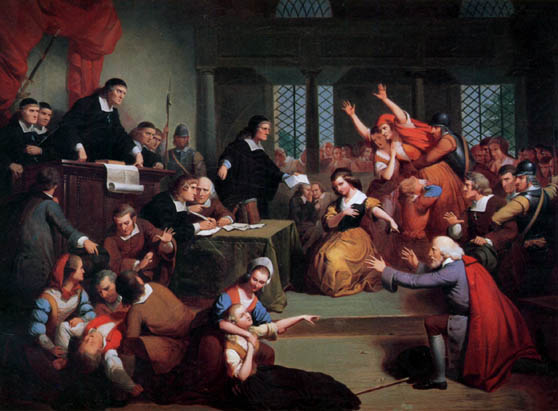
x. Lois Ann Foster b. 2 Dec 1833 in Readfield, Kennebec, Maine;  d. 13 Feb 1912 – Richmond, Maine; unmarried in 1899 living in Richmond, Maine.

Sources:

http://trees.ancestry.com/tree/10387763/person/95175926

http://trees.ancestry.com/tree/7398316/person/93003597

http://familytreemaker.genealogy.com/users/c/o/r/Jennifer-Corkins/GENE1-0011.html#CHILD72

Foster genealogy, Part 2 By Frederick Clifton Pierce 1899

http://trees.ancestry.com/owt/person.aspx?pid=23108458

Posted in -8th Generation, Line - Shaw, Pioneer, Veteran | Tagged , , , | 10 Comments