Samuel Senton Patterson Sr.

Samuel Senton PATTERSON Sr. (c. 1725 – 1791) was Alex’s 6th Great Grandfather, one of 128 in this generation of the Miner line.
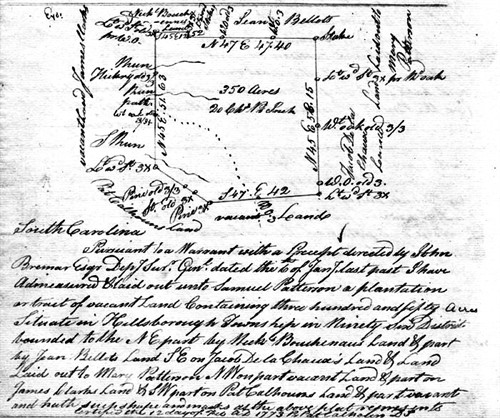
Samuel Patterson – 350 acres Dist of Ninety Six

Samuel Patterson Sr. was born about 1725 in Dysart, Newry, County Down, Ireland. His father may have been James PATTERSON.   He married Mary CARSON about 1755  in Newry, County Down, Ireland.   Samuel, Mary and their first six children were part of a large group of Presbyterians who followed an emigration led by the Reverend William Martin in 1772.   The Pattersons sailed on The Freemason departing from Newry on 27 Oct 1772  and arrived in Charleston on 22 Dec 1772.  Samuel received a land grant of 350 acres in Abbeville District, South Carolina, 100 acres for himself and 50 acres for each child under 16.  His eldest daughter Mary received 100 acres.   Samuel died about 1791 in Abbeville District, South Carolina.
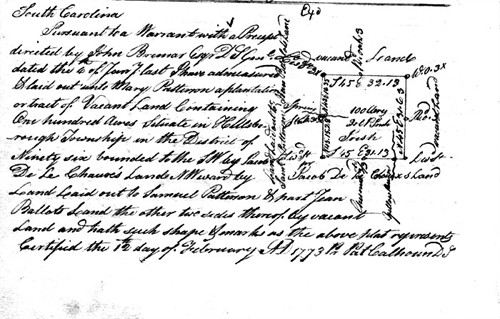
Samuel Patterson – Mary’s 100 arces – Dist of ninety six

Mary Carson was born in Newry, County Down, Ireland abt 1730.  Her parents were Thomas Gibson CARSON  and  Margaret  McDOWELL.   Alternatively, her parents were  William CARSON and Margaret [__?__].

One source says the Carson name probably comes from two Patterson brothers, Samuel and James that arrived from Ireland in 1773.  Samuel was married to Mary Carson and James also may have been married to a Carson.   Mary died in 1820 in Abbeville District, SC, at 90 years of age.

Children of Samuel and Mary:

Name Born Married Departed
1. Mary Patterson 4 Jul 1757 Newry, County Down, Ireland William McGaw
5 Oct 1775 Abbeville, District 96, South Carolina
4 Apr 1842 Israel Township, Preble Co, OH
2. Sarah Patterson c. 1759
Newry, Ireland
John McGaw
c. 1777
Abbeville District SC
Nov 1820 Abbeville District, SC
3. John Patterson Jan 1763
County Down, Ireland
Mary Carson (his 1st cousin)
1792 Abbeville, SC
11 Nov 1837
Preble Co, OH Interred Hopewell Cemetery
4. Samuel PATTERSON Jr. 17 Oct 1765 County Down, Ireland. Agnes [__?__]
Abbeville District, South Carolina
before 1792
.
Rosannah Sprowl
28 Dec 1814 Preble County, Ohio
20 Dec 1833 in Preble Co, OH
5. James Patterson 1767
County Down, Ireland
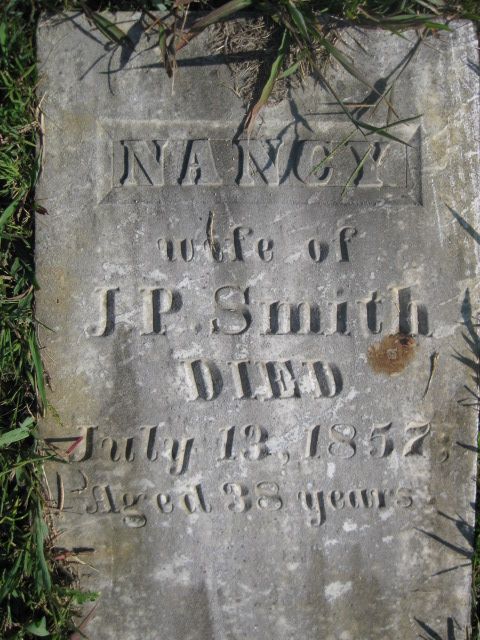
Nancy Smith (Smyth) aft 1830 in Dixon Twsp, Preble Co, OH
6. Jane Patterson 9 Oct 1769 Newry, County Down, Ireland David Pressly
McCormick Co, SC
25 Feb 1856 Pittsburgh, Allegheny Co, PA
7. Josiah Patterson Nov 1774
Abbeville District, SC
Abigail Blair
6 Feb 1794 Abbeville District, SC
.
Mrs. Sarah Terry
16 Sep 1824 Abbeville, Abbeville, South Carolina
.
Eleanor Phelps
27 Nov 1832 Abbeville, Abbeville, South Carolina
31 Oct 1846 in Abbeville District, SC
8. Margaret (Peggy) Patterson 1775 John Pressley
15 Nov 1798 Abbeville, Abbeville, SC

Samuel is named as a Ruling Elder in the church in his daughter Jane’s obituary. Perhaps, the Cedar Springs ARP (Associate Reformed Presbyterian) Church in Abbeville Dist of South Carolina where Rev. Alexander Porter was the pastor.

Several Presbyterian pastors led their congregations in emigrations from Ulster to America in the decade following Rev. Dr. Thomas Clark’s emigration from Ballybay, Northern Ireland to New York Colony in 1764. The most notable of these was the Martin emigration of Covenanter Presbyterian in 1772 from the area of Kellswater in central County Antrim, now part of Northern Ireland.

In 1750 Presbyterians from Octoraro, Virginia, and North Carolina, came to South Carolina and settled at Rocky Creek. By 1755 Irish immigrants, many of them Covenanters, began arriving. Various groups (Associate, Covenanter, Burgher, Anti-Burgher, Seceders) formed the “Catholic” (meaning a union of various groups of Presbyterians) church on Rocky Mount Road, 15 miles southeast of Chester. In 1770 Covenanters began holding society meetings and wrote to Ireland for a minister. Reverend William Martin answered the call in 1772.

The Rev. William Martin was the only Covenanter minister in counties Down and Antrim at that time. In 1760 he resided at Kellswater, in the townland of Carnaghts in the Parish of Connor. He had oversight responsibility for societies at Cullybackey, Laymore, Cloughmills, and Dervock. He preached also in Londonderry and Donegal. The Presbytery was founded in 1743 and Kellswater became the center in 1760.

There were five ships in the emigration led by Reverend Martin, all of which sailed in 1772.  The first two sailed from Larne, the next two from Belfast, and the last one from Newry.   The emigrants settled throughout western South Carolina, many in the Abbeville area.  Reverend Martin himself settled in the general area of Abbeville, South Carolina (Rocky Creek in Chester County).  After the British burned his church in 1780, he took refuge in Mecklenburg County, North Carolina.

The James and Mary sailed first on August 25 from Larne. There was smallpox on board (five children died) when they arrived in Charleston harbor on October 16.  They were required to remain on board in quarantine, lying off Sullivan’s Island for over seven weeks, until the first part of December. “Ulster Emigration to Colonial America: 1718-1775”, page 253 by Dickson. “English America: American Plantations & Colonies”, by Thomas Langford, contains ship lists of voyages to English America from 1500 to 1825. See also “The Vessels, Voyages, Settlements, and People of English America 1500 – 1825”.

The next ship to sail was the Lord Dunluce that left Larne on October 4 and arrived in Charleston on December 20. This is the only ship that listed “Rev. Wm. Martin (Kellswater)” as an agent. The original sailing date was to have been Aug 15. The sailing was delayed until Aug 20, and then rescheduled for Sep 22. On Aug 28, the ship announced that passengers must give earnest money by Sep 5 since a greater number had offered to go than could betaken. On Sep 15, the ship advertised that, since some families had drawn back, two hundred more passengers could be accommodated. Reverend Martin was on this ship when it finally sailed on Oct 4. One man and several children died of small pox on the trip.

The Pennsylvania Farmer, whose destination had originally been advertised as Philadelphia, sailed from Belfast on Oct 16 and arrived in Charleston on December 19. (Dickson, page 248).   Aboard the Pennsylvania Farmer was Andrew Paterson (250 acres).

The Hopewell sailed from Belfast on October 19 and arrived in Charleston on December 23. (Dickson, page 248).   There were five Patersons aboard the Hopewell: Agnes (350 acres), Janet (100 acres), John (250 acres), John (100 acres), William (350 acres).

The Freemason sailed from Newry on October 27 and arrived in Charleston on December 22 (Dickson, page 252). Aboard the FreeMason were: Samuel Patterson (350 acres) and Mary Patterson (100 –  unable to pay). According to Council Journal 37, Province of South Carolina, under date of 6 Jan 1773, the brigantine Free Mason, out of Ireland (port not specified), discharged at Charles Town, South Carolina, the following among its Irish Protestant immigrant passengers who were authorized the amount of land, in South Carolina, indicated opposite their names:

In the Province of South Carolina in 1773, land was granted under the Crown, as follows: Single man or woman (16 yrs. of age or older) – 100 acres Married man or widow – 100 acres for self and 50 acres for each child under 16 years Married woman – none Samuel Paterson named above would have had five children under 16 years of age on his arrival.  Mary Patterson, referred to above, was 16 years of age or older and was single (or a widow with no eligible children).  Prior to this time, the “Bounty Act” had expired and no bounty could be paid to the individuals. There was, therefore, no list of the passengers for the purpose of determining “family rights”. Family members and other individual passengers who were not eligible (e.g., under 15) to petition for free land (still available under the eighth clause of the General Duty Act of June 14, 1751) are not listed. See “The Five Ships and the People who came with the Rev. Martin”. The names of the emigrants have been reconstructed from letters written home to Ulster and published in the paper and from extractions of the South Carolina Quarter Session Minutes, by Janie Revill and Jean Stephenson.

Samuel Patterson’s 350 acres were surveyed on 12 Feb 1773, and was in Hillsborough Township, 96th District, bordered by land of Nick’es Bonchillon, Jean Bellats, Jacob Delchaux, Mary Patterson, James Clark, and Pat Calhoun.

Mary Patterson was granted 100 acres in Hillsborough township, 96th District, bordered Jacob De Le Chaux, Samuel Patterson, Jean Bellat; surveyed 12 Feb 1773.

Ninety-Six District was the former western most judicial district in the U.S. state of South Carolina. It existed as a district from 29 July 1769 to 31 December 1799. The court house and jail for Ninety-Six District were in Ninety Six, South Carolina.

In the colonial period, the land around the coast was divided into parishes corresponding to the parishes of the Church of England. There were also several counties that had judicial and electoral functions. As people settled the backcountry, judicial districts and additional counties were formed.   On 1 January 1800, Ninety-Six District was abolished and replaced by the AbbevilleEdgefieldGreenvilleLaurens, and Newberry Districts.

The Pattersons’ land grants were in present day Abbeville County.

Abbeville County, South Carolina
Map of South Carolina highlighting Abbeville County

Samuel Patterson’s will was dated March 3, 1791 in Abbeville Dist, Rec September 13, 1794. Exrs: Wm. & John McGaw [both his sons-in-law]. Wit: Thos. Clark, Wm Carson [his wife’s brother], Alexr. Patterson [b. 1751 County Down, Ireland – d. 8 Jun 1839 in Abbeville County, South Carolina; m. Catherine McCaleb (1755 – 1839) I don’t know how Alexander is related ]. Wife: Mary Patterson. Chn: Saml., Josiah, Jas., Margaret, John, Mary, Sarah, Jean Patterson.  Will was probated 13 Sep 1794.

Samuel Patterson Will 1791

Children 

1. Mary Patterson

Mary’s husband  William McGaw was born 8 Feb 1749/50 in Dunfermline, County Antrim, Ireland. His father was John McGaw.   He emigrated to Abbeville District, S.C. from Ireland at the age of 17 about 1767 with his brother John.  They married sisters Mary and Sarah Patterson, daughters of Samuel Patterson. He was elder in Cedar Springs Association Reformed Presbyterian Church in Abbeville and elected ruling elder in the Hopewell Congregation in Preble Co, OH.  William died 31 May 1836 in Preble County, Ohio and is buried next to Mary.

William served in the Revolutionary War in the 58th South Carolina Troops Militia / Ninety-Six District Regiment from fall or early winter of 1775. He began as a private and was promoted to Captain within a year to 18 months of the unit known as John Anderson’s Company. He retained this command until the close of the war.  A Private and a Captain under Maj. Andrew Williamson, [later Brigadier General], Col. Andrew Pickens (wiki) [later Brigadier General , Major General and Congressman] . Later, a Captain under Col. Robert Anderson (wiki)  (Upper Ninety-Six District Regiment).

Engagements

Florida Expedition 1778

Battle of Kettle Creek (GA), –

Battle of Stono Ferry

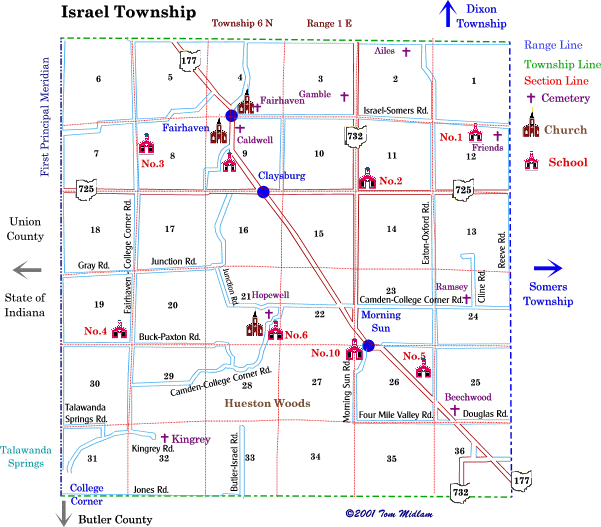
William, his wife Mary, and family emigrated to Preble County, Ohio from South Carolina with Mary’s parents in 1811 where he became a Ruling Elder in the congregation of Hopewell Church. William resided 1811-1836 in Israel Twsp (Section 5), Preble Co, OH.
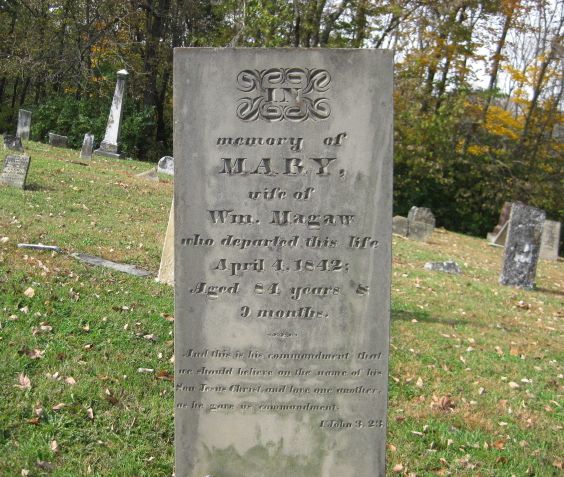
Mary Patterson McGaw Headstone — Hopewell Cemetery, Morning Sun, Preble County, Ohio

Children of William and Mary

i. Agnes McGaw b. 27 Jun 1776 in Abbeville, Abbeville, South Carolina; d. Nov 1845; m. 1794 in Abbeville, SC to Alexander Clark (b. 1772 in Abbeville, SC – d. 7 Jan 1841 in Perry, Illinois)

ii. Mary McGaw b. 15 Feb 1778 in Abbeville, Abbeville, SC; d. 10 Aug 1820 Israel, Preble, Ohio; m. 1796 in Abbeville, SC to James Boyse (b. 1768 in Long Cain Settlement, Abeville, SC – d. 22 Sep 1842 in Israel Township, Preble, Ohio)  His parents were David Boyse and Jane Archer.

iii. Jane McGaw b. 3 Apr 1780; d. 10 Aug 1820 or 1825 – Israel, Preble County, Ohio; m.  18 Jan 1803 – Abbeville, Abbeville, South Carolina to Robert Boyse (b. 22 Aug 1776  in a Fort, in So Carolina   – d. 13 Jan 1847 in Israel Township, Preble County, Ohio.)  His parents were also David Boyse and Jane Archer.

Moved to Preble County Ohio after 1807. Their son Rev. William McGaw Boyse ( b. 24 Dec 1806 in Long Cane Settle, Abbeville, South Carolina – d. 861 in Keokuk, Lee County, Iowa.) was a Minister in Richmond Indiana, 1833-1853.

iv. Elizabeth McGaw b. 26 Sep 1782 in Abbeville, Abbeville, SC

v. Sarah McGaw b. 12 Mar 1788 in Abbeville, Abbeville, SC; d. 1 Nov 1847 Preble, Ohio

Never married. Mentioned in father’s will, but not in mother’s, so was probably dead at time. Signed her will 19 May 1817; probated 4 Dec 1820

vi. Margaret McGaw b. 4 Jul 1790 in Abbeville, Abbeville, SC; d. 21 Feb 1838, Hopewell Cemetery, Morning Sun, Preble County, Ohio; m. 2 Nov 1815 in Preble, Ohio to Thomas Pinkerton (b. 9 Nov 1793 in Abbeville, SC – d. 22 Mar 1873 in Preble, Ohio)  His parents were John Pinkerton (1768 – 1852) and  Mary Anderson (1768 – 1837).; After Margaret died, Thomas married Margaret Sloan (b. 1796 South Carolina – d. 13 Jun 1872 Preble, Ohio)

Thomas emigrated with other colonists and his father’s family of 8 sons and 2 daughters to Preble in the spring of 1815. Married Margaret McGaw November 2, 1815 and built a cabin in Dixon township. After Margaret died, in 1839 he married Margaret Sloan. His father Hon. John Pinkerton, often a commissioner of Preble county, member of the State Legislature, who with many of the early settlers of Israel and Dixon townships, in Preble left South Carolina because of the slavery issue.

History of Preble County, Ohio 1881 — Thomas Pinkerton came to Dixon in 1815, with his father, John Pinkerton, who entered land in section thirty-two. John Pinkerton subsequently represented Preble county in the State legislature two terms. Thomas was born in South Carolina in 1793, and married, in 1816, Margaret McGaw, by whom he had seven children two of whom survive: Elizabeth, wife of John B. Foster, living in Illinois, and W. A. Pinkerton, in this township. W. A. was born in 1821, married, in 1842, Maria Sterrett, who was born in 1821. They have had four children, two living. Mr. Pinkerton has held the office of justice of the peace six years, and has been trustee of the township some fifteen years.

In the 1850 census, Thomas and Margaret were farming in Dixon, Preble, Ohio.

The Fair Haven Church — As soon as that portion of the Hopewell congregation living in the vicinity of Fair Haven had been stricken off , the petition to moderate a call had been granted by presbytery. A call was made out and moderated by Rev. Alexander Porter, and accepted by Rev. Jeremiah Morrow, son of ex-Governor Morrow. He was installed in the following spring. The congregation consisted of about fifty families, and the new church immediately commenced its career of prosperity. The following were the first elders of the church. John and Thomas Pinkerton, John Foster, William McGaw and William McCaw [son of James McCAW and uncle of William A McCAW who probably followed his relative to Preble, Ohio.

vii. Rev. Samuel Patterson McGaw b. 3 Jun 1793 in Winnsboro, Fairfield, SC; d. 18 Mar 1840 Monroe, Butler, Ohio; m. 18 Aug 1818 in Warren, Ohio to Anna Gordon (b. 1 Jan 1796 in Fayette, Kentucky – d. 1 Aug 1875 in Oxford, Butler, Ohio)

Presbyterian Minister- Pastor of Clear Creek and Mt. Pleasant Congregations in Ohio. Known to have had eight children, one known is Anna Maria b. 3 Apr 1820, d. 1 Jul 1865,

In the 1860 and 1870 census, Anna was living in Oxford, Butler, Ohio with her daughters Lizzie (b. 1835 Ohio) and Harriet (b. 1840 Ohio)

Rev Samuel P Magaw and Anna Gordon Gravestone — Springboro Cemetery, Springboro, Warren, OH

viii. Martha McGaw b. 9 Oct 1795 in Abbeville, Abbeville, SC; d. 1881; m. 1813 in Preble, Ohio to Samuel Smith (b. 1795 Kentucky – d. 1881) His parents were our ancestors  James SMITH and Anna SMITH

In the 1850 census, Samuel and Martha were farming in Israel, Preble, Ohio.

ix. Abigail McGaw b. 9 Mar 1798 in Abbeville, Abbeville, SC; d. Burial: Hopewell Cemetery, Morning Sun, Preble County, Ohio, Plot: Row 19; m. 11 Jun 1817 in Preble, Ohio to William Pinkerton (b. Oct 1795 in Abbeville, South Carolina – d. 19 Nov 1848 in Preble, Ohio); .

William Pinkerton and Thomas Pinkerton were brothers.

In the 1860 census, Abigail was living with her son Joseph in Israel, Preble, Ohio.

x. William Magaw Jr. b. 16 Nov 1801 in Abbeville, Abbeville, SC; d. 24 Mar 1897 Preble, Ohio; m1. 11 Mar 1824 Preble, Ohio to Rachel Paxton (b. 29 Sep 1805 in Preble, Ohio – d. 18 Feb 1852 in Preble, Ohio); m2. 27 Mar 1856 in Kenton, Hardin, Ohio to Elizabeth Lang (b. 30 Oct 1820 in Ohio – d. 12 Mar 1913 in Richmond, Indiana);

In the 1860 census, William and Elizabeth Magaw were farming in Israel, Preble, Ohio.

He has numerous descendents, 10 children by first wife, and 2 by second wife, — all of whom spell the name “Magaw”.

2. Sarah Patteson 

Sarah’s husband  John McGaw was born about 1757 in Dunfermline, County Antrim, Ireland.  He and his brother William, sons of John, came from Ireland about 1767. They married sisters Mary and Sarah Patterson, daughters of Samuel Patterson. John died in 1805 in Abbeville District, SC. John signed his will 15 Feb 1805, recorded 06 Aug 1805, and probated 04 Dec 1805.

John McGaw was a captain in the Revolutionary War.
Regiment – Upper Ninety-Six District Regiment
Service – 1779 to 1783
Unit – A Lieutenant and a Captain under Col. Andrew Pickens and Col. Robert Anderson before and after the Fall of Charleston.

Engagements – Siege of Ninety-Six 1781, Indian Villages

Sarah made a will 19 May 1817. The will was proven 04 Dec 1820. Her will was dated 19 May 1817 in Abbeville Dist, and proven 04 Dec 1820. Exrs; Son, Samuel McGaw, Bro., Josiah Patterson. Wit: Samuel, John T. Pressly. Chn: John, Samuel, Wm., Jad., Moses, Agness, Benjamin, Josiah, Mary McGaw Sale, Dec. 22, 1820. Byrs: Mary Giles, Allen Glover, Benjamin McGaw, Josiah McGaw, Jane Pressly, James Patton, Samuel McGaw, Josiah Patterson, John Pressly, Mathew Shanks, Robert Shanks, Archibald Little.

Children of Sarah and John:

i. John McGaw b. 1778 in Abbeville, SC; d. 1846 Illinois; m. 11 Dec 1799 in Abbeville, SC to Agnes Cochran (b. 1780 in Abbeville, SC – d. 1838 in Abbeville)

ii. Samuel McGaw b. 20 Sep 1780 in Abbeville, SC; d. 2 Oct 1825 Abbeville, SC; m. 15 Feb 1801 in Abbeville, SC to Mary (Mollie) Anderson (b. 1782 in Abbeville, Abbeville, SC – d. 26 May 1836 in Abbeville)

Samuel and Mary had eleven children, most of whom lived their whole lives in Abbeville.

iii. William McGaw b. 1782 in Abbeville, SC; d. Aft 1860 cenus; m. 1813 in Abbeville, SC to Hannah English (b. 1785 in Abbeville, SC -d. Aft. 1860 census) Her parents were Andrew English and Elizabeth Jane Bryson.  Lived in Marengo Co., Alabama.   In the 1860 census, William and Hannah lived in Township 12 Range 3 East, Marengo, Alabama with Etheldred W and Salina (perhaps Dorothy “Dolly” Patterson)  Quinney.

iv. James McGaw b. 1784 in Abbeville, SC; m. Eleanor [__?__]; d. 1820 Marengo, Alabama. Probably went to Marengo Co., Alabama.  Family history says he died in 1820, and also that he might have removed to above in the 1820’s.

v. Mary Agnes McGaw b. 15 Aug 1786 in Abbeville, SC; d.  1845 in Abbeville, Abbeville, South Carolina.; m1. Abt. 1803, Abbeville, 96 District, SC. Robert Giles (b. 1786 in Elbert, Georgia – d.  27 Mar 1817 in Abbeville, Abbeville, South Carolina);  His mother may have been Susannah Patterson (b.  1744 in Belfast, Antrim, , Ireland – d. 8 Mar 1824 in Abbeville, Abbeville, South Carolina.) I haven’f found what the relation may have been.

m2.  1822 Abbeville, SC to Mathew Brown (b. 1771 Ireland – d. Apr 1845 in Abbeville, Abbeville, South Carolina)  Matthew first married Martha “Mattie” Creswell (1779 – 1820)

vi. Sarah (Sally) McGaw b. 1788 in Abbeville, SC; d. 1817 Abbeville, SC or 1 Jan 1847 – Preble County, Ohio; m. [__?__] Patterson

vii. Moses McGaw b. 1790 in Abbeville, SC; d. 10 May 1868 South Henderson Cemetery , Gladstone, Henderson County, Illinois;   m. 14 Dec 1815 in Preble, Ohio to Isabelle Wiley (b. 1797 in Kentucky – d.  23 Jan 1880, Henderson, Illinois)

In the 1850 census, Moses and Isabelle were farming in Dixon, Preble, Ohio.

viii. Benjamin McGaw b. 2 Oct 1794 in Abbeville, SC; d. 22 Oct 1849 Columbia, Maury, Tennessee; m. 1816 in Abbeville, SC to Jane Cochran (b. 9 Oct 1798 in SC – d. 22 Nov 1846 in Maury, Tennessee)

Moved From Abbevile SC area to Maury Co., TN, about 1824-29.

Captain, Long Cane Republican Troop of Cavalry, SC Militia (commision dated 7 May, 1824)

ix. Josiah McGaw b. 10 Nov 1796 in Abbeville, SC; d. 4 Aug 1851 Holly Springs, Marshall, Mississippi; m1. 30 Mar 1820 in Abbeville, SC to Martha Russell (b. 1800 – d. 1836 in Abbeville, SC); m2. 19 Jan 1837 in Abbeville, SC to Martha Devlin (b. 1800 in Greenwood, SC – d. 1877 in Abbeville, Laurens, SC) Widow of [__?__] Pressly

In the 1850 census, Josiah owned 16 slaves in  Lexington, Holmes, Mississippi.

Age Gender
35 Male
28 Male
13 Male
7 Male
3 Male
46 Female
25 Female
25 Female
6 Female
4 Female
3 Female
2 Female
2 Female
3 Female
1 Female
2 M Female.

3. John Patterson

John’s wife Mary Carson was born 1764 in Tyrone, Ulster, Ireland.  She was his first cousin.  Her parents were William A. Carson and Margaret Mills.  Her grandparents were Thomas Gibson CARSON and Margaret McDOWELL.  Mary died 29 May 1824 at 59 years of age. Her body was interred 1824 in Hopewell Cem, Preble Co, OH.

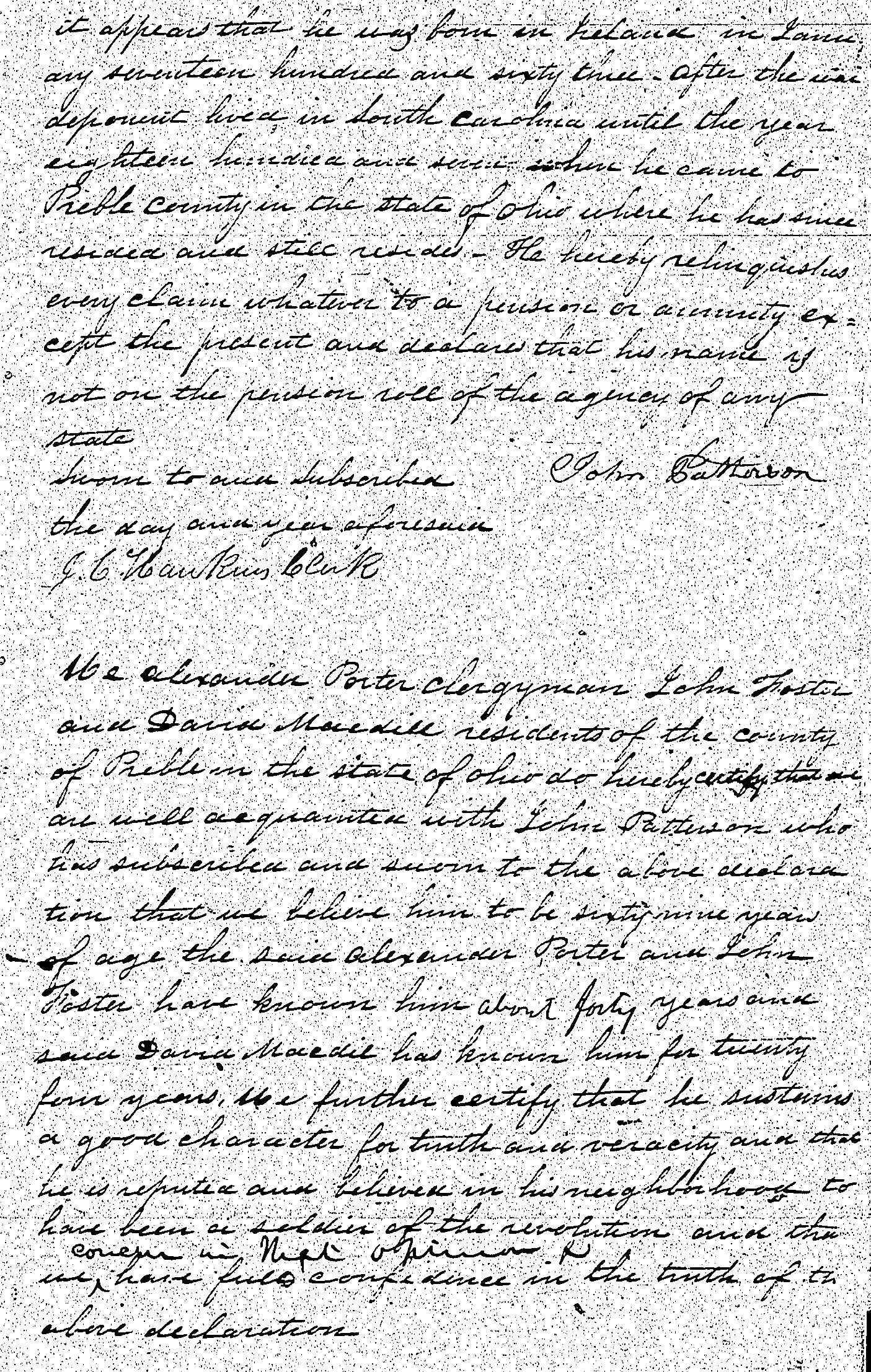
John and wife removed from Abbeville District, S.C. to Preble County, OH in 1807. Apparently had no children as none mentioned in estate papers – estate sold 13 Apr 1838 in Preble County, OH. Administrator of his estate was Thomas Pinkerton, bond signed by Pinkerton, Alexander Porter and William McGaw.

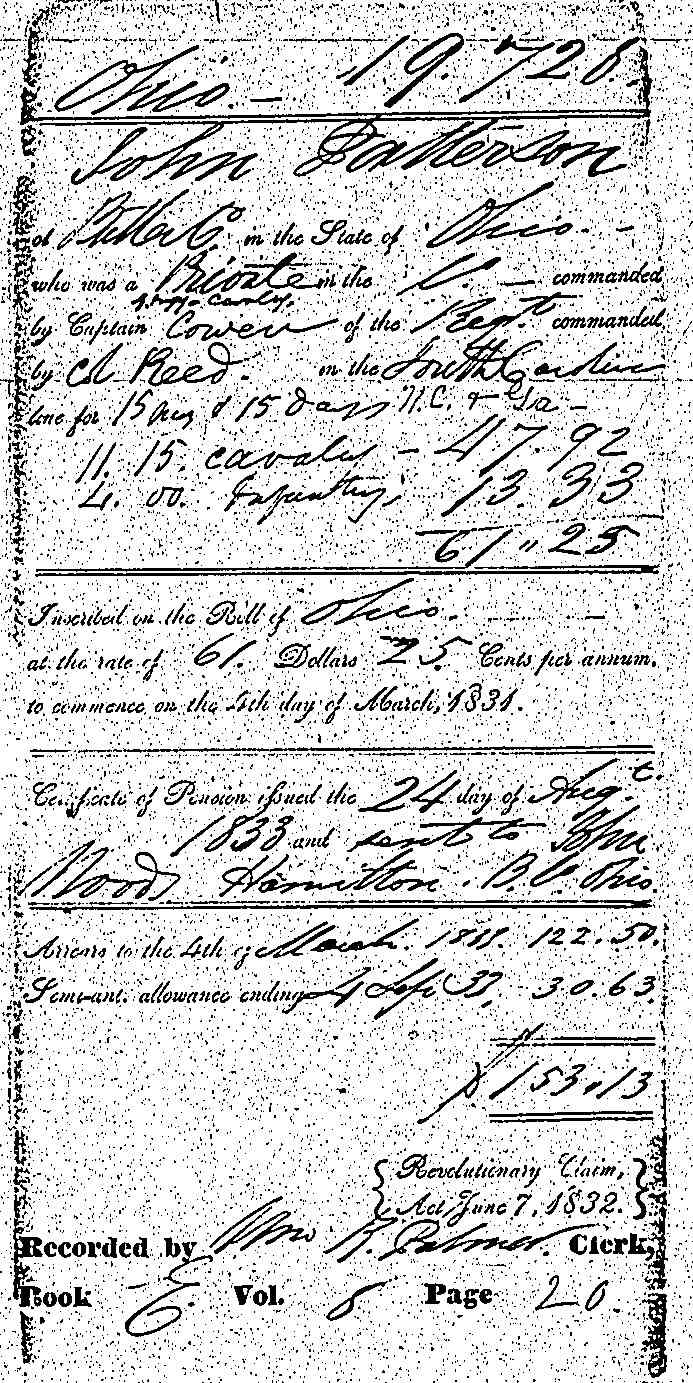
John was a soldier in the Revolutionary War, serving as a substitute for his father in August 1778 when he was just 15 1/2 years old; he saw service in the Carolinas in 1778, 1780 and 1781 and was discharged March 1781. He was in both the infantry and cavalry.

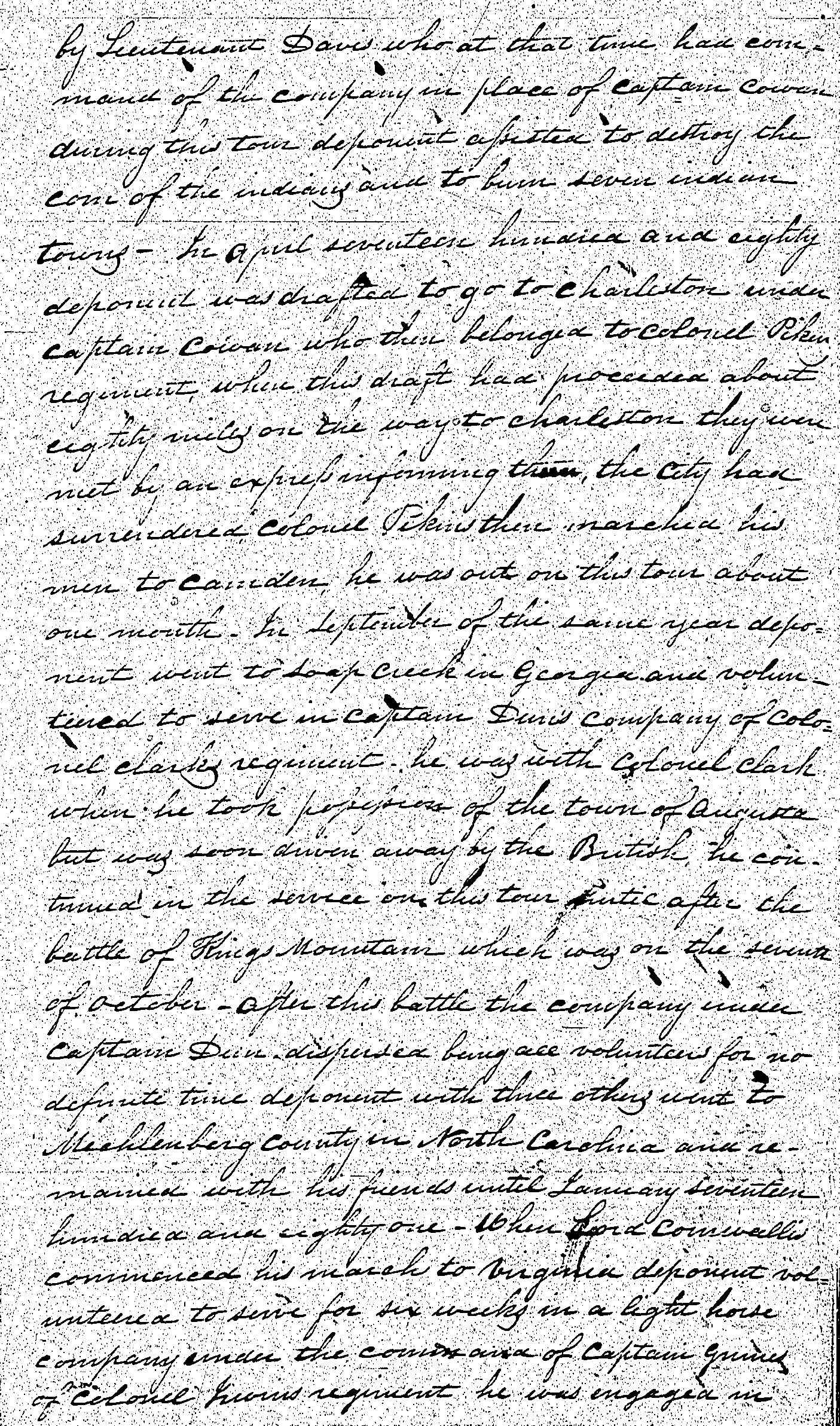
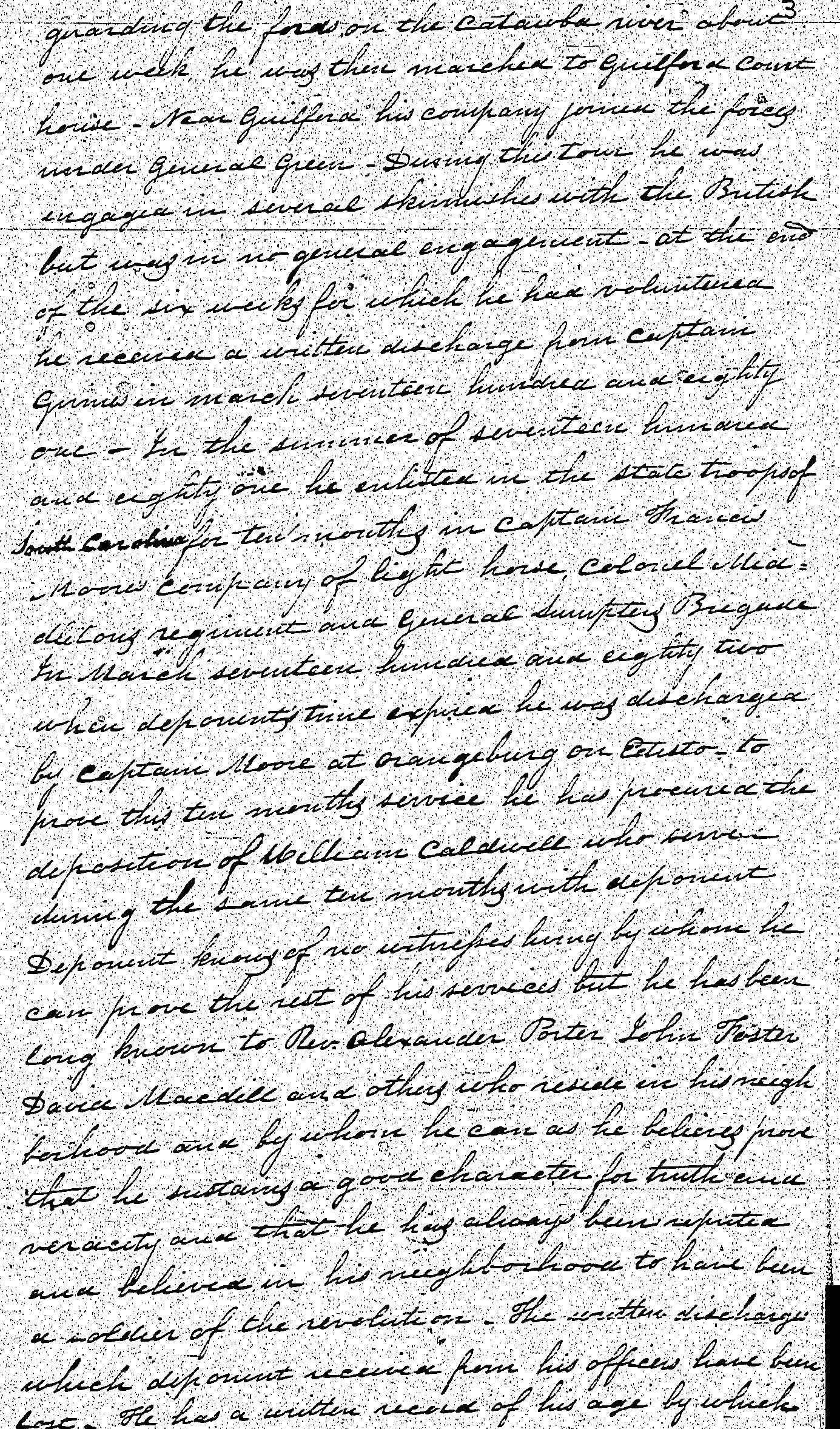
John applied for a Revolutionary War Pension on Sep 18, 1832.  We know a lot about his service from his application letter.

In August 1778 John was assigned to Captain John Cowan’s  (Cowen’s) Company of militia, Colonel George Reed’s Upper Ninety-Six District Regiment and General Andrew Williamson’s Brigade. The force rendezvoused at Beaverdam Creek in Georgia. John served for three months during which time he was engaged in defending the country against the Cherokee by burning the Indian’s corn and destroying seven Indian towns.  His discharge was signed by Lt. Davis.

In April 1780, John was drafted to go to Charleston under Captain Cowan who then belonged to Colonel Pickens’ regiment. When this draft had proceeded about eighty miles on the way to Charleston, they were met by an express informing them the city had surrendered.  Col. Pickens then  marched his men to Camden.  John was out on tour about one month.

In September 1780, John went to Soap Creek, Georgia and volunteered to serve in Capt. Dunn’s Company in Col. Clarke’s Regiment.  He was with Col. Clark when he took possession of Augusta, but was soon driven away by the British.  He continued in service on this tour — after the Battle of King’s Mountain which was on the 7th of October.  After this battle, the company under Capt. Dunn dispersed being all volunteers for no definite time.

John, with three others, went to Mecklenburg County, North Carolina and remained with his friends until January 1781.

When Lord Cornwallis commenced his march to Virginia, John volunteered to service in a light horse company for six weeks under Capt. Givens? and Col. Harris?.  John was engaged in guarding the fords on the Catuwba River about one week.  He was then marched to Guilford Court House. Near Guilford, his company joined forces with General Greene.  During this tour, John was engaged in several skirmishes with the British, but was in no general engagement.  At the end of the six week volunteer, John received a discharge from Capt. Givens?

The Battle of Guilford Court House,  fought on March 15, 1781 in Greensboro, the county seat of Guilford County, North Carolina.   A force of 1,900 British troops under the command of Lieutenant General Charles Cornwallis defeated an American force of 4,000 troops, commanded by Major General Nathanael Greene.

Despite the relatively small numbers of troops involved, the battle is considered pivotal to the American victory in the Revolution. Before the battle, the British appeared to have had great success in conquering much of Georgia and South Carolina with the aid of strong Loyalist factions, and thought that North Carolina might be within their grasp. In the wake of the battle, Greene moved into South Carolina, while Cornwallis chose to march into Virginia and attempt to link up with roughly 3500 men under British Major General Phillips and American turncoat Benedict Arnold. These decisions allowed Greene to unravel British control of the South, while leading Cornwallis to Yorktown and eventual surrender to Major General George Washingtonand Lieutenant General Comte de Rochambeau.

In the summer of 1781, John enlisted in the troop of Capt. Francis Moore’s company of light horse, Colonel, Col. Charles Myddleton’s SC 2nd Regiment of State Dragoons.  In March 1782, John’s  ten month enlistment expired and he was discharged by Capt. Moore at Orangeburg   Engagements included:

May 1, 1781  Friday’s Ferry
May 11,1781  Orangeburgh
Jun 18, 1781  Myddleton’s Ambuscade
Jul 17, 1781  Quinby’s Bridge
Jul 17, 1781  Shubrick’s Plantation
Sep 8, 1781  Eutaw Springs,

“History of Preble County, Ohio” published in 1881:

THE HOPEWELL CHURCH. In the years 1806 and 1807 several families, members of the Associate Reformed church, emigrated from the States of Kentucky and South Carolina, and settled in Israel Township in the midst of the Beech Woods. Rev. Risk, a minister of the Associate Reformed church, preached to them soon after their settlement.

In the fall of 1808, at the house of William McCreary, in section thirty-six, they formed themselves into a society, and in conjunction with the people of Concord petitioned the presbytery of Kentucky for supplies. Among those who occasionally supplied them were, Revs. McCord, McGill, Samuel Crothers and Brahman Craig.

September, 1808, the people assembled in the double log barn of David Madill’s, and Mr. Craig, after preaching organized the congregation into a church of nearly fifty members. Prominent among these first named on the church roll were the McDills, McQuistons, Boyces, Ramseys and Elliotts. At the time of the organization the following elders were chosen by the congregation: David and Andrew McQuiston, James Boyse, Ebenezer Elliott and John Patterson, all of whom had been ordained previous to their settlement in the township.

The church continued to receive supplies from the Kentucky presbytery, and the number of members was increased by immigration, but the prospect of having a settled minister among them did not open until 1814, when Rev. Alexander Porter, the pastor of the Associate Reformed church at Cedar Springs, Abbeville district, South Carolina, being previously released from his charge, came on a visit to the western churches, and to the Israel township congregation preached on two Sabbaths and one week day. By this time the congregation had increased to more than fifty families, and the people were more than ever desirous of securing a pastor and of erecting a house of worship. Accordingly they drew up a call for Mr. Porter, and presented it to the presbytery of Kentucky. A copy of the call is now in possession of the Hopewell session. It is drawn up in the usual form, and prays that Mr. Porter become the shepherd of their souls, and promises to pay him all due respect and support. It was signed by the following persons who constituted the first membership of the church, with the understanding that as soon as these churches could be provided with a settled pastor, Hopewell would receive the whole of Mr. Porters labors.

Prior to this call the first church building had been erected just west of the present house. It was a log structure thirty feet square, and afterwards, to accommodate the growing congregation, received in addition of thirty feet. The pulpit was in the middle of the west side, with two small windows just back of it. The seats were made of slabs hewed from logs. They were provided with stiff, upright backs. The present[1881] church building is a commodious frame, and is kept in good repair.

In October, 1814, Mr. Porter, having accepted the call, came to his new pastoral charge at Hopewell, and settled with his family on the farm in section sixteen, now occupied by Alexander Orr. In the following July he was solemnly installed by Rev. John Steele. Shortly afterwards the congregation was much enlarged by immigrations from Mr. Porter’s old parish, in South Carolina, and six members were added to the session who had been elders of the church in South Carolina.

No children mentioned in estate papers; estate sold 13 April 1838. Administrator of his estate was Thomas Pinkerton, bond signed by Pinkerton, Alexander Porter and William McGaw
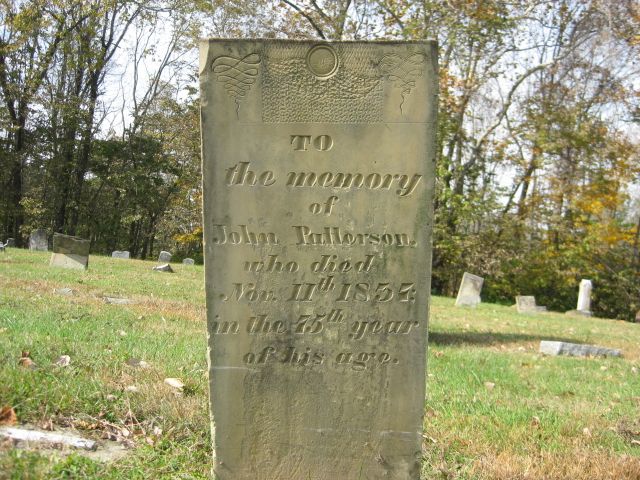
John Patterson Headstone — Hopewell Cemetery , Morning Sun, Preble County, Ohio, Plot: Row 25.

TO the memory of
John Patterson
who died
Nov. 11th, 1837
in the 75th year
of his age

4Samuel PATTERSON Jr. (See his page)

5. James Patteson

James’ wife Nancy Smith (Smyth) was born in 1770 in South Carolina. Her parents were Robert Smyth and  Martha Boggs.  Nancy died  in 1850 – Dawson, Georgia

James removed from Abbeville District, S.C. to Preble County, OH. He may have moved there with his brother Samuel. It is believed that the James Patterson listed as a resident of Dixon Twp, Preble County, OH in the U.S. Census of 1830 as 60 to 70 years of age and living alone, is one and the same as James Patterson, son of Samuel Patterson. James is NOT listed in the U.S. Censuses of 1820 and 1840 for Dixon Twp, Preble County, OH.

Children of James and Nancy

i. Samuel Patterson b. 1794 in Abbeville, South Carolina; d. 01 Jan 1872 in Preble, Ohio; DID NOT marry  Mary Ann McJimsey (b. 4 Jul 1812 in Lancaster, Lancaster, Pennsylvania – d. 16 Jul 1849 in Donegal Twsp., Lancaster, Pennsylvania)  She married
Samuel Smith Patterson (b. 29 Apr 1804 in Lancaster Co., PA – d. 11 Jan 1883 in Sterling, Whiteside, Illinois)

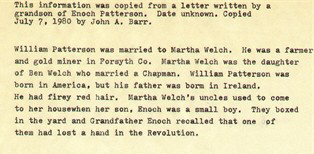
ii. William Patterson b. 1798 in Abbeville, South Carolina; d. 16 Apr 1895 in Forsyth, Georgia; Burial: Chestatee Baptist Church Cemetery, Gainesville, Hall County, Georgia; m. 3 Aug 1820 Preble, Ohio to Martha A. Welch ( abt 1800 in Pendleton, South Carolina – d. 11 Dec 1891 in Forsyth, Georgia) William and Martha were farming in Forsyth, Georgia in the 1850, 1860, 1870 and 1880 census.

William Patterson Bio

iii. Mary Patterson b. ABT 1808 in Abbeville, South Carolina; m. 21 Sep 1826 Preble, Ohio to James Crason
6. Jane Patterson

When Jane was two, her family emigrated to America along with Rev. William Martin, arriving in Charleston, South Carolina in December 1772. Jane’s parents were granted 450 acres in Hillsborough Township, in the Ninty-six District of the back country of South Carolina. Here Jane and her parents became active members of both Long Cane and Cedar Springs A.R.P. churches.

Jane’s husband David Pressly was born 1756 Charleston, South Carolina. His brother John married Jane’s sister Peggy. His parents were John Pressly (b. in Scotland – d. 1778 South Carolina) and Isabelle Fleming (b. 1716 – d. 1761) .   His parents were both Scotch-Irish Presbyterians who emigrated to America, part of Rev. William Martin and his five ships that arrived in Charlestown in the fall of 1772 and settling in the area around Long Cane in Abbeville District, South Carolina. He married Jane Patterson in 1789 in Long Canes, Greenwood, South Carolina. David died in 1818 in Long Canes, Greenwood, South Carolina.

David’s sister Jane Pressly (b. 1762 in Abbeville, South Carolina – d. 28 Jan 1823 in Abbeville, South Carolina) married George Hearst (b. 1764 in Ireland – d. 1822 in Franklin, Missouri) George came to the Abbeville district of South Carolina with his parents in 1766. According to probate records, George Hearst married an unknown Pressly prior to 1807 (the first name of Jane is unproven at this point). The George of this marriage may have been the son of Major John Hearst and Martha Carson (Martha was the granddaughter of our ancestor Thomas Gibson CARSON. Alternatively, George was Major John Hearst’s brother and the son of John Hearst and Elizabeth Knox.

Alternatively yet again, David’s sister Jane married George’s brother Joseph  Hearst (b. 16 Feb. 16, 1760 – d. 21 May 1814 Cedar Springs, Abbeville County, South Carolina) At the age of 21, on June 8th 1784. The Hearst came to South Carolina from Ireland in late 1765 or early 1766 with Dr. Thomas Clark and settled in the Long cane area, as well. Jane and Joseph had known each other as children, both members of Long cane and Cedar Springs A. R. P. churches. This blessed union had six known children. Joseph Hearst, Sr. was ordained as an elder in both Long Cane & Cedar Springs A. R. P. churches, which his parents helped organize. Joseph is buried near his parents and in-laws in the churchyard cemetery at Cedar Springs. His wife would join him fourteen years later. Jane Pressly Hearst departed this life on the 6th of September 1828, at the aged of 66 years old. Jane is buried near her husband and brother, David Pressly in the churchyard cemetery at Cedar Springs.

In circa 1808, George and his family left South Carolina for Illinois. George’s son Joseph stated in the 1850 census that he was born in Illinois. After a few years, the George once again moved, this time to Missouri were he settled in the Meramec valley near his brother Thomas who had preceded him there. It appears that he married again around 1820. By the time of his death, George had become one of the wealthiest man in Meramec township. He kept 19 of the 41 slaves to be found in the township.

George’s son William G Hearst ( b. 1776 Woodvine, Abbeville, South Carolina – d. Nov 1844 Franklin, Missouri) m. 1817 in Biglow, Franklin, Missouri to Elizabeth Collins (b. 1780)

George’s grandson George F Hearst (3 Sep 1820 Anaconda, Franklin, Missouri – d. 28 Feb 1891 California; m. 15 Jun 1862 in Steelville, Crawford, Missouri to Phoebe Elizabeth Apperson (b. 3 Dec 1842 in Whitmire Settlem, Franklin, Missouri – d. 1919 in Colma, California) I attended Phoebe Heart Elementary School in San Diego, named because Phoebe helped found the California PTA.

The Hearst fortune is due to more to luck than skill. George left for California on or about 15 May 1850 taking five months to make the journey. While in California, a few creditors took advantage of George’s absence and brought attachments against land he owned that was in Dr. Patton’s care. When Dr. Patton failed to satisfy the demands, the Hearst lands in his control were sold on the court house steps.

George didn’t make his fortune in the California mines. He was keeping a store when, in 1859, the Comstock Lode was discovered in Nevada. George joined the rush there and invested in the Ophir mine. When Alva Gould sold his claim to George Hearst for $450, he ran down the street yelling “I tricked a Californian”. After digging for only two months, George and his partners hauled 38 tons of high grade ore to California and made a profit of $90,000 from its sale. In less than a year he sold his share in the mine for a fortune. At one time the Ophir mine, which was almost a quarter mile in length was worth $4,000 per foot.
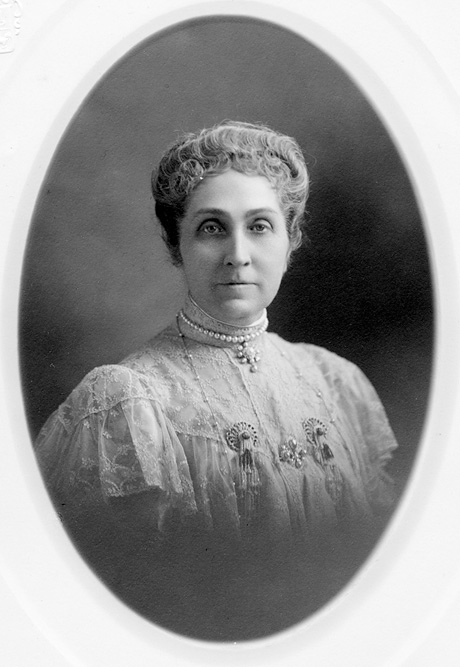
I found Phoebe Apperson Hearst’s portrait in the school auditorium a little scary. This isn’t it, but its close

George F Hearst’s only son William Randolph Hearst (b. 29 Apr 1863 San Francisco, California – d. 14 Aug 1951 Beverly Hills, California) m. Millicent Veronica Willson (1882–1974) Marion Davies, mistress built a newspaper empire and Hearst Castle of course.

David’s family were also charter members of Long Cane and Cedar Springs, thus they had much in common. During their marriage of 28 years, they had nine children; two of her sons were physicians and two were renowned ministers of the Associate Reformed Presbyterian church.

Jane left Preble Co, OH with her husband  and returned to Long Canes, Greenwood Co, SC where David Pressley died.  After her husband died in 1818, Jane Pressly lived with her second son, Rev. John T. Pressly, then minister at Cedar Springs. In 1832 when he was appointed minister of the First A.R.P. Church of Allegheny in Pittsburgh, Jane moved with him.

Jane Patterson Pressly died in Pittsburgh on the 25th of February 1856 in the 87th year of her age. She was laid to rest in the Pressly Family plot near her son, daughter-in-law and grandchildren.

Jane’s husband David Pressly was born 1756. His parents were John Pressly and Isabella Fleming b: 1716. His father was a member of the colony that left Belfast, Ireland, now Northern Ireland, 28 Sep 1734 on the Good Intent and arrived at Charles Town, South Carolina about 1 Dec 1734. David died 24 Sep 1818 Troy (Long Canes), Greenwood County

South Carolina at 62 years of age.
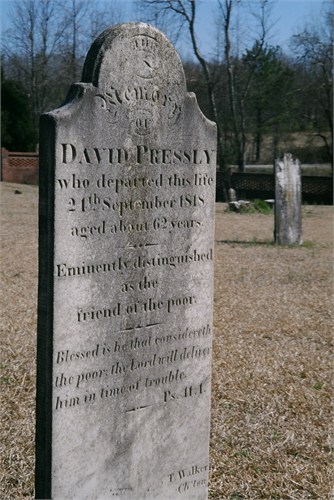
David Pressly Gravestone — Cedar Springs A.R.P. Church Cemetery , Cedar Springs, Abbeville County, South Carolina

Inscription:
~~~
SACRED
Memory
of
David Pressly
who departed this life
21st September 1818
aged 62 years
—-•—-
Eminently distinguished
as the
friend of the poor.
—-•—-
Blessed is he that considers
the poor; the Lord will deliver
him in time of trouble. Ps. 11.1

David Pressly, son of the pioneer, John, built a home about five miles east of Long Cane A.R.P. Church and became a prosperous merchant. He is buried in Cedar Springs churchyard, and his tombstone bears the inscription: “To the memory of David Pressly who departed this life 24 Sep 1818, aged about 62 years. Eminently distinguished as the friend of the poor.

Associate Reformed Presbyterian Death & Marriage Notices Volume II: 1866-1888 Compiled by Lowry Ware Scmar , Columbia, South Carolina 1998

“Died on Monday, February 25th, [1856] at the residence of John T. Pressly, Allegheny, Pa., Jane Patterson Pressly, in the 87th year of her age…. Native of County Down, Ireland, and emigrated to this country when two years old with her father Samuel Patterson who settled in Abbeville, SC. Her father was a ruling elder…. [died] leaving behind him four sons and four daughters.? The deceased was the last survivor of her father’s family. She was the mother of nine children; two of who died in their youth. Her oldest son, Dr. Samuel Pressly, died some fifteen years hence. Of her sons, two are physicians and ruling elders, two are ministers, and one is a merchant and a ruling elder. Her oldest daughter is the widow of Dr. George R. Brown, and the youngest daughter is the widow of Rev. Joseph Lowry.
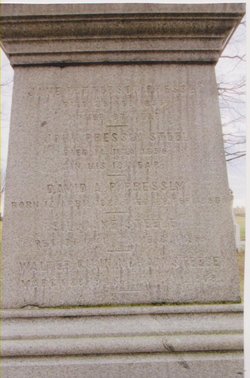
Jane Patterson Pressly Grave – Union Dale Cemetery, Pittsburgh, Allegheny County, Pennsylvania, Plot: In Division One

Children of Jane and David:

i. Dr. Samuel Patterson Pressly b. 12 Sep 1792 in Long Cane, SC; d. 12 Oct 1837 Wilcox, Alabama; m. 1811 in Cedar Springs, Abbeville, SC to Elizabeth Knox Hearst (b. 1791 in Greenwood, SC – d. 1875 in Wilcox, Alabama) Her parents were also  Joseph Hearst (1760 – 1814) and   Jane Pressly(1762 – 1828).

He removed from Abbeville District S.C. to Preble County Ohio and practiced medicine there from 1811 to 1815. In 1815 he returned to Abbeville District S.C. where he practiced from 1815 to 1834. In later years he moved to Wilcox County Alabama, where he practiced until his death in 1837.

ii. Rev. John Taylor Pressly b. 28 Mar 1795 in Abbeville, Abbeville, SC; d. 13 Aug 1870 Pittsburgh, Allegheny, Pennsylvania; m. Jane Hearst (b. 1793 in Abbeville, Abbeville, SC – d. 5 Apr 1873 Pittsburgh, Penns.) Her parents were Joseph Hearst (1760 – 1814) and  Jane Pressly (1762 – 1828)  The Hearst of Cedar Springs are the great-great- grandparents of William Randolph Hearst of the publishing fame.

Rev John Taylor Pressly, D.D. (1795 –  1870)

John received D.D. degree from Transylvania University, Lexington, Ky. . The Princeton Review ranked Transylvania 1st among colleges with Greek life. Graduated from the Associated Reformed Presbyterian Seminary, New York City. July 10, 1817, D.D. New York City. He was pastor of Cedar Springs Associate Reformed Presbyterian Church, Abbeville District S.C. for 11 years.

Operated Union Academy.

Jane Hearst was the daughter of of Joseph Albert Hearst and Jane Pressly, of Cedar Springs, Abbeville County, South Carolina. She was born of the 17th day of June 1793.

On July 4, 1816, Jane Hearst married John Taylor Pressly, son of David and Jane (née Patterson) Pressly; with whom she had nine children.

In October 1832, now Rev. John Pressly and Jane moved to Pittsburgh, Pennsylvania where he became minister of First A. R. P. Church. Jane Pressly was a devoted wife and helpmate in his service as a pastor to a growing congregation. Jane became well loved and appreciated for her devotion.

After Rev. Pressly died in 1870, Jane Pressly continued to be dedicated to his work until her death on April 4th 1873. Jane Hearst Pressly is buried beside her husband of 54 years in Union Dale Cemetery..

iii. Elizabeth Pressly b. 10 Jul 1797 in 96th District, South Carolina; d. 20 Apr 1857 in Preble, Ohio; m. 1810 South Carolina to Dr. George Brown (b. 1774 in Newberry, South Carolina – d. 21 Jun 1845 in Preble, Ohio) His parents were Nathan Brown (1731 – 1779) and Grissel Ritchey ( – 1810).

iv. Mary Pressly b. 10 Jul 1797 in Cedar Springs, Abbeville, SC; d. 17 Nov 1875 Jefferson, Georgia; m. 21 Feb 1813 in Cedar Springs, Abbeville, SC to Rev. Joseph Lowry (b. 1 Jan 1777 in Cedar Springs, Abbeville, SC – d. 23 Jul 1840 in Jefferson, Georgia) In the 1850 census, Mary was living with her son David and three other of her children in District 48, Jefferson, Georgia.

Joseph was pastor of Bethel Church in Jefferson County Georgia from 1814-1840

v. Dr. George W Pressly b. 9 Feb 1803 in Cedar Springs, Abbeville, SC;  d. 29 Dec 1870 Troy, Greenwood, South Carolina; m. 1820 in Abbeville, South Carolina to Isabella Hearst (b. 28 Mar 1806 in Abbeville, – d. 30 Nov 1858) another daughter of  Joseph Hearst (1760 – 1814) and   Jane Pressly  (1762 – 1828).  Her grandparents were John Hearst (1715- 1782) and Elizabeth Knox.

George spent most of his life in Abbeville District S.C. as a physician and legislator.

Degree: April 08, 1824, University of Pennsylvania

vi. James Patterson Pressly b. 25 Nov 1808, 3 miles north of Cedar Springs Associate Refomed Presbyterian Church in Abbeville Distict SC; d. 30 Mar 1877 Due West ARP Church Cemetery , Due West, Abbeville County, South Carolina; m1. Jane Hearst (b. 1811 in Abbeville – d. 30 Jun 1832 in Oak Hill, Wilcox, Alabama)  Her parents were John Hearst (1787 – 1843) and  Sarah Wardlaw (1791 – 1823)  She was a cousin of the Hearst girls who married James’ brothers; m2. Elizabeth Bonner Young (b. 1 Dec 1813 in Abbeville – d. 7 Jul 1841 in Due West, Abbeville, SC) Her parents were Samuel Young (1782 – 1856) and  Elizabeth Bonner (1789 – 1852); m3. Mary Eleanor Young (b. 19 Jul 1823 in Generostee, SC – d. 26 Jul 1892 Due West, Abbeville, SC) daughter of Francis Young and Nancy Little

In 1831, Jane Hearst married her childhood friend, James Patterson Pressly, son of David Pressly and the former Miss Jane Patterson. James Patterson Pressly was a young minister with the Associate Reformed Presbyterian church and emigrated with his wife to the Wilcox County area of Alabama; where several families from the Long Cane & Cedar Springs A.R.P. churches had settled.

Sadly, Jane Hearst Pressly died on the 30th of June 1832 not long after moving to Oakhill in Wilcox County at the age of 20 years, 8 months and 25 days..

James attended Union Academy operated by his brother Dr. John Taylor Pressly ( 1795-1870)

Graduated from Miami University, Oxford, Ohio in 1826, He studied theology with his brother John Taylor Pressly. Licensed to preach 21 Feb 1829, Ordained 27 May 1830 as an Associate Reformed Presbyterian Minister. Held pastorates at Due West S.C., Generostee S.C. and Bethel in Laurens County S.C. Later visited pastorates in Ga., Alabama, and Florida. Then held pastorates for ten The next 35 years were spent at Erskine College, Due West, S.C. the longest serving member of the faculty during Erskine’s first century.

James Patterson Pressly circa 1875, from The centennial history of the Associate Reformed Presbyterian Church: 1803-1903, pg 299

Their son Rev. Frank Young Pressly was President of Erskine College (1899-1907)

vii. William Patterson Pressly b. 17 Mar 1811 in Greenwood, SC; m1. 1833 to Mary Gilmore (b. 1813 – 12 Oct 1836 in Preble County, Ohio) Her parents were Robert Gilmore and Sina Irwin; m2. Martha Miller (24 Oct 1806 – 20 Jul 1885) daughter of william Miller and Elizabeth Lackey; d. 3 Apr 1905 Monmouth, Illinois

Corresonded with her cousin Martha Miller of Va. After Mary Gilmore’s death William Patterson Pressly kept up the corresondence with Martha Miller, made a trip to Va., married her and brought her back to Fairhaven Ohio wher he kept a store. There the 3 Children of William and Martha were born. When the three children were grown they moved to Monmouth Illinois. Both William and Martha are buried in the old part of Monmouth Cemetery ( lot 100, block 9)

In the 1850 census, William and Martha were farming in Jefferson, Preble, Ohio. In the 1860 census, William was a merchant in Monmouth, Warren, Illinois.

1903 Historical Encyclopedia of Illinois” Warren County :PRESSLY WILLIAM P.. was born near Abbeville. S. C, March 17, 1811. He was for a time, while a boy, a student at Miami University. Ohio. Then he engaged in farming and afterwards in business at Hamilton, Ohio. He came to Monmouth in 1859 and after farming for one year, became for the remainder of his active life a merchant. For many years his store was the favorite shopping place of Monmouth, especially for people from the country. He was a very successful business man of the highest standing. His credit and his character were never blemished. Mr. Pressly was married to Mary Gilmore, of Ohio, in 1833. She died in 1836. His second wife, Mary Miller, of Virginia, died in 1885. His son, Henry, a young man of fine ability and character, gave his life for his country in the Civil War.

Henry Pressley (1837-1861) attended a commercial college in Chicago; while there he was converted and by his Christian conversation and deportment had a great influence on his cousins, the children of Samuel Miller, who he visited in Memphis, Missouri, resulting in four of the brothers and sisters confessing Christ and uniting with the church. He went to Kansas, at that time almost a state of revolution, on the slavery question. Returning home, he enlisted in Company F 17th Illinois Infantry Regiment and in the next spring, 1861 was in the battle of Pittsburgh Landing (aka Battle of Shiloh);part of the siege of Vicksburg, he was killed; by the caving in of the earth, where they were excavating for a powder magazine. His remains were taken to his home in Monmouth for burial.

William also had three daughters, Virginia, Sarah and Mary, each died in early womanhood. Thus left childless, Mr. Pressly determined too become his own executor. In 1863 he gave to Monmouth College 700 acres of choice farming lands in Iowa. During 1870 and subsequent years he gave to the Warren County Library over $20,000, thus founding a library for popular use, erecting and donating the first building ever given for such a purpose in the State of Illinois. The liberal and sensible plans of the founder have brought too this institution constantly increasing prosperity and enlarging usefulness. It has been managed exactly in accordance with his wishes. A twin object of Mr. Pressly’s practical and liberal care has been the building and endowing of Mission Schools for native Christians in Egypt. For this purpose he has, also, given over $20,000. These schools have had excellent management. They have had remarkable success. The engraving accompanying this sketch is taken from a portrait painted thirty years ago. Mr. Pressly lives to enjoy the good which he has done. He has seen his gifts applied as he intended. He has won the respect and gratitude of thousands. His practical benevolence and his Christian character give him an abiding remembrance in this our land of the future as well as in the ancient land of the pyramids. His name will endure as the name of a helper of his fellowmen.

Monmouth College was founded on April 18, 1853 by the Second Presbytery of Illinois, a frontier arm of the Associate Reformed Presbyterian Church. The college celebrates this date annually as “Founders Day,” cancelling classes for a day of celebration and an honors convocation. Founded as “Monmouth Academy,” the school became Monmouth College after receiving a charter from the state legislature on September 3, 1856. The college remains affiliated with the Presbyterian Church (U.S.A.) and is a member of the Associated Colleges of the Midwest, a consortium of small, private liberal arts colleges. The college’s motto “Sit Lux” (“Let there be Light”) appears on its seal, but the college likes to describe itself as “What College Was Meant to Be.”

Monmouth College- Monmouth’s athletic teams are known as the Fighting Scots

Monmouth was one of the first institutions in the country to admit women from its inception. This increased the college’s early popularity and logically made it the home of the women’s sorority movement. Pi Beta Phi was founded on April 28, 1867 as I. C. Sorosis. Pi Beta Phi was the first national secret college society of women to be modeled after the Greek-letter fraternities of men. Kappa Kappa Gamma, founded in 1870, is another national sorority founded at Monmouth College

viii. Joseph Pressly b. 1813 in Long Canes, SC
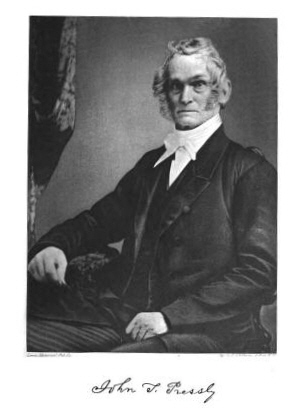
7. Josiah Patterson

Josiah’s first wife Abigail Blair was born 1774. Her parents were Samuel Blair (d.1813-1815) and Agnes [__?__]. Abigail died 18 Apr 1823 at 48 years of age. Her body was interred in Rocky River Presbyterian Cem, Abbeville Co, SC.

Josiah’s second wife Sarah [__?__] was born in 1778 in Chester, South Carolina. Sarah’s first husband Capt. Jeremiah S. Terry was an elder in the Lower Cane Church before 1810 when he joined Rocky River Presbyterian Church in upper Abbeville District in the area called “Monterey”. He later became a Magistrate. Sarah died 14 Apr 1827 – Abbeville, Abbeville, South Carolina.

Josiah’s third wife Eleanor Phelps was born in 1775.

Josiah had 9 children, including Sarah Cowan Patterson.

In the Census of 1790 for Abbeville, SC Josiah Patterson is listed as owning 2 slaves. In the 1820 Census there is a Josiah Patterson Sr. listed as owning 21 slaves.

About 1810, Josiah Patterson removed into the congregation of Rocky River Presbyterian Church in upper Abbeville District, South Carolina where he was made a member of the session. He removed there from the Long Cane section in the lower part of the District. His is believed to have previously been an elder in the Lower Long Cane Church. [from the letters of Andrew Giles and John Spencer, October and November 1852]

The section of Abbeville District which was served by Rocky River Church was and is known as Monterey, today remembered by Monterey Road.

After his removal into the Township of Monterey, Josiah Patterson became a magistrate. [letter, 1 April 1957, Harold L. Carlisle, Calhoun Falls, South Carolina to Carroll Ruffin Patterson]

The estate of Major John Hearst, 2nd son of John Hearst the 1st ( d. 1782), was settled by Josiah Patterson, whose mother, Mary Carson, was a sister of Martha, the wife of Major John Hearst.

John’s son William G Hearst ( b. 1776 Woodvine, Abbeville, South Carolina – d. Nov 1844 Franklin, Missouri) m. 1817 in Biglow, Franklin, Missouri to Elizabeth Collins (b. 1780)

John’s grandson George F Hearst (3 Sep 1820 Anaconda, Franklin, Missouri – d. 28 Feb 1891 California; m. 15 Jun 1862 in Steelville, Crawford, Missouri to Phoebe Elizabeth Apperson (b. 3 Dec 1842 in Whitmire Settlem, Franklin, Missouri – d. 1919 in Colma, California) I attended Phoebe Heart Elementary School in San Diego, named because Phoebe helped found the California PTA.

I found Phoebe Apperson Hearst’s portrait in the school auditorium a little scary. This isn’t it, but its close

George F Hearst’s only son William Randolph Hearst (b. 29 Apr 1863 San Francisco, California – d. 14 Aug 1951 Beverly Hills, California) m. Millicent Veronica Willson (1882–1974) Marion Davies, mistress built a newspaper empire and Hearst Castle of course.

Josiah Patterson became a wealthy planter in the Monterey section of Abbeville District, his plantation lay along the Savannah River, or near it, at Smith’s Crossroads.

According to the records of Rocky River Presbyterian Church, Abbeville District [courtesy T. H. Spence, Jr. Executive Director of the Historical Foundation of the Presbyterian & Reformed Churches, Montreat, North Carloina, to Carroll Ruffin Patterson, 12 March 1959], Josiah Patterson was a prominent layman of that church:

He was elected a Trustee in 1821.

Was a member of the Session at the time of his death, 31 Oct. 1846.

Memeber and leader in Rocky River Religious Tract Soicety from 1818 until 1840 [minutes close with latter year]. He was president of the Society in 1818 and 1822 and on Board of Managers for a number of years.

The “Minute Book of the Rocky River Presbyterian Church,” Abbeville District [Now at the Historical Foundation, Montreat, North Carolina] says, in part:

2 June 1819 – Josiah Patterson was unanimously nominated by the Congregation to employ workmen to have pews made instead of the common seats then used in Rocky River Meeting House. In words of the Minute Book, “the church should be regularly pewed”.

1822 – He was again elected Trustee

In 1839 Josiah Patterson was Acting Justice of the Quorom for Abbeville District.

The cemetery of Rocky River Presbyterian Church, Abbeville County, South Carolina in which he and mony of his family are buried was originally known as Bull Town Cemetery and the church was first designated as Bull Town. It is located about eleven miles west of the town of Abbeville and four miles northest of the Town of Calhoun Falls. It is one of the oldest churches in the area, being established 1760 – 1765. Rocky River Church has been on three (3) separate locations – the seoncd is the site of the cemetery and is about one to one and one-half miles from the first and present location of the Church. The cemetery is on the 1820 Road, known as the Andersonville to Davis Bridge Road.

Josiah Patterson’s death is noted in the Old Minute Book of Rocky River Presbyterian Church, 1842 – 1876, as follows:

“Josiah Patterson, member of the Session, departed this life on 31st of October 1846.”
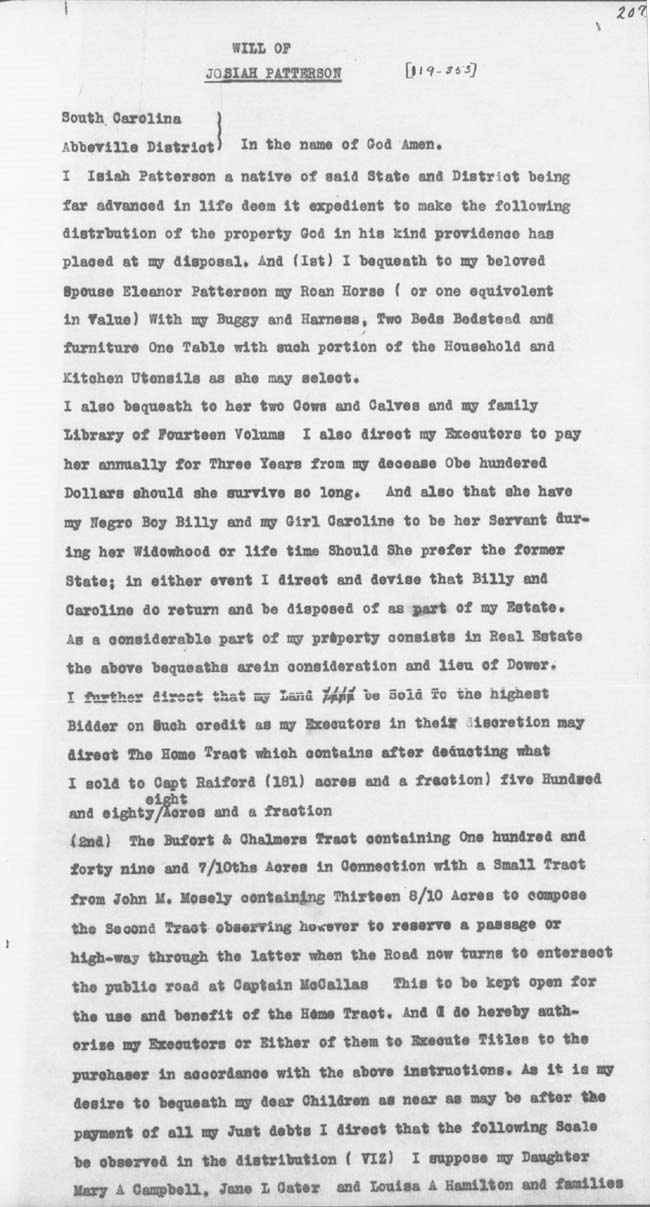
Josiah Patterson Will 1
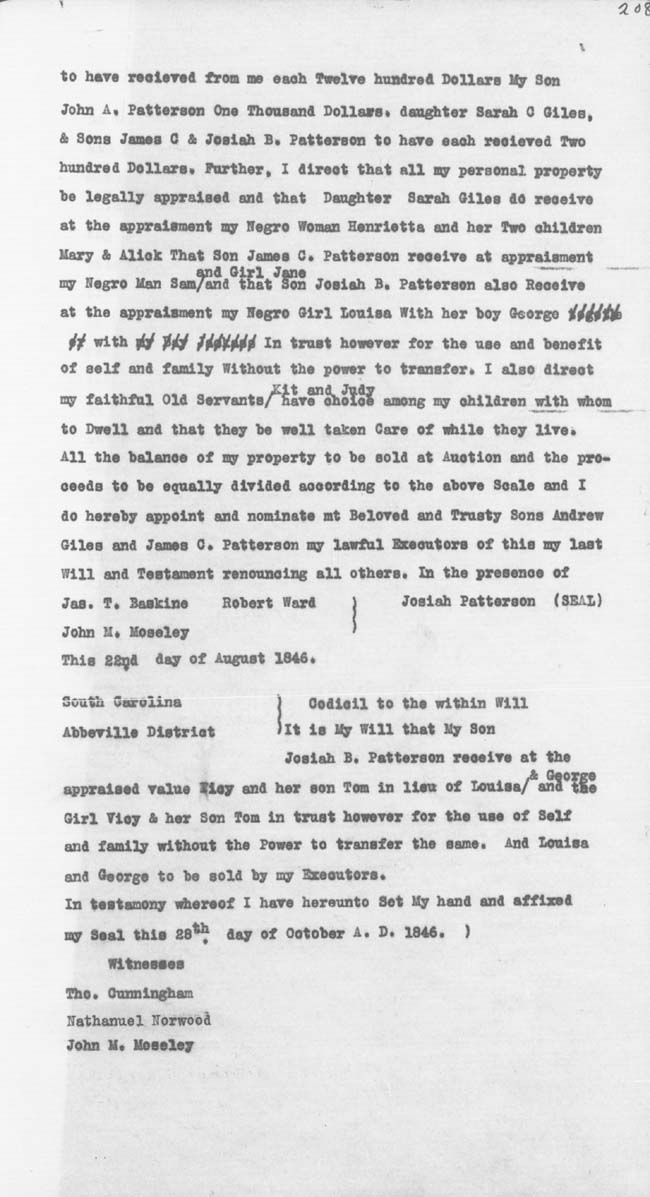
Josiah Patterson Will 2

Children of Josiah and Abigail:

As Josiah Patterson and Abigail Blair used the names Cown and Adams for the middle names of four (4) of their children it is obvious that there is a close connection between those two families and the Pattersons or the Blairs. As of this writing, no such connection has been established. It is probable that Josiah Patterson’s mother was likely a Cown and Abigail Blair’s an Adams or vice versa. As one of the daughter’s was given the name Lovely as a middle name it is possible that there was kinship with that South Carolina family.

Dr. Nora Davis of Troy, South Carolina informed Carroll Ruffin Patterson that Adams is a very common name and a very good name in Edgefield County, which adjoined Abbeville County before McCormick County was formed (1914). It is believed that the middle name Pleasant of the sixth child was adapted from the maiden of Moses Waddel (28 July 1770 – 21 Jul 1840) wife Elizabeth Woodson Pleasants. Moses Waddel, an ordained Presbyterian minister, operated the Willington Academy and may well have known Josiah Patterson. Elizabeth Pleasants was his second wife, the first was Catherine Calhoun, sister of John Caldwell Calhoun (1782 – 1850), South Carolina’s great statesman. Waddel was President of Franklin College [now the University of Georgia], Athens, Georgia from 1819 to 1829 and is buried there.

i. Sarah Cowan Patterson, b. 24 Jan 1795, Ninety Six District, South Carolina; d. 11 May 1864, Abbeville District SC; m. 5 Mar 1812 in Abbeville, SC to Andrew Giles (b. 24 Nov 1784 in Wilkes, Georgia – d. 31 Jan  1867 Old Rocky River Presbyterian Cemetery
Abbeville County, South Carolina) His parents were Capt. James H Giles and Susannah Patterson (b. 1744 in Belfast, Antrim, , Ireland – d. 8 Mar 1824 in Abbeville, Abbeville, South Carolina) I don’t know if there was a relation.

In the 1850 census, Andrew and Sarah were living in Savannah River Regiment, Abbeville District SC with six children at home.

ii. Mary Adams Patterson, b. 17 Jan 1797, Abbeville District SC; d. May 14, 1871, Canton, Madison, Mississippi; m. 23 Dec 1823 in Marlboro, South Carolina to Rev. Robert Bond Campbell (b. 6 Dec 1796 in Abbeville, SC – d, 1 May 1870 in Canton, Mississippi)

Removed from Abbeville Distict S.C. to Lancaster S.C. 1826-1828; to Beaver Creek S.C. 1829; to Waxhaw S.C. 1831- 1837; to Camden S.C. in 1837 then to Madison County, Mississippi in 1845.

In the 1850 census, Robert was a clergyman in Madison, Mississippi.

The fates of their children are interesting and this is the only family of confederate officer ancestors on our tree so I’ll break my pattern and include our ancestor’s great grandchildren

1. Sarah Campbell b. 17 Oct 1824

2. Col. James Alexander Campbell b. 8 Mar 1826; m. Amanda Sharkey; d. 4 Feb 1864, Johnson’s Island, Lake County, Ohio

James was a Colonel commanding the 27th Mississippi Infantry, Conferate Army. Died as a prisoner of war of hepatitis at Johnson’s Island [the only Union POW Camp for officers] and is buried there. More than 15,000 men passed through Johnson’s Island until it was closed in September 1865. Wardens lost only about 200 prisoners as a result of the harsh Ohio winters, food and fuel shortages, and disease. Johnson’s Island had one of the lowest mortality rates of any Civil War prison. Confederates made many escape attempts, including efforts by some to walk across the frozen Lake Erie to freedom in Canada. A handful of escapes were successful.

Lawyer in Leake County, Mississppi.
Prewar Judge.
CAPT. CO E 27th MS, Apr 25,1861.
MAJOR 1862.
LT. COL. Dec 31, 1862.
COL. Mar 26, 1863.
PRISONER OF WAR ( POW ) Lookout Mountain, Nov 24, 1863, while in charge of the picket line. To Johnson’s Island.

3. Robert Bond Campbell b. 8 Jan 1828; d. 28 Jun 1863, Battle of Vicksburg Missippi.

4. Judge Josiah Abigail Campbell (wiki) b. 2 Mar 1830 in Camden, Lancaster, SC ; m. Eugenia Elizabeth Nash 13 May 1850 in Kosciusko, Mississippi; d. 10 Jan  1917 Jackson, Hinds, Mississippi,  A prominent Confederate States of America politician. Josiah later moved to Mississippi and served in the state legislature in 1851 and 1859. He was elected to the Provisional Confederate Congress (1861–1862) and served as its President pro tempore. He served as a colonel in the Confederate Army during the Civil War. He later served as Chief Justice of the Mississippi Supreme Court from 1891 to 1894.

Political Graveyard – Also known as J. A. P. Campbell — of Kosciusko, Attala County, Miss.; Jackson, Hinds County, Miss. Born in Camden, Kershaw County, S.C., March 2, 1830Lawyer; member of Mississippi state house of representatives, 1851-59; Speaker of the Mississippi State House of Representatives, 1859; delegate to Mississippi secession convention, 1861; Delegate from Mississippi to the Confederate Provisional Congress, 1861-62; colonel in the Confederate Army during the Civil War; circuit judge in Mississippi; justice of Mississippi state supreme court, 1876-94; chief justice of Mississippi state supreme court, 1891-94. Died in Jackson, Hinds County, Miss., January 10, 1917 (age 86 years, 314 days). Interment at Greenwood Cemetery, Jackson, Miss..

5.  Mary Louise Campbell  m1. Dr. [__?__] Scarborough; m2. Nimrod Nash, brother of Mary’s sister-in-laws Eugenia and Susan Nash; d. 1863, Battle of Gettysburg.

6. Judge Charles Henry Campbell b. 21 Dec 1836; m. Susan Emmaline Nash 6 Feb 1891 in Kosciusko, Mississippi; d. 7 Mar 1905.

7. Jane E Campbell m. James Grafton a planter in Madison Co. Mississippi.

.

.

iii. Samuel Patterson, b. 27 Jan 1799.

iv. John Adams Patterson, b. 10 Mar 1801, Abbeville District SC; m. Alabama to Lenora Breazel (b. 1806 Tennessee – Aft 1860 census) . In the 1860 census, John and Lenora were farming in Athens, Limestone, Alabama. In the 1870 census, John was still living in Limestone, Alabama, but had remarried to Elmira [__?__] (b. 1816 Tennessee)

v. James Cowan Patterson, b. 6 Oct 1803, Abbeville District SC; d. 18 Jul 1866 Oak Hill Cemetery, Griffin, Spaulding County, Georgia; m. Laura Evans Winn (b. Abt. 1811 in Winnsboro, Fairfield S.C. – 1879 Oak Hill Cemetery, Griffin, Spaulding, Georgia)

James was a Presbyterian minister and Educator, having graduated from Franklin College [the founding college of the University of Georgia] in Athens, Georgia. He studied theology privately.

An early sketch, circa 1850, of the University of Georgia in Athens depicts the Franklin College quadrangle as seen from the southwest across Broad Street.

1822-1826– Tutor at Franklin College
Nov 1828 – Ordained as a Presbyterian Minister
1828- 1830 – Minister of Fairview Church, Lawrenceville Ga.
1841- 1843 – Minister of Alcovia Church of the Flint River Presbytery, Georgia.
1844-1850- Returned as Minister of Fairvoiew Church, Lawrenceville Ga.
1851- Returned to Alcovia Church and in that same year was at Goshen Church.
1856– He became President of the Synodical Female College in Griffin Georgia, where he served until his death in 1866. According to the City of Griffin, the college didn’t survived the war.

vi. Elizabeth Pleasant Patterson, b. 1 Sep 1807; d. 11 Nov 1823 Old Rocky River Church, Calhoun, South Carolina

vii. Louisa Abigail Patterson, b. 15 Oct 1810, Abbeville District SC.; d. Dec 1850 Pontotoc County, Mississippi; m. Thomas Twining Hamilton (b. 24 Jun 1797 South Carolina) His parents were John Hamilton and Mary Ann McGill; In the 1850 census, Thomas was a widow farming in Pontotoc, Mississippi with seven children at home.

viii. Jane Loveley Patterson, b. 11 Jan 1813, Abbeville District SC; m. 23 Aug 1832 in Abbeville, South Carolina to Richard Bohun Cater (b. 5 Jan 1811 – d. 23 May 1854 in Abbeville District SS) d. 1 Jan 1897, Abbeville District SC.

The Caters are of French extraction and are related to the DuPont family of New Jersey. They removed form Charleston, S.C. to the old Abbeville District, S.C. Children #2 through #9,[cp page 34], are buried in Rocky River Presbyterian Church Cemetery west of the town of Abbeville and northeast of the town of Calhoun Falls, S.C. as are their parents Jane Lovely Patterson and Richard Bohun Cater.

In the 1880 census, Jane was a 67 year old widow with seven children still at home in Abbeville, Abbeville, South Carolina.

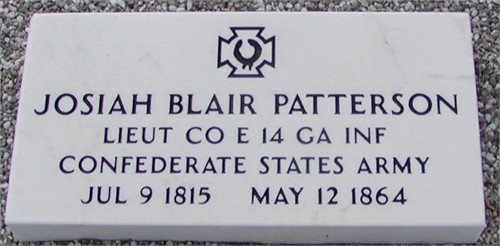
ix. Josiah Blair Patterson, b. J9 Jul 1815, Abbeville District, SC; d. 12 May 1864, Battle of Spotsylvania, Va.; buried Black Creek Church Cemetery, Waynesboro, GA; m. 11 Jan 1841, Decatur, GA to Mary Jane McNeil (b. 9 Feb 1822 – d. 27 Aug 1909), daughter of James McNeil

In the 1850 census, Josiah and Mary were living in Town, Gwinnett, Georgia with five children between 2 and 9 years old at home.

Carroll R. Patterson, the author of the Samuel Patterson reference, also compiled and privately published “THE INCOMPLETE CORRESPONDENCE OF LIEUT. JOSIAH BLAIR PATTERSON, 14TH REGIMENT GEORGIA VOLUNTEER INFANTRY, A.P. HILL’S LIGHT DIVISION” ( completed and privately published 20 May, 1961), a collection of several dozen “letters home” from Lt. Patterson as he served and fought with the Confederate Army ( Army of Northern Virginia) from 1861 until he was killed in action in the Battle of Spotsylvania Courthouse on May 12, 1864.

In 1833 James McNeill drew land in Cherokee county (before subdivision) in the Cherokee Gold Lottery– wonder whether he gave his land in what later became Forsyth County to Mary Jane McNeil who married Josiah Blair Patterson and lived in Forsyth County?

Josiah Blair Patterson 1863 Northern Virginia– Source: Carroll Ruffin Patterson

Josiah Blair Patterson enlisted Jul 4, 1861 in the Confederate Army as a 2nd Lieutenant of Company E, 14th Regiment Georgia Volunteer Infantry (“Lester Volunteers” of Forsyth County, Thomas’ Brigade, Wilcox’s Division, 3rd Corps, Army of Northern Virginia, C.S.A.), where he served throughout his Civil War career. He was listed May 5, 1862 as Company E Recruiting Officer at Cumming, Forsyth County, GA. He was listed as acting Quartermaster in Oct 1862. On Nov 8, 1862 he was promoted to 1st Lieutenant and held that rank until his death. On May 12, 1864 during the Battle of Spotsylvania Courthouse Lt. Patterson was wounded and while being carried to the rear on a litter was hit a second time and killed.
8. Margaret (Peggy) Patterson

Margaret’s husband John Ebenezer Pressley was born about 1775. His parents were John Pressly and Isabella Fleming. His brother David married Margaret’s sister Jane. His sister Jane may have been an ancestor of George and William Randolph Hearst (See above). John died abt 1816 in Abbeville, Abbeville, South Carolina.

Margaret and John were married at Cedar Springs Associate Reformed Presbyterian Church, Abbeville District, South Carolina

Child of Margaret and John:

i. Samuel P. Pressly, b. 25 Sep 1799 in Cedar Springs, Abbeville, South Carolina; d. 29 Sep 1839 in Athens, Georgia; m. Jane West Todd (c. 1797 in Ireland or 1805 Georgia – d. 01 Aug 1875 in Laurensville, South Carolina); Her parents were Andrew Todd and Jane West.

Samuel was educated at the University of Georgia, Athens, Georgia; studied theology under his cousin Dr. John Taylor Pressly ( 1795- 1870) (see above) at Cedar Springs Associate Reformed Presbyterian Church in Abbeville District S. C., then Pastor of the A.R.Presbyterian Church, Newberry S.C. In 1832 he removed to Athens Ga. to become Professor of Belles Lettres at Franklin College (now UGA).

His wife, Jane West Todd remained at Athens Ga for many years after his death. Then she, her daughter Corrine Myrtise Pressly, her daughter Antoinette Pressly and husband Francis James Brown removed from Athens to Knoxvile Tennessee. They returned to Athens after the death of Francis James Brown.

In the 1850 census, Jane, her daughters Corrina Pressly and Antoinette Brown, son-in-law Francis Brown were all living in Knoxville, Tennessee in the household of Joseph Brooks.

In the summer of 1852 she, her two daughters, and grandchild Mary removed from Athens Ga to Laurens District S.C. to the home of Jane West Todd’s parents.

[cp p. 28-A].

Sources:

Ancestry.com  US Census Records

“FROM COUNTY DOWN TO SOUTH CAROLINA – SAMUEL PATTERSON (died 1791-1792), AND HIS DESCENDENTS IN UPPER SOUTH CAROLINA AND BEYOND”  By Carroll Ruffin Patterson (1919-1991) of  Decatur, Dekalb County, Georgia  It was compiled between 1948 and 1963.  It consists of over 287 pages with almost twice that many pages of appendices, annotations, updates, inserts and a comprehensive index of names.

“Scotch-Irish Migration to South Carolina, 1772: Reverend William Martin And His Five Shiploads of Settlers” by Jean Stephenson (Shenandoah Publishing House 1970).

http://www.pcdl.lib.oh.us/marriage/details.cfm?ID=3644

http://ohpreble.ohgenweb.net/index.htm

http://members.core.com/~sharprm/library/patterso.htm

http://preble.ohgenweb.net/fgs/query002.htm#164

http://www.familysearch.org/eng/search/IGI/individual_record.asp?recid=100370921869&lds=1&region=11&regionfriendly=North+America&frompage=99

http://trees.ancestry.com/tree/14570044/person/126857825

http://www.magoo.com/hugh/robert.html

http://wc.rootsweb.ancestry.com/cgi-bin/igm.cgi

http://www.carolana.com/SC/Revolution/patriots_sc_capt_john_cowan.html

http://www.rootsweb.ancestry.com/~scyork/RevWar/KingsMtnRoster.html

http://www.carolana.com/SC/Revolution/patriot_military_sc_captains.htm

http://www.genealogy.com/users/c/r/o/Carl-A-Crowley-iii/FILE/0002page.html

History of Preble County, Ohio 1881 – H. Z. Williams & Bro., Publishers, Cleveland Ohio

http://trees.ancestry.com/owt/person.aspx?pid=11806451&st=1

http://www.amcolan.info/Hearst/hearst.php#HearstJohnb21Feb1783
Posted in -8th Generation, Immigrant - Scot-Irish, Line - Miner, Storied | Tagged , | 20 Comments

Samuel Patterson Jr.

Samuel PATTERSON Jr. (1765 – 1833) was Alex’s 5th Great Grandfather, one of 64 in this generation of the Miner line.

Samuel Patterson Jr was born 17 Oct 1765 in Newry, County Down, Northern Ireland. His parents were Samuel PATTERSON Sr. and Mary CARSON.    He married Agnes [__?__] in Abbeville District, South Carolina before 1792.  After Agnes died, he married Rebecca Carswell before 15 Feb 1805 in Abbeville District, SC. Finally, he married Rosannah Sprowl on 28 Dec 1814 in Preble County, Ohio.  Samuel died 20 Dec 1833 in Preble Co, OH, at 68 years of age.

Agnes [__?__] (Purviance, Ireland, or Mitchell) was probably born in Coddle Creek, Mecklenburg County, NC.   Agnes died before 1805 in Camden, Preble County, Ohio.

Rebecca Carswell was born about 1770. She is reported to be Samuel’s second wife. Mentioned as a witness to will for which Samuel was an executor. She died before 1814.

Rosannah Sprowl (Sprowle) was born 5 May 1776.  Her parents were William Sprowl and Elizabeth Lusk.  Rosannah died about 1833 in Preble, Ohio.

24 May 1817 – Samuel Patterson and Rosannah (mark) wife of PCO, the said Rosannah being one of the heirs at law of Wiliam Sprowle, dec’d late of Rockbridge Co, Virginia to Joseph Sprowl, one of the heirs of said William Sprowl, dec’d, consideration of natural love and affection they have for said Joseph and $10; quit claim to all land William Sprowl died seized and possess of in the State of Virginia and to any other land he died seized and possesses except 25 pounds Va currency bequeathed to the said Rosannah by the said William Sprowl, dec’d.
Witnesses: William Patterson, Hannah (mark) Davis.
[From Preble County Dee Records, Deed Book 2 pg. 41]

Children of Samuel and Agnes:

Name Born Married Departed
1. William Patterson aft 1792
Ninety Six, Greenwood, South Carolina
Catherine White
3 Aug 1820
Preble, OH
1848
Preble, OH
2. Samuel Senton Patterson III 26 Jun 1793
South Carolina
Catherine Smith (Robert’s sister)
27 Jul 1813
Preble, OH
1 Jan 1872
Hamilton, Fall Creek, Indiana
3. Mary A. PATTERSON 7 Apr 1795
South Carolina
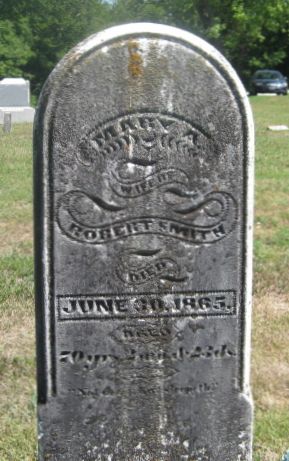
Robert SMITH
12 Aug 1815
Preble County, Ohio.
30 Jul 1865
Preble, Ohio.

.
Children of Samuel and Rebecca:

Name Born Married Departed
4. John Patterson 6 Sep 1800 Mariah Zimmerman
1 Jul 1822
Preble, OH
1 Jan 1865
Fortville, IN
5. Robert C. Patterson 22 Jan 1805
South Carolina
Frances [C__?__]
.
Jane “Jenny” Ramsey
03 Nov 1825
.
Ellen Glenn
20 May 1852
Preble County Ohio.
15 Feb 1870
His body was interred in Camden, Preble Co, OH
6. Jane Patterson 23 Nov 1806
South Carolina;
Hugh Marshall
29 Jan 1829
Preble Co, OH
7 Aug 1872
New Paris, Preble Co, OH
7. Rebeccah Patterson aft. 1806
listed as youngest daughter in her father’s will.
John Berry
23 Sep 1833
Preble Co, OH

According to the genealogical record of Mrs. L. E. Custer for Bessie Patterson Caylor, dated 27 May 1935, Samuel Patterson’s first wife was Agnes [__?__] and on 18 Dec 1790 he sold two (2) tracts of land on Coddle Creek in Mecklenburg County, NC. In Mrs. Custer’s report Samuel Patterson next appears in Preble County, Ohio.

A Samuel Patterson Jr is listed in the 1790 census of Ninety-Six District, Abbeville County, South Carolina. (with three free white females.) This is probably our Samuel, but the identification of the women in the household can’t be known. Residents in close proximity to Samuel Patterson include: Matthew Shanks, Mary Glasgow, William White, William McBride, William McDonnal (McDonald) Augustine Davis, James Bonner, Charles Beaty, John Foster, William Robbison (Robinson), John Beaty, Andrew Cochran, Patrick Bradley, Alexander Patterson, James Patterson (possibly his brother), and Thomas Lindsey.

Samuel Patterson is listed as name #18 prefixed to the call and moderation for the Lower Long Cane and Cedar Springs Associate Reformed Presbyterian Church (ARPC) in Abbeville Dist of South Carolina where Rev. Alexander Porter was the pastor.

Cedar Springs March 22 1797
Pursuant to an appointment given me some time ago to moderate in a call at D. Springs and L. Cane for any object they might in providence pitch upon this day I have at their request met to preside in a moderation of a call for Mr. Alex. Porter Prob and attest in concert with the other witnesses the unanimity of the under subscribers for sd Mr. A. Porter to be their fix Pastor–and we refer the Presbytery to the original subscription Paper. Peter McMillan V. D. M.

Surnames common to both this pastoral call and the 1790 Abbeville district census include: Patterson, Anderson, Beard, Clark, Cresswell, Crawford, Downey, Henderson, Jones, Little, Lindsay, Massey, McCullough, McFarlin, McKinney, McGaw, Spence, Stewart, Taylor, and Wilson.

In the 1800 SC Heads of Families census listed in Abbeville Dist.:
(Column Headings: Males 45, Females 45 , free persons, slaves)
Paterson, Samuel _ p.32 _ 31010-10010-01
This matches Samuels family exactly; William age 8, Samuel age 7, John < age 1, Samuel Jr age 35, Mary age 5, and Agnes age unknown. It is interesting to see that Samuel Jr. had one slave in his household in 1800.

10 June 1812.  It is possible Samuel Patterson removed from Abbeville, SC to Preble County, Ohio by way of Mecklenburg County, NC.   If this is so, there is a good chance that Agnes’ maiden name was Purviance, Ireland, or Mitchell.   Those three families removed from North Carolina to southwestern Ohio (the Preble County area) and that they and the Pattersons were related or very close friends as they had many legal transactions and intermarried quite often. Futher, two men with Patterson as a first name lived in that part of Ohio – Patterson Purviance and Patterson Ireland. Also the relationship of those four families extended down to Samuel Patterson’s great grandson Thomas Jefferson Patterson (1844 -1914) was married Clarissa Jane Brown (1846 – 1939), daughter of William Franklin Brown and Lucinda E. Purviance ”

A Genealogical Index of Miami Valley Pioneers” says that Samuel Patterson came from Mecklenburg Co, NC to Preble Co, in 1812 and died in 1833. It states that NC deeds show his first wife was Agnes. There is a Samuel Patterson listed in the 1790 Mecklenburg Co. Census. Listed are 5 males over 16, 2 females under 16, 3 females. Also listed as heads of households are John, William, Alexander, and Robert Patterson. It is not entirely known where Samuel’s family resided between 1800 and his first land entry in Preble County, OH in 1812. It is possible that Samuel Patterson moved to Mecklenburg Co, NC. However, it is more likely he followed others from Abbeville District, SC.

Several sources say that Samuel also married Rebecca Carswell 15 Feb 1805 in Abbeville District, South Carolina.  However, this conflicts with Agnes’ death in 1814 which these sources also show.  Rebecca Carswell may have been born in 1770.

Israel Township, Preble County, Ohio

10 June 1812 Deed to 157 acres of land in SE1/4, Section 3, Township 6, Range 1, Preble County, Oh issued to Samuel Patterson by the United States. Deed issued on order of or signed by Jame Madison, President

6 Oct 1812 – Samuel Patterson bought property in Preble Co, OH,    Samuel Patterson assignee of John Ritchey, E half R1 T6 S 30 25 Sep 1813 –  He sold property in Preble Co, OH.  Samuel Patterson to John Garver $785 SE 1/4 S30, T6, R1

5 Oct 1813 – He sold property in Preble Co, OH.  Samuel Patterson to John Ritchey $302 NE 1/4 S30, T6, R1

12 Dec 1814 – He sold property in Preble Co, OH.  Samuel Patterson to John Patterson $100 W side SWp S30, T6, R1

19 Mar 1817 – He sold property in Preble Co, OH.  Samuel Patterson and Rosanna to Tobias Miller E side SW 1/4 S30, T6, R1

24 May 1817 Samuel Patterson and wife Rosanna Sprowle and Joseph Sprowle, heirs-at-law of William Sprowle late of Rockbridge County. Virginia, gave quiteclaim deed to certain property of the latter in consideration of love and affesction. (Complier’s Note: To whom was this land given?) Deed Book 2 pg. 41

Samuel Patterson and Rosannah (mark) wife of PCO, the said Rosannah being one of the heirs at law of William Sprowle, dec’d late of Rockbridge Co, Virginia to Joseph Sprowl, one of the heirs of said William Sprowl, dec’d, consideration of natural love and affection they have for said Joseph and $10; quit claim to all land William Sprowl died seized and possess of in the State of Virginia and to any other land he died seized and possesses except 25 pounds Va currency bequeathed to the said Rosannah by the said William Sprowl, dec’d. Witnesses: William Patterson, Hannah (mark) Davis.

6 Feb 1821 – Samuel Patterson and wife Rossanna Sprowle sold 67 1/2 acres of SE1/2. Section 21, Township 6, Range 2 to William Patterson for $600.00. (Compiler’s Note: When and from who, did Samuel Patterson acquire this land?)

30 Aug 1826 – Samuel Patterson and wife Rosanna Sprowle deeded 20 acres in Preble County,  SW1/4, Section 21, Township 6, Range 2 to daughter Mary Patterson and her husband Robert Smith for love, affection for daughter and son-in-law, better maintenance, preferment, livelihood.  Witness John Pinkerton, Jane Patterson. Recorded 9-16-1826 . (Compiler’s Note: When and from who, did Samuel Patterson acquire this land?)

14 Jan 1830 -Samuel Patterson and wife Rosanna Sprowle sold part of SW1/4, Section 21 Yoenship 6, Range 2 to John Patterson for $150.00.

16 Nov 1830 – Samuel Patterson and wife Rosanna Sprowle sold a lot in Eaton, Preble County, OH to Enoch Preble for $45.00.

21 Nov 1832 – Samuel Patterson wife Rosanna Sprowle sold part of SW1/4, Section 21, Township 6, Range 2 to Robert PAtterson for $100.00

31 Aug 1833 – Samuel Patterson sold SE1/4, Section 21 Township 6, Range 2 containing 92/12/ acres in Preble County, OH to Robert C. Patterson for $1,200.00. No wife’s signature on deed.

As Rosanna Sprowle did not sign the last deed she apparently dies between 21 Nov 1832 and 31 Aug 1833.

Hopewell records listing the following members of the Hopewell Church 1819-1833 from the handwritten records of Rev. Alexander Porter which show:

Samuel Patterson Susannah William John Robert Ginny Becky

Rosanna’s name is incorrectly transcribed as Susannah. Homer Irwin transcribed this in 1964 from his original records done in Weston shorthand. It was compiled by Marjorie Paxton Palmer from his work and is in the Preble county room of the Eaton Library.

The Pattersons were Presbyterian and belonged to the Hopewell Church that was formed in Preble Co, OH in 1808.  The Pattersons may have been members of the Cedar Springs ARP Church in Abbeville Dist of SC.  There is a reference to a Samuel there in 1797.

The Rev. Alexander Porter led a rather large migration from Abbeville District to Preble County. Rev. Alexander Porter was born abt 1770 near Parson’s Mount, Abbeville Co., South Carolina, and was the first native-born minister of the Associate Reformed Presbytery of the Carolinas and Georgia. He completed his literary training at Dickinson College, Pennsylvania. He was licensed by the Second Associate Reformed Presbytery of Pennsylvania, and then returned home and began to preach at Long Cane and Cedar Springs, 1 Jan 1797. A call was presented for his services on 22 Mar 1797.  He led a congregation north to Ohio to avoid contact with the institution of slavery and formed a congregation in Israel township in Preble Co., Ohio.

The second pastor of Cedar Springs and Long Cane was Rev. Alexander Porter. He was installed April 2, 1798. The membership was large in the year 1802 — 520 communicants were reported. At the communion occasions large numbers attended from other churches—from Due West, Rocky Springs and Generostee. Tradition says that 760 observed the sacrament at one time. These communions were great spiritual feasts to the people. They covered five days. Thursday was fast day. Friday applicants for membership were received or kept back, Saturday and Sabbath’s services were especially devoted to the sacrament, and Monday was thanksgiving. Many of the important transactions of the Second Presbytery are identified with Cedar Springs and Long Cane. Here the original Presbytery was organized, and here the Second Presbytery was constituted April 8th, 1801. On account of Mr. Porter’s health and the uncommon largeness of his pastoral charge he asked to be relieved of one of his churches, and accordingly gave up Long Cane September 15th, 1803, and the next year was installed as pastor of Cedar Springs alone.

Cedar Springs A.R.P. Church and Cemetery -North Side The present brick church was built in 1853.

Mr. Porter continued pastor of Cedar Springs until 1813. The next year Mr. Porter moved with a number of his congregation to Ohio. For a number of years Cedar Springs was vacant and the church suffered just as her sister congregation of Long Cane, on account of a destitution of ordinances.

The following is information taken from the book “History of Preble County, Ohio” published in 1881:

Around 1814, the Rev. Alexander Porter, pastor of the Associate Reformed Church at Cedar Springs, Abbeville District, South Carolina, was released from his duties. He came west to Israel Township, Preble County, and in October 1814 settled with his family on a farm in section 16 of the township In July 1815 he became pastor of the Hope Church (Associate Reformed Presbyterian) congregation of about 50 families and shortly afterwards the congregation was much enlarged by emigrations from his old parish in South Carolina Rev. Porter resigned due to ill health in 1833 and died about 3 years later.

THE HOPEWELL CHURCH. In the years 1806 and 1807 several families, members of the Associate Reformed church, emigrated from the States of Kentucky and South Carolina, and settled in Israel Township in the midst of the Beech Woods. Rev. Risk, a minister of the Associate Reformed church, preached to them soon after their settlement. In the fall of 1808, at the house of William McCreary, in section thirty-six, they formed themselves into a society, and in conjunction with the people of Concord petitioned the presbytery of Kentucky for supplies.  Among those who occasionally supplied them were, Revs. McCord, McGill, Samuel Crothers and Brahman Craig.[Note: Samuel’s son-in-law and our ancestor Robert Smith was from Kentucky.]

Samuel Caruthers b. 29 Apr 1770 in Abbeville, Abbeville, SC; m. Sarah Vaughn d. 21 Aug 1847 in Clark, ArkansasStates

September, 1808, the people assembled in the double log barn of David Madill’s, and Mr. Craig, after preaching organized the congregation into a church of nearly fifty members.   The church continued to receive supplies from the Kentucky  presbytery, and the number of members was increased by immigration, but the prospect of having a settled minister among them did not open until 1814, when Rev. Alexander Porter, the pastor of the Associate Reformed church at Cedar Springs, Abbeville district, South Carolina, being previously released from his charge, carne on a visit to the western churches, and to the Israel township congregation preached on two Sabbaths and one week day. By this time the congregation had increased to more than fifty families, and the people were more than ever desirous of securing a pastor and of erecting a house of worship. Accordingly they drew up a call for Mr. Porter, and presented it to the presbytery of Kentucky.  A copy of the call is now in possession of the Hopewell session.  It is drawn up in the usual form, and prays that Mr. Porter become the shepherd of their souls, and promises to pay him all due respect and support. It was signed by the following persons who constituted the first membership of the church, with the understanding that as soon as these churches could be provided with a settled pastor, Hopewell would receive the whole of Mr. Porters labors.

Prior to this call the first church building had been erected just west of the present house. It was a log structure thirty feet square, and afterwards, to accommodate the growing congregation, received in addition of thirty feet. The pulpit was in the middle of the west side, with two small windows just back of it. The seats were made of slabs hewed from logs. They were provided with stiff, upright backs. In October, 1814, Mr. Porter, having accepted the call, came to his new pastoral charge at Hopewell, and settled with his family on the farm in section sixteen.  In the following July he was solemnly installed by Rev. John Steele. Shortly afterwards the congregation was much enlarged by immigrations from Mr. Porter’s old parish, in South Carolina, and six members were added to the session who had been elders of the church in South Carolina.

In 1816 the congregations of Hamilton and Concord having the prospect of a pastor, Mr. Porter discontinued his labors among them and devoted all of his time to Hopewell, which continued to increase in numbers and influence. In 1833 Mr. Porter was attacked by a severe sickness, and it was thought that his days were about numbered, and he resigned his charge, though he rallied and lived three years after his resignation.

In 1834 presbytery granted the petition for the moderation of the call, which was accepted by Rev. A. Bower in October, 1834, and on the third Wednesday of December, of the same year, he was installed as pastor by Rev. David McDill, D.D. The congregation soon became too large for the house, and also too large for the pastoral care of one minister. Consequently, in the spring of 1834, arrangements were made for the building of a meeting-house it Fair Haven, and in the following summer a church was built there, and in the fall a petition was presented to presbytery that the portion of the congregation of Hopewell, contiguous to Fair Haven be struck off from the main church, and, if considered expedient, to grant the moderation of a call for a pastor. This petition was granted and the history of the Fair Haven church tells the rest. John Pinkerton had been session clerk until this time. When he joined the new church at Fair Haven. John Caldwell was appointed to fill the vacancy caused by his removal. Owing to difficulties that arose in the congregation the pastor, Rev. A. Bower, resigned in June, 1837.

The church was supplied until September 19, by Rev. S. W. McCracken, who was installed pastor on the last Tuesday of December, 1839. It was just prior to this time that a number of the congregation, living near Oxford, joined the United Presbyterian Church at that place.  Mr. McCracken labored for twenty years, during which time the congregation gradually increased, and although another swarm left the hive to form the Unity church at College Corner in the winter of 1849-50, and a very considerable number emigrated to the west, the church was as strong, numerically, at the close of the pastor’s labors, as it was at the beginning. He died September 10, 1859,loved and lamented by all.

August 7, 1860, Rev. J. C. McHatten was called, and soon afterwards installed. As has already been stated the Morning Sun congregation became a separate organization of the United Presbyterian Church, and on December 28, 1877, one hundred and one of the members of Hopewell were dismissed to that church. In October, 1877, Rev. J. C. Campbell, the present pastor began his labors among the people of Hopewell.  The church, at present, is in a flourishing condition. The records show that since the establishment of the church there have been eight hundred and sixty-four baptisms and one hundred and forty-two deaths in the Hopewell church proper.  There have been fifty ruling elders, as follows: Alexander Hamilton, William McGaw, John Pressly, John Patterson, Ebenezer Elliott, James Boyse, David McQuiston, Nathaniel Brown, John Foster, Andrew McQuiston,  John Pinkerton,  John Giles, William Gilmore, John Douglas, Samuel McDill, James Brown, sr., John Caldwell, Thomas Pinkerton, David Robertson, William McCaw, Archibald McDill, James Brown, jr., Hugh McDill, David McDill, John Ramsey, George Ramsey, Andrew Hamilton, John McDill, John Buck, Robert Marshall, Robert Simpson, Richard Sloan, Hugh McQuiston, James McCracken, James Davidson, John Simpson, Hugh Elliott, Thomas Buck, Samuel B. McQuiston, William Caskey, Hugh Ramsey, James A. Brown, William Bell, and A. B. Rock. The Sabbath school has about one hundred scholars, with James A. Brown superintendent.

1833 – Samuel Patterson’s Will  From “Preble County, Ohio Probate Abstracts” by Audrey Gilbert Estates and Guardianships Cases 501 through 9999 pg 7.

#531 Samuel Patterson – Executors William (son) Patterson and William Hall. Surety: Levi Jones and Joseph Fowler. Will Abstract: to wife Rosannah in lieu of dower all household and kitchen furniture of every kind, mare, 4 head of cattle, 4 hogs; to youngest daughter Rebeccah Patterson $50; balance after debts are paid to be equally divided between all my children: Samuel, William, John, Robert C., Mary w/o Robert Smith, Jane w/o Hugh Marshall, and Rebeccah Patterson. Signed 4 Sept 1833. Filed 3 Dec 1833. Joseph Miller; Achey & Deem, shroud dated Dec 1833; J.L. Waugh; David Brown; coffin for Samuel dated Dec 21, 1833; Alfred Beall; Myers Miller and William McMechan to prove will; Ingersol & Inman; Lurten Dunham; inventory by appraisers: John Stubbs, John Zimmerman, John Beatty, William Gilmore, Charles Demoss. Those who purchased items at sale: William, John, Rosannah, and Robert Patterson, William Fornshell, William Hall, Myers Miller, James Lane, Richard Newport, Joshua Skiner, Aaron Simpson, Robert Venson, Joseph Forman, and Robert Marshall. Sources: From County Down to South Carolina – Samuel Patterson (died 1791-1792), and his Descendents in Upper South Carolina by Caroll Ruffin Patterson (1919-1991)

Children

1. William Patterson

William’s wife Catherine White was born about 1800 in South Carolina. Catherine died about 1847

Catherine has a will dates 1 April 1842, wife of William Patterson died 1847 or 1848. Alternatively, she died 01 Apr 1892 in Preble, Ohio. In her 1842 will she lists her children as:

Sons:
George W. Patterson, of Missouri
Andrew J. Patterson of Camden (Preble Co.) Ohio
James Patterson of Portland, Indiana

Daughter:
Margaret, wife of Davis of Camden, OH

Grandchildren:
Caroline Neff of Camden, OH
John Patterson’s children of Camden, OH
William Patterson’s children of New Paris, OH
Margaret Campbell of Frankfurt, IN

William made a will in Preble Co, OH, 20 Nov 1847. William Patterson’s will was dated 20 Nov 1847 and recorded 18 Jul 1848. Listed wife, Catherine to receive farm where testatator now resides being 67 1/2 acres in SE 1/4 of Section 21 Twsp 6, Range 2. Also lists children, Margaret Ann, George, William, Andrew, James, Samuel, Mary, and John. Executors were friends Robert Patterson and Asa Newton who are also to care for minor children. Witnesses James H. Newton and Chas. C. Walker.

Children of William and Catharine:

i. Margaret Patterson m. David Lewis Palmer
ii. Mary Patterson.
iii. George W. Patterson. of Missouri
iv. William Patterson.
v. James Patterson of Portland, Indiana.
vi. Andrew J. Patterson  of Camden, Preble Co., Ohio.

2. Samuel Senton Patterson III

Samuel’s wife Catherine Smith was born 2 Sep 1793 in Pennsylvania. She was Robert’s sister and her parents were James SMITH and Anna SMITH.  Catherine died 19 Feb 1863 aged 69 years, 4 months, and 24 days)

Samuel Patterson III served in the American Army during the War of 1812. Mrs. Mary Jane McDonnell of Indianapolis informed Carroll Ruffin Patterson that he received a pension for that service and that there is a reference to bounty land.

Samuel and Catherine were living in Fall Creek, Hamilton, Indiana with their son James in the 1850 census.

1800 – In the 1800 SC Heads of Families census listed in Abbeville Dist.: (Column Headings: Males <10, 10-16, 16-26, 26-45, >45, Females <10, 10-16, 16-26, 26-45, >45 , free persons, slaves) Paterson, Samuel _ p. 32 _ 31010-10010-01 This matches Samuels family exactly; William age 8, Samuel age 7, John < age 1, Samuel Jr age 35, Mary age 5, and Agnes age unknown.  It’s not proven that this was our Samuel Patterson, but it is interesting to see that Samuel Jr. had one slave in his household.  It’s not proven that this was our Samuel Patterson, but this somewhat dispels the theory that the Pattersons and other families who moved from South Carolina to Ohio did so over slavery.

Children of Samuel and Catherine

i.   Samuel J. Patterson (26 Sep 1815, Indiana Territory – 2 Oct 1852 Indiana); m.1 Aug 1839 in Preble, Ohio to Margaret McBurney (23 Aug 1821 in Ireland – 6 Nov 1852 in Indiana) In the 1850 census, Samuel and Margaret were living in Fall Creek, Hamilton, Indiana with five children under 10. One daughter Mariah also died 11 Oct 1852.

In 1852 a cholera epidemic swept through Indiana and other parts of the Ohio Valley and literally Wrecked this family, killing Samuel J. Patterson on 2 Oct 1852, his wife Margaret McBurnet on 6 Nov 1852, their daughter Mariah on 11 Oct 1852 and their son James on 23 Sept 1852. Mary Ann Patterson died 20 Aug 1854 aged 9, of unknown causes. After the death of their parents and siblings, the surviving children went to live with various relatives as follows:

=>Thomas Jefferson Patterson (1844-1914) with his paternal uncle James B. Patterson ( 1819-?). Thomas was a very wealthy man of Hamilton County Indiana and active in the Republican Party of that County, which he served as a county commissioner. During the Civil War he served 3 1/2 years in the Union Army. He was in the lumber business and a gentleman farmer, having about 600 acres under cultivation. After his retirement he made a fortune in natural gas. On his death a large estae passed to his surviving children.

=>Amanda Ella Patterson (1852 – 1924) with her paternal aunt Anna Patterson (1817-1876) and her husband John Wright (1812-1894) in Potomac, Ilinois. Amanda suffered a sun-stroke from which she never completely recovered. Her family removed to Colorado on the assumption that the climate of the high altitudes would benefit her. Such was not the case, however, and she became increasingly worse and subsequently died. Her twin daughters. Elizabeth and Blanche, taught school at Boulder Colorado for many years.
=>Martha Jane Patterson (1841-1924) was reared by persons unknown, undoubtedly relatives in the Ohio-Indiana-Illinois area.

ii.  Anna Patterson  (13 Sep 1817 Blue Grass, IL?- 18 Apr 1876, Potomac, Vermilion Illinois); 8 Feb 1837 Vermilion Illinois to John Burrell Wright (18 Mar 1812 in Maggotte Creek, Franklin, Virgina – 27 Mar 1894 in Potomac, Vermilion, Illinois) son of John Wright and Elizabeth Abshire; Ten children

In 1852 Anna, husband John and their first seven children moved their family and belongings in a covered wagon to Illinois. Family tradition says that, as many others in like circumstances did, they were overloaded and had to abandon many of their possessions in the wilderness. Their two youngest children were born in Illinois.

iii. James B. Patterson  (22 Nov 1819 Fall Creek, Hamilton, Indiana – 11 Oct 1900 in Noblesville, Hamilton, Indiana); m. before 1843 to Nancy Rutherford (10 Feb 1823 Indiana – 20 Jun 1908 Noblesville, Hamilton, Indiana) In the 1850 census, James and Nancy were farming in Fall Creek, Hamilton, Indiana and his parents were living with the. By the 1870 census, James and Nancy had moved to Vernon, Hancock, Indiana. By the 1900 census, James and Nancy were living with their son Nathan in Noblesville, Hamilton, Indiana

iv. Eli Patterson ( ); m. 27 Oct 1853 Hamilton, Indiana to Martha Arnett There were several Eli Pattersons who served in Indiana Regiments in the Civil War, but I haven’t been able to identify if any were this Eli.

v. John Patterson

vi. Nancy Patterson (10 Feb 1823 – )

3. Mary A. PATTERSON (See Robert SMITH‘s page)

4. John Patterson

John’s wife Mariah Zimmerman was born in 1798 in Georgia. Her parents were John Zimmerman (b.  in Pennsylvania – d.  in Preble, Ohio) and Betsey (Unknown)  (b.  in Maryland – d.   in Preble, Ohio)

Alternatively, Mariah’s parents were Johann Phillip (John) Zimmerman (b. 15 Nov 1760 in Lancaster, Lancaster, Pennsylvania – d. Dec 1834 in Tallapoosa, Alabama) and Elizabeth (Betsey) Hammond (b. 1770 in Somerset, Pennsylvania – d. 1823 in Georgia). Her grandfather was Bernhart Zimmerman (b. Jan 1744 in Cocalico, Lancaster, Pennsylvania – d. 31 Jan 1818 in Pine Grove, Schuylkill, Pennsylvania).

Mariah died 7 Feb 1898 in Fall Creek Township, Madison, Indiana.

Children of John & Mariah:

i. Samuel A. Patterson, b. 1825, Ohio.; m. M.M. [__?__]

ii. John Z. Patterson, b. July 1831; d. 245 Jan 1888, Fortville, Indiana. It appears that all five of his children died as infants.

iii. Levi Patterson, b. 15 Jan 1833; m. Mary Ann Brown (b. 24 Oct 1838 – d. 4 Aug 1892); d. 11 Aug 1910, Fortville, Indiana.

iv. Mary A. Pattersonc(~ 16 Aug 1841 – 17 Oct 1908) m. bef 1860. John C. Wiseman (~1840 – ?)

5. Robert C. Patterson

Robert’s first wife Frances [C__?__] was mentioned in Robert’s will.

Robert’s second wife Jane “Jenny” Ramsey was born 1805 in Pennsylvania. Her parents were William Ramsey and Martha Ochiltree. Jane died 23 Dec 1849 in Preble, Ohio.

Robert’s third wife Ellen Glenn’s origins are not known.

Children of Robert and Jane:

i. Martha R. Patterson, d. 29 Dec 1828.

ii. Mary Ann Patterson, b. Abt. 1829; d. 8 Jan 1831.

iii. William R. Patterson, b. Abt. 1832, Preble County, Ohio; m. 28 Oct 1852 to Lydia Ann Francis; d. 8 May 1889.

6. Jane Patterson

Jane’s husband Hugh Marshall was born 31 Jan 1801 in Hardin, Kentucky. His parents were Phillip Marshall and Margaret Pitts. Hugh died 8 Mar 1858 in New Paris, Preble, Ohio.

Child of Jane and Hugh

i. Sarah Caroline Miller, b. 20 Sep 1823; m1.15 Aor 1847 to Josiah Patterson Giles (b. 21 Sep 1825 in Abbeville District, SC – d. 26 Jun 1855) son of Andrew Giles and Sarah Patterson; m2. After 1855 to Thomas Andrew Cater (b. 8 Feb 1835 in Abbeville – d. 3 Jan 1902 in Abbeville) son of ane Lovely Patterson and Richard Bohun Cater.

Both Sarah’s husbands were her cousins. Thomas Andrew Cater and Wife Sarah Caroline Miller are buried side by side at Rocky River Presbyterian Church Cemetery, Abbeville S.C.

7. Rebeccah Patterson

Rebeccah’s husband John Berry’s origins are not known. Rebecca and John were married in 1833 just a few weeks after her father’s will was proven.

Sources:

http://trees.ancestry.com/owt/person.aspx?pid=140157

http://www.pcdl.lib.oh.us/marriage/details.cfm?ID=3644

http://ohpreble.ohgenweb.net/index.htm

http://members.core.com/~sharprm/library/patterso.htm

http://preble.ohgenweb.net/fgs/query002.htm#164

http://www.familysearch.org/eng/search/IGI/individual_record.asp?recid=100370921869&lds=1&region=11&regionfriendly=North+America&frompage=99

http://trees.ancestry.com/tree/14570044/person/126857825?ssrc=

http://wc.rootsweb.ancestry.com/cgi-bin/igm.cgi?op=SHOW&db=hoosierpatterson

http://www.hmdb.org/marker.asp?marker=7184

http://wc.rootsweb.ancestry.com/cgi-bin/igm.cgi?op=GET&db=sharprm&id=I178

http://www.genealogy.com/users/c/r/o/Carl-A-Crowley-iii/FILE/0002page.html

  • “Ohio Marriages, 1800-1958,” database, FamilySearch (https://familysearch.org/ark:/61903/1:1:XDV7-847 : 8 December 2014), John Patterson and Maria Zimmerman, 01 Jul 1822; citing Preble,Ohio, reference ; FHL microfilm 0461073 IT 1-2.
  • “United States Census, 1850,” database with images, FamilySearch (https://familysearch.org/ark:/61903/1:1:MX7M-Q5Q : 12 April 2016), John Patterson, Somers, Preble, Ohio, United States; citing family 786, NARA microfilm publication M432 (Washington, D.C.: National Archives and Records Administration, n.d.).
Posted in -7th Generation, Immigrant - Scot-Irish, Line - Miner, Missing Parents | Tagged , | 19 Comments

Robert Smith

Robert SMITH (1796 – 1879) was Alex’s 4rd Great Grandfather, one of 32 in this generation of the Miner line.

Robert Smith was born 16 Nov 1795 in Jessamine County, Kentucky. His parents were James SMITH and Anna SMITH. He married Mary PATTERSON on 12 Aug 1815 (or 15 Sep 1815) in Hopewell Church, Preble County, Ohio by Rev. Alex. Porter.

Robert Smith Mary Patterson Marriage Record

Robert died 10 Nov 1879 in Preble County, Ohio and was buried 19 Nov 1879 in Fair Haven Cemetery, Israel Township, Preble, Ohio.

Robert Smith Headstone — Fairhaven Cemetery Fairhaven Preble County Ohio,

ROBERT SMITH
DIED
NOV. 19, 1879
AGED
84Y 4D

Mary A Patterson was born on 7 Apr 1795 in South Carolina. Her parents were Samuel PATTERSON Jr. and Agnes [__?__]. Mary died 30 Jul 1865 in Preble, Ohio.

Margaret A. Patterson Smith Headstone — Fairhaven Cemetery Fairhaven Preble County Ohio,

Children of Robert and Mary:

Name Born Married Departed
1. John Patterson Smith 1816
Somers Township, Preble, Ohio
Nancy Buck
1840
.
Jane Morrow
1856
.
Margaret McKay
10 Aug 1859 Preble, Ohio
.
Sarah Gilmore
1863
16 Dec 1888
Fairhaven, Preble, Ohio
2. Mary Ann Smith 1818
Preble, Ohio
Nathan Sloan
26 Apr 1863 Fairhaven, Preble, Ohio
5 Aug 1863
Fairhaven, Preble, Ohio
3. Samuel Patterson Smith 1820
Somers, Preble, Ohio
Mary Ann McGaw (William McCAW’s cousin)
16 Mar 1843 Preble, Ohio
.
Matilda McBride
17 Feb 1853 – Preble, OH
Aft. 1900 census, Israel, Preble, Ohio
4. Eliza Jane Smith Dec 1923 Preble Ohio William Paul
1848
Preble County, Ohio
After 1900 Census in Fresno, California
5. Robert Smith? c. 1829 Before 1881
6. Margaret Ann SMITH 28 Jun 1831 Preble, Ohio William A. McCAW
22 Jan 1851 Preble County, Ohio
1916
Kansas
7. Martha K. Smith 21 Mar 1834 Preble, Ohio 5 Aug 1850
Preble, Ohio
Map of Kentucky highlighting Jessamine County

Jessamine County, Kentucky

Robert was born in Jessamine County, Kentucky.  It is within the Inner Blue Grass region, which was the center of farming and blooded stock raising, including thoroughbred horses. It was formed in 1799. The population was 48,586 in the 2010 Census. Its county seat is Nicholasville. Jessamine County is part of the Lexington-Fayette, KY Metropolitan Statistical Area.

Jessamine county was formed in December 1798, created from the southern portion of Fayette county in the Bluegrass county of Kentucky.  The first session of the Court of Quarter Sessions was held on 25 Feb  1799 in the home of Fisher Rice. Governor Garrard commissioned Joseph Crockett, William Shreve and Richard Young as justices of the Court of Quarter Sessions.  The First Circuit Court was organized in 1803; first order to appoint Samuel H. Woodson as clerk.   The First Marriage was to Jesse Hughes and Mary Nicholson, married by Nathaniel Harris on March 14, 1799.  The First Will recorded in Jessamine county was that of Charles Weber, signed, sealed and published 17 June 1799. 1

History of Preble County 1881

Robert Smith, the second son of James and Ann Smith, was born in Kentucky in the year 1795. In 1815 he was united in marriage to Mary A. Patterson, who was born in South Carolina in 1795. She emigrated to Ohio with her parents and settled in section thirty, of Israel township, where her father entered land in 1806. They had seven children born to them, of these only four survive: John P., Samuel P., Eliza Jane, and Margaret. The two daughters reside in Kansas, but John P. and Samuel P. still reside in this township.

As Samuel Patterson gave his consent for his daughter Mary Patterson to marry it is probable that she was under age when she and Robert Smith secured a license to marry in Preble County, OH 12 August 1815.

Previously, Carroll Ruffin Patterson erroneously indicated this lady was the daughter of John Patterson (1763 – 1837) whereas the latest available data indicates that she was the daughter of his brother Samuel Patterson (1765 – 1833)

Robert’s sister Catherine Smith (1793 – 1863) was the wife of Margaret’s brother Samuel Patterson Jr. (1792 – 1872).

30 Aug 1826 – Robert received property in Preble Co, OH, from father-in-law Samuel Patterson Jr.

Samuel and Rosannah Patterson Sr of Preble to Robert and Mary Smith their daughter, for love, affection for daughter and son-in-law, better maintenance, preferment, livelihood. Pt SW 1/4 S21 T6 R2, 20 acres. Witness John Pinkerton, Jane Patterson. Recorded 9-16-1826

Robert and Mary  lived in Preble, Ohio in the 1850 and 1860 censuses.

Children

1. John Patterson Smith

John’s first wife Nancy Moore Buck was born 18 Jul 1819 in Preble, Ohio. Her parents were John Buck (b. 12 Nov 1785 Ireland; d. 12 Feb 1871 Morning Sun, Preble, Ohio) and Nancy Baird (b. 1790 in South Carolina; d. 16 Aug 1824 in Preble, Ohio). Nancy died 13 Jul 1857 in Preble, Ohio.

Nancy Baird Smith Headstone — Hopewell Cemetery Morning Sun Preble County Ohio, — Plot: Row 19

John’s second wife Jane Morrow was born in Pennsylvania in 1826. Jane died in 1858.

John’s third wife Margaret McKay was born about 1823 in Ohio.  Margaret died 27 Apr 1862 in Preble, Ohio.

Margaret A. McKay Smith Headstone — Hopewell Cemetery Morning Sun Preble County Ohio, USA Plot: Row 27

John’s fourth wife Sarah H. Gilmore was born 10 Jan 1830 in Ohio. Her parents were Samuel Baldridge Gilmore (1801 – 1836) and Margaret McMechan (1806 – 1881). Sarah died 27 Nov 1892 in Preble, Ohio.

Sarah Gilmore Smith Headstone — Fairhaven Cemetery Fairhaven Preble County Ohio

In 1840 John married Nancy Buck. By this marriage he had four children, three of whom survived to 1880. In 1858 he married a second time to Jane Morrow. She died the same year of her marriage, leaving one child. His third wife was Margaret McKay, who died in 1862, leaving one child. In 1863 he married Sarah Gilmore. By this marriage he has had four children, all living in 1881.

In the 1860 census, John and Margaret were farming in Israel,  Preble, Ohio nearest the Morning Sun post office.

In 1869 Mr. Smith was elected justice of the peace, which office he held for nine years. In 6t7y*/1866 he was elected to the office of clerk of the township, which position he still held in 1881. Sarah was still living in 1881.

Sarah Gilmore’s father Samuel B. Gilmore, son of William and Martha Gilmore, was born in Virginia in 1801. When but a boy he came with his parents to Preble county, where they settled in Israel township, where Margaret Gilmore now lives. In 1828, Samuel Gilmore married Margaret McMahon, who was born in Ireland in 1806. She was the daughter of David and Sarah McMahon, who settled in Butler county at an early day. To Mr. and Mrs. Samuel Gilmore were born four children, three daughters and one son: Sarah is the wife of J. P. Smith; James I. is married and lives at home; Martha J. the wife of James Ramsey, lives in Tennessee; and Mary is the wife of Hugh Ramsey. Mr. Gilmore died in 1836, and his widow resided in 1881 in the old place, which consists of one hundred and forty acres of land.

In the 1870 census, John was farming in Israel, Preble, Ohio.

Children of John and Nancy Buck:

i. Mary Jane Smith  b. 19 Oct 1845 Indiana; d. 19 Dec 1879 Preble County, Ohio; m. 3 May 1868 to Joseph C. Steel (b. 1845 Ohio – d. 12 May 1916 Preble, Ohio); mother of Lillie, Eva Jane (Levi Reeve), Cora, Samuel, Walter A. and Clarence. Joseph dropped the final “e” on his parent’s name Steele.

In the 1870 census, Joseph and Mary Jane were farming in Israel, Preble, Ohio.

ii. John C. Smith (1848 Ohio – Aft 1850 census)

iii. Martha Smith (1850 Somers, Preble, Ohio – After 1870 census)

iv. Nancy Margaret Smith   b. 30 May 1853, Ohio; d. 20 Sep 1886 Ohio Fairhaven Cemetery, Fairhaven, Preble County, Ohio; m. 8 Mar 1877 to John H. Marshall (b. Feb 1856 Ohio – d. 31 Apr 1888 Fairhaven Cemetery, Fairhaven, Preble County, Ohio) His parents were John D. Marshall (1815 – 1886) and Lydia Stephenson (1816 – 1879)

In the 1880 census, J. H. and Maggie were farming in Israel, Preble, Ohio. Their son Charles Howard Marshall (b. Mar 1879) was raised by his uncle Joseph S. Marshall.

Son of John and Jane

v. Albert Smith b. 19 Nov 1858 Ohio; d. 4 Dec 1878 Burial: Hopewell Cemetery, Morning Sun, Preble County, Ohio Plot: Row 19

Inscription: Albert Smith died Dec. 4, 1878 20y 15d

Albert was an invalid in the 1870 census

Child of John and Margaret

vi. Emma J Smith (b. 10 Sep 1860, Preble County, Ohio; d. 14 Jun 1891 Preble, Ohio)

OR ; b. Oct 1861; m. 1884  to David W Light (Jan 1862 Ohio – After 1910 census)

In the 1900 census, David and Emma were farming in Columbus Grove, Putnam, Ohio.

Children of John and Sarah

viii. Elmer Eli Smith (Oct 1864 Ohio – 21 Mar 1940 Brent, Arkansas); m. 1893 to Minnie B. McKnight (Apr 1868 Ohio – Aft 1940 census 523 N 5th Street Rogers, Benton, Arkansas)

In the 1900 census, Elmer was a laborer in Indianapolis, Indiana.

In the 1910 census, Elmer and Minnie were farming in Grant, Hitchcock, Nebraska

ix. Clara Elvira Smith b. 6 Jun 1867 Preble County, Ohio; d. 17 May 1947, Preble County Ohio; m. Sept. 11, 1889 to Oliver McCleod Wright (b. 20 Feb 1866 in College Corner, Preble, Ohio – d. 21 Jan 1926 in Cincinnati, Hamilton, Ohio) ; mother of Harry, John R., Laura, Martha, Homer, Helen, Elvira, Mary, & Robert Wright.

In the 1910 census, Oliver and Clara were farming in Israel, Preble, Ohio.

x. Nathan C. Smith (1870 Ohio – After 1940 Census); m. 1893 to Estella J. [__?__] (Feb 1872 Ohio – After 1940 Census)

In the 1920 census, Nathan was a dairyman in Columbus Ward 16, Franklin, Ohio. His son Forrest was a gas auditor.

In the 1940 census, Nathan and Estella were living with their daughter Mary G. Bollinger at 2300 Oak Park Ave, Kettering, Montgomery, Ohio.

xi. Bertha Anna Smith b. 20 Mar 1872 in Ohio; d. 30 Apr 1902 ); m. 1897 to Charles James Hays (Aug 1873 Preble, Ohio – 1956) After Bertha died, Charles married 15 Sep 1904 to Emma Katherine Ault (b. 1 Nov 1876 in Indianapolis, Indiana – d. 13 Jun 1951 in Hamilton Butler County Ohio)

In the 1900 census, Charles and Bertha farming in Israel, Preble, Ohio.

In the 1910, 1920 and 1930 census, Charles was married to Emma Katherine Ault

.

John Patterson Smith Headstone — Fairhaven Cemetery Fairhaven Preble County Ohio

2. Mary Ann Smith

Mary Ann’s husband Nathan Sloan was born in 1806 in Ohio. His parents Richard & Mary Sloan were born in South Carolina. Nathan died 22 Apr 1882 and is buried in Hopewell Cemetery, Morning Sun, Preble County, Ohio

Mary Ann Smith Sloan Headstone — Fairhaven Cemetery Fairhaven Preble County Ohio

Inscription:
Mary Ann
wife of
Nathan Sloan
daughter of
Robert & Mary A. Smith
died
Apr. 26, 1863
45y 1m 20d

In the 1850 census, Nathan and Mary Ann were farming in Israel, Preble, Ohio.

After Mary Ann died, Nathan married Marietta Robertson (b. Mar 1835 in Ohio) Marietta had first married Robert Shaw (1831 – 1863) and her three children came to live with Nathan.

3. Samuel P. Smith

Samuel’s first wife Mary Ann McGaw was born 20 Dec 1818 in Preble Ohio.  She was William McCAW’s cousin. She was also Samuel’s second cousin.  Her parents were  Moses McGaw (1790 Abbeville, SC – 1868 Preble, OH) and Isabelle Wiley (1799 – 1888). Her grandparents were Sarah Patterson and John McGaw and her great grandparents were Samuel PATTERSON Sr. and Mary CARSON.

Samuel’s second wife Matilda McBride was born Feb 1823 in South Carolina. Matilda died after the 1900 census in Israel, Preble, Ohio.

In 1842 Samuel married his cousin Mary Ann McGaw (20 Dec 1818 in Preble, Ohio – 1852).  Mary Ann’s paternal grandparents were Captain John McGaw (1757 – 1805) and Sarah Patterson (1759 – 1820). The great grandparents she shared with Robert were Samuel Senton Patterson (1725 – 1792) and Mary Carson (1730 – 1820).  Samuel and Mary had four children, three of whom still survived in 1881.

In 17 Feb 1853 he married for his second wife Matilda McBride.They have had three children. In the 1860 census, Samuel and Matilda were farming in Dixon, Preble, Ohio with five children at home. In the 1870 census, the family was still farming in Dixon.

Children of Samuel Smith and Mary McGaw:

i. Mary Louisa Smith (12 Apr 1844 in Preble, Ohio – 8 Sep 1896 in California); m.  1866 in Preble Ohio to Theophilus McGaw (5 Aug 1842, Preble, Ohio – 12 Oct 1917, Preble, Ohio) Theophilus’s father was William McGaw Jr.  Mary was 2nd cousin once removed to husband. Theophilus enlisted in Company D, Ohio 47th Infantry Regiment on 07 Aug 1861. Promoted to Full Corporal on 01 Aug 1864. Promoted to Full Sergeant on 01 Jun 1865. Mustered out on 11 Aug 1865 at Little Rock, AR.

Forty-seventh Infantry. – Cols., Frederick Poschner, Lyman S. Elliot, Augustus C. Parry; Lieut.-Col., John Wallace ; Majs., Frederick Hesser, Thomas T. Taylor. This regiment was organized at Camp Dennison, Aug. 27, 1861, to serve for three years. The day following it left by rail for Benwood in western Virginia. Going from there to Sutton, Co. B was left as a reinforcement to the garrison, while the remainder moved forward and took part in the battle of Carnifix ferry. The regiment went into winter quarters on the Tompkins farm, Gauley mountain.

In the spring of 1862 a portion of the regiment was sent on an expedition to Lewisburg, which proved a complete success, the enemy being completely routed and scattered and his camp equipage, horses and many prisoners falling into the hands of the Federals. After spending the remainder of the year in Virginia engaged in various duties, the regiment joined the expedition against Vicksburg, reaching Walnut hills on May 18, 1863, capturing many prisoners on the march. On the next day the regiment led an impetuous assault on Cemetery hill, gaining a footing close under the works, which position was held until nightfall, when it was abandoned, the loss being very severe. It led another charge on the 22nd with the same result, and from that time until the surrender was in the front line, occupying Cemetery hill fort.

Being transferred to eastern Tennessee in Jan., 1864, the required three-fourths of the regiment re-enlisted and after their furlough home resumed their place in the army. The enemy was met at Resaca, Dallas, Kennesaw mountain and at Hood’s dash to the rear of Sherman’s forces, the 47th participated up to and beyond Rome, Ga., almost constantly skirmishing. It then participated in the march to the sea, up through the Carolinas, and was mustered out on August 11, 1865. When the 47th entered the field it numbered 830 men, at the termination of the Atlanta campaign it numbered only 120, but was subsequently reinforced by 400 drafted men and substitutes.

Louisa was living with Robert and Mary in the 1860 census. In the 1870 census, Louisa and Theophilus were living in Jackson, Andrew, Missouri, in 1880 they were living in Lakin, Harvey, Kansas

ii. Harriett I. Smith (Dec 1847 Ohio – After 1900) In the 1880 census, Harriett was living with her parents and working as a dressmaker in Dixon, Preble, Ohio. In the 1900 census, Harriett was still living with her parents in Israel, Preble, Ohio.

iii. William Smith (1849 Ohio – After 1870 Census)

iv. James L Smith (1852 Ohio – After 1870 Census)

Children of Samuel Smith and Matilda McBride:

v. Joseph Smith (1855 Ohio – Before 1870 Census)

vi. Alexander Smith (1857 Dixon, Preble, Ohio – After 1870 Census)

vii. Mary Alice Smith (1861 Dixon, Preble, Ohio – After 1870 Census)

.

4. Eliza Jane Smith

Eliza’s husband William Paul was born in 1823 in South Carolina.

Eliza Jane and William were  married in 1848 in Preble, Ohio.

In the 1850 census, Eliza’s brother-in-law William A. McCAW‘s  aunt Mary McCaw was living on a farm with William Paul in Dixon, Preble, Ohio.  Household Members:  William Paul 27,  Eliza J Paul 26, William M Paul 1, Mary Mccaw 55, Patrick O Connell 17.  6 Jul 1856 – Mary McCaw gave her farm in Preble County to her nephew [Eliza’s brother-in-law] in exchange for William agreeing to take care of her.

In the 1860 census, William and Eliza were farming in Oquawka, Henderson, Illinois, a township on this Mississippi just across from Iowa.

In the 1870 census, William and Eliza were farming in Grand River, Cass, Missouri.  Eliza’s sister and brother-in-law, Margaret and William McCAW were also farming in Grand River, Missouri in the 1870 census.  The McCaw family was family #56 and the Paul family was family #69 in order of visitation so  their farms may have been close by, but not contiguous.  The Paul’s real estate was valued at $18,000 and personal property at $4,000 a healthy sum for those days. The McCaws were farming  between Peculiar and Harrisonville in Grand River, Cass County,  Missouri.   Cass County is now in the Kansas City metro area.  The McCaws real estate was valued at $6,000 and personal estate at $1,000.

Page 9 from the 1870 census is missing on ancestry.com and only the three older children were listed on the end of page 8 William Paul 22, Edward Paul 20, and Martha Paul 18 so the future of the twins Jas. and Mary is in doubt.

In the 1880 census, William and Eliza were farming in Ozark, Anderson, Kansas and the McCaws had moved to Richland, Labette, Kansas about 80 miles south.  In the 1885 Kansas census, William and Eliza were farming in Welda, Anderson, Kansas.  In the 1900 census,  Eliza’s sister, Margaret Smith McCAW William’s widow Margaret was living alone in Welda, Anderson, Kansas near her brother-in-law John Addison McCaw.  the same town where Eliza’s niece  Ella McCaw and her husband Fred Ressel later lived.

In the 1900 census, William and Eliza were retired and living with their daughter Laura Vincent in Selma, Fresno, California.

There was a John W Paul (1818 Tennessee – ) farming with his large family in Washington, Anderson, Kansas Territory in the 1860 census. My guess is he was William’s brother.

Children of Eliza Jane and William:

i. William M Paul (Sep 1849 Preble, Ohio – Aft. 1920 census Hanford, Kings, California); m. 1875 to Cordelia [__?__] (Mar 1859 Ohio – Aft. 1930 Census Hanford, Kings, California)

In the 1900 census William and Cordelia were living in Raymore, Cass, Missouri where William was a stationary engineer. They had had four children, three of whom were still living in 1900.

ii. Robert Edward Paul (1851 Ohio – After 1910 Census Los Angeles, California); m. Sarah (Sallie) M. [__?__] (1852 Ohio – Aft 1910 census)

Called Edward Paul in the 1870 census.  In the 1880 census, Robert was farming in Ozark, Kansas.

iii. Martha A Paul (1852 Ohio – After 1885 Kansas Census); m. [__?__] Christy.

In the 1880 census “Nettie” Christie and her daughter Ines were living with her parents William and Eliza in  Ozark, Kansas. They were named  “Mattie” Christy and Inez (1879 Kansas – ) in the 1885 Kansas Census and still living with her parents.

iv. Nathan T. Paul (Jan 1854 Illinois – After 1920 census); m. 1882 to Mary “Mollie” J. Banes (Mar 1866 Iowa – Before 1920 census)

In 1900  and 1910 census Nathan and Mary were farming  in Welda, Kansas.  They didn’t have any children, though their niece Ruth Paul Boren lived with them in 1905 and 1910.

v. Jas. Paul (1855 Ohio – After 1860 census) Mary’s twin

vi. Mary A Paul (1855 Ohio – After 1860 census) Jas’ twin

vii. John S. Paul (May 1856 Illinois – After 1885 census )

In the 1885 Kansas census working as JA Paul on the farm of JP and Nancy Randle in Welda, Anderson, Kansas with his sister Emma.  The family had arrived from Missouri 7 years earlier

viii. Emma Paul (1865 Illinois – After 1885 Kansas Census)

In the 1885 Kansas census working on the farm of JP and Nancy Randle in Welda, Anderson, Kansas with her brother John.  The family had arrived from Missouri 7 years earlier.

ix. Laura Jane Paul (18 Jan 1867 Illinois – 21 Oct 1943 Los Angeles); m. 1890 to Manuel Vincent (Nov 1863  Azores, Portugal – After 1930 census Long Beach, California)

Manuel immigrated in 1869 or 1871. In the 1900 census, Manuel was working as a blacksmith in Selma, Fresno, California. In the 1920 census, Laura and Manuel were still living in Selma and Manuel was now a real estate agent.

.

4a. Another Eliza Jane Smith from Preble, Ohio?

Give the family connections between the other Eliza and her sister Margaret’s family, this Eliza must be some one else. Maybe a cousin?  This Eliza Jane Smith was born in 1818 in Ohio and married 25 May 1835 in Preble County, Ohio to Aaron Putnam (11 Jan 1811 – 3 Oct 1893 Los Angeles, California) In the 1850 census, Aaron was a chair maker in Jefferson, Preble, Ohio. In the 1860 census, Aaron was a painter in Hagerstown, Wayne, Indiana.

Aaron’s father, Ernestus, was born 27 Oct 1776 and baptized 3 Nov 1776 Dutch Reformed Church of Schenectady. Ernestus married first Martha Becker in Schenectady about 1808/09. Ernestus married second Elizabeth Gray 24 Mar 1814 at Shepardstown, Virginia. She was from Ireland and was born there in 1788. They later removed to Madison, Ohio, and then Winchester, Indiana.

In the article titled “Reminiscences,” which was printed in the Greenville Newspaper, Ohio, 17 May 1902, the following information was given about the family:

At the age of fourteen, [Ernestus] was bound to a German to serve until he was twenty-one years of age, to learn the gun and whitesmith trade. He was a brutal, cruel master. On arrival at his majority, he receive from home, in addition to his trade, a silver watch, the outside case being made of turtle shell, and a yearling colt; while Uncle John received, to off set this outfit, the home farm of three hundred acres. With a splendid knowledge of his trade, he started his way in the world. He first went to Springfield, Mass., and soon got a good position with the Government Armory. About 1808 or 09, he married Martha Becker at Schenectady. Soon after, in company with two other young married men with their wives, [he] started for the Indiana territory making his way to Wheeling, Virgina. They constructed (these two men were mechanics) a flat boat, which was loaded with such things as would be necessary in making a home in a new country. In this boat, they floated down the Ohio River to where the city of Madison now stands; there they met General W. H. Harrison, who was Governor of Indiana Territory, and who had just finished surveying the plot of the town. Here each selected a lot and erected each a log cabin. Father had taken with him a complete set of tools for making funs, for which there was a good demand from the settlers. The boat, in which they made the journey, they demolished and used the lumber in helping to construct their buildings.

On the 11th of January 1811, brother Aaron was born [however, the 1880 census says he was born in Virginia]; his mother soon there after died. Father often told how kind the wives of the comrades were to him and the motherless babe. He disposed of his new home and, as soon as he could get passage on a keel boat, he worked his way back to Wheeling, and from there to Harper’s Ferry, where he got a position in the Government Armory. While working there, he became acquainted with Miss Elizabeth Gray; they were married on the 24th of March, 1814, and soon thereafter moved to Washington, D. C. where he soon became a contractor with the Government in doing the iron and plating work of the Capitol and the White House, which was burn by the British. In his work, he was successful, soon owning his home and shops. In 1818, he traded his real estate in Washington for a lot of land in Kentucky; he went there in person and found the land as had been represented, but found his title defective and worthless. With the help of Uncle John Gray, he traced the swindler over the south and west and finally located him working in the lead mines at Galena, Illinois, perfectly worthless. Returning to Washington, he closed up his business, packed up their valuables that made the least bulk, loaded them with mother, Jane, and John, who were born there, in a one-horse wagon, and started for Fort Black, Darke County, Ohio, where he had preciously, through Uncle John Gray, entered a quarter-section of land, just west of the quarter that the Fort was located on.

I will digress a little here. Grandfather Gray, Uncle Thomas Carson, and Uncle John Kinnear had preceeded them. Uncle Thomas having entered the quarter section west of father (half for grandfather), and Uncle John Kinnear the quarter section next west. The quarter section on which the Fort was located had been entered by Zeddock Smith, who had made some little improvements nad had laid out some lots and named his town Madison. He had sold three or four lots of which two had small hewn log houses on. At that time, land had to be entered in quarter sections at $2.00 per acre, one-half paid at date of entry and balance in deferred payments.

After a long and tedious journey over mountains, rivers, plains, and swamps, they arrived at Fort Black. (Grandfather with Grandmother and Aunt Mary, Uncle Thomas Carsons with Aunt Nancy and Uncle John Kinnear with Aunt Sarah and two children had preceded them.) They procured a guide who piloted them down the south side of the great pigeon swamp to miles to the McClure cabin, crossing the head of White water, then north passing the John Rush cabin to Grandfather’s. Ernestus died 20 October 1865. Elizabeth died 15 February 1864.

1860 Census AARON PUTMAN Hagerstown, Wayne County, Indiana

He is 49 VA and is a painter. His wife Eliza Jane Smith is 41 OH and they have Josephine (Martha in 1850) 17 OH and Emma 15 OH. He is a son of Ernestus Putman and Elizabeth Gray from Darke County Ohio and Virginia before that. Dutch family originally from New York State. He was born January 11, 1811 and will die in Los Angeles California October 3, 1893. They were in Preble County Ohio in 1850. They are in Clay here in Wayne County in 1870.

1870 Census AARON PUTMAN Clay Township, Wayne County, Indiana

He is still around. He is now 58 VA a cabinet maker, Eliza Jane Smith 52 OH. Also here are their daughter Josephine 26 IN and her husband Ezekiel McCoy 37 NJ and their daughter Alice 3 IN. Dutch family from New York State. He was born in what is now West Virginia, a son of Ernestus Putman and Elizabeth Gray from Darke County Ohio. He was born January 11, 1811 and will die in Los Angeles California October 3, 1893. His dad is in Randolph County right now. They were in Preble County Ohio in 1850 and here in 1860. They are here still in 1880.

1880 Census AARON PUTMAN Wayne, Wayne County, Indiana

Ernestus’ son is still here. He is now 70 VA NY NY, Eliza Jane Smith 63 OH KY MD. Their daughter Josephine McCoy 34 OH VA OH, a schoolteacher, is still living with them as is her daughter Alice 13 IN. Josephine’s husband Ezekiel McCoy has died in the past 10 years. Dutch family from New York State. He was born in what is now West Virginia, a son of Ernestus Putman and Elizabeth Gray. He was born January 11, 1811 and will die in Los Angeles California October 3, 1893. His dad is in Randolph County right now. They were in Preble County Ohio in 1850 and here from 1860.

Children:

i. Sarah A. Putnam (1841 Ohio – Between 1880 and 1900 census); m. Jacob Shoe “Shue” (abt 1834 Ohio – 15 Mar 1914 Logan or Columbiana, Ohio) In the 1870 and 1880 census, Jacob and Sarah were farming in Montgomery, Wood, Ohio. In the 1900 census, Jacob was widowed and living with his son-in-law in Stokes, Logan, Ohio. Interestingly, the son-in-law was divorced from Jacob’s daughterIn the 1910 census, Jacob was widowed and board in Pleasant, Logan, Ohio.

ii. Josephine (“Martha” in 1850) Putnam (1843 – ); m. Ezekiel McCoy In the 1880 census, Josephine was a widow teaching school and living with Aaron and Elisa in Wayne, Wayne, Indiana. Her daughter Alice was 13 years old.

iii. Emily F “Emma” Putnam (1845 – )

6 Margaret Ann SMITH (See William A. McCAW‘s page)

7. Martha K. Smith

Martha K. Smith Headstone — Fairhaven Cemetery FairhavenPreble CountyOhio

Inscription:

Martha K.

daughter of

Robert & Mary A. Smith

died Aug. 5, 1850

aged

16y 4m 15d

Sources:

http://trees.ancestry.com/tree/10697422/person/6051183690

http://trees.ancestry.com/owt/person.aspx?pid=48274759

http://www.pcdl.lib.oh.us/marriage/details.cfm?ID=3644

http://ohpreble.ohgenweb.net/index.htm

http://members.core.com/~sharprm/library/patterso.htm

http://preble.ohgenweb.net/fgs/query002.htm#164

http://www.familysearch.org/eng/search/IGI/individual_record.asp?recid=100370921869&lds=1&region=11&regionfriendly=North+America&frompage=99

http://www.genealogy.com/users/c/r/o/Carl-A-Crowley-iii/FILE/0004page.html

http://www.putmanfamily.org/Family/More%20on%20Arent.htm

http://www.rootsweb.ancestry.com/~kyjessam/

Posted in -6th Generation, Historical Monument, Line - Miner | Tagged | 5 Comments

Teunis Jansz Pier

Teunis Jansz PIER (1600 – 1646) was Alex’s 11th Grandfather; one of 4,096 in this generation of the Shaw line.

Teunis Jansz Pier was born in 1600 in Amsterdam. He married Jannetje ARENTE. Teunis died in 1646 in Amsterdam.

Jannetje Arrente was born in 1602 in Holland, Reusel-de Mierden, Noord-Brabant, Netherlands. Her parents were Arent JOOSTEN (1575 – 1641) and Marrij WILLEMS (? – 1624). Jannetje died in 1661

Child of Teunis and Jannetje

Name Born Married Departed
1. Maerijtjen Teunis Pier 1625
Amsterdam
2. Willem Tuenisz Pier 1627
3. Jan Theunissen PIER 19 Oct 1631 Amsterdam Martije JANS
c. 1656 in Holland
Apr 1676 in Brooklyn, Kings, NY.
4. Maritje Tuenis Pier 1634
Amsterdam
5. Arent Teunissen PIER 27 Dec 1637 in Reusel-de Mierden, Noord-Brabant, Netherlands. Geesje JANS
2 Oct 1660 in Amsterdam.
1703 Hurley, NY.

x

Sources:

http://trees.ancestry.com/tree/5549541/person/-1438855066

Posted in Double Ancestors | 5 Comments

Jan Theunissen Pier

Jan Theunissen PIER (1631 – 1676) was Alex’s 10th Grandfather; one of 2,048 in this generation of the Shaw line.

Jan Theunissen Pier was born 19 Oct 1631 in Amsterdam, Netherlands. His parents were Teunis Jansz PIER and Jannetje ARENTE. He married Martije JANS about 1656 in Holland He emigrated with his wife and child Rachel in 1661, sailing on the De Saint Jan Baptist. His brother, also our ancestor,  Arent Teunissen PIER, wife and 2 children age 7 & 4  were also aboard.  Jan died in Apr 1676 in Brooklyn, Kings, NY.

Jan Teunissen [Pier] from Amsterdam, wife and 2 children 4 & 1 1/2

Martije Jans was born in 1635 in Reusel-de Mierden, Noord-Brabant, Netherlands. Her parents were Abram JANS (1608 – 1663) and Trijntjen SIJMONS (1612 – 1647).  After Jan died, she married Willem Jansen Roman on 12 Apr 1676.  Maritje died in 1686 in Ulster, NY.

Child of Jan and Martije:

  Name Born Married Departed
1. Rachel Jansen PIER c. 1657 in Amsterdam Adrianus Franciscusz  De LANGET
c. 1679
22 Apr 1705 in  Kingston, NY.
2. Tunis Jansen Pier 5 Mar 1663/64
New York City
Catrina Tomasse Cadmus
6 Oct 1684 in Bergen, New Jersey
April 1729
Newark, Essex Co. NJ

Children

1. Rachel Jansen PIER (See Adrianus Franciscusz  De LANGET‘s page)

2. Teunis Theunissen Pier

Teunis’ wife Catrina Tomasse Cadmus was born 2 Sep 1662 in New Amsterdam, New York. Her parents were Thomas Cadmus and Maritje Ariansen. Catrina died 27 Apr 1748 in Bergen, New Jersey.

Bergen Church Marriage Records shows: Teunis Jansen Spier [sic] from New York, and Catharyna Thomasse  from Bergen NJ m. Oct 6 by preacher at Bergen. Listed Sept 14 1684.

The ancestor of the New Jersey Pier family is Tunis Jansen Pier, the son of Jan Theunis and Maritie Jans. Tunis Jansen came from New Amsterdam NY to Bergen New Jersey in 1684. He later moved to Belleville, NJ where he purchased considerable land. Surnames as we know them did not come into general use in Colonial NY until 1687 and thus Tunis can be found in the records under Pier, PEER, ASPEERE, Spier, SPEER and JOHNSON (an anglized version of his patrony mic of JANSEN, meaning “son of Jan”) He is also found as Teunis Johnson alias Piere, with variant spellings of both Johnson and Piere. In the 17th century, names were written as heard, that is, phonetically, and if a Dutch individual had his name written by an English clerk, the result could be quite different than his actual name.

So it was that the Pier and the Spier families became confused. Not only did the two families originate about the same time period in New Jersey, they were in the same location. Teunis Jansen Pier’s daughter Rachel Teunissen Pier also married Hendrick Hanse Spier, the son of Hans Spier. The Pier and Spier families were further mixed up in the records because the names of Teunis and Hans were quite often used. If a man named Teunis Pier stated his name to a clerk, what did the clerk hear? Teunis Spier or Teunis Pier? Chances were that Teunis could neither read nor write so he would have no idea if his name were recorded correctly.

Tunis Jansen Pier’s will was written 1 Oct. 1727 and proved 9 April 1729. In it he lists wife Catherine and children Johanus, Thomas, Abraham, Jacob, Rachel and Janitee. Executors were his sons Johanus and Abraham. He lived Newark, Essex Co. NJ. Witnesses were Jno. Cooper, Gerret Wouterse, Matheus van Deusen. He left bequests to his wife Catrina and four sons and two daughters – it is from these four sons that the New Jersey Pier and Peer families came. It can be found in Lib. B,p. 119 New Jersey Wills.

Sources:

http://trees.ancestry.com/tree/5549541/person/-1438855066

http://trees.ancestry.com/owt/person.aspx?pid=802614&st=1

Posted in 12th Generation, Immigrant - Continent, Line - Shaw | Tagged , | 6 Comments

Joseph Gibbson

Joseph GIBBSON (1595 -1686) was Alex’s 12th Grandfather; one of 8,192 in this generation of the Shaw line.  His was also Alex’s 11th Grandfather; one of 4,096 in this generation of the Shaw line.

Joseph Gibbson - Coat of Arms

Joseph Gibbson was born in 1595 in England. He married Rebecca ERRINGTON. Joseph died in 1686 in Massachusetts.

Rebecca Errington was born 4 Dec 1600 in England. Her parents were not  Abraham ERRINGTON (Harrington) and Rebecca CUTLER.  Abraham was not born until 1622 and was baptized 19 Jun 1622 – All Saints, Newcastle, Northumberland, England.  Rebecca died in Cambridge, Mass.

Children of Joseph and Rebecca:

Name Born Married Departed
1. Mary Gibbson Ipswich, Suffolk, England. George WOODWARD
1640 in Watertown, Middlesex, Mass
1658 in Watertown, Middlesex, Massachusetts.

The story of Joseph Gibbson and Rebecca Errington  is not substantiated in any records I can find.

Sources:

http://trees.ancestry.com/owt/person.aspx?pid=42334273

http://trees.ancestry.com/tree/5741388/person/-1404066627?ssrc=

http://trees.ancestry.com/tree/5741388/person/-1404066318

http://wc.rootsweb.ancestry.com/cgi-bin/igm.cgi?op=GET&db=audreydiener&id=I37624

Posted in 13th Generation, 90+, Immigrant - England, Line - Shaw | 2 Comments

William Warriner

William WARRINER (1583? – 1676) was Alex’s 11th Great Grandfather;  one of 4,096 in this generation of the Miner line.

Family tradition says a William Warriner eloped around 1600 from Lincolnshire, England with Alice, Lady Clifford, daughter of Admiral. Thomas Howard 3rd Duke of Suffolk.

Thomas Howard, 1st Earl of Suffolk

Admiral Thomas Howard, 1st Earl of Suffolk, KGPC (24 August 1561 – 28 May 1626) was a son of Thomas Howard, 4th Duke of Norfolk by his second wife Margaret Audley, Duchess of Norfolk, the daughter and heiress of the 1st Baron Audley of Walden.  Check out Howard’s tumultuous career as a pirate and ultimate downfall as a rival of King James I protege Sir George Villiers,

I don’t see any Alice in the list of Howard’s 14 children, but let’s continue with the legend.  In the course of the elopement, William and the Lady (along with other family members who were “in on it”) escaped to Yorkshire, fleeing, of course, from the angered Admiral. While crossing a river a few of the family drowned, though Lady Alice, William and another Warriner survived. They settled in Yorkshire. That’s the tradition.

It is believed that Lady Alice died in 1619 and is buried at Canterbury Cathedral.

“The English parish records of that period mention several Warriners, one of whom in particular bears the name William. The parish records, copied in the foot-note, establish a strong probability that the William Warriner mentioned many times in the Canterbury Cathedral register, who had children christened in that church from 1601 to 1614, who buried several children in the Cantebury churchyard, whose wife, Alice was buried there in 1619, and of whom all recordsin the books of Canterbury Cathedral cease at that time, is the same William Warriner who eloped from Lincolnshire about 1600 with Lady (Alice) Clifford (?)

William Warriner – Coat of Arms

William Warriner was born in 1583? in Canterbury, Kent, or Lincolnshire, England.  His sister Elizabeth Warriner married John Strong, son of our ancestor Elder John STRONG.  He married Joanna SEARLE on 31 Jul 1639 in Springfield, Mass.   After Joanna died, he married Elizabeth Gibbons on 2 Oct 1661.  William died 2 Jun 1676 in Springfield, Mass.

Joanna Searle (Scant) was born 1614 in Ottery, St. Mary, Devonshire, England.  Her parents were Thomas SEARLE and Agnes [__?__]. Old sources indicate that her maiden name, or the maiden name of her mother, was Scant. This is incorrect, and was a misread of the record.  Joanna died 7 Feb 1660/61 in Springfield, Mass .

The best evidence that Joanna’s maiden name was Searle, is that her husband, William, was given a legacy in the will (21 Dec 1641 at Springfield, Hampden Co., Mass.) of her brother, John Searle.

“First I give to my brother-in-law William Warriner my best coate & my cullord hatt: & whereas in some reckinges betwixt him and me he owes me betwixt three and fower poundes: if he pays fortie shillinges thereof I am content that all the rest shall be remitted.”

Joanna was the sister of John Searle Sr, who died in 1641, having married Sarah Baldwin in 1639. John Searle Sr is said to have come from Co.Warwick, and arrived in New England in 1634 with siblings Andrew, Edward, and Joanna.

Elizabeth Gibbons was born in 1617 in Fenny Compton, Warwickshire, England.  Her parents were Thomas Gibbons and Elizabeth Pierpoint..  She first married Luke Hitchcock (b. 1615 in England d. 1 Nov 1659 in Wethersfield, Hartford, CT).   She survived William and became the third wife of Joseph Baldwin (b. 1610, England – d. 2 Nov 1684 Hadley, Hampshire, Mass.)  Elizabeth died 25 Apr 1696 in Springfield, Mass.

Children of William and Joanna:

Name Born Married Departed
1. Deacon James Warriner 21 Nov 1640
Springfield, Hampden, Mass.
Elizabeth Baldwin
31 Mar 1664
Hadley, Hampshire, Mass.
.
Sarah Alvord
10 Jul 1689
.
Mary Graves
19 Dec 1706
14 May 1727
Springfield, Mass
2. Hannah Warriner 17 Aug 1643
Springfield, Mass.
Thomas Noble
11 Jan 1659/60
Springfield, Mass.
.
Medad Pomeroy
24 Jan 1704/05
12 May 1721
Westfield, Mass.
3. Joseph WARRINER 6 Feb 1645, in Springfield, Hampden, Mass. Mary MONTAGUE
25 Nov 1668 in Hadley, Hampshire, Mass.
.
Sarah Tibbal
15 Jul 1691
21 Apr 1697, in Enfield, Hartford, CT

William joined the settlers of Springfield, Massachusetts, in 1638. His birthplace and ancestry are unknown, but it is very probable he was born in England.

Rev. Edwin Warriner, author of The Warriner Family of New England  speculates that William Warriner may be the William Warriner of whom there is a record in the parish registers of Canterbury Cathedral. This individual had five children christened there between 1601 and 1614. His wife, Alice, was buried there in 1619, as were three of his children between 1611 and 1615. If this is the William Warriner who appeared in Springfield in 1638, he would have been about 57 or 58 years of age. However, the John Pynchon Account Book contains an entry of 2 October, 1656, in which William Warriner is paid a sum for three canoe voyages down to the foote of the falls on the Connecticut River by which supplies were transported to the Springfield settlement.The Canterbury Warriner would have been 76 years of age, probably too old for such strenuous activity.

William was made a freeman, or voter, in 1638. The records of Springfield show that he was married in 1639 to Joanna Searl, the daughter of Thomas Searl whose origins are unknown. The town clerk made the following record of her death: Johanna, wife of Wm.
Warriner, dyed ye 7th of ye 12th Mon., 1660.

William owned a considerable part of what was considered later the heart of Springfield. His house stood near the spot where the old courthouse stood. The Warriner homelot was the first north of Court Square. City Hall, the store of Smith & Murray and the Five Cents Savings Bank building stood on the lot granted to him by the Town, at least when the main book about the Warriner family was written. This was on the north side of the First Congregational Church, in front of Court Square. There was also a cemetery there where he and sons were buried, but the cemetery was eventually closed and bodies removed to Springfield Cemetery on Maple Street.

Timeline

2 May 1638 – William Warriner was made a freeman.

18 Jun 1640, at Springfield, he complained against Henry Gregory regarding the “layenge false imputations of money” that seemingly involved a contract they both had with Richard Everit.

In violation of a law made in 1640, William Warriner sold his canoe to some person outside the Springfield plantation and was fined.

1642 – Second division of the plantation at Springfield. As one of the “maryed” persons, “Will: Warriner” had “10 rod bredth.” Those having the “biggest familys” had “12 rod to begin upward at ye edge of ye hill” (Chestnut street). In casting lots for land he obtained several acres.

6 Feb 1648/49, William swore the Oath of Fidelity at Springfield.

30 May 1649, along with Samuell Chapin, he was ordered to pay 1½ bushels of marsh wheat to Henry Burt for the damage their team of oxen did to his field.

1 Sep 1652 – At Springfield, he was “chosen and sworne to the office of a Constable of the Towne of Springfeild for the yeare ensueing and till anothe be chosen in his roome”.

1658 – He was chosen to be a Selectman

27 Sep 1659 and 25 Sep 1660 William did a couple of stints as a juror at Springfield.

2 Dec 1661 – He was involved in another lawsuit at Springfield. This time, Richard Fellows Compaines against Willaim Warrinar for withholding pay for his many Harmon Rowleys victualls at Chikkuppy as he passed to and from the Lead mines: to the vallue of wich William Warrinar engaged to pay for Uppon the Testymonys of John Ginny and Garret Dolley which are on file it appeared that William Warriner had ingaged to pay Richard Fellows his just demand wich being examented and rectified William Warriner is Adjudged to pay Richard Fellows the sum of eight and twenty shillings and six pence.

8 May 1663, at Springfield, William took the Oath of Freemanship/Allegiance, with the wording appears thus: “William Warriner [was] made free of this Comon Wealth”.

1664 – William Pynchon was taxed 10 shillings for purchase money to pay the Indians for land. Another similar tax on 40-1/2 acres, owned by “Will: Warrener,” was 11s 2d. “Wm. Warrinar” had one acre in lot 17, as part of the land “on ye Mile River, beginning lowermost on ye southeast branch, and so going up to ye little brooke, and then upward to ye – 16 acres, and so on to ye north branch of ye upper end, and then come downward, and latly to ye lake or pond.”

John Pynchon, the son of Springfield founder William Pynchon, exerted a tremendous influence over the Connecticut River Valley in the late seventeenth century. Once his father returned to England in the early 1650s, John took over and expanded the family’s lucrative fur-trading business. John also shipped local corn, fish and lumber throughout New England, and acquired land holdings in Northampton, Hadley, and Deerfield. As the operator of cider and turpentine mills, flour and corn mills, a lumber mill and an iron foundry, John Pynchon employed much of Springfield’s population.

A small reckoning in Mr. John Pynchon’s Account Book, volume 3, follows:
Wm Warrinar

1664
Carying downe Corne & bringing up goods with G Morgan Ano
1664 youre halfe: £02 00 04
3 Journys your cart tot he foote of the falls: £01 07 00
One Journey your Teame: £00 10 00
By goeing down with Sam Terry: carying downe Corne at 5d per bus & and 2d ½ from the foote of the falls & carrying barrels at 2[s] pce: bringing up Salt at 6d per bush & goods at 12s per Tun:
In all you have earned togither £26  2s 10d your halfe of it is
£13 2s 5d [only you are] to abate for the Boate wich I am to all to: £13 02 05

1665
By carting 2 load ofWheate to the wharfe: £00 02 00
3 load to the Warfe: £00 03 00
1 Load of wheate to the warf: £00 01 00
Bringing up 50 bsh salt from the wharfe: £00 02 00
more bush salt from the warfe: £00 01 00
carying 20 bush wt to the foote for the falls & bring up Boards from fresh water River: £00 09 00
Nov 65 Carting to the foote of the falls: £00 03 06
Total £18 01 03 – out of which £01 01 00, I say out for which I am to pay for your Boate which you had downe the falls to G Morgan, so tis £17 00 03.

2 Jun 1676 – William  died in Springfield, age unknown. No memorial marks the place of his burial. While William made no will, a document of agreement was submitted to the court in which his estate was divided between Elizabeth, his wife, who received one-third of his whole estate during her natural life, and the remainder to his three children. Thomas Noble signed the agreement

In his Will, written after the birth of his son, Joanna’s brother, John Searle, mentions being “very sicke in body” – many of the early settlers died of unspecified illnesses aggravated by the hardships. He bequeathed all his estate to be divided equally between his wife and his infant son, except for his “beste coate and my cullord hatt” which he left to “my brother in law William Warrener” (who had married John’s sister, Joanna, in Springfield July 31st 1639). Warrener also owed “betwixt three and fower poundes“, which John Searle was content to remit to £2. An inventory was taken and showed property worth £101  14s 0d, including the house lot.

Children

1. James Warriner

James first wife Elizabeth Baldwin was baptized Mar 1645 in the First Church of Milford, New Haven, CT. Her parents were Joseph Baldwin and Hannah Whitlock.  Her father later married James step-mother Elizabeth Gibbons.  Elizabeth died 24 Apr 1687 in Springfield, Hampden, Mass

James’ second wife Sarah Alvord 24 Jun 1660 in Windsor, Hartford, CT. Her parents were Alexander Alvord and Mary Vore.   Sarah died 16 May 1704 in Springfield, Hampden, Mass.

James married third 19 Dec 1706 as her third husband to Mary Graves.  She was the widow of Samuel Ball and Benjamin Stebbins.

James’ name appears on the list of soldiers in Kings Philip’s War.  He was a Deacon of the First Congregational Church, Springfield, Mass.  James was a witness to the following deed between John Winthrop and Sachem Wasecums

James Warriner was a witness to this deed between John Winthrop and Sachem Wasecums

2. Hannah Warriner

Hannah’s first husband Thomas Noble was born 1632 in England. His parents were Thomas Noble and Rachel Gardner. Thomas died 20 Jan 1703/04 in Westfield, Hampden, Mass.

Hannah’s second husband Medad Pomeroy was born 19 Aug 1638 in Windsor, Hartford, CT.  His parents were Eltweed Pomeroy and Margery Rockett.  He first married Abigail Strong.   Medad died 30 Dec 1716 in Northampton, Hampshire, Mass.

Abigail Strong was born 1645 in Taunton, Mass.  Her parents were John STRONG and Abigail FORD.  She first married 12 NOV 1673 Dorchester to Nathaniel Chauncy (b. 1639 in Plymouth, Mass. d. 4 Nov 1685 in Hatfield, Mass.).  Abigail died 5 Apr 1704 in Durham, CT.

Thomas Noble was born as early as 1632 in England. Unfortunately, we know nothing about the exact place or date of birth or his parents’ names; nor what year he came to these shores. He was most definitely here in 1653 as Drake, in his History of Boston, states he was “admitted” as an inhabitant of Boston on January 5th, that year. In the same year he removed to Springfield, Massachusetts, and opened an account at the store of John Pynchon. He was not one of the founding settlers of Springfield, but he certainly was one of her early settlers.

Farming was almost everyone’s year-round occupation, and certainly Thomas Noble must have farmed. But while he was at Springfield, he also worked as a part-time tailor, probably during the winters. This is easily seen in the contents of the Inventory of his estate.

For an unknown reason, Thomas travelled to England in 1657, according to the account book of Mr. Pynchon; e.g., the entry for September 1, 1657, show that Noble was indebted to Pynchon in the amount of £32. 3s. 6d:
To what I pd. for yor passage to and fro. Engld., and for yor charges (beside what I give you) as in my pocket book, £16. 00. 00.

Besides farming and tailoring, Thomas Noble and several other townsmen were given permission to erect a saw-mill on the west side of the Connecticut River in 1664. They were also granted about 40 acres where the mill would stand, and 30 acres of “Meddow” within 2 or 3 miles of the place. They must set up the saw mill and “sett to work in Sawing by the first day of Aprill wch shal be in ye yeere 1666”. If they abandoned the work within three years, they’d have to give up the place and lands to the town. In order to make the business a success, they would have access to the Commons, “for all sorts of tymber for their use for Sawing or otherwise”. John Pynchon ran Springfield and this type of assistance was what his father, William Pynchon, gave out when he was in the multi-decade process of founding the town. Click here to read the unique story of the founding of Springfield.

1 Jan 1665/66 – At Springfield, it was recorded in the terminology of the day, “This day according to Towne order we considered about (making Rates &) takeing a list of ye estate of ye Plantation. And for Prizing ye Living Stock of ye Towne we choose Tho. Noble and James Warriner.” This would indicate they were taking an inventory of the town livestock. James Warriner was Hannah’s brother.

Jul 1666 – Lands in Westfield (Warronoco) were granted to Thomas, on the condition that he settle upon them before the end of May 1667. Because he didn’t settle them, those lands were forfeited.

1667 – Thomas was living beyond his means and was in debt to Henry Smith and John Pynchon. He signed over to Pynchon his house and all his lands in Springfield, keeping only a grant of land south towards Windsor Connecticut. He was raising a very large family and the loss of his property in Springfield must have been a blow. Men at this time needed to have land to give to their first-born son, if not the others, and this is what kept many families moving on to the newer settlements where more land was available.

9 Jan 1668 – Thomas’s Westfield grant was renewed and the deadline for settlement was extended to November 10, 1668.

Mr. Noble was at Warronoco as early as January 21, 1669 on which date, at a meeting there, it was voted that he as well as James Cornish, Geo. Phelps, and Thomas Dewey were to go to Springfield the first Tuesday in February to settle affairs regarding where the line would run between Springfield and Westfield. They were also to ask the General Court to let Westfield be a township of its own.

7 Apr 1674 – Thomas was chosen constable of Westfield, Hampshire county, on April 7, 1674, and “was sworne to discharge ye sd office.”

At Westfield, the Nobles lived about 2-1/2 miles east of the present center of the town in the family home until the beginning of “King Philip’s War” in 1675. His son, Thomas Jr., inherited the farm and the property remained in the family until after the death of Thomas’s great-grandson, Lt. Stephen Noble, in 1791, when it passed to Ambrose Day.

During King Philip’s War, Thomas was much exposed. One night during family prayers, Gray Lock (an old indian), stepped up and pulled the string and let the door swing open, and as soon as all was quiet, he would pull the string again. Mr. Noble was persuaded by his friends to move into town. Gray Lock said he had several opportunities of killing most of his children at a shot, but did not want scalps as much as captives.

23 Jan 1678 – At Westfield, Thomas Noble took the oath of allegiance to his Majesty

20 Feb 1681 – Thomas joined the Westfield church and was made a freeman the same year, on October 12th. He took the Freeman’s Oath at the Hampshire county court on September 26th in 1682. All of these steps were very important to becoming a full-fledged citizen and a man of responsibility and respect.

But along with that responsibility and respect came duties and obligations that were sometimes hard to keep. For instance, in 1683, Thomas travelled once on a Fasting Day. Yep! And he got caught! The Hampshire County records state:
At a County Corte held at Northampton, March 27th, 1683. Thomas Noble of Westfield being prsented by the Grand jury for Travelling on a day of Humiliation, publiquely appointed by the Genll Corte, which he owned, pleading his necessity for Comeing home, and yet this Corte Considering said offense, being a growing evil amongst us, many Persons too much disregarding such extraordinary Dutys, & Seasons, have adjudged sd. Noble to pay as a fine to the County treasurer five shillings.

10 Sep 1684 – Thomas along with others signed a court document of the inquest into the hanging of Eliezer Weller of Westfield. At the County Court held at Springfield on September 30, 1684, it was concluded that Weller died “intestate in his own selfe Murther.” The document continued, “through the strength of temptation he became his own Executionr, by hanging himself, al signes & circumstances fully concurring therein.”

6 Sep 1685, Thomas Noble and George Sexton were chosen “to join with the Selectmen to prize buildings.” The same day, the town of Westfield granted to Noble, Isaac Phelps, Nathaniel Weller, and David Ashley (another of my ancestors), liberty to erect a saw-mill “on the brook, on the northeast side of the river.”

22 Sep 1691 – Noble was appointed with Lt. Phelps and John Sacket, “to atend the Court upon the town account with respect to the difference between our town and Suffield, and do what they can in the towne’s behalf settling our bounds between us and Suffield.” And on March 2, 1696, he was chosen to be the county surveyor.

4 Mar 1694/95 town meeting
…there was Granted unto Tho. Noble, Senr, upon the plaine knowne by the name of fower miles plaine, the contents of halfe a mile Square, that is to say the Liberty of the Pines one this pice of Land for Roysume, wc is to continue for three years ensuing the date heare.

3. Joseph WARRINER (See his page)

Sources:

http://trees.ancestry.com/owt/person.aspx?pid=7443872&st=1

http://www.genealogyofnewengland.com/b_w.htm

http://josfamilyhistory.com/htm/nickel/griffin/sheldon/noble/noble-warriner.htm#wm-3

Posted in 13th Generation, Immigrant - England, Line - Miner | Tagged , | 5 Comments

Samuel Kitcherel

Samuel KITCHREL (1619 – 1650) was Alex’s 12th Great Grandfather;  one of 8,192  in this generation of the Miner line

Samuel Kitcherel (Kitcheral or Kitcherell) was born in 1619 in Rolvenden, Kent, England.  His parents were Joseph KITCHEREL (1587  Sandwich, Kent, England – 1619) and Margaret SHEAFFE (1598 – 1682).  He married Martha CHAPMAN in 1643 in Hartford, CT.   Samuel died in 1650 in Hartford, CT.

Martha Chapman was born 7 Apr 1616 in Digswell, Hertfordshire, England. Her parents were Simon CHAPMAN and Mary [__?__].  I’m not sure how Martha got to Hartford.   Rolvenden is about 90 miles away from Digswell, so it doesn’t seem that she and Samuel grew up together.  After Samuel died, she married Anthony Dorchester on 2 Jan 1650/51 in Hartford, CT.  Martha died 17 Dec 1662 in Springfield, Mass.

Children of Samuel and Martha:

Name Born Married Departed
1. Martha KITCHEREL 4 Jan 1644/45 Hartford, CT Lt. Abel WRIGHT
1 Dec 1659 Springfield, Mass.
Scalped by Indians, in Springfield, Mass
2 July 1708 and died 19 Oct 1708
2. Samuel Kitcherel c. 1640 Hartford, CT 9 JUN 1651 Springfield, Mass.
3. Hannah Kitcherel 4 JAN 1645/46 Hartford, CT 29 APR 1658 Springfield, Mass.

.
Anthony Dorchester (ca. 1620-1683) was probably born at Dorchester, Dorsetshire, England. He may have been among the first settlers of Higham, Massachusetts, before settling at Windsor, Connecticut, with the Dorchester Company. He and his first wife, Sarah (d. 1649), were married ca. 1643. They had three children, 1644-ca. 1648. The family moved to Springfield, Massachusetts, in 1649. Anthony married 2) Martha Chapman Kitcherell (d. 1662), a widow with two children, in 1650. They had three children, 1651-1656. He married 3) Elizabeth Cummings, widow of John Harmon (d. 1699), a widow with three children. Anthony died 28 Aug 1683 in Springfield, Hampden, Mass.

Children of Martha and Anthony Dorchester

Name Born Married Departed
4. Benjamin Dorchester 9 OCT 1651 in Springfield, Mass. Sarah Burt
22 Apr 1675 Springfield, Mass.
29 MAR 1676
Springfield, Mass.
5. Sarah Dorcester 16 Oct 1653
Springfield, Hampden, Mass.
Joseph Stebbins 18 Aug 1746
Springfield, Hampden, Mass.
at age 92.
6. Hester Dorchester 25 Oct 1656
Springfield, Mass.
17 Nov 1662
Springfield, Mass

Samuel Kitcherel Bio

Children

1. Martha KITCHEREL (See Lt. Abel WRIGHT‘s page)

4. Benjamin Dorchester

Benjamin’s wife Sarah Burt was born 4 Sep 1656 in Springfield, Mass. Her parents were Jonathan Burt (1624 – 1715) and Elizabeth Lobdell (1631 – 1684). After Benjamin died, she married 14 Feb 1676/77 to Capt. Luke Hitchcock Jr.  Luke died 27 Jan 1726/27.   Sarah died 9 Nov 1746 in Springfield, Mass.

Benjamin’s date of death, 29 Mar 1676 is a suspiciously  close three days after the  Nine Man’s Misery Massacre in King Philip’s War.  However, I can find no record of Benjamin’s military service or cause of death.  See my page Nine Men’s Misery.

5. Sarah Dorcester

Sarah’s husband Joseph Stebbins was born  24 Oct 1652. His parents were Lt. Thomas Stebbins and Hannah Wright.  Joseph died 15 Oct 1728 at Springfield.

Sarah perhaps married (2) Joseph Williston.

Sources:

http://trees.ancestry.com/owt/person.aspx?pid=33261481

http://www.genealogyofnewengland.com/b_k.htm

http://www.gdcooke.org/SS/default.aspx/page/org2-o/p11516.htm

http://www.tributaries.us/secondsite/founders2-o/p2980.htm#i29792

Posted in 14th Generation, Immigrant - England, Line - Miner, Violent Death | Tagged | 2 Comments

Lt. Abel Wright

Lt. Abel WRIGHT (1631 – 1725) was Alex’s 11th Great Grandfather;  one of 4,096  in this generation of the Miner line.

Abel Wright – Coat of Arms

Lt. Abel Wright was born 01 Jan  (or Mar 1), 1630/31 in Leverton, Lincolnshire, England.  His parents were not John Wright and Priscilla Byfield.   He married Martha KITCHEREL on 1 Dec 1659 in Springfield, Mass.   Abel died 29 Oct 1725 in Westfield, Hampden, Mass.   He was buried in Peabody Cemetery, Springfield Mass.

Lt. Abel Wright died  in Oct 29, 1725 age 94 Location: Springfield Cemetery, Springfield, Mass.

Martha Kitcherel was born 4 Jan 1644/45 in Hartford, CT. Her parents were Samuel KITCHEREL and Martha CHAPMAN.  Martha was scalped by the Indians, 26 July 1708  in Springfield, Mass.  Alternatively, she lived until October 19 of that year.

Children of Abel and Martha:

Name Born Married Departed
1. Joseph Wright 1 Sep 1660
Springfield, Mass
Sarah Osborne
29 Oct 1687
14 Jun 1736
Lebanon, New London, CT
2. Martha Wright 29 Nov 1662
Springfield, Mass.
Thomas Morley (Marlow)
8 Dec 1681
Springfield, Mass.
2 Jan 1740/41
Glastonbury, CT.
3. Abel Wright 25 Sep 1664
Springfield, MA
Rebecca Terry
16 Sep 1691
Springfield, MA
1745
4. Benjamin Wright 14 Mar 1666/67 Springfield, Mass. Mary Chapin
24 Jan 1693/94 Springfield, Mass.
25 Dec 1704 Springfield, Mass.
5. Hannah WRIGHT 28 Jul 1669 Springfield, Mass. Capt. Joseph SEXTON
20 Nov 1690
Enfield or Lebanon, CT
26 Nov 1742
Enfield, CT
6. Henry Wright 23 May 1671
Springfield, MA
Died Young
7. Sarah Wright 8 May 1673
Springfield, Mass.
8. Mary Wright 9 Mar 1675
Springfield, MA
Nathaniel Bliss
3 Feb 1697
Springfield, MA
9. Henry Wright 8 Jun 1677
Springfield, MA
Hannah Bliss
24 May 1705
(killed by Indians)
.
Sarah Root
15 Mar 1711
21 Apr 1769 (Aged 92)
10. Samuel Wright 17 Jun 1679 Springfield, Mass. Mary Cass (Chase)
27 Nov 1710 Lebanon, CT
.
Ann Loomis
13 Dec 1727 Lebanon, CT
17 Oct 1755
Norwich?, New London, CT
11. Elizabeth Wright 18 Aug 1682
Springfield, MA
17 Jun 1683
Springfield, MA
12. John Wright 21 Apr 1685 – Springfield, MA Died Young
13. Elizabeth Wright 22 Aug 1687 Springfield, Mass. Ebenezer Dewey
8 Nov 1709
.
Benjamin Skinner (Son of our ancestor Thomas SKINNER)
1731
Springfield

Abel appears on record in Springfield in 1655 while the town was still in its infancy  Abel settled in that part of Springfield, then known as Endfield (now Enfield and Somers, Connecticut), where his name and that of his son Joseph are found as witnesses to a deed in 1715 from Daniel Miller to Thomas Jones, Hannah’s mother.

On Jan 2, 1655 Abel Wright was granted a home lot of three acres next to the Round Hill. Then again on Feb 13, 1656 he was granted twenty acres of land, formerly owned by Rowland Thomas, lying in the great plain called the Chicoppe Plain, overlooking the Connecticut River, provided he live there for five years.  He lived here on the banks of the Connecticut River for 70 years, during which time he had other land grants in his name, until his death Oct 29, 1725 at the age of 94.

Lieutenant Abel represented his town at the General court, Boston, 1695 Lived at Westfield, Mass. in 1655

The colonial laws regulated the subject of extravagant dressing.  In September 1673 the court recorded:

“Diverse women at Springfeild (sic) presentd at ye Courte in March last for that being of meane estate they did weare Silkes contrary to Law vixt Goodwife Labden (,) Goody Colton (,) Goody Morgan (,) Goody Barnard (,) Mercy & Hephzibod Jones (,) Hunters wife & Daughter & Abell Wrights wife, & warned to this Courte the six former app’ring in Courte they were admonisht of their extyravagancyes & dismist.”

On 26 July 1708, seven or eight Indians rushed into the house of Lt Abel Wright of Skipmuch (Skepmuck, later to become the present town of Westfield) in Springfield, and killed two soldiers, Aaron Parsons of Northampton and Benjah Hulbert of Enfield; scalped the wife of Lt Wright, who died Oct 19; took Hannah, the wife of Lt.Wright’s son Henry, and probably slew her; killed her infant son Henry in a cradle and knocked in the head of her daughter Hannah, aged 2 years, in the same cradle; the latter recovered.

The attack on the Wright family was part of  Queen Anne’s War (1702–1713),  the North American theater of the War of the Spanish Succession  fought between France and England in North America for control of the continent. The War of the Spanish Succession was primarily fought in Europe. In addition to the two main combatants, the war also involved numerous Native American tribes allied with each nation, and Spain, which was allied with France.

The war was fought on three fronts:

  1. Spanish Florida and the English Province of Carolina were each subjected to attacks from the other, and the English engaged the French based at Mobile in what was essentially a proxy war involving primarily allied Indians on both sides. The southern war, although it did not result in significant territorial changes, had the effect of nearly wiping out the Indian population of Spanish Florida, including parts of present-day southern Georgia, and destroying Spain’s network of missions in the area.
  2. The English colonies of New England fought with French and Indian forces based in Acadia and Canada. Quebec was repeatedly targeted (but never successfully reached) by British expeditions, and the Acadian capital Port Royal was taken in 1710. The French and Wabanaki Confederacy sought to thwart New England expansion into Acadia, whose border New France defined as the Kennebec River in southern Maine. Toward this end, they executed raids against targets in Massachusetts (including present-day Maine), most famously raiding Deerfield in 1704.
  3. On Newfoundland, English colonists based at St. John’s disputed control of the island with the French based at Plaisance. Most of the conflict consisted of economically destructive raids against the other side’s settlements. The French successfully captured St. John’s in 1709, but the British quickly reoccupied it after the French abandoned it.

New England Historical and Genealogical Register, Vol. ***V, 1881, p. 74)

Abel Wright, our first known Wright ancestor in America, appears on record in Springfield in 1655 while the town was still in its infancy.  He was 24 years old at that time. Where he came from or the names of his parents, is not recorded. Undoubtedly he came from England. There were several other Wrights from England in the early colonies before him in eastern Massachusetts, and it is possible, if not probably, that he was related to one or more of them.

This early Springfield settlement was an agriculture and trading center. An entry in the town records there, dated Jan. 2, 1655, reads: “There is granted to Abell Wright a home lot containing three acres in the land next ye Round Hill.” And again, on Feb. 13, 1656: “It is granted to Abell Wright an amount of Twenty (20) acres which had formerly come into the hand of Rowland Thomas, lying in ye great plain over ye great river, called Chickuppy plain, provided he continue five years in town.” It was soon evident that Abel had come to stay, for again reads the record: “March 13, 1660, There is granted to Thomas Bancroft, Abell Wright, John Lumbard and Richard Sikes, a parcel of land lying on the west side of ye great river over against ye long meadow below George Colton’s, which land hereby granded, lyeth between two brooks, and it is to run westward from ye river to a hill about 40 rods westward; Thos. Bancroft to lie next to the Southermost brook, Abell Wright next toward the north, John Lumbard next to him, and Richard Siikes next to him; the four sharing thereof equally in three-score acres of land, if there be so much there; or is there be not so much they are to divide the piece equally amongst them, lying as above expressed.” (Record of Deeds, vol. i, p. 203) Various other grants of land to Abel, from 1655 to 1695 are on the town records.

Our Abel married, on 1 Dec. 1659, Martha Kitcherel, of Hartford, Connecticut, daughter of Samuel Kitcherel and Martha (Chapman( Kitcheral. Abel and Martha had 13 children, all born in Springfield….Our Abel soon made a place for himself among these early settlers of Springfield. He became a Lieutenant in the militia, and was active in the religious and civic affairs of the town as well as the military. A record of the First congregational Church reads: “Feb. 23, 1662. In the order of seating persons in the church, Abell Wright is put in the ‘eigth seat’ with Mr. Horton, John Bag, Joshua Riley and Lyman Beamsn.”

Springfield, with its exposed frontier location, had early experienced sporadic indian attacks which the settlers had driven off without difficulty. In early 1675, the indians in that locale were relatively peaceful and friendly, while north of them the hostile Chief, King Philip, with his united tribes, were making murderous attacks on other settlements. Evidently this beligerent Wampanoag Chieftain had not yet contacted the local tribes, or perhaps Springfield was not considered important enough to destroy. Now, however, at midnight on the 14th of October of that year, a solitary horseman from nearby Windsor came riding fast into town. He dismounted, and quickly awakened the townspeople. “The indians are coming!” he told them. “You will be attacked at dawn!” (Henry Morris, “History of the First church in Springfield.”) Most of the town’s protecting troops had been sent north to join the forces under [John] Pynchon. Now, the others hurridly barricaded themselves in the various garrison houses, loaded their muskets, and stood watch at the peepholes in the walls. They waited. Had it been a false alarm? The indians did attack at dawn. And this time they came in a horde, thundering their horses’ hoofs among the houses, whooping frenziedly, shooting their flame-tipped arrows. They found the garrison houses too strongly defended to attack. Comparatively few of the settlers lost their lives. But the abandoned houses were easy prey. Some 30 houses and 25 barns, with their contents, were burned to the ground. And then suddenly the indians were gone, as quickly as they had come. These were the events and times during which our Abel and Martha lived in this frontier outpost. Even more unfortunate hardships and tragedies were soon to befall them. After Springfield was nearly destroyed, the people were discouraged and many spoke of abandoning the settlement altogether. A few actually left, but the greater part of the inhabitants, encouraged by the sympathy and aid of the colonial government, determined to remain. Abel and his family were among the latter. Springfield was quickly rebuilt. Again, the records disclose, that Abel in 1695 was elected a Representative to the General court. And in May, 1696, the Deacon Burt and Lieut. Abel Wright were chosen to answer a petition of the people on the west side of the river asking to become a separate parish and procure a minister of their own. The farm and residence of Abel and Martha was still on the exposed west side of the river, near a place bearing the indian name of Skepmuck, later to become the present town of Westfield. Apparently at least one of their sons, Henry, lived nearby with his own family. On 26 July 1708, indians again came upon the town and its outlying farms. After they had gone, Martha was found lying unconscious in the yard beside their ransacked house. She had been scalped. Martha lingered on until the 19th of October of that year, then died of her wounds. The indians also had killed in this attack an infant of Abel’s son, Henry, and captured Henry’s wife, who died soon after. Henry and his wife, Hannah, had been married only three years before. This then, was the life of our Abel. And yet this venerable ancestor, despite his hardships and tragedies, lived until 1725. His tombstone, in the old Pine Street Cemetery in Springfield, reads: “Lieut. Abel Wright died October 29th, 1725, aged 94 years.” His second son, Benjamin, was the next of descent in our line. He was born circa 1631 in England. He was the son of John Wright and Jane Richall. Abel Wright married Martha Kitcherell, daughter of Samuel Kitcherel and Martha Chapman, on 1 December 1659 at Hartford, Connecticut. Abel Wright died on 29 October 1725 at Springfield, Massachusetts.

“Genealogy of Lieut. Abel Wright, of Springfield, Mass.” by Rev. Stephen Wright, of Glen’s Falls, NY (NEHGS, 1881 pp. 74-75):

“Lieut. Abel Wright was found among the early settlers of Springfield, Massachusetts, in the Connecticut Valley, who spent a mature life of seventy years there, from 1655 to 1725, when he died at the advanced age of ninety-four years. Where he came from or who were his parents, I have been unable to ascertain. There were other Wright settlers in the colonies before him in Eastern Massachusetts– as Capt. Richard Wright at Lynn in 1630; John Wright, at Woburn in 1641; Robert Wright at Boston in 1643, according to Dr. Savage, in his Genealogical Dictionary… And at Wethersfeld, Conn., below Hartford, there was a Thomas Wright as early as 1639, who had quite a family. Also Dea. Samuel Wright was an early settler of Springfield about the same year, 1639-40, who had a family of eight children, all named; but no Abel among either of these families is given in their records. Abel Wright married Dec. 1, 1659 Martha Kitcherel, daughter of Samuel K. of Hartford, Conn., and had a family of thirteen children, of whom ten married…

Children

1. Joseph Wright

Joseph’s wife Sarah Osborne was born 8 Feb 1667 in Windsor, Hartford, CT. Her parents were John Osborne and Ann Oldage. Sarah died 24 Nov 1673 in Hartford, Windsor, CT.

New England Historical and Genealogical Register for January, 1881.  This information is from the Genealogy of Lieut. Abel Wright, of Springfield, Mass.   By Rev. Stephen Wright, of Glen’s Falls, N.Y.

… He must have followed his younger brother, Abel, to Lebanon, Conn., about 1708, as a petition of his to the town authorities is on record there, dated Dec. 13, 1708, asking for a grant of land near Abel Wright’s first division, “because the enemy had spoiled and carried away much of his estate” at Springfield; which was granted him Dec. 17, 1708.  How long he continued at L(ebanon) we are unable to say.

Joseph Wright Headstone — Colchester, New London, Connecticut

2. Martha Wright

Martha’s husband Thomas Morley (Marlow) was born 29 Jun 1664 in Bottesford, Lincolnshire, England. His parents were Marmaduke Morley and Mary Brewer. Thomas died 8 Jan 1712 in Glastonbury, Hartford, CT.

Thomas Morley also spelled Morlow, Marlow, and Marlo, in different records, whose parentage and ancestry are uncertain, was married 8 Dec 1681, by John Pynchon of Springfield, Mass., to  Martha Wright, born 29 Nov 1662, died at Glastonbury, Conn., where her estate was inventoried 2 Jan 1741.

In 1686 he was granted land at Pochasic, now a part of Westfield, Mass., to which he subsequently added by purchase, and was admitted to the church in Westfield 18 Nov. 1702. His wife and daughter Martha were baptized at the church 10 June 1683. Thomas died at Glastonbury, Conn., in Jan. 1712, leaving a will mentioning wife and children.

Thomas Morley Will 1711 , Glastonbury, CT

Inventory. £191-02-08. Taken 30 January, 1711-12, by Samuel Smith, Thomas Hale, Sen., and Thomas Morley, Jr.

Will dated 23 Jan 1711/12: I, Thomas Morley, Sen., husbandman, of Glastonbury, do make this my last will and testament: I give unto my wife Martha my entire estate with full power to make a will and to dispose of what estate is left at her decease to all the children equally, except Mary, to whom I have given her portion, and I do but give her one shilling more. Also, it is my will that my son Abell shall have ten pounds more than any of the rest of my children. I appoint my wife sole executrix.
(Not signed.)
Witness: Samuel Smith, Sen., Thomas Morley, Jr., Abel X Morley.

Court Record, Page 46–4 February, 1711-12: Will approved. Thomas Morley, son, and Thomas Wickham, son-in-law, appealed to the Superior Court.

3. Ensign Abel Wright

Abel’s wife Rebecca Terry was born 5 Dec 1673 in Springfield, Hampden, Mass. Her parents were Samuel Terry and Anna Lobdell. Rebecca died 2 Jun 1745 in Lebanon, New London, CT.

Abel & Rebecca Wright had 13 children: 4 born in Springfield, Mass. and 9 born in Lebanon, Ct.   They moved to Lebanon, CT., about 120 miles SE of Springfield, Mass., about 1700—maybe following her father and thus avoiding the Indian raid in Springfield in 1708 that killed Abel’s mother and sister-in-law. Several of Abel’s brothers and sisters followed him to Connecticut. before and after 1708. From 1702 to 1717 he gradually acquired 949 acres of land. He was able to leave large tracts of land to his children, some before he died. He died June 2, 1742 and was buried in Lebanon. Rebecca died later.

4. Benjamin Wright

Benjamin’s wife Mary Chapin was born 1668 in Springfield, Hampden, Mass. Her parents were Henry Chapin and Bethia Cooley. Mary died 13 Jan 1708 in Springfield, Hampden, Mass, the year of the Indian raid—unsure of any connection to her death), leaving two small children, Ben (11) & Henry (8).

Benjamin Wright – Queen Anne’s War

5. Hannah WRIGHT (See Capt. Joseph SEXTON‘s page)

8. Mary Wright

Mary’s husband Nathaniel Bliss was born 26 Jan 1671 in Springfield, Hampden, Mass. His parents were John Bliss and Patience Burt. His grandparents were Thomas Bliss and Margaret Hulings. (See John BLISS’ (1561 – 1617) page for more about that family) Nathaniel died 12 Mar 1751 in Lebanon, CT

9. Henry Wright

Henry’s first wife Hannah Bliss was born 16 Nov 1678 in Springfield, Hampden, Mass. Her parents were John Bliss and Patience Burt. His grandparents were Thomas Bliss and Margaret Hulings. (See John BLISS’ (1561 – 1617) page for more about that family) . Hannah was killed by Indians 26 Jul 1708 in Springfield, Hampden, Mass.

Henry’s second wife Sarah Root was born 27 Jul 1683 in Westfield, Hampden, Mass. Her parents were Thomas Root and Mary Spencer. Sarah died 4 Apr 1739 in Westfield, Hampden, Mass.

Henry followed his brother Abel Jr. to Lebanon, Ct abt 1700-03; married and lived there a while, then he made the unfortunate decision about 1707 to return to Springfield, Mass.  Hannah was captured in the Indian raid of July 1708 and died soon afterwards; Henry Jr  (6 mos. old) was killed.  He married second Mar 15, 1711 to Sarah Root (6 ch); m 3rd  Elizabeth ? (d 1738); he died Apr 21, 1769 (92 yrs old).

10. Samuel Wright

Samuel’s first wife Mary Cass (Case or Chase) was born 20 Jul 1691 in Roxbury, Suffolk, Mass. Her parents were Ebenezer Cass and Patience Draper. Mary died in Lebanon, New London, CT.

Samuel’s second wife Ann Loomis was born 1706 in Lebanon, New London, CT. Her parents were Joseph Loomis and Hannah Marsh.

Samuel  must have followed his brother Abel to Lebanon, as the records show a deed of two hundred acres of land from Josiah Dewey and William Clarke to Samuel Wright, dated January 30, 1702. Little more can be said of him than to give the names of his children, and that he married, Dec. 13, 1727, Anna Loomis, of L(ebanon), and that he lived at Norwich a while.

13. Elizabeth Wright

Elizabeth’s first husband Ebenezer Dewey was born 20 Feb 1673 or 31 Aug 1679 in Springfield, Hampden, Mass. Ebenezer died died Dec 1711 in Lebanon, New London, CT.

Elizabeth’s second husband Benjamin Skinner was born 30 Jan 1681 in Malden, Mass. His parents were Thomas SKINNER and Mary PRATT. He first married Elizabeth Dixon 3 Nov 1712 Lebanon, CT. Benjamin died 2 Jun 1750, Hebron, CT.

Sources:

http://trees.ancestry.com/owt/person.aspx?pid=20662663&st=1

http://www.genealogyofnewengland.com/f_1a3.htm#67

http://fam.eastmill.com/i1415.htm#i12299

http://www.r-a-macdonald.ca/descendants_of_abel_wright/pafg01.htm#5

http://mjgen.com/wright/1wright.html

Posted in 13th Generation, 90+, Historical Monument, Immigrant - England, Line - Miner, Pioneer, Public Office, Veteran, Violent Death | Tagged , , , , , | 13 Comments

George Sexton

George SEXTON (1632 – 1690) was Alex’s 11th Great Grandfather;  one of 4,096 in this generation of the Miner line.

Sexton Coat of Arms

George Sexton was born in 1632 in Limerick, Ireland.  He married Katherine COWING on 10 Jun 1663 in Ireland.  His parents were James SEXTON of Limerick, Ireland (a descendant of Denis) and [__?__].  In the Irish probate records is the will of a “James Sexten, Lemerick, Burgess,” dated December 14, 1669; sons, George, Symen, Patrick, Joseph, Stephen, and a daughter Joane, to whom are left certain legacies in case the estate be recovered.

George Sexton and his wife Katherine and their family fled to New England, making them among the first Sextons to arrive in this country.   George moved to Westfield, Mass. before 1671, where his son Benjamin was born, said to be the first white child born in the town. This would put George’s presence there at 1666-1667.  George died 31 Oct 1690 in Westfield, Mass.

Because George Sexton lived at Windsor for a time, it has been said that he was a brother of “Richard Saxston.” This seems unlikely, for the two families did not use the same baptismal names. It is more likely that he was a nephew or even a more
distant relative. It is possible that the similarity of surnames was merely a coincidence.

Westfield, Hampden, Massachusetts

Katherine Cowing was born in 1620 in Ireland. Alternatively, her last name was Bird. Katherine died 19 Sep 1689 in Westfield, Mass.

Children of George and Katherine:

Name Born Married Departed
1. George Sexton 1658
Windsor, CT
Hannah Spencer
9 Sep 1679
Hartford, CT
19 Sep 1689
Huntington, Suffolk, NY
2. Daniel Sexton 1662
Windsor, CT
Sarah Bancroft
28 Dec 1680
Westfield, Mass.
1710
Queens, NY
3. James Sexton c. 1665
Windsor, CT
Hannah Fowler
29 Apr 1680
Windsor, CT
.
Ann Bancroft
22 Jan 1701/02
Westfield, Mass
.
Mary Burbank
14 Feb 1734/35
Springfield, Mass
31 Oct 1756
Westfield, Mass.
4. Joseph SEXTON 3 Feb 1665/66
Windsor, CT
Hannah WRIGHT
20 Nov 1690
Enfield or Lebanon, CT
3 May 1742
Enfield, CT
5. Benjamin Sexton 10 Dec 1667
Westfield, Mass
Mary Strong
13 Jul 1717
Westfield, Mass.
8 Apr 1754
Westfield, Mass
6. John Sexton 26 May 1673 Westfield, Mass. Boston

The orginial form of the name was O’Seisnain, which has been anglicized to its present form Sexton. The Sexton family can trace their descent to very remote times, but the pedigree is generally taken as beginning with On Carthann Fionn Orge Mór of Munster, who was a son of Blad, born in the year 388, the was a son of Cas, from whom the famous names Dalcassians orginated. The 388 AD date places Blad in 4th century, but it’s still remarkable to know the “First” in the known line of Sextons. Sexton is one of the three oldest families in Limerick. The Sexton History around Limerick has them originating near Lough Gur or Lough Dearg–both within 10-20 miles of Limerick City.

The antiquity of the Sexton Family shows itself when it is pointed out that a son of Carthann Fionn Orge Mor, Eochaidh Ball Dearg was baptized by Saint Patrick himself. Three generations we come to Aodh Caomh, who was King of Cashel, and of him it was recorded by Lodge: “He was the first Christian King of his family that became King of Munster, and his investiture with the Authroity and Title of that province was performed at his own court in the presence of St Brennan of Clonfort, and his domestic poet, McClemein, who afterwards became the first Bishop of Cloyne; and also the Concurrance of Aodh Dubh, the then Chief of the Euginian Race” All the above records are the connecting ties in the pedigree of the Sexton Family, and the links with the ruling family of the O’Brien’s, King of Thomond, in whose line the family of Sexton has the proud privilege to belong.

File:Kingdom of Connacht-900.svg

Connacht about the year 900

A castle, built on the orders of King John and bearing his name, was completed around 1200. Under the general peace imposed by Norman rule, Limerick prospered as a port and trading centre. By this time the city was divided into an area which became known as “English Town” on King’s Island surrounded by high walls, while another settlement, named “Irish Town”, where the Irish and Danes lived, had grown on the south bank of the river. Around 1395 construction started on walls around Irishtown that were not completed until the end of the 15th century.

In the fifteenth and sixteenth centuries, Limerick became a city-state isolated from the principal area of effective English rule -the Pale.  Hence our phrase “beyond the Pale.”  Nevertheless, the Crown remained in control throughout the succeeding centuries. During the Reformation tensions arose between those those loyal to the Catholic Church and those loyal to the newly established state religion – the Church of Ireland.

In 1537/40 King Henry VIII granted the Castle in Limerick to Edmond Sexton (St. Marys Abbey House) the Sextons were the wealthiest and most powerful family there. Edmond was Mayor of Dublin & Edward Sexton was Mayor of Limerick in 1536.

Denis Saxton and Edmond Saxton both served 8 years as Lord Mayors of Limerick, the latter arraigned as “of Irish blood and corrupt affection to traitors,” (ie., the Irish who resisted English aggression), but still a friend and favorite of Henry VIII who knighted him in the year 1538 and granted him the title and rights of Prior of the Cathedral.

The Census of Ireland (1659), also known as Petty’s or Pender’s Census, provides town census returns of the inhabitants of most of the country, arranged in counties, baronies, parishes, and townelands.  In addition to the number of inhabitants and their racial classification, the returns supply the names of the principal occupiers, referred to as ‘Tituladoes.’  The returns also give names and numbers of the pricipal Irish, by barony.  The original manuscripts were discovered among the Lansdowne Papers in Bowood House, Wiltshire, England and are now in the British Library (Petty Papers Vol. XXVII. Add. MSS. 72876).  The Census was published by Manuscripts Commission (Dublin, 1939), edited by Seamus Pender.

Barony of Bunratty                                                                                 Parish -Quinhy                                                                                         Townelands – Cullane
Tituladoes Names – James Sexton and George Sexton; his sonne gent

Bunratty Castle
Bunratty Castle

George Sexton left Ireland for England before traveling to America due to repression  during the Cromwellian conquest of Ireland  Lands were confiscated; towns destroyed; taxes increased; people sent in chains to West Indies in chains or forced to toil on their own lands now run by the English. Many say that the Sextons traveled to America on the Blessing.  George may have been a trader or agent.

Since the Irish Rebellion of 1641, Ireland had been mainly under the control of the Irish Confederate Catholics, who in 1649, signed an alliance with the English Royalist party, which had been defeated in the English Civil War. Cromwell’s forces defeated the Confederate and Royalist coalition in Ireland and occupied the country – bringing to an end the Irish Confederate Wars. He passed a series of Penal laws against Roman Catholics (the vast majority of the population) and confiscated large amounts of their land.

Limerick, in western Ireland was the scene of two sieges during the Irish Confederate Wars. The second and largest siege took place during the Cromwellian conquest of Ireland in 1650-51. Limerick was one the last fortified cities held by an alliance of Irish Confederate Catholics and English Royalists against the forces of the English Parliament. Its garrison, led by Hugh Dubh O’Neill, surrendered to Henry Ireton after a protracted and bitter siege. Over 2,000 soldiers of Cromwell’s New Model Army were killed at Limerick, and Henry Ireton, Cromwell’s son-in-law died of Plague.

By 1650, The Irish Confederates and their English Royalist allies had been driven out of eastern Ireland by the Cromwellian conquest of Ireland. They occupied a defensive position behind the River Shannon, of which Limerick was the southern stronghold. Oliver Cromwell himself had left Ireland in May 1650, delegating his command of the English Parliamentarian forces to Henry Ireton. Ireton moved his forces north from Munster to besiege Limerick in October of that year. However, the weather was increasingly wet and cold and Ireton was forced to abandon the siege before the onset of winter.

Ireton returned the following June with 8,000 men, 28 siege artillery pieces and 4 mortars. He then summoned Hugh Dubh O’Neill, the Irish commander of Limerick to surrender, but was refused. The siege was on.

Siege of Limerick

Limerick in 1651 was split into two sections, English town and Irish town, which were separated by the river Abbey. English town, which contained the citadel of King John’s Castle, was encircled by water, the Abbey river on three sides and the Shannon on the other, in what was known as King John’s Island. There was only one bridge onto the island – Thomond bridge – which was fortified with bastioned earthworks. Irish town was more vulnerable, but was also more heavily fortified. Its medieval walls had been buttressed by 20 feet (about 6 metres) of earth, making it difficult to knock a breach in them. In addition, Irish town had a series of bastions along its walls, mounted with cannon which covered its approaches. The biggest of these bastions were at St John’s Gate and Mungret gate. The garrison of the city was 2,000 strong and composed mainly of veterans from the Confederate’s Ulster army, commanded by Hugh Dubh O’Neill, who had distinguished themselves at the siege of Clonmel the previous year.

Because Limerick was very well fortified, Ireton did not risk an assault on its walls. Instead he secured the approaches to the city, cut off its supplies and built artillery earthworks to bombard the defenders. His troops took the fort at Thomond bridge, but the Irish destroyed the bridge itself, denying the Parliamentarians land access to English town. Ireton then tried an amphibious attack on the city, a storming party attacking the city in small boats. They were initially successful, but O’Neill’s men counter attacked and beat them off. After this attack failed, Ireton resolved to starve the city into submission and built two forts known as Ireton’s fort and Cromwell’s fort on nearby Singland Hill. An Irish attempt to relieve the city from the south was routed at the battle of Knocknaclashy. O’Neill’s only hope was now to hold out until bad weather and hunger forced Ireton to raise the siege. To this end, O’Neill tried to send the town’s old men, women and children out of the city so that his supplies would last a little longer. However, Ireton’s men killed 40 of these civilians and sent the rest back into Limerick.

After this point, O’Neill came under pressure from the town’s mayor and civilian population to surrender. The town’s garrison and civilians suffered terribly from hunger and disease, especially an outbreak of plague. What was more, Ireton found a weak point in the defences of Irish town, and knocked a breach in them, opening the prospect of an all out assault. Eventually in October 1651, six months after the siege had started, part of Limerick’s garrison (English Royalists under Colonel Fennell) mutinied and turned some cannon inwards, threatening to fire on O’Neill’s men unless they surrendered. Hugh Dubh O’Neill surrendered Limerick on the 27th of October. The inhabitants lives and property were respected, but they were warned that they could be evicted in the future. The garrison was allowed to march to Galway, which was still holding out, but had to leave their weapons behind. However, the lives of the civilian and military leaders of Limerick were excepted from the terms of surrender. A Catholic Bishop Terence Albert O’Brien, an Alderman and the English Royalist officer Colonel Fennell (who the Parliamentarians said was a “soldier of fortune”) were hanged. O’Neill was also sentenced to death, but was reprieved by the Parliamentarian commander Edmund Ludlow and imprisoned instead in London. Former mayor Dominic Fanning was drawn, quartered, and decapitated, with his head mounted over St. John’s Gate.

Over 2,000 English Parliamentary soldiers died at Limerick, mostly from disease. Among them was Henry Ireton, who died a month after the fall of the city. About 700 of the Irish garrison died and an unknown, but probably far greater number of civilians – usually estimated at about 5,000.

The Parliamentarian reconquest of Ireland was brutal, and Cromwell is still a hated figure in Ireland. The extent to which Cromwell, who was in direct command for the first year of the campaign, is responsible for the atrocities is debated fiercely to this day. It has recently been argued by a some historians that the actions of Cromwell were within the then-accepted rules of war, or were exaggerated or distorted by later propagandists; these claims have however been challenged by others

George Sexton in New England

If George Sexton was an Irish refugee, it would be easy to understand why the records of Windsor have so little to say concerning his presence there.  At Windsor, the neighbors would have been partisans of Cromwell and hence potential enemies. Remaining quiet, he would be content to avoid further persecution than what he remembered from Ireland. It’s unlikely that he would join the church that wielded the tyranny from which he had barely escaped. Because of that, he was unable to become a freeman, or a citizen, of Windsor.

The earliest mention of George is in a book of “deeds” of Springfield, Mass., a deed from Thomas Cowper to George Sexton, now resident of Windsor, Conn. on June 10, 1663 which states that George was at that time a resident of Windsor. The deed was the purchase of two parcels of meadow and upland at Waronoco (after 1669, Westfield) from Thomas Cooper (or Cowper). When he settled at Waronoco/Westfield, he was one of the first three settlers at the place.

George moved to Westfield, Mass. before 1671, where his son Benjamin was born, said to be the first white child born in the town. This would put George’s presence there at 1666-1667.

Westfield was originally inhabited by the Pocomtuc tribe, and was called Woronoco (meaning “the winding land”). Trading houses were built in 1639-40 by settlers from the Connecticut Colony. Massachusetts asserted jurisdiction, and prevailed after a boundary survey. In 1647, Massachusetts made Woronoco part of Springfield, Massachusetts.  Land was incrementally purchased from the Indians and granted by the Springfield town meeting to English settlers, beginning in 1658. The area of Woronoco or “Streamfield” began to be permanently settled in the 1660s.  In 1669, “Westfield” was incorporated as an independent town;  in 1920, it would be re-incorporated as a city.

From its founding until 1725, Westfield was the westernmost settlement in Massachusetts Colony and portions of it fell within the Equivalent lands.   Due to its alluvial lands, the inhabitants of this area were entirely devoted to agricultural pursuits for about 150 years.

Timeline

24 Sep 1678 – At Westfield, George and his wife were called before the county court for “abusive words and actions to Samuel Root, constable.”

13 Jul 1682 – Catherine Sexton was admitted to the church at Westfield, but George seems never to have become a member of the church in New England. And no record has been discovered showing that he had his children baptized at Windsor or Westfield.

By the 1680s, debts mounting, he had to mortgage his lands and crops. Then, on 25 January 1687/88, he sold his housing and lands at Westfield for £160 to his sons, Joseph and Benjamin.

George was the eldest surviving son and was executor of his father James Sextens will and was left tthe stone house of his father and the tenanties lying and being in Boufileds land. The will was dated December 14, 1669

Children

1. George Sexton

George’s wife Hannah Spencer was born 15 Apr 1653 in Haddam, Middlesex, CT. Her parents were Thomas Spencer and Sarah Bearding. Hannah died 1 Apr 1715 in Haddam, Middlesex, CT.

Alternatively, Hannah died 19 Sep 1680 Westfield, Connecticut; only 10 days after borth of son Charles on 9 Sep 1680, though if she died at that early date, the mother of Nathaniel Sexton born 5 Dec 1682 in Westfield, CT is left unexplained.

They were living at Newton, Long Island in October of 1690.

One family historian, V. O. Gehrke speculates George was born 1656 Limerick, Ireland and died at sea; possibly buried there. He was a sea captain trading with the West India Islands.

He executed a quit claim deed to his brothers on 31 October 1690 after fathers death.

2. Daniel Sexton

Daniel’s wife Sarah Bancroft was born 26 Dec 1661 in Windsor, Hartford, CT. Her parents were John Bancroft and Hannah Duper (Draper). Sarah died 1697 in Queens, New York.

Daniel and Sarah removed to Long Island, probably before 1687. Of Smithtown, Long Island, he sold land at Springfield, Mass., by deed 25 Apri 1743. Had six children.

3. James Sexton

James’ first wife Hannah Fowler was born 20 Dec 1654 in Windsor, Hartford, CT, Her parents were Ambrose Fowler and Joan Alvord. Hannah died 10 Mar 1701 in Westfield, Hampden, Mass

James’ second wife Ann Bancroft was born 5 May 1663 in Enfield, CT. Her parents were Thomas Bancroft and Margaret Wright. She was the widow of of Thomas Gilbert, with whom she had had several children. Ann died 16 Mar 1733 in Westfield, Mass.

James’ third wife Mary Burbank was baptized 24 Jun 1666 at Rowley, Mass  Her parents were John Burbank and Susanna Merrill.  She first married Lazarus Miller and next William McCrannay.  The banns were published on 19 January 1734 for her third marriage, to James Sexton.  Mary died 16 Dec 1740 at Westfield, CT.

James remained a resident of Westfield for the balance of his long life, dying there on December 12, 1741, earning his livelihood as a “yeoman,” or a farmer who cultivates his own land. He served for a while as a “surveyor offences” in Westfield — a position created by colonial communities to maintain proper boundaries between individual properties, which were normally fenced to indicate where one property began and another ended.

Sometime before October 1724, one of the Sexton (Saxton) family who was a surveyor undertook to survey the line between the towns of Rockingham and Westminster along the Connecticut River in Windham County, in what is now southeastern Vermont. While astride a floating login the process of crossing a small river there, he fell into the rivet, but survived. To this day, the small river’s name is “Saxtons River,” and a small village along its banks is named “Saxtons River.” Which Saxton (Sexton) was the surveyor is not known, but he could well have been James or one of his brothers or one of his sons or nephews.

File:Saxtons River in Vermont.jpg

Looking east down Saxtons River Vermont, just west of the village of Saxtons River.

James bought or inherited, and sold, various parcels of land in Westfield and vicinity. In 1698 he sold land to Joseph Maudeley. In 1703 he sold land to John Bancroft (likely an uncle or brother of his wife, Anna). In 1711 he sold land to Joseph Phelps. On June 17, 1728, at age about 68 years, he sold “all my lands and tenements,… horses, cattle, household goods, tools, and utensils” at Westfield to his two sons, John and James3 Sexton, for 500 pounds, a substantial sum at that time.

Timeline

2 Oct 1678 – He and his father took the oath of allegiance to the English King.

1683 – James and his brother Joseph were fined five pounds for taking hay belonging to Thomas Dewey Senior and Nathaniel Bancroft. In 1686, the grand jury of Westfield indicted James[2] for “breach of peace of the Sovereign Lord the King by force” … “striking…3 blows and threatening.” He was fined 20 pounds.

4 Nov 1689 – Hannah Fowler Sexton, his first wife, joined the Westfield church.

4 Apr 1703 – Anna Bancroft Sexton, the second wife of James, joined the Westfield church by letter from the Springfield church.

4 Oct 1704 – James Sexton acquitted John Barber of Springfield and Samuel Barber of Windsor regarding the estate of Thomas Bancroft, the father-in-law of James Sexton.

1714 – The town paid James a bounty of 15 shillings for lolling a wolf in Westfield; wolves were considered a threat to settlers and their livestock. Bounties were paid also to whoever killed a woodchuck, a skunk, or a crow.

12 Dec 1741 – At age about 81 years, James[2] Sexton died at Westfield. His burial site is not known.

4. Joseph SEXTON (See his page)

5. Benjamin Sexton

According to the Journal of Rev. John Ballantine, “April 8, 1754, died Benjamin Sexton, aged 88, who was the first white person born in the town of Westfield.”

Benjamin’s wife Mary Strong was born 1683 in Northampton, Hampshire, Mass. Mary’s parents were Jedediah Strong and Abigail Stebbins. She first married Ebenezer Pixley (b. 13 May 1678 in Westfield, Hampden, Mass. d. 19 Dec 1716 in Westfield, Hampden, Mass). Mary died 17 Apr 1759 in Westfield, Hampden, Mass.

Benjamin was the youngest son of the original George and remained in Westfield while the other sons moved away. The old homestead was at what was known as “Little River,” near Westfield and the house was used as a fort and refuge from the Indians in the early days, as it was strongly built. This place was occupied by four successive descendants named Benjamin Saxton, the last one died in 1858, being great-great-grandson of the original George.

Sources:

http://trees.ancestry.com/owt/person.aspx?pid=44004953&st=1

http://www.genealogyofnewengland.com/b_s.htm

http://josfamilyhistory.com/htm/nickel/griffin/sheldon/saxton.htm#geo

Posted in 13th Generation, Immigrant - Scot-Irish, Line - Miner, Pioneer, Place Names | Tagged , | 41 Comments