David Wing

David WING IV (1732 – 1806) was Alex’s 6th Great Grandfather; one of 128 in this generation of the Shaw line.

David Wing was born at Harwich (now Brewster), MA, on 10 Aug 1732. His parents were  John WING (IV) and Rebecca FREEMAN Vickerie. He married Temperance O’KELLEY at Harwich, Barnstable, MA, on 19 Mar 1761. David died at Dennis, Mass, about  1806.

Temperance O’Kelley was born at Yarmouth, Barnstable, MA, on 21 Mar 1742. Her parents were Stephen O’KELLEY and Thankful CHASE.

Children of  David Wing and Temperance O’Kelly:

Name Born Married Departed
1. Thankful Wing 22 Sep 1762 Harwich MA Jeremiah Chase
11 Aug 1789 Harwich, Barnstable, Mass.
.
Rev. Enoch Chase
11 Mar 1792 Barnstable, Mass
Bef. 1812 Harwich Mass.
2. Temperance Wing 1764
Harwich, Mass
Isaac Eldredge
13 Mar 1784 – Harwich, Barnstable, Mass.
25 Jun 1857 Chatham, Barnstable, Mass; Burial:
Seaside Cemetery
3. William Wing ~ 1765
Harwich, Mass
Unmarried circa 1800 at sea. Sulawesi Tengah, Indonesia
4. Jedidah Wing 4 Aug 1767 Harwich, Mass Archelus Chase
8 Dec 1789 Harwich,  Mass.
.
Thomas Kelley
18 Dec 1810 Harwich
31 Aug 1862
5. Hannanh Wing ~1770
Harwich, Mass
John Hammond
15 May 1788
9 May 1847 Chatham, Mass.
6. Tamzin WING Oct 1772
Harwich, Mass
Isaac HAWES
9 Mar 1794 Harwich, Barnstable, Mass
17 Oct 1844 Vassalboro, Maine
7. David Wing 20 Mar 1773 Harwich, Mass Desire Vincent
13 Jan 1791 Yarmouth, Mass
19 Nov 1839 Homer, Cortland, NY,
8. Capt. John Wing Between 1774 and 1775 Hannah Foster
Mar 1796 Brewster, Mass
6 Aug 1830 Harwich, MA
9. Silva Wing ~1775
Harwich, Mass
William Gardner
18 Aug 1797 Harwich, Barnstable, Mass
12 Nov 1831 Vassalboro,  Maine
10. Rebecca Wing ~1780
Harwich, Mass
Unmarried
11. Abigail Winslow Wing 11 Mar 1778 Harwich, Mass Capt. Alpheus Adams
10 Mar 1803 Sandwich, Mass

22 Feb 1869
Mosswood Cemetery, Cotuit, Barnstable County, Mass
12. [poss.] Elizabeth Wing ~1782
Harwich, Mass

19 Apr 1775 – Private David Wing, Sandwich, Capt. Ward Swift’s (2nd Sandwich) co. of militia, which marched in response to the alarm.   On April 19, 1775, British and American soldiers exchanged fire in the Massachusetts towns of Lexington and Concord. Henry Wadsworth Longfellow’s poem “Paul Revere’s Ride” tells how a lantern was displayed in the steeple of Christ Church on the night of April 18, 1775, as a signal to Paul Revere and others. See my post Minutemen – April 19, 1775

6 Sep 1778 – Also, Capt. Swift’s co., Col Freeman’s regiment. service 10 days, on an alarm at Dartmouth and Falmouth.

1778 – In Capt. Ward Swift’s company of militia, which marched on the Lexington Alarm

Harwich, Brewster, Dennis and Yarmouth are all towns in Barnstable County which is coextensive with Cape Cod.

John Wing of Sandwich Mass and his Descendants 1881

DAVID,a son of John and Rebecca Vickerie Wing, married, March 9, 1761, Temperance Kelly of Yarmouth.  The Probate Courts of Harwich make him the first in the order of four brothers, viz: David, Thomas, Joseph and John; but the town records of births give the order and dates as we have given them in No. 40. He is said to have had a residence, for a time at least, in Dennis, Barnstable county, Mass. They had twelve children, viz: time sons, David, John and William, and nine daughters, Jedidah (who married a Chase), Thankful (who married Enoch Chase), Temperance (who married Isaac Eldridge, Hannah (who married John Hammond), Tamzin (who married Isaac House), Sylvia (who married William Gardner), Abigail (who married Alpheus Adams), Rebecca (who remained unmarried), and Elizabeth, of whom We have no account. The father, David, died about 1806.

Children

1. Thankful Wing

Thankful’s first husband Jeremiah Chase  was born 5 Apr 1765 Yarmouth, Barnstable, Mass.  He was Thankful’s first cousin.  His parents were Edmund Chase and Abigail Harris.  His grandparents were William CHASE and Dorcas BAKER   Jeremiah died 1798 Harwich

Thankful’s second husband Rev. Enoch Chase was born 3 Dec 1762 in Harwich, Barnstable, Mass. His parents were Ebenezer Chase and Susanna Berry. Enoch died 29 Feb 1852 in Tiverton, Rhode Island.

Children of Thankful and Enoch

i. Fessenden Chase b. 9 Nov 1792 in Harwich, Barnstable, Mass.; Enlisted as Private in 40th US Infantry Col Denny McCobb 15 Mar 1814; m. 27 May 1830 Harwich, Barnstable, Mass to Hannah Hinkley (b. 21 Jan 1803 in Harwich – d. Aug 1848) Hannah’s parents were Thomas Hinckley (1775 – ) and Phebe Chase (1780 – )

Fessenden Chase 1814 Enlistment

x

Fessenden Chase 1817 Enlistment

ii. Dean Chase b. 15 Feb 1794 in Harwich, Barnstable, Mass.; d. 12 May 1874, Pawtucket, Providence, Rhode Island, Mineral Spring Cemetery; m1. 7 Nov 1811 in Harwich, Barnstable, Mass to Priscilla Long (b. 15 Jun 1791 in Harwich – d. 20 Sep 1828 in Pawtucket, Providence, Rhode Island, Mineral Spring Cemetery); Her parents were Edmund Long and Zilpha Cahoon. Dean and Priscilla had four children born between 1813 and 1820.

m2. Abigail [__?__] (b. 17 May 1805 – d. 22 Feb 1875)

Dean was a broker, his business was in the fork of the road across from the old railroad freight house (now a McDonald’s Restaurant).  He lived in two different houses down the side street from his business.

In the 1860 census, Dean and Abby were living in North Providence, Providence, Rhode Island where Dean was a waste dealer.

iii. Calvin Brooks Chase b. 15 Sep 1795 in Harwich, Barnstable, Mass.; d. 26 Dec 1882 Harwich; m. 21 Dec 1837 in Harwich to   Ruth Crowell Nickerson (b: 17 Oct 1817 in Harwich) Her parents were cousins Zenas Nickerson (b: 23 Dec 1790 in Yarmouth, Barnstable, Mass. ) and his cousin Abigail Nickerson (b: 01 May 1796 in Harwich)

Ruth married second 20 Jun 1844 in New Bedford, Bristol, Mass. to Samuel Perry Winegar (b: 1824). Some assume Calvin died before this marriage, but maybe he lost his mind.

A Calvin Chase (b. 1795) was institutionalized in the 1850, 1860, 1870 and 1880 censuses in Harwich, Barnstable, Mass.  He was listed as a Pauper and Indigent Inhabitant in Institutions, Poor-Houses or Asylums, Boarded at Public Expense.

iv. Tamzin Chase b. 27 Aug 1797 in Harwich, Barnstable, Mass.; d. Aft 1850; m. to Jacob Mann (b. 1797 Mass. – aft 1850)

In the 1850 census, Jacob and Tamzen were living in North Providence, Providence, Rhode Island where Jacob was a butcher. Living in the households were daughters Olive C (b. 1827 CT) and Susan T (b. 1831 Mass) and Tamzin’s father Enoch Chase.

v. Olive Chase b. 18 Sep 1799 in Harwich, Mass.; d. 8 Sep 1852 Providence, Rhode Island; m. 26 Jan 1827 Attleboro, Bristol, Mass. to John S Barrow (b. 1797 – bef. 1850)

In the 1850 census, Olive was a widow in North Providence, Providence, Rhode Island with a daughter Maria (b. 1832 Rhode Island)

vi. Laban “Loring” Chase b. 7 Jul 1801 in Harwich, Barnstable, Mass; d. 29 Dec 1869 Windham Connecticut of a fall; m1. 09 Dec 1824 in Harwich to Sarah [__Chase?__] and had one son Hiram (b. 1831)

m2. Amanda Ann “Nancy” Fitch (b. ~1805 in Willimatic, Connecticutt – d. Aft 1860 census CT) Her parents were Jabez Fitch (1767 – 1814) and Lydia Elderkin (1773 – ) Laban and Nancy had four children born between 1834 and 1844.

In the 1850 census, Laban and Nancy were farming in Windham, Windham, Connecticut.

vii. Rosanna Chase b. 14 Aug 1803 in Harwich, Barnstable, Mass; d. 20 Sep 1806 Harwich

viii. Charlotte Chase b. 21 Nov 1808 in Harwich, Barnstable, Mass.;

2. Temperance Wing

Temperance’s husband Isaac Eldredge was born on 24 March 1755 at Chatham, Barnstable, Mass. His parents were cousins Zephaniah Eldredge and his cousin Phebe Eldredge. Isaac died 13 Feb 1838 in Chatham.

Temporance did not marry John Pope Tobey. That was Temporance’s namesake niece, daughter of her brother David Jr. (See below)
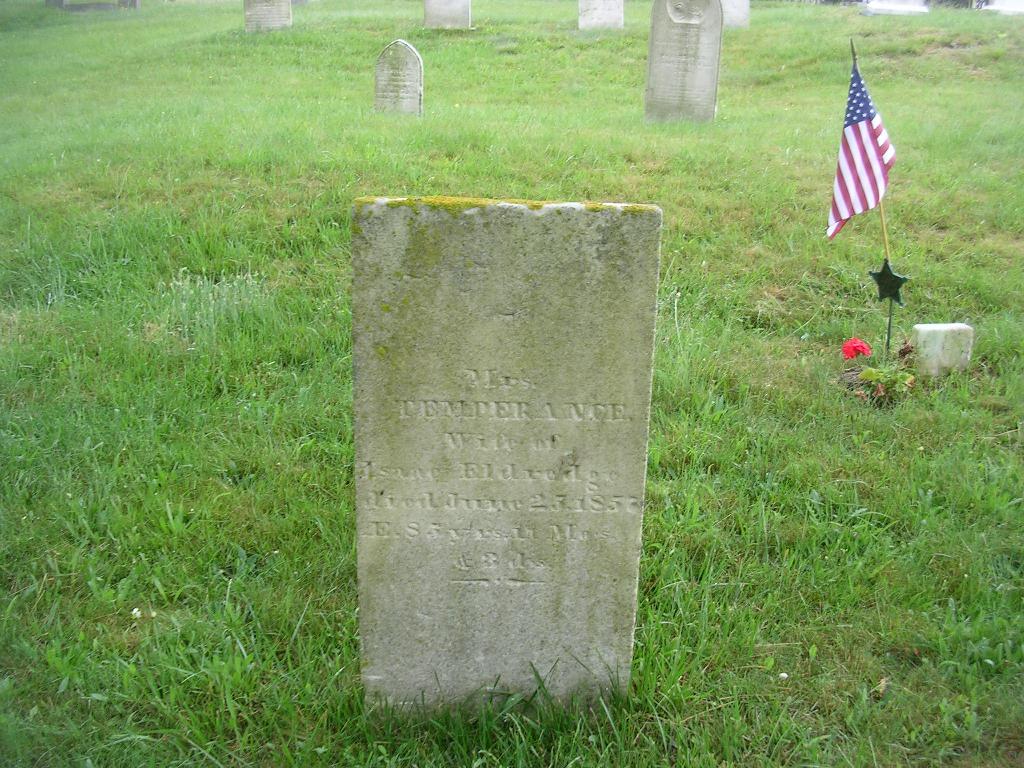
Temperance Wing Eldrigde Headstone – Seaside Cemetery, Chatham, Barnstable, Mass

Inscription:
wife of Isaac- 85 years 11 months 3 days
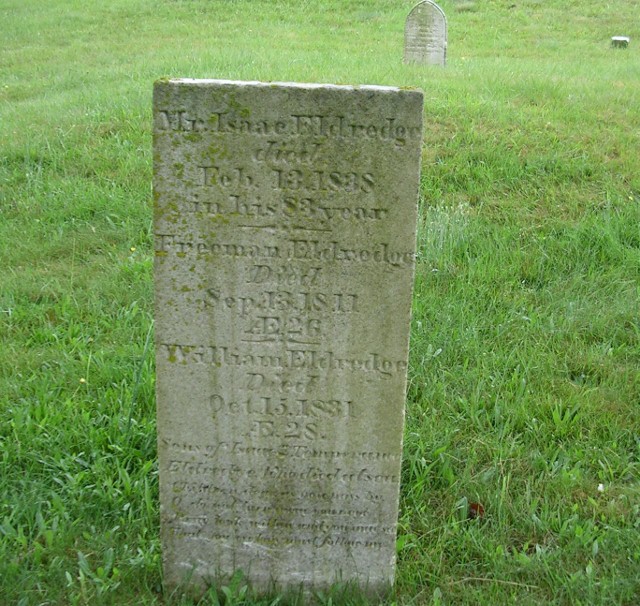
Isaac Eldridge Headstone Seaside Cemetery, Chatham, Barnstable, Mass. — Also includes sons Freeman Eldredge (1785 – 1811) and William Eldredge (1803 – 1831)

Children of Temperance and Isaac

i. Freeman Eldredge b. 16 Dec 1785 in Chatham, Barnstable, Mass.; d. 13 Sep 1811 Chatham; m. 25 Oct 1807 in Chatham to Deborah Mayo (b: 12 Jun 1786 in Chatham) Her parents were Paul Mayo and Azubah Crowell (b: 17 Feb 1749 in Yarmouth). Freeman and Deborah had one daughter Ruana (b: 04 Nov 1809 in Chatham)

After Freeman died, Deborah married another Freeman 20 Dec 1812 in Harwich, Barnstable, Massachusetts. — Freeman Robbins b: 15 Jun 1782 in Harwich, Barnstable, Massachusetts. They had nine children born betwen 1813 and 1831.

ii. Phebe Eldredge b. 28 Nov 1786 in Chatham, Barnstable, Mass

iii. Rebecca Eldredge b. 20 Dec 1788 in Chatham, Barnstable, Mass; d. 21 Oct 1828 – New Bedford, Bristol, Mass.; m. 1 May 1808 – Dartmouth, Bristol, Mass. to Abraham Akin (b. 3 Jan 1769 in Dartmouth – d. Sep 1845 in Dartmouth) His parents were Elihu Akin (1720 – 1794) and Ruth Perry (1728 – 1790). Rebecca and Abraham had seven children born between 1809 and 1824.

iv. Bethany Eldredge b. 3 Nov 1791 in Chatham, Barnstable, Mass.; d. 4 Oct 1855 in Chatham; m. 28 Apr 1816 Harwich, Barnstable, Mass. to David Clark (b. 6 Nov 1789 in Harwich – d. 28 Mar 1841 Chatham) His parents were David Clark (1757 – 1838) and Mehitable Weeks (1758 – ). Bethany and David had five children born between 1816 and 1824.

In the 1850 census, Bethany was living with her son-in-law Moses Martin and daughter Dorcas in Peterborough, Hillsborough, New Hampshire

v. Isaac Eldredge b. 30 Mar 1794 Chatham, Barnstable, Mass.; d. 24 Sep 1845 in Chatham; Burial: Seaside Cemetery; m. 3 Mar 1818 in Chatham to Rebecca Hamilton (b. 30 Sep 1796 in Chatham – ) Rebecca’s parents were Richard Hamilton (b: 26 Jul 1751 in Chatham ) and Leah Maddox (b. 1754 – d. 3 Apr 1847 age 93 Chatham) Isaac and Rebecca had two children Nathan( b. 1822 ) and Meranda (b. 1824).

An Isaac Eldredge (b. 1791 Mass.) married Abigail Luraney Nickerson (b. ~1797 in Harwich, Barnstable, Mass. – d. 1880 in Barnstable, Mass. of Diarrhea) Her parents were Jonathan Nickerson (1754 – 1807) and Bethia Young (1755 – 1834). In the 1850 census, Isaac and Abagail were living in Sandwich, Barnstable, Mass. Isaac was a laborer and his sons Isaac Jr. (b. 1816), Joseph A (b. 1823), Martin Eldridge (b. 1827) and John C (b. 1831) were all sailors.

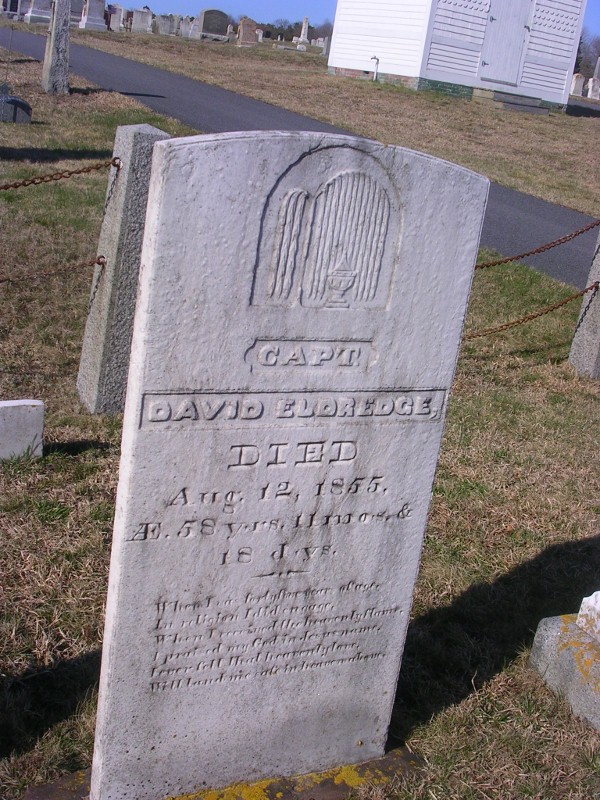
vi. Capt. David Eldredge b. 24 Aug 1796 in Chatham, Barnstable, Mass; d. 12 Aug 1855 Chatham, Mass.; Burial: Seaside Cemetery ; m. Aft. 05 May 1822 in int, Brewster, Barnstable, Mass. to Sarah “Sally” Crosby (b: 13 Mar 1799 in Harwich, Barnstable, Mass. – 13 May 1871 Chatham; Burial: Seaside Cemetery). Sally’s parents were Samuel Crosby Jr.( b: 1767 ) and Mercy Wing (b: 24 Jan 1772 in Harwich (now Brewster), Barnstable, Mass.) David and Sally had five children born between 1823 and 1835.

In  the 1850 census.   David was a sailor and was living with Sally and three daughters Mary (b. 1831 Mass.), Lucina (b. 1834 Mass.) and Arzelia C. (b. 1838 Mass.) in Chatham, Barnstable, Mass. Arzelia married 20 Jan 1861 to Henry E. Bates.

David Eldridge Gravestone — Seaside Cemetery, Chatham, Barnstable County, Mass.

Many genealogies say David married 23 Nov 1825 – Harwich, Barnstable, Mass. to Jemimah Weeks (b. 28 Nov 1803 in Harwich  – d. 19 Aug 1873 in Barnstable, Barnstable, Mass); Her parents were Isaac Weeks (1780 – 1841) and Elizabeth Allen (1784 – 1868). This David and Jemimah had six children born between 1826 and 1846. However, the 1850 and 1860 census records say this David was born about 1804, eight years after Temperance and Isaac’s birth record.

In the 1850 census, this David and Jemima were living in Barnstable, Barnstable, Mass. David was a laborer and his teenage sons Ambrose and Trueman were seamen. It appears this David was married to Phoebe S. [__?__] (b. 1812 Mass.) and living in Barnstable, Barnstable, Mass. in the 1880 census.

vii. Zephaniah Eldredge (male) b. 17 Jan 1799 in Chatham, Barnstable, Mass; d. 13 Mar 1833 in Chatham; m. 06 Dec 1826 in Chatham . to Sukey Allen (b: in of Harwich, Barnstable, Mass. ) Zephaniah and Sukey had two children Phebe Ann ( b: 16 Oct 1829 in Chatham) and Betsey Seabury b: 07 May 1832 in Chatham)

Several genealogies state that Zephaniah married 31 Mar 1835 – Chatham, Mass. to Zerviah E Ryder (1810 – 1888) Her parents were Kimball Ryder (1775 – 1825) and Ruth Eldredge (1780 – 1848). Zephaniah and Zerviah had a daughter Modena Ryder (b. 21 Sep 1847 Chatham, Barnstable. Mass. d. 20 Mar 1939, Chatham, Barnstable, Mass. People’s Cemetery Inscription:  91y 5m 27d)

In the 1850 census, Zephaniah and Zerviah were living in Chatham, Barnstable, Mass with their daughter Modesea “Modena

This Zephaniah was a Master Mariner.

However, I found a birth record that this Zephaniah Eldredge was born ten years later 29 Apr 1809 and his parents were Reuben Eldredge and Jenney Eldredge. Census records in 1850, 1860, 1870 and 1880 all show the later birthdate, as does Zephaniah’s gravestone 21 Sep 1880 – Inscription: 73y 4m 22d Peoples Cemetery, Chatham, Barnstable, Massachusetts,

Zephaniah,  son of Cushi, and great-grandson of Hezekiah, ninth in the literary order of the minor prophets. He prophesied in the days of Josiah, king of Judah (B.C. 641-610), and was contemporary with Jeremiah, with whom he had much in common. The only primary source from which we obtain our scanty knowledge of the personality and the rhetorical and literary qualities of this individual is the Book of Zephaniah which contains in its three chapters the fundamental ideas of his preaching.

Zeruiah , daughter of King Nahash of Ammon (2 Samuel 17:25) and stepdaughter of Jesse of the Tribe of Judah, was an older sister of King David. Zeruiah had three sons, AbishaiJoab, and Asahel, all of whom were soldiers in David’s army.  Very little is told of her. However, her sons are invariably mentioned with the matronymic “son of Zeruiah”, in marked contrast to most other Biblical characters (and people in many other cultures) who are known by a patronymic. This seems to indicate that she was an exceptionally strong or important woman, though the specific circumstances are not given.

viii. William Eldredge b. 22 May 1801 in Chatham, Barnstable, Mass;d. 15 Oct 1831 Chatham; Burial: Seaside Cemetery; m. Bethiah Harding or Lovina [__?__] William and Bethiah had one son Jonathan (b: 18 Jul  1821 in Chatham)

ix. Temperance Eldredge b. 13 Sep 1803; m. Int. 31 Oct 1819 Chatham, Barnstable, Massachusetts to Isaac Howes (b. Chatham) Temperance and Isaac had one daughter Lyza Howes( b: 12 Mar 1820 in Chatham)

x. Sylvia Eldredge b. 26 Nov 1805 in Chatham, Barnstable, Mass

xi. Catherine Eldredge b. 09 Oct 1812 in Chatham, Barnstable, Mass
4. Jedidah Wing

Jedidah’s first husband Archelus Chase was born 3 Mar 1771 in Harwich. His parents were second cousins William Chase (II) ( b: ~1732 in Yarmouth) and Mercy Chase (b: 11 Feb 1733/34 in Yarmouth).   Archelus drowned fishing with his sons Warren, Archelus Jr, and Ensign on 4 Feb 1808 in Harwich, Mass. His paternal grandparents were our ancestors William CHASE III and Dorcas BAKER.

Jedidah’s second husband Thomas Kelley was born 8 Jan 1775 in Yarmouth, Barnstable, Mass. He was Jedidah’s second cousin. His parents were Eleazer O’Killey (1728 – 1803) and Hannah Baker (1728 – ) His grandparents were Eleazer O’Kelly and Sarah Browning and his great grandparents were our ancestor Jeremiah O’KELLY and Sarah CHASE.

Here is what Josiah Paine has to say about Archelus and his sons:

Archelus Chase, son of Wm. md. Jedidah Wing, dau. of David of the north Parish, 8 Dec 1789 (see p. 186). He had in 1798 a house near Herring River, a lot of land west by Dennis, north by Enos Nickerson’s. Had 4 acres east & south by Isaiah Chase & land bought of Isaac Eldredge & land west of Wm Chase. He was drowned with 3 sons near Point Gammon from a boat 4 Feb 1808. Jedediah Chase lived a widow & d. 31 Aug 1862, ae 95 JP

Children of Jediah and Archelus:

i. Warren Chase b. 26 Nov 1791 in Harwich, Barnstable, Mass.; d. 4 Feb 1808 Drowned while Fishing

ii. Elizabeth Chase b. 20 Oct 1792 in Harwich, Barnstable, Mass.; d. 1847; m. 4 Nov 1813 to William Fuller (b. ~1789 – d. 10 Feb 1875 in Barnstable, Barnstable, Mass.)

iii. Archelus Chase Jr. b. 08 Jun 1794 in Harwich, Barnstable, Mass.; d. 04 Feb 1808 in drowned with his father and brother Warren, off Harwich.

iv. Ensign Chase b. 18 Dec 1796 in Harwich, Barnstable, Mass.; drowned 4 Feb 1808 fishing with his father and brothers.

v. Mercy Chase b. 17 Sep 1797 in Harwich, Barnstable, Mass.; m1. 24 Apr 1830 Harwich, Barnstable, Mass to James Crowell (b. 06 Dec 1782 in Yarmouth, Barnstable, Mass. – d. 31 Aug 1832) James parents were David Crowell (1759 – 1828) and Thankful Eldredge (1763 – ). James first married his cousin Ruth Crowell (b. 03 Sep 1785 in Dennis, Barnstable, Mass. – d. 30 Aug 1829) and had seven children born between 1804 and 1825. Mercy and James had one daughter, Rebecca born in 1831.

m2. 18 Dec 1835 in Harwich to Edward Hains (Haynes)

vi. Cynthia Chase b. 10 Nov 1799 in Harwich, Barnstable, Mass.; Never married; In the 1860 census, Cynthia was living with her mother in Harwich, Mass. and working as a seamstress.

vi. George Washington Chase b. 11 Jun 1802 in Harwich, Barnstable, Mass.; m1. 4 Feb 1830 to Mercy Freeman (b. 9 Mar 1808 – d. 20 Jul 1837); Mercy’s parents were John Freeman (b: 10 Nov 1761 in Eastham, Barnstable, Mass) and Abigail Hopkins (b: 19 Sep 1764 in Eastham); m2  int. filed . 27 Sep 1842  to Rebecca C. Flanders (b: South Hampton, NH)

vii. Samuel Chase b. 27 Jan 1804 in Harwich, Barnstable, Mass.; d. 19 Oct 1826; m. 9 May 1827 in Harwich to Sally Eldredge (b. 30 Oct 1805 in Harwich – d. 2 Jan 1861)

viii. Loring Chase b. 1805 in Harwich, Barnstable, Mass.

ix. Archelus Chase b. 20 Oct 1807 in Harwich, Barnstable, Mass.; d. 28 Sep 1885; m1. 06 Feb 1834 in Harwich, Barnstable, Mas to Emeline Baker (b. 21 Jul 1817 in Dennis, Barnstable, Mass.); Emeline’s parents were Seth Baker and Thankful [__?__]; m2. 23 Dec 1849 in Chatham, Mass. to Ann Stetson (b. 30 Aug 1808 in Chatham, Barnstable, Mass – d. Aft. 1880 census)

In the 1850 census, Archelus had three daughters at homw: Hannah age 15, Amanda age 13 and Matilda S age 7. In the 1870 census, Archelus and Ann were retired near Dennis Port, Harwich.

5. Hannanh Wing

Hannah’s husband John Hammond was born 15 Mar 1766 in Chatham, Mass. His parents were Calvin Hammond and Patience Young. John died 8 Aug 1839 in Chatham, Mass.

During the War of 1812, John was taken from a fishing boat off the cost of Chatham, Mass and forced to act as a pilot for a British privateer for several weeks, but was finally landed at Chatham. The sons of this family were mariners and masters of vessels and lived in Chatham unless otherwise stated.

Children of Hannah and John

i. Elizabeth “Eliza” Hammond b. 2 Nov 1788 in Chatham, Mass.; d. 13 Aug 1870 Barnstable, Barnstable, Mass. burial Osterville Hillside Cemetery; m. William Davis (alias Blount) (b: 28 Jun 1790 in Snow Hill, London, England – d. 16 Apr 1871 in Osterville, Barnstable, Mass] When he was a young man, William was aboard the British ship Guerriere when she was captured by the US Frigate Constitution. He called himself William Blount, probably to escape impressment in the English service. Eliza and William had seven children born between 1816 and 1831.

Eliza Hammond Blount (1788 – 1870)

In the 1850 census, William and Eliza Blonnt were living in Barnstable, Barnstable, Mass where William was a ship wright.

William Blount-Davis (1790-1871)

The USS Constitution vs HMS Guerriere, was a single ship action between the two ships during the War of 1812. It took place shortly after war had broken out, and would prove to be an important victory for American morale.

USS Constitution vs HMS Guerriere by Michel Felice Corne (1752–1845)

At 2.00 p.m. on August 19, 1812 the Constitution sighted a large ship to leeward, and bore down to investigate. The weather was cloudy, and the wind was brisk. The strange ship proved to be the Guerriere, whose crew recognized Constitution at about the same moment. Both ships prepared for action, and shortened sail to “fighting sail”, i.e. topsails and jibs only. As the Constitution closed, the Guerriere’s Captaine Dacres first hove to to fire a broadside, which fell short, and then ran before the wind for three quarters of an hour with the Constitution on her quarter. Dacres yawed several times to fire broadsides at the Constitution, but the Guerriere’s broadsides were generally inaccurate, while the few shots fired from Constitution’s foremost guns had little effect. After one cannon-ball bounced “harmlessly” off the side of the Constitution, a crew member is said to have yelled “Huzzah! Her sides are made of iron!” [Hence Old Ironsides that we know today.]

Once the range had closed to within a few hundred yards, Captain Hull ordered extra sail (the foresail and main topgallant sail) to be set, to close the distance quickly. Dacres did not match this manoeuvre, and the two ships began exchanging broadsides at “half pistol-shot”, with the Constitution to starboard and Guerriere to port. After fifteen minutes of this exchange, during which Guerriere suffered far more damage than the Constitution due to the latter’s larger guns and thicker hull, Guerriere’s mizzenmast fell overboard to starboard, acting like a rudder and dragging her around. This allowed Constitution to cross ahead of Guerriere, firing a raking broadside which brought down the main yard. Hull then wore ship to cross Guerriere’s bow again, firing another raking broadside, but the manoeuvre was cut too close and the Guerriere’s bowsprit became entangled in the rigging of the Constitution’s mizzenmast.

Constitution fires into the burning hulk of Guerriere, now badly damaged.

On both ships, boarding parties were summoned, while musket fire broke out from each ship. Lieutenant Charles Morris and Captain Dacres were both wounded by musket shots. Only the narrow bowsprit provided a way between the ships, and in the heavy sea, neither side could venture across it. Some of the gunners aboard Guerriere fired at point-blank range into Hull’s stern cabin, setting the American ship on fire briefly. The two locked ships slowly rotated clockwise until they broke free. The Guerriere’s foremast and mainmast both then fell “by the board” i.e. snapped off at deck level, leaving her helpless and rolling heavily. Dacres attempted to set sail on the bowsprit to bring his ship before the wind, but it too had been damaged and broke. The Constitution meanwhile ran downwind for several minutes, repairing damage to the rigging, before once again wearing and beating upwind to return to battle.

As Constitution prepared to renew the action, the Guerriere fired a shot in the opposite direction to the Constitution. Sensing that this was an attempt to signal surrender, Hull ordered a boat to take a Lieutenant over to the British ship. When the Lieutenant walked onto the Guerriere and asked if Guerriere was prepared to surrender, Captain Dacres responded “Well, Sir, I don’t know. Our mizzen mast is gone, our fore and main masts are gone-I think on the whole you might say we have struck our flag.”

Guerriere Demasted — Thomas Chambers The Constitution and the Guerriere

Captain Dacres was escorted aboard the Constitution. Hull refused to accept Dacres’ sword of surrender, saying he could not accept the sword from a man who had fought so gallantly. He also ordered that Dacres’ mother’s Bible be returned to him. The Guerriere was clearly sinking, and the wounded were transferred to the Constitution. Hull found that ten impressed Americans had been serving aboard Guerriere but Dacres had permitted them to stay below decks instead of fighting their countrymen.

Hull wanted the Guerriere towed in as a prize ship. The Constitution lay by the Guerriere during the night but at daybreak it was obvious that the Guerriere could not be salvaged. The prisoners and the American salvage parties were brought aboard Constitution and at three o’clock in the afternoon, the Guerriere was set on fire, and soon blew up.

Although Constitution was capable of continuing its cruise (it was substantially undamaged and still had two thirds of its ammunition), Hull wanted the American public to have news of the victory. He reached Boston ten days later, and his news (with the obvious proof of more than two hundred prisoners of war) caused rejoicing. The Guerriere had been one of the most active ships of the Royal Navy in stopping and searching American merchant vessels, and the news of its defeat was particularly satisfying to the American seafaring community. Ironically, Hull was never to hold another fighting command.
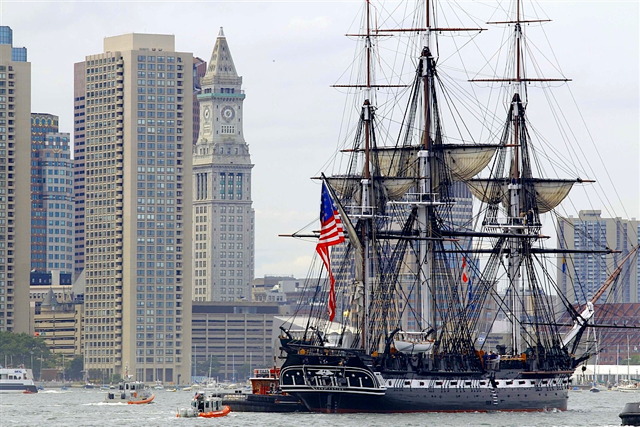
USS Constitution in 2012 — Commander Matt Bonner, during the bicentennial observances of the War of 1812, sailed the Constitution under her own power on August 19, 2012, the anniversary of her defeat of the Guerriere. Bonner is Constitution’s 72nd commanding officer.

Once released by exchange of prisoners and returned to Halifax, Dacres was tried by court martial, as was customary in the case of a Royal Navy ship lost from any cause. He put forward as his defense the facts that the Guerriere was originally French-built, captured by the Royal Navy in 1806, and therefore not as sturdy as British-built ships, and more importantly, that the Guerriere was badly decayed and in fact on its way to refit in Halifax at the time, and the fall of the mizzen mast which crippled the Guerriere early in the fight had been due as much to rot as battle damage. There was no suggestion that Dacres and his men had not done their utmost, or that Dacres had been unwise to engage the Constitution. (Early in the War of 1812, it was accepted in the Royal Navy that a British 38-gun frigate could successfully engage a 44-gun frigate of any other nation.) Dacres was therefore acquitted.

ii. Calvin Hammond b. 18 Oct 1790 in Chatham, Mass.; d. 7 Jun 1853/54 Seaside Cemetery, Chatham, Mass; m. 12 Jan 1816 in Harwich, Barnstable, Mass to Deborah Eldridge (b. 1791 – d. 24 Jul 1867 Seaside Cemetery Chatham, Barnstable, Mass)   Calvin and Deborah had six children born between 1819 and 1834.

In the 1850 census, Calvin was a sailor in Chatham, Barnstable, Mass

iii. Capt. Luther Hammond b. 10 Jan 1792 in Chatham, Barnstable Mass.; d. 9 Mar 1854 Chatham.; Burial: Methodist Church Cemetery; m. 11 Mar 1817 – Harwich, Barnstable, Mass to Sarah “Sally” Gould (b. 11 Jun 1797 in Chatham – d. 17 May 1872 in Chatham) Sally’s parents were Josiah Gould (1766 – 1858) and Azuba Dexter (1768 – 1800.) Luther and Sally had seven children born between 1818 and 1833.

iv. John Hammond b. 23 Oct 1793 in Chatham, Mass.; d. 2 Apr 1864; m. 16 Sep 1817 to Mercy Hopkins (b. 1797 in Chatham – d. 27 Sep 1870 Chatham) Mercy’s parents were William Hopkins (b: 02 Feb 1766 in Chatham) and Dorcas Doane (b: 20 Jul 1771 in Chatham) John and Mercy had ten children born between 1820 and 1842.

In the 1850 census, John was a sailor in Chatham, Barnstable, Mass.

v. Stephen Hammond b. 24 Jul 1795 in Chatham, Mass.; d. 9 Aug 1871; m. 18 Jan 1820/21 to Betsey L. Ryder (b. 6 Mar 1797 in Yarmouth, Barnstable, Mass. – d. 28 Nov 1880 in Chatham, Barnstable, Mass) Betsey’s parents were Edward Ryder (1761 – 1817) and his cousin Mercy Godfrey Ryder (1764 – 1850); Stephen and Betsey had seven children born between 1821 and 1837.

In the 1850 census, Stephen was a sailor in Chatham, Barnstable, Mass.

vi. William Hammond b. 19 Jun 1799 in Chatham, Mass.; d. 1829; m. 5 May 1820 to Reliance Wing (b. 05 Aug 1801 in Chatham – d. 7 Jan 1875Chatham; Burial Seaside Cemetery) Reliance was William’s second cousin. Her parents were Levi Wing (b: 03 Aug 1766 in Chatham) and Elizabeth Howes (b: ~1763 in Yarmouth (now Dennis)) Her grandparents were Joseph Wing and Experience Hopkins. Her great grandparents were our ancestors John WING IV and Rebecca FREEMAN Vickerie. William and Reliance had three children born between 1821 and 1827.

After William died, Reliance married 28 Oct 1827 in Chatham to William Hamilton (b: 04 Jan 1789 in Chatham – d. 14 Jan 1879 Chatham Seaside Cemetery) and had eight more children between 1829 and 1846.

vii. Elisha Hammond b. 2 Aug 1801 in Chatham, Barnstable, Mass.; d. 13 Sep 1888 Chatham; m. 29 Jan 1824 int. filed, Harwich to Lydia C. Allen (b. 24 Aug 1801 in Harwich – d. 23 Oct 1892 in Chatham) Her parents were Paine Allen (b: 09 Sep 1764 in Harwich) and Lydia Eldredge. Elisha and Lydia had five children born between 1828 and 1844. Elisha was a master mariner.

In the 1850 census, Elisha was a sailor in Chatham, Barnstable, Mass

viii. Zebediah “Zebedee” Hammond b. 21 Aug 1803 in Chatham, Barnstable, Mass.; m. 28 Oct 1833 to Betsey Fessenden; Zebeedee and Betsey had five children born between 1834 and 1839.

In the 1850 census, Zebedee was a sailor in Chatham.

ix. Hannah Hammond b. 6 Sep 1805 in Chatham, Barnstable, Mass.; d. 7 Mar 1886 Chatham; Burial:Seaside Cemetery; m. 11 Aug 1834 to Captain Francis Allen Patterson (b. 7 Sep 1803 Mass – d. 7 Feb 1876 Chatham; Burial:Seaside Cemetery)

In the 1870 census, F A and Hannah W were living in Chatham where Francis was a laborer.

6. Tamzin WING (See Isaac HAWES‘s page)

7. David Wing

David’s wife Desire Vincent was born 18 Jan 1771 in Yarmouth, Barnstable, Mass. Her parents were David Vincent and Mehitable Taylor. Desire died 4 Nov 1842 in Homer or South Cortlandville, Cortland, New York.

David Wing Memorial Cortland Rural Cemetery, Cortland, Cortland , New York,, Plot: Sec. F, Lot 11

Inscription:
David Wing
Aged 77 Years
—-
Desire Wing
Aged 72 Years
—-
Hitty Simonds
Aged 25 Years
—-
Joanna Hayden
Aged 26 Years
—-
Abigail Wing
Aged 24 Years
—-
Rosanna S. Wing
Aged 42 Years
—-
Wells D. Hayden
Aged 17 Years

Note: Peck/Wing Monument

David Wing Memorial Detail

Burial:
Cortland Rural Cemetery
Cortland
Cortland County
New York, USA
Plot: Sec. F, Lot 11

Children of David and Desire

i. Mehitable “Hitty” Wing b. 10 Dec 1791 in Harwich, Barnstable, Mass.; d. 20 Aug 1816 Burial: Sec. F, Lot 11, Courtlandville aka Cortland Rural Cemetery, Cortland, Cortland, New York’ m. John Simons

ii. [__Infant__] Wing b. 6 Jan 1794 in Dennis, Barnstable, Mass; d. 10 Jan 1794 Dennis, Barnstable, Mass

iii. Temperance Wing b. 26 Jan 1795 in Dennis, Barnstable, Mass.; d. 27 Jan 1826 Smyrna, Chenango, New York; m. 18 Feb 1816 in Smyrna, Chenango, New York to John Pope Tobey (b. 5 Jun 1790 in Smyrna, Chenango, New York – d. 3 Apr 1888 in Smyrna, Chenango, New York) His parents were Joseph Tobey (b: 1759 in of Dartmouth, Bristol, Mass.) and Elizabeth Pope (b: 13 May 1765 in Lebanon, New London, CT) Temperance and John had seven children born between 1816 and 1831.

In the 1860 census, John and Temperance were farming in Smyrna, Chenango, New York with one daughter Antonett (b. 1831) at home.

iv. Arathusa Wing b. 28 Apr 1797 in Dennis, Barnstable, Mass; d. 23 Feb 1859 Union Cemetery, Westfield, Chautauqua, New York; m. Lewis Sperry ( b: 06 Apr 1793 CT – 01 Mar 1879 Union Cemetery, Westfield, Chautauqua, New York) Arathusa and Lewis had five children born between 1821 and 1837.

In the 1850 census, Lewis and Evathusa were farming in Chautauqua, Chautauqua, New York.

v. Otis Wing b. 10 Apr 1799 in Dennis, Barnstable, Mass; d. 30 Apr 1898 Newton Jct, New Hampshire No children; m1. 09 Oct 1836 in Manchester, Essex, Mass. to Lucy Woodberry Masters (b: 15 Nov 1791 in Beverly, Essex, Mass.) Her parents were Asa Woodberry (1747 – 1830) and his cousin Anna Woodbury (1753 – 1844). Lucy first married 2 Feb 1813 Beverly, Essex, Massachusetts to James Woodbury Marshall (1787 – 1816). After James died, she married 30 Aug 1821 Beverly, Essex, Mass. to Andrew Marsters (1791 – 1835). Finally she married Otis at age 44.

Divorced: Libalant: Otis Wing Libelee: Lucy Wing nee Masters.

In the 1860 census, Otis was a Baptist Minister living with Rufus and Ellen Hopkin’s extended family in DeKalb, DeKalb, Illinois.

Otis and Lucy were at least separated, if not divorced. Lucy was living with her son, Woodbury Marsters at Chester, Rockingham Co., NH in the 1870 Census( and was using the last name Marsters)

m2. 16 Mar 1879 in Merrimack, Essex, Mass. to Nancy Short Dwindells (b: 09 Mar 1845 in W. Newbury, Essex, Mass.) Her parents were Jacob G. Dwindells (b. ~1813 in Mass.) and Achsah H. Short (b: ~1810 in Mass.) Nancy was 45 years younger than Otis. Even her parents were more than ten years younger! Nancy first married [__?__] Sider.

In the 1880 census, Otis was a clergyman in West Newbury, Essex, Mass, He and Nancy were living with Nancy’s parents Jacob G. and Achsam H. Dwinnels.

vi. Desire Wing b, 14 Jun 1801 in Dennis, Barnstable, Mass; d. 14 Dec 1880 in home of her son, Walter G. Stone, Chicago, IL; m. 14 JUL 1821 in Homer, Cortland, New York to Thomas Stone (b. ~1797 – d. Bef. 1850 in Homer, Cortland, New York). His parents were Thomas Stone Sr and Rachel Marsh. Desire and Thomas had ten children born between 1822 and 1841.

In the 1850 census, Desire was living in Homer, Cortland, New York with two daughters Delia A age 24 and Julia E age 11

vii. Joanna Wing b. 18 Apr 1803 in Dennis, Barnstable, Mass; d. 3 Apr 1829 in Friendship, Allegheny, New York Burial: Sec. F, Lot 11, Courtlandville aka Cortland Rural Cemetery; m. ~1825 to Harry Hayden ( b: ~1800 in of Friendship, Allegheny, New York)

viii. Abigail Wing b. 3 Jul 1805 in Dennis, Barnstable, Mass; d. 5 Jul 1829 Cortland, NY Burial: Sec. F, Lot 11, Courtlandville aka Cortland Rural Cemetery,

Abigail Wing Gravestone = Peck/Wing Monument Cortland Rural Cemetery Cortland Cortland County New York, Plot: Sec. F, Lot 11 Inscription: David Wing Aged 77 Years —- Desire Wing Aged 72 Years —- Hitty Simonds Aged 25 Years —- Joanna Hayden Aged 26 Years —- Abigail Wing Aged 24 Years —- Rosanna S. Wing Aged 42 Years —- Wells D. Hayden Aged 17 Years

ix. Persis Wing b. 2 Sep 1807 in Dennis, Barnstable, Mass; d. 8 Dec 1897 in at home, 604 University Ave., Syracuse, New York; m. 13 Oct 1831 to Jesse Truesdell Peck (wiki) (b. 4 Apr 1811 in Middlefield, Otsego, New York – d. 17 May 1883 Oakwood Cemetery, Syracuse, New York) His parents were Luther Peck and Annis Collier.

Jesse was the youngest of five sons of Luther and A. Peck, all of which became Methodist preachers. He was one of the founders of Syracuse University, serving as the first Chairman of the Board of Trustees. He developed the plan for the construction of buildings on land donated by George F. Comstock, each dedicated to a different academic discipline.

He was an American bishop of the Methodist Episcopal Church, elected in 1872 and was a delegate to the First Ecumenical Conference in 1881.

Jesse Truesdell Peck (1811-1883)

Jesse’s grandfather, also named Jesse, died in Washington’s army. His father, Luther, was a blacksmith and lifelong class leader, whose five sons (of whom Jesse T. was the youngest) all became Methodist preachers. The trend in his family toward the Methodist ministry led his great-nephew, the novelist Stephen Crane, to say: “Upon my mother’s side, everyone in my family became a Methodist clergyman as soon as they could walk, the ambling-nag, saddlebag, exhorting kind.

Bishop Peck was converted to christanity at the age of sixteen. He sensed a call to preach almost immediately. He entered the Traveling Ministry as a circuit rider of the Oneida[disambiguation needed] Annual Conference of the M.E. Church in 1832. He was ordained by Bishops Elijah Hedding and Beverly Waugh. Prior to his election to the Episcopacy, Peck served as a pastor and a presiding elder. As a Bishop, he was a delegate to the First Ecumenical Conference, 1881.

In 1848, he was elected the tenth president of Dickinson College, in Carlisle, Pennsylvania. During his presidency, Peck was unpopular with the students. In one student prank, he was detained in an insane asylum in Staunton, Virginia, where he had traveled for a church conference.. Students locked Peck in a railroad boxcar overnight and another time, shot, and killed, his dog. On top of all of these problems with the students, Peck proved to be an inadequate fundraiser for the College; in June 1851, he announced his intention to leave the institution the following year, citing his belief that he was ill-suited to the tasks associated with the job. In July 1852, he gave the address to the graduating class, entitled God in Education.

Though not a college graduate himself, Peck was prominent in the beginnings of Syracuse University, serving as the first Chairman of its Board of Trustees. At its founding on March 24, 1870, the state of New York granted the University its charter independent of Genesee College. The City of Syracuse offered $100,000 to establish the school.[26] Bishop Jesse Truesdell Peck donated $25,000 to the proposed school and was elected the first president of the Board of Trustees.

Peck developed what became, in effect, the University’s first master plan: a scheme for the construction of seven buildings on land donated by George F. Comstock, also a member of the Board. Each building was to be dedicated to a different academic discipline. Peck’s vision for the new campus was one of stylistic eclecticism; on one occasion declaring that the new university should “demonstrate the perfect harmony and indissoluble oneness of all that is valuable in the old and the new.” The first building completed under this plan was the Hall of Languages, built at the summit of University Avenue in Syracuse. Nationally renowned architect Horatio Nelson White was the designer of this French Second Empire structure

In the 1850 census Jesse and Persis were living in Carlisle, Cumberland, Pennsylvania. In 1848 Jesse was elected the tenth president of Dickinson College

In the 1860 census, Jesse was a minister in San Francisco and in 1870 a Clergyman in Syracuse.

Selected Writings of Bishop Peck

Sermon: Talent, in Clark, D.W., The Methodist Pulpit, 1897.
The Central Idea of Christianity, 1857.
The True Woman, 1857.
What Must I Do to Be Saved?, 1858.
Sermon: The Life Battle, in The New York Pulpit in the Revival of 1858, A Memorial Volume.
Address: Centenary Conv., Boston, 1866, Proceedings.
History of the Great Republic, 1868.
Biography of Mary Brison, in Our Excellent Women, pub. by James Miller, 1872.
Addresses State Convs, N.J., 1870, political; N.Y., 1870, Public Schools, N.Y., 1871, Political Reform.
Sermon in Fraternal Camp-Meeting Sermons, Round Lake, 1875.
Reader of the Address published by the First Ecumenical Methodist Conference, City Road, London, 1881. The preparation of the paper was largely in his hands.

x. David Wing b. 21 Jun 1810 in Dennis, Barnstable, Mass; d. 1885 Trempealeau, Trempealeau, Wisconsin; m1. 23 Aug 1832 to Jane Lobdell (b. 19 Oct 1809 in of No. Salem, Westchester, New York) ; Jane’s parents were Daniel Lobdell and Sally Keeler. David and Jane had six children born between 1833 and 1848.

m2. 13 Sep 1855 in Cherry Valley, Winnebago, IL to Lorinda Richardson (04 Aug 1833 in (now Canada)- d. Jun 1907 in Washougal, Clark, WA Burial: Washougal Memorial Cemetery,) Lorinda’s parents were Clark W. Richardson (b: 1802 in New York) and Mary “Polly” Herrington [Harrington] (b ~1809 in Ontario) David and Lorinda had another eight children born between 1856 and 1869.

In the 1870 census, David and Lorinda were farming near Plum River, Stockton, Jo Daviess, Illinois.

xi. Rosanna Sears Wing b. 19 Jun 1812 in Sonyrue, Chenango, or Sonyea, Livingston, New York; d. 05 Jul 1855 in Cortland, Cortland, New York; Burial: Sec. F, Lot 11, Courtlandville aka Cortland Rural Cemetery, Cortland, Cortland, New York; Unmarried

xii. Joseph Vincent Wing b. 14 Oct 1814 in Homer, Cortland, New York; d. 1907 Belvidere, Illinois; m. 15 Sep 1840 in Courtland, New York to Sarah Adeline Johnson (b. 15 Sep 1820 in (Unknown), Orange, New York – d. 12 Mar 1905 Belevidere Cemetery, Belvidere, Boone, Illinois) Joseph and Sarah had six children between 1842 and 1857.

In the 1870 census, Joseph was a wagon maker in Belvidere, Boone, Illinois.

8. Capt. John Wing

John’s wife Hannah Foster was born 1777 in Harwich, Barnstable, Mass. Her parents were David Foster (b. b: 24 Mar 1742 in Harwich, Barnstable, Mass.) and Phebe Freeman (b: 19 Nov 1747 in Harwich, Barnstable, Mass). Hannah died in 1848.

Children of John and Hannah

i. Charlotte Foster Wing b. 26 Jun 1797 in Harwich, Barnstable, Mass.; d. 6 Mar 1882; m1. 19 May 1816 to Benjamin Freeman (b. 30 Jun 1793 in Eastham (now Orleans), Barnstable, Mass. – d. 24 Oct 1845 in Ross Township, Kalamazoo, Michigan, Burial: Yorkville Cemetery) Benjamin’s parents were John Freeman (b: 10 Nov 1761 in Eastham ) and Abigail Hopkins (b: 19 Sep 1764 in Eastham) Charlotte and Benjamin had 13 children born between 1817 and 1841. Between 1830 and 1832, they moved to Victor, Ontario, New York.

m2. 27 Feb 1848 Battle Creek, Calhoun, MI to Deacon William Betterly (b. 6 Oct 1788 New Fane, Vermont – d. 10 July 1871 Oak Hill Cemetery, Battle Creek, Calhoun, MI.) His parents were Thomas Betterly (1751 – 1836) and Lydia Warren (1752 – 1837). He first married 17 Jan 1811 Battle Creek, Calhoun, Michigan to Phebe S Hayford (11 May 1791 – 29 Nov 1847 in Battle Creek, Calhoun, Michigan)

In the 1850 census, William and Charlotte were farming in Battle Creek, Calhoun, Michigan with one child from William’s previous marriage and six from Charlotte’s.

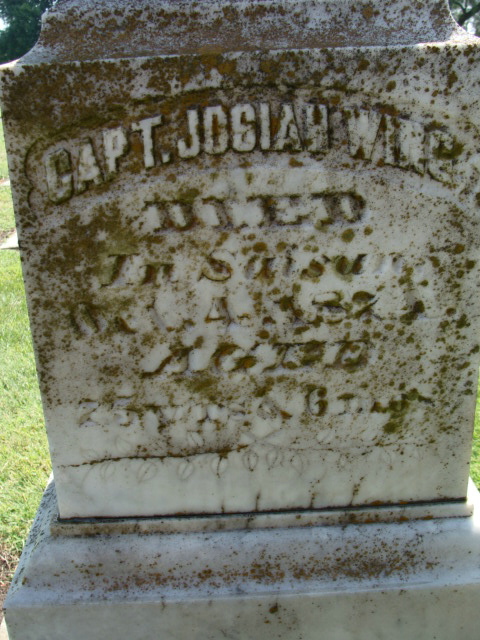
ii. Capt. Josiah Wing b. 3 Apr 1799 in Harwich, Barnstable, Mass.; d. 4 Oct 1874 Suisan, Solano, California;  m1. 12 Oct 1822 in Brewster, Barnstable, Mass. to Phebe Lincoln (b. 29 Dec 1800 in Brewster – d. 1837 in South Perinton, Monroe, New York); Phebe’s parents were Nathaniel Lincoln III (b: Bef. Dec 1770 in Harwich.) and Rebecca Cobb (b:~ 1767 – d. 30 Apr 1816 age 49 Harwich) Josiah and Phebe had five children born between 1824 and 1836 in Brewster, Mass. These children stayed in the Midwest.

m2. 5 Nov 1837 to Mrs. Mercy Hurd. Mercy Foster Crosby (b. 1808 in Brewster, Barnstable, Mass. – d. 9 Jan 1885 in Suisun, Solano, California; Burial: IOOF Block 44 Grave 7, Fairfield-Suisun Cemetery) Mercy’s parents were Sylvanus Crosby II (b: 11 Nov 1777 in Harwich (now Brewster)) and Polly Crosby Foster (b: 8 Jun 1778 in Harwich)  Mercy first married [__?__] Hurd.  Josiah and Mercy and six more children born between 1838 and 1848, two in South Perinton, Monroe, New York, three in Medina, Orleans, New York and one in Wheatland, Hillsdale, Michigan. These children came with their parents to California.

Josiah sailed his ship Diantha around the horn to San Francisco in 1851. He purchased a the Ann Sophia, and sailed between San Francisco and Sacramento and in the process founded Suisun City on the Delta. Late in live he mastered the brig Pride of the West to catch fish in the North Pacific. The next year he took command of the Dominga and for the next five years he sailed to Petropoulski, on the Okhotsk Sea, returning each autumn with 70,000 to 100,000 codfish. Other fishing expeditions took him to New Zealand.

In 1822 when he was 23 years old, Josiah was captured by pirates while on a voyage in brig “Iris.” Warren Lincoln recorded the adventure : [Click the link for the rest of the story]

We sailed from Boston about the first of November, 1822, in the brig “Iris,” owned by William Parsons, Esq., of Boston. Our crew consisted of eleven, all told, viz.: Freeman Mayo, of Brewster, master ; Richard Rich of Bucksport, Me., first mate; Sylvanus Crosby of Brewster [Josiah’s father-in-law], second mate; Brewster Mayo of Brewster, seaman, who was the first child born in Brewster, or rather, he was a twin; Josiah Wing of Brewster, seaman; two other seamen; _____ Hooper of Boston, seaman; negro for cook; Mr. Greenleaf of Baltimore, a passenger, and the cabin boy 12 years old belonging in Brewster and the teller of this story.

This was my first voyage, and for the first three days out I was very homesick and seasick. Nothing remarkable occurred until about the 20th. We had passed the Bahama Banks and passed the Double Headed Shot Keys during the night. About sunrise I was called to my duty, which was to keep the cabin tidy, set the table, clear it away, wash the dishes, etc. When I came on deck the island of Cuba was in sight about 30 miles distant, the wind light, the water smooth. We were sailing by the wind, as the sailors term it, “full and by.” I soon noticed the first mate in earnest conversation with the man at the helm and came near enough to hear the mate say :

“They may be pirates,” referring to two vessels in-shore of us, “and I will call the captain.”

He went into the cabin and called Captain Mayo. His first exclamation, spy-glass in hand, was,

“Damn ’em, they are pirates! Call all hands on deck, put up your helm and keep her off ; square the yards, set the fore-topmast studding sail; bear a hand ! ” …

From Jerry Bowen and Sabine Goerke-Shrode ”Solano: The Way It Was,” Sunday, Jan 7, 2007 – Capt. Wing steered Suisun City’s early course

After Phebe’s death, Josiah went back to Brewster, Mass., where he married a widow, Mercy Hurd. He sold the farm in New York and moved to Michigan.

The gold discovery in California drew him away from farming to try his hand at the more lucrative business of transporting passengers and cargo to the gold fields. He moved the family to Cape Cod, Mass.

Once in California, he went into the business of supplying building materials, goods and food for the miners. He established a very profitable business when he began sailing out of San Francisco to Sacramento. Josiah also converted the ship that he sailed around the horn, The Diantha, into a store ship and then built the Pine Street Hotel in San Francisco from the timber that he had brought with him.

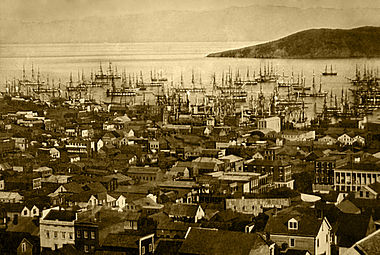
San Francisco Harbor 1851

Evidently The Diantha never sailed again and was broken up or allowed to sink in the bay, the fate of hundreds of ships whose crews jumped ship to pursue the lure of gold.

Followed the acquisition of the schooner Ann Sophia, in 1852, Josiah Wing  came to Suisun. He purchased Suisun “Island” and a tract of adjoining marshland, about 600 acres in all, for $500. He established a permanent wharf at Suisun and built a warehouse with sleeping quarters, then moved   his wood-frame home from its location on Pine Street in San Francisco to Suisun.

He also discovered, that at low tide, Suisun was not an island. Using willow logs, he raised the low-tide connection between the island and the Suisun Valley shoreline. Later this connection would be called Union Avenue.

Next, he sent for his family back in Massachusetts. His wife, Mercy, and children reached San Francisco in August of 1852..

With wife Mercy, and the 10 children from both their marriage and his previous marriage, the family became the founders of Suisun City.

The embarcadero quickly grew into a bustling business district, especially for the farming community in the upper county area. During the first summer of 1851, the settlement’s first store opened, operated by John W. Owens and A.W. Hall.

Records of 1852 note shipments of potatoes, another of the early local attempts to develop a variety of agricultural commodities.

In 1854, Capt. Wing began plans for the layout of the new town, with street grids and lot subdivisions with assistance by Owens to be called Suisun City.

Suisun waterfront, today

By 1857, the old wood-frame home became too small for the Wing family. Never hesitating to acquire new land and to settle anew, Capt. Wing purchased a 23-acre farm west of the town, built a new house and moved his family [to what is now Fairfield]. This would remain their home until 1874.

An early settler, James Thomas Wells, recalled in 1925 “There was not much here” except a slaughter house and Captain Wing used to have the wild grain around here harvested and then take it down to San Francisco in his schooner. Allen Miller and J. B. Lemon, his brother-in-law, were already settled here, having come to California in search of gold.

“They were then engaged in stock raising. Wing’s schooner used to carry away the grain which was brought in from the valleys, being hauled to Suisun by teams of sixteen to twenty mules. I can remember when the stagecoaches came in here, one line running from Benicia to Fairfield and the other from Napa to Sacramento.”

By 1855, the Solano Herald already said about the flourishing town: “It is the point of embarkation of the produce of the county and has for the past few months been the busiest place in the county.”

Suisun became a bustling port of commerce where fortunes were made. At the time, there was a wheat boom. There was a huge demand in Europe for flour.

Entrepreneurs moved to Suisun to set up mills with stone grinding wheels to meet the demand. These mills would have run round the clock – 24/7, if it wasn’t for the fact that the steam boilers that ran the grinding stones had to be cleaned out periodically

In the 1850 census, Josiah was ship master in Brewster, Barnstable, Massachusetts. In the 1860 census, Josiah was a seaman in Suisan, California.

By the late 1850s, he sold part of his landholdings in Suisun, including the wharf.  Josiah kept sailing his new ship, The Ann Sophia, on the Sacramento River, and was especially busy at harvest time. He found the land holdings to be a distraction from his first love of shipmaster,   He continued to use the wharf for his business until 1864, when he also sold the Ann Sophia.

In 1857 he purchased a 23-acre farm a few miles west of town, put it in Mercy’s name and connected it to Rockville Road by a plank lane built by Chinese workers. The new farmhouse would remain the Wing home until after Josiah’s death in October of 1874, when Mercy went to live with her son.

In 1868, residents petitioned the Solano County Board of Supervisors that steps be taken to grant the country town the rights and privileges of a city. The big moment came on Oct 9, 1868, when the Solano County Board of Supervisors voted to accept the petition. To do so, petitioners had to prove that Suisun had more than 200 residents, all of whom had lived there for more than 30 days, and that a majority of these residents supported the incorporation by signing the petition. The drive to incorporate was spearheaded by Samuel Breck, who was the supervisor representing the area on the Board of Supervisors.

Surprisingly, Capt. Wing’s name is not among the petitioners recorded in the Board of Supervisors’ minutes. Nor is his name among the list of voters for the federal election or the election to form the first Suisun City government, although his son, Chillingsworth Wing, is listed.

Instead of local politics, Josiah’s interests had shifted back to the sea. Over the previous decade, he had made changes to his holdings that eventually allowed him to be gone for much of the year.

In the spring of 1866, at age 67, Josiah Wing went back to sea. This time, the North Pacific beckoned with its highly profitable fishing grounds.   . He mastered the brig Pride of the West to catch fish in the North Pacific. His voyage was “crowned with success,” according to news reports.For the next five years, he fished the Pacific Northwest, sailing all the way to the Okhotsk Sea, off the Russian Coast. In some years, he would return with nearly 100,000 caught codfish.

The next year he took command of the Dominga and for the next five years he sailed to Petropoulski, on the Okhotsk Sea, returning each autumn with 70,000 to 100,000 codfish.  Other fishing expeditions took him to New Zealand.

In 1871, he planned on arriving back in Suisun to give the bride away, when his daughter Laura married, but he was delayed for 18 days by calm winds.   His final voyage ended in November 1871. At age 72, he left the sea for good  and he decided to open a fish market.

Some of the earlier historical resources sometimes hint at a rivalry between the two local sea captains and city founders, Capt. Robert Waterman of Fairfield and Wing of Suisun. Looking at Wing’s life and interests, especially in his later years, I don’t see this as a factor in his life.

Both men had very different experiences as captains. Captain Waterman was a clipper ship captain sailing to China, where he met his partner, Capt. Archibald Ritchie. Wing on the other hand was a packet captain sailing along the East Coast. It is doubtful that the two knew each other prior to coming to Solano County.

Wing chanced onto the land in Suisun Bay while sailing between San Francisco and Sacramento and recognized the location as an opportunity to establish a good home base for his business and his family.

Although this decision resulted in the founding of Suisun, after the first few years, he seemed not to have participated actively in its growth or political formation. Rather, he continued to do what he loved best – raise his family, farm his land, and – foremost – sail the high seas.

Wing died on Oct. 4, 1874, and was mourned by the community as a well-liked member, according to his obituary in the Weekly Solano Republican on Thursday, Oct. 8, 1874.

Josiah Wing Gravestone — Burial: IOOF Block 44 Grave 6, Fairfield-Suisun Cemetery;

“The early settlers of this county will regret to learn of the demise of one of their number in the person of Capt. Josiah Wing, of this place, who died on the morning of the 4th instant, at the age of 76 years and five months, having been born on the 4th day of April 1798, at Brewster, a town on Cape Cod, Massachusetts. Capt. Wing came to California in 1850, bringing with him in his vessel the frame and material of a house which he erected in San Francisco, but which was subsequently – 1852 – taken down and brought to this place and occupied by his family (which arrived earlier that year) and is the one now occupied by E. Littrell as a restaurant.

“He was the first person who ever navigated Suisun Slough, and he erected the first dwelling-house and the first warehouse in this place. A few years later he removed to a farm about two miles from town, where his family has ever since resided, though he was usually absent at sea until within the last two years.

‘He was a person of a robust constitution and enjoyed excellent health until quite recently, and was able to walk about town within six or eight hours of his death. His genial social qualities made him a favorite with old and young and he was held in the highest estimation by all who knew him. His funeral took place on Wednesday, and was more largely attended than any that has ever occurred here. The flags in town were at half-mast on Wednesday in token of respect for the deceased.”

Here’s a side note — Increasing prosperity allowed the Wings, like many families at the time, to employ a number of servants to run the family home and farm.

Among the earliest servants mentioned is Adam Willis, whose personal history illustrates an often-ignored aspect of California history. Willis was of African-American descent and came to Solano County as a slave. Willis was born in Missouri in 1824 and was later either inherited or bought by the Vaughn family in Saline County, Mo. In 1846, Maj. Singleton Vaughn decided to move west, accompanied by Willis. Vaughn first settled in Woodland and then moved to Benicia.

In 1852, he decided to bring his whole family. Willis, then age 23, was put in charge of the overland trek.

Willis remained with the Vaughn family until he was given his freedom on Sept. 25, 1855. The letter recording his manumission recently was discovered in the Solano County Historical Archives and will be part of an upcoming exhibit at the Museum of the African Diaspora in San Francisco.

Once free, Willis set out as a cook, working in the Suisun area. One of the families he cooked for was that of Capt. Wing. Willis also worked as a cook for various other families, several hotels and the Solano County Hospital in Fairfield. He died Nov. 20, 1902.

iii. John Wing b. 1801 in Brewster, Barnstable, Mass.; d. 5 Sep 1822 Boston, Suffolk, Mass. John died in quarantine Bainsford Island in Boston Harbor.

iv. Betsy Wing b: 11 Sep 1803 in Brewster, Barnstable, Mass; d. 19 Dec 1806 in Brewster

v. Capt. George Wing b. 5 May 1805 in Brewster, Barnstable, Mass.; d. 29 Oct 1877 Vienna, Genesee, Michigan; m. 13 Jan 1828 to Betsy Hopkins (b. 3 Feb 1807 Brewster, Barnstable, Mass – d. 14 Nov 1886 Clio, Genesee, Michigan, Burial: Block B, Woodlawn Cemetery) Betsy’s parents were Moses Hopkins (b: 12 Mar 1783 in Harwich, Barnstable, Mass.) and Betsey Crocker (b: 1784) Betsy’s brother George married George’s sister Betsey (and visa versa) George and Betsey had twelve children born between 1829 and 1851.

In the 1850 census, George was a carpenter in Tonawanda, Erie, New York.

vi. Betsy Wing b. 22 Dec 1808 in Brewster, Barnstable, Mass.;d. 24 Dec 1866 in Williamsburgh (now Brooklyn), New York; Burial: The Evergreens Cemetery, Williamsburgh;; m. int. filed 10 Oct 1829 in Brewster to William Hopkins (b: 15 Mar 1804 in Brewster  – d. Aft. 1866 in prob. Brooklyn) His parents were also Moses Hopkins and Betsey Crocker. Betsy’s brother George married George’s sister Betsey (and visa versa!) Betsy and George had three children born between 1831 and 1836.

In the 1860 census, William and Betsey were living in Williamsburgh, Brooklyn with a large extended family, one Wing, eleven Hopkins, and six people with different last names. They also had lots of various people living with them in 1850 Williamsburgh. In 1880 William was a carpenter living at 1014 Broadway, Brooklyn. Today an elevated train goes down the street.

vii. Hannah Wing b. 12 Apr 1816 in Brewster, Barnstable, Mass.; d. 02 May 1865 in Brooklyn, Kings, New York; m. 30 Jun 1834 in int filed, Brewster to Judah Berry II (b: ~1813 in Mass. – 7 Nov 1863 in Brooklyn Burial: The Evergreens Cemetery,) Hannah and Judah had six children between 1837 and 1854.

In the 1850 census, Hannah and Judah were living in Ward 7 District 2, New York City where Judah was a stevedore. The district’s boundaries were Liberty St – Maiden Lane – South St – Peck Slip – Ferry St – Gol St – Spruce St – William St. Today this neighborhood centers around the South Street Pier tourist area. Like Hannah’s sister in Brooklyn Betsey, they had a large extended family of 14 in the household.
9. Silva Wing

Silva as a girl’s name is a variant of Silvana (Italian), Silvia (Latin) and Sylvia (Latin), and the meaning of Silva is “woodland, forest; woods, forest”.

Silva’s husband William Gardner was born in 1774 in Nantucket, Mass. His parents were Jethro Gardner (1740 – 3 Apr 1814) and Love Gardner (1742 – 10 Jul 1836). William died on 22 May 1855 at Vassalboro, Kennebec, Maine. His body was interred at Cross Hill Cemetery.

William Gardner and Silva Wing Gardner Gravestone — Cross Hill Cemetery

Children of Silva and William:

i. [__?__] Gardner b: ~1798  in Vassalboro, Lincoln (now Kennebec), Maine

ii. Jethro Gardner b: ~1800 in Vassalboro, Kennebec, Maine; d. 1875 Vasalboro; Burial: Cross Hill Cemetery; m. int pub 23 Aug 1829 in Vassalboro to Olive N. Hall (b: ~1808 Falmouth, Cumberland, Maine – d. 1878 Burial: Cross Hill Cemetery) Jethro and Olive had seven children born between 1832 and 1846.

In the 1860 census, Jethro and Olive were farming in Vassalboro. Their daughters Angelia G (age 25), Vesta R (age 23), Almira (age 19) and Adelia (age 16) were teachers.

iii. Polly Gardner b: ~1800 Poss living with father (unmarried), in 1850 Census. also poss. this Polly was a second wife of William.

iv. Barzilla Gardner b: ~1803 in of Vassalboro, Kennebec, Maine; d. 10 Jun 1842 in Vassalboro; Burial: Cross Hill Cemetery; m. 24 Jun 1832 in Cumberland, Cumberland, Maine to Hannah Russell Harris (b. 09 Oct 1804 in North Yarmouth, Cumberland, Maine – d. 16 Feb 1881 West Cumberland, Cumberland, Maine; Burial: Farris Cemetery). Hannah’s parents were Ozni Harris (1765 – 1843) and Miriam H. Haskell (1778 – 1863).

In the 1880 census, Hannah was living with her son Ozney (William Ozni) in Sidney, Kennebec, Maine.

v. [__?__] Gardner b: ~1805

vi. [__?__] Gardner b: ~1807

vii. William Gardner (II) b: ~ 1810 in of Vassalboro, Kennebec, Maine; m. Mary A. [__?__]. (b. 1813 Maine)

In the 1850 census, William and Marry were farming in Sidney, Kennebec, Maine and had four children at home ages 8 to 15.

viii. Robert Gardner b: 20 Aug 1813 Vassalboro, Kennebec, Maine; d. 20 Feb 1892 Vassalboro;Burial: Cross Hill Cemetery; m. 30 Dec 1838 in Hartford, Oxford, Maine to Melintha Stephens (b: 15 Jul 1812 in Hartford, Oxford, Maine – d. 9 Feb 1892 Vassalboro Burial: Cross Hill Cemetery) Melintha’s parents were Lemuel Stephens (b: 1788) and Deborah Fuller (b: 1787) Robert and Melintha had two sons, Edward (b. 1839) and Albert (b. 1845) in Vassalboro.

In the 1850, 1860, 1870 and 1880 censuses, Robert and Melintha were farming in Vassalboro.

ix. Stephen Gardner b: Oct 1816 in Vassalboro, Kennebec, Maine; d. 11 Apr 1868 in Vassalboro; Burial: Cross Hill Cemetery; m. 02 Jan 1841 in Vassalboro to Mercy W. Randall (b: ~1813 – d. 10 Nov 1880 Vassalboro Burial: Cross Hill Cemetery) Stephen and Mercy had four children born between 1843 and 1857.

In the 1860 census, Stephen and Mercy W were farming in Vassalboro.

11. Abigail Winslow Wing

Abigail’s husband Capt. Alpheus Adams was born 28 Oct 1774 in Sandwich, Barnstable, Mass. His parents were Nathaniel Adams and Thankful Chadwick. He was 3rd great grandson of the same immigrant Henry Adams (21 Jan 1583 in Somerset, England – 06 Oct 1646 in Braintree, Norfolk, Mass) who was the ancestor of Samuel, John and John Quincy Adams. Alpheus died 16 Feb 1869 in Cotuit Port, Mass.

He was sea captain; his vessel waa captured by the British in the war of 1812-14.

An Alpheus Adams was Surgeon’s Mate in the War of 1812 in Columbia County, New York.
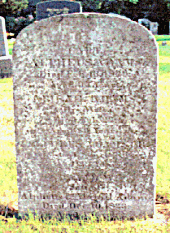
Alpheus Adams Family Headstone — Mosswood Cemetery, Cotuit, Barnstable County, Mass Photograph supplied by Natalie Baer August 2004.

Mr. ALPHEUS ADAMS
Died Feb. 16, 1869
Aged 95 Years
ABIGAIL ADAMS
his Wife
Died Feb. 22, 1869
aged 89 Years
ALPHEUS ADAMS JR.
lost at sea
Died 1836
Aged 23 Years
DAVID W. ADAMS
Son of
Alpheus & Abigail Adams
Died Dec. 10, 1823
Aged 5 Years

Children of Abigail and Alpheus:

i. Martha H. Adams b. 13 Sep 1804 in Barnstable, Mass; d. 13 Apr 1874 in New Bedford, Bristol, Mass; m. 17 Jan 1825 Barnstable, Barnstable, Mass to Capt. Calvin Fish (1799 – 1882) Martha and Calvin had seven children born between 1826 and 1842.

In the 1850 census, Calvin was a master mariner in Mashpee, Barnstable, Mass.

ii. William W Adams b. 5 May 1806 in Sandwich, Barnstable, Mass; d. 17 Feb 1890 in Victor, Ontario, New York; Burial: South Perinton Cemetery, Perinton, Monroe County, New York,; m. 21 Oct 1840 Cazenovia, Madison, New York to Matilda Austin (b. 22 Oct 1822 in Cazenovia, Madison, New York – d. 04 Mar 1910 in Rochester, Monroe, New York Burial: South Perinton Cemetery, Perinton, Monroe County, New York) Matilda’s parents were Philomen Lee Austin (1787-1842) and Matilda Seeley End (1792-1824). William and Matilda had seven children born between 1841 and 1852.

William went to sea at age 12 and remained a coasting sailor until 1836 when he moved to Western New York.

William W. Adams (1806-1890)

In the 1850 census, William and Matilda were farming in Perinton, Monroe, New York.

Matilda Austin Adams (1822-1910)

From Ontario County Journal February 1890 — Captain W. W. Adams, an old and respected citizen of Victor, died there last Monday, aged 84 years. He had an attack of the grip, which resulted in congestion of the lungs. He was formerly a seafaring man, but had lived in Victor the past 50 years. He leaves a widow and five children.

iii. Mercy Adams b. 4 Feb 1808 in Barnstable, Barnstable, Mass; d. 06 Mar 1876 in Barnstable; m. 1836 21 Feb 1836 Barnstable to David Gardner (b. 25 Apr 1807 in Vassalboro, Kennebec, Maine – d. Jan 1880 in Barnstable)

In the 1870 census, David and Mercy were farming in Barnstable, Barnstable, Mass.

iv. Zenas Lovell Adams b. 7 Nov 1809 in Barnstable, Mass; d. 29 Nov 1882 in New Bedford, Bristol, Mass; m. 18 Jan 1835 Nantucket, Nantucket, Mass to Sarah C. Hinkley (30 Apr 1813 in [__?__], Barnstable, Mass. – d. 23 Mar 1895 in New Bedford, Bristol, Mass) Zenas was a master mariner. Zenas and Sarah had five children born between 1833 and 1840.

In the 1850 census, Zenas was a trader in Nantucket, Nantucket, Mass.

v. Freeman Eldredge Adams b. 26 Jul 1811 in Cotuit, Barnstable, Mass; d. 19 Feb 1876 in Nantucket, Nantucket, Mass.; m. 9 Mar 1835 Barnstable, Barnstable, Mass to Eunice Hopkins Nickerson (b. 12 Nov 1811 in Barnstable, Barnstable, Mass – d. 23 Sep 1900 – Barnstable, Barnstable, Mass) Eunice’s parents were Samuel Nickerson (b. 15 JAN 1780 in Harwich, Barnstable, Mass.) and Rhoda “Polly” Hopkins (b: 22 MAY 1783 in Harwich (now Brewster)). Freeman was a master mariner. Freeman and Eunice had three children born between 1835 and 1843.

In the 1860 census, Freeman was a grain merchant in Nantucket, Nantucket, Mass.

vi. Alpheus Adams b. 16 Sep 1813 in Barnstable, Mass.; d. 18 Dec 1837 at Sea, Sulawesi Tengah, Indonesia “on his Passage from the Mediterranean, fell overboard and was drowned,”

vii. David W. Adams b. 16 Nov 1815 in Barnstable, Mass.; d. 10 Dec 1823 in Cotuit, Barnstable, Massl Burial: Mosswood Cemetery

viii. Alexander Murray Adams b. 26 Oct 1817 in Cotuit, Barnstable, Mass.; d. 16 Jan 1898 in Fall River, Bristol, Mass.; m. 30 Jun 1839 Nantucket, Nantucket, Mass to Sarah H. Hinckley (b. 23 Oct 1814 in Osterville, Barnstable, Mass. – d. 13 Sep 1880 in Fall River, Bristol, Mass of Typhoid fever) Alexander and Sarah had nine children born between 1840 and 1855.

In the 1870 census, Alexander was a house carpenter in Fall River.

Alexander lived at 129 Davol Street Fall River, Bristol, Mass., today across the street from Fall River Heritage State Park.

ix. Alden Hammond Adams b. 13 Apr 1820 – Barnstable, Mass.; d. 5 Sep 1910 – Nantucket, Nantucket, Mass.; m. 26 Dec 1844 – Nantucket, Nantucket, Mass. to Electa Morton Hinckley (b. 2 Jan 1822 in Barnstable, Barnstable, Mass. – d. 4 Jun 1910 – Nantucket, Nantucket, Mass) Electra’s parents were Heman Hinckley (1792 – 1874) and Prudence Bourne (1792 – 1855). Alden and Electra had four children born between 1847 and 1856.

In the 1870 census, Alden was a mariner in Nantucket, Nantucket, Mass.

x. James H. Adams b. 14 May 1822 in Cotuit, Barnstable, Mass.; d. 16 Feb 1904 in Nantucket, Nantucket, Mass; m. 15 Mar 1846 Nantucket, Mass to Phoebe Ann Bunker (b. 2 Jul 1821 in Nantucket, Nantucket, Mass. – d. 8 Dec 1905 in Nantucket, Nantucket, Mass) Phebe’s parents were Owen Bunker (1775 – 1864) and Phebe Gardner (1780 – 1860).

In the 1870 census, James was a house carpenter in New Bedford Ward 2, Bristol, Mass.

xi. Lewis Lincoln Adams b. 18 Jan 1824 in Cotuit, Barnstable, Mass.; d. 20 Jul 1907 in Providence, Providence, Rhode Island; m. 5 Oct 1865 Nantucket, Mass to Mary Jane Coleman (b. 27 Sep 1834 in Nantucket, Nantucket, Mass – d. 1904). Mary Jane’s parents were Obed Coleman (b: 03 May 1809 in Nantucket, Nantucket, Mass.) and Ruth Butler (b: 1806 in of Falmouth, Barnstable, Mass.) Lewis was a sea captain.

In the 1870 census, Lewis was a mariner living in Providence Ward 6, Providence, Rhode Island

Sources:

http://freepages.genealogy.rootsweb.ancestry.com/~wingfamilyofamerica/p1386.htm#i2001347

http://trees.ancestry.com/owt/person.aspx?pid=24510592

http://trees.ancestry.com/tree/21300926/person/1062164139

http://wc.rootsweb.ancestry.com/cgi-bin/igm.cgi?op=GET&db=mewingnut&id=I2001347

A History and Genealogy of the Descendants of William Hammond of London England 1600 – 1894  By Roland Hammond


Posted in -8th Generation, Line - Shaw, Veteran | Tagged , | 12 Comments

Stephen O’Kelley

Stephen O’KELLEY (1718 – ) was Alex’s 7th Great Grandfather; one of 256 in this generation of the Shaw line. Stephen was born 22 Sep 1718 Yarmouth, Barnstable, Mass.

Stephen O’Kelley was born 22 Sep 1718 in that part of Yarmouth, Barnstable, Mass which later became Dennis.  His parents were  Joseph O’KELLEY and Tabitha BAKER. He married Thankful CHASE 20 Feb 1741/42 in Yarmouth, Barnstable, Mass.

Thankful Chase  was born 6 Mar 1720/21 in Yarmouth, Barnstable, Massachusetts.  Her parents were  William CHASE III and Dorcas BAKER.  Thankful died in 1768.

Children of Stephen and Thankful

Name Born Married Departed
1. Temperance O’KELLEY 21 Mar 1742 Yarmouth, Mass David WING
19 March 1761 Harwich, Barnstable, Mass
Harwich, Mass
2. Stephen O’Kelley 26 Jul 1745 Yarmouth Thankful Baker?
c. 1772
.
Mary Oliver
15 Jan 1783 – Washington or Cumberland, Providence, RI
14 Mar 1840 – Freedom, Waldo, Maine
3. Jeremiah O’Kelley 30 Sep 1748 Yarmouth Zilpha Robbins
1 Oct 1768
1790
4. William O’Killey 15 Apr 1751 Yarmouth
5. Daniel O’Killey 16 Aug 1755 Yarmouth Dorcas Baker
19 Nov 1778
6. Salome Kelley 25 Oct 1759 Yarmouth David Chase Jr
26 Mar 1780 Harwich
24 Feb 1828 Harwich
7. James O’Killey 9 Aug 1765 Dennis, Mass Elizabeth O’Killey (2nd cousin 2x over)
15 Jul 1787
15 Feb 1835 Dennis, Mass

Some sources drop the O’ showing the name Stephen Kelly, certainly, the O’ was gone in his grandchildren’s generation. Many sources show Stephen and Thankful’s birth, but none show their dates of death.

Children

1. Temperance O’KELLEY (See David WING‘s page)

2. Stephen O’Kelley

Many genealogies state Stephen married Thankful Baker. Yarmouth town records show Thankful was born 12 Nov 1750 to David Jones Baker (1719 – 1768) and Thankful Lawrence Twining Baker (1719 – ) Her paternal grandparents were John Baker (1672 – 1760) and Hannah Jones (1675 – ). Her maternal grandparents were our ancestors William BAKER and Mercy LAWRENCE.

Genealogies are less consistent about Thankful’s life. Some say she married Stephen O’Kelley and had nine children, but I can’t find evidence of this list of children beyond the names and birthdates which are repeated in many geneaolgies.

Other geneaologies say Thankful married at age: 18 on 15 Nov 1768 Nantucket, Nantucket, Mass to Reuben Swain (b. 1747 in Nantucket, Nantucket, Mass. – d. 24 Oct 1792 in Nantucket) Reuben’s parents were Jethro Swain (1710 – 1791) and Dorcas Ryder (1716 – 1788). Ruben and Thankful had at least three children – Betsey Swain (1783 – 1820) – Reuben Swain (1787 – 1859) – Rebecca Swain (1788 – 1825)

Possible Children of Stephen and Thankful:

i. Electa Kelley b, 27 Dec 1773

ii. Samuel Kelley b. 12 Jul 1775

iii. Charles Kelley b. 17 Mar 1777

iv. Silas Kelley b. 12 May 1779

v. Anna Kelley b. 28 Mar 1781

vi. Lucy Kelley b. 28 Mar 1781; d. at age of 10 days

vii. Solomon Kelley b. 7 Aug 1784

viii. Siball Kelley b. 15 Jun 1787

ix. Philander Kelley b. 27 Feb 1791

Stephen’s wife Mary Oliver was born about 1763. Mary died 1847 in Freedom, Waldo, Maine. Children of Stephen and Mary

i. Oliver Kelley b. 27 Jul 1784 in Dennis, Barnstable, Mass.; d. 4 Mar 1863 in Freedom, Waldo, Maine; Burial Kelley Cemetery; m1. 27 Mar 1809 Vassalborough, Kennebec, Maine to Eunice Gould (b. 14 Jun 1787 in Vassalborough – d. 31 Mar 1846 in Freedom, Waldo, Maine); Eunice’s parents were Nehemiah Gould (1752 – 1817) and Molly Kemp (1756 – 1830). Oliver and Eunice had nine children born between 1810 and 1832. m2. 4 Feb 1849 Montville, Waldo, Maine to Jerusha Bradshaw (b. 1804 Montilee, Waldo, Maine)

In the 1850 census, Oliver and Jerusha were farming in Freedom, Waldo, Maine

ii. Freeman O’Kelley b. 10 Mar 1789 in Dennis, Barnstable, Mass; d. 1821; m. 6 Nov 1811 Albion, Kennebec, Maine to Charlotte Hussey.

Freeman’s estate was filed on 18 May 1822 at Monroe County, Illinois. ? Freeman was head of household on the 1820 US Census at Monroe County, Illinois. The household consisted of one male under 10, one male 26 to 44, two females under 10, one female 16 to 25, one female 26 to 44, and one female 45 or older.3 He appeared on the Illinois state census of 1820 at Monroe County. The household consisted of one male 21 or older and six other white persons.4 His estate papers included a note signed by Freeman on 17 November 1821.2

iii. Huldah O’Kelley b. 2 Aug 1791 in Yarmouth, Barnstable, Mass.; d. 28 Feb 1858 in Freedom, Waldo, Maine; Burial: Kelley Cemetery; m. Josiah Danforth (b. 6 Feb 1789 in Frankfort, Waldo, Maine – d. 28 Oct 1858 in Frankfort, Waldo, Maine; Burial: Kelley Cemetery) Josiah’s parents were Philip Danford (1759 – 1841) and Mary Tibbets (1757 – 1837).

In the 1850 census, Josiah and Hulda were farming in Freedom, Waldo, Maine with five children at home ages 14 to 29.

iv. Temperance O’Kelley b. 9 Feb 1794 in Dennis, Barnstable, Mass

v. Susanna O’Kelley b. 5 Jul 1799 in Freedom, Waldo, Maine; d. 23 Jun 1845 in Knox, Waldo, Maine; m. 30 Dec 1815 Freedom, Waldo, Maine to Stephen Danforth (b. 03 Mar 1795 in Frankfort, Waldo Maine – d. 1872 in Verona Island, Hancock, Maine) Stephen’s parents were Phillip Danforth (1759 – 1841) and Mary Tibbetts (1757 – 1837) Susanna and Stephen had eleven children born between 1816 and 1839.

After 1850, Stephen married Sarah [__?__] (b. 1805 Maine). In the 1860 census, Stephen and Sarah were farming in Thorndike, Waldo, Maine.

3. Jeremiah O’Kelley

Jeremiah’s wife Zilpha Robbins was born 2 Nov 1738 in Yarmouth, Mass. Her parents were Richard Robbins and Hannah Berry. Children of Jeremiah and Zilpha

i. Richard Kelley b. 28 Jul 1769 Dennis, Barnstable, Mass; d. 8 Nov 1850 or 5 Nov 1856 – Dennis, Mass

ii. Jedidah “Jediah” Kelley b. 27 Nov 1773; d. 26 Jul 1833 Dennis, Barnstable, Mass; m. Henry Baker

iii. William Kelley b. 23 Apr 1776 Dennis, Mass; m. ~1798 to Achsah [__?__] (b. ~1777)

iv. Stephen Kelley b. 19 Sep 1779 Dennis, Mass;

v. Jeremiah Kelley b. 23 Mar 1782 Dennis, Mass;

vi. Elijah Kelley b. 25 Aug 1784 Dennis, Mass; d. Feb 1855; m. 13 Jan 1805 Harwich, Barnstable, Mass. to Dorcas Nickerson (b. ~1785 Harwich, Barnstable, Mass. – d. 16 Jun 1840 in Harwich) Elijah and Dorcas had seven children born between 1806 and 1820.

5. Daniel O’Killey

Daniel’s wife Dorcas Baker was his 3rd cousin.   She was born 18 Jun 1752 in Yarmouth, Barnstable, Mass. Her parents were Joseph Baker (1715 – 1781) and Elizabeth Berry (1718 – ). Her grandparents were Nathaniel Baker Jr. (1672 – 1757) and Elisabeth Hannah Baker. Her great grandparents were Nathaniel Baker (1642 – 1691) and Desire Gray (1645 – 1691). Her 2nd great grandparents were  Francis BAKER and Isabel TWINING. Children of Daniel and Dorcas:

i. Daniel Kelley (twin) b. 11 Oct 1779 Dennis, Barnstable, Mass; m. 28 Feb 1805 – Harwich, Barnstable, Mass, to his 1st cousin once removed and 3rd cousin Anna Chase (b. 10 Aug 1774 in Harwich, Barnstable, Mass. – d. 10 Aug 1863 in Dennis,) Anna’s parents were Daniel Chase (1746 – ) and Hannah Broadbrooks (1748 – ). Her grandparents were Joseph Chase (1718 – ) and Sarah O’Killey (1721 – ) Her great grandparents were Thomas Chase (1679 – 1767 – ) and Sarah Gowell (1684 – ) and Joseph O’KELLEY and Tabitha BAKER . Her 2nd great grandparents were John CHASE and Elizabeth BAKER.

Anna first married 25 Mar 1790 Age: 15 Harwich, Barnstable Co., MA to Eleazer Robbins (b. 9 Jan 1739/40 in Harwich – d. 1798 At Sea)

In the 1850 census, Ana was living with Seth and Mercy Chase in Harwich.

ii. Molly Kelley (twin) b. 11 Oct 1779 Dennis, Barnstable, Mass; m. James Marchant; m. 10 Nov 1801 Age: 22 Yarmouth, Barnstable, Mass. to Shubal Crowell (b. 22 May 1780 in Yarmouth) His parents were Shubal Crowell (1754 – 1814) and Abigail Parker. Molly and Shubal had ten children born between 1802 and 1820.

iii. Betsey “Betty” Kelley (twin) b. 12 Sep 1781 Dennis, Barnstable, Mass; d. 5 Jan 1860 Yarmouth, Barnstable, Mass. m. 26 Jun 1805 – Yarmouth to her third cousin George Baker (b. 3 Oct 1777 in Yarmouth – d. 06 Apr 1861 in Yarmouth) His parents were Daniel Baker (1733 – ) and Temperance Gage (1718 – ). His grandparents were Jacob Baker (1707 – 1785) and Thankful Chase (1711 – 1751). His great grandparents were Nathaniel Baker (1672 – 1757) and Elizabeth Hannah Baker (1686 – 1770). His 2nd great grandparents [through Elizabeth Hannah Baker] were  Daniel BAKER and Eliabeth CHASE.  Betsey and George had seven children born between 1805 and 1817.

iv. Thankful Kelley (twin) b. 12 Sep 1781 Dennis, Barnstable, Mass;

v. Joseph Kelley b. 27 Jun 1784 Dennis, Barnstable, Mass; d. 20 Nov 1852 Harwich; Burial Baptist Church Cemetery, Depot Street;  m. 13 Feb 1805 – Harwich, Barnstable, Mass. to his second cousin Edith “Ede” Chase (5 Jul 1785 in Harwich – d. 8 Mar 1839 Harwich). Edith’s parents were James Chase , Sr. (1761 – 1804) and Mercy Eldredge (1765 – ) Her grandparents were Job Chase (1736 – 1833) and Edith / Ede Bassett (1740 – 1774). Her great grandparents were William CHASE III and Dorcas BAKER.

vi. Dorcas Kelley b. 30 Oct 1786

vii. Anna Kelley b. 11 Jan 1790 Yarmouth; d. 7 Apr 1871 in Yarmouth; m. 23 Jan 1818 Age: 28 Yarmouth to her 3rd cousin once removed Josiah Baker (b. 11 May 1783 in Yarmouth – d. 12 Sep 1838) Josiah’s parents were Moody Baker (1750 – 1816) and Mary [__?__] (1754 – ). His grandparents were Joseph Baker (1715 – 1781) and Elizabeth Berry (1718 – ). His geat grandparents were Nathaniel Baker Jr. (1672 – 1757) and Elisabeth Hannah Baker. His 2nd great grandparents were Nathaniel Baker (1642 – 1691) and Desire Gray (1645 – 1691). His 3rd great grandparents were  Francis BAKER  and Isabel TWINING.

viii. William Kelley b. 10 Apr 1793; m. 1816 – Dennis, Mass to his first cousin once removed Abigail Wixon (b. 25 Oct 1795 in Dennis, Barnstable, Mass. – d. 07 Sep 1883 in Dennis) Abigail’s parents were Barnabas Wixon (1762 – 1849) and Jerusha Chase (1772 – 1861.) Her maternal grandparents were Sylvanus Chase and Charity Chase. Her maternal great grandparents were were  William CHASE III and Dorcas BAKER. After William died, Abigail married in 1825 in Dennis to Benjamin Howland (1780 – 1873).

ix. Levi Kelley b. 4 Nov 1795 Yarmouth; d. 27 Mar 1871 – Yarmouth; In the 1860 census, Levi was a laborer in Dennis, Barnstable, Mass.

6. Salome Kelley

Salome’s husband David Chase Jr was born 26 Apr 1759 in Harwich, Barnstable, Mass. He was Salome’s 2nd cousin two ways. His parents were David Chase (1729 – ) and Susannah Baker (1734 – ). His maternal grandparents were Silas Baker (1674 – 1752) and Deliverance O’Killey (1674 – 1751) His paternal grandparents were Jeremiah Chase (1683 – 1767) and Hannah Baker (1699 – 1731). His paternal great grandparents were John CHASE and Elizabeth BAKER. His maternal great grandparents were Jeremiah O’KELLY and Sarah CHASE. David died 24 Feb 1828 in Harwich, Barnstable, Mass.

Children of Salome and David

i. Jeremiah Chase b. 12 Jan 1782 – Yarmouth

ii. Abigail Chase b. 23 Sep 1781 in Yarmouth; d. 8 May 1813; m. 16 Feb 1800 Age: 18 Sandwich, Barnstable, Mass to Rev. Peter Yost (b. 17 Aug 1778 in Barnstable, Massa. – d. 27 Jan 1851 in Goshen, Clermont, Ohio; Burial: Goshen Cemetery ) Peter’s parents were Peter Yost and Mary Smith (1755 – 1836). After Abigail died, he married 24 May 1814 to Eleanor Fults (22 May 1789 in PA, died 31 Dec 1864 in Mediapolis, Des Moines, Iowa). Peter was a minister.

In the 1850 census, Peter and Elanor were farming in Goshen, Clermont, Ohio.

iii. Hiram Chase b. 7 Jan 1786 – Yarmouth; d. 24 Jun 1866 in Middleboro, Mass; m. Cynthia Swift (b. ~1789 in Waquoit (Falmouth), Mass. – d. 1887 in Middleboro, Mass)

Hiram was a veteran of the War of 1812, came to Holmes Hole [now called Vineyard Haven] Martha’s Vineyard from Sandwich by 1816, and is listed in the Tisbury censuses of 1820 and 1840. He is listed as a Tisbury hatter in 1850 and 1865, as well as his 1866 death record.

John Holmes Jr. and Charles A. Luce wrote about the house that was at the site of Ernest Tilton’s / Vineyard Dry Goodsbefore the 1883 fire: ”

Mrs. Cynthia Chase House. Widow of Hiram Chase. Was ninety-six years time of fire. Not certain when built, probably early in nineteenth century by Dr. Benjamin Trask, who occupied previous to 1805. About 1810 occupied by Mr. Hanson, Baptist preacher, then by Jennie Godfrey. Jenny Godfrey was a character, very much afraid of the water. Never took but one trip off the Island, that to New Bedford before the times of steam or even decked packets, in open boat of Capt. William Harding. On return, dead calm, captain and mate had to pull every inch of the was, under a broiling sun, arriving home late at night. Jenny always alluded to this passage as a most enjoyable one, since which time long passages, in consequence of calms, have always been referred to as ‘Jennie Godfrey times’. Mr. Chase came here from Sandwich and opened a hat factory. He was one of the early Methodists of the village. He was fond of telling this story.

“At one time when he was about to sit down to dinner he heard a supernatural voice saying to him ‘To the vestry, to the vestry,’ and he dared not disobey. Proceeding to the vestry, he then commenced praying in a Boanerges-like voice. The people in the neighborhood, hearing the outcry, rushed with one accord to the vestry, and the result was the initiation of a great ritual.

“Mr. Chase’s rats caused Capt. William Cottle, whose store was across the street, to complain to Mr. Chase, but his complaints made no impression on the prevailing odor and he took the case into court, but was defeated.”

In April 1821 Dr. Benjamin Trask sold this property for $800 to Tisbury hatter Hiram Chase. Holmes and Luce speculated that Dr. Trask built the house that stood here until the 1883 fire, and this is borne out by the fact that while no house is mentioned in the deed by which Dr. Trask bought the property in 1802, the 1821 sale to Chase refers to the northern boundary of this property as “over the middle of the well and to the center between the two houses till it corner square with first poplar tree and hatters shop in the center, thence to the poplar tree within two feet…” The deed also includes a right-of-way to “the Hatters Shop” and to “the Porch of the dwelling house.”

Chase bought an adjoining lot in the rear of his house lot for $1700 from widow Mrs. Mary C. (West) Carey in September 1840 which extended his property by about fifty-five feet in the back.

In 1833, the first Methodist Church in town was built nearby on Church Street (which later became the Masonic Hall and today is the Playhouse.) According to an article written by Mrs. Howes Norris and quoted in a June 1942 Gazette, “Over the doors and windows were placed fan-like blinds which so distressed Mrs. Cynthia Chase that she saw strange sights. She said, ‘They were little hypocrites and saw little black devils dancing over there every night – and it was wicked and sinful to ornament God’s house in such a manner.'”

Eleanor Mayhew’s book mentions hatter Hiram Chase at this site, and makes reference the “odor emanating from Chase’s dye vats.”

Rev. Warren Luce, in his childhood memories published in a March 1923 Gazette, wrote: “My dear old friend was the hatter, Chase – opposite the Barrow Bros, store of those days. He had an eccentric and yet deeply pious son, who was paralyzed on his left side, incapacitating him for manual labor. So he spent much of his time in visiting the homes of the people, intent on doing some good. Many a time I’ve seen him stop, on some street corner, take a little New Testament from his pocket, and turning its pages consult them for instructions and guidance, as to whom to visit next.”

Hiram and Cynthia’s son Alfred Chase (1809 – 1881) was born in Falmouth. He is listed as an “invalid” in the 1865 Tisbury census, and lived his entire life in the home of his parents. Their other children were Salome K. Chase (who married James M. Coombs and was living in Middleboro by 1866) and Harriet W. Chase (who married Parmenas Parsons and moved to New Bedford by 1866).

Hiram Chase died in 1866, and the estate, valued at less than $1500, was inherited by his widow Cynthia. Following his death, or perhaps in his retirement, the Chase’s evidently sold the front portion of the property, which apparently contained his hatter’s shop (see below). They retained a narrow right-of-way from Main street to their home and property in the rear.

In September 1878, Cynthia Chase deeded this lot and buildings to her daughters Salome K. Coombs and Harriet W. Parsons “provided, that in the event of my son, Alfred, coming to want, he shall the privilege of residing in said building while he remains in that condition.” The elderly widow, perhaps illiterate or handicapped, signed this document with an ‘X’. The 1880 Tisbury Census lists “Cynthy Chase,” age 92, keeping house with her son Alfred Chase, age 70. Alfred died in January 1881 of “retention of urine.” He was listed as an unemployed widower.

In Apr 1882, Cynthia Chase again deeded her L-shaped lot (“the homestead of Hiram Chase”) to her children Salome K Brown and Harriet W. Parsons for $400 “with a privilage of a way to pass and repass to the Shop and to the Porch of the Dwelling house standing on said premises.”

Chase’s house was among the first to catch fire on the night of the great fire in August 1883. Her uninsured dwelling was valued at $800. The 95-year old widow was listed in the newspapers among those families “left nearly destitute.” Cynthia Chase died in May 1887, at the age of about ninety-eight.

In the 1850 census, Hiram and Cynthia were living in Tisbury, Dukes, Mass. (Martha’s Vineyard) where Hiram was a hatter. In the 1860 census, he was a merchant.

iv. Esther Chase b. 27 Oct 1788 in Harwich; d. 1 Jul 1872 in , Barnstable, Mass; m. 6 Jul 1810 Age: 21 to Abner Linnell (b. 18 Apr 1780 in , Barnstable, Mass. – d. 29 Nov 1837) Abner’s parents were Jonathan Linnell and Bathsheba Freeman or James Linnell (b: ~1736 in Centerville, Mass) and Anna Childs (b: ~1740). Esther and Abner had seven children born between 1811 and 1830.

David Chase, Abner, James and John Linnell were dismissed from the East Parish church 2 Jan. 1808 to organize a new church. But by 1815 Abner was a member of the Methodist Chruch in Barnstable. In his enthusiasm for Methodism, he would name a son John Wesley.

v. Isaiah Chase b. 11 Sep 1788 – Harwich, m. ~1815 to Tabitha Doane (b. 02 Mar 1795 in Chatham, Barnstable, Mass. – d. 28 Feb 1877 in Chatham, Barnstable, Mass.) Tabitha’s parents were

Samuel Doane (1751 – 1827) and Mariah Eldredge (1750 – 1830).

vi. Salome Chase b. 15 Sep 1792 in Harwich; m. ~1812 to Robert Luscomb (b. ~1792 Harwich)

vii. Arnold Chase b. 7 Oct 1795 in Harwich d. 24 Sep 1858 in Nantucket, Mass; m. 20 Apr 1816 Falmouth, Barnstable, Mass. to Pamelia Butler (b. 8 Jul 1798 in Falmouth, Barnstable, Mass. – d. 2 Feb 1882 in Nantucket, Mass) Pamelia’s parents were Benjamin Butler (1744 – 1795) and Phebe Gage (1767 – 1837). Arnold and Pamelia had three children born between 1818 and 1823.

viii. David Chase b. 4 Oct 1797 in Harwich

ix. Betsey Chase b. 10 Nov 1800 in Harwich; m. 4 Dec 1821 – Barnstable, Massa to Reuben Hillman (b. ~1800 in Harwich) His parents were Reuben Hillman (1775 – ) and Elizabeth Beard

x. Susan Chase b. 15 Jan 1802 in Harwich; m. 22 Mar 1822 – Harwich to George Washington Kelley (b. ~1802 Harwich – d. 1829 At Sea)

7. James O’Killey

James’ wife Elizabeth O’Killey was his 2nd cousin at least two times over.  She was born 14 Mar 1770 in Dennis, Mass. Her parents were Eleazer OKilley (1728 – 1803) and Hannah Baker (1728 – ) Her paternal grandparents were Eleazer O’Killey (1697 – 1775) and Sarah Browning (1694 – 1741). Her paternal great grandparents were Jeremiah O’KELLY and Sarah CHASE.  Her maternal grandparents were Silas Baker (1674 – 1752) and Deliverance O’Killey (1674 – 1751) Her maternal great grandparents were also Jeremiah O’KELLY and Sarah CHASE.. Elizabeth died 20 Mar 1825 in Dennis, Mass Children of James and Elizabeth:

i. Anthony Kelley b. 10 Apr 1788 in Dennis, Mass.; d. Aft. 1870; m. Anna Butler “Lizzie” Look (b. 1793 in Addison, Washington, Maine – d. 1832) Lizzie’s parents were George Look (1764 – 1839) and Elizabeth Holbrook Stevens (1740 – 1824) In the 1870 census, Anthony was living with Richard and Marth Orn in Hermon, Penobscot, Maine. Anthony had moved to Hermon before 1820.

ii. Betsey Kelley b. 26 Sep 1790 in Dennis, Mass.; d. 21 Dec 1877 – Dennis, Barnstable, Mass; m. 30 Oct 1811 to Joseph Eldridge (b. 11 Dec 1790 in Harwich – d. 10 Feb 1855 in Harwich) Joseph’s parents were Ebenezer Eldridge (1755 – 1844) and Sarah Chase (1754 – 1850); m2. 26 Jul 1865 Dennis to Eldridge Sears (b. 25 Sep 1790 in Dennis – d. 9 Jul 1875 in Dennis, Barnstable, Mass)

iii. Bathsheba Kelley b. 20 Nov 1794 in Dennis, Mass.; d. 1 Oct 1875 – Dennis; m. 1813 – Dennis to Hiram Whittamore (b. 1788 in Dennis – d. 7 Jul 1853 in Dennis; Burial: Ancient Cemetery South Dennis) Hiram’s parents were Edward Lloyd Whittemore (1746 – 1821) and Priscilla Bunker (1749 – 1776). Bathsheba and Hiram had seven children born between 1813 and 1827. After Hiram died, Bathsheba married 14 Dec 1856 to Amos Cook.

In the 1850 census, Hiram and Abashba were farming in Dennis, Barnstable, Mass.

iv. James Kelly b. 25 Apr 1797 in Dennis, Mass.; d. 17 Oct 1876 Yarmouth; m. Marriage Bann 12 Jan 1821 Yarmouth to Elizabeth Baker (b. 21 Jan 1798 in Providence, Providence, Rhode Island – d. 6 Jul 1876) Elizabeth’s parents were Levi Baker (1757 – ) and Elizabeth Jenkins. James and Elizabeth had five children born between 1822 and 1836.

In the 1850 census, James and Elizabeth were living in Yarmouth, Barnstable, Mass. where James was a sailor.

v. Hannah Kelley b. 6 May 1800 in Dennis, Mass.; d. 5 Jan 1869 Dennis, Mass; m. Apr 1818 in Dennisport, Mass to William Kelly Nickerson (b. 31 Dec 1796 in Harwich, Barnstable, Mass. – d. 22 Oct 1871 in Dennisport, Mass.) William’s parents were Isaac Nickerson (1746 – ) and Mary Kelly (1768 – ) Hannah and William had ten children born between 1818 and 1843.

vi. Sarah Kelley b. 30 Sep 1802 in Dennis, Mass.; m. 24 Oct 1824 to Reuben Hopkins Alternatively, Sarah married ~1822 to her second cousin Sylvester Chase (b.13 Oct 1798 in Harwich) Sylvester’s parents were James Chase (1761 – 1804) and Mercy Eldredge (1764 – 1839) His grandparents were Job Chase (1736 – 1833) and Edith / Ede Bassett (1740 – 1774) and his great grandparents were William CHASE III and Dorcas BAKER.

vii. Polly Kelley b. 11 Jun 1805 Dennis, Barnstable, Mass; d. 18 May 1889; m. Henry Terry (b. 1800 in Barnstable, Barnstable, Mass or Connecticut- d. 7 Mar 1876)

In the 1860 census, Henry and Polly were farming in South Dennis with three children at home ages 12 to 19.

viii. Delisha Kelley b. 14 Apr 1817 in Dennis, Mass.; d. 1834

Sources:

http://trees.ancestry.com/owt/person.aspx?pid=31187576

http://www.genealogyofnewengland.com/b_o.htm

http://familytreemaker.genealogy.com/users/s/p/o/Russell-E-Spooner/BOOK-0001/0003-0015.html

http://freepages.genealogy.rootsweb.ancestry.com/~wingfamilyofamerica/p910.htm#i2011158

David O’Killia, the immigrant of Old Yarmouth, Massachusetts with his descendants and allied families, 1651-1962. Darmouth, Mass.?: E.K. Randall, 1962

Posted in -9th Generation, Line - Shaw | Tagged , | 5 Comments

Isaac Hawes

Isaac HAWES (1765 – 1840) was Alex’s 5th Great Grandfather; one of 64 in this generation of the Shaw line.

Issac Hawes was born at Yarmouth, Barnstable, MA, on 14 May 1765. His parents Thomas HAWES II and Desire HAWES who were second cousins.  He married Tamzin WING at Yarmouth, Barnstable, MA, on 9 Mar 1794. The family lived in Vassalboro, Maine in the 1800, 1820 and 1830 census.   Isaac died at Vassalboro, Maine, on 16 May 1840.  His body was interred at Vassalboro, at Riverside Grove Cemetery.

Tamzin Wing  was born in 1772 in Harwich, Barnstable, Mass.    Her parents were David WING and Temperance O’KELLY.   Tamzin died on 17 Oct 1844.  Her body is interred at Vassalboro.

Children of Isaac Hawes and Tamzin Wing

Name Born Married Departed
1. David Hawes 20 Jan 1795 Vassalboro Maine Eliza C. Prescott
4 Apr 1821 Dennis, Barnstable, Mass
.
Adaline Hastings Baxter
20 Jun 1853 Bristol, Maine
.
Mrs. Ann Carter Porter
17 Apr 1862 Bristol, Maine
1873 at Bristol, Maine
2. John Hawes 18 Sep 1796 Vassalboro Eliza (Mary) Tobey 23 May 1839 – Vassalboro 1862 Interred at Vassalboro, Died at Augusta, Maine
3. Temperance Hawes 27 Jul 1798 Vassalboro Samuel Cross
3 Dec 1818 Vassalboro
1 Aug 1880 Vassalboro
4. Abigail HAWES 7 May 1800 Vassalboro Oliver A. WEBBER Vassalboro, ME 1845 Vassalboro, ME
5. Betsey Wing Hawes 26 Feb 1802 Vassalboro Randlett Ness (John Randlet Lisherness) 18 Feb 1819 Vassalboro . Nathan Nye 15 Dec 1886 Searsmont, Waldo County, Maine
6. Lucinda Hawes 15 Jan 1804 Vassalboro Ambrose Gardner 1830 Hallowell, Kennebec 11 Jan 1861 Chelsea, Maine
7. Joshua Hawes 14 Aug 1806 Vassalboro Diana Parker
1 Jan 1836 Waldo, ME
.
Mrs. Harriet M Baker
1876 Corinth, Maine
8. Joseph Hawes 14 Aug 1806 Vassalboro Mrs. Ellen Maria (Boody) Pride
7 Oct 1845
12 Jun 1885 Deering, Maine
9. Patience Hawes 1807 Died young
10. Martin Hawes 11 Jul 1808 Vassalboro or Yarmouth, Barnstable Mass Mary Ann Quimby
25 May 1834
13 Jul 1855
Stroudwater, Maine
11. Otis Hawes 30 Jun 1810 Vassalboro or Yarmouth, Barnstable Mass. Almira S. Kendall 1876
12. Almira Hawes 23 Nov 1813 William Palmer
c 1837
1882 Albion, Maine
13. Abram Hawes 1815

Tamzin is a short form of Thomasina (Aramaic) “twin”.  This family had six sets of twins:

  • Isaac and Tamzin had twins: Joshua and Joseph
  • Isaac’s son Joseph had twins; Henry and Mary
  • Isaac’s son John had twins, Hadley and Henry.
  • Isaac’s daughter Abigail had twins Ellen and Emma. Ellen is our ancestor. (See Guilford Dudley COLEMAN‘s page)
  • Isaac’s daughter Lucinda had twins Henry and Harrison
  • Isaac’s daughter Almira’ had twins, Sumner and Attie (Abbe).

John Wing of Sandwich Mass and his Descendants 1881

TAMSIN, a daughter of David and Temperance Kelly Wing  married Isaac Hawes in 1792, and removed to Vassalborough, Kennebec county, Maine, where Isaac built a house on his father’s land, which is still standing and in the possession of the family. They had eleven children, all of whom lived to maturity, the first one who died being forty-five years old. Mr. Hawes died in 1840, aged seventy-five, and his wife in 1844, aged seventy-two. Besides their children, they lived to see around them fifty-seven grandchildren and about eighty great-grandchildren.

Children: [Note one source of this account was written about 1877]

Among these grandsons, ten or eleven have been in the military or naval service, viz: John’s sons, Hadley and Henry – ; Abigail’s sons Richmond, Gustavus, Virgil and Herman, Betsey’s son Charles; one or two of Lucinda’s sons, and  Joshua’s sons Walter and Granville -.

1. David Hawes

David’s first wife Eliza Currier Prescott was born 21 Nov 1800 in Deerfield, Rockingham, New Hampshire. Her parents were Jesse Prescott (1757 – 1833) and Judith Johnson (1758 – 1844). Eliza died 4 Nov 1846 in Vassalboro, Maine.

David’s second wife Adaline Hastings Baxter was born 8 Jul 1812 in Maine. Adaline died 8 Apr 1861 in Bristol, Lincoln, Maine.

David’s third wife Mrs. Ann Carter Porter was born Abt 1808 in Maine. Ann died 5 Sep 1890 in Bristol, Maine.

David, who married Miss Prescott, then Miss Baxter and finally Mrs. Carter, who was still living in 1877. He lived in Bristol, Lincoln county, Maine, had no children that grew to adulthood, and died in 1873, aged 79.

In the 1870 census, David and Ann were farming in Bristol, Lincoln, Maine. Edgar Redonnett age 16 was living with them and attending school.

Child of David and Adaline:

i.  Edgar Hawes b. 1854 in Maine,

2. John Hawes

John’s wife Eliza (Mary) Tobey was born 3 Mar 1807 in Vassalboro, Kennebec, Maine. Her parents were Nymphas Tobey (1778 – 1853) and Anna Gardner (1778 – 1850). Eliza died 16 Apr 1889. In the 1870 census, Mary was living with her son Hadley and daughter-in-law Laura in Augusta, Kennebec, Maine.

In the 1850 and 1860 census, John and Mary were farming in Augusta, Kennebec, Maine. John married Miss Tobey, who was still living in 1877. He lived in Augusta, Maine, where he died in 1862, aged 66. They had four children, viz: Edwin, who died at sea, Mary (Mrs. Ingraham), who has three children, Hadley , who lived in Hallowell, Maine, in 1877 and has one child, and Henry, who died at Baton. Rouge, La., in 1863. The two last were twins. Children of John and Mary:

i.  Edwin Hawes b. 1831, Maine;  died at sea before 1877

An Edwin Hawes returned to Fort Popham, Maine. Nov 1864 and Nov 1865

ii. Mary Ann Hawes, b. 1836 Main; m. bef. 1862 to Henry B. Ingraham (11 Nov 1827 in Rockland, Knox, Maine – d.  21 May 1914 in Rockland) Actually, Henry married Jane B. Hawes (b. 1832 Maine) before the 1850 census. Henry and Jane were together in the 1850, 1860, 1870 and 1880 censuses.

iii. Hadley O. Hawes b. 26 Jan 1847 in Hallowell, Kennebec, Maine; d. 9 Dec 1902; m. 26 Dec 1869   Hallowell, Kennebec, Maine to Laura A. Lamson (11 Feb 1846 in Vassalboro, Kennebec, Maine

– 1917) In the 1900 census, Hadley and Nora were living in Hallowell, Kennebec, Maine where Hadley was a laborer

Henry’s twin.

Laura A. Lamson (1846 – 1917)

Hadley was drafted to Company G, Maine 3rd Infantry Regiment on 29 Aug 1863, two months after Gettysburg where the regiment lost 113 men. Transferred on 28 Jun 1864 to Company K, Maine 1st Heavy Artillery Regiment.  Mustered out on 01 Sep 1866.

On June 18, 1864, just 10 days before Hadley joined, the 1st Maine Heavy Artillery Regiment  suffered more casualties in an ill-fated charge during the Siege of Petersburg  than any Union regiment lost in a single day of combat throughout the war.

iv. Henry W. Hawes b. 26 Jan 1847 in Augusta, Kennebec, Maine; d. 09 Apr 1863

Hadley’s twin.

Enlisted as a Private on 13 October 1862 at the age of 18.

Enlisted in Company E, 21st Infantry Regiment Maine on 13 Oct 1862.  Killed Company E, 21st Infantry Regiment Maine on 9 Apr 1863 during preparations for the Siege of Port Hudson.

Siege of Port Hudson occurred from May 22 to July 9, 1863, when Union Army troops assaulted and then surrounded the Mississippi River town of Port Hudson, Louisiana, during the American Civil War. In cooperation with Maj. Gen. Ulysses S. Grant’s offensive against Vicksburg, Mississippi, Union Maj. Gen. Nathaniel P. Banks’s army moved against the Confederate stronghold at Port Hudson. On July 9, 1863, after hearing of the fall of Vicksburg, the Confederate garrison of Port Hudson surrendered, opening the Mississippi River to Union navigation from its source to the Gulf of Mexico.[

3. Temperance Hawes

Temperance’s husband Samuel Cross was born 4 May 1797 in Vassalboro, Kennebec, Maine. His parents were Jonathan Cross (1778 Maine – ) and Lois Herd (1780 New Hampshire – ).  His grandparents were our ancestors William CROSS and Judith [__?__]. Samuel died 1884 in Vassalboro, Kennebec, Maine.

In the 1880 census, Samuel and Temperance were in their 80’s living in Vassalboro. In the 1850 census, Samuel was a miller in Norridgewock, Somerset, Maine. Temperance, who married Samuel Cross and was still living, at the age of 82, with her husband, though both are very infirm and she is entirely blind.

They have eight children, viz: Cynthia (Mrs. Richardson), who had nine children in 1877; Olive (Mrs. Tobey), who died in 1877 in Vassalborough, having had twelve children; Elbridge, who lives in Quincy, Mass., and has one child; Martin,who lives in East Boston, and has three children; and four others who died very young. Children of Temperance and Samuel:

i.  Olive Cross b. 9 Oct 1819 in Vassalboro, Kennebec, Maine; d. 6 Jun 1878 in Vassalboro, Kennebec, Maine; m. 9 Jul 1843 Vassalboro,Kennebec, Maine to Francis Bernard Tobey (b. 5 Jul 1812 Vassalboro, Maine – d. 8 Oct 1892 Vassalboro) Francis had 12 children. In the 1870 census, Francis and Olive were farming in Vassalboro, Kennebec, Maine with five children at home.

Francis first married Margaret Robbins on 14 Nov 1837 in Civil, Hallowell, Kennebec, Maine. Margaret died on 28 Jun 1841 of Vassalboro, Kennebec, Maine and was buried in Cross Hill Cemetery, Vassalboro, Kennebec, Maine.

Francis next married Olive Cross on 9 Jul 1843 in Vassalboro, Kennebec, Maine. Olive was born about 1820 of Vassalboro, Kennebec, Maine, died on 6 Jun 1878 of Vassalboro, Kennebec, Maine about age 58, and was buried in Cross Hill Cemetery, Vassalboro, Kennebec, Maine.

After Olive died, Francis married her first cousin Celissa B. Gardner, (b. 1832 Maine – d. 5 Jul 1915 and was buried in Cross Hill Cemetery, Vassalboro, Kennebec, Maine. (See below)

ii. Cynthia Cross b. 29 Apr 1821 in Vassalboro, Kennebec, Maine; d. 22 Nov 1910 in Maine; m. 2 Aug 1843 Attleboro, Bristol, Mass.to John Richardson (b. 7 Sep 1813 Vasalboro – d. 22 Aug 1884 Vassalboro)

His parents were Seth RICHARDSON III and Susanna A. BALCOM. John first married Oct 1837 to Hannah G. Sanborn.

In the 1860 census, John was farming in Vassalboro, Kennebec, Maine.

Oliver WEBBER‘s son Gustavus married Cynthia and John’s daughter Mary on 20 May 1860 in Waterville, Kennebec, Maine. In the 1860 census, Gustavus and his bride were living with his father-in-law’s large family in Vassalboro.

Gustavus enlisted as a Private on 14 August 1862 at the age of 28. in Co E -16th Maine and was wounded at Gettysburg. See Oliver’s page for his story.

iii. Martin H Cross b. 4 May 1824 in Vassalboro, Kennebec, Maine; m1. 23 Oct 1851 Boston, Suffolk, Massachusetts to Mary A. Prescott (1825 – 1855); m2. 5 Aug 1858 Boston, Suffolk, Mass. to Rebecca York (1837 – 1880)

In the 1870 census, Martin was a clerk on the wharf in East Boston, Mass.

iv. Sophrona Cross b. Mar 1827 in Vassalboro; d. 12 Feb 1833

v. Julia A Cross b. 29 Oct 1829 in Vassalboro d. 25 Mar 1856

vi. Lucinda Cross b. 4 Apr 1831 in Vassalboro; d. Aft. 1850 census

vii. Eldridge Cross b. Sep 1833 in Vassalboro; d.Aft. 1900 census Quincy, Mass. ; m. 1860 to Ann F. F. [__?__] (b. Jul 1844 Maine – d. aft. 1900) In the 1880 census, Eldridge was a house carpenter in Quincy, Mass.

viii. Vesta Cross b. 11 Jan 1840 in Vassalboro; d. 13 Oct 1859 Boston, Mass. of lung fever

4. Abigail Hawes  (See Oliver WEBBER‘s page)

5. Betsey Hawes

Betsey’s husband Randlett Ness was born 14 Sep 1783 in Pittston, Kennebec, Maine. His parents were Marc Antoine La Pierre La Jeunesse and Sarah Randlett. Randlett died in 25 Apr 1861.

In the 1860 census, Randlet and Betsey were living with their son Samuel and Lavina Ness in Searsmont, Waldo, Maine

Betsey, who married Randlett Ness, lives in Searsmont, Waldo county. Maine, at the age of 78, and has nine children, viz; Sarah (Mrs. Hazen), who lived in California in 1877 with three children; Ann (Mrs.Greenwood), who died in 1858, leaving one child; Charles, who lived in Searsmont in 1877 and had one daughter; Celissa (Mrs. Farrar), who lives at Appleton, Knox County, Maine, and has three children; Randlett. who lives in Searsmont and has three children; and Locksley, who also lives in Searsmont and has two children. Three others died some years since, but we have no account of them. Children of Betsey and Randlett:

i.  Watson F. H. Ness b. 22 Feb 1820 in Vassalboro, Kennebec, Maine; d. 2 Jun 1887 in Maine; m1. 28 Oct 1848 Belfast, Waldo, Maine to Helen Maria Wing (1827 – 1865); m2. 26 Jul 1862 Thomaston, Knox, Maine to Anna F. Ness (1844 – )

In the 1880 census, Watson was a carriage painter in Camden, Knox, Maine

ii. John Ranlet Ness b. 19 May 1823 in Vassalboro;  d. 2 Mar 1844 in Searsmont, Waldo, Maine

iii. Charles Isaac Ness b. abt 1824 in Searsmont, Waldo, Maine; d. 17 Nov 1905 in Searsmont, Waldo, Maine; m1. 4 Sep 1858 Rockport, Knox, Maine to Elizabeth McLellan (1830 – 1864); m2. 1864 to Jane Emily Perkins (b.  1841 in Ontario, (now Canada)

Charles enlisted in Company F, Maine 26th Infantry Regiment on 11 Oct 1862. He participated in the Siege of Port Hudson where his cousin Henry Hawes was killed. On July 9, 1863, after hearing of the fall of Vicksburg, the Confederate garrison of Port Hudson surrendered, opening the Mississippi River to Union navigation from its source to the Gulf of Mexico. Mustered out on 17 Aug 1863 at Bangor, ME.

In the 1870 census, Charles was farming in Searsmont, Waldo, Maine. He had remarried to Jennie [__?__] b. 1841 in East Canada. Three young children and his mother were also living in the household.

iv. Sarah Ramsey Ness b. 10 May 1828 in Searsmont, Waldo, Maine; d. 1910 in Fortuna, California; m1. 28 May 1846 in Brunswick, Cumberland, Maine to Edmond Hazen (1813 – 1881); m2. 21 Feb 1870 San Francisco, California to John Hemsley (1828 in England – )
Edmund deserted the family after 1852. Sarah obtained a divorce 19 Apr 1868 in Alta, California.

In the 1870 census, John was a quartz miner in San Francisco with Sarah and her three daughters from her previous marriage.

v. Eliza Ann Ness b. 22 May 1830 in Searsmont, Waldo, Maine; d. 19 March 1866 in Attica, Fountain, Indiana; m. 29 Sep 1851 Kennebec, Maine to Alfred Alanson Greenwood (25 Feb 1827 in Bethel, Oxford, Maine– 16 Jan 1903 in Attica City, Fountain, Indiana) His parents were Nathaniel Greenwood and Huldah Howe. After Eliza died, he married 1 Oct 1867 to Amelia E McCormick (b. 22 Nov 1838 in Indiana).

In the 1870 census, Alanson was a grist miller in Logan, Fountain, Indiana.

vi. Randlett Satchel Ness b. 24 Apr 1832 in Searsmont, Waldo, Maine; d. 24 Apr 1906 in Searsmont, Waldo, Maine; m. 17 Aug 1861 Searsmont, Waldo, Maine to Martha Ellen Plummer (1842 – 1905)

In the 1880 census, Randlett was a blacksmith in Searsmont, Waldo, Maine.

vii. Amasa Ness b.3 Mar 1833 in Searsmont, Waldo, Maine; m. 1857 to Lisa (Eliza?) L. Lucas (1837 – )

viii. Celissa Brown Ness b. 2 Feb 1834 in Searsmont, Waldo, Maine; d. 23 Feb 1913 in Haverhill, Essex, Mass.; m. 5 Dec 1855 Searsmont, Waldo, Maine to William T. Farrar (1824 – 1915)

In the 1900 census, Celissa was living with her sister Sarah Hemsley in Rohnerville, Humboldt, California

ix. Samuel Ness b. 24 Nov 1838 in Searsmont, Waldo, Maine; d. 6 Apr 1841 in Searsmont

x. Lovina D. Ness b. abt 1838 in Searsmont, Waldo, Maine; Aft. 1910 census Medford, Mass.; m. 1857 to Samuel Baldwin Morse (26 Oct 1834 Fayette, Kennebec, Maine – Aft 1910 census)

In the 1860 census, Lavina and Samuel were living in Searsmont, Waldo, Maine with Lavina’s parents.

In 1877, Samuel received a passport to travel to Greece, Turkey and Palestine.

xi. Locksley (Loxly) Thistle Ness b. 30 Jun 1842 in Searsmont, Waldo, Maine; d. 27 Nov 1909 in Searsmont, Waldo, Maine; m. 12 Oct 1861 Searsmont, Waldo, Maine to Lucy Maria Jordan (5 Jan 1839 Maine – 13 May 1922 Montville, Waldo, Maine)

In 1869 Locksley was living in Franklin, Sacramento, California, and Lucy stayed at home with her mother in Maine working as a vest maker, but by the 1880 census he had returned to Searsmount, Maine working as a carriage painter. Their 17 year old daughter Anna H. was working as a school teacher.

xii. Rosella Ness b. Searsmont, Waldo, Maine

6. Lucinda Hawes

Lucinda’s husband Ambrose Gardner was born about 1804 in Maine. His parents were Joel Gardner (b.1778 in Nantucket, Nantucket, Mass – d, 27 Mar 1875 buried Cross Hill Cemetery, Vassalboro, Kennebec, Maine) and Mary Mathews (b: 1779 in Mass – d. 21 Aug 1853 buried Cross Hill Cemetery, Vassalboro, Kennebec, Maine) Ambrose died 14 Dec 1886 and is buried in Chase Cemetery, Chelsea

Kennebec County, Maine.

In the 1880 census, Ambrose was a retired widower living alone, next to his son Alonzo in Chelsea, Kennebec, Maine. Ambrose’s father Joel came from Vassalboro to Chelsea, Maine where he operated a sawmill which Ambrose later ran until 1854.

Lucinda, who married Ambrose Gardner, lived in Chelsea, Maine, where she died in 1861, at the age of 57, leaving six children, viz: Lucinda, who resided at Warren, Mass. in 1877; Celissa, who lived in Lynn, Mass.; Henry, who lived in Chelsea, Maine, and has one child; Harrison, a twin with the preceding, who died young; Alonzo, who lived at Chelsea, Maine, and has one child; and Elmira (Mrs. Norton), who lives at Lynn,Mass.

In the 1850 census, Ambrose was farming in Hallowell, Kennebec, Maine

Children of Lucinda and Ambrose:

i. Celissa B. Gardner, b. 1832 Maine who lives in Lynn, Mass.; d. 5 Jul 1915 and was buried in Cross Hill Cemetery, Vassalboro, Kennebec, Maine; m. after 1878 Francis Barnard Tobey (b. 5 Jul 1812 in Vassalboro – d. 8 Oct 1892 of Vassalboro)

Francis first married Margaret Robbins on 14 Nov 1837 in Civil, Hallowell, Kennebec, Maine. Margaret died on 28 Jun 1841 of Vassalboro, Kennebec, Maine and was buried in Cross Hill Cemetery, Vassalboro, Kennebec, Maine.

Francis next married Celissa’s first cousin Olive Cross (See above) on 9 Jul 1843 in Civil, Vassalboro, Kennebec, Maine. Olive was born about 1820 of Vassalboro, Kennebec, Maine, died on 6 Jun 1878 of Vassalboro, Kennebec, Maine about age 58, and was buried in Cross Hill Cemetery, Vassalboro, Kennebec, Maine.

In the 1880 census, Francis and Celissa were farming in Vassalboro, Kennebec, Maine, but Francis was paralyzed.

ii. Henry W. Gardner, b. 1835 Maine who lives in Chelsea, Maine, and has one child; d. After 1860 census

Served in Civil War

iii. Harrison Gardner, b. 1835 Maine a twin with the preceding; d. 30 Jan 1870 burial: Chase Cemetery, Chelsea, Kennebec, Maine

iv. Lucinda Gardner b. 1837; Maine who resides at Warren, Mass.;

v. Alonzo Garnder b. Jul 1838, who lives at Chelsea, Maine; Aft 1900 census Chelsea, Kennebec, Maine; m. 1857 to Francis M. Pike (b. Nov 1840 – d. aft 1900 census) Her parents were Jacob Pike and Amanda [__?__]; Alonzo spent five years in California

Since 1864 he kept a homestead in Maine. He was a farmer and owned a livery stable. In the 1880 census, Alonzo and Fannie were farming in Chelsea, Kennebec, Maine

vi. Elmira (Almira) P. Gardner b. 1844 Maine; m. 7 Jul 1867 to Charles Edward Norris , who lived at Lynn, Mass.

In the 1880 census Charles and Almira were living in Lynn, Essex, Mass. where Charles was a carpenter.

7. Joshua Hawes

Twin of Joseph

Joshua was a farmer and Justice in East Corinth, Maine. Joshua’s first wife Diana Parker was born in 1814 in Maine.

In the 1850 census, Diana was living with Joshua and two sons Granville  and Walter in Corinth, Penobscot, Maine. Joshua’s second wife Mrs. Harriet M Baker was born in 1824 in Maine.
In the 1880 census, Harriett was a widow living in Corinth, Penobscot, Maine with her 19 year old son Albert and a couple of boarders.
Joshua, who married first Diana Parker and had two sons, viz: Granville, who was a judge in New York City and had one child, and Walter, who lives at St. Paul, Minn.;, and secondly Mrs. Baker, by whom he had one son, Albeit. Joshua lived in Corinth, Penobscot county, Maine, His  house was famous through the countryside for its ample proportions and generous hospitality; he held for many years the offices of Justice of the Peace, and Deacon. Children of Joshua and Diane:

i. Granville Parker Hawes b: 03 Jul 1838 East Corinth, Maine; d. 29 Dec 1893 in New York, New York; m. 1870 Euphemia Anderson Vose (1841 NYC – 1907 NYC)

Commissioned a 1st Lt in Company A, New York 128th Infantry Regiment on 14 Aug 1862. Appointed as Captain of Commissary Nov 3, 1862 Promoted to Full Captain on 18 Mar 1863 by order of Major General Banks. Transfered out out on 18 Mar 1863 at New Orleans, LA. Promoted to Full Captain on 26 Nov 1862. Commissioned an officer in the U.S. Volunteers Commissary Dept Infantry Regiment on 26 Nov 1862. Mustered out on 23 Nov 1864.

William Emory served as a brigade commander in the Army of the Potomac in 1862, and was transferred to the Western Theater. He later commanded a division in the Port Hudson campaign. He subsequently returned to the East as the commander of the Nineteenth Corps, serving in all the major battles in the Shenandoah Valley Campaign of 1864, especially at the Battle of Cedar Creek, where Emory’s actions helped save the Union army from a devastating defeat until Maj. Gen. Philip Sheridan’s arrival.

Granville graduated from Bowdoin College in 1860. Subsequently he became professor of rhetoric and English literature in the State College of Maryland. He was also a graduate of the Columbia College Law School, and started in the practice of the law shortly after leaving the institution.  He was for four years in the military service, going all through our civil war, being on the staff of Major- Gen. William H. Emory, commanding the Nineteenth Army Corps.

His success at the Bar led to his nomination, in 1879. for the old Marine Court judgeship. After a very exciting election he was elected judge of that court, being the only Republican elected on the entire city and county ticket.  Here is a NY Times article about the party politics around his nomination for the 21st Assembly District in 1874.

Granville Parker Hawes Memorial From: Association of the Bar of the City of New York Year Book 1895

Granville Parker Hawes Bowdoin College Obituary

Granville’s son Emory Hawes (31 Jan 1875 NYC – 14 Nov 1904 NYC) was a graduate of Yale ’96 and a lawyer, but died at 29 of chronic heart trouble.

A son of Granville Parker Hawes, Bowdoin, ’60, and Euphemia Anderson Vose, who were married March 15th, 1870, at New York City, and had two other sons, James Anderson Hawes,Yale ’94, and one who died before maturity. Euphemia Anderson (Vose) Hawes (b. July 12th, 1841, at New York City) is the daughter of Charles L. Vose, a merchant and foreign shipper, and Sarah Anthony Anderson, both of New York City.

Hawes prepared at Cutler’s School in New York City. He served as Treasurer of the Freshman Union, took a College Prize of the First Grade in English Composition in Sophomore year, and, as one of the speakers at the Junior Exhibition, received a Second Ten Eyck Prize. In Sophomore year he was offered an editorship on the “Courant,” which he declined, and later he declined a nomination for an editorship on the “Lit.” He was a member of the University Club, D. K. E., and Chi Delta Theta. He was unmarried.

In the fall of 1896 Hawes began the study of the law, at first in the New York Law School, where he remained for about two years, and later in the offices of Messrs. Butler, Notman, Joline & Mynderse, and of Messrs. Curtis, Mallet-Prevost & Colt. He was admitted to the Bar in due course and up to 1902 had an office with the Hon. Theron G. Strong; but owing to a severe illness which left him in delicate health, he never engaged actively in the practice of his profession.

This illness also necessitated his withdrawal from Squadron A of New York, in which he had enlisted at the outbreak of the Spanish-American War. Besides Squadron A, he was a member of the Union League Club, the St. Nicholas Society, the Yale Club, the Society of Colonial Wars, and the Society of Mayflower Descendants.

The last two years of his life were spent chiefly in travel and in literary work. He was unable, however, to conquer his malady, and on November 14th, 1904, he died of heart trouble, in New York City. Hawes was a sensitive, reserved sort of man, who never knew many of us intimately, and who avoided, more often than he sought, companionship, so that the news of his death and of the painful struggle which preceded it, came to the Class as a surprise. . . .

“It may interest you to know,” wrote his brother, “that one of the last things he asked for, the day before he died, was to have his Yale class flag brought down to the room he was lying in and hung over his bed.”

ii. Walter W. Hawes   b. 1845 in Corinth, Penobscot, Maine; m. 1879 to Mary [__?__] (b. Mar 1852 Pennsylvania – );

Served in the US Navy during the Civil War

Lived at St. Paul, Minn.;  In the 1900 census, Walter and Mary were farming in Lakeland, Washington, Minnesota  Walter and Mary lived in Minneapolis from 1909 – 1919, moving to Yakima, Washington before 1922 where they were in 1928.

Children of Joshua and Harriett:

i.  Albert L. Hawes b. Jul 1860 Corinth, Penobscot, Maine; d. after 1920 census when he was still farming in Corinth; m. 1887 Corinth, Penobscot, Maine to Emma Scribner (b. 1866 Charleston, Penobscot, Maine – )  

8. Joseph Hawes

Twin of Joshua

Joseph’s wife Mrs. Ellen Maria Boody was born 22 May 1813, Cumberland, Maine. She first married William E. Pride (b. 1818 Maine) and had two children including Jane Partridge Pride, b. 1841, Westbrook, Cumberland, Maine. Ellen was still alive in the 1900 censusat the age of 87 when she was living with her daughter Mary and son-in-law Abner Lovell in Portland Maine.

Joseph lived in Westbrook, Cumberland, Maine Joseph, a twin with the preceding, who married Mrs Pride, lives at the age of 74 in Deering, Maine.

In the 1860 census, Joseph was farming in Westbrook, Cumberland, Maine

Children of Joseph and Ellen:

i.  Charles B. Hawes b. 16 Jul 1846, Maine; d. 3 Dec 1919 Portland, Maine; m. 23 Dec 1873 to Josephine M. Knight (b. 1854 – d. Aft 1940 census 125 Allen Ave, Portland Maine

In the 1900 census, Charles and Josephine were living in Portland, Cumberland, Maine where Charles was an electric light inspector. Their daughter Martha (age 25) was a music teacher.

ii. Henry H. B. Hawes; (Twin of Mary)  b. 1853 Maine; d. Aft 1930 census, Westbrook, Cumberland, Maine; m. 1883 Maine to Ella C. Quinby (b. May 1854 Maine – d. Aft. 1930 census)

Henry H. B. Hawes of Deering
Ella C. Quimby of Westbrook
Published Oct. 2, 1883
Cert. issued Oct. 6, 1883.
The town of Deering was set off from Westbrook on Mar. 21, 1871. It was incorporated as a city in 1889, and annexed to Portland in 1899.

Ella’s parents were Capt. Isaac Franklin Quinby and Catherine G. Brown. Isaac was Commissioned a Captain in Company E, Maine 13th Infantry Regiment on 10 Dec 1861.  Mustered out on 23 Aug 1862..

In the 1900 census, Henry was an insurance agent in Westbrook, Cumberland, Maine.  He was Treasurer of Cumberland County, Maine.

In 1943, Henry and Ella were living at 67 Mechanic St, Portland, Maine

iii. Mary H. B. Hawes (Twin of Henry)   b. 1853 Maine; d. Aft. 1920 census Portland, Maine;  m. 9 Dec 1884 Maine to Abner Lowell (b, Jan 1840 Maine – Aft. 1920 census) No children

In the 1900 census, Abner was farming in Portland, Cumberland, Maine

9. Martin Hawes

Martin’s wife Mary Ann Quinby was born in Mar 1812 in Maine.  Her parents were Moses Quinby and Ann Titcomb. Mary died in 12 Jun 1885 and is buried in Stroudwater Cemetery, Stroudwater, Maine.

Moses Quinby was born 19 April, 1786 at Stroudwater, Maine. He fitted for College at Phillips Exeter Academy and graduated there in the class of 1799. He then entered Bowdoin College and was one of the first class to graduate. They were seven in number, and included his future wife’s uncle, Rev. Benjamin Titcomb. The commencement at Bowdoin College took place 3 Sept. 1806, and Moses took part in the graduating exercises, delivering number seven on the program, “A Disquisition on the Solar System” Thereafter he entered assiduously upon a course of legal study with Mr. Stephen Longfellow, in the office in the ancient brick Longfellow mansion still standing at Portland. Several musty old lawbooks inscribed by the poet’s father to young Moses are still preserved.

Martin Hawes came first to Portland in a fishing smack; found a place as a clerk, and remained long enough to get a first-class recommendation “to whom it may concern.” He then entered the employ of David & Dexter Brewer (see pp. 27, 34) as a clerk : and when Dexter Brewer removed to Stroudwater about 1829 Martin Hawes came with him and subsequently bought out his employer. The dwelling he had built in Stroudwater was the only brick house there.

Stroudwater is located in the southwest corner of Portland, Stroudwater is home to a number of historic structures, including the oldest standing building in Portland, the Tate House and Museum, which was built in 1755. The Stroudwater Historic District is also located here. It is home to the mouth of the Stroudwater River.

He married Miss Quinby and lived in Westbrook (now Deering), where he died in 1854, aged 46. He had five children, of whom only one, Andrew, is living, and resides in Deering. The names of the others were Henrietta, Edmund, Horace and Moses.

Children of Martin and Mary Ann:

i.  Henrietta Hawes b. 20 Jul 1834 in Maine; d. 16 Sep 1843 in Portland, Cumberland, Maine

ii. Andrew Hawes b. 22 Jun 1836 in Maine; d. 1928 in Maine; m. 2 Jan 1889 Stroudwater, Maine to Annie Maria Libby (1851 – 1920)

They had no children but adopted a daughter Mary.

In the 1900 census, Andrew was a grocery dealer in Portland, Maine.

Hon. Andrew Hawes was selectman of Westbrook in 1870, the year before its division, and of Deering 1873, the first three years after its incorporation. He was a member of the School Committee eight years; he was elected a member of the House of Representatives of the State of Maine for three terms — 1873, 1875 s”tl 1891. He was elected State Senator and served as such in 1879 and 1880. He was Postmaster at Stroudwater for many years. He is a man of wide culture and extensive reading and is much interested in family history as appears from the fact that he is a member of the Elaine Historical Society, the Maine Genealogical Society and the Society of Colonial Wars.

iii. Edward Hawes b. 20 Sep 1838 in Maine; d. 17 Jun 1842 at 3 Years, 9 Months

iv. Hortatio Hawes b. 21 Nov 1840 in Maine; d. 20 Feb 1850 Drowned Stroudwater River Age 9 Years, 3 Months

v. Moses Quinby Hawes b. Nov 1842 in Maine; d. 29 Jun 1859 in Portland, Cumberland, Maine, fell from boat and drowned, Stroudwater River Age 16 Years, 7 Months, of Stroudwater (now Portland), Cumberland, Maine

10. Otis Hawes

Otis’ wife Almira Kendall was born about 1812 in New Hampshire. Her parents were born in New Hampshire. Almira was still alive in the 1880 census when she was a widowed housekeeper in Vassalboro.

Otis, who married Almira Kendall and lived all his life in his father’s house He had two children, Ella and Howard, and died in 1876. aged 66.

Children of Otis and Almira:

i.  Sarah Ella Hawes b. 1849 Maine; d. Aft. 1870 census;

ii. Henry Howard Hawes b. 1852 Maine; d. after 1920 census; m. 1878 to Ida J [__?__] (b. Sep 1858 Maine – d. After 1920 census )

11. Almira Hawes

Almira’s husband William Henry Palmer was born 5 Jan 1800 in Hallowell, Kenebec, Maine. His parents were Willaim Palmer (1776 – ) and Anna Bullen (1774 – 1840). William died in 1854 in Albion, Kennebec, Maine.

Almira, who married William Palmer of Albion, Kennebec county, Maine, where she still lives at the age of 68. They have had seven children, viz: George of Albion, William of Biddeford, Horace, who died in infancy; Emily,who died Nov., 1862, aged eleven; Annie (Mrs. Shaw), who lives at Revere, Suffolk county, Mass., and has two children; Sumner, who lives with his parents; and Attie, a twin with the preceding, who died in 1862, aged 8 years.

In the 1880 census, William, Almira and their sons George (35) and William (26) were farming in Albion, Kennebec, Maine

Children of Almira and William:

i.  George Palmer b. 10 Sep 1844 in Albion, Kennebec, Maine of Albion

ii. William L Palmer b. 2 Feb 1846 in Albion, Kennebec, Maine of Biddeford,

iii. Horace Palmer b. 26 Mar 1848 in Albion, Kennebec, Maine; d. 8 Apr 1850 in Albion

iv. Emily M Palmer b. 5 Jan 1850 in Albion, Kennebec, Maine; d. 16 Oct 1863 in Albion

v. Annie Francis Palmer b. 1 Jan 1852 in Albion, Kennebec, Maine; d. Aft. 1930 census, Washington, DC; m. Lorenzo D Shaw (b. 26 Feb 1841 Exeter, Penobscot, Maine – d. 28 Jul 1912 Washington DC) lived at Revere, Suffolk county, Mass., and had two children His parents were Timothy R Shaw and Betsey Butters.

In the 1880 census Lorenzo and Annie lived in Revere, Suffolk, Massachusetts where Lorenzo was a photographer.

In the 1910 census, Lorenzo and Annie were living in Washington, DC where he was proprietor of Glen Echo Park, Maryland.

Glen Echo Park

Washington Post, Monday, July 29, 1912
L. D. SHAW IS DEAD.
Was Pioneer in Amusements and Built Glen Echo Park.
Lorenzo D. Shaw, one of the pioneer amusement men of this country, inventor of the famous “dip,” and the man who first built a toboggan slide at Coney Island, died last evening at his residence, 1365 Park Road Northwest, after a lingering illness of six months. Death was due to vesical calculi. Mr. Shaw was 70 years of age.

In the summer of 1882 Mr. Shaw owned, built, and operated a toboggan at Coney Island. This created quite a sensation, and was imitated in amusement parks all over the civilized world. Mr. Shaw also built several amusement devices at Revere Beach, near Boston, but for twenty years, both winter and summer, made his home at Coney Island.

Mr. Shaw came to Washington later and built the devices and buildings at Glen Echo Park. He was the first to conceive the idea of the thrill in mechanical amusement devices, and as a result his world famous “dips” are installed in parks all over the country.

Mr. Shaw was a member of the Chamber of Commerce and the Board of Trade, and took an active part in celebrations of a civic nature.

He is survived by his children: Walter P. Shaw, Mrs. Annie Young, Mrs. W. H. Carroll, and Mrs. Lillian Thwing, and his wife, Mrs. Alonzo Shaw.

Funeral services will be at the family home tomorrow at 2PM. Interment will be at Glenwood Cemetery.

vi. Sumner C Palmer b. 10 Feb 1854; d. After 1930 census; By 1910, Sumner was divorced

Attie’s twin

viii. Attie (Abby H) Palmer 10 Feb 1854; d. 21 Jun 1863

Sumner’s twin

Sources:

Henry Cole Quinby. New England family history .. (Volume 2). (page 13 of 15)

Wng Family of America – Isaac Hawes

Wing Family of America – Tamzin Wing

http://www.archive.org/stream/vassalbororegist00mitc/vassalbororegist00mitc_djvu.txt

http://trees.ancestry.com/owt/person.aspx?pid=127161704

http://wc.rootsweb.ancestry.com/cgi-bin/igm.cgi?op=GET&db=mewingnut&id=I2011173

Granville Parker Hawes Bio From: Association of the Bar of the City of New York Year Book – Twenty-fifth Annual Report 1895

Posted in -7th Generation, Be Fruitful and Multiply, Line - Shaw, Public Office, Twins | Tagged , | 14 Comments

Oliver Webber

Oliver WEBBER (1797 – 1862) was Alex’s 4th Great Grandfather; one of 32 in this generation.

Oliver Webber

Oliver Webber Home Vassalboro, Maine in 1915

Oliver A. Webber Esq.’s birthdate of 1797 is estimated from the 1850 census.  His parents were Charles WEBBER Jr. and Ruth THATCHER.   He married Abigail HAWES on 17 Mar 1821 at Vassalboro Kennebec Maine.   After Abigail died, he married Sarah H. Bryant 22 Jan 1849.    He died 15 Jan 1862 in Vassalboro, Kennebec, Maine and is buried in Maple Grove Cemetery, Vassalboro, Kennebec, Maine.

Oliver Webber

Deacon Oliver Webber

Abigail Hawes was born on 7 May 1800 in Yarmouth, Barnstable, Mass.  Her parents were Isaac HAWES and Tamzin WING. Abigail died 14 Jan 1846 in Vassalboro and is also buried in the Maple Grove Cemetery.

Abigail Hawes

Abigail Hawes Webber – Maple Grove Cemetery Vassalboro, Kennebec County, Maine

Sarah H Bryant Webber  Sarah was born about 1809 or 1810 in Massachusetts. Her parents were Nathaniel Bryant (b. 1777 Mass. – ) and Mary [__?__] (b. 1778 Mass – ). She lived in the household in the 1850 and 1860 census.  In the 1850 census, Nathaniel and Mary lived in Gardiner, Kennebec, Maine.  Sarah’s mother, Mary Bryant (1778 – 1874) , age 81, lived in the household in 1860.

Children of Oliver and Abigail:
Name Born Married Departed
1. Esther H Webber 21 Apr 1822 Maine Levi M. Webber 16 Aug 1888 Vassalboro
2. Amanda Melvina Webber ca. 1824
Maine
Michael Kennedy Jr
7 Apr 1851 Vassalboro
After 1880
Troy VT?
3. Ira H. Webber ca. 1826 27 Aug 1872 California, buried in Vassalboro
4. Lucinda H. Webber ca. 1828 George Andrew Hobbs 27 Mar 1872 Clinton, Kennebec, Maine
5. Leigh Richmond Webber 5 Dec 1830 Vassalboro Did not marry, but did go to Colby College 5 Jan 1866, consumption, at Insane Hospital, Augusta ME
6. Gustavus Vacy Webber c. 1833
Vassalboro
Mary Frances Richardson
20 May 1860 Waterville, Kennebec, Maine
.
Elizabeth M. Jones
4 Sep 1870 China, Kennebec, Maine
20 Jan 1917 Lakeview Cemetery, China, Kennebec, Maine
7. Ellen Celeste WEBBER 3 Aug 1835 Guilford Dudley COLEMAN
9 Oct 1855 Vassalboro, Maine
31 Oct 1881 Anoka, MN
8. Emma A. Webber 3 Aug 1835 Jacob Melvin Prescott
bef. 1863
Between 1895-1900 Tama, Iowa
9. Virgil H Webber c. 1836 in Maine 1 Jul 1862
Gettysburg PA
10. Herman Webber Oct 1839
Vassalboro
10 Aug 1862 New York from wounds suffered at Fair Oaks VA

Both Prentiss Glazier and E.P. Webber lists Oliver A Webber but does not give parents. A According to Concerning the Cortright and Webber families in America 1925, Oliver had 84 first cousins and, so far, I’ve been able to identify 42 of  them.  See the page of his grandfather Charles B. WEBBER page for details about his cousins.

Oliver A. Webber was a Selectman in Vassalboro in 1841 and 1842.  He was a Justice of the Peace as well as a farmer and was sometimes titled Deacon.

John Wing of Sandwich Mass and his Descendants  1881

Abigail, who married Oliver Webber, lived in Vassalborough and died in 1845, aged 45. They had ten children, viz:Esther (Mrs. Levi Webber), who lives in Vassalborough and has no children; Amanda (Mrs.Kennedy), who lives in Troy, Vermont, and has four children ;Ira, who died in California in 1874; Lucinda (Mrs. Hobbs), who died in Clinton, Me., having had seven children; Richmond, who died in Augusta in 1866; Gustavus, who lives in Vassalborough and has seven children; Ellen (Mrs. Coleman), who lives in Anoka, Minn., and has four children; Emma (Mrs. Prescott), who lives in Illinois and has seven children. These last two are twins; Virgil, who died at Gettysburgh in 1863; and Herman, who died at New York in 1862.

My grandmother wrote:

I wish I remembereed more about Oliver Webber.  He had merchant ships, my mother referred to him as “merchant prince” wich was a typical Maine expression.  He was of Dutch descent and his family were early citizens of Manhattan Island when it was Dutch.  The Webber family throughout the country had a long and involved lawsuit over property in that area.  My Uncle Dana Coleman gave money to that for years (Unsuccessful)  [See my Thomas Webber page for details of this Webber family myth]

It is interesting to note that the first immigrant Webber in our line was in fact a Sea Captain.  Thomas  Webber (1639 – 1686)  was a fisherman and a sea captain. He was a mariner of Boston as early as 1644 if not sooner, and the master of the sloop “Mayflower”, while still resident in England in 1652.   By 1660 there were approximately 8 known ships bearing the name ‘Mayflower.’ His ship is not the same ‘Mayflower’ of 1620 .  In 1652 he sold about a quarter of this vessel of two hundred tons, and removed to Maine.

In the 1830 census,  Guildford Dudley COLEMAN’s grandfather Joseph COLEMAN  is recorded right next to Oliver Webber.  Samuel Sturgis is recorded on the other side. Maybe GD first met Ellen when he visited his grandfather.

In the 1840 census, Oliver was a farmer in Vassalboro with 13 people living in his household.  Dudley COLEMAN, his brother Charles Coleman and his father Joseph COLEMAN were all close neighbors.

Oliver was a farmer. In the 1850 census, his farm was valued at $1,800.   In  the 1860 census, his farm was 100 improved acres, 40 unimproved acres and was valued at $2,800.  He had 4 horses, 3 milch cows, 4 working oxen, 5 other cattle.  The livestock was valued at $530.  He had 110 bushels of indian corn and 17 bushels of oats.

Oliver A. Webber was appointed guardian of Mary Webber, Susan B. Webber (later Susan B. Lowell), Sarah H. Webber, all minors, when Dorothy Webber of Hallowell died (probate records dated 4 Apr 1852. Dorothy was  the widow of Horatio Nelson WEBBER, who died 25 Dec 1839.  Charles E. Webber was “heir of age.”

Children 

1. Esther Webber

Esther’s husband Levi Webber was born in May 1815 in Vassalboro, Maine.  He was her fourth cousin,  His parents were Ephraim Webber (b. 27 Sep 1794 China, Maine – d. 28 Feb 1865, China, Maine) and Mary Esther Chadwick (1794 – 1865)  His grandparents were Lewis Webber and Keziah Hatch. His great grandparents were Joseph Webber Jr. and Sarah Sedgeley . His 2nd great grandparents were Joseph Webber Sr. and Mary Lewis.  He shared his third great grandparents Samuel WEBBER and Deborah LITTLEFIELD with Esther.  Levi died 15 Feb 1899 in Vassalboro.

They farmed in Vassalboro in the 1860, 1870 and 1880 censuses.

Child of Esther and Levi:

i.  Henry W. B. Webber (May 1855 in Vassalboro, Maine – aft 1920 in Massachusetts); m. 17 Apr 1888 in Augusta, Maine to Leona E Hale (Sep 1861 in Vienna, Kennebec, Maine – Aft. 1930 census Reading, Middlesex, Mass)

In the 1900 census, Henry was a carpenter in Boston, Massachusetts. In 1920, he was a carpenter with a cabinet shop in Reading, Mass.

.

2. Amanda Webber

Amanda’s husband Michael Kennedy was born about  1824 in Troy, Orleans, Vermont . His parents were Michael Kennedy (b. 1799 Ireland) and Anne Holden (b. Vermont.)

 In the 1850 census, Michael was living with his father Michael, his father’s second wife Frances  (b 1803 Vermont) and half? brother Charles in Troy, Orleans, Vermont.

In the 1870 census, Michael and Amanda were farming in Troy, Orleans, Vermont.

Children of Amanda and Michael Kennedy:

i. James Kennedy (1852 – After 1870 Census)

I’m not certain if this is our James, but he meets all the criteria (year and state of birth, father from Vermont, mother from Maine) In the 1920 census James C Kennedy was working as a civil engineer in general practice in Yerington, Lyon, Nevada. His wife Emma [__?__] was born about 1866 in Michigan. Their granddaughter Patricia Porter (age 5) was living with them.

Working backwards, in the 1910 census, James was a mining engineer for the department of state engineering in Rhyolite, Nevada. This time his wife was listed as Emogene and he had been married for five years. This time his date of birth is listed as 1856 which could mean he is a differnt James Kennedy. . Emogene has a daughter from a previous marriage named Ruth M. Hall (b. 1890 Indiana). James’ daughter Edith was born in Colorado in 1891. James daughter Elizabeth was born about 1892 in Florida. Their mother was also born in Florida.

Rhyolite is a ghost town in Nye County Nevada. It is located in the Bullfrog Hills, about 120 miles northwest of Las Vegas, near the eastern edge of Death Valley. The town began in early 1905 as one of several mining camps that sprang up after a prospecting discovery in the surrounding hills. During an ensuing gold rush, thousands of gold-seekers, developers, miners, and service providers flocked to the Bullfrog Mining District. By 1907, Rhyolite had electric lights, water mains, telephones, newspapers, a hospital, a school, an opera house, and a stock exchange. Scholarly sources generally place it in a range between 3,500 and 5,000 in 1907–08.

Ruins of Cook Bank Building in Rhyolite Nevada

Rhyolite declined almost as rapidly as it rose. After the richest ore was exhausted, production fell. The 1906 San Francisco earthquake and the financial panic of 1907 made it more difficult to raise development capital. In 1908, investors in the Montgomery Shoshone Mine, concerned that it was overvalued, ordered an independent study. When the study’s findings proved unfavorable, the company’s stock value crashed, further restricting funding. By the end of 1910, the mine was operating at a loss, and it closed in 1911. By this time, many out-of-work miners had moved elsewhere, and Rhyolite’s population dropped well below 1,000. By 1920, it was close to zero.

James Kennedy lived on Esmeralda Street in Rhyolite, Nevada

In the 1900 census, James was a mining engineer in Election District 13, Carbon, Wyoming living with five other men. He is listed as widowed.

ii. Alden Kennedy (1854 – Between 1860 – 1870 Census)

iii. Frank Olin Kennedy (1858 Troy, VT – After 1920); m. Augusta Melvina Crafts (30 Sep 1858 Lowell, Vermont – )

In the 1910 census, Frank was a farmer in Bradford, Orange, Vermont. In the 1920 census, Frank was retired in Bradford, Orange, Vermont.

iv. Mary E. Kennedy (1864 – After 1880 Census)

.

3.  Ira Webber  was a sailor in the 1850 census.

.

4. Lucinda Webber

Lucinda’s husband George Harrison Hobbs Jr. was born 21 Apr 1822 in Canaan, Somerset, Maine. His parents were George H Hobbs (1794 – 1880) and Elizabeth (Betsey) Lunt (1792 – 1874). George died 20 Nov 1900 in Clinton, Kennebec, Maine and was buried in Evergreen Cemetery.

Some sources state that Lucinda married Elbridge I. Wyman on 12 Mar 1859 – Penobscot, Maine and they had at least one son: Frederick Lincoln Wyman (15 Jul 1861 in Hampden, Maine – Jan 1907)

However, that conflicts with the dates of Lucinda’s and George Hobbs marriage and their children born from 1852 to 1866.

Clinton Land Ownership Map for G H Hobbs

In the 1880 census, George was divorced and taking care of five children ages 4 to 20 while farming in Clinton, Kennebec, Maine.

The divorce is curious because Lucinda died in 1872, just two years after the 1870 census when she was still with George, however, the letter “d” is very clear in the marital status column on the census form. It looks like George had another wife. In his daughter Della’s marriage record, her mother is shown as Ada. Della was born about 1875.

In 1883 George married Ruth P. Gerald (Oct 1833 Canaan, Somerset, Maine – ). She first married 5 Feb 1853 – Somerset, Maine to David A Ramsdell (1832 – 1874)

Children of George and Lucinda many of which were named for Lucinda’s siblings:

i. George E Hobbs (May 1852 in Maine – 30 Apr 1903 in Clinton, Kennebec, Maine); m. Hattie M. Norton (1853 Maine – Bef. 1900)

In the 1880 census, George and Hattie were living with Hattie’s daughter from a previous marriage Ruby Sears (b. 1875

In the 1900 census, George was widowed and living with his father and Ruth in Clinton, Kennebec, Maine.

ii. Eda E Hobbs (abt 1852 in Clinton, Kennebec, Maine – 7 Nov 1876 in Clinton, Kennebec, Maine

iii. Oliver A Hobbs (abt 1854 in Canaan, Somerset, Maine – 19 May 1886)

iv. Lamont Montague Hobbs (abt 1857 in Clinton, Kennebec, Maine – 18 Jul 1879 in Clinton, Kennebec, Maine) Lamont was a farmer. Cause of death drowning

v. Ashla Hobbs (1859 –

vi. Herman Webber Hobbs (Jul 1860 in Maine – 31 Mar 1927 in Anoka, Minnesota); Herman’s namesake uncle died of Civil War wounds in 1862. m. 1890 to Delia A Starkey (Dec 1870 in Minnesota – 10 Apr 1941 Anoka, Minnesota)

In the 1900 census, Herman was living with his father-in-law and working as a hostler in a livery stable in Anoka, Minnesota. In the 1910 census, Herman was a teamster for a bus line in Anoka and had his wife, four children and his mother-in-law at home.

Delia was the seventh child of eight born to John Marvin Starkey [1827 NY – 1907 MN] and Adelia Ann Gay [1829 NY – 1913 MN]. She married Herman Hobbs in about 1890. They had five children: Gladys Marie [Peterson], Herman F., Harlan Clyde, Edna Mae, and Maurice M.

vii. Virgil Webber Hobbs (15 Jul 1862 in Clinton, Kennebec, Maine – 1 Oct 1943 Mattawamkeag, Penobscot, Maine) Virgil’s namesake uncle was killed at Gettysburg a year after he was born. m. 1890 to Rosine Gelou (15 Jan 1869 in French Canada – 1956)

In the 1900 census, Virgil was a station agent in Mattawamkeag, Maine.

In 1889 the International Railway of Maine was completed between Megantic, Quebec, Canada to Mattawamkeag, where it interchanged with the Maine Central. The parent company of the International Railway, Canadian Pacific, obtained running rights from Maine Central for Mattawamkeag to Vanceboro where it regained CPR trackage in New Brunswick. This placed Mattawamkeag on the transcontinental mainline of the Canadian Pacific, running from Saint John to Vancouver, British Columbia, Canada.

Railroad Street in Mattawamkeag from a 1910 postcard

viii. Ellsworth E Hobbs (abt 1865 in Clinton, Kennebec, Maine – 24 Nov 1888 in Clinton, Kennebec, Maine)

ix. Laforest Hobbs (Aug 1866 in Clinton, Kennebec, Maine – 28 Aug 1937 Jay, Maine); m. 01 Mar 1898 in Jay, Maine to Nina Maude Bean (24 Apr 1880 in Maine – 31 Oct 1968 in North Jay, Franklin, Maine)

In the 1910 census Laforest was a millwright in a sawmill in Jay, Franklin, Maine. There were a lot of Maude’s living nearby and Bean’s Corner is a local landmark.

The township was then granted by the Massachusetts General Court to Captain Joseph Phipps and 63 others for their services in the French and Indian War. Called Phipps-Canada, the plantation was not settled until after the Revolutionary War. On February 26, 1795, Phipps-Canada was incorporated as Jay for John Jay, the first chief justice of the Supreme Court.

Jay had a population of 1,490 in 1870. The following years would see papermaking develop into the town’s predominant industry. In 1888, industrialist Hugh J. Chisholm built at southern Jay the Otis Falls Pulp & Paper Company mill, then the 3rd largest paper mill in the country. Nearby developed the mill town village of Chisholm. In 1898, it became one of the founding mills of International Paper.

LaForest Hobbs Obit – The Lewiston Daily Sun – Aug 30, 1937

x. Della Hobbs (1876 – Aft 1930 census Mattawamkeag, Penobscot, Maine ) m. 4 Jun 1898 – Clinton, Maine to Wilbur R. Wyman (b. 1866 Maine – d. bef. 1930 census). In the marriage record, Della’s mother is shown as Ada.

Since Lucinda died in 1872, George was listed as divorced in 1800 ad George married Ruth in 1883, it looks like George married and divorced Ada in between.

In the 1920 census, Wyman was running a grocery store in Mattawamkeag, Penobscot, Maine.

.

5. Leigh Richmond Webber

While a few of our illustrious ancestors attended Oxford or Cambridge before emigrating in the Great Migartion, Oliver’s son Leigh Richmond Webber was the first I could find who attended college in the United States.  These notes came from a Colby alumni record from the 1880’s Leigh Richmond had Vassalboro as  legal residence during his course at Colby College. He prosecuted preparatory and Freshman studies chiefly, it is believed, at Vassalboro’ Academy, under several successive teachers.

1852, Sept. Entered Colby Sophomore class. In scholarship, one of the best of a superior class.

1855-56. Taught in New Portland, Me.

1856-57. Taught in Troy, Orleans Co., Vermont.

1858, April. Removed to Lawrence, Kansas, and engaged for three years in teaching and farming.

Lawrence, Kansas was founded in 1854 for the New England Emigrant Aid Company by Charles Robinson.  The New England Emigrant Aid Company was a transportation company created to transport immigrants to the Kansas Territory to shift the balance of power so that Kansas would enter the United States as a free state rather than a slave state. Created by Eli Thayer in the wake of the Kansas-Nebraska Act, which allowed the population of Kansas Territory to choose whether slavery would be legal, the Company is noted less for its direct impact than for the psychological impact it had on proslavery and antislavery elements.  The exact number of people who left for Kansas is unknown. James Rawley puts the numbers somewhere around 2000, of whom about a third returned home, while The Kansas Historical Society puts the number around 900 who left for Kansas in 1855 alone.

William Crutchfield, son Samuel CRUTCHFIELD Sr. removed from Jamestown, Quebec to Lawrence in   8 Mar 1856 and spent the rest of his life there dying 21 Mar 1917 in Lawrence KS

In the Bleeding Kansas era, Lawrence was a center of anti-slavery sentiment. On May 21, 1856, a pro-slavery posse led by Sheriff Samuel J. Jones burned the Free-State Hotel, destroyed the equipment of two anti-slavery newspapers, and looted several other businesses in an attack known as the sack of Lawrence; one man was killed, struck dead by a stone falling from the burning hotel. Abolitionist John Brown‘s nearby Pottawatomie Massacre is believed to have been a reaction to this event. On August 21, 1863, during the American Civil War, Confederate guerrillas led by William Quantrill burned most of the houses and commercial buildings in Lawrence and killed 150 to 200 of the men they found in the Lawrence Massacre.

3 June 1861 – Enlisted as a Private in Company D, 1st Infantry Regiment Kansas.

10 Aug 1861 – Wounded in action Wilson’s Creek, Mo.

16 Jun 1864 – Mustered Out Company D, 1st Infantry Regiment Kansas

1864, July. Returned to Maine, broken down In health by hardships of military life.1865,

Oct. 11. Committed to Hospital for the Insane, at Augusta. Died, Jan. 5,1866, of consumption, at Insane Hospital, Augusta. He did not marry.

Leigh Webber was wounded at the Battle of Wilson’s Creek – Painting by Kurz and Allison

The Battle of Wilson’s Creek, also known as the Battle of Oak Hills, was fought on August 10, 1861, near Springfield, Missouri, between Union forces and the Missouri State Guard, early in the American Civil War. It was the first major battle of the war west of the Mississippi River and is sometimes called the “Bull Run of the West.” Brig. Gen. Nathaniel Lyon’s Army of the West was camped at Springfield, Missouri, with Confederate troops under the commands of Brig. Gen. Benjamin McCulloch approaching. On August 9, both sides formulated plans to attack the other. At about 5:00 a.m. on August 10, Lyon, in two columns commanded by himself and Col. Franz Sigel, attacked the Confederates on Wilson’s Creekabout 12 miles (19 km) southwest of Springfield. Rebel cavalry received the first blow and fell back away from Bloody Hill. Confederate forces soon rushed up and stabilized their positions.

The Confederates attacked the Union forces three times that day but failed to break through the Union line. When General Lyon was killed during the battle and General Sweeny wounded, Major Samuel D. Sturgis assumed command. Meanwhile, the Confederates had routed Sigel’s column, south of Skegg’s Branch. Following the third Confederate attack, which ended at 11:00 a.m., the Confederates withdrew. Sturgis realized, however, that his men were exhausted and his ammunition was low, so he ordered a retreat to Springfield. The Confederates were too disorganized and ill-equipped to pursue. This Confederate victory buoyed southern sympathizers in Missouri and served as a springboard for a bold thrust north that carried Price and his Missouri State Guard as far as Lexington. In late October, a rump convention, convened by Governor Claiborne Fox Jackson, met in Neosho and passed out an ordinance of secession. Wilson’s Creek, the most significant 1861 battle in Missouri, gave the Confederates control of southwestern Missouri.

6. Gustavus Webber

Gustavus’  first wife Mary Francis Richardson was born 18 Nov 1841 in Vassalboro, Kennebec, Maine.  Her parents were John Richardson (1813 – 1884) and Hannah G. Sanborn (1819 – 1843)  Her grandparents were  our ancestor Seth RICHARDSON III and Susannah A. BALCOM .  Mary died 6 Jun 1870 in Vassalboro, Kennebec, Maine.

Gustavus’ second wife Elizabeth “Lizzie” M. Jones was born 9 Dec 1848 in China, Kennebec, Maine.  Her parents were John Jones (1825 – ) and Lydia Runnells (1826 – ) Lizzie died 27 Aug 1901 in Augusta, Kennebec, Maine.

In the 1850 census, Gustavus was one of nine young “shoemakers” living with Betsey Freeman (age 29) and David Austin (age 52) in Vassalboro.  Gustavus married 20 May 1860 in Waterville, Maine to Mary Frances Richardson  and was living with Mary’s father and second wife Cynthia Cross,  in the 1860 census.

Gustavus V Webber, wife Mary, daughter Alice, Photo taken about 1865 or 1866 as Alice was born in 1865. Mary died in 1870.

Gustavus enlisted as a Private on 14 August 1862 at the age of 28. in Co E -16th Maine -Wounded at Gettysburg, see below.   Pension records state date of birth as 16 Aug 1832.    Gus Webber was dicharged 16 Dec 1863 with disability from leg wound received 1 July 1863 Gettysburg, PA (where he was captured and paroled 3 July 1863).

Pvt. Gustavus Vacy Webber Co E 16th Maine Volunteers. Photo taken about the time of his enlistment Jul. 1862

Three months after Mary died, Gustavus married 4 Sep 1870 in China, Maine to Elizabeth “Lizzie” M. Jones.

Gustavus V Webber – Photo May 1907. Co E 16th Maine. GAR button on lapel

Gustavus Webber – Lakeview Cemetery China, Kennebec, Maine

Children of Gustavus and Mary Frances Richardson (1841 – 1870)

i. Alice H. Webber (Jan 1865 in Vassalboro, Kennebec, Maine – 22 Aug 1919 in Hennepin, Minnesota. ) m.  1889 Richard Jude (13 Mar 1857 in Buffalo, Wright, Minnesota – 26 Aug 1932 in Anoka, Anoka, Minnesota) Richard’s parents were from Ireland.

In the 1900 census, Richard was a butcher in Ramsey, Anoka, Minnesota. In 1910, he was a general farmer in Ramsey.

Alice (Webber) Jude ca. 1885, Anoka, MN

ii. Oliver Austin Webber (16 May 1867 in Clinton, Kennebec, Maine – After 1940 census) m. 6 Aug 1889 in Clinton, Kennebec, Maine to Annie L. Hall (Oct 1872 in Clinton, Kennebec, Maine – After 1940 census)

In the 1910 census, Oliver was a mechanic at a carriage maker in China, Kennebec, Maine. In 1920, he was a machinist at Bath Iron Works. Since its founding in 1884, Bath Iron Works has built private, commercial and military vessels, most of which have been ordered by the United States Navy.

Children of Gustavus and Elizabeth M. Jones (1848 –  1901)

iii. Mary Frances Webber (June 1871 in Maine – 3 Oct 1882) Buried in Lakeview Cemetery, China, Kennebec, Maine

iv. Delbert W. Webber (Jun 1873 in Maine – 24 Dec 1891) Buried in Lakeview Cemetery, China, Kennebec, Maine, cause of death drowned

v. Ellen C. Webber (1876 – After 1930 census); m. Frank Emery Wood (15 Apr 1877 in Palermo, Waldo, Maine – After 1930 census)

In the 1930, Frank was doing odd jobs in Lynn, Essex, Massachusetts.

vi. Bertha L. Webber (Nov 1880 in China, Kennebec, Maine – After 1940 census); m. 12 Jun 1913 in Wrentham, Massachusetts to Wesley G. Dibblee (10 Jan 1878 in New Brunswick, Canada – Nov 1969 in Wrentham, Norfolk, Massachusetts)

Wesley had been previously married in 1903 to Sadie Alice Mitchell (1881 – 1911) Wesley became a naturalized citizen 1 Sep 1906. In the 1930 census, Wesley was a foreman in an ice company in Wrentham, Massachusetts.

vii. Ethyl Eliza Webber (May 1888 in Maine – Aft 1940 census); m. 23 Feb 1908 in Maine to Harry E. Scott (28 Aug 1889 in Vassalboro, Kennebec, Maine – Jul 1968 in Biddeford, York, Maine)

Harry had already moved to Schuylkill Pennsylvania and was working as a chemist at the Atlas powder company according to his 1917 draft registration. In the 1920 census, the family had broken apart. Ethyl was living with her sister Bertha Dibble, her son Gustavus (age 11) was living with his grandfather Albert A Scott in Vassalboro, Harry was living with a new wife Lulu and daughter Anna (age 19 months) at his new father-in-law George Moyer in Mahanoy City, Schuylkill, Pennsylvania. By the 1930 census, Ethyl was divorced from Harry and working as a servant with the Warren R Gilmore family in Wrentham, Massachusetts

.

7. Emma Webber (Ellen’s twin)

Emma’s husband Jacob Melvin Prescott was born 13 Jul 1839 in Maine.  His parents were Jacob Prescott and Mary Chadbourne.  Jacob died 22 Feb 1924 in Jackson, Oregon.

Emma was a student at Maine State Seminary Students  (Bates College, a liberal arts college located in Lewiston, Maine.  Emma appears in  this 1858 list of students is from the Bates College (Maine State Seminary) Catalogue from 1858.

Before 1863, Emma married Jacob Melvin Prescott.  Emma was six years older than her husband. In the 1880 census Jacob was a laborer in Montour, Tama, Iowa and their two oldest sons were working in a machine shop. Emma died between 1895 when she was recorded in an Iowa census and 1900 when Jacob was living alone in Montour and working as a jeweller. By 1910, Jacob had moved in with his son Herbert in Grant’s Pass, Oregon.

Montour was founded near the villages of Indian Village and Butlerville on the east side of Indian Creek upon the elevated bench on the south side of the Iowa River around 1864. Dr. Doe, (probably the first physician of Indiantown), built a seven-by-nine dry goods store in Indiantown. When the railroad came near, he moved his store to it and thus started the first business in Montour (at this time called Orford). Daniel Hempy built the first residence in the new village,and several houses from Indiantown were brought in following it, rolled in upon wheels. When C. J. STEVENS moved his lumber trade and agricultural machinery to Orford (or Montour) in the spring of 1865, the town had a total of seven houses. In April, trains did not stop without flaggings, the train men throwing off the mail, as it passed through.

Montour grew to be a thriving community with churches, a high school, hotels, general stores, gas stations and even at one point a car dealership. In the past 30 years, most of these have faded away. The high school was incorporated into the Tama County School system in the ’50s, became an elementary school in the 80s and, with dwindling attendance, closed its doors completely in 2003.

Children of Emma and Jacob Melvin Prescott

i. Llewellyn Prescott (1863, China, Maine – 1 Jan 1938, Jackson, Oregon)

In the 1900 census, Llewellyn (37), Clarence (36) and Alfred (24) were boarding together in Omaha, Nebraska. Llewellyn was working as an electrician, Clarence as a mechanical engineer and Alfred as a journalist. In 1910, Llewellyn was living with his sister Mabel and her husband Putnam in Oakland, California and working as a machinist in a planing mill where Putnam was the foreman. In the 1930 census, Llewellyn had a plumbing shop in Ashland, Jackson, Oregon and was living next to his brother’s widow Anne Prescott.

ii. Clarence Prescott (Feb 1864 in China, Kennebec, Maine – 23 Dec 1919 in Jackson, Oregon); m. Anna T Austin (abt 1874 in Iowa – 4 Sep 1958 in Ashland, Jackson, Oregon) Anna’s parents were from Norway.

In the 1910 census, Clarence had a carpentry shop in East Ashland, Oregon, In the 1930 census, Anna was living with her daughter Marie, a 24 year old school teacher and her son Glen, a 19 year old newspaper typsetter.

iii. Herbert S Prescott (Jun 1867 in China, Maine – 13 Nov 1928 in Salem, Oregon); m. 1897 Alice M. Peck (Mar 1864 in Cedar Falls, Iowa – 9 Dec 1940 in Salem, Marion, Oregon)

In the 1900 census, Herbert was working as a mechanic in Waterloo, Iowa. In the 1910 census, Herbert was a newspaper editor in Grants Pass, Oregon. Strangely, Herbert is listed twice in the 1920 census, as a newspaper reporter living with Alice in Salem, Oregon and as a laborer living with his sister Mabel Smith in Atascadero, California.

iv. Justine Prescott (1869 in China, Kennebec, Maine –  After 1895 Iowa Census)

v. Mabel Prescott (1 Mar 1872 in Montour, Tama, Iowa – 5 Jan 1956 in Los Angeles, California); m. Putnam David Smith (11 Aug 1857 Grant County, Wisconsin – 27 Nov 1933, Monfort, Grant, Wisconsin) Putnam was 15 years older than Mabel. In the 1910 census, Mabel was an artist (picture painter) in Brooklyn Township, Oakland, Calfornia. In the 1920 census, Putnam was now the artist living in Atascadero, California. By the 1930 census, Putnam and Mabel were retired in Los Angeles. After Putnam died, Mabel married a man named Liddle.

Putnam David Smith

Putnam David Smith was born in Grant County, WI on Aug. 11, 1856. Smith settled in Los Angeles in 1910. He died there on Nov. 27, 1933. He was known for portrait painting Source: Edan Hughes, “Artists in California, 1786-1940”

Not much is known of the American Beauty Doll Company, who began making composition dolls during World War I (1914-1918), when German dolls became scarce, due to the war. It was a family run business of hand made artist dolls by Mr. Putnam David Smith, his wife Mabel Smith and their young daughter Margaret.

Dolls were sold on the west coast of California, each composition doll was hand made and unique. Most of the dolls have cloth stuffed bodies, but others used a ball jointed, German style all composition body. Very few of these artist dolls have survived, as it proved to be unprofitable to make the dolls and due to the short duration of the company.

Below are four beautiful rare composition dolls, all courtesy of doll collector, M Perkins.

American Beauty Doll – ca. 1913 Girl Doll, 22″ tall, composition shoulder head, mohair wig, cloth stuffed body, one stroke painted eyebrows, glass flirty eyes, painted upper and lower lashes, open smiling red painted mouth with teeth.

ca. 1913 Boy Doll

American Beauty Doll 3

American Beauty Doll 4

vi. Alfred Webber Prescott (10 Nov 1875 in Mantana, Tama, Iowa – 9 Dec 1949 in Los Angeles, California); m. Martha Estellemille Barker (b. 26 Jan 1874 Missouri – d. 9 Feb 1956 Los Angeles)

In the 1920 census, Alfred was living in Los Angeles and working as a carpenter. Martha’s four children (ages 18 to 23) were all named Miller and their father was born in Ireland so they came from a previous marriage. In the 1930 census, Alfred was living with his sister Mabel and working as a bookkeeper in Los Angeles.

.

8. Her twin, Ellen Celeste Webber COLEMAN was educated in a New England “Female Seminary” and wrote beautifully and expressed herself elegantly. Since her family disapproved of her marrying Oliver Webber, they eloped and emigrated to Minnesota. He was young and poor. In Minnesota he was a farmer and a blacksmith.

9. Virgil S. Webber

Virgil was killed 1 Jul 1863  at the first day of the Battle of Gettysburg.  While further research revealed that Virgil served in the 16th Maine Regiment at Gettysburg. before I had to delve further, it was romantic to imagine that Virgil was part of the famous  20th Maine Regiment. The 20th Maine’s decisive defense of Little Round Top on July 2, 1863, where it was stationed on  at the extreme left of the Union line was a turning point in the battle. This action is a central part of the movie Gettysburg.

Pvt Virgil H. Webber (1836 - 1862)

Pvt Virgil H. Webber (1836 – 1862)
Courtesy: Chuck Russell Find A Grave Memorial# 106003505

In real life, Virgil and his brother 6. Gustavus (also wounded in this action) were in Company E, 16th Maine Regiment. which arrived around 11: 30 on the morning of July 1, 1863, as part of two divisions of the 1st Corps, Army of the Potomac arrived to join a fight that had been raging all morning, as the Confederates advanced on Gettysburg from the west and from the north. Among them was the 16th Maine. The regiment, along with the rest of the army, had been marching since June 12 up from Virginia.  16th Maine fought bitterly for approximately three hours in the fields north of the Chambersburg Pike; but by mid-afternoon, it was evident that, even with the addition of the rest of the 1st Corps and the entire 11th Corps, the position of the Union forces could not be held. They began to fall back toward the town of Gettysburg.

The 16th Maine was then ordered to withdraw to a new position to the east of where they had been fighting. “Take that position and hold it at any cost!” was the command. This meant that those of the 275 officers and men of the regiment who had not already become casualties had to sacrifice themselves to allow some 16,000 other men to retreat. This they valiantly did, but they were soon overwhelmed and forced to surrender to the Confederates.

As the Southern troops bore down upon them, the men of the 16th Maine spontaneously began to tear up into little pieces their “colors.” Like other Union regiments, the 16th Maine carried an American flag and a regimental flag, known collectively as “the colors.” “For a few last moments our little regiment defended angrily its hopeless challenge, but it was useless to fight longer,” Abner Small of the 16th Maine wrote after the battle. “We looked at our colors, and our faces burned. We must not surrender those symbols of our pride and our faith.” The regiment’s color bearers “appealed to the colonel,” Small wrote, “and with his consent they tore the flags from the staves and ripped the silk into shreds; and our officers and men that were near took each a shred.” Each man hid his fragment of the flags inside his shirt or in a pocket. The Confederates were thus deprived of the chance to capture the flags as battle trophies.   Most of the 16th Maine survivors treasured these remnants for the rest of their lives and bequeathed them to their descendents, some of whom still possess them as family heirlooms to this day.

By sunset on July 1, 11 officers and men of the 16th Maine had been killed, 62 had been wounded, and 159 had been taken prisoner.  Company E suffered heavy losses 3 killed, 8 wounded including Capt,William A. Stevens and Lt. Aubrey  Leavitt and 14 taken prisoner including Capt. Leavitt.  Only 38 men of the Regiment managed to evade being captured and report for duty at 1st Corps headquarters. But the 16th Maine had bought precious time for the Union Army. Those whose retreat they had covered were able to establish a very strong position just east and south of the center of the town of Gettysburg along Cemetery Ridge. During the night and into July 2 the 1st and 11th Corps were reinforced by the rest of the Army of the Potomac. For the next two days they would withstand successive assaults by the Confederates until the final repulse of Pickett’s Charge, on 3 Jul.

1,907 men served in the 16th Maine Infantry Regiment at one point or another during its service. It lost 181 enlisted men killed in action or died of wounds. 578 members of the regiment were wounded in action, 259 died of disease, and 76 died in Confederate prisons for a total of 511 fatalities from all causes.

.

10.  Herman S. Webber

Herman enlisted in Company B, Maine 3rd Infantry Regiment on 04 Jun 1861. He died and was mustered out on 30 Jun 1862.

Occupation: boatman. Height: 5′ 11″. Complexion: light. Blue eyes, brown hair. Muster in: 3rd ME INF, Co. B, 4 Jun 1861 for 3 year enlistment. Wounded at Battle of Fair Oaks, VA (Peninsular Campaign) 1 Jun 1862. Admitted to General Hospital, Davids Island, New York Harbor 8 Jun 1862. Amputation of arm. Died 30 Jun 1862 (tetanic convulsions). Burial: Cypress Hill, 30 Jun 1862, grave number 143. N.B. 27 Dec 2013 – Information regarding military service and burial was obtained from National Archives records.

The 3rd Maine Volunteer Infantry Regiment was mustered in at Augusta, Maine for three year’s service on June 4, 1861 and were mustered out on June 28, 1864. Veterans who had re-enlisted and those recruits still liable to serve were transferred to 17th Maine Volunteer Infantry Regiment.

During Herman’s enlistment, the 3rd  participated in the First Battle of Bull Run and  the Peninsula Campaign

The 3rd Maine enrolled 1,586 men during its existence. It lost 10 officers and 124 enlisted men killed in action or died of wounds received in battle and an additional 1 officer and 148 enlisted men died of disease.   33 men died in Confederate prisons. Total fatalities for the regiment were 316.  (20%)

Pvt Herman S. Webber

Pvt Herman S. Webber (1839 -1862) Co. B, 3rd Maine Infantry, 1861 Courtesy Chuck Russell Find A Grave Memorial# 105998579

Herman was wounded at Fair Oaks, 4 June 1862, and died 10 Aug 1862.  The Battle of Fair Oaks, also known as the Battle of Seven Pines or Fair Oaks Station  took place on May 31 and June 1, 1862, in Henrico County, Virginia, as part of the Peninsula Campaign. The battle was frequently remembered by the Union soldiers as the Battle of Fair Oaks Station because that is where they did their best fighting, whereas the Confederates, for the same reason, called it Seven Pines.

The Battle of Fair Oaks, Va. by Currier and Ives (1862)

The Battle of Fair Oaks, Va. by Currier and Ives (1862)

It was the culmination of an offensive up the Virginia Peninsula by Union Maj. Gen. George B. McClellan, in which the Army of the Potomac reached the outskirts of Richmond.  Both sides claimed victory with roughly equal casualties, but neither side’s accomplishment was impressive. George B. McClellan’s advance on Richmond was halted and the Army of Northern Virginia fell back into the Richmond defensive works. Union casualties were 5,031 (790 killed, 3,594 wounded, 647 captured or missing), Confederate 6,134 (980 killed, 4,749 wounded, 405 captured or missing)

Wounded at Battle of Fair Oaks (Peninsular Campaign) 1 Jun 1862. Admitted to General Hospital, Davids Island, New York Harbor 8 Jun 1862. Amputation of arm. Died 30 Jun 1862 (tetanic convulsions). Burial: Cypress Hill, 30 Jun 1862, grave number 143

Sources:

http://homepages.wmich.edu/~rudged/gen/webber.html – Webber Generations

Wing Family of America – Tamzin Wing

Wing Family of America – Isaac Hawes

Maine Gettysburg Commission – Maine at Gettysburg -Google Books

http://worldconnect.rootsweb.ancestry.com/cgi-bin/igm.cgi?op=REG&db=mewingnut&id=I2004385

http://freepages.genealogy.rootsweb.ancestry.com/~wingfamilyofamerica/p599.htm#i2013489

http://www.archive.org/stream/vassalbororegist00mitc/vassalbororegist00mitc_djvu.txt

http://genforum.genealogy.com/webber/messages/2271.html

http://www.dollreference.com/smith_pd_dolls.html

Posted in -6th Generation, College Graduate, Historical Monument, Line - Shaw, Storied, Twins, Violent Death | Tagged , , | 20 Comments

Joseph Webber Sr.

Joseph WEBBER Sr. (1697 – 1744) was Alex’s 7th Great Grandfather; one of 256 in this generation of the Shaw line.

Joseph Webber Sr. was born in 1697 in Gloucester, Mass. His parents were Samuel WEBBER and Deborah LITTLEFIELD.  He married Mary LEWIS on 13 Apr 1726 in York Maine.   Joseph died in 1744.

Mary Lewis was born 29 Jan 1705. Her parents were Andrew LEWIS and Mary HUTCHINS.  After Joseph died, she married Elias Weare  on 29 Jun 1753.  Elias was Joseph Webber’s step-nephew, but there was no blood relation.

An Elias Weare & Mary Webber had three sons:- John Weare b.1760. Joseph Weare. James Weare b.23  Nov 1766, but

Elias Weare was born 10 Jan 1699 in York, York, Maine. His parents were Elias Weare and Magdeline Hilton.  After her first two husbands were killed in Indian attacks, Magdeline married as her third husband Joseph’s older brother John Webber in 1709.  She first married Elias died 29 Jun 1788 Wells, York, Maine.

Children of  Joseph and Mary:

Name Born Married Departed
1. Joseph Webber Jr. 24 Jul 1727 York, Maine Sarah Sedgeley
10 Jan 1754 York, Maine
1796 ? Maine
2. Charles B. WEBBER Jan 1741 Old York, Maine Hannah CALL
1761
.
Sarah Smiley 1782?
20 Nov 1819 Vassalboro, ME
3. Matthias Webber Jun 1744 Unknown Wife 12 Nov 1815

Joseph was mentioned in his mother’s 1737 will, but died before May 19, 1753, when “widow Mary” (presumably his) recorded intentions to marry Elias Weare. Joseph, was given lands by his mother, 3 Jan 1726; bought land of his brother John and sold it to Aaron Banks, July 6, 1730; sold land to Andrew Westcott, July 22, 1730;

There were several men named Elias Weare who intermarried with the Webbers. Very confusing, so I’ll try to sort it out.

1. Elias Weare was born 5 Apr 1672 in York, York, Maine. He married Magdeline Hilton He was killed by Indians 10 Aug 1707 in York, York, Maine. Later, Magdeline, as her third husband, married [this Joseph Webber Sr.’s brother] John Webber .

2. Elias Wear was born 10 Jan 1699 in York, York, Maine. His parents were Elias Weare1, Magdalene Hilton. He married 27 Dec 1722 – Gloucester, Essex, Mass. to Elizabeth Sayward.  Many sites state that he on this same date, he married the same Mary Webber that married his brother Joseph.  Maybe he really married late in life to Mary Lewis Webber on 19 May 1753.    Elias2 did not have any children of the same name. Elias2 died 29 Jun 1788 – Wells, York, Maine.

3. Elias Wear was born  6 Mar 1731 in York, York, Maine.  His parents were Joseph Weare, Mary Webber.  His maternal grandparents were Samuel Webber Jr. and Elizabeth Young and his maternal great grandparents were Samuel Webber Sr. and Deborah Littlefield. Some say it was this Elias that married Mary Webber in 1754 before he married Ruth.  He married Ruth Banks Apr 1760 – York, York, Maine,  Elias3 died 23 Feb 1809 in Clements, Annapolis, Nova Scotia, Canada.

Children

1. Joseph Webber Jr. (See his page)

2. Charles B. WEBBER (See his page)

3. Matthias Webber

In the 1790 census, a Matthias Webber was living in York, York, Maine head of a household of 4, 2 males over sixteen and 2 females.  In the 1800 census,and 1810 census a Mathias Webber was still living in York.

Sources:

http://genforum.genealogy.com/webber/messages/2113.html

http://homepages.wmich.edu/~rudged/gen/webber.html

http://genforum.genealogy.com/webber/messages/1544.html

http://worldconnect.rootsweb.ancestry.com/cgi-bin/igm.cgi?op=GET&db=coyote1&id=I95961

http://genforum.genealogy.com/cgi-bin/pageload.cgi?vassalboro::webber::509.html

http://trees.ancestry.com/owt/person.aspx?pid=2022829

Posted in -9th Generation, Line - Shaw | 13 Comments

Isaac Willey I

Isaac WILEY I (1614 – 1685) was Alex’s 11th Great Grandfather; one of 4,096 in this generation.

Issac Willey Coat of Arms

Isaac Willey was born in 1614 in Wiltshire, England.  His parents were Alan WILLEY and Alice MASON. He married  Joanna LUTTEN about 1636, possibly in Boston.  He was in Boston, Mass., as early as 1640, and removed to Charlestown, Mass., before 1644.  After Joanna died, he married Hannah Brooks, widow of Edward Lester on 23 Apr 1672 in New London.   Isaac died in 1685, Haddam, Middlesex, CT.

Joanna Lutten (Luttin) was born about 1618 in Camden Town, now London, England. Her parents were William LUTTIN and Jane WADDEL. She was a serving woman in Boston when she married Isaac.  Joanna died about 1670, New London, CT.

Hannah Brooks was born 1628 in Concord, Middlesex, Mass. Her parents were Henry Brooks and [__?__]. She first married 13 Dec 1647 in Concord, Mass. to Thomas Fox (24 Oct 1619 in England – d. 14 Apr 1658 in Concord, Mass.) and had six children with Thomas. She next married 1661 in New London, CT. to Andrew Lester (b. 1618 in England – d. 7 Jun 1669 in New London, CT) and had two more children. Finally, she married 24 Apr 1672 in Concord, Middlesex, Mass to Isaac Willey. Hannah died in 1692.

Children of Isaac and Joanna :

Name Born Married Departed
1. Joanna Willey 1638 Robert Hempstead
.
Andrew Lester
1660
New London
2. Isaac Willey Jr. Baptized 2 Aug 1640 Frances BURCHAM
(Our ancestor from her later marriage to Clement MINER)
8 Jun 1660
Aug 1662
New London
3. Hannah Willey Baptized 6 Mar 1641/42 Thomas Hungerford
1657
New London
.
Peter Blatchford
New London
ca. 1663
.
Samuel Spencer
1673
About 1681
Millington
4. Sarah Willey 19 Jun 1644
Charlestown, Mass
John Terrell (Tyrrel)
New London
16662
7 Mar 1711/12
5. Mary Willey ca. 1646 Samuel Tubbs after 1725
6. John WILLEY ca. 1648 Miriam MOORE
18 Mar 1669/70
New London, CT.
2 May 1688
Haddam CT
7. Abraham Willey 1650 Elizabeth Mortimer 1692

Isaac Willey was of Boston, Mass., as early as 1640, and removed to Charlestown, Mass., before 1644.   All that is known about him there are the records of his children given by Savage and in the Boston Record of births, etc.  He had wife Joanna, who died in New London, Connecticut., where he married after 1670 Anna, widow of Edward Lester.  She died in 1692.  In 1645 he went with John Winthrop, Jr., to New London. What is known about him there is given in Miss Caulkins’s History of New London.  Her notice is as follows:

” Willey’e houselot was on Mill brook, at the base of Post Hill. He was an agriculturist, and soon removed to a farm at the head of Nahantic River, which was confirmed to ‘ old Goodman Willie ‘ in 1664. It is probable that both he and his wife Joanna had passed the bounds of middle age, and that all their children were born before they came to the banks of the, Pequot.  Isaac Willey, Jr., was a married man at the time of his death in 1682. John Willey was one who wrought on the mill-dam in 1657 ; Abraham had married and settled in Haddam before his father’s decease. No other sons are known. Hannah, wife of Peter Blatchford, is the only daughter expressly named as such, but inferential testimony leads us to enroll among the members of this family Joanna, wife of Robert Hempstead, and afterward of Andrew Lester ; Mary, wife of Samuel Tubbs ; and Sarah, wife of John Terrall.

” Isaac Willey married second, after 1670, Anna, relict of Andrew Lester, who survived him. The Willey farm was sold to Abel Moore and Chr. Christophers. John Willey married in 1670 Miriam, daughter of Miles Moore. He lived beyond the head of Nahantic, and when the bounds between New London and Lyme were determined, his farm was split by the line, leaving twenty acres, on which stood his house, in New London.  “Abraham Willey, , married Elizabeth, daughter of Thomas Mortimer, of New London.”

1645- Isaac  went with John Winthrop, Jr., to New London. What is known about him there is given in Miss Caulkins’s History of New London.

1645 – Isaac Willey and John Stebbins mowed the meadows of the Upper Mamacook.

25 Feb 1647 – John  was chosen, with John Winthrop, Robert Herapsteed, Samuel Lothroup and Thomas MINER , ” to act in all Toune affaires; ” and at the meeting he was granted ” to have a planting lot at the other side of the cove, near Mr. deane winthrops lot.” The house lots originally numbered 38, but the number was reduced to 36. The first grantee was John Winthrop, Esq., and Isaac Willey was the fifth after him, ” his homestead lying north west of Mr. Winthrop’s on the upper part of what are now Williams street and Main street.”  [Today, Williams Street is in downtown New London, but Main Street does not exist.]

His name occurs as one of sixteen who had cattle marks before 1650.

May 1649 – At a General Court ” certain individuals at Pequot,” viz., Robert Bedell, Gary Latham and Isaac Willey, charged with resisting a constable and letting go an Indian committed to their charge, were summoned to appear at Hartford and answer for their conduct.

About 1652 – Two necks of land, one of them called ” a pyne neck,” with a broad cove between them, east of Pequot River, were granted to him, and sold by him to Amos Richardson. The Nahantic farm is described as ” rounding the head of the river.”

20 Sep 1657 – Referring to rate bills of that date Miss Caulkins says: ” After enumerating house and houselot, meadow, marsh and upland, the planter had from two to four cows; half a dozen calves, yearlings and two years old; a litter of swine and two or three sheep, or perhaps a share in two or three sheep. This was all the ratable property of even some of the oldest settlers, as Willey.”

1669 – His name is 15th in the list of 21 freemen.. [Conn. Colon. Rec., ii, p. 523.]

29 Nov. 1669 – The town appointed Wm. Hough, John Stebbins, Clement MINOR and Isaac Willey ” to lay out the King’s highway between New London and the head of Niantick river.”

12 Mar 1672 – He appears to have been a participant in the affray in Aug. 1671, arising out of the disputed lands between New London and Lyme, now East Lyme, as he was among those arraigned at Hartford, ” for attempts by violence to drive Mr. Mathew Griswold and Lieut. Wm. Waller off their lands, and resistance to authority and assault.” [Conn. Colonial Rec., ii, p. 558.]

Many sites state that [our ancestor] Francis GRISWOLD immigrated with his brother Matthew, but I’m thinking Matthew belonged to a different family.    It looks like Francis lived in Cambridge, Mass and brothers Matthew and Edward Griswold immigrated to Connecticut, and are associated with Saybrook, Norwich and  Killingworth, Connecticut, called then “Kenilworth,” in honor of the Griswold’s native place in England.

9 Jul 1663 – He took probate of the will of his son-in-law, Thomas Hungerford, at Hartford, [Goodwin, p. 201.]

1667 – Goodwife Willey was presented before the court ” for not attending public worship and bringing her children thither,” and fined 5 shillings. [Miss Caulkins, p. 250.]

Genealogical and family history of western New York: a record of …, Volume 2 edited by William Richard Cutter

Isaac Willey, immigrant ancestor, was in Boston, Massachusetts, as early as 1640.

Before 1644 he removed to Charlestown, Massachusetts, where the records of his children are found, in addition to those records in the Boston record of births. In 1645 he went with John Winthrop Jr. to New London, Connecticut, where he died about 1685. His house lot was on Mill brook, at the foot of Post hill. He was a farmer, and in a short time moved to a farm at the head of Nahantic river, which in 1664 was confirmed to “old Goodman Willie.” Their children were doubtless all born before they moved here. In 1645 he and John Stebbins mowed the meadows of the Upper Mamacook. He was chosen at a meeting, February 25, 1647. with John Winthrop, Robert Hempsteed, Samuel Lothroup and Thomas Minor, “to act in all Toune affairs,” and at the same time he was granted a planting lot near the cove. He was one of sixteen who had cattle marks before 1650. In May, 1649, he was before the general court with two others, charged with resisting a constable and letting go an Indian committed to their charge, and they were summoned to appear at Hartford to answer for their conduct. About 1652 he received two grants of land east of Pequot river, and he sold them to Amos Richardson. In 1669 his name was on a list of twenty-one freemen. On November 29, 1669, he was on a committee for laying out the King’s highway between New London and the head of the Niantic river. On March 12, 1671-72, he was among those arraigned at Hartford “for attempts by violence to drive Mr. Mathew Griswold and Lieut. Wm. Waller off their lands, and resistance to authority and assault.” This shows that he was among those who participated in the affray in August, 1671, because of disputed lands between New London and Lyme. In 1667 Goodwife Willey was brought before court and fined five shillings “for not attending public worship and bringing her children thither.”

He married (first) Joanna , who died in New London. He married (second) after 1670, Anna, widow of Edward Lester, and she died in 1692. Children, by first wife: Joanna, birth not recorded; (Savage doubts her existence; Miss Caulkins says she was second wife of Robert Hempstead, who died at New London in June, 1655, after which she married Andrew Lester); Isaac, baptized on his mother’s right at Boston, August 2, 1640; Hannah, baptized in Boston, March 6, 1641-42; Sarah, born at Charlestown, June 19, 1644; Mary, born about 1646;John, mentioned below; Abraham, at New London, perhaps about 1650.

Children

1. Joanna Willey

Wife of Robert Hempstead, mother of Mary, the first child born in the new town of Pequot, later New London.

Many have given her the maiden name of Willey; actually there is no foundation in the historical record for this claim, and THE DIARY OF JOSHUA HEMPSTEAD offers no encouragement for such conjecture. The 1999 version correctly lists her as “Joane” in the introduction.

It’s also noteworthy that Joshua (1678-1758) the Diarist never refers to a Willey as “Uncle, Aunt or Cousin;” or in any other relational capacity.

Joanna’s first husband Robert Hempstead was born 1613 in Steeple Bumstead, Essex, England. His parents were William Hempstead and [__?__]. Robert died Jun 1654 in New London, New London, CT.

from the “Diary of Joshua Hempstead” – “Robert Hempstead was one of the 36 grantees of original house lots in New London. ..it is more probable that Robert Hempstead was from Hempstead, Long Island, rather than with Winthrop’s men”

Frances Manwaring Caulkins says of Robert Hempstead (in her HISTORY OF NEW LONDON): “The name of Robert Hempstead has not been traced in New England previous to its appearance on our records. It is probable that when he came to Pequot with Winthrop in 1645, he had recently arrived in the country and was a young, unmarried man…”

“That Robert (and wife Joane) are buried in the Ancient Burial Place there is little doubt. Pursuing our investigations we might make a long list of the fathers of the town whose graves have not been found, but whom we suppose to have been gathered into this congregation of the dead…-Where were interred, if not here, Robert Hempstead…?”

Joanna’s second husband Andrew Lester was born 1618 in England. After Joanna died, he married 1661 in New London, New London, CT to Hannah Brooks and had two more children. Andrew died 7 Jun 1669 in New London, New London, CT. After Andrew died, Hannah married 24 Apr 1672 in Concord, Middlesex, Mass to Joanna’s father Isaac WILLEY. Hannah died in 1692.

2. Isaac Willey Jr.

Issac’s wife Frances BURCHAM  was born c. 1644 in Lynn MA.  Her parents were Edward BURCHAM of Lynn, Mass and Katherine MASON.   She first married 8 Jun 1660 in Boston, Suffolk, Mass to Isaac Willey Jr. We are descendants from Frances’ second marriage.  Isaac died soon after the marriage and she married second 26 Nov 1662  to Clement MINER   Frances died on 6 Dec 1672 shortly after the birth of Ann.

3. Hannah Willey

Hannah’s first husband Thomas Hungerford was born 1602 in Farley Hungerford, Somerset, England. His parents were cousins Anthony Hungerford and Lucy Hungerford, daughter of Sir Walter Hungerford. He was married once before Hannah, but his first wife’s name is not known. Thomas died in Mar 1663 in New London, New London, CT.

Hannah’s second husband Peter Blatchford was born 1640 in New London, New London, CT. Peter died 1 Sep 1671 in New London, New London, CT.

Hannah’s third husband Samuel Spencer was born 1650 in Lynn, Essex, Mass. His parents were Gerard Spencer and Hannah Hills. After Hannah died, he married  in 1689 to  Merriam MOORE, the widow of his brother-in-law, John WILLEY.  Samuel died 7 Aug 1705 in East Haddam, Middlesex, CT.

HUNGERFORD: is an ancient English surname, derived originally from the name of a locality. Sir Thomas Hungerford, the first of the name of any historical prominence, is said to have begun life in the humble situation of register of Wyvie, Bishop of Salsbury; first speaker (1377) of the House of Commons; Farley Castle, the home of Sir Thomas (the first Sir Thomas) was at Blark Bounton, County Oxford, and his monument there shows that he died in 1398; the Farley estate remained in the Hungerford family until 1711, when the last of the direct male line died.; the name is extinct in England, but branches of the family survive in Ireland, it is said, as well as in America;

Thomas Hangerford, died 1663.
Estate, £100. Children, three — “Thomas, aged about fifteen; Sarah, nine; Hannah, four years old, this first of May, 1663.” The relict of Thomas Hungerford, married Samuel Spencer, of East Haddam ;one of the daughters married Lewis Hughes, of Lyme.

On the road leading from New London to the Nahantick bar, (Rope Ferry) nearly in the parallel of Bruen’s Neck, is a large single rock of granite, that in former times was popularly known as Hungerford’s Fort. It is also mentioned on the proprietary records in describing the pathway to Bruen’s Neck, as “the great rock called Hungerfort’s Fort.” We must refer to tradition for the origin of the name. It is said that a young daughter of the Hungerford family (Hannah?) being alone on this road, on her way to school, found herself watched and pursued by a hungry wolf. He made his approaches cautiously, and she had time to secure some weapon of defense, and to retreat to this rock before ho actually made his attack. And here she succeeded in beating him off, though he made several leaps up the rock, and his fearful bark almost bewildered her senses, till assistance came. We can not account for the name and the tradition, without allowing that some strange incident occurred in connection with the rock, and that a wolf and a member of the Hungerford family were involved in it ; but the above account may not be a correct version of the story.

Thomas Hungerford, 2d, had a grant of land in 1673, “four miles f1om town,” and his name occurs, as an inhabitant, for ten or twelve years, though he was afterward of Lyme. The heroine of the rock is more likely to have been a member of his family, than of that of his father, whose residence was in the town plot, on the bank.

4. Sarah Willey

Sarah’s husband John Terrell (Tyrrel) was born Aug 1644 in Milford, New Haven, CT. His parents were Roger Terrell and Abigail Ufford. John died 27 Feb 1712 in Milford, New Haven, CT.

John was a taxpayer as early as 1664 and was one of the grantees of New London, Connecticut. John married Sarah, daughter of Isaac Wiley, and died February 27, 1712, the death of his wife occurring March 7 of that same year. No children are mentioned in her will, but it is thought that he had children by a first wife, for the chruch records mention two children, William and Mary, baptized May 7, 1761.

5. Mary Willey

Mary’s husband Samuel Tubbs was born 1638 in Duxbury, Plymouth, Mass. His parents were William Tubbs and Mercy Sprague. Samuel died in 1696 in New London, New London, CT.

Samuel was a member of the Connecticut volunteers in King Philip’s War and in 1696 was granted land in Voluntown, CT for his service. (See Great Swamp Fight – Aftermath for details)

6. John WILLEY (See his page)

7. Abraham Willey

Abraham’s wife Elizabeth Mortimer was born 1655 in New London, New London, CT. Her parents were Thomas Mortimer and Elizabeth [__?_]. Elizabeth died in 1692 in Haddam, Middlesex, CT.

Sources:

http://www.geneajourney.com/willey.html

Isaac Willey of New London Connecticut and His Descendants – Google Books

http://lythgoes.net/genealogy/demo8/familygroup.php?familyID=F41&tree=

http://familytreemaker.genealogy.com/users/b/r/y/Frank-Nicholas-Bryan/GENE1-0081.html

http://trees.ancestry.com/owt/person.aspx?pid=27366984&st=1

Posted in 13th Generation, Immigrant - England, Line - Miner | Tagged | 11 Comments

John Willey I

John WILLEY I (ca. 1649 – 1688) was Alex’s 10th Great Grandfather; one of 2,048 in this generation.

John Willey was born ca. 1649, New London, New London, CT. John’s parents were Isaac WILLEY and Joanna LUTTEN .  He married Merriam MOORE on 18 Mar 1669/70 in New London, CT.  John died 2 May 1688, in Haddam, Middlesex, CT.

Merriam Moore as born 8 Nov 1647 in New London CT.  Her parents were Miles MOORE and Isabell JOYNER .  She married second to  Samuel Spencer in 1689.  Miriam died in 1706, East Haddam, Middlesex, CT.

Samuel Spencer was born 1650 in Lynn, Essex, Mass. His parents were Gerard Spencer and Hannah Hills.  He first married in 1673 to John’s older sister, Hannah Willey as her third husband.  After Hannah died, he married  in 1689 to  Merriam MOORE.  Samuel died 7 Aug 1705 in East Haddam, Middlesex, CT.

Children of John and Miriam:

Name Born Married Departed
1. Isaac WILLEY 18 Jan 1669/70
New London, CT
Rose BENETT
14 DEC 1697
Lyme, CT
after 1751
Lyme, CT
2. Isabel Willey 21 Oct 1673
New London, CT
John Griffee
1690 in New London, CT
.
Caleb Bennett (Rose’s brothers and son of Henry BENNETT)
1701
Lyme, CT
1730
Connecticut
3. John WILLEY II 24 Feb 1675/76
New London, CT
Elizabeth HARVEY
16 Oct 1698 in New London, CT
19 Jun 1754
New London, CT
4. Miriam Willey 1 Nov 1677
New London, CT
Thomas Harris
1692
Lyme, CT
1720
Dutchess, NY
5. Allyn Willey 25 Jan 1680
New London, CT
Matitable [_?_]
1729
1730
Connecticut
6. Abel Willey 3 Mar 1682/83
New London, CT
Hannah Bray
17 JUL 1703
New London, CT
.
Martha Miner
Aft. 1733
2 OCT 1752
East Haddam, CT
7. Mary Willey 10 DEC 1685
New London, CT
John Holmes
11 FEB 1706/07
New London, CT
.
Samuel Andrews
1 Jun 1736 in East Haddam, Middlesex, CT
29 MAY 1734
New London, CT

There is a difference of opinion among genealogists which son, Isaac or John was John WILLEY III’s father.  These are alternative, not double ancestors.

John was one of those who wrought at the mill-dam in 1651. He lived beyond the Head of Nahautick.

23 Sep 1652 – The land in Lyme was confirmed to him by the town, being described аз follows :

At the head of Nehantuck River, twenty acres of upland be it more or less : bounded easterly with New London bounds, and every way else with the Commons, at the South East Corner at a white oak tree, at the North East Corner at a white oak tree being a little without the fence now standing, af the North West Corner by a Keed oake tree, at the South West Corner with a stake.”

Swamp -- Nehantic State Forest -- Lyme CT.

17 Feb 1693 – The same land, with some in New London, was sold by his sons, John and Isaac Willey (either son could be our ancestor, see John Wiley II for details ) to Capt. Edward Palmer. They both subscribed by a mark, and were described as sons of John Willey, late of Haddam, deceased.

Three purchases of land, made by Isaac and John Willey in 1692 and 1709 and later, from Amos and Samuel Tinker, in the N. W. part of Lyme, with a considerable tract adjoining in East Haddam, remained the home of the Willey family for nearly a century, until it had been divided among successive generations into very small parcels.

2 May 1688 – The inventory of John’s estate, amounting to £169 13 00, was presented at Hartford, Nov. 6. 16S9, by his widow, who was appointed to administer the estate, with Alexander Eolio and Thomas Hungerford to assist her and to oversee her and her children..

1696 – John Willey( deceased)  granted lands in Voluntown, Conn., in 1696, for their services in the Connecticut volunteers in King Philip’s War[Narragansett Hist. Beg., 1882, p. 146.] (See Great Swamp Fight – Aftermath for details)

Genealogical and family history of western New York: a record of …, Volume 2 edited by William Richard Cutter 1912

John, son of Isaac Willey, was born at New London about 1648. He was one of those who made the mill dam. He lived beyond the head of Nahantic; when the bounds between New London and Lyme were settled, his farm was split by the line, leaving twenty acres with his house in New London. On September 23, 1682, land was confirmed to him in Lyme, and this land with some in New London was sold February 17, 1692-93. There are records of other land bought by him. He died at Haddam, Connecticut, May 2, 1688, and his wife was administratrix of his estate. He married, at New London, March 18, 1668-69, Miriam, daughter of Miles and Isabel (Joyner) Moore, and she married (second) in 1689, Samuel Spencer. Children, born at New London: Isaac, January 18, 1670-71; Isabel, October 21, 1673; John,mentioned below; Miriam, November 1, 1677; Allen, June 25, 1680; Abel, March 3, 1682-83; Mary, December 10, 1685.

Children

1. Isaac WILLEY (See his page) Some sources say John WILLEY III‘s parents were Isaac Willey and Rose Bennett, others say John Willey Jr. and Elizabeth Harvey

2. Isabel Willey

Isabel’s first husband John Griffee was born 1666 in CT. John died 1697 in Haddam, Middlesex, CT.

Isabel’s second husband Caleb Bennett was born 11 Oct 1675 in Lyme, New London, CT. His parents were Henry BENNETT and Sarah CHAMPION. He first married Rebecca Mack. Caleb died 12 Nov 1732 in Lyme, New London, CT.

3. John WILLEY II (See his page) Some sources say John WILLEY III‘s parents were John Willey Jr. and Elizabeth Harvey, others say Isaac Willey and Rose Bennett.

4. Miriam Willey

Miriam’s husband Thomas Harris was born 22 Mar 1677 in Block Island, Rhode Island. His parents were William Harris and Elizabeth [__?__]. Thomas died 22 Feb 1726 in Dutchess, New York.

5. Allyn Willey. T

Allyn’s wife Matitable [_?_] was born about 1710.

6. Abel Willey

Abel’s first wife Hannah Bray was born 1680 in New London, CT. Her parents were xx. 1733 in New London, CT.

Abel’s second wife Martha Miner was born 20 Jun 1699 in New London, New London, CT. Her parents were Clement Miner and Martha Mould. Her grandparents were our ancestors Clement MINER and Francis BURCHAM. Martha died in 1746.

Martha Miner joined the church at East Haddam Nov 6, 1737 and that of New London on Aug 23, 1767 by letter. She is mentioned in Abel’s will Apr 17, 1746, proved Oct 2, 1752 of which Abel’s son Abel Jr. was named executor and who accepted the trust Nov 2, 1752. The inventory amounted to several hundred pounds.

7. Mary Willey

Mary’s husband John Holmes was born 11 Mar 1687 in New London, New London, CT. His parents were Thomas Holmes and Lucretia Dudley. John died 29 May 1734 in East Haddam, Middlesex, CT.

Mary’s second husband Samuel Andrews was born in 1683 in Middletown, Middlesex, CT. Samuel died 14 Dec 1758 in East Haddam, Middlesex, CT.

Sources:

http://www.geneajourney.com/willey.html

http://www.genealogyofnewengland.com/f_22.htm#54

Isaac Willey of New London Connecticut and His Descendants – Google Books

http://trees.ancestry.com/owt/person.aspx?pid=32939638

Posted in 12th Generation, Line - Miner, Veteran | Tagged , | 7 Comments

John Willey III

John WILLEY III (1699 – 1743) was Alex’s 8th Great Grandfather; one of 512 in this generation of the Miner line.

John Willey was born 24 May 1699 in East Haddam CT.  Some say his parents were Isaac WILLEY II and Rose BENNETT. But it is more likely that they were John WILLEY II and Elizabeth HARVEY.  Isaac and John were brothers.  He married Sarah SAUNDERS on 5 Apr 1722 in East Haddam.   John died on 13 Nov 1743 in East Haddam, CT.

View of East Haddam. Connecticut and Goodspeed's Landing Connecticut River 1880

View of East Haddam. Connecticut and Goodspeed’s Landing Connecticut River 1880

Sarah Saunders was born in 1705 in East Haddam.  It is not know what branch of the Saunders family she is from. She died in 1791 in East Haddam. (The record of the 1st ch. in East Haddam in a list of deaths in 1791, has Widow Willey, aged 86.)

Children of John and Sarah:

Name Born Married Departed
1. Keziah WILLEY 26 Mar 1723
East Haddam
Elihu MINER Sr.
21 Mar 1745  East Haddam
29 Mar 1807 Millington, Middlesex, Connecticut.
2. David Willey 19 Apr 1725
East Haddam
m1. Abigail Cone
.
m2. Rachel Spencer
20 Aug 1752 East Haddam
.
m3. Rachel Church
~1776
6 Mar 1806 Goshen, NH
3. Nathan Willey 1 Mar 1734
East Haddam
Bef. Feb 1756
4. Jonathan Willey 10 Jul 1737
East Haddam
Mary Bates
4 May 1758
East Haddam
26 Dec 1805
Middletown, CT
5. Asa Willey 6 Sep 1740
East Haddam
22 Oct 1743
East Haddam

Isaac Willey of New London Connecticut and His Descendants states that John Willey’s parents were John Willey Jr.  and Elizabeth Harvey   instead of Isaac Willey and Rose Bennett.  John and Isaac were brothers.  According to the source, a gravestone in East Haddam cemetery, with the inscription ” I. W., D. Sep. 6, 1728,” perhaps records the death of the John Willey who was the son of Isaac.  John’s birth date is adjusted to be May 24, 1699 which fits him in as the first born before Allen who was born Sept. 29, 1700.  If these revisions are true, we have the following alternative ancestors
John Willey Jr. (1675 -1754)  and Elizabeth Harvey (1680 – )
John Harvey ( 1647 – 1705)  and Elizabeth Willey ( 1650 -1705)
Thomas Harvey (1615 –   and Elizabeth Andrews ( 1614 – 1717)

The following ancestors would be incorrect
Isaac Willey II
Henry Bennett Jr.
Henry Bennett Sr.
Henry Champion

23 Jan 1728 – John  is described in a deed as a miller,

5 Jun 1724 – John bought land in Lyme, with a grist-mill and saw-mill thereon, from John Pelton, which, with 158 acres of land, he sold to his brother Allen Willey for £200.

1739 – John’s grist-mill is mentioned in a deed of Abel Willey to Zachariah Willey

11 Nov 1743 – Will is dated and proved Dec. 26, 1743, he gave the saw-mill to his daughter Keziah, but if David would pay £40, he was to have the mill.  John’s brother Allen was executor. The inventory amounted to £514 14 14 which was a tidy sum in those days.

Children

1. Keziah WILLEY (See Elihu MINER Sr. ‘s page)

2. David Willey

David’s first wife Abigail Cone was born about 1726, baptized 11 May 1729  in East Haddam, Middlesex, CT. Her parents were David Cone (1704 – 1754) and Molly [__?__] ( – 1754).

David’s second wife was Rachel Spencer was born 6 Mar 1728 in East Haddam, Middlesex, CT. Her parents were Sgt. Micajah Spencer (1693 – 1753) and Sarah Booge (1704 – 1744). Sarah died about 1775 in East Haddam.

Some genealogies say David’s second wife was Rachel Dutton, but Rachel Dutton married David’s uncle Benajah Willey (1713 – 1752). Rachel Dutton was born 6 Nov 1727 in East Haddam, Middlesex, CT. Her parents were Samuel Dutton (1706 – 1790) and Rachel Cone (1708 – 1718) Rachel died 1793 in Millington, CT.

Some genealogies say that the John Willey who married Elizabeth Marshall was David’s son, but it seems more likely that he was the son of Benajah Willey and Rachel Dutton.

John Willey, b. ~ 1741; d. 28 Jun 1818 Litchfield, Middlesex Co., CT; m.  30 Apr 1767 in Litchfield, CT to Elizabeth Marshall ( b. 9 Feb 1741 in Freetown, Mass. – d.  3 Jun 1817 in Litchfield, CT, at the age of 76.) Elizabeth’s parents were John Marshall and Elizabeth Winslow.   John and Elizabeth had seven children born between 1767 and 1782.

John had an illegimate son with Mindwell Scoville, John Willey Jr. ( b. 2 Jan 1789 – d. 21 Oct 1879) After the birth of this child he ran away, and was gone several years. When he returned he lived with his  eldest daughter Abigail till his death.

David’s third wife Rachel Church was born 5 Sep 1732 Millington, Middlesex, CT.  Her parents were John Church (b. 1682) and   Elizabeth Olmstead (b: 1688 in Hartford, Hartford, CT). She first married 14 Nov 1751 to Hezekiah Mack( b. 20 Jan 1728 in Lyme, New London, CT – d. Oct 1755 at Lake George in his 28th year) and had two children John Mack (b. 1752) and Hezekiah Mack (b. 1754).  Rachel died 10 Jul 1801 in her 69th year in Millington.

Child of David and Abigail Cone:

i. Abigail Cone Willey bapt. 22 Jul 1753 in East Haddam, Middlesex, CT; d. 1 May 1792 Avon Livingston, New York; m. 4 Jun 1761 in East Haddam to William Markham (b. 14 Sep 1738 in Haddam, Middlesex, CT – d. 1 May 1792 in East Haddam, Middlesex, CT)  William’s parents were William Markham (1706 – 1752) and Esther Arnold (1705 – 1746). Abigail and William had eight children born between 1762 and 1778.

The only way Abigail’s 1753 baptism date matches up with her 1761 marriage and 1762 first child is that she was born several years earlier.

In the French and American War in 1759, William was in Capt. Joseph Spencer’s company. Col. Nathan Whiting’s 2nd Connecticutt Regiment.

In 1761, William was in Capt. Giles Wolcott’s Company, Col. Phineas Lyman‘s 1st Connecticut Regiment.

Lyman earned a reputation as the most experienced colonial American officer during French and Indian War. In 1759  he was with Lord Amherst at the capture of Crown Point and Ticonderoga and in 1760 took part in the expeditions to Oswego and Montreal. In 1762 he commanded the colonial contingent of Lord Albemarle‘s army in the capture of Havana. (See my post Battle of Havana – 1762)

Abigail last know to be in Genesee Co., NY.

ii. David Willey, Jr., b. 10 Feb 1748 in East Haddam, Middlesex, CT; d. 16 Mar 1819 Lempster, Sullivan Co., NH, at the age of 71, and buried East Lemster Cemetery Lempster, NH.

It’s possible David’s parents were Benajah Willey and Rachel Dutton.

David was living in Lempster, Sullivan, New Hampshire in the 1776 state census.

In the 1790 census, David was living in Lempster, Cheshire, New Hampshire with a wife and a son under 16

Children of David and Rachel Spencer:

iv. Ahimaaz Willey, bapt. 31 Aug 1755 East Haddam, Middlesex, CT; d. CT 25 Apr 1831 – Wilbraham, Hampden, Mass; m. Jerusha Russell (b. 21 Jun 1751 in Ellington, Tolland, CT – d. 3 Nov 1817 in Windsor, Berkshire, Mass) Jerusha’s parents were Ebenezer Russell (1714 – 1791) and his cousin Susannah Russell (1719 – 1779)

Wilbraham, Hampden, Mass

Wilbraham, Hampden, Mass

Ahimaaz settled in Wilbraham, Hampden, Mass. , where he was one of the petitioners in 1805 to the Legislature, for the incorporation of the M.E. parish in W. Ludlow, and Springfield.

Wilbraham was first settled in 1730 by Nathaniel Hitchcock along with what is now Hampden, Massachusetts as the Fourth District of Springfield. It was also known as the Outward Commons, Mountains or Springfield Mountain. Hitchcock built a log hut along what is now Main St. Hunting and logging occurred in the late 17th century.

The Wilbraham town center is among the largest designated historical areas in the country, with fine examples of colonial and Victorian homes from as early as the 1730s along the historical areas of main street. The oldest Methodist meeting house in New England is located in the town’s center, as is the campus of Wilbraham & Monson Academy, founded in 1804.

Ahimaaz  was son and successor of Zadok in the office of high priest (1 Chronicles 6:8, 53). On the occasion of the revolt of Absalom he remained faithful to David, and was of service to him in conveying to him tidings of the proceedings of Absalom in Jerusalem (2 Sam. 15:24-37; 17:15-21).

v. Elizabeth Willey b. 1756 East Haddam, Middlesex, CT; d. 30 Apr 1835 Marion, Wayne, New York; Burial: Upper Corners Cemetery; m. 1775 East Haddam to Abel Brockway (b. 1755 in Waterbury, New Haven, CT – d. 28 Sep 1838 in Marion, Wayne, New York; Burial: Upper Corners Cemetery) Abel’s parents were Samuel Brockway (1717 – 1806) and Margaret Smith (1725 – 1757). Elizabeth and Abel had nine children born between 1775 and 1800.

Townships of Wayne County New York

Townships of Wayne County New York

Marion is an interior town near the center of the county, about 20 miles east of Rochester, New York and 50 miles west of Syracuse, New York.   Marion was part of the Phelps and Gorham Purchase.  The area was first settled around 1795.

vi. Jeremiah Willey, bapt. 27 Aug 1758 East Haddem, Middlesex Co., CT, last know in 1794 to be in East Haddem, Middlesex Co., CT, and was buried in East Haddem, CT.

vii. Rachel Willey, bapt. 14 Dec 1760 in East Haddam, Middlesex, CT.

viii. Lovina Willey, bapt, 24 Apr 1763 in East Haddam, Middlesex, CT; m. 25 Jun 1789 – Lempster, New Hampshire to Eleazer Cary (b. 23 Apr 1757 in Windham, New London, CT – d. 15 May 1790 in Lempster, Sullivan, New Hampshire) Eleazer’s sister Eunice married Lovina’s brother Nathan. Their parents were William Cary (1729 – 1808) and Eunice Webb (1733 – 1809).

Eleazer and Eunice Cary’s father, William was Captain of the first company in Col. Benjamin Bellow’s 16th New Hampshire Militia Regiment in 1776. William was Captain of the 8th company in the same regiment in Sep and Oct 1777 which reinforced the army of Gen. Gates at Saratoga.

The regiment was called up at Walpole, New Hampshire, on September 21, 1777, as reinforcements for the Continental Army during the Saratoga Campaign. The regiment marched quickly to join the gathering forces of Gen. Horatio Gates as he faced British Gen. John Burgoyne in northern New York. The regiment served in Gen. William Whipple’s brigade of New Hampshire militia. With the surrender of Burgoyne’s Army on October 17 the regiment was disbanded on October 27, 1777.

ix. Nathan Willey, b. 1765 in East Haddam, Middlesex, CT; d. 15 Jun 1826 Goshen, Sullivan, New Hampshire and was buried  in Four Corners Cemetery, Goshen, Sullivan Co.; m. 1 Oct 1789  Lempster, Sillivan, NH to Eunice Cary (b. 4 Jan 1767 in Windham, CT – d. 1807 in West Greece, New York) Eunice’s brother Eleazer married Nathan’s sister Lovina. Their parents were William Cary (1729 – 1808) and Eunice Webb (1734 – 1809) Nathan and Eunice had ten children between 1790 and 1805.

Eunice was a triplet. Born at the same time as Eunice were James Cary (1767 – 1767) and William Cary (1767 – 1815)

x. Deacon Reuben Willey, bapt. 12 Jul 1767 East Haddam, Middlesex, CT;  d. 6 Jan 1846 Goshen, Sullivan, NH buried in Four Corners Cem, Goshen, Sullivan Co.; m. ~ 1796 East Haddam to Sarah Hall ( b ~1777 – d. 9 Nov 1835 in Goshen, Sullivan, NH buried in Four Corner Cemetery)  Reuben and Sarah had six children born between 1797 and 1814.

Reuben settled ion Goshen, Sullivan, New Hampshire

Reuben settled in Goshen, Sullivan, New Hampshire

Incorporated in 1791, Goshen was first settled in 1768 as a part of Saville (now Sunapee). The name Goshen may have been taken from Goshen, Connecticut, where many residents had relatives.

xi. Olive Willey, bapt. 1 Jul 1770 in East Haddam, Middlesex Co., CT.

Children of David and Rachel Church:

xii. Jeremiah Willey, b. 28 Jul 1777 East Haddam, Middlesex, CT; bapt. as an adult in St. Stephens, East Haddam 20 Jul 1794; d. 14 May 1865 Hamilton, Madison, NY at the age of 87; m. 1797 to Hannah Staples (b.  27 Dec 1778 in Colchester, New London, CT – d. 29 Dec 1869 in Hamilton, NY, at the age of 91) Hannah’s parents were Elijah Staples (1752 – ) and Hannah Bigelow (1759 – ) Jeremiah and Hannah had eleven children born between 1798 and 1821.

Typical scenery of the Hamilton area in the fall season.  Hamilton township is the home of Colgate University.

Typical scenery of the Hamilton area in the fall season.
Hamilton township is the home of Colgate University founded in 1817.

In the 1860 census, Jeremiah and Hannah were living with their youngest son Omri in Hamilton, Madison, New York

xiii. Sarah Willey b. ~1776; bapt. as an adult 12 Oct 1794 in St. Stephens, East Haddam, Middlesex, CT; m. 12 Oct 1794 in East Haddam to John Osborne (b. CT )

4. Jonathan Willey

Jonathan’s wife Mary Bates was born 21 Aug 1735 in East Haddam, Middlesex, CT. Her parents were Clement Bates (1706 – 1784) and Mary Strobridge (1706 -).

Children of Jonathan and Mary

i. Susannah Willey, b. 23 Nov 1758 in East Haddam, Middlesex, CT.

ii. Mary Willey, b. 5 Mar 1761 in East Haddam, Middlesex, CT.

iii. Jonathan Willey b.    2 Jun 1763 in East Haddam, Middlesex Co., CT; d. bef. 1845 in Rock Creek, Morgan, Ashtabula, OH; m1. Mary [__?__]; m2. 2  Oct 1828 Torrington, Litchfield, CT to  Irena Warner (b. Waterbury, CT – last known to be in Rock Creek, OH)  Irena first married Elisha Hayden. ( – 1812 Wolcotville, CT)

Jonathan was a private in the Connecticut Continental Army.  He was placed on the pension roll 14 Sep 1833 with an annual benefit of $80.00. His pension date was 4 Mar 1831 sums received $240.00
Sums received: 240 00. In 1854 Irena applied for a widow’s pension, bounty land warrant.

Jonathan and Mary’s daughter married Elisha and Irena’s son Augustus in Ohio;  Augustus died after 1888 in Cortland, OH.

Jonathan removed to Morgan, now Rock Creek, bt. 1832, his
wife surviving him in 1845.

iv. Clements Bates Willey b. 19 Apr 1765 East Haddam, Middlesex, CT; d. 25 May 1841 Rock Creek Morgan Township, Ashtabula, Ohio; m1. 29 Mar 1791 – Barkhamstead, Litchfield, CT to Sarah Hart (b. 1767 – d. 1794 Barkhamstead);  Clement and Sarah had one son Rodney Bates (b. 1790);  m2. 1795 in CT to Candace Merrills (b. 12 Feb 1773 in Canton, Hartford, CT – d. 14 Apr 1846 in Rock Creek, Ohio) Candace’s parents were William Merrill (1732 – 1806) and Sarah Kellogg (1735 – 1801) Clements and Candace had  fourchildren born between 1796 and 1801.

Clement removed about 1808 from Barkhamstead, CT  to Rock Creek, Morgan, Ashtabula, OH.

In the 1820 census, Clement had a household of nine in Tiffin, Adams, Ohio, a few miles north of the Ohio River, 75 miles east of Cincinnati

v.  Azubah Willey, b. 24 May 1767 in East Haddam, Middlesex, CT; d. aft. 1804 Marcellus, NY; m.  Humphrey Baker (b. 1772 in W. Simsbury, CT – d. 1832 in Marcellus, NY) Humphrey’s parents were Bildad Baker and Lois Humphrey.

vi. Elles “Alice” Willey, b.  30 Apr 1769 in East Haddam, Middlesex, CT; d. 2 Sep 1836 – Castile, Wyoming, New York; m. 11 Jan 1791 – East Haddam to Green Hungerford (b. 20 Aug 1765 East Haddam – d. 1 Jul 1840 in Castile, Wyoming, New York) Green’s parents were Lemuel Hungerford (1733 – 1786) and Sarah Stewart (1732 – 1817) Alice and Green had one child Edmund Hungerford (1791 – 1851)

Green is a common first name in the Hungerford family.

In the Revolution, Green was a private in the Connecticut Militia. He was placed on the pension roll in Genesee County New York on 26 Jul 1833 with an annual allowance of $40.00. His pension commenced 4 Mar 1831 with $100.00 received.

In the 1800 census, Green was living in Canandaigua, Ontario, New York with a household of 5. The town was first settled around 1789. Canandaigua officially became a town in 1791.

vii. Hannah Willey b. 23 Apr 1771 East Haddam, Middlesex, CT; d. ~1825 Barkhamsted, Litchfield, CT Alternatively, Hannah died about 1841 in East Haddam; m. 20 Jan 1795 Barkhamsted to David Bristol (b. 29 Jan 1776 Barkhamsted – d. 5 May 1856? Stoughton, Dane, Wisconsin). NOTE: I’m not sure this is the same David Bristol because the gravestone reads “AE 64 yrs & 6 ms.” There were two David Bristols in the 1830 census, one living in Barkhamsted, Litchfield, CT with a household of 8 and another living in Vienna, Oneida, New York with a household of 7.

David’s parents were David Bristol Sr. (1742 – 1820) and Lois Hart (1743 – 1825).  Hannah and David had seven children born between 1795 and 1818. After Hannah died, Daniel married Mary Robinson (b. 1805 in Connecticut – d. Kenosha, Kenosha, Wisconsin)

David Bristol Sr. bought 400 acres in Ohio as a member of the Scioto company and was a signer of the articles of agreement  executed Dec 14 1802 in Granby Mass. They paid $1.25 per acre to GeneralJonathan Dayton of Elizabeth Town NJ and Dr. Jonas Stanberry of New York City. David Sr. died in 1820 in Ohio.

The Scioto Company was a French institution whose option on 4,000,000 acres expired in 1790 and sold  worthless deeds in the Northwest Territory, later Ohio, to French colonists. The French settlers  arrived in 1791 and later bought their land again at Gallipolis, from the Ohio Company,  for the same $1.25 per acre that Bristol paid.  The US government also granted to them 24,000 acres  in the southern part of what is now Scioto County, Ohio in 1795,  known as the First French Grant.

David Bristol (1776 - 1856)

David Bristol (1776 – 1856)

viii. Keziah Willey, b. 28 Sep 1773 in East Haddam, Middlesex, CT; d. 11 Mar 1813 CT

Sources:

http://trees.ancestry.com/owt/person.aspx?pid=32939803

http://www.genealogyofnewengland.com/b_w.htm

Isaac Willey of New London Connecticut and His Descendants – Google Books

http://trees.ancestry.com/tree/586973/person/39313152?ssrc=

http://www.rootsweb.ancestry.com/~nhmerrim/families/AWilleyfamily2.htm

Posted in 10th Generation, Line - Miner, Missing Parents | Tagged | 10 Comments

Capt. Matthew Beckwith

Capt. Mathew BECKWITH (1610 – 1680) was  Alex’s 10th Great Grandfather; one of 2,048 in this generation of the Miner line.

 Beckwith Coat of Arms

Matthew was responsible for the building of the first vessel launched at New London, the firm of Mould & Coit Buildling to his order the bark “Endeavor,” which was sailed in the trade with Barbados, the vessel passing out of the possession of Matthew Beckwith in 1666, in exchange for 2000 pounds of sugar.

Matthew Beckwith was born on 22 Sep 1610 in Pontefract, Yorkshire, England, an old, medieval town in West Yorkshire, England,  Pontefract is well known for its historical market place, and most importantly, its medieval castle which was built in the Norman Conquest era.

His parents were Thomas BECKWITH and Anne DYNLEY.   He immigrated in 1637 to Massachusetts from England, some say on the “Sparrow Hawk,” which crashed upon reaching New England.  After a query from a reader, I found the Sparrow Hawk actually crashed in 1626 when Matthew would have been only 16 years old.  Here’s a book on the subject. He married Elizabeth (Mary) LYNDE in 1641 in Hartford, Connecticut Colony.  Matthew died on 21 Oct 1680 in New London, CT at age 70 when he fell off a cliff.   He was  buried  in Lyme, New London, As recorded in the journal of Simeon Bradford:

“Octob. 21. Matthew Brecket Sen. aged about 70, missing his way in a very dark night, fell from a Ledge of rocks about 20 or 30 foot high and beat out his brains against a stone he fell vpon. Another man yt was wth him was wthin a yard of ye place but by gods Providee came not to such an end. Let him and all nearly concerned, ye every one, make good vse of such an awfull & Solemne Providee.”

Elizabeth (Mary) Lynde was born in 1625 in London, England.  Her parents were Enoch LYNDE   and Elizabeth DIGBY.  Enoch Lynde, was a shipping merchant in the Netherlands engaged in foreign trade and he was also connected with the postal service between England and Holland.  He was fluent in Dutch and may have been of Dutch extraction.     After Matthew died, Elizabeth married Samuel Buckland. Elizabeth died in 1682 in Lyme, New London, Connecticut at age 57.

Many sources state that Elizabeth was born in New London CT, but .John Winthrop, Jr. did not found the first English settlement there until 1646.

Children of Matthew and Elizabeth

Name Born Married Departed
1. Matthew Beckwith c. 1645 Elizabeth [Hill?]
1666
Guilford, Middlesex, CT
.
Elizabeth Griswold
1689 in Lyme, CT
.
Sarah Starkey?
4 Jun 1727
Lyme, New London, CT
2. Mary Beckwith c. 1643
Lyme, New London, CT
Benjamin Grant
1664
New London, CT
.
Samuel Daniels
10 May 1667
Watertown, Litchfield, CT
7 Feb 1692/93
Massachusetts
3. Elizabeth Beckwith c. 1647
New London, CT
Robert Girard (Gerrand, Gerard)
1665
Lyme, CT
.
John Bates
1677
Haddam, Middlesex, CT
15 Jan 1718/19
Haddam, Middlesex, CT
4. Sarah Beckwith c. 1650
New London, CT
Joshua Grant
1666 in Watertown, Mass
14 Aug 1676
Connecticut
5. Joseph BECKWITH c. 1653
New London, CT
Susannah TALLMAN
1676
Portsmouth, RI
1707
Lyme, CT
6. Nathaniel Beckwith 1656
New London, CT
Martha [_____]
1678 in Lyme, CT
25 Dec 1725
Lyme, CT
7. John Beckwith 4 Feb 1668
New London, CT
Prudence Manwaring
1688
New London, CT
8 Dec 1757
New London, CT

Resided: Pontefract, Yorkshire, England; Old Lyme, New London County, Connecticut, Matthew’s property is today’s Rocky Neck State Park, the port from which his three ships were based was called Beckwith’s Cove.  The couple did not acquire a home lot until four years after they were married. Hartford records show that Mary and their first child, a daughter Mary born in 1643, resided with the household of B. Barnard in Hartford, indicating that Matthew traveled and lived on his vessel.

Rocky Neck State Park, East Lyme CT

Occupation: With two partners owned three ships, the “Speedwell,” the “Hopewell.” and the Endeavor,.” These ships ranged from 50 to 82 tons, participated in trade between New England, New Amsterdam, and Barbados.   The Endeavor was the first barque built and launched in New London.  Matthew Beckwith was believed to have been involved with a couple of wealthy Dutchmen and one of them, a Captain Sybado, left him a small legacy in his will that was filed in England.

A barque has three or more masts having the fore- and mainmasts rigged square and only the mizzen (the aftmost mast) rigged fore-and-aft.   The advantage of these rigs was that they needed smaller (therefore cheaper) crews than a comparable full-rigged ship or brig-rigged vessel as there were fewer of the labor-intensive square sails, and the rig itself is cheaper.   Conversely, the ship rig tended to be retained for training vessels where the larger the crew, the more seamen were trained.

Another advantage is that a barque can outperform a schooner or barkentine, and is both easier to handle and better at going to windward than a full-rigged ship. While a full-rigged ship is the best runner available, and while fore-and-aft rigged vessels are the best at going to windward, the barque is often the best compromise,[  and combines the best elements of these two.

Barque

17th Century Barque. Let me know if you have detailed info about Mathew Beckwith”s

Property: Matthew and Mary owned large tracts of land along the Niantic River, in Lyme, granted to him by Gov. Wentworth.  Owned 30 acres and with two others owned three ships, one of the ships (the “Endeavor,”) was sold in Barbados for 2,000 pounds of sugar, at death the estate was inventoried at 274 pounds.

Legal involvement: 1662 fined for the assault and battery of John Richards; convicted of slandering Matthew Marvin, was forced to make a public confession; fined 10 shillings for intemperance.

According to “The Founders of Saybrook Colony and Their Descendants, 1635-1985”,  Matthew Beckwith came to New England (possibly from Ponteferact, Yorkshire, England) in 1635, residing first at Saybrook Point, CT. He was in Branford, CT, in 1638 and was among the first settlers of Hartford in 1642. By 1651, he was in East Lyme, having purchased large tracts of land along the Niantic River.

“The Beckwiths”, by Paul Beckwith, 1891, mentions a number of items from the Connecticut Records. He is said to have resided in Hartford in 1645, on lot number ten on Main Street. This book points out the possible parents of Matthew as Marmaduke Beckwith of Dacre and Clint, North Yorkshire, England, and his wife Anne Dynley. The book traces the ancestry of Marmaduke back to Sir Hugh de Malebisse, who held lands at the time of William the Conqueror. Matthew’s wife’s name is given as Elizabeth (which has since been refuted).The “Beckwith Notes” discount the parentage of Marmaduke Beckwith, and give the name of Matthew’s wife as MARY. The notes suggest that Matthew was probably born in Essex, England, far from North Yorkshire, Marmaduke’s home.

Matthew Beckwith had issues with the law.  Documented events in his life were:

1. Emigrant Ancestor; 1636; Saybrook, Middlesex Co., CT.

1 Aug 1639 – Fine –  Hartford, Hartford Co., CT. Matthew Beckwith, centured & fined 10 s. for unreasonable & imoderatt drinking att the pinnace (small schooner).  Drinking at Hartford was prohibited, but not on the water.  Matthew Beckwith and friends were caught on the shore.   Matthew may have been a trader, as these vessels were commonly used to bring supplies to the Colony and return with beaver skins. He owned a boat, which he kept at Beckwith Cove in Lyme, CT.

2 Mar 1643/44 – Lawsuit – Hartford,  In the ac of Math: Beckwytt pl agt Math: Allen deft the July find for the pl damages viijs & Chardges of Court. Execution graunted.

1 Sep 1644 – Lawsuit – Hartford, Math: Beckwith & Tho: Hungerford pl agt Will Edwards deft in an act of Slaunder. In the ac of Math: Beckwith & Tho: Hungerford pl agt Will Edwads deft the Jury find for the pl damages 20s & Cost of Court.

1645 – Matthew bought land in Hartford, from William Platt, an original proprietor. In 1650, he bought land in Hartford, from Thomas Porter. In the spring of 1651, he was given a house lot in East Lyme, New London, CT. His wife was at the Hartford Court on May 22, 1665, where she gave her age as 40.

24 Apr 1649 – Lawsuit – Hartford, Mathew Marven plt Contra Mathew Beckwith defendt in an action of defamation damages £50 In the action … the defendt making his public penitent confession of his evill in Slaundering the said plt was remitted by the Court and Plt.

1 Jun 1651 – Lawsuit – Hartford,  Mathew Beckwith plt Contra William Williams defendt in an Action of the Case to the damage of 50s. .. the Jury finds for the defendt damages 2s.

1651 –  Mathew Beckwith plt Contra Thomas Hubberd defendt in an Action of Debt with the damages to the value of 15s; the Courte Adiudges the defendt to pay vnto the plt 12s & Costs of Curte wch is 16s.

4 Sep 1651 – Debt – Hartford, . The Creditors of Mathew Beckwith had publique notice to bring in their Debts to the next Quarter Courte or to the Secretary before the Courte and then appeare there and theire Causes shall bee heard.

13 Jun 1655 – Lawsuit – Pequott, CT. Matthew Beckwith plt Contra Tho Rowell defendt in an Actio of the Case uppon Accote to the dammage of £16; In the Action of accte betweene Mathew Beckwith plt and Thomas Rowell defent the Jury findes for the plt damages fourteene pounds and 9s and Costs of Courte whith the Courte allows to bee ten Shillings.

1657 – the Winthrop Medical Journal, p. 379, Pequot, New London, CT, gave the ages of the children as follows: Mary 14, Matthew 12, Elizabeth 10, Sarah 7-1/2, Joseph 4. Mary was reported as living at the B. Bernards. She was apparently living with the family of Bartholomew Bernard of Hartford.

15 May 1660 – Lawsuit – Hartford,  Richrd Hartley plt contr Math: Beckwith Dft in an actioon of ye case to ye damadge of £24; The Jury finds for ye Plt the debt according to Bill and the forfeiture of ye sd payment on ye Bond and costs of ye Court.    Mathew Beckwith Plat contr Thomas Brooks in an action of Debt by Bill to bye damadge of £50; Thomas Brooks not appeareing to answer according to Summons The Court Grants to ye Plaintief a spetial warrant for Brooks his appearance at ye Court in June vnless there happen a Court at N: London about that time.

4 Sep 1662 – Lawsuit – Hartford, John Richards Pt contr Georg Halsey Math Beckwith Peeter Blachfield & Tho: Stafford in an action of ye case respecting an assult & Battery; Matthew Beckwith not mentioned in the final judgement of the Court.

1665 – Matthew was able to give land somewhat liberally to his sons, and it is recorded that, thirty acres more were “laid out” to him, all of which he gave his son Joseph

13 Dec 1682 – Inventory Taken Lyme, New London, CT 14. £293.01.00

Further Notes:

In 1645, Matthew purchased land in Hartford from a proprietor, William Platt. In 1650 he bought more land in Hartford from another proprietor, Thomas Porter. In the spring of 1651, Matthew was given a home lot in that section of New London known today asEast Lyme. Matthew traveled from port to port, keeping his homeport in Lyme in a section of waterway that became known as Beckwith Cove. Matthew and Mary had twelve children, and many of them traveled with their father as youngsters.

Matthew was not a quiet, obscure man.  His name appears several times on the pages of the recorded history of Connecticut.  He was fined once for public drunkenness, was a defendant in two separate cases, one for “slaunder” in which he paid a fine and did public penitence.  In 1662, at the age of fifty-two, suits were brought against him and three other men for assault. He paid a fine. He in turn brought suit against two other men for debts owned and for killing his “swine.” This same Matthew Beckwith is given credit as one of the founders of the church at Bramford.

Matthew died on October 21, 1680. Records report that “Matthew Beckwith, age abt. 70, missing his way in the very darknight, fell from a ledge of rocks about 20 or 30 feet high and beat his brains against a stone he fell upon.” This gave occasion for a sermon on the providence of God which took away Matthew Beckwith and spared his fellow wayfarer. The inquest showed that he was then seventy years old, and this is the only evidence as to the year of his birth. His widow Mary married Samuel Buckwall (Buckland). Mary died June 30, 1694.

The estate of Matthew Beckwith was after his death appraised at 293 pounds, indicating him to have ranked among the “well-circumstanced class of that day.” He was able to give land “somewhat liberally to his sons.” It was recorded that in 1675 thirty acres more were “laid out” to Matthew Beckwith, all of which he gave to his son Joseph.

Oral family history records that JABEZ BECKWITH is a descendant of Matthew Beckwith; however no records so far have been found to confirm this. Jabez Beckwith  is recorded in the 1800 census in Litchfield, Connecticut. The family story is that in 1803, he and Ormanda and their five children moved to Charlotte, New York.

In 1811, their son, Ransom, and his two brothers, Samuel and Simeon, left home to go west to Ohio. At a stopover, called the Cross Roads in Stueben County, New York, they met another party of travelers which included the fourteen-year-old Anna Palmer. Ransom made a three-day stopover. He and the talented young singer, Anna, were married on April 25, 1812. They settled at Sartwell Creek where the old Beckwith homestead is located and where their thirteen children were born.

Historical accounts in McKean County, Pennsylvania state, “Jabez Beckwith, with his wife, Ormanda and five children, was on his way from Charlotte, New York, to go to the home of his eldest son, Ransom, who had settled west of Roulet. He was taken sick on the way and died within the week at Major Isaac’s home. This was the first death in Potter County.” Jabez was buried in a unmarked grave. His widow later married the Honorable Joel Bishop.

Children

1. Matthew Beckwith  Jr.

Mathew Jr. had a rather interesting marital history. See John Rogers – Rogerene Founder for details.

John Rogers (1653 – 1707), the founder of the Rogerene Quakers spent a cummulative fifteen years in jail for his beliefs, among them celebrating the Sabbath on Saturday and working on Sunday.  He wasn’t our direct ancestor, but his love story with Elizabeth Griswold is unique.  His first wife Elizabeth was forced by her family to divorce him.  There were no grounds for divorce based on religious differences, so its legality is questionable and Rogers believed he was still married to Elizabeth and remained faithful to her for twenty-five years until he married his housemaid.  He still claimed his first marriage was valid and the Bible permitted him two wives,  In 1705, thirty-five years after his marriage, he tried to get Elizabeth back, leading him into a unique conflict with our Matthew BECKWITH family..

Matthew’s first wife Elizabeth [Hill?]

Matthew’s second wife Elizabeth Griswold was born in Milford, CT. Her parents were Matthew Griswold and Anna Wolcott. She first married John Rogers (See his page for more detail about his life) the founder of the Rogerine Quakers on 17 Oct 1670.  She was granted a divorce from John Rogers, 12 Oct 1676. She next married Peter Pratt (1647 in Plymouth, Mass – 24 Mar 1688 in Lyme, New London, CT). Finally she married Matthew Beckwith in 1689 or 1691.

Matthew’s third wife Sarah Starkey?

Elizabeth Griswold Rogers Pratt Griswold had children by each husband. In 1703, Rogers made a rash attempt to regain his divorced wife, then married to Beckwith; Beckwith complained that he laid hands on her, declaring she was his wife, threatened Beckwith that he would have her in spite of him , all of which Rogers confessed to be true. But he defended on the plea that she was really his wife. In June, 1703, Mathew Beckwith, Sr appeared in court and swore that he was in fear of his life of him.

The Rogerenes (also known as the Rogerens Quakers or Rogerines) were a religious sect founded in 1674 by John Rogers (1648–1721) in New London, Connecticut.   Rogers was imprisoned and spent some years there. He was influenced by the Seventh Day Baptists and the Religious Society of Friends (Quakers) and opposed the Established Puritan church. Rogerenes initially held to a Seventh Day (Saturday) Sabbath, but over the years began to regard each day as equally holy. Their disdain for Sunday worship often brought them into sharp conflict with their neighbors. Increasingly they adopted a Pacifist stance, including war tax resistance,  which further brought them the ridicule of the larger community. Some of the Rogerenes left Connecticut and migrated to New Jersey settling in parts of present-day Morris County. One such group settled in what is presently the Landing section of Roxbury Township, New Jersey near Lake Rogerine, then known as Mountain Pond in about 1700. Another smaller group of Rogerenes in about 1734 settled on the eastern side of Schooley’s Mountain near present-day Hackettstown, New Jersey.  Rogerene worship services continued through the early 20th Century in Connecticut.

The Rogerenes: Part II, History of the Rogerenes. Boston: Stanhope Press, 1904. by Anna B. Williams

In 1637 John’s father, James Rogers,  was a soldier from Saybrook in the Pequot war. He is next at Stratford, where he acquires considerable real estate and marries Elizabeth, daughter of Samuel Rowland, a landed proprietor of that place, who eventually leaves a valuable estate to his grandson, Samuel Rogers, and presumably other property to his daughter, who seems to have been an only child. A few years later, James Rogers appears at Milford. His wife joins the Congregational church there in 1645, and he himself joins this church in 1652.

….

1674.

The conversion of John Rogers was directly preceded by one of those sudden and powerful convictions of sin so frequently exemplified in all ages of the Christian church, and so well agreeing with Scriptural statements regarding the new birth. Although leading a prominently active business life, in a seaport town, from early youth, and thus thrown among all classes of men and subjected to many temptations, this young man has given no outward sign of any lack of entire probity. Whatever his lapses from exact virtue, they have occasioned him no serious thought, until, by the power of this conversion, he perceives himself a sinner. Under this deep conviction the memory of a certain youthful error weighs heavily upon his conscience

He has at this time one confidant, his loving, sympathetic and deeply interested young wife, who cordially welcomes the new light from Newport. In the candid fervor of his soul, he tells her all, even the worst he knows of himself, and that he feels in his heart that, by God’s free grace, through the purifying blood of Jesus Christ, even his greatest sin is washed away and forgiven.

Does this young woman turn, with horror and aversion, from the portrayal of this young man’s secret sin? By no means. she is not only filled with sympathy for his deep sorrow and contrition, but rejoices with him in his change of heart and quickened conscience. More than this, understanding that even one as pure as herself may be thus convicted of sin and thus forgiven and reborn, she joins with him in prayer that such may be her experience also. They study the New Testament together, and she finds, as he has said, that there is here no mention of a change from a seventh to a first day Sabbath, and no apparent warrant for infant baptism, but the contrary; the command being first to believe and then to be baptized. Other things they find quite contrary to the Congregational way. In her ardor, she joins with him to openly declare these errors in the prevailing belief and customs.

Little is the wonder that to Elder Matthew Griswold and his wife the news that their daughter and her husband are openly condemning the usages of the powerful church of which they, and all their relatives, are such prominent members, comes like a thunderbolt. Their own daughter is condemning even the grand Puritan Sabbath and proposes to work hereafter upon that sacred day and to worship upon Saturday. They find that her husband has led Elizabeth into this madness. They accuse and upbraid him, they reason and plead with him. But all in vain. He declares to them his full conviction that this is the call and enlightenment of the Lord himself. Moreover, was it not the leading resolve of the first Puritans to be guided and ruled only by the Word of God and of His Son, Jesus Christ? Did they not warn their followers to maintain a jealous watchfulness against any belief, decree or form of worship not founded upon the Scriptures? Did they not urge each to search these Scriptures for himself? He has searched these Scriptures, and Elizabeth with him, and they have found a most astonishing difference between the precepts and example of Christ and the practice and teachings of the Congregational church.

Elder Matthew Griswold is ready with counter arguments on the Presbyterian side. But “the main instrument” by which Elizabeth is restored to her former church allegiance is her mother, the daughter of Henry Wolcott. This lady is sister of Simon Wolcott, who is considered one of the handsomest, most accomplished and most attractive gentlemen of his day. Although she may have similar charms and be a mother whose judgment a daughter would highly respect, yet she is evidently one of the last from whom could be expected any deviation, in belief or practice, from the teachings and customs of her father’s house. That her daughter has been led to adopt the notions of these erratic Baptists is, to her mind, a disgrace unspeakable. She soon succeeds in convincing Elizabeth that this is no influence of the Holy Spirit, as declared by John Rogers, but a device of the Evil One himself. Under such powerful counter representations, on the part of her relatives and acquaintances, as well as by later consideration of the social disgrace attendant upon her singular course, Elizabeth is finally led to publicly recant her recently avowed belief, despite the pleadings of her husband. At the same time, she passionately beseeches him to recant also, declaring that unless he will renounce the evil spirit by which he has been led, she cannot continue to live with him. He, fully persuaded that he has been influenced by the very Spirit of God, declares that he cannot disobey the divine voice within his soul.

One sad day, after such a scene as imagination can well picture, this young wife prepares herself, her little girl of two years and her baby boy, for the journey to Blackhall, with the friends who have come to accompany her. Even as she rides away, hope must be hers that, after the happy home is left desolate, her husband will yield to her entreaties. Not so with him as he sees depart the light and joy of Mamacock, aye, Mamacock itself which he has given her. He drinks the very dregs of this cup without recoil. He parts with wife and children and lands, for His name’s sake. Well he knows in his heart, that for him can be no turning. And what can he now expect of the Griswolds?

Although his own home is deserted and he will no more go cheerily to Blackhall, there is still a place where dear faces light at his coming. It is his father’s house. Here are appreciative listeners to the story of his recent experiences and convictions; father and mother, brothers and sisters, are for his sake reading the Bible anew. They find exact Scripture warrant for his sudden, deep conviction of sin and for his certainty that God has heard his fervent prayers, forgiven his sins and bestowed upon him a new heart. They find no Scripture warrant for a Sabbath upon the first day of the week, nor for baptism of other than believers, nor for a specially learned and aristocratic ministry. They, moreover, see no authority for the use of civil power to compel persons to religious observances, and such as were unknown to the early church, and no good excuse for the inculcating of doctrines and practices contrary to the teachings of Christ and his apostles. Shortly, James, the young shipmaster, has an experience similar to that of his brother, as has also an Indian by the name of Japhet. This Indian is an intelligent and esteemed servant in the family of James Rogers, Sr.

News of the baptism of these young men into the Anabaptist faith by Mr. Crandall, at their father’s house, increases the comment and excitement already started in the town. The minister, Mr. Simon Bradstreet, expresses a hope that the church will “take a course” with the Rogers family. The Congregational churches at large are greatly alarmed at this startling innovation in Connecticut. The tidings travel fast to Blackhall, dispelling any lingering hope that John Rogers may repent of his erratic course. Immediately after this occurrence, his wife, by the aid of her friends, takes steps towards securing a divorce and the guardianship of her children. From her present standpoint, her feelings and action are simply human, even, in a sense, womanly. He who is to suffer will be the last to upbraid her, his blame will be for those who won her from his view to theirs, from the simple word of Scripture to the iron dictates of popular ecclesiasticism. If John Rogers and his friends know anything as yet of the plot on the part of the Griswolds to make the very depth of his repentance for an error of his unregenerate youth an instrument for his utter disgrace and bereavement, their minds are not absorbed at this time with matters of such worldly moment.

1675.

In March, 1675, James Rogers, Sr., and his family send for Elder Hiscox, Mr. Samuel Hubbard and his son Clarke, of the Sabbatarian church of Newport, to visit them. Before the completion of this visit, Jonathan Rogers (twenty years of age) is baptized. Following this baptism, John, James, Japhet and Jonathan are received as members of the Sabbatarian church of Newport, by prayer and laying on of hands. (Letter of Mr. Hubbard.)

This consummation of John’s resolves brings matters to a hasty issue on the part of the Griswolds, in lines already planned. There is no law by which a divorce can be granted on account of difference in religious views. In some way this young man’s character must be impugned, and so seriously as to afford plausible grounds for divorcement. How fortunate that, at the time of his conversion, he made so entire a confidant of his wife. Fortunate, also, that his confession was a blot that may easily be darkened, with no hindrance to swearing to the blot. At this time, the young woman’s excited imagination can easily magnify that which did not appear so serious in the calm and loving days at Mamacock, even as with tear-wet eyes he told the sorrowful story of his contrition. Thus are laid before the judges of the General Court, representations to the effect that this is no fit man to be the husband of Elizabeth, daughter of Matthew Griswold. The judges, lawmakers and magistrates of Connecticut belong to the Congregational order  – the only élite and powerful circle of the time; this, taken in connection with the unfavorable light in which the  Rogers are now regarded in such quarters, is greatly to the Griswold advantage.

Yet, despite aversion and alarm on the part of the ruling dignitaries regarding the new departure and the highly colored petition that has been presented to the court by the daughter of Matthew Griswold, there is such evident proof that the petitioner is indulging an intensity of bitterness bordering upon hatred towards the man who has refused, even for her sake, to conform to popular belief and usages, that the judges hesitate to take her testimony, even under oath. Moreover, the only serious charge in this document rests solely upon the alleged declaration of John Rogers against himself, in a private conference with his wife. This charge, however, being represented in the character of a crime  (under the early laws), is sufficient for his arrest. Very soon after his reception into the Sabbatarian church, the young man is seized and sent to Hartford for imprisonment, pending the decision of the grand jury.


The case before the grand jury having depended solely upon the word of a woman resolved upon divorce and seeking ground for it, they returned that they “find not the bill,” and John Rogers was discharged from custody. Yet, in view of the representations of Elizabeth in her petition regarding her unwillingness, for the alleged reasons, to remain this young man’s wife, backed by powerful influence in her favor, the court gave her permission to remain with her children at her father’s for the present, “for comfort and preservation” until a decision be rendered regarding the divorce, by the General Court in October. No pains will be spared by the friends of Elizabeth to secure a favorable decision from this court.

The Rev. Mr. Bradstreet, bitter in his prejudice against the young man by whose influence has occurred such a departure from the Congregational church as that of James Rogers and his family and such precedent for the spread of anti-presbyterian views outside of Rhode Island, writes in his journal at this date: “He is now at liberty, but I believe he will not escape God’s judgment, though he has man’s.”


[Miss. Caulkins states that John Rogers “made an almost insane attempt” to regain his former wife Elizabeth, wife of Matthew Beckwith. This statement is founded upon a writ against John Rogers on complaint of Matthew Beckwith (Jan. 1702-3), accusing John Rogers of laying hands on Elizabeth, declaring her to be his wife and that he would have her in spite of Matthew Beckwith. The historian should ever look below the mere face of things. For more than twenty-five years, John Rogers has known that Elizabeth, married or unmarried, would not return to him, pledged as he was to his chosen cause. He is, at this particular date, not yet fully separated from Mary, but holding himself ready to take her back, in case a petition to the General Court should by any possibility result favorably. This and another complaint of Matthew Beckwith  the latter in June, 1703  – to the effect that he was “afraid of his life of John Rogers” indicate some dramatic meeting between John Rogers and “Elizabeth, daughter of Matthew Griswold,” in the presence of Matthew Beckwith, the incidents attendant upon which have displeased the latter and led him to resolve that John Rogers shall be publicly punished for assuming to express any ownership in his, Matthew Beckwith’s, wife.

This “afraid of my life” is a common expression, and was especially so formerly, by way of emphasis. Matthew Beckwith could not have been actually afraid of his life in regard to a man whose principles did not allow of the slightest show of physical force in dealing with an opponent. Although the court record says that John Rogers “used threatening words against Matthew Beckwith,” on presentation by Matthew Beckwith’s complaint, this does not prove any intention of physical injury.

Any meeting between John Rogers and Elizabeth Griswold could not fail of being dramatic. What exact circumstances were here involved is unknown; what attitude was taken by the woman, when these two men were at the same time in her presence, it is impossible to determine. But it is in no way derogatory to the character of John Rogers, that in meeting this wife of his youth, he gives striking proof of his undying affection. Ignoring her marriage to the man before him, forgetful, for the time being, even of Mary, blind to all save the woman he loves above all, he lays his hand upon Elizabeth, and says she is, and shall be, his. Under such circumstances, Matthew Beckwith takes his revenge in legal proceedings. When summoned before the court, John Rogers defends his right to say that Matthew Beckwith’s wife  so-called  is still his own, knowing full well the court will fine him for contempt, which process follows (County Court Record).]

John Rogers is fifty-five years of age at this date, and Matthew Beckwith sixty-six. Elizabeth is about fifty.

2. Mary Beckwith

Mary’s first husband Benjamin Grant was born 6 Sep 1641 in Watertown, Middlesex, Mass. His parents were Christopher Grant a glazier who arrived from England and Mary [__?__]. Benjamin died 11 Sep 1726 in Old Lyme, New London, CT.

Mary’s second husband Samuel Daniels was born 1648 in Redgrave, Suffolk, England. Samuel died in 1683 in Medfield, Mass.

3. Elizabeth Beckwith

Elizabeth’s first husband Robert Girard (Gerrand, Gerard) was born 1638. John died in 1690, Haddam, Middlesex County, CT

Elizabeth Beckwith and Robert Gerard were divorced. Court records show that Elizabeth was abused and abandoned by her husband.

Divorce; Oct 1674; New Haven, New Haven Co., CT – Robert Gerard [or Jarrad] made the statement that he “wished… [his wife] to take her course” or be free to remarry. (Divorce Case of Elizabeth Jarrad [Oct. 1674], Recs. Ct. of Assts., Lacy transcript, I, 55) Robert may have threatened to make provisions for binding out their daughter Elizabeth after he deserted the family. [Women Before the Bar, p. 124]

Elizabeth’s second husband John Bates was born 7 Oct 1649 in Scituate, Plymouth, Mass. John died 15 Jan 1718 in Haddam, Middlesex, CT.

Will of John Bates Died 15 Jan 1718/19. Invt. £286-12-00. Taken 28 Jan 1718/19, by James Braynard, Samuel Ingram and Joseph Arnold.

An agreement of heirs either of his body or by marriage: That our hond. mother Elizabeth Bate shall have the use and improvement of halfe the dwelling-house, half the barn and half the orchard in the home lott, and half said home lott, and half the land in the little meadow above the land of Mr. Symon Smith, and all the household goods proper for a woman’s use, and a cow, and a mare, which she shall choose, and the sheep. These, being part of our hond father’s estate, shall be intirely to the use of the forenamed Elizabeth during her natural life or widowhood.

Also, at our said mother’s decease, Elizabeth Bailey or her heirs shall have one-third part of the personal or moveable estate. We agree that Jonathan Bate be put in Adms., and that he pay the lawful debts out of the personal estate, and also that he execute a deed for a small lott on the Plain in the second division upon the right of John Webb, to Nathaniel Spencer, Jr., it being sold to him before our sd. father’s death. We the subscribers do each and every one of us, both for ourselves and our heirs, covenant and engage that we will forever remain satisfyed and contented with the foresd. distribution. Signed and sealed this 23 day of February, 1718-19.
Witness: Joseph Arnold, Samuel Ingram, Hez. Brainard.
John X. Bate, ls. Solomon X Bate, ls. Joseph X Graves, ls. Jonathan X Bate, ls. James Ray, Jr., ls. Elizabeth X Bailey, ls.
I, Elizabeth Bate, relict or widow of the deceased John Bate abovenamed, am fully satisfied with the distribution that my children have now agreed upon, as is above expressed.
Elizabeth X Bate, ls.
Court Record, Page 96–3 March, 1718-19: Adms. granted to Jonathan Bates, son of the decd.
Page 111–1st September, 1719: Agreement exhibited, which the Court accepts.

4. Sarah Beckwith

Sarah’s husband Joshua Grant was born 11 Jun 1637 in Watertown, Middlesex, Mass. Joshua died 14 Aug 1676 in Arrowsic, Maine.

5. Joseph BECKWITH (See his page)

6. Nathaniel Beckwith

Nathaniel’s wife Martha [_____] was born 1657 in Lyme, New London, CT. Martha died 26 Jan 1725 in CT.

7. John Beckwith

John’s wife Prudence Manwaring was born 1668 in New London, New London, CT. Her parents were Oliver Manwaring and Hannah Raymond. Prudence died 17 Nov 1740 in New London, New London, CT.


Sources:

http://trees.ancestry.com/owt/person.aspx?pid=16811858&st=1

[S1193] Simeon Moses Fox, “Matthew Beckwith and his Family.”

http://www.gulbangi.com/5families-o/p434.htm

http://dunhamwilcox.net/source_files/beckwith.htm

http://www.theleefamily.org/genealogy/histories/Beckwith.pdf

http://jfredpeterson.com/tree/g12beck.htm

http://chrismeek.org/Genealogy/Esser/Beckwith1.html

http://wc.rootsweb.ancestry.com/cgi-bin/igm.cgi?op=GET&db=geolarson2&id=I201969

http://www.gulbangi.com/5families-o/p17.htm#i405

http://freepages.genealogy.rootsweb.ancestry.com/~brookefamily/lyndesimon.htm

http://openlibrary.org/books/OL14039914M/The_Rogerenes

http://trees.ancestry.com/owt/person.aspx?pid=16811858

Posted in 12th Generation, Dissenter, Immigrant - England, Line - Miner, Sea Captain, Storied, Violent Death | Tagged , , , , | 41 Comments

Edward Burcham

Edward BURCHAM (1607 – bef. 1682) was Alex’s 10th Great Grandfather; 1 of 2,048 in this generation of the Miner line.

Edward Burcham Coat of Arms

Edward Burcham was christened on 3 Jan 1607 in Markby, Lincolnshire, England. Markby  Markby  is 123 miles  north of London and 29 miles  west of Lincoln. The church of St Peter’s is the only remaining thatched church in Lincolnshire.

St. Peter Church Markby, England

Edward married Katherine MASON on 15 Sep 1631 at Saleby, Louth, Lincolnshire, England.  He emigrated to Lynn, Mass in 1636 and was made freeman on 14 Mar 1638/39.  He returned to England in 1656 and it is not know whether he came back.

Katherine Mason was born 19 Dec 1602 in Saleby, Louth, Lincolnshire, England.  Katherine died in 1690 in Lynn, Mass.

Children of Edward and Katherine:

Name Born Married Departed
1. Anna Burcham 1638
Lynn, Mass
William Hawkins
1658
After 1684
2. Frances BURCHAM 1640
Lynn, Mass
Isaac Willey
(Son of our ancestor Isaac WILLEY I)
8 Jun 1660
Boston, Mass.
.
Clement MINER

26 Nov 1662
Hinham, Mass
6 Jan 1673
New London, CT

Occupation: 1645, Clerk of Writs
Resided in: 1636, Lynn
Returned: 1656, to England

Edward  was settled at Lynn, MA by 1636 with Lynn being just east of Boston, MA.   In the 1636 Lynn land division, Edward Burcham received 30 acres + 10 acres in in what became the Reading area.  Edward Burcham was Clerk of Wrtis 1645-1655 which meant he was “to record deaths, births, marriages for ye Towne” of Lynn.  At the 18 June 1645 General Court Edward burcham was one of three “to end smale causes for ye towne of Lynne” and this renewed 20 May 1648 and this appointment noted a 20s payment.

Edward Burcham wrote many wills and probated wills and did estate inventories also.  Edward Burcham is believed to have returned to England in 1656 and nothing more is recorded of him in America.

Children 

1. Anna Burcham

Anna’s husband William Hawkins’ origins are unknown

The 15 October 1684 settling of a petition filed by William Hawkins and his wife Anna Burcham Hawkins to claim land that Lynn had granted to her recently deceased father Edward Burcham in 1638 in an area of Lynn called Reading was granted.  If Edward Burcham had daughters Anna and Frances, Anna would be his only living child in 1684 as Frances had died in 1673.

Genealogical History of the Town of Reading, Massachusetts:

1684 This year, on petition of Wm. Hawkins, and Anna his wife (daughter of Edward Burcham, deceased), the Court ordered, “that the 121 acres of land lying between the Southerly side or bounds of the Newhall lotts and the Southerly side or bounds of old Mr. Robert Burnap’s land, as per the plot appears, be, by a sworne surveyor divided and laid out into three equal parts or proportions, according to the original grants of the town of Lynn, as other lotts lye in length from Easte to West, and that that bigger part thereof, lying next to the land of said Burnap Lent, towards the North, is undoubtedly, and shall be accounted the land, and be in plenary possession of the said Wm. Hawkins, in right of his wife Anna, daughter and heire of Edward Burcham, deceased.”

2. Frances BURCHAM (See Isaac WILLEY ‘s page and Clement MINER ‘s page)

Sources:

http://www.packrat-pro.com/ships/LJames.htm

http://fausettfamily.com/genealogy/ancestors2/a14.html

http://familytreemaker.genealogy.com/users/s/u/l/Katherine-A-Sullivan/PDFGENE1.pdf

http://genforum.genealogy.com/burcham/messages/719.html

http://trees.ancestry.com/tree/2656460/person/55447122

http://trees.ancestry.com/tree/13326403/person/-49648403/story/10df9f6d-b743-40d6-b6b6-9b64bf85b6fa?src=search

Oliver-Miner Ancestors and Descendants by F. L. Oliver, 1956; MA application for Freeman Status 14 March 1638;

Burcham and Allied Families by C. Dunn, 2000;

History of Lynn by A. Lewis, 1829;

Genealogical Register of the first Settlers of new England by J. Farmer, 1829

Posted in 12th Generation, Historical Church, Immigrant - England, Line - Miner, Public Office | Tagged , | 3 Comments