Horatio Nelson Webber

Horatio Nelson Webber (1808 – 1838) was not a direct ancestor in the Shaw line, but he holds clues to the ancestry of Oliver A. WEBBER  because Oliver was appointed guardian of his children when he died.

Horatio Nelson Webber was born Aug 1808 in Vassalboro Kennebec, Maine.  His parents were Jeremiah Webber and Belsora Horn.  He married  Dorothy (Dolly) F. Harlow on 18 Feb. 1830 in Vassalboro. Marriage intentions were published 19 Jan 1830 in Sidney, Kennebec, Maine.  Horatio died 25 Sept. 1838, and is  buried in Hallowell Village Cemetery, Kennebec, Maine.  Probate took more than a year and is dated 25 Dec 1839.

Dorothy (Dolly) Harlow was born 16 Oct 1812 in Sidney, Kennebec, Maine.   Her parents were Jabez Harlow (1775 – 1817) and Catherine Hastings (1778 – 1870).  In the 1850 census, Dolly and her two daughters, Sarah and Mary were living in Vassalboro. Dolly died on 22 Jul 1902 in Hallowell, Kennebec, Maine and is also buried in Hallowell Village Cemetery.

Children of Horatio and Dolly:

Name Born Married Departed
1. Charles E Webber (Heir of age) 9 Nov 1821 or more likely
9 Nov 1831
Vassalboro, Maine
Katherine Grant
bef. 1852
Died in the Civil War
4 Apr 1863 and is buried in  the Baton Rouge National Cemetery
2. Mary Webber
3. Susan Brown Webber 25 Jun 1833
Hallowell, Maine
John H Lowell After 1910 census Hallowell, Maine

Children (named in probate records): Mary Webber, Susan B. Webber (also  Susan B. Lowell), Sarah H. Webber, all minors. Oliver A. WEBBER was appointed  their guardian. Charles E. Webber was “heir of age.”

Children

1. Charles E. Webber

I can’t reconcile Charles E Webber’s early 1821 birth with his parents marriage or dates of birth, but there is other compelling evidence he is Charles’ son and Oliver’s ward.

1821 Evidence – 1860 Census states he was 39, family genealogies

1831 Evidence – Civil War records, parents age and marriage date, family genealogies, son named Horatio Nelson Webber

Charles E Webber’s wife Katherine Grant was born in 1826 and died in 1866. In the 1860 census, Charles E Webber and Katherine were farming in Vassalboro, Maine with three small children.     Mary Cowan, born about 1795 in Maine, was living with the family in 1860.  I don’t think she was Katherine’s mother because in the 1850 census she was living with William and Jerusha Gaslin.

Charles enlisted in Company D, Maine 21st Infantry Regiment on 13 Oct 1862 as a Private. He died on duty in the Civil War 04 Apr 1863 and is buried in  the Baton Rouge National Cemetery.

The 21st Maine Infantry under Colonel Elijah D. Johnson was organized in Augusta, Maine and mustered in October 14, 1862 for nine months’ service under the command of Colonel Elijah D. Johnson.

The regiment left Maine for Washington, D.C., October 21. Ordered upon reaching Trenton, N.J., to return to New York, and served duty at East New York until January 1863. Embarked for New Orleans, La., January 9. Companies A, C, E, F, H, and K, on the steamer Onward, reached New Orleans January 31, and moved to Baton Rouge, La., February 3. The balance of the regiment [including Charles’ Company D] arrived at Baton Rouge February 11. Attached to 1st Brigade, 1st Division, XIX Corps, Department of the Gulf, to July 1863. Participated in the operations against Port Hudson March 7-20, 1863. Served duty at Baton Rouge until May. Advance on Port Hudson May 20-24. Action at Plains Store May 21. Siege of Port Hudson May 24-July 8. Assaults on Port Hudson May 27 and June 14. Surrender of Port Hudson July 8. Ordered home July 24.

The 21st Maine Infantry mustered out of service August 25, 1863.   The regiment lost a total of 172 men during service; 1 officer and 26 enlisted men killed or mortally wounded, 1 officer and 144 enlisted men died of disease.

I don’t know whether Charles died in battle or of disease, given the regiment totals above, disease is much more likely.  His regiment was in involved in operations, but his regiment was assisting in operations around Port Hudson a few days before his death.

The Siege of Port Hudson occurred from May 22 to July 9, 1863, when Union Army troops assaulted and then surrounded the Mississippi River town of Port Hudson, Louisiana, during the American Civil War.

Battle of Port Hudson Davidson.jpg

Confederate batteries fire down onto Union gunboats on the Mississippi.

In cooperation with Maj. Gen. Ulysses S. Grant’s offensive against Vicksburg, Mississippi, Union Maj. Gen. Nathaniel P. Banks’s army moved against the Confederate stronghold at Port Hudson on the Mississippi River. On May 27, 1863, after their frontal assaults were repulsed, the Federals settled into a siege that lasted for 48 days. Banks renewed his assaults on June 14 but the defenders successfully repelled them. On July 9, 1863, after hearing of the fall of Vicksburg, the Confederate garrison of Port Hudson surrendered, opening the Mississippi River to Union navigation from its source to the Gulf of Mexico.

Barbette position at Port Hudson mounting a 10-inch (254 mm) Columbiad. This type of cannon would use a 102 pound shell, projected from a smooth bore.

Children of Charles and Katherine:

i.  Frank Leslie Webber b, 01 Dec 1851 in York, Maine; d. 27 Jun 1928 in Augusta, Maine;  In the 1870 census, Frank (age 19) was living with Rufus R Lisherness (age 29) and Minerva Lisherness (age 30) in Augusta, Maine and working in a machine shop; m. bin 1879 to Alice P. Randall (16 Oct 1856 – after 1930) In the 1910 census, Frank was a grocery dealer in Augusta, Maine.

ii. Ann M Webber b. ca. 1855 Vassalboro

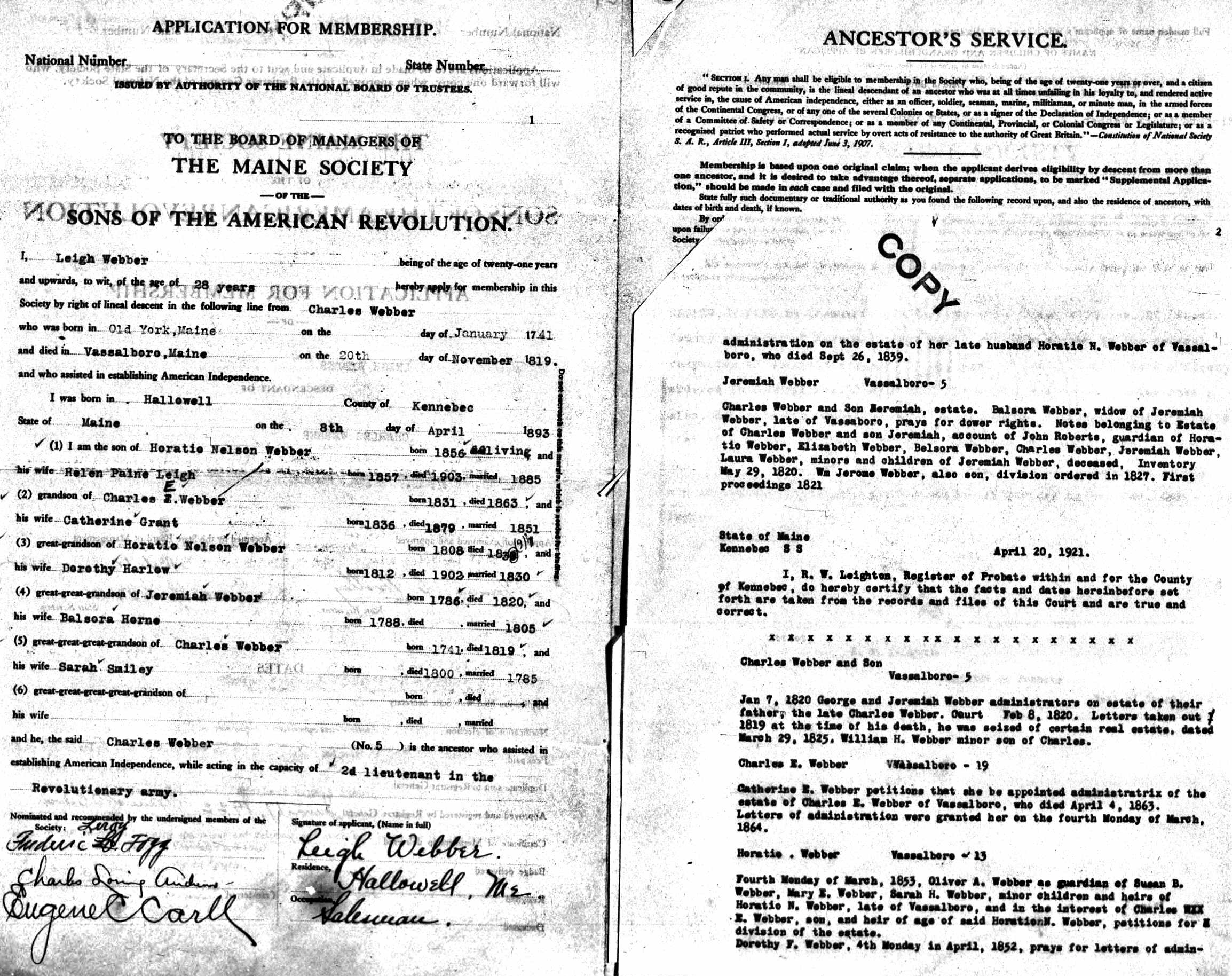
iii. Horatio Nelson Webber b. 5 Jun 1856 Vassalboro; m1. Helen Leigh b: Mar 1857; Horatio moved to California some time between 1910 and 1920.  a son Leigh Webber (8 Apr 1893 – 12 Apr 1962) m2. Julia Frances Torrey b: 22 Jul 1861

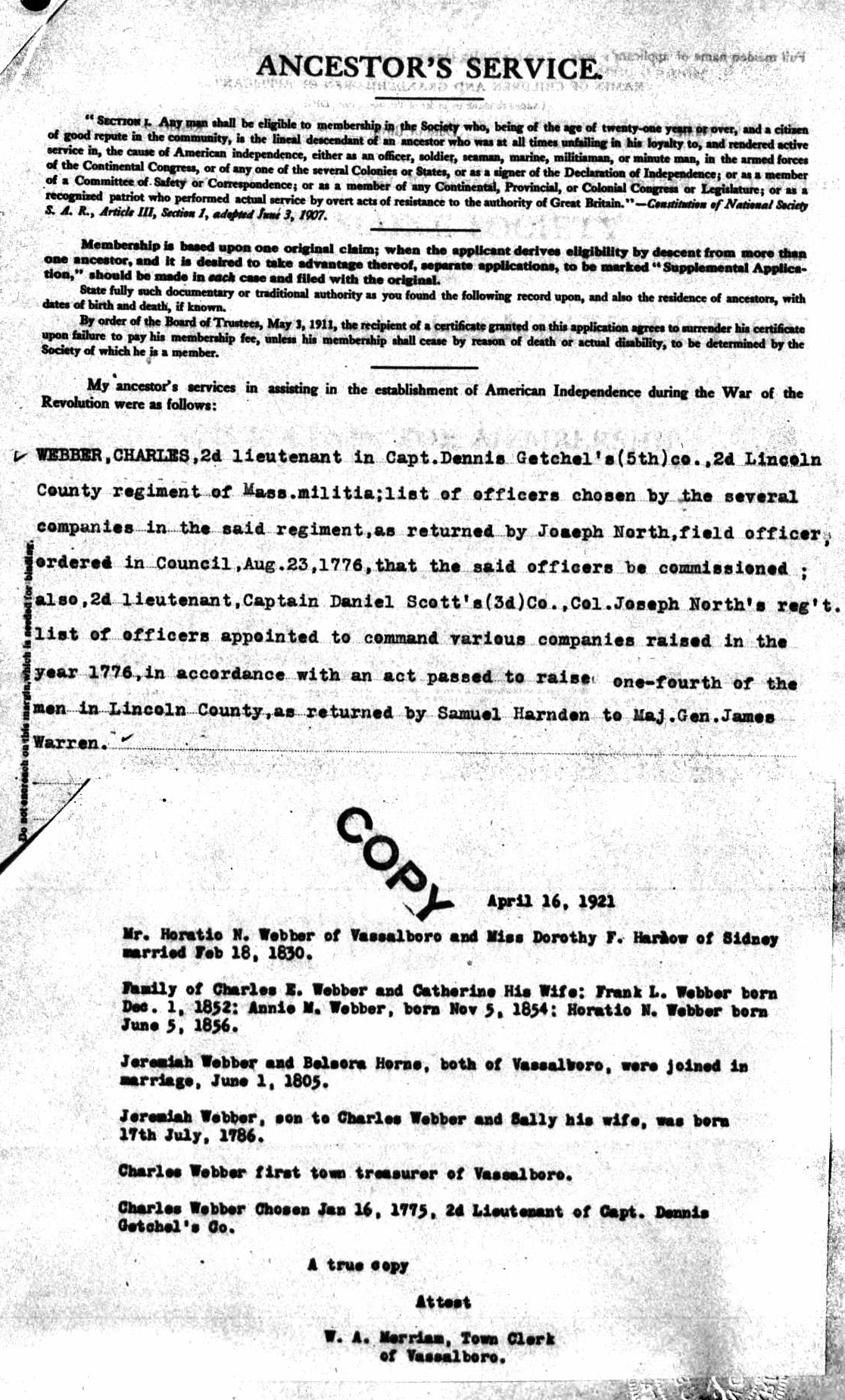
Source: Official bulletin of the National Society of the Sons of the American Revolution, Volumes 16-17 By Sons of the American Revolution 1921

Leigh Webber Sons of American Revolution Application 1

Leigh Webber Sons of American Revolution Application 2

3. Susan Brown Webber

Susan’s husband John H. Lowell was born in 1830 in Maine. In the 1880 census, Susan’s mother Dorothy Webber was boarding with Susan and John. 

Children of Susan and John:

i. Rittena F Lowell b. 23 Sep 1854

ii. Mary (Maryetta)  E. Lowell b. 28 Feb 1856; Public School Teacher, Never married 1900 Census, Age: 44, Living in Spencer Brook, Isanti, Minnesota , 1910 Census, Age: 54, Living in Hallowell Ward 3, Kennebec, with Susan B Lowell: daughter, single, 1920 census, Age 64, living in Anoka Ward 2, Anoka, Minnesota, with her niece Melvina Fulton (Age 47) and her son Keith

iii. Elizabeth (Lizzie) H. Lowell b. ca. 1858; m. 1890 to Everett Kimball Day (1860 – 1940) No children in 1900, 1910, 1920 or 1930 census Rumford, Oxford, Maine.  Everett was a merchant of a dry goods store.

iv. William (Willie) H. Lowell b. Jun 1861 Maine m. 1884 to Annie [__?__]  In the 1910 census, William was a Fish Dealer in Bucksport, Hancock, Maine

iv. Henry F. Lowell 1v. ca. 1865 ;No record after 1880 census.

Sources:

http://trees.ancestry.com/tree/1985269/person/-559602006

http://trees.ancestry.com/tree/1112684/person/-1924220893

http://familytreemaker.genealogy.com/users/r/o/b/Stephen-L-Robbins/FILE/0055page.html

http://freepages.genealogy.rootsweb.ancestry.com/~fayfamily/ralph_webber.html

http://trees.ancestry.com/tree/1112684/person/-1924220893?ssrc=

Posted in Research, Violent Death | Tagged , | 3 Comments

William Sargent

William SARGENT (1606 – 1675) was Alex’s 10th Great Grandfather, one of 2,048 in this generation of the Shaw line.

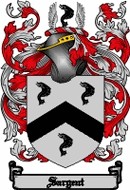
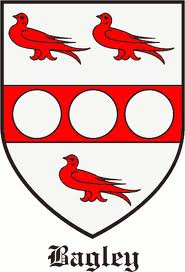
William Sargent – Coat of Arms

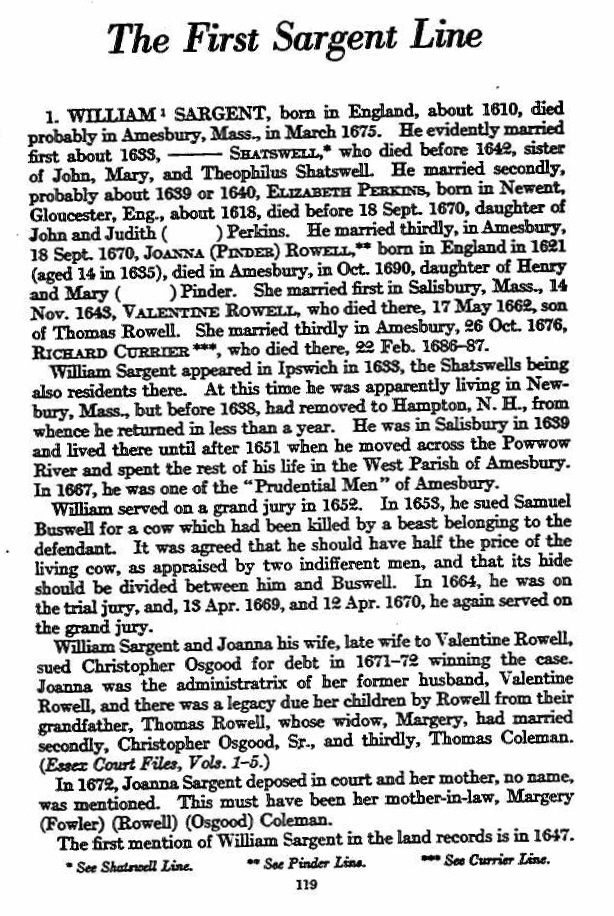
William Sargent was born 28 Mar 1609 in Bath, Somerset, England. His parents were Richard SARGENT and Katherine STEVENS.   He migrated to America in 1632 and was often referred to as a “seaman”, “mariner” or sometimes “yeoman” in legal documents.   He married Elizabeth PERKINS in 1633 in Amesbury, Essex, Mass.  He  was made Freeman on 22 May 1639.   After Elizabeth died, he married Joanna Pinder Rowell.  William died sometime between 24 Feb 1673/74, when his name appeared on a Norfolk Land Deed, and 8 April 1675, when inventory was taken on his estate in Amesbury, Essex, Mass.

William helped found more towns than any of our other ancestors: Agawam – now Ipswich Mass, Wessacucoh – now Newbury Mass,  Winnacunnet – now Hampton NH, South Merrimac – now Salisbury – Mass,  and Salisbury New Town -now Amesbury Mass.

Elizabeth Perkins was born 31 Mar 1611 in Hillmorton, Warwickshire, England. Her parents were John PERKINS and Judith GATER. Elizabeth died 18 Sep 1670 in Salisbury, Essex, Mass.

Joanna Pinder was born in 1621. She was the daughter of Henry and Mary Pinder. She married Valentine Rowell on 14 Nov1643 in Salisbury, Mass.   She married as her second husband William Sargent on 18 Sep 1670 in Amesbury, Mass. Joanna Pinder married Richard Currier as her third husband on 26 Oct 1676 in Amesbury, Mass. She died in October 1690 in Amesbury.

Children of  William and Elizabeth:

Name Born Married Departed
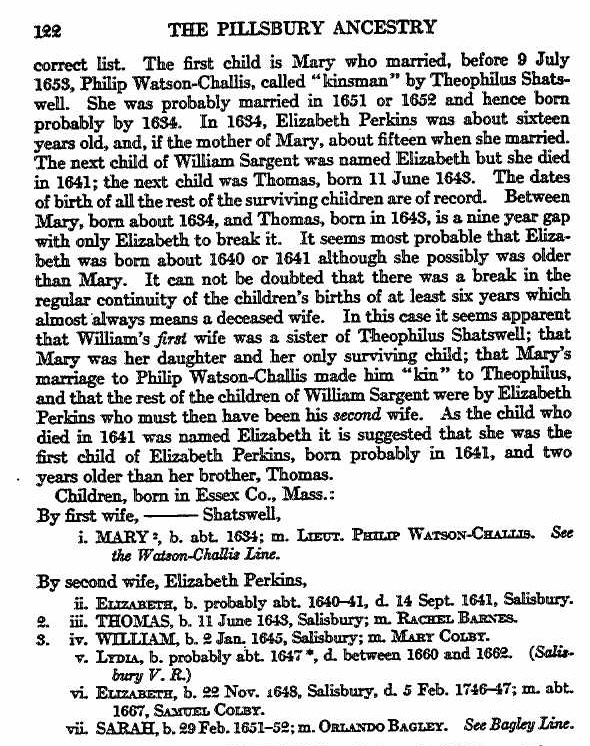
1. Mary Sargent 27 Sep 1634 Amesbury, Essex, Mass Phillip Challis
1652
Salisbury
27 Sep 1716
Amesbury, Mass
2. Thomas Sargent
11 Jun 1643 Salisbury, Essex, Mass Rachel Barnes (daughter of William BARNES)
2 Mar 1668 Salisbury
27 Feb 1706
Amesbury, Mass
3. William Sargent 2 Jan 1645 Salisbury Mary Colby (daughter of Anthony COLBY)
23 Sep 1668 Amesbury
31 May 1712
Amesbury
4. Lydia Sargent 17 Jun 1647 Salisbury 1661
Salisbury
5. Elizabeth Sargent 22 Nov 1648 Salisbury Samuel Colby (Son of Anthony COLBY)
1667
Salisbury
5 Feb 1736
Amesbury
6. Sarah SARGENT 29 Feb 1652 Salisbury Orlando BAGLEY Jr.
22 Dec 1681 Amesbury
3 Oct 1701 Salisbury

The earliest record seeming to bear on the origin of this Sargent family appears in the Abbey church at Bath, England, under date of Nov 22, 1602, where the record of the marriage of Richard Sargent and Katherine Stevens is set out, and it states further “Ano Dom. 1630, Jenning Walters and Joane Sargent were married April 15,” and under “Baptism,” “Elizabeth, the daughter of Richard Sargent, 28 day, 1603, October; 1606, June, William the Sonne of Richard Sargent the 28th; March, 1609, Joane the daughter of Richard Sargent was baptised the 26th.” No further record of father or son is found there, and it is inferred that they may have gone to London and William shipped from there.

One historian of the Sargent family says: “At first I was not inclined to believe this William was our ancestor, or from this part of England. But since learning that the father of William’s first wife, ‘Quarter Master John Perkins,’ was at Agawam in August, 1631, a short time after arriving in America, and that he came from near Bath, England, it seems quite probable that if William was from there and with Captain Smith in 1614, when the latter landed at Agawam and wrote up its beauties and advantages, William may have returned and induced John Perkins and others to emigrate.”

The first record found of William is in the general court records of Masschusetts Colony in April, 1633, where a copy of an act appears to protect him and other grantees of land at Agawam, now Ipswich. Massachusetts, in their rights. The next record is that of his oath of allegiance and fidelity in 1639. It is shown by records and deeds that he was one of the first settlers at Wessacucoh, now Newbury, in 1635; at Winnacunnet, now Hampton, New Hampshire, in 1638.

Oct 1638 – The reverend Stephen BACHILER and his company, who had received permission from the general court when united together by church covenant, commenced a settlement at Winicowett. He was at this time residing in Newbury. On Mr. Rawson’s request, the place was called Hampton. The following persons, residents of Newbury, went with Mr. Bachiler. John Berry, Thomas COLEMAN, Thomas Cromwell [Giles CROMWELL‘s brother], James DAVIS, William Easton, William Fifield, Maurice Hobbs, Mr. Christopher Hussey [BACHILER’s son-in-law], Thomas Jones, Thomas Marston, William Marston, Robert Marston, John Moulton, Thomas Moulton, William Palmer, William SARGENT, and Thomas Smith. Smith, however, soon returned to Newbury. A few went to Salisbury.

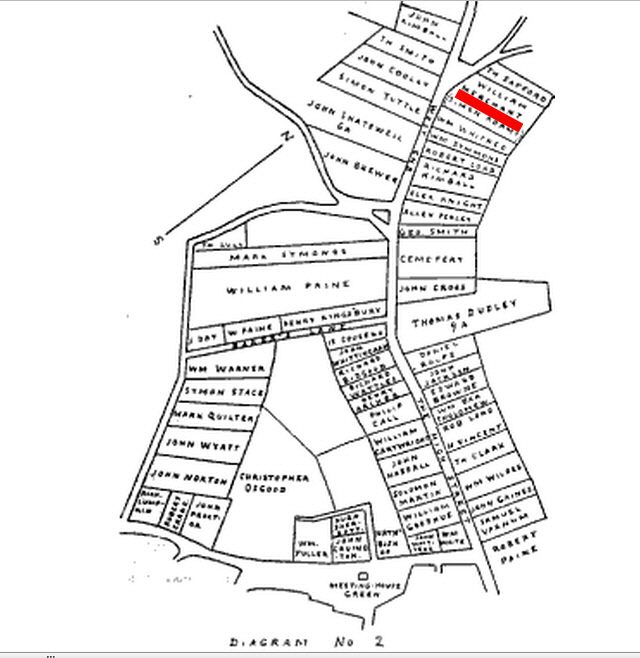
Our ancestos’ lots are underlined in red. William Sargent’s lot was at the corner today’s Winnacunnet Road and Park Ave. — Map of the homes of the original settlers of Hampton, NH, recreated from published maps and ancient records in 1892

  • Lafayette Road, and Winnacunnet Road, Hampton, NH on Google Maps
  • The main road going horizontally across the top of the map then, at right, angling down to the right corner, is today’s Winnacunnet Road. At the bottom right corner it leads “To The Sea”.
  • Today’s Lafayette Road/Route One starts in the top left and goes vertically down (south) into the thicker road, then about 2/3 of the way down angles sharply off to the left corner in the small road reading “To Salisbury”. That road today is pretty much straight as an arrow north to south.
  • Midway down that same road a small road angles off to the left that reads “To Drake Side”. That is today’s Drakeside Road.
  • The fat road leading from the point where Route One angles off “To Salisbury” to the right and its meeting with Winnacunnet Road, is today’s Park Ave.
  • The two roads leading off the bottom of the map both say “To the Landing”, and at the time were both ends of a single road that went in a loop. Today they are still there, called Landing Road, but are cut off in the middle by a new highway.
  • Lastly the small road in the top right is Mill Road.

First called the Plantation of Winnacunnet, Hampton was one of four original New Hampshire townships chartered by the General Court of Massachusetts, which then held authority over the colony. “Winnacunnet” is an Algonquian Abenaki word meaning “pleasant pines” and is the name of the town’s high school.

In March 1635, Richard Dummer and John Spencer of the Byfield section in Newbury, came round in their shallop, came ashore at the landing and were much impressed by the location. Dummer, who was a member of the General Court, got that body to lay its claim to the section and plan a plantation here. The Massachusetts General Court of March 3, 1636 ordered that Dummer and Spencer be given power to “To presse men to build there a Bound house”.

The town was settled in 1638 by a group of parishioners led by Reverend Stephen Bachiler, who had formerly preached at the settlement’s namesake:Hampton, England.  Incorporated in 1639, the township once included SeabrookKensingtonDanvilleKingstonEast KingstonSandownNorth Hampton and Hampton Falls..

William was at South Merrimac. now Salisbury, Massachusetts, in 1639, and that “William Sargent, townsman and commissioner of Salisbury,” had a tax rate December 25, 1650, of 7s. 4d.

William Sargent – Ipswich Lot

He was next located at Salisbury New Town, now Amesbury and Merrimack, in 1655, where he resided until his death in 1675. He is believed to have married Elizabeth Perkins about 1633, as she came with her parents to America in the ship “Lion,” in the spring of 1631. She died before September 18, 1670, for William married at that time Joanna Rowell, who survived him and married Richard Currier, of Amesbury. The children of William Sargent seem to have been as follows, but owing to lack and contradiction of records there is uncertainty about them: Mary, Elizabeth, died young: Thomas, William, Lydia, Elizabeth, died young; Sarah, died young; Sarah and Elizabeth.

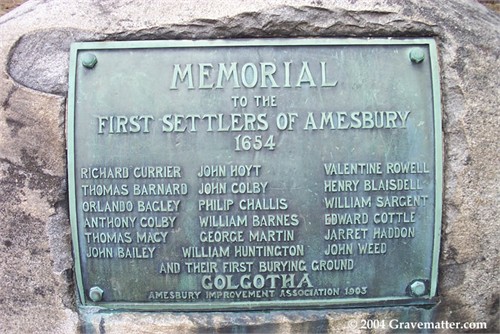
Over half the first settlers names on this memorial are our ancestors.  They are: Richard Currier, Orlando BAGLEY Sr., John Bailey, William BARNES, Thomas Barnard, Henry Blaisdell, Philip Challis, Anthony COLBY,  John COLBY, Edward Cottle, Jarret Haddon, John HOYT, William Huntington, Thomas Macy, George MARTIN, Valentine Rowell, William SARGENT and John Weed.

OFFICES: Essex grand jury, 13 April 1652 Petit jury, 8 April 1662, 24 June 1662, 13 April 1669, 12 April 1670 . Sworn clerk of the train band of Salisbury on 8 April 1651

ESTATE: “It is ordered that no person whatsoever shall go to plant or inhabit at Aggawam, without leave from the court, except those that are already gone, viz. …

1634 – ” Willm Srjeant” In a grant at Ipswich,, William Sargent received twelve acres of land

6 Sep 1638 – ” Willi[am] Sergant” was in the list of petitioners, mostly Newbury men, headed by [our ancestor] Stephen BACHILER, were granted “liberty to begin a plantation at Winnacunnet [Hampton]”1:236].

The Grantees and Settlement of Hampton, N. H. By Victor Channing Sanborn — Kenelworth, Ill.Essex Institute Historical Collections, 53 – (1917), Pgs. 228-249

That little band, the first settlers of Winnicunnet (afterwards called Hampton) was composed of at least two diverging groups. Search must be made in Southern England (Hampshire and Wiltshire) and in Eastern England (Norfolk and Suffolk) to find the homes of these men. They came from Newbury, Ipswich and Watertown, under the leadership of Stephen Bachiler.

The first authentic record is found in the list of those who presented their petition to the General Court of Massachusetts at that session which began on 6 September, 1638.

“The Court grants that the petitioners, Mr. Steven BACHILER , Christopher Hussey, Mary Hussey vidua, Tho: Crumwell, Samuel Skullard, John Osgood, John Crosse, Samu: Greenfeild, John Molton, Tho: Molton, Willi: Estow, Willi: Palmer, Willi: SERGANT, Richrd Swayne, Willi: Sanders, Robrt Tucke, wthdivers others, shall have liberty to begin a plantation at Winnacunnet”.&c.

The first six grantees were all from the south or west of England. The last ten were probably from Norfolk or Suffolk. The “divers other”, being unnamed, we may not assign, but they probably included others of Bachiler’s neighbors or kinsmen, among them being his three Samborne grandchildren.

“Will[iam] Sargent” was in the section of married men in the list of first comers to Hampton

7 Nov 1644  – John Severans of Salisbury, planter, sold to William SARGENT of Salisbury, planter, twenty acres of upland in Salisbury on the west side of Powwos river

25 Mar 1647 –  Anthony “Colebie” [our ancestor Anthony COLBY] of Salisbury, planter, deeded to William SARGENT of Salisbury, seaman, a dwelling house and house lot in Salisbury between Jarred Haddon and Henry Browne

16 Dec 1652 – William SARGENT of Salisbury sold to [our ancestor] John BROWNE of Hampton, the meadow and upland adjacent to Aquilla Chase and widow “Bristos”.

15 April 1659 –  William SARGENT of Salisbury sold to John Woodin of Salisbury upland in Salisbury near the “Pawwaus River above the falls”

In his will of 20 June 1663 Theophilus SHATSWELL of Haverhill named “my brother Wilyam Sargent & my kinsman Lieutenant Philip Challis” his overseers; Philip Watson-Challis had married Mary, the eldest child of William Sargent. Recent research has shown that no sibling of Theophilus Shatswell married William SARGENT, and the two wives of  William Sargent have been identified. The most likely remaining solution is that Theophilus Shatswell married a sister of William Sargent.  Perhaps Theophilus married William’s sister Susanna SARGENT in 1639 in Ipswich, Mass.  Susanna Sargent was born in 1618 in England.  Susanna died in Oct 1672 in Ipswich, Mass

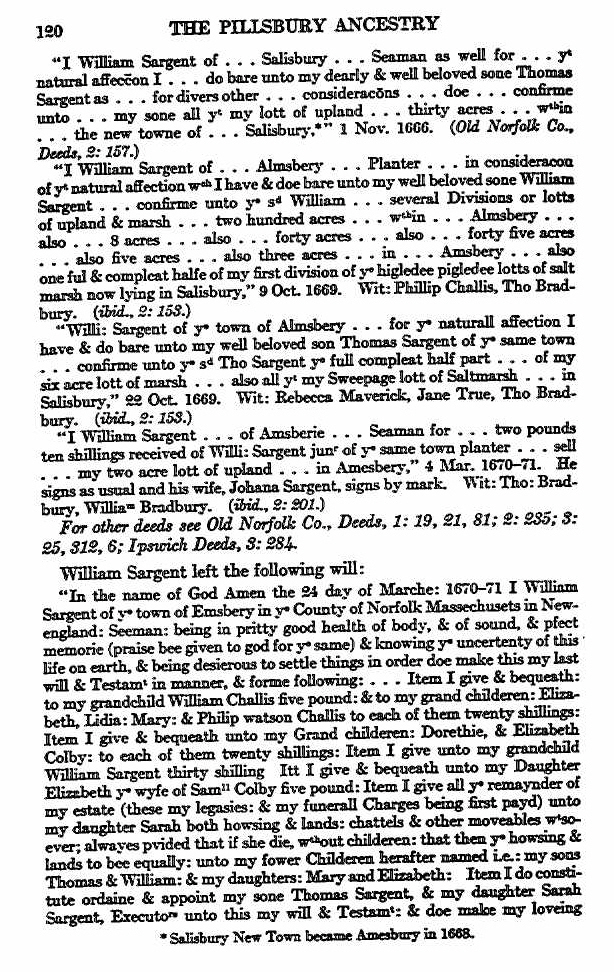
1 Nov 1666 – William Sargent of Salisbury, seaman, gave for “natural affection” to his son Thomas Sargent thirty acres of upland in Salisbury abutting the Merrimack River

22 Oct 1669 –  William Sargent of Amesbury gave for “natural affection and other considerations” to his “beloved son Thomas Sargent” six acres of marsh granted to him by Salisbury, and a sweepage lot of salt marsh in Salisbury at a place called “ye beache” being lot number 8 containing three acres and four rods, being half the lot of marsh between two islands called “Barnss Iland” and “Ware Iland” ].

9 Oct 1669 – William Sargent of Amesbury, planter, gave for “natural affection and other considerations” to his “beloved son William Sargent” a great lot of upland containing two hundred acres in Amesbury, a lot of upland in ox common containing eight acres, a lot of upland west of the great pond containing forty acres, a lot of upland in “burchin meadow hill” containing forty-five acres “which I bought of Edward Goe”; the last division of three acres in the pond meadow (all the foregoing in Amesbury); and half his first division of the higledee pigledee lots of salt marsh in Salisbury.

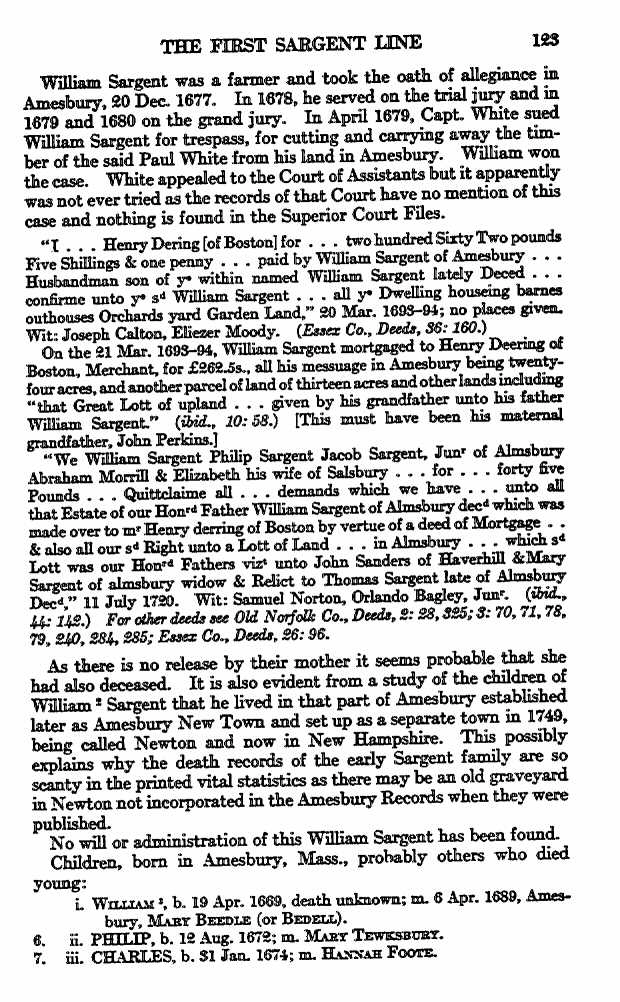
4 Mar 1670/71 – William Sargent of Amesbury, seaman, sold for £2 10s. to William Sargent Jr. of Amesbury, planter, two acres of upland at the Indian ground in Amesbury; wife Johana Sargent made her mark to this deed

23 Apr 1672 – William Sargent of Amesbury, yeoman, sold to Isaac Green of Hampton 2 acres of salt marsh called Hall’s farm

1 Jul 1673 – William Sargent Sr. of Amesbury, with the consent of his wife, “Janna,” sold to Thomas Wells of Amesbury ninety-five rods of land in Amesbury, part of his houselot.

1 Oct 1673 – “William Sergent … of Almsberry in Norfolke senior and mariner” mortgaged to Nathaniel Williams of Suffolk County eight acres of upland in Amesbury that Sergeant had by exchange with Richard Currier .

24 Feb 1673/74] – William Sargent Sr. of Amesbury, seaman, sold to Caleb Moody of Newbury, maltster, for £5 1s. “my second division higledee pigledee” lot of salt marsh containing three acres in Salisbury .

18 Oct 1696 – Among parcels sold by William Sargent Jr. on to Henry Deering, was a great lot of upland given by his grandfather [unnamed] to his father William Sergeant, “containing by estimation 200 acres in Amesbury amongst the great lots”

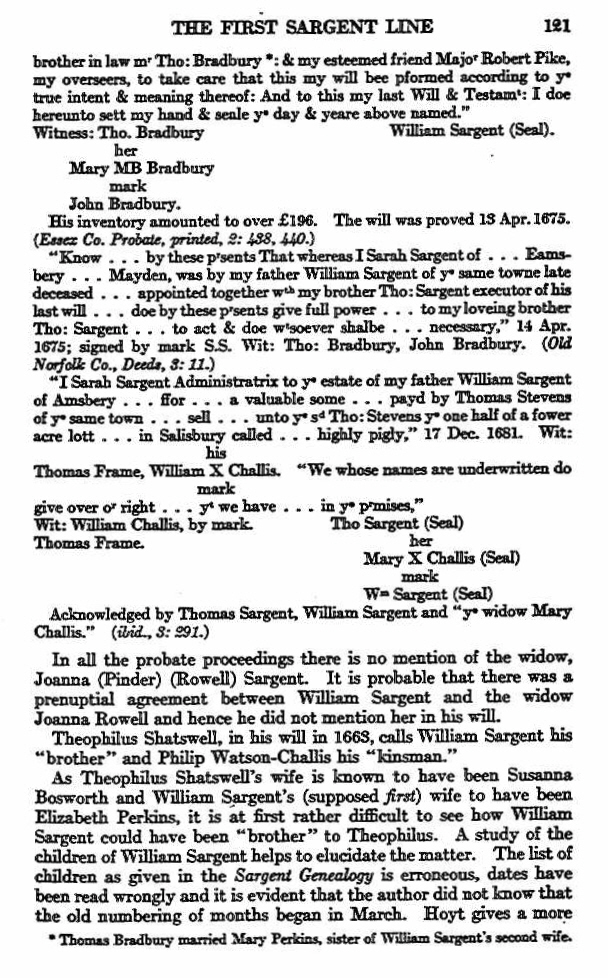
WILL: In his will, dated 24 March 1670/1 and proved 13 April 1675, ”

William Sargent of the town of Emsbery,” seaman, “being in pritty good health of body…” bequeathed to “my grandchild William Challis” £5; to “my grandchildren: Elizabeth, Lidia, Mary and Phillip Watson Challis” each of them 20s.; to “my grandchildren Dorethie, & Elizabeth Colby” each 20s; to “my grandchild William Sargent” 30s.; to “my daughter Elizabeth the wife of Samuel Colby” £5; residue to “my daughter Sarah” and if she die without children, the housing and lands to be equally divided to “my four children hereafter named i.e.: my sons Thomas & William: & my daughters: Mary and Elizabeth”; “my son Thomas Sargent and my daughter Sarah Sargent” executors; loving “brother-in-law Mr. Tho: Bradbury” and esteemed friend Major Robert Pike (son-in-law of Joseph MOYCE) , overseers .

The inventory of the estate of “Willi. Sargent, Senr.,” taken 8 April 1675 by Thomas Sergeant and John Weed, totalled £196, of which the real estate totalled £137 10s., including “housing & lands about the house & orchard on both sides [of] the country way,” £85; “half the lot in the tide meadows, £16; “a Higledee Pigledee lot in the salt marsh” £25; “a lot lying in … Lyons Mouth,” £5 10s.; “a lot in the great swamp,” £2; “a lot in … Bugmore,” £4 .

Unmarried daughter Sarah chose to have her “loving brother” Thomas act in her behalf as executor, 14 April 1675 .

Although William had married his last wife, Joanna, just a few months before he wrote his will, and she survived him, she was not mentioned, strongly implying that there was a pre-nuptial agreement (of which no record can now be found).

The Sargent family were some of the original settlers of the Agawam section of Ipswich, Essex co., MA, with William receiving 12 acres in the 1634 Ipswich Land Grant. The family later moved to Newbury, Essex co., MA; Hampton, Rockingham co., NH; Salisbury, Essex co., MA and finally Amesbury, Essex co., MA. Remember that NH & ME were all part of MA at the time. The family moved from Newbury to Hampton because “…’Willli[am] Sergant’ was amongst the list of petitioners mostly Newbury men who were headed by Stephen Bachiler, who were on 6 September 1638 granted ‘liberty to begin a plantation at Winnacunnet [what is now Hampton, Rockingham co., NH]…” And “Will[iam] Sargent” is listed as one of the married men in the list of first comers to Hampton..

The Sargents found themselves in court over disputes with their neighbors on many occasions. Given the fact that this pattern of contentiousness continued after Eliabeth’s death, I contend that William was the fractious party in the area. On 26 December 1643, William “Sargeant” sued Mr. William Hook of Salisbury for 56s. in corn. William acknowledged the court’s judgment in favor of Mr. Jonathan Wade on 26 September 1648. Michael Spencer sued him for detaining corn and other goods on 2 Jan 1650.

In 1672, William Sargent and Joanna his second wife sued Christopher Osgood for debt due part of the estate of Joanna’s late husband, Valentine Rowell . However, Joanna was curiously not mentioned in his will, although she had married him a few months earlier. To contemporary credible researchers, this strongly suggests that there was a pre-nuptial agreement between them which left Joanna nothing.

Children

1. Mary Sargent

Mary’s husband Lt. Phillip Challis was born 1615 or 1617 in Essex, England. His parents were John Challis (1584 – 1648) and Elizabeth Watson (1592 – 1686). Phillip died 22 Apr 1691 in Amesbury, Essex, Mass.

He was a farmer. Lt. Philip Challis – (Challice or Chellis) of Salisbury & Amesbury, MA. “Planter”, b. abt. 1617; Received land in the first division in 1640 and 1644; was earlier at Ipswich, where he had a house-lot in 1637. His name is on most of the early Salisbury and Amesbury lists; was a Representative in 1662. An original settle of Amesbury, where he received land in 1654, 1658, and 1659 and later “Children’s land for his son in 1659, and a Township” for one of his sons in 1659, also. But he seems to have been a member of the Salisbury Church in 1667, as was his widow in 1687. Inventory of his estate presented 22 Apr 1691;

2. Thomas Sargent

Thomas’ wife Rachel Barnes was born 30 Apr 1649 in Salisbury, Mass.  Her parents were William BARNES and Rachel LORD. Rachel died 7 Feb 1718 in Amesbury, Mass.

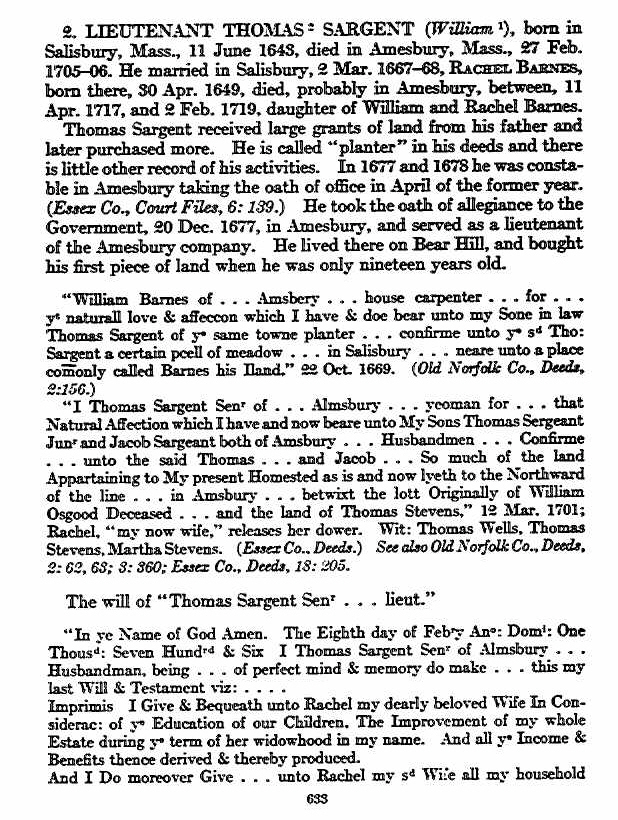
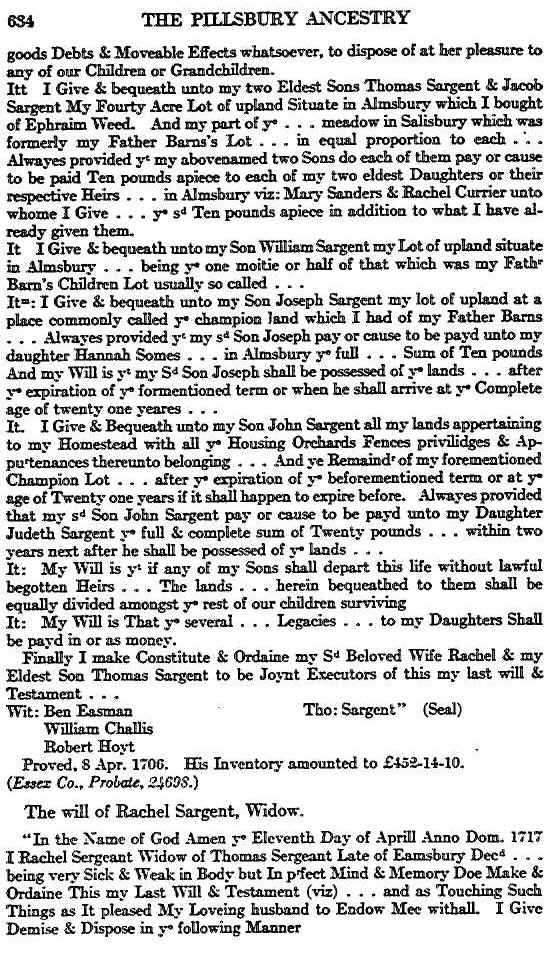
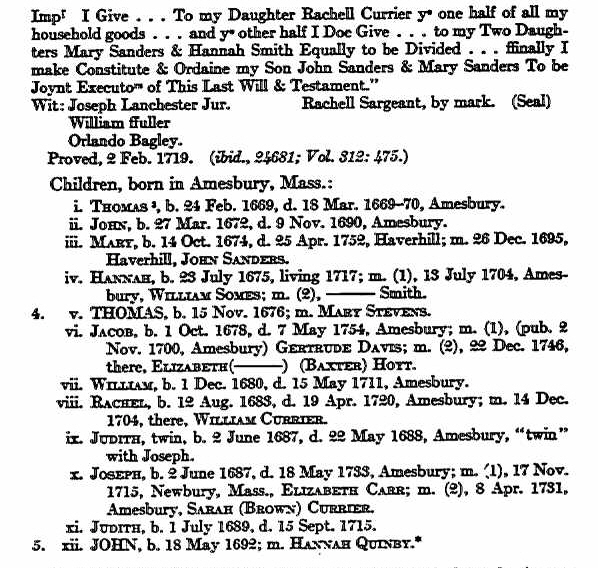
Thomas Sargent 1 — Source: Ancestry of Charles Stinson Pillsbury and John Sargent Pillsbury (1938)

Thomas Sargent 2

Thomas Sargent 3

3. William Sargent

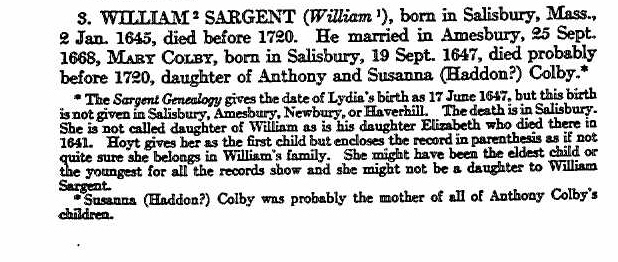
William’s wife Mary Colby was born 19 Sep 1647 Salisbury, Essex, Mass. Her parents were Anthony COLBY and Susanna WATERMAN.  Mary died 27 Sep 1716 in Amesbury, Mass.

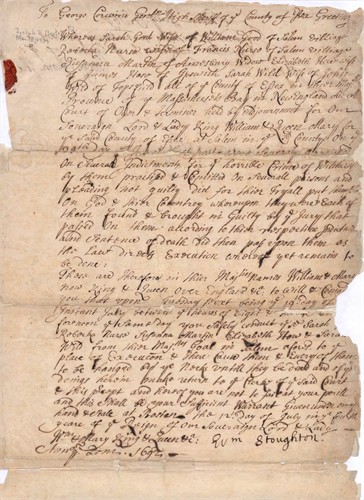
In 1669, Williams’s son William Sargent Jr formally accused Susannah North Martin of witchcraft. In turn, George MARTIN sued Sargent for two counts of slander against Susannah, one for accusing her of being a witch, and another for claiming one of her sons was a bastard and another was her “imp.” Martin withdrew the second count, but the Court upheld the accusation of witchcraft. A higher court later dismissed the witchcraft charges.  Alternatively, William’s son Thomas might have been the one responsible for saying that his son George Martin Jr. was a bastard and that Richard Martin was Goodwife Martin’s imp…”

George died in 1686, leaving Susannah an impoverished widow by the time of the second accusation of witchcraft in 1692. Inhabitants of nearby Salem Village, Massachusetts had named Susannah a witch and stated she had attempted to recruit them into witchcraft. Susannah was tried for these charges, during which process she proved by all accounts to be pious and quoted the Bible freely, something a witch was said incapable of doing. Cotton Mather countered Susannah’s defence by stating in effect that the Devil’s servants were capable of putting on a show of perfect innocence and Godliness.

Susannah was found guilty, and was hanged on July 19, 1692 in Salem.

William Sargent –

William Sargent Jr.

5. Elizabeth Sargent

Elizabeth’s husband Samuel Colby was born 1638 in Ipswich, Mass.  His parents were  Anthony COLBY and Susanna WATERMAN. Samuel died 5 Jul 1716 in Amesbury, Mass.

6. Sarah SARGENT (See Orlando BAGLEY Jr.‘s page)

Sources:

The earliest records seeming to bear on the origin of the Sargent (Sergent) family of this branch appears in the Abbey Church at Bath, England under the date of November 22, 1602 where the record of the marriage of Richard Sargent and Katherine Steevens is set out and it states further “Ano Qom” 1630 Jenning Walters and Jeane Sargent were married April 15, and under “Baptisme”, Elizabeth, daughter of Richard Sargent, 28 day 1603 October; 1606 June, William Sargent, the son of Richard Sargent; the 28th March 1609 Joane, the daughter of Richard Sargent was baptized the 26th.  No further record of the father or son is found there, and it is inferred that they may have gone to London and William shipped (immigrated) from there.

One historian of the Sargent family says “The father of William’s first wife, Quater master John Perkins, was at Agawan in August 1631 – a short time after arriving in America, and he came from near Bath, England, so it seems quite probable that if WIlliam was from there, and with Captain John Smith 1614, when the latter landed at Agawan, William may have returned and induced John Perkins and others to immigrate”.

The first records of William are in the general court records of the Mass. colony in 1633 where a copy of an act appears to protect him, and other grantees of land, at Agawan, now Ipswich, Mass., in their rights.  The next record is that of his oath of allegiance and fidelity in 1639.  It is shown by the records and deeds that he was one of the first settlers at Wissaencoh, now Newbury, in 1635, at Wimeacunnet, now Hampton, N.H., in 1639, at South Merrimac, now Salisbury, Mass., in 1639, and that William Sargent, townsman and commisioner of Salisbury, had a tax rate December 25, 1650 of 7 S 4 d.  He was next located at Salisbury and New Town, Now Amesbury and Merrimac in 1655.  He is believed to have married Elizabeth Perkins about 1633 when she came with her parents to America in the ship “Lion” in the spring of 1631.  She died before September 18, 1670

William Sargent 1 – Source: Ancestry of Charles Stinson Pillsbury and John Sargent Pillsbury (1938)

William Sargent 2

William Sargent 3

William Sargent 4

5

http://trees.ancestry.com/owt/person.aspx?pid=36759597&st=1

Genealogical and family history of the state of Maine, Volume 3 By Henry Sweetser Burrage, Albert Roscoe Stubbs

Ancestry of Charles Stinson Pillsbury and John Sargent Pillsbury (1938) By Holman, Mary Lovering, 1868-1947; Pillsbury, Helen Pendleton Winston, 1878-1957

Posted in 12th Generation, Immigrant - England, Line - Shaw, Pioneer, Public Office, Storied, Veteran, Witch Trials | Tagged , , , , , , | 33 Comments

Anthony Colby I

 Anthony COLBY I (1605 – 1661) was Alex’s 11th Great Grandfather two times, through his son Isaac and through his daughter Sarah.  He is two of 4,096 in this generation of the Shaw line.  I originally thought Dorothy COLBY was the  grand daughter of Anthony’s son John, but I  now believe she was actually the daughter of John’s younger brother Isaac COLBY and Martha PARRATT.

Immigrant Ancestor - Colby Coat of Arms

Immigrant Ancestor – Colby Coat of Arms

Anthony Colby was born 8 Sep 1605 in Horbling, Lincolnshire, England. His parents were Thomas COLBY and Anna JACKSON.  Some claim he was the son of Thomas Colby and Beatrice Fenton and therefore connected to English royalty.  This has not been proved.  He arrived in America on the Arabella in 1630 with the Winthrop Fleet.  He married Mrs. Susanna WATERMAN in 1632 in Boston, Mass. Anthony died 11 Feb 1661 in Salisbury, Essex, Mass.

Anthony was admitted to Boston church as member #93, which would be in the winter of 1630/31. In the Boston church records, Anthony Colby is first in the following sequence of names: Anthony Chaulby,  John Boswell,  Joseph Redding,  Garrett Hadden. In the Massachusetts Bay lists of freemen, Anthony Colby is third in this sequence: Jerad Hadden, Joseph Redding, Anthony Colby, John Bosworth.

Examination of the four men in these groupings reveals some interesting parallels:

  1. Colby, Bosworth, Haddon and Redding all moved from Boston to Cambridge by 1633 .
  2. Colby moved next to Ipswich (1637) and then Salisbury (1640); Haddon moved next to Salisbury; Redding moved next to Ipswich (1639).
  3. All three were single men in 1630: Colby married about 1633, Haddon married about 1639, Redding married about 1640.

The grouping of these four men in 1630 and 1634, and the concerted migrations of the three survivors, suggest that the four were associated in some way. The gap between church admission in 1630 and freemanship in 1634 suggests that they may not yet have been twenty-one in 1630, and this is supported by the approximate dates of marriage. Taken together, these facts and suggestions indicate that John Boswell/Bosworth, Anthony COLBY, Garrett Haddon and Joseph Redding came to New England as servants, and were perhaps all from the same part of England.

Anthony came to New England in 1630  as a servant of Simon Bradstreet

A survey of the members of the Winthrop Fleet produces one man who settled first in Boston, then moved to Cambridge and on to Ipswich, and who was wealthy enough to have brought four servants with him – Gov. Simon Bradstreet. As a working hypothesis, then, “”The Great Migration Begins” proposes that this grouping of four young men were from the vicinity of Simon Bradstreet’s home at Horbling, Lincolnshire, and came to New England in 1630 in his service.

Susanna [__?__] was born in 1608 in England.  Her father was NOT Jarret (Jared) Haddon. She first married [__?__] Waterman.   After Anthony died, she married William Whitridge in 1663 in Salisbury, Mass. Susanna died 8 Jul 1689 in Salisbury, Mass.

William Whitridge was born in 1599 in Benenden, Kent, England. William died 5 Dec 1668 in Ipswich, Essex, Mass.

Near the end of her life, Susannah Colby Whittredge was described by the selectmen of Amesbury as:

“an anchient and helpless widow belonging to the town of Amesbury.. .notwithstanding a comfortable and competent maintenance being allowed unto her out of the estate of her former deceased husband Anthony Coleby…yet she being a woman attended with many infirmities both of body and mind, is utterly incapable of doing anything that may contribute to her livelihood or comfortable subsistance … she living alone, wanting such help and attendance as may be convenient, continually laboring under such infirmities of body as usually attend old age often times sick and many times destitute of divers necessaries and always of the conveniencies of life, any otherwise than she is supplied by one or two of her children, whose families in the meantime want the same at home, and very much defective and decayed in her understanding …,”

The court ordered that her sons, Samuel, Isaac and Thomas Colby, provide for her and sell what land was necessary to maintain her from the Colby estate

Amesbury Monument – The Golgotha Burying Ground is also found on Rt. 110 (Macy St.), in Amesbury Massachusetts about a half a mile east. It is the first burial ground in Amesbury but there are no markers.

Over half the first settlers names on this memorial are our ancestors.  They are: Richard Currier, Orlando BAGLEY Sr., John Bailey, William BARNES, Thomas Barnard, Henry Blaisdell, Philip Challis, Anthony COLBY,  John COLBY, Edward Cottle, Jarret Haddon, John HOYT, William Huntington, Thomas Macy, George MARTIN, Valentine Rowell, William SARGENT and John Weed.

Amesbury, Essex, Mass

Amesbury was settled in 1655 as a part of Salisbury, but was separated from Salisbury in 1666 and incorporated as the town of Amesbury in 1668.

Originally the boundary between Amesbury and Salisbury was the Powwow River. In 1876 Merrimac was created out of West Amesbury. In 1886 West Salisbury was annexed to Amesbury so the mill area on the Powwow River was unified. See the maps linked below.

Beginning as a modest farming community, it developed an aggressive maritime and industrial economy. The 90-foot (27 m) drop in the falls of the Powwow River provided water  power  for sawmills and gristmills. Shipbuilding, shipping and fishing were also important. The ferry across the Merrimack River to Newburyport was a lively business until the construction of bridges to Deer Island. Newton, New Hampshire would be set off from Amesbury in 1741, when the border between the two colonies was adjusted.

Children of Anthony and Susannah:

Name Born Married Departed
1. John Colby 8 Sep 1633 Boston, Suffolk, Mass Frances Hoyt
14 Jan 1656 Salisbury, Essex, Mass
11 Feb 1673
Amesbury, Essex, Mass
2. Sarah COLBY 1635 Cambridge, Middlesex, Mass Orlando BAGLEY Sr.
6 Mar 1654 Salisbury, Mass
18 May 1663 Boston, Suffolk, Mass.
3. Son 1637
Ipswich, Mass
1637
Ipswich
4. Samuel Colby 1638 in Ipswich Elizabeth Sargent (daughter of William SARGENT)
1667
Salisbury, Essex, Mass
5 Jul 1716
Amesbury
5. Isaac COLBY 6 Jul 1640 Salisbury, Essex, Mass Martha PARRATT
1668
Salisbury
13 Jul 1723
Amesbury
6. Rebecca Colby 11 Mar 1643
Salisbury, Essex, Mass
John Williams (son of John WILLIAMS)
9 Sep 1661 Salisbury, Essex, Mass
10 Jun 1672
Haverhill, Mass
7. Mary Colby 19 Sep 1647 Salisbury, Essex, Mass William Sargent
(Son of William SARGENT)
23 Sep 1668 Amesbury
27 Sep 1716
Amesbury
8. Thomas Colby 8 Mar 1650 Salisbury, Essex, Mass Hannah Rowell
16 Sep 1674 Amesbury
30 Mar 1691
Salisbury

Anthony was one of the largest property owners in Amesbury, Mass.

Colby is a place name deriving from the parish of Coleby, which lies 17 miles northeast of Semperingham, and 6 miles south of Lincoln. There is also a parish of Coleby in Norfolk, next to Beccles, and it too seems to have been the source of a quite unrelated Colby clan.

The name is of Viking origin and means “coal place.” Cole is the Viking word for “coal” and the “by” suffix is the word meaning “homestead of farm.” Thus, Colely was probably a farmstead where charcoal was made in ancient times by Viking settlers.

Anthony Colby came to America in the spring of 1630 on the ship “Arabella” with the “Winthrop Fleet.” His first home was in the disputed territory between Cambridge and Watertown which was given to Cambridge in 1632, and was on the road to Mount Auburn close by the river.

In 1633, on the second Sabbath that Rev. John Cotton preached, and he baptized his own son, Seaborn Cotton, and John Colby, the son of Anthony Colby.

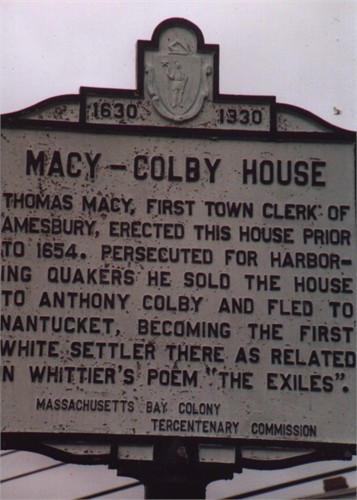
Macy – Colby House

Susannah had to defend her homestead against the claim of Thomas Macy from whom it had been purchased. At about the time of the sale, Macy had fled to Nantucket to escape the penalty of sheltering two Quakers during a thunderstorm, but later he denied the sale and tried to expel the widow and her family by legal process.

259 Main Street, Amesbury, MA The Macy-Colby house is open on Saturdays from 10:00 am to 4:00 pm during the summer. Other times are available by appointment. To arrange an appointment contact: Kathy Colby 978-388-3054 colbykathleen@verizon.net

x

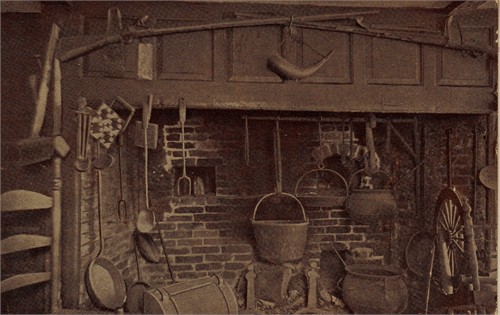
Hearth of the Colby House from an old postcard “Macy Colby House Fireplace, Amesbury, Massachusetts”

Anthony built a second house near the Washington Elm and a third one near the Fresh Pond. He was admitted as a freeman in Cambridge in 1634. Three years later he appeared in Ipswich, and three years after that in Salisbury, MA.   Anthony Colby was among the first settlers of the latter town. Together with Jared Haddon, they joined the Church in Charlestown and took the freeman’s oath in Cambridge on 14 May 1634. Together lay their houselots in east Salisbury and when Jared sold his homestead in 1644 and built in what is now Amesbury, Essex County, MA.   Anthony bought the lot adjoining and came with his family. On this land Anthony at last settled down to make a permanent home.

In 1640 Anthony Colby was appointed an appraiser for the government. Then in 1651 he was elected a selectman.

William BARNES, Anthony COLBY, William Osgood, Philip Challis and Samuel Worcester jointly owned a saw mill near Powwow River Falls, Amesbury

4 Nov 1658 – whereas there is a saw mill in possession of Wm Osgood, Phil Challis,  William BARNES, Anthony COLBY and Samuel Worcester, co-partners with said Colby in one-fourth part of the mill in Salisbury upon Pawwaws river near the corn mill, they should keep it in good working order, and agreed to make good to William Osgood the grant of the town; the timber to be equally divided among them and each partner to have the privilege of using the mill for sawing his own timber into boards or planks to be used only on the land where said Osgood now dwells for building or repairing, provided they bring the timber to the mill already cut; if any one of them makes a new way to any parcel of timber, the others were to pay part of the cost if they used said way; if any one of them cleared the river for floating down logs to the saw mill, the others should bear part of the charge if they used the river for this purpose, etc; each partner was to be allowed 3s per day for what time he gave to repairs on the mill, if he be a good workman, and 4s per day for making the head block and 3s per day for a hinder head block and 2s 6d for a wallower or sweep; each partner was to provide saws for himself and the saws now at the mill to be equally divided, except those for oak; each partner was to take the mill to run for a week and so in order through the year, William Osgood beginning, followed by Colby, Worcester, Barnes and Challis in order; each was to lay his boards and logs at the mill where they had formerly. Witnesses: Tho Bradbury, Humphrey Verney, Rodger Easman and Jno HOYT

Anthony Colby seems to have been always at odds with the leaders in town affairs and was often in controversy, legal or personal, with the authorities. Once he was fined for making a speech in the Town meeting on the grounds that he had created  a disturbance.  He worked incessently to have the new settlement at Amesbury set off from Salisbury as a town. The fight was carried on after his death by his sons, and the separation was finally accomplished in 1666.

Colby was an industrious man, and in spite of moving every few years, and in spite of many children, he became one of the largest property holders in Amesbury. His lots included “Black River,” “Fox Island,” “Lion’s Mouth,” “Great Swamp,” “Hampton River,” “Whiskers Hill,”  and lots from the third and fourth divisions. His inventory for his will set a value of 359 pounds sterling upon his property.

The old house of Anthony Colby was on the southwest side of Main Street, which leads from Amesbury Center to the Merrimac, and was the seventh from Bartlett’s Corner. Here stands the well that was described in Whittier’s poem, “The Captain’s Well.” The well was dug by a grandson of Anthony’s daughter, Mary.

The year after Anthony Colby’s death, his widow, Susannah sold 60 acres near Haverhill, MA to her son Isaac to pay for her board. From the public divisions she received land in 1662 and 1664. In the latter year she married William Whitridge, a carpenter from Gloucester, and he died in 1669. In the meantime, Susannah had to defend her homestead against the claim of Thomas Macy from whom it had been purchased. At about the time of the sale, Macy had fled to Nantucket to escape the penalty of sheltering two Quakers during a thunderstorm, but later he denied the sale and tried to expel the widow and her family by legal process. He was unsuccessful and the premises were in the possession of Susannah’s descendants as late as 1895. In 1678, the son of Thomas Macy was deeded half of all the lands remaining in consideration of services rendered to the widow, and in 1682 the homestead was deeded to Susannah’s son, Samuel Colby, who cared for her during the infirmities of old age.

Captains Of Industry Or Men Of Business Who Did Something Besides Making Money – James Parton 1884 – 1891

In August 1659 in Salisbury, Mass, Thomas Macy was caught in a violent storm of rain, and hurried home drenched to the skin. He found in his house four wayfarers, who had also come in for shelter. His wife being sick in bed, no one had seen or spoken to them. They asked him how far it was to Casco Bay [Maine]. From their dress and demeanor he thought they might be Quakers, and, as it was unlawful to harbor persons of that sect, he asked them to go on their way, since he feared to give offense in entertaining them. As soon as the worst of the storm was over, they left, and he never saw them again. They were in his house about three quarters of an hour, during which he said very little to them, having himself come home wet, and found his wife sick.

He was summoned to Boston, forty miles distant, to answer for this offense. Being unable to walk, and not rich enough to buy a horse, he wrote to the General Court, relating the circumstances, and explaining his non-appearance. He was fined thirty shillings, and ordered to be admonished by the governor. He paid his fine, received his reprimand, and removed to the island of Nantucket, of which he was the first settler, and for some time the only white inhabitant.

Our ancestors Thomas COLEMAN and  Edward STARBUCK were  also original settlers of Nantucket.

1

“The Great Migration Begins”, published 1996 by the New England Historical and Genealogical Society, on pages 413 to 416===

Anthony Colby died on 11 February 1660 in Amesbury, MA.  In his biography, Anthony left London, the Isle of Wright, in March of 1630 with more than 400 others and arrived on the ship Arbella at Boston. He lived on shipboard for 4 months before housing could be made. Anthony first lived in Boston, then Ipswich, Salisbury and Amesbury. He was called a planter and received land in the first division in 1640 and 1643; he was one of the first commoners of Amesbury where he received land in 1654 and 1658, and his widow in his right in 1662 and 1664. Anthony became a church member in Boston and he was living in Cambridge in 1632, he was affirmed a freeman and took the oath on 14 May 1634. He was at Ipswick in 1637 and he married Susannah ??? about 1632 in Boston, MA.

Extract from The Americn Genealogist, Whole Number 202, Vol. 51, No. 2, April 1975, Anthony Colby’s Purported Ancestry, by Glade Ian Nelson:

Although as early as 1939, information concerning the identity of Anthony Colby’s wife was printed by Donald Lines Jacobus, (4) many errors have since been printed concerning her. Mr. Jacobus clearly pointed out that Anthony Colby married after coming to New England, probably between 1630 and 1632, the widow Susannah Waterman of Boston, Mass. She married, thirdly, about 1663-4, William Whitridge, a carpenter from Gloucester who died 5 Dec. 1668, leaving her a widow for the third time. Susannah died 8 July 1689 in Salisbury, Mass. Various accounts state her maiden name to have been Haddon and make her either a sister or daughter of William Sargent, and still others ascribe her to her the name Nutting. None of these claims, however, is substantiated by documented evidence, leaving her maiden name unknown. (Note Source – Wilson Roberts)

From the “Great Migration Begins”

The inventory of the estate of “the widow Susannah Whitridge who deceased July the 8th or thereabouts in the year of Grace 1689” was taken 9 September 1691 and totalled £151 15s. including real estate valued at 143: “5 acres of tillage”; “half the ferry meadow”; “a lot in the division called the great farms”; “a lot of upland in a division called [illegible]”; “a lot in the ox pasture division”; “a lot near the north meadow”; “a lot in Bugsmore division”; and “a lot in the great swamp” [EPR 304:400].

The final division of the estate of Susannah Whitridge on 5 August 1700 allowed a double portion to “Samll Coleby Eldest [surviving] Son” 1. 12s. 6d., and equal shares of 16s. 3d. to: “the children of John Colby…”; “the children of Isaac Colby…”; “the children of Thomas Colby…”; “the children of Sarah Colby…”; “the children of Rebeckah Colby…”; and “the children of Mary Colby…” [EPR 307:176-77].

MARRIAGE: By 1633 Susanna (_____) Waterman, widow of _____ WATERMAN of Boston (land “at first was granted to [blank] Waterman who deceased. Anthony Colbye married his widow & they two sold the said land unto James Pennyman…” [SLR 11:176-77]); she married (3) by 1663 William Whitridge (petitions as Susanna “Whittredge formerly Colbie” to sell real estate 28 March 1682 [EPR 1:409]); she died 8 July 1689.

In case you’re wondering, I don’t know if Gardner Colbym, the namesake of Colby College, is a descendant, but it sounds likely. Chartered in 1813 when Maine was still part of Massachusetts, and originally called the Maine Literary and Theological Institution, Colby is one of the oldest colleges in New England. After Maine separated from Massachusetts, the new legislature conferred upon the school the right to grant degrees, and in 1821 the institution was renamed Waterville College.

The turmoil of the Civil War severely tested the resources of the College as many students left the all-male campus and the school appeared to be on the verge of closing. At that point Gardner Colby, a well-to-do Boston merchant and local Maine native, stepped in to provide the funding necessary to avert tragedy. The grateful Board of Trustees thanked him for the gift by promptly renaming the school after him.

Children

1. John COLBY (See his page)

2. Sarah COLBY (See Orlando BAGLEY Sr.‘s page)

4. Samuel Colby

Samuel’s wife Elizabeth Sargent was born 22 Nov 1648 in Salisbury, Mass. Her parents were William SARGENT and Elizabeth PERKINS.  Elizabeth died 5 Feb 1736 in Amesbury, Mass.

5. Isaac COLBY  (See his page)

6. Rebecca Colby

Rebecca’s husband John Williams was born 25 Oct 1636 in Salisbury, Essex, Mass.  His parents were John WILLIAMS and Jane GOULD. After Rebecca died, he married Hester Blakeley (widow of John Bond) in  5 May, 1675 Haverhill  John died 30 Apr 1698 in Haverhill, Mass.

John’s second wife Hester Blakeley was born about 1630.  Her parents were Joseph Blakely and Sarah Williams.  She first married 15 Aug 1649 Newbury, Essex, Mass. to John Bond (1624 – 1674).

7. Mary Colby

Mary’s husband William Sargent was born 2 Jan 1645 in Salisbury, Mass. His parents were William SARGENT and Elizabeth PERKINS. William died 31 May 1712 in Amesbury, Mass.

8. Thomas Colby

Thomas’ wife Hannah Rowell was born Jan 1653 in Salisbury, Essex, Mass. Her parents were Valentine Rowell and Ann Currier. Hannah died 9 Aug 1707 in Amesbury, Essex, Mass.

Sources:

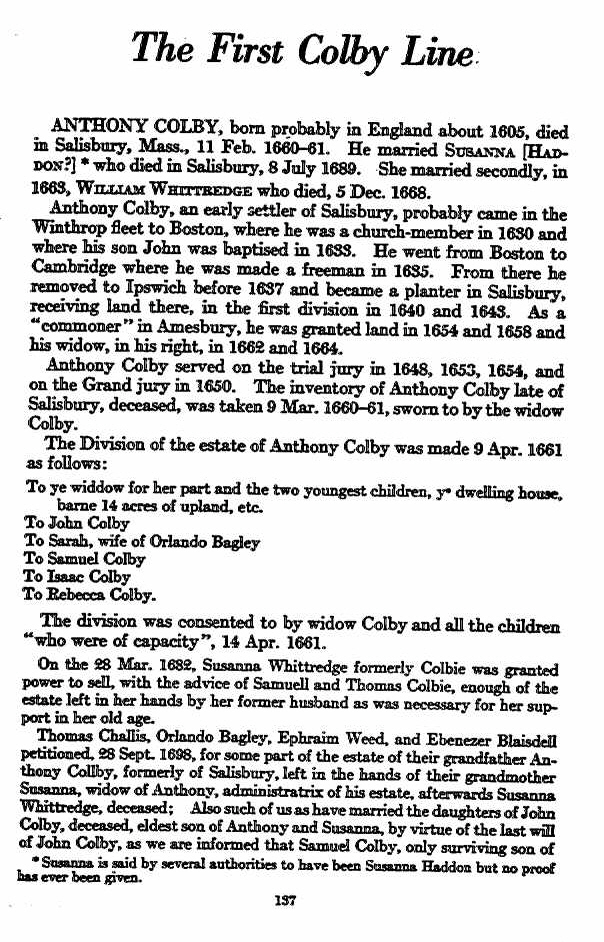
Anthony Colby 1 — Source: Ancestry of Charles Stinson Pillsbury and John Sargent Pillsbury (1938)

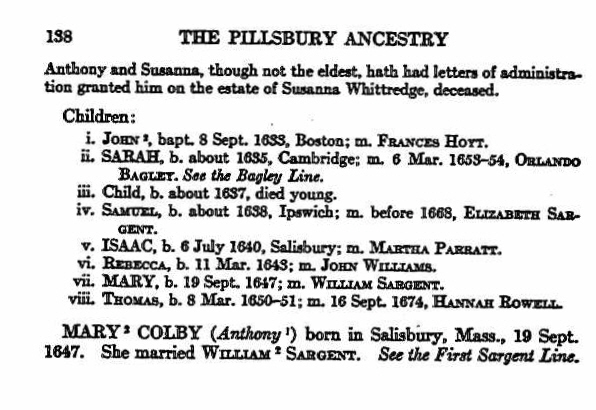
Anthony Colby 2

http://trees.ancestry.com/owt/person.aspx?pid=13846476&st=1

http://trees.ancestry.com/tree/111217/person/-413376524/story/1dcabc36-086c-4023-981e-922c4e849cf5?src=search

http://trees.ancestry.com/tree/5028195/person/-1246454899/story/682e4c4a-27b2-4dd2-8d5b-1b4d0c644af4?src=search

http://www.literaturecollection.com/a/james-parton/captains-of-industry/6/

Ancestry of Charles Stinson Pillsbury and John Sargent Pillsbury (1938) By Holman, Mary Lovering, 1868-1947; Pillsbury, Helen Pendleton Winston, 1878-1957

http://search.ancestry.com/cgi-bin/sse.dll?db=greatmigrationindex&f3=jumptoANTHONYCOLBY

Posted in 13th Generation, Artistic Representation, Dissenter, Double Ancestors, Historical Monument, Historical Site, Immigrant - England, Line - Shaw, Pioneer, Public Office, Storied | Tagged , | 18 Comments

Orlando Bagley Sr.

Orlando BAGLEY Sr. (1628 – 1700) was Alex’s 10th Great Grandfather, one of 2,048 in this generation of the Shaw line.

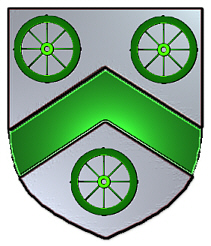
Orlando Bagley - Coat of Arms

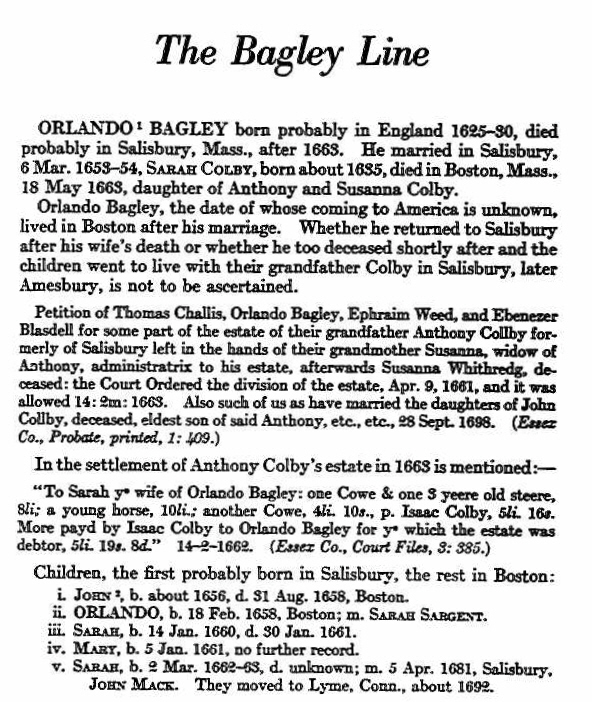
Orlando Bagley was born about 1628 in England. His parents were NOT John Bagley and Mary Warren which is another unrelated Biglo family. John Biglo seems to have arrived in Watertown, MA about 1632. Orlando married Sarah COLBY 6 Mar 1654 in Salisbury, Mass.    Orlando died in 1700 in Boston, Mass.

Amesbury Monument - The Golgotha Burying Ground is also found on Rt. 110 (Macy St.), in Amesbury Massachusetts about a half a mile east. It is the first burial ground in Amesbury but there are no markers.

Amesbury Monument – The Golgotha Burying Ground is also found on Rt. 110 (Macy St.), in Amesbury Massachusetts about a half a mile east. It is the first burial ground in Amesbury but there are no markers.

Over half the first settlers names on this memorial are our ancestors.  They are: Richard Currier, Orlando BAGLEY Sr., John Bailey, William BARNES, Thomas Barnard, Henry Blaisdell, Philip Challis, Anthony COLBY,  John COLBY, Edward Cottle, Jarret Haddon, John HOYT, William Huntington, Thomas Macy, George MARTIN, Valentine Rowell, William SARGENT and John Weed.

Sarah Colby was born in 1635 in Cambridge, Middlesex, Mass. Her parents were Anthony COLBY and Susannah WATERMAN.  Sarah died 18 May 1663 in Boston, Suffolk, Mass.

Children of  Orlando and Sarah:

Name Born Married Departed
1. John Bagley 1656
Boston, Mass
31 Aug 1658
Boston
2. Orlando BAGLEY Jr. 18 Feb 1658 Boston, Mass. Sarah SARGENT
22 Dec 1681
Amesbury, Essex, Mass.
13 Jan 1728 Amesbury, Essex, Mass.
3. Mary Bagley 5 Jan 1661 Boston William Colby
1681
1700
Boston
4. Sarah Bagley 2 Mar 1663 Boston John Mack
5 Apr 1681 Salisbury, Essex, Mass
1721
Lyme, New London, CT

The line continues on to John Baguley 1616, Randall Baguley 1578, Robert Baguley (Bigelow) 1556, Randall Baguley (Bigelow)1518, Ralph Baguley (Bigelow)1500.

“ORLANDO BAGLEY, the pioneer ancestor of the Bagley family of Worcester, Massachusetts, was born in England, as near as can be ascertained, between 1624 and 1630. He came to America some time before 1653, as it is recorded that he was married at that time in Salisbury, probably of that part of the town which is now Amesbury, Massachusetts. He removed to Boston soon afterward, as some of his children were born there. He was made a freeman in 1667, admitted to the church, and is believed to have died in Boston before 1700. He married Sarah Colby, the daughter of Anthony Colby — the first Colby to come to America — by whom he had five children, the second child named Orlando.”

Orlando Bagley Sr Source: Ancestry of Charles Stinson Pillsbury and John Sargent Pillsbury (1938)

Children

2. Orlando BAGLEY Jr. (See his page)

3. Mary Bagley 

I can’t find any details for Mary’s supposed husband William Colby which is odd given how close the two families were.

4. Sarah Bagley

Sarah’s husband John Mack was born 6 Mar 1653 in Inverness-Shire, Scotland. John died 24 Feb 1721 in Lyme, New London, CT.

Sources:

http://trees.ancestry.com/owt/person.aspx?pid=30797534&st=1

Ancestry of Charles Stinson Pillsbury and John Sargent Pillsbury (1938) By Holman, Mary Lovering, 1868-1947; Pillsbury, Helen Pendleton Winston, 1878-1957

Posted in 12th Generation, Historical Monument, Immigrant - England, Line - Shaw, Pioneer | Tagged | 16 Comments

Orlando Bagley Jr.

Orlando BAGLEY (1658 – 1728) was Alex’s 9th Great Grandfather, one of 1,024 in this generation of the Shaw line.

Orlando Bagley was born 18 Feb 1658 in Boston, Mass. His parents were Orlando BAGLEY Sr. and Sarah COLBY. He married Sarah SARGENT 22 Dec 1681 in Amesbury, Essex, Mass. After Sarah died, he married Sarah Annis 25 Mar 1704 in Newbury, Essex, Mass. Orlando died 13 Jan 1728 in Amesbury, Essex, Mass.

Sarah Sargent was born 29 Feb 1652 in Salisbury, Essex, Mass. Her parents were William SARGENT and Elizabeth PERKINS. Sarah died 3 Oct 1701 in Salisbury, Essex, Mass.

Sarah Annis was born 23 Dec 1666 in Newbury, Essex, Mass. Her parents were Charles Annis and Sarah Chase.  Sarah died 1729 in Amesbury, Essex, Mass.

Children of  Orlando and Sarah Sargent:

Name Born Married Departed
1. Orlando Bagley
14 Dec 1682 Amesbury, Essex, Mass Dorothy Harvey
13 Feb 1706 Amesbury
3 May 1756
Amesbury
2. Sarah BAGLEY 27 Feb 1683 Amesbury, Essex, Mass. Henry LANCASTER II
5 Jul 1703 Amesbury, Essex, Mass.
.
Elisha Weed
11 Apr 1713 Amesbury, Mass
1724 Amesbury, Essex, Mass.
3. John Bagley 21 Jan 1685 Amesbury Hannah Fowler
7 Apr 1708 Amesbury
9 Mar 1728
Amesbury
4. Jacob Bagley 13 Dec 1687 Amesbury, Hannah Stanwood
21 Jan 1713 Amesbury
.
Keziah Colby
2 Jun 1748 Amesbury
.
Hannah Blatsdel
13 Mar 1755 Amesbury
25 Dec 1767
Amesbury
5. Judith Bagley 13 Nov 1690 Amesbury John Carter (Thomas Carter’s grandson)
25 Apr 1711 Amesbury
1724

.

Children of Orlando and Sarah Annis:

Name Born Married Departed
6. Joseph Bagley 26 Jan 1705
Amesbury
Lydia Kendrick
27 Nov 1727 Salisbury, Essex, Mass
9 Feb 1772
Salisbury, Essex, Mass
7. Benjamin Bagley 10 Nov 1707
Amesbury
1724
8. Anne Bagley 14 Aug 1709
Amesbury
Abel Merrill
5 Feb 1730
Amesbury, Essex, Mass
1724
9. Hannah Bagley 29 Mar 1712
Amesbury
Thomas Merrill
21 Oct 1731
Salisbury, Essex, Mass
1744
South Hampton, Suffolk, Mass.

Orlando Bagley Jr. was a man of considerable influence in the district, a constable, who apprehended his friend and neighbor, Susannah Martin (Wikipedia), for a witch.  He is at least partly responsible for the execution by hanging of this unfortunate woman.  Susannah was the wife of our ancestor George MARTIN.

The family connections go on.  Susannah was first formally accused of witchcraft in 1669 by William Sargent Jr., Orlando Bagley Jr’s brother-in-law and son of William SARGENT .  In turn, George Martin sued Sargent for two counts of slander against Susannah, one for accusing her of being a witch, and another for claiming one of her sons was a bastard and another was her “imp.” Martin withdrew the second count, but the Court upheld the accusation of witchcraft.  A higher court later dismissed the witchcraft charges.

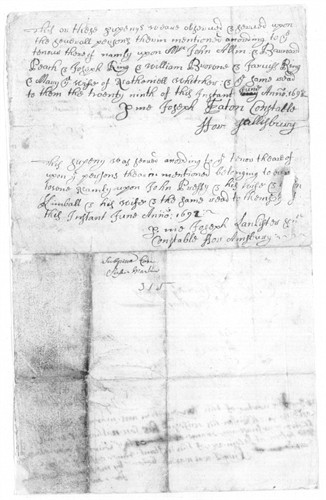
Summons to Susannah Martin - Salem Witch Trial

On April 30, 1692 a warrant was issued for Susanna’s arrest on a charge of witchcraft and she was arrested an May 2nd. “When she saw Orlando Bagley approaching on the morning of her arrest, little did she dream of his errand. He was a personal friend of long standing, and we can but faintly imagine her surprise when…” he read the warrant.

2 May 1692 | Amesbury, Massachusetts

According to this Warrant I have apprehended Susanna Martin Widdow of Amsbury and have brong or caused her to be brought to the place appointed for her examination pr Me.

Salem Village this 2d May 1692

Orlando Bagley
Const of Amsbury

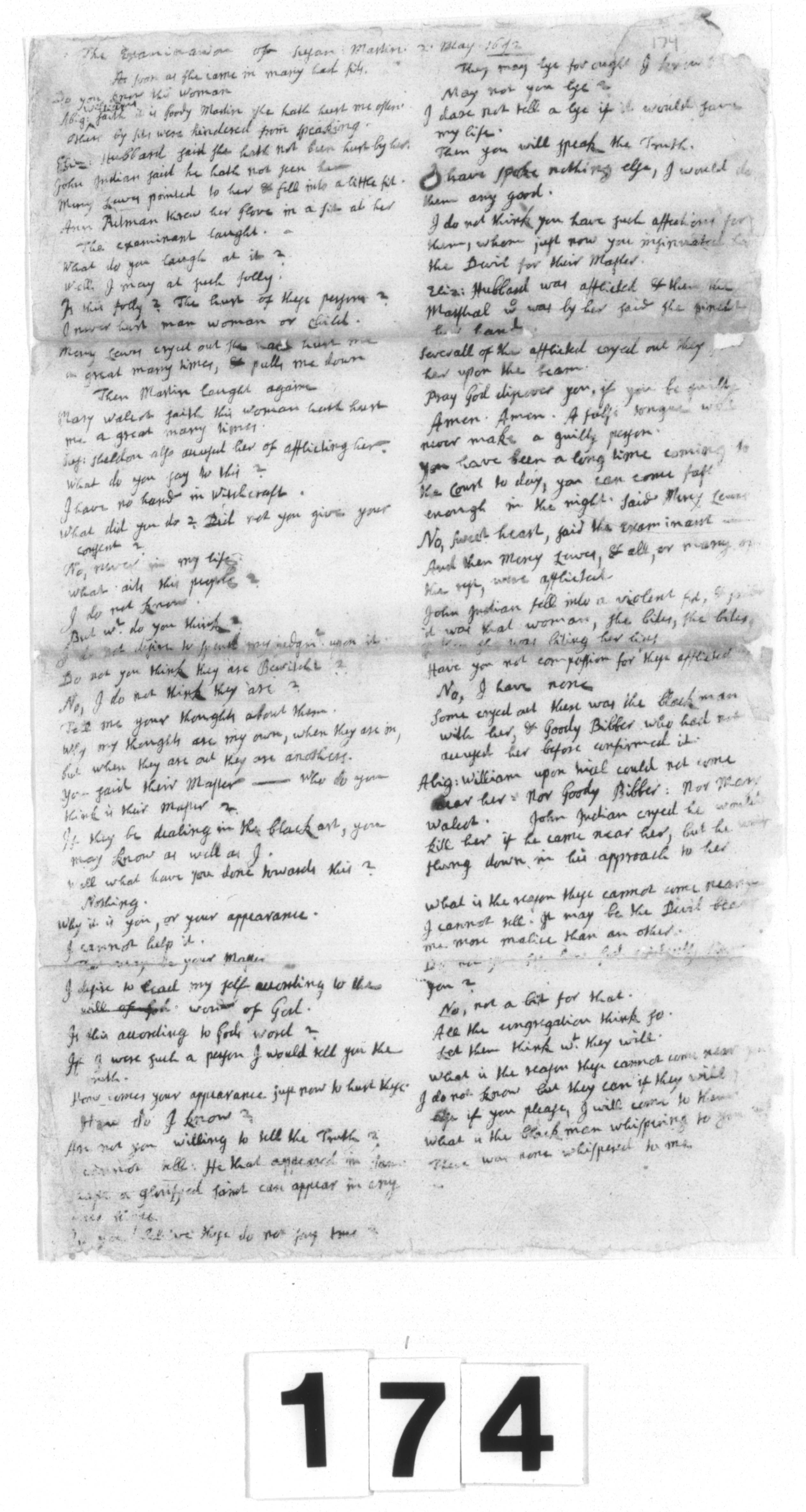
Examination of Susannah Martin by Orlando Bagley written in his own hand

Susanna Martin was accused by a man that was in love with her and when she would not return the favor he accused her of witchcraft. And what did her in was she was summons to court many times and on the last time she was summons it had rained and the roads were dirty and she lifted her shirt to walk so she would not get muddy.  She was asked in court why her shirt was not dirty, and she was so feed up with everything she said “I flew” in a smart butt tone and that did her in.

Susannah Martin Death Warrant - Orlando Bagley was the constable who arrested Susannah Martin in the Salem Witch Trials

Probably the worst indignity that Susanna was twice forced to submit to was the physical examination for evidence of a “witch’s tit or physical proturberance which might give milk to a familiar.” No such deformity was found in Susanna but it was noted that “in the morning her nipples were found to be full as if the milk would come,” but by late afternoon “her breasts were slack, as if milk had already been given to someone or something.” This was an indication that she had been visited by a witch’s familiar, and was clear evidence of guilt.  Perhaps Orlando Bagley Jr conducted these examinations.

A few years ago, a descendant of Susanna Martin visited Salem and  found out that her name was not even mention in a lot of the things that were being told or posted. He sued the town and brought all the paperwork with him to show that she was part of the orginal 7 that were hung and the town therefore changed everything to include her.

Jarvis Ring was a witness in the Susanna Martin trial of 1692 in Salem. She was accused of being a witch and acted the part. She was hung on 19 July of that year with Rebecca Nurse, Sarah Good, Elizabeth How and Sarah Wilds. He and his wife signed the petition in favor of Mrs. Mary Bradbury in 1692 with his wife and a hundred other people on 22 July 1692. They claimed that she was a ‘diligent attender upon God’s ordinances’ and that she never had a falling out with any of her neighbors, but was ‘always willing to do for them what lay in her power night and day, though with hazard of her health.’ Though she was accused repeatedly in Salem and was supposed to have turned into a ‘blue boar’ one time, she did escape execution. Soldier in 1698 and 1702.

“JARVIS RING v. SUSANNA MARTIN

Javis Ring of Salisbury maketh oath as followeth, That about seven or eight years ago he had  been several times afflicted in the night time by somebody or something coming up upon him  when he was in bed and did sorely afflict by laying upon him and he could neither move nor  speak while it was upon him, but sometimes made a kind of noise that folks did hear him and  come up to him and as soon as anybody came, it would be gone. This it did for a long time before and since but he did never see anybody clearly, but one time in the night it came upon me as at othr times and I did then see the person of Susanna Martin of Amesbury. This deponent did perfectly see her and she came to this deponent and took him by the hand and bit him by the finger by force and then came and lay upon him awhile as formerly, and after a while went away. The print of the bite is yet to be seen on the little finger of his right hand for it was hard to heal (he further saith). That several times he was alseep when it came, but at that time when bit his finger he was as fairly awake as ever he was and plainly saw her shape and felt her tooth as aforesaid.

Sworn by Jarvis Ring abovesaid May the 13th 1692
Before Me
Robt. Pike Assit. at Salisbury

Orlando Bagley Jr 1 Source: Ancestry of Charles Stinson Pillsbury and John Sargent Pillsbury

Orlando Bagley Jr 2

Orlando Bagley Jr. Will 1

Orlando Bagley Jr Will 2

Children

1. Orlando Bagley

Orlando’s wife Dorothy Harvey was born 1686 in Amesbury, Essex, Mass. Her parents were John Harvey and Sarah Barnes.  Her maternal grandparents were William BARNES  and Rachel LORD. Dorothy died 2 Jan 1757 in Amesbury, Essex, Mass.

This Orlando Bagley had in his possession a certified copy of his birth in his own handwriting, dated 1749. It also contained his father’s marriage to Sarah Sargent on December 22, 1681. On October 13, 1712 he was chosen town clerk, which office he held for forty-two years from 1712 to 1754; also the right to keep a public school, ‘to teach to wright and sipher such as shall come to him, they paying as he and they agree’; in 1716, he gave land for a school.

His land was near the town pound. He possessed fine business talents and grew in popularity as age came on. He served several years as selectmen and held courts, officiating as trial justice on many occasions. Wills and deeds in his handwriting are numerous, and his marriages for several years far exceeded those of the minister’s, numbering one hundred in all. He helped tunnel The Ridge in Amesbury, and in 1753, when another effort was made to recover the ferry, called Amesbury Ferry, he was one of those chosen to search the records in order to ascertain the condition of the claim in regard to it.

On April 16, 1736, at a meeting of the First Church of Amesbury, it was proposed that their brother Orlando Bagley and their brother John Tuxbury be appointed to the service to discuss with their brother Thomas Hoyt his frequent neglect of the public worship and the Sacraments of the Lord’s Supper and report of the reason thereof (First Church, Amesbury, Mass. Records).

First Administration on his estate was granted to his Widow, May 31, 1756 . Second administration was granted on his estate April 6, 1757, to Orlando Bagley of Kingston, N.H., gentleman.  The inventory of his estate amounted to 5,086 pounds. Because he died intestate, a committee was appointed August 3, 1757 by the court to divide the estate among his children.

2. Sarah BAGLEY (See Henry LANCASTER II ‘s page)

3. John Bagley

John’s wife Hannah Fowler was born 4 Apr 1692 in Salisbury, Essex, Mass. Her parents were William Fowler and Hannah Dow. Hannah died 16 Mar 1759 in Amesbury, Essex, Mass.

4. Jacob Bagley

Jacob’s first wife Hannah Stanwood was born 20 Sep 1687 in Gloucester, Essex, Mass. Her parents were Samuel Stanwood and Hannah Presser. Hannah died Jun 1748 in Amesbury, Essex, Mass

Jacob’s second wife Keziah Colby was born 11 May 1696 in Amesbury, Essex, Mass. Her parents were Samuel Colby and Dorothy Ambrose. Keziah died 3 Nov 1754 in Amesbury, Essex, Mass

Jacob’s third wife Hannah Blatsdel was born 1689 in Salisbury, Essex, Mass

5. Judith Bagley

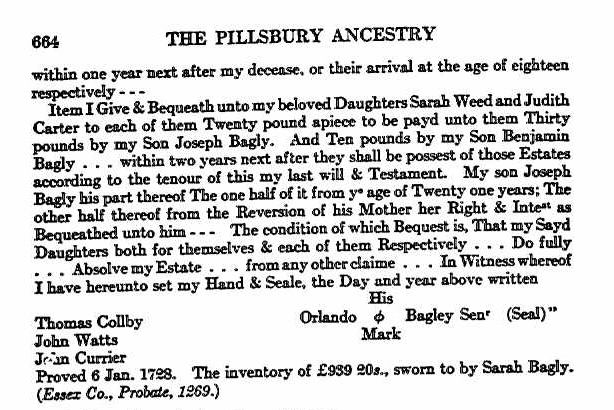
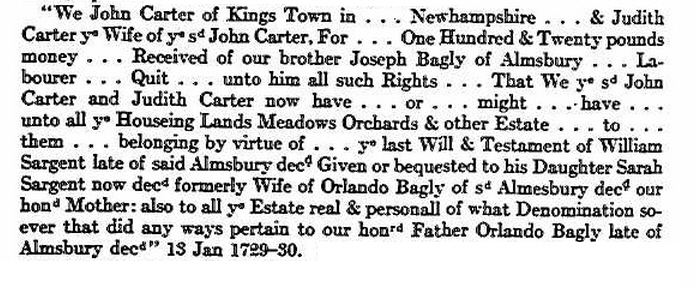
Judith’s husband John Carter was born 8 Jun 1688 in Salisbury, Essex, Mass. His parents were John Carter and Martha Brown. His grandparents were Thomas CARTER and Mary [__?__]. John died 1718 in Amesbury, Essex,(Thomas Carter’s grandson)

Judith Bagley Carter - Source: Ancestry of Charles Stinson Pillsbury and John Sargent Pillsbury

6. Joseph Bagley

Joseph’s wife Lydia Kendrick was born 1706 in Salisbury, Essex, Mass. Lydia died 1786 in Salisbury, Essex, Mass.

8. Anne Bagley

Anne’s husband Abel Merrill was born 28 Aug 1709 in Salisbury, Essex, Mass. His parents were Thomas Merrill and Judith Kent. Abel died Apr 1791 in Salisbury, Essex, Mass.

9. Hannah Bagley

Hannah’s husband Thomas Merrill was born 5 Jan 1711 in Salisbury, Essex, Mass. His parents were Thomas Merrill and Judith Kent. Thomas died 11 Jan 1801 in South Hampton, Rockingham, New Hampshire.

Sources:

http://trees.ancestry.com/owt/person.aspx?pid=13732914&st=1

Ancestry of Charles Stinson Pillsbury and John Sargent Pillsbury (1938) By Holman, Mary Lovering, 1868-1947; Pillsbury, Helen Pendleton Winston, 1878-1957

Posted in 11th Generation, Line - Shaw, Public Office, Veteran, Witch Trials | Tagged | 10 Comments

Rev. Timothy Dalton

Rev Timothy DALTON (1578 – 1662)

Timothy Dalton was born about 1578 at Ipswich, England. He married Ruth LEET on 13 June 1615 at Gislingham, Suffolk, England.  Timothy founded a Church called the Church of Jesus Christ in Hampton, New Hampshire. Timothy had been a sizar  (One of a body of students in the universities of Cambridge, who, having passed a certain examination, are exempted from paying college fees and charges. A sizar corresponded to a servitor at Oxford. The sizar paid nothing for food and tuition, and very little for lodging. They formerly waited on the table at meals; but this is done away with. They were probably so called from being thus employed in distributing the size, or provisions.) at St. John’s College, Cambridge and the Rector of Wolverstone before he vanished from England and turned up in New Hampshire, in 1636 as so many Puritans were forced to do. Timothy’s will was proved 8 Apr 1662 in Hampton, New Hampshire.

Our ancestos’ lots are underlined in red. Thomas Coleman’s lot was on today’s Winnacunnet Road near the corner of Park Ave.  He also had a parsonage on the road “to the landing.”. — Map of the homes of the original settlers of Hampton, NH, recreated from published maps and ancient records in 1892

  • Lafayette Road, and Winnacunnet Road, Hampton, NH on Google Maps
  • The main road going horizontally across the top of the map then, at right, angling down to the right corner, is today’s Winnacunnet Road. At the bottom right corner it leads “To The Sea”.
  • Today’s Lafayette Road/Route One starts in the top left and goes vertically down (south) into the thicker road, then about 2/3 of the way down angles sharply off to the left corner in the small road reading “To Salisbury”. That road today is pretty much straight as an arrow north to south.
  • Midway down that same road a small road angles off to the left that reads “To Drake Side”. That is today’s Drakeside Road.
  • The fat road leading from the point where Route One angles off “To Salisbury” to the right and its meeting with Winnacunnet Road, is today’s Park Ave.
  • The two roads leading off the bottom of the map both say “To the Landing”, and at the time were both ends of a single road that went in a loop. Today they are still there, called Landing Road, but are cut off in the middle by a new highway.
  • Lastly the small road in the top right is Mill Road.

First called the Plantation of Winnacunnet, Hampton was one of four original New Hampshire townships chartered by the General Court of Massachusetts, which then held authority over the colony. “Winnacunnet” is an Algonquian Abenaki word meaning “pleasant pines” and is the name of the town’s high school.

In March 1635, Richard Dummer and John Spencer of the Byfield section in Newbury, came round in their shallop, came ashore at the landing and were much impressed by the location. Dummer, who was a member of the General Court, got that body to lay its claim to the section and plan a plantation here. The Massachusetts General Court of March 3, 1636 ordered that Dummer and Spencer be given power to “To presse men to build there a Bound house”.

The town was settled in 1638 by a group of parishioners led by Reverend Stephen Bachiler, who had formerly preached at the settlement’s namesake:Hampton, England.  Incorporated in 1639, the township once included SeabrookKensingtonDanvilleKingstonEast KingstonSandownNorth Hampton and Hampton Falls.

Ruth Leet was born in England. Her parents were Robert LEET and Alice GRUNDY, Ruth died in 1665 in Hampton, New Hampshire. Ruth’s will was proved 8 Dec 1665.

Timothy and Ruth had no children of their own.

Ruth included Mary Carter in her will, but this was actually Mary Parkhurst Carter, her niece.  In any case, this Mary was married to Rev. Thomas Carter was not our Thomas CARTER.

More about Mary Dalton and Mary Parkhust

A Genealogy of the Descendants of Thomas Carter By: Howard Willston Carter
This book contains the history and genealogy of the Thomas Carter
family of Massachusetts.  Published by the author. Connecticut. 1909

Concerning the parentage of Mary, wife of the Rev. Thomas Carter. On page 17 it is stated that Mary, wife of the Rev. Thomas Carter, was in all probability a daughter of George Parkhurst Sr., of Watertown and Boston. Some of the facts leading to that conclusion are here given more in detail.

On the Parish Registers of Ipswich, Suffolk County, England, are found the following baptisms:–

Phebe, dau. of George and Phebe Parkhurst, Nov. 29, 1612.
Mary, dau. of George Parkhurst, Aug. 28, 1614.
Samuel, son of George Parkhurst, Feb. 2, 1616/17.
Deborah, dau. of George Parkhurst, Aug. 1, 1619.
George, son of George Parkhurst, June 5, 1621.
John, son of George Parkhurst, Oct. 19, 1623.
Abigail, dau. of George Parkhurst, Jan. 1, 1625/6.
Elizabeth, dau. of George Parkhurst, May 18, 1628.
Joseph, son of George Parkhurst, Dec. 21, 1629.
In the so-called “Dalton Deed” (Reg. xxvii, p. 364), Ruth, widow of the Rev. Timothy Dalton, conveys by deed dated March 22, 1663/4 certain property to her “constituted heir,” Nathaniel Bacheller, he paying her a certain sum down, and agreeing to pay the sums mentioned below to the persons named, after her
death:

To Deborah Smith, wife of John, £50
To Elizabeth Merry, wife of Joseph, £20
To Phebe Arnold, wife of Thomas, £20
To Joseph Parkhurst, £20
To George Parkhurst, £20
To Mary Carter, wife of Thomas (Carter of Woburn), £20

The identity of the six names in the two lists is striking, but in addition to this, at least three of the persons mentioned in the Dalton deed are known to be children of George Parkhurst Sr.

Nathaniel Bacheller, the grantee above, had married Deborah, dau. of the above John and Deborah Smith. In 1669 George Parkhurst Jr. writes Bacheller concerning the money coming to him from “my aunt Dalton,” which letter Bacheller endorses as
from “my uncle, George Parkhurst.”

Joseph Parkhurst also wrote Bacheller about the money coming to him from “my aunt Dalton.” Hence George, Joseph and Deborah must have been children of George Parkhurst Sr.

As to Ruth Dalton, wife of Rev. Timothy Dalton, from all the facts known to the writer it would seem that she was not a sister of George1 Parkhurst, but was more likely a sister of his first wife, Phebe. No record of the first wife is found in America, though he again married, about 1643, Susanna, widow of John Simpson.

Unfortunately no record of the marriage of Rev. Thomas Carter and his wife Mary has been found, and the same is true of the marriage of George Parkhurst and his wife Phebe, as also of Rev. Timothy Dalton and his wife, Ruth.

Another fact, although perhaps not of great weight in proving the identity of Mary, wife of Rev. Thomas Carter, is that four of her eight children had the same names as those of children of George Parkhurst Sr., who it should be remembered was a resident of Watertown, where the Rev. Thomas Carter was located at the time of his marriage. A fifth child was named Thomas, probably for the father, thus leaving only three children whose names, so to say, are unaccounted for. Further, it may be stated that there is no birth or other record of a Mary Dalton, dau. of Philemon, brother of Rev. Timothy Dalton.

One possible answer to the question about the two Dalton death records (Deborah and Ruth in 1624) is that Timothy was not only Vicar of Woolverston but also the Rector of Flowton, a small parish 8 miles to the north west of Woolverston. On a second visit to the registers, however, I was also able to clear up the point about Ruth Dalton’s death. I found a will in which “Ruth Dalton, my godchild” was left 20s (shillings) .  So the Ruth who died then was Timothy’s daughter and not his wife. There were several wills in the Woolverston area which showed that Timothy was well thought of in the parish and several times he was asked to be the executor oroverseer of another executor and he was left “10s to preach a good sermon at my funeral.”A list of the records we have include the following: Timothy born about 1577, going to St. John’s, being married in Gislingham in 1615 to Ruth Leet(e) from Little Eversden in Cambridgeshire; the baptism and burial records at Woolverston and very little else. In 1599, Deborah, Ruth Leet’s sister, married Wm. Bolton at Great Cressingham. The writing in these records is so bad that a “B” and a “D” could easilybe mixed up. This is where someone in the United States could help if the recordshave been filmed and are available there.

In April 1635, Philemon Dalton sailed on the ship Increase from England to Boston and arrived in Hampton, five years after the first settlers.  He was accompanied by his wife, Anne Cole Dalton and son Samuel, who was 5 ½ years of age.  Philemon received land grants and according to early map reconstruction, he occupied land facing the cow common.  He was followed by his brother, the Rev. Timothy Dalton who was accompanied by his wife Ruth and son Timothy.  Rev. Timothy had stopped initially in Watertown, MA where his teachings were not in accordance with the norm of the day, and thus removed to Hampton where Rev. Nathaniel Bachelder offered him a post as teacher in his church.  Rev. Timothy had several land grants and expanded his holdings once in Hampton.

Hampton, NH Founders Park

The Reverend Timothy Dalton
From JOSEPH DOW’S HISTORY OF HAMPTON
Chapter 19 — Part 2

The second minister of the town, as has already been stated, was Rev. Timothy Dalton, born in England about the year 1577, graduated at Cambridge in 1613, and subsequently,–but at what time is uncertain–engaged in the work of the ministry in that country. He came to New England about the year 1637, being led hither, it is believed, by religious motives. On his arrival, he went first to Dedham, Mass., where he was made freeman Sept. 7, 1637, and probably removed to Hampton about a year and a half afterward, for we find that on the 7th of June, 1639, when the plantation was allowed to be a town, he was here as a freeman and also teacher of the church. His houselot was on the southerly side of the meeting-house green, only a few rods from the meeting-house, and this lot, having been afterward sold to the town, was ever after held and occupied as a parsonage till 1871.

Mr. Dalton must have been in good repute with the magistrates, for when about this time, there were disturbances at Dover, which, it was thought, required the interference of the civil power, he was commissioned, together with Mr. Simon Bradstreet, afterward Governor of Massachusetts, and Rev. Hugh Peters, then a minister of Salem, and subsequently a martyr to the cause of civil liberty, to go there and settle those difficulties; and, as Governor Winthrop remarks, “they brought matters to a peaceful end.”

At the time of his settlement at Hampton, Mr. Dalton was more than sixty years old. The aged pastor who preceded him, was dismissed, after having shared with him the labors of the ministry for two or three years, and Mr. Dalton was then left alone for the space of about six years, during which time he labored faithfully among his people, “even beyond his ability or strength of nature.” At length, through the infirmities of age, or by the failure of his health, he became unable longer to sustain all the cares and perform all the labors incident to the ministerial office in a new settlement, and the town undertook to provide an assistant. Two ministers were associated with him, in succession, the united period of whose labors covers nearly the whole time from the spring of 1647 till his death.

In the early part of his ministry, Mr. Dalton was not paid for his services by a stipulated salary, but he received from the town several grants of land, which were ultimately of considerable value. In 1639, as has been stated, he received 300 acres of land for a farm. This tract was in that part of the town, which is now Hampton Falls, at a place called Sagamore Hill, and embraced a considerable portion of the farms now owned and occupied by the sons of Reuben and Moses Batchelder. A farm, lying in the south part of the town, near Salisbury, was granted to Mr. Dalton’s son, Timothy Dalton, Jr., who died soon after, when the farm came into his father’s possession, and, on the 21st of January, 1652, was confirmed to him by a vote of the town. This act of the town, however, was based on the following condition: “that Mr. Dalton should free and discharge the town of Hampton from all debts and dues for his ministry till he had a set pay given him by the town.” To this Mr. Dalton agreed, and a release was executed accordingly, five days after the confirmation of the last grant. In June, of the same year, this farm was sold to Isaac Perkins.

The records do not show how early Mr. Dalton began to receive a salary, though it appears to have been within a very few years after his settlement. Sometime previous to the first of May, 1645, John Moulton and Abraham Perkins had been appointed to gather up the teacher’s rate. The time of their appointment is not recorded, by at the date just named, it appears that this rate was–some of it at least–still unpaid, and these persons were ordered to collect it by way of distress, within one month, or else forfeit 10s. apiece, to forthwith taken by the constable.

In 1647 the town agreed upon a method of raising money for the support of the ministry. Of every £40 to be raised, each master of a family and each single man, working for himself, or taking wages, should pay 5s., the remainder to be raised on all estates equally, according to their value, of whatever they might consist, except corn, which was to be rate-free.

From about this time–whatever might have been his salary before–Mr. Dalton was to receive £40 a year; but another minister having been soon after associated with him, who probably performed nearly al the ministerial labor, he, four years afterward, released the town from the payment of his salary from midsummer, 1647, to midsummer, 1651.

Mr. Dalton’s ministry continued till the close of his life, and during the whole time of its continuance he retained the appellation of teacher, which was given him at the time of his settlement, while the three ministers, with whom he was at different times associated, were all styled pastors. He died December 28, 1661, aged eighty-four years. In recording his death, the town clerk styles him “a faithful and painful laborer in God’s vineyard.”

Mr. Dalton left no children. His wife, Ruth, outlived him several years. She died May 12, 1666, aged eighty-eight years.

The Laste will and Tistament of Mr. Timothie Dalton Teacher to the Church att Hampton

Being in Reasonable

Helth of body and of Sound and perfect memorie lauded bee God : ffirst I Give and Bequeth unto Ruth Dalton my Beloved wife, the House and land latly purched of Thomas Moulton with all the priveledges therunto belonging to Her and Her Heires for Ever Item I give and Bequeth unto Her my loving wife a certaineParscell of medow or march Called or knowne by the name of Burchin Iland to Her and Her Heires for Ever : Item I Doe Give unto the sd Ruth Dalton my loving wife all my moveable Goods and Houseold stuf and Cattle : to Her and Her Heirs for Ever

Item I Give and Bequeth unto my loving Brother Philemon Dalton and to my loving Cossen Samuell Dalton His Sonn the Some of two Hundred pounds wch is to bee payd to my Assignes from the Church & Towne of Hampton paying to Ruth my wife During Her naturall life ten pounds Per annum : & I Doe by these pre make my wife ruth Dalton my sole Excequetor to this my last will and Testament wittness my Hand and seale the Eight of March one thousand Six Hundred and fifty Seaven or fifty Eight

Timothie Dalton
[Seal]

Signed Sealed and
Delivered in the presents
of us
Henrye dow
John Cleford

I Timothie Dalton being sicke & weake of body but sound in understanding praised be God Have & doe by these prsents Give & bequeath unto my love[in]g Cossen Barth Dalton fiftie acres of land which I purchased of william Estow which lieth att the Head of my farme above saggamour Hill witness my Hand & Seale the one & twentieth of December one thousand Six Hundred & Sixty one

Timothie Dalton
[Seal]

Signed & sealed in the
prsence of us
Henery Moulton
Joseph X Huchins
His marke

[Proved April 8, 1662.]
[Essex County, Mass., Probate Files.]

The Last Will and Testament of Mrs Ruth Dalton of Hampton Widow:

Excectrix to the last Will and Testament of Mr Timothy Dalton deceased: being sick and weake of body but firme of understanding and memory. Item whereas I have formerly Bargained and sold unto my Loving Kinsman Nathaniel Bacheler all my Houses and Lands as is specified in his bill of sale bareing Date The Twenty second day of March Anno 1663 or 64 I now Ratify and confirme to him and his heirs forever. It. my will is that the severall legacies mentioned in the aforesaide bill of sale be paide to the respective persons according as it is ther mentioned.

Item whereas I have formerly given to my Cousen Nathanell Batcheler fower oxen, & five Cows; I doe now by will Ratify and Confirme to him. Item I doe give and bequeath unto my Cousen Nath: Batcheler; A feather bed & bedsted, fower blankets, A bolster, two pillows, two chaires, three Cushions, A paire of Andirons, A little Table, he paying unto my Cousen John Smith Junior the Summe of Ten Pound. Item I doe give and bequeath unto my Cousen Deborah Batcheler wife to Nathanell Batcheler; Inprim: two brass kettle, two pots, two platters, two saucers, one scummer, one spit, A basting spoon, A flock bed, and blankets; all which goods she doth Already possesse for her use.

Item to Mrs Mary Carter wife to Mr Thomas Carter of Oburne; I doe give and bequeath by best bed and bolster, fower blankets and two pillows.

Item: I give and bequeath unto my cousen Samuel Daltons son Timothy, one trunk marked T and D.

Item: I give and bequeath to my Cousen Nathanell Batcheler: one warming pan, one case of Bottles.

Item: for the remainder of my goods I give and bequeath them to my cousen Deborah Smith:

And I doe by these presesnts make and Appoint my Cousen Nathanell Batcheler, and my cousen Deborah smith sole excequtors: to this my last will and Testament, and therunto I set my hand and seal, the eight day of the tenth month 1665

Ruth X Dalton
Her marke

Signed and Sealed in the
presence of us witnesses
Seaborne Cotton
X
Robert Smith.

[Proved Dec. 8, 1665.]
[Essex County, Mass., Probate Files, and Norfolk County, Mass., Deeds, vol. 2, p. 73.]

[Inventory of the estate of Ruth Dalton, “Deceased: upon the 12 day of may Anno: 1666:” taken by John Sanborn, Samuel Fogg, and Henry Dow May 24, 1666; amount, £57.5.0.]
[Essex County, Mass., Probate Files, and Norfolk County, Mass., Deeds, vol. 2, p. 73.]

Sources:

“The Rev. Timothy Dalton’s Estate” by George Byrkit

DGS Journal Volume 34, June 2001, Page 9.

This is an extract from a thesis on migrations from England, found in the Bury St. Edmund’s Records Office. It showed that Timothy Dalton sold land and property before his departure to America to the value in modern money of about £750,000. This made him a very rich man in those times.

http://www.hampton.lib.nh.us/hampton/history/probate/timothydalton1657.htm

http://www.dalton-newsletter.com/archives/1997/05-May%2097.pdf

http://www.daltongensoc.com/diharchive/9_4_April_2006/text.html

http://www.hampton.lib.nh.us/hampton/history/dow/chap19/dow19_2.htm

Posted in 13th Generation, College Graduate, Immigrant - England, Line - Shaw | Tagged | 13 Comments

Thomas Carter

Thomas CARTER (1610 – 1676) was Alex’s 10th Great Grandfather, one of 2,048 in this generation of the Shaw line.

Thomas Carter Coat of Arms – Since Thomas arrived as an indentured servant, I picked the silver shield with a green chevron between three green cart wheels. rather than the blue shield with two gold lions combatant.

This genealogy took several revisions because there were three early immigrants to New England named Thomas Carter, each with wife Mary – one of Charlestown, one of Watertown, Dedham and Woburn, and ours of Ipswich and Salisbury.  (See the discussion below.)

We are not descended from the Cambridge educated Rev. Thomas Carter nor are we related to his wife’s father Rev. Timothy Dalton.  Instead our Thomas Carter came as a 25 year old indentured servant in 1635.     While Timothy Dalton was not our ancestor, his page is completed and someone might be interested.

Our Thomas Carter was born in 1610 in St. Albans, Hertfordshire, England.    His date and place of birth comes from the ship’s manifest for the ship “Planter”, Nicholas Trerice, Master which departed from London 10 April 1635 and arrived in Boston on 07 June 1635. He came as a servant of George Giddings who settled in Ipswich, Mass.  Thomas was freeman in Ipswich on 2 May 1638.    He shortly moved to Salisbury and on 13 Mar 1638/39, “Thomas Carter, by order of court, was granted a lot upon his petition, his master testifying of his good service” [MBCR 1:255].    He married Mary [__?__] about this time.    Thomas  died shortly after writing his will on 30 Oct 1676 which was probated 14 Nov 1676.

Thomas was an original settler in Salisbury, Essex, Mass in 1639

Our Thomas didn’t marry Mary Dalton or Mary Parkhurst as is commonly reported.  (See the discussion below.) I found one undocumented source shows his wife to be Mary MURFORD born in 1610.

Children of Thomas and Mary:

Name Born Married Departed
1. Mary CARTER 6 Oct 1641 Salisbury, Essex, Mas Joseph LANCASTER (Lankester) 1663 in Salisbury, Mass. 1673 in Hampton, Rockingham, New Hampshire.
2. Thomas Carter c 1643 Salisbury, Mass did not marry
Margery Whitmore
1682
14 Aug 1669 Salisbury, Mass
3. Martha Carter Feb 1645 Salisbury 1645 Salisbury
4. Martha Carter Mar 1647 Salisbury, Mass Thomas Tuxbury? or unmarried Living, unmarried in father’s will of 30 Oct 1676
5. Elizabeth Carter Apr 1649 Salisbury, Mass Had children (as stated in 1718 will of her brother Samuel [EPR 312:219]). Named in father’s will of 30 Oct 1676
6. John Carter 18 May 1650 Salisbury Martha Brown 1679 Salisbury 1697 Woburn, Mass
7. Abigail Carter 11 Feb 1652/53 Salisbury, Mass Stephen Flanders Jr.
28 Dec 1670 Salisbury, Mass
Living in 1747 at Salisbury, Ma.
8. Samuel Carter 25 Oct 1656 Salisbury, Mass Sarah [__?__] widow of Ephraim Brown
3 Apr 1703 Salisbury
25 Oct 1718 Salisbury
9. Sarah Carter 1659 Salisbury, Mass John Davis
8 Apr 1681 of Newbury, Mass
6 Mar 1696 Salisbury

Our Thomas is noted as a “planter” who received land in the first division of land in Salisbury. Another entry notes “he settled in Salisbury and was called a planter and proprietor” in 1639. In March of 1639, the General Court “granted a house lot to Thomas Carter”. He is noted as a townsman in 1640 and was taxed in 1650 and 1652. In summary, it would seem that our Thomas Carter was one of those “hardy souls” who chose to, not withstanding the potential hardships and hazards, leave England in 1635 leave England and come to New England.

It is not known what his circumstances were in England. He could have had financial or marital or political problems; chances are, being but 25 years of age, he came for the adventure and opportunity to establish a new life. In New England, he married, raised a substantial family and with no evidence to the contrary, we can assume that he was a responsible citizen, a righteous member of the church, and a dedicated father and husband.

Salisbury was once territory of the Pentucket tribe of Pennacook Indians. It was settled by the English in 1638 as Merrimac,after the river, and incorporated in 1639 as Salisbury, after Salisbury in Wiltshire, England. The original roads at the center of the town formed a compact semicircle, which allowed the residents to get quickly to the garrison house in case of attack. Those roads still exist, though the shape today is triangular, being bounded by Elm Street, School Street and Bridge Road.

One of the two greatest fears at the time was the Naumkeag tribe of Indians, thus the men of the town took turns standing watch against a surprise attack, especially in the night time. The Naumkeags, however, had been decimated by plague, and the threat was not what it once might have been. The second threat came from wolves, which were plentiful, and which killed the livestock and dug in the graveyard. The original residents were given one small house lot near the center of town, and one larger planting lot just outside the center for farming. Families also owned large sections of “sweepage lots” near the beach, where apparently they harvested the salt marsh hay. At the time, the area was almost entirely unbroken virgin forest, which had to be cleared for the construction of houses and the planting of fields.

Mystery of the Three Thomas Carters

There were three early immigrants to New England named Thomas Carter, each with wife Mary – ours of one of Ipswich and Salisbury,  one of Charlestown,  and one of Watertown, Dedham and Woburn. Which was the passenger of 1635?

1. The passenger of 1635 was stated to be a servant of George Giddings, an unlikely status for a university graduate who would soon become minister of a New England church. Furthermore, a Thomas Carter admitted to freemanship on 2 May 1638 comes immediately after a sequence of five Ipswich men, and that town was the residence of George Giddings. This meshes nicely with the grant of land on 13 March 1638/9 to a Thomas Carter who had just finished his servitude [MBCR 1:255]. These evidences point to the Thomas Carter who, with wife Mary, began having children in nearby Salisbury in 1641, as the passenger of 1635.

2. Thomas Carter of Charlestown had several children who married in the 1640s, and so he must have married by about 1615 at the latest and thus would have been born by about 1590, making him too old to be the 1635 passenger [ Wyman 186-87]. This Thomas Carter was admitted to Charlestown church on 8 January 1636/7 and so is very likely the freeman of 9 March 1636/7 [ ChChR 9; MBCR 1:373]. Based on these dates, he probably came to New England in 1636.

This Thomas Carter was born in 1578 in Ipswich, Suffolk, England. His father was  James Carter (1552 – 1594). He married Sarah Hull 25 Jan 1597 in Watford, Hertfordshire, England . Thomas died 25 Jun 1652 in Charlestown, Middlesex, Mass.

3.  Another Thomas Carter (1620 – 1669) is first seen in Dedham records early in 1637, and a year or so later he is called “Mr. Thomas Carter also a brother of Watertoune” [ DChR 16; DeTR 1:29]. He was baptized at Hinderclay, Suffolk, in 1608, was a graduate of Cambridge, and later was minister at Woburn, where he died in 1684 [ Stevens-Miller Anc 112].

This Thomas Carter was born in 1620 in Wem, Shropshire, England.  His parents were Thomas Carter Sr. and Sarah Hull.  He married Mary Parkhurst in 1648 in Middlesex, Mass..  Thomas died 14 Jun 1669 in Salisbury, Essex, Mass.  Many genealogies state he married Mary Dalton, but this is an error.

More about Mary Dalton and Mary Parkhust

A Genealogy of the Descendants of Thomas Carter By: Howard Willston Carter This book contains the history and genealogy of the Thomas Carter family of Massachusetts.  Published by the author. Connecticut. 1909

Concerning the parentage of Mary, wife of the Rev. Thomas Carter. On page 17 it is stated that Mary, wife of the Rev. Thomas Carter, was in all probability a daughter of George Parkhurst Sr., of Watertown and Boston.

Some of the facts leading to that conclusion are here given more in detail. On the Parish Registers of Ipswich, Suffolk County, England, are found the following baptisms:– Phebe, dau. of George and Phebe Parkhurst, Nov. 29, 1612. Mary, dau. of George Parkhurst, Aug. 28, 1614. Samuel, son of George Parkhurst, Feb. 2, 1616/17. Deborah, dau. of George Parkhurst, Aug. 1, 1619. George, son of George Parkhurst, June 5, 1621. John, son of George Parkhurst, Oct. 19, 1623. Abigail, dau. of George Parkhurst, Jan. 1, 1625/6. Elizabeth, dau. of George Parkhurst, May 18, 1628. Joseph, son of George Parkhurst, Dec. 21, 1629.

In the so-called “Dalton Deed” (Reg. xxvii, p. 364), Ruth, widow of the Rev. Timothy Dalton, conveys by deed dated March 22, 1663/4 certain property to her “constituted heir,” Nathaniel Bacheller, he paying her a certain sum down, and agreeing to pay the sums mentioned below to the persons named, after her death: To Deborah Smith, wife of John, £50 To Elizabeth Merry, wife of Joseph, £20 To Phebe Arnold, wife of Thomas, £20 To Joseph Parkhurst, £20 To George Parkhurst, £20 To Mary Carter, wife of Thomas (Carter of Woburn), £20

The identity of the six names in the two lists is striking, but in addition to this, at least three of the persons mentioned in the Dalton deed are known to be children of George Parkhurst Sr. Nathaniel Bacheller, the grantee above, had married Deborah, dau. of the above John and Deborah Smith.

In 1669 George Parkhurst Jr. writes Bacheller concerning the money coming to him from “my aunt Dalton,” which letter Bacheller endorses as from “my uncle, George Parkhurst.” Joseph Parkhurst also wrote Bacheller about the money coming to him from “my aunt Dalton.”

Hence George, Joseph and Deborah must have been children of George Parkhurst Sr. As to Ruth Dalton, wife of Rev. Timothy Dalton, from all the facts known to the writer it would seem that she was not a sister of George1 Parkhurst, but was more likely a sister of his first wife, Phebe.

No record of the first wife is found in America, though he again married, about 1643, Susanna, widow of John Simpson. Unfortunately no record of the marriage of Rev. Thomas Carter and his wife Mary has been found, and the same is true of the marriage of George Parkhurst and his wife Phebe, as also of Rev. Timothy Dalton and his wife, Ruth.

Another fact, although perhaps not of great weight in proving the identity of Mary, wife of Rev. Thomas Carter, is that four of her eight children had the same names as those of children of George Parkhurst Sr., who it should be remembered was a resident of Watertown, where the Rev. Thomas Carter was located at the time of his marriage. A fifth child was named Thomas, probably for the father, thus leaving only three children whose names, so to say, are unaccounted for. Further, it may be stated that there is no birth or other record of a Mary Dalton, dau. of Philemon, brother of Rev. Timothy Dalton.

More About George Giddings

Emigrant George Giddings (1609-1676) “The Complete Book of Emigrants, 1607-1776

(Goodwin), formerly of Clapham, Beds., England. Principal heir of his father who left about 30 acres of land. Described himself as a yeoman on his marriage bond, although on the embarkation papers, he is described as a husbandman. He emigrated with various members of his wife’s family on the Planter, embarked 2 April 1635, at the Port of London. The ship left after April 11, 1635 and arrived in Boston on Sunday, June 7, 1635. Probably had Puritan sympathies. From

He arrived with servants Thomas Carter 25, Michael Willmson 30, and Elizabeth Morrison 12, cert. from St. Albans, Herts, Eng., came in the Planter April 2, 1635.  Settled at Ipswich; propr.; frm. Sept. 7, 1638. Memb. Court valuation com. 13 May, 1640; deputy, town officer.

More About Our Thomas Carter

EDUCATION: Signed his will by mark.

OFFICES: Essex grand jury, 10 April 1666 [ EQC 3:315].

ESTATE: On 13 September 1667, “Tho[mas] Carter of the town of Salisbury …, planter,” mortgaged to “Mr. Richard Cutt of Portsmouth … my now dwelling house & orchard adjoining thereunto … being within the bounds of Salisbury aforesaid near unto the Pawwaus River” [NLR 2:92]. In his will, dated 30 Oct 1676 and proved 14 Nov 1676,

“Tho[mas] Carter of the town of Salisbury” bequeathed to “my beloved wife the use & improvement of all my lands, meadow, marsh & upland, & housing during her natural life, provided always that if she marry again then one-half of all my said lands, marsh & meadow shall be delivered unto my two sons forthwith she to choose which half she thinks good to have”; to “my son Jno. Carter all my housing & the one full half part of all my upland … also the one full & complete half part of my great division of land above the mill, as also all that part of my marsh at Brushie island … as also my addition of the first higgledy piggledy lots of salt marsh … as also my two acre lot of marsh lying at a place called the rocks as also my lot of marsh in the bareberry meadow with the addition … as also that lot of marsh near Fox Island which I exchanged with Oneze: [Onesiphorus] Page for my lot at Mr. Hall’s farm, as also three cow commonages with all after divisions belonging thereunto”; to “my son Sam[ue]ll Carter the other half of my upland next Mr. Bradburie’s land, as also the one full half part of my great division of land above the mill, as also my six-acre lot of cow common marsh & three cow commonages & the remainder of my marsh lot at the beach upon the northermost side of the dead creek next to Brushie Island”; to “my daughter Mary,” £5; to “my daughter Martha,” £5; to “my daughter Elizabeth,” £5; to “my daughter Abigail,” £5; and “to my daughter Sarah,” £5; “my well beloved wife Mary Carter sole executrix” [ EPR 3:97-98].

The inventory of the estate of Thomas Carter, taken 13 November 1676, totalled £245, of which £165 was real estate: “housing and the land adjoining thereto and commonage,” £110; “16 acres meadow,” £50; and “a piece of outland above the mill,” £5 [EPR 3:98].

Children

1. Mary CARTER (See Joseph LANCASTER‘s page)

2. Thomas Carter

My suspicion that the Thomas Carter who married Margery Whitmore was born on 8 June 1655 in Woburn, Mass and was the son of Rev. Thomas Carter and Mary Dalton.  A 1682 first marriage makes more sense for the younger Thomas.  Also Margery died in Woburn, the hometown of the other Carter family.

Thomas’ wife Margery Whitmore was born 9 Sep 1668, Cambridge, Mass. Her parents were Francis Whitmore and Margaret Harty. Margery died 5 Oct 1734 in Woburn, Middlesex County, Mass.

There are a number of confusing statements regarding a Thomas Carter of Sudbury. Savage assigns the births at Salisbury, and the 2 May 1638 freemanship, to a Thomas Carter of Sudbury, but this must be a simple typographical error. The printed version of Torrey makes this same mistake, presumably following Savage, and then gives Salisbury as the final residence for the Woburn minister; this was probably an attempt to deal with the reality of the Salisbury records. There was a Thomas Carter of Sudbury some decades later, but he was a much younger man and not one of the immigrants of the 1630s.

4. Martha Carter

Martha’s husband Thomas Tuxbury? or unmarried.   Named in father’s will of 30 Oct 1676 and still unmarried at age 29.

Some argue neither she nor anyone who could be her child or grandchild is named in the 1718 will of her brother Samuel because the Martha Tuxbury named in that will is not called sister [EPR 312:219].)

6. John Carter

John’s wife Martha Brown was born 5 Jul 1654 in Salisbury, Essex, Mass. Her parents were William Browne and Elizabeth Murford. Martha died 4 Jul 1717 in Salisbury, Essex, Mass.

7. Abigail Carter

Abigail’s husband Stephen Flanders Jr. was born on 08 March 1647 in Salisbury, Mass.  His parents were Stephen Flanders and Jane Sandusky.  Stephen diedprior to 29 May 1689, in  Salisbury, Mass.

8. Samuel Carter

Samuel’s wife Sarah [__?__] was born 1652 Salisbury, Essex, Mass, She first married 1675 in Salisbury, Essex, Mass to Ephraim Brown (24 Jun 1650 in Salisbury – 7 Jun 1693 in Salisbury) She married, as her third husband on 05 Oct 1719, Benjamin Eastman.  Sarah died in 1738.

Samuel’s will was dated 13 October 1718 and probated 01 December 1718.

In his will Samuel Carter of Salisbury, yeoman, made bequests to Sarah Carter, beloved wife; Martha Tuxbury; Abigail Flanders my well beloved sister; well beloved sister Sarah Davis; cousin Thomas Flanders; sister Mary Lankester’s children; well beloved sister Elizabeth’s children; cousin John Carter; Thomas Carter son of my cousin Thomas Carter; witnesses Ephraim Browne, Jacob Browne and Jarvis Ring Jr. [EPR 312:219].

9. Sarah Carter

Sarah’s first husband John Davis was born 15 Jan 1645 in Newbury, Essex, Mass. His parents were John Davis and Elinor Milford. His grandparents were Thomas DAVIS and Christian COFFIN John died 1727 in Amesbury, Essex, Mass

In his will of 13 October 1718, Samuel Carter of Salisbury, yeoman, made bequests to Sarah Carter, beloved wife; Martha Tuxbury; Abigail Flanders my well beloved sister; well beloved sister Sarah Davis; cousin Thomas Flanders; sister Mary Lankester’s children; well beloved sister Elizabeth’s children; cousin John Carter; Thomas Carter son of my cousin Thomas Carter; witnesses Ephraim Browne, Jacob Browne and Jarvis Ring Jr. [EPR 312:219].)

Sources: http://stanleyhistory.net/descnarratives/ThomasCarter.htm References:PH7:138; PH19:87-88,159; PH48:93; PH87:918; PH07:90; PH217:141; FH105:24-26; NEHGR:V3:95. http://trees.ancestry.com/owt/person.aspx?pid=3955436&st=1

http://www.myancestrallegacy.com/crandall/pafg403.htm

http://www.daltongensoc.com/diharchive/9_4_April_2006/text.html

http://trees.ancestry.com/tree/24129853/person/1476924370

Posted in 12th Generation, Immigrant - England, Line - Shaw, Pioneer | Tagged , | 12 Comments

Henry Lancaster I

Henry LANCASTER I (1605 – 1705) was Alex’s 10th Great Grandfather, one of 2,048 in this generation of the Shaw line.

Immigrant Ancestor

Henry Lancaster (Langstar, Langstaff, Lankester) was baptized 20 Apr 1605 in Woodplumpton,   City of Preston, Lancashire, England.  His parents were Edward LANGSTAFF b. 1580 Lathbury Parish, Buckinghamshire, England and Elizabeth COLLINS. He married Sarah [__?__] in England.

Henry was in Portsmouth, New Hampshire 1630/31, sent by Captain John Mason.  In 1622, Mason and Sir Ferdinando Gorges received a patent from the Council for New England for all the territory lying between the Merrimack and Kennebec rivers.  In 1629 they divided the grant along the Piscataqua River, with Mason receiving the southern portion.  The colony was recharted as the Province of New Hampshire. It included most of the southeastern part of the current state of New Hampshire, as well as portions of present-day Massachusetts north of the Merrimack.

Henry married Josephine Knight in 1637 in New Hampshire.  He was in Dover by 1648.  Henry died 18 Jul 1705 in Dover, New Hampshire.  Death was by injury 10 days after an accidental fall. “After ten days iIlness, about 100 years old, a hale, strong, hearty man” he died as a result of a fall.  One record states that he fell into his lean-to, causing bruises and later inflammation. Another record, which seems to be  the more popular one, states that he fell from his horse, He is buried at Bloody Point, as is his wife, Lora.
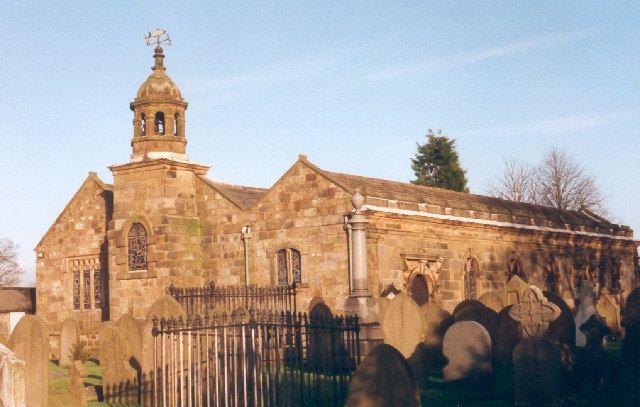
Henry Lancaster was baptized in St Anne’s Church, Woodplumpton, Lancashire, England

Sarah [__?__] was born in 1605 in England. Sarah died about 1637, perhaps during Joseph’s childbirth.

Josephine Knight was born 1616 in England.  Her parents were William Knight and Martha Williams.  Josephine died 28 May 1690  or Jul 1705 in Dover, Strafford, New Hampshire.

Children of Henry and Sarah:

Name Born Married Departed
1. Mary Langstaff 1630
Dover, NH
Eleazer Coleman (Son of Tobias COLEMAN)
20 Jun 1713,
Dover NH
1713
2. Henry Lancaster 1635
Dover, NH
1698
New Jersey
3. Joseph LANCASTER 1637 in Salisbury, Essex, Mass Mary CARTER 1663 Salisbury, Mass. 2 Feb 1719 Amesbury, Essex, Mass.

.
Children of Henry and Josephine

Name Born Married Departed
4. Sarah Lancaster 1640 in Dover, Strafford, New Hampshire, Anthony Nutter
1662
1698
Dover, NH
5. John Lancaster 1647 in Bloody Point, Dover, Strafford, New Hampshire, Martha Martin
1674
Piscataway, New Jersey
.
Priscilla Bonham
after 1706/07
Piscataway, Middlesex, New Jersey

In a deposition dated 1682, Henry Langstar (Lancaster), of Dover, testified that he knew Thomas Walford, of Portsmouth, fifty years before, which would indicate that 1632 was the year of his removal.
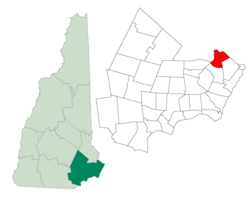
Newington, Rockingham, NH

By 1631, Henry was settled on a promontory near the mouth of the Piscataqua River called “Bloody Point.  Henry’s homestead is in today’s Newington, New Hampshire,  a town in Rockingham County, New Hampshire, United States. The population was 753 at the 2010 census.   It is bounded to the west by Great Bay, northwest by Little Bay and northeast by the Piscataqua River. It is home to Portsmouth International Airport at Pease (formerly Pease Air Force Base), and to the New Hampshire National Guard. The 110-acre Old Town Center Historic District is listed on the National Register of Historic Places.

Originally a part of Dover, boundary disputes among early river settlers caused this area to be called Bloody Point.  By 1640, Trickey’s Ferry operated between Bloody Point and Hilton’s Point in Dover. [named for our ancestor William HILTON and his brother Edward]  In 1712, the meetinghouse was erected and the parish set off, named Newington for an English village, whose residents sent the bell for the meetinghouse. Behind the meetinghouse is a row of horse sheds, once commonplace but now rare. About 1725 the parsonage was built near the Town Forest, considered one of the oldest in the America. The town would be incorporated in 1764 by Colonial Governor Benning Wentworth. In 1794, a bridge was completed across Little Bay from Fox Point in Newington to the south bank of the Bellamy River in Dover, by way of Goat Island—a major engineering feat in its day.
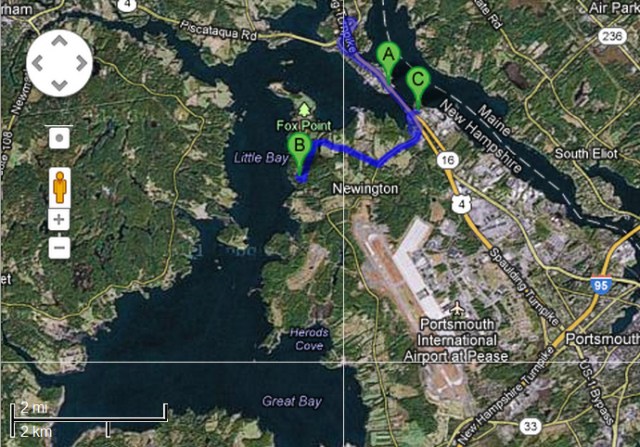
Newington Map – A = Hilton Point B= Dumpling Cove C = Bloody Point

Langstaffe’s Garrison.

This garrison is mentioned by Major Pike as attacked in 1689.  It stood on Bloody Point itself, which seems to have verified its name if credit is to be given to a tradition that many people lie buried here who were massacred by the Indians. It was built by Henry Laugstaffe or Langstar, who was one of the colonists sent over by Capt. John Mason in 1631. The Rev. John Pike, in his Journal, records the death of Henry Langstar at Bloody Point, July 18, 1705, at the age of about 100 years, ” from a fall down four steps into his Lean- to.”

The Langstar homestead is mentioned Nov. 23, 1716, when Henry Langstar of Piscataqua, New Jersey, attorney of his father John Langstar, conveyed to John Shackford one half of the homestead at Bloody Point, on the west side of the Piscataqua river — then in possession of Henry Langstar, son of Henry Langstar, deceased — bounded south by Capt. John Knight’s land, formerly Benjamin Bickford’s, west by ye highway leading to ye ferry, and so bounded upon ye land formerly George Braun’s down to ye river, thence upon ye river to said Knight’s, where we first began.

Dumpling Cove (Map)

This cove is on the Newington shore of Little Bay, at the lower side of Dame’s Pt., now Joshua’s Pt. It is mentioned the 11th, 10mo., 1656, when Richard Catter’s (Carter’s) grant of 40 acres of upland in 1652, was laid out “south of the freshett at Dompline Cove,” bounded north by Henry Lankstar’s land, and south by that of John Dam.

Henry Langstar’s grant of 200 acres in 1652 was laid out in 1659, “beginning at Doempling Cove in the letell Bay, and so up the freshett to the parting of it,” thenceover to “the freshett that goeth into the broad cove below foxe poynt, thence over the mouth of the crike to a maple tree, thence to the north sideof a little swamp, thence to a Rock a little below terning Poynt, and up the little bay to doompline Cove.” Henry Langstar, Oct. 27, 1704 conveyed to his daughter Mary all his land on Little Bay, beginning at the mouth of acreek in Broad Cove, and running up Little Bay as far as Dumpling Cove, to the southwest side of the freshet; which land was granted said Henry Langstar the 9th, 5 mo. 1652.

Dumpling Cove –  Sarah Levett, “widow and relict of James Levett, ” conveyed to Joseph Adams, “preacher of the Gospel,” March 15, 1721, a tract of 40 acres, “bounded somewhat northerly on ye lands that were formerly old Mr. Langstar’s, now in ye possession of Mr. Eleazar Coleman [son of Tobias COLEMAN], somewhat westerly on ye river that runs into ye Great Bay, somewhat southerly by the lands of Mr. John Dam, and somewhat easterly by the lands of said Adams;” –the land thus bounded being “at or near a place called Dumpling Cove, and formerly granted by the town of Dover to one Richard Cater” (Carter.)

Joseph Adams of Newington, Dec. 18, 1783, conveyed to John Gee Pickering 20 acres of land in Newington, “supposed to be half of the farm where said Adams then lived,” beginning at Joseph Dame’s land, and running along Little Bay to the land of James Coleman. This land is now owned by Mr. Gee Pickering of Portsmouth, and the Dame land adjoining by the heirs of Mr. Joshua Pickering.

Dumpling cove is sometimes called Sow-Pit cove, probably a corruption of Sow and Pigs, a name given to a cluster of rocks in the river near this cove.

Eel-Pot Creek.  – This creek runs through the land of Mr. Rufus W. Weeks of Greenland, and empties into the Great Bay, about fifty rods above the mouth of Winnicot river. It is mentioned Nov. 22, 1716, when Henry Langstar, of Piscataqua, New Jersey, by virtue of a power of attorney from his father John Langstar, son of Henry Langstar (otherwise Langstaffe) of Dover, deceased, conveyed to Henry Nutter a tract of 20 acres in Portsmouth, on ye westernmost side of Greenland river, in ye Great Bay, bounded upon Ealpole creek.

Fresh Creek. – This stream is a tributary of the Cochecho river, into which it empties on the east side, not far above the mouth. It is mentioned in the Dover records as early as 1648. The mill privilege on this creek was granted the 5th, 10 mo., 1652, to Wm. Furber, Wm. Wentworth, Henry Langstar and Thomas Canney, together with the timber ” from the head of tidewater three miles up into the woods betwixt the tivo freshets, the southernmost freshett coming out of the marsh beside the Great hill at Cochecho, the northernmost freshett bounding Capt. Wiggins and JVP broadstreet’s grant at Quomphegan,” etc. {N. H. Toiun Pap., XI: 530.) Henry Tibbets, June 29, 1713, conveyed to John Drew, Sr., one half of the mill privilege at the head of Fresh creek, and half of his labor in building the sawmill there, with the privilege of erecting a dam for the convenience of said mill, together with land for a log hill. This fall was within the line of Samuel Croumel’s (Cromwell’s) land, near ye place where Joshua Croumel’s house formerly stood.

Hilton’s Cove.  – This cove is on the Newington shore, adjoining the old terminus of Knight’s ferry, but the name is no longer in use. It is mentioned the 9th, 5 mo., 1652, when John Hall had a grant of 18 acres ” a little above Hilton’s Cove.” It is again mentioned the 5th, 10 mo., 1674, when Thomas Tricke’s grant of 18 acres in 1656, ” on Bloody poynt side,” was laid out ” aboue hilltones, joining to henery Lankster his land westerly, bounded up the gutt to a rock, and from the rock to A wall nutt Tree marked with an H and a T, and soe to a Beich Tree marked with A and T, and so to the freshett that runs in too Thomas Trickey his coue aboue his hotise at high-water mark.”

John Hall conveyed to Henry Langstaffe, the 1st, 4 mo., 1668, 12 acres of land granted him by the town of Dover, together with house, goods, and chattels within doors and without. Henry Langstar, grandson of the above Henry, conveyed to John Shackford, Nov. 23, 1716, ten acres of land called Hall’s field., bounded N. W. by a little meadow, W. by land formerly Zachariah Trickey’s but then in possession of Capt. John Knight, and E. by the highway to the ferry. George Walton and Frances conveyed to John Knight, Feb. 27, 1718-19, ten acres of land “in ye town of Newington,” bounded north- westerly by land formerly Zachariah Trickey’s, then ye said Knight’s, and easterly by the highway from the ferry to the meeting-house — ” which ffield is called Hall’s ffield, and formerly belonged to Henry Langstaff deceased.”

John Knight, Sr., and wife Bridget, conveyed to their son John, Feb. 7, 1717/18, a tract of 18 acres at Bloody Point, bought of Zachary Trickey, bounded N. W. by the main river, east by John Hoyt’s land (previously Geo. Brawn’s), south by the Bloody Point highway to Nutter’s, and west by Ephraim Trickey’s laud, — together with the dwelling-house, and all interest in the ferry at Bloody Poynt.

Hilton’s Point –  This name was given for more than a century to the lower extremity of Dover Neck, from Edward Hilton brother of William HILTON who founded a settlement here as early as 1623, that proved, however, unsuccessful. It is so called March 12, 1629-30, in the new patent he obtained from the Plymouth Council. He afterwards settled in Exeter, but this point continued to bear his name till the second half of the 18th century.  The Dover records make mention of it repeatedly. It is so called by Robert Mason in 1681. Thomas Mason of Dover, trader, and Magdalen his wife, Sept. 13, 1733, conveyed to John Wheelwright and others, of Boston, merchants, his dwellinghouse on Dover Neck, ” on the westerly side of the road that leads down to Hilton’s Point, commonly so called,” together with the laud adjacent. It is now called Dover Point. (See Wecanacohimt.)

Hilton’s Point Ferry –  Mentioned Sept. 4, 1766, when Ephraim and Hannah Tibbets conveyed to Job Clement 12^ acres ” on Dover Neck the westerly side of the road to Hilton’s Point ferry, so called,” extending to the upper side of the way that leads to Hall’s sli}) on Back river. This was the ferry from Hilton’s Point to Newington, generally called Knight’s ferry .

Hilton’s Point Swamp –  Mentioned in 1652, when this swamp was laid out as an ox pasture. Humphrey Varney conveyed to John Knight, Nov. 8, 1711, his share in the ox pasture “granted him in Hiton’s Point swamp at ye loer end of

Dover Neck — “The ox pasture in Hilton’s Point sivamp ” is again mentioned in Judge Johu Tuttle’s will of Dec. 28, 1717. Joseph Hall of Newmarket conveyed to Thomas Millet, Feb. 11, 1736, two tracts of land in Dover; “one known by ye name of ye Swamp or Ox common, and called by some Hilton’s Point; ” — ” ye other known by ye name of ye Calves Pasture.” These lots were originally laid out to ” Lt. Ralph Hall,” grandfather of said Joseph. This swamp is now called Huckleberry Swamp.

Langstaffe Rocks –  These rocks are in the Pascataqua river, off the Newington shore below Bloody Pt. They are hidden beneath the current, and are carefully avoided by boatmen, for more than one schooner has been driven thereon and wrecked. The name is derived from Henry Langstaffe or Langstar, who acquired land on the neighboring shore as early as 1652.

Rocky Point –  This point is on the shore of Broad Cove, Newington, between Fox Pt. and Stephen’s Pt., now Bean’s. It is a mere ledge projecting from the shore, but apparently separated from it at high tide, and generally called Carter’s Rocks. It is mentioned Apr. 9, 1702, when thirty acres of land were laid out to Mr.Nicholas Harrison ” on bloody poynt side, in Dover, beginning at Rockey poynt, att henry Langstar’s land, and so by the water side 21 rods upon an east line, thence on a south line to Joshua Crockett’s land 116 rods, and so to henry Langstar’s land on a west line 39 rods, and so to Rockey poynt where we began.”

Also 9 or 10 acres on the south side of the highwavthat leads from Broad Cove to the plains, etc. (See Carter’s Rocks.) Joseph W. Pickering, administrator of the estate of Eleazar Coleman, conveyed to Cyrus Frink, Dec. 4, 1831, 48 acres of land in Newington, beginning at Rocky Point, so called, and running thence to the northwestward of the grist-mill, thence as the creek runs to the middle of the cider-house, etc., together with the t house, grist-mill, and alt privileges. Mention is made of John Shackford’s land at the S. E.

A Rocky Point is mentioned July 17, 1660, when it was agreed by the Dover authorities ” that the house of Mr. Valentine Hill, which is his now dwelling at Rocky Point, shall be within tiie line of deuetion to Oyster River.” This point may have been on the Durham shore, where Valentine Hill owned several large tracts of land. If he owned land on the Newington shore, it must have been re-granted after his death. The line of division between the Oyster River precinct (now Durham) and Dover proper, is thus stated in the Dover records, the 21st., 10 mo., 1657: “The bounds of the inhabetance of oyster Reiver for the acomodating Q of the ministerv is the inhabitants that are or shall be scittuated from the next Rocky poynt on the north side below the mouth of the sayd River and from there by a straight line to the head of Tho Johnson’s Creek to the Path thear, and from theare by a west line to the end of the Towne bounds. As allso all the inhabetantes on the south side of that line that either are or shall be thear scittuated are likewise to pay to the ministry there, excepting all the Inhabitants on fox poynt side that are or shall be in the letell Bay.” Tliis last sentence seems to imply that the Bloody Point district from Fox Pt. up Little Bay then belonged to the Oyster River precinct for civil, if not for ecclesiastical, purposes. In that case, Valentine Hill’s house, if at Rocky Pt. on the lower side of Fox Point, could have been easily included within the above-mentioned line of division.

Starbuck’s Point and Marsh. Starbuck’s Point, now called Fabyan’s Pt, is on the Newington shore of the Great Bay, where Edward STARBUCK of Dover had a grant of marsh in 1643, (see Swadden’s  Creek) ; and later, a grant of upland adjoining. His son-in-law Peter Coffin conveyed to John Hall of Greenland a tract of upland on the southeast side of Great Bay, “formerly the land of Edward Starbuck,” possession of which was given “with twigg and turf,” Dec. 25, 1662. John Atkinson conveyed to Thomas Pickering, Dec. 7, 1702, 13 acres of land granted to his father Joseph Atkinson by the town of Portsmouth, bounded S. by ” Swaden’s brook;” S. W. by the bay, and on the other sides by ” Starbuck’s mash,” and the lands of Jackson, Geo. Walton, and said Thomas Pickering. Starbuck’s Point and marsh are again mentioned Jan. 28, 1716, in a conveyance, beginning in solemn form as follows :

“To all Christian People to whom this my present deed of gift shall come and concern, know ye that I, Thomas Pickering of Portsmouth, in the province of New Hampshire, sendeth greeting in our Lord God everlasting.” Said Thomas then goes on to say that, ” out of natural love and affection to his well-beloved son James, for his incouragement,” he conveys to him the full half of a marsh called and known by the name of Starbuck’s Poynt Marsh, together with a tract of land, adjoining the land whereon said Thomas then lived, bounded northerly by John Fabin’s land and the country road, south by Swadden’s brook, and extending to the Great Bay ; said Thomas reserving; the riwht to drive his cattle back and forth to Starbuck’s Point. John Fabins (Fabyan) of Newington, May 30, 1721, conveyed to James Pickerins; all right to the southeast half of the salt marsh, formerly called Starbuck’s marsh, adjoining said Pickering’s own land, (Fabiyan’s Point.)

Stephen’s Point  – This point is on the Newington shore, at the lower side of Broad Cove. The name was derived from Stephen Teddar, who belonged to the Dover Combination of 1640, and seems to have lived on this shore at an early day.  William Furber and Anthony Nutter were appointed by the town of Dover the 5th, 2 mo., 1652, to lay out Henry Langstaffe’s lot of 200 acres “where Stephen Teddar’ s house was.” This order was repeated the 5th, 2 mo., 1658.

Langstaffe had another grant the 9th, 5 mo., 1652, ” near where Stephen Teddar’s house was.” Mention is also made of Langstar’s land laid out at Stephen’s marsh Ap. 11, 1694. (Dover Records.) Stephen’s Point is mentioned June 6, 1701, when a road was proposed ” from Mr. Harrison’s (at Fox Point) to Broad Cove freshett, and so to the highway from Bloody poynt road to Stephens poynt or broad cove,” as should be thought fit. And again Sept. 8, 1703, when Henry Langstar or Langstaffe, conveyed to his daughter Mary fifty acres of land ” a little above Bloody Point, commonly called by the name of Stephen’s point, otherwise Stephen Jethro’s point formerly, right over against Hilton’s Point,” bounded east by land that was formerly Joseph Trickey’s, and west by a cove commonly called Broad Cove.

Timeline

Bet. 1630 – 1631, Arrived in New Hampshire.
1635 – Came before 1631 but in 1699 Henry stated that he arrived at th eport of Piscataqua River in the service of Captian Jno. Mason and there there two years in the servce..
Residence: Piscataqua (Piscataway).
05 Apr 1653 – On list of Dover Freemen.
Bet. 1643 – 1669, On several grandjuries.
18 Mar 1646/47 – 6 acres in Cochecho Marsh..
03 Oct 1648 – Dover-sued by Philip Lewis for mowing the marsh near Capt. Francis Champernoun’s farm.
05 Dec 1652 – With Wm. Furber, Wm, Wentworth, and Thos. Caney was granted accommodations at Fresh Creek for a sawmill.
27 Jun 1654 – Sued by thomas Willey at Portsmouth Court but won.
05 Apr 1658 – Granted 200 acres and lot where Stephen Teder’s house was.
9: Jun 1668 – Of Bloody Point, purchased all land, house, household stuff and swine etc. of John Hale of Bloody Point, yeoman.
27 Mar 1669 – Along with Phillips Lewis and Nathaniell Fryer of Portsmouth, purchased land and buidlings in Greenland from Francis Champernown of Killery.
29 Jun 1669 – with Nathaniel Frer, and Philip Lewis sued John Kenniston . see files for case..
24 Jun 1673 – Sued along with Anthony Nutter by William Earl for a debt against John Patridge..
07 Oct 1702 – Sold to Capt. Peter Coffin of Exeter 12 acres of frehs meadow at Cocheco Meadows..
08 Sep 1703 – Deed daughter Mary Lanster for “naturla love, goodwill, affection, etc and her carefulness in taking pains to wait and attend upon me upon all occasions in this my great age” 50 acres of upaldn in Dover.
27 Oct 1704 – to Henry Jr., of Bloody Point ” “my homestead at Bloody Point” also one piece of land at Braod Cover Creek, in Dover, plus one half all my lands and marsh at Greenland, also one half all my househol.
27 Oct 1704 – to spinster daughter Mary, deeded land in the little bay in Dover and half all his lands and marsh at Greenland, and half all his household goods, excepting 3 cows and 10 sheep which I give to my daughter

Children

1. Mary Langstar

Mary’s husband Eleazar Coleman was born about 1677 in Rowley or Martha’s Vineyard, Mass.  His parents were Tobias COLEMAN and Lydia JACKSON.  After Mary died, he married 1 Mar 1716/17 Newington, NH to Anne Nutter

The next transfer of this land reveals a curious bit of family history, well worth copying from the County records : ” Mary Langstar of Bloody Point, June 20, 1713, well knowing that a marriage by God’s grace is intended and shortly to be had and solemnized between Eleazar Coleman \of said place to the said Mary Langstar, and considering that said Mary, being about ye age of 63 years, and the said Eleazar about 28 years, and she may the better be taken care of in case she lives to any great age, and for divers other good and just causes, conveys to him fifty acres of upland called Steven’s Point, otherwise by ye name of Stephen Jether’s point, a little above Bloody point, right east by Broad cove. Also land on Little Bay, beginning by a creek in Broad cove, and running up ye Little bay as far as Dumplin cove.”

That Mary Langstar married Eleazar Coleman is proved by a deed of May 25, 1734, by which John Johnson conveyed to Samuel Nutter 5 acres and 50 rods of land in Greenland, which Matthew Haines and Nathan Johnson had bought of Mr. Eleazar Coleman, having been ” given by Mr. Henry Langstar, late of Dover, deceased, to his daughter Mary Langstar, who was wife to said Eleazar Coleman.” Eleazar Coleman, and Mary his wife, March 6, 1713/14, ^ conveyed to Richard Downing and Thomas Coleman of Newbury Falls, 50 acres of land in Newington, at a place commonly called Stephen’s Point, otherwise Stephen Jether’s Point formerly, lying a little above Bloody Point, right over against Hilton’s Point, bounded east by Jos. Trickey’s land, and on ye west by Broad Cove. Also, the land from the mouth of the creek in Broad Cove up Little Bay as far as Dumpling Cove.

The Langstars laid claim to Mrs. Coleman’s estate after her death, and still spoke of her as “Mary Langstar,” but finally her nephew Heur}’, attorney of his father, John Langstar, of the town of Piscataqua, Middlesex county, New Jersey, resigned to Eleazar Coleman Nov. 26, 1716, all claim to the lands given the latter by his aunt, Mary Langstar, deceased.

3. Joseph LANCASTER (See his page)

4. Sarah Lancaster

Sarah’s husband Anthony Nutter was born 1631 in Fillongley, Warwickshire, England. His parents were Elder Hatevil Nutter and Anne [__?__]. He died 19 Feb 1686 in Dover, Strafford, New Hampshire.

5. John Lancaster

John’s wife Martha Martin was born in Dover, New Hampshire circa 1648. Her parents were John Martin and Esther Roberts. Martha died 13 Nov 1694 in Piscataway, Middlesex County, New Jersey at 46 years of age.

1673, commissioned “Ensign” in the militia officers.

He and Elizabeth Fitz-Randolph had a child out of wedlock. In 1673 John Langstaff gave bond on June 11 for holding harmless the township of Piscataway from the charge of maintaining a child of which Elizabeth Fitz-Randolph of said township accuses him to be the father.”

By 1638, Cromwell and his Puritans had become very influential in the English Parliament. One of the things they did, we are told was to  encourage the State of Massachusetts to persuade the Puritan colonists to move north to the Piscataqua Riverarea. Because of Cromwell’s influence, these colonists were able to extend their land claims to take precedence over the Mason grants which had been issued by James I. The Mason group, all loyal Anglican churchmen, could do littleto prevent the encroachment
of the Puritans.

When Charles II was restored to the throne of England in 1660 following the end of the English Civil Was, the original Mason grants were reasserted. Thus in 1665, a grievance was issued by the Dover Select Men regarding their territorial rights. The petition was signed (quote) “Richard Waldron, Henry Langstaff, John Davis, John Roberts”. Meanwhile, during that same year 1665, the agents of Governor Philip Carteret of New Jersey arrived in Dover with concessions inviting the settlers of the Piscataqua River area to move south to New Jersey. Keeping in mind the uncertainstate of their Dover land claims, which were not yet stabilized after the Puritan invasion, Henry’s sons, Henry and John, decided to take advantage of Carteret’s offer and move to New Jersey. Henry, however, continued to live in his house at Bloody Point.

Sources:

http://trees.ancestry.com/owt/person.aspx?pid=9903855&st=1

http://trees.ancestry.com/owt/person.aspx?pid=9799802&st=1

http://www.leavesonatree.org/getperson.php?personID=I12359&tree=Tree1

The memorial history of Boston: including Suffolk County …, Volume 1 edited by Justin Winsor 1880

Landmarks in Ancient Dover, New Hampshire by Mary P. Thompson, Durham, N.H. ©1892, Printed by the Republican Press Association, Concord, N.H.

http://freepages.genealogy.rootsweb.ancestry.com/~colonialfamiliestonewjersey/martin/d0/i0001700.htm

http://familytreemaker.genealogy.com/users/b/u/c/Nicholas-A-Bucknall/WEBSITE-0001/UHP-1135.html
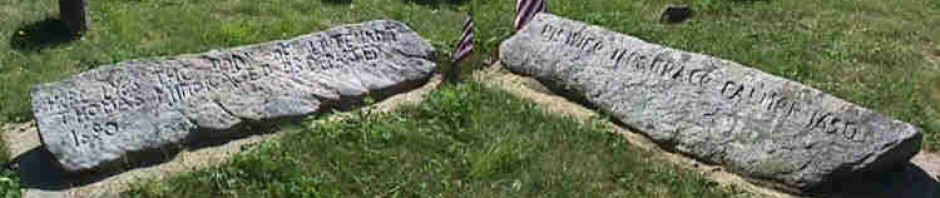
Posted in 12th Generation, 90+, Historical Church, Immigrant - England, Line - Shaw | Tagged , , | 7 Comments

Joseph Lancaster

Joseph LANCASTER (1637 – 1719) was Alex’s 9th Great Grandfather, one of 1,024 in this generation of the Shaw line.

Joseph Lancaster was born in 1637 in Salisbury, Essex, Mass. His parents were Henry LANCASTER I and Sarah [__?__]. He married Mary CARTER 1663 in Salisbury, Mass. Joseph died 2 Feb 1719 in Amesbury, Essex, Mass.

Mary Carter was born in 6 Oct 1641 in Salisbury, Essex, Mass. Her parents were Thomas CARTER and Mary DALTON. Mary died 1673 in Hampton, Rockingham, New Hampshire.

Children of Joseph and Mary:

Name Born Married Departed
1. Joseph Lancaster
25 Dec 1665 Salisbury Elizabeth Hoyt
31 Mar 1687 Amesbury
1719
Amesbury, Mass
2. Mary Lancaster 8 Jul 1667 Salisbury, Timothy Merrick
9 May 1696 Newbury
1718
Newbury, Mass
3. Thomas Lancaster 15 Jan 1669 Salisbury, Mercy Green
3 Mar 1696 Hampton, Rockingham, NH
17 Aug 1703
Hampton, Rockingham, NH
4. John Lancaster 24 Jul 1671 Amesbury 6 May 1742
5. William Lancaster
10 Jul 1673 Amesbury Mary Brigham 1716 – Eliot, York, Maine
6. Ann Lancaster 1675 Amesbury, Joshua Remick
21 Dec 1693 Amesbury
1716
Elliot, Maine
7. Samuel Lancaster 1680 Amesbury Hannah Platts
9 Aug 1701 Rowley
19 Sep 1710
Rowley, Mass
8. Henry LANCASTER 1682 Amesbury Sarah BAGLEY
15 Jul 1703 Amesbury, Essex, Mass.
1709 in Amesbury, Essex, Mass.
9. Hannah Lancaster 8 Jul 1686 Amesbury 2 Aug 1688
Amesbury

Joseph was born in Salisbury, Mass in 1636.    Salisbury was once territory of the Pentucket tribe of Pennacook Indians. It was settled by the English in 1638 as Merrimac, after the river, and incorporated in 1639 as Salisbury, after Salisbury in Wiltshire, England.

The original roads at the center of the town formed a compact semicircle, which allowed the residents to get quickly to the garrison house in case of attack. Those roads still exist, though the shape today is triangular, being bounded by Elm Street, School Street and Bridge Road. One of the two greatest fears at the time was the Naumkeag tribe of Indians, thus the men of the town took turns standing watch against a surprise attack, especially in the night time. The Naumkeags, however, had been decimated by plague, and the threat was not what it once might have been. The second threat came from wolves, which were plentiful, and which killed the livestock and dug in the graveyard.

The original residents were given one small house lot near the center of town, and one larger planting lot just outside the center for farming. Families also owned large sections of “sweepage lots” near the beach, where apparently they harvested the salt marsh hay. At the time, the area was almost entirely unbroken virgin forest, which had to be cleared for the construction of houses and the planting of fields

Joseph moved across the Powwow River from Salisbury to Amesbury in 1690.

Children

1. Joseph Lancaster

Joseph’s wife Elizabeth Hoyt was born 8 Feb 1661 in Salisbury, Essex, Mass. Her parents were John Hoyt and Mary Barnes.  We descend from all her grandparents.  Her paternal grandparents were John HOYT  and Frances TEWKSBURY. Her maternal grandparents were William BARNES and Rachel LORD. Elizabeth died 1702 in Amesbury, Essex, Mass.

2. Mary Lancaster

Mary’s husband Timothy Merrick was born 28 Sep 1666 in Newbury, Essex, Mass. His parents were James Merrick and Margaret [__?__]. Timothy died 15 Mar 1719 in Newbury, Essex, Mass

3. Thomas Lancaster

Thomas’ wife Mercy Green was born 28 Mar 1675 in Hampton, Rockingham, New Hampshire. Her parents were Abraham Green and Esther Swett. Mercy died Feb 1734 in Hampton, Rockingham, New Hampshire.

5. William Lancaster

William’s wife Mary Brigham was born xx of Marlboro, Mass.

6. Ann Lancaster

Ann’s husband Joshua Remick was born 24 Jul 1672 in Kittery, York, Maine. Her parents were Christian Remick and Hannah Foster. Ann died 3 Apr 1738 in Kittery, York, Maine.

A grandson of Ann and Joshua, Major Timothy Remick, was Continental Officer in the Revolution (1775 – 1781) and original member of the Society of the Cincinnati.

Timothy was born in the part of Kittery, ME that is today Eliot Neck. He was the youngest child of Isaac Remick and Mary Pettegrew who lived on this land all their lives. The land was part of an original approx 52-acre grant to the immigrant, Christian Remick, about 1650. Isaac Remick was an old soldier of the French and Indian Wars, serving in 1722 in Col. John Wheelwright’s Company of Rangers.

Timothy enlisted May 8, 1775 as a private in Captain Tobias Fernald’s Company, Col. James Scammon’s Regt, also called the 30th Foot Regiment of North America. They marched to Cambridge in May, and went on duty there keeping the British troops in Boston. The Regiment was ordered to Bunker Hill on June 17, 1775, but through a misunderstanding, instead went to Lechemere Point on the Mystic River, where they did good work preventing boats from the British Fleet landing troops to cut off the retreat of the Provincials from Bunker Hill. Later in the day, the Regiment covered the retreat of the defenders of Bunker Hill across the Charlestown Neck.

Timothy was promoted to Corporal soon after his enlistment, and served faithfully the year out. On Jan 1, 1776, he enlisted as a Sergeant in the same Company. His Regiment was in Maj. Gen. Israel Putnam‘s Division, stationed in Cambridge. On Mar 5, 1776, it was chosen to make an assault on Boston. They entered Boston, Mar 20 1776, with the main army. The regiment marched on Aug 8, 1776 from Boston for Ticonderoga and Fort George, and were there under the command of Gen. Benedict Arnold. Sergeant Timothy was promoted Lieutenant of his Company, Nov 13, 1776, for meritorious services, thus being a commissioned officer at the age of 21 years.

He remained at Ft. George with his Company until late December 1776, when the regiment was mustered out of service. Lieut. Timothy was transferred to Capt. James Donnel’s Company in the 12th Mass Regt of the line. He marched with the regiment from Boston, Apr 30, 1777, and arrived at Fort Ticonderoga, May 30, where the regiment was under the command of Gen. St. Clair. On Jul 2, 1777, Lieut. Remick’s Company helped to man the American Fleet on Lake George. On Jul 2, the regiment was in an engagementwith the British troops under Gen. Burgoyne, and drove their advance guard back, but later the regiment was forced to fall back with the American Army to Fort Edward and then to Saratoga.

Lieut. Remick was in the battle of Stillwater on Sep 19, and the battle of Saratoga on Oct 7, and witnessed the surrender of Gen. Burgoyne’s army on Oct 17, 1777. On Oct 18, his regiment marched south to join Gen. Washington’s army near Philadelphia, which they did on Nov 22. On Dec 20, 1777, Lieut. Remick went into winter quarters at Valley Forge with his company. Here he remained until Jun 19, 1778, when the regiment with the army crossed the Schuylkill River on their march after the British. The regiment was in the battle of Monmouth, Jun 28, and was in the thick of the fight. The regiment crossed the Hudson River in Jul 14, 1778, and camped at Peekskill. They remained in CT, West Point, and in the vicinity of NY during the remainder of 1778, 1779, and 1780, watching the British Army.

Lieut. Remick was promoted to Captain on Jul 5, 1779. When the regiment was consolidated, Capt. Remick was transferred to the 1st Mass Regt of the line, Jan 1, 1781, and was appointed Major of the 1st Mass Brigade, May 14, 1781. A Brigade Major of the Revolution performed about the same duties as is now done by an Asst. Adjutant General. The brigade remained around NY City until nov 1783, when the American Army was mustered out of service. Maj. Remick had several furloughs and leaves of absence during the War to visit his home in Kittery, and was sick in camp during the winter of 1782 and 1783. He married Mercy Staples of Kittery , Jul 25, 1775. She was born Oct 24, 1757. They had three children, born between 1776 and 1780. All were baptised in the 2nd Church of Kittery, Jul 26, 1785. Timothy’s health was ruined by his army life, and he died of consumption at home in Kittery in Feb 1785 at the early age of 29 years.

A granddaughter of Ann and Joshua, Lydia Worster (14 Oct 1738 in Berwick, Maine – 22 Mar 1820 in Durham, Strafford, New Hampshire) married John Sullivan, a Major General during the Revolutionary War.

General John Sullivan

John Sullivan (1740 – 1795) was the third son of Irish immigrants, a United States general in the Revolutionary War, a delegate in the Continental Congress and a United States federal judge. Sullivan served as a major general in the Continental Army and as Governor (or “President”) of New Hampshire. He commanded the Sullivan Expedition in 1779, a scorched earth campaign against the Iroquois towns that had taken up arms against the American revolutionaries.

7. Samuel Lancaster

Samuel’s wife Hannah Platts was born 5 Feb 1678 in Rowley, Essex, Mass. After Samuel died, she married 17 Oct 1713 in Ipswich, Essex, Mass. toThomas Hammond (b. 11 Jul 1656 in Watertown, Middlesex, Mass. d. 26 Feb 1725 in Ipswich, Essex, Mass.) Hannah died 26 Jun 1748 in Ipswich, Essex, Mass.

8. Henry LANCASTER (See his page)

Sources:

http://trees.ancestry.com/owt/person.aspx?pid=3955971&st=1

http://wc.rootsweb.ancestry.com/cgi-bin/igm.cgi?op=GET&db=craigjrice&id=I237

Posted in 11th Generation, Line - Shaw | Tagged | 3 Comments

Henry Lancaster II

HENRY LANCASTER II (1682 – 1709) was Alex’s 8th Great Grandfather, one of 512 in this generation of the Shaw line.

Henry Lancaster was born in 1682 in Amesbury, Essex, Mass. His parents were Joseph LANCASTER and Mary CARTER. He married Sarah BAGLEY 15 Jul 1703 in Amesbury, Essex, Mass. Henry died in 1709 in Amesbury, Essex, Mass.

Amesbury, Essex, Mass

Sarah Bagley was born 27 Feb 1683 in Amesbury, Essex, Mass. Her parents were Orlando BAGLEY and Sarah SARGENT.   After Henry died, she married Elisha Weed on 11 Apr 1713 in Amesbury, Mass.  Sarah died in 1724 in Amesbury, Essex, Mass.

Elisha Weed was born 15 Sep 1689 in Amesbury, Essex, Mass. His parents were Ephraim Weed and Elizabeth Colby. Elisha died 25 Jun 1733 in Amesbury, Essex, Mass.

Children of Henry and Sarah:

Name Born Married Departed
1. Judith LANCASTER 29 Jul 1704 Amesbury Thomas JEWELL III
19 Feb 1731/32 Amesbury, Mass
20 Mar 1751 Amesbury
2. Mary Lancaster 5 Jul 1706 Amesbury, Essex, Mass William Curtis
8 Jan 1728 Newbury, Mass
20 Mar 1752
3. Sarah Lancaster 18 Jan 1708 Amesbury Jacob Worthen
7 Nov 1728 Amesbury
20 Mar 1752
4. Hannah Lancaster 20 Oct 1709 Amesbury, John Jewell (Thomas’ brother)
1735 Amesbury

.

Children of Sarah and Elisha Weed

Name Born Married Departed
5. Orlando Weed 23 Mar 1715
Amesbury, Mass
Sarah Webster
26 Sep 1740
Salisbury, Mass
1764
Gilmanton Tamworth, New Hampshire
6. Bagley Weed 20 May 1728
Amesbury, Mass
Elinor George
14 Feb 1751
S Hampton, New Hampshire
1811
Sandwich, New Hampshire

Sarah Bagley was one of a group of seven young women who in after galleries had been added to the meeting-house were granted the right to build a pew in the womae’s gallery.  Whether this hastened their marriage is no known, but history while commending their modesty records the fact that they soon began to disappear until the pew was finally empty.

Children

1. Judith LANCASTER (See Thomas JEWELL IIIpage)

2. Mary Lancaster

Mary’s husband William Curtis was born 1702 in Amesbury, Essex, Mass.

3. Sarah Lancaster

Sarah’s husband Jacob Worthen was born 21 Jan 1707 in Amesbury, Essex, Mass. His parents were Ezekiel Worthen and Abigail Carter. Jacob died 28 Apr 1791

4. Hannah Lancaster

Hannah’s husband John Jewell was born 20 Aug 1712 in Amesbury, Essex, Mass.  His parents were John J JEWELL and Hannah PROWSE. John died 1805 in Sugar Hill, New Hampshire,

5. Orlando Weed

Orlando’s wife Sarah Webster was born 6 Jul 1721 in Salisbury, Essex, Mass. Her parents were John Webster and Sarah Greeley.

6. Bagley Weed

Bagley’s wife Elinor George was born 17 Jan 1730 in Amesbury, Essex, Mass.

Sources:

http://trees.ancestry.com/owt/person.aspx?pid=9903848

http://trees.ancestry.com/owt/person.aspx?pid=9903848&st=1

Posted in 10th Generation, Line - Shaw | Tagged | 4 Comments