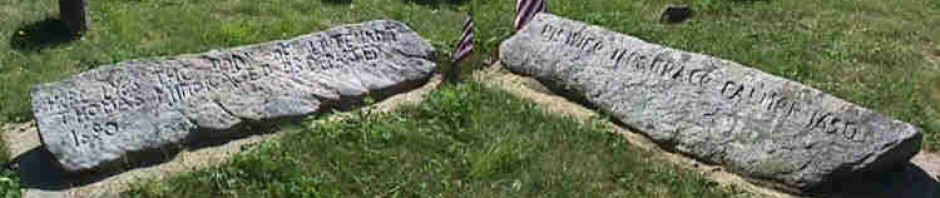
Giles Cromwell

Giles CROMWELL (1603 – 1673 ) was first cousin to Oliver Cromwell, known for his involvement in making England into a republican Commonwealth and for his later role as Lord Protector of England and Scotland. However, Giles’ father lost all his wealth through extravagant spending and supporting the Royalist side.  Giles was Alex’s  10th Great Grandfather, one of 2,048 in this generation of the Shaw line.
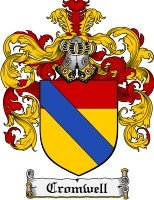
Giles Cromwell - Coat of Arms

Giles Cromwell was born about 1603 in Salisbury, Wiltshire, England. His parents were Sir Oliver CROMWELL and Anne HOOFTMAN.  He married Alice WICKES on 20 Feb 1629/30, in Erling, Hampshire, England. After Alice died, he married Alice Wiseman on 10 Sep 1648 in Newbury, Mass.   Giles died  25 Jun 1673, Newbury, Mass.

Giles' father Sir Oliver Cromwell of Hinchinbrook (1562- 28 Sep 1655)

Alternatively, Giles  was born 1592 in Southampton, Hampshire, England and died 24 Feb 1673 in Hampton, Rockingham, New Hampshire.

Alice Wickes  was born 1610 in Eling, Hampshire, England.   Her parents were John (Wykes) Weeks and Bridget West. She died 14 Jun 1648 in Newbury, Mass.

Alice Wiseman was born in 1620 in Newbury, Berkshire, England.  Alice died 6 Jun 1669 in Salisbury Mass.

Newburyport, Massachusetts, Vital Collections, 1620-1988

Children of Giles and Alice:

Name Born Married Departed
1. Capt. Phillip CROMWELL 1634 in Eling, Hampshire, England. Elizabeth TUTTLE
before 1663 in Dover, NH
.
Elizabeth Leighton
1671 in Dover, NH.
26 May 1708
Dover, Strafford, New Hampshire
2. Argentine Cromwell c. 1637 or
25 Apr 1642
Salisbury, Essex, Mass
Benjamin Cram
25 Nov 1662
Hampton, Rockingham, NH
5 Dec 1711
Hampton Falls, Rockingham, NH
3. Dr. Thomas Cromwell Ann [__?__] 1649 or
17 Mar 1686 in Salem, Essex, Mass.
4. John Cromwell

“The Genealogical Register of the First Settlers of New England,” page 72, has entry: “Gyles Cromlom died at Old Newbury FEb 24-25 1672-3. Children by his first wife, Mary who died June 14, 1643:
1. Phillip b. about 1634
2. Argentine, b. 1637
3. Dorothy d. Sept 27, 1673
4. Thomas
5. John, d. Feb 25, 1673
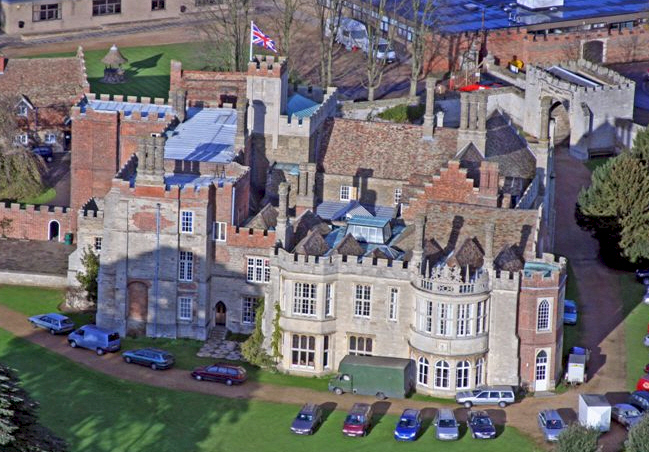
Giles Cromwell's father, Sir Oliver Cromwell was born in Hinchenbrooke House

Warning – I enjoy genealogy for the stories, even the tall tales.

Giles’ oldest brother, Colonel Henry Cromwell, inherited the little left of their great fortune; but having also taken an active part on the king’s side in the civil war, his estates were sequestrated; but the sequestration was afterwards removed at the intercession of his kinsman, Oliver, then Lord Lieutenant of Ireland. Colonel Cromwell died in 1657. His son Henry – perhaps influenced by the Protector’s former kindness – went over to the side of the Roundheads, and entered Parliament. He died in 1673, leaving no children; and the Huntingdon line – one of the wealthiest families in the kingdom, till the civil war – became extinct.

Giles’ brother Thomas probably died at Newbury in 1645.   On 29 Sep 1646 the will of “Thomas Croomwell” was brought in to the Ipswich court to be proved. “Giles Croomwell” objected to it, and the court ordered  Mr. John Lowle [our ancestor John LOWELL] and Mr. Edw: Woodman [also our ancestor Edward WOODMAN] to take an inventory of the estate.

Here’s what we know about Thomas Cromwell of Newbury:

24 Feb 1638 – Thomas Cromwell, with Samuel Scullard, John and Robert Pike, and Nicholas Holt, was fined for non-attendance at Newbury town meeting.

6 Aug 1638 – Thomas Cromwell is mentioned on Newbury town records

Oct 1638 – The reverend Stephen BACHILER and his company, who had received permission from the general court when united together by church covenant, commenced a settlement at Winicowett. He was at this time residing in Newbury. On Mr. Rawson’s request, the place was called Hampton. The following persons, residents of Newbury, went with Mr. Bachiler. John Berry, Thomas COLEMAN, Thomas Cromwell [Giles CROMWELL’s brother], James DAVIS, William Easton, William Fifield, Maurice Hobbs, Mr. Christopher Hussey [BACHILER’s son-in-law], Thomas Jones, Thomas Marston, William Marston, Robert Marston, John Moulton, Thomas Moulton, William Palmer, William SARGENT, and Thomas Smith. Cromwell and others soon returned to Newbury. A few went to Salisbury.

Coffin in his “History of Newbury”, and Dow in his “History of Hampton”, insist on identifying the Hampton grantee with the privateering Captain Thomas Cromwell, whose remarkable rise to fortune is told by Winthrop, and who died in Boston in 1649. There is no reason for believing that the Newbury Cromwells or Cromloms had any connection with the gallant sea captain: nor is there any evidence to connect either with the Salem Cromwells, Philip, Thomas and John, whose ancestry has been traced to Wiltshire

12 Mar 1641/42 – In the division of the Newbury ox-common, the name of Thomas Cromwell appears, followed by those of Samuel Scullard and Richard Kent, senior.

– 7 Dec 1642, Thomas Cromwell appears among the proprietors of Newbury.

29 Sept 1646 – Giles objected to his brother’s will.

The will of “Thomas Croomwell” was brought in to the Ipswich court to be proved. “Giles Croomwell” objected to it, and the court ordered Mr. John Lowle and Mr. Edw: Woodman to take an inventory of the estate. 6 Aug., 1647, the Salem court addressed Mr. Woodman, saying “that the Ipswich court ordered Mr. John Lowle and himself to take into custody the goods of Thomas Cromlom of Newbury deceased that were in the hands of Samuel Scullard, deceased”. Not having done so they are now ordered to answer next court.

25 Mar 1673 – Giles’ Will Proved in Ipswich Court mentions but two children, Philip and Argentine.

In the Name of God Amen The Last will and Testament of Giles Cromwell of Newbury in the County of Essex in New England being very Aged and weake of Body but of pfect vnderstanding I Desire to Resine up my soule to God that Gaue it and my Body to the Dust when my Apointed time shall come and concerning my [E]state that God in his Goodness hath Giuen mee [I] doe Dispose of as followeth
Imprimis I Giue [and] Bequeath unto my son Phillip Cromwell eleven Acres of upland Lying in the Bounds of Newbury C[om]only called Divident land 2ly
I Giue unto my son Phillip Cromwells Eldest son [Joshua Cromwell] that shall live and Arive unto the Age of one and twenty yeares six Acres of marsh Lying in the Bounds of Newbury called Pine Iland marsh being six Acres of the twelve acres Adjoyning to the marsh of steven Grenleife

likewise I Give and Bequeath unto my Daughter Argentine Cram the wife of Benjamin Cram my House Lot Lying and being in Newbury containeing eight Acres more or Less as it is Bounded on the North with the Comon and southerly with the Land of Ensigne steven Greelcife [son of our ancestor Edmund GREENLEAF] and Easterly with ye High way, with all the Houseing therupon standing with all the Rights and privilledges of commonage therunto belonging as also I Giue unto my Daughter Argentine my twenty acres of marsh lying in the bounds of Newbury in that marsh called Pine Iland marsh lying between the marsh of Mr Edward WOODMAN & the marsh that was sometimes the marsh of John Roff bounded on the Easterly end of a Great Crick and on the westerly end with the Rocks.

as Also the Remainder of the twelue Acres of marsh of which six acres I haue Giuen to my son Phillips eldest son all the Remainder of it I giue and bequeath to my Daughter Argentine Cram likewise my will is that all which I haue Giuen to my Daughter Argentine after her Decease shall be equally Devided amongst her children that shall be then liueing that doth beare the name of Cram and if any of the children shall Dy before they shall Ariue to the Age of twenty and one yeares their Part shall be Devided amongst the Rest Equally Alwaies provided that the house and Land be not Devided but that it shall Remaine Intire to the Eldest son he paying Equall Proportions to the Rest of the children or for want of a sone to the Eldest Daughter she Paying to the Rest the Equall Parts according to the valuation of it

And I doe constitue and [ap]oint my son Benjamin Cram my sole executor [to] this my Last will and to Confirme all the [pr]misses aboue written to be my las will and Testiment I haue Heerunto set my hand and seale the twenty seaventh of the 2d Month in the yeare of our Lord sixteen Hundred and seaventy two: Giles (his N mark) Cromwell (SEAL) Witness: Anthony Stanyun, Benje. Swett Proved in Ipswich court Mar. 25, 1673 by Benjamin Sweet and Mr Anthony Stanyen being disabled to travel to the court, made oath Mar. 20, 1672/3, before Samuel Dalton, Commissioner.

Inventory of the estate of Gills Cromlom, deceased Feb. 24, 1672, taken by Bene. Swett and Steven Grenlefe: Eight Akers of plow land with ye house & orchid and free hould, £80; eleven akers of devident land, £11; twelve Akers of march, £60; twenty Akers of medow, £60; wearinge Clothes, 18s; a bill from Caleb Moody, £3 8s 11d.

Also information of a debt due to the estate of £11 from John Bartlet, Sr. that he gave bill for to Philip Cromlom as his father Gils Cromloms attorney & also a bill of £6 from Edward Richison, but the sd Phillip not yett appearing about any of these concerns I not yet true state of it. Attested in Ipswich court Mar. 25, 1673 by Benjamin Cram

Children

1. Capt. Phillip CROMWELL (See his page)

2. Argentine Cromwell

Argentine’s husband Benjamin Cram was born 1640 in Exeter, New Hampshire. His parents were John Cram and Esther White. Benjamin died 28 Nov 1662 in Hampton Falls, Rockingham, New Hampshire.

The name of Cram is probably derived from the German “Kram,” meaning a retail shop. John Cram, the first American ancestor, emigrated from England, and in 1639 was one of the early settlers of Exeter, New Hampshire, which town had been founded the year before. In the combination formed for the early government of the town, his name appears as Crame. When he came to Exeter, his signature, like that of so many men of the time, was simply a mark, but he afterward learned to write. In 1648-49 he was elected townsman, or what was afterward known as selectman. About 1650 he left Exeter and located at Hampton, settling on the south side of Taylor’s river, which became Hampton Falls, his house being near the site of the Weare monument. With his wife, Esther, he became a member of the First Church of Hampton.

“The History of Deerfield,” reports of Argentine Cromwell: “It is said she was a relative of Oliver Cromwell, the Protector of England.” while the “Lincolnshire Origin of Some Exeter Settlers” states that she was the daughter of Giles of Newbury. Reaffirming this statement is the following entry in the Old Norfolk County Records from “Essex Antiquarian,” Vol. 12, page 183.

“The History of Raymond, NH,” citesa the marriage date as Nov. 29, 1662, while “The Genealogical Dictionary of the First Settlers of New England,” by Savage lists the event as taking place on Nov. 25, 1662, Vol. 1, page 470. The Genealaogical Outline of the Cram, Walker & Weeks Families,” states that the marriage took place on Nov 28, 1662. This book also gives the date of Argentines death as Feb. 25, 1673

Children of Argentine and Benjamin

i. Sarah, b. Sept 19, 1663
ii. John, b. Aapril 6, 1665
iii. Benjamin, b. Dec 30 1666
iv. Mary, b. Aug 6, 1669
v. Joseph, b. Apr 12, 1671
vi. Hannah, b. Aug 22, 1673
vii. Esther, b. Oct 16, 1675
viii. Jonathan, b. Aapr 26, 1678; died unmarried
ix. Elizabeth, b. Jan 3, 1680
x. William, b. Mar 19, 1668

3. Dr. Thomas Cromwell

Thomas’ wife Ann [__?__]

Sources:

http://www.tudorplace.com.ar/CROMWELL.htm#Giles CROMWELL

http://trees.ancestry.com/tree/35510577/person/18977939943

http://familytreemaker.genealogy.com/users/m/y/e/Ron-C-Myers/GENE30-0169.html
Posted in 12th Generation, Immigrant - England, Line - Shaw | Tagged , | 24 Comments

Capt. Phillip Cromwell

Capt. Phillip CROMWELL (1634  – 1708) was Alex’s 9th Great Grandfather, one of 1,024 in this generation.

Captain Phillip Cromwell was born 1634 in Eling, Hampshire, England. His parents were Giles CROMWELL and Alice WEEKES.  He emigrated with his parents to Salem Mass. and first appears in New Hampshire in 1642.  He married Elizabeth TUTTLE before 1663 in Dover, NH.  After Elizabeth died, he married Elizabeth Leighton on 20 Sep 1671 in Dover, NH.  Phillip died 26 May 1708 in Dover, Strafford, New Hampshire.

Elizabeth Tuttle  was born 1642 in Dover, NH.  Her parents were John TUTTLE and Dorothy ERNST. Elizabeth died 1670 in Dover, Strafford, New Hampshire.

Elizabeth Leighton was born 1646 in Dover, Strafford, New Hampshire.  Her parents were Thomas Leighton (b. 1604 in England – d. 22 Jan 1672 in Dover, Strafford, New Hampshire) and Joanna  (b. 1617 in England – d. 15 Jan 1704 in Dover, Strafford, New Hampshire).  Elizabeth died 1712 in Dover, Strafford, NH.

Children of Phillip and Elizabeth:

Name Born Married Departed
1. Alice Cromwell 1664,
Dover NH
Nov 1733
Dover, Strafford, New Hampshire
2. Joshua CROMWELL c. 1665 Dover NH Lydia  [_?_]
about 1699 Dover NH
before 1752  Dover NH
3. Samuel Cromwell ca. 1667
Dover NH
Elizabeth [_?_]
.
Rachel [_?_]
Dover, NH
4. Sarah Cromwell 1668 Timothy Wentworth
.
John Leighton
1695
Dover NH
Apr 1704
5. Elizabeth Cromwell 1670
Dover, NH

.
Children of Phillip and Elizabeth Leighton

Name Born Married Departed
6. Ann Cromwell 19 Aug 1674 in Dover, NH
7. Joanna Cromwell 1677 Morris Hobbs
1706 in Dover, Strafford, New Hampshire,
8. Mercy Cromwell 1681 Hatevil Hall
14 Mar 1707 in Dover, Strafford, New Hampshire
Aft. 17 Nov 1733

Capt. Philip Cromwell was a ship’s carpenter; wheelwright, says Felt; butcher, says Coffin

From 1657 – taxed in Dover from 1657.

1660 -kept 6 oxen logging around Squamscot.

1662 – Jury

1669 – The Division of the North Fields was laid out before the Salem town records were begun. Most of the original lots consisted of ten acres each.  The horse pasture,
was owned by:
Capt. George Corwin (5/14ths),
Philip CROMWELL (5/14ths),
William Browne, sr. (2/14ths, and
Dr. George Emery (2/14ths)
in 1669.

1670, ’71, ’77 – Selectman

1692.  Grand Jury

1683 – Philip Cromwell was commisioned Captain of the Dover New Hampshire’s Militia.

26 May 1708 – Will

Another Contemporaneous Philip Cromwell

This Philip Cromwell was the son of John and Edith Cromwell and the brother of Thomas Cromwell who is buried in this cemetery. He was born about 1610 at Malmesbury, Wilshire, England and died 30 Mar 1693 in Salem, Mass.

His brother Thomas Cromwell was christened 27 May 1618 in Malmesbury, Wiltshire, England. He married Anne [__?__] on 1642 in Malmesbury, Wiltshire, England. Thomas died 7 Mar 1687 in Salem, Essex, Massachusetts.

Philip first married Margaret [__?__] who died at Malmesbury, Eng. and seconc Eleanor Cooper in England. Philip left for New England around 1638/9 due to marital infidelity, abandoning his wife and child in Malmesbury. His father, who died in 1638 only left him 40 shillings in his will to be given only if he returned to England.

Having settled in Salem, Mass. Bay Colony, in 1647, the Salem court ordered him to return to his wife in England or bring her to America since he had not supported her financially since he left, but she refused to come. So, in 1649 at Salem, he married a third time to Dorothy, widow of Allen Keniston, and after her death, he married fourth Mary, widow of Robert Lemon. Mary died in 1683 and he married fifth Margaret [__?__], widow of John Beckett, who survived him. It is unknown whether his second wife died, or he divorced her, or he was a bigamist.

Philip Cromwell was a freeman in 1665, a selectman 1671-1675, and lived on the south side of Essex Street between Derby Square and Central Street.
His occupation was that of a wheelwright and a butcher having a slaughter house in Salem. From depositions, his age was about 50 years in 1664 and about 74 years in 1686.

His will, filed April 4, 1693, mentions his wife, Margaret, brother Thomas Cromwell, and son John Cromwell.

The children of Philip Cromwell..
by wife (1), Margaret:
1. John bapt. July 11, 1634, buried July 31, 1634 at Malmesbury, England

by wife (2) Eleanor Cooper:
2. John bapt. June 26, 1635 at Malmesbury, Eng., died at Salem, MA.
3. Edith bapt. July 9, 1637; buried May 27, 1642 at Malmesbury, England

Back to Children of our Philip Cromwell

2. Joshua CROMWELL (See his page)

3. Samuel Cromwell

Samuel’s first wife Elizabeth [_?_] was born in 1668

Samuel’s second wife Rachel [_?_] was born

4. Sarah Cromwell

Sarah’s first husband Timothy Wentworth was born 1663 in Rowley, Essex, Mass. His parents were William Wentworth and Elizabeth Kenney. Timothy died 8 Jul 1719 in Berwick, New Hampshire

Sarah’s second husband John Leighton was born 1673 in Dover, Strafford, New Hampshire. His parents were Thomas Leighton and Elizabeth Nutter. John died in 1718 in Dover, Strafford, New Hampshire

7. Joanna Cromwell

Joanna’s husband Morris Hobbs was born 1 Jan 1677 in Hampton, Rockingham, New Hampshire. His parents were James Hobbs and Sarah Fifield. Morris died in 1753 in Dover, Strafford, New Hampshire

8. Mercy Cromwell

Mercy’s husband Hatevil Hall was born 1687 in Dover, Strafford, New Hampshire. His parents were John Hall and Abigail Roberts. Hatevil died 14 Mar 1709 in Dover, Strafford, New Hampshire.

Sources:

http://familytreemaker.genealogy.com/users/m/y/e/Ron-C-Myers/GENE30-0169.html
http://freepages.genealogy.rootsweb.ancestry.com/~lougene/p11.htm#i798

http://freepages.genealogy.rootsweb.ancestry.com/~hwbradley/findex15.htm#CROMWELL

http://trees.ancestry.com/owt/person.aspx?pid=13611616

Posted in 11th Generation, Immigrant - England, Line - Shaw, Veteran | Tagged | 6 Comments

Mark Symonds

Mark SYMONDS (1584 – 1659) was Alex’s  11th Great Grandfather, one of 4,096 in this generation of the Shaw line.

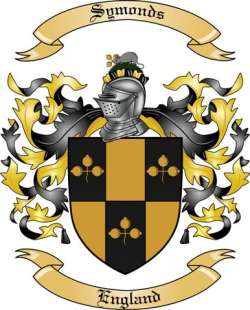
Mark Symonds - Coat of Arms

Mark Symonds was born in 1584 in Birch Great, Essex, England.  His parents were William SYMONDS and  Alice ROSEBLADE.  He married Susan Edgar on 24 Apr 1609 in Birch Great, Essex, England. He married second Joanna [__?__] in 1619 in Essex, England. He appeared first in Ipswich about the year 1634.   Mark died on 28 Apr 1659 in Ipswich,  Essex, Mass.

Nothing can be found to prove or disprove that this Mark Symonds is the man of that name who married at Great Birch, county Essex, England, on 24 Apr 1609, Susan Edgar.

Joanna [__?__] was born about 1598 in Essex, England. She died on 29 Apr 1666 in Ipswich,  MA.   Joanna, the last wife of Mark Symonds stated in her will “God having given me two daughters,” Priscilla and Abigail. This indicates Joanna was not the mother of the older children, and that there was at least one earlier wife of Mark Symonds.

Children of Mark and Joanna:

Name Born Married Departed
1. Mary Symonds 1621

Rowley, Yorkshire, England.

Edward Chapman

ca. 1639

Ipswich, Mass.

10 Jun 1658

Ipswich, Mass.

2. Susanna Symonds 1623

Essex Co.,England

Capt. John Ayres

(brother of Sarah AYRES)

c. 1650

2 Feb 1681/1682

Ipswich, Mass.

3. Priscilla Symonds 1625

Birch Great, Essex, England

John Warner (son of our ancestor William WARNER) about 1639 Ipswich, Essex Mass 1688 Hadley, Hampshire, MA
4. Abigail SYMONDS ca. 1632

Essex Co.,England

Robert PEARCE

ca. 1644

28 Jun 1680 in Ipswich, Mass.

Mark may possibly have been a very distant relative of the noted Samuel Symonds, of Yeldham, co. Essex, and Ipswich, Mass., though there were several families of the name in New England not known to be connected.

2 May 1638 – Made freeman in Ipswich

26: 7: 1648: – Court Held at Ipswich found Marke Symonds being sixty four years of age, discharged from ordinary training (source of date of birth)

1641 – Robert Andrews, George Giddings, Mark Symonds and Thomas Treadwell are chosen surveyors for this year.

2 Feb 1641 – On  the Jury in Court held at Salem. He was also on the Jury of Trials 4 Nov 1645, and 30 Mar 1647.

1647 – Appointed admr. of the Estate of George Abott, late of Rowley.

24 Sep 1650 – On  Grand Jury

His house and twelve acres of land lay on ye common fields on ye north side ye river, and a planting lot at Reedy Marsh.

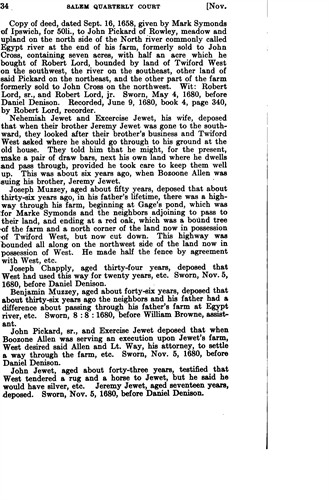
16 Sep 1658 – (Ipswich Deed IV : 340) . . . Marke Symonds of Ipswich . . . for . . . fifty pounds . . . Have Granted . . . unto John PICKARD of Rowley … his pcell of ground . . . lyeing on the North Syd of the North River … at the end of his farme formarly sold to John Crose containeing seaven acres . . . with about halfe an acre bought of Robert Lord . . . having the land of Twyford WEST toward the Southwest …  . . . Rec. June 9, 1680.

Ipswich Deed 16 Sep 1658

28 Apr 1659 – Marke’s will proved in Ipswich Court.  After the death of Mary Chapman, his daughter, he left by will certain pieces of land for the benefit of his grandchildren, which caused their father, Edward Chapman, a great deal of trouble in his efforts to keep it and divide it equally among them in connection with his own property.

The last will & testam* of Marke Symons … I doe appoynt my beloved wieffe Johannah Symons to be sole executrix … I bequethe to my Daughter Susannah Ayres a fether bed & bo ulster w”* was her mothers wth y8 worst rugg. I bequeathe to Abigaill Pierce a fether bed … I bequeathe to John Warner junior one ewe lamb . . . after ye decease of my said wieffe my estate to be equally devided amongst our three daughters & y* children of my daughter Mary Chapman deceased . . . Also I apoynt my lo* bretheren Moses Pengrie & Edward Browne to be overseers of this my last will & testament. Dated 25 (2) 1659. Signed in ye prsence of George Smith, Aaron Pengry.

16 May 1659 – Inventory taken by Robert Lord and Robert Day. Mentions ” his dwelling house & bame with the ground about it. 18 acres of Land, 2 acres of meddow at Mr wintrips farme & 1 acre of salt marsh.”

Amount of estate £257.6.9.

9 May 1666 – Joanna’s will proven in Ipswich Court

I Joana Symonds of Ipswich . . . doe make and ordaine this my last will and Testament . . . And for my outward estate I . . . dispose God haueing given me two daughters which are maryed both and have children my will is equally to dispose of what estate I leave behind . . . unto my said two daughters and there children, i. e., namely unto my daughter Prisilla the wife of John Warner and to her children after her decease the one halfe of my estate And to my daughter Abigaill the wife of Robert Pearce the other halfe equally devided … I doe apoynt my loueing Sons in law John warner & Robert Pearce to be my executors . . . and doe declare this to be my last will and testament this sixt day of Aprill 1666. In presents of us William Goodhue, Robert Lord. Joana Symonds.

24 Nov 1659 – Ipswich Deed

wheras ther was an estate left by Marke Symonds unto his children after the death of his wife. And by agreem* mutually betweene the widdow & them to alow the widdow a certeine Sum yearly dureing her life and for to devyde the estate presently, and by agreement betweene themselves, the lands with some other small things fell to Edward Chapman (who maryed one of Marke Symonds his daughters) for his part of the estate, And the house being by the consent of all hands put into the hands of John Ayres to make sale of . . . This therfore wittnesseth that I John Ayres for . . . four score pounds . . . sell vnto my Brother Edward Chapman of Ipswich the dwelling house, barne & land about it . . . three acres be it more or less . . . wch was lately Marke Symonds … In wittness whereof … 24 November 1659 . . . John Ayers and John Baker

Recorded 1st of Aprill 1673. by Robert Lord

Ipswich in the Massachusetts Bay Colony … By Thomas Franklin Waters, Sarah Goodhue, John Wise, Ipswich Historical Society 1927

Mark Symonds' Ipswich Lot

The remainder of the land in this square was owned originally by Mark Symonds. Hisexecutor, John Aires, sold a house and three acres, to Edward Chapman, son in law of Symonds, Nov. 24, 1659 (Ips. Deeds 3: 351). Chapman sold his son, John, a house and 10 rods on the corner, bounded by his land on two sides, Sept. 1677 (Ips. Deeds 4: 153). Samuel Chapman acquired the balance of the estate. Samuel sold an acre on the northeast side to his neighbor, Abraham Perkins, to enlarge his property, June 23, 1687 (7:152); an acre and house, fronting on the Street, to Samuel Wood, Dec. 2, 1687 (12: 119); and an acre and a quarter of land in the rear, to Thomas Lull Jr., Dec. 6, 1687 (8: 100). John Chapman sold his corner and house,his land increased now to 40 rods,to Caleb and John Kimball, April 6, 1719 (36: 22) and they sold the same to John Wood, on April 8, 1719 (35: 156). By this purchase John became next neighborto his father, Samuel Wood, and inherited his property (50: 253). John Wood’s widow, Martha, was allotted the northeast part of his estate, bounded by the Capt. Stephen Perkins’ land, and measuring 4} rods on High St., Nov. 19, 1752 (Pro. Rec. 331:126). Retire Bacon and his wife Margaret acquired possession, and sold a house and one and a half acres, the whole of the John Wood estate probably,to Isaac Martin,Aug. 7,1765(117:29). Martin sold to John Lakeman,Oct. 31, 1765(126: 43),the northeast corner of the property abutting on Nathaniel Foster, and another piece on April 19, 1773 (160: 159). It was owned by Nathaniel Lord, and by his son, Abraham, and the northwest part is still in possession of his heirs.

Children

1. Mary Symonds

Mary’s husband Edward Chapman was born in 1617 in Nr Hull, Yorkshire, England. His parents were Robert Chapman and Rebecca [__?__]. After Mary died, he married 10 Jun 1658 in Rowley, Essex, Mass to Dorothy Swan (b. 16 May 1635 in Boston, Mass – d. 21 Oct 1710 in Rowley, Mass.) Edward died 18 Apr 1678 in Ipswich, Essex, Mass.

2. Susanna Symonds

There were two John Ayres in early Massachusetts.  One married Sarah Williams and Mary Wooddam and the other married Susannah Symonds.  Genealogies show both the Williams and Symonds marriages with a date of 5 May 1646 in Haverhill, but I think the Ayres/Williams connection is correct.

The other John Ayres was born in 1623 in Lavenham, Suffolk. His parents were John Ayer and Hannah Evered. He married Sarah Williams, daughter of our ancestor John WILLIAMS, 5 May 1646 in Haverhill, Mass.  After Sarah died, her John Ayre married 26 Mar 1663 in Haverhill, Essex, Mass to Mary Wooddam (b. 1634 in Salisbury, Essex, Mass; d. 1694 in Ipswich, Essex, Mass.) This John died between 1694 and 1711 in Ipswich, Essex, Mass.

Susannah’s John Ayres was born about 1621 in England. He married 5 May 1646 in Ipswich, Essex, Mass to Susannah Symonds (b. 1617 d. 2 Feb 1682 in Ipswich, Essex, Mass.)  This other John was killed by Indians 2 Aug 1675 in Northfield, Franklin, Mass. with seven others, at the fight at Brookfield.. Though he had received large grants of land at Brookfield, some 2,000 acres, his family undoubtedly returned to Ipswich and its vicinity, the settlement having been broken up, and rendered unsafe.  His widow presented an inventory of his estate, now recorded at Salem, on which she wrote, “I have seven sons and one daughter.”

John’s parentage is unknown,  but it seems highly probable that he was accompanied to New England by two of his brothers-in-law, William LAMSON and William Fellows.   The ground for the conjecture is this. William Lamson died at Ipswich in 1659, leaving eight children. His widow Sarah wished to marry one Thomas Hartshorn, but was opposed by her brothers William Fellows and John Ayres. Now as Ayres married a Symonds, and there is no record of any sisters of his wife who married Lamson and Fellows, it is fair to conclude that their wives were own sisters of John Ayres.

We learn from deeds at Salem, that this other John Ayres lived at Ipswich 1648, and as a tenant on Mr. John Norton’s farm. In Nov 1672, he seems to have sold out all his rights in the town, including those derived from his father-in-law, Mark Symonds.

3. Priscilla Symonds

Priscilla’s husband John Warner was born 9 Sep 1616 Boxted, Essex, England.  His parents were William WARNER and Abigail BAKER.  John died 17 May 1692 Hadley, Hampshire, Mass.

John and Priscilla’s children were Joseph Warner (1657), Mehitable Warner (1659), Daniel Warner (1661), Eleazar Warner (1662), and Priscilla Warner Cummings (married Thomas Cummings).

John removed from Ipswich to Brookfield in 1670, was one of three men there who took the Indian deed for the town of Brookfield, December 19, 1673, and was one of the principal inhabitants there. When the town was destroyed by the Indians in 1675 he retreated with his younger children to Hadley, Massachusetts, whither Mark Warner, an elder son, and other children had gone to settle. He probably died at the home of some of his children, 1692.

On May 17, 1692, he gave his property to his sons, Mark, Nathaniel, and Eleazar. His property included the right of two commons in and land in a Hadley and Swampfield. He also gave them 3 beds, 3 coverlets, 3 pairs of sheets, a bolster, 6 pillows, 2 brass kettles, 3 skillets, a frying pan, an iron pot, a pair tongs, an iron peale, an iron trammel, a box of iron, 2 pewter platters, a pewter basin, 2 catechisms, 2 bibles, 6 sermon books, 2 woman’s coats, 2 waistcoats, a large apron, a silk handkerchief, a silk hood, a silk cap, and a hat.

4. Abigail Symonds (See Robert PEARCE‘s  page)

Sources:

http://www.lynngallup.org/genfam/pafg139.htm

The history of Peter Parker and Sarah Ruggles of Roxbury, Mass. and their … By John William Linzee 1913

http://freepages.genealogy.rootsweb.ancestry.com/~nanc/nanorman/aqwg32.htm

http://freepages.genealogy.rootsweb.ancestry.com/~arlene/

http://trees.ancestry.com/tree/19451550/person/804357402

Posted in 13th Generation, Immigrant - England, Line - Shaw, Public Office | Tagged | 11 Comments

Robert Pearce

Robert PEARCE (1612 – 1679) was Alex’s  10th Great Grandfather, one of 2,048 in this generation of the Shaw line.

Robert Pearce was born about 1612 in Norwich, Norfolk, England.  His parents were John PEARCE and Elizabeth TRULL.  He married Abigail SYMONDS about 1644.  Robert died 21 Mar 1678/79 in Ipswich, Mass.

Abigail Symonds was born about 1630, in Birch Great, Essex, England.  Her parents were Mark SYMONDS and Joanna [__?__]. Abigail died 28 Jun 1680 in Ipswich, Mass.

Children of Robert and Abigail:

Name Born Married Departed
1. Samuel Pearce 1654 Mary Giddings
1680
Ipswich, Mass
15 Mar 1693/94
Salisbury, Mass
2. Abigail Pearce Josiah Linden
27 Dec 1671 Ipswich, Mass
3. John Pearce 23 May 1657 – Ipswich, Mass
After 1680
4. Joanna PEARCE 13 Oct 1659 Ipswich, Mass. Samuel GRAVES III
1683
1714
Ipswich, Mass
5. Robert Pearce 7 Nov 1661
Ipswich, Mass
After 1680
7. Moses Pearce 11 Jun 1666
Ipswich, Mass
 After 1680
6. Mary Pearce 30 May 1664
Ipswich, Mass
Manassah Marston
1686 – Salem, Essex, Mass
18 May 1666
Ipswich, Mass

18 May 1642 – Robert Pearce was freeman

8 Mar 1679 – The Last Will and Testament of Robert Pierce Senior

Made y* 8th of March 1679 … I Robert Peirce Senior . . . doe make this my last will and Testament … I give . . . unto my dear . . . wife Abigall Peirce all my lands goods … at present in my posession . . . my gd wife paying these after mentioned Legacyes … I give . . . unto my Eldest sonne Samuell . . . that peice of land . . . that was formerly the land of Thomas Lord … I give . . . unto my daughter Abigall Lyndall … I give . . . unto my sonne John … I give . . . unto my daughter Johanna … I give . . . unto my sonne Robert … I give . . . unto my sonne Moses … I give . . . unto my daughter Mary . . . My wife I doe ordaine . . . my sole Executrix . . . my Louing friends Deacon Knowlton, Jacob Foster, John Staniford to bee overseers … in witness whereof I have hereunto sets my markes.
Thomas Knowlton, John Staniford, Jacob Foster, Witnesses.

1 Apr 1679 – Inventory of the Estate of Robert Pearce of Ipswich who Deceassed y* 21″ of March Taken y* 1** of Aprill

15 Acres of Marche at plum island.
1 ffarme at Rowly Villidge.
Thomas Knowlton Sen, Jacob Foster, John Staniford.
Abigaill Perice executrix in court held at Ipswich the 1rt of Aprill 1679 gave in this Inventory upon oath to be a true Inventory of her husbands estate . . .

(Essex: File No. 21217) An Inventory of thee estate of Roburt Pearce . . . Deceased thee twenty eight day of Sept. 1680 . . . the Administrator is to pay to his two brothers nine shillings apeice & to his two sisters nine shillings apeice the remainder to himselfe.
Robert Pearce being deceased, Samuell Pearc administrator.

24 Jun 1680 – Abigail’s Will

In the name of God Amen I Abigaill Pearse of Ipswich . . . widdow . . . doe make & ordaine this my last will & testament … I give . . . unto my sonn Samuell the house and land . . . which I purchased of Thomas Lord … I give . . . unto my sonn John the house wherein I now live … I give . . . unto my daughter Joannah my best fether bed … I give . . . vnto my daughter Mary Pearce my other fether bed . . . Then I give unto my two sonns Robert and Moses Pearse all my meadow and marsh att plumb 11 and … I give unto my son in law Josiah Linden ten shillings and grand children his two sons twenty shillings a peace and Abygaill Linden forty shillings, And further my will is that the rest … be equally devided betweene my two daghters Joannah and Mary Pearse . . . And … to be equally devided among all my children only my eldest sonn Samuell to have thirty pounds mor in his share . . . And my will … is that all those . . . things before mentioned given in pticular to any & all my children viz Samuell, John, Robert, Moses and Joannah and Mary … be all valued A disposed . . . and my meaning is that my grandchildren receive there legasies when t hey come to age. further I constitute & ordaine my eldest sonn Sarauell to be my sole executor … In wittnes hereof … I have heer vnto put my hand & seale the 24 day of June . . . 1680. Signed, sealed & published . . . in presence of vs Robert Lord se”, Jacob foster.
Abigail Parce.

Children

1. Samuel Pearce

Samuel’s wife Mary Giddings was born in 1658 in Ipswich, Mass. Her parents were George Giddings and Jane Antrobus Lawrence. After Samuel died, she married 15 Mar 1694 to William Hubbard (b. 1621 Colyton, Devonshire, England – d. 14 Sep 1704 Ipswich). Mary died in 2 Feb 1711 in Ipswich, Mass.

2. Abigail Pearce

Abigail’s husband Josiah Linden was born about 1655. His parents were Augustine Lyndon and Jane [__?__]. Josiah died 8 Aug 1709 in Newport, Rhode Island.

4. Joanna PEARCE (See Samuel GRAVES III‘s page)

6. Mary Pearce

Mary’s husband Capt Manassah Marston was born about 1661 in Salem, Essex, Mass. His parents were John Marston and Alice Eden. Manassah died Feb 1704 in Salem, Essex, Mass.

Sources:

http://www.genealogyofnewengland.com/b_p.htm

http://www.rpi.edu/~holmes/Hobbies/Genealogy/wc14/wc14_203.htm

The history of Peter Parker and Sarah Ruggles of Roxbury, Mass. and their … By John William Linzee 1913

Posted in 12th Generation, Immigrant - England, Line - Shaw | Tagged | 3 Comments

William Beamsley

William BEAMSLEY (1605 – 1658) was Alex’s  11th Great Grandfather, one of 4,096  in this generation of the Shaw line.

William Beamsley - Coat of Arms

Ensign William Beamsley was born about 1605 in England.  His origin is undetermined, but the name Beamsley is found only in Lincoln, Lincolnshire, England. His married Anne [__?__] in England. He arrived with his wife Anne as part of the Winthrop Fleet in 1630 and settled at Boston. After Anne died, he married Martha (Hallor) Bushnell about 1645.  William died before 28 Oct 1658 in Boston, Mass.

Anne [__?__] was born in 1609 and died before 1645.

Martha Hallor was born about 1606.  She was the widow of Edmond Bushnell when she married William.  By her first husband she had five children, of whom three survived to adulthood and were named in the will of their stepfather; on 12 Jun 1663.  In”answer to the petition of Martha Beamesly, of Boston, widow, humbly desiring the favor of this Court to grant her license to distill & retail strong waters, &c., the Court judgeth it meet to grant her request, she giving security to the secretary for the keeping due order, without offence or prejudice to the law & order of the County Court” ; she died before 16 Nov 1668 when the heirs of William Beamsley sold his houselot in Boston, land which had been given to her for life in her husband’s will.

Children of William and Ann:

Name Born Married Departed
1. Ann Beamsley 13 FEB 1632/33
Boston, Mass
Ezekiel Woodward
JAN 1649/50 Boston
BEF 1672 Ipswich, Essex, Mass
2. Grace BEAMSLEY Baptized
10 Sep 1635 in Boston
Samuel GRAVES II
ca. 1657
26 Nov 1730 aged 95.
3. Mercy Beamsley 9 DEC 1637 Boston Michael Wilborne
17 OCT 1656 Boston by
Richard Bellingham, Deputy Governor
.
Andrew Peeters
1659
Boston
6 Nov 1726
Andover, Mass
4. Samuel Beamsley 24 JAN 1641 Boston APR 1641
5. Habakuk Beamsley 24 JAN 1641 Boston APR 1641
6. Hannah Beamsley 13 DEC 1643 Boston Edward Bushnell
.
Abraham Perkins (Son of Quartermaster John PERKINS)
16 OCT 1661
16 OCT 1732 Ipswich, Essex, Mass

.
Children of William and Martha Hallor:

Name Born Married Departed
Abigail Beamsley 6 Feb 1646 probably died young.

.
Children of Edmond Bushnell and Martha Hallor

5 April 1635 – William Beamsley labourer” admitted to Boston church

25 May 1636 – Freeman (9th in a group of 20 Boston men)

8 Jan 1636/37 – Granted sixteen acres at Muddy River, (based on order of 14 Dec 1635)  In the Boston Book of Possessions, Beamsley held two lots: house and houselot, about half an acre; and sixteen acres at Muddy River.  On 6 July 1650 he purchased from William Phillips a lot in the Mill Field, and on 25 Jan 1655/56 he purchased an adjoining parcel from widow Mary Hawkins; on 25 Apr 1656 he sold the combined lot to Henry Shrimpton.

"River" is perhaps too grandiloquent a word for the Muddy River - a collection of brooks, ponds and culverts that runs 3.5 miles from near Jamaica Pond to the Charles River and which serves as the Boston/Brookline line

26 Jul 1641 – It is “agreed that our brother Beamsly is to be paid for 10 rods of causeway done by him on the further side of the bridge at Rumney Marsh, at 6s. per rod, together with a small parcel of work on the hither side of the said bridge, which cometh to 1s. 6d.; in all £3 1s. 6d.”

Rumney Marsh Reservation

13 Mar 1648 – Constable for Boston

27 Aug 1649 – It is “ordered that Wm. Beamsly shall remove away his oyster shells from off the town’s highway before his door by the 1 of the 11th month [i.e., by 1 Jan 1649/50], on the penalty of 20s. fine”.

11 Mar and 12 Apr 1650 – Committee to lay out highways

20 Feb 1650/51 Thomas Marshall of Boston, shoemaker, sold to William Beamsley of Boston a parcel of marsh, and on 2 May 1657 “Will[iam] Beamsly of Boston aforesaid yeoman” sold to Elias Maverick and David Kelly for £12 the same parcel of marsh

1 Mar 1650/51 – The Boston selectmen gave William Beamsley liberty “to wharf or pier before his property to low water mark, provided he go no broader there than his ground is at high water mark”.

23 Feb and 26 Apr 1652 Fenceviewer

10 Mar 1656 – Water bailey

28 Apr 1656 “Wm. Beamsley is fined 10s. for receiving an inhabitant without license”

9 Mar 1657 – Highway Surveyor

1657 – Admitted to the Artillery Company and attained the rank of ensign.

1 Dec 1657 – “William Beamsly of Boston … yeoman and Martha his wife” sold to Henry Kemble of Boston, blacksmith, for a valuable consideration a parcel of land twenty-two feet wide at the west end, twenty-one and a half feet wide at the east end, and ninety-six feet on the north and south sides, bounding William Wenborne on the north and William Beamsley on the south.

25 Jan 1657/8 the selectmen stated that “Elizabeth Blesdale hath liberty to reside in the town, and Wm. Beamsley is bound in a bond of twenty pounds to save the town from any charge that may arise by her during her said residence …”

14 Sep 1658 – William Beamsley confirmed a grant he had made to “my daughter Anne Woodward, now the wife of Ezekiell Woodward, of a certain house and orchard, as it is now fenced wherein they have lived, seven years, or thereabouts …”

14 Sep 1658  – Will,  Proved 28 Oct 1658. He made “my wife full executrix and administratrix of all my houses, lands, orchards, goods and chattels whatsoever that she shall enjoy and possess the same unto her own proper use as long as she shall live provided she shall let Mercy have that chamber wherein she now lies for her own, and that there shall be with all conveniency made therein a chimney & she to enjoy it during her widowhood and I desire that my wife may take the charge and care of her and see that she wants neither meat, drink nor clothing during the time of her widowhood, and further my will is that after my wife’s decease my whole estate shall be then prized and set to sale, the whole estate that is then left to be equally distributed amongst all my children, namely Ann, w. of Ezekiel Woodward; Grace, w. of Samuel GRAVES of Ipswich; Mercy, who m. Michael Wilborne, and next Andre Peters, of Ipswich; Hannah, w. of Bushnell, who after m., Abraham Perkins; Eliz. w. of Edward Page; Mary, w. of ROBISON, who after m. Thomas DENNIS; and for Edward BUSHNELL, perhaps son of his widow. by her former husband. The ch. made sale of the est. in Nov 1668, when perhaps his wid. was dec.

15 Oct 1658 – Inventory taken of “the estate of the late Ensign William Beamsly (who departed this life the 29th of September last)  totalled £251 14s. 1d., of which £164 was real estate: house and land at Boston, £140; and land at Muddy River, £24; on 28 October 1658 “Martha Beamesly deposed this to be a true inventory of Wm. Beamesly her late husband’s estate”.

16 Nov 1668 – “Ann Woodward with Ezekiell Woodward her present husband, Grace Graves with Samuell GRAVES her present husband, Mercy Wilborne alias Peterson with Andrew Peterson her present husband, Hannah Beamsley alias Perkins with Abraham Perkins her present husband, Elizabeth Page with Edward Page her present husband, Mary Roberson alias Dennis with Thomas Dennis her present husband, [and] Edward Bushnell all formerly of Boston” sold to Key Alsop of Boston, merchant, for £200 “a certain houses or houses [sic] with an orchard, yards and gardens” in Boston, and also additional ground to the east of this lot.

EDUCATION: Signed his will and several deeds. Inventory included books valued at £1 8s. William Beamsley’s second wife, Martha, made her mark to several of his deeds.

Children

1. Ann Beamsley

Ann’s husband Ezekiel Woodward was born May 1624 in Puddington, Bedfordshire, England.  In 1633, he immigrated with his parents Nathaniel Woodward (1580 – 1685) and Margaret Lawrence (1590 – 1661).   After Ann died, he married 20 Dec 1672 at Age: 48 in Wenham, Essex, Mass to Mrs. Elizabeth Soldart.  Ezekiel died 29 Jan 1699 in Wenham, Essex, Mass.

Elizabeth [Knight or Jerningham?] was born 1619 in Somerleyton, Suffolk, England   She married abt 1650 to John Solart (c.1622 Wherstead, Suffolk, England – 24 May 1672 in Wenham, Mass.)  Elizabeth died 3 Dec 1678 in Wenham, Essex, Mass.

Children of Elizabeth and John

i. Alice Woodward 1649 – 1685; m. 1670 to William Yarrington

ii. Sarah Solart b. 14 Jul 1653; d. 19 Jul 1692 in Salem, Essex, Mass.; m1. Daniel Poole; m2. 1690 Age: 37 Salem, Essex, Mass to William Good

Sarah Good (wiki) was the first person accused of witchcraft in 1692.

Sarah’s father John Solart was a well off innkeeper, but his  estate was tied up in litigation that left Good virtually nothing. Her first marriage was to a poor indentured servant named Daniel Poole who died in debt in 1686. Her second marriage to William Good was doomed from the outset because the couple had to pay for the debts of first husband Poole. The Goods were homeless, renting rooms in other people’s houses, and they had two young children. William worked as a laborer around Salem Village in exchange for food and lodging, but it became increasingly difficult for the family to find a place to stay as Sarah’s reputation for and being socially unpleasant spread throughout the town. The family was regarded as a nuisance to the town, and by 1692 they were virtually beggars.

She was accused  because of economical and political biases from the families of the accusers. Sarah, who was homeless, was described by the people of Salem as being filthy, bad-tempered, and strangely detached from the rest of the village. She was often associated with the death of residents’ livestock and would wander door to door, asking for charity. If the resident refused, Good would walk away muttering under her breath. Although she maintained at the trial that she was only saying the Ten Commandments, those who turned her away would later claim she was chanting curses in revenge. Also, when asked to say the Commandments at her trial, she could not recite a single one.

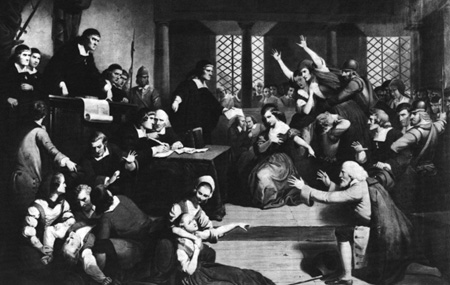
Sarah was accused of witchcraft on February 25, 1692, when Abigail Williams and Betty Parris, related to the Reverend Parris, claimed to be bewitched under her hand. The young girls appeared to have been bitten, pinched, and otherwise abused. They would have fits in which their bodies would appear to involuntarily convulse, their eyes rolling into the back of their heads and their mouths hanging open. When Reverend Samuel Parris asked “Who torments you?” the girls eventually shouted out the names of three townspeople: Tituba, Sarah Osborne, and Sarah Good.

On March 1, 1692, Good was tried for witchcraft. When she was brought in, the accusers immediately began to rock back and forth and moan, seemingly in response to Good’s presence. Later on in the trial, one of the accusers fell into a fit. When it had stopped, she claimed Good had attacked her with a knife; she even produced a portion of it, stating the weapon had been broken during the alleged assault. However, upon hearing this statement, a young townsman stood and told the court the piece had broken off his own knife the day before, and that the girl had witnessed it. He then revealed the other half, proving his story. After hearing this, the judge simply scolded the girl for exaggerating what he believed to be the truth.

Sarah Good

Others who testified in Good’s trial claimed to have seen her flying through the sky on a stick, presumably to get to her “witch meetings.” Even her husband testified against her, stating he had seen the Devil’s mark on her body, right below her shoulder. He also told the court he had reason to believe she was either presently a witch, or would soon become one. Dorcas Good, Sarah’s four year old daughter, was later forced to testify against her, claiming that she was a witch and she had seen her mother consorting with the devil. Sarah was pregnant at the time of her arrest and gave birth to Mercy Good in her cell in Ipswich Jail. Mercy died shortly after birth most likely due to malnutrition, lack of medical care, and unsanitary conditions.

Although both Good and Sarah Osborne denied the allegations against them, Tituba admitted to being the “Devil’s servant.” She stated that a tall man dressed all in black came to them, demanding they sign their names in a great book. Although initially refusing, Tituba said, she eventually wrote her name, after Good and Osborne forced her to. There were 6 other names in the book as well but Tituba said, they were not visible to her. She also said that Good had ordered her cat to attack Elizabeth Hubbard, causing the scratches and bite marks on the girl’s body. She spoke of seeing Good with black and yellow birds surrounding her, and that Good had also sent these animals to harm the girls. When the girls began to have another fit, Tituba claimed she could see a yellow bird in Good’s right hand. The young accusers agreed.

Sarah Good - Crucible

When Good was allowed the chance to defend herself in front of the 12 jurors in the Salem Village meeting house, she argued her innocence, proclaiming Tituba and Osborne as the real witches. In the end, however, Sarah Good was convicted of witchcraft and sentenced to death. Later, Dorcas Good was also accused of witchcraft. Mary Walcott and Ann Putnam Jr. claimed she was deranged, and repeatedly bit them as if she were an animal. Dorcas, who was incorrectly called “Dorothy Good” while on trial, received a brief hearing in which the accusers repeatedly complained of bites on their arms. She was then convicted and sent to jail, becoming at age five the youngest person to be jailed during the Salem Witch Trials. Two days later, she was visited by Salem officials. She claimed she owned a snake—given to her by her mother—that talked to her and sucked blood from her finger. The officials took this to mean it was her “familiar,” which is defined as a witch’s spiritual servant. Dorothy was released from jail several months later, and evidently suffered from psychological issues for the remainder of her life.

On July 19, 1692, Sarah Good was hanged along with four other women convicted of witchcraft. While the other four quietly awaited execution, Good firmly proclaimed her innocence. Reverend Nicholas Noyes was persistent, but unsuccessful, in his attempts to force Good to confess.

Epilogue – While the other women quietly awaited their fate, Sarah Good remained defiant to the end. When Reverend Noyes urged her to confess and repent on the scaffold, she replied, “You are a liar. I am no more witch than you are a wizard. If you take my life away, God will give you blood to drink.” That assured everyone she was a witch.  Twenty-five years later Rev. Noyes died of a hemmorrhage in the fact-in fact drinking his own blood; many in Salem remembered Sarah Good.

Children of Ezekiel and Elizabeth:

iii. Abiah Woodward b. 1670 in Beverly, Essex, Mass.; d. 1720 in Connecticut

iv. Mehetabel Woodward b. 17 Nov 1677 in Beverly, Essex, Mass.; d. 13 Jun 1739 in Preston City, New London, CT

Ezekiel was a soldier in King Philips War and lived in Ispwish and Wenhaw Massachusetts.

Residence 1660, Massachusetts. He held the rank of sergeant in Samuel Appleton’s company from Ipswitch when it was mustered on Dedham Plain on Dec 9, 1675. That he shortly after participated in the Great Swamp Fight and Hungry March is seen in his being a soldier of grantee for Narragansett Township No. 1. (now Buxton, Maine)

“Ezekiel Woodward was born about 1624, since in 1672 he deposed that he was about fifty-eight years old. He acquired land in Boston in 1651. In November, 1668, he deposed at Salem that he had known [our ancestor] Thomas WELLS, then a defendant, for seventeen or eighteen years. [See Thomas WELLS‘ page for details about this case.]  His life until about 1660 was spent in Boston where he had married about 1650 as his first wife Anne Beamsley, the mother of all of his children.

On September 14, 1658, the day William Beamsley made his will he also signed a confirmatory deed to Ezekiel and his wife Anne of a portion of the Beamsley home lot on which the young couple had lived about seven years…

” Ezekiel, whose trade was carpentry, is not recorded as having taken part in public affairs during the ten years he lived in Boston nor as having church membership nor freemanship but five of their nine children were born during the period so Anne must have been a busy woman and Ezekiel must have been active in his carpentry to have cared for them all… “Henceforth our relationships to the Woodward family appear only in Essex County.

Ezekiel, as of Ipswich, in March, 1661, paid £60 to Ralph Dix for a tract of two and one-half acres and a house “by the smaller falls” and near the Great Bridge which was built in 1672. He lived in this property, which was bounded on the northeast and southwest by the Mill River, for about ten years, but in October, 1672, after the death of his wife, Anne and about the time of his own removal to Wenham, Ezekiel sold a part of the Ipswich tract to Shoreborn Wilson and sold the house and remainder of the lot in 1679…

“In April, 1667, Ezekiel was taken sharply to task “for his great offense in affronting the constables in the execution of their office.” The court ruled that he should be fined or make public acknowledgement of his fault on the next lecture day, and he is recorded as having chosen the latter. The conditions concerning the punishment of four young men who had torn up a bridge and were sentenced each to sit an hour in the stocks and then be returned to jail until a three pound fine was paid for each of them. While they were in the stocks the citizenry including Ezekiel evidently crowded around, and the two constables ordered them to “keep further off” and presumably punished Ezekiel, for he is quoted as saying to them that “it was the King’s ground, that he had a right to stand there as well as they, and if they thrust him again he would sett them further off.” Another witness claimed that Ezekiel said to one of the constables “what will you? breed a mutanye and if you had stroak me, I would a laid you over the head!””

Children of Ann and Ezekiel

i. Prudence Woodward b. 4 Apr 1660 in Boston, Suffolk, Mass. d. Dec 1732 in Ipswich, Essex, Mass.; m. Benjamin Marshall, son of [our ancestor] Edmond MARSHALL

2. Grace BEAMSLEY (See Samuel GRAVES II‘s page)

3. Mercy Beamsley

Mercy’s first husband, Michael Wilboume was born 1637 in England. Michael died in 1658 in Andover, Essex, Mass.

Mercy’s second husband Andrew Peeters was born 1634 in Ipswich, Essex, Mass. His parents were William Peters and Elizabeth Treffery Andrew died 14 Dec 1713 in Andover, Essex, Mass.

Andrew Peters Headstone -- Old North Parish Burying Ground, North Andover, Essex, Mass.

HERE LYES THE BODY OF MR ANDREW PETERS WHO DECEASED DECEMBER YE 14 1713 IN YE 79 YEAR OF HIS AGE.

Michael was a carpenter. There is no record of his death, but Mercy appears to have been a widow in September, 1658, when her father’s will was made. It will be seen that Mercy and Mary are used interchangeably; probably the old pronunciation, and consequent spelling “Marcy, ” are responsible for this error. Her second husband  Andrew Peeters. No record of birth (bom probably in England, in 1634-35), died in Andover, Mass., 14 Dec 1713, in the seventy-ninth year of his age.

Mercy Beamsley was one day standing at her window to watch the people wading through the trails, which then served as streets, when her attention was attracted by “a young Holland” picking his way through the mud. Andrew Peeters had just arrived, and looking up he saw her watching. He then and there resolved to marry her, it is said. This version calls Andrew a Dutchman. It is certain that he was an Englishman though he probably lived, and possibly was born in Holland. He appears in this country as a young man with sufficient worldly possessions and a good education, especially for those days, — witness his will written by himself and in which the spelling is quite remarkable and the writing that of a man thoroughly used to the pen.

Andrew was a distiller. During his residence in Andover Andrew appears to have been certainly
once, perhaps twice, burned out by the Indians. “1692 Mr Andrew Peeters (now an inhabitant in Andover), being lately burnt out by ye Indians. ” This may have occurred in 1689, or it may have been more recent, but certainly his son Samuel was too young to be his partner at that time, and he says in his will: “whereas I was Burnt out bij ye heathen Enemij hee ye said Samuell Peeters
hath been mij Copartner Euer Since.” This second burning may have been the one referred to in 1698.

Children of Mercy and Peter

i.  John Peters   b. 28 Feb 1660, killed by the indians, in Andover, 14 Aug 1689, m. 25 May 1680, Mary Edwards, b. 16 Oct 1661 d. 11 Jan 1733, dau. of John Edwards.

ii. Elizabeth Peters  b. 26 Aug 1662 d.31 Oct 1703 , m. 25 Nov 1678 John Sady and 20 Oct 1712 Walter Wright

iii. Andrew Peters  b. pro. 1664, killed by indians, in Andover, 14 Aug 1689, m. 8 Feb 1685, Elizabeth Farnham, b. 19 Feb 1661, dau. of Thomas Farnham and Elizabeth Sibbons.

iv. Mary Peters   b.12 Jun 1668,d.21 Jul 1753, m. 22 may 1686, Thomas Chandler, b. 9 Oct 1664, d. 20 Jan 1737, son of Capt. Thomas chandler and Hannah Brewer.

v. Mercy Peters  b. 27 Jan 1670, d.25 Dec 1690, m. 22 May 1686 m. John Allen, b. 16 Mar 1662 d. 26 Nov 1690, son of Andrew Allen and Faith Ingalls.

vi William Peters  b. 7 Feb 1672, killed by indians, in Andover, 13 Aug 1696, is said to have married in 1694, Margaret Russe.

vii. Samuel Peters b. prob. in 1674-75m d, 2 May 1736 m. Phoebe Frie, b. 28 May 1680 d. 14 May 1757, dau. of Ensign Samuel Frie and Mary Aslebe, of Andover.

5.  Habakuk Beamsley

Habakuk means “embrace.”  The Book of Habakkuk is the eighth book of the 12 minor prophets of the Old Testament .  It is attributed to the prophet Habakkuk, and was probably composed in the late 7th century BC.  The 12 minor prophets are: Hosea, Joel, Amos, Obadiah, Jonah, Micah, Nahum, Habakkuk, Zephaniah, Haggai, Zechariah, and Malachi. Micah is the one that’s trendy right now, which one would you pick for your baby name?.

6. Hannah Beamsley

Hannah’s first husband Edward Bushnell was born 1643 in Boston, Suffolk, Mass.  He was Hannah’s step-brother.  His parents were Edmond Bushnell and Martha Hallor. Martha married Hannah’s father when Hannah was only two years old.. Edward died 16 Oct 1661 in Boston, Suffolk, Mass.

Hannah’s second second Abraham Perkins was born 1640 in Ipswich, Essex, Mass. His parents were Quartermaster John PERKINS and Elizabeth EVELETH. Abraham died 27 Apr 1722 in Ipswich, Essex, Mass (Son of )

Sources:

http://www.genealogyofnewengland.com/b_b.htm

http://www.branches-n-twigs.com/genealogy/getperson.php?personID=I7969&tree=allfam

http://familytreemaker.genealogy.com/users/s/c/h/Beverly-J-Schonewolf/WEBSITE-0001/UHP-1025.html

Edmond Frank Peters. Peters of New England: a genealogy, and family history;

Posted in 13th Generation, Immigrant - England, Line - Shaw, Public Office, Storied, Tavern Keeper, Twins, Veteran, Witch Trials | Tagged , , , | 13 Comments

Samuel Graves Sr

Samuel GRAVES I (1594 – 1654) was Alex’s  11th Great Grandfather, one of 4,096 in this generation of the Shaw line.

Samuel Graves - Coat of Arms - Meaning: steward, manager of property

Samuel Graves was born in, possibly King’s Lynn, Norfolk, England.  His parents may have been John GRAVES and Sarah MALTER.   DNA analysis of descendants has shown that Samuel Graves was from the same family as Herbert Fletcher Graves of Lincolnshire. That family lived at Chapel Hill and New York, Lincolnshire, about 8-10 miles northwest of Boston, Lincolnshire.  There has also been speculation that Samuel Graves was from King’s Lynn, Norfolk, England based mainly on the supposition that Lynn, MA was named for King’s Lynn by one or more of the early settlers. That connection is now supported by the Graves DNA results. King’s Lynn is about 25 miles southeast of Boston.

Samuel came to America about 1630 with his wife,  and three children, possibly as part of the Endicott group of 1628 or the Winthrop fleet of 1630. According to one account, he sailed from Southampton, England in the early spring of 1630 to New England.  Samuel died 1 Dec 1654 in Lynn, Essex, Massachusetts.

Children of Samuel and [__?__]:

Name Born Married Departed
1. Thomas Graves ca. 1620
England
24 Jan 1696/97
Lynn, Mass
2. Mark Graves ca. 1623
England
Amy [__?__]
ca, 1648
Andover, Mass.
.
Elizabeth Knight
(widow of John Farrington)
14 Nov 1667
ca. 1709
Lynn, Mass.
3. Samuel GRAVES II ca. 1628
England
Grace BEAMSLEY
ca. 1657
1681

Samuel Graves was a farmer and a man of wealth. In 1635 he gave about 300 pounds for the support of the Colonial Government.

Samuel took up residence at Lynn, Mass., on the turnpike west of Floating Bridge, and the neighborhood in which he lived was called “Graves End” or “Gravesend” for more than 200 years. It was later known as Glenmere.  Google Maps of Graves Ave in Lynn

The first homestead was taken down in 1648 and the present one [as of 1900] erected, which has been from time to time remodeled, but still retains the appearance of old-time architecture. The house was still occupied by descendants of the original settler, and Mrs. Jane Mansfield, a granddaughter of Rand Graves, celebrated her 99th birthday in the old place on 3 Dec. 1900.

Children

1. Thomas Graves

Thomas was a mariner as well as farmer. Thomas and Mark Graves testified at a session of the Court in 1653 to making several voyages in the boats of the Iron Works at Saugus to Boston, Weymouth, Braintree and Hingham, and in 1658 he testified that his boat carried seven tons of bar iron and delivered it to Mr. Hutchins. The iron works were in operation in 1643, the first in America.

2. Mark Graves

Mark’s first wife Amy [__?__]

Mark’s second wife Elizabeth Knight was born about 1642 in Andover, Essex, Mass. Her parents were William Knight and Elizabeth Lee. She first married about 1661 to John Farrington (b. 1624 in Olney, Bucks, England – d.2 May 1666 in Lynn, Mass.) Elizabeth died about 1705 in Lynn, Essex, Mass.

1665 – “Marke Graves, aged about 45 years, deposed [to the Ipswich Court] that on 10:6:1665, about an hour before sunset, Hanah Hutchinson came to his house, his daughter only being home, and asked to borrow some strong liquor for the toothache.  His daughter did not consent, and said Hanah told her that a cow of her father’s was running away from their pasture, and she ran to tell her father who was at a neighbor’s house, not far off, leaving said Hanah in the room where there was a bottle of liquor.  Deponent found that his cow was in the pasture and the bottle was nearly empty.  His wife said there was a quarter of a pint there, etc.  Sworn 12:6:1665 before Mark Graves, aged about fifty-five years, and Elizabeth, his wife, aged about thirty-seven years, deposed that since Hannah, wife of Mr. John Blaine died, said Blaine and six of his children came from Mr. Ralph King’s to dwell at the farmhouse where deponents and they lived under one roof. When the children came they were decently clothed, but during the three quarters of a year that they lived there, he did not provide for them and they suffered very much, and had it not been for their friends through pity taking some of them from him and relieving them, they might have perished. They suffered both for food and raiment, and what money Blaine received for wood or timber or for the work of his team was spent in drink, he coming home late at night in a quarrelsome mood and distempered with drink. He had only one cow to provide for the family, etc. Amy, daughter of Mark Graves, aged about seventeen years, deposed the same. Sworn in court. Simon Bradstreete.  Hanah Hutchinson said that the girl told her there was vinegar in the bottle, etc.  Also that she would kill the child or herself, etc.”  Hanah was severely whipped for lying, cursing and stealing.

Jun 1677 – Samuel’s son, “Mark Graves, aged about fifty-five years, and Elizabeth, his wife, aged about thirty-seven years, deposed  [to the Salem Court] that since Hannah, wife of Mr. John Blaine died, said Blaine and six of his children came from Mr. Ralph King’s to dwell at the farmhouse where deponents and they lived under one roof.  When the children came they were decently clothed, but during the three quarters of a year that they lived there, he did not provide for them and they suffered very much, and had it not been for their friends through pity taking some of them from him and relieving them, they might have perished.  They suffered both for food and raiment, and what money Blaine received for wood or timber or for the work of his team was spent in drink, he coming home late at night in a quarrelsome mood and distempered with drink.  He had only one cow to provide for the family, etc.  Amy, daughter of Mark Graves, aged about seventeen years, deposed the same.  Sworn in court.”

Jun 1682 – Samuel’s son Mark lost a suit in Salem Court from a relative of his second wife: “Mathew Farrington, Sr. v. Mark Graves.  Verdict for plaintiff.  Appealed to the next Court of Assistants. Defendant bound, with Henry Bailey and Phillip Fowler as sureties.  Writ: Matthew Farrington, Sr. v. Mark Graves, living at Mr. Hubard’s farm at Ipswich; for not allowing him disbursements upon the tide mill and housing amounting to £20, for his part of said mill and housing being so much better at the end of the lease than when he entered upon it; signed by John Fuller, for the court and town of Lynn; and served by Henery Skerry, marshal of Salem, by attachment of a table and great chair of defendant…”

3. Samuel GRAVES II (See his page)

Sources:

http://www.gravesfa.org/gen083.htm

http://freepages.genealogy.rootsweb.ancestry.com/~bettysboneyard/NewEnglandFamilies.html

Posted in 13th Generation, Immigrant - England, Line - Shaw, Pioneer, Sea Captain | Tagged | 4 Comments

Samuel Graves II

Samuel GRAVES II (1628 – 1681) was Alex’s  10th Great Grandfather, one of 2,048 in this generation of the Shaw line.

Samuel Graves was born 1628 in England.  His parents were Samuel GRAVES I and [__?__]. He was brought to America by his father in 1630.  He married Grace BEAMSLEY about 1657.  He lived in Ipswich, Mass. from 1651 or earlier until his death in 1681.

Grace Beamsley was born 10 Sep 1635 in Boston, Mass. She was baptized 20 Sep 1635 in the First Church of Boston.   Her parents were William BEAMSLEYand Ann [__?__]. Grace died 26 Nov 1730 aged 95.

Children of Samuel and Grace:

Name Born Married Departed
1. Samuel GRAVES 5 Aug. 1658  Ipswich, Mass. Joanna PEARCE
17 May 1677
.
Elizabeth [_?_]
14 Oct. 1732
Ipswich, Mass
2. John Graves 1 Aug 1660
Ipswich
Martha Kneeland
ABT 1692 Ipswich
Before 21 Jul 1699 Ipswich
2. Hannah Graves 19 Dec 1663 Died Young
3. Elizabeth Graves 29 JUN 1667 Ipswich, Mass. John Choate
7 Jul 1684
Ipswich
1690
Ipswich
4. Hannah Graves 19 DEC 1668 Ipswich Christopher Pottle
12 MAR 1693/94 Ipswich
5. Mary Graves 3 Oct 1673 William Thompson
Ipswich
5. Jonathan Graves 22 Nov. 1679 Ipswich

Samuel was a hat weaver and felt maker.  In the early days hat makers used Mercury in the manufacturer from which constant handling would make one very ill or lead to death. Did his profession affect his health and did Samuel become “Mad as a hatter?” as the saying goes.

Classic Colonial Felt Tricorn Hat like one Samuel Graves might have made.

5 May 1664 – Records and Files of the Quarterly Courts of Essex County, Massachusetts, Vol. III Court held at Ipswich by adjournment.

Richard Smith, complaining against Zachry Debell and William Newman for stealing his canoe, the court ordered that they pay treble damages, £4 19s.

Stephen Godwin, for breaking prison, was ordered to be severely whipped and committed to prison.

Zachary Debell and William Newman, or being accessory abetters and conveying the prisoners away, were ordered to be severely whipped, fined and committed to prison until they paid it, and also bound to good behavior. Zachry Debell and Samuell Graves bound. Thomas Willson, for being an abetter and concealing the prisoners escape from prison, was ordered to be whipped.

Thomas Tredwell, jr., Nathaniell Tredwell and John Pindar, for concealing the prisoner, were admonished.

Samuell Graves, for suspicion of concealing the prisoner and carelessness in his trust in searching for him, was bound in £50 to appear at the next Ipswich court.

Charges allowed to Walter Roper, Caleb Kimball, Richard Coye, George Abbott and Thomas Johnson in prosecution of the prisoner.

Ordered that Mr. Symonds and Major Genll. Denison take order about the security for the good behavior of the prisoners and the charges. Sam. Graves engaged to pay Zacherye’s fine.

“Forasmuch as severall escapes have beene made out of the prisson by the prisoner with the ayd & assistance of some Ill affected psons It is ordered that noe pson shall prsume heerafter to come within the prisson yard, nor within 20 foote of the prisson on the west syde therof, where there is noe fence, upon any prtence whatsoever without pticular licence from the keeper, while any prisoners are in prisson, upon paine & penalltye to be psceded agast as contemnors of authoritye and abbettours of malifactors.”

Children

1. Samuel GRAVES (See his page)

2. John Graves

John’s wife Martha Kneeland was born 10 Jan 1675 in Ipswich Mass. Her parents were Edward Kneeland and Martha Fowler. After John died, Martha married on 6 Dec. 1705 at Ipswich to Jonathan McIntire (Mackentire) of Reading, Mass (b. 1677 – d. 1738 in Reading, Middlesex, Mass). Martha died in 1770.

John Graves was a cordwainer [a shoemaker/cobbler who makes fine soft leather shoes and other luxury footwear articles].  When he died,  his widow, Martha Kneeland, daughter of Edward Kneeland of Ipswich, was appointed Administratrix of his estate on 21 July 1699.  She was appointed guardian of the children on 4 Sept. 1699.

3. Elizabeth Graves

Elizabeth’s husband John Choate was born 15 Jun 1661 in Ipswich, Essex, Mass. His parents were John Choate and Anne Carramas. After Elizabeth died, he married 19 May 1690 in Ipswich, Essex, Mass to Elizabeth Giddings (b. 1666 – d. 1723 in Ipswich). John died 17 Jul 1733 in Ipswich, Essex, Mass.

4. Hannah Graves

Hannah’s husband Christopher Pottle was born 1663 in Devon, England. Christopher died in 8 Feb 1709 – Hampton Falls, Rockingham, New Hampshire.

Christopher was a tanner.

5. Mary Graves

Mary’s husband William Thompson was born about 1674 in Essex, Mass. His parents were Alexander Thompson and Deliverance Haggett.

Sources:

http://newsarch.rootsweb.com/th/read/NY-LONGISLAND/2001-09/0999921346

http://www.gravesfa.org/gen083.htm

http://www.genealogyofnewengland.com/b_g.htm

http://trees.ancestry.com/owt/person.aspx?pid=15349105&st=1

Posted in 12th Generation, 90+, Immigrant - England, Line - Shaw | Tagged | 5 Comments

Samuel Graves III

Samuel GRAVES III (1658 – 1732) was Alex’s  9th Great Grandfather, one of 1,024 in this generation of the Shaw line,

Samuel Graves III was born 5 Aug 1658 in Ipswich, Mass..  His parents were Samuel GRAVES II and Grace BEAMSLEY.  He first married Joanna PEARCE on 17 May 1677. He secondly married Elizabeth [__?__] who survived him.  He lived in Ipswich, and like his father followed the business of felt making.  Samuel died died 14 Oct. 1732.

Samuel Graves was a felt maker and probably made classic colonial felt tricorn hats like this one

Joanna Pearce was born 13 Oct 1659 in Ipswich, Mass.  Her parents were Robert PEARCE and Abigail SYMONDS of Ipswich. Joanna died in Ipswich.

Children of Samuel and Joanna:

Name Born Married Departed
1. Moses Graves ABT 1676
Chelmsford, Middlesex, Mass
Anna [_?_]
.
Johanna Byham
17 Dec 1750
.
Sarah Gould
11 Aug 1767
Chelmsford, Middlesex, Mass
10 Mar 1771
Chelmsford, Middlesex, Mass
2. John Graves ABT 1678 Ipswich, Mass Hannah Perkins
30 Dec 1730
4 Oct 1775
3. Martha Graves 1680
Ipswich
Jacob Foster
10 Dec 1709
4. Abigail Graves 11 Feb 1683
Ipswich
5. Mary Graves 18 FEB 1684/85 Ipswich Ralph Cross
(Robert’s youngest uncle who was 47 at the time)
6 Nov 1705
Ipswich
1711
6. Samuel Graves 26 Mar 1687 Elizabeth (Rayner) Fossey widow of Thomas Fossey
23 Oct 1703
7. Elizabeth GRAVES ABT 1690 Ipswich, Mass Robert CROSS II
26 Sep 1719

x
Children

1. Moses Graves

Moses’ first wife Anna [_?_] died 9 Feb 1747 in Chelmsford, Mass.

Moses’ second wife Johanna Byham was born in 1680. Johanna died 14
Sep 1766.

Moses’ third wife Sarah Gould was born 1670 in Chelmsford, Middlesex, Mass

He received a deed from his father in 1730 for land in Chelmsford, Mass., and his first wife, Anna, died there 9 Feb. 1747. He secondly married Johanna Byham on 17 Dec. 1750 at Chelmsford. She died 14 Sept. 1766. He thirdly married Sarah, widow of Benjamin Gould, on 11 Aug. 1767 in Chelmsford. She was buried 6 April 1793.

2. John Graves

John’s wife Hannah Perkins was born about 1707. Hannah died 12 May 1791 at 84 years of age.

3. Martha Graves

Martha’s husband Jacob Foster was born 25 Mar 1670 in Ipswich, Essex, Mass. His parents were Deacon Jacob Foster and Abigail Lord. He first married 5 Mar 1697 in Ipswich, Essex, Mass. to Mary Caldwell (b. 26 Feb 1671 in Ipswich, Mass – d. 2 Apr 1709 in Ipswich). After Martha died, he married thirdly to Mary Willeron 14 Oct 1742. Jacob died 6 Mar 1758 in Ipswich, Essex, Mass.

5. Mary Graves

Mary’s husband Ralph Cross was born 15 Feb 1658 in Ipswich, Essex, Mass. His parents were Robert CROSS I and Anna JORDAN.  He was Robert’s youngest uncle who was 47 at the time.  Ralph died in 1711 in Ipswich, Essex, Mass.

6. Samuel Graves

Samuel’s wife Elizabeth Rayner was born 28 Jul 1661. Her parents were William Rayner and Elizabeth Black. She first married Thomas Fossey (Fancey) Feb 4, 1685 in Ipswich, Mass. In 1696, 1696. Thomas Fossey is keeper of Ipswich prison.

Before she married Samuel Graves,  Elizabeth and Thomas Fossey testified in 1692 regarding [our ancestor] Mary ESTEY’s behavior in Ipswich prison during the course of the witchcraft trials.  Thomas Fossey was the keeper of Ipswich prison.  They were poor spellers even for the times.

Boyer, Paul and Stephen Nissenbaum, eds. .The Salem witchcraft papers,  (279-321) Electronic Text Center, University of Virginia Library 1692

(Thomas Fosse and Elizabeth Fosse for Mary Easty) thes may Sartifie home it may cun[cern] that wee hows names are undor Ritt[en] Being dasired by some of the Realeations of mary estweke to give our obsarvation how she behaved hur self while she Roumain[ed] in Ipswech prison we dow afarme th[at] wee sawe noe ell carreg or behav[iour in] hure but that hure daportment wosi [torn] Sobor and civell as wittnes our h[ands this] 5 Saptem 92
thomos
[Fosse]
his mark
elesabeth [Fosse]

7. Elizabeth GRAVES (See Robert CROSS II‘s page)

Sources:

http://newsarch.rootsweb.com/th/read/NY-LONGISLAND/2001-09/0999921346

http://www.gravesfa.org/gen083.htm

http://www.genealogyofnewengland.com/b_g.htm

http://trees.ancestry.com/owt/person.aspx?pid=15349074

Posted in 11th Generation, Line - Shaw, Witch Trials | Tagged | 4 Comments

John Cheney

 John CHENEY (1605 -1666 ) was Alex’s 10th Great Grandfather, one of 2,048  in this generation of the Shaw line.

The Cheneys were exceptional among our ancestors having a coat of arms at the time of their immigration. See John’s father’s page for the lineage of knights

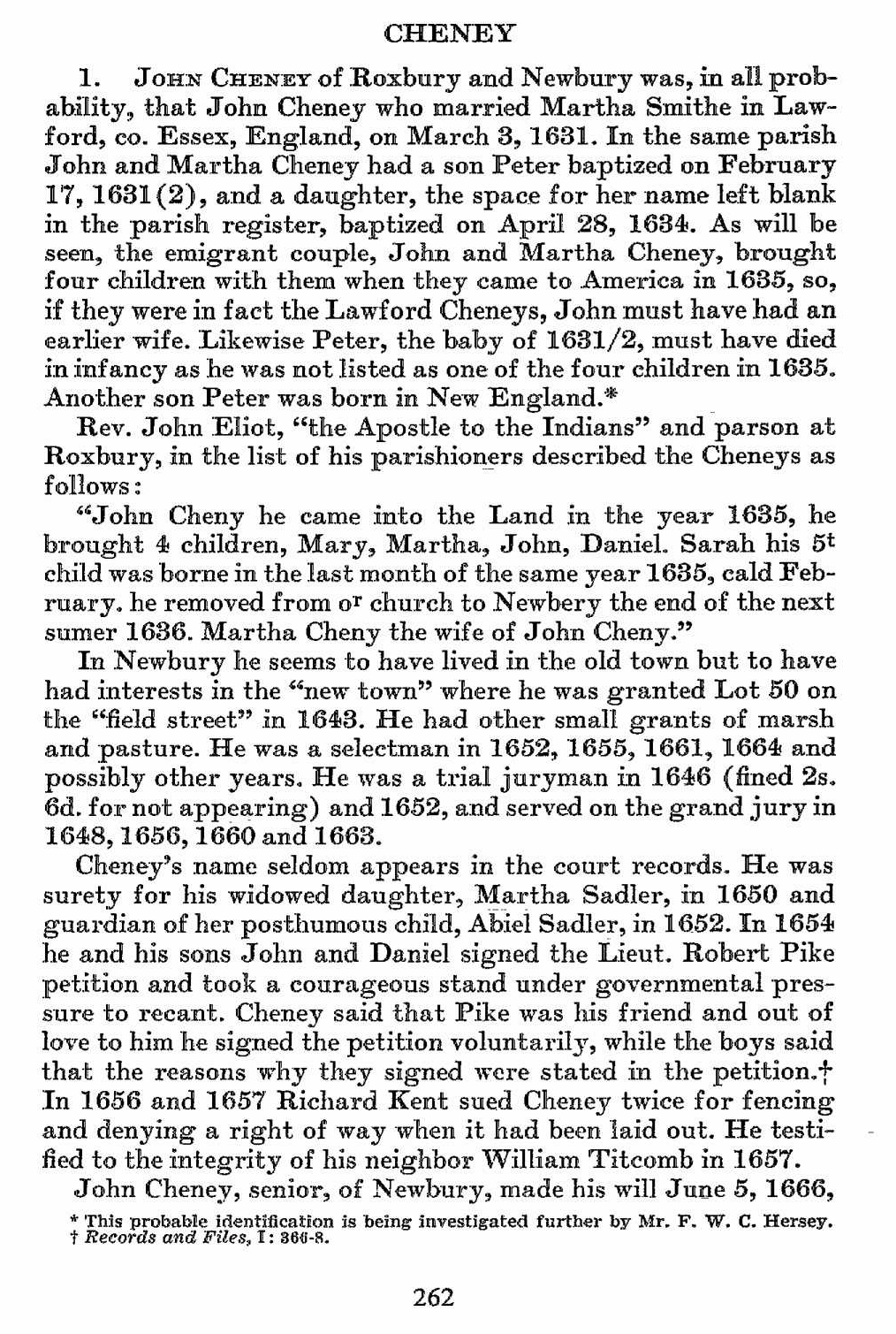
John Cheney was born 30 Jun 1605 in Roxburgh, Scotland.  His family are English coming from Yorkshire and Lincolnshire, so maybe they were visiting Scotland. His parents were John CHENEY Sr. and Elizabeth [__?__].  He married Martha PARRATT on 3 Mar 1630/32 in Lawford, Essex, England.   He emigrated to Roxbury, Mass. in 1635.  John drowned at 28 Jul 1666 in Roxbury, Mass.

Martha Parratt was born about. 1608 in Oxford, Oxfordshire, England.  Martha died 1684 in Newbury, Mass.

Children of John and Martha:

Name Born Married Departed
1. Mary Cheney Jul 1627
Lincolnshire England
William Lawes
3 Sep 1645
Newbury, Mass
30 Mar 1668
Rowley, Mass.
2. Martha Cheney c. 1629 England Anthony Sadlerca
1650
Newbury, Mass
.
Thomas Berkby
14 Jun 1653 in Mass
24 Jan 1658
3. John Cheney c. 1631 England Mary Plummer
20 Apr 1660
Newbury, Mass
7 Jan 1670/71
Newbury
4. Daniel Cheney c. 1633 England Sarah Bailey
8 Oct 1665
Newburyport, Mass.
10 Sep 1694
Newbury
5. Sarah Cheney Feb 1635/36
Roxbury, Mass.
Joseph Plummer
23 Dec 1652 Newbury
26 May 1676
Newbury
6. Peter Cheney c. 1638 Newbury Hannah Noyes
c. 1638
Newbury
Jan 1693/94 Newbury
7. Lydia Cheney 1640 Newbury John Kendrick (Kenrick)
12 Nov 1657 Newbury
1708 Rowley
8. Hannah Cheney 16 Nov 1642
Newbury
Richard Smith
16 Nov 1659 Newbury
9 May 1722
Ipswich, Essex, Mass
9. Nathaniel Cheney 12 Jan 1643/44 Newbury Bachler 4 Apr 1684 Newbury, Mass
10. Elizabeth CHENEY 12 Jan 1646/47
Newbury, Mass
Stephen CROSS
1665
Ipswich
1714
Newbury, Mass.

Cheney is derived from the French word chene, meaning oak, and it came into use originally in Normandy or England to signify the residence, probably, of the progenitor. It belongs to the same class of surnames as Wood, Lake, etc.

John was a shoemaker.

1635 – Rev. John Eliot, was the noble man who earned the title “Apostle to the Indians.” His first parish was Roxbury; and in his record of the church he gives the following report about a couple who were associated with him in fellowship for a short time.

“John Cheny he came into the Land in the yeare 1635. be brought 4 children, Mary, Martha, John, Daniel. Sarah his 5th child was borne in the last month of the same year 1635, cald February. he removed from or church to Newbery the end of the next year 1636. Martha Cheny the wife of John Cheny.”

There is no record of John Cheny’s buying property or having land assigned to him in Roxbury. A natural question rises, where did he live during that year? One explanation is that he may have had a temporary home with that pioneer who bore the same surname, William Cheney.   If John and William were near relatives,–father and son or brothers,– the Roxbury man would gladly share all his “housings and lands” with the other; or, if the one was lodged in the other’s home, we may infer that they were closely related. . The name John is repeated in both families down to the present day; the name, William, was of rare occurrence in the line of John for several generations.

John Cheney’s name is included on the Newbury Settlers Monument

1636 – Settled at Newbury.  The Newbury Plantation was in its infancy when John and Martha Cheney entered into it. An excellent group of people were at the fore, moulding its social and ecclesiastical shape after the most approved methods of the (then) new way. Regulations and agreements, conveniences and schemes, worship and study, business, morals and religion, — they gave to all the best dictates of “established” English thought, quickened and improved by those fresh Bible studies and free Christian practices which characterized the Puritan movement. Newbury had certain erratic and dissonant elements, which engraved some unworthy lines on its record; but it was, on the whole, a very upright, manly set of people who wrought and fellowshipped there. And this Cheney family took good rank from the first in that community of intelligent, earnest people. They intermarried with the leading households, and were respected and beloved at large. As Rev. John Eliot shows, they were members of the Roxbury church and were received at once to the communion of the Newbury church on arriving there; and their children joined in the same fellowship in due time. Mr. Cheney took no part in the conflicts of citizens about local organization, and his name does not appear on either of the partisan and factious petitions.

17 May 1637 – Admitted Freeman.  John Cheney, senior, we learn from the historian, Coffin, took great interest in Governor Winthrop’s campaign for the governorship against Sir Harry Vane, as the close of the latter’s term drew near. So Mr. Cheney, with nine others including  Thomas COLEMAN, Henry Sewall Jr, Nicholas Noyes [son-in-law of Capt. John CUTTING and Cheney’s future father-in-law], Robert Pike [future founder of Nantucket, liberal dissenter, witch trial critic and son-in-law of Joseph MOYCE], Archelaus Woodman [Edward WOODMAN‘s half-brother], Thomas Smith, James BROWNE, Nicholas Holt [future son-in-law of Humphrey BRADSTREET, and John Bartlett, walked forty miles from Newbury to Cambridge to take the “freeman’s oath” and qualify themselves to vote in the election which was soon to take place.  The other eight were  It was by such prompt movements that Winthrop was elected and the conservative party triumphed.

Vane lost his position to the elder John Winthrop  in the 1637 election.  The contentious election was marked by a sharp disagreement over the treatment of John Wheelwright, a supporter of Anne Hutchinson [daughter of our ancestor Francis MARBURY  (1555–1611) (wikipedia)] Winthrop won in part because the location of the vote was moved to Cambridge, reducing the power of Vane’s Boston support.  In the aftermath of the election Anne Hutchinson was put on trial, and eventually banished from the colony.

Many of her followers seriously considered leaving after the election. At the urging of  Roger Williams, some of these people, including Hutchinson, founded the settlement of Portsmouth on Aquidneck Island in the Narragansett Bay (later named Rhode Island and joined to Providence to form the Colony of Rhode Island and Providence Plantations).

Vane decided to return to England, apparently with the notion that he would acquire a royal governorship to trump the colonial administration.  Before his departure, he published A Brief Answer to a Certain Declaration, a response to Winthrop’s defense of the Act of Exclusion; this act was passed after the election to restrict the immigration of people with views not conforming to the colony’s religious orthodoxy.

21 Apr 1638 – John was very industrious in attention to his own affairs, so that he failed to show his face among the citizens at the annual town meeting a judgment condemned him with other absentees and voted that he should pay a fine of two shillings and sixpence, which the constable was ordered to collect before the next Tuesday night.   But the record states later that his fine was “remitted on account of his having a sufficient excuse”

John’s allotments of land were large. He had a good stand in the “old town” and on shore and stream elsewhere.

19 Jun 1638 – John had 3 acres of meadow at the westerly end of the great swamp behind the great hill.

25 Aug 1638 – Six acres of salt “marish.” “A parcel of marsh with little islands of upland in it”, about 20 acres in all.

5 Jul 1639 – “Little River on the northwest; formerly part of the calf common”, was assigned to him.

10 Jan 1643 – Lot No. 50 in the “New Towne”, “on the ffield street” was granted him.

The following extract from the town records gives us some data for a plan of the new town of Newbury.

“January 11th, 1643/44. Itt is hereby ordered and determined by the orderers of the towne affaires that the plan of the new towne is and shall be laid out by the lott layers as the house lotts were determined by their choice, beginning from the farthermost house lott in the South streete thence running through the Pine swampe, thence up the High streete numbering the lotts in the East streete to John Bartlett’s lott, the twenty-ninth, then through the west side of the High streete to Mr. Lowell’s, the twenty-eighth, and so to the end of that streete, then …… the Field streete to Mr. Woodman’s, the forty-first, thence to the end of that streete to John Cheney’s, the fiftieth, then turning to the first cross streete to John Emery’s, the fifty-first, thence coming up from the river side on the east side of the same streete to the other streete, the west side to Daniel Pierce’s, the fifty-seventh, and so to the river side the side the streete to Mr. Clarke and others to Francis Plumer, the sixty-sixth, as hereinunder by names and figures appeare.”

27 Apr 1648 – Member of the Grand Jury

1652 – John Cheney was elected to the board of selectmen more than once. The following document, on file at Salem, would naturally lead us to think he had been on the board before 1652, or at the time when Mr. Kent gave up his lot; the paper is wholly in his hand, except the clerk’s note.

“Ther being Certain loots Resigned unto the townes hand by way of Exchang for lands elsewhear. amongst the which Richard Kent’s lot 10 acres in contente was one, the which lot Richard Kent resigned, on the same Condicions the latter end of the order specifies to my best knowledg this I Testifie

Sworne in the court at Ipswich the 28th of (7) 1652.

Robert Lord cleric.”

29 Nov 1654 – John  was a member of a committee to “lay out the way to the neck and through the neck to the marshes on the east side of the old Towne”

Mar 1657 – Some charges were brought in the Ipswich Court against a very worthy citizen of Newbury; and John signed his name, with nineteen others, to a petition, addressed to the Court, protesting that, having had long acquaintance with the accused, they felt certain he was innocent.

A number of residents of Dover, Newbury, etc. petitioned the General Court of Massachusetts Bay for a grant of land at Pennacook (now Concord, N. H.) which was granted May 18, 1659. ” John Cheney is one of the names, but the signature differs from the accredited autographs of John Cheney, Senior. It may have been put down on verbal permission by some misspelling friend, or forged; or the good man may, possibly, have varied his own spelling. Nothing was done about a settlement at Concord until after our man had gone to “a better country.”

1661 and 1664 – The town records show that he was one of the selectmen

Children

1. Mary Cheney

Mary’s husband William Lawes was born 1620 in England. His parents were William Lawes and Lewys Wale. William died 3 Mar 1668 in Rowley, Essex, Mass.

2. Martha Cheney

Martha’s first husband Anthony Sadler was born 1629 in England. Anthony died in 1650 in Newbury, Essex, Mass, a little before the birth of a boy. Mr. Cheney was appointed guardian of the child 5 Oct 1652, and remembered him in his will.

Martha’s second husband Thomas Berkby was born 3 Sep 1639 in Rowley, Essex, Mass. His parents were Thomas Burpee (Burkby) and [_?__]. After Martha died, he married 15 Apr 1659 in Rowley, Essex, Mass. to Sarah Kelley (b. 12 Feb 1641 in Newbury – d. 25 Dec 1713 in Rowley). Thomas died 1 Jun 1701 in Rowley, Essex, Mass

3. John Cheney

John’s wife Mary Plummer was born 1634 in Newbury, Essex, Mass. Her parents were Francis Plummer and Ruth Palmer. After John died, she married 29 Apr 1672 in Rowley, Essex, Mass. to David Bennett (b. 1615 in England – d. 4 Feb 1718 in Rowley). Mary died 27 Sep 1682 in Rowley, Essex, Mass

4. Daniel Cheney

Daniel’s wife Sarah Bailey was born 17 Aug 1644 in Newbury, Essex, Mass. Her parents were John Bailey and Eleanor Emery. Sarah died 26 Oct 1714 in Newbury, Essex, Mass

From Phoebe Tilton 1947 by Walter Goodwin Davis 1947

5. Sarah Cheney

Sarah’s husband Joseph Plummer was born 1630 in England. His parents were Francis Plummer and Ruth Palmer. Joseph died 11 Dec 1683 in Newbury, Essex, Mass

6. Peter Cheney

Peter’s wife Hannah Noyes was born 30 Oct 1643 in Newbury, Mass. Her parents were Nicholas Noyes and Mary Cutting. After Peter died, she married 3 Jun 1700 in Newbury, Essex, Mass. to John Atkinson (b. 1636 in Concord, Middlesex, Mass. – d. 1714 in Newbury). Hannah died 5 Jan 1705 in Newbury, Mass.

What was evidently a family group of six, having decided to go to New England, took the Oath of Allegiance – John Woodbridge, George Brown, Nicholas Noyes, and Richard Brown – on March 24, 1633/34, Thomas Parker and James Noyes on March 26, 1634 – and all embarked on the “Mary and John” at Southampton, reaching Nantasket (now Hull) near Boston sometime in May 1634 and removed to Agwam (Ipswich) where they remained during the following winter. The Rev. Parker and friends remained in Ipswich until the following spring when they applied to the General Court for liberty to settle on the Quascacunquen in an area known as Wessacucon. May 6, 1635, the following orders were passed by the General Court:

Wessacucon is allowed by the court to be a plantation & it is refered to Mr. Humfry, Mr. Endicott, Capt. Turner and Capt. Trask or any three of them, to sett out the bounds of Ipswich & Wessacucon or so much thereof as they can & the name of the said plantation in changed & hereafter to be called Neweberry.

Tradition asserts that they landed on the north bank of the river, about one hundred rods below the spot where the bridge now stands, and that Nicholas Noyes was the first person who leaped ashore.

Most of the passengers who came to New England in the ship “Mary & John” were induced to remove to Newbury early in the year 1635. Tradition asserts that they came by water from Ipswich and landed on the north shore of the Quascacunquen (now Parker) river, about two or three hundred rods below the bridge that connects the “Lower Green” with the “Great Neck” and the town of Rowley. A monument marks the spot where the settlers disembarked in May or June, 1635. Tradition states that young Nicholas was the first person to leap ashore when their boat anchored in the Quascacumquen (now the Parker) River. (John J. Currier, “History of Newbury” p.312; Sarah Anna Emery “Reminiscences of a Nonagenarian” p.112) They joined 23 men and their families who formed a cattle-breeding company and were among the first settlers at Newbury where their children were born. Newbury’s first minister was Thomas Parker, a cousin.

Rev. Nicholas Noyes, in his account of his uncle, Rev. James Noyes, told of the coming of Mr. Parker, Mr. Noyes and his younger brother Nicholas Noyes, a single man, adding “between which three was more than ordinary endearment of affection, which was broken but by death.”

Nicholas took the Freeman’s Oath in Cambridge on May 17, 1637 when he and nine others walked from Newbury to Cambridge to vote for Gov. Winthrop. On April 21, 1638, he was one of five men fined 2s. 6d. apiece for absence from Newbury town meeting after due warning. The meeting was called to order at eight o’clock in the morning! Two of the men (not Nicholas) had their fines remitted, having sufficient excuses.

It must have been very soon after this that Noyes sailed on a voyage to England, possibly to settle family affairs and to report on conditions in Massachusetts Bay. He returned to New England on the “Jonathan” which sailed from London, probably soon after April 12, 1639, and “came to Anchor in Boston Harbor.” Also on the “Jonathan” were Anthony Somerby of Newbury and Mr. Peter Noyes of Sudbury, who, having come over on the “Confidence” in 1638, aged 47, and found New England to his liking, had gone back to his home in Penton, near Andover, co. Hants, to fetch his family. Peter was doubtless a kinsman of Nicholas. [Register, 32:411]

When it was proposed to remove the inhabitants of Newbury from their first settlement on the Parker river to a new site nearer the Merrimac, Nicholas Noyes was a freeholder and a deputy “for the managing of those things that concern the ordering of the New Town” on December 7, 1642.

In 1650 Nicholas and four other men were before the court for saying that “the elders would transgress for a morsel of bread.” He lost no prestige thereby for on September 30, 1651, at Ipswich he was sworn clerk of the Newbury market. In 1652 many were brought before the court for not observing the Sumptuary laws of 1651. The records say “Nicholas Noyes’ wife, Hugh March’s wife, and William Chandler’s wife were each presented for wearing a silk hood and scarf; but were discharged on proof that their husbands were worth £200 each. John Hutchins’ wife was also discharged upon testifying that she was brought up above the ordinary rank.”

The town voted on November 29, 1652, that a school house be built and that £20 a year be appropriated for the schoolmaster, and Mr. Woodman, Richard Kent, jun., Lieut. Pike and Nicholas Noyes were named the committee to carry it out.

Thomas Noyes of Sudbury, son of Peter Noyes, had apparently settled in Newbury, but returned to live in Sudbury before 1656 when he appointed his friend Mr. Nicholas Noyes, gentleman, and Robert Long, both of Newbury, his attorneys to let his house and lands.

Nicholas was appointed Commissioner to End Small Causes, or local justice, in 1657 and 1658. His most important service, however, was as deputy to the General Court in 1660 and in 1678 when on September 19 he was chosen by the town “to serve at the next session of the Court until it be ended,” a special session having been called for October 2 at which the oath of allegiance to King Charles II was submitted and signed by the deputies; he served also 28 May 1679, 19 May 1680, and 4 Jan 1680-84.

In the long and bitter controversy between Rev. Mr. Parker and Edward Woodman, Nicholas was one of Parker’s chief supporters. He was chosen deacon of the First Parish of Newbury on March 20, 1683/4.

Sometime before his death his son Nicholas, the Salem parson, wrote of him as “through the mercy of God yet living, and hath of children, grandchildren and great grandchildren above one hundred.”

7 Mar 1670 + ‘ Peter Cheney proposed to the town for half an acre of land on or about the little hill this side the mill, to build a wind mill upon to grind corn for the town, when the water mill fails.’ This was granted by the town, ‘ upon condition that he do build a good mill to answer the end proposed for and so long as the mill is made and maintained for the said service and no longer.’

This mill stood on the ‘ little hill,’ near the mill bridge, or ‘ four rock,’ as it is sometimes called, and remained there till Mr. Cheney removed to Byfield, in the year 1687.

7. Lydia Cheney

Lydia’s husband John Kendrick (Kenrick) was born 1640 in Ipswich, Essex, Mass. His parents were John Kendrick and Anne Smith. John died Apr 1716 in Ipswich, Essex, Mass.

8. Hannah Cheney

Hannah’s husband Richard Smith was born 1629 in England. His parents were Richard Smith and Joanna Porridge. Hannah died 24 Sep 1714 in Ipswich, Essex, Mass.

9. Nathaniel Cheney

He does not appear to have married.Before his death, which occurred April 4, 1684, he made a will, in which he bequeathed one third of his estate (including what was yet to fall to him from his father’s estate). He gave it to his brother Peter and his sisters, Lydia Kenrick and Elizabeth Cross; but devised a few things to others. His great Bible, after the death of his mother, was to go to his sister Elizabeth, or, in the event of her death, to her son Daniel Smith; his “skillet” to Sarah, eldest daughter of his brother Daniel, or to “his cousin,” her sister Hannah; he requested his friends and brothers in the Lord, George Little and Cutting Noyes, to act as executors. In his inventory we note “a parcel of meadow at haverhill” appraised at œ25, which shows how he had been looking westward. The records of Suffield in the Connecticut valley show that he had travelled much further, for he had lands assigned him there Dec. 1, 1680. He deeded this to his nephew John, son of Peter, April 1, 1684, just before making his will. His name occurs in the list of the members of the First Baptist church of Newbury, in 1681. George Little, one of those he asked to attend to his estate, was a “brother” in that particular church. .

10. Elizabeth CHENEY (See Stephen CROSS‘s page)

Sources:

From Phoebe Tilton 1947 by Walter Goodwin Davis 1947

x

John Cheney 1 Source: Ancestry of Charles Stinson Pillsbury and John Sargent Pillsbury (1938)

John Cheney 2

John Cheney 3

John Cheney 4

http://www.genealogyofnewengland.com/b_c.htm

http://www.tudorplace.com.ar/CHENEY.htm

http://familytreemaker.genealogy.com/users/d/o/b/Michael-E-Dobson/BOOK-0001/0004-0087.html

http://www.rpi.edu/~holmes/Hobbies/Genealogy/ps21/ps21_189.htm

Ancestry of Charles Stinson Pillsbury and John Sargent Pillsbury (1938) By Holman, Mary Lovering, 1868-1947; Pillsbury, Helen Pendleton Winston, 1878-1957

http://trees.ancestry.com/owt/person.aspx?pid=2822367

A sketch of the history of Newbury, Newburyport, and West Newbury, from 1635 to 1845 (1845) By Coffin, Joshua, 1792-1864; Bartlett, Joseph, 1686-1754

Posted in 12th Generation, Historical Monument, Immigrant - England, Immigrant Coat of Arms, Line - Shaw, Pioneer, Public Office | Tagged | 18 Comments

Joshua Cromwell

Joshua CROMWELL (1665 – Before 1752) was Alex’s  8th Great Grandfather, one of 512 in this generation of the Shaw line.

Joshua Cromwell was born about 1665 in Dover, Strafford, New Hampshire.  His parents were Capt. Philip CROMWELL and Elizabeth TUTTLE.  He married Lydia  [__?__] about 1699 in Dover.  Joshua died before 1752 in Dover NH.

Alternatively, Joshua’s  mother was his father’s second wife Elizabeth Leighton.

Lydia [__?__]  was born about 1669 in Strafford NH.  She is named in deeds from 1709 to 1743.  Lydia was still alive on 19 Jan 1743/44 when she deeds with her husband. Both Lydia and Joshua are dead by 1752 when their children exchange deeds for their land .

Children of Joshua and Lydia:

Name Born Married Departed
1. John Cromwell ~ 1700
Dover, NH
Mary Ridley
26 Dec 1720 Dover, NH
.
Lydia [_?_]
11 May 1776
Dover, NH – Same day as his wife
2. Joshua Cromwell 1704
Dover, NH
Elizabeth
Larrabee
1724
.
Grace (Hodgkins) Tarr
10 Nov 1726
Gloucester, Essex, Maine
3. Joseph Cromwell Abigail [_?_]
4. Samuel Cromwell 1703 Betty Pinkham
4 Dec 1727
Dover, Strafford County, New Hampshire
After 1752
5. Caleb Cromwell [__?__] After 1752
6. Elizabeth Cromwell Thomas Waitt
7. Lydia CROMWELL 1710
Wesport
Maine
.
baptized
31 Oct 1736
South Berwick, Maine
Noah CROSS
c. 1736
before 1767

25 Mar 1673 – Joshua received a bequest in his grandfather Giles’ will

I Giue unto my son Phillip Cromwells Eldest son [Joshua Cromwell] that shall live and Arive unto the Age of one and twenty yeares six Acres of marsh Lying in the Bounds of Newbury called Pine Iland marsh being six Acres of the twelve acres Adjoyning to the marsh of steven Grenleife

1693 – Joshua received a town grant

28 Dec 1697 to 11 Mar 1698 – Joshua is a member of the New Hampshire Assembly

1709 – Joshua, living in Dover,  sold the marsh willed by his grandfather, Giles Cromwell.

21 Aug 1723 – Sold 12 acres to Dr. Jonathan Crosby at Dover Neck.

Children

3 Apr 1752 – Joshua’s seven children conveyed his homestead estate of 15 acres on Back River in Dover NH to Moses Varney.   Varney Brook in Dover was originally Cromwell’s Creek. (See Google Map Satellite View)

2. John Cromwell

John’s first wife Mary Ridley was born 1700 in Dover, New Hampshire. Her parents were Thomas Riddley (1672 – 1754) and [__?__]. Mary died in 1776 in Dover, Strafford, New Hampshire.

John’s second wife Lydia [_?_]

John is a riddle. There is a marriage record for John Cromwell and Mary Ridley on 26 Dec 1720 at Dover, N.H. Yet Mary never appears thereafter.  If Mary existed she died before 23 May 1735 when John, a tinker, deeds land with his wife Lydia

John married at Dover on 26 December 1720, Mary RIDLEY, of unknown parentage.  There is no Ridley family in Dover, or for that matter, in early New  Hampshire.  There is one Ridley family in all of New England, which starts on Cape Cod and eventually moves to Maine.  If Mary was a part of this family, her place in it has not yet been found.  There is also some doubt as to the validity of the transcription of the marriage record.  Outside of this record Mary never appears.  By 23 May 1735 his wife’s name is Lydia [NHPD 25:140].  Whether Mary died between 1720 and 1735 is not known.

John was a tinker. On 3 April 1752 in two deeds, John quitclaims his “father Joshua Cromwell’s land.”.  John was not a religious man.  John and Lydia may have died the same day at Dover on 11 May 1776 [Dover VRs, p. 189, which notes John Cromwell and his wife.]  However, in his diary, Master Tate notes “Mr. John Cromwell of Dover Dyed on Saturday May ye 11th 1776 & Lydia his wife dy’d on Monday, May 13, 1776.  Both Buried in One Grave.

It appears that he had only three children who lived to adulthood.  On 26 March 1794, Abner and Keziah Coffin deeded to the Widow Sarah Chaddock (i.e. Chadwick), land in Dover that belonged to John Cromwell, deceased. [Strafford Co. Deeds 17:326].  One of the witnesses to the deed was Philip Cromwell.

Children of John and Lydia:

i. Keziah  Cromwell b.~ 1740; m. ~ 1760, Abner5 Coffin (b.  25 April 1738 at Exeter, N.H. – d, 21 Feb 1811 at Freeport, Maine .  His parents were Abner4 (Stephen3Tristram2-1) and Mary Rawlings.  Keziah died after 26 March 1794 when she deeds land and likely before 1800 when Abner is enumerated alone in the 1800 census at Freeport, Maine.  He was a blacksmith.  Four known children: Rebecca, Anna, Stephen, and Mary.

ii. Sarah Cromwell b. ~ 1745; d. aft, 26 Mar 1794  Dover,  NH; . m.  14 May 1778, Dover, NH to Jacob Chadwick.  Very likely the parents of William Chadwick of Somersworth, with whom Sarah seems to be living in both the 1790 and 1800 censuses.

iii. Benjamin Cromwll b. ~ 1747; d. bef. 10 Feb 1772 Dover, NH when administration on his estate was granted to his father John Cromwell, of Dover, yeoman. [Rockingham Co. Probate #3908]  Sureties on the estate were Philip Cromwell and William Young, both of Dover.  Benjamin was a mariner.

2. Joshua Cromwell

Joshua’s first wife Elizabeth Larrabee was born 1698 in Falmouth, Cumberland, Maine. Her parents were Benjamin Larrabee and Deborah Ingersoll. Elizabeth died during the birth of her only child Elizabeth on 13 Apr 1725.

Joshua’s second wife Grace (Hodgkins) Tarr was born 28 Jul 1702 in Ipswich, Essex, Mass. Her parents were Christopher Hodgkins and Tabitha Howard (Hayword). Her grandmother was Haselelpony (Willix) Gee-Wood. She first married Richard Tarr (b. 29 Sep 1695 in Gloucester, Essex, Mass. – d. 22 Jun 1724) and had two children Hazel Tarr (b. 1722) and William Tarr (b. 1724) Grace died in 1737 in Maine.

Joshua was of Falmouth, Maine in 1752. He signed  a petition from Kennebunk in 1760. He m. (i) in Falmouth, Elizabeth, who died 13 April 1725, leaving a daughter Elizabeth, b. 13 April 1725. He m. (2) Grace and had dau. Lydia, b. in Falmouth 19 May 1728.

Child of Joshua and Elizabeth:

i. Elizabeth Cromwell b. 13 Apr 1725

Child of Joshua and Grace:

ii. Lydia Cromwell b. 19 May 1728 in Falmouth, Cumberland, Maine; m. 10 Jun 1767 — Age: 39 to Jonathan Strout

3. Joseph Cromwell

Joseph’s wife Abigail’s origins are not known.

4. Samuel Cromwell

It’s possible that this Samuel was Joshua’s nephew, the son of Joshua’s brother Samuel.

Samuel’s wife Betty Pinkham was born about 1705. Her parents were Richard Pinkham and Elizabeth Leighton. Betty died before 1752.

Betty’s father Richard Pinkham was born about 1675 in Dover, New Hampshire. Richard died aft 1758; he was 83. He was a Housewright/Carpenter. His parents were John Pinkham and Martha Otis. He was the Richard Pinkham who had lot 55 of the second division of Rochester,New Hamphshire part of which he deeds to sons Tristram and Richard (Jr.)

Samuel’s grandfather Philip CROMWELL  and Elizabeth “my present wife,” 6 Oct. 1699, sold land to Richard Pinkham.

Child of Samuel and Betty:

i. Mercy Cromwell b. ~ 1735; d. ~ 1796 in Friendship, Lincoln, Maine; m. Samuel Lawry (1730 – 1795) at least one child Benjamin Lawry (1764 – 1839)

5. Caleb Cromwell

Caleb signed a document in Falmouth in 1752,

Child of Caleb and [__?__]

i. child bapt. 1740.

6. Elizabeth Cromwell

Elizabeth’s husband Thomas Waitt

7. Lydia CROMWELL (See Noah CROSS‘s page)

Sources:

http://mhollick.typepad.com/slovakyankee/2009/04/madness-monday-lydia-do-you-know-lydia.html

http://genforum.genealogy.com/cromwell/messages/230.html

http://familytreemaker.genealogy.com/users/m/y/e/Ron-C-Myers/GENE30-0169.html
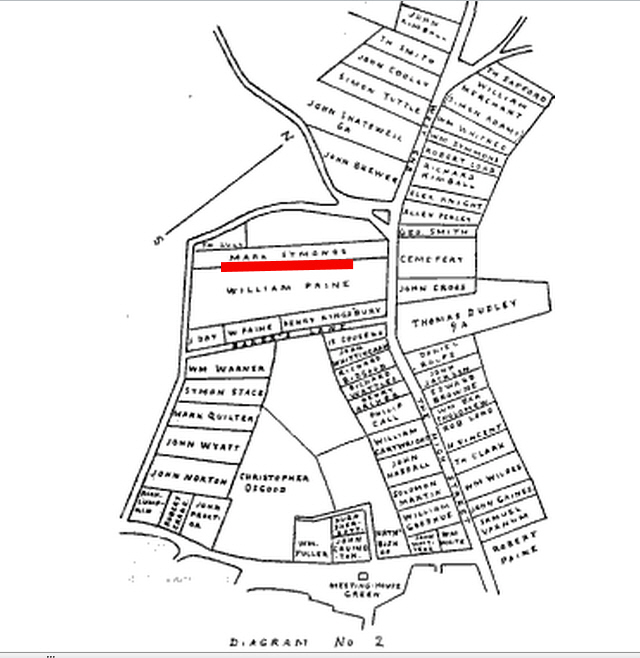
Landmarks in Ancient Dover, New Hampshire By Mary P. Thompson

http://freepages.genealogy.rootsweb.ancestry.com/~hwbradley/findex15.htm#CROMWELL

http://freepages.genealogy.rootsweb.ancestry.com/~lougene/p55.htm#i10043

http://mhollick.typepad.com/slovakyankee/2010/03/john-cromwell-17001776-of-dover-nh.html

History of the Town of Durnham, New Hampshire (Oyster River Plantation) with genealogical notes (Volume 2)

Posted in 10th Generation, Line - Shaw, Missing Parents, Place Names, Public Office | Tagged | 3 Comments