William Barnes

William BARNES (1613 – 1697) was Alex’s 10th Great Grandfather, one of 2,048 in this generation of the Shaw line.

Immigrant Ancestor

William Barnes was born in 1613 in England. His parents were Thomas BARNES and Mary ANDREWS.
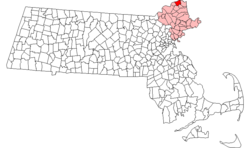
William was one of the first settlers of Amesbury, Essex, Mass

He married Rachel [LORD] in 1637 in Amesbury, Essex, Mass. William died 14 Mar 1697 in Salisbury, Essex, Mass.
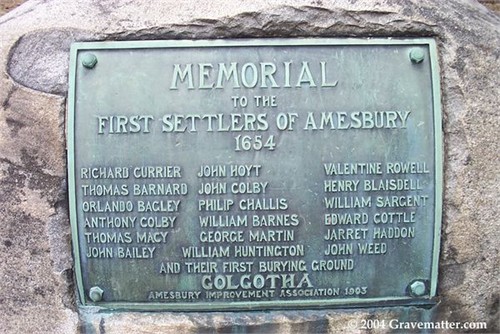
William Barnes – Amesbury Memorial

Over half the first settlers names on this memorial are our ancestors.  They are: Richard Currier, Orlando BAGLEY Sr., John Bailey, William BARNES, Thomas Barnard, Henry Blaisdell, Philip Challis, Anthony COLBY,  John COLBY, Edward Cottle, Jarret Haddon, John HOYT, William Huntington, Thomas Macy, George MARTIN, Valentine Rowell, William SARGENT and John Weed.

Rachel [Lord] was born about 1617 in England. Her parents may have been Anthony LORD and Katherine THOMPSON.   Rachel’s identify isn’t known for sure, early genealogists didn’t include a family name.  Others say her maiden name is Lord because her mother was named Grace Lord from a previous marriage or that  she is Rachel Fitts, sister to Robert Fitts.   Rachel died 9 Feb 1686 in Salisbury, Essex, Mass.

Children of William and Rachel:

Name Born Married Departed
1. William Barnes 1638 Salisbury, Essex, Mass 11 Jun 1648
Salisbury
2. Mary Barnes 25 Jan 1643 Salisbury, John Hoyt
(Son of John HOYT)
23 Jun 1659 Salisbury
13 Aug 1696
Amesbury
3. Hannah BARNES 25 Jan 1644 Salisbury John PROWSE
2 Oct 1665 Salisbury, Essex, Mass.
27 May 1688 Amesbury, Essex, Mass.
4. Deborah Barnes
1 Apr 1646 Salisbury, Samuel Davis (son of our ancestor James DAVIS)
17 Dec 1663 Haverhill
14 Jan 1719
Haverhill, Mass
5. Jonathan Barnes 1 Apr 1648 Salisbury 1649
Salisbury
6. Rachel Barnes 30 Apr 1649 Salisbury Lt. Thomas Sargent
(Son of William SARGENT)
2 Mar 1668 Salisbury
7 Feb 1718
Amesbury
7. Sarah Barnes 7 Apr 1651 Amesbury, Essex, Mass Thomas Rowell
8 Sep 1670 Salisbury
.
John Harvey
1685 Amesbury
17 Apr 1720
Salisbury
8. Rebecca Barnes 1654 Amesbury, Essex, Mass Moses Morrill
1676
Salisbury
3 Apr 1727
Amesbury

William was a house carpenter.

OLD FAMILIES OF SALISBURY AND AMESBURY, MA by David Hoyt 1897- he was a house carpenter of Salisbury and Amesbury; free 1641
From the “Holt Haight Book” by David HOYT (1871):

William Barnes was one of the original settlers of Salisbury, Mass.  At the first division of land, he received a house lot and a planting lot of four acres. In Jan., 1640-41, he received the “Rockie Island” in the meadow, and other grants.  On the list of freemen contained in the Mass.. Records, under date of June 2, 1641, we find the name of William Barnes, in connection with two or three other Salisbury names. He was one of those who removed to the west side of the Powow River , and settled that part of the town afterwards called Amesbury. On the Amesbury records he is frequently mentioned as constable, moderator, &c. His name also occurs several times on the Old Norfolk records, as juror, one of the “commission” to end small causes” in Amesbury, &c. His grants of land in the new town correspond very nearly ID member and amount with those of John HOYT . His trade was that of a house carpenter. Wife Rachel died Feb. 9, 1685-6. He died March 14, 1697-8. Will dated April 7, 1696, proved Sep. 28, 1698. His homestead was bequeathed to his daughter, Rebecca Morrill.

Savage

WILLIAM, Salisbury 1610, freem. 2 June 1641, by w. Rachel had
Mary, wh. m. 23 June 1659, sec. John Hoyt;
William, wh. d. 11 June 1648;
Hannah, b. 25 Jan. 1644;
Deborah, 1 Apr. 1646;
Jonathan, 1 Apr. 1648;
Rachel, 30 Apr. 1649, wh. m. 2 Mar. 1668 or 9 (both dates being giv.), Thomas Sargent; Sarah, wh. m. 8 Sept. 1670, Thomas Rowell, and next, 26 Oct. 1676, John, or more prob. Thomas Harvey, as the Amesbury rec. gives the name; and Rebecca, wh. m. Moses Morrill.

Deborah m. 19 Dec. 1663, Samuel Davis. He was one of the first settlers of Amesbury a. 1654. It has been thought that he is the man in the list of passengers by the Globe from London for Virginia, 1635, and the names of William Brown, and Richard Wells in the same list are seen, both, also, found at Salisbury. But those surnames are so frequent on both sides of the ocean, that the argument must not be pressed too far. Some persons might, at that time, think it easy to go from one part of America to another; but most of those for Virginia were not puritans, and all wh. would come to New England especially from London, easily gained direct, instead of circuitous passage. Of this name, includ. those spelt without e, Farmer, in 1834, count. seven gr. at Yale, five at Harv. and five at other N. E. coll.

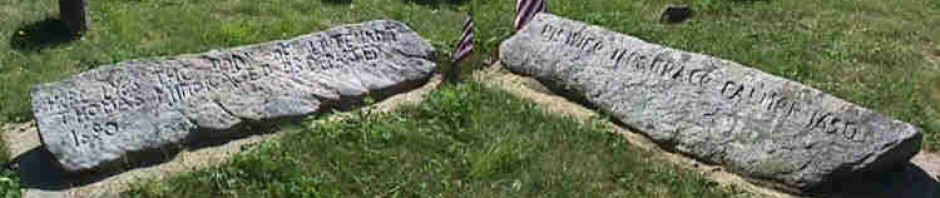
Golgotha Memorial - meaning burial ground

Golgotha Memorial – n 1903, a memorial was erected by the Amesbury Improvement Association, to mark the site of Amesbury’s first burying ground. They called the site Golgotha meaning, “a place of great suffering”
The gravestones in this first burying ground have long since disappeared,

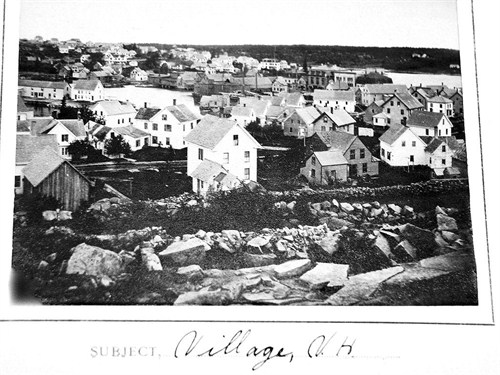
Settled in 1642, Amesbury was first recognized as “Salisbury New Town” in 1666 when it formally separated from Salisbury. It was incorporated as “Amesbury” in 1668, after Amesbury in Wiltshire, England.

Originally the boundary between Amesbury and Salisbury was the Powwow River. In 1876 Merrimac was created out of West Amesbury. In 1886 West Salisbury was annexed to Amesbury so the mill area on the Powwow River was unified. See the maps linked below.

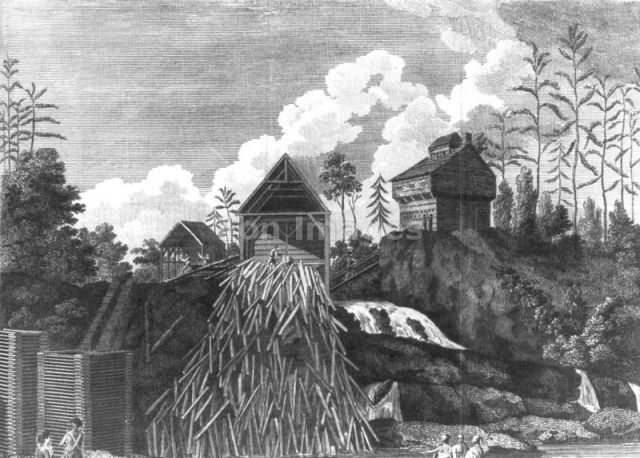
Beginning as a modest farming community, it would develop an aggressive maritime and industrial economy. The 90 foot drop in the falls of the Powwow River provided water power for sawmills and gristmills. Shipbuilding,shipping and fishing were also important. The ferry across the Merrimack River to Newburyport was a lively business until the construction of bridges to Deer Island.

William BARNES, Anthony COLBY, William Osgood, Philip Challis and Samuel Worcester jointly owned a saw mill near Powwow River Falls, Amesbury

4 Nov 1658 – whereas there is a saw mill in possession of Wm Osgood, Phil Challis, William BARNES, Anthony COLBY and Samuel Worcester, co-partners with said Colby in one-fourth part of the mill in Salisbury upon Pawwaws river near the corn mill, they should keep it in good working order, and agreed to make good to Wm Osgood the grant of the town; the timber to be equally divided among them and each partner to have the privilege of using the mill for sawing his own timber into boards or planks to be used only on the land where said Osgood now dwells for building or repairing, provided they bring the timber to the mill already cut; if any one of them makes a new way to any parcel of timber, the others were to pay part of the cost if they used said way; if any one of them cleared the river for floating down logs to the saw mill, the others should bear part of the charge if they used the river for this purpose, etc; each partner was to be allowed 3s per day for what time he gave to repairs on the mill, if he be a good workman, and 4s per day for making the head block and 3s per day for a hinder head block and 2s 6d for a wallower or sweep; each partner was to provide saws for himself and the saws now at the mill to be equally divided, except those for oak; each partner was to take the mill to run for a week and so in order through the year, William Osgood beginning, followed by Colby, Worcester, Barnes and Challis in order; each was to lay his boards and logs at the mill where they had formerly. Witnesses: Thomas Bradbury, Humphrey Verney, Rodger Easman and Jno HOYT.

Children

2. Mary Barnes

Mary’s husband John Hoyt was born 1638 in Salisbury, Mass. His parents were  John HOYT and Frances TEWKSBURY.  John died 13 Aug 1696 in Andover, Mass

He received, land in A. 1658-66 ; ” children’s land ” and taxed 1659 ; ” townsman ” 1660 ; oath fid. and meeting-house seat 1667 ; oath al. Dec, 1677 ; kept “ordinary ” for A. 1667-9.
He was member ” training band,” 1680 ; killed by Indians in Andover, on the road to Haverhill, Aug. 13, 1696 ; adm. est. Aug. 9, 1697 ; wid. Mary liv. 1704. Children :

1663 – A Jno Hoyt of Salisbury tooke ye freemans Oath before this present Court, Salisbury,

Oct 1658 – He received his first lot of land (“on the river”) in Amesbury, and was admitted as a “townsman”, Dec 10, 1660. Among other lots which he received were one in “Lion’s Mouth,” 26 Feb 1661 and a lot of 120 acres, April, 1662. One of his earliest purchases consisted of five acres of upland at the “southermost end of Tom: Whitchers hill,” bought of Edward Cottell in 1660. It is difficult to dertermine the location of his homestead.

1689 – Johns Hoyt deeds to his son, Joseph, a dwelling-honse, pasture, &c., formerly his father’s, John, on condition that Joseph pay annually to his grandmother, Widow Frances Hoyt, the same sum that Johns was obliged to pay. The land is described as ” Lying in betwixt ye lands of Wm. Barnes and Will. Osgood Soar. on or towards ye north and northeast, and ye lands of Elenor Little and John Barnard southward, abutting upon the Powow river Eastward and toward ye Southeast, adjacent upon both ye west and East Sides of ye Country rode yt leadeth from Amsbury ferry to Salisbury.”

A drift-way from the road to this lot, an easterly direction, was 80 rods in length; hence the homestead was a little more than half of a mile west of the Powow River

John Hoyt’s father John was on the grand jury in 1667, and a John Hoyt,probably the same one, was also one of the grand jury in 1663.

1667 – On the records of the Salisbury Court, 9, 2m 1667, we find the three following entries: “Jn_ Hoyt Jvn: tooke ye oath of fidelitie: att ye prsent Court.” “Jn_ Hovt jvn: vpon ye request & choyce of ye Newtowne is admited by this prsent Court to keep ye Ordinary at ye New town of Salisbury, & to sell wine ~ strong waters for ye ye are ensuing.”

Also, “Jno Hoyt jun: is dismiss by this Court from all trainings: vntil such time: as he shalbe cuered of yt infirmity wch cloth att prsent disinable him fro trayning.”

1668 – (Salisbury Court, 14, 2m, 1668) “Jn_ Hoyt jvn’: license is renued to keep ye ordinary at ye new towne: & to pvide entertainmt for horse men ~ foot men: but hath liberty to sell wt wine & strong waters he bath laid in in respect to ye ordinary, and L: (challis is to take notis of wt he hath layd in & to make returne thereof to ye clarke within 14 dayes.”

13, 2m, 1669, he was also licensed “to keep ye ordinary for Amsbury for ye yeare ensuing.” He took “ye oath of Alleiance fidelity” before Major Robert Pike in “Eamsbery,” Dec. 20, 1677. He is also frequently mentioned as a juror, on the Old Norfolk records.

John Hoyt always signed his own name in full, and evidently had a pretty good education for a common man of those times. In old deeds (of which he gave and received a large number), he is sometimes called a ” planter,” and sometimes a “carpenter.” He and his father sold buildings and land to the town for the use of the ministry, soon after Amesbury was incorporated.

9 Jul 1667 – He had a seat assigned him in the meeting house.

His name frequently appears on the Amesbury records as lot-layer, constable, &c. He was chosen a “standing lot-layer,” 12 Mar 1667/68 ; constable, 1674 and ’77-78; to rectify bounds of land, 1680-81; constable in Thomas Stevens’ place, April, 1690; added to committee “to return the bounds of land into the towne book of Records,” March, 1690-1; # chosen “Clarke of ye markets” for the town of Amesbury 1692/93,

But he did not always find these offices either agreeable or profitable, as is abundantly proved by the following petition, preserved in the archives of Massachusetts:

“To the honble their majties Great and Generall Court of the Province of the Massachusetts Bay in New England, now sitting in Boston by ad.journem`, March 6th, 1694/95.

The Petition of John Hoite, one of the late Constables of Amesbury, now a prisons in Salem Gaol,

Humbly Sheweth, that yor Petitionr is now in Prison undr an Execution for the Non. satisfaction of the arrcares of the rates comitted to him to collect whitest he was Constable of Amesbury. That Your Petitiont has Lately mett with great losses, haveing had his house plundered by the Indians, and has been visited with much sickness through the holy afflicting hand of god upon him–besides sundry of the persons from whome many of sd arreares be due are both dead & removed out of ye Towne. Now For asmuch as yor poore petitions by the providence of God is reduced to a necessitous condition, and wholelv uncapacitated, by reason of his confinemt, to doo any thing for himself & family or ye paymt of sd arreares for ye prsent, he therefore humbly entreates the favour of this high & honble Court to Consider the premisses, by being pleased to grant unto him two or three yeares space for paymt thereof; as also for areleasemt from his confinemt.

“And yor petitionr as in duty bound shall Ever pray, &c.
John Hoite.

Voted upon Reading the Petition abovesd that sd Petitioner is granted his Request provided he give security to mr Treasurer to pay sd money within two years into the Treasury. March 8th, 169 4/5 past in the affirrnative by the house of Representatives & sent up to the honorable Lt Governr & Council for consent. Nehemiah Jewet, Speaker.”

All that we know of his imprisonment is what is contained in the foregoing petition. Whether he ever paid the debt himself is uncertain, as he died within two years after his release. He–with a young man named Peters, also of Amesbury–was killed by Indians, in Andover, on the road to Haverhill, hug. 13, 1696. The following is the account of the administration of his estate

“Essex sc. By ye Honble Barth Gedney Esq~ Judge of probate of Wills &c for sd County august 9th 1697.

Administration of all & Singuler the goods Chattls rights and Credits of John Hovt late of Almsbury deed. granted vnto Joseph Hoyt Son of the deed, he having giuen bond with Surety for his administration according to law: the Widow and Eldest Son signifying vnder their hands y’ Renovncing the same, & is with the bond on file.”

“An Inuentory of the Estate of John Hoyt of Almsbury deed. Apprizcd as mony Nouembr 5th 1697 p vs whose names are under written.

mony Nouembr 5th 1697 p vs whose names are under written.

S d Imp’.. a great Iron pot & pot hooks 10s trammell 5 s 15 —0
It. an Iron kettle 7s a pr tongs 2s. wooden turnd. ware 2s 11 –0
It poringer spoones & sizers 1sa saw 3s 2 hamrs 18d 5 ——-6
It 2 shaves 1sa wedge 1s A gun barer & stock 10s. 12 ——–0
It. a snapsack sword & powder home 3s, old Iron 6s 9———0
It. a broken Square &: a pr of Compasses 1s 1 ——0
It. 2 trayes a Cooler a driping pan & a gall pottle 2——-0
It. a bedsteed 6s curtains 6s teed & bedsteed 3pd 3—-12—-0
It. a brass skilet a bet mettle skillet 2s 2——0
It. an old bread dish & tunnel 1s. bible and other books 3s 4—0
It. 3 augers 1 chisel 3s an old ax 1s 6d 4——–6
It. half bz. & another Chisel 4s 3d—frying pan 1′ grid Iron 18d 6——–9
It. a fire slice 18d 2 old chests & 2 old boxes 5 s 6 ——-6
It. a speck gimblit & 2 spiring Wheels 3s 6d 3 —–6

Samll Weed
Ebenezer Blaisdell } Apriz Totall ~ 7ù14ù9

Joseph Hoyt presented the above Inventory, Nov. 10, 1697. Joseph Hoyt also exhibited an account of the administration of John Hoyt’s estate, May 22, 1712. No real estate appears in the above inventory but John’s widow seems to have possessed a homestead after his death

3. Hannah BARNES (See John PROWSE‘s page)

4. Deborah Barnes

Deborah’s husband Samuel Davis was born 26 Nov 1640, Haverhill, Mass. His parents were James DAVIS and Cicely THAYER.  Samuel died 10 Sep 1696 in Haverhill, Mass.

6. Rachel Barnes

Rachel’s husband Lt. Thomas Sargent was born 11 Jun 1643 Salisbury, Essex, Mass. His parents were William SARGENT and Elizabeth PERKINS..  Thomas died 27 Feb 1706 in Amesbury, Mass

Thomas was a farmer and lived on Bear Hill. He took the oath of allegiance and fidelity at Amesbury before Major Robert Pike, December 20, 1677. He held various town offices and as lieutenant of the militia company. He was on of the most prominent men of his day in Amesbury. His will was dated February 8, 1706, and proved at Salem, April 8, 1706. It was signed Thomas Sargent and named his wife, five sons and the four daughters then living.

7. Sarah Barnes

Sarah’s first husband Thomas Rowell was born 7 Sep 1644 in Salisbury, Essex, Mass. His parents were Valentine Rowell and Ann Currier. Thomas died 8 Sep 1670 in Amesbury, Essex, Mass.

Of Amesbury, MA. Received children’s land 1659, township 1660, meeting-house seet 1667, Oath of Allegiance 1677, signed petitions of 1680. Will made 6 May & 30 Sep 1684.

Sarah’s second husband John Harvey was born 5 Feb 1655 in Boston, Suffolk, Mass. His parents were William Harvey and Martha Copp. John died 8 Mar 1706 in Amesbury, Essex, Mass

8. Rebecca Barnes

Rebecca’s husband Moses Morrill was born 28 Dec 1655 in Salisbury, Essex, Mass. His parents were Abraham Morrill and Sarah Clement. Moses died 20 May 1731 in Salisbury, Essex, Mass.

Sources:

William Barnes 1 Source: Ancestry of Charles Stinson Pillsbury and John Sargent Pillsbury (1938)

William Barnes 2

http://trees.ancestry.com/owt/person.aspx?pid=8290430&st=1
http://trees.ancestry.com/owt/person.aspx?pid=8290430&st=1
Ancestry of Charles Stinson Pillsbury and John Sargent Pillsbury (1938) By Holman, Mary Lovering, 1868-1947 and Pillsbury, Helen Pendleton Winston, 1878-1957

http://www.straw.ws/jao/pub/jao/6662.htm

Posted in 12th Generation, Historical Monument, Immigrant - England, Line - Shaw, Pioneer | Tagged , | 18 Comments

John Prowse

John PROWSE (1643 – 1706) was Alex’s 9th Great Grandfather, one of 1,024 in this generation of the Shaw line.

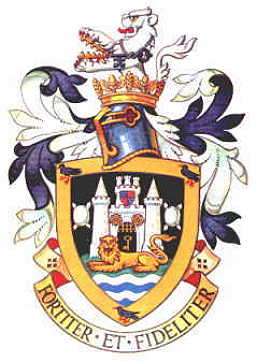
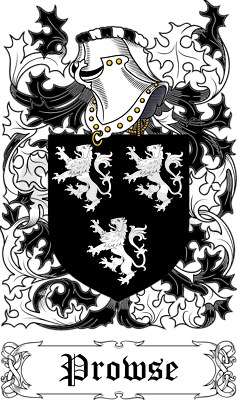
Immigrant Ancestory – Prowse – Coat of Arms

John Prowse was born in 1643 in Exeter, Devon, England.  His parents were George PROUSE and Alice KENN.    John married Hannah BARNES 2 Oct 1665 in Salisbury, Essex, Mass.   John died about 2 Sep 1706 in Amesbury, Essex, Mass.

John and Hannah lived their entire adult lives in Amesbury, Essex, Mass

Hannah Barnes was born 25 Mar 1643 in Salisbury, Essex, Mass. Her parents were William BARNES and Rachel LORD. Hannah died 27 May 1688 in Amesbury, Essex, Mass.

Children of John and Hannah:

Name Born Married Departed
1. Abigail Prowse 18 Dec 1666 Salisbury, Essex, Mass Israel Diamond
5 Jan 1690
.
Richard Bartlett
18 Nov 1718 Amesbury, Essex, Mass.
16 May 1727
Newbury, Mass
2. John Prowse
15 Feb 1669 Amesbury, Essex, Mass 1707
Amesbury
3. Barnes Prowse 2 Aug 1672 Amesbury Deborah Kimball
29 Jan 1702 Amesbury
4 Jul 1706
Amesbury
when Indians attacked the town of Amesbury.
4. Hannah PROWSE Mar 1676 Amesbury John J JEWELL
6 Jan 1702 in Amesbury, Mass.
1771 Amesbury

John Prowse took the Oath of Allegiance in 1677 in Amesbury and was a member of the town ‘training band’ (militia) in 1680. Along with Robert Jones and others, he was appointed to lay out ‘peake’ land in Amesbury in 1682. This meant plotting the lots and farms for the town and out-lying areas.

It appears that John and Rachel (Barnes) Prowse spent their entire married lives in Amesbury. We know they were married there, their children were born there, and that they both died there.

John Barnes was known to be living in 1690. His estate inventory was filed 2 September 1706 and settled in 1707. Hannah, his wife, died in Amesbury 27 May 1688.

Children:

1. Abigail Prowse

Abigail’s first husband Israel Diamond was born 1666, Devonshire, England.  Israel died 13 Nov 1716 Amesbury, Essex, Mass.

Abigail’s second husband Richard Bartlett was born 21 Feb 1648 in Newbury, Essex, Mass. His parents were Richard Bartlett and Abigail Welles. He first married 18 Nov 1673 in Newbury, Mass to Hannah Emery. Richard died 17 Apr 1724 in Newbury, Essex, Mass.

2. John Prowse

John, the first son, must have died young, because records refer to Barnes, the younger son, as the eldest son of John Prowse in records filed in 1707.

3. Barnes Prowse

Barnes’ wife Deborah Kimball was born 22 Jun 1674 in Amesbury, Essex, Mass. Her parents were John Kimball and Mary Jordan. Deborah died 15 Dec 1776 in Amesbury, Essex, Mass.

Barnes is presumed to have died 4 July 1706 when Indians attacked the town of Amesbury. About eight other Amesbury citizens were killed in that battle. Barnes was missing from that date and his body never found. Finally in 1715, he was declared dead and his estate was settled.

4. Hannah PROWSE (See John J JEWELL‘s page)

Sources:

http://trees.ancestry.com/owt/person.aspx?pid=11498543&st=1

http://trees.ancestry.com/owt/person.aspx?pid=11457168

http://freepages.genealogy.rootsweb.ancestry.com/~pattyrose/engel/gen/fg06/fg06_107.htm

http://www.wikitree.com/wiki/Prowse-10

Posted in 11th Generation, Immigrant - England, Line - Shaw, Veteran, Violent Death | Tagged , | 11 Comments

Capt. William Knowlton

Capt. William KNOWLTON (1584 – 1639) was Alex’s 11th Great Grandfather;  one of 4,096 in this generation of the Shaw line.  According to this post, much of the story of Captain Knowlton may be legend.

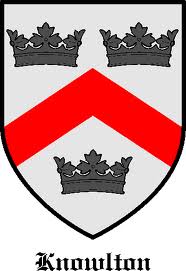
William Knowlton Coat of Arms

William Knowlton was born in 1584 in Chiswick London, Middlesex, England. His parents were Richard KNOWLTON and Elizabeth CANTIZE. He married Ann Elizabeth SMITH 1612 in Canterbury, Kent, England.

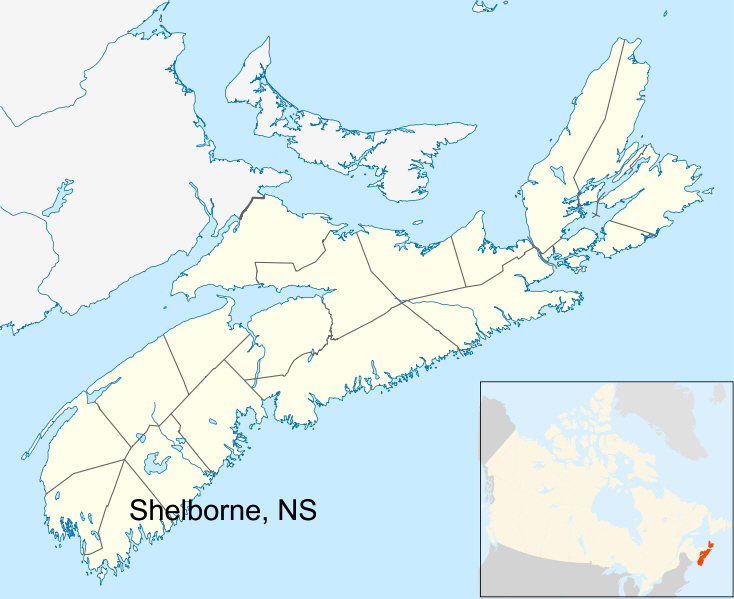
William died on the voyage to America, probably off the coast of Nova Scotia. In 1839, a headstone was found by a surveyor in Shelburne, Nova Scotia reflecting “William Knowlton, 1632”. Tradition says his widow and children proceeded to Hingham, MA, where it is said she remarried.  Alternatively, William died 6 Jun 1639 at sea near Nova Scotia, Canada.

William Knowlton – Shelborne Nova Scotia

Ann Elizabeth Smith was born 1586 in England. Her parents were Richard SMITH and Eliza CANTY.  After William died, she married Capt. John Tucker 11 Jun 1649 in Hingham, Plymouth, Mass.  Ann had no known children by her second husband as her will mentioned only her grandchildren through her first husband William Knowlton and daughter Susanna Ann.  Ann died 8 Oct 1675 in Hingham, Plymouth, Mass.

Children of  John and Mary:

Name Born Married Departed
1. John Knowlton
1610 Canterbury, Kent, England Margary Wilson (Kenning?)
1635
Ipswich, Mass
.
Elizabeth Welch
29 Nov 1653
Ipswich, Mass
2. Samuel Knowlton 1611 Canterbury, Kent, England Unmarried 1655
Ipswich, Mass
3. Robert Knowlton 1613 Canterbury, Kent, England Elizabeth Rice c. 1638 Canterbury, Kent, England.
4. William Knowlton 1615
Knowlton Manor, Chiswick, Kent, England
Elizabeth Balch
10 Jan1640 at Ipswich, Mass
17 July 1655 at Ipswich, MA
5. Mary Knowlton 1617
England
Died Young
6. Dec. Thomas Knowlton 
1622 in Canterbury, Kent, England Susannah [__?__]
.
Mary Kimball (daughter of John KIMBALL)
17 May 1682 Ipswich, Essex, Mass
23 Apr 1692
Ipswich, Mass
7. Susannah KNOWLTON 1624 in Canterbury, Kent, England John GUILFORD
1650 Hingham, Plymouth, Mass.
7 May 1660 Hingham, Plymouth, Mass.

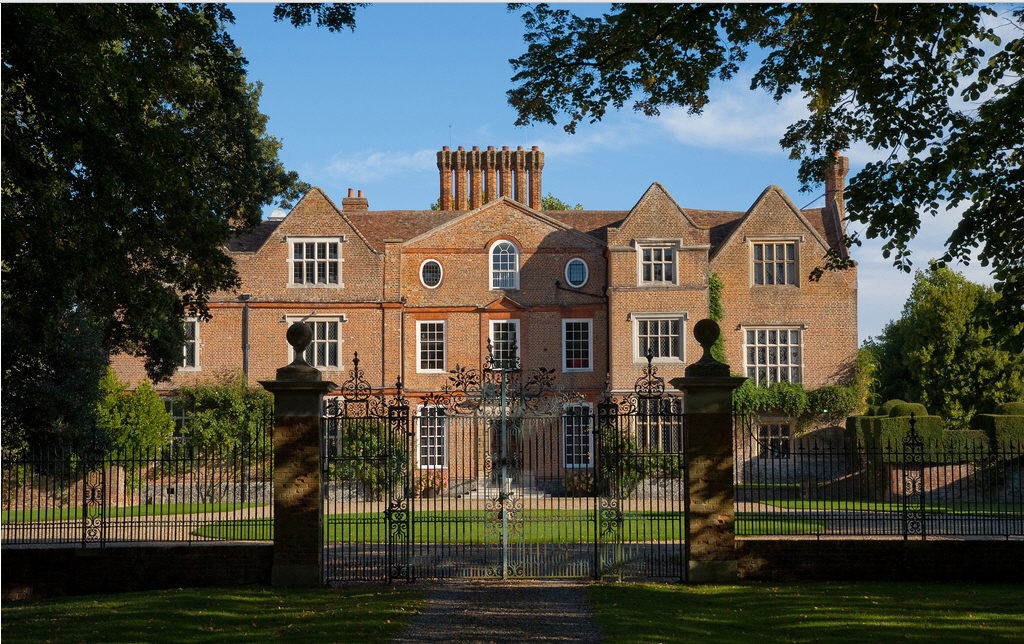
According to legend, William lived in this  Knowlton, Kent Grade I Listed Manor House. Built by Sir Thomas Peyton in 1585, it was remodelled in the Queen Anne style circa 1715, and further remodelled in 1904 by Sir Reginald Blomfield.
The Knowlton Court estate is recorded in the Domesday Book, during which time it belonged to Bishop Odo of Bayeux, the half-brother of William the Conqueror.

As no record of Captain William appears in the Customs Department in London, it must be inferred that he was independent in political action and a non-conformist in religious matters. A record was kept of only those emigrants who, upon leaving England, took an oath of loyalty to the Crown and promised conformity to the Established Church. It is believed that William was at least part owner of the vessel in which he sailed for America.

As every resident within the geographical bounderies of an English parish was enrolled in its records, no matter what his faith might be, Capt. Knowlton and family were undoubtedly so enrolled at Chiswick. Unfortunately, the old parish church was seized by Cromwell and his troopers in 1645, and used as a garrison. His horses were stalled in its chancel, the men were quartered in the nave, and all the early parochial records were burned, except a small account book of the church wardens. In this book the name of George Nooleton appears as one of a number obligated to pay for repairs on the church from 1619 -1622.

Stocking surmises that William died on the voyage to America, probably off the coast of Nova Scotia. In 1839, a headstone was found by a surveyor in Shelburne, N. S. reflecting “William Knowlton, 1632”. Tradition says his widow and children proceeded to Hingham, MA, where it is said she remarried.

In his correction of Stocking’s work (Errata and Addenda to the Knowlton Ancestry, 1903), George H. Knowlton writes

that the town records of Hingham, MA reflect grants of land and a house lot in 1635 to one William “Nolton”. Probate records show that the estate of William Nolton was appraised 18 Sep  1661 and that his widow, Ann, and grand-daughter, Susanna, were appointed administrators thereof on 23 Oct 1667. On 26 Sep 1668, “Ann Tucker, late wife of William Nolton” presented an inventory of the estate of “the late William Nolton, her former husband”. Widow Ann Tucker died 8 Oct 1675.  A Susanna Gilford was grand-daughter of Ann Tucker. Knowlton concludes that the facts strongly favor that this William Nolton was one and the same person as Capt. William Knowlton who, if buried in Nova Scotia, probably died abt. 1639, perhaps on a fishing trip or return voyage to England.

Children

Tingley gives them additional children as follows: Elizabeth (m. Theophilus Wilson); Jane (m. a Kenney of Salem, called [—–] KINNEY by torrey); Margery. We believe that the Knowlton genealogy has these correctly and that Tingley is in error, particularly with respect to the Kinneys whom we have studied intensively and for whom there is none to marry Jane.

1. John Knowlton

John’s first wife Margary Wilson (Kenning?) was born 1614 in England. . Her parents were William Wilson and Anne [__?__]. Margary died 1645 in Ipswich, Essex, Mass. Marjory has been called a Wilson, but Jacobus thinks she may have been a Kenning and it is known that she was sister to the wife of Theophilus Wilson and to Jane Kenning, possibly a daughter of John Kenning, a relationship that has led to her erroneously being given the surname Wilson (TAG, 35: 17f.).

John’s second wife Elizabeth Welch was born 1619 in England. Her parents were John Welch and Elizabeth Goose. Elizabeth died 1688 in Ipswich, Essex, Mass.

John was a shoemaker and citizen at Ipswich in 1639, made freeman there 9 June 1641, a subscriber to Maj. Denison in 1648. He accumulated considerable propert

The Will of John & Margery Knowlton

The wills of John Knowlton of Ipswich and his widow, Margery Knowlton, were proved in the Ipswich court March 28, 1654. The following copies were taken from the records in the Ipswich Deeds, book I, leaf 137, the originals being missing.

This 29th:of the 9th mth:1653:
I the saide John Knowlton being att this present time in perfect memory I make my wife my Executrix & I doe giue vnto Margery my wife my house & land & Cattell with other estate for her use & the bringing of my Children up so long as she lives & after her death the remainder to be deuided half of it to my eldest sonne John & the other halfe of it to be deuided betweene my sonne Abraham and my daughter Elisabeth, & if please God any of my Children do Chang ther Condition it is my desire with the aduice of mr Symonds & our pastor and the overseers and my wife consenting therto that they should impt something unto them according as god shall guide you and I giue to Margery my wife all my household goods to be at her owne disposing onely my shop tooles I giue to my eldest sonne John and some of my wearing clothes to my brother William. I make mr Tredwell, my brother Wilson and my [brother?] Thomas Knoulton my ouerseers.

Theophilus Wilson & Thomas Knowlton sworne testified that John Knoulton was ready to haue subscribed this to be his last will if his wife did accept to be executrix within two dayes which she did & so this is proued to be his will in the Court held at Ipswich the 28th of march 1654.
p me Robert Lord cleric

february the 20th:1653
This is to Certify that I Margery Knoulton widdow do make my brother[-in-law] Thomas Knoulton Executor to me & Assigne in my stead to fulfill my husbands will in my Roome & also for my selfe to giue to my Children according to our wills, for my household goods which are at my disposeing I doe giue equally to be deuided to my 3 children John Elisabeth and Abraham, onely I giue my great Byble to John, & all my weareing parrell to Elisabeth & a Iron pott with a bed tike that is hers & 20s that is Johns and 2 Candlesticks that are Abrahams. And I make mr Tredwell & my brother[-in-law?] Wilson my overseers. Also Abraham is to haue the yearne & cloth to make his two shifts & to haue a new hatt. These 3 interlinews were made before she set her hand. the marke of Margery Knoulton

[In the margin of the record, midway is written: “These are beside the Diuision.”] p[ro]ued in Court held at Ipswich the 28th (1) 1654 by the oaths of Theophilus Wilson, Elisabeth Wilson and Mary Tredwell.
p. me Robert Lord Cleric

2. Samuel Knowlton

Samuel was a mariner and although presumed to be in England, was certainly at Hingham prior to 22 Sept. 1655 when inventory of his estate was taken by his nephew John.

3. Robert Knowlton

Robert’s wife Elizabeth Rice was born in 1617 in Canterbury, England.

4. William Knowlton

William’s wife Elizabeth Balch Her parents were John Balch and Margaret Lovett.

William was a bricklayer, a member of the church. And made freeman in 1641/42. He was given pasturage for one cow, and a shore of Plum Island. On 12 Dec. 1643 he conveyed to Edward Bragg of Ipswich a house and lot which he purchased of John Andrews. The inventory of his estate was taken by Theophilus Wilson and his brother. Thomas on 17 July 1655, showing £37-2-1 in assets and £27-14-1 in debts. On 14 Jan 1655/56, his widow released her dower and conveyed his land. His brother Thomas raised his three youngest children.

For some reason, Tingley gives him a second wife Anne [__?__] when it is clear that his widow Is Elizabeth and Tingley does not have the same children as the Knowlton genealogy.

6. Deacon Thomas Knowlton

Thomas’ first wife Susannah [__?__]

Thomas’ second wife Mary Kimball was born 1625 in Rattlesden, Suffolk, England. Her parents were John KIMBALL and Mary BRADSTREET . Hannah died 12 Jul 1686 in Ipswich, Essex, Mass.

Thomas had a share in Plum Island. He was a cordwainer and shoemaker, a deacon of the old First Church. Since he had no children of his own, he sent his brother William’s boys to school and cared for a daughter until she married. as well as taking in Nathaniel, his nephew, to live with him.  His will of 5 Dec. 1688 settles the matter of his childlessness since all legatees are stated to be children of his brother.

7. Susannah KNOWLTON (See John GUILFORD‘s page)

After Susannah and her husband died, her mother Ann raised her orphaned grandchildren: Susannah and Paul.

Sources:

http://trees.ancestry.com/owt/person.aspx?pid=17474575&st=1

http://trees.ancestry.com/owt/person.aspx?pid=25717114

http://familytreemaker.genealogy.com/users/o/h/l/Wayne-Ohlsson/GENE3-0023.html

http://www.trinity-aloha.org/smith/

http://ntgen.tripod.com/bw/k_immigr.html

http://boards.ancestry.com/surnames.knowlton/546/mb.ashx

Posted in 13th Generation, Immigrant - England, Line - Shaw, Sea Captain | Tagged , | 10 Comments

John Guilford

John GUILFORD (1625 – 1660) was Alex’s 10th Great Grandfather, one of 2,048 in this generation of the Shaw line.

John Guilford - Coat of Arms

John Guilford was born in 1625 in England. His parents were John GUILFORD (Guildford) and Mary [__?__]. He married Susannah KNOWLTON about 1650 in Hingham, Plymouth, Mass.   John died 26 Sep 1660 in Hingham, Plymouth, Mass.

Susannah Knowlton was born in 1624 in Canterbury, Kent, England.  Her parents were William KNOWLTON and Ann Elizabeth SMITH.   Many sources state that John’s wife was Susannah’s sister Mary Knowlton born in 1617, but others say Mary died young. Susannah  died 7 May 1660 in Hingham, Plymouth, Mass.

Children of  John and Mary:

Name Born Married Departed
1. Susannah GUILFORD 2 Nov 1651 Hingham Plymouth Mass. Thomas JEWELL II
18 Oct 1672 Hingham, Mass.
1702
Amesbury Essex Mass.
2. Paul Guilford 14 Aug 1653
Hingham
Susannah Pullen
20 Feb 1677 Hingham
Apr 1790
On an Expedition for an Assault on Quebec, Canada
3. Priscilla Guilford 22 Apr 1660
Hingham
12 Jul 1660
Hingham

Very little is known of John Guilford. It is known that he bought property in Hingham and Scituate because Paul inherited it.  A number of years after his death, his son sold his house and home lot for fifty pounds which was half what it cost, indicating that it was for its time a very fine house.

If, as suspected, the Guilfords and Knowltons came in a vessel owned by either family or, perhaps, jointly, they would have been able to bring far more goods to America than those who were crammed into ships that carried passenger loads.

John, his wife Susannah and daughter Priscilla all died in 1660, leaving Paul and Susannah as young orphans.  The probably were raised by their maternal grandmother, Ann (Smith) Knowlton, now remarried to Capt. John Tucker as of June of 1649. Capt. Tucker died in 1661, but Ann survived until 1675, leaving a will that named Paul and Susanna, calling them her grandchildren.

Children

2. Paul Guilford

Paul’s wife Susannah Pullen was born 1660 in Hingham, Plymouth, Mass. Her parents were Edward Pullen and Elizabeth [__?__]. Susannah died 8 Apr 1690 in Hingham, Plymouth, Mass.

Paul died during an expedition for an assault on Quebec, possibly of small pox.  He was orphaned in his seventh year. He was indentured to Jeremiah Bumstead, but was released from service 30 April 1672 and ‘committed to the honored Governor to dispose of to a good master as he pleaseth.’

30 July 1672 – The Session ordered Jeremiah Bumstead to deliver over to the Governor Paul’s indenture and his clothes.

23 Oct 1673 – Paul was ‘presented by the Grand Jury for brutish and Uncivilized carriages and noe [sic] Evidence appearing against him was discharged.’

He evidently first marched under Capt. Joshua Hobart of Hingham in 1675 during King Philip’s War, being on the roll of payments 24 August 1675. He once more marched under Capt. Samuel Wadsworth and was paid on 24 July 1676 and Hingham paid him further for service under Capt. John Holbrook

1679 – Paul’s name appeared on the list of persons at Hingham who took the oath of allegiance and in this same year he was ‘convicted of affronting the Constable in the Execution of his Office’ and sentenced to pay 10 shillings . . ‘

8 Apr 1690 – Susanna died at Hingham and it is assumed that at the time, Paul was on expedition with Sir William Phips who first sailed from Boston early in the spring of that year to Port Royal [Nova Scotia] to fight the French [in  King William’s War,]. That effort being successful, Phipps again regrouped at Boston with about 30 ships and 2,000 Massachusetts men for an assault on Quebec, this expedition meeting with disaster. Paul was among those who were either killed or carried off by smallpox during this expedition. Before he left Hingham, he prepared a will on 5 July 1690 to assure the welfare of his children, their mother now being deceased. He directed that certain lands be set apart for the education of William'”

Sources:

http://trees.ancestry.com/owt/person.aspx?pid=43622628&st=1

http://familytreemaker.genealogy.com/users/o/h/l/Wayne-Ohlsson/GENE3-0023.html

http://familytreemaker.genealogy.com/users/o/h/l/Wayne-Ohlsson/GENE3-0015.html

Posted in 12th Generation, Immigrant - England, Line - Shaw | Tagged | 3 Comments

Robert Fletcher

Robert FLETCHER (1592 – 1677) was Alex’s 11th Great Grandfather, one of 4,096 in this generation of the Shaw line.

Robert Fletcher – Coat of Arms

Robert Fletcher was born in 1592 in Chelmsford, Essex, England. His parents may have been William FLETCHER and Ann FINNEY, but recent DNA puts this lineage in doubt and this Robert is probably not connected to the principal Fletcher family of Cockermouth  Hall.  (Actually, almost all linkages to gentry in my tree have turned out to be false.  The vast majority of early immigrants were what we would call now middle class.)   He married Sarah HARTWELL about 1612 in England. Robert died 3 Apr 1677 in Concord, Middlesex, Mass.

In 1655, Robert was one of the founders of Chelmsford, Middlesex, Mass, named for his hometown in England

Sarah Hartwell was born in 1593 in Chelmsford, Essex, England.   Sarah died 12 May 1677 in Concord, Middlesex, Mass.

Children of  Robert and Sarah:

Name Born Married Departed
1. Grissell FLETCHER c. 1618 Chelmsford, Essex, England. Thomas JEWELL I
1640 Braintree, Norfolk, Mass.
.
Humphrey Griggs
1 Nov 1655
Braintree, Norfolk, Mass
.
John Gurney
12 Nov 1661 Braintree, Norfolk, Mass.
9 Jul 1669 Chelmsford, Middlesex, Mass.
2. Luke Fletcher
1621 Chelmsford, Essex, England Betsy Shattuck
1645 England
21 May 1665
Concord,  Mass
3. William Fletcher 1 Sep 1622 Harewood, Yorkshire, England Lydia Bates
7 Oct 1645 Concord, Middlesex, Mass.
6 Nov 1677
Chelmsford, Middlesex, Mass
4. Samuel Fletcher 1632 in Concord, Middlesex, Mass Margaret Hailston
14 Oct 1659 Chelmsford, Middlesex, Mass
9 Dec 1697
Chelmsford, Middlesex, Mass
5. Francis Fletcher 10 MAY 1636
Concord, Middlesex Co, Mass
Elizabeth Wheeler
11 Oct 1656 Concord, Mass
14 Jun 1704
Concord, Mass

Robert Fletcher was born in 1591 in Chelmsford, England. He came from England at the age of 38, with his wife, Sarah Hartwell, and three sons, Luke, William, and Samuel, and a daughter Grissell.   According to The History of Hancock he settled in Concord in 1630. I have found no other data to document his presence in America at this early date and this date may simply be an oral tradition which was exagerated and later printed.

It was five years later, on Sep 2, 1635, that Concord was organized, the twentieth town incorporated in Massachusetts, and, according to The History of Hancock again, ‘his name appears in the earliest records of that town.  Whenever he arrived there, Robert Fletcher was, however, established well enough by 2 Nov 1637 to be chosen constable of Concord on that date. Robert and two of his sons and their families were among the first settlers of Chelmsford Massachusetts. He returned to Concord where he died April 3, 1677 at the age of 85. His will is dated February 2, 1672.

Chelmsford was founded in settlers from the adjacent communities of Woburn and Concord. An act of the Massachusetts General Court in the last week of May 1655 town incorporated Chelmsford, and it was named after Robert’s home town of Chelmsford, England. The nearby communities of Groton and Billerica were incorporated at the same time. Chelmsford originally contained the neighboring town of Westford, and parts of Carlisle, Tyngsborough, and a large part of Lowell (formerly known as East Chelmsford).

Fletcher family researchers, such as Edward Hatch Fletcher and Winifred Lovering Holman, have attempted to identify and document Robert Fletcher’s ancestors for more than 150 years. Unfortunately, their exhaustive examination of the available records failed to produce any evidence to support the various theories regarding the Fletcher patriarch’s lineage.  However, several published genealogies haveidentified Yorkshire, Shropshire, and Cumberland as possible locations for the birth of Robert Fletcher.

A letter alleged to have been written by Lydia Bates Fletcher from Concord in 1632 to her sister-in-law, Ruth Fletcher of Scrooby, England, has recently surfaced and appears to shed some light on the long-standing mystery. A transcription has been reproduced in two historical references. See Muirhead, J.F., AmericanShrines on English Soil, (1925); Bahin, Mrs. Louis Joseph, Collectionof Genealogy Records, National Society, Daughters of Founders and Patriots of America, (1985) p. 72.

The letter at issue, in addition to providing a remarkable narrative of the pleasures and hardships experienced by early settlers of the “New Land”, if genuine, establishes Lydia Bates as the wife of Robert Fletcher, not as the wife of his son William as previously asserted.  It also mentions a previously undocumented daughter named Johna who was born in 1631 and refers to Moses Fletcher of the Mayflower as “brother.” Finally, the letter identifies Ruth Fletcher of Scrooby, Nottinghamshire, England, as the sister of Robert, thus suggesting that Robert hailed from Scrooby as well.

Suggesting that the aforementioned letter is not genuine is the fact that the Concord Registers have William Fletcher and Lydia Bates marrying on September 7, 1645, and giving birth to a daughter, also named Lydia, on January 30, 1647. Conversely, the English separatists that originally colonized Plymouth and Concord lived in Nottinghamshire, England, until their resettlement to Leiden, the city from which they departed for the “New Land”, in 1608. This fact tends to support the proposition that the letter from Lydia Bates Fletcher is authentic. Accordingly, further research need be undertaken to determine whether the letter is fact or fiction.

History of the Town of Concord; Middlesex County,Massachusetts, From Its Earliest Settlement to 1832, (1835) p. 18. Shattuck, Lemuel,

“November 2, 1637, Robert Fletcher was chosen constable of Concord.”

“Robert Fletcher was here in 1635; d. April 3, 1677, a. 85.Children-1. Francis, m. Elizabeth Wheeler 1656, and had Samuel, Joseph, John, Elizabeth, Sarah, Hannah, and Benjamin, who lived in Concord. 2. Luke, d. 1665; 3. William, m. Lydia Bates 1645, removed to Chelmsford, 1656, d. Nov.6, 1677; 4. Samuel, removed to Chelmsford. The name is extinct in Concord, but descendants are found in the adjoining towns, in Worcester county, and in New Hamphire.” Id. p.370.

Fletcher, Edward H.,Fletcher Genealogy: An Account of the Descendants of Robert Fletcherof Concord, Mass., (1871) p. 2-3.

“ROBERT settled at Concord, Mass., in 1630; in which year seventeen ships arrived in Massachusetts Bay and at Plymouth. He had then threesons, Luke, William, and Samuel, and was himself thirty-eight years ofage. It was five years later that Concord was organized, the twentieth town incorporated within what are now the limits of Massachusetts, and his name appears in the earliest records of that town. In the court files of Middlesex County, his name frequently occurs as petitioner for bridges, as juryman, etc. He became a wealthy and influential man,and died at Concord, April 3, 1677, ae. 85.”

Bates, Theodore C., Bates and Fletcher Genealogical Register, (1892) p. 47.

“The first of that name known to have come to this country was Robert Fletcher, who was born in Oxford, England, in 1592, as shown by therecords of his death found in the Town Records of Concord, Mass. Hesettled in Concord, Mass., in 1630, being 38 years of age when he came to America. He brought with him his wife and two sons, named Luke and William, and a daughter named Carey, also a brother, William, who afterwards settled in Middletown, Conn.

Robert Fletcher was a wealthy and influential man. He died in Concord, Mass., April 3, 1677, aged 85 years. He had five children: Luke,William, Carey, Samuel and Francis.”

New England Historical Publishing Company,American Series of Popular Biographies, New Hampshire Edition, (1902)p. 395.

“The family name of Fletcher, or Fledger as it was originally spelled,has been long known in New England, as the first immigrant, Robert Fletcher, came over with Sir Richard Saltonsall and Governor Winthropin 1630. He emigrated from Yorkshire, England, bringing with him three sons, Luke, William, and Samuel, and settled in Concord, Mass., where he subsequently lived until his death on April 5, 1677, at the age of eighty-five years.”

Children

1. Grissell FLETCHER (See Thomas JEWELL I‘s page)

2. Luke Fletcher

Luke’s wife Betsy Shattuck was born 30 Dec 1627 – Somersetshire, England

3. William Fletcher

William’s wife Lydia Bates (Fairbanks) was born 13 Jun 1622 in Boston, Lincolnshire, England. Her parents were Richard Fairbanks and Elizabeth Daulton. Lydia died 12 Oct 1704 in Chelmsford, Middlesex, Mass.

There is a document, originally reported by Wyman, oft-cited to show Grissell’s maiden name, “Motion to Court by William Fletcher of Chelmsford his sister Cary on her deathbed desired him & her husband to take care of her children. Willing to be engaged for the child Sherebiah Kibby.” A further discussion ensues to show that the name should be Gurny. Interestingly, one person reported to Mary Lovering Holman possession of a photograph of the original, and claims it actually says Burge (roughly the same shape as Cary?) It then turns out this document is missing from Middlesex Court Files.

This single document connects Grissell’s brother, William Fletcher, the children of her first husband Thomas Jewell, the child by her third husband Henry Kibby (misspelled in this document), a mention of her being a widow Gurney, and of her last husband John Burge.

“To the Selectmen of Mendon: Theas are to Informe you by us William ffletcher and John Burge, both of us of the towne of Chellmsford, apointed by the Corts order to be gardians to the child of the widdow Gurney that was and Last of all wife to the a bove said John Burge, she being of a sound understanding did will unto her son Joseph Juell all that A Commodation that was there at the Towne of Mendon, Laid and given unto her the said widdow Gurney, with all the apurtenances and priveledges In any wise apertaining or be longing there unto, upon this condition that the said Joseph Juell do pay to Nathaniel Juell and Mercy Juell fifteen pound and Sherrabya Reby tenn pounds. Our desire and request is unto the Select men of the said towne of Mendon that ye would Record the said a Commodation to Joseph Juell for his security.

Witness our hands Chelmsford this 5 of the 4 month 1675.

William ffletcher John Burge.”

“This is a true Coppy of the lettre sente from William ffletcher and John Burge to the Select men of Mendon and now Recorded by yr order 21, 4 month 1675”

4. Samuel Fletcher

Samuel’s wife Margaret Hailston was born 1632 in Chelmsford, Middlesex, Mass. Her parents were William Hailstone and [__?__]. Margaret died 9 Dec 1697 in Westford, Mass.

5. Francis Fletcher

Francis’ wife Elizabeth Wheeler was born 3 Jan 1636 in Chelmsford, Essex, England. Her parents were George Wheeler and Catherine Pin. Elizabeth died 14 Jun 1704

Sources:

http://trees.ancestry.com/owt/person.aspx?pid=25678909&st=1

http://trees.ancestry.com/tree/14150784/person/972243775/story/7bfe83eb-621b-4272-848c-b829c618c650

Fletcher Family History, the Descendants of Robert Fletcher ofConcord, Mass.Author: Edward H. Fletcher

Publication: Boston, MA: Rand, Avery, & Co., 1881; book online athttp://www.genealogylibrary.comPage: Page: 11

Concord, Massachusetts Births, Marriages and Deaths, 1635-1850Publication: undated; reproduced on CD by Search & ReSearch Publishing Corporation,Wheat Ridge, CO 1998

>History of the Town of Westford By Reverend Edwin Hodgman

http://wc.rootsweb.ancestry.com/cgi-bin/igm.cgi?op=GET&db=ryder10&id=I19324

http://www.werelate.org/wiki/Person:Robert_Fletcher_%282%29

Posted in 13th Generation, Immigrant - England, Line - Shaw, Public Office | Tagged | 20 Comments

Thomas Jewell I

Thomas JEWELL I (1608 – 1654) was Alex’s 10th Great Grandfather, one of 2,048 in this generation of the Shaw line.

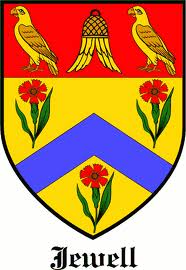
Thomas Jewell Coat of Arms

Thomas Jewell was born in 1608 in Kingston, Surrey, England. His parents were Edward JEWELL and Johan SHEARNE. He arrived in American on the Planter of London, Nicholas Trerice, Master. She sailed from London 2 Apr 1635 and arrived at Boston on Sunday, 7 Jun 1635.    He is listed as “Jewell (Jernell), Thomas 27, miller” which would mean he was born in 1608 instead of 1600 as published in many sources.   Forty seems old for a first marriage in those days, so I’m going with 1608.   He married Grissell FLETCHER in 1640 in Braintree, Norfolk, Mass. Thomas died 21 Jul 1654 in Braintree, Norfolk, Mass.

Grissell Fletcher was born in 1618 in Chelmsford, Essex, England.   Her parents were Robert FLETCHER and Sarah HARTWELL. After Thomas died, she married Humphrey Griggs on 1 Nov 1655 in Braintree, Norfolk, Mass. After Humphrey died, she married Henry Kibbe 8 Oct 1657 in Dorchester, Suffolk, Mass. After Henry died, she married John Gurney on 12 Nov 1661 in Braintree, Norfolk, Mass. Grissell died 9 Jul 1669 in Chelmsford, Middlesex, Mass.

Humphrey Griggs was born 1615 in Chelmsford, Essex, England. Humphrey died 18 Aug 1657 in Braintree, Norfolk, Mass.

Henry Kibby was born in 1610 in Exeter, Devon, England. Henry died 10 Aug 1661 in Dorchester, Suffolk, Mass.

John Gurney was born 29 Sep 1615 in England. John died 16 Mar 1663 in Braintree, Norfolk, Mass.

Children of Thomas and Grissell:

Name Born Married Departed
1. Joseph Jewell 24 Apr 1642 Braintree, Norfolk, Mas Martha Watertown
1670 Watertown, Mass
.
Isabel Cate
5 Jun 1681 in Portsmouth, Rockingham, NH
2 Sep 1736
Stow, Middlesex, Mass.
2. Thomas JEWELL II 27 Feb 1643 Hingham Plymouth MA. Susanna GUILFORD
18 Oct 1672 Hingham, Mass.
24 Oct 1706 Amesbury Essex Mass.
3. Hannah Jewell 12 Dec 1643 Braintree John Parish
30 Jun 1664 Braintree
29 Dec 1685
Preston, New London, CT
4. Nathaniel Jewell 15 Apr 1648 Braintree Mary Smedley
9 Jun 1676 Concord, Mass
Mar 1712
Plainfield, Windham, CT
5. Grisell Jewell
19 Mar 1652 Braintree Joshua Fletcher
4 May 1668 Chelmsford, Middlesex, Mass
16 Jan 1682
Chelmsford, Middlesex, Mass
6. Mercy Jewell 14 Apr 1653 Braintree Joseph Spalding
9 Dec 1670 Chelmsford
17 Aug 1728
Plainfield, Windham, CT

.
Child of Grissell and Henry Kibby

Name Born Married Departed
7. Sherebiah Kibby 2 Dec 1657
Dorchester, Suffolk, Mass
Elizabeth Parlin
17 Dec 1691
Concord, Middlesex, Mass
31 Dec 1728
Littleton, Massac

Various circumstances coincide to render it most likely that Thomas was from the same original stock as Bishop John Jewell (Wikipedia, the literary apologist of the Elizabethan Settlement – Elizabeth I’s response to the religious divisions created over the reigns of Henry VIII, Edward VI and Mary I.), who was born in the north of Devonshire in 1522, and died in 1571.  The name has been written Jule, Joyell, Jewel, then Jewell.

The first authentic account of Thomas is in the early part of 1639  and shows that he had then a wife and one child, probably a daughter. The Boston record is as follows :

“The 24th day, 2d mo., 1639. Also there is granted to Thomas Jewell, of the Mount, Miller, for three heads, 12 acres, upon the covenant of three shillings per acre.”

View of Mount Wollaston as it appeared in 1840, virtually unchanged from the time of initial English settlement in 1625. The central part of this sketch was adopted as the seal of Quincy.

This “Mount,” was Mt. Wollaston, the 17th Century name for Quincy; first settled in 1625, and named from Capt. Wollaston; incorporated as Braintree in 1640; Quincy was set off in 1792, and Randolph in 1793.   Anne Hutchinson began her career as a pioneering female preacher in colonial America in Wollaston.

The tract was laid to Boston by the General Court or Legislature, in 1634 ; and Dec. 11th of that year the inhabitants after a lecture chose seven men who should divide these lands to those that might improve them, at the rate of 4 acres to each person in the family ; gratuitously to citizens of Boston, and for three shillings per acre to others. Thus we find, ” 24th day, 12th mo., 1640. Granted to Henry Adams (a progenitor of the President,) for 10 heads, 40 acres, upon the same covenant of three shillings per acre.”

Thomas Jewell’s will, as witnessed by Wm. Scant and Hannah H. Harbor.

” The will of Thomas Jewell of Brantray, while he Is yet in perfect memory. My Soule I commit into the hands of Almighty God in ye mediation of Jesus Christ, and my body to the dust. All ye Estate whch God hath given me I doe give to my wife for to be hers as long as she is a widow, and so remainds ; but if she shall marry, then to divide it into three parts ; and two parts to be divided among my children, and the third to be hers. I doe by this will give power to these two my friends herein mentioned, namely William Neadam and Tho. fibster, to take the care and oversight of all this my estate for my wife and children good, according to your best wisdom to be ordered.

dated the 10th, 2d month, 1654.”

The Probate records show that administration was granted to Grisell, the widow of Thomas Jewell, July 21, 1654 ; but on the 5th Oct. 1655, she being about to marry Humphrey Griggs, William Needham and Thomas Foster above named, were appointed executors (probably de bonis non.) Griggs agreed to bring up Jewell’s children, of which there were several, both sons and daughters, and all under age. She was soon left again a widow ; as administration was granted to Grisell Griggs, on the estate of her late husband Humphrey Griggs, Aug. 18, 1657.”

Grisell (Fletcher) Jewell was the widow Gurney for more than four years and it was under that name that she became one of the proprietors of the new town of Nipmugg (Mendon). At a meeting of the committee for ordering the new settlement (held at Dedham in December 1663) Grissell Gurney desired acceptance, and also for her son Thomas Jewell. The name is spelled Juell or Juel throughout. She was granted the 20-acre proprietors’ allotment as also were Thomas Jewell and her son-in-law, John Parris (Parish). The town was incorporated May 15, 1667.

Mendon, Worchester, Mass.

Mendon was founded when pioneers from Braintree petitioned to receive a land grant for 8 miles  square of land, 15 miles  west of Medfield.  In September 1662, after the deed was signed with a Native American chief, “Great John”, the pioneers entered this part of what is now southern Worcester County. Earlier, unofficial, settlement occurred here in the 1640s, by pioneers from Roxbury. This was the beginning of Mendon.

The land for the settlement was 8 miles square of Native American land in the Massachusetts Bay Colony and was purchased from the Nipmuc Indians, “for divers good and vallewable considerations them there unto Moovinge and especiall for an in consideration of the summe of twenty fower pound Sterling.” In 1662, “Squinshepauke Plantation was started at the Netmocke settlement and plantation”, and was incorporated as the town of Mendon in 1667. The settlers were ambitious and set about clearing the roads that would mark settlement patterns throughout the town’s history.

Mendon was first settled in 1660 and was officially incorporated in 1667. The town was originally 64 square miles, including the modern-day towns of MilfordBellinghamHopedaleUxbridgeUptonBlackstoneNorthbridge and Millville. For this reason, the town of Mendon is sometimes referred to as “Mother Mendon”. Benjamin Albee (1614–1695) erected a water-powered mill in 1664 on modern-day Hartford Avenue in Hopedale and was one of the town’s important early residents.

On July 14, 1675, early violence in King Philip’s War took place in Mendon, with the deaths of multiple residents and the destruction of Albee’s mill. These were the first settlers killed in this war in the Colony of Massachusetts. A man named Richard Post, of Post’s lane, may have been the first settler killed. The town was largely burnt to the ground later that winter in early 1676. The town was resettled and rebuilt in 1680.

While she was still the Widow Gurney she willed the land in Mendon to her son Joseph Jewell, who was to pay certain sums to his brother Nathaniel and sister Mercy and half-brother Sherebiah Kibbe. His two married sisters, Hannah (Jewell) Parish and Grissell (Jewell) Fletcher, are not named. A letter, dated at Chelmsford the 5th of June 1675, was sent to the selectmen of Mendon: This is to inform you by us William Fletcher and John Burge, both of us of the Town of Chelmsford, appointed by the court’s order to be Guardians of the child of the widow Gurney (that was) and Last of all wife to the above said John Burge … The provisions of the will were given and the request made that the Mendon land be accredited to Joseph Jewell.

Children

1. Joseph Jewell

Joseph’s first wife Martha Watertown was born 1650 in Braintree, Mass. Martha died 8 Aug 1682

Joseph’s second wife Isabel Cate was born about 1650 in Portsmouth, New Hampshire.  Her father was James Cate.

Joseph first lived in Charlestown, Mass. and conducted the ferry between that place and Boston, and his son Joseph Jr. assisted him.  When about 50 years old, he removed to Stow and there owned a grist-mill, which for years (as late as 1815 at least) went by the name of “Jewell’s Mill”.  This old mill-site was as late as 1860 occupied by a carpet factory and the stream is the dividing line between Sudbury and Stow.  He died at about the age of 94.  His second wife, Isabel, lived to be over 103.

2. Thomas JEWELL II (See his page)

3. Hannah Jewell

Hannah’s husband John Parish was born 6 Mar 1642 in Groton, Middlesex, Mass. His parents were Thomas Parrish and Mary Danforth. After Hannah died, he married 29 Dec 1685 in Cambridge, Mass. to Mary Wattell (b. 1 Aug 1668 in Chelmsford, Mass. d. 1715 in Preston, CT). John died 16 Jul 1715 in Preston, New London, CT.

4. Nathaniel Jewell

Nathaniel’s wife Mary Smedley was born 7 Jun 1648 in Concord, Middlesex, Mass. Her parents were Baptist Smedley and Katherine Shorthouse.  She had first married Isaac Shepard of Concord. Mary died 22 Sep 1679 in Plainfield, Windham, CT.

5. Grisell Jewell

Grisell’s husband Joshua Fletcher was born 30 Mar 1648 in Concord, Middlesex, Mass. He was Grisell’s cousin.  His parents were William Fletcher and Lydia Fairbanks (Bates). Joshua died 21 Nov 1713 in Chelmsford, Middlesex, Mass.

6. Mercy Jewell

Mercy’s husband Joseph Spalding was born

7. Sherebiah Kibby

First Church at Dorchester in New England – Sherebiah ye Sonne of Henery Kibby Baptized ye 8 (10) [16]59 on a publique day of thanksgiving & he gave ye reason of his nameing his Sonne by y’t name : w’ch was because he had p’r’vailled with god by prayer for him
[Sherebiah means “singing with the Lord”]

Sherebiah’s wife Elizabeth Parlin was born 8 Jun 1672 in Cambridge, Suffolk, Mass. Her parents were Nicholas Parlin and Sarah Hanmore.

Sources:

http://trees.ancestry.com/tree/202278/person/-2108051285/story/47f70167-b5d7-46bd-bd3f-aee051bc191a?src=search

http://trees.ancestry.com/owt/person.aspx?pid=30735960&st=1

http://www.werelate.org/wiki/Person:Grissel_Fletcher_%281%29

Posted in 12th Generation, Immigrant - England, Line - Shaw | Tagged , | 9 Comments

Thomas Jewell II

Thomas JEWELL II (1643 – 1706) was Alex’s 9th Great Grandfather, one of 1,024 in this generation of the Shaw line.

Thomas Jewell was born 27 Feb 1643 in Hingham Plymouth Mass. His parents were Thomas JEWELL I and Grissell FLETCHER. He married Susanna GUILFORD on 18 Oct 1672 in Hingham, Mass.  After Susanna died, he married Ruth Badger 17 Feb 1701 Newbury, Mass.  Thomas died 24 Oct 1706 in Amesbury Essex Mass.

Thomas removed from Hingham to Amesbury, Essex, Mass about 1687 and lived there the rest of his life

Susanna Guilford was born 2 Nov 1651 in Hingham Plymouth Mass. Her parents were John GUILFORD and Mary KNOWLTON.    Susanna died in 1702 in Amesbury Essex Mass.

After Thomas died, Ruth Badger Jewell married John Davis on 22 Dec  1707.

Children of Thomas and Susanna:

Name Born Married Departed
1. Mary Jewell 1 Oct 1674 Hingham Joseph Barnard
1 Dec 1693 Amesbury, Mass
.
Thomas Hoyt
18 Nov 1722 Amesbury
1741
Amesbury, Mass
2. Thomas Jewell
21 Aug 1676 Hingham Martha Blood
6 Dec 1712 Dunstable, Mass
Drowned
1723
Tingsborough, Mass
3. Ruth Jewell 26 Aug 1678 Hingham 1685
Amesbury
4. Hannah Jewell 6 Mar 1681  Hingham Jul 1683
Hingham
5. John J JEWELL 16 May 1683 Hingham, Plymouth, Mass. Hannah PROWSE
6 Jan 1702 Amesbury, Mass
9 Sep 1715 Amesbury, Essex, Mass
6. Hannah Jewell 14 Sep 1685
Hingham, Plymouth, Mass.
Jonathan Osgood
1705
Essex, Mass.
.
Peter Thompson
19 Sep 1715
Salisbury, Essex, Mass,
7. Samuel Jewell 19 Feb 1688 Amesbury, Mass Sarah Ring
6 Nov 1712 Amesbury, Mass
.
Mary Staples (Daughter of Samuel STAPLES)
20 May 1742
Haverhill, Mass
Amesbury
8. Joseph Jewell 17 Nov 1691 Amesbury Anna Quimby
1 Jan 1717 Amesbury
1783
Amesbury

Thomas removed from Hingham to Amesbury about 1687. (On the final settlement of the boundary line between New Hampshire and Massachusetts, that part of Amesbury where Thomas Jewell lived, and where his descendants reside, fell to New Hampshire, and is now South Hampton.)

Thomas married Ruth Badger 17 Feb 1702; and it seems from the following record, that he died soon after. ” John Davis and Ruth Jewell, wid. of Thomas Jewell jr. were m. Dec. 22, 1707, by Rev. Thomas Wells.” Thomas Jewell was several times tithing-man

Children

1. Mary Jewell

Mary’s first husband Joseph Barnard was born 1665 in Amesbury, Essex, Mass. His parents were Thomas Barnard and Sarah Peasley. Joseph died 24 Oct 1706 in Amesbury, Essex, Mass.

Mary’s second husband Thomas Hoyt was born 26 Jan 1669 in Amesbury, Essex, Mass. His parents were Thomas Hoyt and Mary Brown. His grandparents were John HOYT and Frances TEWKSBURY. Thomas died 1741 in Amesbury, Essex, Mass.

2. Thomas Jewell

Thomas’ wife Martha Blood was born Oct 1692 in Groton, Middlesex, Mass. Her parents were James Blood and Abigail Kemp. After Thomas died, she married Joseph Parham (b. 13 Mar 1692 in Chelmsford, Middlesex, Mass.)

Thomas bought and sold lands at Dunstable, Mass. (Nashua, N. H. was then included) from Jan. 3, 1711 to March 9, 1721; his estate was inventoried Oct. 23, 1723 ; probated by Martha (then the wife of Joseph Penham) Nov. 4, 1727  It appears that the wid. Martha had one third of the estate of Thomas, Nathaniel two fifths of the remainder, Benoni also two fifths, and the daughter one fifth. Nathaniel sold his portion for  £95, to Thomas Harwood, March 29,1736 ; he being then of age and unmarried.

5. John J JEWELL (See his page)

6. Hannah Jewell

Hannah’s first husband Jonathan Osgood was born 2 Apr 1678 in Salisbury, Essex, Mass. His parents were William Osgood (b: 8 Oct 1648 in Salisbury) and Abigail Ambrose (b: 28 Dec 1654 in Boston). Jonathan died 3 Oct 1706 in Salisbury, Essex, Mass.

Hannah’s second husband Peter Thompson was born in 1693 in Salisbury, Essex Co., Mass. He was baptized 26 Jan 1706/07. His parents were John Thompson (Tomson) and Elizabeth Brewer.

7. Samuel Jewell

Samuel’s first wife Sarah Ring was born 07 Oct 1691 in Amesbury, Essex, Her parents were Robert Ring and Ruth [__?__]. Her grandparents were Robert RING and Elizabeth JARVIS.

Samuel’s second wife Mary Staples was born 1720 Haverhill. Her parents were Samuel STAPLES and Abigail PRINCE. Mary died in 1751 Massachusetts.

8. Joseph Jewell

Joseph’s wife Anna Quimby was born 23 May 1695 in Amesbury, Essex, Mass.

Sources:

http://trees.ancestry.com/owt/person.aspx?pid=25717114

http://worldconnect.rootsweb.ancestry.com/cgi-bin/igm.cgi?op=GET&db=adgedge&id=I16020

Posted in 11th Generation, Line - Shaw | Tagged | 5 Comments

John J Jewell

John J JEWELL (1683 – 1715) was Alex’s 8th Great Grandfather, one of 512 in this generation of the Shaw line.

John J Jewell was born 16 May 1683 and baptized 29 Jun 1683 in Hingham, Plymouth, Mass. His parents were Thomas JEWELL II and Susanna GUILFORD.    He married Hannah PROWSE on 6 Jan 1702 in Amesbury, Mass.   John died before 19 Sep 1715 in Amesbury, Essex, Mass.

John moved to Amesbury, Essex, Mass with his parents when he was four years old and lived there the rest of his life.

Hannah Prowse was born Mar 1676 in Amesbury, Essex, Mass. Her parents were John PROWSE and Hannah BARNES. After John died, she married Peter Thompson on 19 Sep 1715.  Hannah died in 1771 in Amesbury, Essex, Massachusetts.

Children of John and Hannah:

Name Born Married Departed
1. Abigail Jewell 7 Nov 1702
Amesbury, Essex, Mass
Lawrence Straw
6 Mar 1725
Amesbury, Essex, MA
1756
South Hampton, Rockingham, NH
2. Thomas JEWELL III 10 Sep 1707 Amesbury, Essex, Mass Judith LANCASTER
19 Feb 1731/32 Amesbury, Mass.
Jun 1772 in Hopkinton, Middlesex, Mass
3. Hannah Jewell 16 Sep 1710 Peter Brier
16 Jan 1735
Salisbury, Essex, Mass.
4. John Jewell 20 Aug 1712
Amesbury
Hannah Lancaster
19 Feb 1735
Amesbury
1805
Sugar Hill, Grafton, NH or Sandwich, Carol, NH
5. Barnes Jewell 12 Apr 1715 Dorothy Jones
13 May 1740 Amesbury
1740
Amesbury, Mass

He went with his parents when four years old to Amesbury, where he ever after resided.

Children

1. Abigail Jewell

Abigail’s husband Lawrence Straw was born 31 May 1699 in Amesbury, Essex, Mass. His parents were William Straw and Mehitable Hoyt. His maternal grandparents were John HOYT and Mary Jewell. Lawrence died 26 May 1762 in Kingston, Rockingham, New Hampshire.

2. Thomas JEWELL III(See his page)

3. Hannah Jewell

Hannah’s husband Peter Brier was born 1 Feb 1710 – Stratham, Rockingham, New Hampshire. His parents were Thomas Brier and Abigail [__?__].

4. John Jewell

John’s wife Hannah Lancaster was born 20 Oct 1709 in Amesbury, Essex, Mass. Her parents were Henry LANCASTER II and Sarah BAGLEY.  Hannah died 20 Mar 1752 in New York.

John’s brother Thomas and Hannah’s sister Judith also married and were our ancestors.

John died in Sugar Hill (Lisbon) New Hampshire in 1805 at the age of 93.

5. Barnes Jewell

Barnes’ wife Dorothy Jones was born 22 Apr 1714 in Amesbury, Essex, Mass. Her parents were Jonathan Jones (1677 – 1710) and Elizabeth [__?__] (1680 – 1775). Many genealogies say that Dorothy lived to be a hundred, but none provide details.

Sources:

http://trees.ancestry.com/tree/8657978/person/-834026118

http://member.tripod.com/~rjsnyder/sub1/fam00189.htm

http://trees.ancestry.com/tree/8755023/person/-898581084

Posted in 10th Generation, Line - Shaw | Tagged | 4 Comments

Thomas Jewell III

Thomas JEWELL III (1707 – 1772) was Alex’s 7th Great Grandfather, one of 256 in this generation of the Shaw line.

Thomas Jewell was born 10 Sep 1707 in Amesbury, Essex, Massachusetts. His parents were John J JEWELL and Hannah PROWSE.   He married Judith LANCASTER on 19 Feb 1731/32 in Amesbury, Mass.  After Judith died, he married Marion [__?_].  Thomas died Jun 1772 in Hopkinton, Middlesex, Massachusetts.

Thomas lived the last part of his life in Hopkinton, Middlesex, Mass, a town , just over 30 miles from Boston. The town is best known as the starting point of the Boston Marathon, held annually on Patriots’ Day in April, and as the home of computer storage firm EMC Corporation.

Judith Lancaster was born 29 Jul 1704 in Amesbury, Essex, Massachusetts. Her parents were Henry LANCASTER II and Sarah BAGLEY. Judith died 20 Mar 1751 in Amesbury, Essex, Massachusetts.

Children of Thomas and Judith:

Name Born Married Departed
1. Henry L Jewell 19 Dec 1732
Amesbury, Mass
Sarah Gould
1752
Amesbury, Mass
1762
South Hampton, Rockingham, NH
2. John Jewell (twin) 25 Jul 1737
Rumford, Merrimack, New Hampshire
1738
3. Sarah Jewell (twin) 25 Jul 1737
Rumford, Merrimack, New Hampshire
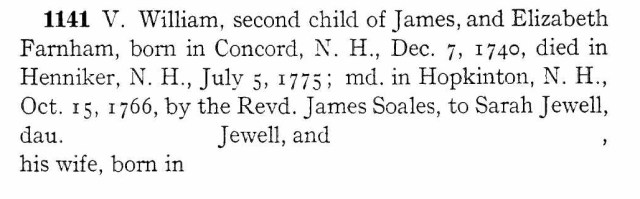
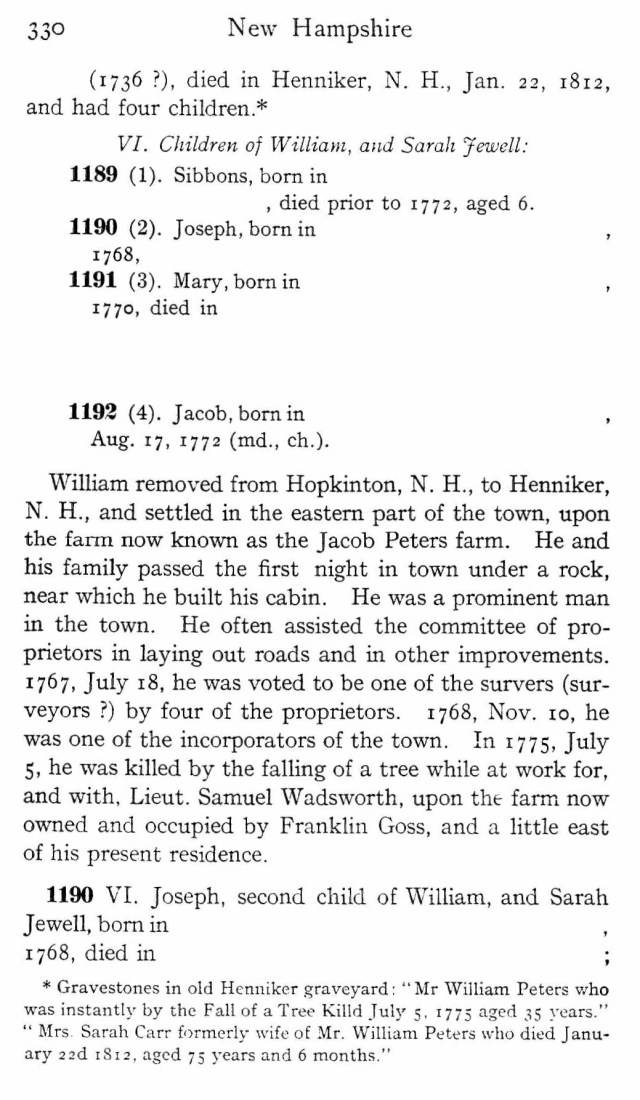
William Peters
15 Oct 1766 Hopkinton, Merrimack, NH
.
[__?__] Carr
22 Jun 1812 – Henniker, Merrimack, NH
4. Judith Jewell (twin) 5 Jul 1742
Rumford, Merrimack, New Hampshire.
John Eastman
1759
New Hampshire
1784 Mass.
5. Sarah JEWELL (twin) 5 Jul 1742 Rumford Nathan BALCOM
12 Jan 1768 Attleboro, Mass
c. 1847 at the age of 94
6. Abel Jewell 1744
Rumford
7. James Jewell 1745
Newbury, Mass
Susannah Brackett
1 Nov 1765 Georgetown, Lincoln, Maine
After 1800 – Hancock, Maine
8. Hannah Jewell 22 Sep 1748 1749
9. Anna Jewell 5 Aug 1753 1754

Children

1. Henry L Jewell

Jewell, Henry Lancaster, 1732-1762 In Capt. Trueworthy Ladd’s Co., Colonel John Hart’s regiment for Canada service, 1758, French and Indian Wars.

Henry  once lived in the vicinity of Concord, New Hampshire. He was wounded in the leg, in the ‘Old French’ war, which resulted in the capture of Quebec by General James Wolfe in 1759. Henry died of measles after his return

Between 1758 and 1760, the British military successfully penetrated the heartland of New France, and took control of Montreal in September 1760. France ceded French Louisiana west of the Mississippi River to its ally Spain in compensation for Spain’s loss to Britain of Florida (which Spain had ceded to Britain in exchange for the return of Havana, Cuba).

The Battle of the Plains of Abraham, also known as the Battle of Quebec, was a pivotal battle in the Seven Years’ War (referred to as the French and Indian War in the United States). The battle, which began on Sep 13 1759, was fought between the British Army and Navy, and the French Army, on a plateau just outside the walls of Quebec City, on land that was originally owned by a farmer named Abraham Martin, hence the name of the battle. The battle involved fewer than 10,000 troops between both sides, but proved to be a deciding moment in the conflict between France and Britain over the fate of New France, influencing the later creation of Canada.

Henry’s wife Sarah Gould was born 19 Jun 1730 in Amesbury, Essex, Mass. Her parents were Joseph Gould (1709 – 1757) and Mary Colby (1711 -). After Henry died, Sarah accompanied her children Henry and Enos to Litchfield, Kennebec, Maine, where she married Joseph Huntington (b. 3 Aug 1721 in Amesbury, Essex, Mass – d. 1811 in South Hampton, Rockingham, New Hampshire.) Sarah and Timothy had one son Benjamin Huntington (1766 – 1845). Sarah died at an advanced age in Hallowell, Kennebec, Maine.

Children of Henry and Sarah:

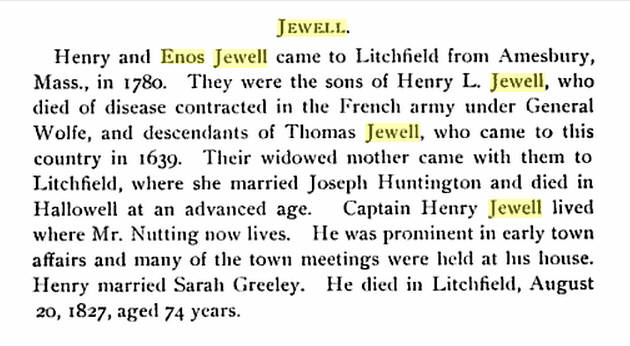
i. Henry Jewell b. 5 Mar 1753 Amesbury, Essex, Mass; d. 20 Aug 1827 Litchfield, Kennebec, Maine; m. 1772 to Sarah Greeley (b. 1760 in Mass.) Henry and Sarah had eleven children born between 1773 and 1798 in Litchfield.

Henry Jewell Bio -  Source:  History of Litchfield and an Account of Its Centennial Celebrations, 1895

Henry Jewell Bio – Source: History of Litchfield and an Account of Its Centennial Celebrations, 1895

ii. Enos Jewell b. 1754 Amesbury, Essex, Mass; d. 1831 Ogden, Monroe, New York; m1. 1780 in Topsham Sagadahoc, Maine to Deborah Hall (b. 23 Dec 1748 in Marshfield, Plymouth, Mass.) Deborah’s parents were John Hall (1713-1770) and Zilpha Crooker (1724 – ). Enos and Deborah had six children born between 1781 and 1790. m2. 11 Jun 1808 Age: 54 Litchfield, Kennebec, Maine to Abigail Chamberlain

Enos lived near Potter’s Corner in Litchfield, Maine.

Enos Jewell and his wife Abigail (Chamberlain) Jewell were early pioneers of Ogden, Monroe County, New York. (The “Jewell Register” information is incorrect. He did not die in Ogdensburg, St. Lawrence, NY.) Enos and Abigail helped to establish the first church there in Ogden. Enos Jewell married a third time to a woman named Mary (last name as yet unknown). He left his home and land (33 acres) to his granddaughter and “one dollar to each of his other children” in his will.

iii. Joseph Jewell b. 12 Mar 1759 Southampton, NH or Amesbury, Essex, Mass; d. 1812 Albany, New York; m. Feb 1783 to Anna Daniels; Joseph and Anna had three children born between 1783 and 1796.

Joseph was a private in Capt William H. Ballard’s company, Col. James Frye‘s 10th Massachusetts Regiment May 1775, It served in the Siege of Boston until its disbandment at the end of 1775. Col. Frye’s report of Oct 6 1775 places Joseph Jewell as having gone on the Quebec Expedition (See my post Invasion of Canada – 1775).

Joseph was a private in Capt. James Calfe’ company, Col. Pierse Long’s Regiment in the New Hampshire Militia Sept 25 1776 – 1777. At Piscataqua Harbor NH Dec 1776; Same company Jan 7 17777

Long’s Regiment was raised on May 14, 1776 at New Castle, New Hampshire under Colonel Pierse Long for service with the Continental Army. The regiment was stationed at Fort Ticonderoga and Mount Independence on Lake Champlain and fought a delaying action at Fort Ann, New York on July 8, 1777 against the advance units of John Burgoyne’s army. The regiment was disbanded at the end of July, 1777 in northern New York as the one year enlistments of the men ran out before the main engagements of the Saratoga Campaign. Col. Long and some of the men of the regiment joined other New Hampshire regiments that fought at Saratoga.

Joseph was a private in Capt. Frederick M. Ball’s company, Col. Nathan Hale’s (Not to be confused with Nathan Hale, the famous Revolutionary War spy) This Nathan Hale was taken prisoner by the British at the Battle of Hubbardton and died on Sep 23 1780) 2nd Regiment New Hampshire Line. On Jan 24 1777 Joseph was promoted to corporal, enlisting for three years, same company and regiment, 1777, 1778, and 1779. He served to 1781. The 2nd NH saw action at the Battle of Trois-Rivières, Battle of Trenton, Battle of Princeton, Battle of Hubbardton, Battle of Saratoga, Battle of Monmouth, the Sullivan Expedition and the Battle of Yorktown.

Nathan Hale was promoted to colonel on Apr 2, 1777. In the same year he served with Major General Arthur St. Clair at the Siege of Fort Ticonderoga. The Siege took place from July 2–6, 1777 and was between the United States against the British. Arthur St. Clair led about 3,000 men against John Burgoyne and William Phillips who led 7,000 men as well as about 800 Indians and Canadians. Not much was done in the battle and Burgoyne took over Fort Ticonderoga and Fort Independence while the Americans retreated.

Hale fought in the Battle of Hubbardton where he was taken prisoner by the British on July 7, 1777. His surrender there was the subject of controversy. Hale was arrested for treason but was never allowed a trial to explain himself. He was later let off on limited parole where Hale was not allowed to serve in the Army and he had to come back to the enemy lines after two years unless he was exchanged. He returned to Rindge on July 20, 1777. Since he was not exchanged, Hale went back to the prison on June 14, 1779. Hale died on September 23, 1780 in New Utrecht, Brooklyn while in prison.

The Battle of Hubbardton was an engagement in the Saratoga campaign fought in the village of Hubbardton, then in the disputed New Hampshire Grants territory (now Vermont). On the morning of Jul 7 1777, British forces, under General Simon Fraser, caught up with the American rear guard of the forces retreating after the withdrawal from Fort Ticonderoga. It was the only battle in present day Vermont during the revolution. (The Battle of Bennington was fought in what is now Walloomsac, New York.)

The American retreat from Fort Ticonderoga began late on July 5 after British cannons were seen on top of high ground that commanded the fort. The bulk of General Arthur St. Clair’s army retreated through Hubbardton to Castleton, while the rear guard, commanded by Seth Warner, stopped at Hubbardton to rest and pick up stragglers.

General Fraser, alerted to the American withdrawal early on July 6, immediately set out in pursuit, leaving a message for General John Burgoyne to send reinforcements as quickly as possible. That night Fraser camped a few miles short of Hubbardton, and the German General Friedrich Adolf Riedesel, leading reinforcements, camped a few miles further back. Rising early in the morning, Fraser reached Hubbardton, where he surprised some elements of the American rear, while other elements managed to form defensive lines. In spirited battle, the Americans were driven back, but had almost succeeded in turning Fraser’s left flank when Riedesel and his German reinforcements arrived, eventually scattering the American forces.

The battle took a large enough toll on the British forces that they did not further pursue the main American army. The many American prisoners were sent to Ticonderoga while most of the British troops made their way to Skenesboro to rejoin Burgoyne’s army. Most of the scattered American remnants made their way to rejoin St. Clair’s army on its way toward the Hudson River.

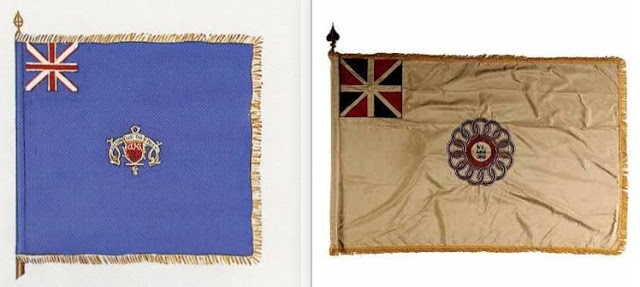
2nd New Hampshire Colors

The 2nd New Hampshire’s Regimental colours that were captured at Hubbardton and returned to the state of New Hampshire are now housed at the New Hampshire State House in Concord, New Hampshire. It is one of only a few American battle flags from the American Revolution known to still exist. They were lost July 8, 1777, to the British near Fort Anne, New York, when ammunition ran out after a brave defense in which the Ninth British Regiment of Foot were themselves nearly captured. The Americans retreated to General Schuyler’s headquarters at Fort Edward, but Lt. Colonel Hill, the English commander, ended up with their flags and took them to England. They remained there with his descendants until 1912, when they were bought and presented to the New Hampshire Historical Society.”

iv. Thomas Jewell b. 1762 Essex, Mass; d. 1781

4. Sarah Jewell

Sarah’s husband William Peters was born 7 Dec 1740 in Concord or Rumford, Merrimack, New Hampshire. His parents were James Peters (1711 – 1801) and Elizabeth Farnham (1718 – 1793). William was killed by a falling tree 5 Jul 1775 in Henniker, Merrimack, New Hampshire while working with Lt. Samuel Wadsworth.  After William died, Sarah married [__?__] Carr.

Sarah and William lived in Henniker, Merrimack, New Hampshire. The township was first known as Number Six in a line of settlements running between the Merrimack and Connecticut rivers. In 1752, the Masonian Proprietors granted the land to Andrew Todd, who called it Todd’s Town. Settled in 1761 by James Peter, it was dubbed New Marlborough by others from Marlboro, Massachusetts. Incorporated in 1768 by Governor John Wentworth, the town was named for Sir John Henniker, a London merchant of leather and fur, with shipping interests in Boston and Portsmouth.

In the 19th century Henniker had a high rate of congenital deafness, and its own sign language, which may have played a significant role in the emergence of American Sign Language. The game of paintball originated in Henniker in 1981.

William’s father James Peters appears on the alarm list of the Henniker train band May 21 1776, Capt. Aaron Adams. He was a signer of the Association Test at Henniker New Hampshhire (65 years of age)

James Peters Bio

James Peters Bio –  Source: Peters of New England: a genealogy, and family history By Eleanor Bradley Peters — 1903

James Peters Bio 2

William Peters Bio - Source: Peters of New England: a genealogy, and family history By Eleanor Bradley Peters -- 1903

William Peters Bio – Source: Peters of New England: a genealogy, and family history
By Eleanor Bradley Peters — 1903

William Peters Bio 2
William Peters Bio 3
William Peters Bio 4

Children of Sarah and William:

i. Sibbon Peters d. prior to 1772 age 6

ii. Joseph Peters b. 1768 Henniker, Merrimack, New Hampshire; m. 20 Nov 1791 Age: 23 to Sarah Carter (b. 6 Apr 1769 in Of Boscawen, Merrimack, NH – d. 12 May 1796 Boscawen, Merrimack, NH) Sarah’s parents were Winthrop Carter (1736 – 1808) and Susanna Eastman (1738 – 1828)

iii. Mary Peters b. 1770 Henniker, Merrimack, New Hampshire;

iv,. Jacob Peters b. 17 Aug 1772 in Henniker, Merrimack, New Hampshire; d. 19 Sep 1845 in Canaan, Grafton, New Hampshire; m1. 3 Dec 1793 Henniker to Sarah Wood Eager (b. Henniker – d. 16 Jul 1814 in Henniker);  Sarah’s father was Joseph Eager.  Jacob and Sarah had five children born between 1794 and 1809.; m2. 7 Sep 1815 Age: 43 Henniker to Anna Cochran (b. 1785 Bradford, NH – d. 19 Sep 1865 Henniker) Jacob and Anna had four more children between 1816 and 1831.

In the 1860 census, Anna Cochran Peters was living with her daughter and son-in-law Sarah and Joseph Colby in Henniker, Merrimack, New Hampshire

4. Judith Jewell

Judith’s husband John Eastman was born 11 May 1739 in Rumford, Merrimack, New Hampshire. His parents were Joseph Eastman (1692 – 1761) and Abigail Merrill (1693 – ). John died 8 Jul 1777 in Fort Ann, Washington, New York.

John volunteered in 1775 and marched to Charlestown. He was in the Battle of Bunker Hill. He enlisted again in Jan or Feb 1776 under Capt. John Hale and marched to Canada under Col. John Stark and when returned enlisted again under Capt. Nathaniel Hutchins, Col. Cilley’s Regiment. John was was shot in the head at the Battle of Fort Ann near Saratoga and died instantly.

The Battle of Fort Anne, fought on July 8, 1777, was an engagement between Continental Army forces in retreat from Fort Ticonderoga and forward elements of John Burgoyne’s much larger British army that had driven them from Ticonderoga, early in the Saratoga campaign of the American Revolutionary War.

Battle of Fort Ann  -- A view of the saw-mill & block house upon Fort Anne Creek, the property of Genl. Skeene, which on Genl. Burgoyne's army advancing, was set fire to, by the Americans. Print shows a sawmill belonging to loyalist Philip Skene and the blockhouse at Fort Anne which were burned by American forces, reteating in advance of the British army under the command of General Burgoyne.

Battle of Fort Ann — A view of the saw-mill & block house upon Fort Anne Creek, the property of Genl. Skeene, which on Genl. Burgoyne’s army advancing, was set fire to, by the Americans. Print shows a sawmill belonging to loyalist Philip Skene and the blockhouse at Fort Anne which were burned by American forces, reteating in advance of the British army under the command of General Burgoyne.

Burgoyne, surprised by the American withdrawal from Fort Ticonderoga, hurried as many of his troops as possible forward in pursuit of the retreating Americans. The main body of the American forces had departed Fort Independence down the road to Hubbardton, and a smaller body of troops, accompanying the sick, wounded, and camp followers that had also evacuated the fort, had sailed up Lake Champlain to Skenesboro, moving from there overland to Fort Edward. This group, which included about 600 men under arms, paused at Fort Anne, where a smaller advance company from Burgoyne’s army caught up to them. The British, clearly outnumbered, sent for reinforcements. The Americans decided to attack while they had the numerical advantage, and succeeded in nearly surrounding the British position about three quarters of a mile north of the fort. The Americans retreated back to the fort when war whoops indicated the arrival of British reinforcements. While this was a ruse (the reinforcements were a single officer), it saved the British force from probable capture. More of Burgoyne’s army soon came down the road, forcing the Americans to retreat from Fort Anne to Fort Edward.

It has been claimed that a flag was flown at Fort Anne that may have been the first instance of a flag consisting of stars and stripes; this claim is supposedly false.

John and Judith settled in Hopkinton Merrimack (then Hillsborough), New Hampshire. The town was granted by Colonial Governor Jonathan Belcher in 1735 as “Number 5” to settlers from Hopkinton, Massachusetts, who renamed it “New Hopkinton.” First settled in 1736, colonists were required to build homes, fence in their land, plant it with English grass, and provide a home for a minister, all within seven years. The community was incorporated in 1765 by Governor Benning Wentworth. Built in 1789, the Congregational Church has a Revere bell. The legislature met in Hopkinton occasionally between 1798 and 1807. In 1808, the town competed for the coveted position of state capitol, but was defeated by nearby Concord. Today, the town is home to the Hopkinton State Fair, adjacent to Contoocook village.

Children of Judith and John:

i. Joseph Eastman b. 22 Sep 1763 in Hopkinton, Merrimack, New Hampshire; d. 1777 New York

ii. Henry Eastman b. 12 Aug 1765 in Hopkinton, Merrimack, New Hampshire; d. 1 Feb 1845 Grantham, Sullivan, New Hampshire; m. Sarah Bean (b. Mar 1767 in Raymond, Rockingham, New Hampshire – d. 23 Sep 1833 in Sullivan, New Hampshire) Sarah’s parents were Jeremiah Bean (1732 – 1797) and Abigail Prescott (1730 – ) Henry and Sarah had three children born between 1790 and 1819.

Henry was a veteran with a half year pension of $19.17.

iii. Abel Eastman b. 11 Oct 1766 in Hopkinton, Merrimack, New Hampshire; d. 1812 Port Gibson, Claiborne, Missisippi; m. 12 Jun 1797 in Opelousas, Saint Landry, Louisiana to Salome Celeste Harmon (b. 1778 in Pennsylvania Saint Landry, Evangeline, Louisiana – d. 1813 in Mississippi) Salome’s parents were Jacob Harmon (1745 – 1809) and Hannah Guice (1750 – )Abel and Salome had six children born between 1796 and 1810

iv. Judith Eastman b. 27 Mar 1770 in Hopkinton, Merrimack, New Hampshire;

v. John Eastman b. 22 Mar 1772 in Hopkinton, Merrimack, New Hampshire;

vi. Anna Eastman b. 1 Jun 1773 in Hopkinton, Merrimack, New Hampshire; d. 16 Dec 1837

vii. Abigail Eastman b. 4 Apr 1775 in Hopkinton, Merrimack, New Hampshire; It’s possible that Abigail’s parents were Edward Eastman and Anna Judkins

5. Sarah JEWELL (See Nathan BALCOM‘s page)

Now that I have found evidence that the Sarah Jewell born in 1737 did not die young, perhaps, our Sarah belongs to a different Jewell family.

7. James Jewell

Alternatively, James was born in England and left an orphan; stowed away on a ship for America. Came to Fox Islands (Vinalhaven) by 1790 and later moved to Monmouth. Birth in England substantiated by son, Samuel in 1880 census where he cites father’s birth place as England

James’ wife Susannah Brackett was born 7 Oct 1748 in Falmouth, Cumberland, Maine. S Her parents were Abraham Brackett (1714 – 1806) and Joanna Springer ( – 1781) Susannah died 19 Nov 1838 in Vinalhaven, Knox, Maine.

James and Susannah lived in Vinalhaven, a town located in the Fox Islands in Knox County, Maine, United States. The population was 1,165 at the 2010 census. It is home to a thriving lobster fishery and hosts a summer colony. Since there is no bridge to the island, Vinalhaven is accessible from Rockland via an approximately hour-and-fifteen-minute ferry ride across West Penobscot Bay, or by air taxi from Knox County Regional Airport.

The first permanent English settlement occurred in 1766 when Thaddeus Carver from Marshfield, Massachusetts, arrived, and later purchased 700 acres on the southern shore near what would become known as Carver’s Harbor. Others soon followed to establish the remote fishing and farming community in the Gulf of Maine. The first families of Vinalhaven are considered to be Arey, Calderwood, Carver, Coombs, Dyer, Ginn, Greem, Hopkins, Lane, Leadbetter, Norton, Philbrook, Pierce, Roberts, Smith, Warren and Vinal. On June 25, 1789, Vinalhaven was incorporated as a town, named for John Vinal. Vinal was not an island resident, merely the agent who petitioned the Maine General Court to incorporate the new township; nonetheless the name stuck. High quality granite was discovered in 1826, and Vinalhaven became one of Maine’s largest quarrying centers for the next century.

Vinalhaven Village

Vinalhaven Village

James Jewell, a Patriot, originally settled on Vinalhaven in 1750 or 1760. He built the house at Joe Calderwood’s which was then known as Jewell’s Point. A Tory, Anthony Coombs, lived nearby at Coomb’s Neck. The Red Coats were at Castine, Maine. James Jewell heard that the Red Coats were coming to take him and he hid in a hollow tree. His wife, Susannah Brackett, would not tell where her husband was so the Red Coats burned down the house, as was their custom. That night, 19 May 1770, [their] great great grandmother (Susannah Jewell) was born in the ashes. She lies buried in Roberts Cemetary. (Vinalhaven, Maine) Source: As told by Neil Moody Calderwood in July, 1979 to his brother and sister

I have read that they had 14 children, so far have only identified 12. Would love to find out their names and anything anyone has on them.

Children of James and Susannah:

i. James A Jewell b. 5 May 1764 in Phippsburg, Lincoln, Maine; d. 14 Nov 1852 in Phippsburg; Burial: Jewell Family Cemetery, Phippsburg; m. 1790 Vinalhaven to Abigail Brown (b 22 Nov 1772 in Vinalhaven, Lincoln, Maine – d. 4 Mar 1843 in Phippsburg, Lincoln, Maine) Abigail’s parents were Dr. Thomas Brown Jr (1738 – 1825) and Mary Hopkins (1755 – 1786). James and Abigail had eight children born between 1795 and 1812.

In the War of 1812, James was a private in Col. Benedict’s Regiment of New York Militia.

In the 1850 census, James was living with his son Abraham in Phippsburg, Lincoln, Maine.

ii. Mary “Molly” Jewell b. ~ 1768 in Georgetown, Lincoln, Maine; d. 1 Jul 1805 in Monmouth, Kennebec, Maine; m. 25 Nov 1790 – Falmouth, Cumberland, Maine to John Merrill (b. 29 Jul 1764 in Yarmouth, Cumberland, Maine – d. 15 Jun 1845 in North Yarmouth, Cumberland, Maine) John’s parents were Abel Merrill (1736 – 1788) and Abigail Knight (1739 – 1782). Mary and John had six children born between 1791 and 1802. After Molly died, John married 30 Jun 1805 Age: 40 North Yarmouth, Cumberland, Maine to Elizabeth “Betsey” Grover (1768 – ) and had five more children.

iii. Susannah “Susan” Jewell b. 19 May 1770 in Vinalhaven, Lincoln, Maine; d. 29 Apr 1835 in Vinalhaven, Hancock, Maine; Burial: Roberts Harbor Cemetery. (Vinalhaven, Maine; m. 1790 Vinalhaven to Israel Carver (b. 9 Jul 1769 in Vinalhaven, Lincoln, Maine – d. 24 Mar 1856 in Vinalhaven, Knox, Maine) Israel’s parents were Israel Carver Sr. (1740 – 1825) and Margaret Sherman (1745 – 1797). Susan and Israel had twelve children born between 1791 and 1816.

Israel Carver on Vinalhaven, Maine. Real Estate  --  From 2099 advertisement in 2009

Israel Carver Real Estate on Vinalhaven, Maine. Real Estate — From 2099 advertisement

iv. Abraham Jewell b. ~ 1776 in Fox Island (North Haven), Lincoln, Maine; d. Aug 1851 Wales, Androscoggin, Maine; m1. 27 Mar 1797 Age: 21 Vinalhaven, Knox, Maine to Abigail Lane (b. ~1777 Knox, Maine – ). Abigail’s parents were Isacher Lane and Susannah Hall (1763 – 1837). Abraham and Abigail had two children Issacher (b. 1799) and Margaret Jewell (b. 1800 ); m2. Hannah Jenkins (b. ~1781 in Maine – d. 1850-1860 in Wales, Androscoggin, Maine) Hannah’s parents were Philip Jenkins (1750 – 1825) and Tamsin Thompson (1748 – ) Abraham and Hannah had four children born between 1818 and 1827

In the 1850 census, Abraham and Hannah were living in Wales, Kennebec, Maine

v. Sarah “Sally” Jewell b. 9 Dec 1777 in Georgetown, Sagadahoc, Maine; d. 3 Apr 1849 in Monmouth, Kennebec, Maine; m. Jotham Thompson (b. 2 Nov 1774 in Monmouth, Kennebec, ME- 16 Jan 1833 Monmouth, Maine) Jotham’s brother Benjamin married Sally’s sister Annie and his sister Priscilla married Sally’s brother Nathaniel. Their parents were Jonathan Thompson (1748 – ) and his cousin Martha Thompson (1751 – 1849) Sally and Jotham had eight children born between 1798 and 1820.

Jotham was a selectman in Monmouth in 1806, 1807 and 1811.

Part of the Plymouth Patent, Monmouth was first settled as Freetown in 1776-1777 by families from Brunswick. It would also be called Bloomingborough and Wales before being incorporated by the Massachusetts General Court on Jan 20 1792 as Monmouth, after Monmouth, New Jersey. The name was suggested by landowner General Henry Dearborn, who had fought in the Battle of Monmouth on Jun 28 1778. Monmouth was considered one of the best agricultural towns in the state, producing hay, apples and potatoes, in addition to beef cattle and dairy products. It also had excellent sites for watermills

vi. Anne “Annie” Jewell b. 1782 in Georgetown, Sagadahoc, Maine; d. 17 Mar 1866 in Phippsburg, Sagadahoc, Maine; m. 1798 Monmouth to Benjamin Thompson (b. 9 Feb 1781 in Monmouth, Kennebec, Maine – d. 21 Jan 1832 in Phippsburg, Sagadahoc, Maine) Benjamin’s brother Jotham married Annie’s sister Sally and his sister Priscilla married Sally’s brother Nathaniel. . Their parents were Jonathan Thompson (1748 – ) and his cousin Martha Thompson (1751 – 1849) Annie and Benjamin had five children between 1806 and 1819.

In the 1860 census, Ann was living with her daughter and son-in-law Jane and Elias Totterman near Parker Head in Phippsburg, Sagadahoc, Maine.

vii. Nathaniel Jewell b. ~ 1783 in Fox Island, Maine;d. 1838 in Wales, Androscoggin, Maine; m. 1 Dec 1803 – Litchfield, Kennebec, Maine to Priscilla Thompson (b. 10 Mar 1779 in Monmouth, Kennebec, Maine – d. 1850) Priscilla’s brother Jotham married Nathaniel’s sister Sally and her brother Benjamin married Nathaniel’s sister Annie. Their parents were Jonathan Thompson (1748 – ) and his cousin Martha Thompson (1751 – 1849).

Nathaniel Jewell left Fox Island for Wales Plantation, Kennebec Maine. He settled on Thompson Hill. Occupation: Brick mason. Served as Capt in the War of 1812.

viii. Robert Jewell b. 5 Mar 1786 in Fox Island (North Haven), Lincoln, Maine; d. 12 Mar 1857 in Winthrop, Kennebec, Maine; m1. 20 Feb 1810 Age: 23 to Deborah Grover (b. ~1790 in Yarmouth, Cumberland, Maine – d. bef. 23 Sep 1817) Deborah’s parents were Andrew Grover (1750 – 1837) and Mary Pote (1755 – ) Robert and Deborah had two children; m2. to Deborah’s sister Leonice “Nicy” Grover (b. 9 Sep 1793 North Yarmouth, Cumberland, Mainee – d. 2 Oct 1855 Winthrop, Kennebec, Maine) Robert and Nicy had seven more children born between 1819 and 1836.

ix Elizabeth C Jewell b. 5 Apr 1787 in Georgetown, Sagadahoc, Maine; d. 31 Oct 1854 in Phillips, Franklin, Maine; m. 20 Feb 1811 Chesterville, Kennebec, Maine to Abraham Wyman (b. 25 Jul 1790 in Chesterville, Franklin, Maine – d. 4 Jul 1874 in Monroe, Green, Wisconsin; Burial: Cataract Cemetery, Cataract, Monroe) Elizabeth and Abraham had eight children born between 1812 and 1834.

Monroe is known as “the Swiss Cheese Capital of the USA”

In the 1850 census, Abraham and Betsey were farming in Phillips, Franklin, Maine.

x. Jane Jewell b. 27 Apr 1789 in Vinalhaven, Knox, Maine; d. 27 Dec 1852 in Limerick, York, Maine; m. 28 Nov 1809 – Limerick, York, Maine to Rev. Elias Libby (b. 12 Mar 1790 in Scarborough, Cumberland, Maine – d. 2 Apr 1871 in Limerick, York, Maine) Elias’ brother Parmenio married Jane’s sister Eunice. Their parents were Abner Libby (1766 – 1843) and Anna Harding (1767 – 1857). Jane and Elias had three children born between 1811 and 1834. After Jane died, When he was 65, Elias married Hannah McGrath on 26 Oct 1855 in Limerick, York, Maine.

Rev. Elias Libby (1790 - 1871)

Rev. Elias Libby (1790 – 1871)

Elias served during the war of 1812 as Orderly Sergeant.

Rev. Elias Libby grew up in Limington and gained the blacksmith’s trade by working in his father’s shop. Shortly after his marriage he removed to Limerick. He was there in business as blacksmith and carriage maker as well as the owner of a general store. In 1821 the Freewill Baptists held their first meetings in the central part of Limerick, and Elias Libby soon became the leader of the movement. The next year a church of thirty members was formed, and he, having been ordained a preacher, first took charge of it. He continued to be an active elder of that denomination throughout his life. He was instrumental in establishing a paper called “The Morning Star,” which was published by him and others for many years in Limerick, in the interest of the Freewill Baptists.

In 1825 he had a conversation with Samuel Burbank on the subject of establishing a weekly paper, and agreed to refer the project to the Parsonfield Q. M. This led to the publication of the Morning Star at Limerick in May, 1826, with Elias Libby and eight others financially responsible for the enterprise for one year. The success of the undertaking brought Rev. Samuel Burbank and Wm. Burr into the Limerick church.

In 1827 what has been termed “a season of refreshing” took place. The next year thirty members were added to the church, and in 1830 and 1831 more than sixty more members were added.

In 1839 he joined the Second Wakefield church, while still remaining as residenct of Limerick. In 1840 he connected himself with the First Parsonfield church, maintaining this relation for ten years. He continued to engage in an itinerant ministry, preferring it to a pastorate.

In the 1850 census, Elias and Jane were living in Limerick, York, Maine where Elias was a Free Will Baptist Clergyman.

The Morning Star was a weekly newspaper owned and published by Freewill Baptists in 19th century New England, which campaigned vigorously for the abolition of slavery long before such a political stance was widely considered to be respectable in America.

The first issue was published in Limerick, Maine on 11 May 1826.[1] Seven years later the newspaper relocated to Dover, New Hampshire, and it continued to be published in that town by Moses Cheney from November 1833 until December 1874. Thereafter it was published in various cities including Portland, Boston, New York and Chicago, until its final issue rolled off the presses some time in 1911.

Until 1834 the newspaper concerned itself mainly with religion, and largely kept out of politics. When it commented on slavery it took a conservative attitude, with editorials denouncing radical abolitionists and counselling “the exercise of moderation and charity”.

On the death of the editor Samuel Beede in March 1834, however, control was passed to William Burr, who immediately re-launched The Morning Star as a newspaper that would campaign vigorously and tirelessly for the complete abolition of slavery. This was a remarkable position for an American publication to take at that time, especially in an overwhelmingly white town where the major employers were large cotton mills: Dover’s prosperity depended to a great extent, indirectly, on slave labour in the South.

Burr’s principled move plunged the newspaper rapidly into crisis. Publication had to be suspended for a while because the New Hampshire State Legislature refused to grant The Morning Star an Act of Incorporation on account of the paper’s campaigning activities.
The abolitionist message did not go down well with readers. Sales plummeted, and the editor was denounced by delegates to the 1837 General Conference of Freewill Baptists, who put forward a motion calling for the paper to cease its campaign against slavery “so as to avert from the denomination the public odium heaped upon abolitionists, and to reconcile the disaffected members.” The motion was defeated.

In 1841, in protest at the authorities’ refusal to act to prevent attacks on black people and abolitionists in segregated railway carriages (including highly publicised incidents involving Charles Lenox Remond and David Ruggles) The Morning Star printed a call for readers to boycott the Eastern Railroad – a remarkable step at that time.

As the public mood became more receptive to the abolitionist message, the circulation figures picked up. While continuing to fulfil its original function as official organ of the Free Will Baptist denomination, The Morning Star continued its vociferous anti-slavery campaign right up to the end of the Civil War, condemning the iniquities of slavery with eloquent and rousing rhetoric.

xi. Eunice Jewell b. 1793 in Vinalhaven, Knox, Maine; d. 16 Apr 1820 in Limington, York, Maine; m. 10 Nov 1814 – Limerick, York, Maine to Deacon Parmenio Libby (b. 22 Nov 1791 in Scarborough, Cumberland, Maine – d. 14 Oct 1875 in Limington, York, Maine) Parmenio’s brother Elias married Eunice’s sister Jane. Their parents were Abner Libby (1766 – 1843) and Anna Harding (1767 – 1857) Eunice and Parmenio had three children Rosetta Thompson (b. 1815) and Anna Harding (b. 1817) and Eunice Jewell (b. 1819).

After Eunice died, Parmenio married 4 Nov 1822 Fryeburg, Oxford, Maine to Fanny Ward(b. 1800 in Fryeburg, Oxford, Maine – d. 12 Sep 1829) and had three more children. Parmenio married a third time 23 Oct 1831 Limington, York, Maine Eliza Larrabee (b. Jul 1808 in Limington, York, Maine – d. 1861 Limerick, Maine) and had nine more children between 1831 and 1851.

In the War of 1812, Parmenio served ion Capt. E. Small’s Company, Col. Merrill’s 4th Regiment, under Supervision of General Goodwin.From Sept. 20 to Oct. 17, 1814. Service on seacoast at Kennebunk. Limington Light Artillery Company.

Parmenio Libby (1791 - 1875)

Parmenio Libby (1791 – 1875)

In the 1850 census, Parmenia and Eliza were living in Limington, York, Maine with 10 children ages 2 to 23.

xii. Samuel B Jewell b. 1794 in Vinalhaven, Hancock, Maine; d. 12 Aug 1889 in China, Kennebec, Maine; m. Abigail Palmer (b. 1796 – d. 1869 in Kennebec, Maine) Abigail’s parents were Simon Palmer (1769 – 1841) and Phoebe Barnes (1777 – ) Samuel and Abigail had four children born between 1816 and 1837.

In the 1850 census, Samuel and Abigail were farming in China, Kennebec, Maine with four children ages 13 to 34.

Sources:

http://trees.ancestry.com/owt/person.aspx?pid=30737081

Genealogical and family history of the state of Maine, Volume 4 By Henry Sweetser Burrage, Albert Roscoe Stubbs 1909

http://trees.ancestry.com/tree/8657978/person/-834026118

http://member.tripod.com/~rjsnyder/sub1/fam00189.htm

http://trees.ancestry.com/tree/8755023/person/-898581084

Peters of New England: a genealogy, and family history By Eleanor Bradley Peters

Posted in -9th Generation, 90+, Line - Shaw, Twins | Tagged | 11 Comments

1920’s and 1930’s Fashions

1932 - More Fashions that Dad Will Love

1920's - Eleanor Skirt


1920's - Eleanor

1920's - Louise and Eleanor

1920's - Wedding dress =-the crystal beads are lovely a friend mama had as a girl -

1920's

1930's - Eleanor

1930's -- Eleanor

1930's - Mama Shaw

Easter 1932

1933 - Halloween Eleanor made the little clown by hand

1936 - June

Posted in Fun Stuff, Storied | 1 Comment