Richard Estey I

Richard ESTEY I (1706 – 1791) was Alex’s 7th Great Grandfather; one of 256 in this generation of the Miller line.

Richard Estey was born on 7 Apr 1706 in Topsfield, Mass.  Richard’s parents were Isaac ESTEY II and Abigail KIMBALL. Richard’s grandmother Mary Estey was hanged for witchcraft 14 years in Salem Mass before he was born.  Richard married Ruth FISKE on May 7, 1728 in Ipswich, Mass.  Richard died 26 Mar 1791 in Sheffield Parish, Sunbury County, New Brunswick, Canada.

The Esteys resided in Rowley, Mass until 1764 when they relocated to a settlement on the St John’s River in New Brunswick Canada called Maugerville. Zebulon made the trip the next year with his new bride and was one of the signers of the original covenant of the Congressional Church. Zebulon’s daughter Molly ESTEY married her first cousin Amos ESTEY so many of our direct ancestors made the trip.

  • Grandfather Richard ESTEY – age 58,
  • son Richard ESTEY II age 36, wife Hannah HAZEN age 37 and his son Amos ESTEY age 5
  • son Zebulon ESTEY age 22 and his new bride Molly BROWN
  • Zeb’s twin brother John and sister Sarah who married Thomas Barker also made the trip.

Maugerville Potato – Mr. Peanut’s Deranged Cousin

It appears there were two first cousins, William Fiske’s daughter and Joseph Fiske’s daughter, both named Ruth, born a couple years apart  who both immigrated to New Brunswick.  Many genealogies mix these two women up, but it’s not possible that the same woman was mother to both Richard Estey’s children and David Kilborne’s children because they were born at the same time.  It”s more likely that William Fiske’s daughter was our ancestor, but I’m including posts for both families.

Our Ruth Fiske was born 18 Oct 1709 in Andover, Mass.  Her parents were William FISKE III and Marah [__?__].  She married Richard ESTEY on May 7, 1728.  This Ruth died Apr 1787 in Sheffield, Sunbury, New Brunswick, Canada.

The other Ruth Fiske was born in 20 Aug 1707 in Ipswich, Mass.  Her parents were Joseph FISKE  and Susannah Warner.   She married David Kilburn on 6 Mar 1730/31. Ruth and David had 10 children between 1734 and 1748 so it is not possible that the same woman was the mother of both Richard Estey’s and David Kilburn’s children.   This Ruth died in June, 1774 in Sheffield, New Brunswick, Canada.

David Kilburn was born 12 Mar 1688/89 in Rowley, Essex, Mass. His parents were Samuel Kilburn and Mary Foster. Another clue that David was Joseph Fiske’s son-in-law is his brother Jedediah Kilburn married his wife Ruth’s sister, Susanna Fiske. David died 25 Oct 1775 in Sheffield, New Brunswick, Canada

Children of Richard and Ruth:

Name Born Married Departed
1. Richard ESTEY II 9 Feb 1727/28 Rowley, Mass. Hannah HAZEN
7 Feb 1749/50 in Rowley, Mass
9 Apr 1817
Sheffield, Sunbury, New Brunswick
2. Zebulon Estey 5 Jul 1730 Rowley, Mass. 20 Nov 1736 Rowley, Mass.
3. Susanna Estey c 1732
Rowley, Mass
10 Nov 1736 Rowley, Mass
4. Sarah Estey 1 Mar 1733/34 Rowley 1736
Rowley
5. Sarah Estey 12 Oct 1736 Rowley Thomas Barker
7 Dec 1761 Ipswich, Mass
New Brunswick
6. John Endicott Estey 14 Dec 1742 Topsfield, Mass Mary Hartt
14 Nov 1769 Sheffield, Maugerville, New Brunswick
12 Oct 1824 Kingsclear, York Co. New Brunswick
7. Zebulon ESTEY 14 Dec 1742 Rowley Mary “Molly” BROWN
8 Aug 1765 Newburyport, MA
10 Oct 1806 in Canning Parish, Queens County, New Brunswick
8. Ruth Estey 10 Mar 1745/46 Rowley

Richard Estey’s grandmother, Mary Towne Easty, was among the last of the ‘witches’ to be executed at Salem during the infamous trials.

There is no evidence that Richard Estey was a Loyalist although some of his decendants married into loyalist families.  Richard and his family were chosen to repopulate New Brunswick after the Arcadians were driven out.

See my post New England Planters in New Brunswick for their history.

Based on a New Brunswick Royal Gazette obituary that stated John Estey emigrated at the age of 19,  the family arrived in Canada about 1761.  Richard and Ruth lived in Rowley New Brunswick until 1764.  Rowley is about 15 miles east of St. John.

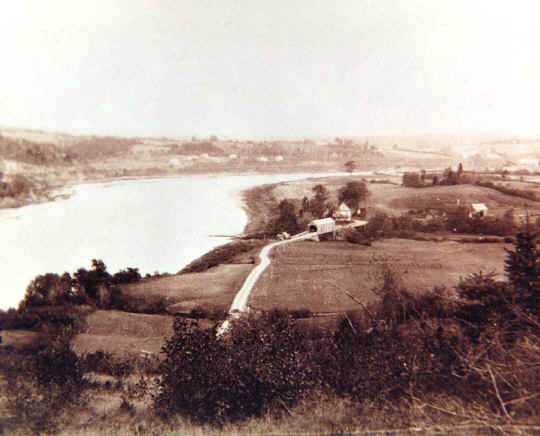
The family then moved to a settlement in New Brunswick called Maugerville.  Maugerville was a New England Planter settlement on the east bank of the St. John River, below Fredericton, It was first known as Peabody for Francis Peabody, an early grantee. The name was changed to honour Joshua Mauger (1725-1788), a native Jersey who established himself as a merchant in Halifax during the period 1749-61. Later he became the agent for Nova Scotia in London. In 1763 he was successful in securing for the New Englanders along this stretch of the river formal title to their lands.

Plan of Maugerville, Including Sheffield

The above plan of the river shows the locations of the early settlers of Maugerville; in order ascending the river.

The lower ten lots of the township and Mauger’s Island were granted to Joshua Mauger. Just above were the lots of Gervas Say, Nehemiah Hayward, John Russell, Samuel Upton, Zebulon ESTEY, John Estey, Richard ESTEY I and Edward Coy.

At the head of Mauger’s Island were the lots of Matthew Wason, Samuel Whitney and Samuel Tapley.

Between Mauger’s Island and Middle Island the lots were those of Jeremiah Burpee, Jonathan Burpee, Jacob Barker, Daniel Jewett, Ezekiel Saunders, Humphrey Pickard, Moses Pickard, Jacob Barker, jr., Isaac Stickney and Jonathan Smith.

Opposite Middle Island, in order ascending, were Thomas Barker, John Wason, Daniel Palmer, Richard Kimball, Joseph Garrison, Samuel Nevers, Peter Mooers, Richard ESTEY Jr., Jabez Nevers, Enoch DOW and Hugh Quinton.

Between Middle and Oromocto islands were Thomas Christie, Elisha Nevers, Jedediah Stickney, Stephen Peabody, Capt. Francis Peabody and William McKeen.

Opposite Oromocto Island were Israel Perley (at the foot of the island), Lt.-Col. Beamsley P. Glasier, John Whipple, Nathaniel Rideout, Capt. Francis Peabody, Alexander Tapley, Phineas Nevers, Joseph Dunphy, William Harris, Ammi Howlet, Samuel Peabody and Oliver Peabody.

Above Oromocto Island we find the lots of Asa Perley, Oliver Perley, George Munro, James Simonds, Joseph Buber, Joseph Shaw, Benjamin Brawn, Daniel Burbank, Thomas Hartt and the Widow Clark. Thence to the upper boundary of the township, a distance of two miles, there were at first no settlers, but in the course of time Richard Barlow, Nehemiah Beckwith, Benjamin Atherton, Jeremiah Howland and others took up lots.

“The River St. John” by Rev. Wm. Raymond published in 1910, pages 334-5:

“On 15 January 1765 on Captain Francis Peabody’s schooner, came Zebulon Estey to Maugerville. He paid 12 shillings passage money from Newburyport to St. John and 13s 6d for `his club of Cyder’ on the voyage. Richard Estey and Thomas Barker built a saw-mill on a small creek near Middle Island. (After 1765.) They sold it in 1779 – near Maugerville. Richard Estey signed a church covenant for a distinct church society. Many moved from Maugerville due to the annoyance of the spring freshets. [A sudden overflow of a stream resulting from a heavy rain or a thaw]  Zebulon Estey moved to Gagetown. Some went across the river to the township of Burton. These included Israel Estey, Moses Estey and Amos Estey.

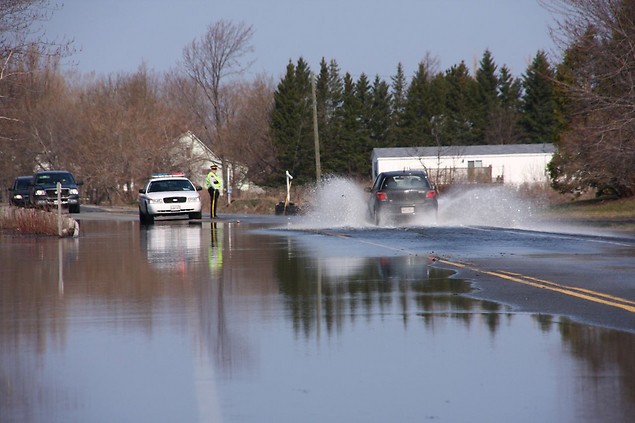
Maugerville Flooding

The New England pattern of living would have been only a minor factor in New Brunswick but for the Maugerville settlers and their diffusion throughout the province. The Maugerville settlement was successful because it was formed by a closely knit group, with religious ties, and experience in a not dissimilar environment. The Maugerville settlers came because they wanted to come. They succeeded because they wanted to succeed. Richard was one of the signers of the original covenant of the Congregational church founded there.

Scarcely had the Maugerville people settled themselves in their new

possessions until they began the formation of a church.  The original church covenant attested to be correct by Humphry Pickard, church clerk bears no date, but it probably was made in 1763, and certainly not later than 1764; it is in the following terms:—

“We whose name are hereto subscribed apprehending ourselves called of God (for advancing of his Kingdon and edifying ourselves and posterity) to combine and embody ourselves into a distinct Church Society and being for that end orderly dismissed from the Churches to which we heretofore  belonged: do (as we hope) with some measure of seriousness and sincerity,take upon us the following Covenant, viz:

“As to matters of faith we cordially adhere to the principles of religion (at least the substance of them) contained in the Shorter Catechism of the Westminister Assembly of Divines wherewith also the New England Confession of Faith harmonizeth, not as supposing that there is any authority, much less infallibility, in these human creeds or forms; but verily believing that these pricnciples are drawn from and agreeable to the Holy Scripture, which is the fountain and standard of truth; hereby declaring our utter dislike of the pelagian Arminian principels, vulgarly so called.

“In a firm belief of the aforesaid doctrines from an earnest desire that we and ours may receive the love of them and be saved with hopes that what we are now doing may be a means of so great an happiness; we do now (under a sense of our utter unworthiness of the honour and priviledges of God’s Covenant people) in solemn and yet free and cheerful manner give up ourselves and offspring to God the Father, to the Son the Mediator, and the Holy Ghost the instructor, sanctifier and comforter, to be henceforth the people and servants of this God, to believe in all His revelations, toaccept of His method of reconciliation, to obey all His commands, and to keep all His ordinances, to look to and depend upon Him to do all for us, and work all in us, especially relating to our eternal salvation, being sensible that of ourselves we can do nothing.

“And it is also our purpose and resolution (by Divine assistance) to discharge the duties of Christian love and Brotherly watchfulness towards each other, to train up our children in the nurture and admonition of the Lord, Commanding them and our Household to keep the way of the Lord: to join together in setting up and maintaining the Publick worship of God among us, carefully and joyfully to attend upon Christ’s Sacrament and institutions; to yield all obedience and submission to Him or them that shall from time to time in an orderly manner be made overseers of the flock, to submit to all the regular administrations and censures of the Church and to contribute all in our power unto the regularity and peaceableness of those administrations.

“And respecting Church discipline it is our purpose to adhere to the method contained in the platform for the substance of it agreed upon by the synod at Cambridge in New England Ano. Dom. 1648 as thinking these methods of Church Discipline the nearest the Scripture and most likely to maintain and promote Purity, order and peace of any.

“And we earnestly pray that God would be pleased to smile upon this our undertaking for his Glory, that whilst we thus subscribe with our hands to the Lord and sirname ourselves by the Name of Israel; we may through grace given us become Israelites indeed in whom there is no Guile, that our hearts may right with God and we be steadfast in His Covenant, that we who are now combining together in a new church of Jesus Christ, may by the purity of our faith and morals become one of those Golden Candlesticks among which the Son of God in way of favor and protection will condescend to walk. And that every member of it thro’ imputed righteousness and inherent grace may hereafter be found among that happy Multitude whom the glorious head of the Church, the Heavenly Bridegroome shall present to Himself a glorious church not having spot or wrinkle or any such thing.

(Signed,)
Jonathan Burpe
Elisha Nevers
Richard Estey
Daniel Palmer
Gervas Say
Edward Coye

Jonathan Smith

For the first ten years of its existence the Maugerville church had no settled minister, but the settlement was frequently visited by clergymen, and, in their absence, the public worship of God was kept up by the deacons and elders on the Sabbath, by praying and reading sermons and by singing.

The promise made by the members in the Church Covenant to discharge the duty of “Brotherly watchfulness toward each other” seems to have been religiously observed in Maugerville. A great many entries in the early records of the Maugerville church are devoted to matters of discipline. A few examples will suffice to illustrate this:

“August the 29th day, 1773. Then the Church appointed a meeting to be held at the house of Mr. Moses Pickard on the 7th day of September and chose Mr. Richard Estey, Daniel Palmer, Humphrey Pickard a committee to talk with Israel Kenny concerning his being charged with scandalous sins.

Richard died in Sheffield, Sunbury County, New Brunswick. The founder of Burpee Seed, W. Atlee Burpee also comes from Sheffield.

Children:

1. Richard ESTEY II (See his page)

5. Sarah Estey

Sarah’s husband Thomas Barker was born 20 Jul 1737 in Rowley, Mass. His parents were Jacob Barker (1711 – 1783) and Mary Spafford (Spofford) (1714 – 1740). Thomas died in 3 Feb 1782 in Sunbury, New Brunswick, Canada.

1783 Studholm Report – Burton Township – 3. Jacob Barker and Isaac Stickney claim two lots by purchase of the improvements of one Simon Brown. The lots have been possessed about 5 years, and has a log house and about 10 acres of cleared land thereon. Jacob Barker and Isaac Stickney are both rebels.

20. Jacob Barker, Jr., and Sylvanus Plumber claim an island called Ox Island by virtue of a deed of sale from James Simons, Esq. one of the original grantees dated Oct 19th 1782. Jacob Barker, junr., and Sylvanus Plumber both bitter rebels.

40. Thomas Barker deceased, late of Maugerville, cleared about 3 acres of land in Burton, but no buildings erected thereon. His son claims in consequence of said improvements.

Children of Sarah and Thomas

i. John Barker b. 13 Mar 1763 in Rowley, Mass.; d. 1824; m. 20 Jul 1785 Sheffield, Sunbury County, New Brunswick to Mary Woodbury. John and Mary had eleven children born between 1786 and 1810.

ii. Ruth Barker b. 14 Jan 1768 – Sunbury, New Brunswick; d. 1823 – Prince William, York, New Brunswick; m. Nicholas Wheeler (b. 8 Jun 1766 in Gallatin, Columbia, New York – d. 1841 in Prince William, York County, New Brunswick) His parents were Georg Wheeler (1735 – 1786) and Patty Polly Tenderly (1740 – ). After Ruth died, Nicholas in 1825 married Mary “Polly” Swasey (1791 – 1885)

Nicholas and Ruth had four children born between 1790 and 1796. Nicholas and Polly had another four children born between 1826 and 1837.

Mary Polly Swasey, daughter of Ebenezer Swasey ( was born in Exeter, N.H. 21 July 1791; died at the home of her son, Richard Wheeler at 93 years of age. She married Allen Baston, about 1810, they had one daughter. Allen was a brickmaker by trade & built the first brick house erected in Fredericton, Canada. Allen died in 1823. Mary then married Nicholas Wheeler, from N.Y.

For a woman, Mary was the embodiment of strength & dendurance & after the death of her 2nd, husband, carried on his business for nearly half a century. She was positrive in character, unwavering in her purpose & impressed her personality upon all who knew her. She lost her first husband & first child a daughter, in Fredericton by smallpox. In 1825, she lost her brick house by fire. She was of medium height, dark complexion, broad chested & had a finely moulded head with black hair.

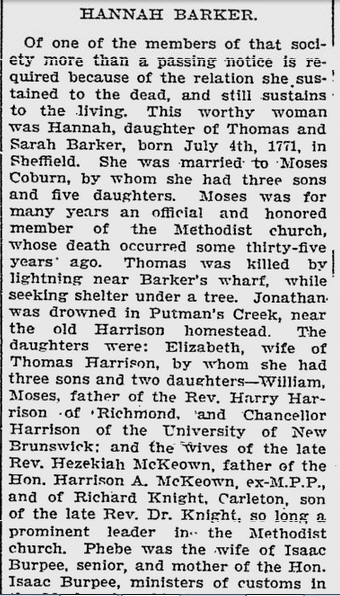
iii. Hannah Barker b. 4 Jul 1771 Sunbury, New Brunswick – d. 21 Oct 1826 Sheffield United Church Cemetery, Sheffield, Sunbury County, New Brunswick; m. Moses Coburn III (b. 12 Nov 1768 Sheffield, New Brunswick – d. 12 Aug 1841 Sunbury County New Brunswick). His parents were Moses Coburn Jr. and Hannah Burpee.

Hannah Barker Obit — From the History of Methodism in Sunbury County St. John Daily Sun – Sep 23, 1905

v. Richard Barker b. 26 Mar 1778 m. 12 Oct 1797 in Gagetown, New Brunswick, Canada to his first cousin Lucy Estey (b. 7 Nov 1780 in Canning, Queens, New Brunswick – ) Lucy’s parents were Zebulon ESTEY and Molly BROWN and her grandparents were Richard ESTEY and Ruth FISKE..

6. John Endicott Estey

John’s wife Mary “Molly” Hartt was born 6 Nov 1750 in Rowley, Mass. Her parents were Jonathan Hart and Mercy Hawkes. Molly died 29 Jan 1825 in Kingsclear, York, New Brunswick, Canada

John  first settled in Sheffield Parish, Sunbury County then at Kingsclear in York County.  John left 11 children, 62 grand children and 18 great grandchildren when he died in 1824.

Children of John and Molly:

i. Mercy Estey b. 29 Aug 1770 in Sheffield, Sunbury, New Brunswick; d. 22 May 1779 in Sheffield, Sunbury, New Brunswick

ii. John Endicott Estey b. 17 Oct 1771 in Sheffield, Sudbury, New Brunswick; d. 1837; m. Deborah [__?__]

iii. Molly Estey b. 07 Jan 1773 in Kingsclear, York, New Brunswick; d. 29 May 1777 in Sheffield, Sudbury, New Brunswick

iv. Ruth Estey b. 18 Jan 1775 in Sheffield, Sunbury, New Brunswick; d. 14 Nov 1830 in Fredericton, York, New Brunswick; m. 28 Mar 1793 Kingsclear, York Co. NB to George Everett (b. ~1774 in Brooklyn NY – d. 24 Jun 1829 in Fredericton NB) Ruth and George had four children born between 1796 and 1802.

John’s brother Zebulon also had a daughter Ruth Fiske Estey (b. 11 Aug 1775 Sheffield, NB; d. 9 Feb 1848); m. 14 Jul 1795 Gagetown, NB to Abraham Brown

v. May Estey b. 24 May 1776; d. 10 Aug 1779

vi. Endicott Estey b. 09 Dec 1777 in Sheffield, Sudbury, New Brunswickp; d. 16 Aug 1848 in Kingsclear, York, New Brunswick; m. 1803 Kingsclear, New Brunswick to Hannah Churchill (b. 14 Feb 1783 in Yarmouth, , Nova Scotia – d. 24 Feb 1862 in Jacksonville, Carleton, New Brunswick) Hannah’s parents were Nathaniel Churchill (1748 – 1820) and Elizabeth Betsey Rider (1752 – 1794). Endicott and Hannah had six children born between 1804 and 1817.

1783 Studholm Report – Gage Town – 27. Nathaniel Churchill has a wife and 6 children. Has been on the river about 6 years, but on the place he now possesses about 3 years. Came from Yarmouth. Claims in consequence of a lease from Robert Smyth, Esq., of the City of Dublin, dated the 14th of April, 1782, for 200 acres. Has a tan house and yard and about 10 or 15 acres of cleared land.

vii. Aaron Estey b. 16 May 1779 in Sheffield, Sunbury, New Brunswick; d. 03 Oct 1850 in Nashwaak, New Brunswick; m. 13 Jan 1796 – Gagetown, Queens, New Brunswick to Barbara Martha Brooks (b. 1783 – d. 28 Apr 1859 in Nashwaak Bridge, York, New Brunswick) Aaron and Barbara had ten children born between 1797 and 1816.

viii. Jonathan Estey b. 12 Mar 1781 in Kingsclear, York, New Brunswick; d. 04 Jan 1849 in Edmonds, Carleton, New Brunswick; m. his first cousin Ruth Amelia Hart (b. 04 Feb 1795 in New Brunswick – d. 04 Dec 1873 in Fredericton, York, New Brunswick) Ruth’s parents were Samuel Hart (1745 – 1814) and Clarissa Hammond (1774 – ) Her grandparents were Jonathan Hart (1710 – 1790) and Mercy Hawkes

ix. Richard Estey b. 27 May 1783 in Kingsclear, York, New Brunswic; d. 10 Aug 1806

x. Charlotte Estey b. 10 Mar 1785 in Kingsclear, York, New Brunswick; d. 26 Feb 1868 in Kingsclear, York, New Brunswick; m. 1811 to Deacon Aaron Hartt ( b. ~1788 in Maugerville, Sunbury County, New Brunswick – d. 26 Apr 1866 in Kingsclear, York County, New Brunswick) Aaron’s parents were Rev. Samuel Henry Alline Hartt (1752 – 1814) and Mary Estabrooks (1753 – 1792).

Aaron was a farmer in Kingsclear, New Brunswick and a Baptist minister.

xi. William T Estey b. 1 Jan 1787 Kingsclear, York, New Brunswick; d. 16 Jun 1870 in Kingsclear Parish, York, New Brunswick; m1. 12 Nov 1817 to his first cousin once removed Hannah Estey  (b. 1799 Queensbury, York Co, NB.)  Her parents were Nehemiah Brown Estey and Mary Jane (Polly) Ring. Her grandparents were Zebulon ESTEY and Molly BROWN. (See directly below); m2. Sarah Barker Smith, daughter of William Smith and Sarah Barker

xii. Elizabeth Estey b. 20 Jun 1789 in Douglas, Northumberland, New Brunswick; d. 06 Feb 1872 in Frederickton, York, New Brunswick; m. 1813 to Abraham Benjamin Close (b. 12 Jun 1789 in Douglas, Northumberland, New Brunswick – d. 1838 in Sea, Sulawesi Tengah, Indonesia) Abraham’s parents were Abraham Close (1762 – 1841) and Mary Hubbard (1764 – 1844)

In the 1870 census, Elizabeth was living with her son Walter in Bangor, Penobscot, Maine.

xiii. Abel Thatcher Estey b. 25 Sep 1791 in Kingsclear, York, New Brunswick – d. 08 Aug 1847 in Fredericton, New Brunswick; m. 1 Jan 1819 to Nancy Anne Henderson, Her parents were George Henderson and [__?__].

xiv. Mary Elizabeth Estey b. 06 Sep 1793 in Sheffield, Sunbury, New Brunswick; d. 08 Mar 1864 in Wakefield, New Brunswick; m. 17 Oct 1822 to Reverend Samuel Hartt, Jr. (b. 23 Apr 1799 New Brunswick – d. 16 Jan 1867 Upper Brighton, Carleton County, New Brunswick) His parents were Samuel Hartt and his second wife, Clarissa Hammond.

According to local legend, while crossing the frozen St. John River to tend his father Samuel’s cattle on Hartt’s Island, Samuel Jr. fell through and nearly drowned. He apparently cried to the Lord to save his life, vowing to devote his life to God if he survived. He seems to have found a piece of rope frozen to the edge of the ice with which he was able to pull himself to safety. He kept his vow and became a well known clergyman and evangelist. He reputedly had a great gift for singing gospel songs and by this influence converted large numbers of people. He was one of the leaders of the Free Baptist movement in its early years and had great influence on parishioners in both New Brunswick and Nova Scotia.

Rev Samuel Hartt Jr Portrait

Religious Intelligencer, February 2, 1867. “In his early life, he was instructed in the doctrines of the highest school of Calvinism, but having strong doubts to the correctness of the doctrine then held, was let to separate himself from the Calvinist Baptist body and commence his labors as an evangelist outside the connection.

“His labors contributed more largely than that of any other to the formation of the Free Christian Baptist denomination which was organized at Victoria Corner (Carleton County) in 1833. Since that time, Mr. Hartt was an earnest laborer for the ministry, visiting every section of the Province as well as portions of the U.S. and Nova Scotia.”

7. Zebulon ESTEY (See his page)

Zebulon was also the father of Mary ESTEY who was Amos ESTEY’s wife. In other words, Amos and Mary were first cousins .

Sources:

New Brunswick Esteys

http://www.genealogyofnewengland.com/b_e.htm

Richard Estey

Ruth Fiske Estey Kilburn

http://www.myfamilyhistory.com/Towne/pafg07.htm#28

http://www.angelfire.com/az/thomasfamily/Estey/Richard.html

http://trees.ancestry.com/owt/person.aspx?pid=22774435&st=1

Rowley Births to 1849

The New York genealogical and biographical record

http://www.rootsweb.ancestry.com/~nbsunbur/maugervillesettlement.htm   The Maugerville Settlement 1763 – 1824 James Hannay – [Published in Collections of the New Brunswick Historical Society Vol. 1, 1894

http://www.rootsweb.ancestry.com/~cannb/NB_Census_1783Studholm_Report.htm#seven

http://www.digilibraries.com/html_ebooks/106559/31368/www.digilibraries.com@3@1@3@6@31368@31368-h@31368-h-9.htm

Posted in -9th Generation, Double Ancestors, Immigrant - North America, Line - Miller, Pioneer, Twins | Tagged , | 16 Comments

Richard Estey II

Richard ESTEY II (1728- 1817) was Alex’s 6th Great Grandfather; one of 128 in this generation of the Miller line.

Richard Estey was born  9 Feb 1727/28  in Rowley, Essex, Mass..   His parents were Richard ESTEY I and Ruth FISKE.  He married Hannah HAZEN on 7 Feb 1750 in Rowley, Mass.   They resided in Rowley, Mass until 1764 when they relocated to a settlement on the St John River in Sunbury County, New Brunswick Canada called Maugerville.  Three generations of our Estey ancestors immigrated, Richard – age 58, Richard Jr. – age 36 and Amos – age 5.  Richard’s twin brothers Zebulon (also our ancestor) and John and  sister Sarah who who married Thomas Barker also made the trip Richard died on 9 Apr 1817 in Sheffield, Sunbury, New Brunswick, Canada.  

The Esteys were not Loyalists, they were New England Planters.  See my post New England Planters in New Brunswick for their historical story.

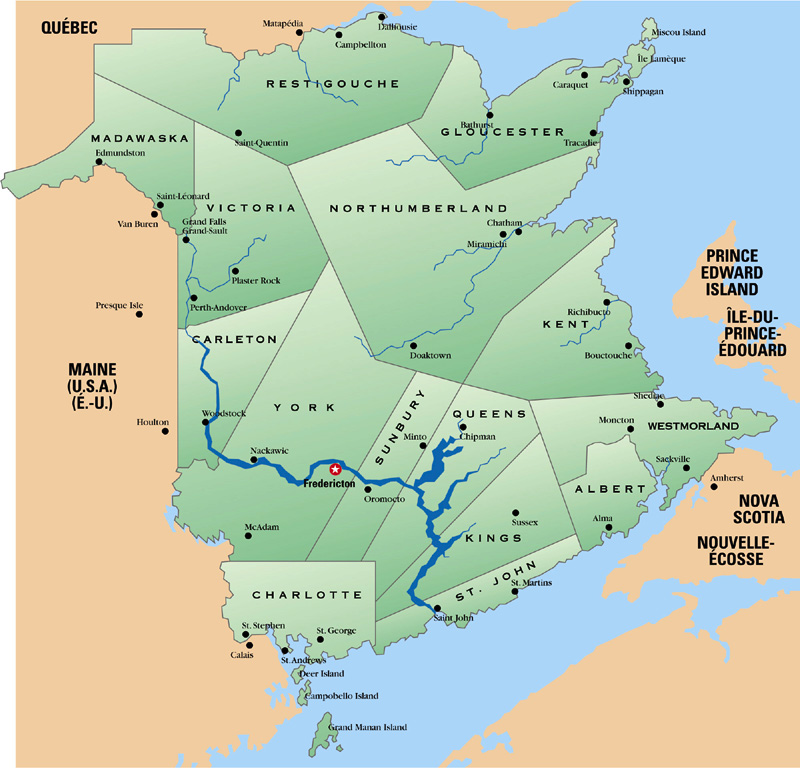
New Brunswick Counties

Hannah Hazen was baptized 7 Jan 1727  in Boxford, Essex, Mass. Her twin Margaret (Peggy) died young.  Her parents were Israel HAZEN and  Hannah CHAPLIN. Hannah died  28 Sep 1817 in Kingsclear Parish, York Co., New Brunswick.

Children of Richard and Hannah

Name Born Married Departed
1. Ruth Estey 1 Mar 1751/52
Rowley, Mass
Abraham Dow?
17 Nov 1812
2. Israel Estey 9 Aug 1753
Rowley, Mass.
Salome Burpee
Feb 1776
Maugerville, New Brunswick
12 Aug 1831 Douglas, York, New Brunswick
3. Moses Estey 12 May 1755
Rowley
Sarah Howland
1773 Rowley, Mass
29 Mar 1840
Kingsclear, New Brunswick
4. Richard Estey 14 Mar 1757
Rowley
Ruth Kirby Apr 1817
Prob. Fredericton, NB
5. Amos ESTEY 26 Aug 1759
Rowley, Mass
Mary (Molly) ESTEY
25 Nov 1787
New Brunswick
13 Nov 1833
Kingsclear, New Brunswick
6. Hannah Estey 13 Jun 1761
Rowley
John Wasson
1780 Massachusetts
29 Aug 1849
Sheffield, New Brunswick
7. Jessie Estey 17 Nov 1763
New Brunswick
(The FBrewer records have Jessie’s birth as 17 Dec 1763)
8. Rhoda Estey 25 Feb 1765
Sheffield, New Brunswick.
[__?__] Porter
9. Abigail Estey 26 Aug 1767
Sheffield, New Brunswick
George Adkin Hartley
21 Apr 1788
7 Apr 1844
Woodstock, New Brunswick,

Some genealogies also include Salome Estey b. Oct 1767, but I believe this was actually Abigail Estey’s daughter Salome Estey Hartley (b. Oct 1767 d. 8 Nov 1865) m. 6 Apr 1821 in Northampton, New Brunswick to Isaac MILLERs second son Ira Miller,( b. 16 Dec 1796 d. 27 Feb 1886). Given the other dates, it doesn’t seem like 1767 is correct.

Genealogies also include a final daughter Mary Esty m. John Weaver

The vital records of Rowley, Mass published in 1928 includes all the children 1 thru 6, but none of the children 7 thru 11.  This correlates with The New York genealogical and biographical record’s 1764 date for emmigration.

“The River St. John” by Rev. Wm. Raymond published in 1910, pages 334-5:

“On 15 January 1765 on Captain Francis Peabody’s schooner, came Zebulon Estey to Maugerville. He paid 12 shillings passage money from Newburyport to St. John and 13s 6d for `his club of Cyder’ on the voyage. Richard Estey and Thomas Barker built a saw-mill on a small creek near Middle Island. (After 1765.) They sold it in 1779 – near Maugerville. Richard Estey signed a church covenant for a distinct church society. Many moved from Maugerville due to the annoyance of the spring freshets. [A sudden overflow of a stream resulting from a heavy rain or a thaw]  Zebulon Estey moved to Gagetown. Some went across the river to the township of Burton. These included Israel Estey, Moses Estey and Amos Estey.”

Maugerville was a New England Planter settlement on the east bank of the St. John River, below Fredericton was first known as Peabody for Francis Peabody, an early grantee. The name was changed to honour Joshua Mauger (1725-1788), a native Jersey who established himself as a merchant in Halifax during the period 1749-61. Later he became the agent for Nova Scotia in London. In 1763 he was successful in securing for the New Englanders along this stretch of the river formal title to their lands. Thus the community was re-named Maugerville in his honour.

Its importance in the evolution of New Brunswick has been outlined by Esther Clark Wright: “The New England pattern of living would have been only a minor factor in New Brunswick but for the Maugerville settlers and their diffusion throughout the province. The Maugerville settlement was successful because it was formed by a closely knit group, with religious ties, and experience in a not dissimilar environment.

Childern

1. Ruth Estey

Some genealogies say Ruth married Abraham Dow 17 Nov 1812 when she was 60 years old, but I cannot find any record of Abraham.

2. Israel Estey

Israel’s wife Salome Burpee was born 1753 in Massachusetts. Her parents were Isaac Burpee and Elizabeth Dickinson. Salome died 30 Aug 1840 in Upper Keswick, New Brunswick, Canada

Israel first settled at Burton in Sunbury County, then at Upper Keswick in York County.  He married Salome Burpee.  The founder of Burpee Seed, W. Atlee Burpee also comes from Sheffield.

Excerpt from the “Studholme Report -1783” by George H. Studholme

“Isreal Esty has a wife and 3 children, been on anout 5 years. Built a log house and has about 15 acres of cleared. Claims by possession and a quit claim of the improvements of his grandfather, who had possessed it 15 years before he came on.”

Children of Israel and Salome:

i. William E. Estey b. ~1776 Maugerville, New Brunswick, Canada; m. 24 Nov 1795 to Elizabeth Lyons (b. 3 Sep 1787 – d. 17 Jan 1866)

ii. Elizabeth Estey b. 06 Jun 1777 Maugerville, New Brunswick, Canada; m. 24 Nov 1795 in Burtts Corner, New Brunswick, Canada to Peter Haines (b. 16 Jan 1772 in Rye, New York – d. Aft. 1827.) He was the son of Joseph Haines and Elizabeth Sanders.

iii. Isaac Estey b. Oct 1780 Maugerville, New Brunswick, Canada; d. 5 Oct 1867; m. 05 Jan 1805. to Lucy Boone (b. 4 Aug 1772 in North Kingston, Rhode Island – d. 13 Aug 1842 in York County, New Brunswick) Her parents were William Boone and Ruth Mary Hill

iv. Ruth Estey b. Abt. 1787 in Maugerville, New Brunswick, Canada.

v. Samuel Clark Estey b. Abt 1798, d. 10 Apr 1828.

3. Moses Estey

Moses’ wife Sarah Howland was born 9 Jun 1754 in North Yarmouth, Cumberland, Maine. Her parents were Joseph Howland and Elizabeth Mitchell. Sarah died in 1786 Durham Bridge, York, New Brunswick, Canada. She was a descendant of Mayflower passenger John HOWLAND (our ancestor in the Shaw line)

Excerpts from the “Studholme Report -1783” to George H. Studholm

“Moses Esty has a wife and 4 children, been on about 7 years. Has a log house and about 14 acres of cleared land.”

“Moses Esty favors the rebels and has not above half the cleared land reported.”

Moses sold his Upper Gagetown land on 26 Jun 1800 when they probably moved to St. Mary’s parish, Nashwaak. Sarah Estey (of Waterborough, Queens Co Baptist church) was baptized 28 Sep 1801 and had moved to Nashwaak by 28 July 1804. This could be either Moses Estey’s wife or his daughter. It is unclear why Moses is not mentioned.] Nashwaak, St Marys, Durham Bridge and Ludlow (est. 1814) could all be the same place?

The following indenture proves the marriage of Moses and Sarah

Sudbury Co. New Brunswick Indenture 6 Nov 1797
Elizabeth Howland and Moses Estey vs. Simeon Porter
[Sunbury Co Registry Office, Provincial Archive Fredericton NB; (Reel No. F5544, Book D (No. 6), Page 236-9, Regd No. 492)

This Indenture made the sixth day of November in the thirty eighth year of the Reign of his Majesty King George the third of Great Britain and in the year of our Lord one thousand seven hundred and ninety seven Between Elizabeth Howland widow and relict of Joseph Howland late of Burton in the County of Sunbury and Province of New Brunswick deceased, Ichabod Howland of Burton aforesaid son of the said deceased and Martha his wife and Moses Estey of Gage Town in Queens County and Province aforesaid and Sarah his Wife Daughter of the said deceased of the one Part and Simeon Porter of Burton of the other Part Whereas the said Joseph Howland in his lifetime did by an instrument ?????? under his name and seal bearing date the third day of November in the year of our Lord one thousand seven hundred and ninety five for the consideration of the fulfillment of certain conditions contained in a Bond given by the said Simeon Porter to the said Joseph Howland to secure to the said Joseph and his Wife a support during their natural lives, give grant bargain fill and convey to the said Simeon Porter and his heirs and ??? forever a certain Lot or Tract of Land lying in Burton.

p.237 aforesaid and nearly opposite to the Church in Magerville being the farm which he said Joseph Howland had occupied for about thirty years then left propt? together with all buildings privileges appurtenances profits and commodities whatsoever thereto belonging–and whereas since the decease of the said Joseph the said Elizabeth his widow became much dissatisfied with the support she received from the said Simeon and was in consequence thereof removed in the Month of December last to the house of the said Moses Estey who has supported her until this time–and whereas disputes have arisen between the said Elizabeth and the said Simeon respecting the said support provided by her against the said Simeon upon the said Bond for the settlement whereof and to secure himself in his title to the said Lot of Land and premises the said Simeon hath agreed to pay the said Moses the Sum of twenty five pounds to indemnify him for the expense he has been heretofore put to and will be to the second day of April next for the support of the said Elizabeth and also the Costs of the before mentioned Suit and hath further agreed to pay the said Moses annually the Sum of ten pounds during the life of the said Elizabeth for her support. And the said Moses hath thereupon consented and agreed by and with the approbation and consent of the said Elizabeth vivier? to support her the said Elizabeth during the remainder of her Life. Now therefore this indenture Witnesseth? that for and in Consideration of the said Sum of money so agreed

p.238 as aforesaid and secured? to be paid to the said Moses Estey by the said Simeon Porter and the agreement so entered into by the said Elizabeth Howland, Ichabod Howland and Martha his wife and Moses Estey and Sarah his wife have remise?, released and quitclaimed and do by these presents fully freely and absolutely remise? release and forever quitclaim unto the said Simeon Porter his heirs and assigns all the right and title which they or any or either of them jointly or severally now have of what nature or kind soever of in and to the same by reason of the Spate? which the said Joseph Howland had heretofore in the said premises or by reason or means of any break heretofore made by the said Simeon in the performance of the conditions of the said Bond. And the said Elizabeth, Ichabod and Moses do hereby for themselves and each of them for herself or himself and their and cash and every of their Heirs Executors and Administrators remise release and forever quitclaim unto the said Simeon Porter his Heirs Executors Administrators and Assigns

p.239 all actions and action and causes of actions suits and controversies whatever which either or any of us now have or hereafter may or might have against the said Simeon Porter his Heirs Executors Administrators or Assigns for or by reason or means of the said Bond or otherwise dooreselboo? respecting the premises. In witness thereof the said Elizabeth, Ichabod, Martha, Moses and Sarah have hereunto set their hands and seals the day and year find above written– Signed, sealed and delivered in the presence of Elizabeth (her X mark) Howland by Sarah Howland and Moses Estey and wife– Moses Estey

Sarah (her X mark) Estey
Isaac Chase, Thos Witmore
and by Ichabod Howland and wife in presence of New Brunswick Sunbury
Be it remembered that on the twenty fifth of December in the year of our Lord one thousand seven hundred and ninety seven personally came and appeared before me Niel Camp Sgn? one of his majesty’s Justices of the Peace for the County of Sudbury aforesaid Moses Estey and Sarah his wife and acknowledged that they signed sealed and delivered the above written Instrument as their act and deed for the uses and purposes in the same mentioned and the said Sarah having been examined by me separate and apart from her said husband she declared that the executed the ??? ??? and when truly without and without any par? threat or compulsion from him Niel Camp, J.P.

Children of Moses and Sarah

i. Moses Estey b. 21 Apr 1774 in Burton, Sunbury, New Brunswick, Canada; d. 31 May 1837 in Whiting, Washington, Maine; m. 16 Jan 1803 Grandlake, New Brunswick, Canada to Elizabeth Hall (b. 27 Feb 1785 in Gagetown, Queens, New Brunswick, Canada – d. 4 Jun 1863 in Whiting, Washington, Maine) Moses and Elizabeth had 13 children born between 1803 and 1831.

ii. Richard Estey b. Abt 1775 in New Brunswick, Canada; d. Sep 1805

iii. Stephen Estey b. 12 Jun 1786 in St Marys Parish, York, New Brunswick, Canada; d. 28 Apr 1858 in Durham Bridge, York, New Brunswick, Canada; m. 20 Nov 1814 to Elizabeth Pond (b. 14 JUL 1788 in St Marys, York, New Brunswick – d. AFT 1861 in Nashwaak, York, New Brunswick) Elizabeth’s parents were John Pond (1762 – 1853) and Eva Cain (1768 – 1853). Stephen and Elizabeth had eight children born between 1815 and 1828.

iv. Sarah Estey b. Abt 1788 in Oromocto, Sunbury, New Brunswick; d. 1822 in Ludlow, Northumberland, New Brunswick; m. Abel Pond (b, 1791 in St Marys New Brunswick – d. 1871 in Ludlow, Northumberland, New Brunswick) Abel’s parents were John E Pond (1763 – 1853) and Mary Eva Cain (1768 – 1853). He was William and John Pond’s brother.

Abel served in the military (War of 1812 ‘Capt’; constable). He was listed as a resident in the census report 1871 in Ludlow, Northumberland, NB. He was a lumberman.

Sarah and Abel had four children born between 1812 and 1822. After Sarah died, Abel married in 1823 to Susanna Hovey (b. 1793 in Gagetown, Queens, New Brunswick – d. Ludlow, Northumberland, New Brunswick) and had four more children.

v. Samuel Estey b. Abt. 1792; m. Mary Hafford (b. 5 Sep 1800 New Brunswick – d. 11 Mar 1865 – New Brunswick). Samuel and Mary had eight children born between 1811 and 1835.

vi. Olivia (Olive) Estey b. abt. 1794 in St Marys Parish, York, New Brunswick, Canada; d. 1858 in Blackville, Northumberland, New Brunswick, Canada; m. 6 Sep 1817 St Marys Parish, York, New Brunswick, Canada to William Pond (b. 1793 in St Mary’s Parish, York Co., New Brunswick – d. 1885 in Ludlow Parish, Northumberland Co., New Brunswick) William’s parents were were John E Pond and Mary Eva Cain. He was Abel and John Pond’s brother. Olivia and William had seven children born between 1818 and 1835.

vii. Naomi Estey b. 1800 in Upper Gagetown, Queens, New Brunswick, Canada; d. Nov 1866; m. John Pond (b. 27 Dec 1797 – d. 1891) John’s parents were John E Pond and Mary Eva Cain. He was Abel and William Pond’s brother.

4. Richard Estey

Richard’s wife Ruth Kirby’s origins are not known.

5. Amos ESTEY (See his page)

6. Hannah Estey

Hannah’s husband John Wasson was born 1741 – Chester, Rockingham, New Hampshire. His parents were Lt. Col. Thomas Wasson (b. 1701 in Village of Ballymena, Ballymanus Parish (Antrim) Northern Ireland – d. Jan 1801 in Chester, Rockingham, NH) and Ann Wright (b,23 Oct 1715 in Village of Dunblane (Perthshire) Scotland).

Thomas Wason came to America approximately 1728 with his brother James and with his two sisters Isabel (married John Caldwell, 1734) and Margaret (married James Caldwell, 1740) James settled in Portsmouth NH 1736 then to Nottingham West now Hudson, NH. Another brother, David Wasson did not emigrate and remained in Clough, Ballymena, County Antrim, Northern Ireland and the Wasson family still lives in Clough today as well as the Calwells, (Caldwells).

When Isabel Wason and James Caldwell married, they stated that they lived in the village of Clough, Ballymena, County Antrim. A researcher found the four room cottage (No longer occupied) that the Wasons probably lived in next to the Clough Presbyterian Church

1733, October 11: Thomas Wasson married Ann Wright in the Second Church at Scituate Village (Plymouth) Massachusetts Colony.

Source:  “Thomas Wason of Chester, New Hampshire; And His Descendants” by Alice Lucinda Priest; revised, unpublished manuscript; Shenandoah, Iowa; 1931 (Iowa State Library, Des Moines)

John first married Ann Christy and had two children Betty Ann (b. 1767) and Susan (b.1768).  John died Jan 1823 in Sheffield, New Brunswick, Canada

Children of Hannah and John: ( Here’s a list of 39 of Hannah and John’s grandchildren)

i. Sarah Wasson b. 1782; m. John Connolly

ii. John Wasson b. 28 Nov 1785 in Saint John, New Brunswick; d. 28 Nov 1855 in Norridgewock, Somerset, Maine; m. 1807 to Elizabeth Sutherland (b. 790 in Miramichi, Northumberland, New Brunswick – d. 1853 in Anson, Somerset, Maine). Her parents were George Sutherland (1748 – 1831) and Ann Stuart (1733 – 1822). Elizabeth’s brother George married John’s sister Hannah/ John and Elizabeth had ten children born between 1808 and 1831

John immigrated to the United States in 1821 and became a naturalized citizen Mar 1830. In the 1850 census, John and Elizabeth were farming in Anson, Somerset, Maine.

iii. James Worth Wasson b. 26 Nov 1786 in Sheffield, Sunbury Co., New Brunswick – d. 2 Nov 1868 in Sheffield, Sunbury, New Brunswick; m. 1817 Rachel Ann Porter (b. 1787 – d. 18 Jun 1868 in Sheffield, Sunbury, New Brunswick ) James and Rachel had six children born between 1819 and 1830

Mar 24 1820 – James’ father sold him a deed in Sheffield, Sunbury Co., New Brunswick, for the sum of 500 pounds in Hand witnessed by David Burpe and Andrew Smith

Nov 12 1868 Saint John Newspaper Christian Visitor – d. 2nd inst., of heart disease, James Wasson, Sheffield (Sunbury Co.) age 83. His aged partner in life died about three mos. previously.

iv. Hannah Wasson b. 1789; m. George Sutherland (b. 1789 in Miramichi, Northumberland, New Brunswick – d. 1869 in Kingsclear, New Brunswick) His parents were George Sutherland (1748 – 1831) and Ann Stuart (1733 – 1822). George’s sister Elizabeth married Hannah’s brother John.

v. Thomas Wasson b. 1789; d. 17 Mar 1865; m. Sarah Goodwin (b. 1793 Cemetery says born in 1800 – d. 12 Nov 1871 in Queens Co, NB) Sarah’s parents were Joseph Goodwin (1760 – 1847) and Jane Godin (b. 1760). Thomas and Sarah had six children born between 1814 and 1825

vi. Mary Wasson b. 7 Jan 1791 Sheffield, New Brunswick; bapt. 23 Jan 1795 Fredericton, NB; d, 11 Sep 1871 Sydenham Township, Ontario; m. 16 Mar 1813, Sunbury County, New Brunswick to Peter Day Jr. (b. 07 Jan 1791 in Burton Parish, Sheffield, New Brunswick – d. 17 May 1880 in Grey, Ontario). His parents were Peter Day (1755 – 1831) and Catherine Allen (1760 – 1848). Peter and Mary had 11 children born between 1813 and 1830, but the above list of 39 includes only one child John Day(1818-1819) Here’s a complete list of Peter’s descendants.

Peter, Jr. settled at Cumberland Bay, Queens County., New Brunswick and moved to Ontario in 1845. Witnesses to their marriage were James Wasson and Lawrence Day. In 1845 Peter Day Jr. and his wife and three sons, Robert W., George P., and Thomas W. moved to Ontario and obtained a patent from the Crown in 1848 for Lot 26, Concession. B, Sydenham Township, Frontenac County [north of Kingston where the St Lawrence River flows out of Lake Ontario]. This lot and several lots acquired by others of the family became known as”Daywood”. They settled on the same road as the Johnstones but nearer to Annan. Residence: 1 0-26-1848, Lot 26, Conc. B,Sydenham Peter Day jr. first built a log house and later built a good frame house which is still in good condition and is owned by his Great Grandson, Thomas L. Day. (Written by Georgina Lannin, daughter of Mary Ann Day and John Nathaniel Lannin.)

Peter was for many years a Deacon of Daywood Baptist Church. In the 1871 Ontario Census, he and Mary are listed with Thomas and his family. Peter’s Obituary states”…His last illness, brought on by old age, was of short duration, and during this time his trust in Christ never waivered, but grew stronger and stronger to the end…”

vii. Charlotte Wasson b. 1793 in Waterborough, Queens, NB; m. 28 Dec 1815/6 in New Brunswick to Stephen Wiggins (b. 25 Mar 1789 in Waterborough, Queens, New Brunswick, Canada – d. 9 Nov 1822) Stephen’s parents were Jacob F Wiggins (1762 – 1815) and Elizabeth Ruth Slocumm (1769 – )

viii. Robert Bartlett Wasson b. 5 Dec 1795 in Sunbury Co., NB; d. 6 Mar 1871 in Blissville Parish, Sunbury Co., NB; m. 21 Jul 1822 to Elizabeth Ann Richardson (17 Feb 1805 – 5 Apr 1892) Elizabeth’s parents were Stephen Richardson and Mary Ann Marple. Robert and Elizabeth had 13 children, including one set of twins, born between 1823 and 1846.

Mar 25 1871 – Saint John Newspaper The Daily Telegraph — An inquest was held in the Parish of Blissfield (North. Co.) 6th inst., before Elijah Fowler, Esq., Coroner, on the body of Robert B. WASSON who died suddenly. Apoplexy was the cause of death. He was in his 76th year. He came to to the Miramichi a few years before the Great Fire (1825) which devestated this and other districts.

ix. Ruth Wasson b. 1798; d. Aft 1861 census Queens, New Brunswick; m. 27 July 1820, in Sheffield, N.B. to 27 Jul 1820 in Sheffield, N.B. to William Brown (b. 1794 in Elsbrow, Buckinghamshire, England – d. Aft. 1851 census) William’s parents were Francis Brown (1755 – 1815) and Sidney Green (1757 – 1825).

x. George Wasson b. 13 Mar 1804; d. 1881 in New Brunswick; m. Mary Ann McMahon (aka McMann) (b. 7 Jun 1807 in New Brunswick – d. 7 Jun 1879 in Jacksontown, Carleton, New Brunswick); George and Mary had eight children born between 1832 and 1849.

8. Rhoda Estey

Rhoda’s husband [__?__] Porter was born in 1765 According to the 1783 Studholm Report, David Porter was living in Burton Township and had a wife, a log house and about 3 acres of land cleared. Has been on about 3 years from Cornwallis, purchased improvements etc.

9. Abigail Estey

Abigail’s husband George Adkin Hartley was born 1759 in Newcastle, Northumberland, England or Canterbury, Kent, England, tHey married in Sunbury County in 21 Apr 1788, but moved to Woodstock, Carleton County. George died 2 Sep 1812 in Burton Parish, Sunbury County, New Brunswick. Abigail lived for 32 more years.

George was a Sergeant in the King`s American Regiment. George was wounded several times while fighting as a Soldier in King George’s Guards during American Revolution. Granted Regimental land in Canterbury Parish, York County, New Brunswick, Canada.

The Regiment was raised in New York in December, 1776 by Colonel Edmund Fanning as the Associated Refugees. This one regiment served in six major campaigns across the length of the eastern seaboard. They fought in some of the bloodiest battles of the war, ending their service by being placed on the regular British Establishment, an honor bestowed on but a handful of Loyalist units.

It served in the attacks on Fort Clinton and Fort Montgomery. It took part in relief of Newport, raids in Virginia and operations in Georgia and East Florida. It was taken into the American Establishment on March 7, 1781 as the 4th American Regiment. It was taken into the British Establishment on December 25, 1782, possibly as the 110th Regiment of Foot and disbanded in Canada in 1783.

Children of Abigail and George (Partial List)

i. Capt. James Hartley, b. 6 Feb 1789 in New Brunswick; d. 2 Jan 1860 in Ritchie, York, New Brunswick, m. 18 Nov 1812 Woodstock parish, Carleton, New Brunswick, Canada to Susannah Moore (b. 1797 – d. 1 Jun 1889 in Ritchie, York, New Brunswick) Susannah’s parents were John Moore and Sarah Littler. Her sister Miriam married James brother John. They moved to Shogomoc, York, New Brunswick on the east side of the Saint John river before 1832.

James was a Farmer, Justice of the Peace and Captain in the Militia.

James’ grandson Roland Hill Hartley (26 Jun 1864 – 21 Sept 1952) served two terms as the tenth Governor of the state of Washington from 1925 to 1933 as a Republican.

Roland Hill Hartley (1864 – 1952) 10th Governor of Washington

Roland’s parents were Rev. Edward Williams Bennett Hartley and Rebecca Barker Whitehead. Born the 8th of 12 children in a backwoods farm in Shogomoc, York County, New Brunswick, Canada.

Did a “Man’s work” with the scythe, cradled grain, chopped down trees, sowed fields, plowed, harrowed land – and harvested annual crop of rocks.

In 1878, while only 14 years old, he moved to Minnesota to join other family members.

“Cookee” (“flunky”) in Minnesota logging camp – helped cook, waited on tables and made up bunks.

Drove the horse drawn McCormick Harvester through the Dakota prairie near Fargo and Page North Dakota. Broke sod and developed farm land. In the winter used the same horse-drawn team for logging operations. Drove logs from headwaters of the Mississippi to Minneapolis.

Wholesale grocery clerk. Bellboy, Porter and Clerk in the Old Commercial Hotel at Brainerd, Minnesota. Became secretary to hotel owner, Carl Douglas, Brainerd Mayor – first taste of politics.

Grammar school education plus savings allowed admission and graduation from the Minneapolis Academy.

Bookkeeper for Clough Brothers lumber firm that built the first electric railway in Duluth, Minnesota.

Became private secretary to Minnesota Governor, David Clough’. Became active in Republican politics. Married State Senator David Clough’s daughter, Nina Clough August 22, 1888, the year he became an American Citizen.

Lieutenant Colonel in the Minnesota National Guard and ordered to the field during Sioux uprising.
Shoe salesman for Putman and Hartley shoe manufactures and traveled through the Northwest selling product in the 1890’s.

Moved to Everett in 1902 in connection with investment in Washington Timber. Laid out and constructed his own trails, logging roads and railroads. Erected logging camps. Filled every position on the payroll except that of high rigger. Shared hardships with his men in the woods. First to introduce spring mattresses and other home comforts in the logging camps. Personally cruised 10,000,000,000 board feet of timber.

Participated in the establishment of the Clark-Nickerson Saw mill and later the Clough-Hartley cedar siding and shake mill (largest in the world at that time) along the Everett waterfront.

Mayor of Everett 1910 – 1912.
Washington State Legislature 1915 – 1917.

At age 53 was one of the first to enlist at the beginning of World War I. (Company D, 3rd Infantry, Washington National Guards, August 7, 1917). Ultimately moved up from “Private” to commission of “Captain” with orders to sail to Europe from Hoboken New Jersey when the Armistice was signed. (Sons David and Edward served in the army during the war.)

Hartley’s major accomplishments during his governorship were the creation of centralized state highway department and new state timber laws. He was the first Washington Republican governor to serve two terms and to run for a third.

ii. John Moore Hartley b 20 Oct 1790 in Dumfries Parish, York, New Brunswick; d.6 Jul 1852 in Elgin, County, Ontario [south of London on the north shore of Lake Eire]; m. 18 Oct 1814 to Miriam Moore (b. 1795 in New Brunswick – d. 1835 in Ontario) Miriam’s parents were John Moore and Sarah Litler. Her sister Susannah married John’s brother James. I have info only on 3 children Susannah 1816, Job 1822 and Mary 1838 so maybe there were more children cuz of that dates apart between child

iii. Anna Estey Hartley b. 3 Sep 1792

iv. Amos Hartley (b. 12 Jul 1794 in Woodstock, Carleton, New Brunswick – d. May 1834 in New Brunswick); m. 13 Nov 1817 Woodstock parish, Carleton, New Brunswick to Hannah Gesner (Guieu/Gerow)

v. Rebecca Hartley b. 1795; d. Aft. 1861 census Woodstock, Carleton County, New Brunswick m. Nov 1814 Woodstock parish, Carleton, New Brunswick to David Jackson (b. 1791 – d. Aft. 1861 census Woodstock, Carleton County, New Brunswick) David’s father was Henry Jackson (b.1775)

vi. Salome Estey Hartley b. Oct 1796 Woodstock, New Brunswick, Canada; ; d. 8 Nov 1865, Wicklow Tracey Mills Centreville Carleton, New Brunswick; m. 16 Apr 1821 Northampton, NB to Ira Miller (b. 16 Dec 1796 Southampton, York, NB – d. 27 Feb 1886 Wicklow Tracey Mills, Centreville, Carleton, NB); son of Isaac MILLER.

vii. Sarah Hartley b. 1801 in Woodstock, Carleton, New Brunswick;; d. 15 Nov 1875 in Lower Meductic, York County m. 21 Aug 1824 York, NB to Oliver Miller (b. 1799 York, New Brunswick – d. 29 Apr 1886, Canterbury, York County, NB) another son of Isaac MILLER;

viii. Mary Hartley b. 1803; m. 27 Mar 1822 Woodstock (Bureau de Santé), Acadie (Nova Scotia and New Brunswick) to Michael Guerrier (b.1791) Mary and Michael didn’t have any children, but Michael did have 11 children born between 1830 and 1858 with his second wife. After Mary died, Michel married 31 Mar 1829 Brighton, Carlton, New Brunswick, Canada to Mary Cronkhite (b. 17 Mar 1811 in Woodstock, Carleton, New Brunswick – d. Monticello, Aroostook, Maine)

ix. Charles Hartley b. 1805 in Woodstock, Carleton, New Brunswick; d. 10 Apr 1879 in Lower Meductic, Carleton, York, New Brunswick m1. 2 Nov 1832 Susan Elizabeth Foster (b. 5 Aug 1816 in Douglas, York, New Brunswick- d. 27 Dec 1847 in Lower Meductic, Carleton, York, New Brunswick) Her parents were John Foster and Artemissa Todd Her sister Charlotte married Charles’ brother Valentine; m2. 7 Nov 1850 to Mary Jane Gray (b. 1823 – d. 11 Apr 1885 in Lower Meductic, Carleton, York, New Brunswick)

x. Hannah Hazen Hartley b. 1806 in Woodstock, Carleton, New Brunswick; d. 23 May 1861 in Tracey Mills Carleton County New Brunswick; m. 13 Aug 1826 Northhampton, Carleton, New Brunswick to Henry H. Cronkhite Jr. (b. 1800 in New Brunswick – d. 28 Jan 1872 in Tracy, New Brunswick) His parents were Rev. Henry Cronkhite (1785 – 1847) and Abigail Feero (1785 – 1851). Hannah and Henry had four children born between 1827 and 1849.

xi. Valentine Adkin Hartley b. 1809 in Woodstock, Carleton, New Brunswick; d. 12 Apr 1880 in St John, New Brunswick m. Charlotte F. Foster (b. 23 Sep 1814 in Douglas, New Brunswick – d. 29 Dec 1874 in Maine) Charlotte’s parents were John Foster and Artemissa Todd. Her sister Susan Elizabeth married Valentine’s brother Charles.

The 1851 census of Woodstock shows another son, listed only as V. A. Hartley, born 1808, with his wife “Mrs.” born 1814. V.A. named his first boy and girl after his parents George Adkin and Abigail.

Sources:

New Brunswick Esteys

http://www.myfamilyhistory.com/Towne/pafg14.htm

http://www.angelfire.com/az/thomasfamily/Estey/Richard.html

http://www.genealogyofnewengland.com/b_e.htm

http://trees.ancestry.com/owt/person.aspx?pid=22774431&st=1

Rowley Births to 1849

http://genforum.genealogy.com/estey/messages/130.html

http://archiver.rootsweb.ancestry.com/th/read/NewBrunswick/2005-02/1109425531

http://home.comcast.net/~tdoherty/nb.htm

Posted in -8th Generation, 90+, Immigrant - North America, Line - Miller, Twins | Tagged , | 10 Comments

Amos Estey

Amos ESTEY (1759 – 1833)  was Alex’s 5th Great Grandfather; one of 64 in this generation of the Miller line.

Amos Estey was born  28 Aug 1759  in Rowley, Mass.  Amos’s parents were Richard Estey II and Hannah HAZEN. He resided in Rowley, Mass until 1764 when his parents and grandparents relocated to a settlement on the St John’s River in New Brunswick Canada called Maugerville.  Three generations of our Estey ancestors immigrated, Richard – age 58, Richard Jr. – age 36 and Amos – age 5.   See my post New England Planters in New Brunswick for the historical story.

Amos married his first cousin, Mary (Molly) ESTEY on 25 Nov 1787 in New Brunswick.   Amos died on 13 Nov 1833 in Kingsclear, York, New Brunswick.

Mary (Molly) Estey was born 5 Jul 1767 in Sheffield, Sunbury County, New Brunswick. Her parents were Zebulon ESTEY and Mary BROWN. Mary died 5 Jun 1844 in Kingsclear, York County, New Brunswick.

Children of Amos and Mary

Name Born Married Departed
1. Solomon Estey 31 Aug 1788 Kingsclear, York, New Brunswick Marium Amelia (Salome) McNally
28 Jul 1812 Queensbury, York, New Brunswick,
2. Abraham ESTEY 6 May 1790 Kingsclear, York, New Brunswick Ruth DOW
17 Nov 1812 Woodstock
18 Mar 1876
3. David Estey 13 Jul 1792New Brunswick Anna Knapp (Often published as Knoop)
30 Sep 1813 New Brunswick
20 Nov 1874
Troy, Miami, OH 
4. Sarah Estey 22 Mar 1794 Kingsclear Parish, York, New Brunswick 1797
5. James Estey 20 Mar 1796New Brunswick Abigail Knapp (Often published as Knoop)
16 Nov 1820 New Brunwick
1858
Staunton, Miami, Ohio
6. Ruth Fiske Estey 31 Mar 1800 Kingsclear, York, New Brunswick John S. Barker
20 Jul 1820
5 Jun 1831 York, New Brunswick
7. Simon Hammond Estey 5 Jan 1802 Kingsclear Parish, York, New Brunswick 22 Mar 1840 Drowned
8. Hannah Hazen Estey 13 May 1804 Kingsclear, York, New Brunswick Nicholas Barker 1883
9. Rhoda Phoebe Estey 26 Jan 1807 York, New Brunswick, Horatio Nelson Cliff
28 Feb 1832 Fredericton, York, New Brunswick
11 Mar 1893
10. Elizabeth Estey c 1809 23 Mar 1832

CMcGehee, RSchaffer, TJEstey, FIBrewer, JCHatt The TJEstey account has Amos’ death as 05 Jan 1844 in Kingsclear

In this record Marked No797 dated March 4 1798 Amos and his wife Molley Estey are recorded as having sold some property known as Lot#73 to Joseph Burt. They had purchased this Lot earlier from Samuel Loldell marked No421 dated April 4 1789

This record shows Amos Estey and Mary his wife sell Lot #75 in Kingsclear Parish which they had bought Oct 4 1799 from Peter Campbell marked No683 to John Vance and his wife Lucy.  This land transaction is dated May 13 1822.

At least they made a profit on the land as they purchased Lot #75 for 42 pounds 6 shillings, 8 pence and sold it for 100 pounds; however I am sure they would have made improvements on the land and most likely had building and things of that nature. It would have most likely been a fair trade for their efforts in the improvements of the property.

It seems as though Amos and Mary Estey of the Parish of Kingsclear, farmer, were liquidating thier property as we find another sale of land to William Estey marked No2658, Dated May 29 1822. William Estey bought Lot #47 in St. Mary’s, York County, NB., containing 200 acres for 35 pounds.

So where did Amos and Molley  live after 1822? Perhaps they lived with one of their children.  They had reached the age of retirement and may have decided to help out their grandchildren by spending time with them.  We do see that some of the Grandchildren are mentioned in the Will even though not by name but by their parent’s name.

The Brewer book “A Dutch-English Odyssey” pg 116 states that Richard & Hannah’s 5th child was named James and he insists that this is correct as it is entered in a family bible of that time. Entered as James not Amos. All other accounts have the name to be Amos.

Researcher George Estey has since been provided a copy of that Bible page and have been able to use a program to clean up noise from the copy. This clears up the mystery for him as the person who scribed the names of that generation used a swirl or loop in front of each name. This swirl looks much like a capitol “J” and the name Amos being placed very close behind makes the name look like James.It is really J Amos. The “J” being just a form of decoration in front of each name. (George Warren Estey 12 Nov 2002)

“The River St. John” by Rev. Wm. Raymond published in 1910, pages 334-5:

“On 15 January 1765 on Captain Francis Peabody’s schooner, came Zebulon Estey to Maugerville. He paid 12 shillings passage money from Newburyport to St. John and 13s 6d for `his club of Cyder’ on the voyage. Richard Estey and Thomas Barker built a saw-mill on a small creek near Middle Island. (After 1765.) They sold it in 1779 – near Maugerville. Richard Estey signed a church covenant for a distinct church society. Many moved from Maugerville due to the annoyance of the spring freshets. [A sudden overflow of a stream resulting from a heavy rain or a thaw]  Zebulon Estey moved to Gagetown. Some went across the river to the township of Burton. These included Israel Estey, Moses Estey and Amos Estey.”

Excerpt from a report written about Sunbury County to Major George Studholm, Commander at Fort Howe  St John River, June 30 1783

” Amos Esty, a single man has improved about 4 or 5 acres of land which is partly cleared, and provided some materials for building.”

Amos Estey was recorded in a Book called Early Probate Wills of New Brunswick by Wallace Hale

Estey, Amos – Parish of Kingsclear, York Co. Will dated 17 June 1833, Proved 9th of December 1833

The will goes on to mention his wife Mary she has the use of all his dwelling for life, all stock, furniture and farming utensils.

Mentioned also is his son-Solomon: 5 shillings,  son-David: 10 pounds.  Heirs of daughter Ruth Barker: 3 pounds each Daughters Hannah Barker andRhoda Cliff each 50 pounds

Sons- James and Simon residue of estate.

Wife Mary and son James are executors.

Witnesses: William Estey, John Brewer, John Allen

Children

1. Solomon Estey

Solomon’s wife Marium Amelia (Salome) McNally was born in 1791 – Sunbury, New Brunswick, Canada.   Her parents were Michael M McNally and Sarah Ruth Bradley (Prince?).

Michael McNally, a native of Epsom, Surrey, England was the first of the McNally line to settle in New Brunswick. He came to the United States with his father, Richard Henry McNally who died Oct. 10, 1780 in Flushing, NY. Research done by various McNally family members shows that he was listed as a volunteer in Captain David Kinlock’s Troop of the British Legion Cavalry on Oct. 27, 1778. He was approximately 15 years of age when he volunteered. He was later promoted to Adjutant, February 1779. By the end of the Revolutionary War he was an Ensign in the Prince of Wales Royal American Regiment. He was mustered out of the Prince of Wales Regiment Oct. 14, 1783 in Saint John, New Brunswick and first settled in Maugerville. A few years later he moved to Lower Queensbury in York County. The area he settled in was later to become known as McNally’s Ferry.

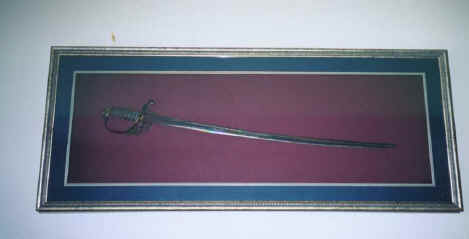
Michael McNally’s Sword now in the hands of Rev. John Hugh McNally, his 4th great grandson.

Michael was born in 1764 and died at his home January 13, 1848. His obituary stated that he was a professor of Religion. There are petitions on file at the Provincial Archives that reveal he was the master of a school about 1820. The book, Fredericton, New Brunswick, British North America by Isabel Louise Hill, includes the following about Michael McNally: ” In October, 1824 the Rev. Dr. James Somerville, missionary of the Society for the Propagation of the Gospel in Foreign Parts, wrote to London that he could ‘recommend Mr. McNally, a teacher in the Parish of Queensbury, for the Society’s allowance.'” He married Sarah Ruth Bradley and had at least 15 children. These children and their descendants have scattered to many parts of the world.

McNally’s Ferry

McNally’s Ferry is a place and a way of life no longer in existence. It was located above Mactaquac on the St. John River. With the building of the Mactaquac Power Generating Station and Dam in the mid-1960′s this general area that had been the home of 5 generations of McNally’s was completely flooded.0

2. Abraham ESTEY (See his page)

3. David Estey

David and James married sisters.  The Esteys and Knapps found making a living hard in New Brunswick. They immigrated from New Brunswick to Miami, Ohio between 2 Dec 1821 when George was born and 24 Jan 1824 when Simon was born.

David and James Estey immigrated to Miami, Ohio in the 1820’s.

David’s wife Anna Knapp (Often published as Knoop) was born 19 Mar 1792 in New Brunswick, Canada. Her parents were Michael Knoop and Rebecca Mooers. Anna died 21 Aug 1873 in Lostcreek Township, Miami, Ohio.

Anna Knoop

In the 1850 census, David and Anna were farming in Lostcreek, Miami, Ohio.

David Estey Gravestone — Lost Creek Cemetery, Casstown, Miami County, Ohio,

Children of David and Anna:

i. James Estey b. 17 Sep 1814 New Brunswick; d. 1898 Greenville, Darke, Ohio; m1. 1 Jan 1842 to Jane McDowell; m2. Ann Dye

In the 1850 census, James and Jane were farming in Staunton, Miami, Ohio.

ii. Michael Estey b. 13 Apr 1816 New Brunswick, Canada; d. 17 Feb 1902 Jasper, Missouri; m. 5 Jul 1838 in Miami, Ohio to Mary Swindler (b. 1815 in Fayette, Pennsylvania – d. 1852); m2. 1873 to Mary A [__?__] (b. 1 Jun 1834 Indiana – d. 11 Jun 1902 Jasper, Jasper County, Missouri)

In the 1860 census, Michael was a butcher in Township 10, Calaveras, California he was living with John DuFebrve (age 62), a physician from France.

In the 1880 census, Michael and Mary were farming in Sheridan, Jasper, Missouri.

iii. Eunice Estey b. 24 Feb 1818 New Brunswick; d. 22 Nov 1855 in Delphos, Allen, Ohio; m. 11 Aug 1838 to Abraham Diffenbaugh (b. 22 Mar 1817 in Lancaster, Lancaster, Pennsylvania – d. 20 Jun 1908 in Salem Center, Steuben, Indiana) After Eunice died, he married Aug 1856 to Lucy Stevens (b. 28 Dec 1833 in Delphos, Allen, Ohio – d. 2 Apr 1879 in Hutchinson, Reno, Kansas) Next he married 4 Aug 1881 Allen Indiana to Alvoretta V. Christy (b. 30 Oct 1856 in Roanoke, Huntington, Indiana – d. 11 Jul 1887 in Hudson, Steuben, Indiana). Finally, he married 3 Mar 1889 Steuben County, Indiana to Amy Slick (b. 12 Feb 1818 in New York – d. 17 Jul 1911 in ? Salem Center, Steuben, Indiana)

In the 1850 census, Abraham and Eunice were farming in Section Ten, Van Wert, Ohio.

Abraham Diffenbaugh Portrait

iv. Charles William Estey b. 05 Apr 1820 New Brunswick; d. 3 Apr 1891 Plymouth, Amador, California; m. 4 Apr 1844 in Miami, Ohio to Martha Matilda Garrard (b. 1821 in Ohio – d. 23 May 1886 Plymoth, Amador CO, California)

In the 1860 census, Charles was a farmer in Fiddletown, Amador, California. The town was first settled by Missourians in 1849 and in the 1850s served as a trading center for a number of mining camps in the area. The town also had one of the largest Chinese communities in the state (over 2,000 in the 1860 census).

At the time of its founding, placer mining was the most popular mining technique, which is heavily dependent on water. The local water source, Dry Creek, ran dry during the summer months, during which time the miners were said to be “fiddling around,” thus the name. However, one local citizen was embarrassed to be known as the “Man from Fiddletown” and successfully lobbied to have the name changed to Oleta (after his daughter) in 1878. After his death in 1932, town residents petitioned to have it restored to Fiddletown.

v. George Estey b. 02 Dec 1821 New Brunswick; d. 1891 Kansas; m. 12 Jan 1843 in Miami, Ohio to Sarah A Inskeep (b. 13 Mar 1825 in Virginia – d. Oct 1898 in Plymouth, Amador, California) Her parents were Samuel M Inskeep and Anna Spencer.

In the 1875 census, George was living alone in Union Center, Howard Kansas.

The Estey family settled in Amador County in the mid-1850’s from Ohio. Sarah Inskeep Estey divorced George Estey (Amador Dispatch 13 March 1869).

In the 1870 census, Sarah was living in Fiddletown with three teenage sons, miner Joshua Freeman (28 years old, 12 years younger than Sarah) and four Chinese miners.

Sarah Inskip, divorced, living in the same household as Joshua Freestone in the 1880 Census, so they must have married after that time

Amador County, CA – Index to Federal Land Records in 1883 lists “Inskeep Sarah I; Freestone Sarah I.” leading me to believe Sarah probably married Joshua Freestone.

Children of George and Sarah(Inskeep)Estey:-

1. David Samuel Estey b. 4 Nov 1845 Knox, Marshall, Indiana m1. Catherine Holland m2. Mary A. Snow. m3. Georgianna Davis.

2. Ann Maria Estey b. 2 Jul 1849 Ohio m. Robert Frazer.

3. Eliza Frances Estey b. 14 Dec 1851 Ohio md. ?

4. George Estey b. 2 Apr 1854 Illinois d. 1877 unmd.

5. Frank Estey b. 27 Dec 1856 California d. 1877 unmd.

6. Jerome Addison Estey b. 9 Sep 1858 Jenny Lind, Calaveras, California m. Helen Florence Ball.

vi. Simon Estey b. 24 Jan 1824 New Brunswick; d. 7 Oct 1892; m. Sep 1844 to Sarah DeWeese (b. 27 Apr 1822 in Miami, Ohio – d. 3 May 1898)

History of Miami County, Ohio Published by: W. H. Beers and Co.Chicago 1880

SIMON ESTEY, farmer; P. O. Troy; was born in Miami Co. January, 1824, and is the son of David and Ann Estey, who were born in New Brunswick, but came to this county, about 1823, and located in Lost Creek Township; the grandfather was also a native of New Brunswick; David and Ann were parents of eleven children, of whom ten are now living, viz., James, Michael, Charles, George, Simon, William, Mary, Lucy, Jotham and Maria; Mr. Estey remained with his father till 1844. In September of that year, he was united in marriage with Sarah M. Deweese, daughter of Joshua and Mary Deweese; he was born in Virginia; his wife was the first female white child born in this county, as mentioned in sketch of H. G. Deweese in this work, her father being one of the earliest settlers in the county, and her ancestors coming from Wales at a very early day; Mr. Estey, after his marriage, located on one of his father’s farms in Lost Creek Township, where he lived about four years; then bought a farm in Staunton Township, where he remained for nineteen years; sold out and bought the farm upon which he now resides; he owns 130 acres of excellent land on the Miami Bottoms with fine buildings all in good condition.

vii. Mary Jane Estey b. 09 Mar 1826 Miami, Ohio; d. 1894 Dayton, Ohio; m. 4 Aug 1847 to John W Eyer

In the 1860 census, John and Mary were living in Rockford, Winnebago, Illinois.

viii. William Estey b. 06 Apr 1828 Miami, Ohio; d. 10 Jul 1893 Graceland Cemetery, Shelby, Ohio; m1. 12 Sep 1850 in Miami, Ohio to Elizabeth Kerr (b. 13 Feb 1829 in Miami, Ohio – d. 3 Jun 1854 in Muscatine, Iowa); m2. Nancy A Dill (b. 1836 Ohio – d. 6 Sep 1927 Shelby, Ohio)

In the 1880 census, William and Nancy were farming in Franklin, Shelby, Ohio.

ix. Lucy Ann Estey b. 27 Feb 1830 Miami, Ohio; d. 26 Feb 1900 Miami, Ohio; m. 26 Aug 1848 to Henry Gerard DeWeese (b. 8 Jan 1826 in Miami, Ohio – d. 29 May 1904 in Miami, Ohio)

In the 1870 census, Henry and Lucy were farming in Staunton, Miami, Ohio.

x. Jotham S. Estey b. 05 Oct 1832 Troy, Miami, Ohio; d. 23 Jan 1910 Casstown Cemetery, Casstown, Miami County, Ohio; m. 28 Jan 1858 Miami, Ohio to Mary Hosier (b. 1841 Ohio -d. 23 Feb 1908)

In the 1880 census, Jotham was a farm laborer in Lost Creek, Miami, Ohio.

xi. Mariah Estey b. 07 Feb 1834 Troy, Miami, Ohio; d. 16 Feb 1909 Oakaloosa, Mahaska, Iowa; m. James Dickson (b. 1831 Ohio – d. 8 Jul 1908 Sigoruney, Keokuk County, Iowa)

In the 1880 census Mariah and James were living in Warren, Keokuk, Iowa where James was a Farmer and Cheese Manufacturer.

5. James Estey

James and David married sisters.  The Esteys and Knapps found making a living hard in New Brunswick.  During the 1830s they moved back to the USA, settling in frontier Ohio

James’ wife Abigail Knapp (Often published as Knoop) was born 29 May 1802 in New Brunswick, Canada. Her parents were Michael Knoop and Rebecca Mooers.  Her family was Tory exiles of Pennsylvania Dutch descent. Abigail’s father, Michael, had fought for the British Empire against the Americans in a Loyalist regiment, The Prince of Wales’s Loyal American Volunteers. Michael only stayed in Canada a short time, dying 21 May 1834 in Lostcreek, Miami, Ohio. Abigail died 13 Sep 1841 in Miami, Ohio.

James and Abigail may have moved to Ohio a little later than their siblings David and Anna so their daughter Rhoda was born 3 Jul 1829 in New Brunswick.

In the 1850 census and here , James was living in Elizabeth, Miami, Ohio / Staunton, Miami, Ohio.

Children of James and Abigail

i. Frances C Estey b. 1824 New Brunswick; d. aft. 1850 census

ii. Rebecca A. Estey b. 27 Mar 1826 New Brunswick; d. 24 Sep 1903 in Miami, Ohio; m. 1845 Miami, Ohio to Jacob Cromer (b. 1823 in Miami, Ohio – d. 17 Feb 1884 in Miami, Ohio)

Rebecca Estey Cromer

In the 1870 census Jacob and Rebecca were farming in Lostcreek, Miami, Ohio.

iii. Abner Estey b. 1828 New Brunswick; d. aft. 1850 census

iv. Rhoda Estey b. 3 Jul 1829 New Brunswick; d. 1895; m. 19 Aug 1849 in Miami, Ohio to Silas Wilson (b. 16 Sep 1828 in Ohio – d. 9 Mar 1898 in Arkansas)

In the 1870 census, Silas and Rhoda were living in Jackson, Monroe, Missouri where Silas was working on the railroad.

v. Thankful M. Estey b. 1831 New Brunswick; d. aft. 1850 census

vi. Amos E. Estey b. 24 Feb 1833 New Brunswick; d. aft. 1850 census; m. 26 Feb 1871 Todds Valley, Placer, California to Anna Elizabeth Bayles (b. Dec 1854 in Iowa – d. 1936 Exeter, Tulare, California) Her parents were David A “Smith” Bayles (1831 – 1906) and Sarah M Mendenhall (1837 – 1925)

In the 1880 census, Amos and Anna were living in Placerville, El Dorado, California where Amos was a gold miner.

vii. Ruth Estey b. 1835 New Brunswick; d. 1915 in Lincoln, Washington, Kansas

viii. James Estey?; b. Abt 1840.

ix. Richard Estey? b. Abt 1842.

x. George Estey? b. 30 Oct 1849; m. Elizabeth Sutherland

6. Ruth Fiske Estey

Ruth’s husband John Spafford Barker was born 25 Oct 1792 in New Brunswick, Canada. He was Nicholas’ brother and his parents were John Barker and Mary Woodbury. John died 22 Apr 1895 in York, New Brunswick, Canada, age 103.

Children of Ruth and John

i. Mary Elizabeth Barker b. 07 Aug 1821 in New Brunswick; d. 12 Oct 1899 in Ludlow, Maine; m. Alexander Brown Atherton (b. 13 Nov 1819 in St. Mary, New Brunswick – d. 19 Sep 1891 in Ludlow, Maine) His parents were Benjamin Atherton (1782 – 1823) and Elizabeth Manzer (1787 – 1867)

In the 1880 census, A. B. and Mary E were farming in Ludlow, Aroostook, Maine. They were living in Houlton, Aroostook, Maine in 1860.

ii. George Barker b. 15 Jan 1823 New Brunswick; d. 18 Nov 1900 Prince William, York, New Brunswick; m. 31 Oct 1850 in Burton, New Brunswick to Cynthia Abigail Jewett (b. 3 Oct 1820 in Sheffield, New Brunswick – d. 9 Dec 1898 in Prince William Parish, York, New Brunswick)

iii. Margaret Anne Barker b. 07 Aug 1821 in New Brunswick; d. 22 Mar 1840

iv. Richard Barker b. 02 Apr 1827 in New Brunswick; d. 02 Dec 1827

v. Walter Britt Barker b. 29 Nov 1828 in New Brunswick; d. Aft. 1901 York, New Brunswick

vi. Ruth Fiske Estey Barker b. 05 Jun 1831 in New Brunswick; d. 24 May 1905; m. 1857 to George W. Dunphy (b. 1829 New Brunswick – d. aft 1901 Canada Census York, NB)

8. Hannah Hazen Estey

Hannah’s husband Nicholas Wheeler Barker was born 12 Nov 1802 in Kingsclear, New Brunswick. He was John’s brother and his parents were John Barker and Mary Woodbury. Nicholas died 4 Nov 1873

Children of Hannah and Nicholas:

i. Martha Barker

ii. Oscar Barker

iii. Melvina Barker b. 11 Sep 1828 in New Brunswick; d. 1914 Fredericton Rural Cemetery Extension – Section 3a, Woodstock Road, Fredericton, York Co, NB;  m. Parker Burden (1812 – 1875)

iv. Rhoda Barker b. 13 Dec 1829 in New Brunswick; d. Aft 1901 census, York, NB; m1. 21 Dec 1848 in York, New Brunswick, to Charles Sloot (1827-25 Dec 1855 York, New Brunswick) His parents were Benjamin Sloat and Sarah Jane McKeen. m2. Malcom Ross (b. 1831 New Brunswick – d. Aft 1891 Canada Census);

v. Hannah Barker b. 26 Jun 1835 in New Brunswick

9. Rhoda Phoebe Estey

Rhoda’s husband Horatio Nelson Allan Cliff was born 1 Mar 1805 in Queensbury, York, New Brunswick, Canada. His parents were William Cliff and Margaret Price. )Horatio Nelson died 16 Aug 1895 in Kingsclear, New Brunswick, Canada.

William Cliff was Quartermaster in King’s American Dragoons – a cavalry corps raised by Sir Benjamin Thompson in New York (1781). According to Ann Mae Sangster, William (her great grandfather) later became a colonel in the British Army [unlikely]. In 1783, he moved with the loyalists to New Brunswick and he was granted land with his regiment in Prince Williams Parish (1786). He married Margaret Price (Woodbridge, New Jersey?)

Genealogy written on Canadian Pacific Hotel stationary (author unknown) lists Nelson as son of William, younger brother of John. Genealogical notes of C. Barbour leave an unclear relation between Nelson and John, and between Nelson and John’s father, William. The notes of A. A. Cliff indicate that William was the father of Nelson.

Possibly born on March 1st. Lived in Fredericton, N.B. He did tow-boating in his early life and then became a river pilot. He was the first pilot to guide a steamer (the “Reindeer”) from the mouth of the St. John’s River to Grand Falls. He, and his sons George and Nelson, Jr., were on board the steamer “Sunbury” when it blew up on November 16, 1863. He owned a large farm in Kingsclear. Alfred Cliff describes him as “a tall (6 ft. 1 in.), dark, spare man. Quiet, kindly, keen minded and good. A successful man.” He married Rhoda Phoebe Estey (1807 – 1893) on February 28, 1830 (performed by Jas. Summerville, rector of Fredericton and president of the Academy of Learning). They had ten children. He died on August 16, 1895 and is buried in the private burial ground in Queensbury, N.B. A monument in his memory was erected in October 1899 by L. A. Cliff.

The letter of Ann Mae Sangster lists eight children of Nelson H. Cliff (William, George, Griscilda, Edward, Nelson, Mary, James, Leander) and states that two children died in infancy. The record written by a child(?) of Mary Cliff Risteen lists nine children (Charles William, George, Mary, Nelson or David Wellington, Nelson Allen, Grecilda, James, Addington Edwin, Leander) and states that Nelson Wellington died in infancy. The genealogy on Canadian Pacific stationary lists eight children (William, Griscilda, George, James, Leander, Nelson, Edwin, Mary). It seems likely that Addington Edwin, Edwin, and Edward are the same person. The names of Nelson Cliff’s tenth child who died in infancy has not been determined.

Children of Rhoda and Horatio

i. Charles William Cliff b. 11 Jul 1831 in Kingsclear Parish, York, New Brunswick; d. 13 Apr 1864 – Fort Kent, Aroostook, Maine in lumber woods.

ii. Mary Margaret Cliff b. 29 Dec 1832 in Kingsclear Parish, York, New Brunswick; d. 19 Jun 1881 Winnipeg, Manitoba, Canada; m. 2 Aug 1854 Fredericton, N.B. to George N. Ristein (b. 2 Feb 1828 in Fredricton, New Brunswick – d. 28 Oct 1888 in Winnipeg, Manitoba)

iii. George Amos (Ames) Cliff b. 7 Dec 1834 in Queensbury, Kingsclear Parish, York, New Brunswick; d. 1913 San Diego, California; m. 11 Feb 1864 Fredericton, N.B. to Elizabeth Atherton (b. 21 Jan 1839 – d. 1924 in San Diego, CA)

In 1901, George and Elizabeth moved to San Diego, CA and were living there in the 1910 census. In 1919, Elizabeth was a widow living at 1280 12th San Diego, If 12th St, today the parking lot for Petco Park, if 12th Ave, across the street from City College

iv. David Wellington Cliff b. 1836 in Kingsclear, York, New Brunswick; Died of bronchitis at 10 days old.

v. Nelson Allen Cliff b. 5 Aug 1838 in Kingsclear, York, New Brunswick; d. 29 Aug 1917 – Saint John, New Brunswick; He never married.

vi. Griselda (Grecilda) Jane Cliff b. 3 Aug 1840 in Kingsclear Parish, York, New Brunswick; d. 6 Jan 1918 – Saint John, New Brunswick; m. 13 Jul 1870 to George Rix Price (b. 22 Jun 1822 in Havelock, Kings, New Brunswick – d. 1913)

vii. Addington Edwin Cliff b. 9 Jun 1841 in Kingsclear Parish, York, New Brunswick; d; 24 May 1906 – Kingsclear, York, New Brunswick; m. 29 Dec 1887 McNally’s Ferry to Martha McNally (b. 1874 Lower Queensbury, New Brunswick, Canada – d. 1909) Her parents were Alanson McNally and Annie J Colter.

McNally’s Ferry

McNally’s Ferry is a place and a way of life no longer in existence. It was located above Mactaquac on the St. John River. With the building of the Mactaquac Power Generating Station and Dam in the mid-1960’s this general area that had been the home of 5 generations of McNally’s was completely flooded.

He owned a large farm in New Brunswick that had been inherited by his mother from the Esteys. He and Martha McNally had five children (4 girls and a boy), but Ann Mae Sangster could only remember the names of two of them.

viii. James Simon Cliff b. 20 Aug 1842 in Kingsclear, York, New Brunswick; m. Jane (Jennie) Dykeman (b. 1854 New Brunswick) In the 1920 census, James and Jennie were living with their son-in-law Newton C Kennedy in Framingham, Middlesex, Mass.

James hunted for gold in Nova Scotia during the gold rush of 1861. Later in life, he moved to Framingham, Mass. He died in his eighties, trying to beat a train across the tracks.

ix. Dr. Leander Albert Cliff b. 4 Aug 1847 in Kingsclear, New Brunswick; d. 1 Dec 1929 in Boston, Suffolk, Mass; m. 1873 to Marybell “Maribel” Yerka (b. 6 Dec 1852 in Fredericton, New Brunswick – d. 25 Jan 1911 in Boston, Mass); Her parents were Abraham H. Yerxa and Catherine Miles,

According to Nancy Bartlett’s family scrapbook, Mary Bell is said to have been quite a beauty. She received a degree from the Baptist Seminary of Fredericton, N.B. in 1864. She was an asthmatic and in later life became addicted to morphine. She apparently died of an overdose and there is some question of suicide.

Leander graduated in 1870 from the University of New Brunswick and in 1874 from Harvard Medical School and accepted an appointment in 1873 as house surgeon in the Boston City Hospital. He practiced medicine for more than fifty-five years and, for most of his career, he was a general practitioner out of his home: 427 Shawmut Avenue, Boston. He became a naturalized citizen on 26 Oct 1889. He was a member of the Massachusetts Medical Society and the American Medical Society. Photographs of him in his later years match the description of him as having “… a bald head, a large bulbous nose – which he was forever blowing vigorously until it was as red as Santa Clause – and white side whiskers that prickled…” from Nancy Bartlett’s novel Then Pity, Then Embrace.

In the 1880 census, Leander was a physician in Boston, Mass.

Sources:

New Brunswick Esteys

http://www.myfamilyhistory.com/Towne/pafg22.htm#360

http://www.genealogyofnewengland.com/b_e.htm

http://trees.ancestry.com/owt/person.aspx?pid=22780251

http://www.estey-gen.info/esteydec.html

http://wc.rootsweb.ancestry.com/cgi-bin/igm.cgi?op=GET&db=:1156471&id=I0606

http://freepages.genealogy.rootsweb.ancestry.com/~mlawrence/mcnally.htm

Posted in -7th Generation, Immigrant - North America, Line - Miller | Tagged , , | 7 Comments

Abraham Estey

Abraham ESTEY (1790 -1876) was Alex’s 4th Great Grandfather; one of 32 in this generation of the Miller line.

Abraham Estey was born  6 May 1790 in Kingsclear,New Brunswick Canada located on the west bank of the Saint John River, 20 kilometres west of the city of Fredericton and opposite Keswick Ridge, the community includes several cottage areas along the Mactaquac Headpond and a residential subdivision called Island View.  His parents were Amos ESTEY and Mary (Molly) ESTEY.  He married Ruth DOW 17 Nov 1812 in Frederickton, New Brunswick.  Abraham died 18 Mar 1876 and is buried at Lower Meductic Cemetery in Meductic New Brunswick.

Kingsclear along St. Johns River, New Brunswick

Ruth Dow was born  1 Dec 1787 in Woodstock Parish, York, New Brunswick.  Her parents were Enoch DOW and Ruth NORTON.  Ruth died 2 Jan 1864.

Children of Abraham and Ruth

Name Born Married Departed
1. George Dow Estey 27 Dec 1813
York Co, New Brunswick
Deborah Marie Miller (George’s Sister)
14 Dec 1837 – New Brunswick
17 June 1863Waukau Cemetery, Winnebago, Wisconsin
2. Jerusha (Eleanor) Estey 6 Jul 1815 York Co, New Brunswick William Collecott
23 Aug 1838 Dumfries Parish, York Co NB settled in Canterbury: had seven children
25 Dec 1890 Canterbury, New Brunswick, Canada
3. Rhoda Estey 28 Apr 1817 Canterbury, York Co, New Brunswick Joshua Hillman
26 Mar 1840
6 Aug 1901 Canterbury, York County Cemetery Location: From Meductic go east on Hwy. 2 about 1.5 km to Rte 122. Follow Rte. 122 south about 11.5 km to the village of Canterbury
4. Mary ESTEY 15 Jan 1820 York Co,   New Brunswick, Canada George MILLER
22 Oct 1837 or
23 Aug 1838 Dumfries Parish, York Co NB
7 Mar 1889 Pickett, Winnebago County Wisconsin
5. Lydia Jane Estey 22 Jun 1822 York Co, New Brunswick William McInelly (Warren William McNally)
15 Aug 1844 New Brunswick
28 Feb 1883 Canterbury Cemetery, Meductic, New Brunswick, Canada
6. Harvey Abraham Estey 3 Mar 1826 Canterbury Station, New Brunswick Hannah Dickinson
8 Mar 1853 Woodstock, New Brunswick
1882
7. David Estey 31 Aug 1828 York Co, New Brunswick Sarah Jane Irving 3 Mar 1871 New Brunswick,
8. Salome Maria Estey 10 Jun 1831 York Co, New Brunswick Randolph Ketchum Dickinson
3 Nov 1864 New Brunswick
15 Apr 1911 New Brunswick

Abraham had numerous land tracts in Canterbury, New Brunswick.It is worth the effort to look them up. You may find as I did,other relitives on land close by.  Check cyndislist.com, look under Canada Index, click New Brunswick, look under Category Index, click GenWeb Project, click York,a map comes up-above the map it says – click here- so click there- Parish Data in York County comes up, look to the box, click Canterbury, History comes up, scroll down to bottom,click maps.Two maps come up- look at both, click on them, they will get big,they are land grant maps of Canterbury Parish. Wonderful  Or just click here: http://www.rootsweb.ancestry.com/~nbyork/canterbury.htm

Canterbury NB Land Grant Map  Abraham’s 200 acre tract borders highway 122 just south of Canterbury.  His son-in-law Joshua Hillman had 50 acres right next door.  His close neighbors include Charles M. Dow, A. H. Estey, H. E. Estey, H Estey and Sol. Dow.  His son-in-laws Wm. McNelly and  Wm. Collicot is nearby.  It looks like the creek running through Canterbury is called Estey.

From this Google Maps Satellite Photo it looks like most of the area has returned to woods, but the outlines of Abraham’s farm can still be seen, unique among all these land grants. Do you think the two maps line up?

View Larger Map

In the 1851 census, Abraham’s family was living in Dumfries Parish, York County, New  Brunswick.   Dumfries Parish is less than 30 miles from Maine and had a population of 369 in the 2006 census.  Salome and Harvey were the only children still living at home.

Municipalities of York County within the EI Economic Region of Fredericton–Moncton–Saint John (2000)

x

York County, New Brunswick

x

New Brunswick Map

In the 1851 census, Abraham’s family was living in New Brunswick York County, Dumfries Parish, page 29  I wonder why they were listed as Irish.

Abraham ESTEY M Head 61 Irish Farmer
Ruth ESTEY F Wife 64 Irish
8. Salomi Estey F Daughter 20 Irish
6. Harvey A. Estey M B. 25 Irish Farmer (own household)
7. David Estey M Head 23 Irish Farmer
Sarah Grace Estey F Wife 19 Irish

There were Millers living next door, but they don’t seem to our Millers

Christopher Miller M Head 57 Irish Farmer absent
Hannah Miller F Wife 40 Irish
Chritopher Miller M Son 19 Irish
John Miller M son 15 Irish
Moses Miller M Son 13 Irish
Aaron Miller M Son 10 Irish
Hugh Miller M Son 6 Irish
Nathaniel Miller M Head 23 Irish
Ann Miller F Wife 21 Irish
David Miller M Son 2 Irish

Children

1. George Dow Estey

George’s wife Deborah Maria Miller was born in 1819 in New Brunswick. Her parents were Isaac MILLER II and Harriet PARKS.  Deborah died in 1892 in Waukau, Winnebago, Wisconsin.

George and Deborah Maria  immigrated to Palmyra, Jefferson County, Wisconsin on 1 Sep 1845 with George MILLER and Mary ESTEY MILLER  (Deborah’s brother and George’s sister) accompanying them on the trip by wagon train to Wisconsin.

George Dow Estey – Headstone Burial: Liberty Prairie Cemetery Pickett, Winnebago County, Wisconsin Plot 85

Children of George and Deborah:

i. Huldah “Huldy” Marie Estey (14 Nov 1839 New Brunswick – 3 Jan 1929 in Butte, Montana) m1. 1864 in Waukau, Wisconsin to Thomas Lowe (4 Dec 1831, Lindale, Cumbria England – 12 May 1866, Waukau, Wisconsin age 34) m2. 1863 to William H. Carter (Jan 1832 England – )

In the 1880 census, William was working as a blacksmith in Rushford, Winnebago, Wisconsin.

ii. Nathan Cyrus Estey b. 21 Nov 1840 New Brunswick; d. 26 Mar 1903 Veteran’s Home, Leavenworth, Kansas; m1. 1 Jan 1868 to Julia Jenkins (11 Feb 1853, Ohio – 22 Apr 1878, Luverne, Montana at age 25);  m2. 25 Oct 1879 in Springwater, New York to Estella Catherine Hobbes (5 Jan 1861, Clayton County, Iowa – 12 Jun 1942, Des Moines, Polk County, Iowa)

Nathan enlisted in Company A, 1st Wisconsin Volunteer Cavalry Regiment on 15 Aug 1861. Mustered out on 01 Sep 1864. The regiment suffered 6 officers and 67 enlisted men killed or died from wounds in action, and 7 officers and 321 enlisted men who died of disease, for a total of 401 fatalities

This regiment was organized at Camp Fremont, Ripon, and Camp Harvey, Kenosha, in the summer and fall of 1861, 600 men having been enrolled at the former place up to the time of the change of location in November. It was mustered in March 8, 1862, and left the state on the 17th for Benton barracks, St. Louis, for equipment.

On April 28 1862 it moved to Cape Girardeau, thence to Bloomfield, where companies were detached to various points in Missouri and Arkansas for scout and train guard duty. The companies were in several engagements, frequently with superior forces, and were generally successful, though at Jonesboro in August a small detachment was compelled to surrender to greatly superior numbers.

At L’Anguille Ferry, Ark., occurred one of the fiercest engagements of the war, when Maj. Eggleston, with 130 men, was attacked by 500 Texas Rangers, the enemy overwhelming the little company and only about 20 escaping. The regiment with the exception of detachments moved towards Helena and reached its destination early in August.

It was ordered back to Cape Girardeau in September after terrible hardships, wading through swamps, without adequate supplies, drinking foul water, burdened by sick members, and being finally reduced to nearly half its original strength.

It was ordered to Greenville in early October and on the 19th to Patterson, where it was stationed during November and December, engaged in dispersing guerrillas, picking up small bodies of the enemy and foraging.

On Dec. 28 a small party of foragers was picked up by 400 of the enemy, and 200 infantry and 80 cavalry, including Cos. D and M, started in pursuit. The cavalry dashed into the Confederates and scattered their pickets in every direction. Co. D dismounted and drove the enemy for some distance.

The regiment was stationed at West Plains, Pilot Knob, St. Genevieve and Cape Girardeau, successively, from Jan. 7 to May 31, 1863, and was engaged with the enemy at Chalk bluff in March. At Whitewater bridge Capt. Shipman and 40 men on guard were surrounded by 300 of the enemy, but they cut their way out with a loss of 6 killed, 9 wounded and 10 taken prisoners.

The regiment was in the battle of Cape Girardeau, where it supported a battery, and pursued the enemy in his retreat. In June it was ordered to join the cavalry corps of the Army of the Cumberland.

It reached Nashville June 15, took part in the movement towardChattanooga, and was stationed at various points during the summer. It participated at Chickamauga, where it was engaged with the cavalry in holding the extreme right on the second day, and covered the retreat of the army.

It was in a lively engagement near Anderson’s gap in October, routing Wheeler’s command and taking numerous prisoners, and it was also in a skirmish at Maysville Ala. It then marched to Winchester, Alexandria and New Market Tenn., engaging the enemy at the last named place and driving him across Mossy creek. In this action the regiment carried the enemy’s position and captured a number of prisoners.

In December it again repulsed a force which had advanced on Mossy creek, and it participated in the battle at Dandridge in Jan. 1864. It was also in the engagement near Sevierville, and was then stationed at Marysville, Motley’s ford, Madisonville and Cleveland until May 3.

It was in a severe engagement near Varnell’s station with Wheeler’s forces, was in the advance on Dallas, and as skirmishers, was under a fierce fire from the enemy’s batteries intrenched in a spur of the Allatoona hills, being forced to fall back.

A detachment under Capt. Comstock routed a force at Burnt Hickory, and held its position against the attack of a body of cavalry until reinforced. A battalion under Capt. Harnden charged a heavy Confederate force guarding a supply train, andforced a way through the enemy’s ranks, but was compelled to fall back to the reserves, where the enemy was checked. This dash has been referred to as the most brilliant of the campaign.

A detachment defeated a force at Acworth and occupied the place. A few days later the regiment was in a skirmish at Big Shanty, and it was in frequent engagements about Lost Mountain until the enemy’s retreat across the Chattahooches River.

In the 1880 census, Nathan was a general merchant in Cavour, Beadle, Dakota Territory.

Beadle County, named in honor of Brigadier General William Henry Harrison Beadle, was created by the Dakota Territory Legislature in 1879 and formally organized in 1880 with the appointment of three county commissioners by Governor Nehemiah G. Ordway. The first town within Beadle County was Cavour, but Huron was named the county seat when the county commissioners first met there in July 1880. From 1880 until the capital was permanently located at Pierre in 1904, Huron was in the thick of the fight for the honor of being the capital city. Huron is the site of the South Dakota State fair and the birthplace of Hubert Humphrey and Cheryl Ladd.

In the 1900 census, Nathan and Estella were farming in Fitzgerald, Irwin, Georgia.

Nathan Cyrus Estey – Headstone Leavenworth National Cemetery, Leavenworth, Kansas) Plot: Sec 17, Row 12, Site 23

iii. Ruth Elizabeth Estey (15 Feb 1843, York County, New Brunswick – 28 Aug 1927 Portland, Oregon); m. John H. Ferguson (c. 1841 in New York – Bef. 1900 census )

In the 1880 census, John was a lumberman in Colby, Clark, Wisconsin.

iv. Amos Elijah Estey b. 25 Feb 1845 Saint John County, New Brunswick, Canada; d. 11 Oct 1925 San Diego, San Diego County, California; m. bet 1900-1910 to Caroline Cowan (b. 1858 Oregon – d. Aft 1920) in 1886 Caroline first married George Larkin

Amos enlisted in Company B, 21st Wisconsin Infantry Volunteer Regiment on 20 Aug 1862. Mustered out on 08 Jun 1865.

Amos was taken prisoner of war at Battle of Chickamauga, fought September 19–20, 1863. The regiment arrived at Chickamauga in time to take part in the second day’s fight. It “never faltered during the whole day, but often the second line would have to face about and drive away the rebels from the rear.” On being ordered to retire it fell back “only to the second line of works, where, still fighting, surrounded by the enemy, Lieut.-Col. Hobart and about 70 officers and men were captured.”

The Battle of Chickamauga marked the end of a Union offensive in southeastern Tennessee and northwestern Georgia called the Chickamauga Campaign. The battle was the most significant Union defeat in the Western Theater of the American Civil War and involved the second highest number of casualties in the war following the Battle of Gettysburg.

In the 1900 census, Amos and his brother Orville were growing fruit in Jocko, Flathead, Montana. Caroline, Amos’ future wife was living in Jocko too, with her first husband George Larkin.

The Jocko Valley (Google Satellite View) is located in western Montana, 30 miles north of Missoula on land of the Flathead Indian Reservation.

In the 1910 census, Amos and Caroline and Caroline’s 17 year old daughter Leona were living in Seattle where Amos was a contracting carpenter.

In 1926, Caroline was living at 3539 Fairmount Ave, San Diego, California.

v. Sarah Malvina Estey (10 July 1847, Nankaw, Winnebago, Wisconsin – 20 Feb 1848)

vi. Colin John Estey b. 15 Mar 1849, Nankaw, Winnebago, Wisconsin; d. Apr 1902 Pocahontas County, Iowa; m1. 3 Apr 1874 Mankato, Blue Earth, Minnesota to Henretta C. [__?__] (b. 1839 Pennsylvania- d. Aft 1910 census ); m2. abt 1900 to Minnie C [__?__] (b. Jan 1872 Iowa) Her father was born in Denmark and her mother in Illinois.

Henrietta had first married Edward DeForce (b. 1834 New York) Edward enlisted in the Pennsylvania 1st LA Batty E Light Artillery Battery on 29 Dec 1863. Mustered out on 14 Jun 1865. In the 1870 census, Edward and Henrietta were living in Spring, Boone, Illinois where Edward was a laborer.

In the 1880 census, Henrietta and Colin were living in Beaver, Guthrie, Iowa with two children from her first marriage and two from her second, while Edward was living in Houston, Texas with his brother Samuel. On 2 Mar 1888 Houston Texas, Edward remarried to Amanda Hassell Huntsman (17 Oct 1851 – 8 Jan 1914 Crockett, Houston County, Texas)

In the 1900 census, Colin was a carpenter and a farmer in Rolfe, Pocahontas, Iowa with his new wife Minnie. Henrietta was living with her daughter Ada and son-in-law John Tucker in Grant, Page, Iowa. She is listed as widowed, but it looks like they were really divorced.

vii. Orville C. Estey (6 Jul 1852 Oshkosh Winnebago County, Wisconsin – 26 Apr 1926 Kalispell, Flathead County, Montana); m. Margaret I. Grant (18 Mar 1865 Pictou, Nova Scotia – 4 Apr 1950 Deer Lodge County, Montana)

Mrs. Estey came to the Flathead in 1899 and lived on the East Lake Shore until 1921 when she moved to Kalispell. She and her sister, Mrs. J. C. Wood, planted the first cherries on the East Lake Shore shortly after coming here. She was the first teacher at Woods Bay school.

In the 1920 census, Orville still had a fruit farm in Jocko, Flathead, Montana.

viii. Alvord P. Estey b. 21 May 1856, Nankaw, Winnebago, Wisconsin; d. 13 April 1894, Hunter Hol, Montana; m. 12 Apr 1879, West Prairie, Vernon, Wisconsin to Ella Araminta Mitchell (8 Jan 1861, Pike County, Missouri – 6 Dec 1935Kalispell Flathead County Montana) After Alvord died, Ella married Philip Wilson Smith (b. 5 Jan 1836 Missouri – d. 28 Apr 1917 Kalispell, Flathead, Montana) Philip was a Confederate soldier (Private) in the 1st Missouri Infantry, Co C.

Ella had 5 children with Alvord, including: Mabel, Bessie, Bertie and Cassie. She had two children with Philip, aptly named Philip W. and Ella A.

In the 1880 census, Alvord, Ella and Ella’s mother Lucinda Mitchell was farming in Brookings, Dakota Territory [Now South Dakota].

In the 1900 census, Ella and Philip were farming in Kalispell, Flathead, Montana.

ix. Bion Arthur Estey b. 17 Mar 1859, Nankaw, Winnebago, Wisconsin; d. 7 May 1920 Brentford, Spink, South Dakota; m. 1890 to Eleanor Kean (b. Sep 1868 Iowa – 2 Jul 1919 Brookings, South Dakota) Eleanor’s father was from English Canada and her mother from Ireland.

In the 1910 census, Bion was working as a grocer in La Prairie, Spink, South Dakota.

.

2. Jerusha “Eleanor” Estey

Jerusha’s husband William Collicott was born in 1815 in Tavistock, Devon,  England.  His parents were John Collicott and Susannah [__?__].  William died 15 Sep 1898 in York, New Brunswick. John Collicott (1783-Aug 25, 1857) one of the four Collicott brothers who sailed from Wales in the 1700’s and settled in Canterbury, York Co, New Brunswick

Jerusha and William Collicott  were married on the same day as my g-g- grandparents MARY ESTEY and GEORGE MILLER.  The marriage announcement of William Collicott in the 29 Aug 1838 edition of the Fredericton, “The New Brunswick Royal Gazette”, abstracted as:

“m. Dumfries, York Co., Thursday last, by Rev. Charles Wiggins, William COLLICOTT / Miss Eleanor ESTEY; On same day, by same, George MILLER / Miss Mary ESTEY, all Dumfries”

William and his brother, John, were farmers both arriving in 1830. George G. and Druscilla and Olivia and Maria were two sets of twins. John Collicott appears to have lived in Canterbury Parish, York Co., NB in 1857 when his estate was probated. A William Collicott, also of Canterbury Parish had his estate probated in 1898. A number of Collicott’s are buried in the Canterbury Roman Catholic Cemetery in York Co., NB. Jerusha (ca. 1818 -2 5 Dec 1890) is buried in the Canterbury Cem. (i.e., non-denominational?) Also buried there is a John Collicott (ca. 1783 – 25 Aug 1847), likely William and John’s father. He may well be the John Collicott granted 100 acres in Dumfries Parish 9 Jun 1840 and another 100 acres 9 Aug 1842. William was granted 110 acres in Canterbury Parish in 1864 and John, Jr. in 1872. The 1871 directory lists Abraham, George, John and William Collicott in Canterbury Station, Canterbury Parish. The assumption Thomas Murray made is that John, William’s brother, in 1851 was John, Jr. in 1872, therefore John (ca. 1783-1842) was their father.

COLLICOTT: John Collicott b. 1783 in England, d. 25 Aug 1857, married

Susannah – b. 1781 in England: family came to NB in 1830 and settled at

Canterbury, York County:

Children:

1) William Collicott b. 1815 in England, d. 15 Sep 1898, m. Jerusha Estey b. 1815, . 25 Oct 1890: settled in Canterbury: had seven children:

2) Mary Collicott b. 1820 in England, m. Richard Oliver born 1790, died Jun 1871: settled in Canterbury and had two children:

3) Elizabeth Collicott b. 1823 in England, m. Elijah Wright b. 1815: settled in Canterbury: had six children:

4) John Collicott born 1829 in England, m. Rosanne Johnson b. 1836: settled in Canterbury and had seven children:

5) Jane Collicott b. 1833 in NB, d. 10 Oct 1910, m. 9 Aug 1855 Aram Grant b. 7 Dec 1834, d. 16 Jun 1912: settled in Canterbury and had ten children:

6) Ann Collicott b. 1834 in NB, m. Martin McLaughlin born Oct 1816, d. 15 Apr 1894: settled in Canterbury and had six children.

Source: MC80/715 Fred Collicott’s Collicott genealogy.

Children of Jerusha (Eleanor) Estey and William Collicott

i. George Gilbert Collicott (20 Jun 1839 – 1919) m. Mary Ellen Johnson (1840 – 19 Jan 1887) Their daughter Adelia May Collicot married George’s first cousin George Abram Dickinson (see below).

ii. Drucilla Collicott (1 May 1841 – 11 Mar 1900); m1. John Lees (1838 – 13 Nov 1863); m2. bef. 1879 to Harvey Dunlop (13 Nov 1831 – 25 Feb 1922) His parents were John Dunlap and Margaret Cronkhite

iii. Ruth Susannah Collicott (4 Mar 1843 – 22 Dec 1921) m. 15 Jun 1863 John William Johnson (1836 – 1 Nov 1899) His parents were William Johnson and Rebecca Dickinson.

There is a story that [Sarah’s] g-g-grandmother, Ruth Susannah Collicott, was Native. She was born on March 4, 1843, and her (adopted?) parents were William Collicott and Jerusha Estey. Ruth spent her entire life in Canterbury,York Co.,New Brunswick.

Ruth married John William Johnson in 1863,and apparently it was considered a scandal. Unfortunately all Sarah’s efforts to find anything about her Native origins have turned up nothing; her research shows her ethnicity, even on her death certificate (1921), to be either English or “native to the province, “the latter applying for herself, her siblings and her mother. Either she likely felt ashamed of it or she didn’t even know.  She  knows she has  Native in me because (a) she does  have some physical characteristics, as do her mother and grandfather,and (b) there is a photograph of both Ruth and John somewhere around her house. When her grandfather died in 2006, she recalls overhearing her mother and her cousin discussing Ruth, and she  believes he mentioned that she was Maliseet. If you could help her in any way, she would really appreciate it.

Saarah found the photo — Ruth Susannah Collicott and her husband John William Johnson circa 1861-68.

x

iv. Abraham Collicott (3 Jun 1845 – 1881) m. Theodora Coulthard (b. 21 Mar 1847 – ) Her parents were William Coulthard and Hannah Dow

Abraham and Theodora’s daughter Hulda Victoria Collicott (During) (1871 – 1965 ) I don’t usually put great granddaughters (2nd cousins) into the page, but I like Hulda’s hat.

v. Johannah Collicott (18 Mar 1847 – 19 Aug 1917) m. 1867 to Milton Dickinson (1847 in New Brunswick, Canada – 20 Nov 1926 New Brunswick) His parents were James Dickinson and Lavinia Marston.

vi. Maria Olive Collicott (25 Oct 1849 – 26 Jun 1934) m. George Miller

vii. William Collicott (22 Mar 1852 – 18 Apr 1938)

viii. Jerusia Collicott (22 Nov 1854 – 30 Apr 1944) m.14 Oct 1885 Dow Coulthard (19 May 1855 – 19 Aug 1922)

ix. Benjamin Collicott (22 Mar 1857 in New Brunswick – 26 Oct 1925 Canterbury Cemetery, Meductic, New Brunswick) m. Ella McFarlane (1870 – 1956 Canterbury, NB)

x. John Collicott (20 Jun 1860 – )

.

3. Rhoda Estey

Rhoda’s husband Joshua Hillman was born in 1808 in Temple, New Brunswick. His parents were Edmund Tristram Hillman and Catherine Tompkins. Joshua died in 29 Nov 1886.

1851 Census of New Brunswick York County, Dumfries Parish, page 25
Joshua Hillman M Head 43 Farmer Birth 1808
Rhoda Hillman F Wife 35 Birth 1816
Malinda Hillman F Daughter 10 Birth 1841
Ruth Hillman F daughter 8 Birth 1843
Abraham Hillman M son 6 Birth 1845
Emma Hillman F daughter 4 Birth 1847
Nelson Hillman M son 2 Birth 1849
Emmery Hillman M son 10mths Birth 1851

Children of Rhoda Estey and Joshua Hillman

i. Melinda Hillman b. 1841; d. 1919 New Brunswick; m. David S. Grant (b. 1840 – d. 30 Dec 1891 New Brunswick)

ii. Ruth Hillman (15 May 1842 in Canterbury, New Brunswick – 1920) m. 20 Jun 1861 Zebulon Grant (1837 in Canterbury, New Brunswick – Aft 1911 York, New Brunswick census ) His parents were Peter Grant (1807 – 1884) and Mary Ann Wright (1814 – 1886)

iii. Abraham Hillman (30 Dec 1843 Canterbury, York, New Brunswick – 24 Feb 1935 York, New Brunswick) m. 25 Aug 1870 Cordelia Grant (20 Aug 1849 in Temple, New Brunswick – 20 Nov 1927 Hillman Cemetery Ritchie Extension, Canterbury, New Brunswick, Canada)

Abraham Hillman Photo

iv. Emma Hillman (8 Mar 1846 in Canterbury, York, New Brunswick – After 1851 Census )

v. Nelson C Hillman (9 Jul 1848 in Canterbury, New Brunswick – 19 Jan 1918 Canterbury, York, New Brunswick)

vi. Emery Hillman (3 Jun 1850 in Canterbury, New Brunswick –  After 1851 Census)

vii. Ezra Hillman (12 Feb 1853 in Canterbury, New Brunswick – Aft 1873 census Canterbury, York, New Brunswick )

viii. George Edwin Hillman b. 7 Apr 1858 in Canterbury, New Brunswick; d. 21 Sep 1939 Canterbury, York, New Brunswick) m. 3 Dec 1877 Annabell Grant (14 Feb 1861 in Temple, New Brunswick – 2 Oct 1939 in York, New Brunswick) Her parents were David Phillipe Grant (1819 – 1899) and Elizabeth [__?__] (1822 – 1901)

ix. Victoria Hillman b. 9 Nov 1859 in Canterbury, New Brunswick; d. 30 May 1944 in Manchester , Hillsborough, NHx; m1. 1878 in Canada to Samuel McIninch (b. Canada – d. bef. 1900 in Vanceboro, Maine); m2. Elisha (Eli) T. Holbrook (b. 16 Oct 1832 Vermont – d. 12 Jun 1914 burial Milton Village Cemetery, Milton, Chittenden County, Vermont)

Victoria immigrated in 1884

In the 1900 census, Victoria was a widow with four children in Vanceboro, Washington, Maine.

By the 1910 census, Victoria had married Eli T Holbrook who at 77 was 26 years older than her 51 years.

In the 1940 census, Victoria was living at 723 Maple Street, Manchester, New Hampshire

.

4. Mary ESTEY (See George MILLER‘s page)

.

5. Lydia Jane Estey

Lydia’s husband William McInelly (Warren William McNally) was born 7 Apr 1821 in St John, Kent, New Brunswick.  His parents were John McInelly and Elizabeth Grant.  William died in 1871 or lived forty more years to 25 Apr 1910.

Lydia Jane Estey McInelly Gravestone

Children of Lydia Jane Estey and William McInelly

i. Nehemiah McInelly b. Jul 1845 in Howard Settlement, New Brunswick; d. 2 May 1923 Dyer Brook, Aroostook, Maine; m. 24 Jun 1868 to Margaret Lyons (b. 15 May 1844 in Ireland – d. 5 Oct 1913 Dyer Brook, Aroostook, Maine)

Nehemiah and Margaret immigrated to Maine in 1889.

In the 1900 census, Nehemiah and Margaret were farming in Dyer Brook, Aroostook, Maine with six children ages 12 to 30 at home.

ii. Jane McInally b. 3 Apr 1847 in Canterbury, York, New Brunswick; d. 6 Dec 1921 in Houlton, Aroostook, Maine; m. 1866 York, New Brunswick to Charles Wright (10 Mar 1822 Nova Scotia – Aft 1900 census Hodgdon, Aroostook, Maine, 1905 Port Malcolm, Richmond, Nova Scotia or 1903 driving accident (if this is him))

Even though Charles was 45 when he married Jane as his second wife, the couple had eight children and Charles had 14 in all. The Wrights immigrated to Maine in 1879.

In the 1880 census, Jane and Charles were farming in Houlton, Aroostook, Maine with six children at home

iii. Abraham McInelly (1849 – Aft 1871 Canterbury, York, New Brunswick census)

iv. George Orsen McInelly b. 28 Aug 1854 in Canterbury Station, New Brunswick; d. 18 Jun 1933 Canterbury Cemetery, Meductic, New Brunswick; m. Etta Cora Clark (1864 – 1944 Canterbury Cemetery, Meductic, New Brunswick)

v. John Edward McInelly (1858 – Aft. 1881 census York, New Brunswick)

vi. Ruth Elizabeth McInelly (1861 – 28 Feb 1883 Canterbury Cemetery, Meductic, New Brunswick, Canada)

vii. William McInelly (1865/69 – )

.

6. Harvey Abraham Estey

Harvey’s wife Hannah Dickinson was born 23 Jan 1828 in New Brunswick.  Her parents were Amos Dickinson and Hannah Teed.  Hannah died in 1893 in New Brunswick.

Children of Harvey Abraham and Hannah:

i. George Washington Estey (06 Dec 1853 in Canterbury Station, New Brunswick – )

ii. Nelson Harvey Estey (5 Aug 1856 in Canterbury Station, New Brunswick – )

iii. Amos Whitfield Estey b. 27 Mar 1859 in Canterbury Station, York, New Brunswick; d. 28 Feb 1928 in Canterbury Station, York, New Brunswick m. 1882 to Martha Jane Anderson (b. 1865 in New Brunswick, Canada)

iv. Melissa Jane Estey (27 Mar 1859 in Canterbury Station, York, New Brunswick – Aft 1911 census) m. John Anderson (b. 1859 – New Brunswick)

v. Rhoda Estey (12 May 1862 in Canterbury Station, York, New Brunswick – 20 Oct 1883 Canterbury Station, York, New Brunswick)

vi. Norris Estey (Dec 1865 in Canterbury Station, York, New Brunswick – ); m. 14 Apr 1886 Woodstock, New Brunswick to Octavia Wilkins (1868 New Brunswick – Aft 1940 census, Baltimore, MD)

In the 1910 census, Norris was a carpenter at a paper mill in Baileyville, Washington, Maine and declared he immigrated in 1883.

In the 1920 census, Norris was a carpenter at a contracting company in Seattle Washington and declared he immigrated in 1906.

vii. Abram David Esty b. 27 Feb 1868 in Canterbury Station, New Brunswick, Canada; d. 15 Aug 1941 in Everett, Snohomish, Washington; m. 11 Jan 1903 Canterbury Station, New Brunswick to Mildred (Lulu) Jamieson (b. 28 Mar 1885 in Canterbury Station, New Brunswick – d. 14 Jun 1971 in Everett, Snohomish, Washington)

Born Abram David Estey. Abram changed the spelling of his last name to Esty when he moved to the USA. Esty is the US spelling where as Estey is the Canadian.  Good example, Color – colour

Mildred Lulu Jamieson Esty with her daughters (L to R) Florence, Phyllis, and Jessie, Estey

In the 1930 census, Abraham was moving houses in Everett, Washington, Mildred was a retail sales lady and their daughters Jessie and Phyllis were clerk and stenographer in a lumber business.

.

7. David Estey

David’s wife Sarah Jane Irving was born in 1832 in New Brunswick.

Children of David and Sarah Jane

i. Esther Maria Estey (1856 –

ii. Charles Whitfield Estey (1852 New Brunswick – 03 Mar 1871 Canterbury, York, New Brunswick)

.

8. Salome Estey

Salome’s husband Randolph Ketchum Dickinson was born in 1831 in Wakefield, New Brunswick.  His parents were Duncan Dickinson and Hannah McGee. Randolph died in 24 Jul 1913 in Canterbury, New Brunswick.

Children of Salome Estey and Randolph

i. Martha L Dickinson (1865 – 8 Nov 1876)

ii. George Abram Dickinson (31 May 1867 Canterbury, New Brunswick – 21 May 1961 Edmunston, New Brunswick) m. 20 Sep 1899 in Woodstock, New Brunswick, Adelia May Collicott (31 Aug 1876 – 5 Jun 1948 in New Brunswick). Her parents were George’s first cousins George Gilbert Collicott and Mary Elizabeth Johnson (See above)

iii. Emma J Dickinson (1874 – 8 Nov 1876)

iv. Charles E Dickinson (1876 – 25 Oct 1876)

Sources:

New Brunswick Esteys

http://automatedgenealogy.com/censusnb51/SurnameSearch.jsp?surname=estey

http://www.findagrave.com/cgi-bin/fg.cgi?page=gr&GRid=51006624

http://trees.ancestry.com/tree/14502957/person/132118847

http://www.thetreeofus.net/2/40396.html

http://automatedgenealogy.com/censusnb51/SurnameSearch.jsp?surname=Estey

http://wc.rootsweb.ancestry.com/cgi-bin/igm.cgi?op=GET&db=beprice&id=I18332

Posted in -6th Generation, Line - Miller | Tagged , , | 13 Comments

John Henry

John HENRY (1835 – 1865) was Alex’s 3rd Great Grandfather; one of 16 in this generation of the Miller line.

John Henry was born about June 1835 in Ireland. John married Hannah LARKIN.  John and Hannah arrived in San Joaquin, California in 1854.  John died 23 Dec 1865 in Linden, California.

Hannah Larkin was born in 1829 in Ireland.  Hannah was recorded as living in San Joaquin County, 51,  widowed and head of household in the 1880 census.  It must have been very difficult to raise five daughters on your own as a single mom in a new country in 1865. Agnes was 18 in the same census.

Children of John and Hannah

Name Born Married Departed
1. Ellen  Henry c. 1857
California

Not present in the 1880 census
2. Margaret (Maggie) Henry c. 1859
California

3. Delia Henry c.  1861
California
4. Agnes Genevieve HENRY 26 May 1863
Linden CA
Frank Nelson MILLER 10 Jun 1931 San Francisco
5. Katherine (Kitty) Henry c. 1865
California
[__?__] Fowler

John Henry is a common name, but for romance sake, here are a couple of possibilties

St Andrew Parish, Dublin
Baptism of JOHN GERARD HENRY 1835
Father GEORGE HENRY
Mother ELLEN

St Andrew Parish, Dublin
Baptism of JOHN HENRY 1834
Father NICHLAS HENRY
Mother ALICIA

The 1860 census showing John 24, Hannah 26, Ellen 2, and Margaret 1, living with the John Fagin family near Foremans Ranch (later Peters halfway between Linden and Farmington)  in Douglass Township in San Joaquin County. Within Douglass Township lie the towns of Peters, Linden and Farmington. The Fagins were about the same age as the Henrys:  John (27) Kate (17) and Michael (20),  Lawerence Larkin age 23 (Hannah’s brother?) was living there too as a farm laborer.

The village of Linden of about 400 population is situated on what was known in the early days as the Mokelumne Hill road twelve to thirteen miles from Stockton in a northeasterly direction, and two miles south of the Calaveras river.   Originally this point was known as the Fifteen-Mile House, and then as Foreman’s ranch up to August, 1862, when it was laid out by Mr. Foreman and given its present name by J. Wasley.  In the spring of 1849, when water covered nearly all the country around, two brothers named William D. (a doctor) and John Trebilcock, who were freighting to  the mines, noticed the highest point of land in the valley on this route, and, soon afterward locating here, opened a public house, which was at first merely a rough board shanty.  It was named the Fifteen-Mile House, on account of its distance by road at that time from Stockton.  In the summer of 1851 they put up a better building, and afterward made additions.  Subsequently these brothers sold the house to C. C. Rynerson,  who married their cousin, Mary Wasley, and who was afterward sheriff of this county.  The latter sold to Foreman & Beritzhoff, and it was long known as the Foreman ranch.

After Mr. Rynerson, the second settler, came John Haines, Samuel Foreman and A. C. Beritzhoff, the last two being the later proprietors of the tavern just mentioned.

The Moore school-house was the first built in the township, Linden being a part of the district: it was on Charles Hayden’s ranch.  In August, 1858, the Jefferson school district was formed, taking in the present village sites, and that year the first school-house was built.  In 1862 the name of Linden was given to the district.  In 1864 the old school-house was burned down, and since then several new ones have been erected.

A 1878/79 business directory of Douglass Township, San Joaquin, California shows Mrs. Hannah Henry as a farmer with 160 acres in Linden.  According to the directory, Hannah arrived in San Joaquin and California in 1854.

1880 Census  Douglas Township, San Joaquin, California – Hannah Henry 51, Maggie Henry 21, Delia Henry 20, Agnes Henry 18, Kitty Henry 15   Ellen either died or got married by 1880.

Agnes and Kathryn Henry

Kitty was living in San Diego during the early 1900’s when the little family returned after selling the apple orchard and fleeing the intrusive in-laws. She was married to an older man named Fowler. There is a picture of her with Agnes as young women on my mother’s family history wall. In their family Agnes (my great grandmother) was the smart one and Kitty was the pretty one.

Kathryn and Agnes Henry - 1885 Fresno, Calif ages 20 and 22

Sources:

http://www.familysearch.org/eng/search/Census/household_record.asp?HOUSEHOLD_CODE=1880US_4405361&HOUSEHOLD_SUB=1&frompage=99

HENRY–In Linden, San Joaquin county, Dec 23d, John HENRY, aged 30 years and 6 months.” Source: San Francisco Daily Examiner, 28 Dec 1865.

http://churchrecords.irishgenealogy.ie/churchrecords/details/ef51d41129584

Posted in -5th Generation, Immigrant - Scot-Irish, Line - Miller | Tagged | 1 Comment

George Miller

George MILLER (1817 – 1860) was Alex’s 3rd Great Grandfather; one of 16 in this generation of the Miller line. His brother John Allan Miller wrote in a letter, Aug. 8, 1908. “He was very industrious and thrifty, was highly esteemed by all who knew him, was remarkably well informed. He died at the age of 43.” He had a homestead in Pickets, Wisconsin.  All of George’s children were bright, respectable people and generally did well.
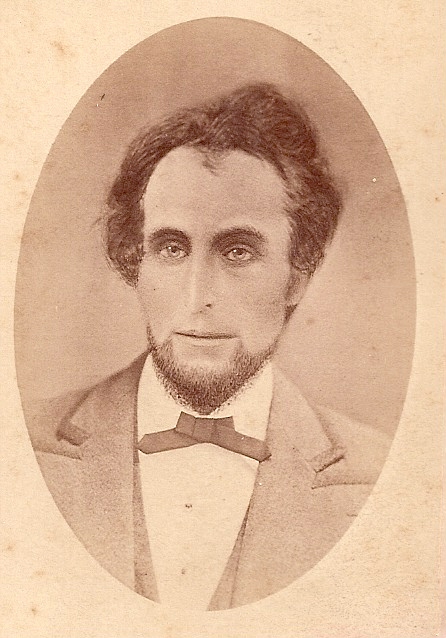
George Miller

George Miller was born 21 Jun 1817 in Northampton, York County, New Brunswick, Canada.  His parents were Isaac MILLER II and Harriet PARKS. George married Mary ESTEYon 23 Aug 1838 in Dumfries, York Co [New Brunswick Royal Gazette] or 22 Oct 1837.  George died on 7  Sep 1860 in Winnebago County, Wisconsin and is burried in Liberty Prairie Cemetery. Family legend says he died of apoplexy while arguing about the Civil War.
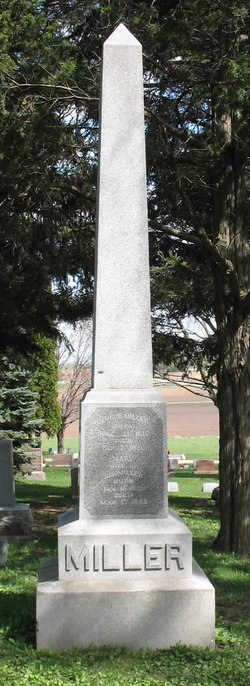
George Miller Obelisk Liberty Prairie Cemetery, Pickett, Winnebago County, Wisconsin
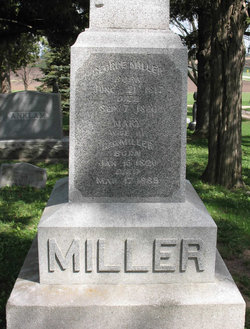
George Miller Obelisk

Mary Estey was born 15 Jan 1820 in New Brunswick Her parents were Abraham ESTEY and Ruth DOW. Mary died 7 Mar 1889 in Pickett, Winnebago County Wisconsin.
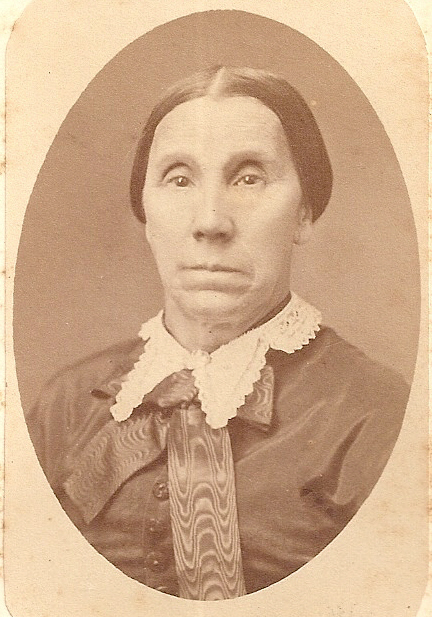
Mary Estey Miller
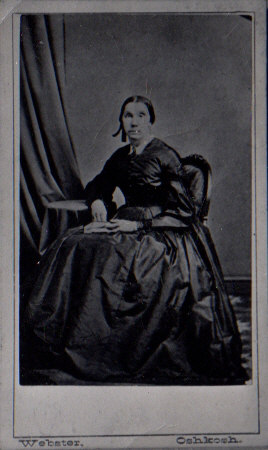
Mary Estey Miller – Courtesy Diane Yehle

Children of George and Mary:

Name Born Married Departed
1. Ira Miller 18 Sep 1838 New Brunswick, Canada Margaret Louisa Johnson Miller Babb
5 Jun 1861 Winnebago County, Wisconsin
19 Jul 1897
San Jose Calif.
2. Alonzo (Lon) Enoch Miller 24 Jun 1840 New Brunswick Cornelia Phebe Holden
(1844 – 1940)
29 Sep 1861
18 Aug 1917 Kensett Worth County Iowa
3. Melissa Emma Miller 29 Jan 1842 New Brunswick Died in infancy
4. Charles Henry Miller 13 Sep 1843 New Brunswick Mary Haber
15 Nov 1870
.
Esther Ann Hunter
6 Dec 1871
25 Jun 1925 Tacoma Washington
5. Ezra Miller 8 Sep 1845 Wisconsin Rosabelle Rachel (Belle) Horton
(1859 – 1944)
23 Dec 1878
19 Nov 1921
Osage Mitchell County Iowa
6. Helen Mary Miller 6 Mar 1847 Jefferson County Wisconsin Charles Warren Washburn
(1846 – 1920)
25 Nov 1871 Winnebago, WI
22 Dec 1899 Florence County Wisconsin
7. George Leonard Miller 15 Nov 1848 Winnebago County, WI Julia Ann Tennant
23 Nov 1873 Winnebago, WI
20 Dec 1906 Waukau Cemetery Winnebago County Wisconsin
8. Eugene Edgar Miller 10 Sep 1850 Lillian Marion Horton
22 Feb 1877
Aft. 1930 census Ashland, Jackson, Oregon
9. Albert Julian Miller 5 Jan 1853 Winnebago County, WI Clara Barton Cadwell (1867 – 1918) 1890 4 Apr 1929 Logan Cemetery, Harrison County Iowa
10. Orlena “Lena” Victoria Miller 18 Oct 1854 Edmund George Stone
30 Dec 1873
After 1930 Census when living in Oakland, Calif
11. Oren Fremont Miler 16 Aug 1856 Winnebago County Wisconsin Lillian Electa Buck (1860 – 1941)
25 Dec 1883
9 Mar 1948 Colorado Springs, Colorado
12. Frank Nelson MILLER 18 Jun 1858 Utica, Winnebago County, WI Agnes Genevieve HENRY
4 Jan 1896 Fresno, Calif
29 Dec 1903 Williams, Calif
13. Cora Estella Miller 23 Aug 1860 Wisconsin Albert Ellsworth
11 Aug 1890
15 Dec 1919

In 1963, my grandmother visited the Department of Records in Fredericton New Brunswick where the land grants were kept and “hit pay dirt.” She introduced herself to the custodian and explained she was looking for information about Mary Estey who married George Miller and that there was a legend that Mary Estey had Indian blood and she was interested in knowing what tribe.  The custodian looked really horrified!  She said

“Oh no – the Esteys were all most respectable.  They came from Massachusetts and brought their wifes with them!

An interesting bit is the marriage announcement of William Collicott in the 29 Aug 1838 edition of the Fredericton, “The New Brunswick Royal Gazette”, abstracted as:

“m. Dumfries, York Co., Thursday last, by Rev. Charles Wiggins, William COLLICOTT / Miss Eleanor ESTEY; On same day, by same, George MILLER / Miss Mary ESTEY, all Dumfries”

The family moved to Wisconsin after the fourth child was born, nine more children were born in Wisconsin.    They moved to Palmyra, Jefferson County, Wisconsin on 1 Sep 1845. George Estey and Deborah Miller Estey (Mary’s brother and George’s sister)  accompanied them on the emigration to Wisconsin.  George’s brother Leonard also emigrated from New Brunswick to Wisconsin In 1850 they moved to the town of Utica in Winnegago County.
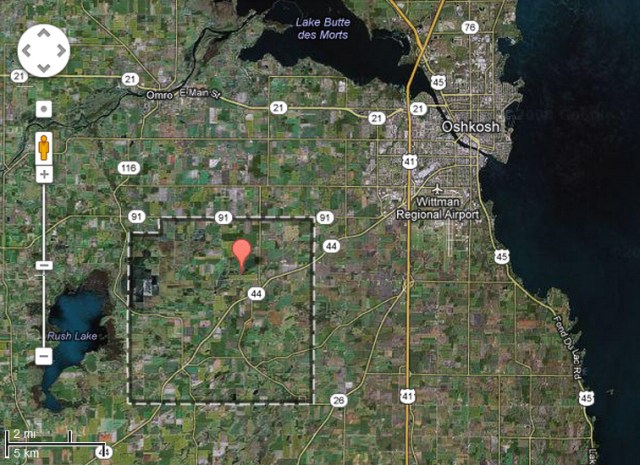
Utica Township, Winnebago, Wisconsin

History of Winnebago County Wisconsin 1880 and early history of N.W. by Richard J Harney Page 260

The Late George Miller Among the old settlers and one of the most highly respected sitizens of the town of Utica was the laste George Miller who left to his relict Mrs. Mary Miller and his children the large farm of which a view is given in this book (Picture on page 262) Mr. Miller was born in Northampton, York County, New Brunswick, June 21 , 1817 and married Miss Mary Estey in 1838.  He migrated to Wisconisn and settled in Palmyra, Jefferson County on the 1st of Sept 1845 where he resided till 1850 when he moved to the town of Utica in Winnebago County where he spent the remaining years of his life and died on the 7th day of September, 1860.

Mr. Miller left to his family not only a fine property, but the valuable inheritance of his good name, for he was one who was held in the highest esteem by his neighbors, form whom he received the highest marks of their confidence and he will be long remembered in this down as one of its most worthy citizens. He was elected several times chairman of the [Winnebago County] Board of Supervisors, was one of the mos efficient and influential members of the County Board, and was one of the building  committee under whose guidance our fine court house [in Oshkosh] was built. He was a man of the strictest integrity and of great efficiency in whatever public business was entrusted to his hands.  His death was not only an irreparable loss to his family but also to the town whose interests he was always ready to promote and the burden of whose enterprises he was always ready to share.

The farm, now in the possession of his families is one of the finest in the county and contains 310 acres.  It was yielded in good seasons 1500 to 1800 bushels of wheat and 1200 to 1800 bushels of corn and oats with other crops in proportion.
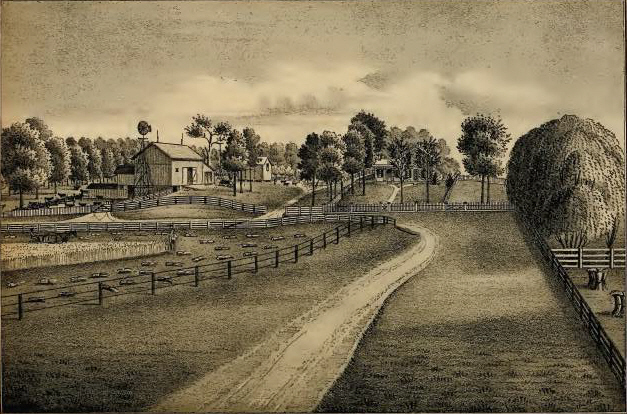
George Miller Farm – History of Winnebago County 1881

1860 United States Federal Census, Winnebago Co., Town of Utica Name: George Miller Age in 1860: 43 Birth Year: abt 1817 Birthplace: New Brunswick Home in 1860: Utica, Winnebago, Wisconsin Gender: Male Post Office: Weelaunee Household Members: Name Age George Miller 43 Mary Miller 40 Ira Miller 21 Alonzo Miller 20 Charles Miller 16 Ezra Miller 14 Helen Miller 13 George Miller 11 Eugine Miller 9 Albert Miller 7 Orlena Miller 5 Orin Miller 4 Franklin Miller 2 Colin Miller 40

1870 Federal Census Winnebago County, Wisconsin (Town of Utica 34 | 82 80 | Miller Mary | 50 F W | Keeping house | 10000 1200 | New Brunswick 35 | 82 80 | Miller Charles | 26 M W | Farmer | 2000 | New Brunswick 36 | 82 80 | Miller Eugene | 19 M W | At home | | Wis 37 | 82 80 | Miller Lena | 15 M W | At home | | Wis 38 | 82 80 | Miller Orin | 13 M W | Attending school | | Wis 39 | 82 80 | Miller Frank | 11 M W | Attending school | | Wis 40 | 82 80 | Miller Cora | 9 F W | | | Wis

1880 Federal Census,Oshkosh, Winnebago County, Wisconsin Name: Mary Miller Home in 1880: Oshkosh, Winnebago, Wisconsin Age: 60 Estimated birth year: abt 1820 Birthplace: Nb Relation to head-of-household: Self (Head) Father’s birthplace: Nb Mother’s birthplace: Nb Occupation: Keeping House Marital Status: Widowed Mary Miller 60 Frank Miller 22 Cora Miller 19 Lily Miller 18 (Who was Lily?  She was listed as a daughter in this census, but she was not on the 1870 census. She was born about 1862 , but Frank died in 1860. )

George Miller’s sons Ira (born 1838), Alonzo Enoch (called Lon and born 1840) and Charles Henry (born 1843) all served in the Civil War. Charlie would have been only 17 when the war started. There is a family story that George died of apoplexy when he became enraged arguing about the War, but since he died in 1860, the argument must thave been about slavery.  George’s brother Colin was living with them in 1860. Colin joined the 14th Wisconsin Infantry in 1861 was 1st Lt., Company C, and was killed on 23 May 1863 during the Siege of Vicksburg, Mississippi.  His brother John writes, Colin was a broad gauge man, had many sterling qualities. Was universally loved and respected. I knew him better than I did any of my other brothers, and I felt his loss for many year.

Children

1. Ira Miller

Ira’s wife Margaret Louisa Johnson was born 10 Jan 1842 in Boone County, Indiana. After Ira died, she married 12 Apr 1905 in Monterey, California to Silas Gratton  Babb (b. Jul 1842 Tennessee).

In 1900, Silas was a  widower boarding in Gilroy and working as a teamster.  In 1910, Louisa was married and a servant in Santa Cruz Ward 1, Santa Cruz, California.  Silas seems to have had a restaurant  at 1621 “J” Street, not far from the capital in Sacramento.  Margaret died 25 Mar 1918  in Maywood, Cook County, Illinois and is buried at Forest Home Cemetery, Forest Park, Cook County, Illinois.

Ira was a private in Company B, 1st Wisconsin Cavalry in  Civil War.

In 1870, Ira and Louisa were farming in Sherman, Monona, Iowa. In 1880 Ira and Louisa were living in Monterey, Monterey, California where Ira worked as a laborer.

Ira sold 40 acres of land that he had cleared and planted to orchard in Sebastapol, California to his brothers Eugene and Frank.  Neighbors who knew of the tremendous effort he made to develop the place said he was a powerful and vigorous man.

Ira is buried in Oak Hill Memorial Park in San Jose, Calif.

The 1st Wisconsin Volunteer Cavalry Regiment was organized at Camp Harvey in Kenosha between Sep 1 1861, and Feb 2 1862. It mustered in on Mar 10 1862, and left for St. Louis, Missouri, on Mar 17 1862, where it was stationed at Benton Barracks until Apr 28. It traveled to Camp Girardeau, Missouri,  on Apr 28 1862, where it was attached to a series of Union cavalry brigades that fought in Kentucky, Georgia, Tennessee, and Alabama over the next four years. The regiment fought at the Battle of Chickamauga on Sep 19-20, 1863, in the Atlanta Campaign the following year, and helped capture Confederate president Jefferson Davis on May 10, 1865. The 1st Cavalry lost a total of 401 men during service. Six officers and 67 enlisted men were killed. Seven officers and 321 enlisted men died from disease.

View a longer history of the 1st Wisconsin Cavalry
View the roster
View a list of casualties
View original documents

Children of Ira and Margaret:

i. Lelia Helen Miller (6 Apr 1862 Winnebago County, Wisconsin – 14 Feb 1896 Santa Clara, California Burial: Oak Hill Memorial Park San Jose California Plot: Sec MM, Lot 20, Block 6) m. 1 Oct 1882 California to John Ayers Simpson (5 Oct 1855 Ohio  – After 1930 census when he was living in El Cajon, California and working as a citrus nurseryman)  After Lelia died, John moved back to Chicago with his two young sons Orval  (1883-1979) and Ray where he worked as a millwright.

ii. Elmer Frank Miller (1867 Iowa – After 1940 census 1154 1/2 E 76th Pl San Antonio, Los Angeles) m. 1890 to Margaret E Allen (Aug 1868 California – ) Margaret’s parents were Otis Allen (1829 – 1898) and Harriet Adelia Sebring (1844 – 1936) Elmer and Margaret divorced before 1900. By 1903 Margaret had remarrried to Peter Alten (b. 30 Sep 1866 California – d. 04 Jul 1927 in California)

In the 1900 census, Margaret was divorced and living with her parents in Santa Rosa and daughter Cora. By the 1910 census, Margaret and Peter Alten were living with her mother in Santa Rosa. Cora and Hazel (Hattie) were counted in both their mother’s and their father’s households.

In the 1910 census.Elmer was divorced with two teenage daughters Cora Miller Elvy (14 Aug 1893 – Jun 1972 Santa Clara, Santa Clara) and Hazel and working as a painting contractor in Santa Cruz, California He was working as a painter and paperhanger in Fresno in the 1920 census and in Los Angeles in 1930.

Peter and Margaret had two children Otis Peter Alten (1904 – 1977) and Ruby Rosella Alten (1910 – )

In the 1930 census Margaret was still living with her 85 year old mother in Bodega, Sonoma, California)

.

2. Alonzo Miller

Lon’s wife Corneila Pheba Holden was born 29 Sep 1844 in New York.  Her parents were Hannibal Holden and Huldah D Bailey. Corneila died in 1940 in Worth County, Iowa,

Alonzo was a Corporal in C Company, 14th Infantry, Wisconsin Volunteers in the Civil War. (There were four Alonzo Millers in the Wisconsin Volunteers, but he was the only Alonzo E.  This was just about the time they invented middle names!) 16 Sep 1861 – Enlisted as a Corporal in Company C, Wisconsin 14th Infantry Regiment Promoted to Full Sergeant. Discharged for Promotion on 10 Jun 1863.
Like Matthew Broderick in  Glory, Alonzo was an officer of African American troops in the Civil War.

10 Jun 1863 – Commissioned an Full 1st Lieutenant in Company C, U.S. Colored Troops 48th Infantry Regiment Mustered out on 22 May 1864 The 14th Wisconsin Infantry was organized at Camp Wood in Fond Du Lac and mustered into service on January 30, 1862. The regiment left Wisconsin for St. Louis, Missouri, on March 8, and then traveled to Savannah, Tennessee, March 23-28. From there during its service it moved through Tennessee, Mississippi, and Louisiana. It participated in the battles of Shiloh, Iuka, Corinth, Champion Hill, Nashville, and the Siege of Vicksburg. 14th Infantry Regiment Wisconsin

Four of its members received the Congressional Medal of Honor for service in the Battle of Corinth, October 3 and 4, 1862; among them the “Colors Sergeant,” Denis J. F. Murphy (Green Bay), who, though wounded 3 times, continued bearing the colors throughout the battle Date of Organization: 30 Jan 1862 Muster Date: 9 Oct 1865 Officers Killed or Mortally Wounded: 6 Officers Died of Disease or Accident: 3 Enlisted Killed or Mortally Wounded: 116 Enlisted Died of Disease or Accident: 194

Fourteenth Infantry. — Cols., David E. Wood, John Hancock, Lyman M. Ward, Lieut.-Cols Isaac E. Messmore, John Hancock, Lyman M. Ward, James W. Polleys, Eddy F. Ferris, Majs., John Hancock, Lyman M. Ward, James W. Polleys, Asa Worden, Eddy F. Ferris, William J. Henry. This regiment was organized in Nov., 1861, at Camp Wood, Fond du Lac, and was mustered in Jan. 30, 1862. It left the state on March 8 and went into barracks at St. Louis until ordered to Savannah, Tenn., on the 23d.
Alonzo fought at the Battle of Shiloh  – Engraving by Thulstrup

It was in action at Shiloh, where it charged a Confederate battery and drove the enemy from the guns, but was compelled to fall back. It repeated this three times during the day, holding the guns the fourth time, and receiving the sobriquet of the “Wisconsin Regulars,” for the determined bravery on this, its first field. It lost 14 killed and 79 wounded and missing.
Pittsburg Landing a few days after the Battle of Shiloh

It was made provost guard at Pittsburg landing during the Siege of Corinth, and was ordered to reinforce Gen. Rosecrans in the advance on Price at Iuka. When within 2 miles of Iuka it was ordered back to Corinth which was threatened by the enemy and at the battle at that place it had the advance position in the line, the post of honor. In his official report, Col. Oliver, commanding the brigade, said of its work: “Col. Hancock and his regiment, the 14th Wis., there was no discount on; always steady, cool and vigorous. This regiment was the one to rely upon in any emergency. * * * They maintained their lines and delivered their fire with all the precision and coolness which could have been maintained upon drill.”
Alonzo fought at the Battle of Vicksburg

The regiment was at Champion’s Hill, the Big Black River, and took a conspicuous part at Vicksburg losing 107 men in killed, wounded and missing, out of 256, in an assault upon the enemy’s works. It remained in the front line until the surrender and was given the position of honor in the brigade in the march into the city. Gen. Ransom said: “Every officer and man in the 14th is a hero.” First known as the 10th Louisiana Infantry, the 48th Infantry Regiment was a regiment in the Union Army during the American Civil War. It was composed primarily of freed or escaped slaves from Louisiana’s plantations and was commanded by white officers. The unit was organized at Lake Providence and Goodrich Landing, Louisiana between May 6 and August 8, 1863.

It was attached to the Goodrich Landing post until January 1864 and at Vicksburg until March 1864. The regiment participated in the Yazoo River Expedition between February 1 and March 8, 1864. Action was seen at Liverpool Heights, Mississippi on February 4 (with the 11th Illinois Infantry and the First Mississippi Calvary) and Satartia, Mississippi on February 7. Yazoo City, Mississippi was captured by Union forces on February 4 and the regiment occupied the city between February 9 and March 6. There was a skirmish at Yazoo city on March 5. The regiment was designated the 48th Regiment Infantry, U.S. Colored Troops on March 11, 1864. The regiment participated in the expedition from Vicksburg to Rodney and Fayette, Mississippi between September 29 and October 3, 1864. The unit was sent to Algiers, Louisiana on February 26, 1865 and then to Fort Barrancas, Florida. Between March 20 and April 1, they marched from Pensacola, Florida, to Blakely, Alabama,
Alonzo participated in the storming of Fort Blakely

The regiment fought in the Battle of Fort Blakely, April 2–9, 1865 and then marched to Montgomery April 13–25. They were at Montgomery until June, 1865 and then went to Texas where they were on duty along the Rio Grande until January, 1866. The Battle of Fort Blakely took place from April 2-April 9, 1865 in Baldwin County, Alabama, as part of the Mobile Campaign of the American Civil War.
African American Troops

Maj. Gen. Edward Canby’s Union forces, the XVI and XIII Corps, moved along the eastern shore of Mobile Bay, forcing the Confederates back into their defenses. Union forces then concentrated on Spanish Fort, Alabama and nearby Fort Blakely. By April 1, Union forces had enveloped Spanish Fort, thereby releasing more troops to focus on Fort Blakely. Confederate Brig. Gen. St. John R. Liddell, with about 4,000 men, held out against the much larger Union force until Spanish Fort fell on April 8 in the Battle of Spanish Fort. This allowed Canby to concentrate 16,000 men for the attack on April 9, led by Brig. Gen. John P. Hawkins. Sheer numbers breached the Confederate earthworks, compelling the Confederates, including Liddell, to surrender. The siege and capture of Fort Blakely was basically the last combined-force battle of the war. Yet, it is criticized by some (such as Ulysses S. Grant) as an ineffective contribution to Union war effort due to Canby’s lateness in engaging his troops.

African-American forces played a major role in the successful Union assault. The regiment mustered out on January 4, 1866 By the end of the Civil War, roughly 179,000 black men (10% of the Union Army in about a hundred regiments) served as soldiers in the U.S. Army and another 19,000 served in the Navy. Nearly 40,000 black soldiers died over the course of the war—30,000 of infection or disease. Black soldiers served in artillery and infantry and performed all noncombat support functions that sustain an army, as well. Black carpenters, chaplains, cooks, guards, laborers, nurses, scouts, spies, steamboat pilots, surgeons, and teamsters also contributed to the war cause. Because of prejudice against them, black units were not used in combat as extensively as they might have been. Nevertheless, the soldiers served with distinction in a number of battles including the capture of Fort Blakely above. In addition to the perils of war faced by all Civil War soldiers, black soldiers faced additional problems stemming from racial prejudice. Racial discrimination was prevalent even in the North, and discriminatory practices permeated the U.S. military. Segregated units were formed with black enlisted men and typically commanded by white officers and black noncommissioned officers.
Black Soldiers

The black troops, however, faced greater peril than white troops when captured by the Confederate Army. In 1863 the Confederate Congress threatened to punish severely officers of black troops and to enslave black soldiers. As a result, President Lincoln issued General Order 233, threatening reprisal on Confederate prisoners of war (POWs) for any mistreatment of black troops.

Lon married Cornelia Pheba Holden Miller (29 Sep 1844 New York – 1940  Kensett, Worth County Iowa)  Cornelia is buried in Kensett Cemetery.   In 1880, Lon and Cornelia were farming in Rock, Mitchell, Iowa.

Kennsett, Worth, Iowa

1900 Census Manly, Worth, Iowa Alonzo E Miller 59 (Head of Household) Cornelia P Miller 54 (Wife) William F Miller 15 (Nephew) Gracie Hildredth 3 (Granddaughter) Hattie I Miller 27 (Daughter-in-law – Widowed) Guy E Miller 9 (Grandson) Fern V Miller 8 (Granddaughter) Faythe I Miller 2 (Granddaughter) .

Children of Lon and Cornelia:

i. Lester Holden Miller (29 Jun 1865 Winnebago County, Wisconsin – 1900 Kensett Cemetery, Kensett, Worth, Iowa Plot: Lot 108) m. Hattie J Hilton. (b. 1873 Michigan – d. 13 Mar 1957 Los Angeles, buried Woodland Union Cemetery, Van Wert, Van Wert County, Ohio) Hattie’s parents were James Matthew Hilton (1839 – 1929) and Helen A Hanks (1841 – )

In the 1900 census, Lester was gone and Hattie was living  in Lincoln, Worth, Iowa with Ira and Cornelia with her three children: Guy E Miller 9, Fern V Miller 8, and Faythe I Miller 2. In 1910 Hattie was still a single mother on income and had moved to Newark, Marshall, South Dakota. On 20 Aug 1912 Blue Earth, Faribault, Minnesota Hattie married John J Duffield (b. 1857 Ireland – d. Aft 1930 census Garden City, Blue Earth, Minnesota) John immigrated in 1871.

ii. Hattie Orlena Miller (13 Dec 1866 in Randolph, Columbia, Wisconsin – Aft 1930 census Lincoln, Worth, Iowa); m. 5 Nov 1890 Randolph, Columbia, Wisconsin to Frank Wilbe Jewett (b. 6 Feb 1869 in Randolph, Columbia, Wisconsin – )  His parents were Charles Fred Jewett (1836 – ) and Cordelia Arethusa Bliss (1839 – 1868).  Frank was a farmer.

iii. Kate (Kattie) Maud Miller (27 Dec 1872 – 13 Aug 1897 Burial: Kensett Cemetery, Kensett, Worth County,Iowa) m. 9 Nov 1892 Worth, Iowa to  William Philo Hildreth   (b: 15 Aug 1870 in Osage, Mitchell, IA – d. 21 Dec 1947 in Plum City, WI) William’s parents were William Bramwell Hildreth (1839 – ) and Abigail Hitchcock (1835 – 1872) After Kattie died, William married Bertha Pedersdatter Kval (1871 – )

In the 1900 census, Gracie Hildredth 3  was living with her grandparents and William was living with his sister and brother-in-law Lillian and Melvin Jewett

By the 1910 census Will had married Bertha and was farming in Sanford, Grant, Minnesota. Clyde age 15 and Grace age 13 were back at home.

.

4. Charles Henry Miller

Charles’ wife Esther Ann Hunter was born 8 Mar 1849 in New York. Her parents were William Hunter and  Lettetia Park daughter of John and Nancy (Ditty) Parks of  Bellarnewdine, Ireland.   They  were living in Utica, Winnebago, Wisconsin in the 1870 census. Esther died 21 Sep 1935 in Seattle, Washington Burial: Tacoma Mausoleum).

Charles Henry enlisted with his uncle, Leonard J Miller, in the Wisconsin 21st Infantry, Company B and served for three years; mustering out near the end of the war due to severe injuries received to his right arm during the Battle of Dallas, Georgia.

Charles was living in Tacoma, WA in 1908.  Charles and his son, Ray, were in the banking business in Tacoma, WA.

Children of Charles and Esther:

i. Ray Clinton Miller (28 Oct 1876 Winnebago County, Wisconsin – 19 Jun 1913 Tacoma, WA) m. 11 Dec 1907 to Mollie E. Kennedy (18 Jan 1882 Wisconsin – 25 Jan 1943 Tacoma, WA)

In the 1910 census, Ray was a bank cashier in Tacoma, Washington.

ii. Letta May Miller (Aug 1886 Wisconsin – Aft 1910 census, Tacoma )

iii. Vera E Miller (May 1891 Wisconsin – Aft 1940 census, Haller Lake, King, Washington); m. Harlow Holabird Whiteside (1 Jun 1891 Missouri – Aft 1940 census) Asst. Mgr. of the Gas Plant, Olympia, Wash.

In 1940, Harlow was working as a traveling salesman for commercial refrigeration.

.

5. Ezra Miller

Ezra ‘s wife Rosabelle Rachel “Belle” Horton was born 29 Jun 1859 Olmsted County, Minnesota.  Her parents were William Horton (1832 – 1907) and Eliza Jane Dennis (1833 – 1900). Belle died May 1944 Osage, Mitchell County, Iowa) Burial: Osage Cemetery, Osage, Mitchell County, Iowa Plot: Section 1049 , Position 11

In the 1900 census, Ezra was a merchant in Jackson, Harrison, Iowa.
Jackson Township, Harrison County, Iowa is in the southwest corner of the state, 50 miles north of Omaha

Child of Ezra and Belle:

i. Roy Wallace Miller (Dec 1879 Lincoln, Worth, Iowa – Aft 1940 census Jackson, Harrison, Iowa) m. Nellie E McCabe (1882 Iowa – Aft 1940 census). Nellie’s father Terrence was born in Nov 1837 in Ireland and her mother Martha J Dugger in Tennessee.  Roy was the manager of a grocery in Jackson, Harrison, Iowa in the 1920 census.

.

6. Helen Miller

Helen’s husband Charles Warren Washburn was born 27 Jun 1846 in Washington County, Wisconsin. His parents were Henry Washburn (1817 – 1908) and Lucy Sargent (1826 – 1883). Charles died 1 Jan 1920 in Florence County, Wisconsin.

Helen was a school teacher.  She was away from her family during the 1870 census – so I am guessing she was elsewhere teaching or getting a certificate to teach herself before her marriage. She married Charles Warren Washburn 25 Nov 1871 Winnebago, WI.   Charles actually was on the farm in Utica in 1870 and his cousin was living with them, as she was as school teacher in that area (Oshkosh, I think). Years after they married, they homesteaded a farm in the Town of Fern (formerly Washburn Settlement) under a land grant by Grover Cleveland, but they ended up moving back to Florence, WI where they remained the rest of their lives. He outlived her by 21 years and from what I understand, he missed her terribly. Sounds like they were quite a love match.

In the 1880 census, Hellen was living with her brother Orren and her three children in Utica, Winnebago, Wisconsin
Helen Mary Miller – Courtesy Diane Yehle
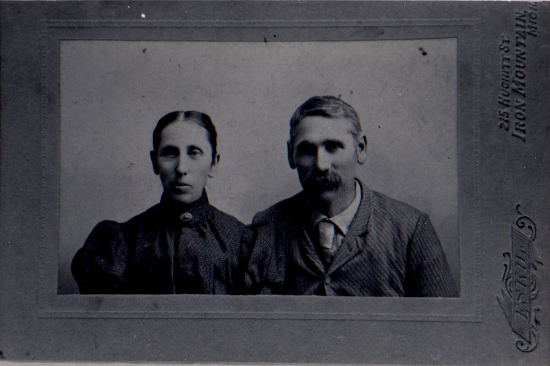
Helen and Charles Washburn – Courtesy Diane Yehle
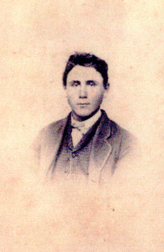
Charles Warren Washburn younger – Courtesy Diane Yehle

Children of Helen and Charles:

i. Mary Lucy Washburn (15 Mar 1873 Winnebago County, Wisconsin – 9 Mar 1955 Florence County Wisconsin) m. Louis Yehle (21 Jun 1863 German – 16 Nov 1913) Louis (Alois) Yehle was an immigrant from Schaan, Liechtenstein and was killed in an electrical accident at the transformer station where he was employed as an electrical engineer in Florence County, Wisconsin.

In the 1910 census, Louis was an engineer at a pumping station in Florence, Florence, Wisconsin.

ii. Ralph Newton Washburn (3 Aug 1874 Osage, Mitchell County, Iowa – 16 Oct 1946 Crystal Falls, Iron County, Michigan) m. Elizabeth Julia Bailey (3 Apr 1883 Ohio – 20 Mar 1951 Florence County, WI) Elizabeth’s parents were Hayes Barr Bailey (1852 – 1932) and Emma Elizabeth Hoyman (1863 – 1926) Ralph and Elizabeth had four children born between 1909 and 1916.

In the 1920 census, Ralph was a farmer in Florence, Florence, Wisconsin

iii. Grace Belle Washburn (8 Nov 1877 Waukau, Winnebago County, Wisconsin – 24 Feb 1951, Florence County, Wisconsin) m. George W Kinnear (b. 14 Nov 1863 Pennsylvania – 20 Jul 1921 Drowned during a river log drive in Florence, Wisconsin) George’s parents were David Kinnear (1828 – 1900) and Katherine “Kate” Pike (1843 – 1910)
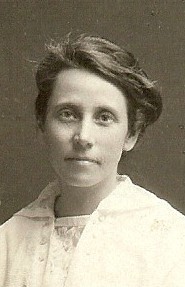
Grace Belle Washburn

Grace Belle Washburn

iv. Henry George Washburn (3 Jul 1884 Florence County, Wisconsin – 10 Aug 1970 Green Bay, Wisconsin); m1.  Beulah May Johnson (20 Jun 1890 in Wisconsin – Aft. 1940 census);  m2. Arlene Bates (23 May 1901 – 15 Mar 1976)

In the 1920 census, Henry was an internal revenue collector in Shawano Ward 3, Shawano, Wisconsin.

Henry and Beulah divorced. In the 1930 census, Beulah had remarried to Christian Christensen and was living with her two daughters Mildred and Marjory in Denver, Colorado.

.

7. George Leonard Miller

George’s wife Julia Ann Tennant was born 29 Dec 1856 in Wisconsin.  Her parents were John Tennat (b. 1810 in Ireland – d. 2 Mar 1896 in Rushford, Winnebago, Wisconsin) and Martha Bestwick (31 Mar 1819 in Bolton, Warren, New York – d. 28 Jan 1872 in Waukau, Winnebago, Wisconsin).  Julia died 4 Nov 1887 in Wisconsin.

In the 1880 census, George and Julia were farming in Omro, Winnebago, Wisconsin.

Children of George and Julia:

i.  Ralph Miller (29 Aug 1874 Wisconsin – 7 Sep 1889 Wisconsin)

ii. Angie Miller  (1877 Omro, Winnebago, Wisconsin – Aft 1940 census, Belle Plaine, Shawano, Wisconsin); m.  Ward Bonette Peterson (14 March 1871 in Belle Plaine, Shawano, Wisconsin- 1949) Ward’s parents were Alexander Peterson (1842 – 1929) and Mary Rose Bonette (1842 – 1916) Angie and Ward had two children Lynn Russell Peterson (1902 – 1992) and Forrest Ward Peterson (1904 – )

In the 1920 census, Ward and Angie were farming in Belle Plaine, Shawano, Wisconsin.

iii. Martha Miller  (1879  Omro, Winnebago, Wisconsin – Aft. 1940 census Antigo, Langlade, Wisconsin); m. Henry J Buesch (1872 Wisconsin – Aft. 1940) Henry’s parents were from Germany.  In the 1910 and 1920 census, Henry and Martha were farming in Norwood, Langlade, Wisconsin.

.

8. Eugene Edgar Miller

Gene moved to Sebastopol, California in 1891.  After an especially hard Iowa winter, he threw the snow shovel on the ground and said he was never going to shovel any more   —– snow.  So Eugene and Frank decided to buy the 40 acres that their brother Ira had cleared and planted to orchard.  Neighbors who knew of the tremendous effort he made to develop the place said he was a powerful and vigorous man. He had moved to Ashland Oregon by the 1910 census and lived in Ashland in 1920 and 1930.

Eugene’s wife Lillian Marion Horton was born in 13 Aug 1857 in Grafton, Worth, Iowa or Olmsted, Minnesota.   Her parents were William Horton and Eliza Jane Dennis.  Lillian died 27 May 1950 in Sebastopol, Sonoma, California.

Children of Eugene and Lillian:

i. Alice Esther Miller (8 Mar 1878 Lincoln, Worth, Iowa – 11 Mar 1955) m. [__?__] Stubbs (b. Pennsylvania) By the 1910 census, Alice was divorced and living with her parents and four year old son Richard Stubbs in Ashland, Oregon.

ii. George Raymond Miller (17 Dec 1879 Lincoln, Worth, Iowa – 20 Feb 1956 ) m1. Caroline L. [__?__] (1882 California – ) Caroline’s parents were born in Germany. m2.  Isabelle W. [__?__] (b. 1883 Iowa)

In the 1910 census George and Caroline were living in Hydesville, Humboldt, California where George was working as a millwright.  In his 1918 World War I Draft Registration, George was working as a millwright machinist at the Pacific Lumber Company in Scotia, Humboldt, California.  His form showed the loss of his left leg below the knee. In the 1920 census, George and Caroline had moved to Idaho Falls, Bonneville, Idaho.  By the 1930 census, George was back in Scotia working as a millwright in a planing mill.  He and his 22 year old son Percy were lodgers.  In his 1942 Draft Regislation,  he was married to Isabella and a machinist at the Klammath Falls Machine and Locomotive Shop in Klamath Falls, Oregon.

iii. Clarence Arthur Miller (9 Jul 1881 Worth County, Iowa – 09 Mar 1974  Sebastopol, Sonoma, California) m. 18 Nov 1903 to Edith Brewster Palmer (18 Nov 1878  Ferndale, Humboldt, California –  16 Dec 1956 in Sonoma, California) Edith’s parents were Thomas Brewster Palmer (1843 – 1909) and Mary Elizabeth Wiley (1848 – ). Clarence and Edith had five children Marie Miller (1905 – 1998), Gladys Miller (1907 – 1955), Rodney Miller (1910 – ), Effie Marjorie Miller (1911 – 1988), and Clarence Miller (1918 – )
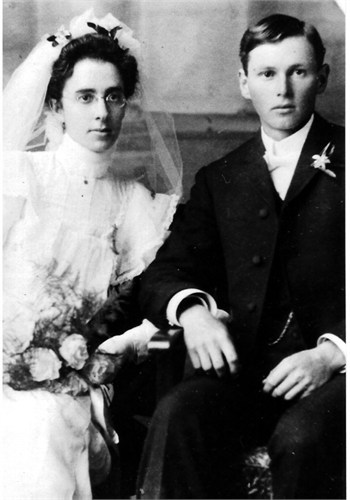
Edith and Clarence Miller
Edith's father Thomas Brewster Palmer

Edith’s father Thomas Brewster Palmer (1843 – 1909)
Edith's mother Mary Elizabeth Wiley

Edith’s mother Mary Elizabeth Wiley (1848 – )

In his 1942 draft registration Clarence and Edith were living at 564 North Main Street in Sebastopol, California and he was working for Rooney T. Miller’s Miller Trucking Service in Sebestopol.

iv. Mabel Lenora Miller (13 Mar 1883 Plymouth, Iowa – Nov 1973  620 19th Ave East, Seattle, Washington); m1. 20 Sep 1909 to William C. Maas (1878 Wisconsin –  20 Apr 1914 in  Entiat, Chelan, Washington.) William’s father Louis was born in Germany and mother Martha Barthals in Wisconsin;. m2. 7 Jun 1920 Spokane, Washington to Adolph Gustave Emil Bahnke (b. 23 May 1881 – Petznick, Germany – d. 23 Sep 1951 Pierce, Washington)

Emil became a naturalized citizen 30 Sep 1942 in Renton, Washington. He arrived in Seattle from Vancouver in 1905. He worked as a gardner. Their son John Emil Bahnke was born 28 Jul 1921 in Renton, Washington and died 10 Jan 2010 in Piatt County, Illinois.

In the 1910 census, Mabel and William were farming in Entiat, Chelan, Washington. According to the 1920 census, Mabel was divorced and working as an nurse assistant in the home of Albert Pratten in Wenatchee Ward 2, Chelan, Washington. Mabel and William had three children: Albert Maas (1913-1971), Ula Maas (1911 – 1999), and Edward Maas (1911-1933) who were raised by William’s  parents in Wisconsin.
Edward Maas Obit

v. Etta Maud Miller (13 Jul 1884 Iowa – 1 Jun 1977 Santa Cruz CA buried 7 Mar 1977 Sebastopol evergreen lawn cemetary Sebastopol, CA) m. 1915-1921 in Jackson County, Oregon to Edward O. Nelson

In the 1930 census, Etta had married Adolph J Asmann (b. 16 Jun 1875 California – d. 9 Mar 1956 San Francisco) Adolph had no occupation and Etta was managing her apple farm in Analy Township, Sonoma, California. By the 1940 census, Adolph was living with his brother-in-law in San Francisco and claimed he was widowed. Etta’s sister-in-law Kittie Nelson (b. 1882 Norway) was living with the family.

In the 1940 census, Etta, her daughter Virginia and her mother Lillian were living at Guerneville River No 12 Route 2, Sonoma County, California where she operated an apple farm.

My grandmother  Genevieve was fond of Uncle Gene and Aunt Lillian. Their daughter Etta married someone named Nelson, and she and mother corresponded. Genevieve always went to visit Etta when she was in Northern California. My mother remembers driving down a dirt road to a ranch house to visit them when her family went on the famous trip to Victoria in the summer of 1941.

vi. Frank Horton Miller (10 Apr 1887 Plymouth, Iowa – Oct 1975 Solano, California) m. before 1910 census probably in Analy, Sonoma, California to Eva May Hunt (1880 Illinois – 1953 Solano, California). Eva’s mother came from Denmark.

In his World War I draft registration, Frank was living in Rio Vista, California and working as a ranch foreman on Tyler Island. Frank was a farm manager in Burnett Township (between San Jose and Morgan Hill), Santa Clara, California in the 1930 census. In his World War II Draft Registration, Frank and Eva were living in Vacaville, California where Frank was a ranch superintendent. Frank and Eva are buried at Rio Vista Masonic & Odd Fellow Cemetery, Solano County in plot 1188.

vii. Mary Eliza Miller (6 Jun 1889 in Iowa – 27 Dec 1968 Grants Pass, Josephine, Oregon); m. 12 Apr 1911 Oakland, California to Clyde Milton Hamilton (18 Nov 1886 Waverly, Coffey, Kansas – 12 Sep 1952 in Eads, Kiowa, Colorado or 30 Jun 1969 Los Angeles). Clyde’s parents were Guy Hamilton (1834 – 1913) and Mary Louisa Harlan (1851 – 1911)

Clyde’s parents were from Ireland. Clyde was tenant farmer in Belleview, Jackson, Oregon in the 1930 census when Mary and Clyde had seven children living with them.

One child,  Clyde Frank (aka Francisco) Hamilton came to Australia with the US Army in 1942. He was discharged in Australia and never returned to Oregon.  Alma Mary Hamilton/Houston of Brisbane, Queensland, and Juanita Hamilton/Goodland of Theodore are the grand-daughters of Mary Eliza Miller who married Clyde Milton Hamilton.

Alma (aka as Mary) has one grandson and three grand-daughters. Juanita had four sons ( one deceased) and a daughter. She has two grandsons and two grand daughters. Clyde died 12 July 1989 and his wife Florence Hazel Alexander died 01 January 2001. There are remnants of the Miller line in Queensland.

viii. Kathryn “Katie” Rachel Miller (3 Nov 1893 Sonoma Califonia – After 1920 Census) In 1919, Kathryn sailed to Hawaii on the Sachem. In the 1920 Census when she was living with her parents in Ashland Oregon and working as a public school teacher.

ix. William Henry Miller (24 Sep 1896 Sonoma Califonia – 15 Jan 1911)

.

9. Albert Julian Miller

Albert’s wife Clara Barton Cadwell was born 22 Aug 1867, Woodbine, Harrison County, Iowa. Her parents were George Bishop Cadwell and Clarissa Seeley. Clara died 8 Aug 1918, Olmsted County, Minnesota.

In the 1910 census, Albert was an abstractor of title (a person who prepares and certified the condensed history (known as an abstract of title) of the ownership of a particular parcel of real estate, consisting of a summary of the original grant and all subsequent conveyances and encumbrances affecting the property.) in Logan, Harrison, Iowa.

Children of Albert and Clara:

i. Helen Caldwell Miller (29 Apr 1893 Harrison County, Iowa – May 1971 Boulder, Colorado) Burial: Logan Cemetery, Logan, Harrison County, Iowa.

In the 1930 census, Helen was single and a bookkeeper at a steel company in Chicago.

ii.  Jeannette Miller (Oct 1894 Iowa – )  In the 1930 census, Jeannette was living with her “partner/lodger” Bessie M Landfear in Stamford, Fairfield, Connecticut. Both Jeannette and Bessie were librarians.

In the 1940 census, Jeannette living with her sister Clara at 2901 Ashby Ave? Berkeley, CA with a Swedish maid and a lodger. Jeannette was a school librarian and Clara had her own optometry business.

iii. Paul Barton Miller (b. 15 Sep 1896 in Logan, Iowa- d. 1982 in Hendersonville, North Carolina); m. 1921 Silvis, Illinois to Catharine Debourcy (b. 1900 in Rock Island, Illinois = d. Boca Raton, Florida)

In the 1930 census, Paul and Catherine were living  in Petersburg,  Prince George, Virginia

In the 1940 census, Paul and Catherine were living at 21 Amherst Court Hempstead, Nassau, New York where Paul was an industrial auditor.
.

10. Orlena  “Lena” Victoria Miller

Orlena’s husband Edmond George Stone was born 1852 Champlain New York sometimes listed as New Brunswick.  Edmond died after 1930 Census.

In 1880 Edmund and Lena were farming in Utica, Winnebago, Wisconsin.  In the 1930 census, Orlena and Edmond were retired in Oakland, California where they owned a home in Brooklyn township.

In the 1940 census, Lena and her daughter Edna were with Helen Price lodging at 5455 Hilltop Crescent, Oakland.

Children of Lena and Edmond:

i. Cliff Winifred Stone (19 Oct 1874 Fisk, Winnebago, Wisconsin – ); m. Kate Kelly [__?__] (b. 1875 Wisconsin)

In the 1900 census, Cliff was rooming in Indianapolis and working at a public school teacher. By 1910 he had married Kate, had an infant daughter and a live-in servant; and was teaching normal school in Farmville, Prince Edward, Virginia. Longwood University is a public school located in the heart of Farmville with an enrollment of about 5,000. It is one of the oldest public institutions in the country, founded as a female seminary. Longwood is mainly known as a teachers school and was once called State Female Normal School. This school is known as the mother of sororities: Sigma Sigma Sigma, Alpha Sigma Alpha, Zeta Tau Alpha, and Kappa Delta were founded here. In 1918, Cliff was away from his Cedar Falls home working for the War Department in Newark New Jersey.  By 1919, he was back home in Cedar Falls working as a teacher when he applied for a passport “for YMCA work” in Great Britian and France.  By 1930, the family had moved to Pullman, Washington and Cliff where Cliff was an instructor at Washington State.

Cliff Winfield Stone was born in Wisconsin in 1874. After graduation from the State Normal School at Oshkosh, Wisconsin in 1899 he later attended Columbia University where he took the B.S. in 1904 and the Ph.D. in 1908. He served as a teacher, school principal, and director of teaching in such diverse places as Indiana, New York City, Virginia, and Iowa. During World War I Dr. Stone was a member of the American Expeditionary Force University at Beaune, France. Directly following his service in France he came to Washington State University as Professor of Education. He served in this capacity from 1920 to 1946 when he retired as Professor Emeritus of Education.

An early pioneer in testing children’s arithmetical abilities, Dr. Stone published a work on this subject in 1908 which he followed several years later with a series of reasoning tests in arithmetic. The New Stone Reasoning Tests in Arithmetic (1927) was published by Columbia University’s Teachers’ College. His knowledge in this field served him well when he chaired the Washington Education Association’s school survey of the graded school and the one-room “little red schoolhouse” which was typical in rural areas of Washington State. The study was to survey and then compare progress made by pupils of one-room schools with progress made by pupils of equal ability from graded schools. Dr. Stone completed such a study, albeit on a limited basis, in 1927 (cf. Journal of Educational Research, November, 1927). The state-wide survey he and his associates made was published as “The Subject Progress of Pupils in Different Types of Schools” in the Washington Education Journal, April 1930.

The papers of Cliff W. Stone  are stored at Washington State University.

The papers consist of approximately 2,800 items of correspondence and research materials pertaining to his various activities while at WSU. Series 1 reflects Dr. Stone’s work as a college teacher, researcher into arithmetical reasoning in school children, and friend to hundreds of WSU students seeking teaching positions. Series 2 contains the specific work Dr. Stone undertook for the Washington Education Association in the late 1920s. He and several associates attempted a state-wide educational analysis of students in graded school houses as opposed to those students who were still attending the one-room school made famous as the “little red schoolhouse.”

This collection of papers presents a contemporary researcher with unique evidence of raw data collection, statistical analysis, and report writing for a state-wide educational project completed during an era of swift social and economic change in the state of Washington.

ii. Edna H. Stone (18 Mar 1876 Fisk, Winnebago, Wisconsin – 10 Jul 1961 Alameda County, California)

In the 1900 census, Edna was a boarding student at Cedar Falls, Iowa,  home to one of Iowa’s three public universities, the University of Northern Iowa.  Edna sailed from France on the De Grasse in 1928.  In 1930, Edna was living in Oakland, California with her partner Helen G Price and working as a public school supervisor.  Helen was a librarian.

iii. Ada M. Stone  (28 Jul 1878 Wisconsin – 10 Aug 1957 Los Angeles); m1. 1903 to  Avrill L. Atwood (Jun 1873 Michigan – After 1930 census) m2. Marion Leslie Hockett (19 Mar 1887 Arkansas –  01 Jun 1964 Alameda, California)

In the 1900 census, Avrill was a boarder in Logan, Iowa working as a clerk in a department store shoe department.  In the 1910 census, Ada was married, but living with her parents without her husband and working as a bookkeeper/cashier in Logan, Harrison, Iowa.  In 1910, Avrill was taking care of his father in Carroll, Iowa.    In 1920 and 1930, Avrill was widowed and living with his brother in Macon, Georgia. Meanwhile, in 1920, Ada had remarried to Marion Hockett, a white mulatto from Arkansas, nine years younger than herself and was living in Redondo Beach, California where Marion was working as a pump operator for an oil company By 1930, they owned their own home in Redondo Beach and Marion was still working as a derrick operator in the oil fields.

iv. Ruth B Stone  (May 1880 Utica, Winnebago, Wisconsin – After 1900 census)

v. Georgia “Georgie”  B Stone (Nov 1886 Wisconsin – After 1900 Census)

.

11. Oren Fremont Miller

Oren’s wife Lillian Electa Buck was born 30 Sep 1860 Rosendale, Fond du Lac County, Wisconsin.  Her parents were Hamilton Buck and Mary Eliza Hinkley. Lillian died 20 Dec 1941 in Colorado Springs, El Paso County, Colorado

Oren inherited the family farm in Utica Wisconsin.  He had the farm until at least 1912 when his daughter Hazel was married.  Oren took down the original house and built a new house on the same spot, some roads were changed, but the woods, the marsh, the fields were the same in 1963 as they were 100 years earlier.  The acreage was still intact – 310 acres.  My grandmother wrote “It seems that status in that part of Wisconsin consists of ‘keeping up the place’, that is house and barn painted and tools all under sheds and green grass in front.

In 1920 Oren and Lillian were boarding in with Hazel’s sister-in-law and father-in-law in Utica, Winnebago, Wisconsin so maybe they had sold the farm by then.  By 1930 they had moved to Colorado Springs.

Children of Oren and Lillian:

i. Homer Arthur Miller (30 Apr 1891 Wisconsin – 1916 Burial: Liberty Prairie Cemetery, Pickett, Winnebago County, Wisconsin Plot: Plot 74)

ii. Hazel Belle Miller (13 Feb 1893 Utica, Wisconsin – After 1940 census 805 North Corona Street, Colorado Springs, Colorado); m. 27 Sep 1916 Winnebago, Wisconsin to James Edwin Jennings (24 Oct 1889 Utica, Wisconsin – 7 Jan, 1963 in Colorado Springs, Colorado). His parents were John S Jennings (1862 – ) and Eliza I. Washburn (1849 – )

In 1910, Edwin had been a hired hand at Hazel’s parents farm.  In the 1920 census, Edwin and Hazel were farming in Calhan, El Paso, Colorado near Colorado Springs.

.

12. Frank Nelson MILLER (See his page)
Frank Miller 1880
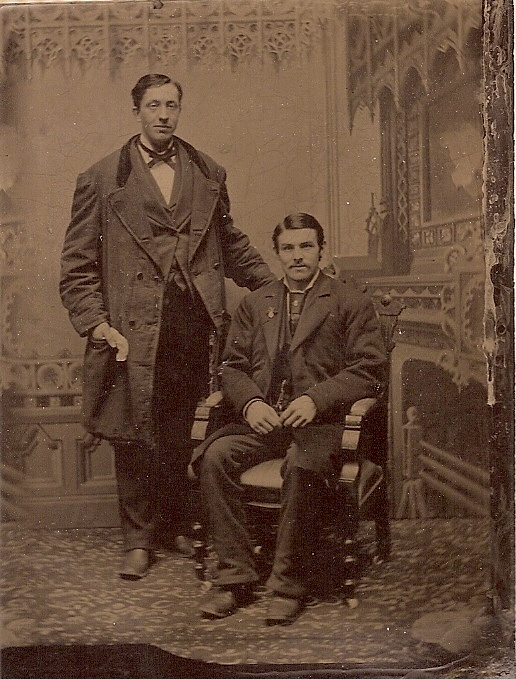
Frank Miller and brother

13. Cora Estella Miller

Cora’s husband Albert Ellsworth was born 6 Apr 1832 Calais, Washington, Maine.  Albert died 5 Feb 1899 – Oshkosh, Winnebago, Wisconsin.  His parents were Mark Ellsworth and Elizabeth Jane Cheney.  He first married 1856 – Oshkosh, Winnebago, Wisconsin to Lydia Frances McCurdy (b. 1838 in St Patrick, Charlotte ,New Brunswick, Canada – d. 25 Aug 1882 in Escanaba, Delta, Michigan)  Albert was twice as old as Cora when they married in 11 Aug 1890  58 and 30.

In the 1900 census, Cora and Albert were living in Escanaba, Delta, Michigan. Cora was a school teacher and Albert was a bookkeeper. As of the 2000 census, the city population was 13,140, making it the third-largest city in the Upper Peninsula after Marquette and Sault Ste. Marie.  In the 1910 census, Cora was  widowed, teaching public school and boarding with another teacher’s family in Omaha, Nebraska.

.

Sources

http://www.barney.org/family/wga39.htmlWisconsin Volunteers Civil War Roster – MillerWisconsin Volunteers – Civil War Roster – Millerhttp://familytreemaker.genealogy.com/users/m/i/l/Calvin-Miller/GENE1-0008.htmlhttp://familytreemaker.genealogy.com/users/m/i/l/Calvin-Miller/GENE1-0033.html
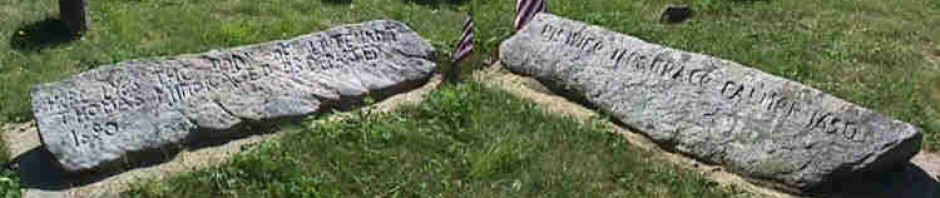

Posted in -5th Generation, Be Fruitful and Multiply, Historical Monument, Immigrant - North America, Line - Miller, Public Office, Storied | Tagged , , , , , , , , , , , | 17 Comments

Thomas Blair

Thomas  BLAIR (1832 – 1909) was Alex’s 3rd Great Grandfather; one of 16 in this generation.

Thomas Blair was born 8 Apr 1832 . He was baptized two months later 10 Jun 1832  at the Presbyterian Church of Hemmingford Quebec by Rev. John Merlin with their residence recorded as Hinchinbrooke. Witnesses were Thomas Blair (I wonder if this Thomas was a relative) and John Black.  On their  census forms, his sons Thomas Wesley and  William Lewis consistently claimed that their father was born in New York.   It is at least possible that this assertion is true.  Hemmingford is only three miles north of the US border.   Thomas’ father came with wife and four small children from Armagh County, Ireland, in the spring of 1830.  They visited with relatives before moving to Frontier, New York, just across the border from Canada.  In 1837 they moved to Franklin Township, Quebec and got a farm of 200 aces, most all it it well timbered, clears a piece and built a home for themselves.

Thomas was baptized by Rev John Merlin at the Presbyterian Church of Hemmingford Quebec when he was two months old.

Thomas’ parents were William BLAIR and Mary HUESTON.   He married Rebecca Triphosa  HORTON on 5 July 1859 in Franklin Center, Quebec.  Thomas died 7 Aug 1909 at the age of 77 and is buried in Franklin Center Cemeterey. called Russelltown Burying Ground in church records and Cantwell Cemetery by some local residents, is located a short distance to the east of Franklin Center Quebec.

Rebecca Tryphosa Horton was born 7 Apr 1841 probably in New York.  Her parents were Louis B. HORTON and Tryphosa AMES.  She was baptized 19 Aug 1860 in Wesleyan Methodist Congregation in the Russelltown Circuit; Franklin Methodist.  Rebecca’s birthplace shows as USA in the 1881 Canadian census. Rebecca died 8 Apr 1927 at the age of 86 and is also buried in the Franklin Center Cemeterey.

Rebecca Horton Baptism – 1860 Franklin

Children of Thomas and Rebecca

Name Born Married Departed
1. William Lewis BLAIR 13 Sep 1861
Franklin Center, Quebec, Canada
Baptism: 28 Sep 1861
Betsy Lindsay
3 Mar 1885
Methodist Church in the village of Huntingdon
.
Susan W. CRUTCHFIELD
6 Mar 1889 Hinchinbrook, Quebec
15 Sep 1919
Lakeport, California
2. Alexander (Zan) Blair 29 Mar 1864
Franklin
Baptism:
10 Feb 1865
Hettie Blair
(youngest surviving daughter of William Blair)
30 May 1888.
Franklin Corner
21 Mar 1924
Sprindale Farm, Ormsby, Quebec
3. Thomas Wesley Blair 15 Jul 1866
Franklin
Baptism:
3 May 1867
Lizzie Greer
12 Sep 1888
Jamestown, Quebec
After 1930 California?

Here are Google Map Directions of the places mentioned in Thomas’ life.  They are all within a few miles of each other in New York and Quebec.

The family is recorded as farmers in Franklin Quebec in the 1881 Canadian census.  Thomas Wesley’s name shows as Wesley.

Franklin Center and Huntingdon County were mostly English speaking between when the Blairs lived there, but Wikipedia shows it to be 75% French speaking today. The Arcadians were forced out in the 1760’s after the defeat of France, many moving to Louisiana.  Cajun is a derived from the root Arcadian.

In William D.Reid’s definitive book, THE LOYALISTS IN ONTARIO, two Horton families are listed. An Isaac Horton, born 1750 in Westchester, New York, settled in Pelham. His family consists of 8 children, all of whom made petitions for land grants as the children of Loyalists. The children were: Isaac, Ann, Elizabeth, Mary, Rebecca, David, William, and Daniel. David Horton’s petition was made in 1822. He is said to have lived in Gainsborough, which would make it possible that this is the same David Horton who was the husband of Helen and father of Eliza Ellen Rogers.
The other Loyalist Horton was Edmund Horton of Butler’s Rangers. He and his wife were in Niagara in 1783. Two children who made petitions: Elizabeth, & Emanuel. Perhaps these are relatives

Children and Grandchildren

1. William Lewis BLAIR (See his page)

2. Alexander Blair

 Alexander was baptized in the Wesleyan Methodist Congregation in the Russelltown Circuit; Franklin Methodist on 29 Mar 1864.  He married his cousin Hettie Blair, youngest surviving daughter of his Uncle William Blair 30 May 1888 at Franklin, at the residence of the bride’s father, by Rev. James O. Hara.

Hettie Blair was born 8 Feb 1867.  Her parents were William Blair and Hannah Adelia Morrison.  Hettie died 12 Jul 1942.

1889 – Thomas’s son Alexander and daughter-in-law Hettie were living in the kitchen part of his house (Uncle Zan and Aunt Hetty)   The homestead was an enchanted spot with an abundance of flowers, fruit and vegetables.

Hettie and Alexander were the family  that took in my grandfather Horace Horton BLAIR and his sister Beulah when William Lewis BLAIR first moved the rest of the family west to Lake County, California.

03-21-1924 Alexander Blair, died at his late residence, Springdale Farm, Ormstown PQ, age 60 years

Alexander Blair Gravestone — Hillside Cemetery Hinchinbrooke Township on Route 202 across the road from Rennie’s United Church

Children of Alexandaer and Hettie:

i. Aaron A H. Blair (1882 – 28 Dec 1911) 12-28-1911 Aaron A H. Blair, formerly of Winnipeg MB, son of the Alexander Blair, of Franklin Center PQ, died at Franklin Center PQ, aged 29 years.

ii. Roy J. Blair (5 Jul 1889 – ); m. 17 Sep 1919 to Nellie May Grimes (b. 4 Apr, 1898 – )

2015-12-26 22.07.38

Cousins Roy and Horton Blair at MillHouse in Ormstown Quebec

2015-12-26 22.02.16

Origina Blair home in  Ormstown Quebec, built in 1840, Grandfather Thomas Blair moved in 1870, Roy was still living in the house in 1953.

2015-12-26 22.03.41.jpg

Original 1840 Blair Quebec Home

2015-12-26 14.14.40.jpg

Maple Sugar Buckets, Roy Blair’s Maple Sugar House

.

3. Thomas Wesley Blair

Thomas Wesley Blair Baptism 1867 Franklin

Thomas Wesley Blair of Franklin Quebec, married Lizzie Grier, youngest daughter of the late William Grier, at the residence of the brides mother, in Jamestown Quebec, by the Rev. J. F. Langton, B.A. on 12 Sep 1888.  Thomas’ brother and sister-in-law Alexander and Nattie (Hettie?) were witnesses.

Thomas Wesley Blair / Elizabeth Grier Marriage Rockburn United Church & Presbyterian

Lizzie Greer was born in June 1861 so she was five years older than Thomas.  Her parents, William and Margaret, were born in Ireland. Alternatively, her father was born in Canada and her mother in Ireland.

Thomas and Lizzie immigrated to the United States in 1890 and became naturalized citizens in 1898

In the 1900 census, Thomas was a fruit grower living in Ophir, Placer, California.   Wesley T Blair 33, Lizzie Blair 38, Lillian Blair 1, Margaret Greer 70, F* Ogawa 20, Y* Slakuvane 25.   Like his brother William Lewis, he states that both his parents were born in New York.    Ogawa and Slakuvane (sorry for the misspelling, but those seem to be the letters the census worker wrote) were farm laborers who had come from Japan in 1896 and 1899 respectively.

Ophir, also known as Ophirville, is a ghost town in Placer County, California.  The community was named after King Solomon’s treasure.   Now a suburb of Auburn, it was a boomtown of the California Gold Rush. In 1852 it was the center of the local gold mining industry, and the most populous town in the county. After the gold rush, the area was planted in vineyards and orchards, and during Prohibition just in orchards. Beginning in the 1970s vineyards again returned to the area. Today, local services for Ophir come from Auburn, 3 miles to the east.

In the 1910 census, Thomas was living with his wife, daughter and mother-in-law in Newcastle, Placer, California working as a machinist in an auto garage. Thomas W Blair 42, Lizzie Blair 47, Lillean M Blair 11, Margaret Greer 79.   Newcastle is a few miles southwest of Auburn on Interstate 80.

In the 1920 census, Thomas was  living in Township 14, Placer, California with his wife and daughter working as an independent fruit truck driver.  This census gives the detail that Thomas and Elizabeth became naturalized citizens in 1898.  Township 14 includes Ophir and Newcastle.  Thomas W Blair 53, Elizabeth Blair 59, Muriel L Blair 21

In the 1930 census, Thomas was living in Oakland, California working as a carpenter for a builder.  He owned his own home which was declared at $5,000.  His daughter had returned home with her daughter and was working as a domestic for a private family.    Thomas W Blair 63, Elizabeth Blair 69, Lillian Sherwood 31, Lavina Rose Sherwood 5

Children of Thomas and Lizzie

i. Lillian (Muriel) Blair (20 Nov 1898 – ); m. 6 Aug 1923 to William Arthur Sherwood (16 Nov 1892 Pennsylvania-  before Jan 1930) They had one child, Lavina Rose Sherwood (c. 1925 -) In the 1930 census, Lillian and Lavina had moved back in with their parents in Oakland, California.  Lavina Rose married Allan O. Blake and had four children with him. The two divorced in 1964.

ii. Ervyn Blair (24 Feb 1901- 24 Jul 1909)


Sources:

http://www.wescotts.org/genealogyBlair.html
http://www.rootsweb.ancestry.com/~qchuntin/gleaner/

http://www.rootsweb.ancestry.com/~qchuntin/cemetery/hillside/pix/index.htm

Posted in -5th Generation, Historical Monument, Immigrant - North America, Line - Blair, Storied | Tagged , | 11 Comments

William Lewis Blair

William Lewis BLAIR (1861 – 1919) was Alex’s Great Great Grandfather; one of 8 in this generation.

William Lewis Blair was born 13 Sep 1861 in Franklin Center, Quebec Canada.  He was baptized at Wesleyan Methodist Congregation in the Russelltown Circuit; Franklin Methodist. His parents were Thomas BLAIR and Rebecca Tryphosa HORTON.

William Lewis Blair Baptism 1861 Franklin

On his 1900 and 1910 census forms, William claimed that both his parents were born in New York  There is a record of Thomas’ baptism 10 Jun 1832 at the Presbyterian Church of Hemmingford, Quebec, but it is at least possible that Thomas was born in New York.   Thomas was born two months before his baptisms on 8 Apr 1832,  William’s grandfather came with wife and four small children from Armagh County, Ireland, in the spring of 1830.  They visited with relatives before moving to Frontier, New York, just across the border from Canada.  In 1837 they moved to Franklin Township, Quebec and got a farm of 200 aces, most all it it well timbered, clears a piece and built a home for themselves.

He first married Betsy Lindsay  3 Mar 1885.  After Betsy died, he married Susan Wilhelmina CRUTCHFIELD at the residence of Mr. Robert Law, (Susan’s brother in law) in Gore Hinchinbrook, by the Rev. James O’Hara on 6 Mar 1889.

William Lewis Blair – Susan Crutchfield Marriage 1889 Franklin

William died 15 Sep 1919 in Lakeport, California.

William Lewis Blair

Betsy Lindsay was born in Jun 1863 in Edinburgh,  Scotland.  Betsy died 25 Jan 1888 of child birth complication.

Betsey Lindsay Headstone — Wife of Wm L Blair. Aged 25 yrs 6 mths. Native of Argyllshire? Scotland.—- Hillside Cemetery Hinchinbrooke Township on Route 202 and is found across the road from Rennie’s United Church.

Susan Wilhelmina Crutchfield was born 21 Dec 1859 (Or 21 Nov 1860) in Ormstown, Quebec.  Her parents were Samuel CRUTCHFIELD II and  Martha FENNELL. Susan died 5 Jul 1920 in Napa, California of a tumor of the spine.

Susan Wilhelmina Crutchfield 1885

.

Child of William and Betsey Lindsay.  Betsey died nine days later.

Name Born Married Departed
1. Thomas Duncan Blair 16 Jan 1888 Apr 1888
Interred Hillside Cemetery
12 Apr 1888

.

Children of William and Susan:

Name Born Married Departed
2. Beulah Martha Blair 14 May 1892
Chateaugay or Rouses Point NY
John George Anderson
21 Sep 1925
Fresno, Calif
11 Aug 1974
Lindsay, Tulare, California
3. Horace Horton BLAIR 18 Feb 1894 Anderson’s Corners Quebec Genevieve MILLER
4 Apr 1925
Los Angeles
23 Jul 1965
Oakland, Calif.
4. Harold Alexander Blair 29 Mar 1896
Rouses Point, Clinton County, NY
Grace Pearl Lawson
26 Jun 1926
Albany, OR
3 Dec 1974
San Diego
5. Allen Lewis Blair 3 May 1898
New York
Elaine Spencer
7 Dec 1927
3 Jul 1991
Santa Clara, California

Blair Family 1902:  Beulah, William Lewis, Horton, Allen, Susan Wilhelmina, Harold

Family lore says that William Lewis, wanted to vote for William McKinley, and took out citizenship papers to do so. The papers (or birth records??) were lost when the Franklin Township courthouse burned down.

William Lewis managed other people’s property, and moved around a lot. He came to Lake County, California for his health. His children Beulah and Horace Horton had to stay behind with an uncle and aunt while the family got established in California.

Before she married, Susan Crutchfield (Aunt Susie) was a housekeeper in Worcester, Mass.  When she came home to visit, her brother-in-law Robert Law met them at Chateaugay NY and after their 10 mile drive home to Jamestown, Chateauguay County, Quebec, her sister had prepared a delicious supper of pressed chicken, homemade buns, cake and cookies.

The next time Susie returned from Massachusetts she came on sick leave.  It might have been Nervous Prostration and her sister cared for her for six months.Her niece remembers seeing the doctor pricking Aunt Susie with a pin and she couldn’t tell him where he had touched her.  She fully recovered through time.

Susan was a homemaker, excellent cook and sewer.  Expert at nursing (without training) musical ability, contralto voice and good ear for music.  Choir leader and church organist.  Socially popular, cheerful, amiable, kind, agreeable, Entertaining conversationalist.  fhen

03-03-1885 William L. Blair, of Franklin Quebec, married Lizzie Lindsay, third daughter of the late James Lindsay, of Alyth, Perthshire Scotland. At the Methodist Parsonage, in Huntingdon, by Rev. John Wilson,B.A.

01-16-1888 The wife of W. L. Blair, at Franklin Center, a son.

01-25-1888 Betsy Lindsay, wife of W. L. Blair, died at Franklin Center, aged 25 years 06 months. A native of Perthshire, Scotland.

04-10-1888 Thomas Duncan Blair, son of William L. Blair, died.

03-06-1889 William L. Blair, of Franklin Quebec, married Susan Crutchfield, third daughter of the late Samuel Crutchfield, at the residence of Mr. Robert Law, Gore Hinchinbrook, by the Rev. James O’Hara.  The house was filled with guests and such a table full of useful gifts.  As of the 1960’s, their first house in Frankin Quebec was still standing.

1890/91 – Will and Susie moved to Chateauguay, a small New York town on the border. Today’s population is 2,100. They found many friends there and attended the Methodist Church.  Chateaugay is a suburb of Montreal, but their Chateaugay is a small New York town on the border.

1892 – Next they moved to Rouses Point New York.  Rouses Point today is a town of 2,200.  It was first settled around 1783 by Canadian and Nova Scotian refugees who were granted tracts of land in reward for their services during the American Revolution.  Steamboats were a booming business on this part of the lake; the second commercial steamboat in the world was launched on Lake Champlain with Rouses Point as its first port-of-call. Steamboat traffic continued on the lake for the next 100 years, until displaced by the railroad.

1894 – Will, Susie and Beulah moved in with the Susie’s parents the Crutchfields and Horton was born in Anderson’s Corner, Quebec.

In the 1900 Census, William was gone and Susan was head of household in Mooers, Clinton, New York.   Susan W Blair 39, Beulah Blair 8, Horton H Blair 6, Harold A Blair 4, Allen L Blair 2.    In the same census, William was a lodger in Haverhill, Mass and working in a grain mill.  He consistently states that both his parents were born in New York.

1910 Census – Lakeport, California, William L Blair 48, Susan W Blair 49,  Beulah M Blair 17, Horton H Blair 16, Harold A Blair 14,  Allen L Blair 11  William claimed on this census that both of his parents were born in New York and he moved to the United States in 1890 and was a naturalized American citizen.  William was working as a “jobbing”  Teamster.   On the census form, “working on own account” is scratched out and “employee” is written in.

09-15-1919 William L. Blair, eldest son of the late Thomas Blair, died at Lakeport, Lake County, California, age 58 years 02 days.

07-05-1920 Susan W. Crutchfield, wife of the late W. L. Blair, died at Napa, California, age 59 years 07 months.

04-08-1927 Rebecca Horton, widow of the late Thomas Blair, died suddenly, at Springdale Farm, Ormstown PQ, age 86 years.

Children

2. Beulah Blair

Beulah’s husband John George Anderson was born in Jul 1859 in Monroeville, Colusa, California.  He was 35 years older than Beulah.  His parents were John George Anderson Jr. and Mary Williams Diffenderffer. His parents were married 27 Jun 1851 in Sacramento, California in a romantic gold rush story. In the 1860 census, he was living with his parents who were farming in Monroeville, Colusa, California

John Anderson first married in 1894 to Ida C. [__?__] (b. Jul 1870 New York)  Ida’s parents were born in Scotland.  In 1879 he was a 21 year old tinsmith living in Alameda County’s second ward (North Oakland).  In the 1900 census John and Ida were living in Salt Lake City where he was a real estate agent and in the 1910 census they were living in Seattle where John was the proprietor of an apartment house.

Beulah met her husband when she did private nursing for him. He had forty acres of oranges in Lindsay (20 valencia, 20 navel) and was a rich man in good years. He thought his daughter Alice was a miraculous wonder. He had no children by his first wife.

John’s father John George Anderson Sr.  was born 13 Mar 1823 in St. Alban’s, Vermont. His parents were William Anderson (b. 1799 in Scotland – d. 11 Dec 1891 in Salt Lake City) and Agnes [__?__]. John died 15 FEB 1910 in Seattle, Washington.

John’s mother Mary Williams Diffenderffer was born 12 Nov 1832 in Baltimore, Maryland. Her parents were Dr. Michael Nicholas Diffenderffer (b. 22 Apr 1812 Baltimore, Maryland – d. Nov 1850 Diamond Springs, El Dorado, California) and Mary Barney Williams (b. 14 Aug 1813, Maryland – d. 8 Aug 1850 12 miles east of the sink of Humboldt River in Nevada.) Mary died 15 Oct 1893 in Chicago, Illinois.

John George Anderson Sr. arrived in Sacramento ca 1850, from New Orleans, via the Isthmus of Panama, then by clipper ship, to San Francisco, then up the River. There he met Mary Williams Diffenderffer. She had arrived in Sacramento from Placerville, where her father, Dr. Michael Nicholas Diffenderffer, died after a long and ardous wagon train trip had brought the family from St. Charles, Missouri. Her mother had died and was buried 12 miles east of the sink of Humboldt River in Nevada. Free Masons brought Mary (age 18) and three younger siblings to the home of the Worshipful Master of their Lodge in Sacramento, where he cared for them.  Mary and John George were married in Sacramento on 23 Jun 1851. Family stories say that they lived in a log cabin where the State Capitol now stands.

In the 1880 census, John George Sr was a hardware merchant in Oakland, Calif.

Children of John George Sr and Mary

i. Cora A. Anderson b. 1852

ii. William M. Anderson 1854 –

iii. John G Anderson 1858 –

iv. James M Anderson b. 13 May 1860 Monroeville, Colusa, California.; m. Alice Wilcox; d. 8 Oct 1943 San Diego, Calif.

Children of James and Alice

a. Milton W Anderson b. 3 May 1887 Missouri,

b. Alice Mary Anderson b. 5 Aug 1891; m. [__?__] Clark; d. 30 May 1981 San Diego

My mom  used to tag along when her mother and Aunt Beulah visited with Alice Clark (then a widow) and her mother.  My mom mentioned that the elder Alice (Wilcox) Clark seemed ancient in her eyes.  I looked up census records, and it turns out she was born 146 years ago,  Nov 1866 in New York

Alice published a book of her botanical Begonia Portraits in 1977. It is still available on Amazon.com

The American Begonia Society says: The color plates are spectacular in Begonia Portraits by Alice M. Clark. Alice published this book privately in 1977.  The volume consists of reproductions of her paintings of favorite begonias, along with her sometimes-quaint, sometimes-amusing, always-informative commentary. In 1980 you could order from Alice Clark, 3643 Jennings St., San Diego, CA 92106 for $26.50 (plus $1.50 tax  for Californians),

<Begonias@yahoogroups.com>

I have a copy given to my by Alice with her own hand and autographed to boot! It’s for sale for $1,000,000.00. I love that book.

Begonia Portraits by Alice Clark

In 2011, KOLZ Begonia Research Center announced they now have a watercolor of Begonia involucrate on display, done by the late Alice M. Clark, one of only 5 of her paintings not housed at the Hunt Institute in Pennsylvania.\

A Begonia species Begonia Alice-Clarkae was named for her.  Here’s a picture.

Begonia Alice Clarkae

Alice’s grandson is the famous surf photographer, Jeff Divine. I was the envy of my surf-rat friends when I announced he was my cousin (didn’t mention how many times removed).  Our meeting at Alice’s La Jolla house in 1975 helped inspire me to be a surf photographer during my high school days.  In 2010, Surfer Magazine wrote:

His [Jeff”s] name has appeared in SURFER Magazine more times than Andy Irons’, Kelly Slater’s and Tom Curren’s combined, but you wouldn’t recognize his cutback or his off-the-top. His surfing, while accomplished, never put him on a podium, much less in the magazine. But his body of work is so unforgettable, so absolutely important, that it’s hard to imagine the sport of surfing without it.

Here’s the splash screen of his website.

Jeff Divine Surf Photography

v. Minerva Anderson 1866 –

Children of Dr. Michael Nicholas Diffenderffer and Mary Barney Williams who were left on their own in the California Gold fields in 1850

i Mary Williams Diefenderfer (Age 18) See above

ii. Barrach Diffenderfer Age 14 (1836 Somerset, MD – 1890)

iii. Catherine Rogers Diffenderfer  Age 12 (1838 – 1890)

iv. Amelia Handy Diffenderfer Age 10 (1840 – 1890)

v. Michael Nicholas Diffenderfer Age 8 (1842 – 1890)

In the 1920 census, John was farming in Lindsay and living with his niece, Henrietta Pratt.

In the 1930 census John and Beulah were farming in Lindsay, Tulare, California

Beulah went into nurse’s training at St. Luke’s hospital in San Francisco.   In the 1920 census, she was a nurse living in residence in Oakland California.   Most of the other young women were in their early twenties and listed as students.  She was 27 and was listed as a nurse.

09-21-1925 Beulah M. Blair, only daughter of the late William L. Blair, formerly of Franklin PQ, married J. G. Anderson, of Fresno California. At Fresno California.

Child of Beulah and John

i. Alice Anderson  m. Don Corliss

2. Horace Horton BLAIR (See his page)

He went out to teach right out of high school and then went to San Jose Teacher’s College.

3. Harold Blair

Harold also became a teacher.   Harold took two classes in the summer of 1922, “Teachers Course in Albebra and Geometry” and “Principles of Education” at Oregon State Agricultural College, Corvallis Oregon.  Also, three classes in the summer session of 1923 at the University of California, Berkeley. And, three classes in the summer session of 1928 at “State Teachers College of San Diego.”   Email from McMinnville College, says that Harold graduated from there, although no date is given.

Harold’s wife Grace Lawson was born in  20 Jan 1903 in Breckenridge, Indian Territory. Her parents were Henry W. Lawson and Mary A. Romang.   In the 1910 census she lived in Puyallup, Pierce, Washington. In 1920 she lived in Chehalis, Lewis, Washington. Grace died 15 Jan 1986 in San Diego, California.

Grace’s father Henry W Lawson was born 25 Dec 1866 in Centralia, Boone, Missouri. His parents were Richard Henry Lawson (1825 Kentucky – 1888 Stuttgart Arkansas) and Mary Pauline Jones (1828 Kentucky– 1896 Stuttgart Arkansas). He married Mary Annie Romang  on 24 Mar 1891 in Stuttgart, Arkansas, Arkansas. Henry died 19 Feb 1936 in Centralia, Lewis, Washington.

Richard Henry Lawson

Reverse of Lawson Photo

Grace’s father grew up in the Old Lawson homeplace near Yoder (Almyra/Stuttgart) Arkansas

Grace’s mother Mary Annie Romang was born in 13 Mar 1874 in Delphos, Ottawa, Kansas. Her parents were John Peter Romang (1842 Gsteig, Canton Bern, Switzerland – 1919 Oklahoma) and Catherine Schafroth (1845 Lindbach, Canton, Bern, Switzerland– 1895 Stuttgart, Arkansas). Mary Anne died 19 Feb 1958 in Chehalis, Lewis, Washington.

Stuttgart  is the county seat of the northern district of Arkansas County, Arkansas,   the population of the city was 9,376 in the 2006 census estimate.

Stuttgart Arkansas, Arkansas

Stuttgart was founded by Rev. Adam Bürkle  a native of Plattenhardt, Germany. He moved to the United States in 1852 and founded a settlement at Gum Pond after living in Ohio. In 1880, he opened a post office and had thus to name the village. In memory of his native home he called it Stuttgart after Stuttgart, Germany,  In 1882 the Texas and St. Louis railroad was opened. Stuttgart became a city in 1884, and in 1904, rice farming was first introduced in the Stuttgart area.  Hard clay underlying the area’s topsoil makes Stuttgart a good place to grow rice, which grows best in flooded fields made possible by the clay.

The town proclaims itself the “Rice and Duck Capital of the World”. It is headquarters to Riceland Foods, the world’s biggest rice miller. Stuttgart is also home to Mack’s Prairie Wings, known around the world as the premier waterfowl sports outfitter, through their store and online presence. During Thanksgiving Week, Stuttgart holds the International Duck Calling Contest that brings in people of all ages from around the world to show off their talent of using a duck call.

April 28, 1904 – Henry, Mary, Richard J, Katie, Clarence, Effient (Effie), Gracie P Lawson

Children of Harold and Grace

i. Stella Blair

ii. Mary Blair

iii. Kathryn Blair

4. Allen Blair

Allen enlisted 30 Apr 1917 and was GM1 (Gunner’s Mate 1st Class) in the US Navy during World War I. He was discharged 16 Aug 1919.  In 1920, he was a machinist in the Vallejo U.S. Navy Yard.  By the 1930 census he was an accountant at Standard Oil in San Francisco. Allen died 3 Jul 1991  in Santa Clara County, California.

Allen’s wife Elaine Spencer was born  27 Jan 1902 in  San Francisco, California. Her parents were William F. Spencer (b. about 1870 Nova Scotia Canada) and Marguerite (Margaret) Habrie (b. 1872 France).  They were married in 1896.  William immigrated in 1890 and Marguerite in 1898. In the 1910 census, William was a carpenter in San Francisco. William’s parents were from Scotland.

Elaine had an older sister, Marie L. Spencer who was born 17 Jan 1898 in California.  Like her sister, she was also a school teacher. She lived in an apartment overlooking Lake Merritt in Oakland.   Marie died 31 Aug 1980 in Santa Clara County, California.

Allen and Elaine were married 7 Dec 1927. In the 1928 San Francisco directory, Allen and Eliane were living at 1289 2nd Avenue, an apartment building on the corner of Irving Street, today across the street from the UCSF parking structure.

In the 1930 census, Elaine she was a public school teacher and did not have any children yet.  She was still teaching public school in the 1948 San Francisco city directory.  Elaine died 25 Sep 1964 in San Francisco   Allen and Elaine are interred at the Golden Gate National Cemetery 1300 Sneath Lane San Bruno, California.

In the 1931 thru 1948 San Francisco directories, Allen and Eliane were living at 1137 Rivera Street in the Parkside section of San Francisco’s Sunset District.  Their home was located at  22nd Avenue across the street from Lincoln High School.  It was built in 1929, it’s likely they were the first owners.  Here’s the Zillow listing.

1137 Rivera Street San Francisco Source: Google Maps

Allen’s occupation is listed as Clerk in these city listings, a little less fancy than “accountant”, but maybe the three leter “clk” fit better in a small space.

Child of Allen and Elaine

i. Barbara

Sources:

http://www.wescotts.org/genealogyBlair.html
http://www.rootsweb.ancestry.com/~qchuntin/gleaner/

http://www.swquebec.ca/results.asp?ID=4090

http://trees.ancestry.com/owt/person.aspx?pid=181984774

http://trees.ancestry.com/owt/person.aspx?pid=181984774

http://collections.si.edu/search/results.jsp?q=record_ID:npg_CA990131

http://www.findagrave.com/cgi-bin/fg.cgi?page=pv&GRid=157657&PIpi=19270691

http://www.rootsweb.ancestry.com/~qchuntin/cemetery/hillside/pix/index.htm

Posted in -4th Generation, Line - Blair | Tagged , , | 5 Comments

William Shaw

William SHAW (c. 1830 – c. 1886) was Alex’s 3rd  Grandfather; one of 16 in this generation.

William was born in 1830 in Edinburgh Scotland according to the 1880 census.  On the other hand, he is recorded to be 44 years old in the 1870 census, putting his birth at 1826 and there was a single farmer William Shaw from Scotland in Vienna Township, Dane County, Wisconsin age 36 in the 1860 census which would put his birth at 1824.   William left behind 2 sisters in Edinburgh and came to New York City when he was 15 .  Later, when he was 21, he sailed around Cape Horn to California gold fields and clerked in a store.

William Shaw

Our William  made enough money to go to Dane County, Wisconsin (cherry belt) where there was a Scottish community and purchased a farm in Vienna Township. William married Ruth Agnes FOSTER 3 Aug or 27 Jul 1861 when he was 34 and she was 18.  Ruth was living in Arlington Township, Columbia County which is just north of Vienna Township.   William died in Dane County Wisconsin about 1886.
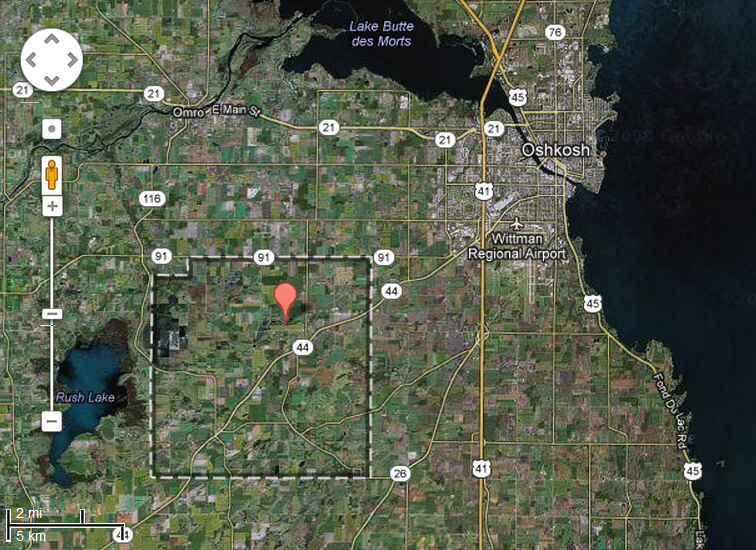
Vienna Township, Dane County, Wisconsin

Ruth Agnes Foster was born on 11 Jul 1843 in Ekland, Pennsylvania.  Her parents were Josiah Harvey FOSTER and Mary Ann TURK. Other sources say that Mary Ann’s maiden name may have been LaTouche or Meritt, but I have concluded that Turk is correct.  Ruth came from Pennsylvania when she was eleven.  She was an ardent member of the United Presbyterian Church when she married William Shaw.   After William’s death they sold the farm in Wisconsin.  Robert moved to Montana (near Lewiston) where he bought a farm and settled.  Ruth moved to Bozeman with her children Howard, Will and Sadie.  Ruth died in Bozeman about 1896 when Howard, Will and Sadie were still attending Montana State College.  They had adored her and the bottom fell out of their world.  She had lived in Bozeman for five years and had been a widow for ten years.
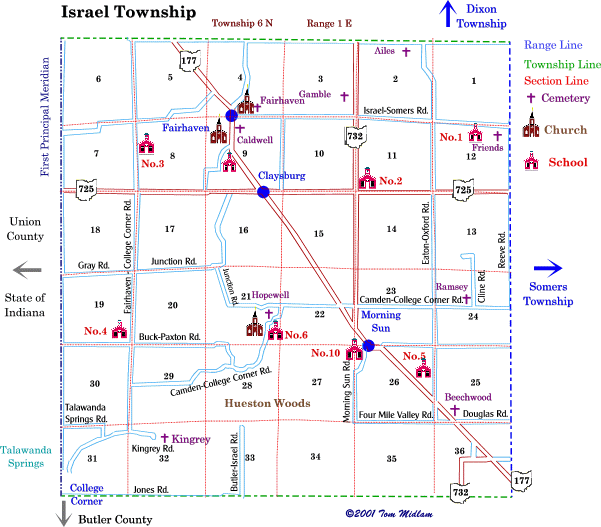
Ruth Foster Shaw and Daughter Sadie

Family legend says that Ruth was also a descendant of the Marquis De Longe who was guillotined in the French Revolution. His wife and daughter escaped the country and his daughter married an American.  In reality, this legend probably isn’t true.  Adrianus Franciscusz  De Langet (1653 – 1699) and Alex’s 9th Grandfatheris our real first DeLong ancestor in America.  He had many aliases and the Abridged Compendium of American Genealogy says Aryan Fransen (Aaron the Frenchman) DELONG,Huguenot; fled to Holland; settled at Kingston, R.I.; m Rachel Jansen Pyer [Pier].  Virkus as Ref:

There is absolutely no primary evidence to support the claim of Huguenot descent. This was a 19th Century gloss based on Americans’ desire to take everything possibly construed as French (e.g. the De) and claim it was so. As to our subject, he seems to have been good old Dutch Arie Fran.

Ruth was married to William Shaw and keeping house in 1880 at a farm near Vienna, Dane County, Wisconsin.

Family legend also says Ruth’s grandmother may have beeen related toGen Nathanial GREENE of the Revolution. My grandmother’s second cousin Lydia Townsend remembered seeing a family silver tray that had belonged to him.  She didn’t know what had become of it.  I worked Nathanial Greene’s family tree back to grandparents and down to grandchildren and found Lydia Townsend in our family tree,  but wasn’t able to made a connection.

Children of William and Ruth:

<td valign="top">5 Aug 1912 Salem, Oregon

Name Born Married Departed
1. Robert F Shaw Jul 1862
Wisconsin
Jeanette (Nettie) L. Patten
1886
1942
Moore, Fergus County, Montana
2. Martha Ella Shaw Sep 1865
Wisconsin
Charles L Clapp
26 Sep 1883
Dane County, Wisconsin
3. William (Will) T. Shaw 1868
Wisconsin
Betty “Bessie” DeCoursey
1896
Divorced before 1905
After 1930 in Seattle, WA
4. John (Jack) Shaw 1873
Point Set, Dane County, Wisconsin
Emily B. [__?__] 2 Nov 1928
Accidently shot and killed while hunting near Arlington, South Dakota

Jack Shaw Obit

5. Howard Irwin SHAW 1 Mar 1874
Dane Co. Wisconsin (1876 according to 1880 US Census)
Nellie COLEMAN
4 Mar 1899 Lewiston, Montana
7 Jun 1960
San Diego, California
6. Sadie (Sarah) Shaw 1878
Vienna, Dane, Wisconsin
Patient 1920 census- 1940 census Rochester State Hospital, Minnesota

Description from John W. Hunt’s 1853 Wisconsin Gazetteer: ”

DANE, County, is bounded on the northwest by the Wisconsin river, by which it is separated from Sauk; on the north by Columbia, on the east by Dodge and Jefferson, south by Rock and Green, and west by Iowa. It was established ¿ for judicial purposes December 7, 1836, and fully organized March 11, 1839. The seat of justice is at Madison, near the geographical centre of the county, and the Court House is the best in the State. Dane county contains about 1,250 square miles, mostly of good tillable land, and a fertile soil, well apportioned between woodland, openings and prairie, and is well adapted to grazing, and the raising of grain, roots and fruit. There is, in the county, considerable non-resident land which can be bought on reasonable terms. One of the most attractive features of the county is its beautiful lakes of clear, pure cold water, originating in deep springs. The Catfish river forms the outlet of these lakes, and passes from the northwest to the southeast completely through the chain known as the Four Lakes. ¿ The county is watered by the Catfish and Sugar rivers, and Black Earth, Badfish, Token, Waterloo and Koskonong creeks. The population in 1836 was Ebenezer Brigham; 1838, 172; 1840, 314; 1842, 8,289; 1847, 10,935; 1850, 16,654. Farms, 1,511; manufactories, 87; dwellings, 3,510.”

I was curious about this fragment so I typed “University of Wisconsin Astronomy History” into Google and found the following.  The 1881 observatory looks a lot like the one near Alex’s freshman dorm.  I wonder if William assisted in the search for Planet Vulcan.

William was a dreamer and a fine amateur astronomer. He was later offered the chair of astronomy at the University of Wisconsin (so his son Jack said).  His son Robert at an early age took over management of the farm.

The history of astronomy at the University of Wisconsin began almost immediately after the university’s founding in 1849.  Its first faculty member was John Sterling, who held the title Professor of Mathematics, Natural Philosophy, and Astronomy.  By 1854, all UW undergraduates were required to complete at least one term of astronomy as part of a fixed curriculum that mixed the sciences with classical languages, philosophy, and literature.  Although this “classical curriculum” is often portrayed as stodgy and outdated, UW graduates in the nineteenth century had a greater literacy in astronomy than an average student of today.  However, for the first three decades of the university, astronomy remained a classroom exercise: UW possessed no astronomical instruments, nor did it have an observatory.

Funding for Wisconsin’s first major observatory did not materialize until 1877.  During the previous year, the Wisconsin Legislature passed a resolution providing a salary for a new professor of astronomy at the university provided that some wealthy patrons donate an observatory.  This patron, who had in fact helped to craft the legislation behind the scenes, was Cadwallader C. Washburn.  Washburn was a former U.S. Representative, Civil War general, and governor of Wisconsin from 1872 to 1874

Washburn Observatory, University of Wisconsin completed 1881

Construction of the new Washburn Observatory began in 1878 on a small hill, now appropriately known as Observatory Hill, west of campus and about a mile from the State Capitol.  When it was completed, the Washburn 15.6-inch was the fourth-largest refractor in the world. However, it held this position only for a brief time as many larger instruments were made shortly thereafter.

The first director at the new facility, James Watson,  announced he discovered the planet Vulcan during the total solar eclipse of July 29, 1878,  but Mercury’s orbit was eventually understood when Albert Einstein showed in 1916 that his theory of General Relativity predicted distortions of space near the sun that produce the observed effects.

In the 1870 census, the family was living on a farm in Vienna Township, Dane County, Wisconsin.  They were served by the Columbus Post Office in Columbia County, so they may have lived in the Northeast section of the township.  His real estate was valued at $6,000 and personal property at $1,200 making him a relatively prosperous farmer for the time.  Living with the family were Christian Oleson, age 27 from Norway, Farm Laborer and Martha Erickson, age 42 from Norway, Domestic Servant.

In the 1880 census, William Meek, age 16, was recorded as a farm laborer on William’s farm.

Children

1. Robert Shaw

Robert married about 1886  Jeanette (Nettie) L. Patten (Oct 1865 Wisconsin – 1942 Moore, Fergus, Montana) when he was 23 and she was 19.  Nettie’s parents were from Maine.

In the 1900 census son Robert was a tenant farmer in Spanish Creek, Gallatin, Montana. The family employed a servant Roy Kimbal (age 24.)  Spanish Creek is south of Bozeman on US 191 on the road to the west entrance of Yellowstone.  The Greek Creek to Spanish Creek section of Gallatin River in Gallatin County is 13 miles long and it is classified as a class II-IV section by American Whitewater.

In the 1910 census Robert and his family was living in Lower Rock School District, Fergus, Montana and working as a grain farmer. Hired man George Rohrback (age 24) was living with the family.

In the 1920 and  the 1930 census, Robert and Nettie were  living in  Moore, Fergus, Montana about 10 miles southwest of Lewistown had a population of 186  in the 2000 census. They had Onie D Walker (age 21) as a hired hand in 1920 and James V Ferrin (age 20) as a lodger in 1930.

Robert and Nettie died in 1942.

Moore Montana Graveyard – Moore is located on Highway 87, southwest of Lewistown.

Children of Robert and Nettie:

i. Ernest Butler Shaw (born in Wisconsin Sep 1885 – );  m. 1906 Bessie L. [__?__] (1882 Missouri – ) Bessie’s father was from New York and her mother was from Ohio.

In the 1930 census, Ernest was a farmer in Denton, Fergus, Montana.

ii. Raymond “Ray” Robert Shaw (24 Mar 1888 Madison County, Wisconsin – ); m. 6 Nov 1916 Great Falls, Montana to Ethel M. Leach (Sep 1898 in Montana – 3 Apr 1960 in Lewis & Clark, Montana.)

Raymond was a farmer in Coffee Creek, Fergus, Montana in his 1917 draft registration. Coffee Creek was named for the creek with water a dark, coffee-brown color. In early days this was a favorite stopping place for cowboys riding the open ranges around it. The town itself began as a station of the Milwaukee Road. Two grain elevators and an International Harvester farm machinery store indicate this is now grain, rather than range country. In the 1930 census, Raymond was a farm laborer in Moore, Fergus, Montana with four children.

iii. Ethel J. Shaw (born in Montana Aug 1890 – After 1910 census)

iv. Thomas Herbert Shaw (born 5 Jun 1893 Bozeman, Montana – ) m. 1926 Alice E. [__?__] (1907 Montana – ) Alice’s parents were born in Illinois.

In the 1920 census, Thomas was a stock farmer in School District 69, Fergus, Montana and was married to Amy B. [__?__] (1898 Montana – ) Amy’s parents were born in Kansas.

In the 1930 census, Thomas and Alice were lodgers in Downey, California. Thomas was working as a car salesman and Alice and a lunch room helper. On his 1942 draft registriation, Thomas was living in Sumner, Washington and working for U.S. Engineers in Puyallup, Washington.

.
.
2. Martha Ella Shaw

Martha married Charles Clapp in Dane County Wisconsin on 26 Sep 1883. Charles was born Dec 1855 in Wisconsin. His parents were both born in Maine. Charles died 13 Oct 1939 in Portland, Oregon.

Oregon Statesman 8 August 1912 5:4 – In Salem August 7, 1912, Martha E. Clapp, aged 48 years. The funeral will be held at 10 o’clock this morning from the Cottage undertaking parlors. Rev. H. T. Babcock will conduct the services and interment will be in I.O.O.F. cemetery. Mrs. Clapp, who was the wife of William Clapp, recently came to Salem from Haines, near Baker.

In the 1920 census, Charles was a widowed harness maker in Haines, Baker, Oregon.

Children of Martha and Charles

i. Milton Charles Clapp (27 Mar 1888 Arlington, Wisconsin – 17 Jun 1936 Baker, Oregon); m.  21 Dec 1920 to Elva Leona White (1903 in Baker, Oregon – 1992). Her father was from England and her mother was from Missouri.

In the 1910 census, Milton was working as a quartz miner in Elk City, Idaho, Idaho. In his World War I Draft Registration, Milton was a farm laborer living in Haines, Baker, Oregon. In the 1920 census, Milton was working as a farm laborer and living with his father in Haines, Baker, Oregon. In the 1930 census, Milton was a railroad laborer with three young children in Haines, Baker, Oregon

Milton’s son Eldon (1922-2010) was a Master Sergeant Crew Chief the 9th Bombardment Group, 5th Squadron in World War II. He died in May 2010, according to the Air Force Personnel Center at Randolph Air Force Base, Texas.

OIL LEAK
Eldon C. Clapp, Crew Chief, 5th Squadron What Wright R3350 engine didn’t leak oil, especially those mounted to the firewall of a B-29? The turbo superchargers, two per engine, were a terrific force on the blower case seals, and sealed areas, at 30,000′ plus. Oil leaks were judged by a percentage, lost or used, from the total oil tank capacity. Max effort missions could be counted “in” so long as enough oil remained? Oil tank capacity was approximately 80 gallons. Three to four missions were completed before time was allotted to locate and repair the oil leak. We stripped the engine of all cowling and baffles; and washed the engine with our favorite cleaning fluid. With the engine ready to run, Sgt. Paul Poor was stationed on top of the nacelle just aft of the number l cylinder. The engine was started under way at 5 – 6 hundred RPM. A frantic call to “cut” was heard and the engine stopped. Number one cylinder was moving up and down on the blower case. Hold down studs were all tight and safety wire intact. Push rod housings and hoses were tight. The cylinder was removed with these observations:The piston was hammering the cylinder head stretching the skirt. The flange was peened away allowing up and down motion. The oil from the drilled passages through the piston was blown out at the gap between blower case and cylinder flange. Numbers stamped on the cylinder assembly indicated to Parts Supply that the cylinder was applicable to a R1830 9 cylinder engine, not a R3350 Wright 18 cylinder engine! The cylinders were almost the same measurement, with this exception – the cylinder barrel was some thousands short for the R3350 engine master rod. It is believed that this wrong size cylinder had held together from its installation in a new B-29 in the states! After working all night, the aircraft was ready for the mission scheduled in the AM. The mechanics involved were B.C. Christopherson, Paul Poor, and Keith Lewis


Baker City Oregon Herald Obit.

Milton’s daughter Shirley May never married. Obit from Baker City Herald

Shirley May Clapp, 83, of Baker City, died July 23, 2009, at Ashley Manor Assisted Living.

Her graveside service will be at 11 a.m. Wednesday at Mount Hope Cemetery. Pastor Lennie Spooner of the Baker City Church of the Nazarene will officiate. Visitations will be from noon to 7 p.m. Tuesday at the Coles Funeral Home, 1950 Place St.

Shirley was born on Aug. 30, 1925, at Haines. She was the third and youngest child of Milton Charles and Elva Leona White Clapp. Shirley attended Haines grade school and high school.

After her father’s death, she and her mother moved to Pendleton where she graduated from high school in 1943. Shirley lived with her mom until her death in 1992.

While living in Pendleton, she became a certified nursing assistant and worked at that for several years. She never married, but gathered lots of good friends through the years.

Shirley loved music and played the piano, organ and the guitar. She was always happy and content with whatever came her way, be it good times or bad, family members said.

She loved to tat small crosses and give them to people she’d meet on the street. Everyone who received a tatted cross felt blessed by her. She was one of the few people left who knew that art form, according to her family.

“She was a bright light to everyone who knew her and will be dearly missed,” they said. “She had an uplifting Bible verse memorized for every occasion and was happy to talk to anyone about her Lord.”

Survivors include her oldest brother and his wife, Eldon and Norma Clapp; two nieces and their husbands, Linda and Elliott Rosenberg and Terri and Bob Sternfield, and a nephew and his wife, Steve and Tracy Clapp, all living in Chicago; and five great-nephews and three great-nieces.

She was preceded in death by her father; her mother; and an older brother, Howard “Bud” Clapp.

Eldon Charles Clapp, 88, of Baker City, died May 3, 2010, at St. Elizabeth Health Care Center.

His memorial service was today at Coles Tribute Center. His cremated remains will be scattered later in the Elkhorn Mountains. Pastor Monte Holt of Church of God of Prophecy in Nampa, Idaho, officiated. The U.S. Army National Guard provided military honors. Friends joined the family for a reception luncheon at the Geiser Grand.

Eldon Charles Clapp was born on Oct. 2, 1921, at Haines to Milton C. and Elva L. White Clapp. He was joined by a younger brother, Howard, two years later and a sister, Shirley, four years later.

He was raised and educated at Haines, graduating from high school in 1940.

Eldon joined F Company, 186th 141st Division Infantry, at Baker when he was 18. Progressing through 5fi years of military service during World War II, he was overseas with the 9th Bomb Group, 5th Squadron B29s on Tinion Island as crew chief on the aircraft called Purple Heartless. (See history book 9th Bomb Group at the Baker Library for details).

Eldon married Frances Shyrack on April 2, 1946, and he continued his Air Force career until 1961. He and Frances lived at Rapid City Air Force Base in South Dakota, Peterson Air Force Base in Colorado Springs, Colo., March Air Force Base in Riverside, Calif., Elmendorf Air Force Base in Anchorage, Alaska, McClellan Air Force Base in Sacramento, Calif., and Paine Air Force Base at Everett, Wash., before retiring at age 39 after 21 years of active service.

Eldon spent one year with Alaska Airlines while in Everett, Wash., and one year with Snap-On-Tools before becoming the maintenance supervisor mechanic for the City of Lynnwood, Wash., for the next 20 years. He retired in 1984.

They couple returned to Baker City in 1992 to be with family. Frances died in 2002.

Eldon married Norma Baker on Nov. 26, 2003, at Nampa, Idaho, and they made their home at Baker City.

Survivors include his wife, Norma of Baker City; brother-in-law, Jack Shryack, and his wife, Betty, of Spokane, Wash.; nieces and nephews, Linda Rosenberg and her husband, Elliott, and Terri Sternfield and her husband, Bob, Stephen Clapp and his wife, Tracy, all of Chicago, Barbara Melville and her husband, Michael, Jan Shryack and his wife, Tina, all of Spokane, Wash.; and numerous great-nieces and great-nephews.

He was preceded in death by his parents; a sister; a brother; and his first wife.

.
ii. Sidney John Clapp (7 Jun 1892 Bozeman Montana – Dec 1970 Portland, Oregon) m. Ruth Morris (1898 Missouri – 27 Feb 1990 [Portland] Multnomah County, Oregon) Ruth’s father was born in Missouri and her mother in Ohio.

In his World War I Draft Registration, Sidney was unemployed living in Haines, Baker, Oregon. In 1920, he was a farm laborer in Rock Creek, Baker, Oregon and already married to Ruth. In his World War II Draft Registration, Sidney was working for the Oregon Transfer Company and living at 1580 SE Sherritt Avenue, Portland Oregon.

A memorial service will be at 10 a.m. Monday, July 21, 2008, in Bateman Carroll Funeral Home for [Sidney’s son] Sidney J. “Sid” Clapp Jr., who died July 11 at age 84. Sidney J. Clapp Jr. was born Feb. 25, 1924, in Portland, where he lived all his life. He graduated from Benson Polytechnic High School. During World War II, he served in the Navy. After the war, he returned to Portland, where he was an electrician for several companies, including E.V. Prentice. Later he was a sound engineer for Meier & Frank. He owned Sid’s Automation and retired as a building engineer for Clay Towers. In 1943, he married Evelyn Bernard; they divorced. In 1986, he married Sherry Page; she died in 1993. Survivors include his sons, Sidney “John” III, David and Mark; sister, Lois Williams; former wife, Evelyn; and 11 grandchildren. Remembrances to Eagles Lodge Aerie 215

iii. Child died before 1900

iv. Child died before 1900
.

3. Will Shaw

In 1896 Will married Bessie R. DeCoursey (Apr 1878 Otter Tail, Minnesota – Seattle, WA) Her parents were Peter Henry DeCoursey (1851 Wisconsin – c. 1928 in Seattle, WA) and Isabel Johnson (May 1855 Minnesota – Seattle.)

Like his siblings, Will also went to Montana State College and became one of Montana’s most brilliant young chemists. In the 1900 census, Will was living with his father-in-law in Seattle Ward 8, King, Washington and was working as a chemist.   Later, he became an alcoholic  and disappeared, leaving a greatly loved wife, Betty.  When my grandmother was a girl [c. 1910], he returned, completely reformed, and found his wife remarried. However, looking at Will’s occupations in 1920 and 1930, I’m not sure how reformed he really was.

In 1905 Bessie married Lawrence L. Christiansen (c. 1859 – Wisconsin – ). Lawrence was 20 years older than Bessie and in fact just a year younger than her mother. Lawrence’s parents were from Denmark and from the 1892 Washington State census, he appears to have been married before and working as a teamster. In the 1910 census, Lawrence was living with Bessie’s parents in Seattle, Washington and working as a railway motorman. His father-in-law was working as a building contractor. Lawrence was also working as a motorman in 1920.

In the 1920 census, William was a lodger and working as a theatre watchman in Seattle. In the 1930 census, Will was 62 years old and working as an office building watchman in Seattle. His rent was $67 a month. Sadly, he shows his marital status as married.

.

4. Jack Shaw

Jack’s wife Emily Blanche Peacock was born about 1879 in Iowa. Her parents were William Frederick Peacock (b. Mar 1851 in Canada) and Lillian J. Little (b. 29 March 1857 in Illinois – d. 6 June 1914).

Jack K Shaw Obit Minneapolis Journal – Sunday, 28 Nov 1926 –

John K. Shaw was accidently shot and killed while hunting near Arlington, South Dakota on Friday 2 Nov 1928.  Mr. Shaw was 55 years old.  He mad been an officer of the Cleotex Company and associated concerns for many years.  His home was at 4861 East Lake Harriet Blvd.  Mr. Shaw left Minneapolis Tuesday with four companies: Dr. J . F. Beck, Mobile, Ala; V. B. Seck, Tulsa, OK; P. J. Sonner, Winfield, KS; and Tradwell Munroe of Chicago.  The five made camp at Bryant, South Dakota to hunt at Badger Lake.

Mr. Munroe and Mr. Shaw were shooting together in a boat Firday.  Mr. Shaw stood up to shoot.  He slipped, accidentally discharging another shotgun.  The charge of shot killed him.  The body will be returned to Minneapolis for funeral services.

Mr. Shaw was formerly connected with the Insulite Company a subsidiary of the Backus-brooks Company.  Previously he had been in the furniture business.  In 1920 he became associated with the Celotex Company.   In 1928 he became Vice President of Dahlberg & Co.

Born at Point Set, Bain [Dane] County, Wisconsin., Mr. Shaw came to Minneapolis about 1903.

Mr. Shaw’s home on Lake Harriet Blvd was judged the best decorated home in the city in a contest conducted by the Elecrical League of Minneapolis last Christmas.

Mr. Shaw is survived by his wife, a son, Irving Shaw, a sister, Sadie Shaw of Minneapolis and three brothers R. W. Shaw, Moore Montana; William Shaw, Seattle and Howard Shaw, San Diego, California.

Jack Shaw – Lake Harriet House

Among the many beautify and original residences now being built in Minneapolis is that of J. K. Shaw at 4861 Lake Harriet Boulevard.  This home represents the work of Professor Frederick M Mann , head of the college of architecture at the University of Minnesota.  The property on which the home is being built has a frontage of 200 feet on Morgan Avenue and 50 feet on Lake Harriet Blvd.  English type of architecute has been used by Prof. Mann in designing the home.

1927 – Lake Harriett Minneapolis JK Shaw Home

The right wing of the house contains a living room with a high vaulted ceiling.  The left wing was the garage and the central portion is the main part of the house.  Lower walls of the house are of local stone and for the upper walls split field stones and brick have been used.  The roof is of English tile.  Stone walks will lead to the entrance.  The windows are all metal and of leaded glass.  Oak trim will be used in the interior of the house.  All plastering will be finished in the rought.  A wrought iron stairway leads to the second floor of the house where there are five bedrooms and thre baths.  In the basement is a recreation room.  An elaborate landscaping scheme has been designed by Morell & Nichols.  Construction work on the house is well advanced and will be completed after the first of the year.

Lake Harriet House Stone Work

Children of Jack and Emily:

i. A. (Arthur) Irving Shaw (1907 Minnesota – ) In the 1930 census, Irving was a college student living with his mother in Minneapolis. They had a live-in servant Ruth Schilt (age 26) Irving took two trips to Europe in the late 1920’s and early 1930’s.
.

5. Howard Irwin SHAW (See his page)

6. Sadie Shaw

 In the 1910 census, Sadie D Shaw age 32 (1878) was living in Oakland Ward 2, California as a single lodger in the household of John T Wilt.  She was working as a stenographer in a wooden ware store.

Patient 1920 census Rochester State Hospital, Olmsted County, Minnesota.  The institution opened as the Second Minnesota Hospital for the Insane in 1879. Early photographs of the Kirkbride show a short central tower, while more recent images show a rather tall one. This is strange considering the usual convention was to strip Kirkbrides of ornamental features over their lifespan. The Kirkbride building was demolished in 1964 to make room for new construction. The state hospital continued life at the same location until 1982, when it closed.

Sources:

http://wc.rootsweb.ancestry.com/cgi-bin/igm.cgi?op=GET&db=bakerco&id=I2226milto

http://www.wikitree.com/genealogy/Shaw-Family-Tree-337

FamilySearch.org – 1880 Census

http://trees.ancestry.com/tree/5232622/person/795261659

http://legis.wisconsin.gov/lrb/bb/09bb/pdf/99-190.pdf

Posted in -5th Generation, Immigrant - Scot-Irish, Line - Shaw, Storied | Tagged | 5 Comments

William A. McCaw

 William A. McCAW (1825 -1895) was Alex’s 3rd Great Grandfather, one of 16 in this generation of the Miner line.

William A. McCaw was born 1 Aug 1825 in Chester, South Carolina.  His parents were John Morton McCAW and Anna [__?__].  He married Margaret Ann SMITH on 22 Jan 1851 in Preble County, Ohio.  Preble County is in Southwest Ohio on the Indiana border. Population in 1850 was 21,700.  William died 12 Nov 1895 in Chetopa, Kansas.

McCaw – Smith Marriage Record Preble County, Ohio

Margaret Ann Smith was born 28 Jun 1831 in Ohio.  Her parents were Robert SMITH and Mary PATTERSON.     Margaret was living in the same township as William and attended the same Hopewell Presbyterian Church.  Also both William’s parents and Margaret’s mother  were Scots-Irish who emigrated about the same time to Chester County, South Carolina and Robert’s daughters moved to Kansas.

The  1850 census shows Margaret to be a couple years older than future censuses or her death certificate.  I think that’s OK because inferred census birth dates often have a little variation.  Also, the 1880 census lists both Margaret’s parents as being born in Ohio, while Robertl.0 was born in Kentucky and Mary in South Carolina. Margaret stated that her parents were born in South Carolina in the 1900 and 1910 census.Margaret’s death certificate signed by her daughter Iva also states that her mother was born in Ohio.   I have found errors in 1880 parental birth states in other ancestors, so I don’t think that source is definitive.

After William died in 1895, Margaret moved to Pasadena, California.  Margaret died 29 Aug 1916 in Pasadena, California of a cerebral hemorrhage.    Margaret was living with her daughter Iva at 312 Pleasant Street, Pasadena, California,  a few blocks from Cal Tech.  Click here for a Google Map of her address

Iva took her mother’s body back to Chetopa, Kansas where she was buried 28 Sep 1916 in Oak Hill Cemetery next to her husband.

Oak Hill Cemetery, Chetopa, Kansas

William was a 25 year old working on the Paxton farm before he married Margaret.  His parents and brothers and sisters had moved on to Indiana and then Kansas.  William did not catch up with them until 1879.  1850 Census  Record Israel, Preble, Ohio:

Name Age Birth
Thomas Paxton 41 1809
Martha Paxton 30 1820
Nancy J Paxton 10 1840
Sarah E Paxton 7 1843
Robert Paxton 2 1848
John Foster 18 1832
William McCAW 25 1825

Thomas Lackey Paxton was born 13 Mar 1809 in Natural Bridge, Rockbridge, Virginia. His parents were Jonathan Paxton (1777 – 1852) and Nancy Agnes Gilmore (1784 – 1852) He married Martha G Weede 6 Jun 1839 in Preble, OH.   Thomas died 16 Apr 1864 in Bloomington, Monroe, Indiana.    William’s parents also lived in Bloomington so there must be a family connection.

Martha G Weede was born 15 May 1820 in Preble, Ohio. Her parents were Andrew Weed (1790 in Abberville, SC – 5 May 1825 in Preble,Ohio) and Nancy Jane Pressly (1790 in Abberville, SC – 6 Dec 1837 in, Preble, Ohio) Martha died in 1861.

Children of William and Margaret:

Name Born Married Departed
1. Mary Ida McCaw c. 1852
Preble County, Ohio
Aft. 1860 census?
2. Anna E McCaw c. 1854
Dixon, Preble, Ohio
Aft. 1870 census
3. Robert N McCaw Jan 1857
Dixon, Preble, Ohio
Mary J. [__?__]
1882
8 Sep 1945 Linn Grove Cemetery, Greeley, Weld County, Colorado, Plot: Blk 114, lot 2, spc 13
4. Laura McCaw c. 1858
Dixon, Preble, Ohio
Before 1870?
5. John McCaw c. 1862
Dixon, Preble, Ohio
Not with family in 1880 census when he would have been about 18
6. Iva E McCaw 21 Jul 1865
Dixon, Preble, Ohio
Samuel B Lawrence
10 Apr 1891
Chepeta, KS
.
Lewis W Morrison
c. 1901 Redlands, California
19 May 1962
Los Angeles
7. Ella Bett McCaw c. 1867
Dixon, Preble, Ohio
Caleb C. (Clark) Lawrence
29 Jan 1891
Chepeta, KS
.
S. K. (Fred) Ressel
10 Oct 1894
Colony, KS
 After 1930 census Colony, Anderson, Kansas
8. Ada. J (Alda) McCaw 7 Jul 1867
16 Sep 1879
of Scarletina Buried Oak Hill Cemetery, Chetopa, KS
9. Cora Lorena McCAW 29 Jul 1871
Peculiar (Grand River, Cass County) MO
Harvey Latta MINER
Oct 1895
4 Aug 1960  San Diego

In 1833 the family moved from South Carolina to Preble County, Ohio.  After a residence of one year, they removed to Monroe County, Indiana.

Map of Indiana highlighting Monroe County

Monroe County, Indiana

In 1850, his parents were living in Perry, Monroe County, Indiana and William was a blacksmith living on Thomas Paxton’s farm in Israel Township, Premble County, Ohio.   William’s parents arrived in Americus,  Kansas by 1858. Two sons had come to Kansas earlier.

Map of Ohio highlighting Preble County

Preble County, Ohio

Several genealogies show a William had an uncle named William but without details.  A William McCaw was an early elder of the Hopewell and Fairhaven Churches in Preble County, Ohio and a widow Mary McCaw gave her farm to her nephew in exchange for agreeing to take care of her.

Our ancestor William A. McCAW was too young to be the Elder William McCaw below who helped found the Fairhaven Church,. History of Preble County, Ohio

In October, 1877, Rev. J. C. Campbell, the present pastor, began his labors among the people of Hopewell. The church, at present, is in a flourishing condition. The records show that since the establishment of the church there have been eight hundred and sixty-four baptisms and one hundred and forty-two deaths in the Hopewell church proper. There have been fifty ruling elders, as follows: Alexander Hamilton, William Mc. Gaw, John Pressly, John Patterson, Ebenezer Elliott, James Boyse, David McQuiston, Nathaniel Brown, John Foster, Andrew McQuiston, John Pinkerton, John Giles, William Gilmore, John Douglas, Samuel McDill, James Brown, sr., John Caldwell, Thomas Pinkerton, David Robertson, William McCaw, Archibald McDill, James Brown, jr., Hugh McDill, David McDill, John Ramsey, George Ramsey, Andrew Hamilton, John McDill, John Buck, Robert Marshall, Robert Simpson, Richard Sloan, Hugh McQuiston, James McCracken, James Davidson, John Simpson, Hugh Elliott, Thomas Buck, Samuel B. McQuiston, William Caskey, Hugh Ramsey, James A. Brown, William Bell, and A. B. Rock. The Sabbath school has about one hundred scholars, with James A. Brown superintendent.

THE FAIR HAVEN CHURCH.

As soon as that portion of the Hopewell congregati0n living in the vicinity of Fair Haven had been stricken off, the petition to moderate a call had been granted by presbytery, a call was made out and moderated by Rev. Alexander Porter, and accepted by Rev. Jeremiah Morrow, son of ex-Governor Morrow. He was installed in the following spring. The congregation consisted of about fifty families, and the new church immediately commenced its career of prosperity. The following were the first elders of the church:

John and Thomas Pinkerton, John Foster, William MaGaw, and William McCaw. The present elders are William MaGaw, Morton Gordon, William A. Pinkerton, David Ramsey, William Simpson, and Robert Beckett. Mr. Morrow preached seven or eight years, and was obliged to resign on account of failing health. He died soon afterwards in Chillicothe.

In the spring of 1845 Rev. John Reynolds became pastor, but he died in about a year, and was the first person buried in the Fair Haven cemetery.

June 20, 1847, Rev. John Y. Schouller, a graduate of the Alleghany Theological seminary, took charge of the church, and still continues in this his first and only pastorate.

Israel Township, Preble County, Ohio

In the 1850 census, William’s aunt Mary McCaw was living on a farm with William Paull in Dixon, Preble, Ohio.  Household Members:  William Paull 27,  Eliza J Paull 26, William M Paull 1, Mary Mccaw 55, Patrick O Connell 17   William Paull was born in South Carolina in 1821 or 1823 and married Eliza Jane Smith in 1848 in Ohio.

16 Jul 1856 – Mary McCaw gave her farm in Preble County to her nephew in exchange for William agreeing to take care of her.  Mary was about 61 years old.  In exchange for the farm, William agreed

1. To pay one half the expense of building Mary a house  to stand near the present dwelling

Furnish Mary with all the necessaries of life except clothing including her Physician, medicines and nursing etc in the case of sickness

3 & 4. Keep and care in a proper manner one horse and one cow for Mary

5.  Furnish Mary anny other little necessaries or comforts of life suited to her condition in life and not above enumerated

6. Pay Mary for charitable, religious and other purposes fifty dollars a pear to be paid on the first of January

7. Pay all taxes and assessments and keep farm in good condition

8. If William died or otherwise failed to complete the contract, the farm would revert to Mary

9. Wukkuan agreed to live on the farm with his own family in the present dwelling house and not to rent the house to any other persons during Mary’s natural life.

I can find no further record of Mary McCaw.  In the 1860 census, William was a farmer living in near Fair Haven in Dixon Township, Premble County, Ohio. His farm was valued at $4,000.

In the 1860 Census  William and Margaret were farming in Dixon, Preble, Ohio Post Office  Fair Haven.

10 Apr 1869 – William and Margaret sold their Preble farm to George McDiertt (McDervitt?) for $4,200

By the 1870 census William  was a farmer living between Peculiar and Harrisonville in Grand River, Cass County,  Missouri.   Cass County is now in the Kansas City metro area.  His real estate was valued at $6,000 and personal estate at $1,000.  Margaret’s sister and brother-in-law Eliza Jane and William Paul also living in Grand River, Missouri in the 1870 census.  The McCaw family was family #56 and the Paul family was family #69 in order of visitation so  their farms may have been close by, but not contiguous.  The Paul’s real estate was valued at $18,000 and personal property at $4,000 a healthy sum for those days.

Map of Missouri highlighting Cass County

The area suffered greatly during the Civil War, under Union General Thomas Ewing’s notorious General Order No. 11 (1863), which ordered the depopulation of Bates,  Cass,  Jackson, and Vernon  counties in Missouri.   Order No. 11 was issued four days after the August 21 1863 Lawrence Massacre, a retaliatory effort led by the notorious bushwhacker leader William Quantrill. The Union Army believed the guerrillas drew their support from the rural population of four Missouri counties on the Kansas border south of the Missouri River. These were  Federal forces intended to end this by any means necessary, no matter what the cost to innocent civilians.

Ewing’s decree ordered the expulsion of all non-Unionist residents from these counties, and commanded that their homes be burned. Exceptions were made for those living within one mile of the town limits of Independence, Hickman Mills, Pleasant Hill, and Harrisonville.

Ewing’s order came in the face of dire threats from radical Senator James Lane to lead a jayhawking raid through Missouri that would destroy more than four Missouri counties. On September 9, 1863, convinced Ewing was not acting harshly enough, Lane gathered nearly a thousand Kansans at Paola, Kansas, and marched towards Westport, Missouri, with an eye towards destruction of that pro-slavery town. Ewing sent several companies of his old 11th Kansas Volunteer Calvary to stop Lane’s advance, by force if necessary. Lane backed down.  Four of William’s brothers were soldiers in that regiment.

Ewing ordered his troops not to engage in looting or other depredations, but he was simply unable to control them. Most were Kansas volunteers who regarded all Missourians as “rebels” to be punished. Animals and farm property were stolen or destroyed; houses, barns and outbuildings burned to the ground. The four counties became a devastated “no-man’s-land”, with only charred chimneys and burnt stubble showing where homes and thriving communities had once stood.

Ironically, Ewing’s order had the opposite military effect from what he intended. Instead of eliminating the guerrillas, it gave them immediate unlimited access to supplies. Chickens, hogs and cattle wandered about, abandoned when their owners were forced to flee. Smokehouses were sometimes found to contain hams and bacon, while barns might hold feed for horses.

William’s daughter Cora was born in Peculiar, Cass County, Missouri.  The population was 2,604 at the 2000 census. The town motto is, appropriately enough, “Where the ‘odds’ are with you.” Early settlers of the town came to Western Missouri by riverboat from Illinois, Iowa, Michigan, Pennsylvania, and Ohio. On July 29, 1868, the county surveyor, Robert Cass, platted Peculiar and was filed as “The Town of Peculiar”.

Peculiar received its name when the first postmaster, Edgar Thomson, had his first choice, Excelsior, rejected because it already existed in Atchison County, Missouri. Several other choices were also rejected. The story goes that the annoyed Thomson wrote to the Postmaster General himself to complain saying, among other things, “We don’t care what name you give us so long as it is sort of ‘peculiar’.” Thomson submitted the name “Peculiar” and the name was approved. The post office was established on June 22, 1868.

15 Apr 1879 – William McCaw and family arrived from Cass County, Missouri and purchased the farm of Isaac Woods about two miles northeast of Chetopa.  William’s younger brother John and sister-in-law Emma were also living in Chetopa where they buried their son Clyde in 1883.

Chetopa, Labette, Kansas

Chetopa had a bloody history in the Civil War. From William G. Cutler’s History of the State of Kansas 1883

Chetopa is situated near the southeast corner of Labette County, on the Neosho River, and on the Missouri, Kansas & Texas Railroad. The land selected for the town site had been taken by Dr. George Lisle, as a claim, as early as 1858. The settlement, in this part of the county, dates from January, 1857. At this date a society know as the Powhattan Agricultural Association was formed at Powhattan, Ohio, composed of ten members, the object of which was to establish a colony somewhere in Southeastern Kansas. Dr. George Lisle was made president of the association, and William Doudna, secretary. A committee of three, composed of G. Lisle, G. Ewers, and S. Steel, was sent to look up a location, with instructions to visit the Neosho Valley. The committee left Ohio April 1, 1857, and after looking about for awhile, reached the spot on which Chetopa stands on the 17th day of that month.

The beauty and fertility of the country was apparent, and the party were satisfied that no better place could be found, and concluded to select this for the location of the colony. Dr. Lisle went back to Ohio and reported progress, and on the first of November, returned to this Eden with his family, and in May, 1858, staked off his claim which is now the site of Chetopa. The first spring he broke ten acres and planted it to corn, and in the following spring he broke as much more ground, and planted the whole to this crop. The new colony was flourishing, undisturbed by any cause whatsoever, idly dreaming of the future greatness of their new lands. The civil war broke out, and its devastations reached the homes of these colonists and almost wholly destroyed them.

There were many here of both whites and Indians that were adherents of the Southern cause, to which they rendered as much aid as lay in their power. One or more bands of guerrillas were formed to fight the battles of the South, and protect those whose opinions varied from those of the now somewhat tyrannical Northern men, who, in such times, would trample upon those who happened not to have opinions agreeing with their own. These bands committed many brutal acts of bloodshed and conflagrations, against the advice and counsel of the wiser and more prominent of their number. Mathes, who had been a trader at Oswego from an early date, is charged with being the leader of these bands and guilty of their acts. But the better authority proves that Mathes was a civil, whole-souled man, who counseled against such proceedings, and that whatever acts of atrocity were perpetrated upon Union men in this section were against his protests and without his aid or assistance.

Mathes was a Virginian by birth and rearing, and it is said that he possessed the genial hospitality characteristic of the people of that State. That his store door stood open to settlers at all times, who when sick, could here obtain provisions without money and without price. There were, however, many acts of brutality committed by the Southern allies in this section, which unjustly were charged to Mathes. A pursuit was made upon these marauders by a body of Union troops, under Col. Blunt, and Mathes, who held a commission as Colonel in the rebel army, was overtaken a short distance below Chetopa, shot and killed.

In November, 1863, Capt. Willets, of the Fourteenth Kansas, invaded this country, and, under order of Gen. Ewing, burned houses, property, etc., so as to prevent their falling into the hands of the rebel army. Dr. Lisle’s houses and property were destroyed, among which was a fine medical library and case of instruments. About forty houses were burned near Chetopa. This devastation of the country annihilated the settlement for a time, most all having left for more secure quarters, others entering the armies of either the North or South, while some fell victims to this difference of opinion upon the threshold of their own homes.

The war being ended and peace restored, those who had left their homes in this wilderness, as it were, returned to them, in the hope of restoring what had been uselessly destroyed. They were followed by many others, and the work of improvement and settlement went on anew.

In the 1880 and 1885 census William and son Robert were farmers in Richland Township, Labette County, Kansas.  Today, Richland Township has a population of 303 in 38 square miles for a population density of only 8 people per square mile.

Chetopa and Richland Township are in the southeast corner of Labette County. From William G. Cutler’s History of Kansas 1883

Their farm was within a mile of present day Harmon Wildlife Area.   It  is located on the Neosho River floodplain. A river oxbow with permanent water is surrounded on three sides by bottomland hardwoods. The remaining is undisturbed native prairie. Labette creek borders a .2-mile section on the west side of the property.  The undisturbed prairie meadow is noted for its wildflower diversity. The mature woodland dominated by oaks, hickory and walnut is indicative of the rich bottomland soil.  Species hunted include whitetail deer, eastern turkey, fox squirrel and cottontails.  Fishing opportunities are limited due to hike-in only access. Fish species include channel catfish, white crappie, green sunfish and rough fish.  Principal management practices on the area include prescribed burns and wildlife plantings. The property is managed with federal wildlife restoration money, state wildlife fee fund money and from agricultural income generated on the property.

Here is a Google Satellite View of the approximate location of their Richland Township Farm

In the 1880 Census, William and Margaret were farming in Richland, Labette, Kansas

Chetopa, Kansas circa 1870.  It is named for the Osage chieftain Tzi-Topah. Among the Osage, warriors earn their names and Tzi-Topah was no exception. His name, which means Four Lodges, was earned when he captured and burned four houses in a Pawnee village during a raid.

Small articles continue to be in the Chetopa paper for several years, including the marriage of William and Margaret’s daughters Ella and Ida.

2 Mar 1894 – Mr, Wm McCaw, one of the industrious and well to do farmers of Richland Township, made his customer annual call at our office yesterday.

15 Nov 1895 – The community has been made sad in the death of Wm. McCaw who passed away in a good old age, “like the shuck of corn in his season.”  Mr. McCaw was not well for some time, but Monday took violent hemorrhages which ended his life about 9 o’clock P.M.   Tuesday at 2 P.M. a large assembly met at the home where he and his companion spent the later years of lives.  His widow, three married daughters and one married son remain to mourn his absence.  After an appropriate service the remains were laid to rest in the cemetery of Chetopa to await the coming of the eternal day.  Of Mr. McCaw it may be said he was full of years and died full of faith in his Redeemer.  The funeral services were conducted by Rev. W.H. Lytle.

6 Dec 1895 – Mrs. Wm. McCaw will make a public sale of some personal property at her place Friday, Dec,. 13 1895.

In the 1 Mar 1895 Kansas census, William and Margaret were living in Richland, Labette, Kansas with no children at home.

In the 1900 census, William’s widow Margaret was living alone in Welda, Anderson, Kansas near her brother-in-law John Addison McCaw.  The census states she was the mother of eleven children, four of whom were still living (Cora, Robert, Ella  and Iva)

Margaret McCaw moved to Pasadena, California to live with her daughter Iva.

28 Sep 1916 Chetopa Advance Microfilm
Mrs. Iva Morrison will arrive in Chetopa Friday morning with the body of her mother, Mrs. William McCaw, who died in Pasadena, Cal., Tuesday, August 29.  Mrs. McCaw and her husband were old settlers in the Chetopa territory at one time owningthe farm now owned and occupied by Luke Faulenstein, northwest of town.  They left here about 15 years or more ago.  Mr. McCaw is buried in Oak Hill Cemetery and his wife’s body will be laid to rest beside him.

Two Other Distantly John McCaws in Richland, Chetopa, Kansas

Even though John McCaw (1825 – 1895)   and his son John Andrew McCaw (1856 -1928) both lived in Chetopa, Kansas at the same time as our ancestor William McCaw and his brother John Addison McCaw, they are not closely related.   Their John McCaw Sr  immigrated from Scotland which means he would be a 4th cousin at best.   However, there are many  coincidence which indicates a connection,

  • John Andrew McCaw and  John Addison McCaw both had children named Clyde and Myrtle.
  • Both John McCaw Sr and William A. McCaw had daughters named Cora.
  • John McCaw Sr and William A. McCaw were both born in 1825 and died in 1895.
  • John McCaw Sr and William A. McCaw both married women named Smith
  • John Andrew and John Addison both moved from Kansas to Colorado about the same time.  John Andrew went to Colorado in 1880, where he spent three years, mainly employed in running a pack train.  John Addison married Emma Elizabeth Taylor 1 May 1877 in Evans, Weld, Colorado.
  • John Andrew and John Addison both died in 1928.

x

John Andrew McCaw Family – Clyde Ethel, Carol, Lottie, Louis, Elsie, Myrtle, John A and Harriet L. and Cora McCaw.

John Addison’s Clyde and Myrtle are named in extensive Civil War pension correspondence so they must be correct.  John Andrew’s  from the following 1901 biography which is so close in time I wouldn’t think they got their facts wrong.

“Miner” McCaw Line “Fisher” McCaw Line
1. William McCAW was born about 1740 in  Antrim, Northern Ireland.  He married Ann [WATSON?], William and his family emigrated between 1762 when Elizabeth was born in County Antrim, Ireland and 1765 when Martha was born in Chester County, SC. Two ships sailed from Belfast to Charleston in that time period.  The Falls in 1763 and the Prince of Wales in 1764. William died in 1796 in Chester, South Carolina 1. An unknown relative?
2. James McCAW was born in 1762 in Antrim County, Northern Ireland.   He married Martha MORTON. After Martha died, he married Sarah McWilliams on 24 Jul 1803.  James died 5 Mar 1840 in Chester County, South Carolina 2. Unknown relative?
3. John Morton McCAW (1789 in South Carolina – 9 Feb 1865 in Americus, Lyon County, Kansas.)  m. Anna [__?__] 3. John McCaw (10 Sep 1798 – Antrim, Northern Ireland – 10 May 1871 – Wellington or Riverstown, Ontario, Canada
m.  Elizabeth Thomson 27 Jul 1821, Glasgow, Lanarkshire, Scotland
4. William McCAW (1 Aug 1825 in Chester, South Carolina – 12 Nov 1895 in Chetopa, Kansas.) m. Margaret Smith 4. John McCaw (2 Nov 1825 – Colmenell, Ayrshire, Scotland – 15 Oct 1895 – Chetopa, Labette, Kansas) He was living in Ayrshire, Scotland in 1841 and  Canandaigua, Ontario, New York  in  1850.
m1. Anne Smith (1837 Canada –  13 Apr 1876 Richland, Labette, Kansas) 21 Jun 1853 Providence, Rhode Island,
m2. Mary McConnel (1840 in Indian, Pike, Missouri – 30 May 1929 Adair, Mayes, Oklahoma) 1878 in Labette, Kansas
4. William’s brother  John Addison McCaw (7 Sep 1840, Bloomington, Monroe, Indiana – 4 Aug 1928 Glendale, AZ) m. Emma Elizabeth Taylor 1 May 1877 in Evans, Weld Colorado 5. John Anderson McCaw  (10 Oct 1856, LaPorte, Indiana – 16 Nov 1928 Idaho) m. Harriet Lydia Gordon

John Andrew McCaw

Here’s the other John A McCaw biography transcribed from History of Labette County, Kansas and its Representative Citizens, ed. & comp. by Hon. Nelson Case. Pub. by Biographical Publishing Co., Chicago, Ill. 1901.

JOHN A. McCAW [Jr], an old settler of Richland township, Labette county, Kansas, living in the northwest quarter of section 29, township 34, range 21, was born October 10, 1856, in Laporte county, Indiana. He is a son of John and Annie (Smith) McCaw.

John McCaw [Sr.] was born in Ireland, and was reared in England. His father was a very successful physician, who died in South America. Dr. J. C. Ayer, a well known physician of Lowell, Massachusetts, was an uncle of John McCaw. The father of the subject hereof located in Labette county in the spring of 1868. He was accompanied by his son, Bruce, and they settled on Deer Creek, where they built a house. They sold this house and land for $300 to a stranger, who, odd to relate, was never seen after paying for the place, and the land was taken up by another party. Mr. McCaw then purchased the southeast quarter of section 16, township 34, range 21, – the 120 acres lying just north of the present Labette Creek bridge, on the Chetopa-Oswego wagon road, and 40 acres of railroad land. This home place is owned jointly by the seven sons, of whom John A. McCaw is one. There Mr. McCaw remained until his death, which occurred in 1895, at the age of sixty-nine years. He married Annie Smith, who was born in Canada, and when young accompanied her mother to Providence, Rhode Island, where she married Mr. McCaw. She died in Labette county, aged thirty-eight years. They reared seven sons, namely: John A.; Bruce, who is in partnership with his brother, William, the owner of a stock ranch in Colorado; Wallace, a farmer in Colorado; Thomas, who is on the home farm in Richland township; William; Edwin, a farmer and stock dealer, who is at present in the Indian Territory; and Walter, who lives in Hackberry township, Labette county.

John A. McCaw Jr.  lived in Indiana until he was thirteen years old, when he moved to Labette county. He was a classmate of Miss M. Nellie McGinley, who is superintendent of the Chetopa city schools. His first teacher was Jesse Morgan. In 1877 Mr. McCaw left home and worked about for some time, and in 1880 went to Colorado, where he spent three years, mainly employed in running a pack train. In 1883 he returned to Labette county, and in the summer of that year went to the Indian Territory, where he worked in a sawmill near Coody’s Bluff, on Big Creek. After six or eight months’ employment there he returned to Labette county, where he purchased in Richland township 120 acres of land in section 15, township 34, range 21. He broke and improved this land, and in the later “‘eighties” sold this farm, and bought his present one, which is the northwest quarter of section 29, township 34, range 21, which was first claimed by Mr. Williams. Mr. McCaw has made extensive improvements on the land, and has 11 acres of orchard. He follows general farming and stock raising, breeding a high grade of Shorthorn cattle and Berkshire hogs, among which he has several thoroughbreds. The water supply on his farm is fine, the wells being shallow. Mr. McCaw is very well pleased with the success which has attended his farming career in Labette county.

In 1882 the subject of this sketch was united in marriage with Harriet L. Gordon, who was born in Indiana in 1864. They have seven children, as follows: Clyde; Ethel; Carroll; Lottie and Louis, twins; Elsie; and Myrtle. In politics, Mr. McCaw is a Populist. He has served as a member of the school board in District No. 5. He is a member of the new order – the Home Builder’s Union, – of which J. S. Hileman, of Edna, is supreme master builder. In religious views Mr. McCaw is liberal, giving his support to all churches.

Children and Grandchildren:  (Grandpa FE Miner’s aunts, uncles and first cousins)

3. Robert McCaw

William’s son Robert lived in Chetopa, Kansas for some time.  He was in Kennison, Kansas in July 1893.  Robert married in 1884 to  Mary [__?__] (Oct 1863 in Illinois – Before 1915 Kansas census) Mary’s father was born in Ireland and her mother in Scotland.

The family was living in Osage, Labette, Kansas in the 1910 Census.   By the 1915 Kansas Census, Robert was living in Lone Elm, Anderson, Kansas with Edith with no record of Guy or Mary.  Robert was living in Flat Top, Colorado in 1916 when his mother died.  In the 1920 census, Robert and Edith were living in Beaver, Washington, Colorado. By the 1930 census, Robert was a lodger in Colorado Springs.

History of Labette County, Kansas and its Representative Citizens, ed. & comp. by Hon. Nelson Case. Pub. by Biographical Publishing Co., Chicago, Ill. 1901

The Chetopa United Presbyterian Sunday-School was organized in Thomas’ Hall in May, 1871, and, on the completion of the church building in the fall of that year, the Sunday-school there found its home.  Two features of this school are worthy of special commendation, the first being the fact that nearly all the congregation is in the Sunday-school, thus giving it probably the largest per cent. of adult attendance of any school in the county; the other item referred to is a mission collection on nearly every Sunday.   Mrs. Robert McCaw was superintendent of the school in 1891.

Children of Robert and Mary:

i. Guy McCaw born about 1890 in Kansas and buried 20 Nov 1911 in Oak Hill Cemetery, Chetopa, KS at the age of 21.

ii. Lulu (Lola) McCaw born about 1893 and buried  21 Oct 1898 in Oak Hill Cemetery, Chetopa, KS at the age of 5.

iii. Child ( – Before 1900)

iv. Child ( – Before 1900)

v. Edith M. McCaw (1898 in Oklahoma –  After 1920 Census Beaver, Washington, Colorado when she was living with her father)

.

6. Iva E McCaw

Iva’s first husband Samuel B. Lawrence was born about 1869 in Indiana. His parents were Samuel Lawrence (b. Dec 1825 Greene, Adams, Ohio – d. aft 1900 census) and Nancy Clark (b. 28 Nov 1830 Tennessee) His parents married 2 Dec 1847 in Gibson County, Indiana. In the 1870 census, the Lawrence family lived in Patoka, Gibson, Indiana. In the 1880 census, the Lawrence family was living in Hackberry, Labette, Kansas. Samuel Jr died 25 May 1899 in Redlands, California.

In the 1895 Kansas census, Samuel, Iva and Mabel were living in Richland, Labette, Kansas.

Iva’s second husband Lewis W. Morrison was born in 1851 in North Carolina. His parents were David Morrison Jr (b. 27 Aug 1828 in Ohio – d. 22 Jul 1909 in Allen, Kansas) and David’s cousin Mary Morrison (b. 31 Feb 1831 in Pennsylvania – d. 17 Apr 1904 in Allen, Kansas) He married Iva in 1901 in Redlands, California. Lewis died between the 1910 and 1920 census.

In the 1900 census, Iva and her daughter Mabel were living with her father-in-law Samuel Lawrence Sr. and future second husband Lewis W. Morrison in Redlands, San Bernardino, California. Iva was head of household and made a living sewing. Lewis was a farm laborer.

In the 1910 census, William’s widow Margaret was living with her daughter Iva in Redlands, Calif.    The census states that Lewis was a gardener and Iva was a seamstress. The  couple had been married nine years which explains the twelve year gap and different last name of Mabel (born Feb 1892 in Kansas) and Lois.

1910 Census – Lewis W Morrison 59 Iva E Morrison 44 Mabel Lawrence 18 Lois Etta Morrison 6 Margaret M McCaw 78

Working back through the 1900 census, Lewis Morrison was a farm laborer and roomer in Iva’s home in Redlands.  It appears that Iva’s first husband had already passed away and Iva was living with her father-in-law and daughter.

Name Age
Iva E Lawerence 34
Mabel T Lawerence 8
Samuel Lawerence 75
Louis W Morrison 50

By 1920, Iva and Mabel were renting a home in Pasadena, California and Louis Morrison was out of the picture.  Iva was a dressmaker and Mabel was a milliner (hat maker).  Chauncey Lewis and Arthur St Denis were roomers who worked in a garage.

Name Age Iva E Morrison 54 Mabel Lawrence 26 Chauncey Lewis 33 Arthur St Denis 38

Children of Iva and Samuel:

i. Mabel Lawrence (19 Feb 1892 Kansas – 10 Jan 1983 San Diego); m. Chauncey Barr Lewis (b. 25 Jun 1887 Washingtonville, Mahoning, Ohio – d. 21 Jul 1941 Los Angeles) Chauncey’s parents were William R Lewis and Ida Champion.

In the 1930 census,  Iva and Mabel were still living in Pasadena.  Mabel was now Mrs. Lewis, she had married their former boarder Chauncey about 1921 when she was 29.  Chauncey was now Supt. of Service at an Auto Sales Room and Iva was still a dressmaker.  They were still renting.   In the 1940 census, Chauncey was service manager at the Chrysler Agency and Iva and Mabel were living with him at 1992 Galbreth Road Pasadena, California.

Child of Iva and Louis

ii. Lois Etta Morrison (1904 Redlands, San Bernardino, California – Between 1910 and 1920 census )

7. Ella Bett McCaw

Ella married 10 Oct 1894 in Colony, Anderson, Kansas to John (Fred) Ressel   (Mar 1858 Minnesota – Before 1925 Kansas Census)  Fred’s parents were from Saxony, Germany.   He first married before 1878 to Nettie Paul.

In the 1900 census, Ella was living with John F Ressel in Welda, Anderson, Kansas.  Four of Fred’s sons from a previous marriage were living with them, but Ella and Fred didn’t have any kids of their own.   Ella was living with her husband Fred Ressel in Colony, Kansas when her mother died in 1916. In the 1920 census, John Ella and Glenn were living in Ozark, Kansas.  In the 1925 Kansas Census, Ella was living with her son Glenn in Salem, Allen, Kansas.  Driving Directions from Welda to Colony to Ozark to Salem Kansas.

Children of Ella and John Fred:

i. Glenn Ressel (15 Dec 1903 Kansas – Oct 1964 ); m. Ada [__?__] (b. 1909 Kansas -)

In the 1940 census, Glenn and Ada were farming in Ozark, Anderson, Kansas.

Sources:

Ancestry.com  US Census Records

http://www.pcdl.lib.oh.us/marriage/details.cfm?ID=3644

http://ohpreble.ohgenweb.net/index.htm

http://trees.ancestry.com/owt/person.aspx?pid=63207785

For more on John Andrew McCaw contact Erma Fisher – fisher4450@roadrunner.com

Posted in -5th Generation, Line - Miner, Storied | Tagged , | 12 Comments